WO2010136268A1 - Pipes for deep water applications - Google Patents
Pipes for deep water applications Download PDFInfo
- Publication number
- WO2010136268A1 WO2010136268A1 PCT/EP2010/055203 EP2010055203W WO2010136268A1 WO 2010136268 A1 WO2010136268 A1 WO 2010136268A1 EP 2010055203 W EP2010055203 W EP 2010055203W WO 2010136268 A1 WO2010136268 A1 WO 2010136268A1
- Authority
- WO
- WIPO (PCT)
- Prior art keywords
- pipe
- polyol
- sandwich
- isocyanate
- mixture
- Prior art date
- Legal status (The legal status is an assumption and is not a legal conclusion. Google has not performed a legal analysis and makes no representation as to the accuracy of the status listed.)
- Ceased
Links
Classifications
-
- B—PERFORMING OPERATIONS; TRANSPORTING
- B32—LAYERED PRODUCTS
- B32B—LAYERED PRODUCTS, i.e. PRODUCTS BUILT-UP OF STRATA OF FLAT OR NON-FLAT, e.g. CELLULAR OR HONEYCOMB, FORM
- B32B1/00—Layered products having a non-planar shape
- B32B1/08—Tubular products
-
- B—PERFORMING OPERATIONS; TRANSPORTING
- B32—LAYERED PRODUCTS
- B32B—LAYERED PRODUCTS, i.e. PRODUCTS BUILT-UP OF STRATA OF FLAT OR NON-FLAT, e.g. CELLULAR OR HONEYCOMB, FORM
- B32B15/00—Layered products comprising a layer of metal
- B32B15/04—Layered products comprising a layer of metal comprising metal as the main or only constituent of a layer, which is next to another layer of the same or of a different material
- B32B15/046—Layered products comprising a layer of metal comprising metal as the main or only constituent of a layer, which is next to another layer of the same or of a different material of foam
-
- B—PERFORMING OPERATIONS; TRANSPORTING
- B32—LAYERED PRODUCTS
- B32B—LAYERED PRODUCTS, i.e. PRODUCTS BUILT-UP OF STRATA OF FLAT OR NON-FLAT, e.g. CELLULAR OR HONEYCOMB, FORM
- B32B15/00—Layered products comprising a layer of metal
- B32B15/18—Layered products comprising a layer of metal comprising iron or steel
-
- B—PERFORMING OPERATIONS; TRANSPORTING
- B32—LAYERED PRODUCTS
- B32B—LAYERED PRODUCTS, i.e. PRODUCTS BUILT-UP OF STRATA OF FLAT OR NON-FLAT, e.g. CELLULAR OR HONEYCOMB, FORM
- B32B15/00—Layered products comprising a layer of metal
- B32B15/20—Layered products comprising a layer of metal comprising aluminium or copper
-
- B—PERFORMING OPERATIONS; TRANSPORTING
- B32—LAYERED PRODUCTS
- B32B—LAYERED PRODUCTS, i.e. PRODUCTS BUILT-UP OF STRATA OF FLAT OR NON-FLAT, e.g. CELLULAR OR HONEYCOMB, FORM
- B32B5/00—Layered products characterised by the non- homogeneity or physical structure, i.e. comprising a fibrous, filamentary, particulate or foam layer; Layered products characterised by having a layer differing constitutionally or physically in different parts
- B32B5/18—Layered products characterised by the non- homogeneity or physical structure, i.e. comprising a fibrous, filamentary, particulate or foam layer; Layered products characterised by having a layer differing constitutionally or physically in different parts characterised by features of a layer of foamed material
- B32B5/20—Layered products characterised by the non- homogeneity or physical structure, i.e. comprising a fibrous, filamentary, particulate or foam layer; Layered products characterised by having a layer differing constitutionally or physically in different parts characterised by features of a layer of foamed material foamed in situ
-
- C—CHEMISTRY; METALLURGY
- C08—ORGANIC MACROMOLECULAR COMPOUNDS; THEIR PREPARATION OR CHEMICAL WORKING-UP; COMPOSITIONS BASED THEREON
- C08G—MACROMOLECULAR COMPOUNDS OBTAINED OTHERWISE THAN BY REACTIONS ONLY INVOLVING UNSATURATED CARBON-TO-CARBON BONDS
- C08G18/00—Polymeric products of isocyanates or isothiocyanates
- C08G18/06—Polymeric products of isocyanates or isothiocyanates with compounds having active hydrogen
- C08G18/08—Processes
- C08G18/10—Prepolymer processes involving reaction of isocyanates or isothiocyanates with compounds having active hydrogen in a first reaction step
-
- C—CHEMISTRY; METALLURGY
- C08—ORGANIC MACROMOLECULAR COMPOUNDS; THEIR PREPARATION OR CHEMICAL WORKING-UP; COMPOSITIONS BASED THEREON
- C08G—MACROMOLECULAR COMPOUNDS OBTAINED OTHERWISE THAN BY REACTIONS ONLY INVOLVING UNSATURATED CARBON-TO-CARBON BONDS
- C08G18/00—Polymeric products of isocyanates or isothiocyanates
- C08G18/06—Polymeric products of isocyanates or isothiocyanates with compounds having active hydrogen
- C08G18/28—Polymeric products of isocyanates or isothiocyanates with compounds having active hydrogen characterised by the compounds used containing active hydrogen
- C08G18/30—Low-molecular-weight compounds
- C08G18/32—Polyhydroxy compounds; Polyamines; Hydroxyamines
- C08G18/3203—Polyhydroxy compounds
- C08G18/3206—Polyhydroxy compounds aliphatic
-
- C—CHEMISTRY; METALLURGY
- C08—ORGANIC MACROMOLECULAR COMPOUNDS; THEIR PREPARATION OR CHEMICAL WORKING-UP; COMPOSITIONS BASED THEREON
- C08G—MACROMOLECULAR COMPOUNDS OBTAINED OTHERWISE THAN BY REACTIONS ONLY INVOLVING UNSATURATED CARBON-TO-CARBON BONDS
- C08G18/00—Polymeric products of isocyanates or isothiocyanates
- C08G18/06—Polymeric products of isocyanates or isothiocyanates with compounds having active hydrogen
- C08G18/28—Polymeric products of isocyanates or isothiocyanates with compounds having active hydrogen characterised by the compounds used containing active hydrogen
- C08G18/40—High-molecular-weight compounds
- C08G18/48—Polyethers
- C08G18/4829—Polyethers containing at least three hydroxy groups
-
- C—CHEMISTRY; METALLURGY
- C08—ORGANIC MACROMOLECULAR COMPOUNDS; THEIR PREPARATION OR CHEMICAL WORKING-UP; COMPOSITIONS BASED THEREON
- C08G—MACROMOLECULAR COMPOUNDS OBTAINED OTHERWISE THAN BY REACTIONS ONLY INVOLVING UNSATURATED CARBON-TO-CARBON BONDS
- C08G18/00—Polymeric products of isocyanates or isothiocyanates
- C08G18/06—Polymeric products of isocyanates or isothiocyanates with compounds having active hydrogen
- C08G18/28—Polymeric products of isocyanates or isothiocyanates with compounds having active hydrogen characterised by the compounds used containing active hydrogen
- C08G18/40—High-molecular-weight compounds
- C08G18/48—Polyethers
- C08G18/50—Polyethers having heteroatoms other than oxygen
- C08G18/5021—Polyethers having heteroatoms other than oxygen having nitrogen
-
- F—MECHANICAL ENGINEERING; LIGHTING; HEATING; WEAPONS; BLASTING
- F16—ENGINEERING ELEMENTS AND UNITS; GENERAL MEASURES FOR PRODUCING AND MAINTAINING EFFECTIVE FUNCTIONING OF MACHINES OR INSTALLATIONS; THERMAL INSULATION IN GENERAL
- F16L—PIPES; JOINTS OR FITTINGS FOR PIPES; SUPPORTS FOR PIPES, CABLES OR PROTECTIVE TUBING; MEANS FOR THERMAL INSULATION IN GENERAL
- F16L59/00—Thermal insulation in general
- F16L59/14—Arrangements for the insulation of pipes or pipe systems
- F16L59/143—Pre-insulated pipes
-
- F—MECHANICAL ENGINEERING; LIGHTING; HEATING; WEAPONS; BLASTING
- F16—ENGINEERING ELEMENTS AND UNITS; GENERAL MEASURES FOR PRODUCING AND MAINTAINING EFFECTIVE FUNCTIONING OF MACHINES OR INSTALLATIONS; THERMAL INSULATION IN GENERAL
- F16L—PIPES; JOINTS OR FITTINGS FOR PIPES; SUPPORTS FOR PIPES, CABLES OR PROTECTIVE TUBING; MEANS FOR THERMAL INSULATION IN GENERAL
- F16L9/00—Rigid pipes
- F16L9/14—Compound tubes, i.e. made of materials not wholly covered by any one of the preceding groups
-
- F—MECHANICAL ENGINEERING; LIGHTING; HEATING; WEAPONS; BLASTING
- F16—ENGINEERING ELEMENTS AND UNITS; GENERAL MEASURES FOR PRODUCING AND MAINTAINING EFFECTIVE FUNCTIONING OF MACHINES OR INSTALLATIONS; THERMAL INSULATION IN GENERAL
- F16L—PIPES; JOINTS OR FITTINGS FOR PIPES; SUPPORTS FOR PIPES, CABLES OR PROTECTIVE TUBING; MEANS FOR THERMAL INSULATION IN GENERAL
- F16L9/00—Rigid pipes
- F16L9/18—Double-walled pipes; Multi-channel pipes or pipe assemblies
-
- B—PERFORMING OPERATIONS; TRANSPORTING
- B32—LAYERED PRODUCTS
- B32B—LAYERED PRODUCTS, i.e. PRODUCTS BUILT-UP OF STRATA OF FLAT OR NON-FLAT, e.g. CELLULAR OR HONEYCOMB, FORM
- B32B2266/00—Composition of foam
- B32B2266/02—Organic
- B32B2266/0214—Materials belonging to B32B27/00
- B32B2266/0278—Polyurethane
-
- B—PERFORMING OPERATIONS; TRANSPORTING
- B32—LAYERED PRODUCTS
- B32B—LAYERED PRODUCTS, i.e. PRODUCTS BUILT-UP OF STRATA OF FLAT OR NON-FLAT, e.g. CELLULAR OR HONEYCOMB, FORM
- B32B2307/00—Properties of the layers or laminate
- B32B2307/30—Properties of the layers or laminate having particular thermal properties
- B32B2307/304—Insulating
-
- B—PERFORMING OPERATIONS; TRANSPORTING
- B32—LAYERED PRODUCTS
- B32B—LAYERED PRODUCTS, i.e. PRODUCTS BUILT-UP OF STRATA OF FLAT OR NON-FLAT, e.g. CELLULAR OR HONEYCOMB, FORM
- B32B2307/00—Properties of the layers or laminate
- B32B2307/30—Properties of the layers or laminate having particular thermal properties
- B32B2307/308—Heat stability
-
- B—PERFORMING OPERATIONS; TRANSPORTING
- B32—LAYERED PRODUCTS
- B32B—LAYERED PRODUCTS, i.e. PRODUCTS BUILT-UP OF STRATA OF FLAT OR NON-FLAT, e.g. CELLULAR OR HONEYCOMB, FORM
- B32B2307/00—Properties of the layers or laminate
- B32B2307/50—Properties of the layers or laminate having particular mechanical properties
-
- B—PERFORMING OPERATIONS; TRANSPORTING
- B32—LAYERED PRODUCTS
- B32B—LAYERED PRODUCTS, i.e. PRODUCTS BUILT-UP OF STRATA OF FLAT OR NON-FLAT, e.g. CELLULAR OR HONEYCOMB, FORM
- B32B2307/00—Properties of the layers or laminate
- B32B2307/50—Properties of the layers or laminate having particular mechanical properties
- B32B2307/54—Yield strength; Tensile strength
-
- B—PERFORMING OPERATIONS; TRANSPORTING
- B32—LAYERED PRODUCTS
- B32B—LAYERED PRODUCTS, i.e. PRODUCTS BUILT-UP OF STRATA OF FLAT OR NON-FLAT, e.g. CELLULAR OR HONEYCOMB, FORM
- B32B2307/00—Properties of the layers or laminate
- B32B2307/70—Other properties
- B32B2307/714—Inert, i.e. inert to chemical degradation, corrosion
-
- B—PERFORMING OPERATIONS; TRANSPORTING
- B32—LAYERED PRODUCTS
- B32B—LAYERED PRODUCTS, i.e. PRODUCTS BUILT-UP OF STRATA OF FLAT OR NON-FLAT, e.g. CELLULAR OR HONEYCOMB, FORM
- B32B2307/00—Properties of the layers or laminate
- B32B2307/70—Other properties
- B32B2307/72—Density
-
- B—PERFORMING OPERATIONS; TRANSPORTING
- B32—LAYERED PRODUCTS
- B32B—LAYERED PRODUCTS, i.e. PRODUCTS BUILT-UP OF STRATA OF FLAT OR NON-FLAT, e.g. CELLULAR OR HONEYCOMB, FORM
- B32B2597/00—Tubular articles, e.g. hoses, pipes
-
- C—CHEMISTRY; METALLURGY
- C08—ORGANIC MACROMOLECULAR COMPOUNDS; THEIR PREPARATION OR CHEMICAL WORKING-UP; COMPOSITIONS BASED THEREON
- C08G—MACROMOLECULAR COMPOUNDS OBTAINED OTHERWISE THAN BY REACTIONS ONLY INVOLVING UNSATURATED CARBON-TO-CARBON BONDS
- C08G2110/00—Foam properties
- C08G2110/0025—Foam properties rigid
-
- C—CHEMISTRY; METALLURGY
- C08—ORGANIC MACROMOLECULAR COMPOUNDS; THEIR PREPARATION OR CHEMICAL WORKING-UP; COMPOSITIONS BASED THEREON
- C08G—MACROMOLECULAR COMPOUNDS OBTAINED OTHERWISE THAN BY REACTIONS ONLY INVOLVING UNSATURATED CARBON-TO-CARBON BONDS
- C08G2110/00—Foam properties
- C08G2110/0041—Foam properties having specified density
- C08G2110/0066—≥ 150kg/m3
-
- C—CHEMISTRY; METALLURGY
- C08—ORGANIC MACROMOLECULAR COMPOUNDS; THEIR PREPARATION OR CHEMICAL WORKING-UP; COMPOSITIONS BASED THEREON
- C08G—MACROMOLECULAR COMPOUNDS OBTAINED OTHERWISE THAN BY REACTIONS ONLY INVOLVING UNSATURATED CARBON-TO-CARBON BONDS
- C08G2110/00—Foam properties
- C08G2110/0083—Foam properties prepared using water as the sole blowing agent
Definitions
- the present application relates to pre-insulated pipes specially designed for the transportation of materials, particularly warmed hydrocarbons or general fluids, in deep waters .
- Pipe-in-pipe (PIP) conceptions for the transportation of hydrocarbons have been employed in the offshore petroleum industry.
- PIP is composed of two concentrically mounted pipes, generally steel, and the annular space between the pipes is filled with either circulating hot water or materials with known thermal insulation properties.
- such structures are selected with the aim to increase the insulation capacity in relation to single wall pipelines or bundles.
- the annulus material is dimensioned to reduce the thermal transferring between the exported fluid and the environment while the outer and inner pipes are designed to withstand the combination of internal and external pressure, tension and bending loads.
- the annular layer of a PIP provides for good thermal properties while the structural integrity is provided independently by the inner and pipe layers .
- Sandwich Pipe is a relative new concept for deepwater pipeline applications and is composed of two concentric pipes separated by and bonded to a polymeric annulus.
- the annular material differs from that used in the PIP as the material for a SP must simultaneously satisfy the mechanical and thermal requirements of the system.
- polypropylene or cement are generally used as the material to fill the annular space.
- materials provide for good mechanical properties, such materials generally do not satisfy the desired thermal requirements of a PIP or SP application.
- Other options for the annular materials include epoxy syntactic foam and polyimide foam. See for example, Castello, X., Estefen, S. F., Leon, H. R. and Fritz, M. C. (2007), Collapse of sandwich pipes with different annular materials, Rio Pipeline Conference & Exposition 2007.
- annular material provides for mechanical integrity of the system and improves on the thermal properties of cement or polypropylene based SP. It is also desirable the annular material provide structural (mechanical) integrity of the SP systems so the thickness of the steel pipe used can be reduced. It would also be desirable to provide an annular material which has good adhesion with the pipe. It is also desirable to have an annular material which is compatible with the pipe composition, such as, does not cause corrosion. It is also desirable for the annular material to be stable at temperatures of greater than 8O 0 C for extended periods of time (years) . Summary
- the present invention is a sandwich pipe, a method for producing such pipes and the use of such sandwich pipes in the transport or hydrocarbon fluids.
- the invention is a sandwich pipe comprising a composite system with three or more layers having at least an inner pipe for a medium, an outer pipe and a polyurethane foam in an annular space between the inner and outer pipe wherein the foam has a density of 400 to 1050 kg/m and a tensile strength of greater than 5 MPa as measured by ASTM D 1623.
- the polyurethane foam comprises the reaction product of an isocyanate component with a polyol mixture wherein the polyol mixtures comprises at least one polyol having a nominal functionality of 6 to 8 and an average hydroxyl number of 250 to 600 mg KOH/g and at least one second polyol having a nominal functionality of 3 to 5 and an average hydroxyl number of 300 to 500 mg KOH/g wherein the first polyol comprises at least 50 wt% of the first and second polyol .
- the invention is to a process for producing a sandwich pipe which comprises the steps: 1) provision of the pipe for a medium and the outer pipe, with the pipe for a medium being located within the outer pipe,
- the invention is to for the transportation of warmed hydrocarbons or fluids in deep water applications .
- Figures Figures Ia and Ib give a schematic representation of a sandwich pipe.
- the sandwich pipes disclosed herein comprise an inner pipe and an outer pipe and a polyurethane foam for the annulus, that is the space between the inner and outer pipes.
- FIG. Ib A is the outer pipe, B is the annular space and C is the inner pipe.
- the geometry of a SP is further schematically shown in Figure Ib) , where Di is the internal diameter of the inner pipe, De is the internal diameter of the outer pipe, ti is the inner pipe thickness, ta is the annulus thickness and te is the outer pipe thickness.
- the polyurethane foam provides for structural support, allowing for the reduction in the thickness of the pipes, as well as providing good insulation properties to the SP. While the sandwich pipes may be used for the transport of any fluid medium, there are particularly suited for deep water application. By deep-water is meant depths of greater than
- the pipes are used in underwater applications at a depth of greater than 2,000 meter .
- the temperature of the transported material is at a temperature of
- the inner and outer pipes generally comprise a metallic alloy.
- metallic alloys include carbon steel, stainless steel, aluminum, titanium, (any other major composition for pipes) with or without seam (longitudinal weld) .
- the dimensions of the inner and outer pipes as well as the annular thickness for the desired properties can be determined by procedures known to those skilled in the art.
- One such method is based on the global or overall heat transfer coefficient (U) as described, for example, by C.
- the global heat transfer coefficient is a general theoretical method to determine pipeline insulation capacity based on the simplifying considerations of: steady state flow and heat transfer regime; radial unidimensional heat transfer; homogeneous and monophasic fluid; no thermal dependence on material properties and inner and outer pipes wall being smooth and circular.
- the polymer insulation capacity is evaluated by attending to a maximum overall heat transfer coefficient (U) , which is theoretically calculated by the formulation:
- the polyurethane foam for the annular space is prepared from a polyurethane-forming composition that contains at least a polyol formulation and at least one organic polyisocyanate .
- the polyol mixtures contains at least one chain extender.
- water is used as the chemical blowing agent.
- the polyol mixtures consist of at least one first polyol having a nominal functionality of 6 to 8 and a hydroxyl number of 250 to 600 and at least one second polyol having a nominal functionality of 3 to 5 and a hydroxyl number of 250 to 600.
- the first and second polyol have an average hydroxyl number of 300 to 500 mg KOH/g.
- the polyols are produced by the addition of an alkylene oxide (s) to a suitable initiator. Sufficient alkylene oxide (s), such as ethylene oxide, propylene oxide, butylene oxide or a combination thereof, are added to the initiator to produce a polyol having the desired hydroxyl number.
- the alkoxylation reaction is conveniently performed by forming a mixture of the alkylene oxide (s) and the initiator compound, and subjecting the mixture to conditions of elevated temperature and superatmospheric pressure.
- Polymerization temperatures may be, for example, from 110 to 170 0 C, and pressures may be, for example, from 2 to 10 bar (200 to 1000 kPa) .
- a catalyst may be used, particularly if more than one mole of alkylene oxide (s) is to be added per equivalent of active hydrogen on the initiator compound.
- Suitable alkoxylation catalysts include strong bases such as alkali metal hydroxides (sodium hydroxide, potassium hydroxide, cesium hydroxide, for example), as well as the so-called double metal cyanide catalysts (of which zinc hexacyanocobaltate complexes are most notable) .
- the reaction can be performed in two or more stages, in which no catalyst is used in the first stage, and from 0.5 to 1.0 mole of alkylene oxide is added to the initiator per equivalent of active hydrogens, followed by one or more subsequent stages in which additional alkylene oxide is added in the presence of a catalyst as described. After the reaction is completed, the catalyst may be deactivated and/or removed. Alkali metal hydroxide catalysts may be removed, left in the product, or neutralized with an acid and the residues left in the product. Residues of double metal cyanide catalysts may be left in the product, but can be removed instead if desired.
- Suitable initiators include sorbitol, sucrose and mixtures of initiators such as sorbitol- or sucrose/glycerine-initiated polyethers.
- the initiator for the second polyol will generally be a polyhyric (polyalcohol) , aliphatic amine, aromatic amine or a combination thereof.
- polyhydric initiators include glycerin, trimethylolpropane, hexanetriol, pentaerythritol, ⁇ - methylglucoside, xylitol
- aromatic amine initiators include 1,2-, 1,3- and 1, 4-phenylenediamine; 2,3-, 2,4-, 3,4- and 2,6-toluene diamine (TDA); 4,4'-, 2,4'- and 2,2'- diaminodiphenylmethane; polyphenyl-polymethylene-polyamine .
- Aliphatic or cyclo-aliphatic amine initiators may also be used.
- aliphatic amine initiators include ethylene diamine, tetramethylene diamine, ethanolamine, diethanolamine and triethanolamine .
- suitable cyclo-aliphatic amine initiators include aminocyclohexanealkylamine cyclohexanemethanamine, 4-amino- ⁇ , ⁇ , 4-trimethyl- ( 9Cl) , which is also known as p-menthane-1, 8-diamine or 1, 8-diamino-p- menthane; isophorone diamine or 1, 8-diamino-p-menthane; ortho- cyclohexanediamine; 1,4 cyclohexanediamine, 2 or 4 methylcyclohexane-1, 3- diamine, diastereoisomeric forms, methylene (biscyclohexylamine) and 1,3- or 1, 4-bis (aminomethyl) cyclohexan
- the initiator for the second polyol is an aliphatic amine, an aromatic amine or a combination thereof. In a further embodiment, the initiator for the second polyol is ethylene diamine or aminoethylethanolamine . In another embodiment the initiator for the second polyol is an aromatic amine. In further embodiment the aromatic amine initiator is one or more isomers of TDA.
- the first and second polyol will generally comprise at least 60 wt% of the total isocyanate reactive components in the polyol formulation. In further embodiments the first and second polyol will comprise at least 65 or at least 75 wt% of the total polyol formulation. While the polyol mixture may consist essentially of the first and second polyol, in further embodiments the first and second polyol will comprise less than 98, less than 95 or less than 90 wt% of the total polyol formulation .
- the first polyol will generally comprise at least 50 wt% of the first and second polyol. In further embodiments the first polyol will comprise at least 55, at least 60 or at least 64 wt% of the total of first and second polyol. It is believed the balance of first and second polyol provides a high functional polyol to provide for the cross-linking and density to provide for the desired compressive strength of the foam while the lower functional polyol aids in lowering the viscosity of the polyol formulation.
- the polyol composition may contain other polyols in addition to the polyether polyols mentioned above, for example, a polyester or other amine initiated polyols may be added. It is also possible to use one or more chain extenders in the foam formulation.
- a chain extender is a material having two isocyanate-reactive groups per molecule and an equivalent weight per isocyanate-reactive group of less than 400, especially from 31- 125.
- the isocyanate reactive groups are preferably hydroxyl, primary aliphatic or aromatic amine or secondary aliphatic or aromatic amine groups.
- chain extenders include amines ethylene glycol, diethylene glycol, 1, 2-propylene glycol, dipropylene glycol, tripropylene glycol, ethylene diamine, phenylene diamine, bis (3-chloro-4-aminophenyl ) methane and 2, 4-diamino-3, 5- diethyl toluene. If used, chain extenders are typically present in an amount from 1 to about 25, especially about 3 to 25 parts and in a further embodiment from 5 to 20 parts by weight per 100 parts by weight of the total polyol mixture. For this calculation on percent weight, the amount of the chain extender is considered as part of the polyol mixture.
- the polyurethane-forming composition contains at least one organic polyisocyanate .
- the organic polyisocyanate or mixture thereof advantageously contains an average of at least 2.5 isocyanate groups per molecule.
- a preferred isocyanate functionality is from about 2.5 to about 3.6 or from about 2.6 to about 3.3 isocyanate groups/molecule.
- the polyisocyanate or mixture thereof advantageously has an isocyanate equivalent weight of from about 130 to 200. This is preferably from 130 to 185 and more preferably from 130 to 170. These functionality and equivalent weight values need not apply with respect to any single polyisocyanate in a mixture, provided that the mixture as a whole meets these values.
- Suitable polyisocyanates include aromatic, aliphatic and cycloaliphatic polyisocyanates.
- Aromatic polyisocyanates are generally preferred.
- Exemplary polyisocyanates include, for example, m-phenylene diisocyanate, 2,4- and/or 2,6-toluene diisocyanate (TDI), the various isomers of diphenylmethanediisocyanate (MDI), hexamethylene-1, 6- diisocyanate, tetramethylene-1, 4-diisocyanate, cyclohexane- 1, 4-diisocyanate, hexahydrotoluene diisocyanate, hydrogenated MDI (H 12 MDI), naphthylene-1 , 5-diisocyanate, methoxyphenyl-2, 4- diisocyanate, 4, 4 '-biphenylene diisocyanate, 3, 3 '-dimethyoxy- 4, 4 ' -bipheny
- Preferred polyisocyanates are the so-called polymeric MDI products, which are a mixture of polymethylene polyphenylene polyisocyanates in monomeric MDI.
- Especially suitable polymeric MDI products have a free MDI content of from 5 to 50% by weight, more preferably 10 to 40% by weight.
- Such polymeric MDI products are available from The Dow Chemical Company under the trade names PAPI and Voranate.
- An especially preferred polyisocyanate is a polymeric MDI product having an average isocyanate functionality of from 2.6 to 3.3 isocyanate groups/molecule and an isocyanate equivalent weight of from 130 to 170.
- Suitable commercially available products of that type include PAPITM 27, VoranateTM M229, VoranateTM M 220, VoranateTM M595, VoranateTM M600, VoranateTM M647 and VoratecTM SD 100 Iso, all from The Dow Chemical Company .
- Isocyanate-terminated prepolymers and quasi-prepolymers can also be used. These are prepared by reacting a stoichiometric excess of an organic polyisocyanate with a polyol, Suitable methods for preparing these prepolymers are well known.
- a prepolymer or quasi-prepolymer preferably has an isocyanate functionality of from 2.5 to 3.6 and an isocyanate equivalent weight of from 130 to 200.
- the isocyanate can be a blend of prepolymers and monomeric isocyanates.
- the isocyanate may comprise from 30 to 80 percent of prepolymer.
- the polyisocyanate is used in an amount sufficient to provide an isocyanate index of from 90 to 200. In a further embodiment the index is from 100 to 180. Isocyanate index is calculated as the number of reactive isocyanate groups provided by the polyisocyanate component divided by the number of isocyanate-reactive groups in the polyurethane-forming composition (including those contained by isocyanate-reactive blowing agents such as water) and multiplying by 100. Water is considered to have two isocyanate-reactive groups per molecule for purposes of calculating isocyanate index. When the index is above 100, there can be formation of urea or isocyanurate groups.
- any physical or chemical blowing agent used in making a rigid can be used in making the polyurethane foam used in the present invention.
- Examples include water, CO2, formic acid, carbamates, low-boiling hydrocarbons, lower monofunctional alcohols, acetals or halogenated hydrocarbons know as HCFCs.
- water which liberates carbon dioxide by reaction with the isocyanate group
- the water content is generally present in an amount to produce foam having a density as described above.
- the amount of water is present in an amount from about 0.1 to 1% by weight based on the total mass of all hydrogen-active compounds.
- the water level is at least 0.2 wt%. In other embodiments the water level is present at less than 0.9 or less than 0.8 wt%.
- Physical blowing agents such low-boiling hydrocarbons, lower monofunctional alcohols, acetals or HCFCs can be used in place of water or used in combination with water.
- suitable hydrocarbons include those having from 3 up to 12 carbon atoms. Typical hydrocarbons include n- and iso-butane, n-, iso- and cyclopentane or mixtures thereof. When used.
- the physical blowing agent is present in amount of 1 to 15 wt% of all hydrogen-active compounds.
- Catalyst used for the producing polyurethane foam known in the art may be included in the formulation for producing the foam.
- Such catalysts include tertiary amines, tin and bismuth compounds, alkali metal and alkaline earth metal carobyxlates, quaternary ammonium salts. Examples of catalyst used in polyurethane foam production can be found, for example, at column 9, line 62 to column line 10 line 17 in U.S. Patent 5,895,792.
- a tertiary amine catalyst When a tertiary amine catalyst is used, it is generally present in an amount from 0.5 to about 3 parts, especially from about 0.75 to about 2 parts, per 100 parts by weight of the total isocyanate reactive components. When present, an organometallic catalyst is generally present in an amount of 0.01 to 2 part by weight of the total isocyanate reactive components.
- a surfactant is a surfactant, or a combination of surfactants.
- a surfactant may include, but are not limited to, silicon- based compounds such as silicone oils and organosilicone-polyether copolymers, such as polydimethyl siloxane and polydimethylsiloxane- polyoxyalkylene block copolymers, e.g., polyether modified polydimethyl siloxane.
- Suitable selections may include silica particles and silica aerogel powders, as well as organic surfactants such as nonylphenol ethoxylates and VORASURFTM 504, which is an ethylene oxide/butylene oxide block co-polymer having a relatively high molecular weight.
- organic surfactants such as nonylphenol ethoxylates and VORASURFTM 504, which is an ethylene oxide/butylene oxide block co-polymer having a relatively high molecular weight.
- VORASURFTM 504 is an ethylene oxide/butylene oxide block co-polymer having a relatively high molecular weight.
- Many surfactant products sold under trade names such as NIAXTM, DABCOTM and TEGOSTABTM may be useful in the inventive formulations.
- Organosilicone surfactants are generally preferred types.
- a wide variety of these organosilicone surfactants are commercially available, including those sold by Evonik under the TegostabTM name (such as TegostabTM B-8462, B8427 and B8474 surfactants), those sold by Momentive Performance Materials Inc. under the NiaxTM name (such as NiaxTM L6900 and L6988 surfactants) as well as various surfactant products commercially available from Air Products and Chemicals, such as DabcoTM DC-5598 surfactant.
- surfactants are generally used in amount of 0.01 to 6 parts by weight based on 100 parts by weight of the polyol.
- the polyurethane-forming composition may include various auxiliary components, such as fillers, colorants, flame retardants, biocides, antioxidants, antistatic agents, viscosity modifiers, and the like.
- suitable flame retardants include phosphorus compounds, halogen-containing compounds and melamine.
- suitable flame retardants include phosphorus compounds, halogen-containing compounds and melamine.
- fillers and pigments include calcium carbonate, glass beads, titanium dioxide, iron oxide, chromium oxide, azo/diazo dyes, phthalocyanines, dioxazines, recycled rigid polyurethane foam and carbon black.
- the polymer processing consists of a mixture of at least a two-component system, polyol and isocyanate, where after mixing the mixture can be moulded, injected, sprayed or rotationally cast to form any desired size, shape and thickness which is helpful in the manufacture purposes. See for example, EP Publication 1 777
- the process may also be continuous or discontinuous process.
- a strong composite pipeline is formed.
- Such produced sandwich pipes can withstand >250 atm which simulates a depth of about 2500 meters.
- Isocyanate 1 is a 50:50 blend of a prepolymer having a free NCO content of 23.6% prepared from a monomeric MDI, polymeric MDI and 2000 MW polyoxypropylene, glycerin initiated polyol where the components are used respecitively in a ratio of 72:10:18 and a polymeric MDI having an NCO content of 31.5%.
- Polyol 1 is a sorbitol initiated poly (oxypropylene) polyol with an hydroxyl number of 478.
- Polyol 2 is an ethylenediamine initiated poly (oxypropylene) polyol with a hydroxyl number of 640.
- Component E Ethylene glycol to extend and reduce viscosity.
- Component F Silicone surfactant
- Component G Amine catalyst Polyurethane foam is produced based on the amount of components as given in Table 3. The foam were prepared with a high pressure machine whereby the polyol mixture, including catalyst, surfactant etc. are mixed together and loaded into the machine tank, the isocyanate is injected into the mix head along with the polyol mixture at a pressure of greater than 120 bars. The reacts are then poured into an open mold. All the materials are at room temperature, approximately 25°C.
- the thermal conductivity of a syntactic polyurethane elastomer available from Hyperlast as Sintactic 512 E has a thermal conductivity of approximately 120 and light weight concrete of about 200-1100. Composites based on these materials would require a higher thickness to obtain the desired U value, comparable to the polypropylene .
- Determination of the diameter and pipe thickness to meet the design criteria show the diameter and wall thickness with polypropylene in the annular space are substantially higher than the use of a polyurethane . While the inner pipe diameter can be reduced for the low density pipe-in-pipe application, the outer wall thickness is substantially increased.
- Example 2 requires the next API external pipe, which results in approximately 100 kg/m of total steel weight and nearly the same U value as PIP.
Landscapes
- Chemical & Material Sciences (AREA)
- Engineering & Computer Science (AREA)
- General Engineering & Computer Science (AREA)
- Mechanical Engineering (AREA)
- Health & Medical Sciences (AREA)
- Chemical Kinetics & Catalysis (AREA)
- Medicinal Chemistry (AREA)
- Polymers & Plastics (AREA)
- Organic Chemistry (AREA)
- Rigid Pipes And Flexible Pipes (AREA)
- Polyurethanes Or Polyureas (AREA)
Abstract
The present invention is to sandwich pipe comprising a composite system with three or more layers having at least an inner pipe (C) for a medium, an outer pipe (A) and a polyurethane foam in an annular space (b) between the inner (C) and outer (A) pipe. The polyurethane foam has a density of 400 to 1050 kg/m3 and a tensile strength of greater than 5 MPa as mesured by ASTM D 1623. Such sandwich pipes have good thermal insulating properties as well as structural integrity to make them suitable for transport of materials at greater than 1500 meter water depth.
Description
PIPES FOR DEEP WATER APPLICATIONS
Field of the Invention
The present application relates to pre-insulated pipes specially designed for the transportation of materials, particularly warmed hydrocarbons or general fluids, in deep waters .
Background
Pipe-in-pipe (PIP) conceptions for the transportation of hydrocarbons have been employed in the offshore petroleum industry. PIP is composed of two concentrically mounted pipes, generally steel, and the annular space between the pipes is filled with either circulating hot water or materials with known thermal insulation properties. In general, such structures are selected with the aim to increase the insulation capacity in relation to single wall pipelines or bundles. The annulus material is dimensioned to reduce the thermal transferring between the exported fluid and the environment while the outer and inner pipes are designed to withstand the combination of internal and external pressure, tension and bending loads. In general, the annular layer of a PIP provides for good thermal properties while the structural integrity is provided independently by the inner and pipe layers . Oil and gas production in deep and ultra deepwater scenarios require very thick walled steel pipelines or heavy PIP systems, which are expensive and difficult to install. Sandwich Pipe (SP) is a relative new concept for deepwater pipeline applications and is composed of two concentric pipes separated by and bonded to a polymeric annulus. The annular material differs from that used in the PIP as the material for a SP must simultaneously satisfy the mechanical and thermal requirements of the system.
To provide for the structural integrity of the pipeline at depths of >1500 meters, polypropylene or cement are
generally used as the material to fill the annular space. See for example, WO Publication 2004/011839. While such materials provide for good mechanical properties, such materials generally do not satisfy the desired thermal requirements of a PIP or SP application. Other options for the annular materials include epoxy syntactic foam and polyimide foam. See for example, Castello, X., Estefen, S. F., Leon, H. R. and Fritz, M. C. (2007), Collapse of sandwich pipes with different annular materials, Rio Pipeline Conference & Exposition 2007. There therefore remains a need to provide for improved SP applications whereby the annular material provides for mechanical integrity of the system and improves on the thermal properties of cement or polypropylene based SP. It is also desirable the annular material provide structural (mechanical) integrity of the SP systems so the thickness of the steel pipe used can be reduced. It would also be desirable to provide an annular material which has good adhesion with the pipe. It is also desirable to have an annular material which is compatible with the pipe composition, such as, does not cause corrosion. It is also desirable for the annular material to be stable at temperatures of greater than 8O0C for extended periods of time (years) . Summary
The present invention is a sandwich pipe, a method for producing such pipes and the use of such sandwich pipes in the transport or hydrocarbon fluids.
In one embodiments the invention is a sandwich pipe comprising a composite system with three or more layers having at least an inner pipe for a medium, an outer pipe and a polyurethane foam in an annular space between the inner and outer pipe wherein the foam has a density of 400 to 1050 kg/m and a tensile strength of greater than 5 MPa as measured by ASTM D 1623.
In a further embodiment the polyurethane foam comprises the reaction product of an isocyanate component with a polyol
mixture wherein the polyol mixtures comprises at least one polyol having a nominal functionality of 6 to 8 and an average hydroxyl number of 250 to 600 mg KOH/g and at least one second polyol having a nominal functionality of 3 to 5 and an average hydroxyl number of 300 to 500 mg KOH/g wherein the first polyol comprises at least 50 wt% of the first and second polyol .
In another embodiment the invention is to a process for producing a sandwich pipe which comprises the steps: 1) provision of the pipe for a medium and the outer pipe, with the pipe for a medium being located within the outer pipe,
2) production of a polyurethane foam by reaction of an isocyanate components with a polyol mixture between the pipe for a medium and the outer pipe.
In another embodiment the invention is to for the transportation of warmed hydrocarbons or fluids in deep water applications .
Figures Figures Ia and Ib give a schematic representation of a sandwich pipe.
Detailed Description
The sandwich pipes disclosed herein comprise an inner pipe and an outer pipe and a polyurethane foam for the annulus, that is the space between the inner and outer pipes.
A schematic of a sandwich pipe is given in Figures Ia) and
Ib) . In Figure Ia, A is the outer pipe, B is the annular space and C is the inner pipe. The geometry of a SP is further schematically shown in Figure Ib) , where Di is the internal diameter of the inner pipe, De is the internal diameter of the outer pipe, ti is the inner pipe thickness, ta is the annulus thickness and te is the outer pipe thickness.
The polyurethane foam provides for structural support, allowing for the reduction in the thickness of the pipes, as well as providing good insulation properties to the SP.
While the sandwich pipes may be used for the transport of any fluid medium, there are particularly suited for deep water application. By deep-water is meant depths of greater than
1,600 meters. In a further embodiment the pipes are used in underwater applications at a depth of greater than 2,000 meter .
For the deep-water applications, it is desired to have composite elements which can transports materials at a temperature in excess of 8O0C for extended periods of time, that is, for several years. In a further embodiment the temperature of the transported material is at a temperature of
950C to less than 2000C.
Other factors which are generally considered in producing a SP are the raw material availability, the manufacturing costs, the overall submerged weight, the assembling and installation of the SP and the optimization of the materials and dimensions of the SP.
Due to general availability of materials, the inner and outer pipes generally comprise a metallic alloy. Examples of such alloys include carbon steel, stainless steel, aluminum, titanium, (any other major composition for pipes) with or without seam (longitudinal weld) .
The dimensions of the inner and outer pipes as well as the annular thickness for the desired properties can be determined by procedures known to those skilled in the art.
One such method is based on the global or overall heat transfer coefficient (U) as described, for example, by C.
Borselino et al . Experimental and numerical evaluation of sandwich composite structures, J. Composites Sci. and Tech., Vol. 64, pp 1709-1715 and in paper OTC 19704 entitled Sandwich
Pipes for Ultra Deepwater Applications, presented at the
Offshore Technology Conference, Houston, TX, 5-8 May 2008.
The global heat transfer coefficient is a general theoretical method to determine pipeline insulation capacity based on the simplifying considerations of: steady state flow
and heat transfer regime; radial unidimensional heat transfer; homogeneous and monophasic fluid; no thermal dependence on material properties and inner and outer pipes wall being smooth and circular.
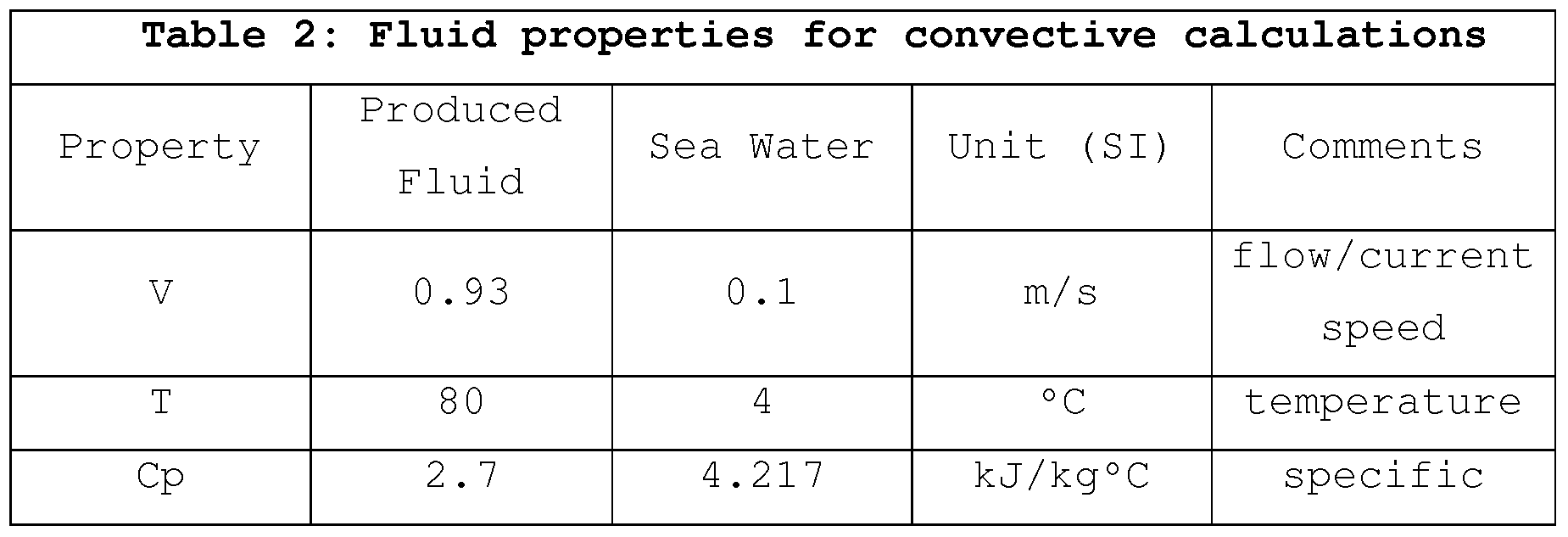
To perform a comparative analysis, certain parameters are fixed, such as consideration of an ultra deepwater scenario, where the pipeline, materials, water and produced fluid characteristics are set. An example of a selection of design parameters is given in Tables 1 and 2. In the presented scenario the inner pipe diameter is set at 6 inches (15.24 cm) and a Umax of 1.5 W/m2°C is used.


The polymer insulation capacity is evaluated by attending to a maximum overall heat transfer coefficient (U) , which is theoretically calculated by the formulation:
1
U =
1 Ki Λ ( U ) Ri Λ I ta \ Ri Λ [ . te Ri — + — In 1 + — + — In 1 + \ + — In 1 + + hi ks { Ri ka I Ri + ti ' ks \ Ri + ti + ta Ri + ti + ta + te -U J he
where Ri is the internal radius, ti, te, ta are the inner, outer pipes and annular thicknesses, ks and ka are the thermal conductivities of steel and annular materials. In order to obtain the thermal convective coefficients from the produced fluid to the inner pipe and from the external pipe to the surrounding medium, hi and he, it is necessary to calculate the Prandtl, Reynolds and Nusselt coefficients, which are functions of all the parameters indicated below: hi,e = f(Nu,k,Ri) JVw = /(C,m,Re,Pr) Re = f(p,Ri,V,μ)

For the inner or outer convection, the Nusselt parameters C and m must be obtained for the adequate Reynolds range and should consider an internal pipe flow or an external flow transversal to the pipe. Calculations for determining the Prandtl, Reynolds and Nusselt number are well established in basic engineering textbooks.
Geometric properties for the calculated pipelines using a
polyurethane in the annular space versus other materials is given the examples herein.
The polyurethane foam for the annular space is prepared from a polyurethane-forming composition that contains at least a polyol formulation and at least one organic polyisocyanate . In another embodiment the polyol mixtures contains at least one chain extender. In one embodiment water is used as the chemical blowing agent.
The polyol mixtures consist of at least one first polyol having a nominal functionality of 6 to 8 and a hydroxyl number of 250 to 600 and at least one second polyol having a nominal functionality of 3 to 5 and a hydroxyl number of 250 to 600. In a further embodiment, the first and second polyol have an average hydroxyl number of 300 to 500 mg KOH/g. The polyols are produced by the addition of an alkylene oxide (s) to a suitable initiator. Sufficient alkylene oxide (s), such as ethylene oxide, propylene oxide, butylene oxide or a combination thereof, are added to the initiator to produce a polyol having the desired hydroxyl number. The alkoxylation reaction is conveniently performed by forming a mixture of the alkylene oxide (s) and the initiator compound, and subjecting the mixture to conditions of elevated temperature and superatmospheric pressure. Polymerization temperatures may be, for example, from 110 to 1700C, and pressures may be, for example, from 2 to 10 bar (200 to 1000 kPa) . A catalyst may be used, particularly if more than one mole of alkylene oxide (s) is to be added per equivalent of active hydrogen on the initiator compound. Suitable alkoxylation catalysts include strong bases such as alkali metal hydroxides (sodium hydroxide, potassium hydroxide, cesium hydroxide, for example), as well as the so-called double metal cyanide catalysts (of which zinc hexacyanocobaltate complexes are most notable) . The reaction can be performed in two or more stages, in which no catalyst is used in the first stage, and from 0.5 to 1.0 mole of alkylene oxide is added to the initiator per equivalent of active hydrogens, followed by one or more subsequent stages in which additional alkylene oxide is added in the presence of a catalyst as
described. After the reaction is completed, the catalyst may be deactivated and/or removed. Alkali metal hydroxide catalysts may be removed, left in the product, or neutralized with an acid and the residues left in the product. Residues of double metal cyanide catalysts may be left in the product, but can be removed instead if desired.
For production of the first polyol, examples of suitable initiators include sorbitol, sucrose and mixtures of initiators such as sorbitol- or sucrose/glycerine-initiated polyethers.
The initiator for the second polyol will generally be a polyhyric (polyalcohol) , aliphatic amine, aromatic amine or a combination thereof. Examples of polyhydric initiators include glycerin, trimethylolpropane, hexanetriol, pentaerythritol, α- methylglucoside, xylitol Examples of aromatic amine initiators include 1,2-, 1,3- and 1, 4-phenylenediamine; 2,3-, 2,4-, 3,4- and 2,6-toluene diamine (TDA); 4,4'-, 2,4'- and 2,2'- diaminodiphenylmethane; polyphenyl-polymethylene-polyamine . Aliphatic or cyclo-aliphatic amine initiators may also be used. Examples of aliphatic amine initiators include ethylene diamine, tetramethylene diamine, ethanolamine, diethanolamine and triethanolamine . Examples of suitable cyclo-aliphatic amine initiators include aminocyclohexanealkylamine cyclohexanemethanamine, 4-amino-α, α, 4-trimethyl- ( 9Cl) , which is also known as p-menthane-1, 8-diamine or 1, 8-diamino-p- menthane; isophorone diamine or 1, 8-diamino-p-menthane; ortho- cyclohexanediamine; 1,4 cyclohexanediamine, 2 or 4 methylcyclohexane-1, 3- diamine, diastereoisomeric forms, methylene (biscyclohexylamine) and 1,3- or 1, 4-bis (aminomethyl) cyclohexaneamine and 4,4' methylenebis (2- methylcyclohexanamine .
In one embodiment the initiator for the second polyol is an aliphatic amine, an aromatic amine or a combination thereof. In a further embodiment, the initiator for the second polyol is ethylene diamine or aminoethylethanolamine .
In another embodiment the initiator for the second polyol is an aromatic amine. In further embodiment the aromatic amine initiator is one or more isomers of TDA.
The first and second polyol will generally comprise at least 60 wt% of the total isocyanate reactive components in the polyol formulation. In further embodiments the first and second polyol will comprise at least 65 or at least 75 wt% of the total polyol formulation. While the polyol mixture may consist essentially of the first and second polyol, in further embodiments the first and second polyol will comprise less than 98, less than 95 or less than 90 wt% of the total polyol formulation .
The first polyol will generally comprise at least 50 wt% of the first and second polyol. In further embodiments the first polyol will comprise at least 55, at least 60 or at least 64 wt% of the total of first and second polyol. It is believed the balance of first and second polyol provides a high functional polyol to provide for the cross-linking and density to provide for the desired compressive strength of the foam while the lower functional polyol aids in lowering the viscosity of the polyol formulation.
The polyol composition may contain other polyols in addition to the polyether polyols mentioned above, for example, a polyester or other amine initiated polyols may be added. It is also possible to use one or more chain extenders in the foam formulation. For purposes of this invention, a chain extender is a material having two isocyanate-reactive groups per molecule and an equivalent weight per isocyanate-reactive group of less than 400, especially from 31- 125. The isocyanate reactive groups are preferably hydroxyl, primary aliphatic or aromatic amine or secondary aliphatic or aromatic amine groups. Representative chain extenders include amines ethylene glycol, diethylene glycol, 1, 2-propylene glycol, dipropylene glycol, tripropylene glycol, ethylene diamine, phenylene diamine, bis (3-chloro-4-aminophenyl ) methane and 2, 4-diamino-3, 5- diethyl toluene. If used, chain extenders are typically present in an amount from 1 to about 25, especially about 3 to 25 parts and in
a further embodiment from 5 to 20 parts by weight per 100 parts by weight of the total polyol mixture. For this calculation on percent weight, the amount of the chain extender is considered as part of the polyol mixture. The polyurethane-forming composition contains at least one organic polyisocyanate . The organic polyisocyanate or mixture thereof advantageously contains an average of at least 2.5 isocyanate groups per molecule. A preferred isocyanate functionality is from about 2.5 to about 3.6 or from about 2.6 to about 3.3 isocyanate groups/molecule. The polyisocyanate or mixture thereof advantageously has an isocyanate equivalent weight of from about 130 to 200. This is preferably from 130 to 185 and more preferably from 130 to 170. These functionality and equivalent weight values need not apply with respect to any single polyisocyanate in a mixture, provided that the mixture as a whole meets these values.
Suitable polyisocyanates include aromatic, aliphatic and cycloaliphatic polyisocyanates. Aromatic polyisocyanates are generally preferred. Exemplary polyisocyanates include, for example, m-phenylene diisocyanate, 2,4- and/or 2,6-toluene diisocyanate (TDI), the various isomers of diphenylmethanediisocyanate (MDI), hexamethylene-1, 6- diisocyanate, tetramethylene-1, 4-diisocyanate, cyclohexane- 1, 4-diisocyanate, hexahydrotoluene diisocyanate, hydrogenated MDI (H12 MDI), naphthylene-1 , 5-diisocyanate, methoxyphenyl-2, 4- diisocyanate, 4, 4 '-biphenylene diisocyanate, 3, 3 '-dimethyoxy- 4, 4 ' -biphenyl diisocyanate, 3, 3 '-dimethyldiphenylmethane-4, 4 '- diisocyanate, 4, 4 ' , 4"-triphenylmethane diisocyanate, polymethylene polyphenylisocyanates, hydrogenated polymethylene polyphenyl polyisocyanates, toluene-2, 4, 6- triisocyanate and 4, 4 '-dimethyldiphenylmethane-2, 2 ' , 5, 5 '- tetraisocyanate . Preferred polyisocyanates are the so-called polymeric MDI products, which are a mixture of polymethylene polyphenylene polyisocyanates in monomeric MDI. Especially suitable polymeric MDI products have a free MDI content of
from 5 to 50% by weight, more preferably 10 to 40% by weight. Such polymeric MDI products are available from The Dow Chemical Company under the trade names PAPI and Voranate.
An especially preferred polyisocyanate is a polymeric MDI product having an average isocyanate functionality of from 2.6 to 3.3 isocyanate groups/molecule and an isocyanate equivalent weight of from 130 to 170. Suitable commercially available products of that type include PAPI™ 27, Voranate™ M229, Voranate™ M 220, Voranate™ M595, Voranate™ M600, Voranate™ M647 and Voratec™ SD 100 Iso, all from The Dow Chemical Company .
Isocyanate-terminated prepolymers and quasi-prepolymers (mixtures of prepolymers with unreacted polyisocyanate compounds) can also be used. These are prepared by reacting a stoichiometric excess of an organic polyisocyanate with a polyol, Suitable methods for preparing these prepolymers are well known. Such a prepolymer or quasi-prepolymer preferably has an isocyanate functionality of from 2.5 to 3.6 and an isocyanate equivalent weight of from 130 to 200. In a further embodiment the isocyanate can be a blend of prepolymers and monomeric isocyanates. For example the isocyanate may comprise from 30 to 80 percent of prepolymer.
The polyisocyanate is used in an amount sufficient to provide an isocyanate index of from 90 to 200. In a further embodiment the index is from 100 to 180. Isocyanate index is calculated as the number of reactive isocyanate groups provided by the polyisocyanate component divided by the number of isocyanate-reactive groups in the polyurethane-forming composition (including those contained by isocyanate-reactive blowing agents such as water) and multiplying by 100. Water is considered to have two isocyanate-reactive groups per molecule for purposes of calculating isocyanate index. When the index is above 100, there can be formation of urea or isocyanurate groups. Generally any physical or chemical blowing agent used in
making a rigid can be used in making the polyurethane foam used in the present invention. Examples include water, CO2, formic acid, carbamates, low-boiling hydrocarbons, lower monofunctional alcohols, acetals or halogenated hydrocarbons know as HCFCs.
In one embodiment water, which liberates carbon dioxide by reaction with the isocyanate group, is used as a blowing agent and. The water content is generally present in an amount to produce foam having a density as described above. In general, the amount of water is present in an amount from about 0.1 to 1% by weight based on the total mass of all hydrogen-active compounds. In further embodiment the water level is at least 0.2 wt%. In other embodiments the water level is present at less than 0.9 or less than 0.8 wt%. Physical blowing agents such low-boiling hydrocarbons, lower monofunctional alcohols, acetals or HCFCs can be used in place of water or used in combination with water. Examples of suitable hydrocarbons include those having from 3 up to 12 carbon atoms. Typical hydrocarbons include n- and iso-butane, n-, iso- and cyclopentane or mixtures thereof. When used. The physical blowing agent is present in amount of 1 to 15 wt% of all hydrogen-active compounds.
Catalyst used for the producing polyurethane foam known in the art may be included in the formulation for producing the foam. Such catalysts include tertiary amines, tin and bismuth compounds, alkali metal and alkaline earth metal carobyxlates, quaternary ammonium salts. Examples of catalyst used in polyurethane foam production can be found, for example, at column 9, line 62 to column line 10 line 17 in U.S. Patent 5,895,792.
When a tertiary amine catalyst is used, it is generally present in an amount from 0.5 to about 3 parts, especially from about 0.75 to about 2 parts, per 100 parts by weight of the total isocyanate reactive components. When present, an organometallic catalyst is generally
present in an amount of 0.01 to 2 part by weight of the total isocyanate reactive components.
Another optional additive is a surfactant, or a combination of surfactants. Inclusion of a surfactant in the formulation helps to emulsify the liquid components, regulate cell size, and stabilize the cell structure to prevent collapse and sub-surface voids. Suitable surfactants may include, but are not limited to, silicon- based compounds such as silicone oils and organosilicone-polyether copolymers, such as polydimethyl siloxane and polydimethylsiloxane- polyoxyalkylene block copolymers, e.g., polyether modified polydimethyl siloxane. Other suitable selections may include silica particles and silica aerogel powders, as well as organic surfactants such as nonylphenol ethoxylates and VORASURF™ 504, which is an ethylene oxide/butylene oxide block co-polymer having a relatively high molecular weight. Many surfactant products sold under trade names such as NIAX™, DABCO™ and TEGOSTAB™ may be useful in the inventive formulations.
Organosilicone surfactants are generally preferred types. A wide variety of these organosilicone surfactants are commercially available, including those sold by Evonik under the Tegostab™ name (such as Tegostab™ B-8462, B8427 and B8474 surfactants), those sold by Momentive Performance Materials Inc. under the Niax™ name (such as Niax™ L6900 and L6988 surfactants) as well as various surfactant products commercially available from Air Products and Chemicals, such as Dabco™ DC-5598 surfactant.
These surfactants are generally used in amount of 0.01 to 6 parts by weight based on 100 parts by weight of the polyol.
In addition to the foregoing ingredients, the polyurethane-forming composition may include various auxiliary components, such as fillers, colorants, flame retardants, biocides, antioxidants, antistatic agents, viscosity modifiers, and the like.
Examples of suitable flame retardants include phosphorus compounds, halogen-containing compounds and melamine. Examples of fillers and pigments include calcium carbonate,
glass beads, titanium dioxide, iron oxide, chromium oxide, azo/diazo dyes, phthalocyanines, dioxazines, recycled rigid polyurethane foam and carbon black.
Processes for producing the sandwich pipes are comparable to those used for making pipe-in-pipe structures. The polymer processing consists of a mixture of at least a two-component system, polyol and isocyanate, where after mixing the mixture can be moulded, injected, sprayed or rotationally cast to form any desired size, shape and thickness which is helpful in the manufacture purposes. See for example, EP Publication 1 777
242 and U.S. Patent 6,387,447, The process may also be continuous or discontinuous process. When the polyurethane cures and hardens, a strong composite pipeline is formed.
Such produced sandwich pipes can withstand >250 atm which simulates a depth of about 2500 meters.
Examples
The following examples are provided to illustrate the embodiments of the invention, but are not intended to limit the scope thereof. All parts and percentages are by weight unless otherwise indicated. Components used for producing polyurethane foams are as follows:
Isocyanate 1 is a 50:50 blend of a prepolymer having a free NCO content of 23.6% prepared from a monomeric MDI, polymeric MDI and 2000 MW polyoxypropylene, glycerin initiated polyol where the components are used respecitively in a ratio of 72:10:18 and a polymeric MDI having an NCO content of 31.5%. Polyol 1 is a sorbitol initiated poly (oxypropylene) polyol with an hydroxyl number of 478. Polyol 2 is an ethylenediamine initiated poly (oxypropylene) polyol with a hydroxyl number of 640.
Component E: Ethylene glycol to extend and reduce viscosity. Component F: Silicone surfactant Component G: Amine catalyst Polyurethane foam is produced based on the amount of components as given in Table 3. The foam were prepared with a high pressure machine whereby the polyol mixture, including catalyst,
surfactant etc. are mixed together and loaded into the machine tank, the isocyanate is injected into the mix head along with the polyol mixture at a pressure of greater than 120 bars. The reacts are then poured into an open mold. All the materials are at room temperature, approximately 25°C.
Table 3

Properties of the foam produced from Examples 1 and 2 are given in table 4. For comparison, properties for a low density polyurethane (PU) , as would be used for a pipe-in-pipe application, and a polypropylene, commonly used in a sandwich pipe application are also given in table 4.
Table 4

1PoIyPr opylene
*ASTM D- 1623 ; * *ASTM D-638 ; * * * EN 12667
Taking into account the properties of the above materials and fixed design parameters as given in Table 1, calculations can be done to determine the minimum pipeline annular thickness to attend the maximum U value of 1.5 W/m2K, using a fixed parameter of minimum inner diameter of 6 inches and the thermal conductivity of steel and the polymeric layers selected, in addition to the produced fluid and sea water physical and thermal properties necessary to obtain the conductive and convective coefficients. The minimum external diameter is then obtained referring to the API 5L (American Petroleum Institute) line pipe specifications table, in which is also defined the wall thickness to be used in the collapse pressure calculation by a Finite Element program (ABAQUS). For such calculations an initial ovality of 1.5% is considered for both pipes in the same maximum diameter direction, regardless of the optimization described later. Steel mechanical properties of API X- 60 and 1.33 safety factor for the collapse pressure are considered in this design stage. The steel pipes thickness is then increased until the required pipe strength is attained. Here the sandwich pipes are designed with the same inner and outer pipe wall thickness.
The thermal conductivity of a syntactic polyurethane elastomer available from Hyperlast as Sintactic 512 E has a thermal conductivity of approximately 120 and light weight concrete of about 200-1100. Composites based on these materials would require a higher thickness to obtain the desired U value, comparable to the polypropylene .
Results for the designed pipes are presented in Table 5, where DNi and DNe are the inner and outer nominal diameters and ti and te are respectively the inner and exterior wall thicknesses.
Table 5:
Type DNi (in) ti (mm) DNe (in) te (mm)
Polypropylene 6 5/8 11 .13 16 11 .13
Example 1 6 5/8 8. 73 12 3/4 8. 73
Example 2 6 5/8 8. 73 10 3/4 8. 73
Low Density PU 6 5/8 6. 35 10 3/4 18 .26
Determination of the diameter and pipe thickness to meet the design criteria show the diameter and wall thickness with
polypropylene in the annular space are substantially higher than the use of a polyurethane . While the inner pipe diameter can be reduced for the low density pipe-in-pipe application, the outer wall thickness is substantially increased.
This difference is also presented in Table 6 which gives the U value versus the steel weight. The polypropylene SP calculated with a maximum 16 in external pipe has a U value of > 2 W/m2K.
Table 6

It can be noted that, although the PIP system is the most efficient for thermal insulation because of its low density annular material, it requires about 140 kg/m of steel to attend the same design criteria than example 2, which employs the same diameter pipes, but much less steel (about 90 kg/m) . Example 2 requires the next API external pipe, which results in approximately 100 kg/m of total steel weight and nearly the same U value as PIP.
While the foregoing is directed to embodiments of the present invention, other and further embodiments of the invention may be devised without departing from the basic scope thereof, and the scope thereof is determined by the claims that follow.
Claims
1. A sandwich pipe comprising a composite system with three or more layers having at least an inner pipe for a medium, an outer pipe and a polyurethane foam in an annular space between the inner and outer pipe wherein the foam has a density of 400 to 1050 kg/m and a tensile strength of greater than 5 MPa as measured by ASTM D 1623.
2. The sandwich pipe of claim 1 wherein the composite system has an overall heat transfer coefficient (U) of less than 2.1 W/mK.
3. The sandwich pipe of claim 1 wherein the foam has a thermal conductivity at 240C, measured according to EN 12667, of 17 to 85 mW/m2K.
4. The sandwich pipe of any one of the preceding claims wherein the foam has a modulus of at least 1250 MPa as measured according to ASTM D-1623.
5. The sandwich pipe of any one of the preceding claims wherein the inner and outer pipes comprise at least one layer of a metallic alloy of carbon steel, aluminum or titanium.
6. The sandwich pipe of claim 5 wherein the polyurethane foam comprises the reaction product of an isocyanate component with a polyol mixture wherein the polyol mixtures comprises at least one polyol having a nominal functionality of 6 to 8 and an average hydroxyl number of 250 to 600 mg KOH/g and at least one second polyol having a nominal functionality of 3 to 5 and an average hydroxyl number of 300 to 500 mg KOH/g wherein the first polyol comprises at least 50 wt% of the first and second polyol .
7. The sandwich pipe of claim 6 wherein the reaction of the isocyanate component with a polyol mixtures occurs in the presence of a chemical or physical blowing agent.
8 The sandwich pipe of claim 7 wherein the blowing agent comprises water in an amount of 0.1 to 1 wt% of all the hydrogen active components present in the polyol mixture.
9. The sandwich pipe of claim 7 wherein the blowing agent comprises a physical blowing agent in an amount of 1 to 15 wt% of the hydrogen active components present in the polyol mixture .
10. The sandwich pipe of claim 6 wherein the isocyanate is a mixture of polymeric methylene diphenyisocyanate and an isocyanate terminated prepolymer.
11. The sandwich pipe of any one of claims 6, 7, 8 or 9 wherein the polyol mixture comprises at least 5 wt% of a chain extender .
12. The process for producing a sandwich pipe which comprises the steps :
1) provision of the pipe for a medium and the outer pipe, with the pipe for a medium being located within the outer pipe, 2) production of a polyurethane foam by reaction of an isocyanate components with a polyol mixture between the pipe for a medium and the outer pipe.
13. The process of claim 12 wherein the polyol mixture comprises at least one polyol having a nominal functionality of 6 to 8 and an average hydroxyl number of 250 to 600 mg
KOH/g and at least one second polyol having a nominal functionality of 3 to 5 and an average hydroxyl number of 300 to 500 mg KOH/g wherein the first polyol comprises at least 50 wt% of the first and second polyol.
14. The use of a sandwich pipe of any one of claims 1 to 11 for the transportation of warmed hydrocarbons or fluids in deep water applications.
Applications Claiming Priority (2)
| Application Number | Priority Date | Filing Date | Title |
|---|---|---|---|
| ITMI2009A000939 | 2009-05-27 | ||
| IT000939A ITMI20090939A1 (en) | 2009-05-27 | 2009-05-27 | PIPES FOR DEEP WATER USE |
Publications (1)
| Publication Number | Publication Date |
|---|---|
| WO2010136268A1 true WO2010136268A1 (en) | 2010-12-02 |
Family
ID=41402155
Family Applications (1)
| Application Number | Title | Priority Date | Filing Date |
|---|---|---|---|
| PCT/EP2010/055203 Ceased WO2010136268A1 (en) | 2009-05-27 | 2010-04-20 | Pipes for deep water applications |
Country Status (2)
| Country | Link |
|---|---|
| IT (1) | ITMI20090939A1 (en) |
| WO (1) | WO2010136268A1 (en) |
Cited By (3)
| Publication number | Priority date | Publication date | Assignee | Title |
|---|---|---|---|---|
| EP3110589A1 (en) * | 2014-02-24 | 2017-01-04 | Lockheed Martin Corporation | Friction stir welded pipes |
| CN109323083A (en) * | 2018-10-30 | 2019-02-12 | 中投(天津)热力股份有限公司 | A kind of efficient, durable heat-insulation pipe manufacturing process |
| CN112856054A (en) * | 2021-02-04 | 2021-05-28 | 辽宁宇航钢塑管制造有限公司 | Hard polyurethane foam plastic anti-corrosion heat-insulation pipe and preparation process thereof |
Citations (7)
| Publication number | Priority date | Publication date | Assignee | Title |
|---|---|---|---|---|
| GB2046865A (en) * | 1979-03-15 | 1980-11-19 | Kendall & Co | Insulation of pipe by multi- stage application of foam |
| US5895792A (en) | 1996-09-24 | 1999-04-20 | Basf Aktiengesellschaft | Production of rigid polyurethane foams |
| US6387447B1 (en) | 1997-07-16 | 2002-05-14 | Bayer Aktiengesellschaft | Pressure resistant and heat-stable insulating coatings for hollow bodies, and a method for producing the same |
| WO2004011839A1 (en) | 2002-07-30 | 2004-02-05 | Coppe/Ufrj - Coordenação Dos Programas De Pós Graduação De Engenharia Da Universidade Federal Do Rio De Janeiro | Sandwich pipes for ultra-deep waters |
| DE202006009337U1 (en) * | 2006-06-14 | 2006-08-17 | Brugg Rohr Ag, Holding | Heat-insulated pipe used in a heating system and in drinking water and effluent lines comprises an inner pipe, a heat insulating layer surrounding the inner pipe, a film surrounding the heat insulating layer and a corrugated outer pipe |
| EP1777242A1 (en) | 2005-10-19 | 2007-04-25 | Basf Aktiengesellschaft | Polyurethane foams for insulating pipes |
| EP1857725A2 (en) * | 2006-05-18 | 2007-11-21 | Corus UK Limited | Insulation of pipe-in-pipe systems |
-
2009
- 2009-05-27 IT IT000939A patent/ITMI20090939A1/en unknown
-
2010
- 2010-04-20 WO PCT/EP2010/055203 patent/WO2010136268A1/en not_active Ceased
Patent Citations (7)
| Publication number | Priority date | Publication date | Assignee | Title |
|---|---|---|---|---|
| GB2046865A (en) * | 1979-03-15 | 1980-11-19 | Kendall & Co | Insulation of pipe by multi- stage application of foam |
| US5895792A (en) | 1996-09-24 | 1999-04-20 | Basf Aktiengesellschaft | Production of rigid polyurethane foams |
| US6387447B1 (en) | 1997-07-16 | 2002-05-14 | Bayer Aktiengesellschaft | Pressure resistant and heat-stable insulating coatings for hollow bodies, and a method for producing the same |
| WO2004011839A1 (en) | 2002-07-30 | 2004-02-05 | Coppe/Ufrj - Coordenação Dos Programas De Pós Graduação De Engenharia Da Universidade Federal Do Rio De Janeiro | Sandwich pipes for ultra-deep waters |
| EP1777242A1 (en) | 2005-10-19 | 2007-04-25 | Basf Aktiengesellschaft | Polyurethane foams for insulating pipes |
| EP1857725A2 (en) * | 2006-05-18 | 2007-11-21 | Corus UK Limited | Insulation of pipe-in-pipe systems |
| DE202006009337U1 (en) * | 2006-06-14 | 2006-08-17 | Brugg Rohr Ag, Holding | Heat-insulated pipe used in a heating system and in drinking water and effluent lines comprises an inner pipe, a heat insulating layer surrounding the inner pipe, a film surrounding the heat insulating layer and a corrugated outer pipe |
Non-Patent Citations (3)
| Title |
|---|
| "Sandwich Pipes for Ultra Deepwater Applications", THE OFFSHORE TECHNOLOGY CONFERENCE, 5 May 2008 (2008-05-05) |
| C. BORSELINO ET AL.: "Experimental and numerical evaluation of sandwich composite structures", J. COMPOSITES SCI. AND TECH., vol. 64, pages 1709 - 1715 |
| CASTELLO, X.; ESTEFEN, S.F.; LEON, H.R.; FRITZ, M.C.: "Collapse of sandwich pipes with different annular materials", RIO PIPELINE CONFERENCE & EXPOSITION, 2007 |
Cited By (3)
| Publication number | Priority date | Publication date | Assignee | Title |
|---|---|---|---|---|
| EP3110589A1 (en) * | 2014-02-24 | 2017-01-04 | Lockheed Martin Corporation | Friction stir welded pipes |
| CN109323083A (en) * | 2018-10-30 | 2019-02-12 | 中投(天津)热力股份有限公司 | A kind of efficient, durable heat-insulation pipe manufacturing process |
| CN112856054A (en) * | 2021-02-04 | 2021-05-28 | 辽宁宇航钢塑管制造有限公司 | Hard polyurethane foam plastic anti-corrosion heat-insulation pipe and preparation process thereof |
Also Published As
| Publication number | Publication date |
|---|---|
| ITMI20090939A1 (en) | 2010-11-28 |
Similar Documents
| Publication | Publication Date | Title |
|---|---|---|
| US8231952B2 (en) | Insulated pipes | |
| CN104619740B (en) | Prepare with the foam for improving performance | |
| US9476539B2 (en) | Rigid foam envelopment of the connections of pipes | |
| CN1178803A (en) | Production of rigid polyurethane plastic foams | |
| CN104804630A (en) | A polyisocyanurate-based syntactic coating for offshore applications | |
| US20100158614A1 (en) | Polyurethane foams for trench breaker and other applications | |
| CN102713400B (en) | Rigid foam wrap for pipe connections | |
| CN104837884B (en) | Hydrolysis-stabilized polyurethanes for coating components in marine applications | |
| WO2010136268A1 (en) | Pipes for deep water applications | |
| EP3063197B1 (en) | Syntactic polyurethane elastomers for use in subsea pipeline insulation | |
| US10442885B2 (en) | Hydrolysis-stable polyurethane for coating elements in maritime applications | |
| EP2931774B1 (en) | Hydrolysis-stable polyurethane for use in offshore applications | |
| JP6203176B2 (en) | Insulated pipe manufacturing method with improved properties | |
| CA2928690C (en) | Syntactic polyurethane elastomers based on low unsaturation polyols for use in subsea pipeline insulation | |
| EP3063199B1 (en) | Syntactic polyurethane elastomers having distinct morphology for use in subsea pipeline insulation | |
| EP3063196B1 (en) | Syntactic polyurethane elastomer based on soft segment prepolymer and non-mercury catalyst for use in subsea pipeline insulation | |
| US20140170351A1 (en) | Hydrolysis-stable polyurethane for use in the off-shore sector |
Legal Events
| Date | Code | Title | Description |
|---|---|---|---|
| 121 | Ep: the epo has been informed by wipo that ep was designated in this application |
Ref document number: 10714293 Country of ref document: EP Kind code of ref document: A1 |
|
| NENP | Non-entry into the national phase |
Ref country code: DE |
|
| 122 | Ep: pct application non-entry in european phase |
Ref document number: 10714293 Country of ref document: EP Kind code of ref document: A1 |