WO2010132952A1 - Oligothiophenes and use thereof in dye-sensitised solar cells - Google Patents
Oligothiophenes and use thereof in dye-sensitised solar cells Download PDFInfo
- Publication number
- WO2010132952A1 WO2010132952A1 PCT/AU2010/000613 AU2010000613W WO2010132952A1 WO 2010132952 A1 WO2010132952 A1 WO 2010132952A1 AU 2010000613 W AU2010000613 W AU 2010000613W WO 2010132952 A1 WO2010132952 A1 WO 2010132952A1
- Authority
- WO
- WIPO (PCT)
- Prior art keywords
- group
- alkyl
- compound
- photovoltaic device
- formula
- Prior art date
- Legal status (The legal status is an assumption and is not a legal conclusion. Google has not performed a legal analysis and makes no representation as to the accuracy of the status listed.)
- Ceased
Links
- 0 Cc1c(*)[s]c(*)c1* Chemical compound Cc1c(*)[s]c(*)c1* 0.000 description 1
Classifications
-
- C—CHEMISTRY; METALLURGY
- C07—ORGANIC CHEMISTRY
- C07D—HETEROCYCLIC COMPOUNDS
- C07D333/00—Heterocyclic compounds containing five-membered rings having one sulfur atom as the only ring hetero atom
- C07D333/02—Heterocyclic compounds containing five-membered rings having one sulfur atom as the only ring hetero atom not condensed with other rings
- C07D333/04—Heterocyclic compounds containing five-membered rings having one sulfur atom as the only ring hetero atom not condensed with other rings not substituted on the ring sulphur atom
- C07D333/26—Heterocyclic compounds containing five-membered rings having one sulfur atom as the only ring hetero atom not condensed with other rings not substituted on the ring sulphur atom with hetero atoms or with carbon atoms having three bonds to hetero atoms with at the most one bond to halogen, e.g. ester or nitrile radicals, directly attached to ring carbon atoms
- C07D333/30—Hetero atoms other than halogen
- C07D333/36—Nitrogen atoms
-
- C—CHEMISTRY; METALLURGY
- C09—DYES; PAINTS; POLISHES; NATURAL RESINS; ADHESIVES; COMPOSITIONS NOT OTHERWISE PROVIDED FOR; APPLICATIONS OF MATERIALS NOT OTHERWISE PROVIDED FOR
- C09B—ORGANIC DYES OR CLOSELY-RELATED COMPOUNDS FOR PRODUCING DYES, e.g. PIGMENTS; MORDANTS; LAKES
- C09B23/00—Methine or polymethine dyes, e.g. cyanine dyes
- C09B23/10—The polymethine chain containing an even number of >CH- groups
- C09B23/105—The polymethine chain containing an even number of >CH- groups two >CH- groups
-
- C—CHEMISTRY; METALLURGY
- C09—DYES; PAINTS; POLISHES; NATURAL RESINS; ADHESIVES; COMPOSITIONS NOT OTHERWISE PROVIDED FOR; APPLICATIONS OF MATERIALS NOT OTHERWISE PROVIDED FOR
- C09B—ORGANIC DYES OR CLOSELY-RELATED COMPOUNDS FOR PRODUCING DYES, e.g. PIGMENTS; MORDANTS; LAKES
- C09B57/00—Other synthetic dyes of known constitution
-
- C—CHEMISTRY; METALLURGY
- C09—DYES; PAINTS; POLISHES; NATURAL RESINS; ADHESIVES; COMPOSITIONS NOT OTHERWISE PROVIDED FOR; APPLICATIONS OF MATERIALS NOT OTHERWISE PROVIDED FOR
- C09B—ORGANIC DYES OR CLOSELY-RELATED COMPOUNDS FOR PRODUCING DYES, e.g. PIGMENTS; MORDANTS; LAKES
- C09B69/00—Dyes not provided for by a single group of this subclass
- C09B69/10—Polymeric dyes; Reaction products of dyes with monomers or with macromolecular compounds
- C09B69/109—Polymeric dyes; Reaction products of dyes with monomers or with macromolecular compounds containing other specific dyes
-
- H—ELECTRICITY
- H01—ELECTRIC ELEMENTS
- H01G—CAPACITORS; CAPACITORS, RECTIFIERS, DETECTORS, SWITCHING DEVICES, LIGHT-SENSITIVE OR TEMPERATURE-SENSITIVE DEVICES OF THE ELECTROLYTIC TYPE
- H01G9/00—Electrolytic capacitors, rectifiers, detectors, switching devices, light-sensitive or temperature-sensitive devices; Processes of their manufacture
- H01G9/20—Light-sensitive devices
- H01G9/2027—Light-sensitive devices comprising an oxide semiconductor electrode
- H01G9/2031—Light-sensitive devices comprising an oxide semiconductor electrode comprising titanium oxide, e.g. TiO2
-
- H—ELECTRICITY
- H10—SEMICONDUCTOR DEVICES; ELECTRIC SOLID-STATE DEVICES NOT OTHERWISE PROVIDED FOR
- H10K—ORGANIC ELECTRIC SOLID-STATE DEVICES
- H10K85/00—Organic materials used in the body or electrodes of devices covered by this subclass
- H10K85/60—Organic compounds having low molecular weight
- H10K85/631—Amine compounds having at least two aryl rest on at least one amine-nitrogen atom, e.g. triphenylamine
- H10K85/636—Amine compounds having at least two aryl rest on at least one amine-nitrogen atom, e.g. triphenylamine comprising heteroaromatic hydrocarbons as substituents on the nitrogen atom
-
- H—ELECTRICITY
- H10—SEMICONDUCTOR DEVICES; ELECTRIC SOLID-STATE DEVICES NOT OTHERWISE PROVIDED FOR
- H10K—ORGANIC ELECTRIC SOLID-STATE DEVICES
- H10K85/00—Organic materials used in the body or electrodes of devices covered by this subclass
- H10K85/60—Organic compounds having low molecular weight
- H10K85/649—Aromatic compounds comprising a hetero atom
- H10K85/655—Aromatic compounds comprising a hetero atom comprising only sulfur as heteroatom
-
- H—ELECTRICITY
- H10—SEMICONDUCTOR DEVICES; ELECTRIC SOLID-STATE DEVICES NOT OTHERWISE PROVIDED FOR
- H10K—ORGANIC ELECTRIC SOLID-STATE DEVICES
- H10K2102/00—Constructional details relating to the organic devices covered by this subclass
- H10K2102/10—Transparent electrodes, e.g. using graphene
- H10K2102/101—Transparent electrodes, e.g. using graphene comprising transparent conductive oxides [TCO]
- H10K2102/102—Transparent electrodes, e.g. using graphene comprising transparent conductive oxides [TCO] comprising tin oxides, e.g. fluorine-doped SnO2
-
- Y—GENERAL TAGGING OF NEW TECHNOLOGICAL DEVELOPMENTS; GENERAL TAGGING OF CROSS-SECTIONAL TECHNOLOGIES SPANNING OVER SEVERAL SECTIONS OF THE IPC; TECHNICAL SUBJECTS COVERED BY FORMER USPC CROSS-REFERENCE ART COLLECTIONS [XRACs] AND DIGESTS
- Y02—TECHNOLOGIES OR APPLICATIONS FOR MITIGATION OR ADAPTATION AGAINST CLIMATE CHANGE
- Y02E—REDUCTION OF GREENHOUSE GAS [GHG] EMISSIONS, RELATED TO ENERGY GENERATION, TRANSMISSION OR DISTRIBUTION
- Y02E10/00—Energy generation through renewable energy sources
- Y02E10/50—Photovoltaic [PV] energy
- Y02E10/542—Dye sensitized solar cells
-
- Y—GENERAL TAGGING OF NEW TECHNOLOGICAL DEVELOPMENTS; GENERAL TAGGING OF CROSS-SECTIONAL TECHNOLOGIES SPANNING OVER SEVERAL SECTIONS OF THE IPC; TECHNICAL SUBJECTS COVERED BY FORMER USPC CROSS-REFERENCE ART COLLECTIONS [XRACs] AND DIGESTS
- Y02—TECHNOLOGIES OR APPLICATIONS FOR MITIGATION OR ADAPTATION AGAINST CLIMATE CHANGE
- Y02E—REDUCTION OF GREENHOUSE GAS [GHG] EMISSIONS, RELATED TO ENERGY GENERATION, TRANSMISSION OR DISTRIBUTION
- Y02E10/00—Energy generation through renewable energy sources
- Y02E10/50—Photovoltaic [PV] energy
- Y02E10/549—Organic PV cells
Definitions
- the present application relates to new chemical compounds useful in organic photovoltaic applications, and to photovoltaic devices including solar cells and dye sensitised solar cells and photodetectors.
- Photovoltaic devices include heterojunction and bilayer organic photovoltaic cells, sometimes referred to as organic photovoltaics (OPVs), and dye sensitised solar cells, which are also known as Gratzel cells.
- OOVs organic photovoltaics
- Gratzel cells dye sensitised solar cells
- Photovoltaic devices contain a combination of electron acceptor materials and electron donor materials (or hole accepting materials) in the active layer. Absorption of a photon results in the generation of a weakly-bound electron- hole pair in the active layer. Dissociation of the bound electron-hole pair is facilitated by the interface between the electron donor and electron acceptor materials. The separated holes and electrons travel towards respective electrodes and consequently generate a voltage potential at the electrodes.
- Poly 3-hexylthiophene is an example of a polymeric organic material used as an electron donor material in polymeric photovoltaic devices, together with fullerene as an example of an electron acceptor material.
- the two materials may be present as layers, forming a bilayer photovoltaic cell, or may be present as a blend, forming a bulk heterojunction photovoltaic cell.
- dye materials also known as "sensitisers" or charge transporting chromophores, are used as a charge generating material, typically with an inorganic semiconductor.
- an inorganic semiconductor typically with an inorganic semiconductor.
- electron donor dyes with an n-type semiconductor such as titania is an n-type semiconductor such as titania
- R 1 and R 2 are each independently selected from the group consisting of alkyl, aromatic or heteroaromatic groups, or may together comprise linked alkyl, aromatic or heteroaromatic groups
- R 3 and R 4 are each independently selected from the group consisting of alkyl, alkoxy or H, or R 3 and R 4 may together comprise a divalent alkyl group, a divalent alkoxy or alkyldioxy group, or R 3 and R 4 may together comprise a heterocyclic, heteroaromatic or aromatic group linked or fused to the thiophene group
- R 5 is H or alkyl
- n is an integer between 1 and 10.
- a photovoltaic device comprising: - a first electrode,
- the active material comprising a compound of formula I and a second material which is either an electron donor material or a charge accepting material, wherein the device generates an electrical potential upon the absorption of photons.
- the charge accepting material may be an electron acceptor material.
- the device is a dye sensitised solar cell comprising:
- the device is a dye sensitised solar cell comprising:
- Figure 1 is a schematic illustration of a photovoltaic device, in the form of a dye sensitised solar cell, according to one embodiment of the invention.
- Figure 2 is a photocurrent action spectrum for a photovoltaic device of one embodiment of the invention.
- the present invention relates to novel compounds, and their use in photovoltaic - A -
- device is used broadly to refer to any device containing the stated electrodes and active material, and thus encompasses solar cells, photodetectors and the like.
- the compounds of the present application are based on a donor-acceptor design which has greater absorption of visible light than current oligothiophene- based materials. This is due to the greater charge delocalisation improving charge transport through more efficient orbital overlaps which also leads to greater absorption extinction coefficients.
- the induced dipole caused by the donor and acceptor provide broader absorption (absorb more of the visible spectrum) and greater extinction coefficients (the amount of absorption at a given wavelength) than the same length oligthiophene without the donor and acceptor.
- the compound also contains an acid group or an ester derivative (which can be converted into an acid) for binding to titania, which makes it suitable for use in dye sensitised solar cells.
- the structure includes a direct link between the amino nitrogen atom and the thiophene (or oligothiophene) unit, which is then directly linked to a strongly electron withdrawing group containing a carboxylic acid or ester, for binding to titania.
- a strongly electron withdrawing group containing a carboxylic acid or ester, for binding to titania.
- the absence of a highly aromatic benzene or fluorene group between the thiophene and amine, and the inclusion of the thiophene linking group provides a better energy balance and greater charge delocalisation which serves to produce resonance delocalisation to give further absorption. Photovoltaic devices containing such compounds will benefit from these properties.
- n is an integer between 1 and 10. According to one embodiment, n is between 2 and 10. Compounds based on n of 2 or greater are oligothiophene compounds. According to some embodiments, n is between 2 and 6.
- R 3 and R 4 are each independently selected from the group consisting of alkyl, alkoxy or H, or R 3 and R 4 may together comprise a divalent alkyl group, a divalent alkoxy or alkyldioxy group, or R 3 and R 4 may together comprise a heterocyclic, heteroaromatic or aromatic group linked or fused to the thiophene group.
- R 3 and R 4 are independently selected from the group consisting of hydrogen, optionally substituted C 1 -C1 8 alkyl, optionally substituted C 3 -C 18 cycloalkyl and optionally substituted C1-C1 8 alkoxy groups, or R 3 and R 4 may together with the carbon atoms to which they are attached comprise an optionally substituted saturated or unsaturated ring which may optionally contain one or more heteroatoms selected from the group consisting of O, N and S, and may optionally be further fused to one or more other rings.
- R 3 and R 4 are each independently selected from selected from the group consisting of alkyl, alkoxy and H.
- Alkyl encompasses straight chained, branched or cyclic alkyl groups of C1 to C18 (C3-C18 in the case of branched and cyclic groups), and encompasses groups of the formula -C x H 2 x + i, where x is an integer between 1 and 18, such as between 1 and 10, or between 1 and 8. Examples include methyl, ethyl, propyl, hexyl, /so-butyl, te/f-butyl, and so forth.
- alkyl also encompasses alkyl groups containing one less hydrogen atom, such that the group is attached via two positions. Such groups are also referred to as "alkylene" groups.
- Alkoxy refers to the group -OC x H 2x+ I, where x is an integer between 1 and 18, or between 1 and 10. Examples include methoxy, ethoxy, and so forth.
- the oxygen atom may be located along the hydrocarbon chain, and need not be the atom linking the group to the remainder of the compound.
- R 3 is H.
- R 4 is H.
- one of R 3 and R 4 is H, and the other of R 3 and R 4 is alkyl.
- R 3 and R 4 are both H.
- R 3 and R 4 may together comprise an aliphatic divalent linking group such as -alkyl-, -alkoxy-, dioxy, and dioxyalkyl, or R 3 and R 4 may together comprise a heterocyclic, heteroaromatic or aromatic groups linked or fused to the thiophene group.
- thiophene groups containing divalent linking groups for -R 3 -R 4 - are diazo thiophenes, alkylenedioxythiophene (such as ethylenedioxythiophene) and isobenzothiophene.
- Divalent alkyl groups have been described previously, and encompass groups of the formula -C n H 2n - where n is a positive integer, amongst others.
- Divalent alkoxy groups encompass groups containing one or more alkyl or alkylene segments, and one or more oxygen atoms. Examples include -CH 2 OCH 2 -. Dioxy groups are groups comprising two oxygen atoms. Dioxyalkyl groups encompass groups containing two oxygen atoms and an alkyl group, such as ethylenedioxy (-OEtO-).
- R 3 and R 4 may together comprise a heterocyclic, heteroaromatic or aromatic group linked or fused to the thiophene group.
- An example of an aromatic group is benzene, and when such an aromatic group is fused to the thiophene, R 3 and R 4 , together with the thiophene ring form a substituted or unsubstituted isobenzothiophene.
- aromatic group is used in accordance with its usual meaning in the art and refers to an aromatic ring containing system. Such groups may contain fused ring systems, linked ring systems (such as biphenyl and fluorene groups), and may be substituted or unsubstituted.
- heterocyclic group refers to aromatic group containing one or more heteroatoms.
- the heteroaromatic group may comprise one or more rings, with one or more of the rings containing a heteroatom.
- the heteroatom or heteroatoms in the heteroaromatic group may be selected from one or more of O, N and S.
- heterocyclic group refers to any ring or ring systems, including linked or fused ring systems, containing at least one heteroatom, selected from O, N and S.
- the ring or rings may contain single and/or double bonds, but the electron configuration is such that the ring or ring system is not aromatic.
- the heterocyclic, heteroaromatic or aromatic groups may be fused to the thiophene unit, or may be linked through direct bonds or other linking atoms.
- R 1 and R 2 are each independently selected from the group consisting of alkyl, aromatic or heteroaromatic groups, or may together comprise a linked alkyl, aromatic or heteroaromatic group. To avoid any doubt, this encompasses the situation where Ri and R 2 are independently selected from the group consisting of optionally substituted C 1 -C 20 alkyl, optionally substituted C 3 -C 8 cycloalkyl, optionally substituted aromatic, and optionally substituted heteroaromatic groups or R 1 and R 2 together with the nitrogen atom to which they are attached comprise an optionally substituted saturated or unsaturated ring which may optionally contain further heteroatoms selected from the group consisting of O, N and S, and may optionally be further fused to one or more other rings.
- R 1 and R 2 are each aromatic or heteroaromatic groups, or may together with the nitrogen atom to which they are attached comprise a linked aromatic or heteroaromatic group.
- aromatic group refers to any group containing an aromatic ring system.
- the aromatic groups are attached to the nitrogen atom through an aromatic ring carbon atom.
- Such groups may contain fused ring systems, linked ring systems (such as biphenyl and fluorene groups), and may be substituted or unsubstituted.
- any substituents that do not adversely impact on the electronic properties of the ring system are permissible, and suitable examples include one or more substituents selected from alkyl, alkoxy, hydroxyl, carbonyl, carboxylic acid, halo, aryl, thioalkyl, cyano, haloalkyl such as perfluorinated alkyl, dialkylamino, diarylamine, N-carbazol, heteroaryl, biphenyl, silyl, trimethylsilyl, silylether, methacryloxy, acryloxy, hydroxyalkyneneoxy and 2- bromo-2methylpropanoate.
- Halo refers to a halogen.
- Haloalkyl refers to an alkyl substituted with one or more halogen.
- Thioalkyl is the thio (S-containing) equivalent of alkoxy. Carbonyl encompoasses, carboxylic acids, esters, aldehydes and ketones.
- heteroaryl or similarly “heteroaromatic group” refers to any group containing a heteroaromatic ring system.
- the heteroatoms in the heteroaromatic group may be selected from one or more of O, N and S.
- R 1 and R 2 are heteroaromatic groups, the groups are attached to the nitrogen atom through an atom in the heteroaromatic ring.
- Such groups may be substituted or unsubstituted, and may contain fused ring systems, including a fused heteroaromatic and carbon-based aromatic rings, and linked ring systems. Suitable substituents are the same as those listed above for the aromatic group.
- Linked aromatic or heteroaromatic groups refers to a single group which comprises at least two rings, each of the two rings being directly attached to the nitrogen atom of the compound of formula I, and a linking group linking the two aromatic/heteroaromatic rings.
- the linking group may be, for one example, an alkyl group, or more specifically an alkylene group, of the formula -C x H 2x -, wherein x is an integer between 1 and 18.
- the linking group may be, for another example, a direct bond between the aromatic/heteroaromatic rings.
- R 1 and R 2 comprise alkyl
- the term alkyl has the same definition as provided above in the context of R 3 and R 4 .
- the linked alkyl group may for instance be of the formula -C n H 2n -, where n is an integer between 4 and 10.
- the alkyl group may be substituted by any suitable substituent such as one or more substituents selected from alkyl, alkoxy, halo, aryl, thioalkyl, cyano, and haloalkyl such as perfluorinated alkyl.
- a suitable subset of substituents is alkyl, alkoxy, halo, thioalkyl, cyano and haloalkyl such as perfluorinated alkyl.
- R 1 and R 2 are each independently selected from the group consisting of phenyl, substituted phenyl, fluorenyl, and substituted fluorenyl. According to other embodiments, R 1 and R 2 are independently selected from the group consisting of - phenyl, - phenyl substituted by one or more alkyl, alkyoxy, carbonyl, carboxylic acid, aryl or heteroaryl, - an aryl other than phenyl, - an aryl other than phenyl substituted by one or more alkyl, alkyoxy, carbonyl, carboxylic acid, aryl or heteroaryl, - heteroaryl, or - heteroaryl substituted by one or more alkyl, alkyoxy, carbonyl, carboxylic acid, aryl or heteroaryl.
- aryl refers to aromatic groups based on one ring, or up to 3 fused or linked rings, in which the linking groups are alkyl (specifically, alkylene) groups, and thus encompasses phenyl, napthyl, fluorenyl and so forth.
- heteroaryl refers to the heteroaromatic equivalent of “aryl” and thus refers to one heteroaromatic ring, or up to 3 fused rings including at least one heteroatom. Examples of “heteroaryl” include pyridyl, thienyl, furyl, indonlinyl and so forth. Unless otherwise specified, the terms “aryl” and “heteroaryl” refer to unsubstituted groups.
- An example of a substituted heteroaryl specifically an alkoxy substituted heteroaryl is ethylenedioxythiophene.
- R 1 and R 2 are each independently selected from the group consisting of - phenyl, - phenyl substituted by one or more alkyl, alkyoxy, carbonyl, carboxylic acid, or aryl, - fluorenyl and - fluorenyl substituted by one or more alkyl.
- R 5 in formula I is H or alkyl. According to one embodiment, R 5 is H, such that the end group is a carboxylic acid.
- references to optional substituents refers to one or more substituents selected from the group consisting of alkyl, alkoxy, hydroxyl, carbonyl, carboxylic acid, halo, aryl, thioalkyl, cyano, haloalkyl such as perfluorinated alkyl, dialkylamino, diarylamine, N-carbazol, heteroaryl, biphenyl, silyl, trimethylsilyl, silylether, methacryloxy, acryloxy, hydroxyalkyneneoxy and 2-bromo-2methylpropanoate.
- the compounds of the present application are not limited to any particular stereochemistry.
- the compounds may comprise mixtures of isomers in any ratio, racemic mixtures, a single isomer of the compound, or otherwise.
- the absence of a wavy line at a position corresponding to that shown in figure I in other parts of this specification should not be taken to imply specific stereochemistry about the double bond.
- the actual stereochemistry can only be determined by assessment of the compound as synthesised by the specified synthetic procedure.
- Compound A Typically a repetitive use of i) formylation (Vilsmeier-Haack reaction as a non- limiting example), ii) iodination (via N-iodosuccinimide as a non-limiting example) and iii) coupling to a thiophene with R 3 and R 4 substituents to the iodo (oligo)thiophene via Suzuki coupling (via a boronic ester or acid with the iodothiophene or via Stille coupling) will give access to a variety of oligothiophene lengths with a substituted amine at one end and an aldehyde at the other.
- the publication by Tao and Wong et al. in Advanced Materials 2008 doi: 10.1002/adma.200703032 illustrates the technique in making oligothiophene of various lengths using a compound containing triarylamine boronic esters that would apply to compounds of this invention.
- the following reaction scheme shows the construction of oligothiophenes of a desired length.
- First a formylation is performed and then cycle of iodination and Suzuki coupling. It is understood that simple variation such as the use of a dithiophene boronic acid/ester or tristhiophene boronic acid/ester would allow oligothiophene length increases of two and three thiopehene units respectively in each cycle.
- the aldehyde functional oligothiophene may terminated with a boronic ester or iodide (to yield Compound B), to allow subsequent coupling to either disubstituted amine directly or a disubstituted aminothiophene as shown below (illustrating a Stille coupling).
- cyanoacetic acid suitable in an alcohol at reflux, and optionally with a catalytic amount of a base, such as an amine
- R 3 and R 4 being H can be purchased from Sigma Aldrich, Apollo Chemicals, and others, which can be conveniently converted into the starting materials such as Compound B using simpler reactions, examples of which are presented below.
- cyanoacetic acid suitable in an alcohol at reflux, and optionally with a catalytic amount of a base, such as an amine
- the compound of formula I outlined above is suitably used in a photovoltaic device.
- the photovoltaic device generally comprises:
- the active material comprising
- the device generates an electrical potential upon the absorption of photons.
- the active material is arranged such that the device generates an electrical potential upon the absorption of the photons.
- charge accepting materials include electron accepting materials and hole accepting materials.
- the compound of formula I may be seen as being "ambi-polar", and may act either as an electron donor material or an electron acceptor material, depending on the relative HOMO and LUMO levels of the compound and those of the second material.
- the compound of formula I is an electron donor and the second material is an electron acceptor.
- the photovoltaic device may be in the form of an organic solar cell, such as a bulk heterojunction organic solar cell, a bilayer organic solar cell, or a dye sensitised solar cell.
- organic solar cell such as a bulk heterojunction organic solar cell, a bilayer organic solar cell, or a dye sensitised solar cell.
- the first electrode may be an anode. Any suitable anode materials can be used.
- the anode material is suitably a transparent anode material.
- the anode is a metal oxide anode, including doped metal oxides, such as indium tin oxide, doped tin oxide, doped zinc oxide (such as aluminium-doped zinc oxide), metals such as gold, alloys and conductive polymers and the like.
- the anode may be supported on a suitable support. Supports include transparent supports, such as glass or polymer plates.
- the second electrode may be a cathode.
- Any suitable cathode material can be used.
- the cathode is a metal or metal alloy. Suitable metals and alloys are well known in the art and include aluminium, lithium, and alloys of one or both.
- the second material may be an electron acceptor material.
- the second material is an n-type inorganic semiconductor material. Suitable n-type inorganic semiconductor materials are well known in the art, and include titanium dioxide (TiO 2 ).
- the second material is suitably a particulate material.
- the particulate second material provides a high surface area for the attachment of molecules of the compound of formula I 1 which allows for high exposure to the incident light, and to high contact between the molecules of formula I and the electrolye. Particles of a nanometer size are particularly suited, and encompass particles of between 0.1 nm to 400nm in size, such as between 10 and 50nm sized particles.
- the first electrode may be a cathode. Any suitable cathode materials can be used.
- the cathode material is suitably a transparent cathode material.
- the cathode is a metal oxide cathode, including doped metal oxides, such as indium tin oxide, doped tin oxide, doped zinc oxide (such as aluminium-doped zinc oxide), metals such as gold, alloys and conductive polymers and the like.
- the cathode may be supported on a suitable support. Supports include transparent supports, such as glass or polymer plates.
- the second electrode may be an anode. Any suitable anode material can be used. According to some embodiments the anode is a metal or metal alloy. Suitable metals and alloys are well known in the art and include aluminium, lithium, and alloys of one or both.
- the second material may be an electron donor material.
- the second material is a p-type inorganic semiconductor material. Suitable p-type inorganic semiconductor materials are well known in the art, and include nickel oxide.
- the second material is suitably a particulate material.
- the particulate second material provides a high surface area for the attachment of molecules of the compound of formula I, which allows for high exposure to the incident light, and to high contact between the molecules of formula I and the electrolyte. Particles of a nanometer size are particularly suited, and encompass particles of between 0.1 nm to 400nm in size, such as between 10 and 50nm sized particles.
- the photovoltaic device comprises a charge transport material in contact with the compound of formula I and the second electrode. This embodiment is particularly relevant to dye sensitised solar cells.
- Suitable charge transport materials which may be solid or liquid, are well known in the art and include solid and liquid electrolytes, room temperature ionic liquids, organic electrolytes and aqueous electrolytes.
- the charge transport material, or electrolyte may be doped with a charge carrying species.
- Suitable electrolytes include iodide electrolytes.
- the device may further comprise any additional features known in the art.
- Some photovoltaic devices contain interfacial layers between one or both of the anodes and the active material, and such features may be incorporated in to the photovoltaic devices of the present application.
- the devices may be constructed by any techniques known in the art.
- the compound of formula I comprises at least one carbonyl substituent, such as a carboxylic acid group substituent.
- R 1 and R 2 are each substituted aromatic groups, in which at least one substituents is a carbonyl group.
- R 1 and R 2 are independently selected from the group consisting of substituted phenyl and substituted fluorenyl groups, in which at least one substituent is a carboxylic acid group. The manner in which this form of photovoltaic device may be constructed is described in Bach et al. Nature Materials 9, 31 - 35 (2010).
- the dye sensitised solar cell in general terms comprises:
- charge accepting material includes electron accepting materials and hole accepting materials.
- the photovoltaic device is a dye sensitised solar cell, comprising: - an anode
- the photovoltaic device is a dye sensitised solar cell, comprising: - an anode
- the preferred features of the dye sensitised solar cell are as described previously in the context of photovoltaic devices.
- the compound of formula I acts as a "sensitiser”.
- the photovoltaic device is in the form of a photodetector.
- the photodetector comprises two electrodes and the compound of formula I (and thus has a similar structure to solar cells), and produces variations in current or voltage output in response to light. Examples
- Example 1 Synthesis of 5"-carboxycvanovinylidene-5-(N,N-di-p-tolylamino) 2,2':5'2"-terthiophene (also known as AG4-47)
- Example 1 had the properties shown in the following table. HOMO and LUMO levels were calculated in the conventional manner using cyclic voltametry and UV-Vis spectroscopy. In addition PESA (PhotoElectron Spectroscopy in Air) was used to calculate HOMO of the material as a thin film.
- PESA PhotoElectron Spectroscopy in Air
- Further compounds within general formula I can be prepared through the selection of appropriate starting materials.
- the starting amine (R 1 R 2 NH) for forming the tributylstannyl thiophene derivative (the equivalent of 568 in the reaction scheme) can be synthesised or purchased with the appropriate groups R 1 and R 2 .
- the iodo- carbaldehyde can also be prepared with the appropriate groups R 3 and R 4 , and with the appropriate number of thiophene units (of n-1 in number). From those starting materials, the appropriate formyl precursor containing the selected groups R 1 , R 2 , R 3 , R 4 and n is prepared.
- Step 2 is prepared as shown above from the new formyl precursor to produce the desired target compound. If R 5 is an alkyl group, the ester is formed by esterification of the carboxylic acid produced from Step 2 with an alcohol R 5 OH in the presence of an acid.
- a dye sensitised solar cell (1) of one embodiment of the invention is illustrated in Figure 1.
- the dye sensitised solar cell comprises a transparent layer of indium tin oxide as the anode (2) supported on a plastic support (3).
- a layer of particulate titanium dioxide (4) of an average particle size of 20nm is located on the surface of the anode (2), which is an n-type inorganic semiconductor material and acts as an electron acceptor material.
- the titanium dioxide layer (4) is coated on its surface with the 5"-carboxycyanovinylidene-5-(N,N-di-p- tolylamino) 2,2':5'2"-terthiophene (5) prepared as described in Example 1 above, acting as the sensitiser, or electron donor material.
- This is represented schematically by an area marked with the numeral (5) in Figure 1 , but in reality would be a thin coating on the particles.
- This is applied by any suitable technique, such as by dissolving in a solvent, and contacting with the titanium dioxide layer, to load the sensitiser onto the surface.
- the sensitiser binds to the TiO 2 surface through the acid group.
- a cathode (6) in the form of a platinum cathode is placed above the layer of sensitiser (5), and an electrolyte (7) filled in the space between the sensitiser (5) and the cathode (6), contacting the two materials.
- the electrolyte is of any suitable type, and in the illustrated embodiment is a solution of acetonitrile containing iodine/iodide ions and other ions and/or co-solvents.
- the edges of the device are sealed to encase the electrolyte (7) between the anode (2) and cathode (6).
- the device may be in the form of a single cell, or multiple cells connected in parallel and/or series.
- the device typically further comprises positive and negative terminals (not illustrated) for connection to an energy storage device or other electrical component(s) or circuit(s).
- the electrolyte is of any suitable material that can carry charge. Without limiting the choice of electrolyte system, there are typically three classes of electrolyte. Prior art concerning organic dyes and the electrolyte systems can be obtained from the publication by Mishra, Fischer and Baurerle in Angeewandte Chemie International edition 2009, 48, 2474-2499 (doi :
- Ionic liquid electrolytes There are liquid electrolytes of which I7l3 " acetonitrile is common, Ionic liquid electrolytesare used due to potential advantages of lower volatility, thermal stability and high ionic conductivity. There is a wide range range of ionic liquids that canbe used and te reference may be consulted.
- Ionic liquid electrolyte may contain such materials as but not be limited to 1-ethyl-3-methylimidazolium iodide, 1 ,3- dimethylimidazolium iodide, 1-ethyl-3-methylimidazolium tetracyanoborate, lithium iodide, Iodine, N-methylbenzimidazole.
- Solid electrolytes otherwise known as holetransporting matierals are organic materials.
- An example is 2,2',7,7'-tetrakis-(N,N-di-p-methoxyphenylamine)-9,9'-spirobifluorene known as spiro-MeOTAD).
- Solid electrolyte systems may contain other additives such as t-butylpyridine and lithium bis(trifluorosulfonyl)imide (Li[CF3SO2]2N). It is understood that the electrolytes may contain other additives that may improve the performance, fabrication or stability of the device.
- Part i Liquid electrolyte DSSC.
- the dye of Example 1 was tested in photovoltaic devices using standard mesoporous titanium dioxide (TiO 2 ) with a 6 ⁇ m thick transparent layer of 20nm sized particles and a 6 ⁇ m thick scattering layer of 400 nm sized particles on top of fluorine-doped tin oxide (FTO) coated glass.
- the films were immersed for 5 hours in a solution of 0.3 mM dye and 10 mM chenodeoxycholic acid (cheno) as coadsorbant in 8:2 mixture of dichloromethane and ethanol.
- Cells were sealed with a platinised FTO counter electrode using a hot-melt (Surlyn, DuPont). Cells were then filled with an electrolyte through a hole in the counter electrode. The hole was then sealed with a Surlyn disk and a thin glass to avoid the leakage of electrolyte.
- the electrolyte used was volatile solvent based and its composition was as follows:
- a 450 W xenon light source was used to give an irradiance of 10OmW cm- 2 (the equivalent of one sun at air mass global, AM 1.5G, at the surface of solar cells).
- the spectral output of the lamp was matched in the region of 350-750 nm with the aid of a sunlight filter to reduce the mismatch between the simulator and the true solar spectra to less than 2%.
- the current-voltage characteristics of the cells were obtained by applying an external potential bias to the cell and measuring the generated photocurrent with a digital source meter (Keithley, USA).
- the effective area of the devices was defined with the use of a metal mask to be 0.16cm 2 .
- IPCE incident photon-to- current conversion efficiency
- Fluorine doped Indium tin oxide (FTO) coated glass with a sheet resistance of 10 ⁇ /square was purchased from Asahi, Japan.
- Lithium bis- trifluoromethanesulfonyl imide ([(CF 3 SO 2 ⁇ N]Li + ) was purchased from Aldrich.
- Dyesol-90T paste was purchased from Dyesol Ltd, Australia.
- the small molecule spiroMeOTAD [(2,2'-7,7'-tetrakis(N,N-di-p-methoxyphenyl-amine) 9,9'-spirobifluorene, >99% purity characterised by HPLC] was synthesized in- house according to the Covion patent (US 7,250,519).
- UV-ozone cleaning of ITO substrates was performed using a Novascan PDS-UVT, UV/ozone cleaner with the platform set to maximum height, the intensity of the lamp is greater than 36 mW/cm 2 at a distance of 100 cm. At ambient conditions the ozone output of the UV cleaner is greater than 50 ppm.
- SpiroMeOTAD from a solution in chlorobenzene was deposited in air using a Laurell WS-400B-6NPP Lite single wafer spin processor. Film thicknesses were determined using a Dektak 6M Profilometer. Vacuum depositions were carried out using an Edwards 501 evaporator inside a glovebox. Samples were placed on a shadow mask in a tray with a source to substrate distance of approximately 25 cm. The area defined by the overlap of the patterned gold electrode with the FTO electrode gave a device area of 0.12 cm 2 . Deposition rates and film thicknesses were measured using a calibrated quartz thickness monitor inside the vacuum chamber. Fabrication
- the solid state (DSSC) was fabricated as described in detail in U. Bach; D. Lupo; P. Comte; J. E. Moser; F. Weissortel; J. Salbeck; H. Spreitzer; M. Gratzel.
- FTO coated glass was cleaned by sonication for 10 mins in (a)10% Decon 90 detergent; (b) Dl water; (c) acetone; (d) ethanol.
- the substrates were then exposed to a UV-ozone clean (at 30 0 C) for 10 minutes.
- the thin, dense TiO 2 compact layer of around 100-150 nm was deposited onto FTO glass (Asahi, 10 ⁇ /cm) by spray pyrolysis of a solution of 40 mM rn(acac) 2 (i-C 3 H 7 ) 2 -2i-C 3 H7OH] at 450 0 C. It is noted that acac is the standard abbreviation for acetylacetonate.
- Nanocrystalline TiO 2 films were manually screen printed on top of the compact layer and sintered at 450 0 C for 30 minutes to give a thickness of about 2 ⁇ m and an area of 0.88cm 2 .
- the formed TiO 2 films were then cooled down to room temperature and immersed in a 0.04 M TiCI 4 solution at 70 0 C for 30 min. After rinsing with de-ionised water and ethanol, the films were annealed again at 450 °C for 30 min, then cooled down to 90 0 C prior to being immersed into a 0.3 mM dye solution in dichloromethane/ethanol (6.5:1 vol%).
- the dye was the compound of Example 1 :AG4-47.
- the dye solution also contained 10 mM chenodeoxycholic acid as a coadsorbant.
- the substrate was immersed in the dye solution for 19-20 hrs. After rinsing with acetonitrile, each dyed substrate was deposited by spin coating 30 ⁇ l_ of a spiroMeOTAD solution (170 mM) consisting of 13 mM Li[(CF 3 SO 2 ) 2 N , and 130 mM t-butylpyridine in chlorobenzene at 2500 rpm for 60 sec in air.
- the devices were dried under vac for 1h at 45 0 C before being transferred to a vacuum evaporator.
- a layer of Ag (10nm) was deposited by thermal evaporation through a shadow mask at pressures below 2*10 "6 mbar. This was followed by a layer of Au (80-90nm) at below 3 x10 "6 mbar.
- a small amount of silver paint (Silver Print II, GC electronics, Part no.: 22-023) was deposited onto the gold electrodes and the other connection was made by soldering a wire onto the FTO.
- the cells were tested with an Oriel solar simulator fitted with a 1000W Xe lamp filtered to give an output of lOOmW/cm 2 at AM 1.5.
- the lamp was calibrated using a standard, filtered Si cell from Peccell limited (The output of the lamp was adjusted to give a Jsc of 0.605 mA).
- the estimated mismatch factor of the lamp is 0.95. Values were not corrected for this mismatch.
- IPCE Incident Photon Collection Efficiency
- Example 1 (AG4-47) dye, illuminated at 100mW/cm 2 at AM 1.5; TiO 2 thickness ⁇ 2 ⁇ m, device area 0.12 cm 2 :
Landscapes
- Chemical & Material Sciences (AREA)
- Organic Chemistry (AREA)
- Engineering & Computer Science (AREA)
- Physics & Mathematics (AREA)
- Spectroscopy & Molecular Physics (AREA)
- Materials Engineering (AREA)
- Power Engineering (AREA)
- Microelectronics & Electronic Packaging (AREA)
- Heterocyclic Carbon Compounds Containing A Hetero Ring Having Oxygen Or Sulfur (AREA)
Abstract
A compound of formula I: wherein: R1 and R2 are each independently selected from the group consisting of alkyl, aromatic or heteroaromatic groups, or R1 and R2 may together comprise a linked alkyl, aromatic or heteroaromatic group, R3 and R4 are each independently selected from the group consisting of alkyl, alkoxy or H, or R3 and R4 may together comprise a divalent alkyl group, a divalent alkoxy or alkyldioxy group, or R3 and R4 may together comprise a heterocyclic, heteroaromatic or aromatic group linked or fused to the thiophene group, R5 is H or alkyl, and n is an integer between 1 and 10. The compound is capable of charge transportation and has application in organic photovoltaic devices, such as dye sensitised solar cells.
Description
OLIGOTHIOPHENES AND USE THEREOF IN DYE-SENSITISED
SOLAR CELLS
Field
The present application relates to new chemical compounds useful in organic photovoltaic applications, and to photovoltaic devices including solar cells and dye sensitised solar cells and photodetectors.
Background
Photovoltaic devices include heterojunction and bilayer organic photovoltaic cells, sometimes referred to as organic photovoltaics (OPVs), and dye sensitised solar cells, which are also known as Gratzel cells.
Photovoltaic devices contain a combination of electron acceptor materials and electron donor materials (or hole accepting materials) in the active layer. Absorption of a photon results in the generation of a weakly-bound electron- hole pair in the active layer. Dissociation of the bound electron-hole pair is facilitated by the interface between the electron donor and electron acceptor materials. The separated holes and electrons travel towards respective electrodes and consequently generate a voltage potential at the electrodes.
Poly 3-hexylthiophene is an example of a polymeric organic material used as an electron donor material in polymeric photovoltaic devices, together with fullerene as an example of an electron acceptor material. The two materials may be present as layers, forming a bilayer photovoltaic cell, or may be present as a blend, forming a bulk heterojunction photovoltaic cell. In dye sensitised solar cells, dye materials, also known as "sensitisers" or charge transporting chromophores, are used as a charge generating material, typically with an inorganic semiconductor. One example of this is the use of electron donor dyes with an n-type semiconductor such as titania, as the electron acceptor material.
There has been an emerging trend to develop new chemical compounds capable of charge transportation (as either the electron donor or electron acceptor material) for use in organic photovoltaic applications, such as dye sensitised solar cells.
In charge transportation materials recently developed for such applications, the
trend has been towards the use of compounds containing a donor electron group (such as an N,N-diarylamino group) at one end, a combination of an oligothiophene and an acceptor electron group at the other end, and a highly aromatic linker based on a pi system, such as phenyl, linking the two ends.
There is a need for further chemical compounds that can be used in such applications, which may provide improved charge derealization in the compound. There is also a need for devices containing these new compounds.
Summary
According to the present invention there is provided a compound of formula I:

wherein:
R1 and R2 are each independently selected from the group consisting of alkyl, aromatic or heteroaromatic groups, or may together comprise linked alkyl, aromatic or heteroaromatic groups, R3 and R4 are each independently selected from the group consisting of alkyl, alkoxy or H, or R3 and R4 may together comprise a divalent alkyl group, a divalent alkoxy or alkyldioxy group, or R3 and R4 may together comprise a heterocyclic, heteroaromatic or aromatic group linked or fused to the thiophene group, R5 is H or alkyl, and n is an integer between 1 and 10.
According to the present invention there is also provided a photovoltaic device comprising: - a first electrode,
- a second electrode, and
- an active material in electrical contact with the first and second electrodes, the
active material comprising a compound of formula I and a second material which is either an electron donor material or a charge accepting material, wherein the device generates an electrical potential upon the absorption of photons.
The charge accepting material may be an electron acceptor material.
In one embodiment, the device is a dye sensitised solar cell comprising:
- an anode - a cathode,
- an electron acceptor material on the anode,
- a compound of formula I in contact with the electron acceptor material, and
- a charge transport material in contact with the compound of formula I and the cathode.
In second embodiment, the device is a dye sensitised solar cell comprising:
- an anode
- a cathode,
- an electron donor material on the cathode, - a compound of formula I in contact with the electron donor material, and
- a charge transport material in contact with the compound of formula I and the anode.
Preferred details of the compound and the device are set out in the detailed description below.
Brief Description of the Figures
Figure 1 is a schematic illustration of a photovoltaic device, in the form of a dye sensitised solar cell, according to one embodiment of the invention.
Figure 2 is a photocurrent action spectrum for a photovoltaic device of one embodiment of the invention.
Detailed Description
The present invention relates to novel compounds, and their use in photovoltaic
- A -
devices. It is noted that the term "device" is used broadly to refer to any device containing the stated electrodes and active material, and thus encompasses solar cells, photodetectors and the like.
The compounds of the present application are based on a donor-acceptor design which has greater absorption of visible light than current oligothiophene- based materials. This is due to the greater charge delocalisation improving charge transport through more efficient orbital overlaps which also leads to greater absorption extinction coefficients. The induced dipole caused by the donor and acceptor provide broader absorption (absorb more of the visible spectrum) and greater extinction coefficients (the amount of absorption at a given wavelength) than the same length oligthiophene without the donor and acceptor. The compound also contains an acid group or an ester derivative (which can be converted into an acid) for binding to titania, which makes it suitable for use in dye sensitised solar cells.
The structure includes a direct link between the amino nitrogen atom and the thiophene (or oligothiophene) unit, which is then directly linked to a strongly electron withdrawing group containing a carboxylic acid or ester, for binding to titania. The absence of a highly aromatic benzene or fluorene group between the thiophene and amine, and the inclusion of the thiophene linking group provides a better energy balance and greater charge delocalisation which serves to produce resonance delocalisation to give further absorption. Photovoltaic devices containing such compounds will benefit from these properties.
In formula I, n is an integer between 1 and 10. According to one embodiment, n is between 2 and 10. Compounds based on n of 2 or greater are oligothiophene compounds. According to some embodiments, n is between 2 and 6.
In formula I, R3 and R4 are each independently selected from the group consisting of alkyl, alkoxy or H, or R3 and R4 may together comprise a divalent alkyl group, a divalent alkoxy or alkyldioxy group, or R3 and R4 may together comprise a heterocyclic, heteroaromatic or aromatic group linked or fused to the thiophene group. Expressed in another way, R3 and R4 are independently selected from the group consisting of hydrogen, optionally substituted C1-C18
alkyl, optionally substituted C3-C18 cycloalkyl and optionally substituted C1-C18 alkoxy groups, or R3 and R4 may together with the carbon atoms to which they are attached comprise an optionally substituted saturated or unsaturated ring which may optionally contain one or more heteroatoms selected from the group consisting of O, N and S, and may optionally be further fused to one or more other rings.
According to some embodiments, R3 and R4 are each independently selected from selected from the group consisting of alkyl, alkoxy and H. Alkyl encompasses straight chained, branched or cyclic alkyl groups of C1 to C18 (C3-C18 in the case of branched and cyclic groups), and encompasses groups of the formula -CxH2x+i, where x is an integer between 1 and 18, such as between 1 and 10, or between 1 and 8. Examples include methyl, ethyl, propyl, hexyl, /so-butyl, te/f-butyl, and so forth. Unless the context requires otherwise, alkyl also encompasses alkyl groups containing one less hydrogen atom, such that the group is attached via two positions. Such groups are also referred to as "alkylene" groups. Alkoxy refers to the group -OCxH2x+I, where x is an integer between 1 and 18, or between 1 and 10. Examples include methoxy, ethoxy, and so forth. The oxygen atom may be located along the hydrocarbon chain, and need not be the atom linking the group to the remainder of the compound.
According to some embodiments R3 is H. According to some embodiments R4 is H. According to some embodiments, one of R3 and R4 is H, and the other of R3 and R4 is alkyl. According to one embodiment, R3 and R4 are both H.
According to some embodiments R3 and R4 may together comprise an aliphatic divalent linking group such as -alkyl-, -alkoxy-, dioxy, and dioxyalkyl, or R3 and R4 may together comprise a heterocyclic, heteroaromatic or aromatic groups linked or fused to the thiophene group. Examples of thiophene groups containing divalent linking groups for -R3-R4- are diazo thiophenes, alkylenedioxythiophene (such as ethylenedioxythiophene) and isobenzothiophene. Divalent alkyl groups have been described previously, and encompass groups of the formula -CnH2n- where n is a positive integer, amongst others. Divalent alkoxy groups encompass groups containing one or more alkyl or alkylene segments, and one or more oxygen atoms. Examples include -CH2OCH2-. Dioxy groups are groups comprising two oxygen atoms.
Dioxyalkyl groups encompass groups containing two oxygen atoms and an alkyl group, such as ethylenedioxy (-OEtO-).
R3 and R4 may together comprise a heterocyclic, heteroaromatic or aromatic group linked or fused to the thiophene group. An example of an aromatic group is benzene, and when such an aromatic group is fused to the thiophene, R3 and R4, together with the thiophene ring form a substituted or unsubstituted isobenzothiophene. More generally, "aromatic group" is used in accordance with its usual meaning in the art and refers to an aromatic ring containing system. Such groups may contain fused ring systems, linked ring systems (such as biphenyl and fluorene groups), and may be substituted or unsubstituted. The term "heteroaromatic group" refers to aromatic group containing one or more heteroatoms. The heteroaromatic group may comprise one or more rings, with one or more of the rings containing a heteroatom. The heteroatom or heteroatoms in the heteroaromatic group may be selected from one or more of O, N and S. The term "heterocyclic group" refers to any ring or ring systems, including linked or fused ring systems, containing at least one heteroatom, selected from O, N and S. The ring or rings may contain single and/or double bonds, but the electron configuration is such that the ring or ring system is not aromatic. The heterocyclic, heteroaromatic or aromatic groups may be fused to the thiophene unit, or may be linked through direct bonds or other linking atoms.
R1 and R2 are each independently selected from the group consisting of alkyl, aromatic or heteroaromatic groups, or may together comprise a linked alkyl, aromatic or heteroaromatic group. To avoid any doubt, this encompasses the situation where Ri and R2 are independently selected from the group consisting of optionally substituted C1-C20 alkyl, optionally substituted C3-C8 cycloalkyl, optionally substituted aromatic, and optionally substituted heteroaromatic groups or R1 and R2 together with the nitrogen atom to which they are attached comprise an optionally substituted saturated or unsaturated ring which may optionally contain further heteroatoms selected from the group consisting of O, N and S, and may optionally be further fused to one or more other rings.
According to some embodiments, R1 and R2 are each aromatic or heteroaromatic groups, or may together with the nitrogen atom to which they are attached comprise a linked aromatic or heteroaromatic group. The term
"aromatic group" refers to any group containing an aromatic ring system. The aromatic groups are attached to the nitrogen atom through an aromatic ring carbon atom. Such groups may contain fused ring systems, linked ring systems (such as biphenyl and fluorene groups), and may be substituted or unsubstituted. Any substituents that do not adversely impact on the electronic properties of the ring system are permissible, and suitable examples include one or more substituents selected from alkyl, alkoxy, hydroxyl, carbonyl, carboxylic acid, halo, aryl, thioalkyl, cyano, haloalkyl such as perfluorinated alkyl, dialkylamino, diarylamine, N-carbazol, heteroaryl, biphenyl, silyl, trimethylsilyl, silylether, methacryloxy, acryloxy, hydroxyalkyneneoxy and 2- bromo-2methylpropanoate. Halo refers to a halogen. Haloalkyl refers to an alkyl substituted with one or more halogen. Thioalkyl is the thio (S-containing) equivalent of alkoxy. Carbonyl encompoasses, carboxylic acids, esters, aldehydes and ketones.
The term "heteroaryl" or similarly "heteroaromatic group" refers to any group containing a heteroaromatic ring system. The heteroatoms in the heteroaromatic group may be selected from one or more of O, N and S. Where one or both of R1 and R2 are heteroaromatic groups, the groups are attached to the nitrogen atom through an atom in the heteroaromatic ring. Such groups may be substituted or unsubstituted, and may contain fused ring systems, including a fused heteroaromatic and carbon-based aromatic rings, and linked ring systems. Suitable substituents are the same as those listed above for the aromatic group.
Linked aromatic or heteroaromatic groups refers to a single group which comprises at least two rings, each of the two rings being directly attached to the nitrogen atom of the compound of formula I, and a linking group linking the two aromatic/heteroaromatic rings. The linking group may be, for one example, an alkyl group, or more specifically an alkylene group, of the formula -CxH2x-, wherein x is an integer between 1 and 18. The linking group may be, for another example, a direct bond between the aromatic/heteroaromatic rings.
In embodiments where R1 and R2 comprise alkyl, the term alkyl has the same definition as provided above in the context of R3 and R4. Where R1 and R2 together comprise a linked alkyl group, the linked alkyl group may for instance be of the formula -CnH2n-, where n is an integer between 4 and 10. The alkyl
group may be substituted by any suitable substituent such as one or more substituents selected from alkyl, alkoxy, halo, aryl, thioalkyl, cyano, and haloalkyl such as perfluorinated alkyl.. A suitable subset of substituents is alkyl, alkoxy, halo, thioalkyl, cyano and haloalkyl such as perfluorinated alkyl.
According to some embodiments, R1 and R2 are each independently selected from the group consisting of phenyl, substituted phenyl, fluorenyl, and substituted fluorenyl. According to other embodiments, R1 and R2 are independently selected from the group consisting of - phenyl, - phenyl substituted by one or more alkyl, alkyoxy, carbonyl, carboxylic acid, aryl or heteroaryl, - an aryl other than phenyl, - an aryl other than phenyl substituted by one or more alkyl, alkyoxy, carbonyl, carboxylic acid, aryl or heteroaryl, - heteroaryl, or - heteroaryl substituted by one or more alkyl, alkyoxy, carbonyl, carboxylic acid, aryl or heteroaryl.
The term "aryl" refers to aromatic groups based on one ring, or up to 3 fused or linked rings, in which the linking groups are alkyl (specifically, alkylene) groups, and thus encompasses phenyl, napthyl, fluorenyl and so forth. The term "heteroaryl" refers to the heteroaromatic equivalent of "aryl" and thus refers to one heteroaromatic ring, or up to 3 fused rings including at least one heteroatom. Examples of "heteroaryl" include pyridyl, thienyl, furyl, indonlinyl and so forth. Unless otherwise specified, the terms "aryl" and "heteroaryl" refer to unsubstituted groups. An example of a substituted heteroaryl (specifically an alkoxy substituted heteroaryl) is ethylenedioxythiophene.
According to some embodiments, R1 and R2 are each independently selected from the group consisting of - phenyl, - phenyl substituted by one or more alkyl, alkyoxy, carbonyl, carboxylic acid, or aryl, - fluorenyl and - fluorenyl substituted by one or more alkyl.
R5 in formula I is H or alkyl. According to one embodiment, R5 is H, such that the end group is a carboxylic acid.
Unless stated otherwise, references to optional substituents refers to one or more substituents selected from the group consisting of alkyl, alkoxy, hydroxyl, carbonyl, carboxylic acid, halo, aryl, thioalkyl, cyano, haloalkyl such as perfluorinated alkyl, dialkylamino, diarylamine, N-carbazol, heteroaryl, biphenyl,
silyl, trimethylsilyl, silylether, methacryloxy, acryloxy, hydroxyalkyneneoxy and 2-bromo-2methylpropanoate.
As indicated by the wavy line in formula I, the compounds of the present application are not limited to any particular stereochemistry. The compounds may comprise mixtures of isomers in any ratio, racemic mixtures, a single isomer of the compound, or otherwise. The absence of a wavy line at a position corresponding to that shown in figure I in other parts of this specification should not be taken to imply specific stereochemistry about the double bond. The actual stereochemistry can only be determined by assessment of the compound as synthesised by the specified synthetic procedure.
Synthesis of compounds.
Examples demonstrating the synthesis of compounds of a range of embodiments of the invention are set out in the Example section.
Generally the synthesis involves:
- obtaining an amine of the formula R1R2NH (noting that many such amines are available for purchase, or can be synthesised by very straight-forward techniques known in the art)
- reacting the amine R1R2NH with:


(Compound A)
(noting that variants with appropriate groups R3 and R4 can be purchased or
synthesised by techniques known in the art)
- reacting the tributylstannyl thiophene derivative of the amine with an iodo- thiophene-carbaldehyde of formula:

(Compound B)
(which may be purchased, or may be synthesised from the simple thiophene or oligothiophene by deprotonation with BuLi followed by trapping with CO2 to give the aldehyde, then iodination) to produce a formyl precursor containing the selected groups R1, R2, R3, R4 and n:

(Compound C)
and then
- reacting the formyl precursor, Compound C, with cyanoacetic acid (suitably in an alcohol at reflux, and optionally with a catalytic amount of a base, such as an amine) to produce the target compound of formula I (for R5 = H). The corresponding ester (R5 = alkyl) may be made by suitable esterification technique known in the art.
As a further example, the following procedure could be used to prepare the starting materials for the preparation of the compounds of the invention containing longer oligothiophene units:

Compound A
Typically a repetitive use of i) formylation (Vilsmeier-Haack reaction as a non- limiting example), ii) iodination (via N-iodosuccinimide as a non-limiting example) and iii) coupling to a thiophene with R3 and R4 substituents to the iodo (oligo)thiophene via Suzuki coupling (via a boronic ester or acid with the iodothiophene or via Stille coupling) will give access to a variety of oligothiophene lengths with a substituted amine at one end and an aldehyde at the other. The publication by Tao and Wong et al. in Advanced Materials 2008 doi: 10.1002/adma.200703032 illustrates the technique in making oligothiophene of various lengths using a compound containing triarylamine boronic esters that would apply to compounds of this invention.
The following reaction scheme shows the construction of oligothiophenes of a desired length. First a formylation is performed and then cycle of iodination and Suzuki coupling. It is understood that simple variation such as the use of a dithiophene boronic acid/ester or tristhiophene boronic acid/ester would allow oligothiophene length increases of two and three thiopehene units respectively in each cycle.
iodosuccinimide


Compound B
Once in hand, the aldehyde functional oligothiophene may terminated with a boronic ester or iodide (to yield Compound B), to allow subsequent coupling to either disubstituted amine directly or a disubstituted aminothiophene as shown below (illustrating a Stille coupling).
1. N,,H,
 o-xylene Ph3)P(ll)CI


It is understood that a variety of synthetic paths may be used to make compounds of the type C and that compounds of type C may have a 1 to 10 thiophene units.
The formyl precursor (Compound C) can then be reacted with cyanoacetic acid (suitably in an alcohol at reflux, and optionally with a catalytic amount of a base, such as an amine) to produce the target compound of formula I (for R5 = H), optionally followed by esterification to produce a compound of formula I where R5 is alkyl.
A broad range of compounds with R3 and R4 being H can be purchased from Sigma Aldrich, Apollo Chemicals, and others, which can be conveniently converted into the starting materials such as Compound B using simpler reactions, examples of which are presented below.

Buy from Acros Organics
Maybridge
Apollo Chemicals


Buy from Sigma Aldrich
As described above, the precursor formyl compound is then reacted with cyanoacetic acid (suitably in an alcohol at reflux, and optionally with a catalytic amount of a base, such as an amine) to produce the target compound of formula I (for R5 = H). The corresponding ester (R5 = alkyl) may then be prepared by esterification of the carboxylic acid.
Photovoltaic Devices
The compound of formula I outlined above is suitably used in a photovoltaic device. The photovoltaic device generally comprises:
- a first electrode,
- a second electrode, and
- an active material in electrical contact with the first an second electrodes, the active material comprising
(i) the compound of formula I, and
(ii) a second material which is either an electron donor material or a charge accepting material.
The device generates an electrical potential upon the absorption of photons. In other words, the active material is arranged such that the device generates an
electrical potential upon the absorption of the photons.
Examples of charge accepting materials include electron accepting materials and hole accepting materials.
The compound of formula I may be seen as being "ambi-polar", and may act either as an electron donor material or an electron acceptor material, depending on the relative HOMO and LUMO levels of the compound and those of the second material. In some embodiments, the compound of formula I is an electron donor and the second material is an electron acceptor.
The photovoltaic device may be in the form of an organic solar cell, such as a bulk heterojunction organic solar cell, a bilayer organic solar cell, or a dye sensitised solar cell.
Two forms of the photovoltaic device are described in further detail below.
First form of photovoltaic device
The first electrode may be an anode. Any suitable anode materials can be used. The anode material is suitably a transparent anode material. According to some embodiments the anode is a metal oxide anode, including doped metal oxides, such as indium tin oxide, doped tin oxide, doped zinc oxide (such as aluminium-doped zinc oxide), metals such as gold, alloys and conductive polymers and the like. The anode may be supported on a suitable support. Supports include transparent supports, such as glass or polymer plates.
The second electrode may be a cathode. Any suitable cathode material can be used. According to some embodiments the cathode is a metal or metal alloy. Suitable metals and alloys are well known in the art and include aluminium, lithium, and alloys of one or both.
The second material may be an electron acceptor material. According to some embodiments, the second material is an n-type inorganic semiconductor material. Suitable n-type inorganic semiconductor materials are well known in the art, and include titanium dioxide (TiO2).
The second material is suitably a particulate material. The particulate second material provides a high surface area for the attachment of molecules of the compound of formula I1 which allows for high exposure to the incident light, and to high contact between the molecules of formula I and the electrolye. Particles of a nanometer size are particularly suited, and encompass particles of between 0.1 nm to 400nm in size, such as between 10 and 50nm sized particles.
Second form of photovoltaic device
The first electrode may be a cathode. Any suitable cathode materials can be used. The cathode material is suitably a transparent cathode material. According to some embodiments the cathode is a metal oxide cathode, including doped metal oxides, such as indium tin oxide, doped tin oxide, doped zinc oxide (such as aluminium-doped zinc oxide), metals such as gold, alloys and conductive polymers and the like. The cathode may be supported on a suitable support. Supports include transparent supports, such as glass or polymer plates.
The second electrode may be an anode. Any suitable anode material can be used. According to some embodiments the anode is a metal or metal alloy. Suitable metals and alloys are well known in the art and include aluminium, lithium, and alloys of one or both.
The second material may be an electron donor material. According to some embodiments, the second material is a p-type inorganic semiconductor material. Suitable p-type inorganic semiconductor materials are well known in the art, and include nickel oxide.
The second material is suitably a particulate material. The particulate second material provides a high surface area for the attachment of molecules of the compound of formula I, which allows for high exposure to the incident light, and to high contact between the molecules of formula I and the electrolyte. Particles of a nanometer size are particularly suited, and encompass particles of between 0.1 nm to 400nm in size, such as between 10 and 50nm sized particles.
According to some embodiments, the photovoltaic device comprises a charge transport material in contact with the compound of formula I and the second electrode. This embodiment is particularly relevant to dye sensitised solar cells. Suitable charge transport materials, which may be solid or liquid, are well known in the art and include solid and liquid electrolytes, room temperature ionic liquids, organic electrolytes and aqueous electrolytes. The charge transport material, or electrolyte, may be doped with a charge carrying species. Suitable electrolytes include iodide electrolytes.
The device may further comprise any additional features known in the art.
Some photovoltaic devices contain interfacial layers between one or both of the anodes and the active material, and such features may be incorporated in to the photovoltaic devices of the present application. The devices may be constructed by any techniques known in the art.
In this second form of the device, according to some embodiments, the compound of formula I comprises at least one carbonyl substituent, such as a carboxylic acid group substituent. As an example, according to one embodiment, R1 and R2 are each substituted aromatic groups, in which at least one substituents is a carbonyl group. According to further embodiments, R1 and R2 are independently selected from the group consisting of substituted phenyl and substituted fluorenyl groups, in which at least one substituent is a carboxylic acid group. The manner in which this form of photovoltaic device may be constructed is described in Bach et al. Nature Materials 9, 31 - 35 (2010).
Where the device is a dye sensitised solar cell, the dye sensitised solar cell in general terms comprises:
- an anode, - a cathode,
- a charge accepting material on one electrode,
- a compound of formula I, as define above, in contact with the charge accepting material, and
- a charge transport material in contact with the compound of formula I and the other electrode.
The term "charge accepting material" includes electron accepting materials and
hole accepting materials.
According to one embodiment, the photovoltaic device is a dye sensitised solar cell, comprising: - an anode
- a cathode,
- an electron acceptor material on the anode,
- a compound of formula I in contact with the electron acceptor material, and - a charge transport material in contact with the compound of formula I and the cathode.
According to a second embodiment, the photovoltaic device is a dye sensitised solar cell, comprising: - an anode
- a cathode,
- an electron donor material on the cathode,
- a compound of formula I in contact with the electron donor material, and - a charge transport material in contact with the compound of formula I and the anode.
The preferred features of the dye sensitised solar cell are as described previously in the context of photovoltaic devices. In such devices, the compound of formula I acts as a "sensitiser".
In another embodiment the photovoltaic device is in the form of a photodetector. The photodetector comprises two electrodes and the compound of formula I (and thus has a similar structure to solar cells), and produces variations in current or voltage output in response to light.
Examples
The present invention will now be described in further detail with reference to the following examples, relating to some embodiments of the invention. It will be understood that the invention is not limited to the embodiments provided by way of example.
Example 1 : Synthesis of 5"-carboxycvanovinylidene-5-(N,N-di-p-tolylamino) 2,2':5'2"-terthiophene (also known as AG4-47)
Synthesis of 5"-formyl-5-(N,N-di-p-tolylamino)-2,2':5'2"- terthiophene.

To a degassed solution of N,N-dip-tolyl-5-(tributylstannyl)thiophen-2-amine (1Og1 17.6 mmol) and 5'iodo-2,2'bithiophene-5-carbaldehyde (5.64g, 17.6 mmol) in dimethylformamide (100ml) was added bis(triphenylphosphine)palladium(ll) chloride (445mg, 0.634mmol). The mixture was heated to 800C for 10 min, then cooled to 400C and stirred under nitrogen for overnight. The orange coloured solution was worked up with dichloromethane and water and the organic layer was washed with water followed by brine and finally dried over anhydrous sodium sulphate and recovered to get 6.Og (72.3%) of the crude titled material which was subjected to column chromatography (Hexane: Ethyl acetate : : 80:20) to obtain the purified product.
1H NMR (200MHz, C6D6) 59.54 (s, 1 H), 6.49 (d, J=3.95Hz, 1 H), 6.80 (d, J=3.88Hz, 1 H), 6.74-6.68 (m, 2H), 6.87 (d, J=3.97Hz, 2H), 7.01 (m, 4H), 7.22 (m, 4H), 2.16 (s, 6H)
2. Synthesis of 5"-carboxycyanovinylidene-5-(N,N-di-p-tolylamino)
2,2':5'2"-terthiophene.

To a solution of 5"-formyl-5-(N,N-di-p-tolylamino)-2,2I:5'2"-terthiophene (400 mg, 0.85 mmol) and cyanoacetic acid (2.2 meq, 1.87 mmol, 159 mg) in chloroform (30 ml) was added piperidine (1.5 ml, 0.425 mmol) at room temperature. The resulting mixture was refluxed overnight and thin layer chromatograph (TLC) was checked giving the indication of the desired product. The reaction mixture was acidified with 20% aqueous HCI and extracted with dichloromethane. The organic layer was washed twice with water and finally dried over anhydrous sodium sulphate and the solvent was removed in vacuo. The residue was purified on a silica gel column with chloroform/methanol as eluent to give 200 mg (43.5%) of the desired purified black shiny material. 1H NMR (200MHz, DMSO) δ8.05 (s, 1 H), 7.65 (d, J= 4.08 Hz, 1 H), 7.38 (t,
J=3.89Hz, 2H), 7.11-7.15 (m, 6H), 7.02 (m, 4H), 6.45 (d, J= 3.98 Hz, 1 H), 2.26 (s, 6H)
The material of Example 1 had the properties shown in the following table. HOMO and LUMO levels were calculated in the conventional manner using cyclic voltametry and UV-Vis spectroscopy. In addition PESA (PhotoElectron Spectroscopy in Air) was used to calculate HOMO of the material as a thin film.
Film Egap HOMO (eV) LUMO (eV) λmax/ons (eV) et (nm)
CV PESA CV-Egap PESA-
Egap
1 470/650 2.00 -5.20 -5.25 -3.20 -3.25
(AG4-47)
3. Variations
Further compounds within general formula I can be prepared through the selection of appropriate starting materials. In the preparation of the precursor as per step 1 above, the starting amine (R1R2NH) for forming the tributylstannyl thiophene derivative (the equivalent of 568 in the reaction scheme) can be synthesised or purchased with the appropriate groups R1 and R2. The iodo- carbaldehyde can also be prepared with the appropriate groups R3 and R4, and with the appropriate number of thiophene units (of n-1 in number). From those starting materials, the appropriate formyl precursor containing the selected groups R1, R2, R3, R4 and n is prepared. Step 2 is prepared as shown above from the new formyl precursor to produce the desired target compound. If R5 is an alkyl group, the ester is formed by esterification of the carboxylic acid produced from Step 2 with an alcohol R5OH in the presence of an acid.
4. Dye Sensitised Solar Cell
A dye sensitised solar cell (1) of one embodiment of the invention is illustrated in Figure 1. The dye sensitised solar cell comprises a transparent layer of indium tin oxide as the anode (2) supported on a plastic support (3). A layer of particulate titanium dioxide (4) of an average particle size of 20nm is located on the surface of the anode (2), which is an n-type inorganic semiconductor material and acts as an electron acceptor material. The titanium dioxide layer (4) is coated on its surface with the 5"-carboxycyanovinylidene-5-(N,N-di-p- tolylamino) 2,2':5'2"-terthiophene (5) prepared as described in Example 1 above, acting as the sensitiser, or electron donor material. This is represented schematically by an area marked with the numeral (5) in Figure 1 , but in reality would be a thin coating on the particles. This is applied by any suitable technique, such as by dissolving in a solvent, and contacting with the titanium dioxide layer, to load the sensitiser onto the surface. The sensitiser binds to the TiO2 surface through the acid group. A cathode (6) in the form of a platinum cathode is placed above the layer of sensitiser (5), and an electrolyte (7) filled in the space between the sensitiser (5) and the cathode (6), contacting the two materials. The electrolyte is of any suitable type, and in the illustrated embodiment is a solution of acetonitrile containing iodine/iodide ions and other ions and/or co-solvents. The edges of the device are sealed to encase the electrolyte (7) between the anode (2) and cathode (6). The device may be in
the form of a single cell, or multiple cells connected in parallel and/or series. The device typically further comprises positive and negative terminals (not illustrated) for connection to an energy storage device or other electrical component(s) or circuit(s).
The electrolyte is of any suitable material that can carry charge. Without limiting the choice of electrolyte system, there are typically three classes of electrolyte. Prior art concerning organic dyes and the electrolyte systems can be obtained from the publication by Mishra, Fischer and Baurerle in Angeewandte Chemie International edition 2009, 48, 2474-2499 (doi :
10.1002/anie200804709) and references therein. There are liquid electrolytes of which I7l3" acetonitrile is common, Ionic liquid electrolytesare used due to potential advantages of lower volatility, thermal stability and high ionic conductivity. There is a wide range range of ionic liquids that canbe used and te reference may be consulted. Ionic liquid electrolyte may contain such materials as but not be limited to 1-ethyl-3-methylimidazolium iodide, 1 ,3- dimethylimidazolium iodide, 1-ethyl-3-methylimidazolium tetracyanoborate, lithium iodide, Iodine, N-methylbenzimidazole. Solid electrolytes otherwise known as holetransporting matierals (HTM) are organic materials. An example is 2,2',7,7'-tetrakis-(N,N-di-p-methoxyphenylamine)-9,9'-spirobifluorene known as spiro-MeOTAD). Solid electrolyte systems may contain other additives such as t-butylpyridine and lithium bis(trifluorosulfonyl)imide (Li[CF3SO2]2N). It is understood that the electrolytes may contain other additives that may improve the performance, fabrication or stability of the device.
Example 2: Fabrication and testing of Dye Sensitised Solar Cells (DSSC)
Part i : Liquid electrolyte DSSC.
Device fabrication
The dye of Example 1 was tested in photovoltaic devices using standard mesoporous titanium dioxide (TiO2) with a 6μm thick transparent layer of 20nm sized particles and a 6μm thick scattering layer of 400 nm sized particles on top of fluorine-doped tin oxide (FTO) coated glass. The films were immersed for 5 hours in a solution of 0.3 mM dye and 10 mM chenodeoxycholic acid (cheno)
as coadsorbant in 8:2 mixture of dichloromethane and ethanol. Cells were sealed with a platinised FTO counter electrode using a hot-melt (Surlyn, DuPont). Cells were then filled with an electrolyte through a hole in the counter electrode. The hole was then sealed with a Surlyn disk and a thin glass to avoid the leakage of electrolyte.
The electrolyte used was volatile solvent based and its composition was as follows:
1.0 M 1 ,3-dimethylimidazolium iodide, 0.03 M iodine, 0.1 M guanidinium thiocyanate, 0.5 M tert-butylpyridine, 0.05 M lithium iodide in a mixture of acetonitrile and valeronitrile (85/15, v/v).
Photovoltaic characterization
A 450 W xenon light source was used to give an irradiance of 10OmW cm-2 (the equivalent of one sun at air mass global, AM 1.5G, at the surface of solar cells). The spectral output of the lamp was matched in the region of 350-750 nm with the aid of a sunlight filter to reduce the mismatch between the simulator and the true solar spectra to less than 2%. The current-voltage characteristics of the cells were obtained by applying an external potential bias to the cell and measuring the generated photocurrent with a digital source meter (Keithley, USA). The effective area of the devices was defined with the use of a metal mask to be 0.16cm2.
A similar data acquisition system was used to control the incident photon-to- current conversion efficiency (IPCE) measurement. Under computer control, light from a 300 W xenon lamp was focused through a double monochromator onto the photovoltaic cell under test. A computer controlled monochromator was incremented through the spectral range (300-900 nm) to generate a photocurrent action spectrum.
Compound Voc Jsc FF Efficiency Area (mV) (mA/cm2) (%) (cm2)
AG 4-47 734.8 11.36 0.73 6.06 0.16
Part 2: Solid State Electrolyte DSSC
Device fabrication
Unless otherwise stated, all other reagents were obtained from Sigma-Aldrich and used as received.
Fluorine doped Indium tin oxide (FTO) coated glass with a sheet resistance of 10 Ω/square was purchased from Asahi, Japan. Lithium bis- trifluoromethanesulfonyl imide ([(CF3SO2^N]Li+) was purchased from Aldrich. Dyesol-90T paste was purchased from Dyesol Ltd, Australia. The small molecule spiroMeOTAD [(2,2'-7,7'-tetrakis(N,N-di-p-methoxyphenyl-amine) 9,9'-spirobifluorene, >99% purity characterised by HPLC] was synthesized in- house according to the Covion patent (US 7,250,519). Gold granules
(99.999%) were purchased from Sydney Gold Bullion-exchange. UV-ozone cleaning of ITO substrates was performed using a Novascan PDS-UVT, UV/ozone cleaner with the platform set to maximum height, the intensity of the lamp is greater than 36 mW/cm2 at a distance of 100 cm. At ambient conditions the ozone output of the UV cleaner is greater than 50 ppm.
SpiroMeOTAD from a solution in chlorobenzene was deposited in air using a Laurell WS-400B-6NPP Lite single wafer spin processor. Film thicknesses were determined using a Dektak 6M Profilometer. Vacuum depositions were carried out using an Edwards 501 evaporator inside a glovebox. Samples were placed on a shadow mask in a tray with a source to substrate distance of approximately 25 cm. The area defined by the overlap of the patterned gold electrode with the FTO electrode gave a device area of 0.12 cm2. Deposition rates and film thicknesses were measured using a calibrated quartz thickness monitor inside the vacuum chamber.
Fabrication
The solid state (DSSC) was fabricated as described in detail in U. Bach; D. Lupo; P. Comte; J. E. Moser; F. Weissortel; J. Salbeck; H. Spreitzer; M. Gratzel.
Nature, 1998, 395, 583; and M. Gratzel, Thin Solid Film, 2008, 516, 4613.
FTO coated glass was cleaned by sonication for 10 mins in (a)10% Decon 90 detergent; (b) Dl water; (c) acetone; (d) ethanol. The substrates were then exposed to a UV-ozone clean (at 300C) for 10 minutes. The thin, dense TiO2 compact layer of around 100-150 nm was deposited onto FTO glass (Asahi, 10 Ω/cm) by spray pyrolysis of a solution of 40 mM rn(acac)2(i-C3H7)2-2i-C3H7OH] at 450 0C. It is noted that acac is the standard abbreviation for acetylacetonate. Nanocrystalline TiO2 films were manually screen printed on top of the compact layer and sintered at 450 0C for 30 minutes to give a thickness of about 2 μm and an area of 0.88cm2. The formed TiO2 films were then cooled down to room temperature and immersed in a 0.04 M TiCI4 solution at 70 0C for 30 min. After rinsing with de-ionised water and ethanol, the films were annealed again at 450 °C for 30 min, then cooled down to 90 0C prior to being immersed into a 0.3 mM dye solution in dichloromethane/ethanol (6.5:1 vol%). The dye was the compound of Example 1 :AG4-47. The dye solution also contained 10 mM chenodeoxycholic acid as a coadsorbant. The substrate was immersed in the dye solution for 19-20 hrs. After rinsing with acetonitrile, each dyed substrate was deposited by spin coating 30 μl_ of a spiroMeOTAD solution (170 mM) consisting of 13 mM Li[(CF3SO2)2N , and 130 mM t-butylpyridine in chlorobenzene at 2500 rpm for 60 sec in air. The devices were dried under vac for 1h at 45 0C before being transferred to a vacuum evaporator. A layer of Ag (10nm) was deposited by thermal evaporation through a shadow mask at pressures below 2*10"6 mbar. This was followed by a layer of Au (80-90nm) at below 3 x10"6 mbar.
A small amount of silver paint (Silver Print II, GC electronics, Part no.: 22-023)
was deposited onto the gold electrodes and the other connection was made by soldering a wire onto the FTO. The cells were tested with an Oriel solar simulator fitted with a 1000W Xe lamp filtered to give an output of lOOmW/cm2 at AM 1.5. The lamp was calibrated using a standard, filtered Si cell from Peccell limited (The output of the lamp was adjusted to give a Jsc of 0.605 mA). The estimated mismatch factor of the lamp is 0.95. Values were not corrected for this mismatch.
The Incident Photon Collection Efficiency (IPCE) data was collected using an Oriel 150W Xe lamp coupled to a monochromator and an optical fibre. The output of the optical fibre was focussed to give a beam that was contained within the area of the device. The IPCE was calibrated with a standard, unfiltered Si cell.
For both the solar simulator and the IPCE measurements, devices were operated using a Keithley 2400 Sourcemeter controlled by Labview Software. The measurements on the solar simulator gave the cell efficiency under AM 1.5 illumination. The measurements on the IPCE setup gave them cell efficiency at individual wavelengths.
Device Performance
The following table sets out the photovoltaic performances of solid state DSSC based on the material of Example 1 (AG4-47) dye, illuminated at 100mW/cm2 at AM 1.5; TiO2 thickness ~ 2μm, device area 0.12 cm2:
Compound Voc Jsc (mA/cm2) FF Efficiency Area (mV) (%) (cm2)
1 (AG4-47) 785 12.7 0.58 5.80 0.12
1 (AG4-47) 807 11.1 0.60 5.34 0.12
The efficiency of >5% is reproducible and the second highest efficiency is 5.34% from a different batch of devices.
Alternative device configurations using a metal oxide photocathode can be made as has been previously described, see for example, Bach et al., Nature Materials 9, 31 - 35 (2010)
It will be understood to persons skilled in the art of the invention that many modifications may be made without departing from the spirit and scope of the invention.
Claims
1. A compound of formula I:

R1 and R2 are each independently selected from the group consisting of alkyl, aromatic or heteroaromatic groups, or R1 and R2 may together comprise a linked alkyl, aromatic or heteroaromatic group, R3 and R4 are each independently selected from the group consisting of alkyl, alkoxy or H, or R3 and R4 may together comprise a divalent alkyl group, a divalent alkoxy or alkyldioxy group, or R3 and R4 may together comprise a heterocyclic, heteroaromatic or aromatic group linked or fused to the thiophene group, R5 is H or alkyl, and n is an integer between 1 and 10.
2. The compound of claim 1 , wherein R3 is H.
3. The compound of claim 1 or claim 2, wherein R4 is H.
4. The compound of claim 1 , wherein one of R3 and R4 is H, and the other of R3 and R4 is alkyl.
5. The compound of claim 1 , wherein R3 and R4 are both H.
6. The compound of any one of claims 1 to 5, wherein R1 and R2 are each independently selected from - phenyl, - phenyl substituted by one or more alkyl, alkoxy, carbonyl, carboxylic acid, aryl or heteroaryl, - an aryl other than phenyl, - an aryl other than phenyl substituted by one or more alkyl, alkyoxy, carbonyl, carboxylic acid, aryl or heteroaryl, - heteroaryl, or - heteroaryl substituted by one or more alkyl, alkyoxy, carbonyl, carboxylic acid, aryl or heteroaryl.
7. The compound of claim 6, wherein R1 and R2 are each independently selected from - phenyl, - phenyl substituted by one or more alkyl, carbonyl, carboxylic acid, alkoxy or aryl, - fluorenyl and - fluorenyl substituted by one or more alkyl, carbonyl, carboxylic acid, alkoxy or aryl.
8. The compound of any one of claims 1 to 7, wherein R5 is H.
9. The compound of any one of claims 1 to 8, wherein n is an integer between 2 and 10.
10. A photovoltaic device comprising:
- a first electrode, - a second electrode, and
- an active material in electrical contact with the first and second electrodes, the active material comprising
(i) a compound of formula I
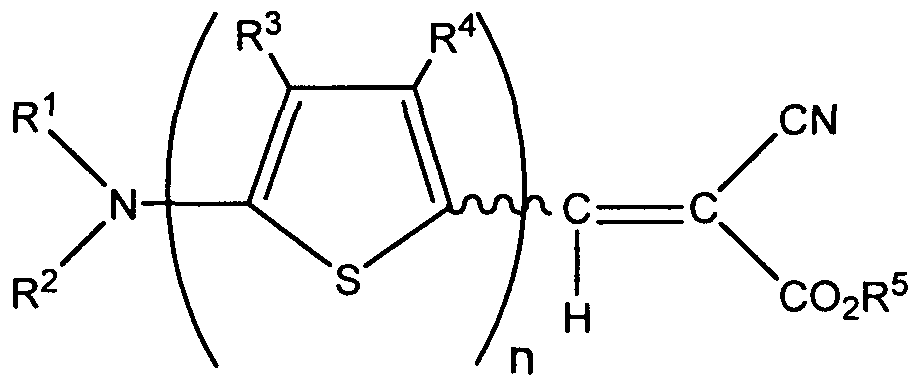
R1 and R2 are each independently selected from the group consisting of alkyl, aromatic or heteroaromatic groups, or R1 and R2 may together comprise a linked alkyl, aromatic or heteroaromatic group, R3 and R4 are each independently selected from the group consisting of alkyl, alkoxy or H, or R3 and R4 may together comprise a divalent alkyl group, a divalent alkoxy or alkyldioxy group, or R3 and R4 may together comprise a heterocyclic, heteroaromatic or aromatic group linked or fused to the thiophene group, R5 is H or alkyl, and n is an integer between 1 and 10, and
(ii) a second material which is either an electron donor material or an electron acceptor material, wherein the device generates an electrical potential upon the absorption of photons.
11. The photovoltaic device of claim 10, wherein the compound of formula I is as defined in any one of claims 2 to 9.
12. The photovoltaic device of claim 10 or claim 11 , wherein the first electrode is an anode.
13. The photovoltaic device of claim 12, wherein the anode is a metal oxide anode.
14. The photovoltaic device of any one of claims 10 to 13, wherein the second electrode is a cathode.
15. The photovoltaic device of claim 14, wherein the cathode is a metal or metal alloy cathode.
16. The photovoltaic device of any one of claims 10 to 15, wherein the second material is an electron acceptor material.
17. The photovoltaic device of any one of claims 10 to 16, wherein the second material is an n-type inorganic semiconductor material.
18. The photovoltaic device of claim 10 or claim 11 , wherein the first electrode is a cathode.
19. The photovoltaic device of claim 18, wherein the cathode is a metal oxide cathode.
20. The photovoltaic device of any one of claims 18 to 19, wherein the second electrode is an anode.
21. The photovoltaic device of claim 20, wherein the anode is a metal or metal alloy anode.
22. The photovoltaic device of any one of claims 18 to 21 , wherein the second material is an electron donating material.
23. The photovoltaic device of any one of claims 18 to 22, wherein the second material is a p-type inorganic semiconductor material.
24. The photovoltaic device of any one of claims 10 to 23, wherein the second material is a particulate material.
25. The photovoltaic device of claim 24, wherein the second material is of a particle size of between 0.1 nm - 400nm
26. The photovoltaic device of any one of claims 10 to 25, wherein second material is in contact with the first electrode, and the compound of formula I is adsorbed onto or bound to the second material.
27. The photovoltaic device of any one of claims 10 to 26, further comprising an electrolyte in contact with the compound of formula I and the second electrode.
28. A dye sensitised solar cell comprising:
- an anode
- a cathode,
- a charge accepting material on one electrode, - a compound of formula I in contact with the charge accepting material,

R1 and R2 are each independently selected from the group consisting of alkyl, aromatic or heteroaromatic groups, or R1 and R2 may together comprise a linked alkyl, aromatic or heteroaromatic group, R3 and R4 are each independently selected from the group consisting of alkyl, alkoxy or H, or R3 and R4 may together comprise a divalent alkyl group, a divalent alkoxy or alkyldioxy group, or R3 and R4 may together comprise a heterocyclic, heteroaromatic or aromatic group linked or fused to the thiophene group, R5 is H or alkyl, and n is an integer between 1 and 10, and
- a charge transport material in contact with the compound of formula I and the cathode.
29. The solar cell of claim 28, wherein the compound of formula I is as defined in any one of claims 2 to 9.
30. The solar cell of claim 28 or claim 29, wherein the anode is a metal oxide anode.
31. The solar cell of any one of claims 28 to 30, wherein the cathode is a metal or metal alloy cathode.
32. The solar cell of any one of claims 28 to 31 , wherein charge accepting material is an electron acceptor material.
33. The solar cell of claim 32, wherein the electron acceptor material is an n-type inorganic semiconductor material.
33. The solar cell of claim 28 or claim 29, wherein the cathode is a metal oxide cathode.
34. The solar cell of claim 33, wherein the anode is a metal or metal alloy anode.
35. The solar cell of any one of claims 33 to 34, wherein the charge accepting material is an electron donating material.
36. The solar cell of claim 35, wherein the electron acceptor material is a p- type inorganic semiconductor material.
37. The solar cell of any one of claims 28 to 36, wherein the charge accepting material is a particulate material.
38. The solar cell of claim 37, wherein the electron acceptor material is of a particle size of between 0.1 nm - 400nm.
Applications Claiming Priority (2)
| Application Number | Priority Date | Filing Date | Title |
|---|---|---|---|
| AU2009902337 | 2009-05-22 | ||
| AU2009902337A AU2009902337A0 (en) | 2009-05-22 | Oligothiophenes |
Publications (1)
| Publication Number | Publication Date |
|---|---|
| WO2010132952A1 true WO2010132952A1 (en) | 2010-11-25 |
Family
ID=43125670
Family Applications (1)
| Application Number | Title | Priority Date | Filing Date |
|---|---|---|---|
| PCT/AU2010/000613 Ceased WO2010132952A1 (en) | 2009-05-22 | 2010-05-21 | Oligothiophenes and use thereof in dye-sensitised solar cells |
Country Status (1)
| Country | Link |
|---|---|
| WO (1) | WO2010132952A1 (en) |
Cited By (1)
| Publication number | Priority date | Publication date | Assignee | Title |
|---|---|---|---|---|
| CN112337510A (en) * | 2019-08-06 | 2021-02-09 | 吉林师范大学 | Preparation method of functionalized polythiophene-sensitized titanium dioxide composite photocatalyst and its application in photocatalytic degradation of organic pollutants |
Citations (1)
| Publication number | Priority date | Publication date | Assignee | Title |
|---|---|---|---|---|
| US20100076205A1 (en) * | 2008-09-25 | 2010-03-25 | Academia Sinica | Dye compound and dye-sensitized solar cell |
-
2010
- 2010-05-21 WO PCT/AU2010/000613 patent/WO2010132952A1/en not_active Ceased
Patent Citations (1)
| Publication number | Priority date | Publication date | Assignee | Title |
|---|---|---|---|---|
| US20100076205A1 (en) * | 2008-09-25 | 2010-03-25 | Academia Sinica | Dye compound and dye-sensitized solar cell |
Non-Patent Citations (10)
| Title |
|---|
| "Macromolecular Symposia. 1996", vol. 102, article SAMYN, C. ET AL.: "Nonlinear optical polymers. Second harmonic generation in corona- poled thin films.", pages: 145 - 158 * |
| CHANG, Y.J. ET AL.: "Dye-sensitized solar cell utilizing organic dyads containing triarylene conjugates", TETRAHEDRON., vol. 65, 2009, pages 4726 - 4734 * |
| DATABASE CAS 1 February 2009 (2009-02-01), accession no. STN Database accession no. 1099097-15-0 * |
| DATABASE CAS 17 October 2000 (2000-10-17), accession no. STN Database accession no. 296262-34-5 * |
| DATABASE CAS 21 January 2009 (2009-01-21), accession no. STN Database accession no. 1094666-07-5 * |
| DATABASE CAS 21 January 2009 (2009-01-21), accession no. STN Database accession no. 1094740-43-8 * |
| FISCHER, M.K.R. ET AL.: "D-pi-A sensitizers for dye-sensitized solar cells: linear vs branched oligothiophenes", CHEMISTRY OF MATERIALS., vol. 22, 2010, pages 1836 - 1845 * |
| KATOH, R. ET AL.: "Highly stable sensitizer dyes for dye-sensitized solar cells: role of the oligothiophene moiety", ENERGY AND ENVIRONMENTAL SCIENCE., vol. 2, 2009, pages 542 - 546 * |
| QIN, P. ET AL.: "Design of an organic chromophore for the p-type dye-sensitized solar cells", JOURNAL OF THE AMERICAN CHEMICAL SOCIETY., vol. 130, 2008, pages 8570 - 8571 * |
| SUTHARSAN, J. ET AL.: "Molecular rotors: synthesis and evaluation as viscosity sensors", TETRAHEDRON., vol. 66, 2010, pages 2582 - 2588 * |
Cited By (2)
| Publication number | Priority date | Publication date | Assignee | Title |
|---|---|---|---|---|
| CN112337510A (en) * | 2019-08-06 | 2021-02-09 | 吉林师范大学 | Preparation method of functionalized polythiophene-sensitized titanium dioxide composite photocatalyst and its application in photocatalytic degradation of organic pollutants |
| CN112337510B (en) * | 2019-08-06 | 2022-04-15 | 吉林师范大学 | Preparation method of functionalized polythiophene-sensitized titanium dioxide composite photocatalyst and its application in photocatalytic degradation of organic pollutants |
Similar Documents
| Publication | Publication Date | Title |
|---|---|---|
| Ma et al. | Spiro-thiophene derivatives as hole-transport materials for perovskite solar cells | |
| Krishna et al. | Novel hole transporting materials based on triptycene core for high efficiency mesoscopic perovskite solar cells | |
| Puckyte et al. | Carbazole-based molecular glasses for efficient solid-state dye-sensitized solar cells | |
| Mikroyannidis et al. | Low band gap dyes based on 2-styryl-5-phenylazo-pyrrole: synthesis and application for efficient dye-sensitized solar cells | |
| Gupta et al. | The effect of direct amine substituted push–pull oligothiophene chromophores on dye-sensitized and bulk heterojunction solar cells performance | |
| Huang et al. | Organic dyes containing a cyanovinyl entity in the spacer for solar cells applications | |
| Wang et al. | Effects of the acceptors in triphenylamine-based D–A′–π–A dyes on photophysical, electrochemical, and photovoltaic properties | |
| WO2008146975A1 (en) | Novel organic dye containing n-arylcarbazole moiety and preparation thereof | |
| Zhang et al. | Anti-recombination organic dyes containing dendritic triphenylamine moieties for high open-circuit voltage of DSSCs | |
| US20130042918A1 (en) | Oligothiophenes | |
| KR20150123312A (en) | Novel compound and photoelectric conversion element using same | |
| Singh et al. | Fluorene-based organic dyes containing acetylene linkage for dye-sensitized solar cells | |
| AU2011250653A1 (en) | Improved oligothiophenes | |
| Wu et al. | Effect of bridging group configuration on photophysical and photovoltaic performance in dye-sensitized solar cells | |
| Unny et al. | Molecular engineering of pyrene carbazole dyes with a single bond and double bond as the mode of linkage | |
| JP2014527086A (en) | Organic dye, dye-sensitized metal oxide semiconductor electrode, and dye-sensitized solar cell | |
| Lim et al. | Enhancing the performance of organic dye-sensitized solar cells via a slight structure modification | |
| Long et al. | Effect of conjugated side groups on the photovoltaic performances of triphenylamine-based dyes sensitized solar cells | |
| JP5794589B2 (en) | Dye-sensitized solar cell and sensitizing dye | |
| Lin et al. | Benzo [1, 2-b: 4, 5-b′] dithiophene and benzo [1, 2-b: 4, 5-b′] difuran based organic dipolar compounds for sensitized solar cells | |
| Pramjit et al. | Carbazole-bridged double D–A dye for efficient dye-sensitized solar cell | |
| Mikroyannidis et al. | Novel broadly absorbing sensitizers with cyanovinylene 4-nitrophenyl segments and various anchoring groups: synthesis and application for high-efficiency dye-sensitized solar cells | |
| WO2010132951A1 (en) | Oligothiophenes and uses thereof in photovoltaic devices | |
| Duan et al. | Synthesis and photovoltaic property of new kind of organic dyes containing 2, 2′-bithiophene unit with three electron-donors | |
| Wu et al. | π–π and p–π conjugation, which is more efficient for intermolecular charge transfer in starburst triarylamine donors of platinum acetylide sensitizers? |
Legal Events
| Date | Code | Title | Description |
|---|---|---|---|
| 121 | Ep: the epo has been informed by wipo that ep was designated in this application |
Ref document number: 10777241 Country of ref document: EP Kind code of ref document: A1 |
|
| NENP | Non-entry into the national phase |
Ref country code: DE |
|
| 122 | Ep: pct application non-entry in european phase |
Ref document number: 10777241 Country of ref document: EP Kind code of ref document: A1 |