WO2010132873A2 - Chiral pyrrolidine core compounds en route to inhibitors of nitric oxide synthase - Google Patents
Chiral pyrrolidine core compounds en route to inhibitors of nitric oxide synthase Download PDFInfo
- Publication number
- WO2010132873A2 WO2010132873A2 PCT/US2010/035082 US2010035082W WO2010132873A2 WO 2010132873 A2 WO2010132873 A2 WO 2010132873A2 US 2010035082 W US2010035082 W US 2010035082W WO 2010132873 A2 WO2010132873 A2 WO 2010132873A2
- Authority
- WO
- WIPO (PCT)
- Prior art keywords
- compound
- malate
- ester
- group
- reduction
- Prior art date
- Legal status (The legal status is an assumption and is not a legal conclusion. Google has not performed a legal analysis and makes no representation as to the accuracy of the status listed.)
- Ceased
Links
Classifications
-
- C—CHEMISTRY; METALLURGY
- C07—ORGANIC CHEMISTRY
- C07D—HETEROCYCLIC COMPOUNDS
- C07D401/00—Heterocyclic compounds containing two or more hetero rings, having nitrogen atoms as the only ring hetero atoms, at least one ring being a six-membered ring with only one nitrogen atom
- C07D401/02—Heterocyclic compounds containing two or more hetero rings, having nitrogen atoms as the only ring hetero atoms, at least one ring being a six-membered ring with only one nitrogen atom containing two hetero rings
- C07D401/06—Heterocyclic compounds containing two or more hetero rings, having nitrogen atoms as the only ring hetero atoms, at least one ring being a six-membered ring with only one nitrogen atom containing two hetero rings linked by a carbon chain containing only aliphatic carbon atoms
-
- A—HUMAN NECESSITIES
- A61—MEDICAL OR VETERINARY SCIENCE; HYGIENE
- A61P—SPECIFIC THERAPEUTIC ACTIVITY OF CHEMICAL COMPOUNDS OR MEDICINAL PREPARATIONS
- A61P25/00—Drugs for disorders of the nervous system
- A61P25/28—Drugs for disorders of the nervous system for treating neurodegenerative disorders of the central nervous system, e.g. nootropic agents, cognition enhancers, drugs for treating Alzheimer's disease or other forms of dementia
-
- C—CHEMISTRY; METALLURGY
- C07—ORGANIC CHEMISTRY
- C07D—HETEROCYCLIC COMPOUNDS
- C07D401/00—Heterocyclic compounds containing two or more hetero rings, having nitrogen atoms as the only ring hetero atoms, at least one ring being a six-membered ring with only one nitrogen atom
- C07D401/02—Heterocyclic compounds containing two or more hetero rings, having nitrogen atoms as the only ring hetero atoms, at least one ring being a six-membered ring with only one nitrogen atom containing two hetero rings
- C07D401/04—Heterocyclic compounds containing two or more hetero rings, having nitrogen atoms as the only ring hetero atoms, at least one ring being a six-membered ring with only one nitrogen atom containing two hetero rings directly linked by a ring-member-to-ring-member bond
-
- C—CHEMISTRY; METALLURGY
- C07—ORGANIC CHEMISTRY
- C07D—HETEROCYCLIC COMPOUNDS
- C07D401/00—Heterocyclic compounds containing two or more hetero rings, having nitrogen atoms as the only ring hetero atoms, at least one ring being a six-membered ring with only one nitrogen atom
- C07D401/14—Heterocyclic compounds containing two or more hetero rings, having nitrogen atoms as the only ring hetero atoms, at least one ring being a six-membered ring with only one nitrogen atom containing three or more hetero rings
-
- C—CHEMISTRY; METALLURGY
- C07—ORGANIC CHEMISTRY
- C07D—HETEROCYCLIC COMPOUNDS
- C07D405/00—Heterocyclic compounds containing both one or more hetero rings having oxygen atoms as the only ring hetero atoms, and one or more rings having nitrogen as the only ring hetero atom
- C07D405/14—Heterocyclic compounds containing both one or more hetero rings having oxygen atoms as the only ring hetero atoms, and one or more rings having nitrogen as the only ring hetero atom containing three or more hetero rings
-
- C—CHEMISTRY; METALLURGY
- C07—ORGANIC CHEMISTRY
- C07F—ACYCLIC, CARBOCYCLIC OR HETEROCYCLIC COMPOUNDS CONTAINING ELEMENTS OTHER THAN CARBON, HYDROGEN, HALOGEN, OXYGEN, NITROGEN, SULFUR, SELENIUM OR TELLURIUM
- C07F7/00—Compounds containing elements of Groups 4 or 14 of the Periodic Table
- C07F7/02—Silicon compounds
- C07F7/08—Compounds having one or more C—Si linkages
- C07F7/10—Compounds having one or more C—Si linkages containing nitrogen having a Si-N linkage
Definitions
- nNOS nitric oxide synthase
- the present invention can be directed to a method of preparing a chiral pyrrolidine core compound.
- a method can comprise providing a dialkyl (R)-(+)-malate or a dialkyl (S)-(-)-malate; diastereoselective alkylation of such a malate with a haloalkylheterocyclic compound to provide a corresponding alkyl-substituted malate; reduction of one ester group to provide a half-ester half-aldehyde intermediate; reductive amination of the aldehyde group of such an intermediate; reduction of the ester group of such an intermediate, to provide an alcohol; and derivatization of the alcohol moiety and subsequent intramolecular cyclization, to provide a pyrrolidine core compound.
- such an alkyl- substituted malate can undergo allylation.
- subsequent oxidation and reductive amination with an ethanamine can provide
- such a method can utilize an (R)-stereoisomer as a chiral starting material.
- An ( ⁇ -stereoisomer can be used in certain other embodiments.
- various dialkyl malate starting materials are available, either commercially or by synthetic procedures well known to those skilled in the art. In particular, diisopropyl and dimethyl malate stereoisomers can be used with good effect.
- a pyridine compound e.g., without limitation, a haloalkylpyridine compound
- substitution limited only by subsequent malate alkylation as illustrated below.
- such a heterocyclic and/or pyridine compound can comprise an amino group or a protected amino group (e.g., without limitation, with 2,5-hexanedione, to provide the corresponding 2,5-dimethylpyrrole protecting group).
- hexamethyl disilazide can be employed to effect alkylation, but various other bases can be utilized as would be understood by those skilled in the art.
- reducing the amount of a 2-bromomethylpyridine starting material to less than stoichiometric can be used to improve yield of the resulting alkylation product.
- ester and subsequent aldehyde reduction can be achieved using various synthetic techniques understood by those skilled in the art. While the use of certain reagents is illustrated, various other reagents can be utilized, such reagents limited only by subsequent chemistry and modification of the sort described herein. For instance, without limitation, while reductive amination is illustrated using benzylamine, various other substituted amines can be employed, such compounds limited only by production of the corresponding pyrrolidine core compound, deprotection and/or subsequent chemistry thereon. Likewise, while certain embodiments provide mesylation and subsequent intramolecular cyclization, it would be known to those skilled in the art that various other alcohol derivatives can be utilized under appropriate reaction conditions to achieve similar or comparable effect.
- the present invention can also be directed to a method of using diastereoselective alkylation to provide a diastereomeric pyrrolidine core compound.
- a method can comprise providing a Frater-Seebach diastereoselective alkylation product of a dialkyl (R)-(+)-malate or a dialkyl (£)-(-)- malate and, for instance, a bromomethylpyridine starting material; reduction of an ester group of such an alkylation product, to provide a half-ester half-aldehyde intermediate; reductive amination of the aldehyde group of such an intermediate and reduction of the ester group of such an intermediate; and derivatization and subsequent intramolecular cyclization, to provide a corresponding, diastereomeric pyrrolidine core compound.
- such an alkylation product can be allylated, as illustrated below.
- the hydroxy group of such a malate starting material can be protected or otherwise derivatized, as would be understood by those skilled in the art, such protection or derivatization limited only by subsequent reaction or modification of the resulting pyrrolidine core compound en route to a specific NOS inhibitor.
- with reductive amination of such a half-ester half-aldehyde intermediate subsequent ester reduction can be achieved without intermediate isolation or purification.
- the present invention can be directed to a compound of a formula
- R 1 can be selected from C(O)OR 1 ! , CH 2 OH and CH 2 SOsCH 3 moieties, where R'] can be selected from the C] - about C 6 alkyl and Ci - about C 6 substituted alkyl moieties; R 2 can be selected from Cj - about C 6 alkyl and Ci - about C 6 substituted alkyl moieties; R 3 can be selected from H and alkyl moieties; and R 4 can be selected from H, amino and protected amino moieties, and salts, hydrates and/or solvates of such a compound.
- R 3 can be an alkyl moiety
- R 4 can independently be a 2,5-dimethylpyrrol-l-yl moiety.
- a counter ion can be a conjugate base of a protic acid. Regardless, such a compound can be selected from (2S,3R) and (2R,3R) diastereomers and a mixture thereof.
- R 2 can be a benzyl moiety.
- Ri can be a CH 2 SO 3 CH 3 moiety; that is, such a compound can be mesylated to promote intramolecular cyclization.
- the allyl moiety of the resulting pyrrolidine compound can be oxidized to an aldehyde group, then reductively aminated with an ethanamine en route to a corresponding NOS inhibitor compound of the sort described in co-pending application serial no. 12/693,196 filed January 25, 2010, the entirety of which is incorporated herein by reference.
- the present invention can be directed to the preparation of a range of chiral pyrrolidine core compounds.
- Such a method can comprise providing a diastereoselective alkylation product of a chiral dialkyl malate and a haloalkyl-substituted heterocycle starting material. Subsequent steps of such a method can be as described above or illustrated elsewhere, herein. While the present invention can be illustrated in the context of a 4-methylpyridine moiety conjugated with a pyrrolidine core, it will be understood by those skilled in the art that conjugation via malate alkylation can be achieved with various other haloalkyl- pyridine and other haloalkylheterocyclic moieties.
- heterocyclic moieties including but not limited to substituted and unsubstituted thiazine, oxazine, pyrazine, oxazole and imidazole moieties — regardless of the presence or protection of an amino substituent — are described in U.S. Patent No. 7,470,790 issued December 30, 2008 and co-pending application serial No. 11/906,283 filed October 1, 2007, in the context of substructure I as discussed more fully therein, each of which is incorporated herein by reference in its entirety.
- the corresponding chiral pyrrolidine core compounds can be prepared using synthetic techniques of the sort described herein or straight forward modifications thereof, as would be understood by those skilled in the art and made aware of this invention.
- Such heterocycle-conjugated compounds, analogous to core compound 2 can be used en route to NOS inhibitors, including selective nNOS inhibitors, of the sort described in the aforementioned incorporated references. Detailed Description of Certain Embodiments.
- Certain embodiments of this invention illustrate the development of a concise stereospecific synthesis of 2.
- An initial plan was to use a disubstitution reaction on dimesylate 3 with benzylamine (Scheme 1).
- Dimesylated compound 3 could be derived from dialkyl malate (4) using a sequential allylation-reduction procedure.
- Stereospecific compound 4 could be achieved by the diastereoselective alkylation protocol developed by Frater et al. and Seebach et al. using dialkyl (R)-(+)- malate (5) and 2-(bromomethyl)-6-(2,5-dimethyl-lH-pyrrol-l-yl)-4-methylpyridine (6) as starting materials.
- this invention provides an efficient and highly diastereoselective synthesis of the chiral pyrrolidine building block (2) for a novel nNOS inhibitor (1), employing a Frater-Seebach type alkylation and a fast intramolecular cyclization, to avoid or minimize unwanted cyclization by the pyridine nitrogen. While the preceding discussion and following examples illustrate synthesis of a (3R, 4R)-diastereomer from an (7?)-(+)-malate, a (3S,4S)-diastereomer can be prepared analogously from a corresponding (S)-(-)- malate. Examples of the Invention.
- the reaction was stirred at the same temperature for 10 min then transferred to an ice-bath (0 0 C) for 30 min.
- the reaction was cooled to -78 0 C again and 6 (1017 mg, 3.66 mmol) was added slowly (1 drop/sec) as a solution in THF (5 mL) through a cannula. The color of the reaction mixture turned light purple.
- the reaction was maintained at -78 0 C for an additional 30 min then transferred to an ice-bath and slowly warm to room temperature. After 2 h, the reaction was quenched with NH 4 Cl (1 mL) then partitioned between EtOAc (200 mL) and saturated NH 4 Cl (150 mL). The inorganic layer was extracted with EtOAc (150 mL).
- reaction was quenched with saturated NH 4 Cl (1 mL) and partitioned between EtOAc (100 mL) and H 2 O (50 mL). The organic layer was washed with brine (50 mL) and dried over Na 2 SO 4 .
Landscapes
- Organic Chemistry (AREA)
- Chemical & Material Sciences (AREA)
- Health & Medical Sciences (AREA)
- Neurosurgery (AREA)
- Engineering & Computer Science (AREA)
- Bioinformatics & Cheminformatics (AREA)
- Biomedical Technology (AREA)
- Neurology (AREA)
- Medicinal Chemistry (AREA)
- Life Sciences & Earth Sciences (AREA)
- Chemical Kinetics & Catalysis (AREA)
- General Chemical & Material Sciences (AREA)
- Hospice & Palliative Care (AREA)
- Nuclear Medicine, Radiotherapy & Molecular Imaging (AREA)
- Pharmacology & Pharmacy (AREA)
- Psychiatry (AREA)
- Animal Behavior & Ethology (AREA)
- General Health & Medical Sciences (AREA)
- Public Health (AREA)
- Veterinary Medicine (AREA)
- Pyrrole Compounds (AREA)
- Nitrogen Condensed Heterocyclic Rings (AREA)
- Pharmaceuticals Containing Other Organic And Inorganic Compounds (AREA)
- Plural Heterocyclic Compounds (AREA)
Abstract
Diastereomeric pyrrolidine compounds and methods of preparation, as can be used en route to the preparation of a range of nitric oxide synthase inhibitors.
Description
Chiral Pyrrolidine Core Compounds en route to Inhibitors of Nitric Oxide Synthase
[0001] This application claims priority benefit from application serial no. 61/216,364 filed May 15, 2009, the entirety of which is incorporated herein by reference.
[0002] This invention was made with government support under grant No. ROl GM049725 awarded by the National Institutes of Health. The government has certain rights in the invention. Background of the Invention.
[0003] Selective inhibition of the neuronal isozyme of nitric oxide synthase (nNOS) has attracted significant interest as a novel strategy in developing therapeutics for the treatment of neurodegenerative diseases including Parkinson's disease, Alzheimer's disease, and Huntington's disease. Efforts to design nNOS selective inhibitors include development of a stereospecifϊc pyrrolidine-based inhibitor (1, Figure 1), which showed great potency (K1 = 5 nM) and extremely high selectivity for nNOS over closely related isoforms, endothelial NOS (eNOS, 3800 fold) and inducible NOS (iNOS, 1200 fold). Animal tests demonstrated that 1 could lead to a remarkable reduction in neurological damage to rabbit fetuses under hypoxic conditions, making 1 a strong candidate as a new drug for the treatment of neurodegenerative diseases.
[0004] Despite these and other discoveries, current and future research related to 1 is somewhat hindered by a complicated synthesis. In particular, the chiral pyrrolidine intermediate compound 2 (Figure 1), achieved by a seven-step procedure of the prior art, is disadvantaged by expensive starting material(s), difficult chromatographic purification(s), and low overall yield (<2%). Moreover, utilization of racemic starting materials requires extra chiral resolution step(s) using either HPLC or chiral auxiliaries, which dramatically reduce the yield and efficiency. Therefore, the development of an efficient route to chiral core compound 2 remains an ongoing concern, the absence of which will continue to impede future investigations of inhibitor 1.
Summary of the Invention.
[0005] In light of the foregoing, it is an object of the present invention to provide a diastereoselective synthesis of pyrrolidine core compounds, thereby overcoming various deficiencies and shortcomings of the prior art, including those outlined above. It will be understood by those skilled in the art that one or more aspects of this invention can meet certain objectives, while one or more other aspects can meet certain other objectives. Each objective may not apply equally in all its respects, to every aspect of this invention. As such, the following objects can be viewed in the alternative with respect to any one aspect of this invention.
[0006] It can be an object of the present invention to provide a cost- effective, efficient route to chiral pyrrolidine compounds of the sort described above and illustrated elsewhere herein.
[0007] It can be another object of the present invention to provide such compounds without use of racemic starting materials and/or difficult resolutions.
[0008] It can be another object of the present invention, alone or in conjunction with one or more of the preceding objectives, to provide a synthetic approach to a diastereomeric pyrrolidine core compound, en route to a range of NOS inhibitor compounds, including selective nNOS inhibitor compounds.
[0009] Other objects, features, benefits and advantages of the present invention will be apparent from this summary and the following descriptions of certain embodiments, and will be readily apparent to those skilled in the art of organic synthesis. Such objects, features, benefits and advantages will be apparent from the above as taken into conjunction with the accompanying examples, data, figures and all reasonable inferences to be drawn therefrom, alone or with consideration of the references incorporated herein.
[0010] In part, the present invention can be directed to a method of preparing a chiral pyrrolidine core compound. Such a method can comprise providing a dialkyl (R)-(+)-malate or a dialkyl (S)-(-)-malate; diastereoselective alkylation of such a malate with a haloalkylheterocyclic compound to provide a corresponding alkyl-substituted malate; reduction of one ester group to provide a half-ester half-aldehyde intermediate; reductive amination of the aldehyde group of such an
intermediate; reduction of the ester group of such an intermediate, to provide an alcohol; and derivatization of the alcohol moiety and subsequent intramolecular cyclization, to provide a pyrrolidine core compound. Optionally, such an alkyl- substituted malate can undergo allylation. In certain such embodiments, subsequent oxidation and reductive amination with an ethanamine can provide a corresponding NOS inhibitor compound.
[0011] In certain non-limiting embodiments, such a method can utilize an (R)-stereoisomer as a chiral starting material. An (^-stereoisomer can be used in certain other embodiments. Regardless, various dialkyl malate starting materials are available, either commercially or by synthetic procedures well known to those skilled in the art. In particular, diisopropyl and dimethyl malate stereoisomers can be used with good effect. Likewise, with respect to an alkylheterocyclic starting material, a pyridine compound (e.g., without limitation, a haloalkylpyridine compound) can be substituted as would be understood by those skilled in the art, such substitution limited only by subsequent malate alkylation, as illustrated below. In certain non-limiting embodiments, such a heterocyclic and/or pyridine compound can comprise an amino group or a protected amino group (e.g., without limitation, with 2,5-hexanedione, to provide the corresponding 2,5-dimethylpyrrole protecting group). Regardless, in certain embodiments hexamethyl disilazide can be employed to effect alkylation, but various other bases can be utilized as would be understood by those skilled in the art. In certain such embodiments, reducing the amount of a 2-bromomethylpyridine starting material to less than stoichiometric can be used to improve yield of the resulting alkylation product.
[0012] Regardless, ester and subsequent aldehyde reduction can be achieved using various synthetic techniques understood by those skilled in the art. While the use of certain reagents is illustrated, various other reagents can be utilized, such reagents limited only by subsequent chemistry and modification of the sort described herein. For instance, without limitation, while reductive amination is illustrated using benzylamine, various other substituted amines can be employed, such compounds limited only by production of the corresponding pyrrolidine core compound, deprotection and/or subsequent chemistry thereon. Likewise, while certain
embodiments provide mesylation and subsequent intramolecular cyclization, it would be known to those skilled in the art that various other alcohol derivatives can be utilized under appropriate reaction conditions to achieve similar or comparable effect.
[0013] In part, the present invention can also be directed to a method of using diastereoselective alkylation to provide a diastereomeric pyrrolidine core compound. Such a method can comprise providing a Frater-Seebach diastereoselective alkylation product of a dialkyl (R)-(+)-malate or a dialkyl (£)-(-)- malate and, for instance, a bromomethylpyridine starting material; reduction of an ester group of such an alkylation product, to provide a half-ester half-aldehyde intermediate; reductive amination of the aldehyde group of such an intermediate and reduction of the ester group of such an intermediate; and derivatization and subsequent intramolecular cyclization, to provide a corresponding, diastereomeric pyrrolidine core compound.
[0014] In certain non- limiting embodiments, such an alkylation product can be allylated, as illustrated below. In various other embodiments, the hydroxy group of such a malate starting material can be protected or otherwise derivatized, as would be understood by those skilled in the art, such protection or derivatization limited only by subsequent reaction or modification of the resulting pyrrolidine core compound en route to a specific NOS inhibitor. Regardless, in various other embodiments, with reductive amination of such a half-ester half-aldehyde intermediate, subsequent ester reduction can be achieved without intermediate isolation or purification.
[0015] Accordingly, the present invention can be directed to a compound of a formula

wherein R1 can be selected from C(O)OR1 !, CH2OH and CH2SOsCH3 moieties, where R'] can be selected from the C] - about C6 alkyl and Ci - about C6 substituted alkyl moieties; R2 can be selected from Cj - about C6 alkyl and Ci - about C6 substituted
alkyl moieties; R3 can be selected from H and alkyl moieties; and R4 can be selected from H, amino and protected amino moieties, and salts, hydrates and/or solvates of such a compound. In certain non-limiting embodiments, R3 can be an alkyl moiety, and R4 can independently be a 2,5-dimethylpyrrol-l-yl moiety. When present as a salt, such a compound can be either partially or fully protonated. In certain such embodiments, a counter ion can be a conjugate base of a protic acid. Regardless, such a compound can be selected from (2S,3R) and (2R,3R) diastereomers and a mixture thereof.
[0016] In certain such embodiments, R2 can be a benzyl moiety. Optionally, Ri can be a CH2SO3CH3 moiety; that is, such a compound can be mesylated to promote intramolecular cyclization. The allyl moiety of the resulting pyrrolidine compound can be oxidized to an aldehyde group, then reductively aminated with an ethanamine en route to a corresponding NOS inhibitor compound of the sort described in co-pending application serial no. 12/693,196 filed January 25, 2010, the entirety of which is incorporated herein by reference.
[0017] More broadly, the present invention can be directed to the preparation of a range of chiral pyrrolidine core compounds. Such a method can comprise providing a diastereoselective alkylation product of a chiral dialkyl malate and a haloalkyl-substituted heterocycle starting material. Subsequent steps of such a method can be as described above or illustrated elsewhere, herein. While the present invention can be illustrated in the context of a 4-methylpyridine moiety conjugated with a pyrrolidine core, it will be understood by those skilled in the art that conjugation via malate alkylation can be achieved with various other haloalkyl- pyridine and other haloalkylheterocyclic moieties. For example, without limitation, various other heterocyclic moieties including but not limited to substituted and unsubstituted thiazine, oxazine, pyrazine, oxazole and imidazole moieties — regardless of the presence or protection of an amino substituent — are described in U.S. Patent No. 7,470,790 issued December 30, 2008 and co-pending application serial No. 11/906,283 filed October 1, 2007, in the context of substructure I as discussed more fully therein, each of which is incorporated herein by reference in its entirety. The corresponding chiral pyrrolidine core compounds can be prepared using synthetic
techniques of the sort described herein or straight forward modifications thereof, as would be understood by those skilled in the art and made aware of this invention. Such heterocycle-conjugated compounds, analogous to core compound 2, can be used en route to NOS inhibitors, including selective nNOS inhibitors, of the sort described in the aforementioned incorporated references. Detailed Description of Certain Embodiments.
[OO 18] Certain embodiments of this invention illustrate the development of a concise stereospecific synthesis of 2. An initial plan was to use a disubstitution reaction on dimesylate 3 with benzylamine (Scheme 1). Dimesylated compound 3 could be derived from dialkyl malate (4) using a sequential allylation-reduction procedure. Stereospecific compound 4 could be achieved by the diastereoselective alkylation protocol developed by Frater et al. and Seebach et al. using dialkyl (R)-(+)- malate (5) and 2-(bromomethyl)-6-(2,5-dimethyl-lH-pyrrol-l-yl)-4-methylpyridine (6) as starting materials. (See, Frater, G.; Mϋller, U.; Gϋnther, W. Tetrahedron 1984, 40, 1269; and Seebach, D.; Aebi, J.; Wasmuth, D. Org. Syn. Coll. 1985, 7, 153.) Scheme 1. General Plan for the Synthesis of 2

[0019] The synthesis of 6 began with 2-aminopyridine (7, Scheme 2). The amino functional group of 7 was protected using 2,5-hexanedione in the presence of /?-toluenesulfonic acid (p-TsOH) to give 8 in high yields. The 2,5-dimethylpyrrole protecting group was selected for two reasons. First, this protecting group is known to be stable under a variety of reaction conditions and can be easily removed under mild conditions. Second, the electron-donating property of the 2,5-dimethylpyrrole group
increases the chelating ability of the pyridine nitrogen to the lithium ion, which favors regioselective deprotonation of the 2-methyl group on the pyridine ring. 8 was treated with «-BuLi at O0C, and the resulting anion was quenched with chlorotrimethylsilane (TMSCl) at the same temperature to generate 9 exclusively. Finally, 9 was allowed to react with 1,2-dibromotetrafluoroethane in the presence of CsF to provide 6 in quantitative yields.
Scheme 2. Synthesis of 6

[0020] Next, optimization of the conditions for the Frater-Seebach alkylation was investigated (Table 1). When using lithium diisopropylamide (LDA) as the base, only a trace amount of product was isolated using either 5a or 5b as the starting material (Table 1, entries 1 and 2). With lithium hexamethyldisilazide (LHMDS) as the base however, products 4a and 4b could be isolated in 23% and 56% yield, respectively, with high diastereoselectivity (Table 1, entries 3 and 4). Yield was improved to 85% by changing the ratio between 5b and 6 (Table 1, entries 5 to 7).
Table 1. Frater-Seebach Diastereoselective Alkylation.

entry R base 6 (eq.) yield" (%) trans/cisc
1 Me LDA 1.0 <2
2 /-Pr LDA 1.0 <2
3 Me LHMDS 1.0 23 8: 1
4 /-Pr LHMDS 1.0 56 >15: 1
5 /-Pr LHMDS 0.75 70 >15:1
6 /-Pr LHMDS 0.5 77 >15: 1
7 /-Pr LHMDS 0.33 85 >15: 1
a General experimental conditions: 2 equiv of base was added to 1 equiv of 5 at - 780C, then the reaction temperature was raised to 00C and remained for 20 min. The reaction was cooled to -78°C and compound 6 was added. b Isolated yields. c Determined by IH NMR.
[0021] Allylation of 4b via NaH and allylbromide yielded 10, which was reduced using LiAlH4 to generate diol 11 in excellent yields (Scheme 3). When 11 was submitted to a variety of mesylation conditions, however, the only products that could be detected were compounds 13 and 14, derived by intramolecular cyclizations from either the pyridinyl nitrogen atom (13) or the hydroxyl oxygen atom (14), respectively.
Scheme 3. Results of Mesylation

2) allylbromide ,c ' — *-: 10 R = ally I 97% Yield
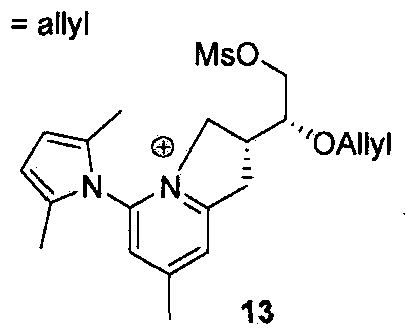

[0022] To avoid these intrinsic problems, a new synthetic route was designed around intermediate dialdehyde 15 (Scheme 4), which can undergo a single- step reductive amination reaction to provide 2. (See, Vyskocil, S.; Jaracz, S.; Smrcina, M.; Sticha, M.; Hanus, V.; Polasek, M.; Kocovsky, P. J. Org. Chem. 1998, 63, 7727; and Marsault, E.; Benakli, K.; Beaubien, S.; Saint-Louis, C; Deziel, R.; Fraser, G. Bioorg. Med. Chem. Lett. 2007, 17, 4187.) It was hoped that under reductive conditions, dialdehyde 15 could be generated from diisopropylester 10. Scheme 4. Plan for the Synthesis of 2 via Dialdehyde 15

[0023] The results of the Dibal-H reduction of 10 are summarized in Table 2. When 3.5 equiv of Dibal-H were used at -780C for 2 h (Table 2, entry 1), three different products, aldehyde 16, alcohol 17, and semi-acetal 18, were isolated. 18 was the major product, but no dialdehyde 15 was detected. Next, fewer equiv of the reducing reagent were used. The data showed that either only aldehyde 16 (Table 2, entry 2), or 16 and 17 (Table 2, entries 3 and 4) were isolated from the reaction without any evidence of dialdehyde 15 formation. Additional reduction of aldehyde 16 using Dibal-H (1 equiv) yielded only alcohol 17, which, together with the
previous Dibal-H reduction data, confirmed that dialdehyde 15 could not be generated by reduction of 10.
Table 2. Results of Dibal-H Reduction

a General experimental conditions: 1 equiv of 10 was added Dibal-H at -780C. b Isolated yields.
[0024] Even though dialdehyde 15 was not produced, aldehyde 16 was isolated in good yields after simple optimizations (Table 2, entry 4). Amine 20 was prepared from 16 in the hope that the additional amino group of 20 would compete with the aminopyridine nitrogen for cyclization, thus preventing the formation of 13 and yielding the desired compound 2.
Scheme 5. Synthesis of 20

[0025] As shown in Scheme 5, reductive amination of 16 with benzylamine in the presence Of NaHB(OAc)3 provided amine 19 in excellent yields with complete retention of stereochemistry . Next, the isopropyl ester of 19 was reduced with LiAlH4 to generate primary alcohol 20 in good yields. A one-pot procedure without purification of 19 improved the overall yield (83%).
Scheme 6.
very fast
100% Yield

[0026] Finally, compound 20 was treated with methylsulfonyl chloride (MsCl) in the presence of TEA. The intramolecular cyclization from the benzyl- protected amine is so fast that 2 was obtained in quantitative yields without formation of any other side products.
[0027] As shown, above, this invention provides an efficient and highly diastereoselective synthesis of the chiral pyrrolidine building block (2) for a novel nNOS inhibitor (1), employing a Frater-Seebach type alkylation and a fast intramolecular cyclization, to avoid or minimize unwanted cyclization by the pyridine nitrogen. While the preceding discussion and following examples illustrate synthesis of a (3R, 4R)-diastereomer from an (7?)-(+)-malate, a (3S,4S)-diastereomer can be prepared analogously from a corresponding (S)-(-)- malate. Examples of the Invention.
[0028] The following non-limiting examples and data illustrate various aspects and features relating to the methods of the present invention, including the preparation of diastereomeric pyrrolidine compounds, as are available through the synthetic methodologies described herein. In comparison with the prior art, the present methods provide results and data which are surprising, unexpected and contrary thereto. While the utility of this invention is illustrated through the use of several starting materials and substituents thereof, reactants and substituents thereof, reagents and reaction conditions which can be used therewith, it will be understood by those skilled in the art that comparable results are obtainable with various other starting materials and/or substituents (e.g., other heterocyclic and substituted heterocyclic starting materials), reactants and/or substituents, reagents and reaction conditions, as are commensurate with the scope of this invention.
[0029] General Methods. All experiments were conducted under anhydrous conditions in an atmosphere of argon, using flame-dried apparatus and employing standard techniques in handling air-sensitive materials. All solvents were distilled and stored under an argon or nitrogen atmosphere before using. All reagents were used as received. Aqueous solutions of sodium bicarbonate, sodium chloride (brine), and ammonium chloride were saturated. Analytical thin layer chromatography was visualized by ultraviolet, ninhydrin, or phosphomolybdic acid (PMA). Flash column chromatography was carried out under a positive pressure of nitrogen. 1H NMR spectra were recorded on 500 MHz spectrometers. Data are presented as follows: chemical shift (in ppm on the δ scale relative to δ = 0.00 ppm for the protons in TMS), integration, multiplicity (s = singlet, d = doublet, t = triplet, q = quartet, m = multiplet, br = broad), coupling constant (J/Hz). Coupling constants were taken directly from the spectra and are uncorrected. 13C NMR spectra were recorded at 125 MHz, and all chemical shift values are reported in ppm on the δ scale, with an internal reference of δ 77.0 or 49.0 for CDCl3 or MeOD, respectively. High-resolution mass spectra were measured on liquid chromatography/time-of-flight mass spectrometry (LC-TOF). Preparation and Characterization of Compounds
Example 1
[0030] 2-(2,5-Dimethyl-lH-pyrrol-l-yl)-4,6-dimethyIpyridiπe (8) To a solution of 4,6-dimethyl-2-aminopyridine (7, 12.2 g, 100 mmol) in toluene (100 mL) was added acetonylacetone (12.3 mL, 105 mmol) and/>-TsOH (190 mg, 1.0 mmol). The reaction mixture was heated in a Dean-Stark apparatus under reflux for 6 h. After cooling to room temperature, the mixture was concentrated with a rotary evaporator, and the resulting brown oil was purified by flash column chromatography (EtOAc/hexanes, 1 : 19-1 :9) to give 8 (18.2 g, 91 mmol, 91%) as a pale yellow solid: 1H NMR (500 MHz, CDCl3) δ 2.13 (s, 6H), 2.40 (s, 3H), 2.56 (s, 3H), 5.88 (s, 2H), 6.85 (s, IH), 7.00 (s, IH); 13C NMR (125 MHz, CDCl3) δ 13.4, 21.2, 24.4, 106.8, 119.9, 123.1, 128.6, 149.6, 151.7, 158.4; LCQ-MS (M + H+) calcd for C13H17N2201, found 201 ; LC-TOF-MS (M + H+) calcd for C13H17N2 201.13917, found 201.13881.
Example 2
[0031] 2-(2,5-Dimethyl-lH-pyrrol-l-yl)-4-methyl-6-
((trimethylsilyl)methyl)pyridine (9). To a solution of 8 (6.0 g, 30 mmol) in THF (100 mL) at 0 0C was added «-BuLi (1.6 M in hexanes, 21 mL, 33 mmol). The solution turned dark red during the addition. After stirring at the same temperature for an additional 2 h, chlorotrimethylsilane (4.2 mL, 33 mmol) was added dropwise to the reaction mixture. The reaction was warmed to room temperature and allowed to stir for an additional 1 h. The resulting bright yellow slurry was partitioned between EtOAc (200 mL) and H2O (100 mL). The organic layer was washed with brine (100 mL), dried over NaSO4, and concentrated. The crude product was purified by flash column chromatography (EtOAc/hexanes, 1 : 19-1 :9) to give 9 (7.7 g, 28.5 mmol, 95%) as a pale yellow oil: 1H NMR (500 MHz, CDCl3) δ 0.10 (s, 9H), 2.13 (s, 6H), 2.39 (s, 3H), 2.41 (s, 3H), 5.89 (s, 2H), 6.78 (s, IH), 6.85 (s, IH); 13C NMR (125 MHz, CDCl3) δ - 1.5, 13.1, 20.9, 29.8, 106.2, 118.7, 121.9, 128.3, 148.8, 151.5, 161.4; LCQ-MS (M + H+) calcd for C16H25N2Si 273, found 273; LC-TOF-MS (M + H+) calcd for C]6H25N2Si 273.17870, found 273.17735.
Example 3
[0032] 2-(Bromomethyl)-6-(2,5-dimethyl-lH-pyrroI-l-yl)-4- methylpyridine (6). To a solution of 9 (5.6 g, 21 mmol) in DMF (100 mL) was added 1,2-dibromotetrafluoroethane (10 g, 42 mmol) and CsF (6.4 g, 42 mmol). The reaction was allowed to stir at room temperature for 3 h, and the resulting purple solution was concentrated and loaded directly on flash column chromatography (EtOAc/hexanes, 1 :19-1 :9) to give 6 (5.7 g, 20.8 mmol, 99%) as a pale yellow oil: 1H NMR (500 MHz, CDCl3) δ 2.19 (s, 6H), 2.47 (s, 3H), 4.56 (s, 2H), 5.93 (s, 2H), 7.01 (s, IH), 7.30 (s, IH); 13C NMR (125 MHz, CDCl3) δ 13.3, 21.1, 33.5, 107.1, 121.8, 122.9, 128.5, 150.7, 151.7, 156.3; LCQ-MS (M + H+) calcd for C13H]6BrN2 279, found 279; LC-TOF-MS (M + H+) calcd for C13Hi6BrN2 279.04969, found 279.04963.
Example 4
[0033] (2S,3R)-dimethyI 2-((6-(2,5-dimethyl-lH-pyrrol-l-yl)-4- methylpyridin-2-yl)methyl)-3-hydroxysuccinate (4a). Dimethyl ester 4a was
synthesized using a similar procedure as for 4b (23%): 1H NMR (500 MHz, CDCl3) δ 2.1 1 (s, 6H), 2.40 (s, 3H), 3.13-3.17 (dd, J= 8.5, 14.5 Hz, IH), 3.38-3.42 (m, 2H), 3.64 (s, 3H), 3.79-3.82 (m, 4H), 4.19 (br s, IH), 5.89 (s, 2H), 6.89 (s, IH), 7.09 (s, IH); 13C NMR (125 MHz, CDCl3) δ 13.4, 21.2, 35.7, 38.7, 48.0, 52.2, 53.1, 67.5, 70.6, 107.0, 120.8, 123.9, 128.7, 150.2, 151.9, 158.4, 171.3, 172.5, 174.0; LCQ-MS (M + H+) calcd for C19H25N2O5 361, found 361 ; LC-TOF-MS (M + H+) calcd for C19H25N2O5 361.17635, found 361.17630.
Example 5
[0034] (2S,3R)-Diisopropyl 2-((6-(2,5-dimethyI-lH-pyrrol-l-yl)-4- methyIpyridin-2-yl)methyl)-3-hydroxysuccinate (4b). To a dry flask containing THF (20 mL) at -78 0C was added fresh LHMDS (1.0 M in THF, 10 mL, 10 mmol). After 10 min, a solution of diisopropyl (R)-(+)-malate (5b, 1008 μL, 4.88 mmol) was added dropwise as a solution in THF (5 mL) through a cannula. The reaction was stirred at the same temperature for 10 min then transferred to an ice-bath (0 0C) for 30 min. The reaction was cooled to -78 0C again and 6 (1017 mg, 3.66 mmol) was added slowly (1 drop/sec) as a solution in THF (5 mL) through a cannula. The color of the reaction mixture turned light purple. The reaction was maintained at -78 0C for an additional 30 min then transferred to an ice-bath and slowly warm to room temperature. After 2 h, the reaction was quenched with NH4Cl (1 mL) then partitioned between EtOAc (200 mL) and saturated NH4Cl (150 mL). The inorganic layer was extracted with EtOAc (150 mL). The combined organic layer was washed by H2O (100 mL), brine (100 mL), dried over Na2SO4, and concentrated. The crude yellow oil was purified by flash column chromatography (EtOAc/hexanes, 1 :9— 1 :4) to give 4b (1.76 g, 2.56 mmol, 70%) as a pale yellow oil (without detection of any cis- isomer): 1H NMR (SOO MHZ5 CDCI3) O 1.14-1.15 (d, J= 6.5 HZ, 3H), 1.17-1.18 (d, J = 6.0 Hz, 3H), 1.25-1.26 (d, J= 6.5 Hz, 3H), 1.29-1.30 (d, J= 6.0 Hz, 3H), 2.13 (s, 6H), 2.41 (s, 3H), 3.10-3.15 (dd, J= 8.5, 14.0 Hz, IH), 3.34-3.40 (m, 2H), 3.72-3.76 (dt, J= 2.5, 8.0 Hz, IH), 4.07-4.09 (dd, J= 2.5, 7.0 Hz, IH), 4.96-5.01 (m, IH), 5.09- 5.15 (m, IH), 5.90 (s, 2H), 6.89 (s, IH), 7.10 (s, IH); 13C NMR (125 MHz, CDCl3) δ 13.5, 21.2, 21.8, 21.9, 22.0, 36.1, 48.0, 68.8, 70.1, 70.6, 107.0, 120.7, 124.1, 128.7,
150.1, 158.7, 171.5, 173.4; LCQ-MS (M + H+) calcd for C23H33N2O5 417, found 417; LC-TOF-MS (M + H+) calcd for C23H33N2O5 417.23895, found 417.23834.
Example 6
[0035] (2R,3S)-DiisopropyI 2-(allyloxy)-3-((6-(2,5-dimethyl-lH-pyrrol-l- yl)-4-methylpyridin-2-yl)methyI)succinate (10). To a solution of alcohol 4b (300 mg, 0.72 mmol) in THF (10 mL) at 0 0C was added NaH (60% in mineral oil, 35 mg, 0.87 mmol). The mixture was allowed to stir at 0 0C for an additional 30 min then allyl bromide (93 μL, 1.08 mmol) was added dropwise. The reaction was allowed to warm to room temperature and maintained for an additional 6 h. The reaction was quenched with saturated NH4Cl (1 mL) and partitioned between EtOAc (100 mL) and H2O (50 mL). The organic layer was washed with brine (50 mL) and dried over Na2SO4. The solvent was removed by rotary evaporation, the resulting brown oil was purified by flash column chromatography (EtOAc/hexanes, 1 :9-l : 1) to give 10 (316 mg, 0.69 mmol, 97%) as a pale yellow oil: 1H NMR (500 MHz, CDCl3) δ 1.07-1.09 (d, J= 6.0 Hz, 3H), 1.16-1.19 (d, J= 6.0 Hz, 3H), 1.25-1.35 (m, 6H), 2.13 (s, 6H), 2.39 (s, 3H), 3.01-3.05 (dd, J- 5.5, 15.5 Hz, IH), 3.20-3.25 (dd, J= 9.5, 15.0 Hz, IH), 3.67-3.68 (dd, J= 3.0, 4.5 Hz, IH), 3.89-3.94 (dd, J= 7.0, 13.0 Hz, IH), 4.02- 4.03 (d, J= 5.0 Hz, IH), 4.24-4.28 (dd, J= 4.5, 12.0 Hz, IH), 4.93-4.96 (m, IH), 4.97-5.17 (m, IH), 5.17-5.19 (d, J= 10.0 Hz, IH), 5.25-5.29 (dd, J= 1.5, 17.0 Hz, IH), 5.80-5.95 (m, 3H), 6.86 (s, IH), 7.02 (s, IH); 13C NMR (125 MHz, CDCl3) δ 13.6, 21.2, 21.8, 21.9, 22.0, 22.1, 35.6, 47.7, 68.5, 68.9, 72.1, 78.1, 106.9, 118.0, 120.4, 123.7, 128.7, 134.2, 149.7, 151.8, 158.8, 170.4, 171.2; LCQ-MS (M + H+) calcd for C26H37N2O5 457, found 457; LC-TOF-MS (M + H+) calcd for C26H37N2O5 457.27025, found 457.26984.
Example 7
[0036] (2R,3R)-2-(AUyloxy)-3-((6-(2,5-dimethyl-lH-pyrroI-l-yl)-4- methylpyridin-2yl)-methyl)butane-l,4-diol (11). To a solution of 10 (300 mg, 0.70 mmol) in THF (15 mL) at 0 0C was added LiAlH4 (55 mg, 1.4 mmol) in several portions. The reaction mixture was allowed to stir at 0 °C for 20 min then carefully quenched with H2O (50 μL). The solvent was removed by rotary evaporation, and the crude product was purified by flash column chromatography (EtOAc/hexanes, 1 :2-
1 : 1) to give 11 (205 mg, 0.60 mmol, 86%) as a colorless oil: 1H NMR (500 MHz, CDCl3) δ 2.10 (s, 6H), 2.30-2.38 (br s, IH), 2.39 (s, 3H), 2.83-2.88 (dd, J= 4.0, 13.5 Hz, IH), 2.90-2.94 (dd, J= 5.5, 14.0 Hz, IH), 3.40-3.57 (m, 3H), 3.62-3.67 (m, 2H), 3.74-3.78 (dd, J= 5.0, 11.5 Hz, IH), 4.00-4.04 (dd, J= 6.0, 12.5 Hz, IH), 4.10-4.15 (dd, J= 5.0, 13.5 Hz, IH), 5.15-5.18 (dd, J= 1.5, 11.5 Hz, IH), 5.24-5.28 (dd, J= 1.5, 17.5 Hz, IH), 6.88 (s, IH), 7.05 (s, IH); 13C NMR (125 MHz, CDCl3) δ 13.3, 14.4, 21.2, 21.3, 36.0, 43.0, 60.6, 61.8, 61.9, 71.5, 77.1, 77.3, 77.6, 81.5, 106.9, 117.4, 120.9, 124.0, 128.7, 135.0, 150.5, 151.7, 160.3, 171.4; LCQ-MS (M + H+) calcd for C20H29N2O3 345, found 345; LC-TOF-MS (M + H+) calcd for C20H29N2O3 345.21782, found 345.21772.
Example 8
[0037] 2-(((3R,4R)-4-(Allyloxy)-tetrahydrofuran-3-yl)methyI)-6-(2,5- dimethyl-lH-pyrrol-l-yl)-4-methylpyridine (13). 1H NMR (500 MHz, CDCl3) δ 2.07 (s, 3H), 2.09 (s, 3H), 2.75 (s, 3H), 3.07 (s, 3H), 3.35-3.45 (m, IH), 3.79-3.84 (dd, J= 6.0, 18.0 Hz, IH), 3.96-4.00 (dd, J= 6.0, 12.5 Hz, IH), 4.04-4.05 (d, J= 5.0 Hz, IH), 4.16-4.20 (dd, J= 5.5, 12.0 Hz, IH), 4.24-4.32 (m, 2H), 4.40-4.55 (m, 3H), 5.15 (s, IH), 5.18 (s, IH), 5.70-5.80 (m, IH), 6.04 (s, 2H), 7.41 (s, IH), 7.92 (s, IH); 13C NMR (125 MHz, CDCl3) δ 12.5, 12.6, 22.7, 37.3, 37.7, 38.0, 39.7, 57.3, 67.8, 71.7, 110.0, 118.8, 125.5, 126.4, 129.3, 133.7, 144.4, 161.2; LCQ-MS (M+) calcd for C21H29N2O4S 405, found 405; LC-TOF-MS (M + H+) calcd for C20H27N2O2 405.18425, found 405.18398.
Example 9
[0038] 2-(((3R,4R)-4-(Allyloxy)-tetrahydrofuran-3-yl)methyl)-6-(2,5- dimethyl-lH-pyrrol-l-yl)-4-methylpyridine (14). 1H NMR (500 MHz, CDCl3) δ 2.09 (s, 6H), 2.40 (s, 3H), 2.85-2.92 (m, 2H), 3.09-3.13 (dd, J= 5.5, 17.0 Hz, IH), 3.66-3.81 (dd, J= 8.0, 9.5 Hz, IH), 3.82-3.87 (m, 2H), 3.88-3.91 (m, 3H), 4.02-4.06 (dd, J= 5.5, 13.0 Hz, IH), 5.16-5.18 (dd, J= 1.5, 10.0 Hz, IH), 5.26-5.29 (dd, J= 1.5, 17.0 Hz, IH), 5.85-5.89 (m, 3H), 6.87 (s, IH), 7.02 (s, IH); LCQ-MS (M + H+) calcd for C20H27N2O2 327, found 327; LC-TOF-MS (M + H+) calcd for C20H27N2O2 327.20725, found 327.20770.
Example 10
[0039] (2S,3R)-Isopropyl 3-(allyIoxy)-2-((6-(2,5-dimethyl-lH-pyrrol-l- yI)-4-methylpyridin-2-yl)methyl)-4-oxobutanoate (16). To a solution of diisopropyl ester 10 (140 mg, 0.31 mmol) in toluene (5 mL) at -78 0C was added dropwise a solution of Dibal-H (1.0 M in toluene, 620 μL, 0.62 mmol) along the side of the flask over a period of 15 min. The reaction was maintained at -78 0C during the addition and allowed to react at the same temperature for 7 h. To the resulting solution at -78 0C, MeOH (100 μL) was added dropwise along the side of the flask to quench the reaction. The reaction mixture was warmed to -20 0C and poured directly onto a vigorously stirring Rochelle's solution (potassium sodium tartrate solution, 5 mL). The viscous solution was allowed to stir for an additional 30 min then settled down to two clear phases. The organic layer was separated, and the aqueous layer was extracted with ether (3 x 5 mL). The combined organic layers were dried over Na2SO4 and concentrated. The crude product was purified by flash column chromatography (EtOAc/hexanes, 1 :9—1 :4) to give 16 (75 mg, 0.19 mmol, 62%) as a colorless oil: 1H NMR (500 MHz, CDCl3) δ 1.11-1.13 (d, J= 6.0, 3H), 1.16-1.18 (d, J = 6.5, 3H), 2.11 (s, 6H), 2.40 (s, 3H), 3.01-3.04 (dd, J= 6.5, 14.5 Hz, IH), 3.28-3.33 (dd, J= 8.0, 15.0 Hz, IH), 3.60-3.73 (ddd, J= 4.0, 7.0, 11.5 Hz, IH), 3.85-3.86 (dd, J = 1.0, 4.5 Hz, IH), 4.03-4.06 (dd, J= 6.0, 13.0 Hz, IH), 4.21-4.25 (dd, J= 6.0, 12.5 Hz, IH), 4.96-4.98 (m, IH), 5.19-5.22 (dd, J= 1.5, 10.5 Hz, IH), 5.24-5.28 (dd, J = 2.0, 17.5 Hz, IH), 5.86-5.91 (m, 3H), 6.88 (s, IH), 7.03 (s, IH), 9.75-9.77 (d, J= 1.0 Hz, IH); 13C NMR (125 MHz, CDCl3) δ 13.5, 21.2, 22.0, 35.4, 46.8, 69.1, 72.7, 83.1, 106.9, 107.0, 118.6, 120.7, 123.7, 128.7, 133.9, 149.9, 151.9, 158.5, 171.0, 202.5; LCQ-MS (M + H+) calcd for C23H31N2O4 399, found 399; LC-TOF-MS (M + H+) calcd for C23H31N2O4 399.22838, found 399.22859.
Example 11
[0040] (2S,3R)-IsopropyI 3-(allyIoxy)-2-((6-(2,5-dimethyI-lH-pyrroI-l- yl)-4-methyIpyridin-2-yl)methyI)-4-hydroxybutanoate (17). 1H NMR (500 MHz, CDCl3) δ 1.10-1.30 (m, 6H), 2.10 (s, 6H), 2.40 (s, 3H), 2.87-3.20 (m, 3H), 3.40-3.50 (m, 2H), 3.80-4.20 (m, 5H), 5.10-5.40 (m, 4H), 5.80-5.96 (m, 3H), 6.88 (s, IH), 7.03- 7.05 (d, J= 7.5 Hz, IH); 13C NMR (125 MHz, CDCl3) δ 13.5, 13.6, 21.2, 21.7, 22.0,
23.7, 31.6, 23.8, 33.4, 33.5, 45.0, 47.1, 49.5, 69.3, 69.5, 71.3, 71.6, 71.7, 71.9, 83.3, 84.0, 84.2, 99.6, 100.2, 101.2, 102.3, 103.7, 104.4, 106.8, 107.0, 108.3, 117.4, 117.5, 120.3, 120.4, 123.3, 123.4, 128.7, 134.1, 134.5, 134.6, 149.8, 151.9, 159.8, 160.1 ; LCQ-MS (M + H+) calcd for C23H33N2O4 401, found 401; LC-TOF-MS (M + H+) calcd for C23H31N2O4 401.24403, found 401.24336.
Example 12
[0041 ] (3S,4R)-4-(aIIyloxy)-3-((6-(2,5-dimethyl-lH-pyrrol-l-yl)-4- methylpyridin-2-yl)methyl)-tetrahydrofuran-2-ol (18, a mixture of two diastereomers): 1H NMR (500 MHz, CDCl3) δ 2.14 (s, 6H), 2.40 (s, 3H), 2.85-3.00 (m, IH), 3.10-3.20 (m, 2H), 3.70-3.90 (m, 2H), 3.91-4.07 (m, 2H), 4.08-4.22 (m, 2H), 5.10-5.34 (m, 2H), 5.40 (s, IH), 5.80-6.00 (m, 3H), 6.83-6.95 (m, IH), 6.96-7.03 (m, IH); 13C NMR (125 MHz, CDCl3) δ 13.5, 21.2, 21.9, 30.0, 34.1, 34.5, 40.6, 42.1, 68.2, 70.2, 71.5, 72.3, 73.6, 79.4, 83.8, 98.1, 100.7, 106.9, 107.0, 117.4, 1 18.2, 120.4, 120.6, 128.7, 134.0, 134.6, 149.8, 149.9, 151.9, 160.4; LCQ-MS (M + H+) calcd for C20H26N2O3 343, found 343; LC-TOF-MS (M + H+) calcd for C20H26N2O3 343.20217, found 343.20197.
Example 13
[0042] (2S,3R)-IsopropyI 3-(allyloxy)-4-(benzyIamino)-2-((6-(2,5- dimethyl-lH-pyrrol-l-yl)-4-methylpyridin-2-yl)methyl)butanoate (19). To a solution of 16 (240 mg, 0.6 mmol) in THF (5 mL) was added benzylamine (100 μL, 0.9 mmol) followed by NaHB(OAc)3 (153 mg, 0.72 mmol). The reaction was allowed to stir for an additional 3 h then partitioned between EtOAc (100 mL) and brine (50 mL). The aqueous layer was extracted with EtOAc (50 mL). The combined organic layers were dried over Na2SO4 and concentrated. The crude product was purified by flash column chromatography (EtOAc: hexanes, 1 :2-1 :1) to give 19 (270 mg, 0.55 mmol, 92%) as a colorless oil: 1H NMR (500 MHz, CDCl3) δ 0.99-1.01 (d, J= 6.5 Hz, 3H), 1.09-1.11 (d, J= 6.5 Hz, 3H), 2.13 (s, 6H), 2.37 (s, 3H), 2.76-2.85 (ddd, J= 4.5, 5.0, 12.5, Hz, IH), 2.98-3.08 (ddd, J= 5.5, 14.0, 15.5, Hz, IH), 3.49-3.52 (m, IH), 3.81 (s, 2H), 3.82-3.89 (m, IH), 4.04-4.08 (dd, J= 6.0, 12.5, Hz, IH), 4.09-4.12 ((dd, J= 5.5, 13.0, Hz, IH), 4.86-4.89 (m, IH), 5.13-5.15 (dd, J= 1.0, 10.0, Hz, IH), 5.23- 5.28 (dd, J = 1.5, 17.0, Hz, IH), 5.86-5.91 (m, 3H), 6.85 (s, IH), 7.00 (s, IH), 7.20-
7.27 (m, 2H), 7.27-7.35 (m, 3H); 13C NMR (125 MHz, CDCl3) δ 13.6, 21.2, 21.8, 21.9, 35.1, 47.6, 49.9, 54.0, 68.0, 71.4, 79.4, 106.8, 117.2, 120.3, 123.4, 127.2, 128.4, 128.6, 128.8, 134.9, 140.4, 149.5, 151.7, 159.4, 173.0; LCQ-MS (M + H+) calcd for C30H40N3O3 490, found 490; LC-TOF-MS (M + H+) calcd for C30H40N3O3 490.30697, found 490.30644.
Example 14
[0043] (2R,3R)-3-(AUyloxy)-4-(benzylamino)-2-((6-(2,5-dimethyl-lH- pyrrol-l-yl)-4-methylpyridin-2-yl)methyl)butan-l-ol (20). To a solution of 19 (400 mg, 0.82 mmol) in THF (20 mL) at 0 0C was added LiAlH4 (48 mg, 1.2 mmol) in several portions. The reaction mixture was allowed to stir at 0 0C for an additional 10 min then quenched with H2O (25 μL). The solvent was removed by rotary evaporation, and the crude product was purified by flash column chromatography (EtOAc: hexanes, 2: 1-4: 1) to give 20 (280 mg, 0.66 mmol, 80%) as a colorless oil: 1H NMR (500 MHz, CDCl3) δ 2.12 (s, 6H), 2.39 (s, 3H), 2.64-2.67 (dd, J= 2.0, 12.0 Hz, IH), 2.70-2.90 (m, 2H), 2.98-3.03 (dd, J= 5.5, 12.5, Hz, IH), 3.40-3.44 (dd, J= 3.0, 11.5 Hz, IH), 3.56-3.58 (dd, J = 3.0, 6.0 Hz, IH), 3.65-3.69 (dd, J= 7.5, 11.5 Hz, IH), 3.76-3.79 (d, J= 13.0 Hz, IH), 3.83-3.86 (d, J= 13.0 Hz, IH), 3.90-3.94 (dd, J= 5.0, 12.5 Hz, IH), 3.99-4.03 (dd, J= 5.5, 12.5 Hz, IH), 5.15-5.17 (dd, J= 1.0, 10.5 Hz, IH), 5.23-5.27 (dd, J= 1.0, 18.5 Hz, IH), 5.80-5.96 (m, 3H), 6.86 (s, IH), 6.99 (s, IH), 7.24-7.40 (m, 5H); 13C NMR (125 MHz, CDCl3) δ 13.5, 21.2, 37.7, 46.4, 49.5, 54.0, 60.8, 70.9, 79.4, 98,9, 106.9, 117.2, 120.4, 123.7, 127.6, 128.6, 128.7, 128.9, 135.0, 139.2, 149.8, 151.8, 160.6; LCQ-MS (M + H+) calcd for C27H36N3O2 434, found 434; LC-TOF-MS (M + H+) calcd for C27H36N3O2 434.28075, found 434.28071.
Example 15
[0044] 2-(((3R,4R)-4-(AUyloxy)-l-benzylpyrroIidin-3-yl)methyl)-6-(2,5- dimethy.-lH-pyrrol-l-yl)-4-methylpyridine (2). To a solution of 20 (70 mg, 0.16 mmol) in CH2Cl2 (2.0 mL) at room temperature was added MsCl (15 μL, 0.19 mmol). After 2 min, triethylamine (34 μL, 0.24 mmol) was added dropwise as a solution in CH2Cl2 (340 μL). The reaction was allowed to stir for another 2 min and concentrated by rotary evaporation. The crude material was purified by flash column
chromatography (EtOAc: hexanes, 2: 1-4: 1) to give 2 (66 mg, 0.16 mmol, 100%) as a colorless oil: 1H NMR (500 MHz, CDCl3) δ 2.12 (s, 6H), 2.38 (s, 3H), 2.38-2.43 (m, IH), 2.53-2.56 (dd, J = 3.0, 10.0 Hz, IH), 2.77-2.80 (dd, J= 7.5, 8.0 Hz, IH), 2.80- 2.91 (m, 2H), 3.08-3.13 (m, 2H), 3.79-3.83 (dd, J= 5.5, 13.0 Hz, IH), 3.97-3.99 (br s, 2H), 5.14-5.16 (dd, J= 1.0, 10.0 Hz, IH), 5.23-5.26 (dd, J= 1.0, 17.0 Hz, IH), 5.80- 5.89 (m, IH), 5.89 (s, 2H), 6.84 (s, IH), 7.00 (s, IH), 7.20-7.40 (m, 5H); 13C NMR (125 MHz, CDCl3) δ 13.5, 21.2, 36.2, 42.5, 58.4, 60.2, 61.0, 70.9, 79.1, 98.9, 106.8, 116.7, 120.1, 123.4, 127.1, 128.5, 128.7, 128.9, 135.2, 149.4, 151.8, 161.3; LCQ-MS (M + H+) calcd for C27H34N3O 416, found 416; LC-TOF-MS (M + H+) calcd for C27H34N3O 416.27019, found 416.26956.
[0045] While the principles of this invention have been described in connection with certain embodiments, it should be understood clearly that these descriptions are presented only by way of example and are not intended to limit, in any way, the scope of this invention. For instance, the methodologies of this invention can be applied more specifically to the synthesis of a range of pyrrolidine compounds wherein a haloalkylheterocyclic starting material is substituted with a non-heterocyclic starting material (e.g., benzyl bromide or a phenyl-substituted benzyl bromide as can be prepared according to Scheme 2) for use in the reaction of Table 1, en route to a corresponding non-heterocyclyl-substituted pyrrolidine compound. Likewise, alone or in conjunction with the preceding, the present methodologies can be modified as would be understood by those skilled in the art to provide various non- allylated compounds. For example, with reference to Scheme 3, use of benzyl bromide, a phenyl-substituted benzyl bromide or a bromomethylheterocycle compound can be used (instead of allylbromide) en route to the corresponding benzyl-, phenyl-substituted benzyl- or methylheterocyclyl-substituted pyrrolidine compound.
Claims
1. A method of preparing a chiral pyrrolidine compound, said method comprising: providing a chiral dialkyl malate compound; alkylation of said malate compound with a haloalkylheterocylic compound, said alkylation diastereoselective; partial reduction of said alkyated malate compound, said partial reduction providing a half-ester, half-aldehyde malate compound; reductive amination of said aldehyde group of said malate compound, and reduction of said ester group of said malate compound, said ester reduction providing an alcohol group; and intramolecular cyclization, to provide a pyrrolidine moiety.
2. The method of claim 1 wherein said malate compound is selected from (R)-(+)-malate and (S)-(-)-malate compounds.
3. The method of claim 2 wherein said malate compound is a diisopropyl ester.
4. The method of claim 1 where said heterocylic compound is a bromomethylpyridine compound.
5. The method of claim 4 wherein said pyridine compound is substituted with a protected amino group.
6. The method of claim 1 wherein said reductive amination is with a benzylamine.
7. The method of claim 1 wherein said alcohol group is mesylated.
8. The method of claim 1 wherein said reductive amination and said ester reduction are without ester-amine intermediate isolation.
9. The method of claim 1 comprising allylation of said alkylated malate compound.
10. The method of claim 9 wherein said allylation comprises treatment of said malate compound with hexamethyldisilazide.
11. A method of preparing a chiral pyrrolidine compound, said method comprising: alkylation of a chiral dialkyl malate compound with a haloalkylpyridine compound; allylation of said alkylated malate compound; partial reduction of said alkyated malate compound, said partial reduction providing a half-ester, half-aldehyde malate compound; reductive amination of said aldehyde group of said malate compound, and reduction of said ester group of said malate compound, said ester reduction providing an alcohol group; and derivatization of said alcohol group under reaction conditions sufficient to promote intramolecular cyclization, to provide a diastereomeric pyrrolidine compound.
12. The method of claim 11 wherein said malate compound is selected from (R)-(+)-malate and (S)-(-)-malate compounds.
13. The method of claim 12 wherein said malate compound is a diisopropyl ester.
14. The method of claim 1 1 where said heterocylic compound is a bromomethylpyridine compound.
15. The method of claim 14 wherein said pyridine compound is substituted with a protected amino group.
16. The method of claim 1 1 wherein said reductive amination is with a benzylamine.
17. The method of claim 11 wherein said alcohol group is mesylated.
18. The method of claim 11 wherein said reductive amination and said ester reduction are without ester-amine intermediate isolation.
19. The method of claim 11 comprising oxidation of the allyl moiety of said pyrrolidine compound to provide an aldehyde group, and reductive amination of said aldehyde group with an ethanamine.
20. A method of preparing a diastereomeric pyrrolidine compound, said method comprising: providing a diasteroselective alkylation product of a chiral dialkyl malate compound and a bromomethylpyridine compound; partial reduction of said alkyated malate compound, said partial reduction providing a half-ester, half-aldehyde malate compound; reductive amination of said aldehyde group of said malate compound, and reduction of said ester group of said malate compound, said ester reduction providing an alcohol group; and derivatization of said alcohol group to promote intramolecular cyclization, said cyclization providing one of a (3R,4R)- and a (3S,4S)-diastereomeric pyrrolidine compound.
21. The method of claim 20 wherein said malate compound is selected from (R)-(+)-malate and (S)-(-)-malate compounds.
22. The method of claim 21 wherein said malate compound is a diisopropyl ester.
23. The method of claim 20 wherein said reductive amination is with a benzylamine.
24. The method of claim 20 wherein said alcohol group is mesylated.
25. The method of claim 20 comprising allylation of said alkylated malate compound.
26. The method of claim 20 comprising oxidation of the allyl moiety of said pyrrolidine compound to provide an aldehyde group, and reductive amination of said aldehyde group with a 2-phenylethanamine.
27. A compound of a formula

wherein R1 is selected from C(O)OR1 J, CH2OH and CH2SO3CH3 moieties, where R'i is selected from the Ci - about C6 alkyl and Ci - about C6 substituted alkyl moieties; R2 is selected from Ci - about C6 alkyl and Ci - about C6 substituted alkyl moieties; R3 is selected from H and alkyl moieties; and R4 is selected from H, amino and protected amino moieties, and a salt thereof.
28. The compound of claim 27 wherein R3 is an alkyl moiety, and R4 is a 2,5-dimethylpyrrol-l-yl moiety.
29. The compound of claim 27 selected from (2S,3R) and (2R,3S) diastereomers.
30. The compound of claim 27 wherein R2 is a benzyl moiety.
31. The compound of claim 30 wherein Rj is a CH2SO3CH3 moiety, said compound mesylated to promote intramolecular cyclization.
32. The compound of claim 31 wherein said allyl moiety is oxidized to an aldehyde group, then reductively aminated with an ethanamine.
Applications Claiming Priority (2)
| Application Number | Priority Date | Filing Date | Title |
|---|---|---|---|
| US21636409P | 2009-05-15 | 2009-05-15 | |
| US61/216,364 | 2009-05-15 |
Publications (2)
| Publication Number | Publication Date |
|---|---|
| WO2010132873A2 true WO2010132873A2 (en) | 2010-11-18 |
| WO2010132873A3 WO2010132873A3 (en) | 2011-04-28 |
Family
ID=43069049
Family Applications (1)
| Application Number | Title | Priority Date | Filing Date |
|---|---|---|---|
| PCT/US2010/035082 Ceased WO2010132873A2 (en) | 2009-05-15 | 2010-05-17 | Chiral pyrrolidine core compounds en route to inhibitors of nitric oxide synthase |
Country Status (2)
| Country | Link |
|---|---|
| US (2) | US8389731B2 (en) |
| WO (1) | WO2010132873A2 (en) |
Cited By (1)
| Publication number | Priority date | Publication date | Assignee | Title |
|---|---|---|---|---|
| CN108689904A (en) * | 2017-04-12 | 2018-10-23 | 山东轩竹医药科技有限公司 | The preparation method and applications of chiral heterocycle tertiary alcohol intermediates |
Families Citing this family (6)
| Publication number | Priority date | Publication date | Assignee | Title |
|---|---|---|---|---|
| IT1304768B1 (en) * | 1998-10-05 | 2001-03-29 | Esaote Spa | TABLE FOR PATIENT HOLDER OR SIMILAR, AND MACHINE, IN PARTICULAR MACHINE FOR DETECTION OF IMAGES IN NUCLEAR MAGNETIC RESONANCE IN |
| US8618143B1 (en) | 2010-10-18 | 2013-12-31 | Northwestern University | Selective neuronal nitric oxide synthase inhibitors with azole substituents |
| WO2012139043A2 (en) * | 2011-04-06 | 2012-10-11 | Northwestern University | Selective neuronal nitric oxide synthase inhibitors |
| AU2019392549B2 (en) | 2018-12-05 | 2025-08-14 | Chapman University | Neuronal oxide synthase inhibitors for immunotherapy |
| US12240815B2 (en) | 2020-02-24 | 2025-03-04 | Northwestern University | Potent and selective human neuronal nitric oxide synthase inhibitors |
| US12213973B2 (en) | 2021-10-18 | 2025-02-04 | Northwestern University | Bacterial nitric oxide synthase inhibitors |
Family Cites Families (8)
| Publication number | Priority date | Publication date | Assignee | Title |
|---|---|---|---|---|
| US5973154A (en) | 1999-05-03 | 1999-10-26 | American Cyanamid Company | Process for the preparation of chiral imidazolinone herbicides |
| US7470790B2 (en) | 2003-09-08 | 2008-12-30 | Northwestern University | Heteroaromatic selective inhibitors of neuronal nitric oxide synthase |
| US7994326B2 (en) | 2003-09-08 | 2011-08-09 | Northwestern University | Potent and highly selective heteroaromatic inhibitors of neuronal nitric oxide synthase |
| US20050288270A1 (en) * | 2004-05-27 | 2005-12-29 | Pfizer Inc | New aminopyridine derivatives and their use as pharmaceuticals |
| TW200716622A (en) * | 2005-03-31 | 2007-05-01 | Speedel Experimenta Ag | Substituted piperidines |
| WO2006136837A2 (en) * | 2005-06-23 | 2006-12-28 | Astex Therapeutics Limited | Pharmaceutical combinations comprising pyrazole derivatives as protein kinase modulators |
| US7888376B2 (en) * | 2005-11-23 | 2011-02-15 | Bristol-Myers Squibb Company | Heterocyclic CETP inhibitors |
| RU2487127C2 (en) | 2007-10-09 | 2013-07-10 | Ф.Хоффманн-Ля Рош Аг | Chiral cis-imidazolines |
-
2010
- 2010-05-17 WO PCT/US2010/035082 patent/WO2010132873A2/en not_active Ceased
- 2010-05-17 US US12/781,139 patent/US8389731B2/en not_active Expired - Fee Related
-
2013
- 2013-03-04 US US13/783,829 patent/US8829187B1/en active Active
Cited By (2)
| Publication number | Priority date | Publication date | Assignee | Title |
|---|---|---|---|---|
| CN108689904A (en) * | 2017-04-12 | 2018-10-23 | 山东轩竹医药科技有限公司 | The preparation method and applications of chiral heterocycle tertiary alcohol intermediates |
| CN108689904B (en) * | 2017-04-12 | 2022-06-17 | 轩竹生物科技股份有限公司 | Preparation method and application of chiral heterocyclic tertiary alcohol intermediate |
Also Published As
| Publication number | Publication date |
|---|---|
| US8389731B2 (en) | 2013-03-05 |
| WO2010132873A3 (en) | 2011-04-28 |
| US8829187B1 (en) | 2014-09-09 |
| US20100292484A1 (en) | 2010-11-18 |
Similar Documents
| Publication | Publication Date | Title |
|---|---|---|
| US8829187B1 (en) | Chiral pyrrolidine core compounds en route to inhibitors of nitric oxide synthase | |
| AU636913B2 (en) | Tricyclic carbapenem compounds | |
| EP0126587B1 (en) | Carboxylic thio-pyrrolidinyl beta-lactam compounds and production thereof | |
| AU9340998A (en) | New epothilone derivatives, method for producing same and their pharmaceutical use | |
| Markó et al. | The intramolecular silyl-modified Sakurai (ISMS) reaction. Synthetic studies towards ambruticine | |
| WO2005082892A2 (en) | Triazole compounds as antibacterial agents and pharmaceutical compositions containing them | |
| WO2025078984A1 (en) | Substituted tricyclic compounds as kras degraders | |
| JP2012193195A (en) | Tri-, tetra-substituted-3-aminopyrrolidine derivative | |
| CN101460457A (en) | Total synthesis of salinosporamide a and analogs thereof | |
| JP2002536450A (en) | Epothilone derivatives, their production method and their use as medicaments | |
| EP1080082B1 (en) | Intermediates for the synthesis of epothilones and methods for their preparation | |
| Nagao et al. | . beta.-Lactams. 1. Highly diastereoselective alkylation of 4-acetoxyazetidin-2-one useful for 1. beta.-methylcarbapenem synthesis | |
| US6184388B1 (en) | Substituted aminocycloalkylpyrrolidine derivatives and cis-substituted aminocycloalkylpyrrolidine derivatives | |
| US8697879B2 (en) | Chiral synthesis of pyrrolidine core compounds en route to neuronal nitric oxide synthase inhibitors | |
| JPH023781B2 (en) | ||
| Pattenden et al. | Total synthesis of (−)-ulapualide A, a novel tris-oxazole macrolide from marine nudibranchs, based on some biosynthesis speculation | |
| JP6596595B2 (en) | 5-Methyl-6-phenyl-4,5-dihydro-2H-pyridazin-3-one derivatives | |
| JP2025023300A (en) | Estrogen Receptor Modulators | |
| IE861106L (en) | Cephalosporins | |
| Kanno et al. | Synthesis and biological evaluation of novel tricyclic carbapenems (trinems) | |
| Mastalerz et al. | Synthesis of a 4. beta.-(Hydroxymethyl) carbapenem | |
| WO1999014210A1 (en) | Process for the preparation of substituted 5,6-dihydro-2h-pyran-2-ones | |
| US9309259B2 (en) | Process for ixabepilone, and intermediates thereof | |
| TW201309689A (en) | Amino group-containing pyrrolidinone derivatives | |
| JP2005231999A (en) | Method for producing carbapenem derivatives |
Legal Events
| Date | Code | Title | Description |
|---|---|---|---|
| 121 | Ep: the epo has been informed by wipo that ep was designated in this application |
Ref document number: 10775664 Country of ref document: EP Kind code of ref document: A2 |
|
| NENP | Non-entry into the national phase |
Ref country code: DE |
|
| 122 | Ep: pct application non-entry in european phase |
Ref document number: 10775664 Country of ref document: EP Kind code of ref document: A2 |