WO2010109446A1 - Crosslinked polyacrylonitrile (pan) fibers compact - Google Patents
Crosslinked polyacrylonitrile (pan) fibers compact Download PDFInfo
- Publication number
- WO2010109446A1 WO2010109446A1 PCT/IL2010/000223 IL2010000223W WO2010109446A1 WO 2010109446 A1 WO2010109446 A1 WO 2010109446A1 IL 2010000223 W IL2010000223 W IL 2010000223W WO 2010109446 A1 WO2010109446 A1 WO 2010109446A1
- Authority
- WO
- WIPO (PCT)
- Prior art keywords
- pan
- temperature
- stabilization
- fibers
- compact
- Prior art date
- Legal status (The legal status is an assumption and is not a legal conclusion. Google has not performed a legal analysis and makes no representation as to the accuracy of the status listed.)
- Ceased
Links
Classifications
-
- C—CHEMISTRY; METALLURGY
- C08—ORGANIC MACROMOLECULAR COMPOUNDS; THEIR PREPARATION OR CHEMICAL WORKING-UP; COMPOSITIONS BASED THEREON
- C08J—WORKING-UP; GENERAL PROCESSES OF COMPOUNDING; AFTER-TREATMENT NOT COVERED BY SUBCLASSES C08B, C08C, C08F, C08G or C08H
- C08J5/00—Manufacture of articles or shaped materials containing macromolecular substances
- C08J5/04—Reinforcing macromolecular compounds with loose or coherent fibrous material
- C08J5/046—Reinforcing macromolecular compounds with loose or coherent fibrous material with synthetic macromolecular fibrous material
-
- B—PERFORMING OPERATIONS; TRANSPORTING
- B29—WORKING OF PLASTICS; WORKING OF SUBSTANCES IN A PLASTIC STATE IN GENERAL
- B29C—SHAPING OR JOINING OF PLASTICS; SHAPING OF MATERIAL IN A PLASTIC STATE, NOT OTHERWISE PROVIDED FOR; AFTER-TREATMENT OF THE SHAPED PRODUCTS, e.g. REPAIRING
- B29C43/00—Compression moulding, i.e. applying external pressure to flow the moulding material; Apparatus therefor
- B29C43/003—Compression moulding, i.e. applying external pressure to flow the moulding material; Apparatus therefor characterised by the choice of material
-
- B—PERFORMING OPERATIONS; TRANSPORTING
- B29—WORKING OF PLASTICS; WORKING OF SUBSTANCES IN A PLASTIC STATE IN GENERAL
- B29C—SHAPING OR JOINING OF PLASTICS; SHAPING OF MATERIAL IN A PLASTIC STATE, NOT OTHERWISE PROVIDED FOR; AFTER-TREATMENT OF THE SHAPED PRODUCTS, e.g. REPAIRING
- B29C43/00—Compression moulding, i.e. applying external pressure to flow the moulding material; Apparatus therefor
- B29C43/006—Pressing and sintering powders, granules or fibres
-
- B—PERFORMING OPERATIONS; TRANSPORTING
- B29—WORKING OF PLASTICS; WORKING OF SUBSTANCES IN A PLASTIC STATE IN GENERAL
- B29K—INDEXING SCHEME ASSOCIATED WITH SUBCLASSES B29B, B29C OR B29D, RELATING TO MOULDING MATERIALS OR TO MATERIALS FOR MOULDS, REINFORCEMENTS, FILLERS OR PREFORMED PARTS, e.g. INSERTS
- B29K2033/00—Use of polymers of unsaturated acids or derivatives thereof as moulding material
- B29K2033/18—Polymers of nitriles
- B29K2033/20—PAN, i.e. polyacrylonitrile
-
- B—PERFORMING OPERATIONS; TRANSPORTING
- B29—WORKING OF PLASTICS; WORKING OF SUBSTANCES IN A PLASTIC STATE IN GENERAL
- B29K—INDEXING SCHEME ASSOCIATED WITH SUBCLASSES B29B, B29C OR B29D, RELATING TO MOULDING MATERIALS OR TO MATERIALS FOR MOULDS, REINFORCEMENTS, FILLERS OR PREFORMED PARTS, e.g. INSERTS
- B29K2105/00—Condition, form or state of moulded material or of the material to be shaped
- B29K2105/06—Condition, form or state of moulded material or of the material to be shaped containing reinforcements, fillers or inserts
-
- C—CHEMISTRY; METALLURGY
- C08—ORGANIC MACROMOLECULAR COMPOUNDS; THEIR PREPARATION OR CHEMICAL WORKING-UP; COMPOSITIONS BASED THEREON
- C08J—WORKING-UP; GENERAL PROCESSES OF COMPOUNDING; AFTER-TREATMENT NOT COVERED BY SUBCLASSES C08B, C08C, C08F, C08G or C08H
- C08J2333/00—Characterised by the use of homopolymers or copolymers of compounds having one or more unsaturated aliphatic radicals, each having only one carbon-to-carbon double bond, and only one being terminated by only one carboxyl radical, or of salts, anhydrides, esters, amides, imides, or nitriles thereof; Derivatives of such polymers
- C08J2333/18—Homopolymers or copolymers of nitriles
- C08J2333/22—Homopolymers or copolymers of nitriles containing four or more carbon atoms
Definitions
- the compaction of polymeric fibers which is based on sintering of skin-molten fibers under high pressures, emerges as a new production technology for composite materials of high reinforcement content.
- the best example is that of hot compaction of polyethylene (PE) fibers developed originally by Ward and coworkers [1], wherein the fibers are fused together in a processing cycle of a specific pressure-temperature sequence.
- the processing conditions are chosen so that optimum fiber melting occurs at its skin to allow inter-fiber coalescence via the formation upon cooling of a new matrix phase.
- a modified process has been proposed [2] that utilizes the elevated melting point of the PE fiber under high pressure, so that a spike of pressure reduction for a controlled period of time allows limited surface melting.
- UHMWPE ultrahigh molecular weight polyethylene
- DCP dissociates to free radicals and initiates crosslinking through the formation of inter- chain covalent bonding.
- the strong fiber/fiber interfacial adhesion resulting from the network formation generates mechanical property improvement by an order of 20%.
- the use of high modulus fiber such as UHMWPE in crosslinked compacts generates a Young's modulus improvement by an order of 36 % while the tensile strength is improved by an order of 55 % compared to the non crosslinked compact [10- 12].
- PAN fibers are well known in a range of textile applications including clothing, upholstery and heavy textiles.
- the present inventors have now successfully designed new polymeric composite materials by a new production method, thereby obtaining crosslinked compacts.
- the matrix of these compacts is formed in situ by partial melting and fusion of the reinforcing fibers, which are compacted together in a novel heat-pressure cycle, designed to induce oxidative stabilization of the compacts.
- composite refers to the melted or fused combinations of fibers with or without additional reinforcing fibers.
- partial melting is understood to mean the melting of only the outer part or the skin of the fiber.
- crosslinking compaction generates a completely new line of composite structures by crosslinking of the matrix and turning of a thermoplastic polymer into a thermoset matrix.
- thermoset matrix corresponds to the product obtained from the crosslinking of the in-process formed matrix.
- matrix as used herein is well known in the art, and is used to represent a polymeric binder material that binds the fibers together.
- a crosslinked compact of a material comprising polyacrylonitrile (PAN) fibers comprising polyacrylonitrile (PAN) fibers.
- PAN polyacrylonitrile
- crosslinked compact shall be used interchangeably with the terms “reinforced crosslinked compact”, “reinforced compact” and “stabilized compact”.
- crosslinked PAN compacts include, but are not limited to, unidirectional PAN fibers, woven fabrics comprising PAN fibers and composite mixtures of PAN and other materials, such as PAN/aramid (e.g. Kevlar®) .
- PAN/aramid e.g. Kevlar®
- material comprising refers to any- material that contains the PAN fibers in any form.
- the chemical structure of PAN (Fig. 1) is unique among polymer fiber compacts, in that it allows crosslinking combined with oxidative stabilization of its nitrile groups, thereby generating a condensed semi aromatic crosslinked structure that is distinguished by its high flame retardancy.
- polyacrylonitrile (PAN) fibers includes, but not only, commercial textile fibers such as Acrilan, Courtelle, Dralon. They can be made either of homo-PAN or of copolymers of PAN comprising comonomers such as, but not limited to, methyl acrylate, vinyl acetate, itaconic acid.
- the aforementioned fibers also include commingled yarn and co-woven fabrics comprising, in addition to the PAN fibers, reinforcing fibers from the composite materials industry, such as carbon, aramid and glass.
- the compact may contain other materials such as pigments and other additives and fillers known to a person skilled in the art.
- the crosslinked compact described herein has a controlled crosslinking level (CL) .
- CL controlled crosslinking level
- the crosslinking level is determined by DSC as detailed in the methods section below.
- the crosslinking levels are controlled by changing the time and value of the pressure and/or the temperature of the reaction, as detailed hereinbelow.
- this compact is obtained by the partial melting and crosslinking of the thermoplastic fiber ' s skin.
- the new crosslinked compacts described herein present significantly higher thermal stability and flame retardancy, compared to presently known un-stabilized PAN compacts, rendering them a structural material of choice for PAN applications where heat protection and fire resistance are required.
- DSC Figure 9
- CL almost fully stabilized compact
- the crosslinked compact described herein has a degradation onset temperature which is substantially higher than 270°C. Preferably, this temperature is about 300°C.
- the increase in thermal stability and in flame retardancy is also reflected by the LOI levels in the stabilized crosslinked compacts.
- Limited oxygen index is a parameter for evaluating flame retardancy and flammability of polymeric materials in the same conditions. It denotes the lowest volume concentration of oxygen sustaining candle-like burning of materials in mixing gases of nitrogen and oxygen. It has been shown that in contrast to untreated PAN fibers having an LOI of about 18%, the LOI of the crosslinked compact described herein, as measured at room temperature according to ASTM D-2863, was higher than 25%, more often equal to or higher than 30%. Hence, according to preferred embodiments of the present invention, the crosslinked compact described herein is a flame retardant compact.
- PAN fibers were successfully compacted and stabilized at a range of compacting and stabilization temperatures and times, and under varying pressure conditions.
- This PAN composite was obtained as a result of specific pressure-temperature compaction and stabilization sequences resulting in a crosslinked compact of a material comprising PAN fibers.
- the method for producing crosslinked PAN compacts considers a range of condition combinations for both compaction and crosslinking (also referred to as “stabilization” or “oxidative stabilization”), thereby controlling the appropriate extent of nitrile polymerization and aromatization.
- a one or two step process is proposed in which the oxidative stabilization reaction occurs either simultaneously with the compaction heat- pressure cycle, or follows it, to generate a crosslinked structure, such that the crosslinking levels are controlled by changing the time and value of the pressure and/or the temperature of the reaction.
- a method for producing a crosslinked compact of a material comprising polyacrylonitrile (PAN) fibers comprising: 1) providing a material comprising PAN fibers as described above;
- the oxidative stabilization (of step 3) occurs simultaneously with the compaction heat-pressure cycle of step 2.
- PAN crosslinked compacts are prepared by a single step consisting of a combined compaction/stabilization process in which the matrix is generated and is simultaneously crosslinked.
- the crosslinking level can be varied by changing the temperature and/or the pressure and/or the time.
- the maximal parameters used for this method are: an applied pressure between 10-20 MPa at 150-230 0 C for 20-120 minutes.
- the maximal parameters that can be used for this method are: 5-30 MPa at 140-240 0 C for at least 10 minutes, and basically for an unlimited time.
- the preferable temperature is at least 200 0 C.
- method II the oxidative stabilization follows the compaction heat- pressure cycle typically by a separate step of thermal stabilization. According to this option relatively low temperature and pressure are applied in a first step causing the fusion of the fibers to generate a matrix.
- This compaction step (number 2 above) is followed by a separate additional step of thermal stabilization (step 3 above) , in an oven or in the press with or without pressure, for providing additional conditions to complete crosslinking.
- the crosslinking level can be controlled by changing the thermal stabilization temperature and the thermal stabilization time.
- the maximal parameters used for this method are: in the compaction step, an applied pressure between 10-20 MPa at 140-220 °C for 20-120 minutes; the thermal stabilization can be performed at 210-240 0 C for 10-480 minutes.
- the maximal parameters that can be used for this method are: an applied pressure between 5-30 Mpa, whereas in the compaction step, at a temperature of 130-220 0 C for 20-240 minutes; and in the thermal stabilization - at a temperature of 190-270 °C for 10 minutes, and basically for an unlimited time.
- the inventors have successfully designed a method for producing a crosslinked compact of a material comprising polyacrylonitrile (PAN) fibers.
- PAN polyacrylonitrile
- a special PAN composite was obtained by this method, exhibiting desirable thermal and mechanical properties. For example, having an LOI of at least 25%, and even of at least 30%, thereby rendering it flame resistant.
- these compacts have controllable and optionally high levels of crosslinking (reaching CL as high as 97%). They are further noted for their improved onset temperature of degradation, being about 300 0 C, almost 30 0 C higher than that of non-crosslinkled PAN compacts .
- Unidirectional PAN and PAN/kevlar compacts were produced from a commercial PAN based fiber tow Courtelle, Courtauld Ltd) containing 5-6% of methyl acrylate precursor, with a glass transition of 120 0 C and a melting point situated at around 300 °C.
- Woven PAN compacts were prepared from an industrial plane wave fabric base on PAN fibers ( ⁇ 90°) containing methyl acrylate precursor and a pigment.
- the aramid kevlar 49 fiber was supplied by DuPont .
- the fiber diameter was 12 ⁇ m.
- Method II Sample previously wound on a flat mandrel was hot pressed at 140 °C under 15 MPa for 20 minutes. This step was followed by a thermal treatment in oven at 210 0 C. Nine samples were obtained by varying the oxidative stabilization sequence from 10-60 minutes.
- b) The hot compaction of woven PAN fabric was performed by superposing 4 layers of woven textile by using method I (T c within 170-230 0 C for 40 minutes under 18 MPa) and method II (T c 220 °C for 40 minutes under 18 MPa and followed by oxidative stabilization in oven at 240 °C for 10-480 min) described above. It should be noted that higher temperature was required in order to compact woven textile compared to the compaction of PAN fibers.
- T c within 150-200 °C for 120 minutes under 10 MPa
- T c 170 °C for 120 minutes under constant pressure of 10 MPa and followed by oxidative stabilization in oven at 230 0 C for 10-180 min
- compaction temperature window used in this case is lower than that used in the unidirectional samples.
- adhesion of PAN with kevlar could only be achieved at temperatures which ensure minimum stabilization and low viscosity.
- DSC Differential scanning calorimetry
- the glass transition temperature was assigned to the tan ⁇ and typical specimen dimensions were 60 * 7 * 2 mm 3 .
- ATR-FTIR attenuated total reflection Fourier transform infrared spectroscopy
- TGA Thermogravimetric analyses
- LOI Limited oxygen indexes
- T 3 values and their respective enthalpy are presented in tables Ia and Ib below, for all three systems.
- T c is the compaction temperature
- Ts the polymerization temperature
- t s is the stabilization time.
- ⁇ H is the endothermic enthalpty
- T s values in these tables mark the position on the temperature scale in the DSC traces of the exothermic peaks of the crosslinking reaction.
- the glass transition (T g ) appears at around 110 0 C and sharpens as the CL increased as observed in the inset. Sharpening of the glass transition clearly emerges from the new PAN network, and consequently shifts the glass temperature to higher temperatures as the network expanded.
- table 2 below presents the results of the DMA tests and the glass transition temperature as function of the CL.
- Unidirectional PAN compacts According to the first method, compaction and stabilization were achieved simultaneously at temperatures in the range 180-230 0 C and under a constant pressure of 20 MPa. As the compaction/stabilization temperat ⁇ re was increased the tensile properties of the stabilized PAN compact were improved up to the optimal temperature achieved at 215 0 C as shown in Figure 5a. Under 215 °C the young's modulus reaches a maximum of 5.6 GPa, which corresponds to an improvement of 35%. No significant improvement was noted on the strength values. Heating beyond 215 °C reduces the tensile properties of the resulting compacts. According to the second method (method II) described as a two steps method, the process was performed at 140 0 C for 20 minutes under pressure of 15 MPa.
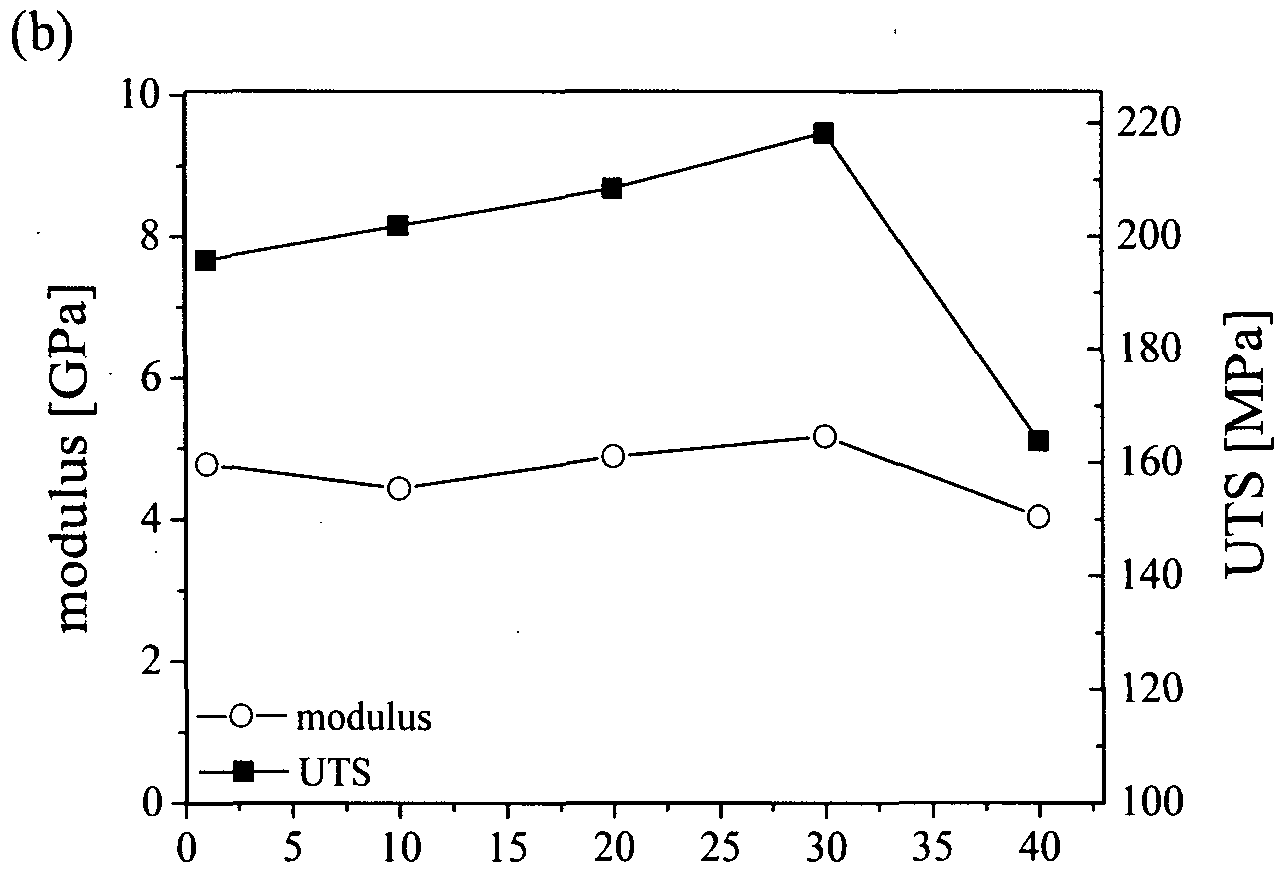
- FIG. 5b presents the tensile test results as a function of stabilization sequence time (t s ) .
- the CL was 1%.
- the modulus and the UTS were estimated to be 4.8 GPa and 195 MPa respectively.
- the onset temperature for the degradation in PAN occurs at 270 0 C.
- This step coincides with the cyclization of adjacent nitrile groups to produce a conjugated imine system.
- Clearly this step is almost absent in the stabilized compact samples and the onset temperature in stabilized PAN is higher by 30 °C.
- the second degradation step occurs for all samples at around 420 0 C. It is seen that the weight loss decreases with the extent of stabilization until an asymptotic value is reached.
- Figure 1 presents the chemical structures of (a) PAN
- Figure 2 presents stress-strain traces of the original PAN fiber and of a completely stabilized PAN fiber, prepared according to preferred embodiments of the invention
- Figure 5 presents the UTS and modulus of samples prepared with (a) method I and (b) method II, according to preferred embodiments of the invention
- Figure 6 presents the UTS and modulus of woven stabilized PAN compacts prepared with (a) method I and (b) method II, according to preferred embodiments of the invention
- Figure 7 presents the tensile modulus of PAN and PAN/Kevlar compacts, prepared according to preferred embodiments of the invention, as a function of the compaction temperature;
Landscapes
- Chemical & Material Sciences (AREA)
- Engineering & Computer Science (AREA)
- Mechanical Engineering (AREA)
- Manufacturing & Machinery (AREA)
- Materials Engineering (AREA)
- Health & Medical Sciences (AREA)
- Chemical Kinetics & Catalysis (AREA)
- Medicinal Chemistry (AREA)
- Polymers & Plastics (AREA)
- Organic Chemistry (AREA)
- Reinforced Plastic Materials (AREA)
Abstract
The present invention discloses new polymeric composite materials and their production methods, in particular of crosslinked compacts. In particular, the present invention discloses crosslinked compacts of a material comprising polyacrylonitrile (PAN) fibers. The invention further discloses a method for producing these crosslinked compacts.
Description
CROSSLINKED POLYACRYLONITRILE (PAN) FIBERS COMPACT
The compaction of polymeric fibers, which is based on sintering of skin-molten fibers under high pressures, emerges as a new production technology for composite materials of high reinforcement content. The best example is that of hot compaction of polyethylene (PE) fibers developed originally by Ward and coworkers [1], wherein the fibers are fused together in a processing cycle of a specific pressure-temperature sequence. The processing conditions are chosen so that optimum fiber melting occurs at its skin to allow inter-fiber coalescence via the formation upon cooling of a new matrix phase. Lately, a modified process has been proposed [2] that utilizes the elevated melting point of the PE fiber under high pressure, so that a spike of pressure reduction for a controlled period of time allows limited surface melting.
As shown in these and similar publications, most of the original work on compacts was performed with ultrahigh molecular weight polyethylene (UHMWPE) fibers - (see [I]-
[3] ) . The reason for choosing UHMWPE fibers in the first place is due to their exceptionally high mechanical properties and low specific gravity, as well as due to their skin-core structure, which allows skin melting at a relatively low compaction temperature while conferring no deterioration to the highly oriented crystalline core [4].
Further research has shown that successful compaction can be performed on a wide range of oriented fibers and tapes, including gel spun polyethylene fibers (both Dyneema® fiber [5] and Spectra® fiber [6]), polyethylene terephthalate fibers [7] , liquid crystalline polymer fibers [8] and fibrillated polypropylene tapes [9].
Crosslinking is known to improve the adhesion at the fiber/matrix interface and consequently can generate an enhancement of the composite mechanical properties, and its thermal stability. For example, Ratner et al presented a unique combination of hot compaction and crosslinking, in which a linear polyethylene (LPE) compact was produced by dicumyl peroxide (DCP) treated LPE fibers [10-12] . At elevated temperature DCP dissociates to free radicals and initiates crosslinking through the formation of inter- chain covalent bonding. The strong fiber/fiber interfacial adhesion resulting from the network formation generates mechanical property improvement by an order of 20%. The use of high modulus fiber such as UHMWPE in crosslinked compacts generates a Young's modulus improvement by an order of 36 % while the tensile strength is improved by an order of 55 % compared to the non crosslinked compact [10- 12].
Polyacrylonitrile (PAN) fibers are well known in a range of textile applications including clothing, upholstery and heavy textiles.
The chemical structure of PAN allows an additional crosslinking/stabilization stage by polymerization of the nitrile side groups on the main polymeric chain (see Fig. Ia) . This results in a conjugated imine system such as the ladder (Fig. Ib) and crosslinked (Fig. Ic) structures, the formation of which is evident by the progressive development of dark colors until the exhaustion of the imine polymerization. If this additional crosslinking is performed under oxygen (making it an "oxidative stabilization") a condensed semi-aromatic structure is generated that is distinguished by its high flame resistance (see Fig. Id) .
The investigation of the mechanical properties in stabilized PAN fibers showed that both the yield stress and the modulus increase with stabilization, while the ultimate elongation and strength decrease [15] . These mechanical features are shown in Figure 2.
However, one problem arising from this additional process, is that no melting transition is observed in conjugated (stabilized) PAN, since when the fiber is stabilized, the polymer becomes a thermoset and obviously no melting is possible. This turns stabilization, which prevents fiber melting, to be a competing process to compaction, which is based on fiber melting.
Thus, while stabilization is desirable in order to obtain a crosslinked network promising high thermal stability (and hence improved flame retardancy) and high yield point in the final product, it has, at the same time, an undesirable effect on the compacting process, which is necessary to obtain good adhesion of the fibers. The combined effect of compaction and stabilization on fibers, such as PAN, has remained largely unpredictable.
This concern is reflected in U.S. Patent No. 7,202,328, which discloses the compaction of noncrystalline polymer fibers, including, inter alia, PAN fibers. This patent does not teach any crosslinking option and in fact regards any reactions occurring at high compaction temperatures (above 2000C) as undesirable degradation, which should be avoided by selecting more moderate compaction conditions, such as lower compaction temperatures . Thus, there remains a challenge to find and develop a suitable combined compaction/stabilization process for PAN fibers that ensures both good adhesion and improved
thermal stability and retention or increase of the mechanical properties.
The present inventors have now successfully designed new polymeric composite materials by a new production method, thereby obtaining crosslinked compacts.
The matrix of these compacts is formed in situ by partial melting and fusion of the reinforcing fibers, which are compacted together in a novel heat-pressure cycle, designed to induce oxidative stabilization of the compacts.
The term "composite", as used herein, refers to the melted or fused combinations of fibers with or without additional reinforcing fibers.
The term "partial melting" is understood to mean the melting of only the outer part or the skin of the fiber.
The production method of the present invention, named crosslinking compaction generates a completely new line of composite structures by crosslinking of the matrix and turning of a thermoplastic polymer into a thermoset matrix.
The term "thermoset matrix" corresponds to the product obtained from the crosslinking of the in-process formed matrix.
The term "matrix" as used herein is well known in the art, and is used to represent a polymeric binder material that binds the fibers together.
Thus, according to one aspect of the invention, there is provided a crosslinked compact of a material comprising polyacrylonitrile (PAN) fibers. The term "crosslinked compact" will be used throughout this document, to describe any advanced composite prepared by a combined crosslinking and compaction procedure, regardless of the raw materials,
provided that they comprise, polyacrylonitrile (PAN) fibers and includes, without limitation, fibers, yarns and fabrics, and regardless of the structure, including, without limitation, unidirectional and woven crosslinked compacts and reinforced crosslinked compacts. Therefore, the term "crosslinked compact" shall be used interchangeably with the terms "reinforced crosslinked compact", "reinforced compact" and "stabilized compact".
Examples of crosslinked PAN compacts include, but are not limited to, unidirectional PAN fibers, woven fabrics comprising PAN fibers and composite mixtures of PAN and other materials, such as PAN/aramid (e.g. Kevlar®) .
The term "material comprising..." refers to any- material that contains the PAN fibers in any form. As explained hereinabove, the chemical structure of PAN (Fig. 1) is unique among polymer fiber compacts, in that it allows crosslinking combined with oxidative stabilization of its nitrile groups, thereby generating a condensed semi aromatic crosslinked structure that is distinguished by its high flame retardancy.
The term "semi-aromatic" is related to the fact that the crosslinked PAN comprises both aromatic and non- aromatic sections, reflecting partial polymerization of the nitrile groups and oxidation thereof. The term "polyacrylonitrile (PAN) fibers" includes, but not only, commercial textile fibers such as Acrilan, Courtelle, Dralon. They can be made either of homo-PAN or of copolymers of PAN comprising comonomers such as, but not limited to, methyl acrylate, vinyl acetate, itaconic acid. The aforementioned fibers also include commingled yarn and co-woven fabrics comprising, in addition to the PAN fibers, reinforcing fibers from the composite materials industry, such as carbon, aramid and glass.
The compact may contain other materials such as pigments and other additives and fillers known to a person skilled in the art.
Preferably, the crosslinked compact described herein has a controlled crosslinking level (CL) . The crosslinking level is determined by DSC as detailed in the methods section below. The crosslinking levels are controlled by changing the time and value of the pressure and/or the temperature of the reaction, as detailed hereinbelow. In particular, this compact is obtained by the partial melting and crosslinking of the thermoplastic fiber ' s skin.
As can be seen in the examples presented hereinbelow, the new crosslinked compacts described herein present significantly higher thermal stability and flame retardancy, compared to presently known un-stabilized PAN compacts, rendering them a structural material of choice for PAN applications where heat protection and fire resistance are required. For example, as can be seen in Figure 9 (DSC) which compares the degradation of woven PAN fabric and the almost fully stabilized compact (CL = 97%) shows that the onset temperature for degradation in untreated PAN occurs at 270 °C, a step which is almost absent in the stabilized compact, thereby increasing the onset temperature in stabilized PAN by 30 0C.
Thus, according to preferred embodiments of the present invention, the crosslinked compact described herein has a degradation onset temperature which is substantially higher than 270°C. Preferably, this temperature is about 300°C.
The increase in thermal stability and in flame retardancy is also reflected by the LOI levels in the stabilized crosslinked compacts.
Limited oxygen index (LOI) is a parameter for evaluating flame retardancy and flammability of polymeric materials in the same conditions. It denotes the lowest volume concentration of oxygen sustaining candle-like burning of materials in mixing gases of nitrogen and oxygen. It has been shown that in contrast to untreated PAN fibers having an LOI of about 18%, the LOI of the crosslinked compact described herein, as measured at room temperature according to ASTM D-2863, was higher than 25%, more often equal to or higher than 30%. Hence, according to preferred embodiments of the present invention, the crosslinked compact described herein is a flame retardant compact.
As shown in the examples which follow, PAN fibers were successfully compacted and stabilized at a range of compacting and stabilization temperatures and times, and under varying pressure conditions.
This PAN composite was obtained as a result of specific pressure-temperature compaction and stabilization sequences resulting in a crosslinked compact of a material comprising PAN fibers.
The method for producing crosslinked PAN compacts considers a range of condition combinations for both compaction and crosslinking (also referred to as "stabilization" or "oxidative stabilization"), thereby controlling the appropriate extent of nitrile polymerization and aromatization.
In this invention, a one or two step process is proposed in which the oxidative stabilization reaction
occurs either simultaneously with the compaction heat- pressure cycle, or follows it, to generate a crosslinked structure, such that the crosslinking levels are controlled by changing the time and value of the pressure and/or the temperature of the reaction.
Thus, according to another aspect of the present invention concerns, there is provided a method for producing a crosslinked compact of a material comprising polyacrylonitrile (PAN) fibers, this method comprising: 1) providing a material comprising PAN fibers as described above;
2) applying on this material at least one compaction heat-pressure cycle ; and
3) providing conditions for oxidative stabilization.
By one option (hereinafter termed "method I") the oxidative stabilization (of step 3) occurs simultaneously with the compaction heat-pressure cycle of step 2. According to this option PAN crosslinked compacts are prepared by a single step consisting of a combined compaction/stabilization process in which the matrix is generated and is simultaneously crosslinked. The crosslinking level can be varied by changing the temperature and/or the pressure and/or the time. The maximal parameters used for this method are: an applied pressure between 10-20 MPa at 150-230 0C for 20-120 minutes. However, it is expected that the maximal parameters that can be used for this method are: 5-30 MPa at 140-240 0C for at least 10 minutes, and basically for an unlimited time. According to a preferred embodiment of the present invention, the preferable temperature is at least 2000C.
By another option (hereinafter termed "method II") the oxidative stabilization follows the compaction heat- pressure cycle typically by a separate step of thermal stabilization. According to this option relatively low temperature and pressure are applied in a first step causing the fusion of the fibers to generate a matrix.
Due to the low compaction temperature, a minor crosslinking is generated within the newly formed matrix. This compaction step (number 2 above) is followed by a separate additional step of thermal stabilization (step 3 above) , in an oven or in the press with or without pressure, for providing additional conditions to complete crosslinking. The crosslinking level can be controlled by changing the thermal stabilization temperature and the thermal stabilization time. The maximal parameters used for this method are: in the compaction step, an applied pressure between 10-20 MPa at 140-220 °C for 20-120 minutes; the thermal stabilization can be performed at 210-240 0C for 10-480 minutes. However, it is expected that the maximal parameters that can be used for this method (method II) are: an applied pressure between 5-30 Mpa, whereas in the compaction step, at a temperature of 130-220 0C for 20-240 minutes; and in the thermal stabilization - at a temperature of 190-270 °C for 10 minutes, and basically for an unlimited time.
Clearly, the optimal conditions for these methods depend on the PAN raw material used.
As detailed hereinabove, the inventors have successfully designed a method for producing a crosslinked compact of a material comprising polyacrylonitrile (PAN) fibers. Under the conditions discussed in detail hereinabove, a special PAN composite was obtained by this method, exhibiting desirable thermal and mechanical
properties. For example, having an LOI of at least 25%, and even of at least 30%, thereby rendering it flame resistant. Furthermore, these compacts have controllable and optionally high levels of crosslinking (reaching CL as high as 97%). They are further noted for their improved onset temperature of degradation, being about 3000C, almost 300C higher than that of non-crosslinkled PAN compacts .
EXPERIMENTAL
Materials
Unidirectional PAN and PAN/kevlar compacts were produced from a commercial PAN based fiber tow Courtelle, Courtauld Ltd) containing 5-6% of methyl acrylate precursor, with a glass transition of 120 0C and a melting point situated at around 300 °C. Woven PAN compacts were prepared from an industrial plane wave fabric base on PAN fibers (±90°) containing methyl acrylate precursor and a pigment. The aramid kevlar 49 fiber was supplied by DuPont . The fiber diameter was 12 μm.
Samples preparation a) The unidirectional PAN compacts were prepared according to two methods : Method I: PAN fibers were wound on a flat mandrel and hot pressed under 15 MPa for 20 minutes (Carver laboratory press, model 2518), followed by air-cooling to obtain a unidirectional compacted. Five samples were prepared by- varying the compaction temperature from 180-230 0C. No further stabilization process was applied.
Method II: Sample previously wound on a flat mandrel was hot pressed at 140 °C under 15 MPa for 20 minutes. This step was followed by a thermal treatment in oven at
210 0C. Nine samples were obtained by varying the oxidative stabilization sequence from 10-60 minutes. b) The hot compaction of woven PAN fabric was performed by superposing 4 layers of woven textile by using method I (Tc within 170-230 0C for 40 minutes under 18 MPa) and method II (Tc = 220 °C for 40 minutes under 18 MPa and followed by oxidative stabilization in oven at 240 °C for 10-480 min) described above. It should be noted that higher temperature was required in order to compact woven textile compared to the compaction of PAN fibers. c) PAN/keylar samples were prepared by winding on a flat mandrel a commingled yarn comprising both fibers by using method I (Tc within 150-200 °C for 120 minutes under 10 MPa) and method II (Tc = 170 °C for 120 minutes under constant pressure of 10 MPa and followed by oxidative stabilization in oven at 230 0C for 10-180 min) . In the resulting compacts, the kevlar fraction is evaluated at around Vf = 15%.
It should be noted that the compaction temperature window used in this case is lower than that used in the unidirectional samples. The adhesion of PAN with kevlar could only be achieved at temperatures which ensure minimum stabilization and low viscosity.
Testing
Differential scanning calorimetry (DSC) was carried out by Mettler, Toledo DSC-822. The sample was heated from 25 to 400 0C at a heating rate of 10 °C/minutes. The weight of each sample was about 10 mg. Tensile mechanical testing was performed on a universal testing machine (Instron 4502). The single PAN fibers were tested with a loading rate of 10 mm/sec and a loading span of 51 mm. Compact samples were cut into
specimens with average dimension of 5 mm width and 0.2 mm thickness and test with a loading span of 20 mm. All the results were taken as the average value of five samples.
Physical properties were investigated by dynamic mechanical analysis. A TA Instruments (New Castle, DE)
DMA, model 983 was used to measure the glass transition temperature. All samples were tested at a resonant mode under bending load. The temperature was scanned between
25-180 0C at a heating rate of 5 °C/minutes. The glass transition temperature was assigned to the tan δ and typical specimen dimensions were 60*7*2 mm3.
Measurements of attenuated total reflection Fourier transform infrared spectroscopy (ATR-FTIR) , ALPHA by Bruker, were carried out to indicate the presence of an imine conjugated system.
Thermogravimetric analyses (TGA) were carried out by using a Mettler instrument in the temperature range 25 to 900 °C under nitrogen atmosphere.
Limited oxygen indexes (LOI) were evaluated on an oxygen index instrument at room temperature (according to ASTM D-2863) . LOI test was performed on the woven PAN compact stabilized after 240 minutes and 480 minutes at 240 °C. Four specimens were provided with dimensions 15cm X 15cm X 10mm.
RESULTS
Evaluation of the crossl±nked level
T3 values and their respective enthalpy are presented in tables Ia and Ib below, for all three systems.

Table Ia

Table Ib
The Ts values in these tables mark the position on the temperature scale in the DSC traces of the exothermic peaks of the crosslinking reaction. CL is calculated by dividing the enthalpy released during a compaction process with that of a control value of the fully stabilized raw material.
For example, a unidirectional sample compacted at 210 °C shows Ts = 288 0C and ΔH = 379 J.g"1 involving CL = 33 % while unidirectional sample compacted at 230 °C shows T3 = 294 0C and ΔH = 86 J.g"1, involving CL = 85%. It should be noted that different CL were observed in each sample, due to the different compaction conditions (temperature, time) and different oxidative stabilization temperature and time .
Simultaneously, the glass transition (Tg) appears at around 110 0C and sharpens as the CL increased as observed in the inset. Sharpening of the glass transition clearly emerges from the new PAN network, and consequently shifts the glass temperature to higher temperatures as the network expanded. For example, table 2 below presents the results of the DMA tests and the glass transition temperature as function of the CL.

Table 2
In the unidirectional and reinforced samples, the intensity of the T5 transition was clearly reduced as the CL was increased indicating the emergence of a brittle behavior. Concordantly and in both samples, the T9 was
shifted to higher temperatures as expected in thermosetting polymers.
The advancement of the stabilization within PAN was also evaluated by FTIR. The disappearance of the nitrile band at 2240 cm"1 and simultaneously the appearance of the C=N and C=C bands at 1600-1700 cm"1 were observed in Figure 4 as the stabilization process advances. These latter involve the presence of the conjugated imine structure presented in stabilized PAN. From the FTIR results, it can be concluded that as the compaction temperature was increased or as the stabilization sequence was longer, a crosslinked network was generated in PAN, as confirmed by the appearance of the C=C and C=N bands characteristic of the conjugated structure. When the polymer was almost fully stabilized the absorbance peak at 2240 cm"1 was not observed.
Mechanical properties
Unidirectional PAN compacts According to the first method, compaction and stabilization were achieved simultaneously at temperatures in the range 180-230 0C and under a constant pressure of 20 MPa. As the compaction/stabilization temperatμre was increased the tensile properties of the stabilized PAN compact were improved up to the optimal temperature achieved at 215 0C as shown in Figure 5a. Under 215 °C the young's modulus reaches a maximum of 5.6 GPa, which corresponds to an improvement of 35%. No significant improvement was noted on the strength values. Heating beyond 215 °C reduces the tensile properties of the resulting compacts. According to the second method (method II) described as a two steps method, the process was performed at 140 0C for 20 minutes under pressure of 15
MPa. The relatively low temperature and pressure were chosen in order to avoid stabilization of the PAN fibers at this stage. In a second step, conjugation of PAN was achieved at 210°C. Figure 5b presents the tensile test results as a function of stabilization sequence time (ts) . Before the stabilization process and according to table Ib, the CL was 1%. At this point the modulus and the UTS were estimated to be 4.8 GPa and 195 MPa respectively. As the crosslinked network expands (by using longer ts) the tensile modulus and the UTS slightly increase to reach maximum values of 5.58 GPa and 215 MPa respectively, after 30 minutes (CL = 20%) . It should be noted that these values are higher than those observed in PP compacted (5 GPa, 180 MPa respectively) [16] . Further heating strongly alters the mechanical properties of the compact.
Woven PAN compacts
The optimum compaction temperature was evaluated in Figure 6a as a function of modulus and UTS showing in both cases an optimal temperature around 210 °C. At this temperature the CL reaches almost 50% as observed in table 1, indicating a semi-stabilized compact. The modulus reaches 2.2 GPa and the UTS 75 Mpa, both being higher than those of a traditional PP woven compact - 2.2 GPa and 44 MPa [17]. The expansion of the crosslinked network above CL = 50% leads to a reduction of the tensile properties as observed in Figure 6b. It's important to note that the unidirectional PAN compacts show the same behavior. As the ts was increased a fully crosslinked network forms generating a brittle behavior specific to thermosetting polymers and leading to the decrease of the UTS and the modulus .
PAN/keylar compacts
Tensile properties of PAN and PAN/kevlar compacts are presented in Figure 7 as a function of the compaction temperature. Both systems were prepared by compaction under 10 MPa pressure for 2h. It is clearly seen that the addition of kevlar fibers improves the tensile modulus of the compact, improvement of ~ 25-60% depending on the compaction temperature. The maximum modulus values were achieved for both samples at 170 0C and reached 3.8 and 5.1 GPa for PAN and PAN/kevlar compact respectively. It should be noted that the values obtained in PAN/kevlar were higher than those obtained in the unidirectional and woven compact showed in the previous sections. After stabilization (Figure 8), significant alteration of the mechanical properties were observed above ts = 20 minutes (CL = 25%). Applying longer ts generates a brittle behavior due to the major crosslinked system.
Thermal stability and flame retardancy
The cyclic structure generated in PAN after stabilization leads to an improved thermal stability combined to a flame retardant ability. Figure 9 shows thermogravimetric analysis data and their respective derivatives during degradation of woven PAN fabric and the almost fully stabilized compact (CL = 97%) in inert atmosphere. The onset temperature for the degradation in PAN occurs at 270 0C. This step coincides with the cyclization of adjacent nitrile groups to produce a conjugated imine system. Clearly this step is almost absent in the stabilized compact samples and the onset temperature in stabilized PAN is higher by 30 °C. The second degradation step occurs for all samples at around
420 0C. It is seen that the weight loss decreases with the extent of stabilization until an asymptotic value is reached.
It was also shown that the LOI of these samples was about 30-31%.
Conclusion
In this study, new polymeric composite materials and their production methods have been disclosed. These production methods comprising a compaction process (heat- pressure cycle) followed by an oxidative stabilization resulted in a conjugated imine system. It has been shown that it is feasible to create a variety of PAN compacts at various level of crosslinking by controlling the oxidative stabilization time sequence. This process resulted in mechanical properties of the compacts which retained the original properties of the fiber and were comparable and even better than those of the traditional PP and PE counterparts . Moreover, it has been shown that a complete nitrile polymerization and crosslinking results in an improved thermal stability by more than 30 "C and a high LOI levels responding to the flame retardancy criterion.
BRIEF DESCRIPTION OF THE DRAWINGS:
Figure 1 presents the chemical structures of (a) PAN;
(b) a conjugated imine system forming a ladder structure;
(c) an example of crosslinking by inter-chain nitrile polymerization; and (d) a condensed crosslinked semi- aromatic structure formed under oxidative stabilization;
Figure 2 presents stress-strain traces of the original PAN fiber and of a completely stabilized PAN fiber, prepared according to preferred embodiments of the invention;
Figure 3 presents DSC traces of a woven PAN fabric and PAN compacts, prepared according to preferred embodiments of the invention, after ts = 0, 20, 240 min, such that the main exothermic peak corresponds to the stabilization reaction, and whereas the inset displays a magnification of the glass transition;
Figure 4 presents FTIR spectrograms of the PAN/Kevlar compact before and after stabilization (CL = 85 %) conducted according to preferred embodiments of the invention;
Figure 5 presents the UTS and modulus of samples prepared with (a) method I and (b) method II, according to preferred embodiments of the invention;
Figure 6 presents the UTS and modulus of woven stabilized PAN compacts prepared with (a) method I and (b) method II, according to preferred embodiments of the invention;
Figure 7 presents the tensile modulus of PAN and PAN/Kevlar compacts, prepared according to preferred embodiments of the invention, as a function of the compaction temperature;
Figure 8 presents the UTS and modulus of PAN/Kevlar compacts, prepared according to preferred embodiments of the invention, as function of stabilization time; and Figure 9 presents TGA and TGA derivatives of a woven PAN fabric and the respective stabilized compact, prepared according to preferred embodiments of the invention, (CL = 97 %) .
References
1. Hine PJ, WARD IM, Olley RH and Basset DC J Mater Sci 28: 316-324 (1993) .
2. Rein D, Vaykhansky L, Khalfin R, and Cohen Y Polym Adv Tech 13: 1046-1054 (2002).
3. Xu T, and Farris RJ, J. Polym Sci Phys 43: 2767-2789
(2005) .
4. Kabeel MA, Bassett DC, Olley RH, Hine PJ and Ward IM J Mater Sci 30: 601-606 (1995) .
5. Hine PJ, Ward IM, Jordan ND, Olley RH and Bassett DC J Macromol Sci Phy 40: 959 (2001) .
6. Yan RJ, Hine PJ, Ward IM, Olley RM and Bassett DC J Mater Sci 32: 4821-4832 (1997).
7. Rasburn J, Hine PJ, Ward IM, Olley RH, Bassett DC and Kabeel MA J Mater Sci 30: 615-622 (1996).
8 Ward IM and Hine PJ Polym Engng Sci 37: 1809-1814
(1997) .
9. Hine PJ, Ward IM and Teckoe J J Mater Sci 33: 2725-2733
(1998) .
10. Ratner S, Weinberg A and Marom G Adv Compos Lett 11: 205-210 (2003) .
11. Ratner S, Weinberg A and Marom G Polymer Composites 24: 422-427 (2003) .
12. Ratner S, Weinberg A, Wachtel E, Moret MP and Marom G Macromol Rapid Comm, 25: 1150-1154 (2004) .
13. Rahaman MSA, Ismail AF, Mustafa A1 Polym Degrad Stab 92: 1421- 1432 (2007).
14. Ehrburger P, Donnet JB, Carbon and Graphite Fibers: Manufacture and Applications, ed by Sittig M. Noyes Publishing, Park Ridge, N. J. pp 173 (1980) .
15. Shiedlin A, Marom M and Zilkha A Polymer 26: 447-451 (1985) .
16. Ward IM and Hine PJ Polymer 45: 1413-1427 (2004) .
17. Hine PJ, and Ward IM Polymer 44:1117-1131 (2003).
Claims
1. A crosslinked compact of a material comprising polyacrylonitrile (PAN) fibers.
2. The crosslinked compact of claim 1, having a controlled crosslinking level (CL) .
3. The crosslinked compact of claim 1, having a degradation onset temperature which is substantially higher than 270°C.
4. The crosslinked compact of claim 3, having a degradation onset temperature which is about 300°C.
5. The crosslinked compact of claim 1, being a flame retardant compact.
6. The crosslinked compact of claim 1, having a Limited Oxygen Index (LOI), measured at room temperature according to ASTM D-2863, of at least 25%.
7. The crosslinked compact of claim 6, having a Limited Oxygen Index (LOI), measured at room temperature according to ASTM D-2863, of at least 30%.
8. A method for producing a crosslinked compact of a material comprising polyacrylonitrile (PAN) fibers, said method comprising: a. providing a material comprising polyacrylonitrile
(PAN) fibers; b. applying on said material at least one compaction heat-pressure cycle; and c. providing conditions for oxidative stabilization of said material.
9. A method according to claim 8, wherein said compacting and said oxidative stabilization are applied simultaneously.
10. A method according to claim 8, wherein said oxidative stabilization is applied after said compacting.
11. A method according to claim 9, being conducted under a temperature ranging from about 1400C to about 240°C.
12. A method according to claim 11, said temperature ranging from about 1500C to about 230°C.
13. A method according to claim 12, said temperature ranging from about 2000C to about 2300C.
14. A method according to claim 9, being conducted for a time of at least 10 minutes.
15. A method according to claim 14, being conducted for a time ranging from about 20 minutes to about 120 minutes .
16. A method according to any of claims 9 or 10, wherein said compacting is conducted under a pressure ranging from about 5 Mpa to about 30 Mpa .
17. A method according to claim 16, said pressure ranging from about 10 Mpa to about 20 Mpa.
18. A method according to claim 10, wherein said compacting is conducted at a temperature ranging from about 1300C to about 2200C.
19. A method according to claim 18, said temperature ranging from about 1400C to about 2200C.
20. A method according to claim 10, wherein said compacting is conducted for a time ranging from about 20 minutes to about 240 minutes.
21. A method according to claim 20, said time ranging from about 20 minutes to about 120 minutes.
22. A method according to claim 10, wherein said oxidative stabilization is conducted at a temperature ranging from about 190°C to about 270°C.
23. A method according to claim 22, said temperature ranging from about 210°C to about 240°C.
24. A method according to claim 10, wherein said oxidative stabilization is conducted for a time of at least 10 minutes.
25. A method according to claim 24, said time ranging from about 10 minutes to about 480 minutes.
1/9
Figure Ia 
Figure Ib 
Figure Ic 
Figure Id 
Figure 1 2/9

Figure 2
3/9

100 200 300 400 temperature [0C]
Figure 3
4/9

4000 3500 3000 2500 2000 1500 1000 500 wavenumber [cm" ]
Figure 4
5/9
Figure 5a

Figure 5b
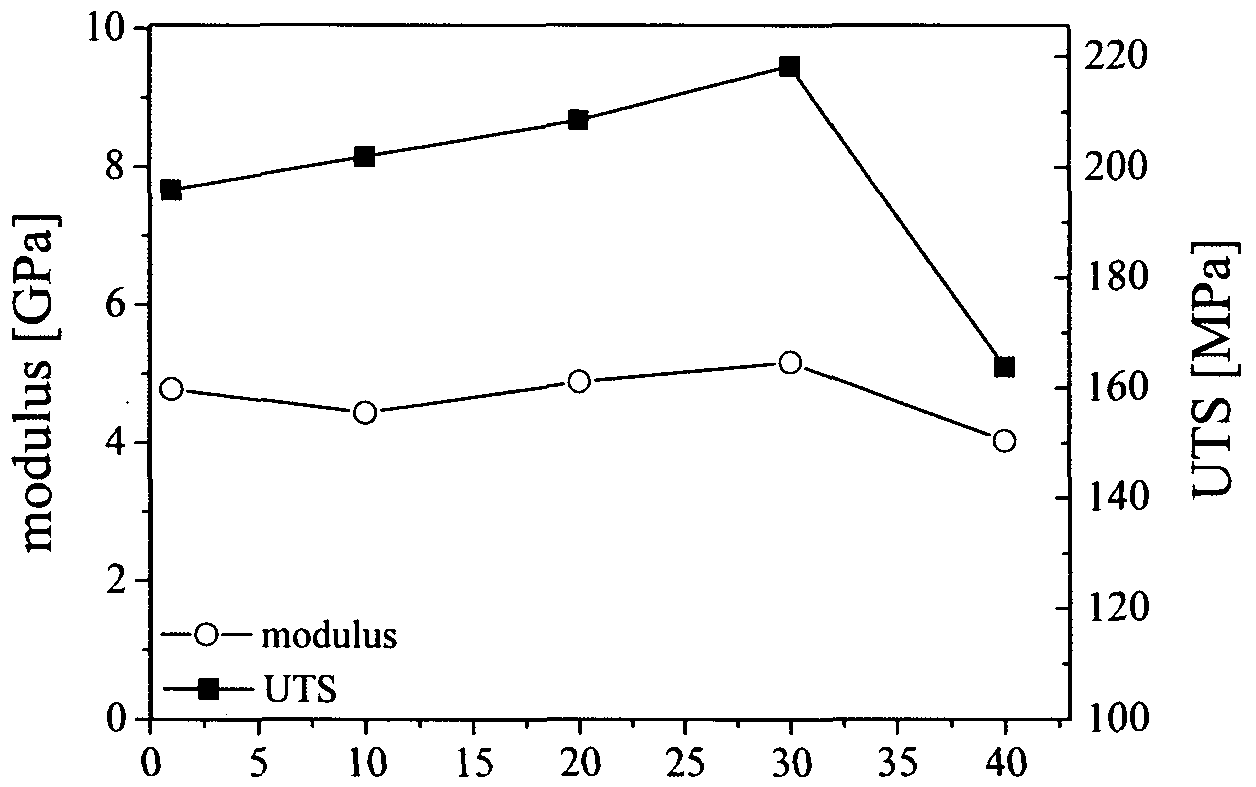
Figure 5 6/9
(a)

(b)

0 20 40 200 220 240 stabilization time [min]
Figure 6 5/9
(a)  compaction temperature [0C]
  stabilization time [min]
Figure 5 6/9
Figure 6a

Figure 6b

Figure 6 7/9

150 160 170 180 190 200 compaction temperature [0C]
Figure 7
8/9

0 20 40 60 80 100 120 140 160 180 stabilization time [min]
Figure 8
9/9


Figure 9
Applications Claiming Priority (2)
| Application Number | Priority Date | Filing Date | Title |
|---|---|---|---|
| IL197754 | 2009-03-23 | ||
| IL197754A IL197754A0 (en) | 2009-03-23 | 2009-03-23 | Crosslinked pan fibers compact |
Publications (1)
| Publication Number | Publication Date |
|---|---|
| WO2010109446A1 true WO2010109446A1 (en) | 2010-09-30 |
Family
ID=42113632
Family Applications (1)
| Application Number | Title | Priority Date | Filing Date |
|---|---|---|---|
| PCT/IL2010/000223 Ceased WO2010109446A1 (en) | 2009-03-23 | 2010-03-18 | Crosslinked polyacrylonitrile (pan) fibers compact |
Country Status (2)
| Country | Link |
|---|---|
| IL (1) | IL197754A0 (en) |
| WO (1) | WO2010109446A1 (en) |
Citations (2)
| Publication number | Priority date | Publication date | Assignee | Title |
|---|---|---|---|---|
| US20020135161A1 (en) * | 2001-03-26 | 2002-09-26 | Lamb Tony M. | Glass fiber reinforced thermoplastic components |
| WO2002102568A2 (en) * | 2001-06-15 | 2002-12-27 | Btg International Limited | Amorphous polymer article |
-
2009
- 2009-03-23 IL IL197754A patent/IL197754A0/en unknown
-
2010
- 2010-03-18 WO PCT/IL2010/000223 patent/WO2010109446A1/en not_active Ceased
Patent Citations (2)
| Publication number | Priority date | Publication date | Assignee | Title |
|---|---|---|---|---|
| US20020135161A1 (en) * | 2001-03-26 | 2002-09-26 | Lamb Tony M. | Glass fiber reinforced thermoplastic components |
| WO2002102568A2 (en) * | 2001-06-15 | 2002-12-27 | Btg International Limited | Amorphous polymer article |
Non-Patent Citations (16)
| Title |
|---|
| HINE PJ; WARD IM, POLYMER, vol. 44, 2003, pages 1117 - 1131 |
| HINE PJ; WARD IM; JORDAN ND; OLLEY RH; BASSETT DC, J MACROMOL SCI PHY, vol. 40, 2001, pages 959 |
| HINE PJ; WARD IM; OLLEY RH; BASSET DC, J MATER SCI, vol. 28, 1993, pages 316 - 324 |
| HINE PJ; WARD IM; TECKOE J, J MATER SCI, vol. 33, 1998, pages 2725 - 2733 |
| KABEEL MA; BASSETT DC; OLLEY RH; HINE PJ; WARD IM, J MATER SCI, vol. 30, 1995, pages 601 - 606 |
| RAHAMAN MSA; ISMAIL AF; MUSTAFA A, POLYM DEGRAD STAB, vol. 92, 2007, pages 1421 - 1432 |
| RASBURN J; HINE PJ; WARD IM; OLLEY RH; BASSETT DC; KABEEL MA, J MATER SCI, vol. 30, 1996, pages 615 - 622 |
| RATNER S; WEINBERG A; MAROM G, ADV COMPOS LETT, vol. 11, 2003, pages 205 - 210 |
| RATNER S; WEINBERG A; MAROM G, POLYMER COMPOSITES, vol. 24, 2003, pages 422 - 427 |
| RATNER S; WEINBERG A; WACHTEL E; MORET MP; MAROM G, MACROMOL RAPID COMM, vol. 25, 2004, pages 1150 - 1154 |
| REIN D; VAYKHANSKY L; KHALFIN R; COHEN Y, POLYM ADV TECH, vol. 13, 2002, pages 1046 - 1054 |
| SHIEDLIN A; MAROM M; ZILKHA A, POLYMER, vol. 26, 1985, pages 447 - 451 |
| WARD IM; HINE PJ, POLYM ENGNG SCI, vol. 37, 1997, pages 1809 - 1814 |
| WARD IM; HINE PJ, POLYMER, vol. 45, 2004, pages 1413 - 1427 |
| XU T; FARRIS RJ, J. POLYM SCI PHYS, vol. 43, 2005, pages 2767 - 2789 |
| YAN RJ; HINE PJ; WARD IM; OLLEY RM; BASSETT DC, J MATER SCI, vol. 32, 1997, pages 4821 - 4832 |
Also Published As
| Publication number | Publication date |
|---|---|
| IL197754A0 (en) | 2009-12-24 |
Similar Documents
| Publication | Publication Date | Title |
|---|---|---|
| Sedghi et al. | The effect of commercial polyacrylonitrile fibers characterizations on the produced carbon fibers properties | |
| Bhat | Structure and properties of high-performance fibers | |
| Chen et al. | Modification of polyacrylonitrile (PAN) carbon fiber precursor via post-spinning plasticization and stretching in dimethyl formamide (DMF) | |
| KR101841407B1 (en) | Carbon fiber bundle and method for manufacturing same | |
| CA1284865C (en) | Fiber reinforced polymer molded body | |
| CA2420331C (en) | Flexible polymer element as toughening agent in prepegs | |
| KR101984362B1 (en) | Carbon fiber bundle and method of producing carbon fiber bundle | |
| US12146242B2 (en) | System for producing carbon fibers from multipurpose commercial fibers | |
| Nam et al. | Highly efficient thermal oxidation and cross-linking reaction of catechol functionalized polyacrylonitrile copolymer composites for halogen-free flame retardant | |
| CA3078394C (en) | Precursor stabilisation process | |
| TW201109377A (en) | Engineered crosslinked thermoplastic particles for interlaminar toughening | |
| WO1997045576A1 (en) | Carbon fiber, acrylic fiber, and method of manufacturing them | |
| JPS6175880A (en) | Size agent | |
| Sen et al. | Thermal behavior of drawn acrylic fibers | |
| Soulis et al. | Thermomechanical behaviour of poly [acrylonitrile‐co‐(methyl acrylate)] fibres oxidatively treated at temperatures up to 180° C | |
| Soulis et al. | A novel methodology for designing thermal processes in order to optimize stabilization of polyacrylonitrile (PAN) fibers | |
| KR20150127870A (en) | The method of producing the polyacrylonitrile precursor for carbon fiber and the method of producing carbon fiber | |
| KR101959111B1 (en) | Sizing agent for carbon fiber and carbon fiber using the same | |
| WO2010109446A1 (en) | Crosslinked polyacrylonitrile (pan) fibers compact | |
| WO2021187160A1 (en) | Carbon fiber, manufacturing method therefor, and carbon fiber composite material | |
| Jin et al. | Synthesis and characterization of the novel meta‐modified aramid fibers with liquid crystalline properties | |
| EP2218807B1 (en) | Heat treatment for increasing compressive strentgh of PPTA filaments | |
| RU2560362C1 (en) | High-modulus carbon fibre with modified surface for reinforcing composites and method for modification thereof | |
| CA2007067A1 (en) | Composite metal-loaded carbon fibers | |
| Kalfon‐Cohen et al. | Thermal‐crosslinked polyacrylonitrile fiber compacts |
Legal Events
| Date | Code | Title | Description |
|---|---|---|---|
| 121 | Ep: the epo has been informed by wipo that ep was designated in this application |
Ref document number: 10716634 Country of ref document: EP Kind code of ref document: A1 |
|
| NENP | Non-entry into the national phase |
Ref country code: DE |
|
| 122 | Ep: pct application non-entry in european phase |
Ref document number: 10716634 Country of ref document: EP Kind code of ref document: A1 |