WO2010105988A1 - Natural computational machine - Google Patents
Natural computational machine Download PDFInfo
- Publication number
- WO2010105988A1 WO2010105988A1 PCT/EP2010/053204 EP2010053204W WO2010105988A1 WO 2010105988 A1 WO2010105988 A1 WO 2010105988A1 EP 2010053204 W EP2010053204 W EP 2010053204W WO 2010105988 A1 WO2010105988 A1 WO 2010105988A1
- Authority
- WO
- WIPO (PCT)
- Prior art keywords
- network
- class
- record
- networks
- variables
- Prior art date
- Legal status (The legal status is an assumption and is not a legal conclusion. Google has not performed a legal analysis and makes no representation as to the accuracy of the status listed.)
- Ceased
Links
Classifications
-
- G—PHYSICS
- G06—COMPUTING OR CALCULATING; COUNTING
- G06N—COMPUTING ARRANGEMENTS BASED ON SPECIFIC COMPUTATIONAL MODELS
- G06N3/00—Computing arrangements based on biological models
- G06N3/02—Neural networks
- G06N3/08—Learning methods
- G06N3/088—Non-supervised learning, e.g. competitive learning
-
- G—PHYSICS
- G06—COMPUTING OR CALCULATING; COUNTING
- G06N—COMPUTING ARRANGEMENTS BASED ON SPECIFIC COMPUTATIONAL MODELS
- G06N3/00—Computing arrangements based on biological models
- G06N3/02—Neural networks
- G06N3/04—Architecture, e.g. interconnection topology
- G06N3/045—Combinations of networks
-
- G—PHYSICS
- G06—COMPUTING OR CALCULATING; COUNTING
- G06N—COMPUTING ARRANGEMENTS BASED ON SPECIFIC COMPUTATIONAL MODELS
- G06N3/00—Computing arrangements based on biological models
- G06N3/02—Neural networks
- G06N3/04—Architecture, e.g. interconnection topology
- G06N3/045—Combinations of networks
- G06N3/0455—Auto-encoder networks; Encoder-decoder networks
-
- G—PHYSICS
- G06—COMPUTING OR CALCULATING; COUNTING
- G06N—COMPUTING ARRANGEMENTS BASED ON SPECIFIC COMPUTATIONAL MODELS
- G06N3/00—Computing arrangements based on biological models
- G06N3/02—Neural networks
- G06N3/08—Learning methods
- G06N3/0895—Weakly supervised learning, e.g. semi-supervised or self-supervised learning
-
- G—PHYSICS
- G06—COMPUTING OR CALCULATING; COUNTING
- G06N—COMPUTING ARRANGEMENTS BASED ON SPECIFIC COMPUTATIONAL MODELS
- G06N3/00—Computing arrangements based on biological models
- G06N3/02—Neural networks
- G06N3/08—Learning methods
- G06N3/0985—Hyperparameter optimisation; Meta-learning; Learning-to-learn
Definitions
- a natural computational machine comprising:
- the invention relates to a computational machine based on the principles of Natural Computation, and hence a natural computational machine composed of a system of Artificial Neural Networks and means for processing the data generated by said Artificial Neural Networks .
- Natural Computation is a branch of the Artificial Sciences, i.e. those sciences in which the natural and/or cultural processes are understood by recreating those processes by means of automatic models.
- Natural Computation is intended to designate the part of Artificial Sciences that tries to develop automatic models of natural processes by local interaction of microprocesses non-isomorphic to the original process.
- Natural Computation constructs artificial models that simulate the complexity of natural and/or cultural processes not using rules, but constraints that can autonomously create a set of contingent and approximate rules based on the space and time in which the process develops.
- Natural Computation tries to recreate natural and/or cultural processes by developing artificial models that can dynamically create local rules susceptible to change according to the process itself.
- learning to learn is an implicit process in artificial models .
- Natural Computation includes, amongst other things, Adaptive Artificial Systems. Adaptive Artificial Systems create artificial models of natural processes .
- Adaptive Artificial Systems include the so-called Learning Systems, i.e. the Artificial Neural Networks. These networks are based on information processing algorithms which allow remarkable effective reconstruction of approximate rules that relate a given set of "explanatory" data for the problem being considered (Intput) to a data set (Output) which is required to be correctly predicted or reproduced from incomplete information .
- ANN Artificial Neural Networks
- ANNs include very different models .
- the various ANNs have the following common characteristics: a.
- the basic elements of each ANN are the Nodes, also known as Processing Elements (PE) and the connections .
- PE Processing Elements
- Each Node of an ANN has its own Input, from which it receives communications from the other Nodes or from the environment; a function g(-) which converts the Input into an internal Activation State; its own Output, through which it communicates with the Nodes or the environment and finally a function f ( • ) , through which it converts its own internal state into an Output .
- Each connection is characterized by the force with which node pairs excite or inhibit each other: positive values denote excitatory connections , negative values denote inhibitory connections .
- the connections between Nodes may change with time. This generates a learning process throughout the ANN.
- the way (rule) in which connections change with time is known as "Learning Equation" .
- the overall operation of an ANN is associated with time: for an ANN to appropriately change its connections, the environment must act upon the ANN several times. Therefore, each ANN is a dynamic system.
- f When ANNs are used for data processing, data is their environment. Therefore, for an ANN to process data, the latter must be submitted to the ANN several times .
- the overall operation of an ANN solely depends on local interaction of its Nodes . Thus , the final state of an ANN shall "spontaneously" derive from an interaction of its components (Nodes) .
- each ANN tend to communicate in parallel . Such parallelism may be synchronous or asynchronous and each ANN may implement it in a different manner.
- An ANN shall anyway exhibit some form of parallelism in the activity of its Nodes . i. Theoretically speaking, such parallelism is not connected to ANN hardware . j .
- Each ANN shall have the following Architecture components : 1. Type and number of Nodes and properties thereof 2. Type and number of connections and location thereof
- the Nodes of each ANN may be of 3 types , depending on their position within the ANN:
- Input Nodes these are the Nodes that receive (also) the signals from the environment external to the
- Output Nodes these are the Nodes whose signal acts (also) upon the environment external to the ANN.
- Hidden Nodes these are the Nodes which only receive signals from other Nodes of the ANN and transmit signals to other Nodes of the ANN.
- the number of Input Nodes depends on how the ANN is required to read the environment.
- the Input Nodes are the ANN sensors .
- Node corresponds to a type of variable of such data.
- the number of Output Nodes depends on how the ANN is required to act on the environment.
- the Output Nodes are the ANN effectors .
- the Output Nodes represent the expected variables or the processing results .
- the number of Hidden Nodes depends on the complexity of the function to be mapped between the Input Nodes and the Output Nodes .
- the Nodes of each ANN may be grouped into classes of Nodes with the same characteristics (properties) . These classes are usually defined as layers.
- ANNs are also differentiated by: type , number and location of node connections .
- the characteristics of such connections are defined by parameters , known as weights , and may be fixed or change during network operation; the type of strategy of the signal flow during each processing cycle of the network.
- Each Node of each layer is activated once in one cycle, and the cycle is taken as the time unit of the ANN operation, i.e. the time during which an ANN transfers a signal from its Input to its Output. the types of learning strategies.
- ANNs may have various learning strategies, varying with the task to be learnt and with the way of calculating the error they make during the training step.
- ANNs of the so-called supervised type are also known.
- Supervised ANNs are ANNs whose desired Output is defined, for each Input vector, from the start of the learning process. In these cases, the error is calculated during training, using a function that measures the distance between the desired Output
- the learning constraint for Supervised ANNs consists in having their Output coincide with the predetermined Target. This type of ANN is suitable for predictive use, in performing classification tasks, such as intelligent pattern recognition.
- Meta-Classifiers etc. Nevertheless, all of these systems share the same approach, i.e. the training step is always carried out with the same method: the systems are trained with a part of the dataset using the Input- Target (output) pair to adjust the parameters, i.e. the weights .
- a further type of ANN is known, which is known as self-organizing ANN. In this type of networks, the output vector for each Input is the Input itself. These self-organizing networks are often used for data compression. All the above mentioned approaches are based on the classical statistical distinction between independent and dependent variables . These concepts seem well-founded in empirical terms, but are not biologically plausible. There is no evidence at presence of the existence of "Teacher" neurons.
- Document WO2007/141325 discloses a method of processing multichannel and multivariate signals and of classifying the sources of this signals. This method is designed according to the scientific findings disclosed in documents XP-002538484 Computer Intelligence and Neuroscience, Volume 2007, Article ID35021 "The implicit Function as Squashing Tome Model : A Novel Parallel Nonlinear EEG Analysis Technique Distinguishing Mild Cognitive Impairment and Alzheimer's Disease Subjects with High Degree of Accuracy" Massimo Buscema, Massimiliano Capriotti, Francesca Bergami, Caludio Babiloni, Paolo Rossini ed Enzo Grossi.
- this method differentiates itself from the classical methods which carry out classification s by means of traditional ANN by the fact that the EEG results which consist in the ensemble of each one of several traces which has been collected by each one of several sensors applied to the skull of a patient are not used directly as input variables of a ANN which is trained to predict the kind of disease affecting the patient represented by the said EEG traces .
- the parameterized or vectorized EEG traces are processed with an autoassociated ANN (artificial neural network) before carrying out the prediction or classification step.
- the data representing the EEG traces of one patient are not the parameterized or vectorized EEG traces , but the weights of the matrices of weights of the autoassociated network which ha been negotiated during the processing of the EEG data.
- weight data matrix is then fed to a prediction or classification algorithm which in the above disclosures is a traditional supervised ANN.
- the further steps disclosed in the above documents relates to a process which is not carried out on the Weight matrix data of the EEG of patients whose pathological condition has to be determined but regards merely the training and testing of the classification ANN which has to be used on the said Weight matrix data representing the EEG of a patient whose condition has to be determined.
- a training and testing phase which in the method disclosed is carried out in a special way.
- the training and testing has to be carried out bye means of a database of known cases .
- variable which has different values each of these values representing the fact that the condition is present or not present or other options which are possible, (for example A variable for Alheimer which has value 0 if Alzheimer is not present and 1 if Alzheimer is present and a variable of each one of other kind of disorders each one having a value 0 if the corresponding kind of disorder is not present and 1 it the said kind of disorder is present) .
- This special kind of training and testing is carried out in such a way to optimize the distribution of the records of the database of the known cases an the training dataset and on the testing dataset and furthermore this special method of training and testing is combined with a process for a so called Input Variable Selection.
- the Input Variable Selection allows to identify hidden dependencies of the input variables (in this case the weights of the weight matrix of the autoassociated ANN with which each EEG has been processed) and thus identify which variables are not relevant for the classification. This allows to reduce the number of input variables to process by the trained ANN for classifying the patient without affecting the reliability of the classification or prediction .
- the method uses as the other prior art method a traditional artificial neural network which classifies an individual represented by certain input variables by means of output variables which are computed by means of a supervised non linear process.
- the differences to traditional neural networks reside in the fact that the input data is submitted to a preprocessing step of a certain particular kind before being processed by the classification algorithm and that the classification algorithm is trained and tested in a particular way with respect to traditional methods of training and testing.
- the present invention addresses the problem of providing a natural computational machine which comprises a system of Artificial Neural Networks and data processing means generated by said Artificial Neural Networks which machine, i.e. system, can ensure intelligent pattern recognition in non-supervised mode.
- the invention is aimed at providing a computational machine having the following features : better classification of new input records (input vectors) as compared with prior art supervised systems; when the system is stimulated with a new input record, it shall ensure dynamic storage, unlike prior art supervised systems which operate in a fixed manner, with a one-shot response; ability to spontaneously generate new input data records for each class; ability of simulating the dynamic consequences of its classification performances.
- input data record or input record is equivalent to the term input vector, because any database forms an N dimensional space in which each set of variables for an individual , i.e. each record may be defined as a vector, whose components are provided by the record variables .
- the invention achieves the above purposes by providing a natural computational machine as described above, in which said machine comprises: a system of artificial neural networks including a plurality of artificial neural networks and in which each of the artificial neural networks is composed of a plurality of processing elements, known as nodes, which nodes are interconnected by connections for receiving communication signals from one or more of the other nodes , and for transmitting communication signals to one or more of the other nodes, some of said nodes, known as input nodes , having an input for signals received from outside the network, and some of said nodes , known as output nodes , having outputs for signals transmitted outside the network; a database which includes data concerning known cases organized in records , each of which records comprises a plurality of variables , each of which variables assumes a numerical value in a predetermined range of numerical values , a part of the variables of said records being defined as output variable; a predetermined number of classes being provided, each of which is represented by a predetermined combination of values assumed by said output variables, and said classes being representative of a quality
- each of said self-organizing networks being uniquely associated to a class of the various classes provided, and being designed to determine that a data record belongs to said class, each of said self- organizing neural networks being trained using the records of the training database which are known to belong to the class with which the corresponding neural network is associated; whereas a data record whose class is unknown is found to belong to a certain class by processing said data record with each of the neural networks of the system, the class of said data record being selected as the one, among the classes provided, that is represented by the neural network exhibiting the smallest difference between the performance parameter value of said network as determined during training step and the performance parameter value as determined during record processing.
- a data record whose class is unknown is found to belong to a certain class by processing said data record with each of the neural networks of the system, the class of said data record being selected as the one, among the classes provided, that is represented by the neural network exhibiting the smallest square value of the difference between the performance parameter value of said network as determined during the training step and the performance parameter value as determined during the record processing step.
- Processing means are provided for uniquely determining the pair composed of the class and the neural network that uniquely represents it, which means determine, for each neural network of the system: a network performance parameter during training; a network performance parameter during processing of a record whose class is unknown; for each of the classes and for each of the neural networks of the system, the difference between the performance parameters during training and during processing of a record whose class is unknown; there being provided means for determining the difference or the square value of the difference between the performance parameter during training and the performance parameter during processing of the record whose class is unknown for each network, and means for determining the minimum value of the differences or said square values of said differences , as well as means for indicating the class represented by the neural network for which said difference or square value of said difference has assumed the minimum value, and means for unique association of said record with said class.
- the training database is divided into record groups , each of which groups comprises records belonging to one of the classes provided, each of the self-organizing neural networks being trained only using the groups of data records that comprise data records belonging to one of the classes among the various classes provided.
- the system may also undergo a testing step, in which some of the records of the database of known cases, i.e. the records of the testing database, are processed using the system of neural networks as if they were records whose class has to be found, with a performance parameter of the system of neural networks being determined based on the comparison between the class determined by the network system with each record of the testing database and the known class of said record.
- a testing step in which some of the records of the database of known cases, i.e. the records of the testing database, are processed using the system of neural networks as if they were records whose class has to be found, with a performance parameter of the system of neural networks being determined based on the comparison between the class determined by the network system with each record of the testing database and the known class of said record.
- a cost function that represents the energy of system networks, which is used as a training error indicator.
- the same performance parameter is used for assessing network performances during processing of a new input vector whose components are provided by the variables of a record whose class is unknown.
- the record represented by the new input vector is assigned to its class by determining the network for which the difference or the square value of said difference between the mean of cost function values of all system networks during training, and the cost function value of the new input vector during processing has the lowest value among those calculated for all the networks .
- the computational machine of the present invention is more flexibly usable in various types of application .
- the computational machine of the present invention may be also used to determine how the conditions of an individual change, i.e. whether and how one individual moves from one class to another based on changes of the values and/or on the presence or absence of certain variables. In short, this means that different configurations may be predicted according to the changes of input variable values .
- Each of the self-organizing networks will try to minimize its internal energy by finding a point on the hypersurface that is closest to the input vector being processed.
- the output nodes of each of the system networks will provide changed values for both constrained and changeable input variables, i.e. the output vector, that would be theoretically identical to the input, will be the description of the hypersurface point closest to the input, which leaves the constrained input variable values as much as possible unchanged, and indicates which values the other changeable variables may assume. It is known that, at the end of the training step, each of the self-organizing networks of the system has generated an input-to-output correlation function which describes a hypersurface.
- the output nodes of the network provide an output vector whose components are identical to those of the input vector, but have non identical values , as they relate to the components of said hypersurface point closest to the point defined by the input vector, and this difference will be utilized to determine the processing error of each of the networks and hence determine the class of said input vector and the individual represented thereby, as the class that belongs to the network with the smallest difference between the average error of all the networks during training and the error during processing of the new input vector.
- this will allow assessment of the curative effect for a particular disease, as determined by a change of class by the input vector and, by the provision of variables for physiological parameters associated with possible side effects of the drug, this also provide a predictive frame for assessing whether or not these side effects will occur and how serious they will presumably be.
- an analysis of the changes in the variables that form the output vector in the network that represents the class of the new input vector will provide indications about any improvement of the clinical state of the individual represented by the record including the input vector, by an assessment of the differences between the input vector components and the output vector components that constitute variables each representative of a predetermined physiological parameter. This will allow a doctor to use such numerical indications to assess any improvement or worsening of the clinical state, either in general or for a predetermined disease, as defined by said variables .
- the computational machine of the present invention has improved features as compared with computational machines having a supervised learning-based operation, and not only in terms of classification or prediction performances, but also as a diagnostic and explorative instrument. This will lead to remarkable improvements in Artificial Intelligence features, e.g. in a robot or an intelligent machine .
- the self- organizing networks belonging to the network system may be trained by setting a predetermined number of iterative cycles or a number ensuring that the training error for each network is lower than a predetermined threshold.
- the computational machine may include means for differentiated optimization of the number of cycles for each of the networks of the network system.
- each of the self-organizing networks of the system will be advantageously combined with means for determining the optimum number of cycles by using an evolutionary algorithm, such as a genetic algorithm to process the values of the weight matrices for the connections that are stored for each completed cycle and the performance parameter during training of the corresponding network in the corresponding cycle .
- an evolutionary algorithm such as a genetic algorithm to process the values of the weight matrices for the connections that are stored for each completed cycle and the performance parameter during training of the corresponding network in the corresponding cycle .
- the computational machine of the present invention includes means for storing and indexing the number of cycles completed by each network and the values of the weight matrix corresponding to each cycle , as well as the performance parameter of each network for each cycle and means for determining the optimum number of cycles for each of the networks that determine said number of cycles by processing the values of the weight matrix corresponding to each cycle, as well as the performance parameter of each network for each cycle, by executing an evolutionary algorithm such as a genetic algorithm coded as a computer program.
- the invention also relates to an adaptive and cognitive data processing method for providing a machine with artificial intelligence capabilities , which method includes the operating steps of the above described computational machine, as set out in method- related claims . Further improvements of the above described computational machine and method of the present invention will form the subject of the dependent claims .
- Figure 1 is a diagram illustrating the preparation of the database of known cases designed to be used for training the self-organizing neural networks that are part of the computational machine of the present invention .
- Figure 2 is a block diagram of the natural computational machine of the present invention during training .
- Figure 3 is a block diagram of the natural computational machine of Figure 2 during processing of a record whose classification is unknown.
- Figure 4 is a diagram illustrating the process through which signals are transferred between real and hypothetical nodes of a particular self-organizing network known as New Recirculation Neural Network.
- Figure 5 shows an exemplary topology of a network of the type as shown in Figure 4.
- Figure 6 shows an exemplary topology of a self- organizing neural network, which is common to a network known as Auto Contractive Map and a variant thereof known as Harmonic Memory.
- Figure 7 and 8 show comparative tables concerning the performances of a computational machine of the present invention which uses New Recirculation Neural Networks as self-organizing networks , with the performances of known predictive systems, during testing and during processing of input vectors for cases in which classification is unknown respectively, with the specific problem of recognizing handwritten Arabic numerals .
- Figure 9 shows a table illustrating the performances of a computational machine of the present invention as compared with other systems in addressing the problem of handwritten Arabic numerals .
- Figures 10 and 11 show comparative tables illustrating the performances of the computational machine of the present invention and of other computational systems, with respect to the problem of identifying amyotrophic lateral sclerosis .
- a computational machine comprises a system of self-organizing Artificial Neural Networks, designated as Rl, R2 , R3, R4.
- the number of self-organizing neural networks is equal to the number of classes or targets P to which each record of a database of known cases may belong.
- the number of neural networks is obviously variable according to specific applications and so is the number of networks , as shown in Figure 1 , in which the number of classes P and of networks is designated by the variable N.
- the invention includes a preparatory step which consists in dividing the database of known cases DB, i.e.
- each record comprises a certain predetermined number of input variables and in which each record is known to belong to a class, among the classes available for research from a number of data subsets designated by SBl to SBN in Figure 1 and SBl to SB4 in Figure 2 , which corresponds to the number of classes provided for the records of the database.
- the training database is thus divided into record subsets SBl to SB4 or SBN, each of which subsets comprises data records that have been assigned to one of the N classes provided.
- the database of known cases is divided into four record subsets , each of which record subsets comprises data records uniquely associated with one of the four classes provided.
- Each of the self-organizing neural networks is separately trained using a predetermined data subset SBl to SB4 related to a predetermined class and hence the corresponding neural network Rl to R4 will be the one that, during processing of records whose classification among the four classes provided is unknown, will check if the data record may be classified in the class represented by said network.
- a processing unit 5 will determine a training-related performance parameter for each network Rl to R4. This parameter is preferably a parameter indicative of the training error for each network. As a performance parameter, the processing unit 5 may determine the value of a cost or energy function for the corresponding network, which function is namely determined by the type of self-organizing network being used, as explained in greater detail hereafter. The processing unit calculates the average value of this performance parameter for all the networks Rl to R4 and stores it, as indicated by the storage area 6.
- a data record comprising a plurality of variables , also known as input vector Vl , is processed using each of the four self-organizing neural networks Rl to R4 , and the performance parameter obtained by processing said input vector by the processing unit 5 is determined for each of the four networks. This value is stored in 7, and the processing unit 5 further calculates the minimum value for the difference or squared difference between the average performance parameter as determined during training and stored in 6, and each of the performance parameters of the networks Rl to R4 , as determined during processing of the input vector Vl.
- the machine indicates, at its output 8, the class Cl to C4 of the individual represented by the input vector Vl, i.e. by the variables of the corresponding record, which class will correspond to the network Rl to R4 having the lowest difference value.
- processing features of the computational machine of the present invention allow intelligent pattern recognition or classification of individuals characterized by combinations of variable values associated with conditions or qualities thereof, according to one or more of a number of classes that define or constitute measures of other qualities or conditions of these individuals .
- Artificial intelligence systems that include or at least partially consist of a computational machine of the present invention and/or can analyze data or information in the form of signals using the processing method implemented by the machine of the present invention, may have a variety of applications, including recognition systems in combination with guidance systems, e.g. in robotics, and electronic aids to diagnostics, acting as auxiliary examination instruments .
- the computational machine of the present invention also allows different types of investigations. Particularly, assuming an input vector which comprises a given number of components, each related to a variable descriptive of a quality or condition, the computational machine may first determine the class of said input vector among the classes Cl to CN or Cl to C4 provided. In a second processing step, the computational machine of the present invention may determine how the classification of the input vector may change if the values of one or more of the components of this vector, i.e. of one or more of the variables, are changed and/or the values of one or more of said components , i.e. said variables are held fixed or unchanged.
- the values of the components of the output vector VOl may be changed during processing, and have values other than input values .
- the machine of the present invention has additional outputs 91 to 94, which correspond to the output nodes of the networks .
- the computational machine of the present invention is used as a machine for simulating the effects of a drug and/or the changes in physiological parameters characterizing an individual that suffers from a disease, which allow him to move from the ill individual class to the healthy individual class.
- the method of processing signals corresponding to values of variables descriptive of qualities or conditions of individuals or objects, implemented by the computational machine of the present invention includes the steps of:
- Generating a database of known cases comprising a plurality of records , each composed of a plurality of variables , each of which variables describes a quality or a condition of an individual or element or object of a set of individuals, elements or objects, one or more qualities or operating conditions being known for each of such records, and being described by the values that may be assumed by one or more output or classification variables , also known as targets ;
- an improvement to this method may be provided, in which, assuming a record whose variables have predetermined values , and knowing the class to which it belongs, and hence the self- organizing neural network having the lowest difference between the average training-related performance parameter and the record processing-related performance parameter for the network, the values of one or more of the variables of said record are changed and/or the values of one or more other variables of said record are set to be changeable and/or the values of one or more other variables of said records are left undetermined, to generate a perturbed or changed record, and said perturbed or changed record is processed using the self-organizing neural network that represented the class of the original data record, to read at the output the changes in the output variables that correspond, in said self-organizing networks, to the input variables of said record.
- this alternative mode of use of the computational machine is indicated by having the output components of the vector VOl represented by hatched squares , and the vector Vl represented by plain squares.
- the perturbed vector Vl may be processed either only by the network that was found, during classification, to represent the class of said input vector, or in parallel by the other networks.
- the perturbed record is processed using each of the self-organizing neural networks of the system, to determine the class of said record as the class represented by the self- organizing neural network exhibiting the lowest difference between the average training-related performance parameter and the perturbed record processing-related performance parameter, amongst all networks .
- FIGs 2 and 3 Another improvement of the natural computational machine of the present invention is shown in Figures 2 and 3.
- the computational machine of the present invention has a unit for determining the optimal number of activation cycles for each of the self-organizing neural networks Rl to R4. The use of the same number of activation cycles for each of the networks was found to be ineffective in view of optimizing the performances of the computational machine in terms of accuracy and reliability.
- Numeral 11 designates this unit for determining the optimal number of cycles for each neural network Rl to R4.
- this unit consists of a processing unit having a genetic algorithm-based operation.
- the unit has a storage 110 for the number of cycles of each network, a storage 210 for the values of the weight matrix at each cycle and for each of the networks and a storage 310 for a performance parameter value of each of the networks in the corresponding activation cycle therefor.
- the genetic algorithm which is coded into a program executed by the computing unit 410, can determine an optimal number of cycles, diversified for each of the networks Rl to R4. This value is provided to the processing unit 5, which stops the operation of each of the networks Rl to R4 as the optimal number of cycles has been reached.
- the processing unit that executes the program in which the genetic algorithm is coded transmits either a signal for triggering a further network activation cycle or a signal for stopping network activation, depending on the algorithm processing result.
- a line for transmitting said signal to the processing unit 5, which in turn controls the networks Rl to R4 is designated by numeral 510.
- Other modes for determining the number of cycles may be envisaged, such as establishing a fixed number of cycles beforehand, or reaching a given minimum network performance .
- the computational machine uses a method that optimizes the number of cycles of each network in a dedicated manner for each network and determines said optimal number of cycles using a genetic algorithm that processes the values of the weight matrix of each network and the performances of the corresponding network for each cycle .
- any type of these networks may be used.
- the invention suggests the use of three different self-organizing neural networks , and numerical experimental data will be also provided for comparison with other types of prior art supervised learning networks .
- a first self-organizing network which is particularly suitable for use in a computational machine of the present invention and for the processing method implemented by said machine is the network known as New Recirculation Neural Network (NRC) .
- NRC New Recirculation Neural Network
- This network is described in detail in Learning representation by recirculation G. E. Hinton and J.L.Mclelland in Proceedings of IEEE Conference on Neural Information Processing Systems, November 1988 and in Recirculation Neural Networks, M. Buscema in Artificial Neural Networks and Complex Social Systems - 2. Models, Substance Use & Misuse, 33(2), Marcel Dekker, New York, 1998, p.383-388.
- the Recirculation Network model (New RC) has an architecture with four self-organizing layers having a peculiar three-step operation and a weight matrix.
- Figure 4 is a diagram illustrating the process through which signals are transferred between real and hypothetical nodes of the New Recirculation Neural Network and Figure 5 shows the topology of this network .
- ®i may be used to calculate a hypothetical hidden output
- T J? input ( ®i ) reproduces each real visible input ( ⁇ ) ; This means that that the two vectors of hidden units ,
- the weight matrix of a RC network is composed of maximum gradient connections between the input layer and the output layer.
- the learning algorithm of the RC has a two-step operation; each time that the signal is filtered by from the real input ( ⁇ ) to the
- the first methodological point is as follows: when a network is required to react to stimuli, it shall both handle information internally and perceive its own information handling. This means that the information produced by the new input stimulus is internally recirculated until it is integrated (deformed) with the previous information that the network has coded into its weights. This Re-entry mechanism is internal to the network and there is now way of knowing beforehand how many re-entries a network will need to stabilize its own output response for an input whatever.
- each Re-entry is very simple: it consists in "reintroducing" the output that has been generated by the network as a new input, until the output generated each time stops changing. It is as if, at each cycle, the network assumed as a target the actual output from the previous cycle. If this does not occur, the output obtained will be forced into the input of the next cycle.
- This simple mechanism allows the network to interpret the interpretations it is proposing to external stimuli and only stabilize its response when it has "digested" the external input through a reflection on its own activity.
- the Re-entry mechanism may be defined as a network meta-activity, i.e. a higher control on its own activities.
- the second methodological point is of perspective nature. Re-entry allows the learning activity and the response activity of the network as a single process, during which the network learns , reflects , deforms and responds to continuously activating input stimuli.
- Re-entry when the network is operated in recall mode also provides a practical advantage: when the network is confronted with an unknown input, it forces its interpretation as much as it can, which allows it to read the Gestalt of many stimuli against which networks without a Re-entry features are confused or trivialize their response.
- the Re-entry technique is particularly useful and simple: during interrogation, the real input consists of the type of question to be submitted to the database (DB) . Then, the real input vector is first turned into real output and then into hypothetical input, using the transfer equations described above.
- the distance between the two (real and hypothetical) input vectors is determined, and if the value is higher than a given tolerance value (close to zero) , then the hypothetical input values will be forced again into the real input for a second cycle. Also in this case, the number of re-entry cycles required for system stabilization is automatically determined by the network.
- a recirculation network uses its own weight matrix to draw the hypersurface defined by all the variables in the training database.
- the Re- entry mechanism uses this hypersurface to deform the new input into the input vector closest to those defined by the weight matrix. Therefore, the network stabilization process relies on minimization of internal energy in the network from the perturbation it had at its input.
- the New Recirculation Neural Network includes the following Learning Equations :
- W 0i is the i th weight
- the training error defined by the following Cost Equation, is used as a training-related performance measuring parameter:
- the performance parameter during processing of a record of unknown class is defined like a testing- related performance parameter, which is calculated according to the following Cost Equation:
- the Auto CM network has a three layer architecture: an Input layer, designated by numeral 100, where the signal is captured from the environment, a Hidden layer, designated by numeral 200, where the signal is modulated in the network, and an Output layer 300, through which the network acts upon the environment by reacting to the stimuli received therefrom.
- Each layer is composed of N units. Therefore, the Auto CM network is composed of 3N units.
- the evolutionary algorithm of the Auto CM network can be summarized in four sequential steps: 1. Transferring the signal from the Input 100 to the Hidden layer 200;
- the steps 2 and 3 may be also carried out in parallel. There are four forward signal transfer and Learning Equations :
- the learning process which is intended as an adjustment of the connections in response to energy minimization, corresponds to continuous increases and decreases of network internal speeds . Therefore , the connections of an Auto CM network are the place where the energy released from one node to the other is trapped.
- the convergence of an Auto CM network is ensured because the energy trapped by the connections is always a function of the intersection between the function of the global input mass and the function of the difference between the latter and the one that arrives to the Output.
- Concerning network learning during training, learning modes are regulated by the following Learning Equations :
- i defines the i th component of the vector V of the mono-dedicated connections between the Input 100 and the Hidden layer 200. is also defined.
- W is the weight matrix of the connections
- y v ij are the components of said matrix during the network activation cycle no . z .
- Equation 4 with ij being defined by the following Equation :
- index p indicates the class that the network has been selected to represent
- performance parameter during processing of a data record of unknown class or a data record of a testing database is determined using the following Cost Function: 1- ⁇ ) TestEnP
- Equation 8 defines the squared difference between the two above performance parameters and, in the computational machine of the present invention, the class to be assigned to the record being processed is the one that corresponds to the winner neural network having the lowest value for said squared difference, as expressed in Equation 9.
- V v i [z] weight between the i input node 100 and the i th hidden node 200 during the network activation v[o] cycle no. z, the initial value of y i being defined as 0.00001.
- ij weight of the connection of the j th hidden node 200 with the i th output node 300, the initial value of
- Equation that describes the transfer from the i th input node to the i th hidden node during the cycle number z is in this case:
- network performance parameters during training and during processing of a record of unknown class or a record of a testing database are defined by the following cost functions:
- TestEn p ⁇ Out p 2 .
- Equations define the squared difference between the two above performance parameters and the rule for selecting the winner network respectively and hence, in the computational machine of the present invention, the class to be assigned to the record being processed, i.e. the rule of minimizing said difference relative to the other networks of the system.
- Tables of Figures 7 to 11 show the differences between the performances of computational machines according to the present invention and those of traditional supervised learning-based predictive system.
- the first test concerns intelligent pattern recognition and is applied to recognition of handwritten numerical characters.
- the dataset was composed of 1594 numbers handwritten by different individuals and in different situations, which have subjected to 256-bit encryption, i.e. in a 16 x 16 bit grid.
- the goal was to classify each grid into the corresponding number 1 to 10.
- Figure 7 shows a table that describes a first test: the table compares the results of the computational machine of the present invention, in which the above described New Recirculation Neural Networks are used as self-organizing networks .
- the computational machine of the present invention is designated by NRC.
- the other networks are supervised learning networks of known type.
- the table is divided into two tables.
- the upper part indicated as ANN test, shows the results of testing database record processing by the various networks.
- the second part shows the results for the various networks and the machine of the present invention in a simple predictive step, i.e. in which no number is assigned beforehand to the record, i.e. the image .
- the machine of the present invention affords a higher accuracy than traditional supervised learning networks .
- the second experiment concerns the study of genetic data related to amyotrophic lateral sclerosis to determine whether there is a genetic background that promotes or facilitates the onset of this disease.
- a machine of the present invention was also used in the case described by the second table, in which Auto Contractive Map was used as a network model. It will be appreciated that the results of the machine of the present invention in one or more of the network model variants provided for the self-organizing network system are always better than those of traditional networks used by way of comparison.
- the table of figure 11 describes the results of the same experiment, with the same network model being repeated several times .
- the machine of the present invention is designated as NRC ANN.
- the other two control networks are the LDA ANN and the SV ANN. Both the results obtained for the individual networks and their average show that the computational machine and the processing method of the present invention are markedly more effective than traditional supervised networks .
Landscapes
- Engineering & Computer Science (AREA)
- Theoretical Computer Science (AREA)
- Physics & Mathematics (AREA)
- Data Mining & Analysis (AREA)
- General Health & Medical Sciences (AREA)
- Biomedical Technology (AREA)
- Biophysics (AREA)
- Computational Linguistics (AREA)
- Life Sciences & Earth Sciences (AREA)
- Evolutionary Computation (AREA)
- Artificial Intelligence (AREA)
- Molecular Biology (AREA)
- Computing Systems (AREA)
- General Engineering & Computer Science (AREA)
- General Physics & Mathematics (AREA)
- Mathematical Physics (AREA)
- Software Systems (AREA)
- Health & Medical Sciences (AREA)
- Management, Administration, Business Operations System, And Electronic Commerce (AREA)
Abstract
Natural computational machine comprising : a system including a plurality of artificial neural networks and in which each of the neural networks is composed of a plurality of processing nodes, which are interconnected for receiving and transmitting communication signals from and to one or more of the other nodes, some input nodes having an input for signals received from outside the network, and some output nodes having outputs for signals transmitted outside the network; a database of known case data organized in records, each of which belongs to a quality class of a predetermined number of classes. According to the invention, said system comprises an artificial neural network for each different class among those provided and each of the neural networks is a self-organizing neural network designed to determine the class to which a data record belongs. Each neural network is trained using the known records belonging to the same class with which the neural network is associated, and the class for a record of unknown class is selected as the class associated with the neural network that obtained, upon record processing, the lowest value for the difference between the network performance parameters determined during training and during processing of said record.
Description
A natural computational machine comprising:
The invention relates to a computational machine based on the principles of Natural Computation, and hence a natural computational machine composed of a system of Artificial Neural Networks and means for processing the data generated by said Artificial Neural Networks .
Natural Computation is a branch of the Artificial Sciences, i.e. those sciences in which the natural and/or cultural processes are understood by recreating those processes by means of automatic models.
The term Natural Computation is intended to designate the part of Artificial Sciences that tries to develop automatic models of natural processes by local interaction of microprocesses non-isomorphic to the original process. In fact, Natural Computation constructs artificial models that simulate the complexity of natural and/or cultural processes not using rules, but constraints that can autonomously create a set of contingent and approximate rules based on the space and time in which the process develops. Natural Computation tries to recreate natural and/or cultural processes by developing artificial models that can dynamically create local rules susceptible to change according to the process itself. In Natural Computation, learning to learn is an implicit process in artificial models .
Natural Computation includes, amongst other things, Adaptive Artificial Systems. Adaptive Artificial Systems create artificial models of natural processes . Adaptive Artificial Systems include the so-called Learning Systems, i.e. the Artificial Neural Networks. These networks are based on information processing algorithms which allow remarkable effective reconstruction of approximate rules that relate a given set of "explanatory" data for the problem being considered (Intput) to a data set (Output) which is required to be correctly predicted or reproduced from incomplete information .
Artificial Neural Networks are known in the art, for an overview see particularly: Massimo Buscema, "Artificial Neural Networks and Complex Social Systems", Special Issue of Substance Use & Misuse, Volume 33, n. 1, 2, 3, Marcel Dekker, Inc., New York, 1998. For simplicity the term Artificial Neural Network will be designated herein by the acronym ANN. Artificial Neural Networks (ANNs) are a class of methods emulating the operation of the human brain.
ANNs include very different models . The various ANNs have the following common characteristics: a. The basic elements of each ANN are the Nodes, also known as Processing Elements (PE) and the connections . b. Each Node of an ANN has its own Input, from which it receives communications from the other Nodes or from the environment; a function g(-) which converts the Input into an internal Activation State; its own Output, through which it communicates with the Nodes or
the environment and finally a function f ( • ) , through which it converts its own internal state into an Output . c. Each connection is characterized by the force with which node pairs excite or inhibit each other: positive values denote excitatory connections , negative values denote inhibitory connections . d. The connections between Nodes may change with time. This generates a learning process throughout the ANN. The way (rule) in which connections change with time is known as "Learning Equation" . e. The overall operation of an ANN is associated with time: for an ANN to appropriately change its connections, the environment must act upon the ANN several times. Therefore, each ANN is a dynamic system. f . When ANNs are used for data processing, data is their environment. Therefore, for an ANN to process data, the latter must be submitted to the ANN several times . g. The overall operation of an ANN solely depends on local interaction of its Nodes . Thus , the final state of an ANN shall "spontaneously" derive from an interaction of its components (Nodes) . h. The Nodes of each ANN tend to communicate in parallel . Such parallelism may be synchronous or asynchronous and each ANN may implement it in a different manner. An ANN shall anyway exhibit some form of parallelism in the activity of its Nodes . i. Theoretically speaking, such parallelism is not connected to ANN hardware . j . Each ANN shall have the following Architecture components : 1. Type and number of Nodes and properties thereof
2. Type and number of connections and location thereof
3. Type of signal flow strategies
4. Type of learning strategy.
The Nodes of each ANN may be of 3 types , depending on their position within the ANN:
• Input Nodes : these are the Nodes that receive (also) the signals from the environment external to the
ANN.
• Output Nodes : these are the Nodes whose signal acts (also) upon the environment external to the ANN.
• Hidden Nodes : these are the Nodes which only receive signals from other Nodes of the ANN and transmit signals to other Nodes of the ANN.
The number of Input Nodes depends on how the ANN is required to read the environment. The Input Nodes are the ANN sensors . When the environment of an ANN consists of data to be processed by the ANN, each Input
Node corresponds to a type of variable of such data.
The number of Output Nodes depends on how the ANN is required to act on the environment. The Output Nodes are the ANN effectors . When the environment of an ANN consists of data to be processed, the Output Nodes represent the expected variables or the processing results . The number of Hidden Nodes depends on the complexity of the function to be mapped between the Input Nodes and the Output Nodes .
The Nodes of each ANN may be grouped into classes of Nodes with the same characteristics (properties) . These classes are usually defined as layers.
The various types of ANNs are also differentiated by:
type , number and location of node connections . The characteristics of such connections are defined by parameters , known as weights , and may be fixed or change during network operation; the type of strategy of the signal flow during each processing cycle of the network. Each Node of each layer is activated once in one cycle, and the cycle is taken as the time unit of the ANN operation, i.e. the time during which an ANN transfers a signal from its Input to its Output. the types of learning strategies.
ANNs may have various learning strategies, varying with the task to be learnt and with the way of calculating the error they make during the training step.
ANNs of the so-called supervised type are also known. Supervised ANNs are ANNs whose desired Output is defined, for each Input vector, from the start of the learning process. In these cases, the error is calculated during training, using a function that measures the distance between the desired Output
(Target) unchanged with time, and the Output generated by the ANN, which changes with time to come closer to the Target. The learning constraint for Supervised ANNs consists in having their Output coincide with the predetermined Target. This type of ANN is suitable for predictive use, in performing classification tasks, such as intelligent pattern recognition.
In this field of use, ANNs compete with other statistical instruments such as Support Vector
Machines, Bayesian Networks, KNN Gaussian Mixtures,
Meta-Classifiers, etc. Nevertheless, all of these systems share the same approach, i.e. the training step
is always carried out with the same method: the systems are trained with a part of the dataset using the Input- Target (output) pair to adjust the parameters, i.e. the weights . A further type of ANN is known, which is known as self-organizing ANN. In this type of networks, the output vector for each Input is the Input itself. These self-organizing networks are often used for data compression. All the above mentioned approaches are based on the classical statistical distinction between independent and dependent variables . These concepts seem well-founded in empirical terms, but are not biologically plausible. There is no evidence at presence of the existence of "Teacher" neurons.
Therefore, particularly in the use of natural computational machines , the approach that has been followed heretofore seems to be in contrast with the natural structure that inspires natural computational machines. Furthermore, this prior art approach is also potentially detrimental in natural computational machines designed to be part of a sophisticated system or robot that uses artificial intelligence. In fact, it seems that in nature all neurons are capable of creating, adapting and destroying their connections in a non-supervised manner.
Document WO2007/141325 discloses a method of processing multichannel and multivariate signals and of classifying the sources of this signals. This method is designed according to the scientific findings disclosed in documents XP-002538484 Computer Intelligence and Neuroscience, Volume 2007, Article ID35021 "The implicit Function as Squashing Tome Model : A Novel
Parallel Nonlinear EEG Analysis Technique Distinguishing Mild Cognitive Impairment and Alzheimer's Disease Subjects with High Degree of Accuracy" Massimo Buscema, Massimiliano Capriotti, Francesca Bergami, Caludio Babiloni, Paolo Rossini ed Enzo Grossi.
Artificial Intelligence in Medicine (2007) 40, 127-141 ELSEVIER, "The IFAST model a novel parallel non linear EEG analysis technique, distinguishes mild cognitive impairment and Alzheimner' s disease patients with high degree of accuracy" Massimo Buscema, Paolo Rossini, Caludio Babiloni, Enzo Grossi.
Massimo Buscema , Enzo Grossi, "A novel adapting mapping method for emergent properties discoveriy in data bases: experience in medical field" Systems, man and cybernetics, 2007 ISIC. IEEE INTERNATIONAL CONFERENCE ON, IEEE, PI, 1 October 2007 pages 3457-3463.
All these documents discloses a method for evaluating the EEG traces of individuals in order to asses a certain kind of pathology and particularly in order to establish if the EEG traces indicates that the patient is affected by Alzheimer or by other kind of mental disorders .
In this method differentiates itself from the classical methods which carry out classification s by means of traditional ANN by the fact that the EEG results which consist in the ensemble of each one of several traces which has been collected by each one of several sensors applied to the skull of a patient are not used directly as input variables of a ANN which is trained to predict the kind of disease affecting the patient represented by the said EEG traces .
Although this kind of prediction or classification step is carried out also with this method, the parameterized or vectorized EEG traces are processed with an autoassociated ANN (artificial neural network) before carrying out the prediction or classification step. The data representing the EEG traces of one patient are not the parameterized or vectorized EEG traces , but the weights of the matrices of weights of the autoassociated network which ha been negotiated during the processing of the EEG data.
These weight data matrix is then fed to a prediction or classification algorithm which in the above disclosures is a traditional supervised ANN.
The further steps disclosed in the above documents (see for example the TWIST phase) relates to a process which is not carried out on the Weight matrix data of the EEG of patients whose pathological condition has to be determined but regards merely the training and testing of the classification ANN which has to be used on the said Weight matrix data representing the EEG of a patient whose condition has to be determined.
As usual the before being used for classification has to be subjected top a training and testing phase which in the method disclosed is carried out in a special way. As usual the training and testing has to be carried out bye means of a database of known cases . This means a database comprising for each of a certain number of patients the corresponding EEG data or the corresponding weight matrices resulting from the processing of the EEG data with the autoassociated ANN and the data corresponding to a parametrized classification value of the pathologic condition of the said patient. This means that for each one of the
several conditions of a patients a variable is defined which has different values each of these values representing the fact that the condition is present or not present or other options which are possible, (for example A variable for Alheimer which has value 0 if Alzheimer is not present and 1 if Alzheimer is present and a variable of each one of other kind of disorders each one having a value 0 if the corresponding kind of disorder is not present and 1 it the said kind of disorder is present) . This special kind of training and testing is carried out in such a way to optimize the distribution of the records of the database of the known cases an the training dataset and on the testing dataset and furthermore this special method of training and testing is combined with a process for a so called Input Variable Selection. The Input Variable Selection allows to identify hidden dependencies of the input variables (in this case the weights of the weight matrix of the autoassociated ANN with which each EEG has been processed) and thus identify which variables are not relevant for the classification. This allows to reduce the number of input variables to process by the trained ANN for classifying the patient without affecting the reliability of the classification or prediction .
As it appears clearly from the documents cited above the method disclosed therein at the end of the processing cycle the method uses as the other prior art method a traditional artificial neural network which classifies an individual represented by certain input variables by means of output variables which are computed by means of a supervised non linear process. The differences to traditional neural networks reside
in the fact that the input data is submitted to a preprocessing step of a certain particular kind before being processed by the classification algorithm and that the classification algorithm is trained and tested in a particular way with respect to traditional methods of training and testing.
Therefore, the present invention addresses the problem of providing a natural computational machine which comprises a system of Artificial Neural Networks and data processing means generated by said Artificial Neural Networks which machine, i.e. system, can ensure intelligent pattern recognition in non-supervised mode.
Particularly and in combination, the invention is aimed at providing a computational machine having the following features : better classification of new input records (input vectors) as compared with prior art supervised systems; when the system is stimulated with a new input record, it shall ensure dynamic storage, unlike prior art supervised systems which operate in a fixed manner, with a one-shot response; ability to spontaneously generate new input data records for each class; ability of simulating the dynamic consequences of its classification performances.
It shall be noted that the term input data record or input record is equivalent to the term input vector, because any database forms an N dimensional space in which each set of variables for an individual , i.e. each record may be defined as a vector, whose components are provided by the record variables .
The invention achieves the above purposes by providing a natural computational machine as described above, in which said machine comprises: a system of artificial neural networks including a plurality of artificial neural networks and in which each of the artificial neural networks is composed of a plurality of processing elements, known as nodes, which nodes are interconnected by connections for receiving communication signals from one or more of the other nodes , and for transmitting communication signals to one or more of the other nodes, some of said nodes, known as input nodes , having an input for signals received from outside the network, and some of said nodes , known as output nodes , having outputs for signals transmitted outside the network; a database which includes data concerning known cases organized in records , each of which records comprises a plurality of variables , each of which variables assumes a numerical value in a predetermined range of numerical values , a part of the variables of said records being defined as output variable; a predetermined number of classes being provided, each of which is represented by a predetermined combination of values assumed by said output variables, and said classes being representative of a quality condition of each database record within a predetermined number of different predetermined quality conditions, the record class being known for each record of the database of known cases ; the records of said database being divided into a training database and a testing database, which include part of the records of the database of known cases;
said system being composed of an artificial neural network for each class within said predetermined number of different predetermined quality conditions ; each of said neural networks being a self- organizing neural network, i.e. a neural network in which, during the training step, the variables and the variable values provided at the input and output of the network are identical ; each of said self-organizing networks being uniquely associated to a class of the various classes provided, and being designed to determine that a data record belongs to said class, each of said self- organizing neural networks being trained using the records of the training database which are known to belong to the class with which the corresponding neural network is associated; whereas a data record whose class is unknown is found to belong to a certain class by processing said data record with each of the neural networks of the system, the class of said data record being selected as the one, among the classes provided, that is represented by the neural network exhibiting the smallest difference between the performance parameter value of said network as determined during training step and the performance parameter value as determined during record processing.
According to an improvement, a data record whose class is unknown is found to belong to a certain class by processing said data record with each of the neural networks of the system, the class of said data record being selected as the one, among the classes provided, that is represented by the neural network exhibiting the smallest square value of the difference between the
performance parameter value of said network as determined during the training step and the performance parameter value as determined during the record processing step. Processing means are provided for uniquely determining the pair composed of the class and the neural network that uniquely represents it, which means determine, for each neural network of the system: a network performance parameter during training; a network performance parameter during processing of a record whose class is unknown; for each of the classes and for each of the neural networks of the system, the difference between the performance parameters during training and during processing of a record whose class is unknown; there being provided means for determining the difference or the square value of the difference between the performance parameter during training and the performance parameter during processing of the record whose class is unknown for each network, and means for determining the minimum value of the differences or said square values of said differences , as well as means for indicating the class represented by the neural network for which said difference or square value of said difference has assumed the minimum value, and means for unique association of said record with said class.
During training, the training database is divided into record groups , each of which groups comprises records belonging to one of the classes provided, each of the self-organizing neural networks being trained only using the groups of data records that comprise
data records belonging to one of the classes among the various classes provided.
The system may also undergo a testing step, in which some of the records of the database of known cases, i.e. the records of the testing database, are processed using the system of neural networks as if they were records whose class has to be found, with a performance parameter of the system of neural networks being determined based on the comparison between the class determined by the network system with each record of the testing database and the known class of said record.
Concerning the performance parameter calculated during system network training, one example is a cost function, that represents the energy of system networks, which is used as a training error indicator.
The same performance parameter is used for assessing network performances during processing of a new input vector whose components are provided by the variables of a record whose class is unknown.
The record represented by the new input vector is assigned to its class by determining the network for which the difference or the square value of said difference between the mean of cost function values of all system networks during training, and the cost function value of the new input vector during processing has the lowest value among those calculated for all the networks .
The computational machine of the present invention is more flexibly usable in various types of application .
In addition to classification, i.e. intelligent pattern recognition, which is widely used in many
different technical and non-technical fields and particularly in diagnostics for intelligent evaluation of diagnostic images, or other predictive or classification features generally defined as CAD (Computer Aided Diagnostics) , the computational machine of the present invention may be also used to determine how the conditions of an individual change, i.e. whether and how one individual moves from one class to another based on changes of the values and/or on the presence or absence of certain variables. In short, this means that different configurations may be predicted according to the changes of input variable values .
Many application areas may be envisaged. In medicine, it is possible to simulate the effects of a drug that has a certain action, by changing the physiological parameters that constitute at least some of the variables of the input vector, to determine whether the drug effects may effectively cure the disease and how they affect the other variables. Here, by defining record classes as the presence of a given disease or the absence of said disease and by assigning predetermined and fixed values to certain variables of the input vector which define physiological parameters , which are influenced for example by a drug, the computational machine will both generate, through the network system, an output indicative of the class of the individual represented by the input vector, and change the values of the input vector variables that have not been constrained. Each of the self-organizing networks will try to minimize its internal energy by finding a point on the hypersurface that is closest to the input vector being processed. In order to obtain
this, the output nodes of each of the system networks will provide changed values for both constrained and changeable input variables, i.e. the output vector, that would be theoretically identical to the input, will be the description of the hypersurface point closest to the input, which leaves the constrained input variable values as much as possible unchanged, and indicates which values the other changeable variables may assume. It is known that, at the end of the training step, each of the self-organizing networks of the system has generated an input-to-output correlation function which describes a hypersurface. For each new input vector provided to each of the networks , the latter will try to find a hypersurface point closest to the input vector with reference to the values of the individual variables . Therefore , the output nodes of the network provide an output vector whose components are identical to those of the input vector, but have non identical values , as they relate to the components of said hypersurface point closest to the point defined by the input vector, and this difference will be utilized to determine the processing error of each of the networks and hence determine the class of said input vector and the individual represented thereby, as the class that belongs to the network with the smallest difference between the average error of all the networks during training and the error during processing of the new input vector. In the special field of drug effect simulation, this will allow assessment of the curative effect for a particular disease, as determined by a change of class by the input vector and, by the provision of variables
for physiological parameters associated with possible side effects of the drug, this also provide a predictive frame for assessing whether or not these side effects will occur and how serious they will presumably be.
It shall be further noted that, even when the input vector does not actually change its class, an analysis of the changes in the variables that form the output vector in the network that represents the class of the new input vector, will provide indications about any improvement of the clinical state of the individual represented by the record including the input vector, by an assessment of the differences between the input vector components and the output vector components that constitute variables each representative of a predetermined physiological parameter. This will allow a doctor to use such numerical indications to assess any improvement or worsening of the clinical state, either in general or for a predetermined disease, as defined by said variables .
The above clearly shows that the computational machine of the present invention has improved features as compared with computational machines having a supervised learning-based operation, and not only in terms of classification or prediction performances, but also as a diagnostic and explorative instrument. This will lead to remarkable improvements in Artificial Intelligence features, e.g. in a robot or an intelligent machine . According to a further characteristics, the self- organizing networks belonging to the network system may be trained by setting a predetermined number of iterative cycles or a number ensuring that the training
error for each network is lower than a predetermined threshold.
As an alternative and further improvement, the computational machine may include means for differentiated optimization of the number of cycles for each of the networks of the network system.
In this case, each of the self-organizing networks of the system will be advantageously combined with means for determining the optimum number of cycles by using an evolutionary algorithm, such as a genetic algorithm to process the values of the weight matrices for the connections that are stored for each completed cycle and the performance parameter during training of the corresponding network in the corresponding cycle . In this case, the computational machine of the present invention includes means for storing and indexing the number of cycles completed by each network and the values of the weight matrix corresponding to each cycle , as well as the performance parameter of each network for each cycle and means for determining the optimum number of cycles for each of the networks that determine said number of cycles by processing the values of the weight matrix corresponding to each cycle, as well as the performance parameter of each network for each cycle, by executing an evolutionary algorithm such as a genetic algorithm coded as a computer program.
The invention also relates to an adaptive and cognitive data processing method for providing a machine with artificial intelligence capabilities , which method includes the operating steps of the above described computational machine, as set out in method- related claims .
Further improvements of the above described computational machine and method of the present invention will form the subject of the dependent claims . The characteristics of the invention and the advantages derived therefrom will be understood more clearly form the following description of a few non- limiting embodiments illustrated without limitation in the accompanying drawings , in which : Figure 1 is a diagram illustrating the preparation of the database of known cases designed to be used for training the self-organizing neural networks that are part of the computational machine of the present invention . Figure 2 is a block diagram of the natural computational machine of the present invention during training .
Figure 3 is a block diagram of the natural computational machine of Figure 2 during processing of a record whose classification is unknown.
Figure 4 is a diagram illustrating the process through which signals are transferred between real and hypothetical nodes of a particular self-organizing network known as New Recirculation Neural Network. Figure 5 shows an exemplary topology of a network of the type as shown in Figure 4.
Figure 6 shows an exemplary topology of a self- organizing neural network, which is common to a network known as Auto Contractive Map and a variant thereof known as Harmonic Memory.
Figure 7 and 8 show comparative tables concerning the performances of a computational machine of the present invention which uses New Recirculation Neural
Networks as self-organizing networks , with the performances of known predictive systems, during testing and during processing of input vectors for cases in which classification is unknown respectively, with the specific problem of recognizing handwritten Arabic numerals .
Figure 9 shows a table illustrating the performances of a computational machine of the present invention as compared with other systems in addressing the problem of handwritten Arabic numerals .
Figures 10 and 11 show comparative tables illustrating the performances of the computational machine of the present invention and of other computational systems, with respect to the problem of identifying amyotrophic lateral sclerosis .
Referring to Figures 1 to 3 , a computational machine comprises a system of self-organizing Artificial Neural Networks, designated as Rl, R2 , R3, R4. The number of self-organizing neural networks is equal to the number of classes or targets P to which each record of a database of known cases may belong. Here, with the number of neural networks being limited to 4 , as shown in Figures 2 and 3 , there are four classes P to which each record of a training database may belong. The number of classes or targets is obviously variable according to specific applications and so is the number of networks , as shown in Figure 1 , in which the number of classes P and of networks is designated by the variable N. The invention includes a preparatory step which consists in dividing the database of known cases DB, i.e. a database in which each record comprises a certain predetermined number of input variables and in
which each record is known to belong to a class, among the classes available for research from a number of data subsets designated by SBl to SBN in Figure 1 and SBl to SB4 in Figure 2 , which corresponds to the number of classes provided for the records of the database.
The training database is thus divided into record subsets SBl to SB4 or SBN, each of which subsets comprises data records that have been assigned to one of the N classes provided. In this case, the database of known cases is divided into four record subsets , each of which record subsets comprises data records uniquely associated with one of the four classes provided.
Each of the self-organizing neural networks is separately trained using a predetermined data subset SBl to SB4 related to a predetermined class and hence the corresponding neural network Rl to R4 will be the one that, during processing of records whose classification among the four classes provided is unknown, will check if the data record may be classified in the class represented by said network.
During training of the networks Rl to R4 , a processing unit 5 will determine a training-related performance parameter for each network Rl to R4. This parameter is preferably a parameter indicative of the training error for each network. As a performance parameter, the processing unit 5 may determine the value of a cost or energy function for the corresponding network, which function is namely determined by the type of self-organizing network being used, as explained in greater detail hereafter. The processing unit calculates the average value of this
performance parameter for all the networks Rl to R4 and stores it, as indicated by the storage area 6.
During operation of the natural computational machine, see Figure 3, a data record comprising a plurality of variables , also known as input vector Vl , is processed using each of the four self-organizing neural networks Rl to R4 , and the performance parameter obtained by processing said input vector by the processing unit 5 is determined for each of the four networks. This value is stored in 7, and the processing unit 5 further calculates the minimum value for the difference or squared difference between the average performance parameter as determined during training and stored in 6, and each of the performance parameters of the networks Rl to R4 , as determined during processing of the input vector Vl.
The machine indicates, at its output 8, the class Cl to C4 of the individual represented by the input vector Vl, i.e. by the variables of the corresponding record, which class will correspond to the network Rl to R4 having the lowest difference value.
These processing features of the computational machine of the present invention allow intelligent pattern recognition or classification of individuals characterized by combinations of variable values associated with conditions or qualities thereof, according to one or more of a number of classes that define or constitute measures of other qualities or conditions of these individuals . Artificial intelligence systems that include or at least partially consist of a computational machine of the present invention and/or can analyze data or information in the form of signals using the processing
method implemented by the machine of the present invention, may have a variety of applications, including recognition systems in combination with guidance systems, e.g. in robotics, and electronic aids to diagnostics, acting as auxiliary examination instruments .
According to an additional characteristic, the computational machine of the present invention also allows different types of investigations. Particularly, assuming an input vector which comprises a given number of components, each related to a variable descriptive of a quality or condition, the computational machine may first determine the class of said input vector among the classes Cl to CN or Cl to C4 provided. In a second processing step, the computational machine of the present invention may determine how the classification of the input vector may change if the values of one or more of the components of this vector, i.e. of one or more of the variables, are changed and/or the values of one or more of said components , i.e. said variables are held fixed or unchanged.
Furthermore, in this case, the values of the components of the output vector VOl, i.e. the output variables, may be changed during processing, and have values other than input values . The machine of the present invention has additional outputs 91 to 94, which correspond to the output nodes of the networks . Thus, it is possible to determine which components of the input vector shall be changed and to which extent to obtain a class change. Also, even when such class change does not occur, it will be possible to determine how the values of the output variables, i.e. the components of the output vector, have been changed
relative to the input vector and thus assess which effects such changes in the values of the input vector components have had, and in which direction.
Considering that the input variables and the corresponding output variables correspond to a condition or quality, it is possible to assess how various qualities or conditions of the variables may change, when some of them are constrained or changeable . This application of the computational machine of the present invention allows simulation of processes in a variety of fields, and particularly of physical, chemical, biological processes.
In a particular application, the computational machine of the present invention is used as a machine for simulating the effects of a drug and/or the changes in physiological parameters characterizing an individual that suffers from a disease, which allow him to move from the ill individual class to the healthy individual class.
The method of processing signals corresponding to values of variables descriptive of qualities or conditions of individuals or objects, implemented by the computational machine of the present invention includes the steps of:
Generating a database of known cases, comprising a plurality of records , each composed of a plurality of variables , each of which variables describes a quality or a condition of an individual or element or object of a set of individuals, elements or objects, one or more qualities or operating conditions being known for each of such records, and being described by the values that
may be assumed by one or more output or classification variables , also known as targets ;
Determining the number of classes and grouping the data records belonging to the same class into data record subsets;
Training an independent self-organizing neural network using each of said data subsets, to obtain a number of self-organizing neural networks corresponding to the number of classes, each of which has been trained using data records, i.e. input vectors belonging to one predetermined class, which is different for each of the networks ;
Determining, for each of said networks, a network performance parameter related to training, and determining an average training-related performance parameter, which is calculated as an average of the performance parameters of all the networks ;
Assigning a record of unknown class to one class, among the predetermined classes, which class is represented by the self-organizing neural network having the lowest difference between the average training-related performance parameter and the network performance parameter determined during processing of the record of unknown class, among all the networks provided and associated to the other classes.
As mentioned above, an improvement to this method may be provided, in which, assuming a record whose variables have predetermined values , and knowing the class to which it belongs, and hence the self- organizing neural network having the lowest difference between the average training-related performance parameter and the record processing-related performance parameter for the network, the values of one or more of
the variables of said record are changed and/or the values of one or more other variables of said record are set to be changeable and/or the values of one or more other variables of said records are left undetermined, to generate a perturbed or changed record, and said perturbed or changed record is processed using the self-organizing neural network that represented the class of the original data record, to read at the output the changes in the output variables that correspond, in said self-organizing networks, to the input variables of said record. In Figure 2, this alternative mode of use of the computational machine is indicated by having the output components of the vector VOl represented by hatched squares , and the vector Vl represented by plain squares. It shall be noted that the perturbed vector Vl may be processed either only by the network that was found, during classification, to represent the class of said input vector, or in parallel by the other networks. By this arrangement, even when no change of class occurs, it is possible to assess how the performances of the networks have changed and which trend is introduced by the perturbation as the vector Vl comes closer to one of the classes. According to another characteristic, the perturbed record is processed using each of the self-organizing neural networks of the system, to determine the class of said record as the class represented by the self- organizing neural network exhibiting the lowest difference between the average training-related performance parameter and the perturbed record processing-related performance parameter, amongst all networks .
Another improvement of the natural computational machine of the present invention is shown in Figures 2 and 3. Referring to these figures, the computational machine of the present invention has a unit for determining the optimal number of activation cycles for each of the self-organizing neural networks Rl to R4. The use of the same number of activation cycles for each of the networks was found to be ineffective in view of optimizing the performances of the computational machine in terms of accuracy and reliability. Numeral 11 designates this unit for determining the optimal number of cycles for each neural network Rl to R4. Particularly, in a preferred embodiment, this unit consists of a processing unit having a genetic algorithm-based operation. The unit has a storage 110 for the number of cycles of each network, a storage 210 for the values of the weight matrix at each cycle and for each of the networks and a storage 310 for a performance parameter value of each of the networks in the corresponding activation cycle therefor. Using these values, the genetic algorithm, which is coded into a program executed by the computing unit 410, can determine an optimal number of cycles, diversified for each of the networks Rl to R4. This value is provided to the processing unit 5, which stops the operation of each of the networks Rl to R4 as the optimal number of cycles has been reached.
Thus, the processing unit that executes the program in which the genetic algorithm is coded, transmits either a signal for triggering a further network activation cycle or a signal for stopping network activation, depending on the algorithm processing result. A line for transmitting said signal
to the processing unit 5, which in turn controls the networks Rl to R4 , is designated by numeral 510. Other modes for determining the number of cycles may be envisaged, such as establishing a fixed number of cycles beforehand, or reaching a given minimum network performance .
Also in this case, the computational machine uses a method that optimizes the number of cycles of each network in a dedicated manner for each network and determines said optimal number of cycles using a genetic algorithm that processes the values of the weight matrix of each network and the performances of the corresponding network for each cycle .
Concerning self-organizing neural networks , any type of these networks may be used. By way of example, the invention suggests the use of three different self-organizing neural networks , and numerical experimental data will be also provided for comparison with other types of prior art supervised learning networks .
A first self-organizing network which is particularly suitable for use in a computational machine of the present invention and for the processing method implemented by said machine is the network known as New Recirculation Neural Network (NRC) . This network is described in detail in Learning representation by recirculation G. E. Hinton and J.L.Mclelland in Proceedings of IEEE Conference on Neural Information Processing Systems, November 1988 and in Recirculation Neural Networks, M. Buscema in Artificial Neural Networks and Complex Social Systems - 2. Models, Substance Use & Misuse, 33(2), Marcel Dekker, New York, 1998, p.383-388.
The Recirculation Network model (New RC) has an architecture with four self-organizing layers having a peculiar three-step operation and a weight matrix. Figure 4 is a diagram illustrating the process through which signals are transferred between real and hypothetical nodes of the New Recirculation Neural Network and Figure 5 shows the topology of this network .
As shown in these figures, a distinction should be made between visible and hidden input and output units on the one hand, and hypothetical and real input and output units on the other. p
We will define the input vector ^ as a real visible p input. ®i may be first used to calculate a real hidden p Output β o
Secondly, a feedback from output to input will provide
T J? a hypothetical visible input, ^ from ®o . Thirdly,
®i may be used to calculate a hypothetical hidden output
@ o . The process through which signals are transferred in a RC includes three steps: tl: p p
Real visible input (a t ) → real hidden output ( ®o ) t2: p
Real hidden output (a o ) → hypothetical visible input ( aj ) t3:
Hypothetical visible input (®i ) → hypothetical hidden
output ( ®o )
Learning occurs when the hypothetical visible
T J? input ( ®i ) reproduces each real visible input ( ^ ) ; This means that that the two vectors of hidden units ,
@ o and @ o , formed their internal representation of the
input vector ^ .
The weight matrix of a RC network is composed of maximum gradient connections between the input layer and the output layer. The learning algorithm of the RC has a two-step operation; each time that the signal is filtered by from the real input ( ^ ) to the
hypothetical output (^0 ) , two corrections are made on the same weight matrix: a first correction is made by considering the difference between the real input and the hypothetical input, and a second correction is made by computing the difference between the real output and the hypothetical output. Thus, the network converges after a very small number of cycles . For the recall process, the network uses a so- called "Re-entry" technique [Buscema, 1994b, 1995a] , which consists in conceiving a network response to interrogation as an "information input re-entry process", at the output, for a number of steps autonomously decided by the network, depending on the type of input processed thereby. This mechanism leads to the definition of two important methodological concepts, as well as a practical advantage.
The first methodological point is as follows: when a network is required to react to stimuli, it shall both handle information internally and perceive its own information handling. This means that the information produced by the new input stimulus is internally recirculated until it is integrated (deformed) with the previous information that the network has coded into its weights. This Re-entry mechanism is internal to the network and there is now way of knowing beforehand how many re-entries a network will need to stabilize its own output response for an input whatever.
The algorithm of each Re-entry is very simple: it consists in "reintroducing" the output that has been generated by the network as a new input, until the output generated each time stops changing. It is as if, at each cycle, the network assumed as a target the actual output from the previous cycle. If this does not occur, the output obtained will be forced into the input of the next cycle. This simple mechanism allows the network to interpret the interpretations it is proposing to external stimuli and only stabilize its response when it has "digested" the external input through a reflection on its own activity. The Re-entry mechanism may be defined as a network meta-activity, i.e. a higher control on its own activities.
The second methodological point is of perspective nature. Re-entry allows the learning activity and the response activity of the network as a single process, during which the network learns , reflects , deforms and responds to continuously activating input stimuli.
The use of Re-entry when the network is operated in recall mode also provides a practical advantage: when the network is confronted with an unknown input,
it forces its interpretation as much as it can, which allows it to read the Gestalt of many stimuli against which networks without a Re-entry features are confused or trivialize their response. In the context of a RC, the Re-entry technique is particularly useful and simple: during interrogation, the real input consists of the type of question to be submitted to the database (DB) . Then, the real input vector is first turned into real output and then into hypothetical input, using the transfer equations described above. Now, the distance between the two (real and hypothetical) input vectors is determined, and if the value is higher than a given tolerance value (close to zero) , then the hypothetical input values will be forced again into the real input for a second cycle. Also in this case, the number of re-entry cycles required for system stabilization is automatically determined by the network.
The purpose of a recirculation network is different from the purpose of a Constraint Satisfaction network (CS) . During the learning process, the recirculation network uses its own weight matrix to draw the hypersurface defined by all the variables in the training database. During interrogation, the Re- entry mechanism uses this hypersurface to deform the new input into the input vector closest to those defined by the weight matrix. Therefore, the network stabilization process relies on minimization of internal energy in the network from the perturbation it had at its input.
Particularly, the New Recirculation Neural Network includes the following Learning Equations :

Where
@ o is the real hidden output;
@i is the real visible input;
W0i is the ith weight;
2a) ^=IX'** +Θ,
2b) 0<r<l

Where 0<r<l is a projection coefficient;

4) Awio = Rate • a* •
 -aj) 0 < Rate ≤ 1
Where 0<rate<l is the learning coefficient;


6) T ÷ r' a»iwnEr"ro»r'p =- M
The performance parameter during processing of a record of unknown class is defined like a testing- related performance parameter, which is calculated according to the following Cost Equation:
7) TestErrorp =
 .
.
Equation 8 defines the squared difference between the two above performance parameters and, in the computational machine of the present invention, the class to be assigned to the record being processed is the one that corresponds to the neural network having the lowest value for said squared difference. 8) En = \TrainErrorp - TestErrorp f ;
9) ANNwinner = Min{Enp).
A second preferred embodiment of self-organizing network suitable for use in the network system of the computational machine and the method of the present invention is the network known as Auto Contractive Map
(Auto CM) . A detailed description thereof may be found
in M. Buscema, R. Petritoli, G. Pieri, P. Sacco, Auto Contractive Maps, Semeion Technical paper 32, 2008 Aracne , Rome , or in Auto Contractive Maps : An Artificial Adaptive System for Data Mining. An Application to Alzheimer Disease, Massimo Buscema, Enzo Grossi, Dave Snowdown and Piero Antuono Current Alzheimer Research, 2008, 5, 481-498, Bentham Science Publisher Ltd. 2008 or The semantic connectivity map. An adapting self-organising knowledge discovery method in data bases. Massimo Buscema, Enzo Grossi, Int. J. data Mining and Bioinformatics , Vol. 2, No.4, 2008.
The topology of an Auto CM network is shown in Figure 6.
The Auto CM network has a three layer architecture: an Input layer, designated by numeral 100, where the signal is captured from the environment, a Hidden layer, designated by numeral 200, where the signal is modulated in the network, and an Output layer 300, through which the network acts upon the environment by reacting to the stimuli received therefrom. Each layer is composed of N units. Therefore, the Auto CM network is composed of 3N units. The connections between the Input layer 100 and the Hidden layer 200 are of mono-dedicated type, and those between the Hidden layer 200 and the Output layer 300 are of maximum gradient type . Therefore , the number of connections C relative to the units is: C = N (N + 1) . In the case of the figures , in which each layer has four nodes, the number of connections is 20. All the connections of the Auto CM network may be initialized both with equal values and with random values . The evolutionary algorithm of the Auto CM network can be summarized in four sequential steps:
1. Transferring the signal from the Input 100 to the Hidden layer 200;
2. Adjusting the value of the connections between the Input 100 and the Hidden layer 200; 3. Transferring the signal from the Hidden layer 200 to the Output 300;
4. Adjusting the value of the connections between the Hidden layer 200 and the Output 300.
The steps 2 and 3 may be also carried out in parallel. There are four forward signal transfer and Learning Equations :
1. Transferring the signal from the Input 100 to the Hidden 200,
2. Changing the connections ™u by the ^**a , 3. Transferring the signal from the Hidden 200 to the Output 100,
4. Changing the connections ™ij by the ^y .
In the Auto CM network the learning process, which is intended as an adjustment of the connections in response to energy minimization, corresponds to continuous increases and decreases of network internal speeds . Therefore , the connections of an Auto CM network are the place where the energy released from one node to the other is trapped. The convergence of an Auto CM network is ensured because the energy trapped by the connections is always a function of the intersection between the function of the global input mass and the function of the difference between the latter and the one that arrives to the Output.
Concerning network learning during training, learning modes are regulated by the following Learning Equations :

Where
 relates to the ith node of the Hidden layer 200 during the network activation cycle no. z
and, likewise, I±nni) [A relates to the ith node of the Input 100 during the network activation cycle no. z.
" i defines the ith component of the vector V of the mono-dedicated connections between the Input 100 and the Hidden layer 200.
 is also defined.
At any subsequent cycle Z + 1 the vector of the unidirectional connections V is changed according to the following Equation:

Signals are transferred from the Hidden layer 200 to the Output, with the topology of maximum gradient connections according to the following Equations :


Where W is the weight matrix of the connections and
yvij are the components of said matrix during the network activation cycle no . z .
The adjustment of connections using the value
 traps the energy difference generated by
Equation 4 , with ij being defined by the following Equation :
5) Hidψ .

The performance parameter of the Auto Contractive Map network for measuring network performances during training is given by the following Cost Equation:
N
Out:

Where the index p indicates the class that the network has been selected to represent, whereas the performance parameter during processing of a data record of unknown class or a data record of a testing database is determined using the following Cost Function:
1-λ) TestEnP

Like in the previous example, the Equation 8 defines the squared difference between the two above performance parameters and, in the computational machine of the present invention, the class to be assigned to the record being processed is the one that corresponds to the winner neural network having the lowest value for said squared difference, as expressed in Equation 9.
8) En = \TrainEnp — TestEn f ;
9) ANNwιmer=Min{Enp);
As a preferred self-organizing network, it is also possible to use a network model having a topology similar to that of the Auto Contractive Map, but with different Learning Equations , which is known as
Harmonic Memory.
Reference shall be made for this reference to Figure 6, because no difference is found from the Auto CM in terms of topology. The following is defined:
Ν = Number of nodes
Vv i[z] = weight between the i input node 100 and the ith hidden node 200 during the network activation v[o] cycle no. z, the initial value of yi being defined as 0.00001.
ij = weight of the connection of the jth hidden node 200 with the ith output node 300, the initial value of
vyij being set to 0.00001;
C = In(N) = compression factor.
The Equation that describes the transfer from the ith input node to the ith hidden node during the cycle number z is in this case:

Whereas the value of the weights vv i W of the connections for each subsequent cycle z+1 is changed according to the Equation:

Signals are transferred from the jth node of the Hidden layer 200 to the ith node of the Output, with the topology of maximum gradient connections according to the following Equations :

(5) δ,[z]
 ;
;
(6)

(7) ^ j + A[ [:A
IJ
Like in the previous case, network performance parameters during training and during processing of a record of unknown class or a record of a testing database are defined by the following cost functions:

TrainEn P^ = ■
M
P
N
TestEnp = ^ Outp 2 .
Finally, the following two Equations define the squared difference between the two above performance parameters and the rule for selecting the winner network respectively and hence, in the computational machine of the present invention, the class to be assigned to the record being processed, i.e. the rule of minimizing said difference relative to the other networks of the system.
En = (TrainEn - TestEn f ;

The Tables of Figures 7 to 11 show the differences between the performances of computational machines according to the present invention and those of traditional supervised learning-based predictive system.
The first test concerns intelligent pattern recognition and is applied to recognition of handwritten numerical characters. In this case, the dataset was composed of 1594 numbers handwritten by different individuals and in different situations, which have subjected to 256-bit encryption, i.e. in a 16 x 16 bit grid. The goal was to classify each grid into the corresponding number 1 to 10. Figure 7 shows a table that describes a first test: the table compares the results of the computational machine of the present invention, in which the above described New Recirculation Neural Networks are used as self-organizing networks . For simplicity, the computational machine of the present invention is designated by NRC.
The other networks are supervised learning networks of known type. The table is divided into two tables. The upper part, indicated as ANN test, shows the results of testing database record processing by the various networks. The second part shows the results for the various networks and the machine of the present invention in a simple predictive step, i.e. in which no number is assigned beforehand to the record, i.e. the image .
It will be appreciated that, in terms of both percentage and absolute error, the machine of the
present invention affords a higher accuracy than traditional supervised learning networks .
Similar results were achieved in the second and third tests, whose tables are shown in Figures 8 and 9. The second experiment concerns the study of genetic data related to amyotrophic lateral sclerosis to determine whether there is a genetic background that promotes or facilitates the onset of this disease.
In a DNA multy-array system, more than 60 polymorphisms were genotyped among 35 genes selected from passages of lipid and homocysteine metabolism, blood pressure regulation, clotting, inflammation, cellular adhesion and matrix integrity for 54 occasional patients and 208 follow-ups. In the tests of Figure 10, the tables show two variants, i.e. one with 27 selected input variables and one with 61 input variables . The computational machine of the present invention used a New Recirculation Neural Network model for the system networks. Various variants have been used, which are designated as NRC-C, NRC, Super BEstNRC, BestNRC.
A machine of the present invention was also used in the case described by the second table, in which Auto Contractive Map was used as a network model. It will be appreciated that the results of the machine of the present invention in one or more of the network model variants provided for the self-organizing network system are always better than those of traditional networks used by way of comparison. The table of figure 11 describes the results of the same experiment, with the same network model being repeated several times .
The machine of the present invention is designated as NRC ANN. The other two control networks are the LDA ANN and the SV ANN. Both the results obtained for the individual networks and their average show that the computational machine and the processing method of the present invention are markedly more effective than traditional supervised networks .
It shall be noted that the various networks of a common type and the various computational machines of the present invention have been obtained by separate training of multiple networks , each of which has been used in the test.
Claims
1. A natural computational machine, characterized in that it comprises : a system of artificial neural networks including a plurality of artificial neural networks and in which each of the artificial neural networks is composed of a plurality of processing elements, known as nodes, which nodes are interconnected by connections for receiving communication signals from one or more of the other nodes , and for transmitting communication signals to one or more of the other nodes, some of said nodes, known as input nodes , having an input for signals received from outside the network, and some of said nodes , known as output nodes , having outputs for signals transmitted outside the network; a database which includes data concerning known cases organized in records , each of which records comprises a plurality of variables , each of which variables assumes a numerical value in a predetermined range of numerical values , a part of the variables of said records being defined as output variable; a predetermined number of classes being provided, each of which is represented by a predetermined combination of values assumed by said output variables, and said classes being representative of a quality condition of each database record within a predetermined number of different predetermined quality conditions, the record class being known for each record of the database of known cases ; the records of said database being divided into a training database and a testing database, which include part of the records of the database of known cases; said system being composed of an artificial neural network for each class within said predetermined number of different predetermined quality conditions ; each of said neural networks being a self- organizing neural network, i.e. a neural network in which, during the training step, the variables and the variable values provided at the input and output of the network are identical ; each of said self-organizing networks being uniquely associated to a class of the various classes provided, and being designed to determine that a data record belongs to said class, each of said self- organizing neural networks being trained using the records of the training database which are known to belong to the class with which the corresponding neural network is associated; whereas a data record whose class is unknown is found to belong to a certain class by processing said data record with each of the neural networks of the system, the class of said data record being selected as the one, among the classes provided, that is represented by the neural network exhibiting the smallest difference between the performance parameter value of said network as determined during training step and the performance parameter value as determined during record processing.
2. A machine as claimed in claim 1 , wherein a data record whose class is unknown is found to belong to a certain class by processing said data record with each of the neural networks of the system, the class of said data record being selected as the one, among the classes provided, that is represented by the neural network exhibiting the smallest square value of the difference between the performance parameter value of said network as determined during the training step and the performance parameter value as determined during the record processing step.
3. A machine as claimed in claim 1 or 2 , characterized in that processing means are provided for uniquely determining the pair composed of the class and the neural network that uniquely represents it, which means determine, for each neural network of the system: a network performance parameter during training; a network performance parameter during processing of a record whose class is unknown; for each of the classes and for each of the neural networks of the system, the difference between the performance parameters during training and during processing of a record whose class is unknown; there being provided means for determining the difference or the square value of the difference between the performance parameter during training and the performance parameter during processing of the record whose class is unknown for each network, and means for determining the minimum value of the differences or said square values of said differences , as well as means for indicating the class represented by the neural network for which said difference or square value of said difference has assumed the minimum value, and means for unique association of said record with said class.
4. A machine as claimed in one or more of the preceding claims, characterized in that it comprises a unit for dividing the training database into record groups, each of which groups comprises records belonging to one of the classes provided, and means for only inputting each of the record groups to one of the self-organizing networks being trained, whereby each network is trained only using the groups of data records that comprise data records belonging to one of the classes among the various classes provided.
5. A machine as claimed in one or more of the preceding claims , characterized in that the performance parameter determined during training of the system networks and the performance parameter determined during processing of a data record of unknown class are calculated using a cost function, which represents the energy of system networks, and is used as an indicator of errors both during training and during processing of the record of unknown class.
6. A machine as claimed in one or more of the preceding claims , characterized in that each of the self-organizing neural networks of the system has an output that receives the output vector of one or more of all the self-organizing neural networks of the system, means being provided for comparing the input vector and the output vector of one or more of all of the self-organizing networks of the system.
7. A machine as claimed in one or more of the preceding claims , characterized in that it comprises a unit for determining the optimal number of activation cycles for each of the self-organizing neural networks of the system.
8. A machine as claimed in claim 7 , characterized in that said unit comprises means for storing, for each network and for each activation cycle, the activation cycle number and the corresponding weight matrix, as well as a network performance parameter at the corresponding cycle number, which values are processed by a processing unit which executes a program coding an evolutionary algorithm that transmits controls for executing an additional step of activation of the corresponding network or stopping the activation.
9. A machine as claimed in one or more of the preceding claims , characterized in that the self- organizing neural networks of the network system are obtained using a Recirculation Neural Network model, the network performance parameters related to training and to processing of records of unknown class being the following respective cost functions:
(6) TrainErrorp = -^- ^ . and
(7) TestErrorp =  .
.
Whereas the class assigned to the processed record whose class is unknown is the one of the network that complies with the following Equations :
(8) En = [TrainErrorp - TestErrorp f • 
10 . A machine as claimed in one or more of the preceding claims 1 to 8 , characterized in that the self-organizing neural networks of the network system are obtained using a Contractive Map or Auto
Contractive Map model , the network performance parameters related to training and to processing of records of unknown class being the following respective cost functions : TV
OutP 2ι
TrainEn^ = ■
M,
N
TestEnp = ^ Outp 2 .
Whereas the class assigned to the processed record whose class is unknown is the one of the network that complies with the following Equations :
En = [TrainEnp - TestEnp f • ANN w κlinnnneerr = Min{En \.
11. A machine as claimed in one or more of the preceding claims 1 to 8 , characterized in that the artificial self-organizing networks that form the network system are constructed using a network model having an Auto Contractive Map network topology and the following Learning Equations , wherein :
The Equation that describes the transfer from the ith input node to the ith hidden node during the cycle number z is

(2) v[z+l] = v[z] + (/«f--] -Hid?)- 
Signals are transferred from the jth node of the Hidden layer 200 to the ith node of the Output, with the topology of maximum gradient connections according to the following Equations :

the weights of the connections rvij i.e. during each subsequent cycle, are determined by:
(5) δ,[z]  ;
;
(6) 41—δ,[z] ■ Hidψ . 

Where
N = Number of nodes  = weight between the i th input node 100 and the ith hidden node 200 during the network activation v [o] cycle no. z, the initial value of y i being defined as 0.00001.
ij = weight of the connection of the jth hidden node 200 with the ith output node 300, the initial value of
Wij being set to 0.00001;
C = In(N) = compression factor;
Whereas the network performance parameters during training and during processing of a record of unknown class or a record of a testing database are defined by the following cost functions:
TrainEn 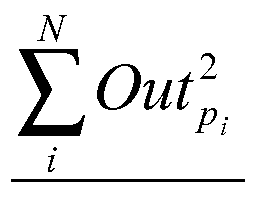
P^ =
M?
N
TestEnp = ^ Outp 2 .
And the class assigned to the processed record whose class is unknown is the one of the network that complies with the following Equations :
En = [TrainEnp - TestEnp f • ANN w κlinnnneerr = Min{ LEn p .\.
12. A machine as claimed in one or more of the preceding claims, characterized in that it is used for classification applications and particularly for intelligent pattern recognition.
13. A machine as claimed in claim 12 , characterized in that it is used in diagnostics, for classifying records comprising physiological, genetic, personal data of a patient.
14. A machine as claimed in claim 12, characterized in that it is used for analysis of digital diagnostic images, for intelligent recognition of qualities of tissues, represented by sets of pixels or areas of the diagnostic image.
15. A machine as claimed in one or more of the preceding claims 1 to 11, characterized in that it is used for determining a change of class and/or values of at least part of the values of the variables that form the input vector, in case of changes or perturbations imposed to the values of one or more of the variables that form an input vector relative to the original values whose class is known or has been determined.
16. A machine as claimed in claim 15, characterized in that it is used for simulating the effect of treatments and/or the effect of drugs , changes being imposed, corresponding to the physiological, chemical and/or biochemical effect of a drug or a treatment, to the variables that describe the physiological and/or chemical and/or biochemical conditions of a patient and are affected by said drug, with the other variables defined as relevant for the patient disease being left unchanged or undetermined, and the input vector formed by said variables being processed by said computational machine for determining a change of class and/or for assessing changes to the undetermined or unaffected variables that the network has calculated at its output.
17. A method of processing signals corresponding to values of variables descriptive of qualities or conditions of individuals or objects, implemented by the computational machine as claimed in one or more of the preceding claims 1 to 15, characterized by the steps of: generating a database of known cases, comprising a plurality of records , each composed of a plurality of variables , each of which variables describes a quality or a condition of an individual or element or object of a set of individuals, elements or objects, one or more qualities or operating conditions being known for each of such records, and being described by the values that may be assumed by one or more output or classification variables, also known as targets; determining the number of classes and grouping the data records belonging to the same class into data record subsets ; training an independent self-organizing neural network using each of said data subsets , to obtain a number of self-organizing neural networks corresponding to the number of classes, each of which has been trained using data records, i.e. input vectors belonging to one predetermined class, which is different for each of the networks ; determining, for each of said networks, a network performance parameter related to training, and determining an average training-related performance parameter, which is calculated as an average of the performance parameters of all the networks ; assigning a record of unknown class to one class, among the predetermined classes, which class is represented by the self-organizing neural network having the lowest difference between the average training-related performance parameter and the network performance parameter determined during processing of the record of unknown class, among all the networks provided and associated to the other classes.
18. A method as claimed in claim 17, characterized in that, assuming a record whose variables have predetermined values, and knowing the class to which it belongs , and hence the self-organizing neural network having the lowest difference between the average training-related performance parameter and the record processing-related performance parameter for the network, the values of one or more of the variables of said record are changed and/or the values of one or more other variables of said record are set to be changeable and/or the values of one or more other variables of said records are left undetermined, to generate a perturbed or changed record, and said perturbed or changed record is processed using the self-organizing neural network that represented the class of the original data record, to read at the output the changes in the output variables that correspond, in said self-organizing networks, to the input variables of said record.
19. A method as claimed in claim 18, characterized in that the perturbed record is processed using each of the self-organizing neural networks of the system, to determine the class of said record as the class represented by the self-organizing neural network exhibiting the lowest difference between the average training-related performance parameter and the perturbed record processing-related performance parameter, amongst all networks.
20. A method as claimed in one or more of claims 17 to 19, characterized in that it includes steps of optimization of the number of cycles of each network in a dedicated manner for each network and wherein said optimal number of cycles is determined using a genetic algorithm that processes the values of the weight matrix of each network and the performances of the corresponding network for each cycle .
21. A method as claimed in one or more of the preceding claims 17 to 20, characterized in that it is used for carrying out processes as claimed in one or more of claims 12 to 16.
Applications Claiming Priority (2)
| Application Number | Priority Date | Filing Date | Title |
|---|---|---|---|
| EP09425114.7 | 2009-03-20 | ||
| EP09425114 | 2009-03-20 |
Publications (1)
| Publication Number | Publication Date |
|---|---|
| WO2010105988A1 true WO2010105988A1 (en) | 2010-09-23 |
Family
ID=40872504
Family Applications (1)
| Application Number | Title | Priority Date | Filing Date |
|---|---|---|---|
| PCT/EP2010/053204 Ceased WO2010105988A1 (en) | 2009-03-20 | 2010-03-12 | Natural computational machine |
Country Status (1)
| Country | Link |
|---|---|
| WO (1) | WO2010105988A1 (en) |
Cited By (3)
| Publication number | Priority date | Publication date | Assignee | Title |
|---|---|---|---|---|
| CN112513901A (en) * | 2018-07-04 | 2021-03-16 | 索迈兹古鲁科穆萨维立吉股份公司 | Method for finding unique coordination system code from given text using artificial neural network and system for implementing the method |
| CN112805717A (en) * | 2018-09-21 | 2021-05-14 | 族谱网运营公司 | Ventral-dorsal neural network: object detection by selective attention |
| CN113841139A (en) * | 2019-05-10 | 2021-12-24 | 艾库拉医疗有限公司 | Classifier system and method for the distributed generation of classification models |
Citations (3)
| Publication number | Priority date | Publication date | Assignee | Title |
|---|---|---|---|---|
| US5239594A (en) * | 1991-02-12 | 1993-08-24 | Mitsubishi Denki Kabushiki Kaisha | Self-organizing pattern classification neural network system |
| EP1612708A1 (en) * | 2004-06-30 | 2006-01-04 | Bracco Imaging S.p.A. | Clinical trial phase simulation method and clinical trial phase simulator for drug trials |
| WO2007141325A1 (en) | 2006-06-09 | 2007-12-13 | Bracco Spa | Method of processing multichannel and multivariate signals and method of classifying sources of multichannel and multivariate signals operating according to such processing method |
-
2010
- 2010-03-12 WO PCT/EP2010/053204 patent/WO2010105988A1/en not_active Ceased
Patent Citations (3)
| Publication number | Priority date | Publication date | Assignee | Title |
|---|---|---|---|---|
| US5239594A (en) * | 1991-02-12 | 1993-08-24 | Mitsubishi Denki Kabushiki Kaisha | Self-organizing pattern classification neural network system |
| EP1612708A1 (en) * | 2004-06-30 | 2006-01-04 | Bracco Imaging S.p.A. | Clinical trial phase simulation method and clinical trial phase simulator for drug trials |
| WO2007141325A1 (en) | 2006-06-09 | 2007-12-13 | Bracco Spa | Method of processing multichannel and multivariate signals and method of classifying sources of multichannel and multivariate signals operating according to such processing method |
Non-Patent Citations (12)
Cited By (3)
| Publication number | Priority date | Publication date | Assignee | Title |
|---|---|---|---|---|
| CN112513901A (en) * | 2018-07-04 | 2021-03-16 | 索迈兹古鲁科穆萨维立吉股份公司 | Method for finding unique coordination system code from given text using artificial neural network and system for implementing the method |
| CN112805717A (en) * | 2018-09-21 | 2021-05-14 | 族谱网运营公司 | Ventral-dorsal neural network: object detection by selective attention |
| CN113841139A (en) * | 2019-05-10 | 2021-12-24 | 艾库拉医疗有限公司 | Classifier system and method for the distributed generation of classification models |
Similar Documents
| Publication | Publication Date | Title |
|---|---|---|
| EP0366804B1 (en) | Method of recognizing image structures | |
| Spratling et al. | Learning Image Components for Object Recognition. | |
| DK1534122T3 (en) | MEDICAL DECISION SUPPORTING SYSTEMS USING GENEPRESSION AND CLINICAL INFORMATION, AND METHOD OF USE | |
| Wang et al. | Evolving local plasticity rules for synergistic learning in echo state networks | |
| Sam et al. | Depression identification using EEG signals via a hybrid of LSTM and spiking neural networks | |
| Galić et al. | Application of neural networks and machine learning in image recognition | |
| Huk | Backpropagation generalized delta rule for the selective attention Sigma-if artificial neural network | |
| Veropoulos | Machine learning approaches to medical decision making | |
| Glimcher | Understanding the hows and whys of decision-making: from expected utility to divisive normalization | |
| Klyuchko | Application of artificial neural networks method in biotechnology | |
| Wang et al. | Understanding the relationship between human brain structure and function by predicting the structural connectivity from functional connectivity | |
| Kleinbub et al. | The phase space of meaning model of psychopathology: A computer simulation modelling study | |
| Khan et al. | A computational neural model for mapping degenerate neural architectures | |
| Park et al. | Spiking neural networks for physiological and speech signals: a review | |
| WO2010105988A1 (en) | Natural computational machine | |
| Depannemaecker et al. | Does deep learning have epileptic seizures? on the modeling of the brain | |
| Gurney | Neural networks for perceptual processing: from simulation tools to theories | |
| Carpenter et al. | ART neural networks for medical data analysis and fast distributed learning | |
| KR102727617B1 (en) | Method, device and system for providing user customized health care service based on health checkup through iris recognition | |
| Linkens et al. | Recognition of patient anaesthetic levels: neural network systems, principal components analysis, and canonical discriminant variates | |
| Maniadakis et al. | Modelling brain emergent behaviours through coevolution of neural agents | |
| Duch | Computational physics of the mind | |
| Wiemer et al. | Informatics United | |
| Shanthi et al. | Comparison of Neural Network Training Algorithms for the prediction of the patient's post-operative recovery area. | |
| del-Hoyo et al. | Supervised classification with associative SOM |
Legal Events
| Date | Code | Title | Description |
|---|---|---|---|
| 121 | Ep: the epo has been informed by wipo that ep was designated in this application |
Ref document number: 10710268 Country of ref document: EP Kind code of ref document: A1 |
|
| NENP | Non-entry into the national phase |
Ref country code: DE |
|
| 122 | Ep: pct application non-entry in european phase |
Ref document number: 10710268 Country of ref document: EP Kind code of ref document: A1 |