WO2010104933A1 - Inhibitors of akt activity - Google Patents
Inhibitors of akt activity Download PDFInfo
- Publication number
- WO2010104933A1 WO2010104933A1 PCT/US2010/026796 US2010026796W WO2010104933A1 WO 2010104933 A1 WO2010104933 A1 WO 2010104933A1 US 2010026796 W US2010026796 W US 2010026796W WO 2010104933 A1 WO2010104933 A1 WO 2010104933A1
- Authority
- WO
- WIPO (PCT)
- Prior art keywords
- phenyl
- methyl
- cyclopenta
- tetraaza
- cyclobutanol
- Prior art date
- Legal status (The legal status is an assumption and is not a legal conclusion. Google has not performed a legal analysis and makes no representation as to the accuracy of the status listed.)
- Ceased
Links
- 0 *C1(CCCCC1)N Chemical compound *C1(CCCCC1)N 0.000 description 26
- LXAHIRNAGNLEOU-UHFFFAOYSA-N Brc1ccc(C2CCC2)cc1 Chemical compound Brc1ccc(C2CCC2)cc1 LXAHIRNAGNLEOU-UHFFFAOYSA-N 0.000 description 1
- WCOQAGSGTMKNAK-UHFFFAOYSA-N C=[O]C(C1)CC1(c(cc1)ccc1Br)N(C(c1c2cccc1)=O)C2=O Chemical compound C=[O]C(C1)CC1(c(cc1)ccc1Br)N(C(c1c2cccc1)=O)C2=O WCOQAGSGTMKNAK-UHFFFAOYSA-N 0.000 description 1
- OXBAXCYLAYEVBL-UHFFFAOYSA-N CC(C)(C(C)(C)OC)OBc1ccc(C(C2)(CC2(C)N)[N+2](C(C2C=CC=CC22)=O)C2=O)cc1 Chemical compound CC(C)(C(C)(C)OC)OBc1ccc(C(C2)(CC2(C)N)[N+2](C(C2C=CC=CC22)=O)C2=O)cc1 OXBAXCYLAYEVBL-UHFFFAOYSA-N 0.000 description 1
- LNDRFRJOYUVHKC-UHFFFAOYSA-N CC(C)(C)OC(N(C)C1(CCC1)c1ccc(B2OC(C)(C)C(C)(C)O2)cc1)=O Chemical compound CC(C)(C)OC(N(C)C1(CCC1)c1ccc(B2OC(C)(C)C(C)(C)O2)cc1)=O LNDRFRJOYUVHKC-UHFFFAOYSA-N 0.000 description 1
- QKWIHSSYHDFFEP-UHFFFAOYSA-N CC(C)(C)OC(NC1(CCC1)c(cc1)ccc1-c(c(-c1ccccc1)c1)nc2c1cnc1cc(C)n[n]21)=O Chemical compound CC(C)(C)OC(NC1(CCC1)c(cc1)ccc1-c(c(-c1ccccc1)c1)nc2c1cnc1cc(C)n[n]21)=O QKWIHSSYHDFFEP-UHFFFAOYSA-N 0.000 description 1
- AZEPSZLRWNZXNR-UHFFFAOYSA-N CC(C)(C)c1n[n]2c(N)c(CO)cnc2c1 Chemical compound CC(C)(C)c1n[n]2c(N)c(CO)cnc2c1 AZEPSZLRWNZXNR-UHFFFAOYSA-N 0.000 description 1
- VWHSTVWQRGTOLX-UHFFFAOYSA-N CC(C)(C1)CC1(c(cc1)ccc1-c(c(-c(cccc1)c1F)c1)nc2c1cnc1cc(C)n[n]21)N Chemical compound CC(C)(C1)CC1(c(cc1)ccc1-c(c(-c(cccc1)c1F)c1)nc2c1cnc1cc(C)n[n]21)N VWHSTVWQRGTOLX-UHFFFAOYSA-N 0.000 description 1
- XVNWNMQAHRGUJF-UHFFFAOYSA-N CC(C)(C1)CC1(c(cc1)ccc1C1=NC(N2N=C(C)C#CC2N=C2)=C2C=C(c2ccccc2F)[I-]1)N(C(c1c2cccc1)=O)C2=O Chemical compound CC(C)(C1)CC1(c(cc1)ccc1C1=NC(N2N=C(C)C#CC2N=C2)=C2C=C(c2ccccc2F)[I-]1)N(C(c1c2cccc1)=O)C2=O XVNWNMQAHRGUJF-UHFFFAOYSA-N 0.000 description 1
- FHRVHUYZSALRGX-UHFFFAOYSA-N CC(C)CC(C)(C)C(CC1)=CC=C1c1nc([n]2nc(C)cc2nc2)c2c(Cl)c1-c1ccccc1 Chemical compound CC(C)CC(C)(C)C(CC1)=CC=C1c1nc([n]2nc(C)cc2nc2)c2c(Cl)c1-c1ccccc1 FHRVHUYZSALRGX-UHFFFAOYSA-N 0.000 description 1
- RRCBWHSAKRVFEJ-ZLLNPBCYSA-N CC(C1)C(C(C(C)(C2)c(cc3)ccc3C#C)=Nc3c2cnc2cc(C)n[n]32)=CC=C1C(C[C@@]1(C)O)C1/[O]=C(\N)/OC(C)(C)C Chemical compound CC(C1)C(C(C(C)(C2)c(cc3)ccc3C#C)=Nc3c2cnc2cc(C)n[n]32)=CC=C1C(C[C@@]1(C)O)C1/[O]=C(\N)/OC(C)(C)C RRCBWHSAKRVFEJ-ZLLNPBCYSA-N 0.000 description 1
- IHDGDDGMALHMTH-UHFFFAOYSA-N CC1(C)OB(c2ccc(C(C3)(CC3C=C)N(C(c3c4cccc3)=O)C4=O)cc2)OC1(C)C Chemical compound CC1(C)OB(c2ccc(C(C3)(CC3C=C)N(C(c3c4cccc3)=O)C4=O)cc2)OC1(C)C IHDGDDGMALHMTH-UHFFFAOYSA-N 0.000 description 1
- IYRSSGAWXKNDNK-UHFFFAOYSA-N CCC(CC)(C(N)=O)c(cc1)ccc1Br Chemical compound CCC(CC)(C(N)=O)c(cc1)ccc1Br IYRSSGAWXKNDNK-UHFFFAOYSA-N 0.000 description 1
- QHEFYIGMVCTIRL-OGESRWMOSA-N CC[C@](C)(C1)C[C@]1(c(cc1)ccc1-c(c(-c1ccccc1)c1)nc2c1cnc1cc(C)n[n]21)N Chemical compound CC[C@](C)(C1)C[C@]1(c(cc1)ccc1-c(c(-c1ccccc1)c1)nc2c1cnc1cc(C)n[n]21)N QHEFYIGMVCTIRL-OGESRWMOSA-N 0.000 description 1
- YLHXLHGIAMFFBU-UHFFFAOYSA-N COC(C(c1ccccc1)=O)=O Chemical compound COC(C(c1ccccc1)=O)=O YLHXLHGIAMFFBU-UHFFFAOYSA-N 0.000 description 1
- PYYHCBYNGHMCPG-WUASJOPPSA-N C[C@H](C1)C[C@@]1(c(cc1)ccc1C1=NC2[n]3nc(C(C)(C)C)cc3N=CC2C=C1C1C=CC=CC1F)N Chemical compound C[C@H](C1)C[C@@]1(c(cc1)ccc1C1=NC2[n]3nc(C(C)(C)C)cc3N=CC2C=C1C1C=CC=CC1F)N PYYHCBYNGHMCPG-WUASJOPPSA-N 0.000 description 1
- YNCAPYYEANNYEO-UHFFFAOYSA-N Cc(cc1)ccc1-c1n[n]2c(N)c(C=O)cnc2c1 Chemical compound Cc(cc1)ccc1-c1n[n]2c(N)c(C=O)cnc2c1 YNCAPYYEANNYEO-UHFFFAOYSA-N 0.000 description 1
- FNWMBEYIYWMADU-UHFFFAOYSA-N Cc(cc1nc2)n[n]1c(NC(Cc1ccccc1)=O)c2C(OC)=O Chemical compound Cc(cc1nc2)n[n]1c(NC(Cc1ccccc1)=O)c2C(OC)=O FNWMBEYIYWMADU-UHFFFAOYSA-N 0.000 description 1
- LFZXKTJALUNAMJ-UHFFFAOYSA-N Cc(cc1ncc2c3)n[n]1c2nc(-c1ccc(CN(CC2)CCC2C(NC2=CC(S(C)(=O)=O)=CCCC2)=O)cc1)c3-c1ccccc1 Chemical compound Cc(cc1ncc2c3)n[n]1c2nc(-c1ccc(CN(CC2)CCC2C(NC2=CC(S(C)(=O)=O)=CCCC2)=O)cc1)c3-c1ccccc1 LFZXKTJALUNAMJ-UHFFFAOYSA-N 0.000 description 1
- TWNBIAQBVWOIIZ-UHFFFAOYSA-N Cc(cc1ncc2c3)n[n]1c2nc(-c1ccc(CN(CC2)CCC2C(NCC2OCCC2)=O)cc1)c3C(CC1)=C2C3=C1C23 Chemical compound Cc(cc1ncc2c3)n[n]1c2nc(-c1ccc(CN(CC2)CCC2C(NCC2OCCC2)=O)cc1)c3C(CC1)=C2C3=C1C23 TWNBIAQBVWOIIZ-UHFFFAOYSA-N 0.000 description 1
- SQIYSCOUKSWPDP-UHFFFAOYSA-N Cc(cc1ncc2c3)n[n]1c2nc(C1=CCCC(CN(CC2)CCC2NC(Nc2ccncc2)=O)C=C1)c3-c1ccccc1 Chemical compound Cc(cc1ncc2c3)n[n]1c2nc(C1=CCCC(CN(CC2)CCC2NC(Nc2ccncc2)=O)C=C1)c3-c1ccccc1 SQIYSCOUKSWPDP-UHFFFAOYSA-N 0.000 description 1
- ALGQWEOMQJJILL-UHFFFAOYSA-N Cc1n[n](C(C(C=C2C3C=CC=CC3)C=N3)N=C2c(cc2)ccc2NC(N2CCOCC2)=O)c3c1 Chemical compound Cc1n[n](C(C(C=C2C3C=CC=CC3)C=N3)N=C2c(cc2)ccc2NC(N2CCOCC2)=O)c3c1 ALGQWEOMQJJILL-UHFFFAOYSA-N 0.000 description 1
- CSCMNZTYCHCBHK-UHFFFAOYSA-N Cc1n[n](C(C(C=C2c(cccc3)c3OC)C=N3)N=C2Cl)c3c1 Chemical compound Cc1n[n](C(C(C=C2c(cccc3)c3OC)C=N3)N=C2Cl)c3c1 CSCMNZTYCHCBHK-UHFFFAOYSA-N 0.000 description 1
- JPCGBZBOJJPEKA-UHFFFAOYSA-N Cc1n[n](C(C(C=C2c3ccccc3)C=N3)NC2=O)c3c1 Chemical compound Cc1n[n](C(C(C=C2c3ccccc3)C=N3)NC2=O)c3c1 JPCGBZBOJJPEKA-UHFFFAOYSA-N 0.000 description 1
- AQWXSRZGBATTPM-UHFFFAOYSA-N Cc1n[n]2c(nc(-c(cc3)ccc3N(CCO3)/C3=[O]\C)c(-c3ccccc3)c3)c3cnc2c1 Chemical compound Cc1n[n]2c(nc(-c(cc3)ccc3N(CCO3)/C3=[O]\C)c(-c3ccccc3)c3)c3cnc2c1 AQWXSRZGBATTPM-UHFFFAOYSA-N 0.000 description 1
- WDQZXKSGNJFGCD-UHFFFAOYSA-N Cc1n[n]2c(nc(-c(cc3)ccc3N)c(-c3ccccc3)c3)c3cnc2c1 Chemical compound Cc1n[n]2c(nc(-c(cc3)ccc3N)c(-c3ccccc3)c3)c3cnc2c1 WDQZXKSGNJFGCD-UHFFFAOYSA-N 0.000 description 1
- RFZOLUBJSJRBCL-UHFFFAOYSA-N Cc1n[n]2c(nc(-c3ccc(C=O)cc3)c(-c3ccccc3)c3)c3cnc2c1 Chemical compound Cc1n[n]2c(nc(-c3ccc(C=O)cc3)c(-c3ccccc3)c3)c3cnc2c1 RFZOLUBJSJRBCL-UHFFFAOYSA-N 0.000 description 1
- AKZGXEOSPBIJQR-UHFFFAOYSA-N Cc1n[n]2c(nc(-c3ccc(CN(CC4)CCC4(c4c5ccnc4)OC5=O)cc3)c(-c3ccccc3)c3)c3cnc2c1 Chemical compound Cc1n[n]2c(nc(-c3ccc(CN(CC4)CCC4(c4c5ccnc4)OC5=O)cc3)c(-c3ccccc3)c3)c3cnc2c1 AKZGXEOSPBIJQR-UHFFFAOYSA-N 0.000 description 1
- GMWTTYCEFGQJBY-UHFFFAOYSA-N Cc1n[n]2c(nc(-c3ccc(CN(CC4)CCC4C(Nc(cc4)ccc4O)=O)cc3)c(C3=CCCC=C3)c3)c3cnc2c1 Chemical compound Cc1n[n]2c(nc(-c3ccc(CN(CC4)CCC4C(Nc(cc4)ccc4O)=O)cc3)c(C3=CCCC=C3)c3)c3cnc2c1 GMWTTYCEFGQJBY-UHFFFAOYSA-N 0.000 description 1
- YZPNAPMRTRPZHX-UHFFFAOYSA-N Cc1n[n]2c(nc(-c3ccc(CN(CC4)CCC4C(Nc4cccc(C#N)c4)=O)cc3)c(-c3ccccc3)c3)c3cnc2c1 Chemical compound Cc1n[n]2c(nc(-c3ccc(CN(CC4)CCC4C(Nc4cccc(C#N)c4)=O)cc3)c(-c3ccccc3)c3)c3cnc2c1 YZPNAPMRTRPZHX-UHFFFAOYSA-N 0.000 description 1
- ILZONRSZKQLSAR-UHFFFAOYSA-N Cc1n[n]2c(nc(-c3ccc(CN(CC4)CCC4N)cc3)c(-c3ccccc3)c3)c3cnc2c1 Chemical compound Cc1n[n]2c(nc(-c3ccc(CN(CC4)CCC4N)cc3)c(-c3ccccc3)c3)c3cnc2c1 ILZONRSZKQLSAR-UHFFFAOYSA-N 0.000 description 1
- PUPIZGUXYBQBDK-UHFFFAOYSA-N Cc1n[n]2c(nc(-c3ccc(CN(CC4)CCC4c4nnc(-c5ncccn5)[nH]4)cc3)c(-c3ccccc3)c3)c3c[n-]c2c1 Chemical compound Cc1n[n]2c(nc(-c3ccc(CN(CC4)CCC4c4nnc(-c5ncccn5)[nH]4)cc3)c(-c3ccccc3)c3)c3c[n-]c2c1 PUPIZGUXYBQBDK-UHFFFAOYSA-N 0.000 description 1
- CHOPKUMXBDDLQJ-UHFFFAOYSA-N Cc1n[n]2c(nc(-c3ccc(CN4CCN(Cc5ccc6OCOc6c5)CC4)cc3)c(-c3ccccc3)c3)c3cnc2c1 Chemical compound Cc1n[n]2c(nc(-c3ccc(CN4CCN(Cc5ccc6OCOc6c5)CC4)cc3)c(-c3ccccc3)c3)c3cnc2c1 CHOPKUMXBDDLQJ-UHFFFAOYSA-N 0.000 description 1
- WXTMEGRKIRSIBP-UHFFFAOYSA-N Cc1n[n]2c(nc(c(-c(cc3)ccc3OC)c3)Cl)c3cnc2c1 Chemical compound Cc1n[n]2c(nc(c(-c(cc3)ccc3OC)c3)Cl)c3cnc2c1 WXTMEGRKIRSIBP-UHFFFAOYSA-N 0.000 description 1
- VVQRNRMAOPCADW-UHFFFAOYSA-N Cc1n[n]2c(nc(c(-c3ccccc3)c3)Cl)c3cnc2c1-c1cccnc1 Chemical compound Cc1n[n]2c(nc(c(-c3ccccc3)c3)Cl)c3cnc2c1-c1cccnc1 VVQRNRMAOPCADW-UHFFFAOYSA-N 0.000 description 1
- BPXVAQMXMOFECT-UHFFFAOYSA-N Clc(c(-c1ccccc1)c1)nc2c1cnc1ccn[n]21 Chemical compound Clc(c(-c1ccccc1)c1)nc2c1cnc1ccn[n]21 BPXVAQMXMOFECT-UHFFFAOYSA-N 0.000 description 1
- IUYSRJVLAHWHLK-UHFFFAOYSA-N FC(c(cc1)ncc1-c1nnc(C2CCNCC2)[nH]1)(F)F Chemical compound FC(c(cc1)ncc1-c1nnc(C2CCNCC2)[nH]1)(F)F IUYSRJVLAHWHLK-UHFFFAOYSA-N 0.000 description 1
- DPZNEERUIGIXRO-UHFFFAOYSA-N NC(C(CO)C=Nc1c2)[n]1nc2-c1ccncc1 Chemical compound NC(C(CO)C=Nc1c2)[n]1nc2-c1ccncc1 DPZNEERUIGIXRO-UHFFFAOYSA-N 0.000 description 1
- NDFNMLREMZPWNY-QVYRIUEQSA-N N[C@](C1)(C[C@]1(C1CC1)N=O)c(cc1)ccc1-c(c(-c1ccccc1)c1)nc2c1cnc1cc(C(F)(F)F)n[n]21 Chemical compound N[C@](C1)(C[C@]1(C1CC1)N=O)c(cc1)ccc1-c(c(-c1ccccc1)c1)nc2c1cnc1cc(C(F)(F)F)n[n]21 NDFNMLREMZPWNY-QVYRIUEQSA-N 0.000 description 1
- GYVONPLTIMDKOB-UHFFFAOYSA-N Nc1c(C=O)cnc2cc(-c(cc3)ccc3F)n[n]12 Chemical compound Nc1c(C=O)cnc2cc(-c(cc3)ccc3F)n[n]12 GYVONPLTIMDKOB-UHFFFAOYSA-N 0.000 description 1
- ZCFBHBIOIMYNNE-UHFFFAOYSA-N Nc1c(C=O)cnc2cc(C3CC3)n[n]12 Chemical compound Nc1c(C=O)cnc2cc(C3CC3)n[n]12 ZCFBHBIOIMYNNE-UHFFFAOYSA-N 0.000 description 1
- VNTXNWHXLLZQTE-UHFFFAOYSA-N O=C(C(c1ccc[s]1)=C1)Nc2c1cnc1ccn[n]21 Chemical compound O=C(C(c1ccc[s]1)=C1)Nc2c1cnc1ccn[n]21 VNTXNWHXLLZQTE-UHFFFAOYSA-N 0.000 description 1
- IETJISMKGVULRB-UHFFFAOYSA-N O=C(C1)CC1(c(cc1)ccc1I)N(C(c1c2cccc1)=O)C2=O Chemical compound O=C(C1)CC1(c(cc1)ccc1I)N(C(c1c2cccc1)=O)C2=O IETJISMKGVULRB-UHFFFAOYSA-N 0.000 description 1
- FOQRHYVNXUDNKL-UHFFFAOYSA-N O=C(C1)CC1c(cc1)ccc1Br Chemical compound O=C(C1)CC1c(cc1)ccc1Br FOQRHYVNXUDNKL-UHFFFAOYSA-N 0.000 description 1
- JCASXVUKYZGUPC-UHFFFAOYSA-N O=C(c1ccccc11)N(C2(CCC2)c(cc2)ccc2Br)C1=O Chemical compound O=C(c1ccccc11)N(C2(CCC2)c(cc2)ccc2Br)C1=O JCASXVUKYZGUPC-UHFFFAOYSA-N 0.000 description 1
Classifications
-
- C—CHEMISTRY; METALLURGY
- C07—ORGANIC CHEMISTRY
- C07D—HETEROCYCLIC COMPOUNDS
- C07D471/00—Heterocyclic compounds containing nitrogen atoms as the only ring hetero atoms in the condensed system, at least one ring being a six-membered ring with one nitrogen atom, not provided for by groups C07D451/00 - C07D463/00
- C07D471/12—Heterocyclic compounds containing nitrogen atoms as the only ring hetero atoms in the condensed system, at least one ring being a six-membered ring with one nitrogen atom, not provided for by groups C07D451/00 - C07D463/00 in which the condensed system contains three hetero rings
- C07D471/14—Ortho-condensed systems
-
- A—HUMAN NECESSITIES
- A61—MEDICAL OR VETERINARY SCIENCE; HYGIENE
- A61P—SPECIFIC THERAPEUTIC ACTIVITY OF CHEMICAL COMPOUNDS OR MEDICINAL PREPARATIONS
- A61P35/00—Antineoplastic agents
-
- C—CHEMISTRY; METALLURGY
- C07—ORGANIC CHEMISTRY
- C07D—HETEROCYCLIC COMPOUNDS
- C07D487/00—Heterocyclic compounds containing nitrogen atoms as the only ring hetero atoms in the condensed system, not provided for by groups C07D451/00 - C07D477/00
- C07D487/12—Heterocyclic compounds containing nitrogen atoms as the only ring hetero atoms in the condensed system, not provided for by groups C07D451/00 - C07D477/00 in which the condensed system contains three hetero rings
- C07D487/14—Ortho-condensed systems
-
- C—CHEMISTRY; METALLURGY
- C07—ORGANIC CHEMISTRY
- C07D—HETEROCYCLIC COMPOUNDS
- C07D519/00—Heterocyclic compounds containing more than one system of two or more relevant hetero rings condensed among themselves or condensed with a common carbocyclic ring system not provided for in groups C07D453/00 or C07D455/00
Definitions
- the present invention relates to substituted naphthyridine compounds which are inhibitors of the activity of one or more of the isoforms of the serine/threonine kinase, Akt (also known as PKB; hereinafter referred to as "Akt").
- Akt serine/threonine kinase
- the present invention also relates to pharmaceutical compositions comprising such compounds and methods of using the instant compounds in the treatment of cancer.
- Apoptosis (programmed cell death) plays essential roles in embryonic development and pathogenesis of various diseases, such as degenerative neuronal diseases, cardiovascular diseases and cancer. Recent work has led to the identification of various pro- and anti-apoptotic gene products that are involved in the regulation or execution of programmed cell death.
- anti-apoptotic genes such as Bcl2 or Bcl-xL
- pro-apoptotic genes such as Bax or Bad
- the execution of programmed cell death is mediated by caspase-1 related proteinases, including caspase-3, cas ⁇ ase-7, cas ⁇ ase-8 and caspase-9 etc (Thornberry et al. Science, 281 :1312-1316 (1998)).
- PDK phosphatidylinositol 3'-OH kinase
- Akt phosphatidylinositol 3'-OH kinase
- PDGF platelet derived growth factor
- NEF nerve growth factor
- IGF-I insulin-like growth factor- 1
- Activated PI3K leads to the production of phosphatidylinositol (3,4,5)-triphosphate (PtdIns(3,4,5)-P3), which in turn binds to, and promotes the activation of, the serine/threonine kinase Akt, which contains a pleckstrin homology (PH)-domain (Franke et al Cell, 81:727-736 (1995); Hemmings Science, 277:534 (1997); Downward, Curr. Opin. Cell Biol 10:262-267 (1998), Alessi et al., EMBO J 15: 6541- 6551 (1996)).
- PtdIns(3,4,5)-P3 phosphatidylinositol (3,4,5)-triphosphate
- PI3K or dominant negative Akt mutants abolish survival-promoting activities of these growth factors or cytokines. It has been previously disclosed that inhibitors of PI3K (LY294002 or wortmannin) blocked the activation of Akt by upstream kinases. In addition, introduction of constitutively active PI3K or Akt mutants promotes cell survival under conditions in which cells normally undergo apoptotic cell death (Kulik et al. 1997, Dudek et al. 1997).
- Aktl/ PKB ⁇ Three members of the Akt subfamily of second-messenger regulated serine/threonine protein kinases have been identified and termed Aktl/ PKB ⁇ , Akt2/PKB ⁇ , and
- Akt3/PKB ⁇ (hereinafter referred to as "Aktl”, “Akt2” and “Akt3"), respectively.
- the isoforms are homologous, particularly in regions encoding the catalytic domains.
- Akts are activated by phosphorylation events occurring in response to PBK signaling.
- PI3K phosphory ⁇ ates membrane inositol phospholipids, generating the second messengers phosphatidyl-inositol 3,4,5-trisphos- phate and phosphatidylinositol 3,4-bisphosphate, which have been shown to bind to the PH domain of Akt.
- Akt activation proposes recruitment of the enzyme to the membrane by 3'-phosphorylated phosphoinositides, where phosphorylation of the regulatory sites of Akt by the upstream kinases occurs (B.A. Hemmings, Science 275:628-630 (1997); B.A. Hemmings, Science 276:534 (1997); J. Downward, Science 279:673-674 (1998)).
- Phosphorylation of AMI occurs on two regulatory sites, Thr 308 in the catalytic domain activation loop and on Ser 473 near the carboxy terminus (D. R. Alessi et al. EMBO J. 15:6541-6551 (1996) and R. Meier et al J. Biol. Chem. 272:30491-30497 (1997)).
- Equivalent regulatory phosphorylation sites occur in Akt2 and Akt3.
- the upstream kinase, which phosphorylates Akt at the activation loop site has been cloned and termed 3'-phosphoinositide - dependent protein kinase 1 (PDKl).
- PDKl phosphorylates not only Akt, but also p70 ribosomal S6 kinase, p90RSK, serum and glucocorticoid-regulated kinase (SGK), and protein kinase C.
- DNA-PK DNA-dependent protein kinase
- Akt3 was found to be overexpressed in breast and prostate cancer cell lines (Nakatani et al. J. Biol. Chem. 274:21528-21532 (1999).
- the tumor suppressor PTEN a protein and lipid phosphatase that specifically removes the 3' phosphate of Ptdlns(3,4,5)-P3, is a negative regulator of the PD K/ Akt pathway (Li et al. Science 275:1943-1947 (1997), Stambolic et al. Cell 95:29-39 (1998), Sun et al. Proc. Natl. Acad. Sci. U.S.A. 96:6199-6204 (1999)).
- Germl ⁇ ne mutations of PTEN are responsible for human cancer syndromes such as Cowden disease (Liaw et al. Nature Genetics 16:64-67 (1997)).
- PTEN is deleted in a large percentage of human tumors and tumor cell lines without functional PTEN show elevated levels of activated Akt (Li et al. supra, Guldberg et al. Cancer Research 57:3660-3663 (1997), Risinger et al. Cancer Research 57:4736-4738 (1997)).
- Akt Akt activation and activity
- inhibitors such as LY294002 and wortmannin.
- PDK inhibition has the potential to indiscriminately affect not just all three Akt isozymes but also other PH domain-containing signaling molecules that are dependent on Pdtlns(3,4,5)-P3, such as the Tec family of tyrosine kinases.
- Akt can be activated by growth signals that are independent of PI3K.
- Akt activity can be inhibited by blocking the activity of the upstream kinase PDKl.
- No specific PDKl inhibitors have been disclosed. Again, inhibition of PDKl would result in inhibition of multiple protein kinases whose activities depend on PDKl, such as atypical PKC isoforms, SGK, and S6 kinases (Williams et al. Curr, Biol. 10:439-448 (2000).
- Aktl is sufficient to inhibit tumorigenesis in several genetically modified mice tumor models, such as PTEN+/- model as prostate tumors (M. L. Chen et al. Genes & Dev. 20:1569-1574 (2006)), MMTV-ErbB2/Nue and MMTV- polyoma middle T transgenic mice as breast tumor models (I. G. Maroulakou et al. Cancer Res. 67: 167-177 (2007)).
- mice lacking the Akt2 showed diabetes mellitus-like syndrome by the impairment in the ability of insulin to lower blood glucose (J. L. Thorvaldsen et al. Science. 292: 1728-1731 (2001) and R. S. Garofalo et al. J. Clin. Invest. 112:197-208 (2003)) .
- Inhibitors of Akt are known. WO2005/ 100344; WO2005/100356;
- the compounds disclosed in these patent applications contain mono-, bi- and tri-cyclic core moieties.
- Akt inhibitors substituted with a methyl amine moiety are known. WO2006/135627; WO2008/070041; WO2008/070016; WO2008/070134; WO2009/148887; and WO2009/148916.
- Specific Akt inhibitors which contain a tri-cyclic core moiety are disclosed in
- the compounds of the instant invention contain a unique tri-cyclic core moiety which has not been previously disclosed.
- compositions that comprise the novel compounds that are inhibitors of Akt.
- the instant invention provides for fused naphthyridine derivatives that inhibit Akt activity.
- the compounds disclosed selectively inhibit one or two of the Akt isoforms.
- the invention also provides for compositions comprising such inhibitory compounds and methods of inhibiting Akt activity by administering the compound to a patient in need of treatment of cancer.
- the compounds of the instant invention are useful in the inhibition of the activity of the serine/threonine kinase Akt
- the inhibitors of Akt activity are illustrated by the Formula A:
- E, F, G, H, I, J, K, L and M are independently selected from: C or N, wherein each E, F, G, H, I, J, K, L and M is optionally substituted with R 1 ; a is 0 or 1; b is 0 or 1; m is 0, 1 or 2; p is independently 0, 1, 2, 3, 4 or 5; Ring Z is selected from: (C3-C8)cycloalkyl, aryl, and heterocyclyl;
- N(Rb) 2 ; R? and R8 are independently selected from: H, (00) a Ob(Cl-C 10 )alkyI,
- R a is (C 1 -C6)alkyl, (C3-Co ⁇ )cycloalkyl, ary ⁇ , or heterocyclyl, said alkyl, cycloalkyl, aryl, and heterocyclyl is optionally substituted with one or more substituents selected from RC;
- Re is independently: H, or (C ⁇ C ⁇ )a ⁇ kyl
- Rx and Ry are independently selected from: H, (C 1 -C6)alkyl, (C 2 -C6)alkenyl, and (C 2 -C6)alkynyl, wherein said alkyl is optionally substituted with up to three substituents selected from: OH and halo, or Rx and RY can be taken together to form a monocyclic or bicyclic carbo- or heterocycle with 3-7 members in each ring, said heteroej ⁇ le is containing one or more heteroatoms selected from N, O and S, and said carbo- or heterocycle is optionally substituted with one or more substituents selected from: (C 1 -C ⁇ a&yl (C 2 -C6)alkenyl, (C3-C6)cycloalkyl, (C 1 -C6)alkylidene, (C 1 -C6)alkoxy, CO2H, halo, OH, oxo, CN and NR7R8, said alkyl, cycloalkyl and al
- Bond - ⁇ -- is a single or double bond, provided that when each Rl, Rl', Rl" and Rl 1 " is oxo, then said bond adjacent to the oxo is a single bond and C or N which is attached to the resulting carbonyl with said single bond bears H; and all other substituents and variables are as defined in the first embodiment; or a pharmaceutically acceptable salt, stereoisomer or N-oxide derivative thereof.
- p 0, 1 or 2; is selected from:
- Ring X is a monocyclic, bicycHc or tricyclic heterocycle with 3-7 members in each ring and optionally containing, in addition to the nitrogen, one or two additional heteroatoms selected from N, O and S, said monocyclic, bicyc ⁇ ic or tricyclic heterocycle optionally substituted with one or more substituents selected from R.6a;
- Ring Y is a monocyclic or bicyclic carbo- or heterocycle with 3-7 members in each ring, said heterocycle is containing one or more heteroatoms selected from N, O and S, and said carbo- or heterocycle is optionally substituted with one or more substituents selected from: (C 1 -C6)alkyl, (C 2 -C6)alkenyl, (C3-C6)cycloalkyl, (C 1 -C6)alkylidene, (C 1 -C6)alkoxy, CO2H, halo, OH, 0x0, CN and NR7'R8', said alkyl, cycIoaBcyl and alkoxy is optionally substituted with one or more substituents selected from halo, CN, OH and NR7'R8'; Ring Z is selected from: phenyl, 2-thienyl and 3-thienyl;
- R2 is independently selected from: (C 1 -C6)alkyl, (Gi-C6)alkoxy, CO2H, halo,
- R7 r and R8' are independently selected from: H, and (C ⁇ -C ⁇ aBsyl;
- R a is (Ci ⁇ Q;)alkyl, (C3-C6)cycloalkyl ⁇ aryl, or heterocyclyl, said alkyl, cycloalkyl, aryl, and heterocyclyl is optionally substituted with one or more substituents selected from RC;
- Rd is independently: H, or (C 1 -C6)alkyl; and all other substituents and variables are as defined in the second embodiment; or a pharmaceutically acceptable salt, stereoisomer or N-oxide derivative thereof.
- I is selected from: CH or N; a is 0 or l; b is O or 1; Ring X is selected from:
- R a is (C 1 -C6)alkyl, (C3-C6)cycloalkyl, aryl, or heterocyclyl, said alkyl, cycloalkyl, aryl, and heter ⁇ cyclyl is optionally substituted with one or more substituents selected from RC;
- Rd is independently: H, or (C 1 -C6)alkyl
- Bond is a single or double bond, provided that when Rl is oxo, then said bond is a single bond and adjacent N bears H; or a pharmaceutically acceptable salt, stereoisomer or N-oxide derivative thereof.
- Ring Y is a group of formula:
- R7 and R8 are independently selected from: H, and (C 1 -C ⁇ j)alkyl;
- Rl 1 and Rl2 are independently selected from: H, (C 1 -C6)alkyl, (C 2 - C6)alkenyl, (C3-C6)cycloalkyl, (C 1 -C6)alkoxy, CO2H, halo, OH, CN and NR7R8, said alkyl, cycloalky
- Bond J 5 a single or double bond, provided that when Rl is oxo, then said bond is a single bond and adjacent N bears H; or a pharmaceutically acceptable salt, stereoisomer or N-oxide derivative thereof.
- a is O or l
- b is O or l
- Ring Y is a group of formula:
- R7 and R8 are independently selected from: H, and (C 1 -C6)alkyl, or R7 and R8 can be taken together with the nitrogen to which they are attached to form a monocyclic heterocycle with 3-7 members and optionally containing, in addition to the nitrogen, one or two additional heteroatoms selected from N, O and S;
- RlI and Rl2 are independently selected from: H, (C 1 -C6)alkyl, (C 2 - C6)alkenyl, (C3-C6)cycloalkyl, (C 1 -C6)alkoxy, CO2H, halo, OH, CN and NR7R8, said alkyl, cycloalkyl and alkoxy is optionally substituted with one or more substituents selected from halo, CN, OH and NR 7 R8, or Rl 1 and R* 2 can be taken together to form oxo, (C 1 -C6)alkylidene, or a monocyclic carbo- or heterocycle with 3-7 members, said heterocycle is containing one or more heteroatoms selected from N, O and S; and
- Bond - ⁇ -- ⁇ is a single or double bond, provided that when Rl is oxo, then said bond is a single bond and adjacent N bears H; or a pharmaceutically acceptable salt, stereoisomer or N-oxide derivative thereof.
- Specific compounds of the instant invention include: fr ⁇ w ⁇ 3-amrao-1-raethyl-3-[4-(2-me& ⁇ yl)phenyl]cyclobutanol (1-7); cis-3-ammo-1-metayl-3-[4-(2-me ⁇ y ⁇ yl)phenyl]cyclobutanol (1-5); trans-3-ammo-1-cyclopro ⁇ yl-3-[4-(2-me ⁇ yl)phenyl]cyclobutanol (1-9); t ⁇ ns-3-ammo-3-[4-(2-me1%l-7-phenylpy ⁇ yl)phenyl]cyclobutanol (1-1 ff); trans-3-methoxy- l-[4-(2-methyl-7-phenyl ⁇ yrazolo[l ,5-a3pyrido[3 ⁇ -e]pyrimidin-8- yl)phenyl]cyclobutanarnine (1-11); methyl
- Specific compounds of the invention include: fr ⁇ «5-3-Arnino-1-cyclopropyl-3-[4-(2-methyl-7 ⁇ phenyl-1,4 t 9,9b-tetraaza- cyclopenta[ ⁇ f]naphthaIen-8-yl)-phenyl]-cyclobutanol; l-[4-(2-methyl-7-phenyl-1,4,9.9b-tetraaza-cyclopenta[ ⁇ ]naphthalen-8-yl)-phenyl]- cyclobutylamine;
- Morpholine-4-carboxylic acid [4-(2-methyl-7-phenyl-l ⁇ b-tetraaza-cyclopental ⁇ jnaplithalen-
- the compounds of the present invention may have asymmetric centers, chiral axes, and chiral planes (as described in: E.L. EHeI and S.H. Wilen, Stereochemistry of Carbon
- This invention is also intended to encompass pro-drugs of the compounds disclosed herein.
- a prodrug of any of the compounds can be made using well known pharmacological techniques.
- any variable e.g. R?, etc.
- its definition on each occurrence is independent at every other occurrence.
- combinations of substituents and variables are permissible only if such combinations result in stable compounds.
- Lines drawn into the ring systems from substituents represent that the indicated bond may be attached to any of the substitutable ring atoms. If the ring system is bicyclic, it is intended that the bond be attached to any of the suitable atoms on either ring of the bicyclic moiety.
- one or more silicon (Si) atoms can be incorporated into the compounds of the instant invention in place of one or more carbon atoms by one of ordinary skill in the art to provide compounds that are chemically stable and that can be readily synthesized by techniques known in the art from readily available starting materials.
- Carbon and silicon differ in their covalent radius leading to differences in bond distance and the steric arrangement when comparing analogous C-element and Si-element bonds. These differences lead to subtle changes in the size and shape of silicon-containing compounds when compared to carbon.
- size and shape differences can lead to subtle or dramatic changes in potency, solubility, lack of off target activity, packaging properties, and so on.
- substituents and substitution patterns on the compounds of the instant invention can be selected by one of ordinary skill in the art to provide compounds that are chemically stable and that can be readily synthesized by techniques known in the art, as well as those methods set forth below, from readily available starting materials. If a substituent is itself substituted with more than one group, it is understood that these multiple groups may be on the same carbon or on different carbons, so long as a stable structure results.
- the phrase "optionally substituted with one or more substituents” should be taken to be equivalent to the phrase “optionally substituted with at least one substituent” and in such cases the preferred embodiment will have from zero to four substituents, and the more preferred embodiment will have from zero to three substituents.
- alkyl is intended to include both branched and straight-chain saturated aliphatic hydrocarbon groups having the specified number of carbon atoms.
- C 1 -CiO, as in “(C 1 -C 10 )alkyl” is defined to include groups having 1, 2, 3, 4, 5, 6, 7, 8, 9 or 10 carbons in a linear or branched arrangement.
- (C 1 -C 10 )alkyl specifically includes methyl, ethyl, ⁇ -propyl, f-propyl, «-butyl, *-butyl, ⁇ -butyl, pentyl, hexyl, heptyl, octyl, nonyL, decyl, and so on.
- cycloalkyl means a monocyclic saturated aliphatic hydrocarbon group having the specified number of carbon atoms.
- cycloalkyl includes cyclopropyl, methyl-cyclopropyl, 2 f 2-dimethyl-cyclobutyl, 2-ethyl-cyclopentyl,, cyclohexyl, and so on.
- Alkoxy represents either a cyclic or non-cyclic alkyl group of indicated number of carbon atoms attached through an oxygen bridge. "Alkoxy” therefore encompasses the definitions of alkyl and cycloalkyl above.
- alkylidene'' refers to both branched and straight-chain divalent hydrocarbon groups having the specified number of carbon atoms.
- alkylidene includes methylene, ethylidene, «-propylidene, z-propylidene, w-butylidene, r-butylidene, i- butylidene, pentylidene, hexylidene, and so on.
- alkenyl refers to a non- aromatic hydrocarbon radical, straight, branched or cyclic, containing from 2 to 10 carbon atoms and at least one carbon to carbon double bond. Preferably one carbon to carbon double bond is present, and up to four non-aromatic carbon-carbon double bonds may be present.
- (C 2 - C 10 )alkenyi means an alkenyl radical having from 2 to 10 carbon atoms.
- Alkenyl groups include ethenyl, propenyl, butenyl, 2-methylbutenyl and cyclohexenyl.
- alkenyl group may contain double bonds and may be substituted if a substituted alkenyl group is indicated.
- alkynyl refers to a hydrocarbon radical straight, branched or cyclic, containing from 2 to 10 carbon atoms and at least one carbon to carbon triple bond. Up to three carbon-carbon triple bonds may be present Thus, "(C 2 -C 10 )alkynyl” means an alkynyl radical having from 2 to 10 carbon atoms.
- Alkynyl groups include ethynyl, propynyl, butynyl, 3- methylbutynyl and so on.
- the straight, branched or cyclic portion of the alkynyl group may contain triple bonds and may be substituted if a substituted alkynyl group is indicated.
- substituents may be defined with a range of carbons that includes zero, such as (Co-C6)alkylene-aryl. If aryl is taken to be phenyl, this definition would include phenyl itself as well as -ClfePh, -CH2CH2PI1, CH(CH3)CH2CH(CH3)Ph, and so on.
- aryl is intended to mean any stable monocyclic or bicyclic carbon ring of up to 7 atoms in each ring, wherein at least one ring is aromatic. Examples of such aryl elements include phenyl, naphthyl, tetrahydro-naphthyl, indanyl and biphenyl. In cases where the aryl substituent is bicyclic and one ring is non-aromatic, it is understood that attachment is via the aromatic ring.
- Carbocycle or “carbocyclyl” is intended to mean any stable saturated or unsaturated aliphatic monocyclic or bicyclic hydrocarbon group with 3-7 members in each ring.
- Carbocyclyl therefore includes the above mentioned cycloalkyls, as well as spiro- condensed bicyclic ring.
- Further examples of “carbocyclyl” include, but are not limited to the following: cyclopropyl, methyl-cyclopropyl, cyclobutyl, 2,2-dimethyl-cyclobutyl, 2-ethyl- cyclopentyl, cyclohexyl, or the group selected from: and so on.
- heteroaryl represents a stable monocyclic or bicyclic ring of up to 7 atoms in each ring, wherein at least one ring is aromatic and contains from 1 to 4 heteroatoms selected from the group consisting of O, N and S.
- Heteroaryl groups within the scope of this definition include but are not limited to: acridinyl, carbazolyl, cinnolinyl, quinoxalinyl, pyrazolyl, indolyl, benzotriazolyl, furanyl, thienyl, benzotbienyl, benzofuranyl, quinolinyl, isoquinolinyl, oxazolyl, isoxazolyl, indolyl, pyrazinyl, pyridazinyl. pyridinyl, pyrimidinyl. pyrrolyl, tetrahydroquinoline.
- heteroaryl is also understood to include the N-oxide derivative of any nitrogen-containing heteroaryl.
- heteroaryl substituent is bicyclic and one ring is non-aromatic or contains no heteroatoms, it is understood that attachment is via the aromatic ring or via the heteroatom ⁇ x>ntaining ring, respectively.
- heteroaryl moieties for substituent Q include but are not limited to: 2-benzimidazolyl, 2-quinolinyl, 3-quinolinyl, 4-quinoHnyl, 1 -isoquinolinyl, 3- isoquinolinyl and 4-isoquinolinyL
- heterocycle or “heterocyclyP as used herein is intended to mean a 3- to 10-membered aromatic or non-aromatic heterocycle containing from 1 to 4 heteroatoms selected from the group consisting of O, N and S, and includes bicyclic or tricyclic groups. ' ⁇ eterocyclyl” therefore includes the above mentioned heteroaryls, as well as dihydro and tetrahydro analogs thereof.
- heterocyclyl include, but are not limited to the following: benzoimidazolyl, benzoimidazolonyl, benzofuranyl, benzofurazanyl, benzopyrazolyl, benzotriazolyl, benzothiophenyl, benzoxazolyi, carbazolyl, carbolinyl, cinnolinyl, furanyl, imidazolyl, indolinyl, indolyl, indolazinyl, indazolyl, isobenzofuranyl, isoindolyl, isoquinolyl, isothiazolylj, isoxazolyl, naphthpyridinyl, oxadiazolyl, oxazolyl, oxazoline, isoxazoline, oxetanyl, pyranyl, pyrazinyl, pyrazolyl, pyridazinyl, pyridopyridinyl,
- Attachment of a heterocyclyl substituent can occur via a carbon atom or via a heteroatom.
- Rx and Ry in the Formula A are taken together to form a tricyclic heterocycle, the examples of the heterocyclyl include, but are not limited to the group selected from:
- X ⁇ NR 7 R 8 in Formula A and B are taken together to form a tricyclic heterocycle
- the examples of the heterocyclyl include, but are not limited to the group selected from:
- halo or halogen as used herein is intended to include chloro (Cl), fluoro (F), bromo (Br) and iodo (I).
- Cl chloro
- F fluoro
- Br bromo
- I iodo
- R 1- In another embodiment of Formula A and B, the moiety illustrated by the fo ⁇ nula:
- H ⁇ includes the following structures:
- Ring Z is selected from: phenyl and heterocyclyl.
- Ring Z is selected from:
- Ring Z is selected from: phenyl, 2-raienyl, 3-pyridyl, 4- pyridyl and 3-tbienyl
- Ring Z is phenyl
- Ring Z is phenyl
- Ring Z is selected from: 2-thienyl and 3- thienyl.
- p is independently 0, 1, 2 or 3.
- p is independently 0, 1 or 2.
- p is independently 1.
- R.2 is selected from: H and halogen.
- R? is selected from: H and F.
- Rl is H.
- Rl, Rl', Rl" and Rl 1 " are H.
- Rl and Rl ' are H.
- Rl" 1 is H;
- Rl " is selected from: (Ci -C6)alkyl and halo; and Rl" 1 is H.
- Rl is H;
- Rl" is H; and Rl'" is selected from: (C 1 -
- Rl is methyl or raorpholinyl.
- Rl is selected from: methyl, ethyl, trifluoromethyl, tert-butyl, phenyl optionally substituted with halo preferably fluoro, and cyclopropyl; and Rl' is selected from: H, methyl, phenyl optionally substituted with Ob(C ⁇ - Cg)alkyl, halo preferably bromo or chloro, CN and pyridyl, and b is O or 1.
- Rl is selected from: OH 8 NH2, cyclopropyl and pyrimidinyl.
- a Ob(C 1 -Cl ⁇ )alkyl for Rl, Rl', Rl" or Rl'" is methyl or ethyl, preferably methyl.
- a Ob(C 1 -Cl ⁇ )alkyI for Rl is tert-butyl.
- heterocyclyl itself in the group of (CO)aOb-heterocyclyl for Rl, Rl 1 , Rl" or Rl'" is morpholinyl, imidazolyl, pyridyl, or pyrimidmyl; a is 0; and b is 0.
- R? and R8 are taken together with the nitrogen to which they are attached to form a monocyclic, bicyclic or tricyclic heterocycle with 3-7 members in each ring and optionally containing, in addition to the nitrogen, one or two additional heteroatoms selected from N, O and S, said monocyclic, bicyclic or tricyclic heterocycle is optionally substituted with one or more substituents selected from R 6 a;
- Rb is independently: H, (Ci -C6)alkyl, aryl, heterocyclyl, or (C3-C6)cycloalkyl, said alkyl, aryl, heterocyclyl, and cycloalkyl is optionally substituted with one or more substituents selected from (C 1 -C6)alkyl, OH, halo, and CN; a is 0 or U and b is 0 or 1.
- Ring X is selected from: ⁇ i-, Al ⁇ each of which is optionally substituted with one or more substituents selected from R 6 a;
- R a is (C ⁇ -C ⁇ )a ⁇ kyl, (C3-C6)cycloalkyl, aryl, or heterocyclyl, said alkyl, cycloalkyl, aryl, and heterocyclyl is optionally substituted with one or more substituents selected from RC;
- Ring X is selected from: R 6' a O ; and R 6 a is triazolyl substituted with pyridyl.
- Ring X is selected from:
- R 6 a is triazolyl substituted with pyridyl.
- both Rx and Ry are H.
- Rx and Ry are taken together to form a monocyclic or bicyclic carbo- or heterocycle with 3-7 members in each ring, said heterocycle is containing one or more heteroatoms selected from N, O and S, and said carbo- or heterocycle is optionally substituted with one or more substituents selected from: (C 1 -C ⁇ $)alkyl- (C 2 -C6)alkenyl, (C3-C6)cycloalkyl, (C 1 -C6)aIkyHdene, (C 1 -C6)alkoxy, CO2H, halo, OH, oxo, CN and NR7'R8 ⁇ said alkyl, cycloalkyl and alkoxy is optionally substituted with one or more substituents selected from halo, CN, OH and NR7'R8'; R7 and R8' are independently selected from: H, and (Ci - C6)al
- Ring Y is a group of formula:
- Rl 1 and Rl2 are independently selected from: H, (C i-C6)alkyl, (C 2 -C6)alkenyl ) (C3- C ⁇ cycloalkyl, (C 1 -C6)alkoxy, CO2H.
- Rl 1 and Rl2 are independently selected from: H, (Cl-C6)alkyl, (C 2 -C6)alkenyl, (C3-C6)cycloalkyl, (C 1 - C6)alkoxy, halo, and OH, said alkyl is optionally substituted with one or more OH.
- Rl 1 and R ⁇ 2 are taken together to form oxo, (C 1 -C6)alkylidene ⁇ or a group of formula:
- Rl 1 and Rl2 are independently selected from: H, (C 1 -C6)alkyl, (C 2 -C6)a ⁇ b;nyl, (C3-C6)cycloalkyl s (C 1 -C6)a1koxy, halo, and OH, said alkyl is optionally substituted with one or more OH.
- Rl 1 and Rl2 are taken together to form oxo, (Cl-C6)alkyh-dene, or a group of formula: ⁇
- both Rl 1 and Rl2 are H.
- the free form of compounds of Formula A as well as the pharmaceutically acceptable salts and stereoisomers thereof.
- Some of the isolated specific compounds exemplified herein are the protonated salts of amine compounds.
- the term "free form” refers to the amine compounds in non-salt form.
- the encompassed pharmaceutically acceptable salts not only include the isolated salts exemplified for the specific compounds described herein, but also all the typical pharmaceutically acceptable salts of the free form of compounds of Formula A.
- the free form of the specific salt compounds described may be isolated using techniques known in the art.
- the free form may be regenerated by treating the salt with a suitable dilute aqueous base solution such as dilute aqueous NaOH, potassium carbonate, ammonia and sodium bicarbonate.
- a suitable dilute aqueous base solution such as dilute aqueous NaOH, potassium carbonate, ammonia and sodium bicarbonate.
- the free forms may differ from their respective salt forms somewhat in certain physical properties, such as solubility in polar solvents, but the acid and base sails are otherwise pharmaceutically equivalent to their respective free forms for purposes of the invention.
- the pharmaceutically acceptable salts of the instant compounds can be synthesized from the compounds of this invention which contain a basic or acidic moiety by conventional chemical methods.
- the salts of the basic compounds are prepared either by ion exchange chromatography or by reacting the free base with stoichiometric amounts or with an excess of the desired salt-forming inorganic or organic acid in a suitable solvent or various combinations of solvents.
- the salts of the acidic compounds are formed by reactions with the appropriate inorganic or organic base.
- pharmaceutically acceptable salts of the compounds of this invention include the conventional non-toxic salts of the compounds of this invention as formed by reacting a basic instant compound with an inorganic or organic acid.
- conventional non-toxic salts include those derived from inorganic acids such as hydrochloric, hydrobromic, sulfuric, sulfamic, phosphoric, nitric and the like, as well as salts prepared from organic acids such as acetic, propionic, succinic, glycolic, stearic, lactic, malic, tartaric, citric, ascorbic, pamoic, maleic, hydroxymaleic, phenylacetic, glutamic, benzoic, salicylic, sulfanilic, 2-acetoxy- benzoic, fumaric, toluenesulfonic, methanesulfonic, ethane disulfonic, oxalic, isethionic, trifluoroacetic (TFA) and the like.
- TFA trifluoroacetic
- salts derived from inorganic bases include aluminum, ammonium, calcium, copper, ferric, ferrous, lithium, magnesium, manganic salts, manganous, potassium, sodium, zinc and the like. Particularly preferred are the ammonium, calcium, magnesium, potassium and sodium salts.
- Salts derived from pharmaceutically acceptable organic non-toxic bases include salts of primary, secondary and tertiary amines, substituted amines including naturally occurring substituted amines, cyclic amines and basic ion exchange resins, such as arginine, betaine caffeine, choline, N,Nl- dibenzylethylenediamine, diethylamin, 2-diethylarainoethanol, 2-dimethylaminoethanol, ethanolamine, ethylenediamine, N-eraylmorpholine, N-ethylpiperidine, glucamine, glucosamine, histidine, hydrabamine, isopr ⁇ pylainine, lysine, methylgl ⁇ camine, morpholine, piperazine, piperidine, polyarnine resins, procaine, purines, theobromine, triethylamine, trimethylamine tripropylaraine, tromethamine and the like.
- the compounds of the present invention are potentially internal salts or zwitterions, since under physiological conditions a deprotonated acidic moiety in the compound, such as a carboxyl group, may be anionic, and this electronic charge might then be balanced off internally against the cationic charge of a protonated or alkylated basic moiety, such as a quaternary nitrogen atom.
- N-oxide derivatives of the compounds of the invention are those in which one or two or more arbitrary nitrogen atoms capable of forming N-oxide, existing in the compound, are oxidized to form an N-oxide and which are pharmaceutically acceptable ones.
- the process of oxidizing the nitrogen atom to produce an N-oxide derivative may be attained, for example, by the use of an oxidizing agent such as m-chloroperbenzoic acid, dioxirane, sodium periodate, hydrogen peroxide.
- an oxidizing agent such as m-chloroperbenzoic acid, dioxirane, sodium periodate, hydrogen peroxide.
- the reaction may be attained in a solvent suitably selected in accordance with the oxidizing agent to be used for the reaction.
- a solvent suitably selected in accordance with the oxidizing agent to be used for the reaction.
- the solvent is preferably methylene chloride or chloroform; and when dioxirane is used as the oxidizing agent, then the solvent is preferably acetone or water.
- the compounds of the instant invention are inhibitors of the activity of Akt and are thus useful in the treatment of cancer, in particular cancers associated with irregularities in the activity of Akt and downstream cellular targets of Akt.
- cancers include, but are not limited to, ovarian, pancreatic, breast and prostate cancer, as well as cancers (including glioblastoma) where the tumor suppressor PTEN is mutated (Cheng et al., Proc. Natl Acad. ScL (1992) 89:9267-9271; Cheng et al., Proc. Natl. Acad ScL (1996) 93:3636-3641; Bellacosa et al., Int. J.
- the compounds, compositions and methods provided herein are particularly deemed useful for the treatment of cancer.
- Cancers that may be treated by the compounds, compositions and methods of the invention include, but are not limited to: Cardiac: sarcoma (angiosarcoma, fibrosarcoma, rhabdomyosarcoma, liposarcoma), myxoma, rhabdomyoma, fibroma, lipoma and teratoma; Lung: non-small cell lung, bronchogenic carcinoma (squamous cell, undifferentiated small cell, undifferentiated large cell, adenocarcinoma), alveolar (bronchiolar) carcinoma, bronchial adenoma, sarcoma, lymphoma, chondromatosis hamartoma, mesothelioma; Gastrointestinal: esophagus (squamous cell carcinoma, adenocarcinoma, leiomyosarcoma, lymphoma), stomach (carcinoma, lymphoma, leiomyos
- cancers that may be treated by the compounds, compositions and methods of the invention include, but are not limited to: breast, prostate, colon, colorectal, lung, non-small cell lung, brain, testicular, stomach, pancreas, skin, small intestine, large intestine, throat, head and neck, oral, bone, liver, bladder, kidney, thyroid and blood. Cancers that may be treated by the compounds, compositions and methods of the invention include: breast, prostate, colon, ovarian, colorectal, lung and non-small cell lung.
- Cancers that may be treated by the compounds, compositions and methods of the invention include: breast, colon, (colorectal) and lung (non-small cell lung). Cancers that may be treated by the compounds, compositions and methods of the invention include: lymphoma and leukemia.
- the compounds of the instant invention are useful for the treatment of breast cancer.
- the compounds of the instant invention are useful for the treatment of prostate cancer.
- the utility of angiogenesis inhibitors in the treatment of cancer is known in the literature, see J. Rak et al. Cancer Research, 55:4575-4580, 1995 and Dredge et al., Expert Opin. Biol Ther. (2002) 2(8):953-966, for example.
- the role of angiogenesis in cancer has been shown in numerous types of cancer and tissues: breast carcinoma (G. Gasparini and AX. Harris, J. CUn. Oncol, 1995, 13:765-782; M. Toi et al., Japan. J. Cancer Res., 1994, 85:1045-1049); bladder carcinomas (AJ.
- cancers include, advanced tumors, hairy cell leukemia, melanoma, advanced head and neck, metastatic renal cell, non-Hodgkin's lymphoma, metastatic breast, breast adenocarcinoma, advanced melanoma, pancreatic, gastric, glioblastoma, lung, ovarian, non-small cell lung, prostate, small cell lung, renal cell carcinoma, various solid tumors, multiple myeloma, metastatic prostate, malignant glioma, renal cancer, lymphoma, refractory metastatic disease, refractory multiple myeloma, cervical cancer, Kaposi's sarcoma, recurrent anaplastic glioma, and metastatic colon cancer
- Akt inhibitors disclosed in the instant application are also useful in the treatment of these angiogenesis related cancers.
- Tumors which have undergone neovascularization show an increased potential for metastasis.
- angiogenesis is essential for tumor growth and metastasis.
- the Akt inhibitors disclosed in the present application are therefore also useful to prevent or decrease tumor cell metastasis.
- a method of treating or preventing a disease in which angiogenesis is implicated which is comprised of administering to a mammal in need of such treatment a therapeutically effective amount of a compound of the present invention.
- Ocular neovascular diseases are an example of conditions where much of the resulting tissue damage can be attributed to aberrant infiltration of blood vessels in the eye (see WO 00/30651, published 2 June 2000).
- the undesirable infiltration can be triggered by ischemic retinopathy, such as that resulting from diabetic retinopathy, retinopathy of prematurity, retinal vein occlusions, etc., or by degenerative diseases, such as the choroidal neovascularization observed in age-related macular degeneration.
- ischemic retinopathy such as that resulting from diabetic retinopathy, retinopathy of prematurity, retinal vein occlusions, etc.
- degenerative diseases such as the choroidal neovascularization observed in age-related macular degeneration.
- Inhibiting the growth of blood vessels by administration of the present compounds would therefore prevent the infiltration of blood vessels and prevent or treat diseases where angiogenesis is implicated, such as ocular diseases like retinal vascularization, diabetic retinopathy, age-related macular degeneration, and the like.
- a method of treating or preventing a non-malignant disease in which angiogenesis is implicated including but not limited to: ocular diseases (such as, retinal vascularization, diabetic retinopathy and age-related macular degeneration), atherosclerosis, arthritis, psoriasis, obesity and Alzheimer's disease (Dredge et al., Expert Opin. Biol Ther. (2002) 2(8):953-966).
- a method of treating or preventing a disease in which angiogenesis is implicated includes: ocular diseases (such as, retinal vascularization, diabetic retinopathy and age-related macular degeneration), atherosclerosis, arthritis and psoriasis.
- hyperproliferative disorders such as restenosis, inflammation, autoimmune diseases and allergy/asthma.
- the compounds of the invention are also useful in preparing a medicament that is useful in treating the diseases described above, in particular cancer.
- the instant compound is a selective inhibitor whose inhibitory efficacy is dependent on the PH domain.
- the compound exhibits a decrease in in vitro inhibitory activity or no in vitro inhibitory activity against truncated Akt proteins lacking the PH domain.
- the instant compound is selected from the group of a selective inhibitor of Aktl , a selective inhibitor of Akt2 and a selective inhibitor of both Aktl and Akt2.
- the instant compound is selected from the group of a selective inhibitor of Aktl, a selective inhibitor of Akt2, a selective inhibitor of Akt3 and a selective inhibitor of two of the three Akt isoforms. In another embodiment, the instant compound is a selective inhibitor of all three
- Akt isoforms but is not an inhibitor of one, two or all of such Akt isoforms that have been modified to delete the PH domain, the hinge region or both the PH domain and the hinge region.
- the present invention is further directed to a method of inhibiting Akt activity, which comprises administering to a mammal in need thereof a pharmaceutically effective amount of the instant compound.
- the compounds of this invention may be administered to mammals, including humans, either alone or, in combination with pharmaceutically acceptable carriers, excipients or diluents, in a pharmaceutical composition, according to standard pharmaceutical practice.
- the compounds can be administered orally or parenteraUy, including the intravenous, intramuscular, intraperitoneal, subcutaneous, rectal and topical routes of administration.
- compositions containing the active ingredient may be in a form suitable for oral use, for example, as tablets, troches, lozenges, aqueous or oily suspensions, dispersible powders or granules,, emulsions, hard or soft capsules, or syrups or elixirs.
- Compositions intended for oral use may be prepared according to any method known to the art for the manufacture of pharmaceutical compositions and such compositions may contain one or more agents selected from the group consisting of sweetening agents, flavoring agents, coloring agents and preserving agents in order to provide pharmaceutically elegant and palatable preparations. Tablets contain the active ingredient in admixture with non-toxic pharmaceutically acceptable excipients which are suitable for the manufacture of tablets.
- excipients may be for example, inert diluents, such as calcium carbonate, sodium carbonate, lactose, calcium phosphate or sodium phosphate; granulating and disintegrating agents, for example, macrocrystalline cellulose, sodium crosscarmellose, corn starch, or alginic acid; binding agents, for example starch, gelatin, polyvinyl-pyrrolidone or acacia, and lubricating agents, for example, magnesium stearate, stearic acid or talc.
- the tablets may be uncoated or they may be coated by known techniques to mask the unpleasant taste of the drug or delay disintegration and absorption in the gastrointestinal tract and thereby provide a sustained action over a longer period.
- a water soluble taste masking material such as hydroxypropylmethyl-cellulose or hydroxypropylcellulose, or a time delay material such as ethyl cellulose, cellulose acetate buryrate may be employed.
- Formulations for oral use may also be presented as hard gelatin capsules wherein the active ingredient is mixed with an inert solid diluent, for example, calcium carbonate, calcium phosphate or kaolin, or as soft gelatin capsules wherein the active ingredient is mixed with water soluble carrier such as polyethylene glycol or an oil medium, for example peanut oil, liquid paraffin, or olive oil.
- an inert solid diluent for example, calcium carbonate, calcium phosphate or kaolin
- water soluble carrier such as polyethylene glycol or an oil medium, for example peanut oil, liquid paraffin, or olive oil.
- Aqueous suspensions contain the active material in admixture with excipients suitable for the manufacture of aqueous suspensions.
- excipients are suspending agents, for example sodium carboxymethylcellulose, methylcellulose, hydroxypropyhnethyl-cellulose, sodium alginate, polyvinyl-pyrrolidone, gum tragacanth and gum acacia; dispersing or wetting agents may be a naturally-occurring phosphatide, for example lecithin, or condensation products of an alkylene oxide with fatty acids, for example polyoxyeraylene stearate, or condensation products of ethylene oxide with long chain aliphatic alcohols, for example heptadecaethylene- oxycetanol, or condensation products of ethylene oxide with partial esters derived from fatty acids and a hexitol such as polyoxyethylene sorbitol monooleate, or condensation products of ethylene oxide with partial esters derived from fatty acids and hexitol anhydrides, for example polyethylene
- the aqueous suspensions may also contain one or more preservatives, for example ethyl, or n-propyl p-hydroxybenzoate, one or more coloring agents, one or more flavoring agents, and one or more sweetening agents, such as sucrose, saccharin or aspartame.
- preservatives for example ethyl, or n-propyl p-hydroxybenzoate
- coloring agents for example ethyl, or n-propyl p-hydroxybenzoate
- flavoring agents such as sucrose, saccharin or aspartame.
- sweetening agents such as sucrose, saccharin or aspartame.
- Oily suspensions may be formulated by suspending the active ingredient in a vegetable oil, for example arachis oil, olive oil, sesame oil or coconut oil, or in mineral oil such as liquid paraffin.
- the oily suspensions may contain a thickening agent, for example beeswax, hard paraffin or cetyl alcohol.
- Sweetening agents such as those set forth above, and flavoring agents may be added to provide a palatable oral preparation.
- These compositions may be preserved by the addition of an anti-oxidant such as butylated hydroxyanisol or alpha-tocopherol.
- Dispersible powders and granules suitable for preparation of an aqueous suspension by the addition of water provide the active ingredient in admixture with a dispersing or wetting agent, suspending agent and one or more preservatives. Suitable dispersing or wetting agents and suspending agents are exemplified by those already mentioned above. Additional excipients, for example sweetening * flavoring and coloring agents, may also be present These compositions may be preserved by the addition of an anti-oxidant such as ascorbic acid.
- the pharmaceutical compositions of the invention may also be in the form of an oil-in-water emulsion.
- the oily phase may be a vegetable oil, for example olive oil or arachis oil, or a mineral oil, for example liquid paraffin or mixtures of these.
- Suitable emulsifying agents may be narurally-occu ⁇ ing phosphatides, for example soy bean lecithin, and esters or partial esters derived from fatty acids and hexitol anhydrides, for example sorbitan monooleate, and condensation products of the said partial esters with ethylene oxide, for example polyoxyethylene sorbitan monooleate.
- the emulsions may also contain sweetening, flavouring agents, preservatives and antioxidants.
- Syrups and elixirs may be formulated with sweetening agents, for example glycerol, propylene glycol, sorbitol or sucrose. Such formulations may also contain a demulcent, a preservative, flavoring and coloring agents and antioxidant.
- sweetening agents for example glycerol, propylene glycol, sorbitol or sucrose.
- Such formulations may also contain a demulcent, a preservative, flavoring and coloring agents and antioxidant.
- compositions may be in the form of sterile injectable aqueous solutions.
- acceptable vehicles and solvents that may be employed are water, Ringer's solution and isotonic sodium chloride solution.
- the sterile injectable preparation may also be a sterile injectable oil-in-water microemulsion where the active ingredient is dissolved in the oily phase.
- the active ingredient may be first dissolved in a mixture of soybean oil and lecithin. The oil solution then introduced into a water and glycerol mixture and processed to form a microemulation.
- the injectable solutions or microemulsions may be introduced into a patient's blood-stream by local bolus injection. Alternatively, it may be advantageous to administer the solution or microemulsion in such a way as to maintain a constant circulating concentration of the instant compound.
- a continuous intravenous delivery device may be utilized An example of such a device is the Deltec CADD- PLUSTM model 5400 intravenous pump.
- the pharmaceutical compositions may be in the form of a sterile injectable aqueous or oleagenous suspension for intramuscular and subcutaneous administration. This suspension may be formulated according to the known art using those suitable dispersing or wetting agents and suspending agents which have been mentioned above.
- the sterile injectable preparation may also be a sterile injectable solution or suspension in a non-toxic parenteraUy- acceptable diluent or solvent, for example as a solution in 1 ,3-butane diol.
- sterile, fixed oils are conventionally employed as a solvent or suspending medium.
- any bland fixed oil may be employed including synthetic mono- or diglycerides.
- fatty acids such as oleic acid find use in the preparation of injectables.
- compositions can be prepared by mixing the drug with a suitable non-irritating excipient which is solid at ordinary temperatures but liquid at the rectal temperature and will therefore melt in the rectum to release the drug.
- suitable non-irritating excipient include cocoa butter, glycerinated gelatin, hydrogenated vegetable oils, mixtures of polyethylene glycols of various molecular weights and tatty acid esters of polyethylene glycol.
- creams, ointments, jellies, solutions or suspensions, etc., containing the compound of the present invention are employed. (For purposes of this application, topical application shall include mouth washes and gargles.)
- the compounds for the present invention can be administered in intranasal form via topical use of suitable intranasal vehicles and delivery devices, or via transdermal routes, using those forms of transdermal skin patches well known to those of ordinary skill in the art.
- the dosage administration will, of course, be continuous rather than intermittent throughout the dosage regimen.
- Compounds of the present invention may also be delivered as a suppository employing bases such as cocoa butter, glycerinated gelatin, hydrogenated vegetable oils, mixtures of polyethylene glycols of various molecular weights and fatty acid esters of polyethylene glycol.
- the daily dosage will normally be determined by the prescribing physician with the dosage generally varying according to the age, weight, and response of the individual patient, as well as the severity of the patient's symptoms.
- the dosage regimen utilizing the compounds of the instant invention can be selected in accordance with a variety of factors including type, species, age, weight, sex and the type of cancer being treated; the severity (i.e., stage) of the cancer to be treated; the route of administration; the renal and hepatic function of the patient; and the particular compound or salt thereof employed.
- An ordinarily skilled physician or veterinarian can readily determine and prescribe title effective amount of the drug required to treat, for example, to prevent, inhibit (fully or partially) or arrest the progress of the disease.
- compounds of the instant invention can be administered in a total daily dose of up to 10,000 mg.
- Compounds of the instant invention can be administered once daily (QD), or divided into multiple daily doses such as twice daily (BID), and three times daily (TID).
- Compounds of the instant invention can be administered at a total daily dosage of up to 10,000 mg, e.g., 2,000 mg, 3,000 mg, 4,000 mg, 6,000 mg, 8,000 mg or 10,000 mg, which can be administered in one daily dose or can be divided into multiple daily doses as described above.
- compounds of the instant invention can be administered in a total daily dose of up to 1,000 mg.
- Compounds of the instant invention can be administered once daily (QD), or divided into multiple daily doses such as twice daily (BE)), and three times daily (TDD).
- Compounds of the instant invention can be administered at a total daily dosage of up to 1,000 mg, e.g., 200 mg, 300 mg, 400 mg, 600 mg, 800 mg or 1,000 mg, which can be administered in one daily dose or can be divided into multiple daily doses as described above.
- the administration can be continuous, Le., every day, or intermittently.
- the terms "intermittent" or “intermittently” as used herein means stopping and starting at either regular or irregular intervals.
- intermittent administration of a compound of the instant invention may be administration one to six days per week or it may mean administration in cycles (e.g. daily administration for two to eight consecutive weeks, then a rest period with no administration for up to one week) or it may mean administration on alternate days.
- the compounds of the instant invention may be administered according to any of the schedules described above, consecutively for a few weeks, followed by a rest period.
- the compounds of the instant invention may be administered according to any one of the schedules described above from two to eight weeks, followed by a rest period of one week, or twice daily at a dose of 100 - 500 mg for three to five days a week.
- the compounds of the instant invention may be administered three times daily for two consecutive weeks, followed by one week of rest.
- any one or more of the specific dosages and dosage schedules of the compounds of the instant invention may also be applicable to any one or more of the therapeutic agents to be used in the combination treatment (hereinafter refered to as the "second therapeutic agent").
- the specific dosage and dosage schedule of this second therapeutic agent can further vary, and the optimal dose, dosing schedule and route of administration will be determined based upon the specific second therapeutic agent that is being used.
- the route of administration of the compounds of the instant invention is independent of the route of administration of the second therapeutic agent
- the administration for a compound of the instant invention is oral administration.
- the administration for a compound of the instant invention is intravenous administration.
- a compound of the instant invention is administered orally or intravenously, and the second therapeutic agent can be administered orally, parenterally, intraperitoneally, intravenously, intraarterially, transdermally, sublingually, intramuscularly, rectally, transbuccally, intranasally, liposomally, via inhalation, vaginally, intraoccularly, via local delivery by catheter or stent, subcutaneously, intraadiposally, intraarticularly, intrathecally, or in a slow release dosage form.
- a compound of the instant invention and second therapeutic agent may be administered by the same mode of administration, i.e. both agents administered e.g. orally, by IV.
- a compound of the instant invention by one mode of administration, e.g. oral, and to administer the second therapeutic agent by another mode of administration, e.g. IV or any other ones of the administration modes described hereinabove.
- the first treatment procedure, administration of a compound of the instant invention can take place prior to the second treatment procedure, i.e., the second therapeutic agent, after the treatment with the second therapeutic agent, at the same time as the treatment with the second therapeutic agent, or a combination thereof.
- a total treatment period can be decided for a compound of the instant invention.
- the second therapeutic agent can be administered prior to onset of treatment with a compound of the instant invention or following treatment with a compound of the instant invention.
- anti-cancer treatment can be administered during the period of a ⁇ Binistration of a compound of the instant invention but does not need to occur over the entire treatment period of a compound of the instant invention.
- the instant compounds are also useful in combination with therapeutic, chemotherapeutic and anti-cancer agents.
- Combinations of the presently disclosed compounds with therapeutic, chemotherapeutic and anti-cancer agents are within the scope of the invention. Examples of such agents can be found in Cancer Principles and Practice of Oncology by V.T. Devita and S. Hellman (editors), 6* edition (February 15, 2001), Lippincott Williams & Wilkins Publishers. A person of ordinary skill in the art would be able to discern which combinations of agents would be useful based on the particular characteristics of the drugs and the cancer involved.
- Such agents include the following: estrogen receptor modulators, androgen receptor modulators, retinoid receptor modulators, cytotoxic/cytostatic agents, antiproliferative agents, prenyl-protein transferase inhibitors, HMG-CoA reductase inhibitors and other angiogenesis inhibitors, HTV protease inhibitors, reverse transcriptase inhibitors, inhibitors of cell proliferation and survival signaling, bisphosphonates, aromatase inhibitors,, siRNA therapeutics, ⁇ -secretase inhibitors, agents that interfere with receptor tyrosine kinases (RTKs) and agents that interfere with cell cycle checkpoints.
- the instant compounds are particularly useful when co-administered with radiation therapy.
- Estrogen receptor modulators refers to compounds that interfere with or inhibit the binding of estrogen to the receptor, regardless of mechanism. Examples of estrogen receptor modulators include, but are not limited to, tamoxifen, raloxifene, idoxifene, LY353381, LYl 17081.
- toremifene, fulvestrant 4-[7- ⁇ 2,2-dimethyl-1-oxopropoxy-4-methyl-2-[4-[2-(l- piperidinyl)ethoxy3phe ⁇ y ⁇ ]-2H- 1 -benzo ⁇ yran-3-yl]-phenyl-2,2-dimethylpro ⁇ anoate, 4,4'- dihy(koxybenz»pheiione-2,4- ⁇ jMtrophemyl-hydrazone, and SH646.
- Androgen receptor modulators refers to compounds which interfere or inhibit the binding of androgens to the receptor, regardless of mechanism.
- Examples of androgen receptor modulators include finasteride and other 5 ⁇ reductase inhibitors, nilutarnide. flutamide, bicalutamide, liarozole, and abiraterone acetate.
- Retinoid receptor modulators refers to compounds which interfere or inhibit the binding of retinoids to the receptor, regardless of mechanism.
- retinoid receptor modulators include bexarotene, tretinoin, 13-cis-ret ⁇ noic acid, 9-cis-retinoic acid, ⁇ - difluoromethylornithine, ELX23-7553, trans-N-(4' ⁇ hydroxyphenyl) retinamide, andN-4- carboxyphenyl retinamide.
- Cytotoxic/cytostatic agents refer to compounds which cause cell death or inhibit cell proliferation primarily by interfering directly with the cell's functioning or inhibit or interfere with cell rayosis, including alkylating agents, tumor necrosis factors, intercalators, hypoxia activatable compounds, microtubule inhibitors/microtubule-stabili2ing agents, inhibitors of mitotic kinesins, histone deacerylase inhibitors, inhibitors of kinases involved in mitotic progression, inhibitors of kinases involved in growth factor and cytokine signal transduction pathways, antimetabolites, biological response modifiers, horaional/anti-ho ⁇ nonal therapeutic agents, haematopoietic growth factors, monoclonal antibody targeted therapeutic agents, topoisomerase inhibitors, proteosome inhibitors, ubiquitin ligase inhibitors, and aurora kinase inhibitors.
- cytotoxic/cytostatic agents include, but are not limited to, sertenef, cachectin, ifosfamide, t ⁇ sonermin, lonidamine, carboplatin, altretamine, prednimustine, dibromodulcitol, ranimustine, fotemustine, nedaplatin, oxaliplatin, temozolomide, heptaplatin, estramustine, improsulfan tosilate, trofosfamide, nimustine, dibrospidium chloride, pumitepa, lobaplatin, satraplatin, profiromycin, cisplatin, irofulven, dexifosfamide, cis-aminedichloro(2- methyl-pyridine)platinum, benzylguanine, glufosfamide, GPXlOO, (trans, trans, trans)-bis-mu- (hexane-1,6-d
- hypoxia activatable compound is tirapazamine.
- proteosome inhibitors include but are not limited to lactacystin and MLN-341 (Velcade).
- microtubule iimibitors/microtubule-stabilising agents include pacfitaxel, vindesine sul&te, 3',4'-didehydro-4'-deoxy-8'-norvincaleukoblastine, docetaxol, rhizoxin, dolastatin, mivobulin isethionate, aitristatin, cemadotin, RPRl 09881, BMS 184476, vinflunine, cryptophycin, 2,3,4,5,6-pentafluoro-N-(3-fluoro-4-methoxyphenyl) benzene sulfonamide, anhydr ⁇ vinblastine, N,N ⁇ ime1hyl-L-valyl-L-valyl-N-methyl-L-valyl
- epothilones are not included in the microtubule mhibitors/microtubule-stabilising agents.
- topoisomerase inhibitors are topotecan, hycaptamine, irinotecan, rubitecan, 6-emoxypropionyl-3%4'- ⁇ exo-benzylidene-chartreusin, 9-methoxy-N,N- dmie1 ⁇ yl-5-mtropyra2;olo[3,4,5-kl]acridine-2-(6H) propanamine, l-amino-9-ethyl-5-fluoro-2,3-- dmydro ⁇ 9-hydroxy-4-memyMH,12H-benzo[de]pyr ⁇
- inhibitors of mitotic kinesins include, but are not limited to inhibitors of KSP, inhibitors of MKLPl, inhibitors of CENP-E, inhibitors of MCAK and inhibitors of Rab6-KIFL.
- histone deacetylase inhibitors include, but are not limited to,
- “Inhibitors of kinases involved in mitotic progression” include, but are not limited to, inhibitors of aurora kinase, inhibitors of Polo-like kinases (PLK; in particular inhibitors of PLK-I), inhibitors of bub-1 and inhibitors of bub-Rl.
- PLK Polo-like kinases
- An example of an "aurora kinase inhibitor” is VX-680.
- Antiproliferative agents includes antisense RNA and DNA oligonucleotides such as G3139, ODN698, RVASKRAS, GEM231, and INX3001, and antimetabolites such as enocitabine, ca ⁇ nofur, tegafur, pentostatin, doxifluridine, trimetrexate, fludarabine, capecitabine, galocitabine, cytarabine ocfosfate, fosteabine sodium hydrate, raltitrexed, paltitrexid, emitefur, tiazofurin, decitabine, nolatrexed, pemetrexed, nelzarabine, 2'-deoxy-2'-r ⁇ ethylidenecytidine, T- fluoromemylene-2'-deoxycytidme, N-[5-(2,3 ⁇ mydro- ⁇ dicMorophenyl)urea,N6 ⁇ [4-deoxy-4
- Examples of monoclonal antibody targeted therapeutic agents include those therapeutic agents which have cytotoxic agents or radioisotopes attached to a cancer cell specific or target cell specific monoclonal antibody. Examples include Bexxar.
- HMG-CoA reductase inhibitors refers to inhibitors of 3-hydroxy-3- methylglutaryl-CoA reductase. Examples of HMG-CoA reductase inhibitors that may be used include but are not limited to lovastatin (MEVACOR®; see U.S. Patent Nos. 4,231,938, 4,294,926 and 4,319,039), simvastatin (ZOCOR®; see U.S. Patent Nos.
- HMG-CoA reductase inhibitor as used herein includes all pharmaceutically acceptable lactone and open-acid forms (i.e., where the lactone ring is opened to form the free acid) as well as salt and ester forms of compounds which have HMG-CoA reductase inhibitory activity, and therefor the use of such salts, esters, open-acid and lactone forms is included within the scope of this invention.
- Prenyl-protein transferase inhibitor refers to a compound which inhibits any one or any combination of the prenyl-protein transferase enzymes, including farnesyl-protein transferase (FPTase), geranylgeranyl-protein transferase type I (GGPTase-I), and geranylgeranyl- protein transferase type-II (GGPTase-H, also called Rab GGPTase).
- FPTase farnesyl-protein transferase
- GGPTase-I geranylgeranyl-protein transferase type I
- GGPTase-H also called Rab GGPTase
- prenyl-protein transferase inhibitors can be found in the following publications and patents: WO 96/30343, WO 97/18813, WO 97/21701, WO 97/23478, WO 97/38665, WO 98/28980, WO 98/29119, WO 95/32987, U.S. Patent No. 5,420,245, U.S. Patent No. 5,523,430, U.S. Patent No. 5,532,359.
- Angiogenesis inhibitors refers to compounds that inhibit the formation of new blood vessels, regardless of mechanism.
- angiogenesis inhibitors include, but are not limited to, tyrosine kinase inhibitors, such as inhibitors of the tyrosine kinase receptors FIt-I (VEGFRl) and Flk-1/KDR (VEGFR2), inhibitors of epidermal-derived, fibroblast-derived, or platelet derived growth factors, MMP (matrix metalloprotease) inhibitors, ⁇ itegrin blockers, interferon- ⁇ , interleukin-12, pentosan polysulfate, cyclooxygenase inhibitors, including nonsteroidal antiinflammatories (NSAIDs) like aspirin and ibuprofen as well as selective cyclooxy-genase-2 inhibitors like celecoxib and rofecoxib (PNAS, Vol.
- NSAIDs nonsteroidal antiinflammatories
- NSAIDs nonster
- steroidal anti-inflammatories such as corticosteroids, mineralocorticoids, dexamethasone, prednisone, prednisolone, methylpred, betamethasone), carboxyamidotriazole, combretastatin A-4, squalamine, 6-O-chloroacetyl-carbonyl)-fumagillol, thalidomide, angiostatin, troponin- 1, angiotensin ⁇ antagonists (see Fernandez et al., J. Lab. Clin. Med.
- agents that modulate or inhibit angiogenesis and may also be used in combination with the compounds of the instant invention include agents that modulate or inhibit the coagulation and fibrinolysis systems (see review in Clin. Chem. La. Med. 38:679-692 (2000)).
- agents that modulate or inhibit the coagulation and fibrinolysis pathways include, but are not limited to, heparin (see Thromb. Haemost. 80:10-23 (1998)), low molecular weight heparins and carboxypeptidase U inhibitors (also known as inhibitors of active thrombin activatable fibrinolysis inhibitor [TAFIa]) (see Thrombosis Res. 101:329-354 (2001)).
- TAFIa inhibitors have been described in U.S. Ser. Nos. 60/310,927 (filed August 8, 2001) and 60/349,925 (filed January 18, 2002).
- Agents that interfere with cell cycle checkpoints refer to compounds that inhibit protein kinases that transduce cell cycle checkpoint signals, thereby sensitizing the cancer cell to DNA damaging agents.
- agents include inhibitors of ATR, ATM, the CHKl 1 and CHKl 2 kinases and cdk and cdc kinase inhibitors and are specifically exemplified by 7- hydroxystaurosporin, flavopiridol, CYC202 (Cyclacel) and BMS-387032.
- agents that interfere with receptor tyrosine kinases refer to compounds that inhibit RTKs and therefore mechanisms involved in oncogenesis and tumor progression.
- agents include inhibitors of c-Kit, Eph, PDGF, Flt3 and c-Met.
- Further agents include inhibitors of RTKs as described by Bume-Jensen and Hunter, Nature, 411:355-365, 2001.
- “Inhibitors of cell proliferation and survival signalling pathway” refer to compounds that inhibit signal transduction cascades downstream of cell surface receptors. Such agents include inhibitors of serine/threonine kinases (including but not limited to inhibitors of Akt such as described in WO 02/083064, WO 02/083139, WO 02/083140, US 2004-0116432, WO 02/083138, US 2004-0102360, WO 03/086404, WO 03/086279, WO 03/086394, WO 03/084473, WO 03/086403, WO 2004/041162, WO 2004/096131, WO 2004/096129, WO 2004/096135, WO 2004/096130, WO 2005/100356, WO 2005/100344, US 2005/029941, US 2005/44294, US 2005/43361, 60/734188, 60/652737, 60/670469), inhibitors of Raf kinase (for example BAY-43-9006 ),
- NSAJD's which are potent COX-2 inhibiting agents.
- an NSAtO is potent if it possesses an IC50 for the inhibition of COX-2 of l ⁇ M or less as measured by cell or microsomal assays.
- NSAID's which are selective COX-2 inhibitors are defined as those which possess a specificity for inhibiting COX-2 over COX-I of at least 100 fold as measured by the ratio of IC50 for COX-2 over IC50 for COX-I evaluated by cell or microsomal assays.
- Such compounds include, but are not limited to those disclosed in U.S. Patent 5,474,995, U.S. Patent 5,861,419, U.S. Patent 6,001,843, U.S. Patent 6,020,343, U.S. Patent 5,409,944, U.S. Patent 5,436,265, U.S. Patent 5,536,752, U.S.
- Inhibitors of COX-2 that are particularly useful in the instant method of treatment are: 3-phenyl-4-(4-(methyIsulfonyl)phenyI)-2- ⁇ 5H)-furanone; and 5-cMoro-3 ⁇ 4-me1hybdfonyl)phenyl-2-(2-methyl-5-r ⁇ dmyl)p ⁇ d ⁇ ie; or a pharmaceutically acceptable salt thereof.
- angiogenesis inhibitors include, but are not limited to, endostatin, ukrain, ranpirnase, BV ⁇ 862, 5-md-hoxy ⁇ -[2-methyl-3-(3-methyl--2-butenyl)oxiranyl]- 1 -oxaspiro[2,5]oct-6-yl(chloroacetyl)carbamate, acetyldinanalme, 5-amino-1-[[3,5-dichloro-4-(4- cMorobenz»yl)pheiiyl]memyl]-1H ⁇ combretastatin, RPI4610, NX31838, sulfated mannopentaose phosphate, 7,7-(carbon
- integrated circuit blockers refers to compounds which selectively antagonize, inhibit or counteract binding of a physiological ligand to the ct ⁇ 3 integrin, to compounds which selectively antagonize, inhibit or counteract binding of a physiological ligand to the ⁇ v ⁇ 5 integrin, to compounds which antagonize, inhibit or counteract binding of a physiological ligand to both the ⁇ y ⁇ 3 integrin and the ⁇ v ⁇ 5 integrin, and to compounds which antagonize, inhibit or counteract the activity of the particular integrin(s) expressed on capillary endothelial cells.
- the term also refers to antagonists of the ⁇ y ⁇ 6 > «v ⁇ 8 > «l ⁇ l > «2 ⁇ l > ⁇ s ⁇ l, ⁇ g ⁇ i and ⁇ g ⁇ 4 integrins.
- the term also refers to antagonists of any combination of ctv ⁇ 3 s ⁇ v ⁇ 5 > ⁇ v ⁇ 6 > ⁇ v ⁇ 8, cq ⁇ i, cc2 ⁇ l, ⁇ s ⁇ l, «6 ⁇ l and ⁇ e ⁇ 4 integrins.
- tyrosine kinase inhibitors include N- (Mfluoromemylphenyl)-5-methyIisoxazol-4-carboxamide, 3-[(2,4-dimethylpyrrol-5- yl)methyIidenyI)indolin-2-one, 17-(allylamino)-17-demethoxygeldanamycin, 4-(3-chloro-4- fluorophenylammo)-7-methoxy-6-[3-(4-morpholmyl)prorr ⁇ xyl]quinazolme > ⁇ 6.7-bis(2-methoxyethoxyH ⁇ uinazolmarnine, BIBX1382, 2,3,9,10,11,12-hexahydro-lO-
- Combinations with compounds other than anti-cancer compounds are also encompassed in the instant methods.
- combinations of the instantly claimed compounds with PPAR- ⁇ (Le., PPAR-gamma) agonists and PPAR- ⁇ (i.e., PPAR-delta) agonists are useful in the treatment of certain malingnancies.
- PPAR- ⁇ and PPAR- ⁇ are the nuclear peroxisome proHferator-activated receptors ⁇ and ⁇ .
- the expression of PPAR- ⁇ on endothelial cells and its involvement in angiogenesis has been reported in the literature (see J. Cardiovasc. Pharmacol. 1998; 31:909-913; J. Biol Chem. 1999;274:9116-9121; Invest. Ophthalmol Vis.
- PPAR ⁇ agonists and PPAR- ⁇ / ⁇ agonists include, but are not limited to, thiazolidinediones (such as DRF2725, CS-011, troglitazone, rosiglitazone, and pioglitazone), fenofibrate, gemfibrozil, clofibrate, GW2570, SB219994, AR-H039242, JTT-501, MCC-555, GW2331, GW409544, NN2344, KRP297, NPOl 10, DRF4158, NN622, GI262570, PNU182716, DRF552926, 2-[(5J-di ⁇ ropyl-3-trifluoromethyl-l ⁇ -berizisoxazol-6-yl)oxy]-2-me1hylpropionic acid (disclosed in USSN 09/782,856), and 2(R)-7-(3-(2-chloro-4 ⁇ (4-fluorophen
- Another embodiment of the instant invention is the use of the presently disclosed compounds in combination with gene therapy for the treatment of cancer.
- Gene therapy can be used to deliver any tumor suppressing gene. Examples of such genes include, but are not limited to, p53, which can be delivered via recombinant virus-mediated gene transfer (see U.S. Patent No.
- a uPA/uPAR antagonist (Adenovirus-Mediated Delivery of a uPA/uPAR Antagonist Suppresses Angiogenesis-Dependent Tumor Growth and Dissemination in Mice," Gene Therapy, August 1998;5(8):1105-13), and interferon gamma (J. Immunol. 2000; 164:217-222).
- the compounds of the instant invention may also be administered in combination with an inhibitor of inherent multidrug resistance (MDR), in particular MDR associated with high levels of expression of transporter proteins.
- MDR inhibitors include inhibitors of p-glycoprotein (P-gp), such as LY335979, XR9576, OC144-093, R101922, VX853 and PSC833 (valspodar).
- a compound of the present invention may be employed in conjunction with anti-emetic agents to treat nausea or emesis, including acute, delayed, late-phase, and anticipatory emesis, which may result from the use of a compound of the present invention, alone or with radiation therapy.
- a compound of the present invention may be used in conjunction with other anti-emetic agents, especially neurokinin- 1 receptor antagonists, 5HT3 receptor antagonists, such as ondansetron, granisetron, tropisetron, and zatisetron, GABAB receptor agonists, such as baclofen, a corticosteroid such as Decadron (dexamethasone), Kenalog, Aristocort, Nasalide, Preferid, Benecorten or others such as disclosed in U.S.Patent Nos.
- neurokinin- 1 receptor antagonists especially 5HT3 receptor antagonists, such as ondansetron, granisetron, tropisetron, and zatisetron, GABAB receptor agonists, such as baclofen, a corticosteroid such as Decadron (dexamethasone), Kenalog, Aristocort, Nasalide, Preferid, Benecorten or others such as disclosed in U.S.Patent No
- an antidopaminergic such as the phenotbiazines (for example prochlorperazine, fluphenazine, thioridazine and mesoridazine), metoclopramide or dronabinol.
- phenotbiazines for example prochlorperazine, fluphenazine, thioridazine and mesoridazine
- metoclopramide metoclopramide or dronabinol.
- conjunctive therapy with an anti-emesis agent selected from a neurokinin- 1 receptor antagonist, a 5HT3 receptor antagonist and a corticosteroid is disclosed for the treatment or prevention of emesis that may result upon administration of the instant compounds.
- Neurokinin-1 receptor antagonists of use in conjunction with the compounds of the present invention are fully described, for example, in U.S. Patent Nos. 5,162,339, 5,232,929, 5,242,930, 5,373,003, 5,387,595, 5,459,270, 5,494,926, 5,496,833, 5,637,699, 5,719,147; European Patent Publication Nos.
- the neurokinin-1 receptor antagonist for use in conjunction with the compounds of the present invention is selected from: 2-(R)-(l-(R)-(3,5- bis(trifluoromethyl)phenyl)ethoxy)-3-(S)-(4-fluorophenyl)-4-(3-(5-oxo-1H,4H-l ⁇ ,4- triazolo)methyl)morpholine, or a pharmaceutically acceptable salt thereof, which is described in U.S. Patent No. 5,719,147.
- a compound of the instant invention may also be administered with an agent useful in the treatment of anemia.
- an anemia treatment agent is, for example, a continuous eythropoiesis receptor activator (such as epoetin alfa).
- a compound of the instant invention may also be administered with an agent useful in the treatment of neutropenia.
- a neutropenia treatment agent is, for example, a hematopoietic growth factor which regulates the production and function of neutrophils such as a human granulocyte colony stimulating factor, (G-CSF). Examples of a G-CSF include filgrastim.
- a compound of the instant invention may also be administered with an immunologic-enhancing drug, such as levamisole, isoprinosine and Zadaxin.
- an immunologic-enhancing drug such as levamisole, isoprinosine and Zadaxin.
- a compound of the instant invention may also be useful for treating or preventing cancer in combination with P450 inhibitors including: xenobiotics, quinidine, tyramine, ketoconazole, testosterone, quinine, methyrapone, caffeine, phenelzine, doxorubicin, tr ⁇ leandomycin, cyclobenzaprine, erythromycin, cocaine, furafyline, cimetidine, dextromethorphan, ritonavir, indinavir, amprenavir, diltiazem, terfenadine, verapamil, Cortisol, itraconazole, mibefradil, nefazodone and nelf ⁇ navir.
- P450 inhibitors including: xenobiotics, quinidine, tyramine, ketoconazole, testosterone, quinine, methyrapone, caffeine, phenelzine, doxorubicin, tr ⁇ le
- a compound of the instant invention may also be useful for treating or preventing cancer in combination with Pgp and/or BCRP inhibitors including: cyclosporin A, PSC833, GF120918, cremophorEL, fumitremorgin C, Kol32, Kol34, Iressa, Imatnib mesylate, EKI-785, C11033, novobiocin, diethylstilbestrol, tamoxifen, resperpine, VX-710, tryprostatin A, flavonoids, ritonavir, saquinavir, nelf ⁇ navir, omeprazole, quinidine, verapamil, terfenadine, ketoconazole, nifidepine, FK506, amiodarone, XR9576, indinavir, amprenavir, Cortisol, testosterone, LY335979, OC144-093, erythromycin, vincristine, digoxin and talinolo
- a compound of the instant invention may also be useful for treating or preventing cancer, including bone cancer, in combination with bisphosphonates (understood to include bisphosphonates, diphosphonates, bisphosphonic acids and diphosphonic acids).
- bisphosphonates include but are not limited to: etidronate (Didronel), pamidronate (Aredia), alendronate (Fosamax), risedronate (Actonel), zoledronate (Zometa), ibandronate (Boniva), incadronate or cimadronate, clodronate, EB-1053, minodronate, neridronate, piridronate and tiludronate including any and all pharmaceutically acceptable salts, derivatives, hydrates and mixtures thereof.
- a compound of the instant invention may also be useful for treating or preventing breast cancer in combination with aromatase inhibitors.
- aromatase inhibitors include but are not limited to: anastrozole, letrozole and exemestane.
- a compound of the instant invention may also be useful for treating or preventing cancer in combination with siRNA therapeutics.
- the compounds of the instant invention may also be administered in combination with ⁇ -secretase inhibitors and/or inhibitors of NOTCH signaling.
- Such inhibitors include compounds described in WO 01/90084, WO 02/30912, WO 01/70677, WO 03/013506, WO 02/36555, WO 03/093252, WO 03/093264, WO 03/093251, WO 03/093253, WO 2004/039800, WO 2004/039370, WO 2005/030731, WO 2005/014553, USSN 10/957,251, WO 2004/089911, WO 02/081435, WO 02/081433, WO 03/018543, WO 2004/031137, WO 2004/031139, WO 2004/031138, WO 2004/101538, WO 2004/101539 and WO 02/47671 (including LY-450139).
- Inhibitors of AM as disclosed in the following publications; WO 02/083064, WO 02/083139, WO 02/083140, US 2004-0116432, WO 02/083138, US 2004-0102360, WO 03/086404, WO 03/086279, WO 03/086394, WO 03/084473, WO 03/086403, WO
- WO 2004/041162 WO 2004/096131, WO 2004/096129, WO 2004/096135, WO 2004/096130, WO 2005/100356, WO 2005/100344, US 2005/029941, US 2005/44294, US 2005/43361, 60/734188, 60/652737, 60/670469, and including compounds of the instant invention, are also useful in combination with potassium salts, magnesium salts, beta-blockers (such as atenolol) and endothelin-a (ETa)antagonists with the goal of maintaining cardiovascular homeostasis.
- potassium salts magnesium salts
- beta-blockers such as atenolol
- ETa endothelin-a
- Inhibitors of Akt are also useful in combination with insulin, insulin secretagogues, PPAR-gamma agonists, metformin, somatostatin receptor agonists such as octreotide, DPP4 inhibitors, sulfonylureas
- a compound of the instant invention may also be useful for treating cancer in combination with the following therapeutic agents: abarelix (Plenaxis depot®); (Actiq®); aldesleukin (Prokine®); Aldesleukin (Proleukin®); Alemtuzumab (Campath®); alfuzosin HCl (UroXatral®); alitretinoin (Panretin®); allopurinol (Zyloprim®); altretamine (Hexalen®); amifostine (Ethyol®); anastrozole (Arimidex®); (Anzemet®); (Anexsia®); aprepitant (Emend®); arsenic trioxide (Trisenox®); asparaginase (Elspar®); azacitidine (Vidaza®); bendamustine hydrochloride (Treanda®); bevacuzimab (Avastin®); bexarotene capsules (
- doxorubicin (Adriamycin PFS®); doxorubicin (Adriamycin®, Rubex®); doxorubicin (Adriamycin PFS Injection®); doxorubicin liposomal (Doxil®); dromostanolone propionate (dromostanolone®); dromostanolone propionate (masterone injection®); Elliott's B Solution (Elliott's B Solution®); epirubicin (Ellence®); Epoetin alfa (epogen®); erlotinib
- Hydrea® Ibritumomab Tiuxetan
- Zevalin® idarubicin
- IFEX® imatinib mesylate
- Gleevec® interferon alia 2a
- Roferon A® Interferon alfa-2b
- Irinotecan Camptosar®
- Kadian® ixabepilone
- lapatinib Tykerb®
- lenalidomide Revlim ⁇ d®
- letrozole Femara®
- leucovorra Wellcovorin®, Leucovorin®
- Leuprolide Acetate (Eligard®); (Lupron Depot®); (Viadur®); levamisole (Ergamisol®); lomustine, CCNU (CeeBU®); meclorethamine, nitrogen mustard (Mustargen®); megestrol acetate (Megace®); melphalan, L-PAM (A ⁇ keran®); mercaptopurine, 6-MP (Purinethol®); mesna (Mesnex®); mesna (Mesnex tabs®); methotrexate (Methotrexate®); methoxsalen (Uvadex®); mitomycin C (Mutamycin®); mitomycin C (Mitozytrex®); mitotane (Lysodren®); mitoxantrone (Novantrone®); nandrolone phenpropionate (Durabolin-50®); nelarabine
- Oprelvekin Neuromega®; (Neupogen®); oxaliplatin (Eloxatin®); paclitaxel (Paxene®); paclitaxel (Taxol®); paclitaxel protein-bound particles (Abraxane®); palifermin (Kepivance®); palonosetron (Aloxi®); pamidronate (Aredia®); panitumumab (Vectibix®); pegademase
- Quadrivalent human papillomavirus types 6, 11, 16, 18 recombinant vaccine
- Gardasil® quinacrine
- Atabrine® raloxifene hydrochloride
- Rasburicase Elitek®
- Rituximab (Rituxan®); sargramostim (Leukine®); Sargramostim (Prokine®); secretin
- Trasrazumab (Herceptin®); (Trelstar LA®); tretinoin.
- ATRA (Vesanoid®); triptorelin pamoate
- the compounds of the instant invention are useful for treating cancer in combination with taxanes.
- the compounds of the instant invention are useful for treating cancer in combination with docetaxel (Taxotere®).
- the compounds of the instant invention are useful for treating cancer in combination with vorinostat (Zolinza®).
- the compounds of the instant invention are useful for treating cancer in combination with the aurora kinase inhibitor, MK-0457.
- the compounds of the instant invention are useful for treating cancer in combination with the mTOR inhibitor, AP 23573.
- the compounds of the instant invention are useful for treating cancer in combination with the IGFlR inhibitor, MK-0646.
- the compounds of the instant invention are useful for treating cancer in combination with satraplatin.
- the compounds of the instant invention are useful for treating cancer in combination with lapatinib (Tykerb®).
- the scope of the instant invention encompasses the use of the instantly claimed compounds in combination with a second compound selected from: an estrogen receptor modulator, an androgen receptor modulator, a retinoid receptor modulator, a cytotoxic/cytostatic agent, an antiproliferative agent, a prenyl-protein transferase inhibitor, an HMG-CoA reductase inhibitor, an HTV protease inhibitor, a reverse transcriptase inhibitor, an angiogenesis inhibitor, PPAR- ⁇ agonists, PPAR- ⁇ agonists, an inhibitor of inherent multidrug resistance, an anti-emetic agent, an agent useful in the treatment of anemia, an agent useful in the treatment of neutropenia, an immunologic-enhancing drug, an inhibitor of cell proliferation and survival signaling, a bisphosphonate, an aromatase inhibitor, an siRNA therapeutic, ⁇ -secretase inhibitors, agents that interfere with receptor tyrosine kinases (RTKs), an agent that interferes with a cell cycle check
- administration and variants thereof (e.g., “administering” a compound) in reference to a compound of the invention means introducing the compound or a prodrug of the compound into the system of the animal in need of treatment
- a compound of the invention or prodrug thereof is provided in combination with one or more other active agents (e.g., a cytotoxic agent, etc.)
- “administration” and its variants are each understood to include concurrent and sequential introduction of the compound or prodrug thereof and other agents.
- composition is intended to encompass a product comprising the specified ingredients in the specified amounts, as well as any product which results, directly or indirectly, from combination of the specified ingredients in the specified amounts.
- terapéuticaally effective amount means that amount of active compound or pharmaceutical agent that elicits the biological or medicinal response in a tissue, system, animal or human that is being sought by a researcher, veterinarian, medical doctor or other clinician.
- treating cancer refers to administration to a mammal afflicted with a cancerous condition and refers to an effect that alleviates the cancerous condition by killing the cancerous cells, but also to an effect that results in the inhibition of growth and/or metastasis of the cancer.
- the angiogenesis inhibitor to be used as the second compound is selected from a tyrosine kinase inhibitor, an inhibitor of epidermal-derived growth factor, an inhibitor of fibroblast-derived growth factor, an inhibitor of platelet derived growth factor, an MMP (matrix metalloprotease) inhibitor, an integrin blocker, interferon- ⁇ , interleukin- 12, pentosan polysulfate, a cyclooxygenase inhibitor, carboxyamidotriazole, combretastatin A-4, squalamine, 6 ⁇ 0-cbJoroacetyl-carbonyl)-fumagillol, thalidomide, angiostatin, tro ⁇ onin-1, or an antibody to VEGF.
- the estrogen receptor modulator is tamoxifen or raloxifene.
- a method of treating cancer comprises administering a therapeutically effective amount of a compound of the instant invention in combination with radiation therapy and/or in combination with a second compound selected from: an estrogen receptor modulator, an androgen receptor modulator, a retinoid receptor modulator, a cytotoxic/cytostatic agent, an antiproliferative agent, a prenyl-protein transferase inhibitor, an HMG-CoA reductase inhibitor, an HIV protease inhibitor, a reverse transcriptase inhibitor, an angiogenesis inhibitor, PPAR- ⁇ agonists, PPAR- ⁇ agonists, an inhibitor of inherent multidrug resistance, an anti-emetic agent, an agent useful in the treatment of anemia, an agent useful in the treatment of neutropenia, an immunologic-enhancing drug, an inhibitor of cell proliferation and survival signaling, a bisphosphonate, an aromatase inhibitor, an siRNA therapeutic, ⁇ -secretase inhibitors, agents that interfere with receptor ty
- Yet another embodiment of the invention is a method of treating cancer that comprises administering a therapeutically effective amount of a compound of the instant invention in combination with paclitaxel or trastuzumab.
- the invention further encompasses a method of treating or preventing cancer that comprises administering a therapeutically effective amount of a compound of the instant invention in combination with a COX-2 inhibitor.
- the instant invention also includes a pharmaceutical composition useful for treating or preventing cancer that comprises a therapeutically effective amount of a compound of the instant invention and a second compound selected from: an estrogen receptor modulator, an androgen receptor modulator, a retinoid receptor modulator, a cytotoxic/cytostatic agent, an antiproliferative agent, a prenyl-protein transferase inhibitor, an HMG-CoA reductase inhibitor, an HIV protease inhibitor, a reverse transcriptase inhibitor, an angiogenesis inhibitor, a PPAR-y agonist, a PPAR- ⁇ agonist, an inhibitor of cell proliferation and survival signaling, a bisphosphonate, an aromatase inhibitor, an siRNA therapeutic, ⁇ -secretase inhibitors, agents that interfere with receptor tyrosine kinases (RTKs), an agent that interferes with a cell cycle checkpoint and any of the therapeutic agents listed above.
- a pharmaceutical composition useful for treating or preventing cancer that comprises a therapeutically effective amount of
- LiHMDS lithium triethylborohydride
- LiHMDS lithium bis(trimethylsilyl)arnide
- Me methyl
- MeB(0H)2 methylboronic acid
- MeCN acetonitrile
- MeLi Me lithium
- the compounds of this invention may be prepared by employing reactions as shown in the following Reaction Schemes, in addition to other standard manipulations that are known in the literature or exemplified in the experimental procedures.
- the illustrative Reaction Schemes below are not limited by the compounds listed or by any particular substituents employed for illustrative purposes.
- Substituent numbering as shown in the Reaction Schemes does not necessarily correlate to that used in the claims and often, for clarity, a single substituent is shown attached to the compound where multiple substituents are allowed under the definitions of Formula A hereinabove.
- Reactions that may be used to generate the compounds of this invention are prepared by employing reactions as shown in the Reaction Schemes I-DC, in addition to other standard manipulations such as ester hydrolysis, cleavage of protecting groups, etc., as may be known in the literature or exemplified in the experimental procedures.
- Coupling reaction with ⁇ -substituted acetate I-a with basic condition provides 1-4. Chlorination of 1-4 provides 1-5.
- Reaction Scheme Q illustrates the preparation of the compounds, starting with a suitably substituted 1-3. This intermediate can be reacted with a suitably substituted methylketone XXX to provide ⁇ -1.
- Reaction Scheme HI illustrates the synthesis of [1,2,4]triazolo[4,3- h3[l,7]naphthyridin-3(2H)-one compounds.
- Boc protection of commercially available amino- pyridine followed by formylation provides aldehyde ⁇ i-2.
- Cyclization reaction with suitable substituted methylketone XXX according to scheme II provides chloro-naphthylidine HX-4. Chloride is substituted with hydrazine and then cyclized by CDI gives ⁇ II-6.
- Reaction Scheme ⁇ V illustrates the preparation of compound IV-I. Cyclization of hydrazide III-5 with bromocyane gives IV-I.
- Reaction Scheme V illustrates the preparation of compound V-I.
- Amidation of hydrazide DI-5 with carboxylic acid and following heating of the reaction mixture gives V-I.
- Hydrolysis of VI-2 in diluted HCl provides diamine VX-3.
- Cyclization reaction with suitably substituted ketoester YYY and followed by chlorination provides VI-5.
- Aryl-aryl coupling reaction here illustrated by a Suzuki coupling of a suitably substituted boronate 1-6, gives VI-6.
- Reaction Scheme VIE illustrates the synthesis of animo analogs V ⁇ -4.
- Aryl-aryl coupling reaction of VII-I here illustrated by a Suzuki coupling of a suitably substituted formyl- arylboronate V ⁇ -2, gives V ⁇ -3.
- Reductive amination of VII-3 with suitably substituted secondary or primary amines provides benzylamine VII-4.
- Reaction Scheme VIII illustrates the synthesis of compounds with Rl' group. Halogenat ⁇ on, here illustrated by a N-bromosuccir ⁇ mide, gives VHI-I.
- Following coupling reaction, here illustrated by a Suzuki coupling gives the compound VHI-2.
- Reaction Scheme IX illustrates the synthesis of animo analogs EK-4.
- Oxidation with Mn ⁇ 2 provides EX-2.
- Reaction Scheme X illustrates the synthesis of compounds with Rl 1 " group.
- Amidation of 1-2 with a suitably substituted acetic acid or its equivalents, here illustrated by acid chloride, may provide the amide X-I.
- Cyclizaton reaction in basic condition gives the compound X-2.
- Chlorination of X-2 provides the dichloride X-3.
- Aryl-aryl coupling reaction here illustrated by a Suzuki coupling of a suitably substituted boronate 1-6, gives X-4.
- Following coupling reaction, here illustrated by a Suzuki coupling gives the compound X-5. Any functional or protecting groups can be transferred appropriately during above reactions.
- V M-N ⁇ NH 2 UBHB 3 V V ,NN NH 2 M ⁇ O z V M, ⁇ ⁇ H 2 aO-t-Bu
- Compound (11-1) was synthesized in a similar manner to the procedure for example (1-6), but using 4-(4,4,5,5-tetramethyl-l J 3 9 2-dioxaborolan-2-yl)benzaldeliyde as a starting material.
- Compound (12-2) was synthesized in a similar manner to the procedure for example (1-1) and (1-2), but using ethyl 7-amino-2-(morpholin-4-yl)[1,2 ⁇ 4]triazolo[l ,5- a]pyrimidine-6-carboxylate (12-1) as a starting material.
Landscapes
- Chemical & Material Sciences (AREA)
- Organic Chemistry (AREA)
- Health & Medical Sciences (AREA)
- Chemical Kinetics & Catalysis (AREA)
- General Chemical & Material Sciences (AREA)
- Medicinal Chemistry (AREA)
- Nuclear Medicine, Radiotherapy & Molecular Imaging (AREA)
- Pharmacology & Pharmacy (AREA)
- Life Sciences & Earth Sciences (AREA)
- Animal Behavior & Ethology (AREA)
- General Health & Medical Sciences (AREA)
- Public Health (AREA)
- Veterinary Medicine (AREA)
- Pharmaceuticals Containing Other Organic And Inorganic Compounds (AREA)
- Nitrogen Condensed Heterocyclic Rings (AREA)
Abstract
The instant invention provides for substituted fused naphthyridine derivatives that inhibit Akt activity. In particular, the compounds disclosed selectively inhibit one or two of the Akt isoforms. The invention also provides for compositions comprising such inhibitory compounds and methods of inhibiting Akt activity by administering the compound to a patient in need of treatment of cancer.
Description
TITLE OF THE INVENTION INHIBITORS OF AKT ACTIVITY
BACKGROUND OF THE INVENTION The present invention relates to substituted naphthyridine compounds which are inhibitors of the activity of one or more of the isoforms of the serine/threonine kinase, Akt (also known as PKB; hereinafter referred to as "Akt"). The present invention also relates to pharmaceutical compositions comprising such compounds and methods of using the instant compounds in the treatment of cancer. Apoptosis (programmed cell death) plays essential roles in embryonic development and pathogenesis of various diseases, such as degenerative neuronal diseases, cardiovascular diseases and cancer. Recent work has led to the identification of various pro- and anti-apoptotic gene products that are involved in the regulation or execution of programmed cell death. Expression of anti-apoptotic genes, such as Bcl2 or Bcl-xL, inhibits apoptotic cell death induced by various stimuli. On the other hand, expression of pro-apoptotic genes, such as Bax or Bad, leads to programmed cell death (Adams et al. Science, 281:1322-1326 (1998)). The execution of programmed cell death is mediated by caspase-1 related proteinases, including caspase-3, casρase-7, casρase-8 and caspase-9 etc (Thornberry et al. Science, 281 :1312-1316 (1998)). The phosphatidylinositol 3'-OH kinase (PDK)/ Akt pathway appears important for regulating cell survival/cell death (Kulik et al. MoI. Cell. Biol. 17:1595-1606 (1997); Franke et al, Cell, 88:435-437 (1997); Kauffmann-Zeh et al. Nature 385:544-548 (1997) Hemmings Science, 275:628-630 (1997); Dudek et al., Science, 275:661-665 (1997)). Survival factors, such as platelet derived growth factor (PDGF), nerve growth factor (NGF) and insulin-like growth factor- 1 (IGF-I), promote cell survival under various conditions by inducing the activity of PI3K (Kulik et al. 1997, Hemmings 1997). Activated PI3K leads to the production of phosphatidylinositol (3,4,5)-triphosphate (PtdIns(3,4,5)-P3), which in turn binds to, and promotes the activation of, the serine/threonine kinase Akt, which contains a pleckstrin homology (PH)-domain (Franke et al Cell, 81:727-736 (1995); Hemmings Science, 277:534 (1997); Downward, Curr. Opin. Cell Biol 10:262-267 (1998), Alessi et al., EMBO J 15: 6541- 6551 (1996)). Specific inhibitors of PI3K or dominant negative Akt mutants abolish survival-promoting activities of these growth factors or cytokines. It has been previously disclosed that inhibitors of PI3K (LY294002 or wortmannin) blocked the activation of Akt by upstream kinases. In addition, introduction of constitutively active PI3K or Akt mutants promotes cell survival under conditions in which cells normally undergo apoptotic cell death (Kulik et al. 1997, Dudek et al. 1997).
Three members of the Akt subfamily of second-messenger regulated serine/threonine protein kinases have been identified and termed Aktl/ PKBα, Akt2/PKBβ, and
Akt3/PKBγ (hereinafter referred to as "Aktl", "Akt2" and "Akt3"), respectively. The isoforms
are homologous, particularly in regions encoding the catalytic domains. Akts are activated by phosphorylation events occurring in response to PBK signaling. PI3K phosphoryϊates membrane inositol phospholipids, generating the second messengers phosphatidyl-inositol 3,4,5-trisphos- phate and phosphatidylinositol 3,4-bisphosphate, which have been shown to bind to the PH domain of Akt. The current model of Akt activation proposes recruitment of the enzyme to the membrane by 3'-phosphorylated phosphoinositides, where phosphorylation of the regulatory sites of Akt by the upstream kinases occurs (B.A. Hemmings, Science 275:628-630 (1997); B.A. Hemmings, Science 276:534 (1997); J. Downward, Science 279:673-674 (1998)).
Phosphorylation of AMI occurs on two regulatory sites, Thr308 in the catalytic domain activation loop and on Ser473 near the carboxy terminus (D. R. Alessi et al. EMBO J. 15:6541-6551 (1996) and R. Meier et al J. Biol. Chem. 272:30491-30497 (1997)). Equivalent regulatory phosphorylation sites occur in Akt2 and Akt3. The upstream kinase, which phosphorylates Akt at the activation loop site has been cloned and termed 3'-phosphoinositide - dependent protein kinase 1 (PDKl). PDKl phosphorylates not only Akt, but also p70 ribosomal S6 kinase, p90RSK, serum and glucocorticoid-regulated kinase (SGK), and protein kinase C.
The upstream kinase phosphorylating the regulatory site of AM near the carboxy terminus has not been identified yet, but recent reports provide evidences indicating that following molecules mediate this event; the rapamycin insensitive mammalian target of rapamycin complex (mTORC2) (D.D. Sarbassov et al Science 307: 1098-1101 (2007)), integrin-linked kinase (ILK-I) (S. Persad et al. J. Biol. Chem. 276: 27462-27469 (2001 )), PDKl (A. Balendran et al CurrBiol. 9: 393-404 (1999)), DNA-dependent protein kinase (DNA-PK) (J Feng et al. J. Biol Chem. 279: 41189-41196 (2004)), and AKT itself (A. Toker and A.C. Newton. J. Biol Chem. 275: 8271-8274 (2000)).
Analysis of Akt levels in human tumors showed that Akt2 is overexpressed in a significant number of ovarian (J. Q. Cheng et al. Proc. Natl. Acad. ScL U.S.A. 89:9267-
9271(1992)) and pancreatic cancers (J. Q. Cheng et al Proc. Natl Acad. ScL U.S.A. 93:3636- 3641 (1996)). Similarly, Akt3 was found to be overexpressed in breast and prostate cancer cell lines (Nakatani et al. J. Biol. Chem. 274:21528-21532 (1999).
The tumor suppressor PTEN, a protein and lipid phosphatase that specifically removes the 3' phosphate of Ptdlns(3,4,5)-P3, is a negative regulator of the PD K/ Akt pathway (Li et al. Science 275:1943-1947 (1997), Stambolic et al. Cell 95:29-39 (1998), Sun et al. Proc. Natl. Acad. Sci. U.S.A. 96:6199-6204 (1999)). Germlϊne mutations of PTEN are responsible for human cancer syndromes such as Cowden disease (Liaw et al. Nature Genetics 16:64-67 (1997)). PTEN is deleted in a large percentage of human tumors and tumor cell lines without functional PTEN show elevated levels of activated Akt (Li et al. supra, Guldberg et al. Cancer Research 57:3660-3663 (1997), Risinger et al. Cancer Research 57:4736-4738 (1997)).
These observations demonstrate that the PI3K/Akt pathway plays important roles for regulating cell survival or apoptosis in tumorigenesis.
Inhibition of Akt activation and activity can be achieved by inhibiting PI3K with inhibitors such as LY294002 and wortmannin. However, PDK inhibition has the potential to indiscriminately affect not just all three Akt isozymes but also other PH domain-containing signaling molecules that are dependent on Pdtlns(3,4,5)-P3, such as the Tec family of tyrosine kinases. Furthermore, it has been disclosed that Akt can be activated by growth signals that are independent of PI3K.
Alternatively, Akt activity can be inhibited by blocking the activity of the upstream kinase PDKl. No specific PDKl inhibitors have been disclosed. Again, inhibition of PDKl would result in inhibition of multiple protein kinases whose activities depend on PDKl, such as atypical PKC isoforms, SGK, and S6 kinases (Williams et al. Curr, Biol. 10:439-448 (2000).
It was also reported that deficiency of Aktl is sufficient to inhibit tumorigenesis in several genetically modified mice tumor models, such as PTEN+/- model as prostate tumors (M. L. Chen et al. Genes & Dev. 20:1569-1574 (2006)), MMTV-ErbB2/Nue and MMTV- polyoma middle T transgenic mice as breast tumor models (I. G. Maroulakou et al. Cancer Res. 67: 167-177 (2007)).
Mice lacking the Akt2 showed diabetes mellitus-like syndrome by the impairment in the ability of insulin to lower blood glucose (J. L. Thorvaldsen et al. Science. 292: 1728-1731 (2001) and R. S. Garofalo et al. J. Clin. Invest. 112:197-208 (2003)) . Inhibitors of Akt are known. WO2005/ 100344; WO2005/100356;
WO2004/096135; WO2004/096129; WO2004/096130; WO2004/096131; WO2006/091395; WO2008;070134; WO2009/148916; WO2008/070016; WO2008/070041; WO2004/041162; WO2009/148887; WO2006/068796; WO2006/065601; WO2006/110638; WO2003/086394; WO2003/086403; WO2003/086404; WO2003/086279; WO2002/083139; WO2002/083675; WO2006/036395; WO2002/083138; WO2006/135627; and WO2002/083140. The compounds disclosed in these patent applications contain mono-, bi- and tri-cyclic core moieties.
Specific Akt inhibitors substituted with a methyl amine moiety are known. WO2006/135627; WO2008/070041; WO2008/070016; WO2008/070134; WO2009/148887; and WO2009/148916. Specific Akt inhibitors which contain a tri-cyclic core moiety are disclosed in
WO2006/135627
The compounds of the instant invention contain a unique tri-cyclic core moiety which has not been previously disclosed.
It is an object of the instant invention to provide novel compounds that are inhibitors of Akt.
It is also an object of the present invention to provide pharmaceutical compositions that comprise the novel compounds that are inhibitors of Akt.
It is also an object of the present invention to provide a method for treating cancer that comprises administering such inhibitors of Akt activity.
SUMMARY OF THE INVENTION
The instant invention provides for fused naphthyridine derivatives that inhibit Akt activity. In particular, the compounds disclosed selectively inhibit one or two of the Akt isoforms. The invention also provides for compositions comprising such inhibitory compounds and methods of inhibiting Akt activity by administering the compound to a patient in need of treatment of cancer.
DETAILED DESCRIPTION OF THE INVENTION The compounds of the instant invention are useful in the inhibition of the activity of the serine/threonine kinase Akt In a first embodiment of this invention, the inhibitors of Akt activity are illustrated by the Formula A:

Rl is selected from: H, oxo, (C=0)aOb(C1 -C10)alkyl, (C=O)aOb-aryl, (C=O)aOb(C2-C10)alkenyl, (C=O)aOb (C2-C10)alkynyl, CO2H, halo, OH, Ob(C1-
C6)perfluoroalkyl, (C=O)aNR7R8, CN, (C=O)aOb(C3-C8)cycloalkyl, S(O)mNR7R8, SH, S(O)m-(C1 -C10)alkyl and (C=0)aOb-heterocyclyl, said alkyl, aryl, alkenyl, alkynyl, cycloalkyl, and heterocyclyl is optionally substituted with one or more substituents selected from R6;
R2 is independently selected from: oxo, (C=O)3Ob(C1 -C10)alkyl, (C=O)aOb- aryl, (C=O)aOb(C2-C10)alkenyl, (C=O)aOb (C2-C10)alkynyl, CO2H, halo, OH, Ob(C1- C6)perfluoroalkyl, (C=O)aNR7R8, CN, (C=O)aOb(C3-C8)cycloaIkyl, S(O)mNR7R8, SH, S(0)m-(C1 -C10)alkyl and (C=O)aOb-heterocyclyl, said alkyl, aryl, alkenyl, alkynyl, cycloalkyl, and heterocyclyl is optionally substituted with one or more substituents selected from R6; R6 is: (C=O)aOb(Cl-Ci0)alkyl, (C=O)aObaryl, (C2-C10)alkenyl, (C2- Cl o)alkynyl, (C=O)aOb heterocyclyl, CO2H, halo, CN, OH, Ob(C1-C6)perfluoroalkyl, Oa(C=O)bNR7R8, oxo, CHO, (N=O)R7R8, S(O)mNR7R8, SH, S(O)1n-(C1 -C10)alkyl or
(C=O)aOb(C3-C8)cycloalkyI, said alkyl, aryl, alkenyl, aϊkynyl, hetesrocyclyl, and cycloalkyl optionaliy substituted with one or more substituents selected from R<>a; R6a is selected from: (C=O)aOb(Cl-Cl0)alkyl, Oa(Cl-C3)perfluoroalkyls (Co- C6)alkylene-S(O)mRa, SH, oxo, OH, halo, CN, (C2-C10)alkenyl> (C2-C10)alkynyl, (C3- C6)cycloalkyl, (Co-C6)al3sylene-aryl, (Co-C6)alkylene-heterocyclyl. (Co-C6)aϊlcylene-N(R1>)2. C(O)Ra, (Co-C6)alkylene-C02Ra, C(O)H, (C=O)8NRb2, and (Co-C6)alkylene-Cθ2H? said alkyl, alkenyl, alkynyl, cycloalkyl, aryl, and heterocyclyl is optionally substituted with up to three substituents selected from Rb, OH, halogen, CO2H, CN, Oa(C=O)b(C1-C6)alkyl, oxo, and
N(Rb)2; R? and R8 are independently selected from: H, (00)aOb(Cl-C10)alkyI,
(C=0)aOb(C3-C8)cycloalkyl, (C=O)aOb-aryl, (C=O)aOb-heterøcyclyl, (C2-C10)alkenyl, (C2- C10)alkynyl, SH, SO2Ra, and (C=O)aNRb2, said alkyl, cycloalkyl, aryl, heterocyclyl. alkenyl, and alkynyl is optionally substituted with one or more substituents selected from R6a, or R? and Re can be taken together with the nitrogen to which they are attached to form a monocyclic, bicyclic or tricyclic heterocycle with 3-7 members in each ring and optionally containing, in addition to the nitrogen, one or two additional heteroatoms selected from N, O and S, said monocyclic, bicyclic or tricyclic heterocycle is optionally substituted with one or more substituents selected from R6a;
Ra is (C1-C6)alkyl, (C3-Co~)cycloalkyl, aryϊ, or heterocyclyl, said alkyl, cycloalkyl, aryl, and heterocyclyl is optionally substituted with one or more substituents selected from RC;
Rb is independently: H, (C=O)aOb(C1-C6)alkyl, (C2-C10)alkenyl, S(O)mRa (CO)aNRd2> (C=O)aRa, or S(O)1nNRe2, said alkyl and alkenyl is optionally substituted with one or more substituents selected from Ra, (O0)a0b(C1-C6)alkyl, OH, halo, CN, CO2H, and (C=O)aNRd2;
Rc is independently: (C=0)a0b(C1-C6)alkyl, aryl, heterocyclyl, (C3-
C6)cycloalkyl, oxo, OH, halo, CN, (C=O)9NRd2, or S(O)1nRd, said alkyl, aryl, heterocyclyl, and cycloalkyl is optionally substituted with one or more substituents selected from (C=O)aOb(C1- C6)alkyl, Oa(C1-C3)perfluoroalkyl, OH, halo, and CN; Rd is independently: H, (C=0)a0b(C1-C6)alkyl, aryl, or S(O)mRe, said alkyl and aryl is optionally substituted with one or more substituents selected from (C=O)3Ob(C1- C6)alkyl, OH, halo, and CN;
Re is independently: H, or (C\~Cβ)a\kyl; and
Rx and Ry are independently selected from: H, (C1-C6)alkyl, (C2-C6)alkenyl, and (C2-C6)alkynyl, wherein said alkyl is optionally substituted with up to three substituents selected from: OH and halo, or Rx and RY can be taken together to form a monocyclic or bicyclic carbo- or heterocycle with 3-7 members in each ring, said heteroejφle is containing one or more heteroatoms selected from N, O and S, and said carbo- or heterocycle is optionally substituted
with one or more substituents selected from: (C1-C^a&yl (C2-C6)alkenyl, (C3-C6)cycloalkyl, (C1-C6)alkylidene, (C1-C6)alkoxy, CO2H, halo, OH, oxo, CN and NR7R8, said alkyl, cycloalkyl and alkoxy is optionally substituted with one or more substituents selected from halo, CN, OH and NR7R8; or a pharmaceutically acceptable salt, stereoisomer or N-oxide derivative thereof. In a second embodiment of this invention, the inhibitors of Akt activity are illustrated by the Formula A, wherein:


Rl, Rl1, Rl" and Rl'" are independently selected from: H, oxo, (C=O)aOb(C1-
C1 0)alkyl, (C=0)a0b-aryl, (C=0)aOb(C2-C10)alkenyl, (C=O)aOb (C2-C10)aMcynyl, CO2H, halo, OH, Ob(C1-C6)perfluoroalkyi, (C=O)3NR7R8, CN, (C<>)aOb(C3-C8)cycloalkyl, S(O)πiNR7R8, SH, S(O)1n-(Ci -C io)alkyl and (C=O)aOb-heterocyclyl, said alkyl, aryl, alkenyl, alkynyl, cycloalkyl, and heterocyclyl is optionally substituted with one or more substituents selected from R<>;
Bond: -■-- is a single or double bond, provided that when each Rl, Rl', Rl" and Rl1" is oxo, then said bond adjacent to the oxo is a single bond and C or N which is attached to the resulting carbonyl with said single bond bears H; and all other substituents and variables are as defined in the first embodiment;
or a pharmaceutically acceptable salt, stereoisomer or N-oxide derivative thereof.
In a third embodiment of this invention, the inhibitors of Akt activity are illustrated by the Formula B:

p is 0, 1 or 2;
 is selected from:
and V^NH2

 Ring X is a monocyclic, bicycHc or tricyclic heterocycle with 3-7 members in each ring and optionally containing, in addition to the nitrogen, one or two additional heteroatoms selected from N, O and S, said monocyclic, bicycϊic or tricyclic heterocycle optionally substituted with one or more substituents selected from R.6a;
Ring Y is a monocyclic or bicyclic carbo- or heterocycle with 3-7 members in each ring, said heterocycle is containing one or more heteroatoms selected from N, O and S, and said carbo- or heterocycle is optionally substituted with one or more substituents selected from: (C1-C6)alkyl, (C2-C6)alkenyl, (C3-C6)cycloalkyl, (C1-C6)alkylidene, (C1-C6)alkoxy, CO2H, halo, OH, 0x0, CN and NR7'R8', said alkyl, cycIoaBcyl and alkoxy is optionally substituted with one or more substituents selected from halo, CN, OH and NR7'R8'; Ring Z is selected from: phenyl, 2-thienyl and 3-thienyl;
R2 is independently selected from: (C1-C6)alkyl, (Gi-C6)alkoxy, CO2H, halo,
OH and NH2; R6a is selected from: (C=0)aOb(C1-C10)alkyl, oxo, OH, halo, (Co- C6)alkylene-heterocyclyl, and (C=O)aNRl>2, said alkyl, and heterocyclyl is optionally substituted with up to three substituents selected from Rb;
R7r and R8' are independently selected from: H, and (Cι-CφaBsyl;
Ra is (Ci~Q;)alkyl, (C3-C6)cycloalkyl} aryl, or heterocyclyl, said alkyl, cycloalkyl, aryl, and heterocyclyl is optionally substituted with one or more substituents selected from RC;
Rb is independently: H, (CO)J1Ob(C l-C6)alkyl, or (C=O)aRa > said alkyl is optionally substituted with one or more substituents selected from (C=O)aOb(C1-C6)alkyl. OH, halo, CN, and (O0)aNRd2;
Rc is independently: (C=O)aOb(C1-C6)alkyls oxo, OH, halo, CN, or (C=O)aNRd2, said alkyl is optionally substituted with one or more substituents selected from (C1-C6)alkyl, OH, halo, and CN;
Rd is independently: H, or (C1-C6)alkyl; and all other substituents and variables are as defined in the second embodiment; or a pharmaceutically acceptable salt, stereoisomer or N-oxide derivative thereof.
In a fourth embodiment the inhibitors of the instant invention are illustrated by the Formula C:

I is selected from: CH or N; a is 0 or l; b is O or 1; Ring X is selected from:
**>ι — , Ar^


 each of which is optionally substituted with one or more substituents selected from R6a;
Rl is selected from: H, oxo, (C=0)aOb(C1-C10)alkyl, OH, and (O=O)8Ob- heterocyclyl; R6a is selected from: (C=0)aOb(C1-C10)alkyl, oxo, OH, halo, (Co-
C6)alkylene-heterocyclyl, and (OOfoNRt^, said alkyl, and heterocyclyl is optionally substituted with up to three substituents selected from Rh;
Ra is (C1-C6)alkyl, (C3-C6)cycloalkyl, aryl, or heterocyclyl, said alkyl, cycloalkyl, aryl, and heterøcyclyl is optionally substituted with one or more substituents selected from RC;
Rb is independently: H, (C=O)aOb(C1-C6)alkyl, or (C=O)aRa said alkyl is optionally substituted with one or more substituents selected from (C=O)aOb(C1-C6)alkyl, OH, halo, CN, and (C=O)aNRd2;
Rc is independently: (C=O)aOb(C1-C6)alkyt, oxo, OH, halo, CN, or (C=O)aNRd2, said alkyl is optionally substituted with one or more substituents selected from (C1-C6)alkyl, OH, halo, and CN;
Rd is independently: H, or (C1-C6)alkyl; and
Bond: is a single or double bond, provided that when Rl is oxo, then said bond is a single bond and adjacent N bears H; or a pharmaceutically acceptable salt, stereoisomer or N-oxide derivative thereof.
In a fifth embodiment the inhibitors of the instant invention are illustrated by the Formula D:

Ring Y is a group of formula:
12

Rl is selected from: H;*>xo, (C=0)aOb(C1-C10)alkyl, (C=O)aOb-aryl, OH, (C=O)aOb(C3-C8)cycloalkyl, and (C=O)aOb-heterocycryl, said alkyl, aryl, cycloalkyl, and heterocyclyl is optionally substituted with one or more substituents selected from R6;
Rl' is selected from: H, (CO)aOb(C1-C10)alkyl, (C=O)aOb-aryl, halo, CN and (C=O)aOb-heterocyclyl, said alkyl, aryl, and heterocyclyl is optionally substituted with one or more substituents selected from R6; R6 is: (C=0)aOb(Cl-C10)aIkyI, halo or OH;
R7 and R8 are independently selected from: H, and (C1-C{j)alkyl; Rl 1 and Rl2 are independently selected from: H, (C1-C6)alkyl, (C2- C6)alkenyl, (C3-C6)cycloalkyl, (C1-C6)alkoxy, CO2H, halo, OH, CN and NR7R8, said alkyl, cycloalkyl and alkoxy is optionally substituted with one or more substituents selected from halo, CN, OH and NR7R8, or Rl 1 and Rl2 can be taken together to form oxo, (C1-C6)alkylidene, or a monocyclic carbo- or heterocycle with 3-7 members, said heterocycle is containing one or more heteroatoms selected from N, O and S; and
Bond: J5 a single or double bond, provided that when Rl is oxo, then said bond is a single bond and adjacent N bears H; or a pharmaceutically acceptable salt, stereoisomer or N-oxide derivative thereof.
In a sixth embodiment the inhibitors of the instant invention are illustrated by the Formula E:

Ring Y is a group of formula:
12

Rl is selected from: H, oxo, (C=0)aOb(C1-C10)alkyl, OH, (C=O)aNR7R8, (C=O)aOb(C3-C8)cycloalkyl, and (C=O)aOb-heterocyclyl, said alkyl, cycloalkyl, and heterocyclyl is optionally substituted with one or more substituents selected from (C1-C6)alkyl, halo, CN, and OH;
R7 and R8 are independently selected from: H, and (C1-C6)alkyl, or R7 and R8 can be taken together with the nitrogen to which they are attached to form a monocyclic heterocycle with 3-7 members and optionally containing, in addition to the nitrogen, one or two additional heteroatoms selected from N, O and S;
RlI and Rl2 are independently selected from: H, (C1-C6)alkyl, (C2- C6)alkenyl, (C3-C6)cycloalkyl, (C1-C6)alkoxy, CO2H, halo, OH, CN and NR7R8, said alkyl, cycloalkyl and alkoxy is optionally substituted with one or more substituents selected from halo,
CN, OH and NR7R8, or Rl 1 and R*2 can be taken together to form oxo, (C1-C6)alkylidene, or a monocyclic carbo- or heterocycle with 3-7 members, said heterocycle is containing one or more heteroatoms selected from N, O and S; and
Bond: -~--~ is a single or double bond, provided that when Rl is oxo, then said bond is a single bond and adjacent N bears H; or a pharmaceutically acceptable salt, stereoisomer or N-oxide derivative thereof.
Specific compounds of the instant invention include: frαw^3-amrao-1-raethyl-3-[4-(2-me&^ yl)phenyl]cyclobutanol (1-7); cis-3-ammo-1-metayl-3-[4-(2-meώy^ yl)phenyl]cyclobutanol (1-5); trans-3-ammo-1-cycloproρyl-3-[4-(2-meώ yl)phenyl]cyclobutanol (1-9); tøns-3-ammo-3-[4-(2-me1%l-7-phenylpy^ yl)phenyl]cyclobutanol (1-1 ff); trans-3-methoxy- l-[4-(2-methyl-7-phenylρyrazolo[l ,5-a3pyrido[3^-e]pyrimidin-8- yl)phenyl]cyclobutanarnine (1-11); methyl {l-[4-(2-methyl-7-phenylpyra2»lo[1,5-a]pv^ oxocyclobutyljcarbamate (1-12); l_[4_(2-methyl-7-phenylpyrazolotl>5-a]pyrido[3,2^]pyrimidm-8-yl)phenyl3metl^
2-memyl-7-phenyl-8-[4-(1H-pyrazol-1-y3me1^^^
(1-14);
(1 R)-1-[4-(2-methyl-7-phenylpyrazolo[l ^S-aJpyridop ,2-e]ρyrimidin-8-yl)phenyl]ethanamine (/- 15); fram-3-aim^o-1-ethyl-3-[4-(2-md%l-7^ yl)phenyl]cyclobutanol (1-16); cis-3-ammo-1-ethyl-3-[4-(2-methyl-7-phenylpyrazolo[l}5-a3ρyrido[3,2-e]pyrimidin-8- yl)phenyl]cyclobutanol (1-17); trans-3-amino-1-emenyl-3-[4-(2-metiiyl-7-phenylpyrazolo[l}5-a]pyridot3^-e]ρyrm^ yl)phenyljcyclobutanol (1-18);
3-methylidene-1-[4-(2-methyl-7-phenylpyrazolo[1,5-a3pyrido[3,2-e]ρyrimidin-8- yl)phenyl]cyclobutanamine (1-19);
3,3-difluoro-1-[4-(2-methyl~7-phenylpy^ yl)phenyl3cyclobutanamine (1-20);
8-{4-[1ians-1-amino-3-(1,2-d^ydroxyethyl)-3-hydroxycycloburyl]phmyl}-2-methyl-7- phenylpyrazolo[1,5-a]pyrido[3,2~e]pyrimidine (l-2/);
8-{4-[l-amino-3-hydroxy-3-(hydroxymethyl)cyclobutyl]ph^ a]pyrido[3,2^]pyrimidiiιe (1-22);
2-[4-(2-methyl-7-phenylpyrøO dioxaspiro[34]ocrtan-2-amine (1-23); cis-3-amino- 1 -cycIoproρyl-3 - [4-{2-cyclopropy l-7-phenylpyrazolo[ 1 ,5 -ajpyrido [3 ,2-e]pyrimidin-
8-yl)phenyI]cyclobutanol (2-7); trans-3-amino-l -cyclopropyl-3-[4-(7-phenylpyrazolo[l ,5-a3pyrido[3^-e3pyrimidin-8- yl)phenyl]cyclobutanol (2S);
8-[4-(traiκ-1-amino-3-cyclopropyl-3-hydroxycycIobutyl)p]ienyl]-7-phenyl-2- (trifluorome1hyl)pyrazolo[1,5-a]pyrido[3^^]pyiltiiidiiie (2-9); traro-3-cyclopropyl-l - {4-[2-(4-fluorophenyl)-7-phenylpyrazolo[l ,5-a]pyrido[3,2-e3pyrimidin-8- yl]pheiiyl}-3-hydrøxycyclobutanaiτune (2-10); trans-1-[4-(2-cycloρroρyl-7-pheiiylρyrazolo[1,5-a]pyrido[3,2^3pyrimidin-8-yl^^ hydroxy-3-methylcyclobutaiiamine (2-11); trans-3-ammo-3-[4-[2^14-dime&yleώy^ yl]pheiiyl]-1-methyl-cyclobutanol (2-12); trans-3-amino- 1 -methyl-3- {4- [2-methyl-7-(tbiophen-2-yl)pyraz»lo [ 1 ,5-a3pyrido[3,2-e]pyrimidiα-
8-yl]phenyl}cycIobutanol (3-4); trans-3-atoino-3-{4-[7-(2-fluc>røphenyl)-2-methylpyrazolo[1,5-a3pyrido[3,2-e]py^ yl3phenyl}-1-methylcyclobutanol (3-5); trans-3-amino-1-røethyl-3-{4-[2-methyl-7-(iMophen-3-yl)ρyrazolo[1,5-a3ρyrido[3s2-e^
8-yl3phenyl}cycIobutanol (3-S);
1 -[4-(2-meihyl-7-phenylpyrazolotl ,5-a]pyrido[3,2-e]pyrimidin-8-yl)phenyl3cyclobutanainine (4-
3); 9-[4-(l-aminocyclobutyl)plienyl3-8-phenyl[l ^^triazolo^^^-l ,7-naphthyridin-3(2H)-one (7-
<J);
9-[4-(l-aπώrøcyclobutyl)phe^ l-[4-(3-methyl-8-phenylt1,2,4]tria2»lot493-/i3-l}7-mphthyridin-9-yl)phenyl3cy^^
1); l-{4-[3-cyclopropyl-8-phenylt1,2>4]triazolo[4,3-h]-l^-iiaphthyridin-9- yl)phenyl}<ψclobutanaπώie (9-2); l-{4-[8-phenyl-3-(pyrimidin-2-yl)[1^.4]ttiazolo[4}3-h3-ls7-naphtiiyridiii-9- yl)phenyl}cyclobutanamine (9-3); trans-3-hydroxy-3-me1iιyl-1-[4^2-metb.yl-7-phenylpyra2θlo[1,5-a]pteridiα-8- yl)phenyl3oyclobutanamiiie (10-7);
2-me%l-7-phenyl-8-(4-{[4-(5-pyridin-2-yl-4H-1,2J4-triazol-3-yl)pxperidύi-1- yl3methyl}phenyl)pyrazolo[l ,5-a]pyrido[3 ,2-e]pyriraidine (11-2); r-[4^2-methyl-7-phenylpyraz»lo[ c]pyridine-3,4t-piperidin3-1-one (11-3);
2-meώyl-r-[4-(2-methyl-7~phenyI^^ yl)benzyϊ]sρiro[isoindole-1,4l-piperidin]-3(2H)-oπe (11-4);
T-[4-(2-me1hyI-7-pheraylpyr^ b]pyridine-5,4'-ρiρeridin]-7-one (H-S); l-[4^2-me1hyl-7-phenylpyrazolo[1,5-a]^ carboxamide (11-6);
2-methyl-8-(4-{ [4-(2-oxo-2,3-dihydro- 1H-benzimidazol- l-yl)piperidin-l -yl]methyl>phenyl)-7- phenylpyrazolo[l }5^]pyrido[3,2-e]pyrimidiiie {11-7);
8^4-{[4-(l>3-benzodioxol-5-ylπieΛy^ phenylρyrazolo[1,5-a]ρyrido[3^^]pyrirαidine (JI-JSI);
2-methyl-7-phenyl-8-[4-(pipeτazin-1-ylmetiiyl)phenyI3pyra2»lo[1,5-a]pyri
(Zi-P);
2-methyl-8-{4-[(4-methylpipeaazin-1-yl)me1iiyl3phenyl}-7-phenylpyrazolo[l95 e]pyriiϊύdine (11-lff); N-[4-(2-me1hyl-7-phenylpyrazo^ methylpyjτolidin-2-yl)ethanamine (11-11);
2-methyl-8-t4<morpholm^-ylme4hyl)phenyl]-7rphenylρyi^zolo[1,5-a3py^
(11-12);
3-{ 1 -[4-(2-methyl-7-phenylpyrazolo[l ,5-a3pyrido[3,2^]ρyrimidin-8-yI)benzyl]piperidin-4- yl}phenol (//-15); l-[4-(2-methyl-7-phenylpyra2rølo[1,5-a]pyrido[3}2-e]pyrimidin-8-yl)benzyl3piperi
2-methyl-7-phenyl-8-[4-φiρeridin-1-ylmethyl)pheιiyl]ρyrazolo[1,5 (U-IS); l-{4-[4-(2-methyl-7-phenylρyrazolo[1,5-a]pyridot3>2-e]pyrimidin-8-yl)ben^ yl}ethanone (11-16); 1 -[4-(2-metiiyl-7-phenylpyrazolo[l ,5-a]pyrido[3}2-e]pyrimidin-8-yl)bem2yl]piperidin-4-amijie
(U-17);
1 -{ 1 -[4-(2-methyl-7-phenylpyrazolo[l ,5~a]pyrido[3 ,2-e]pyrimidin-8-yl)benzyl]piperidin-4-yl} - 1,3-diliydro-2H-benzimidazol-2-oiie (H-IS);
4-hydroxy-N-{ 1 -t4-(2-methyl-7-phexiylpyrazolo[l ^-ajpyridop^-eJpyrimidin-S- yl)benzyl]piperidin-4-yl}beiizainide (11-19);
2-moipho]in-4-yl-7-phenyi-8-(4-{[4-(5-pyridin-2-yI-4H-1.2f4-triazol-3-yl)piperidin-1- yl3methyl}phenyl)pyridot3,2^][1,2,4]triazolo[lJ5-a]pyriinidine (12-3); ethyl l-[4-(2-methyl-7-phenylρyrazolo[l ,5-a3pyrido[3,2-e]ρyrimidin-8-yl)ben2yl]piperidine-4- carboxylate (13-1); methyl l-[4-(2-methyl-7-phenylpyrazolo[ 1 ,5-a]pyrido[3 ^-elpyrimidin-δ-yObenzyllpiperidine^- carboxylate (13-2);
l-[4-(2-me1hyl-7-phenylpyrazolo[l^ carboxylic acid (14-1);
2-methyl-7-phenyl-8-(4- { [4-(phenylcarbamoyl)piperidin- 1 -yl]metbyl } phenyl)pyrazolo[ 1,5- a]ρyrido[3,2-e]ρyrimidine (15-1); 8-[4-({4-[(2-me1hoxyethyl)carbamoyl]piperidin-1-yl}me1hyI)ph^ phenylpyrazolofl ,5-a]pyrido[3^^]pyriinidine (15-2);
2-methyl-7-phenyl-8-(4- { [4-(prop-2-en- 1 -ylcarbamoytypiperidin- 1 - yl]methyl}phenyl)pyτazolo[1,5-a3pyrido[3,2<i:]pyrimidine (15-5);
8-{4-[(4-{[2^dimeώylanmo)e1hyl]c^ phenylpyrazolofl ,5-a]pyrido[3,2-e]pyrimidine (15-4);
8-{4-[(4-{[3^1H-midazol-1-yl)prop^ phenylpyrazolo[1,5-a]pyrido[3,2-e]pyili-Qidine (15-5);
8-[4^{4-[(3,4-dimethoxyb«aαzyl)<arbamoyl]piperidin-1-yl}m^ phenylpyrazolo[1,5-a]pyrido[3,2-e]pyrimidine (25-<S); 2-methyl-8-{4-[(4-{[2-(l-methylpyiϊθMin-2-yl)etiiyl]c^bamoyl}piperi
7-phenylpyrazolo[1,5-a]pyrido[3>2He]pyrimidine (15-7);
{l-[4-(2-methyl~7-phenyIpyrazolo[l,^ yl}(morpholin-4-yl)methanone (15-8);
8-[4-({4-[(1H-Iκ!nzimidazol-2-ylmetfeyl)carbamoyl]piperidin-l~yl}methy^^ phenylpyrazolo[1,5-a]ρyrido[3.2-e]pyrijnidine (15-9);
N42<1H-imidaz»l-5-yI)ethyl]-1-[4<2-me%l-7-phenylpyra2»lo[1,5-a]pyrido[3,2^ yl)ben2yl]piperidine-4-carboxainide (15-10);
2-methyl-7-pheayl-8-{4-[(4-{[4-(^ yl)methyl]phenyl}pyrazoϊo[l ,5-a]ρyrido[3^-e]pyrimidine (15-11); 2-methyl-7-phenyl-8-(4- { [4-({445-(trifluorome%l)pyridin-2-yl]piperazin-l - yllcarbcmy^piperidin-1-yymethyljphemy^pyrazolofl^-ajpyridop^-ejpyrimidm
2-methyl-7-phenyl-8-{4-t(4-{[4-(ρyridin-2-yl)piperazin-1-yl]c«rbonyl^ yl)methyl]phenyl}pyrazolo[l ,5-a]ρyrido[3.2-e]pyrimidine (15-13);
2-methyI-7-phe3iyl-8-{4-[(4-{[2-(pyridin-3-yl)dhyl]carbamoy^ yl)methyl]phenyl}pyrazolot1,5-a]pyrido[3^-e]pyrimidine (15-14);
2-^me1hyl-7-phenyl-8-[4-({4-[(ρyridin-2-ylmethyl)carbamo yl}methyl)phenyl]ρyrazolo[l ,5-a]ρyrido[3^-e]pyrimidine (15-15);
2-me1%l-7-pheiiyl-8-[4-({4-[φyridin^-ylmetiiyl)carbamoyl)piperidin-1- yl}methyl)phenyl]ρyrazolo[l ,5-a]ρyrido[3.2-e3ρyrimidine (15-16); 8-[4-({4-[(3-hydroxyphenyl)carbamoyl]ρiperidin-1-yl}methyl)pb£nyl]-2-meth^ phenylpyrazolofl ,5-a]ρyrido[3,2-e]pyrimidine (15-17);
8-[4-({4-[(1ians-4-hydroxycyclohe^ phenylpyrazolo[l ,5-a]ρyπdo[3,2-e]pyrimidine (15-1S);
8- {4-[(4- { [2-hy<3τoxy-2-(3-hy^ methyl-7-phenylpyrazolo[l ,5-a]pyrido[3,2-e]pyrimidine (15-19);
8-{4-[(4-{ [2-(4-hydroxyphenyl)elhyl3carbamoyl}piperidin-l -yl)methyl]phenyl}-2-methyl-7- phenylpyrazolo[l ,5-a]pyrido[3,2-e]ρyrimidine (15-20); 8-[4-({4-[(3-hydmxy-4-methoxyph^ phenylpyrazolo[ 1 ,5-ajpyrido[3,2-e]pyriinidine (15-21); 8-{4-[(4-{[2-(3/t-difrydioxyphenyl)e^^ phenylpyrazolo[1,5-a]pyrido[3,2-e]pyrimidine (15-22); 8~[4-({4-[(4-hydroxy-3-me1hoxyben^ phenylpyrazolo[1,5-a]pyrido[3,2-e]pyrimidine (15-23);
8-[4-({4-[(3,4-dihydroxybeiizyl)ca^^ pheiiylpyrazolo[ 1 ^-alpyridop^-ejpyrimidine (15-24);
8-(4-{ [4-(benzylcarbamoyl)piρeridin-l -yl]me1hyl}phenyl)-2-methyl-7-pheiiylpyrazolo[1,5- a]pyrido[3,2-e3pyrimidine (15-25); 8-[4-({4-[benzyl(methyl)carbamoyl)pipeddin-1-yl}methyI)phenyl]-2-m phenylpyrazolofl ,5-a]pyrido[3^^]pyrimidine (15-26);
8_(4-{[4_(cyCiohexylcarbamoyl^^ a]pyrido[3,2-e]pyrimidine (15-27);
8-[4^{4-[(l-methoxypropan-2-yl)carbamoyl]piperidiB-1-yl}methyI)pheπyl3-2-metiiyl-7- phenylpyrazoioEljS-ajpyridop^-eJpyrimidiiie (15-28);
N-({ 1 ~[4-(2-methyl-7-phenylpyrazolo[l ,5-a]pyrido[3,2-e]pyrimidin-8-yl)beπzyl]piperidin-4- yl}carbonyl)glycinamide (15-29);
2-methyl-7-phenyI-8-[4-({4-[(2^,24rifluor(>(rthyl)(^rbamoyl]piperidin-1- yl}methyl)phenyl]pyrazolo[l f5-a]pyrido[3,2-e]pyriinidine (15-30); 2-metiiyl-8-(4-{[4^entan-3-ylcarbamoyl)piρeridin-1-yl]m(-r^ a]pyrido[3,2-e]pyrimidine (15-31);
8-(4- { [4^tert-butylcarbamoyl)piperi^ a]pyrido[3,2-e3pyrimidine (15-32);
2-me1hyl-7-phenyl-8-(4-{[4^ropylcarbamoyl)piperidin-1-yl3methyl}phenyl)pyra^^ a]pyrido[3,2-e]pyrimidine (15-33);
2-methyl-8-(4-{ [4-(methylcarbamoyl)piρeridiii-l -yl]metbyl}phenyl)-7-phenylpyrazolo[l ,5- a]pyrido[3,2-e]pyriraidine (15-34);
8.(4^{[4_(ethylcarbamoyl)piperidin-1-yl]methyl}phenyl)-2-methyl-7rphenylpyra^ a]pyrido[3,2~e]pyriimdme (15-35); 8-{4-[(4-{[4-(3~hydroxyphenyl)pipeffazin-1-yl]carbonyl}piperidiji-1-yl)methyl]ph methyl-7-phenylpyrazolo[l ,5-ajpyrido[3^~eJpyrimidine (15-36);
8-{4-[(4-{[(lS)-l<yclohexyIe1hyl]carbamoyl}piperidin-1-yl)metiiyl]phenyl}-2-m phenylpyrazolo[1,5-a]pyrido[3,2-e]pyriinidine (15-37);
8-(4-{ [4-(hexahydrocyclopenta[c]pyrrol-2(l H)-ylcarbonyl)piperidiB-l -yl]methyl}phenyl)-2- methyl-7-phenylρyrazolo[l ,5-a]pyrido[3,2-e]pyrimidine (15-38);
8-[4-({4-[ethylφroρan-2-yl)carbamoyl]piperidin-1-yl}methyl)phenyl]-2-methyl-7- phenylpyrazolo[l ,5-a]ρyrido[3^^]pyrimidine (15-39); 8-{4-E(4-{KlSs2S)-2-hydroxycyclohexyl]carbamoyl}pipeddm-1-yl)me%l]pheiiyl^ phenylpyrazolo[l ,5-a]pyrido[3,2^]pyrimidine (15-40);
8-[4^{4-[(2-hydroxye1hyI)carbam^ phenylpyrazolo[l ,5-a3pyrido[3,2-e]pyrimidine (15-41);
2-metibιyl-7-phenyl-8-[4-({4-[(tetr^ yl}meώyl)phenyl3pyrazolo[1.5-a]pyrido[3}2H3]pyriinidine (15-42);
8-(4-{[4-(cyclobutylcarbamoyltø^^ alpyridotS^-elpyrimidine (15-43);
2-me1tyl-7-phenyi-8-(4-{[4-(ρropan-2-ylcarbamoyl)pipeπdin-1-yl]meώyl}pheiiyl^ a]pyrido[3,2-e]pyrimidine (15-44); N-({l-[4-(2-methyl-7-phenylρyrazolo[1,5-a]pyrido[3,2^]pyrimidm-8-yl)ben^ yl}carbonyl)giycme (15-45); tert-butyl N-({ 1 -[4-(2-methyl-7-phenylpyrazolo[1,5-a]pyrido[3,2-e]pyriirύdin y^benzylJpiperidin^-ylJcarbony^giycinate ClJ-'/d);
8-[4-({4-[(4-hydroxyphenyl)carba∞oyl]piperidin-1-yl}methyl)phenyl]-2-met-iyl-7- phefnylpyrazolo[1,5-a]pyrido[3,2-e]pyriinidiiie (15-47);
8-[4-({4-[(3^arbamoylphenyl)carbamoyl]piperidin-1-yl}methyl)phenyl]-2-methyl-7- phenylpyrazolof 1 ,5-a]ρyrido[3^^]pyrimidine (15-48); 8-[4-({4-[(3-methoxyphenyl)carbam^ phenylpyrazolotl j5-a]pyridof3^^]pyrimidiiie (15-49); 2-methyl-8-(4-{[4-({3-[(me1hylsuIfonyl)ainino]phenyl}carbamoyl)pϊperidib-^ yI]methyl}phenyl)-7-phenylpyrazolo[1,5-a]pyrido[3,2-e]pyrimidine (15-50);
8-[4-({4-[(3-cyanophenyl)carbamoylJpiperidin-1-yl}methyl)phenyl]-2-raethyI-7^ phenylpyrazolofl ,5-a]pyrido[3,2-e]ρyrimidine (15-51);
8-[4-({4-[(3-fluoropheiiyI)carbamoyl]pip€ridin-1-yl}me1iιyl)phenyI]-2-m^ phenylpyrazolo[1,5-a]pyridot3,2-e]pyrimidine (15-52);
8-[4-({4-[(2-hydrøxyphenyI)carbamoyl]piperidin-1-yl}meiJiyl)phenyl]-2-m phenylpyrazolo[1,5-a]pyrido[3,2-e]pyrimidine (15-53);
8-[4-( {4-[(4-carbamoylphenyl)carbamoyI]ρiperidin- 1 -yl } methyl)phenyl] -2-methyl-7- phenylpyrazolo[1,5-a]pyrido[3,2-e]pyrimidine (15-54); 2-methyl-7-pheiiyl-8-[4-({4-[(3-sulfamoyIphenyI)carbamoyl]piperidm yl}methyl)pheπyl]pyrazx)lo[l ^-ajpyridop^-ejpyrimidine (15-55);
N-(l,l-dioxido-1-beπzotbiophen-6-yl)-1-[4-(2-methyl-7-phenylpyrazolo[1,5-a]py^ e]pyrimidin-8-yl)benzyl]piperidine-4-carboxamide (15-56);
3-ammobeαzyl 1 -[4-(2-methyl-7-phenylpyrazolo[l ,5-a]ρyrido[3^-e]pyriinidϊn-8- yI)benzyl]piperidiBe-4~carboxylate (15-57);
{l-[4-(2-methyl-7-phenylpyi^olo[1,5-afø yl}(piρeridin-1-yl)methanαne (15-58); (lJ-dioxidot3iiomorpholin-4-yl){l-[4-(2-methyI-7-phenylpyrazolo[1,5-a]pyrido[3,2^
8-yl)beai2yl]piperidin-4-yl}md-hanone (15-59); l-[4-({l-[4-(2-methyl-7-phmylpyra^^ yl}c^bonyl)pipetazitt-1-yl]ethanone (15-όff);
N-(3-chlorøpheiiyl)-1-[4-(2-me1hyl-7-phenylρyrazolo[1,5-a]pyridoE3,2-e3pyr^ yl)benzyl3piρeridiαe-4-carboxaπude (15-61);
(4-hydroxypiperidiα-1-yI){l-[4-(2-methyl-7-phenylpyrazolo[1,5-a]pyrido[3,2-e]py^^ yl)beazyI]piperidin-4-yl}methanone (15-62);
N-cyclohexyl-N-me1fayl-1-[4-(2-methyl-7-phenylpyrazoloE1,5-a]pyrido[3s2-e]pyri^ yl)bei32yl]piperidine-4-carboxatnide (15-63); [4-(hydroxymethyI)piperidin-1-yl] { l-[4-(2-methyl-7-phenylpyrazolo[l ,5-a]pyrido[3,2- e]pyjΪ3iιidin-8-yl)beaxzyl3ρiperidin-4-yl}me1hanone (i5-^
4-tert-butyl-N-{l-[4-(2-methyl-7-phenylpyrazolo[l}5-a]ρyrido[3s2-e]pyri^ yl)ben2yl]piperidia-4-yl}benzamide (15-65);
1 -(4-fluorophenyl)-3-{ l-[4-(2-methyl-7-phenylpyrazolo[l ,5~a]pyriάo[3,2-e]ρyώmdin-8- yl)benzyl]piperidin-4-yl}urea (15-66);
1 -(4-tert-butylphenyl)-3-{ l-[4-(2-methyl-7-phenyIpyrazolo[l }5-a]pyrido[3,2-e]pyrimidin-8- yl)ben2yl]pipe!ridin-4-yI}urea (15-67);
N-{l-[4-(2-methyl-7-phenylpyπi2θlo[1,5-a]pyrido[3,2-e]pyriiiύdin- yl}benzamide (15-68); l-{l-[4-(2-me1hyl-7-phenylpyrazolotl>5-a]pyrido[3,2-e3pyrimidin-8-yl)ben2yI]p-^ pheiiylurea (15-69);
N-(3-amkophenyl)-1-[4-(2-meth^^ yl)benzyl]piperidine-4-carboxaraide (15~7ff);
N-[3-(hydroxymethyl)phenyl]-1-[4-(2-meiJiyl-7-phenylpyrazolo[l}5-a3py^ yl)benzyl]piperidine-4-carboxamide (15-71); l-[4-(2-methyl-7-pheiiylpyrazolo[lj5-a]pyrido[3,2-e]pyrkmdin-8-y0^
(methyIsulfonyl)pheiiyl]pipeodiiie-4-carboxarαide (ir5-72); l-[4-(2-me^yl-7-phenylpyim^ dihydro-2-benzofuran-5-yl)piperidine-4-carboxamide (15-73); l-[4-(2-methyl-7-phejiylpyrazolo[l ,5-a]pyrido[3 ,2-e]pyriinidin-8-yl)benzyl]--N-(l ,3-thiazol-2- yl)piperidine-4-carboxamide (15-74); l-[4^2~meihyl-7-phenylpyra^
(trifluoromethoxy)phenyl]piperidine-4-carboxamide (15-75);
N-(13-bem∞tMazol-5-yl)-1-[^ yl)benzyi3piperidine-4-carboxamide (15-76); trans-3-aimno- 1-cyclopropyW^ e]pyrimidin-8-yl)phenyl]cyclobutanol (i6-J); trans-3-ainino-3-[4-(3κϊWoro-2-methyl-7-phenylpyrazolo[1,5-a3io^do[3^ yl)phenyl] - 1 -cyclopropylcyclobutanol (16-4);
1xans-3-amino-l^cloprøpyl-3-{4-[2-methyI-7-phenyl-3-(pyridin-3-yl^ e]pyriinidiii-8-yl]phenyl}cyclobutanol (17-4); trans-3-aκimo-1-cyclopropyl-3-[4-(3-c^ e]ρyrimidin-8-yl)plieinyl]cyclobutanol (17-5); totns-3-amino-1-c^clopropyl-3-{4-[2-me1hyI-7-phenyl-3-φyri^ e]ρyriinidiii-8-yl3phenyl}cyclobutanol (17-6); traiis-S-ammo-1-cyclopropyl-S-^-φ-met^^^
8-yl)pheiiyI]cyclobutanol (17-7); tram-3-ammo-1-cyclopropyl-3-{4-^^^ a3pyridoE3,2-e]pyrimidin-8-yl3pb.enyl}cyclobutanol (/ 7-8);
8-[4-(tτans- 1 -armno-3-cycl^^^ phenylpyrazolo[l ,5-a]pyrido[3,2-e]pyrimidine (18-1); trans-S-amin^-^^jS^imetbyl^-phenylpyrazoloEljS-aJpyridoP^-eJpy^^ 1-methylcyclobutanol (19-3); trans-3-aπύno-3-[4-(2,6-dimethyl-7-phenylpyrazolo[l>5-a]pyrido[3,2-e]pyri^
1-methylcyclobutanol (20-6); and trans-3-amno-3-[4-(6-cMoro-2-me1hyl-7-^^ yl)phenyl]- 1 -methylcyclobutanol (20-7); or a pharmaceutically acceptable salt, stereoisomer or N-oxide derivative thereof.
Specific compounds of the invention include: frΛ«5-3-Arnino-1-cyclopropyl-3-[4-(2-methyl-7~phenyl-1,4t9,9b-tetraaza- cyclopenta[ύf]naphthaIen-8-yl)-phenyl]-cyclobutanol; l-[4-(2-methyl-7-phenyl-1,4,9.9b-tetraaza-cyclopenta[α]naphthalen-8-yl)-phenyl]- cyclobutylamine;
33-Diflι∞rø-1-[4-(2-memyl-7rphenyl-1,4,9,9b-te1iaaza-cyclopenta[α3naphthaleii- cyclobutylamine;
^Qrø.2-[4-(2-Methyl-7-phenyl-1,4,9,9b-tetraazaκ^clopenta[α]naphthalen-8-yl)^ dioxa-spiro[3.43oct-2-ylamine; frβ«S'-3-Amino-3-t4-(2-methyl-7-phenyl- 1 ,4,9,9b-tetraaza-cyclopenta[«]naphthalen-8-yl)- phenyl]-cyclobutanol; trans- 1 -Amino- 1 -[4-(2-methyl-7-phenyl- 1 ,4,9,9b-tetraaza-cyclopenta[α]naphthalen-8-yl)" phenyl]-3-methoxycyclobutane;
l-[4-(2-me£hyl-7rphenyl-l ,4s9,9to diol;
/rαra-3-Ammo-1-methyI-3-^ yl)-phenyl]-cyclobutanol; cis-3-Amino-1-methyl-3-[4-(2-me^ phenylj-cyclobutanol; trans-3-Asxύno-l -cyclopropyl-3-[4-(2-cyclopropyl-7-phenyl-l ^^^b-tetraaza- cyclopenta[α]naphthaleπ-8-yl)-phenyl]-cyclobutanol; frαrø-3-Aniino-1-cyclopropyl-3-tM7-phenyl-1,4ϊ9,9b-tetraaza-cyclopen phenylj-cyclobutanol;
/rαrø-3-Amino-1-cyclopropyl-3-[4-(2^4-fluorøpheϊiyl)-7-phenyl-1,4s9J9b-tetr^ cyclopentø[α]naphthaleii-8-yl)-phenyl]-cyclobxitanol; trtms-3-Amwo-l -cycIopτopyl-3-[4^2-triflouromethyl-7-phenyl-l f4,9,9b-tetraaza- cyclopenta[α]nrphthaieo-8-yl)-plienyI]-cyclobutanol; 2-Me1hyI-8-(4-morpholin-4-ylmethyl-phenyl)-7-plieiiyI-l ,4,9.9b-tetraaza- cyclopenta[«]naphthalene;
4-(2-Methyl-7-phenyl- 1 ,4,9,9b-tetraazaκ^cloρenta[α]naphthalen-8-yI)-phenyIamine;
JV-[4-(2-Me1hyl-7-phenyl-1,4,9,9b-tetraaza-cyclopeiita[a]naphthalen-8-ylV^ methanesulfonamide; [4-(2-Methyl-7-phenyI-lA9,9b4^^
Morpholine-4-carboxylic acid [4-(2-methyl-7-phenyl-l ^^^b-tetraaza-cyclopentalαjnaplithalen-
8-yl)-phenyl]-amide;
3_[4^2-MethyI-7-phenyl-l)4>9,9b-tetraaza-c^lopenta[fl3naphtbaIen-8-yl)-phe^^ one; 4-(2-Meώyl-7-phenyl-1,4,9,9b-te1i^a2a-cycIoρenta[α]naphthalen-8-yl)-ben^
[4-(2-Methyl-7-phenyl-1,4,9,9b-t^^ r-[4^2-Methyl-7-phenyl-1,4,9,9b-tetraazaκ^clopenta[α]naphthalen-8-yl)-phen^ spiro[fiiro[34-c]pyridine-3(1H),4'-piperidine]-1-one; l'-[4-(2-Me1hyl-7-phenyI-1,4>9ϊ9b-te1τaaza-cyclopenta[«]iMphthaIeo^ spiro[2-methyI-23^itydro-isoindole-3(1H),4'-piperidine]-l -one; r-[4-(2-Meώyl-7-phenyl-1,4,9,9b-teteaa^ spiro[ftιrø[3,4-b]pyridine-5(7H))4'-piperidine]-7-one;
8-[4^4-Benzo[13]dioxol-5-ytoe1hyI-piperazin-1-ylmethyl)-phenyl]-2-rae^ tetraaza-cyclopenta[α]naphthalene; l-[4-(2-Methyl-7rphenyϊ-I,4,9,9b-teteaa^ carboxylic acid amide;
3-[4-(2-Meώyl-7-phenyl-3-pyridi^ oxazolidin-2-one;
frαwj-3-Amino-1-cycloρropyl-3-[4-(3-cyano-2-methyl-7-phenyl-1,4,9,91>te1raaz^ cyclopenta[«]naphthaIen-8-yϊ)-phenyl]-cyclobutanol;
3-Ainmo-3-[4^3-bromo-2-met^ phenyl]-cyclopropyl-cyclobntanol; 3-Ammo-3-[4^3-cMoiO-2-me11iyl-7-ptø phenyl]-cyclopropyl-cyclobutanol;
3-Aπrino-3-[4-(2,5-dimethyl-7-p^ methyl-cyclobutanol;
3-Amiao-1-metiiyI-344-(2-me%^ cyclopenta[α]nrphthalene-8-yl)-phenyl]-cyclobutanol;
3-Amino-1-me%I-3-[4-(2-me%l-7-iMophen-3-yl-8J9-dihydπ)4,4J9s9b-tetraaza- cyclopenta[α]naphthalene-8-yl)-phenyl]-cyclobutanol;
3-Amino-3- {4-[7-(2-fluoro-phenyl)-2-methyl- 1 ,4,9,9b-tetraazaκ^cloρe!nta[α3naphthalen-8-yl]- phenyl}-1-methyl-cyclobutanol; 3-Amino-1-hy<-π>xymetihyl-3-[4-(2-methyl-7-phenyl-1,4,9}9b^^
8-yl)-phenyl]-cyclobutanol;
3-Methylene-1-[4-(2-methyl-7-phenyl-1,4,9,9b~te1xaa2a-cyclop€iita^ cyclobutylamine;
1 -[4-(2-Methyl-7-phenyl- 1 ,4,9,9b4elraaza-cyclopeπta[α]naphthaϊen-8-yl)-phenyl]- cyclobittanecarbonitrile;
Me1hyI-{l-[4-(2-methyl-7-pheiiyl-1,4,9,9b~tetraaz»κ^clopenta[Λ]na^^ cyclobutyl}-araine; l-(^clopropyl-3-[4-(2-methyl-7-phenyl-1,4>9,9b-teteaaza-cyclopenta[rt]naphtb^ cyclobutanol; Trans-3-Ainmo-1-ethyl-3-E4-(2-me1hyl-7-phenyl-1,4,9J9b-tetraaza-cyclopenta[«]m yl)-phenyl]-cyclobutanol;
Cis-3- Amino- 1 -ethyl-3-t4-(2-methyl-7-phenyI- 1 ,4,9,9b-tetraaza-cycloρenta[«]naphthalen-8-yl)- phenyl]-cyclobutanol;
Trans-1 -{3-Araino-l -hydroxy-3-[4-(2-methyl-7-phenyH ,4,9,9b-tetraaza- cyclopenta[α]napb.tbalen-8-yl)-phenyl]-cyclobutyl}-^rthane- 1 ^2-diol;
Trans-3-Aπimo-3-[4-(2-methyl^ phenyl]-l -vinyl-cyclobutanol; l-[4-(2-Methyl-7-phenyl-1,4,9,9b-tetraaza-cyclopenta[α]naphth^ carboxylic acid ethyl ester; l-[4-(2-Me1hyl-7-phmyl-ls4,9,9b4etraa2a-^ carboxylic acid;
1 -[4-(2-Methyl-7-phenyl- 1 ,4}9,9b4etraaza-cyclopenta[a]ii^bthalen-8-yl)-ben2yl]-piperidine-4- carboxylic acid phenylamide;
1 -[4-(2-Methyl-7-phenyl- 1 ,4}9,9b-tetraaza^yclopeHtata]naphthaleii-8-yl)-ben2yl]-piperidine-4- carboxylic acid allylamide; l-[4^2-Methyl-7-phenyl-1,4,9,9b-te^ carboxylic acid (2^imeώylamino-ethyl)-aniide; l-[4-(2-Meώyl-7-pheayl-1,4,9,9b-t^ carboxylic acid (2-methoxy-ethyl)-amide; l-[4-(2-Me1hyl-7-pheriyl-1,4t9,9b-tetraaza-cycloρenta[α]naphtha^ carboxylic acid (2-imidazol-1-yl~etfayl)-ainide; l-[4-(2-Methyl-7-phenyl-1,4,9,9b-tetraaza-cyclopeιitafα]naphthal^ carboxylic acid 3 ,4-dimethoxy-benzylamide;
1 -[4-(2-Methyl-7-phenyl- 1 ,4,9,9b^etraaza-cyclor^1a[<j]naphth^en-8^^ carboxylic acid [2-(l-methyl-pyrrolidin-2-yl)-ethyl]-arnide;
{ 1 -[4-(2-Methyl-7-phenyl- 1 ,4,9,9b-tetraaza-<^clopeϊita[α]n^^ y 1 } -morpholin-4-yl-methanone; l-[4-(2-Methyl-7-phenyl-l ,4,9,9b-tetraaza-cyclopeiita[«]iιaphi3balen- carboxylic acid (1H-benz»imidazol-2-ylmethyl)-araide; l-[4^2-Methyl-7-phenyl-1,4,9,9b-tetraazaκ;yclopenta[«]naphthalen-8-yl)-bei^ carboxylic acid [2-(3H-imidazol-4-yl)-ethyl]-ainide;
{l-[4^2-Methyl-7-phenyl~1,4,9,9b-tetra^ yl} -(4-pyrimidin-2-yl-piperazin- l-yl)-metihanone;
{l-[4^2-Methyl-7-phenyl-1.4,9,9b-tetaa yl}-t4-(5-trifluoromethyl-pyridin-2-yl)-pir^azin-1-yl]-methan^
{l-[4-(2-Meihyl-7-pheiiyl-1,4,9,9b-te1xaaza-cyclopenta[α]naph1hal yl}-<4-pyridin-2-yl-piperaziii-1-yl)~inethanone; 1 -t4-(2-Methyl-7-phenyl-l ^^^b-teftaaza-cyclopentafαlnaphthaleo-δ-yl^beijzylj-piperidine^- carboxylic acid (2-pyridin-3-yl-ethyl)-amide; l-[4-(2-Me1hyl-7-phenyl-1,4,9,9b-teiτaa2a-cyclopenta[α]naphtMe3i-8-yl)-b^ carboxylic acid (ρyridirι-2-ylinethyl)-arnide; l-[4-(2-Meώyl-7-phenyl-1,4,9,9b-tet^ carboxylic acid (pyridin-4-ylmethyl)-amide;
1 -[4-(2-Methyl-7-phenyl- 1 ,4,9,9b-tetraaza-cyclopenta[a]naphthal©ti-8-yl)-benzyl]-piperidine-4- carboxylic acid (3-hydroxy-phenyl)-amide;
1 -[4-(2-Methyl-7-phenyl- 1 ,4,9,9b-tetraaza-cyclopenta[a]naphthalen-8-yl)-beai2yl]-piperidine-4- carboxylic acid (4-hydroxy-cyclohexyl)-amide; l-[4-(2-Meώyl~7~phenyl-1,4,9,9b-te^^ carboxylic acid [2-hydroxy-2-(3-hydroxy-phenyl)-ethyl]-amide; l-[4-(2-Methyl-7-phenyl-1,4,9,9b4€iraa2a-cyclor^iate[a]naphth carboxylic acid f2-(4-hydroxy-phenyl)-ethyl]-amide;
l-[4-(2-Methyl-7-phenyl-1,4,9,9b-t^^ carboxylic acid (3-hydrøxy-4-methoxy-phenyl)-amide; l-[4-(2-Methyl-7-phenyl-lΛ9,9Vtettaaza^^ carboxylic acid [2-(3,4-dihydroxy-phenyl)-ethyl]-amide; 1 -[4-(2-Methyl-7-phenyl- 1 >4,9>9b-tetraa2a-cyciopenta[α]naphthalen-8-yl)-benzyl3-pipeπdirιe-4- carboxylic acid 4-hydroxy-3-methoxy-beir-ylamide; l-f4-(2-Methyl-7-phenyl-1,4,9,9b-tetraaza^yclopenta[α]napbthalen-8-yl)-benzy carboxylic acid benzylaraide; 144-(2-Methyl-7-pheiiyl-1^9J9b-tetra^ carboxylic acid benzyl-methyl-amide; l-[4-(2-Methyl-7-phenyl-lA9,9b-t^^ carboxylic acid cyclohexylamide; l-[4-(2-MetiiyI-7-pheoyI-1,4>9,9b-tetraaza-cycloρe©ta[α]naphthalen^ carboxylic acid (2-methoxy-1-methyl-ethyl)-amide; l^^-MeiJiyl^-phmyH^^b^eliaaza-cycto^ carboxylic acid carbamoylmethyl-amide; l-[4-(2-Methyl-7-phenyl-lA9,9b-tetraaza-cyc^^ carboxylic acid (2,2,2-trifluoro-efhyl)-amide; l-[4-(2-Methyl-7^heπyl-1,4,9>9b-tetraaza-cycIoρenta[α]naphtiialen-8-yl)-ben^ carboxylic acid (l-ethyl-propyl)-amide;
1 -[4-(2-Meώyl-7^henyl-l ,4,9,9Vtetraa^ carboxylic acid tert-butylamide;
1 -[4-(2-Methyl-7-phenyl-l ,4,9,9b-tetraa-^-cyclopeiita[α]naphthalen-8-yl)-beiizyI3 -piperidine-4- carboxylic acid propylamide; 1 -[4-(2-Methyl-7-phenyl-l ,4,9,9b-tei3Baza-cyclopenta[a]naphthalen-8-yl)-be]i2yl]-piperidine-4- carboxylic acid methylamide;
1 -[4-(2-Methyl-7~phenyl- 1 ^^^b-tetraaza-cyclopentafαJnaphthalen-S-ylJ-benzyy-piperidin^- carboxylic acid ethylamide;
[4-(3-Hydroxy-pheny l)-piperazin- 1 -yl] - { 1 - [4-(2-methyl-7-phenyl- 1 ,4,9,9b-tetraaza- cyclopeata[a]rmph1haIen-8-yl)-beiizyl]-piperidin-4-yl}-methanon^
1 -[4-(2-Methyl~7~phenyl-l ,4,9ϊ9b-tetraazaκ;yclopenta[α3naphf3]alen-8-yl)-ben-^l]~piperidine>-4- carboxylic acid ((S)-1-cyclohexyl-ethyl)-amide;
(Hexahydroκ^lopenta[c]pyiτol-2-yl)-{l-[4-(2-methyl-7-phenyl-1,4,9,9b4^ cycIopenta^naphthalen-δ-y^-berizylj-pip€ridin^yll-meiJianone; l-^^-Metiiyl^-phenyl-l^^^b-tetraaza-cyclopeniaffljnaphthalen-S-yl)-^ carboxylic acid ethyl-isopropyl-amide; l-[4-(2-Methyl-7-phenyl-1,4,9,9b-tetraaza-cyclopenta[α]naphthalen-8-yl)-be^^ carboxylic acid ((lS,2S)-2-hydroxy-cyclohexyl)-amide;
1 -[4-(2-Methyl-7-phenyl- 1 ^^^b-tetraaza-cyclopentatalnaphthalen-S-y^-benzylj-piperidine-^- carboxyllc acid (2-hydroxy-ethyl)-amide; l-[4-(2-Methyl-7-phenyl-lA9^ carboxylic acid (tetrahydro-Jtean-2-ylmethyl)-araide; l-[4-(2-Methyl-7-phenyl-lA9,9b^^ carboxylic acid cyclobutylamide; l-[4-(2-Methyl-7-phenyl-1,4>9,9b-tetraaza-cyclopentatα]naphthalen-8-yl)-benzy carboxylic acid isopropylamide;
({l-E4-(2-Methyl-7-pheiiyl-lA9,9b-tetraaza^cIopenta[α]πap carbonyl}-amino)-acetic acid;
1 -[4-(2-Methyl-7-phenyl- 1 ^^^b-tetraaza-cyclopentafαjnaphthalen-S-yO-benzy^-piperidine^ carboxylic acid (4-hydroxy-phenyl)-amide;
1 -[4-(2-Methyl-7-phenyl- 1 A9,9b-tetκιaza-<^clopeιita[α]naphM carboxylic acid (3-carbamoyl-pheoyl)-amide; 1 -[4-(2-Methyl-7-phenyl- 1 ,4,9,9b-tefraaza-cyclopeota[a]naphthaien-8-yI)-benzyI]-piperidine-4- carboxylic acid (3-methoxy-pheayl)-atnide;
1 -[4-(2-Methyl-7-phenyl- 1 ,4,9,9b-tdraaza-cyclopeota[α]naph1h^ carboxylic acid (3-methaiiesuIfonylaiπino-phenyl)-araide; l-[4-(2-Methyl-7-phenyl-lΛ9,9b-tetraaza-cycIopenta[Λ]πaphthaIen-8-^yl)-beiizyl3-pip^ carboxylic acid (3-cyano-phenyl)-amide; l-[4-(2-Methyl-7-phenyl-1,4,9,9b-tetraaza-cycIopenta[α]naphthden-8-yl)~bej^ carboxylic acid (3-fhioro-phenyl)-amide; l-[4-(2-Methyl-7-phenyl-1,4,9,9b-tetraaza-cyclopen1a[α]naphthalen-8-yl)~bei^ carboxylic acid (2-hydroxy-phenyl)-amide; 1 -[4-(2-Methyl-7-phenyl-l ,4,9,9b-tetraLaza-cycIopenta[α]naphthalen-8-yl)-ben2yl]-piperidin^ carboxylic acid (4-carbamoyl-phenyl)-amide; l-[4-(2-Methyl-7-phenyl-1,4,9J9b-te1iaaza-cycIopenta[α]naphthalen~8-yl>beii^ carboxylic acid (3-sulfamoyl-phenyl)-amide; l-[4-(2-Methyl-7-phenyl-1,4,9,9b-tetraaza-cyclopenta[a]naph1halen-8-yl>be carboxylic acid benzothiaziol-5-ylamide; l-[4-(2-Methyl-7-phenyl-l>4,9>9b-tetraaza-cyclopenta(α]naphthal€ai-8-yl)-bei-^ carboxylic acid (3-trifluoromethoxy-phenyl)-amide; l-[4-(2-Methyl~7-phenyl-1,4,9,9b-tetraaza-cyclopenta[α]riaphtMeii-8-yl)-beii^ carboxylic acid thiazol-2-ylamide; l-[4-(2-Methyl-7~phenyl-1,4,9,9b-te1xaaza-cyclopenta[α]naphtMeii-8-yl)-b^^ carboxylic acid (3~oxo~lj3-dihydro-isobenzofiiran-5-yl)-amide; l_[4_(2-Methyl-7-phenyl-1,4,9,9b-te1xaazaκ^lopenta[α]naphtMen-8-yl)-bei^ carboxylic acid (3-methanesulfonyl-pheaiyl)-ainide;
1 -[4-(2-Me1hyl-7-phenyl- 1 ,4,9^ carboxylic acid (3-hydrøxymethyl-phenyl)-amide; l-[4-(2-Melhyl-7-pheiiyl-lA9,9b-tetraaza-^ carboxylic acid 3-amino-benzyl ester; l-[4-(2-MeiJiyl-7-phenyl-lA9,9b4etraaza-cyclo^ carboxylic acid (3-amino-phenyl)-aπude; l-[4^2-Methyl-7-phenyl-lA9,9b-tetτaa^^ carboxylic acid (14-dioxo~1H-1-b€nz»[i!»]tbiophen-6-yl)amide;
3-Amino-1-me1]iyl-3-[4-(2Hm^ phenylj-cyclobutanol; irara-3-Ammo4-methyl-3~[4-(24-l)uty^^ yl)-pb.enyl]-cyclobutanol;
3-Ainino-1-cyclopropyl-3-[4-(23-dimethyl-7--phenyl-l}4J6,9}9b-ρentaaza- cyclopenta[α3naphthalen-8-yl)-phenyl]-cyclobιitanol; fr<^5-3-Ainino-1-Methyl-3-[4-(2-cycloproρyl-7-pb-eayl-l }4,9,9b-tetraaza- cyclopenta[a]naphthalen-8-yl)-phenyl]-cyclobutanol;
3-Amino-3-[4-(6κ;MoiO~2-methyl-7-phetiyl-l>4f9>9b4etraaza-cyclopenta[^^ phenylj-1-methyl-cyclobutanol;
3-AmiQθ-3-[4-(2,6-dimethyl-7-pheπyl-1,4,9>9b-tetraa2a-cycloρenta[a3naphthd 1-methyl-cyclobutanol; frβrø-3-Amirιo-1-methyl-3-[4-(2-(4-me1iioxypheoyl)-7-ph^ cycloρenta[α]naphthaleai-8-yl)-phetiyl]-cyclobutaiiol; frα«y-3-Aminc>-1-metiiyl-3-[4-(24sopiOpyl-7-phenyl-1,4s9,9b-tetraaza-^^
8-yl)-phfinyl3-cyclobutanol; frαrø-3-AmincHl-me1-hyl-3-[4-(2-cyclobutyl-7-phenyl-1,4,9}9b-te1raa^
8-yl)-phenyI]-cyclobutanol;
3-Amino-1-methyl-3-[4^7-phenyl-ls4,9,9b-tetraaza-cyclopen1ata]naphtM^^ cyclobutanol; frβrø-3-Amino-1-methyl-3-[4-(2-φyridine-4-yl)-7-phenyl-1,4,9,9b-tete cyclopenta[α]naphthalen-8~yl)-phenyl]-cyclobutanol;
/rαrø-3-Amino-l -methyl-3~[4-(2-(tliiophen-3-yl)-7-phenyl- 1 ^^^b-tetraaza- cyclopenta[flr]naphthalen-8-yl)-phenyl]-cyclobutanol;
2-Meώyl-7-phenyl-8-{4-[4-(5-pyxidin-2-yMH-[1,2/]tria^l-3-yl)-piperidin-1-yto^ phenyl } - 1 ,4,9?9b-tetraazacyclopenta[α]naplithalene; 2-Meώyl-8-<4-{4-[5-(4-meώylpyridin-3-yl)-4H-[l ,2,4]taazol-3-yl]-piperidm-1-ybBethyl} - phenyl)-7-phenyl- 1 ,4,9,9b-tetraazacyclopenta[α]naphthaleπe;
2-Me%l-7^henyl-8<4-{4-[5<2-trifluorømeώyl~ph^ ylmethyl}-pheiiyl)-1,4,9,9b-tetraa2aκ^clopenta[α]naphthalene;
4-(5-{ l-[4-(2-Methyl-7-phenyl-l ,4,9,9b4etoraza-cyclopenta[a]naphthaleai-8-yl)-benzyl]- piperidin-^yϊJ-^-fl^^jtriazsol-S-yO-benzamide;
2-Me%l-7-phenyI-8<4-{4-[5-(3-1rifIuorome^^^ ylmethyl} -phenyl)~l ^^^b-tetraaza-cyclopentafαjnaphtiialene; 2-Methyl-7-phenyl-8-{4-[4-(5-pyridin-3^^^ pheny^-l^jP^b-tetraaza-cyclopentafelnaphtlialene;
2-Me%l-7-phenyl-8^4-{445-{4-1iMuorom^ ylmethy^-pheiiy^-l^^^b-tetraaza-cyclopentafαjnaphthalene;
2-Me%l-8-{4-[4<5-phenoxymethyl-4H-[lA4]tri^ pheiiyl-l^^^b-tetraaza-cyclopenta^n^phthalene;
2-Methyl-8-(4- {4-[5-(3-methyl-pyridin-2-yl)-4H-[l ,2,4]triazol-3-yl]-piperidin-l -ylmethyl}- phenyl)-7-phenyl-1,4s9,9b-tetraaza-cyclopenta[a]naphtiiaiene;
8_(4_{4_[5_(3-Me1hoxyrphenyl)-4if-[1,2,4]1τiazol-3-yl3-pipeπcUn-1-yImethyl}-ph
7-phenyl- 1 j,4,9,9b-tetraaza-cyclopeiita[a]na|>b.thalene; 8-(4-{4-[5-(4-Me1hoxy-phenyl)-4/f-[1,2,4]Mazol-3-yl3-pipeiidin-1-yime%l}-phenyl)-2-me^^
7-phenyl- 1 ,4,9,9b-tetraaza-cycϊopeiita[α]iiaphthalene;
2-Me%l-7-phenyl-8-{4-[4-(6,7.8,9-tetrahydro-5H-[1,2,4]tπaz»lo[43-a3azepin-3-yl)-ρiρ^ ylmethyl]-phenyl}-1,4}9,9b-tetoaza-cyclopenta[α]naphthalene;
2-Methy^7-pheny^8-{4-[4<5-pyridm-2-yI-4H-[1,2,4]MazoI-3-yl>pϊperid^n-^ylmethyl]- phenyl}-1,4,9,9b-te1xaazaκ^clopenta[Λ]naphthaleiie;
2-Methyl-7-phenyl-8-{444-(5^yridin-4-yl-4H-[1,2,4]Mazol-3-yl)-piperidin4-ylme%^ pheny^-l^^^Vtetraaza-cyclopcaita^Jiiaphthaleiie;
2-Me%l-8-(4-{4-[5-(4~meώyl-ρyridin-2^ phenyl)-7rpheπyl-1,4J9s9b-tetraazaκ^clopenta[α]naphthalene; 2-Me<hyl-7-phenyl-8-{444-(5^yrimidm-2-yl-4H-[1,2>4]Maz»l-3-yl)-piperidin-1-ylme%^^ phenyl}-l,4,9,9b-tetraaza-cyclopenta[a]naphthalene;
2-Me%I-7-phenyl-8-(4-{4-[5^6-Mfl l-ylmethy^-pheiiyO-l^^^b-teiTaaza-cyclopeπtatαlnaphthalene;
2-Methyl-8-(4- {4-[5-(6-methyl-pyridin-2-yl)-4H-[ 1 ,2,4]triazol-3-yl3-pϊperidin-l -ylmethyl }- phenyl)-7-phenyl-l ^^^b-tetraaza-cyclopentaMnapb-thalene; l-{l-[4^2-Me1ibyl-7-phenyl-1,4,9,9b-te^
4-yl}-1,3-dihydro-benzoirnidazol-2-one;
2-Methyl-8-{4-[4-(4-meiJiyMH41.2,43triazol-3-yl>piperidin-1-ylme1^^ 1 ,4,9,9b-tetraaza-cyclopentatα]naphthaleoe; 8-[4<2-Methyl-7-pheiiyMA9>9V^^ spiro[4.53decaπe-2,4-dione;
8^4-{4-[5-(4^Woro-pheiiyl)-1H-pyraz»l-3-yl]-ρi|)eridin4-ylme1hyl}-ph^ phenyl~1,4,9,9b-tetraaza-cyclopentatα3naphthalene;
{ i -[4-(2-Methyl-7-phenyl-l ^^^b-teiraaza-cyclopentafαjnaphilialeii-S-yl^beii^lj-piperidin-Φ- yl}-carbamic acid tert-butyl ester; l-[4^2-Me1hyl~7-phenyl-lA9J9b4etr^^ ylamine; N-{l-[4-(2-Methyl-7-phmyl-I,4,9,9b-tetrøa2a-cyclopenta[α]naphth^
4-yl}-isonicotinamide;
Λ^l-[4<2-Methyl-7-phenyMA9,91>4e1^^
4-yl}-phthalamic acid; l-{l-[4-(2-Metliyl-7-phenyl-1,4}9,9b-tetraaza-cyclopenta[α3naphthalen-8 4-yl}-3-ρyridin-4-yI-urea; l-{l-[4-(2-Me1hyl-7-pheiiyl-1,4,9,9b-tetraaza-cyclopeπta[α3naphtMen-8^
4-yI}-JV-morpholinyl-urea; l-[4^2-Meώyl-7rphenyl-1,4J9>9b-tetraaza-cycIopenta[α]naphthalen-8-yl)-ben2y carboxylic acid pyridin-4-ylamide; 1 -[4-(2-Methyl-7-phenyl-l ^^^b-tetraa∑aπ^clopeiitøMmphthalen^ carboxylic acid (2-methoxy-phenyl)-amide; l-[4-(2-Methyl-7-phenyl-lA^ carboxylic acid (4Hϊarbamoyl-2-niethoxy-pheϊiyl)-amide;
1 -[4-(2-MethyI-7-phenyl- 1 ,4s9,9b-tetraaza-cyclopenta[a3napht^en-8-yl)-benzyl]-piperidine-4- carboxylic acid hydrazide frαrø-3-Aminc-3-[4-(2-tert-butyl-7<tMophen-2-yl>1,4,9,9b-tete ylj-pheinylj-1-methyl-cyclobirtaαol; frβns-3-Amino-3-{4-[2-tert-butyl-7-(2-fluoro-phenyl)-1,4s9,9b-tetraazaκ;ycloρen
8-yl]-phenyl}-1-methyl-cyclobutanol; /rαrø-3-Airdno-3-[4-(2-te^bulyl-7-(tMophen-3-yl)4)4J9}9bHte1xaaza^ yl)-phenyl]-l -methyl-cyclobutanol;
/rβw5-3-Amino-l -cyclopropyl-3-[4-(7-phenyl-4,5-dihydro-l ,4,6,9,9b-pentaaza- cyclopeiita[α]naphtliaIen-8-yl)-phenyl]-cyclobutanol; frβrø-3-Amino-lκ^clopropyl-3-[4-(7-pheπyl-1,4,6,9,9b-pentaaza-cyclopenta[Λ]naph phenyl]-cyclobutanol; frαn*-3-Amino-1-me1iiyl-3-[4-(7-phenyl-1,4,6,9,9b-pentaaza^yclopentata]naph^ phenylj-cyclobutanol; frα^-3-Amino-1-methyl-3-[4-(5-me1hyl-7-phenyl-l)4s9)9b-tetraaza-cyclopenta[α]n^ yl)-phenyl]-cyclobutanol; /rαw5-3-Amino-l -methyl-3-[4-(7-thiophen-2-yl-l ,4,9,9b-tetraaza-cyclopenta[a]naphthalen-8-yl)- phenylj-cyclobutanol; trans-3-Axmao- 1 -cyclopropyl-3-[4-(2-methyl-3,7-diphenyl- 1 ^^^b-tetraaza- cyclor>eota[α]naphtibalen-8-yl)-phenyl3-cyclobutanol;
/rαras-3-Ammo-1-cyclopiOpyl-3-{4-[3-(4-methoxy-phenyl)-2-meώ cycloρenta[ύr]naphthalen-8-yl]-phenyl}-cyclobutanol;
/rαn*-3-Ajiiino-1-cyclopropyI-3-[4-(2-^me1hyl-7-phenyl-3φyridin^
(^clopentafαlnaphthalen-S-y^-phenylj-cyclobutanol; /ra«s-3-Amino-1^1hyl-3-[4-(2-m^ phenylj-cyclobutanol;
/rαw5-3-Amino-l^yclopropyl-3-[4-(3-bromo-2-methyl-7-phenyl-1,4,6,9!)9b- ρentaazacyclopenta[α]naphthaieo-8-yl)-phenyl3-cyclobutanol;
/rαns-3-Amino-lκyclopropyl-3-[4-(2,3-dimethyl-7-phenyl-lJ4,6,9,9b-pen^^ cycloρenta[α]naphthalen-8~yl)-phenyl]-cyclobutanol; frfl^-3-Ammo-1-mdhyl-3-[4-(2-methyl-6J-diphenyl-l,4}9,9b4e1raa2a- cycloρenta[α]naphthalen-8-yl)-phenyl]-cyclobutanol;
/rύfm-8-[4-(l-Amino-3-hydroxy-3-methyl-cyclobu1yl)rphenyl]-2-m€^ te1iaaza-cyclopeiϊta[ύt]naphthaIen-6-ol; frans-3-Anmo-3-[4-(6^cIopropyl-2- cyclopenta[a]naphtMen-8-yl)rphenyl]-1-methyl-cyclobutanol; frαn5-3-Aii-ino-3-[4^2-isopropyl-7-thiophen-3-yl-1,4,9,9b4e1raa^ yl)-phenyl]-1-methyl-cyclobutanol;
/rørø-3-Ammo-3-[4^2-ϊsopropyl-7-tI^ yl)-phenyl]-1-methyl-cyclobutanol;
/rα«5-3-Amlno-3-{4-[7^2-fluoro-pheiiyI)-2-isoprøpyl-1,4}9,9b-te1raaza- cyclopeiita[α3naphthaleii-8-yl]-phenyl}-1-methyl-cyclobutanol; frΛrø-3-Amno-3-[4-(2-cyclopropyl^ phenyl]- 1 -isopropyl-cyclobutanol ; frα/«-3-Amino-1-isopropyl-3-^
8-yl)-phenyl]-cyclobutanol; cis-3-Amϊno-3-[4-(2-c^clopropyl-7-phenyl-1,4J9J9b-tetraazaκ;yclopen1a[α7naphtihde.^^ phenyl]- 1 -isopropyl-cyclobutanol; trans-2- { 1 -[4-(2-Cyclopropyl-5-methyl-7-phenyl- 1 ^^^b-tetraaza-cyclopentafflfjnaphthalen-δ- yl)-phenyl]-3-hydroxy-3-methyl-cyclobutyl}-isoindole-l ,3-dione; frα«$-3-Amino-3-[4-(2-irøpropyl-5-meth^^
8-yl)-phenyl]-l -methyl-cyclobutanol; frαw-3-Amino-3-{4-[7-(3-fluororphenyl)-2-methyl-1,4(9,9b4etraaza-cycIopenla[α]n^ yl]-phenyl}-l -methyl-cyclobutanol; frαws-3-Ammo-3-{4-[7-(4-fliωro-phenyl)^ yl]-phenyl } - 1 -methyl-cyclobutanol; frαw5-3-AminoO-{4-[7-(4-chloro-pb£nyl)-2-methyl-1,4,9,9b-tetraaza-cycloρentø ylj-phenylϊ-1-methyl-cyclobutanol;
fraw5-3-Aimno-3-{4-[7-(3H:Moro-phen^ ylj-phenyll-1-methyl-cyclobutanol; frαws-3-Aimno-1-meώyl-3~[4-(2-m^ yl)-phenyl3-cyclobutanol; frαra-3-Araino-3-{4-[7^2-methoxy-ρl^ cycloρenta[α]naphthalen-8-yl]-phenyl}- 1 -methyl-cyclobutanol; frorw-3-Amkio-3-{4-[7-(3-methoxy-phenyl)-2-me1i-yl-ls4,9,9b-^^ cyclopent£^«]naphthalen-8-yl]-phenyl}-1-methyl-cyclobutanol;
*rø^-3-Amino-3-{4-[7-(2-cbloro-phem^^^ yl]-phenyl}-l -methyl-cyclobutanol;
/7vmy-3-Araino-1-me1%l-3~[4-(2H^ yl)-phenyl]-cyclobutanol; frα«^-3-Ammo-3-{4-[7-(4-methoxy-phenyl)-2-methyl- 1 ,4,9f9b-tetraaza- cyclopenta[α]ϊmphthalen-8-yl3-phenyl}-1-methyl-cyclobutanol; trans-3-Axmno- 1 -methyl-3-{442-me%l-7-(2-Mfluoromethyl-phenyl)-l ^^^b-tetraaza- cyclopeiιta[α]naplithaleii-8-yl3-phenyI}-cyclobutanol; trans-3-Aimao- 1 -me1hyl-3-[4^2-methyl-7-pyridin-3-yl-l ,4,9,9b-tetraaza- c^clopeπtaf^n^b-thaleii-δ-y^-phenylJKϊyclobutanol; trans-3- {8-[4-(l -Ajtiino-S-hydroxy-S-methyl^yclobuty^-phenylj^-inethyl- 1 ^.P^b-tetraaza- cyclopenta[α]naph1^1en-7-yl}-benzonitrile;
/rαws^-fδ-f^l-AjDώio-S-hyά^oxy-S-meihylK^clobuty^-phen^ cyclope^ta[α]naph1halen-7-yl}-benzonitrile; frαns^-fδ-^-Cl-Ainmo-S-hyα^oxy-S-methyl^clobuiy^-phen^ cyclopenta[a]naphthalen-7-yl}-benzonitrile; 4-{8-[4-(l -amino-S-hydroxy-S-meihyl-cyclobuty^-phenyll^-methyl- 1 ^^^b-tetraaza- cyclopenta[α]naphthalen-7-yl}-phenyl ester; frαras^-{8-[4-(l-AiniBθ-3-hydroxy-3-methyl-cyclobutyl>phenyl]-2-me^^ cyclopenta[α]naphthalen-7-yl}-phenol; frα«^-3-{8-[4^1-Amiαo-3-hydroxy-3-methyl-cyclobu1yl)-pheiiyl]-2-me^ cyclopenta[α]naphthalen-7-yl}-phenol;
3-{8-[4^1-amino-3-hydroxy-3-methyl-cyclobutyl)-phenyy cyclopenta[α]naphthalen-7-yl}-phenyl ester;
2- { 8-[4-( 1 -amino-3-hydroxy-3 -methyl-cyclobutyl)-phenyl3-2-methyl- 1 ^^^b-tetraaza- cyclopenta[ύt]naphthalen-7-yl}-phenyl ester; /rα«5-3-AmincHl-me1hyl-3-[4-(2-me%l-7-pyridin-4-yl-1,4,9,9b-tetraaza- cyclopenta[σ3naphthalen-8-yl)-pheιiyl]-cyclobutanol; frα»s-3-Amino~l-methyI-3-[4-(2-meiJiyl-7-phenyl-6-pyridin-3-yl-1,4s9,9b^ cyclopenta[α]naphthalen-8-yl)-phenyl]-cyclobutanol;
trans-3-Axamo- 1 -methyl-3-[4^2-methyl-7-phenyl-6-pyridiii-4-yl-l ,4,9,9b-tetraaza- cyclopenta[β]naphthalen-8-yl)-phenyI3-cyclobutanoI;
/rαrø-3-Amino-l -methyl-3-[4^2-methyl-7-phenyl-6-pyrimidin-5~yl-l S4,9,9b-tetraaza- cycloperιta[α]ii^ρhthalen-8-yl)-phenyI3-cyclobfutanol; fr<røs-3-Ajnwo-1-merayl-3-{4-[2^ cyclopettta[α]n^htbalen-8-yl]-pheaiyl}-cyclobutanol; frαray-8-[4-(l-Aπmo-3-hy<ϊrøxy-^^ te1iaaza-(^clopejita[a]n^hthaleiie-6-carbonitrile; frαHs-3-Ammo-3-[4-(6-memoxy-2-memy^ 8-yl)-phenyl]-1-methyl-cycIobutanol; frα«s-3-Ammo-3-[4-(6-anmo-^ yl)-phenylj- 1 -methyl-cyclobutanol;
/>ms-3-Ammo-3-[4-(34)romo-7-phenyl-1,4,9,^^ phenylj-1 -methyl-cyclobutanol; from-8-[4-(l-AinJno-3-hydroxy-3-methyl-cyclobutyl)-phenyl]-2-methyl-7^h^ tetraaza-cyclopentaMnaphi-halene-S-carbonitrile; frαrø-8-[4-(l -Aiiuao-3~hydroxy cyclopentatαjnaplithalene-S-carbonitrile;
/rα/ϊ5-3-AjraJno-1-metfeyl-3-E4-(3-methyI-7-phenyl-l>4>9,9b-tetraaza-cyclopen yl)-phenyl]-cyclobutanol; frα»s-3-Aiϊimo-3-[4-{2-i$oprøρrøyl-7^ pheny^-1-methyl-cyclobutanol;
8-yl)-phenyl]-l -methyl-cyclobutanol; frαw-f-3-Amino-3-[4-(2-isopropenyl-7-thiopheii-2-yl- 1 ,4,6,9,9b-pentaaza- cyclopenta[α]n^hthalen-8-yl)-pheπyI3-1-methyl-cyclobutanol;
3-Amino-1-raethyl-3-[4-(2,5,6-trimethyl-7-phenyl-1,4,9,9b-tetraaza-cyclop^^ yl)-phenyl]-cyclobutanol; and l-[4-(2-Me1hyl-7-phenyl-1,4>9,9b-tetraaza-cyclopenta[a]naphth^ carboxylic acid methyl ester; or a pharmaceutically acceptable salt, stereoisomer or N-oxide derivative thereof.
The compounds of the present invention may have asymmetric centers, chiral axes, and chiral planes (as described in: E.L. EHeI and S.H. Wilen, Stereochemistry of Carbon
Compounds, John Wiley & Sons, New York, 1994, pages 1119-1190), and occur as racemates, racemic mixtures, and as individual diastereomers, with all possible isomers and mixtures thereof, including optical isomers, all such stereoisomers being included in the present invention. In addition, the compounds disclosed herein may exist as tautomers and both tautomeric forms are intended to be encompassed by the scope of the invention, even though only one tautomeric structure is depicted.
Tetrazoles exist as a mixture of 1H/2H tautomers. The tautomeric forms of the tetrazol moiety are also within the scope of the instant invention.
This invention is also intended to encompass pro-drugs of the compounds disclosed herein. A prodrug of any of the compounds can be made using well known pharmacological techniques.
When any variable (e.g. R?, etc.) occurs more than one time in any constituent, its definition on each occurrence is independent at every other occurrence. Also, combinations of substituents and variables are permissible only if such combinations result in stable compounds. Lines drawn into the ring systems from substituents represent that the indicated bond may be attached to any of the substitutable ring atoms. If the ring system is bicyclic, it is intended that the bond be attached to any of the suitable atoms on either ring of the bicyclic moiety.
It is understood that one or more silicon (Si) atoms can be incorporated into the compounds of the instant invention in place of one or more carbon atoms by one of ordinary skill in the art to provide compounds that are chemically stable and that can be readily synthesized by techniques known in the art from readily available starting materials. Carbon and silicon differ in their covalent radius leading to differences in bond distance and the steric arrangement when comparing analogous C-element and Si-element bonds. These differences lead to subtle changes in the size and shape of silicon-containing compounds when compared to carbon. One of ordinary skill in the art would understand that size and shape differences can lead to subtle or dramatic changes in potency, solubility, lack of off target activity, packaging properties, and so on. (Diass, J. O. etal Organometallics (2006) 5:1188-1198; Showell, G.A. et al. Bioorganic & Medicinal Chemistry Letters (2006) 16:2555-2558).
It is understood that substituents and substitution patterns on the compounds of the instant invention can be selected by one of ordinary skill in the art to provide compounds that are chemically stable and that can be readily synthesized by techniques known in the art, as well as those methods set forth below, from readily available starting materials. If a substituent is itself substituted with more than one group, it is understood that these multiple groups may be on the same carbon or on different carbons, so long as a stable structure results. The phrase "optionally substituted with one or more substituents" should be taken to be equivalent to the phrase "optionally substituted with at least one substituent" and in such cases the preferred embodiment will have from zero to four substituents, and the more preferred embodiment will have from zero to three substituents.
As used herein, "alkyl" is intended to include both branched and straight-chain saturated aliphatic hydrocarbon groups having the specified number of carbon atoms. For example, C1-CiO, as in "(C1-C10)alkyl" is defined to include groups having 1, 2, 3, 4, 5, 6, 7, 8, 9 or 10 carbons in a linear or branched arrangement. For example, "(C1-C10)alkyl" specifically includes methyl, ethyl, ^-propyl, f-propyl, «-butyl, *-butyl, ϊ-butyl, pentyl, hexyl, heptyl, octyl, nonyL, decyl, and so on.
The term "cycloalkyl" means a monocyclic saturated aliphatic hydrocarbon group having the specified number of carbon atoms. For example, "cycloalkyl" includes cyclopropyl, methyl-cyclopropyl, 2f2-dimethyl-cyclobutyl, 2-ethyl-cyclopentyl,, cyclohexyl, and so on. " Alkoxy" represents either a cyclic or non-cyclic alkyl group of indicated number of carbon atoms attached through an oxygen bridge. "Alkoxy" therefore encompasses the definitions of alkyl and cycloalkyl above.
The term "alkylidene'' refers to both branched and straight-chain divalent hydrocarbon groups having the specified number of carbon atoms. For example, "alkylidene" includes methylene, ethylidene, «-propylidene, z-propylidene, w-butylidene, r-butylidene, i- butylidene, pentylidene, hexylidene, and so on.
If no number of carbon atoms is specified, the term "alkenyl" refers to a non- aromatic hydrocarbon radical, straight, branched or cyclic, containing from 2 to 10 carbon atoms and at least one carbon to carbon double bond. Preferably one carbon to carbon double bond is present, and up to four non-aromatic carbon-carbon double bonds may be present. Thus, "(C2- C10)alkenyi" means an alkenyl radical having from 2 to 10 carbon atoms. Alkenyl groups include ethenyl, propenyl, butenyl, 2-methylbutenyl and cyclohexenyl. The straight, branched or cyclic portion of the alkenyl group may contain double bonds and may be substituted if a substituted alkenyl group is indicated. The term "alkynyl" refers to a hydrocarbon radical straight, branched or cyclic, containing from 2 to 10 carbon atoms and at least one carbon to carbon triple bond. Up to three carbon-carbon triple bonds may be present Thus, "(C2-C10)alkynyl" means an alkynyl radical having from 2 to 10 carbon atoms. Alkynyl groups include ethynyl, propynyl, butynyl, 3- methylbutynyl and so on. The straight, branched or cyclic portion of the alkynyl group may contain triple bonds and may be substituted if a substituted alkynyl group is indicated.
In certain instances, substituents may be defined with a range of carbons that includes zero, such as (Co-C6)alkylene-aryl. If aryl is taken to be phenyl, this definition would include phenyl itself as well as -ClfePh, -CH2CH2PI1, CH(CH3)CH2CH(CH3)Ph, and so on. As used herein, "aryl" is intended to mean any stable monocyclic or bicyclic carbon ring of up to 7 atoms in each ring, wherein at least one ring is aromatic. Examples of such aryl elements include phenyl, naphthyl, tetrahydro-naphthyl, indanyl and biphenyl. In cases where the aryl substituent is bicyclic and one ring is non-aromatic, it is understood that attachment is via the aromatic ring.
The term "carbocycle" or "carbocyclyl" is intended to mean any stable saturated or unsaturated aliphatic monocyclic or bicyclic hydrocarbon group with 3-7 members in each ring. "Carbocyclyl" therefore includes the above mentioned cycloalkyls, as well as spiro- condensed bicyclic ring. Further examples of "carbocyclyl" include, but are not limited to the following: cyclopropyl, methyl-cyclopropyl, cyclobutyl, 2,2-dimethyl-cyclobutyl, 2-ethyl- cyclopentyl, cyclohexyl, or the group selected from:


 and so on.
TTie term heteroaryl, as used herein, represents a stable monocyclic or bicyclic ring of up to 7 atoms in each ring, wherein at least one ring is aromatic and contains from 1 to 4 heteroatoms selected from the group consisting of O, N and S. Heteroaryl groups within the scope of this definition include but are not limited to: acridinyl, carbazolyl, cinnolinyl, quinoxalinyl, pyrazolyl, indolyl, benzotriazolyl, furanyl, thienyl, benzotbienyl, benzofuranyl, quinolinyl, isoquinolinyl, oxazolyl, isoxazolyl, indolyl, pyrazinyl, pyridazinyl. pyridinyl, pyrimidinyl. pyrrolyl, tetrahydroquinoline. As with the definition of heterocycle below, "heteroaryl" is also understood to include the N-oxide derivative of any nitrogen-containing heteroaryl. In cases where the heteroaryl substituent is bicyclic and one ring is non-aromatic or contains no heteroatoms, it is understood that attachment is via the aromatic ring or via the heteroatom <x>ntaining ring, respectively. Such heteroaryl moieties for substituent Q include but are not limited to: 2-benzimidazolyl, 2-quinolinyl, 3-quinolinyl, 4-quinoHnyl, 1 -isoquinolinyl, 3- isoquinolinyl and 4-isoquinolinyL
The term "heterocycle" or "heterocyclyP as used herein is intended to mean a 3- to 10-membered aromatic or non-aromatic heterocycle containing from 1 to 4 heteroatoms selected from the group consisting of O, N and S, and includes bicyclic or tricyclic groups. 'Ηeterocyclyl" therefore includes the above mentioned heteroaryls, as well as dihydro and tetrahydro analogs thereof. Further examples of "heterocyclyl" include, but are not limited to the following: benzoimidazolyl, benzoimidazolonyl, benzofuranyl, benzofurazanyl, benzopyrazolyl, benzotriazolyl, benzothiophenyl, benzoxazolyi, carbazolyl, carbolinyl, cinnolinyl, furanyl, imidazolyl, indolinyl, indolyl, indolazinyl, indazolyl, isobenzofuranyl, isoindolyl, isoquinolyl, isothiazolylj, isoxazolyl, naphthpyridinyl, oxadiazolyl, oxazolyl, oxazoline, isoxazoline, oxetanyl, pyranyl, pyrazinyl, pyrazolyl, pyridazinyl, pyridopyridinyl, pyridazinyl, pyridyl, pyrimidinyl, pyrrolyl, quinazolinyl, quinolyl, quinoxalinyl, tetrahydropyranyl, tetrazolyl, tetrazoiopyridyl, thiadiazolyl, thiazolyl, thienyl, triazolyl, azetidinyl, 1,4-dioxanyl, hexahydroazepinyl, piperazinyl, piperidinyl, pyridin-2-onyl, pyrrolidinyl, morpholinyl, thiomorpholinyl, dihydrobenzimidazolyl, dihydrobenzofuranyl, dihydrobenzothiophenyl, dihydrobenzoxazolyl, dihydrofuranyl, dihydroimidazolyl, dihydroindolyl, dihydroisooxazolyl, dihydroisothiazolyl, dihydrooxadiazolyl, dihydrooxazolyl, dihydropyrazinyl, dihydropyrazolyl, dihydropyridinyl, dihydropyrimidinyl, dihydropyrrolyl, dihydroquinolinyl, dihydrotetrazolyl, dihydrothiadiazolyl, dihydrothiazolyl, dihydrothienyl, dihydrotriazolyl, dihydroazetidinyl, methylenedioxybenzoyl, tetrahydrofuranyl, and tetrahydrothienyl, and N-oxides or S-oxides thereof. Attachment of a heterocyclyl substituent can occur via a carbon atom or via a heteroatom. In addition, when Rx
and Ry in the Formula A are taken together to form a tricyclic heterocycle, the examples of the heterocyclyl include, but are not limited to the group selected from:


X^NR7R8 in Formula A and B, are taken together to form a tricyclic heterocycle, the examples of the heterocyclyl include, but are not limited to the group selected from:
and

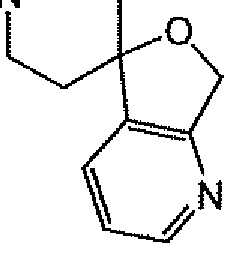

As appreciated by those of skill in the art, "halo" or "halogen" as used herein is intended to include chloro (Cl), fluoro (F), bromo (Br) and iodo (I). In an embodiment of Formula A and B, the moiety illustrated by the formula:

H^

includes the following structures:
R


R1 R.1
L /I '7
N N


R1- In another embodiment of Formula A and B, the moiety illustrated by the foπnula:
Y
includes the following structures R? R.1
)^N
R1" R1"
R TNYV^

 Ny^N^y or
In another embodiment of Formula A and B, the moiety illustrated by the formula:
Ny^N^y or
In another embodiment of Formula A and B, the moiety illustrated by the formula:
H^
 includes the following structures:
R\
/ -


R1-


In another embodiment of Formula A and B, the moiety illustrated by the formula:
/H
includes the following structures
R11
 Rr
Rr

In another embodiment of Formula A and B, the moiety illustrated by the formula:

includes the following structures
R.1


In yet another embodiment of Formula A and B, the moiety illustrated by the formula:
1
^
H*>
IS
R
*=N
R1i~%. ^Y1KA
In another embodiment of Formula A and B, the moiety illustrated by the formula:
I

is

In another embodiment of Formula A and B, the moiety illustrated by the formula:
is
R?
Ru
Kl


In an embodiment of Formula A, Ring Z is selected from: phenyl and heterocyclyl.
In another embodiment, Ring Z is selected from:

In another embodiment, Ring Z is selected from: phenyl, 2-raienyl, 3-pyridyl, 4- pyridyl and 3-tbienyl
In yet another embodiment, Ring Z is phenyl.
In an embodiment of Formula B, Ring Z is phenyl.
In an embodiment of Formula B, Ring Z is selected from: 2-thienyl and 3- thienyl.
In an embodiment, p is independently 0, 1, 2 or 3.
In a further embodiment, p is independently 0, 1 or 2.
In another embodiment, p is independently 1.
In yet another embodiment, p is independently 0. in an embodiment, R2 is independently selected from: (C1-C6)alkyl, 0(C=O)(C i-C6)alkyl, (Cj-Ce^oxy, CN, CO2H, halo, OH andNH2, wherein said alkyl is optionally substituted with halo.
In an embodiment of Formula A and B, R.2 is selected from: H and halogen.
In another embodiment of Formula A and B, R? is selected from: H and F.
In an embodiment of Formula A, C and E, Rl is H.
In an embodiment of Formula B, Rl, Rl', Rl" and Rl1" are H. ϊn an embodiment of Formula D, Rl and Rl ' are H.
In an embodiment of Formula A, Rl is selected from: oxo, (C=O)8Qb(C1- C10)alkyl (C=O)aOb-aryl, halo, OH, (C=O)aNR7R8, CN, (C=O)aOb(C3-C8)cycloalkyl, and (C=O)aOb-heterocyclyl, said alkyl, aryl, cycloalkyl, and heterocyclyl is optionally substituted with one or more substituents selected from R6; R6 is: (C=0)aOb(C1-C10)alkyl. halo, OH or Oa(C=O)bNR7R8; R7 and R8 in the group of (C=O)aNR7R8, are independently H or (C=0)aOb(C1-Clθ)alkyl; a is 0 or 1; and b is 0 or 1.
In another embodiment of Formula A, Rl is selected from: oxo, (C=O)aOb(C1- C10)alkyl, (C=O)aOb-aryl, halo, OH, (C=O)aNR7R8, CN, (C=O)aOb(C3-C8)cycloalkyI, and (C=O)aOb-heterocyclyl, said alkyl, aryl, cycloalkyl, and heterocyclyl is optionally substituted with one or more substituents selected from R6; R6 is: (C=0)aOb(C1-C10)aIkyl, halo, OH or NR7R8; R7 mά R8 in the group of (C=O)aNR7R8 or NR7R8, are independently H or (C1- C6)alkyl; a is 0 or I; and b is 0 or 1.
In an embodiment of Formula B, Rl is selected from: oxo, (C=0)aOb(C1- C10)alkyi, (C=O)aOb-aryi, halo, OH, (C=O)aNR7R8, CN, (00)aOb(C3-C8)cycloalkyl, and (O0)a0b-heterocyclyl, said alkyl, aryl, cycloalkyl, and heterocyclyl is optionally substituted with one or more substituents selected from R6; Rl' is selected from: H, oxo, (C=O)aOb(C1- C10)alkyl, (C=O)aOb-aryl, halo, OH, (C=O)aNR7R8, CN, (C=O)aOb(C3-C8)cycloalkyl, and (C=O)aOb-heterocyclyl, said alkyl, aryl, cycloalkyl, and heterocyclyl is optionally substituted with one or more substituents selected from Rδ; Rl" is selected from: H, oxo, (C=O)aOb(C1- C10)alkyl, (C=O)aOb~aryl, halo, OH, (C=O)aNR7R8, CN, (C==0)aOb(C3-C8)cycloalkyl, and (C=O)aOb-heterocyclyl, said alkyl, aryl, cycloalkyl, and heterocyclyl is optionally substituted with one or more substituents selected from R6; Rl1" is selected from: H, oxo, (C=O)a0b(C1- C10)alkyl, (C=O)aOb-aryl, halo, OH, (C=O)aNR7R8, CN, (C=O)aOb(C3-C8)cycloalkyl, and (C=O)aOb-heterocyclyl, said alkyl, aryl, cycloalkyl, and heterocyclyl is optionally substituted with one or more substituents selected from R6; R6 is: (C=0)aOb(C1-Ciθ)alkyl, halo, OH or Oa(CO)bNR7R8; R7 and R8 in the group of (C=O)aNR7R8, ere independently H or (C=0)aOb(C1-C10)alkyl; a is O or 1; and b is O or 1.
In another embodiment of Formula B, Rl is selected from: oxo, (C=O)aOb(C1- C10)alkyl, (CO)a0b-aryl, halo, OH, (C=O)aNR7R8, CN, (C=O)aOb(C3-C8)cycloalkyl, and (C=O)aOb-heterocyclyl, said alkyl, aryl, cycloalkyl, and heterocyclyl is optionally substituted with one or more substituents selected from R*>; Rl' is selected from: H, (C=O)aOb(C1- C10)alkyl, (C=O)aOb-aryl, halo, CN and (C=O)aOb-heterocyclyl, said alkyl, aryl, and heterocyclyl is optionally substituted with one or more substituents selected from R6; Rl " is selected from: H, (C==0)aOb(C1-C10)alkyl and halo, said alkyl is optionally substituted with one
or more substituents selected from R6; Rl1" is selected from: H, (C=0)aOb(C1-C10)alkyl and halo, said alkyl is optionally substituted with one or more substituents selected from R6; R6 is: (C=O)aOb(C1-Cl0)alkyl, halo, OH or Oa(C=O)bNR7R8; R7 and R8 in the group of (C=O)aNR7R8, are independently H or (C=0)aOb(C1-C10)alkyl; a is 0 or 1; and b is 0 or 1. In yet another embodiment of Formula B, Rl is selected from: oxo,
(O0)a0b(C1-Cl0)alkyl, (C=O)a0b-aryl, OH, (C=O)aNR7R8, (00)aOb(C3-C8)cycloalkyl, and (C=O)aOb-heterocyclyl, said alkyl, aryl, cycloalkyl, and heterocyclyl is optionally substituted with one or more substituents selected from R<>; Rl' is selected from: H, (C=O)aOb(Cl- C10)alkyl, (C=O)aOb-aryl> halo, CN and (CK^aOb-heterocyclyl, said alkyl, aryl, and heterocyclyl is optionally substituted with one or more substituents selected from R6; Rl " is selected from: H, (C=0)aOb(C1-C10)alkyl and halo, said alkyl is optionally substituted with one or more substituents selected from R6; Rl"' is selected from: H, (C=0)aOb(C1-C10)alkyl and halo, said alkyl is optionally substituted with one or more substituents selected from R6; R6 is: (C=O)aOb(Cl-Cl0)alkyl, halo, OH or NR7R8; R7 and R8 in the group of (C=O)aNR7R8 or NR7R8, are independently H or (Ci -C6)alkyl; a is O or 1 ; and b is O or 1.
In an embodiment of Formula B, Rl" is selected from: (C=0)aOb(Cl-C10)alkyl and halo, said alkyl is optionally substituted with one or more substituents selected from R*>; Rl"1 is H; R6 is: (C=0)aOb(C1-C10)alkyl, halo, OH or NR7R8; R7 and R8 m me group of (C=O)aNR7R8 or NR7R8, are independently H or (C1-C6)alkyl; a is O or 1 ; and b is O or 1. In another embodiment of Formula B, Rl " is selected from: (Ci -C6)alkyl and halo; and Rl"1 is H.
In an embodiment of Formula B, Rl" is H; Rl1" is selected from: (C=0)aOb(C1-Clθ)alkyi and halo, said alkyl is optionally substituted with one or more substituents selected from R6; R6 is: (C=0)aOb(Cl-C10)alkyl, halo, OH or NR7R8; R7 and R8 in the group of (C=O)aNR7R8 or NR7R8, are independently H or (Ci -C6)alkyl; a is O or 1 ; and b is O or 1.
In another embodiment of Formula B, Rl" is H; and Rl'" is selected from: (C1-
C6)alkyl and halo.
In an embodiment of Formula C, Rl is selected from: oxo, (C=O)aOb(C1- Cl o)alkyl, OH, and (C=0)aOb-heterocyclyl; a is O or 1 ; and b is O or 1.
In another embodiment of Formula C, Rl is selected from: (C=O)a0b(Cl- C10)alkyl and (C=O)aOb-heterocyclyl; a is O or 1; and b is O or 1.
In yet another embodiment of Formula C, Rl is methyl or raorpholinyl. In an embodiment of Formula D, Rl is selected from: oxo, (C=O)aOb(C1- Ci O)alkyl, (C=O)aOb-aryl, OH, (C=O)aOb(C3-C8)cycloalkyl, and (C=O)aOb-heterocyclyl, said alkyl, aryl, cycloalkyl, and heterocyclyl is optionally substituted with one or more substituents selected from R6; Rl1 is selected from: H, (C=O)3Ob(Cl -C io)alkyl, (C=O)aOb-aryl, halo, CN and (C=O)aOb-heterocyclyl, said alkyl, aryl, and heterocyclyl is optionally substituted with one
or more substituents selected from Rθ; R6 is: (C=0)aOb(C1-C10)aIkyl, halo or OH; a is 0 or 1; and b is 0 or 1.
In another embodiment of Formula D, Rl is (C=0)aOb(C1-C10)alkyl, said alkyl is optionally substituted with one or more substituents selected from R6; Rl' is selected from: H, (C=0)aOb(C1-Clθ)alkyl, (C=O)aOb-aryl, halo, CN and (C=O)aOb-heterocyclyl. said alkyl. aryl, and heterocyclyl is optionally substituted with one or more substituents selected from R<>; R6 is: (C=0)aOb(C1-C10)alkyl, halo or OH; a is O or 1; and b is O or 1.
In another embodiment of Formula D, Rl is (C=O)aOb-aryl, said aryl is optionally substituted with one or more substituents selected from R6; Rl1 is selected from: H, (C=O)aOb(C1-Cl o)alfcyl, (C=O)aOb-aryl, halo, CN and (O0)a0b-heterocyclyl, said alkyl, aryl, and heterocyclyl is optionally substituted with one or more substituents selected from R6; R6 is: (C=0)aOb(C1-C10)alkyl, halo or OH; a is O or 1; and b is O or 1.
In another embodiment of Formula D, Rl is (C==O)aOb(C3-C8)cycloalkyl, said cycloalkyl is optionally substituted with one or more substituents selected from R<>; Rl' is selected from: H, (C=0)aOb(C1-Cio)alkyl, (O=0)a0b-aryl, halo, CN and (CO)a0b- heterocyclyl, said alkyl, aryl, and heterocyclyl is optionally substituted with one or more substituents selected from R6; R6 is: (C=0)aOb(C1-C10)alkyl, halo or OH; a is O or 1; and b is
O or l.
In yet another embodiment of Formula D, Rl is selected from: methyl, ethyl, trifluoromethyl, tert-butyl, phenyl optionally substituted with halo preferably fluoro, and cyclopropyl; and Rl' is selected from: H, methyl, phenyl optionally substituted with Ob(Cχ- Cg)alkyl, halo preferably bromo or chloro, CN and pyridyl, and b is O or 1.
In an embodiment of Formula E, Rl is selected from: oxo, (C=O)aOb(C1- C10)alkyl, OH, (C=O)aNR7R8, (C=O)aOb(C3-C8)cycloalkyl, and (C=O)aOb-heterocyciyl, said alkyl, cycloalkyl, and heterocyclyl is optionally substituted with one or more substituents selected from (C1-C6)alkyls halo, CN, and OH; R7 and R6 in the group of (C=O)aNR7R8, are independently selected from: H, and (C1-QOalkyl; a is O or 1; and b is O or 1.
In another embodiment of Formula E, Rl is selected from: OH, (C=O)aNR7R8, (C=O)aOb(C3-C8)cycloalkyl and (C==O)aOb-heterocyclyl, said cycloalkyl and heterocyclyl is optionally substituted with one or more substituents selected from (C1-C6)alkyl, halo, CN, and OH; R7 and R8 in the group of (C=O)aNR7R8, are independently selected from: H, and (C1- C6)alkyl; a is O or 1; and b is O or 1.
In yet another embodiment of Formula E, Rl is selected from: OH8 NH2, cyclopropyl and pyrimidinyl. In another embodiment of Formula A, B, C, D and E, (C=0)aOb(C1-Clθ)alkyl for Rl, Rl', Rl" or Rl'" is methyl or ethyl, preferably methyl.
In another embodiment of Formula A, B, C, D and E, (C=0)aOb(C1-Clθ)alkyI for Rl is tert-butyl.
In another embodiment of Formula A, B, C, D and E, optionally substituted (C=0)aOb(C1-C10)alkyl for Rl is trifluoromethyl.
In another embodiment of Formula A, B and E, (C=O)aNR7R8 for Rl, Rl1, Rl" or Rl'" isNH2. In another embodiment of Formula A, B and E, (CK>)aOb(C3^8)cycl°aU^l for Rl9 Rl', Rl" or Rl1" is cyclopropyl.
In another embodiment of Formula A, B, C, D and E, heterocyclyl itself in the group of (CO)aOb-heterocyclyl for Rl, Rl1, Rl" or Rl'" is morpholinyl, imidazolyl, pyridyl, or pyrimidmyl; a is 0; and b is 0. In an embodiment of Formula A, both R7 and R8 in the formula:
are H.
In an embodiment of Formula A, R? and R8 are taken together with the nitrogen to which they are attached to form a monocyclic, bicyclic or tricyclic heterocycle with 3-7 members in each ring and optionally containing, in addition to the nitrogen, one or two additional heteroatoms selected from N, O and S, said monocyclic, bicyclic or tricyclic heterocycle is optionally substituted with one or more substituents selected from R6a; Rόa is selected from: (C=O)aOb(C1-Ci0)alkyl, oxo, OH, halo, (Cθ-C6)alkylene-heterocyclyl. and (O0)aNRb2!1 said alkyl, and heterocyclyl is optionally substituted with up to three substituents selected from R6; Rb is independently: H, (Ci -C6)alkyl, aryl, heterocyclyl, or (C3-C6)cycloalkyl, said alkyl, aryl, heterocyclyl, and cycloalkyl is optionally substituted with one or more substituents selected from (C1-C6)alkyl, OH, halo, and CN; a is 0 or U and b is 0 or 1.
In an embodiment of Formula B,
V^NR7R8 i.s selected from:


In another embodiment of Formula A and B,
 is
is

Ring X is selected from:
^i-, Al^

 each of which is optionally substituted with one or more substituents selected from R6a; R.6a is selected from: (C=0)aOb(C1-C10)alkyl, oxo, OH, halo, (Co-C6)alkylene-heterocyclyl> and (C=O)aNRb2, said alkyl, and heterocyclyl is optionally substituted with up to three substituents selected from Rb; Ra is (C\-Cβ)aϊkyl, (C3-C6)cycloalkyl, aryl, or heterocyclyl, said alkyl, cycloalkyl, aryl, and heterocyclyl is optionally substituted with one or more substituents selected from RC; Rb is independently: H, (O0)a0b(C1-C6)alkyl, or (C=O)aRa, said alkyl is optionally substituted with one or more substituents selected from (OO)a0b(C1-C6)aIkyL, OH, halo, CN8 and (C=O)8NRd2; Rc is independently: (C=O)aOb(C1-C6)alkyl, oxo, OH, halo, CN, or (C=O)aNRd2, said alkyl is optionally substituted with one or more substituents selected from (C1-C6)alkyl, OH, halo, and CN; Rd is independently: H} or (C1-C6)alkyl; a is 0 or 1; and b is 0 or l.
In a further embodiment of Formula A and B, above Ring X is selected from:
 R 6' a O
 ; and R6a is triazolyl substituted with pyridyl.
In an embodiment of Formula C, Ring X is selected from:
^Rβa
 ; and R6a is triazolyl substituted with pyridyl.
In an embodiment of Formula A, both Rx and Ry are H. hi an embodiment of Formula A, Rx and Ry are taken together to form a monocyclic or bicyclic carbo- or heterocycle with 3-7 members in each ring, said heterocycle is containing one or more heteroatoms selected from N, O and S, and said carbo- or heterocycle is optionally substituted with one or more substituents selected from: (C1-C<$)alkyl- (C2-C6)alkenyl, (C3-C6)cycloalkyl, (C1-C6)aIkyHdene, (C1-C6)alkoxy, CO2H, halo, OH, oxo, CN and NR7'R8\ said alkyl, cycloalkyl and alkoxy is optionally substituted with one or more substituents selected from halo, CN, OH and NR7'R8'; R7 and R8' are independently selected from: H, and (Ci - C6)alkyl.
In another embodiment of Formula A and B,
y"^NR7R8.
Ring Y is a group of formula:

In a further embodiment of Formula A and B, above Rl 1 and Rl2 are independently selected from: H, (Cl-C6)alkyl, (C2-C6)alkenyl, (C3-C6)cycloalkyl, (C1- C6)alkoxy, halo, and OH, said alkyl is optionally substituted with one or more OH.
In a further embodiment of Formula A and B, above Rl 1 and RΪ2 are taken together to form oxo, (C1-C6)alkylidene} or a group of formula:
In another embodiment of Formula D, Rl 1 and Rl2 are independently selected from: H, (C1-C6)alkyl, (C2-C6)aϊb;nyl, (C3-C6)cycloalkyls (C1-C6)a1koxy, halo, and OH, said alkyl is optionally substituted with one or more OH.
In another embodiment of Formula D, Rl 1 and Rl2 are taken together to form oxo, (Cl-C6)alkyh-dene, or a group of formula: \
In another embodiment of Formula E, both Rl 1 and Rl2 are H.
Included in the instant invention is the free form of compounds of Formula A, as well as the pharmaceutically acceptable salts and stereoisomers thereof. Some of the isolated specific compounds exemplified herein are the protonated salts of amine compounds. The term "free form" refers to the amine compounds in non-salt form. The encompassed pharmaceutically acceptable salts not only include the isolated salts exemplified for the specific compounds described herein, but also all the typical pharmaceutically acceptable salts of the free form of compounds of Formula A. The free form of the specific salt compounds described may be isolated using techniques known in the art. For example, the free form may be regenerated by treating the salt with a suitable dilute aqueous base solution such as dilute aqueous NaOH, potassium carbonate, ammonia and sodium bicarbonate. The free forms may differ from their respective salt forms somewhat in certain physical properties, such as solubility in polar solvents, but the acid and base sails are otherwise pharmaceutically equivalent to their respective free forms for purposes of the invention.
The pharmaceutically acceptable salts of the instant compounds can be synthesized from the compounds of this invention which contain a basic or acidic moiety by conventional chemical methods. Generally, the salts of the basic compounds are prepared either by ion exchange chromatography or by reacting the free base with stoichiometric amounts or with an excess of the desired salt-forming inorganic or organic acid in a suitable solvent or various combinations of solvents. Similarly, the salts of the acidic compounds are formed by reactions with the appropriate inorganic or organic base.
Thus, pharmaceutically acceptable salts of the compounds of this invention include the conventional non-toxic salts of the compounds of this invention as formed by reacting a basic instant compound with an inorganic or organic acid. For example, conventional non-toxic salts include those derived from inorganic acids such as hydrochloric, hydrobromic, sulfuric, sulfamic, phosphoric, nitric and the like, as well as salts prepared from organic acids such as acetic, propionic, succinic, glycolic, stearic, lactic, malic, tartaric, citric, ascorbic, pamoic, maleic, hydroxymaleic, phenylacetic, glutamic, benzoic, salicylic, sulfanilic, 2-acetoxy- benzoic, fumaric, toluenesulfonic, methanesulfonic, ethane disulfonic, oxalic, isethionic, trifluoroacetic (TFA) and the like. When the compound of the present invention is acidic, suitable
"pharmaceutically acceptable salts" refers to salts prepared form pharmaceutically acceptable non-toxic bases including inorganic bases and organic bases. Salts derived from inorganic bases include aluminum, ammonium, calcium, copper, ferric, ferrous, lithium, magnesium, manganic salts, manganous, potassium, sodium, zinc and the like. Particularly preferred are the ammonium, calcium, magnesium, potassium and sodium salts. Salts derived from pharmaceutically acceptable organic non-toxic bases include salts of primary, secondary and tertiary amines, substituted amines including naturally occurring substituted amines, cyclic amines and basic ion exchange resins, such as arginine, betaine caffeine, choline, N,Nl- dibenzylethylenediamine, diethylamin, 2-diethylarainoethanol, 2-dimethylaminoethanol,
ethanolamine, ethylenediamine, N-eraylmorpholine, N-ethylpiperidine, glucamine, glucosamine, histidine, hydrabamine, isoprøpylainine, lysine, methylglυcamine, morpholine, piperazine, piperidine, polyarnine resins, procaine, purines, theobromine, triethylamine, trimethylamine tripropylaraine, tromethamine and the like. The preparation of the pharmaceutically acceptable salts described above and other typical pharmaceutically acceptable salts is more fully described by Berg et al, "Pharmaceutical Salts," J. Pharm. ScL, 1977:66:1-19.
It will also be noted that the compounds of the present invention are potentially internal salts or zwitterions, since under physiological conditions a deprotonated acidic moiety in the compound, such as a carboxyl group, may be anionic, and this electronic charge might then be balanced off internally against the cationic charge of a protonated or alkylated basic moiety, such as a quaternary nitrogen atom.
"N-oxide derivatives" of the compounds of the invention are those in which one or two or more arbitrary nitrogen atoms capable of forming N-oxide, existing in the compound, are oxidized to form an N-oxide and which are pharmaceutically acceptable ones.
The process of oxidizing the nitrogen atom to produce an N-oxide derivative may be attained, for example, by the use of an oxidizing agent such as m-chloroperbenzoic acid, dioxirane, sodium periodate, hydrogen peroxide.
The reaction may be attained in a solvent suitably selected in accordance with the oxidizing agent to be used for the reaction. For example, when m-chloroperbenzoic acid is used as the oxidizing agent, then the solvent is preferably methylene chloride or chloroform; and when dioxirane is used as the oxidizing agent, then the solvent is preferably acetone or water.
The compounds of the instant invention are inhibitors of the activity of Akt and are thus useful in the treatment of cancer, in particular cancers associated with irregularities in the activity of Akt and downstream cellular targets of Akt. Such cancers include, but are not limited to, ovarian, pancreatic, breast and prostate cancer, as well as cancers (including glioblastoma) where the tumor suppressor PTEN is mutated (Cheng et al., Proc. Natl Acad. ScL (1992) 89:9267-9271; Cheng et al., Proc. Natl. Acad ScL (1996) 93:3636-3641; Bellacosa et al., Int. J. Cancer (1995) 64:280-285; Nakatani et al., J. Biol Chem. (1999) 274:21528-21532; Graff, Expert. Opin Ther. r«rgeto (2002) 6(l):103-l 13; and Yamada and Araki, J. Cell Science. (2001) 114:2375-2382; Mischel and Cloughesy, Brain Pathol. (2003) 13(1):52-61). Cancers where Akt itself is activated by gene amplification or mutations may also be treated by the compounds. The compounds, compositions and methods provided herein are particularly deemed useful for the treatment of cancer. Cancers that may be treated by the compounds, compositions and methods of the invention include, but are not limited to: Cardiac: sarcoma (angiosarcoma, fibrosarcoma, rhabdomyosarcoma, liposarcoma), myxoma, rhabdomyoma, fibroma, lipoma and teratoma; Lung: non-small cell lung, bronchogenic carcinoma (squamous cell, undifferentiated small cell, undifferentiated large cell, adenocarcinoma), alveolar
(bronchiolar) carcinoma, bronchial adenoma, sarcoma, lymphoma, chondromatosis hamartoma, mesothelioma; Gastrointestinal: esophagus (squamous cell carcinoma, adenocarcinoma, leiomyosarcoma, lymphoma), stomach (carcinoma, lymphoma, leiomyosarcoma), pancreas (ductal adenocarcinoma, insulinoma, glucagonoma, gastrinoma, carcinoid tumors, vipoma), small bowel (adenocarcinoma, lymphoma, carcinoid tumors, Karposi's sarcoma, leiomyoma, hemangioma, lipoma, neurofibroma, fibroma), large bowel (adenocarcinoma, tubular adenoma, villous adenoma, hamartoma, leiomyoma), colon, colorectal, rectal; Genitourinary tract: kidney (adenocarcinoma, Wihn's tumor [nephroblastoma], lymphoma, leukemia), bladder and urethra (squamous cell carcinoma, transitional cell carcinoma, adenocarcinoma), prostate (adenocarcinoma, sarcoma), testis (seminoma, teratoma, embryonal carcinoma, teratocarcinoma, choriocarcinoma, sarcoma, interstitial cell carcinoma, fibroma, fibroadenoma, adenomatoid tumors, lipoma); Liver: hepatoma (hepatocellular carcinoma), cholangiocarcinoma, hepatoblastoma, angiosarcoma, hepatocellular adenoma, hemangioma; Bone: osteogenic sarcoma (osteosarcoma), fibrosarcoma, malignant fibrous histiocytoma, chondrosarcoma, Ewing's sarcoma, malignant lymphoma (reticulum cell sarcoma), multiple myeloma, malignant giant cell tumor chordoma, osteochondroma (osteocartilaginous exostoses), benign chondroma, chondroblastoma, chondrømyxofibrorna, osteoid osteoma and giant cell tumors; Nervous system: skull (osteoma, hemangioma, granuloma, xanthoma, osteitis deformans), meninges (meningioma, meningxosarcoma, gliomatosis), brain (astrocytoma, medulloblastoma, glioma, ependymoma, germinoma [pinealoma], glioblastoma multiform, oligodendroglioma, schwannoma, retinoblastoma, congenital tumors), spinal cord neurofibroma, meningioma, glioma, sarcoma); Gynecological: uterus (endometrial carcinoma), cervix (cervical carcinoma, pre-tumor cervical dysplasia), ovaries (ovarian carcinoma [serous cystadenocarcinoma, mucinous cystadenocarcinoma, unclassified carcinoma], granuEosa-thecal cell tumors, Sertoli-Leydig cell tumors, dysgerrninoma, malignant teratoma), vulva (squamous cell carcinoma, intraepithelial carcinoma, adenocarcinoma, fibrosarcoma, melanoma), vagina (clear cell carcinoma, squamous cell carcinoma, botryoid sarcoma (embryonal rhabdomyosarcoma), fallopian tubes (carcinoma); Hematologic: blood (myeloid leukemia [acute and chronic], acute lymphoblastic leukemia, chronic lymphocytic leukemia, myeloproliferative diseases, multiple myeloma, myelodysplastic syndrome), Hodgkin's disease, non-Hodgkin's lymphoma [malignant lymphoma]; Skin: malignant melanoma, basal cell carcinoma, squamous cell carcinoma, Karposi's sarcoma, moles dysplastic nevi, lipoma, angioma, dermatofibroma, keloids, psoriasis; and Adrenal.glands: neuroblastoma. Thus, the term "cancerous cell" as provided herein, includes a cell afflicted by any one of the above-identified conditions. Cancers that may be treated by the compounds, compositions and methods of the invention include, but are not limited to: breast, prostate, colon, colorectal, lung, non-small cell lung, brain, testicular, stomach, pancreas, skin, small intestine, large intestine, throat, head and neck, oral, bone, liver, bladder, kidney, thyroid and blood.
Cancers that may be treated by the compounds, compositions and methods of the invention include: breast, prostate, colon, ovarian, colorectal, lung and non-small cell lung.
Cancers that may be treated by the compounds, compositions and methods of the invention include: breast, colon, (colorectal) and lung (non-small cell lung). Cancers that may be treated by the compounds, compositions and methods of the invention include: lymphoma and leukemia.
The compounds of the instant invention are useful for the treatment of breast cancer.
The compounds of the instant invention are useful for the treatment of prostate cancer.
Akt signaling regulates multiple critical steps in angiogenesis. Shiojima and Walsh, Circ. Res. (2002) 90:1243-1250. The utility of angiogenesis inhibitors in the treatment of cancer is known in the literature, see J. Rak et al. Cancer Research, 55:4575-4580, 1995 and Dredge et al., Expert Opin. Biol Ther. (2002) 2(8):953-966, for example. The role of angiogenesis in cancer has been shown in numerous types of cancer and tissues: breast carcinoma (G. Gasparini and AX. Harris, J. CUn. Oncol, 1995, 13:765-782; M. Toi et al., Japan. J. Cancer Res., 1994, 85:1045-1049); bladder carcinomas (AJ. Dickinson et al., Br. J. Urol, 1994, 74:762-766); colon carcinomas (L.M. Ellis et al., Surgery, 1996, 120(5):871-878); and oral cavity tumors (J.K. Williams et al., Am. J. Surg., 1994, 168:373-380). Other cancers include, advanced tumors, hairy cell leukemia, melanoma, advanced head and neck, metastatic renal cell, non-Hodgkin's lymphoma, metastatic breast, breast adenocarcinoma, advanced melanoma, pancreatic, gastric, glioblastoma, lung, ovarian, non-small cell lung, prostate, small cell lung, renal cell carcinoma, various solid tumors, multiple myeloma, metastatic prostate, malignant glioma, renal cancer, lymphoma, refractory metastatic disease, refractory multiple myeloma, cervical cancer, Kaposi's sarcoma, recurrent anaplastic glioma, and metastatic colon cancer
(Dredge et al., Expert Opin. Biol Ther. (2002) 2(8):953-966). Thus, the Akt inhibitors disclosed in the instant application are also useful in the treatment of these angiogenesis related cancers.
Tumors which have undergone neovascularization show an increased potential for metastasis. In fact, angiogenesis is essential for tumor growth and metastasis. (S.P. Cunningham, et al., Can. Research, 61 : 3206-3211 (2001)). The Akt inhibitors disclosed in the present application are therefore also useful to prevent or decrease tumor cell metastasis.
Further included within the scope of the invention is a method of treating or preventing a disease in which angiogenesis is implicated, which is comprised of administering to a mammal in need of such treatment a therapeutically effective amount of a compound of the present invention. Ocular neovascular diseases are an example of conditions where much of the resulting tissue damage can be attributed to aberrant infiltration of blood vessels in the eye (see WO 00/30651, published 2 June 2000). The undesirable infiltration can be triggered by ischemic retinopathy, such as that resulting from diabetic retinopathy, retinopathy of prematurity, retinal vein occlusions, etc., or by degenerative diseases, such as the choroidal neovascularization
observed in age-related macular degeneration. Inhibiting the growth of blood vessels by administration of the present compounds would therefore prevent the infiltration of blood vessels and prevent or treat diseases where angiogenesis is implicated, such as ocular diseases like retinal vascularization, diabetic retinopathy, age-related macular degeneration, and the like. Further included within the scope of the invention is a method of treating or preventing a non-malignant disease in which angiogenesis is implicated, including but not limited to: ocular diseases (such as, retinal vascularization, diabetic retinopathy and age-related macular degeneration), atherosclerosis, arthritis, psoriasis, obesity and Alzheimer's disease (Dredge et al., Expert Opin. Biol Ther. (2002) 2(8):953-966). In another embodiment, a method of treating or preventing a disease in which angiogenesis is implicated includes: ocular diseases (such as, retinal vascularization, diabetic retinopathy and age-related macular degeneration), atherosclerosis, arthritis and psoriasis.
Further included within the scope of the invention is a method of treating hyperproliferative disorders such as restenosis, inflammation, autoimmune diseases and allergy/asthma.
Further included within the scope of the instant invention is the use of the instant compounds to coat stents and therefore the use of the instant compounds on coated stents for the treatment and/or prevention of restenosis (WO03/032809).
Further included within the scope of the instant invention is the use of the instant compounds for the treatment and/or prevention of osteoarthritis (WO03/035048).
Further included within the scope of the invention is a method of treating hyperinsulinism.
The compounds of the invention are also useful in preparing a medicament that is useful in treating the diseases described above, in particular cancer. In an embodiment of the invention, the instant compound is a selective inhibitor whose inhibitory efficacy is dependent on the PH domain. In this embodiment, the compound exhibits a decrease in in vitro inhibitory activity or no in vitro inhibitory activity against truncated Akt proteins lacking the PH domain.
In a further embodiment, the instant compound is selected from the group of a selective inhibitor of Aktl , a selective inhibitor of Akt2 and a selective inhibitor of both Aktl and Akt2.
In another embodiment, the instant compound is selected from the group of a selective inhibitor of Aktl, a selective inhibitor of Akt2, a selective inhibitor of Akt3 and a selective inhibitor of two of the three Akt isoforms. In another embodiment, the instant compound is a selective inhibitor of all three
Akt isoforms, but is not an inhibitor of one, two or all of such Akt isoforms that have been modified to delete the PH domain, the hinge region or both the PH domain and the hinge region.
The present invention is further directed to a method of inhibiting Akt activity, which comprises administering to a mammal in need thereof a pharmaceutically effective amount of the instant compound.
The compounds of this invention may be administered to mammals, including humans, either alone or, in combination with pharmaceutically acceptable carriers, excipients or diluents, in a pharmaceutical composition, according to standard pharmaceutical practice. The compounds can be administered orally or parenteraUy, including the intravenous, intramuscular, intraperitoneal, subcutaneous, rectal and topical routes of administration.
The pharmaceutical compositions containing the active ingredient may be in a form suitable for oral use, for example, as tablets, troches, lozenges, aqueous or oily suspensions, dispersible powders or granules,, emulsions, hard or soft capsules, or syrups or elixirs. Compositions intended for oral use may be prepared according to any method known to the art for the manufacture of pharmaceutical compositions and such compositions may contain one or more agents selected from the group consisting of sweetening agents, flavoring agents, coloring agents and preserving agents in order to provide pharmaceutically elegant and palatable preparations. Tablets contain the active ingredient in admixture with non-toxic pharmaceutically acceptable excipients which are suitable for the manufacture of tablets. These excipients may be for example, inert diluents, such as calcium carbonate, sodium carbonate, lactose, calcium phosphate or sodium phosphate; granulating and disintegrating agents, for example, macrocrystalline cellulose, sodium crosscarmellose, corn starch, or alginic acid; binding agents, for example starch, gelatin, polyvinyl-pyrrolidone or acacia, and lubricating agents, for example, magnesium stearate, stearic acid or talc. The tablets may be uncoated or they may be coated by known techniques to mask the unpleasant taste of the drug or delay disintegration and absorption in the gastrointestinal tract and thereby provide a sustained action over a longer period. For example, a water soluble taste masking material such as hydroxypropylmethyl-cellulose or hydroxypropylcellulose, or a time delay material such as ethyl cellulose, cellulose acetate buryrate may be employed.
Formulations for oral use may also be presented as hard gelatin capsules wherein the active ingredient is mixed with an inert solid diluent, for example, calcium carbonate, calcium phosphate or kaolin, or as soft gelatin capsules wherein the active ingredient is mixed with water soluble carrier such as polyethylene glycol or an oil medium, for example peanut oil, liquid paraffin, or olive oil.
Aqueous suspensions contain the active material in admixture with excipients suitable for the manufacture of aqueous suspensions. Such excipients are suspending agents, for example sodium carboxymethylcellulose, methylcellulose, hydroxypropyhnethyl-cellulose, sodium alginate, polyvinyl-pyrrolidone, gum tragacanth and gum acacia; dispersing or wetting agents may be a naturally-occurring phosphatide, for example lecithin, or condensation products of an alkylene oxide with fatty acids, for example polyoxyeraylene stearate, or condensation products of ethylene oxide with long chain aliphatic alcohols, for example heptadecaethylene-
oxycetanol, or condensation products of ethylene oxide with partial esters derived from fatty acids and a hexitol such as polyoxyethylene sorbitol monooleate, or condensation products of ethylene oxide with partial esters derived from fatty acids and hexitol anhydrides, for example polyethylene sorbitan monooleate. The aqueous suspensions may also contain one or more preservatives, for example ethyl, or n-propyl p-hydroxybenzoate, one or more coloring agents, one or more flavoring agents, and one or more sweetening agents, such as sucrose, saccharin or aspartame.
Oily suspensions may be formulated by suspending the active ingredient in a vegetable oil, for example arachis oil, olive oil, sesame oil or coconut oil, or in mineral oil such as liquid paraffin. The oily suspensions may contain a thickening agent, for example beeswax, hard paraffin or cetyl alcohol. Sweetening agents such as those set forth above, and flavoring agents may be added to provide a palatable oral preparation. These compositions may be preserved by the addition of an anti-oxidant such as butylated hydroxyanisol or alpha-tocopherol. Dispersible powders and granules suitable for preparation of an aqueous suspension by the addition of water provide the active ingredient in admixture with a dispersing or wetting agent, suspending agent and one or more preservatives. Suitable dispersing or wetting agents and suspending agents are exemplified by those already mentioned above. Additional excipients, for example sweetening* flavoring and coloring agents, may also be present These compositions may be preserved by the addition of an anti-oxidant such as ascorbic acid. The pharmaceutical compositions of the invention may also be in the form of an oil-in-water emulsion. The oily phase may be a vegetable oil, for example olive oil or arachis oil, or a mineral oil, for example liquid paraffin or mixtures of these. Suitable emulsifying agents may be narurally-occuπing phosphatides, for example soy bean lecithin, and esters or partial esters derived from fatty acids and hexitol anhydrides, for example sorbitan monooleate, and condensation products of the said partial esters with ethylene oxide, for example polyoxyethylene sorbitan monooleate. The emulsions may also contain sweetening, flavouring agents, preservatives and antioxidants.
Syrups and elixirs may be formulated with sweetening agents, for example glycerol, propylene glycol, sorbitol or sucrose. Such formulations may also contain a demulcent, a preservative, flavoring and coloring agents and antioxidant.
The pharmaceutical compositions may be in the form of sterile injectable aqueous solutions. Among the acceptable vehicles and solvents that may be employed are water, Ringer's solution and isotonic sodium chloride solution.
The sterile injectable preparation may also be a sterile injectable oil-in-water microemulsion where the active ingredient is dissolved in the oily phase. For example, the active ingredient may be first dissolved in a mixture of soybean oil and lecithin. The oil solution then introduced into a water and glycerol mixture and processed to form a microemulation.
The injectable solutions or microemulsions may be introduced into a patient's blood-stream by local bolus injection. Alternatively, it may be advantageous to administer the
solution or microemulsion in such a way as to maintain a constant circulating concentration of the instant compound. In order to maintain such a constant concentration, a continuous intravenous delivery device may be utilized An example of such a device is the Deltec CADD- PLUS™ model 5400 intravenous pump. The pharmaceutical compositions may be in the form of a sterile injectable aqueous or oleagenous suspension for intramuscular and subcutaneous administration. This suspension may be formulated according to the known art using those suitable dispersing or wetting agents and suspending agents which have been mentioned above. The sterile injectable preparation may also be a sterile injectable solution or suspension in a non-toxic parenteraUy- acceptable diluent or solvent, for example as a solution in 1 ,3-butane diol. hi addition, sterile, fixed oils are conventionally employed as a solvent or suspending medium. For this purpose any bland fixed oil may be employed including synthetic mono- or diglycerides. hi addition, fatty acids such as oleic acid find use in the preparation of injectables.
Compounds of the present invention may also be administered in the form of suppositories for rectal administration of the drug. These compositions can be prepared by mixing the drug with a suitable non-irritating excipient which is solid at ordinary temperatures but liquid at the rectal temperature and will therefore melt in the rectum to release the drug. Such materials include cocoa butter, glycerinated gelatin, hydrogenated vegetable oils, mixtures of polyethylene glycols of various molecular weights and tatty acid esters of polyethylene glycol. For topical use, creams, ointments, jellies, solutions or suspensions, etc., containing the compound of the present invention are employed. (For purposes of this application, topical application shall include mouth washes and gargles.)
The compounds for the present invention can be administered in intranasal form via topical use of suitable intranasal vehicles and delivery devices, or via transdermal routes, using those forms of transdermal skin patches well known to those of ordinary skill in the art. To be administered in the form of a transdermal delivery system, the dosage administration will, of course, be continuous rather than intermittent throughout the dosage regimen. Compounds of the present invention may also be delivered as a suppository employing bases such as cocoa butter, glycerinated gelatin, hydrogenated vegetable oils, mixtures of polyethylene glycols of various molecular weights and fatty acid esters of polyethylene glycol.
When a composition according to this invention is administered into a human subject, the daily dosage will normally be determined by the prescribing physician with the dosage generally varying according to the age, weight, and response of the individual patient, as well as the severity of the patient's symptoms. The dosage regimen utilizing the compounds of the instant invention can be selected in accordance with a variety of factors including type, species, age, weight, sex and the type of cancer being treated; the severity (i.e., stage) of the cancer to be treated; the route of administration; the renal and hepatic function of the patient; and the particular compound or salt thereof employed. An ordinarily skilled physician or veterinarian can readily determine and
prescribe title effective amount of the drug required to treat, for example, to prevent, inhibit (fully or partially) or arrest the progress of the disease. For example, compounds of the instant invention can be administered in a total daily dose of up to 10,000 mg. Compounds of the instant invention can be administered once daily (QD), or divided into multiple daily doses such as twice daily (BID), and three times daily (TID). Compounds of the instant invention can be administered at a total daily dosage of up to 10,000 mg, e.g., 2,000 mg, 3,000 mg, 4,000 mg, 6,000 mg, 8,000 mg or 10,000 mg, which can be administered in one daily dose or can be divided into multiple daily doses as described above.
For example, compounds of the instant invention can be administered in a total daily dose of up to 1,000 mg. Compounds of the instant invention can be administered once daily (QD), or divided into multiple daily doses such as twice daily (BE)), and three times daily (TDD). Compounds of the instant invention can be administered at a total daily dosage of up to 1,000 mg, e.g., 200 mg, 300 mg, 400 mg, 600 mg, 800 mg or 1,000 mg, which can be administered in one daily dose or can be divided into multiple daily doses as described above. In addition, the administration can be continuous, Le., every day, or intermittently. The terms "intermittent" or "intermittently" as used herein means stopping and starting at either regular or irregular intervals. For example, intermittent administration of a compound of the instant invention may be administration one to six days per week or it may mean administration in cycles (e.g. daily administration for two to eight consecutive weeks, then a rest period with no administration for up to one week) or it may mean administration on alternate days.
In addition, the compounds of the instant invention may be administered according to any of the schedules described above, consecutively for a few weeks, followed by a rest period. For example, the compounds of the instant invention may be administered according to any one of the schedules described above from two to eight weeks, followed by a rest period of one week, or twice daily at a dose of 100 - 500 mg for three to five days a week. In another particular embodiment,, the compounds of the instant invention may be administered three times daily for two consecutive weeks, followed by one week of rest.
Any one or more of the specific dosages and dosage schedules of the compounds of the instant invention, may also be applicable to any one or more of the therapeutic agents to be used in the combination treatment (hereinafter refered to as the "second therapeutic agent").
Moreover, the specific dosage and dosage schedule of this second therapeutic agent can further vary, and the optimal dose, dosing schedule and route of administration will be determined based upon the specific second therapeutic agent that is being used.
Of course, the route of administration of the compounds of the instant invention is independent of the route of administration of the second therapeutic agent In an embodiment, the administration for a compound of the instant invention is oral administration. In another embodiment, the administration for a compound of the instant invention is intravenous
administration. Thus, in accordance with these embodiments, a compound of the instant invention is administered orally or intravenously, and the second therapeutic agent can be administered orally, parenterally, intraperitoneally, intravenously, intraarterially, transdermally, sublingually, intramuscularly, rectally, transbuccally, intranasally, liposomally, via inhalation, vaginally, intraoccularly, via local delivery by catheter or stent, subcutaneously, intraadiposally, intraarticularly, intrathecally, or in a slow release dosage form.
In addition, a compound of the instant invention and second therapeutic agent may be administered by the same mode of administration, i.e. both agents administered e.g. orally, by IV. However, it is also within the scope of the present invention to administer a compound of the instant invention by one mode of administration, e.g. oral, and to administer the second therapeutic agent by another mode of administration, e.g. IV or any other ones of the administration modes described hereinabove.
The first treatment procedure, administration of a compound of the instant invention, can take place prior to the second treatment procedure, i.e., the second therapeutic agent, after the treatment with the second therapeutic agent, at the same time as the treatment with the second therapeutic agent, or a combination thereof. For example, a total treatment period can be decided for a compound of the instant invention. The second therapeutic agent can be administered prior to onset of treatment with a compound of the instant invention or following treatment with a compound of the instant invention. In addition, anti-cancer treatment can be administered during the period of aά^Binistration of a compound of the instant invention but does not need to occur over the entire treatment period of a compound of the instant invention. The instant compounds are also useful in combination with therapeutic, chemotherapeutic and anti-cancer agents. Combinations of the presently disclosed compounds with therapeutic, chemotherapeutic and anti-cancer agents are within the scope of the invention. Examples of such agents can be found in Cancer Principles and Practice of Oncology by V.T. Devita and S. Hellman (editors), 6* edition (February 15, 2001), Lippincott Williams & Wilkins Publishers. A person of ordinary skill in the art would be able to discern which combinations of agents would be useful based on the particular characteristics of the drugs and the cancer involved. Such agents include the following: estrogen receptor modulators, androgen receptor modulators, retinoid receptor modulators, cytotoxic/cytostatic agents, antiproliferative agents, prenyl-protein transferase inhibitors, HMG-CoA reductase inhibitors and other angiogenesis inhibitors, HTV protease inhibitors, reverse transcriptase inhibitors, inhibitors of cell proliferation and survival signaling, bisphosphonates, aromatase inhibitors,, siRNA therapeutics, γ-secretase inhibitors, agents that interfere with receptor tyrosine kinases (RTKs) and agents that interfere with cell cycle checkpoints. The instant compounds are particularly useful when co-administered with radiation therapy.
"Estrogen receptor modulators" refers to compounds that interfere with or inhibit the binding of estrogen to the receptor, regardless of mechanism. Examples of estrogen receptor modulators include, but are not limited to, tamoxifen, raloxifene, idoxifene, LY353381,
LYl 17081. toremifene, fulvestrant, 4-[7-{2,2-dimethyl-1-oxopropoxy-4-methyl-2-[4-[2-(l- piperidinyl)ethoxy3pheαyϊ]-2H- 1 -benzoρyran-3-yl]-phenyl-2,2-dimethylproρanoate, 4,4'- dihy(koxybenz»pheiione-2,4-<jMtrophemyl-hydrazone, and SH646.
"Androgen receptor modulators" refers to compounds which interfere or inhibit the binding of androgens to the receptor, regardless of mechanism. Examples of androgen receptor modulators include finasteride and other 5α~reductase inhibitors, nilutarnide. flutamide, bicalutamide, liarozole, and abiraterone acetate.
"Retinoid receptor modulators" refers to compounds which interfere or inhibit the binding of retinoids to the receptor, regardless of mechanism. Examples of such retinoid receptor modulators include bexarotene, tretinoin, 13-cis-retϊnoic acid, 9-cis-retinoic acid, α- difluoromethylornithine, ELX23-7553, trans-N-(4'~hydroxyphenyl) retinamide, andN-4- carboxyphenyl retinamide.
"Cytotoxic/cytostatic agents" refer to compounds which cause cell death or inhibit cell proliferation primarily by interfering directly with the cell's functioning or inhibit or interfere with cell rayosis, including alkylating agents, tumor necrosis factors, intercalators, hypoxia activatable compounds, microtubule inhibitors/microtubule-stabili2ing agents, inhibitors of mitotic kinesins, histone deacerylase inhibitors, inhibitors of kinases involved in mitotic progression, inhibitors of kinases involved in growth factor and cytokine signal transduction pathways, antimetabolites, biological response modifiers, horaional/anti-hoπnonal therapeutic agents, haematopoietic growth factors, monoclonal antibody targeted therapeutic agents, topoisomerase inhibitors, proteosome inhibitors, ubiquitin ligase inhibitors, and aurora kinase inhibitors.
Examples of cytotoxic/cytostatic agents include, but are not limited to, sertenef, cachectin, ifosfamide, tøsonermin, lonidamine, carboplatin, altretamine, prednimustine, dibromodulcitol, ranimustine, fotemustine, nedaplatin, oxaliplatin, temozolomide, heptaplatin, estramustine, improsulfan tosilate, trofosfamide, nimustine, dibrospidium chloride, pumitepa, lobaplatin, satraplatin, profiromycin, cisplatin, irofulven, dexifosfamide, cis-aminedichloro(2- methyl-pyridine)platinum, benzylguanine, glufosfamide, GPXlOO, (trans, trans, trans)-bis-mu- (hexane-1,6-diarmne)-mu-tdiamine-ρlatinum(II)]bis[diamine(cbJoro)platinum (π)]teto diarizidmylspermine, arsenic trioxide, 1-(1 l-dodecylamino-10-hydroxyundecyl)-3,7- dimemybxanthine, zorubicin, idarubicin, daunorubicin, bisantrene, mitoxantrone, pirarubicin, pinafide, valrubicin, amrubicin, antineoplaston, 3'-deamino-3'-morpholino-13-deoxo-10- hydroxycaπninomycin, annamycin, galarubicin, elinafide, MEN10755, 4-demethoxy-3-deamino- 3-aziridinyl-4-methylsulphonyl-daunorubicin (see WO 00/50032), Raf kinase inhibitors (such as Bay43-9006) and mTOR inhibitors (such as Wyeth's CCI-779).
An example of a hypoxia activatable compound is tirapazamine. Examples of proteosome inhibitors include but are not limited to lactacystin and MLN-341 (Velcade).
Examples of microtubule iimibitors/microtubule-stabilising agents include pacfitaxel, vindesine sul&te, 3',4'-didehydro-4'-deoxy-8'-norvincaleukoblastine, docetaxol, rhizoxin, dolastatin, mivobulin isethionate, aitristatin, cemadotin, RPRl 09881, BMS 184476, vinflunine, cryptophycin, 2,3,4,5,6-pentafluoro-N-(3-fluoro-4-methoxyphenyl) benzene sulfonamide, anhydrøvinblastine, N,N^ime1hyl-L-valyl-L-valyl-N-methyl-L-valyl-L-prolyl-L- proline-t-butylamide, TDX258, the epothilones (see for example U.S. Pat Nos. 6,284,781 and
6,288,237) and BMSl 88797. in an embodiment the epothilones are not included in the microtubule mhibitors/microtubule-stabilising agents.
Some examples of topoisomerase inhibitors are topotecan, hycaptamine, irinotecan, rubitecan, 6-emoxypropionyl-3%4'-^exo-benzylidene-chartreusin, 9-methoxy-N,N- dmie1±ιyl-5-mtropyra2;olo[3,4,5-kl]acridine-2-(6H) propanamine, l-amino-9-ethyl-5-fluoro-2,3-- dmydro~9-hydroxy-4-memyMH,12H-benzo[de]pyr^
10,13(9H,15H)dione, lurtotecan, 7-t2-(N-isopropylamino)ethyl3-(20S)camptothecin, BNP135O,
BNPIl 100, BN80915, BN80942, etoposide phosphate, teniposide, sobuzoxane, T- dimethylamino-2'-deoxy-etoposide, GL331 , N-[2-(dimethylamino)ethyl]-9-hydroxy-5,6- dimethyl-6H-pyrido[4,3-b]carbazole-1-carboxamide, asulacrine, (5a, 5aB, 8aa,9b)-9-[2-[N-[2-
(dime1hylaiiimo)erayl]-N-me%^
5,5a,6,8,8a,9-hexohydrofuro(3\4^6,7)naphtho(2,3πi)-1,3-dioxol-6-one, 2,3-(methylenedioxy)-5- methyl-7-hydroxy-8-methoxyben2rø[c]-phenanthridinium, 6,9-bis[(2- ammoethy^ammolbenzo^isogumoline-S^O-dione, 5-(3-ammoρroρylamino)-7,10-dihydroxy-2-
(2-hydroxye1hylanmiomemyl>6H-pyrazolo[4,5,l-de]acridm-6^
[2(diethylaimno)eώylanύno]-7-me1tø^
(dimeώylamino)ethyl)acridine-4-carboxamide, 6-[[2^dimeώylamino)ethyl]amino]-3-hydroxy-
7H~indeno[2,l-c] quinolin-7-one, and dimesna. Examples of inhibitors of mitotic kraesins, and in particular the human mitotic kinesin KSP, are described in Publications WO03/039460, WO03/050064, WO03/050122,
WO03/049527, WO03/049679, WO03/049678, WO04/039774, WO03/079973, WO03/099211,
WO03/105855, WO03/106417, WO04/037171, WO04/058148, WO04/058700, WO04/126699,
WO05/018638, WO05/019206, WO05/019205, WO05/018547, WO05/017190, US2005/0176776. In an embodiment inhibitors of mitotic kinesins include, but are not limited to inhibitors of KSP, inhibitors of MKLPl, inhibitors of CENP-E, inhibitors of MCAK and inhibitors of Rab6-KIFL.
Examples of "histone deacetylase inhibitors" include, but are not limited to,
SAHA, TSA, oxamflatin, PXDlOl, MG98 and scriptaid. Further reference to other histone deacetylase inhibitors may be found in the following manuscript; Miller, T.A. et al. J. Med.
Chem. 46(24):5097-5116 (2003).
"Inhibitors of kinases involved in mitotic progression" include, but are not limited to, inhibitors of aurora kinase, inhibitors of Polo-like kinases (PLK; in particular
inhibitors of PLK-I), inhibitors of bub-1 and inhibitors of bub-Rl. An example of an "aurora kinase inhibitor" is VX-680.
"Antiproliferative agents" includes antisense RNA and DNA oligonucleotides such as G3139, ODN698, RVASKRAS, GEM231, and INX3001, and antimetabolites such as enocitabine, caπnofur, tegafur, pentostatin, doxifluridine, trimetrexate, fludarabine, capecitabine, galocitabine, cytarabine ocfosfate, fosteabine sodium hydrate, raltitrexed, paltitrexid, emitefur, tiazofurin, decitabine, nolatrexed, pemetrexed, nelzarabine, 2'-deoxy-2'-røethylidenecytidine, T- fluoromemylene-2'-deoxycytidme, N-[5-(2,3^mydro-^^ dicMorophenyl)urea,N6^[4-deoxy-4-pv^ L-manno-heptopyranosyyadenirie, aplidine, ecteinascidin, troxacitabine, 4-[2-amino-4-oxo- 4,6,7,8-tetrahydro-3H-pyrimidmo[5,4-b3[1,4]to acid, aminopterin, 5-flurouracil, alanosine, 1 l-acetyl-S-Ccarbamoyloxymethy^^-formyl-β- meώoxy-H-oxa-lJl-diazatetracyclotT^J.O.O^tetradeca^^^trien-θ-yl acetic acid ester, swainsonine, lometrexol, dexrazoxane, methioninase, 2'-cyano-2?-deoxy-N4-palmitoyl-1-B-D- arabino furanosyl cytosine, 3-aminopyridine-2-carboxaldehyde thiosemicarbazone and trastuzumab.
Examples of monoclonal antibody targeted therapeutic agents include those therapeutic agents which have cytotoxic agents or radioisotopes attached to a cancer cell specific or target cell specific monoclonal antibody. Examples include Bexxar. "HMG-CoA reductase inhibitors" refers to inhibitors of 3-hydroxy-3- methylglutaryl-CoA reductase. Examples of HMG-CoA reductase inhibitors that may be used include but are not limited to lovastatin (MEVACOR®; see U.S. Patent Nos. 4,231,938, 4,294,926 and 4,319,039), simvastatin (ZOCOR®; see U.S. Patent Nos. 4,444,784, 4,820,850 and 4,916,239), pravastatin (PRAVACHOL®; see U.S. Patent Nos. 4,346,227, 4,537,859, 4,410,629, 5,030,447 and 5,180,589), fluvastatin (LESCOL®; see U.S. Patent Nos. 5,354,772, 4,911,165, 4,929,437, 5,189,164, 5,118,853, 5,290,946 and 5,356,896), atorvastatin (LEPITOR®; see U.S. Patent Nos. 5,273,995, 4,681,893, 5,489,691 and 5,342,952) and cerivastatin (also known as rivastatin and BAYCHOL®; see US Patent No. 5,177,080). The structural formulas of these and additional HMG-CoA reductase inhibitors that may be used in the instant methods are described at page 87 of M. Yalpani, "Cholesterol Lowering Drugs", Chemistry & Industry, pp. 85-89 (5 February 1996) and US Patent Nos. 4,782,084 and 4,885,314. The term HMG-CoA reductase inhibitor as used herein includes all pharmaceutically acceptable lactone and open-acid forms (i.e., where the lactone ring is opened to form the free acid) as well as salt and ester forms of compounds which have HMG-CoA reductase inhibitory activity, and therefor the use of such salts, esters, open-acid and lactone forms is included within the scope of this invention.
"Prenyl-protein transferase inhibitor" refers to a compound which inhibits any one or any combination of the prenyl-protein transferase enzymes, including farnesyl-protein transferase (FPTase), geranylgeranyl-protein transferase type I (GGPTase-I), and geranylgeranyl- protein transferase type-II (GGPTase-H, also called Rab GGPTase).
Examples of prenyl-protein transferase inhibitors can be found in the following publications and patents: WO 96/30343, WO 97/18813, WO 97/21701, WO 97/23478, WO 97/38665, WO 98/28980, WO 98/29119, WO 95/32987, U.S. Patent No. 5,420,245, U.S. Patent No. 5,523,430, U.S. Patent No. 5,532,359. U.S. Patent No. 5,510,510, U.S. Patent No. 5.589,485, U.S. Patent No. 5,602,098, European Patent Publ. 0 618 221, European Patent Publ. 0 675 112, European Patent Publ. 0 604 181, European Patent Publ. 0 696 593, WO 94/19357, WO 95/08542, WO 95/11917, WO 95/12612, WO 95/12572, WO 95/10514, U.S. Patent No. 5,661,152, WO 95/10515, WO 95/10516, WO 95/24612, WO 95/34535, WO 95/25086, WO 96/05529, WO 96/06138, WO 96/06193, WO 96/16443, WO 96/21701, WO 96/21456, WO 96/22278, WO 96/24611, WO 96/24612, WO 96/05168, WO 96/05169, WO 96/00736, U.S. Patent No. 5,571,792, WO 96/17861, WO 96/33159, WO 96/34850, WO 96/34851, WO 96/30017, WO 96/30018, WO 96/30362, WO 96/30363, WO 96/31111, WO 96/31477, WO 96/31478, WO 96/31501, WO 97/00252, WO 97/03047, WO 97/03050, WO 97/04785, WO 97/02920, WO 97/17070, WO 97/23478, WO 97/26246, WO 97/30053, WO 97/44350, WO 98/02436, and U.S. Patent No. 5,532,359. For an example of the role of a prenyl-protein transferase inhibitor on angiogenesis see European J. of Cancer, Vol. 35, No. 9, pp.1394-1401 (1999).
"Angiogenesis inhibitors" refers to compounds that inhibit the formation of new blood vessels, regardless of mechanism. Examples of angiogenesis inhibitors include, but are not limited to, tyrosine kinase inhibitors, such as inhibitors of the tyrosine kinase receptors FIt-I (VEGFRl) and Flk-1/KDR (VEGFR2), inhibitors of epidermal-derived, fibroblast-derived, or platelet derived growth factors, MMP (matrix metalloprotease) inhibitors, ύitegrin blockers, interferon-α, interleukin-12, pentosan polysulfate, cyclooxygenase inhibitors, including nonsteroidal antiinflammatories (NSAIDs) like aspirin and ibuprofen as well as selective cyclooxy-genase-2 inhibitors like celecoxib and rofecoxib (PNAS, Vol. 89, p. 7384 (1992); JNCI, Vol. 69, p. 475 (1982); Arch. OpthalmoL, Vol. 108, p.573 (1990); Anal Rec, Vol. 238, p. 68 (1994); FEBS Letters, Vol. 372, p. 83 (1995); Clin, Orthop. Vol. 313, p. 76 (1995); J. MoI Endocrinol, Vol. 16, p.107 (1996); Jpn. J. Pharmacol, Vol. 75, p. 105 (1997); Cancer Res., Vol. 57, p. 1625 (1997); Cell, Vol. 93, p. 705 (1998); Intl. J. MoI. Med., Vol. 2, p. 715 (1998); J. Biol. Chem., Vol. 274, p. 9116 (1999)), steroidal anti-inflammatories (such as corticosteroids, mineralocorticoids, dexamethasone, prednisone, prednisolone, methylpred, betamethasone), carboxyamidotriazole, combretastatin A-4, squalamine, 6-O-chloroacetyl-carbonyl)-fumagillol, thalidomide, angiostatin, troponin- 1, angiotensin Ω antagonists (see Fernandez et al., J. Lab. Clin. Med. 105:141-145 (1985)), and antibodies to VEGF (see, Nature Biotechnology, Vol. 17, pp.963-968 (October 1999); Kim et al., Nature, 362, 841-844 (1993); WO 00/44777; and WO 00/61186).
Other therapeutic agents that modulate or inhibit angiogenesis and may also be used in combination with the compounds of the instant invention include agents that modulate or inhibit the coagulation and fibrinolysis systems (see review in Clin. Chem. La. Med. 38:679-692
(2000)). Examples of such agents that modulate or inhibit the coagulation and fibrinolysis pathways include, but are not limited to, heparin (see Thromb. Haemost. 80:10-23 (1998)), low molecular weight heparins and carboxypeptidase U inhibitors (also known as inhibitors of active thrombin activatable fibrinolysis inhibitor [TAFIa]) (see Thrombosis Res. 101:329-354 (2001)). TAFIa inhibitors have been described in U.S. Ser. Nos. 60/310,927 (filed August 8, 2001) and 60/349,925 (filed January 18, 2002).
"Agents that interfere with cell cycle checkpoints" refer to compounds that inhibit protein kinases that transduce cell cycle checkpoint signals, thereby sensitizing the cancer cell to DNA damaging agents. Such agents include inhibitors of ATR, ATM, the CHKl 1 and CHKl 2 kinases and cdk and cdc kinase inhibitors and are specifically exemplified by 7- hydroxystaurosporin, flavopiridol, CYC202 (Cyclacel) and BMS-387032.
"Agents that interfere with receptor tyrosine kinases (RTKs)" refer to compounds that inhibit RTKs and therefore mechanisms involved in oncogenesis and tumor progression. Such agents include inhibitors of c-Kit, Eph, PDGF, Flt3 and c-Met. Further agents include inhibitors of RTKs as described by Bume-Jensen and Hunter, Nature, 411:355-365, 2001.
"Inhibitors of cell proliferation and survival signalling pathway" refer to compounds that inhibit signal transduction cascades downstream of cell surface receptors. Such agents include inhibitors of serine/threonine kinases (including but not limited to inhibitors of Akt such as described in WO 02/083064, WO 02/083139, WO 02/083140, US 2004-0116432, WO 02/083138, US 2004-0102360, WO 03/086404, WO 03/086279, WO 03/086394, WO 03/084473, WO 03/086403, WO 2004/041162, WO 2004/096131, WO 2004/096129, WO 2004/096135, WO 2004/096130, WO 2005/100356, WO 2005/100344, US 2005/029941, US 2005/44294, US 2005/43361, 60/734188, 60/652737, 60/670469), inhibitors of Raf kinase (for example BAY-43-9006 ), inhibitors of MEK (for example CI-1040 and PD-098059), inhibitors of mTOR (for example Wyeth CCI-779), and inhibitors of PI3K (for example LY294002).
As described above, the combinations with NSAJD's are directed to the use of NSAID's which are potent COX-2 inhibiting agents. For purposes of this specification an NSAtO is potent if it possesses an IC50 for the inhibition of COX-2 of lμM or less as measured by cell or microsomal assays.
The invention also encompasses combinations with NSAID's which are selective COX-2 inhibitors. For purposes of this specification NSAID's which are selective inhibitors of COX-2 are defined as those which possess a specificity for inhibiting COX-2 over COX-I of at least 100 fold as measured by the ratio of IC50 for COX-2 over IC50 for COX-I evaluated by cell or microsomal assays. Such compounds include, but are not limited to those disclosed in U.S. Patent 5,474,995, U.S. Patent 5,861,419, U.S. Patent 6,001,843, U.S. Patent 6,020,343, U.S. Patent 5,409,944, U.S. Patent 5,436,265, U.S. Patent 5,536,752, U.S. Patent 5,550,142, U.S. Patent 5,604,260, U.S. 5,698,584, U.S. Patent 5,710,140, WO 94/15932, U.S. Patent 5,344,991, U.S. Patent 5,134,142, U.S. Patent 5,380,738, U.S. Patent 5,393,790, U.S.
Patent 5,466,823, U.S. Patent 5,633,272 and U.S. Patent 5,932,598, all of which are hereby incorporated by reference.
Inhibitors of COX-2 that are particularly useful in the instant method of treatment are: 3-phenyl-4-(4-(methyIsulfonyl)phenyI)-2-{5H)-furanone; and 5-cMoro-3^4-me1hybdfonyl)phenyl-2-(2-methyl-5-r^dmyl)p^dπie; or a pharmaceutically acceptable salt thereof.
Compounds that have been described as specific inhibitors of COX-2 and are therefore useful in the present invention include, but are not limited to, the following: parecoxib, BEXTKA® and CELEBREX® or a pharmaceutically acceptable salt thereof. Other examples of angiogenesis inhibitors include,, but are not limited to, endostatin, ukrain, ranpirnase, BVΪ862, 5-md-hoxy^-[2-methyl-3-(3-methyl--2-butenyl)oxiranyl]- 1 -oxaspiro[2,5]oct-6-yl(chloroacetyl)carbamate, acetyldinanalme, 5-amino-1-[[3,5-dichloro-4-(4- cMorobenz»yl)pheiiyl]memyl]-1H^^ combretastatin, RPI4610, NX31838, sulfated mannopentaose phosphate, 7,7-(carbonyl- bis[ύ-rino-N-memyl-4,2-pyrrolocarto naphthalene disulfonate), and S-^^^imemylpyrrol-S-yOmethyleneJ^-indolinone (SU5416).
As used above, "integrin blockers" refers to compounds which selectively antagonize, inhibit or counteract binding of a physiological ligand to the ctγβ3 integrin, to compounds which selectively antagonize, inhibit or counteract binding of a physiological ligand to the αvβ5 integrin, to compounds which antagonize, inhibit or counteract binding of a physiological ligand to both the αyβ3 integrin and the αvβ5 integrin, and to compounds which antagonize, inhibit or counteract the activity of the particular integrin(s) expressed on capillary endothelial cells. The term also refers to antagonists of the αyβ6> «vβ8> «lβl> «2βl> αsβl, αgβi and αgβ4 integrins. The term also refers to antagonists of any combination of ctvβ3s αvβ5>αvβ6> αvβ8, cqβi, cc2βl, αsβl, «6βl and αeβ4 integrins.
Some specific examples of tyrosine kinase inhibitors include N- (Mfluoromemylphenyl)-5-methyIisoxazol-4-carboxamide, 3-[(2,4-dimethylpyrrol-5- yl)methyIidenyI)indolin-2-one, 17-(allylamino)-17-demethoxygeldanamycin, 4-(3-chloro-4- fluorophenylammo)-7-methoxy-6-[3-(4-morpholmyl)prorrøxyl]quinazolme> ^ 6.7-bis(2-methoxyethoxyH^uinazolmarnine, BIBX1382, 2,3,9,10,11,12-hexahydro-lO-
(hydroxymethyl)-l 0-hydroxy-9-methyl-9, 12-epoxy-1H-diindolo[l ,2,3-fg:3 \2\r4%yrrolo[3,4- i][1,6]benzodiazocin-1-one, SH268, genistein, SΗ571, CEP2563, 4-(3-chlorophenylamino)-5,6- dimethyl-7H-pyiτolo[2,3-d]pyrimidinemethane sulfonate, 4-(3-bromo-4-hydroxyphenyl)amino- 6,7-dimethoxyquinazoline, 4-(4'-hydroxyphenyl)ammo-6,7-dimemoxyquiiiazoline;> SU6668, SΗ571 A, N-4-chlorophenyl-4-(4-pyridyhnethyl)-l -phthalazinamine, CI- 1033, CDP860, ZR6474, RTK-787, CP549632, and CT53518.
Combinations with compounds other than anti-cancer compounds are also encompassed in the instant methods. For example, combinations of the instantly claimed compounds with PPAR-γ (Le., PPAR-gamma) agonists and PPAR-δ (i.e., PPAR-delta) agonists
are useful in the treatment of certain malingnancies. PPAR-γ and PPAR-δ are the nuclear peroxisome proHferator-activated receptors γ and δ. The expression of PPAR-γ on endothelial cells and its involvement in angiogenesis has been reported in the literature (see J. Cardiovasc. Pharmacol. 1998; 31:909-913; J. Biol Chem. 1999;274:9116-9121; Invest. Ophthalmol Vis. Set 2000; 41 :2309-2317). More recently, PPAR-γ agonists have been shown to inhibit the angiogenic response to VEGF in vitro; both troglitazone and rosiglitazone maleate inhibit the development of retinal neovascularization in mice. (Arch Ophthamol. 2001; 119:709-717). Examples of PPAR^ agonists and PPAR- γ/α agonists include, but are not limited to, thiazolidinediones (such as DRF2725, CS-011, troglitazone, rosiglitazone, and pioglitazone), fenofibrate, gemfibrozil, clofibrate, GW2570, SB219994, AR-H039242, JTT-501, MCC-555, GW2331, GW409544, NN2344, KRP297, NPOl 10, DRF4158, NN622, GI262570, PNU182716, DRF552926, 2-[(5J-diρropyl-3-trifluoromethyl-l^-berizisoxazol-6-yl)oxy]-2-me1hylpropionic acid (disclosed in USSN 09/782,856), and 2(R)-7-(3-(2-chloro-4~(4-fluorophenoxy) phenoxy)propoxy)-2-ethylchromane-2-carboxylic acid (disclosed in USSN 60/235,708 and 60/244,697).
Another embodiment of the instant invention is the use of the presently disclosed compounds in combination with gene therapy for the treatment of cancer. For an overview of genetic strategies to treating cancer see Hall et al (Am. J, Hum. Genet. 61:785-789, 1997) and Kufe et al (Cancer Medicine, 5th Ed, pp 876-889, BC Decker, Hamilton 2000). Gene therapy can be used to deliver any tumor suppressing gene. Examples of such genes include, but are not limited to, p53, which can be delivered via recombinant virus-mediated gene transfer (see U.S. Patent No. 6,069,134, for example), a uPA/uPAR antagonist ("Adenovirus-Mediated Delivery of a uPA/uPAR Antagonist Suppresses Angiogenesis-Dependent Tumor Growth and Dissemination in Mice," Gene Therapy, August 1998;5(8):1105-13), and interferon gamma (J. Immunol. 2000; 164:217-222).
The compounds of the instant invention may also be administered in combination with an inhibitor of inherent multidrug resistance (MDR), in particular MDR associated with high levels of expression of transporter proteins. Such MDR inhibitors include inhibitors of p-glycoprotein (P-gp), such as LY335979, XR9576, OC144-093, R101922, VX853 and PSC833 (valspodar).
A compound of the present invention may be employed in conjunction with anti-emetic agents to treat nausea or emesis, including acute, delayed, late-phase, and anticipatory emesis, which may result from the use of a compound of the present invention, alone or with radiation therapy. For the prevention or treatment of emesis, a compound of the present invention may be used in conjunction with other anti-emetic agents, especially neurokinin- 1 receptor antagonists, 5HT3 receptor antagonists, such as ondansetron, granisetron, tropisetron, and zatisetron, GABAB receptor agonists, such as baclofen, a corticosteroid such as Decadron (dexamethasone), Kenalog, Aristocort, Nasalide, Preferid, Benecorten or others such as disclosed in U.S.Patent Nos. 2,789,118, 2,990,401, 3,048,581, 3,126,375, 3,929,768,
3,996,359, 3,928,326 and 3,749,712, an antidopaminergic, such as the phenotbiazines (for example prochlorperazine, fluphenazine, thioridazine and mesoridazine), metoclopramide or dronabinol. In another embodiment, conjunctive therapy with an anti-emesis agent selected from a neurokinin- 1 receptor antagonist, a 5HT3 receptor antagonist and a corticosteroid is disclosed for the treatment or prevention of emesis that may result upon administration of the instant compounds.
Neurokinin-1 receptor antagonists of use in conjunction with the compounds of the present invention are fully described, for example, in U.S. Patent Nos. 5,162,339, 5,232,929, 5,242,930, 5,373,003, 5,387,595, 5,459,270, 5,494,926, 5,496,833, 5,637,699, 5,719,147; European Patent Publication Nos. EP 0 360 390, 0 394 989, 0428 434, 0429 366, 0430 771, 0 436 334, 0443 132, 0 482 539, 0498 069, 0499 313, 0 512 901, 0 512 902, 0 514 273, 0 514 274, 0 514 275, 0 514276, 0 515 681, 0 517 589, 0 520 555, 0 522 808, 0 528 495, 0 532 456, 0 533 280, 0 536 817, 0 545 478, 0 558 156, 0 577 394, 0 585 913,0 590 152, 0 599 538, 0 610 793, 0 634 402, 0 686 629, 0 693 489, 0 694 535, 0 699 655, 0 699 674, 0 707 006, 0 708 101, 0 709 375, 0 709 376, 0 714 891, 0 723 959, 0 733 632 and 0 776 893; PCT International Patent Publication Nos. WO 90/05525, 90/05729, 91/09844, 91/18899, 92/01688, 92/06079, 92/12151, 92/15585, 92/17449, 92/20661, 92/20676, 92/21677, 92/22569, 93/00330, 93/00331, 93/01159, 93/01165, 93/01169, 93/01170, 93/06099, 93/09116, 93/10073, 93/14084, 93/14113, 93/18023, 93/19064, 93/21155, 93/21181, 93/23380, 93/24465, 94/00440, 94/01402, 94/02461, 94/02595, 94/03429, 94/03445, 94/04494, 94/04496, 94/05625, 94/07843, 94/08997, 94/10165, 94/10167, 94/10168, 94/10170, 94/11368, 94/13639, 94/13663, 94/14767, 94/15903, 94/19320, 94/19323, 94/20500, 94/26735, 94/26740, 94/29309, 95/02595, 95/04040, 95/04042, 95/06645, 95/07886, 95/07908, 95/08549, 95/11880, 95/14017, 95/15311, 95/16679, 95/17382, 95/18124, 95/18129, 95/19344, 95/20575, 95/21819, 95/22525, 95/23798, 95/26338, 95/28418, 95/30674, 95/30687, 95/33744, 96/05181, 96/05193, 96/05203, 96/06094, 96/07649, 96/10562, 96/16939, 96/18643, 96/20197, 96/21661, 96/29304, 96/29317, 96/29326, 96/29328, 96/31214, 96/32385, 96/37489, 97/01553, 97/01554, 97/03066, 97/08144, 97/14671, 97/17362, 97/18206, 97/19084, 97/19942 and 97/21702; and in British Patent Publication Nos. 2 266 529, 2 268 931, 2 269 170, 2 269 590, 2271 774, 2292 144, 2293 168, 2293 169, and 2302689. The preparation of such compounds is fully described in the aforementioned patents and publications, which are incorporated herein by reference.
In an embodiment, the neurokinin-1 receptor antagonist for use in conjunction with the compounds of the present invention is selected from: 2-(R)-(l-(R)-(3,5- bis(trifluoromethyl)phenyl)ethoxy)-3-(S)-(4-fluorophenyl)-4-(3-(5-oxo-1H,4H-l^,4- triazolo)methyl)morpholine, or a pharmaceutically acceptable salt thereof, which is described in U.S. Patent No. 5,719,147.
A compound of the instant invention may also be administered with an agent useful in the treatment of anemia. Such an anemia treatment agent is, for example, a continuous eythropoiesis receptor activator (such as epoetin alfa).
A compound of the instant invention may also be administered with an agent useful in the treatment of neutropenia. Such a neutropenia treatment agent is, for example, a hematopoietic growth factor which regulates the production and function of neutrophils such as a human granulocyte colony stimulating factor, (G-CSF). Examples of a G-CSF include filgrastim.
A compound of the instant invention may also be administered with an immunologic-enhancing drug, such as levamisole, isoprinosine and Zadaxin.
A compound of the instant invention may also be useful for treating or preventing cancer in combination with P450 inhibitors including: xenobiotics, quinidine, tyramine, ketoconazole, testosterone, quinine, methyrapone, caffeine, phenelzine, doxorubicin, trøleandomycin, cyclobenzaprine, erythromycin, cocaine, furafyline, cimetidine, dextromethorphan, ritonavir, indinavir, amprenavir, diltiazem, terfenadine, verapamil, Cortisol, itraconazole, mibefradil, nefazodone and nelfϊnavir.
A compound of the instant invention may also be useful for treating or preventing cancer in combination with Pgp and/or BCRP inhibitors including: cyclosporin A, PSC833, GF120918, cremophorEL, fumitremorgin C, Kol32, Kol34, Iressa, Imatnib mesylate, EKI-785, C11033, novobiocin, diethylstilbestrol, tamoxifen, resperpine, VX-710, tryprostatin A, flavonoids, ritonavir, saquinavir, nelfϊnavir, omeprazole, quinidine, verapamil, terfenadine, ketoconazole, nifidepine, FK506, amiodarone, XR9576, indinavir, amprenavir, Cortisol, testosterone, LY335979, OC144-093, erythromycin, vincristine, digoxin and talinolol.
A compound of the instant invention may also be useful for treating or preventing cancer, including bone cancer, in combination with bisphosphonates (understood to include bisphosphonates, diphosphonates, bisphosphonic acids and diphosphonic acids). Examples of bisphosphonates include but are not limited to: etidronate (Didronel), pamidronate (Aredia), alendronate (Fosamax), risedronate (Actonel), zoledronate (Zometa), ibandronate (Boniva), incadronate or cimadronate, clodronate, EB-1053, minodronate, neridronate, piridronate and tiludronate including any and all pharmaceutically acceptable salts, derivatives, hydrates and mixtures thereof.
A compound of the instant invention may also be useful for treating or preventing breast cancer in combination with aromatase inhibitors. Examples of aromatase inhibitors include but are not limited to: anastrozole, letrozole and exemestane.
A compound of the instant invention may also be useful for treating or preventing cancer in combination with siRNA therapeutics.
The compounds of the instant invention may also be administered in combination with γ-secretase inhibitors and/or inhibitors of NOTCH signaling. Such inhibitors include compounds described in WO 01/90084, WO 02/30912, WO 01/70677, WO 03/013506, WO 02/36555, WO 03/093252, WO 03/093264, WO 03/093251, WO 03/093253, WO 2004/039800, WO 2004/039370, WO 2005/030731, WO 2005/014553, USSN 10/957,251, WO 2004/089911, WO 02/081435, WO 02/081433, WO 03/018543, WO 2004/031137, WO
2004/031139, WO 2004/031138, WO 2004/101538, WO 2004/101539 and WO 02/47671 (including LY-450139).
Inhibitors of AM, as disclosed in the following publications; WO 02/083064, WO 02/083139, WO 02/083140, US 2004-0116432, WO 02/083138, US 2004-0102360, WO 03/086404, WO 03/086279, WO 03/086394, WO 03/084473, WO 03/086403, WO
2004/041162, WO 2004/096131, WO 2004/096129, WO 2004/096135, WO 2004/096130, WO 2005/100356, WO 2005/100344, US 2005/029941, US 2005/44294, US 2005/43361, 60/734188, 60/652737, 60/670469, and including compounds of the instant invention, are also useful in combination with potassium salts, magnesium salts, beta-blockers (such as atenolol) and endothelin-a (ETa)antagonists with the goal of maintaining cardiovascular homeostasis.
Inhibitors of Akt, as disclosed in the following publications; WO 02/083064, WO 02/083139, WO 02/083140, US 2004-0116432, WO 02/083138, US 2004-0102360, WO 03/086404, WO 03/086279, WO 03/086394, WO 03/084473, WO 03/086403, WO 2004/041162, WO 2004/096131, WO 2004/096129, WO 2004/096135, WO 2004/096130, WO 2005/100356, WO 2005/100344, US 2005/029941, US 2005/44294, US 2005/43361, 60/734188, 60/652737, 60/670469, and including compounds of the instant invention, are also useful in combination with insulin, insulin secretagogues, PPAR-gamma agonists, metformin, somatostatin receptor agonists such as octreotide, DPP4 inhibitors, sulfonylureas and alpha- glucosidase inhibitors with the goal of maintaining glucose homeostasis. A compound of the instant invention may also be useful for treating or preventing cancer in combination with PARP inhibitors.
A compound of the instant invention may also be useful for treating cancer in combination with the following therapeutic agents: abarelix (Plenaxis depot®); (Actiq®); aldesleukin (Prokine®); Aldesleukin (Proleukin®); Alemtuzumab (Campath®); alfuzosin HCl (UroXatral®); alitretinoin (Panretin®); allopurinol (Zyloprim®); altretamine (Hexalen®); amifostine (Ethyol®); anastrozole (Arimidex®); (Anzemet®); (Anexsia®); aprepitant (Emend®); arsenic trioxide (Trisenox®); asparaginase (Elspar®); azacitidine (Vidaza®); bendamustine hydrochloride (Treanda®); bevacuzimab (Avastin®); bexarotene capsules (Targretin®); bexarotene gel (Targretin®); bleomycin (Blenoxane®); bortezomib (Velcade®); (Brofenac®); busulfan intravenous (Busulflex®); busulfan oral (Myleran®); calusterone (Methosarb®); capecitabine (Xeloda®); carboplatin (Paraplatin®); carmustine (BCNU®, BiCNU®); carmustine (Gliadel®); carmustine with Polifeprosan 20 Implant (Gliadel Wafer®); celecoxib (Celebrex®); cetuximab (Erbitux®); chlorambucil (Leukeran®); cinacalcet (Sensipar®); cisplatin (Platinol®); cladribine (Leustatin®, 2-CdA®); clofarabine (Clolar®); cyclophosphamide (Cytoxan®, Neosar®); cyclophosphamide (Cytoxan Injection®); cyclophosphamide (Cytoxan Tablet®); cytarabine (Cytosar-U®); cytarabine liposomal (DepoCyt®); dacarbazine (DTIC-Dome®); dactinomycin, actinomycin D (Cosmegen®); Darbepoetin alfa (Aranesp®); dasatinib (Sprycel®); daunorubicin liposomal (DanuoXome®); daunorubicin, daunomycin (Daunorubicin®); daunorubicin, daunomycin (Cerubidine®);
decitabine (Dacogen®); Denileυ3dn difiitox (Ontak®); dexrazoxane (Zinecard®); docetaxel
(Taxotere®); doxorubicin (Adriamycin PFS®); doxorubicin (Adriamycin®, Rubex®); doxorubicin (Adriamycin PFS Injection®); doxorubicin liposomal (Doxil®); dromostanolone propionate (dromostanolone®); dromostanolone propionate (masterone injection®); Elliott's B Solution (Elliott's B Solution®); epirubicin (Ellence®); Epoetin alfa (epogen®); erlotinib
(Tarceva®); estramustine (Emcyt®); etoposide phosphate (Etopophos®); etoposide, VP-16
(Vepesid®); exemestane (Aromasin®); fentanyl citrate (Fentora®); Filgrastim (Neupogen®); floxuridine (intraarterial) (FUDR®); fludarabine (Fludara®); fraorouracil, 5-FU (Adracil®); flutamide (Eulexin®); fulvestrant (Faslodex®); gefitinib (faressa®); gemcitabine (Gemzar®); gemtuzumab ozogamicin (Mylotarg®); goserelin acetate (Zoladex Implant®); goserelin acetate
(Zoladex®); granisetron (Kytril Solution®); histrelin acetate (Histrelin implant®); hydroxyurea
(Hydrea®); Ibritumomab Tiuxetan (Zevalin®); idarubicin (Idamycin®); ifosfømide (IFEX®); imatinib mesylate (Gleevec®); interferon alia 2a (Roferon A®); Interferon alfa-2b (Intron A®); irinotecan (Camptosar®); (Kadian®); ixabepilone (Ixempra®); lapatinib (Tykerb®); lenalidomide (Revlimϊd®); letrozole (Femara®); leucovorra (Wellcovorin®, Leucovorin®);
Leuprolide Acetate (Eligard®); (Lupron Depot®); (Viadur®); levamisole (Ergamisol®); lomustine, CCNU (CeeBU®); meclorethamine, nitrogen mustard (Mustargen®); megestrol acetate (Megace®); melphalan, L-PAM (Aϊkeran®); mercaptopurine, 6-MP (Purinethol®); mesna (Mesnex®); mesna (Mesnex tabs®); methotrexate (Methotrexate®); methoxsalen (Uvadex®); mitomycin C (Mutamycin®); mitomycin C (Mitozytrex®); mitotane (Lysodren®); mitoxantrone (Novantrone®); nandrolone phenpropionate (Durabolin-50®); nelarabine
(Arranon®); nilotinib hydrochloride monohydrate (Tasigna®); Nofetumomab (Verluma®);
Oprelvekin (Neumega®); (Neupogen®); oxaliplatin (Eloxatin®); paclitaxel (Paxene®); paclitaxel (Taxol®); paclitaxel protein-bound particles (Abraxane®); palifermin (Kepivance®); palonosetron (Aloxi®); pamidronate (Aredia®); panitumumab (Vectibix®); pegademase
(Adagen (Pegademase Bovine)®); pegaspargase (Oncaspar®); Pegfilgrastim (Neulasta®); pemetrexed disodium (Alimta®); pentostatin (Nipent®); pipobroman (Vercyte®); plicamycin, mithramycin (Mithracin®); porfimer sodium (Photofrin®); procarbazine (Matulane®);
(Quadramet®); quadrivalent human papillomavirus (types 6, 11, 16, 18) recombinant vaccine (Gardasil®); quinacrine (Atabrine®); raloxifene hydrochloride (Evista®); Rasburicase (Elitek®);
Rituximab (Rituxan®); sargramostim (Leukine®); Sargramostim (Prokine®); secretin
(SecreFlo®); sorafenib (Nexavar®); streptozocin (Zanosar®); sunitinib maleate (Sutent®); talc
(Sclerosol®); tamoxifen (Nolvadex®); temozolomide (Temodar®); temsirolimus (Torisel®); teniposide, VM-26 (Vumon®); (Temodar®); testolactone (Teslac®); thalidomide (Thalomid®); thioguanine, 6-TG (TWoguanine®); thiotepa (Thioplex®); topotecan (Hycamtin®); toremifene
(Fareston®); Tositumomab (Bexxar®); Tositumomab/I-131 tositumomab (Bexxar®);
Trasrazumab (Herceptin®); (Trelstar LA®); tretinoin. ATRA (Vesanoid®); triptorelin pamoate
(Trelstar Depot®); (UltraJect®); Uracil Mustard (Uracil Mustard Capsules®); valrubicin
(Valstar®); vinblastine (Velban®); vincristine (Oncovin®); vinorelbine (Navelbine®); vorinostat (Zolinza®); (Zofran ODT®); and zoϊedronate (Zometa®).
The compounds of the instant invention are useful for treating cancer in combination with taxanes. The compounds of the instant invention are useful for treating cancer in combination with docetaxel (Taxotere®).
The compounds of the instant invention are useful for treating cancer in combination with vorinostat (Zolinza®).
The compounds of the instant invention are useful for treating cancer in combination with the aurora kinase inhibitor, MK-0457.
The compounds of the instant invention are useful for treating cancer in combination with the mTOR inhibitor, AP 23573.
The compounds of the instant invention are useful for treating cancer in combination with the IGFlR inhibitor, MK-0646. The compounds of the instant invention are useful for treating cancer in combination with satraplatin.
The compounds of the instant invention are useful for treating cancer in combination with lapatinib (Tykerb®).
Thus, the scope of the instant invention encompasses the use of the instantly claimed compounds in combination with a second compound selected from: an estrogen receptor modulator, an androgen receptor modulator, a retinoid receptor modulator, a cytotoxic/cytostatic agent, an antiproliferative agent, a prenyl-protein transferase inhibitor, an HMG-CoA reductase inhibitor, an HTV protease inhibitor, a reverse transcriptase inhibitor, an angiogenesis inhibitor, PPAR-γ agonists, PPAR-δ agonists, an inhibitor of inherent multidrug resistance, an anti-emetic agent, an agent useful in the treatment of anemia, an agent useful in the treatment of neutropenia, an immunologic-enhancing drug, an inhibitor of cell proliferation and survival signaling, a bisphosphonate, an aromatase inhibitor, an siRNA therapeutic, γ-secretase inhibitors, agents that interfere with receptor tyrosine kinases (RTKs), an agent that interferes with a cell cycle checkpoint and any of the therapeutic agents listed above. The term "administration" and variants thereof (e.g., "administering" a compound) in reference to a compound of the invention means introducing the compound or a prodrug of the compound into the system of the animal in need of treatment When a compound of the invention or prodrug thereof is provided in combination with one or more other active agents (e.g., a cytotoxic agent, etc.), "administration" and its variants are each understood to include concurrent and sequential introduction of the compound or prodrug thereof and other agents.
As used herein, the term "composition" is intended to encompass a product comprising the specified ingredients in the specified amounts, as well as any product which
results, directly or indirectly, from combination of the specified ingredients in the specified amounts.
The term "therapeutically effective amount" as used herein means that amount of active compound or pharmaceutical agent that elicits the biological or medicinal response in a tissue, system, animal or human that is being sought by a researcher, veterinarian, medical doctor or other clinician.
The term "treating cancer" or "treatment of cancer" refers to administration to a mammal afflicted with a cancerous condition and refers to an effect that alleviates the cancerous condition by killing the cancerous cells, but also to an effect that results in the inhibition of growth and/or metastasis of the cancer.
In an embodiment, the angiogenesis inhibitor to be used as the second compound is selected from a tyrosine kinase inhibitor, an inhibitor of epidermal-derived growth factor, an inhibitor of fibroblast-derived growth factor, an inhibitor of platelet derived growth factor, an MMP (matrix metalloprotease) inhibitor, an integrin blocker, interferon-α, interleukin- 12, pentosan polysulfate, a cyclooxygenase inhibitor, carboxyamidotriazole, combretastatin A-4, squalamine, 6^0-cbJoroacetyl-carbonyl)-fumagillol, thalidomide, angiostatin, troρonin-1, or an antibody to VEGF. Ih an embodiment, the estrogen receptor modulator is tamoxifen or raloxifene.
Also included in the scope of the claims is a method of treating cancer that comprises administering a therapeutically effective amount of a compound of the instant invention in combination with radiation therapy and/or in combination with a second compound selected from: an estrogen receptor modulator, an androgen receptor modulator, a retinoid receptor modulator, a cytotoxic/cytostatic agent, an antiproliferative agent, a prenyl-protein transferase inhibitor, an HMG-CoA reductase inhibitor, an HIV protease inhibitor, a reverse transcriptase inhibitor, an angiogenesis inhibitor, PPAR-γ agonists, PPAR-δ agonists, an inhibitor of inherent multidrug resistance, an anti-emetic agent, an agent useful in the treatment of anemia, an agent useful in the treatment of neutropenia, an immunologic-enhancing drug, an inhibitor of cell proliferation and survival signaling, a bisphosphonate, an aromatase inhibitor, an siRNA therapeutic, γ-secretase inhibitors, agents that interfere with receptor tyrosine kinases (RTKs), an agent that interferes with a cell cycle checkpoint and any of the therapeutic agents listed above.
And yet another embodiment of the invention is a method of treating cancer that comprises administering a therapeutically effective amount of a compound of the instant invention in combination with paclitaxel or trastuzumab. The invention further encompasses a method of treating or preventing cancer that comprises administering a therapeutically effective amount of a compound of the instant invention in combination with a COX-2 inhibitor.
The instant invention also includes a pharmaceutical composition useful for treating or preventing cancer that comprises a therapeutically effective amount of a compound of
the instant invention and a second compound selected from: an estrogen receptor modulator, an androgen receptor modulator, a retinoid receptor modulator, a cytotoxic/cytostatic agent, an antiproliferative agent, a prenyl-protein transferase inhibitor, an HMG-CoA reductase inhibitor, an HIV protease inhibitor, a reverse transcriptase inhibitor, an angiogenesis inhibitor, a PPAR-y agonist, a PPAR-δ agonist, an inhibitor of cell proliferation and survival signaling, a bisphosphonate, an aromatase inhibitor, an siRNA therapeutic, γ-secretase inhibitors, agents that interfere with receptor tyrosine kinases (RTKs), an agent that interferes with a cell cycle checkpoint and any of the therapeutic agents listed above.
All patents, publications and pending patent applications identified are hereby incorporated by reference.
Abbreviations used in the description of the chemistry and in the Examples that follow are: AcO (acetate); AcOH (acetic acid); Bn (benzyl); BOC (tert-butoxycarbonyl); BSA (bovine serum albumin); BuLi (n-Butyl lithium); t-Bu (tert-butyl); CDI (N,N1- carbonyldiimidazole); DCM (dichloromethane); DEAD (diethyl azodicarboxylate); DIPEA (N,N-diisopropylemyIamine); DMF (N,N^imethylforrnamide); DMSO (dimethyl sulfoxide); DPPA (diphenylphosphoryl azide); DTT (dithiotihreitol); EDC (l-ethyl-3-(3- dimethylaminopropyl) carbodiimide); EDTA (ethylene-diamine-tetra-acetic acid); EGTA (ethylene-glycol-tetra-acetic acid); Et (ethyl); Et2θ (dietiiyl ether); EtOAc (ethyl acetate); EtOH
(ethanol); h. (hours); HOBt (l-hydroxybenzotriazole); HPLC (high-performance liquid chromatography); IPA (isopropyl alcohol); KHMDS (potassium bis(trimethylsilyl)amide);
LCMS (liquid chromatograph-mass spectrometer); LDA (lithium diisopropyl amide); LiBHEt3
(lithium triethylborohydride); LiHMDS (lithium bis(trimethylsilyl)arnide); Me (methyl); MeB(0H)2 (methylboronic acid); MeCN (acetonitrile); MeLi (methyl lithium); MeOH
(methanol); min. (minutes); MS (mass spectrum); NaHMDS (sodium bis(trimethylsilyl)amide); NBS (N-bromosuccϊnamide); NMR (nuclear magnetic resonance); PBS (phosphate buffered saline); PCR (polymerase chain reaction); iPr (iso-propyl); TBAB (tetrabutylammonium bromide); THF (tetrahydrofuran); Tf (trifluoromethylsulfonyl); TFA (trifluoroacteic acid); TLC (thin-layer chromatography); NMP (N-methyl-2-pyrrolidinone); and TMEDA (NjN.N'.ΪSP- tetøameraylemylenediaπώie). The compounds of this invention may be prepared by employing reactions as shown in the following Reaction Schemes, in addition to other standard manipulations that are known in the literature or exemplified in the experimental procedures. The illustrative Reaction Schemes below, therefore, are not limited by the compounds listed or by any particular substituents employed for illustrative purposes. Substituent numbering as shown in the Reaction Schemes does not necessarily correlate to that used in the claims and often, for clarity, a single substituent is shown attached to the compound where multiple substituents are allowed under the definitions of Formula A hereinabove.
Reactions that may be used to generate the compounds of this invention are prepared by employing reactions as shown in the Reaction Schemes I-DC, in addition to other
standard manipulations such as ester hydrolysis, cleavage of protecting groups, etc., as may be known in the literature or exemplified in the experimental procedures.
These reactions may be employed in a linear sequence to provide the compounds of the invention or they may be used to synthesize fragments which are subsequently joined by the alkylation reactions described in the Reaction Schemes.
The following Reaction Schemes, Reaction Schemes I-DC, provide useful details for preparing the bicyclic moieties of the instant compounds.
The requisite intermediates are in some cases commercially available, or can be prepared according to literature procedures. As illustrated in Reaction Scheme I, a suitably substituted α-cyano-ketone or its equivalents may be reacted with hydrazine to form the corresponding amino-pyrazole 1-1. Intermediate 1-1 may then react with a suitably substituted α- cyano-acrylic acid ester such as the ester I-X to provide the 7-amino-pyrazole[1,5~α]pyrimidine- 6-carboxylic acid ester 1-2. Reduction of ester followed by oxidation with M_αθ2 provides 1-3.
Coupling reaction with α-substituted acetate I-a with basic condition provides 1-4. Chlorination of 1-4 provides 1-5. Aryl-aryl coupling reaction, here illustrated by a Suzuki coupling of a suitably substituted boronate 1-6, gives 1-7. Any functional or protecting groups can be transferred appropriately during above reactions.
Reaction Scheme Q illustrates the preparation of the compounds, starting with a suitably substituted 1-3. This intermediate can be reacted with a suitably substituted methylketone XXX to provide π-1.
Reaction Scheme HI illustrates the synthesis of [1,2,4]triazolo[4,3- h3[l,7]naphthyridin-3(2H)-one compounds. Boc protection of commercially available amino- pyridine followed by formylation provides aldehyde πi-2. Cyclization reaction with suitable substituted methylketone XXX according to scheme II provides chloro-naphthylidine HX-4. Chloride is substituted with hydrazine and then cyclized by CDI gives ΪII-6.
Reaction Scheme ΪV illustrates the preparation of compound IV-I. Cyclization of hydrazide III-5 with bromocyane gives IV-I.
Reaction Scheme V illustrates the preparation of compound V-I. Amidation of hydrazide DI-5 with carboxylic acid and following heating of the reaction mixture gives V-I. Reaction Scheme VI illustrates the synthesis of VI-6 where E=N and M=N. After synthesis of carbohydrazide by reaction with hydrazine with 1-2, rearrangement reaction with sodium nitrite gives imidazolone VI-2. Hydrolysis of VI-2 in diluted HCl provides diamine VX-3. Cyclization reaction with suitably substituted ketoester YYY and followed by chlorination provides VI-5. Aryl-aryl coupling reaction, here illustrated by a Suzuki coupling of a suitably substituted boronate 1-6, gives VI-6.
Reaction Scheme VIE illustrates the synthesis of animo analogs Vϋ-4. Aryl-aryl coupling reaction of VII-I, here illustrated by a Suzuki coupling of a suitably substituted formyl- arylboronate VΗ-2, gives VΗ-3. Reductive amination of VII-3 with suitably substituted secondary or primary amines provides benzylamine VII-4.
Reaction Scheme VIII illustrates the synthesis of compounds with Rl' group. Halogenatϊon, here illustrated by a N-bromosuccirømide, gives VHI-I. Following coupling reaction, here illustrated by a Suzuki coupling, gives the compound VHI-2.
Reaction Scheme IX illustrates the synthesis of animo analogs EK-4. Reaction of 1-4 with organometallic reagents, here illustrated by alkyllithium, provides IX-I. Oxidation with Mnθ2 provides EX-2. Chlorination with POC13 and followd by Suzuki coupling reaction with boronate 1-6 gives DC-4.
Reaction Scheme X illustrates the synthesis of compounds with Rl1" group. Amidation of 1-2 with a suitably substituted acetic acid or its equivalents, here illustrated by acid chloride, may provide the amide X-I. Cyclizaton reaction in basic condition gives the compound X-2. Chlorination of X-2 provides the dichloride X-3. Aryl-aryl coupling reaction, here illustrated by a Suzuki coupling of a suitably substituted boronate 1-6, gives X-4. Following coupling reaction, here illustrated by a Suzuki coupling, gives the compound X-5. Any functional or protecting groups can be transferred appropriately during above reactions.
Reaction Scheme I
CN P^CO2R
O NH2 H2NNH2 Rv~ζjm B"0 '-* O2R
R1' NH2 AcOH C
M) 1-1 1-2
DUBHB3 >=1
2)MnO2 , R15A^NYNH "2 0C -d V Λ /-^»
CHO

1-3 NR7R8
SOCI2 DMF. CHC^


Reaction Scheme H
R'

NH2
 Base
Base
XHO
1-3

Reaction Scheme m
RvRy
J
TMEDA Cl NΛ ?^NH2 BoC2O ^NHBoc Jg^ 1 , NHBoc xxxv
CHO Base
 III-' 1 111-2 UM
Cl NR7R8
NH2NH2 CDI
 -(R2)p

111-4
IM lli-5

Reaction Scheme IV
BrCN H2N-


111-5 1V-1
Reaction Scheme V
NR7Rβ EDO02"
HOBt HCl

 m-5 V-1
Reaction Scheme VI
m-5 V-1
Reaction Scheme VI
Ri
R^^A^N^NHz NH2NH2 Ri'ΛvN>^NH; NaNOg Ri:-4 ~N [J HCl
I
N J^. k T T >=o
CO2R iJk CONHNH2 H
1-2 Vl-I Vl-2
R?
N
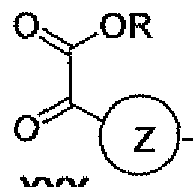 ^ R1!Λ^NγN^O SOCIz1
 XZ)-(R2)P
VI-3 VI-4
R\ Rϊ NR7R8
1-6

 Vl-β
Vl-β
Reaction Scheme VH
VII-2


NHR7Re
NaBH(0Ac)3
 Reaction Scheme VHI
NR7R8
NBS

VI-6

R
R1'-B(OH)2

VIII-2
Reaction Scheme IX
R?
RM

1-4
POCl3


IX-2 IX-3
R1 Rx vRϊ
)=N r^^Υ^N^R8
T T T y M li>-CR2)p
 IX-4
Reaction Scheme X
IX-4
Reaction Scheme X
NH2 ™c (R2JP
UC (*% CO2R Et3N

1-2 X-1
>=N
SOCi2 Rn
NaHMDS DMF, CHCl3
N.


RUi
NR7R8 NR7R8
V0 E
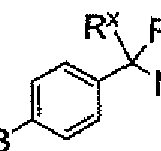 N^N^
N^N^
!-6 R1 ^B(OH)2
N
-<R2)p X-4 Ci

EXAMPLES
Examples and schemes provided are intended to assist in a further understanding of the invention. Particular materials employed, species and conditions are intended to be further illustrative of the invention and do not limit the reasonable scope thereof.
Scheme 1
V M-N^NH2 UBHB3 V V=,NN NH2 MπOz V M,κτ ^H2
 aO-t-Bu
O2Me Nc,Jl^OH N^1JL N
CHO
1-1 c

NvUvyv

To a 1 L three-necked round bottom flask was added Methyl 7-amino-2~ methylpyrazolofljS-αlpyrimidine-θ-carboxylate (20.6 g, 100 mmol, 1.0 eq.) and THF (400 mL). The mixture was cooled to 0 oc and LiBHEt3 (315 mL of a 1.0 M solution in THF, 315 mmol, 3.0 eq.) was added slowly through an addition tunnel under nitrogen. After addition, the mixture was stirred at room temperature for 4 h. Additional LiBHEt3 (30 mL of a 1.0 M solution in
THF, 30 mmol, 0.3 eq.) was added and the mixture was stirred for an additional 1 h. The mixture was slowly treated with EtOAc (600 mL) and then water (300 mL). The layers were separated and the aqueous phase was extracted with EtOAc (2 X 300 mL). The combined organic phases were dried over anhydrous Na2SO4. After filtration and concentration, the residue was purified by a short silica gel column (2.5 inch in height and 4 inch in diameter) using MeOH in CH2CI2 as the eluent. Concentration by rotary evaporation provided (7-amino-2- methylpyrazolotlfS-Λjpyrimidin-ό-yl^ethanol (1-1) as a light yellowish solid. 7-amino-2-methylpyrazolori .S-αlpyrimidine-ό-carbaldehyde (1-2) (7-ammo-2-memylpyrazolo[1,5nα3pyrimidin-6-yl)methanol (1-1) (14.1 g, 79.2 mmol) was dissolved in anhydrous CHCl3 (500 mL) and THF (250 mL). Activated Mnθ2 (68.9 g, 792 mmol) was added to the mixture, and the mixture was stirred for 16 h. After filtration through a plug of Celite pad , the filtrate was evaporated to give 7-amino-2-methylpyrazolo[1,5- α]pyrimidrne-6-carbaldehyde (1-2) as a yellowish solid. 2-methyl-7-t)henylpyrazolori .5-g1pyridor3.2-elpyrirnidin-8(9/5-one ( 1-3)
Into a round bottom flask was added 7-aπώio-2-memylpyrazolo[1,5-α]pyrimidine- 6-carbaldehyde (1-2) (5.30 g, 30 mmol), methy phenylacetate (18.0 g, 120 mmol), potassium tert-butoxide (5.80 g, 60 mmol), and toluene (100 mL). The reaction mixture was heated to 105 °C while stirring under an atmosphere of nitrogen for 30 min. Then DMF (100 mL) was added and the mixture was stirred at 100 °C for 3 days. The reaction mixture was cooled to room temperature and concentrated in vacuo. The resulting residue was dissolved in DCM (600 mL) and then water (40OmL) was added to the solution. The precipitated solid was collected by filtration and the solid was washed with water (50 mL) and DCM (100 mL). The solid was dried over an oil pump for 2 days to give 2-memyl-7-phenylpyrazolo[1,5-α]r)yrido[3s2-e]pyrimidin- 8(9i?)-one (1-3) as a yellow solid. δ-cMoro^-meihyl^-phenylpwazolofl.S-glpyrio^fS^-eipyrincudine ri^)
To a 250 mL round bottom flask was added 2-methyl-7-phenylpyrazolo[1,5- α]pyrido[3,2-e]pyrimidin-8(9/0-one (1-3) (3 g, 10.9 mmol, 1 eq.), CHCl3 (120 mL), SOCI2
(5.17 g, 3.17 mL, 43.5 mmol, 4 eq.) and DMF (158.9 mg, 168.3 uL, 2.17 mmol, 0.2 eq.). The mixture was heated to 70 oc in an oil bath for 1 h. After 1 h, additional SOCI2 (1.6 mL, 21.8 mmol, 2 eq.) and DMF (168.3 uL, 2.17 mmol, 0.2 eq.) were added. The mixture was maintained at 70 OG for an additional 2 h. After 3 h total, LCMS analysis and TLC analysis (heptane:EtOAc (3:7)) of the resulting light brown solution indicated that the reaction was complete. The reaction was concentrated in vacuo and the residue diluted with EtOAc (100 mL),
washed with saturated aqueous NaHCOs solution (50 mL), and the aqueous phases re-extracted with EtOAc (3 x 200 mL). The combined organic phases were dried over MgSO4, filtered, and concentrated to give 3.2 g of material which was purified by silica gel chromatography using EtOAc/heptane as the eluent to give 8-chloro-2-memyl-7-phenyipyrazolo[1,5-α]pyrido[3J2- ejpyriraidine (1-4) as an yellow solid. 2-{3-hydroxγ-3-metfayl-1-[4-(2-me1^^^ yl^phenvncvclobutvU-lH-isoindole-LSCZm-dione fl-β)
A mixture of δ-cWorø^-meihyl-y-phenylpyrazolotl^^jpyridotS^^lpyrimidine (1-4) (206 mg, 0.700 mmol), 2-{frαrø-3-hydroxy-3-methyl -1-[4-(4>4>5J5-tetramethyl-1,3,2- dioxaborolan-2-yl)phenyl]cyclobutyl}-li/-isoindole-1.3(2//)-dione (1-5) (364 mg, 0.840 mmol), [l>r-bis(diphenylphosphmo)ferrocene]dichloropalladium (II) complex with dichloromethane (1:1) (114 mg, 0,140 mmol) and 2M aqueous solution of CS2CO3 (1.75 mL, 3.50 mmol) in 1,4- dioxane (15 mL) was stirred at 60 °C for 1 h. The solvent was removed by evaporation, and the residue was diluted with CHCl3, washed with water and brine, dried (MgSO4), filtered, and the solvent was removed by evaporation. The residue was purified by silica gel chromatography (CHCl3-5% MeOH/CHCl3) to give 2-{3-hydroxy-3-memyl-1-[4-(2-methyl-7- phenylρyrazoio[1,5-«]pyrido[3,2-e]ρyriniidm^ dione (1-6) as pale yellow foam. ιr<my-3-ainmo-1-methyl-3-[4-(2-mefcyl^ yl)phenγ-]cyclobutanol (1-T)
A mixture of 2-{3-hydroxy-3-methyl-1-[4-(2-methyl-7-phenylpyrazolo[1,5- a]pyrido[3,2-e]pyrimidin-8-yl)phenyl]cyclobutyl}-l/jT-isoindole-1,3(2i7)-dione (1-6) (198 mg, 0.350 mmol) and hydrazine monohydrate (1 mL, 20.6 mmol) in MeOH (4 mL) and 1,4-dioxane (4 mL) was heated under microwave irradiation at 130 °C for 30 rain. The mixture was diluted with CHCl3, washed with sat. NaHCθ3 solution, brine and water, dried (MgSθ4), filtered, and the solvent was removed by evaporation. The residue was purified by silica gel chromatography (0-20% MeOH/CHCl3) to give frβw-3-ammo4-me1hyl-3-[4-(2-methyl-7-phenylpyrazolo[1,5- α]pyrido[3,2-e]pyrimidin-8-yl)phenyl]cyclobutanol (1-7) as pale yellow foam. MS (M+H)+: observed - 436.2135, calculated = 436.2137
The following compounds were prepared in a similar fashion to Example 1-6 and 1-7 but usin the appropriate materials:

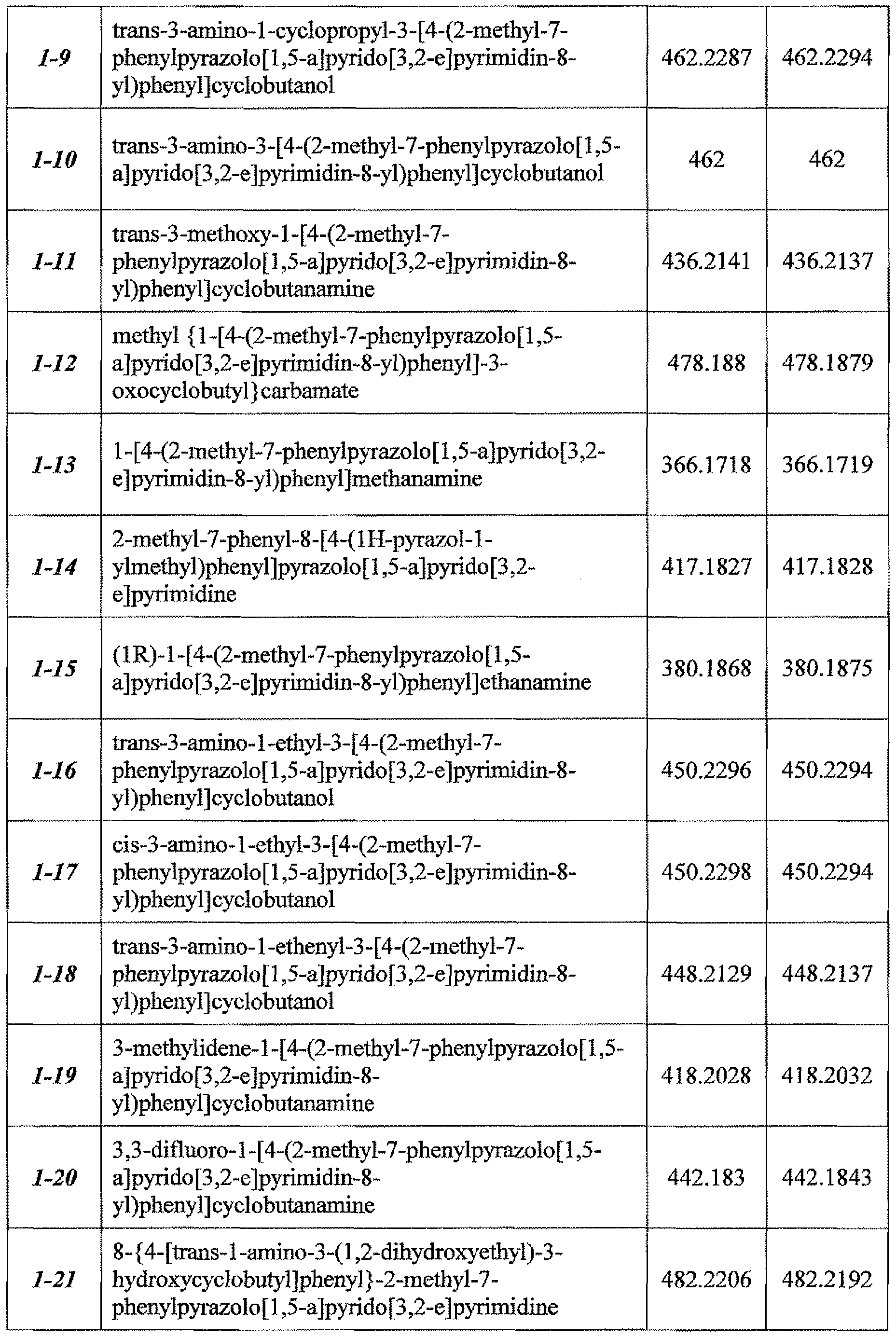

Scheme 2

LiBHEt3 HOAc IOO°C, 16 h THF

MnQ2 NaO-t-Bu, THF / CHCj1 toluene, DMF1 105°C


SOCl,
CHCy1DMF
60-75°C

2-5
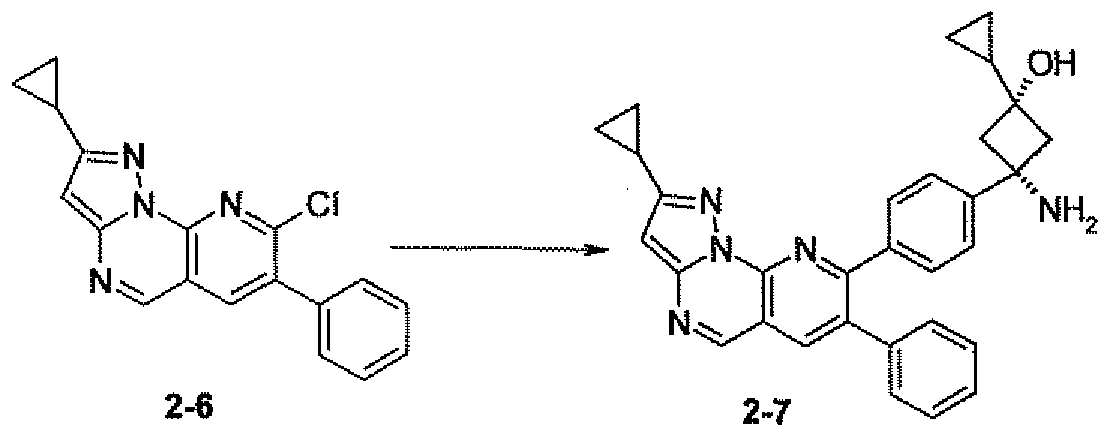 cϊs-3-amino-1-<vclopropyl-3-[4-(2-cyclθDropyl-7--phenvIpyrazoIo[1.5-aiDyrido|[312-- e1pyrimidin-8-yϊ)phenyπ cyclobαtanol (2-7)
7-Ainino-2-cvcloprDpyl-pyrazolof 1,5-a1pyrimidine-6-carboxyUc acid ethyl ester (2-2)
To a 250 mL round bottom flask was added Compound (2-1) (5 g, 40.6 mmol, 1 eq.), ethyl 2-cyano-3-ethoxyacrylate (6.9 g, 40.6 mmol, 1 eq.)» and AcOH (100 mL). The mixture was heated at 100 oc for 16 h. The reaction was concentrated and the residue was treated with with H2O (150 mL). The resulting precipitate was filtered, and the precipitate washed with H2O (3x 250 mL). The crude product was dried under high vacuum for 16 h to afford Compound (2-2).
^-Ammo-Σ-cvcIoproiM-pyTazo^ Compound (2-3) was prepared using a procedure similar to that of Compound (1-
D-
7-Ammo-2-cvclopropyl-pwazolo[l .5-g1pyrϊmidin-6-carbaldehvde (2-4)
Compound (2-4) was prepared using a procedure similar to that of Compound (1-
2).
2-Cγcloproρyl-7-phenyl-9i:f-l Λ.9.9b-tetraaza-cyclopenta[fllnaphthalen-8-one (2-5) Compound (2-5) was prepared using a procedure similar to that of Compound (1-
3).
S-Qiloro^-cyclopropyl-y-phenyl-l A9J9b4etraaza-cyclope3ita[a1naphthalene (2-6)
Compound (2-6) was prepared using a procedure similar to that of Compound (1-
4). cώ^3-amfoo-1-CΥcloproτM-3-[4-(2-c^^
8-γπphenvncvclobutanol (2-7) m-3~ammo-l^cϊopropyl~3-[4-(2-cyclopropyl-7-pheoylpyrazolo[1,5> α]pyrido[3,2-e]pyrimidin-8-yl)phenyl]cyclobutanol (2-7) was prepared using a procedure similar to that of Compound (1-6) and (1-7). MS(M+H)+: observed = 488.2448, calculated = 488.2450
The following compounds were prepared in a similar fashion to Examples from 2-1 to 2-7, but using the appropriate materials:

Scheme 3
te=N
V-NN^NH2
N J*. k CHO
1-2

Compound (3-1) was prepared using a procedure similar to that of Compound (1- 3). S-CMoro^-methyl^-thiophen^-vI- 1.4.9,9b-tetraaza-cγclopenta[a1iiaphtfaaϊene (3-2)
Compound (3-2) was prepared using a procedure similar to that of Compound (1- 4).
2-{3-Hvdroxy-3-methyl4-r4-(2-memyl-7-thiophen-2-yl-1.4.9.9b-tetraaza- cvclopenta[α1naphtfaalene-8-ylVphenγll-cyclobutvU-isoindole-L3-dione (3-3)
Compound (3-3) was prepared using a procedure similar to that of Compound (1-
6) 1raαs-3-aπmo-1-methyl-3-f4-[2-me 8-yl]phenγUcvclobutanol f3-4)
Compound (3-4) was prepared using a procedure similar to that of Compound (1- 7). MS (M+H)+: observed = 442.1701, calculated = 442.1702
The following compounds were prepared in a similar fashion to Examples from
1-2 to 3-4, but using the appropriate materials:


Scheme 4
K2OJj, D
H > MF, 100 °C, 24 h +


1-2
 4-2
4-2
TFA, CH.CI,

!-^4-(2-inethvI-7-phenylpyra2:oIofl.5-a]pyridQ[3J-e|pyrimidm"8- yl)phenyllcvclobtttananiiiιe (4-3)
{l-f4-f2-mefayl-7-phenγHA9,9b-tetraaza-^ carbamic acid tert-butyl ester (4-2)
A mixture of Compound (1-2) (56 mg, 0.32 mmol, 1 eq.), Compound (4-1) (132 mg, 0.36 mmol, 1 eq.), and potassium carbonate (47 mg, 0.36 mmol, 1.1 eq.) in DMF (6 mL) was heated at 100 °C for 24 h. After this time, the mixture was added to aqueous LiCl solution and then exrtracted three times with EtOAc. The combined organic phases were dried over Na2SO4 and concentrated under reduced pressure to afford a residue that was further purified by silica gel chromatography using CH2C-2:EtOAc as the eluant to provide Compound (4-2). This material was used in the next step without further characterization. l-[4-(2-methyl-7-phenγlpyrazolo[ 1.5-a]pyridof3,2-e1pyrimidm-8-yl)phenyl]cvclobutanamine (4-
3}
To a solution of Compound (4-2) (7 mg,. 0.14 mmol, 1 eq.) in CH2CI2 (3 mL) was added trifluoroacetic acid (1 mL) and the mixture stirred at room temperature for 15 minutes. The volatiles were removed under reduced pressure and the residue was purified by reverse phase HPLC using TFA:CH3CN and water as the eluant to provide Compound (4-3).
MS (M-HH)+: observed = 406.2027, calculated = 406.2032
Scheme 7
Cl Cl
NHBoc
 ϊ ϊ N
ϊ ϊ N
CHO
7-1 7-2 7-3

NH2NH2

7-6

9-[4-fl-aminocvcføbutvπDhenyl1-8-phenvI^1.2.41triazolor43-h]-lJ-naphthyridin-3f2H)-one a-€) tert-bvtή (2-chloropyridin-3-vπcarbamate (7-2) To a solution of 2-chloropyridin-3-amine (7-1) (2.0Og, 15.6 tnmol) in THF (50 mL) was added a 0.5M solution of KHMDS in THF (68.5 mL) and then di-tert-butyl dicarbonate (3.73 g, 17.1 mmol) and the mixture was stirred at room temperature for 2 hours. The mixture was diluted with ethyl acetate, washed with water, dried over sodium sulfate, filtered and concentrated in vacuo. The residue was purified by silica gel chromatography (0-60% EtOAc/Hexane) to give tert-butyl (2-chloropyridin-3-yl)carbamate (7-2) as a colorless solid. fert-butyl f2-chloro-4-formylpyridin-3-vπcarbamate (7-3)
To a solution of tert-bvtiyl (2-chloropyridin-3-yl)carbamate (7-2) (3.01g, 13.2 mmol) and TMEDA (3.37 g, 29 mmol) in THF (50 mL) at -78 <>C was added a 2.5 M solution of M-butylHthium in hexane (11.6 mL) dropwise over 10 miniutes and the mixture was stirred for 1 hour. The mixture was warmed up to -10 ©C and then cooled to -78 oc. DMF (3.06 mL) was added to the mixture and then the mixture was warmed to ambient temperature over 3 hours. Saturated aq. NH4CI and EtOAc were added to the mixutre and the oranic layer was washed with H2O and brine, dried over MgSO4, filtered, concentrated in vacuo, and purified by silica gel chromatography (0-80% EtOAc/hexane) to give /erf-butyl (2-chloro-4-forraylpyridin-3- yl)carbamate (7-3) as a yellow solid. fert-butyl J l-f4-(8-cMoro-3-phenyl-1.7-naphthyridm-2-yl>phenvl1cvclobutyU(^rbamate (7-4)
A mixture of tert-bntyl (2-chloro-4-formylpyridin-3-yl)carbamate (7-3) (300 mg, 1.17 mmol), tert-butyl {l-[4-(phenylacetyl)phenyl]cyclobutyl}carbaniate (4-1) (427 mg, 1.17 mmol) and potassium carbonate (485 mg, 3.51 mmol) in DMF (10 mL) was stirred at 120 °C for 15 hours. The reaction mixture was cooled to room temperature, diluted with ethyl acetate, washed with water, dried over sodium sulfate, filtered, and concentrated in vacuo. The residue was purified by silica gel chromatography (hexane-EtOAc) to give tert-butyl {l-[4-(8-chloro-3- phenyl-lj-riaphthyridin^-yl^henyljcyclobury^carbamate (7-4) as a pale yellow solid.
fert-butyl ( 1 -r4-(8-hydrazino-3-phenyl-l J-naphtfayridϊn^-yllphenylicvclobutvUcarbatnate (7-5)
To a solution of tert-butyl {l-[4-(8-chloro-3-phenyl-l,7-naphthyridin-2- yl)phenyl]cyclobutyl}carbomate (7-4) (288 mg, 0.593 mraol) in 1,4-dioxane (4 mL) was added hydrazine monohydrate (286 mL, 5.93 mmol). The mixture was stirred at 100 °C for Ih. The mixture was cooled to room temperature, suspended in ethyl acetate, washed with water, dried over sodium sulfate, filtered, and concentrated in vacuo to give ferr-butyl{l-[4-(8-hydrazino-3- phenyl-lf7-naphthyridm-2-yl)phenyl]cyclobutyI}carbamate (7-5) as an orange solid. 9-f4-a-arnmocYclobutynphenyl1^
A mixture of ϊert-butyl {144-(8-hydrazino-3-phenyl-l,7-naphthyridin-2- yl)phenyl]cyclobutyl}carbamate (7-5) (30.0 mg, 0.0620 mmol) and CDI (40.4 mg, 0.249 mmol) in 1,4-dioxane (2 mL) was stirred at 100 °C for 15 h and then cooled to room temperature. The mixture was diluted with EtOAc, washed with water, dried over sodium sulfate, filtered, and concentrated in vacuo. The residue was purified by column chromatography on silica gel. The residue was treated with HCl in MeOH and the mixture was heated in a microwave reactor at 80 °C for 5 min. The solvent was evaporated and the residue was purified by reverse phase (H2θ/0.1%TFAaq.-MeCN/0.1%TFAaq.) HPLC to give 9-[4-(l-ammocyclobutyl)phenyl3-8- phenyl[1,2,4]triazolot4,3-Λ]-l,7-naphthyridin-3(2iϊ)-one (7-6) as a colorless solid. MS (MfH)+: observed = 408, calculated = 408
Scheme 8
BrCN HCl


7-5 8-1
9-f4-fl-aminocvclobutv?)phenvπ-8-phenylfl^.4]triazolor43-/tI-l,7-naphthyridin-3-ainine <8~ft A mixture of fert-butyl {l-[4-(8-hydrazmcH3-phenyl-l,7-naphthyridin-2- yl)phenyl]cyclobutyl}carbarnate (7-5) (30 mg, 0.0620 mmol), cyanogen bromide (19.8 mg, 0187 mmol) in ethanol (2 mL) was stirred at 60 °C for 72 hours. The mixture was diluted with AcOEt, washed with water, dried over sodium sulfate, filtered, and concentrated in vacuo. The residue was purified by column chromatography on silica gel. The residue was treated with HCl in MeOH and the mixuture was heated in a microwave reactor at 80 °C for 5 min. The solvent was evaporated and the residue was purified by reverse phase HPLC (H2θ/0.1% TFA aq.-
MeCN/0.1% TFA aq.) to give 9-[4-(l-arnMiocyclobutyl)phenyl]-8-phenylE1,2,4]triazolo[4il3-Λ3- l,7-naphthyridin-3-araine (8-1) as a pale yellow solid.
MS (M+H)+: observed = 407.1974, calculated = 407.1984
Scheme 9
CH3CO2H EDC
HOBt . HCl


To a mixture of tert-bntyl {l-[4-(8-hydrazino-3-phenyl-l,7-impbthyridin--2- yl)phenyl]cyclobutyl}carbamate (7-5) (30 mg, 0.0620 mmol), acetic acid (11.2 mg, 0.187 mmol), HOBt (19.1 mg, 0.125 mmol) and DPEA (0.044 mL, 0.249 mraol) in NMP (2 mL) was added EDC (23.9 mg, 0.125 mmol). The mixture was stirred at room temperature for 30 min and then at 100 °C for 72 hours. The mixture was diluted with AcOEt, washed with water, dried over sodium sulfate, filtered, and concentrated in vacuo. The residue was purified by silica gel chromatography. HCl in MeOH was added to the residue and the mixture was heated in a microwave reactor at 80 °C for 5 minutes. The solvent was evaporated and the residue was purified by reverse phase HPLC (H2O/0.1% TFA aq.-MeCN/0.1 % TFA aq.) to give l-[4-(3- methyl-8-phenyl[1,2,4]triazolo[4,3-A]-l J-rmphmyridm-9-yl)phenyl]cyclobutanainine (9-1) as a pale yellow solid.
MS (M+H)+: observed = 406.2028, calculated = 406.2032
The following compounds were prepared in a similar fashion to Examples from
2-1 to 2-7 but usin the a ro riate materials:

Scheme 10
NaNq, HCl
4yN NH2 EtOH reflux >=N EtOH

10-1 10-2

SOCI2
20% HOAc DMF, CHCjj it to 60-70'C
V1S^-NH2 4 h 70 °C
N*. NH2


10-3 10-4
NH2NH2
MeOH, dioxane 70 "C

10-7
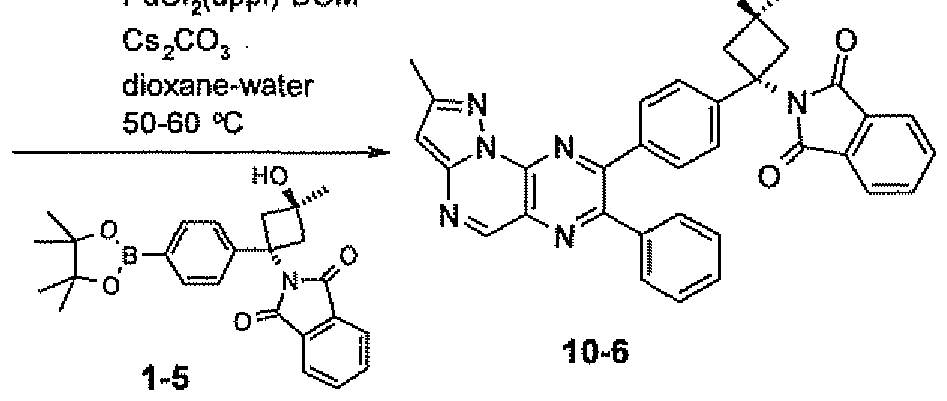 trans-S-hvdroi^-S-methYl-1-^-fl-methyl-T-phenylPyrazoloU.S-alpteridin-^ vDpheavncvclobtttanamme (IQ-T)
7-Ammo-2-methyI-pyra2Plo|[1.5-a1pyraa3idJBe-^-carboxylic acid hvdrazide (10-1) A 250 mL flask containing the Methyl 7-amino-2-methylpyrazolo[1,5- α]pyrimidine-6-carboxylate (2.1 g, 20 ramol), EtOH (55 mL), and hydrazine hydrate (20 mL) was heated to reflux for 6 hours. The mixture was allowed to cool to room temperature. The precipitated solid was filtered and washed with water (2 x 10 mL) to provide Compound (10-1) as a white solid. 7-Metnyl-1,3-dihvdro-pyrazolor5.1-blDurin-2-one (10-2)
A 100 mL flask containing Compound (10-1) (1.1 g, 5.0 mmol, 1 eq.), EtOH (25 mL), and 10% aqueous HCl (25 mL) was cooled to 0 °C by ice-water bath. Then NaNO2 (0.35 g, 5.0 mmol, 1 eq.) in water (8 mL) was added slowly. The mixture was stirred at that temperature for 2 hours, after which it was heated to 80 °C for 2 hours. After cooling and removal of the volatiles by rotary evaporation, the residue was treated with water (40 mL). The resulting precipitated solid was filtered and washed with water (2 x 5 mL) to provide Compound
(10-2) as a brownish solid.
2-Memyl-pV3^2Olori,5-a1pyriniidme-6J-diamine ('10-3)
A 40 mL scintillation vial containing Compound (10-2) (0.72 g, 3.8 mmol) and 10% aqueous HCl (25 mL) was heated at 100 °C for 3 hours. The mixture was allowed to cool, the solvent was removed in vacuo and water (~40 mL) was added. The resulting solid (starting
material) was filtered to recover Compound (10-2). The filtrate was then concentrated and dried to furnish Compound (10-3) as a yellowish solid. 2-Metfayl-7-phenyl-lA6,9,9b-pentaaz^^
A 40-mL scintillation vial containing Compound (10-3) (320 mg, 2.0 mmol, 1 eq.), methyl phenylpyruvate (360 mg, 2.2 mmol, 1.1 eq.), and 20% AcOH (20 raL) was stirred at room temperature for 1.5 hours and at 65 °C for 4 hours. The mixture was allowed to cool and the precipitated solid was filtered and washed successively with water (15 mL) and Et2θ (2 x 10 mL). The solid was dried in vacuo to give Compound (10-4) as a yellowish solid. S-CMoro^-memyl-y-phenyl-l^.ό.g.gbφentaaza-cyclopemtarαinaphthalene flO-S) A 40 mL scintillation vial containing Compound (10-4) (220 mg, 0.8 mmol, 1 eq.), CHCl3 (12 mL), DMF (12 mg, 0.16 mmol, 2 eq.), and SOCI2 (0.56 g, 3.2 mmol, 4 eq.) was heated at 70 °C under nitrogen for 1.5 hours. Then the mixture was allowed to cool and the solvent was removed in vacuo. The residue was dissolved in CHCl3 (20 mL) and washed with saturated NaHCθ3 (5 mL). The water solution was extracted with CHCl3 (2 X 5 mL). The combined organic phases were dried over MgSOφ After filtration and concentration, the residue was purified by silica gel chromatography using EtOAc and heptane as the mobile phases to furnish Compound (10-5) as a yellowish solid. 2-{3-Hvdroχy-3-meΦyl-1-r4-(2-memy^ 8-yl)-phenyl1-cyclobutyl}-isoindole-l ,3-dione (10-6) A 20 mL scintillation vial containing Compound (10-5) (60 mg, 0.20 ramol, 1 eq.), Compound (1-5) (87 mg, 0.20 mmol, 1 eq.), CS2CO3 (325 mg, 1.0 mmol, 5 eq.), dioxane
(3.0 mL) and water (0.6 mL) was evacuated and flushed three times with nitrogen. Then PdCl2(dppf)-CH2C-2 (24 mg, 0.03 mmol, 0.15 eq.) was added and the resulting solution was evacuated and flushed three times with nitrogen. The mixture was heated at 55 °C for 90 minutes. The mixture was allowed to cool and the solvents removed in vacuo. The residue was dissolved in CH2CI2 (10 mL). After filtration and concentration, it was purified by silica gel chromatography using MeOH and CH2CI2 as the mobile phases to furnish Compound (lθ-6) as a yellowish solid. tτans-3-hvdroxy-3-memyl-1-r4-(2-methyl-7-phenylpyrazolof 1 ,5-alpteridin-8- yl)phenyl]cYclobutanamine (10-7)
A 20 mL scintillation vial containing Compound (10-6) (82 mg, 0.145 mmol), MeOH (3 mL), dioxane (3 mL), and hydrazine (1 mL) was heated at 70 °C for 3 hours. Then the solvent was removed in vacuo. The residue was dissolved in 80% MeOH-water (7 mL, some CH2CI2) and several drops of AcOH. Then it was purified by reverse-phase preparative HPLC using water-acetonitrile-AcOH [95 :5 :0.05] and acetonitrile-water-AcOH [95:5:0.05] as the mobile phases to provide Compound (10-7) as a yellow solid. MS (M+H>H-: observed = 437.2091, calculated = 437.209
Scheme U


2-methyl-7-phenγl-8-f4-{r4-f5-pyridiM-2-yl-4H-lJ.4-triazol-3-vnpiDeridin-1- vIlmethvI|phenγl)pγrazoIofl3"alpγridof3>2-e1pyrimidine ril-2)
4-(2-memyl-7-phenylpyrazolo[1.5-g1ϋv^
Compound (11-1) was synthesized in a similar manner to the procedure for example (1-6), but using 4-(4,4,5,5-tetramethyl-l J392-dioxaborolan-2-yl)benzaldeliyde as a starting material.
2-methyl-7-phenyl-8-f4-fr4-(5-pTOdm^^ γl]methyl}phenyπpyra2θlo[1,5-a1pyridor3.2-e1pyritnidine (ll-2)
Compound (ll-2)was synthesized in a similar manner to the procedure for example (1-7) in WO2006O91395, but using 4-(2-raethyl-7-phenylpyrazolo[l)5-α]pyrido[3,2- e]pyrimidin-8-yI)benzaldehyde (11-1) as a starting material. MS (M+H)+: observed = 578, calculated = 578
The following compounds were prepared in a similar fashion to Example 11-2, but using the appropriate materials:



Scheme 12
O )=N 1) LiBHEIg
N^ N NH2 2) MnO2
T -"CO2Et
12-1
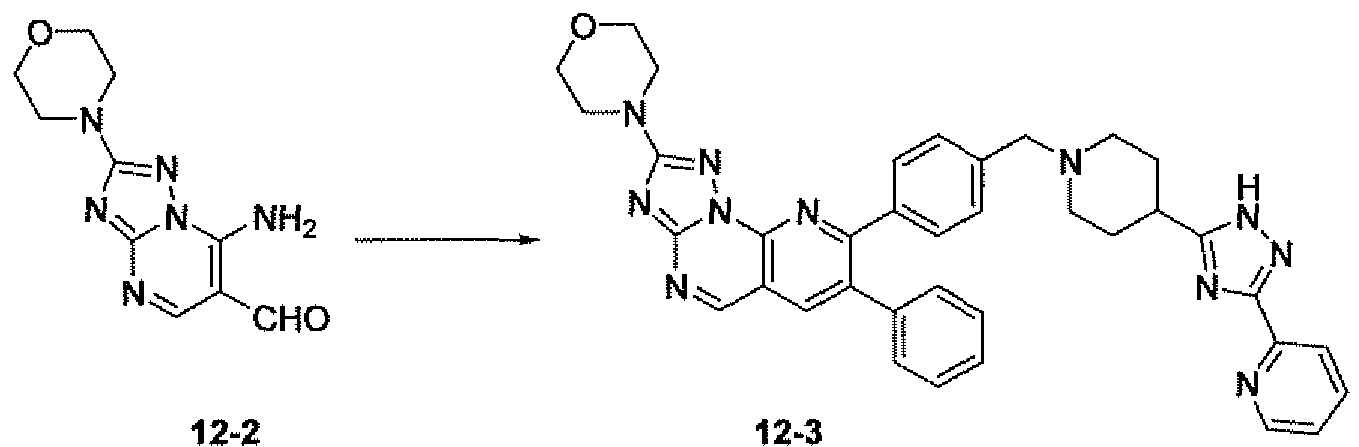
2-moπ>hoMB-4-vI-7-phenyI-^f44^ yllmethvUphenyl)pyridoF3 J!»el H.2.41triazo.o[ 1.5-a]pyrin»dine (12-3)
7-amino-2-(morpholin-4-yl)[1,2,4]Mazolo[1,5-a]pyrimidine-6-carbaldehyde (12-2)
Compound (12-2) was synthesized in a similar manner to the procedure for example (1-1) and (1-2), but using ethyl 7-amino-2-(morpholin-4-yl)[1,2}4]triazolo[l ,5- a]pyrimidine-6-carboxylate (12-1) as a starting material.
2-morpholm-4-yl-7-pheaiv^ γl)meiJiyUphenyl)pyra2X)lo[1,5-g1pyrido[3.2-g1pyrimidine (12-3)
Compound (12-3) was synthesized in a similar manner to the procedure for example (1-4), (1-5) and (1-7) in WO2006091395, but using 7-amino-2-(morpholin-4- yl)[1,2,4]tria2»lo[1,5-a]pyrimidine-6-carbaldehyde (12-2) as a starting material. MS (M+H)+: observed = 650, calculated = 650.

NaBH(OACk Dioxane 5% AcOH


11-1 13-1 Ethyl l-[4^2-methyl-7-phenylpyra2θlofl3-a]pyrido[3,2^elpyrimidin-8-vπbenzvIlpiperidine- 4-carboχylate (13-1)
Compound (11-1) (1.28 g, 3.51 mmol, 1.0 eq) was dissolved in dioxane (38 mL, anhydrous). Ethyl isonipecotate (1.66 g, 10.5 mmol, 3.0 eq), glacial acetic acid (1.90 mL). and NaBH(OAc)3 (2.98 g, 14.1 mmol, 4.0 eq) were added and the reaction stirred at room
temperature for 24 hours. The crude reaction was neutralized with NaHCO3 (aq.) and extracted with CHCl3 (x3). The combined organics were dried with brine and Na2SO4, and then concentrated in vacuo. The residue was purified by silica gel chromatography by eluting with a gradient of heptane and EtOAc (20% to 100% EtOAc) to afford Compound (13-1). MS (JVB-H)+: observed = 506, calculated =506
The following compounds were prepared in a similar fashion to Examples (11-2), but using the appropriate materials:
Methyl l-f4-(2-roethyl-7-phenylpyr azoloflτ5-a]pyτidor3^-e]pγrimifliii -«- yl)benzyllpiperidfoe-4-carboxyIate (13-2)
MS (M+H)+: observed = 492, calculated = 492.
Schemel4
LiOH THFZH2O


13-1 14-1 l-[4-f2-methyl-7-phenyipyrazolof1,5-a1pyridof3Jt-elpyήinidin-8-yltbenzynpiperidine-4- carboxylic acid (14-1)
Compound (13-1) (1.78 g, 3.52 mmol, 1.0 eq) was dissolved in THF (35 mL) and then added H2O (35 mL) and LiOH (178 mg, 10% w/w). The reaction was stirred at room temperature for 20 hours. After that time,, the THF was removed in vacuo, and the remaining solvent was diluted with additional water and the pH adjusted to 7 with dilute HCl (5% aq). The mixture was extracted with CHCl3/MeOH (4:1, x 5). The combined organic phases were dried with brine and Na2SO4, and then concentrated onto Celite in vacuo. The material was purified by silica gel chromatography by eluting with a gradient of CHCl3 to CHCl3/MeOH (1:1) to give Compound (14-1). MS (M+H>f : observed = 478.2239, calculated = 478.2243
Schemel5
HOBt1 EDC
DIEA
DMFZCH2CL,
H2N.


14-1 15-1
Z-methyl-T-phenyl-S-fΦ-IN-fphenylcarbamQy^piperidui-1-YllniethvUphenYπDyrazoIoU^- alpyridoD^-eipyrimidine (15-D
Compound (14-1) (20 mg, 0.042 mmol, 1.0 eq), HOBt (11 mg, 0.084 πraiol, 2.0 eq), EDC (HCl salt, 12 mg, 0.063 mmol, 1.5 eq) and diisopropylethylamine (22 μh, 0.13 mmol, 3.0 eq) were dissolved in DMF (400 μL, anhydrous) and CH2CI2 (400 μL, anhydrous). To this solution was added aniline (19 mg, 0.21 mmol, 5.0 eq) and the reaction stirred at room temperature for 16 hours. After that time water was added and the mixture extracted with CHCl3 (x3). The combined organic phases were dried with brine and Na2SO4, and then concentrated in vacuo. The residue was purified by silica gel chromatography by eluting with a gradient of CHCl3 to [CHCl3/MeOH/NH4θH 90:10:1]. The resulting solid was then dissolved in MeOH, added TFA (100 μL), and purified by reverse-phase chromatography (Solvent A H2O/CH3CN/TFA (95:5:0.05), Solvent B CH3CN/H2O/TFA (95:5:0.05)) with a gradient of 5% to 60% B over 5 minutes to give Compound (15-1)
MS (M+H)+: observed = 553.2721, calculated = 553.2716
The following compounds were prepared in a similar fashion to Example 15-1,, but usin the a ro riate materials:


Scheme 16
NBS, 1,2-DCE WN ».
N


16-1 16-2

2-(l-r4-(3-bromjθ:2-me1fayl-7-plienyl-1.4.9.9b-^^ c^lopropxl^l^hYdrgxy-cyclobutyll-isoindole-l .3-dione (16-2)
To a 20 mL scintillation vial containing Compound (16-1) (150 mg, 0.253 mmol,
1.0 eq.; synthesized as an intermediate of (1-9)) in dichloroethane (5 mL) was added JV- bromosuccinimide (54 mg, 0.305 mmol, 1.2 eq.). The mixture was stirred at room temperature for 25 minutes. The solvent was then evaporated under reduced pressure. The residue was dissolved in MeOH/CHCl3 and purified by silica gel chromatography using CHCl3 and MeOH [90: 10] as the mobile phases to provide Compound (16-2) as a pale yellow solid. trans-3-anύno-lκryclcφroρyl-3-r4^ e]pyrinudin-8-vπphenyl]cyclobutanol (16-3)
Compound (16-3) was prepared using a procedure similar to that of Compound (1-
6) and (1-7). MS (M+H)+: observed =540, 5420 , calculated =540, 5420
The following compounds were prepared in a similar fashion to Examples 16-2 and 16-3, but using the appropriate materials:

Schme 17
V ^
*yNγNγO NIS / CHUtF HyN^N^OH Cs-CO4

N.
KJ
'

17-4 17-3 trans-3-amino-1-cycIopropyI-3-{4-f2-methyl-7-phenyl-3-rpyrldin-3-yl)pyrazolo[1,5- a]pyridop«2-c1pyrimidin-8-vI1phenvI|cyclobutanol (17-4)
S-Iodo^-methvl-T-phenvl-l^^.Pb-tetraaza-cvclopentafαinaphthalen-S-ol fl?-'!)
To a solution of Comound (1-3) (0.2g, 0.73 mmol, 1 eq.) in DMF (10 mL) was added JV-iodosuccinimide (0.18 g, 0.8 mmol, 1.1 eq.) and the mixture stirred for 2 hours and concentrated. The residue was purified by silica gel chromatography using CHCl3/MeOH(10%) as eluant to give Compound (17-1) 2zM£liffi3b7-phen^
Compound (17-2) was prepared using a procedure similar to that of Compound (1- 6).
Compound (17-3) was prepared using a procedure similar to that of Compound (1- 4). trang-3:.a^ elpyπmidin-S-yllphenyllcyclobutanoKl?-^
Compound (17-4) was prepared using a procedure similar to that of Compound (1- 6) and (1-7). MS (M+H)+: observed = 539.2549, calculated = 539.2559.
traπs-3-amino-1-cvcϊoproDyl-3-[4-f3-cvano-2-methyl-7-phenvipyrazoIori.5-a]pyrido[3^- e1pyrimidia-8-yI)phenyllcvclobutanol fl7-5) trans-3-ammo-1-cyclopropyl-3-[4-(3-cyano-2-melhyl-7-phenylpyrazolo[1,5 a]pyrido[3,2-e3pyrimidin-8-yl)phenyl]cyclobutanol (17-5) was prepared using a procedure similar to that of Compound (17-4). MS (M+H)+: observed = 487.2253, calculated = 487.2246
The following compounds were prepared in a similar fashion to Examples from 17-2 tol7-4 but usin the a ro riate materials:

Scheme 18
Pd(P-t-B(jL)s Cs2Cq9, MeB(OH)2 dioxane, 80 °C


«■2 18.1
8-r4-ftrans-1-a.iiino-3-cvciopropyl-3-hvdroxycvclobutvπpheDvIl-23-diiiietfayl-7- phenylpyrazolori.5-a1pyridor3J-elpyrimidine fl8-l^
A 20 mL scintillation vial containing Compound (16-2) (12 mg, 0.03 ramol, 1 eq.), MeB(OH)2 (50 mg, 0.30 ramol, 10 eq.), CS2CO3 (96 mg, 0.30 ramol, 10 eq.), and dioxane (2 mL) was evacuated and flushed three times with nitrogen. Then, Pd(P-t-Bu3)2 (2.3 mg, 0.0045 mmol, 0.15 eq.) was added and the resulting solution was evacuated and flushed three times with nitrogen. The mixture was heated at 80 °C for 2 hours. Then it was allowed to cool and diluted with MeOH (2 mL). After filtration, the filtrate was purified by reverse-phase preparative HPLC using water-acetonitrile-TFA [95:5:0.05] and acetonitrile-water-TFA [95:5:0.05] as the mobile phases to provide Compound (18-1) as a yellow solid. MS (M+H)+: observed = 476.2461, calculated = 476.2450
Scheme 19
1. MeLi1 THF1 O°C 2. MnO2, THF
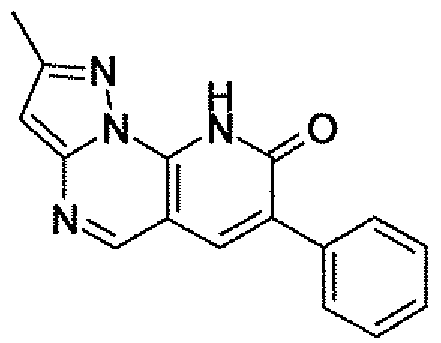

19-1
1-3 HC) /

19-2

19-3 ti^ns-3-amino-3-[4-f2^^imethyl-7-pheiivIpyrazoIo[1,5-a]pyridoβ^-elpyritnidin-8- vI)phenvIl-1-methvIcvcIobutanoπi9-3)
2J-άmethyl-7-phenylρyrazolo;i^^
In a 20 mL scintillation vial, Compound (1-3) (0.15 g, 0.543 mmol, 1.0 eq.) was dissolved in THF (10 mL). The solution was cooled to -78 »C and MeLi (15 mL of 1.6 NTHF
solution, 24 mmol, 44.19 eq.) was added dropwise and the reaction mixture was stirred for 16 hours at 0 - 20 *>C. The reaction mixture was carefully and slowly poured into ethyl acetate 20 (mL) and stirred for 10 minutes. The quenched reaction mixture was concentrated. The residue was treated with 100 mL of THF and the THF solution was separated from the solid by filtration. The organic solution was stirred with Mnθ2 (0.47 g, 5.4 mmol, 10 eq.) for 4 hours at room temperature. The reaction was filtered and the solids washed with CHCtø/MeOH (10%) (50 mL). The combined organic solution was concentrated and the crude was purified by silica gel chromatography using CHClj/MeOH (10%) as the eluant to give Compound (19-1).
8-cMoro-2.5-dime&y--7-phenylpwa^
In a 20 mL scintillation vial Compound (19-1) (0.08 g, 0.275 mmol, 1.0 eq.) was heated with 2 mL of POCI3 at 80 °C for 2 hours. The reaction was cooled and concentrated and the residue by silica gel chromatography using CHCtø/MeOH (10%) as eluant to give Compound (19-2). transzg-ajcrin^^ 1-methylcvclobutanol (19-3^
Compound (19-3) was prepared using procedures similar to those of Compound (1-6) and (1-7). MS (M+H>f : observed = 450.2291, calculated = 450.2294
Scheme 20

MeB(OH)2

 trans-3-amino-3-f4-(216-dimethyI-7-phenvIpyrazQlori,5-a1pyridor3Jt-e]pyriniidin-8- yl)phenyll-1-methylcvclobntanol (20-6)
2-Me1fayl-7-phenylacetylararino-pyra^ acid methyl ester (20-1)
A 250 mL rouαd-bottomed flask containing methyl 7-amino-2- methylpyrazolo[1,5-«]pyrimϊdine-6-carboxylate (1.1 Og, 5.0 mmol, 1 eq.), CH2CI2 (40 mL), and Et3N (2.04 g, 20 mmol, 4 eq.) was added slowly phenylacetyl chloride (6.16 g, 40 mmol, 8 eq.).
Then the mixture was heated at 80 °C for 4 h. The mixture was allowed to cool and the solvent was removed in vacuo. The residue was dissolved in CH2CI2 (40 mL) and water (25 mL). The aqueous phase was extracted with CH2CI2 (2 x 15 mL). The combined organic solution was dried over Na2SO4. After filtration and concentration, the residue was purified by silica gel chromatography using MeOH and CH2CI2 as the mobile phases to furnish Compound (20-1) as a yellowish solid. 2-Memyl-l .4.9.9b-te1xaazaHΛfclorκaitøra1naphthalene-6.8-diol (20-2)
A 250 mL round bottom flask wntaining Compound (20-1) (1.62g, 5.0 mmol, 1 eq.), THF (30 mL), and NaHMDS (7.5 mL, 7.5 mmol, 1.5 eq.) was stirred at room temperature for 2 h. The reaction was treated with CH2CI2 (30 mL) and water (40 mL). The aqueous phase was extracted with CH2CI2 (2 x 15 mL). The water layer was acidified with concentrated HCl (~10 mL). The precipitated solid was filtered and washed with CH2CI2 (4 mL) to furnish
Compound (20-2) as a yellowish solid. The acidified water layer was extracted with 5% MeOH in CH2CI2 (3 x 25 mL). The combined organic phases were dried over Na2SO4. After filtration and concentration, the residue was purified by silica gel chromatography using MeOH and CH2CI2 as the mobile phases to furnish Compound (20-2) as a yellowish solid. 6,8-Dichloro-2-methyl-7-phenγl-l .4,9,9b-tetraaza-cyclopentara]naphthalene (20-3)
Compound (20-3) was prepared using procedures similar to those of Compound
(1-4).
U-f4-(6-CMoro-2-methγl-7-phenyl-lA9.9b^ hydroxy-3-methyl-cγclobutyU-carbamic acid tert-butyl ester (20-4) Compound (20-4) was prepared using procedures similar to those of Compound
(1-5).
{l-j4-(2,6-Dimemyl-7-phenyl-lA9,9b-tetr^ hydroxy-3-methyl-cvclobutvU-carbamic acid tert-butyl ester (20-5)
A 20 ml scintillation vial containing Compound (20-4) (40 mg, 0.07 mmol, leq.), methylboronic acid (84 mg, 1.4 mmol, 2 eq.), CS2CO3 (226 mg, 0.70 mmol, 1 eq.), and dioxane (5.0 ml) was evacuated and flushed three times with nitrogen. Then PdCl2(dppf)-
CH2CI2 (24 mg, 0.03 mmol, 0.5 eq.) was added and the resulting solution was evacuated and flushed three times with nitrogen. The mixture was heated at 80 °C for 2.5 h. Then it was allowed to cool. The solvent was removed in vacuo. The residue was dissolved in CH2CI2 (10 mL). After filtration and concentration, it was purified by silica gel chromatography by using MeOH and CH2CI2 as the mobile phases to furnish Compound (20-5) as a yellowish solid. trara-3-antino-3-r4-f2.6-dimefay^ 1-mefoγlcyclobutanol (20-6)
Compound (20-6) was prepared using procedures similar to those of Compound (9-1). MS (M+H)+: observed = 450, calculated = 450
ti^ns-S-amioo-S-M-fό-chloro^-methyl-T-phenylpyrazolofl^-aipyridop^-eipyrϊmidin-S- vπphenyll-1-metfaylcyclobtttanol (20~7)
Compound (20-7) was prepared using procedures similar to those of Compound (9-1), but using Compound (20-4). MS (M+H)+: observed = 470, calculated = 470 CONTINUING E)
7-Aryl-tetraaza- and 7-aryl-pentaaza-cycϊopenta[αJnapthalene benzene derivatives as Aktl allosteric inhibitors

R5 R6
 tetraaza cyclopenta[a]napthaleπe benzene tetrapenta cyclopenta[a]napthalene benzene Key Transformations
Synthesis of pyridone intermediate

Chlorination of PyridonE (SOCl2 procedure)

Chlorination of Pyridone (POCl3 procedure)

Synthesis of Cyclobutylamine headgroup (Scheme VI)

Conversion of cydobutanone to alklylcyclobαtanol (Scheme VII)
 Br→ B(OR)2 Conversion

Suzuki (Pd coupling) of Core Chloride to Headgroup Boronic Acid:

Friedlander cyclization to install headgroup

Phth Deprotection (JV-Phth->NH2):


XLIIl XLIV
Scheme VHI - Iodination and coupling of pyridone
.N- ,,N VN
^NγNγ° NIS/ DMF ^ i^Syi, N OH Cs2CO,

KJ

XCVM
IV
POCI,
N_N_CI


XCIX
Bromination of 3-position
HQ
NBS, 1,2-DCE ^


XL CV
Suzuki reaction at the 3-poistion
>
Pd(P-t-Bu3)2 Cs2CO8, MeB(OH)^ dtoxanβ, 80 °C

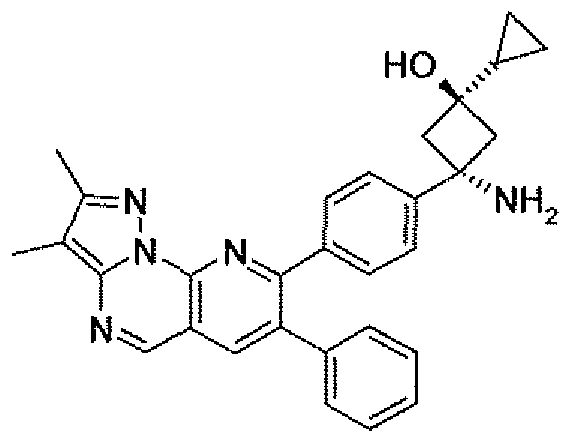
CVl CCXLII
5-Methylation
1.MeLi1THF1O°C 2. MnO2, THF


IV CIX
Scheme IX- Synthesis of 4-piperidine carboxamides
H


CS2CO, NaBH(OAc),
Pd(dppf)CH-CI- H Dioxane
Dioxane/H-p 5% AcOH


LiOH THRH2O


H2N. CLX cυα
HOBt1EDC
DIEA
DMRCH2CI-

CLXII
Scheme X - Synthesis of Pyridazane compound
10% aq. HCl 100°C, 3 h
V V,NN^N
CCXXVIII
CHCl3 V=r
,Cl
N
N

CCXXIX CCXXX CCXXXI

PdClj,(φpf>-DCM HO. ^ Cs2CO3
NH2NH2 dioxane-water \
5Oθ0 "C MeOH, dioxane 70 °C


CCXXXII CCXXXKI
List of key reference compounds for experimental procedures 2-Methyl-7-phenyl-9i9-1,4,9,9b-tetraaza-cyclopenta[ajnaphthaIen-8-one [IV]

IV
S-CWoro^-methyl-T^henyl-lA^b-tetraaza-cyclopentalaJnaphthalene fVJ
-ci

7-Amino-2-methyϊ-pyrazolo[l,S-α]pyrimidin-6-carbaldehyde [10]
Hi
2-ϊl-(4-Bromo-phenyϊ)-3-oxo-cycIobutyl]-isoindole-13-dione ϊXXXVII]

XXXVIl tø»s-2-{3-CyclopropyI-3-hydro:iy-1-[4^^ phenyl]-cyclobut\l}-isoindole-13-dione [XXXIXJ

frαw5-2-[l-(4-Bromo-phenyl)-3-hydroxy-3-methyl-cyclobαtyl]-isoindole-13-dione [LXVII]


XLl itrαw5-3-Amino-1-methyl-3-[4-(2-methyl-7-phenyl-1,4,9,9b-tetraaza- cycIopenta[fl]naphthalen-8-yl)-phenyI]~cyclobutanol [LXIX]
HQ

LXlX cw-S-Amino-1-methyl-S-^^Z-methyl-T-pheiiyH^^^b-tetraaza-cycIopeiitatαJnaphthaleπ- 8-yl)-phenyl]-cydobutanol [LXXII]

LXXII iftwιs-3-Amino-lκycIoprøpyI-3-[^^ cyclopenta[α]naphthaIen-8-yI)-phenyl]-cyclobutanol [LXXIV]

LXXIV irαws-3-Amiiio-1-cyclopropyl-3-[4-<7-phenyl-1,4,9,9b-tetraa2a-cyclopenta[α]naphthalen-8- yl)-phenyl]-cyclobutanol pLXXVI]

LXXVI
;rø«s'-3-AmincHl-M€!thyl-3-[4-(2HydoprOpyI-7-phenyl-1,4,9^b-tetra cyclopenta[fl]naphthaleπ-8-yI)-phenyl]-cyclobutanol [CCXLIVj
HQ

CCXUV frα«5-3-Ai--ύno-l^yclopropyI-3-[4-(2^4-fluorophenyl)-7-phenyϊ-lA9,9b-t€traaza- cyclopenta[α]naphthalen-8-yl)-phenyl]-cyclobutaiiol [LXXVIII]

LXXVlIl frα«s-3-Amme-1-cycIopropyl-3-I^ cyclopentaϊα]naphthalen-8-yϊ)-phenyIl-cyclobutanol [LXXX]

LXXX /ra«s-3-Araino-1-methyl-3-[4-(2-t-butyl-7-pheiιyl-1,4^,9b-tetraaza- cyclopenta[α]naphthaIen-8-yl)-phenyij-cyclobutanol [CCXJLI]
HO

CCXLI
S-Amiiio-S-^-^S-bromo-1-inethyl-T-phenyH^^^b-tetraaza-cyclopentalαϊnaphthalen-S- yl)-phenyI]-cydopropyϊ-cycIobtttanoHCVI]
HO P

CVI
S-Anύno-S-t'HS-chlor^-methyl-T-phenyl-l^.^b-tetraaza-cyclopeiitalαϊnaphthaleii-S- yl)-phenyl]-cyclopropyl-cyclobutanol [CVϋl]
HQ P

CVIIE
/rait5-3-Amino-1-cycIopropyl-3-[4-(3H^ano-2-metfayI-7-phenyl"ly4,9,9b-tetraaza- cydopenta{αj|naphthalen-β-yl)-phenyl]~cyclobutaiiol [CIV]

CIV S-Amino-1-cyclopropyl-S-^-tZβ-dimethyl-T-pIicnyl-l^jό^^b-pentaaza-
cycIopenta[α]naphthaIen-8-yl)-phenyl]-cyclobutanol [CCXLII] >

CCXLI!
3-|^2-Methyl-7-ptaenyϊ-3-pyridi^^ phenyl]-oxazolidin-2-one [C] >

S-Amino-S-^-tljS-dimethyl-T-phenyl-l^^^b-tetraaza-cyclopentaJaJnaphthalen-S-yl)- phenylj-methyl-cyclobutanol [CXII]

CXII
3-Ami.αβ-1-methyl-3-HK2-methyl-7-thioplϊen-2-yϊ-8,9^%dro-1,4Λ9b-tetraa2a- cyclopenta[α]itaphthaleiift-8-yl)-phenyl]-cyclobutaiioI [CXVI] .

CXVi
3-Amino4-methyI-3-[4-(2-ιnetIιyl-7-thiophen-3-yI-8^-dihydro-1,4,9,9b-tetraaza- cyclopenta[αjnaphthalene-8~yl)-phenylj-cyclobutanol [CXX]
HO4 .

CXX
3-Araino-3-{4-(7-(:^-fluoiO~phenyl)^ yll-phenylJ-1-methyl-cyclobutanol ϊCXXIVl


LVI
3-Amiiio-1-hydro3ymethyl-3-l4-(2-methyl-7-phenyI-1,4,9>9b-tetraaza- cyclopenta[«jnaphthalen-8»yϊ)-pheiiyl)-cyclobutanol [CXXX]

l-l^tZ-methyl-V-phenyl-l^^^b-tetraaza-cycIopentalfllnaphthalen-S-ylV-phenyy-ethane- l^diol [LXTV]

LXfV
3-[4-<2-Methyl-7-phenyl-1,4,9?9b-tetraa2a-cyclopenta[ajnaphthaleii-8-yl)-phenyl]- oxazolidin-2-one [LXXXVI]

LXXXVI
^^-Methyl-T-phenyl-l^^b-tetraaza-cyclopentaJajnaphthaleii-S-ylJ-phenyl]- carboxaldehyde [XC]

XC l'-^^Z-Methyl-V-phenyH^^^b-tetraaza-cyclopeiitalflJBaphthalen-S-yrf-phenylmethyl]- spiro[furo[3,4-cjpyridine-3(1K),4'-piperidinej-1-onc [XCπ]
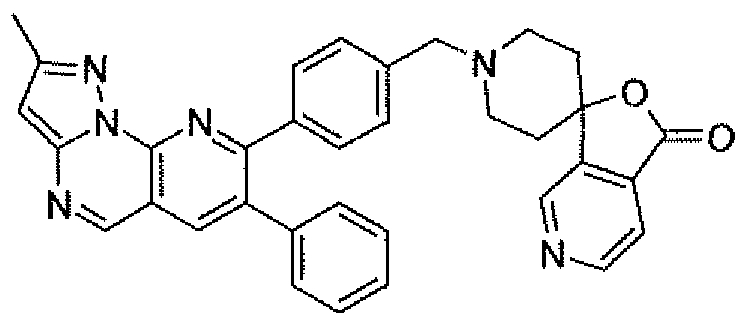
XCII l-^-tl-Methyl-T-phenyl-l^^^b-tetraaza-cycIopentalflJnaphthaleii-S-ylJ-benzyfl- piperidine-4-carboxylic acid ethyl ester [CLX]

CLX
l-[4^2-Merthyl-7-pbenyl-1,4^,9^ piperidiBe-4-carboxylic acid [CLXI]

CLXl l-f^Cl-Methyl-T-phenyl-l^^^b-tetraaza-cyclopentaJαliiaphthaleii-S-yQ-benzyl)- piperidine-4-carboxylic acid phenylamide [CLXIT]

CLXIl l-^Z-Methyl-T-phenyH^^^b-tetraaza-cycϊopentaJαlnaphthalen-S-ylJ-benzyϊ]- piperidine-4-carboxylic acid mettiylamide [CXCV]

CXCV
S-Amino-1-methyl-S-^-^l-methyl-T-phenyH^^^^b-peiitaaza-cydopentaJαJnaphthaleii-S- yl)-phenyl]-cyclobutanol [CCXXXHq

CCXXXIII
3-Amino-3-[4-(2,6-dimethyl-7-pte phenyfl-1-methyl-cyclobutanol [CCLIj

CCLI
/rα«*-3-AiϊiHio-1-inethyl-3-[4-(2-(4-methoxyphenyI)-7-phenyH,4,9,9b-tetraa3κa- cycIopenta[fl]naphthaIen-8-yl)-phenyl]-cyclobutanol (CCLXXVT]

CCLXXVI frαrø-3-Amino-1-methyl-3-(4-(2^ cyclopentalα]naphthalen-8-yl)-phenyl]-cyclobutaπol [CCLXXVIII]

CCLXXVIII frαws-S-Amiiio-1-methyl-S-^-CI-cyclobutyl-T-phenyl-l ,4,9,9b-tetraaza- cyclopenta[n]naphthalen~8-yl)-phenyl]-cyclθbutanol [CCLXXX]

CCLXXX ήrα«s-3-Amino-1-methyl-3-[4-{2-(pyridine-4-yl)-7-phenyH,4,9,9b-tetraaza- cyclopenta[«]naphthaIeii-8-yl)-pheiiyI]-cyclobutanol [CCXCIX]

CCXCIX frα«*-3-Aiiiiiio-l»methyl-3-[4-(2-(thiophen-3-yϊ)-7-pheiiyI-1,4^,9b-tetraaza- cyclopenta[α]naphthalen-8-yl)-phenyl]-cyclobutanol [CCCX]

CCCX frαιis>3-Ainmø4-methyl-3-[4-(7^^ phenyl]-cyclobutanol [CCCLXXXII]

CCCXXXII /rα/w-3-Amino-1-methyl-3-[4~(5-methyl-7-phettyI-1,4,9,9b-tetraaza- Gyclopenta[α]naphthalen-8-yl)-phenyIl-cyclobutanol [CCCLXXXIX]

CCCLXXXiX
Λrα«s-3-Amino-1-cyclopropyl-3-[4-(2-methyl-3,7-diphenyl-1,4,9,9b-tetraaza- cyclopenta[e]naphthalen-S-yl)-phenyI]-cycIobntanol [CCCXCIV]

CCCXCIV frα/ts-{3-Ethyl-3-hydroxy-1-[4-(4,4,5,5-tetramethyl-[lβ,2Jdioxaborolan-2-yl)-pheiiyl]- cyclobutyl}-isoindole-13-dione [CCCXCVΪΪIl
OH


VjL CH3C(OMe)j NH2 O — ' HOAc IOO °C, 16 h θ"\

CDI r O O CDiI
LiBHEt3 MnO2
^N^NI^ =1 THF THF Z CHCl3
Nrγ°- NU^OH H
1 o

CDlIl CDIV CDV
SOCI2
NaO+Bu, toluene, DMF, CHCl81DMF 105 °C 60-75 °C
ClX ^^

frα«s-3-Amino-1-methyl-3-[4-(2-methyl-6,7-d^iphenyl-1,4A9b-^^^ cyclopenta[o]naphthalen-8-yI>-phenyI]-cyclobutanoI [CDIX]
HO4 ^


/ra«s-3-Amino-1-methyl-3-[4-(2-methyI-7-pyridiii-4-yH,4,9,9b-tetraaza- cyclopenta[σ]naphthalen-8-yl)-phenyϊ]-CΛ rclobutanol iDXXX\lI] ,>

DXXXVIi
-l^^b-tetraaxa-cycIopentafalnaphthalene-^-carbonitrile JDXLVII] v>


DLXXlV Scheme showing synthesis of Compound [DLXXIX]
EJD n CN A0OH i err
NaHMDSn-HF
CO2Et
NH- COjEt
CDII


CDIIl DLXXV
Ce2CO3
Pd(dρpf)Cyi ,4-dioxane
POCIj

CH3B(OH)2
1, 4-dioxane/CsjCO3 Pd(drøOCI2
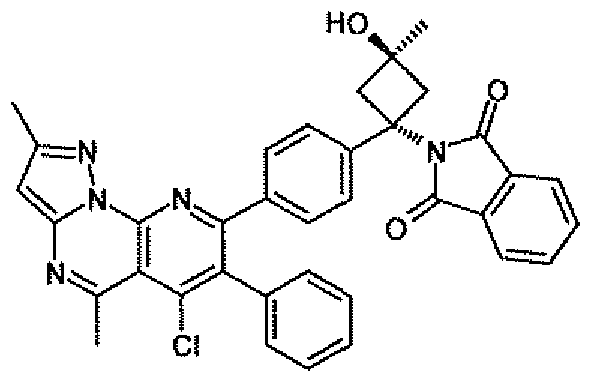

DLXXVIi DLXXVIII
M2H4

DLXXIX
3-Amino-1-ιnethyl-3-[4-(2^,6-trimethyI-7-phenyl-1,4,9^b-tetraβ-ϊa- cycIopenta[a]naphthalen-8-yI)-pheiιyI]-cyclobutanol [DLXXIX]

DLXXIX
Examples
The following preparations illustrate methods for the preparation of compounds according to the present invention, as well as those for the preparation of intermediates. It should be evident to those skilled in the art that appropriate substitution of both the materials and methods disclosed herein will produce the examples illustrated below and those encompassed by the scope of the invention.
Before describing each preparation of intermediates and compounds according to the present invention, the following should be noted in general: All temperatures are given in degrees Celsius. Reagents were purchased from commercial sources or prepared in accordance with literature procedures.
Unless otherwise noted, HPLC purification was performed by ^dissolving a residue in a small volume of CH3OH or other appropriate solvent. The solution was then purified via preparatory reverse-phase purification system using a Varian Dynamax HPLC 21.4 mm Microsorb Guard-8 Ci8 column. In general Solvent A was a mixture of 5% CH3CN : 95% H20 :0.1% CF3COOH while Solvent B was a mixture of 95% CH3CN : 5% H2O : 0.1% CF3COOH. Details are as follows: A typical run would be from 0% Solvent B: 100% Solvent A to 100% Solvent B : 0% Solvent A over a period of 5 minutes, followed by a hold at 100% Solvent B, before it was re-equilibrated back to the initial starting gradient Total run time was 7 minutes. The resulting fractions were analyzed, combined as appropriate, and then evaporated to provide purified material. Unless otherwise noted, all compounds resulting from the reverse- phase HPLC purification were characterized as the corresponding TFA salts.
Proton magnetic resonance (1H NMR) spectra were recorded on either a Varian INOVA 400 MHz (1H) NMR. spectrometer, or Varian INOVA 500 MHz (1H) NMR spectrometer. All spectra were determined in the solvents indicated below. Although chemical shifts are reported in parts per million (ppm) downfield of tetramethylsilane, they are referenced to the residual proton peak of the respective solvent peak for 1H NMR, Interproton coupling constants are reported in Hertz (Hz). LCMS spectra were obtained using a ThermoFinnigan AQA MS ESI instrument The samples were sent through a Phenomenex Aqua 5 micron C\$ 125 A 50 x 4.60 mm column. For purity analysis, Solvent C was H2O with 0.1% formic acid, and Solvent D was CH3OH with 0.1% formic acid. For purity analysis of the freebase intermediates a gradient of 45% D:C to 95% D:C over 5 minutes and then a 3-minute hold at 95% D:C was used. For purity analysis of the trifluoroacetate salts, a gradient of 5% D:C to 95% D:C over 5 minutes and then a 1 minute hold at 95% D:C was used. The spray setting for the MS probe was at 350 μL/min with a cone voltage at 3 kV and a probe temperature at 450°C.
Abbreviations used herein are: HPLC (high-performance liquid chromatography); TFA (trifluorσacetic acid); 1H NMR (proton nuclear magnetic resonance); LCMS (liquid chromatograph-mass spectrometer); MS (mass spectrometer); THF (tetrahydrofuran); eq (equivalents); NEUCl (ammonium chloride); DMF (Λ^dimethylformamide); NaCl (sodium
chloride)l NaOMe (sodium methoxide); EtOH (ethanol); Pd/C (palladium on carbon); Et3N (triethylamine); AcOH (acetic acid); DMSO (dimethyl sulfoxide); DCM (dichloromethane); EtOAc (ethyl acetate); LC/MS (liquid chromatogram-mass spectrometer); BINAP (2,2'- bis(diphenylphosphino)-l,r-binapthyl); NaO-f-Bu (sodium f-butoxide); Pd2(dba)3 (tris(dibenzylideneacetone)dipalladium); BnCHiBr (benzyl bromide); rt (room temperature); n- (normal); ESI (electrospray ionization)x-phos} xantphos (4,5-bis(diphenylphosphino)-9,9- dimethylxanthene); DIAD (diisopropyl azodicarboxylate); NBS (K-brømosuccinimide); EDCI(I- ethyl-3^3^unemylaminoρropyl) carbodiimide); dppf (1 ,r-bis(diphenylphosphanyl)ferrocene); HATU(o-(7-azabenzotriazol-l -yl>N,N,N',Nl-tetramethyluronium hexafluorophosphate); DIPEA (diisopropylethylatnine); Tf2O (trifluoromethanesulfonic anhydride); NIS (JV-iodosuccimmide); TsCl (p-toluenesulfonyl chloride); TBAF (tetrabutylammonium fluoride); DMAP (dimeihylaminopyridine); ACN (acetonitrile); DMA (dimethylacetoatnide); MCPBA (m- chloroperbenzoic acid); TBAB (tetrabutylammonium bromide); DIBAL-H (dϋsobutylaluminium hydride); NCS (N-chlorøsuccinimide); dppe (1,2-Bis(diphenylphosphino)ethane); HOBT (1- hydroxybenzotriazole); 18-crown~6 (1,4,7,10,13,16-hexaoxacyclooctadecane).
Experimental Procedures Scheme I - Synthesis of [V]
LiBHB3 MnO2 THF THF / CHCl3


!Ii

SOCi2
NaO-t-Bu, toluene, DMF, CHCl31DMF 105 °C 60-75 °C


IV
(7-Amino-2-methyl-pyra2olo[l^-α]pyriinidiii-6-yϊ)-methanoI [II]
LiBHEt3
THF


1 I"
To a 1 L three-necked rmmd bottom flask was added compound [IJ (20.6 g, 100 mmoi, 1.0 eq.) and THF (400 mL). The mixture was cooled to 0 °C and LiBHEt3 (315 mL of a 1.0 M solution in THF, 315 mmol, 3.0 eq.) was added slowly through an addition funnel under nitrogen. After addition, the mixture was stirred at room temperature for 4 hours. Analysis of the reaction mixture by TLC indicated that a small amount of starting material was still present Additional LiBHEt3 (30 mL of a 1.0 M solution in THF, 30 mmol, 0.3 eq.) was added and the mixture was stirred for an additional 1 hour. The mixture was slowly treated with EtOAc (600 mL) and then water (300 mL). The layers were separated and the aqueous phase was extracted with EtOAc (2 X 300 mL). The combined organic phases were dried over anhydrous Na2SO4, After filtration and concentration, the residue was purified by a short silica gel column (2.5 inch in height and 4 inch in diameter) using MeOH in CH2Cl2 as the eluant. Concentration by rotary evaporation provided Compound [II] as a light yellowish solid (14.0 g): LCMS m/e 179 (M+H); 1H NMR (400 MHz, METHANOL-^) δ ppm 2.43 (s, 3 H) 4.66 (s, 2 H) 6.16 (s, 1 H) 8.01 (s, J H).
7-Amino-2-methyl-pyrazolo[1,5-α]pyrimidra-6-carbaldehyde [liIJ

To a 1 L three-necked round bottom flask containing Compound pi] (14.1 g, 79.2 mmol, 1.0 eq.) was added CHCl3 (500 mL) and THF (250 mL) followed by MnO2 (68.9 g, 792 mmol, 10 eq.). The mixture was stirred at room temperature for 16 hours. Analysis of the reaction mixture by TLC indicated that the reaction was complete. The mixture was filtered through a 2.5 cm thick layer of layer of Celite and the filtered material washed with 15% MeOH in CHCl3 (-1000 mL) and 30% MeOH in CHCl3 (-1500 mL) until no additional product was observed through analysis of the filtrates by TLC. Removal of solvents in vacuo provided Compound [IU] as a yellowish solid (13.9 g, 98%). LCMS m/e 177 (M+H); 1H NMR (400 MHz, METHANOL-^) δ ppm 2.45 (s, 3 H) 6.31 (s, 1 H) 8.41 (s., 1 H) 9.82 (s, 1 H).
2-Methyl-7-phenyl-9-ff-lA9^b-te^^

NaCM-Bu, toluene, DMF, 105 °C


III IV
To a 1 L three necked round bottom flask was added Compound [1H] (5.3 g, 30 mmol, 1 eq.), methyl phenylacetate (18 g, 120 mmol, 4.0 eq.), toluene (100 mL), and NaO-ϊ-Bu (5.8 g, 60 mmol.2.0 eq.). The mixture was heated at 105 °C for 30 min and the formation of large amounts of solid was noted. DMF (100 mL) was added and the solid was observed to go into solution. The mixture was heated for 3 days. After this time, the heat was removed and the mixture allowed to cool to room temperature. The reaction mixture was concentrated and the residue dissolved in CEbCl2 (600 mL), followed by the addition of water (400 mL) to form a yellowish precipitate. The solid was filtered and washed with water (50 mL) and CH2Cl2 (100 mL). The collected solid was dried under vacuum to furnish Compound [TV] as a yellowish solid (7.8 g, 94%): LCMS (ra/e) 277 (M+H); 1H NMR (400 MHz, DMSCMs) δ ppm 2.36 (s, 3 H) 6.23 (S, 1 H) 7.16 - 7.25 (m, 1 H) 7.33 (t, ^7.58 Hz, 2 H) 7.74 (d, ./=7.22 Hz, 2 H) 7.83 (s, 1 H) 8.41 (s, 1 H). 8^Mora-2-methyl-7-phenyl-1,4,9,9b-tetraaasa^dopenta[ejnaphthaIene [V]: (SOCl2 procedure)
SOCl2
CHCl31DMF
60-75 °C


IV
To a 250 mL round bottom flask was added Compound [IV] (3 g, 10.9 mmol, 1 eq.), CHCl3 (120 mL), SOCl2 (5.17 g, 3.17 mL, 43.5 mmol, 4 eq.) and DMF (158.9 mg, 168.3 uL, 2.17 mmol, 0.2 eq.). The mixture was heated to 70 °C in an oil bath for 1 hour. At this time, additional SOCl2 (1.6 mL, 21.8 mmol, 2 eq.) and DMF (168.3 uL, 2.17 mmol, 0.2 eq.) were added. The mixture was maintained at 70 °C for an additional 2 hours. After 3 hours total, LCMS analysis and TLC analysis (heptane:EtOAc (3:7)) of the resulting light brown solution indicated that the reaction was complete. The reaction was concentrated in vacuo and the residue diluted with EtOAc (100 mL), washed with saturated aqueous NaHCθ3 solution (50 mL), and the aqueous phases re-extracted with EtOAc (3 x 200 mL). The combined organic phases were
dried over MgSO4, filtered, and concentrated to give 3.2 g of material which was purified by silica gel chromatography using EtO Ac/heptane as the eluaπt to give Compound [V]: LCMS (m/e) 295 (M+H); 1H NMR (400 MHz, METHANOL-^) δ ppm 2.60 (s, 3 H) 6.79 (s, 1 H) 7.43 - 7.67 (m, 5 H) 8.57 (s, 1 H) 9.04 (s, 1 H).
8-Chloro-2-methyI-7-phenyl-1,4^,9b-tetraaza-cyclopenta[a]naphthalene [V] : (POCb procedure)
POCt3 CH3CN


IV V
To a 40 iriL scintillation vial was added Compound pVJ (0.275 g, 1 mmol, 1 eq.), CH3CN (5 raL), and POCl3 (3.5 g, 20 mmol, 20 eq.). The reaction mixture was heated at 65-70 °C for 12 hours under a nitrogen atmosphere. The heat was removed and the mixture was allowed to cool to room temperature. The reaction was concentrated under reduced pressure and the residue re-dissolved in CH3CN (5 mL) and treated with two drops of water. The mixture was then concentrated onto Celite (0.5 g) and purified by silica gel chromatography using MeOH:CH2Cl2 as the eluant to furnish Compound [Vj as a viscous yellowish solid with the same spectral characteristics as determined previously.
Scheme II - Synthesis of [XT]
O^/
HOAc, 100 °C, 16 h

LiBHEt3 MnO2 THF THF / CHCl,


ViI VIEI IX

SOCI2
NaO-t-Bu, toluene, DMF, CHCl31DMF 105 °C

N

Xl
7-Amino-2-cyclopropyl-pyra-rølo[l^^]pyriimdine-6-carboxy-ic acid ethyl ester [VHj
o^s

HOAc, 100°C, 16 h

NH2

Vl VIi
To a 250 mL round bottom flask was added Compound [VI] (5 g, 40.6 mmol, 1 eq.), ethyl-2-cyano-3-ethoxyaciyIate (6.9 g, 40.6 mmol, 1 eq.), and HOAc (100 mL). The mixture was heated at 100 °C for 16 hours. The reaction was concentrated and the residue was treated with with H2O (150 mL). The resulting precipitate was filtered, and the precipitate washed with H2O (3x 250 mL). The crude product was dried under high vacuum for 16 hours to
afford 8.4 g (yield = 84 %) of Compound [VU]: LCMS (m/e) 247(M+H); 1H NMR (400 MHz, METHANOL-^) δ ppm 0.92 - 1.02 (m, 2 H) 1.03 - 1.14 (m, 2 H) 1.42 (t, ^=7.10 Hz, 3 H) 2.13 (t, ^=8.30 Hz, 1 H) 4.28 - 4.47 (m, 2 H) 6.21 (s, 1 H) 8.61 (s, 1 H).
(T-Amino^-cyclopropyl-pyrazolofljS-αJpyrimidin-ό-yrj-inethanoI [Vπi]

VKI
Compound [VDI] was prepared using a procedure similar to that of Compound pi].Data for Compound [VHIl: LCMS (m/e) 205 (M+H); 1H NMR (400 MHz, METHANOL- O4) δ ppm 0.86 - 0.99 (m, 2 H) 1.03 - 1.12 (m, 2 H) 2.00 - 2.16 (m, 1 H) 4.68 (s, 2 H) 6.07 (s, 1 H) 8.02 (s, 1 H).
T-Amino^-cyclopropyl-pyrazololl^-αJpyrimidin-θ-carbaldehyde [IX]

Data for Compound [IX]: LCMS (m/e) 203 (M+H); 1H NMR (400 MHz, METHANOL-^) 6 ppm 0.93 (m, 2 H) 1.07 (m, 2 H) 2.00 - 2.19 (m, 2 H) 6.07 (s, 1 H) 8.02 (s, 1H) 9.85 (s, 1 H).
2-Cyclopropyl-7-phenyl-9JΪ-1,4,9,9b-tetraaza-cyclopenta[fl]naphthalen-8-one [Xϊ

Compound [X] was prepared using a procedure similar to that of Compound P-V]. Data for Compound [Xj: LCMS (m/e) 303 (M+H); 1H NMR (400 MHz, DMSO-^6) δ ppm
0.86 - 0.96 (m, 2 H) 1.00 - 1.10 (m, 2 H) 2.07 - 2.18 (m, 1 H) 6.50 (s, 1 H) 7.36 (t, 1 H) 7.44 (t, JK7.44 Hz, 2 H) 7.69 (d, J=7.22 Hz, 2 H) 8.32 (s, 1 H) 8.74 (s, 1 H). β-ChloTO-Z^ydopropyl-Vrphenyl-lA^^b-tetraaza-^yclopeiitafαlnaphthalene pϊIΪ

Xl Compound \XX\ was prepared using a procedure similar to that of Compound [V]
(SOCl2 procedure). Data for Compound pOJ: LCMS (m/e) 321 (M+H).
Scheme HI - Synthesis of [XVHJ

/=N
H HOAc, 1rø °C, 16 h
NH2
XIE
LiBHEt3 MnO2 /=1 THF VN^NH THF / CHCl3
OH H


O O XIII XIV XV

SOCI2
NaO-t-Bu, toluene, DMF, CHCl31DMF 105 °C 60-75 °C


XV, XVII
7-Aralno-pyra2θlo[l^^]pyrimidine-6-carboxylic acid ethyl ester [XIII]
YNsϊ NH2
Il O
XIII
 Compound BOII] was prepared using a procedure similar to that of Compound
[VII]. Data for Compound pOH]: LCMS (m/e) 207 (M+H); 1H NMR (400 MHz, METHANOLS) δ ppm 1.43 (t, J=I. U Hz, 3 H) 4.43 (q, J=I, n Hz, 2 H) 6.51 (d, J=2.15 Hz, 1 H) 8.14 (d, J=2.10 Hz, 1 H) 8.70 (s, 1 H).
(7-Amino-pyrazoIo[l^^Ipyiimidin-6-yl)-nιetIιanoI [XIVl
/=l^

XIV
Compound [XIV] was prepared using a procedure similar to that of Compound [II]. Data for Compound POVJ: LCMS (m/e) 163 (M-H); 1H NMR (400 MHz, METHANOLS) δ ppm 3.34 (s, 2 H) 4.69 (s, 2 H) 6.36 (d, J=2.25 Hz,I H) 8.03 (d, J^1.25 Hz, 1 H) 8.09 (s, 1 H).
7-Amino-pyi^«olo|l^e]pyrimidra-6-carbaldehyde [XV]
<yNγNH2 N<jLγH
O XV
Compound [XV] was prepared using a procedure similar to that of Compound pαq. Data for Compound [XV]: LCMS (m/e) 163 (M+H); 1HNMR (400 MHz, METHANOL- <U) δ ppm 6.51 (d, J=2.10 Hz, 1 H) 8.15 (d, «£=2.05 Hz, 1 H) 8.50 (s, 1 H) 9.88 (s, 1 H).
7-Phenyl-9JEf-1,4^,9b-tetraaza-eyclopeιita|;αϊnaphthaIeii-8-oiιe [XVI]

XVI
Compound [XVI] was prepared using a procedure similar to that of Compound [TV]. Data for Compound [XVT]: LCMS (m/e) 263 (M+H).
8-ChIoro-2-cyclopropyl-7-phenyI-1,4,9^b-tetraaza-cyclopenta[α]naphthalene [XVII]

XVII
Compound {XVΪI] was prepared using a procedure similar to that of Compound [Vj (SOCI2 procedure). Data for Compound [XVII]: LCMS (m/e) 281 ( M+H); 1H NMR (400 MHz, METHANOL-^) δ ppm 6.96 (d, J^=2.10 HZ, 1 H) 7.44 - 7.63 (m, 5 H) 8.27 (d, >2.10 Hz 1 H) 8.59 (s, 1 H) 9.07 (s, 1 H).
Scheme IV - Synthesis of [XXlliJ
AcOH, 24 h (water precipitation)

MnO2 THF /


XXII XXiII
7-Amino-2-(4-fluorophenyI)-pyrazolo|l;3-α]pyrimidme-6-carboxylic acid ethyl ester [XDC]

Compound [XEX] was prepared using a procedure similar to that of Compound [VH]. Data for Compound [XIX]: LCMS m/e 301 (M+H); 1H NMR (400 MHz, DMSO-^) δ ppm 1.32 (t, ./=7.08 Hz, 3 H) 4.31 (q, J=7M Hz, 2 H) 7.05 (s, 1 H) 7.33 (t, J=8.83 Hz, 2 H) 8.13 (dd, ./=8.57, 5.64 Hz, 2 H) 8.48 (br. s., 1 H) 8.59 (s, 1 H) 8.68 (br. s., 1 H).
[7-Amino-2-(4-fluorophenyϊ)cyclopropyl-pyrazolo[l^-α]pyriπiidiQ-6-yl]-niethanol [XX]
F

XX
Compound [XX] was prepared using a procedure similar to that of Compound [II]. Data for Compound [XX]: LCMS m/e 259 (M+H); 1H NMR (400 MHz, METHANOL-^) δ ppm 4.70 (s, 2 H) 6.69 (s, 1 H) 7.18 (t, J=8.79 Hz, 2 H) 8.03 - 8.06 (m, 2 H) 8.07 (s, 1 H).
7-Amino-2^4-fluorophenyl)-pyrazolo[1,5^]pyrimidin-6-carbaldehyde [XXI]
F
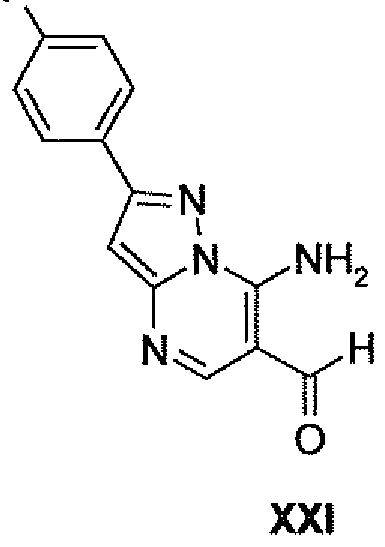
Compound [XXI] was prepared using a procedure similar to that of Compound [HI]. Data for Compound [XXI]: LCMS m/e 257 (M+H); 1H NMR (400 MHz, METHANOL- <k) δ ppm 6.88 (s, 1 H) 7.21 (t, J=8.81 Hz, 2 H) 8.10 (dd, ./=8.81, 5.39 Hz, 2 H) 8.50 (s, 1 H).
2-(4-Fluorophenyl)-7-phenyl-9JE?-1,4,9,9b-tetraaza-cyclopeiita[α]naphthalen-8-one [XXII]

XXII
Compound [XXET] was prepared using a procedure similar to that of Compound [TV]. Data for Compound [XXII]: LCMS m/e 357 (M+H).
8-ChIoro-2-(4-fl«oropheny!)-7-phenyI-1,4,9^b-tetraaza-cyclope-ita[fl]naphthaIene [XXIII]
F

Compound [XXHIJ was prepared using a procedure similar to that of Compound [V] (POCl3 procedure). Data for Compound [XXIII]: LCMS m/e 375 (M+H); 1H NMR (400 MHz, CHLOROFORM-^ δ ppm 7.14 - 7.21 (m, 3 H) 7.50 - 7.54 (ms 5 H) 8.10 - 8.15 (m, 2 H) 8.23 (s, 1 H) 8.87 (s, 1 H).
Scheme V - Synthesis of [XXX]
NH2NI-VHC!, Et3N1 EtOH, reflux 16 h AcOH, 24 h
 OEt H (water precipitation)
NH2
XXIV XXV
LiBHEt3 MnO2 F-f
'2 THF THF /CHCl, H


O
 0 XXVi XXVIi XXVIiI

NaO-t-Bu, >=N toluene, DMF1 CHCl31DMF
105 °C 60-75°C


XXIX XXX
5-Trifl«oromethyl-2JΪ-pyrazol-3-ylamine ϊXXV]
F F- F
H
NH2
XXV
To a solution of (J-^-4-aύώio-4-ethoxy-l>l,l-trifluorobut-3-eπ-2-one, (Compound [XXIYI) (7.0Og, 38.2 mmol, 1.0 eq.) in ethanol (150 mL) in a 250 mL round bottom flask was added hydrazine hydrochloride (2.75 g, 40.16 mmol, 1.05 eq.) followed by triethylamine (4.05g, 40.16 mmol, 1.05 eq.). The reaction mixture was heated to reflux for 16 hours. After cooling and concentration, the residue was purified by silica gel chromatography using CHCl3- MeOH(10%) as the eluant to give Compound [XXV]: LCMS m/e 152 (M+H); 1H NMR (400 MHz, DMSO-^6) δ ppm 5.32 (s, 2 H) 5.51 (s, 1 H) 12.12 (br. s.> 1 H).
7-Amino~24rifluoromethyl-pyrazolo[1,5-Λ]pyrimidine-6-carboxylic acid ethyl ester [XXVI]

Compound (XXVI] was prepared using a procedure similar to that of Compound [VII].Data for Compound [XXVI]: LCMS m/e 275 (M+H); 1H NMR (400 MHz, CHLOROFORM-**) δ ppm 1.45 (t, J=J Λ5 Hz, 3 H) 4.44 (q, J=I. U Hz, 2 H) 6.81 (s, 1 H) 6.99 (br. s., 1 H) 8.62 (br. s., 1 H) 8.87 (s, 1 H).
[7rAmino-24rifluoromethyl^
>=N
V-N NH,
OH
XXVII Compound [XXVII] was prepared using a procedure similar to that of Compound
[II]. Data for Compound IXXVII]: LCMS m/e 233 (M+H); 1H NMR (400 MHz, CHLOROFORM-**) δ ppm 4.88 (s, 2 H) 6.75 (s, 1 H) 8.17 (s, 1 H).
7-Ammo-2-trifluoromethyl-pyrazolo[1,5-σΪpyrimidm-6-carbaldehyde pDCVπη
F. ZF

Compound [XXVIII] was prepared using a procedure similar to that of Compound [HIj.Data for Compound [XXVm]: LCMS m/e 231 (M+H); 1H NMR (400 MHz, CHLOROFORM-.*) δ ppm 6.83 (s, 1 H) 8.60 (s, 1 H) 9.99 (s, 1 H).
2-trifluoromethyl-7-pheny!-9Jff-1,4,9,9b4etraaza-cycϊopenta[α]naphthalen-θ-one ptXIX]

XXiX
Compound [XXIX] was prepared using a procedure similar to that of Compound PV]. Data for Compound [XXIXj: LCMS m/e 331 (M+H); 1H NMR (400 MHz, DMSCMs) δ ppm 7.33 (s, 1 H) 7.38 - 7.44 (m, 1 H) 7.48 (t, J=HAl Hz, 2 H) 7.71 (d, J=7.22 Hz, 2 H) 8.54 (s, 1 H) 9.05 (s, 1 H).
8-Chloro-2-trifluoromethyl-7-phenyl-1,4,9,9b-tetraaza-cyclopenta[α]naphthaleiie [XXXΪ

[V] (POCl3 procedure).Data for Compound [XXX]: LCMS m/e 349 (M+H); 1H NMR (400 MHz, METHANOL-^) δ ppm 7.28 (s, 1 H) 7.46 - 7.64 (m, 5 H) 8.66 (s, 1 H) 9.19 (s, 1 H).
Synthesis of cyclobutylamme headgroup
Scheme VI - Synthesis of [XXXVII]
HOCH2CH2OH, pTsOH, benzene, DMF, NaH1 O to 6O reflux, 40 h 16 h
BK^A^BΓ BrO^Br

XXXI XXXII XXXIII
F
F T
Y YV

MeOH1 NH4OH1 H2O2, Q Γ' Λ ^ CH3CN1 H2C t ΓΛ CHCl3, TEA, rt, 16 h 1β h 7O °C


XXXIV XXXV
Acetone, pTsOH 70 °C, 24 h

XXXVI

2^Bis-bromoraethyM^dioxoIane [XXXIJ
HOCH2CH2OH, pTsOH, benzene, reflux, 40 h ΓΛ
Brv^Jl^Br
Br — ° /xN° — Br
XXXI XXXII
Compound [XXXIJ (46.3 g, 215 mmol, 1.0 eq.), ethylene glycol (310 mL, 4.29 mol, 20 eq.), jp-toluenesulfonic acid (408 mg, 2.15 mmol, 0.01 eq.), and benzene (1.40 L, anhydrous) were added to a 2 L round bottom flask, which as fitted with a Dean-Stark apparatus. The reaction was heated to 125 °C for 40 hours with azeotropic removal of water. After the collection of water ceased, the reaction was cooled, and poured into saturated aqueous NaHCθ3 solution. The aqueous layer was extracted with ether (x3). The combined organic layers were dried and concentrated and the residue purified by silica gel chromatography by eluting with
ethyl acetate and heptane (using a gradient of 0% to 25% ethyl acetate) to give Compound [XXXπj: 1H NMR (400 MHz, CHLOROFORM-rf) δ ppm 3.61 (s, 4 H) 4.14 (s, 4 H).
2-(4-Brυmo-phenyl)-5,8-diυxa-spiro[3.4]octaDe-2-carbonitrUe [XXXπi]
• N
DMF, NaH, 0 to 600C,
ΓΛ 16 h
Br-~/V---Br
XXXH

4-BromobenzyInitrile (78.7 g, 402 mmol, 2.0 eq.) was dissolved in DMF (425 mL, anhydrous) and cooled to 0 °C. To this mixture was slowly added NaH (portionwise, 24.1 g, 60 % dispersion in mineral oil, 1.00 mol, 5 eq.) and the reaction stirred at 0 °C for 20 min. Then Compound [XXXIIl (52-2 g, 201 mmol, 1.0 eq.) was added and the mixture stirred at 0 °C for 20 min, and then warmed to 60 °C for 16 hours. After 16 hours at 60 °C, the reaction was cooled to 0 °C and slowly quenched with MeOH, diluted with water, and extracted with ethyl acetate (x3). The combined organic phases were washed with water (x2), dried over N32SO4, and concentrated. The resulting oil was diluted with ethyl acetate and heptane and placed onto a silica pad, which was then eluted with heptane/ethyl acetate (4:1). The collected fractions were concentrated, and the resulting oil purified by silica gel chromatography eluting with heptane and ethyl acetate (gradient of 0% to 50% EtOAc) to provide Compound [XXXUI] : 1H NMR (400 MHz, CHLOROFORM-rf) δ ppm 2.89 - 3.01 (m, 2 H) 3.21 - 3.33 (m, 2 H) 3.91 - 3.97 (m, 2 H) 3.98 - 4.06 (m, 2 H) 7.41 (m, 2 H) 7.48 - 7.60 (m, 2 H). 2-(4-Bromo-phenyl)-5,8-dio3ca-spiro[3.4]octaiie-2-carboxylic acid amide [XXXIV]
J ^0 MeOH, NH4OH, RT, 16 h


To a mixture of Compound [XXXHI] (13.0 g, 44.2 mmol, 1.0 eq.) in MeOH (520 mL) was added H2O2 (13.7 mL, 33% in water, 133 mmol, 3.00 eq.), and NH4OH (52 mL). The resulting mixture was stirred for 16 hours at room temperature., then diluted with additional water and extracted with ethyl acetate (x3). The combined organics were washed with Na2S2Oa (10% in water), dried, and concentrated. The residue was purified by silica gel chromatography by eluting with heptane and ethyl acetate (gradient of 0% to 100% EtOAc) to give Compound
(XXXIV]: LCMS (ra/e) 312, 314 (M+H); 1H NMR (400 MHz, CHLOROFORM-^ δ ppm 2.78 - 2.87 (m, 2 H) 3.22 - 3.29 (m, 2 H) 3.84 - 3.91 (m, 2 H) 3.91 - 3.99 (m, 2 H) 5.42 (br. s., 2 H) 7.19 - 7.25 (m, 2 H) 7.48 - 7.55 (m, 2 H).
2-(4-Bromo-phenyl)-5,8-dioxa-spirol3.4]oct-2-ylamine fXXXVi
vV
CH3CN, H2O1 RT1 16 h


XXXIV XXXV
To a solution of Compound [XXXIVl (8.40 g, 26.9 mmoL 1.0 eq.) in CH3CN (26 mL) and water (26 mL) was added [bis(trifluoroacetoxy)iodo]benzene (17.4 g, 40.4 mmol, 1.5 eq.) and the resulting mixture stirred at room temperature. After 16 hours the reaction was slowly poured into NaHCOj (aq sat) and extracted with ethyl acetate (x3). The combined organic layers were dried, concentrated, and the residue purified by silica gel chromatography by eluting with CHCl3 to CHCl3ZMeOHZNH4OH (95:5:1) to give Compound [XXXV] : 1H NMR (400 MHz, ACETONITRILE-rfs) δ ppm 2.40 - 2.50 (m, 2 H) 2.73 - 2.82 (m, 2 H) 3.77 - 3.85 (m, 2 H) 3.85 - 3.93 (m, 2 H) 7.37 - 7.44 (m, 2 H) 7.45 - 7.52 (m, 2 H).
2-[2-(4-Bromo-phenyO-5,8^ioxa-spiroI3.4]oct-2-yIΪ4soindole-l^dione [XXXVIΪ

CHCt3, TEA, 70 °C


To a solution of Compound [XXXVJ (6.03 g, 21.2 mmol, 1.0 eq.) in CHCl3 (100 mL, anhydrous) was added N-ethoxycarbonylphthalimide (5.12 g, 23.3 mmol, 1.1 eq.) and teietihtylamine (11.8 mL, 84.9 mmol, 4.0 eq.). The mixture was then heated to 70 °C for 24 hours. The reaction was then cooled and concentrated. Methanol was added to the residue, and the
mixture concentrated, then methanol was added again, and the resulting solid collected by filtration to provide Compound [XXXVI] as a light tan solid: 1H NMR (400 MHz, CHLOROFORM-d) δ ppm 3.30 - 3.39 (m, 2 H) 3.44 - 3.53 (m, 2 H) 3.89 (s, 4 H) 7.42 - 7.49 (ra, 2 H) 7.50 - 7.58 (m, 2 H) 7.69 (dd, J≡5.34, 3.10 Hz, 2 H) 7.78 (dd, J=5.54, 3.00 Hz, 2 H).
2-[l-{4-BroπnHphenyl)-3-oxo-cyc!obutyIJ-isoindole-l!3-dioπe [XXXVlI]
Acetone, pTsOH 70 °C, 24 h
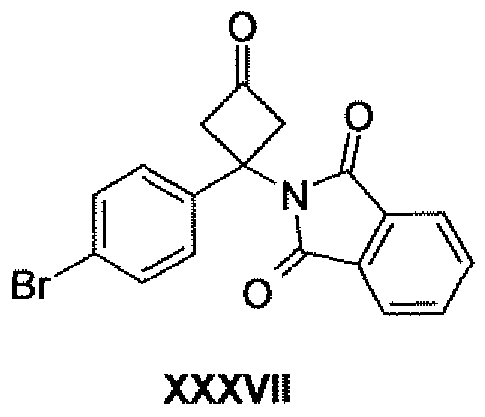

To a mixture of Compound [XXXVI] (3.25 g, 7.85 mmol, 1.0 eg.) in acetone (300 mL), was added /7-toluenesuIfonic acid (1.49 g, 7.85 mmol, 1.0 eq.) with stirring and heated to 70 °C. After 64 hours at 70 °C, the reaction was cooled and poured into saturated aqueous NaHCC>3 and extracted with ethyl acetate (x3). The combined organic phases were concentrated and the resulting residue purified by silica gel chromatography eluting with heptane and ethyl acetate (gradient of 0% to 40% ethyl acetate) to give Compound [XXXVII]: 1H NMR (400 MHz, CHLOROFORM-^ δ ppm 3.92 - 4.01 (m, 2 H) 4.20 - 4.33 (m, 2 H) 7.44 - 7.52 (m, 4 H) 7.74 (dd, .£=5.37, 3.12 Hz, 2 H) 7.84 (dd, ^=5.54, 3.00 Hz, 2 H).
Scheme VΗ. Conversion of cyclobutanone to aUkylcyclobutanol
D>^MgBr
CH2Cl2 KOAc, dioxane,
-40 to -20 "C, 6 h 90 'C1 18 h


frαns-2-[H4-Bromorphenyl)-3-c^^ IXXXVIII]
|>^MgBr
CH2CI2
-40 to -20 °C, 6

 XXXVIII
To a solution of Compound [XXXVH] (122 mg, 0.3 mmol, 1 eq.) in CH2Cl2 (6 mL) at -40 °C was added dropwise a solution of cyclopropylmagnesiura bromide (0.6 mL of a 0.5 M solution in THF, 0.3 mmol, 1 eq.). The mixture was held at -20 °C for 6 hours and then quenched by the addition of saturated aqueous NH4CI solution. The mixture was extracted three times with CH2C12. The combined organic phases were dried over Na2Sθ4 and the mateial concentrated under reduced pressure. Purification of the residue using silica gel chromatography with ethyl acetate:heptane as the eluant provided Compound [XXXVΪHΪ: 1H NMR (400 MHx, CHLOROFORM-d) δ ppm 0.23 - 0.36 (m, 2 H) 0.40 - 0.54 (m, 2 H) 1.08 - 1.20 (m, 1 H) 2.97 -
3.07 (m, 2 H) 3.06 - 3.16 (m, 2 H) 7.42 - 7.49 (m, 2 H) 7.55 - 7.63 (ra, 2 H) 7.68 (dd, J=5.42,
3.08 Hz, 1 H) 7.72 - 7.82 (m, 2 H) 7.88 (dd, J=5.52, 3.03 Hz, 1 H). frαws-2-{3-CycIopropyI^^ pheπy]]»cΛ'elobutyl}-isointloIe-1,3-dione [XXXIX]
B-Bx I
-y-O
KOAc1 dioxane, 90 °C, 18 h
 xxxviii

A flask containing mixture of Compound [XXXVIII] (82 mg, 0.20 mmol, 1 eq.), bis(pinacolato)diboron (51 mg, 0.20 mmol, 1 eq.), and KOAc (98 mg, 1.0 mmol, 1 eq.) in dioxane (4 mL) was evacuated and refilled with a nitrogen atmosphere three times. Then PdCl2(dρρf) (16 mg, 0.02 mmol, 0.1 eq.) was added and the flask was again evacuated and refilled three times with a nitrogen atmosphere. The resulting mixture was heated at 90 "C for 18 hours. The volatiles were removed under reduced pressure and the resulting residue purified by silica gel chromatography using ethyl acetate:heptane as the eluants to provide Compound [XXXIX]: LCMS (m/e) 442 (M-H2O); 1H NMR (400 MHz, CHLOROFORM-**) δ ppm 2.64 (s, 3 H) 3.42 - 3.52 (m, 2 H) 3.90 - 4.00 (m, 2 H) 5.25 (br. s., 1 H) 5.44 (br. s., 1 H) 6.75 (s, 1 H)
7.22 - 7.26 (m, 1 H) 7.27 - 7.28 (m, 1 H) 7.31 (d, /=8.20 Hz, 2 H) 7.35 - 7.39 (m, 3 H) 7.64 (d, J=8.15 Hz, 2 H) 8.29 (s, 1 H) 8.90 (s, 1 H).
Coupling and deprotection: frαras-2-{3-CyclopropyI-3-hydro^ cyclopenta[ajnaphthaIett-8-yl)-phenyl]-cyclobutyl}-isoindoIe-l^-dione PCL]
PdCydppO-CH2C>- Cs2CO3, Dioxane-H,O δO oC SO min


XX)QX XL
A 20 mL scintillation vial containing a mixture of Compound IVJ (133 mg, 0.45 mmol, 1.5 eq.), Compound [XXXIX] (138 mg, 0.30 mmol, 1.0 eq.), Cs2CO3 (489 mg, 1.5 mmol, 5.0 eq.)) and dϊoxane-water [3:1] (8 mL) was evacuated and flushed three times with argon. Then PdCl2(dρρf).CH2Cl2 (49 mg, 0.06 mmol, 20%) was added and the resulting solution again evacuated and flushed with argon three times. The mixture was heated at 50 °C for 1 hour. The mixture was allowed to cool, water (25 mL) was added, and the resulting mixture was extracted with EtOAc (3 x 25 mL). The combined organic phases were dried over Na2SO4 and the material concentrated under reduced pressure. The residue was purified by silica gel chromatography using CH2Cl2 and [CH2CI2-CH3OH-NH4OH 90:9:1] as the mobile phases to furnish Compound [XL] as a pale yellow solid: LCMS (m/e) : 592 (M+H); .1H NMR (400 MHz, CHLOROFORM-d) δ ppm 0.02 (q, J=5.27 Hz, 2 H) 0.15 - 0.21 (m, 2 H) 0.81 - 0.89 (m, 1 H) 2,29 (s, 3 H) 2.71 - 2.78 (m, 2 H) 2.81 - 2.88 (m, 2 H) 6.40 (s, 1 H) 6.93 - 6.97 (m, 2 H) 6.98 - 7.03 (m, 3 H) 7.21 - 7.25 (m, 2 H) 7.29 - 7.34 (m, 2 H) 7.37 - 7.42 (m, 2 H) 7.45 - 7.50 (m, 2 H) 7.92 (s, 1 H) 8.55 (s, 1 H). tfrαrø-3-AnιJωo-1-cycIopropy^ cyclopenta[a]naphthalen-8-yI)-phenyl]-cycIobutanol [XLI]
H2N-NH2
Methanoi-Dioxane
70 °C *-


XL XLI
To a 20 mL scintillation vial containing Compound [XL] (200 mg, 0.34 mmol) in methanoϊ-dioxane (1:1) (10 mL) was added hydrazine (1.3 mL, 40 mmol, 120 eq.). The mixture was heated at 70 °C for 2 hours. The solvent was men evaporated under reduced pressure. The residue was dissolved in MeOH/Water/TFA and purified by reverse-phase preparative HPLC using water-acetonitrile-TFA [95:5:0.05] and acetonitrile-water-TFA [95:5:0.05] as the mobile phases to provide Compound [XLI] as a pale yellow solid: LCMS (m/e) 462 (M+H); 1H NMR (400 MHz, METHANOLS) δ ppm 0.39 - 0.44 (ra, 2 H) 0.45 - 0.51 (ra, 2 H) 1.15 - 1.23 (m, 1 H) 2.59 (s, 3 H) 2.61 - 2.66 (m, 2 H) 2.76 - 2.82 (ra, 2 H) 6.77 (s, 1 H) 7.32 - 7.37 (m, 5 H) 7.53 - 7.56 (ra, 2 H) 7.72 - 7.75 (m, 2 H) 8.56 (s, 1 H) 9.05 (s, 1 H).
Friedlander cyclization
K2CO8, DMF, 100 βC, 24 h


III XLII XLIII
TFA1 CH2CI2

XLEV
{l-[4-(2-methyl-7-phenyl-1,4,9,9b-tetτaaza-cyclopenta[α]naphthalen-8-yl)-pheayl]- cyclobutyl}-carbamic acid tert-butyl ester [XLIXI]
K2CO3, DMF, 100 °C, 24 h

 m XLEI XUII
A mixture of Compound [111] (56 mg, 0.32 mmol, 1 eq.)} Compound [XLH] (132 mg, 0.36 mmol, 1 eq.), K2CO3 (132 mg, 0.36 mmol, 1.1 eq.) in DMF (6 mL) was heated at 100 °C for 24 hours. After this time, the mixture was added to aqueous LiCl solution and then extracted three times with EtOAc. The combined organic phases were dried over Na2SO4 and
concentrated under reduced pressure to afford a residue that was further purified by silica gel chromatography using CH2CI2IEtOAc as the eluant to provide Compound [XLIII]. This material was used in the next step without further characterization. l-[4^2-methyI-7-phenyM,4,9,9^ cyclobutylamine [XLlV]

XLItI XLIV
To a solution of Compound [XLHI) (7 mg,. 0.14 mmol, 1 eq.) in CH2Cl2 (3 mL) was added trifluoroacetic acid (1 raL) and the mixture stirred at room temperature for 15 minutes. The volatiles were removed under reduced pressure and the residue was purified by reverse phase HPLC using TFArCHjCN and water as the eluant to provide Compound [XLIVJ: LCMS (m/e) 406 (M+H); 1HNMR (400 MHz, METHANOL-^) δ ppm 1.91 - 2.05 (m, 1 H) 2.19 - 2.31 (ro, 1 H) 2.53 - 2.64 (m, 5 H) 2.73 - 2.83 (m, 2 H) 7.31 - 7.39 (ra, 5H) 7.47 (d, 2 H) 7.72 (d, 2 H) 8.62 (s, 1 H) 9.12 (s, 1 H). {3β-Difluorø-1-[4-(2-meftyl-7^^ phenyl]-cyclobutyl}-carbamic acid tert-butyl ester [XLV]

XLV
Compound [XLV] was prepared using a procedure similar to that of Compound [XLIIIJ. This compound was carried on to the next step without further characterization.
3^-Difluoro-1-[4-(2-methyI-7-phenyl-1,4,9,9b-tetraaza-cyclopeιita[α]naphthalen-8-yI)- phenyl]-cyclobtitylamine [XLVI]

XLVI
Compound [XLV] was prepared using a procedure similar to that of Compound [XLIV]. Data for Compound [XLIV]: LCMS (m/e) 442 (M+H); 1H NMR (400 MHz, METHANOL-^) δ ppm 2.59 (s, 3 H) 3.41 - 3.52 (m, 2 H) 6.78 (s, 1 H) 7.32 - 7.38 (m, 5 H) 7.52 (d, >=8.49 Hz, 2 H) 7.76 (4J=8.47 Hz, 2 H) 8.58 (s, 1 H) 9.06 (s, 1 H).
{2-[4-(2-MethyI-7-phenyl-1,4,9,9b-tetraaza-cyclopenta[α]naphthaϊen-8-yl)-phenyl]-5,8- dioxa-spiro[3.4]oct-2-yI}-carbamic acid tert-butyl ester [XLVH]

XLVlI
Compound [XLVII] was prepared using a procedure similar to that of Compound [XLHη.Data for Compound fXLVII]: LCMS (m/e) 564 (M+H);1H NMR (400 MHz, CHLOROFORM-**) δ ppm 1.37 (br. s., 9 H) 2.63 (s, 3 H) 2.86 - 2.92 (m, 2 H) 3.87 - 3.99 (m, 4 H) 6.72 (s, 1 H) 7.25 - 7.29 (m, 2 H) 7.30 - 7.37 (m, 5 H) 7.51 - 7.56 (m, 2 H) 8.23 (s, 2 H) 8.86 (s, 2 H) 9.89 (s, 1 H). ft-ans^-^^-Methyl-T-phenyl-l^^^b-tetraaza-cyclopentalaJnaphthalen-S-ylJ-phenyll-S.e- dioxa-spiro[3.4]oct-2-ylamine [XLVfflj

Compound [XLViπ] was prepared using a procedure similar to that of
Compound [XLIV]. Data for Compound [XLVπi]: LCMS (m/e) 464 (M+H); 1H NMR (400 MHz, METHANOL-***) d ppm 2.58 (d, ^5.61 Hz, 3 H) 2.93 - 3.00 (m, 2 H) 3.06 - 3.12 (m, 2 H) 3.89 - 3.94 (m, 2 H) 3.97 - 4.02(m, 2 H) 6.72 - 6.84 (m, 1 H) 7.31 - 7.39 (m, 5 H) 7.47 (d, ^=7.22 Hz, 2 H) 7.72 (t, J=8.19 Hz, 2 H) 8.59 (d, 1 H) 9.09 (d, J=16.74 Hz, 1 H).
/r/Zfty-2-[l-(4-Bromo-phenyl)-3-hydroicy-cyclobutyI]-isoindoIe-lr-»-dione [XLIX]
LI -^BtT-*
THF, -78 "C


To a -78 °C solution of Compound [XXVII) (92 mg, 0.25 mmol, 1 eq.) in THF (2.5 mL) was added a solution of L-selectride (0.25 mL of a 1.0 M solution in THF, 0.25 mmol, 1 eq.). The mixture was allowed to stir 1 hour and then the inixture was quenched with the addition of saturated aqueous NaHCCb solution while the mixture was still at -78 °C. The mixture was extracted three times with EtOAc and the combined organic phases were dried over Na2SO4 and the material concentrated under reduced pressure. The residue was purified by silica gel chromatography using EtOAc and heptane as the eluant to provide Compound [XLIX] : 1H NMR (400 MHz, CHLOROFORM-^ δ ppm 2.72 - 2.85 (m, 2 H) 3.75 - 3.86 (m, 2 H) 4.47 - 4.57 (m, 1 H) 7.42 - 7.47 (m, 2 H) 7.47 - 7.52 (m, 2 H) 7.65 - 7.72 (m, 2 H) 7.73 - 7.82 (m, 2 H).
/rαws-2-{3-Hydro!y-H4^4,4,5,5-te^ isoindole-l^-dione [L]

Compound [L] was prepared using a procedure similar to that of Compound [XXXIX]. Data for Compound [L]: 1HNMR (400 MHz, CHLOROFORM-^) δ ppm 1.31 (s, 12 H) 2.78 - 2.87 (m, 2 H) 3.79 - 3.88 (m, 2 H) 4.47 - 4.56 (m, 1 H) 7.58 - 7.63 (m, 2 H) 7.64 - 7.69 (m, 2 H) 7.73 - 7.81 (m, 4 H).
tø»-*-2-{34iydroiy-1-IΦ(2-meth^^ yl)-phenyl]-cyclobutyl}-ιsoindo!e-l^-dione [LI] H

U
Compound [LI] was prepared in a similar way to that of Compound [XL]. Data for Compound [LI]: LCMS (m/e) 552 (M+H); 1H NMR (400 MHz, CHLOROFORMS) δ ppm 2.59 (s, 3 H) 2.74 - 2.84 (m, 2 H) 3.79 - 3.89 (m, 2 H) 4.47 - 4.56 (m, 1 H) 6.69 (s, 1 H) 7.23 - 7.27(m, 2 H) 7.29 - 7.35 (m, 3 H) 7.47 - 7.54 (m, 4 H) 7.69 (dd, J=5.44, 3.10 Hz, 2 H) 7.75 - 7.80 (m, 2 H) 8.22 (s, 1 H) 8.84 (s, 1 H).
<rαws-3-Amino-3-[4~(2-me^^^ phenylj-cyclobutanol [LII] H

LII
Compound [LI] was prepared in a similar way to that of Compound [XLI]. Data for Compound [LI]: LCMS (m/e) 422 (M+H); 1H NMR (400 MHz, METHANOL-^) θ ppm 2.57 - 2.66 (m, 5 H) 2.95 - 3.03 (m, 2 H) 4.60 - 4.70 (m, 1 H) 6.77 (s, 1 H) 7.29 - 7.41 (m, 7 H) 7.72(d,J=8.44 Hz, 2 H) 8.57 (s, 1 H) 9.06 (s, 1 H). frα«$-2-Il-(4-Bromo-phenyl)-3-methoxy-cyclobutyl]-isoindole-13-dione [LIU]
HO H
N NaaHH.1 C CHHJJ.1 CH3O, H DMF


To a room temperature solution of Compound [XLIX] (56 mg, 0.15 mmol, 1 eq.) in DMF (1.5 mL) was added NaH (7.2 mg of a 60% dispersion in mineral oil, 0.18 mmol, 1.2 eq.) and the mixture stirred for 30 minutes. Then iodomethane (0.01 mL, 0.23 mmol, 1.5 eq.) was added and the mixture allowed to stir 1 hour. Hie niixture was quenched with the addition of aqueous ammonium chloride and the resulting mixture extracted three times with EtOAc. The combined organic phases were dried over Na2SO4 and the material concentrated under reduced pressure. The residue was purified by silica gel chromatography using EtOAc and heptane as the eluant to provide Compound [LHI]: 1H NMR (400 MHz, CHLOROFORM-^) δ ppm 2.75 - 2.84 (m, 2 H) 3.24 (s, 3 H) 3.68 - 3.78 (m, 2 H) 4.01 - 4.10 (m, 1 H) 7.41 - 7.49 (ra, 4 H) 7.66 - 7.72 (m, 2 H) 7.75 - 7.81 (m, 2 H).
/rα«s-2-{3-Metho:-y-1-[4-(4A5^ isoindole-l^-dione [LTV]
CH3CL NH

Compound JJLTV] was prepared using a procedure similar to that of Compound
IXXXIX]. /røM$-2-{3-methoxy-1-[4-(2-me^ yl)-phenyl]-cycIobutyI}-isoindoIe-l<3-dione [LV]
MθQ H

LV
Compound pLV) was prepared in a similar way to that of Compound [XL]. The material was carried onto the next step without further purification frα»s-1-Ajnino-1-[4-(2-meΛyl^^ phenylj-3-methoxycycIobutane [LII] H

LVI
Compound [LVI] was prepared in a similar way to that of Compound [XL]. Data for Compound [LVI]: LCMS (m/e) 436 (M+H); 1H NMR (400 MHz, CHLOROFORM-^) δ ppm 2.47 (dd, JH2.10, 5.17 Hz, 4 H) 2.54 (s, 3 H) 2.98 - 3.07 (m, 2 H) 3.21 (s, 3 H) 4.28 - 4.38 (m, 1H) 6.70 (s, 1 H) 7.00 - 7.06 (m, 2 H) 7.17 - 7.26 (m, 4 H) 7.30 - 7.35 (m, 3 H) 8.61 (s, 1 H) 8.93 (S, 1 H).
2-[4-(4,41t5,5-ϊctramethyI-[1,3^]dioxaboroIan-2-yl)-phenyI|-5,8-dioxa-spirof3.4]octaiie-2- carbonitrile [LViη

Compound [LVH] was prepared in a similar way to that of Compound [XXXIX) using Compound [XXXUI] as the starting material. Data for Compound [LVII]: 1H NMR (400 MHz, CHLOROFORM-*/) δ ppm 1.36 (s, 12 H) 2.98 - 3.04 (m, 2 H) 3.22 - 3.28 (m, 2 H) 3.90 -
3.97 (m, 2 H) 3.99 - 4.07 (m, 2 H) 7.52 (d, ^=8.30 Hz, 2 H) 7.85 (d, ^=8.35 Hz, 2 H).
2-[4^2-methyl-7-phenyI-1,4&9b^ spiro[3.4]octane-2-carbonitrlle [LVIII]

LVIIl
Compound [LVIII] was prepared in a similar way to that of Compound [XL]. Data for Compound [LVHI]: LCMS (m/e) 474 (M+H); 1H NMR (400 MHz, CHLOROFORM- d) δ ppm 2.64 (s, 3 H) 2.93 - 2.98 (m, 2 H) 3.22 - 3.27 (m, 2 H) 3.92 - 3.96 (m, 2 H) 4.00 - 4.05 (m, 2 H) 6.73 (s, 1 H) 7.24 - 7.26 (m, 1 H) 7.27 - 7.29 (m, 1 H) 7.35 - 7.38 (m, 3 H) 7.43 (d, J=8.44 Hz, 2 H) 7.60 (d, J=8.49 Hz, 2 H) 8.27 (s, 1 H) 8.88 (s, 1 H).
[l-{4-(2-metl^l-7-phenyl-1,4,9,9M dimethoxy-cyclobutylj-carbamic acid methyl ester [LIX]

[l-{4<2-methyl-7rphenyMA9^b-te^^ cyclobutylj-carbamic acid methyl ester [LX]
MeO
OMe pTSA, THF/H2O 50 °C, 16 h
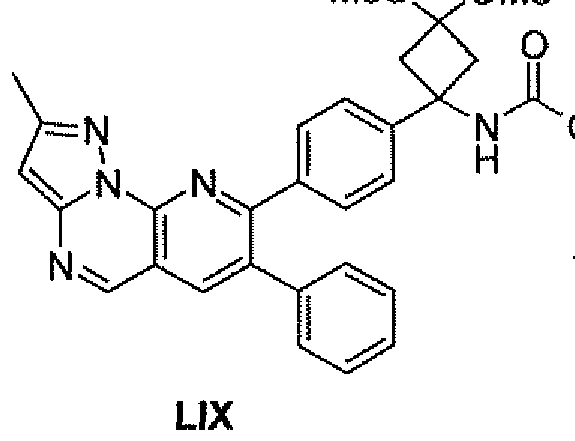
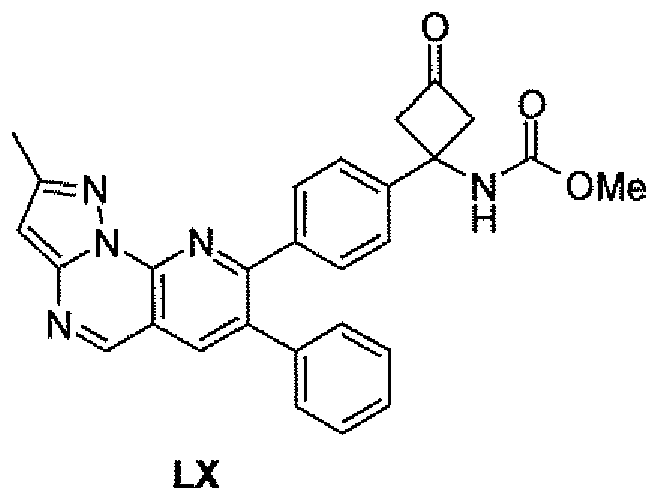
To Compound [LIX] (105 mg, 0.2 mmol, 1 eq.) in THFiH2O [1:1] (20 mL) was added ^αrα-toluenesulfonic acid (38 rag, 0.2 mmol, 1 eq.) and the mixture heated to 50 °C. After 16 hours, the mixture was added to saturated aqueous NaHCθ3 solution and then extracted three times with EtOAc. The combined organics were dried overNa2SO4, concentrated, and subjected to reverse phase chromatography using TFA acidified H2OiCH3CN as the eluant to furnish Compound [LX]: LCMS (m/e) 478 (M+H); 1H NMR (400 MHz, ACETONlTRILE-d's) δ ppm 2.54 (s, 3 H) 3.52 - 3.55 (m, 4 H) 3.56 (s, 3 H) 6.57 (br. s., 1 H) 6.70 (s, 1 H) 7.28 - 7.33 (m, 2 H) 7.35 - 7.39 (m, 4 H) 7.40 - 7.41 (m, 1 H) 7.45 - 7.48 (m, 2 H) 8.41 (s, 1 H) 8.93 (s, 1 H).
l-(4-Bromo-pbenyl)-e(hane-1,2-dioI [LXII]
OsO4, NMO, acetone-water, rt 1 h
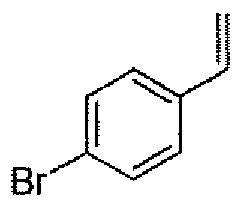
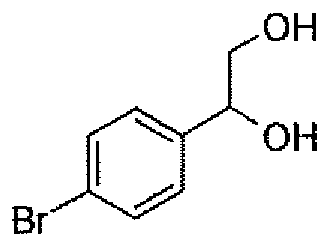
LXI LXI!
To 4-bromostyrene (Compound [LXI], 366 rag, 2 mmol, 1 eq.) in acetone (10 mL) was added morpholine jV-oxide (953 mg of a 50% solution in H20, 4.0 mmol, 2.0 eq.) and then OsO4 (1.3 g for a 4% OsO4 in H20, 0.2 mmol, 0.1 eq). The mixture was allowed to stir at room temperature for 1 hour. The reaction mixture was then added to an aqueous solution of sodium thiosulfate and then extracted three times with EtOAc. The combined organics were
dried over Na2SO4, concentrated, and subjected to silica gel chromatography using EtOAc- heptane as the eluant to provide Compound fLXII]: 1H NMR (400 MHz, METHANOL-^) δ ppm 3.54 - 3.66 (m, 2 H) 4.66 (dd, /=6.76, 5.10 Hz, 1 H) 7.24 - 7.35 (m, 2 H) 7.41 - 7.53 (m, 2 H). l-[4-(4,4,5,5-Tetramethyl-[13α]dioxaborolan-2-yl)-phenyI]-cthane-T,2-di(>l [LXIIIj

LXII!
Compound [LXIIIj was prepared in a similar way to that of Compound [XXXLX] using Compound [LXII] as the starting material.
Data for Compound [LXHIJ: 1H NMR (400 MHz, CHLOROFORM-d) δ ppm 1.35 (s, 12 H) 3.63 - 3.70 (m, 1 H) 3.74 - 3.82 (m, 1 H) 4.83 - 4.89 (m, 1 H) 7.39 (d, J=7.76 Hz, 2 H) 7.82 (d, /=8.00 Hz, 2 H). l-[4-(2-methyl-7-phenyI-M^ 1,2-diol [LXIV]

LX)V
Compound [LXIV] was prepared in a similar way to that of Compound [XL] .
Data for Compound [LXIV]: LCMS (m/e) 397 (M+H); 1H NMR (400 MHz, METHANOL-^) δ ppm 2.58 (s, 3 H) 2.66 (s, 1 H) 3.55 - 3.65 (m, 2 H) 4.69 (dd, /=7.32, 4.59 Hz, 1 H) 6.74 (s, 1 H) 7.27 -7.36 (m, 7 H) 7.57 (d, /=8.30 Hz, 2 H) 8.50 (s, 1 H) 9.01 (s, 1 H). frα«$-2-[l-(4-Bromo-phenyl)- 3-hydrosy-3-methyl-cycIobufyI]-isomdole-13-dione [LXV] and cfe^-ll^broittO-phenylJ-S-hydrosy-S-niethyl-cyclobutylJ-isoindole-lyJ-dioiie [LXVI]
MeMgBr, CH2CI2 -2O °C, 3 h


 LXV LXVl
To a solution of Compound IXXXVH] (370 mg, 1 mmol, 1 eq.) in CH2Cl2 (10 mL) at -20 °C was added dropwise a solution of methylmagnesium bromide (0.33 mL of a 3.0 M solution in THF, 1 mmol, 1 eq.). The mixture was held at -20 °C for 3 hours and then quenched by the addition of saturated aqueous NHUCl solution before being allowed to warm to room temperature. The mixture was extracted with CH2Cl2 and the combined organic phases were dried over Na2S(^ and concentrated under reduced pressure. Purification of the residue using silica gel chromatography with ethyl acetate:heρtane as the eluant provided Compound ILXV] and Compound [LXVIj.
LXV LXVl
To a solution of Compound IXXXVH] (370 mg, 1 mmol, 1 eq.) in CH2Cl2 (10 mL) at -20 °C was added dropwise a solution of methylmagnesium bromide (0.33 mL of a 3.0 M solution in THF, 1 mmol, 1 eq.). The mixture was held at -20 °C for 3 hours and then quenched by the addition of saturated aqueous NHUCl solution before being allowed to warm to room temperature. The mixture was extracted with CH2Cl2 and the combined organic phases were dried over Na2S(^ and concentrated under reduced pressure. Purification of the residue using silica gel chromatography with ethyl acetate:heρtane as the eluant provided Compound ILXV] and Compound [LXVIj.
Data for Compound [LXV]: 1H NMR (400 MHz, CHLOROFORM-^?) δ ppm 1.44 (s, 3 H) 3.08 - 3.16 (m, 2 H) 3.29 - 3.36 (m, 2 H) 7.44 - 7.49 (m, 2 H) 7.55 - 7.60 (m, 2 H) 7.65 - 7.71 (m, 2 H) 7.73 - 7.80 (m, 2 H).
Data for Compound [LXVI]: 1H NMR (400 MHz, CHLOROFORM-φ δ ppm 1.15 (s, 3 H) 3.08 - 3.16 (m, 2 H) 3.28 - 3.35 (m, 2 H) 7.45 - 7.50 (m, 2 H) 7.59 - 7.64 (m, 2 H) 7.64 - 7.69 (m, 2 H) 7.71 - 7.78 (m, 2 H).
frα«s-2-ll-(4-Brømo-phenyI>3-h^^

Compound [LXVII] was prepared in a similar way to that of Compound [XXXIX] using Compound [LXV] as the starting material.
Data for Compound (LXVO]: LCMS (m/e) 434 (M+H); 1H NMR (400 MHz, CHLOROFORM- d) δ ppm 1.31 (s, 12 H) 1.44 (s, 3 H) 3.15 - 3.22 (m, 2 H) 3.32 - 3.39 (m, 2 H) 7.64 - 7.67 (m, 2 H) 7.69 - 7.72 (m, 2 H) 7.73 - 7.77 (m, 2 H) 7.78 - 7.82 (m, 2 H).
fraiw-2-{3-Hydro^-3-methyl-1-[4-(2-methyl-7-pheiiyI-1,4^,9b-tetraai5a- cyclopenta[α]naphthalen-8-yI)-phenyl]-cyclobutyl}-isoindole-13-dione [LXVIII]
HO .

LXVIII
Compound (LXV1H] was prepared in a similar way to that of Compound [XL].
Data for Compound ILXVHI): LCMS (m/e) 566 (M+H); 1H NMR (400 MHz, CHLOROFORM-*/) δ ppm 1.44 (s, 3 H) 1.56 (s, 1 H) 2.59 (s, 3 H) 3.10 - 3.16 (m, 2 H) 3.33 - 3.39 (m, 2 H) 6.69 (s, 1 H) 7.23- 7.26 (m, 2 H) 7.28 - 7.33 (m, 3 H) 7.51 - 7.55 (m, 2 H) 7.57 7.61 (m, 2 H) 7.67 - 7.72 (m, 2 H) 7.75 - 7.79 (m, 2 H) 8.22 (s, 1 H) 8.84 (s, 1 H).
frα«5-3-Amino-1-methyI-3-[4-(2-methyl-7-phenyl-1,4,9,9b-tetraaza- cyclopenta[α]naphthalen-8-yI)-phenyl]-cyclobutanol [LXIX]
HO ,

LXIX Compound [LXIX] was prepared in a similar way to that of Compound [XLI].
Data for Compound [LXIX]: LCMS (m/e) 436 (M+H); 1H NMR (400 MHz, CHLOROFORM- d) δ ppm 1.43 (s, 3 H) 2.40 (s, 3 H) 2.58 - 2.65 (ra, 2 H) 2.65 - 2.71 (m, 2 H) 6.59 (s, 1 H) 7.10 - 7.15 (m, 2H) 7.21 - 7.27 (m, 5 H) 7.28 - 7.32 (m, 2 H) 8.31 (s> 1 H) 8.82 (s, 1 H). cw-2-[i-(4-Broino-phenyI)-3-hydroxy-3-methyI-cyclobutyl]-isoindole-lr3-dione [LXX]

Compound [LXX] was prepared in a similar way to that of Compound [XXXIX] using Compound [LXVI] as the starting material. Data for Compound [LXX]: LCMS (m/e) 434 (M+H). c&-2-{3-Hydroxy-3-methyl-1-[4-(2-methyl-7-phenyϊ-1,4,9,9b-tetraaza- cyclopenta[α]naphthalen-8-yl)-phenyl]-cycIobutyl}-isoindole-13-dione [LXXI]

LXXI
Compound [LXXI] was prepared in a similar way to that of Compound [XL]. Data for Compound [LXXIJ: LCMS (m/e) 566 (M+H); 1H NMR (400 MHz, CHLOROFORM- d) δ ppm 1.15 (s, 3 H) 2.61 (s, 3 H) 3.08 - 3.15 (m, 2 H) 3.30 - 3.37 (m, 2 H) 6.71 (s, 1 H) 7.20 - 7.26 (m, 4 H) 7.29 - 7.31 (m, 1 H) 7.51 - 7.55 (m, 2 H) 7.62 - 7.70 (m, 4 H) 7.76 (dd, _Λ=5.52, 2.98 Hz, 2 H) 8.24 (s, 1 H) 8.87 (s, 1 H). cw-3-Amino-1-methyl-3-[4^2-m^ 8-yl)-pheny]]-cyclobutanoI [LXXH]

LXXIl
Compound [LXXII] was prepared in a similar way to that of Compound [XLI]. Data for Compound [LXXII]: LCMS (m/e) 436 (M+H); 1H NMR (400 MHz, CHLOROFORM- d) δ ppm 1.22 (s, 3 H) 2.49 (s, 3 H) 2.63 (d, ^=13.76 Hz, 2 H) 2.78 (d, J=13.72 Hz, 2 H) 6.70 (s, 1 H) 7.17 -7.23 (m, 4 H) 7.28 - 7.35 (m, 3 H) 7.38 (d, ^=8.30 Hz, 2 H) 8.46 (s, 1 H) 8.94 (s> 1 H). ifra«s-2-{3-CycIoproi^l-3-hydro cyclopenta[α]naphthalen-8-yl)-phenyl]-cycIobutyl}-isoindoIe-l^-dione [LXXIII]

LXXIII
Compound [LXXH1] was prepared in a similar way to that of Compound [XL]. Data for Compound [LXX-ITf: LCMS (m/e) 618 (M+H); 1H NMR (400 MHz, CHLOROFORM- d) D ppm 0.01 (q, J=5.30 Hz, 2 H) 0.12 - 0.21 (m, 2 H) 0.60 - 0.68 (m, 2 H) 0.73 - 0.79 (m, 2 H) 0.84 (t, J=8.32 Hz, 1 H) 1.98 (t, J=8.42 Hz, 1 H) 2.73 (d, 2 H) 2.84 (d, 2 H) 6.17 (s, 1 H) 6.92 - 6.95 (m, 2 H) 6.98 - 7.02 (m, 3 H) 7.23 (d, 2 H) 7.30 (d, 2 H) 7.36 - 7.40 (m, 2 H) 7.43 - 7.49 (m, 2 H) 7.89 (s, I H) 8.51 (s, I H). frα*w-3~Amino-1-cycIopropyI-3-[4-(2-cyclopropyl-7-pheιιyI-1,4,9,9b-tetraaza- cyc!openta[α]naphthalen^-yl)-pheiιyl3-cyclobutaiιol [LXXIVl

LXXIV
Compound [LXXIV] was prepared in a similar way to that of Compound [XLI]. Data for Compound [LXXIV]: LCMS (m/e) 488 (M+H); 1H NMR (400 MHz, METHANOL-^) δ ppm 0.41 (t, .£=4.78 Hz, 2 H) 0.47 (d,J=8.30 Hz, 2 H) 0.96 - 1.04 (m, 2 H) 1.09 - 1.15 (m, 2 H) 1.15 - 1.22 (m, 1 H) 2.24 (t, .£=5.05 Hz, 1 H) 2.61 (d, J=14.25 Hz, 2 H) 2.78 (d, .£=14.35 Hz, 2 H) 6.61 (s, 1 H) 7.33 (s, 5 H) 7.53 (d, J=8.35 Hz, 2 H) 7.72 (df /=8.40 Hz, 2 H) 8.55 (s, 1 H) 9.03 (s, I H). frα»s-2-{3-Cyclopropyl-3-hydroxy-1-[4^ cyclopenta[α]naphthaIen-8-yl)-phenyl]-cycIobutyl}-isoindoIfr-1,3-dione [LXXV]

LXXV
Compound [LXXV] was prepared in a similar way to that of Compound [XL]. Data for Compound [LXXV]: LCMS (m/e) =578 (M+H). This material was used in the next step without further characterization. frα«s-3-Ammo-1-cyclopiOpyl-3-[4-(^^^ yl)-phenyl]-cyclobutanol [LXXVT]

LXXVl
Compound [LXXVIJ was prepared in a similar way to that of Compound [XLI]. Data for Compound [LXXVI): LCMS (m/e) 448 (M+H); 1K NMR (400 MHz, METHANOL-^) δ ppm 0.40 - 0.46 (m, 2 H) 0.47 - 0.55 (m, 2 H) 1.16 - 1.25 (m, 1 H) 2.59 - 2.69 (m, 2 H) 2.76 - 2.86 (m, 2 H) 7.01 (d, J=2.\l Hz, 1 H) 7.33 - 7.43 (m, 2 H) 7.57 (d, ./=8.44 Hz, 1H) 7.76 (d, /=8.47 Hz, 1 H) 8.30 (d, J^2.12 Hz, 1 H) 8.65 (s, 1 H) 9.15 (s, 1 H). frαws-2-{3^ycIopropyl-3-hydrox^ cycIopentaJαjnaphthalett-S-yO-phenyll-cyclobutylJ-isomdole-lβ-dione [LXXVII]

LXXVlI
Compound [LXXVXI] was prepared in a similar way to that of Compound [XL). Data for Compound [LXXVII): LCMS m/e 672 (M+H). This material was carried on to the next step without further characterization. frαιrø-3-Amino-1-cycIopropy^3-[4-(2-<4-fliiorophenyl)-7-plienyl-1,4t9,9b-tetraaza- cyclopenta [α]naphthalen-8~yl)-phenyϊj-cyclobutanol [LXXVIII]

LXXVlIl
Compound [LXXVHI] was prepared in a similar way to that of Compound [XLI]. Data for Compound [LXXVIII]: LCMS m/e 542 (M+H); 1H NMR (400 MHz,
METHANOL-^) δ ppm 0.37 - 0.44 (m, 2 H) 0.45 - 0.51 (m, 2 H) 1.13 - 1.22 (m, 1 H) 2.58 - 2.66 (m, 2 H) 2.79 (d, JH4.30 Hz, 2 H) 7.24 (t, J=8.76 Hz, 2 H) 7.3 ϊ (s, 1 H) 7.34 (s, 5 H) 7.56 (d, J=8.40 Hz, 2 H) 7.73 (d, J=8.35 Hz, 2 H) 8.17 (dd, J*=8.69, 5.42 Hz9 2 H) 8.60 (s, 1 H) 9.11 (s? 1 H).
*rø«s-2-{3^dopropyM-hydrø-^ cyclopenta[α]naphthalen-8-yI)-phenyl]-cyclobutyl}-isoindoie-l^-dione [LXXIX]

LXXIX Compound [LXXIX] was prepared in a similar way to that of Compound [XL] .
Data for Compound [LXXIX]: LCMS m/e 672 (M+H). This compound was used directly in the next step without further purification or characterization.
/rαιιs-3-Amino-l^dopiOpyl-3-[4-(24^ cycIopenta[a)naphthalen-8-yl)-phenyl]-cyc!obutanol [LXXX]

LXXX
Compound [LXXX] was prepared in a similar way to that of Compound [XLI] . Data for Compound [LXXV]: LCMS m/e 516 (M+H); 1H NMR (400 MHz, METHANOL-^) δ ppm 0.41 (dd, 2 H) 0.44 - 0.52 (m, 2 H) 1.12 - 1.22 (m} 1 H) 2.58 - 2.66 (m, 2 H) 2.74 - 2.82 (m, 2 H) 7.29 (s, 1 H) 7.36 (s, 5 H) 7.55 (d, J=8.40 Hz, 2 H) 7.73 (d, J^8.40 Hz, 2 H) 8.68 (s, 1 H) 9.24 (s, 1 H). 2-Methyl-8-(4-morphoIiπ-4-ylmethyI-phenyl)-7-phenyH,4,9,9b-tetraaza- cyclopenta[α]αaphthalene [LXXXI]

LXXXI
[LXXXI] was prepared in a similar way to that of Compound [XL]. Data for Compound [LXXXI]: LCMS m/e 436 (M+H); 1HNMR (400 MHz9 METHANOL-^) δ ppm 2.58 (s, 3 H) 3.13 - 3.32 (m, 4 H) 3.63 - 3.87 (m, 2 H) 3.95 - 4.14 (m, 2 H) 4.37 (s, 2 H) 6.77 (s, 1 H) 7.27 - 7.38 (m, 5 H) 7.46 (d, ^=8.15 Hz, 2 H) 7.71 (d, J=8.15 Hz, 2 H) 8.58 (s, 1 H) 9.06 (s, 1 H).
4-(2-Methyl-7-phenyϊ-1,4,9,9b-tetraaza-cyclopenta[fl]naphthaIen-8-yl)-phenylamme [LXXXΠJ

LXXXl!
Compound [LXXXII] was prepared using a procedure similar to that of xyxXLj. Data for Compound [LXXXπ]: LCMS m/e 352 (M+H); 1H NMR (400 MHz, METHANOLS) D ppm 2.57 (s, 3 H) 6.74 (s, 1 H) 7.09 (d, J=8.61 Hz, 2 H) 7.28 - 7.40 (m, 5 H) 7.64 (d, J=8.64 Hz, 2 H) 8.51 (s, 1 H) 9.02 (s, 1 H).
Λ44-(2-Methyl-7-phenyI~1,4»9,9b-t^^ methanesulfonamide [LXXXIII]

LXXXIII
Compound [LXXXIII] was prepared using a procedure similar to that of Compound [XLJ. Data for Compound [LXXXmj: LCMS m/e 430 (M+H); 1H NMR (400 MHz, METHANOL- cU) δ ppm 2.57 (s, 3 H) 2.96 (s, 3 H) 6.70 (s, 1 H) 7.13 (d, ./=8.40 Hz, 2 H) 7.23 - 7.40 (m,4 H) 7.56 (d, J=8.40 Hz, 2 H) 7.66 (d, J≡422 Hz, 1 H) 8.41 (s, 1 H) 8.96 (s, 1 H).
[4-(2-Methyl-7^henyMA9,9fr-t^^
[LXXXIV]

LXXXIV
Compound [LXXXTV] was prepared using a procedure similar to that of
Compound [XL]. Data for Compound [LXXXIV]: LCMS m/e 395 (M+H); 1HNMR (400 MHz,
METHANOL- ^) δ ppm 2.57 (s, 3 H) 6.71 (s, 1 H) 7.27 - 7.39 (m, 7 H) 7.51 (d, ^=8.71 Hz, 2 H)
8.44 (s, 1 H) 8.98 (s, 1 H).
Morpholrae-4-carboxylic acid [4-(2-methyl-7-phenyl-l^t,9,9b-tetraaza- cyc!openta[α]iιaphthalen-8-yI)-phenyI]-amide [LXXXV]

LXXXV
Compound [LXXXV] was prepared using a procedure similar to that of
Compound [XL]. Data for Compound [LXXXV]: LCMS m/e 465 (M+H); 1H NMR (400 MHz,
METHANOL- ck) δ ppm 2.57 (s, 3 H) 3.45 - 3.55 (m, 4 H) 3.61 - 3.78 (m, 4 H) 6.73 (s, 1 H)
7.27 - 7.42 (m, 7 H) 7.47 - 7.61 (m, 2 H) 8.47 (s, 1 H) 9.00 (s, 1 H).
3-[4-(2-Methyl-7-phenyl-1,4,9,9b-tetraaza-cyclopeiita[α]napIithaien-8-yI)-phenyl]- oxazolidin-2-one [LXXXVI]

LXXXVI
Compound [LXXXVT] was prepared using a procedure similar to that of Compound [XLJ. Data for Compound [LXXXVI|: LCMS m/e 422 (M+H); 1H NMR (400 MHz, METHANOL-^) δ ppm 2.63 (s, 3 H) 4.05 (t, J=IXi Hz, 2 H) 4.49 (t, ^7.86 Hz, 2 H) 6.72 (s, 1 H) 7.20 - 7.29 (m, 2 H) 7.32 - 7.37 (m, 3 H) 7.45 (d, .£=8.57 Hz, 2 H) 7.56 - 7.62 (m. 2 H) 8.23 (s, 1 H) 8.87 (s, 1 H).
4-(2-Methyl-7-phenyϊ-1,4,9,9b-tetraaza-cydopentalfl]naphthalen-8-yI)-ben2ylamine [LXXXVII]

LXXXVII
Compound [LXXXVII] was prepared using a procedure similar to that of Compound [XL]. Data for Compound [LXXXVII]: LCMS m/e 366 (M+H); 1H NMR (400 MHz, METHANOL-^) δ ppm 2.58 (s, 3 H) 4.12 (s, 2 H) 6.76 (s, 1 H) 7.28 - 7.35 (m, 5 H) 7.39 (d, J=%21 Hz, 2 H) 7.67 (d, J=8.27 Hz, 2 H) 8.56 (s, 1 H) 9.05 (s, 1 H).
^-(Z-Methyl-T-phenyl-l^^^b-tetraaza-cyclopentaJαlnaphthalen-S-ylJ-phenyll-methanol [LXXXEi]
K2CO3, DMF 10O °C

O

 III LXXXVIII LXXXIX
A 20 mL scintillation vial containing Compound [III] (35 mg, 0.20mmol, 1 eq.), DMF (1 mL), K2CO3 (84 mg, 0.60 mmol, 3 eq.), and Compound ΪLXXXVIIΪ] (55 mg, 0.25 mmol, 1.25 eq.) was heated at 100 °C for 16 hours. The mixture was allowed to cool. After filtration, the resultant solution was purified by reverse-phase preparative HPLC using water- acetonitrile-TFA [95:5:0.05] and acetonitrile-water-TFA [95:5:0.05] as the mobile phases to provide Compound [LXXXIX] as a solid: LCMS m/e 367 (M+H); 1H NMR (400 MHz, METHANOL-^) δ ppm 2.57 (s, 3 H) 4.61 (s, 2 H) 6.74 (s, 1 H) 7.27 - 7.36 (m, 7 H) 7.54 - 7.59 (m, 2 H) 8.52 (s, 1 H) 9.03 (s, 1 H).
III LXXXVIII LXXXIX
A 20 mL scintillation vial containing Compound [III] (35 mg, 0.20mmol, 1 eq.), DMF (1 mL), K2CO3 (84 mg, 0.60 mmol, 3 eq.), and Compound ΪLXXXVIIΪ] (55 mg, 0.25 mmol, 1.25 eq.) was heated at 100 °C for 16 hours. The mixture was allowed to cool. After filtration, the resultant solution was purified by reverse-phase preparative HPLC using water- acetonitrile-TFA [95:5:0.05] and acetonitrile-water-TFA [95:5:0.05] as the mobile phases to provide Compound [LXXXIX] as a solid: LCMS m/e 367 (M+H); 1H NMR (400 MHz, METHANOL-^) δ ppm 2.57 (s, 3 H) 4.61 (s, 2 H) 6.74 (s, 1 H) 7.27 - 7.36 (m, 7 H) 7.54 - 7.59 (m, 2 H) 8.52 (s, 1 H) 9.03 (s, 1 H).
[4-(2-MethyI-7-phenyl-1,4,9,9b-tetraaza-cycϊopenta[fl;]naphthalen-8-yr)-phenyI]- carboxaldehyde [XC]

XC
Compound [XC] was prepared using a procedure similar to that of Compound [XL]. Data for Compound [XC]: LCMS m/e 365 (M+H); 1H NMR (400 MHz, CHLOROFORM-^?) 5 ppm 2.67 (br. s., 3 H) 6.83 (br. s., 1 H) 7.01 - 8.09 (m, 9 H) 8.21 - 8.52 (s, 1 H) 9.10 (br. s., 1 H) 10.04 (br. s., 1 H).
l'-[4-(2-Methyl-7-phenyl-1,4,9^b-tetraaza-cyclopenta[α]naphthalen-8-yl)-phenylmethyI]- spiro[furo[3,4-c]pyridine-3(1H),4*-piperidine]-1-one [XCEE]
NaBH(OAc)3 TEA, HOAC DMF RT, 3 h


XC XCI XCII
To a 20 mL scintillation vial containing Compound [XC] (18 mg, 0.05 raraol, 1 eq.) in 5% HOAc-DMF (0.5 mL), TEA (7.7 mg, 0.075 mmol, 1.5 eq.), and Compound [XCI] (12 mg, 0.05 mmol, 1 eq.) was added NaBH(OAc)j (21 mg, 0.1 mmol, 2 eq.). The mixture was starred at room temperature for 3 hours. The reaction mixture was diluted with MeOH (1 mL) and purified by reverse-phase preparative HPLC using water-acetonitrile-TFA [95:5:0.05] and acetonitrile-water-TFA [95:5:0.05] as the mobile phases to provide Compound [XCII] as a pale
yellow solid: LCMS ro/e 553 (M+H); 1H NMR (400 MHz, CHLOROFORM-^) δ ppm 1.94 (d, JM 4.62 Hz, 2 H) 2.63 (s, 3 H) 2.92 - 3.03 (m, 2 H) 3.16 - 3.27 (ra, 6 H) 3.65 (d, /=10.93Hz, 2 H) 4.27 (s, 2 H) 6.76 (s, 1 H) 7.21 - 7.25 (m, 2 H) 7.33 - 7.43 (m, 5 H) 7.64 (d, .7=8.08 Hz, 2 H) 7.82 (d, /=4.81 Hz, 1 H) 8.32 (s, 1 H) 8.94 (s,l H) 8.95 (d, /=5.03 Hz, 1 H) 9.02 (s, 1 H).
l'-[4-{2-Methyl-7-phenyH,4,9,9b-tetraaza-cyclopenta[a]naphthaIen-8-yl)-phenylmethyl]- spiro[2-methyl-2^-dihydro-isoindoIe-3(1H),4'-piperidine]-1-one [XCΪH]

XCUI
Compound [XCIHj was prepared using a procedure similar to that of Compound [XCπ]. Data for Compound CXCIII]: LCMS m/e 565 (M+H); 1H NMR. (400 MHz, METHANOL- ck) δ ppm 1.30 (t, ./=7.28 Hz, 1 H) 1.66 - 1.83 (m, 1 H) 2.46 - 2.57 (ra, 1 H) 2.58 (s, 3 H) 3.05 (br. s., 3 H) 3.20 (q, /=7.31 Hz, 1 H) 3.66 - 3.75 (m, 4 H) 4.60 (s, 2 H) 6.77 (s, 1 H) 7.29 - 7.39 (m, 5 H) 7.57 (d, /=8.22 Hz, 2 H) 7.59 - 7.66 (m, 1 H) 7.68 - 7.81 (m, 3 H) 7.86 (d, /=7.37 Hz, 1 H) 8.06 (br. s., 1 H) 8.59 (s, 1 H) 9.06 (s, 1 H).
r-ϊ4-(2~Methyl-7-phenyl^ spiro[furo[3,4~b]pyridme-5(7H),4*-piperidiiie]-7-one [XCIV]

XCIV
Compound [XCIV] was prepared using a procedure similar to that of Compound [XCII]. Data for Compound [XCIVJ: LCMS m/e 553 (M+H); 1H NMR (400 MHz, METHANOL- d4) δ ppm 2.13 (d, J=14.57 Hz, 2 H) 2.50 - 2.56 (m, 2 H) 2.58 (s, 3 H) 3.45 - 3.70 (m, 4 H) 4.51 (br. s., 2 H) 6.77 (s, 1 H) 7.27 - 7.38 (m, 5 H) 7.54 (d, /=8.08 Hz, 2 H) 7.74 (d, /=8.13 Hz, 2 H) 7.78 (dd, /=7.82} 4.97 Hz, 1 H) 8.08 - 8.18 (m, 1 H) 8.59 (s, 1 H) 8.89 (d, /=4.05 Hz, I H) 9.06 (s, I H).
8-[4-(4-Benzo[13]dioxoI-5-ylmethyI-piperazin~l-ylmethyl)-phenyl]-2-methyl-7~phenyl- 1,4,9,9b-tetraaza-cyclopenta(ajnaphthalene [XCV]

Compound (XCV] was prepared using a procedure similar to that of Compound [XCHI. Data for Compound [XCV]: LCMS m/e 569 (M+H); 1H NMR. (400 MHz, METHANOL-^) δ ppm 2.58 (s, 3 H) 2.83 - 2.97 (m, 4 H) 3.07 - 3.19 (m, 4 H) 3.86 (s, 2 H) 4.05 (S, 2 H) 5.98 (s, 2 H) 6.75 (s, 1 H) 6.83 - 6.96 (m, 3 H) 7.26 - 7.37 (m, 7 H) 8.55 (s, 1 H) 9.04 (s, I H).
l-[4^2-Methyϊ-7-phenyϊ-1,4,9,9b-te^ piperidine-4-carboxylic acid amide [XCVI]

XCV!
Compound [XCVI] was prepared using a procedure similar to that of Compound [XCII]. Data for Compound [XCVI]: LCMS m/e 477 (M+H); 1H NMR (400 MHz, METHANOL-^) δ ppm 1.81 - 1.97 (m, 2 H) 2.01 - 2.15 (m, 2 H) 2.58 (s, 3 H) 2.94 - 3.08 (m, 2 H) 3.43 - 3.59 (m, 2 H) 4.32 (s, 1 H) 6.77 (s, 1 H) 7.27 - 7.37 (m, 5 H) 7.45 (d, ^8.10 Hz, 2 H) 7.70 (d, ./=8.05 Hz, 2 H) 8.58 (s, 1 H) 9.06 (s, 1 H).
Scheme VI - Synthesis of C
N^B(OH)_
H H PdCI2CdPPl)2
NlS / DMF CSaCO3

rv XCWII xcvn n POCI.
.O-,
^ PdCydppfJi
Cs2CO8


XCIX
34odo>2-methyl-7-phenyl-lA9,9b-tetr3aza-cyclopenta[α]naphthaIen^^i pCCVπ]
NIS / DMF


IV XCVII
To a solution of Comound [IV] (0.2g, 0.73 mmol, 1 eq.) in DMF (10 mL) was added jV-iodosuccinimide (0.18 g, 0.8 mmol, 1.1 eq.) and the mixture stirred for 2 hours and concentrated. The residue was purified by silica gel chromatography using CHCl3/MeOH(10%) as eluant to give Compound [XCVlI]: LCMS m/e 403 (M+H); 1H NMR (400 MHz, DMS(W6) 5 ppm 7.33 - 7.40 (m, 1 H) 7.44 (t, J&=7.42 Hz9 2 H) 7.69 (d, /=7.22 Hz, 2 H) 8.37 (s, 1 H) 8.83 (s, 1 H).
2-Mcthyl-7-phenyI-3-pyridin--3-y 1-1 ^^^b-tetraaza-CΛcIopentafαlnaptithalcn-S-ol lXC VIII]

XCVIII
Compound pCCVΗIj was prepared using a procedure similar to that of Compound (XLJ. Data for Compound [XCVHI]: LCMS m/e 354 (M+H); 1H NMR (400 MHz, METHANOL-^) δ ppm 2.81 (s, 3 H) 7.35 - 7.51 (m, 3 H) 7.73 (d, .£=7.08 Hz, 2 H) 8.07 (dd, J=8.05, 5.66 Hz, 1 H) 8.27 (s, 1 H) 8.69 (d, .£=5.32 Hz, 1 H) 8.90 (s, 1 H) 8.97 (d, J=8.20 Hz, 1 H) 9.39 (s, I H).
8-Chloro-2-methyI-7-phenyl-3-pyridin-3-yI-1,4^,9b-tetraa«a-cyclopenta[fl]naphthaIene
[XCIX]

XClX
Compound [XCIX] was prepared using a procedure similar to that of Compound [V]. Data for Compound [XCIX]: LCMS m/e 372 (M+H); 1H NMR (400 MHz, METHANOL- O4) δ ppm 2.79 (s, 3 H) 7.46 - 7.63 (m, 5 H) 8.03 (dd, .£=8.05, 5.56 Hz, 1 H) 8.63 (s, 1 H) 8 J2 (d, .£=5.08 Hz, 1 H) 8.87 (d, J=8.20 Hz, 1 H) 9.19 (s, 1 H) 9.31 (s, 1 H).
3-[4-(2-MethyI-7-phenyI-3^yri phenylj-oxazolidin-2-one [C]

Compound [C] was prepared using a procedure similar to that of Compound POL]. Data for Compound [C]: LCMS m/e 499 (M+H); 1H NMR (400 MHz, METHANOL-^) δ ppm 2.83 (s, 3 H) 4.12 (t, /=8.00 Hz, 2 H) 4.47 - 4.55 (m, 2 H) 7.31 - 7.41 (m, 5 H) 7.52 - 7.61 (m, 2 H) 7.63 - 7.71 (m, 2 H) 8. U - 8.20 (m, 1 H) 8.62 (s, 1 H) 8.76 (d, J*=5.52 Hz, 1 H) 9.06 (d, J=8.30 Hz, 1 H) 9.24 (s, 1 H) 9.42 (s, 1 H).
S^yano-1-methyϊ-T-phenyl-l^^^b^etraaza-cycIopentalalnaphthaleji-S-oϊ ϊCI]
Pd2<dba)3/ dppf Zn(CN)2 / Zn dust DMA


XCVIIi Cl
to a 20 mL scintillation vial Pd2(dba)3 (0.032& O.035mmol, 0.05 eq.) and DPPF (0.04g, 0.0704 mmol, 0.1 eq.) were taken in 10 raL of -V^-dimethylacetamide. Zn(CN)2 (0.082g, 0.704 mmol, 1.0 equiv.) and Zn (0.009Ig, 0.1408 mmol, 0.2 equiv.) were added to this followed Compound ptCVHI] (0.25g, 0.704mmol, 1.0 eq.). The solution was degassed for several minutes and stirred at 90 °C for 16 hours. The reaction was then cooled, concentrated, and the crude purified by silica gel chromatography using CHCl3/MeOH (1 : 10) as the eluant to give Compound [CI] as a greenish solid: LCMS m/e 302 (M+H). This material was used in the next step without further purification.
8-Chloro-3-cyano-2-methyl-7-phenyI-1,4,9^b-tetraaza-cyclopenta[α]naphthaIene [CI]
^INi
N IVL Xl
CII
Compound ICH] was prepared using a procedure similar to that of Compound [V]. Data for Compound [CII]: LCMS m/e 320 (M+H). This material was used directly in the next step without further purification.
frαws-2-{3^yclopropyl-3-hydro^ cyclopenta[α]naphthalen-8-yl)-phenyl]-cyclobutyl}-isoiϊidoIe-13-dione [XL]

Compound [CIII] was prepared using a procedure similar to that of Compound [XLI. Data for Compound [CUJ]: LCMS m/e 617 (M+H); 1H TS(MR (400 MHz, CHLOROFORM-^ δ ppm 0.23 - 0.33 (m, 2 H) 0.40 - 0.52 (m, 2 H) 1.17 (m, 1 H) 2.69 (s, 3 H) 2.96 - 3.05 (m, 2 H) 3.09 - 3.16 (m, 2 H) 7.28 - 7.35 (m, 4 H) 7.47 - 7.54 (m, 3 H) 7.61 (<L ^=8.40 Hz, 2 H) 7.68 (dd,J=5.34, 3.10 Hz, 2 H) 7.72 - 7.78 (m, 2 H) 8.33 (s, 1 H) 9.09 (s, 1 H).
i*r«KS-3-Aniino-1-cyclopropyl-3-[4-(3-cyano-2-methyl-7-phenyI-1,4,9,9b-tetraaza- cycϊopenta[α]naphthalen-8-yl)-phenyl]-cycIobutanol [CIV]

CIV
Compound [CIV] was prepared using a procedure similar to that of Compound [XLI]. Data for Compound [CIV] : LCMS m/e 487 (M+H); 1H NMR (400 MHz, METHANOL- (k) δ ppm 0.37 - 0.43 (m, 2 H) 0.43 - 0.51 (m, 2 H) 1.17 (m, 1 H) 2.58 - 2.65 (m, 2 H) 2.68 (s, 3 H) 2.74 - 2.81 (m, 2 H) 7.28 - 7.41 (m, 5 H) 7.55 (d, /=8.40 Hz, 2 H) 7.72 (<L >=8.40 Hz, 2 H) 8.70 (s, I H) 9.33 (s, I H).
2-{l-[4-(3-bromo-.^raethyJ^7-pheiιyI^^^ phenyI]-3-cyclopropyl-3-hydrosy-cycIobiityI}-isoindoIe-l^-dione [CV]
NBS1 1,2-DCE


XL CV
To a 20 mL scintillation vial containing Compound [XL] (150 mg, 0.253 mmol,1.0 eq.) in dichloroethane (5 mL) was added jV-bromosuccinimide (54 mg, 0.305 mmol, 1.2 eq.). The mixture was stirred at room temperature for 25 minutes. The solvent was then evaporated under reduced pressure. The residue was dissolved in MeOH/CHCb and purified by silica gel chromatography using CHCl3 and MeOH [90:10] as the mobile phases to provide Compound [CV] as a pale yellow solid: LCMS (m/e) 672 (M+2); 1H NMR (400 MHz, CHLOROFORM-**) δ ppm 0.02 (d, ,7=5.08 Hz, 2 H) 0.19 (d, J*=7.71 Hz, 2 H) 0.85 (m, 1 H) 1.27 (m, 5 H) 2.29 (s, 3 H) 2.74 (d, J=14.50 Hz, 2 H) 2.85 (d, J=14.50 Hz, 2 H) 7.23 (d, ^8.40 Hz, 2 H) 7.32 (d, J=8.40 Hz, 2 H) 7.39-7.41 (m, 2 H) 7.47-7.49 (m, 2 H) 7.96 (s, 1 H) 8.63 (s, 1 H).
3-Amino-3-[4-(3Φromo-2-methyt ylj-phenylj-cyelopropyl-cyclobiitanol [CVT]

CVI
Compound [CVI] was prepared using a procedure similar to that of Compound [XLI]. Data for Compound [CVI]: LCMS (ra/e) 542 ; 1H NMR (400 MHz, METHANOL-^) 8 ppm 0.41 (d, J=4.10 Hz, 2 H) 0.47 (d, J=8.00 Hz, 2 H) 1.23 (m,l H) 2.35 (d, J=13.47 Hz, 2 H) 2.56 (s, 3 H) 2.62 (d, J=I 3.47 Hz, 2 H) 7.33 (m, 5 H) 7.46 (d, J=8.40 Hz, 2 H) 7.60 (d, J=8.40 Hz, 2 H) 8.54 (s, 1 H) 9.08 (s, 1 H).
2-{l-[4-(3-Chloro-2-methyl-7-phenyH,4,9,9b-tetraaza-cyclopenta[α]naphthalen-8-yI)- phenyfl-SH^cIopropyl-S-hydroiy-cycIobutylj-isoiiidole-l^-dione

CVIE
To a 20 mL scintillation vial containing Compound [XL] (47.3 mg, 0.08 mmol, 1.0 eq.) in dichloromethane (5 mL) was added N-chlorosuccinimide (9.9 mg, 0.074 mmol, 1.1 eq.). The mixture was stirred at room temperature for 3 hours. The solvent was then evaporated under reduced pressure. The residue was dissolved in MeOH/CHClj and purified by silica gel chromatography using CHCl3 and MeOH [90:10] as the mobile phases to provide Compound ICVπ] as a pale yellow solid: LCMS (m/e) 626 (M+H); 1H NMR (400 MHz, METHANOL-^) δ ppm 0.29 (d, J=4.69 Hz, 2 H) 0.40 (d, J=7.61 Hz92 H) 1.09 (m, 1 H) 2.52 (s, 3 H) 2.93 (d, J=14.45 Hz, 2 H) 3.17 (d, J=14.45 Hz, 2 H) 7.27 (m, 5 H) 7.53 (d, J=8.59 Hz, 2 H) 7.57 (d, J=8.59 Hz, 2H) 7.78 (m, 4 H) 8.52 (s, 1 H) 9.05 (s, 1 H).
3-Amino-3-[4^3πϊhloro-2-meth^^ yl)-phenyl]-cyclopropyl-cyclobutanoHCVHI]

CVIII
Compound [CVTII] was prepared using a procedure similar to that of Compound [XLI]. Date for Compound [CVHIJ: LCMS (m/e) 496 (M+H) ; 1H NMR (400 MHz,
METHANOL-^) δ ppm 0.41 (d, J=4.88Hz, 2 H) 0.47 (d, J=8.20 Hz, 2 H) 1.21 (m,l H) 2.47 (d, J=I 3.67 Hz, 2 H) 2.57 (s, 3 H) 2.70 (d, J=14.076Hz, 2 H) 7.34 (m, 5 H) 7.50 (d, J=8.40 Hz, 2 H) 7.66 (d, J=8.00 Hz, 2 H) 8.57 (s, 1 H) 9.09 (s, 1 H).
2,5-Dimethyl-7-pheπyl-1,4,9,9b-tetraaza-cyclopenta[fl]naphthalen-8-ol [CIX]
1. MeLi1 THF1 O °C 2. MnO2, THF

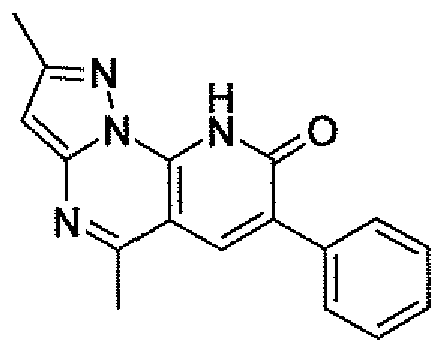
IV CIX
In a 20 mL scintillation vial, Compound [IVj (0.15 g, 0.543 mmol, 1.0 eq.) was dissolved in THF (10 mL). The solution was cooled to -78 °C and MeLi (15 mL of 1.6 MTHF solution, 24 mmol, 44.19 eq.) was added dropwise and the reaction mixture was stirred for 16 hours at 0 - 20 °C. The reaction mixture was carefully and slowly poured into ethyl acetate 20 (mL) and stirred for 10 minutes. The quenched reaction mixture was concentrated. The residue was treated with 100 mL of THF and the THF solution was separated from the solid by filtration. The organic solution was stirred with MnO^ (0.47 g, 5.4 mmol, 10 eq.) for 4 hours at room temperature. The reaction was filtered and the solids washed with CHCl3ZMeOH (10%) (50 mL). The combined organic solution was concentrated and the crude was purified by silica gel chromatography using CHCl3MeOH (10%) as the eluant to give Compound [CEX]: LCMS m/e 291 (M+H); 1H NMR (400 MHz9 CHLOROFORM-d) δ ppm 2.51 (s, 3 H) 2.77 (s, 3 H) 6.40 (s, 1 H) 7.36 - 7.51 (m, 3 H) 7.71 (d, ^=7.22 Hz, 2 H) 7.97 (s, 1 H).
8-Chϊoro-2,5-dimethyl-7rphenyl-1,4,9,9b-tetraaza-cyclopentaΪΛ]naphthalene ϊCX]

CX
In a 20 mL scintillation vial Compound [CIX] (0.08 g, 0.275 mmol. 1.0 eq.) was heated with 2 mL of POCI3 at 80 °C for 2 hours. The reaction was cooled and concentrated and the residue by silica gel chromatography using CHCl3MeOH (10%) as eluant to give Compound [CXJ: LCMS m/e 309 (M+H); 1H NMR (400 MHz, CHLOROFORM-^ δ ppm 2.60 (s, 3 H) 2.84 (s, 3 H) 6.57 (s, 1 H) 7.43 - 7.61 (m, 5 H) 8.22 (s, 1 H).
2-{l-[4-(2,5-Dimethyl-7-phenyH,4,9,9b-tetraaza-cyclopenta[a]naphthalen-8-yI)-pheiiylj-3- methyl-3-hydrosy-cycIobutyI}-isoijidole-13-€-ioiie [CXI]

CXI
Compound [CXI] was prepared using a procedure similar to that of Compound [XLJ. Data for Compound [CXIJ: LCMS m/e 580 (M+H); 1H NMR (400 MHz, METHANOL- <k) δ ppm 1.36 (s, 3 H) 2.50 (s, 3 H) 2.86 (s, 3 H) 2.97 (d, 7=13.86 Hz, 2 H) 3.36 - 3.43 (m, 2 H) 6.55 (s, 1 H) 7.24 - 7.30 (m, 5 H) 7.48 - 7.56 (m, 4 H) 7.74 - 7.82 (m, 4 H) 8.46 (s, 1 H).
3-Amino-3-[4-(2^-dirøethyl-7-phenyl-1,4,9,9b-tetraaza-cyclopenta[β]ιiaphthalen-8-yl)- phenyϊj-methyl-cyclobutanol [CXII]
HO^

CXII
Compound [CXII] was prepared using a procedure similar to that of Compound [XLJ]. Data for Compound [CXUJ: LCMS m/e 450 (M+H); 1H NMR (400 MHz, METHANOL-^) δ ppm 1.54 (s, 3 H) 2.37 (d, .M 3.52 Hz9 2 H) 2.54 (s, 3 H) 2.65 (d, /=13.42 Hz, 2 H) 2.89 (s, 3 H) 6.58 (s, 1 H) 7.30 - 7.36 (m, 5 H) 7.39 (d, ^8.35 Hz, 2 H) 7.59 (d, J=8.35 Hz, 2 H) 8.49 (s, 1 H).
2-Methyl-7-thiophen-2-y^9H4,4,9,9lvtetraaza-cyclopenta[fl]iiaphthaIcn-8H)ne [CXIII]

CXIII
Compound [CXIII] was prepared using a procedure similar to that of Compound [IV]. Data for Compound [CXHI]: LCMS (m/e) : 283 (M+H); .1HNMR (400 MHz, METHANOL-^) δ ppm 2.49 (s, 3 H) 6.36 (s, 1 H) 7.08 (t, J=4.20 Hz, 1 H) 7.36 (d, J=4.69 Hz, 1 H) 7.71 (d, J=3.12 Hz, 1 H) 8.32 (s, 1 H) 8.53 (s, 1 H).
8-Chloro-2-methyI-7-thiophen-2-yl-1,4,9,9b-tetraaza^dopenta[αJnaphthalene [CXT^

CXlV
Compound [CXIV] was prepared using a procedure similar to that of Compound [V] (POCl3 procedure). Data for Compound [CXIV]: LCMS (m/e) : 301 (M+H); 1H NMR (400 MHz, CHLOROFORM-d) δ ppm 2.63 (s, 3 H) 6.72 (s, 1 H) 7.16 - 7.22 (m, 1 H) 7.49 (d, J=3.51 Hz, 1 H) 7.52 (d, J=5.08 Hz, 1 H) 8.34 (s, 1 H) 8.82 (s, 1 H).
2-{3-Hydro^-3-methyl-1-[4^2-methyl-7-thiophen-2-yI^,9-dihydro-1,4,9,9b-tetraaza- cycIopenta[α]naphthalene-8-yI)-pheiiyl]-cyclobutyI}-isoiiιdole"l^-dione [CXVJ
HO .
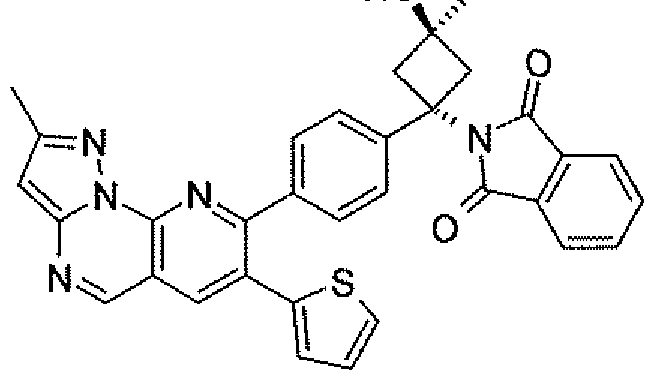
CXV
Compound [CXV] was prepared using a procedure similar to that of Compound [XL]. Data for Compound [CXV]: LCMS (m/e) : 573 (M+H); 1H NMR (400 MHz,
CHLOROFORM-**) δ ppm 1.44 (s, 3 H) 2.56 (s, 3 H) 3.15 (d, J=14.25 Hz, 2 H) 3.38 (d, J=14.25 Hz, 2 H) 6.67 (d, 1 H) 6.86 (d, J=2.73 Hz, 1 H) 6.93 (t, J=3.71 Hz, 1 H) 7.25 (s, 3 H) 7.30 (d, J=5.08 Hz, 1 H) 7.57 (d, J=8.60 Hz, 2 H) 7.65 (d, J = 8.60 Hz, 2 H) 7.68 (dd, J=5.47, 2.93 Hz, 2 H) 7.77 (dd, J=5.47, 3.12 Hz, 2 H) 8.29 (s, 1 H) 8.82 (s, 1 H).
3-Amiiιo4-methyl-344<2-methyl-7-thiophen-2-yl-«,9-dihydro-1,4,9,9b-tetraaza- cycIopenta[a]naphthalene-8-yl)-phenyl]-cyclobutanoI [CXVI]
HO

Compound ICXVI] was prepared using a procedure similar to that of Compound [XLI]. Data for Compound [CXVI]: LCMS (ro/e) 442 (M+H); 1H NMR (400 MHz, METHANOL-^) δ ppm 1.55 (s, 3 H) 2.45 (d, J=13.47 Hz, 2 H) 2.56 (s, 3H) 2.72 (d, J=13.28 Hz, 2 H) 6.75 (s, 1 H) 7.00-7.03 (m, 2H) 7.46 (d, J=3.32 Hz,.l H) 7.48 (d, J=8.40 Hz, 2 H) 7.67 (d, J=8.40 Hz, 2 H) 8.62 (s, 1 H) 9.02 (s, 1 H).
2-Methyl-7-thiophen-3-yl-9H-1,4,9,9b-tetraaza-cycϊopenta[α]naphthaIeii-8-one [CXiπ]

CXVII
Compound [CXVII] was prepared using a procedure similar to that of Compound [IV]. Data for Compound [CXVH]:, LCMS (m/e) 283 (M+H); 1H NMR (400 MHz, DMSCMs) δ ppm 2.45 (s, 3 H) 6.39 (s, 1 H) 8.31 (br. s., 1 H) 8.40 (br. s., 1 H) 8.49 (s, 1 H) 8.59 (s, 1 H) 9.86 (s, 1 H). Amount obtained: 0.493 g, 61% yield.
8-CWoro-2-raethyl-7-thiophen-3^

CXVIU
Compound [CXVIII] was prepared using a procedure similar to that of Compound [V]. Data for Compound [CXV1H]: LCMS (m/e) 301 (M+H); 1HNMR (400 MHz, CHLOROFORM-Λ) δ ppm 2.64 (s, 3 H) 6.73 (s, 1 H) 7.40 (dd, J=5.Q0, 1.20 Hz, 1 H) 7.49 (dd, J-5.00, 3.00 Hz, 1 H) 7.62 (dd, ^=2.93, 1.22 Hz, 1 H) 8.27 (s, 1 H) 8.83 (s, 1 H).
2-{3-Hydroxy-3-methyl-1-[4-(2-methyl^^ cyclopenta[αInapIιthalene-8-yI)-phenyl]-cycIobutyI}-isoindole-1,3-dione [CXIX] .

CXlX
Compound [CXIXj was prepared using a procedure similar to that of Compound POL]. Data for Compound [CXIX]: LCMS (m/e) 572 (M+H); 1H NMR (400 MHz, CHLOROFORM-tf) δ ppm 1.46 (s, 3 H) 2.59 (s, 3 H) 3.16 (d, 2 H) 3.37 (d, 2 H) 6.69 (s, 1 H) 7.23 (s, 1 H) 7.48 - 7.80 (m, 8 H) 8.26 (s, ϊ H) 8.84 (s, 1 H).
3-AroincHl-methyl-3-[4-(;^ cyclopenta[α]naphthalene-8-yl)-phenyl]-cryclobαtanoI [CXX]
HQ .

CXX
Compound [CXX] was prepared using a procedure similar to that of Compound [XL]. Data for Compound [CXX]: LCMS (m/e) 442 (M+H); 1H NMR (400 MHz,
METHANOL-^) δ ppm 1.78 (s, 3 H) 2.84 (s, 3 H) 2.94 (d, J=I 4.25 Hz, 2 H) 3.14 (d, .,£=14.30 Hz, 2 H) 7.02 (s, 1 H) 7.15 (d, J^3.90 Hz, 1 H) 7.61 - 7.68 (m, 1 H) 7.65 (d, ./=4.98 Hz, 1 H) 7.71 (s, 1 H) 7.81 (d, /=8.40 Hz, 2 H) 8.01 (d, J=8.39 Hz, 2 H) 8.87 (s, 1 H) 9.30 (s, 1 H).
7^2-FIttoro-pheayl)-2-methyl-9H-M

CXXI
Compound [CXXI] was prepared using a procedure similar to that of Compound [IV]. Data for Compound [CXXI]: LCMS (m/e) 295 (M+H). This material was used directly in the next step without further purification or characterization.
8-ChIoro-7-(2-fluoTOrphenyI)-2-methyl-1,4^,9b-tetraazaH^cIopenta[ΛΪnaphthaIene [CXXII]

Compound [CXXII] was prepared using a procedure similar to that of Compound [V]. Data for Compound [CXXII]: LCMS (m/e) 313 (M+H). This material was used directly in the next step without further purification or characterization.
2-(l-{4-[7-(2-Ftaoro-phenyI)-2-me^ phenylJ-S-hydroxy-S-methyl-cycIobutylJ-isoindole-l^-dione JCXXin]

3-Ajmino-3-{4-[7-(2-fluoro-phenyI)-2-methyH,4,9,9b-tetraaza-cyclopenta[αJiiaphthalen-8- ylj-pheny1H-methyl-cyclobutanoI fCXXIV]

Compound [CXXIV] was prepared using a procedure similar to that of Compound [XLI]. Data for Compound [CXXIVj: LCMS (m/e) 454 (M+H); 1H NMR (400 MHz, METHANOL-^) δ ppm 1.49 (s, 3 H) 1.98 (s, 2 H) 2.59 (s, 3 H) 2.70 (d, J=14.64 Hz, 2 H) 2.87 (d, J=14.25 Hz, 2 H) 6.78 (s, 1 H) 7.04 (t, J=9.08 Hz, 2 H) 7.26 (t, J=7.42 Hz, 2 H) 7.39 - 7.49 (m, 2 H) 7.52 (d, J=8.20 Hz, 2 H) 7.74 (d, J=8.20 Hz, 2 H) 8.09 (s, 1 H) 8.59 (s, 1 H) 9.05 (s, 1 H).
Ph3P+CH3 OsO41 NMO KO-t-Bu, acetone, jc RT, 1h RT, 2 days


CXXV CXXVI CXXViI
PdCLg PdCI2 (CiPPf)-DCM KOAc1 dtoxane Cs2CO3- dioxane 90 °C, 5 h water


CXXVIII
CXXIX

TFA1 DCM rt, 2 h

CXXX
[l-(4-Bromo-phenyI)-3-methylene-cyclobutyl]-carbamic acid tert-butyl ester [CXXVI]
KOtBu
Ph3P+-CH3 Br THF1 RT


CXXV CXXVI
To a 40 mL scintillation vial containing Ph3P+CH3Bf (1.45 g, 4.0 mmol, 2.8 eq.) and THF (12 mL) under Argon was added KO-t-Bu (0.45 g, 4.0 mmoL 2.8 eq.) in three portions. The reaction mixture was stirred at room temperature for 1 hour to form a solution of the ylide.
To a 20 mL scintillation vial containing Compound [CCXV] (0.49 mg, 1.42 mmol, 1 eq.) and THF (4.5 mL) under Argon was added the above ylide (4.26 mL of the above ylide solution, 1.42 mmol, 1 eq.) slowly at room temperature. After the addition, the reaction mixture was stirred for 1 hour. The reaction was quenched with water (5 mL) and the resulting solution was extracted with EtOAc (3 x 8 mL). The combined organic solution was dried over Na2S(>4, After filtration and concentration, the residue was purified by silica gel chromatography using EtOAc and heptanes as the mobile phases to furnish Compound [CCXVI] as a yellowish
solid: LCMS m/e 339 (M+H); 1H NMR (400 MHz, CHLOROFORM-^ 6 ppm 1.38 (s, 9 H) 3.14 (br. s., 4 H) 4.90 - 5.01 (ra, 2 H) 5.19 (s, 1 H) 7.00 - 7.59 (m, 4 H).
[l-(4-Bromo-phenyl)-3-hydro^ ester [CXXVII)
OsO4, NMO acetone, water RT, 2 days


CXXVI CXXVII
To a 20 mL scintillation vial containing Compound [CXXVI] (68 mg, 0.2 mmol, 1 eq.) and acetone (2 mL) and N-methylmotpholine-jV-oxide (46 mg, 0.4 mmol, 2 eq.) was added Osθ4 (126 mg of a 4% solution in H20, 126 mg, 0.02 mmol, 0.1 eq.). The reaction mixture was stirred for 5 hours at room temperature. Then additional iV-methylmorpholine-JV-oxide (184 mg, 1.6 mmol, 8 eq.) and Osθ4 (504 mg of a 4% solution m H2O, 0.08 mmoL 0.4 eq.) were added. The reaction mixture was stirred for 2 days at room temperature. Then it was quenched with saturated Na2SO3 (10 mL) and the resulting solution was extracted with EtOAc (3 x 10 mL) and CHCU (3 x 1O mL). The combined organic solution was dried over Na2SO4. After filtration and concentration, the residue was purified by silica gel chromatography using MeOH and CH2Cl2 as the mobile phases to furnish Compound [CXXVII) as a yellowish solid: LCMS m/e 373 (M+H); 1H NMR (400 MHz, METHANOL-^) δ ppm 1.35 (br.2 s., 9 H) 2.34 - 2.49 (m, 2 H) 2.63 - 2.74 (m, 1 H) 2.78 - 2.88 (m, 1 H) 3.25 (s, 1 H) 3.34 (s, 1 H) 3.65 (s, 1 H) 7.31 - 7.49 (m, 4 H).
{3-Hydrosy-3-hydro:!^etø^ cyclobutylj-carbamic acid tert-butyl ester [CXXVIII)
Compound [CXXVIII] was prepared using a procedure similar to that of
Compound [XXXIX]. Data for Compound [CXXVHI]: LCMS ra/e 420 (M+H); 1H NMR (400
MHz, CHLOROFORM- d) δ ppm 1.11 - 1.64 (ra, 21 H) 1.91 - 2.12 (m, 1 H) 2.31 - 3.10 (m, 4 H) 3.34 (d, J≡S.76 Hz, 1 H) 3.82 (d, ^4.93 Hz, 1 H) 4.69 - 5.19 (m, 1 H) 7.30 - 7.87 (m, 4 H).
fl-(4-{7-[(Z)-1-Eth-(E)-ylidcπc-penta-2,4-dienyl]-2-methyI-1,4,9,9b-tetraaza- cyclopenta[α]naphthalen-8-yl}-phenyI)-3-hydroxy-3-IiydroxyniethyI-cyclobutyl]-carbainic acid tert-butyl ester [CXXIX]

CXXIX
Compound [CXXIX] was prepared using a procedure similar to that of Compound [XL]. Data for Compound (CXXIX]: LCMS m/e 552 (M+H); 1H NMR (400 MHz9 CHLOROFORM- d) δ ppm 1.44 (br. s., 9 H) 2.62 (s, 3 H) 2.74 - 3.04 (m, 4 H) 3.34 (s, 1 H) 3.78 (br. s., 1 H) 4.78 - 5.17 (m, 1 H) 6.71 (2 s, 1 H) 7.16 - 7.67 (m, 9 H) 8.24 (2 s, 1 H) 8.86 (2 s, 1 H).
3-Amino-1-hydroxymethy^^^ cyclopenta[α]naphthalen-8-yl)-phenyl]-cyclobutaiioϊ [CXXX]
TFA1 DCM RT, 2 h
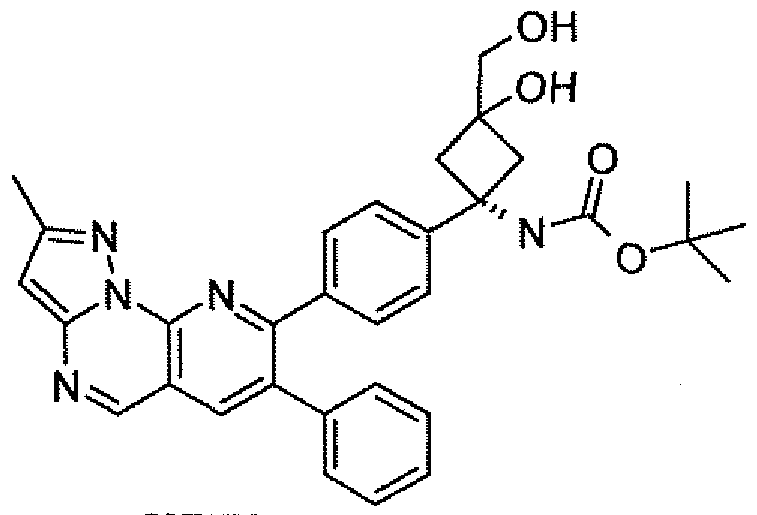

CXXlX
To a 20 mL scintillation vial containing Compound [CXXIX] (22mg, 0.04 mmol, 1 eq.) and CH2CI2 (2 mL) was added TFA (0.2 mL). The reaction mixture was stirred for 2 hours at room temperature. Then the solvent was removed and the residue was dissolved in 80% MeOH:H2θ (2 mL). Then it was purified by reverse-phase preparative HPLC using water-
acetorύtrile-TFA [95:5:0.05] and acetonitrile-water-TFA [95:5:0.05] as the mobile phases to provide Compound [CXXX] as a yellow solid: LCMS m/e 452 (M-HH); 1H NMR (400 MHz, METEiANOL- </4) δ ppm 2.47 - 2.55 (m, 1 H) 2.58 (s, 3 H) 2.75 - 2.86 (m, 1 H) 2.90 - 3.03 (m, 2 H) 3.28 (br. s., 1 H) 3.57 (s, 1 H) 6.77 (s, 1 H) 7.25 - 7.38 (m, 5 H) 7.40 - 7.48 (m, 2 H) 7.63 - 7.77 (m, 2 H) 8.57 (2s, 1 H) 9.05 (s, 1 H).
{3-Methylene-1-[4-(4,4,5,5-tetramethyI-[l^^Jdioxaborolan-2-yI)-phenyl]-cyclobutyl}- carbamic acid tert-butyl ester [CXXXI]

CXXXI
Compound [CXXXI] was prepared using a procedure similar to that of Compound [XXXIX]. Data for Compound [CXXXI]: LCMS m/e 386 (M+H); 1H NMR (400 MHz, CHLOROFORM- d) δ ppm 1.34 (br. s., 21 H) 3.18 (br. s., 4 H) 4.94 (t, J^=2.33 Hz, 2 H) 5.13 (br. s., 1 H) 7.42 (d, ./=8.20 Hz, 2 H) 7.77 (d, J^8.13 Hz, 2 H).
{3-Methylene-1-[4-(2»methyl-7-phen phenyl]-cyclobutyl}-carbamic acid tert-bufyl ester [CXXXII]

CXXXII
Compound [CXXXII] was prepared using a procedure similar to that of Compound [XL]. Data for Compound [CXXXH]: LCMS ra/e 519 (M+H); 1H NMR (400 MHz, METHANOL- <U) δ 1.40 (br. s., 9 H) 2.57 (s, 3 H) 3.11 (br. s., 4 H) 4.88 - 4.94 (m, 2 H) 6.74 (s, 1 H) 7.27 - 7.43 (m, 7 H) 7.57 (d, J=8.44 Hz, 2 H) 8.51 (s, 1 H) 9.02 (s, 1 H).
3-Methylene-1-f4-(2-methyϊ-7-pheπyI-1,4,9,9b-tetraaza-cycIopenta(ύr]πaphthalen-β-yl)- phenylj-cyclobutylarainc [CXXXIII]
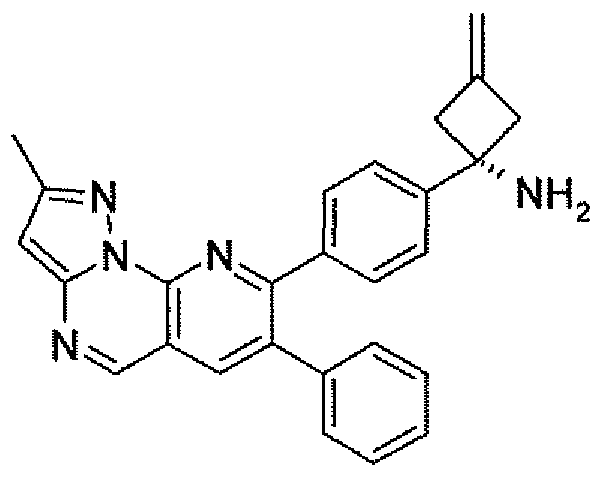
Compound [CXXXIII] was prepared using a procedure similar to that of Compound [XLIV]. Data for Compound [CXXXIII]: LCMS m/e 418 (M+H); 1H NMR (400 MHz, METHANOL- <k) δ ppm 2.58 (s} 3 H) 3.26 - 3.29 (m, 1 H) 3.31 - 3.34 (m, 1 H) 3.36 - 3.50 (m, 2 H) 5.09 (t, ./=2.34 Hz, 2 H) 6.76 (s, 1 H) 7.24 - 7.39 (m, 5 H) 7.45 (d, J==8.47 Hz, 1 H) 7.71 (d, J=%M Hz, 1 H) 8.55 (s, 1 H) 9.04 (s, 1 H).
l-(4-Bromo-phenyl)-cydobutanecarbottitriIe [CXXXIV]
1 ,3-dibromoρroρane KOH, water, toluene tetrabutyfammonium bromide 100 °C

 cxxxiv
KOH (11.4 g, 204 mmol, 8 eq), water (3.75 mL), 4-bromophenylacetonitrile (5.00 g, 25.5 mmol, LO eq), 1,3-dibromopropane (5.15 g, 25.5 mmol, 1.0 eq), tetrabutylammonium bromide (82 mg, 0.26 mmol, 0.01 eq), and toluene (68 mL) were slowly stirred while heating to 100 °C. The biphasic reaction was kept at 100 °C for 30 minutes. The heat was removed, the reaction was slightly cooled, the stirring was then increased to rapid, and then heating continued up to reflux, 115 °C. After 1.5 hours at 115 °C, the reaction was cooled, diluted with water, and extracted with EtOAc (x3). The combined organics were dried with brine and NaiSO^ and then concentrated in vacuo onto Celite. The resulting material was purified by silica gel chromatography by eluting with a gradient of heptane and EtOAc (0% to 35% EtOAc) to provide Compound [CXXXIV]: 1H NMR (400 MHz, CHLOROFORMS) δ ppm 1.99 - 2.15 (m,
JH 1.52, 9.02, 9.02, 4.40, 4.40 Hz, 1 H) 2.34 - 2.51 (m, 1 H) 2.51 - 2.65 (m, 2 H) 2.74 - 2.89 (m, 2 H) 7.21 - 7.36 (m, 2 H) 7.45 - 7.57 (ra, 2 H).
l-[4^4,4,5^-Tetrarøethyl-[M£]dioxabo [CXXXVJ

Compound [CXXXVJ was prepared in a similar way to that of Compound ΪXXXIXJ. Data for Compound [CXXXVJ: LCMS (m/e) 306 (M+Na); 1H NMR (400 MHz, CHLOROFORM-^ δ ppm 1.28 (s, 12 H) 1.93 - 2.09 (m, J=I 1.57, 9.05, 9.05, 4.47, 4.47 Hz, 1 H) 2.29 - 2.45 (m, 1 H) 2.50 - 2.62 (m, 2 H) 2.71 - 2.82 (m, 2 H) 7.35 (d, 7=8.30 Hz, 2 H) 7.77 (d,>=8.30 Hz, 2 H).
l-[4K2-Me*hyl-7-phenyM,4^,9b^^ cyclobutanecarbonitrUe [CXXXVI]

PcICI2(CIpPf)CH2Ct2 Cs2CO3, Dioxane H2O1 SO °C


CXXXVI
Compound [V] (20 mg, 0.07 mraol, 1.0 eq), Cs2CO3 (110 mg, 0.34 mmol, 5.00 eq), PdCl2(dppf)CH2Cl2 (8.0 mg, 0.01 mmol, 0.15 eq), and Compound [CXXXVJ (29 mg, 0.10 mmol, 1.5 eq) were dissolved in dioxane (1.5 mL, degassed) and water (0.5 mL, degassed). The reaction was again degassed and heated to 50 °C for 1 hour. After that time, additional water was added and extracted with CH2Cl2 (x3). The combined organics were dried with brine and Na2Sθ4, and then concentrated in vacuo. The residue was purified by silica gel chromatography by eluting with a gradient OfCHCl3 to [CHCl3ZMeOHTNH4OH 95:5:1]. The resulting solid was then dissolved in MeOH with added TFA (100 μL) and purified by reverse-phase
chromatography (Solvent A H2O/CH3CN/TFA (95:5:0.05), Solvent B CH3CN/H2O/TFA (95:5:0.05)) witiht a gradient of 5% to 60% B over 5 minutes to give Compound [CXXXVI] as the TFA salt: LCMS (m/e) 416 (M+H); 1H NMR (400 MHz9 METHANOL-^) δ ppm 2.02 - 2.15 (m, 1 H) 2.31 - 2.47 (m, 1 H) 2.56 (s, 3 H) 2.59 - 2.70 (m, 2 H) 2.70 - 2.82 (m, 2 H) 6.72.
l-(4-Broπto-phenyl)-cyclobutanecarboxylic acid amide [CXXXVII]
DMSO, H2O H2O2, MaOH

CXXXIV

Compound [CXXXIV] (2.90 & 12.3 mmol, 1.0 eq) was dissolved in DMF (30 mL). Next, NaOH (5.0 N aq, 3.28 mL), water (3.28 mL), H2O2 (30%, 6.56 mL), and DMSO (2.98 mL) were added and the reaction heated to 50 °C for 30 minutes. The mixture was cooled, water was added, and the layers separated. The aqueous phase was extracted with EtOAc (x3). The combined organic phases were washed with water (x2), dried with brine and Na2SO4, and concentrated. The residue was purified by silica gel chromatography by eluting with a gradient of heptane and EtOAc (0% to 100% EtOAc). Collected [CXXXVII]: 1H NMR (400 MHz, CHLOROFORM-^ δ ppm 1.78 - 1.96 (m, .M 1.18, 9.27, 9.27, 5.62, 5.62 Hz, 1 H) 2.07 - 2.22 (m, J≡=9.13, 9.13, 9.13, 9.13, 7.22 Hz, 1 H) 2.35 - 2.49 (m, 2 H) 2.82 (ddd, J=12.06, 9.18, 5.66 Hz, 2 H) 5.07 (br. s., 1 H) 5.31 (br. s., 1 H) 7.16 - 7.22 (m, 2 H) 7.45 - 7.52 (m, 2 H).
l-(4-Bromo-pheny))-cycJϋbutvIamine [CXXXVIII]
oγα
Y>
CH3CN, H2O


CXXXVII CXXXVIII
To a solution of Compound [CXXXVII] (2.80 g, 11.0 mmol, 1.0 eq.) in CH3CN (12 mL) and water (12 mL) was added [bis(trifluoroacetoxy)iodo]benzene (7.11 g, 16.5 mmol, 1.5 eq.) and the resulting mixture stirred at room temperature. After 24 hours, the reaction was slowly poured into saturated aqueous NaHCO3 and extracted with ethyl acetate (x3). The combined organic layers were dried with brine and Na2SO-J, concentrated, and the residue purified by silica gel chromatography by eluting with CHCl3 to CHCl3ZMeOHZNH4OH (90:10:1) to give Compound [CXXXV1H]: LCMS (m/e) 226 (M+H); 1H NMR (400 MHz,
CHLOROFORM-d) δ ppm 1.65 (br. s., 2 H) 1.68 - 1.80 (m, 1 H) 1.97 - 2.09 (m, 1 H) 2.10 - 2.20 (m, 2 H) 2.50 (ddd, ^=I l .93, 8.93, 6.08 Hz, 2 H) 7.26 - 7.33 (m, 2 H) 7.41 - 7.51 (ra, 2 H).
[l-(4-Bromo-phenyl)-cyclobutyl]-methyI-carbamic acid tert-butyl ester [CXXXIX]
1) NaH, CH3I DMF
2) NaH, BoC2O


CXXXVIlI CXXXIX
To as solution of Compound ICXXXVfflj (226 mg, 1.0 mmol, 1.0 eq) in DMF (10 mL, anhydrous) was added NaH (60% in oil, 40 mg, 1.0 mmol, 1.0 eq), and the mixture stirred at room temperature for 1 hour. CH3I (62 μh, 1.0 mmol, 1.0 eq) was added and the mixture stirred for an additional 7 hours at room temperature. After that time, the reaction was placed under vacuum to remove the unreacted CH3I. Next, NaH (60% in oil, 80 mg, 2.0 mmol, 2.0 eq) and Boc2O (327 mg, 1.5 mmol, 1.5 eq) were added and the reaction stirred at room temperature for 16 hours. After that time the reaction was quenched by the addition of MeOH, followed by water. The mixture was then extracted with EtOAc (x3). The combined organic layers were dried, concentrated, and the residue purified by silica gel chromatography by eluting with heptane and EtOAc (0% to 100% EtOAc) to give Compound [CXXXIX]: LCMS (m/e) 396 (M+Na). This material was used directly in the next step.
Meihyl-{l-(4-(4,4,5,5-tetrameth^ acid tert-butyl ester [CXL]

Compound [CXL] was prepared in a similar way to that of Compound [XXXIX]. Data for Compound [CXL] : LCMS (m/e) 410 (M+Na); 1H NMR (400 MHz, CHLOROFORM- d) δ ppm 1.33 (d,J=2.00 Hz, 12 H) 1.55 (s, 3 H) 1.69 - 1.92 (m, 1 H) 2.44 - 2.66 (m, 3 H) 2.76 (br. s., 1 H) 7.38 - 7.45 (m, 1 H) 7.45 - 7.55 (m, 1 H) 7.69 - 7.86 (m, 2 H).
Methyl-{l-[4-(2-methyl-7-phenyl-1,4,9,9b-tetraa2;a-cyclopeiita[α]iiaphthalen-8-yl)-phenyl]- cyclobαtylj-amine [CXLI]

I) PdCt2(CiPPf)CH2C)S, Cs2CO3, Dioxane H2O1 SO°C 2) CH2Cl2, TFA


CXU
Compound [CXL] (99 rag, 0.25 mmol) was reacted under similar conditions to that of Compound [XL]. After purification on silica gel the intermediate was dissolved in CH2Cl2 (1.0 mL) and reacted with TFA (0.5 mL) to remove the BOC protecting group. Then the final compound was blown down to dryness, redissolved in MeOH, and purified by reverse- phase chromatography (Solvent A H2O/CH3CN/TFA (95:5:0.05), Solvent B CH3CN/H2O/TFA (95:5:0.05)) with a gradient of 5% to 60% B over 5 minutes to give [CXLI) as the TFA salt: LCMS (m/e) 420 (M+H); 1H NMR (400 MHz, METHANOL-^) δ ppm 1.84 - L99 (m, 1 H) 2.11 - 2.25 (m, 1 H) 2.34 (s, 3 H) 2.59 (s, 3 H) 2.60 - 2.71 (m, 2 H) 2.71 - 2.86(m, 2 H) 6.78 (s, 1 H) 7.28 - 7.40 (m, 5 H) 7.49 (d, ./=8.54 Hz, 2 H) 7.74 (d, J=8.44 Hz, 2 H) 8.59 (s, 1 H) 9.06 (s, 1 H).
3-(4-Bromo-phenyl)-2:)2-dichIoro-cycIobutanone [CXLII]
Zn-Cu couple trichloroacetic chloride POCI3, ether reflux


CXLH
4-Bromosytrene (40.0 g, 219 mmol, 1.0 eq) was dissolved in anhydrous Et2O (320 mL). Then Zn-Cu couple (28.6 g, 437 mmol, 2.0 eq) was added to the ether solution. To the resulting mixture was slowly added a mixture of trichloroacetyl chloride (24 mL, 218 mmol, 1.0 eq), POCl3 (20 mL, 218 mmol, 1.0 eq), and ether (160 mL, anhydrous) over 30 minutes. The reaction was then heated to reflux for 16 hours. After that time the reaction was cooled, filtered through Celite, and quenched by slowly pouring into water. The water layer was removed and the remaining organic layer was washed with NaHCO3 (aq sat), dried with brine and Na2Sθ4, and then concentrated in vacuo. This material was used directly in the next step without rarther
purification. Data for Compound ICXLH]: 1H NMR (400 MHz, CHLOROFORM-^ δ ppm 3.49 - 3.60 (m, 1 H) 3.60 - 3.73 (m, 1 H) 4.18 (t, JH 0.30 Hz9 1 H) 7.18 (d, ./=8.59 Hz, 2 H) 7.56 (^8.40 Hz, 2 H).
3-(4-Bromo~phenyI)-cycIobutanone [CXLHI]
Zn, acetic acid reBux ^


CXUI CXUII
Compound [CXLII] (30.0 g, 102 mmol, 1.0 eq) was dissolved in glacial acetic acid (75 mL), then Zn (30.0 g, 450 mmol, 4.5 eq) was slowly added in small portions. The slurry was stirred at room temperature for 30 minutes then heated to 115 °C for 16 hours. After that time, the reaction was cooled, diluted with EtOAc, filtered through Celite, and concentrated. The resulting oil was purified by silica gel chromatography by eluting with heptane and EtOAc (0% to 25% EtOAc) to give Compound [CXLIO]: 1H NMR (400 MHz, CHLOROFORM-**) δ ppm 3.07 - 3.21 (m, 2 H) 3.37 - 3.50 (m, 2 H) 3.51 - 3.64 (m, 1 H) 7.08 - 7.13 (m, 2 H) 7.38 - 7.44 (m, 2 H).
S^Bromo-phenyl^l-cyclopropyl-cyclobutanol lCXLrV]

Compound [CXLEff] (50 mg, 0.22 mmol, 1.0 eq) was dissolved in anhydrous EtzO (2.5 mL) and cooled to -40 °C. Cyclopropyl magnesium bromide (666 μL of a 0.50 M solution in THF, 0.33 mmol, 1.5 eq) was then added and the reaction stirred at -20 °C for 4 hours. The reaction was quenched with NH4Cl (aq sat) and extracted with ether (x3). The combined organic layers were dried with brine and Na2SO4 and concentrated in vacuo. The resulting oil was purified by silica gel chromatography by eluting with heptane and EtOAc (0% to 40% EtOAc) to give Compound [CXLIVJ: 1H NMR (400 MHz, CHLOROFORM-^ δ ppm 0.39 - 0.48 (m, 2 H) 0.54 - 0.66 (m, 2 H) 1.16 - 1.35 (m, 1 H) 1.81 (s, 1 H) 2.08 - 2.20 (m, 2 H) 2.44 (ddd, J=9.58, 8.31, 2.81 Hz, 2 H) 2.93 (dq, „£=9.15, 8.97 Hz, 1 H) 7.12 (d, ^8.30 Hz, 2 H) 7.38 - 7.47 (m, 2 H).
l-CyciopropyI-3-[4-(4^5,5-te<ram [CXLV]
OH

 CXLV
CXLV
Compound [CXLV] was prepared in a similar way to that of Compound [XXXlX]. Data for Compound [CXLV): LCMS (m/e) 337 (M+Na); 1H NMR (400 MHz, CHLOROFORM-^) δ ppm 0.12 - 0.23 (m, 2 H) 0.27 - 0.37 (m, 2 H) 0.93 - 0.99 (m, 1 H) 1.03 - 1.13 (m, 12 H) 1.87 - 1.97 (m, 2 H) 2.11 - 2.24 (m, 2 H) 7.00 (d, 2 H) 7.49 (d, J=8.00 Hz, 2 H).
l^ycIopropyW-[4^2-methy^7~phen^^ pheuyll-cyclobutanol [CXLVI]

CXLVl
Compound [CXLVI] was prepared in a similar way to that of Compound [XL]. Data for Compound [CXLVI] (as me TFA salt): LCMS (m/e) 447 (M+H); 1H NMR (400 MHz, METHANOL-^) δ ppm 0.39 - 0.48 (m, 2 H) 0.52 (d, ^=8.20 Hz, 2 H) 1.12 - 1.25 (m, 1 H) 2.06 - 2.18 (m, 2 H) 2.43 (td, ^8.96, 2.68 Hz, 2 H) 2.58 (s, 3 H) 3.00 (quin, J-9.03 Hz, 1 H) 6.73 (s, 1 H) 7.18 (d, Js=8.20 Hz, 2 H) 7.25 - 7.31 (m, 2 H) 7.34 (d, J=2.83 Hz, 3 H) 7.51 (d, ./=8.25 Hz, 2 H) 8.47 (s, 1 H) 9.00 (s, 1 H).
Trans-2-[l-(4-BromorphenyI)-3-hydrø and Cis-2-[l-(4-Bromo-phenyl)-3-hydroxy-3-vinyI-cyclobutyl]-isoindoϊe-lr3-dione [CXLVπi]

 CXLVlII
Compound [XXXVII] (250 mg, 0.68 mmol, 1.0 eq) was dissolved in CH2Cl2 (7.0 mL, anhydrous) and cooled to -40 °C. Then vinyknagnesium bromide (1.0 mL of a 1.0 M in THF, 1.0 mmol, 1.5 eq) was added, the reaction was warmed to -20 "C, and held for 1.5 hours. The reaction was quenched with the addition of aqueous saturated NH4CI solution. The mixture was diluted with HiO, then extracted with EtOAc (x3). The combined organic layers were dried with brine and Na2SO4 and concentrated in vacuo. The residue was purified by silica gel chromatography by eluting with heptane and EtOAc (0% to 50% EtOAc) to give Compound [CXLVU] and Compound [CXLVIII]. Data for Compound [CXLVUj: 1H NMR (400 MHz, CHLOROFORM-^) δ ppm
3.10 - 3.21 (m, 2 H) 3.39 - 3.49 (m, 2 H) 5.07 (dd, J=10.64, 0.83 Hz, 1 H) 5.25 (dd, J=I 7.23, 0.88 Hz, 1 H) 6.05 (dd, JH7.23, 10.59 Hz, 1 H) 7.46 (t, J≡4.64 Hz, 2 H) 7.54 - 7.61 (m, 2 H) 7.62 - 7.70 (m, 2 H) 7.70 - 7.79 (m, 2 H).
Data for Compound [CXLVUIj 1H NMR (400 MHz, CHLOROFORM-*/) δ ppm 3.20 - 3.31 (m, 2 H) 3.39 - 3.49 (m, 2 H) 4.94 (dd, .M 0.69, 0.63 Hz, 1 H) 5.10 (dd, JH 7.25, 0.66 Hz, 1 H) 5.77 (dd, J=17.25, 10.66 Hz, 1 H) 7.40 - 7.47 (m, 2 H) 7.53 - 7.59 (m, 2 H) 7.61 - 7.69 (m, 2 H) 7.70 - 7.77 (m, 2 H).
Trans-^{3~Hydroxy-1-[4-(4,4£,5-te^ cyclobutyl}-isoiπdole-1,3-dione [CXLIX]

Compound [CXLIX] was prepared in a similar way to that of Compound [XXXIX]. This material was used directly in the next step without futher purification or characterization.
Trans-2-{34Iydroτy-1-[4-(2Hnt^ yl)-pheΩγl)-3-vinyl-cyclobutyl}4windote-lβ-dione lCL)

CL
Compound [CL] was prepared in a similar way to that of Compound [XL]. Data for Compound [CLJ : LCMS (m/e) 578 (M+H).
Trans-3-Ai»iiio-1-ethyI-3-[4-(2-methyl-7-phenyl-lΛ^b-tetraa-5a-- cycIopenta[α]naphthaIen-8-yI>-phenyl]-cycIobutanoI [CLI]
NH2NH2 H2O dioxane, MeOH 7O °C


CL CLI
To Compound [CL] (28 mg, 0.05 mmol, 1.0 eq) was added MeOH (500 μL), dioxane (500 μL), and hydrazine monohydrate (250 μL). The reaction was heated to 70 °C for 2 hours. After that time the reaction was blown to dryness with N2 and the resulting solid was dissolved in MeOH. Following addition of TFA (100 μL), the material was purified by reverse- phase chromatography (Solvent A: H2O/CH3CN/TFA (95:5:0.05), Solvent B: CH3CN/H2O/TFA (95:5:0.05)) with a gradient of 5% to 60% B over 5 minutes to give Compound [CLI] as the TFA salt: LCMS (m/e) 450 (M+H); 1H NMR (400 MHz, METHANOL-^) δ ppm 0.95 (t, ./=7.37 Hz, 3 H) 1.76 (q, ./=7.32 Hz, 2 H) 2.59 (s, 3 H) 2.62 -
2.73 (m, 2 H) 2.75 - 2.89 (m, 2 H) 6.77 (s, 1 H) 7.35 (t, ./=3.10 Hz, 5 H) 7.54 (d, ./=8.40 Hz, 2 H)
7.74 (d, J^=8.40 Hz, 2 H) 8.56 (s, 1 H) 9.05 (s, 1 H).
Cis-2-{3-HydiO^-1-[4-(4,4£,5^ cyclobutyl}-isoindole-lβ-dione [CLII]

Compound [CLII] was prepared in a similar way to that of Compound [XXXIX]. This material was used directly in the next step without futher purification or characterization.
Cis-2-{3-Hydroiy-1-[4K2-mel^ phenyl]~3-vinyl-cyclobutyl}-isoiϊidole-lβ-dioiie [CLm]

CLIIE
Compound [CLIII] was prepared in a similar way to that of Compound [XL]. Data for Compound [CLIII]: LCMS (m/e) 578 (M+H).
Cis-3-Amino-1-ethyl-3-[4-(2-methyl-7-phenyH,4,9,9b~tetraaza-cycIopenta[α]naphthaIen-8- yl)-phenyl]-cyciobutanol [CLIV]
NH2NH2 H2O dioxane, MeOH 7O °C


CUII CLIV
To Compound [CLIIIJ (31 mg, 0.05 mmol, 1.0 eq) was added MeOH (500 μL), dioxane (500 μL), and hydrazine monohydrate (250 μL). The reaction was heated to 70 °C for 2 hours. After that time the reaction was blown to dryness with N2, the resulting solid was dissolved in MeOH. Then added TFA (100 μL), and purified by reverse-phase chromatography (Solvent A H2O/CH3CN/TFA (95:5:0.05), Solvent B CH3CN/H2O/TFA (95:5:0.05)) with a gradient of 5% to 60% B over 5 minutes to give Compound [CLIVJ as the TFA salt: LCMS (m/e) 450 (M+H); 1H NMR (400 MHz, METHANOL-^) δ ppm 0.85 (t, J=7.37 Hz, 3 H) 1.44 (q, >=7.32 Hz, 2 H) 2.51 - 2.64 (m, 5 H) 2.84 (d, JH3.52 Hz, 2 H) 6.77 (s, 1 H) 7.27 - 7.39 (m, 5 H) 7.45 (d, J*=8.49 Hz, 2 H) 7.71 (d, J=8.49 Hz, 2 H) 8.57 (s, 1 H) 9.05 (s, 1 H).
Ti^$-2»[H4-Brømo-phenyI)-3-(1,2-d^ dione [CLV]
OsO4, NMO
Acetone


CXLVII CLV
Compound [CXLVII] (50 mg, 0.13 mmol, 1.0 eq.) was dissolved in acetone (2.0 mL). To that solution was added a solution of 4-methyhnorphoIine JV-oxide (29 mg, 0.25 mmol, 2.0 eq) in water (30 μL). Then added OsO4 (4% in water, 80 μL, 0.013 mmol, 0.1 eq) and stirred 1 hour at room temperature. The reaction was quenched with Na2S2θs (aq) and extracted with CH2CI2 (x3). The combined organic layers were dried with brine and Na2SO4, concentrated, and the residue purified by silica gel chromatography by eluting with CHCk/MeOH/NRjOH (95:5:1) to CHCl3ZMeOHTNH4OH (90:10:1) to give Compound [CLV]: LCMS (m/e) 455 (M+Na); 1H NMR (400 MHz, CHLOROFORM-c?) δ ppm 2.42 (br. s., 3 H) 3.02 - 3.15 (m, 2 H) 3.25 - 3.45 (m, 2 H) 3.60 (t, J=AM Hz, 1 H) 3.77 (d, J=4.34 Hz, 2 H) 7.45 (d, ^8.59 Hz, 2 H) 7.56 (d, /=8.59 Hz, 2 H) 7.62 - 7.70 (m, 2 H) 7.70 - 7.79 (m, 2 H).
Trans-2-{3-(1^2-Dihydrox>-ethyI)-3-hydroϊ5-1-14-(4,4,5,5-tetraniethyI-|13r2]dioxaboroIan- 2-yl)-phenyll-cycIobutyl}-isoindole-1,3-tIione |CLVI|

Compound [CLVI] was prepared in a similar way to that of Compound [XXXIX]. This material was used directly in the next step without futher purification or characterization.
Trans-2-{3-(l£-IHhydjro3rp*tW cyclopenta[α]naphthalen-8-yI)-phenyl]-cyclobutyI}-isoiiidole-l^-dioiie [CLVII]
OH

CLVIt
Compound ICL VH] was prepared in a similar way to that of Compound [XL]. Data for Compound [CLVII]: LCMS (m/e) 612 (M+H).
Trans-1-{3-Amino-1-hydroxy-3-[4-(2-methyI-7-phenyl-1,4,9,9b-tetraa2a- cyclopenta[«]naphthalen-8-yl)-phenyl]-cyciobutyI}-ethane-1,2-diol [CLVni]
HO OH
NH2NH2H2O dioxane, MeOH
70 °C


CLViI CLVIII
To Compound [CLVII] (16 mg, 0.03 mmol, 1.0 eq) was added MeOH (500 μL), dioxane (500 μL), and hydrazine monohydrate (250 //L). The reaction was heated to 70 °C for 2 hours. After that time the reaction was blown to dryness with N2, the resulting solid was dissolved in MeOH. Then TFA (100 μL) was added, and the material purified by reverse-phase chromatography (Solvent A H2OZCH3CNZTFA (95:5:0.05), Solvent B CH3CNZH2OZTFA (95:5:0.05)) with a gradient of 5% to 60% B over 5 minutes to give [CLVϋl] as the TFA salt: LCMS (m/e) 482 (M+H); 1H NMR (400 MHz, METHANOL-^) δ ppm 2.59 (s, 3 H) 2.69 - 2.86 (m, 2 H) 3.02 - 3.16 (m, 2 H) 3.56 - 3.72 (m, 2 H) 3.83 (dd, /=10.81, 3.10 Hz, 1 H) 6.77 (s, 1 H) 7.29 - 7.40 (m, 5 H) 7.43 (d, /=8.44 Hz, 2 H) 7.72 (d, /=8.44 Hz, 2 H) 8.57 (s, 1 H) 9.06 (s, 1 H).
Trans-3-Amino-3-l4-(2-metfhyl-7~ph^ phenylj-1-vinyl-cyclobutanol [CLIX]
CH3NHNH2 dioxane, WIeOH 70 °C


CLV)I CUX
To compound [CLVII] (50 mg, 0.09 mmol, 1.0 eq) was added MeOH (1.0 mL)} dioxane (1.0 mL), and methylhydrazine (500 μL). The reaction was heated to 70 °C for 6 hours. After that time the reaction was blown to dryness with N2. The residue was purified by silica gel chromatography by eluting with CHCl3 to CHCl3ZMeOHZNH4OH (90: 10: 1). Further purification was effected by dissolving the material in MeOH, then adding TFA (100 μL), and subjecting to reverse-phase chromatography (Solvent A H2OZCH3CNZTFA (95:5:0.05), Solvent B CH3CNZH2OZTFA (95:5:0.05)) with a gradient of 5% to 60% B over 5 minutes to give [CLEX] as the TFA salt: LCMS (mZe) 448 (M+H); 1H NMR (400 MHz, METHANOL-^) δ ppm 2.59 (s, 3 H) 2.79 - 2.99 (m, 4 H) 5.18 (dd, /=10.62, 1.15 Hz, 1 H) 5.34 (dd, J=I 7.18, 1.12 Hz, 1 H) 6.17 (dd, /=17.20, 10.62 Hz, 1 H) 6.78 (s, 1 H) 7.35 (d, J=1.90 Hz, 5 H) 7.56 (d, J=8.49 Hz, 2 H) 7.75 (d, /=8.49 Hz, 2 H) 8.57 (s, 1 H) 9.06 (s, 1 H).
Scheme YIII - Synthesis of 4-piperidiue carboxamides

Cs2CO8 O NaBH1(O^Ac)1
Pd(dppf)CH2CI2 Dioxane Dtoxana/H2O 5% AcOH


UOH THF/H2O


CLXi
H.N. CLX
HOBt, EDC
DIEA
DMFZCH2Cl2

CLXIi
4-(2-Methyl-7-pheny!-1,4,9,9b-tetraaza-cyclopentaIfl]naphthalen-8-yl)-benzaldehyde P^C] (CHCb extraction procedure):

Cs2CO3
Pd(dppt)CH2CI2
^N^I^CI Dfoxane/H2O

Compound \V\ (1.00 g, 3.39 mmol. LO eq), Cs2CO3 (5.53 g, 17.0 mmol, 5.0 eq), Pd(UpPf)CH2Cl2 (208 mg, 0.250 mmol, 0.075 eq), and 4-foπnylphenylboronic acid (763 rng, 5.09 mmol, 1.5 eq) were dissolved in dioxane (17.0 mL, degassed) and H2O (4.25 mL, degassed). Tne reaction was again degassed and then warmed to 50 °C for 45 minutes. Next the the reaction was cooled, water was added, and the mixture extracted with CHCl3 (x3). The combined organic
phases were dried with brine and NazSO-i, and then concentrated in vacuo. The residue was purified by silica gel chromatography by eluting with a gradient of heptane and EtOAc (30% to 100% EtOAc) to provide Compound [SC]: LCMS (m/e) 365 (M+H); 1H NMR (400 MHz, CHLOROFORM-d) δ ppm 2.64 (s, 3 H) 6.76 (s, 1 H) 7.19 - 7.26 (m, 2 H) 7.31 - 7.39 (m, 3 H) 7.66 - 7.75 (m, 2 H) 7.75 - 7.85 (m, 2 H) 8.31 (s, 1 H) 8.90 (s, 1 H) 10.03 (s, 1 H).
l~[4-(2-Methyϊ-7-phenyI-lA9,^^ pιperidine-4-carboxylic acid ethyl ester [CLX]

NaBH(OAc)3 Dioxane 5% AcOH

 CLX
CLX
Compound [XC] (1.28 g, 3.51 ramol, 1.0 eq) was dissolved in dioxane (38 mL, anhydrous). Ethyl isonipecotate (1.66 g, 10.5 ramol, 3.0 eq), glacial acetic acid (1.90 mL), and NaBH(OAc)3 (2.98 g, 14.1 mmol, 4.0 eq) were added and the reaction stirred at room temperature for 24 hours. The crude reaction was neutralized with NaHCθ3 (aq-) and extracted with CHCl3 (x3). The combined organics were dried with brine and NaaSO,*, and then concentrated in vacuo. The residue was purified by silica gel chromatography by eluting with a gradient of heptane and EtOAc (20% to 100% EtOAc) to afford Compound [CLXl: LCMS (m/e) 506 (M+H); 1H NMR (400 MHz, CHLOROFORM-rf) δ ppm 1.24 (t, ^=7.13 Hz, 3 H) 1.78 (t, J=l0.59 Hz, 2 H) 1.83 - 1.96 (m, 2 H) 2.07 (s, 2 H) 2.27 (t, JH0.98 Hz, 1 H) 2.62 (s, 3 H) 2.76 - 2.89 (m, 2 H) 3.52 (s, 2 H) 4.12 (q, J=7.13 Hz, 2 H) 6.71 (s, 1 H) 7.16 - 7.24 (m} 4 H) 7.28 - 7.37 (m, 3 H) 7.48 (d, J=S.15 Hz, 2 H) 8.23 (s, 1 H) 8.86 (s, 1 H).
l-[4-(2-Methyl-7-phenyl-1,4,9,9b-tetraaza-cyclopenta[α]naphthaϊen-8-yl)-bertzyl]- piperidine-4-carboxylic acid [CLXI]
LrOH THF/HjO


CLX
CLXI
Compound [CLXJ (1.78 g, 3.52 mmol, 1.0 eq) was dissolved in THF (35 roL) and then added H2O (35 mL) and IiOH (178 mg, 10% w/w). The reaction was stirred at room temperature for 20 hours. After that time, the THF was removed in vacuo, and the remaining solvent was diluted with additional water and the pH adjusted to 7 with dilute HCl (5% aq). The mixture was extracted with CHCfe/MeOH (4:1, x 5). The combined organic phases were dried with brine and Na2SOi*, and then concentrated onto Celite in vacuo. The material was purified by silica gel chromatography by eluting with a gradient of CHCl3 to CHCls/MeOH (1 : 1) to give Compound [CLXI] (date of ώe TFA salt): LCMS (m/e) 478 (M+H); 1H NMR (400 MHz, METHANOL-^) δ ppm 1.76 - 2.09 (m, 2 H) 2.18 - 2.40 (m, 2 H) 2.59 (s, 3 H) 2.61 - 2.75 (m, 1 H) 2.98 - 3.24 (m, 2 H) 3.34 -3.60 (m, 2 H) 4.30 - 4.38 (m, 2 H) 6.77 (s, 1 H) 7.27 - 7.33 (m, 2 H) 7.33 - 7.38 (m, 3 H) 7.46 (d,/=8.25 Hz, 2 H) 7.71 (d, ^=8.00 Hz, 2 H) 8.58 (s,l H) 9.06 (s, 1 H).
l-[4-(2-MethyI-7-phenyl-1,4,9,9b-tetraaza-cyclopentaϊβ]naphthalen-8-yI)-benzyl]- piperidme-4-carbθxylic acid pbenylamide [CLXII]
H2N.
HOBt1 EDC
DlEA
DMF/CH-,CI-


CLXI CLXIl
Compound {CLXI] (20 mg, 0.042 mmol, 1.0 eq), HOBt (11 mg, 0.084 mmol, 2.0 eq), EDC (HCl salt, 12 mg, 0.063 mmol, 1.5 eq) and diisopropylethylamine (22 μL, 0.13 ramol, 3.0 eq) were dissolved in DMF (400 //L, anhydrous) and CH2Cl2 (400 μL, anhydrous). To this solution was added aniline (19 mg, 0.21 mmol, 5.0 eq) and the reaction stirred at room temperature for 16 hours. After that time water was added and the mixture extracted with CHCl3 (x3). The combined organic phases were dried with brine and Na2SO4, and then concentrated in vacuo. The resulting impure intermediate was purified by silica gel chromatography by eluting with a gradient OfCHCl3 to [CHCl3ZMeOHTNH4OH 90:10:1], The resulting solid was then dissolved in MeOH, added TFA (100 μL), and purified by reverse-phase chromatography (Solvent A H2O/CH3CN/TFA (95:5:0.05), Solvent B CH3CN/H2O/TFA (95:5:0.05)) with a gradient of 5% to 60% B over 5 minutes to give Compound [CLXIIj as the TFA salt: LCMS (m/e) 553 (M+H); 1H NMR (400 MHz, METHANOL-^) δ ppm 1.94 - 2.10 (m, 2 H) 2.11 - 2.22 (m, 2 H) 2.59 (s, 3 H) 2.63 - 2.77 (m, 1 H) 3.02 - 3.16 (m, 2 H) 3.51 -3.64 (m, 2 H) 4.31 - 4.45 (m, 2 H) 6.77 (s, 1 H) 7.10 (t, J=7.42 Hz, 1 H) 7.25 - 7.40 (m, 7 H) 7.48 (d, J=8.25 Hz, 2 H) 7.54 (d, >=8.00 Hz, 2 H) 7.72(d, J=8.10 Hz, 2 H) 8.58 (s, 1 H) 9.06 (s, 1 H).
l-^^-Methyl-T-phenyl-l^^^b-tetraaza-cycIopentalαjnaphthalen-S-yl^benzy!]- piperidine-4-carbosylic acid allylamide [CLXHI]

CLXiIl
Compound [CLXIII] was prepared in a similar way to that of Compound [CLXTTj. Data for Compound [CLXffl] (as the TFA salt): LCMS (m/e) 517 (M+H); 1H NMR. (400 MHz, METHANOL-^) δ ppm 1.95 (t, /=13.67 Hz, 2 H) 2.01 - 2.13 (m, 2 H) 2.54 (td, J=I 1.97, 3.49 Hz, 1 H) 2.59 (s, 3 H) 3.04 (d, J-1.90 Hz9 2 H) 3.53 (d, J=12.06 Hz, 2 H) 3.80 (d, J=5.42 Hz, 2 H) 4.26 - 4.44 (m, 2 H) 5.11 (dd, J=10.27, 1.29 Hz9 1 H) 5.17 (dd, J=17.18} 1.42 Hz, 1 H) 5.83 (dt, J=17.07, 5.23 Hz, 1 H) 6.78 (s, 1 H) 7.35 (t, J=7.17 Hz, 5 H) 7.46 (d, J=8.20 Hz, 2 H) 7.71 (d, J=8.20 Hz, 2 H) 8.59 (s, 1 H) 9.06 (s, 1 H).
l-[4-(2-Methyl-7-phenyl-1,4,9,9b-tetraaza-cyclopenta[«]naphthaIen-8-yl)-benzyII- piperidine-4-carboxyIic acid (2-dimethylamino-ethyl)-amide [CLXTV]

Compound [CLXTV] was prepared in a similar way to that of Compound
[CLXH]. Data for Compound [CLXTV] (as the TFA salt): LCMS (m/e) 548 (M+H); 1H NMR (400 MHz, METHANOL-^) δ ppm 1.84 - 2.02 (m, 2 H) 2.05 - 2.16 (m, 2 H) 2.49 - 2.57 (m, 1 H) 2.59 (s, 3 H) 2.93 (s, 6 H) 3.05 (t, J=I 3.01 Hz, 2 H) 3.27 (t, J=5.95 Hz, 2 H) 3.46 - 3.61 (m, 4 H) 4.29 - 4.41 (m, 2 H) 6.78 (s, 1 H) 7.28 - 7.39 (m, 5 H) 7.46 (d, J=8.20 Hz, 2 H) 7.71 (d, J=8.25 Hz, 2 H) 8.59 (s, 1 H) 9.06 (s, 1 H).
l-[4-(2-Methyl-7-phenyH,4,9,9b-tetraaza-cyclopenta[α]naphthaIen-8-yI)-benzyl]- piperidine-4-carboxylic acid (2~methosy-ethyl)-amide [CLXV]

CLXV
Compound (CLXVJ was prepared in a similar way to that of Compound [CLXII]. Data for Compound [CLXV] (as Hie TFA salt): LCMS (m/e) 535 (M+H); 1H NMR (400 MHz, METHANOL-^) δ ppm 1.83 - 1.99 (m, 2 H) 2.00 - 2.11 (m, 2 H) 2.52 (dd, J=UM, 6.32 Hz, 1 H) 2.59 (s, 3 H) 3.03 (td, J=13.00, 2.61 Hz, 2 H) 3.36 (d,J=5.27 Hz, 5 H) 3.45 (t, J-5.34 Hz, 2 H) 3.53 (d,.M2.01 Hz, 2 H) 4.33 (s, 2 H) 6.78 (s, 1 H) 7.28 - 7.39 (m, 5 H) 7.46 (d, J=8.05 Hz, 2 H) 7.71 (d, J=8.20 Hz, 2 H) 8.58 (s, 1 H) 9.06 (s, 1 H).
l-[4-(2~Methy!-7-phenyl-1,4,9,9b-tetraa2a-cycIopenta[fl]naphthalen-8-yl)-benzyl]- piperidine-4-carboxyϊic acid (2-iniidazol-l~yl-ethyl)-amide [CLXVI]

Compound [CLXVI] was prepared in a similar way to that of Compound [CLXπj. Data for Compound [CLXVI] (as the TFA salt): LCMS (m/e) 585 (M+H); 1H NMR (400 MHz, METHANOL-^) δ ppm 1.84 - 2.02 (m, 2 H) 2.01 - 2.17 (m, 4 H) 2.53 (t, J=12.13 Hz, 1 H) 2.59 (s, 3 H) 3.05 (t, J=12.08 Hz, 2 H) 3.23 (t, J=66\ Hz, 2 H) 3.54 (d, JH2.89 Hz, 2 H) 4.28 (t, J=6.96 Hz, 2 H) 4.31 - 4.43 (m, 2 H) 6.78 (s, 1 H) 7.28 - 7.39 (m, 5 H) 7.47 (d, J=8.25 Hz, 2 H) 7.59 (t, J=I.68 Hz, 1 H) 7.69 (t, J=I.66 Hz, 1 H) 7.71 (d, J=8.30 Hz, 2 H) 8.59 (s, 1 H) 8.97 (s, 1 H) 9.07 (s, 1 H).
l-[4-(2-Methyl-7-phenyl-1,4,9,9b-tetraaza-cyclopenta[α]naphthalen-8-yϊ)-benzyI]- piperidine-4-earboxylic add 3,4-diinethoxy-benzyIaniϊde [CLXVII]

's.
Compound [CLXVII] was prepared in a similar way to that of Compound [CLXπj. Data for Compound [CLXVII] (as the TFA salt): LCMS (m/e) 627 (M+H); 1H NMR (400 MHz, METHANOL-^) δ ppm 1.86 - 2.02 (m, 2 H) 2.02 - 2.14 (m, 2 H) 2.48 - 2.58 (ra, 1 H) 2.59 (s, 3 H) 2.96 - 3.10 (m, 2 H) 3.53 (d, J=12.74 Hz, 2 H) 3.80 (s, 3 H) 3.81 (s, 3 H) 4.25 - 4.42 (m, 4 H) 6.78 (s, 1 H) 6.80 - 6.94 (m, 3 H) 7.35 (t, ^=7.03 Hz, 5 H) 7.46 (d, ^=8.20 Uz, 2 H) 7.71 (d, J=8.15 Hz, 2 H) 8.59 (s, 1 H) 9.06 (s, 1 H).
l-[4-(2-MethyI-7-phenyl-1,4,9,9b-tetraaza-cyclopenta[e3naphthaIen-8~yl)~benzyl]- piperidine~4-carboxy!ic acid [2-(l>methyl-pyrroIidin-2-yl)-ethyl]-aiiιide [CLXVIII]

Compound [CLXVIIIΪ was prepared in a similar way to that of Compound
[CLXIIJ. Data for Compound [CLXVUI] (as the TFA salt): LCMS (m/e) 588 (M+H); 1H NMR (400 MHz, METHANOL-^) δ ppm 1.67 - 1.85 (m, 2 H) 1.85 - 2.02 (m, 2 H) 2.02 - 2.11 (m, 3 H) 2.11 - 2.22 (m, 2 H) 2.35 - 2.47 (m, 1 H) 2.47 - 2.57 (m, 1 H) 2.59 (s, 3 H) 2.92 (s, 3 H) 2.98 - 3.10 (m, 2 H) 3.10 - 3.21 (m, 1 H) 3.54 (d, ^13.47 Hz, 2 H) 3.61 - 3.74 (m, 1 H) 4.29 - 4.43 (m, 2 H) 6.78 (s, 1 H) 7.27 - 7.40 (m, 5 H) 7.46 (d, Jϊ=8.20 Hz, 2 H) 7.71 (d, J=8.30 Hz, 2 H) 8.59 (s, 1 H) 9.07 (s, 1 H).
{l-ϊ4-(2-Methyl-7-phenyI-1,4,9,9b-tetraaza-cyclopenta[α]naphthalen-8-yl)-benzyl]- piperidin-4-yI}-morpholin-4-yl-methanone [CLXIXJ

CLXIX
Compound [CLXIX] was prepared in a similar way to that of Compound [CLXII]. Data for Compound [CLXIX] (as the TFA salt): LCMS (m/e) 546 (M+H); 1H NMR (400 MHz, METHANOL-^) δ ppm 1.85 - 2.12 (m, 4 H) 2.59 (s, 3 H) 2.92 - 3.22 (m, 3 H) 3.47 3.74 (m, 10 H) 4.29 - 4.43 (m, 2 H) 6.78 (s, 1 H) 7.28 - 7.39 (m, 5 H) 7.46 (d, ^=8.20 Hz, 2 H) 7.72 (d, .^=8.15 Hz, 2 H) 8.59 (s, 1 H) 9.06 (s, 1 H).
l-[4-(2-MethyI-7-phenyl-1,4,9,9b-tetraa2a-cyclopenta[α]naphthaϊen-8-yl)-benzyl]- piperidine-4-carboxylic acid (1H-benzoimidazol-2-ylmethyI)-amide [CLXX]

Compound [CLXX] was prepared in a similar way to that of Compound [CLXII]. Data for Compound [CLXX] (as the TFA salt): LCMS (m/e) 607 (M+H); 1H NMR (400 MHz, METHANOL-^) δ ppm 1.83 - 2.06 (m, 2 H) 2.11 - 2.25 (m, 2 H) 2.59 (s, 3 H) 2.64 - 2.78 (m, 1 H) 3.00 - 3.18 (m, 2 H) 3.55 (d, JH3.03 Hz, 2 H) 4.34 (s, 2 H) 4.84 (s, 2 H) 6.78 (s, 1 H) 7.23 - 7.39 (m, 5 H) 7.40 - 7.50 (m, 2 H) 7.50 - 7.63 (m, 2 H) 7.64 - 7.81 (m, 4 H) 8.59 (s, 1 H) 9.07 (s, I H).
l-[4-(2-Methyl-7-phenyl-1,4,9,9b-tetraaza-cyclopenta[α]naphthalen-8-yl)-benzyl]- piperidine-Φrcarbosylic acid [2-(3H-imidazoI-4-y])-ethyl]-amide [CLXXI]

{l-[4-(2-Methyl-7-phenyl-1,4,9,9b-tetraaza-cydopenta[α]naphthalen-8-yl)-beiizyl]- piperidia-4-yI}-(4-pyiimidm-2-ylφipeπttin-1-yI)-methanone [CLXXIΪ]

Compound [CLXXIIJ was prepared in a similar way to that of Compound [CLXH]. Data for Compound [CLXXH] (as the TFA salt): LCMS (m/e) 624 (M+H); 1H NMR (400 MHz, METHANOL-^) θ ppm 1.86 - 2.10 (m, 4 H) 2.59 (s, 3 H) 2.99 - 3.18 (m, 3 H) 3.49 - 3.62 (m, 2 H) 3.62 - 3.76 (m, 4 H) 3.78 - 3.86 (m, 2 H) 3.85 - 3.94 (m, 2 H) 4.29 - 4.44 (m, 2 H) 6.66 (t, J=4.81 Hz, 1 H) 6.78 (s, 1 H) 7.27 - 7.41 (m, 5 H) 7.47 (d} J=8.20 Hz, 2 H) 7.72 (d, ,/=8.15 Hz, 2 H) 8.37 (d, J=4.83 Hz, 2 H) 8.59 (s, 1 H) 9.07 (s, 1 H).
{l-[4-(2-Methyl-7^henyM,4,9,9b^^ piperidin-4-yI}-[4-(5-trifluoromethyl-pyridin-2-yI)-piperaz-n-1-yI]-methanone [CLXXIII]

Compound [CLXXHI] was prepared in a similar way to that of Compound
[CLXII]. Data for Compound [CLXXIII] (as the TFA salt): LCMS (m/e) 691 (M+H); 1H NMR (400 MHz, METHANOL-^) δ ppm 1.86 - 2.12 (m, 4 H) 2.59 (s, 3 H) 3.00 - 3.18 (m, 3 H) 3.50 -
3.61 (m, 2 H) 3.62 - 3.84 (m, 8 H) 4.30 - 4.43 (m, 2 H) 6.78 (s, 1 H) 6.92 (d, J=9.13 Hz, 1 H) 7.28 - 7.40 (m, 5 H) 7.47 (d, ./=8.25 Hz, 2 H) 7.72 (d,>=8.10 Hz, 2 H) 7.77 (dd, 7=9.13, 2.49 Hz9 1 H) 8.37 (d, ^=1.66 Hz, 1 H) 8.59 (s, 1 H) 9.07 (s, 1 H).
{l-[4-(2-Methyl-7-phenyI-1,4,9^b-tctraa2a-cyclopenta{α]naphthalett-8-yl)-beiizyI]- piperidm-4-yl}-(4-pyridm-2-yl-pipera«in-l~yl)-methanone [CLXXTV]

Compound [CX-XXTV] was prepared in a similar way to that of Compound [CLXIIJ.
Data for Compound [CLXXIV] (as the TFA salt): LCMS (m/e) 623 (M+H); 1H NMR (400 MHz, METHANOL-^) δ ppm 1.88 - 2.13 (ms 4 H) 2.59 (s, 3 H) 3.01 - 3.20 (m, 3 H) 3.49 - 3.61 (m, 2 H) 3.70 - 3.99 (m, 8 H) 4.30 - 4.44 (m, 2 H) 6.78 (s, 1 H) 7.03 (t, ^=6.69 Hz, 1 H) 7.26 - 7.40 (m, 6 H) 7.48 (d, J=8.25 Hz, 2 H) 7.72 (d,^8.20 Hz, 2 H) 8.01 (d<L./=6.27, 1.15 Hz, 1 H) 8.05 (ddd, ^=9.15, 7.17, 1.78 Hz, 1 H) 8.59 (s, 1 H) 9.07 (s, 1 H).
l-[4-(2-Methyl-7-phenyl-i,4,9,9b-tetraaza~cydopeiita[fl]naphthalen-8-yl)-beiizyl]- piperidine-4-carboxyIic acid (2-pyridin-3-yl-ethyI)-amide [CLXXV]

Compound [CLXXV] was prepared in a similar way to that of Compound [CLXII]. Data for Compound [CLXXV] (as the TFA salt): LCMS (m/e) 582 (M+H); 1H NMR (400 MHz, METHANOL^) δ ppm 1.76 - 1.91 (m, 2 H) 1.92 - 2.05 (m, 2 H) 2.39 - 2.52 (m, 1 H) 2.59 (s, 3 H) 2.92 - 3.09 (m, 4 H) 3.43 - 3.60 (m, 4 H) 4.24 - 4.41 (m, 2 H) 6.78 (s, 1 H) 7.27 ■ 7.40 (m, 5 H) 7.45 (d, /=8.25 Hz9 2 H) 7.71 (d, J^=8.15 Hz, 2 H) 7.95 (dd, .£=7.96, 5.76 Hz, 1 H) 8.43 (dt, ^=8.05, 1.46 Hz, 1 H) 8.59 (s, 1 H) 8.65 - 8.83 (m, 2 H) 9.07 (s, 1 H).
l-^^-Methyl-T-phenyl-l^^^b-tetraaza-cyclopentalαlnaphthaleii-S-yli-benzyl]- piperidme-4-carboxyIic acid (pyridin-2-yImethyϊ)-amide [CLXXVI]

Compound [CLXXVIJ was prepared in a similar way to that of Compound ICLXπj. Data for Compound [CLXXVI] (as the TFA salt): LCMS (m/e) 568 (M+H); 1H NMR (400 MHz, METHANOL-^) δ ppm 1.84 - 2.02 (m, 2 H) 2.09 - 2.20 (m, 2 H) 2.59 (s, 3 H) 2.60 - 2.73 (m, 1 H) 3.00 - 3.13 (ra, 2 H) 3.48 - 3.62 (m, 2 H) 4.34 (s, 2 H) 4.63 (s, 2 H) 6.78 (s, 1 H) 7.26 - 7.40 (m, 5 H) 7.46 (d, J^8.30 Hz, 2 H) 7.66 - 7.80 (ra, 4 H) 8.27 (t, J=8.00 Hz, 1 H) 8.59 (s, 1 H) 8.67 (d, ./=5.27 Hz4 1 H) 9.06 (s, 1 H).
l-^^-Methyl^-pheπyl-l^^^b-tetraaza-cyclopentafαlnaphthalen-S-yO-benzyl]- piperidine-4-carbosyIic acid (pyHdin-4-ylmethyI)-amide [CLXXVII]

Compound [CLXXVII] was prepared in a similar way to that of Compound [CLXII]. Data for Compound [CLXXVTI] (as the TFA salt): LCMS (m/e) 568 (M+H); 1H NMR (400 MHz, METHANOL-^) S ppm 1.86 - 2.07 (m, 2 H) 2.09 - 2.23 (m, 2 H) 2.59 (s, 3 H) 2.62 - 2.76 (m, 1 H) 3.01 - 3.17 (m, 2 H) 3.48 - 3.65 (m, 2 H) 4.35 (s, 2 H) 4.64 (s, 2 H) 6.78 (s, 1 H) 7.25 - 7.40 (m, 5 H) 7.47 (d, /=8.10 Hz, 2 H) 7.71 (d, J=8.00 Hz, 2 H) 7.91 (d, J±6Λ9 Hz, 2 H) 8.59 (s, 1 H) 8.76 (d, J^5.66 Hz, 2 H) 9.07 (s, 1 H).
l-[4-(2-MethyI-7-phenyl-lA9,% piperidine-4-carboxylic acid (3-hydroxy-phenyl)-amide [CLXXVIII]

Compound [CLXXV1II] was prepared in a similar way to that of Compound ICLXH). Data for Compound [CLXXVIII] (as the TFA salt): LCMS (m/e) 569 (M+H); 1H NMR (400 MHz, METHANOL-^) δ ppm 1.90 - 2.10 (ra, 2 H) 2.09 - 2.20 (m, 2 H) 2.59 (s, 3 H) 2.62 - 2.73 (m, 1 H) 3.00 - 3.17 (m, 2 H) 3.52 - 3.64 (m, 2 H) 4.30 - 4.45 (m, 2 H) 6.54 (M, J^8.08, 2.32 Hz, 1 H) 6.78 (s, 1 H) 6.94 (d, J*=8.15 Hz, 1 H) 7.10 (t, J^=8.10 Hz, 1 H) 7.14 (t, .M .73 Hz, 1 H) 7.28 - 7.40 (m, 5 H) 7.48 (d, ^=8.25 Hz, 2 H) 7.73 (d, J=8.10 Hz, 2 H) 8.59 (s, 1 H) 9.07 (s, 1 H).
l-^^-Methyl-T-phenyl-l^^^b-tetraaza-cyclopentalαlnaphthalen-S-ylJ-benzyl]- piperidine-4-carboxylic acid (4-hydroxy-cyclohesyl)-amide [CLXXIX]
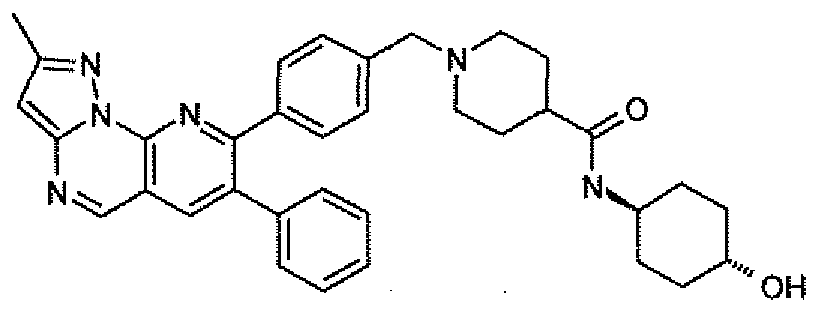
CLX)OlX
Compound [CLXXIX] was prepared in a similar way to that of Compound [CLXII]. Data for Compound [CLXXIX] (as the TFA salt): LCMS (m/e) 575 (M+H); 1H NMR (400 MHz, METHANOL-^) δ ppm 1.18 - 1.45 (no, 4 H) 1.81 - 2.20 (m, 8 H) 2.45 (t, J=3.76 Hz, 1 H) 2.59 (s, 3 H) 3.02 (td, JH2.87, 2.56 Hz, 2 H) 3.44 - 3.67 (m, 4 H) 4.27 - 4.42 (m, 2 H) 6.78 (s. 1 H) 7.28 - 7.40 (m, 5 H) 7.46 (d, .£=8.15 Hz, 2 H) 7.71 (d, J=8.20 Hz, 2 H) 8.59 (s, 1 H) 9.06 (s, 1 H).
l-[4-(2-Methyl-7-phenyH,4,9,9b-tetraaza-cyclopenta[fl]naphthaIen-8-yl)-benzylJ- piperidine-4-carbosyIic acid [2-hydrosy-2-(3-hydroxy-phenyl)-ethyl]-amide [CLXXX]

l-[4-(2-Methyl-7-phenyl-l?4,9,9b-tetraaza-cyclopenta[ainaphthalen-8-yl)-ben2yl]- piperidine-4-carboxyϊic acid [2-(4-hydroxy-phenyl)-ethyϊ]-aππde [CLXXXI]

Compound [CLXXXIJ was prepared in a similar way to that of Compound [CLXπi. Data for Compound [CLXXXI] (as the TFA salt): LCMS (m/e) 597 (M+H); 1H NMR (400 MHz, METHANOL-^) 6 ppm 1.77 - 2.15 (m, 4 H) 2.35 - 2.50 (m, 1 H) 2.59 (s, 3 H) 2.69 (t, ./=7.10 Hz, 2 H) 3.00 (td, 2 H) 3.37 (t, J==7.17 Hz, 2 H) 3.46 - 3.56 (m, 2 H) 4.31 (s, 2 H) 6.69 (d, ./=8.40 Hz, 2 H) 6.78 (s, 1 H) 7.01 (d, ./=8.40 Hz, 2 H) 7.28 - 7.40 (m, 5 H) 7.45 (d, ./=8.25 Hz, 2 H) 7.71 (d, ./=8.25 Hz, 2 H) 8.59 (s, 1 H) 9.06 (s, 1 H).
l-[4-(2-Methyl-7-phenyI-1,4,9,9b-tetraaza-cyclopenta[α3naphthalen-8-yl)-beiizyl]- piperidine-4-carboxylic acid (3-hydroxy-4-methoxy-phenyl)-amide [CLXXXIIj

CU(XXlI
Compound [CLXXXII] was prepared in a similar way to that of Compound [CLXH]. Data for Compound [CLXXXU] (as the TFA salt): LCMS (m/e) 599 (M+H); 1H NMR (400 MHz, METHANOL-^) δ ppm 1.90 - 2.20 (m, 4 H) 2.59 (s, 3 H) 2.60 - 2.72 (m, 1 H) 2.99 - 3.16 (m, 2 H) 3.50 - 3.63 (m, 2 H) 3.82 (s, 3 H) 4.35 (s, 2 H) 6.77 (s} 1 H) 6.85 (d, 1 H)
6.93 (dd, 1 H) 7.10 (d, J=2.10 Hz, 1 H) 7.27 - 7.40 (m, 5 H) 7.47 (d, ./=8.25 Hz, 2 H) 7.72 (d, /=8.10 Hz, 2 H) 8.58 (s, 1 H) 9.06 (s, 1 H).
l-(4-(2-Metϊiyl-7-phen^ piperidine-4-carboxyIic acid [2-(3,4-dihydroxy-phenyI)-ethyl]-amide [CI XXXHT]

Compound [CLXXXIII] was prepared in a similar way to that of Compound [CLXH]. Data for Compound [CLXXX1H] (as the TFA salt): LCMS (m/e) 613 (M+H); 1H NMR (400 MHz, METHANOL-^) δ ppm 1.79 - 2,15 (m, 4 H) 2.37 - 2.52 (m, 1 H) 2.59 (s, 3 H) 2.64 (t, J=7.15 Hz, 2 H) 3.00 (td, J=12.92, 2.51 Hz, 2 H) 3.35 (t, J=7.10 Hz, 2 H) 3.46 - 3.55 (m, 2 H) 4.25 - 4.34 (m, 2 H) 6.46 - 6.56 (m, 1 H) 6.61 (d, /=1.42 Hz, 1 H) 6.67 (d, /=7.96 Hz, 1 H) 6.78 (s, 1 H) 7.26 - 7.40 (m, 5 H) 7.45 (d, /=8.20 Hz, 2 H) 7.71 (d, ./=8.20 Hz, 2 H) 8.59 (s, 1 H) 9.06 (s, 1 H).
l~[4-(2-Methyl-7-phenyl-1,4,9,9b-tetraaza-cyclopenta[α]naphthalen-8-yl)-benzyl]- piperidine-4-carboxylic acid 4-hydroxy-3-methoxy-benzylamide [CLXXXIV]

Compound [CLXXXTVj was prepared in a similar way to that of Compound [CLXHJ. Data for Compound [CLXXXIV] (as the TFA salt): LCMS (m/e) 613 (M+H); 1H NMR (400 MHz, METHANOL-^) δ ppm 1.84 - 2.13 (m, 4 H) 2.45 - 2.56 (m, 1 H) 2.59 (s, 3 H) 2.93 - 3.07 (m, 2 H) 3.45 - 3.56 (m, 2 H) 3.83 (s, 3 H) 4.26 (s, 2 H) 4.28 - 4.39 (m, 2 H) 6.70 (dd, 1 H) 6.74 (d, 1 H) 6.76 (s, 1 H) 6.83 (d, /=1.32 Hz, 1 H) 7.26 - 7.32 (m, 2 H) 7.32 - 7.37 (m, 3 H) 7.43 (d, ./=8.25 Hz, 2 H) 7.70 (d, /=8.25 Hz, 2 H) 8.56 (s, 1 H) 9.04 (s, 1 H).
l-[4-(2-Methyl-7-phenyI-1,4,9,9b-tetraa2a-cyclopenta[α]iiaphthaϊen-8-yl)-benzyl]- piperidrae-4-carboxylic acid 3,4-dihydroxy-benzylaιnide [CLXXXV]

CLXXXV OH
Compound [CLXXXV] was prepared in a similar way to that of Compound [CLXII]. Data for Compound [CLXXXV] (as tiie TFA salt): LCMS (m/e) 599 (M+H); 1H NMR (400 MHz, METHANOL-^) δ ppm 2.55 - 2.82 (ra, 4 H) 3.16 - 3.28 (m, 1 H) 3.29 (s, 3 H) 3.72 (td, .M2.70, 2.81 Hz, 2 H) 4.00 - 4.08 (m, 1 H) 4.13 - 4.24 (m, 2 H) 4.85 - 4.95 (m, 2 H) 5.03 - 5.16 (m, 2 H) 7.29 (dd, J=8.05 , 2.05 Hz, 1 H) 7.39 - 7.48 (m, 2 H) 7.55 (s, 1 H) 8.08 (d, ^=3.66 Hz, 2 H) 8.10 - 8.16 (m, 3 H) 8.24 (d, /=8.25 Hz, 2 H) 8.37 (d, J=8.30 Hz, 2 H) 9.41 (s, 1 H) 9.86 (s, 1 H).
l~[4^2-Metfιy^7-phenyl-ly4^,9b-tetrarø^ piperidine-4-carboxylic acid benzylamide [CLXXXVI]

Compound [CLXXXVIJ was prepared in a similar way to that of Compound [CLXII]. Data for Compound [CLXXXVl] (as the TFA salt): LCMS (m/e) 567 (M+H); 1H NMR (400 MHz, METHANOL-^) δ ppm 1.86 - 2.03 (m, 2 H) 2.03 - 2.15 (m, 2 H) 2.50 - 2.57 (m, 1 H) 2.59 (s, 3 H) 3.04 (td, J÷12.96, 2.88 Hz, 2 H) 3.49 - 3.59 (m, 2 H) 4.30 - 4.35 (m, 2 H) 4.36 (s, 2 H) 6.78 (s, 1 H) 7.20 - 7.39 (m, 10 H) 7.46 (d, J=8.25 Hz, 2 H) 7.71 (d, ^8.20 Hz, 2 H) 8.59 (s, 1 H) 9.07 (s, 1 H).
l-^^-Metiiyl-T-phenyl-l^^^b-tetraaza-cyclopentaJflJnaphthalen-S-ylJ-benzyl]- piperidine-4-carboxyIic acid benzyl-methyl-amide [CLXXXVH)

Compound [CLXXXVII] was prepared in a similar way to that of Compound ΪCLXπj. Data for Compound [CLXXXVII] (as the TFA salt): LCMS (m/e) 581 (M+H); 1H NMR (400 MHz, METHANOL^) δ ppm 1.87 - 2.16 (m, 4 H) 2.59 (s, 3 H) 2.91 - 3.18 (m, 6 H) 3.41 - 3.62 (m, 2 H) 4.24 - 4.46 (m, 2 H) 4.55 - 4.77 (m, 2 H) 6.78 (s, 1 H) 7.17 - 7.53 (m, 12 H) 7.66 - 7.75 (m, 2 H) 8.56 - 8.61 (m, 1 H) 9.04 - 9.08 (m, 1 H).
l-[4-(2-Methyl-7-phenyl-^ pipeiidine-4-carboxylic acid cyclohexylamide [CLXXXVm]
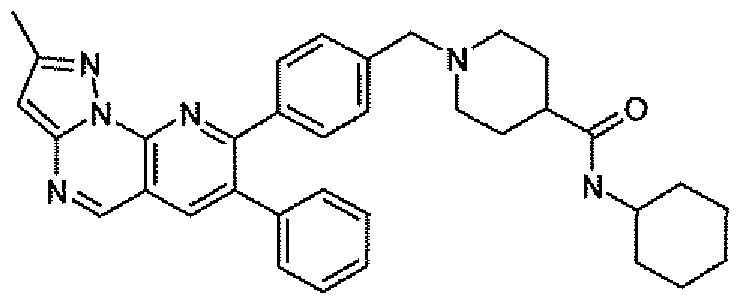
CLXXXVlIl
Compound [CLXXXVIIIJ was prepared in a similar way to that of Compound [CLXII]. Data for Compound [CLXXXVm] (as the TFA salt): LCMS (m/e) 559 (M+H); 1H NMR (400 MHz, METHANOL-^) δ ppm 1.12 - 1.28 (m, 3 H) 1.28 - 1.43 (m, 2 H) 1.59 - 1.70 (m, 1 H) 1.70 - 1.80 (m, 2 H) 1.80 - 1.88 (m, 2 H) 1.88 - 1.98 (m, 2 H) 1.98 - 2.08 (m, 2 H) 2.40 - 2.53 (m, 1 H) 2.59 (s, 3 H) 3.02 (td, ./=13.00, 3.25 Hz, 2 H) 3.48 - 3.56 (m, 2 H) 3.56 - 3.67 (m, 1 H) 4.28 - 4.42 (m, 2 H) 6.78 (s, 1 H) 7.35 (t, J=7.15 Hz, 5 H) 7.46 (d, ^8.15 Hz, 2 H) 7.71 (d, ^=8.20 Hz, 2 H) 8.59 (s, 1 H) 9.06 (s, 1 H).
l-[4-(2-MethyI-7-phenyϊ-1,4,9^b^ pipcridinc-4-carboxyIic acid (2-methoxy-1-methyI-ethyl)-aniide [CLXXXIX]

l-I^Cl-Methyl-T^henyl-l^^^Metraaza-cyclopentalalnaphthalen-S-ylJ-benxyl]- piperidine-4-carboxyiic acid carbamoylmethyl-amide [CXC]

CXC
Compound [CXC] was prepared in a similar way to that of Compound [CLXII]. Data for Compound [CXC] (as the TFA salt): LCMS (m/e) 534 (M+H); 1H NMR (400 MHz, METHANOL-^) δ ppm 1.82 - 2.07 (m, 2 H) 2.08 - 2.31 (m, 2 H) 2.53 ~ 2.65 (m, 4 H) 2.99 - 3.11 (m, 2 H) 3.49 - 3.58 (m, 2 H) 3.85 (s, 2 H) 4.33 (s, 2 H) 6.78 (s, 1 H) 7.35 (t, /=7.25 Hz, 5 H) 7.46 (d, J^8.20 Hz, 2 H) 7.71 (d, J=SΛ5 Hz, 2 H) 8.59 (s, 1 H) 9.06 (s, 1 H).
l-[4-(2-Methyl-7-phenyl-1,4,9,9ΪM^ piperidine-4-carboxylic acid (2^trifluoro-ethyl)-amide [CXCI]

CXCl
Compound [CXCI] was prepared in a similar way to that of Compound [CLXII]. Data for Compound [CXCI] (as the TFA salt): LCMS (m/e) 559 (M+H); 1H NMR (400 MHz, METHANOL-^) δ ppm 1.83 - 2.14 (m, 4 H) 2.51 - 2.66 (m, 4 H) 2.99 - 3.11 (m, 2 H) 3.36 (br. s., 1 H) 3.47 - 3.60 (m, 2 H) 3.91 (q, /=9.42 Hz, 2 H) 4.27 - 4.43 (m, 2 H) 6.78 (s, 1 H) 7.28 - 7.39 (m, 5 H) 7.46 (d,/=8.15 Hz, 2 H) 7.71 (d, /=8.15 Hz, 2 H) 8.59 (s, 1 H) 9.06 (s, 1 H).
l-[4-(2-Methyl-7-phenyl-l^ piperidine-4-carboxylic acid (l-ethyl-propyl)-amide [CXCH]

CXCH
Compound [CXCII] was prepared in a similar way to that of Compound [CLXII]. Data for Compound [CXCH] (as me TFA salt): LCMS (m/e) 547 (M+H); 1H NMR (400 MHz, METHANOL-^) δ ppm 0.89 (t, J=7.42 Hz, 6 H) 1.31 - 1.46 (m, 2 H) 1.48 - 1.64 (m, 2 H) 1.87 - 2.01 (m, 2 H) 2.00 - 2.10 (m, 2 H) 2.47 - 2.57 (m, ^=I 1.87, 11.87, 4.27, 4.06 Hz, 1 H) 2.59 (s, 3 H) 3.04 (td, /=12.84, 2.73 Hz, 2 H) 3.49 - 3.58 (m, 2 H) 3.64 (spt, 1 H) 4.28 - 4.43 (m, 2 H) 6.78 (s, 1 H) 7.27 - 7.39 (m, 5 H) 7.46 (d, J^=8.20 Hz, 2 H) 7.71 (d, ^=8.25 Hz, 2 H) 8.59 (s, 1 H) 9.06 (s, 1 H).
l-^^Z-Methyl^-phenyl-l^^^b-tetraaza-cyclopentaJajnaphthaleii-S-yO-beiizyl]- piperϊdine-4-carboxylic acid tert-butylamide [CXCHIj

CXCIiI
Compound [CXCHJ] was prepared in a similar way to that of Compound [CLXIIj. Data for Compound [CXCm] (as the TFA salt): LCMS (m/e) 533 (M+H); 1H NMR (400 MHz, METHANOL-^) δ ppm 1.32 (s, 9 H) 1.80 - 1.95 (m, 2 H) 1.95 - 2.04 (m, 2 H) 2.37 - 2.51 (m, 1 H) 2.59 (s, 3 H) 3.00 (td, J=YlHS, 2.46 Hz, 2 H) 3.45 - 3.58 (m, 4 H) 4.28 - 4.43 (m, 2 H) 6.78 (s, 1 H) 7.29 - 7.38 (m, 5 H) 7.46 (d, >=8.20 Hz, 2 H) 7.71 (d, J^=8.25 Hz, 2 H) 8.59 (s, 1 H) 9.06 (s, 1 H).
l-[4^2-Methyl-7-phenyM,4,9,9b^ piperidine-4-carboxylic acid propylamine [CXCIV]

CXCIV
Compound [CXCIV] was prepared in a similar way to that of Compound [CLXII]. Data for Compound [CXCIV] (as Ihe TFA salt): LCMS (m/e) 519 (M+H); 1H NMR (400 MHz, METHANOL-^) δ ppm 0.92 (t,J=7.42 Hz, 3 H) 1.52 (sxt, /=7.27 Hz92 H) 1.83 - 1.99 (m, 2 H) 1.99 - 2.10 (m, 2 H) 2.43 - 2.55 (m, JH2.12, 12.12, 3.78, 3.56 Hz, 1 H) 2.59 (s, 3 H) 3.03 (td, JH2.71, 2.10 Hz, 2 H) 3.14 (t, /=7J0 Hz, 2 H) 3.47 - 3.58 (m, 2 H) 4.33 (s, 2 H) 6.78 (s, 1 H) 7.27 - 7.39 (m, 5 H) 7.46 (d9 ,/=8.20 Hz, 2 H) 7.71 (d, J=8.25 Hz, 2 H) 8.59 (s, 1 H) 9.06 (s, 1 H).
l-[4-(2-MethyI-7-phenyl-1,4,9,9b-tetraaza~cyclopenta[βjnaphthalen-8-yl)-benzyF|- piperidine-4-carbosyIic acid methylamide [CXCV]

CXCV
Compound [CXCV] was prepared in a similar way to that of Compound [CLXH]. Data for Compound [CXCV] (as the TFA salt): LCMS (m/e) 491 (M+H); 1H NMR (400 MHz, METHANOL-^) δ ppm 1.83 - 1.99 (m, 2 H) 2.00 - 2.11 (m, 2 H) 2.47 (d, .M 3.57 Hz, 1 H) 2.59 (s, 3 H) 2.70 - 2.77 (m, 3 H) 3.03 (td, JH3.02, 2.90 Hz, 2 H) 3.49 - 3.57 (m, 2 H) 4.28 - 4.42 (m, 2 H) 6.78 (s, 1 H) 7.28 - 7.39 (m, 5 H) 7.46 (d, J=8.25 Hz, 2 H) 7.72 (d, ./=8.20 Hz, 2 H) 8.60 (s, 1 H) 9.07 (s, 1 H).
l-[4-(2-Methyl-7-phenyl-1,4,9,9b-tetraaza-cyclopenta[fl]naphthaleii-8-yl)-beiizyl]- pipcridine-4-carboxj lie acid ethylamide [CXCVI]

CXCVl
Compound [CXCVIJ was prepared in a similar way to that of Compound [CLXnj. Data for Compound [CXCVI] (as the TFA salt): LCMS (m/e) 505 (M+H); 1H NMR (400 MHz, METHANOL-^) δ ppm 1.12 (t, J=7.30 Hz, 3 H) 1.82 - 1.99 (m, 2 H) 1.99 - 2.10 (m, 2 H) 2.40 - 2.53 (m, 1 H) 2.59 (s, 3 H) 3.03 ^7=13.08, 2.93 Hz, 2 H) 3.20 (q, J^=7.16 Hz, 2 H) 3.49 - 3.58 (m, 2 H) 4.28 - 4.43 (m, 2 H) 6.78 (s, 1 H) 7.28 - 7.40 (m, 5 H) 7.46 (d, J=8.20 Hz, 2 H) 7.72 (d, J=8.20 Hz, 2 H) 8.59 (s, 1 H) 9.07 (s, 1 H).
[4-(3-Hydroxy-pheny!)-piperazin-1-yl]-{l-[4-(2-methyI-7-phenyI-1,4,9,9b-tetraaza- cyclopenta[α] naphthalen-8-yl)-benzyϊ]-piperidm-4-yϊ}-methanone [CXC VII]

Compound [CXCVII] was prepared in a similar way to that of Compound [CLXH]. Data for Compound [CXCVII] (as the TFA salt): LCMS (m/e) 638 (M+H); 1H NMR (400 MHz, METHANOL-^) δ ppm 1.85 - 2.10 (m, 4 H) 2.59 (s, 3 H) 2.99 - 3.19 (m, 4 H) 3.20 - 3.28 (m, 2 H) 3.35 - 3.45 (m, 1 H) 3.48 - 3.62 (m, 2 H) 3.67 - 3.85 (m, 4 H) 4.25 - 4.46 (m> 2 H) 6.34 - 6.61 (m, 2 H) 6.78 (s, 1 H) 7.08 (quin, J-4.06 Hz, 1 H) 7.35 (t, ^=7.13 Hz, 5 H) 7.47 (d, ^8.25 Hz, 2 H) 7.72 (d, ^8.05 Hz, 2 H) 8.59 (s, 1 H) 9.06 (s, 1 H).
l-[4-(2-MethyI-7-phenyl-1,4,9,9b-tetraaza-cyclopenta[a]naphthalen-8-yl)-benzyl]~ piperidine-4-carboxylic add ((S)-1-cycIoiiexyl-ethy])-aniide [CXCVffl]
China!

Compound [CXCVIlIJ was prepared in a similar way to that of Compound [CLXII]. Data for Compound [CXCVIII] (as the TFA salt): LCMS (m/e) 587 (M+H); 1H NMR (400 MHz, METHANOL-Cf4) δ ppm 0.90 - 1.05 (m, 2 H) 1.08 (d, ./=6.78 Hz, 3 H) 1.12 - 1.40 (m, 4 H) 1.62 - 1.70 (m, 1 H) 1.70 - 1.82 (m, 4 H) 1.84 - 2.10 (m, 4 H) 2.43 - 2.56 (m, 1 H) 2.59 (s, 3
H) 2.96 - 3.10 (m, 2 H) 3.48 - 3.59 (m, 2 H) 3.63 - 3.77 (m, 1 H) 4.26 - 4.43 (m, 2 H) 6.77 (s, 1 H) 7.28 - 7.40 (m, 5 H) 7.46 (d, ./=8.10 Hz, 2 H) 7.71 (d, /=8.20 Hz, 2 H) 8.58 (s, 1 H) 9.06 (s, 1 H).
(Hes^ydro-cyclopenta[c]pyiτol-^^^ cyclopentalaJnaphthalen-S-yrj-benzyfl-piperidin^ylJ-methaiione [CXClX]

CXClX
Compound [CXCIXJ was prepared in a similar way to that of Compound
[CLXH]. Data for Compound [CXCIX] (as the TFA salt): LCMS (m/e) 571 (M+H); 1H NMR (400 MHz, METHANOL-^) δ ppm 1.49 (tt, /=12.50, 6.34 Hz, 2 H) 1.59 - 1.72 (m, 1 H) 1.72 - 1.82 (m, 1 H) 1.82 - 1.98 (m, 4 H) 1.98 - 2.08 (m, 2 H) 2.59 (s, 3 H) 2.62 - 2.73 (m, 1 H) 2.73 - 2.91 (m, 2 H) 3.07 (t, /=12.89 Hz, 2 H) 3.25 (dd, /=12.59, 4.78 Hz, 1 H) 3.40 (dd, J=I 0.96, 4.76 Hz, 1 H) 3.47 - 3.56 (m, 2 H) 3.61 (dd, /=12.59, 8.40 Hz, 1 H) 3.80 (dd, /=10.79, 8.25 Hz, 1 H) 4.32 (s, 2 H) 6.77 (s, 1 H) 7.28 - 7.39 (m, 5 H) 7.46 (d, ./=8.20 Hz, 2 H) 7.71 (d, /=8.20 Hz, 2 H) 8.58 (s, 1 H) 9.06 (s, 1 H).
l-^^-Methyl-T-phenyM^^^b-tetraaza-cyclopentatαJnaphthalen-S-ylJ-benzylj- piperidine-4-carboxyIic acid ethyl-isopropyl-amide [CC]

Compound [CC] was prepared in a similar way to that of Compound [CLXII]. Data for Compound [CC] (as the TFA salt): LCMS (m/e) 547 (M+H); 1H NMR (400 MHz, METHANOL-^) δ ppm 1.12 (t, /=6.98 Hz, 1 H) 1.17 (d, /=6.83 Hz, 3 H) 1.21 - 1.31 (m, 5 H) 1.87 - 2.18 (ra, 4 H) 2.59 (s, 3 H) 2.82 - 3.16 (m, 3 H) 3.23 - 3.43 (m, 2 H) 3.46 - 3.58 (m, 2 H) 4.18 - 4.62 (ra, 3 H) 6.77 (s, 1 H) 7.28 - 7.40 (m, 5 H) 7.47 (d, J=8.20 Hz, 2 H) 7.71 (d, /=8.20 Hz, 2 H) 8.58 (s, 1 H) 9.06 (s, 1 H).
l-[4-(2-Methyl-7-phenyl-1,4,9,9b-tetraaza~cydopentaϊβ]naphthaIen-8-yI)-beiizyl]- piperidme-4-carbøxylic acid ((lS^!S)-2-hydroxy-cyclohexyl)-amide (CCIj

CCl
Compound [CC] was prepared in a similar way to that of Compound [CLXII]. Data for Compound [CC] (as the TFA salt): LCMS (m/e) 575 (M+H); 1H NMR (400 MHz, METHANOL-^) δ ppm 1.12 - 1.42 (m, 4 H) 1.61 - 1.80 (m, 2 H) 1.82 - 2.17 (m, 6 H) 2.44 - 2.56 (m, 1 H) 2.59 (s, 3 H) 3.03 (td, JM2.86, 2.73 Hz, 2 H) 3.33 - 3.39 (m, 1 H) 3.46 - 3.60 (m, 3 H) 4.25 - 4.41 (m, 2 H) 6.78 (s, 1 H) 7.28 - 7.40 (m, 5 H) 7.46 (d, J=8.20 Hz, 2 H) 7.71 (d, /=8.20 Hz, 2 H) 8.59 (s, 1 H) 9.06 (s, 1 H).
l-[4-(2-MethyL-7-phenyI-1,4,9,9b-tetraaza-cyclopenta[fl3naphthalen-8-yl)-ben2yI3- piperidine-4-carboxylic acid (2-hydroxy-ethyl)-amide [CCII]

CCIt
Compound [CCH] was prepared in a similar way to that of Compound [CLXII]. Data for Compound [CCO] (as tike TFA salt): LCMS (m/e) 521 (M+H); 1H NMR (400 MHz, METHANOL-^) δ ppm 1.83 - 2.01 (m, 2 H) 2.00 - 2.13 (no, 2 H) 2.46 - 2.57 (m, 1 H) 2.59 (s, 3 H) 3.03 (td, J=13.01, 2.73 Hz, 2 H) 3.27 - 3.29 (m, 2 H) 3.49 - 3.57 (m, 2 H) 3.59 (t, J=5.66 Hz, 2 H) 4.27 - 4.43 (m, 2 H) 6.78 (s, 1 H) 7.35 (t, J=6.88 Hz, 5 H) 7.46 (d, J=8.20 Hz, 2 H) 7.72 (d, J=8.20 Hz, 2 H) 8.59 (s, 1 H) 9.07 (s, 1 H).
l-[4-(2-Methyl-7-phenyl-1,4^,9b-tetraaza-cyclopettta[fl]naphthaIen-8-yl)-beiizylJ- piperidine-4-carboxylic acid (tetrahydro-furan~2-ybnethyl)-amide [CCIII]

CCIU
Compound [CCIII] was prepared in a similar way to that of Compound [CLXII]. Data for Compound [CCIII] (as the TTA salt): LCMS (ra/e) 561 (M+H); 1H NMR (400 MHz, METHANOL-^) δ ppm 1.48 - 1.63 (m, 1 H) 1.82 - 2.12 (m, 7 H) 2.48 - 2.58 (m, 1 H) 2.59 (s, 3 H) 3.03 (td, JH2.87, 2.03 Hz, 2 H) 3.16 - 3.26 (m, 1 H) 3.47 - 3.59 (m, 2 H) 3.74 (q, /=7.44 Hz, 1 H) 3.80 - 3.90 (m, 1 H) 3.90 - 4.01 (m, 1 H) 4.27 - 4.42 (m, 2 H) 6.77 (s, 1 H) 7.27 - 7.39 (m, 5 H) 7.46 (d, >8.20 Hz, 2 H) 7.71 (d, J=8.20 Hz, 2 H) 8.58 (s, 1 H) 9.06 (s, 1 H).
l-[4-(2-Methyl-7-phenyH,4,9,9b-tetraaza-cyclopenta[a]naphthaleii-8-yl)-ben2yl]- piperidine-4-carboxyIic acid cyclobutylamide [CCIV]

CClV
Compound [CCTV] was prepared in a similar way to that of Compound [CLXII]. Data for Compound [CCIV] (as the TFA salt): LCMS (m/e) 531 (M+H); 1H NMR (400 MHz, METHANOL-^) δ ppm 1.65 - 1.80 (m, 2 H) 1.82 - 1.98 (m, 4 H) 1.98 - 2.08 (m, 2 H) 2.21 - 2.33 (m, 2 H) 2.45 (tt, J=X 1.95, 3.43 Hz, 1 H) 2.59 (s, 3 H) 3.02 (td, J=12.84, 2.20 Hz, 2 H) 3.47 - 3.57 (m, 2 H) 4.20 - 4.30 (m, 1 H) 4.32 (s, 2 H) 6.77 (s, 1 H) 7.26 - 7.40 (m, 5 H) 7.46 (d, .^=8.15 Hz, 2 H) 7.71 (d, >8.15 Hz, 2 H) 8.58 (s, 1 H) 9.06 (s, 1 H).
l-[4^2-MethyI-7-phenyH,4,9^^ piperidiαe-4-carboxylic acid isopropylamide [CCV)
Compound [CCV] was prepared in a similar
 way to that of Compound [CLXII]. Data for Compound
CCV ICCV] (as the TFA salt): LCMS (m/e) 519 (M+H); 1H NMR (400 MHz, METHANOL-^) δ ppm 1.13 (d, J=6M
Hz, 6 H) 1.83 - 1.98 (m, 2 H) 1.98 - 2.08 (m, 2 H) 2.38 - 2.53 (m, 1 H) 2.59 (s, 3 H) 3.02 (td,
/=12.82, 2.32 Hz, 2 H) 3.48 - 3.58 (m, 2 H) 3.94 (dt, .M3.20, 6.63 Hz, 1 H) 4.27 - 4.43 (m, 2 H) 6.78 (s, 1 H) 7.35 (t, J*=7.I3 Hz, 5 H) 7.46 (d, ,£=8.10 Hz, 2 H) 7.71 (d, ./=8.20 Hz, 2 H) 8.59 (s, 1 H) 9.06 (s, 1 H).
({l-[4-(2-Me*hy^-pbenyI-lΛ^^ pipeήdine-4-carbonyl}-aiJtiJtto)-acetic acid tert-butyl ester [CCVT|

Compound [CC VTj was prepared in a similar way to that of Compound [CLXlI]. Data for Compound [CCVIl (as the TCA salt): LCMS (m/e) 591 (M+H); !H NMR (400 MHz, METHANOL-^) δ ppm 1.46 (s, 9 H) 1.84 - 2.01 (m, 2 H) 2.06 - 2.17 (m, 2 H) 2.52 - 2.64 (m, 4 H) 2.99 - 3.11 (m, 2 H) 3.50 - 3.59 (m, 2 H) 3.82 (s, 2 H) 4.29 - 4.41 (m, 2 H) 6.78 (s, 1 H) 7.26 - 7.40 (m, 5 H) 7.46 (d, J=8.25 Hz, 2 H) 7.72 (d, J=8.20 Hz, 2 H) 8.60 (s, 1 H) 9.07 (s, 1 H).
({l-[4-(2-Methyl-7-phenyI-1,4,9,9b-tetraaza-cycIopenta[αjnaphthal€n-8-yl)-beii2yl]- pjperidine-4-carbonyI}-amino)-acetic acid [CCVII]


CCVII
Compound [CCVI] (10 mg, 0.017 mmol) was dissolved in CH2Cl2 (2 mL) and then TFA (500 //L) was added. The reaction was stirred at room temperature for 4 hours, and then blown to dryness with N2. The residue was dissolved in MeOH and purified by reverse- phase chromatography (Solvent A H2O/CH3CN/TFA (95:5:0.05), Solvent B CH3CN/H2O/TFA (95:5:0.05)) with a gradient of 5% to 60% B over 5 minutes to give Compound [CCVII] as the TFA salt: LCMS (m/e) 535 (M+H); 1H NMR (400 MHz, METHANOL-^) δ ppm 1.81 - 2.00 (m, 2 H) 2.04 - 2.17 (m, 2 H) 2.51 - 2.64 (m, 4 H) 2.96 - 3.10 (m, 2 H) 3.48 - 3.59 (m, 2 H) 3.90 (s, 2 H) 4.32 (s, 2 H) 6.77 (s, 1 H) 7.34 (t, .£=6.86 Hz, 5 H) 7.45 (d, J=8.25 Hz, 2 H) 7.70 (d, ./=8.15 Hz, 2 H) 8.58 (s, 1 H) 9.06 (s, 1 H).
l-^-Cl-Methyl-T-phenyl-l^^^b-tetraaza-cyclopentaJalnaphthalen-S-ylJ-beiizyϊ]- piperidine-4-carboxyIic acid (4-hydroxy-phenyl)-amide [CCVIIIJ

CCVlIl
Compound [CCVHIJ was prepared in a similar way to that of Compound [CLXII]. Data for Compound [CCVHI] (as me TFA salt): LCMS (m/e) 569 (M+H); 1H NMR (400 MHz, METHANOL-^) δ ppm 1.92 - 2.08 (m, 2 H) 2.08 - 2.21 (m, 2 H) 2.59 (s, 3 H) 2.61 - 2.72 (m, 1 H) 3.00 - 3.17 (m, 2 H) 3.50 - 3.63 (m, 2 H) 4.26 - 4.44 (m, 2 H) 6.69 - 6.76 (m, 2 H) 6.77 (s, 1 H) 7.25 - 7.40 (m, 7 H) 7.47 (d, J=$25 Hz, 2 H) 7.72 (d, /=8.15 Hz, 2 H) 8.58 (s, 1 H) 9.06 (s, 1 H).
l-[4-(2-Methyl-7-phenyH,4,9,9b-tefraaza-cycIopenta[α]naphthalen~8-yl)-beπzylJ- piperidine-4-carboxyIic acid (3-carbamoyl-phenyl)-amide [CCIX]

Compound [CCIX] was prepared in a similar way to that of Compound [CLXII]. Data for Compound [CCIX] (as the TFA salt): LCMS (m/e) 596 (M+H); 1H NMR (400 MHz, METHANOL-^) δ ppm 1.94 - 2.11 (m, 2 H) 2.12 - 2.26 (m, 2 H) 2.59 (s, 3 H) 2.64 - 2.81 (m, 1 H) 3.01 - 3.17 (m, 2 H) 3.49 - 3.66 (m, 2 H) 4.37 (s, 2 H) 6.78 (s, 1 H) 7.34 (d, J=IAl Hz, 5 H) 7.41 (t, /=7.93 Hz, 1 H) 7.48 (d, .£=8.25 Hz, 2 H) 7.59 (d, /=7.81 Hz, 1 H) 7.67 - 7.78 (m, 3 H) 8.05 (br. s., 1 H) 8.59 (s, 1 H) 9.06 (s, 1 H).
l-[4^2-Methyl-7^heny!-1,4,9,91^ piperidine-4-carboxyIic acid (3-methoxy-phenyl)-amide [CCX]

Compound [CCXl was prepared in a similar way to that of Compound [CLXu]. Data for Compound [CCX] (as the TFA salt): LCMS (m/e) 583 (M+H); 1H NMR (400 MHz, METHANOL-^) δ ppm 1.92 - 2.09 (m, 2 H) 2.10 - 2.21 (m, 2 H) 2.59 (s, 3 H) 2.62 - 2.77 (m, 1 H) 2.99 - 3.17 (m, 2 H) 3.49 - 3.63 (m, 2 H) 3.77 (s, 3 H) 4.29 - 4.46 (m, 2 H) 6.67 (dd, ^8.10, 2.34 Hz, 1 H) 6.77 (s, 1 H) 7.05 (d, J=8.20 Hz, 1 H) 7.20 (t, J==8.18 Hz, 1 H) 7.34 (d, ^=9.47 Hz, 6 H) 7.47 (d, ,/=8.25 Hz, 2 H) 7.71 (d, ./=8.05 Hz, 2 H) 8.57 (s, 1 H) 9.05 (s, 1 H).
l-[4-(2-MethyI-7-phenyl-1,4,9,9M piperidine-4-carboxylic acid (3-methanesulfoBylamino-phenyI)-amide [CCXI]

Compound [CCXI] was prepared in a similar way to that of Compound [CLXII]. Data for Compound [CCXI] (as the TFA salt): LCMS (m/e) 646 (M+H); 1H NMR (400 MHz, METHANOL-J4) δ ppm 1.94 - 2.08 (m, 2 H) 2.09 - 2.23 (m, 2 H) 2.59 (s, 3 H) 2.63 - 2.76 (m, 1 H) 2.96 (s, 3 H) 3.01 - 3.16 (m, 2 H) 3.50 - 3.63 (m, 2 H) 4.30 - 4.45 (m, 2 H) 6.78 (s, 1 H) 6.95 (d, J==7.42 Hz, 1 H) 7.27 (t, 1 H) 7.29 - 7.39 (m, 6 H) 7.48 (d, J=8.20 Hz, 2 H) 7.60 - 7.69 (m, 1 H) 7.72 (d, .£=8.05 Hz, 2 H) 8.59 (s, 1 H) 9.06 (s, 1 H).
l-[4-(2~Methyl-7-phenyI-1,4,9,9b-tetraaza-cyclopenta[α]naphthalen-8-yi )-benzyl]-piperidine-4-carboxyϊic acid (3-cyano-phenyl)-amide [CCXII]

CCXIl
Compound [CCXII] was prepared in a similar way to that of Compound [CLXiη. Data for Compound [CCXIIJ (as the TFA salt): LCMS (m/e) 578 (M*H); 1H NMR (400 MHz, METHANOL-^) δ ppm 1.95 - 2.10 (m, 2 H) 2.11 - 2.25 (m, 2 H) 2.59 (s, 3 H) 2.64 ■ 2.77 (m, 1 H) 3.02 - 3.18 (m, 2 H) 3.52 - 3.64 (m, 2 H) 4.29 - 4.46 (m, 2 H) 6.78 (s, 1 H) 7.27 - 7.39 (m, 5 H) 7.40 - 7.54 (m, 4 H) 7.72 (d, J=8.10 Hz, 2 H) 7.77 (d, J=8.10 Hz, 1 H) 8.00 - 8.17 (m, 1 H) 8.59 (s, 1 H) 9.06 (s, 1 H).
l-[4»(2-Methyl-7-phenyl-1,4,9,9b-tetraaza-cyclopcπta[α]naphthalen-8-yl)-benzyl]- piperidine-4-carbosylic acid (3-fluoro-phenyl)-amide [CCXIIIj

CCXlIl
Compound [CCXlIl] was prepared in a similar way to that of Compound [CLXIIJ. Data for Compound [CCXHI] (as the TFA salt): LCMS (m/e) 571 (M+H); 1H NMR (400 MHz, METHANOL^) δ ppm 1.94 - 2.10 (ms 2 H) 2.10 - 2.22 (m, 2 H) 2.59 (s, 3 H) 2.62 - 2.76 (m, 1 H) 3.02 - 3.16 (m, 2 H) 3.51 - 3.65 (m, 2 H) 4.28 - 4.44 (m, 2 H) 6.77 (s, 1 H) 6.82 (td, J=8.13, 2.39 Hz, 1 H) 7.20 - 7.26 (ra, 1 H) 7.26 - 7.40 (m, 6 H) 7.48 (d, J^=8.20 Hz, 2 H) 7.53 (d, J=IOM Hz, 1 H) 7.72 (d, J^=8.15 Hz, 2 H) 8.58 (s, 1 H) 9.06 (s, 1 H).
l-[4-(2-Methyl-7-phenyl-1,4^,9b-tetraaza-cyclopentaIα]naphthalen-8-yI)-benzyl]- piperidine-4-carboxylic acid (2-hydrosy-phenyl)-amide [CCXIVJ

Compound [CCXIV] was prepared in a similar way to that of Compound [CLXπ]. Data for Compound [CCXIV] (as Ihe TFA salt): LCMS (m/e) 569 (M+H); 1H NMR (400 MHz, METHANOL-^) δ ppm 1.92 - 2.11 (m, 2 H) 2.12 - 2.26 (m, 2 H) 2.59 (s, 3 H) 2.74 ■ 2.89 (m, 1 H) 3.02 - 3.16 (m, 2 H) 3.51 - 3.63 (m, 2 H) 4.28 - 4.45 (m, 2 H) 6.75 - 6.84 (m, 2 H)
6.86 (d, ^7.37 Hz, 1 H) 7.00 (t, J=I.52 Hz, 1 H) 7.29 - 7.40 (m. 5 H) 7.48 (d, J=8.25 Hz, 2 H) 7.69 (d, J=SM Hz, 1 H) 7.73 (d, /=8.00 Hz, 2 H) 8.60 (s, 1 H) 9.07 (s, 1 H).
l-[4-(2-MethyI-7-phenyl-1,4,9,9b-tetraaza-cyclopenta[α]naphthaIen-8-yl)-benzylJ- piperidine-4-carboxy-ic acid (4-carbamoyI-phenyl)-aroide [CCXV]

CCXV
Compound [CCXV] was prepared in a similar way to that of Compound [CLXH]. Data for Compound [CCXV] (as the TFA salt): LCMS (m/e) 596 (M+H); SH NMR (400 MHz, METHANOL-^) δ ppm 1.92 - 2.09 (m, 2 H) 2.09 - 2.23 (m, 2 H) 2.58 (s, 3 H) 2.64 2.78 (m, 1 H) 3.00 - 3.15 (m, 2 H) 3.50 - 3.63 (m, 2 H) 4.28 - 4.43 (m, 2 H) 6.77 (s, 1 H) 7.26 - 7.39 (m, 5 H) 7.47 (d, J^=8.20 Hz, 2 H) 7.62 - 7.75 (m, 4 H) 7.84 (d, J=8.74 Hz, 2 H) 8.58 (s, 1 H) 9.05 (s, 1 H).
l-[4-(2-Methyl-7-phenyl-1,4,9,9b-tetraaza-cyclopenta[fl]naphthaleiι-8-yI)-beiizyl]- piperidine-4-carboxyIic acid (3-sulfamoyl-phenyI)-amide [CCXVI]

Compound [CCXVI] was prepared in a similar way to that of Compound [CLXII]. Data for Compound [CCXVI] (as tiie TFA salt): LCMS (m/e) 632 (M+H); 1H NMR (400 MHz, METHANOL-^) δ ppm 1.95 - 2.12 (m, 2 H) 2.11 - 2.24 (m, 2 H) 2.59 (s, 3 H) 2.65 - 2.78 (m, 1 H) 3.02 - 3.17 (m, 2 H) 3.52 - 3.63 (m, 2 H) 4.36 (s, 2 H) 6.78 (s, 1 H) 7.26 - 7.40 (m, 5 H) 7.44 - 7.53 (m, 3 H) 7.63 (ddd, J^8.05, 1.22, 0.83 Hz, 1 H) 7.72 (d, ^=8.00 Hz, 3 H) 8.19 - 8.30 (m, 1 H) 8.59 (s, 1 H) 9.06 (s, 1 H).
l-[4-(2-Methyl-7-phenyH,4,9,9b-tetraaza-cycIopenta[a]iiaphtha!en-8-yI)-benzyl]- piperidine-4-carboxylic acid foenzothiazoI-5-yIamide [CCXVII]

Compound [CCXVIIj was prepared in a similar way to that of Compound [CLXπ]. Data for Compound [CCXVH] (as the TFA salt): LCMS (m/e) 610 (M+H); 1H NMR (400 MHz9 METHANOL-^) δ ppm 1.96 - 2.15 (m, 2 H) 2.15 - 2.28 (m, 2 H) 2.59 (s, 3 H) 2.68 - 2.83 (m, 1 H) 3.05 - 3.19 (m, 2 H) 3.53 - 3.66 (m, 2 H) 4.33 - 4.47 (m, 2 H) 6.78 (s, 1 H) 7.27 - 7.41 (m, 5 H) 7.49 (d, J^8.20 Hz, 2 H) 7.62 (dd, J=8.74, 2.00 Hz, 1 H) 7.73 (d, J=8.00 Hz, 2 H) 8.00 (d, ^=8.74 Hz, 1 H) 8.42 - 8.53 (m, 1 H) 8.59 (s, 1 H) 9.06 (s, 1 H) 9.24 (s, 1 H).
l-[4-(2~MethyI-7-phenyl-1,4,9,9b-tetraaza-cyclopeiita[fl]naphthalen-8~yI)-benzy!]- piperidine-4-carboxyIic acid (3-trifluoromethoxy-phenyI)-amide [CCXVHI]

Compound [CCXVϋl] was prepared in a similar way to that of Compound [CLXπj. Data for Compound [CCXVIIIj (as the TFA salt): LCMS (m/e) 637 (M+H); 1H NMR (400 MHz, METHANOL-^) δ ppm 1.93 - 2.10 (m, 2 H) 2.10 - 2.25 (m} 2 H) 2.59 (s, 3 H) 2.63 - 2.77 (m, 1 H) 3.02 - 3.16 (m, 2 H) 3.51 - 3.64 (in, 2 H) 4.32 - 4.45 (m} 2 H) 6.78 (s, 1 H) 7.00 (d, J=ZM Hz, 1 H) 7.29 - 7.38 (m, 5 H) 7.40 (d, J=8.05 Hz, 1 H) 7.42 - 7.46 (m, 1 H) 7.48 (d, >8.20 Hz, 2 H) 7.66 - 7.82 (m, 3 H) 8.59 (s, 1 H) 9.07 (s, 1 H).
l-[4^2~Methy^-phenyl-1,4^,9b-t^^ piperidiae-4-carbθ3ylic acid thiazol-2-ylamide [CCXEXj

l-[4-(2-Methyl-7-pheEyI-l?4,9,9b-tetraaza-cyclopeiita[α]iiaphthaIen-8-yl)-beιizyI]- piperidine-4-carboxylic acid (S-oxo-l^-dihydro-isobenzofuran-S-y^-amide [CCXX]

Compound [CCXX] was prepared in a similar way to that of Compound [CLXII].
Data for Compound JCCXX] (as the TFA salt): LCMS (m/e) 609 (M+H); 1H NMR (400 MHz, METHANOL-J4) δ ppm 1.93 - 2.12 (m, 2 H) 2.12 - 2.27 (m, 2 H) 2.59 (s, 3 H) 2.65 - 2.84 (m, 1 H) 3.02 - 3.20 (m, 2 H) 3.52 - 3.67 (m, 2 H) 4.25 - 4.46 (m, 2 H) 5.34 (s, 2 H) 6.77 (s, 1 H) 7.26 - 7.41 (m, 5 H) 7.48 (d, J^8.20 Hz, 2 H) 7.56 (d, J=8.35 Hz, 1 H) 7.72 (d, J=8.10 Hz, 2 H) 7.83 (d, .7=9.57 Hz, 1 H) 8.15 - 8.29 (m, 1 H) 8.58 (s, 1 H) 9.06 (s, 1 H).
l-[4-(2-Methyl-7-phenyl-1,4,9,9b-tetraaza-cyclopenta[fljnaphthalen-8-yl)-benzyl]- piperidine-4-carboxyKc acid (3-methanesuIfonyl-phenyI)-amide [CCXXI]

Compound [CCXXI] was prepared in a similar way to that of Compound [CLXH]. Data for Compound [CCXXI] (as the TFA salt): LCMS (m/e) 631 (M+H); 1H NMR (400 MHz, METHANOL-^) δ ppm 1.94 - 2.14 (m, 2 H) 2.14 - 2.39 (m, 2 H) 2.59 (s, 3 H) 2.66 2.79 (m, 1 H) 3.02 - 3.17 (m, 5 H) 3.51 - 3.65 (m, 2 H) 4.30 - 4.46 (m, 2 H) 6.78 (s, 1 H) 7.28 -
7.41 (m, 5 H) 7.48 (d, J=8.25 Hz, 2 H) 7.58 (t, J=I.96 Hz, 1 H) 7.68 (d, J-7.96 Hz, 1 H) 7.72 (d, ,7=8.05 Hz, 2 H) 7.82 (d, ^8.00 Hz, 1 H) 8.25 - 8.40 (m, 1 H) 8.59 (s, 1 H) 9.06 (s, 1 H).
l-[4-(2-MethyI~7-pheHyl-1,4,9,9b-tetraaza-cyclopenta[ajiiaphthaleii-8-yl)-beiizyI]- piperidine-4-carboxyHc acid (3-hydroxymethyI-phenyl)-aniide [CCXXII] l-[4-(2-Methyl-7- phenyl-l^^^b-tetraaza-cyclopentaJαl-iaphthaleii-S-ylJ-beiizylJ-piperidine^carboxylic acid 3-amiπo-benzj I ester [CCXXIII)
KJ
HOBt, EDC
DIEA
DMF/CH2C!2


CLXI CCXXII

Compound [CLXIj (20 mg, 0.042 mmol) was reacted with (3- aminophenyl)metfaanol (26 mg, 0.21 mmol, 5.0 eq) under similar conditions as for the synthesis of Compound (CLXII j to give Compound [CCXXII] and Compound [CCXXIII] as the TFA salts: Data for [CCXXII]: LCMS (m/e) 583 (M+H); 1H NMR (400 MHz9 METHANOL-^) δ ppm 1.93 - 2.12 (m, 2 H) 2.12 - 2.37 (m, 2 H) 2.59 (s, 3 H) 2.64 - 2.76 (m, 1 H) 3.01 - 3.17 (m, 2 H) 3.51 - 3.64 (m, 2 H) 4.30 - 4.44 (m, 2 H) 4.58 (s, 2 H) 6.78 (s, 1 H) 7.10 (d, J=7.61 Hz, 1 H) 7.28 (t, J=7M Hz, 1 H) 7.31 - 7.40 (m, 5 H) 7.42 - 7.52 (m, 3 H) 7.56 (s, 1 H) 7.72 (d, .^=8.05 Hz, 2 H) 8.59 (s, 1 H) 9.06 (s, 1 H); for [CCXXΪΠΪ LCMS (m/e) 583 (M+H); 1H NMR (400 MHz, METHANOL-^) δ ppra 1.74 - 2.10 (m, 2 H) 2.13 - 2.37 (m, 2 H) 2.59 (s, 3 H) 2.67 - 2.82 (m, 1 H) 2.98 - 3.16 (m, 2 H) 3.44 - 3.62 (m, 2 H) 4.33 (s, 2 H) 5.19 (br. s., 2 H) 6.78 (s, 1 H) 7.17 - 7.25 (m, 1 H) 7.27 (s, 1 H) 7.29 - 7.40 (m, 6 H) 7.41 - 7.49 (m, 3 H) 7.71 (d, J=8.30 Hz, 2 H) 8.59 (s, 1 H) 9.07 (s, 1 H).
l-[4-(2-Methyl-7-phenyl-1,4,9,9b-tetraa2a-cycIopenta[αjnaphthaϊen-8-yl)-benzyI]- piperidine-4-carboxylic acid (3-aminø-phenyI)-amide [CCXXIV]

Compound [CCXXIVJ was prepared in a similar way to that of Compound [CLXiη. Data for Compound [CCXXIV] (as the TFA salt): LCMS (m/e) 568 (M+H); 1H NMR (400 MHz, METHANOL-^) δ ppm 1.94 - 2.10 (m, 2 H) 2.11 - 2.24 (m, 2 H) 2.59 (s, 3 H) 2.64 -
2.82 (m, 1 H) 3.01 - 3.19 (m, 2 H) 3.52 - 3.65 (m, 2 H) 4.36 (s, 2 H) 6.78 (s, 1 H) 7.01 (dd, ^=8.93, 2.10 Hz9 1 H) 7.35 (t, J=6.83 Hz, 7 H) 7.48 (d, /=8.25 Hz, 2 H) 7.72 (d, ./=8.20 Hz, 2 H)
7.83 - 7.89 (m, 1 H) 8.59 (s, 1 H) 9.07 (s, 1 H).
l-[4-(2-Methyl-7-phenyH>4,9,9b-tetraaza-cycIopenta[α]naphthaIen-8-yl)-benzyl]- piperidine-4-carboxylic acid methyl ester [CCXXV]
CH3OH, HOBt1 EDC DIEA DMF/CH2α2


CLXI CCXXV
Compound [CLXI] (20 mg, 0.042 mmol) was reacted with methanol (7 mg, 0.21 mmol, 5.0 eq) under similar conditions and purified under similar conditions to that of Compound [CLXII] to give Compound [CCXXV] as the TFA salt: LCMS (m/e) 492 (M+H); 1H NMR (400 MHz, METHANOL-^) δ ppm 1.74 - 2.10 (m, 2 H) 2.16 - 2.38 (m, 2 H) 2.59 (s, 3 H) 2.63 - 2.76 (m, 1 H) 2.99 - 3.11 (m, 2 H) 3.47 - 3.58 (m, 2 H) 3.66 - 3.82 (m, 3 H) 4.28 - 4.40 (m, 2 H) 6.78 (s, 1 H) 7.27 - 7.40 (m, 5 H) 7.46 (d, J==8.30 Hz, 2 H) 7.71 (d, ^=8.20 Hz, 2 H) 8.59 (s, 1 H) 9.06 (s, 1 H).
l»[4-(2-Methyl-7-phenyH,4,9,9b-tetraaza-cyclopenta[a]naphthaleii-8-yI)-benzyI]- piperidine-4-carboxylic acid (l,l-dioxo-1H-llambda*6*-benzo[ft3thiophen-6-yl)amide
[CCXXVIl

Compound [CCXXVIJ was prepared in a similar way to that of Compound [CLXiη. Data for Compound [CCXXVI] (as the TFA salt): LCMS (m/e) 641 (M+H), 1H NMR (400 MHz, METHANOL-^) δ ppm 1.92 - 2.11 (m, 2 H) 2.11 - 2.28 (m, 2 H) 2.59 (s, 3 H) 2.65 - 2.79 (m, 1 H) 3.02 - 3.18 (m, 2 H) 3.52 - 3.65 (m, 2 H) 4.28 - 4.46 (m, 2 H) 6.78 (s, 1 H) 6.91 (d, J≡=6.88 Hz, 1 H) 7.29 - 7.39 (m, 5 H) 7.40 (dd, ^=6.91, 0.81 Hz, 1 H) 7.45 (d, «^=8.30 Hz, 1 H) 7.48 (d, J=8.3O Hz, 2 H) 7.66 - 7.77 (m, 3 H) 8.06 - 8.24 (m, 1 H) 8.59 (s, 1 H) 9.07 (s, 1 H).
Scheme IX - Synthesis of Pyrϊdazme compound
7-Amino-2-inethyI-pyrazolo[1,5-a]pyrimidine-
7O °C
NH2 4 h
N 'J^ C NHa
C
 CXXIX CCXXX

PdCydppf)~DCM Cs2CO3
NH2NH2 dioxane-water 50-60 °C MeOH1 dtoxane 7O °C

CCXXXII
 carboxylic acid hydntzide [CCXXVII]
NH2NH2 EtOH reflux NH,
N Y N.
NH,
 O
O
VFI CCXXVII
A 250 mL flask was containing Ihe Compound [VH] (2.1 g, 20 mmol), EtOH (55 mL), and hydrazine hydrate (20 mL) was heated to reflux for 6 hours. The mixture was allowed to cool to room temperature. The precipitated solid was filtered and washed with water (2 x 10 mL) to provide Compound [CCXXVIS] as a white solid: LCMS (rn/e) 207 (M+H); 1H NMR (400 MHz, DMSO- d6) δ ppm 2.38 (s, 3 H) 4.40 (s, 2 H) 6.27 (s, 1 H) 8.52 (s, 1 H) 8.76 (br. s., 1 H) 9.66 (br. s., 1 H).
T-Methyl-l^S-dihydro-pyrazoIolS-1-blpurin-1-one lCCXXVIIΪ]
NaNO2, HCl
EtOH »


CCXXV)I CCXXVIlI
A 100 mL flask containing Compound [CCXXVπj (1.1 & 5.0 mmol, 1 eq.), EtOH (25 mL), and 10% aqueous HCl (25 mL) was cooled to 0 °C by ice-water bath. Then NaNθ2 (0.35 g, 5.0 mmol, 1 eq.) in water (8 mL) was added slowly. The mixture was stirred at that temperature for 2 hours, after which it was heated to 80 °C for 2 hours. After cooling and removal of the volatiles by rotary evaporation, the residue was treated with water (40 mL). The resulting precipitated solid was filtered and washed with water (2 x 5 mL) to provide Compound [CCXXVHIJ as a brownish solid: LCMS (ra/e) 190 (M+H); 1H NMR (400 MHz, DMSO- d6) δ ppm 2.42 (s, 3 H) 6.37 (s, 1 H) 8.20 (s, 1 H) 11.13 (s, 1 H).
2-MethyI-p>TJizolojl^-ajpyrimidine-6,7-diainiuc [CCXXTX]
10% aq. HCl \
100 °C, 3h / 1T V
 I1^ TNH2
N-=V^NH2 CCXXVIII CCXXIX
A 40 mL scintillation vial containing Compound [CCXXV1H] (0.72 g, 3.8 mmol) and 10% aqueous HCl (25 mL) was heated at 100 °C for 3 hours. The mixture was allowed to cool, the solvent was removed in vacuo and water (-40 mL) was added. The resulting solid (starting material) was filtered and dried to recover Compound [CCXXVIII] (0.2 g, 28% recovery). The filtrate was then concentrated and dried to furnish Compound [CCXXIX] as a yellowish solid: LCMS (m/e) 164 (M+H); 1H NMR (400 MHz, DMSO- d6) δ ppm 2.41 (s, 3 H) 6.28 (s, 1 H) 8.01 (s, 1 H) 9.42 Qx. s., 1 H).
2-Mcthyl-7-phenyI-1,4,6,9,9b-pentaaza-cyclopenta[«]naphthalen-8-ol |CCXXX]
20% HOAc
V=N RT to 60-70 °C upto4h
XX NH,
NH,


CCXXIX CCXXX
A 40-mL scintillation vial containing Compound [CCXXIX] (320 mg, 2.0 mmol, 1 eq.), methyl phenylpyruvate (360 mg, 2.2 mmol, 1.1 eq.), and 20% HOAc (20 mL) was stirred at room temperature for 1.5 hours and at 65 °C for 4 hours. The mixture was allowed to cool and the precipitated solid was filtered and washed successively with water (15 mL) and Et2θ (2 x 10 mL). The solid was dried in vacuo to give Compound [CCXXX) as a yellowish solid: LCMS (m/e) 278 (M+H); 1H NMR (400 MHz, DMSO- d6) δ ppm 2.48 (s, 3 H) 6.64 (s, 1 H) 7.35 - 7.57 (m, 4 H) 8.07 - 8.29 (m, 2 H) 8.85 (s, 1 H).
8-ChIoro-2-methyl-7-phenyl-1,4,6,9,9b-pcntaaza-cyck»penta[«]naphthalene [CCXXXI]
SOCI2 DMF, CHCt3 70 °C V HN^N ci
ΓΎ

CCXXX CCXXXI
A 40 mL scintillation vial containing Compound [CCXXX] (220 mg, 0.8 mmoL 1 eq.), CHCl3 (12 mL), DMF (12 mg, 0.16 mmol, 2 eq.), and SOCl2 (0.56 g, 3.2 mmol, 4 eq.) was heated at 70 °C under nitrogen for 1.5 hours. Then the mixture was allowed to cool and the solvent was removed in vacuo. The residue was dissolved in CHCl3 (20 mL) and washed with saturated NaHCO3 (5 mL). The water solution was extracted with CHCl3 (2 X 5 mL). The combined organic phases were dried over MgSO4. After filtration and concentration, the residue was purified by silica gel chromatography using EtOAc and heptanes as the mobile phases to furnish Compound [CCXXXI] as a yellowish solid: LCMS (m/e) 296 (M+H); 1H NMR (400 MHz, CHLOROFORM- d) δ ppm 2.57 (s, 3 H) 6.71 (s, 1 H) 7.46 - 7.52 (m, 3 H) 7.79 (dd, J=6.61, 3.00 Hz, 2 H) 9.02 (s, 1 H).
2-{3-Hydroxy-3-methyl-1-[4-(2-methyl-7-phenyl-1,4,6^,9b-pentaaza- cyclopenta[α]naphthalett-β-yl)-phenylϊ-cyclobutyl}-isoijadole-13-dione [CCXXXH]
PdCydpμQ-DCM Cs8CO- dloxane-water
9M0 >C


CCXXXI LXVII CCXXXII
A 20 ml scintillation vial containing Compound ICCXXXI] (60 mg, 0.20 mmol, 1 eq.), Compound [LXVII] (87 mg. 0.20 mmol, 1 eq.), Cs2CO3 (325 mg, 1.0 mmol, 5 eq.), dioxane (3.0 ml), and water (0.6 ml) was evacuated and flushed three times with nitrogen. Then PdCl2(dppf)-CH2Cl2 (24 mg, 0.03 mmol, 0.15 eq.) was added and the resulting solution was evacuated and flushed three times with nitrogen. The mixture was heated at 55 °C for 90 minutes. The mixture was allowed to cool and the solvents removed in vacuo. The residue was dissolved in CH2Cl2 (10 mL). After filtration and concentration, it was purified by silica gel chromatography using MeOH and CH2Cl2 as the mobile phases to furnish Compound [CXXXIIj as a yellowish solid: LCMS (m/e) 567 (M+H); 1H NMR (400 MHz, CHLOROFORM- d) δ ppm 1.44 (s, 3 H) 2.59 (s, 3 H) 3.09 - 3.17 (m, 2 H) 3.32 - 3.40 (m, 2 H) 6.73 (s, 1 H) 7.28 - 7.41 (m, 3 H) 7.46 - 7.54 (m, 2 H) 7.58 - 7.82 (m, 9 H) 9.10 (s, 1 H).
S-Amino-1-methyl-S-^tZ-methyl-T-phenyl-l^^^^b-peiitaaza-cyclopeiitaJaJnaphthalen-S- yl)-phenyl|-cyclobutanol [CCXXXHI] * HC> Λ>
NH2NH2 MeOH, Dioxane 7O °C
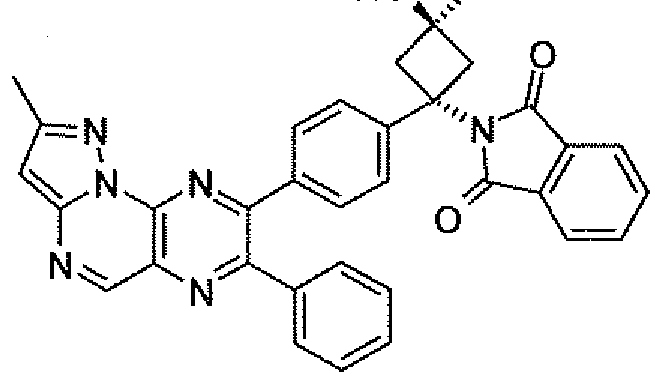

CCXXXII CCXXXIII
A 20 mL scintillation vial containing Compound [CCXXXII] (82 mg, 0.145 mmol). MeOH (3 mL), dioxane (3 mL), and hydrazine (1 mL) was heated at 70 °C for 3 hours. Then the solvent was removed in vacuo. The residue was dissolved in 80% MeOH-water (7 mL, some CH2CIz) and several drops of HOAc. Then it was purified by reverse-phase preparative HPLC using water-acetonitrile-HOAc [95:5:0.05] and acetonitrile-water-HOAc [95:5:0.05] as the mobile phases to provide Compound [CCXXXIII) as a yellow solid (acetate salt): LCMS (ra/e) 437 (M+H); 1H NMR (400 MHz, MeOH- dA) δ ppm 1.50 (s, 3 H) 1.97 (s, 3 H, HOAc) 2.60 (s, 3 H) 2.65 - 2.72 (m, 2 H) 2.82 - 2.91 (m, 2 H) 6.84 (s, 1 H) 7.33 -7.44 (m, 3 H) 7.52 - 7.61 (m, 4 H) 7.78 - 7.83 (m, 2 H) 9.14 (s, 1 H).
Scheme YIII - Synthesis of [CCXXXIXl
^ Tl
HOAc, 100 °C, 16 h
CCXXXIV
LiBHEt3 MnO2
<γ N^NH2 THF NHj, THF / CHCl3
1^ N<s OH N^JL ^H
O
CCXXXV CCXXXVI CCXXXVII
SOCI2
NaO-t-Bu, toluene, DMF, CHClj1DMF 105 °C 60-75 °C YNγN ^γ-Ci

CCXXXVII! CCXXXIX
7-Ainino-2-t-batyl-pyrazoIo[1,5^pyrimidine~6-carboxylic acid ethyl ester [CCXXXV]
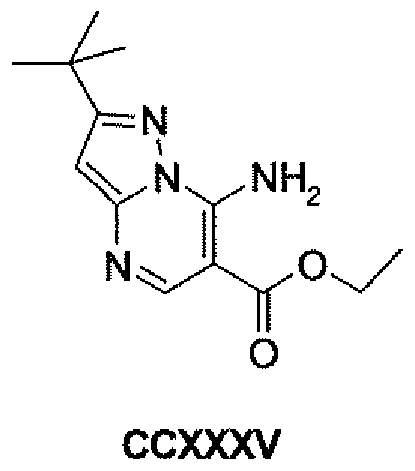
Compound [CCXXXVJ was prepared using a procedure similar to that of Compound [VM]. Data for Compound [CCXXXV]: LCMS (m/e) 263 (M+H); 1H NMR (400 MHz9 CHLOROFORM-d) δ ppm 1.36 - 1.48 (m, 12 H) 4.40 (q, /=7.13 Hz, 2 H) 6.40 (s, 1 H) 6.90 (hr. s., 1 H) 8.40 (hr. s., 1 H) 8.71 (s, 1 H).
(7-Aniino-2-t-but>l-pyrazo]o[ϊ,5-α]pyrimidin-6-yI)-methanol jCCXXXVIJ
V,N_-NH2
CCXXXVI
Compound [CCXXXVT] was prepared using a procedure similar to that of Compound øη. DaIa for Compound [CCXXXVI]: LCMS (m/e) 221 (M+H); 1H NMR (400 MHz, METHANOL-^) δ ppm 1.85 (s, 9 H) 5.11 (s, 2 H) 6.67 (s, 1 H) 8.46 (s, 1 H).
7-Amino-2-t-butyl-pyrazoIo[1,5-α]pyrimidin-6-carbaldehyde CCXXXVIII

O CCXXXVfI
Compound [CCXXXVII] was prepared using a procedure similar to that of Compound pil]. Date for Compound [CCXXXVII]: LCMS (m/e) 219 (M+H); 1H NMR (400 MHz, METHANOL-^) δ ppm 1.86 (s, 9 H) 6.86 (s, 1 H) 8.88 (s, 1 H) 10.29 (s, 1 H).
2-t-But> l-V-phenyl-S-yl^H-l^^^b-tctraaza-cycIopentalfllϊiaphthalen-S-one [CCXXXVπη
H


CCXXXVIlI
Compound [CCXXXVIII] was prepared using a procedure similar to that of Compound [IV]. Data for Compound [CCXXXVIII] : LCMS (m/e) 319(M+H); 1H NMR (400 MHz, METHANOL-^) δ ppm 1.90 (s» 9 H) 6.88 (s, 1 H) 7.75 (t, 1 H) 7.84 (t, ^=7.64 Hz, 2 H) 8.13 (d, J=LH1 Hz, 2 H) 8.18 (none, 1 H) 8.36 (s, 1 H) 8.95 (s, 1 H)
8-Chloro-2-t-butyl-7-phenyl-3-yl-J,4,9,9b-tetraaza-c>clopenta|rt|naphthalene (CCXXXIX]

CCXXXlX
Compound [CCXXXIX] was prepared using a procedure similar to that of Compound [VJ. Data for Compound [CCXXXIX]: LCMS (rn/e) 337(M+H); 1H NMR (400 MHz, CHLOROFORM-rf) δ ppm 1.52 (s, 9 H) 6.82 (s, 1 H) 7.52 (d,J=6.25 Hz, 5 H) 8.20 (s, 1 H) 8.82 (s, 1 H).
tfrαns-2-{3-Methyt3-hydrø^ cyclopenta[a|naphthalen-8"yl)-phenyl}-cyclobutyl}-isoiiidole-l^-dione [CCXL]
HQ v

CCXL
Compound [CCXL was prepared in a similar way to that of Compound [XLJ. Data for Compound [CCXLJ: LCMS (m/e) 608 (M+H); 1H NMR (400 MHz, CHLOROFORM- d) δ ppm 1.44 (s, 3 H) 1.48 (s, 9 H) 3.14 (d, ^=14.40 Hz, 2 H) 3.37 (d, J=UM Hz, 2 H) 6.77 (s, 1 H) 7.24 (d, /==4.39 Hz, 1 H) 7.30 - 7.34 (m, 3 H) 7.56 - 7.63 (m, 5 H) 7.66 - 7.72 (m, 2 H) 7.74 - 7.80 (m, 2 H) 8.20 (s, 1 H) 8.82 (s, 1 H).
frαrø-3-Amino-1-methyl-3-[4-(2-t-butyl-7-phenyI-1,4^,9b-tetraaza- cyclopenta[αjnaphthaIen-8-yi)-phenyl]-cyclobutanol [CCXLI]
HQ

CCXLI
Compound [CCXL!] was prepared in a similar way to that of Compound [XLIj. Data for Compound [CCXLIJ: LCMS (m/e) 478 (M+H); 1H NMR (400 MHz9 METHANOL-J4) δ ppm 1.75 (s, 12 H) 2.95 (d, ,/=14.54 Hz, 2 H) 3.13 (d, ./=14.55 Hz, 2 H) 7.10 (s, 1 H) 7.59 (s, 5 H) 7.78 (d, J=8.40 Hz, 2 H) 7.97 (d, ./=8.40 Hz, 2 H) 8.83 (s, 1 H) 9.30 (s, 1 H).
3-Amino-1-cyclopropyl-3-[4~(2^-diinethyl-7-phenyI-1,4,6,9,9b-pentaaza- cycIopenta[α]naphthalen-8-yl)-pheiiyI]-cyclobutanol [CCXLII]
PdtP-t-BUa)., Cs2CO3. MeB(OH)2 dioxane, 80 °C


CVI CCXLII
A 20 mL scintillation vial containing Compound [CVI] (12 mg, 0.03 mmol, 1 eq.), MeB(OH)2 (50 mg, 0.30 mmol, 10 eq.), CS2CO3 (96 mg, 0.30 mmol, 10 eq.), and dioxane (2 ml) was evacuated and flushed three times with nitrogen. Then, Pd(P-t-Bu3)2 (2.3 mg, 0.0045 mmol, 0.15 eq.) was added and the resulting solution was evacuated and flushed three times with nitrogen. The mixture was heated at 80 °C for 2 hours. Then it was allowed to cool and diluted with MeOH (2 mL). After filtration, the filtrate was purified by reverse-phase preparative HPLC using water-acetonitrile-TFA [95:5:0.05] and acetonitrile-water-TFA [95:5:0.05] as the mobile phases to provide Compound [CCXLII] as a yellow solid: LCMS (m/e) 476 (M+H); 1H NMR (400 MHz, MeOH- <^) δ ppm 0.33 - 0.54 (m, 4 H) 1.11 - 1.23 (m, 1 H) 2.37 (s, 3 H) 2.52 (s, 3 H) 2.56 - 2.66 (m, 2 H) 2.73 - 2.83 (m, 2 H) 7.28 - 7.38 (m, 5 H) 7.52 (d, ./=8.44 Hz, 2 H) 7.72 (d, ./=8.44 Hz, 2 H) 8.51 (s, 1 H) 8.97 (s, 1 H).
frαMs-^{3-røethyI-3-hydro cydopenta[β]naphthaIen-8-yl)--pfaeny!]-cycIobutyl}-isolndoIe-l^-dione [CCXLHI]
HO

CCXUII
Compound [CCXLHI] was prepared in a similar way to that of Compound [XL]. Data for Compound [CCXLIO]: LCMS (m/e) 592 (M-f-H); 1H NMR (400 MHz, CHLOROFORM-d) δ ppm 0.89 - 0.99 (m, 2 H) 1.04 - 1.13 (m, 2 H) 1.44 (s, 3 H) 2.29 (t, /=5.00 Hz, 1 H) 3.14 (d, J=14.40 Hz, 2 H) 3.36 (d, ^=14.40 Hz, 2 H) 7.25 (br. s., 3 H) 7.30 - 7.33 (m, 3 H) 7.70 (dd, 2 H) 7.78 (dd, 2 H) 8.20 (s, 1 H) 8.82 (s, 1 H).
frα«s-3-Ammo-1-MethyW-[4^2-cy^ cyclopenta^naphthalen-S-yQ-pheiiylJ-GycIobυtaiiol [CCXLIV]

CCXUV
Compound [CCXLIV] was prepared in a similar way to that of Compound [XLI]. Data for Compound [CCXLIV]: LCMS (m/e) 462 (M+H); 1H NMR (400 MHz, METHANOL- d4) δ ppm 1.00 - 1.07 (m, 2 H) 1.13 - 1.19 (m, 2 H) 1.53 (s, 3 H) 2.22 - 2.33 (m, 1 H) 2.72 (d, /=14.50 Hz, 2 H) 2.91 (d, 2 H) 6.65 (s, 1 H) 7.37 (s, 5 H) 7.54 (d, J=8.44 Hz, 2 H) 7.75 (d, /=8.44 Hz, 2 H) 8.58 (s, 1 H) 9.07 (s, 1 H).
2-Methyl-7-phenylacefylamiiio-pyrazoIo[l^-α]pyriinidine-6-carfooxyIlc acid methyl ester [CCXLV]

Et3N, CH2CI2 80°C


I CCXLV
A 250 mL round-bottomed flask containing Compound [ϊ\ (l.lOg, 5.0 mmol, 1 eq.), CH2CI2 (40 mL), and EtjN (2.04 g, 20 mmol, 4 eq.) was added slowly phenylacetyl chloride (6.16 g, 40 mmol, 8 eq.). Then the mixture was heated at 80 °C for 4 h. The mixture was allowed to cool and the solvent was removed in vacuo. The residue was dissolved in CEfeCfe (40 mL) and water (25 mL). The aqueous phase was extracted with CH2CI2 (2 x 15 mL). The combined organic solution was dried over Na2SO4. Alter filtration and concentration, the residue was purified by silica gel chromatography using MeOH and CH2CI2 as the mobile phases to furnish Compound [CCXLV] as a yellowish solid (1.7 g, 90%, crude). The small amount of pure sample was purified by reverse-phase preparative HPLC using water-acetonitrile-TF A [95:5:0.05] and acetonitrile-water-TFA [95:5:0.05] as the mobile phases to provide the analytic sample for characterization of Compound [CCXLV]: LCMS m/e 325 (M+H); 1H NMR (400 MHz, CHLOROFORM-*/) δ ppm 2.46 (s, 3 H) 3.80 (s, 3 H) 3.92 (s, 2 H) 6.50 (s, 1 H) 7.28 - 7.51 (m, 5 H) 8.72 (s, 1 H) 9.22 (br. s., 1 H).
2-MethyI-7-phettyl-1,4,9,9b-tetraaza-cyclopenta[α]naphthalene-6>8-diol [CCXLVII
NpHMDS /THF
1,

 OH CCXLV CCXLVI
A 250 mL round bottom flask containing Compound [CCXLV] (1.62g, 5.0 mmol, 1 eq.), THF (30 mL), and NaHMDS (7.5 mL, 7.5 mmol, 1.5 eq.) was stirred at room temperature for 2 h. The reaction was treated with CH2CI2 (30 mL) and water (40 mL). The aqueous phase was extracted with CH2CI2 (2 x 15 mL). The water layer was acidified with concentrated HCl (~10 mL). The precipitated solid was filtered and washed with CH2CI2 (4 mL) to furnish Compound [CCXLVI] as a yellowish solid (0.53 g). The acidified water layer was extracted with 5% MeOH in CH2Cb (3 x 25 mL). The combined organic phases were dried over Na2SO4. After filtration and concentration, the residue was purified by silica gel chromatography using
MeOH and CH2CI2 as the mobile phases to furnish Compound [CCXLVI] as a yellowish solid (0.46 g). The total yield is 0.99 g (68%) for Compound [CCXLVIJ: LCMS m/e 293 (M+H); 1H NMR (400 MHz, DMSO-rf) δ ppm 2.45 (s, 3 H) 6.55 (s, 1 H) 7.07 - 7.56 (m, 5 H) 8.91 (s, 1 H) 10.99 (br. s., 1 H).
6,8-Dich!oro-2-methyI-7-phenyl-1,4,9,9b-tetraaza-cyclopenta[«]naphthalene [CCXLVII]
SOCI2 / DMF CHCi3
700C

CCXLVi

Compound [CCXL VII] was prepared using a procedure similar to that of Compound [V] (SOCl2 procedure). Data for Compound [CCXLVII]: LCMS m/e 329 (M+H); 1H NM (400 MHz, CHLOROFORM-d) δ ppm 2.63 (s, 3 H) 6.75 (s, 1 H) 7.27 - 7.42 (m, 2 H) 7.42 - 7.66 (ra, 3 H) 9.16 (s, I H).
{l-[4-(6-Chloro-2-methyl-7-phenyI-1,4,9,9b-tetraaza~cyclopeπta[α]naphthalen-8-yl)- phenyl]-3-hydroxy-3-methyl-cyclobutyl}-carbamic acid tert-bufyl ester [CCXL VDI]
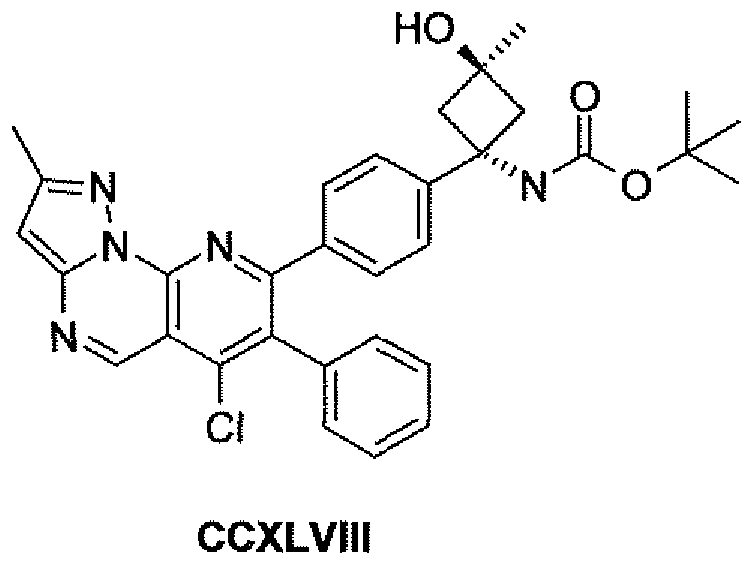
Compound [CCXL VHI] was prepared using a procedure similar to that of Compound [XL]. Data for Compound [CCXLVIII]: LCMS m/e 570 (M+H).
3-Ainino-3-[4-(6-chloro-2-methyl-7-phenyl-1,4,9,9b-tetraaza-cyclopenta[α]naphthaIen-8- yI)-phenyl]-1-methyl-cyclobutanol |CCXLIX|

CCXLIX
Compound [CCXLIX] was prepared using a procedure similar to that of Compound [XLIV]. Data for Compound [CCXLIX]: LCMS m/e 470 (M+H); 1H NMR (400 MHz, METHANOL-^) δ ppm 1.46 (s, 3 H) 2.57 (s, 3 H) 2.61 - 2.69 (m, 2 H) 2.76 - 2.85 (m, 2 H) 6.80 (s, 1 H) 7.22 - 7.29 (m, 2 H)7.34 - 7.39 (m, 3 H) 7.41 - 7.47 (m, 2 H) 7.60 - 7.66 (m, 2 H) 9.30 (s, 1 H).
{l-[4-(2,6-Dimethyl~7-pte^ hydroxy-3-methyI-cyclobutyl}-carbamic acid tert-butyl ester [CCL]
PdCI2(dppf)-DCM Cs2CO3 / dioxaπe
MeB(OH)2 80 °C


CCL
A 20 ml scintillation vial containing Compound ICCXLVIII] (40 mg, 0.07 mmol, 1 eq.), the borate (84 mg, 1.4 mmol, 2 eq.), CS2CO3 (226 mg, 0.70 mmol, 1 eq.), and dioxane (5.0 ml) was evacuated and flushed three times with nitrogen. Then PdCl2(dppf)- CH2CI2 (24 mg, 0.03 mmol, 0.5 eq.) was added and the resulting solution was evacuated and flushed three times with nitrogen. The mixture was heated at 80 °C for 2.5 h. Then it was allowed to cool. The solvent was removed in vacuo. The residue was dissolved in CH2CI2 (10 rtiL). After filtration and concentration, it was purified by silica gel chromatography by using MeOH and CH2CI2 as the mobile phases to furnish Compound [CCL] as a yellowish solid (20 mg, 50%): LCMS (m/e) 550 (M+H).
3-Ammo-3-[4-(2,6-diraethyl-7-ph^ phenylj-1-methyl-cyclobαtanol [CCLI]
HC>

CCLI
Compound [CCLJ] was prepared using a procedure similar to that of Compound [XLIV]. Data for Compound [CCLI] : LCMS m/e 450 (M+H); 1H NMR (400 MHz,
METHANOL-^) δ ppm 1.46 (s, 3 H) 2.55 (s, 3 H) 2.61 (s, 3 H) 2.62 - 2.70 (m, 2 H) 2.77 - 2.86 (m, 2 H) 6.73 (s, 1 H) 7.20 (dd, J^=7.55, 1.77 Hz, 2 H) 7.29 - 7.37 (m, 3 H) 7.41 (d, J=8.49 Hz, 2 H) 7.59 (d, J=8.49 Hz, 2 H) 9.28 (s, 1 H).
S-Chloro^-tert-buty^-phenyϊ-l^^^b-tetraaza-cydopentaJαJnaphthalene
3-ter/-Buryl-lH-pyrazoi-5-aniine ICCXXXTV]
O NH2NH2, H2O1 vΛ Λ^CN EtOH, reflux, 7 h
NH2
CCLII CCXXXEV
A solution of 4,4-dimethyl-3-oxopentaneπitriIe (Compound [CCLII]) (7 g, 55.9 mmol, 1.00 equiv) and NH2NH2-H2O (4.5 g, 140 mmol, 2.00 equiv) in EtOH (100 mL) was stirred for 7 h at HO°C under nitrogen. The reaction progress was monitored by TLC (ethyl acetate/petroleum ether =1:2). After cooling, the resulting solution was concentrated under vacuum and diluted with 50 mL of water. The resulting solution was extracted with CH2Cl2, dried and concentrated under reduced pressure. The residue was loaded onto a silica gel column with ethyl acetate/petroleum ether as the eluent to Compound [CCXXXTV] as a yellowish oil: LCMS (m/e) 140 (M+H); 1HNMR (300 MHz, DMSO-d6) δ ppm 5.18 (s, 1 H), 1.19 (s, 9H). Amount obtained: 7.6 g, 97% yield.
Compound [CCXKSJV] to Compound [CCXXXV]
[* previously described *]
Ethyl 7-ammo~2-tert-biitylpyra2θIo[1,5-α]pyrimidine-6-carboxyIate [CCXXXV]
I n
M \-/ o Λ0^
VN^H HOAc, 100 °C, 16 h
NH ',2
CCXXXIV

A solution of 3-fer^bufyl-l#-pyraz»l-5-amine (484 mg, 3.48 mmol, 1 eq.) and ethyl 2-cyano-3-ethoxyacrylate (590 mg, 3.49 mmol, 1.00 eq.) in acetic acid (10 mL) was stirred for 16 h at 100 °C under nitrogen. After cooling, the resulting mixture was concentrated under vacuum. The pH value of the solution was adjusted to 8 with saturated aqueous NaHCθ3 solution and extracted with ethyl acetate (100 mL x 3). The organic layers were combined, dried and concentrated under reduced pressure. The residue was applied onto a silica gel column with CHbCla/MeOH (30:1) as an eluent to obtain the corresponding product as a white solid: LCMS(m/e) 263 (M+H); 1H NMR (300 MHz, DMSO-dg) δ ppm 8.56 (s, 1 H), 8.40-8.38 (broad, d, J= 6.0 Hz, 2 H), 6.48 (s> 1 H), 4.33 (q, J= 7.2 Hz, 2 H), 1.37 -1.31 (m, 12 H).
(7-Amino-2-lfeιtf-butylpyrazolo[1,5-αJpy
LiBHEt3 THF, 0 °C

 CCXXXVI
A solution of ethyl 7-ammo-2-i'er^butylpyrazolo[1,5-α]pyrimidine-6-carboxylate (740 mg, 2.82 mmol, 1.00 equiv) in tetrahydrofuran (12 mL) was added dropwise LiBHEt3 (8.5 mL of a 1 M solution in THF, 3.0 eq.) at 0 °C under nitrogen. After addition, the resulting solution was stirred for 4 h at 25 °C. Additional LiBHEt3 (0.85 mL of a 1 M solution in THF, 0.85 mmol, 0.3 eq.) was added and the mixture was stirred for another 1 h. After a total of 3 h, the reaction was then quenched with water and extracted with ethyl acetate (100 mL x 3). The organic layers were combined, dried and concentrated. The residue was loaded onto a silica gel column with CH2Cl2ZMeOH (30:1) as an eluent to give Compound [CCXXXVI] as a white solid: LCMS (m/e) 221 (M+H);}U NMR (300 MHz, DMSO-d,;) δ ppm 8.02 (s, 1H), 7.32 (s, 2H), 6.22 (s, 1H), 4.94 (t, J= 5.7 Hz9 1H), 4.53 (d, J= 5.7 Hz, 2H), 1.36 (s, 9H).
7-Amino-2-fcr/-butylpyrazolo[],5-a]pyrϊmidinc-6-carbaldehyde [CCXXXVII)
\=n MnO2 Uy
VN^NH2 THF / CHO3 <y NN^NH2
O CCXXXVI CCXXXVII
A solution of (7--unmo-2-ter^butylpyra^^ (380 mg, 1.73 mmol, 1 eq.) and MnO2 (1.5 g, 17.25 mmol, 10 eq.) in THF (6 mL) and CHCl3 (12 ml) was stirred for about 36 h at 25 °C under nitrogen. Mnθ2 was filtered and washed with 15% MeOH in CHCl3 (~100 mL) and 30% MeOH in CHCl3 (~100 mL) until no additional product was observed through analysis of the filtrates by TLC. The filtrates were combined and concentrated under vacuum to give Compound [CCXXXVII] as a yellow solid: LCMS (m/e) 219 (M+H); 1H TSIMR (300 MHz, DMSO, δ, ppm) 9.87 (s, 1H), 8.99-8.82 (s, 2H)9 8.50 (s, 1H), 6.52 (s, 1H), 1.38 (s, 9H).
2-/ft'r/-But>l-7-phenyl-9H-1,4,9,9b-tetraa2ii-cyclopenta[α]naphthalen-8-one [CCXXX\7lJt]

NaOt-Bu, toluene, DMF, 105 °C

O
 ccxxxvii CCXXXVlIl
A solution of 7-amino-2-/e^butylpyrazolo[1,5-a]pyriniidine-6-carbaldehyde (1.5 g, 6.87 mmol, 1.00 eq.), methyl 2-phenylacetate (4.1 g, 27.30 mmol, 4.00 eq.) and NaO*Bu (1.3 g, 13.53 mmol, 2.00 eq.) in toluene (30 mL) was stirred at 105 °C for about 30 min under nitrogen. Then the reaction mixture was added 30 mL of DMF and the mixture was stirred for about 2 days at 105 °C. After concentrating under vacuum, the residue was diluted with water and extracted with ethyl acetate. The organic layers were combined and dried over anhydrous sodium sulfate and concentrated under vacuum. The residue was applied onto a silica gel column with ethyl acetate/petroleum ether (1 :6) to give the resulted product (1 g, 46%) as a yellow solid LCMS (m/e) = 319 (M+H); 1H NMR (300 MHz, DMSO, δ, ppm) 8.82 (s, 1H), 8.42 (s, 1H), 7.72 (d, J= 6.9 Hz, 2H), 7.50-7.38 (m, 3H), 6.72 (s, 1H), 1.42 (s, 9H).
8-Chloro-2-^^but>1-7-phenyI-1,4,9,9b-tetraaza-cycIopentafβ]naphthaIene fC€XXXlX]
SOCI2 CHCl31DMF
.0 60-75 °C YYS
I
U I S Uf^l
 CCXXXVIII CCXXXIX
To a 100 mL three necked round bottom flask was added 2-fer/-butyl-7-phenyl- 9/-r-lΛ9J9b-tetraaza-cycloρenta[fl]naphthalen-8-one (1 g, 3.14 mmol, 1.00 equiv), CHCl3 (20 mL), thionyl chloride (0.94 mL, 4.00 equiv) and DMF (48 μL, 0.20 equiv) and the resulting solution was stirred for 1 h at 7O°C under nitrogen. After Ih, additional thionyl chloride (0.47 mL, 2.00 equiv) and DMF (48 μL, 0.20 equiv) was added and the resulting solution was stirred for an additional 2 h at 70 °C. After a total of 3 h, the resulting mixture was concentrated under vacuum and the pH value of the solution was adjusted to 7 with saturated aqueous NaHCO3 solution. The resulting solution was extracted with ethyl acetate and the organic layers were combined and dried and concentrated under vacuum. The residue was loaded onto a silica gel column with ethyl acetate/petroleum ether as the eluent to give the Compound ICCXXXIX] as a yellow solid. 1H NMR (300 MHz, DMSO, «5, ppm) 9.09 (s, 1H), 8.74 (s, 1H), 7.60-7.52 (m, 5H), 6.97 (s, 1H), 1.44 (s, 9H); LC-MS: m/z - 337 (M+H)+.
Scheme: 2-Methoxyphenyϊ substituent:
MeO

Η HOAc, 100 °C, 16 h

MeO MeO


CCLIV CCLV CCLVI
NaO-t-Bιι, toluene, 105 °C


CCLVII CCLVIII
Ethyl 7»amino-2-(4-methoxyphenyI)pyτazoIo[1,5-fl]pyrimid«ιe-6-carboxyIate [CCLIV]
MeO / CN MeO
EtO ^r-O O x
HOAc, 100 °C1

CCLIII

To a 50 πiL round-bottom flask was added Compound [CCLIII] (1 g, 5.29 ramol, 1.05 eq.), ethyl^-cyano-S-ethoxyacryiate (0.85 g, 5.02 mmol, 1.00 eq.), and HOAc (20 mL). The mixture was heated at 100 °C for 16 h. The reaction was concentrated and the residue was treated with HfeO (20 mL). The resulting precipitate was filtered, and the precipitate washed with H2O (3 X 50 mL). The crude product was dried in an oven to afford of Compound [CCLIV] :
LCMS (m/e) 313(M+H); 1H NMR (300 MHz, DMSO-^6) ξ ppm 1.35 (t, /=7.2 Hz, 3 H) 3.83 (s, 3 H) 4.34 (q, J=72Ηz, 2 H) 7.01 (s, 1 H) 7.08 (d, J=8.7Hz, 2 H) 8.05 (d, J=8.7Hz, 2 H) 8.49 (s, 1 H) 8.60 (s, 1 H) 8.68 (s, 1 H).
(7-Amiao-2^4-methyoiyphe^ [CCLV]
LiBHEt3 THF


CCLlV CCLV
To a 100 mL three-necked round bottom flask was added Compound [CCLIV] (1.38 g, 4.42 mmol, 1.00 eq.) and THF (35 mL). The mixture was cooled to 0 °C and LiBHEt3 (13.3 mL of a 1.0 Msolution in THF, 13.3 mmol, 3.00 eq.) was added slowly through an addition funnel under nitrogen. After addition, the mixture was stirred at room temperature for 4 h. Additional LiBHEt3 (1.3 mL of a LO M solution in THF, 1.3 mraoL 0.30 eq.) was added and the mixture was stirred for an additional 1 h. The mixture was slowly treated with EtOAc (30 mL) and then water (15 mL). The layers were separated and the aqueous phase was extracted with EtOAc (2 X 30 mL). The combined organic phases were dried over anhydrous Na2SO4. After filtration and concentration, the residue was purified by a silica gel column using dichloromethane/methanol as the eluent. Concentration by rotary evaporation provided Compound [CCLV] as a light yellowish solid: LCMS (m/e) 271(M-S-H); 1H NMR (300 MHz, DMSO-<&) ξ ppm 3.83 (s, 3 H) 4.55 (d,J=5.4 Hz, 2 H) 5.00 (t, J=5.7 Hz, 1 H) 6.77 (s, 1 H) 7.05 (d, J=9 Hz, 2 H) 7.55 (s, 1 H) 8.01 (d, ^8.7 Hz, 2 H) 8.08 (s, 1 H).
7-Amino-2-(4-methoxyphenyl)pyrazolo[1,5-α]pyrimidme-6-carbaldehyde [CCLVI]
MeQ


CCLV CCLVi
To a 100 mL round bottom flask containing Compound [CCLV] (0.67 g, 2.48 mmoL 1.00 eq.) was added CHCl3 (30 mL) and THF (15 mL) followed by MnO2 (2.2 g, 24.79
mmol, 10.00 eq.). The mixture was stirred at room temperature for 2 days. The mixture was filtered and the filtered material washed with MeOH (~100 mL) until no additional product was observed through analysis of the filtrates by TLC. The resulting mixture was concentrated under vacuum. The residue was purified by a silica gel column using dichloromethane /methanol as the eluant. Concentration by rotary evaporation provided Compound 4 as a yellowish solid. LCMS (m/e) 269QΛ+H); 1K NMR (300 MHz, DMSO-<&) δ ppm 3.84 (s, 3 H) 7.02 (s, 1 H) 7.08 (d, ^8.7 Hz, 2 H) 8.05 (d, J=9 Hz, 2 H) 8.52 (s, 1 H) 9.88 (s, 1 H).
l^-Methoxyphenyl^T-phenyl-WΪ-l^^^b-tetraaza-cyclopeiitalaliiaphthalene-S-one
[CCLVΠI

NaO-t-Bu, toluene, DMF, 105 °C


CCLVI
CCLVII
To a 100 mL round bottom flask was added Compound [CCLVI) (0.5 g, 1.86 mmol, 1.00 eq.), methyl phenylacetate (1.12 g, 7.45 mmol, 4.00 eq.), toluene (15 mL), and NaO- f-Bu (0.36 g, 3.73 mmol, 2.00 eq.). The mixture was heated at 105 °C for 30 min and the formation of large amounts of solid was noted. DMF (15 mL) was added and the solid was observed to go into solution. The mixture was heated for 3 days. After this time, the heat was removed and the mixture allowed to cool to room temperature. The reaction mixture was concentrated and the residue dissolved in CH2CI2 80 mL), followed by the addition of water (80 mL) to form a yellowish precipitate. The solid was filtered and washed with water (20 mL) and CH2CI2 (30 mL). The collected solid was dried in an oven to furnish Compound [CCLVII] as a yellowish solid: 1H NMR (300 MHz, DMSCMs) δ ppm 3.84 (s, 3 H) 6.91 (s, 1 H) 7.06 (d, J=8.7 Hz, 3 H) 7.26 - 7.41 (m, 3 H) 7.79 (d, J=7.2Hz, 1 H) 7.94 (s, 1 H) 8.01(d, J=8.7 Hz, 2 H) 8.49 (s, I H).
8-Chloro-2-(4-MethoxyphenyI)-7-phenyl-9H-1,4,9,9b-tetraaza-cyclop«nta[a]naphthaIene-8- one [CCLVIiη


CCLVII CCLVIII
To a 50 mL round bottom flask was added Compound [CCLVII] (0.3 g, 0.81 mmol, 1.00 eq.), POCI3 (15 mL). The mixture was heated to reflux in an oil bath for 4 h. The reaction was concentrated in vacuo and the residue was added to 10 mL of ice/water. Adjusted the pH value to 8 with Na^CC^. The aqueous phase was extracted with CH2Cl2 (3 X 30 mL). The combined organic phases were dried over anhydrous Na2SC^. After filtration and concentration, the residue was purified by a silica gel column using CH^Vpetroleum ether as the eluent. Concentration by rotary evaporation provided Compound [CCLVHIj as a light yellowish solid: LCMS m/e 387 (M+H); 1H NMR (300 MHz, CHLOROFORM-d) δ ppm 3.91 (s, 3 H) 7.04 (d, J=8.7 Hz, 2 H) 7.19 (s, 1 H) 7.55 (s, 5 H) 8.12 (d, J=%J Hz, 2 H) 8.24 (s, 1 H) 8.88 (s, 1 H).
Scheme: 2-isopropy! substituent

HOAc IOO °C, 16 h

LiBHEt3 MnO2 THF THF / CHCl3


 o
o
CCLXII CCLXIII CCLXlV

NaO-t-Bu, SOCl2 toluene, DMF, CHCl3, DMF 105 °C 60-75 °C


CCLXV CCLXVI
4-Methyϊ-3-oxopentanenitrile [CCLX]

CCLDC CCLX
A IL three necked bottle containing NaH (70%, 23.2 g, 677 mmol, 1.60 equiv) and THF (30OmL) was maintained at reflux condition for about 1.5 hrs. Then a mixture of ethyl isobutyrate (Compound [CCLIX))(SO g, 430 mmol, 1.00 equiv) and acetonitrile (27.7 g. 675 mmol, 1.60 equiv) in THF (70 mL) was added dropwise with stirring in 2 hrs and heated to reflux for overnight. After cooling, the reaction mixture was then quenched with water and the pH value of the solution was adjusted to 4 with 2 N hydrogen chloride and extracted with ethyl acetate (3 x 100 mL). The organic layers were combined and washed with brine and dried. After concentration, the residue was loaded onto a silica gel column with ethyl acetate/petroleum ether
as the eluent to afford Compound [CCLXJ as a yellow oil: LC-MS m/e 112 (M+H) +; 1H NMR (300 MHz, CDCl3) δ ppra 3.55 (s, 2H), 2.81 (septet, J = 6.9 Hz, 1H), 1.19 (d, J= 6.9 Hz, 6H).
Msopropyl-lff-pyrazoI-S-aiiiiiie JCCLXIJ
NH2NH2 CN *■
 CCLX
CCLX

A solution of 4-meroyl-3-oxoρentanenitrile (Compound [CCLXJ) (8.8 g, 79.2 mmol, 1.00 equiv) and NH2NH2 H2O (80%, 7.5 g, 120 mmol, 1.50 equiv) in ethanol (300 mL) was heated to reflux for 1 h under nitrogen. After removed the solvent under vacuum, the residue was loaded onto a silica gel column with dichloromethane/methanol as an eluent to give Compound [CCLXIJ as a yellowish oil: LC-MS m/e 126 (M+H) +; 1H NMR (300 MHz, DMSO- de) δ ppm 5.17 (s, 1H), 2.75 (septet, J - 6.9 Hz, 1H), 1.14 (d, J = 6.9 Hz, 6H).
7-Amino-2-isopropyl-pyrazolo[l^-a]pyrimidine-6-carboxylic acid ethyl ester [CCLXIIJ
H NH2
IX
O CCUQI
Compound [CCLXHJ was prepared using a procedure similar to that of Compound (VHJ. Data for Compound [CCLXHJ: LCMS m/e 249 (M+H) +; 1H NMR (300 MHz, DMSO-de) δ ppm 8.56 (s, 2H), 8.38 (s, 1H), 6.44 (s, 1H), 4.32 (q, J= 6.9 Hz, 2H ), 3.35 (s, 1H), 3.10 (septet, J= 6.9 Hz, 1H ), 1.36-1.30 (m, 9H).
(7-Amino--2-isopropyl-pyrazolo[l^~α]pyrimidin-6-yl)-methanol [CCLXπi]

CCUCtII
Compound ICCLXJΩ] was prepared using a procedure similar to that of Compound [II]. Data for Compound [CCLXiπ J: LCMS m/e 207 (M+H)VH NMR (300 MHz, DMSOd6) δ ppm 8.02 (s, 1H), 7.39 (s, 1H), 6.19 (s, 1H)94.94 (t J= 4.2 Hz 1H), 4.51 (d, J = 4.2 Hz, 1H), 3.07 (septet, J= 6.9 Hz, 1H ), 1.32 (d, J= 6.9 Hz, 6H).
7-Amino-2-isopropyI-pyrazoIo[1,5-α]pyrimidra-6-carbaIdehyde [CCLXIV]

O CCLXIV
Compound [CCLXIV] was prepared using a procedure similar to that of
Compound [1H]. Data for Compound (CCLXTV]: LCMS m/e 205 (M-HH)+; 1HNMR (300
MHz, DMSOd6) δ ppm 9.87 (s, 1H), 8.99 (s, 1H), 8.49 (s, 1H), 6.47 (s, 1H), 3.10 (septet, J= 6.9
Hz, 1H), 1.32 (d, J= 6.9 Hz, 6H);
2-Isopropyl-7-phenyl-9jHr-1,4,9,9b-tetraaza-cyclopenta[a]naphthalen-8-one (CCLXV]

CCLXV
Compound [CCLXV] was prepared using a procedure similar to that of
Compound [TV]. Data for Compound [CCLXV]: LCMS (m/e) 305 (M+H) ; 1H NMR (300 MHz, DMSOd6) δ ppm 8.81 (s, 1H), 8.39 (s, 1H), 7.74-7.72 (m, 2H), 7.50-7.37 (m, 3H), 6.69 (s, 1H), 3.18 (septet, J = 6.9 Hz, 1H), 1.36 (d, J = 6.9Hz, 6H).
^Chloro-2-i5opiOpyl-7rphenyI-1,4,9,9b4etraaza-cyclopeiιta[β]iiaphthalene [CCLXVI]

CCLXVI
Compound [CCLXVI] was prepared using a procedure similar to that of Compound [V], SOCl2 procedure. Data for Compound [CCLXVIj: LCMS (m/e) 323 (M+H);.!H NMR (300 MHz9 DMSO-d6) δ 9.10 (s, 1H), 8.74 (s, 1H), 7.63-7.50 (m, 5H), 6.91 (s, 1H), 3.21 (septet, J= 6.9 Hz, 1H), 1.38 (d, J= 6.9Hz, 6H).
Scheme: 2-cycϊobutyI substituent
NaH, THF,
 CH3CN NH2NH2
HOAc, 100 °C, 16 h
CN


CCLXVIi CCLXVIIE CCLXIX
UBHEt3 IMnO2 THF γNγi NnH, THF / CHCl,
OH

O
 CCLXX CCLXX! CCLXXiI

NaO-t-Bu, SOCl2 toluene. DMF1 CHCl3, DMF 105 °C 60-75 °C

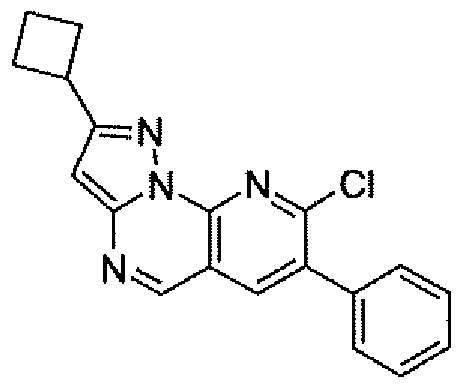
CCLXXIII CCLXXFV
3-Cyclobutyl-3-oxopropanenitrϋe [CCLXVπi]

CCLXVII CCLXVIII
A 50 mL three necked round bottom flask containing NaH (980 mg, 60%, 24.50 mmol, 1.57 eq.) and THF (10 mL) was heated to reflux under nitrogen for about 30 min. Then a mixture of cyclobutanecarboxylate [CCLXVII] (2 g, 15.6 mmol, 1.00 eq.) and acetonitrile (1 g, 24.3 mmol, 1.56 eq.) in 20 mL of THF was added dropwise to the refmxing suspension. After addition, the resulting mixture was reflυxed for 16 h and worked up with water. The pH value of the reaction solution was adjusted to 4 with aqueous HCl solution and extracted with ethyl acetate. The combined organic phases were dried and concentrated, the residue was applied onto
a silica gel column with ethyl acetate/petroleum ether as the eluent to give Compound [CCLXVmj as a yellow oil: 1H NMR (300 MHz, CDCl3) δ ppm 3.40-3.60 (m, 1H), 3.43 (s, 2H), 2.25-2.36 (m, 4H), 2.01-2.15 (m, 1H), 1.82-1.96 (m, 1H).
S-Cyclobαiyl-tff-pyrazol-S-aiiiine [CCLXIX]
NH2 CCLXIX
Compound [CCLXIX] was prepared using a procedure similar to that of Compound [CCLXI]. Data for Compound [CCLXIX]: LCMS (m/e) 138 (M+H); 1H NMR (300 MHz, DMSO-d6) «5 ppm 11.07 (s, 1H), 5.24 (s, 1H), 4.43 (s, 2H), 3.20-3.40 (m, 1H), 2.12- 2.28 (m, 2H), 1.95-2.12 (m, 2H), 1.82-1.95 (m, 1H), 1.70-1.82 (m, 1H).
Ethyl 7-amino-2-cycIobutyIpyrazolo[l^-α]pyrimidine-6-carboxylate [CCLXX]

Compound [CCLXX] was prepared using a procedure similar to that of Compound [VII]. Data for Compound [CCLXX]: LCMS (m/e) 261 (M+H); 1H NMR (300 MHz, DMSOd6) δ ppm 8.65 (s, 1H), 8.57 (s, 1H), 8.39 (s, 1H), 6.51 (s, 1H), 4.29-4.36 (m, 2H), 3.66-3.72 (m, 1H), 2.18-2.45 (m, 4H), 1.85-2.15 (m, 2H), 1.31-1.36 (t, J= 7.2 Hz, 3H). Amount obtained: 1.3 g, 68% yield as a white solid.
(7-Amino-2~cycIobutylρyrazolo[1,5-α]pyriinid-n-6-yl)iiiethaiιol [CCLXXI]

CCLXXI
Compound [CCLXXI] was prepared using a procedure similar to that of Compound (UJ. Data for Compound [CCLXXI]: LCMS (m/e) 219 (M+H); 1H NMR (300 MHz, DMSO-d6) «5 ppm 8.03 (s, 1H), 7.43 (s, 2H), 6.27 (s, 1H), 4.90-5.00 (t, J= 4.8 Hz9 1H), 4.50-4.52 (d, J= 4.8 Hz, 2H), 3.57-3.73 (m, 1H), 2.18-2.45 (m, 4H), 1.85-2.15 (m, 2H).
7-Ajn!iio-2-cyclobutylpyrazolo[1,5-α]pyriπ!idiQe-6-carbaldehyde [CCLXXII]

O CCU(XII
Compound [CCLXXII] was prepared using a procedure similar to that of Compound (DO]. Data for Compound [CCLXXH]: LCMS (m/e) 217 (M+H); 1H NMR (300 MHz, DMSOd6) δ ppm 9.87 (s, 1H), 9.02 (s, 2H), 8.50 (s, 1H), 6.54 (s, 1H), 3.60-3.78 (m, 1H), 2.20-2.40 (m, 4H), 1.98-2.12 (m, 1H), 1.82-1.98 (m, 1H).
2-Cγclobutyl-7-phenyl-9H-1,4,9,9b-tetraaza-cydopentaftf]naphthalen-8-one [CCLXXiπ]

CCLXXlIl
Compound [CCLXXπi] was prepared using a procedure similar to that of Compound [IV]. Data for Compound [CCLXXHI]: LCMS (m/e) 317 (M+H); 1H NMR (400 MHz, DMSOd6) δ ppm 13.36 (s, 1H), 8.79 (s, 1H), 8.37 (s, 1H), 7.35-7.73 (m, 5H), 6.72 (s, 1H), 3.70-3.80 (m, 1H), 2.22-2.42 (m, 4H), 1.85-2.15 (m, 2H).
8-Chloro-2-c>clobut>'l-7rphcnyJ-T,4,9,9b-tetraaza-cyclopentø|/7lnaphthaIene fCCLXXI\']

CCLXXIV
Compound [CCLXXIVj was prepared using a procedure similar to that of
Compound (VJ, SOCl2 procedure. Data for Compound [CCLXXIV]: LCMS (m/e) 335 (M+H); 1H NMR (300 MHz, CDCl3) δ ppm 8.86 (s, 1H), 8.23 (s, 1H), 7.54 (s, 5H), 6.88 (s, 1H), 3.88- 4.02 (m, 1H), 2.32-2.56 (m, 4H). 1.92-2.22 (m, 2H).
/rβ«5-2-{3-MethyI-3-hydroxy-1-[4-(2-(4-methoxyphenyl)-7-phenyH,4^,9b~tetraaza- cycIopenta[tf]naphthaIen-8-yI)-phenyl]-cyclobutyl}-isoindole-13-dione [CCLXXV]
MeO

CCI-XXV
Compound [CCLXXV] was prepared using a procedure similar to that of
Compound [XL). Data for Compound [CCLXXV]: LCMS (m/e) 658 (M+l) This material was carried onto the next step without further purification or characterization.
jrflws-3-Araino-1-methyl-3-[4-(2-(4-methoxyphenyI)-7-phenyI-1,4,9,9b-tetraaza- cyclopenta[α]naphthaIen-8-yl)-pheny]]-cycIobutanoI [CCLXXVI]
MeQ

CCLXXVI
Compound [CCLXXVI] was prepared in a similar way to that of Compound [XLq. Data for Compound [CCLXXVI]: LCMS (m/e) 530 (M+H); 1H NMR (400 MHz, METHANOL-^) δ ppm 1.50 (s, 3 H) 1.91 (s, 3 H) 2.49 - 2.62 (m, 2 H) 2.72 - 2.85 (m, 2 H) 3.85 (s, 3 H) 6.99 - 7.08 (m, 2 H) 7.22 (s, 1 H) 7.28 - 7.37 (m, 5 H) 7.42 - 7.51 (m, 2 H) 7.62 - 7.71 (m, 2 H) 7.99 - 8.10 (m, 2 H) 8.54 (s, 1 H) 9.05 (s, 1 H).
*rø»s-2-{3-Methyl-34.ydroxy-H4-(2-isopr^^ cyclopentalαJnaphthalen-S-y^-phenylJ-cyclobutylj-isouidole-lβ-dione JCCLXXVII]
HO

CCLXXVIt
Compound [C(XXXVII] was prepared using a procedure similar to that of Compound [XL]. Data for Compound [CCLXXVIIj: LCMS (m/e) 564 (M+l) This material was carried onto the next step without further purification or characterization.
/rα«$-3-Amino-1-methyI-3-[4-(2-isopropyϊ-7~phenyl-1,4,9,9b-tetraaza- cyclopenta[fl]naphthalen-8-yI)-phenyl]-cydobutanol [CCLXXVIII)
*

CCLXXVIiI
Compound [CCLXXVIII] was prepared in a similar way to that of Compound IXLI]. Data for Compound [CCLXXVIII]: LCMS (m/e) 464 (M+H); 1H NMR. (400 MHz, METHANOL-^) 6 ppm 1.42 (d, JMS.96 Hz, 6 H) 1.48 (s, 3 H) 2.65 - 2.71 (m, 2 H) 2.83 - 2.89 (m, 2 H) 3.23 - 3.26 (m, 1 H) 6.79 (s, 1 H) 7.32 (br. s, 5 H) 7.50 (d, ./=8.40 Hz, 2 H) 7.71 (d, /=8.37 ^ 2 ^ 8.55 (3, I H).
ltaκs-2-{3-Methyl»3-hydros^ cycIopenta[α]naphthalen-8-yl)-phenyl]-cyclobutyl}-isoiiidole-13-dion€ [CCLXXIX]
v

CCLXXIX
Compound [CCLXXIXj was prepared using a procedure similar to that of
Compound [XL]. Data for Compound [CCLXXIX]: LCMS (m/e) 576 (M+ 1) This material was carried onto the next step without further purification or characterization.
frαιis-3-Araino-1-methyM-[4^ cyclopenta[α]naphtbaIen-8-yl)-pheny]]-cycIobutanol [CCLXXX]
HO

CCLXXX
Compound [CCLXXX] was prepared in a similar way to that of Compound [XLIJ. Data for Compound ΪCCLXXXJ: LCMS (m/e) 476 (M+H); 1H NMR (400 MHz, METHANOL-^) δ ppm 1.48 (s, 3 H) 2.10 - 2.18 (m, 1 H) 2.37 - 2.49 (m, 3 H) 2.68 (s, 2 H) 2.82 - 2.89 (m, 2 H) 3.85 (t, J^.65 Hz, 1 H) 6.86 (s, 1 H) 7.30 - 7.35 (m, 5 H) 7.49 (d, ^=8.37 Hz, 2 H) 7.71 (d, ^8.35 Hz, 2 H) 8.55 (s, 1 H) 9.04 (s, 1 H).
2-ferϊ:-Bulyl-7-(2'-fIuoro-phenyl)-9iϊ-1,4,9,9b-tetraaza-cycϊoρenta[α]uaphthalen-8-one [CCLXXI]

Compound [CCLXXXI] was prepared in a similar way to that of Compound [IV]. Data for Compound ΪCCLXXXIJ: LCMS (m/e) 337 (M+H);.1H NMR (300 MHz, DMSO- d6) δ ppm 9.08 (s, 1H), 8.80 (s, 1H), 7.62-7.55 (m, 2H), 7.47-7.40 (m, 2H), 6.98 (s, 1H), 1.44 (s, 9H).
8-ChIoro-2^r^butyl^7-(2t-fluoiOphenyl)-lA9,9b-tetraaza-cyclop«nta[αϊnaphthalene [CCLXXXπ]

CCLXXXIl
Compound [CCLXXXII] was prepared in a similar way to that of Compound [V], SOCl2 method. Data for Compound [CCLXXXII] : LCMS (m/e) 355 (M+H); 1HNMR (300 MHz, DMSO-d6) δ ppm 9.08 (s, 1H), 8.80 (s, 1H), 7.62-7.55 (m, 2H), 7.47-7.40 (m, 2H), 6.98 (s, 1H), 1.44 (s, 9H).
2-/ert-ButyI-7-(2'-thienyl)-9JH-1,4,9,9b-tctraaza-CΛxiopenta[o]naphthalen-8-one
[ccLXxxmϊ

IJ CCLXXXIII
Compound [CCXXXXOI] was prepared in a similar way to that of Compound [IV] . Data for Compound [CCLXXXπi] : LCMS (ra/e) 325 (M+H); 1H NMR (300 MHz, DMSO-40 δ ppm 8.79-8.75 (d, 2H), 7.84-7.82 (d, 1H), 7.64-7.62 Cd91H), 7.21-7.18 (m, 1H), 6.73 (s, 1H), 1.42 (s, 9H).
8-ChIoro-2-ter/-butyI-7-(2'-thienyl)-1,4,9,9b-tetraaza-cycϊopenta[α]naphthaIene [ccLxxxivj

Compound [CCLXXXIVJ was prepared in a similar way to that of Compound [V], SOCl2 method. Data for Compound [CCLXXXIVJ: LCMS (m/e) 343 (M+H);.*H NMR (300 MHz, DMSOd6) δ ppm 9.10 (s, 1H), 8.96 (s, 1H), 7.87-7.85 (d, 1H), 7.66-7.65 (d, 1H), 7.31-7.28 (m, 1H), 6.97 (s, 1H), 1.43 (s, 9H).
2-tert-Butyl-7-(3f-thienyI)-9^r-1,4,9,9b-tetraaza-<;ycIopeiita[a]naphthaleii-8-one [CCLXXXV]

δ-C^loiO^-fe^buiyl-T-CS'-thienylJ-l^^^b-tetraaza-cycIopeiitalαliiaphtiialene [CCLXXXVl]

Compound [CCLXXXVI] was prepared in a similar way to that of Compound
[V], SOCl2 memod. Data for Compound [CCLXXXVIj: LCMS (m/e) 343 (M+H); 1H NMR
(300 MHz, DMS(WQ δ ppm 9.08 (s, 1H), 8.82 (s, 1H), 7.98 (d, J= 0.9Hz, 1H), 7.77 (dd, /= 3.0
Hz, 1H), 7.51 (dd,J= 0.9 Hz, 1H), 6.96 (s, 1H), 1.43 (s, 9H).
6røis-2-{3^Hydro:iy-3H^ yl)-phenyl]-cyclobutyI}-isoind«)le-13-<lione [CCLXXX\U|

CCLXXXVIE
Compound [CCLXXXVII] was prepared in a similar way to that of Compound [XL]. DaIa for Compound [CCLXXXVII]: LCMS (m/e) 552 (M+H). This material was used in the next step without further characterization.
3-Amrao-1-raethyI-3-[4-(7-phenyW^ cyclobntanol [CCLXXXMII]
*

CCLXXXVIiI
Compound [CCLXXXVIII] was prepared in a similar way to that of Compound [XLI]. Data for Compound [CCLXXXVπiJ: LCMS (m/e) 422 (M+H); 1H NMR (400 MHz, METHANOL-^) δ ppm 1.48 (s, 3 H) 2.68 (d, VH4.64 Hz, 2 H) 2.80 - 2.91 (ra, 2 H) 6.95 (d, /=2.15 Hz, 1 H) 7.33 (s, 5 H) 7.50 (d, J=8.40 Hz, 2 H) 7.70 (d, J=8.40 Hz, 2 H) 8.25 (d, JH .95 Hz, 1 H) 8.59 (s, 1 H) 9.10 (s, 1 H).
Scheme: 2-pyridyI substituent
MeOH, NaH, THF, H2SO4 CH3CN
OH OMe

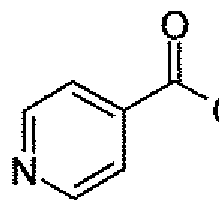
 CCLXXXIX CCXC CCXCI
o^-

HOAo, 100 °C, 16 h N^ .NH. Mn°2
H ^^ 2 THF /CHCi3

NH2 ,OH
 CCXCII CCXCIiI
V7

SOCI2
WM NaO-t-Bu, CHCl3, toluene, DMF, °C 60-75 °C
H 105

O
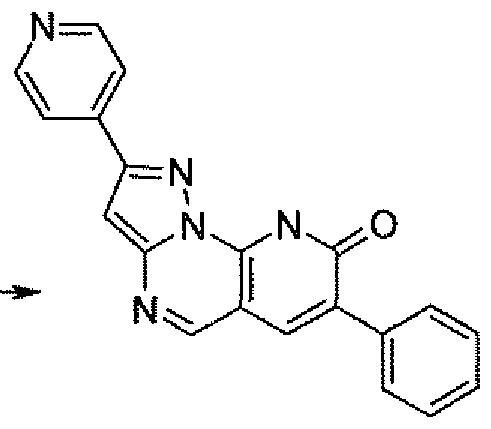

CCXCV
CCXCVi CCXCVIl
Methyl isonicontinate [CCXC)
MMeeOOHH,, Q
OMe
 M N^
M N^
CCLXXXiX CCXC
To a 250 mL 3-necked round-bottom flask was added a solution of Compound [CCLXXXIX] (10 g, 81.30 mmoi, 1.00 eq.) in methanol (25 raL). To this, concentrated H2SO4 (12,5 mL) was added slowly at room temperature. The mixture was heated to reflux overnight in an oil bath. The resulting mixture was concentrated under vacuum. The resulting solution was extracted with 3x300 mL of ethyl acetate and the organic layers combined and dried over anhydrous sodium sulfate and concentrated under vacuum to provide Compound [CCXC) as colorless liquid: LCMS (m/e) 138 (M+H); 1H NMR (300 MHz, CHLOROFORM-d) δ ppm 3.93 (s, 3 H) 7.80 - 7.82 (m, 2 H) 8.74 - 8.76 (m, 2H).
3-Oxo-3-(pyridiii-4-yl)propanenitrile [CCXCI]
Q NaH1 THF, n
U CHsCN °
ccxc ccxc,
To a 50 mL 3-necked round-bottom flask was added a solution of sodium hydride (520 mg, 13.00 mmol, 1.60 eq., 60% dispersion in mineral oil) in toluene (10 mL). The mixture was heated to reflux and Compound [CCXC] (1 g, 6.62 mmol, 1.00 eq.) in CH3CN (6.56 mL) was added dropwise. After addition, the mixture was stirred at reflux overnight in an oil bath. The reaction was then cooled to room temperature and quenched by addition of 200 mL of ice/water. The pH value was adjusted to 4 with aqueous hydrogen chloride (2 N). The mixture was extracted with 2x50 mL of dichloromethane and the organic layers combined and dried over anhydrous sodium sulfate and concentrated under vacuum to afford compound [CCXCI] as an orange solid: LCMS (m/e) 147 (M+H).
3-(Pyridm-4-yI)-lfl-pyra«oI-5-ainine [CCXCII]

Compound [CCXCII] was prepared using a procedure similar to that of Compound ICCLXIJ. Data for Compound [CCXCII]: LCMS(m/e) 161.
Ethyl 7-amino-2-(pyridin-4-yl)-pyrazolori,5-a]pyriinidme-6-carboxylatc [CCXCni]

Compound [CCXCIII] was prepared using a procedure similar to that of
Compound [VII]. Data for Compound [CCXCIII]: LCMS(m/e) 284 (M+H); 1H NMR (300 MHz, DMS(W6) δ ppm 1.45(t, J=6.9 Hz, 3 H) 4.34 (q, J=6.9 Hz, 2 H) 6.94(s, 1 H) 7.08(s,l H)7.86~7.88 (m, 2H) 8.58 (ss 1 H) 8.75 (m, 2 H) 8.82(s, 1 H).
(7-Amino-2-(pyridiii-4-y!)-pyrazoIo[1.5-α]pyriiiiidin-6-yl)niethaiioI (CCXCIV]

CCXCIV
Compound [CCXCIV] was prepared using a procedure similar to that of Compound [H]. Data for Compound [CCXCIV]: LCMS m/e 242 (M+H);
7-Ainino-2-(p>τidin-4-yl)-pyrazolo[1,5-α]pyrimidine-6-carbaldehyde [CCXCV]

Compound [CCXCVJ was prepared using a procedure similar to that of Compound [HI]. Data for Compound [CCXCV]: LCMS (ra/e) 240(M+H); 1H NMR (300 MHz, DMSO-4) δppm 7.29 (s, 1 H) 8.06 (m, 2 H) 8.61 (s, 1 H) 8.74(s, 2H) 9.21 (s, 2 H) 9.94 (s, 1 H).
2-(Pyridra^-yl)-7-phenyI-9^-1,4,9,9b-tetraaza-cydopenta[α]naphthaIen-«-oiie [CCXCVη

CCXCVI
Compound [CCXCVI] was prepared using a procedure similar to that of Compound [IVj. Data for Compound [CCXCVI]: LCMS (m/e): 340 (M+H); 1H NMR (300 MHz, DMSO-d) ppm 7.14 (s,1H) 7.27 - 7.29 (m,1H) 7.35 - 7.40 (m,2H) 7.79 - 7.81 (m,2H) 7.90 (s,1H) 8.04 (s,2H) 8.51 (s,1H) 8.67 (s,2H).
8-Ch]oro-2-(pyridin-4-y])-7-phenyI-1,4,9,9b-tetraaza-cydopcnta[α]naphthalene [CCX€\T[I]

frα«s-2-{3-Methyl-3-hydrox^ cyclopentafajnaphthalen-e-y^-phenylj-cyclobutylj-isoindole-l^-dione [CCXCVIII]

CCXCVIlI
Compound [CCXCVIII] was prepared using a procedure similar to that of Compound [XL]. Data for Compound [CCXCVM]: LCMS (m/e) 629 (M+l) This material was carried onto the next step without further purification or characterization.
frαws-3-Aramo-1-methy^ cyclopenta[α]naphthalen-8-yl)-phenyl]-cyclobutanol [CCXCIX]

CCXCIX
Compound [CCXCIX] was prepared in a similar way to that of Compound
[XLI]. Data for Compound [CCXCIX]: LCMS (m/e) 499 (M+H); 1H NMR (400 MHz9 METHANOL-^) δ ppm 1,51 (s, 3 H) 1.90 (s, 6 H) 2.50 - 2.59 (m, 2 H) 2.71 - 2.81 (m, 2 H) 7.30
- 7.39 (m, 5 H) 7.45 - 7.53 (m, 3 H) 7.65 (d, ./=8.35 Hz, 2 H) 8.17 (d, J=5.76 Hz, 2 H) 8.60 (s» 1 H) 8.65 (d, J=5.56 Hz, 2 H) 9.13 (s, 1 H).
Scheme: 2-(thiophen-3-yl) substituent
MeOH, NaH, THF1 H2SO4 CH3CN NH2NH2
■*• <^r ^O\Ae


CCC V ccci CCCII
,S
O Os/

>=N ^ M
^ ^N. ""'nIXOJ2,
H HOAc, 100 °C, 16 h THF /CHCI3
NH OH
'2
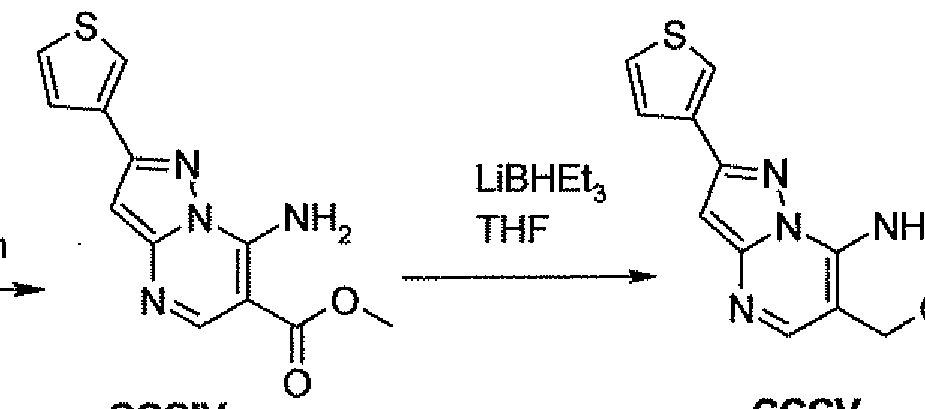
CCCIiI CCCIV

V N NH NaO-t-Bu, CHCl3,
T V 2 toluene, DMF1 4 N N O 60-75 °C

CCCVI
CCVfI CCVIII
Methyl thiophenc-3-carboxylate [CCCIJ
OMe

CCCI
Compound [CCCI] was prepared in a similar way to that of Compound [CCXC] .
Data for Compound [CCCI]: LCMS(rα/e) 143 (M+H); 1H NMR (300 MHz, CHLOROFORM- d) δ ppm 3.89 (s, 3 H) 7.31-7.34 (m, 2 H) 7.53 (m, 1 H) 8.12 (m, 1 H).
3-Oxo-3-(thiophen-3->l)propanenitrUe [CCCπ]

CCCIl
Compound [CCCI] was prepared in a similar way to that of Compound [CCXCI]. Data for Compound [CCCIJ : 1H NMR (300 MHz, DMS(W6) δ ppm 4.65 (s, 2 H) 7.51 (m, 1 H) 7.62 (m, 1 H) 8.56 (m, 1 H).
3-(thiophen-3-yϊ)-l//-pyrazol-5-amine [CCCIΪI]
U
^ telϊN.H
NH2 CCCIII
Compound [CCCIH] was prepared using a procedure similar to that of Compound [CCLXI]. Data for Compound [CCCIII]: LCMS(m/e) 166 (M+H); 1H NMR (300 MHz, OMSO-dβ) δ ppm 4.72 (br.s, 2 H) 5.66 (s, 1 H) 7.37 (s, 1 H) 7.54 (s, 1 H) 7.63 (s, 1 H).
Ethyl 7-amino-2-(thiophen-3-yl)-pyrazoIo[1,5-α]pyriιnidine-6-carbθ3ylate [CCCIV]

CCCIV
Compound [CCCIV] was prepared using a procedure similar to that of
Compound [VB-]. Data for Compound [CCCIV]: LCMS(m/e) 289 (M+H); 1H NMR (300 MHz, OMSO-dt) δ ppm 1.32 (t, /=6.9 Hz, 3 H) 4.31 (q, J^6S Hz, 2 H) 6.97 (s, 1 H) 7.70 (m, 2 H) 8.16 (s, 1 H) 8.51 (s, 1 H) 8.61 (s, 2 H).
(7-Amino-2-(thiophen-3-yl)-pyrazoloEl^-α]pyrimidin-6-yl)mcihanol [CCCV]
V-N^NH2
N^ JL .OH
CCCV
Compound (CCC V] was prepared using a procedure similar to that of Compound [H]. Data for Compound [CCCV]: LCMS m/e 247 (M+H); 1H NMR (300 MHz, DMSO-J6) δ ppm 3.18 (s, 1 H) 4.54 (s, 2 H) 5.00 (s, 1 H) 6.74 (s, 1 H) 7.52 (s, 2 H) 7.65 (m, 2 H) 8.04 (s, 1 H) 8.04 (m, 2 H).
7-Amino-2-(thiophen-3-yl)-p3τ<azoIo[lϊ5^]pyιimidine^H;arbaldehyde [CCCVI]
,s
1 /y
*=N

O cccvi
Compound [CCC VI] was prepared using a procedure similar to that of Compound [KI]. Data for Compound [CCCVI]: LCMS m/e 245 (M+H); 1H NMR (300 MHz, DMSO-J6) δppm 7.0Q (s, 1 H) 7.71 (m, 2 H) 8.18 (s} 1 H) 8.56 (s, 1 H) 9.07 (s, 2 H) 9.90 (s, 1 H).
2<Thiophen-3-yI)-7rphenyϊ-9-ff^^

CCCVIl
Compound [CCC VII] was prepared using a procedure similar to that of
Compound [IV]. Data for Compound [CCCVII]: LCMS (m/e): 345 (M+H);
S-Chloro^-^hiophen-S-ylJ-T-phenyl-l^^^b-tetraaza-cycIopentattfJnaphthaiene [CCCViπj

CCCVIlI
To a 250 mL round bottom flask was added Compound [CCVII] (1 g, 2.91 mmol, 1.00 eq.), POCI3 (40 mL). The mixture was heated to reflux in an oil bath for 4 h. The reaction was concentrated in vacuo and the residue was added to 50 mL of ice/water. Adjusted the pH value to 8 with Na2COj. The mixture was extracted three times with 500 ml CH2CI2 and the organic layers was collected. The combined organic phases were dried over Na∑SO-j, filtered, concentrated and purified by silica gel chromatography using CHiCl^petroleum ether as the eluent to give Compound [CCCV1H]: LCMS (m/e) 363 (M+H); 1H NMR (300 MHz, CHLOROFORM-**) δ ppm 7.14 (s, 1 H) 7.45 (dd, J;=5.1 Hz, Jg=3 Hz, 1 H) 7.55 (s, 5 H) 7.80 (m, 1 H) 8.02 (s, 1 H) 8.26 (s, 1 H) 8.90 (s, 1 H).
frαns-2-{3-MethyI-3-hydro^ cyclopeataJflJnaphthalen-S-y^-phenylj-cycIobutylJ-isoindole-l^-dione [CCXCViπ]

CCClX
Compound [CCCIX] was prepared using a procedure similar to that of Compound [X)L]. Data for Compound [CCCIX]: LCMS (m/e) (M+l) This material was carried onto the next step without further purification or characterization.
cyclopeata[αInaphtha!en-8-yϊ)-phenyIϊ-cycΪGbutanol [CCCX]

CCCX
Compound (CCCX] was prepared in a similar way to that of Compound [XLI]. Data for Compound [CCCX]: LCMS (m/e) 504 (M+H); 1H NMR (400 MHz, METHANOL-^) δ ppm 1.50 (s, 3 H) 1.91 (s, 3 H) 2.48 - 2.64 (ra, 2 H) 2.67 - 2.88 (m, 2 H) 7.21 (s, 1 H) 7.28 - 7.38 (m, 5 H) 7.42 - 7.50 (m, 2 H) 7.53 (dd, J^5.05, 2.95 Hz, 1 H) 7.60 - 7.71 (m, 2 H) 7.79 (dd, J=5.O5, 1.20 Hz, 1 H) 8.10 (dd, _A=2.95, 1.20 Hz, 1 H) 8.55 (s, 1H) 9.06 (s, 1 H).
2-Methyl-7^heayl^-{4-[4-(5^yridin-2-yl-4^ phenyl}-1,4^,9b~tetraazacyclopenta[α]naphthalene [CCCXI]
NaBH(OAc)3 TEA1 HOAC DMF RT, 3 h


CCCXII
Compound [CCCXII] was prepared using a procedure similar to that of [XCII] using Compound [CCCXI] as starting material (known in WO 2009021992). Data for Compound [CCCXII]: LCMS m/e 578 (M+H); 1H NMR (400 MHz, METHANOLS) δ ppm 1.97 (s, 6H) 1.98 - 2.11 (m, 2H) 2.10 - 2.28 (m, 2 H) 2.39 - 2.68 (m, 2 H) 2.59 (s, 3H) 2.92 - 3.07 (m, 1H) 3.08 -3.25 (m, 2 H) 3.83 (br, s, 2H) 6.76 (s, 1H) 7.24 - 7.42 (m, 7 H) 7.41 - 7.51 (m, 1 H) 7.62 (d, J=8.20 Hz, 2 H) 7.88 - 8.00 (m, 1 H) 8.09 (d, J=7.86 Hz, 1H) 8.56 (s, 1 H) 8.66 (ds J=4.39 Hz, 1 H) 9.06 (s, 1 H).
4-Methyl-3-(5-piperidiιi-4-yl-4JΪ-[l^,4]tria«ol-3-yl)-pyridine hydrochloride [CCCXV]
EtOEtOHΛMaOMe
NHNH2 + N


O CCCXIII CCCXIV
2 HCl

CCCXIV CCCXV
A mixture of Compound [CCCX1H] (600 mg, 2.47 mmol), Compound [CCCXTV] (291 mg, 2.47 mmol), and sodium methoxide (266 mg, 25 wt% solution in methanol) in 2-ethoxyethanol (6 mL) was heated at 125 °C for 16 h. The reaction mixture was partitioned between EtOAc and saturate aqueous ammonium chloride solution. The aqueous layer was extracted with additional EtOAc. The combined organic layer was dried over Na2SO4, filtered, and concentrated. The crude material was purified by ISCO to obtain Compound [CCCXVJ as a colorless oil (73.3 mg, 9%). 1H NMR (400 MHz, CHLOROFORM-d) δ ppm 1.57 (s, 9 H) 1.77 - 1.95 (m, 2 H) 2.09 (d, J==2.44 Hz, 2 H) 2.62 (s, 3 H) 2.89 - 3.01 (m, 2 H) 3.06 (br. s., 1 H) 3.98 - 4.51 (m, 2 H) 7.22 (d, 7=4.59 Hz, 2 H) 8.50 (d, >4.93 Hz, 2 H) 9.07 (br. s., 1 H).
A solution of Compound [CCCXV] (73.3 mg) dissolved in 1 mL of 1,4-dioxane was treated with 4 M HCl in 1,4-dixoane (1.5 mL). The suspension was stirred at rt for 1 h. The volatiles was evaporated in vacuo. Compound [CCCXVI] was obtained as a while solid (015HXL012), which was used inthe next step directly. 1H NMR (400 MHz, METHANOL-^) δ ppm 2.04 - 2.20 (m, 2 H) 2.36 (d, J==11.08 Hz, 2 H) 3.02 (s, 3 H) 3.18 - 3.28 (m, 2 H) 3.50 - 3.60 (m, 2 H) 8.07 (d, J==6.10 Hz, 1 H) 8.71 (d, /=5.37 Hz, 1 H) 9.30 (s, 1 H)
2-MeΛyl-8<4-{4-[5^4-methyIpy^^ phenyl)-7-phenyl-1,4,9,9b-tetraazacycϊopcDta[σ]naphtha]eπe [CCCXVH]

CCCXVII
Compound [CCCXVII] was prepared using a procedure similar to that of [XCII]. Data for Compound [CCCXVII]: LCMS m/e 592 (M+H); 1H NMR (400 MHz, METHANOL- dA) δ ppm 1.94 (br, s, 1 H) 1.97 (s, 3 H) 1.99 2.06 (m, 1 H) 2.13 (d, J=2.88 Hz, 2 H) 2.36-2.52 (m, 2 H) 2.59 (s, 3 H) 2.94 - 3.05 (m, 1 H) 3.12 (d, J=9.23 Hz, 2 H) 3.77 (br, s, 1 H) 6.76 (s, 1 H) 7.22 - 7.45 (m, 7 H) 7.61 (d, J=8.20 Hz, 2 H) 8.42 (d, J=5.08 Hz, 1 H) 8.56 (s, 1 H) 8.83 (s, 1 H) 9.05 (s, 1 H).
4-[5-(2-Trffluoromethyl-phenyO^ [CCCXVπi]
2 HCI

CCCXViII
Compound [CCCXVIII] was prepared using a procedure similar to that of [CCCXV]. Data for Compound [CCCXVOI]: 1H NMR (400 MHz, METHANOL-^) δ ppm 2.02 - 2.18 (m, 2 H) 2.27 - 2.40 (m, 2 H) 3.15 - 3.27 (m, 2 H) 3.46 - 3.59 (m, 2 H) 7.73 (d, J=22S Hz, 1 H) 7.76 - 7.87 (m, 2 H) 7.92 (d, J=2.25 Hz, 1 H)
2-Methyl-7-phenyl-8-(4-{4-[5-(2-triiluoromethyl-phenyI)-4H-|ly2,41triazol-3-ylJ-piperidiπ- l-ylmethyl}-phenyl)-1,4,9,9b-tetraaza-cyclopenta[α]naphthalene [CCCXIX]
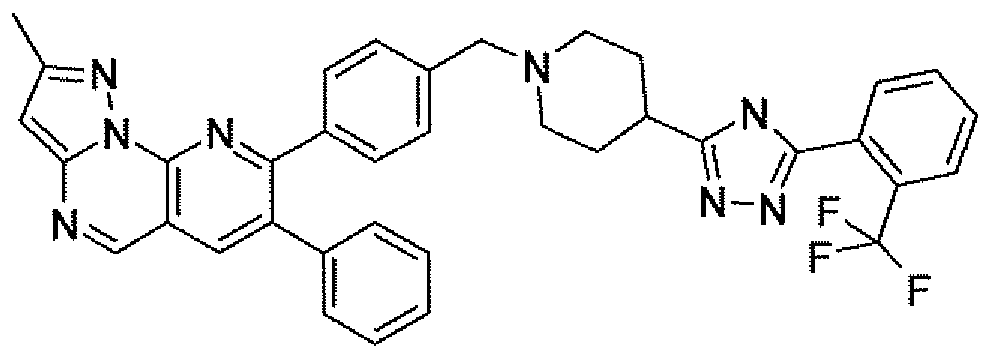
CCCXIX
Compound [CCCXIX] was prepared using a procedure similar to that of [XCII]. Data for Compound [CCCXIX] : LCMS m/e 645 (M+Η); 1H NMR (400 MHz, METHANOL-^) δ ppm 1.88 - 2.05 (m, 2 H) 1.96 (s, 3 H) 2.07 - 2.17 (m, 2 H) 2.37 (br, s, 2 H) 2.59 (s, 3 H) 2.90
- 3.01 (m, 1 H) 3.07 (d, J=Il.71 Hz, 2 H) 3.71 (br, s, 2 H) 6.76 (s, 1 H) 7.27 - 7.39 (m, 7 H) 7.54
- 7.78 (m, 6 H) 7.85 (d, J=7.86 Hz, 1 H) 8.55 (s, 1 H) 9.05 (s, 1 H).
4-(5-Piperidin-4-yI-4/f-E1,2,4]triazol-3-yl)-beiizamide hydrochloride [CCCXX]
 HCl
HCl
CCCXX
Compound [CCCXX] was prepared using a procedure similar to that of ICCCXV]. Data for Compound [CCCXXj: 1H NMR (400 MHz, METHANOL-***) δ ppm 2.04 - 2.19 (m, 2 H) 2.34 (d, ^=13.96 Hz, 2 H) 3.16 - 3.27 (m, 2 H) 3.53 (d, ^=13.13 Hz, 2 H) 7.97 - 8.05 (m, 2 H) 8.05 - 8.20 (m, 2 H).
4^5-{l-[4-(2-MethyI-7rphenyM,4^ piperidin-4-yl}-4jEF-[l^,4jtriazol-^yI)-beiizamide [CCCXXI]

CCCXXI
Compound [CCCXXI] was prepared using a procedure similar to that of [CCCXV]. Data for Compound [CCCXXη: LCMS m/e 620 (M+H); 1H NMR (400 MHz, METHANOLS) δ ppm 1.90 - 2.06 (m, 2 H) 1.96 (s, 3 H) 2.06 - 2.18 (m, 2 H) 2.27 - 2.48 (m, 2 H) 2.59 (s, 3 H) 2.88 - 3.03 (m, 1 H) 3.04 - 3.18 (m. 2 H) 3.73 (br, s, 2 H) 6.76 (s, 1 H) 7.21 - 7.41 (m, 7 H) 7.60 (d, J=8.15 Hz, 2 H) 7.96 (d, J=8.44 Hz, 2 H) 8.09 (d, J=8.35 Hz, 2 H) 8.55 (s, 1 H) 9.05 (s, 1 H).
445-(3-rrifluoromethyl-phenyl)-4H- 11, 2,4] triazol-3-yl]-piρeridine hydrochloride ϊcccxxπj

CCCXXII
Compound [CCCXXII] was prepared using a procedure similar to that of [CCCXV]. Data for Compound [CCCXXDI]: 1H NMR (400 MHz, METHANOL-^) δ ppm 2.00 - 2.24 (m, 2 H) 2.29 - 2.42 (m, 2 H) 3.13 - 3.29 (m, 2 H) 3.42 - 3.63 (m, 2 H) 7.74 (d, J^7.81 Hz, 1 H) 7.78 - 7.86 (m, 1 H) 8.26 (d, J=7.86 Hz, 1 H) 8.32 (s, 1 H)
2-Methyl-7-phenyl-8-(4-{4~[5-(34rifluoromethyl-phenyI)-4Jff-(lr2,4]triazol-3~yl]-piperidiii- l-y]methyI}-phenyl)-1,4^,9b-tctraaza-cyclopenta[αInaphthalene [CCCXXiπ]

CCCXXIII
Compound [CCCXXIII] was prepared using a procedure similar to that of [XCH]. Data for Compound [CCCXXmi: LCMS m/e 645 (M+H); 1H NMR (400 MHz, METHANOLS) δ ppm 1.91 - 2.05 (m, 2 H) 1.96 (s, 3 H) 2.07 - 2.17 (m, 2 H) 2.29 - 2.45 (m, 1 H) 2.59 (s, 3 H) 2.96 (dd, J=I 5.62, 8.59 Hz, 1H) 3.09 (d, J=12.74 Hz, 2 H) 3.71 (s, 2 H) 6.76 (s, 1 H) 7.26 - 7.41 (m, 7 H) 7.60 (d, J=8.20 Hz, 2 H) 7.68 (d, J=7.76 Hz, 1 H) 7.71 - 7.77 (m, 1 H) 8.26 (d, J=7.71 Hz, 1 H) 8.31 (s, 1 H) 8.55 (s, 1 H) 9.05 (s, 1 H)
4-(5-pyridin-3-yl-4^-[l^,4]triazol-3-yl)-piperidine [CCCXXIV]
2 HCl
 was known in WO 2006135627.. Compound [CCCXX3V) was prepared as described in WO 2006135627.
2-Methyl-7-phenyl-8-{4-[4-<5-pyridin-3-yI-4//-[J,2,4]triazoI"3-yl)-pipeήc]in-1-ylmeth>Il- phenyl}-1,4,9,9b-tetraaza~cyclopenta[α]naphthalene [CCCXXV]

CCCXXV
Compound ICCCXXV] was prepared using a procedure similar to that of [XCIIJ. Data for Compound [CCCXXV]: LCMS m/e 578 (M+H); 1H NMR (400 MHz, METHANOL- d4) δ ppm 1.92 - 2.06 (m, 2 H) L97 (s, 6 H) 2.07- 2.19 (m, 2 H) 2.37 - 2.52 (m, 2 H) 2.59 (s, 3 H) 2.93 - 3.05 (m, 1 H) 3.13 (d, J=I 1.81 Hz, 2 H) 3.78 (s, 2 H) 6.76 (s, 1 H) 7.25 - 7.41 (m, 7 H) 7.51-7.57 (m, 1 H) 7.61 (d, J=8.20 Hz, 2 H) 8.37 - 8.44 (m, 1 H) 8.56 (s, 1 H) 8.58 (dd, J=4.93, 1.51 Hz, 1 H) 9.05 (s, 1 H) 9.17 (d, J=1.71 Hz, 1 H)
4-[5^4-Triflnoromethyl-phenyl)-4£r-[1,2,4]tria2»I-3-yI]-piperidine hydrochloride [CCCXXVI]
HCI

CCCXXVI
Compound [CCCXXVIΪ was prepared using a procedure similar to that of [CCCXV]. Data for Compound [CCCXXVI]: 1H NMR (400 MHz, METHANOL-J4) δ ppm 1.99 - 2.21 (m, 2 H) 2.27 - 2.48 (m, 2 H) 3.16 - 3.27 (m, 2 H) 3.49 - 3.59 (m, 2 H) 7.84 (d, .£=8.25 Hz, 2 H) 8.19 (d, ^=8.15 Hz, 2 H).
2-Methyl-7-phenyl-8-(4-{4^5-(4-t^ l-ylraethylj-phenyO-l^^^b-tetraaza-cyclopentatαlnaphthalene [CCCXXVΪ11

CCCXXVII
Compound [CCCXXVII] was prepared using a procedure similar to that of IXCII]. Data for Compound [CCCXXVII]: LCMS m/e 645 (M+H); 1H NMR (400 MHz, METHANOL-J4) δ ppm 1.96 (s, 3 H) 1.89 - 2.04 (m, 2 H) 2.05 - 2.19 (m, 2 H) 2.27 - 2.45 (m, 2 H) 2.59 (s, 3 H) 2.89 - 3.02 (m, 1 H) 3.08 (d, J=7.91 Hz, 2 H) 3.70 (s, 2 H) 6.76 (s, 1 H) 7.23 - 7.42 (m, 7 H) 7.60 (d, J=8.15 Hz, 2 H) 7.76 (d, J=8.44 Hz, 2 H) 8.19 (d, J=8.15 Hz, 2 H) 8.56 (s, 1 H) 9.05 (s, 1 H)
4-(5-PhenoxymethyI-4jy-[1^4]triazol-3-yl)-piperidine hydrochloride [CCCXXVm]
 HC!
HC!
CCCXXVIII
Compound [CCCXXV1H] was prepared using a procedure similar to that of [CCCXV]. Data for Compound [CCCXXVIII] : 1H NMR (400 MHz, METHANOL^) δ ppm 1.99 - 2.23 (m, 2 H) 2.26 - 2.42 (m, 2 H) 3.11 - 3.26 (m, 2 H) 3.51 (d, J=12.45 Hz, 2 H) 5.30 (s, 2 H) 636 - 7.09 (m, 3 H) 7.21 - 7.38 (m, 2 H).
2-MethyI-8-{4-[4-(5-pheno:ϊ^ 7-phenyI-1,4,9,9b-tetraaza-cyclopenta[α]naphthalene [CCCXXIX]

CCCXXIX
Compound [CCCXXIX] was prepared using a procedure similar to that of [XCH]. Data for Compound [CCCXXK]: LCMS m/e 607 (M+H); 1H NMR (400 MHz, METHANOL-^) δ ppm 1.85 (2.04 (m, 2 H) 1.95 (s, 3 H) 2.09 (d, J=13.28 Hz, 2 H) 2.45 (d, J=10.25 Hz, 2 H) 2.59 (s, 3 H) 2.83 - 3.05 (m, 1 H) 3.12 (d, J=14.55 Hz, 2 H) 3.78 (br, s, 2 H) 5.12 (s, 2 H) 6.76 (s, 1 H) 6.86 - 7.07 (m, 3 H) 7.18 - 7.42 (m, 9 H) 7.61 (d, J=8.20 Hz, 2 H) 8.56 (s, 1 H) 9.05 (s, 1 H).
3-MethyI-2-(5-piperidm-4-yl-4J.r-[1,2,4]triazoI-3-yl)-pyridHie hydrochloride [CCCXXX]
N


N- 2 HC!
CCCXXX
Compound [CCCXXX] was prepared using a procedure similar to that of
[CCCXV]. Data for Compound [CCCXXX]: 1H NMR (400 MHz, METHANOL-^) δ ppm
2.10 - 2.25 (m, 2 H) 2.26 - 2.45 (m, 2 H) 2.93 (s, 3 H) 3.21 - 3.31 (m, 2 H) 3.49 - 3.65 (m, 2 H) 7.97 (d, J=SJl Hz, 1 H) 8.55 (d, ./=7.81 Hz, 1 H) 8.69 (d, JE=5.61 HZ, 1 H).
2-MethyI-8-(4-{4-[5-(3-raethyl-^^ phenyI)-7-phenyl-1,4,9,9b-tetraaza-cycIopeuta[α]naphthalene [CCCXXXI]

CCCXXXI
Compound [CCCXXXI] was prepared using a procedure similar to that of [XCII]. Data for Compound [CCCXXXI]: LCMS m/e 592 (M+H); 1H NMR (400 MHz,
METHANOL-^) δ ppm 1.97 (s, 9 H) 2.00 - 2.13 (m, 2 H) 2.17 (d, J=6.05 Hz, 2 H) 2.59 (s, 3 H) 2.61 (br, s, 3 H) 2.98 - 3.11 (in, 1 H) 3.21 (d, J=6.74 Hz, 2 H) 3.92 (br, s, 2 H) 6.77 (s, 1 H) 7.25 - 7.45 (m, 9 H) 7.64 (d, J=8.10 Hz, 2 H) 7.78 (4 J=7.32 Hz, 1 H) 8.49 (d, J-5.12 Hz, 1 H) 8.57 (s, 1 H).
4- [5-(3-Methox>'-phenyl)-4H-[l ,2,41 triaz<)l-3-yϊ]-p]pcridine hydrochloride [CC:CXXXπ]

CCCXXXII
Compound [CCCXXXII] was prepared using a procedure similar to that of
[CCCXV]. Data for Compound [CCCXXXII]: 1H NMR (400 MHz, METHANOL-^) δ ppm 2.07 - 2.25 (m, 2 H) 2.40 (d, J=14.74 Hz, 2 H) 3.17 - 3.34 (m, 2 H) 3.49 - 3.62 (m, 2 H) 3.91 (s, 3 H) 7.11 - 7.35 (m, 1 H) 7.42 - 7.64 (m, 3 H).
8-(4-{4-[5-(^Metho:*tf-phenyI)-^^^ methyl-7-phenyϊ-1,4,9,9b-tetraaza-cyclopeuta[α]naphthalene fCCCXXXπη

CCCXXXIII
Compound [CCCXXXIII] was prepared using a procedure similar to that of [XCII]. Data for Compound [CCCXXXHI]: LCMS m/e 607 (M+H); 1H NMR (400 MHz, METHANOL-^) δ ppm 1.97 (s, 6 H) 1.98 - 2.11 (m, 2 H) 2.10 - 2.26 (m, 2 H) 2.59 (s, 3 H) 2.90 - 3.04 (m, 1 H) 3.09 - 3.25 (m, 3 H) 3.86 (s, 3 H) 6.76 (s, 1 H) 6.92 - 7.13 (m, 1 H) 7.24 • 7.45 (m, 8 H) 7.49 - 7.59 (m, 2 H) 7.62 (m, 2 H) 8.56 (s, 1 H) 9.05 (s, 1 H).
4-[5-(4-Methox>'-phenyI)-4JF/-[1,2,4]triazol-3-yl]-piperidinc hydrochloride [CCCXXXIV]

CCCXXXIV
Compound [CCCXXXIV] was prepared using a procedure similar to that of [CCCXV]. Data for Compound [CCCXXXIV]: 1H NMR (400 MHz, METHANOL-^) δ ppm 2.07 - 2.23 (m, 2 H) 2.31 - 2.43 (m, 2 H) 3.16 - 3.28 (m, 2 H) 3.47 - 3.57 (m, 2 H) 3.91 (s, 3 H) 7.17 (d, J=8.93 Hz, 2 H) 7.74 - 8.11 (m, 2 H).
8-(4-{4-[5-(4-Metho^-phenyIM^ methyl-7-phenyl-1,4,^b-tetraaza-cyclopenta[β]naphthaleiie [CCCXXXV]

CCCXXXV
Compound [CCCXXXV] was prepared using a procedure similar to that of [XCπ]. Data for Compound [CCCXXXV]: LCMS m/e 607 (M+H); 1H NMR (400 MHz,
METHANOL-^) δ ppm 1.97 (s, 3 H) 1.98 - 2.08 (m, 2 H) 2.09 - 2.23 (m, 2 H) 2.59 (s, 3 H)
2.89 - 3.04 (m, 1 H) 3.08 - 3.26 (m, 2 H) 3.85 (s, 3 H) 6.76 (s, 1 H) 7.02 (d, J=8.69 Hz, 2 H) 7.20 (d, J=8.69 Hz92 H) 7.20 - 7.47 (m, 7 H) 7.62 (d, J=8.15 hz, 2 H) 7.88 (d, J=8.69 Hz, 2 H) 8.56 (s, 1 H) 9.05 (s, 1 H).
2-MethyI-7^henyl-8-{4-[4-(6,7,8^-tetrahydro-5^-[l^,4ϊtriazoIo[4^-a]a2epiiι-3-yl)- piperidiii-1-ylmetlιyl]-phenyl}-1,4,9,9b-tetraaza-cyclopeiita[α]naphthaleiιe [CCCXXXVIJ

CCCXXXVI
Compound [CCCXXXVIJ was prepared using a procedure similar to that of [XCII]. Data for Compound [CCCXXXVII]: LCMS m/e 569 (M+H); 1H NMR (400 MHz, METHANOL-^) δ ppm 1.66 - 1.84 (m, 4 H) 1.98 (s, 6 H) 1.87 - 2.03 (m, 4 H) 2.38 - 2.54 (m, 2 H) 2.59 (s, 3 H) 2.86 - 3.02 (m, 3 H) 3.16 (d, J=12.20 Hz, 2 H) 3.80 (s, 2 H) 4.06 (d, J=9.71 Hz, 2 H) 6.76 (s, 1 H) 7.23 = 7.42 (m, 7 H) 7.61 (d, J=8.25 Hz, 2 H) 8.56 (s, 1 H) 9.05 (s, 1 H).
4-(5-pyridin-2-yI-4flr-[l^,4]triazoI-3-yl)-piperidine [CCCXXXVII]
i CCCvXXXVII
Compound [CCCXXXVII] was prepared as described in WO2009021992.
2-Methyt7^henyl-8-{444K5^yridin-2-yWjff41,2,4]triaTOl-3-yI)-piperidi!i-1-ylmethyl]- phenyl}-1,4,9,9b-tetraaza-CΛclopentaf«jnaphthalcne [CCCXXXViπi
 -* >
-* >
CCCXXXVIII
Compound [CCCXXXVI] was prepared using a procedure similar to that of [XCII]. Data for Compound [CCCXXXVπi]: LCMS m/e 578 (M+H); 1H NMR (400 MHz, METHANOL-^) δ ppra 1.95 - 2.06 (m, 2 H) 2.09 - 2.18 (m, 3 H) 2.48 (t, J=9.76 Hz, 2 H) 2.55 Os, 3 H) 2.97 (s, 1 H) 3.12 <d, J=I 1.91 Hz, 2 H) 3.79 (s, 2 H) 6.73 (s, 1 H) 7.26 - 7.36 (m, 7 H) 7.39 - 7.45 (m, 1 H) 7.58 (d, J=8.20 Hz, 2 H) 7.86 - 7.95 (m, 1 H) 8.06 (d, J=7.81 Hz, 1 H) 8.52 (s} 1 H) 8.63 (d, J=4.49 Hz, 1 H) 9.01 (s, 1 H)
4-[4-(5-pyridm-4-yMH-[ϊ^,4]triazol-3-yl)-piperidine [CCCXXXIX]

CCCXXXfX
Compound [CCCXXXIX] was prepared as described in WO2009021992.
2-Methyl-7-phenyl-8-{4-[4K5φyridin-4-yl-4JΪ-[l^,4]triazol-3-yI)-piperidin-1-ylmethyη- phenyl}-1,4,9,9b-tetraaza-cyclopenta[a]naphthalene [CCCXL]
N-N

CCCXU
Compound [CCCXL] was prepared using a procedure similar to that of [XCII]. Data for Compound [CCCXL] LCMS m/e 578 (M+H); 1H NMR (400 MHz, METHANOL-^) δ
ppm 2.02 - 2.20 (m, 1 H) 2.32 - 2.46 (m, 2 H) 2.57 (s, 3 H) 3.07 - 3.24 (m, 2 H) 3.62 (d, J=12.30 Hz, 2 H) 4.38 (s, 2 H) 6.76 (s, 1 H) 7.33 (br, s, 5 H) 7.48 (d, J =8.00 Hz, 2 H) 7.71 (d, J=8.00 Hz, 2 H) 8.53 (d, J=5.86 Hz, 2 H) 8.57 (s, 1 H) 8.85 (d, J=6.05 Hz, 2 H) 9.05 (s, 1 H)
4-{4-[5-(4-methyl-pyridin-2-y1HH-[1,2,41triazol-3-yl]-piperidme [CCCXU]

CCCXLI
Compound [CCCXLI] was prepared as described in WO2009021992.
2-Metøyl^K4-{4-[5K4-methyϊ-pyridm^^ phenyl)-7-phenyl-1,4,9,9b-tetraaza-cyclopenta[α]naphthaIeBe [CCCXLπi

CCCXLII
Compound [CCCXLH] was prepared using a procedure similar to that of [XCII]. Data for Compound [CCCXLII]: LCMS ra/e 592 (M+H); 1H MMR (400 MHz, METHANOL- cU) δ ppm 2.05 - 2.45 (m, 2 H) 2.56 (s, 3 H) 2.62 (br, s, 3 H) 2.99 - 3.22 (m, 2 H) 3.40 - 3.67 (m, 3 H) 4.38 (s, 2 H) 6.75 (s, 1 H) 7.41 - 7.51 (m, 2 H) 7.70 (d, J=7.42 Hz, 3 H) 8.57 (s, 2 H) 9.04 (s, 1 H).
2-(5-Piperidin-4-yl-4H-l1,2^]triazoI-3-yI)-pyrimidme hydrochloride [CCCXLiπ]
HCl

CCCXLIII
Compound [CCCXXXIV] was prepared using a procedure similar to that of ICCCXV]. Data for Compound ICCCXLDI]: 1H IMMR (400 MHz, METHANOL-^) δ ppm
2.19 (br. s., 2 H) 2.38 (br. s., 2 H) 3.19 - 3.30 (ra, 2 H) 3.45 - 3.62 (m, 2 H) 7.70 (d, ./=9.91 Hz, 1 H) 9.05 (d,J£=4.93 Hz, 2 H).
2-Methyl-7-phenyl^{4-l4-(5^yram^ phenyl}-1,4,9,9b-tetraaza-cyclopenta[a]naphthalene [CCCXLIV]

CCCXLIV
Compound [CCCXLIV] was prepared using a procedure similar to that of [XCII]. Data for Compound [CCCXLIV]: LCMS m/e 579 (M+H); 1H NMR. (400 MHz, METHANOL-^) δ ppm 2.08(d, J=13.67 Hz, 2 H) 2.35 (d, J=12.89 Hz, 1 H) 2.57 (s, 3 H) 3.19 (t, J-12.40 Hz, 3 H) 3.60 (d, J=13.28 Hz, 2 H) 4.37 (s, 2 H) 6.76 (s, 1 H) 7.33 (d, J=4.49 Hz, 6 H) 7.43 - 7.56 (m, 3 H) 7.72 (d, J=8.20 Hz, 2 H) 8.58 (s, 1 H) 8.92 (d, J=4.88 Hz, 2 H) 9.05 (s, 1 H)
5-<5-Piperidtn^yl-4fl-[l^,4]triazol-3-yI)-2-trifl«oromethyl-pyridine hydrochloride [CCCXLV)

CCCXLV
Compound [CCCXLVj was prepared using a procedure similar to that of [CCCXVJ. Data for Compound [CCCXLVJ: 1H NMR (400 MHz, METHANOL-^) 6 ppm 2.12 - 2.29 (m, 2 H) 2.27 - 2.47 (m, 2 H) 3.18 - 3.31 (m, 2 H) 3.52 - 3.62 (m, 2 H) 7.99 (d} J=S25 Hz, 1 H) 8.55 - 8.76 (m, 1 H) 9.35 (d, .M .81 Hz, 1 H).
2-Methy^7-phenyl-8K4-{4-[5-(6-trm«oroinetliyl-pyridin-3-yl)-4fl-[l^,4]triazot3-ylI- piperidiii-1-ylinethyl}-phenyI)-1,4A9b-tetraaza-cyciopeiita[a3aaphthaIene [CCCXLVI]

CCCXLVI
Compound [CCCXLVI] was prepared using a procedure similar to that of [XCH]. Data for Compound [CCCXLVI]: LCMS m/e 646 (M+H); 1H NMR (400 MHz, METHANOL-^) 5 ppm 1.99 - 2.16 (m, 2 H) 2.38 (d, J= 13.86 Hz, 2 H) 2.57 (s, 3 H) 3.05 - 3.24 (m, 3 H) 3.61 (d, J=12.30 Hz, 2 H) 4.38 (s, 2 H) 6.76 (s, 1 H) 7.33 (m, 4 H) 7.48 (d, J=8.20 Hz, 2 H) 7.63 - 7.78 (m, 4 H) 8.21 (d, J=7.61 Hz, 1 H) 8.27 (s, 1 H) 8.58 (s, 1 H) 9.05 (s, 1 H).
4-{4_[S-(6-methyμpyridin-2-yl)-4jff-[l^,4ϊtriazol-3-yI]-piperidine [CCCXLVπ]

Compound [CCCXLVH] was known WO 2009021992.
2-Methyl^4-{4-[5K6-methyI-pyrid^^ phenyl)-7-phenyI-1,4^,9b-tetraaza-cyclopeιita[α]naphthaϊeiιe [CCCXLVTH]

CCCXLVIII
Compound [CCCXL VIII] was prepared using a procedure similar to that of
[XCH]. Data for Compound [CCCXLV1HJ: LCMS m/e 592 (M+H); 1H NMR (400 MHz, METHANOL-^) § ppm 2.01 - 2.19 (m, 1 H) 2.39 (d, J=14.25 Hz, 1 H) 2.57 (s, 3 H) 2.68 (s, 3 H) 2.93 - 3.24 (m, 2 H) 3.39 - 3.69 (m, 2 H) 4.38 (s, 2 H) 6.76 (s, 1 H) 7.33 (br, s, 5 H) 7,43 - 7.55 (m, 3 H) 7.71 (d, J=7.81 Hz, 2 H) 8.04 (d, J=4.10 Hz, 2 H) 8.57 (s, 1 H) 9.05 (s, 1 H).
(Piperidm-4-yl)-13-<lihydro-benzoimidazoI-2-one JCCCXLL\I

CCCXLIX
Compound [CCCXLIXJ was prepared using the procedure described in J. Med. Chem. 2007, 50(23), 5564-5567.
l-{l-[4-(2-MethyI-7-phenyI-l,^ piperidin-4-yl}-UV<iihydro-benzoiniidazol-2-one [CCCL]

CCCL
Compound [CCCL] was prepared using a procedure similar to that of [XCII]. Data for Compound [CCCL]: LCMS m/e 566 (M+H); 1H NMR (400 MHz, METHANOLS) δ ppm 2.08 (d, J=I 4.15 Hz, 2 H) 2.59 (s, 3 H) 2.70 - 2.90 (m, 2 H) 3.16 - 3.29 (m, 2 H) 3.54 - 3.68 (m, 2 H) 4.37 (br, s, 2 H) 4.54 (tt, J=12.15, 4.13 Hz, 1 H) 6.75 (s, 1 H) 7.03 - 7.10 (m, 3 H) 7.20 - 7.27 (m, 1 H) 7.27 -7.32 (m, 2 H) 7.32 - 7.38 (m, 3 H) 7.48 (d, J=8.25 Hz, 2 H) 7.72 (d, J=8.30 Hz, 2 H) 7.74 (s, 1 H) 8.54 (s, 1 H) 9.03 (s, 1 H).
4-(4-methyI-4H-|1,2,4|triazol-3~yI)-piperidine [CCCLI]
I
 > N-N
> N-N
CCCLI
Compound [CCCLI] was prepared using the procedure described in WO 2000056727.
lτ4Λ9b-tetraaza-cycIopenta[α]naphthalene [CCCLπ]
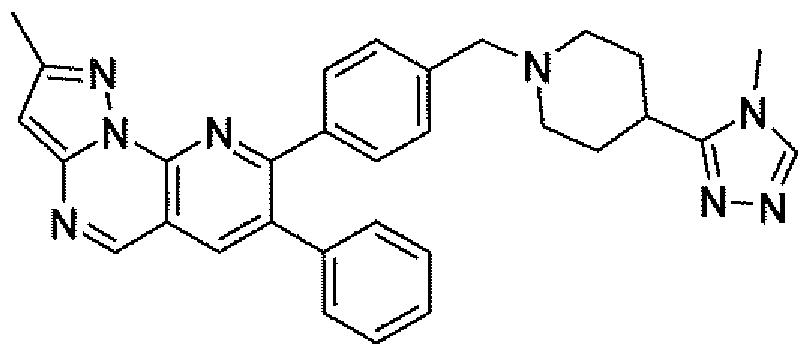
CCCLiI
Compound [CCCLIIJ was prepared using a procedure similar to that of [XCEl]. Data for Compound [CCCLOl: LCMS m/e 515 (M+H); 1H NMR. (400 MHz, METHANOL-^) δ ppm 2.01 - 2.15 (m, 2 H) 2.24 - 2.34 (m, 2 H) 2.57 (s, 3 H) 3.13 - 3.24 (m, 2 H) 3.29 - 3.32 (m, 1 H) 3.56 - 3.66 (m, 2 H) 3.79 (s, 3 H) 4.38 (br, s, 2 H) 6.76 (s, 1 H) 7.26 - 7.36 (m, 5 H) 7.47 (d, J=8.22 Hz, 2 H) 7.71 (d, J=8.08 Hz, 2 H) 8.57 (s, 1 H) 8.83 (s, 1 H).
lβ,8-triaza-spiro[4.51decane-2,4-dione [CCCLm]

CCCLIII
Compound [CCCLIIIJ was prepared as according to WO 9700872.
β-^Cl-Methyϊ-T-phenyl-l^^jPb-tetraaza-cycIopentafαJnaphthalen-S-ylJ-beiizylJ-l^^- triaza-spiro[4.5]decane-2,4-dione [CCCLIV]

CCCLIV
Compound [CCCLIVJ was prepared using a procedure similar to that of [XCIIJ. Data for Compound [CCCLIVJ: LCMS m/e 518 (M+H); 1H NMR (400 MHz, METHANOL-^) δ ppm 1.95 - 2.11 (m, 2 H) 2.20 - 2.31 (m, 32 H) 2.57 (s, 3 H) 3.07 - 3.22 (m, 1 H) 3.40 - 3.53
(m, 1 H) 3.54 - 3.72 (m, 2 H) 4.29 - 4.46 (m, 2 H) 6.75 (s, 1 H) 7.27 - 7.37 (m, 5 H) 7.46 (d, J=8.00 Hz, 2 H) 7.70 (d, J=8.00 Hz, 2 H) 8.57 (s, 1 H) 9.04 (s, 1 H).
5-(4-Cfa]oro-phenyrHH-pyrazol-3-y[J-piperidme [CCCLV]

CCCLV
Compound \CCCLV\ was prepared as according to CAN 149:489055.
8-<4-{4-[5-(4-Chloro-phenyl)-lJff-pyrazol-3-yI]-piperidin-1-ylmethyl}-phenyl)-2-inethyl-7- phenyl-1,4,9,9b-tetraaza-cyclopenta[α]naphthalene [CCCLVI]

CCCLVI
Compound [CCCLVI] was prepared using a procedure similar to that of [XCITj. Data for Compound [CCCLVI]: LCMS m/e 610 (M+Η); 1H NMR (400 MHz, METHANOL-^) δ ppm 1.79 - 2.03 (m, 2 H) 2.30 (d, J=14.42 Hz, 2 H) 2.57 (s, 3 H) 2.95 - 3.24 (m, 3 H) 3.57 (d, J=12.25 Hz, 2 H) 4.36 (s, 2 H) 6.51 (s, 1 H) 6.76 (s, 1 H) 7.26 - 7.36 (m, 5 H) 7.40 (d, J=8.49 Hz, 2 H) 7.47 (d, J=8.20 Hz, 2 H) 7.69 (dd, J=21.52, 8.37 Hz, 4 H) 8.57 (s, 1 H) 9.05 (s, I H).
Tricyclic Compounds via Acylation
NHBoc TFA

HCl
<x*o pyr.


CCCLVIfI CCCLIX
{l-[4-(2-Methyl-7-phenyl-l^ piperidm-4-yI}-carbaniic acid tert-butyl ester [CCCL VH\
NHBoc

CCCLVII
Compound [CCCLVH] was prepared in the similar fashion as that of [XCII]. This matereial was taken on to the next step without father characterization.
l-[4-(2~MethyI-7-phenyl-1,4,9,9M 4-ylaraine [CCCLVDI]

CCCLVlIi
Compound [CCCLVII] (510 mg, 0.93 mmol) was dissolved in 10 mL of dichloromethane, to which solution was added TFA (5 mL). The reaction mixture was stirred at rt overnight. The volatiles were evaporated in vacuo. The product (311 mg, 75%) was used in the next step without any purification. Data for Compound [CCCLVHI]: 1H NMR (400 MHz, METHANOL-^) δ ppm 1.79 - 2.10 (m, 2 H) 2.28 (d, JH3.86 Hz, 2 H) 2.59 (s, 3 H) 3.02 - 3.23 (m, 2 H) 3.38 - 3.53 (m, 1 H) 3.58 (d, J=I 1.57 Ez, 2 H) 4.35 (s, 2 H) 6.78 (s, 1 H) 7.27 - 7.39 (m, 5 H) 7.47 (d, /=8.30 Hz, 2 H) 7.71 (d, ^=8.30 Hz, 2 H) 8.59 (s} 1 H) 9.07 (s, 1 H).
Λ^l-[4^2-Methyl-7-phenyMy4,9,9^ piperidin-4-yl}-isonicotinamide [CCCLIX]

CCCLIX
To a solution of Compound [CCCLVHIj (17.4 mg, 0.039 mmol) in anhydrous pyridine was added the acid chloride (10.9 mg, 0.058 mmol). The mixture was stirred at room temperature for 2 h. The volatiles were evaporated in vacuo and the crude product was purified by HPLC to obtain as a yellow solid (16.9 mg, 78%). Data for Compound [CCCLIX): LCMS m/e 554 (M+H); 1H NMR (400 MHz, METHANOL-^) δ ppm 1.90 (d, J=12.50 Hz, 2 H) 2.28 (d, J=12.89 Hz, 2 H) 2.58 (s, 3 H) 3.14 (d, J=16.60 Hz, 2 H) 3.56 (d, J=I 1.91 Hz, 2 H) 4.17 (t, J=I 1.71 Hz, 1 H) 4.35 (s, 2 H) 6.78 (s, 1 H) 7.26 - 7.40 (m, 5 H) 7.47 (d, 1=8.00 Hz, 2 H) 7.72 (d, J=7.81 Hz, 2 H) 7.99 (d, J=5.08 Hz, 2 H) 8.59 (s, 1 H) 8.80 (d, J=5.27 Hz, 2 H) 9.06 (1 H).
^-{l-^^-Methyϊ^-phenyl-l^^^b-tetraaza-cyclopentaJαJiiaplithalen-S-ylJ-benzyl]- piperidin-4-yl}-phthaϊamic acid [CCCLX]

NH, Pyridine


CCCLVIII CCCLX
Compound [CCCLVIII] (16.0 mg, 0.036 mmol) and Hie anhydride (7.92 mg, 0.053 mmol) were taken in pyridine and the reaction mixture was stirred at rt for 2 h. The volatiles were evaporated in vacuo and the crude product was purified by HPLC to obtain Compound [CCCLX] (yellow solid, 22.1 mg, 98%): LCMS m/e 597 (M+H); 1H NMR (400 MHz, METHANOW4) δ ppm 1.72 - 2.11 (m, 2 H) 2.27 (t, J=I 5.72 Hz, 2 H) 2.56 (s, 3 H) 3.09 - 3.21 (m, 2 H) 3.47 - 3.56 (m, 2 H) 4.03 - 4.13 (m, 1 H) 4.32 (s, 2 H) 6.75 (s, 1 H) 7.27 - 7.35
(m, 5 H) 7.36 - 7.40 (m, 1 H) 7.44 (d, J=7.81 Hz, 2 H) 7.48 - 7.63 (m, 2 H) 7.68 (d, J=8.00 Hz, 2 H) 7.93 - 7.99 (m, 1 H) 8.56 (s, 1 H) 9.03 (s, 1 H).
l-{l-[4-(2-Methyl-7-phenyl-1,4^,9b-tetraaza»cycIopenta[α]naphthaIen-8-yl)-benzylI- piperidin-4-yl}-3-pyridin-4-y]-urca [CCCLXIJ
NCO

CCCLVlIl

Compound [CCCLVIII] (16.0 mg. 0.036 mmol) and the isocyanate (12.8 mg, 0.11 mmol) were dissolved in anhydrous pyridine. The mixture was stirred at 100 °C for 1 h. The volatiles were evaporated in vacuo. The crude product was purified by HPLC to obtain Compound ICCCLXI] as a yellow solid (21.0 mg, 97%): LCMS m/e 570 (M+H); 1H NMR (400 MHz, METHANOL-^) δ ppm 1.77 (d, J=12.10 Hz, 2 H) 2.22 (d, J=12.69 Hz, 2 H) 2.56 (s, 3 H) 3.12 (d, J=9.37 Hz, 2 H) 3.51 (d> J=I l .71 Hz, 2 H) 3.82 -3.95 (m, 1 H) 4.32 (s, 2 H) 6.75 (s, 1 H) 7.24 - 7.37 (m, 5 H) 7.69 (d, J=8.00 Hz.2 H) 7.87 - 8.02 (m, 2 H) 8.42 (d, J=7.03 Hz, 2 H) 8.56 (s, 1 H) 9.04 (s, 1 H)
l-{l-[4-(2-Methyl-7-phenyl-1,4,9,9b-tetraaza-cydopenta[fl]naphthalen-8-yl)-benzylj- piperidin-4-yl}-^moipholiπyl-urea [CCCXXπ]

CCCLXi!
Compound [CCCLXII] was prepared in a similar way to that of Compound [CCCLXη. Data for Compound [CCCLXII]: LCMS m/e 562 (M+H); 1H NMR (400 MHz, METHANOL-^) δ ppm 1.70 (d, J=13.08 Hz, 2 H) 2.13 (d, J=13.67 Hz, 2 H) 2.57 (s, 3 H) 3.05 - 3.12 (m, 2 H) 3.31 - 3.35 (m, 4 H) 3.43 - 3.50 (m, 2 H) 3.58 - 3.63 (m, 4 H) 3.74 - 3.86 (m, 1 H) 4.30 (s, 2 H) 6.76 (s, 1 H) 7.28 - 7.35 (m, 5 H) 7.43 (d, J=8.00 Hz, 2 H) 7.69 (d, J=8.00 Hz, 2 H) 8.57 (s, I H) 9.05 (s, I H
l-fΦ-tl-Methyl-T-phenyl-l^^^b-tetraaza-cyclopentalαlnaphthaleii-β-ylJ-beiizyl]- piperidine-4-carboxyIic acid pyridin-4-ylamjde [CCCLXHI]

CCCLXIH
Compound [CCCLXiπ] was obtained in a similar way as that for Compound [CLXIT]. Data for Compound [CCCLXIII]: LCMS m/e 554 (M+H); 1H NMR (400 MHz, METHANOL-^) δ ppm 1.93 - 2.07 (m, 2 H) 2.21 (d, J=*-10.35 Hz, 2 H) 2.57 (s, 3 H) 2.80 - 2.89 (m, 1 H) 3.07 -3.15 (m, 2 H) 3.18 - 3.22 (m, 1 H) 3.51 - 3.61 (m, 1 H) 4.35 (s, 2 H) 6.76 (s, 1 H) 7.28 - 7.35 (m, 5 H) 7.46 (d, J=8.00 Hz, 2 H) 7.70 (d, J=7.1 Hz, 2 H) 8.13 (d, J=6.64 Hz, 2 H) 8.55 - 8.61 (m, 3 H) 9.05 (s, 1 H).
l-[4-(2-Methyl-7-phenyl-1,4,9,9b-tetraaza-cyclopenta[α]naphthalen-8-yl)-beiizyl]- piperidine-4-carboxyIic acid (2-methoxy-pϊienyI)-amide [CCCLXTV]

CCCLXEV
Compound [CCCLSIV] was obtained in a similar way as that for Compound [CLXH]. Data for Compound ICCCLXTV]: LCMS m/e 583 (M+H); 1H NMR (400 MHz, METHANOL-^) δ ppm 1.93 - 2.01 (m, 2 H) 2.11 - 2.19 (m, 2 H) 2.57 (s, 3 H) 2.80 (t, J=I 1.52 Hz, 1 H) 3.01 - 3.08 (m, 2 H) 3.50 - 3.60 (m, 2 H), 3.86 (s, 3 H) 4.33 (s, 2 H) 6.76 (s, 1 H) 6.89 (t, J=7.61 Hz, 1 H) 6.96 - 7.21 (m, 2 H) 7.27 - 7.37 (ra, 5 H) 7.45 (d, J=8.00 Hz, 2 H) 7.71 (d, J=7.81 Hz, 2 H) 7.87 (d, J=7.81 Hz, 1 H) 8.57 (s, 1 H) 9.05 (s, 1 H)
l-[4-(2-Methyl-7-phenyH,4,9,9b-tetraaza-cyclopenta[a)naphthaIen-8-yl)-beiizyI]- piperidine-4-carboxyϊic acid (4-carbamoyI-2-methoxy-phenyl)-amide [CCCLXV]

CCCLXV
Compound [CCCLXV] was obtained in a similar way as that for Compound [CLXH]. Data for Compound [CCCLXV]: LCMS m/e 626 (M+H); 1H NMR (400 MHz, METHANOL-^) δ ppm 1.89 - 2.22 (ro, 1 H) 2.57 (s, 3 H) 2.84 - 3.14 (m, 2 H) 3.39 - 3.72 (m, 2 H) 3.93 (s, 2 H) 4.32 (d, J=14.45 Hz, 2 H) 6.76 (s, 1 H) 7.08 (d, J=8.59 Hz, 1 H) 7.32 (dd, J=6.15, 2.64 Hz, 5 H) 7.40 - 7.50 (m, 2 H) 7.61 - 7.76 (m, 3 H) 8.57 (s, 1 H) 9.05 (s, 1 H).
l-[4-(2-Methyl-7-phenyH,4,9,9b-tetraaza-cydopenta[«)πaphthaIen-8-yl)-beiizyI]- piperidine-4-carboxylk acid hydrazide [CCCLXVI]
N

CCCLXVE
Compound [CCCLXVI] was obtained in a similar way as that for Compound [CLXII]. DaIa for Compound [CCCLXVI] LCMS m/e 492 (M+H); 1H NMR (400 MHz, METHANOL-^) δ ppm 1.77 (q, J=10.82 Hz, 4 H) 2.13 - 2.29 (m. 3 H) 2.56 (s, 3 H) 3.00 (d, J=I 1.79 Hz, 2H) 6.73 (s, 1 H) 7.23 - 7.36 (m, 7 H) 7.55 (d, J= 8.13 Hz, 2 H) 8.52 (s, 1 H) 9.02 (s, 1 H).
frαrø-H3-Methyl-3-hydroxy4-[4^^^ cyclopenta[α]naphthalen-8-yl)-phenyIJ-cyclobutyI}-carbanύc acid tert-butyl ester [CCCLXVII]

Compound [CCCLXVTI] was prepared in a similar as for Compound [XL] using Compound [CCLXXXTV] as the starting material. This material was used in the next step without further purification or characterization.
/rαH5-3-Amino-3-[4-(2-tert-but}l-7-(thiophen-2-yϊ)-1,4,9,9b-tetraaza- cydopenta[α]naphtlmlen^-yI)-phenyl]-1-methyl-cyclobutanoI [CCCLXVIIII

CCCLXWK
Compound [CCCLXVlIIj was prepared in a similar was as Compound [XLIV]. Data for Compound [CCCLXVΪH] LCMS m/e 484 (M+H); 1H NMR (400 MHz, METHANOL- <k) δ ppm 1.49 (s. 9 H) 1.52 (s, 3 H) 2.74 (d, J=14.64 Hz, 2 H) 2.93 (d, J=I 4.64 Hz, 2 H) 6.85 (s, 1 H) 6.93 - 7.10 (m, 2 H) 7.48 (dd, J=4.78, 1.51 Hz, 1 H) 7.60 (d, J=8.54 hz, 2 H) 7.78 (d, J=8.54 Hz, 2 H) 8.68 (s, 1 H) 9.04 (s, 1 H).
fraiw-1-{3-MethyI-3-hydro^ cyclopenta[β]naphthalen-8-yI)-phenylj-cycIobufyl}-carbaπiic acid tert-butyl ester [CCCLXLX]

fr«/t$-3-Amino-3-{4-[2-tert-butyϊ-7-(2-fluoro-phenyl)-1,4,9,9b-tetraaza- cycIopenta[αJnaphthaIen-8-yl]-phenyI}-1-methyl-cyclobntanol [CCCLXXj
HC) v>

CCCLXX
Compound [CCCLXX] was prepared in a similar was as Compound [XLIV] .
Data for Compound [CCCLXX]: LCMS m/e 496 (M+H); 1H NMR (400 MHz, METHANOL- (U) δ ppra 1.47 (S9 3 H) 1.48 (s, 9 H) 2.62 - 2.73 (m, 2 H) 2.80 - 2.90 (m, 2 H) 6.84 (s, 1 H) 6.98 - 7.06 (m, 1 H) 7.23 (td, J=7.54, 1.02 Hz, 1 H) 7.35 - 7.48 (m, 2 H) 7.48 - 7.54 (m, 2 H) 7.68 - 7.74 (m, 2 H) 8.58 (s, 1 H) 9.02 (s, 1 H).
ήrα«*-1-{3-Methyl-3-hydrory-1-[4-/e/*-butyl-7-(thiophen-3-yl)-1,4,9,9b-tetraaza- cycIopenta[β]naphthaIen-S-yl)-phenyI]-cycIobutyl}-carbamic acid tert-bαtyl ester [CCCLXIX] .*

Compound [CCCLXXI] was prepared in a similar as for Compound [XL] using Compound [CCLXXXV] as the starting material. This material was used in the next step without further purification or characterization.
/rø«Λ-3-Amino-3-l4-(2-/έ'rt-buty]-7-0hiophen-3-yl)-1,4,9,9b-tetraaza- cyclopenta[α]naphthalen-8-yl)-phenyI]-1-methyl-cyclobutaiiol [CCCLXXII]

CCCLXX)I
Compound [CCCLXXII] was prepared in a similar was as Compound [XLIV]. Data for Compound [CCCLXXII]: LCMS m/e 484 (M+H); 1H NMR (400 MHz, METHANOL-^) δ ppm 1.49 (s, 9 H) 1.52 (s, 3 H) 2.73 (d, ^14.64 Hz, 2 H) 2.92 (d, J= 14.74 Hz, 2 H) 6.84 (s, 1 H) 6.90 (dd, >4.98, 1.27 Hz, 1 H) 7.39 (dd, J=4.98, 2.98 Hz, 1 H) 7.41 - 7.49 (m, 1 H) 7.58 (d, J=8.49 Hz, 2 H) 7.76 (d, ./=8.49 Hz, 2 H) 8.64 (s, 1 H) 9.04 (s, 1 H).
7-Amino-2-methyl-pyrazoIo[1,5-a]pyrimidrae-6-carboxylic acid hydrazide [CCCLXXIII]

H CCCLXXIIE
Compound [CCCLXXHΪJ was prepared in a similar was as Compound [CCXXVII]. Data for Compound [CCCLXXIII]: LCMS (m/e) 193 (M+H); 1H NMR (300 MHz, DMSO- d6) δ 4.46 (s, 2 H) 6.50 (s, 1 H) 8rl 7 (s, 1 H) 8.62 (s, 1 H) 9.75 (s, 1 H).
1,3-Dihydro-p>τazolo|5,l-*]purin-2-onc [CCCLXXTV]
V1^ H -N
I JC ^0
CCCLXXIV Compound [CCCLXXIV] was prepared in a similar was as Compound
[CCXXVIlI]. Data for Compound [CCCLXXTV]: LCMS (m/e) 176 (M+H); 1HNMR (300 MHz, DMSO- d6) δ 6.61 (s, 1 H) 8.18 (s, 1 H) 8.31 (s, 1 H) 11.22 (s, 1 H).
Pyrazolo[1,5-«]pyriniidine-6,7-dianiinc [CCLXXV]
V yN"wNHj
^NH2 CCCLXXV
Compound [CCCLXXV] was prepared in a similar was as Compound [CCXXIX]. Data for Compound [CCCLXXVJ: LCMS (m/e) 150 (M+H).
7-Phenyl-1,4,6,9,9b-pentaaza-c>'clopenta[α]naphthalen-8-oI [CCCLXXVI]

Compound [CCCLXXVI] was prepared in a similar was as Compound
[CCXXX]. Data for Compound [CCCLXXVI] (yellowish solid): LCMS (m/e) 264 (M+H).
8-ChIoro-7-phenyI-1,4,6,9,9b-peiitaaza-cydopentaiαJnaphthalene |CCCLXXΛlI]

Compound [CCCLXXVII] was prepared in a similar was as Compound [CCXXXI]. Data for Compound [CCCLXXVπj (yellowish solid): LCMS (m/e) 282 (M+H); 1HNMR (300 MHz, CHLOROFORM- d) δ 7.01 (s, 1 H) 7.56-7.61 (m, 3 H) 7.87 - 7.91 (m, 2 H) 8.32 (s, I H) 9.17 (s, I H).
/r««-f-2-{3-Hydroxy-3-methyI-1-[4-(7-phenyM,4,6,9,9b-pentaaza-cyclopenta[fl]naphthalen- 8-yl)-phenyI|-cycIobut>l}-isoindoIe-13-ilione [CCCLXXMn]

Compound [CCCLXXVIII] was prepared in a similar as for Compound [XL] using Compound [CCCLXXVII] as the starting material. This material was used in the next step without further purification or characterization.
Λ*ΛMj-3-Amino-1-cycIopropyl-3-J4-(7-phenyl-4^-dihydro-1,4,6,9,9b-pentaaza- cyclopentaffl|naphthalen-8-yI)-phenyl]-cyclobutanoI |CCCLXXL\1
N^H4/trace "Pd"


CCCLXXVIIi
CCCLXXIX
Treatment of Compound [CCCLXXVIII J was under the same conditions as for the preparation of Compoun [XLI] furnished Compound [CCCLXXIX]. Data for Compound [CCCLXXIX]: LCMS m/e 451 (M+H); 1H NMR (400 MHz, METHANOL-^) δ ppm 0.27 - 0.60 (m, 4 H) 1.07 - 1.38 (m, 1 H) 2.54 - 2.70 (m, 2 H) 2.70 - 2.86 (m, 2 H) 4.72 (s, 2 H) 7.14 - 7.98 (in, 11 H).
trακ5-3-Amino-1-cyclopropyl-3-[4-{7-phenyH,4,6,9,9b-pentaaϊa-cycIopenta[α]naphthalen- 8-yI)-phenyI]-cyclobutanoI [CCCLXXX]
MnO2ZTHF


CCCLXXIX CCCLXXX
Compound [CCCLXXIX] was dissolved in anhydrous THF (15 mL), to which solution was added manganese dioxide (60 mg). The mixture was stirred for 1 h and the precipitation was filtered. The solvent was removed by rotary evaporation and the crude product was purified by HPLC to obtain Compound [CCCLXXXJ as a yellow solid: LCMS m/e 449 (M+H); 1H NMR (400 MHz9 METHANOL-^) δ ppm 0.27 - 0.73 (m, 4 H) 1.07 - 1.35 (m, 1 H) 2.63 (d, J=14.25 Hz, 2 H) 2.81 (d, J=14.25 Hz, 2 H) 7.05 (d, J=2.15 Hz, 1 H) 7.27 - 7.45 (m, 3 H) 7.52 - 7.67 (m, 4 H) 7.82 (d, J=8.49 Hz, 2 H) 8.34 (d, J=2.15 Hz, 1 H) 9.22 (s, 1 H).
frα«s-1-{3-Methyl-3-hydroxy-1-[4-f7-phenyl-1,4,6,9^b-pentaaza-cycIopenta[α]naphthalen- 8-yl)-phenyl]-cyc]obutyl}-carbamic acid tert-butyl ester [CCCLXXXI]

Compound [CCCLXXXIJ was prepared in a similar as for Compound [XL] using
Compound [CCCLXXVIIJ as the starting material. This material was used in the next step without further purification or characterization.
aτβ«*~3-Araiαo~l-raethy^^ pheny1Hydobutanol [CCCLXXXU]

CCCXXXII
Compound [CCCLXXXII] was prepared in a similar as for Compound IXLIV]. Data for Compound [CCCLXXXIIJ LCMS m/e 423 (M+H); 1HHMR (400 MHz, METHANOL-^) δ ppm 1.51 (s, 3 H) 2.72 (d, J=14.55 Hz, 2 H) 2.90 (d, J=14.55 Hz, 2 H) 7.05 (d, J=2.10 Hz, 1 H) 7.30 - 7.49 (m, 3 H) 7.51 - 7.68 (m, 4 H) 7.83 (d, J=8.40 Hz, 2 H) 8.34 (d, J=2.10 Hz, l H) 9.22 (s, l H).
Ethyl 7-amino-5-methylpyrazolo[1.5^]pyrijnidine-6-carboxyIate [CCCLXXXΪII]
VNH *■ I T n
^ T J XII CCCLXXXIII
To a 1000 mL 3-necked round-bottom flask was added Compound [XII] (10 g, 120 mmol, 1.00 eq.), ethyl 2-cyano-3-ethoxybut-2-enoate (23 g, 126 mmol, 1.05 eq.), and HOAc (40O mL). The mixture was heated at 100 °C for 16 h. The solid was filtered out. The reaction was concentrated and the residue was treated with H2O (200 mL). The resulting precipitate was filtered, and the precipitate washed with H2O (200 mL). The crude product was dried in an oven to afford Compound [CCCLXXXIIIJ: LCMS(m/e) 221 (M+H); 1H NMR (300 MHz, DMSO- d6) δ 1.32 (t, J=7.20 Hz, 3 H) 2.62 (s, 3 H) 4.29 (q, J=7.20 Hz, 2 H) 6.39 (s, 1 H) 8.15 (s, 1 H) 8.50 (br.s, 2 H).
(7-Amino-5-methylpyrazolo[1,5-«]pyrimidin-6-yl)methanol [CCCLXXXIV]
YNγNH* LlBHEt3 χ γNγNH 2
NγL .0^/ NylL
' O I OH
CCCLXXXIII CCCLXXXIV
To a 250 mL three-necked round bottom flask was added Compound
[CCCLXXXπi] (3.3 g, 15.0 mmol, 1.00 eq.) and THF (60 mL). The mixture was cooled to 0 °C and LiBHEt3 (48 mL of a 1.0 Msolution in THF, 48 mmol. 3.3 eq.) was added slowly through an addition funnel under nitrogen. After addition, the mixture was stirred at room temperature overnight. The mixture was slowly treated with EtOAc (60 mL) and then water (30 mL). The layers were separated and the aqueous phase was extracted with EtOAc (2 X 30 mL). The combined organic phases were dried over anhydrous Na2SO-J. After filtration and concentration, the residue was purified by a silica gel column with dichloromethane/methanol (15:1). Concentration by rotary evaporation provided Compound [CCCLXXXTV] as a light yellowish solid. This material was used in the next step without futher characterization.
7-Amino-5-niethylpyrazolof1,5-α]p>τiinidine-6-carbaldehyde fCCCLXXXN]
H
MnO,
1 OH
CCCLXXXlV

To a 1 L round bottom flask containing Compound [CCCIJQOOV] (2.33 g, 13.1 mmol, 1.00 eq.) was added CHCl3 (200 raL) and THF (100 mL) followed by MnO2 (9.2 g, 106 mmol, 10.00 eq.). The mixture was stirred at room temperature for 2 days. The mixture was filtered and the filtered material washed with CH2Cl2: MeOH until no additional product was observed through analysis of the filtrates by TLC. The resulting mixture was concentrated under vacuum and provided Compound [CCCLXXXV] as a yellowish solid. LCMS m/e 177 (M+H); 1H NMR (300 MHz, DMSO-de) δ 2.67 (s, 3H) 6.44 (s, 1 H) 8.19 (s, 1 H) 9.08 (br.s, 1 H) 9.47 (br.s, 1 H) 10.15 (s, 1 H).
5"Methyl-7-phenyl-9H-1,4,9,9b-tetraaza-cyclopenta[rtInaphthaϊen-8-one {CCCLXXX\'l] (DBU Procedure)


CCCLXXXV CCCLXXXVI
To a 50 mL round-bottom flask was added Compound [CCCLXXXVJ (500 mg, 2.84 mmol, 1.00 eq.), DBU (1.72 g, 11.3 mmol, 4.00 eq.) and DMF (10 mL), then 2-phenylacetyl
chloride (880 mg in 10 mL of DMF, 5,68 mmol, 2.00 eq.) was added dropwise at room temperature. The reaction was stirred at room temperature overnight. The solvent and reagent were removed in vacuo. The residue was dissolved in 50 mL of CH2CI2 and purified on a silica gel column with dichloromethane/methanol (50:1) to afford Compound [CCCLXXXVI] as a yellowish solid: LCMS (m/e): 277 (M+H); 1H NMR (300 MHz, DMSO-d6) δ 2.80 (s, 3 H) 6.66 (s, 1 H) 7.41 (m, 3 H) 7.77 (d, 5=6.9 Hz, 2 H) 8.23 (s, 1 H) 8.30 (s, 1 H).
8-Chloro-5-m ethyJ-7-pheπyl-ϊ,4,9,9b-tetraaza-cyclopentafα] naphthalene I CCCLXXXV7T]
POCI3
I Il 1

To a 50 mL round bottom flask was added Compound [CCCLXXXVΪJ (500 mg,
1.81 mmol, 1.00 eq.), POCl3 (10 mL). The mixture was heated to reflux in an oil bath for 4 h. The reaction was concentrated in vacuo and adjusted the pH value to 8 with 100 mL sat. NaHCC>3. The mixture was extracted three times with 100 ml CH2CI2 and the organic layers were collected. The combined organic phases were dried over Na2SO4j filtered, concentrated and purified by silica gel chromatography using EtOAc:petroleum ether (1 :2) as the eluent to give Compound [CCCLXXXVII): LCMS (m/e) 295 (M+H); 1HNMR (300 MHz, CHLOROFORM-d) δ 2.89 (s, 3 H) 6.79 (s, 1 H) 7.53 (s, 5 H) 8.18 (s, 1 H) 8.27 (s, 1 H).
*raκs-1-{3-Methyl-3-hydro^ cycIopenta[fl]naphthalen-8-yI)-phenyl]-cycIobutyl}-carbamic acid tert-butyl ester
ΪCCCLXXXVΠI] >-

CCCtXXXVIII
Compound [CCCXXXXVIII] was prepared in a similar as for Compound [XLJ using Compound [CCCLXXXVIIJ as the starting material. This material was used in the next step without further purification or characterization
/rα:ιrø-3-Aniino-1-methyl-3-[4-(5-methyI-7-phenyI-lf4^,9b-tetraa2:a- cycJopenta[β]naphthaleD-8-yl)-pbcnyI]-cydobutaDθ] [CCCLXXXIX]
HC> y

CCCLXXXIX
Compound [CCCLXXXIX] was prepared in a similar as for Compound PuLIV]. Data for Compound ICCCLXXXIXJ: LCMS m/e 436 (M+H); 1H NMR (400 MHz, METHANOL-^) δ ppm 1.50 (s, 3 H) 2.71 (d, J=14.64 Hz, 2 H) 2.88 (d, J=14.64 Hz, 2 H) 2.95 (s, 3 H) 6.82 (d, J=2.15 Hz, 1 H) 7.37 (s, 5 H) 7.45 - 7.56 (m, 2 H) 7.65 - 7.78 )m, 2 H) 8.20 (d, J=XlO Hz, I H) 8.60 (s, I H).
7-Thiophene-1,4,6,9b-pentaaza-cyclopenta[α]naphthalen-8-o! [CCCXC]
C I4 N NaiOPr, DMF
T n " toluene, 105 C^

XV CCCXC
To a 100 mL round-bottom flask was added Compound [XV] (1.12 g, 6.91 mmol,
1.00 eq), Toluene (18 mL), methyl 2-(thiophen-2-yl)acetate (4.31 g, 27.6 mmol, 4.00 eq.), sodium 2-methylproρan-2-oIate (870 mg, 9.06 mmol, 2.00 eq.). The resulting solution was stirred for 30 min at 105°C, DMF (18 mL) was added. The mixture was stirred at 105 °C for 3 days, then cooled to room temperature, concentrated and was purified by a silica gel column with CH2Cl2:Me0H (25: 1) to afford Compound [CCCXC] as a yellow solid: LCMS (m/e) 269 (M+H).
8-Chloro-7-phenyl-1,4,6,9b-pentaaza~cyclop€nta[α]naphthalene [CCCXCI]
PCXJI3


CCCXC CCCXCI
To a 50-mL roυnd-bottom flask was added Compound [CCCXC] (1.5 g, 5.60 mmol, 1.00 eq.), POCl3 ( 20 mL). The resulting solution was stirred for 1.5 h at 100 °C then the mixture was cooled. The pH value of the solution was adjusted to 8 with sodium bicarbonate and the resulting mixture extracted with of ethyl acetate (3x50 mL) and the organic layers combined and dried over Na2SO4, concentrated, and then purified by a silica gel column with CH2Cl2ZMeOH (60:1) to afford Compound [CCXCI] as a yellow solid: LCMS (m/e): 287(M+H); 1HNMR (300 MHz,CHLOROFORM-d) 6: 6.94(s, 1 H ) 7.1-7.22(m, 1 H ) 7.51-7.51 (m, 2 H ) 8.25(s, 1 H ) 8.39 (s, 1 H ) 8.89 (s, 1 H, ).
frαra^l-P-Methyl-S-hyd^ cyclopenta[«]naphthaIen-8-yl)-pbenyl]~cycIobutyI}-carbamic acid tert-butyl ester [CCCXCIII
HC> *

CCCXCII
Compound [CCCXOI] was prepared in a similar as for Compound [XL] using Compound [CCCXCI] as the starting material. This material was used in the next step without further purification or characterization.
&"a«5-3-Amino-1-methyl-3-[4-(7-thiophen-2-yl-1,4,9,9b-tetraaza-cycIopenta[a]naphthalen-8- yl)-phenyl|-cyclobutanol [CCCXCl II]

CCCXCiII
Compound [CCCXC1H| was prepared in a similar as for Compound [XLIV]. Data for Compound [CCCXCHI]: LCMS m/e 428 (M+H); 1H NMR (400 MHz, METΗANOL- (U) δ ppm 1.54 (s, 3 H) 1.94 (s, 3 H) 2.62 (d, J=14.06 Hz, 2 H) 2.84 (d, J-14.01 Hz, 2 H) 6.97 (d, J=2.15 Hz, 1 H) 6.99 - 7.13 (m, 2 H) 7.55 (d, J=8.49 Hz, 2 H) 7.75 (d, J=8.44 Hz, 2 H) 8.26 (d, J=2.20 Hz, 1 H) 8.71 (s, 1 H) 9.11 (s, 1 H).
frαjrø-S-Amino-1-cyclopiOpyl-S-^Z-methyl-S^-diphenyl-l^^^b-tetraaza- cyclopenta[α]naphthalen-8-yl)-phenyl]-cyclobutanol [CCCXCTV]

Compound [CCCXCTV] was prepared using a procedure similar to that of [CCXLiη. Data for Compound [CCCXCIV] : LCMS (m/e) 538 (M+H); 1H NMR (400 MHz, METHANOL-^) δ ppm 0.38 - 0.54 (m, 4 H) 1.12 - 1.23 (m9 1 H) 2.59 - 2.65 (m, 2 H) 2.68 (s, 3 H) 2.74 - 2.83 (m, 1 H) 7.31 - 7.42 (m, 6 H) 7.47 - 7.58 (m, 4 H) 7.71 - 7.78 (m> 4 H) 8.56 (s, 1 H) 9.06 (s, 1 H).
fr«M5-3-Amino-1-cycIopropyl-3-{4-β-(4-methoxy-phenyl>-2-methyl-7-phenyH,4,9,9b- tetraaza-cycIopenta[fl]naphthalen-8-yIJ-phenyl}-cyclobutanol [CCCXCV]

CCCXCV
Compound [CCCXCV] was prepared using a procedure similar to that of [CCXLH]. Data for Compound [CCCXCVJ: IXMS CmZe) SOS (MH-H)J 1H NMR ^OO MHz, METHANOL-^) δ ppm 0.33 - 0.56 (m, 4 H) 1.13 - 1.24 (m, 1 H) 2.57 - 2.64 (m, 2 H) 2.66 (s, 3 H) 2.75 - 2.83 (m, 2 H) 3.86 (s, 3 H) 7.02 - 7.10 (m, 2 H) 7.27 - 7.39 (m, 5 H) 7.51 - 7.56 (m, 2 H) 7.62 - 7.69 (m, 2 H) 7.74 (d, J^8.42 Hz, 2 H) 8.54 (s, 1 H) 9.02 (s, 1 H).
/rø«s-3-Ammo-1-cyclopropyl-3-[4-^ cycIopenta|α]naphthalen-8-yl)-phenyl]-cyclobutanol [CCCXCVI]

Compound ICCCXCVI] was prepared using a procedure similar to that of [CCXLH]. Data for Compound [CCCXCVI]: LCMS (m/e) 539 (M+H); 1H NMR (400 MHz, METHANOL-d4) δ ppm 0.41 (d, J=4.49 Hz, 2 H) 0.48 (d, J=8.00 Hz, 2 H) 1.18 (t, J=8.10 Hz, 1 H) 2.62 (d, J=14.25 Hz, 2 H) 2.79 (d, J=14.06 Hz, 2 H) 2.92 (s, 3 H) 7.36 (s, 5 H) 7.57 (d, J=8.20 Hz, 2 H) 7.75 (d, J=8.20 Hz, 2 H) 8.69 (d, J=6.25 Hz, 2 H) 8.71 (s, 1 H) 8.79 (d, J=6.44 Hz, 2 H) 9.38 (s, 1 H).
frα«s-2-[l-(4~Bromo-phenyl)-3^^ [CCCXCVH]
Pd/C, benzene

A 50-mL round-bottom flask was added a solution of Compound [CXLVII] (700 mg, 1.76 mmol, 1.00 eq.) in benzene (50 mL), Pd/C (300 mg). Then hydrogen was bubbled by a balloon. The mixture was stirred for 4 h at room temperature. The solid was filtered out. The resulting mixture was concentrated in vacuum and purified by flash-HPLC to give Compound [CCCXCVII] as a white solid: LCMS (m/e) 400 (M+H); 1H NMR (300 MHz, CHLOROFORM-^) δ ppm 1.15 (t, 3H) 1.64 (q, 2H) 3.17 - 3.20 (m, 2 H) 3.29 - 3.32 (m, 2 H) 7.47-7.87 (m, 8 H).
<wrws~{3-Ethyl-3-hydroxy-H^ cyclobαtyl}~isoindo!e-l^-dione [CCCXCVlI]]

CCCXCV)EI
Compound [CCCXCVIII] was prepared using a procedure similar to that of
[XXXIX]. Data for Compound [CCCXCVIII]: LCMS (m/e) 430 (M-H2O); 1H NMR (300 MHz, CHLOROFORM-J) δ ppm 0.92-0.97 (t, J=I.2 Hz, 3 H) 1.32 (s, 12 H) 1.64 (q, J=7.2 Hz) 3.12-3.17 (m, 2 H) 3.27 - 3.32 (m, 2 H) 7.66-7.83 (m, 8 H).
/'rαRV-243-Ethyl-3-hydrox>-1-[4-(2-methyl-7-phenyl-1,4,9,9b-tetraaza- cyclopenta[α]naphthalen-8-yl)-phenyI]-cycIobutyI}-isoiiidole-13-dione [CCCXOX)
,~

CCCXCIX
Compound [CCCXCIXJ was prepared using a procedure similar to that of [XL]. Data for Compound [CCCXCIXJ: LCMS (m/e) 580 (M+H).
/ra«s-3-Amino-1-ethyl-3-[4-(2-inethyl-7~phenyl-1,4,9^b-tetraaza-cyclopenta[a]naplithaleii- 8-yl)-phenyI]-cyclobutano_ [CD]
HO. .«-

Compound [CD] was prepared using a procedure similar to that of [XLI] . Data for Compound [CD]: LCMS (m/e) 450 (M+H); 1H NMR (400 MHz, METHANOLS) δ ppm 0.92 (t, J5=7.35 Hz, 3 H) 1.76 (q, ^=7.24 Hz, 2 H) 1.91 (s, 3 H) 2.50 - 2.56 (m, 2 H) 2.56 (s, 3 H) 2.67- 2.78 (in, 2 H) 6.74 (s, 1 H) 7.24 - 7.37 (m, 5 H) 7.40 - 7.53 (m, 2 H) 7.61 - 7.74 (m, 2 H) 8.52 (s, 1 H) 9.02 (s, 1 H).
Scheme- Synthesis of [XI]

NH2 vA CH3C(OMe)3
O^ HOAc, 100 °C, 16 h
Ό"\

CDl r o o
CDIl
LiBHEt3 MnO2 THF THF / CHCl3

 1 Y O H
CDHI
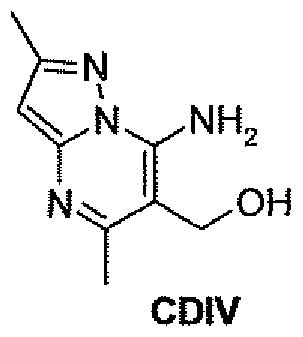 CDV
CDV

SOCI2
NaCM-Bu, toluene, DMF, CHCl31DMF 105 °C 60-75 "C


(Z)-2-Cyano-3-ethoxy-but-2-enoic acid ethyl ester {CDII]
vΛ CH3C(OMe)3 o^
V\

CDI r o o
CDIl
To a 2000 mL round-bottom flask was added CH3C(OEt)3 (583.2 g, 3.6mol, 1.00 eq.) and Compound [CDIl (407.2 g, 3.6 mol, 1.00 eq.) in Ac2O (1000 mL). The mixture was heated to reflux at 130-150 °C for 3 hours. The reaction mixture was concentrated to a small volume and then allowed to cool to room temperature. The mixture was allowed to sit in refrigerate overnight. The precipitated solid was filtered and dried in vacuo to give Compound [CDIΪ] as yellow solid: LCMS (m/e) 184 (M+H).
7-Amino-2,5»dimethylpyrazolo[l^-a]pyrimidine-6-carboxylic add ethyl ester [CDIII]
CDIII
Compound was prepared using a procedure similar to that of Compound [VII]. Data for Compound [CDIII]: LCMS (rii/e) 235 (M+H).
(7-Ammo-2,5-dimethylpyr^olo[l^^]pyrimidine^yl)-metlianol [CDIVI
«yN^NH2
CDIV
Compound [CDIV] was prepared using a procedure similar to that of Compound
[H]. Data for Compound [CDIVl : LCMS (m/e) 193 (M+H); 1H NMR (300 MHz, DMSO^j) δ ppm 7.27 (s, 2 H) 6.02 (s, 1 H) 4.73 (t, 1 H) 4.53-4.55 (d, 2 H) 2.42 (s, 3 H) 2.36 (s, 3 H).
7-Amino-2,5-dimethylpyrazolol1,5^]pyrimidine^cai*aIdeIiyde [CDV]
V=N
<γ N^NH2
Nγ 1 o
CDV
Compound [CDV] was prepared using a procedure similar to that of Compound [III]. Data for Compound [CDV]: LCMS (m/e) 191 (M+H); 1HNMR (300 MHz, CHLOROFORM-rf) δ ppm 10.21 (s, 1 H) 9.59 (s, 1 H) 6.93 (s, 1 H) 6.28 (s, 1 H) 2.76 (s, 3 H) 2.47 (s, 3H).
2,5-Dimethyl-7-phenyH,4,9,9b-tetraaza-cyclopenta[«jnaphthalene-8-ol [CIX] (from CDV)


CDV CtX
To a 250 vaL round-bottom flask was added Compound [CDV] (6.7 g, 35.3 mmol, LOO eq.), DBU (7.6 g, 50.00 ramol, 1.40 eq.), and DMF (170 mL). Then 2-phenylacetyl chloride (21.44 g in DMF of 20 mL, 139 mraol, 4.00 eq.) was added dropwise at room temperature. The reaction was stirred at room temperature overnight The solvent and reagent were removed in vacuo. The residue was dissolved in 10 mL of CH2CI2 and purified by silica gel chromatography using MeOH/DCM as the eluant to give Compound [CIX] as a light yellowish solid: LCMS (m/e) 291(M+H); 1H NMR (400 MHz, CHLOROFORM-rf) δ ppm 2.50 (s, 3 H) 2.75 (s, 3 H) 7.37-7.70 (m, 5 H) 7.96 (s, 1 H).
Iraiis-S-Ammo-1-cyclopropyl-S-^S-bromo^-inethyl-V-pϊieiiyl-l^jδ^^b- pentaazacyclopenta[fl]naphthalen~8-yl)-phenyl]-cyclobutanol [CDVI]

CDVl
Compound [CDVIj was prepared in a similar way as that for Compound [CV]. This material was used in the next step without further characterization.
frα»s-3-Ammo-1-cyclopropyl-3-[4-(2^^ta cyclopenta[a]naphthalen-8-yl)-phenyl]-cyclobutanoI [CDVII]
PdC12<φpf)-DCM Cs2CO3, MeB(OH)2 dioxane, 80 "C


CDVi
CDVtI
A 20 ml scintillation vial containing Compound [CDVI] (96 mg, 0.17 mmol), MeB(OH)2 (306 mg, 5.1 mmol), Cs2CO3 (662 mg, 1.7 ramol), and dioxane (10 ml) was evacuated and flushed three times with nitrogen. Then PdCl2(dppf)-DCM (21 mg, 0.026 mmol) was added and the resulting solution was evacuated and flushed three times with nitrogen. The mixture was heated at 80 °C for 2.5h. LCMS indicated the product was formed as a major product. Then it was allowed to cool and concentrated. The residue was dissolved with MeOH (5 raL). After filtration, the filtrate was purified by reverse-phase preparative HPLC using water-acetonitrile-TFA [95:5:0.05] and acetonitrile-water-TFA [95:5:0.05] as the mobile phases to provide Compound [CDVH] as a yellow solid:
LCMS (m/e) 476 (M+l); 1H NMR (400 MHz, METHANOLS) δ ppm 0.35 - 0.51 (m, 4 H) 1.11 - 1.22 (m, 1 H) 2.34 (s, 3 H) 2.50 (s, 3 H) 2.56 - 2.64 (ra, 2 H) 2.72 - 2.81(m, 2 H) 7.26 - 7.36 (m, 5 H) 7.51 (d, /=8.49 Hz, 2 H) 7.70 (d, J=8.40 Hz, 2 H) 8.49 (s, 1 H) 8.94 (s, 1 H).
iftiiis-{:MIydiO^-3Hn^ cycIopenta[α]naphthalen-8-yl)-pIienyI]-cycIobufyl}-carbaiiιic acid tert-butyl ester [CDVIII]
PdCL(dppf)-DCM Cs2CO3 / dioxane /H2O PhB(OH)2 55 °C NL Ok


CDVIII
A 20 ml scintillation vial containing Compound [CCXLVIIIj (90 mg, 0.16 mmol, 1 eq.), the borate (98 mg, 0.8 mmol, 5 eq.), Cs2CO3 (260 mg, 0.8 mmol, 5 eq.), dioxane (5.0 ml), and water (0.8 ml) was evacuated and flushed three times with nitrogen. Then PdCl2(dppf)-CH2C.2 (13 mg, 0.016 mmol, 0.15 eq.) was added and the resulting solution was evacuated and flushed three times with nitrogen. The mixture was heated at 55 °C for 3 h. Then
it was allowed to cool. TTie solvent was removed in vacuo. The residue was dissolved in CH2CI2 (10 mL). After filtration and concentration, it was purified by silica gel chromatography by using MeOH and CH2CI2 as the mobile phases to furnish Compound [CDVHI] as a yellowish solid (97 mg, 99%): LCMS (m/e) 612 (M+H).
frαws-3-Araino-l~raethyϊ-3-^ cyclopenta[α]naphthaIen-8-yl)-phenyl]-cyclobutanol (CDIX]

Compound [CDIX] was prepared using a procedure similar to that of Compound [XLIV]. Data for Compound [CDIX]: LCMS (πi/e) 512 (M+H); 1H NMR (400 MHz, METHANOLS) δ ppm 1.46 (s, 3 H) 2.57 (s, 3 H) 2.60 - 2.71 (m, 2 H) 2.78 - 2.88 (m, 2 H) 6.73 (s, 1 H) 6.92 - 7.12 (m, 5 H) 7.14 - 7.29 (m, 3 H) 7.29 - 7.39 (m, 4 H) 7.39 - 7.53 (m, 2 H) 7.60 - 7.78 (m, 2 H) 8.48 (s, 1 H).
frαj∞-{3-Hydro:sy-1-[4-(6-h^ cycϊopenta[α]naphthalen-8-yl)-pb.enyl]-3-methyI-cycloburyl}-carbainic acid tert-butyl ester
[CDX]
HOfc ^ rf
N-^n-^\ KOH / dioxane / water
NL' k
RT


CDX
A 20 ml scintillation vial containing Compound [CCXLVΪIIJ (100 mg, 0.18 mmol), dioxane (2 ml), water (2 ml), and KOH (400 mg) was stirred at RT for 36 h. Then it was dissolved in DCM (10 mL) and water (2 mL). The water solution was extracted with DCM.
The combined organic solution was concentrated. The residue was dissolved in CH2CI2 (1.5 mL) and purified by silica gel chromatography by using MeOH and CH2CI2 as the mobile phases to furnish Compound [CDX] as a yellowish solid (79 mg, 78%): LCMS (m/e) 552 (M+H).
ήrøis^[4<l-Amino-34ydro^-3-me^^ tetraaza-cyclopenta[fl]naphthalen-6-oI (CDXI]
,>

Compound [CDXI] was prepared using a procedure similar to that of Compound IXLIV]. Data for Compound [CDXI]: LCMS (m/e) 452 (M+H); 1H NMR (400 MHz, METHANOL-^) δ ppm 1.45 (s, 3 H) 2.52 (s, 3 H) 2.60 - 2.71 (m, 2 H) 2.76 - 2.87 (m.2 H) 6.63 (s, 1 H) 7.11 - 7.17 (m, 2 H)7.17 - 7.26 (m, 3 H) 7.51 (s, 4 H) 9.07 (s, 1 H).
frα«s-2-{l-t4-(6-Cyciopropyl-2-methyl-7-phenyl-1,4,9,9b-tetraaza-cycIopenta[α]naphthaIen-
S-yI)-phenyI}-3-hydroxy-3-inethyl--cycIobatyl}-i!!oindole-l^-dione [CDXII]

Compound [CDXII] was prepared using a procedure similar to that of Compound
[CCL]. Data for Compound [CDXH]: LCMS (m/e) 606 (M+H).
/rαn5-3-Amino-3-[4-(6-cycIopropyϊ-2-niethyI-7-phenyl-1,4^,9b-tetraaza- cyclopenta[α]naphthalen-8-yi)-phenyl]~l-methyI-cycIobutanol [CDXiπ]
HO.

Compound [CDXIII] was prepared using a procedure similar to that of Compound [XU]. Data for Compound [COXED]: LCMS (m/e) 476 (M+H); 1H NMR (400 MHz9 METHAN0W4) δ ppm 0.33 - 0.44 (in, 2 H) 0.85 - 0.98 (m, 2 H) 1.49 (s, 3 H) 2.30 - 2.43 (m, 1 H) 2.57 (s, 3 H) 2.65 - 2.75(m, 2 H) 2.80 - 2.90 (m, 2 H) 6.74 (s, 1 H) 7.21 - 7.27 (m, 2 H) 7.30 - 7.35 (m, 3 H) 7.44 (d, J=8.44 Hz, 2 H) 7.55 (d, ^=8.44 Hz, 2 H) 9.66 (s, 1 H).
2-Isopropyl-7-tMophen-3-yl-9H-1,4,9^b-tetraaza-cyclopeπta[Λ]iιaphthaleiι-8-one ICDXIV]
H

CDXIV
Compound [CDXIV] was prepared using a procedure similar to that of Compound [IV]. Date for Compound [CDXTV]: LCMS (m/e) 311 (M+H); 1H NMR (300 MHz, DMSO-Cf6) δ ppm 1.31 (d, J=6.9 Hz, 6 H) 3.10 (m, 1 H) 6.25 (s, 1H) 7.49 (m, 1H) 7.70 (m, 1 H) 8.09 (s, 1 H) 8.36 (s, 1 H) 8.41 (m> 1 H).
8^hloro-2-isopropyl-7-thiophen-3-yI-1,4,9^b-tetraaza-cydopenta[a]naphthalene [CDXV]

2-{3-HydiOxy-1-[4^2-isoprop^ 8-yl)-pheπyI]-3-πicthyl-cycIobutyl}-isoindole-13-dionc [CDX\τT]
HO * / O
ϊV C
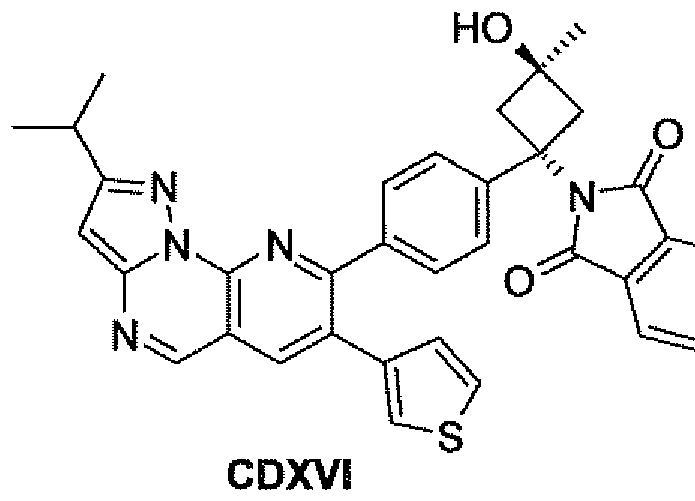 CDXVl
CDXVl
Compound [CDXVTj was prepared using a procedure similar to that of Compound [SL]. Data for Compound [CDXVl]: LCMS (m/e) 600 (M+H).
/ra«s-3-Amino-3-[4-(2-isopropyI-7-thiophen-3-yl-1,4,9,9b-tetraaza- cydopenta[β]naphthaleii-8-yI)-phenyl]-1-iiιethyI-cyclobutaiioI [CDXVII]
HO4

CDXVII
Compound [CDXVHJ was prepared using a procedure similar to that of Compound [SLT]. Data for Compound [CDXVII]: LCMS (m/e) 470 (M+H); 1H NMR (400 MHz, METHANOL-^) δ ppm 1.41 (d, /=6.98 Hz, 6 H) 1.50 (s, 3 H) 1.93 (s, 2 H) 2.57 - 2.69 (m, 2 H) 2.79 - 2.89 (m, 2 H) 3.22 - 3.26 (m, 1 H) 6.78 (s, 1 H) 6.87 (dd, J=5.00, 1.29 Hz, 1 H) 7.36 (dd, J=4.98, 2.98 Hz, 1 H) 7.42 (dd, J=2.95, 1.29 Hz, 1 H) 7.50 - 7.56 (m, 2 H) 7.68 - 7.75 (m, 2 H) 8.60 (s, 1 H) 9.02 (s, 1 H).
2-Isopropyl-7-thiophen-2-yl-9H-1,4,9,9b-tetraaza-cyclopenta[α]naphthalen-8-one
[CDXVΠIJ

CDXVHI
Compound [CDXVIII] was prepared using a procedure similar to that of Compound [IVJ (NaO-r-Bu procedure). Data for Compound [CXVHI]: LCMS (ra/e) 311 (M+H); 1H NMR (300 MHz, DMSO^) δ ppm 1.31 (d, J=6.9 Hz, 6 H) 3.09 (m, 1 H) 6.27 (s, 1 H) 7.06 (t, /=4.5 Hz,l H) 7.34 (d, /=5.1 Hz, 1 H) 7.66 (d, J=3.6 Hz, 1 H) 8.25 (s, 1 H) 8.39 (s, 1
H).
8-Chloro-2-isopropyl-7-thiophen-2-yl-1,4,9,9b-tetraazacyclopenta[fl]naphthalene [CDXIX]

CDXIX
Compound [CDXIX] was prepared using a procedure similar to that of Compound [V] (SOCl2 procedure). Data for Compound [CDXIX]: LCMS (m/e) 329 (M+H); 1HNMR (300 MHz, DMSCMs ppmD) 1.36 (d, J=6.9 Hz, 6 H) 3.21 (m, 1 H) 6.90 (s, 1 H) 7.28 (m, 1 H) 7.64 (m, 1 H) 7.84 (m, 1 H) 8.94 (s, 1 H) 9.10 (s, 1 H).
frB«5-2-{3-Hydro^-1-[4-(2-isopi^pyI-7-thiopheπ-2-yl-lA9,9Meti^aza-cyclo pentalαJnaphthalen-S-ylJ-plienyll^-methyl-cyclobutylJ-isoiiidoIe-l^-dione [CDXX]
HC> ..*

CDXX
Compound [CDXX] was prepared using a procedure similar to that of Compound (XLJ. Data for Compound {CDXX]: LCMS m/e 600 (M+H).
fro«5-3-Ainiiio-3-[4-(2-isopropyl-7-thiopheii-2-yl-1,4^,9b-tetraaza- cyclopenta[α]naphthalen-8-yl)-phenyI]-1-inethyI-cyclobutanol [CDXXI]

Compound [C DXXI] was prepared using a procedure similar to that of Compound [XU]. Data for Compound [017WMF082_5]: LCMS m/e 470 (M+H); 1H NMR (400 MHz9 METHANOL-^) δ ppm 1.40 (cL J=6.98 Hz, 6 H) 1.51 (s, 3 H) 1.91 (s, 3 H) 2.53 - 2.61 (m, 2 H) 2.75 - 2.85 (m, 2 H) 3.20 - 3.26 (m, 1 H) 6.78 (s, 1 H) 6.96 - 7.03 (m, 2 H) 7.45 (dd, J^UO, 2.25 Hz, 1 H) 7.49 - 7.55 (m, 2 H) 7.68 - 7.75 (m, 2 H) 8.63 (s, 1 H) 9.01 (s, 1 H).
7-(2-Fluoro~phenyϊ)-2-isopropyl-9H-1,4,9,9b-tetraaza-cycIopeiita[α]iiaphthalen-8-one
[CDXXΠ]
ferN
1

CDXXIl
Compound [CDXXII] was prepared using a procedure similar to that of
Compound [IV] (NaO-M3u procedure). Data for Compound [CDXXII]: LCMS (m/e) N/A.
8-Chϊoro-7-(2-fluoro-phenyl)-2-isopropyl-1,4,9,9b-tetraaza-cyclopenta[α]naphthalene
[CDXXΠI]
CDXXIII
Compound [CDXXIII] was prepared using a procedure similar to that of Compound ftV] (SOCfe procedure). Data for Compound [CDXXHϊ]: LCMS m/e 341 (M+H); 1H NMR (300 MHz, DMSCMJ) δ ppm 1.37(d, /=6.9 Hz, 6 H) 3.21 (m, 1 H) 6.92 (s, 1 H) 7.44 (m, 2 H) 7.60 (m, 2 H) 8.79 (s, 1 H) 9.08 (s, 1 H).
*røκs-2-(l-{4-I7-(2-Ftaorø-phenyI^ 8-ylj-pheny]}-3^-dimethy]-cyclobu*yl)-isoijidole-l^-dionc [CT>XXTV]
HO.

Compound [CDXXIV] was prepared using a procedure similar to that of Compound IXLI. Data for Compound [CDXXIVl: LCMS (m/e) 612 (M+H).
frα«5-3-Amino-3-{4-[7-(2-fluoro-phenyl)-2-isopropyl-1,4,9,9b-tetraaza- cyclopenta[fl)naphthalen-8-yl]-phenyl}-1-methyl-cyclobutanol [CDXXV]
HO. .<>

Compound [CDXXVJ was prepared using a procedure similar to that of Compound [XLq. Data for Compound [CDXXVl: LCMS (m/e) 481 (M+H); 1HNMR (400
MHz, METHANOL-^) δ ppm 1.42 (4 J=6.98 Hz, 6 H) 1.49 (s, 3 H) 1.91 (s, 4 H) 2.51 - 2.60 (m, 2 H) 2.72 - 2.81 (m, 1 H) 3.23 -3.26 (m, 1 H) 6.79 (s, 1 H) 7.03 (dd, _£=9.76, 8.59 Hz, 1 H) 7.19 - 7.27 (m, 1 H) 7.35 - 7.49 (m, 4 H) 7.65 - 7.70 (m, 2 H) 8.56 (s, 1 H).
/raκs~2-[l-(4-Bromo-phenyI)-3-^^ ICDXXVI]

Compound [CDXXVI] was prepared using a procedure similar to that of
Compound [XXXVrø], Data for Compound [CDXXVI]: LCMS (m/e) 412 (M+H); 1H NMR (300 MHz, CHLOROFORM-^ δ ppm 1.80 (s, 3 H) 3.19 (m, 2 H) 3.43 (m, 2 H) 4.87 (s, 1 H) 4.98 (s, 1 H) 7.47 (m, 2 H) 7.63 (m, 4 H) 7.73 (m, 2 H).
frαιis-2-[1^4-Bromo-pheny^^ [CDXXVH]

Compound ICDXXVIIj was prepared using a procedure similar to that of
Compound [CCCXCVII]. Data for Compound: LCMS (m/e) 413 (M); 1H NMR (300 MHz, CHLOROFORM-rf) δ ppm 0.89 (d, J= 6.9 Hz) 1.68 (m, 1 H) 3.07 (m, 4 H) 7.45 (m, 2 H) 7.61 (m, 4 H) 7.75 (m, 2 H).
tarø5-2-{3-Hydro:ιy-3-ϊ!ropropyI^ cyclobutyl}-isoindole-1,3-dionc [CDXXVTII]
HO


Compound [CDXXVIIIj was prepared using a procedure similar to that of Compound [XXXIX]. Data for Compound [CDXXVIII]: LCMS (ra/e) 484 (M+Na); 1H NMR (300 MHz, CHLOROFORM-d) δ ppm 0.90 (d, J= 6.6 Hz, 6 H) 1.33 (s, 12 H) 1.70 (m. 1 H) 3.18 (m, 4 H) 7.65 (m, 2 H) 7.75 (m, 6 H).
iVα»s-2-{l-[4-(2-CycIopropyI-7-pte^ phenyl]-3-hydroxy-3-isopropyI-cyclobutyI}-isoiiιdole-13-dioiιe [CDXXIX]

CDXXIX
Compound [CDXXIX] was prepared using a procedure similar to that of Compound [XL]. Data for Compound [CDXXIX]: LCMS m/e 620 (M+H).
frαjw-3-Amino-3-[4-(2H^clopro^^ yO-phenylJ-1-isopropyl-cyclobutanol [CDXXX]

CDXXX
Compound [CDXXX] was prepared using a procedure similar to that of Compound [XLI]. Data for Compound [CDXXXJ: LCMS (ra/e) 490 (M+H); 1H NMR (400 MHz, METHAN0W4) δ ppm 0.88 (4 ^=6.83 Hz, 6 H) 0.93 - 1.02 (m, 2 H) 1.06 - 1.17 (m, 2 H) 1.77 - 1.90 (m, 1 H) 1.94 (s, 1 H)2.16 - 2.27 (m, 1 H) 2.51 - 2.61 (m, 2 H) 2.73 - 2.83 (m, 2 H) 6.59 (s, 1 H) 7.27 - 7.37 (m, 5 H) 7.48 - 7.57 (m, 2 H) 7.66 - 7.74 (m, 2 H) 8.52 (s, 1H) 9.01 (s, 1 H).
frβiιs-2-{3-Hyd^oxy-3-irøpropyl-1-[4-(2-methyl-7-phenyI-1,4,9,9b-tetraaza- cyciopenta[«]naphthalen-8-yl)-phenyl]-cycIobutyl}-isoindole-13-dione [CDXXXI]

Compound [CDXXXI] was prepared using a procedure similar to that of Compound [XL]. Data for Compound [CDXXXI]: LCMS m/e 594 (M+H).
frαws-3~Amino-14sopiOpyl-3-^ cyclopenta[α]naphthalen-8~yl)-phenyl]-cyclobutanol [CDXXXII]
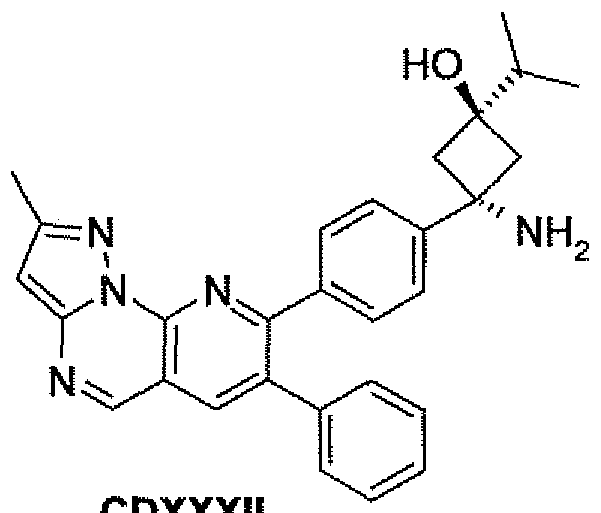
Compound [CDXXXH] was prepared using a procedure similar to that of Compound [XLI]. Data for Compound [CDXXXlI]: LCMS (m/e) 463 (M+H); 1H NMR (400 MHz, METHANOL-^) δ ppm 0.88 (4./=6.83 Hz, 6 H) 1.68 - 1.90 (m, 1 H) 1.96 (s, 1 H) 2.57 (s, 3 H) 2.58 - 2.69 (m, 2 H) 2.70 -2.87 (m, 2 H) 6.75 (s, 1 H) 7.24 - 7.41 (m, 5 H) 7.46 - 7.60 (m, 2 H) 7.65 - 7.83 (m, 2 H) 8.54 (s, 1 H) 9.04 (s, 1 H).
^^-[l-CΦ-Bromo-phenyO-S-hydroxy-S-isopropenyl-cycIobutylj-isoindole-l^-dione [CDXXXlIl J

Compound [CDXXXIIIl was prepared using a procedure similar to that of Compound [XXXVIII]. Data for Compound [CDXXXIIIJ: LCMS m/e 412 (M+H); 1H NMR (300 MHz, CHLOROFORM-^) δ ppm 1.73 (s, 3 H) 3.27 (m, 2 H) 3.52 (m, 2 H) 4.78 (s, 1 H) 4.83 (s, 1 H) 7.41 (m, 2 H) 7.50 (ra, 2 H) 7.67 (m, 2 H) 7.75 (m, 2 H).
cw-2~[l-(4-Bromo-phenyl)-3-hydroxy-3-isopropyl-cycϊobutyI]-isoindole-13-diθ-ie [CDXXXIV]

Compound [CDXXXIV] was prepared using a procedure similar to that of Compound [CCCXCCVnj. Data for Compound [CDXXXIV]: LCMS (m/e) 413 (M); 1H NMR (300 MHz, CHLOROFORM-rf) δ ppm 0.84 (d, J= 6.6 Hz) 1.35 (m, 1 H) 3.11 (m, 2 H) 3.30 (m, 2 H) 7.46 (m, 2 H) 7.57 (m, 2 H) 7.66 (m, 2 H) 7.75 (m, 2 H).
c«-2-{3-Hydrosy-3-isopropyM-[4^ cycϊobutyl}-isoindole-1,3-dione [CDXXXV]

CDXXXV
Compound JCDXXXVJ was prepared using a procedure similar to that of Compound [XXXIX]. Data for Compound: LCMS (ra/e) 484 (M+Na); 1H MMR (300 MHz, CHLOROFORM-iippmD) 0.82 (d, J= 6.6 Hz, 6 H) 1.25 (m, 1 H) 1.36 (s, 12 H) 3.11 (m, 2 H) 3.38 (m, 2 H) 7.63 (m, 8 H).
c«-2-{l-[4-(2-Cyc!opropyl-7-phenyl-1,4,9,9b-tetraaza~cyclopenta|iα]iiaphtha Ien-8-yl)-phenyIl-3-hydroxy-3-isopropyl-cyclobutyI}-isoindoIe-l^-dione [CDXXXVI]

Compound [CDXXXVI] was prepared using a procedure similar to that of [XLJ. Data for Compound [CDXXXVI]: LCMS m/e 620 (M+H).
c»-3-Ammo-3-[4^2-cyclopropyl-7-pbe^ phenyl]-1-isopropy]-eyriobutanol [CDXXXVlϊ|

CDXXXVE
Compound [CDXXXVIIJ was prepared using a procedure similar to that of Compound [XLI]. Data for Compound [CDXXXVII): LCMS (m/e) 490 (M+H); 1H NMR (400 MHz, METHANOL-^) δ ppm 0.83 (4 JNS.83 Hz9 6 H) 0.92 - 1.04 (m, 2 H) 1.07 - 1.17 (m, 2 H) 1.45 - 1.59 (m, 1 H) 1.96 (s, 1 H) 2.15 - 2.30 (m, 1 H) 2.43 - 2.54 (m, 2 H) 2.70 - 2.86 (m, 2 H) 6.60 (s, 1 H) 7.26 - 7.35 (m, 5 H) 7.36 - 7.44 (m, 2 H) 7.60 - 7.75 (m, 2 H) 8.54 (s, 1H) 9.02 (s, 1 H).
Ethyl 7-amino-2-cycIopmpyl-5-methyIpyraTOlo[l^^lpyrimidine-6-carboxylate [CDXXXV1HJ

' O CDXXXVIiI
Compound [CDXXXVIII) was prepared using a procedure similar to that of Compound [CDHI] . This material was taken on to the next step without further purification or characterization.
(7-Ammo-2κydopropyI-5-methyl-pyrazrf^
Y^NH2
NγJL^OH
CDXXXIX
Compound [CDXXXIX] was prepared using a procedure similar to that of Compound [H]. Data for Compound [CDXXXIX]: LCMS (m/e) 219 (M+H); 1H NMR (SOO MHz9 DMSOd6) δ ppm 0.79 (m, 2 H) 0.93 (m, 2 H) 1.98 (m, 1 H) 2.46 (s, 3 H) 4.53 (d, J=5.4 Hz, 2 H) 4.70 (t, J=5.1 Hz, 1 H) 5.91 (s, 1 H) 7.21 (s, 2 H).
7-Amino-2-cyclopropyl-5-niethyl-pyrazolo[l^-a)pyriniidine-6-carbaldeIiyde [CDXLI

Compound [CDXL] was prepared using a procedure similar to that of Compound PH]. Data for Compound [CDXLJ: LCMS (m/e) 217 (M+H); 1H NMR (300 MHz9 CHLOROFORM- d) δ ppm 0.94 (m, 2 H) 1.01 (m, 2 H) 2.03 (m, 1 H) 2.73 (s, 3 H) 6.13 (s, 1 H) 6.95 (br.s, 1H) 9.55 (br.s, 1H) 10.20 (s, 1 H).
2-Cycϊopropyl-5-methyI-7-phenyl-9H-1,4,9,9b-tetraaza-cycIopenta[α/αaphthalen-8-one [CDXLIJ


CDXLI
Compound [CDXLI] was prepared using a procedure similar to that of Compound [CCCLXXXVI] (DBU procedure). This compound was taken on to the next step.
8-ChIoro-2-cyclopropyl-5-methyI-7-phenyl-1,4,9,9b-tetraaza-cyclopenta[α]naphthaIene [CDXLU]

ή-βws-2-{l-[4-(2-CycIopropyI-5-methyl-7-phenyH,4,9^b-tefraaza-cycIopenta[α]naphthalen- 8-yI)-phenyl]-3-hydroxy-3-methyl-cyclobu«yI}-isoindole-l^--dione [CDXLIII]

CDXLIII
Compound [CDXLIII] was prepared using a procedure similar to that of Compound (XL). Data for Compound [CDXLIIIl: LCMS m/e 606 (M+H).
frα«s-2-{l-[4-(2-Cyclopropyl-5-methyl-7-phenyH,4,9,9b-tetraaza-cycIopenta[α]naphthalen- β-y^-phenylJ-S-hydrosy-S-metliyl-cyclobutyO-isoiJidole-l^-dione [CDXLIV]
HO .

CDXLIV
Compound [CDXLIV] was prepared using a procedure similar to that of Compound [XLI] . Data for Compound [CDXLIV] : LCMS (m/e) 476 (M+H); 1H NMR (400 MHz, METHANOL-^) δ ppm 0.89 - 1.01 (m, 2 H) 1.03 - 1.15 (m, 2 H) 1.50 (s, 3 H) 1.91 (s, 3 H) 2.19 (tt, ^8.49, 4.83 Hz, 1 H) 2.48 - 2.61 (m, 2 H) 2.70 - 2.81 (m, 2 H) 2.88 (s, 3 H) 6.42 (s, 1 H) 7.28 - 7.38 (m, 5 H) 7.41 - 7.49 (m, 2 H) 7.60 - 7.69 (m, 2 H) 8.50 (s, 1 H).
7-Amino-2-isopropyl-S-methyl-pyrazolo[1,5-a]pyrimidine~6-carboxylic acid ethyl ester [CDXLV]

Compound [CDXLV] was prepared using a procedure similar to that of Compound [VH] using Compound [CLXII ∞ the starting material. Data for Compound [CDXLV]: LCMS (m/e) 263 (M+H).
(7-Ammo-2-isopiOpyM-methyl-pyrazolo[1,5-α]pyrimidin-6-yl)-methanoI [CDXLVI]

CDXLVI
Compound (CDXLVI] was prepared using a procedure similar to that of Compound [H]. Data for Compound [CDXLVI]: LCMS (m/e) 221 (M+H); 1HNMR (300 MHz, CHLOROFORM-d) δ ppm 1.36 (d, J=6.9 Hz, 6 H) 2.44 (s, 3 H) 3.07-3.17 (m, 1 H) 4.82 (s, 2 H) 6.18 (s, l H) 6.22 (br, 2 H).
7-Ammo-2-isopTOpyl-5-methylφyrazolo[1,5-α]pyrimiditte-6-carbaIdehyde [CDXLVπ]

Compound [CDXL VII] was prepared using a procedure similar to that of Compound [TO]. Data for Compound [CDXLVU]: LCMS (m/e) (219) (M+H); 1H NMR (300
MHz, DMSO-40 δ ppm 1.30 (d, 3=6.9 Hz, 6 H) 2.64 (s, 3 H) 3.03-3.12 (m, 1 H) 6.33 (s, 1 H) 8.34 (s, 1 H) 9.42 (s, 1 H) 10.11 (s, 1 H).
l-Isopropyl-S-methyl-T-phenyl^H-l^^^b-tetraaza-cyclopeiitalαJnaphthalen-S-oiie [CDXLViπi
H

N

CDXLVIIi
Compound [CDXL VDI] was prepared using a procedure similar to that of Compound (CCCLXXXVΪ] (DBU procedure). This compound was taken on directly to the next step without further characterization.
β-Chloro-Z-isopropyl-S-methyl-T-phenyl-lΛ^^b-tetraaza-cyclopentaJαlnaphthaleiie [CDXLIX]

CDXLIX
Compound [CDXLIX] was prepared using a procedure similar to that of Compound [V] (POCl3 procedure). Data for Compound [CDXLIX]: LCMS m/e (337) (M+H); 1H NMR. (300 MHz, CHLOROFORM-^) δ ppm 1.43 (d, 3=6.9 Hz, 6 H) 2.89 (s, 3 H) 3.40-3.43 (m, 1 H) 6.66 (s, 1 H) 7.54 (s, 5 H) 8.26 (s, 1 H).
frα«s-2-{3-Hydroxy-1-[4-(2-isopro^ cyclopentaJαlnaphthalen-S-y^-phenylJ-S-methyl-cyclobϊitylJ-isomdole-l^-dione [CDLJ
HQ

CDL
Compound [CDL] was prepared using a procedure similar to that of Compound [XL]. Data for Compound (CDL]: LCMS (ra/e) 608 (M+H).
/rø«s-3-Amino-3-[4^2-isoproρy^ cyclopenta[α]naphthalen-8-yI)-phenyl]-1-methyl-cyclobαtanoI[ [CDLI]
HQ .

Compound [CDLI] was prepared using a procedure similar to that of Compound [XLI]. Data for Compound [CLDIJ: LCMS (m/e) 478 (M+H); 1H NMR (400 MHz, METHANOL-^) δ ppm 1.40 (4,J=6.93 Hz, 6 H) 1.50 (s, 3 H) 1.90 (s, 3 H) 2.48 - 2.59 (m, 2 H) 2.69 - 2.80 (m, 2 H) 2.89 (s, 3H) 3.18 - 3.26 (m, 1 H) 6.62 (s, 1 H) 7.26 - 7.37 (m, 5 H) 7.40 - 7.48 (m, 2 H) 7.61 - 7.70 (m, 2 H) 8.51 (s, 1 H).
7~(3-Fluoro-phenyI)-2-methyϊ-9H-1,4>9,9b-tetraaza-cycϊopenta[α]iιaphthaIen-8-one [CDLπ]

8-Chloro-7-(3-fluoro-pbenyI)-2-me^ [CDLIU]

CDLiII
Compound [CDLIII] was prepared using a procedure similar to that of
Compound [V] (POCl3 procedure). Data for Compound [CDLIII]: LCMS (m/e) 313 (M+H); 1H NMR (300 MHz, CD3OD-^) δ ppm 9.03 (s, 1 H) 7.54-7.61 (q, 1 H) 7.37-7.43 (t, 2 H) 7.24- 7.30 (t, 1 H) 6.79 (s, 1 H) 2.59 (s, 1H).
/rα«if-2-(l-{4-[7»(3-Fluoro-phenyl)-2-methyH,4,9,9b-tetratιza-cyclopenta[fl]naphthalen-8- yl]-phenyl}-3-hydro^-3-methyl-cyclobutyI)-isoiiιdoIe-13-dioiie [CDLIV]
HC)

Compound [CDLIV] was prepared using a procedure similar to that of
Compound [XL]. Data for Compound [CDLIV]: LCMS (m/e) 584 (M+H).
frα«*-3~Amino-3-{4-[7^3-fhioro-phenyl)-2-methyl-lΛ9,9b-tetraaza- cycIopenta[α]naphthaleB-8-ylI-phenyI}-1-methyl-cyclobutanol [CDLV]
HO

Compound [CDLV] was prepared using a procedure similar to that of Compound [XLIJ. Data for Compound [CDLVJ: LCMS (m/e) 454 (M+H); 1H NMR (400 MHz, METHANOL-φpm 1.50 (§, D4) 3 H) 1.91 (s, 3 H) 2.51 - 2.62 (m, 5 H) 2.71 - 2.84 (m, 2 H) 6.75 (s, 1 H) 6.97 - 7.11 (m, 2 H) 7.14 (dd, J=7.76, 1.12 Hz, 1 H) 7.29 - 7.41 (m, 1 H) 7.45 - 7.53 (m, 2 H) 7.62 - 7.72 (m, 2 H) 8.55 (s, 1 H) 9.03 (s, 1 H).
7-(4-FIuoro-phenyI)-2-methyl-9H-1,4,9,9b-tetraaza-cyclopenta[αϊnaphthaIen-8-one [CDLVΪ]

Compound [CDLVI] was prepared using a procedure similar to that of Compound [CCCLXXXVI] (DBU procedure). This material was carried on to the next step without further purification.
8-Chloro-7-(4-fluoro-phenyl)-2-methyI-1,4,9,9b-tetraaza-cyclopenta[α]naphthalene [CDLVπ]

/rαws-1-tl-f^JT-fΦ-Fluoro-phenylJ^-methyl-l^^^b-tetraaza-cyclopeiitaϊαJnaphthalen-S- yll-phenylJ-S-hydroxy-S-methyl^yclobuty1Hwωdole-l^Hlione ϊCDLVlII]

CDLVEII
Compound [CDLVIII] was prepared using a procedure similar to that of Compound [XL]. Data for Compound [CDLVHD.]: LCMS (m/e) 584 (M+H).
Λrακ5-3-Amino~3-{4-[7-(4-fluoro-phenyl)-2-methyl-1,4,9,9b-tetraaza- cyclopenta[α]iiaphthaIen-8-yl]-phenyl}-1-methyl-cyclobutanol [CDLIX]

Compound [CDLIX] was prepared using a procedure similar to that of Compound [XLI] . Data for Compound [CDLIX] : LCMS (m/e) 454 (M+H); 1H NMR (400 MHz, METHANOLS) δ ppm 1.50 (s, 3 H) 1.91 (s, 3 H) 2.50 - 2.62 (m, 5 H) 2.74 - 2.83 (m, 2 H) 6.74 (s, 1 H) 7.00 - 7.13 (m, 2 H) 7.27 - 7.36 (m, 2 H) 7.43 - 7.51 (m, 2 H) 7.60 - 7.69 (m, 2 H) 8.53 (s, 1 H) 9.02 (s, 1 H).
7-(4-Chϊoro-phenyl)-2-methyl-9H~1,4,9,9b-tetraaza-cyclopenta[α]naphthalen-8-one [CDLX]
/=N H

Compound [CDLX] was prepared using a procedure similar to that of Compound [CCCLXXXVI] (DBU procedure). The material was taken on to the next step without further characterization..
8-ChIoro-7-(4-chloro-phenyl)-2-methyl-1,4,9,9b-tetraaza-cyclopenta[α]naphthalene [CDLXI]

Compound [CDLXT) was prepared using a procedure similar to that of
Compound [V] (POCl3 procedure). Data for Compound [CDLXI]: LCMS (m/e) 329 (M+H); 1H NMR (300 MHz, CHLOROFORM-^ δ ppm 2.66 (s, 3 H) 6.76 (s, 1 H) 7.38 (m, 4 H) 8.20 (s, 1 H) 8.85 (s, 1 H).
£rα«5-2-(l-{4-[7^4-Chloro-pheiiyl)-2-methyI-1,4,9,9b-tetraaa;a-cyclopeiιta[α]n aph&alen^-ylJ-phenyI}-3-hydro:iy^^

Compound [CDLXH] was prepared using a procedure similar to that of Compound [SL]. Data for Compound [CDLXII]: LCMS m/e 600 (M+H).
Λwrø-3-Amino-3~{4-[7K4-cMoro-phenyI)-2-methyl-lΛ^9b-tetraaza^ cyclopenta[a]naphthalen-8-ylj-pheiiyI}-1-raethyl-cycIobutanoI [CDLXΪΠ]
v>

CDLXIII
Compound [CDLXIII] was prepared using a procedure similar to that of Compound [XLIJ. Data for Compound [CDLXffl]: LCMS (m/e) 470 (M+H).
7-(3^hIoix)^henyI)-2-methyl-9H-lf4,9,9b-tetraaza-cyclopenta[a]napht]iaIeii-8-one [CDLXIV]
H

Compound [CDLXIV] was prepared using a procedure similar to that of Compound [CCCLXXXVI] (DBU procedure). This compound was taken on to the next step without further characterization.
8-Chloro-7-(3-chloro-phenyl)-2-methyl-1,4,9,9b-tetraaza-cyclopenta[α]naphthaIene [CDLXV]

2-(l-{4-[7-(3-Chloro-phenyI)-2-raethyl-1,4,9^b-tetraaa^H^dopenta[a]n aphthalen-8-y^phenyl}-3-hy^

Compound [CDLXVI] was prepared using a procedure similar to that of Compound [XL]. Data for Compound [CDLXVI]: LCMS (m/e) 600 (M+H).
trans4-Amino-3-{4-[7-(3-chloro~phmyϊ)-2-meihyl-l ,4,9,9b-tetraaza- cydopenta[α]naphthalen^-yI]-plιenyI}-1-methyl-cycIofoαtanol [CDLXVII]
HC>

CDLXVII ci
Compound [CDLXVII] was prepared using a procedure similar to that of
Compound [XLI]. Data for Compound [CDLXVU]: LCMS (m/e) 470 (M+H); 1H NMR (400 MHz, METHANOLS) δ ppm 1.50 (s, 3 H) 1.91 (s, 3 H) 2.53 - 2.62 (m, 5 H) 2.75 - 2.83 (m, 2 H) 6.75 (s, 1 H) 7.21 (d, J=7.37 Hz, 1H) 7.27 - 7.41 (m, 3 H) 7.46 - 7.53 (m, 2 H) 7.63 - 7.70 (m, 2 H) 8.55 (s, I H) 9.02 (s, I H).
Z-Methyl-V^-tolyl^H-lΛ^b-tetraaϊa-cyclopentalβliiaphthalen^-oMe lCDLXVπq
-JO

CDLXVIII
Compound [CDLXVlII] was prepared using a procedure similar to that of Compound [CCCLXXXVI] (DBU procedure). This material was taken on to the next step without further characterization.
M^hloro-1-methyl-T-o^olyl-l^^^b-tetraaza-cyclopentafαlnaphthalene ϊCDLXI^

CDLXIX
Compound [CDLXIX] was prepared using a procedure similar to that of Compound [V] (POCl3 procedure). Data for Compound [CDLXtXJ: LCMS (m/e) 309 (M+H); 1H NMR (300 MHz, CHLOROFORM-^ δ ppm 2.19 (s, 3 H) 2.66 (s, 3 H) 6.76 (s, 1 H) 7.22 (m, 1 H) 7.32 (m, 3 H) 8.14 (s, 1 H) 8.83 (s, 1 H).
fr«iw-2-{5-Hydro^-3-methyl-1-[4-(2-methyI-7-o-tolyl-1,4^,9b-tetraaza- cyclopenfa[tf]naphthaIen-8-yl)-phenyl]-cycIobatyl}-isoindoIe-l^-dione [CDLXXJ
HC)

CDLXX
Compound [CDLXX] was prepared using a procedure similar to that of Compound [XLJ. Data for Compound [CDLXX]: LCMS (m/e) 580 (M+H).
ϊ!røΛ*-3-Amino-1-me*hyI-3-[4^2-methyl-7-o-tolyl-1,4,9,9b-tetraaza- cycIopenta[fl]naphthalen-8-yl)-phenylJ-cycIobutanol [CDLXXl]

Compound [CDLXXII was prepared using a procedure similar to that of [XLI]. Data for Compound [CDLXXI]: LCMS (m/e) 450 (M-I-H); 1H NMR (400 MHz, METHANOL- dA) δ ppm 1.48 (s, 3 H) 1.90 (s, 3 H) 1.91 (s, 3 H) 2.51 - 2.57 (m, 2 H) 2.58 (s, 3 H) 2.71 - 2.82 (m, 2 H) 6.75 (s,l H) 7.16 (dd, J=7.22, 1.27 Hz, 1 H) 7.21 - 7.34 (m, 3 H) 7.37 - 7.48 (m, 2 H) 7.63 - 7.75 (m, 2 H) 7.68 - 7.68 (m, 0 H) 8.42 (s, 1 H) 9.01 (s, 1 H).
7H2-Methosy-phenyI)-2-meth^^
[CDLXXΠJ
^=N H

Compound [CDLXXII] was prepared using a procedure similar to that of Compound [CCCLXXXVI] (DBU procedure). This material was taken on to the next step without further characterization.
8-Chloro-7-(2-methθ3yrphenyO-2-methyl-1,4,9^b-tetraaκa-cyclopenta[α]naphthalene [CDLXXIII]

CDLXXHI
Compound [CDLXXIII] was prepared using a procedure similar to that of Compound [V] (POCl3 procedure). Data for Compound ICDLXXIII]: LCMS m/e 325 (M+H); 1HNMR (300 MHz, CHLOROFORM-d) δ ppm 2.63 (s, 3 H) 3.80 (s, 3H) 6.71 (s, 1 H) 7.02 (m, 2 H) 7.29 (s, 1 H) 7.44 (m, 1 H) 8.16 (s, 1 H) 8.80 (s, 1 H).
i!«ws-2-(:^Hydro:!_y-1-{4-[7-(^^ cyclopenta[α]naphthaIen-8-yϊ]-phenyϊ}-3-methyl-cyclobutyl)-isoindole-l^-dione [CDLXXIV]
HO.

CDLXXIV
Compound [CDLXXIV] was prepared using a procedure similar to that of Compound [XL] . Data for Compound [CDLXXIV] : LCMS (m/e) 596 (M+H).
frαws-3-Ammo-3-{4-[7-(2-metho^^ cycϊopenta[α]naphthalen-8-yI]-phenyl}-1-methyI-cyclobutanol [CDLXXV]
o>

CDLXXV
Compound [CDLXXV] was prepared using a procedure similar to that of Compound [XLIj. Data for Compound [CDLXXV]: LCMS (m/e) 466 (M+H); 1H NMR (400 MHz, METHANOLS) δ ppm 1.48 (s, 3 H) 1.91 (s, 3 H) 2.52.- 2.62 (ra, 5 H) 2.73 - 2.81 (m, 2 H) 6.73 (s, 1 H) 6.88 (d, J=8.30 Hz, 1H) 6.98 - 7.06 (m, 1 H) 7.29 - 7.38 (m,2 H) 7.38 - 7.47 (m, 2 H) 7.60 - 7.69 (m, 2 H) 8.45 (s, 1 H) 9.00 (s, 1 H).
7-(3-Methoxy-phenyI)-2-methyϊ-9H-1,4,9,9b-tetraaza-cycIopeiita[α]naphthaleii-8-one [CDLXXVI]

N<s.
CDLXXVi
Compound [CDLXXVI] was prepared using a procedure similar to that of Compound [CCCLXXXVI] (DBU procedure). This material was taken on to the next step without further characterization.
S-Chioro-T-tS-methoxy-phenyO^-methyl-l^^^b-tetraaza-cycIopentalαlnaphthalene [CDLXXVπ]
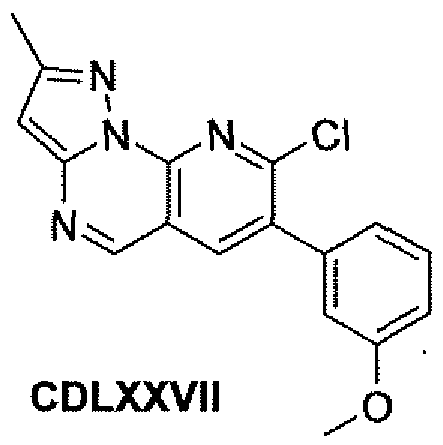
Compound [CDLXXVII] was prepared using a procedure similar to that of Compound [V] (POCl3 procedure ). Data for Compound [CDLXXVlI] : LCMS (rn/e) 325 (M+H); 1HNMR (300 MHz, CHLOROFORM-**) δ ppm 2.66 (s, 3 H) 3.90 (s, 3 H) 6.75 (s, 1 H) 7.03-7.11 (m, 3 H) 7.42-7.47 (m, 3 H) 8.22 (s, 1 H) 8.84 (s, 1 H).
ifraws-2H3-Hydro.^-1-{4-[7-(3^ cyclopenta[flr]naphthaIen-8-ylI-phenyi}-3-methyl-cycIobutyl)-isoindoIe-13-dione
[CDLXXVIII]
HO.

CDLXXVIII O v
Compound [CDLXXVIII] was prepared using a procedure similar to that of Compound [XLI]. Data for Compound [CDLXXViπ]: LCMS (ra/e) 596 (M+H).
<ftms-3-Amino-3-{4-[7-(3Hoa^ cyclopenta[α]naphthaIen-8-yl]~phenyl}-1-methyl-cyclobutanoI [CDLXXIX]
v>

CDLXXIX
Compound [CDLXXIX] was prepared using a procedure similar to that of Compound [XLIJ. Data for Compound [CDLXXIX]: LCMS (m/e) 466 (M+H); 1H NMR (400 MHz, METHANOL-^) δ ppm 1.49 (s, 3 H) 1.91 (s, 3 H) 2.53 - 2.61 (m, 5 H) 2.74 - 2.83 (m, 2 H) 3.66 (s, 3 H) 6.74 (s, 1 H) 6.81 -6.85 (m, 1 H) 6.85 - 6.92 (m, 2 H) 7.24 (t, J=7.91 Hz, 1 H) 7.43 - 7.50 (m, 2 H) 7.65 - 7.72 (m, 2 H) 8.53 (s, 1 H) 9.02 (s, 1 H).
7-(2-Chloro-phenyl)-2-methyl-9H-1,4^,9b-tetraaza-cyclopenta[α]naphthalen-8-oiie [CDLXXX]
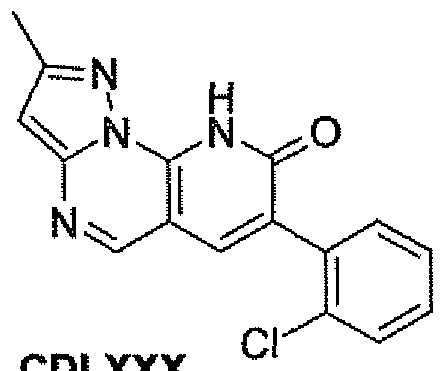
Compound [CDLXXX] was prepared using a procedure similar to that of Compound [CCCLXXXVI] (DBU procedure). This material was taken on to the next step without further characterization.
8-Chloro-7-{2-chloro-phenyI)-2-methyl-1,4,9,9b-tetraaza-cyclopeiita[«]naphthalene [CDLXXXI]
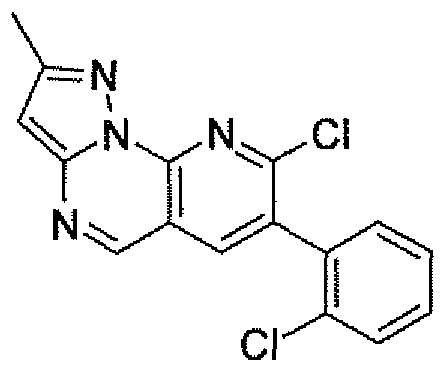
CDLXXXi
Compound [CDLXXXI] was prepared using a procedure similar to that of Compound [V] (POCl3 procedure). Data for Compound [CDLXXXI]: LCMS (m/e) 325 (M+H); 1H NMR (300 MHz, CHLOROFORM-^) β ppm 2.66 (s, 3 H) 5.32 (s, 1 H) 6.70 (s, 1 H) 7.20-7.60(m, 4 H) 8.19 (s, 1 H) 8.84 (s, 1 H).
frα«*-2-(l-{4-[7-(2-CUororphenyI)-2-methyI-1,4,9^b-tetraaza-cyclopenta[α]n aphthalen^-ylJ-phenylJ-1-hydrosy-S-methyRyclobutylJ-isoiiϊdoϊe-l^dioiie JCDLXXXII]
HC) ,»
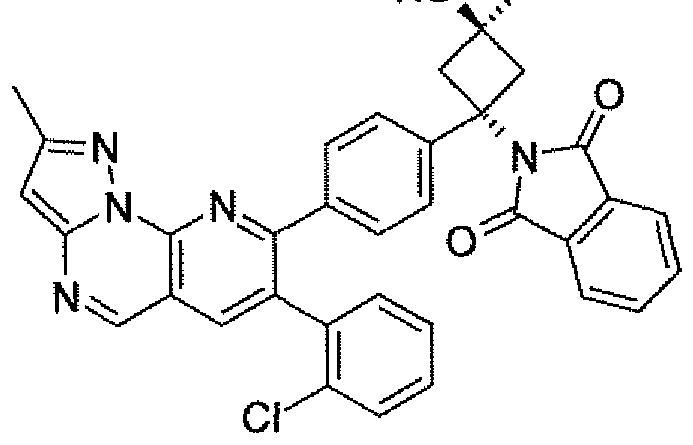
CDLXXXII
Compound [CDLXXXII] was prepared using a procedure similar to that of Compound [XL]. Data for Compound [CDLXXXπj: LCMS m/e 600 (M+H).
lfrms-3-Araino-3-{4-[7-(2-ehlorø-ph^^ cyclop€nta[αJnaphthaleπ-8-ylJ-phenyl}-1-inetIiyI-cyclobutanol [CDLXXXm]

Compound (CDLXXXHI] was prepared using a procedure similar to that of Compound [XLI]. Data for Compound [CDLXXX1H]: LCMS (m/e) 470 (M+H); 1H NMR (400 MHz, METHANOL-^) δ ppm 1.50 (s, 3 H) 2.61 (s, 3 H) 2.63.- 2.82 (m, 2 H) 2.82 - 2.96 (m, 2 H) 6.80 (s, 1 H) 7.26 - 7.63 (m, 6 H)7.76 (d, J^8.54 Hz, 2 H) 8.54 (s, 1 H) 9.06 (s, 1 H).
2-Methyl-7-m-toly^9H-1,44),9b4etraaza-^cIopenta[aJnaphthaleii^^ae ICDLXXXIV]
M 1
CDLXXXIV
Compound [CDLXXXIV] was prepared using a procedure similar to that of Compound [CCCLXXXVI] (DBU procedure). This material was taken on to the next step without further cnaracterization.
8-Chloro-2-methyl»7-m-toIyl-1,4,9,9b-tetraaza-cycIopenta[α]naphthalene [CDLXXXV]

^a/M-2-{3-Hydrorv-3-nicthyl"l-[4-(2-methyl-7-m-tolyl-1,4,9,9b-tetraaza- cycIopentafαJnaphthalen-S-y^-phenyll-cyclobutylJ-isoindole-l^-dione [CDLXXXVI]
HO.

Compound [CDLXXXVΪ) was prepared using a procedure similar to that of Compound [XL]. Data for Compound (CDLXXXVT]: LCMS (m/e) 580 (M+H).
cyclopenta[α]naphthalen-8-yl)-phenyI]-cycIobutanoI [CDLXXXVII]
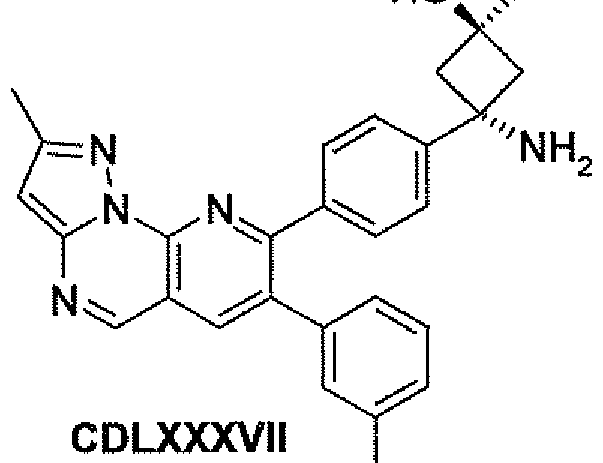
Compound [CDLXXXVII] was prepared using a procedure similar to that of Compound [XLI]. Data for Compound [CDLXXXVII]: LCMS (m/e) 450 (M+H); 1HNMR (400 MHz, METHANOL-^) δ ppm 1.50 (s, 3 H) 2.32 (s, 3 H) 2.60 (s, 3 H) 2.71 (d, JH4.59 Hz9 2 H) 2.89 (d, JH4.64 Hz, 2 H) 6.78 (s,l H) 7.08 (d, J=5Λ2 Hz, 1 H) 7.13 - 7.35 (m, 3 H) 7.44 - 7.60 (m, 2 H) 7.75 (d, ./=8.59 Hz, 2 H) 8.55 (s, 1 H) 9.06 (s, 1 H).
7-(4-Methoxy-phenyI)-2-methyl-9H-1,4,9,9b-tetraaza-cyclopenta[α]naphthalen-8-one [CDLXXXViπ]

Compound [CDLXXXVUlJ was prepared using a procedure similar to that of Compound (CCCLXXXViπj (DBU procedure). Data for Compound: LCMS (m/e) 307 (M+H).
8-Chloro-7-(4-methoxy-phenyI)-2-methyl-1,4,9,9b-tetraaza-cyclopenta[α]naphthaIene [CDLXXXIXl

Compound [CDLXXXIX) was prepared using a procedure similar to that of Compound [V] (POCl3 procedure). Data for Compound [CDLXXXIX]: LCMS (m/e) 325 (M+H); 1H NMR (300 MHz, CHLOROFORM-J) S ppm 2.63 (s, 3 H) 3.89 (s, 3 H) 6.72 (s, 1 H) 7.02 (d, /=8.4 Hz, 2 H) 7.44-7.47 (d, /=8.7 Hz, 2 H) 8.17 (s, 1 H) 8.82 (s, 1 H).
*m«s^2-(3-Hydro:sy-1-{4-[7^ cyclopenta[a)naphthalen-8-yl]-phe-iyl}-3-inethyl-cyclobutyI)-isoindoIe-1,3-dione [CDXC]

frα«s-3-Amino-3-{4-[7^4-methθ3y-phenyl)-2-methyl-1,4^,9b-t€traaza- cydopentalαlnaphthalen-S-yll-pIienyll-1-iiietliyl-cyclobutanol [CDXCI]

Compound [CDXCI] was prepared using a procedure similar to that of Compound [XLI]. Data for Compound [CDXCS]: LCMS (m/e) 466 (M+H); 1H NMR (400 MHz, METHANOL-^) δ ppm 1.51 (s, 3 H) 2.59 (s, 3 H) 2.71 (4 J=14.64 Hz, 2 H) 2.80 - 3.01 (m, 2 H) 6.77 (s, 1 H) 6.91 (<L>8.79 Hz, 2 H) 7.18 - 7.31 (m, 2 H) 7.53 (d, ^8.54 Hz9 2 H) 7.75 (d, ,£=8.49 Hz, 2 H) 8.54 (s, 1 H) 9.05 (s, 1 H).
2-Methyl-7-(2-trifluoromethyl-phe^^ (CDXCEq

Compound [CDXCII] was prepared using a procedure similar to that of Compound [CCCLXXXVπi] (DBU procedure). Data for Compound: LCMS (m/e) 363 (M+H).
8-Chloro-2-methyl-7-(2-trifluoromethyl-phenyl)-1,4,9,9b-tetraaza- cyclopenta[α]naphthalene [CDXCϋl]

Compound [CDXCIII] was prepared using a procedure similar to that of Compound [V] (POCl3 procedure). Data for Compound ICDXCIII]: LCMS (m/e) 363 (M+H); 1H NMR (300 MHz, CHLOROFORM-^ δ ppm 2.66 (s, 3 H) 6.77 (s, 1 H) 7.41 (d, J=7.2 Hz 1 H) 7.63-7.74 (m, 2 H) 7.88 (d, J=7.2 Hz, 1 H) 8.17 (s, 1 H) 8.83 (s, 1 H).
15rα»s-2-(3-Hydroxy-3-raeth^^^ tetraaza-cycIopenta[α]naphthaIen-8-ylI-ph€nyl}-cyclobutyϊ)-isoindole-l»3-dioiie [CDXCIV]
HO,

Compound [CDXCIV] was prepared using a procedure similar to that of Compound [XL]. Data for Compound [CDXCIV]: LCMS m/e 634 (M+H).
øww-3-Amrao^-raethyl-3-{4-[2H^ cyclopenta[α]naphthalen-8-yl]-phenyl}-cyclobutanol [CDXCV]
HC)

CDXCV
Compound [CDXCV] was prepared using a procedure similar to that of Compound [XLI]. Data for Compound [CDXCV]: LCMS (m/e) 504 (M+H); 1H NMR (400 MHz, METHANOL-^) δ ppm 1.49 (s, 3 H) 2.61 (s, 3 H) 2.64 - 2.74 (m, 2 H) 2.80 - 2.93 (m, 2 H) 6.81 (s, 1 H) 7.44 (d, .£4.54 Hz1I H) 7.47 - 7.54 (m, 2 H) 7.62 (d, J-9.13 Hz, 2 H) 7.72 (d, J=8.54 Hz, 2 H) 7.78 - 7.97 (m, 1 H) 8.52 (s, 1 H) 9.05 (s, 1 H)
2-Methyl-7-pyridin-3-yl-9H-1,4,9,9b4etraaza-€ycIopenta[αlnaphthaIen-8-one [CDXCVη
1

CDXCVI
Compound [CDXC VI] was prepared using a procedure similar to that of Compound (IV] (NaO-t-Bu procedure). Data for Compound [CDXCVI]: LCMS (m/e) 278 (M+H).
8-<HιlθTO-2-methyl-7-pyridm-3-yl-1,4,9,9b-tetraaza-cyclopenta[α]naphthalene [CDXCVII]

CDXCVH
Compound [CDXCVII] was prepared using a procedure similar to that of Compound [V] (POCl3 procedure). Data for Compound [CDXCVII]: LCMS (m/e) 296 (M+H); 1H NMR (300 MHz9 CHLOROFORM-^ δ ppm 2.59 (s, 3 H) 6.80 (s, 1 H) 7.62-7.67 (m, 2 H) 8.12-8.16 (m, 1 H) 8.79 (d,>3.0 Hz, 2 H) 9.04 (s, 1 H).
frβιw-2-{3-Hydro:-y-3-met^ cyc]openta[α|naphthalen-8-yl)-phenyl|-cyclobut>1}-isoindolc-1-3-di(»ne [CDXCVIII]
HC)

Compound JCDXCVHI] was prepared using a procedure similar to that of Compound IXLj. Data for Compound [CDXCVIII]: LCMS (m/e) 567 (M+H).
frαws^-Anύno-1-methyl^ penta[α]naphthakn-8-yI)-phenyI]~cyclobutanol [CDXClX]

CDXCIX
Compound [CDXCIX] was prepared using a procedure similar to that of Compound [XLI]. Data for Compound [CDXCIX]: LCMS (m/e) 437 (M+H); 1H NMR (400 MHz, METHANOL-^) δ ppm 1.51 (s, 3 H) 2.60 (s, 3 H) 2.72 (φ /=14.59 Hz, 2 H) 2.82 - 2.93 (m, 2 H) 6.81 (s, 1 H) 7.51 - 7.56 (m,l H) 7.58 (d, J=8.54 Hz, 2 H) 7.67 - 7.75 (m, 2 H) 7.96 (dd, J=IM, 3.76 Hz, 1 H) 8.52 (d, JM .85 Hz, 1 H) 8.57 (dd, ^=5.08, 1.46 Hz, 1 H) 8.69 (s,l H) 9.08 (s, 1 H).
3-(2-MethyI-8-oxo-8,9-dihydro-1,4^,9b-tetraaza-cyclopentatfl]naphthalen-7-yl)- benzonitrUe [D]

3-(8-Ch!oro-2-methyH,4,9,9b-tetraaza-cyclopenta[β]naphthaIeii-7-yϊ)-beiizoiiitriIe [DI]
N

Dl
N
Compound [DI] was prepared using a procedure similar to that of Compound [V) (POCl3 procedure). Data for Compound [DIj: LCMS (m/e) 320 (M+H); 1H NMR (300 MHz, CHLOROFORM-^ 5 ppm 2.66 (s, 3 H) 6.77 (s, 1 H) 7.64-7.70 (m, 1 H) 7.79-7.84 (t, ^=9.0 Hz, 3 H) 8.22 (s, 1 H) 8.85 (s, 1H).
.■ra«s-(l-{4~[7-(3-Cyano-phenyl)-2-metbyI-1,4,9^b-tetraaza-cyclopenta[a]naphthaleii-8-yl]- phenyl}-3-hydπ>sy-3-iiιethyl-cyclobutyI)-carbaiiιic acid tert-butyl este [DII]

Compound (DII] was prepared using a procedure similar to that of Compound [XL]. Data for Compound [DII]: LCMS (m/e) 561 (M+H).
*rαιw-3-{8-[4-(l-Ammo-3-hydro:xy^ tetraaza-cyclopenta[Λ}naphtha!en-7-yl}-beiizonϊtrϊle IDIIII
HC>

Compound [DIII] was prepared using a procedure similar to that of Compound [XLlY]. Data for Compound [DIII]: LCMS (ra/e) 461 (M+H); 1U NMR (400 MHz, METHANOL-^) 6 ppm 1.51 (s, 3 H) 2.60 (s} 3 H) 2.71 (φ ^=I 4.64 Hz, 2 H) 2.89 (d, J=UM Hz, 2 H) 6.80 (s, 1 H) 7.48 -7.60 (m, 3 H) 7.62 - 7.68 (m, 1 H) 7.68 - 7.79 (in, 4 H) 8.64 (s, 1 H) 9.07 (s, 1 H).
2-(2-Methyl-8-oxo-8,9-dihydro-1,4,9,9b-tetraaza-cyclopenta[a]naphthaIeii-7-yl)- benzonitrile (DIV]
Nl H iO

Compound [DIV] was prepared using a procedure similar to that of Compound [TV] (NaO-Z-Bu procedure). This compound was taken on to the next step without further characterization.
2-(8-Chloro-2-niethyl-1,4,9,9b-tetraaza-cyclopentaϊfl]naphthaIeiϊ-7-yI)-benzonϊtriIe pVl

tfrαjιs^l-{4-[7-(2-Cyanorpheny^^ phenyϊ}-3-hydroiy-3-methyl-cycIobutyI)-carbamic acid tert-butyl ester [DVI]
*

Compound [DVI] was prepared using a procedure similar to that of Compound [XL]. Data for Compound [DVI]: LCMS (m/e) 561 (M+H).
frαϊrø-2-{8-[4-(l-Amino-3-hydr^^ tetraaza-cycIopenta[α]naphthalen-7-yl}-benzonitrile [DVTI]
O. ,÷

DVIi
Compound [DVII] was prepared using a procedure similar to that of Compound [XLIV]. Data for Compound [DVH]: LCMS (m/e) 461 (M+H); 1H NMR (400 MHz,
METHANOL-^) δ ppm 1.47 (s, 3 H) 2.58 (s, 3 H) 2.64 - 2.72 (m, 2 H) 2.80 - 2.90 (m, 2 H) 6.79 (s, 1 H) 7.47 - 7.59 (m, 3 H)7.63 - 7.78 (m, 5 H) 8.64 (s, 1 H) 9.05 (s, 1 H)
4-(2-Methyl-8-oxo-8,9-dihydro-1,4,9,9b-tetraaza-cyclopetιta[α]naphthalen-7-yl)- benzonitrile [DVIII]

Compound [D VIII] was prepared using a procedure similar to that of Compound [CCCLXXXVIII] (DBU procedure). Data for Compound [DVIII]: LCMS (m/e) 302 (M+H).
4-(8-Chloro-2-methyl-1,4,9,9b-tetraaza-cycIopenta[α]naphthaϊen-7-yl)-benzonitrile fDIX]

Compound [DIX] was prepared using a procedure similar to that of Compound
[V] (POCl3 procedure). Data for Compound [DIX]: LCMS (m/e) 320 (M+H); 1H NMR (300 MHz, CHLOROFORM-**) β ppm 2.64 (s, 3 H) 6.76 (s, 1 H) 7.64 (d, J=8Λ Hz, 2 H) 7.81 (d, /=8.1 Hz, 4 H) 8.20 (s, 1 H) 8.83 (s, 1 H).
fttαns-(l-{4-[7-(4-Cyano-phenyI)-2-methyl~1,4,9,9b-tetraaza-cyclopenta[α]naphthalen-8-yl]- phenyl}-3-hydroxy-3-methyl-cyclobutyI)-carbamic acid tert-butyl ester [DX]

Compound [DX] was prepared using a procedure similar to that of Compound
[XL]. Data for Compound [DX]: LCMS (m/e) 561 (M+H).
frα«s-4-{8-[4^1-Ammo-3-h^^ tetraaza-cyclopenta[a]naphthalen-7-yI}-benzonrtrile [DXI|

Compound IDXI] was prepared using a procedure similar to that of [XLIV]. Data for Compound [DXI]: LCMS (m/e) 461 (M+H); 1H NMR (400 MHz, METHANOLS) δ ppm 1.48 (s, 3 H) 2.57 (s, 3 H) 2.63 - 2.74 (m, 2 H) 2.86 (d,J=14.69 Hz, 2 H) 6.77 (s, 1 H) 7.47 7.57 (m,4 H) 7.63 - 7.73 (m, 4 H) 8.62 (s, 1 H) 9.04 (s, 1 H).
4-(8-Chϊoro-2-methyl-1,4,9,9b-tetraaza-cycIopenta[α]naphthalen-7-yI)-pheiioϊ [DXII]
BCl3
DCM


CDU(XXIX DXIl
To a 50 mL round-bottom flask was added Compound Compound [CDLXXXIX] (0.75 g, 2.31 mmol, 1.00 eq.) in BC13/CH2C12 (8 mL). The mixture was stirred for 4 days at room temperature and then was quenched with water (20 mL). The mixture was extracted three times with 60 mL of ethyl acetate and the organic layers were collected. The combined organic phases were dried over Na2SC>4, filtered, concentrated and purified by silica gel chromatography using CH2Cl2 /MeOH (100: 1) as the eluent to give Compound [DXII] as a yellow solid: LCMS (m/e) 325 (M+H); 1H NMR (300 MHz, CHLOROFORM-d) δ ppm 8.84 (s, 1 H) 8.19 (s, 1 H) 7.42 (cL/=9Hz,2 H) 7.00 (d, J=9Hz, 2 H) 6.75 (s, 1 H) 2.65 (s, 3 H).
Acetic acid, 4-(8-chloro-2-methyI-1,4,9,9b-tetraaza-cycloρenta[αϊnaphthaIen-7-yI)-phenyl ester [DXlIl |
Ac2O

DXIi

To a 50 mL round-bottom flask was added Compound [DXII] (0.29 g, 0.94 mmol, 1.00 eq.) in Ac2O (20 mL). The mixture was stirred for 3 h at 40 °C and then quenched with water (60 mL). The mixture was extracted three times with 150 mL of ethyl acetate and the organic layers were collected. The combined organic phases were dried over Na2SO,*, filtered, concentrated and purified by silica gel chromatography using acetate/petroleum ether (1 :5) as the eluent to give Compound |DX1U| as a yellow solid: LCMS (m/e) 352 (M+H); 1H NMR (300 MHz, CHLOROFORM-^) δ ppm 8.84 (s, 1 H) 8.19 (s, 1 H) 7.55(d, J=9 Hz, 2 H) 7.26 (d, J=9 Hz, 2 H) 6.75 (s, 1 H) 2.65 (s, 3 H) 2.41 (s, 3 H).
frα«s-Acetic acid 4-{8-[4-(l-tert-bιitoxycarbonyϊamino-3~hydroxy-3-methyl-cycIobutyl)- phenyl]-2-methyH,4^,9b-tetraaza-cyclopenta[αJnaphthalen-7-yl}-phenyI ester pDXIV]
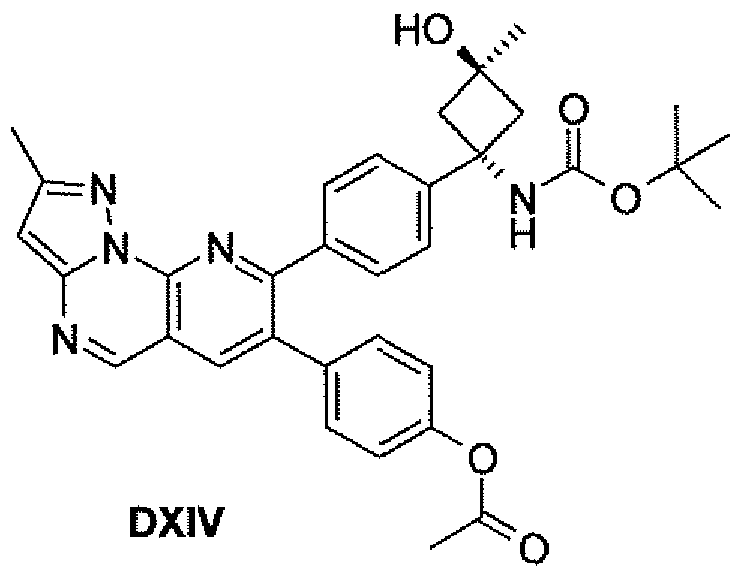
Compound [DXIV] was prepared using a procedure similar to that of Compound IXL]. Data for Compound [DXIV]: LCMS (m/e) 594 (M+H).
ή-αws-Acetic acid 4-{8-[4-(l-anύno-3-hydrosy-3-methyl-cyclobutyl)-phenyl]-2-methyI- 1,4,9,9b-tetraaza-cyclopenta[fl]naphthalen~7-yl}-phenyl ester [DXVJ

Compound [DXV] was prepared using a procedure similar to that of Compound [XLIVl. Data for Compound [DXV]: LCMS (rø/e) 494 (M+H); 1H NMR (400 MHz, METHANOL-^) δ ppm 1.51 (s, 3 H) 2.29 (s, 3 H) 2.58 - 2.63 (m, 3 H) 2.71 (d, JH4.59 Hz, 2 H) 2.90 (d, /=14.69 Hz, 2 H)6.78 (s, 1 H) 7.06 - 7.14 (m, 2 H) 7.32 - 7.40 (m, 2 H) 7.51 - 7.63 (m, 2 H) 7.71 - 7.84 (ra, 2 H) 8.59 (s, 1 H) 9.06 (s, 1 H).
fr«ra^3-Hydro:sy-1-{4-[7-(^^ cyclopenta[«]naphthalen-8~yI]-phenyl}-3-methyl-cyelobutyl)-carbamic acid tert-butyϊ ester [DXVIJ
HO.

DXVI
Compound [DXVI] was prepared using a procedure similar to that of [XL] . Data for Compound [DXVI]: LCMS (m/e) 552 (M+H).
frαM*^{8-[4-(l-Arømo-3-hydro^ tetraaza-cyclopenta[ajnaphthalen-7-yl}-phenol [DXVH]

Compound [DXVII J was prepared using a procedure similar to that of Compound [XLIV]. Data for Compound [DXVIIJ: LCMS (m/e) 452 (M+H); 1K NMR (400 MHz, METHANOL-^) δ ppm 1.51 (s, 3 H) 2.59 (s, 3 H) 2.71 (φ /=14.69 Hz, 2 H) 2.90 (d, J=14.64 Hz, 2 H) 6.73 - 6.78 (m, 3 H) 7.14 (d, ^=8.59 Hz, 2 H) 7.54 (d, ^=8.54 Hz, 2 H) 7.76 (d, J^=8.54 Hz, 2 H) 8.52 (s, 1 H) 9.04 (s, 1 H).
3-(8-CbIoro-2-incthyH,4,9,9b-tetraaza-cyclopenta[a|naphthaIeii-7-yl)-phenol [DXVΗI] and 3-(8-Bromo-2-raethyM ,4,9,91>-tetraaza-cyclopenta[a]iiap!ithaIen-7-yl)-phenoI [DXIX]
PBr3 DCM

CDLXXVII


To a 50 mL round-bottom flask was added Compound [CDLXXVII] (0.75g, 2.31 rnrnol, 1.00 eq.) in BBTjZCK2Ch (6mL). The mixture was stirred for overnight at room temperature and then was quenched with water (30 mL). The mixture was extracted three times with 60 mL ethyl acetate and the organic layer was collected. The combined organic phases were dried over NaaSO-i, filtered, concentrated and purified by silica gel chromatography using CH2CI2 /MeOH(IOO: 1) as the eluent to give a mixture of Compound [DXVHI] and [DXIX] as a yellow solid which was characterized as a mixture LCMS (m/e) 311 and 355 (M+H); 1H NMR (300 MHz, CHLOROFORM-tf) .δ ppra 8.71 (s, 1 H) 8.16 (s, 1 H) 7.40(d, J=9 Hz,I H) 7.07 (d, J=9 Hz, 1 H) 6.75 (s, 1 H) 2.66 (s, 3 H).
frαMS-(3-Hydrøxy-1-{4-[7-(3-hydirø-^ cyclopenta[<z]naphthalen-8-yI]-phenyl}-3-methyI-cycIobutyl)-carbamk acid tert-butyϊ ester [DXX]
HC>

Compound (DXX] was prepared using a procedure similar to that of Compound [XL]. Data for Compound [DXX]: LCMS (m/e) 552 (M+H).
frαHS-:_^{8-[4-(l-Arafao-3-hydro^ ,9b-tetraaza-cycϊopenta[tfJnaphthalen-7-yl}-phenoϊ P)XXI]

DXXI OH
Compound [DXXI] was prepared using a procedure similar to that of Compound [XLIV]. Data for Compound IDXXI]: LCMS (m/e) 452 (M+H); 1H NMR (400 MHz, METHANOL-^) δ ppm 1.51 (s, 3 H) 2.60 (s, 3 H) 2.71 (4.M4.64 Hz, 2 H) 2.90 (d, JH 4.74 Hz, 2 H) 6.65 - 6.92 (m, 4 H) 7.18 (t, J^=7.81 Hz, 1 H) 7.54 (d, 7^=8.54 Hz, 2 H) 7.80 (d, J=8.54 Hz, 2 H) 8.54 (s, 1 H) 9.05 (s, 1 H).
Acetic acid 3-(8~chloro-2-methyl-1,4,9,9b-tetraaza-cycϊopenta[fl]naphthalen-7-yl)-phenyl ester [DXXII] and Acetic acid 3-(8-bromo-2-inethyl-1,4,9,9b-tctraaza- cyclopenta[α]naphthalen-7-yl)-phenyl ester [DXXIIE]
Ac2O


To a 50 mL round-bottom flask was added a mixture of Compound [DXVIII] and Compound [DXIX] (0.25 g, 1.00 eq.) in AC2O (15 mL) and one drop pyridine. The mixture was stirred for 3 h at 40 °C and then quenched with water (25 mL). The mixture was extracted three times with 90 mL of ethyl acetate and the organic layers were collected. The combined organic phases were dried over Na2SO4, filtered, concentrated and purified by silica gel chromatography using acetate/petroleum ether (1:4) as the eluent to give Compound [DXXII] and Compound [DXXiπ] as a yellow solid: LCMS (m/e) 353 and 397 (M+H); 1H NMR (300 MHz, CHLOROFORM-^) S ppm 8.84 (s, 1 H) 8.24 (s, 1 H) 7.56(d, J=9 Hz, 2 H) 7.39 (d, J =9 Hz, 2 H) 6.76 (s, 1 H) 2.66 (s, 3 H) 2.34 (s, 3 H).
trans-Acetic acid 3- {8-[4-(l-tert-butoxycarbonylamino-3-hydroxy-3-methyl»cyclobutyI)- phenyl]»2~methyM,4,9,9b-tetraaza-cycIopenta[a]naphthalen-7-yl}-phenyl ester [DXXIV]

DXXIV °γ°
Compound [DXXIVJ was prepared using a procedure similar to that of Compound [XL]. Data for Compound [DXXTV]: LCMS (m/e) 594 (M+H).
frαws-Acetic add 3-{8-[4-(l-ainino-3-h^^ 1,4^,9b-tetraaza-cyclopeiite[a]naphthaIen-7-yL}-phenyl ester [DXXV]

Compound [DXXV] was prepared using a procedure similar to that of (XLIV]. Data for Compound [DXXV]: LCMS (rø/e) 494 (M+H); 1H NMR (400 MHz, METHANOLS) ppm 1.51 (s, 3 H) 2.24 (s, 3 H) 2.60 (s, 3 H) 2.72 (d,D /=14.55 Hz, 2 H) 2.91 (d, /=14.64 Hz, 2 H) 6.78 (s,l H) 7.11 (d, /=1.85 Hz, 2 H) 7.23 (d, J=7.76 Hz, 1 H) 7.38 (d, /=7.81 Hz, 1 H) 7.54 (d, /=8.49 Hz, 2 H) 7.74 (d, /=8.49 Hz, 2 H) 8.60 (s, 1 H) 9.06 (s, 1 H).
2-(8-Chloro-2-methyl-1,4,9,9b-tetraa7a-cyclopenta[rtlnaphtlialen-7~yl)-phenol [DXXVI] and 2-(8-bromo-2-methyl-1,4,9,9b-tetraaza-cyclopenta[rt]naphthalcn-7-yI)-phenol fDXXΛ IlJ

DXXVI

A mixture of Compound [DXXVI] and Compound [DXXVII] was prepared using a procedure similar to that of the mixture of Compound [DXXI] and Compound [DXXH]. Data for the mixture of Compound [DXXVI] and [DXXVn]: CMS (m/e) 311 and 355 (M+H); 1H NMR (300 MHz, CHLOROFORM--*) β ppm 8.71 (s, 1 H) 8.16 (s, 1 H) 7.36(d, /=9Hz, 1 H) 7.24 (d, /=9Hz, 1 H) 6.69 (s, 1 H) 3.44(s, 2 H) 2.57 (s, 3 H).
Acetic acid 2-(8-chloro-2-methyl-1,4,9,9b-tetraaza-cyclopeiita[a]naphthalen-7-yl)-pheiiyI ester [DXXVUI] and Acetic acid 2-(8-bromo-2-methyI-1,4,9,9b-tetraaza- cyclopenta[α]naphthalen-7-yl)-phenyl ester [DXXIX]
Ac2O


DXXVI! DXXIX ,A
To a 50 mL round-bottom flask was added a mixture of Compound [DXXVT| and Compound [DXXVII] (0.22 g, 1.00 eq.) in Ac2O (10 mL) and one drop pyridine. The mixture was stirred for 3 h at 40 °C and then quenched with water (30 mL). The mixture was extracted three times with 60 mL of ethyl acetate and the organic layers were collected. The combined organic phases were dried over Na2SO-J, filtered, concentrated and purified by silica gel chromatography using acetate/petroleum ether (1:5) as the eluent to give Compound [DXXVIII] and Compound [I)XXTX] as a yellow solid: LCMS (m/e) 353 and 397 (M+H); 1H NMR (300 MHz, CHLOROFORM-rf) β ppm 8.83 (s, 1 H) 8.10 (s, 1 H) 7.57(d, J^9Hz, 2 H) 7.44 (d, J=9Hz, 2 H) 6.76 (s, 1 H) 2.66 (s, 3 H) 2.03 (s, 3 H).
trans-Acetic acid 2-{8-[4-(l-tert-buto.ςrcarbonylam^ phenyl]-2-methyI-1,4,9,9b-tetraaza-cycIopenta[α]naphthaIen~7-yl}-phenyl ester [DXXX]
HC) *

Compound [DXXXJ was prepared using a procedure similar to that of Compound [XL]. Data for Compound [DXXX]: LCMS (m/e) 594 (M+H).
frαiw-Acetic acid 2-{8-[4-(l-ammo-3-h^^ 1,4A?*>-tetraaza-cyclopenta{α]naphtlialen-7-yl}-phenyϊ ester [DXXXI!

Compound [DXXXI] was prepared using a procedure similar to that of Compound [XLIVJ. Data for Compound [DXXXI]: LCMS (m/e) 494 (M+H); 1H NMR (400 MHz, METHANOL-^) δ ppm 1.50 (s, 3 H) 1.94 (s, 3 H) 2.60 (s, 3 Hj 2.70 (d, >=14.69 Hz, 2 H) 2.89 (d, ^=14.50 Hz, 2 H) 6.79 (s,l H) 7.14 (d, J^8.10 Hz, 1 H) 7.26 - 7.38 (m, 1 H) 7.37 - 7.62 (m, 4 H) 7.82 (d, J=8.54 Hz, 2 H) 8.53 (s, 1 H) 9.06 (s, 1 H).
Methyl 2-(Pyridi*-4-yl)acteate [DXXXIII]

To a 250 mL round-bottom flask was added a solution of Compound [DXXXII] (2 g, 11.6 mmol, 1.00 eq.) in methanol (3OmL). To the above reaction mixture, concentrated
H2SO4 (20 mL) was added drop wise. The mixture was stirred for 2 h at 64°C in an oil bath. The resulting mixture was cooled and the PH value of the solution was adjusted to 8 with sodium bicarbonate. Then it was extracted with ethyl acetate (3 x 25 mL) and concentrated under vacuum. It was purified by a silica gel column with EtOAc : petroleum (1 : 1) to afford Compound [DXXXIII] as a yellow liquid: LCMS (m/e) 152 (M+H); 1H NMR (300 MHz9 CHLOROFORM-^ δ ppm 3.62 (s, 2 H) 3.70 (s, 3 H) 7.23 (d, J=3.0 Hz, 2 H) 8.35 (s, 2 H).
2-Methyl-7-pyridin-4-yl-9H-1,4.9,9b-tetraa2a-cydopenta[α]naphthaleii-8-oiie [DXXXIV]

DXXXIV
Compound [DXXXIVl wa» prepared using a procedure similar to that of Compound [IV] (NaOf-Bu procedure). Data for Compound: LCMS (m/e) 278 (M+H).
8-Chloro-2-methyI-7-pyridin-4-yl-1,4,9,9b-tctraaza-cyclopenta|rtjnaphthalenc [DXXXΛ1

Compound [DXXXV] was prepared using a procedure similar to that of
Compound [V] (POCl3 procedure). Data for Compound [DXXXV]: LCMS (m/e) 296 (M+H); 1H NMR (300 MHz, CHLOROFORM-^ δ ppm 2.64 (s, 3 H) 6.77 (s, 1 H) 7.56 (s, 2 H) 8.23 (s, 1 H) 8.81(s, 2 H) 8.84 (s, 1 H).
fraiw-2-{3-Hydroxy-3-methyM44K2-^^ cyclopentafαlnaphthalen-8-yI)-phenyl]-c>τIobutyl}-isoindole-13-dionc [DXXXVT]
HO.

DXXXV)
Compound [DXXXVTj was prepared using a procedure similar to that of
Compound [XL]. Data for Compound [DXXXVI|: LCMS (m/e) 643 (M+H).
frαj«-3-Aminø-1-methyt3-[4^2-^ cyc!opeπta[β]naphtImϊen^-yl)rphenyIJ-cyclobutanol [DXXXVπ]
H<λ

DXXXVII
Compound pDXXXVII] was prepared using a procedure similar to that of Compound [XLI]. Data for Compound [DXXXVII]: LCMS (m/e) 437 (M+H); 1H NMR (400 MHz, METHANOLS) δ ppm 1.49 (s, 3 H) 2.57 (s, 3 H) 2.65 - 2.76 (m, 2 H) 2.80 - 2.91 (m, 2 H) 6.79 (s, 1 H) 7.52 - 7.61 (m, 2 H) 7.61 - 7.67 (m, 2 H) 7.67 - 7.75 (m, 2 H) 8.61 (d, J=6.00 Hz, 2 H) 8.72 (S, 1 H).
frαws-2-{3-Hydrø^-3-methyl-^ cyclop«ntatflJnaphthalen-8-yI)-phenyl]-cyclobutyl}-isoiiidoIe-13-dione [DXXXVIII]

Compound [DXXXVUI] was prepared using a procedure similar to that of Compound [CDVrøϊ. Data for Compound [DXXXVπi]: LCMS (m/e) 643 (M+H).
frαws-3-Amino4-meiIiyl-3-[4-(^^ cyclopenta[fl]naphthalen-8-yl)-phenyl]-cyclobutanol [DXXXIX]

Compound [DXXXIX] was prepared using a procedure similar to that of Compound |XLI]. Data for Compound [DXXXIX]: LCMS (m/e) 513 (M+H); 1H NMR (400 MHz, METHANOL-i/4) δ ppm 1.46 (s, 3 H) 2.59 (s, 3 H) 2.62 - 2.71 (m, 2 H) 2.77 - 2.89 (m, 2 H) 6.77 (s, 1 H) 6.94 - 7.16 (m, 5 H) 7.43 - 7.48 (m, 2 H) 7.48 - 7.55 (m, 1 H) 7.64 - 7.71 (m, 2 H) 7.89 (dt, ^=7.87, 1.85 Hz, 1 H) 8.43 - 8.46 (m, 1 H) 8.50 (s, 1 H) 8.54 (dd, ^5.08,1.56 Hz, 1 H).
*røΛS-2-{3-Hydrøjsy-3-me^ tetraaza-cyclopenta[a]naphthalen-8-yI)-phenyI]-cycIobutyI}-isoindoIe-13-dione [DXL]
HC)

Compound [DXL] was prepared using a procedure similar to that of Compound
[CDVIU]. Data for Compound [DXLj: LCMS (m/e) 643 (M+H).
frα«s-3-Amino-1-methyl-3-[4-(2-methyI-7-phenyl-6-pyridin-4-yl-1,4,9,9b-tetraaza- cyclopenta(α]naphthalen-8-yl)-phenyl]-cyclobutanol [DXLI]
HO.

Compound !DXLI] was prepared using a procedure similar to that of Compound (XLIJ. Data for Compound [DXLI]: LCMS (m/e) 513 (M+H); 1HNMR (400 MHz, METHANOL-^) δ ppm 1.46 (s, 3 H) 2.59 (s, 3 H) 2.62 - 2.69 (m, 2 H) 2.78 - 2.87 (m, 2 H) 6.77 (s, 1 H) 7.01 - 7.19 (m, 5 H)7.42 - 7.48 (m, 2 H) 7.48 - 7.52 (m, 2 H) 7.64 - 7.72 (m, 2 H) 8.46 (s, 1 H) 8.56 - 8.58 (m, 2 H).
frαws-2-{3-Hydro;sy-3-methyM^ cycIopenta[α]πιaphthaleii-8-yl)-phenyI]-cycloburyI}-isoindoIe-13-dione P>XLπ]
HC)

N^ N
DXLII
Compound [DXLII] was prepared using a procedure similar to that of Compound [CDVIII]. Data for Compound [DXLm] : LCMS (m/e) 644 (M+H).
trans-3-AminoΛ-methyh3-[4-(2-methyl-7-jιfo cyclopenta[e]naphthalen-8-yl)-phenyl]-cyclobntanol [DXLIII|

Compound [DXLIII] was prepared using a procedure similar to that of Compound [XI-IJ. Data for Compound [DXLIII]: LCMS (m/e) 514 (M+H); 1H NMR (400 MHz, METHANOL-rf4) δ ppm 1.46 (s, 3 H) 2.59 (s, 3 H) 2.62 - 2.70 (m, 2 H) 2.78 - 2.88 (m, 2 H) 6.78 (s, 1 H) 7.00 - 7.10 (m, 2 H) 7.10 - 7.19 (m, 3 H) 7.41 - 7.50 (m, 2 H) 7.65 - 7.71 (m, 2 H) 8.56 (s, 1 H) 8.69 (s, 2 H) 9.08 (s, 1 H).
_yα«s-2-(3-Hydrojςy-3-methyl-l^ tetraaza-cyclopentaJαjnaphthalen-S-yll-phenylJH^clobutyϊJ-iso-ndole-l^-^ioαe tDXLIV]
HC>

Compound [DXLIVj was prepared using a procedure similar to that of Compound [CDVHI]. Data for Compound JDXLIV]: LCMS (m/e) 632 (M+H).
fr*ww-3-Ajnino-1-methyϊ^ cyclopenta[α]naphthalen-8-yl]-phenyl}-cyclobutanoI [DXLV]
H(λ *
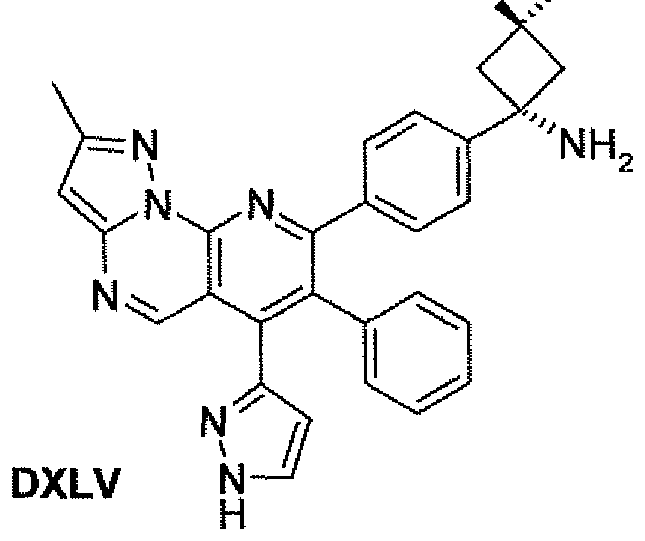
Compound [DXL VJ was prepared using a procedure similar to that of Compound IXLI]. Data for Compound [DXLV]: LCMS (m/e) 502 (M+H); 1H NMR (400 MHz, METHANOL-φpm 1.46 (s.,D4) 3 H) 2.57 (s, 3 H) 2.61 - 2.70 (m, 2 H) 2.78 - 2.88 (m, 2 H) 5.96 (d, >=2.34 Hz, 1 H) 6.73 (s, 1H) 7.00 - 7.08 (m, 2 H) 7.09 - 7.20 (m, 4 H) 7.41 - 7.47 (m, 2 H) 7.59 (d, J=2.34 Hz, 1 H) 7.61 - 7.66 (m, 2 H) 8.81 (s, 1 H).
ifrαrø-{l-[4-(6-C^aao-2-meth^ pheny!]-3-hydrosy-3-methyl-cyclobutyl}-carbamic acid tert-butyl ester [DXLVI]
HC)

A 20 ml scintillation vial containing [CCXLIX] (113 mg, 0.20 mrnol), ZnCN2 (56 mg, 0.48 mmol), Zn dust (13 mg, 0.20 mmol), and DMA (4 ml) was evacuated and flushed three times with nitrogen. Then Pd (P~t-Bu$)2 (15.4 mg, 0.030 mmol) was added and the resulting solution was evacuated and flushed three times with nitrogen. The mixture was heated at 110-120 °C for 3h. LCMS indicated the reaction was complete. Then it was allowed to cool and concentrated. The residue was dissolved with DCM (1.5 mL). After filtration, the filtrate was purified by silica gel chromatography by using MeOH and CH2CI2 as the mobile phases to furnish Compound [DXLVI] as a yellowish solid: LCMS (m/e) 561 (M+H).
frβιw4H4^1-Amrao-3-hydroxy-3-met^^ -1,4,9,9b-tetraaza-cycIopenta[α]naphthalenc-6-carbonitrik [DXLVHj

Compound [DXLVII] was prepared using a procedure similar to that of Compound [XLIV]. Data for Compound ΪDXLVII]: LCMS (m/e) 461 (M+H); 1H NMR (400 MHz, METHANOL-^) δ ppm 1.47 (s, 3 H) 2.59 (s, 3 H) 2.62 - 2.73 (m, 2 H) 2.77 - 2.90 (m, 2 H) 6.87 (s, 1 H) 7.36 - 7.45 (m, 5 H) 7.46 - 7.53 (m, 2 H) 7.63 - 7.73 (m, 2 H) 9.18 (s, 1 H).
frαM^{3-Hydroxy-1-[4-(6-methθ3^-2-methyl-7-phenyl-1,4,9,9b-tetraaza- cyclopenta[α]naphthalen-8-yl)-phenyI]-3-methyl-cyclobutyl}-carbamic acid tert-butyl ester [DXLVm]
HC>

DXLV)El
A 20 ml scintillation vial containing [CCXLIX] (100 mg, 0.18 mmol), dioxanet (2 mL), water (2 mL), MeOH (2 mL), and KOH (-400 mg, large excess) was stirred at room temperature for 24h. LCMS indicated the reaction was complete. It gave 6-methoxy analog as a major product along with 6-hydroxy as a minor one. The reaction mixture was concentrated and the residue was dissolved in DCM (10 mL) and water (5 mL). The water solution was extracted with DCM (5 mL x 2). The combined organic solution was concentrated and the residue was dissolved with DCM (1.5 mL). After filtration, the filtrate was purified by silica gel chromatography by using MeOH and CH2CI2 as the mobile phases to furnish Compound [DXLVπi] as a yellowish solid (79 mg, 78.2%): LCMS (m/e) 566 (M+H).
!taMS-3-Amiiio-3-[4-(6-meiho-^ cyclopenta[α]naphthalen-8-yl)-pbenyl]-1-methyl-cyclobutanol [DXLIX]
HCλ ,*

DXLEX
Compound [DXLIX] was prepared using a procedure similar to that of Compound [XLIV]. DaIa for Compound [DXLIX]: LCMS (m/e) 465 (M+H); 1H NMR (400 MHz, METHAN0W4) δ ppm 1.46 (s, 3 H) 2.55 (s, 3 H) 2.61 - 2.71 (m, 2 H) 2.77 - 2.88 (m, 2 H) 3.60 (s, 3 H) 6.74 (s, 1 H) 7.27 -7.32 (m, 2 H) 7.32 - 7.37 (m, 3 H) 7.39 - 7.46 (m, 2 H) 7.51 - 7.60 (m, 2 H) 9.20 (s, 1 H).
frα«s-{l-[4-(6-Ammo-2-methy^^ phenyI]-3-hydroxy-3-methyI-cyclobutyl}-carbamic acid tert-butyl ester [DL]
HC>

A 40 ml bomb containing [CCXLIX] (57 mg, 0.10 mmol), dioxane (8 mL), and concentrated NH4OH (8 mL) was heated at 120 °C for 15h. The reaction was allowed to cool to RT. The solvent was removed in vacuo and the residue was dissolved with MeOH (2 mL). After filtration and concentration, the residue was purified by silica gel chromatography by using MeOH and CH2CI2 as the mobile phases to furnish Compound [DL] as a yellowish solid (~50 mg, 91%, crude): LCMS (m/e) 551 (M+H).
iVaj^-3-Amino-3-[4-(6-«miBO-2-methyI-7-phenyl-1,4,9,9b-tetraaza- cyclopenta[a]naphthaIen-8-yl)-pheny!]-1-methyl-cyclobutanol [DLI)
*

Compound [DLIJ was prepared using a procedure similar to that of Compound [XLIV). Data for Compound [DLI]: LCMS (m/e) 451 (M+H); 1HNMR (400 MHz, METΗANOIw/4) δ ppm 1.46 (s, 3 H) 2.52 (s, 3 H) 2.59 - 2.68 (m, 2 H) 2.77 - 2.85 (m, 2 H) 6.61 (s, 1 H) 7.13 - 7.30 (m, 3 H) 7.34 - 7.42 (m, 4 H) 7.51 - 7.58 (m, 2 H) 9.20 (s, 1 H).
iVo«s-2-{l-[4-(3-Bromo-7-phenyl-1,4,9,9b-tetraaza-cycIopenta[a]naphthaIen-8-yI)-pIieuyI]- 3-hydroxy-^methyl-cyclobutyl}-i$omdole-l^-dione [DLII]
HO,

Compound [DLII] was prepared using a procedure similar to that of Compound [CV]. Data for Compound [DLII]: LCMS (m/e) 631 (M+H).
/rα«s-3-Ammo-3-(4-(3-bromo-7-pte^ phenyI]-1-methyl-cyclobαtanol [DLIIIJ
HTO

Compound [DLIII] was prepared using a procedure similar to that of Compound
[XLI].
Data for Compound [DL1H] LCMS (m/e) 501 (M+H); 1R NMR (400 MHz, METHANOLS) δ ppm 1.47 (s, 3 H) 2.64 - 2.73 (m, 2 H) 2.81 - 2.90 (m, 2 H) 7.28 - 7.38 (m, 5 H) 7.45 - 7.54 (m, 2 H) 7.65 -7.72 (m, 2 H) 8.30 (s, 1 H) 8.63 (s, 1 H) 9.15 (s, 1 H).
frαns-2~{l-[4-(3-Bromo-2-methyl-7-phenyI-1,4^,9b-tetraaza-cydopenta[fl3naphthaIen-8-yl)- phenyl]-3-hydroxy-3-niethyl-cycIobutyl}-isoiadoIe-l^-dione [DUV]

DLIV
Compound [DLIV] was prepared using a procedure similar to that of Compound
[CV]. Data for Compound [DLIV]: LCMS (m/e) 645 (M+H).
frα«s^-{4-[l-(13-Dioxo-lβ-dihydro-isom phenyl}-2-methyl-7-phenyl-l ,4,9,9b-tetraaza-cyclopenta[α] naphthaIene-3-carbonitriIe [DLV]
HO. *

Compound [DLV] was prepared using a procedure similar to that of Compound
[DXLVI]. Data for Compound [DLV]: LCMS (m/e) 591 (M+H).
*rα3!s^-[4^1-Amino-3-bydroxy-3-m^ tetraaza-cyclopenta[a]naphthaIene-3-carbonitriIe [DLVI]
HO*

Compound [DLVI] was prepared using a procedure similar to that of Compound [XLIj. Data for Compound [DLVI]: LCMS (m/e) 461 (M+H); 1H NMR (400 MHz, METHANOL-^) δ ppm 0.90 (s, 1 H) 1.29 (br. s., 2 H) 1.53 (s, 3 H) 1.93 (s, 3 H) 2.53 (d,
JH3.81 Hz, 2 H) 2.70 (s, 3 H) 2.76(d, .M3.52 Hz, 2 H) 7.23 - 7.43 (m, 5 H) 7.47 (d, ^=8.49 Hz, 2 H) 7.66 (d,>=8.44 Hz, 2 H) 8.69 (s, 1 H) 9.33 (s, 1 H).
frα«5-8-{4-[l-(lr5-Dioxo-lr3-dihydro-isoindol-2-yI)-3-hydroxy-3~methyl-cyclobutyϊJ- phenylJ^-phenyl-lA^^b-tetraaza-cyclopentaJflJnaphthalene-S-carboiiitrae [DLVII]

Compound p>LVΗ] was prepared using a procedure similar to that of Compound P)XLVII. Data for Compound [DLViη : LCMS (m/e) 577 (M+H).
frακs-8-[4-(l-Amrao-3-hydro^ cycIopentalαjnaphthalene-S-carbonitrile [DLVIII]

/iw«s-3-Amino-1-methyI-3-[4-(3-methyl-7-plienyI-lA934etraaza- cyclopenta[α]naphthalen-8-yI)-phenylj-cycIobutaaol [DLIX]
O X, .'* O*


DLIlI DLIX
Compound [DL1H] was prepared using a procedure similar to that of Compound [CCL]. Data for Compound [DLIX]: LCMS (m/e) 436 (M+H); 1HNMR (400 MHz, METHAN0W4) δ ppm 1.49 (s, 3 H) 1.91 (s, 4 H) 2.43 (s, 3 H) 2.50 - 2.62 (m, 2 H) 2.71 - 2.83 (m, 2 H) 7.25 - 737 (m, 5 H) 7.39 - 7.49 (m, 2 H) 7.60 - 7.69 (m, 2 H) 8.09 (s, 1 H) 8.53 (s, 1 H) 9.00 (s, 1 H).
7-Amino-2-cycIopropyI-pyrazolo[1,5-alpyrimid«ie-6-carboxylic acid hydrazide [DLX]

DLX °
Compound [DLX] was prepared using a procedure similar to that of [CCXXVH]. Data for Compound [DLX]: LCMS (m/e) 233 (M+H).
7-Amino-2κyclopiOpyl-pyi^«olo[1,5-α]pyrimidijie-6-carboxyIic acid hydrazide [DLXI]

VVN
H DLXf
Compound [DLXI] was prepared using a procedure similar to that of Compound [CCXXVIII]. Data for Compound [DLXIl: LCMS (m/e) 216 (M+H).
2-Cyclopropyl-pyrazolo[1,5-fl]pyrimidme-6,7-diamine [DLXII]
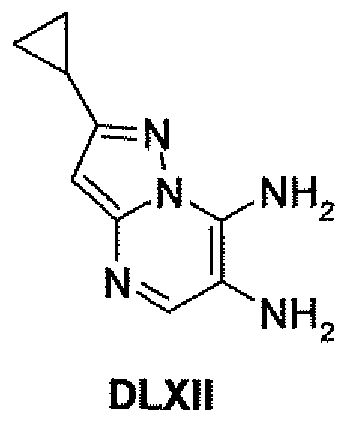
Compound [DLXII] was prepared using a procedure similar to that of Compound
[CCXXIX]. Data for Compound [DLXII]: LCMS (m/e) 190 (M+H).
2-Cyclopropyl-7-phenyl-9H-1,4,6,9,9b-pentaaza-cycϊopenta[fl]naphthaIeii-8-one [DLXπi]
,H. -JO
 DLXHI
DLXHI
[DLXIII] was prepared using a procedure similar to that of Compound [CCXXX]. Data for Compound [DLXHIJ: LCMS (m/e) 304 (M+H).
S-Chloro-Z-isopropenyl-T-phenyl-l^.ό^^b-peήfaaza-cyclopentaJαJnaphthalene [DLXIV]

Compound [DXLIV] was prepared using a procedure similar to that of Compound [V] (POCl3 procedure). Data for Compound [OXLIV]: LCMS (m/e) 322 (M+H).
frα«s-2-{3-Hydro.-y~l-ϊ4-(2-isopro cyclopentalαJnaphthalen-β-yO-phenyfl-S-methylKyclobtttylJ-isoindoIe-l^-dione [DLXV]

DEJCV
Compound [DLXV] was prepared using a procedure similar to that of Compound [XLl. Data for Compound [DLXV]: LCMS (m/e) 593 (M+H); 1H NMR (400MHz, CHLOROFORM-d) δppm 6.64-9.20 (m, 15 H), 3.40 (d, 2 H), 3.15 (d, 2 H), 1.98 (m, 2 H), 1.63 (m, 3 H), 1.46 (s, 2 H).
ltø»s-3-Amino-3-[4-(2-isopropen^ β-yO-phenylj-1-methyl-cyclobutanol [DLXVI]
HO^ ^
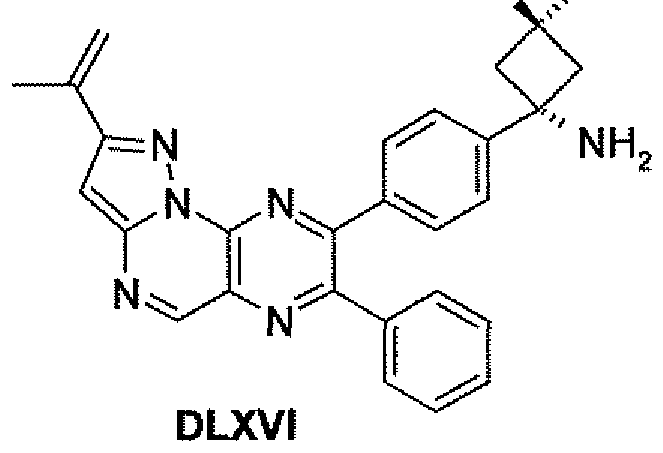
Compound [DLXVI] was prepared using a procedure similar to that of [CLXI] (MeNHNH2 procedure). Data for Compound [DXLVI]: LCMS (m/e) 463 (M+H); 1H NMR
(400 MHz, METHANOL-^) δ ppm 1.49 (s, 3 H) 1.92 - 2.02 (ra, 3 H) 2.65.- 2.74 (m, 2 H) 2.82 2.92 (m, 2 H) 6.57 - 6.79 (m, 2 H) 7.06 (s, 1 H) 7.29 - 7.44 (m, 3 H) 7.49 - 7.60 (m, 4 H) 7.75 - 7.83 (m, 2 H) 9.1 l (s, I H).
2<!yclopTOpyl-7-thiophen-2-yl-9H-1,4,9,9b-tetraaza-cyclopeiιta[α]naphthaIeii-8-oiie [DLXVU]
H

DUCVIE
Compound [DLXVIIJ was prepared using a procedure similar to that of
Compound pTVJ (NaO-t-Bu procedure). This compound was taken on to the next step without further characterization.
8»Chloro-2-cyclopropyl-7-thiophen-2-yH,4,9,9b-tetraaza-cyclopenta[a]naphthalene [DLXVIII]

DLXVIII
Compound [DLXVIIl] was prepared using a procedure similar to that of Compound [V] (POCl3 procedure). Data for Compound [DLXVIII]: LCMS (m/e) 327 (M+H).
frα«s-2-{l-[4~(2-^clopropyl-7»t^^ yi)rphenyl]-3-hydro^-3-metl>yI-c^^
HC>

DLXIX
Compound [DLXIX] was prepared using a procedure similar to that of Compound IXL]. Data for Compound [DLXIX]: LCMS (m/e) 598 (M+H); 1HNMR (300MHz, CHLOROFORM-**) δ ppm 0.98 (m, 2 H), 1.07(m, 2 H), 1.26(S, 1 H), 1.46(s, 3 H), 1.8 l(s, 1 H), 2.29(m, 1 H), 3.15(d, 2 H), 3.38(d, 2 H), 6.47(s, 1 H), 6.87(m, 1 H), 6.95(m, 1 H), 7.25(m, 1 H), 7.31(m, 1 H), 7.59-7.81(m, 8 H), 8.30(s, 1 H), 8.82(ra, 1 H).
/rans-S-Ajnino-S-^^-cyclopropyl-T-thiopheii-1-yl-l^^^b-tetraaza- cyclopenta[a]naphthaIen-8-yl)-phenylJ-1-methyl-cyclobatanol [DLXX]
HO. ^

DLXX
Compound [DLXX] was prepared using a procedure similar to that of Compound [XLI]. Data for Compound [DLXX]: LCMS (m/e) 468 (M+H); 1H NMR (400 MHz, METHANOIw/4) δ ppm 0.88 - 1.17 (m, 4 H) 1.51 (s, 3 H) 1.92 (s, 4 H) 2.21 (tt, ./=8.44, 5.00 Hz, 1 H) 2.55 - 2.66 (m, 2 H) 2.76 - 2.88 (m, 2 H) 6.59 (s, 1 H) 6.99 (d, J=I .03 Hz, 1 H) 7.00 (s, 1 H) 7.45 (dd, J=ϊ.59, 2.81 Hz, 1 H) 7.50 - 7.57 (m, 2 H) 7.66 - 7.78 (m, 2 H) 8.61 (s, 1 H) 8.99 (s, 1 H).
2~Cyclopropyϊ-7-thiophen-2-yl-9H-1,4,6,9,9b-pentaaza-cyclopeiitaϊα]naphthalen~8-one [DLXXI]

Compound [DLXXI] was prepared using a procedure similar to that of Compound [CCXXX]. Data for Compound [DLXXI]: LCMS (m/e) 310 (M+H).
β-Oiloro-1-feopropenyl-V^hiophen-1-yl-l^jδ^^bφentaaza-cyclopentaϊαlimphthalene [DLXXII]

Compound [DLXXU] was prepared using a procedure similar to that of Compound [V] (POCI3 procedure). Data for Compound [DLXXII]: This compound was taken on to the next step without further characterizatiotL
fr««*-2-β-Hydrøϊy4-[4-(2-isopro^ cycIopenta[fljnaphthalen-8-yl)-phenyϊJ-3-methyl-cyclobutyl}-isoindoIe-l^-dioπe [DLXXπi]
H(->

DLXXfII
Compound [DLXXIII] was prepared using a procedure similar to that of
Compound [XL]. Data for Compound [DLXXIIIJ: LCMS (m/e) 599 (M+H); 1H NMR (400MHz, CHLOROFORM-rf) δppm 6.57-9.13 (m, 13 H), 3.46 (d, 2 H), 3.36 (m, 0.6 H), 3.22 (d,
2 H), 1.96 (m, 1.4 H), 1.60 (m, 3 H), 1.50 (s, 3 H).
frtf»y-3-Ammo-3-[4-(2-isopropenyl-7-thiopheii-2-yI-1,4,^)9b-peiιtaa-Ea- cyclopenta[α]naphthaIen-8-yI)-phenyl]-1-methyl-cyclobutanoI [DLXXIV]

Compound P)LXXIV] was prepared using a procedure similar to that of Compound (CLLX] (MeNHNH2 procedure). Data for Compound [DLXXIV]: LCMS (m/e) 469 (M+H); 1H NMR (400 MHz, METHANOL-^4) δ ppm 1.52 (s, 3 H) 1.92 (dd, J=6M, 1.37 Hz, 3 H) 2.71 - 2.99 (m, 4 H) 6.47 - 6.71 (m, 2 H) 6.82 - 6.91 (m,2 H) 6.96 (s, 1 H) 7.54 (dd, J=4.56, 1.64 Hz, 1 H) 7.68 - 7.74 (m, 2 H) 7.80 - 7.89 (m, 2 H) 9.00 (s, 1 H).
h  EV W/N AcOH / r NaHMDSfTHF
CO2Et
NH2 CO2JEt
CDII

CDlIl DLXXV
Cs2CO, Pd(dppf)Cyi,4-dioxane
POCtj

CH-B<0H)2
1 , 4-dioxane/CSjCO,
Pd«ippf)CI2


DLXXVII DLXXVIII
N2H4

DLXXIX
Synthesis of PH-MC-079-3: 2,5-Dimethyl-7-phenyI-1,4,9,9b-tetraaza- cyclopenta[a]naphthalene-6,8-diol [DLXXV]

DLXXV
Mto a 250-mL 3-necked round-bottom flask purged and maintained with an inert atmosphere of nitrogen, was placed a solution of Compound [CCCLXXXIII] (2 g, 8.54 raraol,
1.00 equiv) in tetrahydrofuran (50 mL). This was followed by the addition of 2-phenylacetyl chloride (3 g, 19.40 mmol, 2.27 equiv) dropwise with storing at 0-10°C. To this was added NaN[Si(CH3)3]2/ tetrahydrofuran (1 N) (40 mL) dropwise with stirring at 0-10 °C. The resulting solution was stirred overnight at room temperature. The resulting mixture was concentrated under vacuum and the residue was dissolved in 100 mL of H2O. The resulting solution was extracted with 3 x 50 mL of dichloromethane and the aqueous layers combined. The pH value of the solution was adjusted to 3-4 with aqueous 5 JV HCl solution. The solids were collected by filtration and dried in an oven under reduced pressure to give Compound PLXXV]. This material was taken onto the next step without further characterization.
Synthesis of PH-MC-079-4: 63-Dichloro-2,5-dimethyI-7-phenyM,4,9^b-tetraaza- cyclopenta[a]naphthalene [DLXXVI]

DLXXVI
Into a 250-mL round-bottom flask, was placed Compound [DLXXV] (4 g, 10.45 mmol. 1.00 equiv. 80%), phosphoryl trichloride (177 g, 1.15 mol, 110.52 equiv). The resulting solution was stirred for 2 h at 100 °C. The resulting mixture was concentrated under vacuum. The resulting solution was diluted with 100 mL of dichloromethane. The reaction was then quenched by the addition of 200 mL of water/ice. The resulting solution was extracted with 2x50 mL of dichloromethane and the organic layers combined and dried over anhydrous sodium sulfate and concentrated under vacuum to provide [DLXXVT]. This material was taken onto the next step without further characterization.
2-{l-[4-(6-Cliloro-2,5-dimethyl-7-phenyl-1,4,9,9b-t€traaza-cyclopenta[a]naphthalen-8-yl)- phenyfl-S-hydroxy-S-methyl-cyclobulyO-isoindole-l^-dione [DLXXVII]

Synthesis of PH-MC-079-0: 2-{3-Hydroxy-3-methyl-1-[4-(2,5,6-trimethyϊ-7-phenyϊ- 1,4,9,9b-tetraaza-cyclopenta[aϊnaphthalen-8-yl)-phenyϊ]-cyclobutyl}-isoindole-l^-dione
[DLXXVΠIΪ

DLXXVIII
Into a 250-mL 3-necked round-bottom flask purged and maintained with an inert atmosphere of nitrogen, was placed Compound [DLXXVII] (1.1 g, 1.79 mmol, 1.00 equiv), methylboronic acid (1.1 g, 18.36 mmol, 10.25 equiv), Cs2CO3 (2.9 g, 8.90 mmol, 4.97 equiv), 1,4-dioxane (100 mL), and Pd(dppf)Cl2 (260 mg, 0.36 mmol, 0.20 equiv). The resulting solution was stirred for 2 h at 40 °C. The resulting solution was diluted with 300 mL of dichloromethane. The resulting mixture was washed with 2x150 mL of brine. The mixture was dried over anhydrous sodium sulfate, concentrated, and the the residue purified by silica gel chromatography using dichloromethane/ethyl acetate (10:1) as the eluant to provide Compound [DLXXVIII] as a yellow solid. LCMS (m/e) 594 jM+H]+, 1H NMR (400 MHz, CDCl3) δ ppm 6.65-7.77(m, 14 H), 3.33(m, 2 H), 3.16(s, 3 H), 3.08(m, 2 H), 2.65(s, 3 H), 2.56(s, 3 H), 1.41(s, 3 H).
3-Ammo~l-methyl-3-[4-(2,5,6-trimethyI-7-phenyl-lt4,9,9b-tetraaza- cyclopenta[a]naphthaIen-8-yl)-phenyI]-cyclobutanoI [BLXXIX]
HO,

DLXXIX
Compound [DLXXIX] was prepared using a procedure similar to mat of Compound [XLIJ. Data for Compound [DLXXIX]; LCMS 464 [M+H]+; 1H NMR (400 MHz, MeOH-d*) δ ppm 1.50 (s, 3 H) 1.93 (s, 3 H) 2.51 - 2.60 (m, 5 H) 2.69 (s, 3 H) 2.75 (d, J = 13.96 Hz, 2 H) 3.08 (s, 3 H) 6.55 (s, 1 H) 7.11 - 7.27 (m, 2 H) 7.27 - 7.43 (m, 5 H) 7.55 (d, J = 8.49 Hz, 2 H).
Synthesis of CCXXXII alternate method:
iτακs-2-[3-Hydroxy-3-methyI-1-(4-phenylethyliyϊ-pheityl)-cycIobutylJ-isoiiidole-13-dione [DLXXX]

LXV DLXXX
To a 100 mL round bottom flask was added Compound [LXV] (2 g, 51.8 mmol, 1.0 eq.), 1-ethynylbenzene (1.58 g, 154.7 mmol, 3.0 eq), Pd(PPh3)Cl2 (0.36 g, 5.1 mmol, 0.1 eq.), PPh3 (0.27 g, 10.3 mmol, 0.2 eq.), CuI (0.197 g, 10.4 mmol, 0.2 eq.) and Et3N (30 mL). The mixture was evacuated and refilled with a nitrogen atmosphere three times. The reaction mixture was stirred at 90 °C overnight. EtOAc was added and then the mixture was filtered through silica gel, rinsing with EtOAc. The filtrate was concentrated in vacuo and the residue was purified by a silica gel column with ethyl acetate/petroleum ether (1:10) and provided Compound [DLXXX] as a yellow solid: LCMS (m/e) 390 (M-H2O+H); 1H NMR (300 MHz, CHLOROFORM-**) δ ppm 1.46 (s, 3 H) 3.17 (d, J=14.4 Hz, 2 H) 3.37 (d, J=14.4 Hz, 2 H) 7.33-7.82 (m, 13 H).
frα»s-2-{3-Hydro:--y-3-raeth^ 1,3-dione [DLXXXI]
KMnO4 acetone


DXC DLXXXI
To a solution of Compoud [DXC] (1.5 g, 36.8 mmoL, 1.00 eq.) in anhydrous acetone (100 mL) was added KMnO4 (2.33 g, 147.4 mrnol, 4.00 eq.). The reaction mixture was heated to 35 °C for 2 h. The reaction mixture was cooled to room temperature and EtOAc and water were added to the mixture. The organic layer was washed with water and brine. The organic solution was dried over Na2SO4. The residue was purified by a silica gel column with ethyl acetate/petroleum ether (1:10) and provided Compound [DLXXXI] as a light yellow solid: LCMS (m/e) 422 (M-H2OH-H); 1H NMR (300 MHz, CHLOROFORM-d) δ ppm 1.47 (s, 3 H) 3.17 (d, J=14.4 Hz, 2 H) 3.38 (d, J=14.4 Hz, 2 H) 7.50 (t, J=7.8 Hz, 2 H) 7.63-7.98 (m, 11 H).
frα/i5-3-Amino~l-methyl-3-[4-(8-phenyϊ-1,4,6,9,9b-pentaaza-cyclopentaIα]naphthalen-7-yl)- phenyl]-cyclobutanoϊ [DLXXXII]
HC> *
hydrazine
HOAc /water ^eOH
V,N^NH3 dioxane / 65C dioxane 7O C i y +
NJ^NH.

CCCLXXV DLXXXI

DLXXXII
A 40 ml sciatillation vial containing [CCCLXXV] (78 mgs 0.3 mmol). [DLXXI] (132 mg, 0.3 mmol), HOAc (1.5 mL), dioxane (3mL), and water (3 mL) was heated at 65 °C for 3 days. The reaction was allowed to cool to RT and the solvent was removed in vacuo. The
residue was dissolved in MeOH (3 raL), dioxane (3 mL), and hydrazine hydrate (1.5 mL). The mixture was heated at 70 °C for 3h. The solvent was removed in vacuo. The residue was dissolved in MeOH (4 mL), water (1 mL), and TFA (0.5 mL). After filtration, the filtrate was purified by reverse-phase preparative HPLC using water-methanol-TFA [95:5:0.05] and methanol-water-TFA [95:5:0.05] as the mobile phases to provide Compound [DLXXXII] as a yellowish solid (-14 mg, 6.1%, 3 TFA salt): LCMS (m/e) 423 (M+H) (m/e); 1H NMR (400 MHz, METHANOL-^) ppm 1.49 (s, 3 H) 2.70 (d,0 J=14.59 Hz, 2 H) 2.83 - 2.92 (m, 2 H) 7.02 (a, 1 H) 7.30 - 7.39 (m, 1 H) 7.37 (d, ./=7.76 Hz, 2 H) 7.40 - 7.47 (m, 1 H) 7.57 (d, Jh%.54 Hz, 2 H) 7.64 - 7.72 (m, 4 H) 8.31 (s, 1 H) 9.17 (s, 1 H). Also isolated was Compound [CCCXXXII]: LCMS (m/e) 423 (M+H); 1H NMR is same previous. 3 TFA salt.
EXAMPLE l Cloning of the human Akt isoforms and delta-PH-Aktl (PH domain deleted AKTH
The pS2neo vector (deposited in the ATCC on April 3, 2001 as ATCC PTA- 3253) was prepared as follows: The pRmHA3 vector (prepared as described in Nucl Acid Res. 16:1043-1061 (1988)) was cut with BgIII and a 2734 bp fragment was isolated. The pUChsneo vector (prepared as described in EMBOJ, 4:167-171 (1985)) was also cut with BgIII and a 4029 bp band was isolated. These two isolated fragments were ligated together to generate a vector termed pS2neo-l . This pϊasmid contains a polylinker between a metallothionine promoter and an alcohol dehydrogenase poly A addition site. It also has a neo resistance gene driven by a heat shock promoter. The pS2neo-l vector was cut with PspSII and BsiWL Two complementary oligonucleotides were synthesized and then annealed (CTGCGGCCGC (SEQ.ID.NO.: 1) and GTACGCGGCCGCAG (SEQ.ID.NO.: 2)). The cut pS2neo-l and the annealed oligonucleotides were ligated together to generate a second vector, pS2neo. Added in this conversion was a Notl site to aid in the linearization prior to transfection into S2 cells.
Human Aktl gene was amplified by PCR (Clontech) out of a human spleen cDNA (Clontech) using the 5' primer:
S'CGCGAATTCAGATCTACCATGAGCGACGTGGCTATTGTG S' (SEQ.ID.NO.: 3), and the 3' primer: S'CGCTCTAGAGGATCCTCAGGCCGTGCTGCTGGCS' (SEQ.ID.NO.: 4). The 5' primer included an EcoRI and BgIIE site. The 3' primer included an Xbal and BamHI site for cloning purposes. The resultant PCR product was subcloned into pGEM3Z (Promega) as an EcoRI/Xba I fragment For expression/purification purposes, a middle T tag was added to the 5' end of the full length Aktl gene using the PCR primer: 5'GTACGATGCTGAACGATATCTTCG 3' (SEQ.ID.NO.: 5). The resulting PCR product encompassed a 5' Kpnl site and a 3 ' BamHI site which were used to subclone the fragment in frame with a biotin tag containing insect cell expression vector, ρS2neo.
For the expression of a pleckstrin homology domain ( PH ) deleted (Δaa 4-129, which includes deletion of a portion of the Aktl hinge region) version of Aktl, PCR deletion
mutagenesis was done using the full length Aktl gene in the pS2neo vector as template. The
PCR was carried out in 2 steps using overlapping internal primers
(S'GAATACATGCCGATGGAAAGCGACGGGGCTGAAGAGATGGAGGTG 3 '
(SEQ.ID.NO.: 6), and S'CCCCTCCATCTCTTCAGCCCCGTCGCTTTCCATCGGCATG TATTC 3' (SEQ.ID.NO.: 7)) which encompassed the deletion and 5' and 3' flanking primers which encompassed the Kpnl site and middle T tag on the 5' end. The final PCR product was digested with Kpnl and Smal and ligated into the pS2neo full length Aktl Kpnl/Smal cut vector, effectively replacing the 5' end of the clone with the deleted version.
Human Akt3 gene was amplified by PCR of adult brain cDNA (Clontech) using the amino terminal oHgo primer:
5' GAATTCAGATCTACCATGAGCGATGTTACCATTGTG 3' (SEQ.ID.NO.: 8); and the carboxy terminal oligo primer :
5' TCTAGATCTTATTCTCGTCCACTTGCAGAG 3'(SEQ.ID.NO.: 9).
These primers included a 5' EcoRI/Bgiπ site and a 3' Xbaϊ/Bgiπ site for cloning purposes. The resultant PCR product was cloned into the EcoRI and Xbaϊ sites of pGEM4Z (Promega). For expression/purification purposes, a middle T tag was added to the 5' end of the full length Akt3 clone using the PCR primer:
S'GGTACCATGGAATACATGCCGATGGAAAGCGATGTTACCATTGTGAAG
3'(SEQ.ΪD.NO.: 10). The resultant PCR product encompassed a 5' Kpnl site which allowed in frame cloning with the biotin tag containing insect cell expression vector, pS2neo.
Human Akt2 gene was amplified by PCR from human thymus cDNA (Clontech) using the amino terminal oligo primer:
5' AAGCTTAGATCTACCATGAATGAGGTGTCTGTC 3' (SEQ.ID.NO.: 11); and the carboxy terminal oligo primer: 5'GAATTCGGATCCTCACTCGCGGATGCTGGC 3' (SEQ.ID.NO.: 12). These primers included a 5' Hindffl/Bgiπ site and a 3 ' EcoRI/BamHI site for cloning purposes. The resultant PCR product was subcloned into the Hindm/EcoRI sites of pGem3Z
(Promega). For expression/purification purposes, a middle T tag was added to the 5' end of the full length Akt2 using the PCR primer:
S'GGTACCATGGAATACATGCCGATGGAAAATGAGGTGTCTGTCATCAAAG 3 ' (SEQ.ID.NO.: 13). The resultant PCR product was subcloned into the pS2neo vector as described above.
EXAMPLE 2
Expression of human Akt isoforms and delta-PH-Aktl
The DNA containing the cloned Aktl, Akt2, Akt3 and delta-PH-Aktl genes in the pS2neo expression vector was purified and used to transfect Drosophila S2 cells (ATCC) by the calcium phosphate method. Pools of antibiotic (G418, 500 μg/mL) resistant cells were selected.
Cell were expanded to a 1.0 L volume (~7.0 x 10⁶ / mL), biotin and CuSO4 were added to a final concentration of 50 μM and 50 mM respectively. Cells were grown for 72 h at 27°C and harvested by centrifugation. The cell paste was frozen at -70°C until needed.
EXAMPLE 3 Purification of human Akt isofortns and delta-PH-Aktl
Cell paste from one liter of S2 cells, described in Example 2, was lysed by sonication with 50 mL 1% CHAPS in buffer A: (5OmM Tris pH 7.4, ImM EDTA, ImM EGTA, 0.2mM AEBSF, lOμg/mL benzamidine, 5μg/mL of leupeptin, aprotinin and pepstatin each, 10% glycerol and ImM DTT). The soluble fraction was purified on a Protein G Sepharose fast flow (Pharmacia) column loaded with 9mg/mL anti-middle T monoclonal antibody and eluted with 75 μM EYMPME (SEQ.ID.NO.: 14) peptide in buffer A containing 25% glycerol. AktfPKB containing fractions were pooled and the protein purity evaluated by SDS-PAGE. The purified protein was quantitated using a standard Bradford protocol. Purified protein was flash frozen on liquid nitrogen and stored at -7O°C.
Akt and Akt pleckstrin homology domain deletions purified from S2 cells required activation. Akt and Akt pleckstrin homology domain deletions were activated (Alessi et al. Cwrent Biology 7:261-269) in a reaction containing 10 nM PDKl (Upstate Biotechnology, Inc.), lipid vesicles (10 μM phosphatidylinositol-3,4,5-trisphosphate - Metreya, Inc, 100 μM phosphatidylcholine and 100 μM phosphatidylserine - Avanti Polar lipids, Inc.) and activation buffer (50 mM Tris pH7.4, 1.0 mM DTT, 0.1 mM EGTA, 1.0 μM Microcystm-LR, 0.1 mM ATP, 10 mM MgC-2, 333 μg/mL BSA and O.lmM EDTA). The reaction was incubated at 22°C for 4 hours. Aliquots were flash frozen in liquid nitrogen. EXAMPLE 4
Akt Kinase Assays
Activated Akt isoforms and pleckstrin homology domain deletion constructs were assayed utilizing a GSK-derived biotinylated peptide substrate. The extent of peptide phosphorylation was determined by Homogeneous Time Resolved Fluorescence (HTRF) using a lanthanide chelate(Lance)-coupled monoclonal antibody specific for the phosphopeptide in combination with a streptavidin-linked allophycocyanin (SA-APC) fluorophore which will bind to the biotin moiety on the peptide. When the Lance and APC are in proximity (Le. bound to the same phosphopeptide molecule), a non-radiative energy transfer takes place from the Lance to the APC, followed by emission of light from APC at 665 nm. Materials required for the assay:
A. Activated Akt isozyme or pleckstrin homology domain deleted construct
B. Akt peptide substrate: GSK3α (S21) Peptide #3928 biotin-GGRARTSSFAEPG (SEQ.ID.NO.: 15), Macromolecular Resources.
C. Lance labeled anti-phospho GSK3α monoclonal antibody (Cell Signaling Technology, clone # 27).
D. SA-APC (Prozyme catalog no. PJ25S lot # 896067).
E. Microfluor®B U Bottom Microliter Plates (Dynex Technologies, Catalog no. 7205).
F. Discovery® HTRF Microplate Analyzer, Packard Instrument Company.
G. 100 X Protease Inhibitor Cocktail (PIC): 1 mg/mL benzamidine, 0.5 mg/mL pepstatin, 0.5 mg/mL leupeptin, 0.5 mg/mL aprotmin.
H. 1OX Assay Buffer: 500 mM HEPES, pH 7.5, 1% PEG, mM EDTA, 1 mM EGTA,
1% BSA, 20 mM θ-Glycerol phospliate.
L Quench Buffer: 50 mM HEPES pH 7.3, 16.6 mM EDTA, 0.1% BSA, 0.1% Triton
X-100, 0.17 nM Lance labeled monoclonal antibody clone # 27, 0.0067 mg/mL SA-APC
J. ATP/MgCl2 working solution: IX Assay buffer, 1 mM DTT, IX PIC, 125 mM
KCl, 5% Glycerol, 25 mM MgCl2, 375 μM ATP
K. Enzyme working solution: IX Assay buffer, 1 mM DTT, IX PIC, 5% Glycerol, active AkL The final enzyme concentrations were selected so that the assay was in a linear response range.
L. Peptide working solution: IX Assay buffer, 1 mM DTT, IX PIC, 5% Glycerol, 2 μM GSK3 biotinylated peptide # 3928
The reaction is assembled by adding 16 μL of the ATP/MgCl2 working solution to the appropriate wells of a 96-well microliter plate. Inhibitor or vehicle (1.0 μL) is added followed by 10 μL of peptide working solution. The reaction is started by adding 13 μL of the enzyme working solution and mixing. The reaction is allowed to proceed for 50 min and then stopped by the addition of 60 μL HTRF quench buffer. The stopped reactions were incubated at room temperature for at least 30 min and then read on the Discovery instrument.
IC50 of example compounds to Aktl kinase and Akt2 kinase are shown in the table below.

Procedure for Streptavidin Flash Plate Assay: Step l:
A 1 μL solution of the test compound in 100% DMSO was added to 20 μL of 2X substrate solution (20 uM GSK3 Peptide, 300 μM ATP, 20 mM MgCtø, 20 μCi / mL [γ33p]
ATP, IX Assay Buffer, 5% glycerol, 1 mM DTT, IX PIC, 0.1% BSA and 100 mM KCl). Phosphorylation reactions were initiated by adding 19 μL of 2X Enzyme solution (6.4 nM active Akt/PKB, IX Assay Buffer, 5% glycerol, 1 mM DTT, IX PIC and 0.1% BSA). The reactions were then incubated at room temperature for 45 minutes. Step 2:
The reaction was stopped by adding 170 μL of 125 mM EDTA. 200 μL of stopped reaction was transferred to a Streptavidin Flashplate® PLUS (NEN Life Sciences,
catalog no. SMP103). The plate was incubated for >10 minutes at room temperature on a plate shaker. The contents of each well was aspirated, and the wells rinsed 2 times with 200 μL TBS per well. The wells were then washed 3 times for 5 minutes with 200 μL TBS per well with the plates incubated at room temperature on a platform shaker during wash steps. The plates were covered with sealing tape and counted using the Packard
TopCount with the appropriate settings for counting [33p] in Flashplates.
Procedure for Streptavidin Filter Plate Assay:
Step l:
The enzymatic reactions as described in Step 1 of the Streptavidin Flash Plate Assay above were performed.
Step 2:
The reaction was stopped by adding 20 μL of 7.5M Guanidine Hydrochloride. 50 μL of the stopped reaction was transferred to the Streptavidin filter plate (SAM2m Biotin
Capture Plate, Promega, catalog no. V7542) and the reaction was incubated on the filter for 1-2 minutes before applying vacuum.
The plate was then washed using a vacuum manifold as follows: 1) 4 x 200 μL/well of 2M NaCl; 2) 6 x 200 μL/well of 2M NaCl with 1% H3PO4; 3) 2 x 200 μL/weil of diH2θ; and 4) 2 x 100 μL/well of 95% Ethanol. The membranes were then allowed to air dry completely before adding scintillant. The bottom of the plate was sealed with white backing tape, 30 μL/well of
Microscint 20 (Packard Instruments, catalog no. 6013621) was added. The top of the plate was sealed with clear sealing tape, and the plate then counted using the Packard TopCount with the appropriate settings for p3p] with liquid scintillant.
Procedure for Phosphocellulose Filter Plate Assay: Step l:
The enzymatic reactions were performed as described in Step 1 of the Streptavidin
Flash Plate Assay (above) utilizing KKGGRARTSSFAEPG (SEQ.DD.NO.: 16) as the substrate in place of biotin-GGRARTSSFAEPG.
Step 2: The reaction was stopped by adding 20 μL of 0.75% H3PO4. 50 μL of stopped reaction was transferred to the filter plate (LfNIFE.TER™, Whatman P81 Strong Cation Exchanger, White Polystyrene 96 Well Plates, Polyfiltronics, catalog no. 7700-3312) and the reaction incubated on the filter for 1-2 minutes before applying vacuum.
The plate was then washed using a vacuum manifold as follows: 1) 9 x 200 μL/well of 0.75% H3PO4; and 2) 2 x 200 μL/well of diH2θ. The bottom of the plate was sealed with white backing tape, then 30 μL/well of Microscint 20 was added. The top of the plate was sealed with clear sealing tape, and the plate counted using the Packard TopCount with the appropriate settings for [33p] and liquid scintillant. PKA assay:
Each individual PKA assay consists of the following components:
A. 5X PKA assay buffer (200 raM Tris pH7.5, 100 mM MgCtø, 5mM θ- mercaptoethanol, 0.5 mM EDTA)
B. 50 μM stock of Kemptide (Sigma) diluted in water C. 33p-ATP prepared by diluting 1.0 μL 33p_ATP [10 mCi/mL] into 200 μL of a 50 μM stock of unlabeled ATP
D. 10 μL of a 70 nM stock of PKA catalytic subunit (UBI catalog # 14-114) diluted in 0.5 mg/mL BSA
E. PKA/Kemptide working solution: equal volumes of 5X PKA assay buffer, Kemptide solution and PKA catalytic subunit.
The reaction is assembled in a 96 deep-well assay plate. The inhibitor or vehicle (10 μL) is added to 10 μL of the 33p-ATP solution. The reaction is initiated by adding 30 μL of the PKA/Kemptide working solution to each well. The reactions were mixed and incubated at room temperature for 20 min. The reactions were stopped by adding 50 μL of 100 mM EDTA and 100 mM sodium pyrophosphate and mixing.
The enzyme reaction product (phosphorylated Kemptide) was collected on p8I phosphocellulose 96 well filter plates (Millipore). To prepare the plate, each well of aρ81 filter plate was filled with 75 mM phosphoric acid. The wells were emptied through the filter by applying a vacuum to the bottom of the plate. Phosphoric acid (75 mM, 170 μL) was added to each well. A 30 μL aliquot from each stopped PKA reaction was added to corresponding wells on the filter plate containing the phosphoric acid. The peptide was trapped on the filter following the application of a vacuum and the filters were washed 5 times with 75 mM phosphoric acid. After the final wash, the filters were allowed to air dry. Scintillation fluid (30 μL) was added to each well and the filters counted on a TopCount (Packard). PKC assay:
Each PKC assay consists of the following components:
A. 1OX PKC co-activation buffer: 2.5 mM EGTA, 4mM CaCl2
B. 5X PKC activation buffer: 1.6 mg/mL phosphatidylserine, 0.16 mg/mL diacylglycerol, 100 mM Tris pH 7.5, 50 mM MgCl2, 5 mM θ-mercaptoetiianol C. 33p-ATP prepared by diluting 1.0 uL 33p-ATP [10 mCi/mL] into lOOμL of a 100 μM stock of unlabeled ATP
D. Myelin basic protein (350 μg/mL, UBI) diluted in water
E. PKC (SOng/mL, UBI catalog # 14-115) diluted into 0.5 mg/mL BSA
F. PKC/Myelin Basic Protein working solution: Prepared by mixing 5 volumes each of PKC co-activation buffer and Myelin Basic protein with 10 volumes each of PKC activation buffer and PKC.
The assays were assembled in 96 deep-well assay plates. Inhibitor or vehicle (10 μL) was added to 5.0 μL of 33p-ATP. Reactions were initiated with the addition of the PKC/Myelin Basic Protein working solution and mixing. Reactions were incubated at 30 °C for
20 min. The reactions were stopped by adding 50 μL of 100 mM EDTA and 100 mM sodium pyrophosphate and mixing. Phosphoiylated Mylein Basic Protein was collected on PVDF membranes in 96 well filter plates and quantitated by scintillation counting.
Compounds of the instant invention described in the Schemes and Tables were tested in the assay described above and were found to have IC50 of < 50 μM against one or more ofAktl, Akt2 and Akt3.
EXAMPLE S CeH based Assays to Determine Inhibition of Akt/PKB
Cells (for example LnCaP or a PTEN(-/-)tumor cell line with activated Akt/PKB) were plated in 100 mm dishes. When the cells were approximately 70 to 80% confluents, the cells were refed with 5 mis of fresh media and the test compound added in solution. Controls included untreated cells, vehicle treated cells and cells treated with either LY294002 (Sigma) or wortmanin (Sigma) at 20 μM or 200 nM, respectively. The cells were incubated for 2, 4 or 6 hrs, and the media removed, the cells were washed with PBS, scraped and transferred to a centrifuge tube. They were pelleted and washed again with PBS. Finally, the cell pellet was resuspended in lysis buffer (20 mM Tris pH8, 140 mM NaCl, 2 mM EDTA, 1% Triton X-100, 1 mM Na Pyrophosphate, 10 mM beta-Glycerol Phosphate, 10 mMNaF, 0.5 mmNaV04, 1 μM
Microsystine, and Ix Protease Inhibitor Cocktail), placed on ice for 15 minutes and gently vortexed to lyse the cells. The lysate was spun in a Beckman tabletop ultra centrifuge at 100,000 x g at 40C for 20min. The supernatant protein was quantitated by a standard Bradford protocol (BioRad) and stored at -70OC until needed.
Proteins were immunoprecipitated (IP) from cleared lysates as follows: For Aktl/PKBI, lysates are mixed with Santa Cruz sc-7126 (D-17) in NETN (lOOraM NaCl, 2OmM Tris pH 8.0, ImM EDTA, 0.5% NP-40) and Protein A/G Agarose (Santa Cruz sc-2003) was added. For Akt2/PKBθ, lysates were mixed in NETN with anti-Akt2 agarose (Upstate Biotechnology #16-174) and for Akt3/PKBK_, lysates were mixed in NETN with anti-Akt3 agarose (Upstate Biotechnology #16-175). The IPs were incubated overnight at 4oc, washed and separated by SDS-PAGE.
Western blots were used to analyze total Akt, pThr308 Aktl, pSer473 Aktl, and corresponding phosphorylation sites on Akt2 and Akt3, and downstream targets of Akt using specific antibodies (Cell Signaling Technology): Anti-Total Akt (cat. no. 9272), Anti-Phopho Akt Serine 473 (cat. no. 9271), and Anti-Phospho Akt Threonine 308 (cat. no. 9275). After incubating with the appropriate primary antibody diluted in PBS + 0.5% non-fat dry milk (NFDM) at 4 °C overnight, blots were washed, incubated with Horseradish peroxidase (HRP)- tagged secondary antibody in PBS + 0.5% NFDM for 1 hour at room temperature. Proteins were detected with ECL Reagents (Amersham/Pharmacia Biotech RPN2134).
EXAMPLE 6 Heregulin Stimulated Akt Activation
MCF7 cells (a human breast cancer line that is PTEN+/+) were plated at 1x1 θ6 cells per 10OmM plate. When the cells were 70 - 80% confluent, they were refed with 5 mL of serum free media and incubated overnight The following morning, compound was added and the cells were incubated for 1 - 2 hrs, after which time heregulin was added (to induce the activation of Akt) for 30 minutes and the cells were analyzed as described above.
EXAMPLE 7 .MJibitig-PpQumor Growth
In vitro/ in vivo efficacy of an inhibitor of the growth of cancer cells may be confirmed by several protocols well known in the art In vitro, 2000-6000 cells/well are seeded into triplicate wells in 96 well plate in complete medium (RPMI-1640 supplemented with 10% heat-inactivated fetal bovine serum (FBS)) and incubated at 37 °C/ 5% CO2 overnight The next day, inhibitors are added as a dilution series in complete medium (final DMSO concentration in the assay is 0.1%). The plates are incubated at 37 °C/ 5% CO2 for 72-96 hours. The number of viable cells is then measured using the CellTiter-Glo kit (Promega). The luminescence signals are measured using ARVO/ Victor 3 plate reader (Perkin-Elmer). The data are fitted with a four parameter dose-response equation and the inflection point of the least square fit curve or concentration at 50% inhibition is determined as an IC50 value.
In vivo, human tumor cell lines which exhibit a deregulation of the PI3K pathway (such as LnCaP, PC3, C33a, OVCAR-3, MDA-MB-468, A2780 or the like) are injected subcutaneously into the left flank of 6-10 week old female nude (also male mice [age 10-14 weeks] are used for prostate tumor xenografts [LnCaP and PC3]) mice (Harlan), or female nude rats (F344/N Jcl-rnu) (CLEA Japan) on day 0. The mice or rats are randomly assigned to a vehicle, compound or combination treatment group. Daily or every other day subcutaneous or oral administration begins on day 1 and continues for the duration of the experiment
Alternatively, the inhibitor test compound may be administered by a continuous infusion pump. Compound, compound combination or vehicle is delivered in a total volume of 0.2 mL. Tumors are excised and weighed when all of the vehicle-treated animals exhibited lesions of 0.5 - 1.0 cm in diameter, typically 4 to 5.5 weeks after the cells were injected- The average weight of the tumors in each treatment group for each cell line is calculated.
EXAMPLE 8 Spot Multiplex Assay
This procedure describes a sandwich immunoassay used to detect multiple phosphorylated proteins in the same well of a 96 well format plate. Cell lysates are incubated in 96-well plates on which different capture antibodies are placed on spatially distinct spots in the same well. Phoshorylation-specific rabbit polyclonal antibodies are added and the complex is detected by an anti-rabbit antibody labeled with an electrocherriiluminescent tag. 96-Well LNCaP plates +/- Compounds:
Spin in Beckman J6 1200 rpm 10 min, aspirate media. Add 50μl/well: TBS (Pierce #28376-20mM Tris pH 7.5, 15OmM NaCl) + 1 % Triton X-100 + Protease and Phosphatase Inhibitors. Wrap in plastic wrap, place in -70 °C freezer until completely frozen. Block Multiplex Plates (Meso Scale Discovery, Gaithersburg, MD) with 3% Blocker A in IX Tris Wash Buflfer, 150μl/well. Cover with plate sealer, incubate on Micromix shaker RT 2h (minimum). Wash with IX RCM 51 (TTBS). Thaw cell lysate plates on ice, add 40μl lysate/well into blocked plates. Cover with plate sealer, incubate on Micromix shaker 4 °C O/N, Wash with IX RCM 51. Dilute Secondary Antibodies in 1% Blocker A in IX Tris Wash Buffer: Anti phospho AKT (T308), Anti phospho Tuberin (T1462), alone or in combination. Add 25μl/well, cover with plate sealer, incubate on Micromix shaker RT 3h. Wash with IX RCM 51. Dilute Ru-GAR in 1% Blocker A in IX Tris Wash Buffer. Add 25μl/well, cover with plate sealer, incubate on Micromix shaker RT Ih. Wash with IX RCM 51. Dilute 4X Read Buffer T to IX with Water, add 200μl diluted Read Buffer/well. Read on Sector 6000 Imager. Protease and Phosphatase bihibitors: Microcystin-LR, Calbiochem # 475815 to 1 μM final concentration (stock=500uM) Calbiochem # 524624, IOOX Set I Calbiochem # 524625, IOOX Set II Calbiochem # 539134, IOOX Set 1H Anti Phospho AKT (T308): Cell Signaling Technologies # 9275 Anti Phospho Tuberin fT1462): Covance Affinity Purified (Rabbits MS 2731/2732) Ru-GAR = Ruthenylated Goat anti Rabbit 1 OX Tris Wash Buffer. Blocker A and 4X Read Buffer T IPX RCM 51 (IPX TTBS. RCM 51)
IX = 2OmM Tris pH 7.5, 14PmM NaCl, 0.1% Tween-20
EXAMPLE 9 Cell-Based (In-vivo) Assay
This procedure describes a cell-based (in vivo) activity assay for the Akt serine/threonine kinase. Activated endogenous Akt is capable of phosphorylating specific Akt substrate (GSK3β) peptide which is biotinylated. Detection is performed by Homogeneous Time Resolved Fluorescence (HTRF) using a Europium Kryptate [Eu(K)] coupled antibody specific for the phosphopeptide and streptavidin linked XL665 fiuorophore which will bind to the biotin moiety on the peptide. When the [Eu(K)] and XL665 are in proximity (i.e. bound to the same phosphopeptide molecule) a non-radiative energy transfer takes place from the Eu(K) to the XL665, followed by emission of light from XL665 at 665 nm.
The assay can be used to detect inhibitors of all three Akt isozymes (Aktl, Akt2, and Akt3) from multiple different species if specific antibodies to each exist. MATERIALS AND REAGENTS
A. Cell Culture Microliter Flat Bottom 96 well plates, Corning Costar, Catalog no. 3598
B. Reacti-Bind Protein A Coated 96-well plates, Pierce, Catalog no 15130.
C. Reacti-Bind Protein G Coated 96-well plates, Pierce, Catalog no 15131.
D. Micromix 5 Shaker. E. Microfluor®B U Bottom Microliter Plates, Dynex Technologies, Catalog no. 7205.
F. 96 Well Plate Washer, Bio-Tek Instruments, Catalog no. EL 404.
G. Discovery® HTRF Microplate Analyzer, Packard Instrument Company. BUFFER SOLUTIONS
A. IP Kinase Cell Lysis Buffer: IX TBS; 0.2% Tween 20; IX Protease Inhibitor Cocktail III (Stock is 10OX, Calbiochem, 539134); IX Phosphatase Inhibitor Cocktail I (Stock is 100X,
Calbiochem, 524624); and IX Phosphatase Inhibitor Cocktail π (Stock is 10OX, Calbiochem, 524625).
B. 1OX Assay Buffer: 500 mM Hepes pH 7.5; 1% PEG; 1 mM EDTA; 1 mM EGTA; and 20 mM β-glycerophosphate. C. IP Kinase Assay Buffer: IX Assay Buffer; 50 mM KCl; 150 μM ATP; 10 mM MgCtø; 5%
Glycerol; 1 mM DTT; 1 Tablet Protease Inhibitor Cocktail per 50 mL Assay Buffer; and 0.1% BSA
D. GSK3β Substrate Solution: IP Kinase Assay Buffer; and 500 nM Biotinylated GSK3β peptide. E. Lance Buffer: 50 mM Hepes pH 7.5; 0.1 % BSA; and 0. l%Triton X-100.
F. Lance Stop Buffer: Lance Buffer; and 33.3 mM EDTA.
G. Lance Detection Buffer: Lance Buffer; 13.3 μg/mL SA-APC; and 0.665 nM EuK Ab a- phospho (Ser-21) GSK3B
Multi-Step Immunoprecipitation Akt Kinase Assay Dayl
A. Seed C33a cells Step: Plate 60,000 C33a cells/well in 96 well microliter plate.
B. Incubate cells overnight at 37 oc. Day 2
D. Compound Addition Step: Add compounds in fresh media (alpha-MEM/10% FBS, room temp) to 96 well plate from above and incubate for 5 hrs in tissue culture incubator.
E. Cell Lysis Step: Aspirate media and add 100 μl of IP Kinase Cell Lysis Buffer.
F. Freeze 96 well microtiter plate at -70 OC (NOTE: This step can be done for a minimum of 1 hour or overnight.)
Day 3 G. Coat Protein A/G 96 well plate Step: Add appropriate concentration of α-Akt antibody (Aktl, Akt2, or AkO) in a 100 μl of PBS to the following wells: α-Akt 1 (20 ng/weU) B2 thru BlO α-Akt 2 (rabbit-human,dog) (50 ng/well) B2 thru BlO α-Akt 2 (sheep-mouse,rat) (lOOng/weϊl) B2 thru BlO
α-Akt 3 (20 ng/well/100 μL) B2 thru BlO
ControHgG: B 11 - Gl 1 on every plate
AKTl : rabbit IgG 20 ng/well in 100 μL PBS, Santa Cruz sc-2027
AKT2 (for human tumor and dog tissues) rabbit IgG 50 ng/well in 100 μL PBS AKT2 (for rats and mice) sheep IgG 100 ng/well in 100 μL PBS, Santa Cruz sc-2717 AKT3 rabbit IgG 20 ng/well in 100 μL PBS
H. Incubate in the cold room (+4 <>C) for 4 hours on the Micromix 5 (Form 20; Attitude 2) (NOTE: Attitude depends on which Micromix 5 machine).
I. Aspirate off α-Akt antibody solution and add 100 μl of PBS to each well.
J. Akt ϊmmunoprecipitation Step: To the 100 μl of PBS from Steρ(I) add 5 μl of thawed cell lysate for Aktl plates and 10 μl of thawed cell lysate for Akt2 plates. NOTE: Thaw cell lysate on ice. Mix thawed lysate by pipetting up & down 1OX before transferring to antibody plates. Keep the cell lysate plates on ice. After transfer of cell lysate to the antibody plates refreeze the cell lysate plates at -70 <>C.
K incubate in the cold room (+4 oQ overnight on Micromix 5 shaker (form 20, attitude 3).
Day 4
L. Immunoprecipitation Plate Wash Step: Wash 96 well plates IX with TTBS (RCM 51, IX = 2 cycles) using the 96-Well Plate Washer. Fill wells with TTBS and incubate for 10 minutes.
Wash 96 well plates 2X with TTBS. (NOTE: Prime plate washer before use: 1. Check buffer reservoirs, making sure they are full and 2. empty waste containers.
M. Manual Plate Wash Step: Add 180 μl of IP Kinase Assay buffer.
N. Start Akt Enzyme Reaction: Aspirate supernatant. Add 60 μl of GSK3β Substrate Solution. O. Incubate for 2.5 hours on Micromix 5 shaker @ RT. NOTE: Time of incubation should be adjusted so that the ratio of Column 10 /Column 11 is not >10.
P. Combine 30 μl of Lance Detection Buffer with 30 μl of Lance Stop Buffer (60 μl total/well) and add to Microfluor U bottom 96 well black plates.
Q. Stop Akt Enzyme Reaction: Transfer 40 μl of Akt Enzyme Reaction Mix from Protein A/G 96 well plate from Step (O) to Microfluor U bottom 96 well black plates from Step (P).
U. Incubate at room temperature for 1-2 hrs on Micromix 5 shaker (form 20, attitude 3), then read with the Discovery HTRF Microplate Analyzer using Akt program.
IP Kinase Cell Lvsis Buffer
IX TBS 0.25% Tween 20 (Fisher BP337-500)
IX Protease Inhibitor Cocktail m (Stock is 100X, Calbiochem, 539134)
IX Phosphatase Inhibitor Cocktail I (Stock is 10OX, Calbiochem, 524624)
IX Phosphatase Inhibitor Cocktail π (Stock is 100X, Calbiochem, 524625)
1 uM Microcystin LR (Calbiochem 475815)
IP Kinase Assay Buffer 50 mM HepespH 7.5 0.1% PEG (Sigma P-3265) 0.1 mM EDTA (USB 15694) 0.1 mM EGTA (Sigma E8145-50G)
2 mM β-glycerophosphate (Sigma G-6376) 50 mM KCl (Fisher P-217) (IM stock, RT) 150 uM ATP (Sigma) 10 mM MgCl2 (Sigma M-1028) 5% Glycerol (Fisher G33-500) 1 mM DTT (Sigma D0632-25G)
1 Tablet Protease Inhibitor Cocktail per 50 mL (Roche 11 836 145 001) 0.1% BSA (Roche 03 117405 001)
GSK3fi Substrate Solution IP Kinase Assay Buffer 500 nM Biotinylated GSK3β peptide (Biotin-GGRARTSSFAEPG-COOH)
Lance Stop Buffer 25 mM Hepes pH 7.5 0.05% BSA 0.05%Triton X-100 16.7 mM EDTA
Lance Detection Buffer
6.65 ug/mL SA-APC (Perkin Elmer CR130-100)
0.665 nM EuK Ab a-phospho (Ser-21) GSK3β monoclonal antibody in Lance Stop Buffer
Claims
1. A compound according to Formula A:
NR 7'RD8
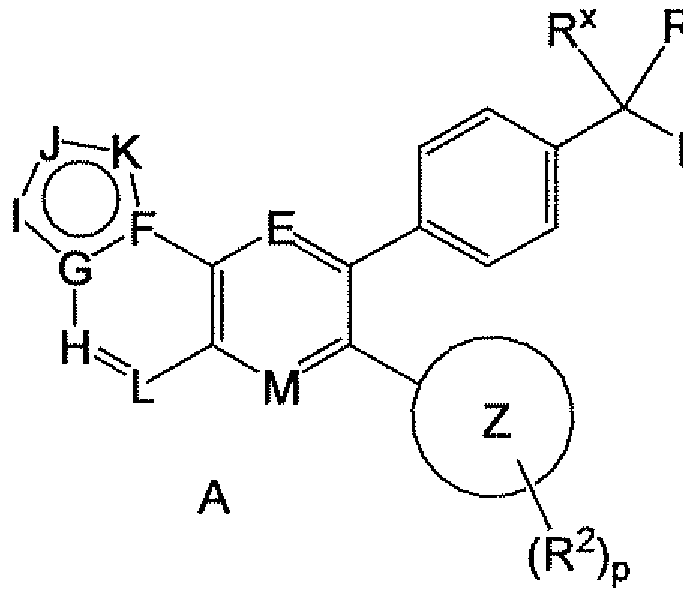 whereiα:
E, F, G, H, I, J, K, L and M are independently selected from: C or N, wherein each E, F, G, H, I, J, K, L and M is optionally substituted with Rl ;
a is 0 or 1; b is 0 or 1; m is 0, 1 or 2; p is independently 0, 1, 2, 3, 4 or 5;
Ring Z is selected from: (C3-C8)cycloalkyl, aryl, and heterocyclyl;
Rl is selected from: H, oxo, (C=0)aOb(C1-C10)alkyl, (OO^Ob-aryl, (C=O)aOb(C2- Ciθ)aUtenyl, (C=O)aOb (C2-Clθ)alkynyl, CO2H, halo, OH, Ob(C1-C6)perfluoroalkyl,
(C=O)aNR7R8, CN, (C=O)aOb(C3-C8)cycloalkyl, S(O)ΠINR7R8, SH, S(0)m-(C1-C10)alkyl and (C=O)aOb-heterocyclyl, said alkyl, aryl, alkenyl, alkynyl, cycloalkyl, and heterocyclyl is optionally substituted with one or more substituents selected from R6;
R2 is independently selected from: oxo, (C=O)aOb(C 1 -C 10)alkyl, (C=O)a0b-aryl, (C=O)aOb(C2-Cl0)alkenyl, (C=O)aOb (C2-C10)alkynyl, CO2H, halo, OH, Ob(C1- C6)ρerfluoroalkyl, (C=O)aNR7R8, CN, (C=O)aOb(C3-C8)cycloaUcyl, S(O)mNR7R8, SH, S(O)nr(Cl-Ci0)allcyl and (C=O)aOb-heterocyclyl, said alkyl, aryl, alkenyl, alkynyl, cycloalkyl, and heterocyclyl is optionally substituted with one or more substituents selected from R6;
R6 is: (C=O)aOb(C1-Ci0)alkyl, (00)aObaryl, (C2-C10)alkenyl, (C2-C10)alkynyl, (C=O)aOb heterocyclyl, CO2H, halo, CN, OH, Ob(C1-C6)perfluoroalkyl, Oa(C=O)bNR7R8J oxo, CHO, (N=O)R7R8, S(O)ΠINR7R8> SH, S(O)1n-(C 1 -C io)alkyl or (C=O)aOb(C3-C8)cycloalkyl, said alkyl, aryl, alkenyl, alkynyl, heterocyclyl, and cycloalkyl optionally substituted with one or more substituents selected from R6a;
R6a is selected from: (C=0)aOb(C1-C10)alkyl. Oa(C1-C3)perfluoroalkyls (Ctø-C6)alkylene- S(O)1nRa SH, oxo, OH, halo, CN, (C2-C10)alkenyl, (C2-C10)aHcynyl, (C3-C6)cycloalkyl, (Co- C6)alkylene-aryl, (Co-C6)alkylene-heterocyclylJ (Co-C6)alkylene-N(Rb)2, C(0)Ra, (C{>- C6)alkylene-CO2Ra, C(O)H, (O0)aNRb2, and (Co-C6)alkylene-C02H, said alkyl, alkenyl, alkynyl, cycloalkyl, aryl, and heterocyclyl is optionally substituted with up to three substituents selected from Rb OH, halogen, CO2H, CN, Oa(C=O)b(C1-C6)alkyls oxo, and N(Rb)2;
R7 and R8 are independently selected from: H, (C=0)aOb(C1-C10)all<yl, (C=O)aOb(C3- C8)cycloalkyl, (C=O)aOb-aryl, (C=O)aOb-heterocyclyl, (C2-Clθ)alkenyl, (C2-C10)alkynyi, SH, Sθ2Ra, and (C=O)aNRb2, said alkyl, cycloalkyl, aryl, heterocyclyl, alkenyl, and alkynyl is optionally substituted with one or more substituents selected from R6a, or R? and R6 can be taken together with the nitrogen to which they are attached to form a monocyclic, bicyclic or tricyclic heterocycle with 3-7 members in each ring and optionally containing, in addition to the nitrogen, one or two additional heteroatoms selected from N, O and S, said monocyclic, bicyclic or tricyclic heterocycle is optionally substituted with one or more substituents selected from R6a;
Ra is (C1-C6)alkyl, (C3-C6)cycloalkyl, aryl, or heterocyclyl, said alkyl, cycloalkyl, aryl, and heterocyclyl is optionally substituted with one or more substituents selected from Rc;
Rb is independently: H, (C=O)aOb(Ci -C6)alkyl, (C2-C10)a]kenyl, S(0)mRa, (O=O)aNRd2, (C=O)3Ra, or S(0)mNRe2> said alkyl and alkenyl is optionally substituted with one or more substituents selected from Ra, (C=0)a0b(C1-C6)alkyl, OH, halo, CN, CO2H, and (C=O)aNRd2;
Rc is independently: (C=0)a0b(C1-C6)aikyl, aryl, heterocyclyl. (C3-C6)cycloalkyl, oxo, OH, halo, CN, (C=O)aNR<i2, or S(O)01Rd, said alkyl, aryl, heterocyclyl, and cycloalkyl is optionally substituted with one or more substituents selected from (C=O)aOb(C1-C6)alkyl, Oa(C1- C3)perfluoroalkyl, OH, halo, and CN;
Rd is independently: H, (C=0)a0b(C1-C6)alkyl, aryl, or S(O)mRe> said alkyl and aryl is optionally substituted with one or more substituents selected from (C=O)aOb(Cl-C6)alkyl, OH, halo, and CN;
Re is independently: H, or (Cl -C6)alkyl; and
RX and Ry are independently selected from: H, (C1-C6)alkyl, (C2-Ce)alkenyl, and (C2- C6)alkynyl, wherein said alkyl is optionally substituted with up to three substituents selected
from: OH and halo, or Rx and Ry can be taken together to form a monocyclic or tricyclic carbo- or heterocycle with 3-7 members in each ring, said heterocycle is containing one or more heteroatoms selected from N, O and S, and said carbo- or heterocycle is optionally substituted with one or more substituents selected from: (Cl-C6)alkyl, (C2-C6)alkenyl, (Cs-Ce)CyClOaIlCyI, (C1-C6)alkyndene, (C1-C6)aJkoxy, CO2H, halo, OH, oxo, CN and NR7R8> said alkyl, cycloaBcyl and alkoxy is optionally substituted with one or more substituents selected from halo, CN, OH andNR7R8;
or a pharmaceutically acceptable salt, stereoisomer or N-oxide derivative thereof.
2. A compound according to Formula A, wherein:
^ S-^
 selected from:

Rl, Rl', Rl" and Rl1" are independently selected from: H, oxo, (C=O)3Ob(Ci -C io)alkyl, (C=O)aOb-aryl, (C=0)aOb(C2-Clθ)alkenyl, (C=O)aOb (C2-C10)alkynyl, CO2H, halo, OH, Ob(Cl-C6)perfIuoroallcyl} (C=O)aNR7R8, CN, (C=0)aOb(C3-C8)cycloalkyl, S(O)mNR7R8J SH, S(O)1n-(Ci -Ci o)alkyl and (C^aOb-heterocyclyl, said alkyl, aryl, alkenyL, alkynyl, cycloalkyl, and heterocyclyl is optionally substituted with one or more substituents selected from R6;
Bond: :=;::r is a single or double bond, provided that when each Rl, Rl ', Rl" and Rl"1 is oxo, then said bond adjacent to the oxo is a single bond and C or N which is attached to the resulting carbonyl with said single bond bears H; and
all other substituents and variables are as defined in Claim 1 ;
or a pharmaceutically acceptable salt, stereoisomer or N-oxide derivative thereof.
3. A compound according to Formula B:

p is 0, 1 or 2;


V-Iy V^NH2 .
Ring X is a monocyclic, bicycHc or tricyclic heterocycle with 3-7 members in each ring and optionally containing, in addition to the nitrogen, one or two additional heteroatoms selected from N, O and S, said monocyclic, bicyclic or tricyclic heterocycle optionally substituted with one or more substituents selected from R6a;
Ring Y is a monocyclic or bicyclic carbo- or heterocycle with 3-7 members in each ring, said heterocycle is containing one or more heteroatoms selected from N, O and S, and said carbo- or heterocycle is optionally substituted with one or more substituents selected from: (Cj-C6)alkyl, (C2-C6)alkenyl, (C3-C6)cycloalkyl, (C1-C6)alkylidene, (C1-C6)alkoxy, CO2H, halo, OH, oxo, CN and NR7'R8', said alkyl, cycloalkyl and alkoxy is optionally substituted with one or more substituents selected from halo, CN, OH and NR7'R8';
Ring Z is selected from: phenyl, 2-thienyl and 3-thienyl;
R2 is independently selected from: (C1-C6)alkyl, (C1-C6)alkoxy, CO2H, halo, OH and NH2;
R6a is selected from: (C=0)aOb(C1-C10)alkyl, oxo, OH, halo, (Co-C6)alkyiene-heterocyclyl, and (C=O)aNRi>2, said alkyl, and heterocyclyl is optionally substituted with up to three substituents selected from R^;
RT1 and R^1 are independently selected from: H, and (C1-Cg)alkyl;
Ra is (C1-C6)alkyl, (C3-C6)cycloalkyl, aryl, or heterocyclyl, said alkyl, cycloalkyl, aryl, and heterocyclyl is optionally substituted with one or more substituents selected from Rc;
Rb is independently: H, (00)aOb(C1-C6)alkyl, or (C=O)aRa, said alkyl is optionally substituted with one or more substituents selected from (C=0)a0b(C1-C6)alkyl, OH, halo, CN, and (C=O)3NRO^;
Rc is independently: (C=0)a0b(C1-C6)aϊkyl, oxo, OH, halo, CN, or (C=O)21NR^9 said alkyl is optionally substituted with one or more substituents selected from (C1-C6)alkyl, OH, halo, and
CN;
Rd is independently: H, or (Cl-C6)alkyl;
and all other substituents and variables are as defined in Claim 2;
or a pharmaceutically acceptable salt, stereoisomer or N-oxide derivative thereof.
4. A compound according to Formula C:
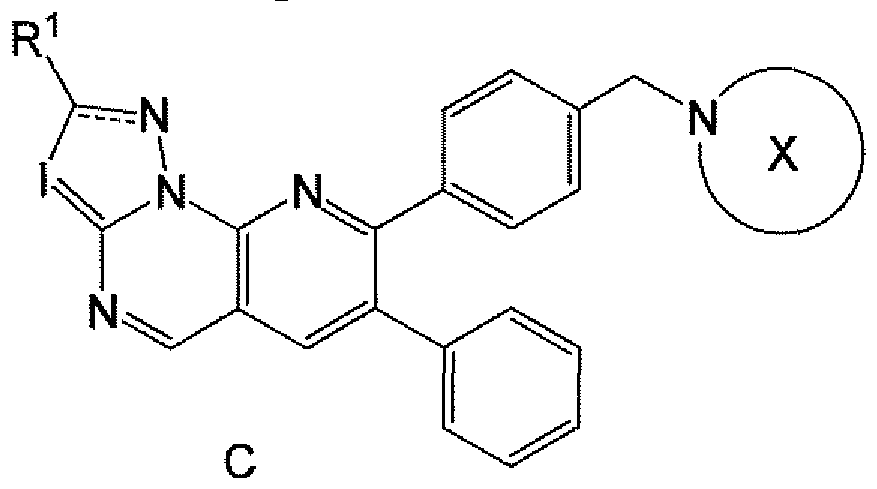
I is selected from: CH or N;
a is 0 or l; b is O or 1;
Ring X is selected from:
U O OrS Or\ Or\ Vv VJ each of which is optionally substituted with one or more substituents selected from R^a;
Rl is selected from: H, oxo, (CO)aOb(Cl-C10)alkyl, OH, and (00)aOb-heterocyclyl;
R6a is selected from: (C=0)aOb(C1-C10)alkyl, oxo, OH, halo, (Co-C6)alkylene-heterocyclyl, and (C=O)aNR^2, said alkyl, and heterocyclyl is optionally substituted with up to three substituents selected from Rh;
Ra is (C1-C6)alkyl, (C3-Ce)cycloalkyl, aryl, or heterocyclyl, said alkyl, cycloallcyl, aryl, and heterocyclyl is optionally substituted with one or more substituents selected from Rc;
Rb is independently: H, (C=0)a0b(Cl-C6)alkyl, or (C=O)aRa, said alkyl is optionally substituted with one or more substituents selected from (C=0)a0b(C1-C6)alkyl, OH, halo, CN, and (C=O)aNRd2;
RC is independently: (C=0)a0b(C1-C6)alkyl, oxo, OH, halo, CN9 or (C=0)aMRd2, said alkyl is optionally substituted with one or more substituents selected from (C1-C6)alkyl, OH, halo, and
CN;
Rd is independently: H, or (C i -C6)alkyl; and
Bond; — -■— ~ is a single or double bond, provided that when R^ is oxo, then said bond is a single bond and adjacent N bears H;
or a pharmaceutically acceptable salt, stereoisomer or N-oxide derivative thereof.
5. A compound according to Formula D:

a is 0 or l; b is O or 1;
Ring Y is a group of formula:

Rl is selected from: H, oxo, (C=0)aOb(C1-C10)aIkyl, (C=O)aOD-aryl, OH, (CO)aOb(C3- C8)cycloalkyL, and (C=O)aOb-heterocyclyl, said alkyl, aryl, cycloalkyl, and heterocyclyl is optionally substituted with one or more substituents selected from R6;
Rl' is selected from: H, (C=0)aOb(C1-C10)aIkyl, (C=O)aOb-aryl, halo, CN and (C=O)aOb- heterocyclyl, said alkyl, aryl, and heterocyclyl is optionally substituted with one or more substituents selected from R6;
R6 is: (C=O)aOb(C1-Ci0)alkyl, halo or OH;
R7 and R& are independently selected from: H, and (C1-C6)alkyl;
Rl 1 and Rl 2 are independently selected from: H, (C1-C6)alkyl, (C2-C6)alkenyl, (C3- C6)cycloalkyl, (C1-C6)alkoxy, CO2H, halo, OH, CN and NR7R8, said alkyl, cycloalkyl and alkoxy is optionally substituted with one or more substituents selected from halo, CN, OH and NR7R8} or RΪ 1 and Rl2 can be taken together to form oxo, (C1-C6)alkylidene, or a monocyclic carbo- or heterocycle with 3-7 members, said heterocycle is containing one or more heteroatoms selected from N, O and S; and
Bond: ===-= is a single or double bond, provided that when R* is oxo, then said bond is a single bond and adjacent N bears H;
or a pharmaceutically acceptable salt, stereoisomer or N-oxide derivative thereof.
6. A compound according to Formula E:

a is O or l; b is O or l;
Ring Y is a group of formula:

Rl is selected from: H, oxo, (C=0)aOb(Cl-C10)alkyl, OH, (C=O)aNR7R8, (C=O)aOb(C3-
Cg)cycloalkyi, and (C=O)aOb~heterocyclyl, said alkyl, cycloalkyl, and heterocyclyl is optionally substituted with one or more substituents selected from (C1-C6)alkyl, halo, CN, and OH;
R7 and R8 are independently selected from: H, and (C1-C6)alkyl, or R7 and R8 can be taken together with the nitrogen to which they are attached to form a monocyclic heterocycle with 3-7 members and optionally containing, in addition to the nitrogen, one or two additional heteroatoms selected from N, O and S;
Rl 1 and Rl2 are independently selected from: H, (C1-Cφalkyl, (C2-C6)alkenyl, (C3- Ce)cycloalkyl, (C1-C6)alkoxy, CO2H, halo, OH, CN and NR7R8, said alkyl, cycloalkyl and alkoxy is optionally substituted with one or more substituents selected from halo, CN, OH and NR7R8} or Rl 1 and Rl2 can be taken together to form oxo, (C1-C6)alkylidene, or a monocyclic carbo- or heterocycle with 3-7 members, said heterocycle is containing one or more heteroatoms selected from N, O and S; and
Bond: is a single or double bond, provided that when Rl is oxo, then said bond is a single bond and adjacent N bears H;
or a pharmaceutically acceptable salt, stereoisomer or N-oxide derivative thereof.
7. A compound which is selected from:
frαns-3-aπmo-1-merayl-3-[4-(2-mem^ yl)phenyl]cyclobutanol; cis-3-atm^o-1-raemyl-3-[4-(2-me1hyl-7-phe^^ yl)phenyl]cyclobutanol; trans-3-animo- 1 -cycloρropyl-3-[^ yl)phenyl]cyclobutanol; trans-3-amino-3-[4-(2'-methyl-7-phenylρyrazolo[l ,5-a]ρyrido[3,2-e]pyrimidin-8- yl)phenyl]cyclobutanol; tram-3-memoxy-1-[4-(2-mei:hyl-7-phenylpyrazoloE1,5-a]p^do[3,2-e3pyrinildm-8- yl)phenyl]cyclobutanamine; methyl { l-[4-<2-methyl-7-phenylpyrazolo[l ,5-a]pyrido[3,2^]pyrimidin-8-yI)phenyl]-3- oxocyclobutyljcarbamate;
1 -[4-(2-methyl-7-phenylρyrazolo[l ,5-a]ριyrido[3,2-e]p5nrimddm-8-yl)phenyl]me1hanamine;
2-merayl-7-phenyl-8-[4^1H-pyrazol-1-ylmethyl)phenyl]pyrazolo[ls5-a]pyrido[3,2~e3py^
( I R)- 1 -[4-(2-methyl-7-phenylρyrazolo[ 1 ,5-ajpyrido[3 ,2-e]pyrimidin-8~yl)phenyl]ethanamine; tram-3-amino-1-ethyl-3-[4-(2-methyl-7-phenylpyrazolo[1,5-a]p^do[3,2-e]pyrm^ yl)phenyl3cyclobutanol; cis-3-amino-1-emyl-3-[4^2-me1hyl-7-phenylpyrazolo[1,5-a]p^do[3s2-e]pyrimidin-8- yl)phenyl3cyclobutanol;
1τans-3-amino-1-ethenyl-3-[4-(2-methyl-7-phenylpyrazolo[1,5-a]pyrido[3,2-e]pyrirm yl)phenyl]cyclobutanol; 3-memylidene-1-[4-(2-methyl-7rphenylpyrazolo[1,5-a]pyrido[3,2-e]pyrimidin-8- yl)phenyl]cyclobutanamine;
3,3-difluoro-1-[4-(2-memyl-7-phemylpyra2»lo[1,5-a]pyrido[3,2-e]pyrimid^ yl)phenyl3cyclobutanamine;
8-{4-[1xans-1-ammo-3-(1,2-dmydroxyethyl)-3-hydroxycyclobutyl]phenyl}-2-methyl-7- phenylpyrazolo[l 95-a]ρyrido[3,2-e]pyrimidine;
8-{4-[l-animcj-3-hydroxy-3-(hydroxymemyl)<^clobutyl]phenyl}-2-memyl-7-phenylpyra2» alpyridotS^-elpyrimidine;
2-[4-(2-memyl-7-phenylpyrazolo[1,5-a3ρyrido[3,2-e]pyrmiidm-8-yl)phenyl]-5,8- dioxaspiro[3.4]octan-2-amine;
cis-3-anmo-1-cycloρropyI-3-[4^2-cycloμ
8-yl)phenylJcyclobutanol; trans-S-amino-1-cyclopropyl-S-^^T-phenylpyrazOlotl.S-aJpyridop^-eJpyrimidin-δ- yl)phenyl]cyclobutanoU 8-[4-(trans-l -amino-3-cyclopropyI-3-hydroxycyclobutyl)phenyl3-7-phenyl-2-
(trifluoromethyOpyrazolotl^-ajpyridop^-elpyrimidine; trans-3-cycloρroρyl-1-{4-[2-(4-fluoiOphenyl)-7rphenylpyrazolo[lJ5-a]ρyridot3,2-e]py^ yl]pheayl}-3-hydroxycyclobutanamine; trans-1-[4-(2-cyclopropyl-7-phenylpyrazolo[l}5-a]pyrido[3,2^]pyrimidin-8-y^ hydroxy-3-metiiylcyclobutanamiϊie; trans-3 -amino-3- [4- [2-( 1 , 1 -dime(hylethyl)-7-phenylpyrazolo [1,5 -a]pyrido[3 ,2-.e]pyriαϊidin-8- yljphenylj-1-methyl-cyclobutanol; trans-3-amino-1-methyl-3-{4-[2-metiiyl-7-(1hiophen-2-yl)pyra2»
8-yl]phenyl}cyclobutanol; trans-3-amino-3-{4-[7-(2-fluorophenyl)-2-methylρyrazolo[l ,5-a]pyrido[3,2-e]pyrimidin-8- yl]phenyl}-1-methylcyclobutanol; traiκ-3-amino-1-methyl-3-{4-[2-methyϊ-7-(iMophen-3-yl)pyra2»lo[1,5-a]pyrido[3,2^
8-yl]phenyI}cyclobutanol; l-[4-(2-methyl-7-phenylpyrazolo[1,5-a3pyrido[3,2-e3pyrimidin-8-yl)phenyl]cyclobuta^ 9-[4-(l -aminocyclobutyl)phenyl]-8-phenyl[l ,2.4]friazolo[4.3-h]-l ,7-naphthyridin-3(2H)-one;
9-[4-(l -aminocyclobutyl)phenyl3-8-phenyl[l ^2,4]triazolo[4,3-^]-l ,7-naphthyridin-3 -amine;
1 -[4-(3-methyl-8-phenyl[l ,2,4]triazolo[4,3-/t3-l ,7-naphthyridin-9-yl)phenyl]cyclobutanamine;
1 -{4-[3-cyclopropyl-8-phenyl[l .2}4]triazolo[4,3-h]-l ,7-naphthyridin-9- yl)phenyl}cyclobutanamine; l-{4-[8-phenyl-3-(pyrimidin-2-yl)[1,2,4]triaz»lo[4,3-h]-l,7-naphthyrid^ yl)phenyl}cyclobutanamine;
1xans-3-hydroxy-3-methyl-1-[4^2-methyl-7rphenylpyrazolo[1,5-a]pteridin-8- yOphenyljcyclobutanamine;
2-me%l-7-phenyl-8-(4-{[4-(5-ρyridin-2-yMH-1,2}4-triazol-3-yl)piperidin-1- yl]methyl}phenyl)pyrazolo[1,5-a]pyrido[3,2-e]pyrimidine; r-[4-(2-methyI-7-phenylpytazolo[1,5-a]pyrido[3,2-e]pyrimidin-8-yl)ben2yl] c]pyridine-3,4'-piperidin]-1-one;
2-methyl-l '-[4-{2-methyl-7-phenylpyrazolotl ,5-a]pyrido[3,2-e]pyriinidin-8- yl)benzyl]spiro[isoindole-1,4'-piperidin]-3(2H)-one; l'44-(2-methyl-7-phenylpyrazolo[1,5-a]pyrido[3s2^]pyriimdin-8-yl)benzyl]-7H^ b]pyridine-5,4-piperidui]-7-one;
1 -[4-(2-methyl-7-phenylpyrazolo[l s5-a]pyrido[3,2-e]pyrimidin-8-yl)benzyl]piρeridine-4- carboxamide;
2-methyl-8-(4- { [4-(2-oxo-2,3-dihydro-1H-benzimidazol-l -yl)pipeddin-l -yl]methyl}phenyl)-7- phenylpyrazolo[l ,5-a]pyrido[3,2-e]pyiiniiduie;
8-(4-{[4-(1,3-beii2»dioxol-5-ylme^ phenylpyra2»Io[1,5-a]pyrido[3,2-e3ρyriαύdine; 2-methyl-7-phmyl-8-[4-(piperazin-1-yImethyl)phenyl]pyrazolo[l^
2-methyl-8-{4-[(4-methylpipei^zm-1-yl)methyl]phenyl}-7-phenylp^a^ e]ρyrimidine;
N-[4_(2-methyl-7-pheiiylpyrazoIo[lJ5-a]pyrido[3>2-e]pyrimidin-8 methylpyrrolidin-2-yl)ethanamine; 2-me1hyl-8-[4-(morpholin^-ylmethyl)phenyl]-7-phenylpyrazolo[1,5-a]pyrido[3^
3-{ l-[4-(2-methyl-7-phenylpy^ yl} phenol; l-[4^2-me1hyl-7-phenylpyrazolo[1,5-a]pyrido[3}2^Jpyrimidin-8
2-methyl-7-pheiiyl-8-[4^iperidin-1-ylmethyl)phenyl]pyra^ l-{4-[4-(2-metiiyl-7-phenylpyr^^ yl}ethanone; l-[4-(2-methyl-7-phenylpyrazolo[1,5-a]pyrido[3,2-e]pyrimidin-8-y^^^
1 -{ l-[4-(2-methyl-7-pheϊiylpyrazolo[l ,5-a]pyridot3 ^-ejpyrimidin-S-y^benzy^piperidin^yl}-
1 ,3-dihydro-2H-benzimidazol-2-one; 4-hydroxy-N-{l-[4-(2~me1%l-7-pheπ^^^ yl)benzyl]piperidin-4-yl}benzamide;
2-morpholin-4-yl-7-pheoyI-8<4-{[4-(5-pyridin-2-yl-4H4,2,4-Mazol-3-yl)piperidin-l^ yl]methyl}phenyl)pyrido[3,2-e] [1 ,2,4]triazolo[l ,5-a]ρyrimidine; ethyl l-[4-(2-methyl-7-phenylpyrazolo[1,5-a]ρyrido[3,2-e]pyriinidin-8-yl)beii^ carboxylate; methyl l~[4-(2-me1hyl-7-phenylpyrazolo[ls5-a]ρyrido[3,2-e]pyrimidin-8-yl)benzyl3pip carboxylate; l-[4^2-methyl-7-phenylpyrazolo[1,5-a]p carboxylic acid; 2-methyl-7-phenyl-8-(4-{[4-(phenylcarbamoyl)piρeridin-1-yl3methyl}phenyl)pyra2»lo[l^ a]pyrido[3,2-e]pyrimidine;
8-[4<{4-[(2-methoxydhyl)carbamoyl]piperidto4-yI}methyl)phenyl]-2-met^^^ phenylpyrazolofl ,5-a]pyrido[3,2-e]pyriπudine;
2-methyl-7-pb£nyl-8-(4-{[4-(prop-2-eo-1-ylc^rbamoyl)piperidiii-1- yl]methyl}phenyl)pyrazolo[1,5-a]pyrido[3^-e]pyrimidine;
8-{4-[(4-{[2^diπiefhylamiiκ))e1hyl]carbamoyl}piperidm phenylpyrazoloEl^S-alpyridoP^-ejpyriinidiαe;
8-{4-[(4-{[3-(1H~iirddazol-1-yl)piopyl]cari)amoyl}piperidin-1-yl)methyl]phe phenylpyrazolotl.S-ajpyrido^^-ejpyrimidine;
8-[4-({44(3,4πdime1hoxybenz^ phenylpyra^>lo[l ,5-a]pyrido[3^-e]pyrimidine;
2-methyl-8-{4-[(4-{[2<l-me1hylpy^
7-pheαiylpyra2»lo[1.5-a]pyrido[3^]ρyriinidine; {l-[4^2-methyl-7-phenylpyrazolo[1,5-a]p yl}(morpholin-4-yl)methanone;
8-[4-({4-[(1H-benziirddazol-2-ylmethyl)carbamoyl]ρiρeridin4-yl}m phenylρyrazolo[1,5-a3pyrido[3,2-e]pyriraidine;
N-[2-(1H-imidazol-5-yl)e1hyl]-1-[4-(2-methyl-7-phenylpyrazolo[1,5-a]pyrido[3 yl)benzyl]piperidine-4-carboxamide;
2-methyl-7-phenyl-8-{4-[(4-{[4-(pyr^ yl)me1hyl]phenyl}ρyra2»lo[1,5-a]pyrido[3^-e]ρyrimidine;
2-methyl-7-phenyl-8-(4-{[4-({4-[5-(trifluoromethyl)pyridin-2-yI]piperazm^ yljcarbony^piperidin-1-yljmeihy^pheny^pyrazolotljS-ajpyridofS^^pyriini^ 2-methyl-7-phenyl-8-{4-[(4-{ [4^yridin-2-yl)piperazin-1-yl]carbonyl}piperidin-l - yl)methyl]phenyl}pyrazolo[1,5-a]pyrido[3s2-e]ρyrimidine;
2-methyl-7-phenyl-8-{4-[(4-{[2-(pyridin-3-yl)ethyl]carbamoyl}piperidin~l- yl)metiiyl]pheiiyl}pyrazolo[l}5-a]pyrido[3,2'-e3pyrimidine;
2-raethyl-7-phenyl-8-[4-({4-[(pyridin-2-ykQethyl)carbamoyl]piperidin-1- yl}methyl)phenyl]pyrazolo[l ,5-a]pyrido[3,2-e]pyrimidine;
2-methyl-7-phenyl-8-[4-({4-[φ^^ yl}methyl)phenyl3pyrazolo[1,5-a3pyπdot3s2-e]pyrimidine;
8-[4^{4-[(3-hydroxyphenyl)carbamoyl]piperidin-1-yl}methyl)phenyl]-2-metiιyl-7- phenylpyrazolo[l ,5-a3pyrido[3,2-e]pyriiradiαe; 8-[4-({4-[(1rans^-hydroxycyclohexyl)carbamoyl]ρiρeridin-1-yl}me%l)phenyl]-2-me^ phenylpyrazolo[ 1 ,5-a]pyrido[3,2-e3ρyrimidine;
8- {4-[(4-{ [2-hydroxy-2-(3-hydroxyphenyl)ethyl3carbamoyl}piperidin-l -yl)raethyl]phenyl}-2- me1^l-7-phenylpyrazolo[1,5-a3pyridot3^-e3ρyrimidine; 8-{4~[(4-{ [2-(4-hydroxyphenyO^ pheøylpyra2olo[l>5-a3pyrido[3J2-e]pyrύnidine;
8-[4-({4-[(3-hydroxy-4-methoxyphenyl)carbamoyl]ρiρeridkι-1-yl}meΛyl)ph phenylpyrazolo[1,5-a]pyrido[3,2-e]pyrimidine;
8-{4-[(4-{[2<3,4κ!ihydroxypheny0 phenylpyrazolo[1,5-a3pyrido[3,2-e3pyrimidiiie; 8-[4-({4-[(4-hydroxy-3-metiioxybenzyl)carbamoyl]piρeridin-1-yl}metiiyl)pl^^ phenylp^azoIotljS-aJpyridoP^-eJpyri11"^116;
8-[4-({44(3,4-dihydroxybenzyl)carbam^ phenylpyrazolo[1,5-a]pyrido[3,2-e]pyrimidine;
8-(4-{ [4-{ben2ylcarbamoy^ a3pyrido[3,2-e]pyrimidiiie;
8-[4-({4-p>eiizyl(methyl)carb^ phenylpyrazolo[ls5-a]ρyrido[3,2-e]pyrimidine; 8-{4-{[4-(cyclohexylcarbamoyl)piperidin-1-^^^ a]pyrido[3,2-e]pyrimidine;
8-[4-({4-[(l-raethoxyproρan-2-yl)carbamo phenylpyrazolo[lj5-a]pyrido[3,2-e]pyrimidine;
N-({l-[4-(2-me1hyl-7-phenylpyrazolo[1,5-a]pyrido[3>2-e]pyr-midin-8-yl)benzyl] yl}carbonyl)glycinamide;
2-raethyl-7-phenyl-844<{44(2s2,2-trifluoroethyl)carbamoyl3ρiperidin-1- yl}mdjbyl)phenyl]ρyrazolo[1,5-a]pyrido[3,2-e]pyriraidine;
2-methyl-8-(4-{[4-(pentan-3-ylcarbamoyl)piperidiB-1-yl]methyl}phenyl^ a]pyrido[3,2-e]pyrimidine; 8-(4- {[4-(tert-butylcarbamoyl)piperidin-1-yl]methyl}phenyl)-2-methyl-7-phen^ ,5- a]pyrido[3,2-e3pyrimidine;
2-raeώyl-7-phenyl-8-(4-{[4-(propylcaA a]pyrido[3,2-e]pyrimidir.e;
2-me1iiyl-8-(4-{[4-(me1iιylcarbamoyI)piperidin-1-yl]methyl}phenyl)-7^^ a]pyrido[3s2-e]pyrimidine;
8^4-{[4-(ethylcarbamoyl)piperidin-1-y^ a]pyiido[3,2-e]pyrimidine;
8-{4-[(4-{[4-(3-hydroxyphe3iyl)piperazin-1-yl3carbonyl}ρiρeridin-1-yl)methyl]phe raethyl-7-phenylpyrazolo[ 1 ^-alpyridop^-ejpyrimidine; 8-{4-[(4-{[(lSH-cyclohexyleώyl]c^^ phenylpyrazolo[1.5-a]pyrido[3,2-e]pyrimidine;
8-(4-{[4-(hexahydrocyclopenta[c]pyrrol-2(1H)-ylcarbonyl)piρeridin-1-yl]methyl}phen^ methyl-7-phenylpyrazolo[1,5-a]pyrido[3,2-e]pyπmidine;
8-[4-({4~[ethyl(propan-2-yl)carbamoy^ phenylpyrazolo[l ,5-a]ρyrido[3,2-e]pyrimidine;
8- {4-[(4-{ [(I S^S^-hydroxycyclohexyycarbamoyllpiperidin-1-y^methyyphenyl} -2-methyl-7- pheπylpyτazolotl}5-a3pyrido[3,2-e]pyrimidine;
8-[4-({4-[(2-hydroxyethyI)carbamo phenylpyra2θlo[1,5-a]pyrido[3,2-e]pyrimidine; 2-me%l-7-phenyI-8-[4<{4-[(tetrahydrofuran-2-yImethyl)carbamoyl3ρiρeri^^ y^raethy^phenyljpyrazolofl^-alpyridoP^-ejpyriiiiidiiie;
8-(4-{[4-(cyclobutylc^bamoyl)piperidin-1-yl]methyI}pheixyl)-2-methyI-7-phen^ a]pyrido[3,2-e]pyrimidine;
2-methyl-7-phenyl-8-(4- { [4-(ρroρan-2-yIcarbamoyl)piρeridin- 1 -yl]methyl} phenyl)pyrazolo[ 1 ,5- a]pyrido[3,2^]pyrimidine;
N-({ 1 -[4-(2-methyl-7-phenylpyia2X)lo[l ,5-a]pyrido[3,2^]pyriinidin-8-yl)ben2yI]piperidin-4- yl}carbonyl)glycine; tert-butyl N-({ l-[4-(2-methyl-7-phenyIρyra2olo[1,5-a]ρyrido[3,2^]pyrimidin-8- yl)benzyl]pipOTdin-4-yl}carbonyl)glycinate;
8-[4^{4-[(4-hydroxyphenyl)carbamoyl]ρiρeridin-1-yl}methyl)phenyl]-2-methyl-7- phenylpyrazolo[1,5-a]pyrido[3,2-e3pyrimidine;
8-[4^{4-[(3κ;arbamoyIphettyl)carbamoyl]piρeridin-1-yl}methyl)phenyl]-2-methyl-7- phenylpyrazolo[l ,5-a]pyrido[3,2-e]pyrimidine;
8-[4-({4-[(3-me1hoxypheiiyl)carbamoyl]pφ phenylpyrazolo[1,5-a]pyrido[3,2-e]pyrimidine;
2~methyl-8-{4- { [4-( { 3 -[(methylsulfonyl)amino]phenyl} carbamoyl)piperidin- 1 - yl]mdiιyl}phenyl)-7-phenylpyτazolo[1,5-a]ρyrido[3,2-e]pyriiiύdiiie; 8-[4-({4-[(3-cyanophenyl)carbarøoyl]piρeridin-1-yl}methyl)phenyl]~2-methyl-7- phenylpyrazolo[1,5-a]pyrido[3^^]pyrimidine;
8-[4-( {4- [(3 ~fluorophenyl)carbamoyl]piperidin- 1 -yl } methyl)phenyl] -2-methy 1-7- phenylpyrazolotljS-ajpyridop^-eJpyrimidine;
8-[4-({4-[(2-hydroxyphenyl)cari3amoy]]piperidin-1-yl}methyl)phenyI]-2-methy]-7- phenyipyrazolofl ,5-a]pyτidot3,2-e]pιyrimidiiιe;
8-[4-({4-[(4-carbamoylphenyl)carbamoyI]piperidin-1-yl}metiiyl)pheiiyl]-2-rae^ phenylpyrazolofUS-aJpyridop^-ejpyrimidine;
2-methyl-7-phemyl-8-[4-({4-t(3-sulfamoylphenyl)carbamoyl]piperidin-1- yl}metiiyl)pheiiyl]pyrazolotl}5-a]ρyrido[3^-e]pyτimidine; N-(l,l^ioxido-1-benz»thiophen-6-yl)-1-[4-(2-me1hyl-7-pheiiylpyraz» e]pyiitnidin-8-yl)ben2yl]piperidine^-carboxamide;
3 -aminobenzyl 1 -[4-(2-methyl-7-phenylpyrazolo[ 1 ,5-a]pyrido[3 ,2-e]pyrimidin-8- yl)benzyI]piperidine-4-carboxylate;
{l-[4-(2-methyl-7-phenylρyrazolo[1,5-a]pyrido[3,2-e3pyriiϊύdin-8-yI)bei^ yl}(piperidin-1-yl)methanone;
(l,l-dioxidoMomorpholin^-yl){l-[4-(2-methyl-7-phenylpyrazolo[1,5-a]pyrido[3,2-e]p
8~yl)benzyl]piperidin-4-yl}methanone; l-[4-({l-[4-(2-me1hyl-7-phenylpyrazolo[1,5-a]pyrido[3,2-e]pyrimidin-8-yl^ yl}carbonyl)piperazin-1-yl3ethanone; N-(3-cMorophenyl)-1-[4-(2-methyl-7-p^ yl)beπ2yl]piperidine-4-carboxamide;
(4-hydroxypiperidin-l -yl){ 1 -[4-(2-methyl-7-phenylpyrazolo[l ,5-a]pyrido[3,2-e]pyrimidin-8- yl)beozyl]piperidin-4-yl}methanone;
Nπ;yclohexyI-N-me1%H^ yl)benzyl]piperidme-4-carboxaπiide;
[4-(hydτoxymeihyl)piperidin-1-yl3 { l-[4-(2-methyl-7-phenylpyrazolo[1,5-a3pyrido[3,2- e]ρryτuϊύdin-8-yl)ben2yl]piperidin^-yl}methaαone; 4-tert-butyl-N-{ l-[4-(2-methyl-7-phenylpyτazolo[l ,5-φyήάo[3)2-fs]pyήaήdm--8- yl)benzyl]piperidin-4-yl}benzamide; l-(4-fluorophetiyl)-3-{l-[4-(2-rae%^ yl)benzyl]piperidin-4-yl}urea; l-(4-tert-butylphenyI)-3-{l-^^ yl)benzyl]piperidin-4-yl}urea;
N-{l-[4-(2-methyl-7-phenylpyra-rølo[1,5-a]p3rrido[3^]p3dm yljbenzatnide;
Hl-[4-(2-methyl-7-pheaylpyra^^^ phenylurea; N-(3-aircbophenyl)-1-[4-(2-methyl-7-^phenylpyra2»lo[1,5-a]p^do[3,2-e]pyrimidin^ yl)benzyl]piperidine-4-carboxamide;
N-[3-(hydrøxymeώyl)pheny^ yl)benzyl]piρeridine-4-carboxanύde;
144-(2-methyl-7-phrøylρyrazolo[l}5-a]ρyrido[3^-e]ρyrimidϊn-8-yl)beπ2ylJ-N-[3- (meihylsυlfonyl)pheoyl]ρiperidine^κ;arboxamide; l-[4-(2-methyl-7-phenylpyrazolo[l95-a]p>τidot3s2-e]pyrimidϊn-8-y^^^ dihydro-2-benzoJtoau-5-yl)piperidine-4-carboxamide; l-[4-(2-methyl-7-phenylpyra-rølo[1.5-a]p>τidot3s2-e]pyrijiudb^ yl)piperidine-4-carboxamide; l~[4-(2-methyl-7-phenylpyr^^
(trifluoτom(-^oxy)phenyl]pipeddine-4-carboxamide;
N-(lβ-beiϊ2X)tbiazol-5-yl)444-(2-methyl-7-phenylpyrazolotl>5-a3pyrido[3,2-e]py^ yl)benzyl]piperiduie-4-carboxamide; trans-S-ammo-1-cyclopropyl-S-^^-bromo^-methyl^-phenylpyrazolofl^-alpyridotS^- e]pyrimidin-8-yl)phenyl3cyclobutanol; trans-3-ammo-3-[4-(3-cUorø-2-methyl-7-phenylpyrazolo[1,5-a3pyrido[3,2-e]pyrm yl)pheαyl]-l -cyclopropylcyclobutanol; trans-3-amino- 1 -cyclopropyl-S- {4-[2-methyl-7-phenyI-3-(pyridin-3-yl)pyrazolo[l ,5-a]pyrido[3,2- e]pyrimidin-8-yl]phenyl}cyclobutanol; teans-3-arako-1-cyclopropyl-3-[4-(3-cyano-2-m^ e3pyrimidin-8-yl)phenyl]cyclobutanol; trans-3-a3i!ino-1-cyclopropyl-3-{4-[2-methyl-7-phenyl-3-(pyridin^-yl)p^ e]pyriinidin-8-yl3phenyl}cycIobutanol;
traαs-3-airano-1-cyclopropyl-3-[4-(2-m
8-yl)phenyl]cyclobutanol; trans-3-amno-1-cyclopropyl-3-{4-[3-(4^^ a]ρyrido[3^]pyriπiidin-8-yl]phenyI}cyclobutanol; 8-[4-(trans-1-amiΛθ-3-c^clopropyl-3-hydTOxycyclobutyl)phenyl]-^ phenylpyrazolo[1,5-a]pyrido[3^]pyrimidine; trans-3-ammo-3-[4-(2,5-diinetfayl-7-phenyl^^
1 -methy icyclobutanol; trans-3-amino-3-[4-(2,6-dimerayl-7~phenylp^ 1-methylcyclobutanol;
^xam-3-eaJ^o-3-l4-(6-cMoτo-2-me1ihyl-7~v^ yl)phenyl]- 1 -methylcyclobutanol; trans-3 -Amino- 1 -cyclopropyl-3- [4-(2-methyl-7-phenyl- 1 ,4,9,9b-tetraaza- cyclopenta[α]naphthalen-8-yl)-phenyl]-cyclobutanol; l-[4-(2-methyl-7-pheayl-1,4,9,9b-te1iBaza-cyclopenta[α]naphtfaaien-8-yI)-phen^ cyclobutylamine;
3,3-Difluoro-1-[4-(2-methyl-7-phenyl-1,4,9,9b-tetraaza-cyclopenta[α]naphthaie^^ cyclobutylamine;
/r«w-2-[4-(2-Methyl-7-phenyl-1,4,9,9b-tetraaza-cyclopenta[fl3naphtbMen-8-yl)-pheny dioxa-sρiro[3.43oct-2-ylamine; trans~3-Aπάxιo-3 - [4-(2-methyl-7-phenyl- 1 ,4,9,9b-tetraaza-cyclopenta[α]naphthalen-8-yl)- phenyl]-cyclobutanol; trans- 1 -Amino- 1 -[4-(2-methyl-7-phenyl- 1 ,4,9,9b-tetraaza-cyclopenta[α]naphthalen-8-yl)- phenyl]-3-methoxycyclobutane; l-[4-(2-me1hyl-7-pheayl-1,4,9,9b-t^^ diol; frαrø-3-Amino-1-methyl-3-[4-(2-me1hyl-7-pheoyl-1,4J9}9b-te1xaaza-cyclopenta[α]n^ yl)-phenyl]-cyclobutanol; cis-3-Ammo-1-me1hyl-3-[4-(2-meth^^^ phenylj-cyclobutanol;
/rαn*-3-Amino-1-cyclopropyl-3-[4-(2-cyclopropyl-7-phenyl-1,4,9,9b-tetraaza- cyclopenta[Λ]naphthalen-8-yl)-phenyl]-cyclobutanol; frαMS-3-Amino-1-cyclopropyl-3-[4-(7-phenyM phenyl]-cyclobutanol; trans-3-Arsmio-l -cyclopropyl-3-[4-(2-(4-fluorophenyl)-7-phenyl- 1 ,4,9,9b-tetraaza- cyclopenta[ΛJnaphihalen-8-yl)-phenyl]-cyclobutanol;
^"««5-3 -Amino- 1 -cyclopropyl-3-[4-(2-triflouromethyl-7-phenyl- 1 ,4,9,9b-tetraaza- cyclop€ntatα]naphthalen-8-yl)-pheiiyl]-cyclobutanol;
2-MethyI-8-(4-morphoHn-4-ytø cyclopenta[«]naphthalene; 4-(2-Methyl-7-phenyl-l A9s9b-t^^
ΛT-[4-(2-Me1hyl-7-phenyMA9>^^ methanesulfonamide;
[4-(2-Methyl-7-phenyl-1,4,9J9b-tei3^aza-cyclopenta[α]ii£rphtMen^
Morpholine-4-carboxyHc acid [4-(2-methyl-7-phenyl-l ,4,9,9b-tetraaza-cyclopenta[α]naphthalen- 8-yl)-phenyl|-amide;
3_[4-(2-Methyl-7-phenyMs4,9,9b4etraaza^ one;
4-(2-Mdhyl-7-phenyl-lA9,9b^etøιaza^^ [4-(2-Methyl-7-phenyl-1,4,9s9b-te1iaaza-cyclopenta[«]naphtMen-8-yl)-ph^ r-[4-(2-MdJhyl-7-phenyMA9,9b-t^^ spiro[fiιro[3,4κ;]pyridiαe-3(1H),4'-piperidine]-1-one; 1 '-[4-(2-Methyl-7-phenyl-1,4}9,9b-tetraazaκ;yclc)peiita[α]naphthal sρirø[2-methyl-2,3κUhydro-isoύidole-3(1H),4'-pipeήdine]-1-one; l'-[4-(2-Methyl-7^henyl-l}4,9,9b-te1iaaza-cyclopen1a[a3iaaphtiialen-8^^ spiro[fiiio[3>4-b]pyridkιe-5(7H).4'-piperidiiie]-7-one;
8-[4-(4-Benzo[l ,33dioxol-5-ylmethyl-piperazin-l -ylmethyl)-pbenyl]-2-methyl-7-phenyl-l ,4,9,9b- tetraaza-cyclopenta[a]naphthalene; l-t4-(2-Methyl-7-phenyl-ls4,9,9b-tetraam-cyclopen1a[α3naphthalen-8-yl^ carboxylic acid amide;
3-[4^2-Methyl-7-phenyl-3~ρyri^^ oxazolidin-2-one; fr<j»5'-3-Amino-1-cyclopropyl-3-[4"(3-cyano-2-methyl-7-pbjenyl-1,4,9,9b-tetraa^ cyclopenta[a]naphtijalen-8-yI)-pheoyl]-cyclobvitanol;
S-Amino-S-^-tS-bromo^-meih^yl^rphenyl-l^^^b^etraaza-c^ciopentafαjnaph^ phenylj-cyclopropyl-cyclobutanol;
3-Ambo-3-[4-(3-chloro-2-methyl-7-phenyl-1,4>9,9b-tetraaza-κ^clopenta[α]naph1^ phenylj-cyclopropyl-cyclobutanol;
3-Amino~3-[4-(2,5-dimethyl-7rphenyl-1,4,9,9b-tetraaza-cycIopeπta[α]naphώalen-8-yl^ methyl-cyclobutanol;
3-Amino4-methyl-3-[4-(2-me%l-7-tWophen-2-yl-8,9-dihydro4,4,9,9b-tetraaz^ cyclopenta[α]naphthaiene-8-yl)-phenyl]-cyclobutanoI; 3-ArcLbo-1-me%^3-[4-(2-me%l-7-t]liophen-3-y^8>9κiihydro-1,4)9,9b-tet^ cycloρenta[α3aaphthaIene-8-yl)-phenyl]-cycIobutanol;
3-Amino-3-{4-[7-(2-fluoro-phenyl)-2-methyl- 1,4,9,9b4eftraaza-cyclopenta[α3naphthalen-8-yl)- phenyl}-l -methyl-cyclobutanol;
3-Amino-1-hydroxyme1hyl-3-[4-(2-^ 8-yl)-phenyl]-cyclobutanol; 3-Meihylene-l -[4-(2-meti^ cyclobutylamine; l-[4-(2-Methyl-7rphenyl-1,4.9,9b-tetraaza^clopenta[α]napht3ialen-8-yl) cyclobutanecarbonitrile; Methyl-{ l-[4-(2-me%l-7-phenyl-l ,4^ cyclobutyl) -amine; l-Cycloρropyl-3-[4-(2-raethyl-7-phenyl-l>4,9,9b-teteaaza-cyclopenta[α]napbih cyclobutanol;
Trans-3-Amino4-e1hyl-3-[4-(2-methyI-7-phenyl-1,4,9,9b-tetraaza-cyclopenta[α]i-a^ yl)-phenyl]-cyclobutanol;
Cis-3-AmincHl~ethyl-3-[4-(2-methyl-7-phenyl-lJ4,9,9b-tetraaza^ycloρentaM phenyl]-cyclobutanol; Tram-1-{3-Amino-1-hydroxy-3-t4<2-metiiyl-7-phenyl-1,4>9,9b4etraaza- cycloρen1a[σ]naphthalen-8-yl)-phenyl]-cyclobutyI}-ethane-1,2-diol;
Tram-S-Amino-S-^^-me^l^-phenyl-l^^^b-tetraaza-cyclopenta^naph^ phenyl]-1-vinyl-cyclobutanol; l-[4-(2-Methyl-7-phenyl-lΛ9s9b4etraaza-cyclopenta[α]naphthalen-8-yl)-ben^ carboxylic acid ethyl ester;
1.[4-(2-Methyl-7-phenyl-l j4j9f9b-tetraaza-cyclopenta[a]n^hthalen-8-yl)-bei.2yl]-piperidiBe-4- carboxylic acid; l-[4-(2-Methyl-7-phenyl-1,4,9,9b-tetraazaκϊyclopenta[α]naphthaleΩ-8-yl)-bei^ carboxylic acid phenylamide; 1 -[4-(2-Methyl-7-phenyl- 1 (4,9,9b-te1τaaza~^clopenta[α]naphthalen-8-yl)-benzyl]-piperidine-4- carboxylic acid allylamide; l-[4-(2-Methyl~7-phenyl-l>4,9J9b-tetiBaza-cyclopenta[α]naphthalen-8-yl)-bei^ carboxylic acid (2-dimeώylamino-ethyl)-amide; l-[4-(2-Me1iιyl-7-pheoyl-lJ4J9J9b-tetiaaza-cyclopenta[α]naph1halen^ carboxylic acid (2-methoxy-ethyl)-araide; l-[4-(2-Methyl-7-phenyl-lΛ9,9b-tetraaza-cyclopentø[α]naphthalen-8-yI)-ben2y carboxylic acid (2-imidazol-1-yl-ethyl)-amide; l-[4-(2-Methyl-7-phenyl-1,4>9,9b4e1xaaza-cyclopenta[α]naph1halea[i-8-yl)-ber^ carboxylic acid 3,4-dimethoxy-benzylamide; 1 -[4-(2-Metfayl-7-phenyI-l ,4,9,9b4etraazaκ^lopenta[α3πaphthaleri-8-yl)-benzyl]-piperidine-4- carboxylic acid [2-(l-methyl-pyrrolidin-2-yl)-ethyl] -amide;
{l-[4^2-Methyl-7-pheiiyl-lA9>9b-^^^ yl } -morpholin-4-yl-methanone;
1 -[4-(2-Methyl-7-phenyl- 1 }4,9s9b-tetaaza-cyclopenta[α]na^^ carboxylic acid (1H-ben2»iinidazol-2-ylmethyl)~amide;
1 -[4-(2-Metbyl-7-phenyl- 1 ^^^b-tetraaza-cyclopentaMnaphtMen-δ-y^-benzyll-piperidine-'Φ- carboxylic acid [2-(3H-imidazol-4-yl)-ethyl]-amide; {1 -[4-(2-Merayl-7-phenyM ,4,9,9b-te1xaaza-cyd^ yl}K^pyr^^-2-yl-piperazm-1-yl)-meihanone;
{ 1 -[4-(2-Methyl-7-phenyM ,4,9,9b yl}-[4-(5-trifliM>romet-byl-pyridm-2-yl)-piperaz.^
{l-[4-(2-Memyl-7-phenyl-1,4,9,9b-tetraaza^ yl}-(4-pyridin-2-yl-piperazin-1-yl)-methanone; l-[4-(2-Methyl-7-pheiiyMA9>9b-^^ carboxylic acid (2-pyridin-3-yl-etbyl)-amide;
1 -[4-(2-Methyl-7-pheayl- 1 ^^^b-tetoaza-cyclopentafαjnaphώalen-S-y^-benzylj-piperidine^- carboxylic acid (pyridiB-2-ylmethyl)-amide; 1 -[4-(2-Methyl-7-phenyl-l ^^^b-tetraaza-cyclopentafαjnaphthalen-δ-y^-benzylj-piperidine^- carboxylic acid (pyridin-4-ylmethyl)-amide; l-[4-(2-Me1%I-7-phenyl-1,4s9,9b-te1raaza-cyclopenta[α]imphthalen-8-yl)-b carboxylic acid (3-hydroxy-phenyI)-amide; l-[4-(2-Me1Jhyl-7-phenyl-lΛ9J9b-tetraaza-cyclopen1a[α]naphώ carboxylic acid (4-hydroxy-cyclohexyl)-amide;
!-[4-<2-Me1feyl-7-phenyl-1,4,9,9b-tetraaza-cyclopenta[α]naphthalen-8-yl)-ben^ carboxylic acid [2-hydrøxy-2-(3-hydroxy-phenyl)-ethyl]-amide; l-[4-(2-Methyl-7-phenyl-1,4,9,9b-tetraaza-cyclopen1^α]naphthden-8-yI)-benz^ carboxylic acid [2-(4-hydroxy-phenyl)-ethyl]-amide; l-[4-(2-Methyl-7-phenyl-1,4,9,9b4etraaza-cyclopenta[α]naphthalen-8-yl)-benzyl]-piperi carboxyUc acid (3-hydroxy-4-methoxy-phenyl>amide; l-[4-(2-Methyl-7-phenyl-1,4,9,9b-tetraaza-cyclopenta[α]naphthalen-8-yl)-ben2yl]-pipe^ carboxylic acid [2-(3,4-dihydroxy-phenyl)-ethyl] -amide; l-[4-(2-Methyl-7-phenyl-1,4,9,9b-te1xaaza-cyclopenta[α]naphthalen-8-yl)-ben2y carboxylic acid 4-hydroxy-3-methoxy-benzylamide; l-[4-(2-Methyl-7-phenyl-1,4}9,9b-tetraaza-cyclopenta[α]naphthalen-8-yl)-beri^ carboxylic acid benzylamide;
1 -[4-(2-Methyl-7-phenyl- 1 ,4}9,9b-tetraaza-cyclopenta[α]naphlimlen-8-yl)-ben2yl]-piperidine-4- carboxylic acid benzyl-methyl-amide; 1 -[4-(2-Methyl-7-phenyl- 1 ,4,9,9b4etraazaκ^cloρenta[α]rmph1halen~8-yl)-benzyl] -piperidine-4- carboxylic acid cyclohexylamide;
1 -[4-(2-Methyl-7-phenyl- 1 ,4,9,9b4etraazaκ^clop€aita[α]napbihalen~8-yl)-benzyl] -piperidine-4- carboxylic acid (2-methoxy-1-methyl-ethyI)-amide;
1 -[4-(2-Me1hyl-7-phenyM ,4,9,9b^^ carboxylic acid carbamoylmethyl-amide; l-[4-(24Λethyl-7-phenyM.,4f9,9b-tetr^ carboxylic acid (2,2,2-trifluoro-ethyl)-amide; H4<24Λethyl-7-phenyHA9,9b-te^^ carboxylic acid (l-ethyl-propyl)-amide; l-[4-(2-Me1hyl-7-pheπyl-ls4s9,9b-tetraaza-cyclopenta[«]naphth carboxylic acid tert-butylamide; l-[4-(2-Methyl-7-pheoyl-1,4,9,9b-te^ carboxylic acid propylatnide; l-[4-(2-Methyl-7-pheflyl4s4s9,9b-te^^ carboxylic acid methylatnide; l-[4^2-MetfiyI-7-phenyl-1^9,9b-tetraaza^ carboxylic acid ethylatoide; [4-(3-Hyώoxy-phenyl)-piperazm4-yl]-{l-[4-(2-methyl-7-phenyl-l)4ϊ9>9b-tetraaza- cyclopenta[α]naphthalen-8-yl)-beaizyl]-piperidin^-yl}-methanone; l-[4-(2-Methyl-7-phenyl-1,4?9,9b-tetraaza-<^clopenta[α]naphthalen-8-yl)-b^ carboxylic acid ((S)-1-cyclohexyl-ethyl)-amide;
(Hexahydτo-cyclopentatc]pyrrol-2-yl)-{l-[4-(2-mdliyl-7-phe!nyl-1,4,9J9b-te1τaaza- cyclopenta[α]naphtb^eji-8-yl)-beii2yl]-piperidin-4-yl } -methanone; l-[4-(2-Methyl-7-phenyl-1,4,9,9b^ carboxylic acid ethyl-isopropyl-amide; l-[4-(2-Methyl-7-pheaiyl-1,4,9,9b-tetraaza-cyclopenta[α]naphth carboxylic acid ((lSs2S)-2-hydroxy-cyclohexyl)-amide; 1 -[4-(2-Methyl-7-pheoyl-l ^^^b-tetraaza-cyclopentaMnaphthalen-δ-y^-benzylj-piperidm^ carboxylic acid (2-hydroxy-ethyl)-amide; l-[4-(2-Methyl-7-phenyl-l}4,9,9b4etr^^ carboxylic acid (tøtrahydrcHfuran-2-ylmethyl)-amide; l-[4-(2-MethyI-7-phenyl-1,4,9,9b4etraaza-cyclopen1a[a]naph1halen-8-yl)-ben2^ carboxylic acid cyclobutylamide; l-[4-(2-Methyl-7-phenyl-1,4}9,9b-tetraaza-cyclopeiita[α]napht3mlen-8-yl)-ben^ carboxylic acid isopropylamide;
({l-[4-(2-Methyl-7-pheiiyl-1,4}9}9b-tetoaaza-cyclopenta[α]naphthd carbonyl}-amino)-acetic acid; 1 -[4-(2-Methyl-7-phenyl-l ,4,9}9b4etraazaK^clopeiita[a]rmphtb^leo-8-yl)-b€iizyl]-piperidine-4- carboxylic acid (4-hydxoxy-phenyl)-amide; l-[4-(2-Me1hyl-7-phenyl-1,4>9,9b4etraaza-cyclopenta[α]naphtMen-8-yl)-be^ carboxylic acid (3-carbamoyl-phenyl)-amide;
1 -[4-(2-Methyl-7-phenyl- 1 ,4,9?9b-tetraaza-cyclopenta[a3n^htMen-8-yl)-beiizyl]-piperidine-4- carboxyϊic acid (3-methoxy-phenyI)-amide; l-[4-(244ethyl-7rphenyHA9,9b4e1xarø^ carboxylic acid (3-methanesulfonylamiiio-plienyl)-amide; l-[4-(2-Methyl-7-pheayl-1,4,9,9b-tetraaza-cycloρenta[α]naphthalen-8-yl)-be^ carboxylic acid (3-cyano-plienyl)-ainide; l-[4-(2-Meώyl-7-phenyMA9,9b-te1raa^^ carboxylic acid (3-fluoro-phenyl)-amide; l-[4-<2-Me1iiyl-7-ph€iiyl-1,4,9,9b-tetraaza-cyclopenta[α]mphthalen-^ carboxylic acid (2-hydroxy-phenyl)-amide; l-[4<2-Me1hyl-7-phenyMA9,9b-tetraa^^ carboxylic acid (4-carbamoyl-phenyl)-amide; l-[4-(2-Me%l-7rphenyl-l>4,9s9b-tetraaza-cyclopenta[α]naphtMen~8-yl)-be^ carboxylic acid (3-suI&moyl-phenyl)-amide; l-[4-(2-Methyl-7-phenyl-1,4,9,9b-te^^ carboxylic acid benzotbiazol-5-ylamide; l-[4-(2-Meώyl-7-phenyl-1,4,9,91>t^^ carboxylic acid (3-trifluoromethoxy-phenyl)-amidej l-[4-(2-Methyl-7-phenyl-lΛ9>9b-tetraaza-cyclopenta[β]naphtbalen-8-yl)-ben^ carboxylic acid thiazol-2-ylamide;
1 -[4-(2-MethyI-7-phenyl- 1 ,4,9,9b-tetraa2a-cyclopen1a[α]naphthalen-8-yl)-benzyl]-pipeddine-4- carboxylic acid (3-oxo-13^ihydro-isobenz»fii-^n-5-yl)-amide; l-[4-(2-Methyl-7-phenyl-1,4,9,9b-tetraaza-cycloρenta[β]napht3ialen-8-y^ carboxylic acid (3-methanesuIfonyI-pb.eϊnyl)-amide; 1 -[4-(2-Methyl-7-phenyl-l ,4,9,9b-tetraaza-cyclopenta[α]iiaphtMen-8-^yl)-ben2yl]-piperidine-4- carboxylic acid (3-hydroxymethyl-phenyl)-amide;
1 -t4-(2-Methyl-7-phenyl- 1 ,4,9,9b-tetraaza^yclopenta[α]naphtMen-8-yl)-b>enzyl]-piperidine-4- carboxylic acid 3-amino-benzyl ester; l-[4-(2-Meώyl-7-phenyl-1,4,9,9b4^ carboxylic acid (3-amino-phenyl)-amide; l-[4-(2-Methyl-7-phe^l-lA9,9Vtetr^^ carboxylic acid (l,l-dioxo-1H-1-benzo[^]tbioρlien-6-yl)amide;
S-Aπiino-1-meihyl-S-^^-methyl^-phenyl-l^.β^^b-pentaaza-cyclopenta phenylj-cyclobutanol; fraw5-3-Amino-1-methyl-3-[4<2-t-butyl-7-phenyl-ls4s9s9b-tetraaza^clopenta[a]na^ yl)-phenyl]-cyclobutanol;
3-Amino-1-cycloproρyl-3-[4-(23κlimethyl-7-phenyl-1,4,6,9,9b-ρentaaza- cyclopeotaMnaphthalen-δ-y^-pheiiyy-^yclobtϊtariol;
/rαw5-3-Amlαo-1-Methyl-3-[4-(2-cycloρropyl-7-phenyl-1,4,9,9b-tetraaza- cyclopenta[α]naphi3aaϊen-8-yI)-phenylJ-cyclobutaiiol;
3-Ainino-344-(6-chlorø-2-methyl-7-ph^ phenylj-1-methyl-cyclobirtanol; 3-Amino-344K2,6πϊime1hyl-7^
1-raethyl-cyclobutanol; frαw5-3-Airιino-1-meώyl-3-[4-^ cyclopenta[«]naphthalen-8-yl)-phenyl]-cyclobutanol; frαrø$-3-AmincM-me1hyl-3-[4-(2-iso^ 8-yl)-phenyl]-cyclobutanol; frΛ«$-3-Ammo-1-methyl-3-[4-(2-cycto^
8-yl)-phetiyl]-cyclobutanol;
S-Ajoiino-1-methyl-S-^T-phenyl-l^^^b-tetraaza-cyclopentafaJimphtha^^ cyclobutanol; ιrαw5-3-AmiB0-1-methyl-3~t4-(2-φyridiiie-4-yl)-7-phenyI-l }4s9}9b-tetraaza- cyclopenta[e]naphthalen-8-yl)-pheriyl]-cyclobutanol; fr<ms-3-AπuncHl-me%l-3-t4<2<tMopheai-3-yl)-7-phenyl-lΛ9,9b-tetraa^ cyclopenta[Λ]rtaphthalen-8-yl)-phenyl]-cyclobutanol;
2-Methyl-7-phenyl-8-{444-(5-pyridin-2-yMJΪ-[1.2,4]triazolO-yl)φiperidiB^ phenyl}-1,4J9,9b-te1xaa2acyclopeiϊta[-ϊ]iiaphthalene;
2-Methyl-8-(4-{445<4-methylpyridh-3-ylHH<ls2J4]triazoI-3-yl]-ρiperidin-1-ylm^^ phenyl)-7-phenyl- 1 ,4,9,9b-tetraazacyclopenta[fl]naphthalene;
2-Methyl-7-phenyl-8<4-{4«[5^2-trifluorømethyl-phenyl)^H41,2s4]triazol-3-yl3φiρeri^ ylmethyl} -phenyl)- 1 ,4,9,9b-tetraaza-cycloρenta[ύi]naph1halene; 4-(5-{l-[4<2-Me%l-7-phenyl-1,4.9}9b4etraaza-cyclopenta[α]naphthalen-8-yl)-ber^^ piperidin^-ylJ^/f-tl^^Jtriazol-S-y^-benzamide;
2-Me%l-7rphenyl-8<4-{4-[5^3-trifluorome% ylmethyl } -phenyl)- 1 ,4,9,9b-tetraaza-cycloρenta[ύ!]naphthalene;
2-Methyl-7-phenyl-8-{444-(5-pyridin-3-yl-4i/41,2,4]triazol-3-yl>piperidin-1-ylmethyl] phenyl} - 1 ,4,9,9b-tetraaza-cyclopenta[α]naphthalene;
2-Me%l-7-phenyl-8-(4-{4-[5<4-trifluoromethyl-phenyl)^/f-[1,2,4]triazol-3-yl]-piperidin-1- ylmethyl}-phenyl)- 1 ,4,9}9b-tetraaza-cyclopenta[α]naphthalene;
2-Methyl-8- {4-t4-(5-phenoxymethyl-4H-[ 1 ^^triazol-S-yl^piperidin- 1 -ylmethyl]-phenyl}-7- pheoyl-l^^^b-tetraaza-cyclopentaMnaphthalene; 2-Me%l-8-(4-{4-[5-(3-methyl-pyridin-2-y0 phenyl)-7-phenyl-1,4>9,9b-tetraaza-cyclopenta[«]naphthalene;
8-(4-{4-[5-(3-Methoxy-phenylH^-[lJ2J4]triazol-3-yl]-ρiρeridin-1-yhne%l}-phenyl)-2-m
7-phenyl-1,4J9>9b-tetraaza-cyclopenta[α]naphthalene;
8^4-{445K4-Me&o:!cy-phenyl)-^
7-phenyl-1,4,9,9b-tetraaza-<yclopenta[α]naphthalene;
2-Methyl-7-phenyl-8-{4-[4-(6 ,7,8,9-tetrahydro-5#-[l ,2,4]triazoIo[4,3-a]azepin-3-yl)-ρiperidin- 1 - ylmeiliylj-pheny^-l^^^b-teliaaza-cyclopentatfljnaphthalene; 2-Methyl-7-phenyl-8-{4-[4-(5-pyridin-2^ phenyl}-1,4,9,9b-tetraaza-cyclopenta[α]naphtlialene;
2-MethyI-7-pb£nyl-8-{4-[4<5-pyridin-4-yl-4^^ phenyl}-1,4,9,9b-tetraaza-cyclopentate]naphthalene;
2-Methyl-8-(4-{4-[5-(4-rae%l-pyridin-2-yI)^^ phenyl)-7-phenyl-1,4}9,9b-tetraaza-cycloρenta[α]naphthalene;
2-Methyl-7-phenyI-8-{4-[4-(5-pyriaddin-2-yl^H-[1,2,4]1riazol-3-yl)-pipe^ phenyl}-1,4,9,9b-tetraaza-cyclopenta[ajnaphthalene;
2-Meltyl-7-phenyl-8-(4-{4-[5-(6-trifluoromethyl-pyridin-3-yl)^H-[l,2,4]tτiazol-3-yl3φ^^
1 -ylmethyl}"phenyl)-l ,4,9,9b-tetraaza-cyclopenta[a]naphtlialene; 2-Me%l-8<4-{4-[5<6-rae%l-pyricϊ^^ phenyl)-7-phenyl-l>4,9,9b-tetraaza-cycloρenta[α]naphthalene; l-{l-[4-(2-Metiiyl-7-pheiiyl-l>4,9,9b-te1raaza-cyclopeai1a[tf]naphi3i^
4-yl}-1,3-diIiydro-benzoimidazol-2-one;
2-Methyl-8-{4-[4-(4-me%l-4H41,2,4JMazol-3-yl)-piperidin-1-yIme%l]-phenyl}-7-ph^ 1,4,9,9b~te1iBaza-<ϊycIopenta[α]naphthalene;
8-[4-(2-Me1hyl-7-phenyl-lA9,9b-tetraazaκ7clopenta[α3n^htMen-8-yl)-beα^ spiro[4.5]decane-2,4-dione;
8<4-{445<4-CMoro-phenyl)-1H-pyrazol-3-yl]-piperidin4-ylmethyl}-phenyl)-2-methyl-7- phenyl-1,4,9,9b-tetraaza-cyclopenta[α]naphthalene; {l-[4-(2-Meώyl-7-phenyl-1,4,9>9b-tetraa2a-c^clopenta[α]naphthalen- yl}-carbamic acid tert-butyl ester; l-[4-(2-Me1hyl-7-pheϊiyl-l(4>9J9b-tetraaza-cyclopenta[α]naphthden-8-yl)-ben2^ ylamine; iV-{l-[4-(2-Me1hyl-7-phenyl-lJ4ϊ9s9b4etraaza-cyclopenta[a]naphthalen-8-yl)-be^ 4-yl}-isonicotinamide;
N-{l-[4-(2-Me1hyI-7-phenyl-lJ4,9}9b-tetraaza-cyclopenta[α]naph1haien-8-y^^
4-yl}-phthalamic acid; l-{l-[4-(2-Meihyl-7-phenyl-ls4}9,9b4etraaza-cyclopentø[α]naphthaleii-
4-yl}-3-pyridin-4-yl-urea; 1 -{ 1 -[4-(2-Methyl-7-phenyl-l ,4s9s9b-tetraaza^clopenta[α]naphthalen-8-yl)-benzyl]-piperidin-
4-yl}-iV-inorpholinyl-urea; l-[4-(2-Meώyl-7-phenyl-1,4,9,9Vte1iaaza-cycloρenta[β]iiaphtMen-8-yl)-benzy carboxylic acid pyridin-4-ylaraide;
1 -[4-(2-Methyl-7-phenyl-l ,4,9,9b-tetraaza-cyclopenta[α]naphtlialen-8-yl)-benzyl3-piperidine-4- carboxylic acid (2-metho34y-phenyl)-amide; l-[4-(2-Methyl-7-phenyl-1,4,9,9b~tetraaza-^ carboxylic acid (4-carbamoyl-2-mefthoxy-phenyl)-amide; 1 -[4-(2-Methyl-7-phenyl-l ^^^b-tetraaza-cyclopenta^lnaphthaien-S-yl^bemzyll-piperidine^- carboxylic acid hydrazide toms-3-Amino-3-[4-(24ext~buty^^ yl)-pheiiyl]- 1 -methyl-cyclobutanol;
/rørø-3-Amino-3-{4-[2-tert-butyl^^^ δ-ylj-phenylj-1-methyl-cyclobutanol;
/røws-3-Amino-344-(2-te^bu1yl-7-^^ yl)-phenyl]- 1 -methyl-cyclobutanol; frαn5-3-Amino-1-cycloprøpyl-3-[4-(7-phenyl-4>5-dihydro-l!14,6J9)9b-pentaaza- cyclopenta[α]naphthalen-8-yl)-phenyl]-cyclobιιtanol; /rαns-3-Ammo-1-cycloprøpyl-3-[4-^ phenyl] -cyclobutanol; frαn5-3-Aniino-1-methyI-3-[4-(7-phenyl-1,4,6J9-9b-pen1aaza-cyclopenta[a]raphthden-8-y^ phenyl] -cyclobutanol;
/rαrø-3-Anuno-1-methyl-3-[4-(5-me^ yl)-phenyl]-cyclobutanol; frαns-S-Amino-1-methyl-S-^^-iMophen^-yl-l^^^b-teiraaza^yclopeotata] phenyl]-cyclobutanol; frαrø-S-Ainino-1-cyclopropyl-S-^^-methyl-SJ-diphenyl-l^^^b-tetraaza- cyclopenta[α]naphthalen-8-yl)-phenyl]-cyclobutanol; /rαray-3-Amino-l -cyclopropyl-3- {4-[3-(4-methoxy-pheiiyl)-2-methyl-7-pheaiyl-l ,4,9,9b-tetraaza- cyclopentafαjnaphthalen-δ-yy-phenylj-^clobutanol; frαrø-3-Ajmno-1-cyclopropyl-3-[4-(2-methyl-7-phenyl-3-pyridin-4-yl-1,4,9,9b-te1xaa^ cyclopenta[α]naphthalen-8-yl)-phenyl]-cyclobutanol; frβrø-3-Ardno-1-ethyI-3-[4-(2-methyl-7-phenyl-l)4,9s9b-tetraaza-cyclopenta[a]naphthalen-8^^ phenyl]-cyclobutanol;
/r«fw-3-Amino- 1 -cycloρropyl-3-[4-(3-bromo-2-methyl-7-phenyl- 1 ,4,6,9,9b- pentaa2acyclopenta[α]naphthalen-8-yl)-phenyl]-cyclobutanol;
/rαfw-3-Amino-1-cycIopropyl-3-[4-(2,3-dime1%l-7-pheiiyl-1,4,6,9,9b-pentaaza- cyclopenta[α]naphthalen-8-yl)-phenyl]-cyclobutanol; /rfifrø-3-Amino- 1 -methyl-3-t4-(2-methyl-6>7-diphenyl- 1 ,4,9,9b-tetraaza- cycloρenta[Λ]napIithaleii-8-yl)-phenyl]-cyclobutaiiol;
/rαrø-8-[4-(l -Anuno-3-hydroxy-3-methyl-cyclobutyl)-phenyl]-2-methyl-7-phenyl- 1 ,4,9,9b- tetraaza-cycloρenta[Λ]naphthalen-6-ol;
fr<ms-3-Ammo-3-[4^6-cyclopropyI-2-^^ cyclopenta[ύr]naphthalen-8-yI)-pheπyI]- 1 -methyl-cyclobutanol; tram-3-Aϊiάno-3-[4^24sopτoj^l'74lήophen-3-ylΛA,9,9b-t^ yl)-phenyl]-1-methyl-cyclobutanol; fr^s-3-Ammo-3-[4-(2-isopropyl-7-ty^ yl)-phenyl]-1-methyl-cyclobutanol; frΛW5-3-Amino-3-{4-[7^2-fluoκHphenyl)-2-isopropyl-1,499,9b-tetraaza- cyclopentatΛJnaphthalen-δ-ylJ-pheny^-1-methyl-^clobutanol; frαrø-3-AmMo-3-[4-(2-cyclopropyl-7-^phenyl-l}4,9,9b-tetraaza-cycIopenta[α3nap phenylj-1-isopropyl-cyclobutanol; trans-3-Amiiio- 1 -isopropyl-3-[4~(2-methyl-7-phenyH ,4,9,9b-tetraaza-cyclopenta[α3naphthalen-
8-yl)-phenyl]-cyclobutanol; ci5-3-Amino-3-[4-(2-cyclopropyl-7-phenyl-1,4,9,9b-tetraaza-cyclopeiita[α7naphth^ phenyO-1-isopropyl-cyclobutanol; fr«rø-2-{l-[4-(2-Cyclopropyl-5-methyl-^^ y^-phenyll-S-hydroxy-S-methyl^yclobuty^-isoindole-US-dione; frαfw-3-Aιi-ino-3-[4-(2-isopiOpyl-5-methyl-7-phenyl-1,4>9,9b-te1τaaza-cyclopenta[^^
8-yl)-phenyl]- 1-methyl-cyclobutanol; frff/w-3-Aniino-3-{4-[7-(3-fluoro-phenyl)-2-methyl-lΛ9,9b-tetraa2a-cyclop yl]-phenyl}-1-methyl-cyclobutanol; frαw-3-Amino-3-{4-[7-(4-fluoro-phenyl)-2-methyl-1,4,9J9b-tetmaza-cyclopeiita[σ]n^^ yl]-phenyl}-1-methyl-cyclobutanol; frαrø-3-Amino~3-{4-[7-(4-chioro-phenyl)-2-me1hyl-1,4,9,9b-teti«a2a-cyclop yl]-phenyl}-1-methyl-cyclobutanol; frαw~3-Ammo-3-{4-[7-(3-cMoro-phenyl)-2-methyl-ls4,9J9b4e1τaaza-cyclopenta[^^ yl]-phenyl}-1-methyl-cyclobutanol; ϊrαrø-3~Ammo-1-methyl-3-[4-(2-me1hyl-7<)-tolyl-l>4>9>9b-tetraa-^-cy^ yl)-phenyl]-cyclobutanol; frαrø~3-Airιino~3-{4-[7-(2-me1hoxy-phenyI)-2-metiiyl-1,4,9,9b-t^ cyclopenta[α]naphthalen-8-yl]-phenyl}-l -methyl-cyclobutanol; frα^-3-Amino-3-{4-[7-(3-methoxy-pheiiyI)-2-me%l-lJ4.9,9b-tetraaza- cyclopenta[α]naphthalen-8-yl j-phenyl } - 1 -methyl-cyclobutanol; frα«s-3-Aimno-3-{4-[7-(2-cWoro-phenyl)-2-methyl-1,4,9,9b-tetraaza-cyclopenta[α].^^ yl]-phenyl}- 1-methyl-cyclobutanol; trans-3-Amhio- 1 -methyl-3 ~[4-(2-methyI-7-m-tolyl- 1 ,4,9,9b-tetraaza-cyclopenta[α]naphthalen-8- yl)-phenyl]-cyclobutanol;
/rα«5:-3-Amino-3-{4-[7-(4-me1iιoxy-pheiiyl)-2-methyl-1,4-9,9b-t^a^ cyclope»ta[α]naphli-alen-8-yl3-phenyI}-1-methyl-cyclobutanol;
frαrø-3-Amino-1-me1hyl-3-{4-[2-methyl-7-(2-Mfluorometh cyclopenta[«]naphthalen-8-yI]-phenyl}-cyclobutanol;
/rø?w-3-AmiBθ4-methyl-3-[4-(2-^ cyclopea1a[α]ιmphthden-8-yl)-phenyl3-cyclobutanol; frα^-3-{8-[4-(l-Amino-3-hydroxy-3-me11iyl-cyclobutyI)-phenyl]-2-m cyclopenta[α]naphthalen-7-yl}-bea3zonitrile; frαn^2-{8-[4-(l-Ammo-3-hydroxy-3-^^ cycloperatatclnaphthalen-T-ylJ-benzonitrile;
/rαw*-4-{8-[4-(l-Amino-3-hydroxy-3-methyI-cyclobuiyl)-phenyI]-2-m cyclopentafalnaphfhalen-T-ylJ-benzonitrile;
4-{8-[4-(l-amino-3-hydroxy-3-me1hyl-cyclobιrtyl)rphenyl]-2-me^ cyclopenta[α]naphthalen-7-yl}-phenyl ester; tram-A- {8-[4-(l-Amino-3-hydroxy-3-methylκ^clobutyl)-phenyI]-2-methyl- 1 ^^^b-tetraaza- cyclopenta[α]r»aphthalc!n-7-yl}-phenol; frαrø-3-{8-[4-(l-Aπuno-3-hydroxy-3-meώylκ^clobutyl)-pheoyl]-2-rae^ cyclopenta[a]naphthaleii-7-yl}-phenol;
3-{8-[4-(l-aimno-3-hydroxy-3-methyl-cyclobutyl)^henyl3-2-metiayl-1,4,9,9b-tett cyclopeπta[rt]naphthaleji-7-yl}-phenyl ester;
2-{8-[4-(l-amino-3-hydroxy-3-methyl-cyclobutyl)^henyl]-2-methyl-lJ499>9b-tetraaza- cyclopenta[α]naphthalen-7-yl}-phenyl ester; frαrø-3-Ammo-1-methyl-3-[4^2-me%l-7-pyridin-4-yI-1,4,9,9b-te1τaaza- cyclopenta[α]naphthalen-8-yl)-phenyl3-cyclobutanol;
/rαn5-3-Amino-1-methyl-3-[4-(2-metiiyl-7-pbenyl^-pyridkι-3-yl-l>4,9>9b cyclopentatύrJnaphthalen-δ-y^-phenylJKryclobutanol; /rαn5-3-Ajnino-1-methyl-3-[4-(2-methyl-7-phenyl^-pyridk-4-yl-l}4,9 cyclopenta[«]naphthden-8-yl)-phenyl]-cyclobutanol;
/rα«5-3-Aiiuno-1-methyl-3-[4-(2-methyl-7-phenyl-6-pyrimidm-5-^yl-1,4>9J^ cyclopenta[α]naphthalen-8-yl)-phenyl]-cyclobutanol; frακ5-3-Ainino4-methyl-3-{4-[2-methyl-7-phenyl-6-(1H-pyrazol-3-yI)-l^ cyclopenta[α]»apht3ialen-8-yl]-phenyl}-cyclobutanol; frαrø-8-[4-(l -Amino-3-hydroxy-3-meώyl-cyclobutyl)-phenyl]-2-methyl-7-phenyl- 1 ,4,9,9b- teiraaza-cyclopeniatfllnaphihalene-o-carbonitrile;
/rαrø-3-Aidno-3-t4-(6-methoxy-2-methyl-7-pheϊiyI-l)4,9,9b-tetraaza-^^^
8-yl)-phenyl]-1-methyl-cyclobutanol; frβn5-3-Amino-3-[4-(6-amiiio-2-me1hyl-7-phenyl-1,4j9,9b4etraazaκ^cIopen yl)-phenyl]-l -methyl-cyclobutanol; frαns-S-Amino-S-^CS-bromo^-phenyl-l^^^b-tetraaza-cyclopentatβjnaphthd^ phenyll-1-methyl-cyclobutanol;
frαns-8-[4^1-Ammo-3-hydroxy-3-me^^ tetraa2a-cyclopenta[a]naph1halene-3 -carbonitrile; frαrø~844^1-Amino-3-hyάroxy-3-memyl^^^ cyclopenta^jnaphthalene-S-carbonitrile; frα«5-3-Amino-1-methyl-3-[4-(3-methyl-7-phenyl-1,4>9,9b-tetraaza^yclopenta[^ yl)-phenyl]-cyclobutanol; fra7M^-Animo-3-[4-(2-isopropeny^^ phenylj-1-methyl-cyclobutanol; frαw5-3-Aπύno-3-[4^2-c^clopropyI-7-tMophen-2-yl-1,4J9J9b-tetraa2aπ;yclopenta[Λ]n^^ 8-yl)-pb-enyl]-1-methyl-cyclobutanol; fr<»w-3-Amino-3-[4-(2-isopropenyl-7-ti3iopheii-2-yl-1,4,6,9,9b-pentaaza- cyclopenta[α]naphthalen-8-yl)-phenyl]-l~methyl-cycIobutanol;
3-Ammo4-memyI-3-[4-(2,5,6-tϊme1hyl-7φ^ yl)-phenyl]-cyclobutanol; and !-[4-(2-Me1hyl-7-phenyl-1,4,9>9Vte1^^ carboxylic acid methyl ester;
or a pharmaceutically acceptable salt, stereoisomer or N-oxide derivative thereof.
8. A pharmaceutical composition comprising a pharmaceutical carrier, and dispersed therein, a therapeutically effective amount of the compound according to Claim 1 or a pharmaceutically acceptable salt, stereoisomer or N-oxide derivative thereof.
9. The use of the compound according to Claim 1 or a pharmaceutically acceptable salt, stereoisomer or N-oxide derivative thereof for the preparation of a medicament useful in the treatment or prevention of cancer in a mammal in need of such treatment.
Priority Applications (2)
| Application Number | Priority Date | Filing Date | Title |
|---|---|---|---|
| US13/255,785 US8614221B2 (en) | 2009-03-11 | 2010-03-10 | Inhibitors of Akt activity |
| EP10751342.6A EP2406250B1 (en) | 2009-03-11 | 2010-03-10 | Inhibitors of akt activity |
Applications Claiming Priority (2)
| Application Number | Priority Date | Filing Date | Title |
|---|---|---|---|
| US15923009P | 2009-03-11 | 2009-03-11 | |
| US61/159,230 | 2009-03-11 |
Publications (1)
| Publication Number | Publication Date |
|---|---|
| WO2010104933A1 true WO2010104933A1 (en) | 2010-09-16 |
Family
ID=42728736
Family Applications (1)
| Application Number | Title | Priority Date | Filing Date |
|---|---|---|---|
| PCT/US2010/026796 Ceased WO2010104933A1 (en) | 2009-03-11 | 2010-03-10 | Inhibitors of akt activity |
Country Status (3)
| Country | Link |
|---|---|
| US (1) | US8614221B2 (en) |
| EP (1) | EP2406250B1 (en) |
| WO (1) | WO2010104933A1 (en) |
Cited By (17)
| Publication number | Priority date | Publication date | Assignee | Title |
|---|---|---|---|---|
| US8168652B2 (en) | 2009-03-12 | 2012-05-01 | Merck Sharp & Dohme Corp. | Inhibitors of AKT activity |
| WO2012080237A1 (en) | 2010-12-16 | 2012-06-21 | Bayer Pharma Aktiengesellschaft | Substituted pyrimido[1,2-b]indazoles and their use as modulators of the pi3k/akt pathway |
| US8207169B2 (en) | 2008-06-03 | 2012-06-26 | Msd K.K. | Substituted [1,2,4]triazolo[4′,3′:1,6]pyrido[2,3-b]pyrazines of the formula D |
| WO2012137870A1 (en) | 2011-04-06 | 2012-10-11 | 大鵬薬品工業株式会社 | Novel imidazo-oxazine compound or salt thereof |
| WO2012136776A1 (en) | 2011-04-07 | 2012-10-11 | Bayer Intellectual Property Gmbh | Imidazopyridazines as akt kinase inhibitors |
| CN103113369A (en) * | 2013-03-21 | 2013-05-22 | 云南大学 | Benzo [b][1,8]-naphthyridine-2-(1H)-imide derivative with antitumor activity and synthetic method thereof |
| US8536193B2 (en) | 2008-06-03 | 2013-09-17 | Merck Sharp & Dohme Corp. | Inhibitors of AKT activity |
| WO2013140189A1 (en) | 2012-03-23 | 2013-09-26 | Almac Discovery Limited | 6- (4- (1 -amino- 3 -hydroxycyclobutyl) phenyl) - 5 - phenyl (furo, thieno or pyrrolo) [2, 3-d] pyrimidin- 4 - one derivatives for the treatment of cancer |
| WO2014007217A1 (en) | 2012-07-02 | 2014-01-09 | 大鵬薬品工業株式会社 | Antitumor effect potentiator composed of imidazooxazine compound |
| US8716226B2 (en) | 2012-07-18 | 2014-05-06 | Saint Louis University | 3,5 phenyl-substituted beta amino acid derivatives as integrin antagonists |
| US8987273B2 (en) | 2010-07-28 | 2015-03-24 | Bayer Intellectual Property Gmbh | Substituted imidazo[1,2-B]pyridazines |
| CN104540828A (en) * | 2012-05-21 | 2015-04-22 | 多曼治疗学公司 | Substituted pyrazoloquinazolinones and pyrroloquinazolinones as allosteric modulators of group ii metabotropic glutamate receptors |
| US9085606B2 (en) | 2012-07-18 | 2015-07-21 | Saint Louis University | Beta amino acid derivatives as integrin antagonists |
| US9408885B2 (en) | 2011-12-01 | 2016-08-09 | Vib Vzw | Combinations of therapeutic agents for treating melanoma |
| US10035778B2 (en) | 2015-12-30 | 2018-07-31 | Saint Louis University | Meta-azacyclic amino benzoic acid derivatives as pan integrin antagonists |
| CN108727377A (en) * | 2017-04-14 | 2018-11-02 | 四川大学 | 3- cyano pyrazoles simultaneously [1,5-a] pyrimidine derivatives and its preparation method and application |
| WO2025207620A1 (en) * | 2024-03-27 | 2025-10-02 | Alterome Therapeutics, Inc. | Akt1 modulators |
Families Citing this family (2)
| Publication number | Priority date | Publication date | Assignee | Title |
|---|---|---|---|---|
| US9540379B2 (en) | 2011-01-31 | 2017-01-10 | Boehringer Ingelheim International Gmbh | (1,2,4)triazolo[4,3-A]quinoxaline derivatives as inhibitors of phosphodiesterases |
| US20140045856A1 (en) * | 2012-07-31 | 2014-02-13 | Boehringer Ingelheim International Gmbh | 4-Methyl-2,3,5,9,9b-pentaaza-cyclopenta[a]naphthalenes |
Citations (6)
| Publication number | Priority date | Publication date | Assignee | Title |
|---|---|---|---|---|
| US4072680A (en) * | 1977-04-28 | 1978-02-07 | E. R. Squibb & Sons, Inc. | Derivatives of pyrazolo[1,5-a]pyrido[3,2-e]pyrimidine |
| WO2000030651A1 (en) | 1998-11-23 | 2000-06-02 | Novartis Ag | Use of staurosporine derivatives for treating ocular neovascular diseases |
| WO2003032809A2 (en) | 2001-10-15 | 2003-04-24 | The Medstar Research Institute | Modulation of akt-dependent response to prevent restenosis |
| WO2003035048A2 (en) | 2001-10-26 | 2003-05-01 | Novartis Ag | Methods for the treatment of osteoarthritis and compositions thereof |
| WO2006135627A2 (en) * | 2005-06-10 | 2006-12-21 | Merck & Co., Inc. | Inhibitors of akt activity |
| US20080293712A1 (en) * | 2007-03-05 | 2008-11-27 | Wyeth | Benzo[C][2,7]Naphtyridine Derivatives, Methods of Making Thereof and Methods of Use Thereof |
Family Cites Families (6)
| Publication number | Priority date | Publication date | Assignee | Title |
|---|---|---|---|---|
| EP1613625A1 (en) | 2003-03-14 | 2006-01-11 | AstraZeneca AB | Novel fused triazolones and the uses thereof |
| EP1784175A4 (en) * | 2004-08-23 | 2009-07-22 | Merck & Co Inc | INHIBITORS OF AKT ACTIVITY |
| US7910561B2 (en) * | 2004-12-15 | 2011-03-22 | Merck Sharp & Dohme Corp. | Inhibitors of Akt activity |
| TW200806670A (en) * | 2006-04-25 | 2008-02-01 | Merck & Co Inc | Inhibitors of checkpoint kinases |
| JP2011522048A (en) | 2008-06-03 | 2011-07-28 | メルク・シャープ・エンド・ドーム・コーポレイション | Inhibitor of AKT activity |
| US8536193B2 (en) * | 2008-06-03 | 2013-09-17 | Merck Sharp & Dohme Corp. | Inhibitors of AKT activity |
-
2010
- 2010-03-10 US US13/255,785 patent/US8614221B2/en active Active
- 2010-03-10 WO PCT/US2010/026796 patent/WO2010104933A1/en not_active Ceased
- 2010-03-10 EP EP10751342.6A patent/EP2406250B1/en not_active Not-in-force
Patent Citations (6)
| Publication number | Priority date | Publication date | Assignee | Title |
|---|---|---|---|---|
| US4072680A (en) * | 1977-04-28 | 1978-02-07 | E. R. Squibb & Sons, Inc. | Derivatives of pyrazolo[1,5-a]pyrido[3,2-e]pyrimidine |
| WO2000030651A1 (en) | 1998-11-23 | 2000-06-02 | Novartis Ag | Use of staurosporine derivatives for treating ocular neovascular diseases |
| WO2003032809A2 (en) | 2001-10-15 | 2003-04-24 | The Medstar Research Institute | Modulation of akt-dependent response to prevent restenosis |
| WO2003035048A2 (en) | 2001-10-26 | 2003-05-01 | Novartis Ag | Methods for the treatment of osteoarthritis and compositions thereof |
| WO2006135627A2 (en) * | 2005-06-10 | 2006-12-21 | Merck & Co., Inc. | Inhibitors of akt activity |
| US20080293712A1 (en) * | 2007-03-05 | 2008-11-27 | Wyeth | Benzo[C][2,7]Naphtyridine Derivatives, Methods of Making Thereof and Methods of Use Thereof |
Non-Patent Citations (20)
| Title |
|---|
| A.J. DICKINSON ET AL., BR. J. UROL., vol. 74, 1994, pages 762 - 766 |
| BELLACOSA ET AL., INT. J. CANCER, vol. 64, 1995, pages 280 - 285 |
| BERG ET AL.: "Pharmaceutical Salts", J. PHARM. SCI., vol. 66, 1977, pages 1 - 19 |
| CHENG ET AL., PROC. NATL. ACAD. SCI., vol. 89, 1992, pages 9267 - 9271 |
| CHENG ET AL., PROC. NATL. ACAD. SCI., vol. 93, 1996, pages 3636 - 3641 |
| DIASS, J. 0. ET AL., ORGANOMETALLICS, vol. 5, 2006, pages 1188 - 1198 |
| DREDGE ET AL., EXPERT OPIN. BIOL. THER., vol. 2, no. 8, 2002, pages 953 - 966 |
| E.L. ELIEL; S.H. WILEN: "Stereochemistry of Carbon Compounds", 1994, JOHN WILEY & SONS, pages: 1119 - 1190 |
| G. GASPARINI; A.L. HARRIS, J. CLIN. ONCOL., vol. 13, 1995, pages 765 - 782 |
| GRAFF, EXPERT. OPIN. THER. TARGETS, vol. 6, no. 1, 2002, pages 103 - 113 |
| J. RAK ET AL., CANCER RESEARCH, vol. 55, 1995, pages 4575 - 4580 |
| J.K. WILLIAMS ET AL., AM. J. SURG., vol. 168, 1994, pages 373 - 380 |
| L.M. ELLIS ET AL., SURGERY, vol. 120, no. 5, 1996, pages 871 - 878 |
| M. TOI ET AL., JAPAN. J. CANCER RES., vol. 85, 1994, pages 1045 - 1049 |
| MISCHEL; CLOUGHESY, BRAIN PATHOL., vol. 13, no. 1, 2003, pages 52 - 61 |
| NAKATANI ET AL., J. BIOL. CHEM., vol. 274, 1999, pages 21528 - 21532 |
| S.P. CUNNINGHAM ET AL., CAN. RESEARCH, vol. 61, 2001, pages 3206 - 3211 |
| SHIOJIMA; WALSH, CIRC. RES., vol. 90, 2002, pages 1243 - 1250 |
| SHOWELL, G.A. ET AL., BIOORGANIC & MEDICINAL CHEMISTRY LETTERS, vol. 16, 2006, pages 2555 - 2558 |
| YAMADA; ARAKI, J. CELL SCIENCE, vol. 114, 2001, pages 2375 - 2382 |
Cited By (23)
| Publication number | Priority date | Publication date | Assignee | Title |
|---|---|---|---|---|
| US8536193B2 (en) | 2008-06-03 | 2013-09-17 | Merck Sharp & Dohme Corp. | Inhibitors of AKT activity |
| US8207169B2 (en) | 2008-06-03 | 2012-06-26 | Msd K.K. | Substituted [1,2,4]triazolo[4′,3′:1,6]pyrido[2,3-b]pyrazines of the formula D |
| US8168652B2 (en) | 2009-03-12 | 2012-05-01 | Merck Sharp & Dohme Corp. | Inhibitors of AKT activity |
| US8987273B2 (en) | 2010-07-28 | 2015-03-24 | Bayer Intellectual Property Gmbh | Substituted imidazo[1,2-B]pyridazines |
| US20130310405A1 (en) * | 2010-12-16 | 2013-11-21 | Bayer Intellectual Property Gmbh | Substituted pyrimido[1,2-b]indazoles and their use as modulators of the pi3k/akt pathway |
| US8987286B2 (en) * | 2010-12-16 | 2015-03-24 | Bayer Intellectual Property Gmbh | Substituted pyrimido[1,2-b]indazoles and their use as modulators of the Pi3K/Akt pathway |
| WO2012080237A1 (en) | 2010-12-16 | 2012-06-21 | Bayer Pharma Aktiengesellschaft | Substituted pyrimido[1,2-b]indazoles and their use as modulators of the pi3k/akt pathway |
| WO2012137870A1 (en) | 2011-04-06 | 2012-10-11 | 大鵬薬品工業株式会社 | Novel imidazo-oxazine compound or salt thereof |
| WO2012136776A1 (en) | 2011-04-07 | 2012-10-11 | Bayer Intellectual Property Gmbh | Imidazopyridazines as akt kinase inhibitors |
| US9206185B2 (en) | 2011-04-07 | 2015-12-08 | Bayer Intellectual Property Gmbh | Imidazopyridazines as Akt kinase inhibitors |
| US9408885B2 (en) | 2011-12-01 | 2016-08-09 | Vib Vzw | Combinations of therapeutic agents for treating melanoma |
| WO2013140189A1 (en) | 2012-03-23 | 2013-09-26 | Almac Discovery Limited | 6- (4- (1 -amino- 3 -hydroxycyclobutyl) phenyl) - 5 - phenyl (furo, thieno or pyrrolo) [2, 3-d] pyrimidin- 4 - one derivatives for the treatment of cancer |
| CN104540828B (en) * | 2012-05-21 | 2017-06-13 | 多曼治疗学公司 | As the substituted pyrazoloquinazolone and pyrrolo- quinazolinone of the allosteric modulators of II group metabotropic glutamate receptors |
| CN104540828A (en) * | 2012-05-21 | 2015-04-22 | 多曼治疗学公司 | Substituted pyrazoloquinazolinones and pyrroloquinazolinones as allosteric modulators of group ii metabotropic glutamate receptors |
| US9434734B2 (en) | 2012-05-21 | 2016-09-06 | Domain Therapeutics | Substituted pyrazoloquinazolinones and pyrroloquinazolinones as allosteric modulators of group II metabotropic glutamate receptors |
| WO2014007217A1 (en) | 2012-07-02 | 2014-01-09 | 大鵬薬品工業株式会社 | Antitumor effect potentiator composed of imidazooxazine compound |
| US8716226B2 (en) | 2012-07-18 | 2014-05-06 | Saint Louis University | 3,5 phenyl-substituted beta amino acid derivatives as integrin antagonists |
| US9085606B2 (en) | 2012-07-18 | 2015-07-21 | Saint Louis University | Beta amino acid derivatives as integrin antagonists |
| CN103113369A (en) * | 2013-03-21 | 2013-05-22 | 云南大学 | Benzo [b][1,8]-naphthyridine-2-(1H)-imide derivative with antitumor activity and synthetic method thereof |
| US10035778B2 (en) | 2015-12-30 | 2018-07-31 | Saint Louis University | Meta-azacyclic amino benzoic acid derivatives as pan integrin antagonists |
| US10577330B2 (en) | 2015-12-30 | 2020-03-03 | Saint Louis University | Meta-azacyclic amino benzoic acid derivatives as pan integrin antagonists |
| CN108727377A (en) * | 2017-04-14 | 2018-11-02 | 四川大学 | 3- cyano pyrazoles simultaneously [1,5-a] pyrimidine derivatives and its preparation method and application |
| WO2025207620A1 (en) * | 2024-03-27 | 2025-10-02 | Alterome Therapeutics, Inc. | Akt1 modulators |
Also Published As
| Publication number | Publication date |
|---|---|
| EP2406250B1 (en) | 2015-08-12 |
| EP2406250A1 (en) | 2012-01-18 |
| US20120004240A1 (en) | 2012-01-05 |
| EP2406250A4 (en) | 2012-11-21 |
| US8614221B2 (en) | 2013-12-24 |
Similar Documents
| Publication | Publication Date | Title |
|---|---|---|
| US8614221B2 (en) | Inhibitors of Akt activity | |
| CA2610888C (en) | Inhibitors of akt activity | |
| AU2007328286B2 (en) | Inhibitors of Akt activity | |
| EP2134346B1 (en) | Inhibitors of janus kinases and/or 3-phosphoinositide-dependent protein kinase-1 | |
| EP2299825B1 (en) | Inhibitors of akt activity | |
| EP1896421B1 (en) | Benzocycloheptapyridines as inhibitors of the receptor tyrosine kinase met | |
| US20110288090A1 (en) | Inhibitors of AKT Activity | |
| EP2303269A1 (en) | Inhibitors of akt activity | |
| EP1827436A2 (en) | Inhibitors of akt activity | |
| CA2576172A1 (en) | Inhibitors of akt activity | |
| AU2008300026A1 (en) | Inhibitors of Janus kinases | |
| AU2007258710A1 (en) | Inhibitors of janus kinases | |
| CA2670767A1 (en) | Inhibitors of akt activity | |
| EP2611450A1 (en) | Tyrosine kinase inhibitors | |
| HK1129308A (en) | Inhibitors of akt activity |
Legal Events
| Date | Code | Title | Description |
|---|---|---|---|
| 121 | Ep: the epo has been informed by wipo that ep was designated in this application |
Ref document number: 10751342 Country of ref document: EP Kind code of ref document: A1 |
|
| WWE | Wipo information: entry into national phase |
Ref document number: 13255785 Country of ref document: US |
|
| NENP | Non-entry into the national phase |
Ref country code: DE |
|
| WWE | Wipo information: entry into national phase |
Ref document number: 2010751342 Country of ref document: EP |