WO2010102286A2 - Proteasome inhibitors having chymotrypsin-like activity - Google Patents
Proteasome inhibitors having chymotrypsin-like activity Download PDFInfo
- Publication number
- WO2010102286A2 WO2010102286A2 PCT/US2010/026531 US2010026531W WO2010102286A2 WO 2010102286 A2 WO2010102286 A2 WO 2010102286A2 US 2010026531 W US2010026531 W US 2010026531W WO 2010102286 A2 WO2010102286 A2 WO 2010102286A2
- Authority
- WO
- WIPO (PCT)
- Prior art keywords
- ylthio
- thiophene
- sulfonamide
- naphthalen
- oxonaphthalen
- Prior art date
- Legal status (The legal status is an assumption and is not a legal conclusion. Google has not performed a legal analysis and makes no representation as to the accuracy of the status listed.)
- Ceased
Links
- 0 CC(C)(C)OC(COC(C(c1ccccc11)=O)=CC1=N*Cc1ccc[s]1)=O Chemical compound CC(C)(C)OC(COC(C(c1ccccc11)=O)=CC1=N*Cc1ccc[s]1)=O 0.000 description 6
- JHFLKZZPPZERQY-XMHGGMMESA-N COC(CCSC(C(c1ccccc11)=O)=C/C1=N\S(c1ccc[s]1)(O)O)=O Chemical compound COC(CCSC(C(c1ccccc11)=O)=C/C1=N\S(c1ccc[s]1)(O)O)=O JHFLKZZPPZERQY-XMHGGMMESA-N 0.000 description 1
- RKLQLYBJAZBSEU-UHFFFAOYSA-N NS(c([s]1)ccc1Cl)(=O)=O Chemical compound NS(c([s]1)ccc1Cl)(=O)=O RKLQLYBJAZBSEU-UHFFFAOYSA-N 0.000 description 1
- NVBABDCDBAYVDI-LDADJPATSA-N OC(C(c1ccc[s]1)/N=C(\C=C1Cl)/c2ccccc2C1=O)=O Chemical compound OC(C(c1ccc[s]1)/N=C(\C=C1Cl)/c2ccccc2C1=O)=O NVBABDCDBAYVDI-LDADJPATSA-N 0.000 description 1
Classifications
-
- A—HUMAN NECESSITIES
- A61—MEDICAL OR VETERINARY SCIENCE; HYGIENE
- A61K—PREPARATIONS FOR MEDICAL, DENTAL OR TOILETRY PURPOSES
- A61K31/00—Medicinal preparations containing organic active ingredients
- A61K31/045—Hydroxy compounds, e.g. alcohols; Salts thereof, e.g. alcoholates
-
- A—HUMAN NECESSITIES
- A61—MEDICAL OR VETERINARY SCIENCE; HYGIENE
- A61K—PREPARATIONS FOR MEDICAL, DENTAL OR TOILETRY PURPOSES
- A61K31/00—Medicinal preparations containing organic active ingredients
- A61K31/33—Heterocyclic compounds
- A61K31/38—Heterocyclic compounds having sulfur as a ring hetero atom
-
- A—HUMAN NECESSITIES
- A61—MEDICAL OR VETERINARY SCIENCE; HYGIENE
- A61K—PREPARATIONS FOR MEDICAL, DENTAL OR TOILETRY PURPOSES
- A61K31/00—Medicinal preparations containing organic active ingredients
- A61K31/33—Heterocyclic compounds
- A61K31/395—Heterocyclic compounds having nitrogen as a ring hetero atom, e.g. guanethidine or rifamycins
- A61K31/41—Heterocyclic compounds having nitrogen as a ring hetero atom, e.g. guanethidine or rifamycins having five-membered rings with two or more ring hetero atoms, at least one of which being nitrogen, e.g. tetrazole
-
- A—HUMAN NECESSITIES
- A61—MEDICAL OR VETERINARY SCIENCE; HYGIENE
- A61K—PREPARATIONS FOR MEDICAL, DENTAL OR TOILETRY PURPOSES
- A61K31/00—Medicinal preparations containing organic active ingredients
- A61K31/33—Heterocyclic compounds
- A61K31/395—Heterocyclic compounds having nitrogen as a ring hetero atom, e.g. guanethidine or rifamycins
- A61K31/41—Heterocyclic compounds having nitrogen as a ring hetero atom, e.g. guanethidine or rifamycins having five-membered rings with two or more ring hetero atoms, at least one of which being nitrogen, e.g. tetrazole
- A61K31/4196—1,2,4-Triazoles
-
- A—HUMAN NECESSITIES
- A61—MEDICAL OR VETERINARY SCIENCE; HYGIENE
- A61P—SPECIFIC THERAPEUTIC ACTIVITY OF CHEMICAL COMPOUNDS OR MEDICINAL PREPARATIONS
- A61P35/00—Antineoplastic agents
-
- C—CHEMISTRY; METALLURGY
- C07—ORGANIC CHEMISTRY
- C07C—ACYCLIC OR CARBOCYCLIC COMPOUNDS
- C07C311/00—Amides of sulfonic acids, i.e. compounds having singly-bound oxygen atoms of sulfo groups replaced by nitrogen atoms, not being part of nitro or nitroso groups
- C07C311/01—Sulfonamides having sulfur atoms of sulfonamide groups bound to acyclic carbon atoms
- C07C311/02—Sulfonamides having sulfur atoms of sulfonamide groups bound to acyclic carbon atoms of an acyclic saturated carbon skeleton
- C07C311/07—Sulfonamides having sulfur atoms of sulfonamide groups bound to acyclic carbon atoms of an acyclic saturated carbon skeleton having the nitrogen atom of at least one of the sulfonamide groups bound to a carbon atom of a ring other than a six-membered aromatic ring
-
- C—CHEMISTRY; METALLURGY
- C07—ORGANIC CHEMISTRY
- C07C—ACYCLIC OR CARBOCYCLIC COMPOUNDS
- C07C323/00—Thiols, sulfides, hydropolysulfides or polysulfides substituted by halogen, oxygen or nitrogen atoms, or by sulfur atoms not being part of thio groups
- C07C323/50—Thiols, sulfides, hydropolysulfides or polysulfides substituted by halogen, oxygen or nitrogen atoms, or by sulfur atoms not being part of thio groups containing thio groups and carboxyl groups bound to the same carbon skeleton
- C07C323/51—Thiols, sulfides, hydropolysulfides or polysulfides substituted by halogen, oxygen or nitrogen atoms, or by sulfur atoms not being part of thio groups containing thio groups and carboxyl groups bound to the same carbon skeleton having the sulfur atoms of the thio groups bound to acyclic carbon atoms of the carbon skeleton
- C07C323/52—Thiols, sulfides, hydropolysulfides or polysulfides substituted by halogen, oxygen or nitrogen atoms, or by sulfur atoms not being part of thio groups containing thio groups and carboxyl groups bound to the same carbon skeleton having the sulfur atoms of the thio groups bound to acyclic carbon atoms of the carbon skeleton the carbon skeleton being acyclic and saturated
-
- C—CHEMISTRY; METALLURGY
- C07—ORGANIC CHEMISTRY
- C07C—ACYCLIC OR CARBOCYCLIC COMPOUNDS
- C07C323/00—Thiols, sulfides, hydropolysulfides or polysulfides substituted by halogen, oxygen or nitrogen atoms, or by sulfur atoms not being part of thio groups
- C07C323/50—Thiols, sulfides, hydropolysulfides or polysulfides substituted by halogen, oxygen or nitrogen atoms, or by sulfur atoms not being part of thio groups containing thio groups and carboxyl groups bound to the same carbon skeleton
- C07C323/62—Thiols, sulfides, hydropolysulfides or polysulfides substituted by halogen, oxygen or nitrogen atoms, or by sulfur atoms not being part of thio groups containing thio groups and carboxyl groups bound to the same carbon skeleton having the sulfur atom of at least one of the thio groups bound to a carbon atom of a six-membered aromatic ring of the carbon skeleton
-
- C—CHEMISTRY; METALLURGY
- C07—ORGANIC CHEMISTRY
- C07D—HETEROCYCLIC COMPOUNDS
- C07D333/00—Heterocyclic compounds containing five-membered rings having one sulfur atom as the only ring hetero atom
- C07D333/02—Heterocyclic compounds containing five-membered rings having one sulfur atom as the only ring hetero atom not condensed with other rings
- C07D333/04—Heterocyclic compounds containing five-membered rings having one sulfur atom as the only ring hetero atom not condensed with other rings not substituted on the ring sulphur atom
- C07D333/26—Heterocyclic compounds containing five-membered rings having one sulfur atom as the only ring hetero atom not condensed with other rings not substituted on the ring sulphur atom with hetero atoms or with carbon atoms having three bonds to hetero atoms with at the most one bond to halogen, e.g. ester or nitrile radicals, directly attached to ring carbon atoms
- C07D333/30—Hetero atoms other than halogen
- C07D333/34—Sulfur atoms
-
- C—CHEMISTRY; METALLURGY
- C07—ORGANIC CHEMISTRY
- C07C—ACYCLIC OR CARBOCYCLIC COMPOUNDS
- C07C2602/00—Systems containing two condensed rings
- C07C2602/02—Systems containing two condensed rings the rings having only two atoms in common
- C07C2602/04—One of the condensed rings being a six-membered aromatic ring
- C07C2602/10—One of the condensed rings being a six-membered aromatic ring the other ring being six-membered, e.g. tetraline
Definitions
- This invention relates to compounds for use in, inter alia, cancer treatment.
- the invention relates to the field of cancer therapy.
- the invention includes a small molecule HLM-008182, identified from 20,000 in-house ChemDiv library, was confirmed by in-house synthesis as a proteasome chymotrypsin-like inhibitor. A new method to build up hydronaphthoquinone scalffold was developed for further library synthesis.
- a primary source of the enzyme identified from 20,000 in-house ChemDiv library
- Figure 3 synthesis scheme of compounds 4a-4c, 15a-b and 16a-b. Reagents and conditions: i) thiophene-2-sulfonyl chloride, Et 3 N, dichloromethylene; ii) H 2 O 2 , HCI, dioxane for 4a; Br 2 or I 2 , TEA, DMF, 0 0 C to r.t. for 4b, c; iii) Br(CH 2 ) n COOR, DBU, DMF; iv) cone. HCI, dioxane.
- Figure 4 synthesis scheme of compounds 7a-c, 8a-g, 9a-f and 10a-f. Reagents and conditions: i) HS(CH 2 ) n COOR 1 , ethanol, r.t; ii) BrCH 2 COOBu-t, Ag 2 O, CHCI 3 , cat. Kl, reflux, overnight; Ui)R 2 SO 2 NH 2 , TiCI 4 -2THF, Et 3 N, DCM or THF, microwave, 60 0 C; iv) Na 2 S 2 O 4 , THF or EtOAc, H 2 O, r.t; v) cone. HCI, dioxane, r.t or microwave, 100 0 C; vi) oxone/H 2 O/acetone, r.t., overnight.
- Figure 5 synthesis scheme of compounds 12a-f, 13a-k and w, 14a-v. Reagents and conditions: i) R 1 SO 2 NH 2 , TiCI 4 -2THF, Et 3 N, THF, microwave, 60 0 C; ii) NaOC 2 H 5 , C 2 H 5 OH for 13a; NR 2 , THF for 13b ⁇ c, 13i; HSR 2 , Py., THF for 13d ⁇ h, 13j-k; iii) Na 2 S 2 O 4 , EtOAc and H 2 O, shaking in separation funnel; iv) cone. HCI, dioxane, r.t.
- Figure 6 synthesis scheme of compounds 18-22. Reagents and conditions: i) Me 2 NCSCI, K 2 CO 3 , NMP, 50 0 C; ii) NMP, microwave, 180 0 C; iii) (1 ) 4 eq. KOH, CH 3 OH, (2) BrCH 2 COOC(CH 3 ) 3 ; iv) H 2 (40 bar), Pd/C, CH 3 OH, r.t; v) (1 ) Py, THF, H 2 O, (2) thiophene-2-sulfonyl chloride.
- Figure 7 in situ reduction of naphthoquinone sulfonimide derivatives 13 to the final hydronaphthoquinone sulfonamide derivatives 14.
- Figure 8 proposed mechanism for regioselective coupling of sulfonamide to 1 ,4- naphthoquinone derivative using compound 7a as an example.
- Figure 9 optimization of coupling conditions for the key intermediate 12.
- Figure 12 H-bonding interaction between HLM-008182 and chymotrypsin-like catalytic site of 2OS proteasome predicted by molecular modeling.
- a proteasome inhibitor of the invention has the structure shown in formula II:
- R 1 is selected from the group consisting of N, O, S, P, B, Cl, Br, I, heteroalkyl, heterocycloalkyl, , heteroaryl, heteroarylcarbonyl, heteroaryloxycarbonyl, heterocycloalkoxy and heterocycloalkoxycarbonyl.
- R 2 is selected from the group consisting of H, alkyl, alkoxy, cycloalkyl, cycloalkoxy, aryl, aryloxy, alkylcarbonyl, alkoxycarbonyl, cycloalkylcarbonyl, cycloalkoxycarbonyl, arylcarbonyl and aryloxycarbonyl.
- R 3 is selected from the group consisting of alkyl, alkoxy, cycloalkyl, cycloalkoxy, aryl, aryloxy, alkylcarbonyl, alkoxycarbonyl, cycloalkylcarbonyl, cycloalkoxycarbonyl, arylcarbonyl, aryloxycarbonyl, heteroalkyl, heterocycloalkyl, , heteroaryl, heteroarylcarbonyl, heteroaryloxycarbonyl, heterocycloalkoxy and heterocycloalkoxycarbonyl.
- R 1 is C or a heteroatom selected from N, O, S, P, B, Cl, Br and I; and R 2 is selected from COOH, CH 2 COOH, CH 2 COOC 2 H 5 , (CH 2 ) 2 COOCH 3 , (CH 2 ) 2 COOH, (CH 2 ) 2 CONHCH(CH 2 ) 2 , CH(CH 3 )COOH, (CH 2 ) 2 -B(OH) 2 , CH-(CH 2 ) n - B(OH) 2 , CH-(CH3)-B(OH) 2 and B(OH) 2 .
- R can also be selected from the group consisting of
- R is selected from
- R 3 is selected from
- R 3 is (CH 2 ) 2 CONHCH(CH 2 ) 2
- R 3 is selected from
- alkyl means straight or branched chain, saturated or mono- or polyunsaturated hydrocarbon groups having from 1 to 20 carbon atoms and C ⁇ x alkyl means straight or branched chain alkyl groups containing from one up to X carbon atoms wherein X is any positive integer.
- C 1 ⁇ alkyl means straight or branched chain alkyl groups containing from one up to 6 carbon atoms.
- Alkoxy means an alkyl-O-group in which the alkyl group is as described herein.
- Aryloxy means an aryl-O-group in which the aryl group is as described herein.
- Alkylcarbonyl means a RC(O)- group where R 2 or R 3 is an alkyl group as previously described.
- Alkoxycarbonyl means an ROC(O)- group where R 2 or R 3 is an alkyl group as previously described.
- Heterocycloalkyl means a monocyclic or multicyclic ring system (which may be saturated or partially unsaturated), including fused and spiro rings, of about five to about 10 elements wherein one or more of the elements in the ring system is an element other than carbon and is a heteroatom.
- Heteroaryl means a five to about a 14-membered aromatic monocyclic or multicyclic hydrocarbon ring system, including fused and spiro rings, in which one or more of the elements in the ring system is an element other than carbon and is a heteroatom and wherein an N atom may be in the form of an N-oxide.
- Aryloxycarbonyl means an ROC(O)- group where R 2 or R 3 is an aryl group as previously described.
- Heteroaryloxycarbonyl means an ROC(O)- group where R 2 or R 3 is a heteroaryl group as previously described.
- Unsaturated alkyl groups include, for example, ethenyl, propenyl, butenyl, hexenyl, vinyl, 2-propynyl, 2- isopentenyl, 2-butadienyl, ethynyl, 1 -propynyl, 3-propynyl, and 3-butynyl.
- Cycloalkyl groups include, for example, cyclopentyl, cyclohexyl, 1 -cyclohexenyl, 3-cyclohexenyl, and cycloheptyl.
- HLM-008182 (1 ) has not yet been reported in the chemical literature. This work highlights the synthesis of HLM008182 and modifications around the molecule to obtain a desirable drug-like molecule for proteasome inhibition and associated studies.
- the hydronaphthoquinone pharmacophore in HLM-008182 (1 ) has high structural diversity that was exploited for focused library synthesis and represents an attractive small molecule for medicinal chemistry. The modification is primarily focused on the 2 and 4 positions ( Figure 2).
- hydronaphthoquinone sulfonamide disclosed herein.
- the hydronaphthoquinone sulfonamide scaffold was built up through addition-oxidation of the starting material 5 with thio-nucleophiles, coupling sulfonamides to the corresponding 1 , 4-naphthoquinone derivatives, reduction and hydrolysis.
- the synthesis method was further optimized to a two step protocol.
- the scaffold was formed through coupling sulfonamides to the starting material 11 , nucleophilic substitution followed by reduction.
- the key step to afford the intermediates 8 gave several products according to TLC with dichloromethylene as the reaction solvent.
- the reduced products were isolated as well via flash chromatography and identified by 1 H-NMR and HRMS-(+). In the reaction attempting 8e, only the reduced form 9e was obtained in a low yield. This type of 'side reaction' made the isolation of the intermediates 8 laborious and the library synthesis a time consuming job. The mechanism of the unexpected 'side reaction' has not been unknown yet.
- the complex was stabilized by the p- ⁇ conjugation system formed between the lone pair electrons on 2-sulfur, oxygen or chlorine and the naphthoquinone ring ( Figure 8, 15 ⁇ 16). Therefore in the presence Of TiCI 4 , the sulfonamides were regioselectively coupled to 1 , 4-naphthoquinone derivatives 7 or 11 at the 4 position. In contrast to TiCI 4 assist, the regioselectivity, as reported (Arnone, A., Synth. Commun., 2007, 37, 2569-2577), was reversed to 1 -carbonyl when a coupling occurred under a basic condition because the nucleophilicity of 4-carbonyl was dramatically decreased by the participation of the 2-oxygen.
- C-L chymotrypsin-like
- T-L tropsin-like
- Val-Tyr-AMC has been used for chymotrypsin-like activity substrate, Bz-Val-Gly-Arg-AMC for trypsin-like susbtrate and benzyloxycarbonyl Z-Leu-Leu-Glu-AMC for PGPH activity susbtrate.
- chymotrypsin-like substrate Suc-Leu-Leu-Val-Tyr-AMC to test the proteasome inhibition activity of the synthesized compounds.
- Compound 10a is an in-house synthesis compound of HLM-008182. It exhibits comparable proteasome inhibition activity to the commercial sample HLM-008182 ( Figure 1 1 , entry 1 and 6). This further confirmed HLM-008182 as a proteasome inhibitor.
- the interactions between HLM-008182 and chymotrysin-like catalytic site of 2OS proteasome was predicted using molecular modeling and suggested that 2-side chain is H-bonding to the residue of Thr-1 through carboxylic acid acceptor ( Figure 12). Replacement of the side chain at the 2 position by small groups, such as hydrogen (compound 3) or halides (compound 4a ⁇ c), caused the loss of the inhibitory activity.
- the inhibitory activity could be reduced or lost by formation of an intramolecular hydrogen bond between 1 -hydroxyl and other groups in the inhibitor molecules.
- ether and sulfone moiety at the 2 position could play roles as hydrogen bond acceptors from 1 -hydroxyl, thus made the loss or reduction of the inhibitory activity.
- Linear side chains at the 2 position were more favorable for inhibition activity than branched side chains.
- the activity was decreased by ⁇ 2 fold ( Figure 1 1 , entry 16, 17, 20 and 21 ).
- Figure 1 1 , entry 6 and 12 compound 10a vs 141).
- the modification of aromatic sulfonamide at the 4 position retained or slightly decreased the proteasome inhibition activity as compared to the lead compound 10a.
- Substitution at the para position of 4-benzenesulfonamide by nitro group slightly enhanced the activity (Figure 1 1 , entry 4 and 5: compound 9c vs 9e).
- the decoration of the thiophene ring or phenyl with chlorine also helped to retain the inhibitory activity against proteasome (Figure 1 1 , entry 14-16: compound 14n ⁇ p).
- the bulky naphthalene ring slightly decreased the activity by 3 fold ( Figure 1 1 , entry 17: compound 14q).
- Flash chromatograph was done on Flash Master Il (Biotage) using a pre-packed silica gel column and gradient elution with Hexane/EtOAc system. Thin layer chromatography was performed using silica gel 60 254 plates (Fisher), with observation under UV when necessary.
- Anhydrous solvents ethanol, dichloromethylene, 1 ,2-dichloroethane, 1 ,4-dioxane and tetrahydrofuran
- HPLC grade solvents methanol, acetontrile, and water
- 4-biphenylsulfonamide was prepared according to the procedure for thiophene-2- sulfonamide YG1 -030 except using 4-biphenylsulfonyl chloride, which afforded the title compound 642.2 mg (90.6%) as a white solid, m.p.: 223-225 0 C.
- N-(3-iodo-4-hydroxynaphthalen-1 -yl)thiophene-2-sulfonamide (4c) was prepared according to the procedure for 4b except using I 2 solid. The reaction afforded title compound 129.4 mg (100%) as a brown solid, m.p.: 134-136 0 C.
- Ethyl 2-(1 -oxo-4-(thiophen-2-ylsulfonylimino)-1 ,4-dihydronaphthalen-2-ylthio)acetate 8a): 63 mg (0.228 mmoles) ethyl 2-(1 ,4-dioxo-1 ,4-dihydronaphthalen-2-ylthio)acetate (7a) was mixed with 37 mg (0.228 mmoles) thiophene-2-sulfonamide in 2.5 ml dichloromethylene, to which at 0 0 C was added 76 mg TiCI 4 -2THF followed by 70 ⁇ l triethylamine.
- Oxidation of 10a around 1 mg 10a was suspended in 0.6 ml CDCI 3 in a NMR tube. The suspension was sonicated with a supersound power of 308 W (50/60 Hz) until a clear bright yellow solution was afforded.
- N-(3-chloro-4-oxonaphthalen-1 (4H)-ylidene)biphenyl-4-sulfonamide (12b) was prepared according to the procedure for 12a except using 4-biphenylsulfonamide, which afforded the title compound 154 mg (37.8%) as a yellow solid.
- the reaction afforded the title compound 586.7 mg (71.9%) as a yellow solid, m.p.: 190-192 0 C.
- N-(3-chloro-4-oxonaphthalen-1 (4H)-ylidene)naphthalene-2-sulfonamide (12f) was prepared according to the procedure for (12a) except using naphthalene-2-sulfonamide, TiCI 4 -2THF and THF as solvent which afforded the title compound 594.8 mg (77.9%) as a yellow solid, m.p.: 200-202 0 C.
- N-(3-(1 H-1 ,2,4-triazol-5-ylthio)-4-oxonaphthalen-1 (4H)-ylidene)thiophene-2-sulfonamide (13e) was prepared according to the procedure for 13d except using 3-mercapto-1 ,2,4- triazole, which afforded the title compound 38.8 mg (96.5%) as an orange-red solid, m.p.: 197 0 C (dec).
- N-(2-oxo-2,3-dihydronaphtho[1 ,2-b][1 ,4]oxathiin-6-yl)thiophene-2-sulfonamide (23) 103.3 mg 12a was dissolved in 3 ml THF, to which was added 0.612 ml THF solution containing 0.5 M pyridine followed by 0.612 ml THF solution containing 0.5 M 2- mercaptoglycolic acid. The mixture was stirred at room temperature for 30 min and the organic solvent was removed via rotavap. The residue was partitioned between 40 ml ethyl acetate and 10 ml 0.5 M NaHSO 4 .
- the organic phase was separated and shaken with an aqueous solution containing 5 eq. Na 2 S 2 O 4 until a colorless solution was obtained.
- the ethyl acetate layer was separated and washed with water and brine. Dried over Na 2 SO 4 , the organic phase was concentrated to dryness affording 150 mg crude product 10a.
- the crude product was suspended in 6 ml acetonitrile, to which was added 58.5 mg EDC. The mixture was stirred at room temperature for 1 hour and concentrated.
- the crude product was purified via flash chromatography (1 O g silica gel, Hex/EtOAc) affording a slightly yellow solid 101.4 mg (87.8%, 2 steps).
- N-(4-hydroxy-3-(1 -methyl-1 H-tetrazol-5-ylthio)naphthalen-1 -yl)biphenyl-4- sulfonamide (14x) was prepared according to the procedure for 14d except using 13x, which afforded the title compound 33.0 mg (82.3%) as an off-white solid.
- N-(4-hydroxy-3-(1 -methyl-1 H-tetrazol-5-ylthio)naphthalen-1 -yl)naphthalene-2- sulfonamide (14ab) was prepared according to the procedure for 14d except using 13ab, which afforded the title compound 39.0 mg (97.0%) as an off-white solid.
- N-(4-hydroxy-3-(1 -methyl-1 H-tetrazol-5-ylthio)naphthalen-1 -yl)benzenesulfonamide (14ac) was prepared according to the procedure for 14d except using 13ac, which afforded the title compound 35.7 mg (88.8%) as an off-white solid.
Landscapes
- Chemical & Material Sciences (AREA)
- Health & Medical Sciences (AREA)
- Organic Chemistry (AREA)
- General Health & Medical Sciences (AREA)
- Veterinary Medicine (AREA)
- Pharmacology & Pharmacy (AREA)
- Life Sciences & Earth Sciences (AREA)
- Animal Behavior & Ethology (AREA)
- Medicinal Chemistry (AREA)
- Public Health (AREA)
- Epidemiology (AREA)
- Chemical Kinetics & Catalysis (AREA)
- General Chemical & Material Sciences (AREA)
- Nuclear Medicine, Radiotherapy & Molecular Imaging (AREA)
- Pharmaceuticals Containing Other Organic And Inorganic Compounds (AREA)
- Peptides Or Proteins (AREA)
- Medicines That Contain Protein Lipid Enzymes And Other Medicines (AREA)
Abstract
Disclosed herein is the use of HLM-008182, as well as its analogues formed via in-house synthesis, as a potent proteasome inhibitors. A new method was developed for HLM-008182 through a four-step protocol and the method was further optimized to a two step protocol. The synthesis in both protocols was regioselective with TiCl4. The reaction was highly efficient with microwave assisted heating and THF as solvent. The modification around the molecule HLM-008182 established primary SAR, indicating that the proteasome inhibition activity was a function of the 2-side chain.
Description
PROTEASOME INHIBITORS HAVING
CHYMOTRYPSIN-LIKE ACTIVITY
CROSS REFERENCE TO RELATED APPLICATIONS
This application is a Non-Provisional Application of co-pending U.S. Provisional Application No. 61/158,016 filed March 6, 2009, which is incorporated herein by reference.
GOVERNMENT SUPPORT
This invention was made with government support under Grant No. 1 PO1 CA1 18210-03 awarded by the National Institutes of Health. The government therefore has rights in the invention. FIELD OF INVENTION
This invention relates to compounds for use in, inter alia, cancer treatment. BACKGROUND OF THE INVENTION
Proteasome is a multi subunit proteolytic complex that degrades ubiquitinylated proteins into small peptides. The molecular and functional characteristics of the ubiquitin- proteasome system (UPS) has been studied by several groups showing that 26S proteasome is involved in a diverse array of biological processes including cell cycle progression, apoptosis, DNA repair, immune response, signal transduction, transcription, metabolism, protein quality control and developmental programs. Proteins that control such processes are subjected to proteolysis in a precise, rapid and timely manner by the 26S proteasome. Thus UPS has been reported to play a crucial role in tumorigenesis, inflammation and autoimmunity. The anticancer activity of the proteasome inhibitors has shown selective apoptosis in malignant cells, and represented a new class of antineoplastic agents. Subsequently proteasome has emerged as a promising target in search of cancer therapeutics in the recent years. Bortezomib (Velcade), Salinosporamide A, Carfilzomib represent three classes of proteasome inhibitors that have been clinically approved or in clinical trial for treatment of multiple myeloma and/or
mantle cell lymphoma. However, drug resistance caused by several mechanism has emerged as a major challenge for protreasome associated cancer therapy. Studies with combination of the two agents (Bortezomib and Salinosporamide A) have suggested that combination of agents that have qualitatively different mechanism of action may become the solution to the drug resistance. Therefore developing novel molecules as proteasome inhibitors is essential for cancer therapy.
SUMMARY OF INVENTION
This invention relates to the field of cancer therapy. The invention includes a small molecule HLM-008182, identified from 20,000 in-house ChemDiv library, was confirmed by in-house synthesis as a proteasome chymotrypsin-like inhibitor. A new method to build up hydronaphthoquinone scalffold was developed for further library synthesis. A primary
SAR was studied by structural modification around HLM-008182 molecule.
BRIEF DESCRIPTION OF THE DRAWINGS
For a fuller understanding of the invention, reference should be made to the following detailed description, taken in connection with the accompanying drawings, in which: Figure 1 : structure of Bortezomib (clinically approved) and PI-083.
Figure 2: chemical modification around molecule of HLM-008182 (1 )
Figure 3: synthesis scheme of compounds 4a-4c, 15a-b and 16a-b. Reagents and conditions: i) thiophene-2-sulfonyl chloride, Et3N, dichloromethylene; ii) H2O2, HCI, dioxane for 4a; Br2 or I2, TEA, DMF, 0 0C to r.t. for 4b, c; iii) Br(CH2)nCOOR, DBU, DMF; iv) cone. HCI, dioxane.
Figure 4: synthesis scheme of compounds 7a-c, 8a-g, 9a-f and 10a-f. Reagents and conditions: i) HS(CH2)nCOOR1, ethanol, r.t; ii) BrCH2COOBu-t, Ag2O, CHCI3, cat. Kl, reflux, overnight; Ui)R2SO2NH2, TiCI4-2THF, Et3N, DCM or THF, microwave, 60 0C; iv) Na2S2O4, THF or EtOAc, H2O, r.t; v) cone. HCI, dioxane, r.t or microwave, 100 0C; vi) oxone/H2O/acetone, r.t., overnight.
Figure 5: synthesis scheme of compounds 12a-f, 13a-k and w, 14a-v. Reagents and conditions: i) R1SO2NH2, TiCI4-2THF, Et3N, THF, microwave, 60 0C; ii) NaOC2H5, C2H5OH
for 13a; NR2, THF for 13b~c, 13i; HSR2, Py., THF for 13d~h, 13j-k; iii) Na2S2O4, EtOAc and H2O, shaking in separation funnel; iv) cone. HCI, dioxane, r.t.
Figure 6: synthesis scheme of compounds 18-22. Reagents and conditions: i) Me2NCSCI, K2CO3, NMP, 50 0C; ii) NMP, microwave, 180 0C; iii) (1 ) 4 eq. KOH, CH3OH, (2) BrCH2COOC(CH3)3; iv) H2 (40 bar), Pd/C, CH3OH, r.t; v) (1 ) Py, THF, H2O, (2) thiophene-2-sulfonyl chloride.
Figure 7: in situ reduction of naphthoquinone sulfonimide derivatives 13 to the final hydronaphthoquinone sulfonamide derivatives 14.
Figure 8: proposed mechanism for regioselective coupling of sulfonamide to 1 ,4- naphthoquinone derivative using compound 7a as an example. Figure 9: optimization of coupling conditions for the key intermediate 12.
Figure 10: A, chemical shift (in CDCI3, 400 Hz) of 3-H in compound 7a (upper) and 8a (lower); B, chemical shift of 3-H in compound 11 (upper) and 12a (lower).
Figure 11 : Modifications on 2-substitution and 4-sulfonamide.
Figure 12: H-bonding interaction between HLM-008182 and chymotrypsin-like catalytic site of 2OS proteasome predicted by molecular modeling.
DETAILED DESCRIPTION OF THE PREFERRED EMBODIMENT
In the following detailed description of the preferred embodiments, reference is made to the accompanying drawings, which form a part hereof, and within which are shown by way of illustration specific embodiments by which the invention may be practiced. It is to be understood that other embodiments may be utilized and structural changes may be made without departing from the scope of the invention.
This invention includes compositions for use as proteasome inhibitors which can be used to block cancer cell growth or proliferation and/or inducing cancer cell death. Proteasome inhibitors within the scope of the invention include small molecule compounds comprising a hydronaphthoquinine sulfonamide scaffold.
In one embodiment, a proteasome inhibitor of the invention has the structure shown in formula I:

In another embodiment, a proteasome inhibitor of the invention has the structure shown in formula II:

In a general embodiment: R1 is selected from the group consisting of N, O, S, P, B, Cl, Br, I, heteroalkyl, heterocycloalkyl, , heteroaryl, heteroarylcarbonyl, heteroaryloxycarbonyl, heterocycloalkoxy and heterocycloalkoxycarbonyl.
R2 is selected from the group consisting of H, alkyl, alkoxy, cycloalkyl, cycloalkoxy, aryl, aryloxy, alkylcarbonyl, alkoxycarbonyl, cycloalkylcarbonyl, cycloalkoxycarbonyl, arylcarbonyl and aryloxycarbonyl.
R3 is selected from the group consisting of alkyl, alkoxy, cycloalkyl, cycloalkoxy, aryl, aryloxy, alkylcarbonyl, alkoxycarbonyl, cycloalkylcarbonyl, cycloalkoxycarbonyl, arylcarbonyl, aryloxycarbonyl, heteroalkyl, heterocycloalkyl, , heteroaryl, heteroarylcarbonyl, heteroaryloxycarbonyl, heterocycloalkoxy and heterocycloalkoxycarbonyl.
In an illustrative embodiment: R1 is C or a heteroatom selected from N, O, S, P, B, Cl, Br and I; and R2 is selected from COOH, CH2COOH, CH2COOC2H5, (CH2)2COOCH3, (CH2)2COOH, (CH2)2CONHCH(CH2)2, CH(CH3)COOH, (CH2)2-B(OH)2, CH-(CH2)n- B(OH)2, CH-(CH3)-B(OH)2 and B(OH)2.
R can also be selected from the group consisting of

R is selected from


In a first illustrative embodiment, when R2 is CH2COOH then R3 is selected from:

In a second illustrative embodiment, when R2 is CH2COOC2H5 then R3 is selected
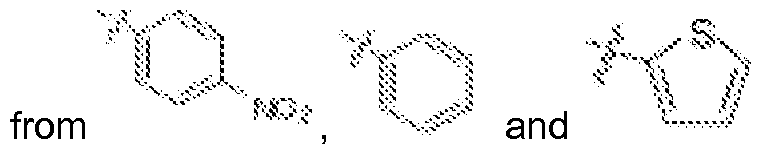
In a third illustrative embodiment, when R2 is (CH2)2COOCH3 then R3 is selected from

In a fourth illustrative embodiment, when R is (CH2)2COOH then R 3 i ■s

In a fifth illustrative embodiment, when R2 is (CH2)2CONHCH(CH2)2 then R3 is
 In a sixth illustrative embodiment, when R2 is CH(CH3)COOH then R3 is selected from

In a seventh illustrative embodiment, when R is
 then R3 is


In an eight illustrative embodiment, when R is
 then RJ

In a ninth illustrative embodiment, when R is
 then R is selected from:

In a tenth illustrative embodiment, when R2
 then R3 is

Also contemplated are molecules wherein boronic acids (e.g. (CH2)2-B(OH)2, CH-(CH2)n- B(OH)2, CH-(CH3)-B(OH)2 and B(OH)2) are incorporated as mimics of carboxylic acids as disclosed herein.
As used herein, alkyl means straight or branched chain, saturated or mono- or polyunsaturated hydrocarbon groups having from 1 to 20 carbon atoms and C^x alkyl means straight or branched chain alkyl groups containing from one up to X carbon atoms wherein X is any positive integer. For example, C1^ alkyl means straight or branched chain alkyl groups containing from one up to 6 carbon atoms. Alkoxy means an alkyl-O-group in which the alkyl group is as described herein.
Cycloalkyl includes a nonaromatic monocyclic or multicyclic ring system, including fused and spiro rings, of from about three to about 10 carbon atoms. A cyclic alkyl may optionally be partially unsaturated.
Cycloalkoxy means a cycloalkyl-O-group in which cycloalkyl is as defined herein. Aryl means an aromatic monocyclic or multicyclic carbocyclic ring system, including fused and spiro rings, containing from about six to about 14 carbon atoms.
Aryloxy means an aryl-O-group in which the aryl group is as described herein.
Alkylcarbonyl means a RC(O)- group where R2 or R3 is an alkyl group as previously described. Alkoxycarbonyl means an ROC(O)- group where R2 or R3 is an alkyl group as previously described.
Cycloalkylcarbonyl means an RC(O)- group where R is a cycloalkyl group as previously described. Cycloalkoxycarbonyl means an ROC(O)- group where R is a cycloalkyl group as previously described. Heteroalkyl means a straight or branched-chain having from one to 20 carbon atoms and one or more heteroatoms wherein the nitrogen and sulphur atoms may optionally be oxidized, i.e., in the form of an N-oxide or an S-oxide.
Heterocycloalkyl means a monocyclic or multicyclic ring system (which may be saturated or partially unsaturated), including fused and spiro rings, of about five to about 10 elements wherein one or more of the elements in the ring system is an element other than carbon and is a heteroatom.
Heteroaryl means a five to about a 14-membered aromatic monocyclic or multicyclic hydrocarbon ring system, including fused and spiro rings, in which one or more of the elements in the ring system is an element other than carbon and is a heteroatom and wherein an N atom may be in the form of an N-oxide.
Arylcarbonyl means an aryl-CO-group in which the aryl group is as described herein. Heteroarylcarbonyl means a heteroaryl-CO-group in which the heteroaryl group is as described herein and heterocycloalkylcarbonyl means a heterocycloalkyl-CO-group in which the heterocycloalkyl group is as described herein.
Aryloxycarbonyl means an ROC(O)- group where R2 or R3 is an aryl group as previously described. Heteroaryloxycarbonyl means an ROC(O)- group where R2 or R3 is a heteroaryl group as previously described.
Heterocycloalkoxy means a heterocycloalkyl-O- group in which the heterocycloalkyl group is as previously described.
Heterocycloalkoxycarbonyl means an ROC(O)- group where R1' R2 or R3 is a heterocycloalkyl group as previously described. Examples of saturated alkyl groups include, but are not limited to, methyl, ethyl, N-propyl, isopropyl, N-butyl, tert-butyl, isobutyl, sec-butyl, N-pentyl, N-hexyl, N-heptyl, and N-octyl. An unsaturated alkyl group is one having one or more double or triple bonds. Unsaturated alkyl groups include, for example, ethenyl, propenyl, butenyl, hexenyl, vinyl, 2-propynyl, 2- isopentenyl, 2-butadienyl, ethynyl, 1 -propynyl, 3-propynyl, and 3-butynyl. Cycloalkyl groups include, for example, cyclopentyl, cyclohexyl, 1 -cyclohexenyl, 3-cyclohexenyl, and cycloheptyl. Heterocycloalkyl groups include, for example, 1 -piperidinyl, 2-piperidinyl, 3- piperidinyl, 3-morpholinyl, 4-morpholinyl, tetrahydrofuran-2-yl, tetrahydrofuran-3-yl, tetrahydrothien-2-yl, tetrahydrothien-3-yl, 1-piperazinyl, 2-piperazinyl, and 1 ,4- diazabicyclooctane. Aryl groups include, for example, benzyl, phenyl, indenyl, biphenyl, 1- naphthyl, 2-naphthyl, anthracenyl, and phenanthracenyl. Heteroaryl groups include, for example, 1 -pyrrolyl, 2-pyrrolyl, 3-pyrrolyl, furyl, thienyl, imidazolyl, oxazolyl, isoxazolyl, thiazolyl, pyrazolyl, pyridyl, pyrimidyl, purinyl, indolyl, quinolinyl, isoquinolinyl, benzoquinolinyl, carbazolyl, and diazaphenanthrenyl.
Heteroatom means any atom that is not hydrogen (H) or carbon (C); in preferred embodiments, a heteroatom refers to nitrogen (N), oxygen (O), sulfur (C), phosphorous (P), boron (B), chlorine (Cl), bromine (Br), and iodine (I).
The subject invention also concerns compositions comprising a proteasome inhibitor of the invention, or a salt thereof, in a pharmaceutically acceptable carrier or diluent. The inventors have identified compound PI-083 (Figure 1 ) as a proteasome inhibitor that exhibits selective inhibition against three different human tumor cell lines (breast, pancreatic and ovarian) over normal cells. As a follow-up for pursuing small molecule proteasome inhibitors, HLM-008182 (1 ) (Figure 2) was identified as a 'hit' from a 20,000 in-house ChemDiv library that shows potent inhibition against chymotrypsin-like proteasome activity with an IC50 value of 0.65±0.40 μM.
Synthesis of HLM-008182 (1 ) has not yet been reported in the chemical literature. This work highlights the synthesis of HLM008182 and modifications around the molecule to obtain a desirable drug-like molecule for proteasome inhibition and associated studies. The hydronaphthoquinone pharmacophore in HLM-008182 (1 ) has high structural diversity that was exploited for focused library synthesis and represents an attractive small molecule for medicinal chemistry. The modification is primarily focused on the 2 and 4 positions (Figure 2).
Starting from 4-aminonaphth-1 -ol hydrochloride salt 2, compound 4a was synthesized through a one pot oxidation-addition reaction of the intermediate 3 similarly to the reported procedure (see Altland, H. W. and Briffa, Jr., B. F., J. Org. Chem., 1985, 50, 433-437) except in the presence of hydrogen peroxide and 4M HCI dioxane solution. 4b and 4c were synthesized in the presence of bromine or iodine in DMF (Figure 3) according to the reported method (U. S. S. R patent 1558901, 1990) except that the reaction gave the hydronaphthoquinone sulfonamide derivatives (See 1 H-NMR and HRMS of 4b and 4c). Compound 10a~e, 14a~t were synthesized from commercially available 1 ,4-naphthoquinone (5), 2-hydroxyl-1 ,4- naphthoquinone (6) or 2-chloro-1 ,4-naphthoquinone (11 ) respectively (Figures 4 and 5). As shown in the Figure 4, ethyl mercaptoacetate or methyl 3-mercaptopropionate was added to 2 eq. of the starting material 1 , 4-naphthoquinone (5) affording precursors 7a~b. The precursor 7c was obtained by nucleophilic substitution of 2-hydroxyl-1 , 4-naphthoquinone (6) with tertiary butyl bromoacetate using silver oxide as a base. The various sulfonamides (R2SO2NH2), either commercially available or synthesized according to literature method
(Obafemi, C.A., Phosphorus and Sulfur and the Related Elements, 1980, 8, 197-199), were regioselectively coupled with the intermediate 7a~c in the presence of titanium (IV) chloride and triethylamine with microwave assisted heating to obtain the library 8. The key intermediates 8 were then reduced by sodium hydrosulfite to hydronaphthoquinone sulfonamide derivatives 9, followed by hydrolysis in a mixture of concentrated HCI and dioxane (1 :1 ) to give the final compounds 10a~d. The compound 10f was obtained by oxidation of compound 9a with oxone followed by acidic hydrolysis. The compound 9e was a 'side product' from coupling 4-nitrobenzenesulfonamide to the intermediate 7a in the presence of titanium (IV) chloride and triethylamine using dichloromethylene as the solvent.
The library 14 was synthesized, as shown in Figure 5, via coupling various sulfonamides to 2- chloro-1 ,4-naphthoquinone (11 ) using the same procedure as for the intermediate 8, followed by substitution of 2-chlorine with the various nucleophiles with or without base. Moving the 2- side chain to the position of C1 was achieved according to Figures 3 and 6. 16a~b were obtained by directly alkylating compound 3 with 2-bromo acetate or 4-bromo butyrate followed by acidic hydrolysis. Newman rearrangement was applied to build up 1-S scaffold (as in intermediate 19) in approaching to compound 22 (Figure 6). Hydrolysis of 19 in a 4 eq. KOH solution followed by alkylation with tert-butyl 2-bromo acetate without separating the 1 -SH intermediate directly gave an acid derivative 20. Hydrogenation of 4-nitro group followed by sulfonylation with thiophene-2-sulfonyl chloride and pyridine in an aqueous solution afforded compound 22. Although there were reported protocols for naphthoquinone sulfonimide synthesis (Adams, R. and Whitaker, L., J. Am. Chem. Soc, 1956, 78, 658-663; Adams, R. and Wankel, R.A., J. Am. Chem. Soc, 1951 , 73, 131 -134), these protocols failed to afford HLM-008182. The inventors successfully developed the synthesis of hydronaphthoquinone sulfonamide disclosed herein. Starting from commercially available 1 , 4-naphthoquinone (5), the hydronaphthoquinone sulfonamide scaffold was built up through addition-oxidation of the starting material 5 with thio-nucleophiles, coupling sulfonamides to the corresponding 1 , 4-naphthoquinone derivatives, reduction and hydrolysis. The synthesis method was further optimized to a two step protocol. Starting from commercially available 2-chloro-1 , 4-naphthoquinone (11 ), the scaffold was formed through coupling sulfonamides to the starting material 11 , nucleophilic substitution followed by reduction.
In the protocol using 5 as the starting material (Figure 4), the key step to afford the intermediates 8 gave several products according to TLC with dichloromethylene as the reaction solvent. In addition to the intermediates 8, the reduced products (see structure of 9) were isolated as well via flash chromatography and identified by 1 H-NMR and HRMS-(+). In the reaction attempting 8e, only the reduced form 9e was obtained in a low yield. This type of 'side reaction' made the isolation of the intermediates 8 laborious and the library synthesis a time consuming job. The mechanism of the unexpected 'side reaction' has not been unknown yet.
Figure 5 represented an optimized procedure for synthesis of HLM-008182 and its analogues. The key intermediates 12 were purified by either re-crystallization or trituration from appropriate solvents, thus more convenient for library synthesis. The step for the intermediates 12 was more efficient with microwave assisted heating than conventional heating (Figure 9, entry 2 vs 3). The yield of the coupling reaction was significantly improved when dichloromethylene was replaced by THF (Figure 9, entry 2 vs 4, entry 5 vs 6). For example, the yields for compound 12e and f (Figure 9, entry 7 and 8) were improved to 61.8% and 77.9% respectively when THF was utilized. When aliphatic thiol was used in the subsequent nucleophilic substitution, the products 13, in situ, were partially reduced to the final compounds 14 in the presence of aliphatic thiol giving mixtures of 13 and 14 in a certain ratio. However, the single component of the final hydronaphthoquinone sulfonamide 14 (Figure 7) was obtained without separation of the mixtures by directly treating the mixtures with sodium hydrosulfite in biphasic solution of ethyl acetate and water. The in situ reduction was not observed with non-reductive nucleophiles such as alcohols (compound 13a) and amines (compound 13b, c, i). However, attempts to reduce these compounds to hydronaphthoquinone sulfonamide derivatives did not get the final products as a single component due to the rapid oxidation of the reduced product when exposed to air. It is notable that compound 10a was oxidized to naphthoquinone sulfonimide derivative when attempting to dissolve it in CDCI3 in a NMR tube by the aid of sonication. The mechanism was not clear although the oxidation could be caused by sonication which facilitated the oxidation in CDCI3.
Coupling the various sulfonamides to 1 , 4-naphthoquninone derivatives 7 or 11 in the presence of titanium chloride and triethylamine was a key step to building up naphthoquinone sulfonimide scalffold. A TiCI4-Et3N system has been widely used in forming sulfonimides34' 35 through activation of the reactive ketone by forming a TiCI4-ketone complex. In 1 , A-
naphthoquinone derivatives 7 or 11 , the participation of 2-sulfur, oxygen or chlorine atom facilitated TiCI4 to form the complex with 4-carbonyl rather than 1 -carbonyl (Figure 7, 15). The complex was stabilized by the p-π conjugation system formed between the lone pair electrons on 2-sulfur, oxygen or chlorine and the naphthoquinone ring (Figure 8, 15→16). Therefore in the presence Of TiCI4, the sulfonamides were regioselectively coupled to 1 , 4-naphthoquinone derivatives 7 or 11 at the 4 position. In contrast to TiCI4 assist, the regioselectivity, as reported (Arnone, A., Synth. Commun., 2007, 37, 2569-2577), was reversed to 1 -carbonyl when a coupling occurred under a basic condition because the nucleophilicity of 4-carbonyl was dramatically decreased by the participation of the 2-oxygen. The coupling procedure was not successful when there was a methyl group at the 3 position due to the steric hindrance effect. The regioselectivity was confirmed by 1 H-NMR in that the chemical shift of 3-H significantly shifted down field from 6.70 ppm in 7a to 7.94 ppm in 8a and from 7.24 ppm in 11 to 8.62 ppm in 12a (Figure 10) due to the effect of the sulfonimide group adjacent to 3-H.
2OS Proteasome Inhibition Assay
Six distinct catalytic active sites were thought to be responsible for the hydrolysis of polypeptide substrate by proteasome, among which chymotrypsin-like (CT-L), tropsin-like (T-
L) and polyglutamine peptide hydrolysis (PGPH) activity were most firmly established and characterized. These proteolysis activities are substrate specific. For example, Suc-Leu-Leu-
Val-Tyr-AMC has been used for chymotrypsin-like activity substrate, Bz-Val-Gly-Arg-AMC for trypsin-like susbtrate and benzyloxycarbonyl Z-Leu-Leu-Glu-AMC for PGPH activity susbtrate. In our work, we used chymotrypsin-like substrate Suc-Leu-Leu-Val-Tyr-AMC to test the proteasome inhibition activity of the synthesized compounds.
Structure and Activity Relationship by modifications on 2-substitution and 4- sulfonamide moiety
Compound 10a is an in-house synthesis compound of HLM-008182. It exhibits comparable proteasome inhibition activity to the commercial sample HLM-008182 (Figure 1 1 , entry 1 and 6). This further confirmed HLM-008182 as a proteasome inhibitor. The interactions between HLM-008182 and chymotrysin-like catalytic site of 2OS proteasome was predicted using molecular modeling and suggested that 2-side chain is H-bonding to the residue of Thr-1 through carboxylic acid acceptor (Figure 12). Replacement of the side chain at the 2 position
by small groups, such as hydrogen (compound 3) or halides (compound 4a~c), caused the loss of the inhibitory activity. The essentialness of the carboxylic acid moiety to the inhibitory activity was further confirmed by modification of the carboxylic group at the side chain. When the carboxylic acid moiety was replaced by the simple alkyl group (compound 14j) or the hydroxyl group (compound 14k), the inhibitory activity totally lost. The thio-ether side chain at the 2 position was essential to retain the inhibitory activity. For example, replacement of thio- ether side chain by ether or sulfone moiety diminished the inhibitory activity (compound 10d and 10f). Molecular modeling analysis indicated that 1 -hydroxyl in the molecule of HLM- 008182 played the role as a hydrogen bond donor to Gly47 in the 2OS proteasome (Figure 12). The inhibitory activity could be reduced or lost by formation of an intramolecular hydrogen bond between 1 -hydroxyl and other groups in the inhibitor molecules. In compound 10d and 10f, ether and sulfone moiety at the 2 position could play roles as hydrogen bond acceptors from 1 -hydroxyl, thus made the loss or reduction of the inhibitory activity.
The inhibitory potency of compounds with the ester chain was reduced compared to acid analogues (Figure 1 1 , entry 2, 4, 6 and 8: compound 9a vs 10a, 9c vs 10c). When the length of the 2-side chain was increased by one carbon, the inhibitory activity diminished (Figure 1 1 , entry 6 and 7: 10a vs 10b). In series of 2-amide chain inhibitors (compound 14f~h), increasing length of 2-side chain caused the partial or complete loss of the activity. As H- bonding to Thr-1 residue was essential for hydronaphthoquinone sulfonamide inhibitors to inhibit proteasome chymotrpsin-like activity, we also tested compounds with carboxylic acid mimics, such as tetrazole and triazole at the 2 position. The results showed that the compounds bearing these carboxylic acid mimics exhibited comparable inhibition potency against proteasome to the lead compound (Figure 1 1 , entry 9 and 10: compound 14d and 14e).
Linear side chains at the 2 position were more favorable for inhibition activity than branched side chains. When the linear chain of acetic acid at the 2 position of compound 14n and 14q was replaced by branched chain of isopropionic acid in compound 14u and 14v, the activity was decreased by ~2 fold (Figure 1 1 , entry 16, 17, 20 and 21 ). The similar results presented when the linear side chain was replaced by an aromatic ring (Figure 1 1 , entry 6 and 12: compound 10a vs 141). The modification of aromatic sulfonamide at the 4 position retained or slightly decreased the proteasome inhibition activity as compared to the lead compound 10a. For example, the
inhibitory activity was tolerated by replacing the thiophene ring by phenyl ring (Figure 1 1 , entry 6 and 8: IC50=I .47 μM for 10a vs 2.08 μM for 10c) or 4-biphenyl group (Figure 1 1 , entry 18: IC50=I .90 μM for 14s). Substitution at the para position of 4-benzenesulfonamide by nitro group slightly enhanced the activity (Figure 1 1 , entry 4 and 5: compound 9c vs 9e). The decoration of the thiophene ring or phenyl with chlorine also helped to retain the inhibitory activity against proteasome (Figure 1 1 , entry 14-16: compound 14n~p). The bulky naphthalene ring slightly decreased the activity by 3 fold (Figure 1 1 , entry 17: compound 14q).
Compound 13w, the oxidized form of HLM-008182 showed comparable inhibitory potency. This indicated that the proteasome activity might be inhibited by hydronaphthoquinone sulfonamide derivatives through oxidation of the inhibitors. The mechanism of action is not clear yet.
Examples
All reagents were purchased from commercial suppliers and used without further purification. Melting points were determined using a Barnstead international melting point apparatus and remain uncorrected. 1 H NMR spectra were recorded on a Varian Mercury 400 MHz spectrometer with CDCI3, CD2CI2 or (/-DMSO as the solvents. All coupling constants are measured in hertz (Hz), and the chemical shifts (<5H) are quoted in parts per million (ppm). High resolution mass spectroscopy was carried out on an Agilent 6210 LC/MS (ESI-TOF). Microwave reactions were performed in Biotage initiator 8 machines. Flash chromatograph was done on Flash Master Il (Biotage) using a pre-packed silica gel column and gradient elution with Hexane/EtOAc system. Thin layer chromatography was performed using silica gel 60 254 plates (Fisher), with observation under UV when necessary. Anhydrous solvents (ethanol, dichloromethylene, 1 ,2-dichloroethane, 1 ,4-dioxane and tetrahydrofuran) were used as purchased from Aldrich. HPLC grade solvents (methanol, acetontrile, and water) were purchased from Burdick and Jackson for mass analysis.

Thiophene-2-sulfonamide: 365.3 mg thiophene-2-sulfonyl chloride was dissolved in 5 ml THF, to which at 0 0C was added 1.7 ml NH3 solution drop wise. The resulting mixture was
stirred at r.t. for 2 hrs and acidified with cone. HCI at 0 0C to pH= ~2. The organic solvent was removed via rotavap and the aqueous suspension was extracted with ethyl acetate. The extract was combined and washed with saturated NaHCO3 solution, water and brine. Dried over Na2SO4, the organic phase was filtered and the filtrate was concentrated affording the title compound 212 mg (65%) as a white solid, m.p.: 137-139 0C. 1H-NMR, 400 MHz, CDCI3, δ (ppm): 7.68 (dd, J=1.3 Hz, 3.8 Hz, 1 H), 7.60 (dd, J=1.3 Hz, 5.0 Hz, 1 H), 7.08 (dd, J=3.8 Hz, 5.0 Hz, 1 H), 4.98 (br, 2H).

4-nitrobenzenesulfonamide was prepared according to the procedure for thiophene-2- sulfonamide YG1 -030 except using 4-nitrobenzenesulfonyl chloride, which afforded the title compound 1.953 g (96.6%) as a pale yellow solid, m.p.: 178-180 0C. 1H-NMR, 400 MHz, d6- DMSO, δ (ppm): 8.40 (d, J=8.6 Hz, 2H), 8.04 (d, J=8.6 Hz, 2H), 7.72 (br, 2H). HRMS (ESI-ve) mlz calculated for C6H6N2O4S (M-H)" 200.9976, found 200.9986.

4-biphenylsulfonamide was prepared according to the procedure for thiophene-2- sulfonamide YG1 -030 except using 4-biphenylsulfonyl chloride, which afforded the title compound 642.2 mg (90.6%) as a white solid, m.p.: 223-225 0C.
1H-NMR, 400 MHz, d6-DMSO, δ (ppm): 7.88 (d, J=8.0 Hz, 2H), 7.84 (d, J=7.9 Hz, 2H), 7.71 (d, J=7.3 Hz, 2H), 7.49 (t, J=7.1 Hz, 2H), 7.41 (m, 3H).


N-(4-hydroxynaphthalen-1 -yl)thiophene-2-sulfonamide (3): 1.957 g 4-aminonaphth-1-ol hydrochloride salt was suspended in 80 ml dichloromethylene, to which at 0 0C was added 3.0 ml triethylamine. The suspension became a dark brown solution. To the solution was added 1.827 g thiophene-2-sulfonyl chloride. The mixture was stirred at r.t. overnight. The reaction mixture was diluted with dichloromethylene to 200 ml and washed with 1 N HCI solution (30 mlχ3), water (30 mlχ3) and brine (30 ml). Dried over MgSO4, the organic phase was filtered and the filtrate was concentrated to dryness. The crude product was suspended in 50% methanol/H2O and filtered. The solid was washed with 50% methanol/H2O affording 2.7 g (90%) brown solid, m.p.: 146-148 0C.
1H-NMR, 400 MHz, CD2CI2, δ (ppm): 7.81 (m, 2H), 7.70 (dd, J = 1.4 Hz, 5.0 Hz, 1 H), 7.60 (dd, J = 1.3 Hz, 3.8 Hz, 1 H), 7.46 (m, 2H), 7.07 (d, J=8.2 Hz, 1 H), 7.06 (dd, J= 3.8 Hz, 5.0 Hz, 1 H), 6.66 (d, J = 8.2 Hz, 1 H), 4.30 (br, 2H).

N-(3-chloro-4-hydroxynaphthalen-1 -yl)thiophene-2-sulfonamide (4a): 0.987 g N-(4- hydroxynaphthalen-1 -yl)thiophene-2-sulfonamide (3) was suspended in 10 ml methanol, to which was added 3 ml hydrogen peroxide solution (35%). The mixture was stirred at r.t. for 2 h. Additional 3 ml hydrogen peroxide solution was added followed by 1 ml HCI solution (4 M in dioxane). The reaction was continued for another 2 h. The organic solvent was removed via rotavap and the residue was redissolved in ethyl acetate (100 ml). Washed with water (20mlχ3) and brine (20 mlχ2), the organic phase was dried over Mg2SO4. The organic phase was filtered and concentrated. The crude product was separated via flash chromatography (Hex/EtOAc) affording 244 mg (22.2%) brown solid, m.p.: 1 13-115 0C.
1H-NMR, 400 MHz, CDCI3, δ (ppm): 7.79 (d, J = 8.4 Hz, 1 H), 7.70 (d, J = 8.1 Hz, 1 H), 7.64 (dd, J = 1.1 Hz, 4.9 Hz, 1 H), 7.60 (dd, J = 1.2 Hz, 3.8 Hz, 1 H), 7.40 (m, 2H), 7.19 (s, 1 H), 7.02 (dd, J = 4.0 Hz, 4.8 Hz, 1 H), 4.46 (br, 2H).
HRMS (ESI+ve) mlz calculated for C14H10CIO3S2 (M+H) + 339.9863, found 339.9856.

0 0C was added 320 mg Br2 in 1 ml dichloromethylene solution. After stirred at r.t. for 1 h, 558 μl TEA was added at 0 0C. The reaction was stirred at r.t. overnight and diluted with ethyl acetate to 50 ml. The organic phase was washed with water and brine. Dried over Na2SO4, the organic phase was filtered and concentrated. The crude product was purified via flash chromatography (Hex/EtOAc gradient) affording an orange-red solid 140 mg (36.4%), m.p.: 128-13O 0C.
1H-NMR, 400 MHz, CDCI3, δ (ppm): 7.81 (m, 1 H), 7.75 (m, 1 H), 7.66 (dd, J = 1.3 Hz, 5.0 Hz,
1 H), 7.61 (dd, J = 1.3 Hz, 3.8 Hz, 1 H), 7.43 (m, 2H), 7.32 (s, 1 H), 7.04 (dd, J = 3.9 Hz, 5.0 Hz, 1 H), 4.75 (br, 2H).
HRMS (ESI+ve) mlz calculated for C14H10BrO3S2 (M+H) + 383.9358, found 383.9347.

N-(3-iodo-4-hydroxynaphthalen-1 -yl)thiophene-2-sulfonamide (4c): was prepared according to the procedure for 4b except using I2 solid. The reaction afforded title compound 129.4 mg (100%) as a brown solid, m.p.: 134-136 0C.
1H-NMR, 400 MHz, CDCI3, δ (ppm): 7.82 (d, J = 8.0 Hz, 1 H), 7.74 (d, J = 7.8 Hz, 1 H), 7.68 (d, J = 5.0 Hz, 1 H), 7.62 (d, J = 3.8 Hz, 1 H), 7.45 (m, 3H), 7.06 (dd, J = 3.8 Hz, 5.0 Hz, 1 H).
HRMS (ESI+ve) mlz calculated for C14H10IO3S2 (M+H) + 431.9220, found 431.9216. Procedure A for 10a:

Ethyl 2-(1 ,4-dioxo-1 ,4-dihydronaphthalen-2-ylthio)acetate (7a): 790.8 mg 1 ,4- naphthoquinone was added portion wise to 10 ml ethanol containing 0.5 eq. ethyl mercaptoacetate at room temperature. The mixture was stirred at room temperature for 30 min. The yellow solid was filtered, washed with ethanol and dried over vacuum affording title compound 491 mg (88.9%) as a yellow solid, m.p.: 150-152 0C.
1H-NMR, 400 MHz, CDCI3, δ (ppm): 8.12 (d, J=7Λ Hz, 1 H), 8.09 (d, J=7Λ Hz, 1 H), 7.77 (t, J=7.5 Hz, 1 H), 7.72 (t, J=7.5 HZ, 1 H), 6.70 (s, 1 H), 4.26 (q, J=7.1 Hz, 2H), 3.67 (s, 2H), 1.31 (t, J=7.1 HZ, 3H).
HRMS (ESI+ve) mlz calculated for C14H12O4S (M+H) + 277.0529, found 277.0529.

Ethyl 2-(1 -oxo-4-(thiophen-2-ylsulfonylimino)-1 ,4-dihydronaphthalen-2-ylthio)acetate (8a): 63 mg (0.228 mmoles) ethyl 2-(1 ,4-dioxo-1 ,4-dihydronaphthalen-2-ylthio)acetate (7a) was mixed with 37 mg (0.228 mmoles) thiophene-2-sulfonamide in 2.5 ml dichloromethylene, to which at 0 0C was added 76 mg TiCI4-2THF followed by 70 μl triethylamine. The mixture was heated at 60 0C with microwave synthesizer (Initiator 8, Biotage) for 20 min. Diluted with dichloromethylene to 60 ml, the reaction mixture was washed with H2O and brine and dried over Na2SO4. After removal of Na2SO4, the filtrate was concentrated and the residue was purified with flash column (EtOAc/Hexane) affording title compound 58 mg (60.4%) as orange oil which was solidified on standing, m.p.: 1 10-1 12 0C.
1H-NMR, 400 MHz, CDCI3, δ (ppm): 8.22 (dd, J=3.3 Hz, 5.9 Hz, 1 H), 8.15 (dd, J=3.5 Hz, 5.7 HZ, 1 H), 7.96 (s, 1 H), 7.83 (dd, J=1.3 Hz, 3.8 Hz), 7.70 (m, 3H), 7.15 (dd, J=3.8 Hz, 5.0 Hz, 1 H), 4.32 (q, J=7.1 Hz, 2H), 3.80 (s, 2H), 1.35 (t, J=7.1 Hz, 3H).
HRMS (ESI+ve) mlz calculated for C18H15NO5S3 (M+H) + 422.0185, found 422.0193.

Ethyl 2-(1-hydroxy-4-(thiophene-2-sulfonamido)naphthalen-2-ylthio)acetate (9a): 52 mg
(E)-ethyl 2-(1-oxo-4-(thiophen-2-ylsulfonylimino)-1 ,4-dihydronaphthalen-2-ylthio)acetate (8a) was dissolved in 2 ml THF, to which was added 2 ml aqueous solution containing 107 mg Na2S2O4, The resulting biphasic solution was stirred at r.t. for 1 h until it turned pale yellow. The mixture was diluted with ethyl acetate and washed with water and brine. Dried over Na2SO4, the organic solution was filtered and the filtrate was concentrated. The crude product was purified via flash column (EtOAc/Hexane) yielding 25.2 mg (58.7 %) title compound, m.p.: 116-1 18 0C. 1H-NMR, 400 MHz, CDCI3, δ (ppm): 8.42 (s, 1 H), 8.29 (dd, J=3.2 Hz, 6.3 Hz, 1 H), 7.80 (dd, J=3.1 Hz, 6.3 Hz, 1 H), 7.52 (d, J=4.0 Hz, 1 H), 7.48 (dd, J=3.2 Hz, 6.4 Hz, 2H), 7.38 (d, J=2.7 Hz, 1 H), 7.35 (s, 1 H), 6.95 (t, J=4.6 Hz, 1 H), 6.77 (s, 1 H), 4.18 (q, J=JA Hz, 2H), 3.48 (s, 2H), 1.21 (t, J=7.1 Hz, 3H).
HRMS (ESI+ve) mlz calculated for C18H17NO5S3 (M+H) + 424.0342, found 424.0335.

2-(1 -hydroxy-4-(thiophene-2-sulfonamido)naphthalen-2-ylthio)acetic acid (10a): 8 mg
Ethyl 2-(1 -hydroxy-4-(thiophene-2-sulfonamido)naphthalen-2-ylthio)acetate (9a) was dissolved in 0.5 ml dioxane, to which was added 0.5 ml HCI solution (4 N). The reaction mixture was heated at 100 0C with M. W. for 10 min and diluted to 20 ml with ethyl acetate. Washed with water and brine, the organic solution was dried over Na2SO4 and filtered. The filtrate was concentrated to dryness affording title compound 6 mg (80%) as a pale yellow solid, m.p.: 175-177 0C.
1H-NMR, 400 MHz, d6-DMSO, δ (ppm): 10.08 (s, 1 H), 8.13 (d, J=8.5 Hz, 1 H), 7.85 (s, 1 H), 7.84 (d, J=3.6 Hz, 2H), 7.44 (m, 2H), 7.34 (d, J=3.2 Hz, 1 H), 7.06 (s, 1 H), 7.05 (t, J=4.1 Hz, 1 H), 3.52 (s, 2H).
HRMS (ESI-ve) m/z calculated for C16H13NO5S3 (M-H) 393.9883, found 393.9885.
Oxidation of 10a: around 1 mg 10a was suspended in 0.6 ml CDCI3 in a NMR tube. The suspension was sonicated with a supersound power of 308 W (50/60 Hz) until a clear bright yellow solution was afforded.
1H-NMR, 400 MHz, CDCI3, δ (ppm): 8.22 (m, 1 H), 8.15 (m, 1 H), 7.99 (s, 1 H), 7.83 (dd, J = 1.3 Hz, 3.8 Hz, 1 H), 7.71 (m, 3H), 7.15 (dd, J = 3.8 Hz, 5.0 Hz, 1 H), 3.86 (s, 2H).
Procedure B for 10a:

N-(3-chloro-4-oxonaphthalen-1 (4H)-ylidene)thiophene-2 -sulfonamide (12a): 385.2 mg 2- chloro-1 ,4-naphthoquinone (11 ) was mixed with 326.4 mg thiophene-2-sulfonamide in 15 ml dichloromethylene, to which at 0 0C was added 2ml TiCI4 dichloromethylene solution followed by 613.3 μl. The mixture was heated at 60 0C with M. W. for 15 min and the black mixture was poured into 100 ml ethyl acetate. The insoluble was removed by filtrate through a pad of celite. The filtrate was concentrated and the residue was suspended in dichloromethylene. The brown insoluble stuff was removed by filtration and the filtrate was again concentrated to dryness. The residue was suspended in ethyl acteate/hexane (1 :1 ) and the yellow solid was filtered. The solid was washed with ethyl acteate/hexane (1 : 1 ) and dried over vacuum affording title compound 377.7 mg (55.9%) as a yellow solid. When TiCI4-2THF and THF were used instead, the reaction afforded the title compound 522 mg (77.3%) as a yellow solid, m.p.: 167-169 0C.
1H-NMR, 400 MHz, CDCI3, δ (ppm): 8.62 (s, 1 H), 8.23 (tt, J=1.5 Hz, 9.2 Hz, 2H), 7.86 (dd, J=1.4 Hz, 3.8 Hz, 1 H), 7.75 (m, 3H), 7.18 (dd, J=3.8 Hz, 5.0 Hz, 1 H).

2-(1 -hydroxy-4-(thiophene-2-sulfonamido)naphthalen-2-ylthio)acetic acid (10a): 33.8 mg (E)-N-(3-chloro-4-oxonaphthalen-1 (4H)-ylidene)thiophene-2-sulfonamide (12a) was dissolved in 2 ml THF, to which was added 0.1 ml THF solution containing 0.1 mmole thioglycolic acid followed by 1 eq. pyridine. The mixture was stirred at r.t. for 10 min and the solvent was removed via votavap. The orange-red residue was redissolved in 50 ml ethyl acetate and 0.5 M NaHSO4 solution and transferred to a separation funnel. The organic layer was separated and washed with 0.5 M NaHSO4 solution. To the ethyl acetate solution, was added 5 eq. sodium hydrosulfite solid, followed by 10 ml water. The mixture was shaken until the organic phase turned colorless. The organic phase was separated and washed with water and brine. Dried over Na2SO4, the organic phase was filtered and the filtrate was concentrated to dryness. The residual solid was suspended in dichloromethylene/hexane (1 :1 ) and filtered. The solid was washed with dichloromethylene affording title compound 25 mg (63.6%) as an off-white solid.
1H-NMR, 400 MHz, d6-DMSO, δ (ppm): 12.65 (br, 1 H), 10.07 (s, 1 H), 8.13 (d, J=8.0 Hz, 1 H), 7.85 (s, 1 H), 7.84 (d, J=3.6 Hz, 1 H), 7.44 (m, 2H), 7.34 (d, J=3.7 Hz, 1 H), 7.06 (s, 1 H), 7.04 (t, J=3.8 Hz, 1 H), 3.52 (s, 2H).
HRMS (ESI-ve) m/z calculated for C16H13NO5S3 (M-H) 393.9883, found 393.9889.

Methyl 3-(1 ,4-dioxo-1 ,4-dihydronaphthalen-2-ylthio)propanoate (7b) was prepared according to the procedure for (7a) except using methyl 3-mercaptopropionate. The reaction afforded title compound 1.298 g (93.9%) as a yellow solid, m.p.: 108-1 10 0C.
1H-NMR, 400 MHz, CDCI3, δ (ppm): 8.10 (t, J=7.6 Hz, 2H), 7.76 (t, J=7.5 Hz, 1 H), 7.71 (t, J=7Λ Hz, 1 H), 6.64 (s, 1 H), 3.74 (s, 3H), 3.13 (t, J=7.4 Hz, 2H), 2.78 (t, J=7.3 Hz, 2H).
HRMS (ESI+ve) mlz calculated for C14H12O4S (M+H) + 277.0529, found 277.0539.

1H NMR, 400 MHz, CDCI3, δ (ppm): 8.15 (d, J = 7.2 Hz, 1 H), 8.08 (d, J = 7.2 Hz, 1 H), 7.78- 7.73 (m, 2H), 6.04 (s, 1 H), 4,62 (s, 2H), 1.41 (s, 9H).
HRMS (ESI+ve) mlz calculated for C16H17O5 (M+H) + 289.1071 , found 289.1090.

5.2.17 Methyl 3-(1 -oxo-4-(thiophen-2-ylsulfonylimino)-1 ,4-dihydronaphthalen-2-ylthio) propanoate (8b) was prepared according to the procedure for 8a except using 7b, which afforded 74 mg (35.1 %) title compound as an orange solid, m.p.: 140-142 0C.
1H-NMR, 400 MHz, CDCI3, δ (ppm): 8.22 (m, 1 H), 8.12 (m, 1 H), 7.90 (s, 1 H), 7.82 (dd, J=1.3 Hz, 3.8 Hz, 1 H), 7.69 (m, 3H), 7.15 (dd, J=5.0 Hz, 8.8 Hz, 1 H), 3.75 (s, 3H), , 3.26 (t, J=6.9 Hz, 2H), 2.85 (t, J=6.9 Hz, 2H).
HRMS (ESI+ve) mlz calculated for C18H15NO5S3 (M+H) + 422.0185, found 422.0185.

Ethyl 2-(1 -oxo-4-(phenylsulfonylimino)-1 ,4-dihydronaphthalen-2-ylthio)acetate (8c) was prepared according to the procedure for 8a except using benzenesulfonamide, which afforded 131.8 mg (31.7%) title compound as a yellow solid, m.p.: 93-95 0C.
1H-NMR, 400 MHz, CDCI3, δ (ppm): 8.11 (dd, J=2A Hz, 6.6 Hz, 2H), 8.07 (d, J=T.3 Hz, 2H), 7.99 (s, 1 H), 7.64 (m, 3H), 7.85 (t, J=8.0 Hz, 2H), 4.32 (q, J=TA Hz, 2H), 3.81 (s, 2H), 1.34 (t, J=TA Hz, 3H).
HRMS (ESI+ve) mlz calculated for C20H17NO5S2 (M+H) + 416.0621 , found 416.0621.

1H NMR, 400 MHz, CDCI3, δ (ppm): 8.07 (d, J = 9.0 Hz, 1 H), 8.01 (d, J = 9.0 Hz, 1 H), 7.64 (d, J = 3.7 Hz, 1 H), 7.55-7.53 (m, 3H), 7.10 (s, 1 H), 6.98 (t, J = 3.8 Hz, 1 H), 4.58 (s, 2H), 1.39 (s, 9H); ). HRMS (ESI+ve) mlz calculated for C16H17O5 (M+H-tBu-CO2) + 334.0208, found 334.0222.

Ethyl 2-(1-oxo-4-(tosylimino)-1,4-dihydronaphthalen-2-ylthio)acetate (8f) was prepared according to the procedure for 8a except using 4-methylbenzenesulfonamide, TiCI4-2THF and THF as solvent. The title compound 100.7 mg (46.9%) was obtained according to the workup procedure for 12a as a yellow solid, m.p.: 0C.
1H-NMR, 400 MHz, CDCI3, δ (ppm): 8.14 (dd, J=1.4 Hz, 7.2 Hz, 2H), 8.03 (s, 1 H), 7.95 (d, J=8.2 Hz, 2H), 7.65 (m, 2H), 7.38 (d, J=8.5 Hz, 2H), 4.32 (q, J=7.1 Hz, 2H), 3.81 (s, 2H), 2.47 (s, 3H), 1.35 (t, J=7.1 Hz, 3H).
HRMS (ESI+ve) m/z calculated for C2I H19NO5S2 (M+H) + 430.0777, found 430.0776.

HRMS (ESI+ve) mlz calculated for C21 H18CINO5S2 (M+H) + 464.0388, found 464.0388.

1H-NMR, 400 MHz, CDCI3, δ (ppm): 8.25 (dd, J=3.2 Hz, 6.4 Hz, 1 H), 7.87 (dd, J=3.2 Hz, 6.3Hz, 1 H), 7.60 (br, 1 H), 7.50 (m, 3H), 7.41 (dd, J=1.3 Hz, 3.7 Hz, 1 H), 7.32 (s, 1 H), 6.95 (dd, J=3.8 Hz, 5.0 Hz, 1 H), 6.91 (br, 1 H), 3.70 (s, 3H), 2.93 (t, J=JA Hz, 2H), 2.51 (t, J=7.0 Hz, 2H).
HRMS (ESI+ve) mlz calculated for C18H17NO5S3 (M+Na) + 446.0161 , found 446.0157.

Ethyl 2-(1 -hydroxy-4-(phenylsulfonamido)naphthalen-2-ylthio)acetate (9c) was prepared according to the procedure for 9a affording 68 mg (81.5%) title compound as a pale yellow solid, m.p.: 1 18-12O 0C.
1H-NMR, 400 MHz, CD2CI2, δ (ppm): 8.52 (s, 1 H), 8.27 (m, 1 H), 7.84 (m, 1 H), 7.68 (d, J= 8.4 Hz, 2H), 7.57 (t, J= 7.5 Hz, 1 H), 7.50 (m, 2H), 7.43 (t, J= 7.9 Hz, 2H), 7.17 (s, 1 H), 6.59 (br, 1 H), 4.17 (q, J=7.1 Hz, 2H), 3.44 (s, 2H), 1.21 (t, J=7.2 Hz, 3H).
HRMS (ESI+ve) mlz calculated for C20H19NO5S2 (M+Na) + 440.0597, found 440.0596.

1H NMR, 400 MHz, CDCI3, δ (ppm): 8.55 (broad s, 1 H, disappear on D2O shake), 8.25 (d, J = 8.0 Hz, 1 H), 7.55 (d, J = 8.0 Hz, 1 H), 7.45 (d, J = 4.8 Hz, 1 H), 7.45-7.29 (m, 3H), 7.24 (s, 1 H), 6.90 (1 H, J = 4.8 Hz, 1 H), 6.71 (s, 1 H, disappear on D2O shake), 4.54 (s, 2H), 1 .51 (s, 9H).
HRMS (ESI-ve) mlz calculated for C20H20NO6S2 (M-H) " 434.0738, found 434.0755.

Ethyl 2-(1-hydroxy-4-(4-nitrophenylsulfonamido)naphthalen-2-ylthio)acetate (9e) was prepared according to the procedure for 8a except using 4-nitrobenzenesulfonamide, 1 ,2- dichloroethane as solvent and applying 100 0C to the reaction. The reaction was worked up according to the procedure for 12a and the title compound was isolated from the product mixture by flash chromatography (EtOAc/Hex) affording 48 mg (10.4%) as a brown solid, m.p.: 143-145 0C.
1H-NMR, 400 MHz, CD3CN, δ (ppm): 8.49 (s, 1 H), 8.25 (d, J= 8.9 Hz, 2H), 8.24 (m, 1 H), 8.01 (br, 1 H), 7.89 (m, 1 H), 7.87 (d, J= 8.7 Hz, 2H), 7.54 (m, 2H), 7.13 (s, 1 H), 4.1 1 (q, J=7.1 Hz, 2H), 3.47 (s, 2H), 1.16 (t, J=7.1 Hz, 3H). HRMS (ESI+ve) m/z calculated for C20H18N2O7S2 (M+Na) + 485.0448, found 485.0438.

Ethyl 2-(1 -hydroxy-4-(thiophene-2-sulfonamido)naphthalen-2-ylsulfonyl)acetate (9f):
42.4 mg Ethyl 2-(1 -hydroxy-4-(thiophene-2-sulfonamido)naphthalen-2-ylthio)acetate (9a) was dissolved in 2 ml acetone, to which was added 2 ml aqueous solution containing 307.4 mg oxone. The resulting mixture was stirred at r.t. overnight. The organic solvent was removed by rotavap and the residue extracted with ethyl acetate. The organic extract was combined and washed with water and brine. Dried over Na2SO4, the organic phase was filtered and the filtrate was concentrated to dryness affording 47 mg (100%) title compound as a pale yellow solid, m.p.: 154-156 0C. 1H-NMR, 400 MHz, CDCI3, δ (ppm): 10.02 (s, 1 H), 8.43 (d, J=8.4 Hz, 1 H), 7.98 (d, J=8.4 Hz, 1 H), 7.70 (t, J=8.0 Hz, 1 H), 7.62 (t, J=7.9 Hz, 1 H), 7.57 (d, J=5.0 Hz, 1 H), 7.43 (d, J=3.7 Hz, 1 H), 7.29 (s, 1 H), 7.00 (dd, J=3.8 Hz, 4.9 Hz, 1 H), 6.58 (s, 1 H), 4.16 (q, J=T .2 Hz, 2H), 4.12 (s, 2H), 1.15 (t, J=7.2 Hz, 3H).
HRMS (ESI-ve) mlz calculated for C18H17NO7S3 (M-H) 454.0094, found 454.01 12.

3-(1 -hydroxy-4-(thiophene-2-sulfonamido)naphthalen-2-ylthio)propanoic acid (10b) was prepared according to the procedure of procedure A for 10a except applying r.t. to the reaction overnihgt, which afforded 5.6 mg (13.5%) title compound as a white solid, m.p.: 185 0C (dec).
1H-NMR, 400 MHz, d6-DMSO, δ (ppm): 12.35 (s, 1 H), 10.07 (s, 1 H), 9.70 (s, 1 H), 8.13 (d, J=7.6 Hz, 1 H), 7.91 (d, J=7.8 Hz, 1 H), , 7.85 (d, J=5.0 Hz, 1 H), 7.46 (m, 2H), 7.36 (d, J=3.7Hz, 1 H), 7.07 (t, J=4.9 Hz, 1 H), 6.96 (s, 1 H), 2.84 (t, J=7.2 Hz, 2H), 2.37 (t, J=7.1 Hz, 2H). HRMS (ESI-ve) mlz calculated for C17H15NO5S3 (M-H) "408.0040, found 408.0054.

2-(1 -hydroxy-4-(phenylsulfonamido)naphthalen-2-ylthio)acetic acid (10c) was prepared according to the procedure of procedure A for 10a except applying r.t. to the reaction overnihgt, which afforded 20 mg (53.6%) title compound as an off-white solid, m.p.: 100-102 0C.
1H-NMR, 400 MHz, d6-DMSO, δ (ppm): 12.75 (br, 1 H), 9.91 (s, 1 H), 9.80 (br, 1 H), 8.10 (d, J= 8.1 Hz, 1 H), 7.83 (d, J= 8.3 Hz, 1 H), 7.60 (d, J= 7.7 Hz, 2H), 7.56 (t, J= 7.3 Hz, 1 H), 7.46 (t, J= 7.6 Hz, 2H), 7.39 (m, 2H), 6.96 (s, 1 H), 3.47 (s, 2H).
HRMS (ESI-ve) mlz calculated for C18H15NO5S2 (M-H) " 388.0319, found 388.0330.

2-(1 -hydroxy-4-(thiophene-2-sulfonamido)naphthalen-2-yloxy)acetic acid (1Od): tert- Butyl-2-(1 -hydroxy-4-(thiophene-2-sulfonamido)naphthalen-2-yloxy)acetate (9d, 0.025 g, 0.057 mmol) was dissolved in 4 ml of 1 :1 ratio of dioxane and concentrated hydrochloric acid and stirred at r.t. for 3 h. The mixture solution changed from clear to white cloudy. The solvent was evaporated under reduced pressure. The solid was washed with DCM and hexane separately to get pure product as a gray solid, 97%, m.p.= 155-157 0C.
1H NMR, 400 MHz, DMSO-d6, δ (ppm): 10.08 (s, 1 H, disappear on D2O shake), 8.03 (d, J = 8.4 Hz, 1 H), 7.81 (d, J = 4.8 Hz, 1 H), 7.77 (d, J = 8.4 Hz, 1 H), 7.38 (t, J = 7.6 Hz, 1 H), 7.33 (d, J = 2.4 Hz, 1 H), 7.27 (t, J = 7. 6 Hz, 1 H), 7.04 (t, J = 4.0 Hz, 1 H), 6.86 (s, 1 H), 4.55 (s, 2H). HRMS (ESI-ve) mlz calculated for C16H12NO6S2 (M-H) " 378.0112, found 378.01 1.

2-(1 -hydroxy-4-(thiophene-2-sulfonamido)naphthalen-2-ylsulfonyl)acetic acid (10f): 20 mg Ethyl 2-(1 -hydroxy-4-(thiophene-2-sulfonamido)naphthalen-2-ylsulfonyl)-acetate (9f) was dissolved in 2 ml dioxane, to which was added 2 ml cone. HCI. The mixture was stirred at r.t. for 36 h. The solvent was removed by rotavap. The solid residue was washed with dichloromethylene affording title compound 18.3 mg (97.3%) as an off-white solid, m.p.: 210- 212 0C.
1H-NMR, 400 MHz, d6-DMSO, δ (ppm): 10.24 (s, 1 H), 8.37 (d, J=8.7 Hz, 1 H), 7.97 (d, J=7.8 Hz, 1 H), 7.86 (d, J=4.3 Hz, 1 H), 7.62 (m, 2H), 7.35 (s, 1 H), 7.33 (d, J=3.0 Hz, 1 H), 7.05 (dd, J=3.9 Hz, 4.9 Hz, 1 H), 4.52 (s, 1 H).
HRMS (ESI-ve) mlz calculated for C16H13NO7S3 (M-H)" 425.9781 , found 425.9788.

N-(3-chloro-4-oxonaphthalen-1 (4H)-ylidene)biphenyl-4-sulfonamide (12b) was prepared according to the procedure for 12a except using 4-biphenylsulfonamide, which afforded the title compound 154 mg (37.8%) as a yellow solid. When TiCI4-2THF and THF were used instead, the reaction afforded the title compound 586.7 mg (71.9%) as a yellow solid, m.p.: 190-192 0C.
1H-NMR, 400 MHz, CDCI3, δ (ppm): 8.71 (s, 1 H), 8.21 (t, J=7.7 Hz, 2H), 8.14 (d, J=8.6 Hz, 2H), 7.81 (d, J=8.6 Hz, 2H), 7.74 (t, J=7.5 Hz, 1 H), 7.70 (t, J=7.6 Hz, 1 H), 7.65 (d, J=8.0 Hz, 2H), 7.51 (t, J=7.1 Hz, 2H), 7.45 (t, J=7.3 Hz, 1 H).

1H NMR (400 MHz, CDCI3), δ (ppm): 8.49 (s, 1 H), 8.22(dt, J = 6.0, 1.6 Hz, 2H), 7.82-7.74 (m, 2H), 7.64 (s, 1 H).

5-chloro-N-(3-chloro-4-oxonaphthalen-1 (4H)-ylidene)thiophene-2-sulfonamide (12d) was prepared according to the procedure for 12a except using 5-chlorothiophene-2-sulfonamide, which afforded the title compound 320.1 mg (43.0%) as a yellow solid, m.p.: 149-151 0C.
1H-NMR, 400 MHz, CDCI3, δ (ppm): 8.55 (s, 1 H), 8.22 (m, 2H), 7.76 (m, 2H), 7.64 (d, J=4.1 Hz, 1 H), 7.01 (d, J=4.1 Hz, 1 H).

4-chloro-N-(3-chloro-4-oxonaphthalen-1 (4H)-ylidene)benzenesulfonamide (12e) was prepared according to the procedure for 12a except using 4-chlorobenzenesulfonamide, TiCI4-2THF and THF as solvent which afforded the title compound 452.2 mg (61.8%) as a yellow solid, m.p.: 138-14O 0C.
1H-NMR, 400 MHz, CDCI3, δ (ppm): 8.62 (s, 1 H), 8.21 (dd, J=1.1 Hz, 7.7 Hz, 1 H), 8.12 (dd, J=0.9 Hz, 7.6 Hz, 1 H), 8.02 (d, J=8.7 Hz, 2H), 7.75 (td, J=1.3 Hz, 7.5 Hz, 1 H), 7.70 (td, J=1.5 Hz, 7.6 Hz,1 H), 7.59 (d, J=8.8 Hz, 2H).

N-(3-chloro-4-oxonaphthalen-1 (4H)-ylidene)naphthalene-2-sulfonamide (12f) was prepared according to the procedure for (12a) except using naphthalene-2-sulfonamide, TiCI4-2THF and THF as solvent which afforded the title compound 594.8 mg (77.9%) as a yellow solid, m.p.: 200-202 0C. 1H-NMR, 400 MHz, CDCI3, δ (ppm): 8.73 (s, 1 H), 8.64 (s, 1 H), 8.20 (d, 7.7 Hz, 1 H), 8.14 (d, J=7.9Hz, 1 H), 8.05 (m, 3H), 7.97 (d, 8.0 Hz, 1 H), 7.72 (q, J=7.4 Hz, 2H), 7.66 (t, J=7.1 Hz, 2H).

1H-NMR, 400 MHz, CDCI3, δ (ppm): 8.24 (m, 1 H), 8.16 (m, 1 H), 7.82 (d, J=2.5 Hz, 1 H), 7.69 (m,3H), 7.44 (s, 1 H), 7.14 (dd, J=3.8 Hz, 4.9 Hz, 1 H), 4.26 (q, J=7.0 Hz, 2H), 1.57 (t, J=7.0 Hz, 3H)
HRMS (ESI+ve) mlz calculated for C16H13NO4S2 (M+H) + 348.0359, found 348.0371.

N-(3-(dimethylamino)-4-oxonaphthalen-1 (4H)-ylidene)thiophene-2-sulfonamide (13b):
33.5 mg (E)-N-(3-chloro-4-oxonaphthalen-1 (4H)-ylidene)thiophene-2-sulfonamide was dissolved in 2 ml THF, to which was added 0.4 ml dimethylamine in THF solution (2 M). The wine-red solution was stirred at r.t. for 10 min and concentrated. The residue was suspended in 50 ml ethyl acetate and washed with water and brine. Dried over Na2SO4, the organic phase was filtered and the filtrate was concentrated to dryness affording the title compound 36 mg (100%) as a wine-red solid, m.p.: 183-185 0C.
1H-NMR, 400 MHz, CDCI3, δ (ppm): 8.25 (d, J=7.7 Hz, 1 H), 8.01 (d, J=7.6 Hz, 1 H), 7.75 (d, J=3.7 Hz, 1 H), 7.65 (t, J=7.3 Hz, 1 H), 7.58 (m, 2H), 7.08 (t, J=5.0 Hz, 1 H), 6.91 (s, 1 H), 3.40 (s, 6H).
HRMS (ESI+ve) mlz calculated for C16H14N2O3S2 (M+H) + 347.0519, found 347.0522.

1H-NMR, 400 MHz, CDCI3, δ (ppm): 8.21 (d, J=7.4 Hz, 1 H), 8.01 (d, J=7.4 Hz, 1 H), 7.77 (d, J=3.6 Hz, 1 H), 7.63 (m, 3H), 7.13 (s, 1 H), 7.10 (t, J=4.9 Hz, 1 H), 3.88 (t, J=4.5 Hz, 4H), 3.77 (t, J=4.3 Hz, 4H).
HRMS (ESI+ve) m/z calculated for C18H16N2O4S2 (M+H) + 389.0624, found 389.0628.

N-(3-(1 -methyl-1 H-tetrazol-5-ylthio)-4-oxonaphthalen-1(4H)-ylidene)thiophene-2- sulfonamide (13d): 36 mg (E)-N-(3-chloro-4-oxonaphthalen-1 (4H)-ylidene)-thiophene-2- sulfonamide (12a) was dissolved in 3 ml THF, to which was added 11.7 mg 1 -methyl- tetrazole-5-thiol. The reaction mixture was stirred at r.t. for 2 hrs and concentrated via rotavap. The residue was dissolved in dichloromethylene and triturated with hexane. The precipitate was filtered and washed with dichloromethylene/hexane (1 :1 ) affording the title compound 28.8 mg (68.9%) as an orange-red solid, m.p.: 172 0C (dec). 1H-NMR, 400 MHz, CDCI3, δ (ppm): 8.25 (m, 1 H), 8.16 (m, 1 H), 8.01 (s, 1 H), 7.78 (d, J=3.8 Hz, 1 H), 7.74 (m, 3H), 7.15 (dd, J=4.0 Hz, 4.9 Hz, 1 H), 4.21 (s, 3H).
HRMS (ESI+ve) mlz calculated for C16H11 N5O3S3 (M+H) + 418.0097, found 418.0099.

N-(3-(1 H-1 ,2,4-triazol-5-ylthio)-4-oxonaphthalen-1 (4H)-ylidene)thiophene-2-sulfonamide (13e) was prepared according to the procedure for 13d except using 3-mercapto-1 ,2,4- triazole, which afforded the title compound 38.8 mg (96.5%) as an orange-red solid, m.p.: 197 0C (dec).
1H-NMR, 400 MHz, CD3CN, δ (ppm): 8.63 (s, 1 H), 8.18 (m, 1 H), 8.15 (m, 1 H), 7.89 (dd, J=1.3 Hz, 5.0 Hz, 1 H), 7.81 (m, 3H), 7.55 (dd, J=1.3 Hz, 3.8 Hz, 1 H), 7.21 (dd, J=3.0 Hz, 5.8 Hz, 1 H).
HRMS (ESI+ve) m/z calculated for C16H10N4O3S3 (M+H) + 402.9988, found 402.9989.

HRMS (ESI+ve) mlz calculated for C19H19N2O4S3 (M+H) + 435.0502, found 435.0508.

HRMS (ESI+ve) mlz calculated for C18H17N2O4S3 (M+H) + 421.0345, found 421.0344.
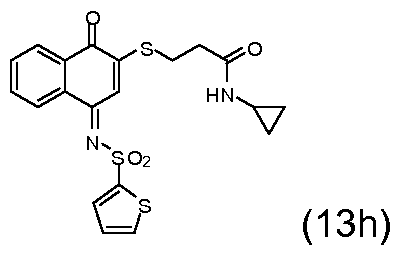
N-cyclopropyl-3-(1-oxo-4-(thiophen-2-ylsulfonylimino)-1,4<lihydronaphthalen-2- ylthio)propanamide (13h) was prepared according to the procedure for 13d except using 4, 5-dichloro-N-(3-chloro-4-oxonaphthalen-1 (4H)-ylidene)thiophenesulfonamide (12c) and 3- mercapto-N-cyclopropylpropanamide (), which afforded the title compound 20 mg (37%) as a yellow solid, m.p.: 0C.
1H NMR (400 MHz, CDCI3) δ 8.23 (dd, J = 5.6, 3.2 Hz, 1 H), 8.16 (dd, J = 5.6, 3.2 Hz, 1 H), 7.83 (dd, J = 4.0, 1.6 Hz, 1 H), 7.82 (s, 1 H), 7.73 (dd, J = 5.2, 1.6 Hz, 1 H), 7.70 (dd, J = 6.0, 3.6 Hz, 2H); 7.19 (dd, J = 4.8, 4.0, 1 H), 6.42 (bs, 1 H), 3.31 (t, J = 8.4 Hz, 2H), 2.82-2.78 (m, 1 H), 2.60 (t, J = 8.4 Hz, 2H), 0.78 (q, J = 5.6 Hz, 2H), 0.60 (q, J = 5.6 Hz, 2H).
HRMS (ESI+ve) mlz calculated for C20H19N2O4S3 (M+H) + 447.0512, found 447.0505.

HRMS (ESI-ve) m/z calculated for C2I H14N2O5S2 (M-H) 437.0271 , found 437.0276.

1 H-NMR, 400 MHz, CDCI3, δ (ppm): 8.23 (m, 1 H), 8.15 (m, 1 H), 7.90 (s, 1 H), 7.82 (dd, J = 1.3 Hz, 3.8 Hz, 1 H), 7.69 (m, 3H), 7.15 (dd, J = 3.8 Hz, 5.0 Hz, 1 H), 3.02 (q, J = 7.4 Hz, 2H), 1.50 (t, J = 7.4 Hz, 3H).
HRMS (ESI-ve) m/z calculated for C16H13NO3S3 (M+H) + 364.0130, found 364.0136.

N-(3-(2-hydroxyethylthio)-4-oxonaphthalen-1(4H)-ylidene)thiophene-2-sulfonamide (13k) was prepared according to the procedure for 13d except using 2-mercaptoethanol, which, after purification via flash chromatography (Hex/EtOAc), afforded the title compound 43 mg (56.7%) as an orange-red oil.
1H-NMR, 400 MHz, CDCI3, δ (ppm): 8.23 (m, 1 H), 8.15 (m, 1 H), 7.99 (s, 1 H), 7.83 (dd, J = 1.3 Hz, 3.8 Hz, 1 H), 7.70 (m, 3H), 7.15 (dd, J = 3.8 Hz, 5.0 Hz, 1 H), 4.03 (t, J = 6.1 Hz, 2H), 3.23 (t, J = 6.1 Hz, 2H).

(Z)-2-(1-oxo-4-(thiophen-2-ylsulfonylimino)-1 ,4-dihydronaphthalen-2-ylthio)acetic acid (13w): 188.3 mg 12a was dissolved in 5 ml THF, to which was added 0.56 ml THF solution containing 0.5 M pyridine followed by 0.56 ml THF solution containing 0.5 M 2- mercaptoglycolic acid. Another 0.56 ml THF solution containing 0.5 M pyridine was added followed by another 0.56 ml THF solution containing 0.5 M 2-mercaptoglycolic acid. The mixture was stirred at room temperature for 30 min. 1 14 mg DDQ was added and the mixture was stirred at room temperature overnight. The insoluble was filtered and the filtrate was concentrated. The crude residue was first purified via preparative TLC (2.5% CH3OH/DCM) and then purified with manual flash chromatography (silica gel, 1.5% CH3OH/0.5% CH3COOH/DCM) affording a yellow solid 20.2 mg (9.2%) as the desired pure product and 80.9 mg (36.9%) mixture of the desired product and its reduced product. 1 H NMR (400 MHz, CD3CN) δ 8.20 (dd, J = 6.1 , 3.1 Hz, 1 H), 8.12 (dd, J = 6.1 , 3.0 Hz, 1 H), 7.92-7.90 (m, 2H), 7.87 (dd, J = 3.8, 1.3 Hz, 1 H), 7.82 - 7.77 (m, 2H), 7.24 (dd, J = 5.0, 3.8 Hz, 1 H), 3.88 (s, 2H). LRMS (ES-) 392 (M-H)"; HRMS (ES-) mlz calculated for C16H10NO5S3 (M-H)" 391.9727, found 391.9729.

N-(4-hydroxy-3-(1-methyl-1 H-tetrazol-5-ylthio)naphthalen-1 -yl)thiophene-2 -sulfonamide (14d): 13 mg (E)-N-(3-(1 -methyl-1 H-tetrazol-5-ylthio)-4-oxonaphthalen-1 (4H)- ylidene)thiophene-2-sulfonamide (13d) was dissolved in 50 ml ethyl acetate, to which was added 27 mg sodium hydrosulfite solid followed by 10 ml water. The mixture was shaken in a separation funnel until the yellow organic phase turned colorless. The organic phase was separated and washed with water and brine. Dried over Na2SO4, the organic phase was filtered and the filtrate was concentrated to dryness. The residue was dissolved in dichloromethylene and triturated with hexane. The precipitate was washed with dichloromethylene/hexane (1 :1 ) affording the title compound 13 mg (99%) as a white solid, m.p.: 130 0C (dec).
1H-NMR, 400 MHz, CD3CN, δ (ppm): 8.28 (dd, J=3.0 Hz, 6.7 Hz, 1 H), 8.14 (s, 1 H), 7.98 (dd, J=3.5 Hz, 6.2 Hz, 1 H), 7.94 (br, 1 H), 7.65 (dd, J=1.2 Hz, 5.0 Hz, 1 H), 7.61 (dd, J=3.4 Hz, 6.5 Hz, 2H), 7.38 (dd, J=1.2 Hz, 3.7Hz, 1 H), 7.16 (s, 1 H), 6.99 (ss, J=3.8 Hz, 4.9 Hz, 1 H), 4.00 (s, 3H).
HRMS (ESI+ve) mlz calculated for C16H13N5O3S3 (M+H) + 420.0253, found 420.0240.

N-(3-(1 H-1 ,2,4-triazol-5-ylthio)-4-hydroxynaphthalen-1 -yl)thiophene-2-sulfonamide (14e) was prepared according to the procedure for 14d except using (E)-N-(3-(1 H-1 ,2,4-triazol-5- ylthio)-4-oxonaphthalen-1 (4H)-ylidene)thiophene-2-sulfonamide (13e), which afforded the title compound 20 mg (100%) as a white solid, m.p.: 180 0C (dec). 1H-NMR, 400 MHz, d6-DMSO, δ (ppm): 10.19 (br, 1 H), 10.05 (s, 1 H), 8.61 (br, 1 H), 8.16 (d, J=7.6 Hz, 1 H), 7.89 (d, J=7.4 Hz, 1 H), 7.81 (d, J=4.2 Hz, 1 H), 7.48 (t, J=7.9 Hz, 2H), 7.28 (d, J=2.5 Hz, 1 H), 6.99 (t, J=4.2 Hz, 1 H), 6.91 (br, 1 H),
HRMS (ESI-ve) mlz calculated for C16H12N4O3S3 (M-H) 402.9999, found 402.9989.

1H NMR (400 MHz, CD3CN) δ 8.32-8.29 (m, 1 H), 7.97-7.95 (m, 1 H), 7.83 (s, 1 H), 7.71 (dd, J = 5.2, 1.2 Hz, 1 H), 7.54-7.52 (m, 2H), 7.40 (dd, J = 3.6, 1.2 Hz, 1 H); 7.08-7.06 (m, 2H), 2.30 (s, 3H), 2.98 (s, 3H), 2.93 (t, J = 6.4 Hz, 2H), 2.57 (t, J = 6.4 Hz, 2H).
HRMS (ESI+ve) mlz calculated for C19H21 N2O4S3 (M+H) + 437.0658, found 447.0606.

5.2.51 3-(1 -hydroxy-4-(thiophene-2-sulfonamido)naphthalen-2-ylthio)-N- methylpropanamide (14g) was prepared according to the procedure for 9a except using 13g affording 7.8 mg (80%) title compound, m.p.: 0C.
1H NMR (400 MHz, CD3CN) δ 9.67 (s, 1 H), 8.30-8.28 (m, 1 H), 7.99-7.97 (m, 1 H), 7.86 (s, 1 H), 7.71 (dd, J = 5.2, 1.6 Hz, 1 H), 7.54 (dd, J = 6.8, 3.6 Hz, 2H), 7.41 (dd, J = 5.2, 1.6 Hz, 1 H); 7.08-7.06 (m, 2H), 6.56 (bs, 1 H), 3.81 (t, J = 8.0 Hz, 2H), 2.75 (d, J = 4.8Hz, 3H), 2.30 (t, J = 8.0 Hz, 2H).
HRMS (ESI+ve) mlz calculated for C18H19N2O4S3 (M+H) + 423.0502, found 423.0478.
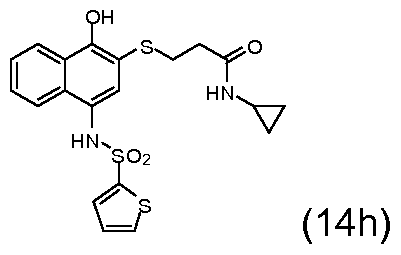
1H NMR (400 MHz, CD3CN) δ 9.50 (s, 1 H), 8.29 (dd, J = 5.6, 3.2 Hz, 1 H), 7.99 (dd, J = 5.6, 3.2 Hz, 1 H), 7.85 (s, 1 H), 7.70 (dd, J = 3.6, 1.2 Hz, 1 H), 7.55-7.53 (m, 2H), 7.41 (dd, J = 3.6, 1.2 Hz, 1 H), 7.08-7.05 (m 2H), 6.75 (bs, 1 H), 2.92 (t, J = 8.4 Hz, 2H), 2.74-2.68 (m, 1 H), 2.46 (t, J = 8.4 Hz, 2H), 0.68 (q, J = 5.6 Hz, 2H), 0.47 (q, J = 5.6 Hz, 2H).
HRMS (ESI+ve) mlz calculated for C20H21 N2O4S3 (M+H) + 449.0658, found 449.0639.

1H-NMR, 400 MHz, CD2CI2, δ (ppm): 8.24 (m, 1 H), 7.90 (m, 1 H), 7.58 (dd, J = 1.2 Hz, 5.0 Hz, 1 H), 7.53 (m, 2H), 7.46 (s, 1 H), 7.39 (dd, J = 1.3 Hz, 3.8 Hz, 1 H), 7.28 (s, 1 H), 7.00 (dd, J = 3.8 Hz, 4.9 Hz, 1 H), 6.71 (br, 1 H), 2.71 (q, J = 7.3 Hz, 2H), 1.17 (t, J = 7.3Hz, 3H).
HRMS (ESI+ve) mlz calculated for C16H15NO3S3 (M+Na) + 388.0106, found 388.0107.

N-(4-hydroxy-3-(2-hydroxyethylthio)naphthalen-1 -yl)thiophene-2-sulfonamide (14k) was prepared according to the procedure for 14d except using N-(3-(2-hydroxyethylthio)-4- oxonaphthalen-1 (4H)-ylidene)thiophene-2-sulfonamide (13k), which, after purification via flash chromatography (Hex/EtOAc), afforded the title compound 20.3 mg (53.1 %) as a grey solid, m.p.: 0C.
1H-NMR, 400 MHz, d6-DMSO, δ (ppm): 10.06 (s, 1 H), 9.70 (s, 1 H), 8.12 (d, J = 7.7 Hz, 1 H), 7.88 (m, 2H), 7.45 (m, 2H), 7.35 (dd, J = 1.3 Hz, 3.7 Hz, 1 H), 7.07 (dd, J = 3.8 Hz, 5.0 Hz, 1 H), 6.99 (s, 1 H), 5.10 (t, J = 5.1 Hz, 1 H), 2.75 (t, J = 6.7 Hz, 2H).
1H-NMR, 400 MHz, CD2CI2+CD3CN, δ (ppm): 8.24 (m, 1 H), 8.10 (br, 1 H), 7.90 (m, 1 H), 7.58 (dd, J = 1.3 Hz, 5.0 Hz, 1 H), 7.51 (m, 2H), 7.37 (dd, J = 1.3 Hz, 3.7 Hz, 1 H), 7.23 (s, 1 H), 7.11 (br, 1 H), 7.00 (dd, J = 3.8 Hz, 5.0 Hz, 1 H), 3.60 (t, J = 5.9 Hz, 2H), 2.83 (t, J = 5.8 Hz, 2H), 2.02 (br, 1 H).
HRMS (ESI+ve) mlz calculated for C16H15NO4S3 (M+Na) + 404.0055, found 404.0049.

1H-NMR, 400 MHz, d6-DMSO, δ (ppm): 13.13 (br, 1 H), 10.09 (s, 1 H), 8.20 (d, J=8.3 Hz, 1 H), 8.01 (d, J=7.7 Hz, 1 H), 7.93 (d, J=8.1 Hz, 1 H), 7.76 (d, J=5.0 Hz, 1 H), 7.54 (m, 2H), 7.33 (m, 2H), 7.18 (t, 7.5 Hz, 1 H), 6.91 (m, 2H), 6.47 (d, J=8.5 Hz, 1 H).
HRMS (ESI-ve) m/z calculated for C2I H15NO5S3 (M-H) 456.0040, found 456.0025.

Methyl-3-(4-(4,5-dichlorothiophene-2-sulfonamido)-1 -hydroxynaphthalen-2- ylthio)propanoate (14m) was prepared according to the procedure of procedure B for 10a except using 4, 5-dichloro-N-(3-chloro-4-oxonaphthalen-1 (4H)-ylidene)thiophenesulfonamide (12c) and ethyl mercaptoacetate, which afforded the title compound 16.1 mg (33%) as a grey solid after flash chromatography (Hex/EtOAc), m.p.: 0C.
1H NMR (400 MHz, CD3CN) δ 8.24 (s, 1 H), 8.22 (d, J = 8.4 Hz, 1 H), 7.87 (d, J = 8.4 Hz, 1 H), 7.65 (s, 1 H), 7.60-7.51 (m, 2H), 7.29 (s, 2H); 3.66 (s, 3H), 2.94 (t, J = 6.8 Hz, 2H), 2.73 (t, J = 6.8 Hz, 2H).
HRMS (ESI-ve) mlz calculated for C18H14CI2NO5S3 (M-H) " 489.9417, found 489.9454.

2-(4-(4,5-dichlorothiophene-2-sulfonamido)-1 -hydroxynaphthalen-2-ylthio)acetic acid (14n) was prepared according to the procedure of procedure B for 10a except using 4, 5-
dichloro-N-(3-chloro-4-oxonaphthalen-1 (4H)-ylidene)thiophenesulfonamide (12c), which afforded the title compound 17.8 mg (39%) as a white solid, m.p.: 0C.
1H NMR (400 MHz, DMSO-d6) δ 10.63 (s, 1 H), 10.36 (s, 1 H), 8.18 (d, J = 8.4 Hz, 1 H), 7.81 (d, J = 8.4 Hz, 1 H), 7.53 (t, J = 7.6 Hz, 1 H), 7.49-7.45 (m, 2H), 7.14 (s, 1 H).
HRMS (ESI-ve) mlz calculated for C16H10CI2NO5S3 (M-H) " 461.9104, found 461.9083.

2-(4-(5-chlorothiophene-2-sulfonamido)-1 -hydroxynaphthalen-2-ylthio)acetic acid (14o) was prepared according to the procedure of procedure B for 10a except using (E)-5-chloro-N- (3-chloro-4-oxonaphthalen-1 (4H)-ylidene)thiophene-2-sulfonamide (12d), which afforded the title compound 32.4 mg (54%) as a white solid, m.p.: 143-145 0C. 1H-NMR, 400 MHz, d6-DMSO, δ (ppm): 12.73 (br, 1 H), 10.28 (s, 1 H), 9.97 (br, 1 H), 8.15 (d, J=7.7 Hz, 1 H), 7.85 (d, J=8.6 Hz, 1 H), 7.47 (m, 2H), 7.22 (d, J=4.1 Hz, 1 H), 7.13 (s, 1 H), 7.12 (d, J=4.1 Hz, 1 H), 3.56 (s, 2H).
HRMS (ESI-ve) mlz calculated for C16H12CINO5S3 (M-H) 427.9493, found 427.9461.

1H-NMR, 400 MHz, d6-DMSO, δ (ppm): 12.76 (br, 1 H), 10.03 (s, 1 H), 9.85 (br, 1 H), 8.12 (d, J=8.2 Hz, 1 H), 7.81 (d, J=8.4 Hz, 1 H), 7.60 (d, J=8.7 Hz, 2H), 7.54 (d, J=8.8 Hz, 2H), 7.46 (t, J=7.5 Hz, 1 H), 7.41 (t, J=7.5 Hz, 1 H), 7.01 (s, 1 H), 3.5 (s, 2H).
HRMS (ESI-ve) mlz calculated for C18H14CINO5S2 (M-H) " 421.9929, found 421.9955.

5.2.60 2-(1 -hydroxy-4-(naphthalene-2-sulfonamido)naphthalen-2-ylthio)acetic acid (14q) was prepared according to the procedure of procedure B for 10a except using (E)-N-(3- chloro-4-oxonaphthalen-1 (4H)-ylidene)naphthalene-2-sulfonamide (12f), which afforded the title compound 64.3 mg (73.5%) as a white solid, m.p.: 185-187 0C. 1H-NMR, 400 MHz, d6-DMSO, δ (ppm): 12.72 (br, 1 H), 10.02 (s, 1 H), 9.75 (br, 1 H), 8.20 (s, 1 H), 8.07 (t, J=8.3 Hz, 2H), 8.01 (d, J=8.3 Hz, 1 H), 7.98 (d, J=8.4 Hz, 1 H), 7.90 (d, J=8.2 Hz, 1 H), 7.75 (d, J=8.7 Hz, 1 H), 7.65 (t, J=7.5 Hz, 1 H), 7.58 (t, J=7.6 Hz, 1 H), 7.40 (t, J=7.2 Hz, 1 H), 7.35 (t, J=7.3 Hz, 1 H), 6.97 (s, 1 H).
1H-NMR, 400 MHz, CD3CN, δ (ppm): 8.22 (m, 1 H), 8.19 (s, 1 H), 8.02 (m, 3H), 7.93 (d, J=7.9 Hz, 1 H), 7.81 (s, 1 H), 7.78 (d, J=8.9 Hz, 1 H), 7.69 (t, J=7.5 Hz, 1 H), 7.62 (t, J=7.2 Hz, 1 H), 7.49 (m, 2H), 6.99 (s, 1 H), 3.28 (s, 2H).
HRMS (ESI-ve) mlz calculated for C22H17NO5S2 (M-H) 438.0475, found 438.0500.

Ethyl 2-(4-(biphenyl-4-ylsulfonamido)-1 -hydroxynaphthalen-2-ylthio)acetate (14r) was prepared according to the procedure of procedure B for 10a except using (E)-N-(3-chloro-4- oxonaphthalen-1 (4H)-ylidene)biphenyl-4-sulfonamide (12b) and ethyl mercapto-acetate, which afforded the title compound 71.5 mg (85.5%)as an off-white solid, m.p.: 166-168 0C.
1H-NMR, 400 MHz, CDCI3, δ (ppm): 8.40 (s, 1 H), 8.27 (m, 1 H), 7.85 (m, 1 H), 7.76 (d, J=8.4 Hz, 2H), 7.59 (d, J=8.4 Hz, 2H), 7.55 (d, J=6.9 Hz, 2H), 7.46 (m, 4H), 7.41 (t, J= 7.1 Hz, 1 H), 7.28 (s, 1 H), 6.83 (s, 1 H), 4.15 (q, J= 7.1 Hz, 2H), 3.41 (s, 2H), 1.20 (t, J= 7.1 Hz, 3H).
HRMS (ESI-ve) mlz calculated for C26H23NO5S2 (M+Na) + 516.0910, found 516.0903.

5.2.62 2-(4-(biphenyl-4-ylsulfonamido)-1 -hydroxynaphthalen-2-ylthio)acetic acid (14s) was prepared according to the procedure of procedure B for 10a except using ethyl 2-(4- (biphenyl-4-ylsulfonamido)-1 -hydroxynaphthalen-2-ylthio)acetate (14r) and applying r.t. overnight to the reaction, which afforded the title compound 19.2 mg (40.7%) as a grey solid, m.p.: 170 0C (dec).
1H-NMR, 400 MHz, d6-DMSO, δ (ppm): 12.76 (br, 1 H), 9.96 (s, 1 H), 9.81 (br, 1 H), 8.1 1 (d, J=7.7 Hz, 1 H), 7.89 (d, J=7.6 Hz, 1 H), 7.77 (d, J=8.2 Hz, 2H), 7.67 (m, 4H), 7.45 (m, 5H), 7.01 (s, 1 H), 3.47 (s, 2H).
HRMS (ESI-ve) mlz calculated for C24H19NO5S2 (M-H) 464.0632, found 464.0638.

2-(4-(biphenyl-4-ylsulfonamido)-1 -hydroxynaphthalen-2-ylthio)benzoic acid (14t) was prepared according to the procedure of procedure B for 10a except using 2-thiosalicylic acid and (E)-N-(3-chloro-4-oxonaphthalen-1 (4H)-ylidene)biphenyl-4-sulfonamide (12b), which afforded the title compound 17.4 mg (65.9%) as an off-white solid, m.p.: 205 0C (dec). 1H-NMR, 400 MHz, d6-DMSO, δ (ppm): 13.12 (br, 1 H), 10.07 (br, 1 H), 9.90 (s, 1 H), 8.20 (d, J=8.8 Hz, 1 H), 8.12 (d, J=8.2 Hz, 1 H), 7.92 (d, J=7.9 Hz, 1 H), 7.65 (d, J=8.5 Hz, 2H), 7.60 (d, J=8.3 Hz, 2H), 7.54 (m, 2H), 7.40 (m ,6H), 7.13 (t, 7.8 Hz, 1 H), 6.72 (s, 1 H), 6.42 (d, J=8.1 Hz, 1 H).
HRMS (ESI-ve) mlz calculated for C29H21 NO5S2 (M-H) 526.0788, found 526.0788.

1H-NMR, 400 MHz, CD3CN, δ (ppm): 8.22 (m, 1 H), 7.93 (m, 1 H), 7.84 (s, 1 H), 7.64 (d, J=8.6 Hz, 2H), 7.55 (m, 2H), 7.47 (d, J=8.5 Hz, 2H), 7.10 (s, 1 H), 3.64 (q, J=7.2 Hz, 1 H), 1.35 (d, J=7.2 Hz, 3H).
HRMS (ESI-ve) mlz calculated for C19H16CINO5S2 (M-H) " 436.0086, found 436.0106.

2-(1 -hydroxy-4-(naphthalene-2-sulfonamido)naphthalen-2-ylthio)propanoic acid (14v) was prepared according to the procedure of procedure B for 10a except using thiolactic acid and (E)-N-(3-chloro-4-oxonaphthalen-1 (4H)-ylidene)naphthalene-2-sulfonamide (12f), which afforded the title compound 51.3 mg (58.6%) as an off-white solid, m.p.: 176-178 0C.
1H-NMR, 400 MHz, d6-DMSO, δ (ppm): 12.70 (br, 1 H), 10.01 (s, 1 H), 9.74 (br, 1 H), 8.18 (s, 1 H), 8.10 (m, 2H), 7.99 (m, 3H), 7.80 (dd, J=1.6 Hz, 8.7 Hz, 1 H), 7.65 (t, J=7.5 Hz, 1 H), 7.58 (t, J=7.6 Hz, 1 H), 7.43 (m, 2H), 6.88 (s, 1 H), 0.87 (d, J=7.1 Hz, 3H).
1H-NMR, 400 MHz, CD3CN, δ (ppm): 8.19 (m, 2H), 8.04 (m, 2H), 7.99 (d, J=8.2 Hz, 1 H), 7.92 (d, J=8.2 Hz, 1 H), 7.85 (s, 1 H), 7.81 (dd, J=1.6 Hz, 8.7 Hz, 1 H), 7.68 (t, J=7.6 Hz, 1 H), 7.61 (t, J=7.5 Hz, 1 H), 7.50 (m, 2H), 7.00 (s, 1 H), 3.36 (q, J=7.2 Hz, 1 H), 1.09 (d, J=7.2 Hz, 3H).
HRMS (ESI-ve) mlz calculated for C23H19NO5S2 (M-H) 452.0632, found 452.0621.


5.2.68 2-(4-(thiophene-2-sulfonamido)naphthalen-1-yloxy)acetic acid (16a): 30 mg 15a was dissolved in 2 ml DCM, to which was added 1 ml TFA. The resulting mixture was stirred at room temperature for 1 h. TLC indicated the reaction didn't complete. The solution was concentrated and the residue was re-dissolved in 1 ml dioxane. 1 ml concentrated HCI was added. The mixture was stirred at room temperature for 1 hour and concentrated to dryness.
The residue was suspended in 2 ml DCM/Hex (1 :1 ). After standing in fridge overnight, the precipitate was collected by filtration and washed with 3 ml DCM/Hex (1 : 1 ) affording 21.4 mg (82.3%). 1 H NMR (400 MHz, DMSO) δ 12.63 (br s, 1 H), 8.13 (m, 1 H), 8.1 1 (dd, J = 5.0, 1.4 Hz, 1 H), 7.78 (dd, J = 3.8, 1.4 Hz, 1 H), 7.68 - 7.62 (m, 1 H), 7.48 - 7.41 (m, 2H), 7.20 (dd, J = 5.0, 3.9 Hz, 1 H), 7.01 (d, J = 8.5 Hz, 1 H), 6.80 (br s, 1 H), 6.23 (d, J = 8.6 Hz, 1 H), 3.96 (s, 2H). LRMS (ES-) 362 (M-H)"; HRMS (ES-) mlz calculated for C16H12NO5S2 (M-H) " 362.0162, found 362.0174.

4-(4-(thiophene-2-sulfonamido)naphthalen-1 -yloxy)butanoic acid (16b): 16a was synthesized according to the procedure for 15b except 16a and 2ml dioxane/4 ml concentrated HCI were used. 22.7 mg product was obtained in the yield of 56.6%. 1H NMR
(400 MHz, DMSO) 5 12.1 1 (br s, 1 H), 8.18 (m, 1 H), 8.10 (dd, J = 4.8, 0.9 Hz, 1 H), 7.77 (dd, J
= 3.6, 0.9 Hz, 1 H), 7.67 - 7.60 (m, 1 H), 7.46 - 7.37 (m, 2H), 7.19 (dd, J = 4.6, 4.2 Hz, 1 H),
7.00 (d, J = 8.5 Hz, 1 H), 6.40 (m, 2H), 3.18 (m, 2H), 2.36 (t, J = 7.2 Hz, 2H), 1.93 - 1.82 (m,
2H). LRMS (ES-) 390 (M-H)", HRMS (ES-) mlz calculated for C18H16NO5S2 (M-H)- 390.0475, found 390.0476.

O-4-nitronaphthalen-1 -yl dimethylcarbamothioate (18): 378.3 mg 4-nitronaphth-1 -ol was dissolved in 2 ml NMP, to which was added 276 mg K2CO3. The mixture was heated to 50 0C. To the solution was added dropwise a solution of 259.6 mg N, N-dimethyl thiochloroformate in 1 ml NMP. The resulting solution was stirred at 50 0C for 2 hours. The mixture was then quenched with 30 ml water at 50 0C. The brown precipitate was filtered and washed with water. After dried in air, 496 mg product was obtained in the yield of 89.8%. 1H NMR (400 MHz, CDCI3) δ 8.67 (d, J = 8.8 Hz, 1 H), 8.33 (d, J = 8.4 Hz, 1 H), 7.96 (d, J = 8.1 Hz, 1 H), 7.77 - 7.72 (m, 1 H), 7.64 (ddd, J = 8.2, 6.9, 1.1 Hz, 1 H), 7.30 (d, J = 8.4 Hz, 1 H), 3.53 (s, 3H), 3.53 (s, 3H).

S-4-nitronaphthalen-1 -yl dimethylcarbamothioate (19): 276.3 mg 18 was dissolved in 2 ml NMP. The solution was heated to 180 0C for 20 min with microwave initiator (biotage). The reaction mixture was diluted with ethyl acetate to 50 ml and washed with water and brine. Dried over Na2SO4, the organic phase was concentrated and the crude product was purified via flash chromatography (10g silica gel, Hex/EtOAc) affording 197.5 mg (71.5%) brown solid. 1H NMR (400 MHz, CDCI3) δ 8.52 - 8.46 (m, 1 H), 8.13 (d, J = 7.9 Hz, 1 H), 7.87 (d, J = 7.9 Hz, 1 H), 7.76 - 7.66 (m, 1 H), 3.24 (s, 3H), 3.03 (s, 3H).

2-(4-nitronaphthalen-1 -ylthio)acetic acid (20): 97 mg 19 was suspended in 1 ml methanol, to which, in Argon atmosphere, was added 1.4 ml KOH solution (1 M in CH3OH). The resulting mixture was stirred at room temperature for 12 hours affording a homogenous solution. 103 μl tert butyl bromoacetate was added through syringe. The reaction solution was continued for 12 hours and concentrated. The residue was dissolved in water and acidified with solid NaHSO4. The yellow precipitate was filtered and washed with water. Dried in air, 78.8 mg (85.6 %, 2 steps) yellow solid was obtained. 1H NMR (400 MHz, CDCI3) δ 8.63 (d, J = 8.4 Hz, 1 H), 8.40 (d, J = 8.4 Hz, 1 H), 8.18 (d, J = 8.1 Hz, 1 H), 7.77 (t, J = 7.6 Hz, 1 H), 7.69 (t, J = 7.6 Hz, 1 H), 7.53 (d, J = 8.4 Hz, 1 H), 3.91 (s, 2H). LRMS (ES-) 218 (M-H-CO2)"; HRMS (ES-) m/z calculated for C12H8NO4S (M-H)" 262.0180, found 262.0180.


Proteasome Inhibition Assay The assay was conducted by using a fluorogenic peptide as substrate to test synthesized compounds for inhibitory activity against the chymotrypsin-like activity of the purified rabbit 2OS proteasome. Briefly, 70 ng of purified 2OS proteasome was incubated with 20 μM Suc- Leu-Leu-Val-Tyr-AMC for 1 hour at 37 0C in 100 μl of assay buffer (50 mM TNs-HCI, pH 7.6) with or without inhibitors. After incubation, production of hydrolyzed 7-amido-4-methyl- coumarin (AMC) was measured using a WALLAC Victor2 1420 Multilabel Counter with an excitation filter of 355 nm and an emission filter of 460 nm (Perkin Elmer Life Sciences, Turku, Finland). The inhibitory activity of the compounds was calculated based on vehicle control.
Table 1- HLM008182 and analogues (Group I


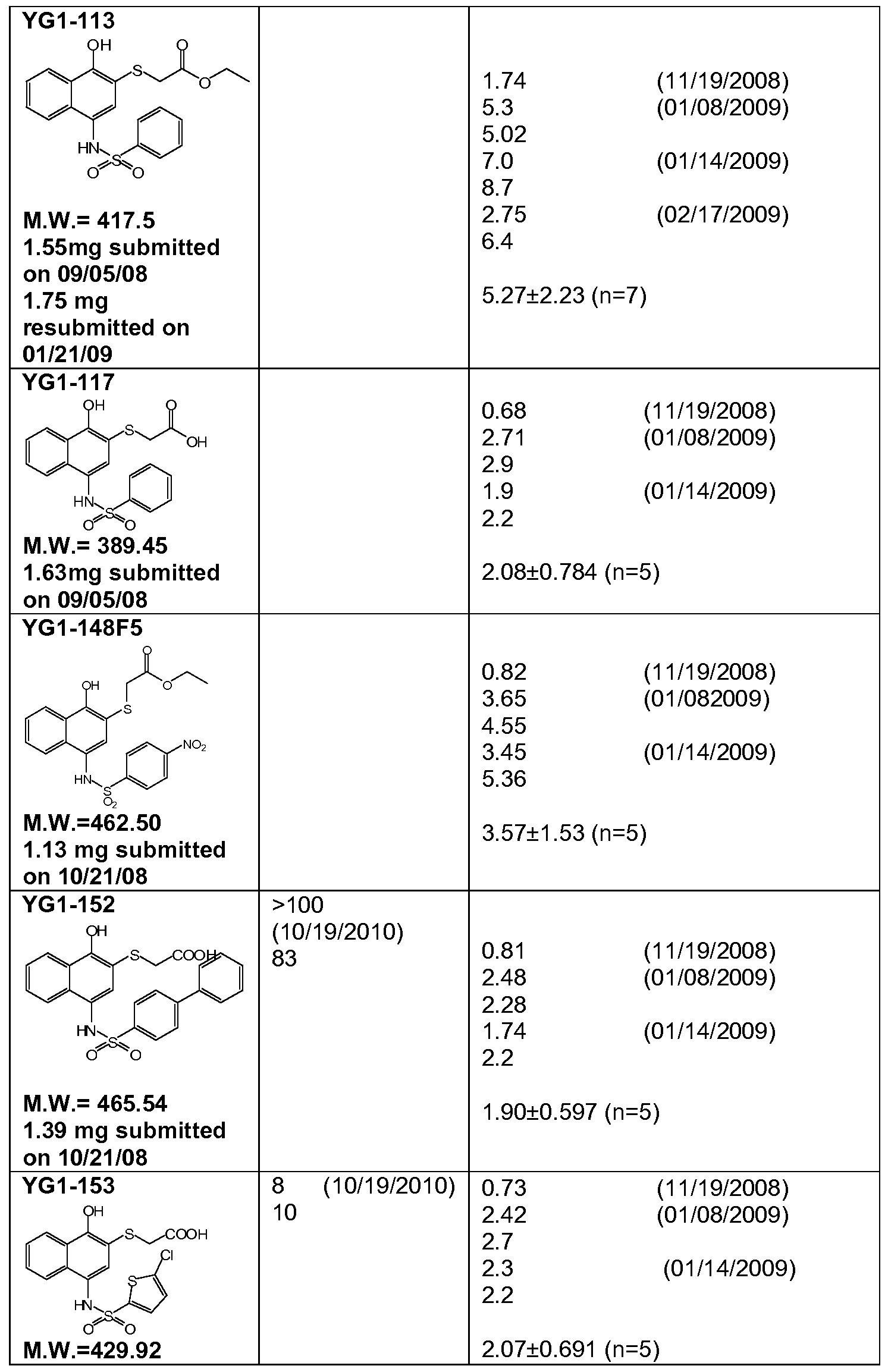


In Cell culture against CT-L lntrmolecular cyclization derivative of HLM-008182

Conditions and reagents: i) (a) HSCH2COOH, pyridine, THF, r.t; (b) Na2S2O4, H2O, EtOAc; ii) EDC, CH3CN, r.t.

N-(2-oxo-2,3-dihydronaphtho[1 ,2-b][1 ,4]oxathiin-6-yl)thiophene-2-sulfonamide (23): 103.3 mg 12a was dissolved in 3 ml THF, to which was added 0.612 ml THF solution containing 0.5 M pyridine followed by 0.612 ml THF solution containing 0.5 M 2- mercaptoglycolic acid. The mixture was stirred at room temperature for 30 min and the organic solvent was removed via rotavap. The residue was partitioned between 40 ml ethyl acetate and 10 ml 0.5 M NaHSO4. The organic phase was separated and shaken with an aqueous solution containing 5 eq. Na2S2O4 until a colorless solution was obtained. The ethyl acetate layer was separated and washed with water and brine. Dried over Na2SO4, the organic phase was concentrated to dryness affording 150 mg crude product 10a. The crude product was suspended in 6 ml acetonitrile, to which was added 58.5 mg EDC. The mixture was stirred at room temperature for 1 hour and concentrated. The crude product was purified via flash chromatography (1 O g silica gel, Hex/EtOAc) affording a slightly yellow solid 101.4 mg (87.8%, 2 steps).
1H NMR (400 MHz, CDCI3) δ 8.13 (d, J = 8.5 Hz, 1 H), 7.62 (d, J = 8.5 Hz, 1 H), 7.52 - 7.47 (m, 1 H), 7.46 (dd, J = 5.0, 1.3 Hz, 1 H), 7.43 - 7.36 (m, 3H), 6.89 (dd, J = 5.0, 3.8 Hz, 1 H), 6.75 (br s, 1 H), 3.50 (s, 2H). LCMS (ESI+ve) m/z: 395 (M+NH4)+; HRMS (ESI+ve) mlz calculated for C16H12NO4S3
(M+H) + 377.9923, found 377.9916.

(E)-3,4-dichloro-N-(3-chloro-4-oxonaphthalen-1 (4H)-ylidene)benzenesulfonamide (12g) was prepared according to the procedure for 12a except that the reaction was carried out with 3, 4-dichlorobenzenesulfonamide in THF for 30 min.621 .7 mg (77.6%) title compound was obtained as a yellow solid.
1H NMR (400 MHz, CDCI3) δ 8.57 (s, 1 H), 8.21 (dd, J = 7.2, 1.6 Hz, 1 H), 8.16 (d, J = 2.4 Hz, 1 H), 8.12 (dd, J = 6.8, 1.6 Hz, 1 H), 7.90 (dd, J = 8.4, 2.8 Hz, 1 H), 7.76 (dt, J = 7.6, 1.2 Hz, 1 H), 7.72-7.68 (m, 2H).

(E)-N-(3-chloro-4-oxonaphthalen-1 (4H)-ylidene)benzenesulfonamide (12h) was prepared according to the procedure for 12a except that the reaction was carried out with benzenesulfonamide in THF for 30 min.508.1 mg (76.6%) title compound was obtained as a yellow solid.
1H NMR (400 MHz, CDCI3) δ 8.67 (s, 1 H), 8.20 (dd, J = 7.6, 0.8 Hz, 1 H), 8.15 (dd, J = 7.2, 1.2 Hz, 1 H), 8.08 (d, J = 7.6 Hz, 2H), 7.74 (dt, J = 7.6, 1.2 Hz, 1 H), 7.71 -7.66 (m, 2H), 7.62 (t, J = 7.5 Hz, 2H).

(E)-N-(3-chloro-4-oxonaphthalen-1 (4H)-ylidene)-4-methylbenzenesulfonamide (12i) was prepared according to the procedure for 12a except that the reaction was carried out
with p-toluenesulfonamide in THF for 30 min.553.7 mg (80.1 %) title compound was obtained as a yellow solid.
1H NMR (400 MHz, CDCI3) 5 8.69 (s, 1 H), 8.20 (dd, J = 7.6, 1.2 Hz, 1 H), 8.15 (dd, J = 7.6, 1.2 Hz, 1 H), 7.96 (d, J = 8.3 Hz, 2H), 7.73 (dt, J = 7.2, 1.2 Hz, 1 H), 7.67 (dt, J = 7.6, 1.2 Hz, 1 H), 7.40 (d, J = 8.5 Hz, 2H), 2.48 (s, 3H).

(E)-N-(3-(1 -methyl-1 H-tetrazol-5-ylthio)-4-oxonaphthalen-1 (4H)-ylidene)biphenyl-4- sulfonamide (13x): 81.6 mg 12b was dissolved in 2 ml THF. 1 ml THF solution containing 1 eq. 1 -methyl-tetrazole-5-thiol and 1 eq. pyridine was added. The mixture was shaken for 30 min. The organic solvent was removed by V-10 (biotage). The residue was suspended in 10 ml water and sonicated thoroughly. The insoluble was filtered and washed with water. The solid was dried over air affording 96.5 mg (99.0%) title compound 13x.
1H NMR (400 MHz, CDCI3) δ 8.22 (m, 1 H), 8.15 (m,1 H), 8.07 (s, 1 H), 8.05 (d, J = 8.4 Hz, 2H), 7.77 (d, J = 6.4 Hz, 2H), 7.74-7.71 (m, 2H), 7.63-7.61 (m, 2H), 7.51 -7.41 (m, 3H), 4.23 (s, 3H).
LCMS (ES+) 488 (M+H)+, 505 (M+NH4)+, 510 (M+Na)+; HRMS (ES+) mlz calculated for C24H18N5O3S2 (M+H)+ 488.0846, found 488.0841.

(E)-4-chloro-N-(3-(1 -methyl-1 H-tetrazol-5-ylthio)-4-oxonaphthalen-1 (4H)-ylidene) benzenesulfonamide (13y) was prepared according to the procedure for 13x except using 12e, affording 88.7 mg (99.4%) title compound as a yellow solid.
1H NMR (400 MHz, CDCI3) δ 8.16- 8.14 (m, 2H), 8.04 (s, 1 H), 7.93 (d, J = 6.8 Hz, 2H), 7.74 (dt, J = 6.0, 1.6 Hz, 1 H), 7.71 (dt, J = 5.2, 1.2 Hz 1 H), 7.56 (d, J = 6.8 Hz 2H), 4.22 (s, 3H).
LCMS (ES+) 446 (M+H)+, 463 (M+NH4)+, 468 (M+Na)+; HRMS (ES+) mlz calculated for C18H13CIN5O3S2 (M+H)+ 466.0143, found 466.0141.

(E)-3,4-dichloro-N-(3-(1-methyl-1 H-tetrazol-5-ylthio)-4-oxonaphthalen-1 (4H)- ylidene)benzenesulfonamide (13z) was prepared according to the procedure for 13x except using 12g, affording 94.7mg (98.5%) title compound as a yellow solid.
1H NMR (400 MHz, CDCI3) 5 8.17- 8.13 (m, 2H), 8.10 (d, J = 2.0 Hz, 1 H), 8.04 (s, 1 H), 7.83 (dd, J = 8.4, 2.0 Hz, 1 H), 7.76 (dt, J = 7.2, 1 ,6 Hz, 1 H), 7.73 (dt, J = 5.6, 2.0 Hz, 1 H), 7.67 (d, J = 8.4 Hz, 1 H), 4.22 (s, 3H).
LCMS (ES+) 480 (M+H)+, 497 (M+NH4)+, 502 (M+Na)+; HRMS (ES+) mlz calculated for C18H12CI2N5O3S2 (M+H)+ 479.9753, found 479.9746.

(E)-5-chloro-N-(3-(1 -methyl-1 H-tetrazol-5-ylthio)-4-oxonaphthalen-1 (4H)- ylidene)thiophene-2 -sulfonamide (13aa) was prepared according to the procedure for 13x except using 12d, affording 77.1 mg (85.3%) title compound as a yellow solid.
1H NMR (400 MHz, CDCI3) δ 8.24- 8.22 (m, 1 H), 8.17-8.15 (m, 1 H), 8.00 (s, 1 H), 7.77- 7.53 (m, 2H), 7.58 (d, J = 4.0 Hz, 1 H), 6.98 (d, J = 4.4 Hz, 1 H), 4.20 (s, 3H).
LCMS (ES+) 452 (M+H)+, 469 (M+NH4)+, 474 (M+Na)+; HRMS (ES+) mlz calculated for C16H11CIN5O3S2 (M+H)+ 451.9707, found 451.9698.

(E)-N-(3-(1 -methyl-1 H-tetrazol-5-ylthio)-4-oxonaphthalen-1 (4H)-ylidene)naphthalene- 2-sulfonamide (13ab) was prepared according to the procedure for 13x except using 12f, affording 85.5 mg (92.6%) title compound as a yellow solid.
1H NMR (400 MHz, CDCI3) 5 8.55 (s, 1 H), 8.18 (dd, J = 5.2, 2.0 Hz, 1 H), 8.13 (dd, J = 4.8, 2.0 Hz, 1 H), 8.12 (s, 1 H), 8.07 (apparent d, J = 7.6 Hz, 1 H), 8.02 (d, J = 8.8 Hz, 1 H), 7.96 (d, J = 2.0 Hz, 1 H) 7.93 (d, J = 7.6 Hz, 1 H), 7.74-7.62 (m, 4H), 4.24 (s, 3H).
LCMS (ES+) 462 (M+H)+, 479 (M+NH4)+, 484 (M+Na)+; HRMS (ES+) mlz calculated for C22H16N5O3S2 (M+H)+ 462.0689, found 462.0681.

(E)-N-(3-(1 -methyl-1 H-tetrazol-5-ylthio)-4-oxonaphthalen-1 (4H)-ylidene) benzenesulfonamide (13ac) was prepared according to the procedure for 13x except using 12h, affording 77.1 mg (93.7%) title compound as a yellow solid.
1H NMR (400 MHz, CDCI3) δ 8.19-8.13 (m, 2H), 8.03 (s, 1 H), 7.97 (apparent d, J = 5.6 Hz, 2H), 7.75-7.64 (m, 3H), 7.60-7.56 (m, 2H), 4.22 (s, 3H).
LCMS (ES+) 412 (M+H)+, 429 (M+NH4)+, 434 (M+Na)+, 823 (2M+H)+, 840 (2M+NH4)+, 845 (2M+Na)+; HRMS (ES+) mlz calculated for C18H14N5O3S2 (M+H)+ 412.0533, found 412.0537.

(E)-4-methyl-N-(3-(1 -methyl-1 H-tetrazol-5-ylthio)-4-oxonaphthalen-1 (4H)- ylidene)benzenesulfonamide (13ad) was prepared according to the procedure for 13x except using 12i, affording 81.8 mg (96.1 %) title compound as a yellow solid.
1H NMR (400 MHz, CDCI3) δ 8.18 (dd, J = 6.8, 2.4 Hz, 1 H), 8.13 (dd, J = 6.0, 2.0 Hz, 1 H), 8.02 (s, 1 H), 7.85 (d, J = 6.8 Hz, 2H), 7.72 (dt, J = 7.6, 2.0 Hz, 1 H), 7.69 (dt, J = 7.6, 2.0 Hz, 1 H), 7.37 (d, J = 8.40 Hz, 2H), 4.22 (s, 3H), 2.45 (s, 3H).
LCMS (ES+) 426 (M+H)+, 443 (M+NH4)+, 448 (M+Na)+, 851 (2M+H)+, 868 (2M+NH4)+, 873 (2M+Na)+; HRMS (ES+) mlz calculated for C19H16N5O3S2 (M+H)+ 426.0689, found 426.0686.

(E)-N-(3-(1 H-1 ,2,4-triazol-3-ylthio)-4-oxonaphthalen-1 (4H)-ylidene)biphenyl-4- sulfonamide (13ae) was prepared according to the procedure for 13x except using 12b and 3-mercapto-1 ,2,4-triazole, affording 53.6 mg (56.7%) title compound as a yellow solid.
1H NMR (400 MHz, CD3CN) δ 12.71 (br s, 1 H), 8.66 (br s, 1 H), 8.18 - 8.1 1 (m, 2H), 8.02 (d, J = 8.7 Hz, 2H), 7.89 (d, J = 8.7 Hz, 2H), 7.86 (s, 1 H), 7.83 - 7.76 (m, 2H), 7.74 (dd, J = 8.3, 1.3 Hz, 2H), 7.54 (t, J = 7.3 Hz, 2H), 7.48 (d, J = 7.3 Hz, 1 H).
LCMS (ESI+ve) m/z: 473 (M+H)+, 495 (M+Na)+; HRMS (ESI+ve) mlz calculated for C24H17N4O3S2 (M+H) + 473.0737, found 473.0732.

(E)-N-(3-(1 H-1 ,2,4-triazol-3-ylthio)-4-oxonaphthalen-1 (4H)-ylidene)-4- chlorobenzenesulfonamide (13af) was prepared according to the procedure for 13x except using 12e and 3-mercapto-1 ,2,4-triazole, affording 43.8 mg (57.4%) title compound as a yellow solid.
1H NMR (400 MHz, CD3CN) δ 12.71 (br s, 1 H), 8.64 (s, 1 H), 8.14 (dd, J = 6.1 , 1.5 Hz, 1 H), 8.12 (dd, J = 6.3, 1.6 Hz, 1 H), 7.94 (d, J = 8.8 Hz, 2H), 7.81 (td, J = 6.3, 1.7 Hz, 1 H), 7.80 (s, 1 H), 7.77 (td, J = 6.3, 1.7 Hz, 1 H), 7.65 (d, J = 8.8 Hz, 2H).
LCMS (ESI+ve) m/z: 431 (M+H)+, 453 (M+Na)+, 861 (2M+H)+, 883 (2M+Na)+; HRMS (ESI+ve) mlz calculated for C18H12CIN4O3S2 (M+H) + 431.0034, found 431.0028.

(E)-N-(3-(1 H-1 ,2,4-triazol-3-ylthio)-4-oxonaphthalen-1 (4H)-ylidene)-3,4- dichlorobenzenesulfonamide (13ag) was prepared according to the procedure for 13x except using 12g and 3-mercapto-1 ,2,4-triazole, affording 27.8 mg (29.9%) title compound as a yellow solid.
1H NMR (400 MHz, CD3CN) δ 12.72 (br s, 1 H), 8.63 (s, 1 H), 8.16 - 8.12 (m, 2H), 8.11 (d, J = 2.1 Hz, 1 H), 7.87 (dd, J = 8.5, 2.1 Hz, 1 H), 7.83 - 7.75 (m, 2H), 7.80 (s, 1 H), 7.84 (d, J = 8.5 Hz, 1 H).
LCMS (ESI+ve) m/z: 465 (M+H)+, 487 (M+Na)+; HRMS (ESI+ve) mlz calculated for C18H11CI2N4O3S2 (M+H) + 464.9644, found 464.9641.

(E)-N-(3-(1 H-1 ,2,4-triazol-3-ylthio)-4-oxonaphthalen-1 (4H)-ylidene)-5- chlorothiophene-2-sulfonamide (13ah) was prepared according to the procedure for
13x except using 12d and 3-mercapto-1 ,2,4-thazole, affording 69.2 mg (79.2%) title compound as a yellow solid.
1H NMR (400 MHz, CD3CN) δ 12.7 (br s, 1 H), 8.62 (s, 1 H), 8.20 - 8.17 (m, 1 H), 8.16 - 8.12 (m, 1 H), 7.85 - 7.78 (m, 2H), 7.77 (s, 1 H), 7.58 (d, J = 4.1 Hz, 1 H), 7.14 (d, J = 4.1 Hz, 1 H).
LCMS (ESI+ve) m/z: 437 (M+H)+, 459 (M+Na)+, 875 (2M+H)+, 897, (2M+Na)+; HRMS (ESI+ve) m/z calculated for C16H10CIN4O3S3 (M+H) + 436.9598, found 436.9592.

(E)-N-(3-(1 H-1 ,2,4-triazol-3-ylthio)-4-oxonaphthalen-1 (4H)-ylidene)naphthalene-2- sulfonamide (13ai) was prepared according to the procedure for 13x except using 12f and 3-mercapto-1 ,2,4-thazole, affording 52.2 mg (58.5%) title compound as a yellow solid.
1H NMR (400 MHz, CD3CN) δ 12.73 (br s, 1 H), 8.67 (br s, 1 H), 8.57 (apparent d, J = 1.7 Hz, 1 H), 8.17 - 8.1 1 (m, 4H), 8.05 (apparent d, J = 8.1 Hz, 1 H), 7.96 (dd, J = 8.8, 1.9 Hz, 1 H), 7.91 (s, 1 H), 7.81 - 7.69 (m, 4H).
LCMS (ESI+ve) m/z: 447 (M+H)+, 469 (M+Na)+, 893 (2M+1 )+; HRMS (ESI+ve) mlz calculated for C22H15N4O3S2 (M+H) + 447.0580, found 447.0584.
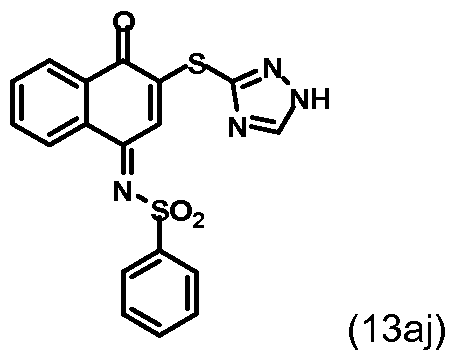
1H NMR (400 MHz, CD3CN) δ 12.70 (br s, 1 H), 8.64 (s, 1 H), 8.14 (dd, J = 4.6, 1.8 Hz, 1 H), 8.12 (dd, J = 4.6, 2.0 Hz, 1 H), 7.96 (d, J = 7.1 Hz, 2H), 7.83 (s, 1 H), 7.79 (td, J = 5.5,
1.7 Hz, 1 H), 7.76 (td, J = 5.5, 1.7 Hz, 1 H) 7.73 (t, J = 7.5 Hz, 1 H), 7.64 (t, J = 7.6 Hz, 2H).
LCMS (ESI+ve) m/z: 397 (M+H)+, 419 (M+Na)+, 793 (2M+H)+, 815 (2M+Na)+; HRMS (ESI+ve) mlz calculated for C18H13N4O3S2 (M+H) + 397.0424, found 397.0426.

1H NMR (400 MHz, CD3CN) δ 8.64 (br s, 1 H), 8.14 - 8.09 (m, 2H), 7.85 - 7.79 (m, 3H), 7.79 - 7.75 (m, 2H), 7.44 (d, J = 8.6 Hz, 2H), 2.45 (s, 3H).
LCMS (ESI+ve) m/z: 41 1 (M+H)+, 433 (M+Na)+, 821 (2M+H)+, 843 (2M+Na)+; HRMS (ESI+ve) mlz calculated for C19H15N4O3S2 (M+H) + 41 1.0580, found 41 1.0582.

N-(4-hydroxy-3-(1 -methyl-1 H-tetrazol-5-ylthio)naphthalen-1 -yl)biphenyl-4- sulfonamide (14x) was prepared according to the procedure for 14d except using 13x, which afforded the title compound 33.0 mg (82.3%) as an off-white solid.
1H NMR (400 MHz, CD2CI2) δ 8.28 (dd, J = 7.2, 2.3 Hz, 1 H), 7.75 (dd, J = 7.3, 2.2 Hz, 1 H), 7.72 (d, J = 8.5 Hz, 2H), 7.59 (d, J = 8.5 Hz, 2H), 7.57 - 7.54 (m, 2H), 7.52 - 7.39 (m, 5H), 7.37 (s, 1 H), 7.00 (br s, 1 H), 4.00 (s, 3H).
LCMS (ESI+ve) m/z: 490 (M+H)+, 492 (M+Na)+; HRMS (ESI+ve) mlz calculated for C24H20N5O3S2 (M+H) + 490.1002, found 490.1023.

4-chloro-N-(4-hydroxy-3-(1 -methyl-1 H-tetrazol-5-ylthio)naphthalen-1- yl)benzenesulfonamide (14y) was prepared according to the procedure for 14d except using 13y, which afforded the title compound 40.0 mg (99.3%) as an off-white solid.
1H NMR (400 MHz, DMSO) δ 10.58 (br s, 1 H), 10.12 (br s, 1 H), 8.20 (d, J = 8.9 Hz, 1 H), 7.92 (d, J = 8.9 Hz, 1 H), 7.64 - 7.45 (m, 6H), 6.85 (s, 1 H), 3.95 (s, 3H).
LCMS (ESI+ve) m/z: 448 (M+H)+, 470 (M+Na)+; HRMS (ESI+ve) mlz calculated for C18H15CIN5O3S2 (M+H) + 448.0299, found 448.0303.

3,4-dichloro-N-(4-hydroxy-3-(1 -methyl-1 H-tetrazol-5-ylthio)naphthalen-1 - yl)benzenesulfonamide (14z) was prepared according to the procedure for 14d except using 13z, which afforded the title compound 39.8 mg (99.0%) as an off-white solid.
1H NMR (400 MHz, CD2CI2) δ 9.64 (br s, 1 H), 8.32 - 8.26 (m, 1 H), 7.99 - 7.93 (m, 1 H), 7.83 (d, J = 1.9 Hz, 1 H), 7.54 - 7.46 (m, 3H), 7.44 (d, J = 8.4 Hz, 1 H), 7.14 (s, 1 H), 3.96
(s, 3H).
LCMS (ESI+ve) m/z: 482 (M+H)+, 504 (M+Na)+; HRMS (ESI+ve) mlz calculated for C18H14CI2N5O3S2 (M+H) + 481.9910, found 481.9914.

1H NMR (400 MHz, CD2CI2) δ 9.70 (br s, 1 H), 8.33 - 8.27 (m, 1 H), 8.02 - 7.97 (m, 1 H), 7.57 - 7.48 (m, 2H), 7.23 (s, 1 H), 7.09 (d, J = 4.0 Hz, 1 H), 6.77 (d, J = 4.0 Hz, 1 H), 3.97 (s, 3H).
LCMS (ESI+ve) m/z: 454 (M+H)+, 476 (M+Na)+; HRMS (ESI+ve) mlz calculated for C16H13CIN5O3S3 (M+H) + 453.9864, found 453.9871.

N-(4-hydroxy-3-(1 -methyl-1 H-tetrazol-5-ylthio)naphthalen-1 -yl)naphthalene-2- sulfonamide (14ab) was prepared according to the procedure for 14d except using 13ab, which afforded the title compound 39.0 mg (97.0%) as an off-white solid.
1H NMR (400 MHz, CD2CI2) δ 8.28 (apparent d, J = 8.0 Hz, 1 H), 8.23 (s, 1 H), 7.88 (t, J= 7.6 Hz, 2H), 7.82 (dd, J = 7.8, 4.2 Hz, 2H), 7.71 (dd, J = 8.7, 1.8 Hz, 1 H), 7.65 (t, J = 7.5 Hz, 1 H), 7.57 (t, J = 7.5 Hz, 1 H), 7.46 (td, J = 15.2, 6.9 Hz, 2H), 7.29 (s, 1 H), 6.95 (apparent s, 1 H), 3.88 (s, 3H).
LCMS (ESI+ve) m/z: 464 (M+H)+, 486 (M+Na)+; HRMS (ESI+ve) mlz calculated for C22H18N5O3S2 (M+H) + 464.0846, found 464.0863.
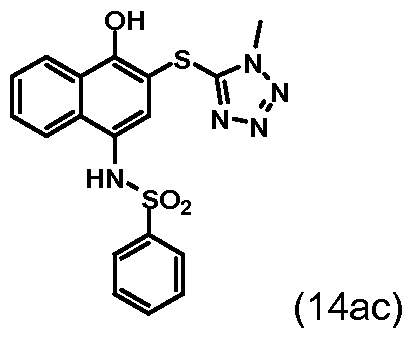
N-(4-hydroxy-3-(1 -methyl-1 H-tetrazol-5-ylthio)naphthalen-1 -yl)benzenesulfonamide (14ac) was prepared according to the procedure for 14d except using 13ac, which afforded the title compound 35.7 mg (88.8%) as an off-white solid.
1H NMR (400 MHz, CD2CI2) δ 9.15 (br s, 1 H), 8.67 (br s, 1 H), 8.30 - 8.23 (m, 1 H), 7.91 - 7.85 (m, 1 H), 7.66 (d, J = 7.2 Hz, 2H), 7.52 - 7.42 (m, 3H), 7.36 (t, J = 7.7 Hz, 2H), 7.17 (s, 1 H), 3.96 (s, 3H).
LCMS (ESI+ve) m/z: 414 (M+H)+, 436 (M+Na)+, 849 (2M+Na)+; HRMS (ESI+ve) mlz calculated for C18H16N5O3S2 (M+H) + 414.0689, found 414.0702.

N-(4-hydroxy-3-(1 -methyl-1 H-tetrazol-5-ylthio)naphthalen-1 -yl)-4- methylbenzenesulfonamide (14ad) was prepared according to the procedure for 14d except using 13ad, which afforded the title compound 35.7 mg (88.8%) as an off-white solid. 1H NMR (400 MHz, CD2CI2) δ 9.17 (br s, 1 H), 8.58 (s, 1 H), 8.31 - 8.23 (m, 1 H), 7.96 -
7.88 (m, 1 H), 7.53 (d, J = 8.3 Hz, 2H), 7.52 - 7.45 (m, 2H), 7.17 (s, 1 H), 7.16 (d, J = 8.5 Hz, 3H), 3.94 (s, 3H), 2.35 (s, 3H).
LCMS (ESI+ve) m/z: 428 (M+H)+, 450 (M+Na)+, 877 (2M+Na)+; HRMS (ESI+ve) mlz calculated for C19H18N5O3S2 (M+H) + 428.0846, found 428.0865. Table 2 - HLM008182 and analogues (Group II)


It will be seen that the advantages set forth above, and those made apparent from the foregoing description, are efficiently attained and since certain changes may be made in the above construction without departing from the scope of the invention, it is intended that all matters contained in the foregoing description or shown in the accompanying drawings shall be interpreted as illustrative and not in a limiting sense.
It is also to be understood that the following claims are intended to cover all of the generic and specific features of the invention herein described, and all statements of the scope of the invention which, as a matter of language, might be said to fall therebetween.
Claims
1. A proteasome inhibitor having the structure shown in formula I:

2. The proteasome inhibitor of claim 1 , wherein R2 is selected from the group consisting of CH2COOH, CH2COOC2H5, (CH2)2COOCH3, (CH2)2COOH, (CH2)2CONHCH(CH2)2, CH(CH3)COOH, CH2COOH, CH2COOC2H5, (CH2)2COOCH3, (CH2)2COOH, (CH2)2CONHCH(CH2)2, CH(CH3)COOH, (CH2)2-B(OH)2, CH2-B(OH)2,
CH-(CH)3-B(OH)2 and B(OH)2,  .
.
3. The proteasome inhibitor of claim 1 , wherein R3 is selected from the group consiting

4. The proteasome inhibitor of claim 1 , wherein when R is CH2COOH then R is
selected from the group consisting of 

5. The proteasome inhibitor of claim 1 , wherein when R2 is CH2COOC2H5 then R3 is
selected from the group consiting of  .
.
6. The proteasome inhibitor of claim 1 , wherein when R2 is (CH2)2COOCH3 then R3 is
selected from:  and
and
7. The proteasome inhibitor of claim 1 , wherein when R2 is (CH2)2COOH then R3 i iss 
8. The proteasome inhibitor of claim 1 , wherein when R2 is (CH2)2CONHCH(CH2)2
then R3 is  .
.
9. The proteasome inhibitor of claim 1 , wherein when R2 is CH(CH3)COOH then R3 is
selected from  .
.
10. The proteasome inhibitor of claim 1 , wherein when R2 is  then R3 is
selected from the group consisting of 

11. The proteasome inhibitor of claim 1 , wherein when R2 is  then R3

2 3
12. The proteasome inhibitor of claim 1 , wherein when R is  then R is
selected from the group consisting of : 
13. The proteasome inhibitor of claim 1 , wherein the compound is selected from the group consisting of N-(4-hydroxynaphthalen-1 -yl)thiophene-2-sulfonamide, N-(3- chloro-4-hydroxynaphthalen-1-yl)thiophene-2-sulfonamide, N-(3-bromo-4- hydroxynaphthalen-1 -yl)thiophene-2-sulfonamide, N-(3-iodo-4-hydroxynaphthalen-1 - yl)thiophene-2-sulfonamide, Ethyl 2-(1 -oxo-4-(thiophen-2-ylsulfonylimino)-1 ,4- dihydronaphthalen-2-ylthio)acetate, Ethyl 2-(1-hydroxy-4-(thiophene-2- sulfonamido)naphthalen-2-ylthio)acetate, 2-(1-hydroxy-4-(thiophene-2- sulfonamido)naphthalen-2-ylthio)acetic acid, N-(3-chloro-4-oxonaphthalen-1 (4H)- ylidene)thiophene-2-sulfonamide, 2-(1-hydroxy-4-(thiophene-2- sulfonamido)naphthalen-2-ylthio)acetic acid, Methyl 3-(1-oxo-4-(thiophen-2- ylsulfonylimino)-1 ,4-dihydronaphthalen-2-ylthio) propanoate, Ethyl 2-(1-oxo-4- (phenylsulfonylimino)-1 ,4-dihydronaphthalen-2-ylthio)acetate, tert-Butyl-2-(1-oxo-4- (thiophen-2-ylsulfonylimino)-1 ,4-dihydronaphthalen-2-yloxy)acetate, Ethyl 2-(1-oxo-4-
(tosylimino)-i ,4-dihydronaphthalen-2-ylthio)acetate, Ethyl 2-(4-(4- chlorobenzylsulfonylimino)-1 -oxo-1 ,4-dihydronaphthalen-2-ylthio)-acetate, Methyl 3- (1-hydroxy-4-(thiophene-2-sulfonamido)naphthalen-2-ylthio)propanoate, Ethyl 2-(1 - hydroxy-4-(phenylsulfonamido)naphthalen-2-ylthio)acetate, tert-Butyl-2-(1-hydroxy-4- (thiophene-2-sulfonamido)naphthalen-2-yloxy)acetate, Ethyl 2-(1-hydroxy-4-(4- nitrophenylsulfonamido)naphthalen-2-ylthio)acetate, Ethyl 2-(1 -hydroxy-4-(thiophene- 2-sulfonamido)naphthalen-2-ylsulfonyl)acetate, 3-(1 -hydroxy-4-(thiophene-2- sulfonamido)naphthalen-2-ylthio)propanoic acid, 2-(1-hydroxy-4-
(phenylsulfonamido)naphthalen-2-ylthio)acetic acid, 2-(1-hydroxy-4-(thiophene-2- sulfonamido)naphthalen-2-yloxy)acetic acid, 2-(1 -hydroxy-4-(thiophene-2- sulfonamido)naphthalen-2-ylsulfonyl)acetic acid, N-(3-chloro-4-oxonaphthalen-1 (4H)- ylidene)biphenyl-4-sulfonamide, 4, 5-dichloro-N-(3-chloro-4-oxonaphthalen-1 (4H)- ylidene)thiophene-2-sulfonamide, 5-chloro-N-(3-chloro-4-oxonaphthalen-1 (4H)- ylidene)thiophene-2-sulfonamide, 4-chloro-N-(3-chloro-4-oxonaphthalen-1 (4H)- ylidene)benzenesulfonamide, N-(3-chloro-4-oxonaphthalen-1 (4H)- ylidene)naphthalene-2-sulfonamide, N-(3-ethoxy-4-oxonaphthalen-1 (4H)- ylidene)thiophene-2-sulfonamide, N-(3-(dimethylaminoH-oxonaphthalen-1 (4H)- ylidene)thiophene-2-sulfonamide, N-(3-morpholino-4-oxonaphthalen-1 (4H)- ylidene)thiophene-2-sulfonamide, N-(3-(1 -methyl-1 H-tetrazol-5-ylthio)-4- oxonaphthalen-1 (4H)-ylidene)thiophene-2-sulfonamide, N-(3-(1 H-1 ,2,4-triazol-5- ylthio)-4-oxonaphthalen-1 (4H)-ylidene)thiophene-2-sulfonamide, N,N-dimethyl-3-(1 - oxo-4-(thiophen-2-ylsulfonylimino)-1 ,4-dihydronaphthalen-2-ylthio)propanamide, (N- methyl-3-(1-oxo-4-(thiophen-2-ylsulfonylimino)-1 ,4-dihydronaphthalen-2- ylthio)propanamide, N-cyclopropyl-3-(1 -oxo-4-(thiophen-2-ylsulfonylimino)-1 ,4- dihydronaphthalen-2-ylthio)propanamide, 3-(1 -oxo-4-(thiophen-2-ylsulfonylimino)-1 ,4- dihydronaphthalen-2-ylamino)-benzoic acid, N-(3-(ethylthio)-4-oxonaphthalen-1 (4H)- ylidene)thiophene-2-sulfonamide, N-(3-(2-hydroxyethylthio)-4-oxonaphthalen-1 (4H)- ylidene)thiophene-2-sulfonamide, (Z)-2-(1 -oxo-4-(thiophen-2-ylsulfonylimino)-1 ,4- dihydronaphthalen-2-ylthio)acetic acid, N-(4-hydroxy-3-(1 -methyl-1 H-tetrazol-5- ylthio)naphthalen-1 -yl)thiophene-2-sulfonamide, N-(3-(1 H-1 ,2,4-triazol-5-ylthio)-4- hydroxynaphthalen-1 -yl)thiophene-2-sulfonamide, 3-(1 -hydroxy-4-(thiophene-2- sulfonamido)naphthalen-2-ylthio)-N,N-dimethylpropanamide, 5.2.51 3-(1 -hydroxy-4- (thiophene-2-sulfonamido)naphthalen-2-ylthio)-N-methylpropanamide, N-cyclopropyl- 3-(1 -hydroxy-4-(thiophene-2-sulfonamido)naphthalen-2-ylthio)propanamide, N-(3-
(ethylthio)-4-hydroxynaphthalen-1-yl)thiophene-2-sulfonamide, N-(4-hydroxy-3-(2- hydroxyethylthio)naphthalen-1 -yl)thiophene-2-sulfonamide, 2-(1-hydroxy-4-
(thiophene-2-sulfonamido)naphthalen-2-ylthio)benzoic acid, Methyl-3-(4-(4,5- dichlorothiophene-2-sulfonamido)-1 -hydroxynaphthalen-2-ylthio)propanoate, 2-(4- (4,5-dichlorothiophene-2-sulfonamido)-1 -hydroxynaphthalen-2-ylthio)acetic acid, 2-(4-
(δ-chlorothiophene^-sulfonamidoj-i-hydroxynaphthalen^-ylthiojacetic acid, 2-(4-(4- chlorophenylsulfonamidoj-i -hydroxynaphthalen^-ylthiojacetic acid, 2-(1-hydroxy-4- (naphthalene-2-sulfonamido)naphthalen-2-ylthio)acetic acid, Ethyl 2-(4-(biphenyl-4- ylsulfonamido)-1 -hydroxynaphthalen-2-ylthio)acetate, 2-(4-(biphenyl-4- ylsulfonamido)-1 -hydroxynaphthalen-2-ylthio)acetic acid, 2-(4-(biphenyl-4- ylsulfonamido)-1 -hydroxynaphthalen-2-ylthio)benzoic acid, 2-(4-(4- chlorophenylsulfonamido)-1 -hydroxynaphthalen-2-ylthio)propanoic acid, 2-(1 - hydroxy-4-(naphthalene-2-sulfonamido)naphthalen-2-ylthio)propanoic acid, tert-butyl 2-(4-(thiophene-2-sulfonamido)naphthalen-1 -yloxy)acetate, methyl 4-(4-(thiophene-2- sulfonamido)naphthalen-1 -yloxy)butanoate, 2-(4-(thiophene-2- sulfonamido)naphthalen-1 -yloxy)acetic acid,4-(4-(thiophene-2- sulfonamido)naphthalen-1 -yloxy)butanoic acid, O-4-nitronaphthalen-1 -yl dimethylcarbamothioate, S-4-nitronaphthalen-1 -yl dimethylcarbamothioate, 2-(4- nitronaphthalen-1-ylthio)acetic acid, 2-(4-aminonaphthalen-1 -ylthio)acetic acid and 2- (4-(thiophene-2-sulfonamido)naphthalen-1-ylthio)acetic acid
14. A proteasome inhibitor having the structure shown in formula II:

15. The proteasome inhibitor of claim 14, wherein R2 is selected from the group consisting of CH2COOH, CH2COOC2H5, (CH2)2COOCH3, (CH2)2COOH, (CH2)2CONHCH(CH2)2, CH(CH3)COOH, CH2COOH, CH2COOC2H5, (CH2)2COOCH3,
(CH2)2COOH, (CH2)2CONHCH(CH2)2, CH(CH3)COOH, (CH2)2-B(OH)2, CH2-B(OH)2,
CH-(CH)3-B(OH)2 and B(OH)2,  . 16. The proteasome inhibitor of claim 14, wherein R3 is selected from the group
consiting of 

selected from the group consisting of: 
 .
.
18. The proteasome inhibitor of claim 14, wherein when R2 is CH2COOC2H5 then R3 is
selected from the group consiting of  .
.
19. The proteasome inhibitor of claim 14, wherein when R2 is (CH2)2COOCH3 then R3 is
selected from  and .
and .
20. The proteasome inhibitor of claim 14, wherein when R2 is (CH2)2COOH then R3
is 
21. The proteasome inhibitor of claim 14, wherein when R2 is (CH2)2CONHCH(CH2)2
then R3 is  .
.
22. The proteasome inhibitor of claim 14, wherein when R2 is CH(CH3)COOH then R3 is
selected from . 
23. The proteasome inhibitor of claim 14, wherein when R 2 i isc  ( thhoenn D R3 is
selected from the group consisting of  ,
,  .
.
24. The proteasome inhibitor of claim 14, wherein when R2 is  then R3 is selected from the group consisting

25. The proteasome inhibitor of claim 14, wherein when R is  then R is
selected from the group consisting of  .
.
26. The proteasome inhibitor of claim 14, wherein when R2 is H then R3 is  .
.
27. The proteasome inhibitor of claim 14, wherein when R2 is H then R3 is  .
.
28. The proteasome inhibitor of claim 14, wherein when R 2 is H then R 3 is -  .
.
29. The proteasome inhibitor of claim 14 wherein the compound is selected from the group consisting of: N-(2-oxo-2,3-dihydronaphtho[1 ,2-b][1 ,4]oxathiin-6-yl)thiophene-2- sulfonamide, (E)-3,4-dichloro-N-(3-chloro-4-oxonaphthalen-1 (4H)- ylidene)benzenesulfonamide, (E)-N-(3-chloro-4-oxonaphthalen-1 (4H)- ylidene)benzenesulfonamide, (E)-N-(3-chloro-4-oxonaphthalen-1 (4H)-ylidene)-4- methylbenzenesulfonamide, (E)-N-(3-(1 -methyl-1 H-tetrazol-5-ylthio)-4- oxonaphthalen-1 (4H)-ylidene)biphenyl-4-sulfonamide, (E)-4-chloro-N-(3-(1 -methyl- 1 H-tetrazol-5-ylthio)-4-oxonaphthalen-1 (4H)-ylidene) benzenesulfonamide, (E)-3,4- dichloro-N-(3-(1 -methyl-1 H-tetrazol-5-ylthio)-4-oxonaphthalen-1 (4H)- ylidene)benzenesulfonamide, (E)-5-chloro-N-(3-(1 -methyl-1 H-tetrazol-5-ylthio)-4- oxonaphthalen-1 (4H)-ylidene)thiophene-2-sulfonamide, (E)-N-(3-(1 -methyl-1 H- tetrazol-5-ylthio)-4-oxonaphthalen-1 (4H)-ylidene)naphthalene-2-sulfonamide, (E)-N- (3-(1 -methyl-1 H-tetrazol-5-ylthio)-4-oxonaphthalen-1 (4H)-ylidene) benzenesulfonamide, (E)-4-methyl-N-(3-(1 -methyl-1 H-tetrazol-5-ylthio)-4- oxonaphthalen-1 (4H)-ylidene)benzenesulfonamide, (E)-N-(3-(1 H-1 ,2,4-triazol-3- ylthio)-4-oxonaphthalen-1 (4H)-ylidene)biphenyl-4-sulfonamide, (E)-N-(3-(1 H-1 ,2,4- thazol-3-ylthio)-4-oxonaphthalen-1 (4H)-ylidene)-4-chlorobenzenesulfonamide, (E)-N- (3-(1 H-1 ,2,4-thazol-3-ylthio)-4-oxonaphthalen-1 (4H)-ylidene)-3,4- dichlorobenzenesulfonamide, (E)-N-(3-(1 H-1 ,2,4-thazol-3-ylthio)-4-oxonaphthalen- 1 (4H)-ylidene)-5-chlorothiophene-2-sulfonamide, (E)-N-(3-(1 H-1 ,2,4-triazol-3-ylthio)- 4-oxonaphthalen-1 (4H)-ylidene)naphthalene-2-sulfonamide, (E)-N-(3-(1 H-1 ,2,4- thazol-3-ylthio)-4-oxonaphthalen-1 (4H)-ylidene)benzenesulfonamide, (E)-N-(3-(1 H- 1 ,2,4-triazol-3-ylthio)-4-oxonaphthalen-1 (4H)-ylidene)-4-methylbenzenesulfonamide,
N-(4-hydroxy-3-(1 -methyl-1 H-tetrazol-5-ylthio)naphthalen-1 -yl)biphenyl-4- sulfonamide, 4-chloro-N-(4-hydroxy-3-(1 -methyl-1 H-tetrazol-5-ylthio)naphthalen-1 - yl)benzenesulfonamide, 3,4-dichloro-N-(4-hydroxy-3-(1 -methyl-1 H-tetrazol-5- ylthio)naphthalen-1 -yl)benzenesulfonamide, 5-chloro-N-(4-hydroxy-3-(1 -methyl-1 H- tetrazol-5-ylthio)naphthalen-1 -yl)thiophene-2-sulfonamide, N-(4-hydroxy-3-(1 -methyl-
1 H-tetrazol-5-ylthio)naphthalen-1 -yl)naphthalene-2-sulfonamide, N-(4-hydroxy-3-(1- methyl-1 H-tetrazol-5-ylthio)naphthalen-1-yl)benzenesulfonamide and N-(4-hydroxy-3- (1 -methyl-1 H-tetrazol-5-ylthio)naphthalen-1 -yl)-4-methyl benzenesulfonamide.
Priority Applications (1)
| Application Number | Priority Date | Filing Date | Title |
|---|---|---|---|
| US13/225,976 US8466157B2 (en) | 2009-03-06 | 2011-09-06 | Proteasome inhibitors having chymotrypsin-like activity |
Applications Claiming Priority (2)
| Application Number | Priority Date | Filing Date | Title |
|---|---|---|---|
| US15801609P | 2009-03-06 | 2009-03-06 | |
| US61/158,016 | 2009-03-06 |
Related Child Applications (1)
| Application Number | Title | Priority Date | Filing Date |
|---|---|---|---|
| US13/225,976 Continuation US8466157B2 (en) | 2009-03-06 | 2011-09-06 | Proteasome inhibitors having chymotrypsin-like activity |
Publications (2)
| Publication Number | Publication Date |
|---|---|
| WO2010102286A2 true WO2010102286A2 (en) | 2010-09-10 |
| WO2010102286A3 WO2010102286A3 (en) | 2011-01-20 |
Family
ID=42710253
Family Applications (1)
| Application Number | Title | Priority Date | Filing Date |
|---|---|---|---|
| PCT/US2010/026531 Ceased WO2010102286A2 (en) | 2009-03-06 | 2010-03-08 | Proteasome inhibitors having chymotrypsin-like activity |
Country Status (2)
| Country | Link |
|---|---|
| US (1) | US8466157B2 (en) |
| WO (1) | WO2010102286A2 (en) |
Cited By (14)
| Publication number | Priority date | Publication date | Assignee | Title |
|---|---|---|---|---|
| CN102766103A (en) * | 2012-07-24 | 2012-11-07 | 齐鲁制药有限公司 | 2-sulfo-4-amino-1-naphthol derivative and preparation method and application thereof |
| JP2013518816A (en) * | 2010-01-29 | 2013-05-23 | ダナ−ファーバー キャンサー インスティテュート, インコーポレイテッド | Small molecules that modulate MCL-1 and methods for modulating cell death, cell division, cell differentiation, and methods of treating diseases. |
| KR101317537B1 (en) | 2011-07-14 | 2013-10-15 | 한국화학연구원 | Pharmaceutical anti-herpesviral composition comprising oxonaphthalen structure compound with the inhibitory activity of herpesviral alkaline exonuclease |
| US20140235702A1 (en) * | 2011-10-06 | 2014-08-21 | Wayne State University | Small molecule inhibitors of mcl-1 and the uses of thereof |
| US9926306B2 (en) | 2012-03-20 | 2018-03-27 | Dana-Farber Cancer Institute, Inc. | Inhibition of MCL-1 and/or BFL-1/A1 |
| US9944652B2 (en) | 2013-05-02 | 2018-04-17 | The Regents Of The University Of Michigan | Deuterated amlexanox |
| CN109053513A (en) * | 2018-08-07 | 2018-12-21 | 北京恒信卓元科技有限公司 | It substituted naphthol class compound and is applied in antineoplastic |
| US10214536B2 (en) | 2016-01-29 | 2019-02-26 | The Regents Of The University Of Michigan | Amlexanox analogs |
| US10245255B2 (en) | 2011-02-14 | 2019-04-02 | The Regents Of The University Of Michigan | Compositions and methods for the treatment of obesity and related disorders |
| CN112479950A (en) * | 2020-12-10 | 2021-03-12 | 烟台共进医药科技有限公司 | Preparation process of novel PIN1 inhibitor |
| WO2022226383A1 (en) | 2021-04-22 | 2022-10-27 | Kayothera Inc. | Heterocyclic compounds and uses thereof |
| WO2023045910A1 (en) * | 2021-09-22 | 2023-03-30 | 杭州天玑济世生物科技有限公司 | Small-molecule compound having naphthol ether structure, and use thereof |
| WO2023045909A1 (en) * | 2021-09-22 | 2023-03-30 | 杭州天玑济世生物科技有限公司 | Small molecule compounds having naphthylamine structure and application thereof |
| WO2024192873A1 (en) * | 2023-03-20 | 2024-09-26 | 杭州天玑济世生物科技有限公司 | Use of small molecule compound having naphthylamine structure |
Families Citing this family (6)
| Publication number | Priority date | Publication date | Assignee | Title |
|---|---|---|---|---|
| ES2877570T3 (en) | 2012-08-22 | 2021-11-17 | Univ Cornell | Methods to inhibit fascina |
| US9573946B2 (en) | 2014-02-20 | 2017-02-21 | Novita Pharmaceuticals, Inc. | Compounds and methods for inhibiting fascin |
| EP2998294A1 (en) * | 2014-09-16 | 2016-03-23 | Sanofi | Naphthyl sulfonamide phenyl derivatives as KEAP-1 modulators for the treatment of diabetes, obesity, dyslipidemia and related disorders |
| EP2998292A1 (en) * | 2014-09-16 | 2016-03-23 | Sanofi | Naphthyl sulfonamide derivatives as KEAP-1 modulators for the treatment of diabetes, obesity, dyslipidemia and related disorders |
| CN113754570B (en) * | 2020-06-02 | 2024-10-25 | 河北圣泰材料股份有限公司 | Synthesis method of 2-propionitrile sulfonyl acetonitrile |
| CN117736124A (en) * | 2023-03-21 | 2024-03-22 | 杭州天玑济世生物科技有限公司 | Solid form of naphthylamine mitochondrial autophagy inducer, preparation method, pharmaceutical composition and application thereof |
Family Cites Families (4)
| Publication number | Priority date | Publication date | Assignee | Title |
|---|---|---|---|---|
| SU1558901A1 (en) | 1986-12-04 | 1990-04-23 | Краматорский Индустриальный Институт | Method of obtaining n-arylsulfonyl-2-chloro-1,4-naphthoquinonimines |
| CN1800185A (en) * | 2001-06-11 | 2006-07-12 | 比奥维特罗姆股份公司 | Substituted sulfonamide compounds, process for their use as medicament for the treatment of CNS disorders, obesity and type II diabetes. |
| US20050282818A1 (en) * | 2004-06-22 | 2005-12-22 | Rigel Pharmaceuticals, Inc. | Ubiquitin ligase inhibitors |
| US20070203236A1 (en) * | 2006-01-11 | 2007-08-30 | Smith Jeffrey W | Novel antagonists of the human fatty acid synthase thioesterase |
-
2010
- 2010-03-08 WO PCT/US2010/026531 patent/WO2010102286A2/en not_active Ceased
-
2011
- 2011-09-06 US US13/225,976 patent/US8466157B2/en not_active Expired - Fee Related
Cited By (28)
| Publication number | Priority date | Publication date | Assignee | Title |
|---|---|---|---|---|
| JP2013518816A (en) * | 2010-01-29 | 2013-05-23 | ダナ−ファーバー キャンサー インスティテュート, インコーポレイテッド | Small molecules that modulate MCL-1 and methods for modulating cell death, cell division, cell differentiation, and methods of treating diseases. |
| EP2528893A4 (en) * | 2010-01-29 | 2013-07-24 | Dana Farber Cancer Inst Inc | SMALL MOLECULES FOR MODULATION OF MCL-1 AND METHODS OF MODULATION OF CELL DEATH, CELL DIVISION, CELL DIFFERENTIATION AND METHODS OF TREATING DISORDERS |
| AU2011210567B2 (en) * | 2010-01-29 | 2015-04-16 | Dana-Farber Cancer Institute, Inc. | Small molecules for the modulation of MCL-1 and methods of modulatiing cell death, cell division, cell differentiation and methods of treating disorders |
| US10000511B2 (en) | 2010-01-29 | 2018-06-19 | Dana-Farber Cancer Institute, Inc. | Small molecules for the modulation of MCL-1 and methods of modulating cell death, cell division, cell differentiation and methods of treating disorders |
| US10245255B2 (en) | 2011-02-14 | 2019-04-02 | The Regents Of The University Of Michigan | Compositions and methods for the treatment of obesity and related disorders |
| KR101317537B1 (en) | 2011-07-14 | 2013-10-15 | 한국화학연구원 | Pharmaceutical anti-herpesviral composition comprising oxonaphthalen structure compound with the inhibitory activity of herpesviral alkaline exonuclease |
| US20140235702A1 (en) * | 2011-10-06 | 2014-08-21 | Wayne State University | Small molecule inhibitors of mcl-1 and the uses of thereof |
| US9486422B2 (en) * | 2011-10-06 | 2016-11-08 | The Regents Of The University Of Michigan | Small molecule inhibitors of Mcl-1 and the uses of thereof |
| US9926306B2 (en) | 2012-03-20 | 2018-03-27 | Dana-Farber Cancer Institute, Inc. | Inhibition of MCL-1 and/or BFL-1/A1 |
| CN102766103B (en) * | 2012-07-24 | 2014-12-10 | 齐鲁制药有限公司 | 2-sulfo-4-amino-1-naphthol derivative and preparation method and application thereof |
| CN102766103A (en) * | 2012-07-24 | 2012-11-07 | 齐鲁制药有限公司 | 2-sulfo-4-amino-1-naphthol derivative and preparation method and application thereof |
| US10590142B2 (en) | 2013-05-02 | 2020-03-17 | The Regents Of The University Of Michigan | Deuterated amlexanox |
| US9944652B2 (en) | 2013-05-02 | 2018-04-17 | The Regents Of The University Of Michigan | Deuterated amlexanox |
| US10214536B2 (en) | 2016-01-29 | 2019-02-26 | The Regents Of The University Of Michigan | Amlexanox analogs |
| CN109053513A (en) * | 2018-08-07 | 2018-12-21 | 北京恒信卓元科技有限公司 | It substituted naphthol class compound and is applied in antineoplastic |
| CN109053513B (en) * | 2018-08-07 | 2020-08-14 | 盛誉乔 | Substituted naphthol compound and application thereof in antitumor drugs |
| CN112479950A (en) * | 2020-12-10 | 2021-03-12 | 烟台共进医药科技有限公司 | Preparation process of novel PIN1 inhibitor |
| CN112479950B (en) * | 2020-12-10 | 2023-03-10 | 烟台共进医药科技有限公司 | Preparation process of PIN1 inhibitor |
| WO2022226383A1 (en) | 2021-04-22 | 2022-10-27 | Kayothera Inc. | Heterocyclic compounds and uses thereof |
| EP4326696A4 (en) * | 2021-04-22 | 2025-06-25 | Kayothera Inc. | Heterocyclic compounds and uses thereof |
| WO2023045909A1 (en) * | 2021-09-22 | 2023-03-30 | 杭州天玑济世生物科技有限公司 | Small molecule compounds having naphthylamine structure and application thereof |
| CN115894317A (en) * | 2021-09-22 | 2023-04-04 | 杭州天玑济世生物科技有限公司 | A class of small molecular compounds with naphthalenethiol ether structure and application thereof |
| CN115894317B (en) * | 2021-09-22 | 2024-09-03 | 杭州天玑济世生物科技有限公司 | A class of small molecule compounds with naphthiophenol ether structure and their application |
| JP2024533551A (en) * | 2021-09-22 | 2024-09-12 | ハンチョウ フェクダメッド シーオー.エルティーディー. | Low molecular weight compound having naphthylamine structure and use thereof |
| US12151999B2 (en) | 2021-09-22 | 2024-11-26 | Hangzhou Phecdamed Co., Ltd. | Small molecule compounds having naphthylamine structure and application thereof |
| WO2023045910A1 (en) * | 2021-09-22 | 2023-03-30 | 杭州天玑济世生物科技有限公司 | Small-molecule compound having naphthol ether structure, and use thereof |
| WO2024192873A1 (en) * | 2023-03-20 | 2024-09-26 | 杭州天玑济世生物科技有限公司 | Use of small molecule compound having naphthylamine structure |
| WO2024193529A1 (en) * | 2023-03-20 | 2024-09-26 | 杭州天玑济世生物科技有限公司 | Use of small-molecule compound having naphthylamine structure |
Also Published As
| Publication number | Publication date |
|---|---|
| WO2010102286A3 (en) | 2011-01-20 |
| US20120142917A1 (en) | 2012-06-07 |
| US8466157B2 (en) | 2013-06-18 |
Similar Documents
| Publication | Publication Date | Title |
|---|---|---|
| US8466157B2 (en) | Proteasome inhibitors having chymotrypsin-like activity | |
| CA2048172C (en) | Substituted sulfonamids, preparation processes and drugs containing same | |
| DE69737605T2 (en) | Sulphonated Amino Acid Derivatives and Metalloproteinase Inhibitors Containing Them | |
| US6316503B1 (en) | LXR modulators | |
| EP1115720B1 (en) | Novel n-(iminomethyl)amine derivatives, their preparation, their use as medicines and compositions containing them | |
| CN105198789B (en) | Substitute 3- indoles Bcl-2 protein inhibitors and preparation method and application | |
| CN101945859A (en) | Bis-(sulfonylamino) derivatives in therapy | |
| CN102731409A (en) | Pyridazinone compound, and pharmaceutical compositions, preparation method and use thereof | |
| KR20220027958A (en) | Naphthalenesulfonamide-based compound, manufacturing method and application | |
| KR20060020086A (en) | Arylaminomethylpropenyl benzhydroxyamide derivative having histone deacetylase inhibitory activity and preparation method thereof | |
| CN112745309B (en) | Chromone 3-position nitric oxide donor derivative and its preparation method and use | |
| CN109096186B (en) | Synthesis method of 2-arylsulfonyl quinoline derivative | |
| CN106008191A (en) | Synthetic method of polysubstituted diaryl compounds | |
| CN106243012A (en) | New indole analog derivative and preparation method thereof | |
| CN116675663A (en) | A preparation method of coumarin compounds and its application in neuroprotection | |
| KR100519010B1 (en) | Benzhydroxyamide derivatives having inhibitory activity against histone deacetylase and preparation thereof | |
| HU201005B (en) | Process for producing new n-substituted mercaptopropaneamide derivatives and pharmaceutical compositions comprising such compounds | |
| CN113788809B (en) | A class of 3-position nitrogen mustard derivatives of chromone and its application | |
| CN105237459B (en) | One-step synthesis 2-sulfonyl replaces the method for 1-isoindolinone compounds | |
| CN104356087B (en) | Nitric oxide donating HDAC inhibitor and its preparation method and medical application | |
| CN113861110B (en) | A multi-substituted sulfonamide compound, its preparation method and its medicinal use | |
| CN108424380A (en) | A method of synthesis 3H- indoles -3- ketones derivants | |
| EP0946503B1 (en) | Nitromethylthiobenzene derivatives as inhibitors of aldose reductase | |
| CN107698464A (en) | His analogue of Baily department with histon deacetylase (HDAC) inhibitory action and its application | |
| Abed | Structure-activity relationships of small molecule direct inhibitors of Keap1-Nrf2 interaction |
Legal Events
| Date | Code | Title | Description |
|---|---|---|---|
| 121 | Ep: the epo has been informed by wipo that ep was designated in this application |
Ref document number: 10749440 Country of ref document: EP Kind code of ref document: A2 |
|
| NENP | Non-entry into the national phase |
Ref country code: DE |
|
| 122 | Ep: pct application non-entry in european phase |
Ref document number: 10749440 Country of ref document: EP Kind code of ref document: A2 |