WO2010100701A1 - 学習装置、識別装置及びその方法 - Google Patents
学習装置、識別装置及びその方法 Download PDFInfo
- Publication number
- WO2010100701A1 WO2010100701A1 PCT/JP2009/006891 JP2009006891W WO2010100701A1 WO 2010100701 A1 WO2010100701 A1 WO 2010100701A1 JP 2009006891 W JP2009006891 W JP 2009006891W WO 2010100701 A1 WO2010100701 A1 WO 2010100701A1
- Authority
- WO
- WIPO (PCT)
- Prior art keywords
- training
- missing value
- node
- learning
- condition
- Prior art date
- Legal status (The legal status is an assumption and is not a legal conclusion. Google has not performed a legal analysis and makes no representation as to the accuracy of the status listed.)
- Ceased
Links
Images





Classifications
-
- G—PHYSICS
- G06—COMPUTING OR CALCULATING; COUNTING
- G06T—IMAGE DATA PROCESSING OR GENERATION, IN GENERAL
- G06T7/00—Image analysis
- G06T7/0002—Inspection of images, e.g. flaw detection
- G06T7/0012—Biomedical image inspection
-
- G—PHYSICS
- G06—COMPUTING OR CALCULATING; COUNTING
- G06T—IMAGE DATA PROCESSING OR GENERATION, IN GENERAL
- G06T2207/00—Indexing scheme for image analysis or image enhancement
- G06T2207/10—Image acquisition modality
- G06T2207/10072—Tomographic images
-
- G—PHYSICS
- G06—COMPUTING OR CALCULATING; COUNTING
- G06T—IMAGE DATA PROCESSING OR GENERATION, IN GENERAL
- G06T2207/00—Indexing scheme for image analysis or image enhancement
- G06T2207/20—Special algorithmic details
- G06T2207/20072—Graph-based image processing
-
- G—PHYSICS
- G06—COMPUTING OR CALCULATING; COUNTING
- G06T—IMAGE DATA PROCESSING OR GENERATION, IN GENERAL
- G06T2207/00—Indexing scheme for image analysis or image enhancement
- G06T2207/20—Special algorithmic details
- G06T2207/20081—Training; Learning
-
- G—PHYSICS
- G06—COMPUTING OR CALCULATING; COUNTING
- G06T—IMAGE DATA PROCESSING OR GENERATION, IN GENERAL
- G06T2207/00—Indexing scheme for image analysis or image enhancement
- G06T2207/30—Subject of image; Context of image processing
- G06T2207/30004—Biomedical image processing
- G06T2207/30048—Heart; Cardiac
Definitions
- the present invention relates to a learning technology for learning a decision tree as a classifier, and to a classification technology using the classifier.
- Patent Document 1 discloses a technique for performing learning and discrimination of a classifier after complementing a missing value. Specifically, in Patent Document 1, the training sample itself which is originally unnecessary after learning of the classifier is saved for the missing value estimation processing, and the distance calculation between the training sample and the unknown sample is performed to perform the missing value estimation processing. I do.
- Patent Document 2 and Non-Patent Document 1 disclose techniques for learning and identifying a classifier without complementing the missing value.
- a representative case is created from a training sample assigned at the time of learning in each node of the decision tree, this representative case is stored in each node, and a branch condition is determined using a missing value at the time of identification. Calculate the distance between the unknown sample and the representative case.
- Non-Patent Document 1 a method of ignoring a training sample for which a branch condition could not be evaluated and discarding it at the current node, and a method of passing a training sample for which a branch condition could not be evaluated to all child nodes Is disclosed.
- JP 2008-234352 A Japanese Patent Application Laid-Open No. 6-96044
- a learning apparatus acquires a plurality of training samples including a plurality of attributes and known classes, and provides a training sample acquiring unit to give to a root node of a decision tree for learning as a classifier;
- the attribute corresponding to the branching condition for performing classification is not a missing value
- a distribution unit that distributes the training sample to any of the plurality of child nodes according to the branching condition, and passes the training sample whose attribute is the missing value to any one of the plurality of child nodes
- an end determination unit that generates the child nodes and distributes the training samples until an end condition is satisfied.
- the identification device acquires an unknown sample including a plurality of attributes and an unknown class, and provides an unknown sample acquisition unit to be given to a root node of a decision tree which is a classifier learned by the learning device. And advancing the unknown sample to a leaf node with respect to the decision tree, wherein the attribute used as a branch condition in the parent node is not a missing value, and the unknown sample is any of a plurality of child nodes according to the branch condition.
- a branch unit that distributes the unknown sample whose attribute is the defect value used in the branch condition to the child node to which the training data whose defect attribute is the defect value is passed during the learning; And an estimation unit configured to estimate the class of the unknown sample based on the class distribution of the unknown sample that has reached the leaf node.
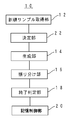
- FIG. 3 is a flowchart showing the operation of the first embodiment.
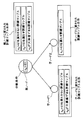
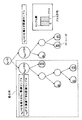
- FIG. 7 is an explanatory view showing the distribution of training samples in the node of the first embodiment. Explanatory drawing which shows the decision tree of Example 1.
- FIG. The block diagram of the learning apparatus of Example 2 of this invention. 6 is a flowchart showing the operation of the second embodiment.
- the “sample” includes a "class” representing a classification and a plurality of "attributes”. For example, if it is a problem that classifies men and women, the class is a value for identifying men and women, and the attribute is a value used to identify men and women such as the collected height, weight, body fat percentage and the like.
- a "training sample” is a sample collected to learn a classifier and the class is known.
- the "unknown sample” is a sample whose attribute is obtained but whose class is unknown, and the identification process uses a classifier to estimate the class of the unknown sample.
- the "missing value" indicates that the value of the attribute is unknown.
- the learning apparatus 10 according to the first embodiment will be described with reference to FIGS. 1 to 4.
- the learning device 10 learns a decision tree based classifier using a training sample including a missing value.
- FIG. 1 is a block diagram of a learning device 10 of the present embodiment.
- the learning device 10 includes, for example, a training sample acquisition unit 12, a generation unit 14, a distribution unit 16, an end determination unit 18, and a storage control unit 20.
- a training sample the case where the attributes such as height, weight, and body fat percentage, and the male and female classified samples are used is taken as an example.
- a single decision tree is used as a classifier to be learned by the learning device 10.
- random forests random forests; see “Random Forests”, Machine Learning, vol. 45, pp. 5-32, 2001.
- extremely randomized trees extreme randomized trees; It is more preferable to use Pierre Geurts, Damien Ernst and Louis Wehenkel, “Extremely randomized trees”, Machine Learning, vol. 36, number 1, pp. 3-42, 2001. See “Pierre Geurts”).
- These constitute a classifier having a plurality of decision trees obtained by giving randomness when learning the decision tree. Note that these decision trees have higher discrimination ability than classifiers based on a single decision tree.
- the operation state of the learning device 10 will be described with reference to FIGS. 2 and 3.
- FIG. 2 is a flowchart showing an operation of a method in which the learning device 10 performs learning of a classifier.
- FIG. 3 is an explanatory view showing the distribution of training samples in the current node.
- step S1 the training sample acquisition unit 12 acquires a plurality of training samples from the outside, and gives them to the root node. Branch conditions are predetermined for each node below the root node.
- Each training sample has n attributes ⁇ x 1 , x 2 ,..., X n ⁇ and class y is known.
- Each attribute of each training sample has a continuous value, or a value indicating that it has discrete values or is a missing value.
- the training sample may be stored in advance in the training sample acquisition unit 12.
- step S2 the generation unit 14 generates two child nodes for the parent node including the root node. That is, as shown in FIG. 2, when the branching condition is determined to be x 2 > 61, there are two options of satisfying the branching condition or not if the existence of the missing value is ignored. Creates two child nodes.
- the training sample passed to the parent node is roughly divided into three. First branch satisfies the training sample, the second training sample does not satisfy the branch condition, the third is a training sample attribute x 2 can not determine the branch condition for deficient used as a branch condition.
- the branching condition is a condition for classification, and uses, for example, the degree of separation of classes of training samples, and uses an index such as information gain as the degree of separation.
- This information gain is the information gain described in Pierre Geurts, and is referred to herein as an "evaluation value”. Then, the generation unit 14 tries a plurality of branch conditions, and determines a branch condition having the best evaluation value among them. This determines the attribute used as a branching condition.
- step S3 the distribution unit 16 distributes the training sample satisfying the branching condition and the training sample not satisfying the branching condition to the corresponding child nodes.
- step S4 the distribution unit 16 passes the training sample for which the branch condition could not be evaluated to one of the child nodes.
- the order of the processes in step S3 and step S4 may be reversed.
- step S5 the end determination unit 18 repeats this division recursively until the end condition is satisfied.
- the following conditions are adopted as the termination condition.
- the first condition is when the number of training samples included in the node is smaller than a predetermined number.
- the second condition is that the depth of the tree structure is greater than a predetermined value.
- the third condition is when the decrease in the index indicating the goodness of division is smaller than a predetermined value.
- step S6 the storage control unit 20 stores the decision tree including each node learned as described above in the storage unit as a classifier.
- all training samples that can not be evaluated due to the branching condition are passed to one child node.
- distribution of training samples is performed according to another branching condition in a child node to which the training sample has been passed. Therefore, a training sample for which the branch condition could not be evaluated at the parent node can also learn the classification method by the subtree after the passed child node.
- the number of judgments by the branch condition is small compared to the whole decision tree, it is preferable that the number of classes to be classified is small. For example, in the case of a two-class identification problem such as male or female or correct or incorrect, there is a possibility that even a small subtree can make either decision at a leaf node.
- the dictionary can be configured with a storage area equivalent to a method that does not consider missing values.
- Non-Patent Document 1 discloses a method of ignoring a training sample for which a branch condition could not be evaluated and discarding it at the current node. However, in this learning method, it is shown in the same document that the performance at the time of identification is not good.
- Non-Patent Document 1 discloses a method of passing training samples for which branch conditions could not be evaluated to all child nodes.
- this learning method the number of training samples to be passed to child nodes increases, and the entire decision tree becomes large. Therefore, the storage area of the decision tree becomes large, and the identification process also takes time.
- the number of training samples to be passed to the child node does not increase, and learning can be performed using all the training samples. While constructing, it is possible to perform learning in consideration of missing values.
- the learning device 10 is more preferable when there is a large deviation in class distribution of a training sample whose attribute is a missing value.
- a training sample whose attribute is a missing value.
- weight is used as an attribute in a gender identification problem.
- the training sample in which the answer is not obtained but the value of the attribute of weight is deficient is mostly female, the fact that the attribute is deficient can be important information for identification. . Therefore, putting together the training samples having these missing values can contribute to the improvement of classification accuracy.
- a training sample whose attribute used as a branch condition is a missing value is used as any one of child nodes passing a training sample whose attribute used as a branching condition is not a missing value.
- the training sample the sample in which the attributes such as height, weight, body fat percentage and the like and gender are classified is used as the first specific example, but other training samples including defective values are used. Two specific examples will be described with reference to FIG.
- face detection which detects a human face from the image 100 and estimates its position and posture will be described as an example.
- the present embodiment is effective when learning this.
- the first specific example is a preferable application example to the present embodiment for learning a training sample having a missing value in a subtree with a small additional storage area for handling the missing value of the attribute.
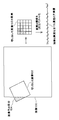
- the third specific example is a case where a part is cut out from an image including an invalid area 202 in a part of the whole of an image 200 as shown in FIG.
- the cut out partial image 204 includes an invalid area
- an attribute obtained from the invalid part is treated as a missing value.
- An ultrasound image will be described as an example.
- the entire rectangular image 200 there are a fan-shaped portion 206 configured by the information of the ultrasonic beam and a portion 202 not scanned by the ultrasonic beam.
- a part of the entire image 200 is cut out, and feature values ⁇ x 1 , x 2 ,..., X n ⁇ calculated from the luminance value and the luminance value of the pixels of the cut out image 204 are arranged in a line and one-dimensional vectorized Be an attribute. Since this is a string of attributes including a missing value, this embodiment is effective when learning this.
- the image 200 may handle not only a two-dimensional image but also a three-dimensional image.
- three-dimensional volume data can be obtained by modalities such as CT, MRI, and ultrasound imaging.
- the position / posture estimation problem for a specific part or object uses the sample cut out at the correct position / posture as the correct sample, Two classes of learning are performed with samples cut out in postures as incorrect samples.
- clipping is performed in three dimensions, the number of attributes is further increased as compared to a two-dimensional image. Therefore, the second specific example is a preferable application example to the present embodiment for learning a training sample having a missing value in a partial tree with a small additional storage area for handling the missing value of the attribute.
- the learning device 10 according to the second embodiment will be described with reference to FIGS. 5 and 6.
- the learning apparatus 10 not only distributes the training sample having the defect value described in the first embodiment, but also corrects the branch condition using the training sample having the defect value.
- FIG. 5 is a block diagram of the learning device 10 of the second embodiment.
- the learning device 10 includes a determination unit 22 in addition to, for example, the training sample acquisition unit 12, the generation unit 14, the distribution unit 16, the end determination unit 18, and the storage control unit 20 of the first embodiment. .
- FIG. 6 is a flowchart showing the operation of the learning device 10 according to the present embodiment.
- step S11 the training sample acquisition unit 12 acquires a plurality of training samples and gives them to the root node.
- step S12 the determination unit 22 evaluates a branch condition defined by setting a threshold to an appropriate attribute.
- the evaluation value in Example 1 is used as the degree of separation of the class of the training sample according to the branching condition set using the remaining training samples except for the training sample whose attribute is a missing value.
- the branching conditions to be set be such that training samples can be separated for each class, and the number of training samples whose attribute used as a branching condition is a missing value is small. The reason is that it is possible to make the whole decision tree compact, and to reduce the storage area and the number of identification processes, by selecting a branch condition that allows more training samples to be correctly classified.
- step S13 the determination unit 22 corrects the evaluation value so as to increase as the ratio of the training sample whose attribute used in the branching condition is not a missing value to the entire training sample assigned to the parent node increases.
- step S14 the determination unit 22 tries a plurality of branch conditions, and among them, determines the one with the best corrected evaluation value H 'as the branch condition. This determines the attribute used as a branching condition.
- step S15 the generation unit 14 generates, for the parent node including the root node, two child nodes to which a training sample whose attribute is not a missing value is passed based on the branching condition determined by the determination unit 22.
- step S16 the distribution unit 16 distributes the training samples that are not missing values to the child nodes based on the branching condition.
- step S17 the distribution unit 16 passes a training sample whose attribute used in the branch condition is a missing value to any one child node. Note that the order of the processes of step S16 and step S17 may be reversed.
- step S18 the end determination unit 18 repeats this division recursively until the end condition is satisfied.
- the termination condition is the same as step S5 of the first embodiment.
- step S19 the storage control unit 20 stores each node of the decision tree learned as described above in the storage unit as a classifier.
- the whole decision tree can be made smaller by selecting attributes with few training samples with missing values and with a good degree of class separation in the selection of branch conditions, reducing the storage area, identification processing Can be reduced.
- selecting an attribute with few training samples having a missing value means reducing the number of training samples having a missing value in the attribute used in the branching condition.
- a method of assigning a training sample to which a branch condition could not be evaluated as described in Non-Patent Document 1 to a special node only a small number of training samples assigned in a special child node It is necessary to create a subtree after that, and learning tends to be unstable. Therefore, the ability to discriminate against unknown samples having missing values in the same attribute is impaired.
- the learning apparatus 10 according to the present embodiment even if the number of training samples having a missing value is small for the attribute used in the branching condition, the subsequent learning can be progressed together with the training sample having no missing value, and learning is stable. Do.
- the learning apparatus 10 it is possible to learn an effective decision tree by selecting a branch condition using an attribute that has good class separation and few samples with missing values.
- the learning device 10 it is necessary to reduce the number of training samples in which the attribute used as the branching condition has a missing value, and the child node in combination with the training sample in which the attribute used as the branching condition is not the missing value. By advancing the learning in, it is possible to avoid the instability of learning caused by the small number of training samples.
- the learning device 10 of the third embodiment will be described.
- the training sample acquisition unit 12 stores that the attribute of the training sample is a missing value in the value of the attribute.
- step S3 and step S4 in the first embodiment can be performed simultaneously.
- the attribute x has a value of 0 to 100
- the branching condition is x> 50
- the training sample in which x is a missing value is passed to the same child node as the training sample satisfying x> 50. If a value smaller than the range is regarded as a missing value in all the attributes, a training sample in which the attribute used in the branch condition is a missing value is always passed to a child node in a predetermined direction.
- the learning device 10 of the fourth embodiment will be described.
- the distribution unit 16 stores, in the parent node, a child node to which a training sample whose attribute used in the branch condition is a missing value is passed. By storing this information, it is possible to control the direction of the child node passing the training sample which is a missing value for each node.
- step S3 if the distributing unit 16 passes a training sample having a missing value to a child node with a smaller number of training samples passed to the child node, only a specific branch is prevented from growing. It is possible to learn a well-balanced decision tree.
- the distribution unit 16 compares the class distribution of the training sample passed to the child node with the class distribution of the training sample having the missing value, and delivers the training sample having the missing value to the near child node of the class distribution. For example, the growth of subsequent branches can be reduced.
- the training sample having the missing value is passed at each node can be stored with only one value, the training sample having the missing value is increased with a slight increase in the storage area. We can learn the decision tree considered.
- a discrimination device 24 using a classifier learned by the learning device 10 of the first embodiment will be described with reference to FIGS. 7 and 8.
- FIG. 7 is a block diagram of the identification device 24 of this embodiment.
- the identification device 24 includes an unknown sample acquisition unit 26, a branch unit 28, and an estimation unit 30.
- step S21 the unknown sample acquisition unit 26 acquires an unknown sample for which class estimation is to be performed from the outside, and gives it to a root node of a decision tree which is a classifier learned by the learning device 10 of the first embodiment.
- step S22 the branching unit 28 advances the unknown sample from the root node to the leaf nodes in order according to the branching condition with respect to the decision tree. That is, an unknown sample whose attribute used as a branch condition in the parent node is not a missing value is distributed to any of a plurality of child nodes according to the branch condition. Further, when the attribute used in the branch condition in the parent node is a missing value in the unknown sample, the child node to which the training data for which the attribute was a missing value was passed during learning in the learning device 10 of the first embodiment. Advance unknown samples.
- step S23 the estimation unit 30 estimates the class of the unknown sample based on the class distribution of the unknown sample that has reached the leaf node of the decision tree.
- class estimation is performed with high accuracy because the unknown sample is advanced in the direction in which the training sample in which the same attribute as the learning in the learning device 10 is a missing value has advanced. Can.
- the class estimation of an unknown sample can be performed by using the same discrimination device 24 as described above.
- the branching unit 28 of the identification device 24 performs processing by adding a value outside the attribute value range to the missing value of the unknown sample as well as learning.
- sorting by a branch condition by a missing value it is possible to automatically advance an unknown sample in the direction in which the training sample having the missing value has advanced.
- a discrimination device 24 using a classifier learned by the learning device 10 of the fourth embodiment will be described.
- the branching unit 28 can advance the unknown sample in the direction of the designated child node when distributing the branch conditions based on the missing value.
- the learning device 10 and the identification device 24 of the eighth embodiment will be described.
- the distribution unit 16 of the learning device 10 of this embodiment stores, in the parent node, missing value presence / absence information indicating that there is no training sample whose attribute used in the branching condition is a missing value.
- the branch condition of each parent node is used to determine the direction of a child node to which the unknown sample is to be forwarded. If the attribute used for the branching condition is a missing value in the unknown sample, the training sample whose attribute is the missing value should go to the child node passed. However, if there is missing value presence / absence information indicating that there is no training sample having a missing value at the time of learning in this parent node, there is a high possibility that the branching condition of the unknown sample is not correctly distributed in that parent node. .
- the attribute used in the branch condition in the parent node is the missing value in the unknown sample, and there is no training sample having the missing value in that node from the missing value presence / absence information If you know, add the following process.
- the unknown sample is advanced to all the child nodes, and the class distribution in all the leaf nodes reached is integrated to estimate the class of the unknown sample. Since there is no guideline for which child node to proceed with an unknown sample, going to all child nodes leads to an improvement in identification accuracy since identification processing can be performed using all subtrees beyond that. It can also indicate that label estimation of unknown samples is likely to fail.
- the present invention is not limited to the above-described embodiment as it is, and at the implementation stage, the constituent elements can be modified and embodied without departing from the scope of the invention.
- various inventions can be formed by appropriate combinations of a plurality of constituent elements disclosed in the above embodiments. For example, some components may be deleted from all the components shown in the embodiments. Furthermore, the components in different embodiments may be combined as appropriate.
- the generation unit 14 of the learning device in each of the above embodiments generates two child nodes for one parent node
- the present invention is not limited to this and three or more child nodes may be generated.
- the learning device 10 and the identification device 24 can also be realized, for example, by using a general-purpose computer as basic hardware. That is, the configuration of each part of the learning device 10 and the identification device 24 can be realized by causing a processor mounted on the above computer to execute a program. At this time, the functions of the respective units of the learning device 10 and the identification device 24 may be realized by installing the above program in a computer in advance, or may be stored in a storage medium such as a CD-ROM or via a network. The above program may be distributed and implemented by installing this program on a computer as appropriate.
Landscapes
- Engineering & Computer Science (AREA)
- Health & Medical Sciences (AREA)
- General Health & Medical Sciences (AREA)
- Medical Informatics (AREA)
- Nuclear Medicine, Radiotherapy & Molecular Imaging (AREA)
- Radiology & Medical Imaging (AREA)
- Quality & Reliability (AREA)
- Computer Vision & Pattern Recognition (AREA)
- Physics & Mathematics (AREA)
- General Physics & Mathematics (AREA)
- Theoretical Computer Science (AREA)
- Information Retrieval, Db Structures And Fs Structures Therefor (AREA)
Abstract
Description
Claims (8)
- 複数の属性と既知のクラスとを含む訓練サンプルを複数取得し、識別器として学習するための決定木のルートノードに与える訓練サンプル取得部と、
前記決定木の親ノードから複数の子ノードを生成する生成部と、
複数の前記訓練サンプルのうち、前記決定木の親ノードにおいて、クラス分けをするための分岐条件に対応する前記属性が欠損値ではない前記訓練サンプルを、前記分岐条件に従って前記複数の子ノードのいずれかに振り分け、前記属性が前記欠損値である前記訓練サンプルを、前記複数の子ノードのいずれか一つの前記子ノードに渡す振り分け部と、
終了条件を満たすまで前記子ノードの生成と前記訓練サンプルの振り分けを行う終了判定部と、
を備えることを特徴とする学習装置。 - 前記分岐条件として用いる前記属性が前記欠損値ではない前記訓練サンプルによって、前記分岐条件を決めるための評価値を計算し、前記分岐条件として用いる前記属性が前記欠損値でない前記訓練サンプルが、前記全ての訓練サンプルに対して占める割合が大きい程に前記評価値を上げるように補正して前記分岐条件を決定する決定部をさらに有する、
ことを特徴とする請求項1に記載の学習装置。 - 前記振り分け部は、前記分岐条件として用いる前記属性が前記欠損値である前記訓練サンプルを必ず決まった方向の前記子ノードに渡す、
ことを特徴とする請求項2に記載の学習装置。 - 前記振り分け部は、前記分岐条件として用いる前記属性が前記欠損値である前記訓練サンプルを渡した前記子ノードを前記親ノードに記憶させる、
ことを特徴とする請求項2に記載の学習装置。 - 前記振り分け部は、前記分岐条件として用いる前記属性が前記欠損値である前記訓練サンプルが一つもない場合は、前記欠損値を扱わなかったことを示す欠損値有無情報を前記親ノードに記憶させる、
ことを特徴とする請求項2に記載の学習装置。 - 複数の属性と未知のクラスとを含む未知サンプルを取得し、請求項1から請求項6のいずれか一項に記載の学習装置で学習した識別器である決定木のルートノードに与える未知サンプル取得部と、
前記未知サンプルを、前記決定木に対してリーフノードまで進めるものであって、親ノードにおける分岐条件として用いる属性が欠損値ではない前記未知サンプルを、前記分岐条件に従って複数の子ノードのいずれかに振り分け、前記分岐条件で用いる前記属性が前記欠損値である前記未知サンプルを、前記学習時に、前記属性が欠損値である前記訓練データが渡された前記子ノードに進める分岐部と、
前記リーフノードに至った前記未知サンプルのクラス分布により、前記未知サンプルのクラスを推定する推定部と、
を備えることを特徴とする識別装置。 - 訓練サンプル取得部が、複数の属性と既知のクラスとを含む訓練サンプルを複数取得し、識別器として学習するための決定木のルートノードに与える訓練サンプル取得ステップと、
生成部が、前記決定木の親ノードから複数の子ノードを生成する生成ステップと、
振り分け部が、複数の前記訓練サンプルのうち、前記決定木の親ノードにおいて、クラス分けをするための分岐条件に対応する前記属性が欠損値ではない前記訓練サンプルを、前記分岐条件に従って前記複数の子ノードのいずれかに振り分け、前記属性が前記欠損値である前記訓練サンプルを、前記複数の子ノードのいずれか一つの前記子ノードに渡す振り分けステップと、
終了判定部が、終了条件を満たすまで前記子ノードの生成と前記訓練サンプルの振り分けを行う終了判定ステップと、
備えることを特徴とする学習方法。 - 未知サンプル取得部が、複数の属性と未知のクラスとを含む未知サンプルを取得し、請求項8に記載の学習方法で学習した識別器である決定木のルートノードに与える未知サンプル取得ステップと、
分岐部が、前記未知サンプルを、前記決定木に対してリーフノードまで進めるものであって、親ノードにおける分岐条件として用いる属性が欠損値ではない前記未知サンプルを、前記分岐条件に従って複数の子ノードのいずれかに振り分け、前記分岐条件で用いる前記属性が前記欠損値である前記未知サンプルを、前記学習時に、前記属性が欠損値である前記訓練データが渡された前記子ノードに進める分岐ステップと、
推定部が、前記リーフノードに至った前記未知サンプルのクラス分布により、前記未知サンプルのクラスを推定する推定ステップと、
を備えることを特徴とする識別方法。
Priority Applications (2)
| Application Number | Priority Date | Filing Date | Title |
|---|---|---|---|
| JP2011502512A JPWO2010100701A1 (ja) | 2009-03-06 | 2009-12-15 | 学習装置、識別装置及びその方法 |
| US13/254,925 US20120036094A1 (en) | 2009-03-06 | 2009-12-15 | Learning apparatus, identifying apparatus and method therefor |
Applications Claiming Priority (2)
| Application Number | Priority Date | Filing Date | Title |
|---|---|---|---|
| JP2009053873 | 2009-03-06 | ||
| JP2009-053873 | 2009-03-06 |
Publications (1)
| Publication Number | Publication Date |
|---|---|
| WO2010100701A1 true WO2010100701A1 (ja) | 2010-09-10 |
Family
ID=42709279
Family Applications (1)
| Application Number | Title | Priority Date | Filing Date |
|---|---|---|---|
| PCT/JP2009/006891 Ceased WO2010100701A1 (ja) | 2009-03-06 | 2009-12-15 | 学習装置、識別装置及びその方法 |
Country Status (3)
| Country | Link |
|---|---|
| US (1) | US20120036094A1 (ja) |
| JP (1) | JPWO2010100701A1 (ja) |
| WO (1) | WO2010100701A1 (ja) |
Cited By (6)
| Publication number | Priority date | Publication date | Assignee | Title |
|---|---|---|---|---|
| JP2012098960A (ja) * | 2010-11-02 | 2012-05-24 | Canon Inc | 情報処理装置、その処理方法及びプログラム |
| JP2016506260A (ja) * | 2012-12-14 | 2016-03-03 | ザ トラスティーズ オブ コロンビア ユニバーシティ イン ザ シティオブ ニューヨークThe Trustees Of Columbia University In The City Of New York | ロボット手術器具のマーカーレス追跡 |
| JP2020052886A (ja) * | 2018-09-28 | 2020-04-02 | 日本電信電話株式会社 | データ処理装置、データ処理方法およびプログラム |
| WO2022059048A1 (ja) * | 2020-09-15 | 2022-03-24 | 三菱電機株式会社 | 目標識別装置、目標識別方法およびプログラム |
| CN115147092A (zh) * | 2022-07-29 | 2022-10-04 | 京东科技信息技术有限公司 | 资源审批方法、随机森林模型的训练方法及装置 |
| US12450340B2 (en) | 2022-07-27 | 2025-10-21 | Nec Corporation | Information processing apparatus and storage medium |
Families Citing this family (7)
| Publication number | Priority date | Publication date | Assignee | Title |
|---|---|---|---|---|
| RU2003108433A (ru) * | 2003-03-28 | 2004-09-27 | Аби Софтвер Лтд. (Cy) | Способ предварительной обработки изображения машиночитаемой формы |
| RU2635259C1 (ru) | 2016-06-22 | 2017-11-09 | Общество с ограниченной ответственностью "Аби Девелопмент" | Способ и устройство для определения типа цифрового документа |
| US10878336B2 (en) * | 2016-06-24 | 2020-12-29 | Intel Corporation | Technologies for detection of minority events |
| US10242486B2 (en) * | 2017-04-17 | 2019-03-26 | Intel Corporation | Augmented reality and virtual reality feedback enhancement system, apparatus and method |
| JP6888737B2 (ja) * | 2018-03-29 | 2021-06-16 | 日本電気株式会社 | 学習装置、学習方法、及びプログラム |
| CN110399828B (zh) * | 2019-07-23 | 2022-10-28 | 吉林大学 | 一种基于多角度的深度卷积神经网络的车辆再识别方法 |
| US11893506B1 (en) * | 2020-06-09 | 2024-02-06 | Hewlett-Packard Development Company, L.P. | Decision tree training with difference subsets of training samples based on a plurality of classifications |
Citations (1)
| Publication number | Priority date | Publication date | Assignee | Title |
|---|---|---|---|---|
| JP2004029971A (ja) * | 2002-06-21 | 2004-01-29 | Fujitsu Ltd | データ解析方法 |
Family Cites Families (3)
| Publication number | Priority date | Publication date | Assignee | Title |
|---|---|---|---|---|
| JP4268500B2 (ja) * | 2003-10-28 | 2009-05-27 | 新日本製鐵株式会社 | プロセスの状態類似事例検索方法および状態予測方法並びに記憶媒体 |
| JP4318221B2 (ja) * | 2004-12-02 | 2009-08-19 | 富士通株式会社 | 医療情報分析装置、方法及びプログラム |
| US7801924B2 (en) * | 2006-12-28 | 2010-09-21 | Infosys Technologies Ltd. | Decision tree construction via frequent predictive itemsets and best attribute splits |
-
2009
- 2009-12-15 JP JP2011502512A patent/JPWO2010100701A1/ja active Pending
- 2009-12-15 US US13/254,925 patent/US20120036094A1/en not_active Abandoned
- 2009-12-15 WO PCT/JP2009/006891 patent/WO2010100701A1/ja not_active Ceased
Patent Citations (1)
| Publication number | Priority date | Publication date | Assignee | Title |
|---|---|---|---|---|
| JP2004029971A (ja) * | 2002-06-21 | 2004-01-29 | Fujitsu Ltd | データ解析方法 |
Non-Patent Citations (2)
| Title |
|---|
| DATA MINING USING SAS ENTERPRISE MINER: A CASE STUDY APPROACH, April 2003 (2003-04-01), pages 47 - 53 * |
| J. R. QUINLAN: "Unknown attribute values in induction", PROCEEDINGS OF THE SIXTH INTERNATIONAL WORKSHOP ON MACHINE LEARNING, 26 June 1989 (1989-06-26), pages 164 - 168, XP002602747 * |
Cited By (10)
| Publication number | Priority date | Publication date | Assignee | Title |
|---|---|---|---|---|
| JP2012098960A (ja) * | 2010-11-02 | 2012-05-24 | Canon Inc | 情報処理装置、その処理方法及びプログラム |
| US8930286B2 (en) | 2010-11-02 | 2015-01-06 | Canon Kabushiki Kaisha | Information processing apparatus, processing method therefor, and non-transitory computer-readable storage medium |
| JP2016506260A (ja) * | 2012-12-14 | 2016-03-03 | ザ トラスティーズ オブ コロンビア ユニバーシティ イン ザ シティオブ ニューヨークThe Trustees Of Columbia University In The City Of New York | ロボット手術器具のマーカーレス追跡 |
| JP2020052886A (ja) * | 2018-09-28 | 2020-04-02 | 日本電信電話株式会社 | データ処理装置、データ処理方法およびプログラム |
| JP7056493B2 (ja) | 2018-09-28 | 2022-04-19 | 日本電信電話株式会社 | データ処理装置、データ処理方法およびプログラム |
| WO2022059048A1 (ja) * | 2020-09-15 | 2022-03-24 | 三菱電機株式会社 | 目標識別装置、目標識別方法およびプログラム |
| JPWO2022059048A1 (ja) * | 2020-09-15 | 2022-03-24 | ||
| JP7221456B2 (ja) | 2020-09-15 | 2023-02-13 | 三菱電機株式会社 | 目標識別装置、目標識別方法およびプログラム |
| US12450340B2 (en) | 2022-07-27 | 2025-10-21 | Nec Corporation | Information processing apparatus and storage medium |
| CN115147092A (zh) * | 2022-07-29 | 2022-10-04 | 京东科技信息技术有限公司 | 资源审批方法、随机森林模型的训练方法及装置 |
Also Published As
| Publication number | Publication date |
|---|---|
| US20120036094A1 (en) | 2012-02-09 |
| JPWO2010100701A1 (ja) | 2012-09-06 |
Similar Documents
| Publication | Publication Date | Title |
|---|---|---|
| JPWO2010100701A1 (ja) | 学習装置、識別装置及びその方法 | |
| US11593943B2 (en) | RECIST assessment of tumour progression | |
| US9460360B2 (en) | Method and apparatus for learning-enhanced atlas-based auto-segmentation | |
| US8885926B2 (en) | Image and data segmentation | |
| US9152926B2 (en) | Systems, methods, and media for updating a classifier | |
| US9042618B2 (en) | Method and system for detection 3D spinal geometry using iterated marginal space learning | |
| JP5534840B2 (ja) | 画像処理装置、画像処理方法、画像処理システム及びプログラム | |
| Sert et al. | Ensemble of convolutional neural networks for classification of breast microcalcification from mammograms | |
| JP2015087903A (ja) | 情報処理装置及び情報処理方法 | |
| JP2009541838A (ja) | 画像値を含む画像において閾値を定めるための方法、システム及び計算機プログラム | |
| JP6426441B2 (ja) | 密度計測装置、密度計測方法、およびプログラム | |
| CN118967722B (zh) | 基于残差反向瓶颈和稀疏注意力的图像分割方法与系统 | |
| CN108510478A (zh) | 肺气道图像分割方法、终端、存储介质 | |
| US12062229B2 (en) | Identification process of a dental implant visible on an input image by means of at least one convolutional neural network | |
| CN118968186A (zh) | 医疗图像数据集的自适应图像分类方法、系统及存储介质 | |
| CN113158824B (zh) | 一种水下视频鱼类识别方法、系统及存储介质 | |
| Cerrolaza et al. | Fetal skull segmentation in 3D ultrasound via structured geodesic random forest | |
| WO2021116011A1 (en) | Medical image segmentation and atlas image selection | |
| CN115619774A (zh) | 染色体异常识别方法、系统及存储介质 | |
| US11389104B2 (en) | System of joint brain tumor and cortex reconstruction | |
| JP2006031114A (ja) | 画像分割処理システム | |
| Hussein et al. | Design a classification system for brain magnetic resonance image | |
| Ramirez Campos et al. | COVID-19 Related Pneumonia Detection in Lung Ultrasound | |
| Sun et al. | A novel algorithm for cut shot boundary detection |
Legal Events
| Date | Code | Title | Description |
|---|---|---|---|
| 121 | Ep: the epo has been informed by wipo that ep was designated in this application |
Ref document number: 09841067 Country of ref document: EP Kind code of ref document: A1 |
|
| ENP | Entry into the national phase |
Ref document number: 2011502512 Country of ref document: JP Kind code of ref document: A |
|
| NENP | Non-entry into the national phase |
Ref country code: DE |
|
| WWE | Wipo information: entry into national phase |
Ref document number: 13254925 Country of ref document: US |
|
| 122 | Ep: pct application non-entry in european phase |
Ref document number: 09841067 Country of ref document: EP Kind code of ref document: A1 |