WO2010100144A1 - Fused bicyclic compounds as inhibitors for pi3 kinase - Google Patents
Fused bicyclic compounds as inhibitors for pi3 kinase Download PDFInfo
- Publication number
- WO2010100144A1 WO2010100144A1 PCT/EP2010/052615 EP2010052615W WO2010100144A1 WO 2010100144 A1 WO2010100144 A1 WO 2010100144A1 EP 2010052615 W EP2010052615 W EP 2010052615W WO 2010100144 A1 WO2010100144 A1 WO 2010100144A1
- Authority
- WO
- WIPO (PCT)
- Prior art keywords
- het
- denotes
- mmol
- title compound
- butyl
- Prior art date
- Legal status (The legal status is an assumption and is not a legal conclusion. Google has not performed a legal analysis and makes no representation as to the accuracy of the status listed.)
- Ceased
Links
- 0 CICCC(C(*)=*C(*)=C=C)NC(N**)[U](C)C Chemical compound CICCC(C(*)=*C(*)=C=C)NC(N**)[U](C)C 0.000 description 4
- BQNOUUOAOAZATJ-UHFFFAOYSA-O CC(C)(C)OC(NCCC(N=N[NH3+])=N)=O Chemical compound CC(C)(C)OC(NCCC(N=N[NH3+])=N)=O BQNOUUOAOAZATJ-UHFFFAOYSA-O 0.000 description 1
- XYKFFMKGYDTJRH-UHFFFAOYSA-O CC(C)(C)OC(NCCN([NH3+])N=C(C1CC1)N)=O Chemical compound CC(C)(C)OC(NCCN([NH3+])N=C(C1CC1)N)=O XYKFFMKGYDTJRH-UHFFFAOYSA-O 0.000 description 1
- HOGLCQYSVNUIBY-UHFFFAOYSA-N CC(C)(C)OC(NCCc1n[o]c(C2CCCC2)n1)=O Chemical compound CC(C)(C)OC(NCCc1n[o]c(C2CCCC2)n1)=O HOGLCQYSVNUIBY-UHFFFAOYSA-N 0.000 description 1
- MAQDERSPUPSWPX-UHFFFAOYSA-N CC(C)(C)c1nnc(CCN)[s]1 Chemical compound CC(C)(C)c1nnc(CCN)[s]1 MAQDERSPUPSWPX-UHFFFAOYSA-N 0.000 description 1
- FFPLFDMDNZCMNI-UHFFFAOYSA-N CC(C)(C[n]1cnc(CCN)c1)O Chemical compound CC(C)(C[n]1cnc(CCN)c1)O FFPLFDMDNZCMNI-UHFFFAOYSA-N 0.000 description 1
- SREZZEFFUGXQRZ-UHFFFAOYSA-N CC(C)N/N=N\C(CCNC(Nc1nc(ccc(-c2cccc(S(NCCO)(=O)=O)c2)c2)c2[s]1)=O)=N Chemical compound CC(C)N/N=N\C(CCNC(Nc1nc(ccc(-c2cccc(S(NCCO)(=O)=O)c2)c2)c2[s]1)=O)=N SREZZEFFUGXQRZ-UHFFFAOYSA-N 0.000 description 1
- UYXGTIPNVIAEGC-UHFFFAOYSA-N CC(Nc(nc(cc1)[n]2cc1-c1cccc(S(C)(=O)=O)c1)c2Br)=O Chemical compound CC(Nc(nc(cc1)[n]2cc1-c1cccc(S(C)(=O)=O)c1)c2Br)=O UYXGTIPNVIAEGC-UHFFFAOYSA-N 0.000 description 1
- CUHXWQRUVFKDDO-UHFFFAOYSA-N CC(Nc(nc1cc2)c[n]1nc2-c1cccc(S(C)(=O)=O)c1)=O Chemical compound CC(Nc(nc1cc2)c[n]1nc2-c1cccc(S(C)(=O)=O)c1)=O CUHXWQRUVFKDDO-UHFFFAOYSA-N 0.000 description 1
- IXGCTWYOWKORGP-UHFFFAOYSA-N CC(Nc1c[n](cc(cc2)-c3cccc(S(C)(=O)=O)c3)c2n1)=O Chemical compound CC(Nc1c[n](cc(cc2)-c3cccc(S(C)(=O)=O)c3)c2n1)=O IXGCTWYOWKORGP-UHFFFAOYSA-N 0.000 description 1
- OYSTXUXAQVHJQP-UHFFFAOYSA-N CC(Nc1nc(ccc(-c2cc(C(F)(F)F)cc(S(NCCO)(=O)=O)c2)c2)c2[s]1)=O Chemical compound CC(Nc1nc(ccc(-c2cc(C(F)(F)F)cc(S(NCCO)(=O)=O)c2)c2)c2[s]1)=O OYSTXUXAQVHJQP-UHFFFAOYSA-N 0.000 description 1
- BCGDXGQQJWKIEO-WFTITGEASA-N CC(Nc1nc(ccc(-c2cc(S(NC(CCC[C@@H]3O)[C@H]3O)(=O)=O)cnc2)c2)c2[s]1)=O Chemical compound CC(Nc1nc(ccc(-c2cc(S(NC(CCC[C@@H]3O)[C@H]3O)(=O)=O)cnc2)c2)c2[s]1)=O BCGDXGQQJWKIEO-WFTITGEASA-N 0.000 description 1
- SECWGWRAZJBAJJ-UHFFFAOYSA-N CC(Nc1nc(ccc(-c2cc(S(NC3)(=O)=O)c3cc2)c2)c2[s]1)=O Chemical compound CC(Nc1nc(ccc(-c2cc(S(NC3)(=O)=O)c3cc2)c2)c2[s]1)=O SECWGWRAZJBAJJ-UHFFFAOYSA-N 0.000 description 1
- ODMXVAMWMHHNPC-UHFFFAOYSA-N CC(Nc1nc(ccc(-c2cccc(C(N)=O)c2)c2)c2[s]1)=O Chemical compound CC(Nc1nc(ccc(-c2cccc(C(N)=O)c2)c2)c2[s]1)=O ODMXVAMWMHHNPC-UHFFFAOYSA-N 0.000 description 1
- BZGXHWVLGYQPGJ-UHFFFAOYSA-N CC(Nc1nc(ccc(-c2cccc(NC(C)=O)c2)c2)c2[s]1)=O Chemical compound CC(Nc1nc(ccc(-c2cccc(NC(C)=O)c2)c2)c2[s]1)=O BZGXHWVLGYQPGJ-UHFFFAOYSA-N 0.000 description 1
- KHSJJKXCFBDDDP-UHFFFAOYSA-N CC(Nc1nc(ccc(-c2cccc(S(N3CCOCC3)(=O)=O)c2)c2)c2[s]1)=O Chemical compound CC(Nc1nc(ccc(-c2cccc(S(N3CCOCC3)(=O)=O)c2)c2)c2[s]1)=O KHSJJKXCFBDDDP-UHFFFAOYSA-N 0.000 description 1
- TWYJDKRYSSDAEG-UHFFFAOYSA-N CC(Nc1nc(ccc(-c2cccc(S(NCCOC)(=O)=O)c2)c2)c2[s]1)=O Chemical compound CC(Nc1nc(ccc(-c2cccc(S(NCCOC)(=O)=O)c2)c2)c2[s]1)=O TWYJDKRYSSDAEG-UHFFFAOYSA-N 0.000 description 1
- IRENWYOEYVTIRD-UHFFFAOYSA-N CC(Nc1nc(ccc(-c2cccnc2)c2)c2[s]1)=O Chemical compound CC(Nc1nc(ccc(-c2cccnc2)c2)c2[s]1)=O IRENWYOEYVTIRD-UHFFFAOYSA-N 0.000 description 1
- STNPDXYMPIEMQJ-UHFFFAOYSA-N CCCS(c1cc(-c(cc2)cc3c2nc(NC(C)=O)[s]3)ccc1)(=O)=O Chemical compound CCCS(c1cc(-c(cc2)cc3c2nc(NC(C)=O)[s]3)ccc1)(=O)=O STNPDXYMPIEMQJ-UHFFFAOYSA-N 0.000 description 1
- NQJCAMCJXULAEM-UHFFFAOYSA-N CCc1nnc(CCN)[s]1 Chemical compound CCc1nnc(CCN)[s]1 NQJCAMCJXULAEM-UHFFFAOYSA-N 0.000 description 1
- ZERWLNFJCHCAHQ-UHFFFAOYSA-N CN(C)C(C(CC1)CC1NC(Nc1nc(ccc(-c2cccc(S(C)(=O)=O)c2)c2)c2[s]1)=O)=O Chemical compound CN(C)C(C(CC1)CC1NC(Nc1nc(ccc(-c2cccc(S(C)(=O)=O)c2)c2)c2[s]1)=O)=O ZERWLNFJCHCAHQ-UHFFFAOYSA-N 0.000 description 1
- NLFQBDWICNVCTL-UHFFFAOYSA-N CN(C)S(c1cncc(-c(cc2)cc3c2nc(N)[s]3)c1)(=O)=O Chemical compound CN(C)S(c1cncc(-c(cc2)cc3c2nc(N)[s]3)c1)(=O)=O NLFQBDWICNVCTL-UHFFFAOYSA-N 0.000 description 1
- YWNUQEGZYCETGG-UHFFFAOYSA-N CN(C)S(c1cncc(-c(cc2)cc3c2nc(NC(Oc2ccccc2)=O)[s]3)c1)(=O)=O Chemical compound CN(C)S(c1cncc(-c(cc2)cc3c2nc(NC(Oc2ccccc2)=O)[s]3)c1)(=O)=O YWNUQEGZYCETGG-UHFFFAOYSA-N 0.000 description 1
- NBASOMIFOQFNLA-UHFFFAOYSA-N CS(Cc1cncc(-c(cc2)cc3c2nc(N)[s]3)c1)(=O)=O Chemical compound CS(Cc1cncc(-c(cc2)cc3c2nc(N)[s]3)c1)(=O)=O NBASOMIFOQFNLA-UHFFFAOYSA-N 0.000 description 1
- MIKZCIHELYRUGQ-UHFFFAOYSA-N CS(c1cc(-c(cc2)n[n]3c2nc(N)c3)ccc1)(=O)=O Chemical compound CS(c1cc(-c(cc2)n[n]3c2nc(N)c3)ccc1)(=O)=O MIKZCIHELYRUGQ-UHFFFAOYSA-N 0.000 description 1
- QBFDEHRFHIQIMP-UHFFFAOYSA-N CS(c1cncc(-c(cc2)nc3c2nc(NC(Oc2ccccc2)=O)[s]3)c1)(=O)=O Chemical compound CS(c1cncc(-c(cc2)nc3c2nc(NC(Oc2ccccc2)=O)[s]3)c1)(=O)=O QBFDEHRFHIQIMP-UHFFFAOYSA-N 0.000 description 1
- IRUXCNCGTFMNIL-AJNGGQMLSA-N C[C@@H]1[C@H](CN(C)[C@H](CCN[C@@H](O)OC(C)(C)C)O)CCC1 Chemical compound C[C@@H]1[C@H](CN(C)[C@H](CCN[C@@H](O)OC(C)(C)C)O)CCC1 IRUXCNCGTFMNIL-AJNGGQMLSA-N 0.000 description 1
- QVBPXXMOWUPBAE-GHRIWEEISA-N Cc(cc1)ccc1S(/N=C(\C=C1)/N(CC(N)=O)N=C1Cl)(=O)=O Chemical compound Cc(cc1)ccc1S(/N=C(\C=C1)/N(CC(N)=O)N=C1Cl)(=O)=O QVBPXXMOWUPBAE-GHRIWEEISA-N 0.000 description 1
- CQYNNUVBEZFXPG-UHFFFAOYSA-N NCCc1n[o]c(CC(F)(F)F)n1 Chemical compound NCCc1n[o]c(CC(F)(F)F)n1 CQYNNUVBEZFXPG-UHFFFAOYSA-N 0.000 description 1
- NCNORXZSXNZHQG-UHFFFAOYSA-N Nc([s]c1c2)nc1cnc2Cl Chemical compound Nc([s]c1c2)nc1cnc2Cl NCNORXZSXNZHQG-UHFFFAOYSA-N 0.000 description 1
- HDHWDOMFULLEJI-UHFFFAOYSA-N Nc1c[n](cc(nc2)Br)c2n1 Chemical compound Nc1c[n](cc(nc2)Br)c2n1 HDHWDOMFULLEJI-UHFFFAOYSA-N 0.000 description 1
- LOADQEKXKUUQOQ-UHFFFAOYSA-N O=C(c1ccccc1)Nc([s]c1n2)nc1ccc2Cl Chemical compound O=C(c1ccccc1)Nc([s]c1n2)nc1ccc2Cl LOADQEKXKUUQOQ-UHFFFAOYSA-N 0.000 description 1
- BGMZHCVBVRWQGS-UHFFFAOYSA-N OC(CC1)CCN1S(c([s]1)cc(Br)c1Br)(=O)=O Chemical compound OC(CC1)CCN1S(c([s]1)cc(Br)c1Br)(=O)=O BGMZHCVBVRWQGS-UHFFFAOYSA-N 0.000 description 1
- UNJJYPDSKBSWMS-UHFFFAOYSA-N OC(CCC1)CN1S(c1cc(Br)ccc1)(=O)=O Chemical compound OC(CCC1)CN1S(c1cc(Br)ccc1)(=O)=O UNJJYPDSKBSWMS-UHFFFAOYSA-N 0.000 description 1
- USTVPQZFAUHQSU-UHFFFAOYSA-N OCCCSc1cc(Br)ccc1 Chemical compound OCCCSc1cc(Br)ccc1 USTVPQZFAUHQSU-UHFFFAOYSA-N 0.000 description 1
Classifications
-
- C—CHEMISTRY; METALLURGY
- C07—ORGANIC CHEMISTRY
- C07D—HETEROCYCLIC COMPOUNDS
- C07D277/00—Heterocyclic compounds containing 1,3-thiazole or hydrogenated 1,3-thiazole rings
- C07D277/60—Heterocyclic compounds containing 1,3-thiazole or hydrogenated 1,3-thiazole rings condensed with carbocyclic rings or ring systems
- C07D277/62—Benzothiazoles
- C07D277/68—Benzothiazoles with hetero atoms or with carbon atoms having three bonds to hetero atoms with at the most one bond to halogen, e.g. ester or nitrile radicals, directly attached in position 2
- C07D277/82—Nitrogen atoms
-
- A—HUMAN NECESSITIES
- A61—MEDICAL OR VETERINARY SCIENCE; HYGIENE
- A61P—SPECIFIC THERAPEUTIC ACTIVITY OF CHEMICAL COMPOUNDS OR MEDICINAL PREPARATIONS
- A61P11/00—Drugs for disorders of the respiratory system
- A61P11/06—Antiasthmatics
-
- A—HUMAN NECESSITIES
- A61—MEDICAL OR VETERINARY SCIENCE; HYGIENE
- A61P—SPECIFIC THERAPEUTIC ACTIVITY OF CHEMICAL COMPOUNDS OR MEDICINAL PREPARATIONS
- A61P29/00—Non-central analgesic, antipyretic or antiinflammatory agents, e.g. antirheumatic agents; Non-steroidal antiinflammatory drugs [NSAID]
-
- A—HUMAN NECESSITIES
- A61—MEDICAL OR VETERINARY SCIENCE; HYGIENE
- A61P—SPECIFIC THERAPEUTIC ACTIVITY OF CHEMICAL COMPOUNDS OR MEDICINAL PREPARATIONS
- A61P31/00—Antiinfectives, i.e. antibiotics, antiseptics, chemotherapeutics
- A61P31/04—Antibacterial agents
-
- A—HUMAN NECESSITIES
- A61—MEDICAL OR VETERINARY SCIENCE; HYGIENE
- A61P—SPECIFIC THERAPEUTIC ACTIVITY OF CHEMICAL COMPOUNDS OR MEDICINAL PREPARATIONS
- A61P31/00—Antiinfectives, i.e. antibiotics, antiseptics, chemotherapeutics
- A61P31/12—Antivirals
-
- A—HUMAN NECESSITIES
- A61—MEDICAL OR VETERINARY SCIENCE; HYGIENE
- A61P—SPECIFIC THERAPEUTIC ACTIVITY OF CHEMICAL COMPOUNDS OR MEDICINAL PREPARATIONS
- A61P37/00—Drugs for immunological or allergic disorders
- A61P37/02—Immunomodulators
- A61P37/06—Immunosuppressants, e.g. drugs for graft rejection
-
- A—HUMAN NECESSITIES
- A61—MEDICAL OR VETERINARY SCIENCE; HYGIENE
- A61P—SPECIFIC THERAPEUTIC ACTIVITY OF CHEMICAL COMPOUNDS OR MEDICINAL PREPARATIONS
- A61P37/00—Drugs for immunological or allergic disorders
- A61P37/08—Antiallergic agents
-
- C—CHEMISTRY; METALLURGY
- C07—ORGANIC CHEMISTRY
- C07D—HETEROCYCLIC COMPOUNDS
- C07D417/00—Heterocyclic compounds containing two or more hetero rings, at least one ring having nitrogen and sulfur atoms as the only ring hetero atoms, not provided for by group C07D415/00
- C07D417/02—Heterocyclic compounds containing two or more hetero rings, at least one ring having nitrogen and sulfur atoms as the only ring hetero atoms, not provided for by group C07D415/00 containing two hetero rings
- C07D417/04—Heterocyclic compounds containing two or more hetero rings, at least one ring having nitrogen and sulfur atoms as the only ring hetero atoms, not provided for by group C07D415/00 containing two hetero rings directly linked by a ring-member-to-ring-member bond
-
- C—CHEMISTRY; METALLURGY
- C07—ORGANIC CHEMISTRY
- C07D—HETEROCYCLIC COMPOUNDS
- C07D419/00—Heterocyclic compounds containing two or more hetero rings, at least one ring having nitrogen, oxygen, and sulfur atoms as the only ring hetero atoms
- C07D419/02—Heterocyclic compounds containing two or more hetero rings, at least one ring having nitrogen, oxygen, and sulfur atoms as the only ring hetero atoms containing two hetero rings
- C07D419/12—Heterocyclic compounds containing two or more hetero rings, at least one ring having nitrogen, oxygen, and sulfur atoms as the only ring hetero atoms containing two hetero rings linked by a chain containing hetero atoms as chain links
-
- C—CHEMISTRY; METALLURGY
- C07—ORGANIC CHEMISTRY
- C07D—HETEROCYCLIC COMPOUNDS
- C07D471/00—Heterocyclic compounds containing nitrogen atoms as the only ring hetero atoms in the condensed system, at least one ring being a six-membered ring with one nitrogen atom, not provided for by groups C07D451/00 - C07D463/00
- C07D471/02—Heterocyclic compounds containing nitrogen atoms as the only ring hetero atoms in the condensed system, at least one ring being a six-membered ring with one nitrogen atom, not provided for by groups C07D451/00 - C07D463/00 in which the condensed system contains two hetero rings
- C07D471/04—Ortho-condensed systems
-
- C—CHEMISTRY; METALLURGY
- C07—ORGANIC CHEMISTRY
- C07D—HETEROCYCLIC COMPOUNDS
- C07D487/00—Heterocyclic compounds containing nitrogen atoms as the only ring hetero atoms in the condensed system, not provided for by groups C07D451/00 - C07D477/00
- C07D487/02—Heterocyclic compounds containing nitrogen atoms as the only ring hetero atoms in the condensed system, not provided for by groups C07D451/00 - C07D477/00 in which the condensed system contains two hetero rings
- C07D487/04—Ortho-condensed systems
Definitions
- the invention relates to novel compounds of formula I and related formulae, their use as medicament and their use for treating autoimmune diseases, inflammatory disorders, multiple sclerosis and other diseases such as cancers.
- the invention relates to compounds of formula I:
- U denotes CR C , CH, or S
- V denotes C or N
- W denotes N or CR 1
- X denotes CO, SO, SO 2 , CS or a bond
- Y denotes CR 2 or N
- R a denotes NH-A b , NA 2 , -NH-(CH 2 ) P -A b , -NH-(CH 2 ) P -Ar, -NH-(CH 2 ) P -Het 4 , -NH- (CH 2 ) p CHOR 6 -Het 1 , , -NH-(CH 2 ) p COAr, -NH-(CH 2 ) p COHet 1 , -NH-cycloalkyl, COHet 1 ,
- R a also denotes A, -(CH 2 ) S -Ar, -(CH 2 ) S -Het 1 ,
- Het 1 , Het 4 , or perfluoroalkyl or if R D denotes Ar, R a is also -OA or cycloalkyl.
- R b denotes Ar, Het 2 , Het 3 or
- R', R" are independently hydrogen, alkyl, Ar, Het 1 , Het 2 or A.
- R and R together with the nitrogen atom to which they are attached, can optionally form a 3-8- membered heterocyclic ring.
- R c denotes H, A, alkyl, Ar, Het 1 ,
- Ar denotes a monocyclic or bicyclic, aromatic carbocyclic ring having 6 to 14 carbon atoms, which is unsubstituted or monosubstituted, disubstituted or trisubstituted by, Hal, CF 3 , OCF 3 , NO 2 , CN, perfluoroalkyl, A, OA, OH, NH 2 , COH,
- Het 1 denotes a monocyclic or bicyclic saturated, unsaturated or aromatic heterocyclic ring having 1 to 4 N, O and/or S atoms and/or 1 CO group, which is unsubstituted or monosubstituted, disubstituted or trisubstituted by alkyl having 1 to 8 carbon atoms, alkoxy having 1 to 8 carbon atoms, Hal, CF 3 , OCF 3 , NO 2 , CN, perfluoroalkyl, A, OA, O(CH 2 ) s Ar, O(CH 2 ) s Het 1 , -(CH 2 ) p Het 2 , OH, amino, CONH 2 , - NHCOA, -NHCO 2 A, -NHCO 2 (CH 2 ) s Ar, -NHSO 2 -N(H) 2-m (A) m , COA, COOA, -SO 2 A, - SO 2 N(H) 2-m (A)
- Het 2 denotes a monocyclic or bicyclic saturated, unsaturated or aromatic heterocyclic ring having 1 to 4 N, O and/or S atoms and/or 1 CO group, which is unsubstituted or monosubstituted, disubstituted or trisubstituted by alkyl having 1 to 8 carbon atoms, alkoxy having 1 to 8 carbon atoms, Hal, CF 3 , OCF 3 , NO 2 , CN, perfluoroalkyl, A, OA, O(CH 2 ) s Ar, O(CH 2 ) s Het 1 , -(CH 2 ) p Het 1 , OH, NA 2 , CONH 2 , - NHCOA, -NHCO 2 A, , -NHCO 2 (CH 2 ) s Het 1 , -NHCO 2 (CH 2 ) s Ar, -NHSO 2 -N(H) 2-m (A) m , COA, COOA
- Het 3 denotes a monocyclic saturated, unsaturated or aromatic heterocyclic ring having 1 to 4 N, O and/or S atoms and/or 1 CO group, which is unsubstituted or monosubstituted, disubstituted or trisubstituted by NO 2 , CN, perfluoroalkyl, OH, CONH 2 , -NHCOA, -NHCO 2 A, -NHCO 2 (CH 2 ) s Het 1 , -NHCO 2 (CH 2 ) s Ar, -NHSO 2 A, - NHSO 2 -N(H) 2-m (A) m , COA, COOA, -COH, -SO 2 A, -SO 2 N(H) 2-m (A) m , -SO 2 Het 1 , SO 2 NHHet 2 , or cycloalkyl or Het 3 denotes one of the following groups:
- Het 4 denotes a monocyclic or bicyclic unsaturated or aromatic heterocyclic ring having 1 to 4 N, O and/or S atoms and/or 1 CO group, which is unsubstituted or monosubstituted, disubstituted or trisubstituted by alkyl having 1 to 8 carbon atoms, alkoxy having 1 to 8 carbon atoms, Hal, CF 3 , OCF 3 , NO 2 , CN, perfluoroalkyl, A, OA, O(CH 2 ) s Ar, O(CH 2 ) s Het 1 , -(CH 2 ) p Het 2 , OH, amino, CONH 2 , -NHCOA, -NHCO 2 A, - NHCO 2 (CH 2 ) s Ar, -NHSO 2 -N(H) 2-m (A) m , COA, COOA, -SO 2 A, -SO 2 N(H) 2-m (A) m
- cycloalkyl or Het 4 denotes one of the following groups:
- n denotes O, 1 or 2;
- n denotes 1 , 2 ,3 or 4;
- p denotes O, 1 , 2, 3, 4;
- q denotes O or 1 s denotes 1 , 2, 3 , 4
- A is a branched or linear alkyl having 1 to 12 C-atoms, wherein one or more, preferably 1 to 7 H-atoms may be replaced by Hal, Ar, Het 1 , Het 2 , OR 6 , CN, NHCO, CONR'R" COOR 6 or NR R and wherein one or more, preferably 1 to 7 non-adjacent
- R 1 , R 2 are each independently H, Hal, CF 3 , A; Ar Het 1 or Het 2
- R 3 is H or Hal
- R , R denote each independently H, Ar, Het 1 , Het 2 , or A, and if R'or R" is bond to a C atom also OA.
- R 6 is H, a branched or linear alkyl or hydroxyalkyl having 1 to 12 C-atoms
- the present invention provides compounds of Formula (I) wherein R b is Ar or a pyridine group optionally substituted by the groups listed in the definitions of Het 2 , preferably, the group represented by R b , i.e. Ar or pyridine, is optionally substituted with OA, preferably OCH 3 , or SO 2 A, preferably SO 2 CH 3 ; and wherein R a is -NH-(CH 2 ) P -Het 4 .
- R a and R are as defined above.
- the present invention provides compounds of Formula (I-Z)
- G 1 is C or N
- G 2 is H, OA, preferably OCH 3 , SO 2 A, preferably SO 2 CH 3 , G 3 is a linear or branched alkyl group optionally substituted with 1 to 3 groups selected from OH, OMe, Hal, preferably F, N(CH 3 ) 2 , G 4 is O or S, G 5 is N or C, and pharmaceutically acceptable derivatives, solvates, tautomers, salts and stereoisomers thereof, including mixtures thereof in all ratios.
- the present invention provides compounds of Formula (I-Z * )
- G 1 is C or N
- G 2 is H, OA, preferably OCH 3 , SO 2 A, preferably SO 2 CH 3
- G 6 is H, Hal, preferably F, and pharmaceutically acceptable derivatives, solvates, tautomers, salts and stereoisomers thereof, including mixtures thereof in all ratios.
- R a also denotes A, perfluoroalkyl, -NH-A, -NH(CH 2 ) P -A, (CH 2 ) s Ar, -(CH 2 ) s Het 1 , -NH(CH 2 ) P -Het 1 , OA, cycloalkyl, Het 1 -alkyl, when R b is not Ar or Het 3 .
- R a also denotes CO-Het 1 or COOA when X is a bond.
- the invention provides compounds of formula I wherein R a denotes Perfluoroalkyl, A, -NH-A, Het, R b denotes Ar, Het 2 ;
- the invention provides compounds of formula I wherein R a denotes A, -NH-A, wherein A is a branched or linear alkyl having 1 to 12 C-atoms, wherein one or more, preferably 1 to 7 H-atoms may be replaced by OR 6 , N(R 6 ) 2 , Het 1 , Het 2 , or denotes cycloalkyl, R b denotes Ar, Het 2 ;
- the invention provides compounds of formula I wherein R a denotes Perfluoroalkyl, A, -NH-A wherein A is a branched or linear alkyl having 1 to 12 C-atoms, wherein one or more, preferably 1 to 7 H-atoms may be replaced by OR 6 , Het 1 , Het 2 , or denotes cycloalkyl, R b denotes Ar, Het 2 wherein Ar and Het 2 may be unsubstituted or substituted by a group selected from (R 4 ) n and/or
- the invention provides compounds of formula I wherein R a denotes Perfluoroalkyl, A, -NH-A wherein A is a branched or linear alkyl having 1 to 12 C-atoms, wherein one or more, preferably 1 to 7 H-atoms may be replaced by OR 6 , Het 1 , Het 2 , or denotes cycloalkyl, R b denotes Ar, Het 2 wherein Ar and Het 2 may be unsubstituted or substituted by a group selected from (R 4 ) n and/or (R 5 ) n , wherein R 6 is H, wherein Ar is phenyl, Het 2 is imidazolyl, pyridinyl, wherein n and m are as defined above; In another specific embodiment the invention provides compounds of formula I wherein R a denotes Perfluoroalkyl, A, -N-A wherein A is a branched or linear alkyl having 1 to 5 C-atom
- R 5 (R 5 ) n , wherein R 6 is H, wherein Ar is phenyl, Het 2 is imidazolyl, pyridinyl, wherein R 4 and/or R 5 are selected from OH, OA, -SO 2 -N (H ) 2 - m (A)m, -SO 2 -Het 1 or NO 2 ,wherein n and m are as defined above;
- the invention provides compounds of formula I wherein R a denotes methyl, R b denotes Ar, Het 2 wherein Ar and Het 2 may be unsubstituted or substituted by a group selected from (R 4 ) n and/or (R 5 ) n , wherein R 6 is H, wherein Ar is phenyl, Het 2 is imidazolyl, pyridinyl, wherein R 4 and/or R 5 are selected from OH, OMe, -SO 2 -NHMe and -SO 2 -NH-CH 2 -CH 2 -OH;
- the invention provides compounds of formula l-a wherein R a denotes Perfluoroalkyl, A, -NHA, Het, R b denotes Ar, Het 2 ;
- the invention provides compounds of formula l-a wherein R a denotes Perfluoroalkyl, A, -NH-A wherein A is a branched or linear alkyl having 1 to 12 C-atoms, wherein one or more, preferably 1 to 7 H-atoms may be replaced by OR 6 , Het 1 , Het 2 , or denotes cycloalkyl, R b denotes Ar, Het 2 ;
- the invention provides compounds of formula l-a wherein R a denotes Perfluoroalkyl, A, -NH-A wherein A is a branched or linear alkyl having 1 to 12 C-atoms, wherein one or more, preferably 1 to 7 H-atoms may be replaced by OR 6 , Het 1 , Het 2 , or denotes cycloalkyl, R b denotes Ar, Het 2 wherein Ar and Het 2 may be unsubstituted or substituted by a group selected from (R 4 ) n and/or (R 5 ) n , wherein R 6 is H or Me;
- the invention provides compounds of formula l-a wherein R a denotes Perfluoroalkyl, A, -NH-A wherein A is a branched or linear alkyl having 1 to 12 C-atoms, wherein one or more, preferably 1 to 7 H-atoms may be replaced by OR 6 , Het 1 , Het 2 , or denotes cycloalkyl, R b denotes Ar, Het 2 wherein Ar and Het 2 may be unsubstituted or substituted by a group selected from (R 4 ) n and/or (R 5 ) n , wherein R 6 is H, wherein Ar is phenyl, Het 2 is imidazolyl, pyridinyl, wherein n and m are as defined above;
- the invention provides compounds of formula l-a wherein R a denotes Perfluoroalkyl, A, -NH-A wherein A is a branched or linear alkyl having 1 to 5 C-atoms, wherein one or more, preferably 1 to 7 H-atoms may be replaced by OR 6 , Het 1 , Het 2 , or denotes cycloalkyl, R b denotes Ar, Het 2 wherein Ar and Het 2 may be unsubstituted or substituted by a group selected from (R 4 ) n and/or (R 5 ) n , wherein R 6 is H, wherein Ar is phenyl, Het 2 is imidazolyl, pyridinyl, wherein R 4 and/or R 5 are selected from OH, OA, -SO 2 -N(H) 2 - m (A) m , -SO 2 -Het 1 or NO 2 ,wherein n and m are as defined
- the invention provides compounds of formula l-a wherein R a denotes methyl, R b denotes Ar, Het 2 wherein Ar and Het 2 may be unsubstituted or substituted by a group selected from (R 4 ) n and/or (R 5 ) n , wherein R 6 is H, wherein Ar is phenyl, Het 2 is imidazolyl, pyridinyl, wherein R 4 and/or R 5 are selected from OH, OMe, -SO 2 -NHMe and -SO 2 -NH-CH 2 -CH 2 -OH;
- the invention provides compounds of formula l-b wherein R a denotes Perfluoroalkyl, A, -NHA, Het, R b denotes Ar, Het 2 ;
- the invention provides compounds of formula l-b wherein R a denotes Perfluoroalkyl, A, -NH-A wherein A is a branched or linear alkyl having 1 to 12 C-atoms, wherein one or more, preferably 1 to 7 H-atoms may be replaced by OR 6 , Het 1 , Het 2 , or denotes cycloalkyl, R b denotes Ar, Het 2 ;
- the invention provides compounds of formula l-b wherein R a denotes Perfluoroalkyl, A, -NH-A wherein A is a branched or linear alkyl having 1 to 12 C-atoms, wherein one or more, preferably 1 to 7 H-atoms may be replaced by OR 6 , Het 1 , Het 2 , or denotes cycloalkyl, R b denotes Ar, Het 2 wherein Ar and Het 2 may be unsubstituted or substituted by a group selected from (R 4 ) n and/or (R 5 ) n , wherein R 6 is H;
- the invention provides compounds of formula l-b wherein R a denotes Perfluoroalkyl, A, -NH-A wherein A is a branched or linear alkyl having 1 to 12 C-atoms, wherein one or more, preferably 1 to 7 H-atoms may be replaced by OR 6 , Het 1 , Het 2 , or denotes cycloalkyl, R b denotes Ar, Het 2 wherein Ar and Het 2 may be unsubstituted or substituted by a group selected from (R 4 ) n and/or (R 5 ) n , wherein R 6 is H, wherein Ar is phenyl, Het 2 is imidazolyl, pyridinyl, wherein n amd m are as defined above;
- the invention provides compounds of formula l-b wherein R a denotes Perfluoroalkyl, A, -NH-A, wherein A is a branched or linear alkyl having 1 to 5 C-atoms, wherein one or more, preferably 1 to 7 H-atoms may be replaced by OR 6 , Het 1 , Het 2 , or denotes cycloalkyl, R b denotes Ar, Het 2 wherein Ar and Het 2 may be unsubstituted or substituted by a group selected from (R 4 ) n and/or (R 5 ) n , wherein R 6 is H, wherein Ar is phenyl, Het 2 is imidazolyl, pyridinyl, morpholino, wherein R 4 and/or R 5 are selected from OH, OA, -S ⁇ 2 -N(H) 2 - m (A)m, - SO 2 -Het 1 or NO 2 , wherein n and
- the invention provides compounds of formula l-b wherein R a denotes methyl, R b denotes Ar, Het 2 wherein Ar and Het 2 may be unsubstituted or substituted by a group selected from (R 4 ) n and/or (R 5 ) n , wherein R 6 is H, wherein Ar is phenyl, Het 2 is imidazolyl, pyridinyl, morpholino, wherein R 4 and/or R 5 are selected from OH, OMe, -SO 2 -NHMe and -SO 2 -NH-CH 2 -CH 2 -OH;
- the invention provides compounds of formula l-c wherein R a denotes Perfluoroalkyl, A, -NHA, Het, R b denotes Ar, Het 2 ;
- the invention provides compounds of formula l-d wherein R a denotes Perfluoroalkyl, A, -NH-A wherein A is a branched or linear alkyl having 1 to 12 C-atoms, wherein one or more, preferably 1 to 7 H-atoms may be replaced by OR 6 , Het 1 , Het 2 , or denotes cycloalkyl, R b denotes Ar, Het 2 ;
- the invention provides compounds of formula l-c wherein R a denotes Perfluoroalkyl, A, -NH-A wherein A is a branched or linear alkyl having 1 to 12 C-atoms, wherein one or more, preferably 1 to 7 H-atoms may be replaced by OR 6 , Het 1 , Het 2 , or denotes cycloalkyl, R b denotes Ar, Het 2 wherein Ar and Het 2 may be unsubstituted or substituted by a group selected from (R 4 ) n and/or (R 5 ) n , wherein R 6 is H;
- R a denotes Perfluoroalkyl, A, -NH-A wherein A is a branched or linear alkyl having 1 to 12 C-atoms, wherein one or more, preferably 1 to 7 H-atoms may be replaced by OR 6 , Het 1 , Het
- the invention provides compounds of formula l-c wherein R a denotes Perfluoroalkyl, A, -NH-A wherein A is a branched or linear alkyl having 1 to 5 C-atoms, wherein one or more, preferably 1 to 7 H-atoms may be replaced by OR 6 , Het 1 , Het 2 , or denotes cycloalkyl, R b denotes Ar, Het 2 wherein Ar and Het 2 may be unsubstituted or substituted by a group selected from (R 4 ) n and/or (R 5 ) n , wherein R 6 is H, wherein Ar is phenyl, Het 2 is imidazolyl, pyridinyl, wherein R 4 and/or R 5 are selected from OH, OA, -SO 2 -N (H ) 2 - m (A)m, -SO 2 -Het 1 or NO 2 ,wherein n and m are as defined above
- the invention provides compounds of formula l-c wherein R a denotes methyl, R b denotes Ar, Het 2 wherein Ar and Het 2 may be unsubstituted or substituted by a group selected from (R 4 ) n and/or (R 5 ) n , wherein R 6 is H, wherein Ar is phenyl, Het 2 is imidazolyl, pyridinyl, wherein R 4 and/or R 5 are selected from OH, OMe, -SO 2 -NHMe and -SO 2 -NH-CH 2 -CH 2 -OH;
- the compounds of formula I and related formulae modulate activity of Phosphoinositide 3-kinases such as Pi3K ⁇ and Pi3K ⁇ or other isoforms Phosphoinositide 3-kinases (PI3Ks) have a critical signalling role in cell proliferation, cell survival, vascularization, membrane trafficking, glucose transport, neurite outgrowth, membrane ruffling, superoxide production, actin reorganization and chemotaxis (Cantley, 2000, Science, 296, 1655-1657).
- Phosphoinositide 3-kinases such as Pi3K ⁇ and Pi3K ⁇ or other isoforms Phosphoinositide 3-kinases (PI3Ks) have a critical signalling role in cell proliferation, cell survival, vascularization, membrane trafficking, glucose transport, neurite outgrowth, membrane ruffling, superoxide production, actin reorganization and chemotaxis (Cantley, 2000, Science, 296, 1655-1657).
- PI3K is given to a family of lipid kinases which, in mammals, consists in eight identified PI3Ks that are divided into three sub-families according to their structure and their substrate specificity.
- Class I group of PI3Ks consists in two sub-groups, Class IA and Class IB.
- Class IA are a family of heterodimeric lipid kinases consisting in a 85 kDa regulatory unit (responsible for protein-protein interactions via the interaction of Src homology 2 (SH2) domain with phosphotyrosine residues of other proteins) and a catalytic sub- unit of 110kDa that generate second messenger signals downstream of tyrosine kinases, thereby controlling cell metabolism, growth, proliferation, differentiation, motility and survival.
- Three catalytic forms p110a, p110 ⁇ and p110 ⁇
- five regulatory isoforms p85 ⁇ , p85 ⁇ , p55 ⁇ , p55 ⁇ and p50 ⁇
- Class IB are stimulated by G protein ⁇ sub-units of heterodimeric G proteins.
- the only characterized member of Class IB is PI3K ⁇ (p1 10 ⁇ catalytic sub-unit complex with a 101 -kDa regulatory protein, p101 ).
- Class 1A PI3Ks comprises ⁇ , ⁇ and ⁇ isoforms, which are approximately of 170 kDa and characterized by the presence of a C-terminal C2 domain.
- Class III PI3Ks includes the phosphatidylinositol specific 3-kinases.
- the evolutionary conserved isoforms p1 10 ⁇ and ⁇ are ubiquitously expressed, while ⁇ and ⁇ are more specifically expressed in the haematopoetic cell system, smooth muscle cells, myocytes and endothelial cells (Vanhaesebroeck et al., 2001 , Annu. Rev. Biochem., 70, 535-602). Their expression might also be regulated in an inducible manner depending on the cellular-, tissue type and stimuli as well as disease context.
- PI3Ks are enzymes involved in phospholipid signalling and are activated in response to a variety of extra-cellular signals such as growth factors, mitogens, integrins (cell-cell interactions) hormones, cytokines, viruses and neurotransmitters and also by intra-cellular cross regulation by other signalling molecules (cross-talk, where the original signal can activate some parallel pathways that in a second step transmit signals to PI3Ks by intra-cellular signalling events), such as small GTPases, kinases or phosphatases for example.
- extra-cellular signals such as growth factors, mitogens, integrins (cell-cell interactions) hormones, cytokines, viruses and neurotransmitters and also by intra-cellular cross regulation by other signalling molecules (cross-talk, where the original signal can activate some parallel pathways that in a second step transmit signals to PI3Ks by intra-cellular signalling events), such as small GTPases, kinases or phosphatases for example.
- Phosphatidylinositol is the basic building block for the intracellular inositol lipids in eukaryotic cells, consisting of D-myo-inositol-1 -phosphate (Insi P) linked via its phosphate group to diacylglycerol.
- the inositol head group of Ptdlns has five free hydroxy groups and three of these are found to be phosphorylated in cells in different combinations.
- Ptdlns and its phosphorylated derivatives are collectively referred as inositol phospholipids or phosphoinositides (PIs).
- PIs all reside in membranes and are substrates for kinases, phosphatases and lipases.
- PI3Ks phosphorylate the 3-hydroxyl group of the inositol ring in three different substrates: phosphatidylinositol (Ptdlns), phosphatidylinositol-4-phosphate (PI(4)P) and phosphatidylinositol-4,5-biphosphate (PI(4,5)P 2 ), respectively generating three lipid products, namely phosphatidylinositol 3-monophosphate (PI(3)P), phosphatidylinositol 3,4-bisphosphate (PI(3,4)P 2 ) and phosphatidylinositol 3,4,5-trisphosphate (PI(3,4,5)P 3 (see Scheme A below).
- Class I PI3Ks The preferred substrate for Class I PI3Ks is PI(4,5)P 2 .
- Class Il PIKs have a strong prefererence for Ptdlns as substrate over PI(4)P and PI(4,5)P 2
- Class III PI3Ks can only use Ptdlns as substrate in vivo and are likely to be responsible for the generation of most PI(3)P in cells (Vanhaesebroeck et al., 2001 , above).
- the phosphoinositides intracellular signalling pathway begins with the binding of a signalling molecule (extracellular ligands, stimuli, receptor dimidiation, transactivation by heterologous receptor (e.g. receptor tyrosine kinase)) to a G- protein linked transmembrane receptor integrated into the plasma membrane resulting in the activation of PI3Ks.
- a signalling molecule extracellular ligands, stimuli, receptor dimidiation, transactivation by heterologous receptor (e.g. receptor tyrosine kinase)
- heterologous receptor e.g. receptor tyrosine kinase
- PI3Ks convert the membrane phospholipid PI(4,5)P 2 into PI(3,4,5)P 3 which in turn can be further converted into another 3' phosphorylated form of phosphoinositides by 5'-specific phosphoinositide phosphatases, thus PI3K enzymatic activity results either directly or indirectly in the generation of two 3'- phosphoinositide sub-types that function as second messengers in intra-cellular signal transduction (Toker et al., 2002, Cell MoI. Life Sci. 59(5) 761-79).
- the role as second messengers of phosphorylated products of Ptdlns act is involved in a variety of signal transduction pathways, including those essential to cell proliferation, cell differentiation, cell growth, cell size, cell survival, apoptosis, adhesion, cell motility, cell migration, chemotaxis, invasion, cytoskeletal rearrangement, cell shape changes, vesicle trafficking and metabolic pathway (Stein, 2000, MoI. Med. Today 6(9) 347-57).
- Chemotaxis the directed movement of cells toward a concentration gradient of chemical attractants, also called chemokines is involved in many important diseases such as inflammation/auto- immunity, neurodegeneration, angiogenesis, invasion/metastasis and wound healing
- PI3-kinase activation is therefore believed to be involved in a range of cellular responses including cell growth, differentiation, migration and apoptosis (Parker et al., 1995, Current Biology, 5, 577-99; Yao et al., 1995, Science, 267, 2003-05).
- PI3Ks appear to be involved in a number of aspects of leukocyte activation.
- a p85- associated PI3-kinase activity has been shown to physically associate with the cytoplasmic domain of CD28, which is an important co-stimulatory molecule for the activation of T-cells in response to antigen.
- CD28 interleukin-2
- T cell growth factor Fraser et al., 1991 , Science, 251 , 313-16.
- Mutation of CD28 such that it can longer interact with PI3-kinase leads to a failure to initiate IL-2 production, suggesting a critical role for PI3-kinase in T cell activation.
- PI3Ks Cellular processes in which PI3Ks play an essential role include suppression of apoptosis, reorganization of the actin skeleton, cardiac myocyte growth, glycogen synthase stimulation by insulin, TNF ⁇ -mediated neutrophil priming and superoxide generation, and leukocyte migration and adhesion to endothelial cells.
- Class I PI3Ks e.g. Class IB isoform PI3K ⁇
- Class IB isoform PI3K ⁇ are dual-specific kinase enzymes, i.e. they display both lipid kinase activity (phosphorylation of phospho-inositides) as well as protein kinase activity, as they are able to induce the phosphorylation of other protein as substrates, including auto- phosphorylation as intra-molecular regulatory mechanism.
- PI3K ⁇ relays inflammatory signals through various G(i)-coupled receptors (Laffargue et al., 2002, Immunity 16(3) 441-51 ) and its central to mast cell function, stimuli in context of leukocytes, immunology includes cytokines, chemokines, adenosines, antibodies, integrins, aggregation factors, growth factors, viruses or hormones for example (Lawlor et al., 2001 , J. Cell. ScL, 1 14 (Pt 16) 2903-10).
- thromboembolism is a major cause of a variety of pathological processes such as artherosclerosis, occlusion of vascular grafts, or acute restenosis after angioplasty Emilio Hirsch et al.The FASEB journal vol.15 September 2001 2019-2021 ). Also the severity of Secretagogue-lnduced Acute pancreatitis is reduced in Mice lacking PI3K ⁇ .pancreatic damage and neutrophil infiltration resulted significantly reduced in PI3K ⁇ " ' " compared to wild-type mice.
- PI3K ⁇ gene deletion or pharmacologic inhibition of PI3K ⁇ leads to perturbations of critical innate immune responses of the lung to challenge with S. pneumoniae.
- PI3K ⁇ Gene Knockout Impairs Postischemic Neovascularization and Endothelial Progenitor Cell Functions. Capillarization and arteriogenesis were reduced in PI3K ⁇ (" ⁇ ) ischemic muscles resulting in delayed reperfusion compared with WT, whereas reparative neovascularization was preserved in PI3K ⁇ (kDa/kDa). In PI3K ⁇ (" ⁇ ) muscles, endothelial cell proliferation was reduced, apoptosis was increased, and interstitial space was infiltrated with leukocytes but lacked cKit(+) progenitor cells that in WT muscles typically surrounded arterioles.
- PI3Kgamma is constitutively expressed by WT EPCs, with expression levels being upregulated by hypoxia.
- PI3Kgamma(-/-) EPCs showed a defect in proliferation, survival, integration into endothelial networks, and migration toward SDF-1.
- the dysfunctional phenotype was associated with nuclear constraining of FOXO1 , reduced Akt and eNOS phosphorylation, and decreased nitric oxide (NO) production.
- Pretreatment with an NO donor corrected the migratory defect of PI3K ⁇ (" ⁇ ) EPCs.
- PI3K ⁇ (kDa/kDa) EPCs showed reduced Akt phosphorylation, but constitutive activation of eNOS and preserved proliferation, survival, and migration consequently PI3K ⁇ modulates angiogenesis, arteriogenesis, and vasculogenesis by mechanisms independent from its kinase activity (Paolo Madeddu et al. Arterioscler Thromb Vase Biol. 2007 Oct 25).
- Two compounds, LY294002 and Wortmannin (cf.hereinafter) have been widely used as PI3-kinase inhibitors. These compounds are non-specific PI3K inhibitors, as they do not distinguish among the four members of Class I PI3-kinases.
- IC 50 values of Wortmannin against each of the various Class I PI3-kinases are in the range of 1-10 nM and IC 5 O values for LY294002 against each of these PI3-kinases are about 15-20 ⁇ M (Fruman et al., 1998, Ann. Rev. Biochem., 67, 481-507), also 5- 10 mM on CK2 protein kinase and some inhibitory activity on phospholipases.
- Wortmannin is a fungal metabolite which irreversibly inhibits PI3K activity by binding covalently to the catalytic domain of this enzyme.
- PI3K inhibitors for example, LY294002
- LY294002 can increase the in vivo antitumor activity of certain cytotoxic agents (e.g. paclitaxel) (Grant, 2003, Current Drugs, 6(10), 946-948).
- PI3K inhibitors in general have been developed: thiazole derivatives (WO 2005/021519; and WO 04/078754), thiazolidine derivatives (WO 2004/007491 and WO 2004/056820) and quinazolinones derivatives (WO 03 /035075) and more recently imidazolopyridine or benzothiazole derivatives (WO2007/095588).
- Immunosuppressive agents are further useful in a wide variety of autoimmune and chronic inflammatory diseases, including systemic lupus erythematosus, chronic rheumatoid arthritis, type I diabetes mellitus, inflammatory bowel diseases, biliary cirrhosis, uveitis and other disorders such as Crohn's diseases, ulcerative colitis, bullous pemphigoid, sarcoidosis, psoriasis, autoimmune myositis, Wegener's granulomatosis, ichthyosis, Graves ophthalmopathy, atopic dermatitis and asthma. They are also useful as part of chemotherapeutic regimens for the treatment of cancers, lymphomas and leukemias.
- the compounds of the present invention are modulating PI3K inhibitor with improved pharmacological and/ or other properties.
- the present invention preferably comprises compounds which are inhibitors of the PI3K receptor, especially having selectivity for the PI3K ⁇ receptor.
- a PI3K ⁇ receptor selective inhibitor has advantages over current therapies and extends the therapeutic window of lymphocyte sequestration agents, allowing better tolerability with higher dosing and thus improving efficacy.
- the inventions further relates to the use of compounds according to formula I in combination with immunomodulating agents for example Fingolimod; cyclosporins, rapamycins or ascomycins, or their immunosuppressive analogs, e.g. cyclosporin A, cyclosporin G, FK-506, ABT-281 , ASM981 , rapamycin, 40-O-(2-hydroxy)ethyl- rapamycin etc.; corticosteroids; cyclophosphamide; azathioprene; methotrexate; leflunomide; mizoribine; mycophenolic add; mycophenolate mofetil; 15- deoxyspergualine; diflucortolone valerate; difluprednate; Alclometasone dipropionate; amcinonide; amsacrine; asparaginase; azathioprine; basiliximab; beclometasone dipropionate; betamethasone; betamet
- CTLA41g or other adhesion molecule inhibitors, e.g. mAbs or low molecular weight inhibitors including Selectin antagonists and VLA-4 antagonists.
- a preferred composition is with Cyclosporin A, FK506, rapamycin or 40-(2-hydroxy)ethyl- rapamycin and Fingolimod.
- the compounds according to formula I and related formulae may be prepared from readily available starting materials using the following general methods and procedures. It will be appreciated that where typical or preferred experimental conditions (i.e. reaction temperatures, time, stoechiometry of reagents, solvents etc.) are given, other experimental conditions can also be used unless otherwise stated. Optimum reaction conditions may vary with the particular reactants or solvents used, but such conditions can be determined by the person skilled in the art, using routine optimisation procedures.
- the compounds according to formula I and related formulae of this invention may be prepared from readily available starting materials. If such starting materials are not commercially available they may be prepared by standard synthetic techniques. The following general methods and procedures described hereinafter in the examples may be employed to prepare compounds of formula I and related formulae.
- the compounds according to Formula (I) may be prepared from readily available starting materials using the following general methods and procedures. It will be appreciated that where typical or preferred experimental conditions (i.e. reaction temperatures, time, stoechiometry of reagents, solvents, etc.) are given, other experimental conditions can also be used unless otherwise stated. Generally, the compounds according to the general Formula (I) may be obtained by several processes using both solution-phase and/or solid-phase chemistry protocols.
- the compounds according to Formula (I) may be prepared following the synthetic pathways described in the general scheme 1.
- L 1 , L 2 , L 3 , L 4 , L 5 are leaving groups.
- the term leaving group preferably denotes Cl, Br, I or a reactively modified OH group.
- a reactively modified OH group can be for example, an ester, an imidazolide, an aryloxy or alkylsulfonyloxy having 1 to 6 carbon atoms (preferably methylsulfonyloxy or trifluoromethylsulfonyloxy) or arylsulfonyloxy having 6 to 10 carbon atoms (preferably phenyl- or p tolylsulfonyloxy).
- the term leaving group can denote a reactively modified OH group that can be prepared in situ by reaction of the carboxylic acid with peptide coupling reagents such as HATU, EDC, PyBOP, DCC, TBTU, possibly in the presence of HOBt or N-hydroxysuccinimide.
- L 1 is preferably chloride, bromide, iodide or triflate.
- L 2 is preferably chloride or carboxylate (from anhydride or mixte anhydride).
- L 3 is preferably chloride, bromide, iodide or triflate.
- L 4 is preferably chloride, imidazoyl, trichloromethoxy or para- nitrophenyloxy.
- L 5 is preferably chloride, trichloromethoxy or imidazoyl.
- R denotes independently each other H, Ar, Het, OA or A
- compounds of Formula (I) may be prepared from the corresponding derivatives of Formula (II), by a cross-coupling reaction such as a Suzuki type cross-coupling reaction.
- Preferred conditions consist in the treatment of compounds of Formula (II) with a boronic acid or ester of Formula (RO) 2 B-R b wherein R is a branched or linear alkyl having 1 to 12 C-atoms and R b is as defined above, in presence of a base such as cesium fluoride and a catalyst such as PdCl 2 (PPh 3 ) 2 in a suitable solvent such as a mixture of dioxane and water at temperature between about 80 0 C and about 100 0 C.
- a cross-coupling reaction such as a Suzuki type cross-coupling reaction.
- Preferred conditions consist in the treatment of compounds of Formula (II) with a boronic acid or ester of Formula (RO) 2 B-R b wherein R is a branched or linear alkyl having 1 to 12 C-atom
- Compounds of Formula (II) wherein, X is a carbonyl group and R a is as above defined may be prepared by a coupling reaction between the corresponding derivatives of Formula (III) with L 2 -X-R a wherein X is a carbonyl group, and R a is a group linked to X by a carbon atom.
- Preferred conditions consist in the treatment of compounds of Formula (III) with an acyl chloride or an acyl anhydride in the presence of a base such as pyridine as solvent, with or without an additional suitable solvent such as DCM at temperature between about 0° to about 60 0 C.
- Compounds of Formula (II) wherein X is a carbonyl group and R a is an amino group NR R may be prepared from compounds of Formula (V) wherein X is a carbonyl group, by treatment with an amine of Formula HNR R .
- Compounds of Formula (V) wherein X is a carbonyl group may be prepared from compounds of Formula (III) by treatment with reagents of Formula L 5 -X-L 4 wherein L 4 and L 5 are as defined above.
- An alternative pathway for the synthesis of compounds of Formula (I) from compounds of Formula (II) consists in the preparation of boronic acid derivatives of Formula (IV) wherein R 2 , R 3 are hydrogen or alkyl groups.
- Preferred conditions consist in the treatment of compounds of Formula (II) with bis(pinacolato)diboron in presence of a base such as potassium acetate and a catalyst such as 1 ,1'- bis(diphenylphosphino)ferrocenedichloro palladium(ll) in a suitable solvent such as DMSO at temperature between around 80°C to around 100°C.
- a second step consists of the transformation of compounds of Formula (IV) in compounds of
- Formula (I) by a Suzuki type cross coupling reaction with derivatives of Formula L 3 - R b wherein L 3 and R b are as defined above.
- Preferred conditions consist in the treatment of compounds of Formula (IV) with an aryl or heteroaryl bromide of Formula Br-R b in presence of a base such as cesium fluoride and a catalyst such as PdCI 2 (PPh 3 )2 in a suitable solvent such as a mixture of dioxane and water at temperature between around 80 0 C and around 100 0 C.
- An alternative pathway for the synthesis of compounds of Formula (I) from compounds of Formula (III) consists to start with a cross-coupling reaction to give compounds of Formula (l-l).
- Preferred conditions consist in the treatment of compounds of Formula (III) with a boronic acid or ester of Formula (RO) 2 B-R b wherein R is a branched or linear alkyl having 1 to 12 C-atoms and R b is as defined above, in presence of a base such as cesium fluoride and a catalyst such as PdCI 2 (PPh 3 ) 2 in a suitable solvent such as a mixture of dioxane and water at temperature between around 80 0 C and around 100 0 C.
- a base such as cesium fluoride
- a catalyst such as PdCI 2 (PPh 3 ) 2
- suitable solvent such as a mixture of dioxane and water at temperature between around 80 0 C and around 100 0 C.
- a second step consists in the transformation of compounds of Formula (l-l) in compounds of Formula (I) wherein, X is a carbonyl group and R a is as above defined (with the exception of R a is NR R , for which one the pathway described in the next paragraph is generally preferred), by treatment with a reagent of Formula L 2 -X-R a wherein L 2 is as above defined.
- Preferred conditions consist in the treatment of compounds of Formula (l-l) with an acyl chloride in the presence of a base such as pyridine, with or without an additional suitable solvent such as DCM at temperature between around 0° to around 60°C.
- Compounds of Formula (I) wherein X is a carbonyl group and R a is an amino group NR R may be prepared from compounds of Formula (Vl) wherein X is a carbonyl group and L 4 is as above defined, by treatment with an amine of Formula HNR R .
- Preferred conditions consist in the treatment of compounds of Formula (Vl) with an amine of Formula HNR R in a suitable solvent such as DMF at temperature between RT and around 100°C, in the presence of an additional base such as Et 3 N in case of salified amine of Formula HNR R " .
- Compounds of Formula (Vl) wherein X is a carbonyl group may be prepared from compounds of Formula (l-l) wherein by treatment with reagents of Formula L 5 -X-L 4 wherein L 4 and L 5 are as above defined.
- Preferred conditions consist in the treatment of compounds of Formula (l-l) with 1 ,1 '- carbonyldiimidazole in a suitable solvent such as ACN at temperature between RT to around 60°C.
- Compounds of Formula (III) and reagents of Formulae (RO) 2 B-R b , L 2 -X-R a , L 3 -R b , L 5 -X-L 4 and HNR R may be obtained either from commercial sources or they may be prepared from known compounds using procedures such as those described hereinafter in the examples, or conventional procedures, well known by one skilled in the art.
- Compounds of Formulae (I), (II), (III) and (Vl) may be converted to alternative compounds of Formulae (I), (II), (III) and (Vl) respectively, using suitable interconversion procedures such as those described hereinafter in the examples, or conventional interconversion procedures, well known by one skilled in the art.
- the pharmaceutically acceptable anionic salts of the compounds of Formula (I), which contain a basic center may be prepared in a conventional manner.
- a solution of the free base may be treated with a suitable acid, either neat or in a suitable solution, and the resulting salt isolated either by filtration or by evaporation under vacuum of the reaction solvent.
- the pharmaceutically acceptable cationic salts of the compounds of Formula (I), which contain an acidic center may be prepared in a conventional manner.
- a solution of the free acid may be treated with a suitable base, either neat or in a suitable solution, and the resulting salt isolated either by filtration or by evaporation under vacuum of the reaction solvent.
- salts can be prepared by mixing a solution of the acid with a solution of an alkali or earth alkali salt (such as sodium ethylhexanoate, magnesium oleate), employing a solvent in which the desired alkali or earth alkali salt of the compounds of formula (I) precipitates, or can be otherwise isolated by concentration and addition of a non- solvent. Both types of salts may be formed or interconverted using ion-exchange resin techniques.
- reaction times are generally between a few minutes and 14 days.
- the reaction temperature is between about -30 0 C and about
- 140 0 C normally between -10°C and 90 0 C, in particular between about 0°C and 70°C.
- Compounds of the formula I and related formulae can furthermore be obtained by liberating compounds of the formula I from one of their functional derivatives by treatment with a solvolysing or hydrogenolysing agent.
- Preferred starting materials for the solvolysis or hydrogenolysis are those which conform to the formula I and related formulae, but contain corresponding protected amino and/or hydroxyl groups instead of one or more free amino and/or hydroxyl groups, preferably those which carry an amino-protecting group instead of an H atom bonded to an N atom, in particular those which carry an R * -N group, in which R * denotes an amino-protecting group, instead of an HN group, and/or those which carry a hydroxyl-protecting group instead of the H atom of a hydroxyl group, for example those which conform to the formula I, but carry a -COOR ** group, in which
- R ** denotes a hydroxyl-protecting group, instead of a -COOH group.
- amino-protecting group is known in general terms and relates to groups which are suitable for protecting (blocking) an amino group against chemical reactions, but which are easy to remove after the desired chemical reaction has been carried out elsewhere in the molecule. Typical of such groups are, in particular, unsubstituted or substituted acyl, aryl, aralkoxymethyl or aralkyl groups. Since the amino-protecting groups are removed after the desired reaction (or reaction sequence), their type and size are furthermore not crucial; however, preference is given to those having 1-20, in particular 1-8, carbon atoms.
- acyl group is to be understood in the broadest sense in connection with the present process.
- acyl groups derived from aliphatic, araliphatic, aromatic or heterocyclic carboxylic acids or sulfonic acids, and, in particular, alkoxycarbonyl, aryloxycarbonyl and especially aralkoxycarbonyl groups.
- acyl groups are alkanoyl, such as acetyl, propionyl and butyryl; aralkanoyl, such as phenylacetyl; aroyl, such as benzoyl and tolyl; aryloxyalkanoyl, such as POA; alkoxycarbonyl, such as methoxycarbonyl, ethoxycarbonyl, 2,2,2-trichloroethoxycarbonyl, BOC (tert-butoxy- carbonyl) and 2-iodoethoxycarbonyl; aralkoxycarbonyl, such as CBZ ("carbobenz- oxy"), 4-methoxybenzyloxycarbonyl and FMOC; and arylsulfonyl, such as Mtr.
- Preferred amino-protecting groups are BOC and Mtr, furthermore CBZ, Fmoc, benzyl and acetyl.
- hydroxyl-protecting group is likewise known in general terms and relates to groups which are suitable for protecting a hydroxyl group against chemical reactions, but are easy to remove after the desired chemical reaction has been carried out elsewhere in the molecule. Typical of such groups are the above- mentioned unsubstituted or substituted aryl, aralkyl or acyl groups, furthermore also alkyl groups.
- the nature and size of the hydroxyl-protecting groups are not crucial since they are removed again after the desired chemical reaction or reaction sequence; preference is given to groups having 1-20, in particular 1-10, carbon atoms.
- hydroxyl-protecting groups are, inter alia, benzyl, 4- methoxybenzyl, p-nitrobenzoyl, p-toluenesulfonyl, tert-butyl and acetyl, where benzyl and tert-butyl are particularly preferred.
- the compounds of the formula I and related formulae are liberated from their functional derivatives - depending on the protecting group used - for example strong inorganic acids, such as hydrochloric acid, perchloric acid or sulfuric acid, strong organic carboxylic acids, such as trichloroacetic acid, TFA or sulfonic acids, such as benzene- or p-toluenesulfonic acid.
- strong inorganic acids such as hydrochloric acid, perchloric acid or sulfuric acid
- strong organic carboxylic acids such as trichloroacetic acid, TFA or sulfonic acids, such as benzene- or p-toluenesulfonic acid.
- Suitable inert solvents are preferably organic, for example carboxylic acids, such as acetic acid, ethers, such as tetrahydrofuran or dioxane, amides, such as DMF, halogenated hydrocarbons, such as dichloromethane, furthermore also alcohols, such as methanol, ethanol or isopropanol, and water. Mixtures of the above-mentioned solvents are furthermore suitable. TFA is preferably used in excess without addition of a further solvent, and perchloric acid is preferably used in the form of a mixture of acetic acid and 70% perchloric acid in the ratio 9:1.
- the reaction temperatures for the cleavage are advantageously between about 0 and about 50 0 C, preferably between 15 and 30 0 C (room temperature).
- the BOC, OtBut and Mtr groups can, for example, preferably be cleaved off using TFA in dichloromethane or using approximately 3 to 5N HCI in dioxane at 15-30°C, and the FMOC group can be cleaved off using an approximately 5 to 50% solution of dimethylamine, diethylamine or piperidine in DMF at 15-30 0 C.
- Protecting groups which can be removed hydrogenolytically can be cleaved off, for example, by treatment with hydrogen in the presence of a catalyst (for example a noble-metal catalyst, such as palladium, advantageously on a support, such as carbon).
- a catalyst for example a noble-metal catalyst, such as palladium, advantageously on a support, such as carbon.
- Suitable solvents are those indicated above, in particular, for example, alcohols, such as methanol or ethanol, or amides, such as DMF.
- the hydrogenolysis is generally carried out at temperatures between about 0 and 100°C and pressures between about 1 and 200 bar, preferably at 20-30°C and 1-10 bar. Hydrogenolysis of the CBZ group succeeds well, for example, on 5 to 10% Pd/C in methanol or using ammonium formate (instead of hydrogen) on Pd/C in methanol/DMF at 20-30 0 C.
- suitable inert solvents are hydrocarbons, such as hexane, petroleum ether, benzene, toluene or xylene; chlorinated hydrocarbons, such as trichloroethylene, 1 ,2-dichloroethane, tetrachloromethane, trifluoromethylbenzene, chloroform or dichloromethane; alcohols, such as methanol, ethanol, isopropanol, n- propanol, n-butanol or tert-butanol; ethers, such as diethyl ether, diisopropyl ether, tetrahydrofuran (THF) or dioxane; glycol ethers, such as ethylene glycol monomethyl or monoethyl ether or ethylene glycol dimethyl ether (diglyme); ketones, such as acetone or butanone; amides, such as acetamide, dimethylacetamide, N-methylpyrroli
- Esters can be hydrolysed, for example, using HCI, H 2 SO 4 , or using LiOH, NaOH or KOH in water, water/THF, water/THF/ethanol or water/dioxane, at temperatures between 0 and 100 0 C.
- Free amino groups can furthermore be acylated in a conventional manner using an acyl chloride or anhydride or alkylated using an unsubstituted or substituted alkyl halide, advantageously in an inert solvent, such as dichloromethane or THF and/or in the presence of a base, such as triethylamine or pyridine, at temperatures between -60 0 C and +30°C.
- an inert solvent such as dichloromethane or THF
- a base such as triethylamine or pyridine
- the formula I and related formulae also encompasses the optically active forms (stereoisomers), the enantiomers, the racemates, the diastereomers and the hydrates and solvates of these compounds.
- solvates of the compounds is taken to mean adductions of inert solvent molecules onto the compounds which form owing to their mutual attractive force. Solvates are, for example, mono- or dihydrates or alcoholates.
- prodrug is taken to mean, for example, the salts of the compounds of the formula I and so-called prodrug compounds.
- prodrug derivatives is taken to mean compounds of the formula I which have been modified with, for example, alkyl or acyl groups, sugars or oligopeptides and which are rapidly cleaved in the organism to form the active compounds.
- prodrug as of the compounds of formula I, refers to derivative compounds that are rapidly transformed in vivo to yield the parent compound of the formula I, as for example by hydrolysis in blood. T. Higuchi and V.
- the formula I and related formulae also encompasses mixtures of the compounds of the formula I, for example mixtures of two diastereomers, for example in the ratio 1 :1 , 1 :2, 1 :3, 1 :4, 1 :5, 1 :10, 1 :100 or 1 :1000. These are particularly preferably mixtures of stereoisomeric compounds.
- U preferably denotes CR C or S
- V preferably denotes C
- W preferably denotes N or CH
- Y preferably denotes CR 2
- X preferably denote CO
- R 2 and R 3 are preferably simultaneously H.
- R 3 is preferably H or F, more preferably
- R a preferably denotes Alkyl, Ar or Het 1 , and more preferably one of the following groups: H, methyl, ethyl, CF 3 , NH 2 , COOEt, (CH 2 ) 2 CO 2 Et, (CH 2 ) 3 CO 2 Et, (CH 2 ) 2 NHC0 2 tBu , NH(CH 2 ) 2 CO 2 Et, NH(CH 2 ) 3 CO 2 Et, NH(CH 2 ) 2 NHCOMe,
- R a denotes a group -N(H)(CH 2 ) p Het 1 wherein p and Het 1 are as defined above. Most preferably R a is one of the following groups:
- R b preferably denotes Ar or Het, especially substituted or unsubstituted pyridine.
- R b more particularly denotes a group of the following formula:
- R x and R y are each independantly H, Ci-C 8 Alkyl, C 1 -C 8 hydroxyalkyl, Het.
- R x and R y together with the nitrogen atom to which they are attached, can optionally form a 3-8-membered Het ring. More preferably R b denotes one of the following groups.
- R b denotes one of the following group:
- R q denotes A, Het, preferably -CH 3 , -CH 2 CH 3 .
- R c preferably denotes one of the following group:
- Alkyl preferably denotes methyl, furthermore ethyl, propyl, isopropyl, butyl, isobutyl, sec-butyl or tert-butyl, furthermore also pentyl, 1-, 2- or 3-methylbutyl, 1 ,1-, 1 ,2- or 2,2-dimethylpropyl, 1-ethylpropyl, hexyl, 1-, 2-, 3- or 4-methylpentyl, 1 ,1-, 1 ,2-, 1 ,3-, 2,2-, 2,3- or 3,3-dimethylbutyl, 1- or 2-ethylbutyl, 1-ethyl-1-methylpropyl, 1-ethyl-2- methylpropyl, 1 ,1 ,2- or 1 ,2,2-trimethylpropyl, furthermore preferably, for example, trifluoromethyl, pentafluoroethyl or 1 ,1 ,1 -trifluoroethyl.
- Cycloalkyl groups are cyclic alkyl containing 3 to 12 carbon atoms. Cycloalkyl can optionally be substituted with one or more groups R 1 , COOR 6 or OR 6 , wherein R 1 and
- Cycloalkyl preferably denotes cyclopropyl, cyclobutyl, cyclopentyl, cyclohexyl or cycloheptyl.
- Cycloalkylalkylene preferably denotes cyclopropylmethylene, cyclobutylmethylene, cyclopentylmethylene, cyclohexylmethylene or cycloheptylmethylene.
- Alkylene is preferably methylene, ethylene, propylene, butylene, pentylene or hexylene, furthermore branched alkylene.
- Perfluoroalkyl preferably denotes CF 3 .
- Hal denotes Cl, Br, I, F and preferably F, Cl or Br.
- Alkoxy is branched or linear and preferably denotes a group -O-(CH 2 ) n -CH 3 . Most preferably alkoxy is Methoxy or Ethoxy.
- Carboxy denotes a group -COOH.
- Carboxyalkyl denotes an ester group, preferably an alkyl ester, such as COOMe or COOEt.
- Sulfonyl denotes a group -SO 2 -
- Alkylsulfonyl denotes a group -S ⁇ 2 -alkyl, preferably Methylsulfonyl or Ethylsulfonyl.
- Acyl denotes a group -C(O)R, wherein R can be A, Ar, Het as defined above.
- Acyl denotes acetyl (-C(O)CH 3 ).
- Amino denotes the group -NR'R"where each R', R" is independently hydrogen, alkyl, Ar, Het or A. R and R " , together with the nitrogen atom to which they are attached, can optionally form a 3-8-membered Het ring.
- Amido refers to the group -C(O)NR 1 R" where each R', R" is independently hydrogen, a branched or linear alkyl having 1 to 12 C-atoms, Ar, Het or A, and where R and R " , together with the nitrogen atom to which they are attached, can optionally form a 3-8- membered Het ring.
- Ar denotes a monocyclic or bicyclic, aromatic carbocyclic ring having 6 to 14 carbon atoms, which is unsubstituted or monosubstituted, disubstituted or trisubstituted by alkyl having 1 to 8 carbon atoms, alkoxy having 1 to 8 carbon atoms, Hal, CF 3 , OCF 3 , NO 2 , CN, perfluoroalkyl, A, OA, OH, amino, CONH 2 ,-NHCOA, -NHSO 2 -N(H) 2-m (A) m , COOA, -SO 2 A, -SO 2 N(H) 2-m (A) m , -SO 2 HeI
- Ar is one of the following groups:
- R 4 , R 5 denote independently each other Ar, Het, OA or A.
- R 4 preferably denotes OA, -SO 2 NHA, -SO 2 N(A) 2 , Or -SO 2 -A and R 5 is preferably OH, Cl or CF 3 .
- Ar is unsubtituted or
- Het, Het 1 and Het 2 are preferably a 6 to 14 membered ring system and denotes, not withstanding further substitutions, for example, 2- or 3-furyl, 2- or 3-thienyl, 1-, 2- or 3-pyrrolyl, 1-, 2-, 4- or 5-imidazolyl, 1-, 3-, 4- or 5-pyrazolyl, 2-, 4- or 5-oxazolyl, 3-, 4- or 5-isoxazolyl, 2-, 4- or 5-thiazolyl, 3-, 4- or 5-isothiazolyl, 2-, 3- or 4-pyridyl, 2-, 4-, 5- or 6-pyrimidinyl, furthermore preferably 1 ,2,3-triazol-1-, -4- or -5-yl, 1 ,2,4-triazol-1-, -3- or -5-yl, 1- or 5-tetrazolyl, 1 , 2, 3-oxadiazol-4- or -5-yl, 1 , 2, 4-oxadiazol-3- or -5-yl, 1
- heterocyclic radicals may also be partially or fully hydrogenated.
- Het can thus also denote, for example, 2,3-dihydro-2-, -3-, -A- or -5-furyl, 2,5-dihydro- 2-, -3-, -A- or -5-furyl, tetrahydro-2- or -3-furyl, 1 ,3-dioxolan-4-yl, tetrahydro-2- or -3- thienyl, 2,3-dihydro-1-, -2-, -3-, -4- or -5-pyrrolyl, 2,5-dihydro-1-, -2-, -3-, -A- or -5- pyrrolyl, 1 -, 2- or 3-pyrrolidinyl, tetrahydro-1 -, -2- or -4-imidazolyl, 2,3-dihydro-1 -, -2-,
- 6- or -7-yl furthermore preferably 2,3-dihydrobenzofuranyl or 2,3-dihydro-2-oxo- furanyl.
- Het is substituted or unsubstituted 2-pyridyl.
- Het, Het 1 and Het 2 very particularly denote one of the following groups:
- R 4 and R 5 denote independently from each other Ar, Het, OA or A.
- R 4 preferably denotes OA, -SO 2 NHA, -SO 2 N(A) 2 , NHSO 2 A, Or -SO 2 -A and R 5 is preferably OH, Cl or CF 3 .
- the invention provides compounds of Formula (I')
- U * denotes CR C* , CH, or S
- V* denotes C or N
- W * denotes N or CR 1*
- R a* denotes perfluoroalkyl, A, NH-A, -NH-(CH 2 ) P -A, Ar, Het, Het-alkyl,or if X denotes a bond, also CO-Het, CO-N(H) 2-m (A) m , COOA, CO, CS, or if X denotes CO, SO, SO 2 , CS, also H
- R b* denotes Ar * , Het
- R c* denotes H, alkyl, Ar, Het
- Ar * denotes a monocyclic or bicyclic, aromatic carbocyclic ring having 6 to 14 carbon atoms, which is unsubstituted or monosubstituted, disubstituted or trisubstituted by, Hal, CF 3 , OCF 3 , NO 2 , CN, perfluoroalkyl, A, OA, OH, NH 2 , COH, CONH 2 ,-NHCOA, -NHSO 2 A, -
- Het denotes a monocyclic or bicyclic saturated, unsaturated or aromatic heterocyclic ring having 1 to 4 N, O and/or S atoms which is unsubstituted or monosubstituted, disubstituted or thsubstituted by alkyl having 1 to 8 carbon atoms, alkoxy having 1 to 8 carbon atoms, Hal, CF 3 , OCF 3 , NO 2 , CN, perfluoroalkyl, A, OA, OH, amino, CONH 2 , - NHCOA, -NHSO 2 -N(H) 2-m (A) m , COOA, -SO 2 A, -SO 2 N(H) 2-m (A) m , - SO 2 Het
- n * denotes O, 1 or 2;
- p* denotes O, 1 , 2, 3, 4;
- R 1* , R 2* are each independently H, Hal, CF 3 , A*; Ar* or Het
- R J is H or Hal
- R , R denote each independently H, Ar*, Het, or A*, and if R'*or R"* is bond to a C atom also OA * .
- R 6* is H, a branched or linear alkyl or hydroxyalkyl having 1 to 12 C-atoms and pharmaceutically acceptable derivatives, solvates, tautomers, salts and stereoisomers thereof, including mixtures thereof in all ratios.
- W * denotes CR 1* .
- the invention provides compounds of formula I' wherein R a* denotes Perfluoroalkyl, A * , -NH-A * , Het, R b* denotes Ar * , Het;
- the invention provides compounds of formula I' wherein R a* denotes A * , -NH-A * , wherein A * is a branched or linear alkyl having 1 to
- the invention provides compounds of formula I' wherein R a* denotes Perfluoroalkyl, A * , -NH-A * wherein A * is a branched or linear alkyl having 1 to 12 C-atoms, wherein one or more, preferably 1 to 7 H-atoms may be replaced by OR 6* , Het, or denotes cycloalkyl, R b* denotes Ar * , Het wherein Ar * and Het may be unsubstituted or substituted by a group selected from (R 4 ) n and/or (R 5 ) n , wherein R 6* is H or Me;
- the invention provides compounds of formula I' wherein R a* denotes Perfluoroalkyl, A * , -NH-A * wherein A * is a branched or linear alkyl having 1 to 12 C-atoms, wherein one or more, preferably 1 to 7 H-atoms may be replaced by OR 6* , Het, or denotes cycloalkyl, R b* denotes Ar * , Het wherein Ar * and Het may be unsubstituted or substituted by a group selected from (R 4 ) n and/or (R 5 ) n , wherein R 6* is H, wherein Ar * is phenyl, Het is imidazolyl, pyridinyl, morpholino,wherein n and m are as defined above;
- the invention provides compounds of formula I' wherein R a* denotes Perfluoroalkyl, A * , -N-A * wherein A * is a branched or linear alkyl having 1 to 5 C-atoms, wherein one or more, preferably 1 to 7 H-atoms may be replaced by OR 6* , Het, or denotes cycloalkyl, R b* denotes Ar * , Het wherein Ar * and Het may be unsubstituted or substituted by a group selected from (R 4 ) n and/or (R 5 ) n , wherein R 6* is H, wherein Ar * is phenyl, Het is imidazolyl, pyridinyl, morpholino, wherein R 4 and/or R 5 are selected from OH, OA * , -SO 2 -N (H ) 2 - m (A)m, -SO 2 -Het or NO 2 ,wherein n and
- the invention provides compounds of formula I' wherein R a* denotes methyl, R b* denotes Ar * , Het wherein Ar * and Het may be unsubstituted or substituted by a group selected from (R 4 ) n and/or (R 5 ) n , wherein R 6 is H, wherein Ar * is phenyl, Het is imidazolyl, pyridinyl, morpholino, wherein R 4 and/ R 5 are selected from OH, OMe, -SO 2 -NHMe and -SO 2 -NH-CH 2 -CH 2 -OH;
- the invention provides compounds of formula l-a wherein R a denotes Perfluoroalkyl, A, -NHA, Het, R b denotes Ar, Het;
- the invention provides compounds of formula l-a wherein R a denotes Perfluoroalkyl, A, -NH-A wherein A is a branched or linear alkyl having 1 to 12 C-atoms, wherein one or more, preferably 1 to 7 H-atoms may be replaced by OR 6 , Het, or denotes cycloalkyl, R b denotes Ar, Het;
- the invention provides compounds of formula l-a wherein R a denotes Perfluoroalkyl, A, -NH-A wherein A is a branched or linear alkyl having 1 to 12 C-atoms, wherein one or more, preferably 1 to 7 H-atoms may be replaced by OR 6 , Het, or denotes cycloalkyl, R b denotes Ar, Het wherein Ar and Het may be unsubstituted or substituted by a group selected from (R 4 ) n and/or (R 5 ) n , wherein R 6 is H or Me;
- the invention provides compounds of formula l-a wherein R a denotes Perfluoroalkyl, A, -NH-A wherein A is a branched or linear alkyl having 1 to 12 C-atoms, wherein one or more, preferably 1 to 7 H-atoms may be replaced by OR 6 , Het, or denotes cycloalkyl, R b denotes Ar, Het wherein Ar and Het may be unsubstituted or substituted by a group selected from (R 4 ) n and/or (R 5 ) n , wherein R 6 is H, wherein Ar is phenyl, Het is imidazolyl, pyridinyl, morpholino,wherein n and m are as defined above;
- the invention provides compounds of formula l-a wherein R a denotes Perfluoroalkyl, A, -NH-A wherein A is a branched or linear alkyl having 1 to 5 C-atoms, wherein one or more, preferably 1 to 7 H-atoms may be replaced by OR 6 , Het, or denotes cycloalkyl, R b denotes Ar, Het wherein Ar and Het may be unsubstituted or substituted by a group selected from (R 4 ) n and/or (R 5 ) n , wherein R 6 is H, wherein Ar is phenyl, Het is imidazolyl, pyridinyl, morpholino, wherein R 4 and/or R 5 are selected from OH, OA, -SO 2 -N(H) 2 - m (A) m , -SO 2 -Het or NO 2 ,wherein n and m are as defined above;
- the invention provides compounds of formula l-a wherein R a denotes methyl, R b denotes Ar, Het wherein Ar and Het may be unsubstituted or substituted by a group selected from (R 4 ) n and/or (R 5 ) n , wherein R 6 is H, wherein Ar is phenyl, Het is imidazolyl, pyridinyl, morpholino, wherein R 4 and/or R 5 are selected from OH, OMe, -SO 2 -NHMe and -SO 2 -NH-CH 2 -CH 2 -OH;
- the invention provides compounds of formula l-b wherein R a denotes Perfluoroalkyl, A, -NHA, Het, R b denotes Ar, Het;
- the invention provides compounds of formula l-b wherein R a denotes Perfluoroalkyl, A, -NH-A wherein A is a branched or linear alkyl having 1 to 12 C-atoms, wherein one or more, preferably 1 to 7 H-atoms may be replaced by OR 6 , Het, or denotes cycloalkyl, R b denotes Ar, Het;
- the invention provides compounds of formula l-b wherein R a denotes Perfluoroalkyl, A, -NH-A wherein A is a branched or linear alkyl having 1 to 12 C-atoms, wherein one or more, preferably 1 to 7 H-atoms may be replaced by OR 6 , Het, or denotes cycloalkyl, R b denotes Ar, Het wherein Ar and Het may be unsubstituted or substituted by a group selected from (R 4 ) n and/or (R 5 ) n , wherein R 6 is H;
- the invention provides compounds of formula l-b wherein R a denotes Perfluoroalkyl, A, -NH-A wherein A is a branched or linear alkyl having 1 to 12 C-atoms, wherein one or more, preferably 1 to 7 H-atoms may be replaced by OR 6 , Het, or denotes cycloalkyl, R b denotes Ar, Het wherein Ar and Het may be unsubstituted or substituted by a group selected from (R 4 ) n and/or (R 5 ) n , wherein R 6 is H, wherein Ar is phenyl, Het is imidazolyl, pyridinyl, morpholino,wherein n amd m are as defined above; In another specific embodiment the invention provides compounds of formula l-b wherein R a denotes Perfluoroalkyl, A, -NH-A, wherein A is a branched or linear alkyl having 1 to 5
- the invention provides compounds of formula l-b wherein R a denotes methyl, R b denotes Ar, Het wherein Ar and Het may be unsubstituted or substituted by a group selected from (R 4 ) n and/or (R 5 ) n , wherein R 6 is H, wherein Ar is phenyl, Het is imidazolyl, pyridinyl, morpholino, wherein R 4 and/or R 5 are selected from OH, OMe, -SO 2 -NHMe and -SO 2 -NH-CH 2 -CH 2 -OH;
- the invention provides compounds of formula l-c wherein R a denotes Perfluoroalkyl, A, -NHA, Het, R b denotes Ar, Het;
- the invention provides compounds of formula l-d wherein R a denotes Perfluoroalkyl, A, -NH-A wherein A is a branched or linear alkyl having 1 to 12 C-atoms, wherein one or more, preferably 1 to 7 H-atoms may be replaced by OR 6 , Het, or denotes cycloalkyl, R b denotes Ar, Het;
- the invention provides compounds of formula l-c wherein R a denotes Perfluoroalkyl, A, -NH-A wherein A is a branched or linear alkyl having 1 to 12 C-atoms, wherein one or more, preferably 1 to 7 H-atoms may be replaced by OR 6 , Het, or denotes cycloalkyl, R b denotes Ar, Het wherein Ar and Het may be unsubstituted or substituted by a group selected from (R 4 ) n and/or (R 5 ) n , wherein R 6 is H;
- the invention provides compounds of formula l-c wherein R a denotes Perfluoroalkyl, A, -NH-A wherein A is a branched or linear alkyl having 1 to 12 C-atoms, wherein one or more, preferably 1 to 7 H-atoms may be replaced by OR 6 , Het, or denotes cycloalkyl, R b denotes Ar, Het wherein Ar and Het may be unsubstituted or substituted by a group selected from (R 4 ) n and/or (R 5 ) n , wherein R 6 is H, wherein Ar is phenyl, Het is imidazolyl, pyridinyl, morpholino,wherein n amd m are as defined above;
- the invention provides compounds of formula l-c wherein R a denotes Perfluoroalkyl, A, -NH-A wherein A is a branched or linear alkyl having 1 to 5 C-atoms, wherein one or more, preferably 1 to 7 H-atoms may be replaced by OR 6 , Het, or denotes cycloalkyl, R b denotes Ar, Het wherein Ar and Het may be unsubstituted or substituted by a group selected from (R 4 ) n and/or (R 5 ) n , wherein R 6 is H, wherein Ar is phenyl, Het is imidazolyl, pyridinyl, morpholino, wherein R 4 and/or R 5 are selected from OH, OA, -SO 2 -N (H ) 2 - m (A)m, -SO 2 -Het or NO 2 ,wherein n amd m are as defined above;
- the invention provides compounds of formula l-c wherein R a denotes methyl, R b denotes Ar, Het wherein Ar and Het may be unsubstituted or substituted by a group selected from (R 4 ) n and/or (R 5 ) n , wherein R 6 is H, wherein Ar is phenyl, Het is imidazolyl, pyridinyl, morpholino, wherein R 4 and/or R 5 are selected from OH, OMe, -SO 2 -NHMe and -SO 2 -NH-CH 2 -CH 2 -OH;
- the starting materials can also be formed in situ so that they are not isolated from the reaction mixture, but instead are immediately converted further into the compounds of the formula I.
- the reactions are preferably carried out in an inert solvent.
- suitable inert solvents are hydrocarbons, such as hexane, petroleum ether, benzene, toluene or xylene; chlorinated hydrocarbons, such as trichloroethylene, 1 ,2-dichloroethane, tetrachloromethane, chloroform or dichloromethane; alcohols, such as methanol, ethanol, isopropanol, n-propanol, n-butanol or tert-butanol; ethers, such as diethyl ether, diisopropyl ether, tetrahydrofuran (THF) or dioxane; glycol ethers, such as ethylene glycol monomethyl or monoethyl ether or ethylene glycol dimethyl ether (diglyme); ketones, such as acetone or butanone; amides, such as acetamide, dimethylacetamide or
- the invention also relates to the preparation of the compounds of formula (I), (II), (Vl) and (V) and salts thereof, as described in scheme 2.
- the invention relates, in particular, to the use of formula I and related formulae as defined above, as a medicament.
- the invention relates, in particular, to the use of compounds of the formula I and related formulae as defined above, for the preparation of pharmaceutical formulation for the prevention and/or the treatment of multiple sclerosis, cancers and related disorders such as monocytic leukaemia, lung adenocarcinoma, small-cell lung carcinomas, pancreatic cancer, acute myelotic leukaemia, chronic myelotic leukaemia, acute lymphatic leukaemia and/or chronic lymphatic leukaemia, glioblastomas and breast carcinoma and colon carcinoma, tumour of the blood and immune system, tumours of the squamous epithelium, of the bladder, of the stomach, of the kidneys, of head and neck, of the oesophagus, of the cervix, of the thyroid, of the intestine, of the liver, of the brain, of the prostate, of the urogenital tract, of the lymphatic system, of the larynx and/or of the lung,
- cancers and related disorders such as monocytic le
- the said compounds of the formula I and related formulae can be used in their final non-salt form.
- the present invention also relates to the use of these compounds in the form of their pharmaceutically acceptable salts, which can be derived from various organic and inorganic acids and bases by procedures known in the art.
- Pharmaceutically acceptable salt forms of the compounds of the formula I are for the most part prepared by conventional methods. If the compound of the formula I and related formulae contains an acidic center, such as a carboxyl group, one of its suitable salts can be formed by reacting the compound with a suitable base to give the corresponding base-addition salt.
- Such bases are, for example, alkali metal hydroxides, including potassium hydroxide, sodium hydroxide and lithium hydroxide; alkaline earth metal hydroxides, such as barium hydroxide and calcium hydroxide; alkali metal alkoxides, for example sodium- or potassium methoxide and sodium or potassiumpropoxide, alkalihydrides, such as sodium- or potassiumhydride; and various organic bases, such as piperidine, diethanolamine and N-methyl-glutamine, benzathine, choline, diethanolamine, ethylenediamine, meglumine, benethamine, diethylamine, piperazine and tromethamine.
- the aluminium salts of the compounds of the formula I and related formulae are likewise included.
- acid- addition salts can be formed by treating these compounds with pharmaceutically acceptable organic and inorganic acids, for example hydrogen halides, such as hydrogen chloride, hydrogen bromide or hydrogen iodide, other mineral acids and corresponding salts thereof, such as sulfate, nitrate or phosphate and the like, and alkyl- and monoaryl-sulfonates, such as ethanesulfonate, toluenesulfonate and benzene-sulfonate, and other organic acids and corresponding salts thereof, such as acetate, trifluoro-acetate, tartrate, maleate, succinate, citrate, benzoate, salicylate, ascorbate and the like.
- organic and inorganic acids for example hydrogen halides, such as hydrogen chloride, hydrogen bromide or hydrogen iodide, other mineral acids and corresponding salts thereof, such as sulfate, nitrate or phosphate and the like, and alkyl- and monoaryl-
- pharmaceutically acceptable acid-addition salts of the compounds of the formula I and related formulae include the following: acetate, adipate, alginate, arginate, aspartate, benzoate, benzene-sulfonate (besylate), bisulfate, bisulfite, bromide, butyrate, camphorate, camphor-sulfonate, caprylate, chloride, chlorobenzoate, citrate, cyclo-pentane-propionate, digluconate, dihydrogen-phosphate, dinitrobenzoate, dodecyl-sulfate, ethanesulfonate, fumarate, galacterate (from mucic acid), galacturonate, glucoheptanoate, gluco-nate, glutamate, glycerophosphate, hemi-succinate, hemisulfate, heptanoate, hexanoate, hippurate, hydro-chloride,
- Both types of salts may be formed or interconverted preferably using ion-exchange resin techniques.
- the base salts of the compounds of the formula I and related formulae include aluminium, ammonium, calcium, copper, iron(lll), iron(ll), lithium, magne-sium, manganese(lll), manganese(ll), potassium, sodium and zink salts, but this is not intended to represent a restriction.
- Salts of the compounds of the formula I which are derived from pharmaceutically acceptable organic non-toxic bases include salts of primary, secondary and tertiary amines, substituted amines, also including naturally occurring substituted amines, cyclic amines, and basic ion exchanger resins, for example arginine, betaine, caffeine, chloroprocaine, choline, N,N'-dibenzyl-ethylen-ediamine (benzathine), dicyclohexylamine, diethanol-amine, diethyl-amine, 2-diethyl-amino-ethanol, 2-dimethyl-amino-ethanol, ethanolamine, ethylenediamine, N-ethylmorpholine, N-ethyl-piperidine, glucamine, glucosamine, histidine, hydrabamine, isopropyl-amine, lido-caine, lysine, meglumine (N-methyl-D- glucamine), morpholine,
- Compounds of the formula I and related formulae of the present invention which contain basic nitrogen-containing groups can be quaternised using agents such as (Ci-C 4 )-alkyl halides, for example methyl, ethyl, isopropyl and tert-butyl chloride, bromide and iodide; di(CrC 4 )alkyl sulfates, for example dimethyl, diethyl and diamyl sulfate; (Ci O -Ci 8 )alkyl halides, for example decyl, do-decyl, lauryl, myristyl and stearyl chloride, bromide and iodide; and aryl-(Ci-C 4 )alkyl halides, for example benzyl chloride and phenethyl bromide. Both water- and oil-soluble compounds of the formula I can be prepared using such salts.
- the above-mentioned pharmaceutical salts which are preferred include acetate, trifluoroacetate, besylate, citrate, fumarate, gluconate, hemisuccinate, hippurate, hydrochloride, hydrobromide, isethionate, mandelate, me-glumine, nitrate, oleate, phosphonate, pivalate, sodium phosphate, stea-rate, sulfate, subsalicylate, tartrate, thiomalate, tosylate and tro-meth-amine, but this is not intended to represent a restriction.
- the acid-addition salts of basic compounds of the formula I and related formulae are prepared by bringing the free base form into contact with a sufficient amount of the desired acid, causing the formation of the salt in a conventional manner.
- the free base can be regenerated by bringing the salt form into contact with a base and isolating the free base in a conventional manner.
- the free base forms differ in a certain respect from the corresponding salt forms thereof with respect to certain physical properties, such as solubility in polar solvents; for the purposes of the invention, however, the salts other-wise correspond to the respective free base forms thereof.
- the pharmaceutically acceptable base-addition salts of the compounds of the formula I are formed with metals or amines, such as alkali metals and alkaline earth metals or organic amines.
- metals are sodium, potassium, magnesium and calcium.
- Preferred organic amines are N,N'-dibenzylethylenediamine, chloroprocaine, choline, diethanol-amine, ethylenediamine, N-methyl-D-glucamine and procaine.
- the base-addition salts of acidic compounds of the formula I and related formulae are prepared by bringing the free acid form into contact with a sufficient amount of the desired base, causing the formation of the salt in a conventional manner.
- the free acid can be regenerated by bringing the salt form into contact with an acid and isolating the free acid in a conventional manner.
- the free acid forms differ in a certain respect from the corresponding salt forms thereof with respect to certain physical properties, such as solubility in polar solvents; for the purposes of the invention, however, the salts other-wise correspond to the respective free acid forms thereof.
- a compound of the formula I and related formulae contains more than one group which is capable of forming pharmaceutically acceptable salts of this type, the formula I also encompasses multiple salts.
- Typical multiple salt forms include, for example, bitartrate, diacetate, difumarate, dimeglumine, di-phosphate, disodium and trihydrochloride, but this is not intended to represent a restriction.
- the term "pharmaceutically acceptable salt” in the present connection is taken to mean an active ingredient which comprises a compound of the formula I and related formulae in the form of one of its salts, in particular if this salt form imparts improved pharmacokinetic properties on the active ingredient compared with the free form of the active ingredient or any other salt form of the active ingredient used earlier.
- the pharmaceutically acceptable salt form of the active ingredient can also provide this active ingredient for the first time with a desired pharmacokinetic property which it did not have earlier and can even have a positive influence on the pharmacodynamics of this active ingredient with respect to its therapeutic efficacy in the body.
- the compounds of the formula I and related formulae can be chiral and can accordingly occur in various enantiomeric forms. They can therefore exist in racemic or in optically active form. Since the pharmaceutical activity of the racemates or stereoisomers of the compounds according to the invention may differ, it may be desirable to use the enantiomers. In these cases, the end product or even the intermediates can be separated into enantiomeric compounds by chemical or physical measures known to the person skilled in the art or even employed as such in the synthesis.
- diastereomers are formed from the mixture by reaction with an optically active resolving agent.
- optically active acids such as the R and S forms of tartaric acid, diacetyltartaric acid, dibenzoyltartaric acid, mandelic acid, malic acid, lactic acid, suitable N-protected amino acids (for example N-benzoylproline or N- benzenesulfonylproline), or the various optically active camphorsulfonic acids.
- chromatographic enantiomer resolution with the aid of an optically active resolving agent (for example dinitrobenzoylphenylglycine, cellulose triacetate or other derivatives of carbohydrates or chirally derivatised methacrylate polymers immobilised on silica gel).
- optically active resolving agent for example dinitrobenzoylphenylglycine, cellulose triacetate or other derivatives of carbohydrates or chirally derivatised methacrylate polymers immobilised on silica gel.
- Suitable eluents for this purpose are aqueous or alcoholic solvent mixtures, such as, for example, hexane/isopropanol/ acetonitrile, for example in the ratio 82:15:3.
- the invention furthermore relates to the use of compounds of formula I and related formulae in combination with at least one further medicament active ingredient, preferably medicaments used in the treatment of multiple sclerosis such as cladribine or another co-agent, such as interferon, e.g. pegylated or non-pegylated interferons, preferably interferon beta and/or with compounds improving vascular function or in combination with immunomodulating agents for example Fingolimod; cyclosporins, rapamycins or ascomycins, or their immunosuppressive analogs, e.g.
- multiple sclerosis such as cladribine or another co-agent, such as interferon, e.g. pegylated or non-pegylated interferons, preferably interferon beta and/or with compounds improving vascular function or in combination with immunomodulating agents for example Fingolimod; cyclosporins, rapamycins or ascomycins, or their immunosuppressive analogs,
- cyclosporin A cyclosporin G, FK-506, ABT-281 , ASM981 , rapamycin, 40-O-(2-hydroxy)ethyl- rapamycin etc.
- corticosteroids cyclophosphamide; azathioprene; methotrexate; leflunomide; mizoribine; mycophenolic add; mycophenolate mofetil; 15- deoxyspergualine; diflucortolone valerate; difluprednate; Alclometasone dipropionate; amcinonide; amsacrine; asparaginase; azathioprine; basiliximab; beclometasone dipropionate; betamethasone; betamethasone acetate; betamethasone dipropionate; betamethasone phosphate sodique; betamethasone valerate; budesonide; captopril; chlormethine chlorhydrate; cladribine; clobet
- CTLA41g or other adhesion molecule inhibitors, e.g. mAbs or low molecular weight inhibitors including Selectin antagonists and VLA-4 antagonists.
- a preferred composition is with Cyclosporin A, FK506, rapamycin or 40-(2-hydroxy)ethyl-rapamycin and Fingolimod.
- These further medicaments, such as interferon beta may be administered concomitantly or sequentially, e.g. by subcutaneous, intramuscular or oral routes.
- the invention furthermore relates to the use of compounds of formula I and related formulae in combination with at least one further medicament active ingredient, preferably medicaments used in the treatment of cancer wherein said antitumoral compounds are selected from those well known by the one skilled in the related art.
- These compositions can be used as medicaments in human and veterinary medicine.
- compositions can be administered in the form of dosage units, which comprise a predetermined amount of active ingredient per dosage unit.
- a unit can comprise, for example, 0.5 mg to 1 g, preferably 1 mg to 700 mg, particularly preferably 5 mg to 100 mg, of a compound according to the invention, depending on the disease condition treated, the method of administration and the age, weight and condition of the patient, or pharmaceutical formulations can be administered in the form of dosage units which comprise a predetermined amount of active ingredient per dosage unit.
- Preferred dosage unit formulations are those which comprise a daily dose or part-dose, as indicated above, or a corresponding fraction thereof of an active ingredient.
- pharmaceutical formulations of this type can be prepared using a process, which is generally known in the pharmaceutical art.
- compositions can be adapted for administration via any desired suitable method, for example by oral (including buccal or sublingual), rectal, nasal, topical (including buccal, sublingual or transdermal), vaginal or parenteral (including subcutaneous, intramuscular, intravenous or intradermal) methods.
- oral including buccal or sublingual
- rectal nasal
- topical including buccal, sublingual or transdermal
- vaginal or parenteral including subcutaneous, intramuscular, intravenous or intradermal
- parenteral including subcutaneous, intramuscular, intravenous or intradermal
- compositions adapted for oral administration can be administered as separate units, such as, for example, capsules or tablets; powders or granules; solutions or suspensions in aqueous or non-aqueous liquids; edible foams or foam foods; or oil-in-water liquid emulsions or water-in-oil liquid emulsions.
- the active-ingredient component in the case of oral administration in the form of a tablet or capsule, can be combined with an oral, non-toxic and pharmaceutically acceptable inert excipient, such as, for example, ethanol, glycerol, water and the like.
- an oral, non-toxic and pharmaceutically acceptable inert excipient such as, for example, ethanol, glycerol, water and the like.
- Powders are prepared by comminuting the compound to a suitable fine size and mixing it with a pharmaceutical excipient comminuted in a similar manner, such as, for example, an edible carbohydrate, such as, for example, starch or mannitol.
- a flavour, preservative, dispersant and dye may likewise be present.
- Capsules are produced by preparing a powder mixture as described above and filling shaped gelatine shells therewith.
- Glidants and lubricants such as, for example, highly disperse silicic acid, talc, magnesium stearate, calcium stearate or polyethylene glycol in solid form, can be added to the powder mixture before the filling operation.
- a disintegrant or solubiliser such as, for example, agar-agar, calcium carbonate or sodium carbonate, may likewise be added in order to improve the availability of the medica-ment after the capsule has been taken.
- suitable binders include starch, gelatine, natural sugars, such as, for example, glucose or beta-lactose, sweeteners made from maize, natural and synthetic rubber, such as, for example, acacia, tragacanth or sodium alginate, carboxymethylcellulose, polyethylene glycol, waxes, and the like.
- the lubricants used in these dosage forms include sodium oleate, sodium stearate, magnesium stearate, sodium benzoate, sodium acetate, sodium chloride and the like.
- the disintegrants include, without being restricted thereto, starch, methylcellulose, agar, bentonite, xanthan gum and the like.
- the tablets are formulated by, for example, preparing a powder mixture, granulating or dry-pressing the mixture, adding a lubricant and a disintegrant and pressing the entire mixture to give tablets.
- a powder mixture is prepared by mixing the compound comminuted in a suitable manner with a diluent or a base, as described above, and optionally with a binder, such as, for example, carboxymethylcellulose, an alginate, gelatine or polyvinylpyrrolidone, a dissolution retardant, such as, for example, paraffin, an absorption accelerator, such as, for example, a quaternary salt, and/or an absorbant, such as, for example, bentonite, kaolin or dicalcium phosphate.
- a binder such as, for example, carboxymethylcellulose, an alginate, gelatine or polyvinylpyrrolidone
- a dissolution retardant such as, for example, paraffin
- an absorption accelerator such as, for example, a quaternary salt
- an absorbant such as, for example, bentonite, kaolin or dicalcium phosphate.
- the powder mixture can be granulated by wetting it with a binder, such as, for example, syrup, starch paste, acadia mucilage or solutions of cellulose or polymer materials and pressing it through a sieve.
- a binder such as, for example, syrup, starch paste, acadia mucilage or solutions of cellulose or polymer materials
- the powder mixture can be run through a tableting machine, giving lumps of non-uniform shape which are broken up to form granules.
- the granules can be lubricated by addition of stearic acid, a stearate salt, talc or mineral oil in order to prevent sticking to the tablet casting moulds. The lubricated mixture is then pressed to give tablets.
- the active ingredients can also be combined with a free-flowing inert excipient and then pressed directly to give tablets without carrying out the granulation or dry-pressing steps.
- a transparent or opaque protective layer consisting of a shellac sealing layer, a layer of sugar or polymer material and a gloss layer of wax may be present. Dyes can be added to these coatings in order to be able to differentiate between different dosage units.
- Oral liquids such as, for example, solution, syrups and elixirs, can be prepared in the form of dosage units so that a given quantity comprises a pre-specified amount of the compounds.
- Syrups can be prepared by dissolving the compounds in an aqueous solution with a suitable flavour, while elixirs are prepared using a non-toxic alcoholic vehicle.
- Suspensions can be for-mulated by dispersion of the compounds in a nontoxic vehicle.
- Solubilisers and emulsifiers such as, for example, ethoxylated isostearyl alcohols and polyoxyethylene sorbitol ethers, preservatives, flavour additives, such as, for example, peppermint oil or natural sweeteners or saccharin, or other artificial sweeteners and the like, can likewise be added.
- the dosage unit formulations for oral administration can, if desired, be encapsulated in microcapsules.
- the formulation can also be prepared in such a way that the release is extended or retarded, such as, for example, by coating or embedding of particulate material in polymers, wax and the like.
- the compounds of the formula I and related formulae and salts, solvates and physiologically functional derivatives thereof and the other active ingredients can also be administered in the form of liposome delivery systems, such as, for exam-pie, small unilamellar vesicles, large unilamellar vesicles and multilamellar vesicles.
- Liposomes can be formed from various phospholipids, such as, for example, cholesterol, stearylamine or phosphatidylcholines.
- the compounds of the formula I and related formulae and the salts, solvates and physiologically functional derivatives thereof and the other active ingredients can also be delivered using monoclonal antibodies as individual carriers to which the compound molecules are coupled.
- the compounds can also be coupled to soluble polymers as targeted medicament carriers.
- Such polymers may encompass polyvinylpyrrolidone, pyran copolymer, polyhydroxypropyl-methacrylamidophenol, polyhydroxyethylaspartamido-phenol or polyethylene oxide polylysine, substituted by palmitoyl radicals.
- the compounds may furthermore be coupled to a class of biodegradable polymers which are suitable for achieving controlled release of a medicament, for example polylactic acid, poly-epsilon-caprolactone, polyhydroxybutyric acid, poly-orthoesters, polyacetals, polydihydroxypyrans, polycyanoacrylates and crosslinked or amphipathic block copolymers of hydrogels.
- a class of biodegradable polymers which are suitable for achieving controlled release of a medicament, for example polylactic acid, poly-epsilon-caprolactone, polyhydroxybutyric acid, poly-orthoesters, polyacetals, polydihydroxypyrans, polycyanoacrylates and crosslinked or amphipathic block copolymers of hydrogels.
- compositions adapted for transdermal administration can be administered as independent plasters for extended, close contact with the epidermis of the recipient.
- the active ingredient can be delivered from the plaster by iontophoresis, as described in general terms in Pharmaceutical Research,
- Pharmaceutical compounds adapted for topical administration can be formulated as ointments, creams, suspensions, lotions, powders, solutions, pastes, gels, sprays, aerosols or oils.
- the formulations are preferably applied as topical ointment or cream.
- the active ingredient can be employed either with a paraffinic or a water-miscible cream base.
- the active ingredient can be formulated to give a cream with an oil-in-water cream base or a water-in-oil base.
- compositions adapted for topical application to the eye include eye drops, in which the active ingredient is dissolved or sus-pended in a suitable carrier, in particular an aqueous solvent.
- compositions adapted for topical application in the mouth encompass lozenges, pastilles and mouthwashes.
- compositions adapted for rectal administration can be administered in the form of suppositories or enemas.
- compositions adapted for nasal administration in which the carrier substance is a solid comprise a coarse powder having a particle size, for example, in the range 20-500 microns, which is administered in the manner in which snuff is taken, i.e. by rapid inhalation via the nasal passages from a container containing the powder held close to the nose.
- suitable formulations for administration as nasal spray or nose drops with a liquid as carrier substance encompass active-ingredient solutions in water or oil.
- compositions adapted for administration by inhalation encompass finely particulate dusts or mists, which can be generated by various types of pressurised dispensers with aerosols, nebulisers or insuf-flators.
- compositions adapted for vaginal administration can be administered as pessaries, tampons, creams, gels, pastes, foams or spray formulations.
- compositions adapted for parenteral administration include aqueous and non-aqueous sterile injection solutions comprising antioxidants, buffers, bacteriostatics and solutes, by means of which the formulation is rendered isotonic with the blood of the recipient to be treated; and aqueous and non-aqueous sterile suspensions, which may comprise suspension media and thickeners.
- the formulations can be administered in single-dose or multidose containers, for example sealed ampoules and vials, and stored in freeze-dried (lyophilised) state, so that only the addition of the sterile carrier liquid, for example water for injection purposes, immediately before use is necessary.
- Injection solutions and suspensions prepared in accordance with the recipe can be prepared from sterile powders, granules and tablets.
- formulations may also comprise other agents usual in the art with respect to the particular type of formulation; thus, for example, formulations which are suitable for oral administration may comprise flavours.
- a therapeutically effective amount of a compound of the formula I and related formulae and of the other active ingredient depends on a number of factors, including, for example, the age and weight of the animal, the precise disease condition which requires treatment, and its severity, the nature of the formulation and the method of administration, and is ultimately determined by the treating doctor or vet.
- an effective amount of a compound is generally in the range from 0.1 to 100 mg/kg of body weight of the recipient (mammal) per day and particularly typically in the range from 1 to 10 mg/kg of body weight per day.
- the actual amount per day for an adult mammal weighing 70 kg is usually between 70 and 700 mg, where this amount can be administered as an individual dose per day or usually in a series of part-doses
- An effective amount of a salt or solvate or of a physiologically functional derivative thereof can be determined as the fraction of the effective amount of the compound per se.
- the present invention furthermore relates to a method for treating a subject suffering from a PI3K related disorder, comprising administering to said subject an effective amount of a compound of formula I and related formulae.
- the present invention preferably relates to a method, wherein the PI3K associated disorder is an autoimmune disorder or condition associated with an overactive immune response or cancer.
- the present invention furthermore relates to a method of treating a subject suffering from an immunerogulatory abnomality, comprising administering to said subject a compound of formula I and related formulae in an amount that is effective for treating said immunoregulatory abnormality.
- the present invention preferably relates to a method wherein the immunoregulatory abnormality is an autoimmune or chronic inflammatory disease selected from the group consisting of: amyotrophic lateral sclerosis (ALS), systemic lupus erythematosus, chronic rheumatoid arthritis, type I diabetes mellitus, inflammatory bowel disease, biliary cirrhosis, uveitis, multiple sclerosis, Crohn's disease, ulcerative colitis, bullous pemphigoid, sarcoidosis, psoriasis, autoimmune myositis, Wegener's granulomatosis, ichthyosis, Graves ophthalmopathy and asthma.
- ALS amyotrophic lateral sclerosis
- systemic lupus erythematosus chronic rheumatoid arthritis
- type I diabetes mellitus inflammatory bowel disease
- biliary cirrhosis uveitis
- the present invention furthermore relates to a method wherein the immunoregulatory abnormality is bone marrow or organ transplant rejection or graft-versus-host disease.
- the present invention furthermore relates to a method wherein the immunoregulatory abnormality is selected from the group consisting of: transplantation of organs or tissue, graft-versus-host diseases brought about by transplantation, autoimmune syndromes including rheumatoid arthritis, systemic lupus erythematosus, Hashimoto's thyroiditis, multiple sclerosis, myasthenia gravis, type I diabetes, uveitis, posterior uveitis, allergic encephalomyelitis, glomerulonephritis, post-infectious autoimmune diseases including rheumatic fever and post-infectious glomerulonephritis, inflammatory and hyperproliferative skin diseases, psoriasis, atopic dermatitis, contact dermatitis, eczematous dermatitis, sebor
- cancer diseases are associated with a tumor from the group of tumours of the squamous epithelium, of the bladder, of the stomach, of the kidneys, of head and neck, of the oesophagus, of the cervix, of the thyroid, of the intestine, of the liver, of the brain, of the prostate, of the urogenital tract, of the lymphatic system, of the stomach, of the larynx and/or of the lung.
- tumour originates from the group of monocytic leukaemia, lung adenocarcinoma, small-cell lung carcinomas, pancreatic cancer, glioblastomas and breast carcinoma and colon carcinoma or of the blood and immune system.
- Preferred compounds of formula I and related formulae exhibit a IC 50 for the binding to PI3K ⁇ of less than about 5 ⁇ M, preferably less than about 1 ⁇ M and even more preferred less than about 0,010 ⁇ M.
- Optimum reaction conditions may vary with the particular reactants or solvents used, but such conditions can be determined by the person skilled in the art, using routine optimisation procedures.
- the synthesis pathways for any individual compound of formula I and related formulae will depend on the specific substitutents of each molecule and upon the ready availability of intermediates necessary; again such factors being appreciated by those of ordinary skill in the art.
- compositions of this invention can be isolated in association with solvent molecules by crystallization from evaporation of an appropriate solvent.
- the pharmaceutically acceptable acid addition salts of the compounds of formula I and related formulae which contain a basic center may be prepared in a conventional manner. For example, a solution of the free base may be treated with a suitable acid, either neat or in a suitable solution, and the resulting salt isolated either by filtration or by evaporation under vacuum of the reaction solvent.
- Pharmaceutically acceptable base addition salts may be obtained in an analogous manner by treating a solution of compound of formula I and related formulae, which contain an acid center, with a suitable base. Both types of salts may be formed or interconverted using ion- exchange resin techniques.
- the compounds of invention have been named according the standards used in the program "ACD/Name Batch” from Advanced Chemistry Development Inc., ACD/Labs (7.00 Release). Product version: 7.10, build: 15 Sep 2003.
- the compounds of invention have been named according to the standards used in the program "ACD/Name Batch” from Advanced Chemistry Development Inc., ACD/Labs (7.00 Release). Product version: 7.10, build: 15 Sep 2003.
- HPLC Waters Alliance 2695, column Waters XBridge C8 3.5 ⁇ m 4.6x50 mm, conditions: solvent A (H 2 O with 0.1% TFA), solvent B (ACN with 0.05% TFA), gradient 5% B to 100% B over 8 min, UV detection with PDA Water 996 (230-400 nm) or Agilent
- Atlantis-1 Column: Atlantis C18 (75X4.6mm, 5 ⁇ ), solvent A (H 2 O with 0.1% TFA), solvent B (ACN)
- Atlantis-2 Column: Atlantis C18 (75X4.6mm, 5 ⁇ ), solvent A (1 OmM NH4OAC), solvent B (ACN)
- Atlantis C18 75X4.6mm, 5 ⁇
- solvent A (1 OmM NH4OAC
- solvent B ACN
- X-Terra XTERRA C18 (30X4.6mm -5 ⁇ m)
- solvent A (1OmM NH4OAC)
- C18 BDS Column: C18 BDS (4.6X250mm), solvent A (H 2 O with 0.1 % TFA), solvent
- ECLIPSED Column: ECLIPSED XDB C18 (250X4.6mm,5 ⁇ ) , solvent A (H 2 O), solvent B (ACN)
- LC/MS Waters Alliance 2795, column Waters XBridge C8 3.5 ⁇ m 2.1x30 mm, conditions: solvent A (1OmM ammonium acetate in water + 5% ACN), solvent B (ACN), gradient 5% B to 100% B over 3 min, Waters Micromass ZMD (positive and negative ESI modes) or for "GENESIS", Column GENESIS C18 50X4.6mm 3U, conditions: solvent A: water, 0.1 %HCOOH, solvent B- ACN or Waters Acquity, column Waters Acquity UPLC BEH C18 1.7 ⁇ m 2.1x50 mm, conditions: solvent A (1 OmM ammonium acetate in water + 5% ACN), solvent B (ACN), gradient 5% B to 100% B over 3 min, UV detection (PDA, 230-400 nm) and MS detection
- the microwave chemistry is performed on a single mode microwave reactor EmrysTM Optimiser from Personal Chemistry.
- Step b) Formation of 6-bromo[1 ,2,4]triazolo[1 ,5-a]pyridin-2-amine A suspension of ethyl ⁇ [(5-bromopyridin-2-yl)amino]carbonothioyl ⁇ carbamate (12.3 g,
- Trifluoroacetic anhydride (24 mL) was added slowly to a stirred suspension of 2-[(2Z)- 5-bromo-2- ⁇ [(4-methylphenyl)sulfonyl]imino ⁇ pyridin-1 (2/-/)-yl]acetamide (4.8 g, 12.5 mmol) in anhydrous DCM (60 mL). After being refluxed for 3 hours, the reaction mixture was concentrated under reduced pressure and the resulting yellow solid was suspended in a saturated aqueous solution of sodium bicarbonate, stirred for 15 min and filtered off.
- Step 2) Formation of 2-[(6Z)-(3-chloro-6- ⁇ [(4- methylphenyl)sulfonyl]imino ⁇ pyridazin-1(6H)-yl]acetamide
- Acetyl chloride (16.65 g, 0.212 mol) was added slowly to a solution of 6- bromoimidazo[1 ,2-a]pyridin-2-amine(45 g, 212 mmol) and triethylamine (64.3 g, 0.636 mol) in DCM (450 mL) over 15 minutes at 0-5 0 C.
- the reaction mixture was warmed to RT and stirred for 12h at the same temperature. It was then poured into ice water (10OmL) and the precipitated solid was filtered, washed with water (75mL) and dried to give the title compound as brown solid.
- HPLC Alignite
- Rt 3.67 min (purity: 95.9%).
- N-bromosuccinimide (22.4 g, 0.126 mol) was added portionwise to a stirred solution of 2-Aminopyrazine (15 g, 157 mmol) in CCI 4 (500 ml.) at O 0 C.
- the reaction mixture was stirred at RT under nitrogen atmosphere. After 3 hours, the reaction mixture was filtered and the filtrate was concentrated under vacuum.
- the crude material was purified by flash chromatography on silica (PE:EtOAc) to give the title compound as a yellow solid. LC/MS (Atlantis), M+(ESI): 173.8.
- 1 H-NMR DMSO-d6, 400 MHz) ⁇ 8.01 (1 H, s), 7.66-7.67 (1 H, s), 6.63 (2H, brs).
- Trifluoroacetic anhydride 45 mL was added dropwise to a stirred solution of 2-[5- Bromo-2- ⁇ [(4-methylphenyl)sulfonyl]imino ⁇ pyrazin-1 (2/-/)-yl] acetamide (9g, 23.3 mmol) in anhydrous DCM (180 mL), The reaction mixture was heated to reflux for 3 hours under nitrogen. The mixture was then concentrated under reduced pressure to afford a solid which was suspended in aqueous sodium bicarbonate (10%, 50ml) solution and stirred for 15 min. The solid was filtered to give the title compound as a light brown solid. HPLC (Atlantis-1 ), Rt: 3.78 min (purity: 95.2%). LC/MS (Atlantis),
- Benzoyl chloride (8.96 g, 63.7 mmol ) was added dropwise over 10 minutes to a solution of ammonium thiocyanate (4.85 g, 63.7 mmol) in acetone (75 ml.) heated at 60 0 C. After 30 min, a solution of 4,6-dichloropyridin-3-ylamine (10 g, 61.3 mmol) in acetone (75 ml.) was added over 10 minutes and the reaction mixture was stirred at 60 0 C.
- Benzoyl chloride (44.84 g, 31.9 mmol) was added dropwise over 10 minutes to a solution of ammonium thiocyanate (24.3g, 31.9 mmol) in acetone (150 mL) heated at 55°C. After 30 min, a solution of 2,6-dichloropyridin-3-amine (50 g, 30.6 mmol) in acetone (150 ml.) was added over 10 minutes and the reaction mixture was stirred at 55°C. After one hour, it was poured to cold water (500 ml.) and the resulting precipitated solid was filtered, washed with water (150 ml.) and dried under reduced pressure to give the title compound as white solid (95g, 95%).
- Cyclopentane carbonyl chloride (8.48 g, 64 mmol) was added to a solution of tert- butyl-3-amino-3-(hydroxyimino)propyl carbamate (10 g, 49.3 mmol) and DIEA (12.7 g, 98.5 mmol) in dry DCM (200 ml_). The reaction mixture was stirred at room temperature for 18h under nitrogen. Solvent was removed under reduced pressure and the solid obtained was slurried in EtOAc:EP (1 :9, 100 ml_), filtered and dried to give the title compound as a whte solid.
- Step 2) Formation of tert-butyl 2-[5-(2-hydroxy-1 , 1-dimethylethyl)-1 ,2,4-oxadiazol-3- yljethylcarbamate
- Step 1) Formation of tert-butyl 2-[5-(2-fluoro- 1, 1 -dimethylethyl)-1 ,2, 4-oxadiazol-3-yl]ethylcarbamate
- Step 3 Formation of tert-butyl [2-(5-ethyl-2H-tetrazol-2-yl)ethyl]carbamate and tert-butyl 2-(5-ethyl- 1 H-tetrazol- 1 -yl)ethylcarbamate
- Step 4) Formation of 2-(5-ethyl-2H-tetrazol-2-yl)ethanamine hydrochloride
- a solution of of te/f-butyl [2-(5-ethyl-2H-tetrazol-2-yl)ethyl]carbamate (2 g, 23.1 mmol) in dry dioxane/HCI (200 ml_, 2N) was stirred at room temperature for 12h. The solvent was removed under reduced pressure. The brown solid obtained was slurried in ACN (30 ml_), filtered and dried to give the titled compound as a pale brown solid.
- the semi-solid obtained was washed with hexane, filtered and dried to give the first regioisomer, te/f-butyl 2-(5- cyclopropyl-1 /-/-tetrazol-1-yl) ethylcarbamate as a white solid.
- the second regioisomer, tert-Butyl 2-(5-cyclopropyl-2H-tetrazol-2-yl)ethylcarbamate was obtained by concentration of the hexane filtrate as a yellow oil.
- Step 1 Formation of benzyl 3-[(3,3-dimethyl-2-oxobutyl)amino]-3- oxopropylcarbamate
- Step 2) Formation of benzyl 3-[(1-formyl-2-methylpropyl)amino]-3- oxopropylcarbamate
- Step 1) Formation of benzyl 3- ⁇ [(1R)-1-(hydroxymethyl)-2,2-dimethylpropyl]amino ⁇ -3- oxo propyl carbarn ate
- Step 2) Formation of benzyl 3- ⁇ [(1 R)-1 -formyl-2,2-dimethylpropyl]amino ⁇ -3- oxopropylcarbamate
- Step 2) Formation of 2-(1 -isobutyl-1 H-imidazol-4-yl)ethanamine Dihydrochloride
- 2-lsobutyl-5-oxo-5,6,7,8-tetrahydroimidazo[1 ,5-c]pyrimidin-2-ium bromide (10 g, 36.6 mmol) was refluxed 6M hydrochloric acid (15 ml_, 132 mmol) of for 5h.
- the reaction mixture was lyophilized to give the title compound as off white solid (9.5 g, 83.5%).
- Step 1) Formation of methyl 4-[(3,3-dimethyl-2-oxobutyl)amino]butanoate
- HCI 65.73 g, 342 mmol
- hydroxy benoztriazole 35.9 g, 264 mmol
- triethyl amine 102.2 ml_, 791 mmol
- 1-amino-3, 3- dimethylbutan-2-one (2 g,13 mmol) was added and stirred for 10h.
- the reaction mixture was quenched with water (500 ml.) and extracted with DCM (2x150 ml_).
- the combined organic phases were dried over sodium sulfate, filtered and concentrated.
- Step 2) Formation of ethyl 4-(5-tert-butyl-1 ,3-oxazol-2-yl)butanoate
- Step 3) Formation of 4-(5-tert-butyl-1 ,3-oxazol-2-yl)butanoic acid
- the reaction mixture was concentrated under reduced pressure and the resulting liquid was azeotroped with toluene (2x100 ml.) to give the titled compound as white solid (8 g, 73%).
- Step 1 Formation of tert-Butyl-2-cyanoethylcarbamate A solution of 3-amino propionitrile (10 g, 142.6 mmol) and BOC-anhydride (37.3 g,
- Step 3 Formation of tert-Butyl [2-(1-isopropyl-1 H-tetrazol-5-yl)ethyl]carbamate and tert-Butyl [2-(2-isopropyl-2H-tetrazol-5-yl)-ethyl]-carbamate.
- 2-lodo propane (1.89 g, 1 1.2 mmol) was added to a solution of tert-butyl-2-(1 H- tetrazol-5-yl) ethylcarbamate (2 g, 9.3 mmol) and TEA (4.7 g; 46.4 mmol) in dry ACN (20 ml_). The reaction mixture was refluxed for 12h under nitrogen.
- Phenylchloroformate (4 mL, 32.7 mmol) was added to a solution of 6-bromo-2- aminobenzothiazole (5 g, 21.8 mmol) and TEA (6.1 mL, 43.6 mmol), in DCM/THF
- Step 2) Formation of N-(6-bromo-1 ,3-benzothiazol-2-yl)-N'-[2-(5-tert-butyl-1 ,2,4- oxadiazol-3-yl)ethyl]urea
- HATU (414 mg, 1.1 mmol) and HOAt (147 mg, 1.1 mmol) were added to a solution of 2-amino-6-bromobenzothiazole (250 mg, 1.1 mmol), 4-(5-tert-butyl-1 ,3-oxazol-2- yl)butanoic acid (276 mg, 1.3 mmol) and N-methyl morpholine (0.6ml, 5.4mmol) in DCM/DMF (1 :1 ) maintained at 0 0 C under nitrogen atmosphere. The reaction mixture was then stirred overnight at RT under nitrogen. After completion, the solvent was removed under reduced pressure and the crude was dissolved in EtOAc. Organic phase was washed with 10% citric acid, sat. sodium bicarbonate, water and brine, then dried over sodium sulphate filtered and concentrated to give the title compound.
- Step 1) Formation of tert-butyl ⁇ 2-[5-(isopropylamino)-1,2,4-oxadiazol-3- yl]ethyl ⁇ carbamate ⁇ /, ⁇ /'-Diisopropylcarbodiimide (0.68 ml_; 4.39 mmol) was added to a solution of tert- butyl [(3£)-3-amino-3-(hydroxyimino)propyl]carbamate (812 mg; 4.00 mmol) in pyridine (4 ml.) and toluene (8 ml.) and the resulting mixture was stirred at reflux for 60 h then concentrated in vacuo.
- Step 1) Formation of tert-butyl 3- ⁇ [(methylsulfonyl)oxy]methyl ⁇ piperidine-1-carboxylate
- Methanesulfonyl chloride (2.93 g; 25.55 mmol) was added dropwise at 0 0 C to a solution of te/f-butyl 3-(hydroxymethyl)tetrahydro-1 (2/-/)-pyridinecarboxylate (5.0 g; 23.22 mmol) and DIEA (6.0 g; 46.45 mmol) in DCM (80 ml.) and the resulting mixture was stirred for 16 h at RT. The solution was washed with sat. aq.
- Step 2 Formation of tert-butyl (2- ⁇ 5-[1-(dimethylamino)-1-methylethyl]-1,2,4- oxadiazol-3-yl ⁇ ethyl)carbamate PyBop (4.42 g; 8.5 mmol) was added at 0 0 C to a solution of ⁇ /, ⁇ /,2-trimethylalanine hydrochloride (1.5 g; 8.95 mmol) and DIEA (3.2 mL; 18.8 mmol) DCM (100 mL) and the resulting mixture was stirred at 0 0 C for 30 min whereupon te/f-butyl [(3£)-3- amino-3-(hydroxyimino)propyl]carbamate (1.82 g; 8.95 mmol) was added.
- Step 3 Formation of 2-[3-(2-aminoethyl)-1,2,4-oxadiazol-5-yl]-N,N-dimethylpropan-2- amine bis trifluoroacetic acid salt
- TFA 2 mL
- te/f-butyl (2- ⁇ 5-[1-(dimethylamino)-1- methylethyl]-1 ,2,4-oxadiazol-3-yl ⁇ ethyl)carbamate 500 mg; 1.68 mmol
- DCM 20 mL
- Concentration in vacuo afforded the title compound (700 mg, 98%) as a yellow oil.
- Methanesulfonyl chloride (2.31 ml_; 29.8 mmol) was added at 0 0 C to a solution of 3- hydroxymethyl-pyrrolidine-1-carboxylic acid te/f-butyl ester (5.0 g; 24.8 mmol) and DIEA (8.56 ml_; 49.7 mmol) in DCM (50 ml.) and the resulting mixture was stirred at RT for 2 h. After concentration in vacuo, the residue was partitioned between DCM and sat. aq. NaHCO 3 and the two phases separated. The aqueous layer was extracted with DCM and the combined organic phase washed with sat. aq.
- Step 2 Formation of tert-butyl 3-(isopropoxymethyl)pyrrolidine-1 -carboxylate Sodium hydride (1.36 g; 57.3 mmol) was added portionwise to a solution of te/f-butyl 3- ⁇ [(methylsulfonyl)oxy]methyl ⁇ pyrrolidine-1 -carboxylate (2.0 g; 7.16 mmol) in isopropanol (20 ml.) and the reaction mixture was stirred at RT for 3 days. The solution was diltuted with EtOAc, washed with sat. aq. NH 4 CI and water, dried over magnesium sulfate and concentrated in vacuo.
- Step 3 Formation of 3-(isopropoxymethyl)pyrrolidine hydrochloride 4M HCI in dioxane (10.3 ml_; 41.1 mmol) was added to a solution of te/f-butyl 3- (isopropoxymethyl)pyrrolidine-i-carboxylate (1.0 g; 4.1 1 mmol) in DCM (8 ml.) and the reaction mixture was stirred at RT for 16 h. The solution was concentrated in vacuo to afford the title compound (0.77 g, quantitative yield) as a yellow oil.
- Step 2) Formation of 2,2-dimethylpropanohydrazide hydrochloride
- fe/f-butyl 2-(2,2-dimethylpropanoyl)hydrazinecarboxylate (30 g, 138.8 mmol) in dry dioxane (150 mL)
- 4M HCI in dioxane (250 mL) at 0 0 C and stirred at RT for 12 h.
- the reaction mixture was evaporated to dryness and the residue was slurried in PE/EtOAc and filtered to afford the title compound (19 g, 90%) as a white solid.
- Step 3 Formation of tert-butyl ⁇ 3-[2-(2,2-dimethylpropanoyl)hydrazino]-3- oxopropyl ⁇ carbamate
- EDC hydrochloride 3.78 g, 19.7 mmol
- HOBt 1.7 g, 13.1 mmol
- T EA 5. 1 m L , 39.4 m m ol
- Step 4) Formation of tert-butyl [2-(5-tert-butyl-1 ,3,4-thiadiazol-2-yl)ethyl]carbamate A mixture of te/f-butyl ⁇ 3-[2-(2,2-dimethylpropanoyl)hydrazino]-3-oxopropyl ⁇ carbamate
- Step 1) Formation of tert-butyl ⁇ 2-[5-(1-hydroxyethyl)-1,2,4-oxadiazol-3- yl]ethyl ⁇ carbamate
- Step 2) Formation of 2,2-dimethylpropanohydrazide hydrochloride
- te/f-butyl 2-(2,2-dimethylpropanoyl)hydrazinecarboxylate (30 g, 138.8 mmol) in dry dioxane (150 mL) was added 4M HCI in dioxane (250 mL) at 0°C and stirred at RT for 12 h.
- the reaction mixture was evaporated to dryness; the residue was slurried in PE/EtOAc and filtered to afford the title compound (19 g, 90%) as a white solid.
- Step 4) Formation of tert-butyl [2-(5-tert-butyl-1 ,3,4-oxadiazol-2-yl)ethyl]carbamate
- triphenylphosphine (2.74 g, 10.4 mmol) in dry DCM (5 mL) was added iodine (2.64 g, 10.4 mmol) portionwise under inert atmosphere and stirred at RT for 10 min.
- Step 5 Formation of 2-(5-tert-butyl-1 ,3,4-oxadiazol-2-yl)ethanamine hydrochloride
- a suspension of [2-(5-te/f-butyl-[1 ,3,4]oxadiazol-2-yl)-ethyl]-carbamic acid te/f-butyl ester (1.18 g; 4.39 mmol) in 4M HCI in dioxane (20 mL; 80 mmol) was stirred at RT for 18 h.
- the white suspension was concentrated under vacuum to give the title compound (1.18 g; quant) as a white solid.
- Step 1) Formation of 3-(dimethylamino)-2,2-dimethylpropanoic acid 2,2-Dimethyl-3-bromopropionic acid (10 g, 55.2 mmol) was mixed with dimethyl amine (2 M in THF, 150 ml.) in a sealed tube and stirred at 65 0 C for 12 h. THF was removed under vacuum and the resulting crude solid was slurried in EtOAc, filtered and dried under vacuum to afford the title compound (6 g, 75%) as a white solid.
- Step 2) Formation of tert-butyl (2- ⁇ 5-[2-(dimethylamino)-1 , 1-dimethylethyl]-1 ,2,4- oxadiazol-3-yl ⁇ ethyl)carbamate
- 3-(dimethylamino)-2,2-dimethylpropanoic acid (6 g, 41.3 mmol)
- te/f-butyl-3-amino-3-(hydroxyimino) propylcarbamate 7 g, 34.4 mmol
- dry dioxane 100 ml.
- Step 2) Formation of tert-butyl 2-(5-tert-butyl-1,2,4-oxadiazol-3- yl)ethyl(methyl)carbamate
- Step 3 Formation of 6-(2-methoxypyridin-3-yl)-1 ,3-benzothiazol-2-amine A mixture of te/f-butyl [6-(2-methoxypyridin-3-yl)-1 ,3-benzothiazol-2-yl]carbamate
- Step 4 Formation of 6-[5 ⁇ (methy!s ⁇ ffonyi)pyridin ⁇ 3-yi]-1 ,3-benzothiazo!-2-amine
- 6 ⁇ (4 > 4,5.5-tetramethyl-1,3-dioxaborolan ⁇ 2-yl ⁇ 1 / 3 ⁇ benzothiazol ⁇ 2 ⁇ amine 5 g, 18 mmol
- 3 ⁇ bromo5 ⁇ (methy!suifonyi)pyridine (4.27 g, 18 mmo!
- cesium fluoride 5.5 g, 36.2 mmol
- PdCi 2 PPh 3 J 2 (0.25 g s 0.4 mmol
- Phenyl chloroformate (11.6 g, 74.2 mmol) was added dropwise at 0 0 C to a solution of 6-bromoimidazo[1 ,2-a]pyridin-2-amine(15 g, 70.7 mmol) and 2,4,6-collidine (12.8 g, 106 mmol) in THF (225 ml.) and the reaction mixture was stirred at RT for 12 h then quenched with water. The precipitate was filtered off, washed with water and dried to afford the title compound as an off- white solid.
- LC/MS Alkyl chloroformate
- Step 1) Formation of tert-butyl (5-chloro[1,3]thiazolo[5,4-b]pyridin-2-yl)carbamate 5-Chloro[1 ,3]thiazolo[5,4-b]pyridin-2-amine (1.50 g; 8.08 mmol) was suspended in
- Step 2) Formation of 5-pyridin-3-yl[1 ,3]thiazolo[5,4-b]pyridin-2-amine te/f-Butyl (5-chloro[1 ,3]thiazolo[5,4-jb]pyridin-2-yl)carbamate (2.03 g; 7.10 mmol), 3- (4,4,5,5-tetramethyl-1 ,3,2-dioxaborolan-2-yl)pyridine (1.89 g; 9.24 mmol), PdCI 2 (PPh 3 ) 2 (498 mg; 0.71 mmol), cesium fluoride (2.69 g; 17.76 mmol) were flushed with argon before addition of degassed dioxane (40 mL) and water (20 mL).
- Reaction mixture was heated at 90 0 C during 3 h after which solvents were removed under vacuum. Solid residue was then triturated in water, filtered then in hot ACN and filtered before addition of 4M HCI in dioxane (25 ml_). Reaction mixture was stirred at RT for 4 h and solvent was evaporated under vacuum. Solid was triturated in sat. aq. Na 2 CO 3 followed by filtration to afford the title compound as a beige solid. LC/MS, M+(ESI): 228.8.
- Step 2) Formation oftert-43utyl[6 ⁇ (4,4,5 ! 5 ⁇ tetrameUi ⁇ 1,3 ! 2 ⁇ dhxaboroian ⁇ 2 ⁇ yi) ⁇ 1,3 ⁇ benzothiazoi ⁇ 2 ⁇ yl]carbamate
- Step 3) Formation oftert-butyi ⁇ 6-[5 ⁇ (2 ⁇ methoxyethoxy)pyridin-3-yl] ⁇ 1,3 ⁇ benzothiazol-2 ⁇ yl ⁇ carbamate
- the titie compound was prepared foiiowing procedure of intermediate 101 step 3 starting from tert-butyi ⁇ -[5-(2-methoxyethoxy)pyridin-3-yi]-1 ,3-benzothiazo!-2- yi ⁇ carbamate.
- Step 1) Formation of N-(6-chloropyridazin-3-yl)-4-methylbenzenesulfonamide p-Toluene sulfonyl chloride (91.8 g, 481 mmol) was added portionwise at 0 0 C to a solution of 3-amino-6-chloropyridazine (52 g, 401 mmol) in pyridine (315 ml.) and the reaction mixture was stirred at 90 0 C for 12 h. After concentration in vacuo, the residue was purified by column chromatography (PE/EtOAc, 90/10) to afford the title compound as a white solid. LC/MS (Atlantis), M+(ESI): 283.8.
- Step 3 Formation of N-(6-chloroimidazo[1,2-b]pyridazin-2-yl)-2,2,2-trifluoroacetamide
- Trifluoroacetic anhydride (175.9 g, 1.54 mol) was slowly added to a solution of 2- [(6Z)-3-chloro-6- ⁇ [(4-methylphenyl)sulfonyl]imino ⁇ pyridazin-1 (6/-/)-yl]acetamide (23 g, 67 mmol) in DCM (290 mL) and the reaction mixture was stirred at 50 0 C for 3 h. After concentration in vacuo, the residue was triturated in 10% aq.
- Step 3) Formation of6-(5-methoxypyridin-3-yl)[1,2,4]triazolo[1,5-a]pyridin-2-amine
- Step 1) Formation of tert-butyl ⁇ 6-[5-(trifluoromethyl)pyridin-3-yl]-1 ,3-benzothiazol-2- yljcarbamate
- Step 2) Formation of 6-[5-(trifluoromethyl)pyridin-3-yl]-1,3-benzothiazol-2-amine 4M HCI in dioxane (15 mL) was added to a solution of te/f-butyl ⁇ 6-[5- (trifluoromethyl)pyridin-3-yl]-1 ,3-benzothiazol-2-yl ⁇ carbamate (340 mg; 0.86 mmol) in MeOH (5 mL) and the resulting mixture was stirred at RT for 18 h. Et 2 O was added and the precipitate filtered off to afford the title compound (280 mg, 98%) as a white solid. HPLC, Rt: 2.98 (purity: 99.2%). LC/MS, M-(ESI): 296.0.
- Step 2) Formation of tert-butyl [6-(5-morpholin-4-ylpyridin-3-yl)-1 ,3-benzothiazol-2- yljcarbamate
- Step 3 Formation of 6-(5-morpholin-4-ylpyridin-3-yl)-1 ,3-benzothiazol-2-amine 4M HCI in dioxane (10 mL, 40 mmol) was added dropwise to te/f-butyl [6-(5- morpholin-4-ylpyridin-3-yl)-1 ,3-benzothiazol-2-yl]carbamate (0.61 g; 1.48 mmol) and the resulting mixture was stirred at RT for 10 h. The solution was poured into sat. aq. NaHCO 3 , extracted with DCM, washed with brine, dried over sodium sulfate and concentrated in vacuo.
- Step 1) Formation of (5-bromopyridin-3-yl)methanol Sodium borohydride (0.4 g; 18.5 mmol) was added to a solution of methyl 5- bromonicotinate (2.0 g; 9.26 mmol) in ethanol (50 ml.) and the resulting mixture was stirred at reflux for 20 h. The solution was diluted with EtOAc, washed with water then brine, dried over sodium sulfate and concentrated in vacuo. Purification by column chromatography on alumina (DCM to DCM/EtOAc, 50/50) afforded the title compound (1.5 g, 86%) as a yellow oil.
- 1 H NMR (DMSOd 6 , 300 MHz) ⁇ 8.58 (d, J 2.3 Hz, 1 H),
- Step 2 Formation of (5-bromopyridin-3-yl) methyl pivalate Pivaloyl chloride (0.81 g; 6.73 mmol) was added dropwise to a solution of (5- bromopyridin-3-yl)methanol (1.15 g; 6.12 mmol) in pyridine (5 ml.) and DCM (45 ml.) and the resulting mixture was stirred at RT for 16 h whereupon pivaloyl chloride (0.81 g; 6.73 mmol) was added. The reaction mixture was stirred for a further 24 h then concentrated in vacuo. The residue was taken up in EtOAc washed with sat. aq.
- Step 4) Formation of [5-(2-amino-1 ,3-benzothiazol-6-yl)pyridin-3-yl]methyl pivalate
- TFA (3 ml.) was added to a solution of (5- ⁇ 2-[(te/f-butoxycarbonyl)amino]-1 ,3- benzothiazol-6-yl ⁇ pyridin-3-yl)methyl pivalate (560 mg; 1.27 mmol) in DCM (10 ml.) and the resulting mixture was stirred at RT for 2 h. The solution was diluted with DCM, washed with sat. aq. NaHCO 3 then brine, dried over sodium sulfate and concentrated in vacuo to afford the title compound as a white solid.
- Step 1) Formation of 3-bromo-5-(methoxymethyl)pyridine
- a solution of (5-bromopyridin-3-yl)methanol 2.2 g, 1 1.7 mmol
- THF 20 ml.
- methyl iodide 2.18 ml_, 35.1 mmol
- Step 1) Formation of tert-butyl [6-(1 -methyl-1 H-imidazol-5-yl)-1 ,3-benzothiazol-2- yl] carbarn ate te/f-Butyl [6-(4,4 ! 5,5-tetramethyl-1 ,3,2-clioxaborolari-2-yl)-1 ,3-benzothiazol-2- yl]carbamate (600 mg; 1.59 mmol) and 5-bromo-1 -methyl-1 /-/-imidazole (308 mg;
- Step 2) Formation of 6-(1 -methyl-1 H-imidazol-5-yl)-1 ,3-benzothiazol-2-amine TFA (20 ml.) was added to a solution of te/f-butyl [6-(1 -methyl-1 /-/-imidazol-5-yl)-1 ,3- benzothiazol-2-yl]carbamate (800 mg) in DCM (50 ml.) and the resulting mixture was stirred at RT for 4 h then concentrated in vacuo. Purification by MD Autoprep afforded the title compound as a white solid. HPLC, Rt: 2.99 (purity 100%). LC/MS, M+(ESI):
- Step 2) Formation of tert-butyl ⁇ 6-[5-(methylthio)pyridin-3-yl]-1 ,3-benzothiazol-2- yljcarbamate
- Step 3 Formation of 6-[5-(methylthio)pyridin-3-yl]-1 ,3-benzothiazol-2-amine hydrochloride 4M HCI in dioxane (30 mL, 120 mmol) was added to te/f-butyl ⁇ 6-[5- (methylthio)pyridin-3-yl]-1 ,3-benzothiazol-2-yl ⁇ carbamate (3.0 g, 8.0 mmol) and the resulting mixture was stirred at RT for 2 h then at 70 0 C for 4 h.
- Step 2 Formation of N-(6-pyridin-3-yl-1 ,3-benzothiazol-2-yl)dodecanamide ( ⁇ /-(6-bromo-1 ,3-benzothiazol-2-yl)dodecanamide (4.15 g; 10.10 mmol) and 3- (4,4,5,5-tetramethyl-1 ,3,2-dioxaborolan-2-yl)pyridine (2.28 g; 1 1.10 mmol) were reacted as described for intermediate 101 step 2. After cooling down to RT, the mixture was filtered through a short plug of Celite® and the two phases were separated. The organic layer was washed with water then brine, dried over magnesium sulfate and concentrated in vacuo.
- Step 2 Formation of 3-(azidomethyl)-5-bromopyridine
- a solution of 3-bromo-5-(chloromethyl)pyridine (2 g, 9.6 mmol) in dry DMF (20 ml_)
- NaN 3 2.5 g, 38.7 mmol
- the reaction mixture was stirred under N 2 for 12 h at RT.
- water was added (100 ml.) and extracted with EtOAc (2 x 100 ml_), the combined organic layer was washed with water (3 x 100 ml_), dried over Na 2 SO 4 and concentrated under vacuum to afford the title compound (1.9 g, 94%) as a brown oil which was used directly in the next step.
- Step 4) Formation N-[(5-bromopyridin-3-yl)methyl]acetamide
- TEA 1.67 mL, 12.0 mmol
- acetyl chloride 0.62 mL, 8.8 mmol
- reaction mixture was quenched with ice water and extracted with DCM (2 x 100 mL); the combined organic layer was washed with NaHCO 3 (10% aq., 100 mL), water (100 mL), brine (100 mL), dried over Na 2 SO 4 and concentrated under vacuum.
- the solid was recrystallised from PE:EtOAc (9:1 , 10 mL), filtered and dried under vacuum to afford the title compound as a brown solid.
- Step 1) Formation ofN-[(5-bromopyridin-3-yl)methyl]methanesulfonamide
- TEA 1.67 mL, 1 1.2 mmol
- methanesulfonyl chloride 0.74 mL, 9.6 mmol
- reaction mixture was quenched with ice water and extracted with DCM (2 x 100 ml_); the combined organic layer was washed with NaHCC>3 (10% aq., 100 ml_), water (100 ml_), brine (100 ml_), dried over Na 2 SO 4 and concentrated under vacuum.
- the crude product was purified by silica gel column chromatography (PE/EtOAc) to afford the title compound as a white solid.
- 1 H NMR (DMSOd 6 , 400 MHz) ⁇ 8.62 (d, J 2.0 Hz,
- Step 2 Formation of4-(5-bromopyridin-3-yl)thiomorpholine 1, 1 -dioxide H 2 O 2 (30%, 500 ⁇ l_) was added at 60 0 C to a solution of 4-(5-bromopyridin-3- yl)thiomorpholine (750 mg; 2.89 mmol) in acetic acid (1 mL) and the resulting mixture was stirred at this temperature for a further 2 h. The solution was diluted with EtOAc, washed successively with sat. aq. NaHCO 3 and brine, dried over sodium sulfate and concentrated in vacuo.
- Step 3 Formation of 6-[5-(1 , 1 -dioxidothiomorpholin-4-yl)pyridin-3-yl]-1 ,3- benzothiazol-2-amine 4-(5-Bromopyridin-3-yl)thiomorpholine 1 ,1 -dioxide (400 mg; 1.37 mmol) and tert-butyl [6-(4,4,5,5-tetramethyl-1 ,3,2-dioxaborolan-2-yl)-1 ,3-benzothiazol-2-yl]carbamate (569 mg; 1.51 mmol) were reacted as described for Intermediate 107.
Landscapes
- Health & Medical Sciences (AREA)
- Chemical & Material Sciences (AREA)
- Organic Chemistry (AREA)
- Life Sciences & Earth Sciences (AREA)
- Animal Behavior & Ethology (AREA)
- General Health & Medical Sciences (AREA)
- Chemical Kinetics & Catalysis (AREA)
- General Chemical & Material Sciences (AREA)
- Medicinal Chemistry (AREA)
- Nuclear Medicine, Radiotherapy & Molecular Imaging (AREA)
- Veterinary Medicine (AREA)
- Pharmacology & Pharmacy (AREA)
- Public Health (AREA)
- Engineering & Computer Science (AREA)
- Bioinformatics & Cheminformatics (AREA)
- Immunology (AREA)
- Pulmonology (AREA)
- Oncology (AREA)
- Communicable Diseases (AREA)
- Virology (AREA)
- Transplantation (AREA)
- Pain & Pain Management (AREA)
- Rheumatology (AREA)
- Pharmaceuticals Containing Other Organic And Inorganic Compounds (AREA)
Abstract
The invention relates to compounds of formula (I) for the regulation of phosphoinositides 3-kinases activity and related diseases.
Description
FUSED BICYCLIC COMPOUNDS AS INHIBITORS FOR PI3 KINASE
The invention relates to novel compounds of formula I and related formulae, their use as medicament and their use for treating autoimmune diseases, inflammatory disorders, multiple sclerosis and other diseases such as cancers.
The invention relates to compounds of formula I:

Wherein denotes either a single bond or a double bond
U denotes CRC, CH, or S;
V denotes C or N
W denotes N or CR1
X denotes CO, SO, SO2, CS or a bond
Y denotes CR2 or N,
Ra denotes NH-Ab, NA2, -NH-(CH2)P-Ab, -NH-(CH2)P-Ar, -NH-(CH2)P-Het4, -NH- (CH2)pCHOR6-Het1, , -NH-(CH2)pCOAr, -NH-(CH2)pCOHet1, -NH-cycloalkyl, COHet1,
or
 or if X denotes a bond, also CO-N(H)2-m(A)m, , CO, CS, or if X denotes CO, SO, SO2,
CS, also H, or if V denotes C, also Ar or Het1
or if Rb is Ar, Het3, or one of the following groups:

 , Ra also denotes A, -(CH2)S-Ar, -(CH2)S-Het1,
Het1, Het4, or perfluoroalkyl, or if RD denotes Ar, Ra is also -OA or cycloalkyl.
Rb denotes Ar, Het2, Het3 or


R', R" are independently hydrogen, alkyl, Ar, Het1, Het2 or A. R and R , together with the nitrogen atom to which they are attached, can optionally form a 3-8- membered heterocyclic ring.
Rc denotes H, A, alkyl, Ar, Het1,
Ar denotes a monocyclic or bicyclic, aromatic carbocyclic ring having 6 to 14 carbon atoms, which is unsubstituted or monosubstituted, disubstituted or trisubstituted by, Hal, CF3, OCF3, NO2, CN, perfluoroalkyl, A, OA, OH, NH2, COH,
CONH21-NHCOA, -NHCO2A, -NHCO2(CH2)sHet1, -(CH2)pHet1, -NHSO2A, -NHSO2- N(H)2-m(A)m, N(H)1-qAqC0A, N(H)1-qASO2-N(H)2-m(A)m, N(H)1-qAqC0N(H)2-m(A)m, COOA, COA, -SO2A, -SO2N(H)2-m(A)m, -SO2Het1, -SO2NHHet1, Het1, - NHSO2NHHet1, or cycloalkyl.
Het1 denotes a monocyclic or bicyclic saturated, unsaturated or aromatic heterocyclic ring having 1 to 4 N, O and/or S atoms and/or 1 CO group, which is unsubstituted or monosubstituted, disubstituted or trisubstituted by alkyl having 1 to
8 carbon atoms, alkoxy having 1 to 8 carbon atoms, Hal, CF3, OCF3, NO2, CN, perfluoroalkyl, A, OA, O(CH2)sAr, O(CH2)sHet1, -(CH2)pHet2, OH, amino, CONH2, - NHCOA, -NHCO2A, -NHCO2(CH2)sAr, -NHSO2-N(H)2-m(A)m, COA, COOA, -SO2A, - SO2N(H)2-m(A)m, -SO2Het2, -SO2NHHet2, -NHSO2NHHet2, Ar, -NHSO2NHAr, - SO2NHAr, SO2Ar, cycloalkyl.
Het2 denotes a monocyclic or bicyclic saturated, unsaturated or aromatic heterocyclic ring having 1 to 4 N, O and/or S atoms and/or 1 CO group, which is unsubstituted or monosubstituted, disubstituted or trisubstituted by alkyl having 1 to 8 carbon atoms, alkoxy having 1 to 8 carbon atoms, Hal, CF3, OCF3, NO2, CN, perfluoroalkyl, A, OA, O(CH2)sAr, O(CH2)sHet1, -(CH2)pHet1, OH, NA2, CONH2, - NHCOA, -NHCO2A, , -NHCO2(CH2)sHet1, -NHCO2(CH2)sAr, -NHSO2-N(H)2-m(A)m, COA, COOA, -SO2A, -SO2N(H)2-m(A)m, -SO2Het1, SO2NHHet2, Ar, SO2Ar, or cycloalkyl.
Het3 denotes a monocyclic saturated, unsaturated or aromatic heterocyclic ring having 1 to 4 N, O and/or S atoms and/or 1 CO group, which is unsubstituted or monosubstituted, disubstituted or trisubstituted by NO2, CN, perfluoroalkyl, OH, CONH2, -NHCOA, -NHCO2A, -NHCO2(CH2)sHet1, -NHCO2(CH2)sAr, -NHSO2A, - NHSO2-N(H)2-m(A)m, COA, COOA, -COH, -SO2A, -SO2N(H)2-m(A)m, -SO2Het1, SO2NHHet2, or cycloalkyl or Het3 denotes one of the following groups:


Het4 denotes a monocyclic or bicyclic unsaturated or aromatic heterocyclic ring having 1 to 4 N, O and/or S atoms and/or 1 CO group, which is unsubstituted or monosubstituted, disubstituted or trisubstituted by alkyl having 1 to 8 carbon atoms, alkoxy having 1 to 8 carbon atoms, Hal, CF3, OCF3, NO2, CN, perfluoroalkyl, A, OA, O(CH2)sAr, O(CH2)sHet1, -(CH2)pHet2, OH, amino, CONH2, -NHCOA, -NHCO2A, - NHCO2(CH2)sAr, -NHSO2-N(H)2-m(A)m, COA, COOA, -SO2A, -SO2N(H)2-m(A)m, - SO2Het2, -SO2NHHet2, "NHSO2NHHet2, Ar, -NHSO2NHAr, -SO2NHAr, SO2Ar,
cycloalkyl or Het4 denotes one of the following groups:


m denotes O, 1 or 2;
n denotes 1 , 2 ,3 or 4;
p denotes O, 1 , 2, 3, 4;
q denotes O or 1
s denotes 1 , 2, 3 , 4
A is a branched or linear alkyl having 1 to 12 C-atoms, wherein one or more, preferably 1 to 7 H-atoms may be replaced by Hal, Ar, Het1, Het2, OR6, CN, NHCO, CONR'R" COOR6 or NR R and wherein one or more, preferably 1 to 7 non-adjacent
CH2-groups may be replaced by O, NR6 or S and/or by -CH=CH- or -C≡C- groups, or denotes cycloalkyl, cycloalken or cycloalkylalkylen having 3-7 ring C atoms wherein the cycloalkylen is optionally substituted by 1 or 2 OH groups;
Ab is a branched or linear alkyl having 1 to 12 C-atoms, wherein one or more, preferably 1 to 7 H-atoms may be replaced by Hal, Ar, OR6, CN, NHCO, CONR'R" COOR6 or NR R and wherein one or more, preferably 1 to 7 non-adjacent CH2- groups may be replaced by O, NR6 or S and/or by -CH=CH- or -C≡C- groups, or denotes cycloalkyl, cycloalken or cycloalkylalkylen having 3-7 ring C atoms wherein the cycloalkylen is optionally substituted by 1 or 2 OH groups;
R1, R2 are each independently H, Hal, CF3, A; Ar Het1 or Het2
R3 is H or Hal
R , R denote each independently H, Ar, Het1, Het2, or A, and if R'or R" is bond to a C atom also OA.
R6 is H, a branched or linear alkyl or hydroxyalkyl having 1 to 12 C-atoms
and pharmaceutically acceptable derivatives, solvates, tautomers, salts and stereoisomers thereof, including mixtures thereof in all ratios.
In a specific embodiment, the present invention provides compounds of Formula (I) wherein Rb is Ar or a pyridine group optionally substituted by the groups listed in the definitions of Het2, preferably, the group represented by Rb, i.e. Ar or pyridine, is optionally substituted with OA, preferably OCH3, or SO2A, preferably SO2CH3; and wherein Ra is -NH-(CH2)P-Het4.
More particularly the invention relates to compound according to formula l-a to l-g

wherein
Ra and R are as defined above.
and pharmaceutically acceptable derivatives, solvates, tautomers, salts and stereoisomers thereof, including mixtures thereof in all ratios.
In a preferred embodiment, the present invention provides compounds of Formula (I-Z)

Wherein G1 is C or N,
G2 is H, OA, preferably OCH3, SO2A, preferably SO2CH3, G3 is a linear or branched alkyl group optionally substituted with 1 to 3 groups selected from OH, OMe, Hal, preferably F, N(CH3)2, G4 is O or S, G5 is N or C, and pharmaceutically acceptable derivatives, solvates, tautomers, salts and stereoisomers thereof, including mixtures thereof in all ratios.
In another preferred embodiment, the present invention provides compounds of Formula (I-Z*)

Wherein G1 is C or N,
G2 is H, OA, preferably OCH3, SO2A, preferably SO2CH3, G6 is H, Hal, preferably F, and pharmaceutically acceptable derivatives, solvates, tautomers, salts and stereoisomers thereof, including mixtures thereof in all ratios.
In a specific embodiment, Ra also denotes A, perfluoroalkyl, -NH-A, -NH(CH2)P-A, (CH2)sAr, -(CH2)sHet1, -NH(CH2)P-Het1, OA, cycloalkyl, Het1-alkyl, when Rb is not Ar or Het3. In another specific embodiment, Ra also denotes CO-Het1 or COOA when X is a bond.
In another specific embodiment, the invention provides compounds of formula I wherein Ra denotes Perfluoroalkyl, A, -NH-A, Het, Rb denotes Ar, Het2;
In another specific embodiment the invention provides compounds of formula I wherein Ra denotes A, -NH-A, wherein A is a branched or linear alkyl having 1 to 12 C-atoms, wherein one or more, preferably 1 to 7 H-atoms may be replaced by OR6, N(R6)2, Het1, Het2, or denotes cycloalkyl, Rb denotes Ar, Het2;
In another specific embodiment the invention provides compounds of formula I wherein Ra denotes Perfluoroalkyl, A, -NH-A wherein A is a branched or linear alkyl having 1 to 12 C-atoms, wherein one or more, preferably 1 to 7 H-atoms may be replaced by OR6, Het1, Het2, or denotes cycloalkyl, Rb denotes Ar, Het2 wherein Ar and Het2 may be unsubstituted or substituted by a group selected from (R4)n and/or
(R5)n, wherein R6 is H or Me;
In another specific embodiment the invention provides compounds of formula I wherein Ra denotes Perfluoroalkyl, A, -NH-A wherein A is a branched or linear alkyl having 1 to 12 C-atoms, wherein one or more, preferably 1 to 7 H-atoms may be replaced by OR6, Het1, Het2, or denotes cycloalkyl, Rb denotes Ar, Het2 wherein Ar and Het2 may be unsubstituted or substituted by a group selected from (R4)n and/or (R5)n, wherein R6 is H, wherein Ar is phenyl, Het2 is imidazolyl, pyridinyl, wherein n and m are as defined above;
In another specific embodiment the invention provides compounds of formula I wherein Ra denotes Perfluoroalkyl, A, -N-A wherein A is a branched or linear alkyl having 1 to 5 C-atoms, wherein one or more, preferably 1 to 7 H-atoms may be replaced by OR6, Het1, Het2, or denotes cycloalkyl, Rb denotes Ar, Het2 wherein Ar and Het2 may be unsubstituted or substituted by a group selected from (R4)n and/or
(R5)n, wherein R6 is H, wherein Ar is phenyl, Het2 is imidazolyl, pyridinyl, wherein R4 and/or R5 are selected from OH, OA, -SO2-N (H )2-m(A)m, -SO2-Het1 or NO2,wherein n and m are as defined above;
In another specific embodiment the invention provides compounds of formula I wherein Ra denotes methyl, Rb denotes Ar, Het2 wherein Ar and Het2 may be unsubstituted or substituted by a group selected from (R4)n and/or (R5)n, wherein R6 is H, wherein Ar is phenyl, Het2 is imidazolyl, pyridinyl, wherein R4 and/or R5 are selected from OH, OMe, -SO2-NHMe and -SO2-NH-CH2-CH2-OH;
In another specific embodiment, the invention provides compounds of formula l-a wherein Ra denotes Perfluoroalkyl, A, -NHA, Het, Rb denotes Ar, Het2;
In another specific embodiment the invention provides compounds of formula l-a wherein Ra denotes Perfluoroalkyl, A, -NH-A wherein A is a branched or linear alkyl having 1 to 12 C-atoms, wherein one or more, preferably 1 to 7 H-atoms may be replaced by OR6, Het1, Het2, or denotes cycloalkyl, Rb denotes Ar, Het2;
In another specific embodiment the invention provides compounds of formula l-a wherein Ra denotes Perfluoroalkyl, A, -NH-A wherein A is a branched or linear alkyl having 1 to 12 C-atoms, wherein one or more, preferably 1 to 7 H-atoms may be replaced by OR6, Het1, Het2, or denotes cycloalkyl, Rb denotes Ar, Het2 wherein Ar and Het2 may be unsubstituted or substituted by a group selected from (R4)n and/or (R5)n, wherein R6 is H or Me;
In another specific embodiment the invention provides compounds of formula l-a wherein Ra denotes Perfluoroalkyl, A, -NH-A wherein A is a branched or linear alkyl having 1 to 12 C-atoms, wherein one or more, preferably 1 to 7 H-atoms may be replaced by OR6, Het1, Het2, or denotes cycloalkyl, Rb denotes Ar, Het2 wherein Ar and Het2 may be unsubstituted or substituted by a group selected from (R4)n and/or
(R5)n, wherein R6 is H, wherein Ar is phenyl, Het2 is imidazolyl, pyridinyl, wherein n and m are as defined above;
In another specific embodiment the invention provides compounds of formula l-a wherein Ra denotes Perfluoroalkyl, A, -NH-A wherein A is a branched or linear alkyl having 1 to 5 C-atoms, wherein one or more, preferably 1 to 7 H-atoms may be replaced by OR6, Het1, Het2, or denotes cycloalkyl, Rb denotes Ar, Het2 wherein Ar and Het2 may be unsubstituted or substituted by a group selected from (R4)n and/or (R5)n, wherein R6 is H, wherein Ar is phenyl, Het2 is imidazolyl, pyridinyl, wherein R4 and/or R5 are selected from OH, OA, -SO2-N(H)2-m(A)m, -SO2-Het1 or NO2,wherein n and m are as defined above;
In another specific embodiment the invention provides compounds of formula l-a wherein Ra denotes methyl, Rb denotes Ar, Het2 wherein Ar and Het2 may be unsubstituted or substituted by a group selected from (R4)n and/or (R5)n, wherein R6 is H, wherein Ar is phenyl, Het2 is imidazolyl, pyridinyl, wherein R4 and/or R5 are selected from OH, OMe, -SO2-NHMe and -SO2-NH-CH2-CH2-OH;
In another specific embodiment, the invention provides compounds of formula l-b wherein Ra denotes Perfluoroalkyl, A, -NHA, Het, Rb denotes Ar, Het2;
In another specific embodiment the invention provides compounds of formula l-b wherein Ra denotes Perfluoroalkyl, A, -NH-A wherein A is a branched or linear alkyl having 1 to 12 C-atoms, wherein one or more, preferably 1 to 7 H-atoms may be replaced by OR6, Het1, Het2, or denotes cycloalkyl, Rb denotes Ar, Het2;
In another specific embodiment the invention provides compounds of formula l-b wherein Ra denotes Perfluoroalkyl, A, -NH-A wherein A is a branched or linear alkyl having 1 to 12 C-atoms, wherein one or more, preferably 1 to 7 H-atoms may be replaced by OR6, Het1, Het2, or denotes cycloalkyl, Rb denotes Ar, Het2 wherein Ar and Het2 may be unsubstituted or substituted by a group selected from (R4)n and/or (R5)n, wherein R6 is H;
In another specific embodiment the invention provides compounds of formula l-b wherein Ra denotes Perfluoroalkyl, A, -NH-A wherein A is a branched or linear alkyl
having 1 to 12 C-atoms, wherein one or more, preferably 1 to 7 H-atoms may be replaced by OR6, Het1, Het2, or denotes cycloalkyl, Rb denotes Ar, Het2 wherein Ar and Het2 may be unsubstituted or substituted by a group selected from (R4)n and/or (R5)n, wherein R6 is H, wherein Ar is phenyl, Het2 is imidazolyl, pyridinyl, wherein n amd m are as defined above;
In another specific embodiment the invention provides compounds of formula l-b wherein Ra denotes Perfluoroalkyl, A, -NH-A, wherein A is a branched or linear alkyl having 1 to 5 C-atoms, wherein one or more, preferably 1 to 7 H-atoms may be replaced by OR6, Het1, Het2, or denotes cycloalkyl, Rb denotes Ar, Het2 wherein Ar and Het2 may be unsubstituted or substituted by a group selected from (R4)n and/or (R5)n, wherein R6 is H, wherein Ar is phenyl, Het2 is imidazolyl, pyridinyl, morpholino, wherein R4 and/or R5 are selected from OH, OA, -Sθ2-N(H)2-m(A)m, - SO2-Het1 or NO2, wherein n and m are as defined above;
In another specific embodiment the invention provides compounds of formula l-b wherein Ra denotes methyl, Rb denotes Ar, Het2 wherein Ar and Het2 may be unsubstituted or substituted by a group selected from (R4)n and/or (R5)n, wherein R6 is H, wherein Ar is phenyl, Het2 is imidazolyl, pyridinyl, morpholino, wherein R4 and/or R5 are selected from OH, OMe, -SO2-NHMe and -SO2-NH-CH2-CH2-OH;
In another specific embodiment, the invention provides compounds of formula l-c wherein Ra denotes Perfluoroalkyl, A, -NHA, Het, Rb denotes Ar, Het2;
In another specific embodiment the invention provides compounds of formula l-d wherein Ra denotes Perfluoroalkyl, A, -NH-A wherein A is a branched or linear alkyl having 1 to 12 C-atoms, wherein one or more, preferably 1 to 7 H-atoms may be replaced by OR6, Het1, Het2, or denotes cycloalkyl, Rb denotes Ar, Het2;
In another specific embodiment the invention provides compounds of formula l-c wherein Ra denotes Perfluoroalkyl, A, -NH-A wherein A is a branched or linear alkyl having 1 to 12 C-atoms, wherein one or more, preferably 1 to 7 H-atoms may be replaced by OR6, Het1, Het2, or denotes cycloalkyl, Rb denotes Ar, Het2 wherein Ar and Het2 may be unsubstituted or substituted by a group selected from (R4)n and/or (R5)n, wherein R6 is H;
In another specific embodiment the invention provides compounds of formula l-c wherein Ra denotes Perfluoroalkyl, A, -NH-A wherein A is a branched or linear alkyl having 1 to 12 C-atoms, wherein one or more, preferably 1 to 7 H-atoms may be replaced by OR6, Het1, Het2, or denotes cycloalkyl, Rb denotes Ar, Het2 wherein Ar and Het2 may be unsubstituted or substituted by a group selected from (R4)n and/or (R5)n, wherein R6 is H, wherein Ar is phenyl, Het2 is imidazolyl, pyridinyl, wherein n and m are as defined above;
In another specific embodiment the invention provides compounds of formula l-c wherein Ra denotes Perfluoroalkyl, A, -NH-A wherein A is a branched or linear alkyl having 1 to 5 C-atoms, wherein one or more, preferably 1 to 7 H-atoms may be replaced by OR6, Het1, Het2, or denotes cycloalkyl, Rb denotes Ar, Het2 wherein Ar and Het2 may be unsubstituted or substituted by a group selected from (R4)n and/or (R5)n, wherein R6 is H, wherein Ar is phenyl, Het2 is imidazolyl, pyridinyl, wherein R4 and/or R5 are selected from OH, OA, -SO2-N (H )2-m(A)m, -SO2-Het1 or NO2,wherein n and m are as defined above;
In another specific embodiment the invention provides compounds of formula l-c wherein Ra denotes methyl, Rb denotes Ar, Het2 wherein Ar and Het2 may be unsubstituted or substituted by a group selected from (R4)n and/or (R5)n, wherein R6 is H, wherein Ar is phenyl, Het2 is imidazolyl, pyridinyl, wherein R4 and/or R5 are selected from OH, OMe, -SO2-NHMe and -SO2-NH-CH2-CH2-OH;
In one embodiment, the compounds of formula I and related formulae modulate activity of Phosphoinositide 3-kinases such as Pi3Kα and Pi3Kγ or other isoforms Phosphoinositide 3-kinases (PI3Ks) have a critical signalling role in cell proliferation, cell survival, vascularization, membrane trafficking, glucose transport, neurite outgrowth, membrane ruffling, superoxide production, actin reorganization and chemotaxis (Cantley, 2000, Science, 296, 1655-1657).
The term PI3K is given to a family of lipid kinases which, in mammals, consists in eight identified PI3Ks that are divided into three sub-families according to their structure and their substrate specificity.
Class I group of PI3Ks consists in two sub-groups, Class IA and Class IB.
Class IA are a family of heterodimeric lipid kinases consisting in a 85 kDa regulatory unit (responsible for protein-protein interactions via the interaction of Src homology 2 (SH2) domain with phosphotyrosine residues of other proteins) and a catalytic sub- unit of 110kDa that generate second messenger signals downstream of tyrosine kinases, thereby controlling cell metabolism, growth, proliferation, differentiation, motility and survival. Three catalytic forms (p110a, p110β and p110δ) and five regulatory isoforms (p85α, p85β, p55γ, p55α and p50α) exist for this class.
Class IB are stimulated by G protein αβ sub-units of heterodimeric G proteins. The only characterized member of Class IB is PI3Kγ (p1 10γ catalytic sub-unit complex with a 101 -kDa regulatory protein, p101 ).
Class 1A PI3Ks comprises α, β and δ isoforms, which are approximately of 170 kDa and characterized by the presence of a C-terminal C2 domain.
Class III PI3Ks includes the phosphatidylinositol specific 3-kinases. The evolutionary conserved isoforms p1 10α and β are ubiquitously expressed, while δ and γ are more specifically expressed in the haematopoetic cell system, smooth muscle cells, myocytes and endothelial cells (Vanhaesebroeck et al., 2001 , Annu. Rev. Biochem., 70, 535-602). Their expression might also be regulated in an inducible manner depending on the cellular-, tissue type and stimuli as well as disease context.
PI3Ks are enzymes involved in phospholipid signalling and are activated in response to a variety of extra-cellular signals such as growth factors, mitogens, integrins (cell-cell interactions) hormones, cytokines, viruses and neurotransmitters and also by intra-cellular cross regulation by other signalling molecules (cross-talk, where the original signal can activate some parallel pathways that in a second step transmit signals to PI3Ks by intra-cellular signalling events), such as small GTPases, kinases or phosphatases for example.
Phosphatidylinositol (Ptdlns) is the basic building block for the intracellular inositol lipids in eukaryotic cells, consisting of D-myo-inositol-1 -phosphate (Insi P) linked via its phosphate group to diacylglycerol. The inositol head group of Ptdlns has five free
hydroxy groups and three of these are found to be phosphorylated in cells in different combinations. Ptdlns and its phosphorylated derivatives are collectively referred as inositol phospholipids or phosphoinositides (PIs). Eight Pl species have been documented in eukaryotic cells (Vanhaesebroeck et al., 2001 , above). PIs all reside in membranes and are substrates for kinases, phosphatases and lipases. In vitro, PI3Ks phosphorylate the 3-hydroxyl group of the inositol ring in three different substrates: phosphatidylinositol (Ptdlns), phosphatidylinositol-4-phosphate (PI(4)P) and phosphatidylinositol-4,5-biphosphate (PI(4,5)P2), respectively generating three lipid products, namely phosphatidylinositol 3-monophosphate (PI(3)P), phosphatidylinositol 3,4-bisphosphate (PI(3,4)P2) and phosphatidylinositol 3,4,5-trisphosphate (PI(3,4,5)P3 (see Scheme A below).

S ch em e A
The preferred substrate for Class I PI3Ks is PI(4,5)P2. Class Il PIKs have a strong prefererence for Ptdlns as substrate over PI(4)P and PI(4,5)P2 Class III PI3Ks can only use Ptdlns as substrate in vivo and are likely to be responsible for the generation of most PI(3)P in cells (Vanhaesebroeck et al., 2001 , above).
The phosphoinositides intracellular signalling pathway begins with the binding of a signalling molecule (extracellular ligands, stimuli, receptor dimidiation,
transactivation by heterologous receptor (e.g. receptor tyrosine kinase)) to a G- protein linked transmembrane receptor integrated into the plasma membrane resulting in the activation of PI3Ks.
Once activated, PI3Ks convert the membrane phospholipid PI(4,5)P2 into PI(3,4,5)P3 which in turn can be further converted into another 3' phosphorylated form of phosphoinositides by 5'-specific phosphoinositide phosphatases, thus PI3K enzymatic activity results either directly or indirectly in the generation of two 3'- phosphoinositide sub-types that function as second messengers in intra-cellular signal transduction (Toker et al., 2002, Cell MoI. Life Sci. 59(5) 761-79).
The role as second messengers of phosphorylated products of Ptdlns act is involved in a variety of signal transduction pathways, including those essential to cell proliferation, cell differentiation, cell growth, cell size, cell survival, apoptosis, adhesion, cell motility, cell migration, chemotaxis, invasion, cytoskeletal rearrangement, cell shape changes, vesicle trafficking and metabolic pathway (Stein, 2000, MoI. Med. Today 6(9) 347-57). Chemotaxis - the directed movement of cells toward a concentration gradient of chemical attractants, also called chemokines is involved in many important diseases such as inflammation/auto- immunity, neurodegeneration, angiogenesis, invasion/metastasis and wound healing
(Wyman et al., 2000, Immunol Today 21 (6) 260-4 and Gerard et al., 2001 , Nat Immunol. 2(2) 108-15).
PI3-kinase activation, is therefore believed to be involved in a range of cellular responses including cell growth, differentiation, migration and apoptosis (Parker et al., 1995, Current Biology, 5, 577-99; Yao et al., 1995, Science, 267, 2003-05).
PI3Ks appear to be involved in a number of aspects of leukocyte activation. A p85- associated PI3-kinase activity has been shown to physically associate with the cytoplasmic domain of CD28, which is an important co-stimulatory molecule for the activation of T-cells in response to antigen. These effects are linked to increases in the transcription of a number of genes including interleukin-2 (IL-2), an important T cell growth factor (Fraser et al., 1991 , Science, 251 , 313-16). Mutation of CD28 such that it can longer interact with PI3-kinase leads to a failure to initiate IL-2 production, suggesting a critical role for PI3-kinase in T cell activation.
Cellular processes in which PI3Ks play an essential role include suppression of apoptosis, reorganization of the actin skeleton, cardiac myocyte growth, glycogen synthase stimulation by insulin, TNFα-mediated neutrophil priming and superoxide generation, and leukocyte migration and adhesion to endothelial cells.
Recent biochemical studies revealed that, Class I PI3Ks (e.g. Class IB isoform PI3Kγ) are dual-specific kinase enzymes, i.e. they display both lipid kinase activity (phosphorylation of phospho-inositides) as well as protein kinase activity, as they are able to induce the phosphorylation of other protein as substrates, including auto- phosphorylation as intra-molecular regulatory mechanism.
Recently, it has been described that PI3Kγ relays inflammatory signals through various G(i)-coupled receptors (Laffargue et al., 2002, Immunity 16(3) 441-51 ) and its central to mast cell function, stimuli in context of leukocytes, immunology includes cytokines, chemokines, adenosines, antibodies, integrins, aggregation factors, growth factors, viruses or hormones for example (Lawlor et al., 2001 , J. Cell. ScL, 1 14 (Pt 16) 2903-10). It has been described that it exist a resistance to thromboembolism in Pi3Kγ- deficient mice, thromboembolism is a major cause of a variety of pathological processes such as artherosclerosis, occlusion of vascular grafts, or acute restenosis after angioplasty Emilio Hirsch et al.The FASEB journal vol.15 September 2001 2019-2021 ). Also the severity of Secretagogue-lnduced Acute pancreatitis is reduced in Mice lacking PI3Kγ.pancreatic damage and neutrophil infiltration resulted significantly reduced in PI3Kγ"'" compared to wild-type mice. This protective effect was associated with preserved exocrine secretion from isolated pancreatic acini, increased apoptosis of acinar cells, and decreased neutrophil infiltration withinthe pancreatic tissue (Goffi A et al. J Prancreas 2004; 5(5 suppl): 414-415.). It has been also shown that tissue mast cells are key regulators in allergy and inflammation and release histamine upon clustering of their IgE receptors.
Researchers have demonstrated that murine mast cell responses are exacerbated in vitro and in vivo by autocrine signals, and require functional PI3K gamma. Adenosine, acting through the A(3) adenosine receptor, as well as other agonists of G(alpha i)-coupled receptors, transiently increased Ptdlns(3,4,5) P (3) exclusively via PI3Kγ (Wymann MP et al. Biochem Soc Trans. 2003 Feb;31 (Pt 1 ):275-80.).
PI3Kγ KO mice challenged with PLY responded with lung edema and neutrophilic alveolitis, but showed a drop in alveolar macrophages and failed to recruit exudate macrophages when compared with wild-type mice. S. pneumoniae-infected PI3Kγ KO mice and wild-type mice pretreated with the pharmacologic inhibitor of PI3Kγ recruited similar numbers of neutrophils but substantially fewer exudate macrophages into their lungs than control animals. They also displayed a significantly reduced lung pneumococcal clearance and showed an impaired resolution/repair process, leading to progressive pneumococcal pneumonia. PI3Kγ gene deletion or pharmacologic inhibition of PI3Kγ leads to perturbations of critical innate immune responses of the lung to challenge with S. pneumoniae.
These data are of clinical relevance for the treatment of chronic inflammatory diseases where pharmacologic inhibition of PI3Kγ signaling to attenuate effector cell recruitment may have implications for innate immune surveillance of remote organ systems. (Ulrich A. Maus et al. American Journal of Respiratory and Critical Care Medicine VoI 175. pp. 958-966, (2007)).
Also PI3Kγ Gene Knockout Impairs Postischemic Neovascularization and Endothelial Progenitor Cell Functions. Capillarization and arteriogenesis were reduced in PI3Kγ ("Λ) ischemic muscles resulting in delayed reperfusion compared with WT, whereas reparative neovascularization was preserved in PI3Kγ (kDa/kDa). In PI3Kγ ("Λ) muscles, endothelial cell proliferation was reduced, apoptosis was increased, and interstitial space was infiltrated with leukocytes but lacked cKit(+) progenitor cells that in WT muscles typically surrounded arterioles. PI3Kgamma is constitutively expressed by WT EPCs, with expression levels being upregulated by hypoxia. PI3Kgamma(-/-) EPCs showed a defect in proliferation, survival, integration into endothelial networks, and migration toward SDF-1. The dysfunctional phenotype was associated with nuclear constraining of FOXO1 , reduced Akt and eNOS phosphorylation, and decreased nitric oxide (NO) production. Pretreatment with an NO donor corrected the migratory defect of PI3Kγ ("Λ) EPCs. PI3Kγ (kDa/kDa) EPCs showed reduced Akt phosphorylation, but constitutive activation of eNOS and preserved proliferation, survival, and migration consequently PI3Kγ modulates angiogenesis, arteriogenesis, and vasculogenesis by mechanisms independent from its kinase activity (Paolo Madeddu et al. Arterioscler Thromb Vase Biol. 2007 Oct 25).
Two compounds, LY294002 and Wortmannin (cf.hereinafter), have been widely used as PI3-kinase inhibitors. These compounds are non-specific PI3K inhibitors, as they do not distinguish among the four members of Class I PI3-kinases.

IC50 values of Wortmannin against each of the various Class I PI3-kinases are in the range of 1-10 nM and IC5O values for LY294002 against each of these PI3-kinases are about 15-20 μM (Fruman et al., 1998, Ann. Rev. Biochem., 67, 481-507), also 5- 10 mM on CK2 protein kinase and some inhibitory activity on phospholipases. Wortmannin is a fungal metabolite which irreversibly inhibits PI3K activity by binding covalently to the catalytic domain of this enzyme. Inhibition of PI3K activity by Wortmannin eliminates the subsequent cellular response to the extracellular factor (Thelen et al., 1994, Proc. Natl. Acad. Sci. USA, 91 , 4960-64). Experiments with wortmannin, show that PI3K activity in cells of hematopoietic lineage, particularly neutrophils, monocytes, and other types of leukocytes, is involved in many of the non-memory immune response associated with acute and chronic inflammation. Based on studies using Wortmannin, there is evidence that PI3-kinase function is also required for some aspects of leukocyte signalling through G-protein coupled receptors (Thelen et al., 1994, above). Moreover, it has been shown that Wortmannin and LY294002 block neutrophil migration and superoxide release. Some results have indicated that PI3K inhibitors, for example, LY294002, can increase the in vivo antitumor activity of certain cytotoxic agents (e.g. paclitaxel) (Grant, 2003, Current Drugs, 6(10), 946-948).
Recently, PI3K inhibitors in general have been developed: thiazole derivatives (WO 2005/021519; and WO 04/078754), thiazolidine derivatives (WO 2004/007491 and WO 2004/056820) and quinazolinones derivatives (WO 03 /035075) and more recently imidazolopyridine or benzothiazole derivatives (WO2007/095588).
Immunosuppressive agents are further useful in a wide variety of autoimmune and chronic inflammatory diseases, including systemic lupus erythematosus, chronic rheumatoid arthritis, type I diabetes mellitus, inflammatory bowel diseases, biliary cirrhosis, uveitis and other disorders such as Crohn's diseases, ulcerative colitis, bullous pemphigoid, sarcoidosis, psoriasis, autoimmune myositis, Wegener's granulomatosis, ichthyosis, Graves ophthalmopathy, atopic dermatitis and asthma. They are also useful as part of chemotherapeutic regimens for the treatment of cancers, lymphomas and leukemias.
It has been found that the compounds of the present invention are modulating PI3K inhibitor with improved pharmacological and/ or other properties.
Thus, the present invention preferably comprises compounds which are inhibitors of the PI3K receptor, especially having selectivity for the PI3Kγ receptor. A PI3Kγ receptor selective inhibitor has advantages over current therapies and extends the therapeutic window of lymphocyte sequestration agents, allowing better tolerability with higher dosing and thus improving efficacy.
The inventions further relates to the use of compounds according to formula I in combination with immunomodulating agents for example Fingolimod; cyclosporins, rapamycins or ascomycins, or their immunosuppressive analogs, e.g. cyclosporin A, cyclosporin G, FK-506, ABT-281 , ASM981 , rapamycin, 40-O-(2-hydroxy)ethyl- rapamycin etc.; corticosteroids; cyclophosphamide; azathioprene; methotrexate; leflunomide; mizoribine; mycophenolic add; mycophenolate mofetil; 15- deoxyspergualine; diflucortolone valerate; difluprednate; Alclometasone dipropionate; amcinonide; amsacrine; asparaginase; azathioprine; basiliximab; beclometasone dipropionate; betamethasone; betamethasone acetate; betamethasone dipropionate; betamethasone phosphate sodique; betamethasone valerate; budesonide; captopril; chlormethine chlorhydrate; cladribine; clobetasol propionate; cortisone acetate; cortivazol; cyclophosphamide; cytarabine; daclizumab; dactinomycine; desonide; desoximetasone; dexamethasone; dexamethasone acetate; dexamethasone isonicotinate; dexamethasone metasulfobenzoate sodique; dexamethasone phosphate;dexamethasone tebutate;dichlorisone acetate; doxorubicine chlorhydrate; epirubicine chlorhydrate; fluclorolone acetonide; fludrocortisone acetate; fludroxycortide; flumetasone
pivalate; flunisolide; fluocinolone acetonide; fluocinonide; fluocortolone; fluocortolone hexanoate; fluocortolone pivalate; fluorometholone; fluprednidene acetate; fluticasone propionate; gemcitabine chlorhydrate; halcinonide; hydrocortisone, hydrocortisone acetate, hydrocortisone butyrate, hydrocortisone hemisuccinate; melphalan; meprednisone; mercaptopurine; methylprednisolone; methylprednisolone acetate; methylprednisolone hemisuccinate; misoprostol; muromonab-cd3; mycophenolate mofetil; paramethasone acetate; prednazoline, prednisolone; prednisolone acetate; prednisolone caproate; prednisolone metasulfobenzoate sodique; prednisolone phosphate sodique; prednisone; prednylidene; rifampicine; rifampicine sodique; tacrolimus; thalidomide; thiotepa; tixocortol pivalate; triamcinolone; triamcinolone acetonide hemisuccinate; triamcinolone benetonide; triamcinolone diacetate; triamcinolone hexacetonide; immunosuppressive monoclonal antibodies, e.g., monoclonal antibodies to leukocyte receptors, e.g., MHC, CD2, CD3, CD4, CD7, CD25, CD28, B7, CD40, CD45 or CD58 or their ligands; or other immunomodulatory compounds, e.g.
CTLA41g, or other adhesion molecule inhibitors, e.g. mAbs or low molecular weight inhibitors including Selectin antagonists and VLA-4 antagonists. A preferred composition is with Cyclosporin A, FK506, rapamycin or 40-(2-hydroxy)ethyl- rapamycin and Fingolimod.
The compounds according to formula I and related formulae may be prepared from readily available starting materials using the following general methods and procedures. It will be appreciated that where typical or preferred experimental conditions (i.e. reaction temperatures, time, stoechiometry of reagents, solvents etc.) are given, other experimental conditions can also be used unless otherwise stated. Optimum reaction conditions may vary with the particular reactants or solvents used, but such conditions can be determined by the person skilled in the art, using routine optimisation procedures.
The following abbreviations refer respectively to the definitions below: aq (aqueous), h (hour), g (gram), L (liter), mg (milligram), MHz (Megahertz), μM (micormolar) min. (minute), mm (millimeter), mmol (millimole), mM (millimolar), m.p. (melting point), eq (equivalent), ml. (milliliter), μl_ (microliter), ACN (acetonitrile), BINAP (2,2'-bis(disphenylphosphino)-1 ,1 '-binaphthalene, BOC (tert- butoxy-carbonyl), CBZ (carbobenzoxy), CDCI3 (deuterated chloroform), CD3OD
(deuterated methanol), CH3CN (acetonitrile), c-hex (cyclohexane), DCC (dicyclohexyl carbodiimide), DCM (dichloromethane), DIC (diisopropyl carbodiimide), DIEA (diisopropylethyl-amine), DMF (dimethylformamide), DMSO (dimethylsulfoxide), DMSO-dβ (deuterated dimethylsulfoxide), EDC (1-(3-dimethyl- amino-propyl)-3-ethylcarbodiimide), ESI (Electro-spray ionization), EtOAc (ethyl acetate), Et2O (diethyl ether), EtOH (ethanol), FMOC (fluorenylmethyloxycarbonyl), HATU (dimethylamino-([1 ,2,3]triazolo[4,5-b]pyridin-3-yloxy)-methylene]-dimethyl- ammonium hexafluorophosphate), HPLC (High Performance Liquid Chromatography), i-PrOH (2-propanol), K2CO3 (potassium carbonate), LC (Liquid Chromatography), MeCN (Acetonitrile), MeOH (methanol), MgSO4 (magnesium sulfate), MS (mass spectrometry), MTBE (Methyl tert-butyl ether), Mtr. ( 4-Methoxy- 2, 3, 6-trimethylbenzensulfonyl), MW(microwave), NaHCO3 (sodium bicarbonate), NaBH4 (sodium borohydride), NMM (N-methyl morpholine), NMR (Nuclear Magnetic Resonance), POA (phenoxyacetate), PyBOP (benzotriazole-1-yl-oxy-tris-pyrrolidino- phosphonium hexafluorophosphate), RT (room temperature), Rt (retention time),
SPE (solid phase extraction), TBTU (2-(1-H-benzotriazole-1-yl)-1 , 1 ,3,3- tetramethyluromium tetrafluoro borate), tBu (tert-butyl), TEA (triethylamine), TFA (trifluoroacetic acid), THF (tetrahydrofuran), TLC (Thin Layer Chromatography), UV (Ultraviolet).
In general, the compounds according to formula I and related formulae of this invention may be prepared from readily available starting materials. If such starting materials are not commercially available they may be prepared by standard synthetic techniques. The following general methods and procedures described hereinafter in the examples may be employed to prepare compounds of formula I and related formulae.
In general, the synthesis pathways for any individual compound of formula I and related formulae will depend on the specific substitutents of each molecule and upon the availability of intermediates; again such factors being appreciated by those of ordinary skill in the art. For all the protection and deprotection methods, see Philip J. Kocienski, in "Protecting Groups", Georg Thieme Verlag Stuttgart, New York, 1994 and, Theodora W. Greene and Peter G. M. Wuts in "Protective Groups in Organic Synthesis", Wiley Interscience, 3rd Edition 1999.
Synthesis of compounds of the invention
The compounds according to Formula (I) may be prepared from readily available starting materials using the following general methods and procedures. It will be appreciated that where typical or preferred experimental conditions (i.e. reaction temperatures, time, stoechiometry of reagents, solvents, etc.) are given, other experimental conditions can also be used unless otherwise stated. Generally, the compounds according to the general Formula (I) may be obtained by several processes using both solution-phase and/or solid-phase chemistry protocols.
Examples of synthetic pathways for the preparation of compounds according to the general Formula (I) will be described. Optimum reaction conditions may vary with the particular reactants or solvents used, but such conditions can be determined by the person skilled in the art, using routine optimization procedures.
Above and below, all substituents, such as Ra, Rb, Rc, R1, R2, R3, R6, A, U, V, W, X, Y, Het, Ar, m, p and q have the meaning indicated under the formula I, unless expressly stated otherwise.
Depending on the nature of Ra, Rb, Rc, R1, R2, R3, R6, U, V, W, Y and X, different synthetic strategies may be selected for the synthesis of compounds of Formula (I). In general, the synthesis pathways for any individual compound of Formula (I) will depend on the specific substitutents of each molecule and upon the availability of intermediates; again such factors being appreciated by those of ordinary skill in the art. For all the protection and deprotection methods, see Philip J. Kocienski, in
"Protecting Groups", Georg Thieme Verlag Stuttgart, New York, 1994 and, Theodora W. Greene and Peter G. M. Wuts in "Protective Groups in Organic Synthesis", Wiley Interscience, 3rd Edition 1999.
The compounds according to Formula (I) may be prepared following the synthetic pathways described in the general scheme 1. In the process illustrated in the following scheme L1, L2, L3, L4, L5 are leaving groups. Throughout the specification, the term leaving group preferably denotes Cl, Br, I or a reactively modified OH group. A reactively modified OH group can be for example, an ester, an imidazolide, an aryloxy or alkylsulfonyloxy having 1 to 6 carbon atoms (preferably
methylsulfonyloxy or trifluoromethylsulfonyloxy) or arylsulfonyloxy having 6 to 10 carbon atoms (preferably phenyl- or p tolylsulfonyloxy). When the leaving groups L1 to L5 are linked to X when X is CO, the term leaving group can denote a reactively modified OH group that can be prepared in situ by reaction of the carboxylic acid with peptide coupling reagents such as HATU, EDC, PyBOP, DCC, TBTU, possibly in the presence of HOBt or N-hydroxysuccinimide.
L1 is preferably chloride, bromide, iodide or triflate. L2 is preferably chloride or carboxylate (from anhydride or mixte anhydride). L3 is preferably chloride, bromide, iodide or triflate. L4 is preferably chloride, imidazoyl, trichloromethoxy or para- nitrophenyloxy. L5 is preferably chloride, trichloromethoxy or imidazoyl. In the following R , R denotes independently each other H, Ar, Het, OA or A
Scheme 1

According to a preferred synthetic pathway, compounds of Formula (I), may be prepared from the corresponding derivatives of Formula (II), by a cross-coupling reaction such as a Suzuki type cross-coupling reaction. Preferred conditions consist
in the treatment of compounds of Formula (II) with a boronic acid or ester of Formula (RO)2B-Rb wherein R is a branched or linear alkyl having 1 to 12 C-atoms and Rb is as defined above, in presence of a base such as cesium fluoride and a catalyst such as PdCl2(PPh3)2 in a suitable solvent such as a mixture of dioxane and water at temperature between about 800C and about 1000C.
Compounds of Formula (II) wherein, X is a carbonyl group and Ra is as above defined (with the exception of Ra is NHR6, for which one of the pathway described in the next paragraph is generally preferred), may be prepared by a coupling reaction between the corresponding derivatives of Formula (III) with L2-X-Ra wherein X is a carbonyl group, and Ra is a group linked to X by a carbon atom. Preferred conditions consist in the treatment of compounds of Formula (III) with an acyl chloride or an acyl anhydride in the presence of a base such as pyridine as solvent, with or without an additional suitable solvent such as DCM at temperature between about 0° to about 600C.
Compounds of Formula (II) wherein X is a carbonyl group and Ra is an amino group NR R may be prepared from compounds of Formula (V) wherein X is a carbonyl group, by treatment with an amine of Formula HNR R . Compounds of Formula (V) wherein X is a carbonyl group may be prepared from compounds of Formula (III) by treatment with reagents of Formula L5-X-L4 wherein L4 and L5 are as defined above.
An alternative pathway for the synthesis of compounds of Formula (I) from compounds of Formula (II) consists in the preparation of boronic acid derivatives of Formula (IV) wherein R2, R3 are hydrogen or alkyl groups. Preferred conditions consist in the treatment of compounds of Formula (II) with bis(pinacolato)diboron in presence of a base such as potassium acetate and a catalyst such as 1 ,1'- bis(diphenylphosphino)ferrocenedichloro palladium(ll) in a suitable solvent such as DMSO at temperature between around 80°C to around 100°C. A second step consists of the transformation of compounds of Formula (IV) in compounds of
Formula (I) by a Suzuki type cross coupling reaction with derivatives of Formula L3- Rb wherein L3 and Rb are as defined above. Preferred conditions consist in the treatment of compounds of Formula (IV) with an aryl or heteroaryl bromide of Formula Br-Rb in presence of a base such as cesium fluoride and a catalyst such as
PdCI2(PPh3)2 in a suitable solvent such as a mixture of dioxane and water at temperature between around 800C and around 1000C.
An alternative pathway for the synthesis of compounds of Formula (I) from compounds of Formula (III) consists to start with a cross-coupling reaction to give compounds of Formula (l-l). Preferred conditions consist in the treatment of compounds of Formula (III) with a boronic acid or ester of Formula (RO)2B-Rb wherein R is a branched or linear alkyl having 1 to 12 C-atoms and Rb is as defined above, in presence of a base such as cesium fluoride and a catalyst such as PdCI2(PPh3)2 in a suitable solvent such as a mixture of dioxane and water at temperature between around 800C and around 1000C. A second step consists in the transformation of compounds of Formula (l-l) in compounds of Formula (I) wherein, X is a carbonyl group and Ra is as above defined (with the exception of Ra is NR R , for which one the pathway described in the next paragraph is generally preferred), by treatment with a reagent of Formula L2-X-Ra wherein L2 is as above defined.
Preferred conditions consist in the treatment of compounds of Formula (l-l) with an acyl chloride in the presence of a base such as pyridine, with or without an additional suitable solvent such as DCM at temperature between around 0° to around 60°C.
Compounds of Formula (I) wherein X is a carbonyl group and Ra is an amino group NR R may be prepared from compounds of Formula (Vl) wherein X is a carbonyl group and L4 is as above defined, by treatment with an amine of Formula HNR R . Preferred conditions consist in the treatment of compounds of Formula (Vl) with an amine of Formula HNR R in a suitable solvent such as DMF at temperature between RT and around 100°C, in the presence of an additional base such as Et3N in case of salified amine of Formula HNR R ". Compounds of Formula (Vl) wherein X is a carbonyl group may be prepared from compounds of Formula (l-l) wherein by treatment with reagents of Formula L5-X-L4 wherein L4 and L5 are as above defined. Preferred conditions consist in the treatment of compounds of Formula (l-l) with 1 ,1 '- carbonyldiimidazole in a suitable solvent such as ACN at temperature between RT to around 60°C.
Compounds of Formula (III) and reagents of Formulae (RO)2B-Rb, L2-X-Ra, L3-Rb, L5-X-L4 and HNR R may be obtained either from commercial sources or they may
be prepared from known compounds using procedures such as those described hereinafter in the examples, or conventional procedures, well known by one skilled in the art.
Compounds of Formulae (I), (II), (III) and (Vl) may be converted to alternative compounds of Formulae (I), (II), (III) and (Vl) respectively, using suitable interconversion procedures such as those described hereinafter in the examples, or conventional interconversion procedures, well known by one skilled in the art.
If the above set of general synthetic methods is not applicable to obtain compounds according to Formula (I) and/or necessary intermediates for the synthesis of compounds of Formula (I), suitable methods of preparation known by a person skilled in the art should be used.
Compounds of this invention can be isolated in association with solvent molecules by crystallization from an appropriate solvent or by evaporation of an appropriate solvent.
The pharmaceutically acceptable anionic salts of the compounds of Formula (I), which contain a basic center, may be prepared in a conventional manner. For example, a solution of the free base may be treated with a suitable acid, either neat or in a suitable solution, and the resulting salt isolated either by filtration or by evaporation under vacuum of the reaction solvent.
The pharmaceutically acceptable cationic salts of the compounds of Formula (I), which contain an acidic center, may be prepared in a conventional manner. For example, a solution of the free acid may be treated with a suitable base, either neat or in a suitable solution, and the resulting salt isolated either by filtration or by evaporation under vacuum of the reaction solvent. In some cases, salts can be prepared by mixing a solution of the acid with a solution of an alkali or earth alkali salt (such as sodium ethylhexanoate, magnesium oleate), employing a solvent in which the desired alkali or earth alkali salt of the compounds of formula (I) precipitates, or can be otherwise isolated by concentration and addition of a non- solvent.
Both types of salts may be formed or interconverted using ion-exchange resin techniques.
Depending on the conditions used, the reaction times are generally between a few minutes and 14 days. The reaction temperature is between about -300C and about
1400C, normally between -10°C and 900C, in particular between about 0°C and 70°C.
Compounds of the formula I and related formulae can furthermore be obtained by liberating compounds of the formula I from one of their functional derivatives by treatment with a solvolysing or hydrogenolysing agent.
Preferred starting materials for the solvolysis or hydrogenolysis are those which conform to the formula I and related formulae, but contain corresponding protected amino and/or hydroxyl groups instead of one or more free amino and/or hydroxyl groups, preferably those which carry an amino-protecting group instead of an H atom bonded to an N atom, in particular those which carry an R*-N group, in which R* denotes an amino-protecting group, instead of an HN group, and/or those which carry a hydroxyl-protecting group instead of the H atom of a hydroxyl group, for example those which conform to the formula I, but carry a -COOR** group, in which
R** denotes a hydroxyl-protecting group, instead of a -COOH group.
It is also possible for a plurality of - identical or different - protected amino and/or hydroxyl groups to be present in the molecule of the starting material. If the protecting groups present are different from one another, they can in many cases be cleaved off selectively.
The term "amino-protecting group" is known in general terms and relates to groups which are suitable for protecting (blocking) an amino group against chemical reactions, but which are easy to remove after the desired chemical reaction has been carried out elsewhere in the molecule. Typical of such groups are, in particular, unsubstituted or substituted acyl, aryl, aralkoxymethyl or aralkyl groups. Since the amino-protecting groups are removed after the desired reaction (or reaction sequence), their type and size are furthermore not crucial; however, preference is given to those having 1-20, in particular 1-8, carbon atoms. The term "acyl group" is
to be understood in the broadest sense in connection with the present process. It includes acyl groups derived from aliphatic, araliphatic, aromatic or heterocyclic carboxylic acids or sulfonic acids, and, in particular, alkoxycarbonyl, aryloxycarbonyl and especially aralkoxycarbonyl groups. Examples of such acyl groups are alkanoyl, such as acetyl, propionyl and butyryl; aralkanoyl, such as phenylacetyl; aroyl, such as benzoyl and tolyl; aryloxyalkanoyl, such as POA; alkoxycarbonyl, such as methoxycarbonyl, ethoxycarbonyl, 2,2,2-trichloroethoxycarbonyl, BOC (tert-butoxy- carbonyl) and 2-iodoethoxycarbonyl; aralkoxycarbonyl, such as CBZ ("carbobenz- oxy"), 4-methoxybenzyloxycarbonyl and FMOC; and arylsulfonyl, such as Mtr. Preferred amino-protecting groups are BOC and Mtr, furthermore CBZ, Fmoc, benzyl and acetyl.
The term "hydroxyl-protecting group" is likewise known in general terms and relates to groups which are suitable for protecting a hydroxyl group against chemical reactions, but are easy to remove after the desired chemical reaction has been carried out elsewhere in the molecule. Typical of such groups are the above- mentioned unsubstituted or substituted aryl, aralkyl or acyl groups, furthermore also alkyl groups. The nature and size of the hydroxyl-protecting groups are not crucial since they are removed again after the desired chemical reaction or reaction sequence; preference is given to groups having 1-20, in particular 1-10, carbon atoms. Examples of hydroxyl-protecting groups are, inter alia, benzyl, 4- methoxybenzyl, p-nitrobenzoyl, p-toluenesulfonyl, tert-butyl and acetyl, where benzyl and tert-butyl are particularly preferred.
The compounds of the formula I and related formulae are liberated from their functional derivatives - depending on the protecting group used - for example strong inorganic acids, such as hydrochloric acid, perchloric acid or sulfuric acid, strong organic carboxylic acids, such as trichloroacetic acid, TFA or sulfonic acids, such as benzene- or p-toluenesulfonic acid. The presence of an additional inert solvent is possible, but is not always necessary. Suitable inert solvents are preferably organic, for example carboxylic acids, such as acetic acid, ethers, such as tetrahydrofuran or dioxane, amides, such as DMF, halogenated hydrocarbons, such as dichloromethane, furthermore also alcohols, such as methanol, ethanol or isopropanol, and water. Mixtures of the above-mentioned solvents are furthermore suitable. TFA is preferably used in excess without addition of a further solvent, and
perchloric acid is preferably used in the form of a mixture of acetic acid and 70% perchloric acid in the ratio 9:1. The reaction temperatures for the cleavage are advantageously between about 0 and about 500C, preferably between 15 and 300C (room temperature).
The BOC, OtBut and Mtr groups can, for example, preferably be cleaved off using TFA in dichloromethane or using approximately 3 to 5N HCI in dioxane at 15-30°C, and the FMOC group can be cleaved off using an approximately 5 to 50% solution of dimethylamine, diethylamine or piperidine in DMF at 15-300C.
Protecting groups which can be removed hydrogenolytically (for example CBZ, benzyl or the liberation of the amidino group from the oxadiazole derivative thereof) can be cleaved off, for example, by treatment with hydrogen in the presence of a catalyst (for example a noble-metal catalyst, such as palladium, advantageously on a support, such as carbon). Suitable solvents here are those indicated above, in particular, for example, alcohols, such as methanol or ethanol, or amides, such as DMF. The hydrogenolysis is generally carried out at temperatures between about 0 and 100°C and pressures between about 1 and 200 bar, preferably at 20-30°C and 1-10 bar. Hydrogenolysis of the CBZ group succeeds well, for example, on 5 to 10% Pd/C in methanol or using ammonium formate (instead of hydrogen) on Pd/C in methanol/DMF at 20-300C.
Examples of suitable inert solvents are hydrocarbons, such as hexane, petroleum ether, benzene, toluene or xylene; chlorinated hydrocarbons, such as trichloroethylene, 1 ,2-dichloroethane, tetrachloromethane, trifluoromethylbenzene, chloroform or dichloromethane; alcohols, such as methanol, ethanol, isopropanol, n- propanol, n-butanol or tert-butanol; ethers, such as diethyl ether, diisopropyl ether, tetrahydrofuran (THF) or dioxane; glycol ethers, such as ethylene glycol monomethyl or monoethyl ether or ethylene glycol dimethyl ether (diglyme); ketones, such as acetone or butanone; amides, such as acetamide, dimethylacetamide, N-methylpyrrolidone (NMP) or dimethylformamide (DMF); nitriles, such as acetonitrile; sulfoxides, such as dimethyl sulfoxide (DMSO); carbon disulfide; carboxylic acids, such as formic acid or acetic acid; nitro compounds, such as nitromethane or nitrobenzene; esters, such as ethyl acetate, or mixtures of the said solvents.
Esters can be hydrolysed, for example, using HCI, H2SO4, or using LiOH, NaOH or KOH in water, water/THF, water/THF/ethanol or water/dioxane, at temperatures between 0 and 1000C.
Free amino groups can furthermore be acylated in a conventional manner using an acyl chloride or anhydride or alkylated using an unsubstituted or substituted alkyl halide, advantageously in an inert solvent, such as dichloromethane or THF and/or in the presence of a base, such as triethylamine or pyridine, at temperatures between -600C and +30°C.
The formula I and related formulae also encompasses the optically active forms (stereoisomers), the enantiomers, the racemates, the diastereomers and the hydrates and solvates of these compounds. The term "solvates of the compounds" is taken to mean adductions of inert solvent molecules onto the compounds which form owing to their mutual attractive force. Solvates are, for example, mono- or dihydrates or alcoholates.
The term "pharmaceutically usable derivatives" is taken to mean, for example, the salts of the compounds of the formula I and so-called prodrug compounds. The term "prodrug derivatives" is taken to mean compounds of the formula I which have been modified with, for example, alkyl or acyl groups, sugars or oligopeptides and which are rapidly cleaved in the organism to form the active compounds. Preferably "prodrug", as of the compounds of formula I, refers to derivative compounds that are rapidly transformed in vivo to yield the parent compound of the formula I, as for example by hydrolysis in blood. T. Higuchi and V. Stella provide a thorough discussion of the prodrug concept in "Pro-drugs as Novel Delivery Systems", VoI 14 of the A.C.S. Symposium Series, American Chemical Society (1975). Examples of esters useful as prodrugs for compounds containing carboxyl groups can be found on pages 14-21 of "Bioreversible Carriers in Drug Design: Theory and Application", edited by E. B. Roche, Pergamon Press: New York (1987). It is intended that these references, and any others cited throughout this specification, are incorporated herein by reference.
These also include biodegradable polymer derivatives of the compounds according to the invention, as described, for example, in Int. J. Pharm. 1 15, 61-67 (1995). As an example, compound 383 may be considered as a prodrug of the compound 133:

The formula I and related formulae also encompasses mixtures of the compounds of the formula I, for example mixtures of two diastereomers, for example in the ratio 1 :1 , 1 :2, 1 :3, 1 :4, 1 :5, 1 :10, 1 :100 or 1 :1000. These are particularly preferably mixtures of stereoisomeric compounds.
Very particularly, compounds of formula I are the more preferred, the more preferred substiutents they carry.
U preferably denotes CRC or S
V preferably denotes C;
W preferably denotes N or CH
Y preferably denotes CR2
X preferably denote CO,
R2 and R3 are preferably simultaneously H. R3 is preferably H or F, more preferably
H.
Ra preferably denotes Alkyl, Ar or Het1, and more preferably one of the following groups: H, methyl, ethyl, CF3, NH2, COOEt, (CH2)2CO2Et, (CH2)3CO2Et, (CH2)2NHC02tBu , NH(CH2)2CO2Et, NH(CH2)3CO2Et, NH(CH2)2NHCOMe,
NH(CH2)CONMe2, NH(CH2)2COOtBu, NH(CH2)2CO2Me, NH(CH2)3OtBu,
NH(CH2)2NHCOMe, NH(CH2)2NHCθ2tBu, N((CH2)2θH)2!


More preferably, Ra denotes a group -N(H)(CH2)pHet1 wherein p and Het1 are as defined above. Most preferably Ra is one of the following groups:


Rb preferably denotes Ar or Het, especially substituted or unsubstituted pyridine. Rb more particularly denotes a group of the following formula:

Wherein Rx and Ry are each independantly H, Ci-C8 Alkyl, C1-C8 hydroxyalkyl, Het. Rx and Ry, together with the nitrogen atom to which they are attached, can optionally form a 3-8-membered Het ring. More preferably Rb denotes one of the following groups.


Most preferably, Rb denotes one of the following group:

 Wherein Rq denotes A, Het, preferably -CH3, -CH2CH3.
Rc preferably denotes one of the following group:

A very preferably denotes alkyl having 1 , 2, 3, 4, 5 or 6 carbon atoms.
Alkyl preferably denotes methyl, furthermore ethyl, propyl, isopropyl, butyl, isobutyl, sec-butyl or tert-butyl, furthermore also pentyl, 1-, 2- or 3-methylbutyl, 1 ,1-, 1 ,2- or 2,2-dimethylpropyl, 1-ethylpropyl, hexyl, 1-, 2-, 3- or 4-methylpentyl, 1 ,1-, 1 ,2-, 1 ,3-, 2,2-, 2,3- or 3,3-dimethylbutyl, 1- or 2-ethylbutyl, 1-ethyl-1-methylpropyl, 1-ethyl-2- methylpropyl, 1 ,1 ,2- or 1 ,2,2-trimethylpropyl, furthermore preferably, for example, trifluoromethyl, pentafluoroethyl or 1 ,1 ,1 -trifluoroethyl.
Cycloalkyl groups are cyclic alkyl containing 3 to 12 carbon atoms. Cycloalkyl can optionally be substituted with one or more groups R1, COOR6 or OR6, wherein R1 and
R6 are as defined above.
Cycloalkyl preferably denotes cyclopropyl, cyclobutyl, cyclopentyl, cyclohexyl or cycloheptyl.
Cycloalkylalkylene preferably denotes cyclopropylmethylene, cyclobutylmethylene, cyclopentylmethylene, cyclohexylmethylene or cycloheptylmethylene.
Alkylene is preferably methylene, ethylene, propylene, butylene, pentylene or hexylene, furthermore branched alkylene.
Perfluoroalkyl preferably denotes CF3.
Hal denotes Cl, Br, I, F and preferably F, Cl or Br.
Alkoxy is branched or linear and preferably denotes a group -O-(CH2)n-CH3. Most preferably alkoxy is Methoxy or Ethoxy.
Carboxy denotes a group -COOH.
Carboxyalkyl denotes an ester group, preferably an alkyl ester, such as COOMe or COOEt.
Sulfonyl denotes a group -SO2-
Alkylsulfonyl denotes a group -Sθ2-alkyl, preferably Methylsulfonyl or Ethylsulfonyl.
Acyl denotes a group -C(O)R, wherein R can be A, Ar, Het as defined above.
Preferably Acyl denotes acetyl (-C(O)CH3).
Amino denotes the group -NR'R"where each R', R" is independently hydrogen, alkyl, Ar, Het or A. R and R", together with the nitrogen atom to which they are attached, can optionally form a 3-8-membered Het ring.
Amido refers to the group -C(O)NR1R" where each R', R" is independently hydrogen, a branched or linear alkyl having 1 to 12 C-atoms, Ar, Het or A, and where R and R", together with the nitrogen atom to which they are attached, can optionally form a 3-8- membered Het ring.
Ar denotes a monocyclic or bicyclic, aromatic carbocyclic ring having 6 to 14 carbon atoms, which is unsubstituted or monosubstituted, disubstituted or trisubstituted by alkyl having 1 to 8 carbon atoms, alkoxy having 1 to 8 carbon atoms, Hal, CF3, OCF3, NO2, CN, perfluoroalkyl, A, OA, OH, amino, CONH2,-NHCOA, -NHSO2-N(H)2-m(A)m, COOA, -SO2A, -SO2N(H)2-m(A)m, -SO2HeI
More particulary, Ar is one of the following groups:

wherein R4, R5 denote independently each other Ar, Het, OA or A. R4 preferably denotes OA, -SO2NHA, -SO2N(A)2, Or -SO2-A and R5 is preferably OH, Cl or CF3.
Most preferably, Ar is unsubtituted or

Het, Het1 and Het2 are preferably a 6 to 14 membered ring system and denotes, not withstanding further substitutions, for example, 2- or 3-furyl, 2- or 3-thienyl, 1-, 2- or 3-pyrrolyl, 1-, 2-, 4- or 5-imidazolyl, 1-, 3-, 4- or 5-pyrazolyl, 2-, 4- or 5-oxazolyl, 3-, 4- or 5-isoxazolyl, 2-, 4- or 5-thiazolyl, 3-, 4- or 5-isothiazolyl, 2-, 3- or 4-pyridyl, 2-, 4-, 5- or 6-pyrimidinyl, furthermore preferably 1 ,2,3-triazol-1-, -4- or -5-yl, 1 ,2,4-triazol-1-, -3- or -5-yl, 1- or 5-tetrazolyl, 1 , 2, 3-oxadiazol-4- or -5-yl, 1 , 2, 4-oxadiazol-3- or -5-yl, 1 ,3,4- thiadiazol-2- or -5-yl, 1 ,2,4-thiadiazol-3- or -5-yl, 1 ,2,3-thiadiazol-4- or -5-yl, 3- or 4-pyridazinyl, pyrazinyl, 1-, 2-, 3-, 4-, 5-, 6- or 7-indolyl, indazolyl, 4- or 5-isoindolyl,
1-, 2-, 4- or 5-benzimidazolyl, 1-, 3-, 4-, 5-, 6- or 7-benzopyrazolyl, 2-, 4-, 5-, 6- or 7- benzoxazolyl, 3-, 4-, 5-, 6- or 7-benzisoxazolyl, 2-, 4-, 5-, 6- or 7-benzothiazolyl, 2-,
A-, 5-, 6- or 7-benzisothiazolyl, A-, 5-, 6- or 7-benz-2,1 ,3-oxadiazolyl, 2-, 3-, A-, 5-, 6-, 7- or 8-quinolyl, 1-, 3-, A-, 5-, 6-, 7- or 8-isoquinolyl, 3-, A-, 5-, 6-, 7- or 8-cinnolinyl, 2-, 4-, 5-, 6-, 7- or 8-quinazolinyl, 5- or 6-quinoxalinyl, 2-, 3-, 5-, 6-, 7- or 8-2H-benzo-1 ,A- oxazinyl, furthermore preferably 1 ,3-benzodioxol-5-yl, 1 ,4-benzodioxane-6-yl, 2,1 ,3- benzothiadiazol-4- or -5-yl or 2,1 ,3-benzoxadiazol-5-yl.
The heterocyclic radicals may also be partially or fully hydrogenated. Het can thus also denote, for example, 2,3-dihydro-2-, -3-, -A- or -5-furyl, 2,5-dihydro- 2-, -3-, -A- or -5-furyl, tetrahydro-2- or -3-furyl, 1 ,3-dioxolan-4-yl, tetrahydro-2- or -3- thienyl, 2,3-dihydro-1-, -2-, -3-, -4- or -5-pyrrolyl, 2,5-dihydro-1-, -2-, -3-, -A- or -5- pyrrolyl, 1 -, 2- or 3-pyrrolidinyl, tetrahydro-1 -, -2- or -4-imidazolyl, 2,3-dihydro-1 -, -2-,
-3-, -A- or -5-pyrazolyl, tetrahydro-1-, -3- or -4-pyrazolyl, 1 ,4-dihydro-1-, -2-, -3- or -4- pyridyl, 1 ,2,3,4-tetrahydro-1-, -2-, -3-, -A-, -5- or -6-pyridyl, 1-, 2-, 3- or 4-piperidinyl, 2-, 3- or 4-morpholinyl, tetrahydro-2-, -3- or -4-pyranyl, 1 ,4-dioxaneyl, 1 ,3-dioxane-2-, -A- or -5-yl, hexahydro-1-, -3- or -4-pyridazinyl, hexahydro-1-, -2-, -A- or -5-pyrimidinyl, 1-, 2- or 3-piperazinyl, 1 ,2,3,4-tetrahydro-1-, -2-, -3-, -A-, -5-, -6-, -7- or -8-quinolyl,
1 ,2,3,4-tetrahydro-1-, -2-, -3-, -A-, -5-, -6-, -7- or -8-isoquinolyl, 2-, 3-, 5-, 6-, 7- or 8-3,4-dihydro-2H-benzo-1 ,4-oxazinyl, furthermore preferably 2,3- methylenedioxyphenyl, 3,4-methylenedioxyphenyl, 2,3-ethylenedioxyphenyl, 3,4- ethylenedioxyphenyl, 3,4-(difluoromethylenedioxy)phenyl, 2,3-dihydrobenzofuran-5- or -6-yl, 2,3-(2-oxomethylenedioxy)phenyl or also 3,4-dihydro-2H-1 ,5-benzodioxepin-
6- or -7-yl, furthermore preferably 2,3-dihydrobenzofuranyl or 2,3-dihydro-2-oxo- furanyl. Very preferably, Het is substituted or unsubstituted 2-pyridyl.
Het, Het1 and Het2 very particularly denote one of the following groups:


Wherein R4 and R5 denote independently from each other Ar, Het, OA or A. R4 preferably denotes OA, -SO2NHA, -SO2N(A)2, NHSO2A, Or -SO2-A and R5 is preferably OH, Cl or CF3.
In another embodiment, the invention provides compounds of Formula (I')

Wherein denotes either a single bond or a double bond
U* denotes CRC*, CH, or S;
V* denotes C or N
W* denotes N or CR1*
Ra* denotes perfluoroalkyl, A, NH-A, -NH-(CH2)P-A, Ar, Het, Het-alkyl,or if X denotes a bond, also CO-Het, CO-N(H)2-m(A)m, COOA, CO, CS, or if X denotes CO, SO, SO2, CS, also H
Rb* denotes Ar*, Het
Rc* denotes H, alkyl, Ar, Het
Ar* denotes a monocyclic or bicyclic, aromatic carbocyclic ring having 6 to 14 carbon atoms, which is unsubstituted or monosubstituted, disubstituted or trisubstituted by, Hal, CF3, OCF3, NO2, CN, perfluoroalkyl, A, OA, OH, NH2, COH, CONH2,-NHCOA, -NHSO2A, -
NHSO2-N(H)2-m(A)m, N(H)1-qAqCOA, N(H)1-qASO2-N(H)2-m(A)m, N(H)1- qAqCON(H)2-m(A)m, COOA, -SO2A, -SO2N(H)2-m(A)m, -SO2Het
X* denotes CO, SO, SO2, CS or a bond
Het denotes a monocyclic or bicyclic saturated, unsaturated or aromatic heterocyclic ring having 1 to 4 N, O and/or S atoms which is unsubstituted or monosubstituted, disubstituted or thsubstituted by alkyl having 1 to 8 carbon atoms, alkoxy having 1 to 8 carbon atoms, Hal, CF3, OCF3, NO2, CN, perfluoroalkyl, A, OA, OH, amino, CONH2, - NHCOA, -NHSO2-N(H)2-m(A)m, COOA, -SO2A, -SO2N(H)2-m(A)m, - SO2Het
m* denotes O, 1 or 2;
p* denotes O, 1 , 2, 3, 4;
q* denotes O or 1
A* is a branched or linear alkyl having 1 to 12 C-atoms, wherein one or more, preferably 1 to 7 H-atoms may be replaced by Hal, Ar, Het, OR6, CN, CONR'R" COOR6 or NR R" and wherein one or more, preferably 1 to 7 non- adjacent CH2-groups may be replaced by O, NR6 or S and/or by -CH=CH- or C≡C- groups, or denotes cycloalkyl or cycloalkylalkylen having 3-7 ring C atoms;
R1*, R2* are each independently H, Hal, CF3, A*; Ar* or Het
RJ is H or Hal
R , R denote each independently H, Ar*, Het, or A*, and if R'*or R"* is bond to a C atom also OA*.
R6* is H, a branched or linear alkyl or hydroxyalkyl having 1 to 12 C-atoms
and pharmaceutically acceptable derivatives, solvates, tautomers, salts and stereoisomers thereof, including mixtures thereof in all ratios.
In another preferred embodiment, W* denotes CR1*.
In another specific embodiment, the invention provides compounds of formula I' wherein Ra* denotes Perfluoroalkyl, A*, -NH-A*, Het, Rb* denotes Ar*, Het;
In another specific embodiment the invention provides compounds of formula I' wherein Ra* denotes A*, -NH-A*, wherein A* is a branched or linear alkyl having 1 to
12 C-atoms, wherein one or more, preferably 1 to 7 H-atoms may be replaced by OR6*, N(R6*)2, Het, or denotes cycloalkyl, Rb* denotes Ar*, Het;
In another specific embodiment the invention provides compounds of formula I' wherein Ra* denotes Perfluoroalkyl, A*, -NH-A* wherein A* is a branched or linear alkyl having 1 to 12 C-atoms, wherein one or more, preferably 1 to 7 H-atoms may be replaced by OR6*, Het, or denotes cycloalkyl, Rb* denotes Ar*, Het wherein Ar* and Het may be unsubstituted or substituted by a group selected from (R4)n and/or (R5)n, wherein R6* is H or Me;
In another specific embodiment the invention provides compounds of formula I' wherein Ra* denotes Perfluoroalkyl, A*, -NH-A* wherein A* is a branched or linear alkyl having 1 to 12 C-atoms, wherein one or more, preferably 1 to 7 H-atoms may be replaced by OR6*, Het, or denotes cycloalkyl, Rb* denotes Ar*, Het wherein Ar* and Het may be unsubstituted or substituted by a group selected from (R4)n and/or (R5)n, wherein R6* is H, wherein Ar* is phenyl, Het is imidazolyl, pyridinyl, morpholino,wherein n and m are as defined above;
In another specific embodiment the invention provides compounds of formula I' wherein Ra* denotes Perfluoroalkyl, A*, -N-A* wherein A* is a branched or linear alkyl having 1 to 5 C-atoms, wherein one or more, preferably 1 to 7 H-atoms may be replaced by OR6*, Het, or denotes cycloalkyl, Rb* denotes Ar*, Het wherein Ar* and Het may be unsubstituted or substituted by a group selected from (R4)n and/or (R5)n, wherein R6* is H, wherein Ar* is phenyl, Het is imidazolyl, pyridinyl, morpholino,
wherein R4 and/or R5 are selected from OH, OA*, -SO2-N (H )2-m(A)m, -SO2-Het or NO2,wherein n and m are as defined above;
In another specific embodiment the invention provides compounds of formula I' wherein Ra* denotes methyl, Rb* denotes Ar*, Het wherein Ar* and Het may be unsubstituted or substituted by a group selected from (R4)n and/or (R5)n, wherein R6 is H, wherein Ar* is phenyl, Het is imidazolyl, pyridinyl, morpholino, wherein R4 and/ R5 are selected from OH, OMe, -SO2-NHMe and -SO2-NH-CH2-CH2-OH;
In another specific embodiment, the invention provides compounds of formula l-a wherein Ra denotes Perfluoroalkyl, A, -NHA, Het, Rb denotes Ar, Het;
In another specific embodiment the invention provides compounds of formula l-a wherein Ra denotes Perfluoroalkyl, A, -NH-A wherein A is a branched or linear alkyl having 1 to 12 C-atoms, wherein one or more, preferably 1 to 7 H-atoms may be replaced by OR6, Het, or denotes cycloalkyl, Rb denotes Ar, Het;
In another specific embodiment the invention provides compounds of formula l-a wherein Ra denotes Perfluoroalkyl, A, -NH-A wherein A is a branched or linear alkyl having 1 to 12 C-atoms, wherein one or more, preferably 1 to 7 H-atoms may be replaced by OR6, Het, or denotes cycloalkyl, Rb denotes Ar, Het wherein Ar and Het may be unsubstituted or substituted by a group selected from (R4)n and/or (R5)n, wherein R6 is H or Me;
In another specific embodiment the invention provides compounds of formula l-a wherein Ra denotes Perfluoroalkyl, A, -NH-A wherein A is a branched or linear alkyl having 1 to 12 C-atoms, wherein one or more, preferably 1 to 7 H-atoms may be replaced by OR6, Het, or denotes cycloalkyl, Rb denotes Ar, Het wherein Ar and Het may be unsubstituted or substituted by a group selected from (R4)n and/or (R5)n, wherein R6 is H, wherein Ar is phenyl, Het is imidazolyl, pyridinyl, morpholino,wherein n and m are as defined above;
In another specific embodiment the invention provides compounds of formula l-a wherein Ra denotes Perfluoroalkyl, A, -NH-A wherein A is a branched or linear alkyl having 1 to 5 C-atoms, wherein one or more, preferably 1 to 7 H-atoms may be
replaced by OR6, Het, or denotes cycloalkyl, Rb denotes Ar, Het wherein Ar and Het may be unsubstituted or substituted by a group selected from (R4)n and/or (R5)n, wherein R6 is H, wherein Ar is phenyl, Het is imidazolyl, pyridinyl, morpholino, wherein R4 and/or R5 are selected from OH, OA, -SO2-N(H)2-m(A)m, -SO2-Het or NO2,wherein n and m are as defined above;
In another specific embodiment the invention provides compounds of formula l-a wherein Ra denotes methyl, Rb denotes Ar, Het wherein Ar and Het may be unsubstituted or substituted by a group selected from (R4)n and/or (R5)n, wherein R6 is H, wherein Ar is phenyl, Het is imidazolyl, pyridinyl, morpholino, wherein R4 and/or R5 are selected from OH, OMe, -SO2-NHMe and -SO2-NH-CH2-CH2-OH;
In another specific embodiment, the invention provides compounds of formula l-b wherein Ra denotes Perfluoroalkyl, A, -NHA, Het, Rb denotes Ar, Het;
In another specific embodiment the invention provides compounds of formula l-b wherein Ra denotes Perfluoroalkyl, A, -NH-A wherein A is a branched or linear alkyl having 1 to 12 C-atoms, wherein one or more, preferably 1 to 7 H-atoms may be replaced by OR6, Het, or denotes cycloalkyl, Rb denotes Ar, Het;
In another specific embodiment the invention provides compounds of formula l-b wherein Ra denotes Perfluoroalkyl, A, -NH-A wherein A is a branched or linear alkyl having 1 to 12 C-atoms, wherein one or more, preferably 1 to 7 H-atoms may be replaced by OR6, Het, or denotes cycloalkyl, Rb denotes Ar, Het wherein Ar and Het may be unsubstituted or substituted by a group selected from (R4)n and/or (R5)n, wherein R6 is H;
In another specific embodiment the invention provides compounds of formula l-b wherein Ra denotes Perfluoroalkyl, A, -NH-A wherein A is a branched or linear alkyl having 1 to 12 C-atoms, wherein one or more, preferably 1 to 7 H-atoms may be replaced by OR6, Het, or denotes cycloalkyl, Rb denotes Ar, Het wherein Ar and Het may be unsubstituted or substituted by a group selected from (R4)n and/or (R5)n, wherein R6 is H, wherein Ar is phenyl, Het is imidazolyl, pyridinyl, morpholino,wherein n amd m are as defined above;
In another specific embodiment the invention provides compounds of formula l-b wherein Ra denotes Perfluoroalkyl, A, -NH-A, wherein A is a branched or linear alkyl having 1 to 5 C-atoms, wherein one or more, preferably 1 to 7 H-atoms may be replaced by OR6, Het, or denotes cycloalkyl, Rb denotes Ar, Het wherein Ar and Het may be unsubstituted or substituted by a group selected from (R4)n and/or (R5)n, wherein R6 is H, wherein Ar is phenyl, Het is imidazolyl, pyridinyl, morpholino, wherein R4 and/or R5 are selected from OH, OA, -SO2-N (H )2-m(A)m, -SO2-Het or NO2,wherein n and m are as defined above;
In another specific embodiment the invention provides compounds of formula l-b wherein Ra denotes methyl, Rb denotes Ar, Het wherein Ar and Het may be unsubstituted or substituted by a group selected from (R4)n and/or (R5)n, wherein R6 is H, wherein Ar is phenyl, Het is imidazolyl, pyridinyl, morpholino, wherein R4 and/or R5 are selected from OH, OMe, -SO2-NHMe and -SO2-NH-CH2-CH2-OH;
In another specific embodiment, the invention provides compounds of formula l-c wherein Ra denotes Perfluoroalkyl, A, -NHA, Het, Rb denotes Ar, Het;
In another specific embodiment the invention provides compounds of formula l-d wherein Ra denotes Perfluoroalkyl, A, -NH-A wherein A is a branched or linear alkyl having 1 to 12 C-atoms, wherein one or more, preferably 1 to 7 H-atoms may be replaced by OR6, Het, or denotes cycloalkyl, Rb denotes Ar, Het;
In another specific embodiment the invention provides compounds of formula l-c wherein Ra denotes Perfluoroalkyl, A, -NH-A wherein A is a branched or linear alkyl having 1 to 12 C-atoms, wherein one or more, preferably 1 to 7 H-atoms may be replaced by OR6, Het, or denotes cycloalkyl, Rb denotes Ar, Het wherein Ar and Het may be unsubstituted or substituted by a group selected from (R4)n and/or (R5)n, wherein R6 is H;
In another specific embodiment the invention provides compounds of formula l-c wherein Ra denotes Perfluoroalkyl, A, -NH-A wherein A is a branched or linear alkyl having 1 to 12 C-atoms, wherein one or more, preferably 1 to 7 H-atoms may be replaced by OR6, Het, or denotes cycloalkyl, Rb denotes Ar, Het wherein Ar and Het may be unsubstituted or substituted by a group selected from (R4)n and/or (R5)n,
wherein R6 is H, wherein Ar is phenyl, Het is imidazolyl, pyridinyl, morpholino,wherein n amd m are as defined above;
In another specific embodiment the invention provides compounds of formula l-c wherein Ra denotes Perfluoroalkyl, A, -NH-A wherein A is a branched or linear alkyl having 1 to 5 C-atoms, wherein one or more, preferably 1 to 7 H-atoms may be replaced by OR6, Het, or denotes cycloalkyl, Rb denotes Ar, Het wherein Ar and Het may be unsubstituted or substituted by a group selected from (R4)n and/or (R5)n, wherein R6 is H, wherein Ar is phenyl, Het is imidazolyl, pyridinyl, morpholino, wherein R4 and/or R5 are selected from OH, OA, -SO2-N (H )2-m(A)m, -SO2-Het or NO2,wherein n amd m are as defined above;
In another specific embodiment the invention provides compounds of formula l-c wherein Ra denotes methyl, Rb denotes Ar, Het wherein Ar and Het may be unsubstituted or substituted by a group selected from (R4)n and/or (R5)n, wherein R6 is H, wherein Ar is phenyl, Het is imidazolyl, pyridinyl, morpholino, wherein R4 and/or R5 are selected from OH, OMe, -SO2-NHMe and -SO2-NH-CH2-CH2-OH;
Compounds wherein V and W are both not simultaneously N are prefered. Further prefered compounds of Formula I are those wherein Rb does not denotes 4-amino-3- pyridinyl group. Further prefered compounds of formula I are those wherein Ra does not denotes Chloroalkyles such as CH2CI. Compounds where X denotes a bond and Ra is H are not prefered.
Preference is given to the compounds of the present invention selected from the following formulae 1 to 395:

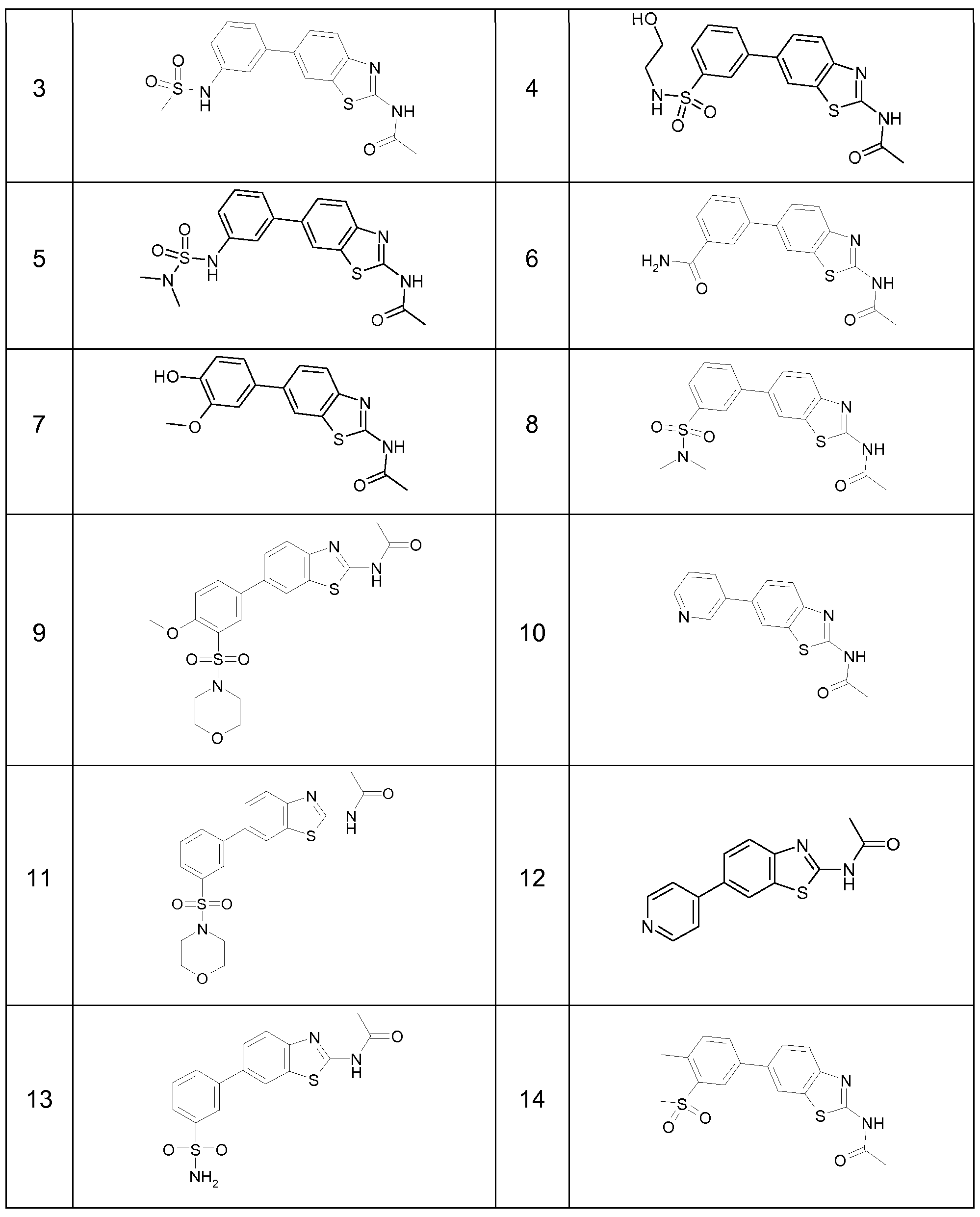


and pharmaceutically acceptable derivatives, solvates, tautomers, salts and stereoisomers thereof, including mixtures thereof in all ratios.
The compounds of the formula I and related formulae and also the starting materials for the preparation thereof are, in addition, prepared by methods known per se, as described in the literature (for example in the standard works, such as Houben-Weyl, Methoden der organischen Chemie [Methods of Organic Chemistry], Georg-Thieme- Verlag, Stuttgart), under reaction conditions which are known and suitable for the said reactions. For all the protection and deprotection methods, see Philip J. Kocienski, in "Protecting Groups", Georg Thieme Verlag Stuttgart, New York, 1994 and, Theodora W. Greene and Peter G. M. Wuts in "Protective Groups in Organic Synthesis", Wiley Interscience, 3rd Edition 1999.
Use can also be made here of variants which are known per se, but are not mentioned here in greater detail.
If desired, the starting materials can also be formed in situ so that they are not isolated from the reaction mixture, but instead are immediately converted further into the compounds of the formula I.
The starting compounds for the preparation of compounds of formula I and related formulae are generally known. If they are novel, they can, however, be prepared by methods known per se.
The reactions are preferably carried out in an inert solvent. Examples of suitable inert solvents are hydrocarbons, such as hexane, petroleum ether, benzene, toluene or xylene; chlorinated hydrocarbons, such as trichloroethylene, 1 ,2-dichloroethane, tetrachloromethane, chloroform or dichloromethane; alcohols, such as methanol, ethanol, isopropanol, n-propanol, n-butanol or tert-butanol; ethers, such as diethyl ether, diisopropyl ether, tetrahydrofuran (THF) or dioxane; glycol ethers, such as ethylene glycol monomethyl or monoethyl ether or ethylene glycol dimethyl ether (diglyme); ketones, such as acetone or butanone; amides, such as acetamide, dimethylacetamide or dimethyl- formamide (DMF); nitriles, such as acetonitrile; sulfoxides, such as dimethyl sulfoxide (DMSO); carbon disulfide; carboxylic acids, such as formic acid or acetic acid; nitro compounds, such as nitromethane or nitrobenzene; esters, such as ethyl acetate, or mixtures of the said solvents.
Therefore, the invention also relates to the preparation of the compounds of formula (I), (II), (Vl) and (V) and salts thereof, as described in scheme 2.
Scheme 2

A) the step of reacting a compound of Formula (l-l) or (III) with L5-X-L4 where L4 is preferably a chloride, imidazoyl or para-nitrophenoxy and L5 is preferably chloride, imidazoyl or trichloromethoxy to form compounds of Formulae (Vl) or (V), respectively;
B) the step of reacting a compound of Formula (l-l) or (III) with L2-X-Ra where L2 is preferably a chloride, a carboxylate, or OH in the presence of coupling reagent(s), preferably DCC, DIC, EDC, HOBt or N-hydroxysuccinimide, to form compounds of Formulae (I) or (II), respectively;
Accordingly, the invention relates, in particular, to the use of formula I and related formulae as defined above, as a medicament.
Accordingly, the invention relates, in particular, to the use of compounds of the formula I and related formulae as defined above, for the preparation of pharmaceutical formulation for the prevention and/or the treatment of multiple sclerosis, cancers and related disorders such as monocytic leukaemia, lung adenocarcinoma, small-cell lung carcinomas, pancreatic cancer, acute myelotic leukaemia, chronic myelotic leukaemia, acute lymphatic leukaemia and/or chronic lymphatic leukaemia, glioblastomas and breast carcinoma and colon carcinoma, tumour of the blood and immune system, tumours of the squamous epithelium, of the bladder, of the stomach, of the kidneys, of head and neck, of the oesophagus, of the cervix, of the thyroid, of the intestine, of the liver, of the brain, of the prostate, of the urogenital tract, of the lymphatic system, of the larynx and/or of the lung,
The said compounds of the formula I and related formulae can be used in their final non-salt form. On the other hand, the present invention also relates to the use of these compounds in the form of their pharmaceutically acceptable salts, which can be derived from various organic and inorganic acids and bases by procedures known in the art. Pharmaceutically acceptable salt forms of the compounds of the formula I are
for the most part prepared by conventional methods. If the compound of the formula I and related formulae contains an acidic center, such as a carboxyl group, one of its suitable salts can be formed by reacting the compound with a suitable base to give the corresponding base-addition salt. Such bases are, for example, alkali metal hydroxides, including potassium hydroxide, sodium hydroxide and lithium hydroxide; alkaline earth metal hydroxides, such as barium hydroxide and calcium hydroxide; alkali metal alkoxides, for example sodium- or potassium methoxide and sodium or potassiumpropoxide, alkalihydrides, such as sodium- or potassiumhydride; and various organic bases, such as piperidine, diethanolamine and N-methyl-glutamine, benzathine, choline, diethanolamine, ethylenediamine, meglumine, benethamine, diethylamine, piperazine and tromethamine. The aluminium salts of the compounds of the formula I and related formulae are likewise included. In the case of certain compounds of the formula I and related formulae, which contain a basic center, acid- addition salts can be formed by treating these compounds with pharmaceutically acceptable organic and inorganic acids, for example hydrogen halides, such as hydrogen chloride, hydrogen bromide or hydrogen iodide, other mineral acids and corresponding salts thereof, such as sulfate, nitrate or phosphate and the like, and alkyl- and monoaryl-sulfonates, such as ethanesulfonate, toluenesulfonate and benzene-sulfonate, and other organic acids and corresponding salts thereof, such as acetate, trifluoro-acetate, tartrate, maleate, succinate, citrate, benzoate, salicylate, ascorbate and the like. Accordingly, pharmaceutically acceptable acid-addition salts of the compounds of the formula I and related formulae include the following: acetate, adipate, alginate, arginate, aspartate, benzoate, benzene-sulfonate (besylate), bisulfate, bisulfite, bromide, butyrate, camphorate, camphor-sulfonate, caprylate, chloride, chlorobenzoate, citrate, cyclo-pentane-propionate, digluconate, dihydrogen-phosphate, dinitrobenzoate, dodecyl-sulfate, ethanesulfonate, fumarate, galacterate (from mucic acid), galacturonate, glucoheptanoate, gluco-nate, glutamate, glycerophosphate, hemi-succinate, hemisulfate, heptanoate, hexanoate, hippurate, hydro-chloride, hydrobromide, hydroiodide, 2-hydroxy-ethane-sulfonate, iodide, isethionate, isobutyrate, lactate, lactobionate, malate, maleate, malonate, mandelate, metaphosphate, methanesulfonate, methylbenzoate, mono-hydrogen-phosphate, 2- naphthalenesulfonate, nicotinate, nitrate, oxalate, oleate, palmo-ate, pectinate, persulfate, phenylacetate, 3-phenylpropionate, phosphate, phosphonate, phthalate, but this does not represent a restriction. Both types of salts may be formed or interconverted preferably using ion-exchange resin techniques.
Furthermore, the base salts of the compounds of the formula I and related formulae include aluminium, ammonium, calcium, copper, iron(lll), iron(ll), lithium, magne-sium, manganese(lll), manganese(ll), potassium, sodium and zink salts, but this is not intended to represent a restriction. Of the above-mentioned salts, preference is given to ammonium; the alkali metal salts sodium and potassium, and the alkaline earth metal salts calcium and magnesium. Salts of the compounds of the formula I which are derived from pharmaceutically acceptable organic non-toxic bases include salts of primary, secondary and tertiary amines, substituted amines, also including naturally occurring substituted amines, cyclic amines, and basic ion exchanger resins, for example arginine, betaine, caffeine, chloroprocaine, choline, N,N'-dibenzyl-ethylen-ediamine (benzathine), dicyclohexylamine, diethanol-amine, diethyl-amine, 2-diethyl-amino-ethanol, 2-dimethyl-amino-ethanol, ethanolamine, ethylenediamine, N-ethylmorpholine, N-ethyl-piperidine, glucamine, glucosamine, histidine, hydrabamine, isopropyl-amine, lido-caine, lysine, meglumine (N-methyl-D- glucamine), morpholine, piperazine, piperidine, polyamine resins, procaine, purines, theobromine, triethanol-amine, triethylamine, trimethylamine, tripropyl-amine and tris(hydroxy-methyl)-methylamine (tromethamine), but this is not intended to represent a restriction. Compounds of the formula I and related formulae of the present invention which contain basic nitrogen-containing groups can be quaternised using agents such as (Ci-C4)-alkyl halides, for example methyl, ethyl, isopropyl and tert-butyl chloride, bromide and iodide; di(CrC4)alkyl sulfates, for example dimethyl, diethyl and diamyl sulfate; (CiO-Ci8)alkyl halides, for example decyl, do-decyl, lauryl, myristyl and stearyl chloride, bromide and iodide; and aryl-(Ci-C4)alkyl halides, for example benzyl chloride and phenethyl bromide. Both water- and oil-soluble compounds of the formula I can be prepared using such salts.
The above-mentioned pharmaceutical salts which are preferred include acetate, trifluoroacetate, besylate, citrate, fumarate, gluconate, hemisuccinate, hippurate, hydrochloride, hydrobromide, isethionate, mandelate, me-glumine, nitrate, oleate, phosphonate, pivalate, sodium phosphate, stea-rate, sulfate, subsalicylate, tartrate, thiomalate, tosylate and tro-meth-amine, but this is not intended to represent a restriction.
The acid-addition salts of basic compounds of the formula I and related formulae are prepared by bringing the free base form into contact with a sufficient amount of the desired acid, causing the formation of the salt in a conventional manner. The free base can be regenerated by bringing the salt form into contact with a base and isolating the free base in a conventional manner. The free base forms differ in a certain respect from the corresponding salt forms thereof with respect to certain physical properties, such as solubility in polar solvents; for the purposes of the invention, however, the salts other-wise correspond to the respective free base forms thereof.
As mentioned, the pharmaceutically acceptable base-addition salts of the compounds of the formula I are formed with metals or amines, such as alkali metals and alkaline earth metals or organic amines. Preferred metals are sodium, potassium, magnesium and calcium. Preferred organic amines are N,N'-dibenzylethylenediamine, chloroprocaine, choline, diethanol-amine, ethylenediamine, N-methyl-D-glucamine and procaine.
The base-addition salts of acidic compounds of the formula I and related formulae are prepared by bringing the free acid form into contact with a sufficient amount of the desired base, causing the formation of the salt in a conventional manner. The free acid can be regenerated by bringing the salt form into contact with an acid and isolating the free acid in a conventional manner. The free acid forms differ in a certain respect from the corresponding salt forms thereof with respect to certain physical properties, such as solubility in polar solvents; for the purposes of the invention, however, the salts other-wise correspond to the respective free acid forms thereof.
If a compound of the formula I and related formulae contains more than one group which is capable of forming pharmaceutically acceptable salts of this type, the formula I also encompasses multiple salts. Typical multiple salt forms include, for example, bitartrate, diacetate, difumarate, dimeglumine, di-phosphate, disodium and trihydrochloride, but this is not intended to represent a restriction.
With regard to that stated above, it can be seen that the term "pharmaceutically acceptable salt" in the present connection is taken to mean an active ingredient which comprises a compound of the formula I and related formulae in the form of one of its
salts, in particular if this salt form imparts improved pharmacokinetic properties on the active ingredient compared with the free form of the active ingredient or any other salt form of the active ingredient used earlier. The pharmaceutically acceptable salt form of the active ingredient can also provide this active ingredient for the first time with a desired pharmacokinetic property which it did not have earlier and can even have a positive influence on the pharmacodynamics of this active ingredient with respect to its therapeutic efficacy in the body.
Owing to their molecular structure, the compounds of the formula I and related formulae can be chiral and can accordingly occur in various enantiomeric forms. They can therefore exist in racemic or in optically active form. Since the pharmaceutical activity of the racemates or stereoisomers of the compounds according to the invention may differ, it may be desirable to use the enantiomers. In these cases, the end product or even the intermediates can be separated into enantiomeric compounds by chemical or physical measures known to the person skilled in the art or even employed as such in the synthesis.
In the case of racemic amines, diastereomers are formed from the mixture by reaction with an optically active resolving agent. Examples of suitable resolving agents are optically active acids, such as the R and S forms of tartaric acid, diacetyltartaric acid, dibenzoyltartaric acid, mandelic acid, malic acid, lactic acid, suitable N-protected amino acids (for example N-benzoylproline or N- benzenesulfonylproline), or the various optically active camphorsulfonic acids. Also advantageous is chromatographic enantiomer resolution with the aid of an optically active resolving agent (for example dinitrobenzoylphenylglycine, cellulose triacetate or other derivatives of carbohydrates or chirally derivatised methacrylate polymers immobilised on silica gel). Suitable eluents for this purpose are aqueous or alcoholic solvent mixtures, such as, for example, hexane/isopropanol/ acetonitrile, for example in the ratio 82:15:3.
The invention furthermore relates to the use of compounds of formula I and related formulae in combination with at least one further medicament active ingredient, preferably medicaments used in the treatment of multiple sclerosis such as cladribine or another co-agent, such as interferon, e.g. pegylated or non-pegylated interferons, preferably interferon beta and/or with compounds improving vascular function or in
combination with immunomodulating agents for example Fingolimod; cyclosporins, rapamycins or ascomycins, or their immunosuppressive analogs, e.g. cyclosporin A, cyclosporin G, FK-506, ABT-281 , ASM981 , rapamycin, 40-O-(2-hydroxy)ethyl- rapamycin etc.; corticosteroids; cyclophosphamide; azathioprene; methotrexate; leflunomide; mizoribine; mycophenolic add; mycophenolate mofetil; 15- deoxyspergualine; diflucortolone valerate; difluprednate; Alclometasone dipropionate; amcinonide; amsacrine; asparaginase; azathioprine; basiliximab; beclometasone dipropionate; betamethasone; betamethasone acetate; betamethasone dipropionate; betamethasone phosphate sodique; betamethasone valerate; budesonide; captopril; chlormethine chlorhydrate; cladribine; clobetasol propionate; cortisone acetate; cortivazol; cyclophosphamide; cytarabine; daclizumab; dactinomycine; desonide; desoximetasone; dexamethasone; dexamethasone acetate; dexamethasone isonicotinate; dexamethasone metasulfobenzoate sodique; dexamethasone phosphate;dexamethasone tebutate;dichlorisone acetate; doxorubicine chlorhydrate; epirubicine chlorhydrate; fluclorolone acetonide; fludrocortisone acetate; fludroxycortide; flumetasone pivalate; flunisolide; fluocinolone acetonide; fluocinonide; fluocortolone; fluocortolone hexanoate; fluocortolone pivalate; fluorometholone; fluprednidene acetate; fluticasone propionate; gemcitabine chlorhydrate; halcinonide; hydrocortisone, hydrocortisone acetate, hydrocortisone butyrate, hydrocortisone hemisuccinate; melphalan; meprednisone; mercaptopurine; methylprednisolone; methylprednisolone acetate; methylprednisolone hemisuccinate; misoprostol; muromonab-cd3; mycophenolate mofetil; paramethasone acetate; prednazoline, prednisolone; prednisolone acetate; prednisolone caproate; prednisolone metasulfobenzoate sodique; prednisolone phosphate sodique; prednisone; prednylidene; rifampicine; rifampicine sodique; tacrolimus; thalidomide; thiotepa; tixocortol pivalate; triamcinolone; triamcinolone acetonide hemisuccinate; triamcinolone benetonide; triamcinolone diacetate; triamcinolone hexacetonide; immunosuppressive monoclonal antibodies, e.g., monoclonal antibodies to leukocyte receptors, e.g., MHC, CD2, CD3, CD4, CD7, CD25, CD28, B7, CD40, CD45 or CD58 or their ligands; or other immunomodulatory compounds, e.g. CTLA41g, or other adhesion molecule inhibitors, e.g. mAbs or low molecular weight inhibitors including Selectin antagonists and VLA-4 antagonists. A preferred composition is with Cyclosporin A, FK506, rapamycin or 40-(2-hydroxy)ethyl-rapamycin and Fingolimod. These further medicaments, such as interferon beta, may be administered concomitantly or sequentially, e.g. by subcutaneous, intramuscular or oral routes.
The invention furthermore relates to the use of compounds of formula I and related formulae in combination with at least one further medicament active ingredient, preferably medicaments used in the treatment of cancer wherein said antitumoral compounds are selected from those well known by the one skilled in the related art. These compositions can be used as medicaments in human and veterinary medicine.
Pharmaceutical formulations can be administered in the form of dosage units, which comprise a predetermined amount of active ingredient per dosage unit. Such a unit can comprise, for example, 0.5 mg to 1 g, preferably 1 mg to 700 mg, particularly preferably 5 mg to 100 mg, of a compound according to the invention, depending on the disease condition treated, the method of administration and the age, weight and condition of the patient, or pharmaceutical formulations can be administered in the form of dosage units which comprise a predetermined amount of active ingredient per dosage unit. Preferred dosage unit formulations are those which comprise a daily dose or part-dose, as indicated above, or a corresponding fraction thereof of an active ingredient. Furthermore, pharmaceutical formulations of this type can be prepared using a process, which is generally known in the pharmaceutical art.
Pharmaceutical formulations can be adapted for administration via any desired suitable method, for example by oral (including buccal or sublingual), rectal, nasal, topical (including buccal, sublingual or transdermal), vaginal or parenteral (including subcutaneous, intramuscular, intravenous or intradermal) methods. Such formulations can be prepared using all processes known in the pharmaceutical art by, for example, combining the active ingredient with the excipient(s) or adjuvant(s).
Pharmaceutical formulations adapted for oral administration can be administered as separate units, such as, for example, capsules or tablets; powders or granules; solutions or suspensions in aqueous or non-aqueous liquids; edible foams or foam foods; or oil-in-water liquid emulsions or water-in-oil liquid emulsions.
Thus, for example, in the case of oral administration in the form of a tablet or capsule, the active-ingredient component can be combined with an oral, non-toxic and pharmaceutically acceptable inert excipient, such as, for example, ethanol, glycerol, water and the like. Powders are prepared by comminuting the compound to a suitable fine size and mixing it with a pharmaceutical excipient comminuted in a similar
manner, such as, for example, an edible carbohydrate, such as, for example, starch or mannitol. A flavour, preservative, dispersant and dye may likewise be present.
Capsules are produced by preparing a powder mixture as described above and filling shaped gelatine shells therewith. Glidants and lubricants, such as, for example, highly disperse silicic acid, talc, magnesium stearate, calcium stearate or polyethylene glycol in solid form, can be added to the powder mixture before the filling operation. A disintegrant or solubiliser, such as, for example, agar-agar, calcium carbonate or sodium carbonate, may likewise be added in order to improve the availability of the medica-ment after the capsule has been taken.
In addition, if desired or necessary, suitable binders, lubricants and disintegrants as well as dyes can likewise be incorporated into the mixture. Suitable binders include starch, gelatine, natural sugars, such as, for example, glucose or beta-lactose, sweeteners made from maize, natural and synthetic rubber, such as, for example, acacia, tragacanth or sodium alginate, carboxymethylcellulose, polyethylene glycol, waxes, and the like. The lubricants used in these dosage forms include sodium oleate, sodium stearate, magnesium stearate, sodium benzoate, sodium acetate, sodium chloride and the like. The disintegrants include, without being restricted thereto, starch, methylcellulose, agar, bentonite, xanthan gum and the like. The tablets are formulated by, for example, preparing a powder mixture, granulating or dry-pressing the mixture, adding a lubricant and a disintegrant and pressing the entire mixture to give tablets. A powder mixture is prepared by mixing the compound comminuted in a suitable manner with a diluent or a base, as described above, and optionally with a binder, such as, for example, carboxymethylcellulose, an alginate, gelatine or polyvinylpyrrolidone, a dissolution retardant, such as, for example, paraffin, an absorption accelerator, such as, for example, a quaternary salt, and/or an absorbant, such as, for example, bentonite, kaolin or dicalcium phosphate. The powder mixture can be granulated by wetting it with a binder, such as, for example, syrup, starch paste, acadia mucilage or solutions of cellulose or polymer materials and pressing it through a sieve. As an alternative to granulation, the powder mixture can be run through a tableting machine, giving lumps of non-uniform shape which are broken up to form granules. The granules can be lubricated by addition of stearic acid, a stearate salt, talc or mineral oil in order to prevent sticking to the tablet casting moulds. The lubricated mixture is then pressed to give tablets. The active ingredients
can also be combined with a free-flowing inert excipient and then pressed directly to give tablets without carrying out the granulation or dry-pressing steps. A transparent or opaque protective layer consisting of a shellac sealing layer, a layer of sugar or polymer material and a gloss layer of wax may be present. Dyes can be added to these coatings in order to be able to differentiate between different dosage units.
Oral liquids, such as, for example, solution, syrups and elixirs, can be prepared in the form of dosage units so that a given quantity comprises a pre-specified amount of the compounds. Syrups can be prepared by dissolving the compounds in an aqueous solution with a suitable flavour, while elixirs are prepared using a non-toxic alcoholic vehicle. Suspensions can be for-mulated by dispersion of the compounds in a nontoxic vehicle. Solubilisers and emulsifiers, such as, for example, ethoxylated isostearyl alcohols and polyoxyethylene sorbitol ethers, preservatives, flavour additives, such as, for example, peppermint oil or natural sweeteners or saccharin, or other artificial sweeteners and the like, can likewise be added.
The dosage unit formulations for oral administration can, if desired, be encapsulated in microcapsules. The formulation can also be prepared in such a way that the release is extended or retarded, such as, for example, by coating or embedding of particulate material in polymers, wax and the like.
The compounds of the formula I and related formulae and salts, solvates and physiologically functional derivatives thereof and the other active ingredients can also be administered in the form of liposome delivery systems, such as, for exam-pie, small unilamellar vesicles, large unilamellar vesicles and multilamellar vesicles.
Liposomes can be formed from various phospholipids, such as, for example, cholesterol, stearylamine or phosphatidylcholines.
The compounds of the formula I and related formulae and the salts, solvates and physiologically functional derivatives thereof and the other active ingredients can also be delivered using monoclonal antibodies as individual carriers to which the compound molecules are coupled. The compounds can also be coupled to soluble polymers as targeted medicament carriers. Such polymers may encompass polyvinylpyrrolidone, pyran copolymer, polyhydroxypropyl-methacrylamidophenol, polyhydroxyethylaspartamido-phenol or polyethylene oxide polylysine, substituted by
palmitoyl radicals. The compounds may furthermore be coupled to a class of biodegradable polymers which are suitable for achieving controlled release of a medicament, for example polylactic acid, poly-epsilon-caprolactone, polyhydroxybutyric acid, poly-orthoesters, polyacetals, polydihydroxypyrans, polycyanoacrylates and crosslinked or amphipathic block copolymers of hydrogels.
Pharmaceutical formulations adapted for transdermal administration can be administered as independent plasters for extended, close contact with the epidermis of the recipient. Thus, for example, the active ingredient can be delivered from the plaster by iontophoresis, as described in general terms in Pharmaceutical Research,
3(6), 318 (1986).
Pharmaceutical compounds adapted for topical administration can be formulated as ointments, creams, suspensions, lotions, powders, solutions, pastes, gels, sprays, aerosols or oils.
For the treatment of the eye or other external tissue, for example mouth and skin, the formulations are preferably applied as topical ointment or cream. In the case of formulation to give an ointment, the active ingredient can be employed either with a paraffinic or a water-miscible cream base. Alternatively, the active ingredient can be formulated to give a cream with an oil-in-water cream base or a water-in-oil base.
Pharmaceutical formulations adapted for topical application to the eye include eye drops, in which the active ingredient is dissolved or sus-pended in a suitable carrier, in particular an aqueous solvent.
Pharmaceutical formulations adapted for topical application in the mouth encompass lozenges, pastilles and mouthwashes.
Pharmaceutical formulations adapted for rectal administration can be administered in the form of suppositories or enemas.
Pharmaceutical formulations adapted for nasal administration in which the carrier substance is a solid comprise a coarse powder having a particle size, for example, in the range 20-500 microns, which is administered in the manner in which snuff is
taken, i.e. by rapid inhalation via the nasal passages from a container containing the powder held close to the nose. Suitable formulations for administration as nasal spray or nose drops with a liquid as carrier substance encompass active-ingredient solutions in water or oil.
Pharmaceutical formulations adapted for administration by inhalation encompass finely particulate dusts or mists, which can be generated by various types of pressurised dispensers with aerosols, nebulisers or insuf-flators.
Pharmaceutical formulations adapted for vaginal administration can be administered as pessaries, tampons, creams, gels, pastes, foams or spray formulations.
Pharmaceutical formulations adapted for parenteral administration include aqueous and non-aqueous sterile injection solutions comprising antioxidants, buffers, bacteriostatics and solutes, by means of which the formulation is rendered isotonic with the blood of the recipient to be treated; and aqueous and non-aqueous sterile suspensions, which may comprise suspension media and thickeners. The formulations can be administered in single-dose or multidose containers, for example sealed ampoules and vials, and stored in freeze-dried (lyophilised) state, so that only the addition of the sterile carrier liquid, for example water for injection purposes, immediately before use is necessary.
Injection solutions and suspensions prepared in accordance with the recipe can be prepared from sterile powders, granules and tablets.
It goes without saying that, in addition to the above particularly mentioned constituents, the formulations may also comprise other agents usual in the art with respect to the particular type of formulation; thus, for example, formulations which are suitable for oral administration may comprise flavours.
A therapeutically effective amount of a compound of the formula I and related formulae and of the other active ingredient depends on a number of factors, including, for example, the age and weight of the animal, the precise disease condition which requires treatment, and its severity, the nature of the formulation and the method of administration, and is ultimately determined by the treating doctor or vet. However, an
effective amount of a compound is generally in the range from 0.1 to 100 mg/kg of body weight of the recipient (mammal) per day and particularly typically in the range from 1 to 10 mg/kg of body weight per day. Thus, the actual amount per day for an adult mammal weighing 70 kg is usually between 70 and 700 mg, where this amount can be administered as an individual dose per day or usually in a series of part-doses
(such as, for example, two, three, four, five or six) per day, so that the total daily dose is the same. An effective amount of a salt or solvate or of a physiologically functional derivative thereof can be determined as the fraction of the effective amount of the compound per se.
The present invention furthermore relates to a method for treating a subject suffering from a PI3K related disorder, comprising administering to said subject an effective amount of a compound of formula I and related formulae. The present invention preferably relates to a method, wherein the PI3K associated disorder is an autoimmune disorder or condition associated with an overactive immune response or cancer. The present invention furthermore relates to a method of treating a subject suffering from an immunerogulatory abnomality, comprising administering to said subject a compound of formula I and related formulae in an amount that is effective for treating said immunoregulatory abnormality. The present invention preferably relates to a method wherein the immunoregulatory abnormality is an autoimmune or chronic inflammatory disease selected from the group consisting of: amyotrophic lateral sclerosis (ALS), systemic lupus erythematosus, chronic rheumatoid arthritis, type I diabetes mellitus, inflammatory bowel disease, biliary cirrhosis, uveitis, multiple sclerosis, Crohn's disease, ulcerative colitis, bullous pemphigoid, sarcoidosis, psoriasis, autoimmune myositis, Wegener's granulomatosis, ichthyosis, Graves ophthalmopathy and asthma. The present invention furthermore relates to a method wherein the immunoregulatory abnormality is bone marrow or organ transplant rejection or graft-versus-host disease. The present invention furthermore relates to a method wherein the immunoregulatory abnormality is selected from the group consisting of: transplantation of organs or tissue, graft-versus-host diseases brought about by transplantation, autoimmune syndromes including rheumatoid arthritis, systemic lupus erythematosus, Hashimoto's thyroiditis, multiple sclerosis, myasthenia gravis, type I diabetes, uveitis, posterior uveitis, allergic encephalomyelitis, glomerulonephritis, post-infectious autoimmune diseases including rheumatic fever and post-infectious glomerulonephritis, inflammatory and hyperproliferative skin
diseases, psoriasis, atopic dermatitis, contact dermatitis, eczematous dermatitis, seborrhoeic dermatitis, lichen planus, pemphigus, bullous pemphigoid, epidermolysis bullosa, urticaria, angioedemas, vasculitis, erythema, cutaneous eosinophilia, lupus erythematosus, acne, alopecia areata, keratoconjunctivitis, vernal conjunctivitis, uveitis associated with Behcet's disease, keratitis, herpetic keratitis, conical cornea, dystrophia epithelialis corneae, corneal leukoma, ocular pemphigus, Mooren's ulcer, scleritis, Graves' opthalmopathy, Vogt-Koyanagi-Harada syndrome, sarcoidosis, pollen allergies, reversible obstructive airway disease, bronchial asthma, allergic asthma, intrinsic asthma, extrinsic asthma, dust asthma, chronic or inveterate asthma, late asthma and airway hyper-responsiveness, bronchitis, gastric ulcers, vascular damage caused by ischemic diseases and thrombosis, ischemic bowel diseases, inflammatory bowel diseases, necrotizing enterocolitis, intestinal lesions associated with thermal burns, coeliac diseases, proctitis, eosinophilic gastroenteritis, mastocytosis, Crohn's disease, ulcerative colitis, migraine, rhinitis, eczema, interstitial nephritis, Goodpasture's syndrome, hemolytic-uremic syndrome, diabetic nephropathy, multiple myositis, Guillain-Barre syndrome, Meniere's disease, polyneuritis, multiple neuritis, mononeuritis, radiculopathy, hyperthyroidism, Basedow's disease, pure red cell aplasia, aplastic anemia, hypoplastic anemia, idiopathic thrombocytopenic purpura, autoimmune hemolytic anemia, agranulocytosis, pernicious anemia, megaloblastic anemia, anerythroplasia, osteoporosis, sarcoidosis, fibroid lung, idiopathic interstitial pneumonia, dermatomyositis, leukoderma vulgaris, ichthyosis vulgaris, photoallergy sensitivity, cutaneous T cell lymphoma, chronic lymphocytic leukemia, arteriosclerosis, atherosclerosis, aortitis syndrome, polyarteritis nodosa, myocardosis, scleroderma, Wegener's granuloma, Sjogren's syndrome, adiposis, eosinophilic fascitis, lesions of gingiva, periodontium, alveolar bone, substantia ossea dentis, glomerulonephritis, male pattern alopecia or alopecia senilis by preventing epilation or providing hair germination and/or promoting hair generation and hair growth, muscular dystrophy, pyoderma and Sezary's syndrome, Addison's disease, ischemia-reperfusion injury of organs which occurs upon preservation, transplantation or ischemic disease, endotoxin-shock, pseudomembranous colitis, colitis caused by drug or radiation, ischemic acute renal insufficiency, chronic renal insufficiency, toxinosis caused by lung-oxygen or drugs, lung cancer, pulmonary emphysema, cataracta, siderosis, retinitis pigmentosa, senile macular degeneration, vitreal scarring, corneal alkali burn, dermatitis erythema multiforme, linear IgA ballous dermatitis and cement dermatitis,
gingivitis, periodontitis, sepsis, pancreatitis, diseases caused by environmental pollution, aging, carcinogenesis, metastasis of carcinoma and hypobaropathy, disease caused by histamine or Ieukotriene-C4 release, Behcet's disease, autoimmune hepatitis, primary biliary cirrhosis, sclerosing cholangitis, partial liver resection, acute liver necrosis, necrosis caused by toxin, viral hepatitis, shock, or anoxia, B-virus hepatitis, non-A/non-B hepatitis, cirrhosis, alcoholic cirrhosis, hepatic failure, fulminant hepatic failure, late-onset hepatic failure, "acute-on-chronic" liver failure, augmentation of chemotherapeutic effect, cytomegalovirus infection, HCMV infection, AIDS, cancer, senile dementia, parkison diseases, trauma, and chronic bacterial infection.
In the following preferred embodiments are disclosed:
Use of a compound of formula I for the preparation of a medicament for the treatment and prophylaxis of cancer diseases.
Use of a compound of formula I for the preparation of a medicament for the treatment and prophylaxis of cancer diseases, where the cancer diseases are associated with a tumor from the group of tumours of the squamous epithelium, of the bladder, of the stomach, of the kidneys, of head and neck, of the oesophagus, of the cervix, of the thyroid, of the intestine, of the liver, of the brain, of the prostate, of the urogenital tract, of the lymphatic system, of the stomach, of the larynx and/or of the lung.
Use of a compound of formula I for the preparation of a medicament for the treatment and prophylaxis of tumors, where the tumour originates from the group of monocytic leukaemia, lung adenocarcinoma, small-cell lung carcinomas, pancreatic cancer, glioblastomas and breast carcinoma and colon carcinoma or of the blood and immune system.
Use of compounds of formula I and pharmaceutically usable derivatives, salts, tautomers, solvates and stereoisomers thereof, including mixtures thereof in all ratios, for the preparation of a medicament for the treatment and/or prophylaxis of diseases in which the inhibition, activation, regulation, and/or modulation of PI3Kγ receptor signal transduction plays a role and for treatment of autoimmune disorders and/or inflammatory diseases, cardiovascular diseases, neurodegenerative diseases,
bacterial or viral infections, allergy, asthma, pancreatitis, multi-organe failure, kidney diseases, platelet aggregation, cancer, transplantation, sperm motility, erythrocyte deficiency, graft rejection or lung injuries.
Use of compounds of formula I and pharmaceutically usable derivatives, salts, tautomers, solvates and stereoisomers thereof, including mixtures thereof in all ratios, for the preparation of a medicament for the treatment of multiple sclerosis, psoriasis, rheumatoid arthritis, systemic lupus erythematosis, inflammatory bowel disease, lung inflammation, thrombosis or brain infection/inflammation such as meningitis or encephalitis, Alzheimer's disease, Huntington's disease, CNS trauma, stroke or ischemic conditions atherosclerosis, heart hypertrophy, cardiac myocyte dysfunction, elevated blood pressure or vasoconstriction, chronic obstructive pulmonary disease, anaphylactic shock fibrosis, psoriasis, allergic diseases, asthma, stroke or ischemic conditions, ischemia-reperfusion, platelets aggregation/activation, skeletal muscle atrophy/hypertrophy, leukocyte recruitment in cancer tissue, angiogenesis, invasion metastisis, melanoma, Karposi's sarcoma, acute and chronic bacterial and viral infections, sepsis, graft rejection, glomerulo sclerosis, glomerulo nephritis, progressive renal fibrosis, endothelial and epithelial injuries in the lung or in general lung airways inflammation.
Preferred compounds of formula I and related formulae exhibit a IC50 for the binding to PI3Kγ of less than about 5 μM, preferably less than about 1 μM and even more preferred less than about 0,010 μM.
Compounds according to formula formula I and related formulae may be prepared from readily available starting materials using the following general methods and procedures. It will be appreciated that where typical or preferred experimental conditions (i.e. reaction temperatures, time, moles of reagents, solvents etc.) are given, other experimental conditions can also be used unless otherwise stated.
Optimum reaction conditions may vary with the particular reactants or solvents used, but such conditions can be determined by the person skilled in the art, using routine optimisation procedures.
In general, the synthesis pathways for any individual compound of formula I and related formulae will depend on the specific substitutents of each molecule and upon the ready availability of intermediates necessary; again such factors being appreciated by those of ordinary skill in the art.
Compounds of this invention can be isolated in association with solvent molecules by crystallization from evaporation of an appropriate solvent. The pharmaceutically acceptable acid addition salts of the compounds of formula I and related formulae which contain a basic center, may be prepared in a conventional manner. For example, a solution of the free base may be treated with a suitable acid, either neat or in a suitable solution, and the resulting salt isolated either by filtration or by evaporation under vacuum of the reaction solvent. Pharmaceutically acceptable base addition salts may be obtained in an analogous manner by treating a solution of compound of formula I and related formulae, which contain an acid center, with a suitable base. Both types of salts may be formed or interconverted using ion- exchange resin techniques.
The compounds of invention have been named according the standards used in the program "ACD/Name Batch" from Advanced Chemistry Development Inc., ACD/Labs (7.00 Release). Product version: 7.10, build: 15 Sep 2003.
In the following the present invention shall be illustrated by means of some examples, which are not construed to be viewed as limiting the scope of the invention.
EXPERIMENTAL PART
The compounds of invention have been named according to the standards used in the program "ACD/Name Batch" from Advanced Chemistry Development Inc., ACD/Labs (7.00 Release). Product version: 7.10, build: 15 Sep 2003.
Ac (acetyl), ACN (acetonitrile), aq (aqueous), Boc (tert-butoxycarbonyl), cHex (cyclohexane), DCE (dichloroethane), DCM (dichloromethane), DIEA (diisopropylethylamine), DMA (dimethylacetamide), DMF (dimethylformamide), DMSO (dimethylsulfoxide), dppf (1 ,1'-bis(diphenylphosphino)ferrocene), EDC (1-
Ethyl-3-(3-dimethyllaminopropyl)carbodiimide), eq (equivalent), ESI (electro-spray ionization), Et (ethyl), Et2O (diethyl ether), EtOAc (ethyl acetate), h (hour), HOBt (N- hydroxybenzotriazole), HPLC (high performance liquid chromatography), iPr (isopropyl), L (liter), LC (liquid chromatography), m (meter), MD Autoprep (mass directed preparative HPLC), Me (methyl), MeOH (methanol), mg (milligram), min
(minute), mL (milliliter), μL (microliter), m.p. (melting point), mm (millimeter), μm (micrometer), mmol (millimole), MS (mass spectrometry), NMP (N- methylpyrrolydinone), NMM (N-methylmorpholine), NMR (nuclear magnetic resonance), PE (petroleum ether), Ph (phenyl), Rt (retention time), RT (room temperature), sat. (saturated), TBD (1 ,5,7-triazabicyclo[4.4.0]dec-5-ene), TEA
(triethylamine), TFA (trifluoroacetic acid), THF (tetrahydrofuran), UPLC (ultra performance liquid chromatography), UV (ultraviolet).
The commercially available starting materials used in the following experimental description were purchased from Sigma-Aldrich-Fluka unless otherwise reported.
However, specific reagents were purchased from another suppliers: 1-(2-aminoethyl)- 4-methyl-piperazine (Apollo), 2-amino-1-morpholin-4-yl-ethanone (Fluorochem), 3- aminocarbonylphenylboronic acid (ABCR), benzenesulfonamide-3-boronic acid pinacol ester (Frontier), beta-alanine tert-butyl ester hydrochloride (Bachem), 1 ,1 '- bis(diphenylphosphino)ferrocenedichloro palladium(ll) (Avocado), 4-bromo-1-fluoro-2-
(methylsulfonyl)benzene (Apollo), 4-bromo-1 -methyl-2-(methylsulfonyl)benzene (Peakdale), 5-bromopyridine-3-sulfonamide (Combi-Blocks), 6-chloropyridazin-3- amine (APOLLO), 4,5-dibromothiophene-2-sulfonyl chloride (ABCR), [3-(N, N- dimethylsulfamoylamino)phenyl]boronic acid (Combi-Blocks), N,N-dimethyl-3- boronobenzenesulfonamide (Combi-Blocks), ethyl 3-boronobenzenesulfonamide
(Combi-Blocks), (3-fluoro-4-hydroxyphenyl)boronic acid (Combi-Blocks), (3-fluoro-5- hydroxyphenyl)boronic acid (Combi-Blocks), 5-formylthiophen-3-boronic acid (Combi-Blocks), glycine dimethylamide acetate (Chem-lmpex), N-(2-hydroxyethyl)-3- boronobenzenesulfonamide (Combi-Blocks), 2-(3-isopropyl-1 ,2,4-oxadiazol-5- yl)ethanamine (Anichem), (3-methylsulfonylphenyl)boronic acid (Combi-Blocks), [4- methoxy-3-(morpholinosulfonyl)phenyl]boronic acid (Combi-Blocks), 3- (methylsulfonyl)aminobenzeneboronic acid (ABCR), N-morpholinyl 3- boronobenzenesulfonamide (Combi-Blocks), 5-pyrimidinylboronic acid (Combi- Blocks), 2-(1 ,2,4-triazole-1-yl)-ethylamine (ABCR), 2,2,2-trifluoroethyl formate (Synquest). methoxyacetic acid (Acros), 3-aminopropanenitrile (ABCR), 1-Λ/-boc-3-
cyano-pyrrolidine (ABCR), fe/f-butyl carbazate (Chem Impex International), propionyl chloride (Alfa Aesar), ethyl L-lactate (VWR International), 2-methyl-4,4,4- trifluorobutyric acid (Appolo Scientific), 2,2-difluorocyclobutane carboxylic acid (VWR International), 2-fluoroisobutyric acid (Fluorochem), 2-fluoropropionic acid (Fluorochem), 1-Boc-3-aminopyrrolidine (CHN Technologies Inc.), 5- bromonicotinonitrile (Alfa Aesar), 2-(5-methylisoxazol-3-yl)ethanamine (Otava), 1 ,3- dimethyl-1 /-/-pyrazole-4-boronic acid pinacol ester (Boron Molecular Inc), 1 ,3,5- trimethyl-4-(4,4,5,5-tetramethyl-[1 ,3,2]dioxaborolan-2-yl)-1 /-/-pyrazole (ABCR), (2,5- dimethyl-3-thienyl)boronic acid (Borochem), 2-methoxypyridine-3-boronic acid (Focus Synthesis LLC), 3-hydroxymethyl-pyrrolidine-1 -carboxylic acid te/f-butyl ester (Tyger
Scientific Inc.), 3-amino-6-chloropyridazine (Appolo), methyl 5-bromonicotinate (Avocado), 4-(4,4,5,5-tetramethyl-[1 ,3,2]dioxaborolan-2-yl)-1 H-indazole (J & W Pharma Lab LLC), 6-bromo-3/-/-imidazo[4,5-b]pyridine (Focus Synthesis LLC), 6- bromo-2-methyl-3/-/-imidazo[4,5-t)]pyridine (Focus Synthesis LLC), thiomorpholine (Chemie Brunschwig AG).
m.p., NMR, HPLC and MS data provided in the examples described below are registered on: NMR: Bruker DPX-300, using residual signal of deuterated solvent as internal reference.
HPLC: Waters Alliance 2695, column Waters XBridge C8 3.5 μm 4.6x50 mm, conditions: solvent A (H2O with 0.1% TFA), solvent B (ACN with 0.05% TFA), gradient 5% B to 100% B over 8 min, UV detection with PDA Water 996 (230-400 nm) or Agilent
Atlantis-1 : Column: Atlantis C18 (75X4.6mm, 5μ ), solvent A (H2O with 0.1% TFA), solvent B (ACN)
Atlantis-2 : Column: Atlantis C18 (75X4.6mm, 5μ ), solvent A (1 OmM NH4OAC), solvent B (ACN) X-Terra : XTERRA C18 (30X4.6mm -5μm), solvent A (1OmM NH4OAC), solvent B
(ACN)
C18 BDS: Column: C18 BDS (4.6X250mm), solvent A (H2O with 0.1 % TFA), solvent
B (ACN)
ECLIPSED: Column: ECLIPSED XDB C18 (250X4.6mm,5μ) , solvent A (H2O), solvent B (ACN)
LC/MS: Waters Alliance 2795, column Waters XBridge C8 3.5 μm 2.1x30 mm, conditions: solvent A (1OmM ammonium acetate in water + 5% ACN), solvent B (ACN), gradient 5% B to 100% B over 3 min, Waters Micromass ZMD (positive and negative ESI modes) or for "GENESIS", Column GENESIS C18 50X4.6mm 3U, conditions: solvent A: water, 0.1 %HCOOH, solvent B- ACN or Waters Acquity, column Waters Acquity UPLC BEH C18 1.7 μm 2.1x50 mm, conditions: solvent A (1 OmM ammonium acetate in water + 5% ACN), solvent B (ACN), gradient 5% B to 100% B over 3 min, UV detection (PDA, 230-400 nm) and MS detection (SQ detector, positive and negative ESI modes, cone voltage 30V).
m.p. were recorded on a MPA100 from Standford Research Systems and are uncorrected.
The microwave chemistry is performed on a single mode microwave reactor Emrys™ Optimiser from Personal Chemistry.
MD Autoprep purification: preparative HPLC purifications are performed with a mass directed autopurification Fractionlynx from Waters equipped with a Sunfire Prep C18 OBD column 19x100 mm 5 μm, unless otherwise reported. All HPLC purifications were performed with a gradient of ACN/H2O or ACN/H2O/HCOOH (0.1 %).
Intermediate 1 : Formation of Λ/-(6-bromo-1 ,3-benzothiazol-2-yl)acetamide

Intermediate 2: Formation of Λ/-[6-(4,4,5,5-tetramethyl-1 ,3,2-dioxaborolan-2-yl)- 1 ,3-benzothiazol-2-yl]acetamide

A mixture of Λ/-(6-bromo-1 ,3-benzothiazol-2-yl)acetamide (2.0 g, 7.38 mmol), bis(pinacolato)diboron (3.75 g, 14.75 mmol), 1 ,1'- bis(diphenylphosphino)ferrocenedichloro palladium(ll) (325 mg, 0.44 mmol) and potassium acetate (3.62 g, 36.88 mmol) in DMSO (24 ml) was prepared and the resulting mixture was heated at 800C for 5 hours. The reaction mixture was cooled at RT and poured into water (80 ml_), then extracted with EtOAc (2x50 ml_). The organic layers were combined, dried (MgSO4) and the solvents were concentrated under reduced pressure to give a brown oil. Purification by precipitation from methanol gave the title compound as an off-white powder (1.75 g, 75%). UPLC/MS, M+(ESI): 319.2,
M-(ESI): 317.3. 1 H-NMR (DMSO-d6): δ 12.44 (s, 1 H), 8.26 (brs, 1 H), 7.71 (brs, 2H), 2.21 (s, 3H), 1.31 (s, 12H).
Intermediate 3: Formation of 6-bromo[1 ,2,4]triazolo[1 ,5-a]pyridin-2-amine Step a) Formation of ethyl {[(5-bromopyridin-2-yl)amino]carbonothioyl}carbamate

A solution of 2-amino-5-bromopyridine (8.9 g, 51.2 mmol) and ethoxycarbonyl isothiocyanate (7.7 g, 58.9 mmol) in dioxane (100 ml.) was stirred at RT overnight. The resulting precipitate was filtered off and washed with cyclohexane to give the title compound as a pale yellow powder (12.3 g, 79%). HPLC, Rt: 4.1 min (purity 99.9%).
LC/MS, M+(ESI): 305.9.
Step b) Formation of 6-bromo[1 ,2,4]triazolo[1 ,5-a]pyridin-2-amine
 A suspension of ethyl {[(5-bromopyridin-2-yl)amino]carbonothioyl}carbamate (12.3 g,
40.4 mmol), hydroxylamine hydrochloride (14.1 g, 202 mmol) and DIEA (15.7 g, 122 mmol) in a mixture of MeOH and EtOH (ratio 1 :1 , 200 ml.) was stirred at RT for 2 hours and then at 700C for 3 hours. The solvents were removed under reduced pressure. The residue was taken up in dioxane/water (1 :1 ) and filtered to give the title
compound as an off-white powder (42.6 g, 99%). HPLC, Rt: 1.1 min (purity 99.8%). LC/MS, M+(ESI): 215.3.
Intermediate 4: Λ/-(6-Bromoimidazo[1 ,2-a]pyridin-2-yl)-2,2,2-trifluoroacetamide
Step 1) Formation of N-(5-bromopyridin-2-yl)-4-methylbenzenesulfonamide

To a solution of 2-amino-5-bromopyridine (40 g, 0.23 mol) in anhydrous pyridine (240 ml_), was slowly added tosyl chloride (53 g, 0.28 mol) at 00C. The reaction mixture was then heated at 900C for 16 hours. Pyridine was removed under reduced pressure and water (500 ml.) was added. The resulting mixture was stirred for 30 min at RT and filtered off to give the title compound as an off-white solid (77.0 g, quantitative). 1H-NMR (DMSO-d6, 400 MHz) δ 1 1.24 (brs, 1 H), 8.26 (d, 1 H), 7.89 (m, 1 H), 7.74 (m, 2H), 7.35 (m, 2H), 7.02 (d, 1 H), 2.36 (s, 3H).
Step 2) Formation of
2-[(2Z)-5-bromo-2-{[(4-methylphenyl)sulfonyl]imino}pyridin-1(2H)-yl]acetamide

Λ/-Ethyldiisopropyl amine (3 ml_, 16.8 mmol) and 2-chloroacetamide (1.6 g, 16.8 mmol) were added to a suspension of Λ/-(5-bromopyridin-2-yl)-4- methylbenzenesulfonamide (5.0 g, 15.3 mmol) in anhydrous DMF (30 ml_). The reaction mixture was heated at 80°C for 48 hours. It was then poured into water (70 ml.) and the resulting mixture was stirred for 1 hour. The precipitate was filtered off, washed with water and dried under reduced pressure to give the title compound as an off-white solid (4.8 g, 82%). 1H-NMR (DMSO-d6, 400 MHz) δ 8.37 (d, 1 H), 7.88 (m, 1 H), 7.80 (s, 1 H), 7.64 (d, 2H), 7.40 (d, 1 H), 7.29 (m, 3H), 4.76 (brs, 2H), 2.32 (s,
3H).
Step 3) Formation of N-(6-bromoimidazo[1,2-a]pyridin-2-yl)-2,2,2-trifluoroacetamide

Trifluoroacetic anhydride (24 mL) was added slowly to a stirred suspension of 2-[(2Z)- 5-bromo-2-{[(4-methylphenyl)sulfonyl]imino}pyridin-1 (2/-/)-yl]acetamide (4.8 g, 12.5 mmol) in anhydrous DCM (60 mL). After being refluxed for 3 hours, the reaction mixture was concentrated under reduced pressure and the resulting yellow solid was suspended in a saturated aqueous solution of sodium bicarbonate, stirred for 15 min and filtered off. The crude was purified by flash chromatography on silica (PE:EtOAc, 90:10) to give the title compound as a pale yellow solid .HPLC, Rt: 3.4 min (purity: 97%). UPLC/MS, M+(ESI): 308.1 , 310.1 , M-(ESI): 306.1 , 308.1. 1 H-NMR (DMSO-d6, 400 MHz) δ 12.53 (brs, 1 H), 8.94 (m, 1 H), 8.23 (s, 1 H), 7.49 (m, 1 H), 7.39
(m, 1 H).
Intermediate 5: Λ/-(6-chloroimidazo[1 ,2-b]pyridazin-2-yl)-2,2,2-trifluoroacetamide Step 1) Formation of N-(6-chloropyridazin-3-yl)-4-methylbenzenesulfonamide

The title compound was prepared according to procedure described for Intermediate 4 step 1 ), but starting from 6-chloropyridazin-3-amine. The title compound was obtained as a white solid .1H-NMR (DMSO-d6, 400 MHz) δ 7.78 (m, 4H), 7.56 (brs, 1 H), 7.38 (m, 2H), 2.49 (s, 3H).
Step 2) Formation of 2-[(6Z)-(3-chloro-6-{[(4- methylphenyl)sulfonyl]imino}pyridazin-1(6H)-yl]acetamide

The title compound was prepared according to procedure described for Intermediate 4, step 2), but starting from Λ/-(6-chloropyridazin-3-yl)-4-methylbenzenesulfonamide.
The title compound was obtained as beige solid (17.5 g, 97%). 1H-NMR (DMSO-d6, 400 MHz) δ 7.98 (d, 1 H), 7.79 (d, 1 H), 7.69 (m, 3H), 7.39 (s, 1 H), 7.31 (m, 2H), 4.82 (s, 2H), 2.34 (s, 3H).
Step 3) Formation of N-(6-chloroimidazo[1,2-b]pyridazin-2-yl)-2,2,2- trifluoroacetamide
 The title compound was prepared according to procedure described for Intermediate
4, step 3), but starting from 2-[(6Z)(3-chloro-6-{[(4- methylphenyl)sulfonyl]imino}pyridazin-1 (6/-/)-yl]acetamide. The title compound was obtained as an off-white solid (12 g, 88%). HPLC, Rt: 3.7 min (purity: 98.8%). UPLC/MS, M+(ESI): 265.0, M-(ESI): 263.1. 1H-NMR (DMSO-d6, 400 MHz) δ 12.70 (s, 1 H), 8.40 (s, 1 H), 8.18 (d, J=9.6 Hz, 1 H), 7.43 (d, J=9.6 Hz, 1 H).
Intermediate 6: 6-bromoimidazo[1 ,2-a]pyridin-2 -amine
 A solution of Λ/-(6-bromoimidazo[1 ,2-a]pyridin-2-yl)-2,2,2-trifluoroacetamide (5.5 g, 18.2 mmol) and lithium hydroxide (1.2 g, 27.3 mmol) in THF/Water (5OmL, 7:3) was stirred at room temperature for 24h. THF was then removed under reduced pressure and the aqueous layer was extracted with DCM. Combined organic layers were then washed with brine, dried over sodium sulphate and concentrated under reduced pressure to give the titled compound as a pale brown solid (2.9 g, 77%). HPLC (X-Terra), Rt: 3.07 min (purity: 97.0%). LC/MS (Atlantis), M+(ESI): 214.1.1H-
NMR (DMSO-d6, 400 MHz) δ 8.58-8.59 (1 H, s), 7.11-7.13 (1 H, d), 7.05-7.07 (1 H, d), 6.98 (1 H1 S), 5.19 (2H, s).
Intermediate 7: Λ/-(6-Bromoimidazo[1 ,2-a]pyridin-2-yl)acetamide

Acetyl chloride (16.65 g, 0.212 mol) was added slowly to a solution of 6- bromoimidazo[1 ,2-a]pyridin-2-amine(45 g, 212 mmol) and triethylamine (64.3 g, 0.636 mol) in DCM (450 mL) over 15 minutes at 0-50C. The reaction mixture was warmed to RT and stirred for 12h at the same temperature. It was then poured into ice water (10OmL) and the precipitated solid was filtered, washed with water (75mL) and dried to give the title compound as brown solid. HPLC (Atlantis- 1 ), Rt: 3.67 min
(purity: 95.9%). LC/MS (Atlantis), M+(ESI): 253.9 .1H-NMR (DMSO-dθ, 400 MHz) δ 10.74 (1 H, s), 8.86 (1 H, d), 8.09 (1 H, s), 7.40-7.37 (1 H, m), 7.30-7.28 (1 H, m), 2.05 (3H, s).
Intermediate 8: N-(6-bromoimidazo[1 ,2-a]pyrazin-2-yl)-2,2,2-trifluoroacetamide
Step 1 ) Formation of 5-Bromopyrazin-2-amine

N-bromosuccinimide (22.4 g, 0.126 mol) was added portionwise to a stirred solution of 2-Aminopyrazine (15 g, 157 mmol) in CCI4 (500 ml.) at O0C. The reaction mixture was stirred at RT under nitrogen atmosphere. After 3 hours, the reaction mixture was filtered and the filtrate was concentrated under vacuum. The crude material was purified by flash chromatography on silica (PE:EtOAc) to give the title compound as a yellow solid. LC/MS (Atlantis), M+(ESI): 173.8.1H-NMR (DMSO-d6, 400 MHz) δ 8.01 (1 H, s), 7.66-7.67 (1 H, s), 6.63 (2H, brs).
Step 2) Formation of N-(5-Bromopyrazin-2-yl)-4-methylbenzenesulfonamide

Tosyl chloride (26.3 g, 0.137 mol) was added portionwise to a stirred solution of 5- Bromopyrazin-2-amine (20 g, 28.7 mmol) in dry pyridine (120 ml.) at O0C. The reaction mixture was heated at 900C for 16 hours. Pyridine was removed under reduced pressure and the crude was slurried in water (250 ml.) and stirred for 30 min. The solid obtained was filtered, washed with water and dried under reduced pressure to give the titled compound as a white solid. HPLC (Atlantis-1 ), Rt: 4.51 min (purity: 90.7%). LC/MS (Atlantis), M+(ESI): 327.8. 1H-NMR (DMSO-d6, 400 MHz) δ 1 1.8 (1 H, brs), 8.43-8.42 (1 H, s), 8.17-8.16 (1 H, s), 7.82-7.80 (2H, m), 7.39-7.37 (2H, m), 2.49-
2.48 (3H, s).
Step 3) Formation of 2-[5-Bromo-2-{[(4-methylphenyl)sulfonyl]imino}pyrazin-1(2H)- yljacetamide

A solution of of Λ/-(5-Bromopyrazin-2-yl)-4-methylbenzenesulfonamide (2g, mmol), DIEA (1.3 ml_, 6.7 mmol) and 2-bromoacetamide (0.9 g, 6 mmol) in dry DMF (5 mL) was stirred at RT for 72 hours. The reaction mixture was then poured into water (25 mL) and stirred for another 1 hour. The solid obtained was collected by filtration, washed with water (2OmL) and dried under vacuum to give the title compound as a brown solid. HPLC (Atlantis-1 ), Rt: 3.89 min (purity: 99.6%). LC/MS (Atlantis), M+(ESI): 387.0. 1H-NMR (DMSO-d6, 400 MHz) δ 8.67 (1 H, s), 8.43 (1 H, s), 7.8 (1 H, s), 7.71-7.69 (2H, m), 7.47 (1 H, s), 7.32-7.30 (2H, m), 4.70 (2H, s), 2.34 (3H, s).
Step 4) Formation of N-(6-Bromoimidazo[1 ,2-a]pyrazin-2-yl)-2,2,2-trifluoroacetamide

Trifluoroacetic anhydride (45 mL) was added dropwise to a stirred solution of 2-[5- Bromo-2-{[(4-methylphenyl)sulfonyl]imino}pyrazin-1 (2/-/)-yl] acetamide (9g, 23.3 mmol) in anhydrous DCM (180 mL), The reaction mixture was heated to reflux for 3 hours under nitrogen. The mixture was then concentrated under reduced pressure to afford a solid which was suspended in aqueous sodium bicarbonate (10%, 50ml) solution and stirred for 15 min. The solid was filtered to give the title compound as a light brown solid. HPLC (Atlantis-1 ), Rt: 3.78 min (purity: 95.2%). LC/MS (Atlantis),
M+(ESI): 31 1.0. 1H-NMR (DMSO-d6, 400 MHz) δ 13.0 (1 H, brs), 8.93 (1 H, s), 8.78 (1 H, s), 8.38 (1 H, s).
Step 5) Formation of N-(6-bromoimidazo[1,2-a]pyrazin-2-yl)-2,2,2-trifluoroacetamide

The title compound was prepared following procedure described for intermediate 6, but starting from N-(6-Bromoimidazo[1,2-a]pyrazin-2-yl)-2,2,2-trifluoroacetamide.
Intermediate 9: 6-Chloro[1 ,3]thiazolo[4,5-c]pyridin-2 -amine
Step 1) Formation of N-(6-Chloro[1 ,3]thiazolo[4,5-c]pyridin-2-yl)benzamide

Benzoyl chloride (8.96 g, 63.7 mmol ) was added dropwise over 10 minutes to a solution of ammonium thiocyanate (4.85 g, 63.7 mmol) in acetone (75 ml.) heated at 600C. After 30 min, a solution of 4,6-dichloropyridin-3-ylamine (10 g, 61.3 mmol) in acetone (75 ml.) was added over 10 minutes and the reaction mixture was stirred at 600C. After one hour, it was poured to cold water (500 ml.) and the resulting precipitated solid was filtered, washed with water (150 ml.) and dried under reduced pressure to give the title compound as white solid (16 g, 90.4 %). HPLC (Atlantis-1 ), Rt: 5.44 min (purity: 97.2%). LC/MS (Atlantis), M+(ESI): 291.8. 1H-NMR (DMSO-d6,
400 MHz) δ 13.22 (1 H, brs), 8.86(1 H, s), 8.26 (1 H, s), 8.14-8.12 (2H, m), 7.68-7.66 (1 H, m), 7.60-7.56 (2H, m).
Step 2) Formation of 6-Chloro[1 ,3]thiazolo[4,5-c]pyridin-2 -amine

Λ/-(6-chloro[1 ,3]thiazolo[4,5-c]pyridin-2-yl)benzamide (16 g, 54.8 mmol) was dissolved in concentrated sulphuric acid (100 ml.) under nitrogen atmosphere. The reaction mixture was stirred for 2h at 1100C then cooled down to 0-50C. It was neutralized to pH 7 by addition of sodium hydroxide (50% solution) while maintaining temperature at 0-50C. The precipitated solid was filtered, washed with water (1 L) and dried under reduced pressure to give the title compound as a white solid (10g, 98%). HPLC (Atlantis-2), Rt: 4.33 min (purity: 97.2%). LC/MS (Atlantis), M+(ESI): 186.1. 1H-NMR (DMSO-d6, 400 MHz) δ 8.31 (1 H, s), 7.94 (2H, brs), 7.86 (1 H, s).
Intermediate 10: 5-chloro[1 ,3]thiazolo[5,4-b]pyridin-2 -amine
Step 1) Formation of N-{[(2,6-Dichloropyridin-3-yl)amino]carbonothioyl}benzamide

Benzoyl chloride (44.84 g, 31.9 mmol) was added dropwise over 10 minutes to a solution of ammonium thiocyanate (24.3g, 31.9 mmol) in acetone (150 mL) heated at 55°C. After 30 min, a solution of 2,6-dichloropyridin-3-amine (50 g, 30.6 mmol) in
acetone (150 ml.) was added over 10 minutes and the reaction mixture was stirred at 55°C. After one hour, it was poured to cold water (500 ml.) and the resulting precipitated solid was filtered, washed with water (150 ml.) and dried under reduced pressure to give the title compound as white solid (95g, 95%). HPLC (Atlantis-1 ), Rt: 5.49 min (purity: 98.1 %). LC/MS (Atlantis), M+(ESI): 326.0. 1H-NMR (DMSO-d6, 400 MHz) δ 12.61 (1 H, brs), 1 1.99 (1 H, brs),8.47 (1 H, m), 8.00-7.98 (2H, m), 7.69-7.65 (2H, m), 7.56-7.52 (2H, m).
Step 2) Formation of N-(5-Chloro[1 ,3]thiazolo[5,4-b]pyridin-2-yl)benzamide

Freshly prepared sodium methoxide (31.6 g, 584 mmol) was added to a solution of N-
{[(2,6-dichloropyridin-3-yl)amino]carbonothioyl}benzamide (95 g, 29.2 mmol) in NMP (550 ml.) at RT. Reaction mixture was stirred at 1200C for 4h, then cooled down to RT and poured to cold water (1 L). Precipitated solid was filtered, washed with water (1 L) and dried to give the title compound as a pale yellow solid (80 g, 95%). LC/MS
(Atlantis), M+(ESI): 290.0. 1H-NMR (DMSO-d6, 400 MHz) δ 13.13 (1 H, brs), 8.20-8.18 (1 H, m), 8.13-8.1 1 (2H, m), 7.69-7.66 (1 H, m), 7.60-7.55 (3H, m).
Step 3) Formation of 5-Chloro[1,3]thiazolo[5,4-b]pyridin-2-amine

Λ/-(5-Chloro[1 ,3]thiazolo[5,4-b]pyridin-2-yl)benzamide (60 g, 20.6 mmol) was dissolved in concentrated sulphuric acid (300 mL) under nitrogen atmosphere. The reaction mixture was stirred for 2h at 1000C then cooled down to 0-5°C. It was neutralized to pH 7 by addition of sodium hydroxide (50% solution) while maintaining temperature at 0-50C. The precipitated solid was filtered, washed with water (1 L) and dried under reduced pressure to give the title compound as a white solid (32g, 84%). HPLC (Atlantis-2), Rt: 4.69 min (purity: 99.0%). LC/MS (Atlantis), M+(ESI): 186.1. 1H- NMR (DMSO-d6, 400 MHz) δ 7.92 (2H, brs), 7.65-7.63 (1 H, d), 7.30-7.28 (1 H, d).
Intermediate 11 : [2-(3-tert-butyl-1 ,2,4-oxadiazol-5-yl)ethyl]amine hydrochloride
Step 1 ) Formation of N-Hydroxy-2,2-dimethylpropanimidamide

To a stirred solution of trimethylacetonitrile (30.8 g, 372 mmol) in absolute ethanol (250 mL) was added hydroxylamine hydrochloride (25.9 g, 372 mmol) followed by potassium carbonate (51.5 g, 372 mmol). The mixture was stirred at room temperature for 2Oh and filtered. The filtrate was removed under vacuum to give the title compound as a a viscous liquid (34 g, 92%). 1H-NMR (DMSO-dθ, 400 MHz) δ 1.25 (9H, s), 4.6 (2H, bs), 8.65 (1 H, brs).
Step 2) Formation of tert-Butyl [2-(3-tert-butyl-1 ,2,4-oxadiazol-5-yl)ethyl]carbamate

DIC (1 1 g, 87 mmol) was added dropwise to a solution of Λ/-hydroxy-2,2- dimethylpropanamidamide (10 g, 86 mmmol) and 3-[(tert- butoxycarbonyl)amino]propanoic acid (18 g, 90 mmol) in dry DCM (15OmL). The reaction mixture was stirred at room temperature for 11 h. It was then filtered and concentrated under reduced pressure. The residue obtained was suspended in pyridine (100 mL) and refluxed for 5h. The pyridine was removed under reduced pressure and the residue was diluted with ethyl acetate (150 mL). The organic phase was washed with water, brine, dried over magnesium sulfate, filtered and concentrated. The crude was purified by flash chromatography on silica (chloroform: MeO H, 90:10) to give the titled compound as a thick liquid. LC/MS
(Atlantis), M+(ESI): 269.9. 1H-NMR (CDCI3-d6, 400 MHz) δ 1.27 (9H, s), 1.35 (9H, s), 2.91-2.94 (2H, m), 3.22-3.26 (2H, m), 7.03 (1 H, brs). Step 3) Formation of [2-(3-tert-Butyl-1 ,2,4-oxadiazol-5-yl)ethyl]amine hydrochloride
 A solution of te/f-butyl [2-(3-te/f-butyl-1 ,2,4-oxadiazol-5-yl)ethyl]carbamate (10 g, 49 mmol) in dioxane /HCI (150 mL, 2M) was stirred at room temperature for 5h. The solvent was removed under reduced pressure to give the titled compound as a solid (7g, 92%). HPLC (Atlantis-1 ), Rt: 4.41 min (purity: 99.5%). LC/MS (Genesis), M+(ESI): 170.3. 1H-NMR (CDCI3-d6, 400 MHz) δ 1.28 (9H, s), 3.21-3.23 (2H, m), 3.29-3.32 (2H, m), 8.47 (3H, brs).
Intermediate 12: [2-(5-cyclopentyl-1 ,2,4-oxadiazol-3-yl)ethyl]amine
A solution of te/f-butyl [2-(3-te/f-butyl-1 ,2,4-oxadiazol-5-yl)ethyl]carbamate (10 g, 49 mmol) in dioxane /HCI (150 mL, 2M) was stirred at room temperature for 5h. The solvent was removed under reduced pressure to give the titled compound as a solid (7g, 92%). HPLC (Atlantis-1 ), Rt: 4.41 min (purity: 99.5%). LC/MS (Genesis), M+(ESI): 170.3. 1H-NMR (CDCI3-d6, 400 MHz) δ 1.28 (9H, s), 3.21-3.23 (2H, m), 3.29-3.32 (2H, m), 8.47 (3H, brs).
Intermediate 12: [2-(5-cyclopentyl-1 ,2,4-oxadiazol-3-yl)ethyl]amine
Step 1) Formation of tert-Butyl 2-cyanoethylcarbamate

Step 2) Formation of tert-Butyl -3-amino-3-(hydroxyimino)propylcarbamate

Hydroxylamine (29.2 g, 882 mmol) was added dropwise to a solution of te/f-butyl 2- cyanoethylcarbamate (5Og, 294 mmol) in absolute Ethanol (1 L) at room temperature. Reaction mixture was then refluxed for 16 h and concentrated under reduced pressure. The solid was slurried in ethyl acetate (500 mL), filtered, washed with PE (100 mL) and dried to give the title compound as a white solid. LC/MS (Genesis),
M+(ESI): 203.9. 1H-NMR (CDCI3, 400 MHz) δ 5.18 (1 H, brs), 4.91 (2H, brs), 3.38-3.35 (2H, m), 2.38-2.35 (2H, t),1.36 (9H, s).
Step 3) Formation of tert-Butyl -3-amino-3-{[(cyclopentylcarbonyl)oxy] iminojpropylcarbamate

Cyclopentane carbonyl chloride (8.48 g, 64 mmol) was added to a solution of tert- butyl-3-amino-3-(hydroxyimino)propyl carbamate (10 g, 49.3 mmol) and DIEA (12.7 g,
98.5 mmol) in dry DCM (200 ml_). The reaction mixture was stirred at room temperature for 18h under nitrogen. Solvent was removed under reduced pressure and the solid obtained was slurried in EtOAc:EP (1 :9, 100 ml_), filtered and dried to give the title compound as a whte solid. 1H NMR (CDCI3, 400MHz): 810.9 (1 H, brs), 5.55 (1 H, brs), 3.68-3.62 (2H, m), 3.40-3.37 (1 H, m), 3.12-3.05 (2H, m), 2.48-2.45
(1 H, m), 2.35-2.26 (2H, m), 1.93-1.85 (2H, m), 1.74-1.62 (1 H, m), 1.58-1.41 (3H, m), 1.42 (9H, m).
Step 4) Formation of tert-Butyl 2-(5-cyclopentyl-1 ,2,4-oxadiazol-3-yl)ethylcarbamate

A solution of fe/f-butyl -3-amino-3-{[(cyclopentylcarbonyl)oxy]imino}propylcarbamate (10 g, 33.4 mmol) in pyridine (30 ml.) was refluxed for 16h. The pyridine was removed under reduced pressure and the residue was dissolved in EtOAc (200 ml_), washed with water (2x200 ml_), brine (200 ml_), dried over sodium sulfate, filtered and concentrated to give the title compound as a white solid (7 g, 75%). 1H NMR (CDCI3,
400MHz) δ5.01 (1 H, brs), 3.55-3.51 (2H, m), 3.34-3.30 (1 H, m), 2.92-2.89 (2H, t), 2.15-2.10 (2H, m), 1.94-1.87 (2H, m),1.85-1.83 (2H, m), 1.82-1.64 (2H, m),1.41 (9H, s).
Step e) Formation of 2-(5-Cyclopentyl-1 , 2,4-oxadiazol-3-yl)ethanamine hydrochloride

A solution of te/f-butyl 2-(5-cyclopentyl-1 ,2,4-oxadiazol-3-yl)ethylcarbamate (7 g, 24.9 mmol) in dry dioxane/Hcl (100 ml_, 2N) was stirred at room temperature for 5h. The solvent was removed under reduced pressure to give the titled compound as a pale yellow solid (4.7 g, 86%). HPLC (C18 BDS), Rt: 3.84 min (purity: 99.7%). LC/MS
(Genesis), M+(ESI): 181.9. 1H-NMR (DMSO-d6, 400 MHz) δ 8.31 (3H, brs), 3.43-3.35 (1 H, m), 3.12-2.90 (4H, m), 2.10-2.05 (2H, m), 1.85-1.79 (2H, m), 1.78-1.52 (4H, m).
Intermediate 13: 2-[3-(2-aminoethyl)-1 ,2,4-oxadiazol-5-yl]-2-methylpropan-1 -ol Step 1) Formation of tert-butyl (3Z)-3-amino-3-{[(3-hydroxy-2,2-dimethylpropanoyl)oxy]imino} propylcarbamate

A solution of 2,2-Dimethyl-3-hydroxy propionic acid (1 1.6 g, 93.8 mmol), EDCHCI (18.85 g, 98.3 mmol) and 1-hydroxybenzo-triazole (6.6 g, 49.1 mmol) in dry DCM (125 ml.) was stirred at RT under nitrogen for 30minut.es. te/f-Butyl (3Z)-3-amino-3- (hydroxyimino)propylcarbamate (10 g, 49.1 mmol) was then added and the reaction mixture was stirred for 12h at RT. Then reaction mixture was quenched with water and extracted with DCM (2x250ml_). Combined organic layers were washed with 10% sodium bicarbonate (250 ml_), water (250 ml.) and brine (250 ml_), dried over sodium sulfate, filtered and concentrated The crude was purified by flash chromatography on silica (PE. EtOAc) to give the title compound as an orange-yellow liquid (1 1 g, 77%).
1H NMR (DMSO-de, 400MHz): δ 6.76-6.79 (1 H, t), 6.23 (2H, brs), 5.05-5.08 (1 H, t), 3.32-3.42 (2H, m), 3.1-3.15 (2H,q, J1 6.92, J2 14.56), 1.36 (9H, s), 1.04 (6H, s).
Step 2) Formation of tert-butyl 2-[5-(2-hydroxy-1 , 1-dimethylethyl)-1 ,2,4-oxadiazol-3- yljethylcarbamate

Tertiary butyl ammonium fluoride trihydrate (22.3 g79.1 mmol) was added to a solution of te/f-butyl (3Z)-3-amino-3-{[(3-hydroxy-2,2- dimethylpropanoyl)oxy]imino}propylcarbamate (12 g, 39.5 mmol) in THF(125 ml_). Reaction mixture was then stirred at RT for 12h. It was then quenched with water and extracted with EtOAc (2X250 ml_). Combined organic layers were washed with water
(250 ml.) and brine (250 ml_), dried over sodium sulfate, filtered and concentrated.
The crude was purified by flash chromatography on silica (HCCI3:MeOH) to give the title compound as a white solid (9g, 76%). 1H NMR (DMSO-d6, 400MHz): δ 6.90-6.93 (1 H, t), 4.99-5.01 (1 H, brs), 3.52-3.53 (2H, d, J = 5.7 Hz), 3.21-3.26 (2H, m), 2.73-2.77
(2H, t), 1.36 (9H, s).1.24 (6H, s).
Step 3) Formation of
2-[3-(2-Aminoethyl)-1, 2, 4-oxadiazol-5-yl]-2-methylpropan-1-ol hydrochloride

HCI in dioxane (4N, 150 ml.) was added to a solution of te/f-butyl 2-[5-(2-hydroxy- 1 ,1-dimethylethyl)-1 ,2,4-oxadiazol-3-yl]ethylcarbamate (12 g, 41.9 mmol) in dioxane (75 ml.) maintained at O0C. The reaction mixture was stirred for 12h at RT and concentrated under reduced pressure to give the title compound as colorless liquid
(8.5 g, 91%). HPLC (Eclipse), Rt: 3.57 min (purity: 98.7%). 1H-NMR (DMSO-dθ, 400 MHz) δ 8.21 (3H, brs), 5.08 (1 H, brs), 3.53-3.55 (2H, d), 3.12 (2H, m) 3.02-3.06 (2H, m) 1.29 (6H, s).
Intermediate 14: {2-[5-(2-fluoro-1 ,1 -dimethylethyl)-1 ,2,4-oxadiazol-3- yl]ethyl}amine
Step 1) Formation of tert-butyl 2-[5-(2-fluoro- 1, 1 -dimethylethyl)-1 ,2, 4-oxadiazol-3-yl]ethylcarbamate

Diethyl amino sulphur trifluride (1.16 g, 6.9 mmol) was added slowly to a stirred solution of te/f-butyl 2-[5-(2-hydroxy-1 ,1-dimethylethyl)-1 ,2,4-oxadiazol-3- yl]ethylcarbamate (2 g, 5.7 mmol) in dry DCM (20 ml_)maintained at -600C under nitrogen atmosphere. Reaction mixture was then warmed RT and stirred for 12hrs It was quenched with water and extracted with EtOAc (2X250 ml_). Combined organic layers were washed with water (250 ml.) and brine (25OmL), dried over sodium sulfate, filtered and concentrated. The crude was purified by flash chromatography on silica (EP:EtOAc) to give the title compound as a pale yellow liquid.1H NMR (DMSO- d6, 400MHz): δ 4.98 (1 H, bs), 4.59( 1 H, s), 4.48 (1 H, s), 3.54-3.58 (2H, q, J1-2.2J2- 8.4), 2,921-2.953 (2H, t),1.47 (6H, s)1.42 (9H, s).
Step 2) formation of
2-[5-(2-fluoro-1 , 1 -dimethylethyl)-1 ,2,4-oxadiazol-3-yl]ethanamine hydrochloride
 The title compound was prepared following procedure described for intermediate 13, step 3), but starting from te/f-butyl 2-[5-(2-fluoro-1 ,1-dimethylethyl)-1 ,2,4-oxadiazol-3- yl]ethylcarbamate (3.5 g, 12.1 mmol). The title compound was obtained as a colorless liquid (2.5g, 95%). HPLC (Eclipsed), Rt: 3.57 min (purity: 96.32. 1H NMR (CDCI3-d6, 400MHz) δ 8.29 (3H, brs), 4.56 (1 H, s), 4.44 (1 H, s), 3.50 (2H, brs.), 3.29-3.33 (2H, t),
1.42 (6H, s).
Intermediate 15: [2-(5-ethyl-2H-tetrazol-2-yl)ethyl]amine
Step 1) Formation of 5-Ethyl-1H-tetrazole

A solution of propionitrile (25 g, 45.4 mmol), trimethylsilylazide (104.5 g, 90.8 mmol) and dibutyltinoxide (1 1.0 g, 45.4 mmol) in dry toluene (300 ml.) was heated at 980C under nitrogen for 24h. The reaction mixture was cooled down to RT and poured into water (90 ml_). The mixture was stirred for 1 h at RT, then the aqueous phase was washed with EtOAc (2x100 ml.) and acidified to pH 2 by addition of concentrated HCI.
The precipitate thus obtained was filtered and dried under reduced pressure to give the title compound as a white solid. 1H NMR (DMSOd6, 400MHz) δ 16.02 (1 H, s), 2.79-2.81 (2H, m), 1.20-1.24 (3H, t).
Step b) Formation of tert-Butyl 2-bromoethylcarbamate

Di-tert-butyl dicarboxylate (39.24 g, 180 mmol) was added to a solution of 2- bromoethylamine hydrobromide (25 g, 122 mmol)and TEA (60 g, 61.4 mmol) in dry MeOH (100 ml_). The reaction mixture was stirred at 750C for 24h. Solvent was removed under reduced pressure and the residue was dissolved in EtOAc (150 ml_).
The solution was washed with brine, dried over sodium sulfate, filtered and concentrated. The crude was purified by flash chromatography (Hex:EtOAc) to give the title compound as a solid. 1H NMR (DMSO-d6 400MHz) δ 7.10 (1 H, brs), 3.39-
3.43 (2H, m), 3.25-3.23 (2H, m), 1.38 (9H, s).
Step 3) Formation of tert-butyl [2-(5-ethyl-2H-tetrazol-2-yl)ethyl]carbamate and tert-butyl 2-(5-ethyl- 1 H-tetrazol- 1 -yl)ethylcarbamate

A solution of 5-ethyl-1 /-/-tetrazole (2 g, 20.3 mmol), TEA (2 g, 102 mmol) and tert- butyl 2-bromoethylcarbamate (4.5 g, 20.3 mmol) in dry ACN (25 ml.) was stirred under nitrogen atmosphere at 700C for 18h. The solvent was removed under reduced pressure and the residue was purified by flash chromatography on silica (PE:EtOAc) to give the title compounds as pale-yellow liquids of fe/f-butyl [2-(5-ethyl-2/-/-tetrazol- 2-yl)ethyl]carbamate along with 0.8 g of te/f-butyl 2-(5-ethyl-1 H-tetrazol-1- yl)ethylcarbamate. Major isomer: 1H NMR (DMSOd6 400MHz) δ 6.97 (1 H, s), 4.58- 4.61 (2H, t), 3.37-3.47 (2H, m), 2.78-2.83 (2H, m), 1.32(12H, s); Minor isomer: 1H NMR (DMSO-d6 400MHz) δ 6.97 (1 H, s), 4.33-4.36 (2H, t), 3.28-3.33 (2H, t), 2.78-
2.83 (2H, m), 1.32 (12H, s).
Step 4) Formation of 2-(5-ethyl-2H-tetrazol-2-yl)ethanamine hydrochloride
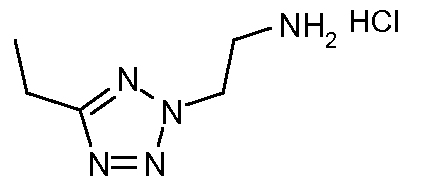 A solution of of te/f-butyl [2-(5-ethyl-2H-tetrazol-2-yl)ethyl]carbamate (2 g, 23.1 mmol) in dry dioxane/HCI (200 ml_, 2N) was stirred at room temperature for 12h. The solvent was removed under reduced pressure. The brown solid obtained was slurried in ACN (30 ml_), filtered and dried to give the titled compound as a pale brown solid. 1H NMR (DMSO-d6, 400MHz) δ 8.31 (3H, s), 4.88-4.91 (2H, t), 3.36-3.38 (2H, t), 2.82- 2.87 (2H, m), 1.25-1.31 (3H, t).
Intermediate 16: [2-(5-cyclopropyl-2H-tetrazol-2-yl)ethyl]amine
Step 1) Formation of 5-Cyclopropyl-2H-tetrazole


A solution of te/f-Butyl-2-bromoethylcarbamate (10.2 g, 45 mmol) and TEA (22.7 mL, 225 mmol) in ACN (30 mL) was added dropwise to a solution of 5-cyclopropyl-2H- tetrazole (5 g, 45 mmol) in ACN (80 mL). The reaction mixture was then stirred under nitrogen atmosphere at 7O0C for 18h. Acetonitrile was removed under reduced pressure and ethyl acetate was added to the residue. The semi-solid obtained was washed with hexane, filtered and dried to give the first regioisomer, te/f-butyl 2-(5- cyclopropyl-1 /-/-tetrazol-1-yl) ethylcarbamate as a white solid. The second regioisomer, tert-Butyl 2-(5-cyclopropyl-2H-tetrazol-2-yl)ethylcarbamate was obtained by concentration of the hexane filtrate as a yellow oil. First regioisomer: te/f-butyl 2- (5-cyclopropyl-1 H-tetrazol-1-yl) ethylcarbamate. LC/MS (Atlantis), M+(ESI): 254.3. 1H- NMR (DMSO-d6, 400 MHz) δ 1H NMR (DMSO-d6 400MHz) d 7.0 (1 H, bs), 4.47-4.44 (2H, m), 3.37-3.32 (2H, m), 2.13-2.09 (1 H, m), 1.31 (9H, s), 1.14-1.12 (2H, m), 1.1 1- 1.0.99 (2H, m). Second regioisomer: tert-Butyl 2-(5-cyclopropyl-2H-tetrazol-2- yl)ethylcarbamate. LC/MS (Atlantis), M+(ESI): 254.3. 1H-NMR (DMSO-d6, 400 MHz) δ 1H NMR (DMSO-d6 400MHz) d 6.890 (1 H, bs), 4.5765-4.5476(2H, m), 3.401- 3.2088 (2H, m), 2.1713-2.1384 (1 H, m), 1.3230(9H, s), 1.0689-1.0583(2H, m), 1.057- 1.0374 (2H, m).
Step 3) Formation of [2-(5-cyclopropyl-2H-tetrazol-2-yl)ethyl]amine hydrochloride

The title compound was prepared following procedure described for intermediate 13, step 3), but starting from tert-Butyl 2-(5-cyclopropyl-2H-tetrazol-2-yl)ethylcarbamate.
Intermediate 17: [2-(5-tert-butyl-1 ,3-oxazol-2-yl)ethyl]amine hydrochloride
Step 1 ) Formation of benzyl 3-[(3,3-dimethyl-2-oxobutyl)amino]-3- oxopropylcarbamate

A mixture of Z-Beta-Ala-OH (3.6 g, 016.5 mmol), EDCI. HCI (4.12 g, 21.5 mmol) hydroxybenzotriazole (2.25 g, 16.5 mmol), TEA (2.9 mL, 21.5 mmol), in dry DCM (75 ml.) was stirred at O0C under nitrogen for 30 min. 1-Amino-3,3-dimethylbutan-2-one (2.5 g, 16.5 mmol) was added and the reaction mixture was stirred for 1 h at RT. Water was added, the phases swere separated and the aqueous phase was extracted with DCM (2x150 mL). Combined organic phases were dried over sodium sulfate, filtered and concentrated. The crude was purified by flash chromatography on silica (PE: ETOAC) to give the titled compound as a orange-yellow liquid (3.4g, 80%). 1H NMR (DMSOd6, 400MHz) δ (1 H, s), 7.35-7.29 (5H, m), 7.20 (1 H, s), 4.99 (2H, s), 4.10 (2H, d), 3.18 (2H, d), 2.32 (2H, t), 1.09 (9H, s).
Step 2) Formation of benzyl 2-(5-tert-butyl-1,3-oxazol-2-yl)ethylcarbamate

Iodine (3.55 g, 14 mmol) was added portionwise to a solution of triphenylphosphine (3.68 g, 14 mmol) in dry DCM (50 mL) over a period of 30 minutes. Reaction mixture was stirred under nitrogen at RT for 30 min before the addition of a solution of TEA (2.8 g, 28.2 mmol) and benzyl 3-[(3,3-dimethyl-2-oxobutyl)amino]-3- oxopropylcarbamate (3 g, 9.36 mmol) in dry DCM (30 mL). Reaction mixture was stirred again at RT for 12h. Solvent was removed under reduced pressure and the crude was purified by flash chromatography on silica (PE:EtOAc) to give the title compound as pale yellow liquid. 1H NMR (DMSOd6, 400MHz) δ 7.39-7.29 (5H, m), 6.66 (1 H, s), 4.99 (2H, s), 3.34 (2H, m), 2.83-2.79 (2H, m), 1.20 (9H, s).
Step 3) Formation of 2-(5-tert-Butyl-1 ,3-oxazol-2-yl)ethanamine hydrochloride

Palladium on carbon (1.5 g) was added to a solution of 4-methoxy-1-[(1 E)-3- (methylthio)prop-1-enyl]-2-nitrobenzene(3.5 g) in dry ethanol (300 ml_).The mixture was hydrogenated under a pressure of 7 bars of hydrogen for 12h. The catalyst was removed by filtration and the filtrate was concentrated under reduced pressure. The crude was purified by flash chromatography on silica (PE: EtOAc) to give the title compound as brown thick liquid (1.5g, 78%). Hydrochloride salt was prepared by addition of HCI/dioxane. HPLC (Atlantis-1 ), Rt: 3.85 min (purity: 98.2%). LC/MS (Atlantis), M+(ESI): 169.3. 1H-NMR (DMSO-dθ, 400 MHz) δ 6.75 (1 H, s), 5.2-5.4 (3H, brs), 3.16-3.13 (2H, t), 3.06-3.02 (2H, t), 1.23 (9H, s).
Intermediate 18: [2-(5-ethyl-1 ,3-oxazol-2-yl)ethyl]amine
Step 1 ) Formation of Benzyl 3-[(2-hydroxybutyl)amino]-3-oxopropylcarbamate
 The title compound was prepared according to procedure described for Intermediate
17 step 1 ), but starting from 1-Amino-2-butanol (4.2 ml_, 44.3 mmol). The title compound was obtained as a a orange-yellow liquid (10.5 g, 81%). 1H-NMR (CDCI3, 400MHz) δ 7.34-7.26 (5H, m)6.34 (1 H, s), 5.58 (1 H, s), 5.08 (1 H, s), 3.61-3.58 (1 H, t), 3.49-3.43 (3H, m), 3.1 1-3.07 (1 H, m),2.46-2.43 (3H, d),1.50-1.43 (2H m), .096-.093 (3H, t).
Step 2) Formation of Benzyl 3-oxo-3-[(2-oxobutyl)amino]propylcarbamate

DMSO (4 ml_, 057.1 mmol) was added dropwise to a solution of oxalyl chloride (3.8 ml_, 42.8 mmol) in dry DCM maintained at-78°C under nitrogen. After 15 minutes, a solution of benzyl 3-[(2-hydroxybutyl)amino]-3-oxopropylcarbamate (10.5 g, 35.7 mmol) in dry DCM (75 ml.) was added. TEA (21 ml.) was added to the solution maintained at -78°C after one hour. The reaction mixture was then stirred one more hour at this temperature and then warmed up to RT. It was then diluted with DCM (100 ml_), washed with HCI (1.5N, 200 ml_), saturated sodium bicarbonate solution
(200 ml_), water (200 ml_), and brine solution (200 ml_), dried over sodium sulfate, filtered and concentrated to give the title compound as a white solid (8.5 g, 85%). 1H NMR (CDCI3, 400MHz) δ 7.34-7.26 (5H, m), 6.34 (1 H, s), 546 (1 H, s), 5.08 (1 H, s), 4.13-4.12 (2H, d),3.50-3.49 (2H,d),2.50-2.45(5H,m),1.141.10(3H,t).
Step 3) Formation of benzyl 2-(5-ethyl-1 ,3-oxazol-2-yl)ethylcarbamate

The title compound was prepared according to procedure described for Intermediate 17B step 2), but starting from benzyl 3-oxo-3-[(2-oxobutyl)amino]propylcarbamate). The title compound was obtained as pale yellow liquid. 1H NMR (DMSO-dβ, 400MHz) δ 7.4-7.29 (5H, m), 6.69(1 H, s)4.99 (2H, s),3.34 -3.32(2H, m), 2.83-2.79(2H,t),2.5- 2.48(2H,m)1.16-1.1 1 (3H, m).
Step4 ) Formation of 2-(5-Ethyl-1 ,3-oxazol-2-yl)ethanamine

The title compound was prepared according to procedure described for Intermediate 17 step 3), but starting from benzyl 2-(5-ethyl-1 ,3-oxazol-2-yl)ethylcarbamate (7g). The title compound was obtained as an off white solid. HPLC, Rt: 2.89 min (purity: 86.0%). LC/MS (Atlantis), M+(ESI): 141.1. 1H-NMR (DMSO-d6, 400 MHz) δ 6.69-6.67 (1 H, s), 2.91-2.86(2H, m), 2.77-2.72 (2H, m),2.62-2.58(2H, m), 1.16-1.12(3H,t).
Intermediate 19: [2-(4-isopropyl-1 ,3-oxazol-2-yl)ethyl]amine
Stepi) Formation of benzyl 3-{[1 -(hydroxymethyl)-2-methylpropyl] amino}-3- oxopropylcarbamate

The title compound was prepared according to procedure described for Intermediate 17 step 1 ), but starting from 2- Amino- 3 -methyl -1 - butanol (DL- Valinol) (30gm, 0.2916mol). The title compound was obtained as a white solid (40 g, 91%). LC/MS (Atlantis), M-(ESI): 306.0. 1H-NMR (DMSO-d6, 400 MHz) δ 7.50 (1 H, bs), 7.35-7.40
(5H, m), 7.20 (1 H, bs), 5.21 , (2H, s), 3.54-3.62 (1 H, m), 3.25-3.31 (2H, m), 3.15-3.20 (2H, m), 3.11-3.19 (1 H,m), 2.25-2.30 ( 2H, m), 0.78-0.90 (6H, m).
Step 2) Formation of benzyl 3-[(1-formyl-2-methylpropyl)amino]-3- oxopropylcarbamate

The title compound was prepared according to procedure described for Intermediate 18 step 2), but starting benzyl 3-{[1-(hydroxymethyl)-2-methylpropyl] amino}-3- oxopropylcarbamate (40 g, 129 mmol). The title compound was obtained as a liquid (40 g, 90%). 1H NMR (DMSOd6, 400MHz) δ 9.40 (1 H, s), 8.20 (1 H, bs), 7.38 (1 H, bs), 7.35-7.40 (5H, m) 5.21 (2H, s), 3.25-3.31 (2H, m), 3.1 1-3.20 (1 H, m), 2.25-2.30 (2H, m), 2.13-2.1 1 (1 H, m) 0.78-0.90 (6H, m).
Step 3) Formation of benzyl 2-(4-isopropyl-1,3-oxazol-2-yl)ethylcarbamate

The title compound was prepared according to procedure described for Intermediate 17 step 2), but starting from benzyl 3-[(1-formyl-2-methylpropyl)amino]-3- oxopropylcarbamate (40 g, 130 mmol). The title compound was obtained as a yellow liquid. HPLC (Atlantis-1 ), Rt: 4.48 min (purity: 84.3%). LC/MS (Atlantis), M-(ESI): 289.0. 1H-NMR (DMSO-d6, 400 MHz) δ 7.67-7.77 (1 H, m), 7.30-7.40 (6H, m), 5.10
(2H, s), 3.30-3.41 (2H, m), 2.80-2.90 (2H, m), 2.65-2.71 (1 H, m), 1.12-1.24 (6H, m).
Step 4) Formation of 2-(4-lsopropyl-1 ,3-oxazol-2-yl)ethanamine

17 step 3), but starting from benzyl 2-(4-isopropyl-1 ,3-oxazol-2-yl)ethylcarbamate (12 g, 41 mmol). The title compound was obtained as a yellow liquid. HPLC (Atlantis-2), Rt: 3.51 min (purity: 98.7%). LC/MS (Atlantis), M-(ESI): 155.0. 1H-NMR (DMSO-d6, 400 MHz) δ 7.61 (1 H, s), 2.90-2.95 (2H, m), 2.65-2.82 (3H, m), 1.12 (6H, d).
Intermediate 20: [2-(4-tert-butyl-1 ,3-oxazol-2-yl)ethyl]amine
Step 1) Formation of benzyl 3-{[(1R)-1-(hydroxymethyl)-2,2-dimethylpropyl]amino}-3- oxo propyl carbarn ate

The title compound was prepared according to procedure described for Intermediate 17 step 1 ), but starting from L-Tert-Leucinol (5 g, 42 mmol). The title compound was obtained as a colorless liquid (14 g, 95%). LC/MS (Atlantis), M-(ESI): 323.3. 1H-NMR (DMSO-d6, 400 MHz) δ 7.42 (1 H, brs), 7.33-7.35 (5H, m), 7.16 (1 H, brs), 4.99 (2H, s),
3.56-3.60 (2H, m), 3.25-3.27 (2H, m), 3.15-3.20 (1 H, m), 2.32-2.42 (2H, m), 0.818 (9H, m).
Step 2) Formation of benzyl 3-{[(1 R)-1 -formyl-2,2-dimethylpropyl]amino}-3- oxopropylcarbamate

The title compound was prepared according to procedure described for Intermediate 18, step 2), but starting from Benzyl 3-{[(1 R)-1-(hydroxymethyl)-2, 2- dimethylpropyl]amino}-3-oxopropylcarbamate (14 g, 46.4 mmol). The title compound was obtained as a colorless liquid (14 g, 95%). 1HNMR (DMSOd6, 400MHz) δ 9.56
(1 H, s), 7.45 (1 H, brs), 7.33 -7.35 (5H, m) 7.20(1 H, brs), 4.99 (2H,s), 3.56-3.62 (2H, m), 3.25-3.27 (2H, m), 3.20-3.35 (1 H, m), 0.81 (9H, m).
Step 3) Formation of benzyl 2-(4-tert-butyl-1,3-oxazol-2-yl)ethylcarbamate

The title compound was prepared according to procedure described for Intermediate 17, step 2), but starting from benzyl 3-{[(1 R)-1-formyl-2,2-dimethylpropyl] amino}-3- oxopropylcarbamate (14 g, 43 mmol). The title compound was obtained as a yellow
liquid. LC/MS (Atlantis), M-(ESI): 303.0. 1H NMR (DMSO-d6, 400MHz) δ 7.60 (1 H, brs), 7.45-7.51 (7H, m), 5.10 (2H, s), 3.30-3.32 (2H, m), 3.31-3.32 (2H, m), 2.75-2.85 (2H, m), 1.15 (9H, s).
Step 4) Formation of 2-(4-tert-Butyl-1 ,3-oxazol-2-yl)ethanamine

The title compound was prepared according to procedure described for Intermediate 17, step 3), but starting from benzyl 2-(4-fe/f-butyl-1 ,3-oxazol-2-yl)ethylcarbamate (3 g, 9 mmol). The title compound was obtained as a yellow liquid. LC/MS (Atlantis), M- (ESI): 168.9. 1H NMR (DMSOd6, 400MHz) δ 7.59 (1 H, s), 2.85-2.90 (2H, m), 2.75-
2.82 (2H, m), 1.17 (9H, s).
Intermediate 21 : 1 -[4-(2-aminoethyl)-1 H-imidazol-1 -yl]-2-methylpropan-2-ol
Step 1 ) Formation of 7,8-Dihydroimidazo[1 ,5-c]pyrimidin-5(6H)-one

To a solution of histamine (25 g, 225 mmol) in dry DMF, 1 ,1 '-carbonyl diimidazole (36.5 g, 225 mmol) was added. The reaction mixture was stirred for 5h at 70° C and for 16h at RT. It was then concentrated under reduced pressure and the residue was extracted from ACN to afford the title compound as off white solid (25g, 81 %). 1H
NMR: (DMSO-d6, 400MHz), δ 8.2 (s, 1 H), 8.02 (s, 1 H), 6.78 (s, 1 H), 3.35 (m, 2H), 2.82 (t, 2H).
Step 2) Formation of 2-(2-Methylprop-2-enyl)-5-oxo-5,6, 7,8-tetrahydroimidazo[1 ,5- c]pyrimidin-2-ium Bromide

A solution of 7,8-dihydroimidazo[1 ,5-c]pyrimidin-5(6H)-one (25 g, 182 mmol) and 3- bromo 2-methyl propene (74 g, 547 mmol) in dry ACN was refluxed at 95° C for 15h under nitrogen atmosphere. The solvent was removed under reduced pressure to
give the title compound as brown liquid (50 g, 100%). LC/MS (Atlantis), M+(ESI): 193.3. 1H NMR: (DMSO-d6, 400MHz), δ 9.76 (s, 1 H), 9.0.3 (s, 1 H), 7.57 (s, 1 H), 5.05 (s, 1 H), 4.91 (s, 1 H), 4.8 (s, 2H), 3.4 (m, 2H), 3.0 (t, 2H), 1.69 (s, 3H).
Step 3) Formation of 1-[4-(2-Aminoethyl)-1 H-imidazol-1-yl]-2-methylpropan-2-ol Dihydrochloride

2-(2-Methylprop-2-enyl)-5-oxo-5,6,7,8-tetrahydroimidazo[1 ,5-c]pyrimidin-2-ium bromide (12 g, 44 mmol) was refluxed in 25 ml. (132 mmol) of 6M hydrochloric acid for 5h. The reaction mixture was lyophilized to afford the title compound as an off white solid (10 g, 90%). 1H NMR (DMSO-d6, 400MHz), δ 14.96 (s, 1 H), 9.0.3 (s, 1 H), 8.27 (s, 3H), 7.52 (s, 1 H), 4.0 (s, 2H), 3.18 (d, 2H), 3.04 (t, 2H), 1.08 (s, 6H).
Intermediate 22: [2-(1 -isobutyl-1 H-imidazol-4-yl)ethyl]amine Step 1) Formation of 2-lsobutyl-5-oxo-5, 6, 7, 8-tetrahydroimidazo[1 , 5-c]pyrimidin-2-ium
Bromide

Pd/C (10%, 150 mg) was added to a solution of 2-(2-Methylprop-2-enyl)-5-oxo- 5,6,7,8-tetrahydroimidazo[1 ,5-c]pyrimidin-2-ium bromide (12 g, 44 mmol) in MeOH (150 ml_). The reaction mixture was hydrogenated under a pressure of 5 bars of hydrogen for 3h. It was then filtered and the filtrate was concentrated under reduced pressure. The crude was purified by flash chromatography on silica (HCCI3:MeOH, 93:7) to give the title compound as off white solid (10 g, 83%). 1H NMR :(DMSO-d6, 400MHz),δ 9.76 (s, 1 H), 9.0.3 (s, 1 H), 7.67 (s, 1 H), 4.05 (d, 2H), 3.45 (m, 2H), 3.0 (t, 2 H), 2.1 (t, 1 H), 0.8 (q, 6H).
Step 2) Formation of 2-(1 -isobutyl-1 H-imidazol-4-yl)ethanamine Dihydrochloride
 2-lsobutyl-5-oxo-5,6,7,8-tetrahydroimidazo[1 ,5-c]pyrimidin-2-ium bromide (10 g, 36.6 mmol) was refluxed 6M hydrochloric acid (15 ml_, 132 mmol) of for 5h. The reaction mixture was lyophilized to give the title compound as off white solid (9.5 g, 83.5%). 1H NMR (DMSO-d6, 400MHz), δ 14.88 (s,1 H), 9.25 (s, 1 H), 8.34 (s, 3H), 7.66 (s, 1 H), 3.98 (d, 2H), 3.13 (d, 2H), 3.04 (t, 2H), 2.0 (m, 1 H), 0.8 (s, 6H).
Intermediate 23: 4-(5-tert-butyl-1 ,3-oxazol-2-yl)butanoic acid
Step 1) Formation of methyl 4-[(3,3-dimethyl-2-oxobutyl)amino]butanoate
 A mixture of monomethylglutarate (40 g, 264 mmol), EDCI. HCI (65.73 g, 342 mmol) hydroxy benoztriazole (35.9 g, 264 mmol) and triethyl amine (102.2 ml_, 791 mmol) in dry DCM (300 ml.) was stirred at O0C under nitrogen for 30 min. 1-amino-3, 3- dimethylbutan-2-one (2 g,13 mmol) was added and stirred for 10h. The reaction mixture was quenched with water (500 ml.) and extracted with DCM (2x150 ml_). The combined organic phases were dried over sodium sulfate, filtered and concentrated.
The crude was purified by flash chromatography on silica (PE:EtOAc) to give the titled compound as an orange liquid. 1H NMR (CDCI3, 400MHz) δ 7.98-8.01 (1 H, t), 4.10-4.1 1 (2H, d), 3.57 (3H, s), 2.67-2.71 (2H, t), 2.36-2.40 (2H,m), 1.84-1.92 (2H, m), 1.21 (9H, s).
Step 2) Formation of ethyl 4-(5-tert-butyl-1 ,3-oxazol-2-yl)butanoate

The title compound was prepared according to procedure described for Intermediate 17 step 2), but starting from methyl 4-[(3,3-dimethyl-2-oxobutyl)amino]butanoate (40 g, 73 mmol). The title compound was obtained as a yellow liquid. 1H NMR (DMSO-dβ,
400MHz) δ 6.64 (1 H, s), 3.57 (3H, s), 2.67-2.71 (2H, t), 2.36-2.40 (2H, m), 1.84-1.92 (2H, m), 1.21 (9H, s).
Step 3) Formation of 4-(5-tert-butyl-1 ,3-oxazol-2-yl)butanoic acid
 A mixture of methyl 4-(5-te/f-butyl-1 ,3-oxazol-2-yl)butanoate (10 g, 44 mmol) and 6N aqueous HCI solution (200 ml.) was heated at 1050C under nitrogen for 4h. The reaction mixture was concentrated under reduced pressure and the resulting liquid was azeotroped with toluene (2x100 ml.) to give the titled compound as white solid (8 g, 73%). HPLC (Atlantis-1 ), Rt: 4.52 min (purity: 97.1%). LC/MS (Atlantis), M+(ESI):
211.9. 1H-NMR (DMSO-dθ, 400 MHz) δ 10.2-10.5 (1 H, bs), 6.80 (1 H, s), 2.72-2.76 (2H, t), 2.28-2.31 (2H, t), 1.84-1.88 (2H, t), 1.22 (9H,s).
Intermediate 24: 3-(5-tert-butyl-1 ,3-oxazol-2-yl)propanoic acid Step 1 ) Formation of ethyl 3-[(3,3-dimethyl-2-oxobutyl)amino]-3-oxopropanoate

The title compound was prepared according to procedure described for Intermediate 23 step 1 ), but starting 1-amino-3, 3-dimethylbutan-2-one (2 g, 13.1 mmol). The title compound was obtained as a yellow liquid. 1H NMR (CDCI3, 400MHz) δ 7.91-8.01 (1 H, t), 4.10-4.11 (2H, d), 3.55 (3H, s), 2.07-2.43 (4H, m), 1.09 (9H, s).
Step 2) Formation of Methyl 3-(5-tert-butyl-1,3-oxazol-2-yl)propanoate

The title compound was prepared according to procedure described for intermediate 17 step 2), but starting from methyl 3-[(3,3-dimethyl-2-oxobutyl)amino]-3- oxopropanoate (9 g, 41.8 mmol). The title compound was obtained as a yellow liquid. 1H NMR (DMSOd6, 400MHz) δ 6.63 (1 H, s), 3.58 (3H, s), 2.90-2.94 (2H, t), 2.70-2.73 (2H, t), 1.20 (9H, s).
Step 3) Formation of 3-(5-tert-butyl-1 ,3-oxazol-2-yl)propanoic acid

A solution of methyl 3-(5-tert-butyl-1 ,3-oxazol-2-yl) propanoate (2.5 g, 18 mmol) and Lithium hydroxide (60 mg, 23.6 mmol) in THF: water (20 mL:5 mLI) was stirred at RT for 4h. The solvent was removed under reduced pressure and the resulting residue was acidified with 1.5N HCI. The precipitated solid was filtered and dried
under vacuum to give the titled compound as a white solid (1.5g, 73%). HPLC (Atlantis-1 ), Rt: 3.20 min (purity: 98.9%). LC/MS (Atlantis), M+(ESI): 198.1. 1H-NMR (DMSO-dθ, 400 MHz) δ 12-13 (1 H, brs), 6.62 (1 H, s), 2.85-2.88 (2H, t), 2.59-2.62 (2H1 1), 1.21 (9H, s).
Intermediate 25: [2-(2-isopropyl-2H-tetrazol-5-yl)ethyl]amine
Step 1 ) Formation of tert-Butyl-2-cyanoethylcarbamate
 A solution of 3-amino propionitrile (10 g, 142.6 mmol) and BOC-anhydride (37.3 g,
171 mmol) in dry DCM and TEA (43.31 g, 428 mmol) was stirred at RT for 10h. The reaction mixture was washed with water, brine, dried over magnesium sulfate, filtered and concentrated to give the title compound as a liquid. 1H NMR (DMSO: 400MHz) 1.35 (9H, s) 2.57-2.60 (2H, t) 3.12-3.16 (2H, m), 7.16(1 H, s).
Step 2) Formation of tert-butyl-2-(1 H-tetrazol-5-yl) ethylcarbamate

A solution of tert-butyl-2-cyanoethylcarbamate (10 g, 58.7 mmol), Sodium azide (1 1.5 g, 176 mmol) and TEA.HCI (32.8 g, 176 mmol) in dry Toluene (200 ml.) was refluxed for 15h under nitrogen. The reaction mixture was cooled down to RT and water (70 ml.) was added. The aqueous phase was separated and acidified to pH = 2 with 6N HCI. The precipitated solid was filtered, washed with cold water and to give the title compound as a solid (10 g, 80%). 1H NMR (DMSO: 400MHz) 1.34 (9H,s) 2.97-2.98 (2H,t) 3.25-3.28 (2H,m) 6.98 (1 H, s).
Step 3) Formation of tert-Butyl [2-(1-isopropyl-1 H-tetrazol-5-yl)ethyl]carbamate and tert-Butyl [2-(2-isopropyl-2H-tetrazol-5-yl)-ethyl]-carbamate.

2-lodo propane (1.89 g, 1 1.2 mmol) was added to a solution of tert-butyl-2-(1 H- tetrazol-5-yl) ethylcarbamate (2 g, 9.3 mmol) and TEA (4.7 g; 46.4 mmol) in dry ACN
(20 ml_). The reaction mixture was refluxed for 12h under nitrogen. The solvent was removed under reduced pressure and the residue was purified by flash chromatography on silica (PE: EtOAc) to give tert-Butyl [2-(1-isopropyl-1 H-tetrazol- 5-yl)ethyl]carbamate (0.8 g 35%, minor isomer), LC/MS (Atlantis), M+(ESI): 257.4. δ 1 HNMR (DMSO- 400MHz) 1.33 (9H, s) 1.46-1.48 (6H, d) 2.98-3.02 (2H, t), 3.26 -
3.32 (2H, p), 4.7-4.73 (1 H, m), 6.98 (1 H, s) along with tert-Butyl [2-(2-isopropyl-2H- tetrazol-5-yl)-ethyl]-carbamate. Major isomer LC/MS (Atlantis), M+(ESI): 256.1. 1H- NMR (DMSO-d6, 400 MHz) δ 6.92 (1 H, brs), 5.05-5.02 (1 H, m), 3.28-3.23 (2H, t), 2.93-2.89 (2H, t), 1.53-1.51 (6H, d), 1.34 (9H, s).
Step 4) Formation of [2-(2-isopropyl-2H-tetrazol-5-yl)ethyl]amine

The title compound was prepared following procedure described for intermediate 13, step 3), but starting from tert-Butyl [2-(2-isopropyl-2H-tetrazol-5-yl)-ethyl]-carbamate.
Intermediate 26: 1 -[(5-bromopyridin-3-yl)sulfonyl]pyrrolidin-3-ol

TEA (0.32 ml_, 2.29 mmol) was added to a suspension of 5-bromo pyridine-3- sulfonyl chloride (370 mg, 1.26 mmol) in dichloromethane at O0C. The reaction mixture was stirred for 10 min at 00C before the addition of a solution of 3- pyrrolidinol (100 mg, 1.147 mmol) in DCM. Reaction mixture was then stirred at RT overnight under nitrogen atmosphere. It was then washed successively with saturated sodium bicarbonate, water and brine. Organic layer was separated and dried over sodium sulfate, filtered and concentrated. The crude was purified by flash chromatography on basic alumina (HCC^MeOH) to give the title compound.
Following intermediates 27-36 have been prepared according to procedure described above:


Intermediate 37: 3-[2-azabicyclo[2.2.1]hept-2-yl]-3-oxopropan-1 -amine
Stepi ) Formation of Tert-butyl [3-(2-azabicyclo[2.2.1]hept-2-yl)-3- oxopropyl]carbamate

TEA (4eq.) and T3P (2 eq.) were added to a solution of boc-β-ala-OH (1 eq.) and 2- aza-bicyclo(2,2,1 )heptane in DCM at 00C. Reaction mixture was then stirred at RT overnight. It was washed with HCI solution (1.5 N), NaHCO3 (10% solution) and water. Organic layer was dried over sodium sulfate, filtered and concentrated. The crude was purified by flash chromatography on silica to give the title compound
Step 2) Formation of 3-[2-azabicyclo[2.2.1 ]hept-2-yl]-3-oxopropan-1 -amine

The title compound was prepared following procedure described for intermediate 13, step 3), but starting from Tert-butyl [3-(2-azabicyclo[2.2.1]hept-2-yl)-3- oxopropyl]carbamate.
Following intermediates 38-46 have been prepared according to procedure described above:

Intermediate 47: N-[6-(4,4,5,5-tetramethyl-1 ,3,2-dioxaborolan-2-yl)imidazo[1 ,2- a]pyridin-2-yl]acetamide

Intermediate 48: N-(6-bromo-1 ,3-benzothiazol-2-yl)-N'-[2-(5-tert-butyl-1 ,2,4- oxadiazol-3-yl)ethyl]urea
Step 1) Formation of phenyl (6-bromo-1,3-benzothiazol-2-yl)carbamate

Phenylchloroformate (4 mL, 32.7 mmol) was added to a solution of 6-bromo-2- aminobenzothiazole (5 g, 21.8 mmol) and TEA (6.1 mL, 43.6 mmol), in DCM/THF
(1 :1 , 500 mL) at 00C. The reaction mixture was then stirred at RT overnight. The solvent was removed under reduced pressure and the crude was triturated with methanol, filtered and dried to give the title compound (7g, Yield 92%).
Step 2) Formation of N-(6-bromo-1 ,3-benzothiazol-2-yl)-N'-[2-(5-tert-butyl-1 ,2,4- oxadiazol-3-yl)ethyl]urea

A solution of phenyl phenyl (6-bromo-1 ,3-benzothiazol-2-yl)carbamate (1 g, 3.01 mmol), 2-(5-tert-butyl-1 ,2,4-oxadiazol-3-yl)ethanamine (0.61 g, 3.62 mmol), TEA (0.5 mL, 3.62 mmol) in NMP was heated in MW at 55°C for 15 min. Water was added and the reaction mixture was stirred at RT for 1 h. The precipitate obtained was filtered and dried to give the title compound as a white solid. HPLC (Atlantis-1 ), Rt: 5.09 min (purity: 99.6%). LC/MS (Atlantis), M+(ESI): 423.7.
Intermediate 49: N-[2-(5-tert-butyl-1 ,2,4-oxadiazol-3-yl)ethyl]-N'-[6-(4,4,5,5- tetramethyl-1 ,3,2-dioxaborolan-2-yl)-1 ,3-benzothiazol-2-yl]urea

Intermediate 50: N-(6-bromoimidazo[1 ,2-a]pyridin-2-yl)-N'-[2-(5-tert-butyl-1 ,2,4- oxadiazol-3-yl)ethyl]urea

The title compound was prepared following procedure described for intermediate 48 but starting from 6-bromoimidazo[1 ,2-a]pyridin-2-amine. The title compound was obtained as a yellow solid, HPLC (Atlantis-1 ), Rt: 3.27 min (purity: 96.8%). LC/MS
(Atlantis), M+(ESI): 406.9.
Intermediate 51 : N-[2-(5-tert-butyl-1 ,2,4-oxadiazol-3-yl)ethyl]-N'-[6-(4,4,5,5- tetramethyl-1 ,3,2-dioxaborolan-2-yl)imidazo[1,2-a]pyridin-2-yl]urea

The title compound was prepared following procedure described for intermediate 49 but starting from N-(6-bromoimidazo[1 ,2-a]pyridin-2-yl)-N'-[2-(5-tert-butyl-1 ,2,4- oxadiazol-3-yl)ethyl]urea.
Intermediate 52: N-(6-bromo-1 ,3-benzothiazol-2-yl)-N'-[2-(5-tert-butyl-1 ,3-oxazol-
2-yl)ethyl]urea

The title compound was prepared following procedure described for intermediate 48, but starting from [2-(5-tert-butyl-1 ,3-oxazol-2-yl)ethyl]amine. The title compound was obtained as an off white solid (47 mg, 72%), HPLC (Atlantis-1 ), Rt: 5.09 min (purity:
96.4%). LC/MS (Atlantis), M+(ESI): 423.0.
Intermediate 53: N-[2-(5-tert-butyl-1 ,3-oxazol-2-yl)ethyl]-N'-[6-(4,4,5,5- tetramethyl-1 ,3,2-dioxaborolan-2-yl)-1 ,3-benzothiazol-2-yl]urea

The title compound was prepared following procedure described for intermediate 49, but starting from N-(6-bromo-1 ,3-benzothiazol-2-yl)-N'-[2-(5-tert-butyl-1 ,3-oxazol-2- yl)ethyl]urea.
Intermediate 54: N-(6-bromoimidazo[1 ,2-a]pyridin-2-yl)-N'-[2-(5-tert-butyl-1 ,3- oxazol-2-yl)ethyl]urea

The title compound was prepared following procedure described for intermediate 48 but starting from 6-bromo-1 ,3-benzothiazol-2-amine and 2-[3-(2-aminoethyl)-1 ,2,4- oxadiazol-5-yl]-2-methylpropan-1-ol. The title compound was obtained as an off white solid, HPLC (Atlantis-1 ), Rt: 3.39 min (purity: 99.5%). LC/MS (Atlantis), M+(ESI): 405.9.
Intermediate 55: N-[2-(5-tert-butyl-1.S-oxazol^-yOethyll-N'-IΘ-^AS.S- tetramethyl-1 ,3,2-dioxaborolan-2-yl)imidazo[1,2-a]pyridin-2-yl]urea

The title compound was prepared following procedure described for intermediate 49, but starting from [N-(6-bromoimidazo[1 ,2-a]pyridin-2-yl)-N'-[2-(5-tert-butyl-1 ,3-oxazol- 2-yl)ethyl]urea.
Intermediate 56: N-(6-bromo-1 ,3-benzothiazol-2-yl)-N'-{2-[5-(2-hydroxy-1 ,1 - dimethylethyl)-1 ,2,4-oxadiazol-3-yl]ethyl}urea
 The title compound was prepared following procedure described for intermediate 48 but starting from 6-bromo-1 ,3-benzothiazol-2-amine and 2-[3-(2-aminoethyl)-1 ,2,4- oxadiazol-5-yl]-2-methylpropan-1-ol.
Intermediate 57: N-(6-bromo-1 ,3-benzothiazol-2-yl)-N'-{2-[5-(2-fluoro-1 ,1 - dimethylethyl)-1 ,2,4-oxadiazol-3-yl]ethyl}urea

The title compound was prepared following procedure described for intermediate 48 but starting from 6-bromo-1 ,3-benzothiazol-2-amine and {2-[5-(2-fluoro-1 ,1- dimethylethyl)-1 ,2,4-oxadiazol-3-yl]ethyl}amine.
Intermediate 58: N-[3-(3,3-difluoroazetidin-1 -yl)-3-oxopropyl]-N-{6-bromo-1 ,3- benzothiazol-2-yl}urea
\
 The title compound was prepared following procedure described for intermediate 48 but 3-(3,3-difluoroazetidin-1 -yl)-3-oxopropan-1 -amine.
Intermediate 59: N-(6-bromoimidazo[1,2-a]pyridin-2-yl)-N'-[2-(5-phenyl-1 ,2,4- oxadiazol-3-yl)ethyl]urea

The title compound was prepared following procedure described for intermediate 48 but starting from 6-bromo-1 ,3-benzothiazol-2-amine and 2-(5-phenyl-1 ,2,4-oxadiazol- 3-yl (Journal of Chemical Research, Synopses (1979), (2), 64-5.). The title compound was obtained as an yellow solid, HPLC (Atlantis-1 ), Rt: 3.56 min (purity:
96.3%). LC/MS (Atlantis), M+(ESI): 426.9.
Intermediate 60: N-(6-bromo-1 ,3-benzothiazol-2-yl)-4-(5-tert-butyl-1 ,3-oxazol-2- yl)butanamide

HATU (414 mg, 1.1 mmol) and HOAt (147 mg, 1.1 mmol) were added to a solution of 2-amino-6-bromobenzothiazole (250 mg, 1.1 mmol), 4-(5-tert-butyl-1 ,3-oxazol-2- yl)butanoic acid (276 mg, 1.3 mmol) and N-methyl morpholine (0.6ml, 5.4mmol) in DCM/DMF (1 :1 ) maintained at 00C under nitrogen atmosphere. The reaction mixture was then stirred overnight at RT under nitrogen. After completion, the solvent was removed under reduced pressure and the crude was dissolved in EtOAc. Organic phase was washed with 10% citric acid, sat. sodium bicarbonate, water and brine, then dried over sodium sulphate filtered and concentrated to give the title compound.
Intermediate 61 : 3-(methylsulfonyl)-5-(4,4,5,5-tetramethyl-1 ,3,2-dioxaborolan-2- yl)pyridine

A mixture of 3-bromo-5-methanesulfonylpyridine (2 g, 8.47 mmol), bis(pinacolato)diboron (2.36 g, 9.31 mmol), potassium acetate (1.25 g, 12.7 mmol),
Pd2dba3 (0.38 g, 0.42 mmol) and tricyclohexylphosphine (0.52 g, 1.86 mmol) in degassed dioxane was heated at 1000C for 5h. The reaction mixture was then diluted with EtOAc and washed with brine. Organic layer was dried over sodium sulfate, filtered and concentrated. The residue obtained was triturated in ether, ether layer was carefully removed and the solid was dried to give the title compound (1.82 g,
75%). 1H NMR (DMSO-d6, 400MHz) δ 9.16(1 H, s), 9.01 (1 H, s), 8.39-8.40 (1 H, s), 3.34 (3H, s), 1.32 (12H, s).
Intermediate 62: 5-[3-(methylsulfonyl)phenyl][1 ,3]thiazolo[5,4-b]pyridin-2 -amine

Intermediate 63: 6-[3-(methylsulfonyl)phenyl][1,3]thiazolo[4,5-c]pyridin-2 -amine

The title compound was prepared following procedure described for intermediate 63, but starting from 6-chloro[1 ,3]thiazolo[4,5-c]pyridin-2-amine.
Intermediate 64: 6-[3-(methylsulfonyl)phenyl]imidazo[1 ,2-a]pyrazin-2 -amine

The title compound was prepared following procedure described for intermediate 63, but starting from 6-bromoimidazo[1 ,2-a]pyrazin-2-amine.
Intermediate 65: 6-(5-methoxypyridin-3-yl)-1 ,3-benzothiazol-2 -amine

A mixture of 2-amino-6-bromo benzothiazole (1 g, 4.4 mmol), 5-methoxy-3-pyridine boronic acid pinacol ester (1.54 g, 6.55 mmol) and cesium fluoride (1.98 g, 13.1 mmol) and bis(triphenylphosphine)palladium(ll) chloride (0.46 g, 0.655 mmol) in dioxane/water (30 ml_:15 ml.) was heated in a sealed tube at 1050C for 4h under nitrogen. Solvent was removed under reduced pressure and the residue was dissolved in EtOAc. Organic phase was
washed with water, brine, dried over sodium sulfate, filtered and concentrated. The solid crude was washed with PE and diethyl ether. It was finally slurred with dichloromethane and the precipitate was filtered and dried to give the title compound.
Intermediate 66: 5-(5-methoxypyridin-3-yl)[1 ,3]thiazolo[5,4-b]pyridin-2 -amine

The title compound was prepared following procedure described for intermediate 65, but starting from 5-chloro[1 ,3]thiazolo[5,4-b]pyridin-2-amine.
Intermediate 67: 5-[5-(methylsulfonyl)pyridin-3-yl][1,3]thiazolo[5,4-b]pyridin-2- amine

The title compound was prepared following procedure described for intermediate 65, but starting from 5-chloro[1 ,3]thiazolo[5,4-b]pyridin-2-amine and 3-(methylsulfonyl)-5- (4,4,5,5-tetramethyl-1 ,3,2-dioxaborolan-2-yl)pyridine.
Intermediate 68: tert-butyl (5-bromopyridin-3-yl)methylcarbamate
Step 1) Formation of tert-butyl (5-bromopyridin-3-yl)carbamate

A solution of 5-bromonicotinic acid (5 g, 24.75 mmol), diphenylphosphonylazide (8 ml_, 37.13 mmol) and TEA (10.3 ml_l, 74.3 mmol) in tert-butanol, was heated at 650C for 45 min under nitrogen. Temperature was then increased slowly to1000C and maintained overnight under nitrogen. Solvent was removed under reduced pressure and the crude was purified by flash chromatography on (PE:EtOAC, 8:2) to give the title compound.
Step 2) Formation of tert-butyl (5-bromopyridin-3-yl)methylcarbamate

A solution of tert-butyl (5-bromopyridin-3-yl)carbamate (1.2 g, 4.41 mmol) in THF was slowly added to a suspension of sodium hydride
(60%, 221 mg, 5.29 mmol) in THF maintained at 00C under nitrogen atmosphere. A solution of methyl iodide (0.83 ml_, 13.24 mmol) in THF was then added slowly at 00C. reaction mixture was then stirred at RT for 3h. Ice cooled water was added and reaction mixture was extracted with EtOAc (twice). Combined organic phases were washed with brine, dried over sodium sulfate, filtered and concentrated to give the title compound.
Intermediate 69: 6-bromo-2-tert-butyl-2,3-dihydro-1 ,2-benzisothiazole 1 ,1 - dioxide Step 1) Formation of 5-Bromo-N-(tert-butyl)-2-methylbenzenesulfonamide

Tert-butylamine (16.25 g, 222.6 mmol) was added in dropwise to a solution of 5- Bromo-2-methylbenzenesulfonyl chloride (Tetrahedron, 2006, 62(33), 7902-7910, 30 g, 1 11.3 mmol) in dry HCCI3 (300 ml.) at O0C. The reaction mixture was stirred RT for 16 h. It was then concentrated under reduced pressure, diluted with water (500 ml.) and stirred for 15 min. The precipitate obtained was filtered, washed with water (200 ml.) and dried to give the title compound as a white solid (25 g, 73%). 1H NMR :(CDCI3, 400MHz) δ 8.17 (1 H, s), 7.56-7.55 (1 H, d), 7.19-7.18 (1 H, d),4.61 (1 H, brs), 2.60 (3H, s),1.27 (9H, s).
Step 2) Formation of 5-Bromo-2-(bromomethyl)-N-(tert-butyl)benzenesulfonamide

To a solution of 5-Bromo-Λ/-(te/f-butyl)-2-methylbenzenesulfonamide (10 g, 32.6 mmol) in CCI4 (200 ml.) was added benzoyl peroxide (1 g, 10%w/w) followed by NBS (5.8 g, 32.6 mmol) portionwiseThe reaction mixture was refluxed for 16 h, then cooled to RT and filtered. The filtrate was concentrated under reduced pressure and the crude was purified by flash chromatography on silica (PE, EtOAc) to give the title compound as a white solid. LC/MS (Atlantis), M+(ESI): 329.8. 1H NMR :(CDCI3, 400MHz) δ 8.20 (1 H, s),7.67-7.66 (1 H, d) ,7.44-7.42 (1 H, d), 4.92 (2H, s),4.85 (1 H, brs),1.27 (9H, s).
Step 3) Formation of 6-Bromo-2-tert-butyl-2,3-dihydro-1,2-benzisothiazole 1, 1 -dioxide

Sodium bicarbonate (3.27 g, 40 mmol) was added to a solution of 5-bromo-2- (bromomethyl)-Λ/-(te/f-butyl)benzenesulfonamide (5 g, 13 mmol) in dry ACN (100 ml.) at room temperature. Reaction mixture was refluxed for 20 h then cooled to RT.
Precipitate was filtered and washed with ACN. Filtrate was concentrated under reduced pressure and the crude was purified by flash chromatography on silica
(PE/EtOAc) to give the title compound as white solid. LC/MS (Atlantis), M+(ESI): 247.0. 1H NMR :(DMSO, 400MHz) δ 8.05 (1 H, d),7.88-7.87 (1 H, d) ,7.53-7.51 (1 H, s),4.51 (2H, s) 1.45 (9H, s).
Intermediate 75 : 3-(2-aminoethyl)-Λ/-isopropyl-1 ,2,4-oxadiazol-5-amine hydrochloride

4M HCI in dioxane (17.5 ml_; 70 mmol) was added to te/f-butyl {2-[5-(isopropylamino)- 1 ,2,4-oxadiazol-3-yl]ethyl}carbamate (474 mg; 1.75 mmol) and the resulting mixture was stirred at RT for 16 h then concentrated in vacuo to afford the title compound (415 mg, 97%) as an off-white solid. 1H NMR (DMSOd6, 300 MHz) δ 8.30 (d, J = 7.5
Hz, 1 H), 8.15 (bs, 3H), 4.73 (bs, 2H), 3.07 (hept, J = 7.4 Hz, 2H), 2.82 (t, J = 7.4 Hz, 2H), 1.16 (d, J = 6.4 Hz, 6H)
Intermediate 76 : 2-[5-(Methoxymethyl)-1 ,2,4-oxadiazol-3-yl]ethanamine trifluoroacetic acid salt

Step 1) Formation of tert-butyl {2-[5-(methoxymethyl)-1,2,4-oxadiazol-3- yl]ethyl}carbamate
PyBop (2.22 g; 4.27 mmol) was added at 00C to a solution of methoxyacetic acid (0.35 ml_; 4.50 mmol) and DIEA (0.84 ml_; 4.95 mmol) in DCM (50 mL) and the resulting mixture was stirred at 00C for 30 min whereupon te/f-butyl [(3E)-3-amino-3- (hydroxyimino)propyl]carbamate (0.91 g; 4.50 mmol) was added. The reaction mixture was stirred at 00C for one hour then at RT for 72 h. The solvent was evaporated and the residue was taken up in pyridine (25 mL) and toluene (25 mL) and was stirred at reflux for 12 h. The solvent was evaporated and the residue partitioned between EtOAc and water. The two phases were separated; the organic
layer was washed with sat.aq. NaHCO3 then brine, dried over sodium sulfate and concentrated in vacuo. Purification by column chromatography (DCM then DCIWMeOH, 99/1 ) afforded the title compound as yellow oil. 1H NMR (DMSO-d6, 300 MHz) δ 6.93 (bs, 1 H), 4.70 (s, 2H), 3.37 (s, 3H), 3.26 (q, J = 6.8 Hz, 2H), 2.81 (t, J = 6.8 Hz, 2H), 1.35 (s, 9H)
Step 2) Formation of 2-[5-(methoxymethyl)-1 ,2,4-oxadiazol-3-yl]ethanamine trifluoroacetic acid salt
TFA (2.5 ml.) was added to a solution of fe/f-butyl {2-[5-(methoxymethyl)-1 ,2,4- oxadiazol-3-yl]ethyl}carbamate (560 mg; 2.18 mmol) in DCM (20 ml.) and the resulting mixture was stirred at RT for 60 h. Concentration in vacuo afforded the title compound (550 mg, 93%) as a yellow oil. 1H NMR (DMSO-d6, 300 MHz) δ 7.89 (s, 3H), 4.74 (s, 2H), 3.39 (s, 3H), 3.15-3.1 1 (m, 4H).
Intermediate 77 : 2-[5-(Trifluoromethyl)-1 ,2,4-oxadiazol-3-yl]ethanamine hydrochloride

The title compound was prepared following procedure of intermediate 70 starting from trifluoroaceticanhydride and 3-aminopropanenitrile. LC/MS, M+(ESI): 182.0, HPLC, Rt: 3.66 min (purity: 98.7%), 1H NMR (CD3OD, 400 MHz) δ 3.45-3.41 (m, 2H), 3.32- 3.29 (m, 2H).
Intermediate 78 : 3-(lsopropoxymethyl)piperidine hydrochloride

Step 1) Formation of tert-butyl 3-{[(methylsulfonyl)oxy]methyl}piperidine-1-carboxylate Methanesulfonyl chloride (2.93 g; 25.55 mmol) was added dropwise at 00C to a solution of te/f-butyl 3-(hydroxymethyl)tetrahydro-1 (2/-/)-pyridinecarboxylate (5.0 g;
23.22 mmol) and DIEA (6.0 g; 46.45 mmol) in DCM (80 ml.) and the resulting mixture was stirred for 16 h at RT. The solution was washed with sat. aq. NH4CI (2x) then brine (2x), dried over magnesium sulfate and concentrated in vacuo. Purification by filtration through a short plug of silica (DCM) followed by crystallization from DCM/n- pentane afforded the title compound (6.48 g, 95%) as an off-white solid. 1H NMR
(CDCI3, 300 MHz) δ 4.17-4.05 (m, 2H), 3.95 (dd, J = 3.8, 13.2 Hz, 1 H), 3.82 (dt, J = 4.2, 13.2 Hz, 1 H), 3.04 (s, 3H), 2.99-2.88 (m, 1 H), 2.81 (dd, J = 9.3, 13.1 Hz, 1 H), 2.03-1.78 (m, 2H), 1.74-1.62 (m, 1 H), 1.56-1.24 (m, 1 1 H). Step 2) Formation of tert-butyl 3-(isopropoxymethyl)piperidine-1-carboxylate Sodium hydride (0.25 g; 10.2 mmol) was added portionwise to a solution of fe/f-butyl
3-{[(methylsulfonyl)oxy]methyl}piperidine-1-carboxylate (1.5 g; 5.11 mmol) in isopropanol (20 ml.) and the resulting mixture was stirred at RT for 3 days. The solution was diltued with EtOAc, washed with sat. aq. NH4CI and water, dried over magnesium sulfate and concentrated in vacuo. Purification by filtration through a short plug of silica (EtOAc/c-hexane, 1/1 ) afforded the title compound (1.4 g, quantitative yield) as yellow oil. 1H NMR (DMSOd6, 300 MHz) δ 4.13 - 3.61 (m, 2H), 3.54 - 3.42 (m, 1 H), 3.26 - 3.12 (m, 2H), 2.84 - 2.713 (m, 1 H), 1.72 - 1.48 (m, 3H), 1.38 (s, 9H), 1.35 - 1.1 1 (m, 3H), 1.07 (d, J = 5.9 Hz, 6H). Step 3) Formation of 3-(isopropoxymethyl)piperidine hydrochloride 4M HCI in dioxane (14.6 ml_; 58.3 mmol) was added to a solution of te/f-butyl 3-
(isopropoxymethyl)piperidine-i-carboxylate (1.5 g; 5.83 mmol) in DCM (10 ml.) and the reaction mixture was stirred at RT overnight. The solution was concentrated in vacuo to afford the title compound (1.5 g, quantitative yield) as a white solid. 1H NMR (DMSOd6, 300 MHz) δ 8.91 - 8-6 (m, 2H), 3.53 - 3.45 (m, 1 H), 3.24 - 3.14 (m, 3H), 2.80 - 2.53 (m, 2H), 2.01 - 1.85 (m, 1 H), 1.81 - 1.54 (m, 3H), 1.29 - 1.10 (m, 2H), 1.07
(d, J = 6.2 Hz, 6H).
Intermediate 79 : 2-[3-(2-Aminoethyl)-1 ,2,4-oxadiazol-5-yl]-Λ/,Λ/-dimethylpropan- 2 -amine bis trifluoroacetic acid salt

A solution of 2-aminoisobutyric acid (5.2 g; 50.2 mmol), formaldehyde (10 mL) and formic acid (13 mL) was stirred at reflux for 2 h. 5M aq. HCI (6 mL) was added and the solution was concentrated in vacuo. Purification by recrystallization from acetic acid afforded the title compound (7.12 g, 85%) as a white solid. 1H NMR (DMSOd6,
300 MHz) δ 14.20 (bs, 1 H). 10.89 (bs, 1 H), 2.72 (s, 6H), 1.51 (s, 6H), Step 2) Formation of tert-butyl (2-{5-[1-(dimethylamino)-1-methylethyl]-1,2,4- oxadiazol-3-yl}ethyl)carbamate PyBop (4.42 g; 8.5 mmol) was added at 00C to a solution of Λ/,Λ/,2-trimethylalanine hydrochloride (1.5 g; 8.95 mmol) and DIEA (3.2 mL; 18.8 mmol) DCM (100 mL) and the resulting mixture was stirred at 00C for 30 min whereupon te/f-butyl [(3£)-3- amino-3-(hydroxyimino)propyl]carbamate (1.82 g; 8.95 mmol) was added. The reaction mixture was stirred at 00C for one hour and then at RT for 72 h. The solvent was evaporated, the residue, taken up in pyridine (60 mL) and toluene (60 mL) and stirred at reflux for 24 h. The solvent was evaporated and the residue partitioned between EtOAc and water. The two phases were separated; the organic layer was washed with sat. aq. NaHCO3 then brine, dried over sodium sulfate and concentrated in vacuo. Purification by column chromatography (DCM/MeOH/Et3N, 99/1/0.1 to 98/2/0.1 ) afforded the title compound as a colourless oil. 1H NMR (DMSO-d6, 300 MHz) δ 6.93 (s, 1 H), 3.25 (q, J = 6.9 Hz, 2H), 2.79 (t, J = 6.9
Hz, 2H), 2.13 (s, 6H) 1.46 (s, 6H), 1.35 (s, 9H).
Step 3) Formation of 2-[3-(2-aminoethyl)-1,2,4-oxadiazol-5-yl]-N,N-dimethylpropan-2- amine bis trifluoroacetic acid salt TFA (2 mL) was added to a solution of te/f-butyl (2-{5-[1-(dimethylamino)-1- methylethyl]-1 ,2,4-oxadiazol-3-yl}ethyl)carbamate (500 mg; 1.68 mmol) in DCM (20 mL) and the resulting mixture was stirred at RT for 60 h. Concentration in vacuo afforded the title compound (700 mg, 98%) as a yellow oil. 1H NMR (DMSO-d6, 300 MHz) δ 8.03 (bs, 3H), 3.24-3.20 (m, 2H), 3.13-3.09 (m, 3H), 2.78 (s, 6H), 1.78 (s, 6H).
Intermediate 80 : 2-[5-(Tetrahydrofuran-3-yl)-1 ,2,4-oxadiazol-3-yl]ethanamine hydrochloride

Intermediate 81 : 3-(lsopropoxymethyl)pyrrolidine hydrochloride

Step 1) Formation of tert-butyl 3-{[(methylsulfonyl)oxy]methyl}pyrrolidine-1- carboxylate
Methanesulfonyl chloride (2.31 ml_; 29.8 mmol) was added at 00C to a solution of 3- hydroxymethyl-pyrrolidine-1-carboxylic acid te/f-butyl ester (5.0 g; 24.8 mmol) and DIEA (8.56 ml_; 49.7 mmol) in DCM (50 ml.) and the resulting mixture was stirred at RT for 2 h. After concentration in vacuo, the residue was partitioned between DCM and sat. aq. NaHCO3 and the two phases separated. The aqueous layer was extracted with DCM and the combined organic phase washed with sat. aq. NH4CI then brine, dried over magnesium sulfate and concentrated in vacuo to afford the title compound (6.5 g, 94%) as a brown oil. 1H NMR (DMSOd6, 300 MHz) δ 4.25-4.11 (m, 2H), 3.46-3.31 (m, 2H), 3.27-3.18 (m, 1 H), 3.19 (s, 3H), 3.06-2.95 (m, 1 H), 2.62-2.52 (m, 1 H), 2.02-1.88 (m, 1 H), 1.72-1.55 (m, 1 H), 1.40 (s, 9H).
Step 2) Formation of tert-butyl 3-(isopropoxymethyl)pyrrolidine-1 -carboxylate Sodium hydride (1.36 g; 57.3 mmol) was added portionwise to a solution of te/f-butyl 3-{[(methylsulfonyl)oxy]methyl}pyrrolidine-1 -carboxylate (2.0 g; 7.16 mmol) in isopropanol (20 ml.) and the reaction mixture was stirred at RT for 3 days. The solution was diltuted with EtOAc, washed with sat. aq. NH4CI and water, dried over magnesium sulfate and concentrated in vacuo. Purification by column chromatography (DCM to DCM/MeOH, 98/2) afforded the title compound as a yellow oil. 1H NMR (DMSO-d6, 300 MHz) δ 3.55-3.47 (m, 1 H), 3.37-3.10 (m, 5H), 2.99-2.88 (m, 1 H), 2.39-2.24 (m, 1 H), 1.93-1.79 (m, 1 H), 1.63-1.47 (m, 1 H), 1.39 (s, 9H), 1.07 (d, J = 6.1 Hz, 6H).
Step 3) Formation of 3-(isopropoxymethyl)pyrrolidine hydrochloride
4M HCI in dioxane (10.3 ml_; 41.1 mmol) was added to a solution of te/f-butyl 3- (isopropoxymethyl)pyrrolidine-i-carboxylate (1.0 g; 4.1 1 mmol) in DCM (8 ml.) and the reaction mixture was stirred at RT for 16 h. The solution was concentrated in vacuo to afford the title compound (0.77 g, quantitative yield) as a yellow oil. 1H NMR (DMSOd6, 300 MHz) δ 9.45 9.03 (m, 2H), 3.59-3.49 (m, 1 H), 3.41-3.29 (m, 3H), 3.26-
3.01 (m, 2H), 2.95-2.77 (m, 1 H), 2.48-2.36 (m, 1 H), 2.1 1-1.90 (m, 1 H), 1.74-1.54 (m, 1 H), 1.08 (d, J = 6.1 Hz, 6H).
Intermediate 82 : 5-terf-Butyl-3-pyrrolidin-3-yl-1 ,2,4-oxadiazole hydrochloride

The title compound was prepared following procedure of intermediate 70 starting from pivaloyl chloride and 1-Λ/-boc-3-cyano-pyrrolidine. 1H NMR (DMSOd6, 300 MHz) δ 9.75-9.65 (m, 2H), 4.03 (m, 1 H), 3.85 (m, 4H), 3.10 (m, 4H), 2.37 (m, 1 H), 2.17 (m,
1 H), 2.95 (m, 1 H)
Intermediate 83 : 2-(5-ferf-Butyl-1 ,3,4-thiadiazol-2-yl)ethanamine hydrochloride

To a solution of te/f-butyl carbazate (25 g, 189.6 mmol) in dry DCM (350 ml.) was added TEA (52.6 ml_, 378.3 mmol) at 00C under inert atmosphere. After 10 min, pivaloyl chloride (25 g, 208.0 mmol) was slowly added and the reaction mixture was stirred at RT for 1 h. The reaction mixture was washed with water (2 x 300 ml_), brine (100 ml_), dried over Na2SC>4, evaporated under vacuum and slurried in a PE:EtOAc mixture (4:1 , 200 ml.) then filtered to afford the title compound (30 g, 70%) as a white solid. 1H NMR (DMSOd6, 400 MHz) δ 9.22 (s, 1 H), 8.55 (s, 1 H), 1.33 (s, 9H), 1.09 (s, 9H). Step 2) Formation of 2,2-dimethylpropanohydrazide hydrochloride
To a stirred solution of fe/f-butyl 2-(2,2-dimethylpropanoyl)hydrazinecarboxylate (30 g, 138.8 mmol) in dry dioxane (150 mL) was added 4M HCI in dioxane (250 mL) at 00C and stirred at RT for 12 h. The reaction mixture was evaporated to dryness and the residue was slurried in PE/EtOAc and filtered to afford the title compound (19 g, 90%) as a white solid. 1H NMR (DMSOd6, 400 MHz) δ 10.84 (s, 1 H), 10.32 (bs, 3H),
1.14 (s, 9H).
Step 3) Formation of tert-butyl {3-[2-(2,2-dimethylpropanoyl)hydrazino]-3- oxopropyl}carbamate To a solution of Boc-β-Ala-OH (3.9 g, 19.7 mmol) in dry DCM (30 mL) were added EDC hydrochloride (3.78 g, 19.7 mmol) and HOBt (1.7 g, 13.1 mmol) at 00C followed by T EA (5. 1 m L , 39.4 m m ol ) . Afte r 30 m i n , 2 , 2-dimethylpropanohydrazide hydrochloride (2 g, 13.1 mmol) was added in portions to the reaction mixture which was further stirred for 12 h at RT. Reaction mixture was washed with NaHCO3 (10% aq., 50 mL), water (2 x 50 mL) and brine (50 mL). The organic layer was dried over Na2SO4, evaporated under vacuum and purified by silica gel column chromatography
(chloroform/MeOH) to afford the title compound as a colorless liquid. 1H NMR (DMSO-de, 400 MHz) δ 9.65 (s, 1 H), 9.31 (s, 1 H), 6.74 (t, J = 10.9 Hz, 1 H), 3.14-3.09 (m, 2H), 2.27-2.23 (m, 2H), 1.34 (s, 9H), 1.12 (s, 9H). Step 4) Formation of tert-butyl [2-(5-tert-butyl-1 ,3,4-thiadiazol-2-yl)ethyl]carbamate A mixture of te/f-butyl {3-[2-(2,2-dimethylpropanoyl)hydrazino]-3-oxopropyl}carbamate
(0.5 g, 1.8 mmol) and Lawesson's reagent (0.45 g, 1.1 mmol) in THF (12 mL) was heated at 120 C for 20 min (microwave heating). Solvents were removed under vacuum before addition of water (10 mL) and extraction with Et2O (2 x 10 mL). Organic layer was washed with water, brine, dried over Na2SO4 and purified by silica gel column chromatography (PE/EtOAc) to afford the title compound as a white solid.
LC/MS, M+(ESI): 286.3. HPLC, Rt: 3.99 min (purity: 97.8%). 1H NMR (DMSO-d6, 400 MHz) δ 7.02 (t, J = 5.5 Hz, 1 H), 3.32-3.26 (m, 2H), 3.14-3,11 (m, 2H), 1.38 (s, 9H), 1.35 (s, 9H). Step 5) 2-(5-tert-butyl-1,3,4-thiadiazol-2-yl)ethanamine hydrochloride [2-(5-te/f-Butyl-[1 ,3,4]thiadiazol-2-yl)-ethyl]-carbamic acid te/f-butyl ester (300 mg;
1.05 mmol) was dissolved in DCM (10 mL) to which was added 4M HCI in dioxane (4 mL). After 10 minutes solvents were evaporated to give the title compound (200 mg, quant.) as a white solid. LC/MS, M+(ESI): 186.0. HPLC, Rt: 1.24 min (purity: 99.7%).
Intermediate 84 : 2-(5-lsopropyl-1 ,2,4-oxadiazol-3-yl)ethanamine hydrochloride

The title compound was prepared following procedure of Intermediate 70 starting from isobutyryl chloride and 3-aminopropanenitrile. 1H NMR (DMSOd6, 300 MHz) δ 8.30 (bs, 3H), 3.25 (hept, J = 7.0 Hz, 1 H), 3.12-3.07 (m, 4H), 1.31 (d, J = 7.0 Hz, 6H).
Intermediate 85 : 2-(5-Ethyl-1 ,2,4-oxadiazol-3-yl)ethanamine hydrochloride

The title compound was prepared following procedure of Intermediate 70 starting from propionyl chloride and 3-aminopropanenitrile. 1H NMR (DMSO-dβ, 300 MHz) δ 8.12 (bs, 3H), 3.18-3.13 (m, 2H), 3.07-3.01 (m, 2H), 2.92 (q, J = 7.6 Hz, 2H), 1.28 (t, J = 7.6 Hz, 3H).
Intermediate 86 : 1 -[3-(2-Aminoethyl)-1 ,2,4-oxadiazol-5-yl]ethanol trifluoroacetic acid salt

Ethyl L-lactate (0.69 g; 5.83 mmol) and te/f-butyl [(3£)-3-amino-3- (hydroxyimino)propyl]carbamate (1.18 g; 5.83 mmol) were solubilised in toluene (22 ml.) to which K2CO3 (1.61 g; 11.66 mmol) was added. The mixture was stirred at reflux for 12 h after which time solvents were evaporated. The crude was taken up in water, extracted with DCM, dried over Na2SO4 and concentrated to give the title compound as a colorless oil. 1H NMR (DMSO-d6, 300 MHz) δ 6.95 (t, J = 5.0 Hz, 1 H), 6.06 (d, J = 5.4 Hz, 1 H), 4.93 (q, J = 6.2 Hz, 1 H), 3.25 (q, J = 6.8 Hz, 2H), 2.79 (t, J = 6.8 Hz, 2H), 1.45 (d, J = 6.6 Hz, 3H), 1.36 (s, 9H).
Step 2) Formation of 1-[3-(2-aminoethyl)-1,2,4-oxadiazol-5-yl]ethanol trifluoroacetic acid salt
TFA (2 ml_; 25.96 mmol) was added was added to a solution of ferf-butyl {2-[5-(1- hydroxyethyl)-1 ,2,4-oxadiazol-3-yl]ethyl}carbamate (997 mg; 3.88 mmol) in DCM (20 mL) and the mixture was stirred for 12 h at RT. Solvents were removed under vacuum to give the title compound (1.05 g; quant.) as a yellow oil. 1H NMR (DMSO- d6, 300 MHz) δ 7.89 (bs, 3H), 6.10 (bs, 1 H), 4.97 (q, J = 6.6 Hz, 1 H), 3.19 (q, J = 6.5 Hz, 2H), 3.03 (t, J = 6.5 Hz, 2H), 1.47 (d, J = 6.6 Hz, 3H).
Intermediate 87 : 2-(5-teιt-Butyl-1,3,4-oxadiazol-2-yl)ethanamine hydrochloride

Step 1) Formaϋon oftert-butyl 2-(2,2-dimethylpropanoyl)hydrazinecarboxylate
To a solution of terf-buty! hydrazinecarboxyiate (25 g, 189.6 mmol) in dry DCM (350 mL) was added TEΞA (52.6 mL, 378.3 mmol) at 00C under inert atmosphere. After 10 min, pivaloyl chloride (25 g, 208.0 mmol) was slowly added and the reaction mixture was stirred at RT for 1 h. The reaction mixture was washed with water (2 x 300 mL), brine (100 mL), dried over Na2SO4, evaporated under vacuum, slurried in a PE/EtOAc mixture (4:1, 200 mL) and filtered to afford the title compound (30 g, 70%) as a white solid. 1H NMR (DMSO-Cl6, 400 MHz) δ 9.22 (s, 1 H), 8.55 (s, 1 H), 1.33 (s, 9H), 1.09 (s, 9H).
Step 2) Formation of 2,2-dimethylpropanohydrazide hydrochloride To a stirred solution of te/f-butyl 2-(2,2-dimethylpropanoyl)hydrazinecarboxylate (30 g, 138.8 mmol) in dry dioxane (150 mL) was added 4M HCI in dioxane (250 mL) at 0°C and stirred at RT for 12 h. The reaction mixture was evaporated to dryness; the residue was slurried in PE/EtOAc and filtered to afford the title compound (19 g, 90%) as a white solid. 1H NMR (DMSO-d6, 400 MHz) δ 10.84 (s, 1 H), 10.32 (bs, 3H), 1.14 (S, 9H).
Step 3) Formation oftert-butyl {3-[2-(2,2-dimethylpropanoyl)hydrazino]-3- oxopropyljcarbamate To a solution of Boc-β-Ala-OH (3.9 g, 19.7 mmol) in dry DCM (30 mL) were added
EDC hydrochloride (3.78 g, 19.7 mmol) and HOBt (1.7 g, 13.1 mmol) at 00C followed by TEA (5.1 m L, 39.4 mmol). After 30 min , 2,2-dimethylpropanohydrazide hydrochloride (2 g, 13.1 mmol) was added in portions to the reaction mixture which
was further stirred for 12 h at RT. Reaction mixture was washed with NaHCO3 (10% aq., 50 ml_), water (2 x 50 mL) and brine (50 ml_). The organic layer was dried over Na2SO4, evaporated under vacuum and purified by silica gel column chromatography (chloroform/MeOH) to afford the title compound as a colorless liquid. 1H NMR (DMSO-de, 400 MHz) δ 9.65 (s, 1 H), 9.31 (s, 1 H), 6.74 (t, J = 10.9 Hz, 1 H), 3.14-3.09
(m, 2H), 2.27-2.23 (m, 2H), 1.34 (s, 9H), 1.12 (s, 9H).
Step 4) Formation of tert-butyl [2-(5-tert-butyl-1 ,3,4-oxadiazol-2-yl)ethyl]carbamate To a solution of triphenylphosphine (2.74 g, 10.4 mmol) in dry DCM (5 mL) was added iodine (2.64 g, 10.4 mmol) portionwise under inert atmosphere and stirred at RT for 10 min. TEA (2.7 mL, 20.9 mmol) followed by solution of tert-butyl {3-[2-(2,2- dimethylpropanoyl)hydrazino]-3-oxopropyl}carbamate (2 g, 6.9 mmol) in DCM (10 mL). After 12 h, solvents were removed under vacuum and purified by silica gel column chromatography (PE/EtOAc) to afford the title compound as a white solid. LC/MS, M+(ESI): 270.2. HPLC, Rt: 7.37 min (purity: 98.8%). 1H NMR (DMSO-d6, 400 MHz) δ 6.95 (t, J = 5.7 Hz, 1 H), 3.32-3.24 (m, 2H), 2.91-2.87 (m, 2H), 1.33 (s, 9H),
1.31 (s, 9H).
Step 5) Formation of 2-(5-tert-butyl-1 ,3,4-oxadiazol-2-yl)ethanamine hydrochloride A suspension of [2-(5-te/f-butyl-[1 ,3,4]oxadiazol-2-yl)-ethyl]-carbamic acid te/f-butyl ester (1.18 g; 4.39 mmol) in 4M HCI in dioxane (20 mL; 80 mmol) was stirred at RT for 18 h. The white suspension was concentrated under vacuum to give the title compound (1.18 g; quant) as a white solid. 1H NMR (DMSO-d6, 400 MHz) δ 8.23 (bs, 2H), 3.23-3.19 (m, 4H), 1.35 (s, 9H).
Intermediate 88 : 2-[5-(3,3,3-Trifluoro-1 -methylpropyl)-1 ,2,4-oxadiazol-3- yljethanamine hydrochloride

The title compound was prepared following procedure of Intermediate 70 starting from 2-methyl-4,4,4-trifluorobutyric acid, PyBop and 3-aminopropanenitrile. 1H NMR (DMSO-de, 300 MHz) δ 8.31 (bs, 3H), 3.61-3.50 (m, 1 H), 3.17-3.07 (m, 4H), 2.89-2.76 (m, 2H), 1.40 (s, J = 7.0 Hz, 3H).
Intermediate 89 : 2-[5-(3,3-Difluorocyclobutyl)-1 ,2,4-oxadiazol-3-yl]ethanamine hydrochloride
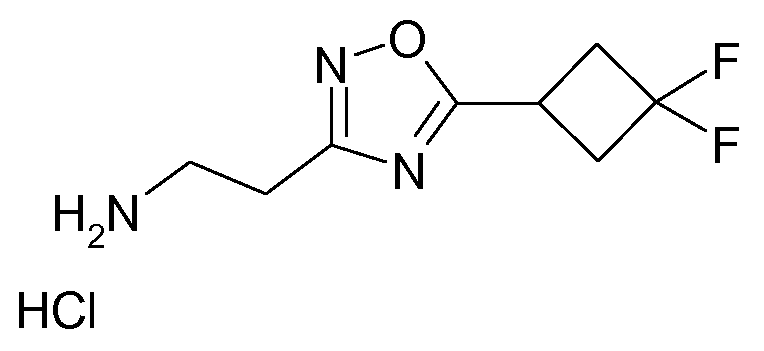
The title compound was prepared following procedure of Intermediate 70 starting from 2,2-difluorocyclobutanecarboxylic acid, PyBop and 3-aminopropanenitrile. 1H
NMR (DMSOd6, 300 MHz) δ 8.24 (bs, 3H), 3.85-3.75 (m, 1 H), 3.18-2.92 (m, 8H).
Intermediate 90 : 2-[5-(2,2,2-Trifluoro-1 ,1 -dimethylethyl)-1 ,2,4-oxadiazol-3- yljethanamine hydrochloride
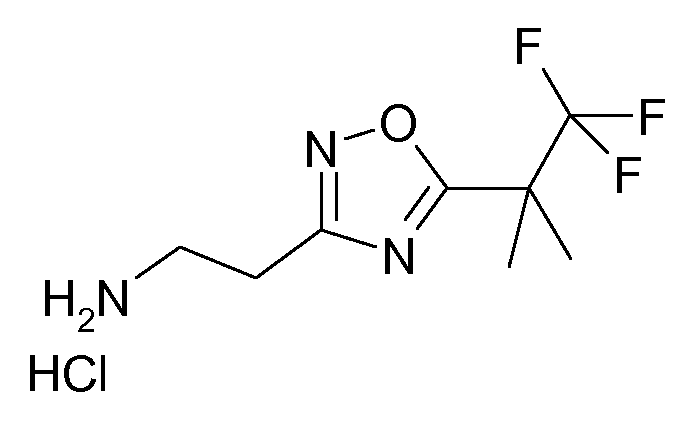
The title compound was prepared following procedure of Intermediate 70 starting from 3,3,3-trifluoro-2,2-dimethylpropionic acid, PyBop and 3-aminopropanenitrile. 1H NMR (DMSOd6, 300 MHz) δ 8.28 (bs, 3H), 3.17-3.14 (m, 4H), 1.64 (s, 6H).
Intermediate 91 : 2-[5-(1 -Fluoro-1 -methylethyl)-1 ,2,4-oxadiazol-3-yl]ethanamine hydrochloride
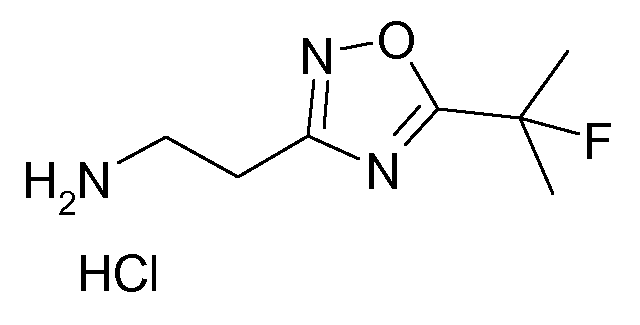
The title compound was prepared following procedure of Intermediate 70 starting from 2-fluoroisobutyric acid, PyBop and 3-aminopropanenitrile. 1H NMR (DMSOd6, 300 MHz) δ 8.27 (bs, 3H), 3.18-3.13 (m, 4H), 1.84 (s, 3H), 1.77 (s, 3H).
Intermediate 92 : 2-[5-(1 -Fluoroethyl)-1 ,2,4-oxadiazol-3-yl]ethanamine hydrochloride

The title compound was prepared following procedure of Intermediate 70 starting from 2-fluoropropionic acid, PyBop and 3-aminopropanenitrile. 1H NMR (DMSO-dβ, 300 MHz) δ 8.18 (bs, 3H), 6.09 (dq, J = 6.7, 46.4 Hz, 1 H), 3.19-3.10 (m, 4H), 1.73 (dd, J = 6.7, 24.8 Hz, 3H).
Intermediate 93 : [2-(5-lsobutyl-1 ,2,4-oxadiazol-3-yl)ethyl]amine hydrochloride

The title compound was prepared following procedure of Intermediate 70 starting from 2-isovaleryl chloride and 3-aminopropanenitrile. 1H NMR (DMSO-dβ, 400 MHz) δ 8.43 (bs, 3H), 3.12-3.01 (m, 4H), 2.77-2.75 (m, 2H), 2.10-2.03 (m, 1 H), 0.91 (d, J = 6.7 Hz, 6H).
Intermediate 94 : [2-(5-sec-Butyl-1 ,2,4-oxadiazol-3-yl)ethyl]amine hydrochloride

Intermediate 95 : Λ/-(2-Aminoethyl)-2,2-dimethylpropanamide hydrochloride

The title compound was prepared following procedure of intermediate 37 starting from te/f-butyl Λ/-(2-aminoethyl)carbamate and pivaloyl chloride. 1H NMR (DMSOd6, 300
MHz) δ 8.03 (bs, 3H), 7.80-7.76 (m, 1 H), 3.32-3.26 (m, 2H), 3.85-3.80 (m, 2H), 1.10 (bs, 9H).
Intermediate 96 : Λ/-{2-[3-(2-Aminoethyl)-1 ,2,4-oxadiazol-5-yl]-2-methylpropyl}- N,N-dimethylamine bis hydrochloride

Step 1) Formation of 3-(dimethylamino)-2,2-dimethylpropanoic acid 2,2-Dimethyl-3-bromopropionic acid (10 g, 55.2 mmol) was mixed with dimethyl amine (2 M in THF, 150 ml.) in a sealed tube and stirred at 650C for 12 h. THF was removed under vacuum and the resulting crude solid was slurried in EtOAc, filtered and dried under vacuum to afford the title compound (6 g, 75%) as a white solid. 1H NMR (DMSOd6, 400 MHz) δ 9.47 (bs, 1 H), 3.28 (s, 2H), 2.77 (s, 6H), 1.22 (s, 6H). Step 2) Formation of tert-butyl (2-{5-[2-(dimethylamino)-1 , 1-dimethylethyl]-1 ,2,4- oxadiazol-3-yl}ethyl)carbamate To a mixture of 3-(dimethylamino)-2,2-dimethylpropanoic acid (6 g, 41.3 mmol) and te/f-butyl-3-amino-3-(hydroxyimino) propylcarbamate (7 g, 34.4 mmol) in dry dioxane (100 ml.) was added DCC (8.5 g, 43.1 mmol) at once and the reaction mixture was stirred at RT for 1 h. After this time, the reaction mixture was heated to 1000C for 12 h
then cooled to RT and filtered. The filtrate was concentrated in vacuo and the residue filtered through a short plug of silica. Purification by preparative HPLC afforded the title compound as colourless liquid which was used as such in next step. Step 3) Formation of N-{2-[3-(2-aminoethyl)-1,2,4-oxadiazol-5-yl]-2-methylpropyl}- N,N-dimethylamine dihydrochloride
To a solution fe/f-butyl 2-{5-[2-(dimethylamino)-1 ,1-dimethylethyl]-1 ,2,4-oxadiazol-3- yl}ethylcarbamate (2 g, 6.4 mmol) in 1 ,4 dioxane (15 ml_), was added 4M HCI in dioxane (15 mL) at 00C and stirred for 12 h at RT. After completion, the reaction mixture was concentrated under vacuum to get the title compound (1.4 g, 77%) as a white solid. LC/MS, M+(ESI): 213.0. HPLC, Rt: 3.43 min (purity: 99.7%).
Intermediate 97 : Λ/-[2-(5-tert-Butyl-1 ,2,4-oxadiazol-3-yl)ethyl]-Λ/-methylamine hydrochloride
 Step 1) Formation of tert-butyl 2-(5-tert-butyl-1,2,4-oxadiazol-3-yl)ethylcarbamate te/f-Butyl-3-amino-3-(hydroxyimino) propylcarbamate (12 g, 59.11 mmol) was taken in pyridine (150 mL) and cooled to 00C under nitrogen atmosphere to which was slowly added te/f-butyl carbonyl chloride (7.84 g, 65.0 mmol). After 2 h, the reaction mixture was heated to reflux for 12 h. After this time, pyridine was removed under reduced pressure and the residue was taken up in EtOAc (200 mL) and washed with water (250 mL) then brine (100 mL). The organic layer was dried over Na2SO4, filtered and concentrated under vacuum. The crude product was purified by silica gel column chromatography (PE/EtOAc) to afford the title compound as a colorless liquid. 1H NMR (DMSO-de, 400 MHz) δ 5.00 (bs, 1 H), 3.28-3.22 (m, 2H), 2.91 (t, J = 7.0 Hz, 2H), 1.43 (s, 18H).
Step 2) Formation of tert-butyl 2-(5-tert-butyl-1,2,4-oxadiazol-3- yl)ethyl(methyl)carbamate
To a solution of te/f-butyl 2-(5-te/f-butyl-1 ,2,4-oxadiazol-3-yl)ethylcarbamate (3 g,
1 1.1 mmol), in dry DMF (50 mL) was added sodium hydride (60% suspension in mineral oil, 0.8 g, 33.4 mmol) at 00C and stirred for 30 min at this temperature. After this time, methyl iodide (4.75 g, 33.4 mmol) was added in a dropwise fashion and the reaction mixture was stirred for 12 h at 400C. The reaction mixture was poured onto ice and extracted with EtOAc (3 x 100 mL). The organic layer was washed with water
(2 x 200 ml_), brine (200 ml_), dried over Na2SO4 and evaporated under reduced pressure to afford the title compound (2.5 g, 80%) as pale yellow liquid which was used as such for the next step.
Step 3) Formation of N-[2-(5-tert-butyl-1 ,2,4-oxadiazol-3-yl)ethyl]-N-methylamine hydrochloride
To a solution te/f-butyl 2-(5-fe/f-butyl-1 ,2,4-oxadiazol-3-l)ethyl(methyl)carbamate (2.5 g, 8.80 mmol) in dry dioxane (25 ml.) was added 4M HCI in dioxane (20 ml.) at 00C and stirred at RT for 5 h. The reaction mixture was evaporated to dryness to afford the title compound (1.4 g, 73%) as a pale brown solid. LC/MS, M+(ESI): 185.2. HPLC, Rt: 2.76 min (purity 93.67%). 1H NMR (DMSOd6, 400 MHz) δ 9.34 (bs, 2H),
3.21-3.14 (m, 4H), 2.55 (s, 3H), 1.36 (s, 9H).
Intermediate 98 : 2-[5-(2,2,2-Trifluoroethyl)-1 ,2,4-oxadiazol-3-yl]ethanamine hydrochloride

The title compound was prepared following procedure of Intermediate 70 starting from 3,3,3-trifluoropropionic acid, DCC and 3-aminopropanenitrile. LC/MS, M+(ESI): 196.0. HPLC, Rt: 2.57 min (purity 99.1 %). 1H NMR (DMSOd6, 400 MHz) δ 8.35 (bs, 3H), 4.49-4.41 (m, 2H), 3.14 (s, 4H).
Intermediate 99 : 2-(5-Ethyl-1 ,3,4-thiadiazol-2-yl)ethanamine hydrochloride

The title compound was prepared following procedure of Intermediate 83 starting from propionic acid and Boc-beta-alanine. 1H NMR (DMSOd6, 400 MHz) δ 8.42 (bs, 3H), 3.43-3.39 (m, 2H), 3.22-3.16 (m, 2H), 3.07-3.01 (m, 2H), 1.27 (t, J = 7.5 Hz, 3H).
Intermediate 100 : 4-Methyl-Λ/-pyrrolidin-3-ylpentanamide hydrochloride

The title compound was prepared following procedure of Intermediate 37 starting from 1-Booc-3-aminopyrrolidine and γ-methylvaleroyl chloride. 1H NMR (DMSOd6, 300 MHz) δ 8.87 (bs, 1 H), 8.55 (bs, 1 H), 7.51-7.48 (m, 1 H), 4.63-4.56 (m, 1 H), 3.72- 3.37 (m, 3H), 2.52-2.41 (m, 1 H), 2.30-2.15 (m, 3H), 1.58-1.45 (m, 3H), 0.90 (d, J =
6.2 Hz, 6H).
Intermediate 101 : 6-(2-Methoxypyridin-3-yl)-1 ,3-benzothiazol-2 -amine

Step 1) Formation of tert-butyl (6-bromo-1 ,3-benzothiazol-2-yl) carbamate
2-Amino-6-bromobenzothiazole (2.0 g; 8.7 mmol) was suspended in DCM (40 ml.) to which were added di-te/f-butyl dicarbonate (2.86 g; 13.1 mmol) and DMAP (4 mg; 0.03 mmol). The resulting mixture was stirred at RT for 16 h then concentrated in vacuo. The residue was suspended in 2M NH3 in MeOH and stirred at RT for 2 h then concentrated in vacuo. The residue was triturated in water and filtered to afford the title compound (2.64 g, 92%) as a white solid. 1H NMR (DMSOd6, 300 MHz) δ 1 1.86 (s, 1 H), 8.19 (d, J = 2.0 Hz, 1 H), 7.60 (d, J = 8.5 Hz, 1 H), 7.52 (dd, J = 2.0, 8.5 Hz, 1 H), 1.51 (s, 9H).
Step 2) Formation of tert-butyl [6-(2-methoxypyridin-3-yl)-1 ,3-benzothiazol-2- yljcarbamate
A mixture of fe/f-butyl (6-bromo-1 ,3-benzothiazol-2-yl)carbamate (1.0 g; 3.04 mmol), 2-methoxypyridine-3-boronic acid (0.56 g; 3.65 mmol), PdCI2(PPh3)2 (0.1 1 g; 0.15 mmol) and cesium fluoride (1.38 g; 9.11 mmol) in dioxane (12 ml.) and water (6 ml.) was stirred at 900C for 3 h. The solution was diluted with DCM, washed successively with sat. aq. NaHCO3 and brine, dried over sodium sulfate and concentrated in vacuo. The residue was taken up in DCM and filtered through a short plug of alumina. After concentration in vacuo, the residue was triturated in MeOH and filtered to afford the title compound as a pale grey solid. 1H NMR (DMSO-d6, 300 MHz) δ 1 1.80 (s, 1 H),
8.18 (dd, J = 1.8, 4.9 Hz, 1 H), 8.09 (d, J = 1.6 Hz, 1 H), 7.79 (dd, J = 1.8, 7.2 Hz, 1 H), 7.71 (d, J = 8.5, 1 H), 7.57 (dd, J = 1.8, 8.4 Hz, 1 H), 7.10 (dd, J = 4.9, 7.3 Hz, 1 H), 3.89 (s, 3H), 1.52 (s, 9H). Step 3) Formation of 6-(2-methoxypyridin-3-yl)-1 ,3-benzothiazol-2-amine A mixture of te/f-butyl [6-(2-methoxypyridin-3-yl)-1 ,3-benzothiazol-2-yl]carbamate
(615 mg; 1.72 mmol) and 4M HCI in dioxane (20 ml_; 80 mmol) was stirred at RT for 5 h then concentrated in vacuo. The residue was taken up in 2M NH3 in MeOH (10 ml.) and the mixture stirred for 10 min then concentrated in vacuo. The residue was triturated in water to afford the title compound (402 mg, 91 %) as a pale grey solid. 1H NMR (DMSO-d6, 300 MHz) δ 8.14 (dd, J = 1.9, 4.9 Hz, 1 H), 7.84 (d, J = 1.4 Hz, 1 H),
7.73 (dd, J = 1.8, 7.3 Hz, 1 H), 7.57 (bs, 2H), 7.40-7.36 (m, 2H), 7.07 (dd, J = 4.9, 7.4 Hz, 1 H), 3.88 (s, 3H). HPLC, Rt 2.07 min (purity: 92.6%). LC/MS, M+(ESI): 257.9.
Intermediate 102 : 6-(5-Methoxypyridin-3-yl)imidazo[1 ,2-ϋ]pyridazin-2 -amine
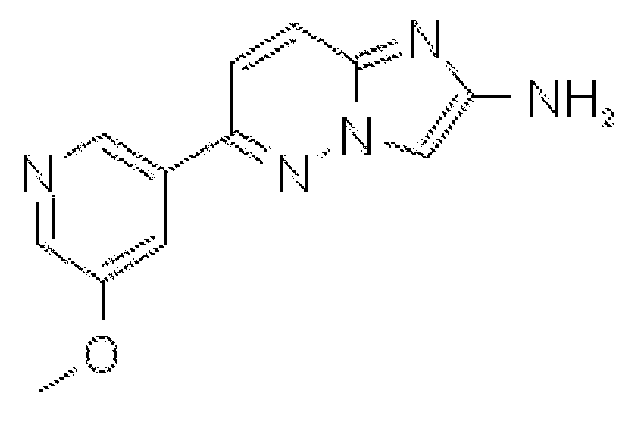
A mixture of 6-chloro-imidazo[1 ,2-b]pyridazin-2-ylamine (375 mg; 2.22 mmol), 5- methoxy-3-pyridineboronic acid pinacol ester (784 mg; 3.34 mmol), PdCI2(PPh3)2 (156 mg; 0.22 mmol), cesium fluoride (1.0 g; 6.67 mmol) in dioxane (5 ml.) and water
(1.5 ml.) was stirred at 1500C for one hour (microwave heating). After concentration in vacuo, the residue was partitioned between DCM and water. The two phases were separated, the organic layer washed with water, dried over magnesium sulfate, filtered through a short plug of Celite® and concentrated in vacuo. Purification by column chromatography on alumina (DCM to DCM/MeOH, 95/5) afforded the title compound as a yellow solid. 1H NMR (DMSOd6, 300 MHz) δ 8.78 (d, J = 1.8 Hz, 1 H), 8.38 (d, J = 2.8 Hz, 1 H), 7.91-7.86 (m, 1 H), 7.76 (d, J = 9.2 Hz, 1 H), 7.63 (d, J = 9.2 Hz, 1 H), 7.41 (s, 1 H), 5.63 (s, 2H), 3.93 (s, 3H). HPLC, Rt: 1.34 min (purity 96.2%).
Intermediate 103 : 6-[5-(Methylsulfonyl)pyridin-3-yl]-1 ,3-benzothiazol-2 -amine

Step 1) Formation of 3-bromo-5-(methylthio)pyridine
To a solution of 3,5-dibromopyridine (5 g, 21.1 mmol) in dry DMF (50 ml.) was added in portions sodium thiomethoxide (1.63 g, 23.0 mmol) at 00C under nitrogen and stirred at RT for 14 h. The mixture was quenched with sat. aq. ammonium chloride solution and extracted with EtOAc. The organic layer was washed with water, dried over Na2SC>4 and concentrated under vacuum to afford the title compound (4 g, 93%) as a yellow liquid. LC/MS, M+(ESI): 205.8. HPLC, Rt: 3.04 min (purity: 99.0%). 1H NMR (CDCI3, 400 MHz) δ 8.43-8.40 (m, 2H), 7.68 (s, 1 H), 2.52 (s, 3H). Step 2) Formation of 3-bromo-5-(methylsulfonyl)pyridine
To a solution of 2-bromo-6-(methylthio)pyridine (10 g, 49.0 mmol) in THF (125 mL) was added oxone® (30 g, 98.0 mmol) in water in a dropwise fashion at 00C and stirred at RT for 3 h. The mixture was extracted with EtOAc washed with water, brine, dried over Na2SO4, evaporated and purified by silica gel column chromatography (PE/EtOAc) to afford the title compound as a white solid. LC/MS, M+(ESI): 237.8.
HPLC, Rt: 5.45 min (purity: 99.6%). 1H NMR (DMSO-d6, 400 MHz) δ 9.07-9.04 (m, 2H), 8.58 (s, 1 H), 3.39 (s, 3H).
Step 3) Formation of6-(4,4,5,δ-tetramethyl-1,3-dioxaborolan-2-yl)-1,3-henzoϋi!azol-2- amine
To a solution of 6-bromo~1 ,3-benzothiazoi-2~amine (10 g, 43.6 mmoi) in dioxane (50 mL) was added bispinacoiotodiboron (16.6 g, 65.4 mmol), potassium acetate (12.8 g, 130.8 mmol) and PdCI2dppf.DCM (3.55 g, 43.6 mmol) and the resulting mixture was stirred at 100&C for 12 h. After cooiing to RT the reaction mixture was filtered through a plug of Celite which was further washed with EA. The combined filtrate was evaporated to dryness and the residue purified by column chromatography (PBEA1 85/15) to afford the title compound (5.1 g, 42%) as a white solid. 1H NMR (DMSO-dt, 400 MHz) δ 7.92 (s, 1 H)1 7.65 (bs, 2H)1 7.50 (d, J= 8.7 Hz1 1 H)1 7.29 (d, J = 8.2 Hz,
1 H), 1.27 (s, 12H).
Step 4} Formation of 6-[5~(methy!sυffonyi)pyridin~3-yi]-1 ,3-benzothiazo!-2-amine A mixture of 6~(4>4,5.5-tetramethyl-1,3-dioxaborolan~2-yl}~1/3~benzothiazol~2~amine (5 g, 18 mmol), 3~bromo5~(methy!suifonyi)pyridine (4.27 g, 18 mmo!), cesium fluoride (5.5 g, 36.2 mmol) and PdCi2 (PPh3J2 (0.25 gs 0.4 mmol) in DMF (25 mL) stirred at
800C for 12 h. The reaction mixture was cooied RT. poured into ice water and the product was extracted with ethyl acetate (2x10OmL). The combined organic layer was dried over Na2SO4 and evaporated under vacuum. The crude product was purified by column chromatography (CHCi3ZMeOH) to afford the titie compound (3.5 g, 64%) as paie yellow solid.
LC/MS, M+(ESi): 305.9. HPLC1 Rt: 5.45 min (purity 99.6%).
Intermediate 104 : 6-(6-Methoxypyridin-3-yl)-1,3-benzothiazol-2 -amine

The title compound was prepared following procedure of Intermediate 101 starting from 2-amino-6-bromobenzothiazole and 2-methoxypyridine-5-boronic acid pinacol ester. 1H NMR (DMSO-d6, 300 MHz) δ 8.93 (bs, 3H), 8.47-8.46 (m, 1 H), 8.10 (d, J = 1.7 Hz, 1 H), 8.02-7.97 (m, 1 H), 7.64 (dd, J = 1.9, 8.4 Hz, 1 H), 7.48 (d, J = 8.4 Hz,
1 H), 6.91 (m, J = 8.6 Hz, 1 H), 3.89 (s, 3H).
Intermediate 105 : 2-[(Benzoyloxy)amino]-6-bromoimidazo[1 ,2-a]pyridine

Phenyl chloroformate (11.6 g, 74.2 mmol) was added dropwise at 00C to a solution of 6-bromoimidazo[1 ,2-a]pyridin-2-amine(15 g, 70.7 mmol) and 2,4,6-collidine (12.8 g, 106 mmol) in THF (225 ml.) and the reaction mixture was stirred at RT for 12 h then quenched with water. The precipitate was filtered off, washed with water and dried to afford the title compound as an off- white solid. LC/MS (Atlantis), M+(ESI): 334.1. HPLC, Rt: 3.86 (purity: 94.1 %). 1H NMR (DMSOd6, 400 MHz) δ 10.95 (bs, 1 H), 8.89 (s, 1 H), 7.88 (s, 1 H), 7.44-7.40 (m, 3H), 7.35-7.31 (m, 1 H), 7.31-7.30 (m, 1 H), 7.28- 7.20 (m, 2H).
Intermediate 106 : 5-Pyridin-3-yl[1 ,3]thiazolo[5,4-b]pyridin-2 -amine

Step 1) Formation of tert-butyl (5-chloro[1,3]thiazolo[5,4-b]pyridin-2-yl)carbamate 5-Chloro[1 ,3]thiazolo[5,4-b]pyridin-2-amine (1.50 g; 8.08 mmol) was suspended in
DCM (30 ml.) to which were added di-te/f-butyl dicarbonate (2.64 g; 12.12 mmol) and 4-dimethylaminopyridine (2 mg; 0.02 mmol). The suspension was stirred at RT during 4 h after which it was filtered and washed with DCM to give the title compound (2.03 g; 88%) as a white solid. LC/MS, M-(ESI): 283.8. HPLC, Rt: 3.56 min (purity: 97.5%). Step 2) Formation of 5-pyridin-3-yl[1 ,3]thiazolo[5,4-b]pyridin-2-amine te/f-Butyl (5-chloro[1 ,3]thiazolo[5,4-jb]pyridin-2-yl)carbamate (2.03 g; 7.10 mmol), 3- (4,4,5,5-tetramethyl-1 ,3,2-dioxaborolan-2-yl)pyridine (1.89 g; 9.24 mmol), PdCI2(PPh3)2 (498 mg; 0.71 mmol), cesium fluoride (2.69 g; 17.76 mmol) were flushed with argon before addition of degassed dioxane (40 mL) and water (20 mL).
Reaction mixture was heated at 900C during 3 h after which solvents were removed under vacuum. Solid residue was then triturated in water, filtered then in hot ACN and filtered before addition of 4M HCI in dioxane (25 ml_). Reaction mixture was stirred at RT for 4 h and solvent was evaporated under vacuum. Solid was triturated in sat. aq. Na2CO3 followed by filtration to afford the title compound as a beige solid. LC/MS, M+(ESI): 228.8.
Intermediate 107 : 6-[5-(2-Methoxyethoxy)pyridin-3-yl]-1,3-benzothiazol-2 -amine

To a solution of 3-bromo-5-hydroxypyridine (2 g, 11.4 mmol) in dry DMF (10 mL) was added potassium carbonate (2.3 g, 17.2 mmol) at once and stirred for 20 min under inert atmosphere at RT before dropwise addition of 2-bromomethyl ethyl ether. After 4 h the reaction mixture was filtered and water (100 mL) was added to the filtrate which was extracted with EtOAc (2 x 15 mL). The organic layer was washed with aq. sodium hydroxide (10% solution, 15 mL), water, brine then dried over Na2SO4 and concentrated under vacuum to afford the title compound (2 g, 75%) as a brown liquid. LC/MS, M+(ESI): 234.0. HPLC, Rt: 2.33 min (purity: 96.3%). 1H NMR (CDCI3, 400 MHz) δ 8.25 (S, 2H), 7.37 (t, J = 2.4 Hz, 1 H), 4.13-4.11 (m, 2H), 3.73-3.71 (m, 2H), 3.41 (S, 3H).
Step 2) Formation oftert-43utyl[6~(4,4,5!5~tetrameUi^~1,3!2~dhxaboroian~2~yi)~1,3~ benzothiazoi~2~yl]carbamate
A mixture of tert-buty! {6-bromo-1 ,3-benzothiazo!-2-yi)carbamate (8.0 g; 24.3 mmol), bis(pinacolato)diboron (18.9 g; 72.9 mmoi), PdC!2dppf (1.07 g; 1.46 mmoi) and potassium acetate (21.7 g; 219 mmoi) in dioxane (80 mL) was stirred at 80°C for 4 h.
After cooling down to RT, the solution was filtered through a short piug of Celite. The filtrated was poured into water and extracted with EtOAc. The combined organic layer was washed with brine, dried over magnesium sulfate and concentrated in vacuo. Purification by column chromatography (cHex/EtOAc) afforded the title compound
contaminated with bis(pinacoiato)diboron (6.84 g) as a pale orange solid which was used without further purification. LC/MS, M-(ESi): 375.2.
Step 3) ) Formation oftert-butyi {6-[5~(2~methoxyethoxy)pyridin-3-yl]~1,3~ benzothiazol-2~yl}carbamate
A mixture of ferf-butyi [6-(4,4,5,5-tetrameihyi-1 ,3,2-dioxaboroian-2-yi)-1 ,3- benzothiazoi-2-y!]carbamate (500 mg; 1 ,33 mmoi), 3-bromo-5-(2-methoxy-ethoxy)- pyridine (206 mg; 0.89 mmoi), cesium fluoride (407 mg; 2.68 mmoi) and PdCi2(PPh5)J
(39 mg; 0.06 mmoi) in dioxane (4 mi_) and water (2 mi.) was stirred at SO0C for 16 h.
After dilution with ethy! acetate, the soiution was washed with sat. aq. NH4Ci then brine, dried over magnesium suifale and concentrated in vacuo. Purification by coiumn chromatography (DCM/MeOH) afforded the titie compound (188 mg, 53%) as a white soiid.
LC/MS, M+(ESi): 402.1.
Step 4) Formation of 6-[5~(2~methoxyethoxy)pyridin-3-yl]~1,3~henzothiazol~2~amine
The titie compound was prepared foiiowing procedure of intermediate 101 step 3 starting from tert-butyi {δ-[5-(2-methoxyethoxy)pyridin-3-yi]-1 ,3-benzothiazo!-2- yi}carbamate. LC/MS, M+(ESi): 302,0. 1H NMR (DMSO-ds> 300 MHz) δ 8.48 {6, J ^
1.5 Hz1 1 H), 8.23 (d, J = 2.6 Hz, 1 H)1 8.10 (d, J = 1.5 Hz, 1 H), 7.63-7.59 (m, 4H), 7.40
(d, J = 8,3 Hz, 1 H), 4.29-4.26 (m, 2H)5 3.71-3.68 (m, 2H), 3.32 (s, 3H),
Intermediate 108 : 5-(2-Amino-1,3-benzothiazol-6-yl)nicotinonitrile

The title compound was prepared following procedure of Intermediate 101 starting from tert-butyi [6~(4s4,5!5~tetramethyi-1 ,3,2~dioxaboroian-2~yi>-1 ,3-benzothiazoi-2~ yijcarbamate and 5-bromonicotinonitrile. LC/MS, M+(ESI): 252.9.
Intermediate 109 : 6-Chloroimidazo[1 ,2-fe]pyridazin-2 -amine

Step 1) Formation of N-(6-chloropyridazin-3-yl)-4-methylbenzenesulfonamide p-Toluene sulfonyl chloride (91.8 g, 481 mmol) was added portionwise at 00C to a solution of 3-amino-6-chloropyridazine (52 g, 401 mmol) in pyridine (315 ml.) and the reaction mixture was stirred at 900C for 12 h. After concentration in vacuo, the residue was purified by column chromatography (PE/EtOAc, 90/10) to afford the title compound as a white solid. LC/MS (Atlantis), M+(ESI): 283.8. HPLC, Rt: 3.06 (purity: 98.0%). 1H NMR (DMSOd6, 300 MHz) δ 7.80-7.75 (m, 4H), 7.56 (bs, 1 H), 7.39-7.37 (m, 2H), 2.49 (s, 3H).
Step 2) Formation of 2-[(6Z)-3-Chloro-6-{[(4-methylphenyl)sulfonyl]imino}pyridazin- 1 (6H)-yl]acetamide
2-Bromoacetamide (10.6 g, 77 mmol) was added to a solution of Λ/-(6- chloropyridazin-3-yl)-4-methylbenzenesulfonamide (20 g, 70 mmol) and DIEA (10.6 g, 77 mmol) in DMF (100 ml.) and the reaction mixture was stirred at room temperature for 3 h then quenched with water. The precipitate was washed with water and dried to afford the title compound (23.3 g, 98%) as a beige solid. LC/MS (Atlantis), M+(ESI): 340.8. HPLC, Rt: 2.35 (purity: 97.2%). 1H NMR (DMSOd6, 300 MHz) δ 7.99-7.97 (m, 1 H), 7.80-7.78 (m, 1 H), 7.70-7.68 (m, 3H), 7.39 (s, 1 H), 7.32-7.30 (m, 2H), 4.82 (s, 2H), 2.34 (s, 3H).
Step 3) Formation of N-(6-chloroimidazo[1,2-b]pyridazin-2-yl)-2,2,2-trifluoroacetamide Trifluoroacetic anhydride (175.9 g, 1.54 mol) was slowly added to a solution of 2- [(6Z)-3-chloro-6-{[(4-methylphenyl)sulfonyl]imino}pyridazin-1 (6/-/)-yl]acetamide (23 g, 67 mmol) in DCM (290 mL) and the reaction mixture was stirred at 500C for 3 h. After concentration in vacuo, the residue was triturated in 10% aq. NaHCC>3, filtered washed with water and dried to afford the title compound (15.7 g, 88%) as an off- white solid. LC/MS (Atlantis), M+(ESI): 265.0. HPLC, Rt: 3.73 (purity: 97.8%). 1H NMR (DMSOd6, 400 MHz) δ 12.70 (s, 1 H), 8.40 (s, 1 H), 8.19-8.17(m, 1 H), 7.44-7.41 (s, 1 H). Step 4) Formation of 6-chloroimidazo[1 ,2-b]pyridazin-2-amine
Potassium phosphate (42.36 g 0.2 mol) in water (60 mL) was added to a solution of Λ/-(6-chloroimidazo[1 ,2-t)]pyridazin-2-yl)-2,2,2-trifluoroacetamide (15 g, 56 mmol) in 1 ,2-dimethoxyethane (102 mL) and the reaction mixture was stirred at 900C for 12 h.
The two phases were separated and the aqueous layer extracted with EtOAc (2x10OmL). The combined organic phase was washed with brine (50 ml_), dried over sodium sulfate and concentrated in vacuo. The residue was triturated in PE and the precipitate filtered off, washed with PE and dried to afford the title compound (8.5 g, 89%) as a brown solid. LC/MS (Atlantis), M+(ESI): 169.1. HPLC, Rt: 1.39 (purity: 96.7%). 1H NMR (DMSOd6, 400 MHz) δ 7.68-7.66 (d, 1 H), 7.35 (s, 1 H), 7.04-7.01 (m, 1 H), 5.67 (s, 2H).
Intermediate 110 : 6-(5-Methoxypyridin-3-yl)[1 ,2,4]triazolo[1 ,5-a]pyridin-2-amine

Step 1) Formation of ethyl {[(5-bromopyridin-2-yl)amino]carbonothioyl}carbamate
Ethoxycarbonyl isothiocyanate (3.6 mL; 31.8 mmol) was added to a solution of 2- amino-5-bromo-pyridine (5 g; 28.9 mmol) in dioxane (55 mL) and the resulting mixture was stirred at RT for 16 h then concentrated in vacuo. The residue was triturated in c-hexane, the precipitate filtered off, washed with c-hexane and dried to afford the title compound (8 g, 91%) as an off-white solid. 1H NMR (DMSOd6, 300 MHz) δ 12.20 (s, 1 H), 1 1.82-1 1.64 (m, 1 H), 8.70-8.56 (m, 1 H), 8.54 (dd, J = 0.6, 2.5 Hz, 1 H), 8.13 (dd, J = 2.5, 8.9 Hz, 1 H), 4.23 (q, J = 7.1 Hz, 2H), 1.26 (t, J = 7.1 Hz, 3H). Step 2) Formation of 6-bromo[1, 2, 4]triazolo[1 , 5-a]pyridin-2-amine
Hydroxylamine hydrochloride (9.20 g; 132 mmol) was added to a solution of ethyl {[(5-bromopyridin-2-yl)amino]carbonothioyl}carbamate (8 g; 26.3 mmol) and DIEA (13.5 mL; 79 mmol) in EtOH (65 mL) and MeOH (65 mL) and the resulting mixture was stirred at RT for 3 h. The solvents were removed in vacuo and the residue taken up in dioxane. Water was added until precipitation started. The solids were collected by filtration, washed with water and dried to afford the title compound (5.26 g, 94%) as a pale pink solid. 1H NMR (DMSO-d6, 300 MHz) δ 9.80 (s, 1 H), 7.75 (d, J = 9.0 Hz, 1 H), 7.15 (d, J = 9.0 Hz, 1 H), 6.13-6.08 (m, 2H). LC/MS, M+(ESI): 212.9.
Step 3) Formation of6-(5-methoxypyridin-3-yl)[1,2,4]triazolo[1,5-a]pyridin-2-amine A mixture of 6-bromo[1 ,2,4]triazolo[1 ,5-a]pyridin-2-amine (200 mg; 0.94 mmol), 3- methoxypyridine-5-boronic acid pinacol ester (287 mg; 1.22 mmol), PdCI2(PPh3J2 (66 mg; 0.09 mmol), cesium fluoride (357 mg; 2.35 mmol) in dioxane (4 ml_) and water (2 mL) was stirred at 85°C for 2 days. After concentration in vacuo, the residue was triturated in water, filtered and dried to afford the title compound (235 mg, quantitative yield) as a brown solid. LC/MS, M+(ESI): 242.1.
Intermediate 111 : 6-(5-Ethoxypyridin-3-yl)-1,3-benzothiazol-2-amine trifluoroacetic acid salt

Step 1) Formation oftert~bυtyl[6~(5~eϋioxypyήdin~3~yl}~1,3~benzothiazol~2~ yijcarbamate
A mixture of 3~bromo~5-ethoxypyridine (prepared according to WO 2006/023630, 510 mg; 2.52 mmol), terf-butyl [6-(4,4,5,5-tetramethyl-1 ,3,2-dioxaborolan-2-yl)-1 ,3- benzothiazol-2-yl]carbamate (950 mg; 2.52 mmol), PdCI2(PPh3J2 (266 mg; 0.38 mmol) and cesium fluoride (1.15 g; 7.57 mmol) in dioxane (6 mL) and water (2 mL) was stirred at 1000C for 1 hour (microwave heating). After concentration in vacuo, the residue was taken up in EtOAc, washed with water then sat. aq. NaHCO3, dried over magnesium sulfate, filtered through a short plug of Celite® and concentrated in vacuo. Crystallization from hot MeOH afforded the title compound (450 mg, 48%) as a white solid. 1H NMR (DMSO-d6l 300 MHz) δ 11.86 (s, 1 H), 8.52 (d, J = 1.9 Hz, 1 H), 8.35 (bs, 1 H), 8.25 (d, J = 2.7 Hz, 1 H), 7.77-7.71 (m, 2H), 7.68-7.65 (m, 1 H), 4.21 (q, J = 7.0 Hz, 2H), 1.52 (s, 9H), 1.38 (t, J = 7.0 Hz, 3H). LC/MS, M+(ESI): 372.1. Step 2) Formation of 6-(5-ethQxypyndin~3~yi)~1,3~benzQthiazal~2~amine trifiuoroacetic acid salt
TFA (12 mL) was added to a solution of ferf-butyl [6-(5-ethoxypyridin-3-yl)-1 ,3- benzothiazol-2-yl]carbamate (400 mg; 1.01 mmol) in DCM (12 mL) and the resulting mixture was stirred at RT for 2 h then concentrated in vacuo. The solid was triturated in a mixture of DCM and MeOH, filtered. The mother liquor was concentrated in
vacuo to afford the title compound (350 mg, quantitative yieid) as a white solid. LC/MS, M+(ESI): 272,0,
Intermediate 112 : 6-[5-(Trifluoromethyl)pyridin-3-yl]-1 ,3-benzothiazol-2 -amine
,

Step 1) Formation of tert-butyl {6-[5-(trifluoromethyl)pyridin-3-yl]-1 ,3-benzothiazol-2- yljcarbamate
A mixture of fe/f-butyl [6-(4,4,5,5-tetramethyl-1 ,3,2-dioxaborolan-2-yl)-1 ,3- benzothiazol-2-yl]carbamate (400 mg; 1.06 mmol), PdCI2(PPh3)2 (45 mg; 0.06 mmol), 3-bromo-5-(trifluoromethyl)pyridine (336 mg; 1.49 mmol) and cesium fluoride (565 mg; 3.72 mmol) in dioxane (10 mL) and water (5 ml.) was stirred at 100°C for 1 hour. After cooling down to RT, the precipitate was filtered off to afford the title compound (220 mg, 86%) as a beige solid. 1H NMR (DMSOd6, 300 MHz) δ 1 1.93 (s, 1 H), 9.28 (d, J = 2.0 Hz, 1 H), 8.96 (bs, 1 H), 8.53 (bs, 1 H), 8.50 (d, J = 1.7 Hz, 1 H), 7.90 (dd, J = 1.9, 8.5 Hz, 1 H), 7.80 (d, J = 8.5 Hz, 1 H), 1.53 (s, 9H). LC/MS, M-(ESI): 394.1.
Step 2) Formation of 6-[5-(trifluoromethyl)pyridin-3-yl]-1,3-benzothiazol-2-amine 4M HCI in dioxane (15 mL) was added to a solution of te/f-butyl {6-[5- (trifluoromethyl)pyridin-3-yl]-1 ,3-benzothiazol-2-yl}carbamate (340 mg; 0.86 mmol) in MeOH (5 mL) and the resulting mixture was stirred at RT for 18 h. Et2O was added and the precipitate filtered off to afford the title compound (280 mg, 98%) as a white solid. HPLC, Rt: 2.98 (purity: 99.2%). LC/MS, M-(ESI): 296.0.
Intermediate 113 : 6-(5-Morpholin-4-ylpyridin-3-yl)-1 ,3-benzothiazol-2 -amine

Step 1) Formation of4-(5-bromopyridin-3-yl)morpholine
A mixture of 3,5-dibromopyridine (2.0 g; 8.44 mmol), morpholine (0.81 g; 9.29 mmol) and TEA (1.71 g; 16.89 mmol) in DMA (10 mL) was stirred for 2 h at 2000C (microwave heating). The solution was poured onto a mixture of ice and sat. aq.
NaHCO3 and extracted with EtOAc (2x). The combined organic phase was washed with brine (2x), dried over sodium sulfate and concentrated in vacuo to give a yellow oil which crystallized from n-pentane to afford the title compound as a beige solid. 1H NMR (DMSO-d6! 300 MHz) δ 8.30 (bs, 1 H), 8.07 (bs, 1 H), 7.55 (bs, 1 H), 3.73 (t, J = 4.6 Hz, 4H), 3.22 (t, J = 4.6 Hz, 4H).
Step 2) Formation of tert-butyl [6-(5-morpholin-4-ylpyridin-3-yl)-1 ,3-benzothiazol-2- yljcarbamate
A mixture of 4-(5-bromopyridin-3-yl)morpholine (0.68 g; 2.80 mmol), te/f-butyl [6-
(4,4,5,5-tetramethyl-1 ,3,2-dioxaborolan-2-yl)-1 ,3-benzothiazol-2-yl]carbamate (1.05 g; 2.80 mmol), cesium fluoride (1.70 g; 1 1.19 mmol) and PdCI2(PPh3)4 (0.24 g; 0.34 mmol) in dioxane (12 mL) and water (6 mL) was stirred at 1000C for 2 h (microwave heating). The reaction mixture was partitionned between DCM and sat. aq. NaHCO3. The aqueous phase was extracted with DCM and the combined organic layer washed with brine, dried over sodium sulfate and concentrated in vacuo. Crystallization from EtOAc and washing with n-pentane afforded the title compound as an off-white solid.
1H NMR (DMSO-d6, 300 MHz) δ 1 1.86 (s, 1 H), 8.38 (d, J = 1.5 Hz, 1 H), 8.34 (bs, 1 H), 8.30 (d, J = 2.7 Hz, 1 H), 7.76 (bs, 2H), 7.59 (t, J = 2.3 Hz, 1 H), 3.78 (t, J = 4.8 Hz, 4H), 3.28 (t, J = 4.8 Hz, 4H), 1.53 (s, 9H). LC/MS, M+(ESI): 413.2. Step 3) Formation of 6-(5-morpholin-4-ylpyridin-3-yl)-1 ,3-benzothiazol-2-amine 4M HCI in dioxane (10 mL, 40 mmol) was added dropwise to te/f-butyl [6-(5- morpholin-4-ylpyridin-3-yl)-1 ,3-benzothiazol-2-yl]carbamate (0.61 g; 1.48 mmol) and the resulting mixture was stirred at RT for 10 h. The solution was poured into sat. aq. NaHCO3, extracted with DCM, washed with brine, dried over sodium sulfate and
concentrated in vacuo. Trituration in DCM and filtration afforded the title compound as an off-white solid. 1H NMR (DMSOd6, 300 MHz) δ 8.33 (d, J = 1.5 Hz, 1 H), 8.25 (d, J = 2.6 Hz, 1 H), 8.07 (d, J = 1.8 Hz, 1 H), 7.63-7.55 (m, 3H), 7.53 (t, J = 2.3 Hz, 1 H), 7.40 (d, J = 8.3 Hz, 1 H), 3.78 (t, J = 4.8 Hz, 4H), 3.26 (t, J = 4.8 Hz, 4H). LC/MS, M+(ESI): 313.1.
Intermediate 114 : [5-(2-Amino-1 ,3-benzothiazol-6-yl)pyridin-3-yl]methyl pivalate

Step 1) Formation of (5-bromopyridin-3-yl)methanol Sodium borohydride (0.4 g; 18.5 mmol) was added to a solution of methyl 5- bromonicotinate (2.0 g; 9.26 mmol) in ethanol (50 ml.) and the resulting mixture was stirred at reflux for 20 h. The solution was diluted with EtOAc, washed with water then brine, dried over sodium sulfate and concentrated in vacuo. Purification by column chromatography on alumina (DCM to DCM/EtOAc, 50/50) afforded the title compound (1.5 g, 86%) as a yellow oil. 1H NMR (DMSOd6, 300 MHz) δ 8.58 (d, J = 2.3 Hz, 1 H),
8.51 (d, J = 1.6 Hz, 1 H), 7.97-7.95 (m, 1 H), 5.45 (t, J = 5.8 Hz, 1 H), 4.54 (d, J = 5.8 Hz, 2H).
Step 2) Formation of (5-bromopyridin-3-yl) methyl pivalate Pivaloyl chloride (0.81 g; 6.73 mmol) was added dropwise to a solution of (5- bromopyridin-3-yl)methanol (1.15 g; 6.12 mmol) in pyridine (5 ml.) and DCM (45 ml.) and the resulting mixture was stirred at RT for 16 h whereupon pivaloyl chloride (0.81 g; 6.73 mmol) was added. The reaction mixture was stirred for a further 24 h then concentrated in vacuo. The residue was taken up in EtOAc washed with sat. aq. NaHCOβ, dried over magnesium sulfate and concentrated in vacuo. Filtration through a short plug of alumina (DCM) afforded the title compound (1.35 mg, 81%) as a colourless oil. 1H NMR (DMSO-d6, 300 MHz) δ 8.68 (d, J = 2.3 Hz, 1 H), 8.58 (d, J = 1.6 Hz, 1 H), 8.05 (t, J = 2.1 Hz, 1 H), 5.13 (s, 2H), 1.17 (s, 9H).
Step 3) Formation of (5-{2-[(tert-butoxycarbonyl)amino]-1,3-benzothiazol-6-yl}pyridin- 3-yl)methyl pivalate
A mixture of (5-bromopyridin-3-yl)methyl pivalate (500 mg; 1.84 mmol), te/f-butyl [6- (4,4,5,5-tetramethyl-1 ,3,2-dioxaborolan-2-yl)-1 ,3-benzothiazol-2-yl]carbamate (691 mg; 1.84 mmol), cesium fluoride (1.12 g; 7.35 mmol) and PdCI2(PPh3)2 (155 mg; 0.22 mmol) in dioxane (8 ml.) and water (4 ml.) was stirred at 1000C for 2 h then concentrated in vacuo. The residue was taken up in DCM, washed with sat. aq. NaHCC>3 then brine, dried over magnesium sulfate and concentrated in vacuo. Trituration in EtOAc and filtration afforded the title compound (580 mg, 71%) as a white solid. 1H NMR (DMSOd6, 300 MHz) δ 1 1.88 (s, 1 H), 8.92 (d, J = 2.2 Hz, 1 H),
8.57 (d, J = 1.9 Hz, 1 H), 8.35 (s, 1 H), 8.1 1 (t, J = 2.1 Hz, 1 H), 7.81 - 7.72 (m, 2H), 5.22 (s, 2H), 1.53 (s, 9H), 1.19 (s, 9H). HPLC, Rt: 3.86 (purity 86.3%). Step 4) Formation of [5-(2-amino-1 ,3-benzothiazol-6-yl)pyridin-3-yl]methyl pivalate TFA (3 ml.) was added to a solution of (5-{2-[(te/f-butoxycarbonyl)amino]-1 ,3- benzothiazol-6-yl}pyridin-3-yl)methyl pivalate (560 mg; 1.27 mmol) in DCM (10 ml.) and the resulting mixture was stirred at RT for 2 h. The solution was diluted with DCM, washed with sat. aq. NaHCO3 then brine, dried over sodium sulfate and concentrated in vacuo to afford the title compound as a white solid. 1H NMR (DMSO-de, 300 MHz) δ 8.86 (d, J = 2.2 Hz, 1 H), 8.52 (d, J = 1.8 Hz, 1 H), 8.08 (d, J = 1.8 Hz, 1 H), 8.04 (t, J = 2.1 Hz, 1 H), 7.63 (bs, 2H), 7.58 (dd, J = 1.9, 8.4
Hz, 1 H), 7.44 (d, J = 8.4 Hz, 1 H), 5.19 (s, 2H), 1.18 (s, 9H). HPLC, Rt: 2.10 (purity 95.6%).
Intermediate 115 : 6-(1H-lndazol-5-yl)-1 ,3-benzothiazol-2 -amine

A mixture of 2-amino-6-bromobenzothiazole (350 mg; 1.53 mmol), 1 /-/-indazole-5- boronic acid pinacol ester (485 mg; 1.99 mmol), PdCI2(PPh3^ (129 mg; 0.18 mmol) and cesium fluoride (0.93 g; 6.11 mmol) in dioxane (9 mL) and water (4.5 mL) was
stirred at 900C for 24 h then concentrated in vacuo. The residue was taken up in DCM, washed with sat. aq. NaHCC>3 then brine, dried over magnesium sulfate and concentrated in vacuo. Purification by trituration in DCM and filtration afforded the title compound as a beige solid. LC/MS, M+(ESI): 267.0.
Intermediate 116 : 6-(1H-lndazol-4-yl)-1 ,3-benzothiazol-2 -amine

2-Amino-6-bromobenzothiazole (400 mg; 1.75 mmol) and 4-(4,4,5,5-tetramethyl- [1 ,3,2]dioxaborolan-2-yl)-1 /-/-indazole (554 mg; 2.27 mmol) were reacted as described for Intermediate 115. Purification by trituration in ACN and filtration afforded the title compound as a beige solid. LC/MS, M+(ESI): 267.0.
Intermediate 117 : 6-(3H-lmidazo[4,5-fe]pyridin-6-yl)-1 ,3-benzothiazol-2 -amine

A mixture of 6-bromo-3/-/-imidazo[4,5-b]pyridine (300 mg; 1.51 mmol), te/f-butyl [6-
(4,4,5,5-tetramethyl-1 ,3,2-dioxaborolan-2-yl)-1 ,3-benzothiazol-2-yl]carbamate (570 mg; 1.51 mmol), cesium fluoride (921 mg; 6.06 mmol) and PdCI2(PPh3)2 (128 mg; 0.18 mmol) in dioxane (8 ml.) and water (4 ml.) was stirred at 125°C for 3 h (microwave heating) then concentrated in vacuo. The residue was triturated in water then in ACN to afford the crude title compound as an orange oil which was used without further purification. LC/MS, M+(ESI): 268.0.
Intermediate 118 : 6-[5-(Methoxymethyl)pyridin-3-yl]-1 ,3-benzothiazol-2 -amine

Step 1) Formation of 3-bromo-5-(methoxymethyl)pyridine To a slurry of NaH (60%, 1.6 g, 17.5 mmol) in dry THF (20 ml.) under N2, was added a solution of (5-bromopyridin-3-yl)methanol (2.2 g, 1 1.7 mmol) in THF (20 ml.) in a dropwise fashion at 00C. After stirring at RT for 10 min, was added methyl iodide (2.18 ml_, 35.1 mmol) in drops at 00C and further stirred at RT for 1 h. After this time, ice cold water (10 ml.) was added followed by evaporation under vacuum. Residue was dissolved with EtOAc, washed with water, brine then dried over Na2SO4, concentrated under vacuum and purified by silica gel column chromatography (PE/EtOAc) to afford the title compound as a pale yellow liquid. LC/MS, M+(ESI) 204.0. HPLC, Rt: 1.96 min (purity: 99.9%). 1H NMR (CDCI3, 400 MHz) δ 8.61 (s, 1 H), 8.48 (s, 1 H), 7.86 (s, 1 H), 4.46 (s, 2H), 3.42 (s, 3H). Step 2) Formation of 6-[5-(methoxymethyl)pyridin-3-yl]-1 ,3-benzothiazol-2-amine
3-Bromo-5-methoxymethyl-pyridine (750 mg; 3.71 mmol), 6-(4,4,5,5-tetramethyl- [1 ,3,2]dioxaborolan-2-yl)-benzothiazol-2-ylamine (1.13 g; 4.08 mmol) were reacted as described for Intermediate 115. After cooling to RT, the reaction mixture was filtered to afford the title compound as a white solid. LC/MS, M+(ESI): 272.0. 1H NMR (DMSO-de, 300 MHz) δ 8.82 (d, J = 2.3 Hz, 1 H), 8.47 (d, J = 1.9 Hz, 1 H),
8.08 (d, J = 1.8 Hz, 1 H), 7.99 (t, J = 2.1 Hz, 1 H), 7.63-7.56 (m, 3H), 7.41 (d, J = 8.3 Hz, 1 H), 4.52 (s, 2H), 3.35 (s, 3H).
Intermediate 119 : 6-(1 -Methyl-1H-imidazol-5-yl)-1 ,3-benzothiazol-2 -amine

Step 1) Formation of tert-butyl [6-(1 -methyl-1 H-imidazol-5-yl)-1 ,3-benzothiazol-2- yl] carbarn ate te/f-Butyl [6-(4,4!5,5-tetramethyl-1 ,3,2-clioxaborolari-2-yl)-1 ,3-benzothiazol-2- yl]carbamate (600 mg; 1.59 mmol) and 5-bromo-1 -methyl-1 /-/-imidazole (308 mg;
1.91 mmol) were reacted as described for intermediate 114 step 3. After concentration in vacuo, the residue was taken up in DCM, washed with sat. aq. NaHCC>3 then brine, dried over magnesium sulfate and concentrated in vacuo to afford the crude title compound (800 mg) as a brown solid which was used without further purification.
Step 2) Formation of 6-(1 -methyl-1 H-imidazol-5-yl)-1 ,3-benzothiazol-2-amine TFA (20 ml.) was added to a solution of te/f-butyl [6-(1 -methyl-1 /-/-imidazol-5-yl)-1 ,3- benzothiazol-2-yl]carbamate (800 mg) in DCM (50 ml.) and the resulting mixture was stirred at RT for 4 h then concentrated in vacuo. Purification by MD Autoprep afforded the title compound as a white solid. HPLC, Rt: 2.99 (purity 100%). LC/MS, M+(ESI):
231.0.
Intermediate 120 : 6-(2-Methyl-3H-imidazo[4,5-b]pyridin-6-yl)-1 ,3-benzothiazol-2- amine

6-Bromo-2-methyl-3/-/-imidazo[4,5-b]pyridine (300 mg; 1.41 mmol) and 6-(4,4,5,5- tetramethyl-[1 ,3,2]dioxaborolan-2-yl)-benzothiazol-2-ylamine (430 mg; 1.56 mmol)
were reacted as described for Intermediate 115. After cooling to RT, the reaction mixture was filtered to afford the title compound as a pink solid. LC/MS, M+(ESI): 282.0.
Intermediate 121 : 6-[5-(Methylthio)pyridin-3-yl]-1 ,3-benzothiazol-2 -amine hydrochloride

Step 1) Formation of 3-bromo-5-methylsulfanyl-pyridine
To a solution of 3,5-dibromopyridine (5 g, 21.1 mmol) in dry DMF (50 ml.) was added in portions sodium thiomethoxide (1.63 g, 23.0 mmol) at 00C under nitrogen and stirred at RT for 14 h. The mixture was quenched with sat. aq. ammonium chloride and extracted with EtOAc. The organic layer was washed with water, dried over Na2SO4 and concentrated under vacuum to afford title compound (4 g, 93%) as a yellow liquid. LC/MS, M+(ESI) 205.8. HPLC: Rt 3.04 min (purity: 99.0%). 1H NMR (CDCI3, 400 MHz) δ 8.40-8.43 (m, 2H), 7.68 (s, 1 H), 2.52 (s, 3H).
Step 2) Formation of tert-butyl {6-[5-(methylthio)pyridin-3-yl]-1 ,3-benzothiazol-2- yljcarbamate
3-Bromo-5-methylsulfanyl-pyridine (3.0 g; 14.7 mmol) and [6-(4,4,5,5-tetramethyl-
[1 ,3,2]dioxaborolan-2-yl)-benzothiazol-2-yl]-carbamic acid fe/f-butyl ester (5.53 g; 14.7 mmol) were reacted as described for Intermediate 114 step 3. The reaction mixture was cooled down to 700C, diluted with water and stirred at this temperature for a further hour. After cooling to RT, the precipitate was filtered off and washed thoroughly with water. Trituration in hot dioxane and filtration afforded the title compound as a white solid. 1H NMR (DMSO-d6, 300 MHz) δ 1 1.87 (s, 1 H), 8.70 (d, J = 2.1 Hz, 1 H), 8.45 (d, J = 2.2 Hz, 1 H), 8.38 (bs, 1 H), 7.98 (t, J = 2.2 Hz, 1 H), 7.82-
7.73 (m, 2H), 2.61 (s, 3H), 1.53 (s, 9H). LC/MS, M+(ESI): 374.0. Step 3) Formation of 6-[5-(methylthio)pyridin-3-yl]-1 ,3-benzothiazol-2-amine hydrochloride 4M HCI in dioxane (30 mL, 120 mmol) was added to te/f-butyl {6-[5- (methylthio)pyridin-3-yl]-1 ,3-benzothiazol-2-yl}carbamate (3.0 g, 8.0 mmol) and the resulting mixture was stirred at RT for 2 h then at 700C for 4 h. After cooling to RT, the precipitate was filtered off and washed with dioxane to afford the title compound
(2.45 g, 99%) as an off-white solid. 1H NMR (DMSO-d6, 300 MHz) δ 8.86 (d, J = 1.9 Hz, 1 H), 8.66 (d, J = 2.1 Hz, 1 H), 8.43-8.39 (m, 2H), 7.92 (dd, J = 1.8, 8.4 Hz, 1 H), 7.64 (d, J = 8.5 Hz, 1 H), 2.70 (s, 3H). LC/MS, M+(ESI): 273.8.
Intermediate 122 : 6-Pyridin-3-yl-1 ,3-benzothiazol-2 -amine

Step 1) Formation of N-(6-bromo-1 ,3-benzothiazol-2-yl)dodecanamide
Laurie acid chloride (3.43 ml_; 14.43 mmol) was added to a suspension of 2-amino-6- bromobenzothiazole (3.00 g; 13.09 mmol) and pyridine (1.6 ml_; 19.7 mmol) in DCM (30 ml.) and the resulting mixture was stirred at RT for for 4 h. The precipitate was filtered off and washed successively with DCM, water, sat. aq. NaHCC>3, water and ACN. Recrystallization from MeOH (200 mL) afforded the title compound as a white solid. 1H NMR (DMSOd6, 300 MHz) δ 12.40 (s, 1 H), 8.24 (d, J = 2.0 Hz, 1 H), 7.66 (d, J = 8.6 Hz, 1 H), 7.56 (dd, J = 2.1 , 8.6 Hz, 1 H), 2.50-2.43 (m, 2H), 1.65-1.55 (m, 2H), 1.34-1.15 (m, 16H), 0.84 (t, J = 6.6 Hz, 3H). LC/MS, M+(ESI): 413.1.
Step 2) Formation of N-(6-pyridin-3-yl-1 ,3-benzothiazol-2-yl)dodecanamide (Λ/-(6-bromo-1 ,3-benzothiazol-2-yl)dodecanamide (4.15 g; 10.10 mmol) and 3- (4,4,5,5-tetramethyl-1 ,3,2-dioxaborolan-2-yl)pyridine (2.28 g; 1 1.10 mmol) were reacted as described for intermediate 101 step 2. After cooling down to RT, the mixture was filtered through a short plug of Celite® and the two phases were separated. The organic layer was washed with water then brine, dried over magnesium sulfate and concentrated in vacuo. Purification by column chromatography on alumina (DCM/MeOH, 98/2) afforded the title compound as a brown solid. LC/MS, M+(ESI): 409.9. Step 3) Formation of 6-pyridin-3-yl-1 ,3-benzothiazol-2-amine
A mixture of Λ/-(6-pyridin-3-yl-1 ,3-benzothiazol-2-yl)dodecanamide (917 mg; 2.24 mmol) in dioxane (30 mL) and 5M NaOH (20 mL) was stirred at reflux for 16 h. The two phases were separated and the organic layer was concentrated in vacuo. The
residue was taken up in 1 M HCI and the solution was washed with DCM (3x). The aq. phase was neutralized with 1 M NaOH and extracted with EtOAc (3x). The combined organic phase was washed with brine and concentrated in vacuo to afford the title compound as a yellow solid. 1H NMR (DMSO-d6, 300 MHz) δ 8.89 (bs, 1 H), 8.52 (bs, 1 H), 8.09-8.02 (m, 2H), 7.66-7.54 (m, 3H), 7.50-7.37 (m, 2H). LC/MS, M+(ESI): 227.9.
Intermediate 123 : Λ/-{[5-(2-Amino-1 ,3-benzothiazol-6-yl)pyridin-3- yl]methyl}acetamide

Step 1) Formation of 3-bromo-5-(chloromethyl)pyridine
To a solution of (5-bromopyridin-3-yl) methanol (3 g, 15.9 mmol) in DCM (100 ml_), was added thionyl chloride (1.7 ml_, 23.9 mmol) in a dropwise fashion at O0C followed by 30 min at RT. After this time, reaction mixture was quenched with ice water and extracted with DCM (2 x 100 ml_), washed with NaHCO3 (10% aq., 100 ml_), water
(100 ml_), brine (100 ml_), dried over Na2SO4 and concentrated under vacuum to afford the title compound (2.9 g, 88%) as a yellow oil. 1H NMR (DMSO-d6, 400 MHz) δ 8.68 (d, J = 2.2 Hz, 1 H), 8.64 (d, J = 1.7 Hz, 1 H), 8.16 (bs, 1 H), 4.80 (s, 2H). Step 2) Formation of 3-(azidomethyl)-5-bromopyridine To a solution of 3-bromo-5-(chloromethyl)pyridine (2 g, 9.6 mmol) in dry DMF (20 ml_), was added NaN3 (2.5 g, 38.7 mmol) after which the reaction mixture was stirred under N2 for 12 h at RT. After this time, water was added (100 ml.) and extracted with EtOAc (2 x 100 ml_), the combined organic layer was washed with water (3 x 100 ml_), dried over Na2SO4 and concentrated under vacuum to afford the title compound (1.9 g, 94%) as a brown oil which was used directly in the next step.
Step 3) Formation of (5-bromopyridin-3-yl)methylamine
To a solution of 3-(azidomethyl)-5-bromopyridine (1.9 g; 8.9 mmol) in THF (50 ml.) and water (2 ml.) was added triphenylphosphine (9.2 g, 35.1 mmol) after which it was heated to 7O0C under N2for 1 h. After this time, reaction mixture was concentrated under vacuum and the residue was purified by silica gel column chromatography
(chloroform/MeOH) to afford the title compound (1.5 g, 85%) as a brown oil. 1H NMR (DMSOd6, 400 MHz) δ 8.52 (d, J = 2.2 Hz, 1 H), 8.48 (bs, 1 H), 8.01 (bs, 1 H), 3.71 (s, 2H).
Step 4) Formation N-[(5-bromopyridin-3-yl)methyl]acetamide To a solution of (5-bromopyridin-3-yl)methylamine (1.5 g, 8.0 mmol), in DCM (50 mL) were added TEA (1.67 mL, 12.0 mmol) and acetyl chloride (0.62 mL, 8.8 mmol) dropwise at 00C after which it was stirred under N2 for 1 h at RT. After this time, reaction mixture was quenched with ice water and extracted with DCM (2 x 100 mL); the combined organic layer was washed with NaHCO3 (10% aq., 100 mL), water (100 mL), brine (100 mL), dried over Na2SO4 and concentrated under vacuum. The solid was recrystallised from PE:EtOAc (9:1 , 10 mL), filtered and dried under vacuum to afford the title compound as a brown solid. 1H NMR (DMSO d6, 400 MHz) δ 8.58 (d, J = 2.2 Hz, 1 H), 8.45 (d, J = 1.4 Hz, 1 H), 8.42 (s, 1 H), 7.89 (s, 1 H) 4.26 (d, J = 5.9 Hz, 2H), 1.86 (s, 3H). LC/MS, M+(ESI) 229.0. HPLC: Rt 3.06 min (purity 96.0%). Step 5) Formation of N-{[5-(2-amino-1 ,3-benzothiazol-6-yl)pyridin-3- yl]methyl}acetamide
Λ/-(5-Bromo-pyridin-3-ylmethyl)-acetamide (500 mg; 2.18 mmol) and 6-(4,4,5,5- tetramethyl-[1 ,3,2]dioxaborolan-2-yl)-benzothiazol-2-ylamine (663 mg; 2.40 mmol) were reacted as described for Intermediate 107. After cooloing down to RT, the two phases were separated and the organic layer concentrated in vacuo. The residue was triturated in ACN and DCM to afford the title compound as a brown solid. LC/MS, M+(ESI): 298.8.
Intermediate 124 : Λ/-{[5-(2-Amino-1 ,3-benzothiazol-6-yl)pyridin-3- yl]methyl}methanesulfonamide

Step 1) Formation ofN-[(5-bromopyridin-3-yl)methyl]methanesulfonamide To a solution of (5-bromopyridin-3-yl)methylamine (1.5 g, 8.0 mmol), in DCM (50 mL), was added TEA (1.67 mL, 1 1.2 mmol) and methanesulfonyl chloride (0.74 mL, 9.6 mmol) in drops at 00C after which it was stirred under N2 for 1 h at RT. After this time,
reaction mixture was quenched with ice water and extracted with DCM (2 x 100 ml_); the combined organic layer was washed with NaHCC>3 (10% aq., 100 ml_), water (100 ml_), brine (100 ml_), dried over Na2SO4 and concentrated under vacuum. The crude product was purified by silica gel column chromatography (PE/EtOAc) to afford the title compound as a white solid. 1H NMR (DMSOd6, 400 MHz) δ 8.62 (d, J = 2.0 Hz,
1 H), 8.53 (s, 1 H), 7.99 (s, 1 H), 7.66 (t, J = 6.2 Hz, 1 H) 4.21 (d, J = 6.2 Hz, 2H), 2.93 (s, 3H). LC/MS, M+(ESI) 265.0. HPLC: Rt 1.66 min (purity: 94.5%). Step 2) Formation of N-{[5-(2-amino-1 ,3-benzothiazol-6-yl)pyridin-3- yl]methyl}methanesulfonamide Λ/-(5-Bromo-pyridin-3-ylmethyl)-methanesulfonamide (500 mg; 1.89 mmol) and 6-
(4,4,5,5-tetramethyl-[1 ,3,2]dioxaborolan-2-yl)-benzothiazol-2-ylamine (573 mg; 2.07 mmol) were reacted as described for Intermediate 107. After cooloing down to RT, the two phases were separated and the organic layer concentrated in vacuo to afford the crude title compound (800 mg) as an orange solid which was used without further purification. LC/MS, M+(ESI): 335.0.
Intermediate 125 : 6-[5-(1 ,1 -Dioxidothiomorpholin-4-yl)pyridin-3-yl]-1 ,3- benzothiazol-2 -amine

A mixture of 3,5-dibromopyridine (2.0 g; 8.44 mmol), thiomorpholine (2.61 g; 25.33 mmol) and DIEA (3.27 g; 25.33 mmol) in NMP (5 mL) was stirred at 2500C for 1 hour (microwave heating). The solution was diluted with EtOAc, washed several times with brine, dried over magnesium sulfate and concentrated in vacuo. Purification by column chromatography (c-hexane/EtOAc, 80/20) afforded the title compound (1.56 g, 71 %) as a yellow oil. 1H NMR (DMSO-d6, 300 MHz) δ 8.27 (d, J = 2.6 Hz, 1 H), 8.00 (d, J = 1.9 Hz, 1 H), 7.55-7.52 (m, 1 H), 3.69-3.62 (m, 4H), 2.66-2.61 (m, 4H). Step 2) Formation of4-(5-bromopyridin-3-yl)thiomorpholine 1, 1 -dioxide H2O2 (30%, 500 μl_) was added at 600C to a solution of 4-(5-bromopyridin-3- yl)thiomorpholine (750 mg; 2.89 mmol) in acetic acid (1 mL) and the resulting mixture was stirred at this temperature for a further 2 h. The solution was diluted with EtOAc,
washed successively with sat. aq. NaHCO3 and brine, dried over sodium sulfate and concentrated in vacuo. Purification by column chromatography (increasing amount of MeOH in DCM) followed by crystallization from Et2O afforded the title compound as an off-white solid. 1H NMR (DMSO-d6, 300 MHz) δ 8.37 (d, J = 2.5 Hz, 1 H), 8.08 (d, J = 1.7 Hz, 1 H), 7.71-7.67 (m, 1 H), 3.90-3.84 (m, 4H), 3.18-3.11 (m, 4H). LC/MS,
M+(ESI): 290.9.
Step 3) Formation of 6-[5-(1 , 1 -dioxidothiomorpholin-4-yl)pyridin-3-yl]-1 ,3- benzothiazol-2-amine 4-(5-Bromopyridin-3-yl)thiomorpholine 1 ,1 -dioxide (400 mg; 1.37 mmol) and tert-butyl [6-(4,4,5,5-tetramethyl-1 ,3,2-dioxaborolan-2-yl)-1 ,3-benzothiazol-2-yl]carbamate (569 mg; 1.51 mmol) were reacted as described for Intermediate 107. After cooling down to RT, the reaction mixture was diluted with DCM, washed with brine, dried over magnesium sulfate and concentrated in vacuo. Purification by column chromatography (DCM to DCM/MeOH, 90/10) followed by trituration in ACN and filtration afforded the title compound as an off-white solid. 1H NMR (DMSO-d6, 300
MHz) δ 8.36-8.31 (m, 2H), 8.09 (d, J = 1.8 Hz, 1 H), 7.64-7.56 (m, 4H), 7.40 (d, J = 8.3 Hz, 1 H), 3.92 (bs, 4H), 3.18 (bs, 4H). LC/MS, M+(ESI): 361.0.
Intermediate 126 : 6-(5-r(Methylsulfonyl)methyllpyridin-3-yl)-1 ,3-benzothiazol-2- amine

Step 1) Formation of 3-bromo-5-[(methylthio)methyl]pyridine
To a solution of sodium thiomethoxide (1.1 g, 16.8 mmol) in ethanol (20 ml.) under nitrogen was added 3-bromo-5-(chloromethyl)pyridine (2.9 g, 14.0 mmol) in ethanol (20 ml.) at 00C in a dropwise fashion and then allowed to stir for 1 h at RT.
The reaction mixture was concentrated under vacuum before addition of ice water and extracted with EtOAc (2 x 100 ml_), water (100 ml.) and organics was dried over Na2SO4 and concentrated under vacuum to afford the title compound (2.7 g, 88%) as a brown oil. 1H NMR (DMSO-d6, 400 MHz) δ 8.58 (d, J = 2.2 Hz, 1 H), 8.48 (d, J = 1.7 Hz, 1 H), 8.01 (t, J = 3.9 Hz, 1 H), 3.71 (s, 2H), 1.95 (s, 3H).
Step 2) Formation of 3-bromo-5-[(methylsulfonyl)methyl]pyridine
To a solution of 3-bromo-5-[(methylthio)methyl]pyridine (2.5 g, 11.4 mmol) in DCM (30 ml.) was added m-CPBA (5.9 g, 34.3 mmol) in DCM (20 ml.) in a dropwise fashion at 00C and then was allowed to stir for 30 min at RT. The reaction mixture was filtered, precipitate was washed with cold DCM then filtrate was washed with K2CO3 (20 % aqueous, 2 x 100 ml_), water (100 ml_), brine (100 ml_), dried over
Na2SO4 and concentrated under vacuum. The solid was recrystallised from Et2O (5 ml_), filtered and dried under vacuum to afford the title compound as a white solid. 1H NMR (DMSO-d6, 400 MHz) δ 8.73 (d, J = 2.2 Hz, 1 H), 8.57 (d, J = 1.5 Hz, 1 H), 8.08 (t, J = 1.8 Hz, 1 H), 4.50 (s, 2H), 2.97 (s, 3H). LC/MS, M+(ESI) 252.0. HPLC: Rt 1.86 min (Purity 96.4%).
Step 3) Formation of 6-{5-[(methylsulfonyl)methyl]pyridin-3-yl}-1,3-benzothiazol-2- amine
3-Bromo-5-methanesulfonylmethyl-pyridine (500 mg; 2.00 mmol) and 6-(4,4,5,5- tetramethyl-[1 ,3,2]dioxaborolan-2-yl)-benzothiazol-2-ylamine (607 mg; 2.20 mmol) were reacted as described for Intermediate 107. After cooling down to RT, the mixture was diluted with DCM, washed with water then brine, dried over magnesium sulfate and concentrated in vacuo. Purification by trituration in ACN and filtration afforded the title compound as a beige solid. LC/MS, M+(ESI): 319.8.
Method A: Suzuki cross-coupling reaction (Conditions A)
A mixture of Λ/-(6-bromo-1 ,3-benzothiazol-2-yl)acetamide (1 eq), boronic acid or ester (1.5 to 2 eq), cesium fluoride (3 to 5 eq) and bis(triphenylphosphine)palladium(ll) chloride (0.05 to 0.15 eq) was prepared in dioxane/water (ratio 2:1 to 3:1 , typical concentration from 0.05 to 0.5M). The resulting mixture was heated at 900C for 30 min to 15 hours typically. Depending of the solubility of the final product, different work-ups could be applied.
Work-up A: for final compounds soluble in reaction mixture at RT. The reaction mixture was cooled at RT and filtered, and then diluted with EtOAc (4-10 volumes compare to dioxane). The aqueous layer was removed. The organic layer was washed with brine and dried (MgSO4), optionally treated with activated charcoal, and then the solvents were removed under reduced pressure. The residue was purified by precipitation from an adequate solvent mixture (usually MeOH with or without additional amount of DCM, Et2O or dioxane) or by flash chromatography on silica (using an adequate solvent mixture (such as cHex/EtOAc or DCM/MeOH) or by
reverse chromatography (such as using AutoPrep system) to give the expected compound.
Work-up B: for final compounds soluble in reaction mixture at RT. The reaction mixture was cooled at RT, filtered and diluted with MeOH. The resulting solution was stored at 4°C until precipitation. The solid was filtered off, washed and dried under reduced pressure to give the expected compound.
Work-up C: for final compounds soluble in hot reaction mixture only. The hot reaction mixture was filtered through a syringe filter (0.45 Dm). The resulting solution was cooled at RT and a solid precipitated out. The solid was filtered off, washed with MeOH (2x), Et2O (2x) and pentane (2x), and then dried under reduced pressure to give the expected compound.
Work-up D: for final compounds insoluble in hot reaction mixture. The reaction mixture was cooled at RT. The precipitate appeared during the reaction was filtered off and washed with dioxane. Purification by precipitation from an adequate solvent mixture (such as DCM/MeOH with or without an additional amount of DMSO), optionally preceded by a treatment with activated charcoal, gave the expected compound.
Method B: Suzuki cross-coupling reaction (Conditions B) A mixture of Λ/-[6-(4,4,5,5-tetramethyl-1 ,3,2-dioxaborolan-2-yl)-1 ,3-benzothiazol-2- yl]acetamide (1 eq), the halogenated derivative (1.5 to 2 eq), cesium fluoride (3 to 5 eq) and bis(triphenylphosphine)palladium(ll) chloride (0.05 to 0.15 eq) was prepared in dioxane/water (ratio 2:1 to 3:1 , typical concentration from 0.05 to 0.5M). The resulting mixture was heated at 900C for 30 min to 15 hours typically. Depending of the solubility of the final product, the same work-ups as described in Method A were applied.
Example 1 : Formation of Λ/-(6-{3-[(ethylamino)sulfonyl]phenyl}-1 ,3- benzothiazol-2-yl)acetamide (1)

The title compound was prepared following procedure described in Method A (workup A) starting from ethyl 3-boronobenzenesulfonamide. The title compound (1 ) was obtained as a pale orange powder. HPLC, Rt: 3.4 min (purity: 100%). UPLC/MS,
M+(ESI): 376.2, M-(ESI): 374.3. 1H-NMR (DMSO-d6): δ 12.43 (s, 1 H), 8.36 (d, J=1.6 Hz, 1 H), 8.09 (brs, 1 H), 8.00 (brd, J=7.7 Hz, 1 H), 7.85 (d, J=8.5 Hz, 1 H), 7.77 (m, 2H), 7.70 (dd, J=7.7, 7.8 Hz, 1 H), 7.61 (t, J=5.7 Hz, 1 H), 2.82 (dq, J=5.7, 7.2 Hz, 2H), 2.22 (s, 3H), 0.99 (t, J=7.2 Hz, 3H).
Example 2: Formation of Λ/-{6-[3-(methylsulfonyl)phenyl]-1 ,3-benzothiazol-2- yl}acetamide (2)

The title compound was prepared following procedure described in Method A (work- up A) starting from (3-methylsulfonylphenyl)boronic acid. The title compound (2) was obtained as a pale beige powder. HPLC, Rt: 3.1 min (purity: 99.4%). UPLC/MS,
M+(ESI): 347.2, M-(ESI): 345.2. 1H-NMR (DMSOd6): δ 12.45 (s, 1 H), 8.43 (brs, 1 H),
8.23 (m, 1 H), 8.10 (dm, J=8.0 Hz, 1 H), 7.91 (dm, J=7.9 Hz, 1 H), 7.84 (m, 2H), 7.76
(dd, J=7.9, 8.0 Hz, 1 H), 3.31 (s, 3H), 2.22 (s, 3H).
Example 3: Formation of Λ/-(6-{3-[(methylsulfonyl)amino]phenyl}-1 ,3- benzothiazol-2-yl)acetamide (3)

The title compound was prepared following procedure described in Method A (work- up A) starting from 3-(methylsulfonyl)aminobenzeneboronic acid. The title compound
(3) was obtained as an orange powder. HPLC, Rt: 3.1 min (purity: 98.9%). UPLC/MS,
M+(ESI): 362.2, M-(ESI): 360.3. 1H-NMR (DMSOd6): δ 12.40 (s, 1 H), 9.84 (s, 1 H),
8.23 (d, J=1.8 Hz, 1 H), 7.81 (d, J=8.4 Hz, 1 H), 7.66 (dd, J=1.8, 8.4 Hz, 1 H), 7.51 (brs,
1 H), 7.44 (m, 2H), 7.21 (m, 1 H), 3.05 (s, 3H), 2.22 (s, 3H).
Example 4: Formation of Λ/-[6-(3-{[(2-hydroxyethyl)amino]sulfonyl}phenyl)-1 ,3- benzothiazol-2-yl]acetamide (4)

Example 5: Formation of Λ/-[6-(3-{[(dimethylamino)sulfonyl]amino}phenyl)-1 ,3- benzothiazol-2-yl]acetamide (5)

The title compound was prepared following procedure described in Method A (workup C) starting from [3-(Λ/,Λ/-dimethylsulfamoylamino)phenyl]boronic acid. The title compound (5) was obtained as an off-white powder. HPLC, Rt: 3.3 min (purity: 98.9%). UPLC/MS, M+(ESI): 391.3, M-(ESI): 389.3. 1H-NMR (DMSOd6): δ 12.37 (s, 1 H), 10.00 (s, 1 H), 8.20 (d, J=1.6 Hz, 1 H), 7.81 (d, J=8.4 Hz, 1 H), 7.63 (dd, J=1.6, 8.4
Hz, 1 H), 7.50 (brs, 1 H), 7.39 (m, 2H), 7.20 (m, 1 H), 2.74 (s, 6H), 2.22 (s, 3H).
Example 6: Formation of 3-[2-(acetylamino)-1 ,3-benzothiazol-6-yl]benzamide (6)

Example 7: Formation of Λ/-[6-(4-hydroxy-3-methoxyphenyl)-1 ,3-benzothiazol-2- yl]acetamide (7)

The title compound was prepared following procedure described in Method A (workup C) starting from 2-methoxy-4-(4,4,5,5-tetramethyl-1 ,3,2-dioxaborolan-2-yl)phenol. The title compound (7) was obtained as an off-white powder. HPLC, Rt: 3 min (purity: 99.5%). UPLC/MS, M+(ESI): 315.2, M-(ESI): 313.2. 1H-NMR (DMSOd6): δ 12.33 (s,
1 H), 9.10 (s, 1 H), 8.21 (d, J=1.7 Hz, 1 H), 7.74 (d, J=8.4 Hz, 1 H), 7.67 (dd, J=1.7, 8.4 Hz, 1 H), 7.25 (d, J=2.0 Hz, 1 H), 7.12 (dd, J=2.0, 8.2 Hz, 1 H), 6.86 (d, J=8.2 Hz, 1 H), 3.87 (s, 3H), 2.21 (s, 3H).
Example 8: Formation of Λ/-(6-{3-[(dimethylamino)sulfonyl]phenyl}-1 ,3- benzothiazol-2-yl)acetamide (8)

The title compound was prepared following procedure described in Method A (workup B) starting from Λ/,Λ/-dimethyl-3-boronobenzenesulfonamide. The title compound (8) was obtained as an off-white powder. HPLC, Rt: 3.5 min (purity: 96.7%).
UPLC/MS, M+(ESI): 376.2, M-(ESI): 374.3. 1H-NMR (DMSOd6): δ 12.43 (s, 1 H), 8.41 (d, J=1.9 Hz, 1 H), 8.08 (ddd, J=1.8, 2.0, 6.8 Hz, 1 H), 7.98 (m, 1 H), 7.84 (d, J=8.4 Hz, 1 H), 7.79 (dd, J=1.9, 8.4 Hz, 1 H), 7.75 (m, 2H), 2.67 (s, 6H), 2.22 (s, 3H).
Example 9: Formation of Λ/-{6-[4-methoxy-3-(morpholin-4-ylsulfonyl)phenyl]-1 ,3- benzothiazol-2-yl}acetamide (9)
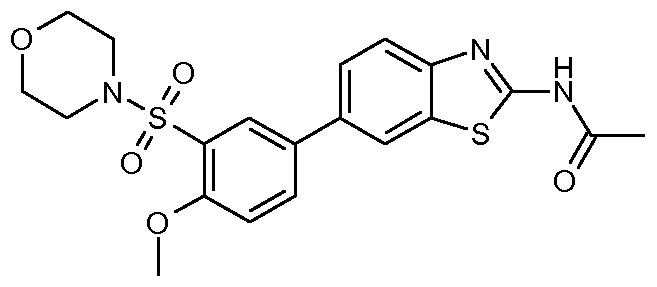
The title compound was prepared following procedure described in Method A (workup B) starting from [4-methoxy-3-(morpholinosulfonyl)phenyl]boronic acid. The title compound (9) was obtained as a pale yellow powder (210 mg, 85%). HPLC, Rt: 3.4 min (purity: 96.5%). UPLC/MS, M+(ESI): 448.3, M-(ESI): 446.4. 1H-NMR (DMSOd6): δ 12.40 (s, 1 H), 8.29 (d, J=1.9 Hz, 1 H), 8.01 (m, 2H), 7.81 (d, J=8.5 Hz, 1 H), 7.70 (dd,
J=1.9, 8.5 Hz, 1 H), 7.40 (d, J=9.4 Hz, 1 H), 3.96 (s, 3H), 3.61 (m, 4H), 3.12 (m, 4H), 2.22 (s, 3H).
Example 10: Formation of Λ/-(6-pyridin-3-yl-1 ,3-benzothiazol-2-yl)acetamide (10)

The title compound was prepared following procedure described in Method A (workup D) starting from 3-pyridineboronic acid. The title compound (10) was obtained as an off-white powder (107 mg, 72%). HPLC, Rt: 2.8 min (purity: 93%). UPLC/MS, M+(ESI): 270.2, M-(ESI): 268.3. 1H-NMR (DMSOd6): δ 12.43 (s, 1 H), 8.96 (brd, J=2.4 Hz, 1 H), 8.57 (dd, J=1.6, 4.8 Hz, 1 H), 8.38 (d, J=1.8 Hz, 1 H), 8.13 (ddd, J=1.6, 2.4,
8.0 Hz, 1 H), 7.84 (d, J=8.5 Hz, 1 H), 7.79 (dd, J=1.8, 8.5 Hz, 1 H), 7.50 (ddd, J=0.7, 4.8, 8.0 Hz, 1 H), 2.22 (s, 3H).
Example 11 : Formation of Λ/-{6-[3-(morpholin-4-ylsulfonyl)phenyl]-1 ,3- benzothiazol-2-yl}acetamide (11 )

The title compound was prepared following procedure described in Method A (workup B) starting from N-morpholinyl 3-boronobenzenesulfonamide. The title compound (11 ) was obtained as an off-white powder. HPLC, Rt: 3.6 min (purity: 98.1 %). LC/MS, M+(ESI): 418.2, M-(ESI): 416.2. 1H-NMR (DMSOd6): δ12.44 (s, 1 H), 8.41 (d, J=1.2
Hz, 1 H), 8.1 1 (dm, J=7.6 Hz, 1 H), 7.97 (m, 1 H), 7.85 (d, J=8.4 Hz, 1 H), 7.79 (m, 2H), 7.73 (dm, J=7.8 Hz, 1 H), 3.65 (m, 4H), 2.93 (m, 4H), 2.23 (s, 3H).
Example 12: Formation of Λ/-(6-pyridin-4-yl-1 ,3-benzothiazol-2-yl)acetamide (12)

The title compound was prepared following procedure described in Method A (workup D) starting from 4-pyridineboronic acid. The title compound (12) was obtained as a yellow powder. LC/MS, M+(ESI): 270.2, M-(ESI): 268.2. 1H-NMR (DMSOd6): δ 12.47
(s, 1 H), 8.64 (m, 2H), 8.48 (d, J=1.7 Hz, 1 H), 7.88 (dd, J=1.7, 8.5 Hz, 1 H), 7.84 (d, J=8.5 Hz, 1 H), 7.77 (m, 2H), 2.23 (s, 3H).
Example 13: Formation of Λ/-{6-[3-(aminosulfonyl)phenyl]-1 ,3-benzothiazol-2- yl}acetamide (13)

The title compound was prepared following procedure described in Method A (workup B) starting from benzenesulfonamide-3-boronic acid pinacol ester. The title compound (13) was obtained as a grey powder. HPLC, Rt: 3.0 min (purity: 98%). LC/MS, M+(ESI): 348.0, M-(ESI): 346.0. 1H-NMR (DMSOd6): δ 12.45 (s, 1 H), 8.35 (d,
J=1.8 Hz, 1 H), 8.17 (m, 1 H), 7.96 (dm, J=7.9 Hz, 1 H), 7.86 (d, J=8.5 Hz, 1 H), 7.81 (dm, J=7.7 Hz, 1 H), 7.77 (dd, J=1.8, 8.5 Hz, 1 H), 7.68 (dd, J=7.7, 7.9 Hz, 1 H), 7.42 (s, 2H), 2.22 (s, 3H).
Example 14: Formation of Λ/-{6-[4-methyl-3-(methylsulfonyl)phenyl]-1 ,3- benzothiazol-2-yl}acetamide (14)

The title compound was prepared following procedure described in Method B (workup C) starting from 4-bromo-1-methyl-2-(methylsulfonyl)benzene. The title compound (14) was obtained as a pale orange powder. HPLC, Rt: 3.7 min (purity: 95.3%).
UPLC/MS, M+(ESI): 361.2, M-(ESI): 359.2. 1H-NMR (DMSOd6): δ 12.43 (s, 1 H), 8.36 (d, J=1.7 Hz, 1 H), 8.18 (d, J=1.9 Hz, 1 H), 7.97 (dd, J=1.9, 8.0 Hz, 1 H), 7.84 (d, J=8.5 Hz, 1 H), 7.76 (dd, J=1.7, 8.5 Hz, 1 H), 7.57 (d, J=8.0 Hz, 1 H), 3.29 (s, 3H), 2.68 (s, 3H), 2.22 (s, 3H).
Example 15: Formation of 6-[3-(methylsulfonyl)phenyl]-1 ,3-benzothiazol-2- amine (15)

The acidic aqueous layers were combined, basified until pH 12 with a 5N aqueous solution of NaOH and extracted with EtOAc (2x). The organic layers were combined, dried (MgSO4) and the solvent was removed under reduced pressure. The residue was taken up with a small amount of EtOAc and a precipitation occurred after a few minutes. The solid was filtered off, washed with pentane and dried under reduced pressure to give the title compound (15) as a white powder. HPLC, Rt: 2.1 min (purity: 99.8%). UPLC/MS, M+(ESI): 305.2, M-(ESI): 303.2.
Example 16: Formation of Λ/-{6-[3-(methylsulfonyl)phenyl]-1 ,3-benzothiazol-2- yl}propanamide (16)

Propionyl chloride (105 mg, 1.15 mmol) was added to a solution of 6-[3- (methylsulfonyl)phenyl]-1 ,3-benzothiazol-2-amine (70 mg, 0.23 mmol) and pyridine (56 μl_, 0.69 mmol) in anhydrous DCM (1.5 ml_). The reaction mixture was stirred at RT for 15 hours. The reaction mixture was diluted with water. The precipitate was filtered off, washed with water and EtOAc, and then dried under reduced pressure to give the title compound (16) as a white powder. HPLC, Rt: 3.3 min (purity: 97.8%). UPLC/MS, M+(ESI): 361.2, M-(ESI): 359.2. 1H-NMR (DMSO-d6): δ 12.41 (s, 1 H), 8.44 (m, 1 H), 8.24 (m, 1 H), 8.10 (dm, J=7.7 Hz, 1 H), 7.91 (dm, J=7.8 Hz, 1 H), 7.84 (m, 2H), 7.76 (dd, J=7.7, 7.8 Hz, 1 H), 3.32 (s, 3H), 2.53 (q, J=7.4 Hz, 2H), 1.13 (t, J=7.4
Hz, 3H).
Example 17: Formation of Λ/-{3-[2-(acetylamino)-1 ,3-benzothiazol-6- yl]phenyl}acetamide (17)

Example 18: Formation of ethyl ({6-[3-(methylsulfonyl)phenyl]-1 ,3-benzothiazol- 2-yl}amino)(oxo)acetate (18)

Ethyl chlorooxoacetate (81 μl_, 0.72 mmol) was added to a suspension of 6-[3- (methylsulfonyl)phenyl]-1 ,3-benzothiazol-2-amine (200 mg, 0.66 mmol) and DIEA
(240 μl_, 1.45 mmol) in anhydrous DCM (4 ml_). The reaction mixture was stirred at RT for 1 hour. The reaction mixture was diluted with water and cyclohexane. The precipitate was filtered off, washed with water (2x) and dried under reduced pressure to give the title compound (18) as a yellow powder. HPLC, Rt: 3.4 min (purity: 86.9%). UPLC/MS, M+(ESI): 405.2, M-(ESI): 403.3.
Example 19: Formation of Λ/-[6-(3-methylphenyl)-1 ,3-benzothiazol-2- yl]acetamide (19)

Example 20: Formation of Λ/-{6-[3-(methylsulfonyl)phenyl]-1 ,3-benzothiazol-2- yl}nicotinamide (20)

Example 21 : Formation of Λ/-[6-(3-nitrophenyl)-1 ,3-benzothiazol-2-yl]acetamide (21)

The title compound was prepared following procedure described in Method A (workup D) starting from 3-nitrophenylboronic acid. The title compound (21 ) was obtained as a red powder. HPLC, Rt: 3.9 min (purity: 92.4%). UPLC/MS, M+(ESI): 314.2, M- (ESI): 312.2.
Example 22: Formation of Λ/-[6-(3-methoxyphenyl)-1 ,3-benzothiazol-2- yljacetamide (22)
 The title compound was prepared following procedure described in Method A (workup C) starting from 3-methoxybenzeneboronic acid. The title compound (22) was obtained as a beige powder. HPLC, Rt: 3.9 min (purity: 98.3%). UPLC/MS, M+(ESI): 299.2, M-(ESI): 297.2.
Example 23: Formation of Λ/-{6-[3-{[(2-hydroxyethyl)amino]sulfonyl}-5-
(trifluoromethyl)phenyl]-1 ,3-benzothiazol-2-yl}acetamide (23)
Step 1) Formation of 3-bromo-N-(2-hydroxyethyl)-5- (trifluoromethyl)benzenesulfonamide

The organic layers were combined, dried (MgSO4) and the solvent was removed under reduced pressure to give a gummy solid. The solid was taken up with DCM (4 ml.) and then heptane was added until precipitation. The solid was filtered off, washed with heptane (3x) and dried under reduced pressure to give the title compound as a white powder (867 mg, 81%). HPLC, Rt: 3.5 min (purity: 100%).
UPLC/MS, M-(ESI): 346.1 and 348.1.
Step 2) Formation of N-{6-[3-{[(2-hydroxyethyl)amino]sulfonyl}-5- (trifluoromethyl) phenyl]- 1, 3-benzothiazol-2-yl}acetamide

The title compound was prepared following procedure described in Method B (workup A) starting from 3-bromo-Λ/-(2-hydroxyethyl)-5-
(trifluoromethyl)benzenesulfonamide. The title compound (23) was obtained as a white powder. HPLC, Rt: 3.6 min (purity: 99%). UPLC/MS, M+(ESI): 460.2, M-(ESI): 458.3.
Example 24: Formation of methyl 3-[2-(acetylamino)-1 ,3-benzothiazol-6- yl]benzoate (24)

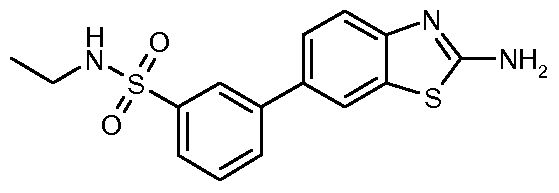
The title compound was prepared following procedure described in Method A (work- up A + flash chromatography on silica using DCIWMeOH as eluent) starting from 2- amino-6-bromobenzothiazole and ethyl 3-boronobenzenesulfonamide. The title compound (25) was obtained as a pale pink powder. HPLC, Rt: 2.2 min (purity: 97.9%). UPLC/MS, M+(ESI): 334.2, M-(ESI): 332.3.
Example 26: Formation of Λ/-[2-(1 -isopropyl-1 H-imidazol-4-yl)ethyl]-/V-{6-[3-
(methylsulfonyl)phenyl]-1 ,3-benzothiazol-2-yl}urea (26)
Step 1) Formation of N-{6-[3-(methylsulfonyl)phenyl]-1 ,3-benzothiazol-2-yl}-1 H- imidazole- 1 -carboxamide

Step 2) Formation of N-[2-(1 -isopropyl-1 H-imidazol-4-yl)ethyl]-N'-{6-[3- (methylsulfonyl)phenyl]-1,3-benzothiazol-2-yl}urea

A solution of Λ/-{6-[3-(methylsulfonyl)phenyl]-1 ,3-benzothiazol-2-yl}-1 /-/-imidazole-1- carboxamide (45 mg, 0.11 mmol), 2-(1 -isopropyl-1 /-/-imidazol-4-yl)-ethylamine dihydrochloride (38 mg, 0.17 mmol, WO2006125805) and Et3N (78 L, 0.55 mmol) in anhydrous DMF (1 ml.) was stirred at RT for 15 hours. The reaction mixture was
diluted with EtOAc and washed with a saturated solution of NH4CI. The organic layer was dried (MgSO4) and the solvents were removed under reduced pressure. The residue was purified by flash chromatography (silica, DCIWMeOH) to give the title compound (26) as a colorless oil. HPLC, Rt: 2.6 min (purity: 97.7%). UPLC/MS, M+(ESI): 484.3, M-(ESI): 482.4. 1H-NMR (CDCI3): δ 8.19 (m, 1 H), 7.96 (d, J=1.8 Hz,
1 H), 7.90 (m, 2H), 7.73 (d, J=8.5 Hz, 1 H), 7.65 (dd, J=7.8, 7.7 Hz, 1 H), 7.60 (dd, J=8.5, 1.8 Hz, 1 H), 7.54 (d, J=1.1 Hz, 1 H), 6.84 (d, J=1.1 Hz, 1 H), 4.28 (hept, J=6.7 Hz, 1 H), 3.70 (m, 2H), 3.13 (s, 3H), 2.90 (t, J=6.5 Hz, 2H), 1.45 (d, J=6.7 Hz, 6H).
Example 29: Formation of N-{6-[3-({[2-
(dimethylamino)ethyl]amino}sulfonyl)phenyl]-1 ,3-benzothiazol-2-yl}acetamide
(29)
Step 1) Formation of 3-bromo-N-[2-(dimethylamino)ethyl]benzenesulfonamide

To a solution of 3-bromobenzenesulfonyl chloride (1.00 g, 3.9 mmol) in anhydrous DCM (20 ml) cooled at 00C was added 2-dimethylaminoethylamine (0.90 ml_, 8.2 mmol). The resulting mixture was stirred at 00C for 1.5 hours. The reaction mixture was diluted with DCM (20 ml_), washed with water (20 ml.) and brine (20 ml_). The aqueous layers were extracted with DCM (20 ml_). The organic layers were combined, dried (MgSO4) and the solvent was removed under reduced pressure. The residue was taken up with Et2O (5 ml_), cooled at 00C and then pentane was added until precipitation. The solid was filtered off, washed with pentane (3x) and dried under reduced pressure to give the title compound as a white powder (852 mg, 71%). HPLC, Rt: 2.4 min (purity: 99.9%). UPLC/MS, M+(ESI): 307.1 , 309.1 , M-(ESI): 305.1 ,
307.1.
Step2) Formation of N-{6-[3-({[2-(dimethylamino)ethyl]amino}sulfonyl)phenyl]-1, 3- benzothiazol-2-yl}acetamide

2H), 7.70 (dd, J=7.7, 7.6 Hz, 1 H), 7.62 (brs, 1 H), 2.87 (m, 2H), 2.25 (t, J=6.6 Hz, 2H), 2.22 (s, 3H), 2.04 (s, 6H).
Example 30: Formation of N-[6-(3-{[(2-morpholin-4- ylethyl)amino]sulfonyl}phenyl)-1 ,3-benzothiazol-2-yl]acetamide (30)
Step 1) Formation of 3-bromo-N-(2-morpholin-4-ylethyl)benzenesulfonamide

The title compound was prepared following procedure described in Example 29 Step 1 ), but starting from 4-(2-aminoethyl)morpholine. The title compound was obtained as a white powder (532 mg, 78%). HPLC, Rt: 2.5 min (purity: 99.9%). UPLC/MS,
M+(ESI): 349.1 , 351.1 , M-(ESI): 347.2, 349.2.
Step 2) Formation of N-[6-(3-{[(2-morpholin-4-ylethyl)amino]sulfonyl}phenyl)-1,3- benzothiazol-2-yl]acetamide

The title compound was prepared following procedure described in Method B (workup A) starting from 3-bromo-N-(2-morpholin-4-ylethyl)benzenesulfonamide. The title compound (30) was obtained as an off-white powder. HPLC, Rt: 2.9 min (purity: 96%). UPLC/MS, M+(ESI): 461.3, M-(ESI): 459.4. 1H-NMR (DMSOd6): δ 12.45 (s, 1 H), 8.37 (d, J=1.7 Hz, 1 H), 8.13 (m, 1 H), 8.00 (dm, J=7.8 Hz, 1 H), 7.85 (d, J=8.4 Hz,
1 H), 7.78 (m, 2H), 7.70 (dd, J=7.8, 7.7 Hz, 1 H), 7.63 (t, J=5.8 Hz, 1 H), 3.45 (m, 4H), 2.92 (m, 2H), 2.29 (t, J=6.7 Hz, 2H), 2.23 (m, 7H).
Example 31 : Formation of N-[6-(4-chloro-3-{[(2- hydroxyethyl)amino]sulfonyl}phenyl)-1 ,3-benzothiazol-2-yl]acetamide (31 )
Step 1) Formation of 2,5-dichloro-N-(2-hydroxyethyl)benzenesulfonamide

The title compound was prepared following procedure described in Example 23 Step 1 ), but starting from 2,5-dichlorobenzenesulfonyl chloride. The title compound was obtained as a white powder (1.02 g, 93%). HPLC, Rt: 2.7 min (purity: 96%). UPLC/MS, M-(ESI): 268.1.
Step 2) Formation of N-[6-(4-chloro-3-{[(2-hydroxyethyl)amino]sulfonyl}phenyl)-1,3- benzothiazol-2-yl]acetamide

J=5.6 Hz, 1 H), 3.40 (m, 2H), 2.96 (m, 2H), 2.21 (s, 3H).
Example 32: Formation of N-(6-{5-[(4-hydroxypiperidin-1 -yl)sulfonyl]-3-thienyl}- 1 ,3-benzothiazol-2-yl)acetamide (32) Step 1) Formation of 1-[(4,5-dibromo-2-thienyl)sulfonyl]piperidin-4-ol

A suspension of 4,5-dibromothiophene-2-sulfonyl chloride (10.0 g, 29.4 mmol) was prepared in anhydrous DCM (200 ml) and cooled at 00C. Et3N (20.4 mL, 147 mmol) was added, followed by 4-hydroxypiperidine (5.94 g, 58.8 mmol). The resulting mixture was stirred at 00C for one hour. The reaction mixture was washed with a saturated aqueous solution of NaHCO3 (70 mL), water (70 mL) and brine (70 mL). The organic layer was dried (MgSO4) and the solvent was removed under reduced pressure to give a beige solid. The solid was washed with water (3x40 mL) and dried under reduced pressure to give the title compound as a beige solid (10.2 g, 86%). HPLC, Rt: 3.8 min (purity: 98.9%).
Step 2) Formation of 1-[(4-bromo-2-thienyl)sulfonyl]piperidin-4-ol

Zinc (17.4 g, 267 mmol) was added portionwise over 30 min to a suspension of 1- [(4,5-dibromo-2-thienyl)sulfonyl]piperidin-4-ol (9.0 g, 22.2 mmol) in acetic acid (180 ml.) and then the reaction mixture was stirred at 600C for one hour. Water (200 ml.) was added. The resulting suspension was filtered off over a Celite pad and washed with DCM (200 ml_). The layers were separated and the aqueous layer was extracted with DCM (200 ml_). The combined organic layers were washed with a saturated aqueous solution of NaHCO3 (200 ml_), water (200 ml.) and brine (200 ml_), and then dried (MgSO4). The solvent was removed under reduced pressure to give the title compound as a white solid (5.8 g, 80%). HPLC, Rt: 3.0 min (purity: 100%).
Step 3) Formation of N-(6-{5-[(4-hydroxypiperidin-1-yl)sulfonyl]-3-thienyl}-1 ,3- benzothiazol-2-yl)acetamide

The title compound was prepared following procedure described in Method B (workup A) starting from 1-[(4-bromo-2-thienyl)sulfonyl]piperidin-4-ol. The title compound (32) was obtained as a white powder. HPLC, Rt: 3.2 min (purity: 98%). UPLC/MS, M+(ESI): 438.2, M-(ESI): 436.3. 1H-NMR (DMSO-d6): δ 12.42 (s, 1 H), 8.45 (d, J=1.5
Hz, 1 H), 8.35 (d, J=1.5 Hz, 1 H), 8.11 (d, J=1.7 Hz, 1 H), 7.87 (dd, J=8.4, 1.7 Hz, 1 H), 7.77 (d, J=8.4 Hz, 1 H), 4.73 (d, J=3.8 Hz, 1 H), 3.58 (m, 1 H), 3.24 (m, 2H), 2.86 (m, 2H), 2.22 (s, 3H), 1.79 (m, 2H), 1.51 (m, 2H).
Example 33: Formation of N-[6-(4-hydroxyphenyl)-1 ,3-benzothiazol-2- yljacetamide (33)

The title compound was prepared following procedure described in Method A (workup A) starting from 4-hydroxyphenylboronic acid. The title compound (33) was obtained as a pale orange powder. HPLC, Rt: 3.3 min (purity: 98.4%). UPLC/MS,
M+(ESI): 285.1 , M-(ESI): 283.2. 1H-NMR (DMSO-d6): δ 12.34 (s, 1 H), 9.55 (s, 1 H), 8.16 (brs, 1 H), 7.74 (d, J=8.5 Hz, 1 H), 7.63 (brd, J=8.5 Hz, 1 H), 7.54 (d, J=8.5 Hz, 2H), 6.86 (d, J=8.5 Hz, 2H), 2.21 (s, 3H).
Example 34: Formation of N-[6-(3-fluoro-4-hydroxyphenyl)-1 ,3-benzothiazol-2- yl]acetamide (34)

The title compound was prepared following procedure described in Method A (workup A) starting from (3-fluoro-4-hydroxyphenyl)boronic acid. The title compound (34) was obtained as a pale beige powder. HPLC, Rt: 3.2 min (purity: 98%). UPLC/MS,
M+(ESI): 303.1 , M-(ESI): 301.2. 1H-NMR (DMSOd6): δ 12.37 (s, 1 H), 9.99 (s, 1 H), 8.22 (s, 1 H), 7.75 (d, J=8.4 Hz, 1 H), 7.68 (d, J=8.4 Hz, 1 H), 7.53 (d, J=12.9 Hz, 1 H), 7.38 (d, J=8.0 Hz, 1 H), 7.03 (m, 1 H), 2.21 (s, 3H).
Example 35: Formation of N-[6-(5-formyl-3-thienyl)-1 ,3-benzothiazol-2- yl]acetamide (35)

The title compound was prepared following procedure described in Method A, starting from 5-formylthiophen-3-boronic acid. The reaction mixture was filtered, then the filtrate was diluted with EtOAc and washed with brine. A precipitate appeared in the aqueous layer, which was filtered off. After purification by flash chromatography (silica, DCM/MeOH) followed by precipitation from DCM/MeOH, the title compound (35) was obtained as a yellow powder. HPLC, Rt: 3.7 min (purity: 98.8%). UPLC/MS, M+(ESI): 303.2, M-(ESI): 301.1.
Example 36: Formation of N-(6-{3-[(3-hydroxypropyl)sulfonyl]phenyl}-1 ,3- benzothiazol-2-yl)acetamide (36)
Step 1 ) Formation of 3-[(3-bromophenyl)thio]propan-1-ol
 A mixture of 3-bromothiophenol (5.0 g, 26.4 mmol), 3-bromo-propan-1-ol (4.4 g, 31.6 mmol) and cesium carbonate (17.2 g, 52.8 mmol) in anhydrous DMF (30 ml.) was heated at 500C for 12 hours. The solvent was removed under reduced pressure. The residue was taken up with DCM and washed with water and brine. The organic layer was dried (Na2SO4) and the solvent was removed under reduced pressure to give the title compound as a pale yellow oil (6.4 g, 98%). 1H-NMR (CDCI3, 400 MHz): δ 7.46 (s, 1 H), 7.27 (m, 2H), 7.14 (m, 1 H), 3.77 (t, 2H), 3.03 (m, 2H), 1.90 (m, 2H).
Step 2) Formation of 3-[(3-bromophenyl)sulfonyl]propan-1 -ol
 m-Chloroperbenzoic acid (25.4 g, 148 mmol) was added to a solution of 3-[(3- bromophenyl)thio]propan-1-ol (7.0 g, 49.2 mmol) in anhydrous DCM (75 ml_). The reaction mixture was stirred at RT for 5 hours. The suspension was filtered off and the filtrate was washed with a saturated aqueous solution of NaHCO3, water and brine. The organic layer was dried (Na2SO4) and the solvent was removed under reduced pressure to give the title compound as gummy yellow solid (6.7 g, 93%). 1H- NMR (CDCI3, 400 MHz): δ 8.06 (s, 1 H), 7.85 (m, 1 H), 7.79 (m, 1 H), 7.46 (m, 1 H), 3.74 (m, 2H), 3.25 (m, 2H), 1.99 (m, 2H).
Step 3) Formation of N-(6-{3-[(3-hydroxypropyl)sulfonyl]phenyl}-1 ,3- benzothiazol-2-yl)acetamide

The title compound was prepared following procedure described in Method B (workup A) starting from 3-[(3-bromophenyl)sulfonyl]propan-1-ol. The title compound (36) was obtained as a pale orange powder. HPLC, Rt: 2.7 min (purity: 96%). UPLC/MS,
M+(ESI): 391.1 , M-(ESI): 389.3. 1H-NMR (DMSO-d6): δ 12.44 (s, 1 H), 8.43 (s, 1 H), 8.18 (s, 1 H), 8.11 (d, J=7.5 Hz, 1 H), 7.89-7.75 (m, 4H), 4.65 (t, J=5.4 Hz, 1 H), 3.42 (m, 4H), 2.22 (s, 3H), 1.72 (m, 2H).
Example 37: Formation of N-{6-[3-({[2-hydroxy-1 -
(hydroxymethyl)ethyl]amino}sulfonyl)phenyl]-1 ,3-benzothiazol-2-yl}acetamide
(37)
Step 1) Formation 3-bromo-N-[2-hydroxy-1-
(hydroxymethyl)ethyl]benzenesulfonamide bis(2-aminopropane-1 ,3-diol) hydrochloride mixture

A mixture of 3-bromobenzenesulfonyl chloride (500 mg, 1.96 mmol) and 2-amino-1 ,3- propandiol (535 mg, 5.87 mmol) in anhydrous DCM (20 ml.) was stirred at 00C for 18 hours. The reaction mixture was evaporated under reduced pressure to give the title mixture as white powder. Used without further purification in the next step.
Step 2) Formation of N-{6-[3-({[2-hydroxy-1 - (hydroxymethyl)ethyl]amino}sulfonyl)phenyl]-1,3-benzothiazol-2-yl}acetamide

The title compound was prepared following procedure described in Method B (workup A) starting from 3-bromo-N-[2-hydroxy-1-
(hydroxymethyl)ethyl]benzenesulfonamide bis(2-aminopropane-1 ,3-diol) hydrochloride mixture. The title compound (37) was obtained as a pale beige powder. HPLC, Rt: 2.6 min (purity: 98.1 %). UPLC/MS, M+(ESI): 422.2, M-(ESI): 420.2. 1H-
NMR (DMSOd6): δ 12.43 (s, 1 H), 8.36 (brs, 1 H), 8.19 (brs, 1 H), 7.97 (d, J=7.8 Hz, 1 H), 7.82 (m, 3H), 7.67 (dd, J=7.8, 7.7 Hz, 1 H), 7.55 (d, J=7.4 Hz, 1 H), 4.61 (t, J=5.5 Hz, 2H), 3.34 (m, 4H), 3.12 (m, 1 H), 2.22 (s, 3H).
Example 38: Formation of N-[6-(3-{[(2,3- dihydroxypropyl)amino]sulfonyl}phenyl)-1 ,3-benzothiazol-2-yl]acetamide (38)
Step 1) Formation of 3-bromo-N-(2,3-dihydroxypropyl)benzenesulfonamide bis(3- aminopropane-1 ,2-diol) hydrochloride mixture

A mixture of 3-bromobenzenesulfonyl chloride (500 mg, 1.96 mmol) and 3-amino-1 ,2- propandiol (535 mg, 5.87 mmol) in anhydrous DCM (20 ml.) was stirred at 00C for 2 hours. The reaction mixture was evaporated under reduced pressure to give the title mixture as white powder. Used without further purification in the next step.
Step 2) Formation of N-[6-(3-{[(2,3-dihydroxypropyl)amino]sulfonyl}phenyl)-1 ,3- benzothiazol-2-yl]acetamide
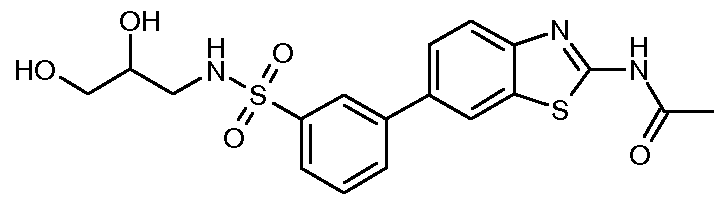
7.57 (t, J=6.5 Hz, 1 H), 4.78 (d, J=5.1 Hz, 1 H), 4.54 (t, J=5.7 Hz, 1 H), 3.49 (m, 1 H), 3.27 (m, 2H), 2.92 (m, 1 H), 2.65 (m, 1 H), 2.22 (s, 3H).
Example 39: Formation of N-(6-{3-[(4-hydroxypiperidin-1 -yl)sulfonyl]phenyl}-1 ,3- benzothiazol-2-yl)acetamide (39)
Step 1) Formation of 1-[(3-bromophenyl)sulfonyl]piperidin-4-ol
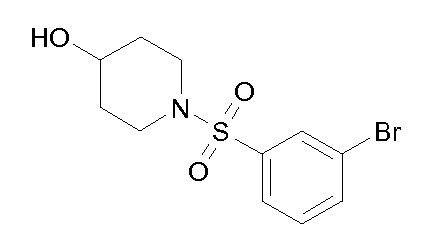
The title compound was prepared following procedure described in Example 23 Step 1 ), but starting from 3-bromobenzenesulfonyl chloride and 4-hydroxypiperidine. The title compound was obtained as a white powder. HPLC, Rt: 3.1 min (purity: 100%).
UPLC/MS, M+(ESI): 320.1 , 322.1 , M-(ESI): 318.2, 320.2.
Step 2) Formation of N-(6-{3-[(4-hydroxypiperidin-1-yl)sulfonyl]phenyl}-1 ,3- benzothiazol-2-yl)acetamide

The title compound was prepared following procedure described in Method B (work- up A) starting from 1-[(3-bromophenyl)sulfonyl]piperidin-4-ol. The title compound (39) was obtained as an off-white powder. HPLC, Rt: 3.2 min (purity: 99.8%). UPLC/MS, M+(ESI): 432.2, M-(ESI): 430.3. 1H-NMR (DMSOd6): δ 12.43 (s, 1 H), 8.40 (brs, 1 H), 8.07 (d, J=7.0 Hz, 1 H), 7.97 (brs, 1 H), 7.86-7.71 (m, 4H), 4.68 (d, J=3.4 Hz, 1 H), 3.54 (m, 1 H), 3.21 (m, 2H), 2.78 (m, 2H), 2.22 (s, 3H), 1.75 (m, 2H), 1.46 (m, 2H).
Example 40: Formation of N-[6-(3-fluoro-5-hydroxyphenyl)-1 ,3-benzothiazol-2- yl]acetamide (40)

The title compound was prepared following procedure described in Method A (work- up A) starting from (3-fluoro-5-hydroxyphenyl)boronic acid. The title compound (40) was obtained as a red powder. HPLC, Rt: 3.8 min (purity: 98%). UPLC/MS, M+(ESI): 303.1 , M-(ESI): 301.1. 1H-NMR (DMSOd6): δ 12.39 (s, 1 H), 10.04 (s, 1 H), 8.25 (d, J=1.7 Hz, 1 H), 7.78 (d, J=8.5 Hz, 1 H), 7.68 (dd, J=8.5, 1.7 Hz, 1 H), 6.98 (dm, J=10.0 Hz, 1 H), 6.94 (m, 1 H), 6.56 (dm, J=10.7 Hz, 1 H), 2.22 (s, 3H).
Example 41 : Formation of N-{6-[3-(propylsulfonyl)phenyl]-1 ,3-benzothiazol-2- yl}acetamide (41)
Step 1) Formation of 1 -bromo-3-(propylthio)benzene
 The title compound was prepared following procedure described in Example 36 Step
1 ), but starting from 1-bromopropane and potassium carbonate. The title compound was obtained as a pale yellow oil (5.5 g, 90%). 1H-NMR (CDCI3, 400 MHz): δ 7.44 (s, 1 H), 7.28 (m, 1 H), 7.22 (m, 1 H), 7.13 (m, 1 H), 2.90 (t, 2H), 1.68 (m, 2H), 1.04 (t, 3H).
Step 2) Formation of 1-bromo-3-(propylsulfonyl)benzene

The title compound was prepared following procedure described in Example 36 Step 2), but starting from 1-bromo-3-(propylthio)benzene. The title compound was obtained as a yellow oil (5.7 g, 91 %). 1H-NMR (CDCI3, 400 Hz): δ 8.05 (s, 1 H), 7.84 (m, 1 H), 7.78 (m, 1 H), 7.45 (t, 1 H), 3.08 (m, 2H), 1.75 (m, 2H), 1.01 (t, 3H).
Step 3) Formation of N-{6-[3-(propylsulfonyl)phenyl]-1,3-benzothiazol-2- yl}acetamide

The title compound was prepared following procedure described in Method B (workup B) starting from 1-bromo-3-(propylsulfonyl)benzene. The title compound (41 ) was obtained as a pale beige powder. HPLC, Rt: 3.7 min (purity: 100%). UPLC/MS, M+(ESI): 375.1 , M-(ESI): 373.2. 1H-NMR (DMSOd6): δ 12.44 (s, 1 H), 8.42 (brs, 1 H), 8.17 (m, 1 H), 8.11 (dm, J=7.9 Hz, 1 H), 7.87 (dm, J=8.1 Hz, 1 H), 7.84 (m, 2H), 7.77
(dd, J=7.9, 7.8 Hz, 1 H), 3.39 (m, 2H), 2.22 (s, 3H), 1.61 (m, 2H), 0.94 (t, J=7.5 Hz, 3H).
Example 42: Formation of N-(6-{3-[(2-hydroxyethyl)sulfonyl]phenyl}-1 ,3- benzothiazol-2-yl)acetamide (42)
Step 1) Formation of 2-[(3-bromophenyl)thio]ethanol

A mixture of 3-bromothiophenol (5.0 g, 26.4 mmol), 2-bromoethanol (3.9 g, 31.7 mmol) and cesium carbonate (17.2 g, 52.8 mmol) in anhydrous DMF (30 ml.) was heated at 500C for 12 hours. The solvent was removed under reduced pressure. The residue was taken up with DCM and washed with water and brine. The organic layer was dried (Na2SC>4) and the solvent was removed under reduced pressure. Purification by flash chromatography (silica, PE/EtOAc) gave the title compound as a pale yellow solid (5.5 g, 90%). 1H-NMR (CDCI3, 400 MHz): δ 7.53 (s, 1 H), 7.35 (m, 1 H), 7.33 (m, 1 H), 7.16 (t, 1 H), 3.78 (t, 2H), 3.13 (t, 2H).
Step 2) Formation of 2-[(3-bromophenyl)sulfonyl]ethanol
 m-Chloroperbenzoic acid (12.2 g, 70.7 mmol) was added to a solution of 2-[(3- bromophenyl)thio]ethanol (5.5 g, 23.5 mmol) in anhydrous DCM (75 ml_). The reaction mixture was stirred at RT for 5 hours. The solid formed was filtered and washed with cold DCM. The filtrate was washed with a 10% aqueous solution of NaOH, water and brine. The organic layer was dried (Na2SO4) and the solvent was removed under reduced pressure. Purification by flash chromatography (silica, chloroform/MeOH) gave the title compound as an off-white solid. 1H-NMR (DMSO-d6,
400 MHz): δ 8.04 (s, 1 H), 7.91 (m, 2H), 7.57 (m, 1 H), 4.89 (t, 1 H), 3.68 (m, 2H), 3.52 (t, 2H).
Step 3) Formation of N-(6-{3-[(2-hydroxyethyl)sulfonyl]phenyl}-1,3-benzothiazol- 2-yl)acetamide

The title compound was prepared following procedure described in Method B (workup A) starting from 2-[(3-bromophenyl)sulfonyl]ethanol. The title compound (42) was obtained as a pale grey powder. HPLC, Rt: 2.8 min (purity: 100%). UPLC/MS, M+(ESI): 377.1 , M-(ESI): 375.2. 1H-NMR (DMSO-d6): 12.44 (s, 1 H), 8.42 (brs, 1 H),
8.20 (m, 1 H), 8.10 (dm, J=7.8 Hz, 1 H), 7.88 (dm, J=8.4 Hz, 1 H), 7.83 (m, 2H), 7.75 (dd, J=7.8, 7.7 Hz, 1 H), 4.92 (t, J=5.4 Hz, 1 H), 3.73 (m, 2H), 3.56 (t, J=6.4 Hz, 2H), 2.22 (s, 3H).
Example 43: Formation of N-{6-[5-(aminosulfonyl)pyridin-3-yl]-1 ,3-benzothiazol-
2-yl}acetamide (43)

The title compound was prepared following procedure described in Method B (workup D) starting from 5-bromopyridine-3-sulfonamide. The title compound (43) was
obtained as a pale beige powder. HPLC, Rt: 2.2 min (purity: 96%). UPLC/MS, M+(ESI): 349.1 , M-(ESI): 347.1. 1H-NMR (DMSOd6): δ 12.48 (s, 1 H), 9.18 (d, J=1.9 Hz, 1 H), 8.95 (d, J=1.9 Hz, 1 H), 8.49 (brs, 1 H), 8.46 (s, 1 H), 7.86 (m, 2H), 7.66 (brs, 2H), 2.23 (s, 3H).
Example 44: Formation of N-[6-(3-hydroxyphenyl)-1 ,3-benzothiazol-2- yl]acetamide (44)

The title compound was prepared following procedure described in Method B (work- up A) starting from 3-bromophenol. The title compound (44) was obtained as a white powder. HPLC, Rt: 3.5 min (purity: 100%). UPLC/MS, M+(ESI): 285.1 , M-(ESI): 283.1. 1H-NMR (DMSOd6): δ 12.36 (s, 1 H), 9.53 (s, 1 H), 8.20 (d, J=1.8 Hz, 1 H), 7.77 (d, J=8.4 Hz, 1 H), 7.64 (dd, J=8.4, 1.8 Hz, 1 H), 7.26 (dd, J=7.9, 7.8 Hz, 1 H), 7.12 (brd, J=7.8 Hz, 1 H), 7.07 (m, 1 H), 6.76 (dd, J=7.9, 2.3 Hz, 1 H), 2.21 (s, 3H).
Example 45: Formation of N-(6-pyrimidin-5-yl-1 ,3-benzothiazol-2-yl)acetamide (45)

The title compound was prepared following procedure described in Method A (work- up B) starting from 5-pyrimidinylboronic acid. The title compound (45) was obtained as an orange powder. HPLC, Rt: 2.7 min (purity: 93%). UPLC/MS, M+(ESI): 271.1 , M-(ESI): 269.1. 1H-NMR (DMSO-d6): δ 9.19 (s, 2H), 9.17 (s, 1 H), 8.41 (brs, 1 H), 7.84 (dd, J=8.4, 1.7 Hz, 1 H), 7.80 (d, J=8.4 Hz, 1 H), 2.18 (s, 3H).
Example 46: Formation of ethyl 4-{[({6-[3-(methylsulfonyl)phenyl]-1 ,3- benzothiazol-2-yl}amino)carbonyl]amino}butanoate (46)

Hz, 2H), 1.74 (m, 2H), 1.18 (t, J=7.2 Hz, 3H).
Example 47: Formation of N-{6-[6-(methylsulfonyl)pyridin-2-yl]-1 ,3-benzothiazol- 2-yl}acetamide (47)

The title compound was prepared following procedure described in Method B (workup D) starting from 2-bromo-6-methanesulfonyl-pyridine (Tetrahedron, 1985, 41 (7), 1373-1384). The title compound (47) was obtained as a white powder (140 mg, 85%). HPLC, Rt: 2.9 min (purity: 91 %). UPLC/MS, M+(ESI): 348.1 , M-(ESI): 346.2. 1H-NMR (DMSO-d6): δ 12.52 (brs, 1 H), 8.84 (brs, 1 H), 8.37 (d, J=8.3 Hz, 1 H), 8.24 (m, 2H),
7.96 (d, J=8.2 Hz, 1 H), 7.84 (d, J=8.7 Hz, 1 H), 3.44 (s, 3H), 2.22 (s, 3H).
Example 48: Formation of N-{6-[4-fluoro-3-(methylsulfonyl)phenyl]-1 ,3- benzothiazol-2-yl}acetamide (48)

The title compound was prepared following procedure described in Method B (workup D) starting from 4-bromo-1-fluoro-2-(methylsulfonyl)benzene. The title compound (48) was obtained as a brown powder. HPLC, Rt: 3.6 min (purity: 94%). UPLC/MS, M+(ESI): 365.1 , M-(ESI): 363.2. 1H-NMR (DMSO-d6): δ 12.44 (s, 1 H), 8.37 (d, J=1.8 Hz, 1 H), 8.14 (ddd, J=8.6, 4.7, 2.5 Hz, 1 H), 8.08 (dd, J=6.6, 2.5 Hz, 1 H), 7.84 (d,
J=8.5 Hz, 1 H), 7.75 (dd, J=8.5, 1.8 Hz, 1 H), 7.64 (dd, J=10.0, 8.6 Hz, 1 H), 3.40 (s, 3H), 2.22 (s, 3H).
Example 49: Formation of 3-{2-[({[2-(3-isopropyl-1 ,2,4-oxadiazol-5- yl)ethyl]amino}carbonyl)amino]-1 ,3-benzothiazol-6-yl}-N,N- dimethylbenzenesulfonamide (49)
Step 1) Formation of N-(6-bromo-1 ,3-benzothiazol-2-yl)-1 H-imidazole-1- carboxamide
 A mixture of 2-amino-6-bromobenzothiazole (3.0 g, 13.1 mmol) and 1 ,1 '- carbonyldiimidazole (3.2 g, 19.6 mmol) in anhydrous ACN (60 ml.) was stirred at RT for 15 hours. The precipitate was filtered off, washed with ACN and dried under reduced pressure to give the title compound as a pink powder (4.1 g, 97%), which was used without further purification in the next step.
Step 2) Formation of N-(6-bromo-1 ,3-benzothiazol-2-yl)-N'-[2-(3-isopropyl-1 ,2,4- oxadiazol-5-yl)ethyl]urea

A mixture of N-(6-bromo-1 ,3-benzothiazol-2-yl)-1 H-imidazole-1-carboxamide (1.0 g, 3.1 mmol), 2-(3-isopropyl-1 ,2,4-oxadiazol-5-yl)ethanamine hydrochloride (0.53 g, 3.4 mmol) and Et3N (0.5 ml_, 3.4 mmol) in anhydrous DMF (12 ml.) was heated at 1000C for 15 hours. The reaction mixture was cooled at RT and the precipitate was removed by filtration. The filtrate was diluted with EtOAc, washed with water (5x), dried (MgSO4) and the solvents were removed under reduced pressure. The residue was purified by flash chromatography (silica, cHex/EtOAc) to give the title compound as a white powder. HPLC, Rt: 4.3 min (purity: 98.2%). UPLC/MS, M+(ESI): 410.1 , 412.1 , M-(ESI): 408.2, 410.2.
Step 3) Formation of 3-{2-[({[2-(3-isopropyl-1 ,2,4oxadiazol-5- yl)ethyl]amino}carbonyl)amino]- 1, 3-benzothiazol-6-yl}-N, N- dimethylbenzenesulfonamide

1 H), 7.68 (dd, J=8.4, 1.7 Hz, 1 H), 7.66 (dd, J=7.9, 7.8 Hz, 1 H), 3.94 (m, 2H), 3.26 (t, J=6.6 Hz, 2H), 3.10 (hept, J=6.9 Hz, 1 H), 2.79 (s, 6H), 1.34 (d, J=6.9 Hz, 6H).
Example 50: Formation of N-[6-(4-hydroxy-3-methoxyphenyl)-1 ,3-benzothiazol- 2-yl]-N'-[2-(3-isopropyl-1 ,2,4-oxadiazol-5-yl)ethyl]urea (50)

The title compound was prepared following procedure described in Method A (workup A) starting from N-(6-bromo-1 ,3-benzothiazol-2-yl)-N'-[2-(3-isopropyl-1 ,2,4- oxadiazol-5-yl)ethyl]urea and 2-methoxy-4-(4,4,5,5-tetramethyl-1 ,3,2-dioxaborolan-2- yl)phenol. The title compound (50) was obtained as a red foam. HPLC, Rt: 3.7 min
(purity: 92%). UPLC/MS, M+(ESI): 454.2, M-(ESI): 452.4. 1H-NMR (DMSO-d6): δ 10.87 (brs, 1 H), 9.06 (s, 1 H), 8.13 (brs, 1 H), 7.61 (brs, 2H), 7.24 (d, J=2.0 Hz, 1 H), 7.10 (dd, J=8.3, 2.0 Hz, 1 H), 6.99 (m, 1 H), 6.84 (d, J=8.3 Hz, 1 H), 3.87 (s, 3H), 3.60 (m, 2H), 3.14 (t, J=6.6 Hz, 2H), 3.04 (hept, J=7.0 Hz, 1 H), 1.25 (d, J=7.0 Hz, 6H).
Example 51 : Formation of N-{6-[3-(methylsulfonyl)phenyl]-1 ,3-benzothiazol-2- yl}-N-(2-morpholin-4-yl-2-oxoethyl)urea (51 )

A solution of Λ/-{6-[3-(methylsulfonyl)phenyl]-1 ,3-benzothiazol-2-yl}-1 /-/-imidazole-1- carboxamide (100 mg, 0.25 mmol) and 2-amino-1-morpholin-4-yl-ethanone (40 mg, 0.28 mmol) in anhydrous DMF (1.5 ml.) was heated at 1000C for 15 hours. The reaction mixture was diluted with EtOAc and a white precipitate appeared. The solid was filtered off, washed with EtOAc and dried under reduced pressure to give the title compound (51 ) as a white powder. HPLC, Rt: 3.0 min (purity: 75%). UPLC/MS, M+(ESI): 475.2, M-(ESI): 473.3. 1H-NMR (DMSO-d6): δ 11.08 (brs, 1 H), 8.36 (brs, 1 H), 8.21 (m, 1 H), 8.08 (dm, J=7.8 Hz, 1 H), 7.89 (dm, J=7.7 Hz, 1 H), 7.76 (m, 3H), 7.07 (t, J=4.8 Hz, 1 H), 4.11 (d, J=4.8 Hz, 2H), 3.60 (m, 4H), 3.45 (m, 4H), 3.31 (s,
3H).
Example 52: Formation of N,N-dimethyl-N-2-[({6-[3-(methylsulfonyl)phenyl]-1 ,3- benzothiazol-2-yl}amino)carbonyl]glycinamide (52)

The title compound was prepared following procedure described in Example 51 , but starting from glycine dimethylamide acetate and Et3N (1.2 eq). The title compound (52) was obtained as a white powder. HPLC, Rt: 3 min (purity: 94%). LC/MS, M+(ESI): 433.1 , M-(ESI): 431.1. 1H-NMR (DMSO-d6): δ 11.07 (s, 1 H), 8.36 (brs, 1 H), 8.21 (m, 1 H), 8.08 (dm, J=7.8 Hz, 1 H), 7.89 (dm, J=7.7 Hz, 1 H), 7.76 (m, 3H), 7.06 (t,
J=4.5 Hz, 1 H), 4.07 (d, J=4.5 Hz, 2H), 3.31 (s, 3H), 2.97 (s, 3H), 2.89 (s, 3H).
Example 53: Formation of tert-butyl N-[({6-[3-(methylsulfonyl)phenyl]-1 ,3- benzothiazol-2-yl}amino)carbonyl]-beta-alaninate (53)

A solution of Λ/-{6-[3-(methylsulfonyl)phenyl]-1 ,3-benzothiazol-2-yl}-1 /-/-imidazole-1- carboxamide (100 mg, 0.25 mmol), beta-alanine tert-butyl ester hydrochloride (50 mg, 0.28 mmol) and Et3N (0.040 mL, 0.28 mmol) in anhydrous DMF (1.5 mL) was heated
at 1000C for 15 hours. The reaction mixture was diluted with EtOAc and washed with water (5x). The organic layer was dried (MgSO4) and the solvents were removed under reduced pressure. The residue was purified by flash chromatography (silica, cHex/EtOAc) to give the title compound (53) as a white powder. HPLC, Rt: 4.1 min (purity: 99.7%). LC/MS, M+(ESI): 476, M-(ESI): 474.1. 1H-NMR (DMSO-d6): δ 10.90
(brs, 1 H), 8.35 (brs, 1 H), 8.21 (m, 1 H), 8.08 (dm, J=7.8 Hz, 1 H), 7.89 (dm, J=7.7 Hz, 1 H), 7.75 (m, 3H), 6.88 (m, 1 H), 3.38 (m, 2H), 3.31 (s, 3H), 2.46 (t, J=6.4 Hz, 2H), 1.42 (s, 9H).
Example 54: Formation of N-{6-[3-(methylsulfonyl)phenyl]-1 ,3-benzothiazol-2- yl}-N'-[2-(1 H-1 ,2,4-triazoM -yl)ethyl]urea (54)

The title compound was prepared following procedure described in Example 53, but starting from 2-(1 ,2,4-triazole-1-yl)-ethylamine hydrochloride. Purification by flash chromatography (silica, DCM/MeOH). The title compound (54) was obtained as a white powder. HPLC, Rt: 3.6 min (purity: 90%). UPLC/MS, M+(ESI): 443.2, M-(ESI): 441.3. 1H-NMR (DMSO-d6): δ 10.93 (s, 1 H), 8.55 (s, 1 H), 8.36 (brs, 1 H), 8.21 (brs, 1 H), 8.08 (brd, J=7.8 Hz, 1 H), 8.02 (s, 1 H), 7.89 (brd, J=7.9 Hz, 1 H), 7.76 (m, 3H), 6.88 (m, 1 H), 4.33 (t, J=5.8 Hz, 2H), 3.61 (m, 2H), 3.31 (s, 3H).
Example 55: Formation of N-(2-{[({6-[3-(methylsulfonyl)phenyl]-1 ,3- benzothiazol-2-yl}amino)carbonyl]amino}ethyl)acetamide (55)

A solution of Λ/-{6-[3-(methylsulfonyl)phenyl]-1 ,3-benzothiazol-2-yl}-1 /-/-imidazole-1- carboxamide (150 mg, 0.38 mmol) and N-acetylethylenediamine (42 mg, 0.41 mmol) in anhydrous DMF (3 mL) was heated at 1000C for 15 hours. The reaction mixture was diluted with EtOAc and washed with water (4x) and brine. The organic layer was dried (MgSO4) and the solvents were removed under reduced pressure. The residue was taken up with DCM and a precipitate appeared. The solid was filtered off and dried under reduced pressure to give the title compound (55) as a white powder.
HPLC, Rt: 2.7 min (purity: 88%). LC/MS, M+(ESI): 433.0, M-(ESI): 431.2. 1H-NMR (DMSO-d6): δ 10.91 (s, 1 H), 8.35 (brs, 1 H), 8.21 (brs, 1 H), 8.08 (brd, J=7.8 Hz, 1 H), 7.98 (m, 1 H), 7.89 (brd, J=7.8 Hz, 1 H), 7.76 (m, 3H), 6.82 (m, 1 H), 3.31 (s, 3H), 3.20 (m, 4H), 1.82 (s, 3H).
Example 56: Formation of tert-butyl N-{[(6-{3-[(dimethylamino)sulfonyl]phenyl}- 1 ,3-benzothiazol-2-yl)amino]carbonyl}-beta-alaninate (56)
Step 1) Formation of tert-butyl N-{[(6-bromo-1 ,3-benzothiazol-2-yl)amino]carbonyl}- beta-alaninate

A mixture of N-(6-bromo-1 ,3-benzothiazol-2-yl)-1 H-imidazole-1-carboxamide (2.00 g, 6.19 mmol), beta-alanine tert-butyl ester hydrochloride (1.24 g, 6.81 mmol) and Et3N (0.69 g, 6.81 mmol) in anhydrous DMF (50 ml_) was heated at 1000C for 15 hours. The reaction mixture was concentrated under reduced pressure. Purification by crystallization from a hot mixture of EtOAc/MeOH gave the title compound as a white powder. HPLC, Rt: 4.5 min (purity: 98.8%). LC/MS, M+(ESI): 400.0, 402.0, M-(ESI): 398.0, 400.0.
Step 2) Formation of tert-butyl N-{[(6-{3-[(dimethylamino)sulfonyl]phenyl}-1, 3- benzothiazol-2-yl)amino]carbonyl}-beta-alaninate

The title compound was prepared following procedure described in Method A (workup A) starting from tert-butyl N-{[(6-bromo-1 ,3-benzothiazol-2-yl)amino]carbonyl}- beta-alaninate and N,N-dimethyl-3-boronobenzenesulfonamide. The title compound (56) was obtained as a yellow powder. HPLC, Rt: 4.5 min (purity: 99.1 %). UPLC/MS,
M+(ESI): 505.2, M-(ESI): 503.3. 1H-NMR (DMSO-d6): δ 10.87 (s, 1 H), 8.33 (brs, 1 H), 8.06 (dm, J=7.0 Hz, 1 H), 7.97 (brs, 1 H), 7.72 (m, 4H), 6.87 (t, J=5.6 Hz, 1 H), 3.38 (m, 2H), 2.67 (s, 6H), 2.46 (t, J=6.5 Hz, 2H), 1.43 (s, 9H).
Example 57: Formation of tert-butyl N-({[6-(4-hydroxy-3-methoxyphenyl)-1 ,3- benzothiazol-2-yl]amino}carbonyl)-beta-alaninate (57)

The title compound was prepared following procedure described in Method A (work- up A) starting from tert-butyl N-{[(6-bromo-1 ,3-benzothiazol-2-yl)amino]carbonyl}- beta-alaninate and 2-methoxy-4-(4,4,5,5-tetramethyl-1 ,3,2-dioxaborolan-2-yl)phenol. The title compound (57) was obtained as a red solid. HPLC, Rt: 4.0 min (purity: 97%). UPLC/MS, M+(ESI): 444.2, M-(ESI): 442.3. 1H-NMR (DMSO-d6): δ 10.76 (s, 1 H), 9.06 (s, 1 H), 8.13 (s, 1 H), 7.61 (s, 2H), 7.24 (d, J=2.1 Hz, 1 H), 7.10 (dd, J=8.1 , 2.1 Hz, 1 H), 6.86 (m, 1 H), 6.84 (d, J=8.1 Hz, 1 H), 3.86 (s, 3H), 3.38 (m, 2H), 2.45 (t,
J=6.5 Hz, 2H), 1.42 (s, 9H).
Example 58: Formation of tert-butyl N-({[6-(3-{[(2- hydroxyethyl)amino]sulfonyl}phenyl)-1 ,3-benzothiazol-2-yl]amino}carbonyl)- beta-alaninate (58)

The title compound was prepared following procedure described in Method A (workup A) starting from tert-butyl N-{[(6-bromo-1 ,3-benzothiazol-2-yl)amino]carbonyl}- beta-alaninate and Λ/-(2-hydroxyethyl)-3-boronobenzenesulfonamide. The title compound (58) was obtained as a white powder. HPLC, Rt: 4.1 min (purity: 85%).
UPLC/MS, M+(ESI): 521.2, M-(ESI): 519.3. 1H-NMR (DMSO-d6): δ 10.88 (s, 1 H), 8.28 (brs, 1 H), 8.1 1 (brs, 1 H), 7.98 (dm, J=7.8 Hz, 1 H), 7.78-7.53 (m, 5H), 6.86 (t, J=5.4 Hz, 1 H), 4.72 (t, J=5.6 Hz, 1 H), 3.39 (m, 4H), 2.83 (m, 2H), 2.46 (t, J=6.4 Hz, 2H), 1.42 (s, 9H).
Example 59: Formation of N-[2-(4-methylpiperazin-1 -yl)ethyl]-N'-{6-[3- (methylsulfonyl)phenyl]-1 ,3-benzothiazol-2-yl}urea (59)

A solution of Λ/-{6-[3-(methylsulfonyl)phenyl]-1 ,3-benzothiazol-2-yl}-1 /-/-imidazole-1- carboxamide (100 mg, 0.25 mmol) and 1-(2-aminoethyl)-4-methyl-piperazine (36 mg, 0.25 mmol) in anhydrous DMA (2 ml.) was heated at 1800C for 15 min under microwave irradiation. The reaction mixture was diluted with EtOAc and washed with water (4x). The organic layer was dried (MgSO4) and the solvents were removed under reduced pressure. The residue was purified by flash chromatography (silica, DCM/MeOH) to give the title compound (59) as a yellow oil. HPLC, Rt: 2.4 min (purity: 99.8%). LC/MS, M+(ESI): 473.9, M-(ESI): 472.1.
Example 60: Formation of N-(2-hydroxyethyl)-3-{2-[({[2-(3-isopropyl-1 ,2,4- oxadiazol-5-yl)ethyl]amino}carbonyl)amino]-1 ,3-benzothiazol-6- yl}benzenesulfonamide (60)

(m, 4H), 7.03 (m, 1 H), 4.71 (t, J=5.6 Hz, 1 H), 3.60 (m, 2H), 3.39 (m, 2H), 3.14 (t, J=6.6 Hz, 2H), 3.04 (hept, J=6.9 Hz, 1 H), 2.83 (m, 2H), 1.25 (d, J=6.9 Hz, 6H).
Example 61 : Formation of N-{6-[3-(methylsulfonyl)phenyl]-1 ,3-benzothiazol-2- yl}formamide (61)

In a sealed tube, a mixture of 6-[3-(methylsulfonyl)phenyl]-1 ,3-benzothiazol-2-amine (150 mg, 0.44 mmol) and 2,2,2-trifluoroethyl formate (1400 mg, 1 1.0 mmol) in NMP
(1.5 ml.) was heated at 1800C for 30 min. The reaction mixture was cooled down to RT, diluted with EtOAc and washed with water (4x) and brine. The organic layer was dried (MgSO4) and the solvents were removed under reduced pressure. Purification by precipitation from a mixture of DCIWEtOAc gave the title compound (61 ) as a yellow powder. HPLC, Rt: 2.9 min (purity: 94%). UPLC/MS, M+(ESI): 333.1 , M-(ESI):
331.1. 1H-NMR (DMSO-d6): δ 12.58 (brs, 1 H), 8.62 (brs, 1 H), 8.46 (m, 1 H), 8.24 (m, 1 H), 8.10 (dm, J=7.8 Hz, 1 H), 7.92 (dm, J=7.7 Hz, 1 H), 7.89 (d, J=8.4 Hz, 1 H), 7.86 (dd, J=8.4, 1.7 Hz, 1 H), 7.77 (dd, J=7.8, 7.7 Hz, 1 H), 3.31 (s, 3H).
Example 62: Formation of N-[6-(4-hydroxy-3-methoxyphenyl)-1 ,3-benzothiazol-
2-yl]-N-(2-morpholin-4-yl-2-oxoethyl)urea (62)
Step 1) Formation of N-(6-bromo-1 ,3-benzothiazol-2-yl)-N'-(2-morpholin-4-yl-2- oxoethyl)urea

Step 2) Formation of N-[6-(4-hydroxy-3-methoxyphenyl)-1, 3-benzothiazol-2-yl]-N-(2- morpholin-4-yl-2-oxoethyl)urea

The title compound was prepared following procedure described in Method A (workup A) starting from N-(6-bromo-1 ,3-benzothiazol-2-yl)-N'-(2-morpholin-4-yl-2- oxoethyl)urea and 2-methoxy-4-(4,4,5,5-tetramethyl-1 ,3,2-dioxaborolan-2-yl)phenol.
The title compound (62) was obtained as a brown powder. HPLC, Rt: 2.9 min (purity:
98.7%). UPLC/MS, M+(ESI): 443.2, M-(ESI): 441.3. 1H NMR (DMSO-d6): δ 10.96 (brs, 1 H), 9.06 (s, 1 H), 8.14 (s, 1 H), 7.62 (m, 2H), 7.24 (d, J=2.0 Hz, 1 H), 7.11 (dd, J=8.3, 2.0 Hz, 1 H), 7.06 (m, 1 H), 6.84 (d, J=8.3 Hz, 1 H), 4.10 (d, J=4.8 Hz, 2H), 3.86 (s, 3H), 3.59 (m, 4H), 3.44 (m, 4H).
Example 63: Λ/-{6-[3-(methylsulfonyl)phenyl]-1 ,3-benzothiazol-2-yl}-2-furamide (63)

2-Furoyl chloride (129 mg, 0.99 mmol) was added to a solution of 6-[3- (methylsulfonyl)phenyl]-1 ,3-benzothiazol-2-amine (60 mg, 0.20 mmol) and pyridine
(80 μl , 0.99 mmol) in anhydrous DCM (2 ml_). The reaction mixture was stirred at RT for 1 hour. The reaction mixture was diluted with water and cyclohexane. The precipitate was filtered off and purified by AutoPrep to give after lyophilization of pure fractions the title compound (63) as a white powder. HPLC, Rt: 3.6 min (purity: 98.9%). UPLC/MS, M+(ESI): 399.2, M-(ESI): 397.3. 1H-NMR (DMSO-d6) δ 12.9 (brs,
1 H), 8.46 (brs, 1 H), 8.24 (s, 1 H), 8.1 1 (d, J=8.3 Hz, 1 H), 8.06 (s, 1 H), 8.16-8.02 (m, 3H), 7.82-7.65 (m, 2H), 6.77 (brs, 1 H), 3.32 (s, 3H).
Example 64: Λ/-{6-[3-(methylsulfonyl)phenyl]-1 ,3-benzothiazol-2-yl}-2-oxo-2- pyrrolidin-1 -ylacetamide (64)

A solution of ethyl {6-[3-(methylsulfonyl)phenyl]-1 ,3-benzothiazol-2- yl}amino)(oxo)acetate (30 mg, 0.07 mmol) in pyrrolidine (0.5 mL) was heated at 800C for 1 hour. Water was then added to the reaction mixture and the precipitate was filtered off, washed with water and dried under reduced pressure to give the title compound (64) as a yellow solid. HPLC, Rt: 3.9 min (purity: 89%). UPLC/MS, M+(ESI): 430.2, M-(ESI): 428.3. 1H-NMR (DMSO-d6) δ 12.9 (brs, 1 H), 8.49 (d, J=1.9
Hz, 1 H), 8.24 (t, J=1.6 Hz, 1 H), 8.11 (dt, J=7.9, 1.4 Hz, 1 H), 7.91 (t, J=7.7 Hz, 2H), 7.87 (dd, J=8.5, 1.8 Hz, 1 H), 7.77 (t, J=7.9 Hz, 1 H), 3.65 (t, J=6.5 Hz, 2H), 3.45 (t, J=6.7 Hz, 2H), 3.31 (s, 3H), 1.95 (m, 4H).
Example 65: Λ/-(6-{3-[(ethylamino)sulfonyl]phenyl}imidazo[1 ,2-a]pyridin-2-yl)- 2,2,2-trifluoroacetamide (65)

Λ/-(6-bromo-imidazo[1 ,2-a]pyridin-2-yl)-2,2,2-trifluoro-acetamide (100 mg, 0.32 mmol), ethyl 3-boronobenzenesulfonamide (149 mg, 0.65 mmol), cesium fluoride (99 mg, 0.65 mmol) and dichlorobis(triphenylphosphine)palladium(ll) (1 1.4 mg, 0.02 mmol) were introduced in a sealed tube and flushed with nitrogen. THF (1 ml.) and water (1 ml.) were then added and the reaction mixture was heated at 1200C for 1 hour under microwave irradiation. The reaction mixture was diluted with EtOAc and organic layer was washed with a saturated aqueous solution of NaHCC>3, brine, then directly filtered through a silica cartridge (3 g). The solvent was partially removed under reduced pressure and cyclohexane was added. The precipitate obtained was filtered off and dried under reduced pressure to give the title compound (65) as a yellow powder. HPLC, Rt: 3.2 min (purity: 95%). UPLC/MS, M+(ESI): 413.2, M-(ESI): 41 1.3. 1H-NMR (DMSO-d6) δ 12.5 (s, 1 H), 9.11 (s, 1 H), 8.31 (s, 1 H), 8.08 (t, J=1.7 Hz, 1 H), 7.98 (d, J=7.5 Hz, 1 H), 7.81 (d, J=7.9 Hz, 1 H), 7.74 (t, J=8.0 Hz, 1 H), 7.68 (m, 2H), 7.64 (t,
J=5.7 Hz, 1 H), 2.88 (m, 2H), 0.99 (t, J=7.3 Hz, 3H).
Example 66: 2,2,2-trifluoro-Λ/-[6-(3-{[(2- hydroxyethyl)amino]sulfonyl}phenyl)imidazo[1 ,2-a]pyridin-2-yl]acetamide (66)

The title compound was prepared following procedure described in example 65 from Λ/-(6-bromo-imidazo[1 ,2-a]pyridin-2-yl)-2,2,2-trifluoro-acetamide (100 mg, 0.32 mmol) and Λ/-(2-hydroxyethyl) 3-boronobenzenesulfonamide (159 mg, 0.65 mmol). The title compound (66) was obtained as a white powder after crystallization from MeOH. HPLC, Rt: 2.5 min (purity: 87%). UPLC/MS, M+(ESI): 429.2, M-(ESI): 427.3. 1H-NMR
(DMSO-d6) δ 12.50 (s, 1 H), 9.1 1 (s, 1 H), 8.32 (s, 1 H), 8.10 (s, 1 H), 7.98 (brd, J=7.4 Hz, 1 H), 7.82 (brd, J=7.4 Hz, 1 H), 7.76 (m, 4H), 4.72 (t, J=6.6 Hz, 1 H), 3.39 (q, J=6.1 Hz, 2H), 2.84 (q, J=6.1 Hz, 2H).
Example 67: Λ/-{6-[3-(methylsulfonyl)phenyl]imidazo[1 ,2-a]pyridin-2- yl}acetamide (67)
Step 1) Formation of 2,2,2-trifluoro-N-{6-[3-(methylsulfonyl)phenyl]imidazo[1,2- a]pyridin-2-yl}acetamide

(3-methylsulfonylphenyl)boronic acid (390 mg, 1.95 mmol), cesium fluoride (296 mg, 1.95 mmol) and dichlorobis(triphenylphosphine)palladium(ll) (34 mg, 0.05 mmol) were introduced in sealed tube and flushed with nitrogen. THF (3 ml.) and water (3 ml.) were then added and the reaction mixture was heated at 1200C for 1 hour under microwave irradiation. The reaction mixture was diluted with EtOAc and the organic layer was washed with a saturated aqueous solution of NaHCC>3, brine and dried (MgSO4). Cyclohexane was added to the solution and the resulting precipitate was filtered off and dried under reduced pressure to give the title compound as beige solid. HPLC, Rt: 2.78 min (purity: 82%). UPLC/MS, M+(ESI): 384.2, M-(ESI): 382.3. 1H-NMR (DMSO-d6) δ 12.50 (s, 1 H), 9.16 (q, J=0.9 Hz, 1 H), 8.3 (s, 1 H), 8.23 (t, J=1.7
Hz, 1 H), 8.08 (brd, J=8.0 Hz, 1 H), 7.95 (brd, J=8.2 Hz, 1 H), 7.79 (t, J=7.9 Hz, 1 H), 7.80 (dd, J=9.4, 2.0 Hz, 1 H), 7.66 (d, J=9.2 Hz, 1 H), 3.32 (s, 3H).
Step 2) Formation of 6-[3-(methylsulfonyl)phenyl]imidazo[1 ,2-a]pyridin-2-amine

A solution of 2,2,2-trifluoro-N-{7-[3-(methylsulfonyl)phenyl]imidazo[1 ,2-a]pyridin-2- yl}acetamide (236 mg, 14 mmol) in ammonia (2M solution in MeOH, 48.5 ml_, 97. mmol) was heated at 65°C for 48 hours. The reaction mixture was concentrated under reduced pressure and the resulting compound was used in the next step without further purification. HPLC, Rt: 1.4 min (purity: 88%). UPLC/MS, M+(ESI):
288.1.
Step 3) Formation of N-{6-[3-(methylsulfonyl)phenyl]imidazo[1,2-a]pyridin-2- yl}acetamide

(methylsulfonyl)phenyl]imidazo[1 ,2-a]pyridin-2-amine (180 mg, 2.29 mmol) and pyridine (370 μl, 4.6 mmol) in anhydrous DCM (3.6 ml_). The reaction mixture was heated at reflux for 4 hours, then water was added. The resulting precipitate was filtered off, washed with EtOAc and dried under reduced pressure. The residue was purified by AutoPrep to give the title compound (67) as a white powder. HPLC, Rt: 1.9 min (purity: 95%). UPLC/MS, M+(ESI): 330.1 , M-(ESI): 328.0. 1H-NMR (DMSO-d6) δ 10.76 (s, 1 H), 9.08 (d, J=0.9 Hz, 1 H), 8.21 (t, J=1.7 Hz, 1 H), 8.15 (s, 1 H), 8.06 (d, J=8.4 Hz, 1 H), 7.93 (d, J=8.4 Hz, 1 H), 7.77 (t, J=7.8 Hz, 1 H), 7.66 (dd, J=9.4, 1.9 Hz, 1 H), 7.54 (d, J=9.3 Hz, 1 H), 3.31 (s, 3H), 2.09 (s, 3H).
Example 68: 2,2,2-trifluoro-Λ/-{6-[3-(methylsulfonyl)phenyl]imidazo[1 ,2- b]pyridazin-2-yl}acetamide (68)

Λ/-(6-chloro-imidazo[1 ,2-b]pyridazin-2-yl)-2,2,2-trifluoro-acetamide (1.0 g, 3.78 mmol), (3-methylsulfonylphenyl)boronic acid (1.13 g, 5.67 mmol), dichlorobis(triphenylphosphine)palladium(ll) (270 mg, 0.38 mmol) and cesium fluoride (1.72 g, 11.3 mmol) were flushed with nitrogen in a sealed vial. Dioxane (20 ml.) and water (10 ml.) were then added and the reaction mixture was heated at 900C for 3 hours. Reaction mixture was filtered through a celite pad, which was rinsed with EtOAc. Organic layer was then washed with a saturated aqueous solution of
NaHCOs, brine, dried (MgSO4) and concentrated. Purification of the residue (2.6 g) by flash chromatography on silica (DCM:MeOH, gradient 100:0 to 90:10) gave the title compound (68) as a yellow powder. HPLC, Rt: 3.6 min (purity: 91 %); UPLC/MS, M+(ESI): 385.1 , M-(ESI): 383.2. 1H-NMR (DMSO-d6) δ 12.7 (s, 1 H), 8.59 (t, J=1.7 Hz,
1 H), 8.49 (s, 1 H), 8.44 (dt, J=7.9, 1.4 Hz, 1 H), 8.27 (d, J=9.5 Hz, 1 H), 8.09 (dt, J=7.8,
0.9 Hz, 1 H), 8.02 (d, J=9.6 Hz, 1 H), 7.86 (t, J=7.9 Hz, 1 H), 3.35 (s, 3H).
A second fraction was isolated and contained compound described in example 69.
Example 69: 6-[3-(methylsulfonyl)phenyl]imidazo[1,2-b]pyridazin-2-amine (69)

The title compound (69) was obtained as a side product during the preparation of example 68 and was isolated as a yellow powder. HPLC, Rt: 1.5 min (purity: 87%); UPLC/MS, M+(ESI): 289.2, M-(ESI): 287.0. 1H-NMR (DMSO-d6) δ 8.51 (t, J=1.6 Hz, 1 H), 8.35 (d, J=8.1 Hz, 1 H), 8.02 (d, J=7.7 Hz, 1 H), 7.89 (m, J=5.5 Hz, 2H), 7.72 (d,
J=9.4 Hz, 1 H), 7.48 (s, 1 H), 3.3 (s, 3H).
Example 70: Λ/-{6-[3-(methylsulfonyl)phenyl]imidazo[1 ,2-b]pyridazin-2- yl}acetamide (70)

The title compound was prepared according to procedure described in example 67 step 3), but starting from 6-[3-(methylsulfonyl)phenyl]imidazo[1 ,2-b]pyridazin-2-amine (50 mg, 0.17 mmol). The title compound (70) was obtained as a beige powder. HPLC, Rt: 2.8 min (purity: 98%). UPLC/MS, M+(ESI): 331.1 , M-(ESI): 329.2. 1H-NMR (DMSO-d6) δ 10.9 (s, 1 H), 8.56 (t, J=1.7 Hz, 1 H), 8.41 (brd, J=7.9 Hz, 1 H), 8.4 (s,
1 H), 8.15 (d, J=9.2 Hz, 1 H), 8.07 (brd, J=7.9 Hz, 1 H), 7.92 (d, J=9.5 Hz, 1 H), 7.84 (t, J=7.9 Hz, 1 H), 3.41 (s, 3H), 2.12 (s, 3H).
Example 71 : N-(6-{3-[(tetrahydro-2H-pyran-3-ylamino)sulfonyl]phenyl}-1 ,3- benzothiazol-2-yl)acetamide
Step 1) 3-bromo-N-(tetrahydro-2H-pyran-3-yl)benzenesulfonamide
 The title compound was prepared following procedure described in example 23 step 1 ), but starting from 3-bromobenzenesulfonyl chloride and tetrahydro-2H-pyran-3- amine hydrochloride (CBI). The title compound was obtained as a colorless oil (592 mg, 94%). HPLC, Rt: 4.0 min (purity: 99.6%). UPLC/MS, M+(ESI): 320.1 , 322.1 , M- (ESI): 318.0, 320.1.
Step 2) N-(6-{3-[(tetrahydro-2H-pyran-3-ylamino)sulfonyl]phenyl}-1, 3-benzothiazol-2- yl)acetamide

Example 72: N-[6-(3-{[(2-methoxyethyl)amino]sulfonyl}phenyl)-1 ,3-benzothiazol-
2-yl]acetamide
Step 1) 3-bromo-N-(2-methoxyethyl)benzenesulfonamide

A mixture of 2-methoxyethylamine (150 mg, 2.0 mmol) and TBD-methyl polystyrene HL resin (1035 mg, 2.90 mmol/g, Novabiochem) was prepared in anhydrous DCM (10 mL) and cooled at 00C. A solution of 3-bromobenzenesulfonyl chloride (535 mg, 2.1 mmol) in anhydrous DCM (2 mL) was added dropwise. After 1.5 hours at 00C, aminomethyl resin was added to remove excess of sulfonyl chloride. After 1 hour at RT, the resins were filtered off and rinsed with DCM (3x). The filtrate was evaporated under reduced pressure to give the title compound as a colorless oil (425 mg, 72%).
HPLC, Rt: 3.3 min (purity: 95.7%). UPLC/MS, M+(ESI): 294.0, 296.0, M-(ESI): 292.1 , 294.0.
Step 2) N-[6-(3-{[(2-methoxyethyl)amino]sulfonyl}phenyl)-1, 3-benzothiazol-2- yljacetamide

The title compound was prepared following procedure described in Method B (workup A) starting from 3-bromo-N-(2-methoxyethyl)benzenesulfonamide. The title compound was obtained as a pale beige powder. HPLC, Rt: 3.5 min (purity: 96.6%). UPLC/MS, M+(ESI): 406.1 , M-(ESI): 404.2.
Example 73: Λ/-(6-{3-[(3-hydroxypiperidin-1 -yl)sulfonyl]phenyl}-1 ,3-benzothiazol- 2-yl)acetamide
Step 1) 1-[(3-bromophenyl)sulfonyl]piperidin-3-ol

The title compound was prepared following procedure described in example 72 step 1 ), but starting from 3-hydroxypiperidine. After purification by flash chromatography (silica, DCM/MeOH), the title compound was obtained as a white powder. HPLC, Rt: 3.2 min (purity: 100%). UPLC/MS, M+(ESI): 320.0, 322.0.
Step 2) N-(6-{3-[(3-hydroxypiperidin-1-yl)sulfonyl]phenyl}-1 ,3-benzothiazol-2- yl)acetamide

The title compound was prepared following procedure described in Method B (work- up A) starting from 1-[(3-bromophenyl)sulfonyl]piperidin-3-ol. The title compound was obtained as a white powder. HPLC, Rt: 3.3 min (purity: 99.1 %). UPLC/MS, M+(ESI): 432.1 , M-(ESI): 430.2.
Example 74: N-[6-(3-{[(3-hydroxypropyl)amino]sulfonyl}phenyl)-1 ,3- benzothiazol-2-yl]acetamide
Step 1) 3-bromo-N-(3-hydroxypropyl)benzenesulfonamide
 The title compound was prepared following procedure described in example 23 step 1 ), but starting from 3-bromobenzenesulfonyl chloride and 3-amino-1-propanol. The title compound was obtained as a white powder (535 mg, 93%). HPLC, Rt: 2.7 min (purity: 100%). UPLC/MS, M+(ESI): 294.0, 296.0, M-(ESI): 292.0, 294.0.
Step 2) N-[6-(3-{[(3-hydroxypropyl)amino]sulfonyl}phenyl)- 1, 3-benzothiazol-2- yljacetamide
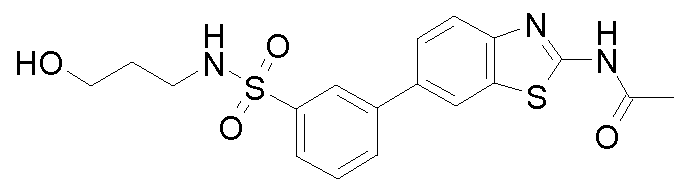
The title compound was prepared following procedure described in Method B (work- up A) starting from 3-bromo-N-(3-hydroxypropyl)benzenesulfonamide. The title compound was obtained as a white powder. HPLC, Rt: 2.9 min (purity: 98.5%). UPLC/MS, M+(ESI): 406.1 , M-(ESI): 404.2.
Example 75: N-[6-(3-{[(2-hydroxyethyl)(methyl)amino] sulfonyl}phenyl)-1 ,3- benzothiazol-2-yl]acetamide
Step 1) 3-bromo-N-(2-hydroxyethyl)-N-methylbenzenesulfonamide

The title compound was prepared following procedure described in example 23 step 1 ), but starting from 3-bromobenzenesulfonyl chloride and 2-(methylamino)ethanol. The title compound was obtained as a pale yellow powder (413 mg, 72%). HPLC, Rt:
3.3 min (purity: 98.9%). UPLC/MS, M+(ESI): 294.0, 296.0, M-(ESI): 292.1 , 294.1.
Step 2) N-[6-(3-{[(2-hydroxyethyl)(methyl)amino] sulfonyl}phenyl)-1,3-benzothiazol-2- yljacetamide

The title compound was prepared following procedure described in Method B (workup A) starting from 3-bromo-N-(2-hydroxyethyl)-N-methylbenzenesulfonamide. The title compound was obtained as a white powder. HPLC, Rt: 3.1 min (purity: 99.4%). UPLC/MS, M+(ESI): 406.1 , M-(ESI): 404.2.
Example 76: N-[6-(3-{[bis(2-hydroxyethyl)amino]sulfonyl}phenyl)-1 ,3- benzothiazol-2-yl]acetamide
Step 1) 3-bromo-N,N-bis(2-hydroxyethyl)benzenesulfonamide

The title compound was prepared following procedure described in example 72 step 1 ), but starting from diethanolamine. After purification by flash chromatography (silica, DCIWMeOH), the title compound was obtained as a white powder. HPLC, Rt: 2.5 min (purity: 99.9%). UPLC/MS, M+(ESI): 324.0, 326.0, M-(ESI): 322.0, 324.0.
Step 2) N-[6-(3-{[bis(2-hydroxyethyl)amino]sulfonyl}phenyl)-1, 3-benzothiazol-2- yljacetamide

The title compound was prepared following procedure described in Method B (work- up A) starting from 3-bromo-N,N-bis(2-hydroxyethyl)benzenesulfonamide. The title compound was obtained as a white powder. HPLC, Rt: 2.8 min (purity: 99.7%). UPLC/MS, M+(ESI): 436.1 , M-(ESI): 434.2.
Example 77: ethyl N-[({6-[3-(methylsulfonyl)phenyl]-1 ,3-benzothiazol-2- yl}amino)carbonyl]-beta-alaninate

The title compound was prepared following procedure described in Example 46, but starting from ethyl 3-isocyanatopropionate. The title compound was obtained as a white powder. HPLC, Rt: 4.0 min (purity: 97.0%). UPLC/MS, M+(ESI): 448.1 , M-(ESI): 446.2.
Example 78: Λ/-(6-{3-[(4-methyl-3-oxopiperazin-1 -yl)sulfonyl]phenyl}-1 ,3- benzothiazol-2-yl)acetamide
Step 1) 4-[(3-bromophenyl)sulfonyl]-1-methylpiperazin-2-one

The title compound was prepared following procedure described in example 23 step 1 ), but starting from 3-bromobenzenesulfonyl chloride and 1-methylpiperazin-2-one hydrochloride (Anichem). The title compound was obtained as a pale yellow powder. HPLC, Rt: 3.0 min (purity: 98.4%). UPLC/MS, M+(ESI): 333.0, 335.0.
Step 2) N-(6-{3-[(4-methyl-3-oxopiperazin- 1 -yl)sulfonyl]phenyl}- 1, 3-benzothiazol-2- yl)acetamide

The title compound was prepared following procedure described in Method B (workup A) starting from 4-[(3-bromophenyl)sulfonyl]-1-methylpiperazin-2-one. The title compound was obtained as a white powder. HPLC, Rt: 3.5 min (purity: 97.6%). UPLC/MS, M+(ESI): 445.1 , M-(ESI): 443.2.
Example 79: N-[6-(4-hydroxy-3-methoxyphenyl)imidazo[1,2-b]pyridazin-2- yl]acetamide

A suspension of N-(6-chloroimidazo[1 ,2-b]pyridazin-2-yl)acetamide (30 mg, 0.612 mmol), 4-hydroxy-3-methoxyphenylboronic acid, pinacol ester (53 mg, 0.21 mmol), cesium fluoride (65 mg, 0.43 mmol) and bis-(triphenylphosphine)Pd(ll) chloride (10 mg, 0.01 mmol) in degassed dioxane/water (0.6 mL:0.3 mL) was heated in MW at 1200C for 10 min. The reaction mixture was filtered through celite, concentrated under reduced pressure and purified by Autoprep to give the title compound as a white powder. HPLC, Rt: 1.89 min (purity: 100%). UPLC/MS, M+(ESI): 299.2, M-
(ESI): 297.2.1H NMR (DMSO-d6) δ 10.8 (s, 1 H), 9.51 (s, 1 H), 8.32 (s, 1 H), 7.98 (d, J=9.48 Hz, 1 H), 7.74 (d, J=9.57 Hz, 1 H), 7.60 (d, J=2.04 Hz, 1 H), 7.50 (dd, J=8.28
Hz, 1 H), 6.91 (d, J=8.28 Hz, 1 H),10.8 (s, 1 H), 9.51 (s, 1 H), 8.32 (s, 1 H), 7.98 (d, J=9.48 Hz, 1 H), 7.74 (d, J=9.57 Hz, 1 H), 7.60 (d, J=2.04 Hz, 1 H), 7.50 (dd, J=8.28 Hz, 1 H), 6.91 (d, J=8.28 Hz, 1 H), 3.89 (s, 3H), 2.1 (s, 3H), 3.89 (s, 3H), 2.1 (s, 3H).
Example 80: N-{6-[3-(methylsulfonyl)phenyl]-1 ,3-benzothiazol-2-yl}-N-(3- morpholin-4-yl-3-oxopropyl)urea

A solution of Λ/-{6-[3-(methylsulfonyl)phenyl]-1 ,3-benzothiazol-2-yl}-1 /-/-imidazole-1- carboxamide (150 mg, 0.38 mmol) and 3-amino-1-morpholin-4-yl-propan-1-one hydrochloride (73 mg, 0.38 mmol, Fluorochem) in anhydrous DMA (2 ml.) was heated at 1300C for 15 minutes under microwave irradiation conditions. The reaction mixture was diluted with EtOAc and washed with water (4x). The organic layer was dried (MgSO4) and the solvents were removed under reduced pressure. After purification by precipitation from EtOAc, the title compound was obtained as a white powder. HPLC, Rt: 3.4 min (purity: 88.5%). UPLC/MS, M+(ESI): 489.1 , M-(ESI): 487.2.
Example 81 : N-{6-[3-(methylsulfonyl)phenyl]-1 ,3-benzothiazol-2-yl}-N-(3-oxo-3- pyrrolidin-1 -ylpropyl)urea

Example 82: tert-butyl 3-[({3-[2-(acetylamino)-1 ,3-benzothiazol-6- yl]phenyl}sulfonyl)amino]piperidine-1 -carboxylate
Step 1) tert-butyl 3-{[(3-bromophenyl)sulfonyl]amino}piperidine-1-carboxylate

The title compound was prepared following procedure described in example 72 step 1 ), but starting from 1-Boc-3-aminopiperidine (ABCR). The title compound was obtained as a pale yellow oil (666 mg, 79%). HPLC, Rt: 4.5 min (purity: 94.9%). UPLC/MS, M+(ESI): 363.0, 365.0 ([M-tBu+2H]+), M-(ESI): 417.2, 419.2.
Step 2) tert-butyl 3-[({3-[2-(acetylamino)-1,3-benzothiazol-6- yl]phenyl}sulfonyl)amino]piperidine- 1 -carboxylate

The title compound was prepared following procedure described in Method B (workup A) starting from tert-butyl 3-{[(3-bromophenyl)sulfonyl]amino}piperidine-1- carboxylate. The title compound was obtained as a white powder (175 mg, 70%). HPLC, Rt: 4.3 min (purity: 99.3%). UPLC/MS, M+(ESI): 531.2, M-(ESI): 529.3.
Example 83: tert-butyl [1 -({3-[2-(acetylamino)-1 ,3-benzothiazol-6- yl]phenyl}sulfonyl)piperidin-3-yl]carbamate
Step 1) tert-butyl {1-[(3-bromophenyl)sulfonyl]piperidin-3-yl}carbamate

The title compound was prepared following procedure described in example 72 step 1 ), but starting from 3-N-Boc-aminopiperidine (Astatech). The title compound was obtained as a white powder (746 mg, 89%). HPLC, Rt: 4.8 min (purity: 100%). UPLC/MS, M+(ESI): 436.0, 438.1 ([M+NH4]+), M-(ESI): 417.2, 419.1.
Step 2) tert-butyl [1-({3-[2-(acetylamino)-1 ,3-benzotriiazol-6- yl]phenyl}sulfonyl)piperidin-3-yl]carbamate

The title compound was prepared following procedure described in Method B (workup A) starting from tert-butyl {1-[(3-bromophenyl)sulfonyl]piperidin-3-yl}carbamate. The title compound was obtained as a yellow foam. HPLC, Rt: 4.1 min (purity: 97.8%). UPLC/MS, M+(ESI): 531.2, M-(ESI): 529.3.
Example 84: 3-[2-(acetylamino)-1 ,3-benzothiazol-6-yl]-N-(2- hydroxyethyl)benzamide

Example 85: Λ/-(6-{3-[(3-aminopiperidin-1 -yl)sulfonyl]phenyl}-1 ,3-benzothiazol-2- yl)acetamide, hydrochloride salt

A solution of tert-butyl [1-({3-[2-(acetylamino)-1 ,3-benzothiazol-6- yl]phenyl}sulfonyl)piperidin-3-yl]carbamate (150 mg, 0.28 mmol, Example 83) was prepared in a 4N solution of HCI in dioxane (1.0 mL, 4.0 mmol) and stirred at RT for 4 hours. The reaction mixture was concentrated under reduced pressure to give the title compound as a pale yellow powder (125 mg, 95%). HPLC, Rt: 2.6 min (purity: 98.3%). UPLC/MS, M+(ESI): 431.1 , M-(ESI): 429.2.
Example 86: N-(6-{3-[(piperidin-3-ylamino)sulfonyl]phenyl}-1 ,3-benzothiazol-2- yl)acetamide, hydrochloride salt

A solution of tert-butyl 3-[({3-[2-(acetylamino)-1 ,3-benzothiazol-6- yl]phenyl}sulfonyl)amino]piperidine-1-carboxylate (166 mg, 0.31 mmol, Example 82) was prepared in a 4N solution of HCI in dioxane (1.0 ml_, 4.0 mmol) and stirred at RT for 4 hours. The reaction mixture was concentrated under reduced pressure to give the title compound as a pale green powder. HPLC, Rt: 2.5 min (purity: 93.7%). UPLC/MS, M+(ESI): 431.1 , M-(ESI): 429.2.
Example 87: N-(3-tert-butoxypropyl)-N'-{6-[3-(methylsulfonyl)phenyl]-1 ,3- benzothiazol-2-yl}urea

A solution of Λ/-{6-[3-(methylsulfonyl)phenyl]-1 ,3-benzothiazol-2-yl}-1 /-/-imidazole-1- carboxamide (100 mg, 0.25 mmol) and 3-(tert-butoxy)propylamine (50 mg, 0.38 mmol) in anhydrous DMA (2 ml.) was heated at 1300C for 25 minutes under microwave irradiation conditions. The reaction mixture was diluted with EtOAc and washed with water (4x). The organic layer was dried (MgSO4) and the solvents were removed under reduced pressure. After purification by AutoPrep, the title compound was obtained as a white powder. HPLC, Rt: 3.8 min (purity: 100%). UPLC/MS, M+(ESI): 462.1 , M-(ESI): 460.2.
Example 88: N-(6-{5-[(dimethylamino)sulfonyl]pyridin-3-yl}-1 ,3-benzothiazol-2- yl)acetamide

The title compound was prepared following procedure described in Method B (work- up D) starting from 5-bromo-Λ/,Λ/-dimethylpyridine-3-sulfonamide (Aalen Chemical).
The title compound was obtained as a white powder. HPLC, Rt: 3.1 min (purity: 95.0%). UPLC/MS, M+(ESI): 377.1 , M-(ESI): 375.1.
Example 89: N-[6-(3-{[(2-hydroxyethyl)amino] sulfonyl}phenyl) imidazo[1 ,2- b]pyridazin-2-yl]acetamide
Step 1 ) formation of 6-chloroimidazo[1 ,2-b]pyridazin-2-amine
 A solution of N-(6-chloroimidazo[1 ,2-b]pyridazin-2-yl)-2,2,2-trifluoroacetamide
(intermediate 5, 0.6 g, 2.26 mmol, 1 eq.) and LiOH-H2O (0.47g, 11.3mmol) in THF/MeOH/H2O (3:1 :2) was heated at 500C for 6h. the reaction mixture was then concentrated and partitioned between EtOAc and water. Organic layer was separated, dried over magnesium sulfate, filtered and concentrated. The crude was purified by flash chromatography on silica (DCIWMeOH) to give the title compound
(0.34 g, 85%).
Step 2) Formation of 6-chloroimidazo[1 ,2-b]pyridazin-2-amine
 Acetyl chloride (0.29 ml_l, 4.04 mmol) was added dropwise to a solution of 6- chloroimidazo[1 ,2-b]pyridazin-2-amine (0.34 g, 2.02mmol) and pyridine (0.5 ml_, 6.07 mmol) in DCM maintained at 00C. The reaction mixture was stirred at RT for 3h. After completion, it was neutralized with saturated sodium bicarbonate solution. The solid formed was filtered and dried to give the title compound (300 mg, 70%).
Step 3) Formation of N-[6-(3-{[(2-hydroxyethyl)amino] sulfonyljphenyl) imidazo[1,2- b]pyridazin-2-yl]acetamide

A suspension of 6-chloroimidazo[1 ,2-b]pyridazin-2-amine (0.2 g, 0.95 mmol), (3-{[(2-hydroxyethyl)amino]sulfonyl}phenyl)boronic acid (0.1 g,
0.47 mmol), cesium fluoride (108 mg, 0.71 mmol) and bis-(triphenylphosphine)Pd(ll) chloride (17 mg, 0.02 mmol) in degassed dioxane/water (1 mL, 0.5 mL) was heated in MW at 900C for 1 h. The solvent was removed under reduced pressure and the residue was filtered through celite, concentrated under reduced pressure and purified by Autoprep to give the title compound as a white solid (150 mg, 84% Yield). HPLC
(Atlantis-1 ), Rt: 3.96 min (purity: 99.6%). LC/MS (Atlantis), M+(ESI): 375.8. 1H NMR (DMSO-d6, 400MHz) δ 10.94 (1 H, s), 8.45 (1 H, s), 8.29-8.33 (2H, m), 8.1 1-8.13 (1 H, d), 7.90-7.92 (1 H, d), 7.81-7.84 (1 H, d), 7.73-7.78 (2H, m), 4.68-4.7 (1 H, t), 3.35-3.4 (2H, m), 2.81-2.85 (2H, m), 2.10 (3H, s).
Example 90: N-{6-[3-(methylsulfonyl)phenyl]imidazo[1 ,2-b]pyridazin-2- yl}ethanethioamide

A suspension of N-{6-[3-(methylsulfonyl)phenyl]imidazo[1 ,2-b]pyridazin-2- yl}acetamide (31.6 mg; 0.10 mmol) and lawesson's reagent (78 mg; 0.20 mmol) in toluene (0.3 ml.) was heated in MW at 1500C for 20 min. Reaction mixture was concentrated under reduced pressure and the crude was purified by Autoprep to give the title compound as a yellow solid . HPLC, Rt: 3.04 min (purity: 78%). UPLC/MS M+(ESI): 345.1 , M-(ESI): 345.2. 1 H NMR (DMSO-d6) δ 12.6 (s, 1 H), 9.33 (s, 1 H), 8.59 (t, J=1.72 Hz, 1 H), 8.45 (brd, J=7.53 Hz, 1 H), 8.25 (d, J=9.75 Hz, 1 H), 8.08 (brd,
J=7.74 Hz, 1 H), 8.02 (d, J=9.96 Hz, 1 H), 7.87 (d, J=7.92 Hz, 1 H), 3.3 (s, 3H), 2.69 (s, 3H),. 1 H NMR (DMSO-d6) δ 12.6 (s, 1 H), 9.33 (s, 1 H), 8.59 (t, J=1.72 Hz, 1 H), 8.45 (brd, J=7.53 Hz, 1 H), 8.25 (d, J=9.75 Hz, 1 H), 8.08 (brd, J=7.74 Hz, 1 H), 8.02 (d, J=9.96 Hz, 1 H), 7.87 (d, J=7.92 Hz, 1 H), 3.3 (s, 3H), 2.69 (s, 3H).
Example 91 : N-p-β-tert-butyl-i ^-oxazol^-yQethyll-N'-β-β-
(methylsulfonyl)phenyl]-1 ,3-benzothiazol-2-yl}urea
Step 1) Formation of phenyl {6-[3-(methylsulfonyl)phenyl]-1,3-benzothiazol-2- yljcarbamate

Phenylchloroformate (0.8 ml_, 6.4 mmol) was added to a solution of 6-[3- (methylsulfonyl)phenyl]-1 ,3-benzothiazol-2-amine (1.3 g, 4.27 mmol) and pyridine (0.7 ml_, 8.5 mmol ) in DCM/THF (1 :1 ) at 00C. The reaction mixture was then stirred
at RT overnight. The solvent was removed under reduced pressure and the crude was triturated with methanol, filtered and dried to give the title compound (1.7g, 95% Yield).
Step 2) formation of N-[2-(5-tert-butyl-1,3-oxazol-2-yl)ethyl]-N'-{6-[3- (methylsulfonyl)phenyl]-1,3-benzothiazol-2-yl}urea

A solution of phenyl {6-[3-(methylsulfonyl)phenyl]-1 ,3-benzothiazol-2-yl}carbamate (95 mg, 0.225 mmol), [2-(5-tert-butyl-1 ,3-oxazol-2-yl)ethyl]amine (58 mg, 0.34 mmol), triethylamine (37 uL, 0.27 mmol) in NMP was heated in MW at 800C for 30 min.
Water was added and the reaction mixture was extracted with EtOAc (twice). Combined organic layers were brine, dried over magnesium sulfate, filtered and concentrated. The crude was purified by flash chromatography on basic alumina (DCM/MeOH) to give the title compound as an Off-white solid. HPLC (Atlantis- 1 ), Rt: 4.55 min (purity: 97.2%). LC/MS (Atlantis), M+(ESI): 499.0.
Example 92: N-[2-(2-isopropyl-2H-tetrazol-5-yl)ethyl]-N'-{6-[3- (methylsulfonyl)phenyl]-1 ,3-benzothiazol-2-yl}urea

Example 93: N-p-^yclopropyl^H-tetrazol^-yOethyll-N'-fθ-IS- (methylsulfonyl)phenyl]-1 ,3-benzothiazol-2-yl}urea

The title compound was prepared following procedure described in example 91 but starting from [2-(5-cyclopropyl-2H-tetrazol-2-yl)ethyl]amine. HPLC (Atlantis), Rt: 4.07 min (purity: 96.4%). LC/MS (Atlantis), M-(ESI): 482.0.
Example 99: N-(2-hydroxyethyl)-3-{2-[({[2-(2-isopropyl-2H-tetrazol-5- yl)ethyl]amino}carbonyl)amino]-1 ,3-benzothiazol-6-yl}benzenesulfonamide

The title compound was prepared following procedure described in Example 49, but starting from 2-(2-isopropyl-2H-tetrazol-5-yl)ethanamine and n-(2-hydroxyethyl) 3- boronobenzenesulfonamide. The title compound was obtained as a white powder. HPLC, Rt: 3.57 min (purity: 98.0%). 1H-NMR (DMSO-d6): δ 10.88 (brs, 1 H), 8.27 (s, 1 H), 8.09 (t, J = 1.7 Hz, 1 H), 7.97 (dt, J = 6.9,1.5 Hz, 1 H), 7.7 (m, 5H), 6.94 (t, J = 5.6 Hz, 1 H), 5.07 (spt, J = 6.7 Hz, 1 H), 4.70 (t, J = 5.6 Hz, 1 H), 3.56 (q, J = 6.5 Hz, 2H), 3.37 (q, J = 6.0 Hz, 2H), 3.09 (t, J = 6.8 Hz, 2H), 2.81 (q, J = 6.0 Hz, 2H), 1.53 (d, J =
6.3 Hz, 6H).
Example 100: N-[6-(3-{[(2-hydroxyethyl)amino]sulfonyl}phenyl) imidazo[1 ,2- a]pyridin-2-yl]acetamide

A suspension of N-(6-bromoimidazo[1 ,2-a]pyridin-2-yl)acetamide (155 mg, 0.612 mmol), N-(2-hydroxyethyl-3-bromobenzenesulfonamide (100 mg, 0.408 mmol), cesium fluoride (247 mg, 16.3 mmol) and bis-(triphenylphosphine)Pd(ll) chloride (43 mg, 0.612 mmol) in degassed dioxane/water (2:1 ) was heated in MW at 900C for 1 h
at 900C. The solvent was removed under reduced pressure and the residue was slurred with dichloromethane. The solid was filtered, washed with water and dried overnight to give the title compound. HPLC (Atlantis-1 ), Rt: 3.80 min (purity: 95%). LC/MS (Atlantis), M+(ESI): 375.0. 1H NMR (DMSOd6, 400MHz) δ 10.74 (1 H,s), 9 (1 H,s), 8.15 (1 H,s), 8.07 (1 Hs), 7.93-7.95 (1 H,m), 7.7-7.9 (1 H,m), 7.66-7.70 (2H,sO, 7.54-7.56 (2H,m), 4.69-4.72 (1 H,t), 3.36-3.40 (2H,s), 2.80-2.85 (2H,m), 2.07 (3H,s).
Example 101 : N-[6-(3-{[(2-hydroxyethyl)amino]sulfonyl}phenyl)imidazo[1 ,2- a]pyrazin-2-yl]acetamide

The title compound was prepared following procedure described in example 89 but starting from N-(6-Bromoimidazo[1 ,2-a]pyrazin-2-yl)-2,2,2-trifluoroacetamide. The title compound was obtained as a grey solid. HPLC (Atlantis-1 ), Rt: 3.96 min (purity: 99.6%). LC/MS (Atlantis), M+(ESI): 375.8.
Example 102: N-{6-[5-(methylsulfonyl)pyridin-3-yl][1,3]thiazolo[4,5-c]pyιϊdin-2- yl}acetamide

The title compound was prepared following procedure described in example 89, step 2 and 3 but starting from 6-chloro[1 ,3]thiazolo[4,5-c]pyridin-2-amine. The title compound was obtained as a pale green solid. HPLC, Rt: 2.32 min (purity: 98.7%). LC/MS (Atlantis), M+(ESI): 349.0.
Example 103: N-[5-(3-{[(2-hydroxyethyl)amino]sulfonyl}phenyl)[1,3] thiazolo[5,4- b]pyridin-2-yl]acetamide

The title compound was prepared following procedure described in example 89, step 2 and 3 but starting from 5-chloro[1 ,3]thiazolo[5,4-b]pyridin-2-amine. The title compound was obtained as a brown solid. HPLC (Atlantis-1 ), Rt: 3.01 min (purity: 94.8%). LC/MS (Atlantis), M+(ESI): 392.9.
Example 104: N-(6-{5-[(3-hydroxypyrrolidin-1 -yl)sulfonyl]pyridin-3-yl}-1 ,3- benzothiazol-2-yl)acetamide

3.18-3.38 (m, 4H), 2.21 (s, 3H), 1.80 (m, 1 H), 1.69 (m, 1 H). Examples 105 to 128 were prepared following the same procedure:


A suspension of MC002_SC09 (100mg, 3.3mmol), MC002_SC11 (124mg, 4.98mmol), cesium fluoride (100 mg, 6.6 mmol) and bis-(triphenylphosphine)Pd(ll) chloride (0.05 eq) in degassed dioxane/water (2:1 ) was heated in MW at 900C for 1 h. The solvent was removed under reduced pressure and the residue was slurred with dichloromethane. The solid was filtered, washed with water and dried overnight to give the title compound. HPLC (Atlantis-2), Rt: 6.27 min (purity: 95.3%). LC/MS (Atlantis), M+(ESI): 346.0. 1H NMR (DMSOd6, 400MHz) δ 10.74 (1 H,s), 10.16 (1 H,s), 8.98 (1 H,s), 8.64-8.65 (1 H,s), 8.41 (1 H,s), 8.15 (1 H,s), 7.82 (1 H,s), 7.5-7.55 (2H,m), 3.13 (3H1S), 2.07 (3H,s). Examples 130-132 were prepared following the same procedure:


The title compound was prepared following procedure described in example 129 but starting from N-[2-(5-tert-butyl-1 ,2,4-oxadiazol-3-yl)ethyl]-N'-[6-(4,4,5,5-tetramethyl-
1 ,3,2-dioxaborolan-2-yl)-1 ,3-benzothiazol-2-yl]urea. The title compound was obtained as a white solid. HPLC, Rt: 3.80 min (purity: 99.7%). LC/MS (Atlantis), M+(ESI):
500.9.
Examples 134-147 were prepared following the same procedure:


Example 148: 3-{2-[({[2-(5-tert-butyl-1 ,2,4-oxadiazol-3- yl)ethyl]amino}carbonyl)amino]imidazo[1 ,2-a]pyridin-6-yl}-N-(2- hydroxyethyl)benzenesulfonamide

The title compound was prepared following procedure described in example 129 but starting from N-[2-(5-tert-butyl-1 ,2,4-oxadiazol-3-yl)ethyl]-N'-[6-(4 ,4,5,5-tetramethyl- 1 ,3,2-dioxaborolan-2-yl)imidazo[1 ,2-a]pyridin-2-yl]urea. The title compound was
obtained as a white solid. HPLC, Rt: 3.80 min (purity: 99.7%). LC/MS (Atlantis), M+(ESI): 500.9.
Examples 149 was prepared following the same procedure:

Example 150: 5-{2-[({[2-(5-tert-butyl-1 ,3-oxazol-2- yl)ethyl]amino}carbonyl)amino]-1 ,3-benzothiazol-6-yl}-N,N-dimethylpyridine-3- sulfonamide

The title compound was prepared following procedure described in example 129 but starting from N-[2-(5-tert-butyl-1 ,3-oxazol-2-yl)ethyl]-N'-[6-(4,4,5,5-tetramethyl-1 ,3,2- dioxaborolan-2-yl)-1 ,3-benzothiazol-2-yl]urea. The title compound was obtained as an off white solid. HPLC, Rt: 4.10 min (purity: 98.6%). LC/MS (Atlantis), M+(ESI): 528.9.
Examples 151 and 152 were prepared following the same procedure:


Example 153: N-p-fS-tert^utyM .S-oxazol^-yOethyll-N'-fθ-IS- (methylsulfonyl)pyridin-3-yl]imidazo[1,2-a]pyridin-2-yl}urea

The title compound was prepared following procedure described in example 129 but starting from N-[2-(5-tert-butyl-1 ,3-oxazol-2-yl)ethyl]-N'-[6-(4 ,4,5,5-tetramethyl-i ,3,2- dioxaborolan-2-yl)imidazo[1 ,2-a]pyridin-2-yl]urea. The title compound was obtained as a pale brown solid. HPLC, Rt: 3.04 min (purity: 96.0%). LC/MS (Atlantis), M+(ESI): 482.9.
Example 154: N-(6-{5-[(piperidin-3-ylamino)sulfonyl]pyridin-3-yl}-1 ,3- benzothiazol-2-yl)acetamide

Trifluoroacetic acid (2.2 eq) was added dropwise to a solution of tert-butyl [1-({5-[2- (acetylamino)-1 ,3-benzothiazol-6-yl]pyridin-3-yl}sulfonyl)piperidin-3-yl]carbamate in DCM. The reaction mixture was then stirred at RT for 4h and concentrated under reduced pressure. The crude was dissolved in DCM and washed with saturated sodium bicarbonate solution, water and brine. Organic phase was finally dried over magnesium sulfate, filtered and concentrated to give the title compound. HPLC
(Atlantis-1 ), Rt: 3.98 min (purity: 95.5%). LC/MS (Atlantis), M+(ESI): 432.1. 1H NMR (DMSO-d6, 400MHz) δ 9.18 (1 H,s), 8.91 (1 H,s), 8.43-8.46 (2H,d), 7.83-7.84 (2H,m), 3.06 (1 H,m), 2.61-2.75 (2H,dd), 2.26-2.28 (1.5H,m),2.23 (3H,s), 1.62 (1 H,m), 1.47- 1.48 (1 H,m), 1.24 (3H,m). Examples 155 and 156 were prepared following the same procedure:

Example 157: N-{6-[5-({[(1 S,2R,3S)-2,3-dihydroxycyclohexyl]amino} sulfonyl)pyridin-3-yl]-1 ,3-benzothiazol-2-yl}acetamide

A solution of N-{6-[5-({[(3aR,4S,7aS)-2,2-dimethylhexahydro-1 ,3-benzodioxol-4- yl]amino}sulfonyl)pyridin-3-yl]-1 ,3-benzothiazol-2-yl}acetamide (25 mg, 0.039 mmol) in acetic acid (0.8 ml.) and water (0.2 ml.) was stirred at RT for 5h. Then acetic acid was removed under reduced pressure and water was azeotroped with toluene (3 times) to give the title compound (15 mg, 81 % yield). HPLC (Atlantis-2), Rt: 4.47 min (purity: 92.1 %). LC/MS (Atlantis), M+(ESI): 462.9. 1H NMR (DMSOd6, 400MHz) δ 12.3 (1 H, s) 9.1 (1 H, s), 8.91 (1 H, s), 8.49 (1 H, s), 8.43 (1 H, s), 7.82-7.87 (3H, m),
4.44 (1 H, s), 4.37 (1 H, s), 3.72 (1 H, s), 3.24 (1.6H, m), 2.21 (3H, s), 1.66-1.68 (1 H, m), 1.52 (1 H, m), 1.4 (1.2H, m), 1.3 (2.4H, m), 1.28 (1.2H, m).
Example 158: N-[6-(1 ,1 -dioxido-2,3-dihydro-1 ,2-benzisothiazol-6-yl)-1 ,3- benzothiazol-2-yl]acetamide
Step a) Formation of (3-{[(2-hydroxyethyl)amino]sulfonyl}phenyl)boronic acid

The title compound was prepared following procedure described in example 104 but starting from 6-bromo-2-tert-butyl-2,3-dihydro-1 ,2-benzisothiazole 1 ,1 -dioxide.
Step 2) Formation of N-[6-(1 ,1-dioxido-2,3-dihydro-1 ,2-benzisothiazol-6-yl)-1 ,3- benzothiazol-2-yl]acetamide

A solution of (3-{[(2-hydroxyethyl)amino]sulfonyl}phenyl)boronic acid (95 mg, 0.228 mmol) in TFA (5 ml.) was stirred at RT overnight. The reaction mixture was neutralized carefully with sat. NaHCO3 solution at 00C and the aqueous layer was extracted with DCM (twice). Combined organic layers were then dried over magnesium sulfate, filtered and concentrated. The crude was triturated with MeOH, filtered and dried under vacuum to give the title compound. HPLC (Atlantis-1 ), Rt: 3.43 min (purity: 97.6%). LC/MS (Atlantis), M+(ESI): 360.0. 1H NMR (DMSO-d6, 400MHz) δ 12.42 (1 H,s), 8.42 (1 H,s), 8.12 (1 H,s), 8.03-8.05 (1 H,d), 7.65-7.82 (3H,m), 7.6 (1 H,d), 4.43 (2H,s), 2.2(3H,s).
Compounds 159-161 were prepared following same procedure as described in example 26:


Example 162: N-^-tS-tert-butyl-i ^^-oxadiazol-S-yOethyll-N'^θ-IS- (methylsulfonyl)phenyl]-1 ,3-benzothiazol-2-yl}urea

A solution of phenyl {6-[3-(methylsulfonyl)phenyl]-1 ,3-benzothiazol-2-yl}carbamate (0.3 g, 0.706 mmol), 2-(5-tert-butyl-1 ,2,4-oxadiazol-3-yl)ethanamine (0.143 g, 1.05 mmol), triethylamine (0.11 mL, 0.85 mmol) in NMP was heated in MW at 800C for 30 min. Water was added and the reaction mixture was extracted with EtOAc (twice). Combined organic layers were brine, dried over magnesium sulfate, filtered and concentrated. The crude was purified by flash chromatography on silica (DCM/MeOH) to give the title compound as a white solid (250 mg, 70% Yield). HPLC (Atlantis-1 ), Rt: 5.97 min (purity: 98.6%). LC/MS (Atlantis), M+(ESI): 500.0. 1H NMR (DMSOd6, 400MHz) δ 10.84-10.99 (1 H, s), 8.34 (1 H, s), 8.2 (1 H, s), 8.06-8.08 (1 H, d) ,7.87-7.89 (1 H, d) 7.7-7.77 (3H m), 6.89 (1 H, s), 3.51-3.56 (2H, m), 3.31 (3H, s), 2,89- 2.93 (2H, m), 1.36 (9H, s).
Examples 163 to 209 were prepared following the same procedure:


Example 210: N-methyl-3-{[({6-[3-(methylsulfonyl)phenyl]-1 ,3-benzothiazol-2- yl}amino)carbonyl]amino}cyclopentanecarboxamide

A solution of Methyl 3-{[({6-[3-(methylsulfonyl)phenyl]-1 ,3-benzothiazol-2-yl}amino) carbonyl]amino}cyclopentanecarboxylate (50 mg, 0.105 mmol ), and methylamine (THF solution, 5ml_) was heated in a sealed tube at 1000C overnight. Solvent was
removed under reduced pressure and the solid obtained was washed with diethyl ether to give the title compound as a white solid. HPLC, Rt: 3.34 min (purity: 92.8%). LC/MS, M+(ESI): 472.9. 1H NMR (DMSOd6 400MHz) δ 10.78 (1 H, s) ,8.33 (1 H, s), 8.20 (1 H, s), 8,08 (1 H, m), 7.82-7.88 (2H, m), 7.70-7.72 (3H, m), 6.97 (1 H, m), 4.05- 4.08 (1 H, m), 3.31 (3H, s), 2.58-2.66 (1 H, m), 2.56 (3H, s), 2.08-2.11 (1 H, m), 1.82- 1.88 (1 H, m), 1.73-1.79 (1 H, m), 1.54-1.61 (2H, m).
Example 211 : N,N-dimethyl-3-{[({6-[3-(methylsulfonyl)phenyl]-1 ,3-benzothiazol- 2-yl}amino)carbonyl]amino}cyclopentanecarboxamide

The title compound was prepared following procedure described in example 210 but starting from dimethylamine. The title compound was obtained as a white solid. HPLC, Rt: 3.65 min (purity: 96.4%). LC/MS (Atlantis), M+(ESI): 486.9.
Example 212: tert-butyl N-{[(6-{5-[(dimethylamino)sulfonyl]pyridin-3-yl}-1 ,3- benzothiazol-2-yl)amino]carbonyl}-beta-alaninate
Step 1) formation of 5-(2-amino-1 ,3-benzothiazol-6-yl)-N,N-dimethylpyridine-3- sulfonamide

Step 2) formation of phenyl (6-{5-[(dimethylamino)sulfonyl]pyridin-3-yl}-1,3- benzothiazol-2-yl)carbamate

The title compound was prepared following procedure described in example 162, step 1 ) but starting from N-(6-{5-[(dimethylamino)sulfonyl]pyridin-3-yl}-1 ,3-benzothiazol-2- yl)acetamide (265 mg, 0.793 mmol). Water was added after completion of the reaction and the precipitate obtained was filtered, washed with water three times and dried overnight to give the title compound.
Step 3) formation of tert-butyl N-{[(6-{5-[(dimethylamino)sulfonyl]pyridin-3-yl}-1,3- benzothiazol-2-yl)amino]carbonyl}-beta-alaninate

A solution of phenyl (6-{5-[(dimethylamino)sulfonyl]pyridin-3-yl}-1 ,3-benzothiazol-2- yl)carbamate (100 mg, 0.22 mmol), H-β-ala-OtBu. HCI (52 mg, 0.286 mmol) and TEA (50 ml_, 0.33 mmol) in NMP was heated in MW at 800C for 10 min. Reaction mixture was diluted with water and stirred for 1 h. The precipitate obtained was filtered and dried overnight to give the itle compound as a brown solid. HPLC (Atlantis-1 ), Rt: 4.61 min (purity: 95.8%). LC/MS, M+(ESI): 503.9. 1H NMR (DMSOd6 400MHz) δ 10.90 (1 H, s), 9.25 (1 H, s) 8.87 (1 H, s), 8.44 (1 H, s), 8.34 (1 H, s), 7.82-7.84 (1 H, m), 7.72- 7.74 (1 H, m), 6.88 (1 H, s), 3.36-3.38 (2H, d), 2.71 (6H, s), 2.43-2.46 (2H, m),1.41 (9H, s).
Example 213: N-[2-(5-tert-butyl-1 ^^-oxadiazol-S-yOethyll-N'-fδ-IS-
(methylsulfonyl)phenyl][1 ,3]thiazolo[5,4-b]pyridin-2-yl}urea
Step 1) Formation of phenyl {5-[3-(methylsulfonyl)phenyl][1,3]thiazolo[5,4-b]pyridin-2- yljcarbamate

Step 2) Formation of N-[2-(5-tert-butyl-1,2,4-oxadiazol-3-yl)ethyl]-N'-{5-[3- (methylsulfonyl)phenyl][1,3]thiazolo[5,4-b]pyridin-2-yl}urea
The title compound was prepared following procedure described in example 162, step 2) but starting from of phenyl {5-[3-(methylsulfonyl)phenyl][1 ,3]thiazolo[5,4-b]pyridin- 2-yl}carbamate
(100 mg, 0.235 mmol) and [2-(5-tert-butyl-1 ,2,4-oxadiazol-3-yl)ethyl]amine (58 mg, 0.284 mmol). The title compound was obtained as a beige solid. HPLC Rt: 4.09 min (purity: 98.2%). LC/MS (Atlantis), M+(ESI): 501.0. 1H NMR (DMSOd6, 400MHz) δ 1 1.12 (1 H, s), 8.61 (1 H, s), 8.43-8.45 (1 H, d), 8.06-8.14 (2H, m) 7.95-7.96 (1 H, d),7.75-7.78 (1 H, m), 6.92 (1 H, s), 3.53-3.54 (2H, d), 3.32 (3H, s)2.91-2.93 (2H, d), 1.36 (9H, s). Examples 214- 219 were prepared following the same procedure:


Example 220: N-[2-(5-tert-butyl-1 ^^-oxadiazol-S-yOethyll-N'^θ-IS- (methylsulfonyl)phenyl][1 ,3]thiazolo[4,5-c]pyridin-2-yl}urea

The title compound was prepared following procedure described in example 162, step 1 ) and 2) but starting from 6-[3-(methylsulfonyl)phenyl][1 ,3]thiazolo[4,5-c]pyridin-2- amine and 2-(5-tert-butyl-1 ,2,4-oxadiazol-3-yl)ethanamine. The title compound was obtained as a white solid. HPLC Rt: 3.45 min (purity: 98.7%). LC/MS (Atlantis), M+(ESI): 500.9.
Example 221 : N-^-tS-tert-butyl-i ^^-oxadiazol-S-yOethyll-N'^θ-IS- (methylsulfonyl)phenyl]imidazo[1,2-a]pyrazin-2-yl}urea

The title compound was prepared following procedure described in example 162, step 1 ) and 2) but starting from 6-[3-(methylsulfonyl)phenyl]imidazo[1 ,2-a]pyrazin-2-amine and 2-(5-tert-butyl-1 ,2,4-oxadiazol-3-yl)ethanamine. The title compound was obtained as a yellow solid. HPLC Rt: 3.54 min (purity: 97.7%). LC/MS (Atlantis), M+(ESI):
484.1.
Example 222: N-[3-(2-isopropylpyrrolidin-1 -yl)-3-oxopropyl]-N-[6-(5- methoxypyridin-3-yl)-1 ,3-benzothiazol-2-yl]urea Step 1 ) Formation of phenyl [6-(5-methoxypyridin-3-yl)-1 ,3-benzothiazol-2- yl]carbamate
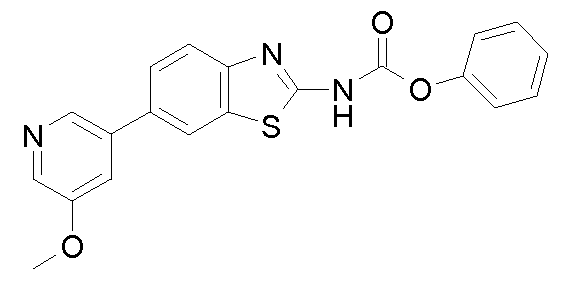
The title compound was prepared following procedure described in example 162, step 1 ) but starting 6-(5-methoxypyridin-3-yl)-1 ,3-benzothiazol-2-amine (440 mg, 1.712 mmol) and using 2,4,6-trimethyl pyridine instead of pyridine in NMP. Water was added after completion of the reaction and the precipitate obtained was filtered, washed with water three times and dried overnight to give the title compound. Step 2) Formation of N-[3-(2-isopropylpyrrolidin-1-yl)-3-oxopropyl]-N-[6-(5- methoxypyridin-3-yl)-1 , 3-benzothiazol-2-yl]urea
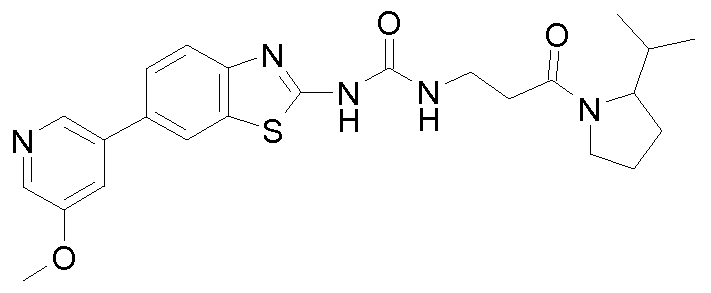
The title compound was prepared following procedure described in example 162, step 2) but starting from phenyl [6-(5-methoxypyridin-3-yl)-1 ,3-benzothiazol-2-yl]carbamate (100 mg, 0.235 mmol) and 2-(5-tert-butyl-1 ,2,4-oxadiazol-3-yl)ethanamine (58 mg, 0.284 mmol). The title compound was obtained as an off white solid. HPLC Rt: 3.27 min (purity: 97.2%). LC/MS M+(ESI): 468.0. 1H NMR (DMSOd6, 400MHz) δ 10.83
(1 H, s), 8.52 (1 H, s), 8.30 (1 H, s), 8.25 (1 H, s), 7.66-7.75 (3H, m), 6.93 (1 H, s), 3.91
(3H, s), 3.89 (1 H, m), 3.6-3.87 (1 H, m), 3.44-3.49 (1 H, m), 3.36-3.39 (2H, m), 2.22-
2.23 (1 H, m), 1.69-1.84 (4H, m), 0.85 (6H, m).
Examples 223- 234 were prepared following the same procedure:


Example 235: N-{2-[5-(2-fluoro-1 ,1 -dimethylethyl)-1 ,2,4-oxadiazol-3-yl]ethyl}-N'- [5-(5-methoxypyridin-3-yl)[1 ,3]thiazolo[5,4-b]pyridin-2-yl]urea
Step 1) Formation of phenyl [5-(5-methoxypyridin-3-yl)[1 ,3]thiazolo[5,4-b]pyridin-2- yljcarbamate

The title compound was prepared following procedure described in example 162, step 1 ) but starting 5-(5-methoxypyridin-3-yl)[1 ,3]thiazolo[5,4-b]pyridin-2-amine (250 mg, 0.969 mmol) and using 2,4,6-trimethyl pyridine instead of pyridine in NMP. Water was added after completion of the reaction and the precipitate obtained was filtered, washed with water three times and dried overnight to give the title compound.
Step 2) formation of N-{2-[5-(2-fluoro-1 , 1-dimethylethyl)-1 ,2,4-oxadiazol-3-yl]ethyl}-N'- [5-(5-methoxypyridin-3-yl)[1,3]thiazolo[5,4-b]pyridin-2-yl]urea

7/?e f/Y/e compound was prepared following procedure described in example 162, step 2) but starting from Phenyl [5-(5-methoxypyridin-3-yl)[1,3]thiazolo[5,4-b]pyridin-2- yljcarbamate (20 mg, 0.053 mmol) and 2-[5-(2-fluoro-1 ,1-dimethylethyl)-1 ,2,4-oxadiazol-3- yl]ethanamine (16.4 mg, 0.0634 mmol),. The title compound was obtained as an off white solid. HPLC Rt: 3.1 1 min (purity: 87.6%). LC/MS M+(ESI): 472.2. 1H NMR (DMSO-d6, 400MHz) δ 1 1.15 (1 H, s), 8.87 (1 H, s), 8.31 (1 H, s), 8.08-8.10 (1 H, d), 8.02-8.04 (1 H, d), 7.98 (1 H, s), 6.95 (1 H, s), 4.63 (1 H, s), 4.51 (1 H, s), 3.92 (3H, s), 3.53-3.55 (2H, m), 2.94-2.96 (2H, m), 1.38 (6H, s).
Example 236: N-[2-(5-tert-butyl-1 ,2,4-oxadiazol-3-yl)ethyl]-N'-{5-[5- (methylsulfonyl)pyridin-3-yl][1 ,3]thiazolo[5,4-b]pyridin-2-yl}urea
Step 1) Formation of phenyl {5-[5-(methylsulfonyl)pyridin-3-yl][1,3]thiazolo[5,4- b]pyridin-2-yl}carbamate

The title compound was prepared following procedure described in example 235, step 1 ) but starting from 5-[5-(methylsulfonyl)pyridin-3-yl][1 ,3]thiazolo[5,4-b]pyridin-2- amine (0.21 g, 0.686 mmol). (0.27 g, 92% yield).
Step 2) Formation of N-[2-(5-tert-butyl-1,2,4-oxadiazol-3-yl)ethyl]-N'-{5-[5- (methylsulfonyl)pyridin-3-yl][1,3]thiazolo[5,4-b]pyridin-2-yl}urea

(0.22g,0.516mmol.), and 2-(5-tert-butyl-1 ,2,4-oxadiazol-3-yl)ethanamine (0.129g, 0.629mmol.)- The title compound was obtained as a yellow solid. HPLC Rt: 3.75 min (purity: 98.4%). LC/MS M+(ESI): 502.0. 1H NMR (DMSOd6, 400MHz) δ 1 1.17 (1 H,s), 9.59-9.60 (1 H,s), 9.08-9.09 (1 H,s), 8.91-8.92(1 H,s), 8.24-8.26(1 H,d), 8.11-8.13 (1 H,d), 6.93(1 H1S), 3.52-3.56 (2H,m), 3.37-3.41 (3H,s), 32.90-2.93(2H,m), 1.36(9H,s). Examples 237 and 238 were prepared following the same procedure:

Example 239: N-[3-(3,3-difluoroazetidin-1 -yl)-3-oxopropyl]-N-{6-[5- (methylsulfonyl)pyridin-3-yl]-1 ,3-benzothiazol-2-yl}urea

A suspension of
N-[3-(3,3-difluoroazetidin-1-yl)-3-oxopropyl]-N-{6-bromo-1 ,3-benzothiazol-2-yl}urea (80 mg, 0.18 mmol), 3-(methylsulfonyl)-5-(4,4,5,5-tetramethyl-1 ,3,2-dioxaborolan-2- yl)pyridine (77 mg, 0.272 mmol), cesium fluoride (1 10 mg, 0.725 mmol) and bis- (triphenylphosphine) Pd(II) chloride (0.15 eq) in degassed dioxane/water (2:1 ratio) was heated in MW at 900C for 60 min. Dioxane was removed under reduced pressure and the aqueous phase was extracted with EtOAc (twice). Combined organic layers were washed with brine, dried over magnesium sulfate, filtered and concentrated.
The crude was purified by flash chromatography on silica (HCCI3/MeOH) to give the title compound as a off white solid. HPLC Rt: 3.08 min (purity: 96.8%). LC/MS M+(ESI): 496.0. 1H NMR (DMSOd6, 400MHz) δ 10.88 (1 H,s), 9.27 (1 H,s), 9.0(1 H,s), 8.58 (1 H,s), 8.44 (1 H,s),7.84-7.86 (1 H,d), 7.74-7.76 (1 H,d), 6.91 (1 H,s), 4.57-4.63 ( 2H,t), 4.25-4.32 (2H,t), 3.4 (5H,m), 2.44 (2H,m). Examples 240 and 241 were prepared following the same procedure:

Example 242: N-(2-hydroxyethyl)-3-{2-[({[2-(5-phenyl-1 ,2,4-oxadiazol-3- yl)ethyl]amino}carbonyl)amino]imidazo[1 ,2-a]pyridin-6-yl}benzenesulfonamide

A suspension of
N-(6-bromoimidazo[1 ,2-a]pyridin-2-yl)-N'-[2-(5-phenyl-1 ,2,4-oxadiazol-3-yl)ethyl]urea (69 mg, 0.28 mmol), N-(2-hydroxyethyl)-3-boronobenzenesulphonamide (97 mg, 0.22 mmol) and {1 ,1 '-bis(diphenylphosphino)-ferrocene}dichloropalladium(ll).DCM (28 mg, 0.035 mmol) in aq. sodium carbonate (2M solution, 0.75 mL) and 1 ,2- dimethoxyethane was heated in MW at 1000C for 60 min. The reaction mixture was diluted with EtOAc and the organic phase was washed with water, brine, dried over sodium sulfate, filtered and concentrated. The crude was purified by flash chromatography on basic alumina (DCM/MeOH) to give the title compound as a off white solid. HPLC (Atlantis-1 ) Rt: 3.33 min (purity: 96.3%). LC/MS(Atlantis) M+(ESI):
548.0. 1H NMR (DMSO-d6, 400MHz) δ 9.05 (1 H, s), 8.94 (1 H, s), 8.10-8.12 (2H, d), 8.1 (1 H, s), 7.92-7.94 (1 H, d), 7.82 (1 H, s), 7.78 (1 H, d), 7.6-7.71 (5H, m), 7.49-7.52 (1 H, d), 7.43-7.45 (1 H, d), 6.89 (1 H, s), 4.68-4.71 (1 H, m), 3.55-3.66 (2H, m), 3.35- 3.4 (2H, m), 2.97-3.0 (2H, m), 2.8-2.85 (1 H, m). Examples 243 to 245 were prepared following the same procedure:

Example 246: N-{3-[3-(diethylamino)prop-1 -yn-1 -yl]-6-[3- (methylsulfonyl)phenyl]imidazo[1 ,2-a]pyridin-2-yl}acetamide
Step 1) Formation of N-{3-bromo-6-[3-(methylsulfonyl)phenyl]imidazo[1,2-a]pyridin-2- yl}acetamide

N-bromo succinimide (0.475 g, 2.67 mmol) was added to a solution of N-{6-[3- (methylsulfonyl)phenyl]imidazo[1 ,2-a]pyridin-2-yl}acetamide (0.8 g, 2.42 mmol) in
ACN maintained at 00C. The reaction mixture was stirred at RT for 1 h. The suspension formed was filtered, washed with ACN and dried under vacuum to give the title compound.
Step 2) Formation ofN-{3-[3-(diethylamino)prop-1-yn-1-yl]-6-[3-
(methylsulfonyl)phenyl]imidazo[1,2-a]pyridin-2-yl}acetamide

A suspension of N-{3-bromo-6-[3-(methylsulfonyl)phenyl]imidazo[1 ,2-a]pyridin-2- yl}acetamide (0.1g, 0.244mmol), 3-(diethylamino)-1-propyne (0.051 ml, 0.36mmol), triethylamine (0.17ml, 1.22mmol), cuprous iodide (4.6mg, 0.024mmol and bis(triphenyl phosphine) palladium(ll) chloride (10.3mg, 0.014mmol) in degassed THF was heated at 700C for 8h in a sealed tube. Reaction mixture was filtered through celite and the filtrate was concentrated under reduced pressure. The crude was purified by flash chromatography on silica (DCIWMeOH) to give the title compound as a dark brown solid. HPLC (Atlantis-1 ) Rt: 3.80 min (purity: 97.1%). LC/MS (Atlantis)
M+(ESI): 439.1. 1H NMR (DMSOd6, 400MHz) δ 10.29 (1 H, s), 8.57 (1 H, s), 8.21 (1 H, s), 8.07-8.09 (1 H, d), 7.95-7.97 (1 H, d), 7.77-7.81 (2H, m), 7.69-7.71 (1 H, d), 3.81 (2H, s), 3.30 (3H, s), 2.61 (4H, s), 2.07 (3H, s), 1.06-1.08 (6H, m).
Example 247: tert-butyl (5-{2-[({[2-(5-tert-butyl-1 ,2,4-oxadiazol-3- yl)ethyl]amino}carbonyl)amino]-1 ,3-benzothiazol-6-yl}pyridin-3- yl)methylcarbamate
Step 1) Formation of tert-butyl {5-[2-(acetylamino)-1 ,3-benzothiazol-6-yl]pyridin-3- yljmethylcarbamate

A suspension of N-[6-(4,4,5,5-tetramethyl-1 ,3,2-dioxaborolan-2-yl)-1 ,3-benzothiazol- 2-yl]acetamide (500 mg, 1.75 mmol), tert-butyl (5-bromopyridin-3-yl)methylcarbamate
(670 mg, 2.106 mmol), cesium fluoride (1.06 g, 6.99 mmol) and bis- (triphenylphosphine) Pd(II) chloride (61.4 mg, 0.087 mmol) in degassed dioxane/water (2:1 ) was heated in MW at 900C for 1 h. Solvents were removed under reduced pressure and the residue was slurred with DCM. The solid obtained was filtered, washed with water and dried overnight to give the title compound (650mg,
93% Yield).
Step 2) Formation of tert-butyl [5-(2-amino-1 ,3-benzothiazol-6-yl)pyridin-3- yljmethylcarbamate

A solution of tert-butyl {5-[2-(acetylamino)-1 ,3-benzothiazol-6-yl]pyridin-3- yl}methylcarbamate (650 mg, 1.63 mmol) and potassium carbonate (650mg, 4.71 mmol) in MeOH/water (8:1 ) was heated at 600C for 6h. Solvent was removed under reduced pressure and the crude obtained was dissolved in dichloromethane and filtered through celite. The filtrate was concentrated, dissolved in EtOAc and passed through silica bed. Filtrate was concentrated under reduced pressure to give the title compound.
Step 3) Formation of phenyl (6-{5-[(tert-butoxycarbonyl)(methyl)amino]pyridin-3-yl}- 1, 3-benzothiazol-2-yl)carbamate

The title compound was prepared following procedure described in example 235, step 1 ) but starting from tert-butyl [5-(2-amino-1 ,3-benzothiazol-6-yl)pyridin-3- yl]methylcarbamate (25 Omg, 0.701 mmol).
Step 4) Formation of tert-butyl (5-{2-[({[2-(5-tert-butyl-1,2,4-oxadiazol-3- yl)ethyl]amino}carbonyl)amino]-1,3-benzothiazol-6-yl}pyridin-3-yl)methylcarbamate
The title compound was prepared following procedure described in example 162, step 2) but starting from of phenyl (6-{5-[(tert-butoxycarbonyl)(methyl)amino]pyridin-3-yl}- 1 ,3-benzothiazol-2-yl)carbamate (160mg, 0.336mmol) and 2-(5-tert-butyl-1 ,2,4- oxadiazol-3-yl)ethanamine (83mg, 0.403mmol). The title compound was obtained as an off white solid. HPLC Rt: 4.12 min (purity: 92.1%). LC/MS M+(ESI): 552.0.
Example 248: N-[2-(5-tert-butyl-1 ^^-oxadiazol-S-yOethyll-N'-fθ-IS- (methylamino)pyridin-3-yl]-1 ,3-benzothiazol-2-yl}urea

The title compound was prepared following procedure described in example 154, but starting from tert-butyl (5-{2-[({[2-(5-tert-butyl-1 ,2,4-oxadiazol-3- yl)ethyl]amino}carbonyl)amino]-1 ,3-benzothiazol-6-yl}pyridin-3-yl)methylcarbamate (120mg, 0.218mmol). The title compound was obtained as an off white solid. HPLC Rt: 3.26 min (purity: 98.2%). LC/MS M+(ESI): 451.9.
Example 249: N-(5-{2-[({[2-(5-tert-butyl-1 ,2,4-oxadiazol-3- yl)ethyl]amino}carbonyl)amino]-1 ,3-benzothiazol-6-yl}pyridin-3-yl)-N- methylmethanesulfonamide

A solution of N-[2-(5-tert-butyl-1 ,2,4-oxadiazol-3-yl)ethyl]-N'-{6-[5- (methylamino)pyridin-3-yl]-1 ,3-benzothiazol-2-yl}urea (44 mg, 0.098 mmol) and methanesulfonyl chloride (13.4 mg, 0.117 mmol) in pyridine/chloroform (1 :3) was stirred at RT overnight. After completion, the reaction mixture was concentrated under reduced pressure and the crude wa purified by flash chromatography on basic
alumina (MeOH/HCCI3) to give the title compound as a beige solid. HPLC Rt: 3.51 min (purity: 94.8%). LC/MS M+(ESI): 530.0. 1H NMR (DMSOd6, 400MHz) δ 10.93 (1 H, s), 8.84(1 H1S), 8.55 (1 H, s), 8.34 (1 H, s), 8.17 (1 H, s), 7.7-7.77 (2H, m), 6.89 (1 H, s), 3.51-3.54 (2H, m), 3.35 (3H, s), 3.05 (3H, s), 2.89-2.92 (2H, m), 1.36 (9H, s).
Example 250: 4-(5-tert-butyl-1 ,3-oxazol-2-yl)-N-{6-[3-(methylsulfonyl)phenyl]-1 ,3- benzothiazol-2-yl}butanamide

A solution of 6-[3-(methylsulfonyl)phenyl]-1 ,3-benzothiazol-2-amine (0.1 g, 0.328 mmol), 4-(5-tert-butyl-1 ,3-oxazol-2-yl)butanoic acid (0.097 g, 0.39 mmol), HOBt
(0.15g, 0.039mmol), EDCHCI (0.094g, 0.49mmol) and TEA (0.18 ml_, 1.3 mmol in DMF was stirred at RT overnight. Water was added to the reaction mixture and DMF was evaporated under reduced pressure. The residue was extracted with EtOAc (twice). Combined organic phases were washed with 10% NaHCOs, 1.5N HCI and water, dried over magnesium sulfate, filtered and concentrated. The crude was purified by flash chromatography on silica (DCM/MeOH) to give the title compound as an off white solid. HPLC (Atlantis-1 ) Rt: 4.83 min (purity: 91.4%). LC/MS (Atlantis) M+(ESI): 497.9. 1H NMR (DMSO-d6, 400MHz) δ 8.43 (1 H, s), 8.22 (1 H, s), 8.10-8.22 (1 H, d), 7.88-7.9 (1 H, d), 7.88 (1 H, s), 7.73-7.77 (1 H, m), 6.6 (1 H, ), 3.30 (3H, s), 2.74-2.77 (2H, m), 2.59-2.63 (2H, m), 1.99-2.03 (2H, m), 1.22 (9H, s).
Example 251 : 4-(5-tert-butyl-1 ,3-oxazol-2-yl)-N-{6-[5-(methylsulfonyl)pyridin-3- yl]-1 ,3-benzothiazol-2-yl}butanamide

3) but strating from N-(6-bromo-1 ,3-benzothiazol-2-yl)-4-(5-tert-butyl-1 ,3-oxazol-2- yl)butanamide
(20mg, 0.407mmol) and 3-(methylsulfonyl)-5-(4,4,5,5-tetramethyl-1 ,3,2- dioxaborolan-2-yl)pyridine (20mg, 0.071 mmol), The title compound was obtained as a
beige solid. HPLC Rt: 4.05 min (purity: 92.2%). LC/MS M+(ESI): 498.8. 1H NMR (DMSO-de, 400MHz) δ 9.17 (1 H,s), 9.13 (1 H,s), 8.45-8.46 (1 H,m), 8.08 (1 H,s), 7.92- 7.94 (1 H,d), 7.67-7.70 (1 H,m), 6.72 (1 H,s), 3.19 (3H,s), 2.90-2.93 (2H,t), 2,66-2.70 (2H,t), 2.20-2.27 (2H,m), 1.30 (9H,s).
Example 252: 3-(5-tert-butyl-1 ,3-oxazol-2-yl)-N-{6-[5-(methylsulfonyl)pyridin-3- yl]-1 ,3-benzothiazol-2-yl}propanamide

The title compound was prepared following procedure described in example 251 , step 1 and 2, but starting from 3-(5-tert-butyl-1 ,3-oxazol-2-yl)propanoic acid. The title compound was obtained as a grey solid. HPLC, Rt: 4.00 min (purity: 93.0%). LC/MS (Atlantis), M+(ESI): 484.8.
Example 253: N-[2-(5-tert-butyl-1 ,2,4-oxadiazol-3-yl)ethyl]-N'-(6-pyridin-3-yl-1 ,3- benzothiazol-2-yl)urea

A mixture of N-(6-bromo-1 ,3-benzothiazol-2-yl)-N'-[2-(5-tert-butyl-1 ,2,4-oxadiazol-3- yl)ethyl]urea (100 mg, 0.23 mmol), 3-pyridineboronic acid pinacol ester (72 mg, 0.35 mmol), potassium phosphate (150 mg, 0.7 mmol), tris-(dibenzylideneacetone) Palladium(O) (13 mg, 0.014 mmol) and tricyclohexylphosphine (8 mg, 0.028 mmol) in degassed dioxane/water (1 :2, 6 mL) was heated at 1000C overnight under nitrogen. The solvent was removed and the residue dissolved in EtOAc. Organic phase was washed with water and brine solution, dried over sodium sulphate, filtered and concentrated. The crude was purified by flash chromatography on silica (HCCI3:MeOH) to give the title compound as a beige solid. HPLC Rt: 3.03 min
(purity: 98.1 %). LC/MS M+(ESI): 423.2. 1H NMR (DMSO-d6, 400MHz) δ 10.89 (1 H,s), 8.93 (1 H,s), 8.53-8.54 (1 H,d), 8.29 (1 H,s), 8.09-8.1 1 (1 H,d), 7.71 (2H,s), 7.46-7.49 (1 H,m), 6.9 (1 H1S), 3.52-3.54 (2H,m), 2.89-2.93 (1 H,m), 1.36 (9H,s). Examples 254 to 268 were prepared following the same procedure:


Examples 269 to 280 were prepared following one of the above described procedure:


Example 317 : Λ/-{2-r5-(24Hydroxy-1 J ^imethylethvn-I ^Λ-oxadiazol-S-yllethyll- Λf-rδ-fδ-methoxypyridin-S-vπri .Slthiazolorδ^-folpyridin-Σ-yllurea

5-(5-Methoxypyridin-3-yl)[1 ,3]thiazolo[5,4-t)]pyridin-2-amine (1 g; 1.94 mmol), phenyl chloroformate (303 μL; 2.32 mmol), pyridine (3.12 ml_), 2-[3-(2-amino-ethyl)- [1 ,2,4]oxadiazol-5-yl]-2-methyl-propan-1-ol hydrochloride (644 mg; 2.90 mmol) and TEA (0.81 ml_; 5.81 mmol) in DCE (40 ml.) were reacted according to general procedure C except that the reaction mixture was stirred at 1000C for 30 min (microwave heating). Purification by column chromatography (DCIWMeOH, 98/2) afforded the title compound as a yellow solid. HPLC, Rt: 2.12 min (purity: 97.9%). LC/MS, M+(ESI): 470.0. 1H NMR (DMSOd6, 300 MHz) δ 8.91 (s, 1 H), 8.62 (s, 1 H), 7.81-7.94 (m, 3H), 7.60-7.63 (d, J = 6.0 Hz, 1 H), 7.41 (bs, 1 H), 3.50-3.63 (m, 5H), 1.86-1.95 (m, 2H), 1.18 (s, 3H), 1.16 (s, 3H).
Example 318 : Λ/-{2-r5-(lsopropylamino)-1 ,2,4-oxadiazol-3-vnethyl)-Λ/'-r6-(5- methoxypyridin-3-yl)-1 ,3-benzothiazol-2-vπurea

6-(5-Methoxypyridin-3-yl)-1 ,3-benzothiazol-2-amine (1 80 mg; 0.70 mmol), phenyl chloroformate (228 mg; 1.46 mmol), pyridine (1 ml_), 2-(5-fe/f-butyl-1 /-/-imidazol-2-yl)- ethylamine hydrochloride (214 mg; 1.05 mmol) and TEA (0.49 ml_; 3.50 mmol) in DCE (6 ml.) were reacted according to general procedure C. Purification by column chromatography on alumina (increasing amount of MeOH in DCM) followed by crystallization from ACN afforded the title compound as a pale yellow solid. HPLC, Rt:
2.01 min (purity: 95.0%). LC/MS, M+(ESI): 454.0. 1H NMR (DMSOd6, 300 MHz) δ
8.91 (s, 1 H), 8.62 (bs, 1 H), 7.81-7.94 (m, 3H), 7.60-7.63 (d, J = 6.0 Hz, 1 H), 7.41 (br s, 1 H), 3.50-3.63 (m, 5H), 1.86-1.95 (m, 2H), 1.17 (d, J = 6.6 Hz, 6H).
Example 319 : tert-Butyl (2-r(U6-(5-methoxypyridin-3-yl)-1 ,3-benzothiazol-2- yllamino)carbonyl)aminolethyl)carbamate

6-(5-Methoxypyridin-3-yl)-1 ,3-benzothiazol-2-amine (200 mg; 0.78 mmol), phenyl chloroformate (118 μl_; 0.93 mmol), pyridine (0.31 ml_; 3.89 mmol), Λ/-Boc- ethylenediamine (249 mg; 1.55 mmol) and TEA (0.54 ml_; 3.89 mmol) in DCE (6 ml.) were reacted according to general procedure C except that the reaction mixture was stirred at 1000C for 10 min (microwave heating). Purification by column chromatography (DCM/MeOH, 95/5) afforded the title compound as a white solid. HPLC, Rt: 2.59 min (purity: 99.6%). LC/MS, M+(ESI): 444.0. 1H NMR (DMSOd6, 300
MHz) δ 10.85 (brs, 1 H), 8.53 (d, J = 1.8 Hz, 1 H), 8.32 (br s, 1 H), 8.26 (d, J = 2.8 Hz,
1 H), 7.78 - 7.65 (m, 3H), 6.96 - 6.90 (m, 1 H), 6.80 - 6.73 (m, 1 H), 3.92 (s, 3H), 3.08 -
2.88 (m, 4H), 1.38 (s, 9H).
Example 320 : Λ/-{2-r5-(Methoxymethyl)-1 ,2Λ-oxadiazol-3-yllethyl)-Λ/'-r6-(5- methoxypyridin-3-yl)-1 ,3-benzothiazol-2-yllurea

6-(5-Methoxypyridin-3-yl)-1 ,3-benzothiazol-2-amine (450 mg; 1.75 mmol), phenyl chloroformate (0.28 ml_; 1.75 mmol), pyridine (0.56 ml_; 8.75 mmol), 2-[5- (methoxymethyl)-1 ,2,4-oxadiazol-3-yl]ethanamine trifluoroacetic acid salt (550 mg; 2.10 mmol) and TEA (1.21 ml_; 8.75 mmol) in DCE (40 ml_), THF (40 ml.) and DMF
(40 m l.) were reacted according to general procedure C. Purification by column chromatography (DCM/MeOH, 98/2 to 95/5) followed by recrystallization from ACN afforded the title compound as a yellow solid. HPLC, Rt: 2.20 min (purity: 96.8%). LC/MS, M+(ESI): 441.2. 1H NMR (DMSOd6, 300 MHz) δ 10.91 (s, 1 H), 8.52 (d, J = 1.7 Hz, 1 H), 8.13 (s, 1 H), 8.26 (d, J = 2.7 Hz, 1 H), 7.72 (m, 3H), 6.95 (s, 1 H), 4.74 (s,
2H), 3.91 (s, 3H), 3.56 (q, J = 6.3 Hz, 2H), 3.38 (s, 3H), 2.97 (t, J = 6.3 Hz, 2H). Example 321 : Λ/-f2-r5-(2-Fluoro-1 ,1 -dimethylethyl)-1 ,2,4-oxadiazol-3-vnethyl)-Λ/1- r6-(2-methoxypyridin-3-yl)-1 ,3-benzothiazol-2-vπurea

Purification by column chromatography (DCM then DCIWMeOH, 98/2) afforded the title compound as white foam. HPLC, Rt: 3.90 min (purity: 92.9%). LC/MS, M+(ESI): 471.0. 1H NMR (DMSOd6, 300 MHz) δ 10.88 (s, 1 H), 8.17 (dd, J = 1.8, 5.0 Hz, 1 H), 8.06 (d, J = 1.3 Hz, 1 H), 7.79 (dd, J = 1.9, 7.3 Hz, 1 H), 7.65 (d, J = 8.5 Hz, 1 H), 7.54 (dd, J = 1.8, 8.3 Hz, 1 H), 7.10 (dd, J = 5.0, 7.4 Hz, 1 H), 6.93 (bs, 1 H), 4.58 (d, J =
47.0 Hz, 2H), 3.89 (s, 3H), 3.55 (q, J = 6.7 Hz, 2H), 2.95 (t, J = 6.7 Hz, 2H), 1.39 (d, J = 1.7 Hz, 6H).
Example 322 : Λ/-r6-(5-Methoxypyridin-3-yl)-1 ,3-benzothiazol-2-vn-Λ/'-{2-r5- (trifluoromethyl)-1 ,2,4-oxadiazol-3-vllethyl}urea

6-(5-Methoxypyridin-3-yl)-1 ,3-benzothiazol-2-amine (280 mg; 1.09 mmol), phenyl ch loroformate ( 1 65 μ l_; 1 .31 m mol ), pyrid in e (440 μ l_) 2-(5-trifluoromethyl- [1 ,2,4]oxadiazol-3-yl)-ethylamine hydrochloride (474 mg; 2.18 mmol) and TEA (0.75 ml.) in DCE (7 ml.) were reacted according to general procedure C except that the reaction mixture was stirred at 1000C for 10 min (microwave heating). Purification by column chromatography (DCM to DCM/MeOH, 90/10) afforded the title compound as a white solid. HPLC, Rt: 2.98 min (purity: 97.3%). LC/MS, M+(ESI): 465.0. 1H NMR (DMSOd6, 300 MHz) δ 1 1.00 (s, 1 H), 8.54 (d, J = 1.8 Hz, 1 H), 8.33 (bs, 1 H), 8.27 (d, J = 8.3 Hz, 1 H), 7.78-7.67 (m, 3H), 7.02-6.92 (m, 1 H), 3.92 (s, 3H), 3.62-3.56 (m, 2H), 3.11 (t, J = 3.1 Hz, 2H).
Example 323 : 3-(lsopropoxymethyl)-Λ/-r6-(5-methoxypyridin-3-yl)-1 ,3- benzothiazol-2-yllpiperidine-1 -carboxamide

6-(5-Methoxypyridin-3-yl)-1 ,3-benzothiazol-2-amine (280 mg; 1.09 mmol), phenyl chloroformate (165 μl_; 1.31 mmol), pyridine (440 μl_), 3-(isopropoxymethyl)piperidine hydrochloride (422 mg; 2.18 mmol) and TEA (0.75 ml.) in DCE (7 ml.) were reacted according to general procedure C except that the reaction mixture was stirred at
1000C for 10 min (microwave heating). Purification by column chromatography (DCM to DCM/MeOH, 90/10) followed by recrystallization from ACN afforded the title compound as a pale yellow solid. H PLC, Rt: 3.12 min (purity: 98.3%). LC/MS, M+(ESI): 441.1. 1H NMR (DMSOd6, 300 MHz) δ 1 1.25 (s, 1 H), 8.53 (s, 1 H), 8.27 (d, J = 8.3 Hz, 2H), 7.79-7.64 (m, 3H), 4.29-4.01 (m, 2H), 3.92 (s, 3H), 3.55-3.47 (m, 1 H),
3.29-3.19 (m, 2H), 3.00-2.62 (m, 2H), 1.80-1.58 (m, 2H), 1.49-1.15 (m, 3H), 1.10 (d, J = 1.1 Hz, 6H).
Example 324 : Λ/-(2-{5-ri -(Dimethylamino)-1 -methylethyll-1 ,2,4-oxadiazol-3- yl}ethyl)WNf-r6-(5-methoxypyridin-3-yl)-1 ,343enzothiazol-2-vllurea

6-(5-Methoxypyridin-3-yl)-1 ,3-benzothiazol-2 -amine (350 mg; 1 .36 mmol), phenyl chloroformate (0.22 ml_; 1.36 mmol), pyridine (0.43 ml_; 6.80 mmol), 2-[3-(2- aminoethyl)-1 ,2,4-oxadiazol-5-yl]-Λ/,Λ/-dimethylpropan-2-amine bis trifluroacetic acid salt (700 mg; 1.64 mmol) and TEA (0.94 ml_; 6.80 mmol) in DCE (20 ml_), THF (20 ml.) and DMF (20 ml.) were reacted according to general procedure C except that the
reaction mixture was stirred at 1000C for 10 min (microwave heating). Purification by column chromatography (DCIWMeOH, 98/2 to 95/5) followed by crystallization from n-pentane afforded the title compound as a yellow solid. HPLC, Rt: 7.19 min (purity: 98.0%). LC/MS, M+(ESI): 482.2. 1H NMR (DMSOd6, 300 MHz) δ 10.92 (br s, 1 H), 8.53 (d, J = 1.8 Hz, 1 H), 8.32 (s, 1 H), 8.26 (d, J = 2.7 Hz, 1 H), 7.76 (dd, J = 1.8, 8.4 Hz, 1 H), 7.69 (m, 2H), 6.89 (br s, 1 H), 3.91 (s, 3H), 3.56 (q, J = 6.6 Hz, 2H), 2.95 (t, J = 6.6 Hz, 2H), 2.13 (s, 6H), 1.47 (s, 6H).
Example 325 : Λ/-r6-(5-Methoxypyridin-3-yl)-1 ,3-benzothiazol-2-vn-Λ/'-{2-r5- (tetrahydrofuran-3-yl)-1 ,2,4-oxadiazol-3-yllethyl}urea

6-(5-Methoxypyridin-3-yl)-1 ,3-benzothiazol-2-a m i n e (51 5 m g ; 2 m m ol ) , ph enyl chloroformate (0.25 ml_; 2 mmol), pyridine (0.81 ml_; 10 mmol), 2-[5-(tetrahydrofuran- 3-yl)-1 ,2,4-oxadiazol-3-yl]ethanamine hydrochloride (636 mg; 2.40 mol) and TEA (1.39 ml_; 10 mmol) in DCE (40 ml_), THF (40 ml.) and DMF (40 ml.) were reacted according to general procedure C. Purification by column chromatography
(DCM/MeOH, 98/2) followed by trituration in ACN afforded the title compound as a white solid. HPLC, Rt: 2.24 min (purity: 96.0%). LC/MS, M+(ESI): 467.0. 1H NMR (DMSOd6, 300 MHz) δ 10.92 (bs, 1 H), 8.52 (bs, 1 H), 8.32 (bs, 1 H), 8.26 (d, J = 2.7 Hz, 1 H), 7.75 (dd, J = 1.4, 8.5 Hz, 1 H), 7.69 (m, 2H), 6.93 (bs, 1 H), 4.03 (t, J = 7.6 Hz, 1 H), 3.86 (m, 7H), 3.54 (q, J = 6.5 Hz, 2H), 2.93 (t, J = 6.5 Hz, 2H), 2.42-2.28 (m,
1 H), 2.25-2.1 1 (m, 1 H).
Example 326 : 1 -({r6-(5-Methoxypyridin-3-yl)-1 ,3-benzothiazol-2- yllamino}carbonyl)piperidine-4-carboxylic acid

Following general procedure C starting from phenyl [6-(5-methoxypyridin-3-yl)-1 ,3- benzothiazol-2-yl]carbamate (200 mg; 0.26 mmol) and isonipecotic acid (68 mg; 0.53 mmol) followed by MD Autoprep purification to give the title compound as a beige powder. LC/MS, M+(ESI): 413.0. HPLC, Rt: 2.42 min (purity 92.9%). 1H NMR
(DMSOd6, 300 MHz) δ 12.02 (bs, 1 H), 8.52 (d, J = 1.8 Hz, 1 H), 8.27-8.26 (m, 2H), 7.74 (dd, J = 1.8, 8.4 Hz, 1 H), 7.67-7.66 (m, 1 H), 7.61-7.59 (m, 1 H), 4.18-4.14 (m, 2H), 3.91 (s, 3H), 3.05-2.97 (m, 2H), 2.50 (m, 1 H), 1.88-1.82 (m, 2H), 1.54-1.42 (m, 2H). Example 327 : 3-(lsopropoxymethyl)-Λ/-r6-(5-methoxypyridin-3-yl)-1 ,3- benzothiazol-2-yllpyrrolidine-i -carboxamide

6-(5-Methoxypyridin-3-yl)-1 ,3-benzothiazol-2-amine (280 mg; 1 .09 mmol), phenyl chloroformate (165 μl_; 1.31 mmol), pyridine (439 μl_) 3-(isopropoxymethyl)pyrrolidine hydrochloride (391 mg; 2.18 mmol) and TEA (0.75 ml.) in DCE (7 ml.) were reacted according to general procedure C except that the reaction mixture was stirred at 1000C for 10 min (microwave heating). Two purifications by column chromatography (DCM to DCM/MeOH, 98/2) afforded the title compound as a white solid. HPLC, Rt: 2.75 min (purity: 99.1 %). LC/MS, M+(ESI): 427.1 1H NMR (DMSOd6, 300 MHz) δ 1 1.08 (bs, 1 H), 8.56 (d, J = 1.8 Hz, 1 H), 8.31 (bs, 1 H), 8.27 (d, J = 2.7 Hz, 1 H), 7.73-
7.64 (m, 3H), 3.92 (s, 3H), 3.67-3.36 (m, 5H), 3.32-3.09 (m, 2H), 2.47-2.34 (m, 1 H),
2.07-1.87 (m, 1 H), 1.78-1.57 (m, 1 H), 1.14 (d, J = 6.1 Hz, 6H).
Example 328 : Λ/-r2-(5-tert-Butyl-1 ,2,4-oxadiazol-3-yl)ethyll-Λ/'-r6-(5- methoxypyridin-3-yl)imidazori ,2-folpyridazin-2-yllurea

6-(5-Methoxypyridin-3-yl)imidazo[1 ,2-t)]pyridazin-2-amine (250 mg; 1.04 mmol), phenyl chloroformate (0.16 ml_; 1.24 mmol), pyridine (0.42 ml_), 2-(5-te/f-butyl- [1 ,2,4]oxadiazol-3-yl)-ethylamine hydrochloride (426 mg; 2.07 mmol) and TEA (0.72 ml.) in DCE (7 ml.) were reacted according to general procedure C except that the reaction mixture was stirred at 1000C for 10 min (microwave heating). Purification by
MD Autoprep afforded the title compound (15 mg, 3%) as a white solid. HPLC, Rt: 2.57 min (purity: 95.7%). LC/MS, M+(ESI): 437.2. 1H NMR (DMSOd6, 300 MHz) δ 9.34 (s, 1 H), 8.83 (d, J = 1.7 Hz, 1 H), 8.42 (d, J = 2.8 Hz, 1 H), 8.08 (s, 1 H), 8.03 (d, J = 9.4 Hz, 1 H), 7.97-7.93 (m, 1 H), 7.83 (d, J = 9.4 Hz, 1 H), 6.76-6.67 (m, 1 H), 3.95 (s, 3H), 3.57-3.46 (m, 2H), 2.90 (t, J = 6.8 Hz, 2H), 1.38 (s, 9H).
Example 329: A/-(6-r5-(Methylsulfonyl)pyridin-3-yll-1 ,3-benzothiazol-2-yl)-Λ/1-(2- f5-(trifluoromethyl)-1 ,2,4-oxadiazol-3-vnethyl)urea

Following general procedure C starting from 6-[5-(methylsulfonyl)pyridin-3-yl]-1 ,3- benzothiazol-2-amine (62 mg; 0.20 mmol) and 2-(5-trifluoromethyl-[1 ,2,4]oxadiazol-
3-yl)-ethylamine hydrochloride (50 mg; 0.23 mmol) and purification by MD Autoprep gave the title compound an off-white solid. LC/MS, M-(ESI): 511.1. HPLC, Rt: 3.57 min (purity: 83.4%). 1H NMR (DMSOd6, 300 MHz) δ 1 1.07 (s, 1 H), 9.30-9.28 (m, 1 H),
9.02-9.01 (m, 1 H), 8.60-8.58 (m, 1 H), 8.47 (m, 1 H), 7.89-7.85 (m, 1 H), 7.78-7.75 (m,
1 H), 6.98 (bs, 1 H), 3.62-3.56 (m, 2H), 3.42 (s, 3H), 3.14-3.09 (m, 2H).
Example 330: Λ/-f2-r5-(2-Hydroxy-1 ,1 -dimethylethylH ,2,4-oxadiazol-3-yllethyl)-
Λf-r6-(6-methoxypyridin-3-yl)-1 ,3-benzothiazol-2-vπurea

Following general procedure C starting from 6-(6-methoxypyridin-3-yl)-1 ,3- benzothiazol-2-amine (300 mg; 1.17 mmol) 2-[3-(2-amino-ethyl)-[1 ,2,4]oxadiazol-5- yl]-2-methyl-propan-1-ol hydrochloride (388 mg; 1.75 mmol) and trituration in DCM afforded the title compound as a white solid. LC/MS, M+(ESI): 469.1. HPLC, Rt: 3.44 min (purity: 97.7%). 1H NMR (DMSOd6, 300 MHz) δ 10.87 (bs, 1 H), 8.51 (d, J = 2.3 Hz, 1 H), 8.19 (s, 1 H), 8.05 (dd, J = 8.6, 2.6 Hz, 1 H), 7.69-7.62 (m, 2H), 6.92-6.82 (m, 2H), 5.07 (t, J = 5.7 Hz, 1 H), 3.89 (s, 3H), 3.56-3.50 (m, 4H), 2.94-2.89 (m, 2H), 1.31
(s, 6H).
Example 331 : tert-Butyl {2-r(U5-(5-methoxypyridin-3-yl)H ,31thiazolor5,4- folpyridin-2-yllamino)carbonyl)aminolethyl)carbamate


Step 1) Formation of N-(6-bromoimidazo[1 ,2-a]pyridin-2-yl)-N'-{2-[5-(2-fluoro-1 , 1 '- dimethylethyl)-1 , 2, 4-oxadiazol-3-yl]ethyl}urea To a solution of (6-bromo-imidazo[1 ,2-a]pyridin-2-yl)-carbamic acid phenyl ester (400 mg; 1.20 mmol) in DCM (9 ml.) was added TEA (0.83 ml.) then 2-[5-(2-fluoro-1 ,1- dimethyl-ethyl)-[1 ,2,4]oxadiazol-3-yl]-ethylamine hydrochloride (539 mg; 2.41 mmol) and the reaction mixture was stirred at room temperature for 15 h whereupon 2-[5-(2- fluoro-1 ,1-dimethyl-ethyl)-[1 ,2,4]oxadiazol-3-yl]-ethylamine hyd roch loride (54 mg ; 0.24 mmol), TEA (0.6 ml.) and DMF (5 ml.) were added. The reaction mixture was stirred for a further 16 h then diluted with DCM, washed with sat. aq. NH4CI, dried over magnesium sulfate and concentrated in vacuo. Purification by column chromatography (DCM then DCM/MeOH, 98/2) afforded the title compound as a white solid. HPLC, Rt: 2.47 min (purity: 94.2%). 1H NMR (DMSOd6, 300 MHz) δ 9.10 (s, 1 H), 8.84 (dd, J = 0.8, 1.9 Hz, 1 H), 7.79 (s, 1 H), 7.73 (d, J = 9.4 Hz, 1 H), 7.26 (dd,
J = 1.9, 9.4 Hz, 1 H), 6.81-6.69 (m, 1 H), 4.58 (d, J = 4.7 Hz, 2H), 3.54-3.44 (m, 2H), 2.90 (t, J = 6.8 Hz, 2H), 1.39 (d, J = 1.7 Hz, 6H).
Step 2) Formation of N-{2-[5-(2-Fluoro-1 , 1-dimethylethyl)-1 ,2,4-oxadiazol-3-yl]ethyl}- N'-[6-(5-methoxypyridin-3-yl)imidazo[1,2-a]pyridin-2-yl]urea
A mixture of /V-(6-bromoimidazo[1 ,2-a]pyridin-2-yl)-Λ/'-{2-[5-(2-fluoro-1 ,1- dimethylethyl)-1 ,2,4-oxadiazol-3-yl]ethyl}urea (160 mg; 0.38 mmol), 5-methoxy-3- pyridineboronic acid pinacol ester (133 mg; 0.56 mmol), PdCI2(PPh3)2 (26 mg; 0.04 mmol), cesium fluoride (171 mg; 1.13 mmol) in dioxane (10 ml.) and water (3 ml.) was stirred at 800C for 4 h whereupon 5-methoxy-3-pyridineboronic acid pinacol ester (133 mg; 0.56 mmol), PdCI2(PPh3)2 (26 mg; 0.04 mmol) and cesium fluoride (171 mg; 1.13 mmol) were added. The reaction mixture was stirred at 800C for a further 16 h then concentrated in vacuo. The residue was taken up in DCM washed with sat. aq.
NH4CI, dried over magnesium sulfate, filtered through a short plug of Celite® and concentrated in vacuo. Purification by MD Autoprep afforded the title compound as a white solid. HPLC, Rt: 2.1 1 min (purity: 96.9%). LC/MS, M+(ESI): 454.1 . 1H NMR (DMSOd6, 300 MHz) δ 9.10 (s, 1 H), 9.00 (bs, 1 H), 8.52 (d, J = 1.9 Hz, 1 H), 8.30 (d, J = 2.7 Hz, 1 H), 7.80 (s, 1 H), 7.69-7.66 (m, 1 H), 7.62-7.57 (m, 1 H), 7.46 (d, J = 9.3 Hz,
1 H), 6.84-6.75 (m, 1 H), 4.59 (d, J = 4.7 Hz, 2H), 3.92 (s, 3H), 3.57-3.47 (m, 2H), 2.92 (t, J = 6.6 Hz, 2H), 1.39 (d, J = 1.7 Hz, 6H).
Example 333 : Λ/-r2-(5-tert-Butyl-1 ,2,4-oxadiazol-3-yl)ethyll-Λ/'-r6-(5- methoxypyridin-3-yl)imidazori,2-alpyridin-2-vllurea

Step 1) Formation of N-(6-bromoimidazo[1,2-a]pyridin-2-yl)-N'-[2-(5-tert-butyl-1,2,4- oxadiazol-3-yl)ethyl]urea
(6-Bromo-imidazo[1 ,2-a]pyridin-2-yl)-carbamic acid phenyl ester (800 mg; 2.41 mmol), 2-(5-tert-butyl-[1 ,2,4]oxadiazol-3-yl)-ethylamine hydrochloride (991 mg; 4.82 mmol) and TEA (1.67 ml.) in DCM (9 ml.) were reacted according to the procedure describbed for Example 332 step 1. Purification by column chromatography (DCM then DCM/MeOH, 98/2) afforded the title compound as a white solid. HPLC, Rt: 2.73 min (purity: 100%). 1H NMR (DMSOd6, 300 MHz) δ 9.09 (s, 1 H), 8.84 (d, J = 1.1 Hz,
1 H), 7.79 (s, 1 H), 7.33 (d, J = 9.4 Hz, 1 H), 7.26 (dd, J = 1.9, 9.4 Hz, 1 H), 6.80-6.66 (m, 1 H), 3.54-3.43 (m, 2H), 2.87 (t, J = 6.7 Hz, 2H), 1.37 (s, 9H). Step 2) Formation of N-[2-(5-tert-Butyl-1,2,4-oxadiazol-3-yl)ethyl]-N'-[6-(5- methoxypyridin-3-yl)imidazo[1,2-a]pyridin-2-yl]urea Λ/-(6-Bromoimidazo[1 ,2-a]pyridin-2-yl)-/V-[2-(5-te/f-butyl-1 ,2,4-oxadiazol-3- yl)ethyl]urea (160 mg; 0.39 mmol), 5-methoxy-3-pyridineboronic acid pinacol ester (139 mg; 0.59 mmol), PdCI2(PPh3)2 (28 mg; 0.04 mmol) and cesium fluoride (179 mg; 1 .18 mmol) in dioxane (10 mL) and water (3 mL) were reacted according to the procedure describbed for Example 332 step 2. Purification by MD Autoprep afforded the title compound as a white solid. HPLC, Rt: 2.20 min (purity: 93.7%). LC/MS,
M+(ESI): 436.2. 1H NMR (DMSOd6, 300 MHz) δ 9.08 (s, 1 H), 9.00 (bs, 1 H), 8.52 (d, J = 1.9 Hz, 1 H), 8.30 (d, J = 2.7 Hz, 1 H), 7.80 (s, 1 H), 7.69-7.66 (m, 1 H), 7.60 (dd, J = 1.9, 9.3 Hz, 1 H), 7.46 (d, J = 9.3 Hz, 1 H), 6.85-6.73 (m, 1 H), 3.92 (s, 3H), 3.55-3.45 (m, 2H), 2.89 (t, J = 6.8 Hz, 2H), 1.38 (s, 9H). Example 334: Methyl ri -({r6-(5-methoxypyridin-3-yl)-1 ,3-benzothiazol-2- yllamino)carbonyl)piperidin-3-vllacetate

Following general procedure C starting from of phenyl [6-(5-methoxypyridin-3-yl)-1 ,3- benzothiazol-2-yl]carbamate (781 mg; 2.07 mmol) and piperidin-3-yl-acetic acid methyl ester (prepared according to Synlett. 2008, 1 125-1 128, 366 mg; 2.33 mmol) after which compound was purified by MD Autoprep gave the title compound as an off-white powder. LC/MS, M+(ESI): 441.1. HPLC, Rt: 2.66 min (purity: 97.4%). 1H NMR (DMSOd6, 300 MHz) δ 1 1.28 (s, 1 H), 8.54 (m, 1 H), 8.37-8.26 (m, 2H), 7.77- 7.68 (m, 3H), 4.11 (m, 2H), 3.92 (s, 3H), 3.62 (s, 3H), 2.96-2.88 (m, 1 H), 2.72 (m, 1 H), 2.38-2.19 (m, 2H), 1 .87-1 .76 (m, 2H), 1 .69-1 .62 (m, 1 H), 1 .48-1 .34 (m, 1 H),
1 .28-1 .15 (m, 1 H).
Example 335: 3-(5-terf-Butyl-1 ,2,4-oxadiazol-3-yl)-Λ/-f6-r5- (methylsulfonyl)pyridin-3-vn-1 ,3-benzothiazol-2-yl)pyrrolidine-1 -carboxamide

Following general procedure C starting from 6-[5-(methylsulfonyl)pyridin-3-yl]-1 ,3- benzothiazol-2-amine (305 mg; 1 mmol) and 5-te/f-butyl-3-pyrrolidin-3-yl-1 ,2,4- oxadiazole hydrochloride (354 mg; 1.53 mmol) and purification by MD Autoprep gave the title compound as as an off white solid. LC/MS, M+(ESI): 527.1. HPLC, Rt: 4.17 min (purity: 99.3%). 1H NMR (DMSOd6, 300 MHz) δ 1 1.47 (bs, 1 H), 9.29-9.28 (m, 1 H), 9.03-9.02 (m, 1 H), 8.60-8.58 (m, 1 H), 8.45 (m, 1 H), 7.89-7.85 (m, 1 H), 7.75-7.72 (m, 1 H), 3.90 (m, 1 H), 3.78-3.52 (m, 4H), 3.42 (s, 3H), 2.34 (bs, 1 H), 2.16 (bs, 1 H), 1.38 (s, 9H). Example 336 : Λ/-r2-(5-terf-Butyl-1 ,3,4-thiadiazol-2-yl)ethvn-Λ/l-r6-(5- methoxypyridin-3-yl)-1 ,3-benzothiazol-2-vllurea

Step 1) Formation of phenyl [6-(5-methoxypyridin-3-yl)-1,3-benzothiazol-2- yljcarbamate Phenyl chloroformate (1.4 ml_; 1 1.2 mmol) was added to a solution of 6-(5- methoxypyridin-3-yl)-1 ,3-benzothiazol-2-amine (2.4 g; 9.33 mmol) in pyridine (30 ml.) and the resulting mixture was stirred at room temperature for 17 h. DCM was added and the precipitate filtered off. The solid was washed several times with DCM and Et2O to afford the title compound (1.4 g, 40%) as a beige solid. LC/MS, M+(ESI): 378.0.
S t e p 2) F o rm a ti o n o f N-[2-(5-tert-Butyl-1,3,4-thiadiazol-2-yl)ethyl]-N'-[6-(5- methoxypyridin-3-yl)-1 , 3-benzothiazol-2-yl]urea
A mixture of phenyl [6-(5-methoxypyridin-3-yl)-1 ,3-benzothiazol-2-yl]carbamate (150 mg; 0.40 mmol), 2-(5-te/f-butyl-1 ,3,4-thiadiazol-2-yl)ethanamine hydrochloride (110 mg; 0.60 mmol) and TEA (221 μl_; 1.59 mmol) in DCE (6 ml_), was stirred at 1000C for 30 min (microwave heating). The mixture was diluted with DCM, washed successively with sat. aq. NaHCO3, sat. aq. NH4CI and brine, dried over magnesium sulfate and concentrated in vacuo to afford the title compound as a beige solid.
HPLC, Rt: 2.69 min (purity: 97.5%). LC/MS, M-(ESI): 467.3. 1H NMR (DMSOd6, 300 MHz) δ 10.96 (bs, 1 H), 8.60 (s, 1 H), 8.35-8.33 (m, 2H), 7.84-7.83 (m, 1 H), 7.79-7.76
(m, 1 H), 7.71-7.69 (m, 1 H), 7.06 (bs, 1 H), 3.94 (s, 3H), 3.61-3.54 (m, 2H), 3.29-3.25
(m, 2H), 1.39 (s, 9H).
Example 337: Λ/-(2-r5-(2-Fluoro-1 ,1 -dimethylethylH .∑Λ-oxadiazol-S-yllethvD-Λ/1-
(5-pyridin-3-viri ,31thiazolor5,4-fo1pyridin-2-yl)urea

Following protocol C starting from 5-pyridin-3-yl[1 ,3]thiazolo[5,4-fc>]pyridin-2-amine (66 mg; 0.29 mmol) and 2-[5-(2-fluoro-1 ,1-dimethyl-ethyl)-[1 ,2,4]oxadiazol-3-yl]- ethylamine hydrochloride (97 mg; 0.43 mmol) and purification by MD Autoprep gave the title compound as a white solid. LC/MS, M+(ESI): 441.9. HPLC, Rt: 2.29 min
(purity: 98.1 %). 1H NMR (DMSOd6, 300 MHz) δ 1 1.16 (bs, 1 H), 9.28 (m, 1 H), 9.62- 9.60 (m, 1 H), 8.48-8.44 (m, 1 H), 8.09-8.03 (m, 2H), 7.54-7.50 (m, 1 H), 7.02-6.99 (m, 1 H), 4.59 (d, J = 47.1 Hz, 2H), 3.59-3.53 (m, 2H), 2.98-2.93 (m, 2H), 1.39 (d, J = 1.3 Hz, 6H). Example 338: Λ/-r2-(5-tert-butyl-1 ,2,4-oxadiazol-3-yl)ethyll-A/1-r6-r5-(2- methoxyethoxy)pyridin-3-vπ-1 ,3-benzothiazol-2-vl)urea

Following general procedure C starting from 6-[5-(2-methoxyethoxy)pyridin-3-yl]-1 ,3- benzothiazol-2-amine (83.60 mg; 0.28 mmol) and 2-(5-te/f-butyl-[1 ,2,4]oxadiazol-3- yl)-ethylamine hydrochloride (59 mg; 0.28 mmol) and purification by MD Autoprep gave the title compound as a white solid. LC/MS, M+(ESI): 497.1. HPLC, Rt: 3.35 min
(purity: 99.8%). 1H NMR (DMSOd6, 300 MHz) δ 10.92 (s, 1 H), 8.59-8.46 (m, 1 H), 8.39-8.30 (bs, 1 H), 8.30-8.22 (m, 1 H), 7.83-7.65 (m, 3H), 6.98-6.83 (m, 1 H), 4.37- 4.22 (m, 2H), 3.77-3.66 (m, 2H), 3.61-3.48 (m, 2H), 3.33 (s, 3H), 2.99-2.85 (m, 2H), 1.38 (s, 9H). Example 339 : Λ/-r2-(5-lsopropyl-1 ,2,4-oxadiazol-3-yl)ethyll-Λ/'-r6-(5- methoxypyridin-3-yl)-1 ,3-benzothiazol-2-yllurea

A mixture of phenyl [6-(5-methoxypyridin-3-yl)-1 ,3-benzothiazol-2-yl]carbamate (300 mg; 0.79 mmol), 2-(5-isopropyl-1 ,2,4-oxadiazol-3-yl)ethanamine (305 mg; 1.59 mmol) and TEA (0.55 ml.) in DCE (5 ml.) was stirred 5 min at 1400C (microwave heating).
The reaction mixture was diluted with DCM, washed with sat. aq. NH4CI, dried over magnesi u m su lfate a nd con centrated i n vacu o. Pu rification by col u m n chromatography on alumina (increasing amount of MeOH in DCM) afforded the title compound as a beige solid. HPLC, Rt: 3.04 min (purity: 93.8%). LC/MS, M+(ESI): 439.1. 1H NMR (DMSOd6, 300 MHz) δ 10.92 (bs, 1 H), 8.53 (d, J = 1.8 Hz, 1 H), 8.33
(bs, 1 H), 8.27 (d, J = 2.7 Hz, 1 H), 7.78-7.67 (m, 3H), 6.96-6.88 (m, 1 H), 3.92 (s, 3H), 3.59-3.49 (m, 2H), 3.31-3.22 (m, 1 H), 2.94-2.88 (m, 2H), 1.31 (d, J = 6.9 Hz, 6H). Example 340 : Λ/-r2-(5-ethyl-1 ,2,4-oxadiazol-3-yl)ethyllWNf-r6-(5-methoxypyridin- 3-yl)-1 ,3-benzothiazol-2-yllurea

A mixture of phenyl [6-(5-methoxypyridin-3-yl)-1 ,3-benzothiazol-2-yl]carbamate (300 mg; 0.79 mmol), 2-(5-ethyl-1 ,2,4-oxadiazol-3-yl)ethanamine hydrochloride (224 mg; 1.59 mmol) and TEA (0.55 ml.) in DCE (5 ml.) was stirred 5 min at 1400C (microwave heating). The reaction mixture was diluted with DCM, washed with sat. aq. NH4CI, dried over magnesium sulfate and concentrated in vacuo. Purification by column chromatography on alumina (increasing amount of MeOH in DCM) afforded the title compound as a beige solid. HPLC, Rt: 2.78 min (purity: 93.3%). LC/MS, M+(ESI): 425.1. 1H NMR (DMSOd6, 300 MHz) δ 10.90 (bs, 1 H), 8.53 (d, J = 1.8 Hz, 1 H), 8.33 (bs, 1 H), 8.27 (d, J = 2.7 Hz, 1 H), 7.78-7.67 (m, 3H), 6.97-6.88 (m, 1 H), 3.92 (s, 3H), 3.58-3.51 (m, 2H), 2.97-2.89 (m, 4H), 1.28 (t, J = 7.6 Hz, 3H).
Example 341 : Λ/-f2-r5-(1 -Hvdroxyethyl)-1 ,2,4-oxadiazol-3-vnethyl)-Λ/l-r6-(5- methoxypyridin-3-yl)-1 ,3-benzothiazol-2-yllurea

A mixture of 1-[3-(2-aminoethyl)-1 ,2,4-oxadiazol-5-yl]ethanol trifluoroacetic acid salt (380 mg ; 1 .40 m mol) and phenyl-[6-(5-methoxypyridin-3-yl)-1 ,3-benzothiazol-2-
yl]carbamate (870 mg; 1 .40 mmol) in DMF (4 ml.) and THF (1 1 ml.) was stirred at 10O0C for 10 min (microwave heating) then concentrated in vacuo. The residue was taken up in DCM, washed with sat. aq. NH4CI and brine, dried over sodium sulfate and concentrated in vacuo. Purification by column chromatography on alumina (DCM/MeOH from 99/1 to 95/5) afforded the title compound as a white solid. HPLC,
Rt: 2.00 min (purity: 79.5%). LC/MS, M+(ESI): 441.2. 1H NMR (DMSOd6, 300 MHz) δ 8.46 (d, J = 1.8 Hz, 1 H), 8.16 (d, J = 2.7 Hz, 1 H), 7.89 (s, 1 H), 7.74-7.65 (m, 1 H), 7.58 (t, J = 2.2 Hz, 1 H), 7.44 (d, J = 8.7 Hz, 1 H), 7.26 (d, J = 8.7 Hz, 1 H), 4.95 (q, J = 6.6 Hz, 1 H), 4.28-4.16 (s, 1 H), 3.9 (s, 3H), 2.86 (t, J = 7.6 Hz, 2H), 1.47 (d, J = 6.6 Hz, 3H), 6.23 (s, 1 H), 3.42-3.40 (m, 2H).
Example 342 : Λ/-r2-(5-terf-butyl-1 ,2,4-oxadiazol-3-yl)ethvn-Λ/'-r6-(5-cvanopyridin- 3-yl)-1,3-benzothiazol-2-yllurea

Fol lowi ng general proced u re C starti ng from 5-(2-amino-1 ,3-benzothiazol-6- yl)nicotinonitrile (123 mg; 0.49 mmol) and 2-(5-te/f-butyl-[1 ,2,4]oxadiazol-3-yl)- ethylamine hydrochloride (109 mg; 0.53 mmol) and purification by MD Autoprep gave the title compound as a white solid. LC/MS, M+(ESI): 448.1. HPLC, Rt: 3.86 min
(purity: 98.6%). 1H NMR (DMSOd6, 300 MHz) δ 10.99 (s, 1 H), 9.35-9.16 (m, 1 H),
9.05-8.90 (m, 1 H), 8.80-8.61 (m, 1 H), 8.53-8.33 (m, 1 H), 7.94-7.65 (m, 2H), 7.00-6.83 (m, 1 H), 3.66-3.46 (m, 2H), 3.03-2.82 (m, 2H), 1.38 (s, 9H).
Example 343 : Λ/-r2-(5-terf-Butyl-1 ,3,4-thiadiazol-2-yl)ethvn-Λ/'-r5-(5- methoxypyridin-3-yl)ri ,31thiazolor5,4-fo1pyridin-2-vπurea

5-(5-Methoxypyridin-3-yl)[1 ,3]thiazolo[5,4-ιb]pyridin-2-amine (150 mg; 0.58 mmol), pyridine (0.94 ml_), phenyl chloroformate (91 μl_; 0.70 mmol), 2-(5-te/f-butyl-1 ,3,4- thiadiazol-2-yl)ethanamine hydrochloride (161 mg; 0.87 mmol) and TEA (323 μl_; 2.32 mmol) in DCE (6 ml.) were reacted according to general procedure C except that the reaction mixture was stirred at 1000C for 30 min (microwave heating). Purification by several triturations in ACN afforded the title compound as a beige solid. HPLC, Rt: 2.59 min (purity: 91.9%). LC/MS, M+(ESI): 470.1. 1H NMR (DMSOd6, 300 MHz) δ 10.01 (bs, 1 H), 8.78 (s, 1 H), 8.34 (s, 1 H), 7.99-7.97 (d, J = 6.0 Hz, 1 H), 7.92 (s, 1 H), 7.78-7.76 (d, J = 6.0 Hz, 1 H), 3.94 (s, 3H), 3.92 (m, 2H), 3.46-3.42 (t, J = 6.0 Hz, 2H),
1.48 (s, 9H).
Example 344 : Λ/-f2-r5-(2-Hvdroxy-1 ,1 -dimethylethyl)-1 ,2,4-oxadiazol-3-vnethyl)- Λf-r6-(5-methoxypyridin-3-yl)imidazori ,2-fo1pyridazin-2-vπurea

Step 1) Formation of N-(6-cloroimidazo[1 ,2-b]pyridazin-2-yl)-N'-{2-[5-(2-hydroxy-1 , 1- dimethylethyl)-1 , 2, 4-oxadiazol-3-yl]ethyl}urea
A mixture of 6-chloro-imidazo[1 ,2-b]pyridazin-2-ylamine (1 g; 5.93 mmol), phenyl chloroformate (0.90 ml_; 7.12 mmol) and pyridine (2.4 ml.) in DCE (7 ml.) was stirred at 600C for 20 h whereupon 2-[3-(2-amino-ethyl)-[1 ,2,4]oxadiazol-5-yl]-2-methyl- propan-1-ol hydrochloride (2.63 g; 1 1.86 mmol) and TEA (4.1 ml.) were added. The
reaction mixture was stirred at room temperature for a further 16 h then diluted with DCM, washed with sat. aq. NH4CI, dried over magnesium sulfate and concentrated in vacuo. Purification by column chromatography (DCM then DCM/MeOH, 98/2) afforded the title compound as a yellow oil. HPLC, Rt: 2.98 min (purity: 87.3%). LC/MS, M+(ESI): 380.1. 1H NMR (DMSOd6, 300 MHz) δ 9.37 (s, 1 H), 8.03 (s, 1 H),
7.97 (d, J = 9.4 Hz, 1 H), 7.27 (d, J = 9.4 Hz, 1 H), 6.67 (t, J = 5.6 Hz, 1 H), 5.10-5.02 (m, 1 H), 4.15-4.08 (m, 2H), 3.53-3.46 (m, 2H), 2.90-2.86 (m, 2H), 1.35 (s, 6H). Step 2) Formation of N-{2-[5-(2-hdroxy-1, 1-dimethylethyl)-1,2,4-oxadiazol-3-yl]ethyl}- N'-[6-(5-methoxypyridin-3-yl)imidazo[1,2-b]pyridazin-2-yl]urea Λ/-(6-Chloroimidazo[1 ,2-b]pyridazin-2-yl)-/V-{2-[5-(2-hydroxy-1 ,1-dimethylethyl)-1 ,2,4- oxadiazol-3-yl]ethyl}urea (250 mg; 0.66 mmol), 3-methoxypyridine-5-boronic acid pinacol ester (217 mg; 0.92 mmol), cesium fluoride (400 mg; 2.63 mmol), 2- dicyclohexylphosphino-2',4',6'-tri-i-propyl-1 ,1 '-biphenyl (314 mg; 0.66 mmol) and palladium acetate (59 mg; 0.26 mmol) in dioxane (8 ml.) and water (4 ml.) were reacted according to the procedure describbed for Example 332 step 2. Purification by column chromatography (increasing amount of MeOH in DCM) afforded the title compound as a yellow solid. HPLC, Rt: 6.24 min (purity: 92.9%). LC/MS, M+(ESI): 453.1. 1H NMR (DMSOd6, 300 MHz) δ 9.36 (s, 1 H), 8.83 (d, J = 1.7 Hz, 1 H), 8.42 (d, J = 2.8 Hz, 1 H), 8.08 (s, 1 H), 8.04 (d, J = 9.4 Hz, 1 H), 7.96-7.94 (m, 1 H), 7.83 (d, J = 9.4 Hz, 1 H), 6.78-6.69 (m, 1 H), 5.08 (t, J = 5.6 Hz, 1 H), 3.95 (s, 3H), 3.57-3.46 (m,
4H), 2.90 (t, J = 6.6 Hz, 2H), 1.31 (s, 6H).
Example 345 : Λ/-r2-(5-tert-Butyl-1 ,2,4-oxadiazol-3-yl)ethvn-Λ/'-(5-pyridin-3- viri ,31thiazolor5,4-fo1pyridin-2-vl)urea

Example 346 : Λ/-r2-(5-tert-Butyl-1 ,3,4-oxadiazol-2-yl)ethyll-Λ/'-r6-(5- methoxypyridin-3-yl)-1 ,3-benzothiazol-2-yllurea

A mixture of phenyl [6-(5-methoxypyridin-3-yl)-1 ,3-benzothiazol-2-yl]carbamate (150 mg; 0.40 mmol), 2-(5-te/f-butyl-1 ,3,4-oxadiazol-2-yl)ethanamine hydrochloride (101 mg; 0.60 mmol) and TEA (277 μl_; 1.99 mmol) in DCE (5 ml.) was stirred at 1000C for 30 min (microwave heating). The reaction mixture was diluted with DCM, washed with sat. aq. NaHCC>3 and sat. aq. NH4CI, dried over magnesium sulfate and concentrated in vacuo. Purification by MD Autoprep afforded the title compound as beige solid.
HPLC, Rt: 2.52 min (purity: 97.9%). LC/MS, M+(ESI): 453.1. 1H NMR (DMSOd6, 300 MHz) δ 10.82 (bs, 1 H), 8.52 (d, J = 1.7 Hz, 1 H), 8.31 (s, 1 H), 8.25 (d, J = 3.0 Hz, 1 H), 7.76-7.67 (m, 3H), 6.99-6.93 (m, 1 H), 3.90 (s, 3H), 3.57-3.53 (m, 2H), 3.03 (t, J = 6.0 Hz, 2H), 1.31 (s, 9H). Example 347 : Λ/-r6-(5-Methoxypyridin-3-yl)-1 ,3-benzothiazol-2-vn-Λ/'-r2-(5- methylisoxazol-3-yl)ethvnurea

Following general procedure C starting from phenyl [6-(5-methoxypyridin-3-yl)-1 ,3- benzothiazol-2-yl]carbamate (300 mg; 0.40 mmol) and 2-(5-methylisoxazol-3- yl)ethanamine (120 μl_) afforded the title compound as a beige powder. LC/MS, M+(ESI): 410.10. HPLC, Rt: 2.40 min (purity: 99.2%). 1H NMR ((DMSOd6, 300 MHz) δ 10.79 (bs, 1 H), 8.53 (s, 1 H), 8.32 (s, 1 H), 8.27-8.26 (m, 1 H), 7.76-7.67 (m, 3H), 6.92-6.88 (m, 1 H), 6.19 (s, 1 H), 3.91 (s, 3H), 3.50-3.44 (m, 2H), 2.82-2.78 (m, 2H), 2.37 (s, 3H).
Example 348 : Λ/-r6-(5-methoxypyridin-3-yl)-1 ,3-benzothiazol-2-vn-Λ/'-f2-r5-(3,3,3- trifluoro-1 -methylpropylH ,2,4-oxadiazol-3-yllethyl)urea

Following general procedure C starting from phenyl [6-(5-methoxypyridin-3-yl)-1 ,3- benzothiazol-2-yl]carbamate (170 mg; 0.45 mmol) and 2-[5-(3,3,3-trifluoro-1- methylpropyl)-1 ,2,4-oxadiazol-3-yl]ethanamine hydrochloride (130 mg; 0.50 mmol) gave the title compound as a yellow powder. LC/MS, M+(ESI): 507.4. HPLC, Rt: 3.04 min (purity: 97.8%). 1H NMR (DMSOd6, 300 MHz) δ 10.93 (bs, 1 H), 8.53 (s, 1 H), 8.32 (s, 1 H), 8.27-8.26 (m, 1 H), 7.77-7.67 (m, 3H), 6.93-6.90 (m, 1 H), 3.92 (s, 3H), 3.59-3.53 (m, 3H), 2.97-2.93 (m, 2H), 2.89-2.76 (m, 2H), 1.40 (d, J = 7 Hz, 3H). Example 349 : Λ/-{2-r5-(3,3-Dffluorocvclobutyl)-1 ,2Λ-oxadiazol-3-yllethyl)-Λ/'-r6- (5-methoxypyridin-3-yl)-1 ,3-benzothiazol-2-yllurea

Following general procedure C starting from phenyl [6-(5-methoxypyridin-3-yl)-1 ,3- benzothiazol-2-yl]carbamate (172.6 mg; 0.46 mmol) and 2-[5-(3,3-difluorocyclobutyl)- 1 ,2,4-oxadiazol-3-yl]ethanamine hydrochloride (121 mg; 0.50 mmol) gave a pale brown product that was purified by MD Autoprep. The residue was triturated in hot
ACN and filtered to give the title compound as an off-white solid. LC/MS, M+(ESI): 487.4. HPLC, Rt: 2.79 min (purity: 99.0%). 1H NMR (DMSOd6, 300 MHz) δ 10.92 (bs, 1 H), 8.53 (d, J = 1.6 Hz, 1 H), 8.32 (s, 1 H), 8.26 (d, J = 2.7 Hz, 1 H), 7.77-7.67 (m, 3H), 6.94-6.91 (m, 1 H), 3.92 (s, 3H), 3.83-3.77 (m, 1 H), 3.58-3.52 (m, 2H), 3.20-2.93 (m, 6H).
Example 350 : Λ/-r6-(5-Methoxypyridin-3-yl)-1 ,3-benzothiazol-2-vn-Λ/'-f2-r5-(2,2,2- trifluoro-1 ,1 -dimethylethylH ,2,4-oxadiazol-3-vllethyl)urea

Following general procedure C starting from phenyl [6-(5-methoxypyridin-3-yl)-1 ,3- benzothiazol-2-yl]carbamate (169.4 mg; 0.45 mmol) and 2-[5-(2,2,2-trifluoro-1 ,1- dimethylethyl)-1 ,2,4-oxadiazol-3-yl]ethanamine hydrochloride (129.1 mg; 0.50 mmol) gave a pale brown product that was purified by to give the title compound as a white powder. LC/MS, M+(ESI): 507.4. HPLC, Rt: 3.67 min (purity: 98.0%). 1H NMR (DMSO-de, 300 MHz) δ 10.96 (bs, 1 H), 8.53 (m, 1 H), 8.33 (m, 1 H), 8.30-8.22 (m, 1 H),
7.81-7.64 (m, 3H), 7.04-6.89 (m, 1H), 3.92 (s, 3H), 3.64-6.5 (m, 2H), 3.08-2.94 (m,
2H), 1.65 (s, 6H).
Example 351 : Λ/-f2-r5-(1-Fluoro-1-methylethyl)-1,2,4-oxadiazol-3-vnethyl)-Λ/'-r6-
(5-methoxypyridin-3-yl)-1,3-benzothiazol-2-yllurea

A mixture of phenyl [6-(5-methoxypyridin-3-yl)-1,3-benzothiazol-2-yl]carbamate (150 mg; 0.40 mmol), 2-[5-(1-fluoro-1-methylethyl)-1,2,4-oxadiazol-3-yl]ethanamine hydrochloride (125 mg; 0.60 mmol) and TEA (277 μl_; 1.99 mmol) in DCE (5 ml.) was stirred at 1000C for 30 min (microwave heating). The reaction mixture was diluted with DCM, washed with sat. aq. NaHCO3 and sat. aq. NH4CI, dried over magnesium sulfate and concentrated in vacuo. Purification by MD Autoprep afforded the title compound as a beige solid. HPLC, Rt: 2.64 min (purity: 99.1%). LC/MS, M+(ESI): 457.3.1H NMR (DMSOd6, 300 MHz) δ 10.91 (bs, 1H), 8.51 (s, 1H), 8.31 (s, 1H), 8.25 (s, 1H), 7.75-7.66 (m, 3H), 6.95 (bs, 1H), 3.90 (s, 3H), 3.56-3.54 (m, 2H), 2.96 (t, J = 6.0 Hz, 2H), 1.80 (d, J = 22.0 Hz, 6H).
Example 352 : Λ/-f2-r5-(1-Fluoroethyl)-1, 2,4-oxadiazol-3-yllethyl)-Λ/'-r6-(5- methoxypyridin-3-yl)-1,3-benzothiazol-2-yllurea

A mixture of phenyl [6-(5-methoxypyridin-3-yl)-1,3-benzothiazol-2-yl]carbamate (150 mg; 0.40 mmol), 2-[5-(1-fluoroethyl)-1,2,4-oxadiazol-3-yl]ethanamine hydrochloride
(1 17 mg; 0.60 mmol) and TEA (277 μl_; 1 .99 mmol) in DCE (5 ml.) ) was stirred at 10O0C for 30 min (microwave heating). The reaction mixture was diluted with DCM, washed with sat. aq. NaHCO3 and sat. aq. NH4CI, dried over magnesium sulfate and concentrated in vacuo. Purification by MD Autoprep afforded the title compound as a white solid. HPLC, Rt: 2.43 min (purity: 99.1 %). LC/MS, M+(ESI): 443.1. 1H NMR
(DMSOd6, 300 MHz) δ 10.88 (bs, 1 H), 8.51 (d, J = 3.0 Hz, 1 H), 8.30 (d, J = 3.0 Hz, 1 H), 8.25 (d, J = 2.7 Hz, 1 H), 7.65-7.76 (m, 3H), 6.96 (bs, 1 H), 6.08 (dq, J = 6.7, 46.6 Hz, 1 H), 3.90 (s, 3H), 3.58-3.52 (m, 2H), 2.99 (t, J = 6.7 Hz, 2H), 1.72 (dd, J = 6.6, 24.8 Hz, 3H). Example 353 : Λ/-r2-(5-tert-Butyl-1 ,2,4-oxadiazol-3-yl)ethyll-Λ/'-r6-(5- methoxypyridin-3-yl)f1 ,2,41triazolof1 ,5-alpyridin-2-yllurea

6-(5-Methoxypyridin-3-yl)[1 ,2,4]triazolo[1 ,5-a]pyridin-2-amine (235 mg; 0.97 mmol), phenyl chloroformate (153 μl_; 1.17 mmol), pyridine (1.6 ml_), 2-(5-te/f-butyl- [1 ,2,4]oxadiazol-3-yl)-ethylamine hydrochloride (330 mg; 1.95 mmol) and TEA (678 μl_; 4.87 mmol) in DCE (5 ml.) were reacted according to general procedure C except that the reaction mixture was stirred at 1000C for 30 min (microwave heating). Purification by MD Autoprep followed by trituration in DCM afforded the title compound as a white solid. HPLC, Rt: 2.42 min (purity: 98.9%). LC/MS, M+(ESI): 437.4. 1H NMR (DMSOd6, 300 MHz) δ 10.12 (bs, 1 H), 9.39 (bs, 1 H), 8.72 (bs, 1 H),
8.46 (bs, 1 H), 8.35 (bs, 1 H), 8.13 (d, J = 9.3 Hz, 1 H), 8.05 (bs, 1 H), 7.74 (d, J = 9.2 Hz, 1 H), 3.97 (s, 3H), 3.64-3.53 (m, 2H), 2.93 (t, J = 6.5 Hz, 2H), 1.34 (s, 9H). Example 354 : Λ/-r6-(5-Ethoxypyridin-3-yl)imidazori ,2-alpyridin-2-yll-Λ/'-r2-(2- isopropyl-2H-tetrazol-5-vl)ethvllurea

Step 1) Formation of N-(6-bromoimidazo[1,2-a]pyridin-2-yl)-N'-[2-(2-isopropyl-2H- tetrazol-5-yl)ethyl]urea
A mixture of (6-bromo-imidazo[1 ,2-a]pyridin-2-yl)-carbamic acid phenyl ester (250 mg; 0.75 mmol), 2-(2-isopropyl-2/-/-tetrazol-5-yl)ethanamine (304 mg; 1.13 mmol) and
DIEA (0.24 ml_; 1.88 mmol) in NMP (5 mL) was stirred at 75°C for 16 h. The reaction mixture was concentrated in vacuo. The residue was taken up in DCM, washed with sat. aq . NaH CO3, dried over magnesium sulfate and concentrated in vacuo. Purification by column chromatography (increasing amount of MeOH in DCM) afforded the title compound as an orange powder. HPLC, Rt: 2.66 min (purity:
90.2%). LC/MS, M+(ESI): 393.0. 1H NMR (DMSO-d6, 300 MHz) δ 9.07 (s, 1 H), 8.84- 8.82 (m, 1 H), 7.79 (s, 1 H), 7.32 (d, J = 9.5 Hz, 1 H), 7.25 (dd, J = 1.9, 9.5 Hz, 1 H), 6.73 (bs, 1 H), 5.07 (hept, J = 6.7 Hz, 1 H), 3.52 (q, J = 6.3 Hz, 2H), 3.03 (t, J = 6.7 Hz, 2H), 1.54 (d, J = 6.7 Hz, 6H). Step 2) Formation of N-[6-(5-ethoxypyridin-3-yl)imidazo[1,2-a]pyridin-2-yl]-N'-[2-(2- isopropyl-2H-tetrazol-5-yl)ethyl]urea
A mixture of /V-(6-bromoimidazo[1 ,2-a]pyridin-2-yl)-/V-[2-(2-isopropyl-2/-/-tetrazol-5- yl)ethyl]urea (150 mg; 0.38 mmol), (5-ethoxypyridin-3-yl)boronic acid (95 mg; 0.57 mmol), PdCl2(PPh3)2 (27 mg; 0.04 mmol) and cesium fluoride (174 mg; 1.14 mmol) in dioxane (4 mL) and water (0.50 mL) was stirred 800C for 2 h. The reaction mixture was filtered through a short plug of Celite® which was further rinsed with ethyl acetate. After concentration in vacuo, the residue was taken up in EtOAc, washed with sat. aq. NaHCO3, dried over magnesium sulfate and concentrated in vacuo. Purification by column chromatography (DCM/MeOH, 97/3) afforded the title compound as a pale orange solid. HPLC, Rt: 2.48 min (purity: 97.2%). LC/MS,
M+(ESI): 436.2. 1H NMR (DMSO-d6, 300 MHz) δ 9.10 (s, 1 H), 8.97 (s, 1 H), 8.51 (s, 1 H), 8.28 (s, 1 H), 7.79 (s, 1 H), 7.66 (s, 1 H), 7.58 (d, J = 7.5 Hz, 1 H), 7.45 (d, J = 7.5 Hz, 1 H), 6.90-6.75 (m, 1 H), 5.08 (m, 1 H), 4.21 (q, J = 8.0 Hz, 2H), 3.57 (t, J = 7.5 Hz,
2H), 3.03 (t, J = 7.5 Hz, 2H), 1.55 (d, J = 7.5 Hz, 6H), 1.37 (t, J = 8.0 Hz, 3H). m.p. =
195°C (decomposition).
Example 355 : Λ/-r2-(2-lsopropyl-2H-tetrazol-5-yl)ethvn-Λ/1-f6-r5-
(trifluoromethyl)pyridin-3-yllimidazori ,2-alpyridin-2-yl)urea

A mixture of /V-(6-bromoimidazo[1 ,2-a]pyridin-2-yl)-Λ/'-[2-(2-isopropyl-2/-/-tetrazol-5- yl)ethyl]urea (215 mg; 0.55 mmol), [5-(trifluoromethyl)pyridin-3-yl]boronic acid (157 mg; 0.82 mmol), PdCI2(PPh3)2 (38 mg; 0.05 mmol) and cesium fluoride (249 mg; 1.64 mmol) in dioxane (4 rtiL) and water (0.50 rtiL) was stirred at 800C for 2 h. The reaction mixture was filtered through a short plug of Celite® which was further rinsed with ethyl acetate. After concentration in vacuo, the residue was taken up in ethyl acetate, washed with sat. aq. NaHCO3 dried over magnesium sulfate and concentrated in vacuo. Purification by column chromatography (DCIWMeOH, 98/2) afforded the title compound as a pale orange solid. HPLC, Rt: 2.73 min (purity: 97.8%). LC/MS, M+(ESI): 460.2. 1H NMR (DMSO-d6, 300 MHz) δ 9.12-9.1 1 (m, 2H),
8.98-8.95 (m, 1 H), 9.32-9.28 (m, 1 H), 8.53-8.52 (m, 1 H), 7.81 (s, 1 H), 7.71-7.68 (m, 1 H), 7.52-7.49 (m, 1 H), 6.78-6.75 (m, 1 H), 5.08 (hept, J = 6.7 Hz, 1 H), 3.55 (q, J = 6.7 Hz, 2H), 3.04 (t, J = 6.9 Hz, 2H), 1.55 (d, J = 6.7 Hz, 6H). m.p. = 195°C (decomposition). Example 356: Λ/-r2-(5-lsobutyl-1 ,2,4-oxadiazol-3-yl)ethyll-Λ/'-r6-(5- methoxypyridin-3-yl)-1 ,3-benzothiazol-2-vllurea

Following general procedure C starting from phenyl [6-(5-methoxypyridin-3-yl)-1 ,3- benzothiazol-2-yl]carbamate (67.50 mg; 0.18 mmol) and 2-(5-isobutyl- [1 ,2,4]oxadiazol-3-yl)-ethylamine hydrochloride (42.60 mg; 0.21 mmol) gave an orange product that was purified by MD Autoprep. The residue was recrystalised from
ACN to give the title compound as a white solid. LC/MS, M+(ESI): 453.2. HPLC, Rt: 2.92 min (purity: 100%). 1H NMR (DMSOd6, 300 MHz) δ 10.90 (bs, 1 H), 8.56-8.51 (m, 1 H), 8.37-8.30 (m, 1 H), 8.23 (m, 1 H), 7.80-7.65 (m, 3H), 6.97-6.85 (m, 1 H), 3.92 (s, 3H), 3.62-3.48 (m, 2H), 2.99-2.88 (m, 2H), 2.81 (d, J = 7.1 Hz, 2H), 2.11 (m, 1 H), 0.95 (d, J = 6.7 Hz, 6H).
Example 357 : Λ/-r6-(5-Ethoxypyridin-3-yl)-1 ,3-benzothiazol-2-vn-Λ/'-r2-(2- isopropyl-2H-tetrazol-5-vl)ethvllurea

6-(5-Ethoxypyridin-3-yl)-1 ,3-benzothiazol-2 -amine (350 mg; 0.91 mmol), pyridine (5.75 ml_), 2-(2-isopropyl-2/-/-tetrazol-5-yl)ethanamine (493 mg; 3.18 mmol) and DIEA
(0.63 ml_; 4.54 mmol) in DCE (5 ml.) were reacted according to general procedure C except that the reaction mixture was stirrred at 1000C for 1 h. Purification by column chromatography (DCM/MeOH, 98/2) followed by crystallization from DCM/Et2O afforded the title compound as a white solid. HPLC, Rt: 2.71 min (purity: 98.0%). LC/MS, M+(ESI): 453.2. 1H NMR (DMSOd6, 300 MHz) δ
10.50-9.90 (m, 1 H), 8.51 (s, 1 H), 8.32 (s, 1 H), 7.95 (s, 1 H), 7.81 (d, J = 8.5 Hz, 1 H),
7.62 (d, J = 8.5 Hz, 1 H), 7.42 (s, 1 H), 7.28 (s, 1 H), 5.05 (hept, J = 6.5 Hz, 1 H), 4.19
(q, J = 6.9 Hz, 2H), 3.93 (q, J = 6.2 Hz, 2H), 3.29 (t, J = 6.3 Hz, 2H), 1.64 (d, J = 6.7
Hz, 6H), 1.51 (t, J = 6.9 Hz, 3H). m.p. = 2000C (decomposition).
Example 358 : Λ/-r2-(2-lsopropyl-2H-tetrazol-5-yl)ethvn-Λ/1-f6-r5-
(trifluoromethyl)pyridin-3-vπ-1 ,3-benzothiazol-2-yl)urea

6-[5-(Trifluoromethyl)pyridin-3-yl]-1 ,3-benzothiazol-2-amine (280 mg; 0.84 mmol), pyridine (5.34 ml_), phenyl chloroformate ((0.12 ml_; 0.93 mmol), 2-(2-isopropyl-2/-/- tetrazol-5-yl)ethanamine (458 mg; 2.95 mmol) and DIEA (0.58 ml_; 4.22 mmol) in
DCE (5 ml.) were reacted according to general procedure C. Purification by column chromatography (DCIWMeOH, 95/5) afforded the title compound as a white solid. HPLC, Rt: 4.40 min (purity: 99.5%). LC/MS, M+(ESI): 477.2. 1H NMR (DMSOd6, 300 MHz) δ 1 1.01 (bs, 1 H), 9.29 (bs, 1 H), 8.96 (bs, 1 H), 8.52 (bs, 1 H), 8.46 (bs, 1 H), 7.88 (d, J = 8.0 Hz, 1 H), 7.73 (d, J = 8.0 Hz, 1 H), 6.98 (bs, 1 H), 5.10 (hept, J = 6.7 Hz,
1 H), 3.59 (q, J = 6.6 Hz, 2H), 3.09 (t, J = 6.8 Hz, 2H), 1.56 (d, J = 6.8 Hz, 6H). m.p. = 2050C (decomposition).
Example 359 : Λ/-(5-Pyridin-3-viri ,31thiazolor5,4-b1Pyridin-2-yl)-Λ/1-f2-r5-(2,2,2- trifluoro-1 ,1 -dimethylethvD-1 ,2,4-oxadiazol-3-vllethyl)urea

LC/MS, M+(ESI): 478.2. HPLC, Rt: 3.32 min (purity: 98.3%). 1H NMR (DMSOd6, 300 MHz) δ 11.13 (s, 1 H), 9.32-9.24 (m, 1 H), 8.65-8.58 (m, 1 H), 8.51-8.42 (m, 1 H), 8.08 (m, 2H), 7.52 (m, 1 H), 6.96 (m, 1 H), 3.57 (m, 2H), 3.01 (m, 2H), 1.65 (s, 6H). Example 360 : Λ/-(5-Pyridin-3-viri ,31thiazolor5,4-b1Pyridin-2-yl)-Λ/1-f2-r5-(3,3,3- trifluoro-1 -methylpropylH ,2,4-oxadiazol-3-yllethyl)urea

Following general procedure C starting from phenyl (5-pyridin-3-yl[1 ,3]thiazolo[5,4- jb]pyridin-2-yl)carbamate (203.5 mg; 0.58 mmol) and 2-[5-(3,3,3-trifluoro-1- methylpropyl)-1 ,2,4-oxadiazol-3-yl]ethanamine (306 mg; 1.18 mmol) and purification by silica gel column chromatography (DCM/MeOH 98/2 to 80/20) gave the title compound as a white powder. LC/MS, M+(ESI): 478.2. HPLC, Rt: 3.15 min (purity: 95.3%). 1H NMR (DMSOd6, 300 MHz) δ 1 1.12 (bs, 1 H), 9.31-9.24 (m, 1 H), 8.67-8.58 (m, 1 H), 8.51-8.42 (m, 1 H), 8.14-8.01 (m, 2H), 7.58-7.47 (m, 1 H), 7.02-6.87 (m, 1 H), 3.64-3.48 (m, 3H), 3.02-2.66 (m, 4H), 1.41 (d, J = 7.0 Hz, 3H).
Example 361 : Λ/-f2-r5-(1 -Fluoroethyl)-1 ,2,4-oxadiazol-3-vnethyl)-Λ/'-(5-pyridin-3- viri ,31thiazolor5,4-folpyridin-2-vl)urea
Following general procedure C starting from phenyl (5-pyridin-3-yl[1 ,3]thiazolo[5,4- b]pyridin-2-yl)carbamate (101.80 mg; 0.29 mmol) and 2-[5-(1-fluoroethyl)-1 ,2,4- oxadiazol-3-yl]ethanamine hydrochloride (115 mg; 0.59 mmol) and purification by silica gel column chromatography (DCIWMeOH 98/2 to 80/20) gave the title compound as an off-white solid. LC/MS, M+(ESI): 478.2. HPLC, Rt: 2.56 min (purity: 95.6%). 1H (DMSOd6, 300 MHz) δ 1 1.10 (bs, 1 H), 9.32-9.25 (m, 1 H), 8.66-8.59 (m, 1 H), 8.51-8.43 (m, 1 H), 8.14-8.02 (m, 2H), 7.58-7.47 (m, 1 H), 7.04-6.90 (m, 1 H), 6.10 (dq, J = 6.4, 46.4 Hz, 1 H), 3.65-3.50 (m, 2H), 3.08-2.96 (m, 2H), 1.74 (dd, J = 6.7, 24.7, Hz, 3H).
Example 362 : Λ/-r2-(5-sec-Butyl-1 , 2,4-oxadiazol-3-yl)ethyll-Λ/'-r6-(5- methoxypyridin-3-yl)-1 ,3-benzothiazol-2-yllurea

Following general procedure C starting from phenyl (5-pyridin-3-yl[1 ,3]thiazolo[5,4- jb]pyridin-2-yl)carbamate (102 mg; 0.29 mmol) and 2-[5-(1 -fluoroethyl)-1 ,2,4- oxadiazol-3-yl]ethanamine hydrochloride (1 15 mg; 0.59 mmol) followed by purification by MD Autoprep. Residue was solubilised in ACN and slowly evaporated under vacuum to give the title compound as brown crystals. LC/MS, M+(ESI): 453.2. HPLC, Rt: 3.32 min (purity: 99.6%). 1H NMR (DMSOd6, 300 MHz) δ 10.90 (bs, 1 H), 8.53 (d, J = 1.7 Hz, 1 H), 8.32 (d, J = 1.3 Hz, 1 H), 8.26 (d, J = 2.6 Hz, 1 H), 7.75 (dd, J = 1.7,
8.5 Hz, 1 H), 7.72 (bs, 1 H), 7.68-7.66 (m, 1 H), 6.92-6.88 (m, 1 H), 3.91 (s, 3H), 3.54 (q,
J = 6.4 Hz, 2H), 3.15-3.09 (sext, J = 6.9 Hz, 1 H), 2.92 (t, J = 6.7 Hz, 1 H), 1.79-1.61
(m, 2H), 1.28 (d, J = 7.0 Hz, 3H), 0.85 (t, J = 7.4 Hz, 3H).
Example 363 : 2,2-Dimethyl-Λ/-r2-(fr(5-pyridin-3-viπ ,31thiazolor5,4-b1Pyridin-2- yl)aminolcarbonyl)amino)ethyllpropanamide

Following general procedure C starting from phenyl (5-pyridin-3-yl[1 ,3]thiazolo[5,4- t»]pyridin-2-yl)carbamate (104 mg; 0.30 mmol) and Λ/-(2-aminoethyl)-2,2- dimethylpropanamide (108 mg; 0.60 mmol) and purification by MD Autoprep gave the title compound as a white solid. LC/MS, M+(ESI): 399.2. HPLC, Rt: 2.35 min (purity:
99.8%). 1H NMR (DMSOd6, 300 MHz) δ 1 1.1 1 (bs, 1 H), 9.33-9.25 (m, 1 H), 8.66-8.58 (m, 1 H), 8.46 (m, 1 H), 8.13-8.01 (m, 2H), 7.59 (m, 1 H), 7.56-7.49 (m, 1 H), 6.78 (m, 1 H), 3.34-3.1 1 (m, 4H), 1.09 (s, 9H). Example 364 : Λ/-(2-{5-r2-(Dimethylamino)-1 ,1 -dimethylethvn-1 ,2,4-oxadiazol-3-


A mixture of phenyl [6-(5-methoxypyridin-3-yl)-1 ,3-benzothiazol-2-yl]carbamate (200 mg; 0.53 m m ol ) a n d {2-[3-(2-amino-ethyl)-[1 ,2,4]oxadiazol-5-yl]-2-methyl-propyl}- dimethyl-amine bis hydrochloride (227 mg; 0.79 mmol) and TEA (369 μl_; 2.65 mmol) in DCE (5 ml.) was stirred at 1000C for 30 min (microwave heating). The reaction
mixture was filtered and the solution diluted with DCM, washed with sat. aq. NaHCO3 and sat. aq. NH4CI, dried over magnesium sulfate and concentrated in vacuo. Purification by MD Autoprep afforded the title compound as a beige solid. HPLC, Rt: 1.88 min (purity: 97.9%). LC/MS, M+(ESI): 496.5. 1H NMR (DMSOd6, 300 MHz) δ 10.94 (bs, 1 H), 8.51 (d, J = 3.0 Hz, 1 H), 8.30 (d, J = 3.0 Hz, 1 H), 8.25 (d, J = 3.0 Hz, 1 H), 7.76-7.66 (m, 3H), 6.92 (bs, 1 H), 3.91 (s, 3H), 3.56-3.50 (m, 2H), 2.92 (t, J = 6.8 Hz, 2H), 2.66 (bs, 2H), 2.12 (bs, 6H), 1.34 (s, 6H).
Example 365 : Λ/-r2-(5-terf-Butyl-1 ,2,4-oxadiazol-3-yl)ethvn-Λ/'-r6-(5-morpholin-4- ylpyridin-3-yl)-1 ,3-penzothiazol-2-yl1urea

6-(5-Morpholin-4-ylpyridin-3-yl)-1 ,3-benzothiazol-2-a m i n e (273 m g ; 0.87 m mol ), pyridine (2 ml_), 2-(5-te/f-butyl-[1 ,2,4]oxadiazol-3-yl)-ethylamine hydrochloride (216 mg; 1.05 mmol), phenyl chloroformate (151 mg; 0.96 mmol) and TEA (1 ml.) in DCE (4 ml.) were reacted according to general procedure C except that the reaction mixture was stirred at 1000C for 10 min. Purification by column chromatography (from
CHCI3 to CHCI3/MeOH, 98/2) followed by trituration in n-pentane afforded the title compound (91 mg, 76%) as a white solid. HPLC, Rt: 2.89 min (purity: 99.6%). LC/MS, M+(ESI): 508.3. 1H NMR (DMSOd6, 300 MHz) δ 10.91 (s, 1 H), 8.37 (d, J = 1 .7 Hz, 1 H), 8.31-8.26 (m, 2H), 7.77-7.64 (m, 2H), 7.60-7.57 (m, 1 H), 6.98-6.88 (m, 1 H), 3.81-3.74 (m, 4H), 3.60-3.50 (m, 2H), 3.31-3.23 (m, 4H), 2.92 (t, J = 6.6 Hz, 2H), 1.38
(s, 9H).
Example 366 : Λ/-r2-(5-terf-Butyl-1 ,2,4-oxadiazol-3-yl)ethvn-Λ/l-f6-r3- (hvdroxymethyl)phenyll-1 ,3-benzothiazol-2-yl}urea

Step 1) Formation of N-(6-bromo-1 ,3-benzothiazol-2-yl)-N'-[2-(5-tert-butyl-1 ,2,4- oxadiazol-3-yl)ethyl]urea
2-Amino-6-bromobenzothiazole (10 g; 43.65 mmol), phenyl chloroformate (6.6 ml_; 52.38 mmol), TEA (31 ml.) and 2-(5-te/f-butyl-1 ,2,4-oxadiazol-3-yl)ethanamine hydrochloride (13.5 g; 65.5 mmol) in pyridine (150 ml.) were reacted according to general procedure C. After concentration in vacuo, the residue was taken up in DCM and washed successively with 0.1 M HCI (3x), water, 0.1 M NaOH(3x) and brine. The organic phase was let at 4°C for 16 h, the precipitate filtered off and washed with DCM to afford the title compound (13.1 g) as a white solid. Concentration of the mother liquor afforded a second crop of the title compound (1.9 g, overall yield 80%) as a white solid. 1H NMR (DMSOd6, 300 MHz) δ 10.94 (bs, 1 H), 8.15 (d, J = 1.8 Hz, 1 H), 7.55 (d, J = 8.6 Hz, 1 H), 7.49 (dd, J = 1.9, 8.6 Hz, 1 H), 6.90 (bs, 1 H), 3.53 (q, J = 6.7 Hz, 2H), 2.91 (t, J = 6.7 Hz, 2H), 1.37 (s, 9H). Step 2) Formation of N-[2-(5-tert-Butyl-1,2,4-oxadiazol-3-yl)ethyl]-N'-{6-[3-
(hydroxymethyl)phenyl]-1,3-benzothiazol-2-yl}urea
A mixture of /V-(6-bromo-1 ,3-benzothiazol-2-yl)-/V-[2-(5-te/f-butyl-1 ,2,4-oxadiazol-3- yl)ethyl]urea (100 mg; 0.24 mmol), 3-(hydroxymethyl)phenylboronic acid (107 mg; 0.71 mmol), PdC^dppf (31 mg; 0.04 mmol) and cesium fluoride (143 mg; 0.94 mmol) in dioxane (1 .2 ml.) and water (0.4 ml.) was stirred at 900C for 2 h. The reaction mixture was concentrated in vacuo, the residue triturated in water and filtered. The solid was purified by MD Autoprep to afford the title compound as a beige solid. HPLC, Rt: 3.69 min (purity: 99.2%). LC/MS, M+(ESI): 452.4. 1H NMR (DMSOd6, 300 MHz) δ 10.91 (bs, 1 H), 8.18 (bs, 1 H), 7.69-7.62 (m, 3H), 7.56 (d, J = 7.9 Hz, 1 H), 7.40 (t, J = 7.6 Hz, 1 H), 7.27 (d, J = 7.5 Hz, 1 H), 6.93 (bs, 1 H), 5.24 (t, J = 5.8 Hz, 1 H),
4.56 (d, J = 5.7 Hz, 2H), 3.53 (q, J = 6.1 Hz, 2H), 2.91 (t, J = 6.7 Hz, 2H), 1.36 (s, 9H).
Example 367 : Λ/-r2-(5-terf-Butyl-1 ,2,4-oxadiazol-3-yl)ethvn-Λ/l-f6-r5- (hvdroxymethyl)pyridin-3-vπ-1 ,3-benzothiazol-2-yl)urea

S t e p 1 ) F o r m a t i o n o f ( 5-{2-[({[2-(5-tert-butyl-1,2,4-oxadiazol-3- yl)ethyl]amino}carbonyl)amino]-1,3-benzothiazol-6-yl}pyridin-3-yl)methyl pivalate
[5-(2-Amino-1 ,3-benzothiazol-6-yl)pyridin-3-yl]methyl pivalate (260 mg; 0.76 mmol), pyridine (307 μl_), phenyl chloroformate (115 μl_; 0.91 mmol), 2-(5-te/f-butyl-1 ,2,4- oxadiazol-3-yl)ethanamine hydrochloride (235 mg; 1.14 mmol) and TEA (0.53 ml.) in DCE (7 ml.) were reacted according to general procedure C except that the reaction mixture was stirred at 1000C for 15 min. Purification by column chromatography
(increasing amount of ethyl acetate in heptane) afforded the title compound as a white solid. HPLC, Rt: 4.13 min (purity: 99.2%). LC/MS, M+(ESI): 537.3. 1H NMR (DMSOd6, 300 MHz) δ 10.93 (bs, 1 H), 8.91 (d, J = 2.2 Hz, 1 H), 8.56 (d, J = 1.9 Hz, 1 H), 8.31 (s, 1 H), 8.10 (t, J = 2.1 Hz, 1 H), 7.73 (s, 2H), 6.97-6.86 (m, 1 H), 5.21 (s, 2H), 3.57-3.49 (m, 2H), 2.93 (t, J = 6.7 Hz, 2H), 1.38 (s, 9H), 1.17 (s, 9H).
Step 2) Formation of N-[2-(5-tert-butyl-1,2,4-oxadiazol-3-yl)ethyl]-N'-{6-[5- (hydroxymethyl)pyridin-3-yl]- 1, 3-benzothiazol-2-yl}urea
A mixture of (5-{2-[({[2-(5-te/f-butyl-1 ,2,4-oxadiazol-3-yl)ethyl]amino}carbonyl)amino]- 1 ,3-benzothiazol-6-yl}pyridin-3-yl)methyl pivalate (100 mg; 0.19 mmol) and 1 M NaOH (655 μl_, 0.74 mmol) in dioxane (3 ml.) was stirred at room temperature for 20 h. The reaction mixture was diluted with water, neutralized with 1 M HCI extracted with DCM, dried over magnesium sulfate and concentrated in vacuo. The residue was taken up in a mixture of DCM, dioxane and MeOH and filtered through a SPE-NH2 column to afford the title compound as a white solid. HPLC, Rt: 2.50 min (purity: 98.9%). LC/MS, M+(ESI): 453.2. 1H NMR (DMSO-d6, 300 MHz) δ 10.95 (s, 1 H), 8.82 (d, J =
2.3 Hz, 1 H), 8.50 (d, J = 1. 9 Hz, 1 H), 8.29 (s, 1 H), 8.03 (s, 1 H), 7.71 (bs, 2H), 6.98- 6.88 (m, 1 H), 5.40 (t, J = 5.7 Hz, 1 H), 4.62 (d, J = 5.6 Hz, 2H), 3.60-3.50 (m, 2H), 2.93 (t, J = 6.8 Hz, 2H), 1.37 (s, 9H).
Example 368 : Λ/-r2-(5-tert-Butyl-1 , 2,4-oxadiazol-3-yl)ethyll-A/l-r6-(1 H-indazol-5- yl)-1 ,3-benzothiazol-2-yllurea

6-(1 /-/-lndazol-5-yl)-1 ,3-benzothiazol-2-amine (130 mg; 0.49 mmol), phenyl chloroformate (74 μl_; 0.59 mmol), 2-(5-fe/f-butyl-1 ,2,4-oxadiazol-3-yl)ethanamine
(151 mg; 0.73 mmol) and TEA (0.34 ml.) in pyridine (2 ml.) were reacted according to general procedure C except that the reaction mixture was stirred at 1000C for 25 min
(microwave heating). Purification by MD Autoprep afforded the title compound as an off-white solid. HPLC, Rt: 3.68 min (purity: 94.0%). LC/MS, M+(ESI): 461.9. 1H NMR (DMSOd6, 300 MHz) δ 13.13 (bs, 1 H), 10.93 (bs, 1 H), 8.21 (bs, 1 H), 8.12 (bs, 1 H),
8.05 (bs, 1 H), 7.74-7.55 (m, 4H), 7.05-6.94 (m, 1 H), 3.60-3.49 (m, 2H), 2.93 (t, J = 6.7
Hz, 2H), 1.38 (s, 9H).
Example 369 : Λ/-r2-(5-terf-Butyl-1 ,2,4-oxadiazol-3-yl)ethvn-Λ/l-f6-r6- (hvdroxymethyl)pyridin-3-vπ-1 ,3-benzothiazol-2-vl)urea

A mixture of /V-(6-bromo-1 ,3-benzothiazol-2-yl)-/V-[2-(5-te/f-butyl-1 ,2,4-oxadiazol-3- yl)ethyl]urea (200 mg; 0.47 mmol), 6-(hydroxymethyl)pyridine-3-boronic acid (216 mg;
1.41 mmol), PdCI2dppf (62 mg; 0.08 mmol) and cesium fluoride (286 mg; 1.89 mmol) in dioxane (2.4 ml.) and water (0.8 ml.) was stirred at 900C for 5 h then concentrated in vacuo. The residue was triturated in water and filtered. The solid was purified by
MD Autoprep to afford the title compound as a grey solid. HPLC, Rt: 2.47 min (purity: 99.5%). LC/MS, M+(ESI): 453.2. 1H NMR (DMSOd6, 300 MHz) δ 10.94 (bs, 1 H), 8.81 (d, J = 3.0 Hz, 1 H), 8.26 (s, 1 H), 8.12-8.09 (m, 1 H), 7.68 (s, 2H), 7.52 (d, J = 9.0 Hz, 1 H), 6.98 (bs, 1 H), 5.44 (t, J = 6.0 Hz, 1 H), 4.59 (d, J = 6.0 Hz, 2H), 3.54-3.52 (m, 2H), 2.90 (t, J = 6.0 Hz, 2H), 1.36 (s, 9H).
Example 370 : Λ/-r2-(5-tert-Butyl-1 , 2,4-oxadiazol-3-yl)ethvπ-Λ/l-r6-(1 H-indazol-4- yl)-1 ,3-benzothiazol-2-yllurea

6-(1 /-/-lndazol-4-yl)-1 ,3-benzothiazol-2-amine (161 mg; 0.60 mmol), phenyl chloroformate (92 μl_; 0.73 mmol), 2-(5-te/f-butyl-[1 ,2,4]oxadiazol-3-yl)-ethylamine hydrochloride (224 mg; 1.09 mmol) and TEA (0.42 ml.) in pyridine (3.7 ml.) were reacted according to general procedure C. Purification by MD Autoprep afforded the title compound as a white solid. HPLC, Rt: 3.88 min (purity: 91.8%). LC/MS, M+(ESI): 462.2. 1H NMR (DMSOd6, 300 MHz) δ 13.24 (s, 1 H), 1 1.09 (bs, 1 H), 8.25 (d, J = 7.9 Hz, 2H), 7.74 (s, 2H), 7.54 (d, J = 8.3 Hz, 1 H), 7.46-7.41 (m, 1 H), 7.27 (d, J = 6.4 Hz,
1 H), 7.19-7.10 (m, 1 H), 3.61-3.49 (m, 2H), 2.93 (t, J = 6.7 Hz, 2H), 1.37 (s, 9H). Example 371 : Λ/-r2-(5-tert-Butyl-1 , 2,4-oxadiazol-3-yl)ethyll-A/1-r6-(3H- imidazor4,5-folpyridin-6-yl)-1,3-benzothiazol-2-yllurea

(methoxymethyl)pyridin-3-yll-1 ,3-benzothiazol-2-yl}urea

6-[5-(Methoxymethyl)pyridin-3-yl]-1 ,3-benzothiazol-2-amine (300 mg; 1.11 mmol), phenyl chloroformate (168 μl_; 1.33 mmol), 2-(5-te/f-butyl-[1 ,2,4]oxadiazol-3-yl)- ethylamine hydrochloride (409 mg; 1.99 mmol) and TEA (753 μl_) in pyridine (1.78 ml.) were reacted according to general procedure C. Purification by MD Autoprep afforded the title compound as a white solid. HPLC, Rt: 2.84 min (purity: 99.8%). LC/MS, M+(ESI): 467.2. 1H NMR (DMSOd6, 300 MHz) δ 10.92 (bs, 1 H), 8.88 (d, J = 2.3 Hz, 1 H), 8.51 (d, J = 1.9 Hz, 1 H), 8.32 (bs, 1 H), 8.05 (t, J = 2.1 Hz, 1 H), 7.76-7.69 (m, 2H), 6.86-6.69 (m, 1 H), 4.54 (s, 2H), 3.60-3.50 (m, 2H), 3.36 (s, 3H), 2.93 (t, J =
6.7 Hz, 2H), 1.38 (s, 9H).
Example 373 : Λ/-r2-(5-tert-Butyl-1 , 2,4-oxadiazol-3-yl)ethvπ-Λ/l-r6-(1 -methyl-1 H- imidazol-5-yl)-1,3-benzothiazol-2-yllurea

6-(1 -Methyl-1 /-/-imidazol-5-yl)-1 ,3-benzothiazol-2 -amine (150 mg; 0.65 mmol), phenyl chloroformate (99 μl_; 0.78 mmol), 2-(5-te/f-butyl-[1 ,2,4]oxadiazol-3-yl)-ethylamine hydrochloride (241 mg; 1.17 mmol) and TEA (444 μl_) in pyridine (1.1 ml.) were reacted according to general procedure C. Purification by MD Autoprep afforded the title compound as a white solid. HPLC, Rt: 2.57 min (purity: 100%). LC/MS, M+(ESI): 426.1. 1H NMR (DMSOd6, 300 MHz) δ 10.90 (bs, 1 H), 8.03 (bs, 1 H), 7.70 (bs, 1 H), 7.66 (d, J = 8.5 Hz, 1 H), 7.46 (dd, J = 1.8, 8.4 Hz, 1 H), 7.05 (d, J = 1.1 Hz, 1 H), 6.92- 6.87 (m, 1 H), 3.70 (s, 3H), 3.59-3.48 (m, 2H), 2.92 (t, J = 6.7 Hz, 2H), 1.38 (s, 9H). Example 374 : Λ/-r6-(5-Methoxypyridin-3-yl)-1 ,3-benzothiazol-2-yll-4-(2- oxopyrrolidin-1 -yl)piperidine-1 -carboxamide

A mixture of phenyl [6-(5-methoxypyridin-3-yl)-1 ,3-benzothiazol-2-yl]carbamate (150 mg; 0.40 mmol), 2-pyrrolidinone)piperidine hydrochloride (122 mg; 0.60 mmol) and TEA (165 μl_; 1.2 mmol) in pyridine (5 ml.) was stirred at room temperature for 16 h.
The reaction mixture was diluted with DCM, washed with sat. aq. NH4CI, dried over magnesium and concentrated in vacuo. Purification by MD Autoprep afforded the title compound as a white solid. HPLC, Rt: 2.13 min (purity: 99.8%). LC/MS, M+(ESI): 452.1. 1H NMR (DMSOd6, 300 MHz) δ 1 1.34 (bs, 1 H), 8.53 (bs, 1 H), 8.27 (d, J = 2.7 Hz, 2H), 7.82-7.63 (m, 3H), 4.46-4.25 (m, 2H), 4.05-3.95 (m, 1 H), 3.92 (s, 3H), 3.32-
3.24 (m, 2H), 3.04-2.81 (m, 2H), 2.22 (t, J = 8.0 Hz, 2H), 1.96-1.83 (m, 2H), 1.66-1.48 (m, 4H).
Example 375 : A/-f6-(5-Methoxypyridin-3-yl)-1 ,3-benzothiazol-2-vn-4-morpholin- 4-ylpiperidine-1 -carboxamide

A mixture of phenyl [6-(5-methoxypyridin-3-yl)-1 ,3-benzothiazol-2-yl]carbamate (150 mg; 0.40 mmol), 4-(piperidin-4-yl)-morpholine (101 mg; 0.60 mmol) and TEA (165 μl_; 1.2 mmol) in pyridine (5 ml.) was stirred at room temperature for 16 h. The reaction mixture was diluted with DCM, washed with sat. aq. NH4CI, dried over magnesium sulfate and concentrated in vacuo. Purification by MD Autoprep afforded the title compound as a white solid. HPLC, Rt: 1.57 min (purity: 98.6%). LC/MS, M+(ESI): 454.1. 1H NMR (DMSOd6, 300 MHz) δ 1 1.50 (bs, 1 H), 8.53 (d, J = 1.8 Hz, 1 H), 8.27 (d, J = 2.7 Hz, 2H), 7.79-7.53 (m, 3H), 4.38-4.12 (m, 2H), 3.92 (s, 3H), 3.65-3.45 (m, 4H), 2.99-2.76 (m, 3H), 2.48-2.26 (m, 4H), 1.88-1.73 (m, 2H), 1.43-1.17 (m, 2H). Example 376 : Λ/-r2-(5-terf-Butyl-1 ,2,4-oxadiazol-3-yl)ethvn-Λ/'-r6-(2-methyl-3H- imidazor4,5-folpyridin-6-yl)-1,3-benzothiazol-2-yllurea

6-(2-Methyl-3H-imidazo[4,5-jb]pyridin-6-yl)-1 ,3-benzothiazol-2-amine (200 mg; 0.71 mmol), phenyl chloroformate (0.22 ml_; 1.7 mmol), 2-(5-te/f-butyl-[1 ,2,4]oxadiazol-3- yl)-ethylamine hydrochloride (263 mg; 1.28 mmol) and TEA (0.48 ml.) in pyridine
(1 .15 ml.) were reacted according to general procedure C. Purification by MD Autoprep afforded the title compound as a white solid. HPLC, Rt: 3.13 min (purity: 86.3%). LC/MS, M+(ESI): 477.2. 1H NMR (DMSOd6, 300 MHz) δ 12.74 (bs, 1 H), 10.86 (bs, 1 H), 8.59 (bs, 1 H), 8.27 (bs, 1 H), 8.12 (bs, 1 H), 7.75-7.66 (m, 2H), 6.91 (bs, 1 H), 3.55 (q, J = 6.5 Hz, 2H), 2.92 (t, J = 6.5 Hz, 2H), 2.54 (s, 3H), 1.38 (s, 9H). Example 377 : 4-(Dimethylamino)-Λ/-r6-(5-methoxypyridin-3-yl)-1 ,3-benzothiazol- 2-yl1piperidine-1 -carboxamide

A mixture of phenyl [6-(5-methoxypyridin-3-yl)-1 ,3-benzothiazol-2-yl]carbamate (150 mg; 0.40 mmol), 4-(dimethylamino)piperidine (76 mg; 0.60 mmol) and TEA (165 μl_;
1.19 mmol) in pyridine (5 ml.) was stirred at room temperature for 16 h. The reaction mixture was diluted with DCM, washed with sat. aq. NH4CI, dried over magnesium and concentrated in vacuo. Purification by MD Autoprep afforded the title compound as a white solid. HPLC, Rt: 1.96 min (purity: 98.4%). LC/MS, M+(ESI): 412.1. 1H NMR (DMSOd6, 300 MHz) δ 1 1.50 (bs, 1 H), 8.53 (d, J = 1.8 Hz, 1 H), 8.27 (d, J = 2.7 Hz,
2H), 7.77-7.61 (m, 3H), 4.29-4.20 (m, 2H), 3.92 (s, 3H), 2.88 (t, J = 12.1 Hz, 2H), 2.42-2.28 (m, 1 H), 2.20 (s, 6H), 1.86-1.72 (m, 2H), 1.40-1.21 (m, 2H). Example 378 : Λ/-f2-r5-(2-Fluoro-1 ,1 -dimethylethyl)-1 ,2,4-oxadiazol-3-vnethyl)-Λ/1- {6-f5-(methoxymethyl)pyridin-3-vn-1 ,3-benzothiazol-2-vl)urea

LC/MS, M+(ESI): 485.1. 1H NMR (DMSOd6, 300 MHz) δ 10.93 (bs, 1 H), 8.88 (d, J = 2.3 Hz, 1 H), 8.51 (d, J = 1.9 Hz, 1 H), 8.31 (bs, 1 H), 8.05 (t, J = 2.1 Hz, 1 H), 7.76-7.69 (m, 2H), 6.99-6.89 (m, 1 H), 4.67 (s, 1 H), 4.58 (d, J = 47.1 Hz, 2H), 4.54 (s, 2H), 3.59 3.52 (m, 2H), 3.36 (s, 3H), 2.95 (t, J = 6.7 Hz, 2H), 1.39 (d, J = 1.7 Hz, 6H). Example 379 : Λ/-f2-r5-(2-Hvdroxy-1 ,1 -dimethylethyl)-1 ,2,4-oxadiazol-3-vnethyl)-
Λf-{6-r5-(methoxymethyl)pyridin-3-yll-1 ,343enzothiazol-2-vl}urea

6-[5-(Methoxymethyl)pyridin-3-yl]-1 ,3-benzothiazol-2-amine (174 mg; 0.64 mmol), phenyl chloroformate (97 μl_; 0.77 mmol), 2-[3-(2-amino-ethyl)-[1 ,2,4]oxadiazol-5-yl]- 2-methyl-propan-1-ol hydrochloride (256 mg; 1.15 mmol) and TEA (434 μl_) in pyridine (1.04 ml.) were reacted according to general procedure C. Purification by MD Autoprep afforded the title compound as a yellow oil. HPLC, Rt: 2.21 min (purity: 89.5%). LC/MS, M+(ESI): 483.1. 1H NMR (DMSOd6, 300 MHz) δ 10.88 (bs, 1 H), 8.87 (d, J = 2.3 Hz, 1 H), 8.51 (d, J = 1.9 Hz, 1 H), 8.30 (bs, 1 H), 8.05 (t, J = 2.1 Hz, 1 H), 7.75-7.68 (m, 1 H), 7.41-6.93 (m, 3H), 5.14-5.01 (m, 1 H), 4.54 (s, 2H), 3.57-3.51
(m, 3H), 3.36 (s, 3H), 2.95-2.85 (m, 2H), 1.49 (s, 6H).
Example 380 : Λ/-r2-(5-terf-Butyl-1 ,2,4-oxadiazol-3-yl)ethvn-Λ/'-r6-(1 ,3-dimethyl- 1 H-pyrazol-4-yl)-1 ,3-benzothiazol-2-yllurea

Following general procedure B starting from (/V-(6-bromo-1 ,3-benzothiazol-2-yl)-/V-[2- (5-te/f-butyl-1 ,2,4-oxadiazol-3-yl)ethyl]urea (305.10 mg; 0.72 mmol) and 1 ,3-dimethyl- 1 /-/-pyrazole-4-boronic acid pinacol ester and purification by MD Autoprep gave the title compound as a orange powder. LC/MS, M-(ESI): 438.2. HPLC, Rt: 3.45 min
(purity: 98.7%). 1H NMR (DMSOd6, 300 MHz) δ 10.83 (bs, 1 H), 8-7.74 (m, 2H), 7.74- 7.49 (m, 1 H), 7.49-7.27 (m, 1 H), 7.032-6.77 (m, 1 H), 3.79 (s, 3H), 3.64-3.46 (m, 2H), 3.01-2.83 (m, 2H), 2.31 (s, 3H), 1.37 (s, 9H).
Example 381 : Λ/-r2-(5-terf-Butyl-1 ,2,4-oxadiazol-3-yl)ethvn-Λ/l-f6-r5- (methylthio)pyridin-3-vπ-1 ,3-benzothiazol-2-yl)urea

6-[5-(Methylthio)pyridin-3-yl]-1 ,3-benzothiazol-2-amine (1.50 g; 4.84 mmol), phenyl chloroformate (0.73 ml_; 5.81 mmol), 2-(5-te/f-butyl-[1 ,2,4]oxadiazol-3-yl)-ethylamine hydrochloride (1.29 g; 6.29 mmol) and TEA (1.47 g; 14.52 mmol) in pyridine (40 ml.) were reacted according to gen eral proced u re C . Pu rifi cation by col u m n chromatography on alumina (DCM then DCM/MeOH, 98/2) followed by crystallization from ethyl acetate afforded the title compound as a white solid. HPLC, Rt: 3.06 min (purity: 99.4%). LC/MS, M+(ESI): 468.8. 1H NMR (DMSOd6, 300 MHz) δ 10.93 (bs, 1 H), 8.69 (d, J = 2.1 Hz, 1 H), 8.44 (d, J = 2.2 Hz, 1 H), 8.33 (bs, 1 H), 7.97 (t, J = 2.1
Hz, 1 H), 7.76 (dd, J = 1.8, 8.4 Hz, 1 H), 7.69 (d, J = 8.5 Hz, 1 H), 6.93 (bs, 1 H), 3.54
(q, J = 6.6 Hz, 2H), 2.92 (t, J = 6.5 Hz, 2H), 2.61 (s, 3H), 1.37 (s, 9H).
Example 382 : Λ/-r2-(5-terf-Butyl-1 ,2,4-oxadiazol-3-yl)ethvn-Λ/l-f6-r5-
(methylsulfinyl)pyridin-3-yll-1,3-benzothiazol-2-yl)urea

6-[5-(Methylsulfinyl)pyridin-3-yl]-1 ,3-benzothiazol-2-a m i n e (485 m g ; 1 .68 mmol), phenyl chloroformate (289 mg; 1.84 mmol), 2-(5-te/f-butyl-[1 ,2,4]oxadiazol-3-yl)- ethylamine hydrochloride (414 mg; 2.01 mmol) and TEA (509 mg; 5.03 mmol) in pyridine (17 ml.) were reacted according to general procedure C. Purification by column chromatography (DCM to DCIWMeOH, 95/5) followed by recrystallization from iPrOH/iPr2O afforded the title compound as a white solid. HPLC, Rt: 2.25 min (purity: 98.9%). LC/MS, M+(ESI): 485.1. 1H NMR (DMSOd6, 300 MHz) δ 10.99 (bs, 1 H), 9.10 (bs, 1 H), 8.81 (d, J = 1.9 Hz, 1 H), 8.43-8.36 (m, 2H), 7.82 (dd, J = 1.7, 8.6 Hz, 1 H), 7.73 (d, J = 8.5 Hz, 1 H), 6.94 (bs, 1 H), 3.54 (q, J = 6.5 Hz, 2H), 2.98-2.87 (m, 5H), 1.37 (s, 9H).
Example 383 : Λ/-r2-(5-terf-Butyl-1 ,2,4-oxadiazol-3-yl)ethvn-Λ/-methyl-Λ/'-f6-r5- (methylsulfonyl)pyridin-3-vπ-1 ,3-benzothiazol-2-yl)urea

6-(5-Methanesulfonyl-pyridin-3-yl)-benzothiazol-2-ylam ine (300 mg ; 0.98 m mol), phenyl chloroformate (0.15 ml_; 1.18 mmol), 2-(5-te/f-butyl-[1 ,2,4]oxadiazol-3-yl)-
ethylamine hydrochloride (281 mg; 1 .28 mmol) and TEA (298 mg; 2.95 mmol) in pyridine (10 mL) were reacted according to general procedure C. Purification by recrystallization from ACN afforded the title compound as an off-white solid. HPLC, Rt: 3.50 min (purity: 94.0%). LC/MS, M+(ESI): 514.9. 1H NMR (DMSOd6, 300 MHz) δ 1 1.34 (bs, 1 H), 9.28 (bs, 1 H), 9.02 (bs, 1 H), 8.59 (bs, 1 H), 8.40 (bs, 1 H), 7.86 (d, J = 8.5 Hz, 1 H), 7.68 (bs, 1 H), 3.77 (bs, 2H), 3.42 (s, 3H), 3.08-2.90 (m, 5H), 1.32 (s, 9H).
Example 384 : Λ/-r2-(5-terf-Butyl-1 ,3,4-oxadiazol-2-yl)ethvn-Λ/'-(6-pyridin-3-yl-1 ,3- benzothiazol-2-yl)urea

Following general procedure C starting from 6-pyridin-3-yl-1 ,3-benzothiazol-2-amine (100 mg; 0.44 mmol) and 2-(5-te/f-butyl-1 ,3,4-oxadiazol-2-yl)ethanamine (102 mg; 0.49 mmol) and purification by MD Autoprep to give the title compound as a white solid. LC/MS, M+(ESI): 423.1. HPLC, Rt: 2.16 min (Purity 98.9%). 1H NMR (DMSO- d6, 300 MHz) δ 10.95 (bs, 1 H), 8.94 (d, J = 1.8 Hz, 1 H), 8.55 (dd, J = 1.5, 4.7 Hz, 1 H),
8.30 (bs, 1 H), 8.15-8.1 1 (m, 2H), 7.75-7.69 (m, 2H), 1.52-1 Al (m, 1 H), 7.00-6.96 (m, 1 H), 3.58 (q, J = 6.1 Hz, 2H), 3.05 (t, J = 6.4 Hz, 2H), 1.33 (s, 9H). Example 385 : Λ/-U5-(2-mf2-r5-(2-Fluoro-1 J<^imethylethyl)-1 ,2,4-oxadiazol-3- yllethyl}amino)carbonyllamino}-1 ,34^enzothiazol-6-yl)pyridin-3- yllmethvDacetamide

Λ/-{[5-(2-Amino-1 !3-benzothiazol-6-yl)pyridin-3-yl]methyl}acetamide (200 mg; 0.67 mmol), phenyl chloroformate (0.10 ml_; 0.80 mmol), 2-[5-(2-fluoro-1 ,1-dimethyl-ethyl)- [1 ,2,4]oxadiazol-3-yl]-ethylamine hydrochloride (225 mg; 1.01 mmol) and triethylamine (456 μl_) in pyridine (1.1 ml.) were reacted according to general procedure C. Purification by MD Autoprep afforded the title compound as a white solid. HPLC, Rt: 2.78 min (purity: 94.5%). LC/MS, M+(ESI): 512.1. 1H NMR (DMSO- d6, 300 MHz) δ 10.94 (bs, 1 H), 8.82 (d, J = 2.2 Hz, 1 H), 8.50-8.40 (m, 2H), 8.28 (bs, 1 H), 7.98 (t, J = 2.1 Hz, 1 H), 7.71-7.66 (m, 2H), 6.97-6.87 (m, 1 H), 4.58 (d, J = 47.1 Hz, 2H), 4.35 (d, J = 5.8 Hz, 2H), 3.61-3.49 (m, 2H), 2.95 (t, J = 6.8 Hz, 2H), 1.90 (s,
3H), 1.39 (s, 6H).
Example 386 : Λ/-r2-(5-terf-Butyl-1 ,2,4-oxadiazol-3-yl)ethvn-Λ/l-f6-r5- (trifluoromethyl)pyridin-3-yll-1 ,3-benzothiazol-2-yl}urea


Λ/-{[5-(2-Amino-1 ,3-benzothiazol-6-yl)pyridin-3-yl]methyl}methanesulfonamide (400 mg; 0.60 mmol), pyridine (0.97 ml_), phenyl chloroformate (0.09 ml_; 0.72 mmol), 2- (5-tert-butyl-[1 ,2,4]oxadiazol-3-yl)-ethylamine (221 mg; 1.08 mmol) and TEA (0.41 ml.) were reacted according to general procedure C. Purification by MD Autoprep afforded the title compound as a yellow solid. HPLC, Rt: 2.63 min (purity: 95.2%). LC/MS, M+(ESI): 530.1. 1H NMR (DMSOd6, 300 MHz) δ 10.90 (bs, 1 H), 8.86 (d, J =
2.2 Hz, 1 H), 8.53 (d, J = 2.0 Hz, 1 H), 8.30 (s, 1 H), 8.09 (t, J = 2.1 Hz, 1 H), 7.73 (s, 2H), 7.67 (t, J = 6.0 Hz, 1 H), 6.98-6.87 (m, 1 H), 4.29 (d, J = 6.1 Hz, 2H), 3.58-3.52 (m, 2H), 2.98-2.89 (m, 5H), 1.38 (s, 9H). Example 388 : Λ/-r2-(5-terf-Butyl-1 ,2,4-oxadiazol-3-yl)ethvn-Λ/l-f6-r5-(1 ,1 - dioxidothiomorpholin-4-yl)pyridin-3-yll-1 ,3-benzothiazol-2-yl)urea

6-[5-(1 ,1-Dioxidothiomorpholin-4-yl)pyridin-3-yl]-1 ,3-benzothiazol-2-am ine ( 1 50 mg; 0.42 mmol), phenyl chloroformate (0.06 ml_; 0.5 mmol), 2-(5-te/f-butyl- [1 ,2,4]oxadiazol-3-yl)-ethylamine hydrochloride (11 1 mg; 0.54 mmol) and TEA (126 mg; 1.25 mmol) in pyridine (5 ml.) were reacted according to general procedure C.
Purification by filtration through a short plug of silica (DCM/MeOH, 98/2) followed by MD Autoprep afforded the title compound as a white solid. HPLC, Rt: 1.92 min (purity:
97.2%). LC/MS, M+(ESI): 555.9. 1H NMR (DMSO-d6, 300 MHz) δ 1 1.01 (bs, 1 H),
8.39-8.35 (m, 2H), 8.31 (d, J = 1.6 Hz, 1 H), 7.75 (dd, J = M, 8.4 Hz, 1 H), 7.70-7.65
(m, 2H), 7.02 (bs, 1 H), 3.94 (bs, 4H), 3.54 (q, J = 6.5 Hz, 2H), 3.19 (bs, 4H), 2.92 (t, J
= 6.9 Hz, 2H), 1.37 (s, 9H).
Example 389 : Λ/-r6-(5-Methoxypyridin-3-yl)-1 ,3-benzothiazol-2-vn-Λ/l-f2-r5-(2,2,2- trifluoroethyl)-1 ,2,4-oxadiazol-3-yllethyl)urea

Following general procedure C starting from 6-(5-methoxypyridin-3-yl)-1 ,3- benzothiazol-2-amine (196 mg; 0.52 mmol) 2-[5-(2,2,2-trifluoro-ethyl)-
[1 ,2,4]oxadiazol-3-yl]-ethylamine hydrochloride(170 mg, 0.7 mmol) to give the title compound as a white solid. LC/MS, M+(ESI): 479.0. HPLC, Rt: 2.64 min (purity: 99.0%). 1H NMR (DMSO-d6, 300 MHz) δ 10.91 (s, 1 H), 8.57-8.49 (m, 1 H), 8.37-8.30 (m, 1 H), 8.30-8.22 (m, 1 H), 7.83-7.62 (m, 3H), 7.03-6.88 (m, 1 H), 4.46 (q, J = 10.7 Hz, 2H), 3.92 (s, 3H), 3.64-3.47 (m, 2H), 3.09-2.93 (m, 2H).
Example 390 : Λ/-r2-(5-tert-Butyl-1 , 2,4-oxadiazol-3-yl)ethvπ-Λ/l-r6-(1 -isobutyl-1 H- pyrazol-4-yl)-1 ,3-benzothiazol-2-yllurea

Following general protocol B starting from (/V-(6-bromo-1 ,3-benzothiazol-2-yl)-/V-[2- (5-te/f-butyl-1 ,2,4-oxadiazol-3-yl)ethyl]urea (307.20 mg; 0.72 mmol), and 1-isobutyl-4-
(4!4!5!5-tetramethyl-1 !3,2-dioxaborolan-2-yl)-1 /-/-pyrazole (271.19 μl_; 1.09 mmol) and purification by MD Autoprep gave the title compound as a beige solid. LC/MS, M+(ESI): 468.1. HPLC, Rt: 4.14 min (purity: 97.5%). 1H NMR (DMSOd6, 300 MHz) δ 10.80 (s, 1 H), 8.16 (s, 1 H), 8.12-8.03 (m, 1 H), 7.90 (m, 1 H), 7.66-7.49 (m, 2H), 6.97- 6.81 (m, 1 H), 4.02-3.83 (m, 2H), 3.63-3.46 (m, 2H), 3.01-2.84 (m, 2H), 2.27-2.03 (m, 1 H), 1.37 (s, 9H), 0.87 (d, J = 6.7 Hz, 6H).
Example 391 : Λ/-r2-(5-tert-Butyl-1 , 2,4-oxadiazol-3-yl)ethyll-A/l-r6-(1, 3,5-trimethyl- 1 H-pyrazol-4-yl)-1 ,3-benzothiazol-2-yllurea

Following general protocol B starting from (Λ/-(6-bromo-1 ,3-benzothiazol-2-yl)-/V-[2-
(5-te/f-butyl-1 ,2,4-oxadiazol-3-yl)ethyl]urea (304 mg; 0.72 mmol), and 1 ,3,5-trimethyl- 4-(4,4,5,5-tetramethyl-[1 ,3,2]dioxaborolan-2-yl)-1 /-/-pyrazole (253 mg; 1.07 mmol) and purification by MD Autoprep gave the title compound as an orange solid. LC/MS, M+(ESI): 468.1. HPLC, Rt: 3.1 1 min (purity: 100%). 1H NMR (DMSOd6, 300 MHz) δ 10.79 (s, 1 H), 7.80-7.70 (m, 1 H), 7.70-7.56 (m, 1 H), 7.28-7.17 (m, 1 H), 6.98-6.82 (m,
1 H), 3.71 (s, 3H), 3.62-3.46 (m, 2H), 3.00-2.84 (m, 2H), 2.22 (s, 3H), 2.13 (s, 3H), 1.38 (s, 9H).
Example 392 : Λ/-r2-(5-terf-Butyl-1 ,2,4-oxadiazol-3-yl)ethvn-Λ/'-r6-(2,5-dimethyl-3- thienyl)-1,3-benzothiazol-2-yllurea

Example 393 : Λ/-r2-(5-Ethyl-1 ,3,4-thiadiazol-2-yl)ethvn-Λ/l-r6-(5-methoxypyridin- 3-yl)-1 ,3-benzothiazol-2-yllurea

Fol l owi n g gen era l proced u re C starti n g from 6-(5-methoxypyridin-3-yl)-1 ,3- benzothiazol-2-amine (151 mg; 0.59 mmol) and 2-(5-ethyl-[1 ,3,4]thiadiazol-2-yl)- ethylamine hydrochloride (155 mg; 0.80 mmol) and purification by MD Autoprep gave the title compound as an off-white solid. LC/MS, M+(ESI): 441.1. HPLC Rt: 2.68 min (purity: 98.5%). 1H NMR (DMSOd6, 300 MHz) δ 1 1.10 (bs, 1 H), 8.63-8.44 (m, 1 H),
8.44-8.21 (m, 2H), 7.87-7.59 (m, 3H), 7.17-6.96 (m, 1 H), 3.92 (s, 3H), 3.70-3.50 (m, 2H), 3.34-3.21 (m, 2H), 3.07 (q, 2H), 1.30 (t, J = 7.5 Hz, 3H).
Example 394 : Λ/-r2-(5-terf-Butyl-1 ,2,4-oxadiazol-3-yl)ethvn-Λ/l-(6-f5- f(methylsulfonyl)methvnpyridin-3-yl)-1 ,3-benzothiazol-2-vl)urea


Following general procedure C starting from 6-(5-methoxypyridin-3-yl)-1 ,3- benzothiazol-2-amine (250 mg; 0.97 mmol) and 4-methyl-Λ/-pyrrolidin-3- ylpentanamide (318 mg; 1.07 mmol) gave an orange solid that was triturated with
ACN and filtered to give the title compound as as a white powder. LC/MS, M+(ESI): 468.1. HPLC, Rt: 2.69 min (purity: 97.6%). 1H NMR (DMSOd6, 300 MHz) δ 1 1.1 1 (bs, 1 H), 8.53 (d, J = 1.4 Hz, 1 H), 8.33 (bs, 1 H), 8.26 (d, J = 2.6 Hz, 1 H), 8.10-8.08 (m, 1 H), 7.77-7.67 (m, 3H), 4.26 (bs, 1 H), 3.92 (s, 3H), 3.62-3.54 (m, 3H), 3.35-3.33 (m, 1 H), 2.09-2.04 (m, 3H), 1.81 (bs, 1 H), 1.53-1.45 (m, 1 H), 1.42-1.35 (m, 2H), 0.84 (d, J
= 6.4 Hz, 6H).
In vitro Assays.
PI3K Delta
The efficacy of compounds of the invention in inhibiting the PI3K induced-lipid phosphorylation may be tested in the following binding assay. The assay combines the scintillation proximity assay technology (SPA, Amersham) with the capacity of neomycin (a polycationic antibiotic) to bind phospholipids with high affinity and specificity. The Scintillation Proximity Assay is based on the properties of weakly emitting isotopes (such as 3H, 1251, 33P). Coating SPA beads with neomycin allows the detection of phosphorylated lipid substrates after incubation with recombinant PI3K and radioactive ATP in the same well, by capturing the radioactive phospholipids to the SPA beads through their specific binding to neomycin.
To a 96 wells MTP containing 10 μl of the test compound of Formula (I) (solubilized in 10% DMSO; to yield a concentration of 100, 25, 6.25, 1 .56, 0.39, 0.097, 0.024, 0.0061 , 0.0015 and 0.00038 μM of the test compound), the following assay components are added: 1) 10 μl of lipid micelles 2) 20μl of
Kinase buffer ([33P]γATP67.5μM/300 nCi , MgCI2 2.5mM , DTT 2.5mM , Na3VO4 25μM in Hepes 40 mM, pH 7.4) and 3) 1 0μl (1 00ng) of Human recombinant GST-PI3d (in Hepes 4OmM, pH 7.4, Sucrose 27OmM). After incubation at room temperature for 1 20 minutes, with gentle agitation, the reaction is stopped by addition of 200 μl of a solution containing 150 μg of neomycin-coated PVT SPA beads, ATP 6mM and EDTA 6mM in PBS. The assay is further incubated at room temperature for 60 minutes with gentle agitation to allow binding of phospholipids to neomycin-SPA beads. After settle the neomycin-coated PVT SPA for δhours, radioactive Ptdlns(3)P is quantified by scintillation counting in a Wallac MicroBeta TM plate counter.
The values indicated in Table I below refer to the IC50 (μM) with respect to PI3K, i.e. the amount necessary to achieve 50 % inhibition of said target. Said values show a considerable inhibitory potency of compounds with regard to PI3KDelta.
PI3Kgamma
The efficacy of compounds of the invention in inhibiting the PI3K induced-lipid phosphorylation may be tested in the following binding assay. The assay combines the scintillation proximity assay technology (SPA,
Amersham) with the capacity of neomycin (a polycationic antibiotic) to bind phospholipids with high affinity and specificity. The Scintillation Proximity Assay is based on the properties of weakly emitting isotopes (such as 3H, 1 251 , 33P). Coating SPA beads with neomycin allows the detection of phosphorylated lipid substrates after incubation with recombinant PI3K and radioactive ATP in the same well, by capturing the radioactive phospholipids to the SPA beads through their specific binding to neomycin.
To a 96 wells MTP containing 10 μl of the test compound of Formula (I) (solubilized in 10% DMSO; to yield a concentration of 100, 25, 6.25, 1 .56,
0.39, 0.097, 0.024, 0.0061 , 0.0015 and 0.00038 μM of the test compound), the following assay components are added: 1) 10 μl of lipid micelles 2) 20μl of Ki nase buffer ([33P]γATP75μM/1 00 nCi, MgCI2 1 2.5mM , DTT 2.5mM , Na3VO4 250μM in Hepes 40 mM, pH 7.4, CHAPS 0.125%, Sodium Cholate 0.25%) and 3) 10μl (100ng) of Human recombinant GST-PI3gamma (in Hepes
4OmM, pH 7.4, ethylenglycol 4%). After incubation at 300C for 120 minutes, with gentle agitation, the reaction is stopped by addition of 200 μl of a solution containing 300 μg of neomycin-coated PVT SPA beads, ATP 6 mM and EDTA 6mM in PBS. The assay is further incubated at room temperature for 60 minutes with gentle agitation to allow binding of phospholipids to neomycin-
SPA beads. After settle the neomycin-coated PVT SPA for δhours, radioactive Ptdlns(3)P is quantified by scintillation counting in a Wallac MicroBeta TM plate counter. The values indicated in Table I below refer to the IC50 (μM) with respect to PI3K, i.e. the amount necessary to achieve 50 % inhibition of said target. Said values show a considerable inhibitory potency of the compounds with regard to PI3Kgamma.
PI3K Beta
The efficacy of compounds of the invention in inhibiting the PI3K induced-lipid phosphorylation may be tested in the following binding assay. The assay combines the scintillation proximity assay technology (SPA, Amersham) with the capacity of neomycin (a polycationic antibiotic) to bind phospholipids with high affinity and specificity. The Scintillation Proximity Assay is based on the properties of weakly emitting isotopes (such as 3H, 1251, 33P). Coating SPA beads with neomycin allows the detection of phosphorylated lipid substrates after incubation with recombinant PI3K and radioactive ATP in the same well, by capturing the radioactive phospholipids to the SPA beads through their specific binding to neomycin.
To a 96 wells MTP containing 10 μl of the test compound of Formula (I)
(solubilized in 10% DMSO; to yield a concentration of 100, 25, 6.25, 1 .56, 0.39, 0.097, 0.024, 0.0061 , 0.0015 and 0.00038 μM of the test compound), the following assay components are added: 1) 10 μl of lipid micelles 2) 20μl of Kinase buffer ([33P]γATP175μM/300 nCi, MgCI2 1 OmM, DTT 2.5mM, Na3VO4 250μM, Sodium cholate 0.5% in Hepes 40 mM, pH 7.4) and 3) 10μl (100ng) of
Human recombinant GST-PI3beta (in Hepes 4OmM, pH 7.4, ethylenglycol 2.5%). After incubation at 300C for 120 minutes, with gentle agitation, the reaction is stopped by addition of 200 μl of a solution containing 250 μg of neomycin-coated PVT SPA beads, ATP 6mM and EDTA 6mM in PBS. The assay is further incubated at room temperature for 60 minutes with gentle agitation to allow binding of phosphol ipids to neomycin-SPA beads. After settle the neomycin-coated PVT SPA for δhours, radioactive Ptdlns(3)P is quantified by scintillation counting in a Wallac MicroBeta TM plate counter. The values indicated in Table I below refer to the IC50 (μM) with respect to PI3K, i.e. the amount necessary to achieve 50 % inhibition of said target. Said values show a considerable inhibitory potency of the compounds with regard to PI3K.
PI3K Alpha
The efficacy of compounds of the invention in inhibiting the PI3K induced-lipid phosphorylation may be tested in the following binding assay. The assay combines the scintillation proximity assay technology (SPA, Amersham) with the capacity of neomycin (a polycationic antibiotic) to bind phospholipids with high affinity and specificity. The Scintillation Proximity Assay is based on the properties of weakly emitting isotopes (such as 3H, 1251, 33P). Coating SPA beads with neomycin allows the detection of phosphorylated lipid substrates after incubation with recombinant PI3K and radioactive ATP in the same well, by capturing the radioactive phospholipids to the SPA beads through their specific binding to neomycin.
To a 96 wells MTP containing 10 μl of the test compound of Formula (I) (solubilized in 10% DMSO; to yield a concentration of 100, 25, 6.25, 1 .56,
0.39, 0.097, 0.024, 0.0061 , 0.0015 and 0.00038 μM of the test compound), the following assay components are added: 1) 10 μl of lipid micelles 2) 20μl of Kinase buffer ([33P]γATP250μM/300 nCi, MgCI2 25mM, DTT 2.5mM, Na3VO4 0.25mM in Hepes 40 mM, pH 7.4) and 3) 10μl (100ng) of Human recombinant GST-PI3alpha (in Hepes 4OmM, pH 7.4, ethylenglycol 2.5%). After incubation at 300C for 120 minutes, with gentle agitation, the reaction is stopped by addition of 200 μl of a solution containing 150 μg of neomycin-coated PVT SPA beads, ATP 6mM and EDTA 6mM in PBS. The assay is further incubated at room temperature for 60 minutes with gentle agitation to allow binding of phospholipids to neomycin-SPA beads. After settle the neomycin-coated PVT
SPA for δhours, radioactive Ptdlns(3)P is quantified by scintillation counting in a Wallac MicroBeta TM plate counter.
The values indicated in Table I below refer to the IC50 (μM) with respect to PI3K, i.e. the amount necessary to achieve 50 % inhibition of said target. Said values show a considerable inhibitory potency of the compounds with regard to PI3K.
Table I **** : <1 uM *** : <5 uM ** : <20 uM * : >20 uM


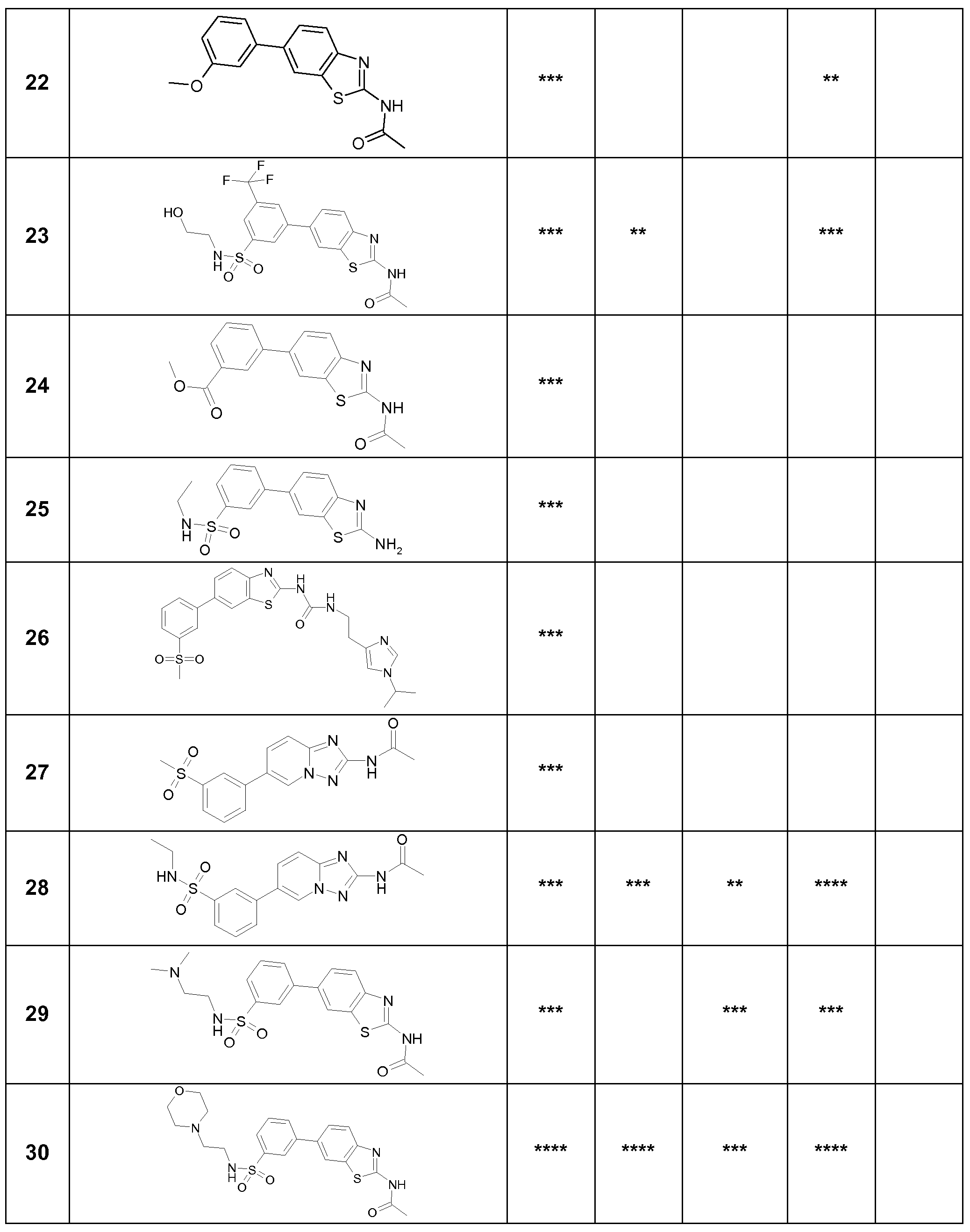


Claims
1. A compound according to formula (I)

Wherein denotes either a single bond or a double bond
U denotes CRC, CH, or S;
V denotes C or N
W denotes N or CR1
X denotes CO, SO, SO2, CS or a bond
Y denotes CR2 or N,
Ra denotes NH-Ab, NA2, -NH-(CH2)P-Ab, -NH-(CH2)P-Ar, -NH-(CH2)P-Het4, -NH- (CH2)pCHOR6-Het1, , -NH-(CH2)pCOAr, -NH-(CH2)pCOHet1, -NH-cycloalkyl, COHet1,

CS, also H, or if V denotes C, also Ar or Het1
or if Rb is Ar, Het3, or one of the following groups: 
 , Ra also denotes A, -(CH2)S-Ar, -(CH2)S-Het1, Het1, Het4, or perfluoroalkyl, or if Rb denotes Ar, Ra is also -OA or cycloalkyl.
Rb denotes Ar, Het2, Het3 or 

R', R" are independently hydrogen, alkyl, Ar, Het1, Het2 or A. R and R , together with the nitrogen atom to which they are attached, can optionally form a 3-8- membered heterocyclic ring.
Rc denotes H, A, alkyl, Ar, Het1,
Ar denotes a monocyclic or bicyclic, aromatic carbocyclic ring having 6 to 14 carbon atoms, which is unsubstituted or monosubstituted, disubstituted or trisubstituted by, Hal, CF3, OCF3, NO2, CN, perfluoroalkyl, A, OA, OH, NH2, COH, CONH21-NHCOA, -NHCO2A, -NHCO2(CH2)sHet1, -(CH2)pHet1, -NHSO2A, -NHSO2- N(H)2-m(A)m, N(H)1-qAqC0A, N(H)1-qASO2-N(H)2-m(A)m, N(H)1-qAqCON(H)2-m(A)m,
COOA, COA, -SO2A, -SO2N(H)2-m(A)m, -SO2Het1, -SO2NHHet1, Het1, - NHSO2NHHet1, or cycloalkyl.
Het1 denotes a monocyclic or bicyclic saturated, unsaturated or aromatic heterocyclic ring having 1 to 4 N, O and/or S atoms and/or 1 CO group, which is unsubstituted or monosubstituted, disubstituted or trisubstituted by alkyl having 1 to 8 carbon atoms, alkoxy having 1 to 8 carbon atoms, Hal, CF3, OCF3, NO2, CN, perfluoroalkyl, A, OA, O(CH2)sAr, O(CH2)sHet1, -(CH2)pHet2, OH, amino, CONH2, - NHCOA, -NHCO2A, -NHCO2(CH2)sAr, -NHSO2-N(H)2-m(A)m, COA, COOA, -SO2A, - SO2N(H)2-m(A)m, -SO2Het2, -SO2NHHet2, -NHSO2NHHet2, Ar, -NHSO2NHAr, - SO2NHAr, SO2Ar, cycloalkyl.
Het2 denotes a monocyclic or bicyclic saturated, unsaturated or aromatic heterocyclic ring having 1 to 4 N, O and/or S atoms and/or 1 CO group, which is unsubstituted or monosubstituted, disubstituted or trisubstituted by alkyl having 1 to 8 carbon atoms, alkoxy having 1 to 8 carbon atoms, Hal, CF3, OCF3, NO2, CN, perfluoroalkyl, A, OA, O(CH2)sAr, O(CH2)sHet1, -(CH2)pHet1, OH, NA2, CONH2, - NHCOA, -NHCO2A, , -NHCO2(CH2)sHet1, -NHCO2(CH2)sAr, -NHSO2-N(H)2-m(A)m, COA, COOA, -SO2A, -SO2N(H)2-m(A)m, -SO2Het1, SO2NHHet2, Ar, SO2Ar, or cycloalkyl.
Het3 denotes a monocyclic saturated, unsaturated or aromatic heterocyclic ring having 1 to 4 N, O and/or S atoms and/or 1 CO group, which is unsubstituted or monosubstituted, disubstituted or trisubstituted by NO2, CN, perfluoroalkyl, OH, CONH2, -NHCOA, -NHCO2A, -NHCO2(CH2)sHet1, -NHCO2(CH2)sAr, -NHSO2A, - NHSO2-N(H)2-m(A)m, COA, COOA, -COH, -SO2A, -SO2N(H)2-m(A)m, -SO2Het1, SO2NHHet2, or cycloalkyl or Het3 denotes one of the following groups:

cycloalkyl or Het4 denotes one of the following groups: 

m denotes O, 1 or 2;
n denotes 1 , 2 ,3 or 4;
p denotes O, 1 , 2, 3, 4;
q denotes O or 1
s denotes 1 , 2, 3 , 4
A is a branched or linear alkyl having 1 to 12 C-atoms, wherein one or more, preferably 1 to 7 H-atoms may be replaced by Hal, Ar, Het1, Het2, OR6, CN, NHCO, CONR'R" COOR6 or NR R and wherein one or more, preferably 1 to 7 non-adjacent CH2-groups may be replaced by O, NR6 or S and/or by -CH=CH- or -C≡C- groups, or denotes cycloalkyl, cycloalken or cycloalkylalkylen having 3-7 ring C atoms wherein the cycloalkylen is optionally substituted by 1 or 2 OH groups; Ab is a branched or linear alkyl having 1 to 12 C-atoms, wherein one or more, preferably 1 to 7 H-atoms may be replaced by Hal, Ar, OR6, CN, NHCO, CONR'R" COOR6 or NR R and wherein one or more, preferably 1 to 7 non-adjacent CH2- groups may be replaced by O, NR6 or S and/or by -CH=CH- or -C≡C- groups, or denotes cycloalkyl, cycloalken or cycloalkylalkylen having 3-7 ring C atoms wherein the cycloalkylen is optionally substituted by 1 or 2 OH groups;
R 11, D R2 are each independently H, Hal, CF3, A; Ar Het1 or Het2
R3 is H or Hal
R , R denote each independently H, Ar, Het1, Het2, or A, and if R'or R" is bond to a C atom also OA.
R6 is H, a branched or linear alkyl or hydroxyalkyl having 1 to 12 C-atoms
and pharmaceutically acceptable derivatives, solvates, tautomers, salts and stereoisomers thereof, including mixtures thereof in all ratios.
2. A compound according to formulae l-a tol-f or (I-Z):


wherein Ra and Rb are as defined in claim 1 ,

Wherein G1 is C or N, G2 is H, OA, SO2A,
G3 is a linear or branched alkyl group optionally substituted with 1 to 3 groups selected from OH, OMe, Hal, N(CH3)2, G4 is O or S, G5 is N or C, and pharmaceutically acceptable derivatives, solvates, tautomers, salts and stereoisomers thereof, including mixtures thereof in all ratios.
3. A compound according to claim 1 or 2 wherein Rb denotes Ar or Het2.
4. A compound according to claim 1 to 3 wherein Rb denotes Het3 and Ra denotes A.
5. A compound according to claim 1 to 4 wherein Rb is Ar optionally substituted by the groups listed in the definitions of Ar or a pyridine group optionally substituted by the groups listed in the definitions of Het2, and wherein Ra is - NH-(CH2)P-Het4.
6. A compound according to claim 1 to 5 wherein R3 denotes H.
7. A compound according to any one of preceding claims selected from the following group:


and pharmaceutically acceptable derivatives, solvates, tautomers, salts and stereoisomers thereof, including mixtures thereof in all ratios.
8. Process for the preparation of compounds of formula (I) according to claim 1 , comprising the step of reacting a compound of Formula (l-l)

9. A compound according to Claim 1 to 8 for use in the treatment and prophylaxis of cancer diseases.
10. A compound according to Claim 1 to 8 for use in the treatment and prophylaxis of cancer diseases that are associated with a tumor from the group of tumours of the squamous epithelium, of the bladder, of the stomach, of the kidneys, of head and neck, of the oesophagus, of the cervix, of the thyroid, of the intestine, of the liver, of the brain, of the prostate, of the urogenital tract, of the lymphatic system, of the stomach, of the larynx and/or of the lung.
1 1. A compound according to Claim 1 to 8 for use as a medicament.
12. A compound according to Claim 1 to 8 for use in the treatment and prophylaxis diseases in which the inhibition, activation, regulation, and/or modulation of PI3K receptor signal transduction plays a role.
13. A compound according to Claim 1 to 8 for use in the prophylaxis and/or treatment of autoimmune disorders and/or inflammatory diseases, cardiovascular diseases, neurodegenerative diseases, bacterial or viral infections, allergy, asthma, pancreatitis, multi-organe failure, kidney diseases, platelet aggregation, cancer, transplantation, sperm motility, erythrocyte deficiency, graft rejection or lung injuries.
14. Pharmaceutical composition comprising at least one compound according to claims 1 to 8 and/or pharmaceutically usable derivatives, tautomers, salts, sol- vates and stereoisomers thereof, including mixtures thereof in all ratios, and optionally excipients and/or adjuvants.
15. A pharmaceutical composition comprising at least one compound according to claims 1 to 8and/or pharmaceutically usable derivatives, tautomers, salts, sol- vates and stereoisomers thereof, including mixtures thereof in all ratios, and at least one further active ingredient.
Applications Claiming Priority (4)
| Application Number | Priority Date | Filing Date | Title |
|---|---|---|---|
| EP09154345.4 | 2009-03-04 | ||
| EP09154345 | 2009-03-04 | ||
| US23913709P | 2009-09-02 | 2009-09-02 | |
| US61/239,137 | 2009-09-02 |
Publications (1)
| Publication Number | Publication Date |
|---|---|
| WO2010100144A1 true WO2010100144A1 (en) | 2010-09-10 |
Family
ID=40577951
Family Applications (1)
| Application Number | Title | Priority Date | Filing Date |
|---|---|---|---|
| PCT/EP2010/052615 Ceased WO2010100144A1 (en) | 2009-03-04 | 2010-03-02 | Fused bicyclic compounds as inhibitors for pi3 kinase |
Country Status (2)
| Country | Link |
|---|---|
| AR (1) | AR076076A1 (en) |
| WO (1) | WO2010100144A1 (en) |
Cited By (38)
| Publication number | Priority date | Publication date | Assignee | Title |
|---|---|---|---|---|
| EP2311842A3 (en) * | 2008-06-24 | 2011-07-13 | Takeda Pharmaceutical Company Limited | PI3K/M TOR inhibitors |
| US20120088750A1 (en) * | 2010-10-08 | 2012-04-12 | Biota Europe Ltd. | Antibacterial compounds |
| WO2012174312A3 (en) * | 2011-06-15 | 2013-02-28 | Glaxosmithkline Llc | Benzimidazole derivatives as antiviral agents |
| US8415376B2 (en) | 2008-05-30 | 2013-04-09 | Amgen Inc. | Inhibitors of PI3 kinase |
| WO2014008992A1 (en) | 2012-07-10 | 2014-01-16 | Ares Trading S.A. | Pyrimidine pyrazolyl derivatives |
| US8729074B2 (en) | 2009-03-20 | 2014-05-20 | Amgen Inc. | Inhibitors of PI3 kinase |
| WO2014083327A1 (en) * | 2012-11-27 | 2014-06-05 | Md Pharma Ab | Adenine derivatives suitable for the treatment of (inter alia) muscular dystrophy |
| JP2014528412A (en) * | 2011-09-30 | 2014-10-27 | キネタ・インコーポレイテツド | Antiviral compounds |
| CN104402875A (en) * | 2014-12-25 | 2015-03-11 | 西安山川医药科技有限公司 | Synthesis method and application N-(2-aminoethyl)-N'-(6-substituted-2-benzothiazolyl)urea and salt compounds thereof |
| WO2015134171A1 (en) | 2014-03-06 | 2015-09-11 | Takeda Pharmaceutical Company Limited | Heteroarylamide inhibitors of tbk1 |
| US20160297824A1 (en) * | 2015-03-16 | 2016-10-13 | Ligand Pharmaceuticals, Inc. | Imidazo-fused heterocycles and uses thereof |
| WO2017197151A1 (en) * | 2016-05-11 | 2017-11-16 | Emory University | Phosphotidylinositol 3-kinase inhibitors |
| WO2018017435A1 (en) | 2016-07-22 | 2018-01-25 | Accro Bioscience Inc. | Heteroaryl compounds as inhibitors of necrosis, composition and application thereof |
| CN108558869A (en) * | 2018-05-10 | 2018-09-21 | 西安培华学院 | Compound for treating liver cancer and its preparation |
| WO2018176343A1 (en) | 2017-03-30 | 2018-10-04 | Xw Laboratories Inc. | Bicyclic heteroaryl derivatives and preparation and uses thereof |
| WO2018237370A1 (en) * | 2017-06-23 | 2018-12-27 | Accro Bioscience Inc. | HETEROARYL COMPOUNDS AS INHIBITORS OF THE NECROSIS, COMPOSITION AND METHOD OF USE THEREOF |
| CN109111464A (en) * | 2017-06-23 | 2019-01-01 | 爱科诺生物医药股份有限公司 | A kind of heterocyclic compound with meronecrosis inhibitory activity |
| KR20190028546A (en) * | 2016-07-22 | 2019-03-18 | 에이씨씨알오 바이오사이언스 인코퍼레이티드 | Heteroaryl compounds as inhibitors of necrosis, compositions thereof and uses thereof |
| WO2019070093A1 (en) * | 2017-10-02 | 2019-04-11 | 1ST Biotherapeutics, Inc. | Benzothiazol compounds and methods using the same for treating neurodegenerative disorders |
| US10385046B1 (en) | 2019-03-19 | 2019-08-20 | 1ST Biotherapeutics, Inc. | Processes for preparing benzothiazol compounds and methods of using the same for treating neurodegenerative disorders |
| US10508113B2 (en) | 2018-03-12 | 2019-12-17 | Abbvie Inc. | Inhibitors of tyrosine kinase 2 mediated signaling |
| US10689344B2 (en) * | 2013-11-07 | 2020-06-23 | University Of Kansas | Biphenylamide derivative Hsp90 inhibitors |
| CN111434661A (en) * | 2019-01-11 | 2020-07-21 | 爱科诺生物医药股份有限公司 | Aromatic heterocyclic compounds with cell necrosis inhibitory activity and applications thereof |
| WO2020178795A1 (en) * | 2019-03-07 | 2020-09-10 | 1ST Biotherapeutics, Inc. | [ 18f]-labeled benzothiazole derivative as pet radiotracer |
| WO2020194260A1 (en) * | 2019-03-28 | 2020-10-01 | 1ST Biotherapeutics, Inc. | Pharmaceutical salts of benzothiazol compounds, polymorphs and methods for preparation thereof |
| US11098044B2 (en) | 2019-02-22 | 2021-08-24 | 1ST Biotherapeutics, Inc. | Imidazopyridinyl compounds and use thereof for treatment of neurodegenerative disorders |
| WO2021242955A1 (en) * | 2020-05-28 | 2021-12-02 | Senda Biosciences, Inc. | Fused azole heterocycles as ahr antagonists |
| WO2022064459A1 (en) * | 2020-09-28 | 2022-03-31 | 1ST Biotherapeutics, Inc. | Indazoles as hematopoietic progenitor kinase 1 (hpk1) inhibitors and methods of using same |
| RU2778370C2 (en) * | 2017-10-02 | 2022-08-18 | 1Ст Биотерапьютикс, Инк. | Benzothiazole compounds and methods for their use for treatment of neurodegenerative disorders |
| CN115298177A (en) * | 2019-10-11 | 2022-11-04 | 因赛特公司 | Bicyclic amines as CDK2 inhibitors |
| WO2023012081A1 (en) | 2021-08-05 | 2023-02-09 | Syngenta Crop Protection Ag | Method for controlling diamide resistant pests & compounds therefor |
| US11976073B2 (en) | 2021-12-10 | 2024-05-07 | Incyte Corporation | Bicyclic amines as CDK2 inhibitors |
| US11981671B2 (en) | 2021-06-21 | 2024-05-14 | Incyte Corporation | Bicyclic pyrazolyl amines as CDK2 inhibitors |
| US12084458B2 (en) | 2021-02-19 | 2024-09-10 | Sudo Biosciences Limited | Substituted pyridines, pyridazines, and pyrimidines as TYK2 inhibitors |
| US12122785B2 (en) | 2021-02-19 | 2024-10-22 | Sudo Biosciences Limited | Substituted pyridines, pyridazines, pyrimidines, and 1,2,4-triazines as TYK2 inhibitors |
| US12312331B2 (en) | 2019-08-14 | 2025-05-27 | Incyte Corporation | Imidazolyl pyrimidinylamine compounds as CDK2 inhibitors |
| US12570638B2 (en) | 2020-05-20 | 2026-03-10 | Sail Biomedicines, Inc. | Fused imidazole derivatives as AHR antagonists |
| US12600721B2 (en) | 2021-02-19 | 2026-04-14 | Sudo Biosciences Limited | TYK2 inhibitors and uses thereof |
Citations (4)
| Publication number | Priority date | Publication date | Assignee | Title |
|---|---|---|---|---|
| WO2007016392A2 (en) * | 2005-08-01 | 2007-02-08 | Bristol-Myers Squibb Company | Benzothiazole and azabenzothiazole compounds useful as kinase inhibitors |
| WO2007095588A1 (en) * | 2006-02-14 | 2007-08-23 | Novartis Ag | Pi-3 kinase inhibitors and methods of their use |
| WO2008119734A2 (en) * | 2007-03-29 | 2008-10-09 | Novartis Ag | Process for the manufacture of organic compounds |
| WO2009017822A2 (en) * | 2007-08-02 | 2009-02-05 | Amgen Inc. | Pi3 kinase modulators and methods of use |
-
2010
- 2010-03-02 WO PCT/EP2010/052615 patent/WO2010100144A1/en not_active Ceased
- 2010-03-03 AR ARP100100635A patent/AR076076A1/en unknown
Patent Citations (4)
| Publication number | Priority date | Publication date | Assignee | Title |
|---|---|---|---|---|
| WO2007016392A2 (en) * | 2005-08-01 | 2007-02-08 | Bristol-Myers Squibb Company | Benzothiazole and azabenzothiazole compounds useful as kinase inhibitors |
| WO2007095588A1 (en) * | 2006-02-14 | 2007-08-23 | Novartis Ag | Pi-3 kinase inhibitors and methods of their use |
| WO2008119734A2 (en) * | 2007-03-29 | 2008-10-09 | Novartis Ag | Process for the manufacture of organic compounds |
| WO2009017822A2 (en) * | 2007-08-02 | 2009-02-05 | Amgen Inc. | Pi3 kinase modulators and methods of use |
Cited By (72)
| Publication number | Priority date | Publication date | Assignee | Title |
|---|---|---|---|---|
| US8415376B2 (en) | 2008-05-30 | 2013-04-09 | Amgen Inc. | Inhibitors of PI3 kinase |
| EP2311842A3 (en) * | 2008-06-24 | 2011-07-13 | Takeda Pharmaceutical Company Limited | PI3K/M TOR inhibitors |
| US8729074B2 (en) | 2009-03-20 | 2014-05-20 | Amgen Inc. | Inhibitors of PI3 kinase |
| US20120088750A1 (en) * | 2010-10-08 | 2012-04-12 | Biota Europe Ltd. | Antibacterial compounds |
| JP2013542204A (en) * | 2010-10-08 | 2013-11-21 | ビオタ ヨーロッパ リミテッド | Bacterial topoisomerase II inhibitory 2-ethylcarbamoylamino-1,3-benzothiazol-5-yls |
| US9181234B2 (en) * | 2010-10-08 | 2015-11-10 | Biota Europe Ltd. | Antibacterial compounds |
| WO2012174312A3 (en) * | 2011-06-15 | 2013-02-28 | Glaxosmithkline Llc | Benzimidazole derivatives as antiviral agents |
| JP2014528412A (en) * | 2011-09-30 | 2014-10-27 | キネタ・インコーポレイテツド | Antiviral compounds |
| US9216991B2 (en) | 2012-07-10 | 2015-12-22 | Ares Trading S.A. | Pyrimidine pyrazolyl derivatives |
| WO2014008992A1 (en) | 2012-07-10 | 2014-01-16 | Ares Trading S.A. | Pyrimidine pyrazolyl derivatives |
| WO2014083327A1 (en) * | 2012-11-27 | 2014-06-05 | Md Pharma Ab | Adenine derivatives suitable for the treatment of (inter alia) muscular dystrophy |
| US10689344B2 (en) * | 2013-11-07 | 2020-06-23 | University Of Kansas | Biphenylamide derivative Hsp90 inhibitors |
| US9598424B2 (en) | 2014-03-06 | 2017-03-21 | Takeda Pharmaceutical Company Limited | Heteroarylamide inhibitors of TBK1 |
| WO2015134171A1 (en) | 2014-03-06 | 2015-09-11 | Takeda Pharmaceutical Company Limited | Heteroarylamide inhibitors of tbk1 |
| CN104402875A (en) * | 2014-12-25 | 2015-03-11 | 西安山川医药科技有限公司 | Synthesis method and application N-(2-aminoethyl)-N'-(6-substituted-2-benzothiazolyl)urea and salt compounds thereof |
| US11858938B2 (en) | 2015-03-16 | 2024-01-02 | Ligand Pharmaceuticals, Inc. | Imidazo-fused heterocycles and uses thereof |
| US20160297824A1 (en) * | 2015-03-16 | 2016-10-13 | Ligand Pharmaceuticals, Inc. | Imidazo-fused heterocycles and uses thereof |
| US10807983B2 (en) * | 2015-03-16 | 2020-10-20 | Ligand Pharmaceuticals, Inc. | Imidazo-fused heterocycles and uses thereof |
| WO2017197151A1 (en) * | 2016-05-11 | 2017-11-16 | Emory University | Phosphotidylinositol 3-kinase inhibitors |
| US10947225B2 (en) | 2016-05-11 | 2021-03-16 | Emory University | Phosphotidylinositol 3-kinase inhibitors |
| KR102441864B1 (en) * | 2016-07-22 | 2022-09-08 | 에이씨씨알오 바이오사이언스 (에이치케이) 리미티드 | Heteroaryl compounds, compositions and uses thereof as inhibitors of necrosis |
| KR20190028546A (en) * | 2016-07-22 | 2019-03-18 | 에이씨씨알오 바이오사이언스 인코퍼레이티드 | Heteroaryl compounds as inhibitors of necrosis, compositions thereof and uses thereof |
| WO2018017435A1 (en) | 2016-07-22 | 2018-01-25 | Accro Bioscience Inc. | Heteroaryl compounds as inhibitors of necrosis, composition and application thereof |
| JP7025359B2 (en) | 2016-07-22 | 2022-02-24 | アクロ バイオサイエンス (エイチケー) リミテッド | Heteroaryl compounds that are necrosis inhibitors, their compositions and uses |
| JP2019521994A (en) * | 2016-07-22 | 2019-08-08 | アクロ バイオサイエンス インク. | Heteroaryl compounds that are necrosis inhibitors, compositions and uses thereof |
| EP3487498A4 (en) * | 2016-07-22 | 2020-05-20 | Xiaohu Zhang | HETERARYARYLIC COMPOUNDS FOR USE AS NECROSIS INHIBITORS, COMPOSITION AND APPLICATION THEREOF |
| WO2018176343A1 (en) | 2017-03-30 | 2018-10-04 | Xw Laboratories Inc. | Bicyclic heteroaryl derivatives and preparation and uses thereof |
| CN109111464A (en) * | 2017-06-23 | 2019-01-01 | 爱科诺生物医药股份有限公司 | A kind of heterocyclic compound with meronecrosis inhibitory activity |
| WO2018237370A1 (en) * | 2017-06-23 | 2018-12-27 | Accro Bioscience Inc. | HETEROARYL COMPOUNDS AS INHIBITORS OF THE NECROSIS, COMPOSITION AND METHOD OF USE THEREOF |
| US10968188B2 (en) | 2017-10-02 | 2021-04-06 | 1ST Biotherapeutics, Inc. | Benzothiazol compounds and methods using the same for treating neurodegenerative disorders |
| CN111315727A (en) * | 2017-10-02 | 2020-06-19 | 第一生物治疗股份有限公司 | Benzothiazole compounds and methods of using the same for treating neurodegenerative diseases |
| WO2019070093A1 (en) * | 2017-10-02 | 2019-04-11 | 1ST Biotherapeutics, Inc. | Benzothiazol compounds and methods using the same for treating neurodegenerative disorders |
| RU2778370C2 (en) * | 2017-10-02 | 2022-08-18 | 1Ст Биотерапьютикс, Инк. | Benzothiazole compounds and methods for their use for treatment of neurodegenerative disorders |
| CN111315727B (en) * | 2017-10-02 | 2023-09-29 | 第一生物治疗股份有限公司 | Benzothiazole compounds and methods of treating neurodegenerative diseases using the same |
| US10669246B2 (en) | 2017-10-02 | 2020-06-02 | 1ST Biotherapeutics, Inc. | Benzothiazol compounds and methods using the same for treating neurodegenerative disorders |
| US10508113B2 (en) | 2018-03-12 | 2019-12-17 | Abbvie Inc. | Inhibitors of tyrosine kinase 2 mediated signaling |
| CN108558869A (en) * | 2018-05-10 | 2018-09-21 | 西安培华学院 | Compound for treating liver cancer and its preparation |
| CN108558869B (en) * | 2018-05-10 | 2019-04-09 | 西安培华学院 | Compounds for treating liver cancer and preparations thereof |
| CN111434661B (en) * | 2019-01-11 | 2023-09-12 | 爱科诺生物医药(香港)有限公司 | Aromatic heterocyclic compounds with cell necrosis inhibitory activity and their applications |
| CN111434661A (en) * | 2019-01-11 | 2020-07-21 | 爱科诺生物医药股份有限公司 | Aromatic heterocyclic compounds with cell necrosis inhibitory activity and applications thereof |
| EP3908277A4 (en) * | 2019-01-11 | 2022-12-28 | Xiaohu Zhang | HETEROARYL COMPOUNDS AS NECROSIS INHIBITORS, COMPOSITION AND METHODS OF USE THEREOF |
| US11802126B2 (en) | 2019-02-22 | 2023-10-31 | 1ST Biotherapeutics, Inc. | Imidazopyridinyl compounds and use thereof for treatment of neurodegenerative disorders |
| US11098044B2 (en) | 2019-02-22 | 2021-08-24 | 1ST Biotherapeutics, Inc. | Imidazopyridinyl compounds and use thereof for treatment of neurodegenerative disorders |
| US12534461B2 (en) | 2019-02-22 | 2026-01-27 | 1ST Biotherapeutics, Inc. | Imidazopyridinyl compounds and use thereof for treatment of neurodegenerative disorders |
| JP2022523827A (en) * | 2019-03-07 | 2022-04-26 | ファースト・バイオセラピューティクス・インコーポレイテッド | [18F] labeled benzothiazole derivative as PET radiotracer |
| WO2020178795A1 (en) * | 2019-03-07 | 2020-09-10 | 1ST Biotherapeutics, Inc. | [ 18f]-labeled benzothiazole derivative as pet radiotracer |
| JP7456641B2 (en) | 2019-03-07 | 2024-03-27 | ファースト・バイオセラピューティクス・インコーポレイテッド | [18F]-labeled benzothiazole derivatives as PET radiotracers |
| US10385046B1 (en) | 2019-03-19 | 2019-08-20 | 1ST Biotherapeutics, Inc. | Processes for preparing benzothiazol compounds and methods of using the same for treating neurodegenerative disorders |
| US12304905B2 (en) | 2019-03-28 | 2025-05-20 | 1ST Biotherapeutics, Inc. | Pharmaceutical salts of benzothiazol compounds, polymorphs and methods for preparation thereof |
| CN113631554A (en) * | 2019-03-28 | 2021-11-09 | 第一生物治疗股份有限公司 | Pharmaceutically acceptable salts, polymorphs of benzothiazole compounds and processes for their preparation |
| WO2020194260A1 (en) * | 2019-03-28 | 2020-10-01 | 1ST Biotherapeutics, Inc. | Pharmaceutical salts of benzothiazol compounds, polymorphs and methods for preparation thereof |
| US12312331B2 (en) | 2019-08-14 | 2025-05-27 | Incyte Corporation | Imidazolyl pyrimidinylamine compounds as CDK2 inhibitors |
| US12466828B2 (en) | 2019-10-11 | 2025-11-11 | Incyte Corporation | Bicyclic amines as CDK2 inhibitors |
| CN115298177A (en) * | 2019-10-11 | 2022-11-04 | 因赛特公司 | Bicyclic amines as CDK2 inhibitors |
| US12570638B2 (en) | 2020-05-20 | 2026-03-10 | Sail Biomedicines, Inc. | Fused imidazole derivatives as AHR antagonists |
| WO2021242955A1 (en) * | 2020-05-28 | 2021-12-02 | Senda Biosciences, Inc. | Fused azole heterocycles as ahr antagonists |
| US11649255B2 (en) | 2020-09-28 | 2023-05-16 | 1ST Biotherapeutics, Inc. | Indazoles as hematopoietic progenitor kinase 1 (HPK1) inhibitors and methods using same |
| CN114599651B (en) * | 2020-09-28 | 2025-12-16 | 第一生物治疗股份有限公司 | Indazoles as inhibitors of hematopoietic progenitor kinase 1 (HPK 1) and methods of use thereof |
| WO2022064459A1 (en) * | 2020-09-28 | 2022-03-31 | 1ST Biotherapeutics, Inc. | Indazoles as hematopoietic progenitor kinase 1 (hpk1) inhibitors and methods of using same |
| CN114599651A (en) * | 2020-09-28 | 2022-06-07 | 第一生物治疗股份有限公司 | Indazoles as hematopoietic progenitor kinase 1 (HPK1) inhibitors and methods of use |
| RU2854594C1 (en) * | 2020-09-28 | 2026-01-14 | 1Ст Биотерапьютикс, Инк. | Indazoles as haematopoietic progenitor kinase 1 (hpk1) inhibitors and methods of their use |
| EP4217358A4 (en) * | 2020-09-28 | 2025-01-08 | 1st Biotherapeutics, Inc. | Indazoles as hematopoietic progenitor kinase 1 (hpk1) inhibitors and methods of using same |
| TWI908894B (en) * | 2020-09-28 | 2025-12-21 | 南韓商福斯特生物股份有限公司 | Indazoles as hematopoietic progenitor kinase 1 (hpk1) inhibitors and use thereof |
| CN114599653B (en) * | 2020-09-28 | 2025-12-16 | 第一生物治疗股份有限公司 | Indazoles as inhibitors of hematopoietic progenitor kinase 1 (HPK 1) and methods of use thereof |
| CN114599653A (en) * | 2020-09-28 | 2022-06-07 | 第一生物治疗股份有限公司 | Indazoles as hematopoietic progenitor kinase 1 (HPK1) inhibitors and methods of use |
| US12122785B2 (en) | 2021-02-19 | 2024-10-22 | Sudo Biosciences Limited | Substituted pyridines, pyridazines, pyrimidines, and 1,2,4-triazines as TYK2 inhibitors |
| US12103937B2 (en) | 2021-02-19 | 2024-10-01 | Sudo Biosciences Limited | Substituted pyridines and pyridazines as TYK2 inhibitors |
| US12084458B2 (en) | 2021-02-19 | 2024-09-10 | Sudo Biosciences Limited | Substituted pyridines, pyridazines, and pyrimidines as TYK2 inhibitors |
| US12600721B2 (en) | 2021-02-19 | 2026-04-14 | Sudo Biosciences Limited | TYK2 inhibitors and uses thereof |
| US11981671B2 (en) | 2021-06-21 | 2024-05-14 | Incyte Corporation | Bicyclic pyrazolyl amines as CDK2 inhibitors |
| WO2023012081A1 (en) | 2021-08-05 | 2023-02-09 | Syngenta Crop Protection Ag | Method for controlling diamide resistant pests & compounds therefor |
| US11976073B2 (en) | 2021-12-10 | 2024-05-07 | Incyte Corporation | Bicyclic amines as CDK2 inhibitors |
Also Published As
| Publication number | Publication date |
|---|---|
| AR076076A1 (en) | 2011-05-18 |
Similar Documents
| Publication | Publication Date | Title |
|---|---|---|
| WO2009133127A1 (en) | Fused bicyclic compounds and use thereof as pi3k inhibitors | |
| ES2534095T3 (en) | Aminopyridine derivatives for the treatment of tumors and inflammatory diseases | |
| US9073940B2 (en) | Tricyclic pyrazol amine derivatives | |
| US11053234B2 (en) | 1,3 di-substituted cyclobutane or azetidine derivatives as hematopoietic prostaglandin D synthase inhibitors | |
| RU2738232C2 (en) | Benzodiazepine derivatives as rsv inhibitors | |
| JP6109195B2 (en) | Heterocycle-substituted pyridyl compounds useful as kinase inhibitors | |
| JP5290972B2 (en) | 2- (Heterocyclylbenzyl) pyridazinone derivatives | |
| JP6001048B2 (en) | Thiazolopyrimidine compounds | |
| CN103153965B (en) | Quinoxaline derivatives | |
| KR20180132629A (en) | Glycosidase inhibitor | |
| JP2017505346A (en) | Novel 3- (indol-3-yl) -pyridine derivatives, pharmaceutical compositions and methods of use | |
| JP2015503621A (en) | Triazolyl-substituted pyridyl compounds useful as kinase inhibitors | |
| JP2014510105A (en) | Azole compounds as PIM inhibitors | |
| KR20180132626A (en) | Glycosidase inhibitor | |
| JP2015503622A (en) | Triazolyl or triasiazolyl substituted pyridyl compounds useful as kinase inhibitors | |
| CN102281919A (en) | Inhibitors of diacylglycerol acyltransferase | |
| JP2010535216A (en) | PI3 kinase modulator and method of use | |
| EP2375899A1 (en) | Piperidine-containing compounds and use thereof | |
| WO2014111871A1 (en) | 4,5-dihydroisoxazole derivatives as nampt inhibitors | |
| AU2009327133B2 (en) | Oxadiazole fused heterocyclic derivatives useful for the treatment of multiple sclerosis | |
| AU2009316795A1 (en) | Inhibitors of diacylglycerol acyltransferase |
Legal Events
| Date | Code | Title | Description |
|---|---|---|---|
| 121 | Ep: the epo has been informed by wipo that ep was designated in this application |
Ref document number: 10706236 Country of ref document: EP Kind code of ref document: A1 |
|
| NENP | Non-entry into the national phase |
Ref country code: DE |
|
| 122 | Ep: pct application non-entry in european phase |
Ref document number: 10706236 Country of ref document: EP Kind code of ref document: A1 |