WO2010098488A1 - Aryl imidazole compounds and their use as beta amyloid production inhibitors - Google Patents
Aryl imidazole compounds and their use as beta amyloid production inhibitors Download PDFInfo
- Publication number
- WO2010098488A1 WO2010098488A1 PCT/JP2010/053370 JP2010053370W WO2010098488A1 WO 2010098488 A1 WO2010098488 A1 WO 2010098488A1 JP 2010053370 W JP2010053370 W JP 2010053370W WO 2010098488 A1 WO2010098488 A1 WO 2010098488A1
- Authority
- WO
- WIPO (PCT)
- Prior art keywords
- group
- compound
- reaction
- alkyl
- methyl
- Prior art date
- Legal status (The legal status is an assumption and is not a legal conclusion. Google has not performed a legal analysis and makes no representation as to the accuracy of the status listed.)
- Ceased
Links
- LTXXZCADIMNPHV-UHFFFAOYSA-N Cc(nc1)c[n]1-c(ccc(C(NN)=O)n1)c1OC Chemical compound Cc(nc1)c[n]1-c(ccc(C(NN)=O)n1)c1OC LTXXZCADIMNPHV-UHFFFAOYSA-N 0.000 description 2
- ZKNCGCYXJSMLRD-UHFFFAOYSA-N CC(C)(C)c(cc(Cc1nc(-c(cc2)nc(OC)c2-[n]2cnc(C)c2)n[nH]1)cc1)c1OC Chemical compound CC(C)(C)c(cc(Cc1nc(-c(cc2)nc(OC)c2-[n]2cnc(C)c2)n[nH]1)cc1)c1OC ZKNCGCYXJSMLRD-UHFFFAOYSA-N 0.000 description 1
- ZRGKTEMGKJZCRQ-UHFFFAOYSA-N CC(C)c(cc(CC(N(C)NC(OCc1ccccc1)=O)=O)c(C)c1)c1OC Chemical compound CC(C)c(cc(CC(N(C)NC(OCc1ccccc1)=O)=O)c(C)c1)c1OC ZRGKTEMGKJZCRQ-UHFFFAOYSA-N 0.000 description 1
- UDJPEUQUZMPTFQ-UHFFFAOYSA-N Cc(nc1)c[n]1-c(ccc(Br)n1)c1OC Chemical compound Cc(nc1)c[n]1-c(ccc(Br)n1)c1OC UDJPEUQUZMPTFQ-UHFFFAOYSA-N 0.000 description 1
Classifications
-
- C—CHEMISTRY; METALLURGY
- C07—ORGANIC CHEMISTRY
- C07D—HETEROCYCLIC COMPOUNDS
- C07D401/00—Heterocyclic compounds containing two or more hetero rings, having nitrogen atoms as the only ring hetero atoms, at least one ring being a six-membered ring with only one nitrogen atom
- C07D401/14—Heterocyclic compounds containing two or more hetero rings, having nitrogen atoms as the only ring hetero atoms, at least one ring being a six-membered ring with only one nitrogen atom containing three or more hetero rings
-
- A—HUMAN NECESSITIES
- A61—MEDICAL OR VETERINARY SCIENCE; HYGIENE
- A61P—SPECIFIC THERAPEUTIC ACTIVITY OF CHEMICAL COMPOUNDS OR MEDICINAL PREPARATIONS
- A61P25/00—Drugs for disorders of the nervous system
- A61P25/28—Drugs for disorders of the nervous system for treating neurodegenerative disorders of the central nervous system, e.g. nootropic agents, cognition enhancers, drugs for treating Alzheimer's disease or other forms of dementia
-
- C—CHEMISTRY; METALLURGY
- C07—ORGANIC CHEMISTRY
- C07D—HETEROCYCLIC COMPOUNDS
- C07D413/00—Heterocyclic compounds containing two or more hetero rings, at least one ring having nitrogen and oxygen atoms as the only ring hetero atoms
- C07D413/14—Heterocyclic compounds containing two or more hetero rings, at least one ring having nitrogen and oxygen atoms as the only ring hetero atoms containing three or more hetero rings
-
- C—CHEMISTRY; METALLURGY
- C07—ORGANIC CHEMISTRY
- C07D—HETEROCYCLIC COMPOUNDS
- C07D417/00—Heterocyclic compounds containing two or more hetero rings, at least one ring having nitrogen and sulfur atoms as the only ring hetero atoms, not provided for by group C07D415/00
- C07D417/14—Heterocyclic compounds containing two or more hetero rings, at least one ring having nitrogen and sulfur atoms as the only ring hetero atoms, not provided for by group C07D415/00 containing three or more hetero rings
Definitions
- the present invention relates to a pharmaceutical, more particularly, to a polycyclic aryl imidazole derivative effective for the treatment of a neurodegenerative disease caused by amyloid- ⁇ (hereinafter referred to as A ⁇ ) such as Alzheimer's disease or Down's syndrome and a medicine, in particular, a medicine for the treatment of a disease caused by A ⁇ comprising the compound as an active ingredient.
- a ⁇ amyloid- ⁇
- Alzheimer's disease is a disease characterized by degeneration and loss of neurons as well as formation of senile plaques and neurofibrillary degeneration.
- a symptom improving agent typified by an acetylcholinesterase inhibitor
- a fundamental remedy to inhibit progression of the disease has not yet been developed. It is necessary to develop a method for controlling the cause of the onset of pathology in order to create a fundamental remedy for Alzheimer's disease.
- a ⁇ -proteins as metabolites of amyloid precursor proteins are highly involved in degeneration and loss of neurons and onset of symptoms of dementia (see NON-PATENT DOCUMENTS 1 and 2, for example).
- Main molecular species of A ⁇ -protein are A ⁇ 40 consisting of 40 amino acids and A ⁇ 42 with two amino acids added at the C-terminal.
- the A ⁇ 40 and A ⁇ 42 are known to have high aggregability (see NON-PATENT DOCUMENT 3, for example) and to be main components of senile plaques (see NON-PATENT DOCUMENTS 3, 4 and 5, for example).
- a ⁇ 40 and A ⁇ 42 are increased by mutation in APP and presenilin genes which is observed in familial Alzheimer's disease (see NON-PATENT DOCUMENTS 6, 7 and 8, for example). Accordingly, a compound that reduces the production of A ⁇ is expected as a progression inhibitor or prophylactic agent for Alzheimer's disease.
- a ⁇ is produced by cleaving APP by ⁇ -secretase and subsequently by ⁇ -secretase. For this reason, attempts have been made to create ⁇ -secretase and ⁇ -secretase inhibitors in order to reduce A ⁇ production.
- Many of these secretase inhibitors already known are, for example, peptides and peptide mimetics such as L-685,458 (see NON-PATENT DOCUMENT 9, for example), LY-411,575 (see NON-PATENT DOCUMENTS 10, 11 and 12, for example) and LY- 450, 139 (see NON-PATENT DOCUMENTS 13, 14 and 15).
- Nonpeptidic compounds are, for example, MRK-560 (see NON-PATENT DOCUMENTS 16 and 17) and compounds having a plurality of aromatic rings as disclosed in PATENT DOCUMENTS 1 and 2.
- the compound represented by the formula (VI) as disclosed in page 17 of the specification differs from the compound of the present invention in that the compound is limited to a compound having a 2-aminothiazolyl group as a main structure.
- the compound represented by the formula (I) as disclosed in page 6 of the specification of Patent Document 2 differs from the compound of the present invention in that the compound is limited to a compound having an ethynylene, an ethenylene or methine linker described as X 1 .
- PATENT DOCUMENT 1 WO 2004/110350
- PATENT DOCUMENT 2 WO 2007/102580
- NON-PATENT DOCUMENT 1 Klein WL, and seven others, Alzheimer's disease-affected brain: Presence of oligomeric A ⁇ ligands (ADDLs) suggests a molecular basis for reversible memory loss, Proceeding of the National Academy of Science USA, 2003, Sep, 2; 100 (18), p. 10417- 10422.
- NON-PATENT DOCUMENT 2 Nitsch RM, and sixteen others, Antibodies against ⁇ -amyloid slow cognitive decline in Alzheimer's disease, Neuron, 2003, May 22; 38, p. 547-554.
- NON-PATENT DOCUMENT 3 Jarrett JT, and two others, The carboxy terminus of the ⁇ amyloid protein is critical for the seeding of amyloid formation: Implications for the pathogenesis of Alzheimers 1 disease, Biochemistry, 1993, 32 (18), p. 4693-4697.
- NON-PATENT DOCUMENT 4 Glenner GQ and one other, Alzheimer's disease: initial report of the purification and characterization of a novel cerebrovascular amyloid protein, Biochemical and Biophysical Research Communications, 1984, May 16, 120 (3), p. 885-890.
- NON-PATENT DOCUMENT 5 Masters CL, and five others, Amyloid plaque core protein in Alzheimer disease and Down syndrome, Proceeding of the National Academy of Science USA, 1985, Jun, 82 (12), p. 4245-4249.
- NON-PATENT DOCUMENT 6 Gouras GK, and eleven others, Intraneuronal A ⁇ 42 accumulation in human brain, American Journal of Pathology, 2000, Jan, 156 (1), p. 15-20.
- NON-PATENT DOCUMENT 7 Scheuner D, and twenty others, Secreted amyloid ⁇ -protein similar to that in the senile plaques of Alzheimer's disease is increased in vivo by the presenilin 1 and 2 and APP mutations linked to familial Alzheimer's disease, Nature Medicine, 1996, Aug, 2 (8), p. 864-870.
- NON-PATENT DOCUMENT 8 Forman MS, and four others, Differential effects of the Swedish mutant amyloid precursor protein on ⁇ -amyloid accumulation and secretion in neurons and nonneuronal cells, The Journal of Biological Chemistry, 1997, Dec, 19, 272 (51), p. 32247- 32253.
- NON-PATENT DOCUMENT 9 Shearman MS, and nine others, L-685, 458, an Aspartyl Protease Transition State Mimic, Is a Potent Inhibitor of Amyloid ⁇ -Protein Precursor ⁇ - Secretase Activity, Biochemistry, 2000, Aug, 1 , 39 (30), p. 8698-8704.
- NON-PATENT DOCUMENT 10 Shearman MS, and six others, Catalytic Site-Directed ⁇ - Secretase Complex Inhibitors Do Not Discriminate Pharmacologically between Notch S3 and ⁇ - APP Clevages, Biochemistry, 2003, Jun, 24, 42 (24), p. 7580-7586.
- NON-PATENT DOCUMENT 11 Lanz TA, and three others, Studies of A ⁇ pharmacodynamics in the brain, cerebrospinal fluid, and plasma in young (plaque-free) Tg2576 mice using the ⁇ - secretase inhibitor N2-[(2S)-2-(3,5-difluorophenyl)-2-hydroxyethanoyl]-N 1 -[(7S)-5-methyl-6- oxo-6,7-dihydro-5H-dibenzo[b,d]azepin-7-yl]-L-alaninamide (LY-411575), The Journal of Pharmacology and Experimental Therapeutics, 2004, Apr, 309 (1), p. 49-55.
- NON-PATENT DOCUMENT 12 Wong GT, and twelve others, Chronic treatment with the ⁇ - secretase inhibitor LY-411, 575 inhibits ⁇ -amyloid peptide production and alters lymphopoiesis and intestinal cell differentiation, The Journal of Biological Chemistry, 2004, Mar, 26, 279 (13), p. 12876-12882.
- NON-PATENT DOCUMENT 13 Gitter BD, and ten others, Stereoselective inhibition of amyloid beta peptide secretion by LY450139, a novel functional gamma secretase inhibitor, Neurology of Aging 2004, 25, sup2, p. 571.
- NON-PATENT DOCUMENT 14 Lanz TA, and eighteen others, Concentration-dependent modulation of amyloid- ⁇ in vivo and in vitro using the ⁇ -secretase inhibitor, LY-450139, The Journal of Pharmacology and Experimantal Therapeutics, 2006, Nov, 319 (2) p. 924-933.
- NON-PATENT DOCUMENT 15 Siemers ER, and thirteen others, Effects of a ⁇ -secretase inhibitor in a randamized study of patients with Alzheimer disease, Neurology, 2006, 66, p. 602- 604.
- NON-PATENT DOCUMENT 16 Best JD, and nine others, In vivo characterization of A ⁇ (40) changes in brain and cerebrospinal fluid using the novel ⁇ -secretase inhibitor N-[cis-4-[(4- chlorophenyl)sulfonyl]-4-(2,5-difluorophenyl)cyclohexyl]- 1,1,1 -trifluoromethanesulphonlamide (MK-560) in the rat, The Journal of Pharmacology and Experimantal Therapeutics, 2006, May 317 (2) p. 786-790.
- NON-PATENT DOCUMENT 17 Best JD, and thirteen others
- the novel ⁇ -secretase inhibitor N- [cis-4-[(4-chlorophenyl)sulfonyl]-4-(2,5-difluorophenyl)cyclohexyl]- 1 ,1,1- trifluoromethanesulphonlamide (MK-560) reduces amylid plaque deposition without evidence notch-related pathology in the Tg2576 mouse, The Journal of Pharmacology and Experimantal Therapeutics, 2007, Feb, 320 (2) p. 552-558.
- a compound that inhibits the production of A ⁇ from APP has been expected as a therapeutic or prophylactic agent for a disease caused by A ⁇ which is typified by Alzheimer's disease.
- a nonpeptidic compound having high efficacy which inhibits the production of A ⁇ has not yet been known. Accordingly, there is a need for a novel low- molecular- weight compound that inhibits the production of A ⁇ .
- the present invention relates to the following 1) to 12): 1 ) A compound represented by the formula [I] : [0008]
- Ri and R 2 are the same or different and each represent a substituent selected from the following Substituent Group al ; m represents an integer of 0 to 3; n represents an integer of 0 to 2; W represents a nitrogen atom or a carbon atom;
- Ring A represents a ring selected from the group consisting of the formulas [2] to [8]: [0010]
- A* represents a bonding site to Xl ;
- X 1 represents i) a single bond, ii) a Cl -6 alkylene group, iii) a vinylene group which may have 1 to 2 C2-6 alkyl groups or iv) -X 2 - (wherein X 2 represents -NR 3 -, -O-, -C(O)-, -NR 3 C(O)-, - C(O)NR 3 -, -S-, -S(O)- or -S(O) 2 - and R 3 represents a hydrogen atom, a Cl -6 alkyl group, a C3-6 cycloalkyl group, a C2-6 alkanoyl group or a Cl -6 alkylsulfonyl group); and Ring B represents a monocyclic or fused cyclic aromatic ring group selected from the group consisting of the formulas [10] to [27]: [0014]
- each of which may have 1 to 3 substituents selected from the following Substituent Group cl
- Substituent Group al a Cl-6 alkyl group, a C3-8 cycloalkyl group, a C2-6 alkenyl group, a Cl- 6 alkoxy group, a C2-6 alkenyloxy group, a C3-8 cycloalkyloxy group, an amino group (wherein the amino group may have one C2-6 alkanoyl group or Cl-6 alkylsulfonyl group or 1 to 2 Cl-6 alkyl groups or C3-8 cycloalkyl groups), a cyano group, a formyl group, a halogen atom, a hydroxyl group and a nitro group;
- Substituent Group bl a Cl-6 alkyl group (wherein the alkyl group may be substituted with 1 to 3 halogen atoms), a C2-6 alkenyl group, a C3-8 cycloalkyl group, a C6-14 aryl group, a C6-14 aryl-Cl-6 alkyl group, a Cl-6 alkoxy group, a C2-6 alkenyloxy group, a C3-8 cycloalkyloxy group, a C2-6 alkanoyl group, a C4-9 cycloalkylcarbonyl group, a C7-15 aroyl group, a Cl-6 alkylsulfonyl group, a C2-6 alkenylsulfonyl group, a C3-8 cycloalkylsulfonyl group, a C6-14 arylsulfonyl group, a Cl-6 alkylthio group, a C2-6 alkenylthi
- Substituent Group cl i) an amino group (wherein the amino group may have one C2-6 alkanoyl group, C 1-6 alkylsulfonyl group or C3-8 cycloalkylsulfonyl group or 1 to 2 C 1-6 alkyl groups or C3-8 cycloalkyl groups), ii) a cyano group, iii) a halogen atom, iv) a hydroxyl group and v) v-i) a C 1-6 alkyl group, v-ii) a C2-6 alkenyl group, v-iii) a C2-6 alkynyl group, v-iv) a Cl -6 alkoxy group, v- v) a Cl -6 alkylthio group, v-vi) a C 1-6 alkylaminocarbonyl group, v-vii) a Cl -6 alkylsulfonyl group, v-
- Ring A is a ring selected from the group consisting of the formulas [3] to [8]: [0016]
- Ring A is represented by the formula [3]: [0018]
- Ring B is a phenyl group, a pyridyl group, an oxazolyl group, an imidazolyl group, an thiazolyl group, a dihydrobenzofuranyl group or a thienyl group;
- Ri is a Cl -6 alkyl group or a halogen atom and m is 1 to 2;
- the substituent for Ring A is selected from the group consisting of: a C 1-6 alkyl group (wherein the alkyl group may be substituted with 1 to 3 halogen atoms), a C3-8 cycloalkyl group, a C6-14 aryl group, a C6-14 aryl-Cl-6 alkyl group, a Cl-6 alkoxy group, a C3-8 cycloalkyloxy group, a C2-6 alkanoyl group, a C7-15 aroyl group, a Cl-6 alkylsulfonyl group, a C3-8 cycloalkylsulfonyl group, a C6-14 arylsulfonyl group, a cyano group, a formyl group, a halogen atom, a hydroxyl group and an oxo group;
- a medicine comprising the compound or pharmacologically acceptable salt or ester thereof according to any one of 1) to 10) above as an active ingredient;
- the compound of the general formula [I] or pharmacologically acceptable salt or ester thereof according to the present invention and the therapeutic agent for a disease caused by A ⁇ according to the present invention are novel inventions that have not yet been described in any documents.
- the compound of the present invention can be converted to a chemical probe for capturing a target protein in a bioactive low-molecular compound.
- the compound of the present invention can be converted to an affinity chromatography probe, a photoaffinity probe or the like by introducing a labeling group, a linker or the like into a moiety differing from a structural moiety essential for expression of activity of the compound by a technique described in J. Mass Spectrum. Soc. Jpn. Vol. 51, No. 5, 2003, p. 492-498 or WO 2007/139149, for example.
- Examples of the labeling group, the linker or the like used for the chemical probe include groups shown in the following group consisting of (1) to (5):
- protein labeling groups such as photoaffinity labeling groups (such as a benzoyl group, a benzophenone group, an azido group, a carbonylazido group, a diaziridine group, an enone group, a diazo group and a nitro group) and chemical affinity groups (such as a ketone group substituted at the ⁇ -carbon atom with a halogen atom, a carbamoyl group, an ester group, an alkylthio group, Michael acceptors such as ⁇ , ⁇ -unsaturated ketones and esters, and an oxirane group),
- photoaffinity labeling groups such as a benzoyl group, a benzophenone group, an azido group, a carbonylazido group, a diaziridine group, an enone group, a diazo group and a nitro group
- chemical affinity groups such as a ketone group substituted at the ⁇ -carbon atom with a halogen
- cleavable linkers such as -S-S-, -0-Si-O-, monosaccharides (such as a glucose group and a galactose group) and disaccharides (such as lactose), and enzymatically cleavable oligopeptide linkers,
- fishing tag groups such as biotin and 3-(4,4-difluoro-5,7-dimethyl-4H-3a,4a- diaza-4-bora-s-indacen-3-yl)propionyl,
- detectable markers such as radioactive labeling groups such as 125 1, 32 P, 3 H and 14 C; fluorescence labeling groups such as fluorescein, rhodamine, dansyl, umbelliferone, 7- nitrofurazanyl and 3-(4,4-difluoro-5,7-dimethyl-4H-3a,4a-diaza-4-bora-s-indacen-3- yl)propionyl; chemiluminescent groups such as luciferin and luminol; and heavy metal ions such as lanthanoid metal ions and radium ions, and
- groups bound to solid-phase carriers such as glass beads, glass beds, microtiter plates, agarose beads, agarose beds, polystyrene beads, polystyrene beds, nylon beads and nylon beds.
- the probe When a probe is prepared by introducing a labeling group or the like selected from the group consisting of (1) to (5) above into the compound of the present invention in accordance with a method described in the above documents or the like, the probe can be used as a chemical probe for identification of labeled proteins useful for searching for novel drug targets, for example.
- a structural formula of a compound may represent a certain isomer for convenience.
- the present invention includes all isomers and isomer mixtures such as geometric isomers which can be generated from the structure of a compound, optical isomers based on asymmetric carbon, stereoisomers and tautomers.
- the present invention is not limited to the description of a chemical formula for convenience and may include any one of the isomers or mixtures thereof.
- the compound of the present invention may have an asymmetric carbon atom in the molecule and exist as an optically active compound or racemate, and the present invention includes each of the optically active compound and the racemate without limitations.
- crystal polymorphs of the compound may be present, the compound is not limited thereto as well and may be present as a single crystal form or a mixture of single crystal forms.
- the compound may be an anhydride or hydrate.
- the present invention also includes isotopically-labelled compounds, which are identical to the compounds of formula (I), except that one or more atoms are replaced by an atom having an atomic mass or mass number different from the atomic mass or mass number uusually found in nature.
- isotopes that can be incorporated into compounds of the invention include isotopes of hydrogen, carbon, nitrogen, oxygen, phosphorous, fluorine, iodine, and chlorine, such as 2 H, 3 H, 11 C, 14 C, 18 F, 35 S, 123 I and 125 I.
- Isotopically-labelled compounds of the present invention for example those into which radioactive isotopes such as 3 H and/or 14 C are incorporated, are useful in drug and/or substrate tissue distribution assays. 3 H and 14 C are considered useful due to their ease of preparation and detectability. 11 C and 18 F isotopes are considered useful in PET (positron emission tomography), and 125 I isotopes are considered useful in SPECT (single photon emission computerized tomography), all useful in brain imaging.
- Isotopically labelled compounds of formula (I) of this invention can generally be prepared by carrying out the procedures disclosed in the Schemes and/or in the Examples below, by substituting a readily available isotopically labelled reagent for a non-isotopically labelled reagent.
- Alzheimer's disease includes a wide variety of conditions such as Alzheimer's disease (for example, refer to, Klein WL, and 7 others, Alzheimer's disease- affected brain: Presence of oligomeric A ⁇ ligands (ADDLs) suggests a molecular basis for reversible memory loss, Proceeding National Academy of Science USA, 2003, Sep 2, 100 (18), p. 10417-10422; Nitsch RM, and 16 others, Antibodies against ⁇ -amyloid slow cognitive decline in Alzheimer's disease, Neuron, 2003, May 22, 38 (4), p.
- ADDLs oligomeric A ⁇ ligands
- Amyloid plaque core protein in Alzheimer disease and Down syndrome Proceeding National Academy of Science USA, 1985, June, 82 (12), p. 4245-4249; Gouras GK, and 11 others, Intraneuronal A ⁇ 42 accumulation in human brain, American journal of pathology, 2000, Jan, 156 (1), p. 15-20; Scheuner D, and 20 others, Secreted amyloid ⁇ -protein similar to that in the senile plaques of Alzheimer's disease is increased in vivo by the presenilin 1 and 2 and APP mutations linked to familial Alzheimer's disease, Nature Medicine, 1996, Aug, 2 (8), p.
- Pick disease for example, refer to, Yasuhara O, and 3 others, Accumulation of amyloid precursor protein in brain lesions of patients with Pick disease, Neuroscience Letters, 1994, Apr 25, 171 (1-2), p. 63-66
- Down's syndrome for example, refer to, Teller JK, and 10 others, Presence of soluble amyloid ⁇ -peptide precedes amyloid plaque formation in Down's syndrome, Nature Medicine, 1996, Jan, 2 (1), p. 93-95; Tokuda T, and 6 others, Plasma levels of amyloid ⁇ proteins A ⁇ 1-40 and A ⁇ l-42 (43) are elevated in Down's syndrome, Annals of Neurology, 1997, Feb, 41 (2), p.
- cerebrovascular angiopathy for example, refer to, Hayashi Y, and 9 others, Evidence for presenilin- 1 involvement in amyloid angiopathy in the Alzheimer's disease- affected brain, Brain Research, 1998, Apr 13, 789 (2), p. 307-314; Barelli H, and 15 others, Characterization of new polyclonal antibodies specific for 40 and 42 amino acid-long amyloid ⁇ peptides: their use to examine the cell biology of presenilins and the immunohistochemistry of sporadic Alzheimer's disease and cerebral amyloid angiopathy cases, Molecular Medicine, 1997, Oct, 3 (10), p.
- hereditary cerebral hemorrhage with amyloidosis (Dutch type) (for example, refer to, Cras P, and 9 others, Presenile Alzheimer dementia characterized by amyloid angiopathy and large amyloid core type senile plaques in the APP 692AIa --> GIy mutation, Acta Neuropathologica (Berl), 1998, Sep, 96 (3), p. 253-260; Herzig MC, and 14 others, A ⁇ is targeted to the vasculature in a mouse model of hereditary cerebral hemorrhage with amyloidosis, Nature Neuroscience, 2004, Sep, 7 (9), p.
- Dutch type hereditary cerebral hemorrhage with amyloidosis
- Hereditary cerebral hemorrhage with amyloidosis in patients of Dutch origin is related to Alzheimer disease, Proceeding National Academy of Science USA, 1987, Aug, 84 (16), p. 5991-5994; Levy E, and 8 others, Mutation of the Alzheimer's disease amyloid gene in hereditary cerebral hemorrhage, Dutch type, Science, 1990, Jun 1, 248 (4959), p. 1124-1126), cognitive impairment (for example, refer to, Laws SM, and 7 others, Association between the presenilin-1 mutation Glu318Gly and complaints of memory impairment, Neurobiology of Aging, 2002, Jan-Feb, 23 (1), p.
- memory disturbance/learning disturbance for example, refer to, Vaucher E, and 5 others, Object recognition memory and cholinergic parameters in mice expressing human presenilin 1 transgenes, Experimental Neurology, 2002 Jun, 175 (2), p. 398-406; Morgan D, and 14 others, A ⁇ peptide vaccination prevents memory loss in an animal model of Alzheimer's disease, Nature, 2000 Dec 21-28, 408 (6815), p. 982-985; Moran PM, and 3 others, Age-related learning deficits in transgenic mice expressing the 751 -amino acid isoform of human ⁇ -amyloid precursor protein, Proceeding
- amyloidosis cerebral ischemia
- Laws SM and 7 others, Association between the presenilin-1 mutation Glu318Gly and complaints of memory impairment, Neurobiology of Aging, 2002, Jan- Feb, 23 (1), p. 55-58; Koistinaho M, and 10 others, ⁇ -amyloid precursor protein transgenic mice that harbor diffuse A ⁇ deposits but do not form plaques show increased ischemic vulnerability: Role of inflammation, Proceeding National Academy of Science USA, 2002, Feb 5, 99 (3), p.
- multiple sclerosis for example, refer to, Gehrmann J, and 4 others, Amyloid precursor protein (APP) expression in multiple sclerosis lesions, Glia, 1995, Oct, 15 (2), p. 141-51; Reynolds WF, and 6 others, Myeloperoxidase polymorphism is associated with gender specific risk for Alzheimer's disease, Experimental Neurology, 1999, Jan, 155 (1), p. 31-41), head injury, skull damage (for example, refer to, Smith DH, and 4 others, Protein accumulation in traumatic brain injury, NeuroMolecular Medicine, 2003, 4 (1-2), p.
- APP Amyloid precursor protein
- apraxia for example, refer to, Matsubara- Tsutsui M, and 7 others, Molecular evidence of presenilin 1 mutation in familial early onset dementia, American journal of Medical Genetics, 2002, Apr 8, 114 (3), p. 292-298
- prion disease familial amyloid neuropathy, triplet repeat disease (for example, refer to, Kirkitadze MD, and 2 others, Paradigm shifts in Alzheimer's disease and other neurodegenerative disorders: the emerging role of oligomeric assemblies, Journal of Neuroscience Research, 2002, Sep 1, 69 (5), p.
- Amyloid- ⁇ deposition in the cerebral cortex in Dementia with Lewy bodies is accompanied by a relative increase in A ⁇ PP mRNA isoforms containing the Kunitz protease inhibitor, Neurochemistry International, 2005, Feb, 46 (3), p. 253-260; Primavera J, and 4 others, Brain accumulation of amyloid- ⁇ in Non- Alzheimer Neurodegeneration, Journal of Alzheimer's Disease, 1999, Oct, 1 (3), p.
- Parkinsonism-dementia complex for example, refer to, Schmidt ML, and 6 others, Amyloid plaques in Guam amyotrophic lateral sclerosis/ parkinsonism-dementia complex contain species of A ⁇ similar to those found in the amyloid plaques of Alzheimer's disease and pathological aging, Acta Neuropathologica (Berl), 1998, Feb, 95 (2), p. 117-122; Ito H, and 3 others, Demonstration of ⁇ amyloid protein- containing neurofibrillary tangles in parkinsonism-dementia complex on Guam, Neuropathology and applied neurobiology, 1991, Oct, 17 (5), p. 365-373), frontotemporal dementia and Parkinsonism linked to chromosome 17 (for example, refer to, Rosso SM, and 3 others,
- Niemann-Pick disease for example, refer to, Jin LW, and 3 others, Intracellular accumulation of amyloidogenic fragments of amyloid- ⁇ precursor protein in neurons with Niemann-Pick type C defects is associated with endosomal abnormalities, American Journal of Pathology, 2004, Mar, 164 (3), p. 975-985
- amyotrophic lateral sclerosis for example, refer to, Sasaki S, and another, Immunoreactivity of ⁇ -amyloid precursor protein in amyotrophic lateral sclerosis, Acta
- Neuropathologica (Berl), 1999, May, 97 (5), p. 463-468; Tamaoka A, and 4 others, Increased amyloid ⁇ protein in the skin of patients with amyotrophic lateral sclerosis, Journal of neurology, 2000, Aug, 247 (8), p. 633-635; Hamilton RL, and another, Alzheimer disease pathology in amyotrophic lateral sclerosis, Acta Neuropathologica, 2004, Jun, 107 (6), p. 515-522; Turner BJ, and 6 others, Brain ⁇ -amyloidaccumulation in transgenic mice expressing mutant superoxide dismutase ⁇ Neurochemical Research, 2004, Dec, 29 (12), p.
- hydrocephalus for example, refer to, Weller RO, Pathology of cerebrospinal fluid and interstitial fluid of the CNS: Significance for Alzheimer's disease, prion disorders and multiple sclerosis, Journal of Neuropathology and Experimental Neurology, 1998, Oct, 57 (10), p. 885-894; Silverberg GD, and 4 others, Alzheimer's disease, normal-pressure hydrocephalus, and senescent changes in CSF circulatory physiology: a hypothesis, Lancet neurology, 2003, Aug, 2 (8), p.
- Cerebral amyloid angiopathy Accumulation of A ⁇ in interstitial fluid drainage pathways in Alzheimer's disease, Annals of the New York academy of sciences, 2000, Apr, 903, p. 110-117; Yow HY, and another, A role for cerebrovascular disease in determining the pattern of ⁇ -amyloid deposition in Alzheimer's disease, Neurology and applied neurobiology, 2002, 28, p. 149; Weller RO, and 4 others, Cerebrovascular disease is a major factor in the failure of elimination of A ⁇ from the aging human brain, Annals of the New York academy of sciences, 2002, Nov, 977, p.
- paraparesis for example, refer to, O'Riordan S, and 7 others, Presenilin-1 mutation (E280G), spastic paraparesis, and cranial MRI white-matter abnormalities, Neurology, 2002, Oct 8, 59 (7), p. 1108-1110; Matsubara-Tsutsui M, and 7 others, Molecular evidence of presenilin 1 mutation in familial early onset dementia, American journal of Medical Genetics, 2002, Apr 8, 114 (3), p. 292-298; Smith MJ, and 11 others, Variable phenotype of Alzheimer's disease with spastic paraparesis, Annals of Neurology, 2001, 49 (1), p.
- spasm for example, refer to, Singleton AB, and 13 others, Pathology of early-onset Alzheimer's disease cases bearing the Thrll3-114ins presenilin-1 mutation, Brain, 2000, Dec, 123 (PtI 2), p. 2467-2474
- mild cognitive impairment for example, refer to, Gattaz WF, and 4 others, Platelet phospholipase A2 activity in Alzheimer's disease and mild cognitive impairment, Journal of Neural Transmission, 2004, May, 111 (5), p. 591-601 ; Assini A, and 14 others, Plasma levels of amyloid ⁇ -protein 42 are increased in women with mild cognitive impariment, Neurology, 2004, Sep 14, 63 (5), p.
- arteriosclerosis for example, refer to, De Meyer GR, and 8 others, Platelet phagocytosis and processing of ⁇ -amyloid precursor protein as a mechanism of macrophage activation in atherosclerosis, Circulation Reserach, 2002, Jun 14, 90 (11), p. 1197-1204).
- Substituent Group al refers to the following groups in the compound represented by the formula (I) effective for the treatment of a disease caused by A ⁇ according to the present invention.
- the "Substituent Group al” refers to a C 1-6 alkyl group, a C3-8 cycloalkyl group, a C2-6 alkenyl group, a C 1-6 alkoxy group, a C2-6 alkenyloxy group, a C3-8 cycloalkyloxy group, an amino group (wherein the amino group may have one C2-6 alkanoyl group or C 1-6 alkylsulfonyl group or 1 to 2 C 1-6 alkyl groups or C3-8 cycloalkyl groups), a cyano group, a formyl group, a halogen atom, a hydroxyl group and a nitro group.
- the "Substituent Group bl” refers to a C 1-6 alkyl group (wherein the alkyl group may be substituted with 1 to 3 halogen atoms), a C2-6 alkenyl group, a C3-8 cycloalkyl group, a C6-14 aryl group, a C6-14 aryl-Cl-6 alkyl group, a C 1-6 alkoxy group, a C2-6 alkenyloxy group, a C3-8 cycloalkyloxy group, a C2-6 alkanoyl group, a C4-9 cycloalkylcarbonyl group, a C7-15 aroyl group, a Cl -6 alkylsulfonyl group, a C2-6 alkenylsulfonyl group, a C3-8 cycloalkylsulfonyl group, a C6-14 arylsulfonyl group, a Cl -6 alkylthio group,
- Substituent Group cl refers to an amino group (wherein the amino group may have one C2-6 alkanoyl group, C 1-6 alkylsulfonyl group or C3-8 cycloalkylsulfonyl group or 1 to 2 Cl -6 alkyl groups or C3-8 cycloalkyl groups), ii) a cyano group, iii) a halogen atom, iv) a hydroxyl group and v) v-i) a C 1-6 alkyl group, v-ii) a C2-6 alkenyl group, v-iii) a C2-6 alkynyl group, v-iv) a Cl -6 alkoxy group, v-v) a C 1-6 alkylthio group, v-vi) a C 1-6 alkylaminocarbonyl group, v-vii) a Cl -6 alkylsulfonyl group, v-vi
- halogen atom refers to a fluorine atom, a chlorine atom, a bromine atom, an iodine atom or the like and is preferably a fluorine atom, a chlorine atom or a bromine atom.
- C 1-6 alkyl group refers to an alkyl group having 1 to 6 carbon atoms.
- the group include linear or branched alkyl groups such as a methyl group, an ethyl group, an n-propyl group, an isopropyl group, an n-butyl group, an isobutyl group, a tert-butyl group, an n-pentyl group, an isopentyl group, a neopentyl group, an n-hexyl group, a 1- methylpropyl group, an 1 ,2-dimethylpropyl group, a 1-ethylpropyl group, a l-methyl-2- ethylpropyl group, a l-ethyl-2-methylpropyl group, a 1,1,2-trimethylpropyl group, a 1- methylbutyl group, a 2-methylbutyl group, a 1,1-dimethylbutyl groups
- C 1-6 alkylene group refers to an alkylene group having 1 to 6 carbon atoms.
- the group include linear or branched alkylene groups such as a methylene group, an ethylene group, a methylmethylene group, a propylene group, a methylethylene group, an ethylmethylene group, a dimethylmethylene group, a butylene group, a methylpropylene group, an ethylethylene group, a dimethylethylene group, a propylmethylene group, a pentylene group and a hexylene group.
- a methylene group, an ethylene group, a methylmethylene group, a propylene group, a methylethylene group, an ethylmethylene group and a dimethylmethylene group are preferable, for example.
- C3-8 cycloalkyl group refers to a cyclic alkyl group having 3 to 8 carbon atoms.
- Preferable examples of the group include a cyclopropyl group, a cyclobutyl group, a cyclopentyl group, a cyclohexyl group and a cycloheptyl group.
- C2-6 alkenyl group refers to an alkenyl group having 2 to 6 carbon atoms.
- Preferable examples of the group include linear or branched alkenyl groups such as a vinyl group, an allyl group, a 1-propenyl group, an isopropenyl group, a 1-buten-l-yl group, a 1-buten- 2-yl group, a 1 -buten-3-yl group, a 2-buten-l -yl group and a 2-buten-2-yl group.
- C2-6 alkynyl group refers to an alkynyl group having 2 to 6 carbon atoms.
- Preferable examples of the group include linear or branched alkynyl groups such as an ethynyl group, a 1-propynyl group, a 2-propynyl group, a butynyl group, a pentynyl group and a hexynyl group.
- C3-8 cycloalkyloxy group refers to a cyclic alkyl group having 3 to 8 carbon atoms in which one hydrogen atom is replaced by an oxygen atom.
- Preferable examples of the group include a cyclopropoxy group, a cyclobutoxy group, a cyclopentoxy group, a cyclohexoxy group, a cycloheptyloxy group and a cyclooctyloxy group.
- C3-8 cycloalkylthio group refers to a cyclic alkyl group having 3 to 8 carbon atoms in which one hydrogen atom is replaced by a sulfur atom.
- the group include a cyclopropylthio group, a cyclobutylthio group, a cyclopentylthio group, a cyclohexylthio group, a cycloheptylthio group and a cyclooctylthio group.
- C 1-6 alkoxy group refers to an alkyl group having 1 to 6 carbon atoms in which a hydrogen atom is replaced by an oxygen atom.
- the group include a methoxy group, an ethoxy group, an n-propoxy group, an isopropoxy group, an n- butoxy group, an isobutoxy group, a sec-butoxy group, a tert-butoxy group, an n-pentoxy group, an i-pentoxy group, a sec-pentoxy group, a tert-pentoxy group, an n-hexoxy group, an i-hexoxy group, a 1,2-dimethylpropoxy group, a 2-ethylpropoxy group, a l-methyl-2-ethylpropoxy group, a l-ethyl-2-methylpropoxy group, a 1,1,2-trimethylpropoxy group, a 1,1,2-trimethylpropoxy group, a 1,1-dimethylbutoxy group,
- C 1-6 alkylthio group refers to an alkyl group having 1 to 6 carbon atoms in which one hydrogen atom is replaced by a sulfur atom.
- the group include a methylthio group, an ethylthio group, an n-propylthio group, an isopropylthio group, an n-butylthio group, an isobutylthio group, a tert-butylthio group, an n-pentylthio group, an isopentylthio group, a neopentylthio group, an n-hexylthio group and a 1-methylpropylthio group.
- C2-6 alkanoyl group refers to an alkyl group having 1 to 6 carbon atoms in which one hydrogen atom is substituted with a carbonyl group.
- Preferable examples of the group include an acetyl group, a propionyl group and a butyryl group.
- C 1-6 alkylsulfonyl group refers to an alkyl group having 1 to 6 carbon atoms in which one hydrogen atom is replaced by a sulfonyl group.
- Preferable examples of the group include a methanesulfonyl group and an ethanesulfonyl group.
- C2-6 alkenyloxy group refers to an alkenyl group having 2 to 6 carbon atoms in which one hydrogen atom is replaced by an oxygen atom.
- the group include linear or branched alkenyloxy groups such as a vinyloxy group, an allyloxy group, a 1-propenyloxy group, an isopropenyloxy group, a 1-buten-l-yloxy group, a l-buten-2-yloxy group, a l-buten-3-yloxy group, a 2-buten-l-yloxy group and a 2-buten-2-yloxy group. [0043]
- C2-6 alkenylthio group refers to an alkenyl group having 2 to 6 carbon atoms in which one hydrogen atom is replaced by a sulfur atom.
- the group include linear or branched alkenylsulfonyl groups such as a vinylthio group, an allylthio group, a 2-propenylthio group, a 1-buten-l-ylthio group, a l-buten-2-ylthio group, a l-buten-3- ylthio group, a 2-buten-l-ylthio group and a 2-buten-2-ylthio group.
- C2-6 alkenylsulfonyl group refers to an alkenyl group having 2 to 6 carbon atoms in which one hydrogen atom is replaced by a sulfonyl group.
- the group include a vinylsulfonyl group, an allylsulfonyl group, a 2-propenylsulfonyl group, a 1- buten-1-ylsulfonyl group, a l-buten-2-ylsulfonyl group and a l-buten-3-ylsulfonyl group.
- C3-8 cycloalkylsulfonyl group refers to a cyclic alkyl group having 3 to 8 carbon atoms in which one hydrogen atom is replaced by a sulfonyl group.
- the group include a cyclopropylsulfonyl group, a cyclobutylsulfonyl group, a cyclopentylsulfonyl group, a cyclohexylsulfonyl group and a cycloheptylsulfonyl group.
- C6-14 aryl group refers to a monocyclic, bicyclic or tricyclic aromatic hydrocarbon ring group having 6 to 14 carbon atoms.
- Preferable examples of the group include 6- to 14-membered monocyclic, bicyclic or tricyclic aromatic hydrocarbon ring groups such as a phenyl group, an indenyl group, a naphthyl group, an azulenyl group, a heptalenyl group, a biphenyl group, a fluorenyl group, a phenalenyl group, an anthryl group and a phenanthryl group.
- 6- to 14-membered monocyclic, bicyclic or tricyclic aromatic hydrocarbon ring groups such as a phenyl group, an indenyl group, a naphthyl group, an azulenyl group, a heptalenyl group, a biphenyl group, a fluorenyl group, a
- the "C7-15 aroyl group” refers to the aforementioned C6-14 aryl group in which one hydrogen atom is replaced by a carbonyl group.
- the group include a benzoyl group, an indenecarbonyl group, a naphthoyl group, a biphenylcarbonyl group, a fluorenylcarbonyl group, a phenanthrylcarbonyl group and an anthrylcarbonyl group.
- C6-14 aryl-Cl-6 alkyl group refers to the aforementioned C 1-6 alkyl group in which one hydrogen atom is replaced by the aforementioned C6-14 aryl group.
- Preferable examples of the group include a benzyl group, a phenethyl group, a phenylpropyl group, a naphthylmethyl group and a biphenylmethyl group.
- C6-14 arylsulfonyl group refers to the aforementioned C6-14 aryl group in which one hydrogen atom is replaced by a sulfonyl group.
- Preferable examples of the group include a benzenesulfonyl group, a naphthalenesulfonyl group and a biphenylsulfonyl group.
- C4-9 cycloalkylcarbonyl group refers to a cyclic alkyl group having 3 to 8 carbon atoms substituted with a carbonyl group.
- Preferable examples of the group include a cyclopropylcarbonyl group, a cyclobutylcarbonyl group, a cyclopentylcarbonyl group, a cyclohexylcarbonyl group and a cycloheptylcarbonyl group.
- C 1-6 alkylaminocarbonyl group refers to an alkyl group having 1 to 6 carbon atoms in which one hydrogen atom is replaced by an aminocarbonyl group.
- Preferable examples of the group include a methylaminocarbonyl group, an ethylaminocarbonyl group, a propylaminocarbonyl group, a butylaminocarbonyl group and a hexylaminocarbonyl group.
- C 1-6 alkylaminosulfonyl group refers to an alkyl group having 1 to 6 carbon atoms in which one hydrogen atom is replaced by an aminosulfonyl group.
- the group include a methylaminosulfonyl group, an ethylaminosulfonyl group, a propylaminosulfonyl group, a butylaminosulfonyl group and a hexylaminosulfonyl group.
- the compound includes, for example, a tautomer represented by the formula: [0054]
- Ring B may exist at any substitutable position on the ring.
- Ring B may be connected to X 1 at any substitutable position on the ring.
- Ring B is represented by the formula 19: [0057]
- Ring B may be connected to Xi at a substitutable position indicated by any one of the following formulas 19-1 to 19-7: [0059]
- the "pharmacologically acceptable salt” is not particularly limited insofar as it is a pharmacologically acceptable salt formed with the compound of the general formula [I] which is a therapeutic agent for a disease caused by A ⁇ . [0061]
- the salt include hydrohalides (such as hydrofluorides, hydrochlorides, hydrobromides and hydroiodides), inorganic acid salts (such as sulfates, nitrates, perchlorates, phosphates, carbonates and bicarbonates), organic carboxylates (such as acetates, oxalates, maleates, tartrates, fumarates and citrates), organic sulfonates (such as methanesulfonates, trifluoromethanesulfonates, ethanesulfonates, benzenesulfonates, toluenesulfonates and camphorsulfonates), amino acid salts (such as aspartates and glutamates), quaternary amine salts, alkali metal salts (such as sodium salts and potassium salts) and alkali earth metal salts (such as magnesium salts and calcium salts).
- hydrohalides such as hydrofluorides, hydrochlorides, hydrobromides
- R 1 is a C 1-6 alkyl group or a halogen atom and n is an integer of 1 to 2; particularly preferably, R 1 is a C 1-6 alkyl group and n is an integer of 1 to 2; and most preferably, Rj is a methyl group and n is 1.
- R 2 is a halogen atom, a hydroxyl group or a C 1-6 alkoxy group and n is an integer of 1 to 2; more preferably, R 2 is a C 1-6 alkoxy group and n is an integer of 1 to 2; and particularly preferably, R 2 is a methoxy group and n is 1.
- X 1 is preferably i) a single bond, ii) a Cl -6 alkylene group which may have 1 to 2 Cl -6 alkyl groups or iii) -X 2 - (wherein X 2 represents -NR 3 - or -CO- and R 3 represents a hydrogen atom, a C 1-6 alkyl group, a C3-6 cycloalkyl group, a C2-6 alkanoyl group or a C 1-6 alkylsulfonyl group).
- X 2 represents -NR 3 - or -CO-
- R 3 represents a hydrogen atom, a C 1-6 alkyl group, a C3-6 cycloalkyl group, a C2-6 alkanoyl group or a C 1-6 alkylsulfonyl group.
- Ring A is preferably represented by any one of the following formulas 3 to 8: [0066]
- Ring B is preferably represented by any one of the formulas: [0071]
- Substituent Group bl is preferably a substituent group consisting of (1) a C 1-6 alkyl group (wherein the alkyl group may be substituted with 1 to 3 halogen atoms), (2) a C3-8 cycloalkyl group, (3) a C6-14 aryl group, (4) a C6-14 aryl-Cl-6 alkyl group, (5) a C 1-6 alkoxy group, (6) a C3-8 cycloalkyloxy group, (7) a C2-6 alkanoyl group, (8) a C7-15 aroyl group, (9) a Cl-6 alkylsulfonyl group, (10) a C3-8 cycloalkylsulfonyl group, (11) a C6-14 arylsulfonyl group, (12) a cyano group, (13) a formyl group, (14) a halogen atom, (15) a hydroxyl group and (16) an ox
- Substituent Group cl is preferably a substituent group consisting of (1) an amino group (wherein the amino group may have one C2-6 alkanoyl group, Cl-6 alkylsulfonyl group or C3-8 cycloalkylsulfonyl group or 1 to 2 Cl-6 alkyl groups or C3-8 cycloalkyl groups), (2) a cyano group, (3) a halogen atom, (4) a hydroxyl group and (5) (5)-l) a Cl-6 alkyl group, (5)-2) a Cl-6 alkoxy group, (5)-3) a Cl-6 alkylthio group and (5)-4) a phenyl group, each of which may have 1 to 3 substituents selected from the group consisting of a Cl-6 alkyl group and a halogen atom.
- a pharmacologically acceptable salt thereof is particularly suitable, for example, and is useful as a therapeutic agent for a disease caused by amyloid- ⁇ such as Alzheimer's disease, senile dementia, Down's syndrome or amyloidosis.
- amyloid- ⁇ such as Alzheimer's disease, senile dementia, Down's syndrome or amyloidosis.
- the method comprises substituent conversion, substituent introduction and the like suitable for each step and known to a person skilled in the art. It is also obvious that, in order to prepare the compound of the present invention conveniently, all isomers and isomer mixtures such as geometric isomers which can be generated from the structure of the compound, optical isomers based on asymmetric carbon, stereoisomers, and tautomers can be prepared as a single compound by a technique known to a person skilled in the art which is suitable for each step such as fractional crystallization or column chromatography. [0081] General Preparation Method 1
- Ri, R 2 , m, n, W, Ring A, X 1 and Ring B are as defined above;
- X A represents a halogen atom such as a chlorine atom, a bromine atom or an iodine atom or a sulfonate group such as a methanesulfonate group, a p-toluenesulfonate group or a trifluoromethanesulfonate group;
- X B represents a trialkylstannyl group, a boronic acid group or a boronate group such as a pinacol boronate group.
- the above General Preparation Method 1 is a method for preparing the compound of the general formula [I] by subjecting to coupling reaction in Step 1-1 a compound of the general formula (a-1) and a compound of the general formula (b-2) or a method for preparing the compound of the general formula [I] by subjecting to coupling reaction in Step 1-1 a compound of the general formula (a-2) and a compound of the general formula (b-1) in which the substituents X A and X B are replaced by each other.
- the coupling reaction in Step 1-1 varies according to the starting material and is not particularly limited insofar as the conditions are similar to those in this reaction.
- a method known to a person skilled in the art may be used for the reaction.
- Preferable examples of the method include Suzuki-Miyaura reaction (see A. Suzuki, “Chem. Rev.”, 1995, vol. 95, p. 2457, for example) and Stille coupling reaction (see J.K. Stille, "Angew. Chem. Int. Ed. Engl.”, 1986, vol. 25, p. 508, for example).
- a halogen compound or trifluoromethanesulfonate compound of the general formula (a-1) is preferably coupled with 1.0 to 5.0 equivalents of a compound of the general formula (b-2) (wherein X B is preferably a boronic acid group, a boronate group such as a pinacol boronate group or the like) with respect to the compound of the general formula (a-1) in the presence of 0.01 to 0.5 equivalent of a transition metal catalyst with respect to the compound of the general formula (a-1 ), for example.
- This reaction is preferably performed in the presence of a solvent from the viewpoint of handleability and stirring efficiency.
- the solvent used varies according to the starting material and the transition metal catalyst used, and is not particularly limited insofar as it does not inhibit the reaction and allows the starting material to be dissolved therein to a certain extent.
- the solvent include acetonitrile, tetrahydrofuran, 1,4-dioxane, 1,2-dimethoxyethane, benzene, toluene, xylene, l-methyl-2-pyrrolidone, N,N-dimethylformamide, water and a mixed solvent thereof.
- the reaction temperature must be a temperature that can complete the coupling reaction, and is preferably room temperature to 200 0 C.
- the transition metal catalyst is preferably a known palladium complex, and more preferably a known palladium complex such as palladium (II) acetate, dichlorobis(triphenylphosphine)palladium (II), tetrakis(triphenylphosphine)palladium (0) or tris(dibenzylideneacetone)dipalladium (0).
- a phosphorus ligand (preferably triphenylphosphine, tri-o-tolylphosphine, tricyclohexylphosphine or tri-tert-butylphosphine, for example) may be appropriately added in order to make the reaction efficiently proceed.
- a quaternary ammonium salt preferably tetrabutylammonium chloride or tetrabutylammonium bromide, for example, may also be appropriately added in order to make the reaction efficiently proceed.
- a preferable result may be achieved in the presence of a base.
- the base used at this time varies according to the starting material, the solvent used and the like, and is not particularly limited.
- the base include sodium hydroxide, barium hydroxide, potassium fluoride, cesium fluoride, sodium carbonate, potassium carbonate, cesium carbonate and potassium phosphate.
- the reaction is completed in 1 to 24 hours, and the progress of the reaction can be monitored by a known chromatography technique.
- a halogen compound or trifluoromethanesulfonate compound of the general formula (a-1) is preferably coupled with 1.0 to 5.0 equivalents of a compound of the general formula (b-2) (wherein X B is preferably a trialkylstannyl group) with respect to the compound of the general formula (a-1) in the presence of 0.01 to 0.2 equivalent of a transition metal catalyst with respect to the compound of the general formula (a-1), for example. It is preferable to appropriately use in this reaction 0.1 to 5.0 equivalents of copper (I) halide or/and lithium chloride in order to make the reaction efficiently proceed.
- the solvent used in this reaction include toluene, xylene, N,N-dimethylformamide, N,N-dimethylacetamide, l-methyl-2-pyrrolidone and dimethyl sulfoxide.
- the reaction temperature must be a temperature that can complete the coupling reaction, and is preferably room temperature to 150 0 C.
- the preferable transition metal catalyst is a palladium complex, preferably a known palladium complex such as palladium (II) acetate, dichlorobis(triphenylphosphine)palladium (II), tetrakis(triphenylphosphine)palladium (0) or tris(dibenzylideneacetone)dipalladium (0), for example, and more preferably palladium (II) acetate, tetrakis(triphenylphosphine)palladium (0) or tris(dibenzylideneacetone)dipalladium (0), for example.
- a known palladium complex such as palladium (II) acetate, dichlorobis(triphenylphosphine)palladium (II), tetrakis(triphenylphosphine)palladium (0) or tris(dibenzylideneacetone)dipalladium (0), for example, and more preferably
- a phosphorus ligand (preferably triphenylphosphine, tri-o-tolylphosphine, 1,3- bis(diphenylphosphino)propane or tri-tert-butylphosphine, for example) may be appropriately added, for example, in order to make the reaction efficiently proceed.
- This reaction is performed preferably in an inert gas atmosphere, and more preferably in a nitrogen or argon atmosphere. Under preferable reaction conditions, the reaction is completed in 1 to 24 hours, and the progress of the reaction can be monitored by a known chromatography technique.
- Step 1-2 is an example of a method for preparing a compound of the general formula (a-2) and a compound of the general formula (b-2) in which the substituents X A and XB are replaced by each other.
- This step varies according to the starting material and is not particularly limited insofar as the conditions are similar to those in this reaction.
- a method known to a person skilled in the art may be used for the reaction. It is possible to use methods similar to preparation methods such as Suzuki-Miyaura reaction (see A. Suzuki, “Chem. Rev.”, 1995, vol. 95, p. 2457, for example) and Stille coupling reaction (see J.K. Stille, "Angew. Chem. Int. Ed. Engl.”, 1986, vol. 25, p. 508, for example).
- Preparation of compound of general formula (a-1) The following formula shows an example of preparation of the compound of the general formula (a-1). [0090]
- R 1 , R 2 , m, n, W and X A are as defined above; R A and R B are as defined for R 1 above; Li represents a halogen atom such as a chlorine atom, a bromine atom or an iodine atom or a sulfonate group such as a methanesulfonate group, a p-toluenesulfonate group or a trifluoromethanesulfonate group; and L 2 represents a halogen atom such as a fluorine atom, a chlorine atom, a bromine atom or an iodine atom, a sulfonate group such as a methanesulfonate group, a p-toluenesulfonate group or a trifluoromethanesulfonate group or a boronic acid group.
- halogen atom such as a chlorine atom, a bromine atom or an
- the compound of the general formula (a-1) can be prepared from an amine compound (a-3) as a starting material through formylation in Step 2-1, alkylation reaction in Step 2-2 and formation of an imidazole ring in Step 2-3, or can be prepared from a compound of the general formula (a-4) as a starting material by coupling reaction in Step 2-4.
- Step 2-1 varies according to the starting material and is not particularly limited insofar as the conditions are similar to those in this reaction.
- a method known to a person skilled in the art may be used for the reaction.
- a method reported in many documents or the like T. Greene et al., "Protective Groups in Organic Synthesis", John Wiley & Sons, Inc., New York, 1981, for example) may be used.
- Step 2-2 varies according to the starting material and is not particularly limited insofar as the conditions are similar to those in this reaction.
- a method known to a person skilled in the art may be used for the reaction.
- Preferable examples of the method include a method of stirring a compound of the general formula (a-5) and 1.0 to 10.0 equivalents of a compound of the general formula (c-1) with respect to the compound of the general formula (a- 5) in a solvent in the presence of 1.0 to 10.0 equivalents of a base with respect to the compound of the general formula (a-5).
- the base used varies according to the starting material and is not particularly limited.
- the base include alkali metal hydrides (such as sodium hydride and lithium hydride), alkali metal salts (such as potassium carbonate, sodium carbonate and cesium carbonate) and metal alkoxides (such as sodium methoxide and potassium tert-butoxide).
- alkali metal hydrides such as sodium hydride and lithium hydride
- alkali metal salts such as potassium carbonate, sodium carbonate and cesium carbonate
- metal alkoxides such as sodium methoxide and potassium tert-butoxide.
- the solvent used varies according to the starting material, and is not particularly limited insofar as it does not inhibit the reaction and allows the starting material to be dissolved therein to a certain extent.
- the solvent include ether solvents such as tetrahydrofuran, 1,4-dioxane and diethyl ether; halogenated solvents such as methylene chloride, 1,2-dichloroethane and chloroform; polar solvents such as N,N-dimethylformamide and N- methylpyrrolidone; non-polar solvents such as toluene and benzene; and mixtures thereof.
- the reaction temperature must be a temperature that can complete the reaction without promoting formation of an undesirable by-product, and is preferably 0 0 C to 200 0 C, for example.
- Step 2-3 varies according to the starting material and is not particularly limited insofar as the conditions are similar to those in this reaction.
- a method known to a person skilled in the art may be used for the reaction.
- a method reported in many documents or the like such as described in The Chemistry of Heterocyclic Compounds. Imidazole and Derivatives, Part I, p. 33, Inters. Publish. 1953) may be used.
- Preferable examples of the method include a method for preparing the compound of the general formula (a-1) by forming an imidazole ring from a compound of the general formula (a-6) and ammonia, ammonium salt, formamide or the like as a nitrogen source.
- the solvent used is not particularly limited insofar as it does not inhibit the reaction and allows the starting material to be dissolved therein to a certain extent.
- the solvent include non-polar solvents such as toluene and benzene; alcohol solvents such as methanol and ethanol; organic acids such as acetic acid or trifluoroacetic acid, sulfonic acids such as p-toluenesulfonic acid and trifluoromethanesulfonic acid; water; and mixtures thereof.
- Formamide may optionally be used as a nitrogen atom source and as a solvent.
- the reaction temperature must be a temperature that can complete the reaction without promoting formation of an undesirable by-product, and is preferably room temperature to 250 0 C, for example. The yield may be improved when the reaction is performed using a tight container.
- the reaction is completed in 1 to 24 hours, and the progress of the reaction can be monitored by a known chromatography technique.
- An undesirable by-product can be removed by a technique known to a person skilled in the art such as a conventional chromatography technique, extraction or/and crystallization.
- the coupling reaction in Step 2-4 varies according to the starting material and is not particularly limited insofar as the conditions are similar to those in this reaction.
- a method known to a person skilled in the art may be used for the reaction.
- a method reported in many documents or the like (such as described in D.D. Davey et al., "J. Med. Chem.”, 1991, vol. 34, p. 2671 -2677) may be used.
- Examples of the method include a method of stirring a compound of the general formula (a-4) (wherein L 2 is preferably a halogen atom or the like) and 1.0 to 5.0 equivalents of an imidazole compound (c-2) with respect to the compound of the general formula (a-4) in a solvent in the presence or absence of 1.0 to 5.0 equivalents of a base with respect to the compound of the general formula (a-4).
- the base used include sodium hydride, sodium hydroxide, potassium hydroxide, potassium carbonate, sodium carbonate, cesium carbonate, barium carbonate, pyridine, lutidine and triethylamine.
- the solvent used varies according to the starting material, and is not particularly limited insofar as it does not inhibit the reaction and allows the starting material to be dissolved therein to a certain extent.
- the solvent include acetonitrile, tetrahydrofuran, dimethyl sulfoxide, N,N-dimethylformamide and N-methylpyrrolidone.
- the base may optionally be used as a solvent.
- the reaction temperature must be a temperature that can complete the reaction without promoting formation of an undesirable by-product, and is preferably room temperature to 150 0 C, for example. Under preferable reaction conditions, the reaction is completed in 1 to 24 hours, and the progress of the reaction can be monitored by a known chromatography technique. An undesirable by-product can be removed by a technique known to a person skilled in the art such as a conventional chromatography technique or/and crystallization. [0097]
- Examples of the coupling reaction in Step 2-4 include a method of stirring a compound of the general formula (a-4) (wherein L 2 is preferably a boronic acid group or the like) in a solvent in the presence of a copper catalyst (such as described in J.P. Collman et al., "Org. Letters.”, 2000, vol. 2, p. 1233-1236).
- Preferable examples of the method include a method of stirring a compound of the general formula (a-4) and 0.1 to 10.0 equivalents of an imidazole compound (c-2) with respect to the compound of the general formula (a-4) in a solvent in the presence of 0.01 to 1.0 equivalent of a copper reagent such as copper, copper bromide or copper iodide with respect to the compound of the general formula (a-4).
- a copper reagent such as copper, copper bromide or copper iodide with respect to the compound of the general formula (a-4).
- the copper reagent used varies according to the starting material and is not particularly limited.
- the copper reagent include copper (I) halide, copper (II) acetate, copper (II) nitrate and di- ⁇ -hydroxo-bis[(N,N,N',N'-tetramethylethylenediamine)copper (II)] chloride.
- the solvent used varies according to the starting material, the reagent and the like, and is not particularly limited insofar as it does not inhibit the reaction and allows the starting material to be dissolved therein to a certain extent.
- the solvent include ether solvents such as tetrahydrofuran, 1,4-dioxane and diethyl ether; halogenated solvents such as methylene chloride, 1,2-dichloroethane and chloroform; polar solvents such as ethyl acetate, N,N-dimethylformamide and N-methylpyrrolidone; non-polar solvents such as toluene, benzene and dichlorobenzene; and mixtures thereof.
- a base may be used depending on the starting material, the reagent and the like.
- the base include organic bases such as triethylamine, pyridine and tetramethylethylenediamine; alkali metal salts such as potassium carbonate, sodium carbonate, potassium acetate, sodium acetate and cesium carbonate; and metal alkoxides such as sodium methoxide and potassium tert-butoxide.
- the reaction temperature must be a temperature that can complete the reaction without promoting formation of an undesirable by-product, and is preferably room temperature to 200 0 C, for example. Good results such as reduction in the reaction time and improvement of the yield can be achieved when the reaction is performed in an oxygen atmosphere or air stream. Under preferable reaction conditions, the reaction is completed in 1 to 24 hours, and the progress of the reaction can be monitored by a known chromatography technique. An undesirable by-product can be removed by a technique known to a person skilled in the art such as a conventional chromatography technique, extraction or/and crystallization.
- L 3 represents a halogen atom such as a fluorine atom, a chlorine atom, a bromine atom or an iodine atom, a sulfonate group such as a methanesulfonate group, a p-toluenesulfonate group or a trifluoromethanesulfonate group, a boronic acid group, a nitro group or an azido group.
- halogen atom such as a fluorine atom, a chlorine atom, a bromine atom or an iodine atom
- a sulfonate group such as a methanesulfonate group, a p-toluenesulfonate group or a trifluoromethanesulfonate group
- a boronic acid group such as a nitro group or an azido group.
- the compound of the general formula (b-1) can be prepared from a compound of the general formula (d-1) as a starting material through condensation reaction in Step 3-1, reduction reaction in Step 3-2 and Sandmeyer reaction in Step 3-3.
- the coupling reaction in Step 3-1 varies according to the starting material and is not particularly limited insofar as the conditions are similar to those in this reaction. A method known to a person skilled in the art may be used for the reaction.
- Examples of the method include a method of stirring a compound of the general formula (d-1) and 1.0 to 5.0 equivalents of a compound of the general formula (d-2) with respect to the compound of the general formula (d-1) in a solvent in the presence or absence of 1.0 to 5.0 equivalents of a base with respect to the compound of the general formula (d-1).
- Preferable examples of the base used include sodium hydride, sodium hydroxide, potassium hydroxide, potassium carbonate, sodium carbonate, cesium carbonate, barium carbonate, pyridine, lutidine and triethylamine.
- the solvent used varies according to the starting material, and is not particularly limited insofar as it does not inhibit the reaction and allows the starting material to be dissolved therein to a certain extent.
- the solvent include acetonitrile, tetrahydrofuran, dimethyl sulfoxide, N,N-dimethylformamide and N-methylpyrrolidone.
- the base may optionally be used as a solvent.
- the reaction temperature must be a temperature that can complete the reaction without promoting formation of an undesirable by-product, and is preferably room temperature to 150 0 C, for example. Under preferable reaction conditions, the reaction is completed in 1 to 24 hours, and the progress of the reaction can be monitored by a known chromatography technique. An undesirable by-product can be removed by a technique known to a person skilled in the art such as a conventional chromatography technique or/and crystallization. [0103]
- the nitro group reduction reaction in Step 3-2 varies according to the starting material and is not particularly limited insofar as the conditions are similar to those in this reaction.
- a reduction reaction known to a person skilled in the art may be used for the reaction.
- a method reported in many documents or the like such as described in The Chemical Society of Japan (ed.), Jikken Kagaku Koza (Courses in Experimental Chemistry), 4th edition (vol. 20) Yuki Gosei (Organic Synthesis) [IV], Maruzen Co., Ltd., November 1992, p. 279-280) may be used. [0104]
- the Sandmeyer reaction in Step 3-3 varies according to the starting material and is not particularly limited insofar as the conditions are similar to those in this reaction.
- a method known to a person skilled in the art may be used for the reaction.
- a method reported in many documents or the like such as described in The Chemical Society of Japan (ed.), Jikken Kagaku Koza (Courses in Experimental Chemistry), 4th edition (vol. 19) Yuki Gosei (Organic Synthesis) [I], Maruzen Co., Ltd., November 1992, p. 450-453) may be used.
- the compound of the formula (d-1) and the compound of the formula (d-2) are known or commercially available compounds or are compounds that can be prepared from these compounds by a conventional method.
- R 1 , R 2 , X 1 , m, n, W, Ring A and Ring B are as defined above;
- Pi represents an imidate-protecting group such as a methyl group, an ethyl group, a benzyl group or an allyl group.
- the above General Preparation Method 2 shows an example of a method for preparing the compound of the general formula [I] by subjecting a compound of the general formula (a-7) and a compound of the general formula (e-1) to cyclization reaction in Step 4-1. [0109]
- the Ring A formation reaction in Step 4-1 varies according to the starting material and is not particularly limited insofar as the conditions are similar to those in this reaction.
- a method known to a person skilled in the art may be used for the reaction.
- Preferable examples of the method include a method of stirring a compound of the general formula (a-7) and 1.0 to 5.0 equivalents of a compound of the general formula (e-1) with respect to the compound of the general formula (a-7) in a solvent in the presence of 1.0 to 10.0 equivalents of a base with respect to the compound of the general formula (a-7).
- This reaction is preferably performed in the presence of a solvent from the viewpoint of handleability and stirring efficiency.
- the solvent used varies according to the starting material, and is not particularly limited insofar as it does not inhibit the reaction and allows the starting material to be dissolved therein to a certain extent.
- the solvent include alcohol solvents such as methanol, ethanol and tert-butanol; ether solvents such as tetrahydrofuran, 1,4- dioxane and diethyl ether; halogenated solvents such as methylene chloride, 1,2-dichloroethane and chloroform; polar solvents such as acetonitrile, propionitrile, N,N-dimethylformamide and N-methylpyrrolidone; non-polar solvents such as toluene and benzene; and mixtures thereof.
- the base used varies according to the starting material and is not particularly limited.
- the base include alkali metal hydrides (such as sodium hydride and lithium hydride), alkali metal salts (such as potassium carbonate, sodium carbonate and cesium carbonate), metal alkoxides (such as sodium methoxide and potassium tert-butoxide) and organic bases (such as triethylamine, N,N-diisopropylethylamine, l,8-diazabicyclo[5.4.0]undec-7-ene and imidazole).
- the reaction temperature must be a temperature that can complete the reaction without promoting formation of an undesirable by-product, and is preferably room temperature to 200 0 C, for example.
- the reaction is completed in 1 to 7 days, and the progress of the reaction can be monitored by a known chromatography technique.
- An undesirable by-product can be removed by a technique known to a person skilled in the art such as a conventional chromatography technique, extraction or/and crystallization.
- R 1 , R 2 , m, n, X A and W are as defined above;
- P 2 represents a nitrogen-protecting group such as a tert-butoxycarbonyl group or a benzyloxycarbonyl group; and
- M A represents a metal such as zinc or copper.
- the compound of the general formula (a-7) can be prepared from a compound of the general formula (a-1) as a starting material through coupling reaction in Step 5-1, hydrolysis reaction in Step 5-2, hydrazidation in Step 5-3 and deprotection reaction in Step 5-4. [0114]
- the coupling reaction in Step 5-1 varies according to the starting material and is not particularly limited insofar as the conditions are similar to those in this reaction.
- a method known to a person skilled in the art may be used for the reaction.
- a halogen compound or trifluoromethanesulfonate compound of the general formula (a-1) is preferably coupled with 1.0 to 5.0 equivalents of a metal cyanide such as zinc (II) cyanide represented by the general formula (h-1) with respect to the compound of the general formula (a-1) in the presence of 0.01 to 0.2 equivalent of a transition metal catalyst with respect to the compound of the general formula (a- 1), for example.
- This reaction is preferably performed in the presence of a solvent from the viewpoint of handleability and stirring efficiency.
- the solvent used varies according to the starting material and the transition metal catalyst used, and is not particularly limited insofar as it does not inhibit the reaction and allows the starting material to be dissolved therein to a certain extent.
- the solvent include acetonitrile, tetrahydrofuran, 1,4-dioxane, 1,2-dimethoxyethane, benzene, toluene, xylene, l-methyl-2-pyrrolidone and N 5 N- dimethylformamide.
- the reaction temperature must be a temperature that can complete the coupling reaction, and is preferably room temperature to 150 0 C. This reaction is performed preferably in an inert gas atmosphere, and more preferably in a nitrogen or argon atmosphere.
- the transition metal catalyst is preferably a palladium complex, for example, and more preferably a known palladium complex such as palladium (II) acetate, dichlorobis(triphenylphosphine)palladium (II), tetrakis(triphenylphosphine)palladium (0) or tris(dibenzylideneacetone)dipalladium (0). It is also preferable to appropriately add a phosphine ligand (preferably triphenylphosphine, tri-o-tolylphosphine, tri-tert-butylphosphine or 2-(di-tert-butylphosphino)biphenyl, for example) in order to make the reaction efficiently proceed.
- a phosphine ligand preferably triphenylphosphine, tri-o-tolylphosphine, tri-tert-butylphosphine or 2-(di-tert-butylphosphin
- a preferable result may be achieved in the presence of a base.
- the base used is not particularly limited insofar as it is used in a coupling reaction similar to this reaction.
- Preferable examples of the base include triethylamine, N,N-diisopropylethylamine, N,N- dicyclohexylmethylamine and tetrabutylammonium chloride.
- the reaction is completed in 1 to 24 hours, and the progress of the reaction can be monitored by a known chromatography technique.
- the nitrile hydrolysis reaction in Step 5-2 varies according to the starting material and is not particularly limited insofar as the conditions are similar to those in this reaction.
- a method known to a person skilled in the art may be used for the reaction.
- the hydrazidation reaction in Step 5-3 varies according to the starting material and is not particularly limited insofar as the conditions are similar to those in this reaction.
- An amidation reaction known to a person skilled in the art may be used for the reaction.
- a method reported in many documents or the like (such as described in The Chemical Society of Japan
- the deprotection reaction in Step 5-4 varies according to the starting material and is not particularly limited insofar as the conditions are similar to those in this reaction.
- a deprotection reaction known to a person skilled in the art may be used for the reaction.
- a method reported in many documents or the like see T. Greene et al., "Protective Groups in
- the compound of the formula (f-1) and the compound of the formula (h-1) are known or commercially available compounds or are compounds that can be prepared from these compounds by a conventional method. [0118]
- the compound of the general formula (e-1) can be prepared from a compound of the general formula (e-2) as a starting material through imidation in Step 6-1.
- Step 6-1 varies according to the starting material and is not particularly limited insofar as the conditions are similar to those in this reaction.
- a method known to a person skilled in the art may be used for the reaction.
- Preferable examples of the method include a method of stirring the compound of the general formula (e-2) in an alcohol solvent in the presence of 5.0 to 100.0 equivalents of an acid with respect to the compound of the general formula (e-2).
- the acid used varies according to the starting material and is not particularly limited.
- Preferable examples of the acid include hydrogen chloride gas and acetyl chloride.
- the solvent used varies according to the starting material, and is not particularly limited insofar as it does not inhibit the reaction and allows the starting material to be dissolved therein to a certain extent.
- the solvent include alcoholic solvents such as methanol, ethanol and tert-butanol.
- the solvent also include the mixed solvents of halogenated solvents such as a methylene chloride, 1,2-dichloroethane and chloroform; polar solvents such as N,N-dimethylformamide and N-methylpyrrolidone; non-polar solvents such as toluene and benzene; and mixture thereof with alcoholic solvents.
- the reaction temperature must be a temperature that can complete the reaction without promoting formation of an undesirable by-product, and is preferably 0 0 C to 100 0 C, for example. Under preferable reaction conditions, the reaction is completed in 1 to 7 days, and the progress of the reaction can be monitored by a known chromatography technique. An undesirable by-product can be removed by a technique known to a person skilled in the art such as a conventional chromatography technique, extraction or/and crystallization.
- the compound of the formula (e-2) is a known or commercially available compound or is a compound that can be prepared from such a compound by a conventional method. [0122] General Preparation Method 3
- R 1 , R 2 , m, n, W, X 1 and Ring B are as defined above.
- the above General Preparation Method 3 shows an example of a method for preparing the compound of the general formula (Ia) having [l,3,4]oxadiazole in Ring A from a carboxylic acid compound (a-9) as a starting material by amidation in Step 7-1 and dehydration reaction in Step 7-2, and also shows an example of a method for preparing the compound of the general formula (Ib) having [1 ,2,4]triazole in Ring A by ring reconstruction in Step 7-3. [0126]
- the amidation in Step 7-1 is performed by the same method as in the aforementioned Step 5-3 and can prepare a compound of the general formula (a-11) from a compound of the general formula (a-9).
- the dehydration reaction in Step 7-2 varies according to the starting material and is not particularly limited insofar as the conditions are similar to those in this reaction.
- a known method described in many documents for example, Eur. J. Med. Chem., vol. 42, p. 934, 2007
- the compound of the general formula (a-11) is stirred in a solvent in the presence of 1.0 to 100.0 equivalents of a dehydration reagent with respect to the compound of the general formula (a-11).
- the dehydration reagent used varies according to the starting material and is not particularly limited.
- the dehyration reagent include phosphorus oxychloride, diphosphorus pentoxide, phosphorus pentachloride, thionyl chloride, polyphosphoric acid, triphenylphosphine-carbon tetrachloride and triphenylphosphine- carbon tetrabromide.
- the solvent used is not particularly limited insofar as it does not inhibit the reaction and allows the starting material to be dissolved therein to a certain extent.
- the solvent include ether solvents such as tetrahydrofuran, 1,4-dioxane and diethyl ether; halogenated solvents such as methylene chloride, 1,2-dichloroethane and chloroform; polar solvents such as N,N-dimethylformamide, N-methylpyrrolidone and acetonitrile; non-polar solvents such as toluene, benzene and dichlorobenzene; and mixtures thereof.
- the dehydration reagent may be used as a solvent.
- the reaction temperature must be a temperature that can complete the reaction without promoting formation of an undesirable byproduct, and is preferably 0 to 200 0 C, for example.
- the reaction is completed in 1 to 24 hours, and the progress of the reaction can be monitored by a known chromatography technique.
- An undesirable by-product can be removed by a technique known to a person skilled in the art such as a conventional chromatography technique, extraction or/and crystallization.
- the conversion of the oxazole ring to a triazole ring in Step 7-3 varies according to the starting material and is not particularly limited insofar as the conditions are similar to those in this reaction.
- a method known to a person skilled in the art may be used for the reaction.
- the compound of the general formula (Ia) and 5 to 50 equivalents of a nitrogen source such as ammonia, ammonium salt or formamide with respect to the compound of the general formula (Ia) are stirred in a solvent, for example.
- the solvent used is not particularly limited insofar as it does not inhibit the reaction and allows the starting material to be dissolved therein to a certain extent.
- the solvent include organic acids such as acetic acid and trifluoroacetic acid; non-polar solvents such as toluene and benzene; alcohol solvents such as methanol and ethanol; sulfonic acids such as p-toluenesulfonic acid and trifluoromethanesulfonic acid; water; and mixtures thereof.
- Formamide may optionally be used as a nitrogen atom source and as a solvent.
- the reaction temperature must be a temperature that can complete the reaction without promoting formation of an undesirable by-product, and is preferably room temperature to 250 0 C, for example. The yield may be improved when the reaction is performed using a tight container.
- the reaction is completed in 1 to 24 hours, and the progress of the reaction can be monitored by a known chromatography technique.
- An undesirable by-product can be removed by a technique known to a person skilled in the art such as a conventional chromatography technique, extraction or/and crystallization.
- the compound of the general formula (f-2) can be prepared from a carboxylic acid compound (f-3) as a starting material through hydrazidation in Step 8-1 and deprotection reaction in Step 8-2.
- the compound (f-2) can also be directly derived from an ester compound (f-5) as shown in Step 8-3.
- the amidation in Step 8-1 is performed by the same method as in the aforementioned Step 5-3 and can prepare a compound of the general formula (f-4) from a compound of the general formula (f-3).
- Step 8-2 The deprotection in Step 8-2 is performed by the same method as in the aforementioned Step 5-4 and can prepare the compound of the general formula (f-2) from the compound of the general formula (f-4).
- the hydrazidation reaction in Step 8-3 varies according to the starting material and is not particularly limited insofar as the conditions are similar to those in this reaction.
- An amidation reaction known to a person skilled in the art may be used for the reaction.
- a method reported in many documents or the like such as described in The Chemical Society of Japan (ed.), Jikken Kagaku Koza (Courses in Experimental Chemistry), 4th edition (vol. 22) Yuki Gosei (Organic Synthesis) [FV], Maruzen Co., Ltd., November 1992, p. 265-267) may be used.
- a derivative of the compound of the general formula (f-2) having a substituent on the nitrogen atom is obtained using a substituted carbazate (such as benzyl N'- methylhydrazinecarboxylate hydrochloride, CAS No. 880-21-7) instead of a compound of the general formula (f-1).
- a substituted carbazate such as benzyl N'- methylhydrazinecarboxylate hydrochloride, CAS No. 880-21-7
- Step 7 can regioselectively introduce a substituent into the [l,2,4]triazole ring of the compound (Ib).
- R 1 , R 2 , m, n, W and Ring B are as defined above.
- the above General Preparation Method 4 shows an example of a method for preparing the compound of the general formula (Ic) having [l,2,4]oxadiazole in Ring A from a carboxylic acid compound (a-9) as a starting material by cyclization reaction in Step 9-1.
- the cyclization reaction in Step 9-1 varies according to the starting material and is not particularly limited insofar as the conditions are similar to those in this reaction.
- a known method described in many documents may be used for the reaction.
- the hydroxyguanidine compound (g-1) can be easily prepared by reacting a cyanamide compound with hydroxylamine by a method known to a person skilled in the art (such as described in J. Chem. Soc, Chem. Commun., p. 806, 1970).
- the above General Preparation Method 5 shows an example of a method for preparing the compound of the general formula (Id) having [l,3,4]oxadiazole in Ring A from a hydrazide compound (a-7) as a starting material by thioamidation in Step 10-1 and cyclization reaction in Step 10-2, and also shows an example of a method for preparing the compound of the general formula (Ie) having [l,3,4]thiadiazole in Ring A from a thioamide compound (a-12) by cyclization reaction in Step 10-3.
- General Preparation Method 5 further shows an example of a method for preparing the compound of the general formula (If) having [1 ,2,4]triazole in Ring A from a hydrazide compound (a-7) as a starting material by cyclization reaction in Step 10-4.
- Step 10-1 and the cyclization reaction in Step 10-2 vary according to the starting material and are not particularly limited insofar as the conditions are similar to those in these reactions.
- Known methods described in many documents such as described in J. Org. Chem., vol. 71, p. 9548, 2006 may be used for the reactions.
- the isothiocyanate compound (g-2) may be commercially available, or may be easily prepared by a reaction known to a person skilled in the art such as reaction of a commercially available aniline compound with thiocarbonyldiimidazole or thiophosgene.
- the cyclization reaction in Step 10-3 varies according to the starting material and is not particularly limited insofar as the conditions are similar to those in this reaction.
- a known method described in many documents (such as described in Rev. Roum. Chim., vol. 50, p. 19, 2005) may be used for the reaction.
- the cyclization reaction in Step 10-4 varies according to the starting material and is not particularly limited insofar as the conditions are similar to those in this reaction.
- a known method described in many documents such as described in Eur. J. Med. Chem., vol. 42, p. 152, 2007 may be used for the reaction. [0153]
- the 2-methylisothiourea compound (g-3) may be commercially available, or may be easily prepared by a reaction known to a person skilled in the art such as reaction of a commercially available thiourea compound with methyl iodide.
- the bromoacetylation in Step 11-1 varies according to the starting material and is not particularly limited insofar as the conditions are similar to those in this reaction.
- a known method described in many documents such as described in Bioorg. Med. Chem. Lett., vol. 13, p.
- the cyclization reaction in Step 11-2 varies according to the starting material and is not particularly limited insofar as the conditions are similar to those in this reaction.
- a known method described in many documents such as described in Eur. J. Med. Chem., vol. 41, p. 155, 2006) may be used for the reaction.
- the compound of the formula (g-4) is a known or commercially available compound or is a compound that can be prepared from such a compound by a conventional method.
- the above General Preparation Method 7 shows an example of a method for preparing the compound of the general formula (Ih) having [l,2,4]oxadiazole in Ring A from a compound (a-8) as a starting material by hydroxyamidine formation in Step 12-1 and cyclization reaction in Step 12-2, and also shows an example of a method for preparing the compound of the general formula (Ii) having [l,2,4]thiadiazole in Ring A from a hydroxyamidine compound (a- 14) as a starting material by cyclization reaction in Step 12-3. [0164]
- the reaction of forming hydroxyamidine in Step 12-1 varies according to the starting material and is not particularly limited insofar as the conditions are similar to those in this reaction.
- a known method described in many documents (such as described in Synth. Commun., vol. 26, p. 4351, 1996) may be used for the reaction. [0165]
- the cyclization reaction in Step 12-2 is achieved by heating a hydroxyamidine compound (a-14) and a 2-methylisothiourea compound (g-3) in a solvent in the presence of a base.
- Step 12-3 The cyclization reaction in Step 12-3 is achieved by heating a hydroxyamidine compound (a-14) and an isothiocyanate compound (g-2) in a solvent.
- the compound of the general formula [I] can be prepared according to General Preparation Methods 1 to 7 for the compound of the present invention, and can also be prepared by another method well known to a person skilled in the art.
- the examples described later will provide reference to these Preparation Methods, and the compound of the general formula [I] can be easily prepared by a method itself known to a person skilled in the art based on these examples.
- the compound of the general formula [I] or pharmacologically acceptable salt or ester thereof according to the present invention is effective for the treatment of a disease caused by A ⁇ and is excellent in terms of pharmacokinetics, toxicity, stability, absorption and the like.
- a therapeutic agent for a disease caused by A ⁇ comprising the compound of the formula [I] or pharmacologically acceptable salt or ester thereof according to the present invention as an active ingredient can be prepared by a conventional method.
- the dosage form include tablets, powders, fine granules, granules, coated tablets, capsules, syrups, troches, inhalants, suppositories, injections, ointments, ophthalmic solutions, ophthalmic ointments, nasal drops, ear drops, cataplasms and lotions.
- the agent can be prepared by using ingredients typically used such as an excipient, a binder, a lubricant, a colorant and a corrective, and ingredients used where necessary such as a stabilizer, an emulsifier, an absorbefacient, a surfactant, a pH adjuster, a preservative and an antioxidant, and can be prepared by blending ingredients generally used as materials for a pharmaceutical preparation.
- ingredients typically used such as an excipient, a binder, a lubricant, a colorant and a corrective
- ingredients used where necessary such as a stabilizer, an emulsifier, an absorbefacient, a surfactant, a pH adjuster, a preservative and an antioxidant, and can be prepared by blending ingredients generally used as materials for a pharmaceutical preparation.
- ingredients include animal and vegetable oils such as soybean oil, beef tallow and synthetic glyceride; hydrocarbons such as liquid paraffin, squalane and solid paraffin; ester oils such as octyldodecyl myristate and isopropyl myristate; higher alcohols such as cetostearyl alcohol and behenyl alcohol; a silicone resin; silicone oil; surfactants such as polyoxyethylene fatty acid ester, sorbitan fatty acid ester, glycerin fatty acid ester, polyoxyethylene sorbitan fatty acid ester, polyoxyethylene hydrogenated castor oil and a polyoxyethylene-polyoxypropylene block copolymer; water-soluble polymers such as hydroxyethylcellulose, polyacrylic acid, a carboxyvinyl polymer, polyethylene glycol, polyvinylpyrrolidone and methylcellulose; lower alcohols such as ethanol and isopropanol; polyhydric alcohols such as glycerin, propylene
- excipient used examples include lactose, corn starch, saccharose, glucose, mannitol, sorbitol, crystalline cellulose and silicon dioxide.
- binder used include polyvinyl alcohol, polyvinyl ether, methylcellulose, ethylcellulose, gum arabic, tragacanth, gelatin, shellac, hydroxypropylmethylcellulose, hydroxypropylcellulose, polyvinylpyrrolidone, a polypropylene glycol-polyoxyethylene block copolymer and meglumine.
- disintegrant used include starch, agar, gelatin powder, crystalline cellulose, calcium carbonate, sodium bicarbonate, calcium citrate, dextrin, pectin and carboxymethylcellulose calcium.
- Examples of the lubricant used include magnesium stearate, talc, polyethylene glycol, silica and hydrogenated vegetable oil.
- Examples of the colorant used include those permitted to be added to pharmaceuticals.
- Examples of the corrective used include cocoa powder, menthol, empasm, mentha oil, borneol and cinnamon powder.
- an oral preparation is prepared by adding an active ingredient compound or a salt or ester thereof or a hydrate of the compound or salt or ester, an excipient, and, where necessary, a binder, a disintegrant, a lubricant, a colorant and a corrective, for example, and then forming the mixture into powder, fine granules, granules, tablets, coated tablets or capsules, for example, by a conventional method. It is obvious that tablets or granules may be appropriately coated, for example, sugar coated, where necessary.
- a syrup or an injection preparation is prepared by adding a pH adjuster, a solubilizer and an isotonizing agent, for example, and a solubilizing agent, a stabilizer and the like where necessary by a conventional method.
- An external preparation may be prepared by any conventional method without specific limitations.
- a base material any of various materials usually used for a pharmaceutical, a quasi drug, a cosmetic or the like can be used. Examples of the base material include materials such as animal and vegetable oils, mineral oils, ester oils, waxes, higher alcohols, fatty acids, silicone oils, surfactants, phospholipids, alcohols, polyhydric alcohols, water-soluble polymers, clay minerals and purified water.
- a pH adjuster, an antioxidant, a chelator, a preservative and fungicide, a colorant, a flavor or the like may be added where necessary. Further, an ingredient having a differentiation inducing effect such as a blood flow enhancer, a bactericide, an antiphlogistic, a cell activator, vitamin, amino acid, a humectant or a keratolytic agent may be blended where necessary.
- the dose of the therapeutic agent according to the present invention varies according to the degree of symptoms, age, sex, body weight, mode of administration, type of salt and specific type of disease, for example.
- the compound of the formula [I] or pharmacologically acceptable salt thereof is orally administered to an adult at about 30 ⁇ g to 10 g, preferably 100 ⁇ g to 5 g, and more preferably 100 ⁇ g to 100 mg per day, or is administered to an adult by injection at about 30 ⁇ g to 1 g, preferably 100 ⁇ g to 500 mg, and more preferably 100 ⁇ g to 30 mg per day, in a single dose or several divided doses, respectively.
- the compound of the formula [I] or pharmacologically acceptable salt or ester thereof according to the present invention may be used in combination with compounds having the following mechanisms.
- such compounds include cholinesterase inhibitors (e.g., donepezil, huperzine A, tacrine, rivastigmine, galantamine); AMPA receptor antagonists (e.g., 1,2- dihydropyridine compounds such as 3 -(2-cyanophenyl)-5-(2-pyridyl)-l -phenyl- 1,2- dihydropyridin-2-one); NMDA receptor antagonists (e.g., memantine); acetylcholine releasing stimulants (e.g., pramiracetam; aniracetam); calcium channel agonists (e.g., nefiracetam); free radical scavengers (e.g., EGb 761); platelet activating factor antagonists (e.g., EGb 761); platelet aggregation antagonists (e.g., EGb 761, triflusal); insulin sensitizers (e.g., rosiglitazone); per cho
- angiogenesis inhibitors e.g., paclitaxel
- immunosuppressants e.g., paclitaxel
- tubulin antagonists e.g., paclitaxel
- thromboxane A synthase inhibitors e.g., triflusal
- antioxidants e.g., idebenone
- alpha adrenoreceptor antagonists e.g., nicergoline
- estrogen antagonists e.g., conjugated estrogens, trilostane
- 3-beta hydroxysteroid dehydrogenase inhibitors e.g., trilostane
- signal transduction pathway inhibitors e.g., trilostane
- melatonin receptor agonists e.g., ramelteon
- immunostimulants e.g., immune globulin, icosapentethyl ester, procaine
- HIV entry inhibitors e.g., procaine
- butylcholine esterase inhibitor e.g., bisnorcymserine
- alpha adrenergic receptor antagonists e.g., nicergoline
- NO synthase type II inhibitors e.g., arundic acid
- chelating agents e.g., PBT 2
- amyloid fibrillogenesis inhibitors e.g., TTP488, PF 4494700
- serotonin 4 receptor agonists e.g., PRX 03140
- serotonin 6 receptor antagonists e.g., SB 742457
- benzodiazepine receptor inverse agonists e.g., radequinil
- Ca channel antagonists e.g., safinamide
- nicotinic receptor agonists e.g., ispronicline
- BACE inhibitor e.g., CTS 21166
- the above compounds include, for example, donepezil, huperzine A, tacrine, rivastigmine, galantamine, pramiracetam, aniracetam, nefiracetam, EGb 761, rosiglitazone, rasagiline, levacecarnine, celecoxib, 3-(2-cyanophenyl)-5-(2-pyridyl)-l-phenyl- l,2-dihydropyridin-2-one, talampanel, becampanel, memantine, xaliproden, tarenflurbil, tramiprosate, leuprorelin-D, taltirelin, risperidone, cevimeline, modafinil, alosetron, aripiprazole, mifepristone, atorvastatin, propentofylline, choline alfoscerate, FPF 1070 (CAS Number 143637- 01-8), rimon
- CHF 2060 i.e., N- Heptylcarbamic acid 2,4a,9-trimethyl-2,3,4,4a,9,9a-hexahydro-l ,2-oxazino[6,5-b]indol-6-yl ester-L-tartrate), gedocarnil, terbequinil, HOE 065 (CAS Number 123060-44-6), SL 650102, GR 253035, ALE 26015, SB 271046 (i.e., 5-Chloro-N-(4-methoxy-3-piperazin-l-yl-phenyl)-3- methyl-2-benzothiophenesulfonamide), iAbeta5, SCH 211803 (i.e., Piperidine, l-[l-(3-methyl-2- aminophenyOcarbonylpiperidin ⁇ -ylJ ⁇
- Cerebrocrast (CAS No. 118790-71-9), NS 626, NS 649 (CAS No. 146828-02-6), U 92032 (CAS No. 142223-92-5), MEM 1003, U 92798, RGH 2716 (CAS No. 134069-68-4), Safinamide (CAS No. 133865-89-1), AZD 0328, MEM 63908, ABT 418 (CAS No. 147402-53-7), ARR 17779, RJR 2403 (CAS No. 538-79-4), TC 2559, A 82695 (CAS No.
- ABT 107 ABT 560, TC 5619, TAK 070, N- [(lS,2R)-3-(3,5-Difluorophenyl)-l-hydroxy-l-[(5S,6R)-5-methyl-6-(neopentyloxy)morpholin-3- yl]propan-2-yl]acetamide hydrochloride, 6-Fluoro-5-(2-fluoro-5-methylphenyl)-3,4- dihydropyridine, 2- Amino-6- [2-(3 '-methoxybiphenyl-3 -yl)ethyl] -3 ,6-dimethyl-5 ,6- hydroxypyrimidin-4(3H)-one, AZD 1080, ARA 014418, XD 4241, Z 321 (CAS No.
- Monoclonal antibody 266 duloxetine, escitalopram oxalate, fluoxetine, fluvoxamine maleate, paroxetine, sertraline, dapoxetine, desvenlafaxine, sibutramine, nefazodone, milnacipran, desipramine, duloxetine, and bicifadine.
- EDC l-Ethyl-3-(3-dimethylaminopropyl)carbodiimide hydrochloride
- HOBT 1-Hydroxybenzotriazole
- the organic layer was purified by short silica gel column chromatography (carrier: Wakogel TM C-200 manufactured by Wako Pure Chemic ⁇ al Industries, Ltd.; elution solvent: ethyl acetate). The eluted fraction was concentrated. The resulting residue was triturated with ethyl acetate and tert-butyl methyl ether and dried under reduced pressure to obtain 107.7 g of the title compound. Then, the trituration mother liquor was concentrated. The resulting residue was purified by silica gel column chromatography (carrier: WakogelTM C-200; elution solvent: toluene-ethyl acetate system). The target fraction was concentrated. The resulting residue was triturated with tert-butyl methyl ether and dried under reduced pressure to obtain 12.9 g of the title compound.
- the property values of the compound are as follows.
- Tetrakis(triphenylphosphine)palladium (0) (8.5 g) was added to a suspension of 6- bromo-2-methoxy-3-(4-methyl-l H-imidazol- l-yl)pyridine (50 g) and zinc (II) cyanide (35 g) in
- N-methylpyrrolidone 400 mL
- the reaction solution was added dropwise to a solution of ice water ( 1.5L) and concentrated aqueous ammonia (150 mL) mixed by stirring.
- the precipitated powder was filtered.
- the resulting powder was washed with water and then air-dried overnight to obtain 56.5 g of the title compound.
- the property values of the compound are as follows.
- Lithium hydroxide powder (13 g) was added to a suspension of 6-methoxy-5-(4- methyl- lH-imidazol-l-yl)pyridine-2-carbonitrile obtained in Preparation Example 1 (52.4 g) in water (464 mL), and the mixture was heated under reflux for three hours. The reaction solution was left to cool to room temperature. The reaction solution was filtered through celite, and the celite was washed with water (100 mL x 4). Concentrated hydrochloric acid was added to the filtrate under ice-cooling to adjust the pH to 4 to 5. The precipitated powder was collected by filtration. The resulting powder was washed with water and then air-dried for three days to obtain 51.9 g of the title compound.
- a hydrochloride of the title compound was obtained by the same operation, provided that the hydrogenation reaction was performed in a chloroform-methanol mixed solvent.
- the property values of the compound are as follows.
- the target fraction was concentrated.
- the resulting powder was triturated with diethyl ether-n-hexane and dried under reduced pressure to obtain 1.57 g of the title compound. Then, the mother liquor was concentrated to obtain 858 mg of the title compound.
- the property values of the compound are as follows.
- N-bromosuccinimide (543 mg) was added to a solution of 6-(l-ethoxyvinyl)-2- methoxy-3-(4-methyl-lH-imidazol-l-yl)pyridine (791 mg) in THF (15 mL)-water (2 mL) at room temperature, and the mixture was stirred at the same temperature for 15 minutes. A saturated sodium bicarbonate solution and ethyl acetate were added to the reaction solution, and the organic layer was separated. The resulting organic layer was washed with brine and dried over anhydrous magnesium sulfate. Anhydrous magnesium sulfate was removed from the organic layer by filtration. A 4 N solution of hydrogen chloride in ethyl acetate was added to the resulting filtrate. Thereafter, the filtrate was concentrated under reduced pressure to obtain
- N-Bromosuccinimide (5.66 g) and 2,2'-azobis(isobutyronitrile) (71 mg) were added to a solution of 4-tert-butyl-l-methoxy-2-methylbenzene (5.16 g) in carbon tetrachloride
- Potassium cyanide (2.96 g) was added to a solution of 2-bromomethyl-4-tert- butyl-1-methoxybenzene (7.78 g) in dimethyl sulfoxide (50 mL), and the mixture was stirred at room temperature for 16 hours. Ice and tert-butyl methyl ether were added to the reaction solution, and the organic layer was separated. The aqueous layer was reextracted with tert- butyl methyl ether. The combined organic layers were sequentially washed with water (twice) and brine, dried over anhydrous magnesium sulfate and then concentrated under reduced pressure.
- the target fraction was concentrated.
- the resulting residue was triturated with hexane to obtain 1.90 g of the title compound.
- the trituration mother liquor was concentrated.
- the resulting residue was triturated with hexane to obtain 0.47 g of the title compound.
- the property values of the compound are as follows.
- l-Chloro-3- iodopropane (1.2 mL) was added dropwise to the solution, and then the reaction solution was gradually heated to room temperature. After ice-cooling the reaction solution, a solution of lithium hexamethyldisilazide in tetrahydrofuran (1.0 M, 4.4 mL) was added to the reaction solution. Then, a lithium diisopropylamide solution prepared from N,N-diisopropylamine (0.6 mL) and a solution of n-butyllithium in hexane (2.69 M, 1.5 mL) was added to the reaction solution. A saturated ammonium chloride solution was added to the reaction solution.
- the property values of the compound are as follows.
- Example 3 The compound of Example 3 was obtained by the same method as in Example 2
- the property values of the compound are as follows.
- the residue was purified by silica gel column chromatography (carrier: Chromatorex NH; elution solvent: ethyl acetate -> ethyl acetate-methanol) and then further purified by silica gel column chromatography (elution solvent: ethyl acetate-methanol) to obtain 3.01 mg of the title compound.
- the property values of the title compound are as follows.
- Methyl iodide (144 ⁇ L) was added to a mixed solution of 2-methoxy-3-(4- methyl- lH-imidazol- 1 -yl)-6-[5-(2-trifluoromethylbenzyl)- 1 H-[ 1 ,2,4]triazol-3-yl] -pyridine obtained in Example 18 (400 mg) and sodium hydride (101 mg) in DMF (6 mL), followed by stirring for two hours. Water was added to the reaction mixture. Then, ethyl acetate was added and the organic layer was separated. The organic layer was washed with brine, dried over anhydrous magnesium sulfate and then filtered. The filtrate was concentrated under reduced pressure.
- Example 5 (17.3 mg) and N-(2,5-dimethylphenyl)-guanidine (CAS #46049-94-9, 7.38 mg) in DMF (1 mL) was stirred at 100 0 C for 4.5 hours. The reaction solution was cooled to room temperature and then a saturated sodium bicarbonate solution was added, followed by extraction with ethyl acetate three times. The resulting organic layer was dried over anhydrous magnesium sulfate and concentrated under reduced pressure. The residue was purified by silica gel column chromatography (carrier: Chromatorex NH; elution solvent: ethyl acetate -> ethyl acetate-methanol) to obtain 1.05 mg of the title compound. The property values of the title compound are as follows.
- Example 24 The compound of Example 24 was obtained by the same method as in Example 1.
- reaction solution was stirred at 100°C for three hours and 40 minutes.
- the reaction solution was left to cool to room temperature.
- ethyl acetate, water and 1 N hydrochloric acid (1 mL) were added to the reaction solution, and the organic layer was separated.
- the resulting organic layer was sequentially washed with half-saturated brine and brine, dried over anhydrous magnesium sulfate and then concentrated under reduced pressure.
- the neuronal cell suspension was diluted with the medium and then plated in a volume of 100 ⁇ l/well at an initial cell density of 5 x 10 5 cells/cm 2 in a 96-well polystyrene culture plate pre- coated with poly-L or D-lysine (Falcon Cat #35-3075, Becton Dickinson Labware, Franklin Lakes, NJ, USA coated with poly-L-lysine using the method shown below, or BIOCO ATTM cell environments Poly-D-lysine cell ware 96-well plate, Cat #35-6461, Becton Dickinson Labware, Franklin Lakes, NJ, USA). Poly-L-lysine coating was carried out as follows.
- the drug was added to the culture plate on Day 4 of culture as follows.
- the total amount of the medium was removed from the wells, and 180 ⁇ l/well of Neurobasal medium not containing 2-ME and containing 2% B-27 (Neurobasal/B27) was added thereto.
- a solution of the test compound in dimethyl sulfoxide (hereinafter abbreviated as DMSO) was diluted with Neurobasal/B27 to a concentration 10-fold higher than the final concentration. 20 ⁇ l/well of the dilution was added to and sufficiently mixed with the medium. The final DMSO concentration was 1% or less. Only DMSO was added to the control group. [0338] Sampling
- the cells were cultured for three days after addition of the compound, and the total amount of the medium was collected. The resulting medium was used as an ELISA sample. [0339] Evaluation of cell survival
- MTT MTT assay
- 100 ⁇ l/well of a pre- warmed medium was added to the wells.
- 8 ⁇ l/well of a solution of 8 mg/mL of MTT (SIGM A M2128, St. Louis, MO, USA) in D-PBS(-) (Dulbecco's phosphate buffered Saline, SIGMA D8537, St. Louis, MO, USA) was added to the wells.
- the 96-well polystyrene culture plate was incubated in an incubator at 37°C in 5% CO 2 -95% air for 20 minutes.
- the MTT lysis buffer was prepared as follows. 100 g of SDS (sodium dodecyl sulfate (sodium lauryl sulfate), WAKO 191-07145, Osaka, Japan) was dissolved in a mixed solution of 250 mL of N,N-dimethylformamide (WAKO 045-02916, Osaka, Japan) with 250 mL of distilled water. 350 ⁇ l each of concentrated hydrochloric acid and acetic acid were further added to the solution to allow the solution to have a final pH of about 4.7.
- % of CTRL ((A550_sample - A550_bkg)/(A550_CTRL - bkg)) x 100 (A550_sample: absorbance at 550 run of sample well, A550_bkg: absorbance at 550 nm of background well, A550 CTRL: absorbance at 550 nm of control group well) [0340]
- a ⁇ ELISA 5 Human/Rat ⁇ Amyloid (42) ELISA Kit Wako (#290-62601) from Wako Pure Chemical Industries, Ltd. or Human Amyloid beta (1-42) Assay Kit (#27711) from IBL Co., Ltd. was used.
- a ⁇ ELISA was carried out according to the protocols recommended by the manufacturers (methods described in the attached documents). However, the A ⁇ calibration curve was created using beta-amyloid peptide 1 -42, rat (Calbiochem, # 171596
- the compound of the general formula [I] or pharmacologically acceptable salt thereof according to the present invention have an A ⁇ 42 production reducing effect.
- the present invention can particularly provide a therapeutic agent for a neurodegenerative disease caused by A ⁇ such as Alzheimer's disease or Down's syndrome.
- the compound of the general formula [I] according to the present invention has an A ⁇ production reducing effect, and thus is particularly useful as a therapeutic agent for a neurodegenerative disease caused by A ⁇ such as Alzheimer's disease or Down's syndrome.
Landscapes
- Organic Chemistry (AREA)
- Chemical & Material Sciences (AREA)
- Health & Medical Sciences (AREA)
- Neurosurgery (AREA)
- Engineering & Computer Science (AREA)
- Bioinformatics & Cheminformatics (AREA)
- Biomedical Technology (AREA)
- Neurology (AREA)
- Chemical Kinetics & Catalysis (AREA)
- Life Sciences & Earth Sciences (AREA)
- Hospice & Palliative Care (AREA)
- General Chemical & Material Sciences (AREA)
- Medicinal Chemistry (AREA)
- Nuclear Medicine, Radiotherapy & Molecular Imaging (AREA)
- Pharmacology & Pharmacy (AREA)
- Psychiatry (AREA)
- Animal Behavior & Ethology (AREA)
- General Health & Medical Sciences (AREA)
- Public Health (AREA)
- Veterinary Medicine (AREA)
- Pharmaceuticals Containing Other Organic And Inorganic Compounds (AREA)
- Plural Heterocyclic Compounds (AREA)
Abstract
A compound represented by the formula (I): or a pharmacologically acceptable salt or ester thereof, wherein Ring A represents a triazolyl group or the like which may be substituted, Ring B represents a phenyl group or the like which may be substituted, X1 represents a single bond or the like, R1 and R2 each represent a C1-6 alkyl group or the like, m represents an integer of 0 to 3, and n represents an integer of 0 to 2, is effective as a therapeutic agent for a disease caused by Aβ.
Description
DESCRIPTION
TITLE OF THE INVENTION:
ARYL IMIDAZOLE COMPOUNDS AND THEIR USE AS BETA AMYLOID PRODUCTION INHIBITORS
TECHNICAL FIELD [0001]
The present invention relates to a pharmaceutical, more particularly, to a polycyclic aryl imidazole derivative effective for the treatment of a neurodegenerative disease caused by amyloid-β (hereinafter referred to as Aβ) such as Alzheimer's disease or Down's syndrome and a medicine, in particular, a medicine for the treatment of a disease caused by Aβ comprising the compound as an active ingredient.
BACKGROUND ART [0002]
Alzheimer's disease is a disease characterized by degeneration and loss of neurons as well as formation of senile plaques and neurofibrillary degeneration. Currently, Alzheimer's disease is treated only with symptomatic treatment using a symptom improving agent typified by an acetylcholinesterase inhibitor, and a fundamental remedy to inhibit progression of the disease has not yet been developed. It is necessary to develop a method for controlling the cause of the onset of pathology in order to create a fundamental remedy for Alzheimer's disease.
It is assumed that Aβ-proteins as metabolites of amyloid precursor proteins (hereinafter referred to as APP) are highly involved in degeneration and loss of neurons and onset of symptoms of dementia (see NON-PATENT DOCUMENTS 1 and 2, for example). Main molecular species of Aβ-protein are Aβ40 consisting of 40 amino acids and Aβ42 with two amino acids added at the C-terminal. The Aβ40 and Aβ42 are known to have high aggregability (see NON-PATENT DOCUMENT 3, for example) and to be main components of senile plaques (see NON-PATENT DOCUMENTS 3, 4 and 5, for example). Further, it is known that the Aβ40 and Aβ42 are increased by mutation in APP and presenilin genes which is observed in familial Alzheimer's disease (see NON-PATENT DOCUMENTS 6, 7 and 8, for example). Accordingly, a compound that reduces the production of Aβ is expected as a progression inhibitor or prophylactic agent for Alzheimer's disease.
Aβ is produced by cleaving APP by β-secretase and subsequently by γ-secretase. For this reason, attempts have been made to create γ-secretase and β-secretase inhibitors in order
to reduce Aβ production. Many of these secretase inhibitors already known are, for example, peptides and peptide mimetics such as L-685,458 (see NON-PATENT DOCUMENT 9, for example), LY-411,575 (see NON-PATENT DOCUMENTS 10, 11 and 12, for example) and LY- 450, 139 (see NON-PATENT DOCUMENTS 13, 14 and 15). Nonpeptidic compounds are, for example, MRK-560 (see NON-PATENT DOCUMENTS 16 and 17) and compounds having a plurality of aromatic rings as disclosed in PATENT DOCUMENTS 1 and 2. However, the compound represented by the formula (VI) as disclosed in page 17 of the specification differs from the compound of the present invention in that the compound is limited to a compound having a 2-aminothiazolyl group as a main structure. And the compound represented by the formula (I) as disclosed in page 6 of the specification of Patent Document 2 differs from the compound of the present invention in that the compound is limited to a compound having an ethynylene, an ethenylene or methine linker described as X1.
PRIORART DOCUMENTS PATENT DOCUMENTS [0003]
PATENT DOCUMENT 1: WO 2004/110350 PATENT DOCUMENT 2: WO 2007/102580
NON-PATENT DOCUMENTS [0004]
NON-PATENT DOCUMENT 1 : Klein WL, and seven others, Alzheimer's disease-affected brain: Presence of oligomeric Aβ ligands (ADDLs) suggests a molecular basis for reversible memory loss, Proceeding of the National Academy of Science USA, 2003, Sep, 2; 100 (18), p. 10417- 10422. NON-PATENT DOCUMENT 2: Nitsch RM, and sixteen others, Antibodies against β-amyloid slow cognitive decline in Alzheimer's disease, Neuron, 2003, May 22; 38, p. 547-554. NON-PATENT DOCUMENT 3 : Jarrett JT, and two others, The carboxy terminus of the β amyloid protein is critical for the seeding of amyloid formation: Implications for the pathogenesis of Alzheimers1 disease, Biochemistry, 1993, 32 (18), p. 4693-4697. NON-PATENT DOCUMENT 4: Glenner GQ and one other, Alzheimer's disease: initial report of the purification and characterization of a novel cerebrovascular amyloid protein, Biochemical and Biophysical Research Communications, 1984, May 16, 120 (3), p. 885-890. NON-PATENT DOCUMENT 5: Masters CL, and five others, Amyloid plaque core protein in
Alzheimer disease and Down syndrome, Proceeding of the National Academy of Science USA, 1985, Jun, 82 (12), p. 4245-4249.
NON-PATENT DOCUMENT 6: Gouras GK, and eleven others, Intraneuronal Aβ42 accumulation in human brain, American Journal of Pathology, 2000, Jan, 156 (1), p. 15-20. NON-PATENT DOCUMENT 7: Scheuner D, and twenty others, Secreted amyloid β-protein similar to that in the senile plaques of Alzheimer's disease is increased in vivo by the presenilin 1 and 2 and APP mutations linked to familial Alzheimer's disease, Nature Medicine, 1996, Aug, 2 (8), p. 864-870. NON-PATENT DOCUMENT 8: Forman MS, and four others, Differential effects of the Swedish mutant amyloid precursor protein on β-amyloid accumulation and secretion in neurons and nonneuronal cells, The Journal of Biological Chemistry, 1997, Dec, 19, 272 (51), p. 32247- 32253.
NON-PATENT DOCUMENT 9: Shearman MS, and nine others, L-685, 458, an Aspartyl Protease Transition State Mimic, Is a Potent Inhibitor of Amyloid β-Protein Precursor γ- Secretase Activity, Biochemistry, 2000, Aug, 1 , 39 (30), p. 8698-8704.
NON-PATENT DOCUMENT 10: Shearman MS, and six others, Catalytic Site-Directed γ- Secretase Complex Inhibitors Do Not Discriminate Pharmacologically between Notch S3 and β- APP Clevages, Biochemistry, 2003, Jun, 24, 42 (24), p. 7580-7586. NON-PATENT DOCUMENT 11: Lanz TA, and three others, Studies of Aβ pharmacodynamics in the brain, cerebrospinal fluid, and plasma in young (plaque-free) Tg2576 mice using the γ- secretase inhibitor N2-[(2S)-2-(3,5-difluorophenyl)-2-hydroxyethanoyl]-N 1 -[(7S)-5-methyl-6- oxo-6,7-dihydro-5H-dibenzo[b,d]azepin-7-yl]-L-alaninamide (LY-411575), The Journal of Pharmacology and Experimental Therapeutics, 2004, Apr, 309 (1), p. 49-55. NON-PATENT DOCUMENT 12: Wong GT, and twelve others, Chronic treatment with the γ- secretase inhibitor LY-411, 575 inhibits β-amyloid peptide production and alters lymphopoiesis and intestinal cell differentiation, The Journal of Biological Chemistry, 2004, Mar, 26, 279 (13), p. 12876-12882.
NON-PATENT DOCUMENT 13: Gitter BD, and ten others, Stereoselective inhibition of amyloid beta peptide secretion by LY450139, a novel functional gamma secretase inhibitor, Neurology of Aging 2004, 25, sup2, p. 571.
NON-PATENT DOCUMENT 14: Lanz TA, and eighteen others, Concentration-dependent modulation of amyloid-β in vivo and in vitro using the γ-secretase inhibitor, LY-450139, The Journal of Pharmacology and Experimantal Therapeutics, 2006, Nov, 319 (2) p. 924-933.
NON-PATENT DOCUMENT 15: Siemers ER, and thirteen others, Effects of a γ-secretase inhibitor in a randamized study of patients with Alzheimer disease, Neurology, 2006, 66, p. 602- 604.
NON-PATENT DOCUMENT 16: Best JD, and nine others, In vivo characterization of Aβ (40) changes in brain and cerebrospinal fluid using the novel γ-secretase inhibitor N-[cis-4-[(4- chlorophenyl)sulfonyl]-4-(2,5-difluorophenyl)cyclohexyl]- 1,1,1 -trifluoromethanesulphonlamide (MK-560) in the rat, The Journal of Pharmacology and Experimantal Therapeutics, 2006, May 317 (2) p. 786-790.
NON-PATENT DOCUMENT 17: Best JD, and thirteen others The novel γ-secretase inhibitor N- [cis-4-[(4-chlorophenyl)sulfonyl]-4-(2,5-difluorophenyl)cyclohexyl]- 1 ,1,1- trifluoromethanesulphonlamide (MK-560) reduces amylid plaque deposition without evidence notch-related pathology in the Tg2576 mouse, The Journal of Pharmacology and Experimantal Therapeutics, 2007, Feb, 320 (2) p. 552-558.
SUMMARY OF THE INVENTION
PROBLEM TO BE SOLVED BYTHE INVENTION [0005]
As described above, a compound that inhibits the production of Aβ from APP has been expected as a therapeutic or prophylactic agent for a disease caused by Aβ which is typified by Alzheimer's disease. However, a nonpeptidic compound having high efficacy which inhibits the production of Aβ has not yet been known. Accordingly, there is a need for a novel low- molecular- weight compound that inhibits the production of Aβ.
MEANS FOR SOLVING THE PROBLEM [0006]
As a result of extensive studies, the present inventors have found a nonpeptidic polycyclic compound that inhibits the production of Aβ from APP and thus found a therapeutic agent for a disease caused by Aβ which is typified by Alzheimer's disease. This finding has led to the accomplishment of the present invention. [0007]
Specifically, the present invention relates to the following 1) to 12): 1 ) A compound represented by the formula [I] :
[0008]

[0009] or a pharmacologically acceptable salt or ester thereof, wherein Ri and R2 are the same or different and each represent a substituent selected from the following Substituent Group al ; m represents an integer of 0 to 3; n represents an integer of 0 to 2; W represents a nitrogen atom or a carbon atom;
Ring A represents a ring selected from the group consisting of the formulas [2] to [8]: [0010]


6 8
[0011] each of which may have 1 to 3 substituents selected from the following Substituent Group bl, wherein • represents a bonding site to the formula [9]:
[0012]

A* represents a bonding site to Xl ;
X1 represents i) a single bond, ii) a Cl -6 alkylene group, iii) a vinylene group which may have 1 to 2 C2-6 alkyl groups or iv) -X2- (wherein X2 represents -NR3-, -O-, -C(O)-, -NR3C(O)-, - C(O)NR3-, -S-, -S(O)- or -S(O)2- and R3 represents a hydrogen atom, a Cl -6 alkyl group, a C3-6 cycloalkyl group, a C2-6 alkanoyl group or a Cl -6 alkylsulfonyl group); and Ring B represents a monocyclic or fused cyclic aromatic ring group selected from the group consisting of the formulas [10] to [27]: [0014]

[0015] each of which may have 1 to 3 substituents selected from the following Substituent Group cl [Substituent Group al : a Cl-6 alkyl group, a C3-8 cycloalkyl group, a C2-6 alkenyl group, a Cl- 6 alkoxy group, a C2-6 alkenyloxy group, a C3-8 cycloalkyloxy group, an amino group (wherein the amino group may have one C2-6 alkanoyl group or Cl-6 alkylsulfonyl group or 1 to 2 Cl-6 alkyl groups or C3-8 cycloalkyl groups), a cyano group, a formyl group, a halogen atom, a hydroxyl group and a nitro group;
Substituent Group bl : a Cl-6 alkyl group (wherein the alkyl group may be substituted with 1 to 3 halogen atoms), a C2-6 alkenyl group, a C3-8 cycloalkyl group, a C6-14 aryl group, a C6-14 aryl-Cl-6 alkyl group, a Cl-6 alkoxy group, a C2-6 alkenyloxy group, a C3-8 cycloalkyloxy group, a C2-6 alkanoyl group, a C4-9 cycloalkylcarbonyl group, a C7-15 aroyl group, a Cl-6 alkylsulfonyl group, a C2-6 alkenylsulfonyl group, a C3-8 cycloalkylsulfonyl group, a C6-14 arylsulfonyl group, a Cl-6 alkylthio group, a C2-6 alkenylthio group, a C3-8 cycloalkylthio group, an aminosulfonyl group (wherein the aminosulfonyl group may have 1 to 2 Cl-6 alkyl
groups, C2-6 alkenyl groups or C3-8 cycloalkyl groups), an amino group (wherein the amino group may have one C2-6 alkanoyl group, C 1-6 alkylsulfonyl group or C3-8 cycloalkylsulfonyl group or 1 to 2 C 1-6 alkyl groups or C3-8 cycloalkyl groups), a cyano group, a formyl group, a halogen atom, a hydroxyl group, a nitro group, an oxo group, a 1-pyrrolidinyl group, a 1- piperidinyl group, a 1-homopiperidinyl group, an indolin-1-yl group, a 1,2,3,4- tetrahydroquinolin-1-yl group and a 4-morpholinyl group;
Substituent Group cl : i) an amino group (wherein the amino group may have one C2-6 alkanoyl group, C 1-6 alkylsulfonyl group or C3-8 cycloalkylsulfonyl group or 1 to 2 C 1-6 alkyl groups or C3-8 cycloalkyl groups), ii) a cyano group, iii) a halogen atom, iv) a hydroxyl group and v) v-i) a C 1-6 alkyl group, v-ii) a C2-6 alkenyl group, v-iii) a C2-6 alkynyl group, v-iv) a Cl -6 alkoxy group, v- v) a Cl -6 alkylthio group, v-vi) a C 1-6 alkylaminocarbonyl group, v-vii) a Cl -6 alkylsulfonyl group, v-viii) a C 1-6 alkylaminosulfonyl group, v-ix) a C2-6 alkanoyl group, v-x) a phenyl group, v-xi) a pyridyl group, v-xii) a pyridazinyl group, v-xiii) a pyrimidinyl group, v- xiv) a 1-pyrrolidinyl group, v-xv) a 1 -piperidinyl group, v-xvi) a 1-homopiperidinyl group and v- xvii) a 4-morpholinyl group, each of which may have 1 to 3 substituents selected from the group consisting of a C 1-6 alkyl group and a halogen atom];
2) The compound or pharmacologically acceptable salt or ester thereof according to
1) above, wherein Ring A is a ring selected from the group consisting of the formulas [3] to [8]: [0016]


[0017]
3) The compound or pharmacologically acceptable salt or ester thereof according to
2) above, wherein Ring A is represented by the formula [3]:
[0018]

3 ; [0019]
4) The compound or pharmacologically acceptable salt or ester thereof according to 1) above, wherein Ring B is a phenyl group, a pyridyl group, an oxazolyl group, an imidazolyl group, an thiazolyl group, a dihydrobenzofuranyl group or a thienyl group;
5) The compound or pharmacologically acceptable salt or ester thereof according to 1) above, wherein X1 is i) a single bond, ii) a C 1-6 alkylene group or iii) -X2- (wherein X2 represents -NR3- or -C(O)- and R3 represents a hydrogen atom, a C 1-6 alkyl group, a C3-6 cycloalkyl group, a C2-6 alkanoyl group or a Cl -6 alkylsulfonyl group); 6) The compound or pharmacologically acceptable salt or ester thereof according to
1) above, wherein Ri is a Cl -6 alkyl group or a halogen atom and m is 1 to 2;
7) The compound or pharmacologically acceptable salt or ester thereof according to 1) above, wherein R2 is a C 1-6 alkoxy group and n is 1;
8) The compound or pharmacologically acceptable salt or ester thereof according to 1) above, wherein the substituent for Ring A is selected from the group consisting of: a C 1-6 alkyl group (wherein the alkyl group may be substituted with 1 to 3 halogen atoms), a C3-8 cycloalkyl group, a C6-14 aryl group, a C6-14 aryl-Cl-6 alkyl group, a Cl-6 alkoxy group, a C3-8 cycloalkyloxy group, a C2-6 alkanoyl group, a C7-15 aroyl group, a Cl-6 alkylsulfonyl group, a C3-8 cycloalkylsulfonyl group, a C6-14 arylsulfonyl group, a cyano group, a formyl group, a halogen atom, a hydroxyl group and an oxo group;
9) The compound or pharmacologically acceptable salt or ester thereof according to 1) above, wherein the substituent for Ring B is selected from the group consisting of: i) an amino group (wherein the amino group may have one C2-6 alkanoyl group, Cl-6 alkylsulfonyl group or C3-8 cycloalkylsulfonyl group or 1 to 2 Cl-6 alkyl groups or C3-8 cycloalkyl groups), ii) a cyano group, iii) a halogen atom, iv) a hydroxyl group and v) v)-i) a Cl- 6 alkyl group, v)-ii) a Cl-6 alkoxy group, v)-iii) a Cl-6 alkylthio group and v)-iv) a phenyl group, each of which may have 1 to 3 substituents selected from the group consisting of a Cl-6 alkyl group and a halogen atom;
10) One compound selected from the group consisting of the following formulas [A- 1] to [A-6]:
[0020]

[0021] or a pharmacologically acceptable salt or ester thereof;
11) A medicine comprising the compound or pharmacologically acceptable salt or ester thereof according to any one of 1) to 10) above as an active ingredient; and
12) The medicine according to 11) above for the treatment of Alzheimer's disease, dementia, Down's syndrome or amyloidosis.
MODE FOR CARRYING OUT THE INVENTION [0022]
The compound of the general formula [I] or pharmacologically acceptable salt or ester thereof according to the present invention and the therapeutic agent for a disease caused by Aβ according to the present invention are novel inventions that have not yet been described in any documents. The compound of the present invention can be converted to a chemical probe for capturing a target protein in a bioactive low-molecular compound. Specifically, the compound of the present invention can be converted to an affinity chromatography probe, a photoaffinity
probe or the like by introducing a labeling group, a linker or the like into a moiety differing from a structural moiety essential for expression of activity of the compound by a technique described in J. Mass Spectrum. Soc. Jpn. Vol. 51, No. 5, 2003, p. 492-498 or WO 2007/139149, for example. Examples of the labeling group, the linker or the like used for the chemical probe include groups shown in the following group consisting of (1) to (5):
(1) protein labeling groups such as photoaffinity labeling groups (such as a benzoyl group, a benzophenone group, an azido group, a carbonylazido group, a diaziridine group, an enone group, a diazo group and a nitro group) and chemical affinity groups (such as a ketone group substituted at the α-carbon atom with a halogen atom, a carbamoyl group, an ester group, an alkylthio group, Michael acceptors such as α,β-unsaturated ketones and esters, and an oxirane group),
(2) cleavable linkers such as -S-S-, -0-Si-O-, monosaccharides (such as a glucose group and a galactose group) and disaccharides (such as lactose), and enzymatically cleavable oligopeptide linkers,
(3) fishing tag groups such as biotin and 3-(4,4-difluoro-5,7-dimethyl-4H-3a,4a- diaza-4-bora-s-indacen-3-yl)propionyl,
(4) detectable markers such as radioactive labeling groups such as 1251, 32P, 3H and 14C; fluorescence labeling groups such as fluorescein, rhodamine, dansyl, umbelliferone, 7- nitrofurazanyl and 3-(4,4-difluoro-5,7-dimethyl-4H-3a,4a-diaza-4-bora-s-indacen-3- yl)propionyl; chemiluminescent groups such as luciferin and luminol; and heavy metal ions such as lanthanoid metal ions and radium ions, and
(5) groups bound to solid-phase carriers such as glass beads, glass beds, microtiter plates, agarose beads, agarose beds, polystyrene beads, polystyrene beds, nylon beads and nylon beds.
When a probe is prepared by introducing a labeling group or the like selected from the group consisting of (1) to (5) above into the compound of the present invention in accordance with a method described in the above documents or the like, the probe can be used as a chemical probe for identification of labeled proteins useful for searching for novel drug targets, for example. [0023]
Meanings of symbols, terms and the like used in the present specification will be explained and the present invention will be described in detail below. [0024]
In the present specification, a structural formula of a compound may represent a certain isomer for convenience. However, the present invention includes all isomers and isomer mixtures such as geometric isomers which can be generated from the structure of a compound, optical isomers based on asymmetric carbon, stereoisomers and tautomers. The present invention is not limited to the description of a chemical formula for convenience and may include any one of the isomers or mixtures thereof. Accordingly, the compound of the present invention may have an asymmetric carbon atom in the molecule and exist as an optically active compound or racemate, and the present invention includes each of the optically active compound and the racemate without limitations. Although crystal polymorphs of the compound may be present, the compound is not limited thereto as well and may be present as a single crystal form or a mixture of single crystal forms. The compound may be an anhydride or hydrate.
The present invention also includes isotopically-labelled compounds, which are identical to the compounds of formula (I), except that one or more atoms are replaced by an atom having an atomic mass or mass number different from the atomic mass or mass number uusually found in nature. Examples of isotopes that can be incorporated into compounds of the invention include isotopes of hydrogen, carbon, nitrogen, oxygen, phosphorous, fluorine, iodine, and chlorine, such as 2H, 3H, 11C, 14C, 18F, 35S, 123I and 125I.
Compounds of the present invention and pharmaceutically acceptable derivatives (e.g. salts) of said compounds that contain the aforementioned isotopes and/or other isotopes of other atoms are within the scope of the present invention. Isotopically-labelled compounds of the present invention, for example those into which radioactive isotopes such as 3H and/or 14C are incorporated, are useful in drug and/or substrate tissue distribution assays. 3H and 14C are considered useful due to their ease of preparation and detectability. 11C and 18F isotopes are considered useful in PET (positron emission tomography), and 125I isotopes are considered useful in SPECT (single photon emission computerized tomography), all useful in brain imaging. Substitution with heavier isotopes such as 2H can afford certain therapeutic advantages resulting from greater metabolic stability, for example increased in vivo half-life or reduced dosage requirements and, hence, are considered useful in some circumstances. Isotopically labelled compounds of formula (I) of this invention can generally be prepared by carrying out the procedures disclosed in the Schemes and/or in the Examples below, by substituting a readily available isotopically labelled reagent for a non-isotopically labelled reagent. [0025]
The term "diseases attributable to Aβ" includes a wide variety of conditions such
as Alzheimer's disease (for example, refer to, Klein WL, and 7 others, Alzheimer's disease- affected brain: Presence of oligomeric Aβ ligands (ADDLs) suggests a molecular basis for reversible memory loss, Proceeding National Academy of Science USA, 2003, Sep 2, 100 (18), p. 10417-10422; Nitsch RM, and 16 others, Antibodies against β-amyloid slow cognitive decline in Alzheimer's disease, Neuron, 2003, May 22, 38 (4), p. 547-554: Jarrett JT, and 2 others, The carboxy terminus of the β amyloid protein is critical for the seeding of amyloid formation: Implications for the pathogenesis of Alzheimer's disease, Biochemistry, 1993, May 11, 32 (18), p. 4693-4697; Glenner GQ and another, Alzheimer's disease; initial report of the purification and characterization of a novel cerebrovascular amyloid protein, Biochemical and biophysical research communications, 1984, May 16, 120 (3), p. 885-890; Masters CL, and 6 others,
Amyloid plaque core protein in Alzheimer disease and Down syndrome, Proceeding National Academy of Science USA, 1985, June, 82 (12), p. 4245-4249; Gouras GK, and 11 others, Intraneuronal Aβ42 accumulation in human brain, American journal of pathology, 2000, Jan, 156 (1), p. 15-20; Scheuner D, and 20 others, Secreted amyloid β-protein similar to that in the senile plaques of Alzheimer's disease is increased in vivo by the presenilin 1 and 2 and APP mutations linked to familial Alzheimer's disease, Nature Medicine, 1996, Aug, 2 (8), p. 864-870; Forman MS, and 4 others, Differential effects of the Swedish mutant amyloid precursor protein on β- amyloid accumulation and secretion in neurons and nonneuronal cells, The journal of biological chemistry, 1997, Dec 19, 272 (51), p. 32247-32253), senile dementia (for example, refer to, Blass JP, Brain metabolism and brain disease: Is metabolic deficiency the proximate cause of Alzheimer dementia? Journal of Neuroscience Research, 2001, Dec 1, 66 (5), p. 851-856), frontotemporal dementia (for example, refer to, Evin G, and 11 others, Alternative transcripts of presenilin- 1 associated with frontotemporal dementia, Neuroreport, 2002, Apr 16, 13 (5), p. 719- 723), Pick disease (for example, refer to, Yasuhara O, and 3 others, Accumulation of amyloid precursor protein in brain lesions of patients with Pick disease, Neuroscience Letters, 1994, Apr 25, 171 (1-2), p. 63-66), Down's syndrome (for example, refer to, Teller JK, and 10 others, Presence of soluble amyloid β-peptide precedes amyloid plaque formation in Down's syndrome, Nature Medicine, 1996, Jan, 2 (1), p. 93-95; Tokuda T, and 6 others, Plasma levels of amyloid β proteins Aβ 1-40 and Aβl-42 (43) are elevated in Down's syndrome, Annals of Neurology, 1997, Feb, 41 (2), p. 271-273), cerebrovascular angiopathy (for example, refer to, Hayashi Y, and 9 others, Evidence for presenilin- 1 involvement in amyloid angiopathy in the Alzheimer's disease- affected brain, Brain Research, 1998, Apr 13, 789 (2), p. 307-314; Barelli H, and 15 others, Characterization of new polyclonal antibodies specific for 40 and 42 amino acid-long amyloid β
peptides: their use to examine the cell biology of presenilins and the immunohistochemistry of sporadic Alzheimer's disease and cerebral amyloid angiopathy cases, Molecular Medicine, 1997, Oct, 3 (10), p. 695-707; Calhoun ME, and 10 others, Neuronal overexpression of mutant amyloid precursor protein results in prominent deposition of cerebrovascular amyloid, Proceeding National Academy of Science USA, 1999, Nov 23, 96 (24), p. 14088-14093; Dermaut B, and 10 others, Cerebral amyloid angiopathy is a pathogenic lesion in Alzheimer's Disease due to a novel presenilin-1 mutation, Brain, 2001, Dec, 124 (12), p. 2383-2392), hereditary cerebral hemorrhage with amyloidosis (Dutch type) (for example, refer to, Cras P, and 9 others, Presenile Alzheimer dementia characterized by amyloid angiopathy and large amyloid core type senile plaques in the APP 692AIa --> GIy mutation, Acta Neuropathologica (Berl), 1998, Sep, 96 (3), p. 253-260; Herzig MC, and 14 others, Aβ is targeted to the vasculature in a mouse model of hereditary cerebral hemorrhage with amyloidosis, Nature Neuroscience, 2004, Sep, 7 (9), p. 954- 960; van Duinen SG, and 5 others, Hereditary cerebral hemorrhage with amyloidosis in patients of Dutch origin is related to Alzheimer disease, Proceeding National Academy of Science USA, 1987, Aug, 84 (16), p. 5991-5994; Levy E, and 8 others, Mutation of the Alzheimer's disease amyloid gene in hereditary cerebral hemorrhage, Dutch type, Science, 1990, Jun 1, 248 (4959), p. 1124-1126), cognitive impairment (for example, refer to, Laws SM, and 7 others, Association between the presenilin-1 mutation Glu318Gly and complaints of memory impairment, Neurobiology of Aging, 2002, Jan-Feb, 23 (1), p. 55-58), memory disturbance/learning disturbance (for example, refer to, Vaucher E, and 5 others, Object recognition memory and cholinergic parameters in mice expressing human presenilin 1 transgenes, Experimental Neurology, 2002 Jun, 175 (2), p. 398-406; Morgan D, and 14 others, Aβ peptide vaccination prevents memory loss in an animal model of Alzheimer's disease, Nature, 2000 Dec 21-28, 408 (6815), p. 982-985; Moran PM, and 3 others, Age-related learning deficits in transgenic mice expressing the 751 -amino acid isoform of human β-amyloid precursor protein, Proceeding
National Academy of Science USA, 1995, June 6, 92 (12), p. 5341-5345), amyloidosis, cerebral ischemia (for example, refer to, Laws SM, and 7 others, Association between the presenilin-1 mutation Glu318Gly and complaints of memory impairment, Neurobiology of Aging, 2002, Jan- Feb, 23 (1), p. 55-58; Koistinaho M, and 10 others, β-amyloid precursor protein transgenic mice that harbor diffuse Aβ deposits but do not form plaques show increased ischemic vulnerability: Role of inflammation, Proceeding National Academy of Science USA, 2002, Feb 5, 99 (3), p. 1610-1615; Zhang F, and 4 others, Increased susceptibility to ischemic brain damage in transgenic mice overexpressing the amyloid precursor protein, The journal of neuroscience, 1997, Oct 15, 17 (20), p. 7655-7661), cerebrovascular dementia (for example, refer to, Sadowski
M, and 6 others, Links between the pathology of Alzheimer's disease and vascular dementia, Neurochemical Research, 2004, Jun, 29 (6), p. 1257-1266), ophthalmoplegia (for example, refer to, O'Riordan S, and 7 others, Presenilin-1 mutation (E280G), spastic paraparesis, and cranial MRI white-matter abnormalities, Neurology, 2002, Oct 8, 59 (7), p. 1108-1110), multiple sclerosis (for example, refer to, Gehrmann J, and 4 others, Amyloid precursor protein (APP) expression in multiple sclerosis lesions, Glia, 1995, Oct, 15 (2), p. 141-51; Reynolds WF, and 6 others, Myeloperoxidase polymorphism is associated with gender specific risk for Alzheimer's disease, Experimental Neurology, 1999, Jan, 155 (1), p. 31-41), head injury, skull damage (for example, refer to, Smith DH, and 4 others, Protein accumulation in traumatic brain injury, NeuroMolecular Medicine, 2003, 4 (1-2), p. 59-72), apraxia (for example, refer to, Matsubara- Tsutsui M, and 7 others, Molecular evidence of presenilin 1 mutation in familial early onset dementia, American journal of Medical Genetics, 2002, Apr 8, 114 (3), p. 292-298), prion disease, familial amyloid neuropathy, triplet repeat disease (for example, refer to, Kirkitadze MD, and 2 others, Paradigm shifts in Alzheimer's disease and other neurodegenerative disorders: the emerging role of oligomeric assemblies, Journal of Neuroscience Research, 2002, Sep 1, 69 (5), p. 567-577; Evert BO, and 8 others, Inflammatory genes are upreglulated in expanded ataxin-3 -expressing cell lines and spinocerebellar ataxia type 3 brains, The Journal of Neuroscience, 2001, Aug 1, 21 (15), p. 5389-5396; Mann DM, and another, Deposition of amyloid (A4) protein within the brains of persons with dementing disorders other than Alzheimer's disease and Down's syndrome, Neuroscience Letters, 1990, Feb 5, 109 (1-2), p. 68- 75), Parkinson's disease (for example, refer to, Primavera J, and 4 others, Brain accumulation of amyloid-β in Non- Alzheimer Neurodegeneration, Journal of Alzheimer's Disease, 1999, Oct, 1 (3), p. 183-193), Dementia with Lewy bodies (for example, refer to, Giasson BI, and 2 others, Interactions of amyloidogenic proteins. NeuroMolecular Medicine, 2003, 4 (1-2), p. 49-58; Masliah E, and 6 others, β-amyloid peptides enhance α-synuclein accumulation and neuronal deficits in a transgenic mouse model linking Alzheimer's disease and Parkinson's disease, Proceeding National Academy of Science USA, 2001, Oct 9, 98 (21), p. 12245-12250; Barrachina M, and 6 others, Amyloid-β deposition in the cerebral cortex in Dementia with Lewy bodies is accompanied by a relative increase in AβPP mRNA isoforms containing the Kunitz protease inhibitor, Neurochemistry International, 2005, Feb, 46 (3), p. 253-260; Primavera J, and 4 others, Brain accumulation of amyloid-β in Non- Alzheimer Neurodegeneration, Journal of Alzheimer's Disease, 1999, Oct, 1 (3), p. 183-193), Parkinsonism-dementia complex (for example, refer to, Schmidt ML, and 6 others, Amyloid plaques in Guam amyotrophic lateral sclerosis/ parkinsonism-dementia complex contain species of Aβ similar to those found in the
amyloid plaques of Alzheimer's disease and pathological aging, Acta Neuropathologica (Berl), 1998, Feb, 95 (2), p. 117-122; Ito H, and 3 others, Demonstration of β amyloid protein- containing neurofibrillary tangles in parkinsonism-dementia complex on Guam, Neuropathology and applied neurobiology, 1991, Oct, 17 (5), p. 365-373), frontotemporal dementia and Parkinsonism linked to chromosome 17 (for example, refer to, Rosso SM, and 3 others,
Coexistent tau andamyloid pathology in hereditary frontotemporal dementia with tau mutations, Annals of the New York academy of sciences, 2000, 920, p. 115-119), Dementia with argyrophilic grains (for example, refer to, Tolnay M, and 4 others, Low amyloid (Aβ) plaque load and relative predominance of diffuse plaques distinguish argyrophilic grain disease from Alzheimer's disease, Neuropathology and applied neurobiology, 1999, Aug, 25 (4), p. 295-305), Niemann-Pick disease (for example, refer to, Jin LW, and 3 others, Intracellular accumulation of amyloidogenic fragments of amyloid-β precursor protein in neurons with Niemann-Pick type C defects is associated with endosomal abnormalities, American Journal of Pathology, 2004, Mar, 164 (3), p. 975-985), amyotrophic lateral sclerosis (for example, refer to, Sasaki S, and another, Immunoreactivity of β-amyloid precursor protein in amyotrophic lateral sclerosis, Acta
Neuropathologica (Berl), 1999, May, 97 (5), p. 463-468; Tamaoka A, and 4 others, Increased amyloid β protein in the skin of patients with amyotrophic lateral sclerosis, Journal of neurology, 2000, Aug, 247 (8), p. 633-635; Hamilton RL, and another, Alzheimer disease pathology in amyotrophic lateral sclerosis, Acta Neuropathologica, 2004, Jun, 107 (6), p. 515-522; Turner BJ, and 6 others, Brain β-amyloidaccumulation in transgenic mice expressing mutant superoxide dismutase ^ Neurochemical Research, 2004, Dec, 29 (12), p. 2281-2286), hydrocephalus (for example, refer to, Weller RO, Pathology of cerebrospinal fluid and interstitial fluid of the CNS: Significance for Alzheimer's disease, prion disorders and multiple sclerosis, Journal of Neuropathology and Experimental Neurology, 1998, Oct, 57 (10), p. 885-894; Silverberg GD, and 4 others, Alzheimer's disease, normal-pressure hydrocephalus, and senescent changes in CSF circulatory physiology: a hypothesis, Lancet neurology, 2003, Aug, 2 (8), p. 506-511; Weller RO, and 3 others, Cerebral amyloid angiopathy: Accumulation of Aβ in interstitial fluid drainage pathways in Alzheimer's disease, Annals of the New York academy of sciences, 2000, Apr, 903, p. 110-117; Yow HY, and another, A role for cerebrovascular disease in determining the pattern of β-amyloid deposition in Alzheimer's disease, Neurology and applied neurobiology, 2002, 28, p. 149; Weller RO, and 4 others, Cerebrovascular disease is a major factor in the failure of elimination of Aβ from the aging human brain, Annals of the New York academy of sciences, 2002, Nov, 977, p. 162-168), paraparesis (for example, refer to, O'Riordan S, and 7 others,
Presenilin-1 mutation (E280G), spastic paraparesis, and cranial MRI white-matter abnormalities, Neurology, 2002, Oct 8, 59 (7), p. 1108-1110; Matsubara-Tsutsui M, and 7 others, Molecular evidence of presenilin 1 mutation in familial early onset dementia, American journal of Medical Genetics, 2002, Apr 8, 114 (3), p. 292-298; Smith MJ, and 11 others, Variable phenotype of Alzheimer's disease with spastic paraparesis, Annals of Neurology, 2001, 49 (1), p. 125-129; Crook R, and 17 others, A variant of Alzheimer's disease with spastic pararesis and unusual plaques due to deletion of exon 9 of presenilin 1, Nature Medicine, 1998, Apr;4 (4), p. 452-455), progressive supranuclear palsy (for example, refer to, Barrachina M, and 6 others, Amyloid-β deposition in the cerebral cortex in Dementia with Lewy bodies is accompanied by a relative increase in AβPP mRNA isoforms containing the Kunitz protease inhibitor, Neurochemistry International, 2005, Feb, 46 (3), p. 253-260; Primavera J, and 4 others, Brain accumulation of amyloid-β in Non- Alzheimer Neurodegeneration, Journal of Alzheimer's Disease, 1999, Oct, 1 (3), p. 183-193), cerebral hemorrhage (for example, refer to, Atwood CS, and 3 others, Cerebrovascular requirement for sealant, anti-coagulant and remodeling molecules that allow for the maintenance of vascular integrity and blood supply, Brain Research Reviews, 2003, Sep, 43 (1), p. 164-78; Lowenson JD, and 2 others, Protein aging: Extracellular amyloid formation and intracellular repair, Trends in cardiovascular medicine, 1994, 4 (1), p. 3-8), spasm (for example, refer to, Singleton AB, and 13 others, Pathology of early-onset Alzheimer's disease cases bearing the Thrll3-114ins presenilin-1 mutation, Brain, 2000, Dec, 123 (PtI 2), p. 2467-2474), mild cognitive impairment (for example, refer to, Gattaz WF, and 4 others, Platelet phospholipase A2 activity in Alzheimer's disease and mild cognitive impairment, Journal of Neural Transmission, 2004, May, 111 (5), p. 591-601 ; Assini A, and 14 others, Plasma levels of amyloid β-protein 42 are increased in women with mild cognitive impariment, Neurology, 2004, Sep 14, 63 (5), p. 828-831), arteriosclerosis (for example, refer to, De Meyer GR, and 8 others, Platelet phagocytosis and processing of β-amyloid precursor protein as a mechanism of macrophage activation in atherosclerosis, Circulation Reserach, 2002, Jun 14, 90 (11), p. 1197-1204). [0026]
The "Substituent Group al", "Substituent Group bl" and "Substituent Group cl" refer to the following groups in the compound represented by the formula (I) effective for the treatment of a disease caused by Aβ according to the present invention. [0027]
The "Substituent Group al" refers to a C 1-6 alkyl group, a C3-8 cycloalkyl group, a C2-6 alkenyl group, a C 1-6 alkoxy group, a C2-6 alkenyloxy group, a C3-8 cycloalkyloxy group, an amino group (wherein the amino group may have one C2-6 alkanoyl group or C 1-6
alkylsulfonyl group or 1 to 2 C 1-6 alkyl groups or C3-8 cycloalkyl groups), a cyano group, a formyl group, a halogen atom, a hydroxyl group and a nitro group. [0028]
The "Substituent Group bl" refers to a C 1-6 alkyl group (wherein the alkyl group may be substituted with 1 to 3 halogen atoms), a C2-6 alkenyl group, a C3-8 cycloalkyl group, a C6-14 aryl group, a C6-14 aryl-Cl-6 alkyl group, a C 1-6 alkoxy group, a C2-6 alkenyloxy group, a C3-8 cycloalkyloxy group, a C2-6 alkanoyl group, a C4-9 cycloalkylcarbonyl group, a C7-15 aroyl group, a Cl -6 alkylsulfonyl group, a C2-6 alkenylsulfonyl group, a C3-8 cycloalkylsulfonyl group, a C6-14 arylsulfonyl group, a Cl -6 alkylthio group, a C2-6 alkenylthio group, a C3-8 cycloalkylthio group, an aminosulfonyl group (wherein the aminosulfonyl group may have 1 to 2 C 1-6 alkyl groups, C2-6 alkenyl groups or C3-8 cycloalkyl groups), an amino group (wherein the amino group may have one C2-6 alkanoyl group, C 1-6 alkylsulfonyl group or C3-8 cycloalkylsulfonyl group or 1 to 2 Cl -6 alkyl groups or C3-8 cycloalkyl groups), a cyano group, a formyl group, a halogen atom, a hydroxyl group, a nitro group, an oxo group, a 1- pyrrolidinyl group, a 1-piperidinyl group, a 1-homopiperidinyl group, an indolin-1-yl group, a 1,2,3,4-tetrahydroquinolin-l-yl group and a 4-morpholinyl group. [0029]
The "Substituent Group cl" refers to an amino group (wherein the amino group may have one C2-6 alkanoyl group, C 1-6 alkylsulfonyl group or C3-8 cycloalkylsulfonyl group or 1 to 2 Cl -6 alkyl groups or C3-8 cycloalkyl groups), ii) a cyano group, iii) a halogen atom, iv) a hydroxyl group and v) v-i) a C 1-6 alkyl group, v-ii) a C2-6 alkenyl group, v-iii) a C2-6 alkynyl group, v-iv) a Cl -6 alkoxy group, v-v) a C 1-6 alkylthio group, v-vi) a C 1-6 alkylaminocarbonyl group, v-vii) a Cl -6 alkylsulfonyl group, v-viii) a C 1-6 alkylaminosulfonyl group, v-ix) a C2-6 alkanoyl group, v-x) a phenyl group, v-xi) a pyridyl group, v-xii) a pyridazinyl group, v-xiii) a pyrimidinyl group, v-xiv) a 1 -pyrrolidinyl group, v-xv) a 1-piperidinyl group, v-xvi) a 1- homopiperidinyl group and v-xvii) a 4-morpholinyl group, each of which may have 1 to 3 substituents selected from the group consisting of a C 1-6 alkyl group and a halogen atom. [0030]
The "halogen atom" refers to a fluorine atom, a chlorine atom, a bromine atom, an iodine atom or the like and is preferably a fluorine atom, a chlorine atom or a bromine atom. [0031]
The "C 1-6 alkyl group" refers to an alkyl group having 1 to 6 carbon atoms. Preferable examples of the group include linear or branched alkyl groups such as a methyl group, an ethyl group, an n-propyl group, an isopropyl group, an n-butyl group, an isobutyl group, a
tert-butyl group, an n-pentyl group, an isopentyl group, a neopentyl group, an n-hexyl group, a 1- methylpropyl group, an 1 ,2-dimethylpropyl group, a 1-ethylpropyl group, a l-methyl-2- ethylpropyl group, a l-ethyl-2-methylpropyl group, a 1,1,2-trimethylpropyl group, a 1- methylbutyl group, a 2-methylbutyl group, a 1,1-dimethylbutyl group, a 2,2-dimethylbutyl group, a 2-ethylbutyl group, a 1,3-dimethylbutyl group, a 2-methylpentyl group and a 3- methylpentyl group. [0032]
The "C 1-6 alkylene group" refers to an alkylene group having 1 to 6 carbon atoms. Preferable examples of the group include linear or branched alkylene groups such as a methylene group, an ethylene group, a methylmethylene group, a propylene group, a methylethylene group, an ethylmethylene group, a dimethylmethylene group, a butylene group, a methylpropylene group, an ethylethylene group, a dimethylethylene group, a propylmethylene group, a pentylene group and a hexylene group. Among these, a methylene group, an ethylene group, a methylmethylene group, a propylene group, a methylethylene group, an ethylmethylene group and a dimethylmethylene group are preferable, for example. [0033]
The "C3-8 cycloalkyl group" refers to a cyclic alkyl group having 3 to 8 carbon atoms. Preferable examples of the group include a cyclopropyl group, a cyclobutyl group, a cyclopentyl group, a cyclohexyl group and a cycloheptyl group. [0034]
The "C2-6 alkenyl group" refers to an alkenyl group having 2 to 6 carbon atoms. Preferable examples of the group include linear or branched alkenyl groups such as a vinyl group, an allyl group, a 1-propenyl group, an isopropenyl group, a 1-buten-l-yl group, a 1-buten- 2-yl group, a 1 -buten-3-yl group, a 2-buten-l -yl group and a 2-buten-2-yl group. [0035]
The "C2-6 alkynyl group" refers to an alkynyl group having 2 to 6 carbon atoms. Preferable examples of the group include linear or branched alkynyl groups such as an ethynyl group, a 1-propynyl group, a 2-propynyl group, a butynyl group, a pentynyl group and a hexynyl group. [0036]
The "C3-8 cycloalkyloxy group" refers to a cyclic alkyl group having 3 to 8 carbon atoms in which one hydrogen atom is replaced by an oxygen atom. Preferable examples of the group include a cyclopropoxy group, a cyclobutoxy group, a cyclopentoxy group, a cyclohexoxy group, a cycloheptyloxy group and a cyclooctyloxy group.
[0037]
The "C3-8 cycloalkylthio group" refers to a cyclic alkyl group having 3 to 8 carbon atoms in which one hydrogen atom is replaced by a sulfur atom. Preferable examples of the group include a cyclopropylthio group, a cyclobutylthio group, a cyclopentylthio group, a cyclohexylthio group, a cycloheptylthio group and a cyclooctylthio group. [0038]
The "C 1-6 alkoxy group" refers to an alkyl group having 1 to 6 carbon atoms in which a hydrogen atom is replaced by an oxygen atom. Preferable examples of the group include a methoxy group, an ethoxy group, an n-propoxy group, an isopropoxy group, an n- butoxy group, an isobutoxy group, a sec-butoxy group, a tert-butoxy group, an n-pentoxy group, an i-pentoxy group, a sec-pentoxy group, a tert-pentoxy group, an n-hexoxy group, an i-hexoxy group, a 1,2-dimethylpropoxy group, a 2-ethylpropoxy group, a l-methyl-2-ethylpropoxy group, a l-ethyl-2-methylpropoxy group, a 1,1,2-trimethylpropoxy group, a 1,1,2-trimethylpropoxy group, a 1,1-dimethylbutoxy group, a 2,2-dimethylbutoxy group, a 2-ethylbutoxy group, a 1,3- dimethylbutoxy group, a 2-methylpentoxy group and a 3-methylpentoxy group. [0039]
The "C 1-6 alkylthio group" refers to an alkyl group having 1 to 6 carbon atoms in which one hydrogen atom is replaced by a sulfur atom. Preferable examples of the group include a methylthio group, an ethylthio group, an n-propylthio group, an isopropylthio group, an n-butylthio group, an isobutylthio group, a tert-butylthio group, an n-pentylthio group, an isopentylthio group, a neopentylthio group, an n-hexylthio group and a 1-methylpropylthio group. [0040]
The "C2-6 alkanoyl group" refers to an alkyl group having 1 to 6 carbon atoms in which one hydrogen atom is substituted with a carbonyl group. Preferable examples of the group include an acetyl group, a propionyl group and a butyryl group. [0041]
The "C 1-6 alkylsulfonyl group" refers to an alkyl group having 1 to 6 carbon atoms in which one hydrogen atom is replaced by a sulfonyl group. Preferable examples of the group include a methanesulfonyl group and an ethanesulfonyl group. [0042]
The "C2-6 alkenyloxy group" refers to an alkenyl group having 2 to 6 carbon atoms in which one hydrogen atom is replaced by an oxygen atom. Preferable examples of the group include linear or branched alkenyloxy groups such as a vinyloxy group, an allyloxy group,
a 1-propenyloxy group, an isopropenyloxy group, a 1-buten-l-yloxy group, a l-buten-2-yloxy group, a l-buten-3-yloxy group, a 2-buten-l-yloxy group and a 2-buten-2-yloxy group. [0043]
The "C2-6 alkenylthio group" refers to an alkenyl group having 2 to 6 carbon atoms in which one hydrogen atom is replaced by a sulfur atom. Preferable examples of the group include linear or branched alkenylsulfonyl groups such as a vinylthio group, an allylthio group, a 2-propenylthio group, a 1-buten-l-ylthio group, a l-buten-2-ylthio group, a l-buten-3- ylthio group, a 2-buten-l-ylthio group and a 2-buten-2-ylthio group. [0044] The "C2-6 alkenylsulfonyl group" refers to an alkenyl group having 2 to 6 carbon atoms in which one hydrogen atom is replaced by a sulfonyl group. Preferable examples of the group include a vinylsulfonyl group, an allylsulfonyl group, a 2-propenylsulfonyl group, a 1- buten-1-ylsulfonyl group, a l-buten-2-ylsulfonyl group and a l-buten-3-ylsulfonyl group. [0045] The "C3-8 cycloalkylsulfonyl group" refers to a cyclic alkyl group having 3 to 8 carbon atoms in which one hydrogen atom is replaced by a sulfonyl group. Preferable examples of the group include a cyclopropylsulfonyl group, a cyclobutylsulfonyl group, a cyclopentylsulfonyl group, a cyclohexylsulfonyl group and a cycloheptylsulfonyl group. [0046] The "C6-14 aryl group" refers to a monocyclic, bicyclic or tricyclic aromatic hydrocarbon ring group having 6 to 14 carbon atoms. Preferable examples of the group include 6- to 14-membered monocyclic, bicyclic or tricyclic aromatic hydrocarbon ring groups such as a phenyl group, an indenyl group, a naphthyl group, an azulenyl group, a heptalenyl group, a biphenyl group, a fluorenyl group, a phenalenyl group, an anthryl group and a phenanthryl group. [0047]
The "C7-15 aroyl group" refers to the aforementioned C6-14 aryl group in which one hydrogen atom is replaced by a carbonyl group. Preferable examples of the group include a benzoyl group, an indenecarbonyl group, a naphthoyl group, a biphenylcarbonyl group, a fluorenylcarbonyl group, a phenanthrylcarbonyl group and an anthrylcarbonyl group. [0048]
The "C6-14 aryl-Cl-6 alkyl group" refers to the aforementioned C 1-6 alkyl group in which one hydrogen atom is replaced by the aforementioned C6-14 aryl group. Preferable examples of the group include a benzyl group, a phenethyl group, a phenylpropyl group, a
naphthylmethyl group and a biphenylmethyl group. [0049]
The "C6-14 arylsulfonyl group" refers to the aforementioned C6-14 aryl group in which one hydrogen atom is replaced by a sulfonyl group. Preferable examples of the group include a benzenesulfonyl group, a naphthalenesulfonyl group and a biphenylsulfonyl group. [0050]
The "C4-9 cycloalkylcarbonyl group" refers to a cyclic alkyl group having 3 to 8 carbon atoms substituted with a carbonyl group. Preferable examples of the group include a cyclopropylcarbonyl group, a cyclobutylcarbonyl group, a cyclopentylcarbonyl group, a cyclohexylcarbonyl group and a cycloheptylcarbonyl group. [0051]
The "C 1-6 alkylaminocarbonyl group" refers to an alkyl group having 1 to 6 carbon atoms in which one hydrogen atom is replaced by an aminocarbonyl group. Preferable examples of the group include a methylaminocarbonyl group, an ethylaminocarbonyl group, a propylaminocarbonyl group, a butylaminocarbonyl group and a hexylaminocarbonyl group. [0052]
The "C 1-6 alkylaminosulfonyl group" refers to an alkyl group having 1 to 6 carbon atoms in which one hydrogen atom is replaced by an aminosulfonyl group. Preferable examples of the group include a methylaminosulfonyl group, an ethylaminosulfonyl group, a propylaminosulfonyl group, a butylaminosulfonyl group and a hexylaminosulfonyl group. [0053]
When W is a nitrogen atom and R2 is a hydroxyl group, the compound includes, for example, a tautomer represented by the formula: [0054]

[0055]
One to three substituents selected from Substituent Group cl in the definition of Ring B may exist at any substitutable position on the ring. Ring B may be connected to X1 at any substitutable position on the ring.
[0056]
For example, when Ring B is represented by the formula 19: [0057]

19
[0058] Ring B may be connected to Xi at a substitutable position indicated by any one of the following formulas 19-1 to 19-7: [0059]

19-5 19-6 19-7
[0060]
In the present invention, the "pharmacologically acceptable salt" is not particularly limited insofar as it is a pharmacologically acceptable salt formed with the compound of the general formula [I] which is a therapeutic agent for a disease caused by Aβ. [0061]
Preferable specific examples of the salt include hydrohalides (such as hydrofluorides, hydrochlorides, hydrobromides and hydroiodides), inorganic acid salts (such as sulfates, nitrates, perchlorates, phosphates, carbonates and bicarbonates), organic carboxylates (such as acetates, oxalates, maleates, tartrates, fumarates and citrates), organic sulfonates (such as methanesulfonates, trifluoromethanesulfonates, ethanesulfonates, benzenesulfonates, toluenesulfonates and camphorsulfonates), amino acid salts (such as aspartates and glutamates), quaternary amine salts, alkali metal salts (such as sodium salts and potassium salts) and alkali earth metal salts (such as magnesium salts and calcium salts).
[0062]
Next, the compound of the formula [I] according to the present invention will be described.
In the compound of the formula [I] or pharmacologically acceptable salt thereof, preferably, R1 is a C 1-6 alkyl group or a halogen atom and n is an integer of 1 to 2; particularly preferably, R1 is a C 1-6 alkyl group and n is an integer of 1 to 2; and most preferably, Rj is a methyl group and n is 1. [0063]
In the compound of the formula [I] or pharmacologically acceptable salt thereof, preferably, R2 is a halogen atom, a hydroxyl group or a C 1-6 alkoxy group and n is an integer of 1 to 2; more preferably, R2 is a C 1-6 alkoxy group and n is an integer of 1 to 2; and particularly preferably, R2 is a methoxy group and n is 1. [0064]
In the compound of the formula [I] or pharmacologically acceptable salt thereof, X1 is preferably i) a single bond, ii) a Cl -6 alkylene group which may have 1 to 2 Cl -6 alkyl groups or iii) -X2- (wherein X2 represents -NR3- or -CO- and R3 represents a hydrogen atom, a C 1-6 alkyl group, a C3-6 cycloalkyl group, a C2-6 alkanoyl group or a C 1-6 alkylsulfonyl group). [0065] In the compound of the formula [I] or pharmacologically acceptable salt thereof,
Ring A is preferably represented by any one of the following formulas 3 to 8: [0066]

8
[0067] and is particularly preferably represented by the formula 3:
[0068]

[0069]
In the compound of the formula [I] or pharmacologically acceptable salt thereof, [0070] Ring B is preferably represented by any one of the formulas: [0071]

[0072] each of which may be substituted with 1 to 3 substituents selected from Substituent Group cl.
[0073] Substituent Group bl is preferably a substituent group consisting of (1) a C 1-6 alkyl group (wherein the alkyl group may be substituted with 1 to 3 halogen atoms), (2) a C3-8 cycloalkyl group, (3) a C6-14 aryl group, (4) a C6-14 aryl-Cl-6 alkyl group, (5) a C 1-6 alkoxy group, (6) a C3-8 cycloalkyloxy group, (7) a C2-6 alkanoyl group, (8) a C7-15 aroyl group, (9) a Cl-6 alkylsulfonyl group, (10) a C3-8 cycloalkylsulfonyl group, (11) a C6-14 arylsulfonyl group, (12) a cyano group, (13) a formyl group, (14) a halogen atom, (15) a hydroxyl group and (16) an oxo group. [0074]
Substituent Group cl is preferably a substituent group consisting of (1) an amino group (wherein the amino group may have one C2-6 alkanoyl group, Cl-6 alkylsulfonyl group or C3-8 cycloalkylsulfonyl group or 1 to 2 Cl-6 alkyl groups or C3-8 cycloalkyl groups), (2) a cyano group, (3) a halogen atom, (4) a hydroxyl group and (5) (5)-l) a Cl-6 alkyl group, (5)-2) a Cl-6 alkoxy group, (5)-3) a Cl-6 alkylthio group and (5)-4) a phenyl group, each of which may have 1 to 3 substituents selected from the group consisting of a Cl-6 alkyl group and a halogen atom. [0075]
At least one compound selected from the group consisting of the following formulas [A-I] to [A-6]: [0076]

[0077] or a pharmacologically acceptable salt thereof is particularly suitable, for example, and is useful as a therapeutic agent for a disease caused by amyloid-β such as Alzheimer's disease, senile dementia, Down's syndrome or amyloidosis. [0078]
Methods for preparing the compound of the general formula [I] according to the present invention will be described below. The compound represented by the general formula [I]:
[0079]

[ I ]
[0080] wherein R1, R2, m, n, W, Ring A, Xi and Ring B are as defined above, is synthesized according to a method such as the following General Preparation Method 1 to General Preparation Method 7, for example. It is obvious that, in order to prepare the compound of the present invention conveniently, the method comprises a protection reaction step and a deprotection reaction step appropriately, using a protecting group known to a person skilled in the art which is suitably selected for each step (see T. Greene et al., "Protective Groups in Organic Synthesis", John Wiley & Sons, Inc., New York, 1981). It is obvious that, in order to prepare the compound of the present invention conveniently, the method comprises substituent conversion, substituent introduction and the like suitable for each step and known to a person skilled in the art. It is also obvious that, in order to prepare the compound of the present invention conveniently, all isomers and isomer mixtures such as geometric isomers which can be generated from the structure of the compound, optical isomers based on asymmetric carbon, stereoisomers, and tautomers can be prepared as a single compound by a technique known to a person skilled in the art which is suitable for each step such as fractional crystallization or column chromatography. [0081] General Preparation Method 1
Typically used General Preparation Method 1 for the compound of the general formula [I] according to the present invention will be described below. [0082]

[0083]
In the formula, Ri, R2, m, n, W, Ring A, X1 and Ring B are as defined above; XA represents a halogen atom such as a chlorine atom, a bromine atom or an iodine atom or a
sulfonate group such as a methanesulfonate group, a p-toluenesulfonate group or a trifluoromethanesulfonate group; and XB represents a trialkylstannyl group, a boronic acid group or a boronate group such as a pinacol boronate group. [0084] The above General Preparation Method 1 is a method for preparing the compound of the general formula [I] by subjecting to coupling reaction in Step 1-1 a compound of the general formula (a-1) and a compound of the general formula (b-2) or a method for preparing the compound of the general formula [I] by subjecting to coupling reaction in Step 1-1 a compound of the general formula (a-2) and a compound of the general formula (b-1) in which the substituents XA and XB are replaced by each other. [0085]
The coupling reaction in Step 1-1 varies according to the starting material and is not particularly limited insofar as the conditions are similar to those in this reaction. A method known to a person skilled in the art may be used for the reaction. Preferable examples of the method include Suzuki-Miyaura reaction (see A. Suzuki, "Chem. Rev.", 1995, vol. 95, p. 2457, for example) and Stille coupling reaction (see J.K. Stille, "Angew. Chem. Int. Ed. Engl.", 1986, vol. 25, p. 508, for example). [0086]
In Suzuki-Miyaura reaction, a halogen compound or trifluoromethanesulfonate compound of the general formula (a-1) is preferably coupled with 1.0 to 5.0 equivalents of a compound of the general formula (b-2) (wherein XB is preferably a boronic acid group, a boronate group such as a pinacol boronate group or the like) with respect to the compound of the general formula (a-1) in the presence of 0.01 to 0.5 equivalent of a transition metal catalyst with respect to the compound of the general formula (a-1 ), for example. This reaction is preferably performed in the presence of a solvent from the viewpoint of handleability and stirring efficiency. The solvent used varies according to the starting material and the transition metal catalyst used, and is not particularly limited insofar as it does not inhibit the reaction and allows the starting material to be dissolved therein to a certain extent. Preferable examples of the solvent include acetonitrile, tetrahydrofuran, 1,4-dioxane, 1,2-dimethoxyethane, benzene, toluene, xylene, l-methyl-2-pyrrolidone, N,N-dimethylformamide, water and a mixed solvent thereof. The reaction temperature must be a temperature that can complete the coupling reaction, and is preferably room temperature to 2000C. This reaction is performed preferably in an inert gas atmosphere, and more preferably in a nitrogen or argon atmosphere. Under preferable reaction conditions, the reaction is completed in 1 to 24 hours, and the progress of the
reaction can be monitored by a known chromatography technique. The transition metal catalyst is preferably a known palladium complex, and more preferably a known palladium complex such as palladium (II) acetate, dichlorobis(triphenylphosphine)palladium (II), tetrakis(triphenylphosphine)palladium (0) or tris(dibenzylideneacetone)dipalladium (0). A phosphorus ligand (preferably triphenylphosphine, tri-o-tolylphosphine, tricyclohexylphosphine or tri-tert-butylphosphine, for example) may be appropriately added in order to make the reaction efficiently proceed. A quaternary ammonium salt, preferably tetrabutylammonium chloride or tetrabutylammonium bromide, for example, may also be appropriately added in order to make the reaction efficiently proceed. In this reaction, a preferable result may be achieved in the presence of a base. The base used at this time varies according to the starting material, the solvent used and the like, and is not particularly limited. Preferable examples of the base include sodium hydroxide, barium hydroxide, potassium fluoride, cesium fluoride, sodium carbonate, potassium carbonate, cesium carbonate and potassium phosphate. Under preferable reaction conditions, the reaction is completed in 1 to 24 hours, and the progress of the reaction can be monitored by a known chromatography technique. [0087]
In Stille coupling reaction, a halogen compound or trifluoromethanesulfonate compound of the general formula (a-1) is preferably coupled with 1.0 to 5.0 equivalents of a compound of the general formula (b-2) (wherein XB is preferably a trialkylstannyl group) with respect to the compound of the general formula (a-1) in the presence of 0.01 to 0.2 equivalent of a transition metal catalyst with respect to the compound of the general formula (a-1), for example. It is preferable to appropriately use in this reaction 0.1 to 5.0 equivalents of copper (I) halide or/and lithium chloride in order to make the reaction efficiently proceed. Preferable examples of the solvent used in this reaction include toluene, xylene, N,N-dimethylformamide, N,N-dimethylacetamide, l-methyl-2-pyrrolidone and dimethyl sulfoxide. The reaction temperature must be a temperature that can complete the coupling reaction, and is preferably room temperature to 1500C. The preferable transition metal catalyst is a palladium complex, preferably a known palladium complex such as palladium (II) acetate, dichlorobis(triphenylphosphine)palladium (II), tetrakis(triphenylphosphine)palladium (0) or tris(dibenzylideneacetone)dipalladium (0), for example, and more preferably palladium (II) acetate, tetrakis(triphenylphosphine)palladium (0) or tris(dibenzylideneacetone)dipalladium (0), for example. A phosphorus ligand (preferably triphenylphosphine, tri-o-tolylphosphine, 1,3- bis(diphenylphosphino)propane or tri-tert-butylphosphine, for example) may be appropriately added, for example, in order to make the reaction efficiently proceed. This reaction is
performed preferably in an inert gas atmosphere, and more preferably in a nitrogen or argon atmosphere. Under preferable reaction conditions, the reaction is completed in 1 to 24 hours, and the progress of the reaction can be monitored by a known chromatography technique. [0088] Step 1-2 is an example of a method for preparing a compound of the general formula (a-2) and a compound of the general formula (b-2) in which the substituents XA and XB are replaced by each other. This step varies according to the starting material and is not particularly limited insofar as the conditions are similar to those in this reaction. A method known to a person skilled in the art may be used for the reaction. It is possible to use methods similar to preparation methods such as Suzuki-Miyaura reaction (see A. Suzuki, "Chem. Rev.", 1995, vol. 95, p. 2457, for example) and Stille coupling reaction (see J.K. Stille, "Angew. Chem. Int. Ed. Engl.", 1986, vol. 25, p. 508, for example). [0089] Preparation of compound of general formula (a-1) The following formula shows an example of preparation of the compound of the general formula (a-1). [0090]
[Step 2-2]

In the formula, R1, R2, m, n, W and XA are as defined above; RA and RB are as defined for R1 above; Li represents a halogen atom such as a chlorine atom, a bromine atom or an iodine atom or a sulfonate group such as a methanesulfonate group, a p-toluenesulfonate group or a trifluoromethanesulfonate group; and L2 represents a halogen atom such as a fluorine atom, a chlorine atom, a bromine atom or an iodine atom, a sulfonate group such as a methanesulfonate group, a p-toluenesulfonate group or a trifluoromethanesulfonate group or a boronic acid group. [0092]
The compound of the general formula (a-1) can be prepared from an amine compound (a-3) as a starting material through formylation in Step 2-1, alkylation reaction in Step 2-2 and formation of an imidazole ring in Step 2-3, or can be prepared from a compound of the general formula (a-4) as a starting material by coupling reaction in Step 2-4. [0093]
Step 2-1 varies according to the starting material and is not particularly limited insofar as the conditions are similar to those in this reaction. A method known to a person skilled in the art may be used for the reaction. A method reported in many documents or the like (T. Greene et al., "Protective Groups in Organic Synthesis", John Wiley & Sons, Inc., New York, 1981, for example) may be used. [0094]
Step 2-2 varies according to the starting material and is not particularly limited insofar as the conditions are similar to those in this reaction. A method known to a person skilled in the art may be used for the reaction. Preferable examples of the method include a method of stirring a compound of the general formula (a-5) and 1.0 to 10.0 equivalents of a compound of the general formula (c-1) with respect to the compound of the general formula (a- 5) in a solvent in the presence of 1.0 to 10.0 equivalents of a base with respect to the compound of the general formula (a-5). The base used varies according to the starting material and is not particularly limited. Preferable examples of the base include alkali metal hydrides (such as sodium hydride and lithium hydride), alkali metal salts (such as potassium carbonate, sodium carbonate and cesium carbonate) and metal alkoxides (such as sodium methoxide and potassium tert-butoxide). The solvent used varies according to the starting material, and is not particularly limited insofar as it does not inhibit the reaction and allows the starting material to be dissolved therein to a certain extent. Preferable examples of the solvent include ether solvents such as tetrahydrofuran, 1,4-dioxane and diethyl ether; halogenated solvents such as methylene chloride, 1,2-dichloroethane and chloroform; polar solvents such as N,N-dimethylformamide and N- methylpyrrolidone; non-polar solvents such as toluene and benzene; and mixtures thereof. The reaction temperature must be a temperature that can complete the reaction without promoting formation of an undesirable by-product, and is preferably 00C to 2000C, for example. Under preferable reaction conditions, the reaction is completed in 1 to 24 hours, and the progress of the reaction can be monitored by a known chromatography technique. An undesirable by-product can be removed by a technique known to a person skilled in the art such as a conventional chromatography technique, extraction or/and crystallization. [0095]
Step 2-3 varies according to the starting material and is not particularly limited insofar as the conditions are similar to those in this reaction. A method known to a person skilled in the art may be used for the reaction. A method reported in many documents or the like (such as described in The Chemistry of Heterocyclic Compounds. Imidazole and Derivatives, Part I, p. 33, Inters. Publish. 1953) may be used. Preferable examples of the method include a method for preparing the compound of the general formula (a-1) by forming an imidazole ring from a compound of the general formula (a-6) and ammonia, ammonium salt, formamide or the like as a nitrogen source. The solvent used is not particularly limited insofar as it does not inhibit the reaction and allows the starting material to be dissolved therein to a certain extent. Preferable examples of the solvent include non-polar solvents such as toluene and benzene; alcohol solvents such as methanol and ethanol; organic acids such as acetic acid or trifluoroacetic acid, sulfonic acids such as p-toluenesulfonic acid and trifluoromethanesulfonic acid; water; and mixtures thereof. Formamide may optionally be used as a nitrogen atom source and as a solvent. The reaction temperature must be a temperature that can complete the reaction without promoting formation of an undesirable by-product, and is preferably room temperature to 2500C, for example. The yield may be improved when the reaction is performed using a tight container. Under preferable reaction conditions, the reaction is completed in 1 to 24 hours, and the progress of the reaction can be monitored by a known chromatography technique. An undesirable by-product can be removed by a technique known to a person skilled in the art such as a conventional chromatography technique, extraction or/and crystallization. [0096]
The coupling reaction in Step 2-4 varies according to the starting material and is not particularly limited insofar as the conditions are similar to those in this reaction. A method known to a person skilled in the art may be used for the reaction. A method reported in many documents or the like (such as described in D.D. Davey et al., "J. Med. Chem.", 1991, vol. 34, p. 2671 -2677) may be used. Examples of the method include a method of stirring a compound of the general formula (a-4) (wherein L2 is preferably a halogen atom or the like) and 1.0 to 5.0 equivalents of an imidazole compound (c-2) with respect to the compound of the general formula (a-4) in a solvent in the presence or absence of 1.0 to 5.0 equivalents of a base with respect to the compound of the general formula (a-4). Preferable examples of the base used include sodium hydride, sodium hydroxide, potassium hydroxide, potassium carbonate, sodium carbonate, cesium carbonate, barium carbonate, pyridine, lutidine and triethylamine. The solvent used varies according to the starting material, and is not particularly limited insofar as it does not
inhibit the reaction and allows the starting material to be dissolved therein to a certain extent. Preferable examples of the solvent include acetonitrile, tetrahydrofuran, dimethyl sulfoxide, N,N-dimethylformamide and N-methylpyrrolidone. The base may optionally be used as a solvent. The reaction temperature must be a temperature that can complete the reaction without promoting formation of an undesirable by-product, and is preferably room temperature to 1500C, for example. Under preferable reaction conditions, the reaction is completed in 1 to 24 hours, and the progress of the reaction can be monitored by a known chromatography technique. An undesirable by-product can be removed by a technique known to a person skilled in the art such as a conventional chromatography technique or/and crystallization. [0097]
Examples of the coupling reaction in Step 2-4 include a method of stirring a compound of the general formula (a-4) (wherein L2 is preferably a boronic acid group or the like) in a solvent in the presence of a copper catalyst (such as described in J.P. Collman et al., "Org. Letters.", 2000, vol. 2, p. 1233-1236). Preferable examples of the method include a method of stirring a compound of the general formula (a-4) and 0.1 to 10.0 equivalents of an imidazole compound (c-2) with respect to the compound of the general formula (a-4) in a solvent in the presence of 0.01 to 1.0 equivalent of a copper reagent such as copper, copper bromide or copper iodide with respect to the compound of the general formula (a-4). The copper reagent used varies according to the starting material and is not particularly limited. Preferable examples of the copper reagent include copper (I) halide, copper (II) acetate, copper (II) nitrate and di-μ-hydroxo-bis[(N,N,N',N'-tetramethylethylenediamine)copper (II)] chloride. The solvent used varies according to the starting material, the reagent and the like, and is not particularly limited insofar as it does not inhibit the reaction and allows the starting material to be dissolved therein to a certain extent. Preferable examples of the solvent include ether solvents such as tetrahydrofuran, 1,4-dioxane and diethyl ether; halogenated solvents such as methylene chloride, 1,2-dichloroethane and chloroform; polar solvents such as ethyl acetate, N,N-dimethylformamide and N-methylpyrrolidone; non-polar solvents such as toluene, benzene and dichlorobenzene; and mixtures thereof. A base may be used depending on the starting material, the reagent and the like. Preferable examples of the base include organic bases such as triethylamine, pyridine and tetramethylethylenediamine; alkali metal salts such as potassium carbonate, sodium carbonate, potassium acetate, sodium acetate and cesium carbonate; and metal alkoxides such as sodium methoxide and potassium tert-butoxide. The reaction temperature must be a temperature that can complete the reaction without promoting formation of an undesirable by-product, and is preferably room temperature to 2000C, for example. Good
results such as reduction in the reaction time and improvement of the yield can be achieved when the reaction is performed in an oxygen atmosphere or air stream. Under preferable reaction conditions, the reaction is completed in 1 to 24 hours, and the progress of the reaction can be monitored by a known chromatography technique. An undesirable by-product can be removed by a technique known to a person skilled in the art such as a conventional chromatography technique, extraction or/and crystallization.
The compound of the formula (a-3), the compound of the formula (a-4), the compound of the formula (c-1) and the compound of the formula (c-2) are known or commercially available compounds or are compounds that can be prepared from these compounds by a conventional method. [0098] Preparation of compound of general formula (b-1)
The following formula shows an example of preparation of the compound of the general formula (b-1). [0099]

(d-1) (b-3)

[0100]
In the formula, X1, XA, Ring A and Ring B are as defined above; L3 represents a halogen atom such as a fluorine atom, a chlorine atom, a bromine atom or an iodine atom, a sulfonate group such as a methanesulfonate group, a p-toluenesulfonate group or a trifluoromethanesulfonate group, a boronic acid group, a nitro group or an azido group.
[0101]
The compound of the general formula (b-1) can be prepared from a compound of the general formula (d-1) as a starting material through condensation reaction in Step 3-1, reduction reaction in Step 3-2 and Sandmeyer reaction in Step 3-3. [0102]
The coupling reaction in Step 3-1 varies according to the starting material and is not particularly limited insofar as the conditions are similar to those in this reaction. A method known to a person skilled in the art may be used for the reaction. Examples of the method include a method of stirring a compound of the general formula (d-1) and 1.0 to 5.0 equivalents of a compound of the general formula (d-2) with respect to the compound of the general formula (d-1) in a solvent in the presence or absence of 1.0 to 5.0 equivalents of a base with respect to the compound of the general formula (d-1). Preferable examples of the base used include sodium hydride, sodium hydroxide, potassium hydroxide, potassium carbonate, sodium carbonate, cesium carbonate, barium carbonate, pyridine, lutidine and triethylamine. The solvent used varies according to the starting material, and is not particularly limited insofar as it does not inhibit the reaction and allows the starting material to be dissolved therein to a certain extent. Preferable examples of the solvent include acetonitrile, tetrahydrofuran, dimethyl sulfoxide, N,N-dimethylformamide and N-methylpyrrolidone. The base may optionally be used as a solvent. The reaction temperature must be a temperature that can complete the reaction without promoting formation of an undesirable by-product, and is preferably room temperature to 1500C, for example. Under preferable reaction conditions, the reaction is completed in 1 to 24 hours, and the progress of the reaction can be monitored by a known chromatography technique. An undesirable by-product can be removed by a technique known to a person skilled in the art such as a conventional chromatography technique or/and crystallization. [0103]
The nitro group reduction reaction in Step 3-2 varies according to the starting material and is not particularly limited insofar as the conditions are similar to those in this reaction. A reduction reaction known to a person skilled in the art may be used for the reaction. A method reported in many documents or the like (such as described in The Chemical Society of Japan (ed.), Jikken Kagaku Koza (Courses in Experimental Chemistry), 4th edition (vol. 20) Yuki Gosei (Organic Synthesis) [IV], Maruzen Co., Ltd., November 1992, p. 279-280) may be used. [0104]
The Sandmeyer reaction in Step 3-3 varies according to the starting material and is not particularly limited insofar as the conditions are similar to those in this reaction. A method known to a person skilled in the art may be used for the reaction. A method reported in many documents or the like (such as described in The Chemical Society of Japan (ed.), Jikken Kagaku Koza (Courses in Experimental Chemistry), 4th edition (vol. 19) Yuki Gosei (Organic Synthesis) [I], Maruzen Co., Ltd., November 1992, p. 450-453) may be used.
The compound of the formula (d-1) and the compound of the formula (d-2) are known or commercially available compounds or are compounds that can be prepared from these compounds by a conventional method. [0105] General Preparation Method 2
Typically used General Preparation Method 2 for the compound of the general formula [I] according to the present invention will be described below. [0106]

[0107] In the formula, R1, R2, X1, m, n, W, Ring A and Ring B are as defined above; and
Pi represents an imidate-protecting group such as a methyl group, an ethyl group, a benzyl group or an allyl group. [0108]
The above General Preparation Method 2 shows an example of a method for preparing the compound of the general formula [I] by subjecting a compound of the general formula (a-7) and a compound of the general formula (e-1) to cyclization reaction in Step 4-1. [0109]
The Ring A formation reaction in Step 4-1 varies according to the starting material and is not particularly limited insofar as the conditions are similar to those in this reaction. A method known to a person skilled in the art may be used for the reaction. Preferable examples of the method include a method of stirring a compound of the general formula (a-7) and 1.0 to 5.0 equivalents of a compound of the general formula (e-1) with respect to the compound of the general formula (a-7) in a solvent in the presence of 1.0 to 10.0 equivalents of a base with respect to the compound of the general formula (a-7). This reaction is preferably performed in the presence of a solvent from the viewpoint of handleability and stirring efficiency. The solvent used varies according to the starting material, and is not particularly limited insofar as it does not inhibit the reaction and allows the starting material to be dissolved therein to a certain extent. Preferable examples of the solvent include alcohol solvents such as methanol, ethanol and tert-butanol; ether solvents such as tetrahydrofuran, 1,4-
dioxane and diethyl ether; halogenated solvents such as methylene chloride, 1,2-dichloroethane and chloroform; polar solvents such as acetonitrile, propionitrile, N,N-dimethylformamide and N-methylpyrrolidone; non-polar solvents such as toluene and benzene; and mixtures thereof. The base used varies according to the starting material and is not particularly limited. Preferable examples of the base include alkali metal hydrides (such as sodium hydride and lithium hydride), alkali metal salts (such as potassium carbonate, sodium carbonate and cesium carbonate), metal alkoxides (such as sodium methoxide and potassium tert-butoxide) and organic bases (such as triethylamine, N,N-diisopropylethylamine, l,8-diazabicyclo[5.4.0]undec-7-ene and imidazole). The reaction temperature must be a temperature that can complete the reaction without promoting formation of an undesirable by-product, and is preferably room temperature to 2000C, for example. Under preferable reaction conditions, the reaction is completed in 1 to 7 days, and the progress of the reaction can be monitored by a known chromatography technique. An undesirable by-product can be removed by a technique known to a person skilled in the art such as a conventional chromatography technique, extraction or/and crystallization. [0110]
Preparation of compound of general formula (a-7)
The following formula shows an example of preparation of the compound of the general formula (a-7). [0111]

(a-10) (a-7)
[0112]
In the formula, R1, R2, m, n, XA and W are as defined above; P2 represents a nitrogen-protecting group such as a tert-butoxycarbonyl group or a benzyloxycarbonyl group; and MA represents a metal such as zinc or copper.
[0113] The compound of the general formula (a-7) can be prepared from a compound of the general formula (a-1) as a starting material through coupling reaction in Step 5-1, hydrolysis
reaction in Step 5-2, hydrazidation in Step 5-3 and deprotection reaction in Step 5-4. [0114]
The coupling reaction in Step 5-1 varies according to the starting material and is not particularly limited insofar as the conditions are similar to those in this reaction. A method known to a person skilled in the art may be used for the reaction. A halogen compound or trifluoromethanesulfonate compound of the general formula (a-1) is preferably coupled with 1.0 to 5.0 equivalents of a metal cyanide such as zinc (II) cyanide represented by the general formula (h-1) with respect to the compound of the general formula (a-1) in the presence of 0.01 to 0.2 equivalent of a transition metal catalyst with respect to the compound of the general formula (a- 1), for example. This reaction is preferably performed in the presence of a solvent from the viewpoint of handleability and stirring efficiency. The solvent used varies according to the starting material and the transition metal catalyst used, and is not particularly limited insofar as it does not inhibit the reaction and allows the starting material to be dissolved therein to a certain extent. Preferable examples of the solvent include acetonitrile, tetrahydrofuran, 1,4-dioxane, 1,2-dimethoxyethane, benzene, toluene, xylene, l-methyl-2-pyrrolidone and N5N- dimethylformamide. The reaction temperature must be a temperature that can complete the coupling reaction, and is preferably room temperature to 1500C. This reaction is performed preferably in an inert gas atmosphere, and more preferably in a nitrogen or argon atmosphere. The transition metal catalyst is preferably a palladium complex, for example, and more preferably a known palladium complex such as palladium (II) acetate, dichlorobis(triphenylphosphine)palladium (II), tetrakis(triphenylphosphine)palladium (0) or tris(dibenzylideneacetone)dipalladium (0). It is also preferable to appropriately add a phosphine ligand (preferably triphenylphosphine, tri-o-tolylphosphine, tri-tert-butylphosphine or 2-(di-tert-butylphosphino)biphenyl, for example) in order to make the reaction efficiently proceed. A preferable result may be achieved in the presence of a base. The base used is not particularly limited insofar as it is used in a coupling reaction similar to this reaction. Preferable examples of the base include triethylamine, N,N-diisopropylethylamine, N,N- dicyclohexylmethylamine and tetrabutylammonium chloride. Under preferable reaction conditions, the reaction is completed in 1 to 24 hours, and the progress of the reaction can be monitored by a known chromatography technique. [0115]
The nitrile hydrolysis reaction in Step 5-2 varies according to the starting material and is not particularly limited insofar as the conditions are similar to those in this reaction. A method known to a person skilled in the art may be used for the reaction. A method reported in
many documents (such as described in The Chemical Society of Japan (ed.), Jikken Kagaku
Koza (Courses in Experimental Chemistry), 4th edition (vol. 22) Yuki Gosei (Organic Synthesis)
[IV], Maruzen Co., Ltd., November 1992, p. 12-13) may be used.
[0116] The hydrazidation reaction in Step 5-3 varies according to the starting material and is not particularly limited insofar as the conditions are similar to those in this reaction. An amidation reaction known to a person skilled in the art may be used for the reaction. A method reported in many documents or the like (such as described in The Chemical Society of Japan
(ed.), Jikken Kagaku Koza (Courses in Experimental Chemistry), 4th edition (vol. 22) Yuki Gosei (Organic Synthesis) [FV], Maruzen Co., Ltd., November 1992, p. 137-144) may be used.
[0117]
The deprotection reaction in Step 5-4 varies according to the starting material and is not particularly limited insofar as the conditions are similar to those in this reaction. A deprotection reaction known to a person skilled in the art may be used for the reaction. A method reported in many documents or the like (see T. Greene et al., "Protective Groups in
Organic Synthesis", John Wiley & Sons, Inc., New York, 1981, for example) may be used.
The compound of the formula (f-1) and the compound of the formula (h-1) are known or commercially available compounds or are compounds that can be prepared from these compounds by a conventional method. [0118]
Preparation of compound of general formula (e-1)
The following formula shows an example of preparation of the compound of the general formula (e-1).

[0119] In the formula, X1, Ring B and Pj are as defined above.
[0120]
The compound of the general formula (e-1) can be prepared from a compound of the general formula (e-2) as a starting material through imidation in Step 6-1. [0121]
Step 6-1 varies according to the starting material and is not particularly limited insofar as the conditions are similar to those in this reaction. A method known to a person skilled in the art may be used for the reaction. Preferable examples of the method include a method of stirring the compound of the general formula (e-2) in an alcohol solvent in the presence of 5.0 to 100.0 equivalents of an acid with respect to the compound of the general formula (e-2). The acid used varies according to the starting material and is not particularly limited. Preferable examples of the acid include hydrogen chloride gas and acetyl chloride. The solvent used varies according to the starting material, and is not particularly limited insofar as it does not inhibit the reaction and allows the starting material to be dissolved therein to a certain extent. Preferable examples of the solvent include alcoholic solvents such as methanol, ethanol and tert-butanol. Preferable examples of the solvent also include the mixed solvents of halogenated solvents such as a methylene chloride, 1,2-dichloroethane and chloroform; polar solvents such as N,N-dimethylformamide and N-methylpyrrolidone; non-polar solvents such as toluene and benzene; and mixture thereof with alcoholic solvents. The reaction temperature must be a temperature that can complete the reaction without promoting formation of an undesirable by-product, and is preferably 00C to 1000C, for example. Under preferable reaction conditions, the reaction is completed in 1 to 7 days, and the progress of the reaction can be monitored by a known chromatography technique. An undesirable by-product can be removed by a technique known to a person skilled in the art such as a conventional chromatography technique, extraction or/and crystallization.
The compound of the formula (e-2) is a known or commercially available compound or is a compound that can be prepared from such a compound by a conventional method. [0122] General Preparation Method 3
Typically used General Preparation Method 3 for the compound of the general formula (Ia) and the compound of the general formula (Ib) according to the present invention will be described below.
[0123]

[ Ib ]
[0124]
In the formula, R1, R2, m, n, W, X1 and Ring B are as defined above. [0125] The above General Preparation Method 3 shows an example of a method for preparing the compound of the general formula (Ia) having [l,3,4]oxadiazole in Ring A from a carboxylic acid compound (a-9) as a starting material by amidation in Step 7-1 and dehydration reaction in Step 7-2, and also shows an example of a method for preparing the compound of the general formula (Ib) having [1 ,2,4]triazole in Ring A by ring reconstruction in Step 7-3. [0126]
The amidation in Step 7-1 is performed by the same method as in the aforementioned Step 5-3 and can prepare a compound of the general formula (a-11) from a compound of the general formula (a-9). [0127] The dehydration reaction in Step 7-2 varies according to the starting material and is not particularly limited insofar as the conditions are similar to those in this reaction. A known method described in many documents (for example, Eur. J. Med. Chem., vol. 42, p. 934, 2007) may be used. For example, the compound of the general formula (a-11) is stirred in a solvent in the presence of 1.0 to 100.0 equivalents of a dehydration reagent with respect to the compound of the general formula (a-11). The dehydration reagent used varies according to the starting material and is not particularly limited. Preferable examples of the dehyration reagent include phosphorus oxychloride, diphosphorus pentoxide, phosphorus pentachloride, thionyl chloride, polyphosphoric acid, triphenylphosphine-carbon tetrachloride and triphenylphosphine- carbon tetrabromide. The solvent used is not particularly limited insofar as it does not inhibit the reaction and allows the starting material to be dissolved therein to a certain extent.
Preferable examples of the solvent include ether solvents such as tetrahydrofuran, 1,4-dioxane and diethyl ether; halogenated solvents such as methylene chloride, 1,2-dichloroethane and chloroform; polar solvents such as N,N-dimethylformamide, N-methylpyrrolidone and acetonitrile; non-polar solvents such as toluene, benzene and dichlorobenzene; and mixtures thereof. The dehydration reagent may be used as a solvent. The reaction temperature must be a temperature that can complete the reaction without promoting formation of an undesirable byproduct, and is preferably 0 to 2000C, for example. Under preferable reaction conditions, the reaction is completed in 1 to 24 hours, and the progress of the reaction can be monitored by a known chromatography technique. An undesirable by-product can be removed by a technique known to a person skilled in the art such as a conventional chromatography technique, extraction or/and crystallization. [0128]
The conversion of the oxazole ring to a triazole ring in Step 7-3 varies according to the starting material and is not particularly limited insofar as the conditions are similar to those in this reaction. A method known to a person skilled in the art may be used for the reaction. Preferably, the compound of the general formula (Ia) and 5 to 50 equivalents of a nitrogen source such as ammonia, ammonium salt or formamide with respect to the compound of the general formula (Ia) are stirred in a solvent, for example. The solvent used is not particularly limited insofar as it does not inhibit the reaction and allows the starting material to be dissolved therein to a certain extent. Preferable examples of the solvent include organic acids such as acetic acid and trifluoroacetic acid; non-polar solvents such as toluene and benzene; alcohol solvents such as methanol and ethanol; sulfonic acids such as p-toluenesulfonic acid and trifluoromethanesulfonic acid; water; and mixtures thereof. Formamide may optionally be used as a nitrogen atom source and as a solvent. The reaction temperature must be a temperature that can complete the reaction without promoting formation of an undesirable by-product, and is preferably room temperature to 2500C, for example. The yield may be improved when the reaction is performed using a tight container. Under preferable reaction conditions, the reaction is completed in 1 to 24 hours, and the progress of the reaction can be monitored by a known chromatography technique. An undesirable by-product can be removed by a technique known to a person skilled in the art such as a conventional chromatography technique, extraction or/and crystallization. [0129]
Use of a primary amine as a nitrogen source in Step 7-3 can regioselectively introduce a substituent into the 4-position of [l,2,4]triazole.
[0130] Preparation of compound of general formula (f-2)
The following formula shows an example of preparation of the compound of the general formula (f-2). [0131]

[0132]
In the formula, X1, P2 and Ring B are as defined above. [0133]
The compound of the general formula (f-2) can be prepared from a carboxylic acid compound (f-3) as a starting material through hydrazidation in Step 8-1 and deprotection reaction in Step 8-2.
The compound (f-2) can also be directly derived from an ester compound (f-5) as shown in Step 8-3. [0134] The amidation in Step 8-1 is performed by the same method as in the aforementioned Step 5-3 and can prepare a compound of the general formula (f-4) from a compound of the general formula (f-3).
[0135]
The deprotection in Step 8-2 is performed by the same method as in the aforementioned Step 5-4 and can prepare the compound of the general formula (f-2) from the compound of the general formula (f-4). [0136]
The hydrazidation reaction in Step 8-3 varies according to the starting material and is not particularly limited insofar as the conditions are similar to those in this reaction. An amidation reaction known to a person skilled in the art may be used for the reaction. A method reported in many documents or the like (such as described in The Chemical Society of Japan (ed.), Jikken Kagaku Koza (Courses in Experimental Chemistry), 4th edition (vol. 22) Yuki Gosei (Organic Synthesis) [FV], Maruzen Co., Ltd., November 1992, p. 265-267) may be used. [0137]
A derivative of the compound of the general formula (f-2) having a substituent on the nitrogen atom is obtained using a substituted carbazate (such as benzyl N'- methylhydrazinecarboxylate hydrochloride, CAS No. 880-21-7) instead of a compound of the general formula (f-1). Use of this compound in Step 7 can regioselectively introduce a substituent into the [l,2,4]triazole ring of the compound (Ib). [0138]
The compound of the general formula [I] according to the present invention, wherein X1 is -NH-, can also be prepared according to the method of General Preparation Methods 4 to 7 or the like, in addition to the method shown in the aforementioned General Preparation Methods 1 to 3. [0139] General Preparation Method 4
Typically used General Preparation Method 4 for the compound of the general formula (Ic) of the present invention will be described below. [0140]

(R1). (R2)n CStep 9"1] (BiXn (R2)n H
(a-9) [ Ic ]
[0141]
In the formula, R1, R2, m, n, W and Ring B are as defined above. [0142]
The above General Preparation Method 4 shows an example of a method for preparing the compound of the general formula (Ic) having [l,2,4]oxadiazole in Ring A from a carboxylic acid compound (a-9) as a starting material by cyclization reaction in Step 9-1. [0143]
The cyclization reaction in Step 9-1 varies according to the starting material and is not particularly limited insofar as the conditions are similar to those in this reaction. A known method described in many documents (see Patent Publication DE-102004061750, for example) may be used for the reaction. [0144]
The hydroxyguanidine compound (g-1) can be easily prepared by reacting a cyanamide compound with hydroxylamine by a method known to a person skilled in the art (such as described in J. Chem. Soc, Chem. Commun., p. 806, 1970). [0145] General Preparation Method 5
Typically used General Preparation Method 5 for the compound of the general formula (Id), the compound of the general formula (Ie) and the compound of the general formula (If) according to the present invention will be described below. [0146]

[0147]
In the formula, Ri, R2, m, n, W and Ring B are as defined above. [0148]
The above General Preparation Method 5 shows an example of a method for preparing the compound of the general formula (Id) having [l,3,4]oxadiazole in Ring A from a hydrazide compound (a-7) as a starting material by thioamidation in Step 10-1 and cyclization reaction in Step 10-2, and also shows an example of a method for preparing the compound of the general formula (Ie) having [l,3,4]thiadiazole in Ring A from a thioamide compound (a-12) by cyclization reaction in Step 10-3.
General Preparation Method 5 further shows an example of a method for preparing the compound of the general formula (If) having [1 ,2,4]triazole in Ring A from a hydrazide compound (a-7) as a starting material by cyclization reaction in Step 10-4. [0149]
The thioamidation in Step 10-1 and the cyclization reaction in Step 10-2 vary according to the starting material and are not particularly limited insofar as the conditions are
similar to those in these reactions. Known methods described in many documents (such as described in J. Org. Chem., vol. 71, p. 9548, 2006) may be used for the reactions. [0150]
The isothiocyanate compound (g-2) may be commercially available, or may be easily prepared by a reaction known to a person skilled in the art such as reaction of a commercially available aniline compound with thiocarbonyldiimidazole or thiophosgene. [0151]
The cyclization reaction in Step 10-3 varies according to the starting material and is not particularly limited insofar as the conditions are similar to those in this reaction. A known method described in many documents (such as described in Rev. Roum. Chim., vol. 50, p. 19, 2005) may be used for the reaction. [0152]
The cyclization reaction in Step 10-4 varies according to the starting material and is not particularly limited insofar as the conditions are similar to those in this reaction. A known method described in many documents (such as described in Eur. J. Med. Chem., vol. 42, p. 152, 2007) may be used for the reaction. [0153]
The 2-methylisothiourea compound (g-3) may be commercially available, or may be easily prepared by a reaction known to a person skilled in the art such as reaction of a commercially available thiourea compound with methyl iodide. [0154] General Preparation Method 6
Typically used General Preparation Method 6 for the compound of the general formula (Ig) according to the present invention will be described below. [0155]

(a-1) (a-13) [Ig]
[0156]
In the formula, Ri, R2, m, n, W, XA and Ring B are as defined above. [0157]
The above General Preparation Method 6 shows an example of a method for preparing the compound of the general formula [Ig] having imidazole in Ring A from a compound (a-1) as a starting material by bromoacetylation in Step 11-1 and cyclization reaction in Step 11-2. [0158]
The bromoacetylation in Step 11-1 varies according to the starting material and is not particularly limited insofar as the conditions are similar to those in this reaction. A known method described in many documents (such as described in Bioorg. Med. Chem. Lett., vol. 13, p.
2059, 2003) may be used for the reaction. [0159]
The cyclization reaction in Step 11-2 varies according to the starting material and is not particularly limited insofar as the conditions are similar to those in this reaction. A known method described in many documents (such as described in Eur. J. Med. Chem., vol. 41, p. 155, 2006) may be used for the reaction. The compound of the formula (g-4) is a known or commercially available compound or is a compound that can be prepared from such a compound by a conventional method.
[0160]
General Preparation Method 7 Typically used General Preparation Method 7 for the compound of the general formula (Ih) and the compound of the general formula (Ii) according to the present invention will be described below.
[0161]

[0162] In the formula, Ri, R2, m, n, W and Ring B are as defined above.
[0163]
The above General Preparation Method 7 shows an example of a method for preparing the compound of the general formula (Ih) having [l,2,4]oxadiazole in Ring A from a compound (a-8) as a starting material by hydroxyamidine formation in Step 12-1 and cyclization reaction in Step 12-2, and also shows an example of a method for preparing the compound of the general formula (Ii) having [l,2,4]thiadiazole in Ring A from a hydroxyamidine compound (a- 14) as a starting material by cyclization reaction in Step 12-3. [0164]
The reaction of forming hydroxyamidine in Step 12-1 varies according to the starting material and is not particularly limited insofar as the conditions are similar to those in this reaction. A known method described in many documents (such as described in Synth. Commun., vol. 26, p. 4351, 1996) may be used for the reaction. [0165]
The cyclization reaction in Step 12-2 is achieved by heating a hydroxyamidine compound (a-14) and a 2-methylisothiourea compound (g-3) in a solvent in the presence of a base. [0166]
The cyclization reaction in Step 12-3 is achieved by heating a hydroxyamidine compound (a-14) and an isothiocyanate compound (g-2) in a solvent. [0167]
As described above in detail, the compound of the general formula [I] can be prepared according to General Preparation Methods 1 to 7 for the compound of the present invention, and can also be prepared by another method well known to a person skilled in the art. The examples described later will provide reference to these Preparation Methods, and the compound of the general formula [I] can be easily prepared by a method itself known to a person skilled in the art based on these examples. [0168]
The compound of the general formula [I] or pharmacologically acceptable salt or ester thereof according to the present invention is effective for the treatment of a disease caused by Aβ and is excellent in terms of pharmacokinetics, toxicity, stability, absorption and the like.
A therapeutic agent for a disease caused by Aβ comprising the compound of the formula [I] or pharmacologically acceptable salt or ester thereof according to the present invention as an active ingredient can be prepared by a conventional method. Preferable examples of the dosage form include tablets, powders, fine granules, granules, coated tablets,
capsules, syrups, troches, inhalants, suppositories, injections, ointments, ophthalmic solutions, ophthalmic ointments, nasal drops, ear drops, cataplasms and lotions. The agent can be prepared by using ingredients typically used such as an excipient, a binder, a lubricant, a colorant and a corrective, and ingredients used where necessary such as a stabilizer, an emulsifier, an absorbefacient, a surfactant, a pH adjuster, a preservative and an antioxidant, and can be prepared by blending ingredients generally used as materials for a pharmaceutical preparation. Examples of such ingredients include animal and vegetable oils such as soybean oil, beef tallow and synthetic glyceride; hydrocarbons such as liquid paraffin, squalane and solid paraffin; ester oils such as octyldodecyl myristate and isopropyl myristate; higher alcohols such as cetostearyl alcohol and behenyl alcohol; a silicone resin; silicone oil; surfactants such as polyoxyethylene fatty acid ester, sorbitan fatty acid ester, glycerin fatty acid ester, polyoxyethylene sorbitan fatty acid ester, polyoxyethylene hydrogenated castor oil and a polyoxyethylene-polyoxypropylene block copolymer; water-soluble polymers such as hydroxyethylcellulose, polyacrylic acid, a carboxyvinyl polymer, polyethylene glycol, polyvinylpyrrolidone and methylcellulose; lower alcohols such as ethanol and isopropanol; polyhydric alcohols such as glycerin, propylene glycol, dipropylene glycol and sorbitol; sugars such as glucose and sucrose; inorganic powders such as silicic anhydride, magnesium aluminum silicate and aluminum silicate; and purified water. Examples of the excipient used include lactose, corn starch, saccharose, glucose, mannitol, sorbitol, crystalline cellulose and silicon dioxide. Examples of the binder used include polyvinyl alcohol, polyvinyl ether, methylcellulose, ethylcellulose, gum arabic, tragacanth, gelatin, shellac, hydroxypropylmethylcellulose, hydroxypropylcellulose, polyvinylpyrrolidone, a polypropylene glycol-polyoxyethylene block copolymer and meglumine. Examples of the disintegrant used include starch, agar, gelatin powder, crystalline cellulose, calcium carbonate, sodium bicarbonate, calcium citrate, dextrin, pectin and carboxymethylcellulose calcium. Examples of the lubricant used include magnesium stearate, talc, polyethylene glycol, silica and hydrogenated vegetable oil. Examples of the colorant used include those permitted to be added to pharmaceuticals. Examples of the corrective used include cocoa powder, menthol, empasm, mentha oil, borneol and cinnamon powder. [0169] For example, an oral preparation is prepared by adding an active ingredient compound or a salt or ester thereof or a hydrate of the compound or salt or ester, an excipient, and, where necessary, a binder, a disintegrant, a lubricant, a colorant and a corrective, for example, and then forming the mixture into powder, fine granules, granules, tablets, coated tablets or capsules, for example, by a conventional method. It is obvious that tablets or
granules may be appropriately coated, for example, sugar coated, where necessary. A syrup or an injection preparation is prepared by adding a pH adjuster, a solubilizer and an isotonizing agent, for example, and a solubilizing agent, a stabilizer and the like where necessary by a conventional method. An external preparation may be prepared by any conventional method without specific limitations. As a base material, any of various materials usually used for a pharmaceutical, a quasi drug, a cosmetic or the like can be used. Examples of the base material include materials such as animal and vegetable oils, mineral oils, ester oils, waxes, higher alcohols, fatty acids, silicone oils, surfactants, phospholipids, alcohols, polyhydric alcohols, water-soluble polymers, clay minerals and purified water. A pH adjuster, an antioxidant, a chelator, a preservative and fungicide, a colorant, a flavor or the like may be added where necessary. Further, an ingredient having a differentiation inducing effect such as a blood flow enhancer, a bactericide, an antiphlogistic, a cell activator, vitamin, amino acid, a humectant or a keratolytic agent may be blended where necessary. [0170] The dose of the therapeutic agent according to the present invention varies according to the degree of symptoms, age, sex, body weight, mode of administration, type of salt and specific type of disease, for example. Typically, the compound of the formula [I] or pharmacologically acceptable salt thereof is orally administered to an adult at about 30 μg to 10 g, preferably 100 μg to 5 g, and more preferably 100 μg to 100 mg per day, or is administered to an adult by injection at about 30 μg to 1 g, preferably 100 μg to 500 mg, and more preferably 100 μg to 30 mg per day, in a single dose or several divided doses, respectively. [0171]
To treat a disease caused by amyloid-β such as Alzheimer's disease, senile dementia, Down's syndrome or amyloidosis, the compound of the formula [I] or pharmacologically acceptable salt or ester thereof according to the present invention may be used in combination with compounds having the following mechanisms.
For example, such compounds include cholinesterase inhibitors (e.g., donepezil, huperzine A, tacrine, rivastigmine, galantamine); AMPA receptor antagonists (e.g., 1,2- dihydropyridine compounds such as 3 -(2-cyanophenyl)-5-(2-pyridyl)-l -phenyl- 1,2- dihydropyridin-2-one); NMDA receptor antagonists (e.g., memantine); acetylcholine releasing stimulants (e.g., pramiracetam; aniracetam); calcium channel agonists (e.g., nefiracetam); free radical scavengers (e.g., EGb 761); platelet activating factor antagonists (e.g., EGb 761); platelet aggregation antagonists (e.g., EGb 761, triflusal); insulin sensitizers (e.g., rosiglitazone); peroxisome proliferator-activated receptor agonists (e.g., rosiglitazone); peroxisome proliferator-
activated receptor gamma agonists (e.g., rosiglitazone); monoamine oxidase B inhibitors (e.g., rasagiline, selegiline, procaine); carnitine acetyltransferase stimulants (e.g., levacecarnine); NSAIDs (e.g., triflusal, cyclooxygenase-2 inhibitors, such as celecoxib); nerve growth factor agonists (e.g., xaliproden, FPF 1070); beta-amyloid inhibitors (e.g., tarenflurbil, tramiprosate, leuprorelin-D); immunomodulators (e.g., tarenflurbil, immune globulin, icosapentethyl ester); NF-kappa B inhibitors (e.g., tarenflurbil); thyrotropin releasing hormone (e.g., taltirelin); dopamine D2 receptor antagonists (e.g., risperidone); serotonin 2 receptor antagonists (e.g., risperidone); muscarinic Ml receptor agonists (e.g., cevimeline); alpha 1 adrenoceptor agonists (e.g., modafinil); serotonin 3 receptor antagonists (e.g., alosetron); dopamine D2 receptor agonists (e.g., aripiprazole); dopamine D2 receptor antagonists(e.g., aripiprazole); serotonin IA receptor agonists (e.g., aripiprazole); serotonin 2A receptor antagonists (e.g., aripiprazole); glucocorticoid antagonists (e.g., mifepristone); progesterone antagonists (e.g., mifepristone); HMG-CoA reductase inhibitors (e.g., atorvastatin, simvastatin); adenosine uptake inhibitors (e.g., propentofylline); phosphodiesterase inhibitors (e.g., propentofylline); acetylcholine receptor agonists (e.g., choline alfoscerate); membrane permeability enhancers (e.g., choline alfoscerate); cannabinoid 1 receptor antagonists (e.g., rimonabant); cannabinoid receptor agonists (e.g,. dronabinol); angiogenesis inhibitors (e.g., paclitaxel); immunosuppressants (e.g., paclitaxel); tubulin antagonists (e.g., paclitaxel); thromboxane A synthase inhibitors (e.g., triflusal); antioxidants (e.g., idebenone); alpha adrenoreceptor antagonists (e.g., nicergoline); estrogen antagonists (e.g., conjugated estrogens, trilostane); 3-beta hydroxysteroid dehydrogenase inhibitors (e.g., trilostane); signal transduction pathway inhibitors (e.g., trilostane); melatonin receptor agonists (e.g., ramelteon); immunostimulants (e.g., immune globulin, icosapentethyl ester, procaine); HIV entry inhibitors (e.g., procaine); sodium channel antagonists (e.g., procaine); microtubule inhibitor (e.g., CPH 82); glycine NMDA agonists (e.g., cycloserine); adenosine Al receptor antagonists (e.g., KW 3902); ATPase stimulants (e.g., triacetyluridine); mitochondrial function enhancers (e.g, triacetyluridine); growth hormone releasing factor agonists (e.g., tesamorelin);. butylcholine esterase inhibitor (e.g., bisnorcymserine); alpha adrenergic receptor antagonists (e.g., nicergoline); NO synthase type II inhibitors (e.g., arundic acid); chelating agents (e.g., PBT 2); amyloid fibrillogenesis inhibitors (e.g., TTP488, PF 4494700); serotonin 4 receptor agonists (e.g., PRX 03140); serotonin 6 receptor antagonists (e.g., SB 742457); benzodiazepine receptor inverse agonists (e.g., radequinil); Ca channel antagonists (e.g., safinamide); nicotinic receptor agonists (e.g., ispronicline); and BACE inhibitor (e.g., CTS 21166). [0172]
Further, the above compounds include, for example, donepezil, huperzine A, tacrine, rivastigmine, galantamine, pramiracetam, aniracetam, nefiracetam, EGb 761, rosiglitazone, rasagiline, levacecarnine, celecoxib, 3-(2-cyanophenyl)-5-(2-pyridyl)-l-phenyl- l,2-dihydropyridin-2-one, talampanel, becampanel, memantine, xaliproden, tarenflurbil, tramiprosate, leuprorelin-D, taltirelin, risperidone, cevimeline, modafinil, alosetron, aripiprazole, mifepristone, atorvastatin, propentofylline, choline alfoscerate, FPF 1070 (CAS Number 143637- 01-8), rimonabant, dronabinol, docosahexaenoic acid, paclitaxel, triflusal, idebenone, nicergoline, conjugated estrogens, trilostane, simvastatin, selegiline, ramelteon, immune globulin, icosapentethyl ester, procaine, CPH 82, cycloserine, KW 3902 (CAS Number 136199- 02-5), triacetyluridine, estrogen dementia therapeutics (e.g., MIGENIX, Vancouver, Canada), tesamorelin, bisnorcymserine, nicergoline, arundic acid, PBT 2, TTP488, PF 4494700, PRX 03140, SB 742457, radequinil, safinamide, ispronicline, CTS 21166, Bapineuzumab, NP 031112, (2S,3aS,7aS)-l {[(R,R)-2-Phenylcyclopropyl]carbonyl}-2-[(thiazolidin-3-yl)carbonyl]octahydro- lH-indole, citalopram, venlafaxine, levprorelin, prasterone, peptide T (CAS Number 53-43-0), besipiridine, lexipafant, stacofylline, SGS 742 (CAS Number 123690-78-8), T 588 (CAS
Number 142935-03-3), nerispiridine, dexanabinol, sabcomeline, GTS 21 (CAS Number 156223- 05-1), CX 516 (CAS Number 154235-83-3), ABT 089 (CAS Number 161417-03-4), anapsos, tesofensine, SIB 1553 A (i.e., 4-[[2-(l-methyl-2-pyrrolidinyl)ethyl]thio]phenol), ladostigil, radequinil, GPI 1485, ispronicline, arundic acid, MEM 1003 (i.e., 3-Isopropyl 5-(2-methoxyl) 4- (2-chloro-3-cyanophenyl)-2,6-dimethylpyridine-3,5-dicarboxylate), V 3381 (i.e., 2-(2,3- Dihydro-lH-inden-3-ylamino)acetamide hydrochloride), farampator, paliroden, prasterone- paladin, urocortin, DP b99 (i.e., 2,2'-(Ethylenedioxy)bis(2,l-phenylene)bis[N-[2-[2- (octyloxy)ethoxy]-2-oxoethyl]imino]bis(acetic acid)), capserod, DU 125530, bapineuzumab, AL 108 (i.e., L-Asparaginyl-L-alanyl-L-prolyl-L-valyl-L-seryl-L-isoleucyl-L-prolyl-L-glutamine), DAS 431 , DEBIO 9902, DAR 100, mitoquinone, IPL 455903 (i.e., 5(S)-[3-(Cyclopentyloxy)-4- methoxyρhenyl]-3(S)-(3-methylbenzyl)piperidin-2-one), E2CDS, PYM 50028, PBT 2, lecozotan, SB 742457, CX 717, AVE 1625 (i.e., l-(bis(4-chlorophenyl)methyl)-3-((3,5- difluorophenyl)(methylsulfonyl)methylene)azetidine), LY 450139 (i.e., N2-[2(s)-Hydroxy-3- methylbutyryl]-Nl-[3-methyl-2-oxo-2,3,4,5-tetrahydro-lH-3-benzazepin-l(S)-yl]-L- alaninamide), EM 1421 (i.e., 4,4'-[(2R,3S)-2,3-Dimethylbutane-l,4-diyl]bis(l,2- dimethoxybenzene), SRN 001, TTP 488, PRX 03140, dimebolin, glycine-proline-glutamate, C 105, AL 208, MEM 3454, AC 1202, L 830982, LY 451395 (i.e., (R)-N-[2-[4'- (methylsulfonamidomethyl)biphenyl-4-yl]propyl]propane-2-sulfonamide), MK 0249, LY 2062430, diethylnorspermine, neboglamine, S 18986, SA 4503 (CAS Number 165377-44-6),
GRI 1, S 17092 (i.e., (2S,3aS,7aS)-l {[(R, R)-2-Phenylcyclopropyl]carbonyl}-2-[(thiazolidin-3- yl)carbonyl]octahydro-lH-indole), SL 251188, EUK 189, R 1450, 6,6-dimethyl-3-(2- hydroxyethyl)thio-l-(thiazol-2-yl)-6,7-dihydro-2-benzothiophen-4(5H)-one, CERE 110, dexefaroxan, CAD 106, HF 0220, HF 0420, EHT 0202, VP 025, MEM 1414, BGC 201259 (i.e., N,N-Dimethylcarbamic acid, 4-[l(S)-(methylamino)-3-(4-nitrophenoxy)propyl]phenyl ester), EN 100, ABT 834, ABT 239 (i.e., 4-[2-[2-[(2R)-2-Methylpyrrolidinyl]ethyl]-benzofuran-5- yl]benzonitrile), SGS 518, R 1500, C 9138, SSR 180711, alfatradiol, R 1577, T 817MA (Le., 1- [3-[2-(l-Benzothien-5-yl)ethoxy]propyl]azetidin-3-olmaleate), CNP 1061 (i.e., 4-Methyl-5-(2- nitrooxyethyl)thiazole), KTX 0101 (i.e., sodium beta-hydroxybutyrate), GSK 189254 (i.e., 6-[3- Cyclobutyl-2,3,4,5-tetrahydro-lH-benzo[d]azepin-7-yloxy]-N-methylnicotinamide), AZD 1080, ACC 001, PRX 07034, midazolam, R-phenserine, AZD 103 (CAS Number 488-59-5), SN 522, NGX 267 (CAS Number 503431-81-0), N-PEP- 12, RN 1219, FGLL, AVE 8112, EVT 101, NP 031112, MK 0752, MK 0952, LX 6171, PAZ 417, AV 965, PF 3084014, SYN 114, GSI 953, SAM 315, SAM 531, D-serine, leteprinim potassium, BR 16A (CAS Number 149175-77-9), RPR 107393 (CAS Number 190841-57-7), NXD 2858, REN 1654, CDD 0102, NC 1900 (CAS Number 132925-74-7), cyclosporin, NCX 2216 (i.e., (E)-4-(Nitrooxy)butyl 3-[4-[2-(2- fluorobiphenyl-4-yl)propanoyloxy]-3-methoxyphenyl]acrylate), NXD 3109, NXD 1191, ZSET 845 (Le., 3,3-diphenylimidazo[l,2-a]pyridin-2-(3H)-one), ET 002, NT 13, RO 638695 (i.e., [1,6- (l,6-dioxohexyl)]dipyrrolidine-(2R)-carboxylic acid), bisnorcymserine, BA 1016, XD 4241, EUK 207 (i.e., (SP-5-13)-(acetato-κO)[13,16,19,22-tetraoxa-3,6- diazatricyclo[21.3.18,12]octacosa-l (27),2,6,8, 10, 12(28),23,25-octaene-27,28-diolato(2-)- κN3,κN6,κO27,κO28]manganese), LG 617 inhibitors, ZSET 1446, PAN 811, F 14413 (i.e., 2-[5- fluoro-2(S)-methoxy-2,3-dihydro-l ,4-benzodioxin-2-yl]-4,5-dihydro-lH-imidazole), FP 7832 (i.e., N-[2-(5-methoxy-l-nitroso-lH-indol-3-yl)ethyl]acetamide), ARA 014418 (i.e., N-(4- methoxybenzyl)-N'-(5-nitro- 1 ,3-thiazol-2-yl)urea), AZD 3102, KP 544 (i.e., 2-amino-5-(4- chlorophenylethynyl)-4-(4-trans-hydroxycyclohexylamino)pyrimidine), DP 155, 5-chloro-N-[3- [2-(dimethylamino)ethyl]-lH-indol-5-yl]naphthalene-2-sulfonamide, TAK 070, huperzine, N-[2- (3,5-dimethyladamant-l-yl)ethyl]acetamidine hydrochloride, 6-[4-[(dimethylamino)methyl]-5- ethyl-2-methoxyphenyl]pyridin-2-amine, 4,6-diphenyl-3-(4-(pyrimidin-2-yl)piperazin- 1 - yl)pyridazine, N-[( 1 S,2R)-3-(3,5-difluorophenyl)- 1 -hydroxy- 1 -[(5S,6R)-5-methyl-6- (neopentyloxy)moφholin-3-yl]propan-2-yl]acetamide hydrochloride, N-[(lR,2S)-3-(3,5- difluorophenyl)-l-hydroxy-l-[(2R,4R)-4-phenoxypyrrolidin-2-yl]propan-2-yl]-3-[(R)-2- (methoxymethyl)pyrrolidine-l-carbonyl]-5-methylbenzamide, R 1589, midafotel, phenserine, coluracetam, physostigmine, cipralisant, nitroflurbiprofen, PPI 1019 (i.e., (3α, 5β, 7α, 12α)-
trihydroxycholan-24-oyl-L-leucyl-L-valyl-L-phenylalanyl-L-phenylalanyl-L-alanine), dapsone, MDL 100453 (CAS Number 129938-34-7), NS 377, midaxifylline, propofol phosphate, metrifonate, ceronapril, tenilsetam, sufoxazine, seglitide, ebiratide, nebracetam, milacemide, iododoxorubicin, SM 10888 (CAS Number 129297-21-8), U 80816 (CAS Number 138554-11- 7), YM 954 (CAS Number 132041-85-1), SUT 8701 (CAS Number 123577-73-1), apovincamine, FR 121196 (CAS Number 133920-65-7), LY 274614 (CAS Number 136109-04- 1), CL 275838 (CAS Number 115931-65-2), igmesine, K 7259 (CAS Number 133667-88-6), vinconate, itasetron, CL 287663 (CAS Number 125109-98-0), WAY 100289 (CAS Number 136013-69-9), SR 46559A(CAS Number 137733-33-6), GYKI 46903 (CAS Number 142999- 59-5), L 670548 (CAS Number 121564-89-4), Y 29794 (CAS Number 129184-48-1), AF 125 (CAS Number 7631-86-9), KFM 19 (CAS Number 133058-72-7), ST 796 (i.e., (S)-3-[3- (trifluoromethyl)benzoyl)amino]hexahydroazepin-2-one), RU 33965 (CAS Number 122321-05- 5), SDZ 210086 (i.e., (-)-l',2(S)-Dimethylspiro[l,3-dioxane-4,4I-piperidine]), L 689660 (CAS Number 144860-79-7), L 689560 (CAS Number 139051-78-8), ST 618 (i.e., l-(6,7-Dimethoxy- l,2,3,4-tetrahydro-2-naphthyl)-4-hydroxy pyrrolidin-2-one), U 74500A (CAS Number 110101- 65-0), GEA 857 (CAS Number 120493-42-7), BIBN 99 (CAS Number 145301-48-0), DX 9366, ONO 1603 (CAS Number 114668-76-7), MDL 102234 (CAS Number 137766-81-5), P 9939 (CAS Number 157971-37-4), PD 140532 (CAS Number 157971-39-6), azetirelin, MR 16728 (CAS Number 147614-21-9), dabelotine, MDL 102503 (i.e., 8-[l(R)-methyl-2-phenylethyl]-l,3- dipropyl-7H-xanthine), PD 141606 (i.e., (±)-(Z)-3-(3-Phenyl-2-propynyloxyimino)-l- azabicyclo[2.2.1]heptane), SNK 882 (CAS Number 152221-12-0), L 696986 (CAS Number 141553-45-9), tazomeline, LY 235959 (CAS Number 137433-06-8), 2-(2-thiooxopyrrolidin-l- yl)acetamide, AK 30 NGF, ABT 418 (CAS Number 147402-53-7), itameline, HUP 13, sibopirdine, KST 5452 (CAS Number 157998-88-4), TJ 54, U 92798 (i.e., 7-[4-[Bis(4- fluorophenyl)methyl]perhydro- 1 ,4-diazepin- 1 -ylmethyl]-4-isopropyl-2-methoxy-2,4,6- cycloheptatrien-1-one), U 92032 (CAS Number 142223-92-5), 3-(sulfamoyloxy)estra-l,3,5(10)- trien-17-one, P 11012 (CAS Number 164723-36-8), A 82695 (CAS Number 147388-86-1), FR 76659 (CAS Number 116904-25-7), apaxifylline, CX 417, 7 MEOTA (CAS Number 5778-80-3), BU 4514N (CAS Number 151013-39-7), pregnenolone, mexidol, ST 857 (CAS Number 154755- 63-2), RU 49041 (CAS Number 123828-80-8), RU 35929 (CAS Number 111711-47-8), P 878184, P 128 (CAS Number 157716-52-4), eurystatin A, eurystatin B, LK 12, NBI 108, NBI 107, NBI 117, L 705106, bacoside A+B, clausenamide, SM 21 (CAS Number 155156-22-2), alaptide, RS 17017 (i.e., l-(4-Amino-5-chloro-2-methoxyphenyl)-5-(l-piperidinyl)-l-pentanone hydrochloride), AF 150(S) (i.e., (S)-[l-Methyl-piperidine-4-spiro-(2'-methylthiazoline)]), RO
153505 (CAS Number 78771-13-8), PV 113 (i.e., l,2,3,4-Tetrahydroρyrrole-[l,2-a]-ρyrazine), arisugacin, A 98284 (i.e., 2(R)-(3-Methyloxazol-5-yl) quinuclidine), AP 5 (CAS Number 136941-85-0), BD 1054, SDZ NDD 094 (i.e., bis-(2-(2-methylimidazol-l-yl]methyl)-pyridine- tris(hydrogen-fumarate), AZ 36041 (CAS Number 173324-76-0), quilostigmine, A 84543 (i.e., 3- [1 -Methylρyrrolidin-2-(S)-ylmethoxy]pyridine fumarate), BTG 4247 (i.e., (2-[2-Chloroethoxy[4- (dimethylamino)phenyl]phosphoryl]-acetohydrazine), CGP 50068 (CAS Number 158647-49-5), cerebrocrast, desferri-nordanoxamine, isolichenan, MHP 133 (i.e., 3-(N5N- dimethylcarbamoyloxy)- 1 -methyl-2-(4-phenyl-semicarbazonomethyl)pyridium chloride), FR 152558 (CAS Number 151098-08-7), GVS 111 (CAS Number 157115-85-0), P 11149 (CAS Number 164724-79-2), PDC 008004, KST 2818 (CAS Number 158623-26-8), KST 5410 (CAS Number 158623-27-9), RU 52583 (CAS Number 123829-33-4), PD 151832 (CAS Number 149929-39-5), UCL 1199 (i.e., 4-[2-[(5-Nitropyridin-2-ylsulfanyl)ethyl]-lH-imidazole), isovanihuperzine A, SIB 1765F (CAS Number 179120-52-6), JWS USC 751X (i.e., 3-[[[2-[[(5- dimemylaminoemyl)-2-ruranyl]methyl]thio]ethyl]amino]-4-nitropyridazine), GR 175737 (i.e., 3- (4-Chlorobenzyl)-5-[2-(lH-imidazol-4-yl)ethyl]-l,2,4-oxadiazole), KS 505A (CAS Number 131774-53-3), ZTTA 1 (i.e., N-benzyloxycarbonyl-thiopropyl-thiopropynal-dimethylacetal), AGN 190837 (CAS Number 136527-40-7), P 10358 (188240-59-7), WAY 131256 (CAS Number 174001-71-9), DBO 83 (i.e., 3-(6-chloropyrazin-3-yl)-diazabicyclo[3.2.1]octane dihydrochloride monohydrate), FUB 181 (CAS Number 152029-80-6), RJR 2557, WSU 2088, LVV-haemorphin-7, M 40 (i.e., galanin[l-12]-Pro3-(Ala-Leu)2-Ala-NH2), SIB 1757, SKF 74652 (i.e., [5-chloro-2-(4-methoxy phenyl)-3-benzofuranyl] [4-[3-(dimethylamino)- propoxy]phenyl]methanone), CGP 71982, SCH 57790 (i.e., 4-cyclohexyl-alρha-[4-[[4- methoxyphenyl]sulfinyl]phenyl]-l-piperazineacetonitrile), Putrescine-D-YiAbetall, DU 14 (i.e., p-O-(sulfamoyl)-N-tetradecanoyl tyramine), CLZ 4, SL 340026, PPRT 424, ciproxifan, UR 1827 (i.e., 2-(l -benzylpiperidin-4-yl)- 1 -[4-(5-methylpyrimidin-4-ylamino)phenyl]- 1 -ethanone), caproctamine, TGS 20 (i.e., L-pyroglutamil-D-alanine amide), PG 9 (i.e., alpha-tropanyl 2-[(4- bromo)phenyl]propionate), TEI 3356 (i.e., (16S)-15-Deoxy-16-hydroxy-16-methyl-9-(O)- methano-DELTA6(9alpha)-prostaglandin II), LY 392098 (i.e., Thiophene, 3-[(2-methylethyl- 2)sulphonylaminopropyl-2]phenyl-4-yl-), PG 1000, DM 232, NEPP 11 (i.e., 12-iso-15-Deoxy- 18-(4-methyl)phenyl-13,14-dihydro-delta7-prostaglandinAl methyl ester), VA 100 (i.e., (2,3- Dihydro-2- [[(4-fluorobenzoyl)amino] ethyl] - 1 -methyl-5 -phenyl- IH-1 ,4-benzodiazepine), VA 101 (i.e., (2,3-dihydro-2-[[(2-thienylcarbonyl)amino]ethyl]- 1 -methyl-5-phenyl- 1 H-1 ,4- benzodiazepine), NC 111585 (i.e., (3S)-l,3-Bis-[3-[(3-azabicylo[2.2.2]octanyl)-l,2,5-thiadiazol- 4-yloxy]-l-propyn-l-yl]benzene, 2L-(+)-tartate), IN 201, imoproxifan, kanokodiol, picroside I,
picroside II, DM 235 (i.e., l-(4-Benzoylpiperazin-l-yl)propan-l-one), monoclonal antibody 10D5, JLK2, JLK 6, JLK 7, DAPT (i.e., N-[N-(3,5-difluorophenacetyl)-L-alanyl]-S- phenylglycine t-butyl ester), huperine X, SGS 111 (i.e., (S)-ethyl 2-[l-(2- phenylacetyl)pyrrolidme-2-carboxamido]acetate), NP 7557, C 9136, C 7617, R 1485, rofecoxib, velnacrine, montirelin, lazabemide, ORG 2766 (CAS Number 50913-82-1), sabeluzole, adafenoxate, CAS Number 9061-61-4, ipidacrine, bemesetron, idazoxan, linopirdine, selfotel, suritozole, milameline, xanomeline, TJ 960, fasoracetam, eptastigmine, ensaculin, zanapezil, posatirelin, zacopride, RS 86 (CAS Number 3576-73-6), ORG 5667 (CAS Number 37552-33-3), RX 77368 (CAS Number 76820-40-1), BMS 181168 (CAS Number 123259-91-6), BY 1949 (CAS Number 90158-59-1), AWD 5239 (CAS Number 109002-93-9), YM 796 (171252-79-2), aloracetam, CI 933 (CAS Number 91829-95-7), ST 793 (CAS Number 99306-37-3), cebaracetam, zifrosilone, talsaclidine, alvameline, JTP 2942 (148152-77-6), OPC 14117 (CAS Number 103233-65-4), elziverine, AP 521 (i.e., N-(l,3-Benzodioxol-5-ylmethyl)-l,2,3,4- tetrahydro[l]benzothieno[2,3-c]pyridine-3(R)-carboxamide hydrochloride), S 8510 (CAS Number 151466-23-8), JTP 4819 (CAS Number 162203-65-8), icopezil, SC 110, FK 960 (CAS Number 133920-70-4), DMP 543 (CAS Number 160588-45-4), ganstigmine, CI 1017 (i.e., (R)- (-)-(Z)-l-Azabicyclo[2.2.1]heptan-3-one, O-(3-(3'-methoxyphenyl)-2-propionyl)-oxime maleate), T 82 (i.e., 2-[2-(l-Benzylpiperidin-4-yl)ethyl]-2,3-dihydro-9-methoxy-lH-pyrrolo[3,4- b]quinolin-l-one hemifumarate), NGD 971, vaccine of Aspartyl-alanyl-glutamyl-phenylalanyl- arginyl-histidyl-aspartyl-seryl-glycyl-tyrosyl-glutamyl-valyl-histidyl- histidyl-glutaminyl-lysyl- leucyl-valyl-phenylalanyl-phenylalanyl-alanyl-glutamyl-aspartyl-valyl-glycyl-seryl-asparaginyl- lysyl-glycyl- alanyl-isoleucyl-isoleucyl-glycyl-leucyl-methionyl-valyl-glycyl-glycyl-valyl-valyl- isoleucyl-alanine, PBT 1 (CAS Number 130-26-7), TCH 346, FK 962 (i.e., N-(l-acetylpiperidin- 4-yl)-4-fluorobenzamide), voxergolide, KW 6055 (CAS Number 63233-46-5), thiopilocarpine, ZK 93426 (CAS Number 89592-45-0), SDZ NVI 085 (CAS Number 104195-17-7), CI 1002
(CAS Number 149028-28-4), Z 321 (CAS Number 130849-58-0), mirisetron, CHF 2060 (i.e., N- Heptylcarbamic acid 2,4a,9-trimethyl-2,3,4,4a,9,9a-hexahydro-l ,2-oxazino[6,5-b]indol-6-yl ester-L-tartrate), gedocarnil, terbequinil, HOE 065 (CAS Number 123060-44-6), SL 650102, GR 253035, ALE 26015, SB 271046 (i.e., 5-Chloro-N-(4-methoxy-3-piperazin-l-yl-phenyl)-3- methyl-2-benzothiophenesulfonamide), iAbeta5, SCH 211803 (i.e., Piperidine, l-[l-(3-methyl-2- aminophenyOcarbonylpiperidin^-ylJ^-^S-chloropheny^sulphonylphenyl^Jmethyl-), EVT 301 , alpha-Linolenic acid/linoleic acid, Kamikihi-To, siagoside, FG 7142 (CAS Number 78538-74-6), RU 47067 (CAS Number 111711-92-3), RU 35963 (CAS Number 139886-03-6), FG 7080 (CAS Number 100332-18-1), E 2030 (CAS Number 142007-70-3), transforming growth factor beta-1,
A 72055 (i.e., 2l,l-Dimethylspiro[piperidine-4,5'oxazolidine]-3'-carboxaldehyde), NS 626, dimiracetam, GT 3001, GT 2501, GT 2342, GT 2016 (CAS Number 152241-24-2), ORG 20091 (CAS Number 141545-50-8), BCE 001 (CAS Number 95678-81-2), CGP 35348 (CAS Number 123690-79-9), WAY 100635 (CAS Number 146714-97-8), E 4804 (CAS Number 162559-34-4), LIGA 20 (CAS Number 126586-85-4), NG 121 (i.e., 2-[4,8-Dimethyl-3(E),7(E)-monoadienyl]- 3,5-dihydroxy-2-methyl-3,4,7,9-tetrahydro-2H-fluoro[3,4-h]-l-benzopyran-7-one), MF 247 (i.e., N-[10-(Diethylamino)decyl]carbamic acid (3aS,8aR)-l,3a,8-trimethyl-l,2,3,3a,8,8a- hexahydropyrrolo[2,3-b]indol-5-yl ester), JTP 3399 (i.e., N-Benzyl-2(S)-[2(S)- (phenoxyacetyOpyrrolidin-l-ylcarbonylJpyrrolidine-l-carboxamide), KF 17329, thioperamide, F 3796 (i.e., l-[2-(l-Benzylpiperidin-4-yr)ethyl]-3-[3,4-(methylene-dioxy)benzoyl]thiourea), GT 4001, GT 4002, FPL 14995 (CAS Number 123319-03-9), RU 34332 (CAS Number 137157-58- 5), SR 96777A(CAS Number 115767-94-7), SIB T1980, NS 649 (CAS Number 146828-02-6), PD 142505 (CAS Number 149929-08-8), GYKI 52466 (CAS Number 102771-26-6), RO 246173 (CAS Number 159723-57-6), SCH 50911 (CAS Number 160415-07-6), Z 4105 (CAS Number 119737-52-9), RS 67333 (CAS Number 168986-60-5), NS 1546, ZM 241385 (CAS Number 139180-30-6), RO 249975 (i.e., [lS,3S(2'S),5R]-3-(l-Benzyl-5-oxopyrrolidin-2- ylmethyl)-5-(lH-imidazol-5-ylmethyl)cyclohexane-l-acetamide), AF 185 (i.e., 8-Methyl-3-(2- propynyl)-l,3,8-triazaspiro[4,5]decane-2,4-dione), CEP 427, CX 423, CX 438, CX 480, CDP- ethanolamine, GT 4003, GT 4011, GT 5011, MS 430 (CAS Number 122113-44-4), MBF 379 (i.e., [3,3-Bis(hydroxymethyl)-8-hydroxy-3,4-dihydro-2H-l,4-benzoxazin-5-yl][3',5'-dihydroxy- 4'-(2-oxo-2-phenylethoxy)phenyl]methanone), NGD 187 (CAS Number 163565-48-8), DUP 856, MR 3066, MF 8615 (i.e., 5-Amino-6-chloro-4-hydroxy-3,4-dihydro-lH-thiopyrano-[3,4- b]quinolinone), himbacine, ABS 300, RJR 2403 (CAS Number 538-79-4), MF 268 (CAS Number 174721-00-7), RO 465934 (i.e., N,N-Dimethylcarbamic acid 3-(2-cyclohexyl)- 2,3,3a,4,5,9b-hexahydro-lH-benzo[e]indol-6-yl ester), NS 393, RGH 2716 (CAS Number
134069-68-4), WIN 678702 (12,12-Bis(3-furyl)-6,ll-dihydro-6,ll-ethanobenzo[b]quinolizinium chloride), RS 66252 (i.e., l-Butyl-2-[(2'-(2H-tetrazol-5-yl)-biphenyl-4-yl)methyl]-lH-indole-3- carboxylic acid), AIT 034 (CAS Number 138117-48-3), NG 012 (CAS Number 131774-53-3), PD 142012 (CAS Number 5778-84-7), GT 4054, GT 4077, GT 4035, P 26 (CAS Number 152191-74-7), RGH 5279 (i.e., (-)-(13aR,13bS)-13a-Emyl-2,3,5,6,13a,13b-hexahydro-lH- indolo[3,2,l-de]pyrido[3,2,l-ij][l,5]naphthyridine-12-carboxylic acid 2-acetoxyethyl ester), AIT 083, CeNeS, estradiol (i.e., l,3,5(10)-Estratriene-3,17beta-diol), WAY 132983 ((3R,4R)-3-(3- hexasulfanylpyrazin-2-yloxy)-l-azabicyclo[2.2.1]heptane hydrochloride), ABS 205, ABS 401, SX 3507 (i.e., 3-(3-Propyl-l,2,4-oxadiazol-5-yl)quinoxaline-2(lH)-one), ARR 17779 (i.e., (-)-
Spiro[l-azabicyclo[2.2.2]octaene-3,5-oxazolidine]-2-one), XE 991 (i.e., 10,10-bis(4- Pyridylmethyl)anthracen-10(9H)-one), phenethylnorcymserine, RO 657199, RJR 1781 (i.e., R(+)-2-(3-pyridyl)-l-azabicyclo[2.2.2.]octane), RJR 1782 (i.e., S(-)-2-(3-pyridyl)-l- azabicyclo[2.2.2.]octane), gilatide, tolserine, TC 2559 (i.e., (E)-N-Methyl-4-[3-(5- ethoxypyridin)yl]-3-buten-l-amine), ER 127528 (i.e., l-(3-Fluorobenzyl)-4-[(2-fluoro-5,6- dimethoxy-l-indanone-2-yl)methyl]piperidine hydrochloride), thiatolserine, targacept, axonyx, cymserine, thiacymserine, monoclonal antibody 266, Apan-CH, DP 103, SPI 339 (i.e., 4-[3-(4- Oxo-4,5,6,7-tetrahydroindol-l-yl)propionylamino]benzoic acid ethyl ester), S 37245 (i.e., 4-(l,4- Benzodioxan-5-yl)-l-[3(S)-hydroxy-5-nitro-indan-2-yl]-piperazine), LLG 88, AZD 2858, trometamol, AN 240, NG 002 (i.e., 5-Hydroxy-5-(2-hydroxy-l -methylethyl)-4-methoxyfuran- 2(5H)-one), UCB 29427 (i.e., 2-Cyclopropyl-4-(cyclopropylamino)-6-(morpholino)- 1,3,5- triazine), TRH-SR, RO 401641 (CAS Number 122199-02-4), MPV 1743AIII (CAS Number 150586-64-4), IDRA21 (CAS Number 22503-72-6), CEP 431, ACPD (CAS Number 67684-64- 4), CT 3577 (i.e., 3,7-Dimethyl-l-[ll-(3,4,5-trimethoxybenzylamino)-ll-oxoundecyl]xanthine), CT 2583, NXD 9062, Desferri-nordanoxamine, DP b99, PBT 1 , T 817MA, Alfatradiol (CAS No. 57-91-0), AL 108, SL 650102, RS 67333 (CAS No. 168986-60-5), RS 17017, SGS 518, SYN 114, SB 271046, RO 657199, PRX 07034, Suritozole (CAS No. 110623-33-19), Terbequinil (CAS No. 113079-82-6), FG 7142 (CAS No. 78538-74-6). RU 34332 (CAS No. 137157-58-5), SX 3507, RO 153505 (CAS No. 78771-13-8), RU 33965 (CAS No. 122321-05-5), S 8510 (CAS No. 151466-23-8), Sabeluzole (CAS No. 104383-17-7), Cerebrocrast (CAS No. 118790-71-9), NS 626, NS 649 (CAS No. 146828-02-6), U 92032 (CAS No. 142223-92-5), MEM 1003, U 92798, RGH 2716 (CAS No. 134069-68-4), Safinamide (CAS No. 133865-89-1), AZD 0328, MEM 63908, ABT 418 (CAS No. 147402-53-7), ARR 17779, RJR 2403 (CAS No. 538-79-4), TC 2559, A 82695 (CAS No. 147388-86-1), A 84543, A 98284, DBO 83, RJR 2557, SIB 1765F (CAS No. 179120-52-6), GTS 21 (CAS No. 156223-05-1), MEM 3454, SIB 1553A, EVP 6124, SSR 180711, ABT 089 (CAS No. 161417-03-4), ABT 107, ABT 560, TC 5619, TAK 070, N- [(lS,2R)-3-(3,5-Difluorophenyl)-l-hydroxy-l-[(5S,6R)-5-methyl-6-(neopentyloxy)morpholin-3- yl]propan-2-yl]acetamide hydrochloride, 6-Fluoro-5-(2-fluoro-5-methylphenyl)-3,4- dihydropyridine, 2- Amino-6- [2-(3 '-methoxybiphenyl-3 -yl)ethyl] -3 ,6-dimethyl-5 ,6- hydroxypyrimidin-4(3H)-one, AZD 1080, ARA 014418, XD 4241, Z 321 (CAS No. 130849-58- 0), ONO 1603 (CAS No. 114668-76-7), JTP 3399, Eurystatin A (C AS No. 137563-63-4), Eurystatin B (CAS No. 137563-64-5), P 128 (CAS No. 157716-52-4), Y 29794(CAS No. 129184-48-1), ZTTA 1, JTP 4819 (CAS No. 162203-65-8), Monoclonal antibody 266, duloxetine, escitalopram oxalate, fluoxetine, fluvoxamine maleate, paroxetine, sertraline,
dapoxetine, desvenlafaxine, sibutramine, nefazodone, milnacipran, desipramine, duloxetine, and bicifadine.
EXAMPLES [0173] The present invention will now be described in detail with reference to examples; however, the examples are provided only for illustration purposes. The therapeutic agent for a disease caused by Aβ according to the present invention is not limited to the following specific examples in any cases. A person skilled in the art can fully implement the present invention by making various modifications to not only the following reference examples and examples but also the claims of the present specification, and such modifications are within the scope of the claims of the present specification.
When example compounds have stereoisomers, the names of compounds with optical rotation may not necessarily correspond to the structural formulas sequentially in the following examples, if the absolute configuration is not determined. [0174]
The following abbreviations are used in the following examples.
DMF: N,N-Dimethylformamide
THF: Tetrahydrofuran
EDC: l-Ethyl-3-(3-dimethylaminopropyl)carbodiimide hydrochloride HOBT: 1-Hydroxybenzotriazole
IPEA: Diisopropylethylamine
TEA: Triethylamine
Chromatography was performed using BW-300 manufactured by Fuji Silysia Chemical Ltd. as a carrier unless otherwise specified. [0175]
Preparation Example 1
Synthesis of 6-methoxy-5 -(4-methyl- 1 H-imidazol- 1 - vDpyridine-2-carbonitrile
[0176]

Synthesis of N-(6-bromo-2-methoxypyridin-3 - vDformamide
[0178]

[0179] Acetic anhydride (203 mL) was added dropwise to formic acid (204 mL) under ice-cooling, and the mixture was stirred at the same temperature for 25 minutes. 6-Bromo-2- methoxypyridine-3 -amine powder (CAS #89466-18-2, 146 g) was put into the reaction mixture over 10 minutes, and then the reaction solution was stirred at the same temperature for 30 minutes. The water bath was removed. tert-Butyl methyl ether (300 mL) and n-heptane (500 mL) were sequentially added dropwise to the reaction solution, and then the reaction solution was stirred for 30 minutes. The precipitated powder was collected by filtration. The resulting powder was crushed with a mortar, washed with tert-butyl methyl ether and then dried under reduced pressure to obtain 137.4 g of the title compound.
Then, the combined filtrate and washing solution were concentrated under reduced pressure. The residue was triturated with tert-butyl methyl ether and dried under reduced pressure to obtain 21.9 g of the title compound. The property values of the compound are as follows.
1 H-NMR (CDCl3 ) δ (ppm): 4.03 (s, 3H), 7.08 (d, J = 8.0 Hz, IH), 7.61 (brs, IH), 8.47-8.51 (m,
2H). [0180]
Synthesis of N-(6-bromo-2-methoxypyridin-3 -yl)-N-(2-oxopropyl)formamide
[0181]

[0182]
Chloroacetone (82 mL) was added dropwise to a suspension of N-(6-bromo-2-
methoxypyridin-3-yl)formamide (159.3 g), cesium carbonate (359 g) and potassium iodide (11.4 g) in DMF (800 mL) over seven minutes. Then, the reaction solution was stirred at room temperature for one hour and 20 minutes. The reaction solution was concentrated under reduced pressure. Ethyl acetate and water were added to the resulting residue, and the organic layer was separated. The resulting organic layer was washed with brine, dried over anhydrous magnesium sulfate and then concentrated under reduced pressure to obtain 215.2 g of the title compound. The property values of the compound are as follows.
1 H-NMR (CDCl3 ) δ (ppm): 2.17 (s, 3H), 4.00 (s, 3H), 4.47 (s, 2H), 7.13 (d, J = 7.6 Hz, IH), 7.48 (d, J = 7.6 Hz, IH), 8.22 (s, IH). [0183]
Synthesis of 6-bromo-2-methoxy-3 -(4-methyl- 1 H-imidazol- 1 - vDp yridine [0184]

[0185]
A suspension of ammonium acetate (267 g) and N-(6-bromo-2-methoxypyridin-3- yl)-N-(2-oxopropyl)formamide (199 g) in glacial acetic acid (400 mL) was stirred at 1300C for one hour and 10 minutes. The reaction solution was brought back to room temperature. Ethyl acetate and ice water were added to the reaction solution, and the mixture was ice-cooled. Then, concentrated aqueous ammonia (500 mL) was added dropwise and then the organic layer was separated. The resulting organic layer was sequentially washed with water and brine and dried over anhydrous magnesium sulfate. Then, the organic layer was purified by short silica gel column chromatography (carrier: Wakogel TM C-200 manufactured by Wako Pure Chemic }al Industries, Ltd.; elution solvent: ethyl acetate). The eluted fraction was concentrated. The resulting residue was triturated with ethyl acetate and tert-butyl methyl ether and dried under reduced pressure to obtain 107.7 g of the title compound. Then, the trituration mother liquor was concentrated. The resulting residue was purified by silica gel column chromatography (carrier: Wakogel™ C-200; elution solvent: toluene-ethyl acetate system). The target fraction was concentrated. The resulting residue was triturated with tert-butyl methyl ether and dried under reduced pressure to obtain 12.9 g of the title compound.
The property values of the compound are as follows.
1 H-NMR (CDCl3 ) δ (ppm): 2.29 (d, J = 0.8 Hz, 3H), 4.03 (s, 3H), 6.92 (dd, J = 1.2, 0.8 Hz, IH), 7.16 (d, J = 8.0 Hz, IH), 7.40 (d, J = 8.0 Hz, IH), 7.73 (d, J = 1.2 Hz, IH). ESI-MS; m/z 268 [M+ +H]. [0186]
Synthesis of 6-methoxy-5 -(4-methyl- 1 H-imidazol- 1 - vDpyridine-2-carbonitrile [0187]

[0188]
Tetrakis(triphenylphosphine)palladium (0) (8.5 g) was added to a suspension of 6- bromo-2-methoxy-3-(4-methyl-l H-imidazol- l-yl)pyridine (50 g) and zinc (II) cyanide (35 g) in
N-methylpyrrolidone (400 mL), and the mixture was stirred at 1000C for one hour and 10 minutes. The reaction solution was added dropwise to a solution of ice water ( 1.5L) and concentrated aqueous ammonia (150 mL) mixed by stirring. The precipitated powder was filtered. The resulting powder was washed with water and then air-dried overnight to obtain 56.5 g of the title compound. The property values of the compound are as follows.
1 H-NMR (CDCl3 ) δ (ppm): 2.30 (s, 3H), 4.09 (s, 3H), 7.02 (bra, IH), 7.44 (d, J = 8.0 Hz, IH),
7.64 (d, J = 8.0 Hz, IH), 7.90 (brs, IH).
[0189]
Preparation Example 2 Synthesis of 6-methoxy-5 -(4-methyl- 1 H-imidazol- 1 - vDp yridine-2-carboxylic acid
[0190]

[0191]
Lithium hydroxide powder (13 g) was added to a suspension of 6-methoxy-5-(4-
methyl- lH-imidazol-l-yl)pyridine-2-carbonitrile obtained in Preparation Example 1 (52.4 g) in water (464 mL), and the mixture was heated under reflux for three hours. The reaction solution was left to cool to room temperature. The reaction solution was filtered through celite, and the celite was washed with water (100 mL x 4). Concentrated hydrochloric acid was added to the filtrate under ice-cooling to adjust the pH to 4 to 5. The precipitated powder was collected by filtration. The resulting powder was washed with water and then air-dried for three days to obtain 51.9 g of the title compound. The property values of the compound are as follows. 1 H-NMR (DMSO-D6) δ (ppm): 2.17 (s, 3H), 4.01 (s, 3H), 7.33 (brs, IH), 7.76 (d, J = 7.6 Hz, IH), 7.99 (d, J = 7.6 Hz, IH), 8.02 (brs, IH). [0192]
Preparation Example 3
Synthesis of tert-butyl N'-[6-methoxy-5-(4-methyl- 1 H-imidazol- 1 -yl)pyridine-2- carbonyl]hydrazinecarboxylate
[0193]

[0194]
IPEA (2 mL), HOBT (632 mg) and EDC (896 mg) were added to a solution of 6- methoxy-5-(4-methyl-l H-imidazol- l-yl)pyridine-2-carboxylic acid obtained in Preparation Example 2 (546 mg) and tert-butyl carbazate (371 mg) in DMF (10 mL), and the reaction solution was stirred at room temperature for 20 hours. Brine was added to the reaction solution, followed by extraction with ethyl acetate three times. The resulting organic layer was dried over anhydrous magnesium sulfate and then concentrated under reduced pressure. The residue was purified by silica gel column chromatography (carrier: Chromatorex NH™ manufactured by Fuji Silysia Chemical Ltd. (hereinafter abbreviated as "NH silica gel"); elution solvent: ethyl acetate-heptane) to obtain 740.7 mg of the title compound. The property values of the title compound are as follows. ESI-MS; m/z 348 [M+ +H]. [0195]
Preparation Example 4 Synthesis of 6-methoxy-5-(4-methyl-l H-imidazol- l-yl)pyridine-2-carboxylic acid hvdrazide and
6-memoxy-5-(4-memyl-l H-imidazol- l-vDpyridine-2-carboxylic acid hydrazide hydrochloride [0196]

[0197]
Synthesis of benzyl N'-[6-methoxy-5-(4-methyl- 1 H-imidazol- 1 -yl)pyridine-2- carbonyl]hydrazinecarboχylate [0198]
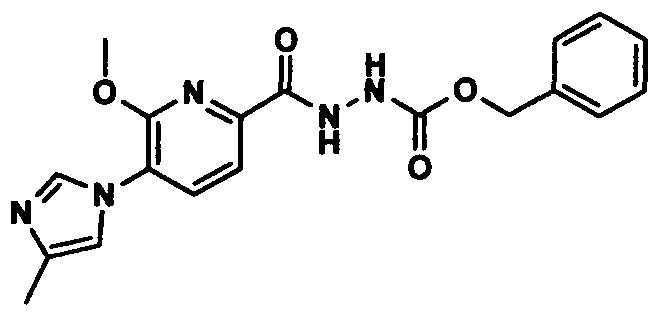
[0199]
Benzyl carbazate (27.8 g), HOBT (24.8 g) and EDC (35.4 g) were sequentially added to a solution of 6-methoxy-5-(4-methyl-l H-imidazol- l-yl)pyridine-2-carboxy lie acid obtained in Preparation Example 2 (51.9 g) and IPEA (44 mL) in DMF (184 mL), and the mixture was stirred at room temperature for six hours and 30 minutes. Ethyl acetate, ice water and a saturated sodium bicarbonate solution were added to the reaction solution, and the organic layer was separated. The resulting organic layer was dried over anhydrous magnesium sulfate and then filtered through an NH silica gel pad. The resulting filtrate was concentrated under reduced pressure. Ethyl acetate was added to the resulting residue, and the powder was collected by filtration. The resulting powder was air-dried to obtain 28.4 g of the title compound.
Further, the aqueous layer already extracted was reextracted with ethyl acetate.
The resulting organic layer was washed with brine, dried over anhydrous magnesium sulfate and then filtered through an NH silica gel pad. The resulting filtrate was concentrated under reduced pressure. Ethyl acetate was added to the resulting residue, and the powder was collected by filtration. The resulting powder was air-dried to obtain 9.15 g of the title compound. The property values of the compound are as follows.
1 H-NMR (CDCl3 ) δ (ppm): 2.31 (d, J = 1.2 Hz, 3H), 4.08 (s, 3H), 5.23 (s, 2H), 6.87 (brs, IH),
7.01 (t, J = 1.2 Hz, IH), 7.32-7.45 (m, 5H), 7.71 (d, J = 8.0 Hz, IH), 7.87 (d, J = 1.2 Hz, IH), 7.91 (d, J = 8.0 Hz, IH), 9.17 (brs, IH). [0200]
Synthesis of 6-methoxy-5-(4-methyl-lH-imidazol-l-yl)pyridine-2-carboxylic acid hydrazide and 6-methoxy-5-r4-methyl-lH-imidazol-l-yl)pyridine-2-carboxylic acid hydrazide hydrochloride [0201]

[0202]
10% palladium-carbon (50% wet, 2.84g) was added to a solution of benzyl N'-[6- methoxy-5-(4-methyl-lH-imidazol-l-yl)pyridine-2-carbonyl]hydrazinecarboxylate (28.4 g) in methanol (300 mL). The mixture was hydrogenated at an intermediate pressure (2 to 3 atm) for five hours. Chloroform (600 mL) was added to the reaction solution, and then the palladium- carbon was removed by filtration through celite. The filtrate was concentrated under reduced pressure to obtain 19.5 mg of a free form of the title compound. The property values of the compound are as follows. ' H-NMR (CDCl3 ) δ (ppm): 2.30 (d, J = 1.2 Hz, 3H), 4.06 (s, 3H), 4.10 (s, IH), 4.11 (s, IH), 7.01 (t, J = 1.2 Hz, IH), 7.70 (d, J = 8.0 Hz, IH), 7.86 (d, J = 1.2 Hz, IH), 7.89 (d, J = 8.0 Hz, IH), 8.69 (brs, IH).
A hydrochloride of the title compound was obtained by the same operation, provided that the hydrogenation reaction was performed in a chloroform-methanol mixed solvent. The property values of the compound are as follows.
1 H-NMR (CDCl3 ) δ (ppm): 2.31 (d, J = 1.2 Hz, 3H), 4.06 (s, 3H), 7.01 (t, J = 1.2 Hz, IH), 7.71
(d, J = 7.6 Hz, IH), 7.88 (d, J = 1.2 Hz, IH), 7.89 (d, J = 7.6 Hz, IH), 8.69 (brs, IH).
[0203]
Preparation Example 5 Synthesis of 2-bromo- 1 -[6-methoxy-5-(4-methyl- 1 H-imidazol- 1 -vDpyridin-2-yl]ethanone dihydrochloride
[0204]

[0205]
Synthesis of 6-( 1 -ethox yvinyl)- 2-methoxy-3 -(4-methyl- 1 H-imidazol- 1 -yPpyridine
[0206]

[0207]
1-Ethoxyvinyltri-n-butyltin (3.7 mL) was added to a suspension of 6-bromo-2- methoxy-3 -(4-methyl- 1 H-imidazol- l-yl)pyridine obtained in Preparation Example 1 (2.66 g) and bis(triphenylphosphine)palladium (II) chloride (350 mg) in dioxane (25 mL), and the mixture was stirred at 1000C for five hours and 45 minutes. The reaction solution was left to cool to room temperature and then concentrated under reduced pressure. The resulting residue was purified by silica gel column chromatography (carrier: Wakogel™ C-200, heptane:ethyl acetate = 1 :0 -> 9: 1 -> 3 : 1 -> 1 : 1 ). The target fraction was concentrated. The resulting powder was triturated with diethyl ether-n-hexane and dried under reduced pressure to obtain 1.57 g of the title compound. Then, the mother liquor was concentrated to obtain 858 mg of the title compound. The property values of the compound are as follows.
1 H-NMR (CDCl3 ) δ (ppm): 1.45 (t, J = 7.2 Hz, 3H), 2.30 (s, 3H), 3.98 (q, J = 7.2 Hz, 2H), 4.04 (s, 3H), 4.38 (d, J = 1.6 Hz, IH), 5.48 (d, J = 1.6 Hz, IH), 6.97 (s, IH), 7.38 (d, J = 8.0 Hz, IH), 7.52 (d, J = 8.0 Hz, IH), 7.78 (s, IH). [0208] Synthesis of 2-bromo- 1 - [6-methoχy-5 -(4-methyl- 1 H-imidazol- 1 - yl)pyridin-2- yl]ethanone dihvdrochloride
[0209]

[0210]
N-bromosuccinimide (543 mg) was added to a solution of 6-(l-ethoxyvinyl)-2- methoxy-3-(4-methyl-lH-imidazol-l-yl)pyridine (791 mg) in THF (15 mL)-water (2 mL) at room temperature, and the mixture was stirred at the same temperature for 15 minutes. A saturated sodium bicarbonate solution and ethyl acetate were added to the reaction solution, and the organic layer was separated. The resulting organic layer was washed with brine and dried over anhydrous magnesium sulfate. Anhydrous magnesium sulfate was removed from the organic layer by filtration. A 4 N solution of hydrogen chloride in ethyl acetate was added to the resulting filtrate. Thereafter, the filtrate was concentrated under reduced pressure to obtain
1.06 g of the title compound. The property values of the compound are as follows.
ESI-MS; m/z 310 [M++H-2HC1].
[0211]
Preparation Example 6 Synthesis of N-(2,5-dimethylphenylVN'-hvdroxyguanidine
[0212]

[0213]
A solution of N-cyano-2,5-dimethylaniline (CAS #10533-09-2, 468 mg), hydroxylamine monohydrochloride (334 mg) and potassium carbonate (885 mg) in ethanol was refluxed for 30 minutes. The reaction solution was brought back to room temperature. Then, water and ethyl acetate were added to the reaction solution, and the organic layer was separated. The resulting organic layer was washed with brine, dried over anhydrous magnesium sulfate and then concentrated under reduced pressure. The residue was purified by silica gel column chromatography (elution solvent: heptane -> ethyl acetate -> ethyl acetate:methanol = 85:15) to
obtain 56.0 mg of the title compound. The property values of the compound are as follows. ESI-MS; m/z 180 [M* +H]. [0214]
Preparation Example 7 Synthesis of N-hvdroxy-6-methoxy-5 -(4-methyl- 1 H-imidazol- 1 -yl*)pyridine-2-carboxamidine [0215]

[0216]
The title compound (46 mg) was obtained according to the synthesis method of
Preparation Example 6 from 6-methoxy-5-(4-methyl-l H-imidazol- l-yl)pyridine-2-carbonitrile obtained in Preparation Example 1 (50.0 mg). The property values of the compound are as follows.
1 H-NMR (CDCl3 ) δ (ppm): 2.31 (s, 3H), 4.07 (s, 3H), 5.51 (brs, 2H), 6.98 (s, IH), 7.57 (d, J =
7.6 Hz, IH), 7.63 (d, J = 7.6 Hz, IH), 7.82 (S, IH).
[0217] Preparation Example 8
Synthesis of 2-methoxy-3 -(4-methyl- 1 H-imidazol- 1 -ylV 6-tributylstannylpyridine
[0218]

[0219]
6-Bromo-2-methoxy-3-(4-methyl-l H-imidazol- l-yl)pyridine obtained in Preparation Example 1 (10 g) and hexa-n-butylditin (31.8 mL) were dissolved in toluene (300
mL). Tetrakis(triphenylphosphine)palladium (2.2 g) was added and the mixture was heated under reflux in a nitrogen atmosphere for four hours. After leaving to cool, the insoluble matter was removed from the reaction solution by filtration through celite. The filtrate was concentrated under reduced pressure. The resulting residue was purified by NH silica gel column chromatography and then by silica gel column chromatography to obtain the title compound (5.4 g). The property values of the compound are as follows. 1 H-NMR (CDCl3 ) δ (ppm): 0.90 (t, J = 7.2 Hz, 9H), 1.03-1.22 (m, 6H), 1.30-1.40 (m, 6H), 1.49- 1.70 (m, 6H), 2.29 (s, 3H), 4.01 (s, 3H), 6.96 (s, IH), 7.10 (d, J = 7.2 Hz, IH), 7.63 (d, J = 7.2 Hz, IH), 7.75-7.77 (m, IH). [0220]
Preparation Example 9
Synthesis of N-(2,5-dimethylphenyl)-2- ( [6-methoxy-5-(4-methyl- 1 H-imidazol- 1 -yl)pyridin-2- yl]carbonyl } hvdrazinecarbothioamide
[0221]

[0222]
A mixed solution of 6-methoxy-5-(4-methyl-l H-imidazol- l-yl)pyridine-2- carboxylic acid hydrazide obtained in Preparation Example 4 (119 mg), TEA (100 μL) and 2,5- dimethylphenyl isothiocyanate (54.5 mg) in ethanol (3 mL)-DMF (600 μL) was refluxed for 10 minutes. Ethyl acetate was added to the reaction solution, and the generated precipitate was collected by filtration to obtain 100 mg of the title compound. [0223]
Preparation Example 10 Synthesis of l-(5-diethylamino-2-methylphenyl)-2-methylisothiourea hydroiodide
[0224]

[0225]
Iodomethane (0.197 mL) was added to a solution of (5-diethylamino-2- methylphenyl)thiourea (CAS #810662-71-6, 0.5 g) in methanol (7 mL). The reaction solution was stirred with heating under reflux for 22 hours. Thereafter, concentration under reduced pressure gave 0.7773 g of the title compound. The property values of the compound are as follows.
ESI-MS; m/z 252 [M+ +H-HI]. [0226] Preparation Example 11
Synthesis of l-(5-isopropyl-4-memoxy-2-memylphenylV2-methylisothiourea hvdroiodide [0227]

[0228]
The title compound (0.222 g) was obtained according to the method of Preparation Example 10 from (5-isopropyl-4-methoxy-2-methylphenyl)thiourea (CAS
#1056049-53-6, 0.139 g). The property values of the compound are as follows.
ESI-MS; m/z 253 [M+ +H-HI].
[0229]
Preparation Example 12 Synthesis of 6-methoxy-5-(4-methyl-lH-imidazol-l-vπpyridine-2-carboxylic acid N'-|"2-(5- isopropyl-4-methoxy-2-methylphenyl)acetyl]hvdrazide
[0230]

[0231]
Synthesis of methyl (5-isopropyl-4-methoxy-2-methylphenyl)acetate
[0232]

[0233] Thionyl chloride (3.5 mL) was added dropwise to a solution of (5-isopropyl-4- methoxy-2-methylphenyl)acetic acid (CAS #81354-65-6, 5.5 g) in methanol (50 mL) under ice- cooling. Then, the reaction solution was brought back to room temperature and stirred for two hours. The reaction solution was concentrated under reduced pressure. A saturated sodium bicarbonate solution and tert-butyl methyl ether were added and the organic layer was separated. The resulting organic layer was washed with brine and then dried over anhydrous sodium sulfate. The drying agent was separated by filtration, and then the organic layer was concentrated under reduced pressure. The residue was purified by silica gel column chromatography to obtain the title compound (5.0 g). The property values of the compound are as follows. 1 H-NMR (CDCl3 ) δ (ppm): 1.19 (d, J - 7.2 Hz, 3H), 1.19 (d, J = 7.2 Hz, 3H), 2.28 (s, 3H), 3.25 (qq, J = 7.2, 7.2 Hz, IH), 3.58 (s, 2H), 3.68 (s, 3H), 3.80 (s, 3H), 6.66 (s, IH), 7.00 (s, IH). [0234]
Synthesis of (5-isopropyl-4-methoxy-2-methylphenyDacetic acid hvdrazide [0235]

Hydrazine monohydrate (0.8 mL) was added to a solution of methyl (5-isopropyl-
4-methoxy-2-methylphenyl)acetate (780 mg) in ethanol (10 mL), and the mixture was heated under reflux at 800C for 10 hours. Thereafter, hydrazine monohydrate (0.8 mL) was added and the mixture was further heated under reflux at 8O0C for 3.5 hours. The reaction solution was concentrated under reduced pressure and the residue was purified by silica gel column chromatography to obtain the title compound (374 mg). The property values of the compound are as follows.
ESI-MS; m/z 237 [M+ +H]. l H-NMR (CDCl3 ) δ (ppm): 1.19 (d, J = 6.8 Hz, 3H), 1.19 (d, J = 6.8 Hz, 3H), 2.24 (s, 3H), 3.25
(qq, J = 6.8, 6.8 Hz, IH), 3.54 (s, 2H), 3.80-3.86 (m, 5H), 6.52 (br s, IH), 6.68 (s, IH), 6.95 (s,
IH).
[0237]
Synthesis of 6-methoxy-5-(4-methyl-lH-imidazol-l-yl)pyridine-2-carboxylic acid N'-[2-(5- isopropyl-4-memoxy-2-methylphenvDacetyl]hydrazide
[0238]

[0239]
IPEA (996 μL) was added under ice-cooling to a solution of (5-isopropyl-4- methoxy-2-methylphenyl)acetic acid hydrazide (338 mg), 6-methoxy-5-(4-methyl-lH-imidazol- l-yl)pyridine-2-carboxylic acid obtained in Preparation Example 2 (476 mg) and HOBT (290 mg) in DMF (10 mL). Then, EDC (411 mg) was added at the same temperature. Thereafter, the reaction solution was brought back to room temperature and stirred overnight. Ethyl acetate and a sodium bicarbonate solution were added to the reaction solution, and the organic layer was separated. The resulting organic layer was washed with brine and then dried over anhydrous sodium sulfate. The drying agent was separated by filtration, and then the organic layer was concentrated under reduced pressure. The residue was purified by silica gel column chromatography to obtain the title compound (515 mg). The property values of the compound are as follows.
ESI-MS; m/z 452 [M+ +H].
1 H-NMR (CDCl3 ) δ (ppm): 1.22 (d, J = 6.8 Hz, 3H), 1.22 (d, J = 6.8 Hz, 3H), 2.30 (s, 3H), 2.37 (s, 3H), 3.28 (qq, J = 6.8, 6.8 Hz, IH), 3.70 (s, 2H)5 3.84 (s, 3H), 4.08 (s, 3H), 6.73 (s, IH), 7.00 (d, J = 1.6 Hz, IH), 7.06 (s, IH), 7.68 (d, J = 7.6 Hz, IH), 7.83 (d, J = 7.6 Hz, IH), 7.86 (d, J = 1.6 Hz, IH), 8.0-8.05 (br, IH), 9.88-9.82 (br, IH). [0240]
Preparation Example 13
Synthesis of 6-methoxy-5-(4-methyl-lH-imidazol-l-yl)pyridine-2-carboxylic acid N'-f2-(5- isopropyl-4-methoxy-2-methylphenyl)acetyll-N'-methylhvdrazide [0241]

[0242]
Synthesis of benzyl N'-f2-(5-isopropyl-4-methoxy-2-methylphenyl)acetyl]-N'- methylhydrazinecarboxylate
[0243]

[0244]
IPEA (3.1 mL) was added under ice-cooling to a solution of (5-isopropyl-4- methoxy-2-methylphenyl)acetic acid (CAS #81354-65-6, 1 g), benzyl N'- methylhydrazinecarboxylate hydrochloride (CAS #880-21-7, 1.2 g) and HOBT (909 mg) in DMF (20 mL). Then, EDC (1.3 g) was added at the same temperature. The reaction solution was brought back to room temperature and stirred overnight. Ethyl acetate and a sodium bicarbonate solution were added to the reaction solution, and the organic layer was separated. The resulting organic layer was washed with brine and then dried over anhydrous sodium sulfate. The drying agent was separated by filtration, and then the organic layer was concentrated under
reduced pressure. The residue was purified by silica gel column chromatography to obtain the title compound (1 g). The property values of the compound are as follows. ESI-MSJ nVz SSS [M+ +H]. [0245]
Synthesis of (S-isopropyM-methoxy^-methylphenvQacetic acid N-methylhvdrazide [0246]

[0247]
Benzyl N'-[2-(5-isopropyl-4-methoxy-2-methylphenyl)acetyl]-N'- methylhydrazinecarboxylate (1 g) was dissolved in ethanol (30 mL) and catalytically hydrogenated for five hours using a 10% palladium-carbon cartridge in the H-Cube™
(manufactured by THALES Nanotechnology Inc.; continuous-flow hydrogenation reactor) system. The organic layer was concentrated under reduced pressure to obtain the title compound (678 mg). The property values of the compound are as follows.
ESI-MS; m/z 251 [M+ +H]. [0248]
Synthesis of 6-methoxy-5-(4-methyl-lH-imidazol-l-yl)pyridine-2-carboxylic acid N'-[2-(5- isopropyl-4-methoxy-2-methylphenvπacetyl]-N'-methyUivdrazide
[0249]

[0250] IPEA (444 μL) and EDC (183 mg) were sequentially added to a solution of (5- isopropyl-4-methoxy-2-methylphenyl)acetic acid N-methylhydrazide (160 mg), 6-methoxy-5-(4-
methyl- lH-imidazol-l-yl)pyridine-2-carboxylic acid obtained in Preparation Example 2 (890 mg) and HOBT (129 mg) in DMF (4 mL). The reaction solution was stirred at room temperature for five hours. Ethyl acetate and a sodium bicarbonate solution were added to the reaction solution, and the organic layer was separated. The resulting organic layer was washed with brine and then dried over anhydrous sodium sulfate. The drying agent was separated by filtration, and then the organic layer was concentrated under reduced pressure. The residue was purified by silica gel column chromatography to obtain the title compound (246 mg). The property values of the compound are as follows. 1 H-NMR (CDCl3 ) δ (ppm): 1.09 (d, J = 6.8 Hz, 3H), 1.09 (d, J = 6.8 Hz, 3H), 2.17 (s, 3H), 2.31 (s, 3H), 3.18 (qq, J = 6.8, 6.8 Hz, IH), 3.30 (s, 3H), 3.64 (s, 2H), 3.79 (s, 3H), 3.92 (s, 3H), 6.62 (s, IH), 6.87 (s, IH), 7.02 (s, IH), 7.74 (d, J = 8.0 Hz, IH), 7.96 (d, J = 8.0 Hz, IH), 9.14 (s, IH). [0251]
Preparation Example 14 Synthesis of ethyl 2-(5-tert-butyl-2-methoxyphenyl)-5-chloropentanimidate hydrochloride and ethyl 2-(5-tert-butyl-2-methoxyphenyl)acetimidate hydrochloride
[0252]
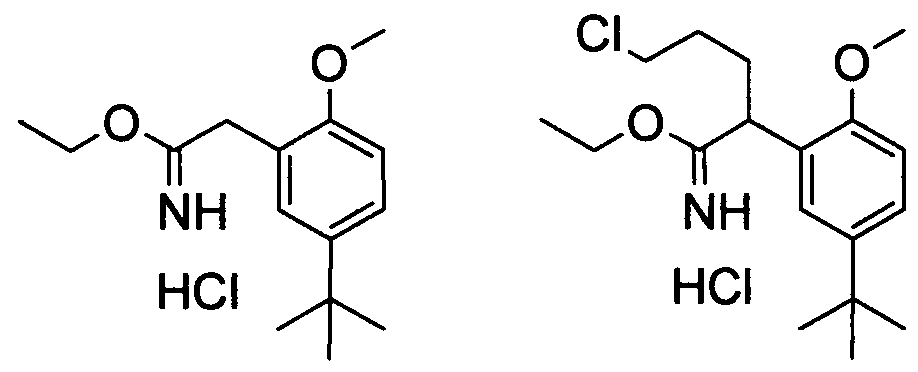
[0253]
Synthesis of 4-tert-buryl- 1 -methoxv-2-methvlbenzene
[0254]

[0255]
Potassium carbonate (8.4 g) and methyl iodide (2.9 mL) were added to a solution of 4-tert-butyl-2-methylphenol (CAS #98-27-1, 5.0 g) in DMF (25 mL), and the mixture was
stirred at room temperature for three days. Ice water and hexane were added to the reaction solution, and the organic layer was separated. The resulting organic layer was sequentially washed with water and brine, dried over anhydrous magnesium sulfate and then concentrated under reduced pressure to obtain 5.16 g of the title compound. The property values of the compound are as follows.
1 H-NMR (CDCl3 ) δ (ppm): 1.30 (s, 9H), 2.22 (s, 3H), 3.81 (s, 3H), 6.76 (d, J = 9.2 Hz, IH), 7.15-7.19 (m, 2H). [0256]
Synthesis of 2-bromomethyl-4-tert-butyl- 1 -methoxybenzene [0257]

[0258]
N-Bromosuccinimide (5.66 g) and 2,2'-azobis(isobutyronitrile) (71 mg) were added to a solution of 4-tert-butyl-l-methoxy-2-methylbenzene (5.16 g) in carbon tetrachloride
(25 mL), and the mixture was heated under reflux for 1.5 hours. The reaction solution was ice- cooled and then the insoluble matter was removed by filtration. The filtrate was concentrated under reduced pressure to obtain 7.78 g of the title compound. The property values of the compound are as follows.
1 H-NMR (CDCl3 ) δ (ppm): 1.30 (s, 9H), 3.88 (s, 3H), 4.58 (s, 2H), 6.81 (d, J = 8.4 Hz, IH),
7.31 (dd, J = 8.4, 2.4 Hz, IH), 7.34 (d, J = 2.4 Hz, IH). [0259]
Synthesis of (5-tert-butyl-2-methoxyphenyl)acetonitrile
[0260]

Potassium cyanide (2.96 g) was added to a solution of 2-bromomethyl-4-tert- butyl-1-methoxybenzene (7.78 g) in dimethyl sulfoxide (50 mL), and the mixture was stirred at room temperature for 16 hours. Ice and tert-butyl methyl ether were added to the reaction solution, and the organic layer was separated. The aqueous layer was reextracted with tert- butyl methyl ether. The combined organic layers were sequentially washed with water (twice) and brine, dried over anhydrous magnesium sulfate and then concentrated under reduced pressure. The resulting residue was purified by silica gel column chromatography (carrier: Chromatorex™ NH; elution solvent: heptane -> ethyl acetate :heptane = 1 :49). The target fraction was concentrated. The resulting residue was triturated with hexane to obtain 1.90 g of the title compound. The trituration mother liquor was concentrated. Then, the resulting residue was triturated with hexane to obtain 0.47 g of the title compound. The property values of the compound are as follows. 1 H-NMR (CDCl3 ) δ (ppm): 1.31 (s, 9H), 3.68 (s, 2H), 3.85 (s, 3H), 6.82 (d, J = 8.4 Hz, IH), 7.32 (dd, J = 8.4, 2.4 Hz, IH), 7.36 (d, J = 2.4 Hz, IH). [0262]
Synthesis of 2-(5-tert-butyl-2-methoxyphenyl)-5-chloropentanenitrile [0263]

[0264] A solution of n-butyllithium in hexane (2.69 M, 3.0 mL) was added to a solution of N,N-diisopropylamine (1.2 mL) in THF (15 mL) under ice-cooling, and the mixture was stirred at the same temperature for 10 minutes. The solution was cooled to -780C and a solution of (5-tert-butyl-2-methoxyphenyl)acetonitrile (1.5 g) in THF (6.5 mL) was added dropwise. The solution was stirred at -300C for 25 minutes and then cooled again to -780C. l-Chloro-3- iodopropane (1.2 mL) was added dropwise to the solution, and then the reaction solution was gradually heated to room temperature. After ice-cooling the reaction solution, a solution of lithium hexamethyldisilazide in tetrahydrofuran (1.0 M, 4.4 mL) was added to the reaction solution. Then, a lithium diisopropylamide solution prepared from N,N-diisopropylamine (0.6 mL) and a solution of n-butyllithium in hexane (2.69 M, 1.5 mL) was added to the reaction
solution. A saturated ammonium chloride solution was added to the reaction solution. Then, ethyl acetate and water were added and the organic layer was separated. The resulting organic layer was sequentially washed with 1 N hydrochloric acid, water, a saturated sodium bicarbonate solution and brine, dried over anhydrous magnesium sulfate and then concentrated under reduced pressure. The resulting residue was purified by silica gel column chromatography (carrier: Merck silica gel 60 (230-400 mesh); elution solvent: heptane:ethyl acetate = 1:49) to obtain 864 mg of a 1 :7 mixture of (5-tert-butyl-2-methoxyphenyl)acetonitrile and the title compound. The property values of the title compound are as follows. 1 H-NMR (CDCl3 ) δ (ppm): 1.31 (s, 9H), 1.86-2.12 (m, 4H), 3.54-3.60 (m, 2H), 3.84 (s, 3H), 4.18-4.24 (m, IH), 6.83 (d, J = 8.4 Hz, IH), 7.31 (dd, J = 8.4, 2.4 Hz, IH), 7.40 (d, J = 2.4 Hz, IH). [0265]
Synthesis of ethyl 2-(5-tert-butyl-2-methoxyphenylV5-chloropentanimidate hydrochloride and ethyl 2-(5-tert-butyl-2-methoxyphenyDacetimidate hydrochloride [0266]

[0267]
A solution of the 1:7 mixture of (5-tert-butyl-2-methoxyphenyl)acetonitrile and 2-
(5-tert-butyl-2-methoxyphenyl)-5-chloropentanenitrile (864 mg) in ethanol (8 mL) was bubbled with hydrogen chloride gas under ice-cooling for 15 minutes. The reaction solution was stirred at room temperature for one day. The reaction solution was concentrated under reduced pressure to obtain a mixture of the title compound.
The property values of ethyl 2-(5-tert-butyl-2-methoxyphenyl)-5- chloropentanimidate hydrochloride are as follows.
ESI-MS; m/z 326 [M+ +H-HCl]. The property values of ethyl 2-(5-tert-butyl-2-methoxyphenyl)acetimidate hydrochloride are as follows.
ESI-MS; m/z 250 [M1" +H-HCl].
[0268]
Preparation Example 15
Synthesis of 3-bromo- 1 -methyl-5-(2-trifluoromethylphenoxy')- IH-[I ,2,4]triazole
[0269]

[0270]
Synthesis of 1 -methyl-3-nitro-5-(2-trifluoromethylphenoxy)- 1 H-[ 1 ,2,4]triazole
[0271]

[0272]
2-Hydroxybenzotrifluoride (157 mg) and potassium carbonate (134 mg) were added to a solution of l-methyl-3-nitro-5-bromo-lH-[l,2,4]triazole (CAS #31123-19-0, 100 mg) in DMF (3 mL), and the mixture was stirred at 950C for six hours and 30 minutes. After leaving to cool, diethyl ether and water were added to the reaction solution, and the organic layer was separated. The resulting organic layer was washed with brine and dried over anhydrous sodium sulfate. The drying agent was separated by filtration and then the organic layer was concentrated under reduced pressure. The residue was purified by NH silica gel column chromatography to obtain the title compound (118 mg). The property values of the compound are as follows.
1 H-NMR (CDCl3 ) δ (ppm): 3.97 (s, 3H), 7.44 (t, J = 7.6 Hz, IH), 7.68-7.77 (m, 3H).
[0273]
Synthesis of 1 -methyl-5-(2-trifluoromethylphenoxy)- IH-[1.2.4]triazol-3 - ylamine [0274]

[0275]
10% palladium-carbon (20 mg) was added to a solution of l-methyl-3-nitro-5-(2- trifluoromethylphenoxy)-lH-[l,2,4]triazole (35 mg) in methanol (5 mL). The mixture was stirred at room temperature in a hydrogen atmosphere at 1 atm for 13 hours and 30 minutes. Palladium-carbon was removed by filtration through celite, and the filtrate was concentrated under reduced pressure. The residue was purified by NH silica gel column chromatography to obtain the title compound (45.8 mg). The property values of the compound are as follows. 1 H-NMR (CDCl3 ) δ (ppm): 3.63 (s, 3H), 3.96 (s, 2H), 7.33 (brs, IH), 7.62 (brs, 2H), 7.69 (d, J = 7.6 Hz, IH). [0276]
Synthesis of 3-bromo-l-memyl-5-(2-trifluoromethylphenoxy)-lH-[l ,2,4]triazole [0277]

[0278] l-Methyl-5-(2-trifluoromethylphenoxy)-lH-[l,2,4]triazol-3-ylamine (45 mg) was dissolved in acetonitrile (2 mL). Copper (II) bromide (194 mg) and isoamyl nitrite (61.2 mg) were added and the mixture was stirred at 700C for one hour and 30 minutes. After leaving to cool, the reaction solution was concentrated under reduced pressure. Ethyl acetate and a saturated ammonium chloride solution were added to the residue, and the organic layer was separated. The resulting organic layer was washed with brine and dried over anhydrous sodium sulfate. The drying agent was separated by filtration and then the organic layer was concentrated under reduced pressure. The residue was purified by NH silica gel column
chromatography to obtain the title compound (11.5 mg). The property values of the compound are as follows.
1 H-NMR (CDCl3 ) δ (ppm): 3.80 (s, 3H), 7.37 (t, J = 7.6 Hz, IH), 7.64 (t, J - 7.6 Hz, IH), 7.70 (d, J = 7.6 Hz, 2H). [0279] Example 1
Svnmesis of(2,5-dimethylphenyl)-{5-[6-methoxy-5-(4-methyl-lH-imidazol-l-yl)-pyridin-2-yl1- [l,2,4]oxadiazol-3-yl}-amine [0280]

HOBT (63.2 mg) was added to a solution of N-(2,5-dimethylphenyl)-N'- hydroxyguanidine obtained in Preparation Example 6 (56.0 mg), 6-methoxy-5-(4-methyl-lH- imidazol-l-yl)-pyridine-2-carboxylic acid obtained in Preparation Example 2 (72.8 mg), EDC (89.7 mg) and TEA (87 μL) in DMF (3 mL). The reaction solution was stirred at room temperature overnight and then stirred at 8O0C for eight hours. Water and ethyl acetate were added to the reaction solution, and the organic layer was separated. The resulting organic layer was washed with brine, dried over anhydrous magnesium sulfate and then concentrated under reduced pressure. The residue was purified by silica gel column chromatography (elution solvent: heptane -> ethyl acetate:methanol = 90: 10). Thereafter, the concentrated residue was washed with diethyl ether to obtain 16 mg of the title compound. The property values of the compound are as follows.
1 H-NMR (CDCl3 ) δ (ppm): 2.32 (s, 6H), 2.39 (s, 3H), 4.19 (s, 3H), 6.60 (s, IH), 6.82 (d, J = 7.6 Hz, IH), 7.06-7.10 (m, 2H), 7.72 (d, J = 7.6 Hz, IH), 7.82 (s, IH), 7.89 (d, J = 7.6 Hz, IH), 7.93 (s, IH). [0282] Example 2
Svnmesis of(2.5-dimethylphenylV(3-[6-memoxy-5-(4-methyl-lH-imidazol-l-yl)-pyridin-2-yl1- 11.2.41thiadiazol-5 -yl I -amine
[0283]

[0284]
A solution of 2,5-dimethylphenyl isothiocyanate (CAS #19241-15-7, 29.7 mg) and N-hydroxy-6-methoxy-5-(4-methyl-lH-imidazol-l-yl)pyridine-2-carboxamidine obtained in Preparation Example 7 (30.0 mg) in DMF (2 mL) was stirred at 800C for three hours and then stirred at room temperature overnight. Water and ethyl acetate were added to the reaction solution, and the organic layer was separated. The resulting organic layer was washed with brine, dried over anhydrous magnesium sulfate and then concentrated under reduced pressure.
The residue was purified by silica gel column chromatography (elution solvent: heptane -> ethyl acetate -> ethyl acetate:methanol = 80:20). Thereafter, the concentrated residue was washed with diethyl ether to obtain 10 mg of the title compound. The property values of the compound are as follows.
1 H-NMR (CD3 OD) δ (ppm): 2.25 (d, J = 0.8 Hz, 3H), 2.31 (s, 3H), 2.36 (s, 3H), 4.15 (s, 3H),
7.01 (d, J = 7.6 Hz, IH), 7.19 (d, J = 7.6 Hz, IH), 1.22-125 (m, 2H), 7.56 (s, IH), 7.90 (d, J = 8.0 Hz, IH), 7.96 (d, J = 8.0 Hz, IH), 8.00 (d, J = 0.8 Hz, IH).
[0285]
The compound of Example 3 was obtained by the same method as in Example 2
(Table 1).
[0286]
Table 1

Synthesis of (2,5-dimethylphenyπ-{3-[6-methoxy-5-(4-methyl-lH-imidazol-l-yπ-pyridin-2-yll- r 1 ,2,4]oxadiazol-5-yl } -amine [0288]

[0289]
A solution of l-(2,5-dimethylphenyl)-2-methyl-isothiourea monohydroiodide (CAS #91147-36-3, 65.1 mg), N-hydroxy-6-methoxy-5-(4-methyl-lH-imidazolyl-l-yl)ρyridine- 2-carboxamidine obtained in Preparation Example 7 (50.0 mg) and TEA (56.3 μL) in ethanol (2 mL) was refluxed for 10 hours and then stirred at 75°C overnight. Water and ethyl acetate were added to the reaction solution, and the organic layer was separated. The resulting organic layer was washed with brine, dried over anhydrous magnesium sulfate and then concentrated under reduced pressure. The residue was purified by silica gel column chromatography (elution solvent: heptane -> ethyl acetate -> ethyl acetate:methanol = 80:20) and subsequently by preparative thin-layer silica gel chromatography (developing solvent: heptane:ethyl acetate = 1 : 10) to obtain 2.0 mg of the title compound. The property values of the compound are as follows.
ESI-MS; m/z 377 [M+ +H]. l H-NMR (CDCl3 ) δ (ppm): 2.32 (s, 6H)5 2.39 (s, 3H), 4.19 (s, 3H), 6.60 (s, IH), 6.82 (d, J = 7.6 Hz, IH), 7.05-7.10 (m, 2H), 7.73 (d, J = 8.0 Hz, IH), 7.82 (s, IH), 7.89 (d, J = 8.0 Hz, IH), 7.94 (s, IH). [0290] Example 5
Synthesis of (2,5-dimethylphenyl)-{5-[6-methoxy-5-(4-methyl-lH-imidazol-l-vπ-pyridin-2-yl]- [1.3 ,4]oxadiazol-2- yl } -amine [0291]

[0292]
A solution of N-(2,5-dimethylphenyl)-2- { [6-methoxy-5-(4-methyl- 1 H-imidazol- l-yl)pyridin-2-yl]carbonyl}hydrazinecarbothioamide obtained in Preparation Example 9 (30 mg), p-toluenesulfonyl chloride (41.8 mg) and pyridine (35.4 μL) in THF (2 mL) was stirred at 650C for four hours. Water and ethyl acetate were added to the reaction solution, and the organic layer was separated. The resulting organic layer was washed with brine, dried over anhydrous magnesium sulfate and then concentrated under reduced pressure. The residue was purified by silica gel column chromatography (elution solvent: heptane -> ethyl acetate -> ethyl acetate methanol = 80:20) to obtain 5.0 mg of the title compound. The property values of the compound are as follows. ESI-MS; m/z 377 [M+ +H].
1 H-NMR (CDCl3 ) δ (ppm): 2.32 (s, 3H), 2.34 (s, 3H), 2.38 (s, 3H), 4.15 (s, 3H), 6.84 (brs, IH), 6.89 (d, J = 7.6 Hz, IH), 7.03 (s, IH), 7.11 (d, J = 7.6 Hz, IH), 7.67 (d, J = 7.6 Hz, IH), 7.84 (d, J = 7.6 Hz, IH), 7.89 (brs, 2H). [0293] Example 6
Svnmesis of(2,5-dimemylphenylV{5-r6-methoxy-5-(4-methyl-lH-imidazol-l-vπ-pyridin-2-yl]- r 1.3.4]thiadiazol-2-yl } -amine [0294]

A solution of N-(2,5-dimethylphenyl)-2-{[6-methoxy-5-(4-methyl-lH-imidazol- l-yl)pyridin-2-yl]carbonyl}hydrazinecarbothioamide obtained in Preparation Example 9 (10.0
mg) in phosphoric acid (300 μL) was stirred at 900C for one hour. The reaction solution was neutralized by adding ethyl acetate and a 2 N sodium hydroxide solution to the reaction solution under ice-cooling, and then the organic layer was separated. The resulting organic layer was washed with brine, dried over anhydrous magnesium sulfate and then concentrated under reduced pressure. The residue was purified by silica gel column chromatography (elution solvent: heptane -> ethyl acetate -> ethyl acetate methanol = 80:20) to obtain 3.0 mg of the title compound. The property values of the compound are as follows.
ESI-MS; m/z 393 [M+ +H].
1 H-NMR (CDCl3 ) δ (ppm): 2.30 (s, 3H), 2.32 (s, 3H), 2.38 (s, 3H), 4.03 (s, 3H), 6.98-7.00 (m, 2H), 7.17 (d, J = 7.6 Hz, IH), 7.35-7.37 (m, IH), 7.65 (d, J = 7.6 Hz, IH), 7.83 (d, J = 1.2 Hz,
IH), 7.92 (d, J = 7.6 Hz, IH).
[0296]
Example 7
Synthesis of N*l*.N*l*-diethyl-N*3*-(5-r6-methoxy-5-(4-methyl-lH-imidazol-l-vnDyridin-2- yll-2H-π.2.41triazol-3-vU-4-methylbenzene-1.3-diamine
[0297]

[0298]
A 4 N solution of hydrochloric acid in ethyl acetate (2 mL) was added to tert- butyl N'-[6-methoxy-5-(4-methyl-lH-imidazol-l-yl)pyridine-2-carbonyl]hydrazinecarboxylate obtained in Preparation Example 3 (30 mg), and the reaction solution was stirred at room temperature for four hours. The reaction solution was concentrated under reduced pressure. Pyridine (3 mL), TEA (0.12 mL) and l-(5-Diethylamino-2-methylphenyl)-2-methylisothiourea hydroiodide obtained in Preparation Example 10 (39.4 mg) were added to the resulting crude 6- methoxy-5-(4-methyl-lH-imidazol-l-yl)pyridine-2-carboxylic acid hydrazide hydrochloride, and the mixture was stirred with heating under reflux for 18 hours. The reaction solution was cooled to room temperature and then a saturated sodium bicarbonate solution was added, followed by extraction with ethyl acetate three times. The resulting organic layer was dried
over anhydrous magnesium sulfate and concentrated under reduced pressure. The residue was purified by silica gel column chromatography (carrier: Chromatorex NH; elution solvent: ethyl acetate -> ethyl acetate-methanol) and then further purified by silica gel column chromatography (elution solvent: ethyl acetate-methanol) to obtain 3.01 mg of the title compound. The property values of the title compound are as follows.
ESI-MS; m/z 433 [M+ +H].
1 H-NMR (CDCl3 ) δ (ppm): 1.20 (t, J = 6.8 Hz, 6H), 2.24 (s, 3H), 2.31 (s, 3H), 3.38 (q, J = 6.8 Hz, 4H), 4.12 (s, 3H), 6.34 (d, J = 7.2 Hz, IH), 6.55 (s, IH), 6.96-7.10 (m, 2H), 7.62 (bs, IH), 7.69 (d, J = 7.6 Hz, IH), 7.79 (d, J = 7.6 Hz, IH), 7.86 (bs, IH). [0299] Example 8
Synthesis of (5-isopropyl-4-methoxy-2-methylphenyl)- (5-[6-methoxy-5-(4-methyl- 1 H-imidazol- 1 -vnpyridin-2-yl]-2H-π .2.41triazol-3-vU amine [0300]

[0301]
The title compound (47.9 mg) was obtained according to the method of Example 7 from tert-butyl N'-[6-methoxy-5-(4-methyl-lH-imidazol-l-yl)pyridine-2- carbonyljhydrazinecarboxylate obtained in Preparation Example 3 (406 mg) and l-(5-isopropyl- 4-methoxy-2-methylphenyl)-2-methylisothiourea hydroiodide obtained in Preparation Example 11 (669 mg). The property values of the title compound are as follows. ESI-MS; m/z 434 [Nf+ +H].
1 H-NMR (CDCl3 ) δ (ppm): 1.23 (d, J = 6.8 Hz, 6H), 2.26-2.36 (m, 6H), 3.24-3.38 (m, IH), 3.82 (s, 3H), 4.10 (s, 3H), 6.26 (bs, IH), 6.72 (s, IH), 6.96-7.06 (m, IH), 7.60-7.90 (m, 4H). [0302] The compounds of Examples 9 to 11 were obtained by the same method as in
Example 7 (Table 2). [0303]
Table 2

[0304] Example 12
Synthesis of 6-r5-(5-isopropyl-4-methoxy-2-methylbenzyl')-ri ,3.41oxadiazol-2-yl]-2-methoχy-3- (4-methyl- 1 H-imidazol- 1 - vDpyridine [0305]

[0306]
A solution of 6-methoxy-5-(4-methyl- 1 H-imidazol- 1 -yl)-pyridine-2-carboxylic acid N'-[2-(5-isopropyl-4-methoxy-2-methylphenyl)acetyl]hydrazide obtained in Preparation Example 12 (515 mg) in phosphorus oxychloride (8 mL) was heated with stirring at 12O0C for 30 minutes. The reaction solution was concentrated under reduced pressure. tert-Butyl methyl ether and a saturated sodium bicarbonate solution were added and the organic layer was separated. The resulting organic layer was washed with brine and then dried over anhydrous
sodium sulfate. The drying agent was separated by filtration, and then the organic layer was concentrated under reduced pressure. The residue was purified by silica gel column chromatography to obtain the title compound (187 mg). The property values of the compound are as follows. ESI-MS; m/z 434 [M+ +H].
1 H-NMR (CDCl3 ) δ (ppm): 1.19 (d, J = 7.2 Hz, 3H), 1.19 (d, J = 7.2 Hz, 3H), 2.30 (s, 3H), 2.43 (s, 3H)5 3.26 (qq, J = 7.2, 7.2 Hz, IH), 3.81 (s, 3H), 7.12 (s, 3H), 4.24 (s, 2H), 6.69 (s, IH), 7.02 (d, J = 1.2 Hz, IH), 7.17 (s, IH), 7.66 (d, J = 8.0 Hz, IH), 7.83 (d, J = 8.0 Hz, IH), 7.88 (d, J = 1.2 Hz5 IH). [0307]
Example 13
Synthesis of 6-[5-(5-isopropyl-4-methoχy-2-methylbenzylMH-π ,2,4]triazol-3-yl]-2-methoχy-3-
(4-methyl- 1 H-imidazol- 1 -yPpyridine
[0308]

Sodium acetate dried by heating under reduced pressure (961 mg) was added to a solution of 6-[5-(5-isopropyl-4-methoxy-2-methylbenzyl)-[l,3,4]oxadiazol-2-yl]-2-methoxy-3- (4-methyl-l H-imidazol- l-yl)pyridine obtained in Example 12 (180 mg) in acetic acid (10 mL), and the mixture was heated with stirring at 15O0C for three days. After leaving to cool, the reaction solution was concentrated under reduced pressure. Ethyl acetate and a saturated sodium bicarbonate solution were added and the organic layer was separated. The resulting organic layer was washed with brine and then dried over anhydrous sodium sulfate. The drying agent was separated by filtration, and then the organic layer was concentrated under reduced pressure. The residue was purified by NH silica gel column chromatography to obtain the title compound (144 mg). The property values of the compound are as follows. ESI-MS; m/z 433 [M* +H].
1 H-NMR (CDCl3 ) δ (ppm): 1.19 (d, J = 7.2 Hz5 3H), 1.19 (d, J = 7.2 Hz5 3H)5 2.30 (s, 3H)5 2.33 (s, 3H)5 3.26 (qq, J = 7.2, 7.2 Hz, IH)5 3.82 (s, 3H)5 4.11 (s, 3H), 4.14 (s, 2H), 6.69 (s, IH)5 7.00-
7.04 (m, IH), 7.12 (s, IH), 7.66 (d, J = 7.6 Hz, IH), 7.82-7.88 (m, 2H). [0310] Example 14
Synthesis of 6-r5-(5-isoDroDyl-4-methoxy-2-methylbenzvn-2-methyl-2H-π.2.41triazol-3-yll-2- methoχy-3 -(4-methyl- 1 H-imidazol- 1 -vDpyridine [0311]

[0312]
60% sodium hydride (19 mg) was added to a solution of 6-[5-(5-isopropyl-4- methoxy-2-methylbenzyl)-lH-[l,2,4]triazol-3-yl]-2-methoxy-3-(4-methyl-lH-imidazol-l- yl)pyridine obtained in Example 13 (100 mg) and methyl iodide (29 μL) in DMF (3 mL) under ice-cooling. The reaction solution was brought back to room temperature and stirred in a nitrogen atmosphere for one hour. Water was added to the reaction solution, followed by extraction with ethyl acetate. The resulting organic layer was washed with brine and then dried over anhydrous sodium sulfate. The drying agent was separated by filtration, and then the organic layer was concentrated under reduced pressure. The residue was purified by NH silica gel column chromatography to obtain the title compound (74 mg). The property values of the compound are as follows.
ESI-MS; m/z 447 [M+ +H].
1 H-NMR (CDCl3 ) δ (ppm): 1.20 (d, J = 6.8 Hz, 3H), 1.20 (d, J = 6.8 Hz, 3H), 2.31 (s, 3H), 2.41 (s, 3H), 3.25 (qq, J = 6.8, 6.8 Hz, IH), 3.80 (s, 3H), 4.03 (s, 2H), 4.08 (s, 3H), 4.32 (s, 3H), 6.67
(s, IH), 7.01 (d, J = 1.2 Hz, IH), 7.19 (s, IH), 7.66 (d, J = 8.0 Hz, IH), 7.85 (d, J = 1.2 Hz, IH),
7.92 (d, J = 8.0 Hz, IH).
[0313]
Example 15 Synthesis of 6-r5-(5-isopropyl-4-methoxy-2-methylbenzvπ-l-methyl-lH-π.2.41triazol-3-yll-2- methoxy-3 -(4-methyl- 1 H-imidazol- 1 -vDpyridine
[0314]

[0315]
A solution of 6-methoxy-5-(4-methyl- 1 H-imidazol- 1 -yl)-pyridine-2-carboxylic acid N'-[2-(5-isopropyl-4-methoxy-2-methylphenyl)acetyl]-N'-methylhydrazide obtained in Preparation Example 13 (150 mg) in phosphorus oxychloride (4 mL) was heated with stirring at 1200C for 1.5 hours. The reaction solution was concentrated under reduced pressure. Acetic acid (5 mL) and ammonium acetate dried by heating under reduced pressure (249 mg) were added to the resulting residue, and the reaction mixture was heated with stirring at 1500C for 2.5 hours. After leaving to cool, the reaction solution was concentrated under reduced pressure. Ethyl acetate and a saturated sodium bicarbonate solution were added to the resulting residue, and the organic layer was separated. The resulting organic layer was washed with brine and then dried over anhydrous sodium sulfate. The drying agent was separated by filtration, and then the organic layer was concentrated under reduced pressure. The residue was purified by NH silica gel column chromatography to obtain the title compound (38 mg). The property values of the compound are as follows. ESI-MS; m/z 447 [M+ +H] .
1 H-NMR (CDCl3 ) δ (ppm): 1.13 (d, J = 6.8 Hz, 3H), 1.13 (d, J = 6.8 Hz, 3H), 2.61 (s, 3H), 2.33 (s, 3H), 3.23 (qq, J = 6.8, 6.8 Hz, IH), 3.76 (s, 3H), 3.81 (s, 3H), 4.165 (s, 2H), 4.172 (s, 3H), 6.68 (s, IH), 6.84 (s, IH), 7.01 (s, IH), 7.62 (d, J = 7.6 Hz, IH), 7.81-7.85 (m, 2H). [0316] The compounds of Examples 16 to 20 were obtained by the same method as in
Examples 12 and 13 (Table 3). [0317]
Table 3

[0318]
Examples 21 and 22
Synthesis of 2-methoxy-3-(4-methyl- 1 H-imidazol- 1 - yl)-6-[ 1 -methyl-5-(2- trifluoromethylbenzyl)-lH-[l,2,41triazol-3-yl]-pyridine and 2-methoxy-3-(4-methyl-lH- imidazol- 1 -ylV6- { 1 -methyl-5-f 1 -(2-trifluoromethylphenyπethyll- 1 H-Fl ,2.4]triazol-3-yl} pyridine
[0319]

Methyl iodide (144 μL) was added to a mixed solution of 2-methoxy-3-(4- methyl- lH-imidazol- 1 -yl)-6-[5-(2-trifluoromethylbenzyl)- 1 H-[ 1 ,2,4]triazol-3-yl] -pyridine obtained in Example 18 (400 mg) and sodium hydride (101 mg) in DMF (6 mL), followed by stirring for two hours. Water was added to the reaction mixture. Then, ethyl acetate was added and the organic layer was separated. The organic layer was washed with brine, dried over anhydrous magnesium sulfate and then filtered. The filtrate was concentrated under reduced pressure. The resulting residue was purified by thin-layer silica gel chromatography to obtain 127.7 mg of 2-methoxy-3-(4-methyl-lH-imidazol-l-yl)-6-[l-methyl-5-(2- trifluoromethylbenzyl)-lH-[l,2,4]triazol-3-yl]-pyridine and 35.7 mg of 2-methoxy-3-(4-methyl-
1 H-imidazol- 1 -yl)-6- { 1 -methyl-5-[ 1 -(2-trifluoromethylphenyl)ethyl]- 1 H-[1 ,2,4]triazol-3- yl}pyridine.
The property values of 2-methoxy-3-(4-methyl-lH-imidazol-l-yl)-6-[l-methyl-5-
(2-trifluoromethylbenzyl)-lH-[l,2,4]triazol-3-yl]-pyridine are as follows. ESI-MS; m/z 429 [M+ +H].
1 H-NMR (CDCl3 ) δ (ppm): 2.31 (s, 3H), 4.10 (s, 3H), 4.32 (s, 2H), 4.36 (s, 3H), 7.00-7.03 (m,
IH), 7.31-7.37 (m, IH), 7.41-7.50 (m, 2H), 7.65-7.53 (m, 2H), 7.86 (d, J = 1.2 Hz, IH), 7.93 (d,
J = 7.6 Hz, IH).
The property values of 2-methoxy-3-(4-methyl-lH-imidazol-l-yl)-6-{l-methyl-5- [l-(2-trifluoromethylphenyl)ethyl]-lH-[l,2,4]triazol-3-yl}pyridine are as follows.
ESI-MS; m/z 444 [M+ +H].
1 H-NMR (CDCl3 ) δ (ppm): 1.72 (d, J = 7.2 Hz, 3H), 2.31 (s, 3H), 4.08 (s, 3H), 4.35 (s, 3H),
4.74 (q, J = 7.2 Hz, IH), 7.01 (br s, IH), 7.27-7.33 (m, IH), 7.45-7.51 (m, IH), 7.63-7.72 (m,
3H), 7.88 (br s, IH), 7.96 (d, J = 8.0 Hz, IH). [0321]
Example 23
Synthesis of (2,5-dimethylphenyl)-{4-[6-methoxy-5-(4-methyl-lH-imidazol-l-yl)pyridin-2-yl]-
1 H-imidazol-2-yl \ amine
[0322]

IPEA (0.0394 mL) was added to a solution of 2-bromo-l-[6-methoxy-5-(4- methyl-lH-imidazol-l-yl)-pyridin-2-yl]-ethanone dihydrochloride obtained in Preparation
Example 5 (17.3 mg) and N-(2,5-dimethylphenyl)-guanidine (CAS #46049-94-9, 7.38 mg) in DMF (1 mL) was stirred at 1000C for 4.5 hours. The reaction solution was cooled to room temperature and then a saturated sodium bicarbonate solution was added, followed by extraction with ethyl acetate three times. The resulting organic layer was dried over anhydrous magnesium sulfate and concentrated under reduced pressure. The residue was purified by silica gel column chromatography (carrier: Chromatorex NH; elution solvent: ethyl acetate -> ethyl acetate-methanol) to obtain 1.05 mg of the title compound. The property values of the title compound are as follows.
ESI-MS; m/z 375 [M+ +H].
1 H-NMR (CD3 OD) δ (ppm): 2.16 (s, 3H), 2.24 (s, 3H), 2.38 (s, 3H), 3.63 (s, 3H), 7.00-7.58 (m,
6H), 7.66-7.98 (m, 2H). [0324]
The compound of Example 24 was obtained by the same method as in Example
23 (Table 4).
[0325]
Table 4

[0326] Example 25
Synthesis of 6-f 5-(5-tert-butyl-2-methoxybenzylV IH-Fl .2.41-triazol-3-yll-2-methoxy-3-C4- methyl- 1 H-imidazol- 1 -vDpyridine
[0327]

[0328]
A solution of a mixture of ethyl 2-(5-tert-butyl-2-methoxyphenyl)-5- chloropentanimidate hydrochloride and ethyl 2-(5-tert-butyl-2-methoxyphenyl)acetimidate hydrochloride obtained in Preparation Example 14 (192 mg) in ethanol (2 mL) was added to a suspension of 6-methoxy-5-(4-methyl- 1 H-imidazol- 1 -yl)pyridine-2-carboxylic acid hydrazide hydrochloride obtained in Preparation Example 4 (135 mg) and imidazole (194 mg) in DMF (2 mL), followed by stirring at room temperature overnight. Then, the reaction solution was stirred at 100°C for three hours and 40 minutes. The reaction solution was left to cool to room temperature. Then, ethyl acetate, water and 1 N hydrochloric acid (1 mL) were added to the reaction solution, and the organic layer was separated. The resulting organic layer was sequentially washed with half-saturated brine and brine, dried over anhydrous magnesium sulfate and then concentrated under reduced pressure. The resulting residue was purified by silica gel column chromatography (carrier: Chromatorex™ NH; elution solvent: ethyl acetate:heptane = 1:2 -> 2:l-> 0:1) and subsequently by CHIRALPAK™ IA manufactured by Daicel Chemical Industries, Ltd. (2 cm x 25 cm; mobile phase: 15% ethanol-hexane) to obtain 7.2 mg of the title compound. The property values of the compound are as follows. ESI-MS; m/z 433 [M+ +H].
1 H-NMR (CDCl3 ) δ (ppm): 1.29 (s, 9H), 2.30 (s, 3H), 3.90 (s, 3H), 4.13 (s, 3H), 4.22 (s, 2H), 6.89 (d, J = 8.4 Hz, IH), 7.01 (brs, IH), 7.30 (dd, J = 8.4, 2.4 Hz, IH), 7.34 (d, J = 2.4 Hz, IH), 7.65 (d, J = 7.6 Hz, IH), 7.76-7.90 (m, 2H), 11.05 (brs, IH). [0329] Example 26
Synthesis of 6-r5-r3-tert-butyl-4-methoxybenzylVlH-[1.2.41-triazol-3-yl1-2-methoxy-3-r4- methyl- 1 H-imidazol- 1 -vDpyridine [0330]

The title compound (25.7 mg) was obtained by the same method as in Example 25 from 2-tert-butyl-4-methylphenol (CAS #2409-55-4) as a starting material. The property values of the compound are as follows. ESI-MS; m/z 433 [M++H].
1 H-NMR (CDCl3 ) δ (ppm): 1.36 (s, 9H), 2.31 (s, 3H), 3.82 (s, 3H), 4.11 (s, 3H), 4.14 (s, 2H), 6.84 (d, J = 8.4 Hz, IH), 7.01 (brs, IH), 7.17 (dd, J = 8.4, 2.4 Hz, IH), 7.25-7.30 (m, IH), 7.66 (d, J = 8.0 Hz, IH), 7.84 (brs, IH), 7.85 (d, J = 8.0 Hz, IH), 11.10 (brs, IH). [0332] Example 27
Synthesis of 2-methoxy-3-(4-methyl-lH-imidazol-l -ylVό-H -methyl-5-(2- trifluoromethylphenoxy)-lH-[l,2,41triazol-3-yl]-pyridine
[0333]

[0334] 1,3-Bis(diphenylphosphino)propane (5.9 mg), copper (I) oxide (10.2 mg) and palladium (II) acetate (1.6 mg) were sequentially added to a solution of 2-methoxy-3-(4-methyl- lH-imidazol-l-yl)-6-tributylstannylpyridine obtained in Preparation Example 8 (34.1 mg) and 3- bromo-l-methyl-5-(2-trifluoromethylphenoxy)-lH-[l,2,4]triazole obtained in Preparation Example 15 (11.5 mg) in l-methyl-2-pyrrolidinone (0.5 mL) in a nitrogen atmosphere, followed by stirring at 1200C for two hours and 30 minutes. After leaving to cool, the insoluble matter in the reaction solution was removed by filtration through celite, and the filtrate was concentrated under reduced pressure. Ethyl acetate and water were added to the residue and the organic layer was separated. The resulting organic layer was washed with brine and dried over anhydrous sodium sulfate. The drying agent was separated by filtration and then the organic layer was concentrated under reduced pressure. The residue was purified by NH silica gel column chromatography to obtain the title compound (9.2 mg). The property values of the compound are as follows.
1 H-NMR (CDCl3 ) δ (ppm): 2.30 (d, J = 1.2 Hz, 3H), 3.92 (s, 3H), 4.16 (s, 3H), 7.00 (t, J = 1.2 Hz, IH), 7.37 (t, J = 8.0 Hz, IH), 7.58 (d, J = 8.0 Hz, IH), 7.66 (t, J = 8.0 Hz, IH), 7.70 (d, J =
7.6 Hz, IH), 7.73 (d, J = 7.6 Hz, IH), 7.82 (d, J = 1.2 Hz, IH), 7.86 (d, J = 8.0 Hz, IH). [0335]
Test Example 1
Quantification of Aβ peptide in culture of neurons from rat fetus brain The present inventors performed the following tests in order to exhibit utility of the compound of the general formula (I) according to the present invention. [0336] (1) Rat primary neuronal culture
Primary neuronal cultures were prepared from the cerebral cortex of embryonic day 18 Wistar rats (Charles River Japan, Yokohama, Japan). Specifically, the embryos were aseptically removed from pregnant rats under ether anesthesia. The brain was isolated from the embryo and immersed in an ice-cold L-15 medium (Invitrogen Corp. Cat #11415-064, Carlsbad, CA, USA, or SIGMA Ll 518, for example). The cerebral cortex was collected from the isolated brain under a stereoscopic microscope. The cerebral cortex fragments collected were enzymatically treated in an enzyme solution containing 0.25% trypsin (Invitrogen Corp. Cat #15050-065, Carlsbad, CA, USA) and 0.01% DNase (Sigma D5025, St. Louis, MO, USA) at 37°C for 30 minutes to disperse the cells. Here, the enzymatic reaction was stopped by adding inactivated horse serum to the solution. The enzymatically treated solution was centrifuged at 1 ,500 rpm for five minutes to remove the supernatant. 5 to 10 mL of a medium was added to the resulting cell mass. Neurobasal medium (Invitrogen Corp. Cat #21103-049, Carlsbad, CA, USA) supplemented with 2% B27 supplement (Invitrogen Corp. Cat #17504-044, Carlsbad, CA, USA), 25 μM 2-mercaptoethanol (2-ME, WAKO Cat #139-06861, Osaka, Japan), 0.5 mM L- glutamine (Invitrogen Corp. Cat #25030-081, Carlsbad, CA, USA), and Antibiotics- Antimycotics (Invitrogen Corp. Cat #15240-062, Carlsbad, CA, USA) was used as the medium (Neurobasal/B27/2-ME). However, the above Neurobasal medium not supplemented with 2- ME (Neurobasal/B27) was used for the assay. The cells were redispersed by mild pipetting of the cell mass to which the medium was added. The cell dispersion was filtered through a 40- μm nylon mesh (Cell Strainer, Cat #35-2340, Becton Dickinson Labware, Franklin Lakes, NJ, USA) to remove the remaining cell mass, and thus a neuronal cell suspension was obtained. The neuronal cell suspension was diluted with the medium and then plated in a volume of 100 μl/well at an initial cell density of 5 x 10⁵ cells/cm2 in a 96-well polystyrene culture plate pre- coated with poly-L or D-lysine (Falcon Cat #35-3075, Becton Dickinson Labware, Franklin Lakes, NJ, USA coated with poly-L-lysine using the method shown below, or BIOCO AT™ cell environments Poly-D-lysine cell ware 96-well plate, Cat #35-6461, Becton Dickinson Labware,
Franklin Lakes, NJ, USA). Poly-L-lysine coating was carried out as follows. 100 μg/mL of a poly-L-lysine (SIGMA P2636, St. Louis, MO, USA) solution was aseptically prepared with a 0.15 M borate buffer (pH 8.5). 100 μg/well of the solution was added to the 96-well polystyrene culture plate and incubated at room temperature for one or more hours or at 40C overnight or longer. Thereafter, the coated 96-well polystyrene culture plate was washed with sterile water four or more times, and then dried or rinsed with sterile PBS or medium, and used for cell plating. The plated cells were cultured in the culture plate at 37°C in 5% CO2-95% air for one day. Then, the total amount of the medium was replaced with a fresh Neurobasal/B27/2-ME medium, and then the cells were cultured for further three days. [0337]
Addition of compounds
The drug was added to the culture plate on Day 4 of culture as follows. The total amount of the medium was removed from the wells, and 180 μl/well of Neurobasal medium not containing 2-ME and containing 2% B-27 (Neurobasal/B27) was added thereto. A solution of the test compound in dimethyl sulfoxide (hereinafter abbreviated as DMSO) was diluted with Neurobasal/B27 to a concentration 10-fold higher than the final concentration. 20 μl/well of the dilution was added to and sufficiently mixed with the medium. The final DMSO concentration was 1% or less. Only DMSO was added to the control group. [0338] Sampling
The cells were cultured for three days after addition of the compound, and the total amount of the medium was collected. The resulting medium was used as an ELISA sample. [0339] Evaluation of cell survival
Cell survival was evaluated by an MTT assay according to the following procedure. After collecting the medium, 100 μl/well of a pre- warmed medium was added to the wells. Further, 8 μl/well of a solution of 8 mg/mL of MTT (SIGM A M2128, St. Louis, MO, USA) in D-PBS(-) (Dulbecco's phosphate buffered Saline, SIGMA D8537, St. Louis, MO, USA) was added to the wells. The 96-well polystyrene culture plate was incubated in an incubator at 37°C in 5% CO2 -95% air for 20 minutes. 100 μl/well of an MTT lysis buffer was added thereto, and MTT formazan crystals were sufficiently dissolved in the buffer in the incubator at 37°C in 5% CO2 -95% air. Then, the absorbance at 550 nm in each well was measured. The
MTT lysis buffer was prepared as follows. 100 g of SDS (sodium dodecyl sulfate (sodium lauryl sulfate), WAKO 191-07145, Osaka, Japan) was dissolved in a mixed solution of 250 mL of N,N-dimethylformamide (WAKO 045-02916, Osaka, Japan) with 250 mL of distilled water. 350 μl each of concentrated hydrochloric acid and acetic acid were further added to the solution to allow the solution to have a final pH of about 4.7.
Upon measurement, wells having no cells plated and containing only the medium and MTT solution were set as background (bkg). The measured values were respectively applied to the following formula including subtracting bkg values from them. Thus, the proportion against the control group (group not treated with the drug, CTRL) (% of CTRL) was calculated to compare and evaluate cell survival activities.
% of CTRL = ((A550_sample - A550_bkg)/(A550_CTRL - bkg)) x 100 (A550_sample: absorbance at 550 run of sample well, A550_bkg: absorbance at 550 nm of background well, A550 CTRL: absorbance at 550 nm of control group well) [0340] Aβ ELISA
For Aβ ELISA5 Human/Rat β Amyloid (42) ELISA Kit Wako (#290-62601) from Wako Pure Chemical Industries, Ltd. or Human Amyloid beta (1-42) Assay Kit (#27711) from IBL Co., Ltd. was used. Aβ ELISA was carried out according to the protocols recommended by the manufacturers (methods described in the attached documents). However, the Aβ calibration curve was created using beta-amyloid peptide 1 -42, rat (Calbiochem, # 171596
[Aβ42]). [0341]
(2) From the results of Aβ concentrations, the concentration of each compound that decreases Aβ concentration by 50% of control (IC50) was calculated. Those data are shown in Table 5. [0342]
Table 5

[0343]
As is clear from the results of Table 5, the compound of the present invention was proved to have an Aβ42 production reducing effect. [0344]
Accordingly, the compound of the general formula [I] or pharmacologically acceptable salt thereof according to the present invention have an Aβ42 production reducing effect. Thus, the present invention can particularly provide a therapeutic agent for a neurodegenerative disease caused by Aβ such as Alzheimer's disease or Down's syndrome.
INDUSTRIALAPPLICABILITY [0345]
The compound of the general formula [I] according to the present invention has an Aβ production reducing effect, and thus is particularly useful as a therapeutic agent for a neurodegenerative disease caused by Aβ such as Alzheimer's disease or Down's syndrome.
Claims
CLAIMS 1. A compound represented by the formula [I] :

or a pharmacologically acceptable salt or ester thereof, wherein Ri and R2 are the same or different and each represent a substituent selected from the following Substituent Group al ; m represents an integer of 0 to 3; n represents an integer of 0 to 2;
W represents a nitrogen atom or a carbon atom;
Ring A represents a ring selected from the group consisting of the formulas [2] to [8]:


6 7 8
each of which may have 1 to 3 substituents selected from the following Substituent Group bl, wherein • represents a bonding site to the formula [9]:

9
A* represents a bonding site to Xl ; X1 represents i) a single bond, ii) a C 1-6 alkylene group, iii) a vinylene group which may have 1 to 2 C2-6 alkyl groups or iv) -X2- (wherein X2 represents -NR3-, -O-, -C(O)-, - NR3C(O)-, -C(O)NR3-, -S-, -S(O)- or -S(O)2- and R3 represents a hydrogen atom, a Cl -6 alkyl group, a C3-6 cycloalkyl group, a C2-6 alkanoyl group or a Cl -6 alkylsulfonyl group); and
Ring B represents a monocyclic or fused cyclic aromatic ring group selected from the group consisting of the formulas [10] to [27]:

each of which may have 1 to 3 substituents selected from the following Substituent Group cl
[Substituent Group al : a C 1-6 alkyl group, a C3-8 cycloalkyl group, a C2-6 alkenyl group, a Cl- 6 alkoxy group, a C2-6 alkenyloxy group, a C3-8 cycloalkyloxy group, an amino group (wherein the amino group may have one C2-6 alkanoyl group or C 1-6 alkylsulfonyl group or 1 to 2 Cl -6 alkyl groups or C3-8 cycloalkyl groups), a cyano group, a formyl group, a halogen atom, a hydroxyl group and a nitro group;
Substituent Group bl: a C 1-6 alkyl group (wherein the alkyl group may be substituted with 1 to 3 halogen atoms), a C2-6 alkenyl group, a C3-8 cycloalkyl group, a C6-14 aryl group, a C6-14 aryl-Cl-6 alkyl group, a C 1-6 alkoxy group, a C2-6 alkenyloxy group, a C3- 8 cycloalkyloxy group, a C2-6 alkanoyl group, a C4-9 cycloalkylcarbonyl group, a C7-15 aroyl group, a Cl -6 alkylsulfonyl group, a C2-6 alkenylsulfonyl group, a C3-8 cycloalkylsulfonyl group, a C6-14 arylsulfonyl group, a Cl-6 alkylthio group, a C2-6 alkenylthio group, a C3-8 cycloalkylthio group, an aminosulfonyl group (wherein the aminosulfonyl group may have 1 to 2 Cl-6 alkyl groups, C2-6 alkenyl groups or C3-8 cycloalkyl groups), an amino group (wherein the amino group may have one C2-6 alkanoyl group, Cl-6 alkylsulfonyl group or C3-8 cycloalkylsulfonyl group or 1 to 2 Cl-6 alkyl groups or C3-8 cycloalkyl groups), a cyano group, a formyl group, a halogen atom, a hydroxyl group, a nitro group, an oxo group, a 1-pyrrolidinyl group, a 1-piperidinyl group, a 1-homopiperidinyl group, an indolin-1-yl group, a 1,2,3,4- tetrahydroquinolin-1-yl group and a 4-morpholinyl group;
Substituent Group cl: i) an amino group (wherein the amino group may have one C2-6 alkanoyl group, C 1-6 alkylsulfonyl group or C3-8 cycloalkylsulfonyl group or 1 to 2 C 1-6 alkyl groups or C3-8 cycloalkyl groups), ii) a cyano group, iii) a halogen atom, iv) a hydroxyl group and v) v-i) a Cl -6 alkyl group, v-ii) a C2-6 alkenyl group, v-iii) a C2-6 alkynyl group, v- iv) a C 1-6 alkoxy group, v-v) a C 1-6 alkylthio group, v-vi) a C 1-6 alkylaminocarbonyl group, v- vii) a C 1-6 alkylsulfonyl group, v-viii) a C 1-6 alkylaminosulfonyl group, v-ix) a C2-6 alkanoyl group, v-x) a phenyl group, v-xi) a pyridyl group, v-xii) a pyridazinyl group, v-xiii) a pyrimidinyl group, v-xiv) a 1-pyrrolidinyl group, v-xv) a 1-piperidinyl group, v-xvi) a 1- homopiperidinyl group and v-xvii) a 4-morpholinyl group, each of which may have 1 to 3 substituents selected from the group consisting of a Cl -6 alkyl group and a halogen atom].
2. The compound or pharmacologically acceptable salt or ester thereof according to claim 1, wherein Ring A is a ring selected from the group consisting of the formulas [3] to [8]:

7 8
3. The compound or pharmacologically acceptable salt or ester thereof according to claim 2, wherein Ring A is represented by the formula [3]:

4. The compound or pharmacologically acceptable salt or ester thereof according to claim 1, wherein Ring B is a phenyl group, a pyridyl group, an oxazolyl group, an imidazolyl group, a thiazolyl group, a dihydrobenzofuranyl group or a thienyl group.
5. The compound or pharmacologically acceptable salt or ester thereof according to claim 1, wherein Xi is i) a single bond, ii) a C 1-6 alkylene group or iii) -X2- (wherein X2 represents -NR3- or -C(O)- and R3 represents a hydrogen atom, a C 1-6 alkyl group, a C3-6 cycloalkyl group, a C2-6 alkanoyl group or a Cl -6 alkylsulfonyl group).
6. The compound or pharmacologically acceptable salt or ester thereof according to claim 1, wherein R1 is a C 1-6 alkyl group or a halogen atom and m is 1 to 2.
7. The compound or pharmacologically acceptable salt or ester thereof according to claim 1, wherein R2 is a C 1-6 alkoxy group and n is 1.
8. The compound or pharmacologically acceptable salt or ester thereof according to claim 1, wherein the substituent for Ring A is selected from the group consisting of: a C 1-6 alkyl group (wherein the alkyl group may be substituted with 1 to 3 halogen atoms), a C3-8 cycloalkyl group, a C6-14 aryl group, a C6-14 aryl-Cl-6 alkyl group, a Cl -6 alkoxy group, a C3-8 cycloalkyloxy group, a C2-6 alkanoyl group, a C7-15 aroyl group, a C 1-6 alkylsulfonyl group, a C3-8 cycloalkylsulfonyl group, a C6-14 arylsulfonyl group, a cyano group, a formyl group, a halogen atom, a hydroxyl group and an oxo group.
9. The compound or pharmacologically acceptable salt or ester thereof according to claim 1, wherein the substituent for Ring B is selected from the group consisting of: i) an amino group (wherein the amino group may have one C2-6 alkanoyl group, C 1-6 alkylsulfonyl group or C3-8 cycloalkylsulfonyl group or 1 to 2 C 1-6 alkyl groups or C3-8 cycloalkyl groups), ii) a cyano group, iii) a halogen atom, iv) a hydroxyl group and v) v)-i) a Cl- 6 alkyl group, v)-ii) a Cl -6 alkoxy group, v)-iii) a C 1-6 alkylthio group and v)-iv) a phenyl group, each of which may have 1 to 3 substituents selected from the group consisting of a C 1-6 alkyl group and a halogen atom.
10. One compound selected from the group consisting of the following formulas [A- 1] to [A-6]:

or a pharmacologically acceptable salt or ester thereof.
11. A medicine comprising the compound or pharmacologically acceptable salt or ester thereof according to any one of claims 1 to 10 as an active ingredient.
12. The medicine according to claim 11 for the treatment of Alzheimer's disease, dementia, Down's syndrome or amyloidosis.
Applications Claiming Priority (4)
| Application Number | Priority Date | Filing Date | Title |
|---|---|---|---|
| US15577809P | 2009-02-26 | 2009-02-26 | |
| JP2009043434A JP2012051807A (en) | 2009-02-26 | 2009-02-26 | Arylimidazole compound |
| US61/155,778 | 2009-02-26 | ||
| JP2009-043434 | 2009-02-26 |
Publications (1)
| Publication Number | Publication Date |
|---|---|
| WO2010098488A1 true WO2010098488A1 (en) | 2010-09-02 |
Family
ID=42313842
Family Applications (1)
| Application Number | Title | Priority Date | Filing Date |
|---|---|---|---|
| PCT/JP2010/053370 Ceased WO2010098488A1 (en) | 2009-02-26 | 2010-02-24 | Aryl imidazole compounds and their use as beta amyloid production inhibitors |
Country Status (4)
| Country | Link |
|---|---|
| JP (1) | JP2012051807A (en) |
| AR (1) | AR075607A1 (en) |
| TW (1) | TW201035076A (en) |
| WO (1) | WO2010098488A1 (en) |
Cited By (25)
| Publication number | Priority date | Publication date | Assignee | Title |
|---|---|---|---|---|
| US8697673B2 (en) | 2011-03-31 | 2014-04-15 | Pfizer Inc. | Bicyclic pyridinones |
| US8754100B2 (en) | 2009-02-26 | 2014-06-17 | Eisai R&D Management Co., Ltd. | Nitrogen-containing fused heterocyclic compounds and their use as beta amyloid production inhibitors |
| US8822699B2 (en) | 2010-09-02 | 2014-09-02 | Takeda Pharmaceutical Company Limited | Heterocyclic compound and use thereof |
| US8835482B2 (en) | 2009-05-07 | 2014-09-16 | Janssen Pharmaceuticals, Inc. | Substituted indazole and aza-indazole derivatives as gamma secretase modulators |
| US8884017B2 (en) | 2001-12-27 | 2014-11-11 | Bayer Intellectual Property Gmbh | 2-heteroarylcarboxylic acid amides |
| US8916564B2 (en) | 2012-09-21 | 2014-12-23 | Pfizer Inc. | Substituted pyrido[1,2-a]pyrazines for the treatment of neurodegenerative and neurological disorders |
| US8946266B2 (en) | 2009-07-15 | 2015-02-03 | Janssen Pharmaceuticals, Inc. | Substituted triazole and imidazole derivatives as gamma secretase modulators |
| US8946426B2 (en) | 2009-02-06 | 2015-02-03 | Janssen Pharmaceuticals, Inc. | Substituted bicyclic heterocyclic compounds as gamma secretase modulators |
| US8987276B2 (en) | 2011-03-24 | 2015-03-24 | Janssen Pharmaceuticals, Inc. | Substituted triazolyl piperazine and triazolyl piperidine derivatives as gamma secretase modulators |
| US9079886B2 (en) | 2010-01-15 | 2015-07-14 | Janssen Pharmaceuticals, Inc. | Substituted triazole derivatives as gamma secretase modulators |
| US9108961B2 (en) | 2010-05-17 | 2015-08-18 | Forum Pharmaceuticals, Inc. | Crystalline form of (R)-7-chloro-N-(quinuclidin-3-yl)benzo[b]thiophene-2-carboxamide hydrochloride |
| US9115143B2 (en) | 2011-07-15 | 2015-08-25 | Janssen Pharmaceuticals, Inc. | Substituted indole derivatives as gamma secretase modulators |
| US9181245B2 (en) | 2012-05-16 | 2015-11-10 | Janssen Pharmaceuticals, Inc. | Substituted pyrido[1,2-a]pyrazines and substituted pyrido[1,2-a][1,4]diazepines for the treatment of (inter alia) Alzheimer's disease |
| US9365552B2 (en) | 2010-03-19 | 2016-06-14 | Novartis Ag | Pyridine and pyrazine derivative for the treatment of CF |
| US9403815B2 (en) | 2010-06-24 | 2016-08-02 | The Regents Of The University Of California | Compounds and uses thereof in modulating levels of various amyloid beta peptide alloforms |
| US9585877B2 (en) | 2012-05-08 | 2017-03-07 | Forum Pharmaceuticals, Inc. | Methods of maintaining, treating or improving cognitive function |
| US9765073B2 (en) | 2015-02-03 | 2017-09-19 | Pfizer Inc. | Cyclopropabenzofuranyl pyridopyrazinediones |
| US9938263B2 (en) | 2013-03-12 | 2018-04-10 | The General Hospital Corporation | Gamma-secretase modulators |
| US10112943B2 (en) | 2012-12-20 | 2018-10-30 | Janssen Pharmaceutica Nv | Substituted imidazoles as gamma secretase modulators |
| US10246454B2 (en) | 2013-01-17 | 2019-04-02 | Janssen Pharmaceutica Nv | Substituted 3,4-dihydro-2H-pyrido[1,2-a]pyrazine-1,6-diones as gamma secretase modulators |
| US10472346B2 (en) | 2014-10-31 | 2019-11-12 | The General Hospital Corporation | Potent gamma-secretase modulators |
| US10818850B2 (en) | 2017-12-22 | 2020-10-27 | Samsung Display Co., Ltd. | Organic electroluminescence device and compound including nitrogen for organic electroluminescence device |
| US11447478B2 (en) | 2013-04-11 | 2022-09-20 | Hoffmann-La Roche Inc. | BACE1 inhibitors |
| US11718593B2 (en) | 2018-05-17 | 2023-08-08 | Southern Research Institute | 2,5-aryl-thiazole analogs for the treatment of neurodegenerative diseases |
| US11905258B2 (en) | 2018-02-21 | 2024-02-20 | Southern Research Institute | 2-aminoaryl-5-aryloxazole analogs for the treatment of neurodegenerative diseases |
Families Citing this family (1)
| Publication number | Priority date | Publication date | Assignee | Title |
|---|---|---|---|---|
| US9702490B2 (en) | 2013-04-30 | 2017-07-11 | Corning Incorporated | Sealing method for silicon carbide parts used at high temperatures |
Citations (6)
| Publication number | Priority date | Publication date | Assignee | Title |
|---|---|---|---|---|
| WO2002068417A2 (en) * | 2001-02-21 | 2002-09-06 | Nps Pharmaceuticals, Inc. | Heteropolycyclic compounds and their use as metabotropic glutamate receptor antagonists |
| WO2004110350A2 (en) * | 2003-05-14 | 2004-12-23 | Torreypines Therapeutics, Inc. | Compouds and uses thereof in modulating amyloid beta |
| DE102004061750A1 (en) | 2004-12-22 | 2006-07-06 | Bayer Healthcare Ag | Heteroaryl-substituted pyrazolines |
| WO2007139149A1 (en) | 2006-05-31 | 2007-12-06 | Eisai R & D Management Co., Ltd. | Compound for biological reagent |
| EP1992618A1 (en) * | 2006-03-09 | 2008-11-19 | Eisai R&D Management Co., Ltd. | Polycyclic cinnamide derivative |
| WO2008156580A1 (en) * | 2007-06-13 | 2008-12-24 | Merck & Co., Inc. | Triazole derivatives for treating alzheimer's disease and related conditions |
-
2009
- 2009-02-26 JP JP2009043434A patent/JP2012051807A/en active Pending
-
2010
- 2010-02-24 TW TW099105283A patent/TW201035076A/en unknown
- 2010-02-24 WO PCT/JP2010/053370 patent/WO2010098488A1/en not_active Ceased
- 2010-02-25 AR ARP100100549A patent/AR075607A1/en unknown
Patent Citations (6)
| Publication number | Priority date | Publication date | Assignee | Title |
|---|---|---|---|---|
| WO2002068417A2 (en) * | 2001-02-21 | 2002-09-06 | Nps Pharmaceuticals, Inc. | Heteropolycyclic compounds and their use as metabotropic glutamate receptor antagonists |
| WO2004110350A2 (en) * | 2003-05-14 | 2004-12-23 | Torreypines Therapeutics, Inc. | Compouds and uses thereof in modulating amyloid beta |
| DE102004061750A1 (en) | 2004-12-22 | 2006-07-06 | Bayer Healthcare Ag | Heteroaryl-substituted pyrazolines |
| EP1992618A1 (en) * | 2006-03-09 | 2008-11-19 | Eisai R&D Management Co., Ltd. | Polycyclic cinnamide derivative |
| WO2007139149A1 (en) | 2006-05-31 | 2007-12-06 | Eisai R & D Management Co., Ltd. | Compound for biological reagent |
| WO2008156580A1 (en) * | 2007-06-13 | 2008-12-24 | Merck & Co., Inc. | Triazole derivatives for treating alzheimer's disease and related conditions |
Non-Patent Citations (108)
| Title |
|---|
| "Courses in Experimental Chemistry", vol. 19, article "The Chemical Society of Japan" |
| "Courses in Experimental Chemistry", vol. 20, article "The Chemical Society of Japan" |
| "Courses in Experimental Chemistry", vol. 22, article "The Chemical Society of Japan" |
| A. SUZUKI, CHEM. REV., vol. 95, 1995, pages 2457 |
| ASSINI A: "Plasma levels of amyloid ?-prolein 42 are increased in women with mild cognitive impariment", NEUROLOGY, vol. 63, no. 5, 14 September 2004 (2004-09-14), pages 828 - 831 |
| ATWOOD CS: "Cerebrovascular requirement for sealant, anti-coagulant and remodeling molecules that allow for the maintenance of vascular integrity and blood supply", BRAIN RESEARCH REVIEWS, vol. 43, no. 1, September 2003 (2003-09-01), pages 164 - 78 |
| BARELLI H: "Characterization of new polyclonal antibodies specific for 40 and 42 amino acid-long amyloid ? peptides: their use to examine the cell biology of presenilins and the immunohistochemistry of sporadic Alzheimer's disease and cerebral amyloid angiopathy cases", MOLECULAR MEDICINE, vol. 3, no. 10, October 1997 (1997-10-01), pages 695 - 707 |
| BARRACHINA M: "Amyloid-? deposition in the cerebral cortex in Dementia with Lewy bodies is accompanied by a relative increase in A?PP mRNA isoforms containing the Kunitz protease inhibitor", NEUROCHEMISTRY INTERNATIONAL, vol. 6, no. 3, 4 February 2005 (2005-02-04), pages 253 - 260 |
| BARRACHINA M: "Amyloid-P deposition in the cerebral cortex in Dementia with Lewy bodies is accompanied by a relative increase in A?PP mRNA isofonns containing the Kunitz protease inhibitor", NEUROCHEMISTRY INTERNATIONAL, vol. 6, no. 3, 4 February 2005 (2005-02-04), pages 253 - 260 |
| BEST JD: "In vivo characterization of A? (40) changes in brain and cerebrospinal fluid using the novel y-secretase inhibitor N-[cis-4-[(4-chlorophenyl)sulfonyl]-4-(2,5 -difluorophenyl)cyclohexyl]-1,1,1 1-trifluoromethanesulphonlamide (MK-560) in the rat", THE JOURNAL OF PHARMACOLOGY AND EXPERIMANTAL THERAPEUTICS, vol. 7, no. 2, 31 May 2006 (2006-05-31), pages 786 - 790 |
| BEST JD: "The novel y-secretase inhibitor N-[cis-4-[(4-chlorophenyl)sulfonyl]-4-(2,5=difluorophenyl)cyclohexyl]-1,1,1-trifluoromethanesulphonlamide (MK-560) reduces amylid plaque deposition without evidence notch-related pathology in the Tg2576 mouse", THE JOURNAL OF PHARMACOLOGY AND EXPERIMANTAL THERAPEUTICS, vol. 320, no. 2, February 2007 (2007-02-01), pages 552 - 558 |
| BIOORG. MED. CHEM. LETT., vol. 13, 2003, pages 2059 |
| BLASS JP: "Brain metabolism and brain disease: Is metabolic deficiency theproximate cause of Alzheimer dementia", JOUMAL OF NEUROSCIENCE RESEARCH, vol. 66, no. 5, 1 December 2001 (2001-12-01), pages 851 - 856 |
| CALHOUN ME: "Neuronal overexpression of mutant amyloid precursor protein results in prominent deposition of cerebrovascular amyloid", PROCEEDING NATIONAL ACADEMY OF SCIENCE USA, vol. 96, no. 24, 23 November 1999 (1999-11-23), pages 14088 - 14093 |
| CRAS P: "Presenile Alzheimer dementia characterized by amyloid angiopathy and large amyloid core type senile plaques in the APP 692Ala -> Gly mutation", ACTA NEUROPATHOLOGICA (BERL), vol. 96, no. 3, September 1998 (1998-09-01), pages 253 - 260 |
| CROOK R: "A variant of Alzheimer's disease with spastic pararesis and unusual plaques due to deletion of exon 9 of presenilin 1", NATURE MEDICINE, vol. 4, no. 4, April 1998 (1998-04-01), pages 452 - 455 |
| D.D. DAVEY ET AL., J. MED. CHCM., vol. 34, 1991, pages 2671 - 2677 |
| DATABASE REGISTRY [online] CHEMICAL ABSTRACTS SERVICE, COLUMBUS, OHIO, US; 1 March 2009 (2009-03-01), XP002592076, Database accession no. 1113118-01-6 * |
| DATABASE REGISTRY [online] CHEMICAL ABSTRACTS SERVICE, COLUMBUS, OHIO, US; 13 June 2008 (2008-06-13), XP002592073, Database accession no. 1027938-27-7 * |
| DATABASE REGISTRY [online] CHEMICAL ABSTRACTS SERVICE, COLUMBUS, OHIO, US; 26 February 2009 (2009-02-26), XP002592075, Database accession no. 1112297-08-1 * |
| DATABASE REGISTRY [online] CHEMICAL ABSTRACTS SERVICE, COLUMBUS, OHIO, US; 6 June 2008 (2008-06-06), XP002592074, Database accession no. 1026025-89-7 * |
| DE MEYER GR: "Platelet phagocytosis and processing of ?-amyloid precursor protein as a mechanism of macrophage activation in atherosclerosis", CIRCULATION RESERACH, vol. 90, no. 11, 14 June 2002 (2002-06-14), pages 1197 - 1204 |
| DERMAUT B: "Cerebral amyloid angiopathy is a pathogenic lesion in Alzheimer's Disease due to a novel presenilm-1 mutation", BRAIN, vol. 4, no. 12, 12 December 2001 (2001-12-12), pages 2383 - 2392 |
| DUINEN SG: "Hereditary cerebral hemorrhage with amyloidosis in patients of Dutch origin is related to Alzheimer disease", PROCEEDING NATIONAL ACADEMY OF SCIENCE USA, vol. 84, no. 16, August 1987 (1987-08-01), pages 5991 - 5994 |
| EUR. J. MED. CHEM., vol. 41, 2006, pages 155 |
| EUR. J. MED. CHEM., vol. 42, 2007, pages 152 |
| EUR. J. MED. CHEM., vol. 42, 2007, pages 934 |
| EVERT BO: "Inflammatory genes are upreglulated in expanded ataxin-3-expressing cell lines and spinocerrebellar ataxia type 3 brains", THE JOURNAL OF NEUROSCIENCE, vol. 21, no. 15, 1 August 2001 (2001-08-01), pages 5389 - 5396 |
| EVIN G: "Alternative transcripts of presenilin-1 associated with frontotemporal dementia", NEUROREPORT, vol. 13, no. 5, 16 April 2002 (2002-04-16), pages 719 - 723 |
| FORMAN MS: "Differential effects of the Swedish mutant amyloid precursor protein on ?-amyloid accumulation and secretion in neurons and nonneuronal cells", THE JOURNAL OF BIOLOGICAL CHEMISTRY, vol. 272, no. 51, 19 December 1997 (1997-12-19), pages 32247 - 32253 |
| FORMAN MS: "Diiferential effects of the swedish mutant amyloid precursor protein on ?-amyloid accumulation and secretion in neurons and nonneuronal cells", THE JOURNAL OF BIOLOGICAL CHEMISTRY, vol. 272, no. 51, 19 December 1997 (1997-12-19), pages 32247 - 32253 |
| GATTAZ WF: "Platelet phospholipase A2 activity in Alzheimer's disease and mild cognitive impainment", JOURNAL OF NEURAL TRANSMISSION, vol. 111, no. 5, May 2004 (2004-05-01), pages 591 - 601 |
| GEHRMANN J: "Amyloid precursor protein (APP) expression in multiple sclerosis lesions", GLIA, vol. 15, no. 2, October 1995 (1995-10-01), pages 141 - 51 |
| GIASSON BI: "Interactions of amyloidogenic proteins", NEUROMOLECULAR MEDICINE, vol. 4, no. 1-2, 2003, pages 49 - 58 |
| GITTER. BD: "Stereoselective inhibition of amyloid beta peptide secretion by LY450139, a novel functional gamma secretase inhibitor", NEUROLOGY OF AGING, vol. 25, no. 2, 2004, pages 571 |
| GLENNER GG: "Alzheimer's disease; initial report of the purification and characterization of a novel cerebrovascular amyloid protein", BIOCHEMICAL AND BIOPHYSICAL RESEARCH COMMUNICATIONS, vol. 120, no. 3, 16 May 1984 (1984-05-16), pages 885 - 890 |
| GLENNER GQ: "Alzheimer's disease: initial report of the purification and characterization of a novel cerebrovascular amyloid protein", BIOCHEMICAL AND BIOPHYSICAL RESEARCH COMMUNICATIONS, vol. 120, no. 3, 16 May 1984 (1984-05-16), pages 885 - 890 |
| GOURAS GK: "Intraneuronal A?42 accumulation in human brain", AMERICAN JOURNAL OF PATHOLOGY, vol. 156, no. 1, January 2000 (2000-01-01), pages 15 - 20 |
| GOURAS GK: "Intraneuronal Ap42 accumulation in human brain", AMERICAN JOURNAL OF PATHOLOGY, vol. 156, no. 1, January 2000 (2000-01-01), pages 15 - 20 |
| HAMILTON RL: "Alzheimer disease pathology in amyotrophic lateral sclerosis", ACTA NEUROPATHOLOGICA, vol. 7, no. 6, 10 June 2004 (2004-06-10), pages 515 - 522 |
| HAYASHI Y: "Evidence for presenilin-1 involvement in amyloid angiopathy in the Alzheimer's disease-affected brain", BRAIN RESEARCH, vol. 789, no. 2, 13 April 1998 (1998-04-13), pages 307 - 314 |
| HERZIG MC: "A? is tatgeted to the vasculature in a mouse model of hereditary cerebral hemorrhage with amyloidosis", NATURE NEUROSCIENCE, vol. 7, no. 9, September 2004 (2004-09-01), pages 954 - 960 |
| ITO H: "Demonstration of ? amyloid protein- containing neurofibrillary tangles in parkinsonism-dementia complex on Guam", NEUROPATHOLOGY AND APPLIED NEUROBIOLOGY, vol. 17, no. 5, October 1991 (1991-10-01), pages 365 - 373 |
| J. CHEM. SOC., CHEM. COMMUN., 1970, pages 806 |
| J. MASS SPECTRUM. SOC. JPN., vol. 51, no. 5, 2003, pages 492 - 498 |
| J. ORG. CHEM., vol. 71, 2006, pages 9548 |
| J.K. STILLE, ANGEW. CHEM. INT ED. ENGL., vol. 25, 1986, pages 508 |
| J.K. STILLE, ANGEW. CHEM. INT. ED. ENGL., vol. 25, 1986, pages 508 |
| J.P. COLLMAN ET AL., ORG. LETTERS., vol. 2, 2000, pages 1233 - 1236 |
| JARRETT JT: "The carboxy terminus of the ? amyloid protein is critical for the seeding of amyloid formation: Implications for the pathogenesis of Alzheimer's disease", BIOCHEMISTRY, vol. 32, no. 18, 11 May 1993 (1993-05-11), pages 4693 - 4697 |
| JARRETT JT: "The carboxy terminus of the ? amyloid protein is critical for the seeding of amyloid formation: Implications for the pathogenesis of Alzheimers' disease", BIOCHEMISTRY, vol. 32, no. 18, 1993, pages 4693 - 4697 |
| JIN LW: "Intracellular accumulation of amyloidogenic fragments of amyloid-? precursor protein in neurons with Niemann-Pick type C defects is associated with endosomal abnormalities", AMERICAN JOURNAL OF PATHOLOGY, vol. 4, no. 3, 16 March 2004 (2004-03-16), pages 975 - 985 |
| KIRKITADZE MD: "Paradigm shifts in Alzheimer's disease and other neurodegenerative disorders: the emerging role of oligomeric assemblies", JOURNAL OF NEUROSCIENCE RESEARCH, vol. 69, no. 5, 1 September 2002 (2002-09-01), pages 567 - 577 |
| KLEIN WL: "Alzheimer's disease-affected brain: Presence of oligomeric AØ ligands (ADDLs) suggests a molecular basis for reversible memory loss", PROCEEDING OF THE NATIONAL ACADEMY OF SCIENCE USA, vol. 100, no. 18, 2 September 2003 (2003-09-02), pages 10417 - 10422 |
| KOISTINAHO M: "?-amyloid precursor protein transgenic mice that harbor diffuse A? deposits but do not form plaques show increased ischemic vulnerability: Role of inflammation", PROCEEDING NATIONAL ACADEMY OF SCIENCE USA, vol. 99, no. 3, 5 February 2002 (2002-02-05), pages 1610 - 1615 |
| LANZ TA: "Concentration-dependent modulation of amyloid-? in vivo and in vitro using the ?-secretase inhibitor, LY-450139", THE JOURNAL OF PHARMACOLOGY AND EXPERIMANTAL THERAPEUTICS, vol. 319, no. 2, November 2006 (2006-11-01), pages 924 - 933 |
| LANZ TA: "Studies of A? pharmacodynamics in the brain, cerebrospinal fluid, and plasma in young (plaque-free) Tg2576 mice using the y-secretase inhibitor N2-[(2S)-2-(3,5=difluorophenyl)-2-hydroxyethanoyl]-N1-[(7S)-5-methyl-6-oxo-6,7-dihydro-5H-dibenzo[b,d]azepin-7-yl]-L-alaninamide (LY-411575)", THE JOURNAL OF PHARMACOLOGY AND EXPERIMENTAL THERAPEUTICS, vol. 309, no. 1, April 2004 (2004-04-01), pages 49 - 55 |
| LAWS SM: "Association between the presenilin-1 mutation Glu318Gly and complaints of memory impairment", NEUROBIOLOGY OF AGING, vol. 23, no. 1, January 2002 (2002-01-01), pages 55 - 58 |
| LEVY E: "Mutation of the Alzheimer's disease amyloid gene in hereditary cerebral hemorrhage, Dutch type", SCIENCE, vol. 248, no. 4959, 1 June 1990 (1990-06-01), pages 1124 - 1126 |
| LOWENSON JD: "Protein aging: Extracellular amyloid formation and intracellular repair", TRENDS IN CARDIOVASCULAR MEDICINE, vol. 4, no. 1, 1994, pages 3 - 8 |
| MANN DM: "Deposition of amyloid (A4) protein within the brains of persons with dementing disorders other than Alzheimer's disease and Down's syndrome", NEUROSCIENCE LETTERS, vol. 109, no. 1-2, 5 February 1990 (1990-02-05), pages 68 - 75 |
| MASLIAH E: "?-amyloid peptides enhance a-synuclein accumulation and neuronal deficits in a transgenic mouse model linking Alzheimer's disease and Parkinson's disease", PROCEEDING NATIONAL ACADEMY OF SCIENCE USA, vol. 98, no. 21, 9 October 2001 (2001-10-09), pages 12245 - 12250 |
| MASTERS CL: "Amyloid plaque core protein in Alzheimer disease and Down syndrome", PROCEEDING NATIONAL ACADEMY OF SCIENCE USA, vol. 2, no. 12, 8 June 1985 (1985-06-08), pages 4245 - 4249 |
| MASTERS CL: "Amyloid plaque core protein in Alzheimer disease and Down syndrome", PROCEEDING OF THE NATIONAL ACADEMY OF SCIENCE USA, vol. 82, no. 12, June 1985 (1985-06-01), pages 4245 - 4249 |
| MATSUBARA-TSUTSUI M: "Molecular evidence of presenilin 1 mutation in familial early onset dementia", AMERICAN JOURNAL OF MEDICAL GENETICS, vol. 114, no. 3, 8 April 2002 (2002-04-08), pages 292 - 298 |
| MORAN PM: "Age-related learning deficits in transgenic mice expressing the 751-amino acid isoform of human (?-amyloid precursor protein", PROCEEDING NATIONAL ACADEMY OF SCIENCE USA, vol. 92, no. 12, 6 June 1995 (1995-06-06), pages 5341 - 5345 |
| MORGAN D: "A? peptide vaccination prevents memory loss in an animal model of Alzheimer's disease", NATURE, vol. 408, no. 6815, 21 December 2000 (2000-12-21), pages 982 - 985 |
| NITSCH RM: "Antibodies against ?-amyloid slow cognitive decline in Alzheimer's disease", NEURON, vol. 38, 22 May 2003 (2003-05-22), pages 547 - 554 |
| NITSCH RM: "Antibodies against ?-amyloid slow cognitive decline in Alzheimer's disease", NEURON, vol. 38, no. 4, 22 May 2003 (2003-05-22), pages 547 - 554 |
| O'RIORDAN S: "Presenilin-1 mutation (E280G), spastic paraparesis, and cranial MRI white-matter abnormalities", NEUROLOGY, vol. 59, no. 7, 8 October 2002 (2002-10-08), pages 1108 - 1110 |
| PRIMAVERA J: "Brain accumulation of amyloid-? in Non-Alzheimer Neurodegeneration", JOURNAL OF ALZHEIMER'S DISEASE, vol. 1, no. 3, October 1999 (1999-10-01), pages 183 - 193 |
| PRIMAVERA J: "Brain accumulation of amyloid-P in Non-Alzheimer Neurodegeneration", JOURNAL OF ALZHEIMER'S DISEASE, vol. 1, no. 3, October 1999 (1999-10-01), pages 183 - 193 |
| PROCEEDING NATIONAL ACADEMY OF SCIENCE USA, vol. 100, no. 18, 2 September 2003 (2003-09-02), pages 10417 - 10422 |
| REV. ROUM. CHIM., vol. 50, 2005, pages 19 |
| REYNOLDS WF: "Myeloperoxidase polymorphism is associated with gender specific risk for Alzheimer's disease", EXPERIMENTAL NEUROLOGY, vol. 5, no. 1, 15 January 1999 (1999-01-15), pages 31 - 41 |
| ROSSO SM: "Coexistent tau andamyloid pathology in hereditary frontotemporal dementia with tau mutations", ANNALS OF THE NEW YORK ACADEMY OF SCIENCES, vol. 920, 2000, pages 115 - 119 |
| SADOWSKI M: "Links between the pathology of Alzheimer's disease and vascular dementia", NEUROCHEMICAL RESEARCH, vol. 29, no. 6, June 2004 (2004-06-01), pages 1257 - 1266 |
| SASAKI S: "Immunoreactivity of ?-amyloid precursor protein in amyotrophic lateral sclerosis", ACTA NEUROPATHOLOGICA (BERL), vol. 7, no. 5, 9 May 1999 (1999-05-09), pages 463 - 468 |
| SCHEUNER D: "Secreted amyloid ?-protein similar to that in the senile plaques of Alzheimer's disease is increased in vivo by the presenilin 1 and 2 and APP mutations linked to familial Alzheimer's disease", NATURE MEDICINE, vol. 2, no. 8, August 1996 (1996-08-01), pages 864 - 870 |
| SCHEUNER D: "Secreted amyloid ?-protein similar to that in the senile plaques of Alzheimer's disease is increased in vivo by the presenilin I and 2 and APP mutations linked to familial Alzheimer's disease", NATURE MEDICINE, vol. 2, no. 8, August 1996 (1996-08-01), pages 864 - 870 |
| SCHMIDT ML: "Amyloid plaques in Guam amyotrophic lateral sclerosis/ parkinsonism-dementia. complex contain species of A? similar to those found in the amyloid plaques of Alzheimer's disease and pathological aging", ACTA NEUROPATHOLOGICA (BERL), vol. 5, no. 2, 9 February 1998 (1998-02-09), pages 117 - 122 |
| SHEARMAN MS: "Catalytic Site-Directed 1-Secretase Complex Inhibitors Do Not Discriminate Pharmacologically between Notch S3 and ?-APP Clevages", BIOCHEMISTRY, vol. 42, no. 24, 24 June 2003 (2003-06-24), pages 7580 - 7586 |
| SHEARMAN MS: "L-685, 458, an Aspartyl Protease Transition State Mimic, Is a Potent Inhibitor of Amyloid ?-Protein Precursor y-Secretase Activity", BIOCHEMISTRY, vol. 39, no. 30, 1 August 2000 (2000-08-01), pages 8698 - 8704 |
| SIEMERS ER: "Effects of a.y-secretase inhibitor in a randamized study of patients with Alzheimer disease", NEUROLOGY, vol. 66, 2006, pages 602 - 604 |
| SILVERBERG GD: "Alzheimer's disease, normal-pressure hydrocephalus, and senescent changes in CSF circulatory physiology: a hypothesis", LANCET NEUROLOGY, vol. 2, no. 8, August 2003 (2003-08-01), pages 506 - 511 |
| SINGLETON AB: "Pathology of early-onset Alzheimer's disease cases bearing the Thr113-114ins presenilin-1 mutation", BRAIN, vol. 123, December 2000 (2000-12-01), pages 2467 - 2474 |
| SMITH DH: "Protein accumulation in traumatic brain injury", NEUROMOLECULAR MEDICINE, vol. 4, no. 1-2, 2003, pages 59 - 72 |
| SMITH MJ: "Variable phenotype of Alzheimer's disease with spastic paraparesis", ANNALS OF NEUROLOGY, vol. 49, no. 1, 2001, pages 125 - 129 |
| SYNTH. COMMUN., vol. 26, 1996, pages 4351 |
| T. GREENE ET AL.: "Protective Groups in Organic Synthesis", 1981, JOHN WILEY & SONS, INC. |
| TAMAOKAA: "Increased amyloid p protein in the skin of patients with amyotrophic lateral sclerosis", JOURNAL OF NEUROLOGY, vol. 247, no. 8, August 2000 (2000-08-01), pages 633 - 635 |
| TELLER JK: "Presence of soluble amyloid ?-peptide precedes amyloid plaque formation in Down's syndrome", NATURE MEDICINE, vol. 2, no. 1, January 1996 (1996-01-01), pages 93 - 95 |
| TOKUDA T: "Plasma levels of amyloid ? proteins A?1-40 and A? 1-42 (43) are elevated in Down's syndrome", ANNALS OF NEUROLOGY, vol. 1, no. 2, 4 February 1997 (1997-02-04), pages 271 - 273 |
| TOLNAY M: "Low amyloid (A?) plaque load and relative predominance of diffuse plaques distinguish argyrophilic grain disease from Alzheimer's disease", NEUROPATHOLOGY AND APPLIED NEUROBIOLOGY, no. 4, 25 August 1999 (1999-08-25), pages 295 - 305 |
| TURNER BJ: "Brain ?-amyloidaccumulation in transgenic mice expressing mutant superoxide dismutase 1", NEUROCHEMICAL RESEARCH, vol. 29, no. 12, December 2004 (2004-12-01), pages 2281 - 2286 |
| VAUCHER E: "Object recognition memory and cholinergic parameters in mice expressing human presenilin 1 transgenes", EXPERIMENTAL NEUROLOGY, vol. 175, no. 2, June 2002 (2002-06-01), pages 398 - 406 |
| WELLER RO: "Cerebral amyloid angiopathy: Accumulation of A? in interstitial fluid drainage pathways in Alzheimer's disease", ANNALS OF THE NEW YORK ACADEMY OF SCIENCES, vol. 903, April 2000 (2000-04-01), pages 110 - 117 |
| WELLER RO: "Cerebrovascular disease is a major factor in the failure of elimination of A? from the aging human brain", ANNALS OF THE NEW YORK ACADEMY OF SCIENCES, vol. 977, November 2002 (2002-11-01), pages 162 - 168 |
| WELLER RO: "Pathology of cerebrospinal fluid and interstitial fluid of the CNS: Significance for Alzheimer's disease, prion disorders and multiple sclerosis", JOURNAL OF NEUROPATHOLOGY AND EXPERIMENTAL NEUROLOGY, vol. 7, no. 10, 5 October 1998 (1998-10-05), pages 885 - 894 |
| WONG GT: "Chronic treatment with the y-secretase inhibitor LY-411, 575 inhibits p-amyloid peptide production and alters lymphopoiesis and intestinal cell differentiation", THE JOURNAL OF BIOLOGICAL CHEMISTRY, vol. 279, no. 13, 26 March 2004 (2004-03-26), pages 12876 - 12882 |
| YASUHARA O: "Accumulation of amyloid precursor protein in brain lesions of patients with Pick disease", NEUROSCIENCE LETTERS, vol. 171, no. 1-2, 25 April 1994 (1994-04-25), pages 63 - 66 |
| YOW HY: "A role for cerebrovascular disease in determining the pattern of ?-amyloid deposition in Alzheimer's disease", NEUROLOGY AND APPLIED NEUROBIOLOGY, vol. 28, 2002, pages 149 |
| YUKI GOSEI: "(Organic Synthesis) [IV]", November 1992, MARUZEN CO., LTD., pages: 12 - 13 |
| YUKI GOSEI: "(Organic Synthesis) [IV]", November 1992, MARUZEN CO., LTD., pages: 137 - 144 |
| YUKI GOSEI: "(Organic Synthesis) [IV]", November 1992, MARUZEN CO., LTD., pages: 265 - 267 |
| YUKI GOSEI: "Organic Synthesis) [1]", November 1992, MARUZEN CO., LTD., pages: 450 - 453 |
| YUKI GOSEI: "Organic Synthesis) [IV]", November 1992, MARUZEN CO., LTD., pages: 279 - 280 |
| ZHANG F: "Increased susceptibility to ischemic brain damage in transgenic mice overexpressing the amyloid precursor protein", THE JOURNAL OF NEUROSCIENCE, vol. 17, no. 20, 15 October 1997 (1997-10-15), pages 7655 - 7661 |
Cited By (36)
| Publication number | Priority date | Publication date | Assignee | Title |
|---|---|---|---|---|
| US8884017B2 (en) | 2001-12-27 | 2014-11-11 | Bayer Intellectual Property Gmbh | 2-heteroarylcarboxylic acid amides |
| US8946426B2 (en) | 2009-02-06 | 2015-02-03 | Janssen Pharmaceuticals, Inc. | Substituted bicyclic heterocyclic compounds as gamma secretase modulators |
| US8754100B2 (en) | 2009-02-26 | 2014-06-17 | Eisai R&D Management Co., Ltd. | Nitrogen-containing fused heterocyclic compounds and their use as beta amyloid production inhibitors |
| US8835482B2 (en) | 2009-05-07 | 2014-09-16 | Janssen Pharmaceuticals, Inc. | Substituted indazole and aza-indazole derivatives as gamma secretase modulators |
| US8946266B2 (en) | 2009-07-15 | 2015-02-03 | Janssen Pharmaceuticals, Inc. | Substituted triazole and imidazole derivatives as gamma secretase modulators |
| US9145399B2 (en) | 2010-01-15 | 2015-09-29 | Janssen Pharmaceuticals, Inc. | Substituted bicyclic triazole derivatives as gamma secretase modulators |
| US9079886B2 (en) | 2010-01-15 | 2015-07-14 | Janssen Pharmaceuticals, Inc. | Substituted triazole derivatives as gamma secretase modulators |
| US10117858B2 (en) | 2010-03-19 | 2018-11-06 | Novartis Ag | Pyridine and pyrazine derivative for the treatment of CF |
| US11911371B2 (en) | 2010-03-19 | 2024-02-27 | Novartis Ag | Pyridine and pyrazine derivative for the treatment of chronic bronchitis |
| USRE46757E1 (en) | 2010-03-19 | 2018-03-20 | Novartis Ag | Pyridine and pyrazine derivative for the treatment of CF |
| US9365552B2 (en) | 2010-03-19 | 2016-06-14 | Novartis Ag | Pyridine and pyrazine derivative for the treatment of CF |
| US9550767B2 (en) | 2010-05-17 | 2017-01-24 | Forum Pharmaceuticals, Inc. | Crystalline form of (R)-7-chloro-N-(quinuclidin-3-yl)benzo[b]thiophene-2-carboxamide hydrochloride monohydrate |
| US9108961B2 (en) | 2010-05-17 | 2015-08-18 | Forum Pharmaceuticals, Inc. | Crystalline form of (R)-7-chloro-N-(quinuclidin-3-yl)benzo[b]thiophene-2-carboxamide hydrochloride |
| US9273044B2 (en) | 2010-05-17 | 2016-03-01 | Forum Pharmaceuticals, Inc. | Crystalline form of (R)-7-chloro-N-(quinuclidin-3-yl)benzo[b]thiophene-2-carboxamide hydrochloride monohydrate |
| US9403815B2 (en) | 2010-06-24 | 2016-08-02 | The Regents Of The University Of California | Compounds and uses thereof in modulating levels of various amyloid beta peptide alloforms |
| US8901309B2 (en) | 2010-09-02 | 2014-12-02 | Takeda Pharmaceutical Company Limited | Fused triazoles for the treatment or prophylaxis of mild cognitive impairment |
| US8822699B2 (en) | 2010-09-02 | 2014-09-02 | Takeda Pharmaceutical Company Limited | Heterocyclic compound and use thereof |
| US8987276B2 (en) | 2011-03-24 | 2015-03-24 | Janssen Pharmaceuticals, Inc. | Substituted triazolyl piperazine and triazolyl piperidine derivatives as gamma secretase modulators |
| US9067934B2 (en) | 2011-03-31 | 2015-06-30 | Pfizer Inc. | Bicyclic pyridinones |
| US8697673B2 (en) | 2011-03-31 | 2014-04-15 | Pfizer Inc. | Bicyclic pyridinones |
| US9115143B2 (en) | 2011-07-15 | 2015-08-25 | Janssen Pharmaceuticals, Inc. | Substituted indole derivatives as gamma secretase modulators |
| US9585877B2 (en) | 2012-05-08 | 2017-03-07 | Forum Pharmaceuticals, Inc. | Methods of maintaining, treating or improving cognitive function |
| US9181245B2 (en) | 2012-05-16 | 2015-11-10 | Janssen Pharmaceuticals, Inc. | Substituted pyrido[1,2-a]pyrazines and substituted pyrido[1,2-a][1,4]diazepines for the treatment of (inter alia) Alzheimer's disease |
| US9751877B2 (en) | 2012-09-21 | 2017-09-05 | Pfizer Inc. | Substituted pyrido[1,2-a]pyrazines for the treatment of neurodegenerative and neurological disorders |
| US8916564B2 (en) | 2012-09-21 | 2014-12-23 | Pfizer Inc. | Substituted pyrido[1,2-a]pyrazines for the treatment of neurodegenerative and neurological disorders |
| US9193726B2 (en) | 2012-09-21 | 2015-11-24 | Pfizer Inc. | Substituted pyrido[1,2-a]pyrazines for the treatment of neurodegenerative and neurological disorders |
| US10112943B2 (en) | 2012-12-20 | 2018-10-30 | Janssen Pharmaceutica Nv | Substituted imidazoles as gamma secretase modulators |
| US10246454B2 (en) | 2013-01-17 | 2019-04-02 | Janssen Pharmaceutica Nv | Substituted 3,4-dihydro-2H-pyrido[1,2-a]pyrazine-1,6-diones as gamma secretase modulators |
| US9938263B2 (en) | 2013-03-12 | 2018-04-10 | The General Hospital Corporation | Gamma-secretase modulators |
| US11447478B2 (en) | 2013-04-11 | 2022-09-20 | Hoffmann-La Roche Inc. | BACE1 inhibitors |
| US10472346B2 (en) | 2014-10-31 | 2019-11-12 | The General Hospital Corporation | Potent gamma-secretase modulators |
| US11117884B2 (en) | 2014-10-31 | 2021-09-14 | The General Hospital Corporation | Potent gamma-secretase modulators |
| US9765073B2 (en) | 2015-02-03 | 2017-09-19 | Pfizer Inc. | Cyclopropabenzofuranyl pyridopyrazinediones |
| US10818850B2 (en) | 2017-12-22 | 2020-10-27 | Samsung Display Co., Ltd. | Organic electroluminescence device and compound including nitrogen for organic electroluminescence device |
| US11905258B2 (en) | 2018-02-21 | 2024-02-20 | Southern Research Institute | 2-aminoaryl-5-aryloxazole analogs for the treatment of neurodegenerative diseases |
| US11718593B2 (en) | 2018-05-17 | 2023-08-08 | Southern Research Institute | 2,5-aryl-thiazole analogs for the treatment of neurodegenerative diseases |
Also Published As
| Publication number | Publication date |
|---|---|
| AR075607A1 (en) | 2011-04-20 |
| JP2012051807A (en) | 2012-03-15 |
| TW201035076A (en) | 2010-10-01 |
Similar Documents
| Publication | Publication Date | Title |
|---|---|---|
| WO2010098488A1 (en) | Aryl imidazole compounds and their use as beta amyloid production inhibitors | |
| WO2010098495A1 (en) | Imidazolylpyrazine derivatives | |
| EP2559693B1 (en) | Polycyclic compound | |
| EP2401276B1 (en) | Nitrogen-containing fused heterocyclic compounds and their use as beta amyloid production inhibitors | |
| US7935815B2 (en) | Imidazoyl pyridine compounds and salts thereof | |
| EP1992618B1 (en) | Polycyclic cinnamide derivative | |
| US7713993B2 (en) | Multi-cycle cinnamide derivatives | |
| EP2019094A1 (en) | Heterocyclic type cinnamide derivative | |
| HK1165954B (en) | Nitrogen-containing fused heterocyclic compounds and their use as beta amyloid production inhibitors | |
| HK1122027B (en) | Polycyclic cinnamide derivative |
Legal Events
| Date | Code | Title | Description |
|---|---|---|---|
| 121 | Ep: the epo has been informed by wipo that ep was designated in this application |
Ref document number: 10708825 Country of ref document: EP Kind code of ref document: A1 |
|
| NENP | Non-entry into the national phase |
Ref country code: DE |
|
| NENP | Non-entry into the national phase |
Ref country code: JP |
|
| 122 | Ep: pct application non-entry in european phase |
Ref document number: 10708825 Country of ref document: EP Kind code of ref document: A1 |