WO2010097585A1 - Method for making organic carbonates and sulphur analogues - Google Patents
Method for making organic carbonates and sulphur analogues Download PDFInfo
- Publication number
- WO2010097585A1 WO2010097585A1 PCT/GB2010/000336 GB2010000336W WO2010097585A1 WO 2010097585 A1 WO2010097585 A1 WO 2010097585A1 GB 2010000336 W GB2010000336 W GB 2010000336W WO 2010097585 A1 WO2010097585 A1 WO 2010097585A1
- Authority
- WO
- WIPO (PCT)
- Prior art keywords
- catalyst
- metal
- urea
- catalyst composition
- gold
- Prior art date
- Legal status (The legal status is an assumption and is not a legal conclusion. Google has not performed a legal analysis and makes no representation as to the accuracy of the status listed.)
- Ceased
Links
Classifications
-
- C—CHEMISTRY; METALLURGY
- C07—ORGANIC CHEMISTRY
- C07D—HETEROCYCLIC COMPOUNDS
- C07D317/00—Heterocyclic compounds containing five-membered rings having two oxygen atoms as the only ring hetero atoms
- C07D317/08—Heterocyclic compounds containing five-membered rings having two oxygen atoms as the only ring hetero atoms having the hetero atoms in positions 1 and 3
- C07D317/10—Heterocyclic compounds containing five-membered rings having two oxygen atoms as the only ring hetero atoms having the hetero atoms in positions 1 and 3 not condensed with other rings
- C07D317/32—Heterocyclic compounds containing five-membered rings having two oxygen atoms as the only ring hetero atoms having the hetero atoms in positions 1 and 3 not condensed with other rings with hetero atoms or with carbon atoms having three bonds to hetero atoms with at the most one bond to halogen, e.g. ester or nitrile radicals, directly attached to ring carbon atoms
- C07D317/34—Oxygen atoms
-
- B—PERFORMING OPERATIONS; TRANSPORTING
- B01—PHYSICAL OR CHEMICAL PROCESSES OR APPARATUS IN GENERAL
- B01J—CHEMICAL OR PHYSICAL PROCESSES, e.g. CATALYSIS OR COLLOID CHEMISTRY; THEIR RELEVANT APPARATUS
- B01J23/00—Catalysts comprising metals or metal oxides or hydroxides, not provided for in group B01J21/00
- B01J23/38—Catalysts comprising metals or metal oxides or hydroxides, not provided for in group B01J21/00 of noble metals
- B01J23/48—Silver or gold
- B01J23/52—Gold
-
- B—PERFORMING OPERATIONS; TRANSPORTING
- B01—PHYSICAL OR CHEMICAL PROCESSES OR APPARATUS IN GENERAL
- B01J—CHEMICAL OR PHYSICAL PROCESSES, e.g. CATALYSIS OR COLLOID CHEMISTRY; THEIR RELEVANT APPARATUS
- B01J23/00—Catalysts comprising metals or metal oxides or hydroxides, not provided for in group B01J21/00
- B01J23/38—Catalysts comprising metals or metal oxides or hydroxides, not provided for in group B01J21/00 of noble metals
- B01J23/54—Catalysts comprising metals or metal oxides or hydroxides, not provided for in group B01J21/00 of noble metals combined with metals, oxides or hydroxides provided for in groups B01J23/02 - B01J23/36
- B01J23/66—Silver or gold
-
- B—PERFORMING OPERATIONS; TRANSPORTING
- B01—PHYSICAL OR CHEMICAL PROCESSES OR APPARATUS IN GENERAL
- B01J—CHEMICAL OR PHYSICAL PROCESSES, e.g. CATALYSIS OR COLLOID CHEMISTRY; THEIR RELEVANT APPARATUS
- B01J23/00—Catalysts comprising metals or metal oxides or hydroxides, not provided for in group B01J21/00
- B01J23/38—Catalysts comprising metals or metal oxides or hydroxides, not provided for in group B01J21/00 of noble metals
- B01J23/54—Catalysts comprising metals or metal oxides or hydroxides, not provided for in group B01J21/00 of noble metals combined with metals, oxides or hydroxides provided for in groups B01J23/02 - B01J23/36
- B01J23/66—Silver or gold
- B01J23/68—Silver or gold with arsenic, antimony, bismuth, vanadium, niobium, tantalum, polonium, chromium, molybdenum, tungsten, manganese, technetium or rhenium
- B01J23/682—Silver or gold with arsenic, antimony, bismuth, vanadium, niobium, tantalum, polonium, chromium, molybdenum, tungsten, manganese, technetium or rhenium with vanadium, niobium, tantalum or polonium
-
- B—PERFORMING OPERATIONS; TRANSPORTING
- B01—PHYSICAL OR CHEMICAL PROCESSES OR APPARATUS IN GENERAL
- B01J—CHEMICAL OR PHYSICAL PROCESSES, e.g. CATALYSIS OR COLLOID CHEMISTRY; THEIR RELEVANT APPARATUS
- B01J23/00—Catalysts comprising metals or metal oxides or hydroxides, not provided for in group B01J21/00
- B01J23/70—Catalysts comprising metals or metal oxides or hydroxides, not provided for in group B01J21/00 of the iron group metals or copper
- B01J23/89—Catalysts comprising metals or metal oxides or hydroxides, not provided for in group B01J21/00 of the iron group metals or copper combined with noble metals
- B01J23/8906—Iron and noble metals
-
- B—PERFORMING OPERATIONS; TRANSPORTING
- B01—PHYSICAL OR CHEMICAL PROCESSES OR APPARATUS IN GENERAL
- B01J—CHEMICAL OR PHYSICAL PROCESSES, e.g. CATALYSIS OR COLLOID CHEMISTRY; THEIR RELEVANT APPARATUS
- B01J29/00—Catalysts comprising molecular sieves
- B01J29/04—Catalysts comprising molecular sieves having base-exchange properties, e.g. crystalline zeolites
- B01J29/06—Crystalline aluminosilicate zeolites; Isomorphous compounds thereof
- B01J29/40—Crystalline aluminosilicate zeolites; Isomorphous compounds thereof of the pentasil type, e.g. types ZSM-5, ZSM-8 or ZSM-11, as exemplified by patent documents US3702886, GB1334243 and US3709979, respectively
- B01J29/405—Crystalline aluminosilicate zeolites; Isomorphous compounds thereof of the pentasil type, e.g. types ZSM-5, ZSM-8 or ZSM-11, as exemplified by patent documents US3702886, GB1334243 and US3709979, respectively containing rare earth elements, titanium, zirconium, hafnium, zinc, cadmium, mercury, gallium, indium, thallium, tin or lead
-
- B—PERFORMING OPERATIONS; TRANSPORTING
- B01—PHYSICAL OR CHEMICAL PROCESSES OR APPARATUS IN GENERAL
- B01J—CHEMICAL OR PHYSICAL PROCESSES, e.g. CATALYSIS OR COLLOID CHEMISTRY; THEIR RELEVANT APPARATUS
- B01J29/00—Catalysts comprising molecular sieves
- B01J29/04—Catalysts comprising molecular sieves having base-exchange properties, e.g. crystalline zeolites
- B01J29/06—Crystalline aluminosilicate zeolites; Isomorphous compounds thereof
- B01J29/40—Crystalline aluminosilicate zeolites; Isomorphous compounds thereof of the pentasil type, e.g. types ZSM-5, ZSM-8 or ZSM-11, as exemplified by patent documents US3702886, GB1334243 and US3709979, respectively
- B01J29/42—Crystalline aluminosilicate zeolites; Isomorphous compounds thereof of the pentasil type, e.g. types ZSM-5, ZSM-8 or ZSM-11, as exemplified by patent documents US3702886, GB1334243 and US3709979, respectively containing iron group metals, noble metals or copper
- B01J29/44—Noble metals
-
- C—CHEMISTRY; METALLURGY
- C07—ORGANIC CHEMISTRY
- C07C—ACYCLIC OR CARBOCYCLIC COMPOUNDS
- C07C68/00—Preparation of esters of carbonic or haloformic acids
-
- C—CHEMISTRY; METALLURGY
- C07—ORGANIC CHEMISTRY
- C07D—HETEROCYCLIC COMPOUNDS
- C07D317/00—Heterocyclic compounds containing five-membered rings having two oxygen atoms as the only ring hetero atoms
- C07D317/08—Heterocyclic compounds containing five-membered rings having two oxygen atoms as the only ring hetero atoms having the hetero atoms in positions 1 and 3
- C07D317/10—Heterocyclic compounds containing five-membered rings having two oxygen atoms as the only ring hetero atoms having the hetero atoms in positions 1 and 3 not condensed with other rings
- C07D317/32—Heterocyclic compounds containing five-membered rings having two oxygen atoms as the only ring hetero atoms having the hetero atoms in positions 1 and 3 not condensed with other rings with hetero atoms or with carbon atoms having three bonds to hetero atoms with at the most one bond to halogen, e.g. ester or nitrile radicals, directly attached to ring carbon atoms
- C07D317/34—Oxygen atoms
- C07D317/36—Alkylene carbonates; Substituted alkylene carbonates
-
- Y—GENERAL TAGGING OF NEW TECHNOLOGICAL DEVELOPMENTS; GENERAL TAGGING OF CROSS-SECTIONAL TECHNOLOGIES SPANNING OVER SEVERAL SECTIONS OF THE IPC; TECHNICAL SUBJECTS COVERED BY FORMER USPC CROSS-REFERENCE ART COLLECTIONS [XRACs] AND DIGESTS
- Y02—TECHNOLOGIES OR APPLICATIONS FOR MITIGATION OR ADAPTATION AGAINST CLIMATE CHANGE
- Y02P—CLIMATE CHANGE MITIGATION TECHNOLOGIES IN THE PRODUCTION OR PROCESSING OF GOODS
- Y02P20/00—Technologies relating to chemical industry
- Y02P20/50—Improvements relating to the production of bulk chemicals
Definitions
- Organic carbonates are compounds with an -0-C (0) -0- functional group which have many uses, for example, in the manufacture of polymers, as an emulsifier in cosmetics and as a lustering agent.
- the carbonate group may be part of a ring system, in which case the compound is considered a cyclic carbonate, or not, in which case the compound is considered a linear carbonate .
- Sulphur-containing analogues of organic carbonates are known.
- compounds containing the functional group -S-(O)-S- are known, such as the cyclic, S, S-propylene ester of dithiocarbonic acid (also known as 4-methyl-l, 3-dithiolan- 2-one) .
- One convenient method of manufacturing one particular carbonate, glycerol carbonate comprises reacting urea with glycerol in the presence of a catalyst, generating ammonia as a by-product (see Reaction Scheme 1) .
- EP0443758 discloses the use of an aqueous tin salt catalyst.
- EP0581131 discloses the use of zinc, magnesium, lead and calcium salts (and zinc powder) as catalysts at reduced pressure.
- US6025504 discloses the use of zinc, magnesium, manganese, iron, nickel, cadmium, strontium, and barium salts as catalysts, some in solution and some provided on solid supports .
- a method of making an organic- carbonate compound or a sulphur analogue thereof comprising reacting urea (or a urea derivative or analogue) with an organic compound comprising at least one group selected from hydroxyl and thiol in the presence of a catalyst composition comprising a metal catalyst comprising gold, palladium, silver, gallium or platinum.
- the method of the present invention has proved to be , unexpectedly efficient, especially when using gold or gallium as the catalyst. It has been found that relatively large amounts of product may be generated using small amounts of metal catalyst (therefore giving a high turnover frequency) .
- references herein to sulphur analogues of organic carbonate compounds should be taken to refer to compounds in which one or more of the carbonate oxygens are replaced with sulphur, that is, compounds containing the group -X-C (X 1 ) -X ' ' - where X, X' and X 1 ' are each selected from oxygen and sulphur with at least one of X, X 1 and X 1 ' being sulphur.
- X' is oxygen.
- X and X'' are sulphur and X' is oxygen.
- Such compounds are referred to herein as diesters of dithiocarbonic acid.
- the method of the invention will involve reacting urea (or a urea derivative or analogue) with an organic compound comprising at least one thiol group (-SH) .
- the method is a method for making an organic carbonate compound which comprises reacting urea (or a derivative thereof) with an organic compound comprising at least one hydroxyl group in the presence of the catalyst composition.
- the organic carbonate compound or sulphur analogue thereof may be a cyclic carbonate or cyclic sulphur analogue thereof or a non-cyclic (linear) carbonate or non-cyclic sulphur analogue thereof.
- the organic compound comprising at least one group selected from hydroxyl and thiol has only one such group which takes part in the reaction, for example, the compound may be a mono-alcohol such as methanol, ethanol, propanol and butanol .
- the organic compound will comprise at least two groups independently selected from hydroxyl and thiol on different carbon atoms.
- a method of making a cyclic organic carbonate compound comprising reacting urea (or a urea derivative or analogue) with an organic compound comprising at least two hydroxyl groups on different carbon atoms, in the presence of a catalyst composition comprising a metal catalyst comprising gold, palladium, silver, gallium and platinum
- hydroxyl group as used herein includes OH groups attached to aromatic carbons as well as OH groups attached to non-aromatic carbons.
- the method of the invention is a method of making bisphenol carbonate and the organic compound comprising at least one group selected from hydroxyl and thiol is phenol.
- metal catalyst refers to a metal species in any oxidation state, and is not limited to elemental metal. Indeed, the metal catalyst is often derived from metal salts, and so the oxidation state of the metal catalyst is unlikely to be zero. It is preferred that the catalyst composition comprises a supported metal catalyst. Alternatively, the catalyst composition may comprise a metal catalyst in solution.
- the metal catalyst may, for example, comprise more than one catalytically-active metal.
- Each of the catalytically-active metals may, for example, be chosen from the group consisting of gold, palladium, silver, gallium and platinum.
- At least one catalytically-active metal may be other than gold, palladium, silver, gallium or platinum, such as bismuth.
- the catalyst composition may, for example, comprise the metal catalyst supported by a support.
- the support may be any suitable support.
- the support may, for example, be a polymeric organic support (such as a polystyrene (PS), polyethylene (PE) and PS-Polyethylene glycol supports) .
- the support may, for example, comprise an inorganic support.
- An inorganic support may, for example, comprise one or more of silica, silicate, phosphate, aluminosilicate, alumina, metal oxide, aluminium phosphate and zeolite.
- a metal oxide support may comprise one or more of titanium dioxide, an oxide of a metal having an oxidation state of +3 (such as iron (III) oxide), niobium oxide, cerium (IV) oxide or an oxide of a metal having an oxidation state of +2 (such as magnesium oxide and zinc oxide) .
- the support may optionally comprise one or both of a zeolite and a metal oxide (preferably an oxide of a metal having an oxidation state of +2 or +3, more preferably +2, such as MgO or ZnO) .
- the support may comprise an activated carbon support. It is preferred that the method of the present invention comprises reacting urea (NH 2 -C(O)-NHz) with said organic compound.
- the method may alternatively comprise reacting a urea derivative or analogue with said organic compound.
- the analogue or derivative should preferably have at least one hydrogen bonded to each of the nitrogen atoms.
- the urea derivative or analogue may, for example, have the structure (R 1 ) (R 2 ) N-C (O) -N (R 3 ) (R 4 ) , wherein R 1 , R 2 , R 3 and R 4 are independently selected from one of H, heterocyclyl, hydrocarbyl, organoheteryl and organyl, so long as one of R 1 and R 2 is H and one of R 3 and R 4 is H.
- R 1 , R 2 , R 3 and R 4 may typically be independently selected from alkyl, alkenyl, alkynyl, aryl, cycloalkyl, heteroaryl, alkylaryl and heteroalkyl. R 1 , R 2 , R 3 and R 4 may be substituted or unsubstituted.
- R 1 , R 2 , R 3 and R 4 which are not H may, for example, comprise from 1 to 12 carbon atoms, more preferably from 1 to 6 carbon atoms, and when R 1 , R 2 , R 3 or R 4 comprises an alkyl group, it is preferred that the alkyl group comprises from 1 to 3 carbon atoms, and is preferably methyl. If R 1 , R 2 , R 3 or R 4 is alkyl, alkenyl or alkynyl, then the alkyl, alkenyl or alkynyl group may be linear or branched.
- the support if present, is porous.
- the support may, for example, be microporous (majority of the porosity resulting from pores having a diameter of less than 2nm) , mesoporous (majority of the porosity resulting from pores having a diameter of from 2 to 50nm) or macroporous (majority of the porosity resulting from pores having a diameter of over 50nm) .
- the catalyst comprises Lewis acid sites. It is preferred that, if the catalyst composition comprises a supported metal catalyst, the catalyst composition comprises from 0.01 to 10 weight %, preferably from 0.1 to 4 weight %, optionally from 0.1 to 3 weight %, more preferably from 0.1 to 2 weight % and further more preferably from 0.2 to 1.5 weight % of metal catalyst. This is particularly the case if the metal is gold. It has surprisingly been determined that in certain circumstances higher concentrations of metal (in particular, gold) does not lead to the expected increase in catalytic activity. Without being bound by theory, it is speculated that that lack of expected increase in activity might be due to higher loadings causing blockage of the pores of the support, decreasing the support's effective surface area.
- the weight content may be determined by any suitable means, for example, by calculation based on masses of the starting materials or by using energy dispersive x-ray spectroscopy.
- the molar ratio of catalytic metal to urea may, for example, be in the range of from 10 ⁇ 5 :l to 10 "3 :l, optionally in the range of from 10 "5 :l to 10 ⁇ 4 :l and more optionally in the range of from 10 "5 :l to 5xlO "5 :l.
- the molar ratio of catalytic metal to said organic compound may be, for example, in the range of from 10 ⁇ 5 :l to 10 "3 :l, optionally in the range of from 10 ⁇ 5 :l to 10 ⁇ 4 :l and more optionally in the range of from 10 "5 :l to 5xlO "5 :l.
- the supported metal catalyst may in one embodiment be a non-calcined catalyst i.e. it has not been subject to a calcination process. It has been found that, unexpectedly, calcination (heating to remove impurities and surface water) has lead to poorer performance of certain catalysts, and in particular supported gold catalysts.
- the metal catalyst may in certain embodiments have associated with it one or more species derived from counter ions. Such species may result from the process used to incorporate the metal into the support. For example, a gold salt (such as gold chloride) may be used. If the catalyst composition comprise a supported metal catalyst, the counter ions (in this case, chloride) may be supported on the support. Calcination or other treatment may be used to remove such species, but calcination may, in some cases, not be beneficial.
- a gold salt such as gold chloride
- the counter ions in this case, chloride
- Calcination or other treatment may be used to remove such species, but calcination may, in some cases, not be beneficial.
- the catalyst composition may optionally comprise from 0.01 to 2 weight %, preferably from 0.01 to 1 weight %, more preferably from 0.05 to 0.5 weight % and further more preferably from 0.2 to 0.5 weight % of the one or more species derived from counter ions.
- the weight content may be determined, for example, using energy dispersive x-ray spectroscopy.
- the mean largest dimension of particles of the supported metal catalyst may, for example, be in the range of from 0.5 to lOOnm, optionally from 0.5 to 50nm, optionally from 0.5 to IOnmm, optionally from 0.5 to 5nm, optionally from 0.5 to 3nm.
- the resultant compound produced by the method of the present invention optionally is a cyclic carbonate which comprises two oxygen atoms as part of a ring structure.
- the organic compound comprising at least one group selected from hydroxyl and thiol may, for example, be a diol (such as a 1,2-diol or a 1,3-diol) .
- the said two hydroxyl groups may typically be attached to adjacent carbon atoms.
- the said organic compound may be a 1,2-diol, or a 3,4-diol.
- the said organic compound may, for example, comprise more than two hydroxyl groups, two of which are attached to adjacent carbon atoms (as in the case of glycerol) . This may lead to the formation of the five-membered carbonate ring.
- Examples of other products which may be made using the method of the present invention include products with a six-membered ring (for example, if the said organic compound comprises a 1,3- diol).
- the organic compound may be a carbohydrate, such as a sugar. Where a carbohydrate is used, it is possible that the ring would not close, and linear carbonate product would result .
- a catalyst composition comprising a metal catalyst supported on a support, the metal catalyst comprising one or more of gold, palladium, silver, gallium and platinum, and wherein the catalyst composition comprises one or more counter ions, the catalyst composition comprising from 0.01 to 2 weight % of the counter ions and from 0.01 to 10 weight % of the metal catalyst.
- the counter ions may, for example, comprise chloride.
- the catalyst composition may, for example, comprise from 0.1 to 4 weight %, more preferably from 0.1 to 2 weight % and further more preferably from 0.2 to 1.5 weight % of metal catalyst .
- the catalyst composition may, for example, comprise from 0.01 to 1 weight %, more preferably from 0.05 to 0.5 weight % and further more preferably from 0.2 to 0.5 weight % of counter ions .
- the catalyst composition may, in one embodiment, comprise those features described above in relation to the method of the first aspect of the present invention.
- the catalyst composition may comprise a zeolite support.
- the metal catalyst may typically comprise gold.
- the catalyst composition may comprise 0.2-2 weight '% of gold catalyst.
- the metal catalyst is preferably uncalcined.
- the reaction may be carried out neat, or in any suitable solvent.
- the reaction is carried out at an elevated temperature, for example, a temperature in excess of 100 0 C, optionally a temperature of at least 130 0 C.
- the organic compound is relatively low boiling, for example, methanol, it will be desirable to use a relatively high boiling solvent so that the desired elevated temperature can be attained.
- any ammonia or other gaseous products generated in the reaction are removed from the reaction, for example, by a flow of inert gas.
- a supported catalyst for use in the method of the present invention was synthesised using a process generally known as an impregnation process.
- An aqueous solution of HAuCl 4 .3H 2 O (7.5cm 3 , 2g dissolved in 250cm 3 water) was added to a solid zeolite support (ZSM5 (30), 2.97g) with stirring at room temperature.
- the suspension/slurry was heated at 90°C for evaporation of excess water, and the resultant paste dried at 110 0 C overnight.
- the nominal gold content was lwt% i.e. weight of the gold was 1% of the total weight of the catalyst and support .
- Supported Catalyst 2 Supported Catalyst 2
- a further supported catalyst for use in an example of the method of the present invention was synthesised in accordance with the method used to make Catalyst 1, but using a larger volume of the gold solution.
- the nominal gold loading was 2 v .5%.
- a further catalyst for use in an example of the method of the present invention was synthesised using a method generally known as a deposition-precipitation process.
- An aqueous solution of HAuCl 4 .3H 2 O (3mL, 2g dissolved in 10OmL water) was added to distilled water (50OmL) containing a zeolite support (ZSM5 (30) , 2.9Iq) and urea (1Og) .
- ZSM5 zeolite support
- urea (1Og)
- the suspension was heated to 85°C for 3 hours to decompose urea and raise the resultant pH to 6.8.
- the suspension was subsequently filtered hot and washed with distilled water.
- the yellow paste was dried overnight at 100 0 C overnight.
- the nominal gold content was lwt%.
- a further supported catalyst for use in an example of the method of the present invention was synthesised in accordance with the method used to make Catalyst 1, but after drying the sample was static air calcined at 400 0 C for 4 hours.
- the nominal gold content was lwt%.
- a further supported catalyst for use in an example of the method of the present invention was synthesised in accordance with the method used to make Catalyst 2, but after drying the sample was static air calcined at 400°C for 4 hours.
- the nominal gold content was 3wt%.
- a further supported catalyst for use in an example of the method of the present invention was synthesised in accordance with the method used to make Catalyst 3, but after drying the sample was static air calcined at 400°C for 4 hours.
- the nominal gold content was lwt%.
- a further supported catalyst for use in an example of the method of the present invention was synthesised by a deposition-precipitation technique using a solution of urea and gallium (III) nitrate hydrate in conjunction with a ZSM5 support.
- Gallium nitrate 0.875g, was dissolved in distilled water (1800ml) at room temperature and 20.66g of urea (98+%, obtained from Alfa Aesar) was added while stirring. The pH and temperature recorded throughout.
- the ZSM5 was added (3.86g) and the temperature was slowly raised to produce a gradual and slow increase in pH up to 6.8 with a final temperature of 84.3°C.
- the catalyst was obtained by filtration of the hot mixture, washed with hot distilled water (50cm 3 ) and dried at 110°C in an oven overnight. Finally, the catalyst was calcinated in air at 550 0 C for 4 hours prior to testing.
- the nominal gallium content of the support was 3.5wt%.
- a further supported catalyst for use in an example of the method of the present invention was obtained from the World Gold Council.
- the catalyst comprises 1.5wt% gold on titanium dioxide (P-25, Degussa) (Lot No. Au-TiO 2 #02-05) .
- the catalyst was made by the deposition precipitation technique as described in M. Haruta, N. Yamada, T. Kobayahsi, S. Iijima, J. Catal. 115 (1989) 301 and S. Tsubota, M. Haruta, T. Kobayashi, A. Ueda, Y. Nakahara, Stud. Surf. Sci. Catal. 63 (1991) 695.
- Characterisation data provided by the World Gold Council indicate the gold content to be 1.5 wt%, as determined by inductively coupled plasma analysis. Transmission electron microscopy (TEM) indicates that gold particles are well dispersed and have an average diameter of 3.7 ⁇ 1.5nm.
- TEM Transmission electron microscopy
- a further supported catalyst for use in an example of the method of the present invention was synthesised as follows.
- a solid titanium dioxide support (supplied by Degussa) (1.95g) was slowly added to 5.1 cm 3 of an aqueous solution of HAuCl 4 .3H 2 O [the gold solution being obtained by dissolving 5g of HAuCl 4 .3H 2 O in 250cm 3 water] with stirring at room temperature until the mixture became homogeneous.
- the slurry dried at 110 0 C for 16 hours.
- the obtained material was heated at 400°C for 3 hours in static air.
- the nominal gold content was 2.5wt% i.e. weight of the gold was 2.5% of the total weight of the catalyst and support.
- a further supported catalyst for use in an example of the method of the present invention was synthesised as follows.
- the catalyst was prepared using the method described in F.
- a further supported catalyst for use in an example of the method of the present invention was obtained from the World Gold Council.
- the catalyst comprises 4.5wt% gold on iron (III) oxide was obtained from the World Gold Council (Lot No. Au- Fe 2 O 3 #02-3) .
- the catalyst was made by a co-precipitation technique as described in M. Haruta, N. Yamada, T. Kobayahsi, S. Iijima, J. Catal. 115 (1989) 301 and S. Tsubota, M. Haruta, T. Kobayashi, A. Ueda, Y. Nakahara, Stud. Surf. Sci. Catal. 63 (1991) 695.
- Characterisation data provided by the World Gold Council indicate the gold content to be 4.5 wt%, as determined by inductively coupled plasma analysis. Transmission electron microscopy (TEM) indicates that gold particles are well dispersed and have an average diameter of 3.7 ⁇ 0.9nm.
- a further supported catalyst for use in an example of the method of the present invention was synthesised as follows.
- the catalyst was obtained using the general method described above in relation to Supported Catalyst 9, but using an activated carbon (G60) support instead of titanium dioxide.
- the activated carbon support was supplied by Johnson Matthey.
- the nominal gold content was 2.5wt% i.e. weight of the gold was 2.5% of the total weight of the catalyst and support.
- a further supported catalyst for use in an example of the method of the present invention was synthesised as follows.
- This catalyst was obtained using the general method described above in relation to Supported Catalyst 9, but using a silicon dioxide support instead of titanium dioxide.
- the silicon dioxide support was supplied by Degussa.
- the nominal gold content was 2.5wt% i.e. weight of the gold was 2.5% of the total weight of the catalyst and support.
- a further supported catalyst for use in an example of the method of the present invention was synthesised as follows.
- This catalyst was obtained using the general method described above in relation to Supported Catalyst 9, but using a niobium (V) oxide support instead of titanium dioxide.
- the niobium (V) oxide support was supplied by Aldrich.
- the nominal gold content was 2.5wt% i.e. weight of the gold was 2.5% of the total weight of the catalyst and support.
- a further supported catalyst for use in an example of the method of the present invention was synthesised as follows.
- This catalyst was obtained using the general method described above in relation to Supported Catalyst 9, but using a magnesium oxide support instead of titanium dioxide.
- the magnesium oxide support was supplied by Aldrich.
- the nominal gold content was 2.5wt% i.e. weight of the gold was 2.5% of the total weight of the catalyst and support.
- a further supported catalyst for use in an example of the method of the present invention was synthesised as follows.
- This catalyst was obtained using the general method described above in relation to Supported Catalyst 9, but using a zinc oxide support instead of titanium dioxide.
- the zinc oxide support was supplied by Aldrich.
- the nominal gold content was 2.5wt% i.e. weight of the gold was 2.5% of the total weight of the catalyst and support.
- a further supported catalyst for use in an example of the method of the present invention was synthesised as follows.
- PdCl 2 (0.083 g) was dissolved in gold solution (5.1 cm 3 ) by vigorous stirring.
- the gold solution was formed by dissolving HAuCl 4 -3H 2 O (5g) in water (25OmL) .
- the support (cerium oxide (CeO 2 ), 1.9 g, Aldrich) was added very slowly to the Au-Pd solution and stirred until the suspension/slurry became homogeneous.
- the slurry was dried for 16 hrs at 110 °C and the obtained material was then calcined at 400 0 C for 3 h in static air.
- the nominal gold content was 2.5wt% and the nominal palladium content was 2.5wt%.
- a supported catalyst for as a comparison was synthesised by a deposition-precipitation technique using a solution of ammonia and zinc nitrate hexahydrate in conjunction with a ZSM5 support.
- An aqueous solution containing zinc nitrate and the zeolite were vigorously stirred in a beaker while pH and temperature were read.
- a stock solution of 0. IM NH 3 was first prepared by placing 5.52ml if 35% ammonia solution in 1 litre H 2 O.
- a solution containing zinc nitrate and 3.86g ZSM in 86cm 3 distilled water was placed in a 500ml beaker. The the solution of 0.
- Unsupported zinc sulphate hydrate (Sigma-Aldrich, UK) was used as a further comparative catalyst.
- Unsupported magnesium sulphate (Sigma-Aldrich) was used as a further comparative catalyst.
- VSO 5 vanadium sulphate
- reaction vessel in this case, a round bottomed flask
- Glycerol was added to the reaction vessel and dried at the desired reaction temperature for 20 minutes. Nitrogen was bubbled through the glycerol during this drying process. Urea was then added and once the urea had mixed with the glycerol, the catalyst was added. Nitrogen gas was bubbled through the reaction mixture throughout the course of the reaction. Excess nitrogen gas and ammonia generated by the reaction were removed throughout the course of the reaction. Samples were periodically removed from the reaction mixture for analysis by high performance liquid chromatography (HPLC) . On completion of the process, samples were taken for 1 H and 13 C nuclear magnetic resonance (NMR) analysis.
- HPLC high performance liquid chromatography
- Refractive index HPLC was used to quantify the amount of glycerol which had reacted and the amount of target compound (glycerol carbonate) produced. It was therefore possible to quantify the selectivity of a particular catalyst (the selectivity being .the amount of the target compound produced in comparison to the total weight of products). 0. ImL of sample was removed from the reaction and diluted to 1.5mL with 0.01M H 3 PO 4 acidified water. Upon centrifugation of the sample, 0.5mL was taken and diluted to 3mL- with HPLC solvent. Comparison with commercial standards was used to identify the HPLC peaks associated with glycerol and glycerol carbonate.
- the HPLC peak for glycerol was used to determine the amount of glycerol remaining in the reaction mixture and therefore the amount of glycerol which has reacted.
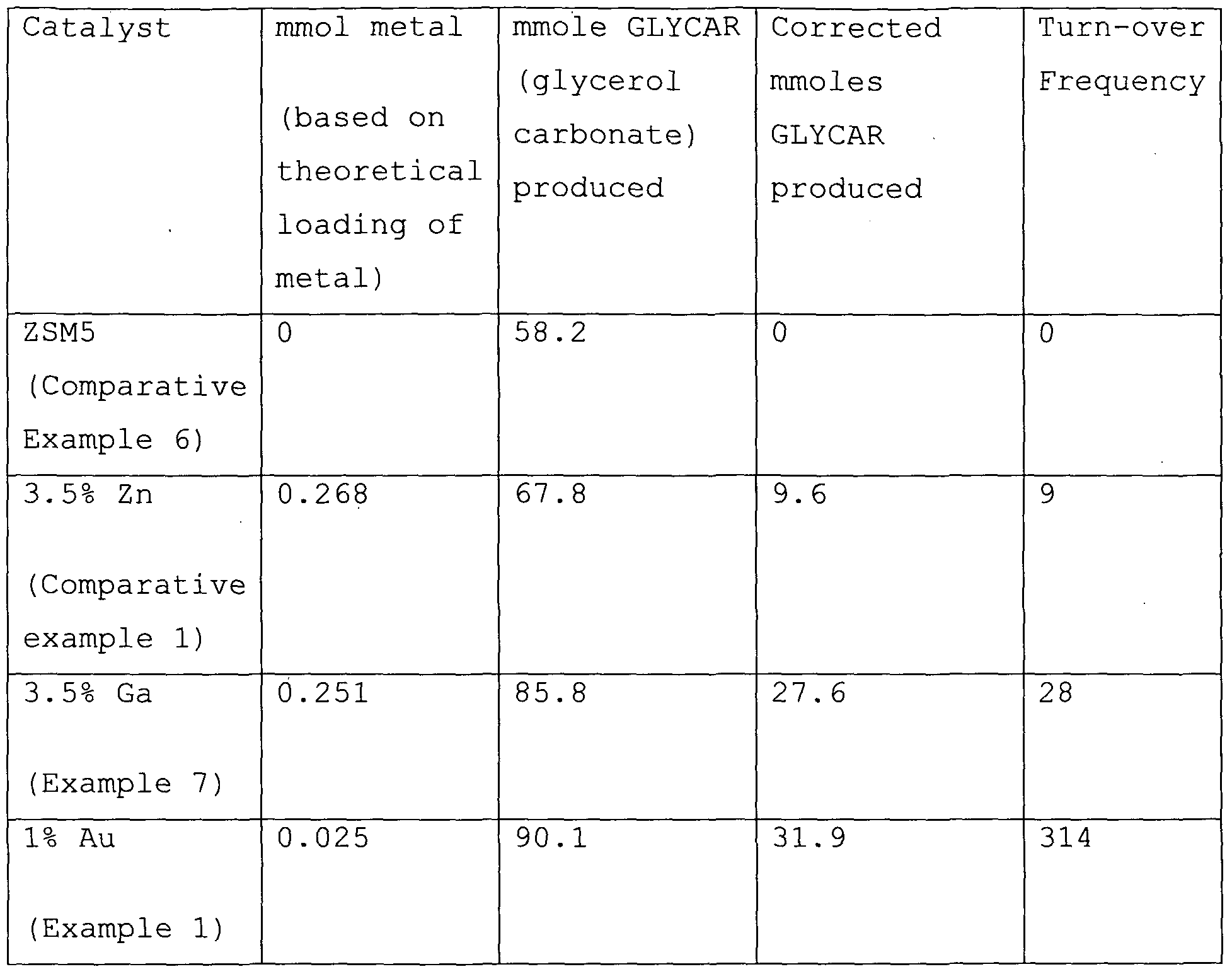
- Tables 1 and 2 show data obtained from this first set of experiments.
- the data in Table 1 obtained from Comparative Examples 5, 6 and 8 clearly illustrate that the reaction takes place in the absence of a catalyst and that a support without a catalyst also promotes the reaction. These factors may be taken into account by calculating a turnover frequency which is the "corrected" moles of glycerol carbonate produced per mole of metal, per hour.
- the corrected moles of glycerol carbonate is calculated by subtracting the number of moles of glycerol carbonate produced in the reaction using only the zeolite from the number of moles of glycerol carbonate produced in the reaction using the zeolite loaded with metal.
- Table 3 shows data obtained from this second set of experiments.
- the data of Table 3 obtained from Comparative Examples 9 and 10 illustrate that the reaction takes place in the absence of a catalyst and that an unsupported zinc catalyst also promotes the reaction.
- the figures for Turnover Frequency (TOF) in Table 3 were calculated thus:
Landscapes
- Chemical & Material Sciences (AREA)
- Organic Chemistry (AREA)
- Engineering & Computer Science (AREA)
- Materials Engineering (AREA)
- Chemical Kinetics & Catalysis (AREA)
- Crystallography & Structural Chemistry (AREA)
- Catalysts (AREA)
- Organic Low-Molecular-Weight Compounds And Preparation Thereof (AREA)
Abstract
A method of making an organic carbonate compound or sulphur analogue thereof is provided, the method comprising reacting urea (or a urea derivative or analogue) with an organic compound comprising at least one group selected from hydroxyl or thiol, in the presence of a catalyst composition comprising a metal catalyst comprising gold, palladium, silver, gallium or platinum.
Description
Method for making organic carbonates and sulphur analogues
The present invention relates to a method for the manufacture of organic carbonates and sulphur analogues thereof. Organic carbonates are compounds with an -0-C (0) -0- functional group which have many uses, for example, in the manufacture of polymers, as an emulsifier in cosmetics and as a lustering agent. The carbonate group may be part of a ring system, in which case the compound is considered a cyclic carbonate, or not, in which case the compound is considered a linear carbonate .
Sulphur-containing analogues of organic carbonates are known. For example, compounds containing the functional group -S-(O)-S- are known, such as the cyclic, S, S-propylene ester of dithiocarbonic acid (also known as 4-methyl-l, 3-dithiolan- 2-one) .

One convenient method of manufacturing one particular carbonate, glycerol carbonate, comprises reacting urea with glycerol in the presence of a catalyst, generating ammonia as a by-product (see Reaction Scheme 1) .
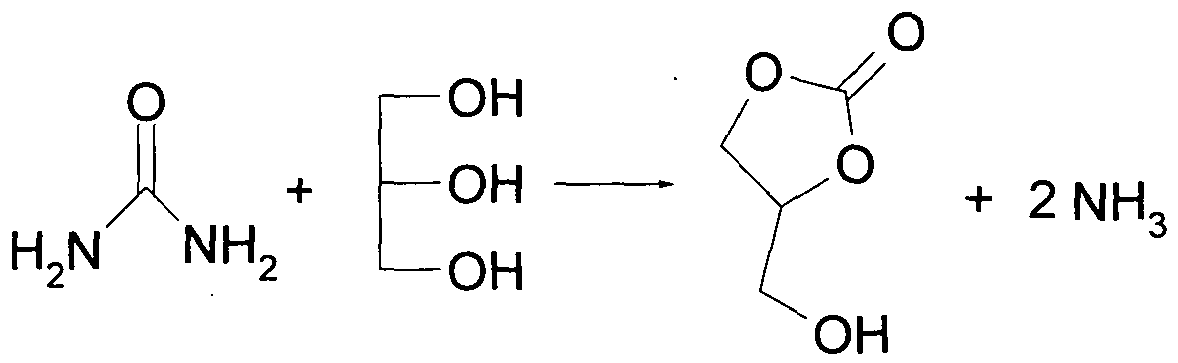
This reaction has attracted attention because urea is plentiful and inexpensive, and ammonia generated by the reaction may be reacted with carbon dioxide to produce urea, thus providing a method of capturing carbon dioxide. Various catalysts have been used in this reaction, and some of these are now discussed.
EP0443758 discloses the use of an aqueous tin salt catalyst. EP0581131 discloses the use of zinc, magnesium, lead and calcium salts (and zinc powder) as catalysts at reduced pressure. US6025504 discloses the use of zinc, magnesium, manganese, iron, nickel, cadmium, strontium, and barium salts as catalysts, some in solution and some provided on solid supports .
Several problems have been found to exist with the methods of the prior art for making organic carbonates and sulphur analogues thereof. The use of homogeneous catalysts (i.e. catalysts in solution) may require the recovery of the catalyst from the solution containing the product. Such recovery processes increase complexity and cost. Furthermore, homogeneous catalysis may lead to contamination of the product with unwanted metal ions which may have to be removed, depending on the required purity of the product. Some known methods have proved to be relatively slow and the selectivity (i.e. the amount of desired product as a proportion of the total amount of product made [including unwanted by-products] ) may be low. Furthermore, sometimes a large amount of catalyst is needed to generate a given amount of desired product, resulting in a small turn-over frequency (TOF) .
The method of the present invention seeks to address one or more of the above-mentioned problems.
In accordance with a first aspect of the present invention, there is provided a method of making an organic- carbonate compound or a sulphur analogue thereof, the method comprising reacting urea (or a urea derivative or analogue) with an organic compound comprising at least one group selected from hydroxyl and thiol in the presence of a catalyst composition comprising a metal catalyst comprising gold, palladium, silver, gallium or platinum. '
The method of the present invention has proved to be , unexpectedly efficient, especially when using gold or gallium as the catalyst. It has been found that relatively large amounts of product may be generated using small amounts of metal catalyst (therefore giving a high turnover frequency) .
References herein to sulphur analogues of organic carbonate compounds should be taken to refer to compounds in which one or more of the carbonate oxygens are replaced with sulphur, that is, compounds containing the group -X-C (X1 ) -X ' ' - where X, X' and X1 ' are each selected from oxygen and sulphur with at least one of X, X1 and X1 ' being sulphur. Preferably, X' is oxygen. In one embodiment X and X'' are sulphur and X' is oxygen. Such compounds are referred to herein as diesters of dithiocarbonic acid. In that case the method of the invention will involve reacting urea (or a urea derivative or analogue) with an organic compound comprising at least one thiol group (-SH) .
In an alternative embodiment, the method is a method for making an organic carbonate compound which comprises reacting urea (or a derivative thereof) with an organic compound comprising at least one hydroxyl group in the presence of the catalyst composition.
The organic carbonate compound or sulphur analogue thereof may be a cyclic carbonate or cyclic sulphur analogue thereof or a non-cyclic (linear) carbonate or non-cyclic sulphur analogue thereof. Where a non-cyclic carbonate or sulphur analogue product is desired, the organic compound comprising at least one group selected from hydroxyl and thiol has only one such group which takes part in the reaction, for example, the compound may be a mono-alcohol such as methanol, ethanol, propanol and butanol .
Where a cyclic product is desired, the organic compound will comprise at least two groups independently selected from hydroxyl and thiol on different carbon atoms. In a favoured embodiment, there is provided a method of making a cyclic organic carbonate compound, the method comprising reacting urea (or a urea derivative or analogue) with an organic compound comprising at least two hydroxyl groups on different carbon atoms, in the presence of a catalyst composition comprising a metal catalyst comprising gold, palladium, silver, gallium and platinum
The term "hydroxyl group" as used herein includes OH groups attached to aromatic carbons as well as OH groups attached to non-aromatic carbons. Thus, in one embodiment, the method of the invention is a method of making bisphenol carbonate and the organic compound comprising at least one group selected from hydroxyl and thiol is phenol.
The term "metal catalyst" refers to a metal species in any oxidation state, and is not limited to elemental metal. Indeed, the metal catalyst is often derived from metal salts, and so the oxidation state of the metal catalyst is unlikely to be zero.
It is preferred that the catalyst composition comprises a supported metal catalyst. Alternatively, the catalyst composition may comprise a metal catalyst in solution.
The metal catalyst may, for example, comprise more than one catalytically-active metal. Each of the catalytically-active metals may, for example, be chosen from the group consisting of gold, palladium, silver, gallium and platinum.
Alternatively, at least one catalytically-active metal may be other than gold, palladium, silver, gallium or platinum, such as bismuth.
If the catalyst composition comprises a supported metal catalyst, the catalyst composition may, for example, comprise the metal catalyst supported by a support. The support may be any suitable support. The support may, for example, be a polymeric organic support (such as a polystyrene (PS), polyethylene (PE) and PS-Polyethylene glycol supports) . The support may, for example, comprise an inorganic support. An inorganic support may, for example, comprise one or more of silica, silicate, phosphate, aluminosilicate, alumina, metal oxide, aluminium phosphate and zeolite. A metal oxide support may comprise one or more of titanium dioxide, an oxide of a metal having an oxidation state of +3 (such as iron (III) oxide), niobium oxide, cerium (IV) oxide or an oxide of a metal having an oxidation state of +2 (such as magnesium oxide and zinc oxide) . If the supported metal catalyst comprises gold, the support may optionally comprise one or both of a zeolite and a metal oxide (preferably an oxide of a metal having an oxidation state of +2 or +3, more preferably +2, such as MgO or ZnO) . The support may comprise an activated carbon support.
It is preferred that the method of the present invention comprises reacting urea (NH2-C(O)-NHz) with said organic compound. The method may alternatively comprise reacting a urea derivative or analogue with said organic compound. The analogue or derivative should preferably have at least one hydrogen bonded to each of the nitrogen atoms.
The urea derivative or analogue may, for example, have the structure (R1) (R2) N-C (O) -N (R3) (R4) , wherein R1, R2, R3 and R4 are independently selected from one of H, heterocyclyl, hydrocarbyl, organoheteryl and organyl, so long as one of R1 and R2 is H and one of R3 and R4 is H.
R1, R2, R3 and R4 may typically be independently selected from alkyl, alkenyl, alkynyl, aryl, cycloalkyl, heteroaryl, alkylaryl and heteroalkyl. R1, R2, R3 and R4 may be substituted or unsubstituted.
Any of R1, R2, R3 and R4 which are not H may, for example, comprise from 1 to 12 carbon atoms, more preferably from 1 to 6 carbon atoms, and when R1, R2, R3 or R4 comprises an alkyl group, it is preferred that the alkyl group comprises from 1 to 3 carbon atoms, and is preferably methyl. If R1, R2, R3 or R4 is alkyl, alkenyl or alkynyl, then the alkyl, alkenyl or alkynyl group may be linear or branched.
It is preferred that the support, if present, is porous. The support may, for example, be microporous (majority of the porosity resulting from pores having a diameter of less than 2nm) , mesoporous (majority of the porosity resulting from pores having a diameter of from 2 to 50nm) or macroporous (majority of the porosity resulting from pores having a diameter of over 50nm) .
It is preferred that the catalyst comprises Lewis acid sites.
It is preferred that, if the catalyst composition comprises a supported metal catalyst, the catalyst composition comprises from 0.01 to 10 weight %, preferably from 0.1 to 4 weight %, optionally from 0.1 to 3 weight %, more preferably from 0.1 to 2 weight % and further more preferably from 0.2 to 1.5 weight % of metal catalyst. This is particularly the case if the metal is gold. It has surprisingly been determined that in certain circumstances higher concentrations of metal (in particular, gold) does not lead to the expected increase in catalytic activity. Without being bound by theory, it is speculated that that lack of expected increase in activity might be due to higher loadings causing blockage of the pores of the support, decreasing the support's effective surface area. Another possible explanation is that higher loadings might lead to sintering of the catalyst metal particles into less active larger particles of the metal catalyst. The weight content may be determined by any suitable means, for example, by calculation based on masses of the starting materials or by using energy dispersive x-ray spectroscopy.
The molar ratio of catalytic metal to urea (or urea derivative or analogue) may, for example, be in the range of from 10~5:l to 10"3:l, optionally in the range of from 10"5:l to 10~4:l and more optionally in the range of from 10"5:l to 5xlO"5:l.
The molar ratio of catalytic metal to said organic compound may be, for example, in the range of from 10~5:l to 10"3:l, optionally in the range of from 10~5:l to 10~4:l and more optionally in the range of from 10"5:l to 5xlO"5:l.
If the catalyst composition comprises a supported metal catalyst, the supported metal catalyst may in one embodiment be a non-calcined catalyst i.e. it has not been subject to a calcination process. It has been found that, unexpectedly, calcination (heating to remove impurities and surface water)
has lead to poorer performance of certain catalysts, and in particular supported gold catalysts.
The metal catalyst may in certain embodiments have associated with it one or more species derived from counter ions. Such species may result from the process used to incorporate the metal into the support. For example, a gold salt (such as gold chloride) may be used. If the catalyst composition comprise a supported metal catalyst, the counter ions (in this case, chloride) may be supported on the support. Calcination or other treatment may be used to remove such species, but calcination may, in some cases, not be beneficial. If the catalyst composition comprises a supported metal catalyst, the catalyst composition may optionally comprise from 0.01 to 2 weight %, preferably from 0.01 to 1 weight %, more preferably from 0.05 to 0.5 weight % and further more preferably from 0.2 to 0.5 weight % of the one or more species derived from counter ions. The weight content may be determined, for example, using energy dispersive x-ray spectroscopy.
If the catalyst composition comprises a supported metal catalyst, the mean largest dimension of particles of the supported metal catalyst may, for example, be in the range of from 0.5 to lOOnm, optionally from 0.5 to 50nm, optionally from 0.5 to IOnmm, optionally from 0.5 to 5nm, optionally from 0.5 to 3nm.
The resultant compound produced by the method of the present invention optionally is a cyclic carbonate which comprises two oxygen atoms as part of a ring structure.
The organic compound comprising at least one group selected from hydroxyl and thiol may, for example, be a diol (such as a 1,2-diol or a 1,3-diol) . The said two hydroxyl groups may typically be attached to adjacent carbon atoms. For example,
the said organic compound may be a 1,2-diol, or a 3,4-diol. The said organic compound may, for example, comprise more than two hydroxyl groups, two of which are attached to adjacent carbon atoms (as in the case of glycerol) . This may lead to the formation of the five-membered carbonate ring. Examples of other products which may be made using the method of the present invention include products with a six-membered ring (for example, if the said organic compound comprises a 1,3- diol). The organic compound may be a carbohydrate, such as a sugar. Where a carbohydrate is used, it is possible that the ring would not close, and linear carbonate product would result .
In accordance with a second aspect of the present invention, there is provided a catalyst composition comprising a metal catalyst supported on a support, the metal catalyst comprising one or more of gold, palladium, silver, gallium and platinum, and wherein the catalyst composition comprises one or more counter ions, the catalyst composition comprising from 0.01 to 2 weight % of the counter ions and from 0.01 to 10 weight % of the metal catalyst.
The counter ions may, for example, comprise chloride.
The catalyst composition may, for example, comprise from 0.1 to 4 weight %, more preferably from 0.1 to 2 weight % and further more preferably from 0.2 to 1.5 weight % of metal catalyst .
The catalyst composition may, for example, comprise from 0.01 to 1 weight %, more preferably from 0.05 to 0.5 weight % and further more preferably from 0.2 to 0.5 weight % of counter ions .
The catalyst composition may, in one embodiment, comprise those features described above in relation to the method of
the first aspect of the present invention. For example, the catalyst composition may comprise a zeolite support. The metal catalyst may typically comprise gold. The catalyst composition may comprise 0.2-2 weight '% of gold catalyst. The metal catalyst is preferably uncalcined.
The reaction may be carried out neat, or in any suitable solvent. Preferably, the reaction is carried out at an elevated temperature, for example, a temperature in excess of 1000C, optionally a temperature of at least 1300C. Where the organic compound is relatively low boiling, for example, methanol, it will be desirable to use a relatively high boiling solvent so that the desired elevated temperature can be attained. Preferably, any ammonia or other gaseous products generated in the reaction are removed from the reaction, for example, by a flow of inert gas.
The present invention will now be described for the purpose of illustration with reference to the following examples.
Supported Catalyst 1
A supported catalyst for use in the method of the present invention was synthesised using a process generally known as an impregnation process. An aqueous solution of HAuCl4.3H2O (7.5cm3, 2g dissolved in 250cm3 water) was added to a solid zeolite support (ZSM5 (30), 2.97g) with stirring at room temperature. The suspension/slurry was heated at 90°C for evaporation of excess water, and the resultant paste dried at 1100C overnight. The nominal gold content was lwt% i.e. weight of the gold was 1% of the total weight of the catalyst and support .
Supported Catalyst 2
A further supported catalyst for use in an example of the method of the present invention was synthesised in accordance with the method used to make Catalyst 1, but using a larger volume of the gold solution. The nominal gold loading was 2v.5%.
Supported Catalyst 3
A further catalyst for use in an example of the method of the present invention was synthesised using a method generally known as a deposition-precipitation process. An aqueous solution of HAuCl4.3H2O (3mL, 2g dissolved in 10OmL water) was added to distilled water (50OmL) containing a zeolite support (ZSM5 (30) , 2.9Iq) and urea (1Og) . Upon stabilisation of the acidic pH, the suspension was heated to 85°C for 3 hours to decompose urea and raise the resultant pH to 6.8. The suspension was subsequently filtered hot and washed with distilled water. The yellow paste was dried overnight at 1000C overnight. The nominal gold content was lwt%.
Supported Catalyst 4
A further supported catalyst for use in an example of the method of the present invention was synthesised in accordance with the method used to make Catalyst 1, but after drying the sample was static air calcined at 4000C for 4 hours. The nominal gold content was lwt%.
Supported Catalyst 5
A further supported catalyst for use in an example of the method of the present invention was synthesised in accordance with the method used to make Catalyst 2, but after drying the
sample was static air calcined at 400°C for 4 hours. The nominal gold content was 3wt%.
Supported Catalyst 6
A further supported catalyst for use in an example of the method of the present invention was synthesised in accordance with the method used to make Catalyst 3, but after drying the sample was static air calcined at 400°C for 4 hours. The nominal gold content was lwt%.
Supported Catalyst 7
A further supported catalyst for use in an example of the method of the present invention was synthesised by a deposition-precipitation technique using a solution of urea and gallium (III) nitrate hydrate in conjunction with a ZSM5 support. Gallium nitrate, 0.875g, was dissolved in distilled water (1800ml) at room temperature and 20.66g of urea (98+%, obtained from Alfa Aesar) was added while stirring. The pH and temperature recorded throughout. The ZSM5 was added (3.86g) and the temperature was slowly raised to produce a gradual and slow increase in pH up to 6.8 with a final temperature of 84.3°C. The catalyst was obtained by filtration of the hot mixture, washed with hot distilled water (50cm3) and dried at 110°C in an oven overnight. Finally, the catalyst was calcinated in air at 5500C for 4 hours prior to testing. The nominal gallium content of the support was 3.5wt%.
Supported Catalyst 8
A further supported catalyst for use in an example of the method of the present invention was obtained from the World Gold Council. The catalyst comprises 1.5wt% gold on titanium dioxide (P-25, Degussa) (Lot No. Au-TiO2 #02-05) . The catalyst
was made by the deposition precipitation technique as described in M. Haruta, N. Yamada, T. Kobayahsi, S. Iijima, J. Catal. 115 (1989) 301 and S. Tsubota, M. Haruta, T. Kobayashi, A. Ueda, Y. Nakahara, Stud. Surf. Sci. Catal. 63 (1991) 695. Characterisation data provided by the World Gold Council indicate the gold content to be 1.5 wt%, as determined by inductively coupled plasma analysis. Transmission electron microscopy (TEM) indicates that gold particles are well dispersed and have an average diameter of 3.7±1.5nm.
Supported Catalyst 9
A further supported catalyst for use in an example of the method of the present invention was synthesised as follows. A solid titanium dioxide support (supplied by Degussa) (1.95g) was slowly added to 5.1 cm3 of an aqueous solution of HAuCl4.3H2O [the gold solution being obtained by dissolving 5g of HAuCl4.3H2O in 250cm3 water] with stirring at room temperature until the mixture became homogeneous. The slurry dried at 1100C for 16 hours. The obtained material was heated at 400°C for 3 hours in static air. The nominal gold content was 2.5wt% i.e. weight of the gold was 2.5% of the total weight of the catalyst and support.
Supported Catalyst 10
A further supported catalyst for use in an example of the method of the present invention was synthesised as follows. The catalyst was prepared using the method described in F.
Moreau and G. C. Bond, Applied Catalysis A: General 302 (2006), pages 110-117. Briefly, the pH of a HAuCl4 solution (1 x 10~4 M) was raised by addition of NaOH to 9. Titanium dioxide powder (P-25, Degussa) was added, with the resultant pH decrease being partially reversed by further NaOH addition, the pH being kept at 9 throughout the preparation. The
theoretical gold loading was 1%. The resulting suspension was heated to 700C for 1 h before cooling, filtering and drying. The catalyst was calcined before use.
Supported Catalyst 11
A further supported catalyst for use in an example of the method of the present invention was obtained from the World Gold Council. The catalyst comprises 4.5wt% gold on iron (III) oxide was obtained from the World Gold Council (Lot No. Au- Fe2O3 #02-3) . The catalyst was made by a co-precipitation technique as described in M. Haruta, N. Yamada, T. Kobayahsi, S. Iijima, J. Catal. 115 (1989) 301 and S. Tsubota, M. Haruta, T. Kobayashi, A. Ueda, Y. Nakahara, Stud. Surf. Sci. Catal. 63 (1991) 695. Characterisation data provided by the World Gold Council indicate the gold content to be 4.5 wt%, as determined by inductively coupled plasma analysis. Transmission electron microscopy (TEM) indicates that gold particles are well dispersed and have an average diameter of 3.7±0.9nm.
Supported Catalyst 12
A further supported catalyst for use in an example of the method of the present invention was synthesised as follows. The catalyst was obtained using the general method described above in relation to Supported Catalyst 9, but using an activated carbon (G60) support instead of titanium dioxide. The activated carbon support was supplied by Johnson Matthey. The nominal gold content was 2.5wt% i.e. weight of the gold was 2.5% of the total weight of the catalyst and support.
Supported Catalyst 13
A further supported catalyst for use in an example of the method of the present invention was synthesised as follows. This catalyst was obtained using the general method described
above in relation to Supported Catalyst 9, but using a silicon dioxide support instead of titanium dioxide. The silicon dioxide support was supplied by Degussa. The nominal gold content was 2.5wt% i.e. weight of the gold was 2.5% of the total weight of the catalyst and support.
Supported Catalyst 14
A further supported catalyst for use in an example of the method of the present invention was synthesised as follows. This catalyst was obtained using the general method described above in relation to Supported Catalyst 9, but using a niobium (V) oxide support instead of titanium dioxide. The niobium (V) oxide support was supplied by Aldrich. The nominal gold content was 2.5wt% i.e. weight of the gold was 2.5% of the total weight of the catalyst and support.
Supported Catalyst 15
A further supported catalyst for use in an example of the method of the present invention was synthesised as follows. This catalyst was obtained using the general method described above in relation to Supported Catalyst 9, but using a magnesium oxide support instead of titanium dioxide. The magnesium oxide support was supplied by Aldrich. The nominal gold content was 2.5wt% i.e. weight of the gold was 2.5% of the total weight of the catalyst and support.
Supported Catalyst 16
A further supported catalyst for use in an example of the method of the present invention was synthesised as follows. This catalyst was obtained using the general method described above in relation to Supported Catalyst 9, but using a zinc oxide support instead of titanium dioxide. The zinc oxide support was supplied by Aldrich. The nominal gold content was
2.5wt% i.e. weight of the gold was 2.5% of the total weight of the catalyst and support.
Supported Catalyst 17
A further supported catalyst for use in an example of the method of the present invention was synthesised as follows. PdCl2 (0.083 g) was dissolved in gold solution (5.1 cm3) by vigorous stirring. The gold solution was formed by dissolving HAuCl4-3H2O (5g) in water (25OmL) . After the complete dissolution of the palladium salt, the support (cerium oxide (CeO2), 1.9 g, Aldrich) was added very slowly to the Au-Pd solution and stirred until the suspension/slurry became homogeneous. The slurry was dried for 16 hrs at 110 °C and the obtained material was then calcined at 400 0C for 3 h in static air. The nominal gold content was 2.5wt% and the nominal palladium content was 2.5wt%.
Comparative catalyst 1
A supported catalyst for as a comparison was synthesised by a deposition-precipitation technique using a solution of ammonia and zinc nitrate hexahydrate in conjunction with a ZSM5 support. An aqueous solution containing zinc nitrate and the zeolite were vigorously stirred in a beaker while pH and temperature were read. A stock solution of 0. IM NH3 was first prepared by placing 5.52ml if 35% ammonia solution in 1 litre H2O. A solution containing zinc nitrate and 3.86g ZSM in 86cm3 distilled water was placed in a 500ml beaker. The the solution of 0. IM NH3 was added drop wise, (about 150ml) until the pH of the resulting suspension reached the value of 9. The precipitate was separated by filtration and dried in an over at 1100C for 16hrs. The dry zeolite was caclinated in airflow at 5500C, at 20°C/min, for 4 hours. The nominal zinc content of the support was 3.5wt%.
Comparative catalyst 2
Unsupported zinc sulphate hydrate (Sigma-Aldrich, UK) was used as a further comparative catalyst.
Comparative catalyst 3
Unsupported magnesium sulphate (Sigma-Aldrich) was used as a further comparative catalyst.
Comparative catalyst 4
Unsupported vanadium sulphate (VSO5) (Sigma-Aldrich) was used as a further comparative catalyst.
The activities of the catalysts mentioned above were assessed by assessing their ability to catalyse the formation of glycerol carbonate from urea and glycerol. The method used was derived from that described in US6025504, US6495703 and J. W. Yoo and Z Mouloungui, Studies in Surface Science and
Catalysis, (2003), 146, 757-760. Briefly, the reaction vessel (in this case, a round bottomed flask) was held in thermal contact with an oil bath so that the contents of the flask could be heated by the oil. Glycerol was added to the reaction vessel and dried at the desired reaction temperature for 20 minutes. Nitrogen was bubbled through the glycerol during this drying process. Urea was then added and once the urea had mixed with the glycerol, the catalyst was added. Nitrogen gas was bubbled through the reaction mixture throughout the course of the reaction. Excess nitrogen gas and ammonia generated by the reaction were removed throughout the course of the reaction. Samples were periodically removed from the reaction mixture for analysis by high performance liquid chromatography
(HPLC) . On completion of the process, samples were taken for 1H and 13C nuclear magnetic resonance (NMR) analysis.
Refractive index HPLC was used to quantify the amount of glycerol which had reacted and the amount of target compound (glycerol carbonate) produced. It was therefore possible to quantify the selectivity of a particular catalyst (the selectivity being .the amount of the target compound produced in comparison to the total weight of products). 0. ImL of sample was removed from the reaction and diluted to 1.5mL with 0.01M H3PO4 acidified water. Upon centrifugation of the sample, 0.5mL was taken and diluted to 3mL- with HPLC solvent. Comparison with commercial standards was used to identify the HPLC peaks associated with glycerol and glycerol carbonate. The HPLC peak for glycerol was used to determine the amount of glycerol remaining in the reaction mixture and therefore the amount of glycerol which has reacted. The HPLC peak for glycerol carbonate, together with the peaks for any byproducts, was used to determine the selectivity of the reaction.
The effect of each of the catalysts above was assessed using the method described above.
In a first set of experiments, 0.3 moles of glycerol were reacted with 0.3 moles of urea at 1500C for four hours in the presence of 0.5g of catalyst [1.8 wt% i.e. the weight of the catalyst was 1.8% of the total weight of the catalyst, urea and glycerol] (with the exception of those catalysts marked "+" in Table 1, for which 2.37g [8.6 wt%] of catalyst was used) . After four hours, samples were extracted and analysed. Calculations of the mass of metal and the number of mMoles of metal in the sample were based on the notional catalytic loading of the supports.
In a second set of experiments, 0.15 moles of glycerol were reacted with 0.225 moles of urea at 1500C for four hours in the presence of 0.25g of catalyst. After four hours, samples were extracted and analysed.
First Set of Experiments
As previously indicated, in the first set of experiments 0.3 moles of glycerol were reacted with 0.3 moles of urea at 150°C for four hours in the presence of 0.5g of catalyst [1.8 wt% i.e. the weight of the catalyst was 1.8% of the total weight of the catalyst, urea and glycerol] (with the exception of those catalysts marked "+" in Table 1, for which 2.37g [8.6 wt%] of catalyst was used) .
Tables 1 and 2 show data obtained from this first set of experiments. The data in Table 1 obtained from Comparative Examples 5, 6 and 8 clearly illustrate that the reaction takes place in the absence of a catalyst and that a support without a catalyst also promotes the reaction. These factors may be taken into account by calculating a turnover frequency which is the "corrected" moles of glycerol carbonate produced per mole of metal, per hour. The corrected moles of glycerol carbonate is calculated by subtracting the number of moles of glycerol carbonate produced in the reaction using only the zeolite from the number of moles of glycerol carbonate produced in the reaction using the zeolite loaded with metal. Once these factors are taken into account, the high catalytic activities of gold and gallium are clearly demonstrated in Table 2. This clearly demonstrates the unexpectedly high activity of the gold and gallium. Furthermore, using the measured gold content of the catalyst (0.6wt.% gold) as opposed to the theoretical gold content, the turnover frequency in Example 1 is 520.
Table 1 - comparison of activities of catalysts

Second Set of Experiments
As previously indicated, in the second set of experiments, 0.15 moles of glycerol were reacted with 0.225 moles of urea at 15O0C for four hours in the presence of 0.25g of catalyst. After four hours, samples were extracted and analysed.
Table 3 shows data obtained from this second set of experiments. The data of Table 3 obtained from Comparative Examples 9 and 10 illustrate that the reaction takes place in the absence of a catalyst and that an unsupported zinc
catalyst also promotes the reaction. The figures for Turnover Frequency (TOF) in Table 3 were calculated thus:
TOF (/hr) = (% Conversion x 0.15)
[100 x moles of metal x reaction time in hours] It is therefore not possible to directly compare the turnover frequencies of Table 3 with those calculated in Table 2 (relating to the first set of experiments) because the manner of calculating Turnover Frequency is different. However, it is clear from Table 3 that the use of lower concentrations of catalytic metals provides unexpectedly good results (see the comparatively high turnover frequencies calculated for the methods using Catalysts 8 and 10 which contain less metal catalyst) . Furthermore, it is worth noting that the catalysts using zinc oxide and magnesium oxide supports proved to be particularly effective (see Examples 15 and 16) .
It is also worth noting that the reactions in the second set of experiments (associated with a smaller amount of catalyst and reactants, and shown in Table 3) produced higher conversion percentages, but lower selectivity for glycerol carbonate than the reactions of the first set of experiments (the results shown in Tables 1 and 2) .
Table 3 - calculated turnover frequencies for selected catalysts
 Where in the foregoing description, integers or elements are mentioned which have known, obvious or foreseeable equivalents, then such equivalents are herein incorporated as if individually set forth. Reference should be made to the claims for determining the true scope of the present invention, which should be construed so as to encompass any such equivalents. It will also be appreciated by the reader that integers or features of the invention that are described as preferable, advantageous, convenient or the like are optional and do not limit the scope of the independent claims .
Claims
1. A method of making an organic carbonate compound or sulphur analogue thereof, the method comprising reacting urea (or a urea derivative or analogue) with an organic compound comprising at least one group selected from hydroxyl or thiol, in the presence of a catalyst composition comprising a metal catalyst comprising gold, palladium, silver, gallium or platinum.
2. A method as claimed in claim 1 which is a method of making an organic carbonate compound, comprising reacting urea (or a urea derivative or analogue) with an organic compound comprising at least one hydroxyl group.
3. A method as claimed inn claim 1 or 2, which is a method of making a cyclic carbonate compound, the method comprising reacting urea (or a urea derivative or analogue) with an organic compound comprising at least two hydroxyl groups on different carbon atoms, in the presence of a catalyst composition comprising a metal catalyst comprising one or more of gold, palladium, silver, gallium and platinum.
4. A method according to any of claims 1 to 3 wherein the metal catalyst comprises more than one catalytically-active metal .
5. A method according to claim 4 wherein each of the catalytically-active metals is chosen from the list consisting of gold, palladium, silver, gallium and platinum or at least one catalytically-active metal is other than gold, palladium, silver, gallium or platinum.
6. A method according to any one preceding claim wherein the catalyst composition comprises a supported metal catalyst, the metal catalyst being supported by a support.
7. A method according to claim 6 wherein the support is an inorganic support .
8. A method according to claim 7 wherein the support comprises a zeolite or an oxide of a metal having an oxidation state of 2+ or 3+.
9. A method according to any one of claims 6 to 8, wherein the support is porous.
10. A method according to any one of claims 6 to 9, the metal provides from 0.01 to 10% of the weight of the catalyst composition.
11. A method according to claim 10 wherein the catalyst composition comprises from 0.1 to 4 weight % of the metal.
12. A method according to claim 11 wherein the catalyst composition comprises from 0.1 to 2 weight % of the metal.
13. A method according to claim 12 wherein the catalyst composition comprises from 0.2 to 1.5 weight % of the metal.
14. A method according to any one of claims 1 to 13, wherein the catalyst composition comprises one or more counterions.
15. A method according to claim 14 wherein the catalyst composition comprises from 0.01 to 2 weight% of counterions.
16. A method according to any one of claims 1 to 5 wherein the catalyst composition comprises a metal catalyst in solution.
17. A method according to any one preceding claim wherein the method of the present invention comprises reacting urea
(NH2-C (O) -NH2) with said organic compound.
18. A method according to any one preceding claim wherein the method comprises reacting a urea derivative or analogue with said organic compound, the urea derivative or analogue may have the structure N (R1) (R2) -C (0) -N (R3) (R4) , wherein R1, R2, R3 and R4 are independently selected from one of H, heterocyclyl, hydrocarbon, organoheteryl and organyl, so long as one of R1 and R2 is H and one of R3 and R4 is H.
19. A method according to claim 18 wherein R1, R2, R3 and R4 are independently selected from alkyl, alkenyl, alkynyl, aryl, cycloalkyl, heteroaryl, alkylaryl and heteroalkyl.
20. A method according to claim 18 or claim 19 wherein any of R1, R2, R3 and R4 which are not H comprise from 1 to 12 carbon atoms.
21. A method according to any of claims 18 to 20 wherein at least one of R1, R2, R3 and R4 comprises an alkyl group, and the alkyl group comprises from 1 to 3 carbon atoms.
22. A method according to any one preceding claim wherein the molar ratio of catalytic metal to urea (or urea derivative or analogue) is from 10~5:l to 10~3:l.
23. A method according to claim 22 wherein the molar ratio of catalytic metal to urea (or urea derivative or analogue) is from 10~5:l to 10"4:l.
24. A method according to claim 23 wherein the molar ratio of catalytic metal to urea (or urea derivative or analogue) is from 10~5:l to 5xlO"5:l.
25. A method according to any one preceding claim wherein the molar ratio of catalytic metal to said organic compound is from 10"5:l to 10"3:l.
26. A method according to claim 25 wherein the molar ratio of catalytic metal to said organic compound is from 10~5:l to 10~4:l.
27. A method according to claim 26 wherein the molar ratio of catalytic metal to said organic compound is from 10~5:l to 5xlO~5:l.
28. A method according to any one of claims 6 to 15 and any one of claims 17 to 27 when dependent on any of claims 6 to 15, wherein the supported metal catalyst is a non-calcined catalyst .
29. A method according to any one preceding claim, wherein the said organic compound comprises two hydroxyl groups which are attached to adjacent carbon atoms.
30. A method according to any one preceding claim, wherein the organic compound comprises more than two hydroxyl groups .
31. A catalyst composition comprising a metal catalyst supported on a support, the metal catalyst comprising one or more of gold, palladium, silver, gallium and platinum, and wherein the catalyst composition comprises one or more counter ions, the catalyst composition comprising from 0.01 to 2 weight % of the counter ions and from 0.01 to 10 weight % of the metal catalyst.
Applications Claiming Priority (2)
| Application Number | Priority Date | Filing Date | Title |
|---|---|---|---|
| GB0903233.5 | 2009-02-25 | ||
| GBGB0903233.5A GB0903233D0 (en) | 2009-02-25 | 2009-02-25 | Method for making organic carbonates and sulphur analogues |
Publications (1)
| Publication Number | Publication Date |
|---|---|
| WO2010097585A1 true WO2010097585A1 (en) | 2010-09-02 |
Family
ID=40565726
Family Applications (1)
| Application Number | Title | Priority Date | Filing Date |
|---|---|---|---|
| PCT/GB2010/000336 Ceased WO2010097585A1 (en) | 2009-02-25 | 2010-02-25 | Method for making organic carbonates and sulphur analogues |
Country Status (2)
| Country | Link |
|---|---|
| GB (1) | GB0903233D0 (en) |
| WO (1) | WO2010097585A1 (en) |
Cited By (2)
| Publication number | Priority date | Publication date | Assignee | Title |
|---|---|---|---|---|
| CN102952110A (en) * | 2012-12-06 | 2013-03-06 | 盘锦科隆精细化工股份有限公司 | Method for synthesizing glycerol carbonate from glycerol |
| US11578034B2 (en) * | 2017-04-11 | 2023-02-14 | Sabic Global Technologies B.V. | Integrated process for production of glycerol carbonate (4-hydroxymethyl-2-oxo-1, 3-dioxolane) and urea |
Citations (9)
| Publication number | Priority date | Publication date | Assignee | Title |
|---|---|---|---|---|
| EP0443758A1 (en) | 1990-02-20 | 1991-08-28 | Texaco Chemical Company | A process for preparing alkylene carbonates |
| EP0581131A2 (en) | 1992-07-31 | 1994-02-02 | Mitsubishi Gas Chemical Company, Inc. | A process for producing alkylene carbonates |
| EP0866051A1 (en) * | 1997-03-17 | 1998-09-23 | Mitsubishi Gas Chemical Company, Inc. | Process for producing dialkyl carbonate |
| JPH10287625A (en) * | 1997-04-11 | 1998-10-27 | Mitsubishi Gas Chem Co Inc | Method for producing dialkyl carbonate |
| US6025504A (en) | 1998-04-30 | 2000-02-15 | Organisation Nationale Interprofessionnelle Des Oleagineux (O.N.I.D.Ol.) | Method for preparing glycerol carbonate |
| US6495703B1 (en) | 1999-02-24 | 2002-12-17 | Kao Corporation | Process for the preparation of glycerol carbonate |
| EP1629888A1 (en) * | 2004-08-27 | 2006-03-01 | Institute of Coal Chemistry, Chinese Academy of Sciences | Catalyst for the synthesis of dimethyl carbonate from urea and methanol, preparation and use thereof |
| WO2009052996A1 (en) * | 2007-10-22 | 2009-04-30 | Bayer Materialscience Ag | Rare earth based catalyst for the synthesis of organic carbonates, process for preparing the same and application thereof |
| WO2009106237A2 (en) * | 2008-02-26 | 2009-09-03 | Bayer Materialscience Ag | Catalyst for the synthesis of alkyl carbamates, the method for preparing the same and the use thereof |
-
2009
- 2009-02-25 GB GBGB0903233.5A patent/GB0903233D0/en not_active Ceased
-
2010
- 2010-02-25 WO PCT/GB2010/000336 patent/WO2010097585A1/en not_active Ceased
Patent Citations (9)
| Publication number | Priority date | Publication date | Assignee | Title |
|---|---|---|---|---|
| EP0443758A1 (en) | 1990-02-20 | 1991-08-28 | Texaco Chemical Company | A process for preparing alkylene carbonates |
| EP0581131A2 (en) | 1992-07-31 | 1994-02-02 | Mitsubishi Gas Chemical Company, Inc. | A process for producing alkylene carbonates |
| EP0866051A1 (en) * | 1997-03-17 | 1998-09-23 | Mitsubishi Gas Chemical Company, Inc. | Process for producing dialkyl carbonate |
| JPH10287625A (en) * | 1997-04-11 | 1998-10-27 | Mitsubishi Gas Chem Co Inc | Method for producing dialkyl carbonate |
| US6025504A (en) | 1998-04-30 | 2000-02-15 | Organisation Nationale Interprofessionnelle Des Oleagineux (O.N.I.D.Ol.) | Method for preparing glycerol carbonate |
| US6495703B1 (en) | 1999-02-24 | 2002-12-17 | Kao Corporation | Process for the preparation of glycerol carbonate |
| EP1629888A1 (en) * | 2004-08-27 | 2006-03-01 | Institute of Coal Chemistry, Chinese Academy of Sciences | Catalyst for the synthesis of dimethyl carbonate from urea and methanol, preparation and use thereof |
| WO2009052996A1 (en) * | 2007-10-22 | 2009-04-30 | Bayer Materialscience Ag | Rare earth based catalyst for the synthesis of organic carbonates, process for preparing the same and application thereof |
| WO2009106237A2 (en) * | 2008-02-26 | 2009-09-03 | Bayer Materialscience Ag | Catalyst for the synthesis of alkyl carbamates, the method for preparing the same and the use thereof |
Non-Patent Citations (6)
| Title |
|---|
| "Metal oxide catalyst for synthesizing methyl carbonate by urea process and its preparation", DERWENT, 18 December 2002 (2002-12-18), XP002356687 * |
| F. MOREAU; G.C. BOND, APPLIED CATALYSIS A: GENERAL, vol. 302, 2006, pages 110 - 117 |
| J.W. YOO; Z MOULOUNGUI, STUDIES IN SURFACE SCIENCE AND CATALYSIS, vol. 146, 2003, pages 757 - 760 |
| M. HARUTA; N. YAMADA; T. KOBAYAHSI; S. IIJIMA, J. CATAL., vol. 115, 1989, pages 301 |
| S. TSUBOTA; M. HARUTA; T. KOBAYASHI; A. UEDA; Y. NAKAHARA, STUD. SURF. SCI. CATAL., vol. 63, 1991, pages 695 |
| WANG M ET AL: "SYNTHESIS OF DIMETHYL CARBONATE FROM UREA AND METHANOL OVER METAL OXIDES", STUDIES IN SURFACE SCIENCE AND CATALYSIS, ELSEVIER BV, NL LNKD- DOI:10.1016/S0167-2991(04)80247-7, vol. 153, 1 January 2004 (2004-01-01), pages 197 - 200, XP008056371, ISSN: 0167-2991 * |
Cited By (2)
| Publication number | Priority date | Publication date | Assignee | Title |
|---|---|---|---|---|
| CN102952110A (en) * | 2012-12-06 | 2013-03-06 | 盘锦科隆精细化工股份有限公司 | Method for synthesizing glycerol carbonate from glycerol |
| US11578034B2 (en) * | 2017-04-11 | 2023-02-14 | Sabic Global Technologies B.V. | Integrated process for production of glycerol carbonate (4-hydroxymethyl-2-oxo-1, 3-dioxolane) and urea |
Also Published As
| Publication number | Publication date |
|---|---|
| GB0903233D0 (en) | 2009-04-08 |
Similar Documents
| Publication | Publication Date | Title |
|---|---|---|
| EP3647310B1 (en) | Method for preparing 2,5-furandimethylcarboxylate from hydroxymethylfurfural | |
| EP2401080B1 (en) | Process for the preparation of fischer-tropsch catalysts and their use | |
| JP6200946B2 (en) | Reduction catalyst | |
| WO2004085583A1 (en) | Process for producing ester through transesterification with solid acid catalyst | |
| JP5553484B2 (en) | Ammonia decomposition catalyst and ammonia decomposition method | |
| CN102006932A (en) | Catalysts | |
| US12492176B2 (en) | Process for preparation of 2, 5-furan dicarboxylic acid from 5-hydroxymethyl furfural | |
| RU2584915C2 (en) | Catalysts | |
| KR20140093700A (en) | A catalyst for direct synthesis of hydrogen peroxide | |
| Somma et al. | Effect of the matrix in niobium-based aerogel catalysts for the selective oxidation of olefins with hydrogen peroxide | |
| CN101983765B (en) | Catalyst for preparing methyl alcohol by catalytic hydrogenation on assistant modified carbon dioxide and preparation method thereof | |
| US10569255B2 (en) | Hydrocarbon synthesis catalyst, its preparation process and its use | |
| Pradhan et al. | An accelerated route for synthesis of Glycerol carbonate using MgTiO3 perovskite as greener and cheaper catalyst | |
| CA2962477C (en) | Coated composites of al2o3-ceo2/zro2 and a method for their production | |
| Patankar et al. | Cascade engineered synthesis of ethyl benzyl acetoacetate and methyl isobutyl ketone (MIBK) on novel multifunctional catalyst | |
| Kumar et al. | Mixed metal oxides as solid base catalysts: Fundamentals and their catalytic performance | |
| WO2010097585A1 (en) | Method for making organic carbonates and sulphur analogues | |
| José de Ribamar et al. | CO2 role on the glycerol conversion over catalyst containing CaO-SiO2 doped with Ag and Pt | |
| JP4698343B2 (en) | Catalyst for producing hydrocarbons from synthesis gas, method for producing the catalyst, and method for producing hydrocarbons from synthesis gas using the catalyst | |
| Tang et al. | Catalytic carbonylation of glycerol with carbon dioxide towards glycerol carbonate on Ca2+-and Mg2+-doped ZnO nanosized catalysts and enhancement by 3A zeolite dehydrating agent | |
| Abdullahi et al. | Zn x CeO 2 nanorod as active catalyst for CO 2 conversion into carbamates | |
| JP5075104B2 (en) | Catalyst for dimethyl ether production | |
| Liu et al. | Catalytic methanol decomposition at low temperature over Pd catalyst derived from mesoporous silica carried Pd-hydrotalcite | |
| Wongmaneenil et al. | Study on solvent/alkoxide molar ratios on synthesis zirconia nanoparticles for tungstated zirconia catalysts over esterification | |
| Kaminski | The Application of Copper-Gold Catalysts in the Selective Oxidation of Glycerol at Acid and Basic Conditions. Catalysts 2021, 11, 94 |
Legal Events
| Date | Code | Title | Description |
|---|---|---|---|
| 121 | Ep: the epo has been informed by wipo that ep was designated in this application |
Ref document number: 10709758 Country of ref document: EP Kind code of ref document: A1 |
|
| NENP | Non-entry into the national phase |
Ref country code: DE |
|
| 122 | Ep: pct application non-entry in european phase |
Ref document number: 10709758 Country of ref document: EP Kind code of ref document: A1 |