WO2010091877A2 - Process for producing ambrisentan - Google Patents
Process for producing ambrisentan Download PDFInfo
- Publication number
- WO2010091877A2 WO2010091877A2 PCT/EP2010/000885 EP2010000885W WO2010091877A2 WO 2010091877 A2 WO2010091877 A2 WO 2010091877A2 EP 2010000885 W EP2010000885 W EP 2010000885W WO 2010091877 A2 WO2010091877 A2 WO 2010091877A2
- Authority
- WO
- WIPO (PCT)
- Prior art keywords
- formula
- ambrisentan
- compound according
- dimethyl
- process according
- Prior art date
- Legal status (The legal status is an assumption and is not a legal conclusion. Google has not performed a legal analysis and makes no representation as to the accuracy of the status listed.)
- Ceased
Links
- LMTOWNMJYBIWTI-UHFFFAOYSA-N Cc1cc(C)nc(SC)n1 Chemical compound Cc1cc(C)nc(SC)n1 LMTOWNMJYBIWTI-UHFFFAOYSA-N 0.000 description 1
Classifications
-
- C—CHEMISTRY; METALLURGY
- C07—ORGANIC CHEMISTRY
- C07D—HETEROCYCLIC COMPOUNDS
- C07D239/00—Heterocyclic compounds containing 1,3-diazine or hydrogenated 1,3-diazine rings
- C07D239/02—Heterocyclic compounds containing 1,3-diazine or hydrogenated 1,3-diazine rings not condensed with other rings
- C07D239/24—Heterocyclic compounds containing 1,3-diazine or hydrogenated 1,3-diazine rings not condensed with other rings having three or more double bonds between ring members or between ring members and non-ring members
- C07D239/28—Heterocyclic compounds containing 1,3-diazine or hydrogenated 1,3-diazine rings not condensed with other rings having three or more double bonds between ring members or between ring members and non-ring members with hetero atoms or with carbon atoms having three bonds to hetero atoms with at the most one bond to halogen, directly attached to ring carbon atoms
- C07D239/32—One oxygen, sulfur or nitrogen atom
- C07D239/34—One oxygen atom
Definitions
- the invention relates to a process for producing Ambrisentan (I) comprising the step of reacting (S)-2-hydroxy-3-methoxy-3,3-diphenylpropanoic acid (II) with a 4,6-dimethyl- pyrimidine derivative (HI).
- the invention relates to Ambrisentan in crystalline form R.
- Ambrisentan (Gilead, US trade name Letairis ® ; EU trade name Volibris ® ) functions as an endothelin receptor antagonist, and is selective for the type A endothelin receptor (ETA). It was approved for sale by the U.S. Food and Drug Administration (FDA) on June 15, 2007 for the once-daily treatment of pulmonary arterial hypertension. It was later approved by the European Medicines Agency for use in the EU on April 2008.
- FDA U.S. Food and Drug Administration
- WO 96/ 1 1914 generally relates to carboxylic derivatives and their use as endothelin receptor antagonists.
- Ambrisentan is mentioned in a long list of compounds (see compound I- 100). Neither an explicit synthesis nor any physical data of Ambrisentan are disclosed.
- a subject of the present invention is a process for producing Ambrisentan (I)
- residue L is a leaving group, preferably a leaving group comprising a sulfonyl moiety.
- a further subject of the present invention is Ambrisentan, obtainable by the process according to the invention, having an optical purity of 99.7 % ee or more and a residual solvent content of less than 1500 ppm, preferably in crystalline form R as described below in the second aspect of the present invention.
- the process of the present invention comprises reacting a compound according to formula (II) with a compound according to formula (III). Said reaction is preferably carried out in the presence of a base.
- MNR 1 R 2 wherein M is lithium (Li), sodium (Na) or potassium (K), N is nitrogen and R 1 and R 2 are independently hydrogen or C 1 to C 10 alkyl, are preferably used as bases. More preferably, M is lithium. Furthermore, more preferably R 1 and R 2 are hydrogen or R 1 and R 2 are isopropyl.
- Suitable examples are butyllithium, sec-butyllithium, tert-butyllithium, isopropyllithium, isobutyllithium, l ,4-diazabicyclo[2.2.2]octane, 1 ,8-diazabicyclo- [5.4.0]undec-7-ene, lithium bis(trimethylsilyl)amide, lithium tert-butoxide, lithium diethylamide, lithium diisopropylamide, lithium dimethylamide, lithium ethoxide, lithium isopropoxide, lithium methoxide, methyllithium, potassium bis(trimethylsilyl)amide, potassium ethoxide, potassium methoxide, potassium tert- butoxide.
- lithium amide (LiNH 2 ) is used as base.
- reaction of the compound according to formula (II) with the compound according to formula (III) may be carried out in usual organic solvents, preferably inert organic solvents and at usual temperatures.
- organic solvents preferably inert organic solvents and at usual temperatures.
- dimethyl formamide may be used as suitable solvent.
- the reaction of the compound according to formula (II) with the compound according to formula (III) is usually carried out at temperatures below 45 0 C, preferably below 35 °C, more preferably below 30 0 C, in particular below 20 0 C, e.g. from -20 0 C to 30 0 C, more preferably from 0 0 C to 20 0 C.
- the reaction time may vary from 10 minutes to 20 hours.
- the reaction is carried out in two steps. Firstly, the starting compounds are reacted for 10 minutes to 1 hour at a temperature below 25 0 C, more preferably of 20 0 C or below, e.g. between 20 0 C and 5 0 C. Subsequently, the reaction is continued for 1 hour to 20 hours at a temperature of 20 0 C to 35 0 C, more preferably 25 0 C to 35 0 C.
- the obtained crude product may be recrystallized. It has been found that a solvent system comprising an alcohol and water is useful for achieving a final product having a high purity and low residual solvent content.
- ethanol or isopropanol are used as alcohols, wherein isopropanol is particularly preferred.
- the weight ratio of alcohol to water ranges from 15 : 85 to 70 : 30, more preferably from 25 : 75 to 50 : 50.
- the residue L is a leaving group.
- the term "leaving group” comprises any group suitable of detaching itself from the remaining molecule.
- suitable leaving groups are -NO 2 , -OR, -NR 3 + , -OAr, -SO 2 R, SR or a halogen atom, wherein R represents alkyl and Ar represents aryl.
- Specific examples of leaving groups are, F, tosylate, -SOPh, Cl, Br, I, N 3 , -O-phenyl or -S-CH,.
- the leaving group comprises a sulfonyl moiety (-SO 2 -).
- the leaving group is a methylsufonyl moiety.
- the compound according to formula (III) is 4,6-dimethyl-2-(methylsulfonyl)pyrimidine as represented by formula (Ilia)
- the compound according to formula (II) is obtained by optical resolution of a compound according to formula (IV)
- optical resolution can be achieved by methods known in the art.
- optical resolution is achieved by a crystallisation step using a chiral substance, preferably a chiral amine.
- a chiral substance preferably a chiral amine.
- (S)-l-(4-chlorophenyl)ethylamine, (S)-l-(4-nitrophenyl)ethylamine and/or (R)-I- (phenyl)ethylamine is used a chiral substance.
- L-proline methylester can be used.
- a molar ratio of racemic acid (IV) : chiral substance of about 2 : 1 is preferred.
- the use of a 1 : 1 ratio usually does not increase the yield of enantiomerically pure acid (II).
- the chiral amine is recycled.
- the chiral amine may be recycled from a hydrochloric acid phase, preferably by basification (e.g. with 2 M sodium hydroxide solution) and subsequent extraction with an organic solvent, e.g. extraction with dichloromethane or TBME.
- the compound according to formula (II) is obtained by a Sharpless epoxidation reaction comprising the steps of reacting a compound according to formula (VI)
- the Sharpless reaction may be carried out in the presence of an catalyst, e.g. OsO 4 or K 2 OsO 2 (OH).
- the catalyst is usually used in amounts of from 0.1 to 4 mol % and preferably from 0.2 to 2.5 mol %, based on the substrate of formula (VI).
- the reaction is carried out in the presence of a Sharpless ligand.
- Sharpless ligands are compounds which are chiral, possess a nitrogen-containing six-membered heterocycle and bind to the catalyst.
- Such Sharpless ligands are preferably hydroquinine and hydroquinidine derivatives, e.g. hydroquinine-( 1 ,4-phthalazine-diyl diether) (DHQ) 2 PHAL.
- the compound according to formula (II) can be obtained by optical resolution of a compound according to formula (IV). Furthermore, wherein the compound according to formula (IV) can be obtained by hydrolyzing a compound according to formula (V)
- the compound according to formula V is obtainable by reacting a compound of formula X with a Lewis acid, e.g. BF 3 .
- the compound according formula X may be prepared by a Darzen's reaction, comprising reacting benzophenone with chloromethyl acetate. It is preferred that the inner temperature of the exothermic Darzen's reaction is maintained below 20 0 C by cooling, e.g. by cooling the reaction vessel with ice /salt and by adding the chloromethyl acetate slowly.
- the residual benzophenone present throughout the sequence is preferably separated off by washing the basic solution with an inert organic solvent, preferably tert-butyl methyl ether (TBME), e.g. in the last step.
- TBME tert-butyl methyl ether
- residue X (of the chiral amine) is hydrogen or halogen, preferably chlorine, or a nitro group.
- residue R is a C 2 to C 6 alkyl group, preferably ethyl.
- the process according to the present invention results in Ambrisentan having high optical purity, preferably an optical purity of more than 99 % enantiomeric excess (ee), more preferably of at last least 99.7 % ee and having a low residual solvent content, preferably of less than 1500 ppm, more preferably of less than 500 ppm.
- the present invention relates to a process for producing compound Ilia.
- a further subject of the present invention is a process for producing 4,6-dimethyl-2-(methyl- sulfonyl)pyrimidine as represented by formula (Ilia) comprising the steps of
- step b) methylating agents known in the art can be used.
- methyl iodide is used.
- oxidizing agents known in the art can be used.
- MCPBA meta- chloroperbenzoic acid
- the resulting 4,6-dimethyl-2-(methylsulfonyl)pyrimidine is preferably used in the process of the present invention for producing Ambrisentan, i.e. it is reacted with a compound according to formula (II).
- a preferred embodiment of the process for producing 4,6-dimethyl-2-(methylsulfonyl)pyrimidine can be summarized as follows:
- a second aspect of the present invention relates to Ambrisentan in a specific crystalline form (hereinafter referred to as "form R"), obtainable in particular from (2S)-2-hydroxy-3-methoxy-3,3-diphenyl-propanoic acid or (S)-2-(4,6-dimethyl-pyrimidine-2-yloxy)-3-methoxy-3,3-diphenyl-propanoic acid benzyl ester.
- the second aspect of the invention relates to Ambrisentan in a specific crystalline form (hereinafter referred to as "form R").
- Crystalline form R of Ambrisentan can advantageously be used in pharmaceutical formulations, in particular with regard to processability, in-vitro and in-vivo dissolution properties, bioavailability and /or stability, especially stability during shelf life.
- Ambrisentan is preferably prepared by a method shown in Scheme 1 below:
- the S-enantiomer 2 is obtained by reacting racemic acid with a chiral base and subsequently separating the salt.
- Suitable chiral bases are, for example, L-proline methylester, (S)- l-(4-nitrophenyl)-ethylamine and (S)-l -(4-chlorophenyl ⁇ -ethylamine (see WO 2000/26170).
- Ambrisentan can be prepared by a method shown in Scheme 2 below:
- the S-enantiomer 3 can be synthesized pursuant to the specifications of WO 96/ 1 1914.
- R is an organic residue, preferably methyl, methoxy, trifluoromethyl.
- the residue R is especially located at para position.
- the benzyl ester 3a can be deprotected, preferably by HBr, e.g. by 33 % HBr in AcOH.
- the hydrogenation transfer preferably could be achieved by using ammonium formate, e.g. in the presence of 10 % Pd / C.
- ammonium formate e.g. in the presence of 10 % Pd / C.
- the p-methoxy- benzyl group can also be removed oxidatively, using 2,3-dichloro-5,6-dicyano- benzoquinone (DDQ).
- Form R Ambrisentan can be obtained by crystallization of Ambrisentan, preferably of Ambrisentan prepared in accordance with Scheme 1 or 2, in an organic solvent.
- form R Ambrisentan is crystallized from organic ethers, in particular, from diethyl ether.
- Ambrisentan is preferably prepared in accordance with Scheme 2.
- form R Ambrisentan is crystallized from a mixture containing an organic solvent and water, more preferably an alcohol and water, in particular, isopropanol and water.
- the water content in the mixture typically is 10 to 90 w/w%, preferably 40 to 80 w/w%.
- XRPD X-ray powder diffraction
- DSC differential scanning calorimetry
- the samples were analyzed, using a D8 Advance Powder X-Ray Diffractometer (Bruker ® -AXS, Düsseldorf, Germany). The measuring conditions were as follows:
- the measurements were performed using a Mettler ® Toledo DSC 822E device, coupled with a Mettler ® Toledo gas flow controller TS0800GC1 (Mettler ® -Toledo GmbH, Gie ⁇ en, Germany). A 40 ⁇ L aluminum crucible, having a perforated lid, was used.
- Measuring conditions temperature range 30 °C to 300 °C, heating rate 10 °C/min, nitrogen flow: 50 ml/min, Software STARe version 8.10, interpretation: endothermal.
- Figure 1 shows an X-ray powder diffraction pattern of crystalline form R Ambrisentan with reflections at 8.9°, 11.1°, 12.3°, 13.1°, 17.9°, 26.9°, 14.1°, 15.2°, 18.2° and 20.6° ⁇ 0.2° 2 ⁇ , which can be obtained by crystallization from isopropanol / water.
- Figure 2 shows an X-ray powder diffraction pattern of crystalline form R Ambrisentan with reflections at essentially the same 2 ⁇ -values, but with clearly lower peak intensities. Ambrisentan in accordance with Figure 2 can be obtained by crystallization from diethyl ether.
- the object of the present invention also comprises mixtures containing different proportions of crystalline form R Ambrisentan and amorphous Ambrisentan.
- the invention relates to a mixture containing
- Method A Column: Agilent Zorbax SB-C18, 1.8 ⁇ m, 4.6 x 50 mm
- Injection volume and concentration 5 ⁇ l of approximately 0.5-2 mg/ml solutions prepared in 100 % MeOH.
- HPLC system Waters HPLC with UV detector
- HPLC system Waters HPLC with PDA detector
- buffer pH 3.0 0.68 g KH 2 PO 4 dissolved in 1000 ml milli-Q water. pH adjusted to 3.0 +/-0.05 with dilute orthophosphoric acid. Filter through 0.45 ⁇ m filter paper.
- Sample preparation 10 mg Ambrisentan dissolved in and diluted to 20 ml acetonitrile (500 ppm Ambrisentan).
- the yellowish slurry was cooled using an ice /salt bath at -5 °C.
- 107 ml (0.99 mol) chloromethyl acetate was added over the period of 30 min while the internal temperature was kept between 5 and 18 0 C. Stirring continued for another 30 min.
- the reaction mixture was kept at -18 0 C for 17 h in a freezer.
- the mixture was poured onto 500 ml of water and extracted with 250 ml tert- butyl methyl ether (hereinafter referred to as TBME) twice each.
- TBME 250 ml tert- butyl methyl ether
- the precipitate was filtered off, washed with 100 ml TBME, and dried at 50 0 C/ 1 mbar for 3 h to yield 19.0 g (0.044 mol, 53 % of the theory) of the salt.
- the salt was dissolved in 250 ml water and the solution was acidified by addition of 20 ml concentrated HCl, which resulted in precipitation.
- the mixture was extracted with 150 ml EA three times.
- the combined organic phases were washed with 60 ml 1 M HCl, 100 ml water, 100 ml brine, dried with sodium sulphate, evaporated, and dried at 50 0 C/ 1 mbar to yield 12.0 g (0.044 mol, 26.6 % yield) of the liberated acid.
- Chiral HPLC 100 %.
- the chiral amine is recovered from the hydrochloric acid phase, e.g. by basification with 2 M sodium hydroxide solution and subsequent extraction with dichloromethane or TBME.
- the TBME phase was washed with brine and dried.
- TBME extract was analysed by HPLC for content of S- l-(4-chlorophenyl)ethylamine and this extract was used directly for the next run of resolution. This recovery of amine makes a process eco friendly and more cost effective.
- the chiral HPLC of recovered amine indicates 100 % purity.
- the crude 4,6-dimethylpyrimidine-2-thiol was placed in a three-neck 1 -litre flask with mechanical stirring and was dissolved in 750 ml 2 M aqueous sodium hydroxide solution. 49 ml (0.79 mol) methyl iodide was added and the solution was stirred at room temperature for 1 h, kept at room temperature for 17 h, stirred for another 10 h, and kept at room temperature for another 17 h. LCMS indicated completion of the reaction.
- the reaction mixture was extracted twice with 200 ml DCM. The combined organic layers were washed twice with 200 ml water, 200 ml brine, dried and evaporated.
- the crude dark brown product (85.0 g, 0.606 mol, quant.) was directly used for the next step.
- MCPBA meta-chloroperbenzoic acid
- the yellowish slurry was poured onto 600 ml crushed ice/water and 80 ml 2 M citric acid was added to form a white precipitate.
- the reaction mixture was extracted three times with 200 ml DCM each.
- the combined organic phases were washed with 200 ml brine, dried and evaporated.
- the residual DMF was evaporated for 1 h at
- DSC shows a small exothermic peak at 165.47 0 C, followed by an endothermic peak at 184.46 0 C.
- the product can be isolated by filtration of the precipitate, resulting from quenching the reaction with ice /water and acidification with 2 M citric acid. This crude was recrystallised with EA/hexane. But both yield and purity improved using the extraction method described above.
Landscapes
- Chemical & Material Sciences (AREA)
- Organic Chemistry (AREA)
- Pharmaceuticals Containing Other Organic And Inorganic Compounds (AREA)
- Organic Low-Molecular-Weight Compounds And Preparation Thereof (AREA)
Abstract
The invention relates to a process for producing Ambrisentan (I) comprising the step of reacting (S)-2-hydroxy-3-methoxy-3,3-diphenylpropanoic acid (II) with a 4,6-dimethyl- pyrimidine derivative (III). Furthermore, the invention relates to Ambrisentan in a crystalline form, characterized by an X-ray powder diffraction pattern with reflections at 2-theta values of approximately 8.9°, 12.3°, 17.9° and 26.9°.
Description
Process for Producing Ambrisentan
The invention relates to a process for producing Ambrisentan (I) comprising the step of reacting (S)-2-hydroxy-3-methoxy-3,3-diphenylpropanoic acid (II) with a 4,6-dimethyl- pyrimidine derivative (HI). In a second aspect, the invention relates to Ambrisentan in crystalline form R.
Ambrisentan (Gilead, US trade name Letairis®; EU trade name Volibris®) functions as an endothelin receptor antagonist, and is selective for the type A endothelin receptor (ETA). It was approved for sale by the U.S. Food and Drug Administration (FDA) on June 15, 2007 for the once-daily treatment of pulmonary arterial hypertension. It was later approved by the European Medicines Agency for use in the EU on April 2008.
The chemical name of Ambrisentan is (2S)-2-[(4,6-dimethylpyrimidin-2-yl)oxy]-3- methoxy- 3,3-diphenylpropanoic acid. It is illustrated by the chemical formula (I)

WO 96/ 1 1914 generally relates to carboxylic derivatives and their use as endothelin receptor antagonists. Ambrisentan is mentioned in a long list of compounds (see compound I- 100). Neither an explicit synthesis nor any physical data of Ambrisentan are disclosed.
Furthermore, a class of endothelin-A receptor antagonists (comprising Ambrisentan as compound 6o) are disclosed in Riechers et al. "Discovery and Optimization of a Novel
Class of Orally Active Nonpeptidic Endothelin-A Receptor Antagonists", J. Med. Chem.
1996, 39, 2123-2128). However, an explicit synthesis for Ambrisentan is not described. When following the general synthesis concept according to Scheme 1 of
Riechers at al., the resulting product shows in the case of Ambrisentan some deficiencies with regard to yield and purity.
Therefore, it was an object of the present invention to provide an improved process for producing Ambrisentan. In particular, it was an object to provide a process for producing Ambrisentan having a high degree of purity, a high degree of optical purity
and/or a low residual solvent content. The process should enable a production in large scale and provide Ambrisentan in high yield.
The above mentioned objects have been unexpectedly solved by reacting (S)-2- hydroxy-3-methoxy-3,3-diphenylpropanoic acid with a 4,6-dimethyl-pyrimidine derivative.
Hence, a subject of the present invention is a process for producing Ambrisentan (I)


with a compound according to formula (III)

wherein in formula (III) the residue L is a leaving group, preferably a leaving group comprising a sulfonyl moiety.
In addition, a further subject of the present invention is Ambrisentan, obtainable by the process according to the invention, having an optical purity of 99.7 % ee or more
and a residual solvent content of less than 1500 ppm, preferably in crystalline form R as described below in the second aspect of the present invention.
The process of the present invention comprises reacting a compound according to formula (II) with a compound according to formula (III). Said reaction is preferably carried out in the presence of a base.
Compounds according to the formula MNR1R2, wherein M is lithium (Li), sodium (Na) or potassium (K), N is nitrogen and R1 and R2 are independently hydrogen or C1 to C10 alkyl, are preferably used as bases. More preferably, M is lithium. Furthermore, more preferably R1 and R2 are hydrogen or R1 and R2 are isopropyl.
In addition to the above formula, further bases known in the art may be used. Suitable examples are butyllithium, sec-butyllithium, tert-butyllithium, isopropyllithium, isobutyllithium, l ,4-diazabicyclo[2.2.2]octane, 1 ,8-diazabicyclo- [5.4.0]undec-7-ene, lithium bis(trimethylsilyl)amide, lithium tert-butoxide, lithium diethylamide, lithium diisopropylamide, lithium dimethylamide, lithium ethoxide, lithium isopropoxide, lithium methoxide, methyllithium, potassium bis(trimethylsilyl)amide, potassium ethoxide, potassium methoxide, potassium tert- butoxide. sodium bis(trimethylsilyl)amide, sodium tert-butoxide, sodium ethoxide, sodium methoxide, barium carbonate, calcium carbonate, cesium carbonate, lithium carbonate, magnesium carbonate, potassium carbonate, sodium carbonate, strontium carbonate, sodium amide, potassium amide, sodium hydride, potassium hydride, magnesium hydride, lithium hydride.
In a particularly preferred embodiment lithium amide (LiNH2) is used as base.
The reaction of the compound according to formula (II) with the compound according to formula (III) may be carried out in usual organic solvents, preferably inert organic solvents and at usual temperatures. For example, dimethyl formamide may be used as suitable solvent.
However, a small degree of epimerization may occur if the reaction temperature is too high and /or the reaction time is too long. Hence, the reaction of the compound according to formula (II) with the compound according to formula (III) is usually carried out at temperatures below 45 0C, preferably below 35 °C, more preferably below 30 0C, in particular below 20 0C, e.g. from -20 0C to 30 0C, more preferably from 0 0C to 20 0C. The reaction time may vary from 10 minutes to 20 hours. In a preferred embodiment the reaction is carried out in two steps. Firstly, the starting compounds are reacted for 10 minutes to 1 hour at a temperature below 25 0C, more preferably of 20 0C or below, e.g. between 20 0C and 5 0C. Subsequently, the reaction is continued
for 1 hour to 20 hours at a temperature of 20 0C to 35 0C, more preferably 25 0C to 35 0C.
After the completion of the reaction the obtained crude product may be recrystallized. It has been found that a solvent system comprising an alcohol and water is useful for achieving a final product having a high purity and low residual solvent content. Preferably, ethanol or isopropanol are used as alcohols, wherein isopropanol is particularly preferred. Preferably, the weight ratio of alcohol to water ranges from 15 : 85 to 70 : 30, more preferably from 25 : 75 to 50 : 50.
In the compound according to formula (III) the residue L is a leaving group. Generally, the term "leaving group" comprises any group suitable of detaching itself from the remaining molecule. Examples of suitable leaving groups are -NO2, -OR, -NR3 +, -OAr, -SO2R, SR or a halogen atom, wherein R represents alkyl and Ar represents aryl. Specific examples of leaving groups are, F, tosylate, -SOPh, Cl, Br, I, N3, -O-phenyl or -S-CH,.
Preferably, the leaving group comprises a sulfonyl moiety (-SO2-). In particular, the leaving group is a methylsufonyl moiety. Hence, in a preferred embodiment the compound according to formula (III) is 4,6-dimethyl-2-(methylsulfonyl)pyrimidine as represented by formula (Ilia)


Generally, optical resolution can be achieved by methods known in the art.
For example, in WO 96/ 1 1914 or OPRD 2001 , VoI 5, P 16 a method for the resolution of 2-hydroxy-3-methoxy-3,3-diphenylpropanoic is disclosed.
In a preferred embodiment of the present invention optical resolution is achieved by a crystallisation step using a chiral substance, preferably a chiral amine. In particular, (S)-l-(4-chlorophenyl)ethylamine, (S)-l-(4-nitrophenyl)ethylamine and/or (R)-I- (phenyl)ethylamine is used a chiral substance. Alternatively, L-proline methylester can be used.
Generally, a molar ratio of racemic acid (IV) : chiral substance of about 2 : 1 is preferred. The use of a 1 : 1 ratio usually does not increase the yield of enantiomerically pure acid (II).
In a preferred embodiment the chiral amine is recycled. For example, the chiral amine may be recycled from a hydrochloric acid phase, preferably by basification (e.g. with 2 M sodium hydroxide solution) and subsequent extraction with an organic solvent, e.g. extraction with dichloromethane or TBME.
One of the major advantages of this resolution process is that after resolution, chiral amine is recovered and extracted in a solvent and the resulting solution of amine is directly used for the next run of resolution, which leads to tremendous savings in terms of chiral amine, solvents and energies. This aspect leads to an added advantage of having an economically friendly process for Ambrisentan.
In an alternative embodiment the compound according to formula (II) is obtained by a Sharpless epoxidation reaction comprising the steps of reacting a compound according to formula (VI)


and further reacting the compound according to formula (VII) to give the compound according to formula (II).
The Sharpless reaction may be carried out in the presence of an catalyst, e.g. OsO4 or K2OsO2(OH). The catalyst is usually used in amounts of from 0.1 to 4 mol % and preferably from 0.2 to 2.5 mol %, based on the substrate of formula (VI). Furthermore, the reaction is carried out in the presence of a Sharpless ligand. Preferably, Sharpless ligands are compounds which are chiral, possess a nitrogen-containing six-membered heterocycle and bind to the catalyst. Such Sharpless ligands are preferably hydroquinine and hydroquinidine derivatives, e.g. hydroquinine-( 1 ,4-phthalazine-diyl diether) (DHQ)2PHAL.
As mentioned above, the compound according to formula (II) can be obtained by optical resolution of a compound according to formula (IV). Furthermore, wherein the compound according to formula (IV) can be obtained by hydrolyzing a compound according to formula (V)
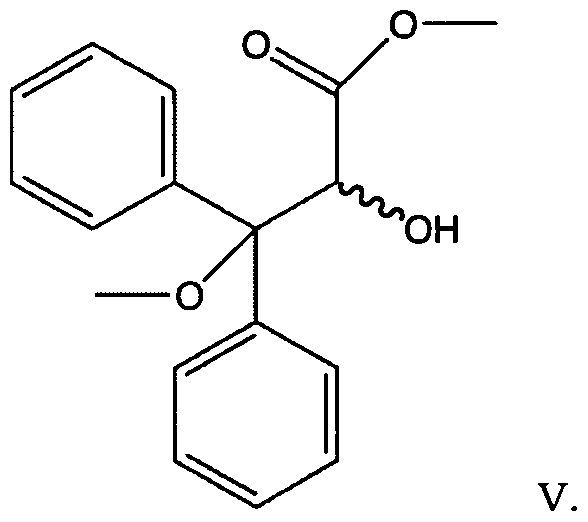
The compound according to formula V is obtainable by reacting a compound of formula X
 with a Lewis acid, e.g. BF3.
The compound according formula X may be prepared by a Darzen's reaction, comprising reacting benzophenone with chloromethyl acetate. It is preferred that the inner temperature of the exothermic Darzen's reaction is maintained below 20 0C by cooling, e.g. by cooling the reaction vessel with ice /salt and by adding the chloromethyl acetate slowly. The residual benzophenone present throughout the sequence is preferably separated off by washing the basic solution with an inert organic solvent, preferably tert-butyl methyl ether (TBME), e.g. in the last step.
A preferred reaction scheme of the process of the present invention is illustrated below:

The process according to the present invention results in Ambrisentan having high optical purity, preferably an optical purity of more than 99 % enantiomeric excess (ee), more preferably of at last least 99.7 % ee and having a low residual solvent content, preferably of less than 1500 ppm, more preferably of less than 500 ppm.
In addition to the above illustrated process for producing Ambrisentan, the present invention relates to a process for producing compound Ilia. Hence, a further subject of the present invention is a process for producing 4,6-dimethyl-2-(methyl- sulfonyl)pyrimidine as represented by formula (Ilia) comprising the steps of
a) reacting thiourea and acetylacetone to give 4,6-dimethylpyrimidine-2-thiol according to formula VIII


c) oxidizing 4,6-dimethyl-2-(methylsulfanyl)pyrimidine to give a compound (Ilia).
In step b) methylating agents known in the art can be used. Preferably, methyl iodide is used. In step c) oxidizing agents known in the art can be used. Preferably, meta- chloroperbenzoic acid (hereinafter referred to as MCPBA) is used.
The resulting 4,6-dimethyl-2-(methylsulfonyl)pyrimidine is preferably used in the process of the present invention for producing Ambrisentan, i.e. it is reacted with a
compound according to formula (II). A preferred embodiment of the process for producing 4,6-dimethyl-2-(methylsulfonyl)pyrimidine can be summarized as follows:

VIII IX Ilia
Generally, the above-illustrated process is suitable for producing Ambrisentan in a specific crystalline form. Hence, a second aspect of the present invention relates to Ambrisentan in a specific crystalline form (hereinafter referred to as "form R"), obtainable in particular from (2S)-2-hydroxy-3-methoxy-3,3-diphenyl-propanoic acid or (S)-2-(4,6-dimethyl-pyrimidine-2-yloxy)-3-methoxy-3,3-diphenyl-propanoic acid benzyl ester.
As mentioned above, the second aspect of the invention relates to Ambrisentan in a specific crystalline form (hereinafter referred to as "form R"). Crystalline form R Ambrisentan is characterized by an X-ray powder diffraction pattern with reflections at 2-theta (=2Θ) values of approximately 8.9°, 12.3°, 17.9° and 26.9°.
Crystalline form R of Ambrisentan can advantageously be used in pharmaceutical formulations, in particular with regard to processability, in-vitro and in-vivo dissolution properties, bioavailability and /or stability, especially stability during shelf life.
In the present invention, Ambrisentan is preferably prepared by a method shown in Scheme 1 below:

In an alternative embodiment, Ambrisentan can be prepared by a method shown in Scheme 2 below:

Scheme 2
The S-enantiomer 3 can be synthesized pursuant to the specifications of WO 96/ 1 1914.
In a further aspect of the invention, in Scheme 2 a compound according to formula 3a can be used as starting material

wherein R is an organic residue, preferably methyl, methoxy, trifluoromethyl. The residue R is especially located at para position.
In a preferred embodiment the benzyl ester 3a can be deprotected, preferably by HBr, e.g. by 33 % HBr in AcOH.
Subsequently, the hydrogenation transfer preferably could be achieved by using ammonium formate, e.g. in the presence of 10 % Pd / C. Besides ammonium formate, one can also use cyclohexene, cyclohexadiene or formic acid. Further, the p-methoxy- benzyl group can also be removed oxidatively, using 2,3-dichloro-5,6-dicyano- benzoquinone (DDQ).
Form R Ambrisentan can be obtained by crystallization of Ambrisentan, preferably of Ambrisentan prepared in accordance with Scheme 1 or 2, in an organic solvent.
In a first preferred embodiment of the second aspect of the present invention, form R Ambrisentan is crystallized from organic ethers, in particular, from diethyl ether. In this embodiment, Ambrisentan is preferably prepared in accordance with Scheme 2.
In a second preferred embodiment, form R Ambrisentan is crystallized from a mixture containing an organic solvent and water, more preferably an alcohol and water, in particular, isopropanol and water. The water content in the mixture typically is 10 to 90 w/w%, preferably 40 to 80 w/w%.
The crystalline form R of Ambrisentan was characterized by means of X-ray powder diffraction (abbreviated as "XRPD") and, if necessary, differential scanning calorimetry (abbreviated as "DSC").
In the second aspect of the present invention X-ray powder diffraction was performed as follows:
The samples were analyzed, using a D8 Advance Powder X-Ray Diffractometer (Bruker®-AXS, Karlsruhe, Germany). The measuring conditions were as follows:
Radiation: Cu Ka, source 40 kV / 40 mA, gap divergence 0.298°, gap an ti- scattering 3.872°, gap detector 10.28 mm, angle range 3° to 55°, step 0.016° 2Θ, time per step 0.2 s.
Differential scanning calorimetry was performed as follows:
The measurements were performed using a Mettler® Toledo DSC 822E device, coupled with a Mettler® Toledo gas flow controller TS0800GC1 (Mettler®-Toledo GmbH, Gieβen, Germany). A 40 μL aluminum crucible, having a perforated lid, was used.
Measuring conditions: temperature range 30 °C to 300 °C, heating rate 10 °C/min, nitrogen flow: 50 ml/min, Software STARe version 8.10, interpretation: endothermal.
Figure 1 shows an X-ray powder diffraction pattern of crystalline form R Ambrisentan with reflections at 8.9°, 11.1°, 12.3°, 13.1°, 17.9°, 26.9°, 14.1°, 15.2°, 18.2° and 20.6° ±0.2° 2Θ, which can be obtained by crystallization from isopropanol / water.
Figure 2 shows an X-ray powder diffraction pattern of crystalline form R Ambrisentan with reflections at essentially the same 2Θ-values, but with clearly lower peak intensities. Ambrisentan in accordance with Figure 2 can be obtained by crystallization from diethyl ether.
A comparison of the XRPDs, DSCs and the appearance of both Ambrisentan batches recrystallized from isopropanol / water and diethyl ether, respectively, suggests that the amorphous proportion is higher in the material recrystallized from diethyl ether.
Thus, the object of the present invention also comprises mixtures containing different proportions of crystalline form R Ambrisentan and amorphous Ambrisentan. In a preferred embodiment, the invention relates to a mixture containing
a) 1 to 99 w/w%, preferably 20 to 98 w/w%, in particular 60 to 97 w/w% of crystalline form R Ambrisentan, and b) 1 to 99 w/w%, preferably 2 to 80 w/w%, in particular 3 to 40 w/w% of amorphous Ambrisentan.
According to the present invention, the term "amorphous" is used for the state of solids, in which the building blocks (atoms, ions or molecules, i.e. in the case of amorphous Ambrisentan the Ambrisentan molecules) do not exhibit any periodic array across a larger range (= long-range order). In amorphous substances the building blocks are usually not arranged completely at random and only statistically, but distributed such that a certain regularity and resemblance to the crystalline state with regard to distance and orientation of the nearest neighbors are recognizable (= short- range order). Accordingly, amorphous substances preferably exhibit a short-range order rather than a long-range order.
The present invention is illustrated by the following examples.
EXAMPLES
In the below illustrated examples the following methods were used.
LCMS methods for reaction monitoring
Method A: Column: Agilent Zorbax SB-C18, 1.8 μm, 4.6 x 50 mm
Flow rate: 0.4 ml/min
Wavelength: 230 nm
Temperature: 25 0C
Gradient: Solvent A: 0.1% formic acid, solvent B: acetonitrile 0 min - 20%B
5 min - 30%B
8 min - 80%B
10 min - 60% B
12 min - 60% B Injection volume and concentration: 5 μl of approximately 0.5-2 mg/ml solutions prepared in 100% MeOH.
Method B:
Column: Agilent Zorbax SB-C18, 1.8 um, 4.6 x 50 mm Flow rate: 0.4 ml/min
Wavelength: 254 nm
Temperature: 25 0C
Gradient: Solvent A: 0.1% formic acid, solvent B: acetonitrile
0 min - 20% B 5 min - 20% B
8 min - 60% B
10 min - 80%B 12 min - 20%B 15 mln - 20%B
Injection volume and concentration: 5 μl of approximately 0.5-2 mg/ml solutions prepared in 100 % MeOH.
Determination of optical purity
A chiral HPLC method was developed. HPLC system: Waters HPLC with UV detector
Column: Chiralpak AD-H, 250 x 4.6 mm, 5 μm
Mobile phase: n-Hexane/IPA/TFA 95:5:0.4
Flow rate: 1.0 ml/min
Injection volume: 25 μl Wavelength: 220 nm
Column temperature: 35 0C
Sample temperature: 20 0C
Run time: 30 min
Diluent: n-Hexane/IPA: 90: 10 Degasser: Off
Sample preparation: 5 mg Ambrisentan dissolved in 2 ml IPA and diluted to 20 ml with hexane (250 ppm Ambrisentan)
Determination of purity
An HPLC method was developed.
HPLC system: Waters HPLC with PDA detector
Column: Phenomenex Luna C 18, 10OA, 150 x 4.6 mm, 5 μm
Mobile phase A: Buffer pH 3.0 Mobile phase B: Acetonitrile
Gradient: 0 min - 35%B
12 min - 44% B
15 min - 50%B
20 min - 50%B 25 min - 35%B
30 min - 35%B
Flow rate: 1.0 ml/min
Injection volume: 10 μl
Wavelength: 210 nm Column temperature: 25 0C
Sample temperature: 20 0C Run time: 30 min Diluent: Acetonitrile
Preparation of buffer pH 3.0: 0.68 g KH2PO4 dissolved in 1000 ml milli-Q water. pH adjusted to 3.0 +/-0.05 with dilute orthophosphoric acid. Filter through 0.45 μm filter paper.
Sample preparation: 10 mg Ambrisentan dissolved in and diluted to 20 ml acetonitrile (500 ppm Ambrisentan).
Example 1: Methyl 3,3-diphenyloxirane-2-carboxylate (X)
In a four-neck 1 -litre round-bottom flask (hereinafter referred to as RBF) with mechanical stirring, addition funnel, condenser, and thermometer pocket 27.8 g (1.21 mol) clean sodium metal was placed under a stream of nitrogen. Under ice cooling, 450 ml methanol was carefully added dropwise over the period of 1 h. After an additional stirring at room temperature for 90 min, all sodium metal was dissolved. The methanol was distilled off (maximum bath temperature: 110 0C). Dry sodium methoxide was obtained and after cooling to room temperature, a solution of 129 g (0.71 mol) benzophenone in 500 ml THF (dried by the addition of sodium) was added. The yellowish slurry was cooled using an ice /salt bath at -5 °C. By means of a dropping funnel, 107 ml (0.99 mol) chloromethyl acetate was added over the period of 30 min while the internal temperature was kept between 5 and 18 0C. Stirring continued for another 30 min. The reaction mixture was kept at -18 0C for 17 h in a freezer. The mixture was poured onto 500 ml of water and extracted with 250 ml tert- butyl methyl ether (hereinafter referred to as TBME) twice each. The combined organic layers were washed with 250 ml brine twice, dried with sodium sulphate and evaporated to yield a thick yellowish oil which was directly used for the next step.
Liquid Chromatography Mass Spectroscopy (LCMS) (method A): 9.5 min. m/z = 255.1 [M+l ]+.
Example 2: Methyl 2-hydroxy-3-methoxy-3,3-diphenylpropanoate (V)
The crude methyl 3,3-diphenyloxirane-2-carboxylate was dissolved in 250 ml methanol in a 2-litre RBF with magnetic stirring and then cooled using an ice bath. To the yellowish solution, 5 ml (0.035 mol) boron trifluoride etherate was added dropwise. A colour change from yellowish to colourless was observed. After stirring the mixture for 30 min, precipitation occurred and LCMS indicated completion of the reaction. To the reaction mixture 500 ml of water were added and it was extracted once with
500 ml TBME and once with 300 ml ethyl acetate (EA). Upon addition of water to the combined organic layers, a thick white precipitate was formed that redissolved after addition of another 200 ml EA. The aqueous layer was separated off and the organic layer was washed with brine, dried and evaporated. A white solid was obtained that was used directly for the next step.
LCMS (method A): 4.8 min. ml z = 309.1 [M+23]+.
Example 3: 2-Hydroxy-3-methoxy-3,3-diphenylpropanoic acid [TV)
To the crude methyl 2-hydroxy-3-methoxy-3,3-diphenylpropanoate, 700 ml 10% aqueous KOH solution was added and the mixture was heated to 100 0C for 1 h.
Dissolution of the solids and LCMS indicated completion of the reaction and the light yellow solution was cooled to room temperature. The reaction mixture was washed with 200 ml TBME twice and then acidified with 100 ml concentrated HCl, which resulted in precipitation. The mixture was extracted with 250 ml TBME twice and the combined organic layers were washed with brine, dried with sodium sulphate and evaporated to yield a white solid.
Yield over three steps: 150.0 g (0.55 mol) = 78 %
LCMS (method A): 2.4 min
Purity: 98.6 % at 230 nm. m/z = 295.1 [M+23]+. DSC: 117.1 0C (sharp, endothermic peak).
Example 4: (S)-2-hydroxy-3-methoxy-3,3-diphenylpropanoic acid (II)
In a three-neck 2-litre RBF with mechanical stirring 45.0 g (0.165 mol) 2-hydroxy-3- methoxy-3,3-diρhenylpropanoic acid was dissolved in 335 ml methanol and 490 ml
TBME was added. The solution was brought to reflux (bath temperature: 80 0C). Over a period of 1 min, 12.9 g (0.083 mol) (S)- l-(4-chlorophenyl)ethylamine was added to the reaction mixture dropwlse. The heating was stopped and the reaction was slowly cooled to room temperature (90 min). The reaction was placed in a water bath and slowly cooled down further by the portionwise addition of ice to the water bath.
Precipitation started at 20 0C. The salt was filtered off after keeping the mixture at
5 0C for another 30 min, washed with 100 ml TBME, and dried at 50 0C/ 1 mbar for
1 h to yield 25.3 g (0.059 mol, 71 % of the theory, 98 % ee). The salt was placed in a three-neck 2-litre RBF with mechanical stirring and brought to reflux with 250 ml methanol. Another 600 ml methanol had to be added to obtain a clear solution. 600 ml TBME was added and heating ceased. The oil bath was removed and the solution
was cooled to room temperature over a period of 30 min. Seeding crystals were added (10 mg) and precipitation started at 20 0C. The mixture was allowed to stir at 0 0C for 1 h. The precipitate was filtered off, washed with 100 ml TBME, and dried at 50 0C/ 1 mbar for 3 h to yield 19.0 g (0.044 mol, 53 % of the theory) of the salt. The salt was dissolved in 250 ml water and the solution was acidified by addition of 20 ml concentrated HCl, which resulted in precipitation. The mixture was extracted with 150 ml EA three times. The combined organic phases were washed with 60 ml 1 M HCl, 100 ml water, 100 ml brine, dried with sodium sulphate, evaporated, and dried at 50 0C/ 1 mbar to yield 12.0 g (0.044 mol, 26.6 % yield) of the liberated acid. Chiral HPLC 100 %.
The chiral amine is recovered from the hydrochloric acid phase, e.g. by basification with 2 M sodium hydroxide solution and subsequent extraction with dichloromethane or TBME. The TBME phase was washed with brine and dried. TBME extract was analysed by HPLC for content of S- l-(4-chlorophenyl)ethylamine and this extract was used directly for the next run of resolution. This recovery of amine makes a process eco friendly and more cost effective. The chiral HPLC of recovered amine indicates 100 % purity.
Example 5: Synthesis of the Pyrimidine Moiety
Example 5a: 4,6-dimethylpyrimidine-2-thiol (VIII)
In a three-neck 1 -litre RBF with mechanical stirring 60.0 g (0.79 mol) thiourea was slurried in 300 ml ethanol. 96 ml (0.96 mol) acetylacetone and 30 ml concentrated
HCl were added and the white slurry was heated to 50 0C for 3 h. The resulting dark yellow slurry was cooled in an ice bath and the yellow precipitate was filtered off, sucked dry, washed with 100 ml hexane and dried at 50 0C/ 1 mbar to yield 85.0 g
(0.61 mol, 77 %) of yellow product.
LCMS (method B): 6.2 min. m/z = 141.0 [M+l ]+.
Example 5b: 4,6-dimethyl-2-(methylsulfanyl)pyrimidine (IX)
The crude 4,6-dimethylpyrimidine-2-thiol was placed in a three-neck 1 -litre flask with mechanical stirring and was dissolved in 750 ml 2 M aqueous sodium hydroxide solution. 49 ml (0.79 mol) methyl iodide was added and the solution was stirred at room temperature for 1 h, kept at room temperature for 17 h, stirred for another 10 h, and kept at room temperature for another 17 h. LCMS indicated completion of the reaction. The reaction mixture was extracted twice with 200 ml DCM. The combined
organic layers were washed twice with 200 ml water, 200 ml brine, dried and evaporated. The crude dark brown product (85.0 g, 0.606 mol, quant.) was directly used for the next step.
LCMS (method B): 10.5 min. m/z = 155.0 [M+l ]+.
Example 5c: 4,6-dimethyl-2-(methylsulfonyl)pyrimidine (Ilia)
In a three-neck 1 -litre RBF, 230.0 g (1.1 eq assuming a concentration of 50% in the commercial MCPBA/water mix) meta-chloroperbenzoic acid (hereinafter referred to as MCPBA) was slurried in 400 ml DCM and cooled using an ice bath. A solution of 85.0 g (0.61 mol) of the crude 4,6-dimethyl-2-(methylsulfanyl)pyrimidine in 150 ml DCM is added dropwise to the slurry over a period of 30 min. Stirring continued under ice cooling for another 2 h during which a thick white precipitate was formed. Another 150 ml DCM was added and the mixture was washed with 150 ml saturated sodium bicarbonate solution three times, 150 ml water, 150 ml brine, dried over sodium sulphate, and evaporated. The dark red crude product was recrystallised from 200 ml hexane and 150 ml ethyl acetate (reflux to -18 0C) to yield 24.0 g of an off-white solid (0.13 mol, 21 %). The residual product was found in the filtrate but has not been processed further.
LCMS (method B): 3.1 min Purity: 97% (254nm). m/z: 187.0 [M+l ]+.
Example 6: Ambrisentan (I)
In a two-neck 250 ml RBF 3.0 g (132.3 mmol) lithium amide was slurried in 40 ml DMF under a stream of nitrogen. The reaction vessel was kept at 20 0C using a water bath and a solution of 12.0 g (44.10 mmol) (S)-2-hydroxy-3-methoxy-3,3- diphenylpropanoic acid in 115 ml DMF was added dropwise over a period of 45 min.
Stirring continued for another 10 min. A solution of 9.0 g (48.5 mmol) 4,6-dimethyl-2-
(methylsulfonyl)pyrimidine in 1 15 ml DMF was added dropwise over a period of 20 min. Stirring continued for another 17 h during which the temperature of the water bath rose to 31 0C (room temperature). LCMS indicated completion of the reaction.
The yellowish slurry was poured onto 600 ml crushed ice/water and 80 ml 2 M citric acid was added to form a white precipitate. The reaction mixture was extracted three times with 200 ml DCM each. The combined organic phases were washed with 200 ml brine, dried and evaporated. The residual DMF was evaporated for 1 h at
50 0C/ 1 mbar. A thick yellow oil was obtained which was recrystallised from 80 ml TPA
and 120 ml water by cooling from reflux temperature to 0 0C over a period of 2 h. The precipitate formed was filtered off and washed with 200 ml water. The wet cake was re-slurried in 200 ml water, sucked dry and dried at 50 0C/ 1 mbar for 4 h.
Yield: 14.3 g (37.71 mmol, 86 %) Purity: 99.95 % at 210nm Optical purity: only one enantiomer detected, m/z: 377 [M- I ]-, 301.2 [M-Ph]-.
DSC: shows a small exothermic peak at 165.47 0C, followed by an endothermic peak at 184.46 0C.
Melting point: 185 0C (melting with degradation) Residual Solvents: 386 ppm (predominantly isopropanol)
Notes: a) Alternatively, the product can be isolated by filtration of the precipitate, resulting from quenching the reaction with ice /water and acidification with 2 M citric acid. This crude was recrystallised with EA/hexane. But both yield and purity improved using the extraction method described above.
b) Use of lithium amide led to better results as compared to the use of potassium carbonate.
Example 7: Preparation of Form R Ambrisentan in Accordance with Scheme 1
30.4 g (1.32 mol) lithium amide was suspended in 200 ml N,N-dimethylformamide and brought to a temperature of 20 0C in a water bath. A solution of 120.0 g (0.44 mol) (2S)-2-hydroxy-3-methoxy-3,3-diphenyl-propanoic acid in 750 ml N,N-dimethyl- formamide was added dropwise within a period of 45 minutes, and the mixture was stirred for further 10 minutes. Subsequently, a solution of 90.3 g (0.48 mol) 4,6- dimethyl-2-(methylsulfonyl)-pyrimidine in 500 ml JV,N-dimethylformamide was added dropwise within a period of 20 minutes, and the mixture was stirred for further 17 hours. 3000 ml water and 800 ml 2M citric acid were added to the batch. The reaction mixture was extracted three times with 2000 ml methylene chloride. The combined organic phases were dried over sodium sulfate and the solvent removed under reduced pressure. The yellow oily residue thus obtained was recrystallized from 800 ml isopropanol and 2000 ml water. The crystals (103.2 g) were filtered off, washed with water and dried. The obtained crystals are needle-shaped.
Melting point (MP): 185.3 0C (determined by DSC) X-ray powder diffraction pattern according to Figure 1.
Example 8: Preparation of Form R Ambrisentan in Accordance with Scheme 2
10 mg (0.1 mmol) palladium on activated carbon (10 w/w%) was suspended in 8 ml ethyl acetate and 3 ml methanol. 550 mg (1.2 mmol) (S)-2-(4,6-dimethyl-pyrimidine-2- yloxy)-3-methoxy-3,3-diphenyl-propanoic acid benzyl ester 3 was added and the mixture saturated with hydrogen. The reaction mixture was hydrogenated for 12 hours. Then the catalyst was filtered off. The filtrate was concentrated in vacuo and the obtained raw material recrystallized from diethyl ether. A flaky material (0.25 g) was obtained.
Melting point (MP): 179.5 0C (DSC)
X-ray powder diffraction pattern according to Figure 2.
Claims
1. Process for producing Ambrisentan (I)


wherein in formula (III) the residue L is a leaving group, preferably a leaving group comprising a sulfonyl moiety.
2. Process according to claim 1, wherein the reaction is carried out in the presence of a base.
3. Process according to claim 2, wherein the base is a compound according to the formula MNR1R2, wherein M is Li, Na or K and R1 and R2 are independently hydrogen or C1 to C10 alkyl.
4. Process according to claim 2 or 3, wherein the base is LiNH2.
5. Process according to any one of claims 1 to 4, wherein the reaction is carried out at a temperature of 35 0C or less.
6. Process according to any one of claims 1 to 5, wherein the compound according to formula (III) is 4,6-dimethyl-2-{methylsulfonyl)pyrimidine as represented by formula (HIa)

7. Process according to any one of claims 1 to 6 comprising the step of recrystallizing the compound according to formula (I) from a mixture containing an alcohol and water.
8. Process according to any one of claims 1 to 7, wherein the compound according to formula (II) is obtained by optical resolution of a compound according to formula (IV)

9. Process according to claim 8, wherein the optical resolution is achieved by a crystallisation step using a chiral substance, preferably a chiral amine.
10. Process according to claim 8 or 9, wherein the compound according to formula (IV) is obtained by hydrolyzing a compound according to formula (V)

1 1. Process according to any one of claims 1 to 7, wherein the compound according to formula (II) is obtained by Sharpless epoxidation reaction comprising the steps of reacting a compound according to formula (VI)

to give a compound according to formula (VII)

and further reacting the compound according to formula (VII) to give the compound according to formula (II).
12. Process for producing 4,6-dimethyl-2-(methylsulfonyl)pyrimidine as represented by formula (Ilia) 
comprising the steps of a) reacting thiourea and acetylacetone to give 4,6-dimethylpyrimidine-2-thiol according to formula VIII


c) oxidizing 4,6-dimethyl-2-(methylsulfanyl)pyrimidine to give a compound (Ilia).
13. Process according to claim 12, wherein the resulting 4,6-dimethyl-2- (methylsulfonyl)pyrimidine (Ilia) is used in a process as described in any ones of claims 1 to 11.
14. Ambrisentan, obtainable by a process according to any one of claims 1 to 11, having an optical purity of 99.7 % ee or more and a residual solvent content of less than 1500 ppm.
15. Ambrisentan in a crystalline form, characterized by an X-ray powder diffraction pattern with reflections at 2-theta values of approx. 8.9°, 12.3°, 17.9° and 26.9° ±0.2°.
16. Ambrisentan according to claim 15, the X-ray powder diffraction pattern of which shows further reflections at 2-theta values of approx. 1 1.1°, 13.1°, 14.1°, 15.2°, 18.2° and/or 20.6°.
17. Ambrisentan according to claim 15 or 16, which can be prepared by crystallization from an organic solvent or from a mixture of an organic solvent and water.
18. Ambrisentan according to claim 17, which is crystallized from ether or a mixture of isopropanol and water.
19. Ambrisentan according to one of the previous claims 15 to 18, which can be prepared by reacting (2S)-2-hydroxy-3-methoxy-3,3-diphenyl-proρanoic acid with 4,6- dimethyl-2-(methylsulfonyl)-pyrimidine in the presence of lithium amide.
20. A mixture containing:
a) 1 to 99 w/w%, preferably 20 to 98 w/w%, of crystalline Ambrisentan pursuant to claim 15 or 16; and b) 1 to 99 w/w%, preferably 2 to 80 w/w%, of amorphous Ambrisentan.
Applications Claiming Priority (4)
| Application Number | Priority Date | Filing Date | Title |
|---|---|---|---|
| IN291DE2009 | 2009-02-13 | ||
| IN291/DEL/2009 | 2009-02-13 | ||
| DE202009009917.2 | 2009-07-21 | ||
| DE200920009917 DE202009009917U1 (en) | 2009-07-21 | 2009-07-21 | Ambrisentan in specific crystalline form |
Publications (2)
| Publication Number | Publication Date |
|---|---|
| WO2010091877A2 true WO2010091877A2 (en) | 2010-08-19 |
| WO2010091877A3 WO2010091877A3 (en) | 2010-11-11 |
Family
ID=42060719
Family Applications (1)
| Application Number | Title | Priority Date | Filing Date |
|---|---|---|---|
| PCT/EP2010/000885 Ceased WO2010091877A2 (en) | 2009-02-13 | 2010-02-12 | Process for producing ambrisentan |
Country Status (1)
| Country | Link |
|---|---|
| WO (1) | WO2010091877A2 (en) |
Cited By (16)
| Publication number | Priority date | Publication date | Assignee | Title |
|---|---|---|---|---|
| WO2011004402A3 (en) * | 2009-07-10 | 2011-03-10 | Cadila Healthcare Limited | Improved process for the preparation of ambrisentan and novel intermediates thereof |
| CN102276536A (en) * | 2011-06-10 | 2011-12-14 | 中国科学院化学研究所 | Preparation method of optically pure (+)-ambrisentan and optically pure (+)-darusentan |
| EP2476670A1 (en) | 2011-01-07 | 2012-07-18 | Zentiva, K.S. | Stable solid salts of ambrisentan |
| CN102627613A (en) * | 2012-02-27 | 2012-08-08 | 中国药科大学 | 2-[(4,6-dimethyl pyrimidine-2-)oxyl]-3-cyano-3,3-dibenzyl propionic acid optical isomer, its preparation method and medical application |
| CN102887861A (en) * | 2011-07-18 | 2013-01-23 | 天津市医药集团技术发展有限公司 | New crystal form of Ambrisentan and preparation method thereof |
| WO2013057468A1 (en) | 2011-10-19 | 2013-04-25 | Cipla Limited | Process for the preparation of an endothelin receptor antagonist |
| CN103396370A (en) * | 2013-07-26 | 2013-11-20 | 浙江华海药业股份有限公司 | Method for purifying ambrisentan |
| CN103524424A (en) * | 2012-07-04 | 2014-01-22 | 天津药物研究院 | Crystal form VI of ambrisentan as well as preparation method and application thereof |
| CN103524425A (en) * | 2012-07-04 | 2014-01-22 | 天津药物研究院 | Crystal form V of ambrisentan as well as preparation method and application thereof |
| CN103709106A (en) * | 2013-12-06 | 2014-04-09 | 石家庄博策生物科技有限公司 | Stereoselectivity preparation method for Letairis |
| CN103739557A (en) * | 2013-12-30 | 2014-04-23 | 黄河三角洲京博化工研究院有限公司 | Synthetic method of 4,6-dimethyl-2-methyl sulfonyl pyridine |
| CN104177300A (en) * | 2014-03-18 | 2014-12-03 | 上海美悦生物科技发展有限公司 | Ambrisentan degradation product and preparation method thereof |
| CN104280480A (en) * | 2013-07-02 | 2015-01-14 | 天津药物研究院 | Method for separating and detecting ambrisentan and related substances thereof |
| CN106093250A (en) * | 2016-08-27 | 2016-11-09 | 江苏嘉逸医药有限公司 | A kind of method of high effective liquid chromatography for measuring ambrisentan content |
| CN109705042A (en) * | 2017-10-26 | 2019-05-03 | 正大天晴药业集团股份有限公司 | A kind of preparation method of ambrisentan |
| CN110437063A (en) * | 2018-05-03 | 2019-11-12 | 江苏豪森药业集团有限公司 | The preparation method of ambrisentan key intermediate |
Citations (2)
| Publication number | Priority date | Publication date | Assignee | Title |
|---|---|---|---|---|
| WO1996011914A1 (en) | 1994-10-14 | 1996-04-25 | Basf Aktiengesellschaft | New carboxylic acid derivatives, their preparation and their use |
| WO2000026170A1 (en) | 1998-10-30 | 2000-05-11 | Basf Aktiengesellschaft | Method for racemate splitting of 2-hydroxypropionic acids |
-
2010
- 2010-02-12 WO PCT/EP2010/000885 patent/WO2010091877A2/en not_active Ceased
Patent Citations (2)
| Publication number | Priority date | Publication date | Assignee | Title |
|---|---|---|---|---|
| WO1996011914A1 (en) | 1994-10-14 | 1996-04-25 | Basf Aktiengesellschaft | New carboxylic acid derivatives, their preparation and their use |
| WO2000026170A1 (en) | 1998-10-30 | 2000-05-11 | Basf Aktiengesellschaft | Method for racemate splitting of 2-hydroxypropionic acids |
Non-Patent Citations (2)
| Title |
|---|
| OPRD, vol. 5, 2001, pages 16 |
| RIECHERS ET AL.: "Discovery and Optimization of a Novel Class of Orally Active Nonpeptidic Endothelin-A Receptor Antagonists", J. MED. CHEM., vol. 39, 1996, pages 2123 - 2128 |
Cited By (25)
| Publication number | Priority date | Publication date | Assignee | Title |
|---|---|---|---|---|
| US8962832B2 (en) | 2009-07-10 | 2015-02-24 | Cadila Healthcare Limited | Process for the preparation of ambrisentan and novel intermediates thereof |
| WO2011004402A3 (en) * | 2009-07-10 | 2011-03-10 | Cadila Healthcare Limited | Improved process for the preparation of ambrisentan and novel intermediates thereof |
| EP2476670A1 (en) | 2011-01-07 | 2012-07-18 | Zentiva, K.S. | Stable solid salts of ambrisentan |
| CN102276536B (en) * | 2011-06-10 | 2015-04-29 | 中国科学院化学研究所 | Preparation method of optically pure (+)-ambrisentan and optically pure (+)-darusentan |
| CN102276536A (en) * | 2011-06-10 | 2011-12-14 | 中国科学院化学研究所 | Preparation method of optically pure (+)-ambrisentan and optically pure (+)-darusentan |
| CN102887861A (en) * | 2011-07-18 | 2013-01-23 | 天津市医药集团技术发展有限公司 | New crystal form of Ambrisentan and preparation method thereof |
| CN102887861B (en) * | 2011-07-18 | 2015-04-15 | 天津市医药集团技术发展有限公司 | New crystal form of Ambrisentan and preparation method thereof |
| WO2013057468A1 (en) | 2011-10-19 | 2013-04-25 | Cipla Limited | Process for the preparation of an endothelin receptor antagonist |
| JP2015502916A (en) * | 2011-10-19 | 2015-01-29 | シプラ・リミテッド | Method for preparing endothelin receptor antagonist |
| CN102627613A (en) * | 2012-02-27 | 2012-08-08 | 中国药科大学 | 2-[(4,6-dimethyl pyrimidine-2-)oxyl]-3-cyano-3,3-dibenzyl propionic acid optical isomer, its preparation method and medical application |
| CN103524425A (en) * | 2012-07-04 | 2014-01-22 | 天津药物研究院 | Crystal form V of ambrisentan as well as preparation method and application thereof |
| CN103524424A (en) * | 2012-07-04 | 2014-01-22 | 天津药物研究院 | Crystal form VI of ambrisentan as well as preparation method and application thereof |
| CN104280480B (en) * | 2013-07-02 | 2016-12-28 | 天津药物研究院有限公司 | A kind of separation detection ambrisentan and the method having related substance thereof |
| CN104280480A (en) * | 2013-07-02 | 2015-01-14 | 天津药物研究院 | Method for separating and detecting ambrisentan and related substances thereof |
| CN103396370A (en) * | 2013-07-26 | 2013-11-20 | 浙江华海药业股份有限公司 | Method for purifying ambrisentan |
| CN103396370B (en) * | 2013-07-26 | 2018-11-16 | 浙江华海药业股份有限公司 | A kind of purification process of ambrisentan |
| CN103709106A (en) * | 2013-12-06 | 2014-04-09 | 石家庄博策生物科技有限公司 | Stereoselectivity preparation method for Letairis |
| CN103739557A (en) * | 2013-12-30 | 2014-04-23 | 黄河三角洲京博化工研究院有限公司 | Synthetic method of 4,6-dimethyl-2-methyl sulfonyl pyridine |
| CN103739557B (en) * | 2013-12-30 | 2015-10-21 | 黄河三角洲京博化工研究院有限公司 | A kind of synthetic method of 4,6-dimethyl-2-methanesulfonyl pyrimidine |
| CN104177300A (en) * | 2014-03-18 | 2014-12-03 | 上海美悦生物科技发展有限公司 | Ambrisentan degradation product and preparation method thereof |
| CN106093250A (en) * | 2016-08-27 | 2016-11-09 | 江苏嘉逸医药有限公司 | A kind of method of high effective liquid chromatography for measuring ambrisentan content |
| CN109705042A (en) * | 2017-10-26 | 2019-05-03 | 正大天晴药业集团股份有限公司 | A kind of preparation method of ambrisentan |
| CN109705042B (en) * | 2017-10-26 | 2021-12-21 | 正大天晴药业集团股份有限公司 | Preparation method of ambrisentan |
| CN110437063A (en) * | 2018-05-03 | 2019-11-12 | 江苏豪森药业集团有限公司 | The preparation method of ambrisentan key intermediate |
| CN110437063B (en) * | 2018-05-03 | 2022-04-29 | 常州恒邦药业有限公司 | Preparation method of key intermediate of ambrisentan |
Also Published As
| Publication number | Publication date |
|---|---|
| WO2010091877A3 (en) | 2010-11-11 |
Similar Documents
| Publication | Publication Date | Title |
|---|---|---|
| WO2010091877A2 (en) | Process for producing ambrisentan | |
| KR101345394B1 (en) | Process for preparing 5-(3,6-dihydro-2,6-dioxo-4-trifluoromethyl-1(2h)-pyrimidinyl)phenylthiol compounds | |
| KR20100113542A (en) | Method of synthesis of bosentan, its polymorphic forms and its salts | |
| EP3988545A1 (en) | Methods for preparing cdk4/6 inhibitor and salt and intermediate thereof | |
| CN113292569A (en) | Preparation method of JAK inhibitor | |
| DE60025803T2 (en) | PREPARATION OF SULPHONAMIDES | |
| EP2451786A2 (en) | Improved process for the preparation of ambrisentan and novel intermediates thereof | |
| JP6513105B2 (en) | Novel process for producing triazine, pyrimidine and pyridine derivatives | |
| CN114213424B (en) | Synthesis method of furan [3,2-b ] pyridine derivative | |
| JP3930736B2 (en) | Method for producing pyridinemethanol compound | |
| CN111807973B (en) | Preparation method of vilanterol and salt thereof | |
| EP2331513A1 (en) | Process for preparation of bosentan | |
| WO2025068505A1 (en) | Preparation of bridged pentacyclic imidazole derivatives as modulators of tnf activity, intermeditates and their preparation | |
| KR101471047B1 (en) | Improved process for preparation of highly pure bosentan | |
| US20140275535A1 (en) | Acid addition salts of bosentan | |
| CN106146485A (en) | A kind of method preparing safe ground azoles amine and the safe ground azoles amine crystalline solid obtained thereof | |
| JP5250693B2 (en) | Method for producing carboxylic acid compound | |
| WO2021162647A1 (en) | A novel process for preparation of pazopanib hydrochloride | |
| EP2867214B1 (en) | Preparation process of carboxylic acid derivatives and intermediates thereof | |
| CA3268132A1 (en) | Novel salt of dimethyl-2,3-dihydro-1h-indene derivative and processes for preparing the same | |
| WO2010029756A1 (en) | 5-[2-(methylthio)ethoxy]pyrimidine-2-amine manufacturing method | |
| CA2558817A1 (en) | Crystalline forms of 5,11-dihydro-11-ethyl-5-methyl-8-{2-{(1-oxido-4-quinolinyl)oxy}ethyl}-6h-dipyrido[3,2-b:2',3'-e][1,4]diazepin-6-one | |
| CN103209961A (en) | Process for the preparation of enantiomeric forms of 2,3-diaminopropionic acid derivatives | |
| WO2011039670A1 (en) | Novel forms of (2,8-dimethyl-5-[2-(6-methylpyridin-3-yl)ethyl]-3,4-dihydro-1h-pyrido[4,3-b] indole) | |
| JPWO2006083010A1 (en) | Method for producing 4-acetylpyrimidine compound and crystal thereof |
Legal Events
| Date | Code | Title | Description |
|---|---|---|---|
| 121 | Ep: the epo has been informed by wipo that ep was designated in this application |
Ref document number: 10704101 Country of ref document: EP Kind code of ref document: A2 |
|
| NENP | Non-entry into the national phase |
Ref country code: DE |
|
| 122 | Ep: pct application non-entry in european phase |
Ref document number: 10704101 Country of ref document: EP Kind code of ref document: A2 |