WO2010091091A2 - Starch esters and method of preparation - Google Patents
Starch esters and method of preparation Download PDFInfo
- Publication number
- WO2010091091A2 WO2010091091A2 PCT/US2010/023062 US2010023062W WO2010091091A2 WO 2010091091 A2 WO2010091091 A2 WO 2010091091A2 US 2010023062 W US2010023062 W US 2010023062W WO 2010091091 A2 WO2010091091 A2 WO 2010091091A2
- Authority
- WO
- WIPO (PCT)
- Prior art keywords
- starch
- mixture
- lipophilic
- acid anhydride
- organic acid
- Prior art date
- Legal status (The legal status is an assumption and is not a legal conclusion. Google has not performed a legal analysis and makes no representation as to the accuracy of the status listed.)
- Ceased
Links
Classifications
-
- C—CHEMISTRY; METALLURGY
- C08—ORGANIC MACROMOLECULAR COMPOUNDS; THEIR PREPARATION OR CHEMICAL WORKING-UP; COMPOSITIONS BASED THEREON
- C08B—POLYSACCHARIDES; DERIVATIVES THEREOF
- C08B31/00—Preparation of derivatives of starch
- C08B31/02—Esters
- C08B31/04—Esters of organic acids, e.g. alkenyl-succinated starch
-
- C—CHEMISTRY; METALLURGY
- C08—ORGANIC MACROMOLECULAR COMPOUNDS; THEIR PREPARATION OR CHEMICAL WORKING-UP; COMPOSITIONS BASED THEREON
- C08L—COMPOSITIONS OF MACROMOLECULAR COMPOUNDS
- C08L3/00—Compositions of starch, amylose or amylopectin or of their derivatives or degradation products
- C08L3/04—Starch derivatives, e.g. crosslinked derivatives
- C08L3/06—Esters
Definitions
- the present invention is generally directed towards starch that has been modi (led with an organic acid anhydride reagent and methods of preparing the same.
- starch produced according to the present invention exhibits good water solubility and emulsifying characteristics when compared with conventional starches.
- methods of preparing modified starches according to the present invention do not require further treatment with acids, other than the organic acid anhydride reagent, or enzymes to degrade the starch and make it water soluble.
- Native starch is partially crystalline and not soluble in water at room temperature. Also, native starch molecules are hydrophilic and do not possess emulsifying properties.
- a number of reference!, such ⁇ a> U.S. Patent No. 2,661 ,349 and U.S. Patent No. 6,037,466 disclose introducing hydrophobic groups to the starch by reaction with cyclic dicarboxylic acid anhydrides so that the starch can be used as an emulsion stabilizer.
- Octenyl succinc acid anhydride (OSA) treated starch prepared by adding up to 3% OSA, has been approved by the FDA for food use and can be used in food and beverage applications, such as in encapsulation of vitamins and flavors.
- Starch may also be reacted with greater than 3% OSA for non-food applications, such as in oil- and peti oleum-based cosmetics, or pharmaceutical pastes, alcohol-based Unions, body deodorant sprays, and encapsulation of fragrances, clouds, and oils.
- OS ⁇ -modified starch must undergo acid hydrolysis or enzymatic conversion in order to be converted (or degraded) and rendered water soluble at room temperature. Modified starch that undergoes this further processing may contain acid or enzyme residues.
- a method of preparing a lipophilic starch An organic acid anhydride reagent is added to a starch mixture thereby forming a reaction mixture.
- the pH of the starch mixture is adjusted to between about 7 to about 1 1 cither before or after addition of the organic acid anhydride reagent.
- the reaction mixture is dried to a moisture content of between about 0 to about 15% by weight.
- the dried reaction mixture is heated at a temperature of at least about 100 0 C for between about 1 minute to about 6 hours.
- a water-soluble, lipophilic starch comprising starch that has been modified with an organic acid anhydride reagent.
- the modified starch contains less than about 0.5% by weight of one or more mineral acids and/or less than about 0.1 % by weight of starch-degrading enzyme residues.
- the starch also has a solubility in water at 25 0 C of greater than about 90%.
- a lipophilic starch comprising a starch that has been modified with an organic acid anhydride reagent.
- the lipophilic starch when dispeised in glycerol and viewed with a microscope under polarized light, has a granular shape and is birefringent.
- emulsion made with the water-soluble, lipophilic staich are provided.
- the emulsion is very stable, there being no observable phase separation even after storage for 24 hours at 45 ⁇ C.
- starch employed in the food product may be a water-soluble, lipophilic starch as described herein, or the starch can be a lipophilic starch made in accordance with the methods described herein.
- Figure Ia is a microscope photograph of a first emulsion sample prepared Irons sample 7-E after heating at 45 0 C for 24 hours;
- Fig. Ib is a microscope photograph of a second emulsion sample prepared from sample 7-E after heating at 45 U C for 24 hours;
- Fig. 2a is a microscope photograph of sample 7-E suspended in glycerol
- Fig. 2b is a microscope photograph of sample 7-E suspended in glycerol taken under polarized light;
- Fig. 3a is a microscope photograph of sample 5-B suspended in glycerol
- Fig. 3b is a microscope photograph of sample 5-B suspended in glycerol taken under polarized light; and Fig. 4 is a graph of gel permission chromatography (GPC) results for samples 5-B and a commercial sample.
- GPC gel permission chromatography
- the present invention provides a method for introducing a hydrophobic group onto starch molecules, degrading the starch, and making the starch water soluble.
- the starch to be modified according to the present invention may be native, converted, or derivatized.
- Exemplary starches include those derived from corn, potato, wheat, rice, tapioca, sago, sorghum, waxy maize, waxy wheat, waxy potato, or high amylose corn.
- the process begins by preparing a starch mixture that has a neutral io basic pH.
- ihe starch mixture may be in the form of a starch slurry prepared by mixing the staich with watci, an alcohol, oi utliei ⁇ iganic solvent, such at> toluene.
- the slurry is prepared with water and/or alcohol, wherein the alcohol is selected from the group consisting of * methanol eihanol isopropyl alcohol, and niixuues thcreol.
- the pH ⁇ i the imxtiuuu ⁇ i siuiiy is adjusted l ⁇ between about 7 to about 1 1 by the addition of a base.
- the base is selected from the group consisting of meial and non-metal hydroxides, oxides, carbonates, and mixtures thereof In further embodiments, the base is selected from the group consisting of sodium hydroxide, ammonium hydroxide, ammonium carbonate, ammonium bicarbonate, and mixtures thereof. In still other embodiments, the pll of the mixture or slurry is adjusted to between about 8 to about 1 1 , or even to between about 8.5 to about 1 0.
- the starch mixture is processed to obtain a starch cake.
- this processing step involves removing liquid from the slurry, such as by filtration.
- an organic acid anhydride reagent is added thereby forming a reaction mixture.
- the organic acid anhydride reagent has the general formula O
- R is a dimethylene or trimethylene group and R 1 is a linear, branched or cyclic alkyl, alkenyi. aralkyl or aralkenyl group having 2 to 20 carbon atoms.
- the organic acid anhydride reagent is octenyl succininc acid anhydride (OSA).
- OSA octenyl succininc acid anhydride
- the organic acid anhydride reagent is generally added to the cake ai a level of between about 0.5% to about 100% by weight, based upon the dry weight of the starch.
- the organic acid anhydride reagent is generally added to the case at a level of between about 1 % to about 25% by weight, or even between about 2% to about 9% by weight, based upon the dry weight of the starch.
- the organic acid anhydride may be added to or mixed with the starch cake by any means known to those of skill in the art, such as, for example, by spraying.
- a starch slurry is prepared and the ui g ⁇ nit acid anhydride reagent is added to the slurry and mixed.
- Mixing of the organic acid anhydride reagent and starch slurry may be accomplished by any number of means known in the art.
- the pli of the starch slurry may be adjusted to the desired level eilher be lore or a Her addition of the organic acid anhydride reagent.
- the OS-modified starch slurry is filtered to obtain a starch cake.
- the OS-modified starch is recovered by spray drying.
- the reaction mixture After permitting the reaction between the starch and oiganic acid anhydride reagent to proceed for a predetermined period of time, the reaction mixture is dried to a moisture content of between about 0 to about 15% by weight. In other embodiments, the reaction mixture is dried to a moisture content of between about 0% to about 10%, or even between about 0% to about 6% by weight. In certain embodiments, the drying step comprises heating the reaction mixture to a temperature of less than about ⁇ 4O°C. or between about 25°C to about 90 0 C, or between about 30 0 C to about 60 0 C.
- the dried reaction mixture is heated at a lemperature of at least about 100 0 C, or between about 100 0 C to about 200 0 C, or between about 140 0 C to about 18O 0 C.
- This heating step may be carried out for between about 1 minute to about 6 hours, or between about 30 minutes to about 4 hours, or between about 1 to 3 hours.
- Both the drying and heating steps may be carried out with any suitable apparatus known to those of skill in the art, including forced air ovens, dextrinizers, and fluidized bed dryers.
- the starch modified with the organic acid anhydride reagent docs not undergo a subsequent acid hydrolysis step.
- a mineral acid such as HCl or H 2 SO 4
- the present invention eliminates the need for enzymatic conversion of the modified starch, such as with ⁇ -amylasc or any enzyme within the amylase family, in order to degrade the starch. Therefore, it is an advantage of certain embodiments of the present invention that the starch produced contains essentially no residues of such mineral acids or enzymes.
- the modified starch prepared in accordance with the present invention mav be water insoluble, partially watei soluble, oi completely watet soluble Water solubility ⁇ flhe modified starch is measured by a refractometer. A 10% solids dispersion is prepared, ccntrifugcd. and the supernatant is analyzed by the refract ⁇ meter.
- the modified starch has a solubility in water at 25 0 C of greater than about 90%, or greater than about 95%, or even greater than about 98%.
- the modified starch will have a water solubility as described herein and contain less than about 0.5%, or less than about 0.1 %, or even less than 0.01% by weight of mineral acid. Additionally or alternatively, the water soluble modified starch will contain less than about 0.1% by weight, or even less than 0.01% by weight of starch-degrading enzyme residues.
- starch-degrading enzyme residues can refer to the en/ymes themselves or to denatured forms of the en/ymes.
- the water-soluble, modified starches are substantially free of mineral acid and/or starch-degrading enzyme residues.
- a lipophilic starch comprising a starch that has been modified with an organic acid anhydride reagent may be prepared, which, when suspended in glycerol and viewed with a microscope under polarized light, has a granular shape and is birefringent. Also, the water-soluble, lipophilic starches described above may also possess these characteristics.
- starches described above and those starches made in accordance with the methods described herein, particularly those starches that are water soluble, can be used in the formation of emulsions.
- the emulsions produced with the modi fertil starch exhibit excellent stability with no observable phase separation even upon storage of the emulsion at 45 0 C for 24 hours.
- Exemplar ⁇ ' emulsions include those comprising essential oils, such as orange oil. 1 he emulsions may be prepared in any manner known in the art.
- starches described above and those starches made in accordance with the methods described herein can also be used in various food products. Also, the modified starches used in food products need not necessarily exhibit a high level of w r atcr solubility, so long as the lipophilic starch is made by a method according to the present invention.
- Octcnyl succinic acid anhydride (“OSA " ) w,as obtained from Gulf Bay port Chemicals L. P. (Pasadena, ' IX). Waxy maize starch ( ⁇ moica IT) was provided by National Starch and Chemical (Bridgewater. NJ). All other chemicals used in the following examples were analytical grade Titration Method 1
- degree of substitution (''D. S. " ') was measured by titration.
- 5.00 g dry weight of the starch was suspended in 20.0 inL of 0.100 M HCl, and stirred for 30 minuies.
- the suspension was filtered through a piece of No.2 filter paper (Whatman Internal Ltd.). and the residue was washed with water until no Cl " could be detected by 0.1 M AgNO 3 solution.
- the starch was then re-suspended in 300 rnL water and heated in a boiling water bath for 20 minutes. After cooling down, the starch solution was iitraied with 0. J 00 IVl NaOH solution, using phenolphthalein as an indicator.
- % OS is the percentage weight of OS in OS modified starch
- V 1 is the titration volume of NaOH (mL) for OS starch
- V 2 is the titration volume of NaOH (ml) for control
- W is the dry weight (g) of the OS starch.
- R-K. %OS of OS starch X 100%
- the bound OS content for modified starches reacted with greater than 3% OSA, partially and completely soluble OS starches was determined, by first suspending 5.0Og dry weight of the starch in 20.0 mL of methanol and filtered. The cake was re-suspended in a 20 mL mixture of
- a potable refractometer was used to check the solubility of the OS starch. ⁇ ] 0% solids suspension was prepared, centrifuged, and the supernatant was analyzed by the refractometer.
- Waxy maize starch (100 g) was suspended in distilled water (150 mL) with agitation. The pH of the starch slurry was adjusted to 7.5 and 9.5 with 3% (w/w) NaOH. The suspension was filtered and the starch cake was mixed with 3% OSA (based on the dry weight of starch) using a mixer (Model K45SSWH, KitchenAid, St. Joseph, MI) at 2nd speed for 15 minutes. The mixture was dried in a forced-air oven at 35°C overnight until the moisture content was below 12%. The starch mixture was spread over an oven pan (38cm x26 cm) and heated at 16O 0 C for 1 hour, 2 hours, or 4 hours. Native waxy maize starch was used as a control. Degree of substitution and reaction efficiency were measured by titration method 1 . pH after treatment w as measured by suspending a portion of the treated starch in water (10% solids by weight).
- Table 1 Sample adjusted to pH /.5 and 9.5 by NaUH and heat treated at 16O 0 C
- Waxy maize starch (100 g) was suspended in distilled water (150 mL) with agitation. A weighed amount OfNa 2 CO 3 was added to the starch slurry, lhe experiments were earned out as described in Example 1 , except that sample 2-A was heated at 160 0 C for 4 hours, then was reheated at 190 0 C for 2 hours. In contrast, sample 2-B was heated at 190 0 C for 2 hours. D.S. and R.E. of the samples heat treated at 190 0 C were calculated using titration method 2. D.S. and R.E of other samples were determined by titration method 1 .
- NIl 1 IlCO 3 was used to adjust the initial pH and the resulting effects on Degree of Substitution ("D.S.' “ ), reaction efficiency (“R.E. “ '), and starch solubility were measured.
- Waxy maize starch (100 g) was suspended in distilled water (150 rnL) with agitation. A weighed amount of NH 11 HCO 3 was added to the suspension. The experiment was carried out as described in Example 1 . Sample 3-A was heated at 160 0 C for 4 hours was reheated at 190 0 C for 2 hours. D. S. and R.H. were measured by titration method 2.
- Waxy maize starch (100 g) was suspended in distilled water (150 mL) with agitation. The pH of the starch slurry was adjusted to between 8.0 - 8.8 by the addition of varying amounts Of NII 1 IICO 3 . T he experiments were carried out as described in Example 1 ; however, the heating temperature was adjusted to 170 0 C, 18(TC, or 190"C, and heating time was adjusted to V ⁇ hour, 1 hour, 2 hours, or 4 hours. A starch sample without adding OSA was prepared as a control. D. S. and R.L. were measured by titration method 2.
- Table 5 Samples adjusted to pH 8.5 by NII 4 IICO 3 (3.85% by starch diy weight) arid heat treated at different temperatures.
- Tablc 6 Samples adjusted to pH 8.75 by NH 4 HCO, (6.29% by starch dry weight) and heal treated at different temperatures.
- Viscosity of the starch sample 15 was determined by a Brookfield viscometer (RVDVIl 4 Pro, Brookfield Engineering Laboratories, Inc., Middlcboro, MA) with a CS4-18 spindle and a SC4-13 RPY chamber at 25 0 C. Starch solutions of 30% and 50% solids of lab made starches and a commercial starch were prepared and added to the chamber. The commercial starch is a converted (degraded), OSA-modif ⁇ cd starch obtained from National Starch LLC, Bridgewater, NJ. The spindle speed (RPM) was selected. The reading of shear stress (SS). shear rate (SR), viscosity (cP) and % (torque) are shown in Table 7.
- Viscosity oi a starch solution reflects the molecular weight ol a starch sample. Compared with a commercial sample, the lab made starch sample showed higher viscosity indicating that the molecular size of the lab made sample was higher than that of the commercial sample.
- Waxy maize starch (100 g) was suspended in distilled water (150 mL) with agitation. The pll of the starch slurry was adjusted to 8.45 by different weights OfNIl 4 IICO 3 (Table 8). The experiment was carried out as in Example 1. However, the heating temperature was adjusted to 170 0 C or 180 0 C. and heating time was 2 hours.
- the OSA-modified starch was sieved by a 200-mesh sifter after heating.
- sample 7-E the starch mixture before heating was ground by an analytical mill (A-IO, Tekmar) and sieved through a 200-mesh sifter.
- the starch was thinly spread over an oven pan (38cm *26 cm) and heated at 18O 0 C for 2 hours.
- a starch sample without adding OSA was prepared as a control.
- D. S. and R.E. were measured by titration method 2.
- Solubility of the OS starch dispersed in an aqueous medium (10%, w/w) was analy/ed by a potable rcfractomcicr before ccntrifugation (''SBC")
- the starch solution was ccntrif ⁇ gcd at 3500 rpm for 5 minutes and the supernatant was analyzed by the rciractometcr as well ("SAC").
- Table 8 Samples adjusted to pH 8.45 by NH 4 HCO 3 (6.29% by starch dry weight) and heat treated at different temperatures.
- EXAMPLE 9 This Example describes an embodiment of the present application directed to a non-food application using a 5% OSA treatment.
- Waxy maize starch (100 g) was suspended in distilled water (150 mL) with agitation.
- the pll of the starch slurry was adjusted to 8.30 with 3.02 g NH 4 HCO 3 .
- the suspension was filtered and the starch cake was mixed with 5% OSA (based on the weight of starch) by a mixer (Model K45SSWH, KitchenAid, St. Joseph, MI) at 2 nd speed for 15 minutes.
- the mixture was dried in an air oven at 35 0 C overnight until the moisture content was below 12%.
- the mixture was then spread over an oven pan (38cm ⁇ 26 cm) and heated at 180 0 C for 2 hours.
- the starch mixture was ground by an analytical mill (A-I O, Tekmar) and sieved through a 200- mcsh sifter.
- ⁇ starch sample without adding OSA was prepared as a control. D. S. and R.E. were measured by titration method 2.
- the bound OS content was 4.77%.
- the D.S. and R.E. of the OS starch were 0.0386 and 93.43%, respectively.
- Solubility of the OS starch was analyzed by a potable refractometer. The starch solution ( 10%, w/w) vvas ccntrifugcd at 3500 rpm for 5 minutes. The solubility of the material was found to be 86%
- wheat starch 100 g was suspended in distilled water (150 mL) with agitation.
- the pi I of the starch slurry was adjusted to 8.45 by adding 3.02 g NH 1 I ICO v flic experiment was carried out as described in Example 9 except that 3% OSA was added, fhc bound OS content was 2.59%.
- the D.S. of the OS starch was 0.0205, and the R.E. was 94.33%.
- the solubility of the OS starch was 75%.
- sample 7-E an emulsion of sample 7-E was prepared.
- OS starch (8.0g, dry basis) was mixed with sodium benzoatc (0.1 g), citric acid (0.2g) and water (50.40 mL) in a Waring blender
- Samples 7-E and 5-B (both heat treated for 4 hours) were suspended in glycerol and viewed with a microscope under normal and polarized light.
- Figures 2a and 2b depict Sample 7-E under normal and polarized light, respectively.
- Figures 3a and 3b depict Sample 5-B under normal and polarized light, respectively.
- Figures 2b and 3b show that starch granules of both samples had maltese crosses and were bircfringcnt when viewed under polarized light. The results suggest that certain molecular order of starch granules remained after OSA modification.
- Sample 5-B heat treated for 1 hour, 2 hours, and 4 hours
- a commercial sample (same as used in Example 7 above) were analyzed by gel permission chromatography (GPC).
- the starch (0.1% by weight) was uihpeiScd in DMSO and heated in a boiling water bath for 1 hour. Then the solution was analyzed by the GPC. lhe results arc shown in Fig. 4.
- the lab made OS samples exhibited larger molecular weights than the commercial sample.
- EXAMPLE 14 waxy maize starch (100 g) was suspended in distilled water (150 mL) with agitation. The pli of the starch slurry was adjusted to 8.46 by the addition of 3.02 g NH 4 HCO 3 . The suspension was filtered and the starch cake was mixed with 50% OSA (by the weight of starch). The mixture was dried in an air oven at 35 0 C overnight until the moisture content was below 12%. The starch mixture was heated in the air-forced oven at 130 0 C for 1 h and then 105 0 C for 6 h. After the product was cooled to 25°C, a sample (5 g) was washed twice with methanol (50 ml). The D. S. of the methanol-washed product was then measured by titration method 1 and the value was determined to be 0.0138. EXAMPLR 15
- an OS starch was prepared and the D. S. measured by an NMR method described as follows.
- the starch sample (0.1 g) was dissolved in 0.5 mL of D 2 O and freeze-dried.
- the D 2 O-exchanged starch (0.07 g) was dissolved in D 9 O (0.60 mL) for NMR analysis.
- 1 H NMR 1 D spectra were recorded on a 400 MH/ Varian NMR spectrometer at 25 0 C. fhe NMR spectrometer was equipped with a 5 -mm diameter, triple-resonance, inverse
- I 094 is the integrals of methyl protons.
- I 5 , 9 , 1 5 12 , 1 4 96 , 1 4 6 , and I 4 51 are the integrals of the anomeric proton.
- Waxy maize starch 100 g was suspended in distilled water (1 50 mL) with agitation. The pi I of the starch slurry was adjusted to 8.45 by 3.02 g NfI 4 HCO 3 . The suspension was filtered and the starch cake was mixed with 3% OS ⁇ (by the weight of starch) by a mixer (Model K45SSWII, Kitehen ⁇ id. St. Joseph, MI) at 2nd speed for 15min. 1 he mixture was dried in an air oven at 35°C overnight until the moisture content was below ] 2%. 1 lie starch mixture (31.12 g) was mixed with sodium aluminum phosphate (S ⁇ P) (3.09 g). The pH of the starch sample was 4.
Landscapes
- Chemical & Material Sciences (AREA)
- Health & Medical Sciences (AREA)
- Chemical Kinetics & Catalysis (AREA)
- Medicinal Chemistry (AREA)
- Polymers & Plastics (AREA)
- Organic Chemistry (AREA)
- Life Sciences & Earth Sciences (AREA)
- Engineering & Computer Science (AREA)
- Biochemistry (AREA)
- Materials Engineering (AREA)
- Polysaccharides And Polysaccharide Derivatives (AREA)
Abstract
A lipophilic starch is provided along with methods of making the same. The starch is prepared by modifying the starch with an organic acid anhydride reagent, such as octenyl succinic anhydride, drying the modified starch to a moisture content of less than 15% by weight, and then heat treating the dried starch at a temperature of at least 100°C for at least one minute.
Description
STARCII ESTERS AND METHOD OF PREPARATION
BACKGROUND OF THE INVENTION Field of the Invention
The present invention is generally directed towards starch that has been modi (led with an organic acid anhydride reagent and methods of preparing the same. In certain embodiments, starch produced according to the present invention exhibits good water solubility and emulsifying characteristics when compared with conventional starches. Further, methods of preparing modified starches according to the present invention do not require further treatment with acids, other than the organic acid anhydride reagent, or enzymes to degrade the starch and make it water soluble.
Description of the Prior Art
Native starch is partially crystalline and not soluble in water at room temperature. Also, native starch molecules are hydrophilic and do not possess emulsifying properties. A number of reference!, such <a> U.S. Patent No. 2,661 ,349 and U.S. Patent No. 6,037,466 disclose introducing hydrophobic groups to the starch by reaction with cyclic dicarboxylic acid anhydrides so that the starch can be used as an emulsion stabilizer.
Octenyl succinc acid anhydride (OSA) treated starch, prepared by adding up to 3% OSA, has been approved by the FDA for food use and can be used in food and beverage applications, such as in encapsulation of vitamins and flavors. Starch may also be reacted with greater than 3% OSA for non-food applications, such as in oil- and peti oleum-based cosmetics, or pharmaceutical pastes, alcohol-based Unions, body deodorant sprays, and encapsulation of fragrances, clouds, and oils. Conventionally, OSΛ-modified starch must undergo acid hydrolysis or enzymatic conversion in order to be converted (or degraded) and rendered water soluble at room temperature. Modified starch that undergoes this further processing may contain acid or enzyme residues.
SUMMARY OF THE INVENTION
In accordance with one embodiment of the present invention, there is provided a method of preparing a lipophilic starch. An organic acid anhydride reagent is added to a starch mixture thereby forming a reaction mixture. The pH of the starch mixture is adjusted to between about 7 to about 1 1 cither before or after addition of the organic acid anhydride reagent. The reaction mixture is dried to a moisture content of between about 0 to about 15% by weight. The dried reaction mixture is heated at a temperature of at least about 1000C for between about 1 minute to about 6 hours.
In accordance with another embodiment of the present invention, there is provided a water-soluble, lipophilic starch comprising starch that has been modified with an organic acid anhydride reagent. The modified starch contains less than about 0.5% by weight of one or more mineral acids and/or less than about 0.1 % by weight of starch-degrading enzyme residues. The starch also has a solubility in water at 250C of greater than about 90%. hi accordance with another embodiment of the present invention, there is provided a lipophilic starch comprising a starch that has been modified with an organic acid anhydride reagent. The lipophilic starch, when dispeised in glycerol and viewed with a microscope under polarized light, has a granular shape and is birefringent.
In accordance with yet another embodiment of the present invention, emulsion made with the water-soluble, lipophilic staich are provided. In particular embodiments, the emulsion is very stable, there being no observable phase separation even after storage for 24 hours at 45 ϋC.
In accordance with still another embodiment of the present invention, food products made with the starches described herein are provided. The starch employed in the food product may be a water-soluble, lipophilic starch as described herein, or the starch can be a lipophilic starch made in accordance with the methods described herein.
BRIEF DESCRIPTION OF THE DRAWINGS
Figure Ia is a microscope photograph of a first emulsion sample prepared Irons sample 7-E after heating at 450C for 24 hours;
Fig. Ib is a microscope photograph of a second emulsion sample prepared from sample 7-E after heating at 45 UC for 24 hours;
Fig. 2a is a microscope photograph of sample 7-E suspended in glycerol;
Fig. 2b is a microscope photograph of sample 7-E suspended in glycerol taken under
polarized light;
Fig. 3a is a microscope photograph of sample 5-B suspended in glycerol;
Fig. 3b is a microscope photograph of sample 5-B suspended in glycerol taken under polarized light; and Fig. 4 is a graph of gel permission chromatography (GPC) results for samples 5-B and a commercial sample.
DETAILED DESCRIPTION OF THE PREFERRED EiMBODIMENT
The present invention provides a method for introducing a hydrophobic group onto starch molecules, degrading the starch, and making the starch water soluble. The starch to be modified according to the present invention may be native, converted, or derivatized. Exemplary starches include those derived from corn, potato, wheat, rice, tapioca, sago, sorghum, waxy maize, waxy wheat, waxy potato, or high amylose corn.
In certain embodiments, the process begins by preparing a starch mixture that has a neutral io basic pH. In one embodiment., ihe starch mixture may be in the form of a starch slurry prepared by mixing the staich with watci, an alcohol, oi utliei υiganic solvent, such at> toluene. In one particular embodiment, the slurry is prepared with water and/or alcohol, wherein the alcohol is selected from the group consisting of* methanol eihanol isopropyl alcohol, and niixuues thcreol. The pH υi the imxtiuu υi siuiiy is adjusted lυ between about 7 to about 1 1 by the addition of a base. In certain embodiments, the base is selected from the group consisting of meial and non-metal hydroxides, oxides, carbonates, and mixtures thereof In further embodiments, the base is selected from the group consisting of sodium hydroxide, ammonium hydroxide, ammonium carbonate, ammonium bicarbonate, and mixtures thereof. In still other embodiments, the pll of the mixture or slurry is adjusted to between about 8 to about 1 1 , or even to between about 8.5 to about 1 0.
Next, the starch mixture is processed to obtain a starch cake. In certain embodiments, this processing step involves removing liquid from the slurry, such as by filtration. To the starch cake, an organic acid anhydride reagent is added thereby forming a reaction mixture. In certain embodiments, the organic acid anhydride reagent has the general formula
O
C
/ \
O R- -R'
\ /
O
wherein R is a dimethylene or trimethylene group and R1 is a linear, branched or cyclic alkyl, alkenyi. aralkyl or aralkenyl group having 2 to 20 carbon atoms. In further embodiments, the organic acid anhydride reagent is octenyl succininc acid anhydride (OSA). The organic acid anhydride reagent is generally added to the cake ai a level of between about 0.5% to about 100% by weight, based upon the dry weight of the starch. In still other embodiments, the organic acid anhydride reagent is generally added to the case at a level of between about 1 % to about 25% by weight, or even between about 2% to about 9% by weight, based upon the dry weight of the starch. The organic acid anhydride may be added to or mixed with the starch cake by any means known to those of skill in the art, such as, for example, by spraying.
In another embodiment according to the present invention, a starch slurry is prepared and the ui gαnit acid anhydride reagent is added to the slurry and mixed. Mixing of the organic acid anhydride reagent and starch slurry may be accomplished by any number of means known in the art. The pli of the starch slurry may be adjusted to the desired level eilher be lore or a Her addition of the organic acid anhydride reagent. In one particular embodiment, the OS-modified starch slurry is filtered to obtain a starch cake. Tn yet another embodiment, the OS-modified starch is recovered by spray drying. After permitting the reaction between the starch and oiganic acid anhydride reagent to proceed for a predetermined period of time, the reaction mixture is dried to a moisture content of between about 0 to about 15% by weight. In other embodiments, the reaction mixture is dried to a moisture content of between about 0% to about 10%, or even between about 0% to about 6% by weight. In certain embodiments, the drying step comprises heating the reaction mixture to a temperature of less than about Ϊ4O°C. or between about 25°C to about 900C, or between about 300C to about 600C.
Once the desired moisture content is reached, the dried reaction mixture is heated at a
lemperature of at least about 1000C, or between about 1000C to about 2000C, or between about 1400C to about 18O0C. This heating step may be carried out for between about 1 minute to about 6 hours, or between about 30 minutes to about 4 hours, or between about 1 to 3 hours. Both the drying and heating steps may be carried out with any suitable apparatus known to those of skill in the art, including forced air ovens, dextrinizers, and fluidized bed dryers.
In certain embodiments according to the present invention, the starch modified with the organic acid anhydride reagent docs not undergo a subsequent acid hydrolysis step. Thus, the need to hydroly/e the modified starch with a mineral acid such as HCl or H2SO4 is eliminated. Likewise, the present invention eliminates the need for enzymatic conversion of the modified starch, such as with α-amylasc or any enzyme within the amylase family, in order to degrade the starch. Therefore, it is an advantage of certain embodiments of the present invention that the starch produced contains essentially no residues of such mineral acids or enzymes.
The modified starch prepared in accordance with the present invention mav be water insoluble, partially watei soluble, oi completely watet soluble Water solubility υflhe modified starch is measured by a refractometer. A 10% solids dispersion is prepared, ccntrifugcd. and the supernatant is analyzed by the refractυmeter. In certain embodiments, the modified starch has a solubility in water at 250C of greater than about 90%, or greater than about 95%, or even greater than about 98%.
As noted above, it is possible to piepaie muuifieu btaicli acuυiding to the present invention wherein the starch is degraded, so as to improve the water solubility thereof, without the addition of mineral acids or starch-degrading enzymes (e.g . amylase en/ymes). Therefore, in certain embodiments, the modified starch will have a water solubility as described herein and contain less than about 0.5%, or less than about 0.1 %, or even less than 0.01% by weight of mineral acid. Additionally or alternatively, the water soluble modified starch will contain less than about 0.1% by weight, or even less than 0.01% by weight of starch-degrading enzyme residues. As used herein, the term "'"starch-degrading enzyme residues" can refer to the en/ymes themselves or to denatured forms of the en/ymes. In alternate embodiments, the water-soluble, modified starches are substantially free of mineral acid and/or starch-degrading enzyme residues.
In other embodiments according to the present invention, a lipophilic starch comprising a starch that has been modified with an organic acid anhydride reagent may be prepared, which, when suspended in glycerol and viewed with a microscope under polarized light, has a granular shape and is birefringent. Also, the water-soluble, lipophilic starches described above may also
possess these characteristics.
The starches described above and those starches made in accordance with the methods described herein, particularly those starches that are water soluble, can be used in the formation of emulsions. The emulsions produced with the modi fled starch exhibit excellent stability with no observable phase separation even upon storage of the emulsion at 450C for 24 hours.
Exemplar}' emulsions include those comprising essential oils, such as orange oil. 1 he emulsions may be prepared in any manner known in the art.
The starches described above and those starches made in accordance with the methods described herein can also be used in various food products. Also, the modified starches used in food products need not necessarily exhibit a high level of wratcr solubility, so long as the lipophilic starch is made by a method according to the present invention.
EXAMPLES The following examples set forth the effects of pi I, temperature, and exposure times on degree of substitution, reaction efficiency, and solubility of the modified starch. It is to be understood, however, that these examples arc provided by way of illustration and nothing the: ein should be taken as a limitation upon the overall scope of the invention. Materials and Methods
Octcnyl succinic acid anhydride ("OSA") w,as obtained from Gulf Bay port Chemicals L. P. (Pasadena, 'IX). Waxy maize starch (Λmoica IT) was provided by National Starch and Chemical (Bridgewater. NJ). All other chemicals used in the following examples were analytical grade Titration Method 1
In the following examples, degree of substitution (''D. S."') was measured by titration. For the insoluble modi lied starches reacted with 3% OSA, 5.00 g dry weight of the starch was suspended in 20.0 inL of 0.100 M HCl, and stirred for 30 minuies. The suspension was filtered through a piece of No.2 filter paper (Whatman Internal Ltd.). and the residue was washed with water until no Cl" could be detected by 0.1 M AgNO3 solution. The starch was then re-suspended in 300 rnL water and heated in a boiling water bath for 20 minutes. After cooling down, the starch solution was iitraied with 0. J 00 IVl NaOH solution, using phenolphthalein as an indicator.
The control used is described in each example. The % bound octcnyl succinate (OS), D. S., and reaction efficiency ("R. E.") were calculated using the following equations:
% OS = (V1 - V2) x 0.1 x 21 W
where % OS is the percentage weight of OS in OS modified starch, V1 is the titration volume of NaOH (mL) for OS starch, V2 is the titration volume of NaOH (ml) for control, and W is the dry weight (g) of the OS starch.
D.S. - 162 x % OS
210 - 209 x % OS
R-K. = %OS of OS starch X 100%
%OSA added to the starch Titration Method 2
The bound OS content for modified starches reacted with greater than 3% OSA, partially and completely soluble OS starches was determined, by first suspending 5.0Og dry weight of the starch in 20.0 mL of methanol and filtered. The cake was re-suspended in a 20 mL mixture of
0.100 M HCl and methanol (1 :9, w/w) and stirred for 30 minutes. The starch was filtered and washed with a 4OmL mixture υf water and nioihdnol (1 .9, Ww), and then dispersed in 300 mL water. For the completely soluble samples, the solutions were titrated by 0.100 M NaOH directly. Tor partially soluble starches, the suspensions were cooked in a boiling water bath for
20 minutes and the solutions were titrated after cooling down. Phenolphthalein was used as an indicator. The D. S., %OS and R. R. were calculated by the same equations above in method 1.
Solubility of OS starch
A potable refractometer was used to check the solubility of the OS starch. Λ ] 0% solids suspension was prepared, centrifuged, and the supernatant was analyzed by the refractometer.
EXAMPLE 1
In this example, NaOH was used to adjust the initial pi I of the starch slurry and the resulting effects on the degree of substitution ("D.S."') and reaction efficiency ('"R. E.'") of the starch were measured.
Waxy maize starch (100 g) was suspended in distilled water (150 mL) with agitation. The pH of the starch slurry was adjusted to 7.5 and 9.5 with 3% (w/w) NaOH. The suspension was filtered and the starch cake was mixed with 3% OSA (based on the dry weight of starch) using
a mixer (Model K45SSWH, KitchenAid, St. Joseph, MI) at 2nd speed for 15 minutes. The mixture was dried in a forced-air oven at 35°C overnight until the moisture content was below 12%. The starch mixture was spread over an oven pan (38cm x26 cm) and heated at 16O0C for 1 hour, 2 hours, or 4 hours. Native waxy maize starch was used as a control. Degree of substitution and reaction efficiency were measured by titration method 1 . pH after treatment w as measured by suspending a portion of the treated starch in water (10% solids by weight).
As shown in Table 1, D. S. and R.E. were greater at a the higher pH and longer heat treatment times.
Table 1 : Sample adjusted to pH /.5 and 9.5 by NaUH and heat treated at 16O0C

EXAMP] ,F 2
In this example, Na1CO, was used to adjust the initial pH of the starch slurr) and the resulting effects on Degree of Substitution ("D.S."'), reaction efficiency ('"R.E."), and starch solubility were measured.
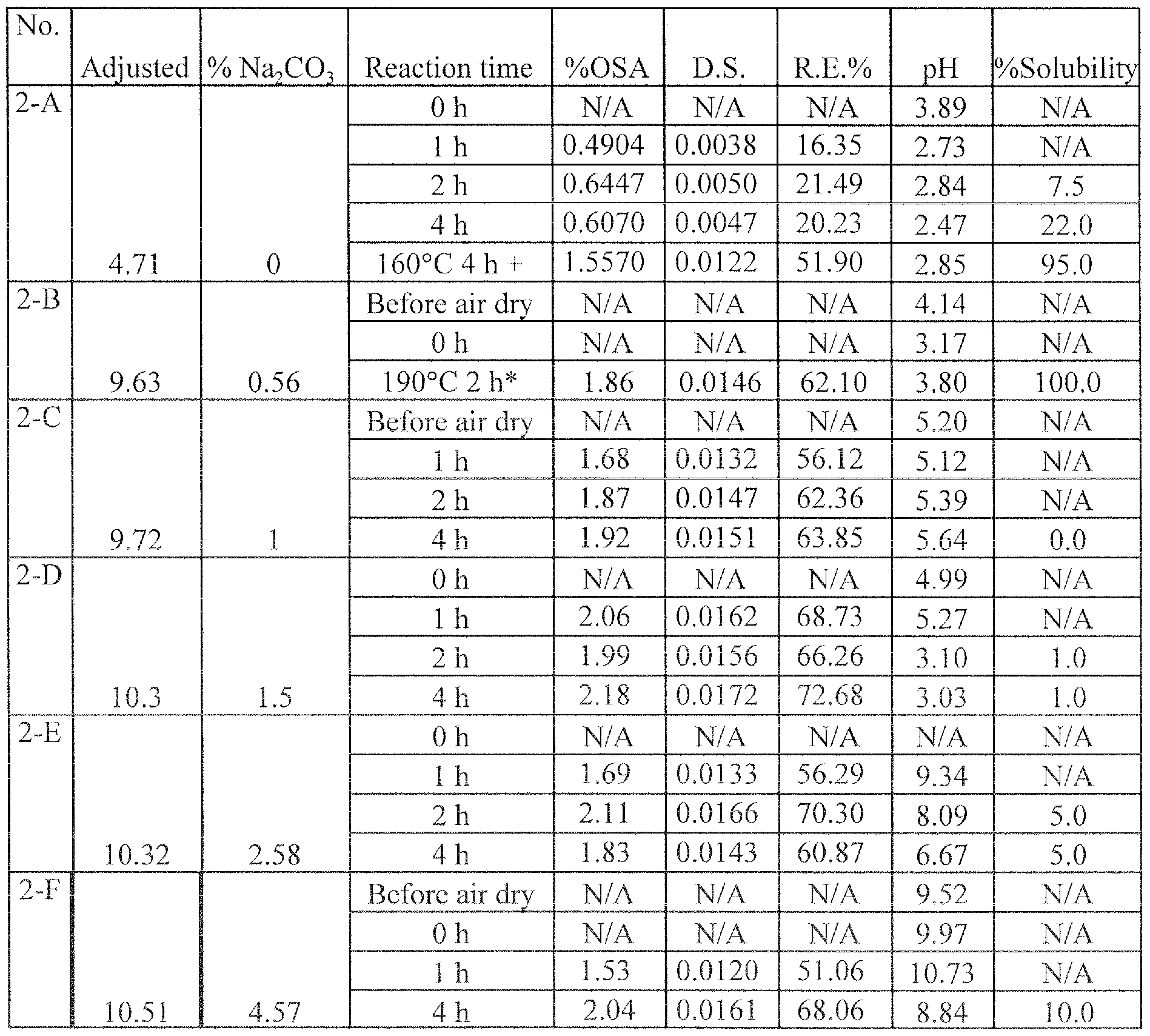
Waxy maize starch (100 g) was suspended in distilled water (150 mL) with agitation. A weighed amount OfNa2CO3 was added to the starch slurry, lhe experiments were earned out as described in Example 1 , except that sample 2-A was heated at 160 0C for 4 hours, then was reheated at 1900C for 2 hours. In contrast, sample 2-B was heated at 1900C for 2 hours. D.S. and R.E. of the samples heat treated at 1900C were calculated using titration method 2. D.S. and R.E of other samples were determined by titration method 1 .
As shown in Table 2, the more basic Na7CO ,-trcatcd starch slurries generally produced higher D.S. and R.E. values. The highest D.S. was achieved at pH 10.3. In
addition, solubility of the starch was found to be higher when the starch slurry combined with Na2CO3 was exposed to higher temperatures, such as in Samples 2-A and 2-B.
Table 2: Samples adjusted to different pll values by Na2CO3 and heat treated at 16O0C
EXAMPLE 3
In this example. NIl1IlCO3 was used to adjust the initial pH and the resulting effects on Degree of Substitution ("D.S.'"), reaction efficiency ("R.E."'), and starch solubility were measured.
Waxy maize starch (100 g) was suspended in distilled water (150 rnL) with agitation. A weighed amount of NH11HCO3 was added to the suspension. The experiment was carried out as
described in Example 1 . Sample 3-A was heated at 1600C for 4 hours was reheated at 1900C for 2 hours. D. S. and R.H. were measured by titration method 2.
As shown in Table 3, the use OfNII4HCO3 was effective in achieving relatively high D. S. and R.E. values especially when the starch was heated for longer periods of time and/or at higher temperatures. In addition, it was shown that use OfNH4HCO3 in conjunction with a higher heat treatment temperature (19O0C) greatly increased the solubility of the sample.
Table 3: Samples adjusted to pll 8.57 by NII4IICO3, and heat treated at 160 0C

EXAMPLES 4-6 In these examples the weight OfNII4IiCO3 added to ihe sxaich slurry was \aried and ihe effects on degree of substitution ("D. S."), reaction efficiency (''11.E."), and starch solubility were measured.
Waxy maize starch (100 g) was suspended in distilled water (150 mL) with agitation. The pH of the starch slurry was adjusted to between 8.0 - 8.8 by the addition of varying amounts Of NII1IICO3. T he experiments were carried out as described in Example 1 ; however, the heating temperature was adjusted to 1700C, 18(TC, or 190"C, and heating time was adjusted to Vτ hour, 1 hour, 2 hours, or 4 hours. A starch sample without adding OSA was prepared as a control. D. S. and R.L. were measured by titration method 2.
As shown in Fables 4-6, increased amounts OfNH4HCO. and longer exposure to higher temperatures led to an increase in D. S., R.E., and solubility of the starch.
Table 4: Samples adjusted to pi I 8.0 by NH4HCO3 (0.27% by starch dry weight) and heat treated at different temperatures.
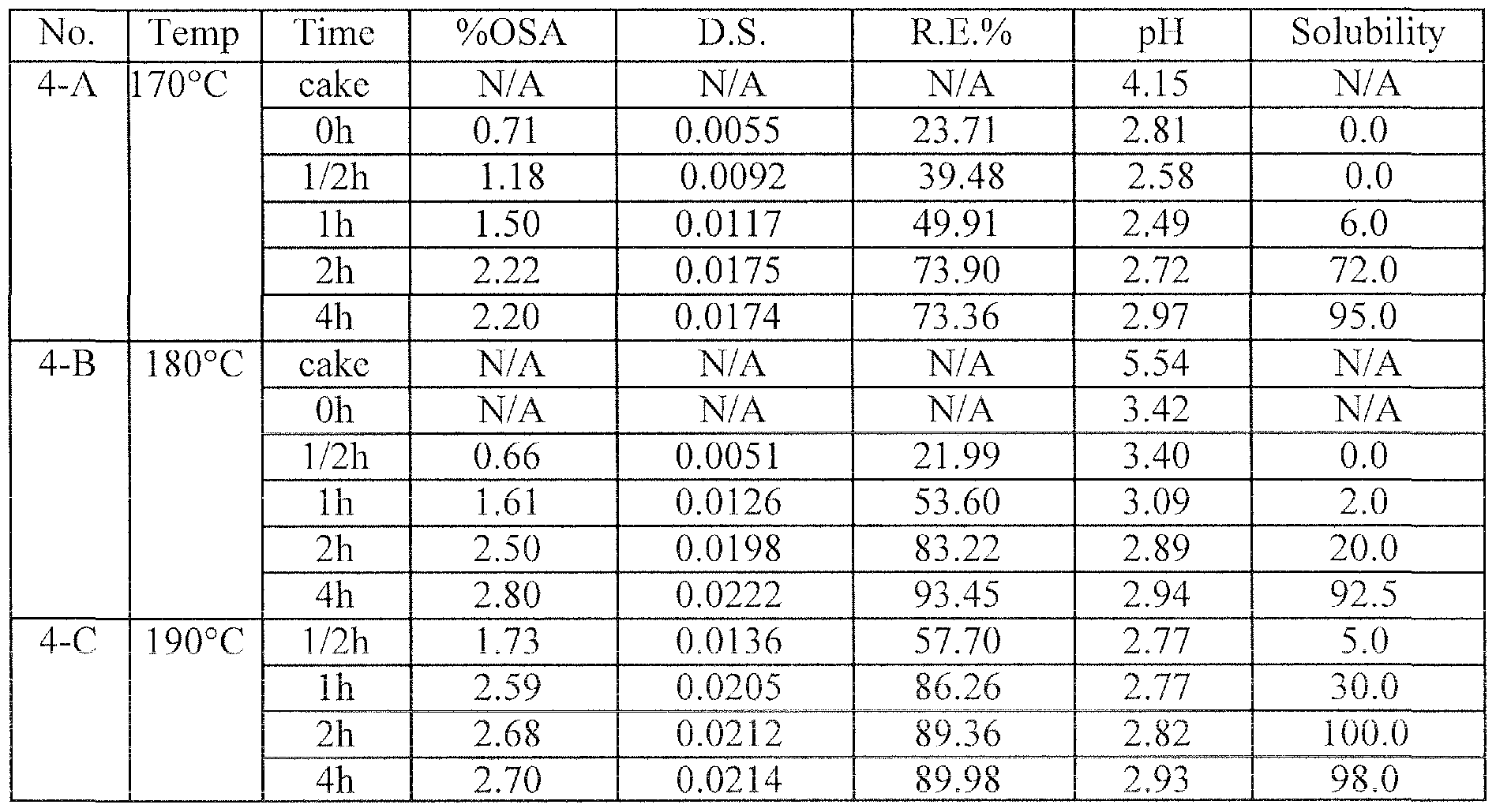
Table 5: Samples adjusted to pH 8.5 by NII4IICO3 (3.85% by starch diy weight) arid heat treated at different temperatures.


FXAMPLF 7
In this example, the viscosities exhibited by different starch samples from hxamples 4, 5, and 6 were measured.
Viscosity of the starch sample15 was determined by a Brookfield viscometer (RVDVIl 4 Pro, Brookfield Engineering Laboratories, Inc., Middlcboro, MA) with a CS4-18 spindle and a SC4-13 RPY chamber at 25 0C. Starch solutions of 30% and 50% solids of lab made starches and a commercial starch were prepared and added to the chamber. The commercial starch is a converted (degraded), OSA-modifϊcd starch obtained from National Starch LLC, Bridgewater, NJ. The spindle speed (RPM) was selected. The reading of shear stress (SS). shear rate (SR), viscosity (cP) and % (torque) are shown in Table 7.
Viscosity oi a starch solution reflects the molecular weight ol a starch sample. Compared with a commercial sample, the lab made starch sample showed higher viscosity indicating that the molecular size of the lab made sample was higher than that of the commercial sample.
Table 7: Viscosity of OS starch and a commercial starch solution


EXAMPLE 8
Tn this example, the effect of grinding the starch prior to heat treatment on solubility was measured.
Waxy maize starch (100 g) was suspended in distilled water (150 mL) with agitation. The pll of the starch slurry was adjusted to 8.45 by different weights OfNIl4IICO3 (Table 8). The experiment was carried out as in Example 1. However, the heating temperature was adjusted to 1700C or 1800C. and heating time was 2 hours. For sample 7-D. the OSA-modified starch was sieved by a 200-mesh sifter after heating. For sample 7-E, the starch mixture before heating was ground by an analytical mill (A-IO, Tekmar) and sieved through a 200-mesh sifter. The starch was thinly spread over an oven pan (38cm *26 cm) and heated at 18O0C for 2 hours. A starch sample without adding OSA was prepared as a control. D. S. and R.E. were measured by titration method 2.
Solubility of the OS starch dispersed in an aqueous medium (10%, w/w) was analy/ed by a potable rcfractomcicr before ccntrifugation (''SBC") The starch solution was ccntrifυgcd at 3500 rpm for 5 minutes and the supernatant was analyzed by the rciractometcr as well ("SAC").
As shown in Tabic 8, grinding of the starch prior to heat treatment appeared to have a slight positive effect on the solubility of the starch product when compared to samples that had not undergone grinding.
Table 8: Samples adjusted to pH 8.45 by NH4HCO3 (6.29% by starch dry weight) and heat treated at different temperatures.

EXAMPLE 9 This Example describes an embodiment of the present application directed to a non-food application using a 5% OSA treatment.
Waxy maize starch (100 g) was suspended in distilled water (150 mL) with agitation.
The pll of the starch slurry was adjusted to 8.30 with 3.02 g NH4HCO3. The suspension was filtered and the starch cake was mixed with 5% OSA (based on the weight of starch) by a mixer (Model K45SSWH, KitchenAid, St. Joseph, MI) at 2nd speed for 15 minutes. The mixture was dried in an air oven at 350C overnight until the moisture content was below 12%. The mixture was then spread over an oven pan (38cm χ26 cm) and heated at 1800C for 2 hours. Afterwards, the starch mixture was ground by an analytical mill (A-I O, Tekmar) and sieved through a 200- mcsh sifter. Λ starch sample without adding OSA was prepared as a control. D. S. and R.E. were measured by titration method 2.
The bound OS content was 4.77%. The D.S. and R.E. of the OS starch were 0.0386 and 93.43%, respectively. Solubility of the OS starch was analyzed by a potable refractometer. The starch solution ( 10%, w/w) vvas ccntrifugcd at 3500 rpm for 5 minutes. The solubility of the material was found to be 86%
EXAMPLE 10
In this example, wheat starch (100 g) was suspended in distilled water (150 mL) with agitation. The pi I of the starch slurry was adjusted to 8.45 by adding 3.02 g NH1I ICOv flic experiment was carried out as described in Example 9 except that 3% OSA was added, fhc bound OS content was 2.59%. The D.S. of the OS starch was 0.0205, and the R.E. was 94.33%.
The solubility of the OS starch was 75%.
EXAMPLE 11
In this example an emulsion of sample 7-E was prepared. OS starch (8.0g, dry basis) was mixed with sodium benzoatc (0.1 g), citric acid (0.2g) and water (50.40 mL) in a Waring blender
(Model 31BL92, Dynamics Corporation of America). The mixture was blended at low speed
(powerstat at 25-30) for 2 minutes. Orange oil (8g) was slowly added to the mixture over 30 seconds and the mixture was blended for an additional 30 seconds. The jar was then covered and
blendcd at a high speed (powcrstat at 100) for 2 minutes. The emulsion solution was permitted to rest in the blender for 30 minutes and transferred to a tall glass jar (10 oz.). The jar was capped and heated at 450C in an air oven for 24 hours. The emulsion was very stable after heating at 450C for 24 hours. Microscope photographs of the emulsion were taken and are shown in Figs. Ia and Ib and depict a small oil droplet size.
EXAMPLE 12
In this example, Samples 7-E and 5-B (both heat treated for 4 hours) were suspended in glycerol and viewed with a microscope under normal and polarized light. Figures 2a and 2b depict Sample 7-E under normal and polarized light, respectively. Figures 3a and 3b depict Sample 5-B under normal and polarized light, respectively. Figures 2b and 3b show that starch granules of both samples had maltese crosses and were bircfringcnt when viewed under polarized light. The results suggest that certain molecular order of starch granules remained after OSA modification.
EXAMPLE 13
In this example, Sample 5-B (heat treated for 1 hour, 2 hours, and 4 hours) and a commercial sample (same as used in Example 7 above) were analyzed by gel permission chromatography (GPC). The starch (0.1% by weight) was uihpeiScd in DMSO and heated in a boiling water bath for 1 hour. Then the solution was analyzed by the GPC. lhe results arc shown in Fig. 4. The lab made OS samples exhibited larger molecular weights than the commercial sample.
EXAMPLE 14 In this example, waxy maize starch (100 g) was suspended in distilled water (150 mL) with agitation. The pli of the starch slurry was adjusted to 8.46 by the addition of 3.02 g NH4HCO3. The suspension was filtered and the starch cake was mixed with 50% OSA (by the weight of starch). The mixture was dried in an air oven at 350C overnight until the moisture content was below 12%. The starch mixture was heated in the air-forced oven at 130 0C for 1 h and then 105 0C for 6 h. After the product was cooled to 25°C, a sample (5 g) was washed twice with methanol (50 ml). The D. S. of the methanol-washed product was then measured by titration method 1 and the value was determined to be 0.0138.
EXAMPLR 15
In this example, an OS starch was prepared and the D. S. measured by an NMR method described as follows. The starch sample (0.1 g) was dissolved in 0.5 mL of D2O and freeze-dried. The D2O-exchanged starch (0.07 g) was dissolved in D9O (0.60 mL) for NMR analysis. 1H NMR 1 D spectra were recorded on a 400 MH/ Varian NMR spectrometer at 250C. fhe NMR spectrometer was equipped with a 5 -mm diameter, triple-resonance, inverse
-detection, pulse-field-gradient probe operating at 399.74 MIIz. The 1II spectra were collected in 64 individual scans with a sweep width of 16 ppm and a delay time of 1 s. Sodium
3-(trimethylsilyl) - propionate-2,2,3,3-d4 (TSF) was used as a reference (0 ppm). Chemical shifts are reported in parts per million (ppm). DS was calculated from the NMR spectra by using the following equation:
 -5
-5
1S 39 ' -ϊ-5 12 ' M 96 *~ '4 61 ^ M D I
where I094 is the integrals of methyl protons. I5 ,9, 15 12, 14 96, 14 6, and I4 51 are the integrals of the anomeric proton.
Waxy maize starch ( 100 g) was suspended in distilled water (1 50 mL) with agitation. The pi I of the starch slurry was adjusted to 8.45 by 3.02 g NfI4HCO3. The suspension was filtered and the starch cake was mixed with 3% OSΛ (by the weight of starch) by a mixer (Model K45SSWII, KitehenΛid. St. Joseph, MI) at 2nd speed for 15min. 1 he mixture was dried in an air oven at 35°C overnight until the moisture content was below ] 2%. 1 lie starch mixture (31.12 g) was mixed with sodium aluminum phosphate (SΛP) (3.09 g). The pH of the starch sample was 4.Q0 with SAJP, The starch was heated in the air-forced oven at 1800C for 2 h. After the product was cooled to room temperature, a sample (0.15g) was extracted by methanol (2 ml), and the extraction was repeated. The sample (0.07g) was dissolved in D2O (0.6 mL) and the D. S. of the product was measured by the NMR method to be 0.01989.
Claims
1. A method of preparing a lipophilic starch comprising: adding an organic acid anhydride reagent to a starch mixture thereby forming a reaction mixture, said organic acid anhydride reagent having the formula
O
O R- -R'
\ /
\ /
C
O
wherein R is a dimcthylene or trimethylene group and R' is a linear, branched or cyclic alkyl, alkenyl. aralkyl or aralkcnyl group having 2 to 20 carbon atoms, the plϊ of the starch mixture being adjusted to between about 7 to about 11 cither before or after addition of said organic acid anhydride reagent; drying said reaction mixture to a moisture content of between about 0 to about 1 5% by weight; and heating said dried reaction mixture al a temperature of at least about 1000C for between about 1 minute to about 6 hours.
2. The method according to claim 1, wherein said starch mixture is prepared by forming a starch slurry.
3. The method according to claim 2, wherein said starch slurry is prepared by dispersing a quantity of starch in a liquid medium, said liquid medium being selected from the group consisting of water, alcohol, or combinations thereof.
4. The method according to claim 1 or 2, wherein the pH of the starch mixture is adjusted to between about 7 to about 11 prior to the addition of said acid organic anhydride reagent.
5. The method according to claim 1 or 2, wherein the pH of the starch mixture is adjusted to between about 7 to about 11 after the addition of said organic anhydride reagent.
6. The method according to claim 4 or 5, wherein the pH of said starch mixture is adjusted by adding a base thereto, said base being selected from the group consisting of metal and non-metal hydroxides, oxides, carbonates, and mixtures thereof.
7. The method according to claim 6, wherein said base is selected from the group consisting of ammonium hydroxide, ammonium carbonate, and ammonium bicarbonate, and mixtures thereof.
8. The method according to claim 1. said method first comprising forming a starch mixture having a pH of between about 7 to about J 1. and processing said starch mixture to obtain a starch cake;
9. The method according to claim 8, wherein said starch mixture is prepared by forming a starch slurry, and said step of processing said starch mixture to obtain a starch cake comprises filtering said starch slurry
10. The method according Io claims 1 , 2. or 8, wherein said organic acid anhydride reagent comprises octcnyl succinic anhydride.
1 1 . The method according to claims 1 or 2, wherein said organic acid anhydride reagent is added to said starch mixture a level of between about 0% to 100% by weight, based on the dry weight of the starch.
12. The method according to claims 1 , 2. or 8, wherein said step of drying said reaction mixture comprises heating said reaction mixture to a temperature of less than 12O0C until said moisture content of between about 0% to about 15% by weight is achieved.
13. ϊhc method according to claim 1. 2, or 8, wherein said step of heating said dried reaction mixture comprises heating said dried reaction mixture at a temperature of between about 1000C to about 2000C.
14. The method according to claim 13, wherein said step of heating said dried reaction mixture comprises healing said dried reaction mixture at a temperature of between about 1400C to about 1800C for between about 30 minutes to about 3.5 hours.
15. A water-soluble, lipophilic starch comprising starch that has been modified with an organic acid anhydride reagent and which contains less than about 0.5% by weight of one or more mineral acids and/or less than about 0.1 % by weight of starch-degrading en/yme residues, said lipophilic starch having a solubility in water at 253C of greater than about 90%, wherein said lipophilic starch, when suspended in glycerol and viewed with a microscope under polarized light, has a granular shape and is birefringenl.
16. The water-soluble, lipophilic starch according to claim 15, wherein said organic acid anhydride reagent has the formula
O
O R— R1
\ /
C
O
wherein R is a dimethylene or trimethylene group and R' is a linear, branched or cyclic alkyl. alkenyl, aralkyl or aralkenyl group having 2 to 20 carbon atoms.
17. The water-soluble, lipophilic starch according to claim 16, λvherein said organic acid anhydride reagent comprises octenyl succinic anhydride.
18. The water-soluble, lipophilic starch according to claim 15 or 16, wherein said lipophilic starch is substantially free of mineral acid and/or starch-degrading enzyme residues.
19. A lipophilic starch comprising a starch that has been modified with an organic acid anhydride reagent, wherein said lipophilic starch, when suspended in glycerol and viewed with a microscope under polari/ed light, has a granular shape and is birefringent.
20. An emulsion comprising the water-soluble, lipophilic starch according to any of claims 15-19.
21. The emulsion according to claim 20, wherein the emulsion remains stable after storage for 24 hours at 45° C.
22. Λ food product comprising the watcr-soiubic. lipophilic starch according to any of claims 15-19.
23. A food product comprising a lipophilic starch made by the method of any of claims 1-14.
Priority Applications (1)
| Application Number | Priority Date | Filing Date | Title |
|---|---|---|---|
| US13/146,631 US9458252B2 (en) | 2009-02-03 | 2010-02-03 | Starch esters and method of preparation |
Applications Claiming Priority (2)
| Application Number | Priority Date | Filing Date | Title |
|---|---|---|---|
| US14954109P | 2009-02-03 | 2009-02-03 | |
| US61/149,541 | 2009-02-03 |
Publications (2)
| Publication Number | Publication Date |
|---|---|
| WO2010091091A2 true WO2010091091A2 (en) | 2010-08-12 |
| WO2010091091A3 WO2010091091A3 (en) | 2011-03-31 |
Family
ID=42542632
Family Applications (1)
| Application Number | Title | Priority Date | Filing Date |
|---|---|---|---|
| PCT/US2010/023062 Ceased WO2010091091A2 (en) | 2009-02-03 | 2010-02-03 | Starch esters and method of preparation |
Country Status (2)
| Country | Link |
|---|---|
| US (1) | US9458252B2 (en) |
| WO (1) | WO2010091091A2 (en) |
Cited By (3)
| Publication number | Priority date | Publication date | Assignee | Title |
|---|---|---|---|---|
| CN102276741A (en) * | 2011-01-21 | 2011-12-14 | 宁波工程学院 | Method for utilizing octenyl succinic anhydride to produce starch ester in circulation |
| WO2018213393A1 (en) * | 2017-05-16 | 2018-11-22 | Cargill, Incorporated | Article of manufacture containing a starch-converted material |
| CN112741247A (en) * | 2020-12-28 | 2021-05-04 | 浙江新和成股份有限公司 | Octenyl succinic acid starch ester and preparation method and application thereof |
Families Citing this family (15)
| Publication number | Priority date | Publication date | Assignee | Title |
|---|---|---|---|---|
| US8258250B2 (en) | 2009-10-07 | 2012-09-04 | Johnson & Johnson Consumer Companies, Inc. | Compositions comprising superhydrophilic amphiphilic copolymers and methods of use thereof |
| US11173106B2 (en) * | 2009-10-07 | 2021-11-16 | Johnson & Johnson Consumer Inc. | Compositions comprising a superhydrophilic amphiphilic copolymer and a micellar thickener |
| US8399590B2 (en) * | 2009-10-07 | 2013-03-19 | Akzo Nobel Chemicals International B.V. | Superhydrophilic amphiphilic copolymers and processes for making the same |
| KR102171151B1 (en) * | 2009-10-19 | 2020-10-28 | 니치덴 가가쿠 가부시키가이샤 | Coating material for fried foods |
| US20150119505A1 (en) * | 2013-10-29 | 2015-04-30 | Edward Scott Williams | Paper Coating Composition |
| DK3428195T3 (en) | 2017-07-10 | 2021-06-28 | Corn Products Dev Inc | MODIFIED STARCH |
| US11208499B2 (en) | 2018-12-28 | 2021-12-28 | Kansas State University Research Foundation | Amylase-degraded organic acid anhydride substituted starches and methods of preparing the same |
| CN110583801A (en) * | 2019-10-17 | 2019-12-20 | 东北农业大学 | Method for preparing powdered oil by compounding octenyl succinic anhydride modified starch and xanthan gum |
| CN112646047B (en) * | 2020-09-28 | 2022-06-17 | 重庆多典生物科技有限公司 | Organic acid glyceride starch, preparation method and application thereof, and organic acid glyceride starch-starch, preparation method and application thereof |
| CN114437240B (en) * | 2020-11-06 | 2023-04-28 | 山东福洋生物科技股份有限公司 | Preparation method of hydrophobic starch |
| CN113058072A (en) * | 2021-03-16 | 2021-07-02 | 卫纳塞德(北京)医疗科技有限公司 | Antibacterial medical cold compress hydrogel and preparation method thereof |
| CN113058073A (en) * | 2021-03-16 | 2021-07-02 | 卫纳塞德(北京)医疗科技有限公司 | Cold compress type medical hydrogel and preparation method thereof |
| CN113087812B (en) * | 2021-04-23 | 2022-10-21 | 宁波工程学院 | A kind of preparation method of high fluidity starch |
| CN114891127B (en) * | 2022-04-22 | 2023-04-07 | 上海交通大学 | Preparation method of octenyl succinic anhydride starch-based emulsifier with high emulsifying property |
| CN115466333B (en) * | 2022-10-17 | 2024-01-30 | 黑龙江八一农垦大学 | Preparation method of octenyl succinic acid starch ester |
Family Cites Families (6)
| Publication number | Priority date | Publication date | Assignee | Title |
|---|---|---|---|---|
| US2461139A (en) * | 1945-01-08 | 1949-02-08 | Nat Starch Products Inc | Starch ester derivatives and method of making same |
| US2661349A (en) | 1949-02-18 | 1953-12-01 | Nat Starch Products Inc | Polysaccharide derivatives of substituted dicarboxylic acids |
| US3732207A (en) * | 1971-01-29 | 1973-05-08 | Anheuser Busch | Preparation of dextrins and starch esters |
| US4035235A (en) | 1973-03-12 | 1977-07-12 | Anheuser-Busch, Incorporated | Method of making lipophilic starch derivatives |
| US5593503A (en) * | 1995-06-07 | 1997-01-14 | National Starch And Chemical Investment Holding Corporation | Process for producing amylase resistant granular starch |
| US6037466A (en) | 1998-12-31 | 2000-03-14 | National Starch And Chemical Investment Holding Corporation | Method for preparing hydrophobic starch derivatives |
-
2010
- 2010-02-03 WO PCT/US2010/023062 patent/WO2010091091A2/en not_active Ceased
- 2010-02-03 US US13/146,631 patent/US9458252B2/en active Active
Cited By (7)
| Publication number | Priority date | Publication date | Assignee | Title |
|---|---|---|---|---|
| CN102276741A (en) * | 2011-01-21 | 2011-12-14 | 宁波工程学院 | Method for utilizing octenyl succinic anhydride to produce starch ester in circulation |
| CN102276741B (en) * | 2011-01-21 | 2015-06-10 | 宁波工程学院 | Method for utilizing octenyl succinic anhydride to produce starch ester in circulation |
| WO2018213393A1 (en) * | 2017-05-16 | 2018-11-22 | Cargill, Incorporated | Article of manufacture containing a starch-converted material |
| CN110869395A (en) * | 2017-05-16 | 2020-03-06 | 嘉吉公司 | Products containing starch conversion material |
| RU2757173C2 (en) * | 2017-05-16 | 2021-10-11 | Карджилл, Инкорпорейтед | Composition based on modified dextrin and its application |
| US11441017B2 (en) | 2017-05-16 | 2022-09-13 | Cargill, Incorporated | Article of manufacture containing a starch-converted material |
| CN112741247A (en) * | 2020-12-28 | 2021-05-04 | 浙江新和成股份有限公司 | Octenyl succinic acid starch ester and preparation method and application thereof |
Also Published As
| Publication number | Publication date |
|---|---|
| US20110287165A1 (en) | 2011-11-24 |
| WO2010091091A3 (en) | 2011-03-31 |
| US9458252B2 (en) | 2016-10-04 |
Similar Documents
| Publication | Publication Date | Title |
|---|---|---|
| WO2010091091A2 (en) | Starch esters and method of preparation | |
| Xue et al. | Structure, thermal and rheological properties of different soluble dietary fiber fractions from mushroom Lentinula edodes (Berk.) Pegler residues | |
| Zuo et al. | Preparation and characterization of dialdehyde starch by one-step acid hydrolysis and oxidation | |
| JP6863917B2 (en) | Method for Producing Suppressed Non-Pregelatinized Granular Starch | |
| Li et al. | Physical properties and loading capacity of starch-based microparticles crosslinked with trisodium trimetaphosphate | |
| Lee et al. | A review on development and application of plant-based bioflocculants and grafted bioflocculants | |
| Choy et al. | Isolation, characterization and the potential use of starch from jackfruit seed wastes as a coagulant aid for treatment of turbid water | |
| Wang et al. | Physicochemical properties of octenyl succinic anhydride‐modified potato starch with different degrees of substitution | |
| Galanakis et al. | A study of the recovery of the dietary fibres from olive mill wastewater and the gelling ability of the soluble fibre fraction | |
| WO2015137791A1 (en) | Modified starch flocculant and method of producing thereof | |
| CN112961253A (en) | Method for flame-retardant modification of microcrystalline cellulose by phytic acid | |
| EP2978775A1 (en) | Thermally modified starch | |
| Tang et al. | Hydroxypropylation of cross-linked sesbania gum, characterization and properties | |
| CN113072662A (en) | Pectin grafted copolymer and preparation method and application thereof | |
| RU2664513C2 (en) | Stabilized sizing composition | |
| Tang et al. | Cationic oxidized microporous rice starch: Preparation, characterization, and properties | |
| Ma et al. | Structural features, physiological functions and digestive properties of phosphorylated corn starch: A comparative study of four phosphorylating agents and two preparation methods | |
| Felker et al. | Comparison of microwave processing and excess steam jet cooking for spherulite production from amylose–fatty acid inclusion complexes | |
| Cao et al. | Comparative study on the structure and physicochemical of waxy rice starch by phosphorylation, lactylation and dual-modified | |
| CN103694742A (en) | Method for graft modification of insoluble ammonium polyphosphate through organosilicon, and use of obtained product | |
| JP6636881B2 (en) | Method for producing siloxane-modified chitosan, siloxane-modified chitosan, emulsifier, and emulsion composition | |
| Han et al. | Characterization of structure and solution properties of tamarind seed polysaccharide extracted at different temperatures | |
| JP2024536561A (en) | Starch Compositions Made Using Saturated Steam | |
| CN115947875B (en) | Lycium barbarum polysaccharide extracted by ionic liquid and its application in lowering blood sugar | |
| RU2757173C2 (en) | Composition based on modified dextrin and its application |
Legal Events
| Date | Code | Title | Description |
|---|---|---|---|
| 121 | Ep: the epo has been informed by wipo that ep was designated in this application |
Ref document number: 10739068 Country of ref document: EP Kind code of ref document: A2 |
|
| WWE | Wipo information: entry into national phase |
Ref document number: 13146631 Country of ref document: US |
|
| NENP | Non-entry into the national phase |
Ref country code: DE |
|
| 122 | Ep: pct application non-entry in european phase |
Ref document number: 10739068 Country of ref document: EP Kind code of ref document: A2 |