WO2010086901A1 - Layered structure for cosmetic use - Google Patents
Layered structure for cosmetic use Download PDFInfo
- Publication number
- WO2010086901A1 WO2010086901A1 PCT/JP2009/000373 JP2009000373W WO2010086901A1 WO 2010086901 A1 WO2010086901 A1 WO 2010086901A1 JP 2009000373 W JP2009000373 W JP 2009000373W WO 2010086901 A1 WO2010086901 A1 WO 2010086901A1
- Authority
- WO
- WIPO (PCT)
- Prior art keywords
- layered structure
- skin
- cosmetic
- image forming
- layer
- Prior art date
- Legal status (The legal status is an assumption and is not a legal conclusion. Google has not performed a legal analysis and makes no representation as to the accuracy of the status listed.)
- Ceased
Links
Images

Classifications
-
- A—HUMAN NECESSITIES
- A61—MEDICAL OR VETERINARY SCIENCE; HYGIENE
- A61K—PREPARATIONS FOR MEDICAL, DENTAL OR TOILETRY PURPOSES
- A61K8/00—Cosmetics or similar toiletry preparations
- A61K8/02—Cosmetics or similar toiletry preparations characterised by special physical form
- A61K8/0208—Tissues; Wipes; Patches
-
- A—HUMAN NECESSITIES
- A61—MEDICAL OR VETERINARY SCIENCE; HYGIENE
- A61Q—SPECIFIC USE OF COSMETICS OR SIMILAR TOILETRY PREPARATIONS
- A61Q1/00—Make-up preparations; Body powders; Preparations for removing make-up
- A61Q1/02—Preparations containing skin colorants, e.g. pigments
-
- A—HUMAN NECESSITIES
- A61—MEDICAL OR VETERINARY SCIENCE; HYGIENE
- A61Q—SPECIFIC USE OF COSMETICS OR SIMILAR TOILETRY PREPARATIONS
- A61Q1/00—Make-up preparations; Body powders; Preparations for removing make-up
- A61Q1/02—Preparations containing skin colorants, e.g. pigments
- A61Q1/025—Semi-permanent tattoos, stencils, e.g. "permanent make-up"
-
- B—PERFORMING OPERATIONS; TRANSPORTING
- B32—LAYERED PRODUCTS
- B32B—LAYERED PRODUCTS, i.e. PRODUCTS BUILT-UP OF STRATA OF FLAT OR NON-FLAT, e.g. CELLULAR OR HONEYCOMB, FORM
- B32B25/00—Layered products comprising a layer of natural or synthetic rubber
- B32B25/04—Layered products comprising a layer of natural or synthetic rubber comprising rubber as the main or only constituent of a layer, which is next to another layer of the same or of a different material
- B32B25/06—Layered products comprising a layer of natural or synthetic rubber comprising rubber as the main or only constituent of a layer, which is next to another layer of the same or of a different material of paper or cardboard
-
- B—PERFORMING OPERATIONS; TRANSPORTING
- B32—LAYERED PRODUCTS
- B32B—LAYERED PRODUCTS, i.e. PRODUCTS BUILT-UP OF STRATA OF FLAT OR NON-FLAT, e.g. CELLULAR OR HONEYCOMB, FORM
- B32B25/00—Layered products comprising a layer of natural or synthetic rubber
- B32B25/04—Layered products comprising a layer of natural or synthetic rubber comprising rubber as the main or only constituent of a layer, which is next to another layer of the same or of a different material
- B32B25/08—Layered products comprising a layer of natural or synthetic rubber comprising rubber as the main or only constituent of a layer, which is next to another layer of the same or of a different material of synthetic resin
-
- B—PERFORMING OPERATIONS; TRANSPORTING
- B32—LAYERED PRODUCTS
- B32B—LAYERED PRODUCTS, i.e. PRODUCTS BUILT-UP OF STRATA OF FLAT OR NON-FLAT, e.g. CELLULAR OR HONEYCOMB, FORM
- B32B25/00—Layered products comprising a layer of natural or synthetic rubber
- B32B25/14—Layered products comprising a layer of natural or synthetic rubber comprising synthetic rubber copolymers
-
- B—PERFORMING OPERATIONS; TRANSPORTING
- B32—LAYERED PRODUCTS
- B32B—LAYERED PRODUCTS, i.e. PRODUCTS BUILT-UP OF STRATA OF FLAT OR NON-FLAT, e.g. CELLULAR OR HONEYCOMB, FORM
- B32B27/00—Layered products comprising a layer of synthetic resin
- B32B27/06—Layered products comprising a layer of synthetic resin as the main or only constituent of a layer, which is next to another layer of the same or of a different material
- B32B27/10—Layered products comprising a layer of synthetic resin as the main or only constituent of a layer, which is next to another layer of the same or of a different material of paper or cardboard
-
- B—PERFORMING OPERATIONS; TRANSPORTING
- B32—LAYERED PRODUCTS
- B32B—LAYERED PRODUCTS, i.e. PRODUCTS BUILT-UP OF STRATA OF FLAT OR NON-FLAT, e.g. CELLULAR OR HONEYCOMB, FORM
- B32B27/00—Layered products comprising a layer of synthetic resin
- B32B27/18—Layered products comprising a layer of synthetic resin characterised by the use of special additives
-
- B—PERFORMING OPERATIONS; TRANSPORTING
- B32—LAYERED PRODUCTS
- B32B—LAYERED PRODUCTS, i.e. PRODUCTS BUILT-UP OF STRATA OF FLAT OR NON-FLAT, e.g. CELLULAR OR HONEYCOMB, FORM
- B32B27/00—Layered products comprising a layer of synthetic resin
- B32B27/18—Layered products comprising a layer of synthetic resin characterised by the use of special additives
- B32B27/20—Layered products comprising a layer of synthetic resin characterised by the use of special additives using fillers, pigments, thixotroping agents
-
- B—PERFORMING OPERATIONS; TRANSPORTING
- B32—LAYERED PRODUCTS
- B32B—LAYERED PRODUCTS, i.e. PRODUCTS BUILT-UP OF STRATA OF FLAT OR NON-FLAT, e.g. CELLULAR OR HONEYCOMB, FORM
- B32B27/00—Layered products comprising a layer of synthetic resin
- B32B27/18—Layered products comprising a layer of synthetic resin characterised by the use of special additives
- B32B27/22—Layered products comprising a layer of synthetic resin characterised by the use of special additives using plasticisers
-
- B—PERFORMING OPERATIONS; TRANSPORTING
- B32—LAYERED PRODUCTS
- B32B—LAYERED PRODUCTS, i.e. PRODUCTS BUILT-UP OF STRATA OF FLAT OR NON-FLAT, e.g. CELLULAR OR HONEYCOMB, FORM
- B32B27/00—Layered products comprising a layer of synthetic resin
- B32B27/28—Layered products comprising a layer of synthetic resin comprising synthetic resins not wholly covered by any one of the sub-groups B32B27/30 - B32B27/42
- B32B27/283—Layered products comprising a layer of synthetic resin comprising synthetic resins not wholly covered by any one of the sub-groups B32B27/30 - B32B27/42 comprising polysiloxanes
-
- B—PERFORMING OPERATIONS; TRANSPORTING
- B32—LAYERED PRODUCTS
- B32B—LAYERED PRODUCTS, i.e. PRODUCTS BUILT-UP OF STRATA OF FLAT OR NON-FLAT, e.g. CELLULAR OR HONEYCOMB, FORM
- B32B27/00—Layered products comprising a layer of synthetic resin
- B32B27/30—Layered products comprising a layer of synthetic resin comprising vinyl (co)polymers; comprising acrylic (co)polymers
- B32B27/302—Layered products comprising a layer of synthetic resin comprising vinyl (co)polymers; comprising acrylic (co)polymers comprising aromatic vinyl (co)polymers, e.g. styrenic (co)polymers
-
- B—PERFORMING OPERATIONS; TRANSPORTING
- B32—LAYERED PRODUCTS
- B32B—LAYERED PRODUCTS, i.e. PRODUCTS BUILT-UP OF STRATA OF FLAT OR NON-FLAT, e.g. CELLULAR OR HONEYCOMB, FORM
- B32B27/00—Layered products comprising a layer of synthetic resin
- B32B27/30—Layered products comprising a layer of synthetic resin comprising vinyl (co)polymers; comprising acrylic (co)polymers
- B32B27/304—Layered products comprising a layer of synthetic resin comprising vinyl (co)polymers; comprising acrylic (co)polymers comprising vinyl halide (co)polymers, e.g. PVC, PVDC, PVF, PVDF
-
- B—PERFORMING OPERATIONS; TRANSPORTING
- B32—LAYERED PRODUCTS
- B32B—LAYERED PRODUCTS, i.e. PRODUCTS BUILT-UP OF STRATA OF FLAT OR NON-FLAT, e.g. CELLULAR OR HONEYCOMB, FORM
- B32B27/00—Layered products comprising a layer of synthetic resin
- B32B27/30—Layered products comprising a layer of synthetic resin comprising vinyl (co)polymers; comprising acrylic (co)polymers
- B32B27/306—Layered products comprising a layer of synthetic resin comprising vinyl (co)polymers; comprising acrylic (co)polymers comprising vinyl acetate or vinyl alcohol (co)polymers
-
- B—PERFORMING OPERATIONS; TRANSPORTING
- B32—LAYERED PRODUCTS
- B32B—LAYERED PRODUCTS, i.e. PRODUCTS BUILT-UP OF STRATA OF FLAT OR NON-FLAT, e.g. CELLULAR OR HONEYCOMB, FORM
- B32B27/00—Layered products comprising a layer of synthetic resin
- B32B27/30—Layered products comprising a layer of synthetic resin comprising vinyl (co)polymers; comprising acrylic (co)polymers
- B32B27/308—Layered products comprising a layer of synthetic resin comprising vinyl (co)polymers; comprising acrylic (co)polymers comprising acrylic (co)polymers
-
- B—PERFORMING OPERATIONS; TRANSPORTING
- B32—LAYERED PRODUCTS
- B32B—LAYERED PRODUCTS, i.e. PRODUCTS BUILT-UP OF STRATA OF FLAT OR NON-FLAT, e.g. CELLULAR OR HONEYCOMB, FORM
- B32B27/00—Layered products comprising a layer of synthetic resin
- B32B27/32—Layered products comprising a layer of synthetic resin comprising polyolefins
-
- B—PERFORMING OPERATIONS; TRANSPORTING
- B32—LAYERED PRODUCTS
- B32B—LAYERED PRODUCTS, i.e. PRODUCTS BUILT-UP OF STRATA OF FLAT OR NON-FLAT, e.g. CELLULAR OR HONEYCOMB, FORM
- B32B27/00—Layered products comprising a layer of synthetic resin
- B32B27/34—Layered products comprising a layer of synthetic resin comprising polyamides
-
- B—PERFORMING OPERATIONS; TRANSPORTING
- B32—LAYERED PRODUCTS
- B32B—LAYERED PRODUCTS, i.e. PRODUCTS BUILT-UP OF STRATA OF FLAT OR NON-FLAT, e.g. CELLULAR OR HONEYCOMB, FORM
- B32B27/00—Layered products comprising a layer of synthetic resin
- B32B27/36—Layered products comprising a layer of synthetic resin comprising polyesters
-
- B—PERFORMING OPERATIONS; TRANSPORTING
- B32—LAYERED PRODUCTS
- B32B—LAYERED PRODUCTS, i.e. PRODUCTS BUILT-UP OF STRATA OF FLAT OR NON-FLAT, e.g. CELLULAR OR HONEYCOMB, FORM
- B32B27/00—Layered products comprising a layer of synthetic resin
- B32B27/38—Layered products comprising a layer of synthetic resin comprising epoxy resins
-
- B—PERFORMING OPERATIONS; TRANSPORTING
- B32—LAYERED PRODUCTS
- B32B—LAYERED PRODUCTS, i.e. PRODUCTS BUILT-UP OF STRATA OF FLAT OR NON-FLAT, e.g. CELLULAR OR HONEYCOMB, FORM
- B32B27/00—Layered products comprising a layer of synthetic resin
- B32B27/40—Layered products comprising a layer of synthetic resin comprising polyurethanes
-
- B—PERFORMING OPERATIONS; TRANSPORTING
- B32—LAYERED PRODUCTS
- B32B—LAYERED PRODUCTS, i.e. PRODUCTS BUILT-UP OF STRATA OF FLAT OR NON-FLAT, e.g. CELLULAR OR HONEYCOMB, FORM
- B32B3/00—Layered products comprising a layer with external or internal discontinuities or unevennesses, or a layer of non-planar shape; Layered products comprising a layer having particular features of form
- B32B3/26—Layered products comprising a layer with external or internal discontinuities or unevennesses, or a layer of non-planar shape; Layered products comprising a layer having particular features of form characterised by a particular shape of the outline of the cross-section of a continuous layer; characterised by a layer with cavities or internal voids ; characterised by an apertured layer
- B32B3/266—Layered products comprising a layer with external or internal discontinuities or unevennesses, or a layer of non-planar shape; Layered products comprising a layer having particular features of form characterised by a particular shape of the outline of the cross-section of a continuous layer; characterised by a layer with cavities or internal voids ; characterised by an apertured layer characterised by an apertured layer, the apertures going through the whole thickness of the layer, e.g. expanded metal, perforated layer, slit layer regular cells B32B3/12
-
- B—PERFORMING OPERATIONS; TRANSPORTING
- B32—LAYERED PRODUCTS
- B32B—LAYERED PRODUCTS, i.e. PRODUCTS BUILT-UP OF STRATA OF FLAT OR NON-FLAT, e.g. CELLULAR OR HONEYCOMB, FORM
- B32B7/00—Layered products characterised by the relation between layers; Layered products characterised by the relative orientation of features between layers, or by the relative values of a measurable parameter between layers, i.e. products comprising layers having different physical, chemical or physicochemical properties; Layered products characterised by the interconnection of layers
- B32B7/04—Interconnection of layers
- B32B7/06—Interconnection of layers permitting easy separation
-
- B—PERFORMING OPERATIONS; TRANSPORTING
- B32—LAYERED PRODUCTS
- B32B—LAYERED PRODUCTS, i.e. PRODUCTS BUILT-UP OF STRATA OF FLAT OR NON-FLAT, e.g. CELLULAR OR HONEYCOMB, FORM
- B32B7/00—Layered products characterised by the relation between layers; Layered products characterised by the relative orientation of features between layers, or by the relative values of a measurable parameter between layers, i.e. products comprising layers having different physical, chemical or physicochemical properties; Layered products characterised by the interconnection of layers
- B32B7/04—Interconnection of layers
- B32B7/12—Interconnection of layers using interposed adhesives or interposed materials with bonding properties
-
- B—PERFORMING OPERATIONS; TRANSPORTING
- B32—LAYERED PRODUCTS
- B32B—LAYERED PRODUCTS, i.e. PRODUCTS BUILT-UP OF STRATA OF FLAT OR NON-FLAT, e.g. CELLULAR OR HONEYCOMB, FORM
- B32B2255/00—Coating on the layer surface
- B32B2255/10—Coating on the layer surface on synthetic resin layer or on natural or synthetic rubber layer
-
- B—PERFORMING OPERATIONS; TRANSPORTING
- B32—LAYERED PRODUCTS
- B32B—LAYERED PRODUCTS, i.e. PRODUCTS BUILT-UP OF STRATA OF FLAT OR NON-FLAT, e.g. CELLULAR OR HONEYCOMB, FORM
- B32B2255/00—Coating on the layer surface
- B32B2255/12—Coating on the layer surface on paper layer
-
- B—PERFORMING OPERATIONS; TRANSPORTING
- B32—LAYERED PRODUCTS
- B32B—LAYERED PRODUCTS, i.e. PRODUCTS BUILT-UP OF STRATA OF FLAT OR NON-FLAT, e.g. CELLULAR OR HONEYCOMB, FORM
- B32B2255/00—Coating on the layer surface
- B32B2255/26—Polymeric coating
-
- B—PERFORMING OPERATIONS; TRANSPORTING
- B32—LAYERED PRODUCTS
- B32B—LAYERED PRODUCTS, i.e. PRODUCTS BUILT-UP OF STRATA OF FLAT OR NON-FLAT, e.g. CELLULAR OR HONEYCOMB, FORM
- B32B2264/00—Composition or properties of particles which form a particulate layer or are present as additives
- B32B2264/02—Synthetic macromolecular particles
-
- B—PERFORMING OPERATIONS; TRANSPORTING
- B32—LAYERED PRODUCTS
- B32B—LAYERED PRODUCTS, i.e. PRODUCTS BUILT-UP OF STRATA OF FLAT OR NON-FLAT, e.g. CELLULAR OR HONEYCOMB, FORM
- B32B2264/00—Composition or properties of particles which form a particulate layer or are present as additives
- B32B2264/02—Synthetic macromolecular particles
- B32B2264/0214—Particles made of materials belonging to B32B27/00
- B32B2264/025—Acrylic resin particles, e.g. polymethyl methacrylate or ethylene-acrylate copolymers
-
- B—PERFORMING OPERATIONS; TRANSPORTING
- B32—LAYERED PRODUCTS
- B32B—LAYERED PRODUCTS, i.e. PRODUCTS BUILT-UP OF STRATA OF FLAT OR NON-FLAT, e.g. CELLULAR OR HONEYCOMB, FORM
- B32B2264/00—Composition or properties of particles which form a particulate layer or are present as additives
- B32B2264/06—Vegetal particles
-
- B—PERFORMING OPERATIONS; TRANSPORTING
- B32—LAYERED PRODUCTS
- B32B—LAYERED PRODUCTS, i.e. PRODUCTS BUILT-UP OF STRATA OF FLAT OR NON-FLAT, e.g. CELLULAR OR HONEYCOMB, FORM
- B32B2264/00—Composition or properties of particles which form a particulate layer or are present as additives
- B32B2264/10—Inorganic particles
-
- B—PERFORMING OPERATIONS; TRANSPORTING
- B32—LAYERED PRODUCTS
- B32B—LAYERED PRODUCTS, i.e. PRODUCTS BUILT-UP OF STRATA OF FLAT OR NON-FLAT, e.g. CELLULAR OR HONEYCOMB, FORM
- B32B2264/00—Composition or properties of particles which form a particulate layer or are present as additives
- B32B2264/10—Inorganic particles
- B32B2264/102—Oxide or hydroxide
-
- B—PERFORMING OPERATIONS; TRANSPORTING
- B32—LAYERED PRODUCTS
- B32B—LAYERED PRODUCTS, i.e. PRODUCTS BUILT-UP OF STRATA OF FLAT OR NON-FLAT, e.g. CELLULAR OR HONEYCOMB, FORM
- B32B2264/00—Composition or properties of particles which form a particulate layer or are present as additives
- B32B2264/10—Inorganic particles
- B32B2264/104—Oxysalt, e.g. carbonate, sulfate, phosphate or nitrate particles
-
- B—PERFORMING OPERATIONS; TRANSPORTING
- B32—LAYERED PRODUCTS
- B32B—LAYERED PRODUCTS, i.e. PRODUCTS BUILT-UP OF STRATA OF FLAT OR NON-FLAT, e.g. CELLULAR OR HONEYCOMB, FORM
- B32B2307/00—Properties of the layers or laminate
- B32B2307/40—Properties of the layers or laminate having particular optical properties
- B32B2307/402—Coloured
-
- B—PERFORMING OPERATIONS; TRANSPORTING
- B32—LAYERED PRODUCTS
- B32B—LAYERED PRODUCTS, i.e. PRODUCTS BUILT-UP OF STRATA OF FLAT OR NON-FLAT, e.g. CELLULAR OR HONEYCOMB, FORM
- B32B2307/00—Properties of the layers or laminate
- B32B2307/40—Properties of the layers or laminate having particular optical properties
- B32B2307/41—Opaque
-
- B—PERFORMING OPERATIONS; TRANSPORTING
- B32—LAYERED PRODUCTS
- B32B—LAYERED PRODUCTS, i.e. PRODUCTS BUILT-UP OF STRATA OF FLAT OR NON-FLAT, e.g. CELLULAR OR HONEYCOMB, FORM
- B32B2307/00—Properties of the layers or laminate
- B32B2307/40—Properties of the layers or laminate having particular optical properties
- B32B2307/412—Transparent
-
- B—PERFORMING OPERATIONS; TRANSPORTING
- B32—LAYERED PRODUCTS
- B32B—LAYERED PRODUCTS, i.e. PRODUCTS BUILT-UP OF STRATA OF FLAT OR NON-FLAT, e.g. CELLULAR OR HONEYCOMB, FORM
- B32B2307/00—Properties of the layers or laminate
- B32B2307/40—Properties of the layers or laminate having particular optical properties
- B32B2307/414—Translucent
-
- B—PERFORMING OPERATIONS; TRANSPORTING
- B32—LAYERED PRODUCTS
- B32B—LAYERED PRODUCTS, i.e. PRODUCTS BUILT-UP OF STRATA OF FLAT OR NON-FLAT, e.g. CELLULAR OR HONEYCOMB, FORM
- B32B2307/00—Properties of the layers or laminate
- B32B2307/50—Properties of the layers or laminate having particular mechanical properties
- B32B2307/546—Flexural strength; Flexion stiffness
-
- B—PERFORMING OPERATIONS; TRANSPORTING
- B32—LAYERED PRODUCTS
- B32B—LAYERED PRODUCTS, i.e. PRODUCTS BUILT-UP OF STRATA OF FLAT OR NON-FLAT, e.g. CELLULAR OR HONEYCOMB, FORM
- B32B2307/00—Properties of the layers or laminate
- B32B2307/70—Other properties
- B32B2307/724—Permeability to gases, adsorption
-
- B—PERFORMING OPERATIONS; TRANSPORTING
- B32—LAYERED PRODUCTS
- B32B—LAYERED PRODUCTS, i.e. PRODUCTS BUILT-UP OF STRATA OF FLAT OR NON-FLAT, e.g. CELLULAR OR HONEYCOMB, FORM
- B32B2307/00—Properties of the layers or laminate
- B32B2307/70—Other properties
- B32B2307/726—Permeability to liquids, absorption
-
- B—PERFORMING OPERATIONS; TRANSPORTING
- B32—LAYERED PRODUCTS
- B32B—LAYERED PRODUCTS, i.e. PRODUCTS BUILT-UP OF STRATA OF FLAT OR NON-FLAT, e.g. CELLULAR OR HONEYCOMB, FORM
- B32B2307/00—Properties of the layers or laminate
- B32B2307/70—Other properties
- B32B2307/748—Releasability
-
- B—PERFORMING OPERATIONS; TRANSPORTING
- B32—LAYERED PRODUCTS
- B32B—LAYERED PRODUCTS, i.e. PRODUCTS BUILT-UP OF STRATA OF FLAT OR NON-FLAT, e.g. CELLULAR OR HONEYCOMB, FORM
- B32B2307/00—Properties of the layers or laminate
- B32B2307/70—Other properties
- B32B2307/75—Printability
-
- B—PERFORMING OPERATIONS; TRANSPORTING
- B32—LAYERED PRODUCTS
- B32B—LAYERED PRODUCTS, i.e. PRODUCTS BUILT-UP OF STRATA OF FLAT OR NON-FLAT, e.g. CELLULAR OR HONEYCOMB, FORM
- B32B2555/00—Personal care
Definitions
- the present invention relates to a layered structure for cosmetic use, a method for making the same and a method of concealing flaws in the skin by adhering a layered structure to the skin.
- U.S. Patent No. 5,942,065 discloses a skin adhesive decal.
- the skin adhesive decal is a combination of a multi-color flexographically printed design on a very thin, flexible, extensible, uniform layer of water resistant material covering a water soluble release layer carried by porous decal paper and a uniform deposit of adhesive covering the design, adapted to hold the design against the skin and protect it from disruption.
- the problem in the above-described decal is that, when used to conceal a flaw in the skin, the decal is very visible, the concealing effects of the decal are not sufficient and wrinkles tend to accumulate after repeated movement of the skin.
- U.S. Patent No. 3,898,357 discloses a decal for decorating the fingernails.
- the decal comprises a carrier strip, a series of five spread-apart, graduated, generally ovoid decals consisting essentially of a thin non-self-supporting flexible clear film, a central design formed integrally on said clear film, each decal adapted to cover substantially the surface of a finger or toe nail, said decals being on said carrier strip, a water activated adhesive means on the back of each of the decals temporarily holding the decals on the carrier and adapted to be released therefrom and transferred adherently to a nail by a water-activated adhesive and an aqueous solvent-resistant cellulose adhesive clear layer on top of each decal.
- the problem in this decal is that, when used to conceal a flaw in the skin, the decal is very visible, the concealing effects of the decal are not sufficient and it tends not to smoothly follow deformation of the skin and thus to accumulate wrinkles after repeated movement of the skin.
- the inventors propose a layered structure for cosmetic or dermo cosmetic use, comprising: a substrate to be attached to skin or the mucosis, the substrate being made from a flexible material so that the substrate is able to follow the deformation of the skin or mucosis to which the substrate is to be attached; and an image forming layer bearing coloring materials thereon.
- the term "cosmetic use” includes uses for so-called cosmetic, dermatological or dermatocosmetic purposes as well as aesthetic purposes, surgical purposes, and post-surgery treatments wherein the layered structure is adhered or set over the skin or the nails.
- the term dermo cosmetic is used to include any area which may belong to either cosmetics or dermatology or any marginal area between cosmetics and dermatology.
- skin is used to mean skin, mucosa and nails unless otherwise specified or unless it is clear from the context that mucosa and nails are excluded.
- the flexible material used for the substrate to be attached to skin preferably comprises an organic resin and elastomer, for example, a polyurethane, a polyolefin, a polysilicone, or a copolymer made of these monomers or a polyacrylate, a polyisoprene, a polychloroprene, more preferably a polyurethane resin, or a synthetic rubber.
- the substrate to be attached to the skin provides flexibility while avoiding formation of wrinkles when the skin to which the layered structure is attached is deformed, for example, by facial expressions or bending and extension of the arm.
- the flexibility of the above-described flexible materials may be adjusted as desired by adding one or more of a plasticizer, a stiffener, a hardener and a curative agent.
- the substrate may have a thickness between approximately 2 microns and approximately 30 microns, preferably between approximately 2 microns and approximately 10 microns.
- the substrate may be attached to the skin by various means such as a glue, an adhesive, an agglutinant, or other bonding materials on the side to skin. In the case of using an adhesive for the substrate, the thickness is preferably less than 30 microns.
- any coloring materials may be used as long as they are compatible with the image forming layer and the method to be used in laying the color materials on the image forming layer.
- an ink containing, in a solution or a emulsion form, a color material made of or containing one or more of an organic dyes, an organic pigment or colorant, lake color or lake pigment, an inorganic pigment, carbon black, natural colorant, a pearl pigment may be employed.
- the coloring materials are not limited to the above-described examples.
- the image forming layer supports coloring materials laid thereon.
- the image forming layer preferably comprises or is composed of a styrene resin, epoxy resin or an acrylic resin, and optionally, further comprises an urethane resin, a polyester resin, or an olefin resin.
- the image forming layer may contain or may be made of any other material as long as the material is suitable for bearing the coloring materials and for cosmetic use.
- the image forming layer may further comprise fillers selected from among particles of fluorine resin, melamine resin, silicone resin, PMMA, talc, kaolin, magnesium carbonate, calcium carbonate, titanium oxide, silica, and starch and other fillers compatible with cosmetic purposes.
- the image forming layer preferably has strength and hardness as well as thermal resistance necessary to endure the printing process and to retain the coloring materials in position.
- the thickness of the image forming layer is preferably between approximately 0.1 and approximately 5.0 microns, more preferably between approximately 0.5 and approximately 3.0 microns. The thicknesses are preferred for handling of the layer and layered structure during manufacture and for clear reproduction of desired colors and patterns.
- the image forming layer may have, as an additional layer, a hardening protection layer comprising or consisting of a thermoplastic resin or a UV hardening resin to improve resistance and hardness of the image forming layer.
- the image forming layer and its optional protection layer may contain one or more of a film forming additive, a layer stabilizer, a leveling agent, or an antifoam agent as desired.
- flaw in the skin are effectively concealed and the layered structure appears similar to the surrounding skin, making the layered structure practically invisible.
- the flaw in the skin may be a scar, blotches, freckles, ephilides, flecks, macula, bruise, birth mark or any discoloration visible in the skin.
- the layered structure according to the present invention may contain one or more layers containing one or more active ingredients such as hydrating agents, anti inflammatory agent, healing agent, etc., effective for cosmetic, dermatological, dermatocosmetic or medical purposes so that the active ingredients are released from the layered structure into the skin.
- the present invention provides a layered structure for cosmetic or dermo cosmetic use, the layered structure comprising: an image forming layer bearing a coloring material thereon; a first adhesive layer on a side of said image forming layer opposite to a side of the layered structure intended to be in contact with the skin or mucosis, said first adhesive layer being water soluble; and a water permeable protection layer on a side of said first adhesive layer opposite to said image forming layer.
- the first adhesive layer which is water soluble lowers its bonding force when it is wet with water so that the water permeable protection layer may be removed easily therefrom.
- the first adhesive layer which is water soluble preferably contains or is composed of one or more materials selected from dextrin, polyvinyl alcohols, polyvinyl pyrrolidones, polyacrylic amides, polyvinyl methylethers, poly(meth)acrylic acids containing polymer, etherized starches, and starches.
- the first adhesive layer may contain PEG, a high polymer absorbent, or porous particles to improve its water retention.
- the thickness of the first adhesive which is water soluble is preferably between approximately 0.5 microns and approximately 10 microns, and more preferably between approximately 1 micron and approximately 5 microns. A portion of the first adhesive layer may remain on the underneath layer even after it is wet and the water permeable protection layer is removed therefrom.
- the water permeable protection layer protects the layers underneath and may be removed easily when the first adhesive layer is wet and its bonding force is lowered.
- the water permeable protection layer is preferably made from a material which does not dissolve in water and is permeable to water or moisture so that the water or moisture can reach the first adhesive layer.
- the water permeable protection layer may be made from or contain a layer of paper, resin-coated paper or a perforated or porous resin material.
- the present invention also provides a layered structure for cosmetic or dermo cosmetic use, comprising: a substrate to be attached to skin or mucosis, the substrate being made from a flexible material so that the substrate is able to follow the deformation of the skin or mucosis to which the substrate is to be attached; an image forming layer bearing a coloring material thereon; a first adhesive layer (32) on a side of said image forming layer opposite to said substrate, said first adhesive layer being water soluble; and a water permeable protection layer on a side of said first adhesive layer opposite to said image forming layer.
- the layered structure for a cosmetic may further comprise a peelable protection layer set on a side of the layered structure to which the water permeable protection layer is not attached and a second adhesive layer laid between the substrate and the peelable protection layer so as to be made in contact with the skin or mucosis when the layered structure is in use.
- the layered structure may further comprise a back-up layer attached to the image forming layer, on a side opposite to a side bearing the coloring materials.
- the back-up layer may be made of an opaque, translucent or transparent material compatible with the method to be employed for laying color materials on the image forming layer. Examples of such materials are paper and synthetic resin materials.
- the back-up layer may provide strength and rigidity to the image forming layer during the process whereat the coloring materials are laid on the image forming layer and after the process.
- a layered structure according to the present invention may further comprise a hot-melt adhesive layer set on the image forming layer on the side bearing the coloring materials.
- the hot-melt adhesive layer is set on the image forming layer to cover the coloring materials on the image forming layer.
- the hot-melt material may, for example, be an ethylene vinyl acetate copolymer, an ethylene ethyl acrylate, a polyamide resin, a vinyl chloride/vinyl acetate copolymer, a styrene resin, an acrylic resin, an urethane resin, a polyester resin, or the like.
- An ethylene vinyl acetate copolymer, ethylene ethyl acrylate, an urethane resin or a polyester resin is preferably used for achieving a better fit on the coloring materials or the image forming layer.
- the hot-melt layer may preferably remain on the coloring materials and the image forming layer after the water permeable protection layer as well as the first adhesive layer are removed and may have a function to protect the coloring materials.
- the hot-melt adhesive layer may comprise particles as a filler, the particles consisting of or containing fluorine resins, melamine resins, silicone resins, talc, kaolin, magnesium carbonate, calcium carbonate, titanium oxide, silica, and starches to improve resistance against blocking and tucking of layers during the manufacturing processes.
- the thickness of the hot-melt adhesive layer is preferably between approximately 0.1 microns and approximately 10 microns, and more preferably between approximately 1 micron and approximately 5 microns.
- the layered structure according to the present invention may further comprise a third adhesive layer between the image forming layer and the substrate to be attached to skin.
- the first adhesive layer which is water soluble requires a smaller force to separate as compared with the third adhesive layer when the first adhesive layer is humid so that the water permeable protection layer is easily removed without separating the third adhesive layer.
- the coloring material may be set on the image forming layer by thermal transfer, ink jet printing or any other method.
- the present invention also provides a method of preparing a layered structure for cosmetic use, the layered structure comprising a substrate to be attached to skin, the substrate being made from a flexible material so that the substrate is able to follow the deformation of the skin to which the substrate is to be attached, and an image forming layer bearing coloring materials thereon, the method comprising the step of: obtaining color image data of skin to which the layered structure is to be attached, the skin having a flaw to be concealed; retouching the color image data by removing the flaw from the color image; and printing a retouched color image of the skin on the image forming layer with coloring materials.
- the color image data of skin may be obtained by using a digital camera.
- the color image data of an area including the flaw to be concealed is preferably obtained.
- the removal of the flaw from the color image may be performed by deleting the data corresponding to the flaw and replacing the data with that of the area in the vicinity of the flaw.
- the above-described method may further comprise the steps of: setting the retouched color image on the skin; obtaining color image data of the retouched color image and the skin in the vicinity of the retouched color image; modifying the retouched color image data so that the modified color image appears no different from the skin; and printing the modified color image of the skin on the image forming layer with coloring materials.
- the color image When laying the retouched color image on the skin, the color image may be attached to the skin or simply set on the skin for image data capture.
- the retouched color image data may be modified to cancel the differences in color between the retouched color image and the skin in the area other than the flaw.
- the modification may be performed in a manner such that the average in the color space of the retouched color image data and the modified retouched color image data correspond to the image data of the skin in the area other than the flaw.
- the color space may be one of CIE, generic color models such as RGB encoding, the Munsell color system, or the Natural color system. No different means that the difference is not substantial or negligible, or small, for practical cosmetic or medical purposes.
- the present invention also provides a method of concealing flaws on skin or mucosis, the method comprising the steps of: obtaining color image data of an area of the skin or mucosis having a flaw to be concealed; retouching the color image data by removing the flaw from the color image; and printing with coloring materials a retouched color image of the skin or mucosis on an image forming layer of any one of the above-described layered structure or thereby making anyone of the above-described layered structures for cosmetic or dermo cosmetic use; and attaching the printed layered structure to the skin, so as to cover at least the flaw to be concealed.
- the above-described method may furthermore comprise the steps of: obtaining color image data of the retouched color image and the skin in the vicinity of the retouched color image; modifying the retouched color image data so that the modified color image appears no different from the skin; and printing the modified color image of the skin on the image forming layer with coloring materials.
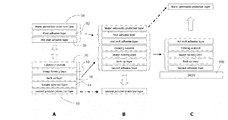
- Fig. 1 is a diagram showing a manufacturing process for a layered structure according to an embodiment of the present invention.
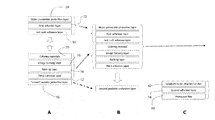
- Fig. 2 is a diagram showing a manufacturing process (first half) for a layered structure according to a second embodiment of the present invention.
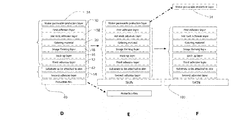
- Fig. 3 is a diagram showing a manufacturing process (second half) for a layered structure according to a second embodiment of the present invention.
- Fig. 4 shows a comparison between the layered structures according to the present invention and the prior art
- Fig. 1 shows a manufacturing processes for a layered structure according to the first embodiment of the present invention, the process proceeding from A to C.
- manufacturing step A on the one hand, a structure having five (or four) layers, which are a second peelable protection layer 10, (a third adhesive layer 12 which may be added), a second adhesive layer 14, a back-up layer 16, an image forming layer 18 and coloring materials 20 (also called a coloring material layer), is prepared.
- the coloring material layer may not cover the entire surface of the image forming layer 18.
- the image forming layer is made from a material selected to be compatible with the coloring materials and the solvent if a solvent is to be used.
- An example is a layer of a resin containing a styrene resin and a urethane resin.
- the material and the thickness of the back-up layer 16 are selected so that the layered structure is provided with a strength and a rigidity appropriate to maintain the shape.
- a structure having three layers, the layers being a water permeable protection layer 34, a first adhesive layer which is water soluble 32 and a hot melt adhesive layer 30, is prepared.
- the above-described structure having five layers and a structure having three layers are fused together by applying heat thereto so that the hot melt adhesive layer 30 is fused to the image forming layer 18 and covers the coloring materials 20.
- the second peelable protection layer 10 is removed from the structure having eight layers as described above so that the second adhesive layer 14 is exposed and the structure which now has seven layers is attached to the skin with the second adhesive layer 14 contacting the skin.
- the layered structure is now attached to the skin by the second adhesive layer 14.
- the water permeable protection layer 34 is wetted so that the water or the moisture permeate through the water permeable protection layer 34 to the first adhesive layer 32 which is water soluble and moisten the first adhesive layer 32.
- the water permeable protection layer 34 is removed from the layered structure so that the coloring material 20 is visible from outside.
- the amount and balance of the coloring materials are determined so that the layered structure conceals the flaw and looks similar to the skin around the layered structure.
- Figs. 2 and 3 show manufacturing steps A through F of a layered structure for cosmetic use according to the second embodiment of the present invention.
- a structure having five (or four) layers which are a second peelable protection layer 10, a third adhesive layer 12, a back-up layer 16, an image forming layer 18 and coloring materials 20 (also called a coloring material layer), is prepared.
- a structure having three layers, the layers being a water permeable protection layer 34, a first adhesive layer which is water soluble 32 and a hot melt adhesive layer 30, is prepared.
- the above-described structure having five layers and the structure having three layers are fused together by applying heat so that the hot melt adhesive layer 30 is fused to the image forming layer 18 and covers the coloring materials 20.
- a three-layered structure consisting of a substrate to be attached to skin 42, second adhesive layer 14 and a protection film 40 is prepared.
- the second peelable protection layer 10 is removed from the above-described structure having eight layers to make an seven layered structure (B), another peelable protection layer (not shown in Fig. 2) is removed from the above-described structure having three layers (C), and the seven layered structure and the three layered structure are attached so that the third adhesive layer 12 is set on the substrate to be attached to skin 42.
- the protection film 40 is removed from the structure having ten layers including the coloring materials (or nine layers if the coloring materials are not considered to be a layer) as described above so that the second adhesive layer 14 is exposed and the structure which now has nine (or eight) layers is attached to the skin.
- the layered structure is now attached to the skin via the second adhesive layer 14 and the substrate to be attached to the skin 42 (E).
- the water permeable protection layer 34 is wetted so that the water or the moisture permeates through the water permeable protection layer 34 to the first adhesive layer which is water soluble 32 and moistens the first adhesive layer which is water soluble 32.
- the water permeable protection layer 34 is removed from the layered structure so that the coloring material 20 is visible from the outside. At least a portion of the first adhesive layer 32 may or may not remain on the hot melt adhesive layer 30 after the water permeable protection layer 34 is removed. The amount and balance of the coloring materials are determined so that the layered structure conceals the flaw and looks similar to the skin around the layered structure.
- Fig. 4 is a photograph showing a comparison between a layered structure according to an embodiment of the present invention (left side) and a conventional structure (right side).
- the photographs were taken a few hours after the layered structures were attached to the skin surface of the forearm and folding and extending the arm several times.
- the conventional layered structure shown on the right side cracks extend in the horizontal direction and wrinkles extend in the vertical direction thereby degrading the texture of the layered structure and making the layered structure stand out from ordinary skin.
- the layered structure according to the present invention the layered structure has neither cracks nor wrinkles and looks similar to normal skin.
- the photographs show that the layered structure provides a texture and reproduces colors of the skin in an ideal fashion, while the same was not possible according to the conventional structure.
- U.S. Patent No. 5,942,065 U.S. Patent No. 3,898,357
Landscapes
- Health & Medical Sciences (AREA)
- Life Sciences & Earth Sciences (AREA)
- Animal Behavior & Ethology (AREA)
- General Health & Medical Sciences (AREA)
- Public Health (AREA)
- Veterinary Medicine (AREA)
- Biomedical Technology (AREA)
- Birds (AREA)
- Epidemiology (AREA)
- Engineering & Computer Science (AREA)
- Cosmetics (AREA)
- Laminated Bodies (AREA)
- Image Processing (AREA)
Abstract
The present invention relates to a layered structure for cosmetic or dermo cosmetic use, a method for making the same and a method of concealing flaws in the skin by adhering a layered structure to the skin. The invention provides a layered structure for cosmetic use, comprising a substrate to be attached to skin, the substrate being made from a flexible material so that the substrate is able to follow the deformation of the skin to which the substrate is to be attached; and an image forming layer bearing coloring materials thereon. The invention also provides a layered structure for cosmetic use, comprising: an image forming layer bearing a coloring material thereon; a first adhesive layer which is water soluble; and a water permeable protection layer.
Description
The present invention relates to a layered structure for cosmetic use, a method for making the same and a method of concealing flaws in the skin by adhering a layered structure to the skin.
There is a need to conceal flaws in the skin for aesthetic or medical purposes. There is no known product or method dedicated to or suitable for this purpose, although one might contemplate laying an adhesive plaster over a flaw to conceal it. The problem is that adhesive plaster is highly visible and does not have the appearance a user would normally require.
U.S. Patent No. 5,942,065 discloses a skin adhesive decal. According to the patent, the skin adhesive decal is a combination of a multi-color flexographically printed design on a very thin, flexible, extensible, uniform layer of water resistant material covering a water soluble release layer carried by porous decal paper and a uniform deposit of adhesive covering the design, adapted to hold the design against the skin and protect it from disruption. The problem in the above-described decal is that, when used to conceal a flaw in the skin, the decal is very visible, the concealing effects of the decal are not sufficient and wrinkles tend to accumulate after repeated movement of the skin.
U.S. Patent No. 3,898,357 discloses a decal for decorating the fingernails. According to the patent, the decal comprises a carrier strip, a series of five spread-apart, graduated, generally ovoid decals consisting essentially of a thin non-self-supporting flexible clear film, a central design formed integrally on said clear film, each decal adapted to cover substantially the surface of a finger or toe nail, said decals being on said carrier strip, a water activated adhesive means on the back of each of the decals temporarily holding the decals on the carrier and adapted to be released therefrom and transferred adherently to a nail by a water-activated adhesive and an aqueous solvent-resistant cellulose adhesive clear layer on top of each decal. The problem in this decal is that, when used to conceal a flaw in the skin, the decal is very visible, the concealing effects of the decal are not sufficient and it tends not to smoothly follow deformation of the skin and thus to accumulate wrinkles after repeated movement of the skin.
In view of the fact that none of the inventions and products now available satisfies the requirement to conceal flaws in the skin while also satisfying other requirements required from aesthetic and medical points of view, the inventors of the present invention have invented a layered structure, method of making the layered structure and a method of concealing a flaw in the skin that address these problems.
According to an aspect of the present invention, the inventors propose a layered structure for cosmetic or dermo cosmetic use, comprising:
a substrate to be attached to skin or the mucosis, the substrate being made from a flexible material so that the substrate is able to follow the deformation of the skin or mucosis to which the substrate is to be attached; and
an image forming layer bearing coloring materials thereon.
a substrate to be attached to skin or the mucosis, the substrate being made from a flexible material so that the substrate is able to follow the deformation of the skin or mucosis to which the substrate is to be attached; and
an image forming layer bearing coloring materials thereon.
In the present specification, unless otherwise specified, the term "cosmetic use" includes uses for so-called cosmetic, dermatological or dermatocosmetic purposes as well as aesthetic purposes, surgical purposes, and post-surgery treatments wherein the layered structure is adhered or set over the skin or the nails. The term dermo cosmetic is used to include any area which may belong to either cosmetics or dermatology or any marginal area between cosmetics and dermatology. In the present specification, the term "skin" is used to mean skin, mucosa and nails unless otherwise specified or unless it is clear from the context that mucosa and nails are excluded.
The flexible material used for the substrate to be attached to skin preferably comprises an organic resin and elastomer, for example, a polyurethane, a polyolefin, a polysilicone, or a copolymer made of these monomers or a polyacrylate, a polyisoprene, a polychloroprene, more preferably a polyurethane resin, or a synthetic rubber. The substrate to be attached to the skin provides flexibility while avoiding formation of wrinkles when the skin to which the layered structure is attached is deformed, for example, by facial expressions or bending and extension of the arm. The flexibility of the above-described flexible materials may be adjusted as desired by adding one or more of a plasticizer, a stiffener, a hardener and a curative agent. The substrate may have a thickness between approximately 2 microns and approximately 30 microns, preferably between approximately 2 microns and approximately 10 microns. The substrate may be attached to the skin by various means such as a glue, an adhesive, an agglutinant, or other bonding materials on the side to skin. In the case of using an adhesive for the substrate, the thickness is preferably less than 30 microns.
Any coloring materials may be used as long as they are compatible with the image forming layer and the method to be used in laying the color materials on the image forming layer. For example, an ink containing, in a solution or a emulsion form, a color material made of or containing one or more of an organic dyes, an organic pigment or colorant, lake color or lake pigment, an inorganic pigment, carbon black, natural colorant, a pearl pigment may be employed. However, the coloring materials are not limited to the above-described examples.
The image forming layer supports coloring materials laid thereon. The image forming layer preferably comprises or is composed of a styrene resin, epoxy resin or an acrylic resin, and optionally, further comprises an urethane resin, a polyester resin, or an olefin resin. The image forming layer may contain or may be made of any other material as long as the material is suitable for bearing the coloring materials and for cosmetic use. The image forming layer may further comprise fillers selected from among particles of fluorine resin, melamine resin, silicone resin, PMMA, talc, kaolin, magnesium carbonate, calcium carbonate, titanium oxide, silica, and starch and other fillers compatible with cosmetic purposes. The image forming layer preferably has strength and hardness as well as thermal resistance necessary to endure the printing process and to retain the coloring materials in position.
The thickness of the image forming layer is preferably between approximately 0.1 and approximately 5.0 microns, more preferably between approximately 0.5 and approximately 3.0 microns. The thicknesses are preferred for handling of the layer and layered structure during manufacture and for clear reproduction of desired colors and patterns. The image forming layer may have, as an additional layer, a hardening protection layer comprising or consisting of a thermoplastic resin or a UV hardening resin to improve resistance and hardness of the image forming layer. The image forming layer and its optional protection layer may contain one or more of a film forming additive, a layer stabilizer, a leveling agent, or an antifoam agent as desired.
According to the aspect of the invention described above, flaw in the skin are effectively concealed and the layered structure appears similar to the surrounding skin, making the layered structure practically invisible. The flaw in the skin may be a scar, blotches, freckles, ephilides, flecks, macula, bruise, birth mark or any discoloration visible in the skin. The layered structure according to the present invention, any embodiments not limited to the above-described embodiment, may contain one or more layers containing one or more active ingredients such as hydrating agents, anti inflammatory agent, healing agent, etc., effective for cosmetic, dermatological, dermatocosmetic or medical purposes so that the active ingredients are released from the layered structure into the skin.
In another aspect, the present invention provides a layered structure for cosmetic or dermo cosmetic use, the layered structure comprising:
an image forming layer bearing a coloring material thereon;
a first adhesive layer on a side of said image forming layer opposite to a side of the layered structure intended to be in contact with the skin or mucosis, said first adhesive layer being water soluble; and
a water permeable protection layer on a side of said first adhesive layer opposite to said image forming layer.
an image forming layer bearing a coloring material thereon;
a first adhesive layer on a side of said image forming layer opposite to a side of the layered structure intended to be in contact with the skin or mucosis, said first adhesive layer being water soluble; and
a water permeable protection layer on a side of said first adhesive layer opposite to said image forming layer.
The first adhesive layer which is water soluble lowers its bonding force when it is wet with water so that the water permeable protection layer may be removed easily therefrom. The first adhesive layer which is water soluble preferably contains or is composed of one or more materials selected from dextrin, polyvinyl alcohols, polyvinyl pyrrolidones, polyacrylic amides, polyvinyl methylethers, poly(meth)acrylic acids containing polymer, etherized starches, and starches. The first adhesive layer may contain PEG, a high polymer absorbent, or porous particles to improve its water retention. The thickness of the first adhesive which is water soluble is preferably between approximately 0.5 microns and approximately 10 microns, and more preferably between approximately 1 micron and approximately 5 microns. A portion of the first adhesive layer may remain on the underneath layer even after it is wet and the water permeable protection layer is removed therefrom.
The water permeable protection layer protects the layers underneath and may be removed easily when the first adhesive layer is wet and its bonding force is lowered. The water permeable protection layer is preferably made from a material which does not dissolve in water and is permeable to water or moisture so that the water or moisture can reach the first adhesive layer. The water permeable protection layer may be made from or contain a layer of paper, resin-coated paper or a perforated or porous resin material.
The present invention also provides a layered structure for cosmetic or dermo cosmetic use, comprising:
a substrate to be attached to skin or mucosis, the substrate being made from a flexible material so that the substrate is able to follow the deformation of the skin or mucosis to which the substrate is to be attached;
an image forming layer bearing a coloring material thereon;
a first adhesive layer (32) on a side of said image forming layer opposite to said substrate, said first adhesive layer being water soluble; and
a water permeable protection layer on a side of said first adhesive layer opposite to said image forming layer.
a substrate to be attached to skin or mucosis, the substrate being made from a flexible material so that the substrate is able to follow the deformation of the skin or mucosis to which the substrate is to be attached;
an image forming layer bearing a coloring material thereon;
a first adhesive layer (32) on a side of said image forming layer opposite to said substrate, said first adhesive layer being water soluble; and
a water permeable protection layer on a side of said first adhesive layer opposite to said image forming layer.
The layered structure for a cosmetic may further comprise a peelable protection layer set on a side of the layered structure to which the water permeable protection layer is not attached and a second adhesive layer laid between the substrate and the peelable protection layer so as to be made in contact with the skin or mucosis when the layered structure is in use.
The layered structure may further comprise a back-up layer attached to the image forming layer, on a side opposite to a side bearing the coloring materials. The back-up layer may be made of an opaque, translucent or transparent material compatible with the method to be employed for laying color materials on the image forming layer. Examples of such materials are paper and synthetic resin materials. The back-up layer may provide strength and rigidity to the image forming layer during the process whereat the coloring materials are laid on the image forming layer and after the process.
A layered structure according to the present invention may further comprise a hot-melt adhesive layer set on the image forming layer on the side bearing the coloring materials. The hot-melt adhesive layer is set on the image forming layer to cover the coloring materials on the image forming layer. The hot-melt material may, for example, be an ethylene vinyl acetate copolymer, an ethylene ethyl acrylate, a polyamide resin, a vinyl chloride/vinyl acetate copolymer, a styrene resin, an acrylic resin, an urethane resin, a polyester resin, or the like. An ethylene vinyl acetate copolymer, ethylene ethyl acrylate, an urethane resin or a polyester resin is preferably used for achieving a better fit on the coloring materials or the image forming layer. The hot-melt layer may preferably remain on the coloring materials and the image forming layer after the water permeable protection layer as well as the first adhesive layer are removed and may have a function to protect the coloring materials.
The hot-melt adhesive layer may comprise particles as a filler, the particles consisting of or containing fluorine resins, melamine resins, silicone resins, talc, kaolin, magnesium carbonate, calcium carbonate, titanium oxide, silica, and starches to improve resistance against blocking and tucking of layers during the manufacturing processes. The thickness of the hot-melt adhesive layer is preferably between approximately 0.1 microns and approximately 10 microns, and more preferably between approximately 1 micron and approximately 5 microns.
The layered structure according to the present invention may further comprise a third adhesive layer between the image forming layer and the substrate to be attached to skin. The first adhesive layer which is water soluble requires a smaller force to separate as compared with the third adhesive layer when the first adhesive layer is humid so that the water permeable protection layer is easily removed without separating the third adhesive layer.
It is also an objective of the present invention to provide a method of making a layered structure for cosmetic use, the layered structure comprising a substrate, a third adhesive layer, an image forming layer bearing a coloring material thereon, a hot melt adhesive layer, a first adhesive layer which is water soluble, and a water permeable protection layer, the method comprising the steps of:
setting the coloring material on the image forming layer supported on a support layer via the third adhesive layer;
preparing the water permeable protection layer with the first adhesive layer which is water soluble and the hot melt adhesive layer set thereon in this order;
adhering the hot melt adhesive layer to the third adhesive layer;
removing the support layer; and
adhering a peelable protection layer and a second adhesive layer to the third adhesive layer.
setting the coloring material on the image forming layer supported on a support layer via the third adhesive layer;
preparing the water permeable protection layer with the first adhesive layer which is water soluble and the hot melt adhesive layer set thereon in this order;
adhering the hot melt adhesive layer to the third adhesive layer;
removing the support layer; and
adhering a peelable protection layer and a second adhesive layer to the third adhesive layer.
The coloring material may be set on the image forming layer by thermal transfer, ink jet printing or any other method.
The present invention also provides a method of preparing a layered structure for cosmetic use, the layered structure comprising a substrate to be attached to skin, the substrate being made from a flexible material so that the substrate is able to follow the deformation of the skin to which the substrate is to be attached, and an image forming layer bearing coloring materials thereon, the method comprising the step of:
obtaining color image data of skin to which the layered structure is to be attached, the skin having a flaw to be concealed;
retouching the color image data by removing the flaw from the color image; and
printing a retouched color image of the skin on the image forming layer with coloring materials.
obtaining color image data of skin to which the layered structure is to be attached, the skin having a flaw to be concealed;
retouching the color image data by removing the flaw from the color image; and
printing a retouched color image of the skin on the image forming layer with coloring materials.
The color image data of skin may be obtained by using a digital camera. The color image data of an area including the flaw to be concealed is preferably obtained. The removal of the flaw from the color image may be performed by deleting the data corresponding to the flaw and replacing the data with that of the area in the vicinity of the flaw.
The above-described method may further comprise the steps of:
setting the retouched color image on the skin;
obtaining color image data of the retouched color image and the skin in the vicinity of the retouched color image;
modifying the retouched color image data so that the modified color image appears no different from the skin; and
printing the modified color image of the skin on the image forming layer with coloring materials.
setting the retouched color image on the skin;
obtaining color image data of the retouched color image and the skin in the vicinity of the retouched color image;
modifying the retouched color image data so that the modified color image appears no different from the skin; and
printing the modified color image of the skin on the image forming layer with coloring materials.
When laying the retouched color image on the skin, the color image may be attached to the skin or simply set on the skin for image data capture. The retouched color image data may be modified to cancel the differences in color between the retouched color image and the skin in the area other than the flaw. The modification may be performed in a manner such that the average in the color space of the retouched color image data and the modified retouched color image data correspond to the image data of the skin in the area other than the flaw. The color space may be one of CIE, generic color models such as RGB encoding, the Munsell color system, or the Natural color system. No different means that the difference is not substantial or negligible, or small, for practical cosmetic or medical purposes.
The present invention also provides a method of concealing flaws on skin or mucosis, the method comprising the steps of:
obtaining color image data of an area of the skin or mucosis having a flaw to be concealed;
retouching the color image data by removing the flaw from the color image; and
printing with coloring materials a retouched color image of the skin or mucosis on an image forming layer of any one of the above-described layered structure or thereby making anyone of the above-described layered structures for cosmetic or dermo cosmetic use; and
attaching the printed layered structure to the skin, so as to cover at least the flaw to be concealed.
obtaining color image data of an area of the skin or mucosis having a flaw to be concealed;
retouching the color image data by removing the flaw from the color image; and
printing with coloring materials a retouched color image of the skin or mucosis on an image forming layer of any one of the above-described layered structure or thereby making anyone of the above-described layered structures for cosmetic or dermo cosmetic use; and
attaching the printed layered structure to the skin, so as to cover at least the flaw to be concealed.
The above-described method may furthermore comprise the steps of:
obtaining color image data of the retouched color image and the skin in the vicinity of the retouched color image;
modifying the retouched color image data so that the modified color image appears no different from the skin; and
printing the modified color image of the skin on the image forming layer with coloring materials.
obtaining color image data of the retouched color image and the skin in the vicinity of the retouched color image;
modifying the retouched color image data so that the modified color image appears no different from the skin; and
printing the modified color image of the skin on the image forming layer with coloring materials.
Embodiments of the present invention will be described herebelow. It should be noted that the embodiments and descriptions thereof are provided solely to assist in understanding the present invention and should not be construed as limiting the present invention in any way to the embodiments described below.
Fig. 1 shows a manufacturing processes for a layered structure according to the first embodiment of the present invention, the process proceeding from A to C. In manufacturing step A, on the one hand, a structure having five (or four) layers, which are a second peelable protection layer 10, (a third adhesive layer 12 which may be added), a second adhesive layer 14, a back-up layer 16, an image forming layer 18 and coloring materials 20 (also called a coloring material layer), is prepared. The coloring material layer may not cover the entire surface of the image forming layer 18. The image forming layer is made from a material selected to be compatible with the coloring materials and the solvent if a solvent is to be used. An example is a layer of a resin containing a styrene resin and a urethane resin. The material and the thickness of the back-up layer 16 are selected so that the layered structure is provided with a strength and a rigidity appropriate to maintain the shape. On the other hand, a structure having three layers, the layers being a water permeable protection layer 34, a first adhesive layer which is water soluble 32 and a hot melt adhesive layer 30, is prepared.
The above-described structure having five layers and a structure having three layers are fused together by applying heat thereto so that the hot melt adhesive layer 30 is fused to the image forming layer 18 and covers the coloring materials 20.
When using the layered structure, the second peelable protection layer 10 is removed from the structure having eight layers as described above so that the second adhesive layer 14 is exposed and the structure which now has seven layers is attached to the skin with the second adhesive layer 14 contacting the skin. The layered structure is now attached to the skin by the second adhesive layer 14.
The water permeable protection layer 34 is wetted so that the water or the moisture permeate through the water permeable protection layer 34 to the first adhesive layer 32 which is water soluble and moisten the first adhesive layer 32.
The water permeable protection layer 34 is removed from the layered structure so that the coloring material 20 is visible from outside. The amount and balance of the coloring materials are determined so that the layered structure conceals the flaw and looks similar to the skin around the layered structure.
Figs. 2 and 3 show manufacturing steps A through F of a layered structure for cosmetic use according to the second embodiment of the present invention. In the manufacturing process A, on the one hand, a structure having five (or four) layers, which are a second peelable protection layer 10, a third adhesive layer 12, a back-up layer 16, an image forming layer 18 and coloring materials 20 (also called a coloring material layer), is prepared. On the other hand, a structure having three layers, the layers being a water permeable protection layer 34, a first adhesive layer which is water soluble 32 and a hot melt adhesive layer 30, is prepared.
The above-described structure having five layers and the structure having three layers are fused together by applying heat so that the hot melt adhesive layer 30 is fused to the image forming layer 18 and covers the coloring materials 20.
A three-layered structure consisting of a substrate to be attached to skin 42, second adhesive layer 14 and a protection film 40 is prepared.
The second peelable protection layer 10 is removed from the above-described structure having eight layers to make an seven layered structure (B), another peelable protection layer (not shown in Fig. 2) is removed from the above-described structure having three layers (C), and the seven layered structure and the three layered structure are attached so that the third adhesive layer 12 is set on the substrate to be attached to skin 42.
When using the layered structure, the protection film 40 is removed from the structure having ten layers including the coloring materials (or nine layers if the coloring materials are not considered to be a layer) as described above so that the second adhesive layer 14 is exposed and the structure which now has nine (or eight) layers is attached to the skin. The layered structure is now attached to the skin via the second adhesive layer 14 and the substrate to be attached to the skin 42 (E).
The water permeable protection layer 34 is wetted so that the water or the moisture permeates through the water permeable protection layer 34 to the first adhesive layer which is water soluble 32 and moistens the first adhesive layer which is water soluble 32.
The water permeable protection layer 34 is removed from the layered structure so that the coloring material 20 is visible from the outside. At least a portion of the first adhesive layer 32 may or may not remain on the hot melt adhesive layer 30 after the water permeable protection layer 34 is removed. The amount and balance of the coloring materials are determined so that the layered structure conceals the flaw and looks similar to the skin around the layered structure.
Fig. 4 is a photograph showing a comparison between a layered structure according to an embodiment of the present invention (left side) and a conventional structure (right side). The photographs were taken a few hours after the layered structures were attached to the skin surface of the forearm and folding and extending the arm several times. In the conventional layered structure shown on the right side, cracks extend in the horizontal direction and wrinkles extend in the vertical direction thereby degrading the texture of the layered structure and making the layered structure stand out from ordinary skin. In contrast, in the layered structure according to the present invention, the layered structure has neither cracks nor wrinkles and looks similar to normal skin. Thus, the photographs show that the layered structure provides a texture and reproduces colors of the skin in an ideal fashion, while the same was not possible according to the conventional structure.
U.S. Patent No. 5,942,065
U.S. Patent No. 3,898,357
Claims (16)
- A layered structure for cosmetic or dermo cosmetic use, comprising:
a substrate (42) to be attached to skin or the mucosis, the substrate being made from a flexible material so that the substrate is able to follow the deformation of the skin or mucosis to which the substrate is to be attached; and
an image forming layer (18) bearing coloring materials (20) thereon. - A layered structure for cosmetic or dermo cosmetic use, comprising:
an image forming layer (18) bearing a coloring material (20) thereon;
a first adhesive layer (32) on a side of said image forming layer opposite to a side of the layered structure intended to be in contact with the skin or mucosis, said first adhesive layer being water soluble; and
a water permeable protection layer on a side of said first adhesive layer opposite to said image forming layer. - A layered structure for cosmetic or dermo cosmetic use, comprising:
a substrate to be attached to skin or mucosis, the substrate being made from a flexible material so that the substrate is able to follow the deformation of the skin or mucosis to which the substrate is to be attached;
an image forming layer bearing a coloring material thereon;
a first adhesive layer (32) on a side of said image forming layer opposite to said substrate, said first adhesive layer being water soluble; and
a water permeable protection layer on a side of said first adhesive layer opposite to said image forming layer. - A layered structure for cosmetic or dermo cosmetic use according to claim 3, further comprising:
a peelable protection layer; and
a second adhesive layer (14) between the substrate and the peelable protection layer and to be made in contact with the skin or mucosis when the layered structure is in use. - A layered structure for cosmetic or dermo cosmetic use according to claim 4, further comprising a back-up layer attached to the image forming layer, on a side opposite to a side bearing the coloring materials.
- A layered structure for cosmetic or dermo cosmetic use according to any one of claims 1 to 5, further comprising a hot-melt adhesive layer set on the image forming layer on the side bearing the coloring materials
- A layered structure for cosmetic or dermo cosmetic use according to claim 6, further comprising:
a third adhesive layer between the image forming layer and the substrate to be attached to skin. - A layered structure for cosmetic or dermo cosmetic use according to claim 7, wherein the first adhesive layer requires a smaller force to separate as compared with the third adhesive layer.
- A layered structure for cosmetic or dermo cosmetic use according to one of claims 1 to 8, wherein the image forming layer contains a styrene resin, an epoxy resin or an acrylic resin, and optionally, further comprises an urethane resin, a polyester resin, or an olefin resin.
- A layered structure for cosmetic or dermo cosmetic use according to claim 9, which further comprises fillers selected from particles of fluorine resin, melamine resin, silicone resin, PMMA, talc, kaolin, magnesium carbonate, calcium carbonate, titanium oxide, silica, and starch.
- A layered structure for cosmetic or dermo cosmetic use according to one of claims 1 to 10, wherein the thickness of the image forming layer is between approximately 0.1 and approximately 5.0 microns, preferably between approximately 1.0 and approximately 3.0 microns.
- A layered structure for cosmetic or dermo cosmetic use according to one of claims 1 and 3 to 10 when dependent from claim 1 or 3, wherein the flexible material comprises or is made of an organic resin and elastomer, a polyurethane, a polyolefin, a polysilicone, or a copolymer made of these monomers or a polyacrylate, a polyisoprene, a polychloroprene, more preferably a polyurethane resin, or a synthetic rubber which optionally contain one or more of a plasticizer, a stiffener, a hardener and a curative agent.
- A layered structure for cosmetic or dermo cosmetic use according to one of claims 2 to 12 when dependent from claim 2 or 3, wherein the first adhesive layer which is water soluble contains one substance selected from the group consisting of dextrin, polyvinyl alcohol, polyvinyl pyrrolidone, polyacrylic amide, polyvinyl methylether, poly(meth)acrylic acid containing a polymer, an etherized starch and a starch.
- A layered structure for cosmetic or dermo cosmetic use according to one of claims 2 to 12 when dependent from claim 2 or 3, wherein the water permeable protection layer is made from paper or resin-coated paper.
- A method of concealing a flaw on the skin or mucosis, the method comprising the steps of:
obtaining color image data of an area of the skin or mucosis having a flaw to be concealed;
retouching the color image data by removing the flaw from the color image; and
printing with colouring materials a retouched color image of the skin or mucosis on an image forming layer of a layered structure according to anyone of claims 1-14; and
attaching the printed layered structure to the skin, so as to cover at least the flaw to be concealed. - The method according to claim 15, the method further comprising the steps of:
obtaining color image data of the retouched color image and the skin in the vicinity of the retouched color image;
modifying the retouched color image data so that the modified color image appears no different from the skin; and
printing the modified color image of the skin on the image forming layer with coloring materials.
Priority Applications (2)
| Application Number | Priority Date | Filing Date | Title |
|---|---|---|---|
| JP2011531292A JP5677303B2 (en) | 2009-01-30 | 2009-01-30 | Laminated structure for makeup |
| PCT/JP2009/000373 WO2010086901A1 (en) | 2009-01-30 | 2009-01-30 | Layered structure for cosmetic use |
Applications Claiming Priority (1)
| Application Number | Priority Date | Filing Date | Title |
|---|---|---|---|
| PCT/JP2009/000373 WO2010086901A1 (en) | 2009-01-30 | 2009-01-30 | Layered structure for cosmetic use |
Publications (1)
| Publication Number | Publication Date |
|---|---|
| WO2010086901A1 true WO2010086901A1 (en) | 2010-08-05 |
Family
ID=41136877
Family Applications (1)
| Application Number | Title | Priority Date | Filing Date |
|---|---|---|---|
| PCT/JP2009/000373 Ceased WO2010086901A1 (en) | 2009-01-30 | 2009-01-30 | Layered structure for cosmetic use |
Country Status (2)
| Country | Link |
|---|---|
| JP (1) | JP5677303B2 (en) |
| WO (1) | WO2010086901A1 (en) |
Cited By (8)
| Publication number | Priority date | Publication date | Assignee | Title |
|---|---|---|---|---|
| ITGE20100112A1 (en) * | 2010-10-07 | 2012-04-08 | Gabriella Burgio | REFINED PATCH |
| WO2012081065A1 (en) * | 2010-12-17 | 2012-06-21 | L'oreal | Layered structure for cosmetic use |
| JP2014014580A (en) * | 2012-07-11 | 2014-01-30 | Duplo Seiko Corp | Wound covering material and manufacturing method of the same |
| US9526315B2 (en) | 2013-03-01 | 2016-12-27 | Panasonic Intellectual Property Management Co., Ltd. | Transfer system |
| US9713580B2 (en) | 2014-04-16 | 2017-07-25 | The Procter & Gamble Company | Device for applying a cosmetic composition |
| EP3216370A1 (en) * | 2016-03-08 | 2017-09-13 | Panasonic Intellectual Property Management Co., Ltd. | Image processing apparatus, printer apparatus, and image processing method |
| CN110213884A (en) * | 2019-06-24 | 2019-09-06 | 清华大学深圳研究生院 | Flexible electronic and preparation method thereof, flexible circuit and preparation method thereof |
| US11191703B2 (en) | 2017-02-01 | 2021-12-07 | Shiseido Company, Ltd. | Non-sticky body surface patch |
Families Citing this family (6)
| Publication number | Priority date | Publication date | Assignee | Title |
|---|---|---|---|---|
| WO2015111461A1 (en) * | 2014-01-27 | 2015-07-30 | コスメディ製薬株式会社 | Concealer patch and method for manufacturing same, skin cosmetic method for whitening care, and skin cosmetic method for acne care |
| JP2018201751A (en) * | 2017-06-01 | 2018-12-27 | 株式会社グランブルー | Concealment sheet |
| JP7508968B2 (en) * | 2020-09-18 | 2024-07-02 | 大日本印刷株式会社 | Skin design sheet manufacturing system, skin design sheet manufacturing method and skin design sheet |
| JP7655079B2 (en) * | 2021-05-21 | 2025-04-02 | 大日本印刷株式会社 | Skin design sheet manufacturing method, skin design sheet manufacturing system, and laminated sheet |
| JP7635644B2 (en) * | 2021-06-11 | 2025-02-26 | 大日本印刷株式会社 | Laminated sheet for thermal transfer printer and method for manufacturing skin design sheet |
| JP7793915B2 (en) * | 2021-09-21 | 2026-01-06 | 大日本印刷株式会社 | Skin design sheet manufacturing method, skin design sheet and laminate |
Citations (5)
| Publication number | Priority date | Publication date | Assignee | Title |
|---|---|---|---|---|
| JP2001278739A (en) * | 2000-01-27 | 2001-10-10 | Dainippon Printing Co Ltd | Cosmetic concealing seal and method for making up skin unevenness and dark color |
| US20020110672A1 (en) * | 2001-02-12 | 2002-08-15 | Joanne Muratore-Pallatino | Cosmetic skin tattoo |
| EP1452156A1 (en) * | 2003-02-27 | 2004-09-01 | Catherine Dufour | Flexible adhesive multilayer membrane made of non-woven and medical silicones |
| WO2006138723A2 (en) * | 2005-06-16 | 2006-12-28 | Biolase Technology, Inc. | Tissue coverings bearing cutomized tissue images |
| EP1872969A1 (en) * | 2005-02-28 | 2008-01-02 | Yoshino Kogyosho Co., Ltd. | Transfer film, and synthetic resin molded product having decoration formed by transfer film |
Family Cites Families (3)
| Publication number | Priority date | Publication date | Assignee | Title |
|---|---|---|---|---|
| JP2001261527A (en) * | 2000-03-17 | 2001-09-26 | Asahi Kasei Corp | Wetting substrate |
| JP2001299808A (en) * | 2000-04-19 | 2001-10-30 | Sekisui Chem Co Ltd | Medical tape base material |
| JP2003053877A (en) * | 2001-08-16 | 2003-02-26 | Dainippon Printing Co Ltd | Colored film, coloring process paper and method for producing colored film |
-
2009
- 2009-01-30 WO PCT/JP2009/000373 patent/WO2010086901A1/en not_active Ceased
- 2009-01-30 JP JP2011531292A patent/JP5677303B2/en not_active Expired - Fee Related
Patent Citations (5)
| Publication number | Priority date | Publication date | Assignee | Title |
|---|---|---|---|---|
| JP2001278739A (en) * | 2000-01-27 | 2001-10-10 | Dainippon Printing Co Ltd | Cosmetic concealing seal and method for making up skin unevenness and dark color |
| US20020110672A1 (en) * | 2001-02-12 | 2002-08-15 | Joanne Muratore-Pallatino | Cosmetic skin tattoo |
| EP1452156A1 (en) * | 2003-02-27 | 2004-09-01 | Catherine Dufour | Flexible adhesive multilayer membrane made of non-woven and medical silicones |
| EP1872969A1 (en) * | 2005-02-28 | 2008-01-02 | Yoshino Kogyosho Co., Ltd. | Transfer film, and synthetic resin molded product having decoration formed by transfer film |
| WO2006138723A2 (en) * | 2005-06-16 | 2006-12-28 | Biolase Technology, Inc. | Tissue coverings bearing cutomized tissue images |
Non-Patent Citations (1)
| Title |
|---|
| DATABASE WPI Week 200212, Derwent World Patents Index; AN 2002-085913, XP002550476 * |
Cited By (11)
| Publication number | Priority date | Publication date | Assignee | Title |
|---|---|---|---|---|
| ITGE20100112A1 (en) * | 2010-10-07 | 2012-04-08 | Gabriella Burgio | REFINED PATCH |
| WO2012081065A1 (en) * | 2010-12-17 | 2012-06-21 | L'oreal | Layered structure for cosmetic use |
| JP2014501223A (en) * | 2010-12-17 | 2014-01-20 | ロレアル | Laminated structure for makeup |
| JP2014014580A (en) * | 2012-07-11 | 2014-01-30 | Duplo Seiko Corp | Wound covering material and manufacturing method of the same |
| US9526315B2 (en) | 2013-03-01 | 2016-12-27 | Panasonic Intellectual Property Management Co., Ltd. | Transfer system |
| USRE48103E1 (en) | 2013-03-01 | 2020-07-21 | Panasonic Intellectual Property Management Co., Ltd. | Transfer system |
| US9713580B2 (en) | 2014-04-16 | 2017-07-25 | The Procter & Gamble Company | Device for applying a cosmetic composition |
| US9839586B2 (en) | 2014-04-16 | 2017-12-12 | The Procter & Gamble Company | Device for applying a cosmetic composition |
| EP3216370A1 (en) * | 2016-03-08 | 2017-09-13 | Panasonic Intellectual Property Management Co., Ltd. | Image processing apparatus, printer apparatus, and image processing method |
| US11191703B2 (en) | 2017-02-01 | 2021-12-07 | Shiseido Company, Ltd. | Non-sticky body surface patch |
| CN110213884A (en) * | 2019-06-24 | 2019-09-06 | 清华大学深圳研究生院 | Flexible electronic and preparation method thereof, flexible circuit and preparation method thereof |
Also Published As
| Publication number | Publication date |
|---|---|
| JP5677303B2 (en) | 2015-02-25 |
| JP2012516284A (en) | 2012-07-19 |
Similar Documents
| Publication | Publication Date | Title |
|---|---|---|
| WO2010086901A1 (en) | Layered structure for cosmetic use | |
| WO2012081065A1 (en) | Layered structure for cosmetic use | |
| JP4672799B2 (en) | Cosmetic auxiliary patch and makeup method using the patch | |
| ES2694783T3 (en) | Method of manufacturing custom cosmetic articles, especially false nails, and articles thus produced | |
| JP4632333B2 (en) | Cosmetic concealment seal and skin unevenness and dark color makeup method | |
| CN111297700B (en) | Method for producing sheet for skin adhesion, method for beautifying skin, and sheet for skin adhesion | |
| ES2724235T3 (en) | Sunscreen cosmetics | |
| BR102014012034B1 (en) | nail sticker | |
| JP3868542B2 (en) | Concealment seal | |
| US9655430B2 (en) | Double colored nail applique having an ultraviolet cured layer, method of making and using | |
| CA3131120A1 (en) | Temporary tattoo decals usable as dosimeters | |
| US20030041750A1 (en) | Ink jet transfer printing process | |
| JP2015110294A (en) | Sheet for adhesion | |
| WO2013126513A1 (en) | Skin-adhesive decals | |
| KR101708239B1 (en) | Sticker for tattooing and manufacturing method thereof | |
| US20030098906A1 (en) | Ink jet transfer printing process | |
| ES2237798T3 (en) | COMPOSITIONS ADHERENT HUMEDAS, PATCHES OF ESCAYOLA THAT UNDERSTAND THE SAME AND PROCEDURES FOR ITS USE. | |
| US6537658B1 (en) | Film-based dressing material with imprint | |
| JP4507163B2 (en) | Film-like beauty nail cosmetic, makeup method and cosmetic | |
| JP2005118398A5 (en) | ||
| KR101829387B1 (en) | Environmentally friendly human film and manufacturing method thereof | |
| JP3227576B2 (en) | Self-adhesive lamination | |
| US12582581B2 (en) | Laminate sheet for cosmetic, and cosmetic set | |
| JP7519640B2 (en) | jig | |
| KR102356103B1 (en) | A patch and manufacturing method thereof |
Legal Events
| Date | Code | Title | Description |
|---|---|---|---|
| 121 | Ep: the epo has been informed by wipo that ep was designated in this application |
Ref document number: 09787846 Country of ref document: EP Kind code of ref document: A1 |
|
| WWE | Wipo information: entry into national phase |
Ref document number: 2011531292 Country of ref document: JP |
|
| NENP | Non-entry into the national phase |
Ref country code: DE |
|
| 122 | Ep: pct application non-entry in european phase |
Ref document number: 09787846 Country of ref document: EP Kind code of ref document: A1 |