WO2010079802A1 - ヒトdecorinプロモーターの一部の配列を用いてC/EBPα、C/EBPβ、C/EBPδ若しくはp53依存的に任意の遺伝子を発現させる方法、及びそれらの転写誘導能を抑制又は測定する方法 - Google Patents
ヒトdecorinプロモーターの一部の配列を用いてC/EBPα、C/EBPβ、C/EBPδ若しくはp53依存的に任意の遺伝子を発現させる方法、及びそれらの転写誘導能を抑制又は測定する方法 Download PDFInfo
- Publication number
- WO2010079802A1 WO2010079802A1 PCT/JP2010/050095 JP2010050095W WO2010079802A1 WO 2010079802 A1 WO2010079802 A1 WO 2010079802A1 JP 2010050095 W JP2010050095 W JP 2010050095W WO 2010079802 A1 WO2010079802 A1 WO 2010079802A1
- Authority
- WO
- WIPO (PCT)
- Prior art keywords
- ebpα
- promoter
- ebpβ
- gene
- ebpδ
- Prior art date
- Legal status (The legal status is an assumption and is not a legal conclusion. Google has not performed a legal analysis and makes no representation as to the accuracy of the status listed.)
- Ceased
Links
Images

Classifications
-
- C—CHEMISTRY; METALLURGY
- C07—ORGANIC CHEMISTRY
- C07K—PEPTIDES
- C07K14/00—Peptides having more than 20 amino acids; Gastrins; Somatostatins; Melanotropins; Derivatives thereof
- C07K14/435—Peptides having more than 20 amino acids; Gastrins; Somatostatins; Melanotropins; Derivatives thereof from animals; from humans
- C07K14/46—Peptides having more than 20 amino acids; Gastrins; Somatostatins; Melanotropins; Derivatives thereof from animals; from humans from vertebrates
- C07K14/47—Peptides having more than 20 amino acids; Gastrins; Somatostatins; Melanotropins; Derivatives thereof from animals; from humans from vertebrates from mammals
- C07K14/4701—Peptides having more than 20 amino acids; Gastrins; Somatostatins; Melanotropins; Derivatives thereof from animals; from humans from vertebrates from mammals not used
- C07K14/4725—Proteoglycans, e.g. aggreccan
-
- C—CHEMISTRY; METALLURGY
- C12—BIOCHEMISTRY; BEER; SPIRITS; WINE; VINEGAR; MICROBIOLOGY; ENZYMOLOGY; MUTATION OR GENETIC ENGINEERING
- C12N—MICROORGANISMS OR ENZYMES; COMPOSITIONS THEREOF; PROPAGATING, PRESERVING, OR MAINTAINING MICROORGANISMS; MUTATION OR GENETIC ENGINEERING; CULTURE MEDIA
- C12N15/00—Mutation or genetic engineering; DNA or RNA concerning genetic engineering, vectors, e.g. plasmids, or their isolation, preparation or purification; Use of hosts therefor
- C12N15/09—Recombinant DNA-technology
- C12N15/63—Introduction of foreign genetic material using vectors; Vectors; Use of hosts therefor; Regulation of expression
- C12N15/79—Vectors or expression systems specially adapted for eukaryotic hosts
Definitions
- the present invention relates to a method for expressing any gene in a C / EBP ⁇ , C / EBP ⁇ , C / EBP ⁇ or p53-dependent manner, and to suppress or measure the transcriptional induction ability of C / EBP ⁇ , C / EBP ⁇ , C / EBP ⁇ or p53 On how to do.
- the p53 gene is a gene in which mutations and deletions are observed most frequently in human multiple cancer tissues and cancer cells (see, for example, Non-Patent Document 1 below). Since cancer frequently occurs in patients with Li-Fraumeni syndrome and p53 knockout mice having a mutated p53 gene, abnormalities in the p53 gene are considered to be closely related to the development and progression of cancer (for example, the following non- (See Patent Documents 2 and 3).
- p53 comprises an N-terminal region containing a transcriptional activity regulatory domain, a DNA-binding region involved in DNA binding, and a C-terminal region containing a tetramer-forming domain.
- the mutation observed in cancer cells is a DNA-binding region. Concentrate on.
- Wild-type p53 functions as a transcriptional regulator and is known to be involved in the expression of many genes involved in the cell cycle, DNA repair, and apoptosis.
- the wild-type p53 protein activates transcription of the p21 gene (also known as WAF1, CIP1, SDI1), which is an inhibitor of cyclin-dependent kinase, and induces cell cycle arrest.
- Wild-type p53 is known to activate apoptosis by activating transcription of Bax gene, Noxa gene, Puma gene and the like (see, for example, Non-Patent Documents 4 to 6 below).
- C / EBP is a bZIP protein having a basic amino acid region and a leucine zipper, and is composed of C / EBP ⁇ , C / EBP ⁇ , C / EBP ⁇ , C / EBP ⁇ , CRP1, and CHOP encoded by different genes. It constitutes the EBP family (for example, see Non-Patent Document 7 below).
- C / EBP ⁇ and C / EBP ⁇ are transcription factors important for the acute phase reaction.
- C / EBP ⁇ stops the cell cycle via p21 and exhibits a cell growth inhibitory action (see, for example, Non-Patent Document 8 below), and is one of cancer suppressor genes (see, for example, Non-Patent Document 9 below).
- decorin belongs to a family of molecules called low molecular weight leucine-rich proteoglycans, and binds to growth factor receptors such as EGFR, ErbB4, IGF-IR, etc. and influences strong cell proliferation and apoptosis (for example, see Non-Patent Document 10 below). ).
- the present invention identifies a region where C / EBP ⁇ , C / EBP ⁇ , C / EBP ⁇ or p53 acts on the human decorin promoter, and expresses any gene depending on these transcription factors. It is an object of the present invention to provide a method, a method for suppressing or measuring their transcription-inducing ability, and a DNA used therefor.
- the DNA according to one means for solving the above-mentioned problems is obtained by substituting or deleting one or a plurality of bases in the base sequences described in SEQ ID NOs: 1 and 2 and the base sequences described in SEQ ID NOs: 1 and 2. Or a base sequence that hybridizes with these base sequences under stringent conditions, and has a function of controlling the transcription induction ability of C / EBP ⁇ , C / EBP ⁇ , or C / EBP ⁇ .
- a method for expressing a gene according to another means for solving the above-mentioned problem is the base sequence described in SEQ ID NOs: 1 and 2, and one or more of the base sequences described in SEQ ID NOs: 1 and 2
- a DNA comprising a base sequence in which bases are substituted or deleted, or a base sequence that hybridizes with these base sequences under stringent conditions is connected upstream of any other gene, and C / EBP ⁇ , C / Other genes are expressed depending on EBP ⁇ or C / EBP ⁇ .
- a method for expressing a gene according to another means for solving the above-mentioned problem is the base sequence described in SEQ ID NOs: 1 and 2, and one or more of the base sequences described in SEQ ID NOs: 1 and 2 Transcription of C / EBP ⁇ , C / EBP ⁇ , or C / EBP ⁇ using a base sequence formed by substitution or deletion of the base, or a DNA comprising a base sequence that hybridizes with these base sequences under stringent conditions Suppress or measure inducibility.
- a DNA according to another means for solving the above-mentioned problem is obtained by replacing or deleting one or more bases in the base sequence set forth in SEQ ID NO: 3 and the base sequence set forth in SEQ ID NO: 3. Or a base sequence that hybridizes with these base sequences under stringent conditions, and has a function of controlling the transcription-inducing ability of p53.
- a method of expressing a gene according to another means for solving the above-described problem is a method of substituting or replacing one or more bases in the base sequence set forth in SEQ ID NO: 3 and the base sequence set forth in SEQ ID NO: 3.
- a method of expressing an arbitrary gene depending on C / EBP ⁇ , C / EBP ⁇ , C / EBP ⁇ or p53, or suppressing the transcription-inducing ability of C / EBP ⁇ , C / EBP ⁇ , or C / EBP ⁇ It is possible to provide a method for measuring, a method for suppressing or measuring the transcription-inducing ability of p53, and DNA used for this.
- the ras-NIH3T3 cells obtained by transforming mouse fibroblasts NIH3T3 with the activated Ha-ras gene have the appearance of cancer cells.
- COUP-TFI, HNF4 and C / EBP ⁇ genes are introduced and expressed there, It was discovered that the cell morphology reverted to normal.
- gene expression differences were comprehensively analyzed by the microarray method between these gene-transferred cells and the parental ras-NIH3T3 cells, the expression of the decorin gene was increased. That is, it was thought that the expression of the decorin gene might be induced by the action of the COUP-TFI, HNF4, and C / EBP ⁇ genes.
- p53 is a typical tumor suppressor gene, and when the gene was introduced into ras-NIH3T3 cells, morphological normal reversion similar to the above was observed. Moreover, even when the mouse decorin gene was introduced, the same morphological normal return was observed. From these facts, it was estimated that there was some relationship among COUP-TFI, HNF4, and C / EBP ⁇ , p53, and decorin.
- the expression regulation mechanism of the decorin gene was analyzed.
- the analysis will be apparent from the Examples described below, but the human cultured esophageal cancer cell line T.
- the promoter region ( ⁇ 1338 to ⁇ 205) of the decorin gene was isolated by amplification by PCR, incorporated into the luciferase reporter plasmid pGL3 (Promega), and the reporter plasmid deco ( ⁇ 1338: ⁇ 205) -Luc was prepared.
- This reporter plasmid was introduced into mouse fibroblast ras-NIH3T3 together with expression vectors of COUP-TFI, HNF4, C / EBP ⁇ , and p53, and luciferase activity was measured 2 days later.
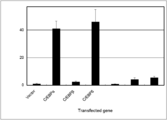
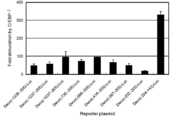
- the luciferase activity was increased 2-46 times in cells transfected with C / EBP ⁇ , C / EBP ⁇ , C / EBP ⁇ , COUP-TFI, and p53 genes, which are the same gene family as C / EBP ⁇ (see FIG. 1 described later). ).
- HNF4 had almost no effect.
- This decorin promoter region ( ⁇ 252 to ⁇ 205) contained a sequence (AGGCAAGTAG) similar to the p53 binding consensus sequence (5′-PuPuPuC (A / T) (A / T) GPyPyPy-3 ′).
- AGGCAAGTAG p53 binding consensus sequence
- 5′-PuPuPuC A / T
- a / T GPyPyPy-3 ′
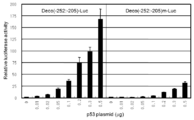
- a reporter plasmid Deco ( ⁇ 252: ⁇ 205) m-Luc in which CAAG, which is presumed to be the most important among these sequences, was mutated to AAAT was prepared and examined. It decreased to about 1 (refer FIG. 2 and 3 mentioned later). From these results, it was considered that p53 acts on the region of ⁇ 252 to ⁇ 205 of the decorin promoter to induce the expression of downstream genes.
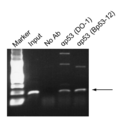
- the chromatin immunoprecipitation method is used to immunoprecipitate the chromatin fraction of human glioma cells U-87 treated with adriamycin using an anti-p53 antibody, and the PCR method is performed using a primer designed in the decorin promoter region. As a result of amplification, an expected DNA band was detected (see FIG. 5 described later). This suggests that p53 binds directly to the decorin promoter region.
- EMSA electrophore mobility shift assay
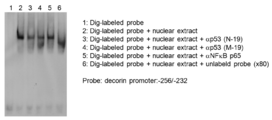
- alkaline phosphatase-labeled anti-digoxigenin antibody and CSPD [Disodium 3- (4-methyspiro ⁇ 1,2-dioxetane-3,2 ′-(5′-chloro)] Triticlo [3.3.1.1 3,7 ] Ddecan ⁇ -4-yl) phenyl phosphate] was detected as a band with reduced mobility (FIG. 6). This band was not observed in the absence of nuclear extract. It disappeared when an excessive amount of unlabeled probe was added. In addition, when the anti-p53 antibody (N-19 or M-19) was added, the band became thinner than the sample to which the control anti-NF- ⁇ B antibody was added. This indicates that p53 binds to the -256 to -232 region of the decorin promoter.
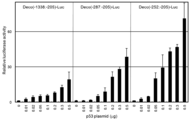
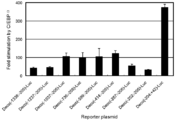
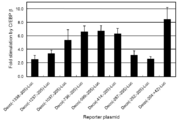
- C / EBP ⁇ , C / EBP ⁇ , and C / EBP ⁇ were highest in the reporter plasmid containing the region of ⁇ 204 to +42 (see FIGS. 7, 8, and 9 described later). From this, it was considered that these C / EBP families mainly act on the region of ⁇ 204 to +42 of the decorin promoter.
- C / EBP ⁇ and C / EBP ⁇ were high in the region of ⁇ 414 to ⁇ 205 and decreased in the region of ⁇ 287 to ⁇ 205 (see FIGS. 7, 8, and 9 described later). From this, it was considered that C / EBP ⁇ and C / EBP ⁇ also act on the region of ⁇ 414 to ⁇ 288 of the decorin promoter to induce downstream gene expression.
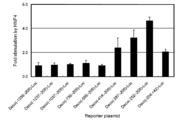
- HNF4 showed the highest expression-inducing activity against Deco (-252: -205) -Luc as with p53 (see FIG. 10 described later).
- COUP-TFI showed high activity with Deco ( ⁇ 204 to +42) -Luc and Deco ( ⁇ 287: ⁇ 205) -Luc, and decreased with Deco ( ⁇ 252: ⁇ 205) -Luc (described later).
- FIG. 11 shows expression-inducing activity against Deco (-252: -205) -Luc, their action region was not clear.
- one or a plurality of bases in the base sequence described in SEQ ID NOs: 1 and 2 and the base sequences described in SEQ ID NOs: 1 and 2 are substituted or deleted. Or a base sequence that hybridizes with these base sequences under stringent conditions, and has a function of controlling the transcription induction ability of C / EBP ⁇ , C / EBP ⁇ , or C / EBP ⁇ .
- the base sequence described in SEQ ID NO: 1 represents the region of ⁇ 414 to ⁇ 288 of the decorin promoter
- the base sequence described in SEQ ID NO: 2 represents the region of ⁇ 204 to +42 of the decorin promoter.
- 3 indicates the region of ⁇ 252 to ⁇ 205 of the decorin promoter.
- the base sequences described in SEQ ID NOs: 1 and 2 are preferably part of the promoter region of the decorin gene.
- the method for expressing the gene according to the second aspect of the present invention is dependent on C / EBP ⁇ , C / EBP ⁇ , or C / EBP ⁇ by linking the DNA according to the first aspect upstream of another gene. Any other gene is expressed.
- the method for suppressing or measuring the transcription induction ability of C / EBP ⁇ , C / EBP ⁇ or C / EBP ⁇ according to the third aspect of the present invention is carried out using the DNA according to the first aspect.
- the DNA according to the fourth aspect of the present invention includes a base sequence represented by SEQ ID NO: 3, a base sequence obtained by substituting or deleting one or more bases of the base sequence represented by SEQ ID NO: 3, Alternatively, it consists of a base sequence that hybridizes with these base sequences under stringent conditions, and has a function of controlling the transcription-inducing ability of p53.
- the base sequence described in SEQ ID NO: 3 is preferably a part of the promoter region of the decorin gene.
- the method for suppressing or measuring the transcription-inducing ability of p53 according to the fifth aspect of the present invention is performed using the DNA according to the fourth aspect.
- hybridizes under stringent conditions means a DNA base sequence obtained by using a DNA as a probe and using a colony hybridization method, a plaque hybridization method, a Southern blot hybridization method, or the like.
- leaf hybridization was performed at 65 ° C. in the presence of 0.7 to 1.0 M NaCl, and 0. Examples include those that can be identified by washing the filter under a condition of 65 ° C. using a 1 to 2 ⁇ SSC solution (composition of 1 ⁇ SSC is 150 mM sodium chloride, 15 mM sodium citrate).
- Hybridization was performed in Molecular Cloning 2nd Edt. , Cold Spring Harbor Laboratory Press (1989) and the like.
- the reporter plasmid used in the present invention is not limited to a plasmid containing a luciferase gene, and examples thereof include chloramphenicol acetyltransferase (CAT) and owan jellyfish fluorescent chromogen (GFP).
- CAT chloramphenicol acetyltransferase
- GFP owan jellyfish fluorescent chromogen
- the gene to be connected is not limited, but a drug resistance gene, an apoptosis-inhibiting gene, a cell-killing gene, and C / EBP ⁇ , C / A gene that causes abnormal expression at the target of EBP ⁇ , C / EBP ⁇ , or p53 can be considered.
- drug resistance genes include dhfr, gpt, neo, hygro, trpB, hisD, ODC and the like.
- dhfr is a gene that confers resistance to methotrexate
- gpt is a gene that confers resistance to mycophenolic acid
- neo is a gene that confers resistance to aminoglycoside G-418
- hygro confers resistance to hygromycin. It is a gene.
- TrpB is a gene that allows cells to use indole instead of tryptophan
- hisD is a gene that allows cells to use histinol instead of histidine
- ODC ornithine decarboxylase gene
- DFMO 2- (difluoromethyl) -DL-ornithine
- an apoptosis inhibiting gene is IAP. If the gene of SEQ ID NO: 2 is incorporated upstream of the IAP gene and introduced into the cell in advance, apoptosis does not occur when p53 is activated by drug treatment, and cell cycle arrest can be preferentially caused. . Conversely, when it is desired to kill cancer cells, the purpose can be achieved by connecting a cell killing gene.
- the target gene having the promoter DNA is adenovirus, adeno-associated virus.
- the target gene is expressed under normal transcriptional control of C / EBP ⁇ , C / EBP ⁇ , C / EBP ⁇ , and p53 by inserting it into a vector such as a retrovirus or encapsulating it in a liposome. Can be made.
- DNA of SEQ ID NO: 1 SEQ ID NO: 2 or SEQ ID NO: 3 is excessively introduced into a cell and C / EBP ⁇ , C / EBP ⁇ , C / EBP ⁇ or p53 is bound thereto to control their functions
- the DNA containing at least a part of this promoter DNA can competitively inhibit the binding to C / EBP ⁇ , C / EBP ⁇ , C / EBP ⁇ or p53.
- the DNA used for competitive inhibition usually has a chain length of at least 6 bases.
- the decorine promoter DNA can adopt a base sequence in which one or more bases in SEQ ID NO: 1, SEQ ID NO: 2 and SEQ ID NO: 3 are substituted or deleted.
- a person skilled in the art will be able to use various Bunsei biological techniques such as restriction enzyme method, deletion introduction by DNA exonuclease, modification of promoter sequence by PCR method using mutation primer, mutation introduction by site-specific induction method, synthetic mutation Promoter DNA equivalent to the natural type by substituting a part of the base sequence of the natural promoter DNA with another base, or deleting or adding a part of the base by a method such as DNA introduction
- a DNA having the same promoter activity and having a base sequence in which the solution is substituted, deleted, and / or added are also possible.
- Example 1 Human cultured esophageal cancer cells Extracting genomic DNA from Tn and using this as a template, AC007115.1 Homo sapiens chromosome 12 clone 12030 base to 13163 base [decorin gene promoter region (-38 to -205); total length 1134 base pairs], and 13164 base pairs to A region of 13409 base pairs [decorin gene promoter region (-204 to +42); full length 246 base pairs] was amplified by PCR.
- This reporter plasmid is SV40, a control plasmid that constantly expresses Renilla luciferase by the CMV promoter-pGL4.73 [hRluc / SV40] vector, or pGL4.75 [hRluc / CMV] vector, and COUP-TFI, HNF4 Introduced into mouse fibroblasts ras-NIH3T3 with Lipofectamine-Plus reagent (Invitrogen) together with an expression vector of C, EBP ⁇ , C / EBP ⁇ , C / EBP ⁇ , or p53, or an empty control vector containing no insert gene did.
- luciferase activity was measured using a dual luciferase quantification system (Promega), and the ratio of firefly luciferase activity to Renilla luciferase activity was calculated.
- C / EBP ⁇ , C / EBP ⁇ , C / EBP ⁇ , COUP-TFI, and p53 gene-introduced cells had a 2- to 46-fold increase in luciferase activity compared to the control vector (FIG. 1).
- HNF4 had almost no effect.
- Luciferase reporter plasmid Deco ( ⁇ 1338: ⁇ 205) —The promoter region ( ⁇ 1338 to ⁇ 205) of the decorin gene incorporated in Luc was gradually deleted from the 5 ′ side to form seven reporter plasmids (Deco ( ⁇ 1237: -205) -Luc, Deco (-1037: -205) -Luc, Deco (-736: -205) -Luc, Deco (-599: -205) -Luc, Deco (-414: -205)- Luc, Deco (-287: -205) -Luc, Deco (-252: -205) -Luc) were prepared by reverse PCT method using KOD Mutagenesis Kit (Toyobo).
- the region from ⁇ 252 to ⁇ 205 of the decorin promoter contained a sequence (AGGCAAGTAG) similar to the p53 binding consensus sequence (5′-PuPuPuC (A / T) (A / T) GPyPyPy-3 ′).
- AGGCAAGTAG p53 binding consensus sequence
- 5′-PuPuPuC (A / T) (A / T) GPyPyPy-3 ′ The region from ⁇ 252 to ⁇ 205 of the decorin promoter contained a sequence (AGGCAAGTAG) similar to the p53 binding consensus sequence (5′-PuPuPuC (A / T) (A / T) GPyPyPy-3 ′).
- CAAG which is presumed to be the most important among these sequences
- Example 6 On the other hand, activation of the decorin promoter by C / EBP ⁇ , C / EBP ⁇ , and C / EBP ⁇ was similarly examined using the reporter plasmid shown in Example 2, and the increase in firefly luciferase activity was ⁇ 204 to +42, and It was high in the reporter plasmid containing the region from ⁇ 414 to ⁇ 205 and decreased in the region from ⁇ 287 to ⁇ 205 (FIGS. 7, 8, and 9). From this, it was considered that C / EBP ⁇ , C / EBP ⁇ , and C / EBP ⁇ act on the ⁇ 204 to +42 and ⁇ 414 to ⁇ 288 regions of the decorin promoter to induce the expression of granule genes.
- the present invention relates to DNA, functional analysis of C / EBP ⁇ , C / EBP ⁇ , C / EBP ⁇ , and p53 using this DNA, gene expression dependent on C / EBP ⁇ , C / EBP ⁇ , C / EBP ⁇ , and p53, And C / EBP ⁇ , C / EBP ⁇ , C / EBP ⁇ , and p53 functions can be suppressed, and significant progress can be expected in the elucidation and prevention of various diseases involving cell proliferation, differentiation, and cell death. There is a possibility.
- Control plasmid pGL4.73 [hRluc / SV40] vector (0.01 ⁇ g), which expresses Renilla luciferase constitutively with the SV40 promoter, and Deco ( ⁇ 1338: ⁇ 205) -Luc (0.1 ⁇ g), and C / EBP ⁇ , Lipofectamine in mouse fibroblast ras-NIH3T3 with C / EBP ⁇ , C / EBP ⁇ , COUP-TFI, HNF4, or p53 expression vector, or empty control vector without insert gene (pEF-BOS) (0.3 ⁇ g) -Introduced using Plus reagent (Invitrogen).
- pEF-BOS empty control vector without insert gene
- luciferase activity was measured using a dual luciferase quantification system (Promega), and the ratio of firefly luciferase activity to Renilla luciferase activity was calculated.
- C / EBP ⁇ , C / EBP ⁇ , C / EBP ⁇ , COUP-TFI, and p53 gene-introduced cells had a 2- to 46-fold increase in luciferase activity compared to the control vector.
- HNF4 had little effect. It is a figure which shows activation of a decorin promoter by p53.
- Deco ( ⁇ 252: ⁇ 205) m-Luc is a p53 binding consensus sequence (5′-PuPuPuC (A / T) (A / T) GPyPyPy-3 ′) found in the region ⁇ 252 to ⁇ 205 of the decorin promoter.
- the chromatin fraction of human glioma cells U-87 treated with adriamycin was immunoprecipitated using anti-p53 antibodies (DO-1 and Bp53-12; Santa Cruz), and the coprecipitated DNA was added to the decorin promoter region ( ⁇ 413 to Amplified by PCR using the primer (AACTGGTGGACAGGGAGAAAG) designed in -232).
- a predicted 182 base pair DNA band was detected only with the p53 antibody. This suggests that p53 binds directly to the decorin promoter.
- the arrow indicates the position of the expected PCR product. It is a figure which shows the coupling
- COUP-TFI Activation of the decorin promoter by COUP-TFI was examined using a reporter plasmid as in FIG. COUP-TFI showed the highest activity against Deco (-287: -205) -Luc and Deco (-204: +42) -Luc, while Deco (-252: -205) -Luc was less active. It did not disappear completely. Therefore, their area of action was not determined.
Landscapes
- Health & Medical Sciences (AREA)
- Genetics & Genomics (AREA)
- Life Sciences & Earth Sciences (AREA)
- Chemical & Material Sciences (AREA)
- Organic Chemistry (AREA)
- Zoology (AREA)
- Engineering & Computer Science (AREA)
- Biophysics (AREA)
- Biochemistry (AREA)
- Molecular Biology (AREA)
- General Health & Medical Sciences (AREA)
- Bioinformatics & Cheminformatics (AREA)
- General Engineering & Computer Science (AREA)
- Wood Science & Technology (AREA)
- Biotechnology (AREA)
- Biomedical Technology (AREA)
- Microbiology (AREA)
- Plant Pathology (AREA)
- Physics & Mathematics (AREA)
- Toxicology (AREA)
- Gastroenterology & Hepatology (AREA)
- Medicinal Chemistry (AREA)
- Proteomics, Peptides & Aminoacids (AREA)
- Measuring Or Testing Involving Enzymes Or Micro-Organisms (AREA)
Abstract
【課題】ヒトdecorinプロモーターの一部の配列を用いてC/EBPα、C/EBPβ、C/EBPδ若しくはp53依存的に任意の遺伝子を発現させる方法、及び、C/EBPα、C/EBPβ、C/EBPδ若しくはp53の転写誘導能を抑制又は測定する方法、更には、これに用いられるDNAを提供すること。 【解決手段】配列番号1、2及び3に記載の塩基配列、前記配列番号1、2及び3に記載の塩基配列のうち1若しくは複数個の塩基が置換又は欠失してなる塩基配列、又は、これら塩基配列とストリンジェントな条件下でハイブリダイズする塩基配列からなり、C/EBPα、C/EBPβ、C/EBPδ若しくはp53の転写誘導能を制御する機能を有するDNAとする。
Description
本発明は、C/EBPα、C/EBPβ、C/EBPδ若しくはp53依存的に任意の遺伝子を発現させる方法、及びC/EBPα、C/EBPβ、C/EBPδ若しくはp53の転写誘導能を抑制又は測定する方法に関する。
p53遺伝子は、人の多がん組織及びがん細胞において、最も高頻度で変異・欠失が観察されている遺伝子である(例えば下記非特許文献1参照)。変異p53遺伝子を有するリー・フラウメニ症候群患者やp53ノックアウトマウスにおいてがんが多発することから、p53遺伝子の異常はがんの発生・進展に密接に関連していると考えられている(例えば下記非特許文献2、3参照)。
p53は、転写活性調節ドメインを含むN末端領域と、DNA結合に関与するDNA結合領域と、四量体形成ドメインを含むC末端領域からなり、がん細胞で観察される変異は、DNA結合領域に集中している。
野生型p53は転写調節因子として機能し、細胞周期、DNA修復、アポトーシスに関わる多くの遺伝子の発現に関与していることが知られている。例えば野生型p53蛋白質は、サイクリン依存性キナーゼのインヒビターであるp21遺伝子(別名:WAF1、CIP1、SDI1)の転写を活性化して細胞周期停止を誘導する。また野生型p53は、Bax遺伝子、Noxa遺伝子、Puma遺伝子等の転写を活性化してアポトーシスを誘導することが知られている(例えば下記非特許文献4乃至6参照)。
これらのことから、p53の転写調節因子としての活性を測定することによって、発がんやアポトーシスの進行程度を推測することが可能であり、また、p53の転写誘導活性を調節することによって発がんやアポトーシスを抑制することが可能である。
C/EBPは塩基性アミノ酸の領域とロイシンジッパーをもったbZIPタンパク質であり、異なった遺伝子にコードされたC/EBPα、C/EBPβ、C/EBPδ、C/EBPγ、CRP1、CHOPからなるC/EBPファミリーを構成している(例えば下記非特許文献7参照)。C/EBPβ、C/EBPδは急性期反応に重要な転写因子である。C/EBPαはp21を介して細胞周期を止め、細胞増殖抑制作用を示し(例えば下記非特許文献8参照)、がん抑制遺伝子の一つである(例えば下記非特許文献9参照)。
ところでdecorinは低分子ロイシンリッチ・プロテオグリカンと呼ばれる分子ファミリーに属し、EGFR、ErbB4、IGF-IR等の増殖因子受容体に結合して強い細胞増殖やアポトーシスに影響を及ぼす(例えば下記非特許文献10参照)。
Cancer Research,1994,54,4855-4878
British Journal of Cancer,1997,76,1-14
Nature,1992,356,215-221
Cell,1995,80,293-299
Science,2000,288,1053-1058
Molecular Cell,2001,7,683-694
International Journal of Experimental Pathology 1998,79,369-391
Genes and Development 1996,10,804-815
Journal of Experimental Medicine 2005,202,85-96
Journal of Biological Chemistry 2008,283,21305-21309
上記従来の技術には、C/EBPファミリー、及びp53の標的遺伝子のプロモーターを用いた遺伝子発現制御に関する記載もあるが、これらの生物学的重要性を考慮すれば1つでも多くの標的遺伝子の同定が求められている。
そこで、本発明は、上記課題を鑑み、ヒトdecorinプロモーターにC/EBPα、C/EBPβ、C/EBPδ若しくはp53が作用する領域を同定し、それらの転写因子に依存して任意の遺伝子を発現させる方法、及び、それらの転写誘導能を抑制又は測定する方法、更には、これに用いられるDNAを提供することを目的とする。
上記課題を解決するための一手段に係るDNAは、配列番号1及び2に記載の塩基配列、配列番号1及び2に記載の塩基配列のうち1若しくは複数個の塩基が置換又は欠失してなる塩基配列、又は、これら塩基配列とストリンジェントな条件下でハイブリダイズする塩基配列からなり、C/EBPα、C/EBPβ、若しくはC/EBPδの転写誘導能を制御する機能を有するものである。
また、上記課題を解決するための他の一手段に係る遺伝子を発現させる方法は、配列番号1及び2に記載の塩基配列、配列番号1及び2に記載の塩基配列のうち1若しくは複数個の塩基が置換又は欠失してなる塩基配列、又は、これら塩基配列とストリンジェントな条件下でハイブリダイズする塩基配列からなるDNAを他の任意の遺伝子の上流につないで、C/EBPα、C/EBPβ、若しくはC/EBPδ依存的に他の遺伝子を発現させる。
また、上記課題を解決するための他の一手段に係る遺伝子を発現させる方法は、配列番号1及び2に記載の塩基配列、配列番号1及び2に記載の塩基配列のうち1若しくは複数個の塩基が置換又は欠失してなる塩基配列、又は、これら塩基配列とストリンジェントな条件下でハイブリダイズする塩基配列からなるDNAを用いて、C/EBPα、C/EBPβ、若しくはC/EBPδの転写誘導能を抑制又は測定する。
また、上記課題を解決するための他の一手段に係るDNAは、配列番号3に記載の塩基配列、配列番号3に記載の塩基配列のうち1若しくは複数個の塩基が置換又は欠失してなる塩基配列、又は、これら塩基配列とストリンジェントな条件下でハイブリダイズする塩基配列からなり、p53の転写誘導能を制御する機能を有するものである。
また、上記課題を解決するための他の一手段に係る遺伝子を発現させる方法は、配列番号3に記載の塩基配列、配列番号3に記載の塩基配列のうち1若しくは複数個の塩基が置換又は欠失してなる塩基配列、又は、これら塩基配列とストリンジェントな条件下でハイブリダイズする塩基配列からなるDNAを用いて、p53の転写誘導能を抑制又は測定する方法。
以上、本発明により、C/EBPα、C/EBPβ、C/EBPδ若しくはp53に依存して任意の遺伝子を発現させる方法、C/EBPα、C/EBPβ、若しくはC/EBPδの転写誘導能を抑制又は測定する方法、及び、p53の転写誘導能を抑制又は測定する方法、更には、これに用いられるDNAを提供することが可能となる。
マウス線維芽細胞NIH3T3を活性化型Ha-ras遺伝子により形質転換したras-NIH3T3細胞はがん細胞の様相を呈するが、そこにCOUP-TFI、HNF4及びC/EBPα遺伝子を導入し発現させたところ、細胞の形態が正常型に復帰することを発見した。そして、これらの遺伝子導入細胞と親株のras-NIH3T3細胞について遺伝子発現の差をマイクロアレイ法により網羅的に解析したところ、いずれもdecorin遺伝子の発現が上昇していた。すなわち、COUP-TFI、HNF4、及びC/EBPα遺伝子の作用により、decorin遺伝子の発現が誘導されるのではないかと考えられた。
一方、p53は代表的ながん抑制遺伝子であり、その遺伝子をras-NIH3T3細胞に導入したところ、上記と同様の形態的正常復帰が観察された。またマウスdecorin遺伝子を導入しても同様の形態的正常復帰が観察された。これらのことから、COUP-TFI、HNF4、及びC/EBPαとp53、及びdecorinの間に何らかの関係があると推定された。
そこで次に、decorin遺伝子の発現調節機構について解析した。解析は、後述の実施例から明らかとなるが、ヒト培養食道がん細胞株T.TnのゲノムDNAを鋳型として、decorin遺伝子のプロモーター領域(-1338~-205)をPCR法により増幅して単離し、ルシフェラーゼ・レポータープラスミドpGL3(プロメガ社)に組み込み、レポータープラスミドdeco(-1338:-205)-Lucを作製した。そしてこのレポータープラスミドをCOUP-TFI、HNF4、C/EBPα、及びp53の発現ベクターとともにマウス線維芽細胞ras-NIH3T3に導入し、2日後にルシフェラーゼ活性を測定した。C/EBPαと同じ遺伝子ファミリーであるC/EBPα、C/EBPβ、C/EBPδ、COUP-TFI、及びp53遺伝子の導入細胞ではルシフェラーゼ活性が2~46倍に上昇していた(後述の図1参照)。なおHNF4はほとんど影響がなかった。
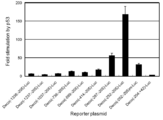
次にこのルシフェラーゼ・レポータープラスミドに組み込まれたdecorin遺伝子のプロモーター領域(-1338~-205)を段階的に5’側から削除して7種類のレポータープラスミド(Deco(-1237:-205)-Luc、Deco(-1037:-205)-Luc、Deco(-736:-205)-Luc、Deco(-599:-205)-Luc、Deco(-414:-205)-Luc、Deco(-287:-205)-Luc、Deco(-252:-205)-Luc)を作製した。またDeco(-204:+42)-Lucも別途作製した。p53によるこれらのプラスミド由来のルシフェラーゼ活性の変動を調べたところ、-252~-205の領域で最も顕著なルシフェラーゼ活性の上昇が認められた(後述の図2参照)。この活性上昇はp53の用量に依存しており(後述の図3参照)、ヒトグリオーマ細胞U-87でも同様の結果が得られた(後述の図4参照)。
このdecorinプロモーター領域(-252~-205)にはp53の結合コンセンサス配列(5’-PuPuPuC(A/T)(A/T)GPyPyPy-3’)に類似した配列(AGGCAAGTAG)が含まれていた。そこでこの配列のうち最も重要であると推定されているCAAGをAAATに変異させたレポータープラスミドDeco(-252:-205)m-Lucを作製して調べたところ、p53による活性化は5分の1程度に減少した(後述の図2、及び3参照)。これらのことからp53はdecorinプロモーターの-252~-205の領域に作用して下流の遺伝子の発現を誘導すると考えられた。
次に、クロマチン免疫沈降法により、アドリアマイシン処理したヒトグリオーマ細胞U-87のクロマチン分画を抗p53抗体を用いて免疫沈降し、共沈したDNAをdecorinプロモーター領域に設計したプライマーを用いてPCR法により増幅したところ、予想されたDNAのバンドが検出された(後述の図5参照)。このことはp53がdecorinプロモーター領域に直接結合することを示唆している。
次にEMSA(electrophoresis mobility shift assay)法によりp53とdecorinプロモーターの結合を調べた。decorinプロモーターの-256~-232の領域の配列を持つ合成DNAをプローブとしてdigoxigeinで標識し、U-87細胞の核抽出液と混合し、ポリアクリルアミドゲルで電気泳動し、DNAをメンブレンに転写した後、アルカリフォスファターゼ標識抗digoxigenin抗体とCSPD[Disodium 3-(4-methosyspiro{1,2-dioxetane-3,2’-(5’-chloro)Ttricyclo[3.3.1.13,7]Ddecan}-4-yl)phenyl phosphate]を用いて検出した結果、DNA-タンパク質複合体が移動度の低下したバンドとして検出された(図6)。このバンドは核抽出液の非存在下では観察されなかった。また、過剰量の非標識プローブを加えると消失した。また、抗p53抗体(N-19、またはM-19)を加えるとコントロールの抗NF-κB抗体を加えたサンプルに比べ、バンドが薄くなった。このことはdecorinプロモーターの-256~-232の領域にp53が結合することを示す。
一方、C/EBPα、C/EBPβ、及びC/EBPδによるルシフェラーゼ活性の上昇は-204~+42の領域を含むレポータープラスミドで最も高かった(後述の図7、8、9参照)。このことからこれらのC/EBPファミリーはdecorinプロモーターの-204~+42の領域に主に作用すると考えられた。また、C/EBPα、及びC/EBPβでは-414~-205の領域で高く、-287~-205の領域では減少した(後述の図7、8、9参照)。このことからC/EBPαとC/EBPβはdecorinプロモーターの-414~-288の領域にも作用して下流の遺伝子の発現を誘導すると考えられた。
HNF4はp53と同様にDeco(-252:-205)-Lucに対して最も高い発現誘導活性を示した(後述の図10参照)。また、COUP-TFIはDeco(-204~+42)-Luc、及びDeco(-287:-205)-Lucで高い活性を示し、Deco(-252:-205)-Lucでは活性が低下した(後述の図11参照)。しかしながら、これらはDeco(-252:-205)-Lucに対しても発現誘導活性を示したことからそれらの作用領域は明確でなかった。
すなわち、本発明の第一の形態に係るDNAは、配列番号1及び2に記載の塩基配列、配列番号1及び2に記載の塩基配列のうち1若しくは複数個の塩基が置換又は欠失してなる塩基配列、又は、これら塩基配列とストリンジェントな条件下でハイブリダイズする塩基配列からなり、C/EBPα、C/EBPβ若しくはC/EBPδの転写誘導能を制御する機能を有する。なお配列番号1に記載の塩基配列は、decorinプロモーターの-414~-288の領域を示すものであり、配列番号2に記載の塩基配列は、decorinプロモーターの-204~+42の領域を、配列番号3は、decorinプロモーターの-252~-205の領域をそれぞれ示している。
なおこの形態において、配列番号1及び2に記載の塩基配列は、decorin遺伝子のプロモーター領域の一部であることが好ましい。
また本発明の第二の形態に係る遺伝子を発現させる方法は、上記第一の形態に係るDNAを、他の遺伝子の上流につないで、C/EBPα、C/EBPβ若しくはC/EBPδ依存的に他の任意の遺伝子を発現させる。
また本発明の第三の形態に係るC/EBPα、C/EBPβ若しくはC/EBPδの転写誘導能を抑制又は測定する方法は、上記第一の形態に係るDNAを用いて行なう。
また、本発明の第四の形態に係るDNAは、配列番号3に記載の塩基配列、配列番号3に記載の塩基配列のうち1若しくは複数個の塩基が置換又は欠失してなる塩基配列、又は、これら塩基配列とストリンジェントな条件下でハイブリダイズする塩基配列からなり、p53の転写誘導能を制御する機能を有する。
なおこの形態において、配列番号3に記載の塩基配列は、decorin遺伝子のプロモーター領域の一部であることが好ましい。
また本発明の第五の形態に係るp53の転写誘導能を抑制又は測定する方法は、上記第四の形態に係るDNAを用いて行なう。
ここで、「ストリンジェントな条件下でハイブリダイズする」とは、DNAをプローブとして使用し、コロニーハイブリダイゼーション法、プラークハイブリダイゼーション法、サザンブロットハイブリダイゼーション法等を用いることにより得られるDNAの塩基配列を意味し、例えば、コロニー、プラーク由来のDNA又はこのDNAの断片を固定化したフィルターを用いて、0.7~1.0MのNaCl存在か65℃で葉イブリダイゼーションを行なった後、0.1~2×SSC溶液(1×SSCの組成は、150mM塩化ナトリウム、15mMクエン酸ナトリウム)を用い、65℃条件下でフィルターを洗浄することにより同定できるものを挙げることができる。ハイブリダイゼーションは、Molocular Cloning 2nd Edt., Cold Spring Harbor Laboratory Press(1989)等に記載されている方法に準じて行なうことができる。
また、本発明において用いられるレポータープラスミドはルシフェラーゼ遺伝子を含むプラスミドに限られず、例えばクロラムフェニコールアセチルトランスフェラーゼ(CAT)、オワンクラゲ蛍光発色体(GFP)を挙げることができる。
また、また、本発明の一に係る遺伝子を発現させる方法において、接続させる遺伝子は、限定されるわけではないが、薬剤耐性遺伝子、アポトーシス阻害遺伝子、殺細胞遺伝子、及び、C/EBPα、C/EBPβ、C/EBPδ若しくはp53の標的で発現異常を引き起こした遺伝子などが考えられる。薬剤耐性遺伝子の例としては、dhfr、gpt、neo、hygro、trpB、hisD、ODCなどがある。dhfrはメトトレキセートへの耐性を与える遺伝子であり、gptはミコフェノール酸への耐性を与える遺伝子であり、neoはアミノグリコシドG-418への耐性を与える遺伝子であり、hygroはハイグロマイシンへの耐性を与える遺伝子である。またtrpBは細胞がトリプトファンの代わりにインドールを利用することを許容する遺伝子であり、hisDは細胞がヒスチジンの代わりにヒスチノールを利用することを許容する遺伝子であり、ODC(オルニチンデカルボキシラーゼ遺伝子)は、オルニチンデカルボキシラーゼ阻害剤である2-(ジフルオロメチル)-DL-オルニチン(DFMO)に対する耐性を与える遺伝子である。アポトーシス阻害遺伝子の例としてはIAPを挙げることができる。IAP遺伝子の上流に配列番号2の遺伝子を組み込んで細胞に予め導入しておけば、薬物処理によりp53を活性化させた場合にアポトーシスは起こさず、細胞周期の停止を優先的に起こすことができる。逆に、がん細胞などを死滅させたい場合には殺細胞遺伝子を接続させることによって目的を達成できる。C/EBPα、C/EBPβ、C/EBPδ、p53の標的で発現異常を引き起こした遺伝子の発現を正常に戻すためには、本実施形態に係るプロモーターDNAを有する標的遺伝子をアデノウイルス、アデノ随伴ウイルス、レトロウイルスなどのベクターに挿入し、又は、リポソームなどに封入して体細胞に導入することにより、C/EBPα、C/EBPβ、C/EBPδ、p53の正常な転写制御下に標的遺伝子を発現させることができる。
配列番号1、配列番号2又は配列番号3に記載のDNAを過剰に細胞内に導入し、そこにC/EBPα、C/EBPβ、C/EBPδ又はp53を結合させてそれらの機能を制御する際、このプロモーターDNAの少なくとも一部を含むDNAは、C/EBPα、C/EBPβ、C/EBPδ又はp53との結合を拮抗阻害しうる。拮抗阻害に用いるDNAは、通常少なくとも6塩基の鎖長を有する。
またdecorineプロモーターDNAは、配列番号1、配列番号2及び配列番号3のうち1若しくは複数個の塩基が置換又は欠失してなる塩基配列を採用することができる。当業者であれば、種々の文政生物学的手法、例えば制限酵素法、DNAエキソヌクレアーゼによる欠失導入、変異プライマーを用いたPCR法によるプロモーター配列の改変、部位特異誘発法による変異導入、合成変異DNAの導入などの方法で、天然型プロモーターDNAの塩基配列の一部を他の塩基に置換したり、あるいは、一部塩基を欠失、または、付加させることにより、天然型と同等のプロモーターDNAと同等のプロモーター活性を有し、液が置換、欠失、及び/又は付加した塩基配列を有するDNAも使うことができる。
以下、本発明の具体的な実施の例について詳細に説明する。
(実施例1)
まず、ヒト培養食道癌細胞T.TnからゲノムDNAを抽出し、これを鋳型として、AC007115.1 Homo sapiens chromosome 12 cloneの12030base~13163base[decorin遺伝子のプロモーター領域(-38~-205);全長1134塩基対]、及び13164塩基対~13409塩基対[decorin遺伝子のプロモーター領域(-204~+42);全長246塩基対]の領域をPCR法により増幅した。その際、XhoI、及びHindIIIサイトをそれぞれ末端に導入し、TAクローニングにてサブクローニングを行い、ホタル・ルシフェラーゼ・レポータープラスミドpGL3-Basic vector(プロメガ社)のXhol-HindIII間に組み込み、レポータープラスミドDeco(-1338:-205)-Lucを作製した。
まず、ヒト培養食道癌細胞T.TnからゲノムDNAを抽出し、これを鋳型として、AC007115.1 Homo sapiens chromosome 12 cloneの12030base~13163base[decorin遺伝子のプロモーター領域(-38~-205);全長1134塩基対]、及び13164塩基対~13409塩基対[decorin遺伝子のプロモーター領域(-204~+42);全長246塩基対]の領域をPCR法により増幅した。その際、XhoI、及びHindIIIサイトをそれぞれ末端に導入し、TAクローニングにてサブクローニングを行い、ホタル・ルシフェラーゼ・レポータープラスミドpGL3-Basic vector(プロメガ社)のXhol-HindIII間に組み込み、レポータープラスミドDeco(-1338:-205)-Lucを作製した。
そして、このレポータープラスミドをSV40、CMVプロモーターにより恒常的にウミシイタケ・ルシフェラーゼを発現するコントロールプラスミド-pGL4.73[hRluc/SV40]vector、又はpGL4.75[hRluc/CMV]vector、及びCOUP-TFI、HNF4、C/EBPα、C/EBPβ、C/EBPδ、又はp53の発現ベクター、又はインサート遺伝子を含まない空の対照ベクターとともにマウス線維芽細胞ras-NIH3T3にLipofectamine-Plus試薬(インビトロジェン社)を用いて導入した。そして2日間培養した後、ルシフェラーゼ活性をデュアル・ルシフェラーゼ定量システム(プロメガ社)を用いて測定し、ウミシイタケ・ルシフェラーゼ活性に対するホタル・ルシフェラーゼ活性の比を算出した。この結果、対照ベクターに比べC/EBPα、C/EBPβ、C/EBPδ、COUP-TFI、及びp53遺伝子の導入細胞ではルシフェラーゼ活性が2~46倍に上昇していた(図1)。なおHNF4に関しては殆ど影響がなかった。
(実施例2)
ルシフェラーゼ・レポータープラスミドDeco(-1338:-205)-Lucに組み込まれたdecorin遺伝子のプロモーター領域(-1338~-205)を段階的に5’側から削除して7種類のレポータープラスミド(Deco(-1237:-205)-Luc、Deco(-1037:-205)-Luc、Deco(-736:-205)-Luc、Deco(-599:-205)-Luc、Deco(-414:-205)-Luc、Deco(-287:-205)-Luc、Deco(-252:-205)-Luc)をreverse PCT法により、KOD Mutagenesis Kit(東洋紡社)を用いて作製した。そして、これらのプラスミドまたはDeco(-204:+42)-Lucとコントロールプラスミド-pGL4.73[hRluc/SV40]vector、及びp53発現ベクターをras-NIH3T3細胞に導入し、ルシフェラーゼ活性の変動を調べたところ、-252~-205の領域で最も顕著なホタル・ルシフェラーゼ活性の上昇が認められた(図2)。なおこの活性上昇は、p53の用量に依存しており、(図3)、ヒトグリオーマ細胞U-87でも同様の結果が得られた(図4)。
ルシフェラーゼ・レポータープラスミドDeco(-1338:-205)-Lucに組み込まれたdecorin遺伝子のプロモーター領域(-1338~-205)を段階的に5’側から削除して7種類のレポータープラスミド(Deco(-1237:-205)-Luc、Deco(-1037:-205)-Luc、Deco(-736:-205)-Luc、Deco(-599:-205)-Luc、Deco(-414:-205)-Luc、Deco(-287:-205)-Luc、Deco(-252:-205)-Luc)をreverse PCT法により、KOD Mutagenesis Kit(東洋紡社)を用いて作製した。そして、これらのプラスミドまたはDeco(-204:+42)-Lucとコントロールプラスミド-pGL4.73[hRluc/SV40]vector、及びp53発現ベクターをras-NIH3T3細胞に導入し、ルシフェラーゼ活性の変動を調べたところ、-252~-205の領域で最も顕著なホタル・ルシフェラーゼ活性の上昇が認められた(図2)。なおこの活性上昇は、p53の用量に依存しており、(図3)、ヒトグリオーマ細胞U-87でも同様の結果が得られた(図4)。
(実施例3)
decorinプロモーターの-252~-205の領域にはp53の結合コンセンサス配列(5’-PuPuPuC(A/T)(A/T)GPyPyPy-3’)に類似した配列(AGGCAAGTAG)が含まれていた。そこで、この配列のうち最も重要であると推定されるCAAGをAAATに変異させたレポータープラスミドDeco(-252:-205)m-LucをKOD Mutagenesis Kitを用いて作製して調べたところ、p53による活性化は170倍から30倍程度に減少した(図3)。このことからp53はdecorinプロモーターのAGGCAAGTAGを含む-252~-205の領域に作用して顆粒の遺伝子の発現を誘導すると考えられた。
decorinプロモーターの-252~-205の領域にはp53の結合コンセンサス配列(5’-PuPuPuC(A/T)(A/T)GPyPyPy-3’)に類似した配列(AGGCAAGTAG)が含まれていた。そこで、この配列のうち最も重要であると推定されるCAAGをAAATに変異させたレポータープラスミドDeco(-252:-205)m-LucをKOD Mutagenesis Kitを用いて作製して調べたところ、p53による活性化は170倍から30倍程度に減少した(図3)。このことからp53はdecorinプロモーターのAGGCAAGTAGを含む-252~-205の領域に作用して顆粒の遺伝子の発現を誘導すると考えられた。
(実施例4)
ChIP Assay Kit(Active Motif社)を用いて、クロマチン免疫沈降解析を行なった。アドリアマイシン処理したヒトグリオーマ細胞U-87のクロマチン分画を抗p53抗体(DO-1、及びBp53-12;サンタクルーズ社)を用いて免疫沈降し、共沈したDNAをdecorinプロモーター領域(-413~-232)に設計したプライマー(AACTGGTGGACAGGGAGAAAG、及び、TCGGATTCCTACTTGCCTTGG)を用いてPCT法により増幅したところ、予想された182塩基対のDNAのバンドが検出された(図5)。このことは、p53がdecorinプロモーターに直接結合することを示唆している。
ChIP Assay Kit(Active Motif社)を用いて、クロマチン免疫沈降解析を行なった。アドリアマイシン処理したヒトグリオーマ細胞U-87のクロマチン分画を抗p53抗体(DO-1、及びBp53-12;サンタクルーズ社)を用いて免疫沈降し、共沈したDNAをdecorinプロモーター領域(-413~-232)に設計したプライマー(AACTGGTGGACAGGGAGAAAG、及び、TCGGATTCCTACTTGCCTTGG)を用いてPCT法により増幅したところ、予想された182塩基対のDNAのバンドが検出された(図5)。このことは、p53がdecorinプロモーターに直接結合することを示唆している。
(実施例5)
EMSA法によりp53とdecorinプロモーターの結合を調べた。decorinプロモーターの-256~-232の領域の配列を持つ合成DNAをプローブとしてdigoxigeninで標識し、U-87細胞の核抽出液と混合し、ポリアクリルアミドゲルで電気泳動し、DNAをメンブレンに転写した後、アルカリフォスファターゼ標識抗digoxigenin抗体とCSPD[Disodium 3-(4-methoxyspiro{1,2-dioxetane-3,2’-(5’-chloro)tricyclo[3.3.1.13,7]decan}-4-yl)phenyl phosphate]を用いて検出した。DNA-タンパク質複合体を示す移動度の低いバンドが検出された(図6、レーン2)。このバンドは核抽出液の非存在下では観察されなかった(レーン1)。また、過剰量の非標識プローブを加えると消失した(レーン6)。また、抗p53抗体(N-19、またはM-19)を加える(レーン3、4)とコントロールの抗NF-κB抗体を加えたサンプル(レーン5)に比べ、バンドが薄くなった。このことはdecorinプロモーターの-256~-232の領域にp53が結合することを示す。
EMSA法によりp53とdecorinプロモーターの結合を調べた。decorinプロモーターの-256~-232の領域の配列を持つ合成DNAをプローブとしてdigoxigeninで標識し、U-87細胞の核抽出液と混合し、ポリアクリルアミドゲルで電気泳動し、DNAをメンブレンに転写した後、アルカリフォスファターゼ標識抗digoxigenin抗体とCSPD[Disodium 3-(4-methoxyspiro{1,2-dioxetane-3,2’-(5’-chloro)tricyclo[3.3.1.13,7]decan}-4-yl)phenyl phosphate]を用いて検出した。DNA-タンパク質複合体を示す移動度の低いバンドが検出された(図6、レーン2)。このバンドは核抽出液の非存在下では観察されなかった(レーン1)。また、過剰量の非標識プローブを加えると消失した(レーン6)。また、抗p53抗体(N-19、またはM-19)を加える(レーン3、4)とコントロールの抗NF-κB抗体を加えたサンプル(レーン5)に比べ、バンドが薄くなった。このことはdecorinプロモーターの-256~-232の領域にp53が結合することを示す。
(実施例6)
一方、C/EBPα、C/EBPβ、及びC/EBPδによるdecorinプロモーターの活性化を同様に実施例2に示すレポータープラスミドを用いて調べたところ、ホタル・ルシフェラーゼ活性の上昇は-204~+42、及び-414~-205の領域を含むレポータープラスミドで高く、-287~-205の領域では減少した(図7、8、9)。このことからC/EBPα、C/EBPβ、及びC/EBPδはdecorinプロモーターの-204~+42、及び-414~-288の領域に作用して顆粒の遺伝子の発現を誘導すると考えた。
一方、C/EBPα、C/EBPβ、及びC/EBPδによるdecorinプロモーターの活性化を同様に実施例2に示すレポータープラスミドを用いて調べたところ、ホタル・ルシフェラーゼ活性の上昇は-204~+42、及び-414~-205の領域を含むレポータープラスミドで高く、-287~-205の領域では減少した(図7、8、9)。このことからC/EBPα、C/EBPβ、及びC/EBPδはdecorinプロモーターの-204~+42、及び-414~-288の領域に作用して顆粒の遺伝子の発現を誘導すると考えた。
HNF4について同様に、decorinプロモーターへの影響を調べた結果、Deco(-252:-205)-Lucに対して最も高い発現誘導活性を示した(図10)。また、COUP-TFIはDeco(-287:-205)-Lucで最も高い活性を示し、Deco(-252:-205)-Lucでは活性化が減弱したが完全には消失しなかった(図11)。したがって、それらの作用領域については確定しなかった。
本発明は、DNA、このDNAを利用したC/EBPα、C/EBPβ、C/EBPδ、及びp53の機能解析、C/EBPα、C/EBPβ、C/EBPδ、及びp53に依存的な遺伝子発現、及びC/EBPα、C/EBPβ、C/EBPδ、及びp53の機能抑制が可能となり、細胞増殖、分化、細胞死の関与する種々の疾患の解明と予防に大きな進展が期待でき、産業上の利用可性がある。
Claims (7)
- 配列番号1及び2に記載の塩基配列、前記配列番号1に記載の塩基配列のうち1若しくは複数個の塩基が置換又は欠失してなる塩基配列、又は、これら塩基配列とストリンジェントな条件下でハイブリダイズする塩基配列からなり、C/EBPα、C/EBPβ若しくはC/EBPδの転写誘導能を制御する機能を有するDNA。
- 前記配列番号1及び2に記載の塩基配列が、decorin遺伝子のプロモーター領域の一部である請求項1記載のDNA。
- 請求項1及び2に記載のDNAを、他の遺伝子の上流につないで、C/EBPα、C/EBPβ若しくはC/EBPδ依存的に前記他の遺伝子を発現させる方法。
- 請求項1に記載のDNAを用いてC/EBPα、C/EBPβ若しくはC/EBPδの転写誘導能を抑制又は測定する方法。
- 配列番号3に記載の塩基配列、前記配列番号3に記載の塩基配列のうち1若しくは複数個の塩基が置換又は欠失してなる塩基配列、又は、これら塩基配列とストリンジェントな条件下でハイブリダイズする塩基配列からなり、p53の転写誘導能を制御する機能を有するDNA。
- 前記配列番号3に記載の塩基配列は、decorin遺伝子のプロモーター領域の一部である請求項5記載のDNA。
- 請求項5に記載のDNAを用いてp53の転写誘導能を抑制又は測定する方法。
Priority Applications (1)
| Application Number | Priority Date | Filing Date | Title |
|---|---|---|---|
| JP2010545776A JP5692788B2 (ja) | 2009-01-07 | 2010-01-07 | ヒトdecorinプロモーターの一部の配列を用いてC/EBPα、C/EBPβ、C/EBPδ若しくはp53依存的に任意の遺伝子を発現させる方法、及びそれらの転写誘導能を抑制又は測定する方法 |
Applications Claiming Priority (4)
| Application Number | Priority Date | Filing Date | Title |
|---|---|---|---|
| JP2009001886 | 2009-01-07 | ||
| JP2009-001886 | 2009-01-07 | ||
| JP2009131124 | 2009-05-29 | ||
| JP2009-131124 | 2009-05-29 |
Publications (1)
| Publication Number | Publication Date |
|---|---|
| WO2010079802A1 true WO2010079802A1 (ja) | 2010-07-15 |
Family
ID=42316567
Family Applications (1)
| Application Number | Title | Priority Date | Filing Date |
|---|---|---|---|
| PCT/JP2010/050095 Ceased WO2010079802A1 (ja) | 2009-01-07 | 2010-01-07 | ヒトdecorinプロモーターの一部の配列を用いてC/EBPα、C/EBPβ、C/EBPδ若しくはp53依存的に任意の遺伝子を発現させる方法、及びそれらの転写誘導能を抑制又は測定する方法 |
Country Status (2)
| Country | Link |
|---|---|
| JP (2) | JP5692788B2 (ja) |
| WO (1) | WO2010079802A1 (ja) |
Family Cites Families (1)
| Publication number | Priority date | Publication date | Assignee | Title |
|---|---|---|---|---|
| US6524573B1 (en) * | 1997-12-30 | 2003-02-25 | Thomas Jefferson University | Method of suppressing tumor cell growth by administering a decorin gene or gene product |
-
2010
- 2010-01-07 JP JP2010545776A patent/JP5692788B2/ja not_active Expired - Fee Related
- 2010-01-07 WO PCT/JP2010/050095 patent/WO2010079802A1/ja not_active Ceased
-
2014
- 2014-07-31 JP JP2014157236A patent/JP5854410B2/ja not_active Expired - Fee Related
Non-Patent Citations (10)
Also Published As
| Publication number | Publication date |
|---|---|
| JP5692788B2 (ja) | 2015-04-01 |
| JPWO2010079802A1 (ja) | 2012-06-28 |
| JP2014207918A (ja) | 2014-11-06 |
| JP5854410B2 (ja) | 2016-02-09 |
Similar Documents
| Publication | Publication Date | Title |
|---|---|---|
| Bilic et al. | Negative regulation of CD8 expression via Cd8 enhancer–mediated recruitment of the zinc finger protein MAZR | |
| Weidenfeld et al. | The WNT7b promoter is regulated by TTF-1, GATA6, and Foxa2 in lung epithelium | |
| Bečanović et al. | A SNP in the HTT promoter alters NF-κB binding and is a bidirectional genetic modifier of Huntington disease | |
| Wellmann et al. | Oxygen-regulated expression of the RNA-binding proteins RBM3 and CIRP by a HIF-1-independent mechanism | |
| Zheng et al. | Regulation of cellular senescence and p16INK4a expression by Id1 and E47 proteins in human diploid fibroblast | |
| Böhm et al. | SALL4 is directly activated by TCF/LEF in the canonical Wnt signaling pathway | |
| Van Rechem et al. | Scavenger chemokine (CXC motif) receptor 7 (CXCR7) is a direct target gene of HIC1 (hypermethylated in cancer 1) | |
| Zhao et al. | Tissue specific roles for the ribosome biogenesis factor Wdr43 in zebrafish development | |
| Gong et al. | HNF-1β regulates transcription of the PKD modifier gene Kif12 | |
| Adiseshaiah et al. | Mitogen regulated induction of FRA-1 proto-oncogene is controlled by the transcription factors binding to both serum and TPA response elements | |
| Fujii et al. | CpG methylation at the USF-binding site is important for the liver-specific transcription of the chipmunk HP-27 gene | |
| Sasaki et al. | Identification of pigment epithelium-derived factor as a direct target of the p53 family member genes | |
| McGee-Lawrence et al. | Runx2 protein represses Axin2 expression in osteoblasts and is required for craniosynostosis in Axin2-deficient mice | |
| Kloster et al. | Association of age at onset in Huntington disease with functional promoter variations in NPY and NPY2R | |
| Lim et al. | Epigenetic regulation of the IL-13-induced human eotaxin-3 gene by CREB-binding protein-mediated histone 3 acetylation | |
| Silva et al. | Effect of genetic variants of OPTN in the pathophysiology of Paget's disease of bone | |
| Yu et al. | Phosphorylation of FOXN3 by NEK6 promotes pulmonary fibrosis through Smad signaling | |
| Stanhope-Baker et al. | The Wilms tumor suppressor-1 target gene podocalyxin is transcriptionally repressed by p53 | |
| LEE et al. | Functional characterization of WT1 binding sites within the human vitamin D receptor gene promoter | |
| Zhang et al. | A potential tumor suppressor role for Hic1 in breast cancer through transcriptional repression of ephrin-A1 | |
| Feng et al. | LncRNA MT1DP promotes cadmium-induced DNA replication stress by inhibiting chromatin recruitment of SMARCAL1 | |
| Becalska et al. | Aubergine is a component of a nanos mRNA localization complex | |
| Adamzik et al. | A novel-1364A/C aquaporin 5 gene promoter polymorphism influences the responses to salt loading of the renin-angiotensin-aldosterone system and of blood pressure in young healthy men | |
| Magwood et al. | High levels of wild-type BRCA2 suppress homologous recombination | |
| Horvilleur et al. | p73α isoforms drive opposite transcriptional and post-transcriptional regulation of MYCN expression in neuroblastoma cells |
Legal Events
| Date | Code | Title | Description |
|---|---|---|---|
| 121 | Ep: the epo has been informed by wipo that ep was designated in this application |
Ref document number: 10729222 Country of ref document: EP Kind code of ref document: A1 |
|
| WWE | Wipo information: entry into national phase |
Ref document number: 2010545776 Country of ref document: JP |
|
| NENP | Non-entry into the national phase |
Ref country code: DE |
|
| 122 | Ep: pct application non-entry in european phase |
Ref document number: 10729222 Country of ref document: EP Kind code of ref document: A1 |