WO2010076124A1 - Data forwarding method and apparatus thereof - Google Patents

Data forwarding method and apparatus thereof Download PDF

Info

Publication number
WO2010076124A1
WO2010076124A1 PCT/EP2009/066510 EP2009066510W WO2010076124A1 WO 2010076124 A1 WO2010076124 A1 WO 2010076124A1 EP 2009066510 W EP2009066510 W EP 2009066510W WO 2010076124 A1 WO2010076124 A1 WO 2010076124A1
Authority
WO
WIPO (PCT)
Prior art keywords
base station
target base
data
forwarding
target
Prior art date
Legal status (The legal status is an assumption and is not a legal conclusion. Google has not performed a legal analysis and makes no representation as to the accuracy of the status listed.)
Ceased
Application number
PCT/EP2009/066510
Other languages
French (fr)
Inventor
Heidrun Grob-Lipski
Stephen Kaminski
Hajo-Erich Bakker
Current Assignee (The listed assignees may be inaccurate. Google has not performed a legal analysis and makes no representation or warranty as to the accuracy of the list.)
Alcatel Lucent SAS
Original Assignee
Alcatel Lucent SAS
Priority date (The priority date is an assumption and is not a legal conclusion. Google has not performed a legal analysis and makes no representation as to the accuracy of the date listed.)
Filing date
Publication date
Application filed by Alcatel Lucent SAS filed Critical Alcatel Lucent SAS
Priority to JP2011544012A priority Critical patent/JP5653364B2/en
Priority to KR1020117017668A priority patent/KR101264217B1/en
Publication of WO2010076124A1 publication Critical patent/WO2010076124A1/en
Anticipated expiration legal-status Critical
Ceased legal-status Critical Current

Links

Classifications

    • HELECTRICITY
    • H04ELECTRIC COMMUNICATION TECHNIQUE
    • H04WWIRELESS COMMUNICATION NETWORKS
    • H04W36/00Hand-off or reselection arrangements
    • H04W36/02Buffering or recovering information during reselection ; Modification of the traffic flow during hand-off
    • HELECTRICITY
    • H04ELECTRIC COMMUNICATION TECHNIQUE
    • H04WWIRELESS COMMUNICATION NETWORKS
    • H04W36/00Hand-off or reselection arrangements
    • H04W36/02Buffering or recovering information during reselection ; Modification of the traffic flow during hand-off
    • H04W36/023Buffering or recovering information during reselection
    • HELECTRICITY
    • H04ELECTRIC COMMUNICATION TECHNIQUE
    • H04WWIRELESS COMMUNICATION NETWORKS
    • H04W36/00Hand-off or reselection arrangements
    • H04W36/0005Control or signalling for completing the hand-off
    • H04W36/0055Transmission or use of information for re-establishing the radio link
    • H04W36/0079Transmission or use of information for re-establishing the radio link in case of hand-off failure or rejection
    • HELECTRICITY
    • H04ELECTRIC COMMUNICATION TECHNIQUE
    • H04WWIRELESS COMMUNICATION NETWORKS
    • H04W36/00Hand-off or reselection arrangements
    • H04W36/08Reselecting an access point

Definitions

  • the present Invention relates to a method of data forwarding during handover in a mobile communication system, to a base station, to a mobile communication system and to a computer program product.
  • a cell In a cellular network, a cell typically has several neighboring cells.
  • the handover procedure allows the continuation of a call when a user equipment crosses the border of one cell to another.
  • the basic concept of handover is that when a user terminal moves from the coverage area of one cell to another, a new connection to the target cell is set up and the connection to the old cell may be released.
  • data interruption may occur caused by delays in signaling message, or caused by problems during the signaling with the candidate base station and the source base station.
  • the handover may be described as a hard handover or a soft handover.
  • the old connection is broken before a new one is set up. Therefore, handover margins are used in order to diminish the problem of data interruption.
  • the base station connection cannot be utilized in such a case due to the handover margin and the delay of the handover procedure- During the soft handover, updating margins are also employed.
  • a pilot signal is used to identify a base station and to form an active set in a mobile communication system.
  • the pilot signal is continuously transmitted by each base station to beyond its service coverage area.
  • the user equipment can identify the base stations on the basis of the pilot signal, since the signals differ from one another.
  • the user equipments continuously measure pilot signals and maintain a measurement list of the base stations and the corresponding signal quality levels of the pilot signals that are situated near the user equipment and that are possible candidates for handover or connection establishment.
  • the base stations on the measurement list form a group of candidates that may become a serving base station.
  • User equipments may monitor the pilot signals of only those base stations that are on the measurement list.
  • the measurement list is updated as the need arises. The updating process is performed according to the measurements of the user equipment based on the strength of the pilot signal, that is if a pilot signal transmitted by a base station is received with adequate strength, it is added to the measurement list.
  • the invention relates to a method of data forwarding during handover in a mobile communication system, the mobile communication system comprising a plurality of base stations and a base station, the base station being coupled to a gateway, a telecommunication link being established between a user equipment and the base station, the method comprising: selecting a set of base station from the plurality of base stations as candidate base stations for a handover of the user equipment by the base station; selecting a first target base station for handover from the set of base stations by the base station.
  • the method further comprises obtaining downlink data from a gateway and uplink data from a user equipment by the base station; forwarding the uplink and downlink data from the base station to the first target base station; detecting a handover or radio link failure by the user equipment; transmitting a connection establishment message to a second target base station of the set of base stations by the user equipment; accepting access request of the user equipment by the second target base station; transmitting a message by the second target base station to the base station, the message being indicative of access of the user equipment to the second target base station; forwarding the uplink and downlink data to the second target base station.
  • One of the advantages of the invention is that it allows data forwarding to a new target base station, in case of a handover failure or radio link failure.
  • the term 'base station' as used herein refers to any type of fixed network element capable of exchanging data with a user equipment.
  • the term "user equipment” as used herein refers to any type of fixed or mobile (or portable) communication terminal capable of exchanging data with a radio-communication network on a radio communication link. Consequently, it may be, among other things, a telephone or desktop computer connected to a local router or server and equipped with a radio communication interface; a mobile telephone; a laptop computer or personal digital assistant (or PDA) equipped with a radio communication interface; a server or local router equipped with a radio communication interface; a high-frequency radio receiver; or a terrestrial or satellite television receiver.
  • PDA personal digital assistant
  • the method further comprises:
  • the forwarding to the second target base station step further comprises:
  • the method further comprises:
  • the forwarding to the second target base station step further comprises:
  • the method further comprises: - obtaining by the base station an end marker message indicating that all data has been transmitted from the first target base station;
  • the method further comprises:
  • the forwarding to the second target base station step further comprises:
  • the method further comprises:
  • the forwarding to the second target base station step further comprises:
  • the method further comprises:
  • the method further comprises:
  • the method further comprises:
  • a first target base station identification is trans- mitted by the base station or by the user equipment to the second target base sta- tion.
  • the invention relates to a base station for a mobile communication system, the base station comprising:
  • the invention in another aspect, relates to a base station for a mobile communica- tion system, the base station comprising:
  • the base station further comprises:
  • the invention relates to a mobile communication system operable to perform a method in accordance with any of the preceding embodiments.
  • the invention relates to a computer program product stored on a storage medium, comprising executable program means for causing a base station to perform a method according to any of the preceding embodiments when the pro- gram is run on the base station.
  • Figure 1 is a diagram of an embodiment of the signaling between the user equipment and the plurality of base stations
  • Figure 2 shows a diagram of a further embodiment of the signaling between the user equipment and the base stations
  • Figure 3 is a diagram of a further embodiment of the signaling between the user equipment and the plurality of base stations
  • Figure 4 is a diagram of another embodiment of the data forwarding method
  • FIG. 5 shows a further embodiment of the data forwarding method of the invention
  • Figure 6 is a diagram representing a further embodiment of the data forwarding method
  • Figure 7 is a block diagram of an embodiment of a base station in a mobile communication system.
  • Figure 8 is a block diagram of a further embodiment of a base station in a mobile communication system.
  • Fig. 1 shows a diagram 100 of an embodiment of the data forwarding method in a mobile communication system.
  • the mobile communication system comprises a base station 101, a first target base station 102, a second target base station 103, and a gateway 104. Initially, a telecommunication link is established between the base station 101 and a user equipment 105.
  • the user equipment 105 continuously transmits measurement reports to the base station describing the signal quality of the neighboring base stations, which may be used as candidate base stations for a handover of the user equipment 105.
  • One of the transmitted measurement reports triggers a single or multiple handover preparation, so that the base station sends at least one handover request to at least one of the neighboring base stations, using for example the measurement report transmitted by the user equipment 105.
  • the base station 101 receives a handover request acknowledgement of at least one of the base stations.
  • the base station 101 selects one or a set of base stations from a plurality of base stations as candidate base stations for the handover of the user equipment.
  • the selected set of base stations corresponds to the base stations that transmitted a handover request acknowledgement to the base station.
  • a first target base station 102 is selected for handover from the set of base stations by the base station 101.
  • downlink data 106 from a gateway and uplink data from the user equipment 105 is continuously obtained by the base station 101.
  • the base station 101 delivers the handover command to the user equipment 105 and initiates the forwarding of the uplink and downlink data from the base station 101 to the first target base station 102.
  • the user equipment 105 may require to synchronize and transmit a connection re-establishment message 107 to a second target base station of the set of base stations that have been prepared by the base station 101.
  • the base station 101 may keep a copy 108 of the data 106, before forwarding 109 the data to the first target base station 102. Then, the second target base station 103 accepts the access request of the user equipment 105 and transmits a message 110 to the base station 101. The message 110 indicates the access of the user equipment 105 to the second target base station 103. Further, the base station 101 aborts the data forwarding 111 to the first target base station 102. Then, the base station 101 transmits a handover cancel message 112 to the first target base station 102 and starts forwarding 113 copied and new data to the second target base station 103.
  • Fig. 2 shows a diagram 200 of an embodiment of a data forwarding method in a mobile communication system.
  • the base station 101 continuously receives uplink data from the user equipment 105 and downlink data 106 from the gateway 104. After the user equipment 105 detects a radio link failure or handover failure, and is not allowed to access the first target base station 102, the user equipment 105 transmits a connection establishment message to the second target base station 103, which has been previously prepared by the base station 101 for handover. In the meantime, the base station 101 has started the data forwarding 202 of the uplink and downlink data to the first target base station 102.
  • the data forwarding 202 continues until a message arrives to the base station 101 from the second target base station 103, the message 203 identifying the access of the user equipment 105 to the second target base station 103.
  • the base station 101 after reception of the message, aborts 204 the data forwarding to the first target base station 202. Further, base station 101 requests 205 the forwarded data back from the first target base station 102 to the base station 101. The requested data is obtained 206 by the base station 101.
  • a reordering procedure 207 is started, The reordering procedure 207 reorders the data received from the gateway, data received from the first target base station and data not yet forwarded to any of the target base stations.
  • Fig. 3 shows a diagram 300 of an embodiment of a data forwarding method in a mobile communication system.
  • uplink data from the user equipment 105 and downlink data from gateway 104 is obtained by the base station 101.
  • the user equipment may have no access to the originally selected target base station 102, and may require to request access to a second target base station 103, using a re-establishment message 301
  • the uplink and downlink data 106 received by the base station 101 is forwarded 302 to the originally selected target base station 102, until a message 303 arrives from the second target base station 103 and is received by the base station 101.
  • the message 303 may correspond for example to a user equipment context release, or it may indicate that the user equipment has accessed the second target base station 103.
  • a forwarding request 304 is transmitted to the first target base station 102, that commands the first target base station 102 to forward all the data received from the base station 101 to the second target base station 103.
  • the command transmitted by the base station 101 also includes the command to transfer the already received data 305 from the base station 101.
  • the first target base station 102 starts forwarding 306 the already received and the new data to the second target base station 103.
  • Fig. 4 shows a diagram 400 of a further embodiment of the data forwarding method in a mobile communication system.
  • uplink data is received from the user equipment 105 and downlink data 106 is transmitted from the gateway 104 to the base station 101.
  • the user equipment 105 may request for an access 401 to a second target base station 103, which may have been previously prepared for handover by the base station 101.
  • the base station 101 forwards the data 402 received from both the gateway and the user equipment to the selected first target base station 102.
  • the second target base station 103 After the second target base station 103 accepts the access of the user equipment 105, the second target base station 103 transmits a message 403 to the base station 101, indicating the arrival of the user equipment and the access to the second target base station.
  • the message 403 may be for example a user equipment context release message, or any message that directly or indirectly indicates the access of the user equipment 105 to the second target base station 103.
  • the base station 101 aborts data forwarding 404 to the first target base station 102 and starts forwarding the data 405 to the second target base station 103.
  • the base station 101 sends a request command 406 to the first target base station 102 and requests for a forward transfer of the already received data 407 by the first target base station 102, so that the first target base station 102 forwards the data 408 to the second target base station 103.
  • the second target base station 103 starts receiving data from both the base station 101 and from the first target base station 102.
  • the data received by the second target base station will correspond to data forwarded from the first target base station 102 that has been already forwarded from the base station 101, and also corresponds to data forwarded by the base station 101 that was received by the base station 101 directly from the gateway and/or the user equipment 104.
  • the second target base station 103 may require to reorder 409 the data 405 received from the base station and the data 408 received from the first target base station 102.
  • an end marker message may be transmitted at the end of the data forwarding, indicating that ail data has been transmitted from said first target base station 102 to said second target base station 103.
  • Fig. 5 shows a diagram 500 of a further embodiment of a data forwarding method in a mobile communication system.
  • data 106 is received from a gateway 104 coupled to the base station and to the user equipment 105.
  • the base station may initiate a multiple handover preparation to a set of candidate base stations, and the base station 101 selects a first target base station 102 for the handover.
  • the base station 101 may transmit an address 501 of the first target base station 102 to at least a second base station 103.
  • the address may be included, for example, in a handover preparation message.
  • the user equipment 105 If the user equipment 105 is not able to access the first target base station 102 due to a radio link or handover failure, the user equipment 105 requires to request an access 502 to the second base station 103, for example on a RRC re-establishment message.
  • the base station 101 After selecting the first target base station 102, starts forwarding 503 the received data from both the gateway 104 and the UE 105 to the first target base station 102.
  • the second target base station 103 After the second target base station 103 accepts the access of the user equipment 105, the second target base station 103 transmits a message 504 to the base station 101 indicating the access of the user equipment, for example using a user equipment (UE) context release message. Then, the second target base station 103 further transmits a forwarding-request message 505 to the first target base station 102, for the forwarding of the received data from the base station 101 to the second target base station 103. The first target base station 102 initiates the organization of the transfer 506 of already received data 503 and starts forwarding 507 the data to the second target base station 103. The first target base station 102 continues receiving the data 503 from the base station 101, until the handover procedure has been completed to the secondary base station.
  • UE user equipment
  • Fig. 6 shows a diagram 600 of a data forwarding method embodiment in a mobile communication system.
  • the base station 101 receives uplink data from the user equipment 105 and downlink data 106 from the gateway 104. During the multiple handover preparation, and after selecting one of the candidate base stations as a first target base station 102. the base station 101 transmits the address 601 of the first target base station 102 to at least a second base station 103 If the user equipment 105 is not able to access the first target base station 102. due to a radio link or handover failure, the user equipment 105 requests access 602 to second target base station 103, using for exampie an RRC re-establishment message. The base station 101 after selecting the first target base station 102, it starts forwarding 603 the data received from both the user equipment 105 and the gateway 104 to the first target base station 102.
  • the base station 103 After the acceptance of the access request from the user equipment 105 by the second target base station 103, the base station 103 transmits a message 604 to the base station 101 being indicative of the access of the user equipment 105 to the second target base station 103.
  • the message 604 also requests the base station
  • the base station 101 for forwarding the received data to the second target base station 103.
  • the base station 101 immediately after receiving the message from the second target base station 103, it aborts 605 forwarding the data to the first target base station
  • the second target base station 103 also transmits a forwarding request message 607 to the first target base station 102, commanding to forward the already received data from the base station 101 to the second target base station 103.
  • the first target base station 102 initiates the transfer of already received data 608 and forwards 609 the data to the second target base station 103.
  • an end marker message may be transmitted at the end of the data forwarding, indicating that alt data has been transmitted from said first target base station 102 to said second target base station 103.
  • the second target base station 103 starts the ordering 610 of the data, until the handover procedure has been completed, and the second target base station starts receiving the data directly from the gateway 104 and from the user equipment 105.
  • the first scenario the user equipment detects handover failure and connects not to the selected first target base station, but to another second target base station.
  • the user equipment detects radio link failure during the handover phase in the base station, it connects not to the firs! target base station, but to the second target base station.
  • Fi ⁇ a ⁇ y in a third scenario the user equipment detects radio link failure not in the handover phase in the base station, but prior to the handover, and connects to the second target base station.
  • Fig. 7 shows a block diagram illustrating a mobile communication system 700.
  • the mobile communication system 700 comprises a base station 701 coupled to a user equipment 702 and also coupled to the target base station 703.
  • the base station
  • 701 comprises:
  • a module 708 for receiving a message from said second target base station by said base station, said message being indicative of access of said user equipment to a second target base station; a module 709 for storing said uplink and downlink data in storage means by said base station; a module 710 for aborting data forwarding to said first target base station by said base station; a module 711 for forwarding said stored data to said second target base station by said base station.
  • Fig. 8 shows a block diagram 800 illustrating a mobile communication system comprising a base station 801 coupled to a user equipment 802 and to a target base station 803.
  • the base station 801 comprises:
  • a moduie 808 for receiving said data from said base station by said second target base station; a module 809 for obtaining an end marker message indicating that all data has been transmitted from said first target base station by said second base station; a module 810 for reordering said data received from said base station and from said first target base station by said second target base station; a computer program module 811 comprising executable program means for causing the base station 801 to perform a method according to any of the preceding embodiments.

Landscapes

  • Engineering & Computer Science (AREA)
  • Computer Networks & Wireless Communication (AREA)
  • Signal Processing (AREA)
  • Mobile Radio Communication Systems (AREA)

Abstract

The invention relates to a method of data forwarding during handover in a mobile communication system, the mobile communication system comprising a plurality of base stations and a base station, the base station being coupled to a gateway, a telecommunication link being established between a user equipment and the base station, the method comprising: selecting a set of base station from the plurality of base stations as candidate base stations for a handover of the user equipment by the base station; selecting a first target base station for handover from the set of base stations by the base station; obtaining downlink data from a gateway and up- Sink data from a user equipment by the base station; forwarding the uplink and downlink data from the base station to the first target base station. The method further comprises: detecting a handover or radio link failure by the user equipment; - transmitting a connection establishment message to a second target base station of the set of base stations by the user equipment; accepting access request of the user equipment by the second target base station; transmitting a message by the second target base station to the base station, the message being indicative of access of the user equipment to the second target base station; and forwarding the uplink and downlink data to the second target base station.

Description

Data forwarding method and apparatus thereof
D e s c r i p t i o n
Field of the invention
The present Invention relates to a method of data forwarding during handover in a mobile communication system, to a base station, to a mobile communication system and to a computer program product.
Background and related art
In a cellular network, a cell typically has several neighboring cells. The handover procedure allows the continuation of a call when a user equipment crosses the border of one cell to another. The basic concept of handover is that when a user terminal moves from the coverage area of one cell to another, a new connection to the target cell is set up and the connection to the old cell may be released. During the handover, data interruption may occur caused by delays in signaling message, or caused by problems during the signaling with the candidate base station and the source base station.
In general, when a user equipment moves from one cell to another in a cellular radio system and the handover is performed, the handover may be described as a hard handover or a soft handover. During the hard handover, the old connection is broken before a new one is set up. Therefore, handover margins are used in order to diminish the problem of data interruption. However, the base station connection cannot be utilized in such a case due to the handover margin and the delay of the handover procedure- During the soft handover, updating margins are also employed.
Further, a pilot signal is used to identify a base station and to form an active set in a mobile communication system. The pilot signal is continuously transmitted by each base station to beyond its service coverage area. The user equipment can identify the base stations on the basis of the pilot signal, since the signals differ from one another. The user equipments continuously measure pilot signals and maintain a measurement list of the base stations and the corresponding signal quality levels of the pilot signals that are situated near the user equipment and that are possible candidates for handover or connection establishment.
The base stations on the measurement list form a group of candidates that may become a serving base station. User equipments may monitor the pilot signals of only those base stations that are on the measurement list. When a user equipment moves, the measurement list is updated as the need arises. The updating process is performed according to the measurements of the user equipment based on the strength of the pilot signal, that is if a pilot signal transmitted by a base station is received with adequate strength, it is added to the measurement list.
Summary of the invention
The invention relates to a method of data forwarding during handover in a mobile communication system, the mobile communication system comprising a plurality of base stations and a base station, the base station being coupled to a gateway, a telecommunication link being established between a user equipment and the base station, the method comprising: selecting a set of base station from the plurality of base stations as candidate base stations for a handover of the user equipment by the base station; selecting a first target base station for handover from the set of base stations by the base station. The method further comprises obtaining downlink data from a gateway and uplink data from a user equipment by the base station; forwarding the uplink and downlink data from the base station to the first target base station; detecting a handover or radio link failure by the user equipment; transmitting a connection establishment message to a second target base station of the set of base stations by the user equipment; accepting access request of the user equipment by the second target base station; transmitting a message by the second target base station to the base station, the message being indicative of access of the user equipment to the second target base station; forwarding the uplink and downlink data to the second target base station. One of the advantages of the invention is that it allows data forwarding to a new target base station, in case of a handover failure or radio link failure.
The term 'base station' as used herein refers to any type of fixed network element capable of exchanging data with a user equipment. The term "user equipment" as used herein refers to any type of fixed or mobile (or portable) communication terminal capable of exchanging data with a radio-communication network on a radio communication link. Consequently, it may be, among other things, a telephone or desktop computer connected to a local router or server and equipped with a radio communication interface; a mobile telephone; a laptop computer or personal digital assistant (or PDA) equipped with a radio communication interface; a server or local router equipped with a radio communication interface; a high-frequency radio receiver; or a terrestrial or satellite television receiver.
In accordance with an embodiment, the method further comprises:
* storing the data in storage means by the base station;
• aborting data forwarding to the first target base station by the base station. The forwarding to the second target base station step further comprises:
- forwarding the stored data to the second target base station by the base station.
In accordance with an embodiment, the method further comprises:
- aborting data forwarding to the first target base station by the base station:
- requesting the data from the first target base station by the base station; •• obtaining the data from the first target base station by the base station The forwarding to the second target base station step further comprises:
- forwarding the data to the second target base station by the base station .
In accordance with an embodiment, the method further comprises: - obtaining by the base station an end marker message indicating that all data has been transmitted from the first target base station;
- reordering the data obtained from the first target base station and from the gateway by the base station before forwarding to the second target base station,
In accordance with an embodiment, the method further comprises:
- transmitting a forwarding-request to the first target base station for forwarding of the data to the second target base station by the base station. The forwarding to the second target base station step further comprises:
- forwarding the data to the second target base station by the first target base sta- tion.
- forwarding the data to the first target base station by the base station.
In accordance with an embodiment, the method further comprises:
- aborting data forwarding to the first target base station by the base station; - transmitting a forwarding-request to the first target base station for forwarding of the data to the second target base station by the base station. The forwarding to the second target base station step further comprises:
- forwarding the data to the second target base station by the first target base station. - forwarding the data to the first target base station by the base station;
In accordance with an embodiment, the method further comprises:
- requesting the data from the first target base station by the second target base station; - receiving the data from the first target base station by the second target base station.
!n accordance with an embodiment, the method further comprises:
• aborting data forwarding to the first target base station by the base station, - requesting the data from the first target base station by the second target base station;
- requesting the data from the base station by the second target base station;
- receiving the data from the first target base station and from the base station by the second target base station.
In accordance with an embodiment, the method further comprises:
- obtaining an end marker message indicating that all data has been transmitted from the first target base station by the second base station; - reordering the data received from the base station and from the first target base station by the second target base station.
In accordance with an embodiment, a first target base station identification is trans- mitted by the base station or by the user equipment to the second target base sta- tion.
In another aspect, the invention relates to a base station for a mobile communication system, the base station comprising:
- means for selecting the set of base station as candidate base stations for a hand- over of the user equipment by the base station;
- means for selecting a first target base station for handover from the set of base stations by the base station;
- means for obtaining downlink data from a gateway and uplink data from a user equipment by the base station; - means for forwarding the uplink and downlink data from the base station to the first target base station.
- means for receiving a message from the second target base station by the base station, the message being indicative of access of the user equipment to a second target base station; - means for storing the uplink and downlink data in storage means by the base station;
- means for aborting data forwarding to the first target base station by the base station; • means for forwarding the stored data to the second target base station by the base station.
in another aspect, the invention relates to a base station for a mobile communica- tion system, the base station comprising:
- means for accepting access request of the user equipment by the second target base station;
- means for transmitting a message by the second target base station to the base station, the message being indicative of access of the user equipment to the second target base station;
- means for requesting data from the first target base station by the second target base station;
- means for receiving the data from the first target base station by the second target base station.
In an embodiment, the base station further comprises:
- means for receiving the data from the base station by the second target base station;
- means for obtaining an end marker message indicating that all data has been transmitted from the first target base station by the second base station;
- means for reordering the data received from the base station and from the first target base station by the second target base station.
In another aspect, the invention relates to a mobile communication system operable to perform a method in accordance with any of the preceding embodiments.
In another aspect, the invention relates to a computer program product stored on a storage medium, comprising executable program means for causing a base station to perform a method according to any of the preceding embodiments when the pro- gram is run on the base station. Brief description of the drawings
In the following, preferred embodiments of the invention will be described in greater detail by way of exampie only making reference to the drawings in which:
Figure 1 is a diagram of an embodiment of the signaling between the user equipment and the plurality of base stations,
Figure 2 shows a diagram of a further embodiment of the signaling between the user equipment and the base stations,
Figure 3 is a diagram of a further embodiment of the signaling between the user equipment and the plurality of base stations,
Figure 4 is a diagram of another embodiment of the data forwarding method,
Figure 5 shows a further embodiment of the data forwarding method of the invention,
Figure 6 is a diagram representing a further embodiment of the data forwarding method,
Figure 7 is a block diagram of an embodiment of a base station in a mobile communication system.
Figure 8 is a block diagram of a further embodiment of a base station in a mobile communication system.
Detailed description of the drawings
Fig. 1 shows a diagram 100 of an embodiment of the data forwarding method in a mobile communication system. The mobile communication system comprises a base station 101, a first target base station 102, a second target base station 103, and a gateway 104. Initially, a telecommunication link is established between the base station 101 and a user equipment 105.
The user equipment 105 continuously transmits measurement reports to the base station describing the signal quality of the neighboring base stations, which may be used as candidate base stations for a handover of the user equipment 105. One of the transmitted measurement reports triggers a single or multiple handover preparation, so that the base station sends at least one handover request to at least one of the neighboring base stations, using for example the measurement report transmitted by the user equipment 105. The base station 101 receives a handover request acknowledgement of at least one of the base stations. The base station 101 selects one or a set of base stations from a plurality of base stations as candidate base stations for the handover of the user equipment. The selected set of base stations corresponds to the base stations that transmitted a handover request acknowledgement to the base station. Then, a first target base station 102 is selected for handover from the set of base stations by the base station 101.
During the normal communication between the base station 101 and the user equipment 105, downlink data 106 from a gateway and uplink data from the user equipment 105 is continuously obtained by the base station 101. Once the first target base station has been selected by the base station 101 , the base station 101 delivers the handover command to the user equipment 105 and initiates the forwarding of the uplink and downlink data from the base station 101 to the first target base station 102. In the meantime, and in no particular order, if due to radio link failure or handover failure, the user equipment 105 is not able to access the first target base station 102, the user equipment 105 may require to synchronize and transmit a connection re-establishment message 107 to a second target base station of the set of base stations that have been prepared by the base station 101.
In an embodiment, the base station 101 may keep a copy 108 of the data 106, before forwarding 109 the data to the first target base station 102. Then, the second target base station 103 accepts the access request of the user equipment 105 and transmits a message 110 to the base station 101. The message 110 indicates the access of the user equipment 105 to the second target base station 103. Further, the base station 101 aborts the data forwarding 111 to the first target base station 102. Then, the base station 101 transmits a handover cancel message 112 to the first target base station 102 and starts forwarding 113 copied and new data to the second target base station 103.
Fig. 2 shows a diagram 200 of an embodiment of a data forwarding method in a mobile communication system.
The base station 101 continuously receives uplink data from the user equipment 105 and downlink data 106 from the gateway 104. After the user equipment 105 detects a radio link failure or handover failure, and is not allowed to access the first target base station 102, the user equipment 105 transmits a connection establishment message to the second target base station 103, which has been previously prepared by the base station 101 for handover. In the meantime, the base station 101 has started the data forwarding 202 of the uplink and downlink data to the first target base station 102.
The data forwarding 202 continues until a message arrives to the base station 101 from the second target base station 103, the message 203 identifying the access of the user equipment 105 to the second target base station 103. The base station 101 , after reception of the message, aborts 204 the data forwarding to the first target base station 202. Further, base station 101 requests 205 the forwarded data back from the first target base station 102 to the base station 101. The requested data is obtained 206 by the base station 101. As new downlink data may have arrived to the base station 101 , together with the data received by the first target base station 102, a reordering procedure 207 is started, The reordering procedure 207 reorders the data received from the gateway, data received from the first target base station and data not yet forwarded to any of the target base stations.
Finally, the base station 101 starts forwarding 208 the backward data and the new data to the second target base station 103. One of the advantages of this embodiment, is that the base station does not require to store the already forwarded uplink and the downlink data, in case that a handover or radio link failure does not allow the user equipment to access the originally selected target base station, Fig. 3 shows a diagram 300 of an embodiment of a data forwarding method in a mobile communication system. During a normal active call and also during the handover procedure, uplink data from the user equipment 105 and downlink data from gateway 104 is obtained by the base station 101. In case of a radio link or handover failure, the user equipment may have no access to the originally selected target base station 102, and may require to request access to a second target base station 103, using a re-establishment message 301
The uplink and downlink data 106 received by the base station 101, is forwarded 302 to the originally selected target base station 102, until a message 303 arrives from the second target base station 103 and is received by the base station 101. The message 303 may correspond for example to a user equipment context release, or it may indicate that the user equipment has accessed the second target base station 103.
After reception of the message 303 from the second target base station 103, a forwarding request 304 is transmitted to the first target base station 102, that commands the first target base station 102 to forward all the data received from the base station 101 to the second target base station 103. The command transmitted by the base station 101 also includes the command to transfer the already received data 305 from the base station 101. Then, the first target base station 102 starts forwarding 306 the already received and the new data to the second target base station 103.
Fig. 4 shows a diagram 400 of a further embodiment of the data forwarding method in a mobile communication system. During a communication between the base station 101 and the user equipment 105, uplink data is received from the user equipment 105 and downlink data 106 is transmitted from the gateway 104 to the base station 101. If a first handover fails with the selected first target base station 102, the user equipment 105 may request for an access 401 to a second target base station 103, which may have been previously prepared for handover by the base station 101. Untii the base station 101 is informed of the radio link or handover failure, the base station 101 forwards the data 402 received from both the gateway and the user equipment to the selected first target base station 102.
After the second target base station 103 accepts the access of the user equipment 105, the second target base station 103 transmits a message 403 to the base station 101, indicating the arrival of the user equipment and the access to the second target base station. The message 403 may be for example a user equipment context release message, or any message that directly or indirectly indicates the access of the user equipment 105 to the second target base station 103. After reception of the message by the base station 101 , the base station 101 aborts data forwarding 404 to the first target base station 102 and starts forwarding the data 405 to the second target base station 103. At the same time, the base station 101 sends a request command 406 to the first target base station 102 and requests for a forward transfer of the already received data 407 by the first target base station 102, so that the first target base station 102 forwards the data 408 to the second target base station 103.
Therefore, the second target base station 103 starts receiving data from both the base station 101 and from the first target base station 102. The data received by the second target base station will correspond to data forwarded from the first target base station 102 that has been already forwarded from the base station 101, and also corresponds to data forwarded by the base station 101 that was received by the base station 101 directly from the gateway and/or the user equipment 104. As a consequence, the second target base station 103 may require to reorder 409 the data 405 received from the base station and the data 408 received from the first target base station 102. Further, an end marker message may be transmitted at the end of the data forwarding, indicating that ail data has been transmitted from said first target base station 102 to said second target base station 103.
Fig. 5 shows a diagram 500 of a further embodiment of a data forwarding method in a mobile communication system. During a typical communication between the user equipment 105 and the base station 101 , data 106 is received from a gateway 104 coupled to the base station and to the user equipment 105. if the user equipment 105 requires a handover, the base station may initiate a multiple handover preparation to a set of candidate base stations, and the base station 101 selects a first target base station 102 for the handover. In this context and after selecting the first target base station 102, the base station 101 may transmit an address 501 of the first target base station 102 to at least a second base station 103. The address may be included, for example, in a handover preparation message.
If the user equipment 105 is not able to access the first target base station 102 due to a radio link or handover failure, the user equipment 105 requires to request an access 502 to the second base station 103, for example on a RRC re-establishment message. During the standard handover procedure, the base station 101, after selecting the first target base station 102, starts forwarding 503 the received data from both the gateway 104 and the UE 105 to the first target base station 102.
After the second target base station 103 accepts the access of the user equipment 105, the second target base station 103 transmits a message 504 to the base station 101 indicating the access of the user equipment, for example using a user equipment (UE) context release message. Then, the second target base station 103 further transmits a forwarding-request message 505 to the first target base station 102, for the forwarding of the received data from the base station 101 to the second target base station 103. The first target base station 102 initiates the organization of the transfer 506 of already received data 503 and starts forwarding 507 the data to the second target base station 103. The first target base station 102 continues receiving the data 503 from the base station 101, until the handover procedure has been completed to the secondary base station.
Fig. 6 shows a diagram 600 of a data forwarding method embodiment in a mobile communication system.
The base station 101 receives uplink data from the user equipment 105 and downlink data 106 from the gateway 104. During the multiple handover preparation, and after selecting one of the candidate base stations as a first target base station 102. the base station 101 transmits the address 601 of the first target base station 102 to at least a second base station 103 If the user equipment 105 is not able to access the first target base station 102. due to a radio link or handover failure, the user equipment 105 requests access 602 to second target base station 103, using for exampie an RRC re-establishment message. The base station 101 after selecting the first target base station 102, it starts forwarding 603 the data received from both the user equipment 105 and the gateway 104 to the first target base station 102.
After the acceptance of the access request from the user equipment 105 by the second target base station 103, the base station 103 transmits a message 604 to the base station 101 being indicative of the access of the user equipment 105 to the second target base station 103. The message 604 also requests the base station
101 for forwarding the received data to the second target base station 103. The base station 101, immediately after receiving the message from the second target base station 103, it aborts 605 forwarding the data to the first target base station
102 and starts forwarding the data 606 to the second target base station.
The second target base station 103 also transmits a forwarding request message 607 to the first target base station 102, commanding to forward the already received data from the base station 101 to the second target base station 103. The first target base station 102 initiates the transfer of already received data 608 and forwards 609 the data to the second target base station 103. Further, an end marker message may be transmitted at the end of the data forwarding, indicating that alt data has been transmitted from said first target base station 102 to said second target base station 103. Also, as the second target base station is receiving data from at least two base stations, the second target base station 103 starts the ordering 610 of the data, until the handover procedure has been completed, and the second target base station starts receiving the data directly from the gateway 104 and from the user equipment 105.
There are three basic possible handover failure in radio link failure scenarios. The first scenario, the user equipment detects handover failure and connects not to the selected first target base station, but to another second target base station. In a second scenario, the user equipment detects radio link failure during the handover phase in the base station, it connects not to the firs! target base station, but to the second target base station. Fiπaϋy, in a third scenario the user equipment detects radio link failure not in the handover phase in the base station, but prior to the handover, and connects to the second target base station.
Fig. 7 shows a block diagram illustrating a mobile communication system 700. The mobile communication system 700 comprises a base station 701 coupled to a user equipment 702 and also coupled to the target base station 703. The base station
701 comprises:
A module 704 for selecting said set of base station as candidate base stations for a handover of said user equipment by said base station; a module 705 for selecting a first target base station for handover from said set of base stations by said base station; a module 706 for obtaining downlink data from a gateway and uplink data from a user equipment by said base station; a module 707 for forwarding said uplink and downlink data from said base station to said first target base station. a module 708 for receiving a message from said second target base station by said base station, said message being indicative of access of said user equipment to a second target base station; a module 709 for storing said uplink and downlink data in storage means by said base station; a module 710 for aborting data forwarding to said first target base station by said base station; a module 711 for forwarding said stored data to said second target base station by said base station.
Fig. 8 shows a block diagram 800 illustrating a mobile communication system comprising a base station 801 coupled to a user equipment 802 and to a target base station 803. The base station 801 comprises:
A module 804 for accepting access request of said user equipment by said second target base station; a module 805 for transmitting a message by said second target base station to said base station, said message being indicative of access of said user equipment to said second target base station; a module 806 for requesting data from said first target base station by said second target base station; a moduie 807 for receiving said data from said first target base station by said second target base station. a moduie 808 for receiving said data from said base station by said second target base station; a module 809 for obtaining an end marker message indicating that all data has been transmitted from said first target base station by said second base station; a module 810 for reordering said data received from said base station and from said first target base station by said second target base station; a computer program module 811 comprising executable program means for causing the base station 801 to perform a method according to any of the preceding embodiments.
List of reference numerals
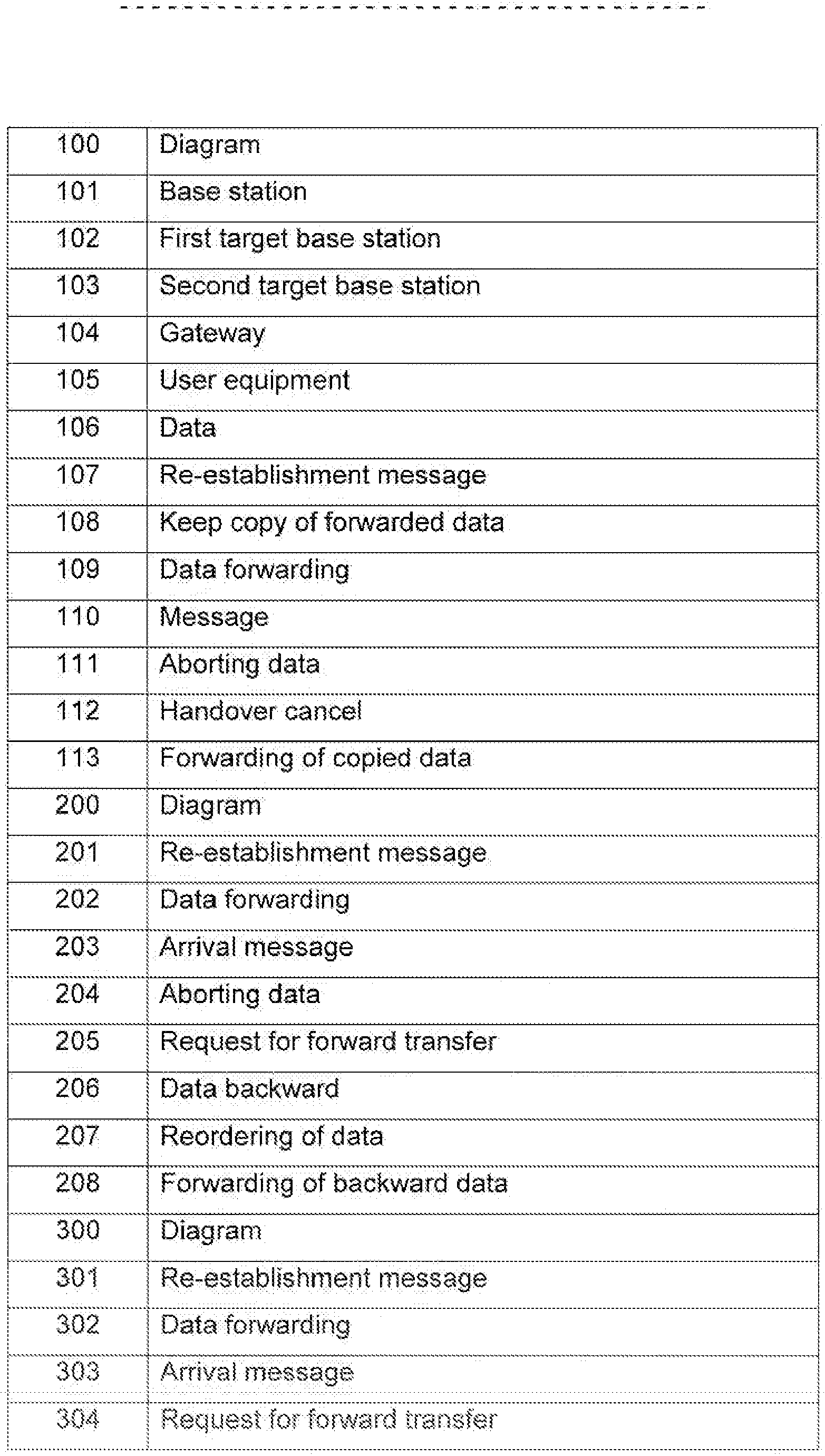
Figure imgf000017_0001
Figure imgf000018_0001
Figure imgf000019_0001

Claims

C l a i m s
1. A method of data forwarding during handover in a mobile communication system (700), said mobile communication system (700) comprising a plurality of base stations and a base station (101, 701), said base station (101 , 701) being coupled to a gateway (703), a telecommunication link being established between a user equipment (702) and said base station (101 , 701), the method comprising:
- selecting a set of base stations from said plurality of base stations as candidate base stations for a handover of said user equipment by said base station;
- selecting a first target base station (102) for handover from said set of base stations by said base station (101); - obtaining downlink data (106) from a gateway and uplink data from a user equipment by said base station;
• forwarding (109) said uplink and downlink data from said base station to said first target base station.
- detecting a handover or radio link failure by said user equipment; - transmitting a connection establishment message (107) to a second target base station of said set of base stations by said user equipment;
* accepting access request of said user equipment by said second target base station (103):
- transmitting a message (110) by said second target base station to said base station, said message being indicative of access of said user equipment to said second target base station;
- forwarding (113) said uplink and downlink data to said second target base station.
2, The method of claim 1 , wherein the method further comprises: (Alt. 1 )
- storing (108) said data in storage means by said base station;
- aborting (111) data forwarding to said first target base station by said base station. wherein said forwarding to said second target base station step further comprises:
- forwarding (113) said stored data to said second target base station by said base station.
The method of claim 1 further comprising: (Alt. 2 by BS)
• aborting data forwarding (204) to said first target base station by said base station;
- requesting (205) said data from said first target base station by said base sta- tion;
- obtaining said data (206) from said first target base station by said base station; wherein said forwarding to said second target base station step further comprises: - forwarding said data (208) to said second target base station by said base station .
The method of claim 3 further comprising: (Opt. Alt 2 by BS)
- obtaining by said base station an end marker message indicating that all data has been transmitted from said first target base station;
- reordering said data (207) obtained from said first target base station and from said gateway by said base station before forwarding to said second target base station.
The method of claim 1 further comprising: (Aft. 3 by BS & first TBS)
- transmitting a forward ing-request (304) to said first target base station for forwarding of said data to said second target base station by said base station; wherein said forwarding to said second target base station step further comprises: - forwarding said data (306) to said second target base station by said first target base station.
• forwarding said data to said (302) first target base station by said base station. T-e method of claim 1 further comprising: (Alt. 4 by BS & first TBS)
- aborting data forwarding (404) to said first target base station by said base station;
- transmitting a forward ing-request (406) to said first target base station for forwarding of said data to said second target base station by said base station; wherein said forwarding to said second target base station step further comprises:
- forwarding said data (408) to said second target base station by said first target base station. - forwarding said data (402) to said first target base station by said base station;
The method of claim 1 further comprising: (Alt. 5 by second TBS)
- requesting said data (505) from said first target base station by said second target base station;
- receiving said data from said first target base station by said second target base station.
The method of claim 1 further comprising: (Alt. 6 by second TBS) - aborting data forwarding (605) to said first target base station by said base station;
- requesting said data (607) from said first target base station by said second target base station;
- requesting said data (604) from said base station by said second target base station;
- receiving said data from said first target base station and from said base station by said second target base station.
The method of claim 6 and 8 further comprising: (Opt. Alt. 4 and Alt 6 by sec- ond TBS)
- obtaining an end marker message indicating that all data has been transmitted from said first target base station by said second base station;
• reordering said data received from said base station and from said first target base station by said second target base station The method of any of the preceding claims 7 to 9, wherein a first target base station identification (601) is transmitted by said base station or by said user equipment to said second target base station.
A base station (701) for a mobile communication system (700), the base station (701) comprising: (Alt. 1)
- means for selecting (704) said set of base station as candidate base stations for a handover of said user equipment by said base station; - means for selecting (705) a first target base station for handover from said set of base stations by said base station;
- means for obtaining (706) downlink data from a gateway and uplink data from a user equipment by said base station;
- means for forwarding (707) said uplink and downlink data from said base sta- tion to said first target base station.
- means for receiving (708) a message from said second target base station by said base station, said message being indicative of access of said user equipment to a second target base station;
- means for storing (709) said uplink and downlink data in storage means by said base station;
- means for aborting (710) data forwarding to said first target base station by said base station;
- means for forwarding (711) said stored data to said second target base station by said base station.
A base station (801) for a mobile communication system (800), the base station (801) comprising:
- means for accepting (804) access request of said user equipment by said second target base station; - means for transmitting (805) a message by said second target base station to said base station, said message being indicative of access of said user equipment to said second target base station;
• means for requesting (806) data from said first target base station by said second target base station. - means for receiving (807) said data from said first target base station by said second target base station.
The base station of claim 12 further comprising: - means for receiving (808) said data from said base station by said second target base station;
- means for obtaining (809) an end marker message indicating that all data has been transmitted from said first target base station by said second base station; - means for reordering (810) said data received from said base station and from said first target base station by said second target base station.
A mobile communication system (700, 800) operable to perform a method in accordance with any of the preceding claims 1 to 10.
A computer program product (811) stored on a storage medium, comprising executable program means for causing a base station to perform a method according to any of the preceding claims 1 to 10 when the program is run on the base station.
PCT/EP2009/066510 2008-12-31 2009-12-07 Data forwarding method and apparatus thereof Ceased WO2010076124A1 (en)

Priority Applications (2)

Application Number Priority Date Filing Date Title
JP2011544012A JP5653364B2 (en) 2008-12-31 2009-12-07 Data transfer method and apparatus
KR1020117017668A KR101264217B1 (en) 2008-12-31 2009-12-07 Data forwarding method and apparatus thereof

Applications Claiming Priority (2)

Application Number Priority Date Filing Date Title
EP08291262.7 2008-12-31
EP08291262A EP2205021A1 (en) 2008-12-31 2008-12-31 Data forwarding method and apparatus thereof

Publications (1)

Publication Number Publication Date
WO2010076124A1 true WO2010076124A1 (en) 2010-07-08

Family

ID=40651500

Family Applications (1)

Application Number Title Priority Date Filing Date
PCT/EP2009/066510 Ceased WO2010076124A1 (en) 2008-12-31 2009-12-07 Data forwarding method and apparatus thereof

Country Status (6)

Country Link
US (1) US8289927B2 (en)
EP (1) EP2205021A1 (en)
JP (2) JP5653364B2 (en)
KR (1) KR101264217B1 (en)
CN (1) CN101772103B (en)
WO (1) WO2010076124A1 (en)

Cited By (1)

* Cited by examiner, † Cited by third party
Publication number Priority date Publication date Assignee Title
US9706461B2 (en) 2012-11-09 2017-07-11 Fujitsu Limited Method of handover in device to device communication, base station and communication system

Families Citing this family (20)

* Cited by examiner, † Cited by third party
Publication number Priority date Publication date Assignee Title
US20110256871A1 (en) * 2010-04-19 2011-10-20 Motorola, Inc. Mobility Influenced by Radio Uplink Failure
CN102238658A (en) * 2010-04-30 2011-11-09 北京三星通信技术研究有限公司 Method for supporting reselection of gateway nodes
CN102413528B (en) * 2010-09-21 2015-09-16 中兴通讯股份有限公司 The processing method of handoff failure and subscriber equipment
CN102065427B (en) * 2010-12-28 2013-06-12 广州杰赛科技股份有限公司 Method for safely switching user terminal in wireless metropolitan area network
CN102917409B (en) * 2011-08-02 2017-11-14 中兴通讯股份有限公司 A kind of switching method, base station and system
WO2013117009A1 (en) * 2012-02-10 2013-08-15 Nokia Corporation A method and apparatus for enhanced connection control
US9313695B2 (en) * 2012-10-30 2016-04-12 Intel Deutschland Gmbh Radio communication devices, network devices, methods for controlling a radio communication device, and methods for controlling a network device
WO2014113085A1 (en) * 2013-01-17 2014-07-24 Intel IP Corporation Systems and methods for mobility optimization in a heterogeneous network
CN104170464A (en) * 2013-02-07 2014-11-26 华为技术有限公司 A data transmission method and access network equipment
CN105612804A (en) 2013-08-09 2016-05-25 诺基亚通信公司 Use of packet status reporting from SeNB to MNB in wireless networks
US9450809B2 (en) * 2013-10-28 2016-09-20 Industrial Technology Research Institute Method of handling uplink transmission and related communication device
US9258756B2 (en) * 2014-04-07 2016-02-09 Telefonaktiebolaget L M Ericsson (Publ) System and method for mitigating congestion handling during HS cell change
US9800327B2 (en) * 2014-11-20 2017-10-24 At&T Intellectual Property I, L.P. Apparatus for controlling operations of a communication device and methods thereof
JP6384591B2 (en) 2015-03-20 2018-09-05 日本電気株式会社 Base station device and gateway device between base stations
WO2017149361A1 (en) * 2016-03-04 2017-09-08 Telefonaktiebolaget L M Ericsson (Publ) Handover notification
CN109548090B (en) 2016-05-24 2020-07-07 华为技术有限公司 QoS control method and device
WO2018230997A1 (en) 2017-06-15 2018-12-20 Lg Electronics Inc. Method for performing a handover procedure in a wireless communication system and a device therefor
CN109314896B (en) * 2018-09-04 2021-03-02 北京小米移动软件有限公司 Cell handover method, device and readable storage medium
CN110690953B (en) * 2019-12-06 2020-04-24 武汉慧联无限科技有限公司 Downlink gateway selection method, device and computer storage medium
CN112654071B (en) * 2020-12-31 2023-10-24 广州技象科技有限公司 Method, device, equipment and storage medium for transmitting downlink data based on Internet of things

Citations (3)

* Cited by examiner, † Cited by third party
Publication number Priority date Publication date Assignee Title
US20040081119A1 (en) * 2002-10-28 2004-04-29 Zhun Zhong Reducing packet drop in IEEE 802.11 handoff by packet forwarding using driver image queue
EP1919241A2 (en) * 2006-11-01 2008-05-07 NEC Corporation Mobile communication system, wireless base station and hand over reconnection method for use therewith
EP1995981A1 (en) * 2006-03-03 2008-11-26 NTT DoCoMo, Inc. Base station and handover control method

Family Cites Families (13)

* Cited by examiner, † Cited by third party
Publication number Priority date Publication date Assignee Title
DE102005050852A1 (en) * 2005-08-19 2007-02-22 Siemens Ag Method for operating a mobile radio network and mobile radio network
CN101001446A (en) * 2006-01-09 2007-07-18 华为技术有限公司 Switching method and system
WO2007141879A1 (en) * 2006-06-09 2007-12-13 Panasonic Corporation Node device
WO2007148388A1 (en) * 2006-06-20 2007-12-27 Fujitsu Limited Packet transfer method and base station
BRPI0719822A2 (en) * 2006-10-03 2014-05-06 Qualcomm Inc HANDOVER FOR ANY CELL FROM A TARGET STATION IN A WIRELESS COMMUNICATION SYSTEM
CN101212775B (en) * 2006-12-30 2011-04-20 华为技术有限公司 Method and device for handling wireless link failures during switching process
PL2122939T3 (en) * 2007-03-21 2016-11-30 Method, apparatus and computer program product for handover failure recovery
EP2138005A2 (en) * 2007-03-21 2009-12-30 Nokia Corporation Method, apparatus and computer program product for data forwarding at handover
MX2009011088A (en) * 2007-04-25 2009-11-02 Ericsson Telefon Ab L M A method and apparatus for seamless handover in a wireless communication network.
US8830950B2 (en) * 2007-06-18 2014-09-09 Qualcomm Incorporated Method and apparatus for PDCP reordering at handoff
WO2009018318A2 (en) * 2007-08-02 2009-02-05 Interdigital Patent Holdings, Inc. Packet data convergence protocol procedures
EP2026610B1 (en) * 2007-08-14 2014-02-26 Alcatel Lucent Method and apparatus for radio link failure recovery in a wireless communication network
US8280375B2 (en) * 2008-01-25 2012-10-02 Texas Instruments Incorporated System and method for managing radio link failures

Patent Citations (3)

* Cited by examiner, † Cited by third party
Publication number Priority date Publication date Assignee Title
US20040081119A1 (en) * 2002-10-28 2004-04-29 Zhun Zhong Reducing packet drop in IEEE 802.11 handoff by packet forwarding using driver image queue
EP1995981A1 (en) * 2006-03-03 2008-11-26 NTT DoCoMo, Inc. Base station and handover control method
EP1919241A2 (en) * 2006-11-01 2008-05-07 NEC Corporation Mobile communication system, wireless base station and hand over reconnection method for use therewith

Non-Patent Citations (1)

* Cited by examiner, † Cited by third party
Title
NORTEL: "Handover failure and Data Forwarding stop", 3GPP DRAFT; R3-071400_HO FAILURE AND DATA FORWARDING STOP_13.3.14B_.REV0, 3RD GENERATION PARTNERSHIP PROJECT (3GPP), MOBILE COMPETENCE CENTRE ; 650, ROUTE DES LUCIOLES ; F-06921 SOPHIA-ANTIPOLIS CEDEX ; FRANCE, vol. RAN WG3, no. Athens, Greece; 20070820, 15 August 2007 (2007-08-15), XP050162233 *

Cited By (1)

* Cited by examiner, † Cited by third party
Publication number Priority date Publication date Assignee Title
US9706461B2 (en) 2012-11-09 2017-07-11 Fujitsu Limited Method of handover in device to device communication, base station and communication system

Also Published As

Publication number Publication date
CN101772103A (en) 2010-07-07
EP2205021A1 (en) 2010-07-07
JP2014014155A (en) 2014-01-23
JP2012514405A (en) 2012-06-21
JP5653364B2 (en) 2015-01-14
KR20110110256A (en) 2011-10-06
KR101264217B1 (en) 2013-05-14
US20100165850A1 (en) 2010-07-01
US8289927B2 (en) 2012-10-16
CN101772103B (en) 2013-09-18

Similar Documents

Publication Publication Date Title
US8289927B2 (en) Data forwarding method and apparatus thereof
EP2203014B1 (en) Handover method and apparatus thereof
US20220264414A1 (en) Mobility Optimization Method and Related Apparatus
US11665601B2 (en) Method for handover report and terminal device
EP3300428B1 (en) Communication system, network handover processing method and apparatus
EP2993939B1 (en) Cell handover method and base station for user equipment (ue) handover in carrier aggregation mode
WO2020000260A1 (en) Apparatus and methods to support dual-protocol for mobility enhancement
US10230514B2 (en) Method and apparatus for synchronized handover in mobile communication system
WO2022120569A1 (en) Methods and apparatuses for a daps failure recovery mechanism and a mro mechanism for cho and daps procedures
US20250008389A1 (en) Methods and apparatuses for supporting a pscell switch procedure in a mr-dc scenario
CN117641470A (en) Information processing method, device and readable storage medium
US11611925B2 (en) Switching processing method, terminal device and network device
KR102612279B1 (en) Method and apparatus for synchronized handover in mobile communication system
JP7431219B2 (en) Data transmission method, terminal device and network device
CN114467362B (en) Device, method, apparatus and computer-readable medium for switching between master nodes
JP7736909B2 (en) Data transmission method and apparatus, device, and storage medium
CN113133066A (en) Switching method and network equipment
WO2025209962A1 (en) Handover report for low-layer triggered mobility
WO2025209830A1 (en) Monitoring for ltm
CN120660379A (en) Apparatus and method in a multi-radio dual connectivity (MR-DC) environment

Legal Events

Date Code Title Description
121 Ep: the epo has been informed by wipo that ep was designated in this application

Ref document number: 09768032

Country of ref document: EP

Kind code of ref document: A1

ENP Entry into the national phase

Ref document number: 2011544012

Country of ref document: JP

Kind code of ref document: A

NENP Non-entry into the national phase

Ref country code: DE

ENP Entry into the national phase

Ref document number: 20117017668

Country of ref document: KR

Kind code of ref document: A

122 Ep: pct application non-entry in european phase

Ref document number: 09768032

Country of ref document: EP

Kind code of ref document: A1