WO2010070004A1 - Process for making a crystalline zilpaterol salt - Google Patents
Process for making a crystalline zilpaterol salt Download PDFInfo
- Publication number
- WO2010070004A1 WO2010070004A1 PCT/EP2009/067316 EP2009067316W WO2010070004A1 WO 2010070004 A1 WO2010070004 A1 WO 2010070004A1 EP 2009067316 W EP2009067316 W EP 2009067316W WO 2010070004 A1 WO2010070004 A1 WO 2010070004A1
- Authority
- WO
- WIPO (PCT)
- Prior art keywords
- zilpaterol
- salt
- crystalline
- animal
- mixture
- Prior art date
- Legal status (The legal status is an assumption and is not a legal conclusion. Google has not performed a legal analysis and makes no representation as to the accuracy of the status listed.)
- Ceased
Links
- CBCCEAQWMYMRHJ-UHFFFAOYSA-N CC(C)NC(CC1)Cc(cccc2N3)c2N1C3=O Chemical compound CC(C)NC(CC1)Cc(cccc2N3)c2N1C3=O CBCCEAQWMYMRHJ-UHFFFAOYSA-N 0.000 description 1
- 0 O=C(Nc1ccc2)N3c1c2N*CC3 Chemical compound O=C(Nc1ccc2)N3c1c2N*CC3 0.000 description 1
Classifications
-
- C—CHEMISTRY; METALLURGY
- C07—ORGANIC CHEMISTRY
- C07D—HETEROCYCLIC COMPOUNDS
- C07D487/00—Heterocyclic compounds containing nitrogen atoms as the only ring hetero atoms in the condensed system, not provided for by groups C07D451/00 - C07D477/00
- C07D487/02—Heterocyclic compounds containing nitrogen atoms as the only ring hetero atoms in the condensed system, not provided for by groups C07D451/00 - C07D477/00 in which the condensed system contains two hetero rings
- C07D487/06—Peri-condensed systems
-
- A—HUMAN NECESSITIES
- A61—MEDICAL OR VETERINARY SCIENCE; HYGIENE
- A61P—SPECIFIC THERAPEUTIC ACTIVITY OF CHEMICAL COMPOUNDS OR MEDICINAL PREPARATIONS
- A61P21/00—Drugs for disorders of the muscular or neuromuscular system
- A61P21/06—Anabolic agents
-
- A—HUMAN NECESSITIES
- A61—MEDICAL OR VETERINARY SCIENCE; HYGIENE
- A61P—SPECIFIC THERAPEUTIC ACTIVITY OF CHEMICAL COMPOUNDS OR MEDICINAL PREPARATIONS
- A61P3/00—Drugs for disorders of the metabolism
Definitions
- This invention generally relates to processes for making a crystalline zilpaterol salt, particularly zilpaterol hydrochloride. This invention also relates to methods of treatment using a crystalline zilpaterol salt prepared in accordance with this invention to increase the rate of weight gain, improve feed efficiency, and/or increase carcass leanness in livestock, poultry, and fish.
- Zilpaterol is a known racemic adrenergic ⁇ -2 agonist having the following structure:
- the CAS name is frans-( ⁇ )-4,5,6,7-tetrahydro-7-hydroxy-6-[(1-methylethyl)amino]- imidazo[4,5,1-jk][1]benzazepin-2(1 H)-one.
- zilpaterol, various zilpaterol derivatives, and various pharmaceutically acceptable salts of zilpaterol and its derivatives may, for example, be used to increase the rate of weight gain, improve feed efficiency (i.e., decrease the amount of feed per amount of weight gain), and/or increase carcass leanness (i.e., increase protein content in carcass soft tissue) in livestock, poultry, and/or fish.
- R can be various substituents, and the wavy lines indicate that the bonds to the 6-amino and 7-OH groups have the trans configuration.
- This genus encompasses racemic trans zilpaterol when R is isopropyl.
- US Patent 4,585,770 and Int'l Patent Appl. Publ. WO 2008/119754 also discuss the preparation of zilpaterol hydrochloride by dissolving zilpaterol free base in ethanol, adding ethyl acetate saturated with HCI, vacuum-filtering the product to obtain crude zilpaterol hydrochloride, dissolving the crude zilpaterol hydrochloride in hot methanol, adding ethyl acetate, and then filtering to obtain a final zilpaterol hydrochloride product.
- zilpaterol is prepared from 4-(2- oxo-2,3-dihydrobenzimidazol-1-yl)butyric acid using the following generic scheme:
- the chlorinating agent comprises oxalyl chloride
- the Lewis acid comprises AICI3
- the hydrolysis acid following the Friedel-Crafts reaction comprises HCI
- the inorganic nitrite comprises NaNO 2
- the acid used in the oximation comprises HCI
- water is added to the oximation product mixture to foster isolation of the oxime product
- the base used to form the oxime salt comprises KOH
- the catalyst for the first hydrogenation comprises palladium on carbon
- the acid used in the formation of the isopropylideneamino compound comprises acetic acid
- the catalyst for the second hydrogenation comprises platinum on carbon
- the base and alcohol used to form the zilpaterol free base comprise NaOH and ethanol, respectively:
- zilpaterol or a salt thereof it is desirable for zilpaterol or a salt thereof to be in the form of crystals having one or more characteristics, such as a specific size distribution.
- US Patent 5,731 ,028 discusses the desirability of a particular crystal size distribution when crystalline zilpaterol hydrochloride is used with 300-800 ⁇ m corn cob supports.
- US Patent 5,731 ,028 discusses the desirability of zilpaterol hydrochloride crystals that are less than 300 ⁇ m in size, with the majority being from 50 to 200 ⁇ m.
- US Patent 5,731 ,028 also discusses a desirability to avoid particle sizes so small that that the particles appear in the form of dust, particularly where there is a possibility that such dust could endanger the environment or irritate or poison a user by penetrating the user's pulmonary alveoli.
- US Patent 5,731 ,028 specifically discloses crystalline anhydrous zilpaterol hydrochloride having a crystal size distribution wherein less than 5% of the crystals are less than 15 ⁇ m, and at least 95% of the crystals are less than 250 ⁇ m.
- US Patent 5,731 ,028 discusses various crystallization processes to obtain a desired zilpaterol hydrochloride crystal size distribution that may, for example, be useful with 300-800 ⁇ m corn cob supports. These processes include the following various alternatives: a) Form a supersaturated solution of zilpaterol hydrochloride in water or aqueous ethanol at a temperature greater than 5O 0 C, cool the supersaturated solution to effect crystallization to zilpaterol hydrochloride monohydrate, further cool the solution to a temperature of less than 2O 0 C to effect crystallization of zilpaterol hydrochloride trihydrate, and dry the hydrated crystals to form the desired crystalline zilpaterol hydrochloride.
- This invention relates to processes for making crystalline zilpaterol salts, particularly crystalline zilpaterol hydrochloride.
- Benefits of this crystallization process are a favorably low number of process steps and therefore an increase of yield, desirable purity levels, and, especially, a desirable selectivity with respect to the crystal size of the resulting zilpaterol salt (particle size distribution).
- this invention is directed, in part, to a process for making a crystalline zilpaterol salt.
- the process comprises forming a mixture by combining a surfactant with water and a zilpaterol salt.
- the water and zilpaterol salt may be partially (or, more typically, entirely) in the form of an aqueous zilpaterol salt solution.
- This invention also is directed, in part, to a process for making a pharmaceutical composition.
- the process comprises preparing a crystalline zilpaterol salt by a process recited above, and attaching the crystalline zilpaterol salt to a support.
- This invention also is directed, in part, to a method of feeding an animal.
- This method comprises feeding to an animal (e.g., a bovine animal, a swine animal, or a bird) a crystalline zilpaterol salt made by a process described above.
- an animal e.g., a bovine animal, a swine animal, or a bird
- Such feeding methods may be used, for example, to increase the animal's rate of weight gain, improve the animal's feed efficiency, and/or increase the animal's carcass leanness.
- This invention also is directed, in part, to a use of a crystalline zilpaterol salt, made by a process described above, to make a medicament.
- Uses for such a medicament include increasing an animal's rate of weight gain, improving an animal's feed efficiency, and/or increasing an animal's carcass leanness.
- the current invention is directed to a process for making a crystalline zilpaterol salt, wherein the process comprises forming a mixture by combining a surfactant with water and a zilpaterol salt wherein the process further comprises seeding the mixture with crystalline zilpaterol hydrochloride trihydrate after decreasing the temperature.
- a zilpaterol salt solution is formed by a process comprising forming a suspension by a process comprising mixing zilpaterol with water, optionally in the presence of an acid solution, and heating the suspension; b) the zilpaterol salt solution is mixed with a surfactant; c) the mixture is seeded with crystalline zilpaterol hydrochloride trihydrate.
- the surfactant is a non-ionic surfactant.
- the acid comprises aqueous hydrochlorid acid.
- crystalline zilpaterol salt comprises crystalline zilpaterol hydrochloride anhydrate.
- Such process wherein the mixture has a temperature of from about -5 to about 5 0 C for at least a portion of the process in which zilpaterol hydrochloride trihydrate crystals are present.
- Such process wherein the process further comprises drying a cake comprising zilpaterol hydrochloride trihydrate crystals at a temperature of from about 50 to about 75 0 C.
- Such process wherein the mixture has a temperature of from about 14 to about 25 0 C for at least a portion of the process in which zilpaterol hydrochloride monohydrate crystals are present.
- zilpaterol hydrochloride crystals have a size distribution in which at least about 95% of the crystal particles have particle sizes that are greater than about 15 ⁇ m.
- zilpaterol hydrochloride crystals have a size distribution in which at least about 90% of the crystal particles have particle sizes that are less than about 200 ⁇ m.
- zilpaterol hydrochloride crystals have a size distribution in which at least about 95% of the crystal particles have particle sizes that are less than about 250 ⁇ m.
- zilpaterol hydrochloride crystals have a size distribution in which at least about 99.5% of the crystal particles have particle sizes that are less than about 300 ⁇ m.
- Such process wherein the process further comprises reacting a salt of frans-7-amino-6- hydroxy-6,7,8,9-tetrahydro-2H-2,9a-diazabenzo[cd]azulen-1-one with acetone in the presence of acetic acid.
- a salt of frans-7-amino-6- hydroxy-6,7,8,9-tetrahydro-2H-2,9a-diazabenzo[cd]azulen-1-one comprises a potassium salt.
- a process for making a pharmaceutical composition comprising: preparing a crystalline zilpaterol salt by a process as described above; and attaching the crystalline zilpaterol salt to a support.
- the support comprises a corn cob support.
- the support comprises discrete particles having sizes of from about 300 to about 800 ⁇ m.
- crystalline zilpaterol salt comprises crystalline zilpaterol hydrochloride.
- a method for increasing an animal's rate of weight gain, improving an animal's feed efficiency, and/or increasing an animal's carcass leanness comprises: preparing a crystalline zilpaterol salt by a process as described above; and administering an effective amount of the crystalline zilpaterol salt to the animal.
- the animal comprises a swine animal.
- the animal comprises a bovine animal.
- Such method wherein at least a portion of the crystalline zilpaterol salt is attached to a support.
- the crystalline zilpaterol salt comprises crystalline zilpaterol hydrochloride.
- this invention is directed to making a crystalline zilpaterol salt (particularly zilpaterol hydrochloride) from an aqueous solution of the salt using a process comprising a surfactant assisted crystallization.
- a crystalline zilpaterol salt particularly zilpaterol hydrochloride
- the following discussion describes the use of the invention to make crystalline zilpaterol hydrochloride.
- the principles in this discussion are generally adaptable for preparing other zilpaterol salts.
- the aqueous zilpaterol hydrochloride solution is prepared by first forming a water suspension of zilpaterol hydrochloride. Such a suspension may be prepared by, for example, combining zilpaterol free base with aqueous HCI.
- the aqueous HCI comprises from about 12 to about 17% HCI, such as from about 12 to about 15% HCI by weight or from about 13 to about 14% HCI by weight (e.g., about 13.5% by weight).
- the zilpaterol free base may, for example, be combined directly with an aqueous HCI solution having the desired HCI concentration, or by combining a more-concentrated aqueous HCI solution (e.g., a solution comprising about 33% HCI by weight) with zilpaterol free base in water.
- the zilpaterol free base is combined with aqueous HCI at a temperature of no greater than about 3O 0 C, such as from about zero to about 25 0 C or from about 5 to about 25 0 C (e.g., about 1 O 0 C or 15 0 C).
- the resulting suspension in turn, may be converted into a solution by heating the suspension to a temperature of at least about 3O 0 C, such as from about 45 to about 100 0 C, from about 45 to about 85 0 C, from about 50 to about 7O 0 C, or from about 60 to about 7O 0 C (e.g., about 65 0 C). The heating continues until a clear solution is achieved.
- the pH is generally no greater than about 4, and, in some embodiments, no greater than about 2. If the pH is greater than the desired level, acid may be added to reduce the pH. In some embodiments, the acid comprises HCI.
- the aqueous zilpaterol hydrochloride solution is filtered, particularly where the solution appears cloudy. In general, this filtration is conducted until the product solution is clear. Additional water may be used to rinse the filter. This water, in turn, may be added to the product solution.
- the concentration of zilpaterol hydrochloride in the solution is generally at least about 23% by weight, such as from about 23 to about 27% by weight or from about 25 to about 27% by weight (e.g., about 26% by weight). If necessary, water may be added or removed (e.g., by distillation) to achieve the desired concentration. Applicants have discovered in accordance with this invention that a concentration in these ranges (particularly 26% by weight) tends to be beneficial in minimizing the number of undesirably large particles in the final product.
- a surfactant is added.
- the surfactant may be a non-ionic surfactant or mixtures of non-ionic surfactants.
- a non-ionic surfactant is a surfactant without a charged moiety.
- Such non-ionic surfactant can be based on polyethyleneglycol e.g. such as Tween-type surfactants (Polysorbates, Sorbitan esters, poly(oxy-1 ,2 ethanediyl) derives, Tweens).
- Tween-type surfactants are water soluble nonionic surface active agents comprised of complex esters and ester- ethers derived from hexahydric alcohols, alkylene oxides and fatty acids by adding polyoxyethylene chains to hydroxyl of sorbitol and hexitrol anhydrides (hexitans and hexides) derived from sorbitol and then partially esterifying with the common fatty acids such as lauric, palmitic, stearic and oleic acids.
- Tween-type surfactant is selected from one or more of Tween 20, Tween 40, Tween 60 or Tween 80, also known in the pharmaceutical industry as polysorbate 20, polysorbate 40, polysorbate 60 and polysorbate 80.
- Polysorbate 20 is selected from one or more of Tween 20, Tween 40, Tween 60 or Tween 80, also known in the pharmaceutical industry as polysorbate 20, polysorbate 40, polysorbate 60 and polysorbate 80.
- Tween type surfactants are commercially available and/or can be prepared by techniques known in the art.
- the surfactant may be, for example, polyethylene glycol sorbitan monostearate.
- polyethylene glycol sorbitan monostearate include polysorbate 60 (also known as "Kotilen-1/S" or "Tween ® 60").
- the surfactant concentration in the resulting mixture is no greater than about 4% by weight.
- the resulting surfactant concentration in the mixture is from about 0.1 to about 3.9% by weight, such as from about 0.5 to about 3.5% by weight, from about 1.0 to about 3.0% by weight, or from about 1.5 to about 2.5% by weight (e.g., about 2.0% by weight or 0.5% by weight).
- the ratio of surfactant to zilpaterol hydrochloride is no greater than about 37 g/mol. In some embodiments, the ratio is from about 3 to about 41 ml/mol, from about 6 to about 23 ml/mol, from about 12 to about 23 ml/mol, from about 14 to about 20 ml/mol (e.g., about 18 ml/mole.
- the temperature of the solution during the surfactant addition is greater than about 45 0 C, such as from about 60 to about 100 0 C, from about 50 to about 85 0 C, from about 50 to about 7O 0 C, or from about 60 to about 7O 0 C, or from 55 to 76 0 C (e.g., about 65 0 C).
- zilpaterol hydrochloride monohydrate seed crystals are used.
- Zilpaterol hydrochloride monohydrate seed crystals crystals generally tend to be in the form of needles.
- the amount of zilpaterol hydrochloride monohydrate seed crystals is generally at least about 0.01 g/kg (grams crystals per kg mixture), such as from about 0.01 to about 0.2 g/kg, from about 0.02 to about 0.1 , from about 0.02 to about 0.08 g/kg, or from about 0.03 to about 0.05 g/kg (e.g., about 0.04 g/kg).
- the ratio of zilpaterol hydrochloride monohydrate seed crystals to zilpaterol hydrochloride is at least about 0.01 g/mol. In some embodiments, the ratio is from about 0.01 to about 0.17 g/mol, from about 0.015 to about 0.12 g/mol, from about 0.025 to about 0.06 mg/mol, or from about 0.038 to about 0.041 mg/mol (e.g., about 0.04 g/mole).
- the temperature of the mixture Before, during, and/or after the introduction of zilpaterol hydrochloride monohydrate seed crystals, the temperature of the mixture is typically cooled. In some embodiments, regardless of whether the mixture is cooled before and/or during the zilpaterol hydrochloride monohydrate seeding, the temperature of the mixture during at least a portion (and typically all) of the seeding is at least about 4O 0 C.
- the temperature of the mixture during at least a portion (and typically all) of the zilpaterol hydrochloride monohydrate seeding is from about 40 to about 6O 0 C, from about 40 to about 55 0 C, or from about 40 to about 5O 0 C , or from about 48 to about 55 0 C (e.g., about 45 0 C or 5O 0 C).
- the seeded mixture is maintained at this temperature following seeding for at least about 5 minutes, such as, for example, for from about 10 to about 30 minutes or from about 10 to about 20 minutes (e.g., 15 or 30 minutes).
- the mixture may be stirred. In general, this results in the formation of a white suspension.
- the temperature is generally decreased to a temperature of less than about 4O 0 C. In some embodiments, the temperature is decreased to a temperature of from about 14 to about 35 0 C, from about 14 to about 25 0 C, from about 17 to about 23 0 C, or from about 18 to about 21 0 C (e.g., about 21 0 C or 18 0 C). Applicants have discovered in accordance with this invention that use of a temperature in this range (particularly about 21 0 C) tends to be beneficial in minimizing premature trihydrate nuclei formation. In some embodiments, this cooling occurs over an extended time period.
- this period is at least about 5 minutes, such as, for example, from about 5 minutes to about 10 hours, from about 10 minutes to about 5 hours, from about 30 minutes to about 5 hours, or from about 1 to about 2 hours (e.g., about 90 minutes).
- zilpaterol hydrochloride trihydrate crystals are seeded without pre- seeding with zilpaterol hydrochloride monohydrate crystals.
- zilpaterol hydrochloride trihydrate crystals After seeding zilpaterol hydrochloride monohydrate crystals, the mixture is typically further seeded with zilpaterol hydrochloride trihydrate crystals.
- Such trihydrate crystals generally tend to be in the form of prisms.
- such trihydrate crystals are micronized, i.e. the size of such solid material's particles is reduced to only a few microns in diameter. It can be shown that the seeding of zilpaterol hydrochloride trihydrate crystals mainly causes zilpaterol hydrochloride monohydrate crystals in the mixture to transform into zilpaterol hydrochloride trihydrate crystals. A partial transformation of monohydrate crystals to trihydrate crystals also may occur before the trihydrate seeding.
- the amount of zilpaterol hydrochloride trihydrate seed crystals introduced into the mixture is generally at least about 0.07 g/kg (grams seed crystals per kg mixture), such as from about 0.07 to about 2 g/kg, from about 0.1 to about 1 g/kg, from about 0.15 to about 0.6 g/kg, or from about 0.2 to about 0.33 g/kg (e.g., about 0.3 g/kg).
- Applicants have discovered in accordance with this invention that a concentration in these ranges (particularly 0.3 g/kg) tends to be beneficial in minimizing the number of undesirably large particles in the final product.
- the ratio of zilpaterol hydrochloride trihydrate seed crystals to zilpaterol hydrochloride is at least about 0.06 mg/mol. In some embodiments, the ratio is from about 0.06 to about 0.6 g/mol, from about 0.16 to about 0.38 g/mol, or from about 0.29 to about 0.36 mg/mol (e.g., about 0.34 g/mole).
- the mixture is aged for a period of time after the seeding of zilpaterol hydrochloride trihydrate seed crystals.
- the aging period is at least about 5 minutes, such as, for example, from about 5 minutes to about 20 hours, from about 30 minutes to about 15 hours, from about 1 to about 15 hours, from about 1 to about 10 hours, or from about 1 to about 4 hours or from about 1.5 to about 3 hours (e.g., about 2 hours).
- the mixture is maintained during at least a portion (and, in some embodiments, substantially all or all) of the aging period at a temperature of less than about 4O 0 C, such as from about 14 to about 35 0 C, from about 14 to about 25 0 C, from about 17 to about 23 0 C, or from about 18 to about 21 0 C or from about 17 to about 2O 0 C (e.g., about 21 0 C or 18 0 C).
- the temperature during at least part (or, in some embodiments, substantially all or all) of the aging period falls within the same temperature range used during the seeding of the zilpaterol hydrochloride trihydrate seed crystals.
- the mixture is cooled after the addition of zilpaterol hydrochloride trihydrate seed crystals (and an aging period, to the extent an aging period is used).
- the mixture is cooled to a temperature of no greater than about 25 0 C or no greater than about 15 0 C, such as from about -5 to about 5 0 C, from about -2 to about 4 0 C, or from about zero to about 2 0 C (e.g., about 2 0 C or 0 0 C).
- the zilpaterol hydrochloride trihydrate crystals in the product mixture may be recovered by various methods. Such methods include those known in the art, such as, for example, filtration or centrifugation. Typically, the crystals are washed with an acceptable agent, such as, for example, acetone, following the recovery.
- an acceptable agent such as, for example, acetone
- the resulting wet zilpaterol hydrochloride trihydrate cake generally may be dried to form crystalline anhydrous zilpaterol hydrochloride.
- the resulting crystalline anhydrous zilpaterol hydrochloride is generally in the form of prisms.
- the zilpaterol hydrochloride trihydrate cake undergoes an initial drying by being heated under an inert (e.g., a nitrogen or argon) atmosphere to a temperature of greater than 25 0 C.
- an inert e.g., a nitrogen or argon
- the temperature of this initial heating is no greater than about 4O 0 C.
- the temperature is from about 28 to about 35 0 C (e.g., about 3O 0 C).
- This initial drying may be conducted over a range of pressures, including atmospheric pressure (absolute), less than atmospheric pressure, and greater than atmospheric pressure. Typically, however, the drying is conducted at a pressure that is no greater than atmospheric pressure, and, in some embodiments, less than atmospheric pressure.
- the cake is heated in this manner until the water content in the cake is no greater than about 16%. After the water content in the cake has been decreased (e.g., to a concentration of no greater than about 16%), the cake is generally dried at a temperature that is greater than about 4O 0 C to form crystalline anhydrous zilpaterol hydrochloride. In some embodiments, for example, the cake is heated to a temperature of from about 50 to about 75 0 C or from about 55 to about 65 0 C (e.g., about 6O 0 C).
- This further heating typically occurs under an inert atmosphere (e.g., nitrogen or argon), which, in some embodiments, has generally the same atmosphere composition as the initial heating.
- an inert atmosphere e.g., nitrogen or argon
- the heating may be conducted over a range of pressures, including atmospheric, less than atmospheric, and greater than atmospheric pressure. Typically, however, it is conducted at a pressure that is no greater than atmospheric pressure, and, in some embodiments, less than atmospheric pressure. In some embodiments, the heating is continued until the water content in the resulting solids is no greater than about 1%.
- the crystallization process of this invention may generally be conducted with various types of reactors.
- the reactor preferably has a surface that is stable when exposed to the crystallization conditions may be used.
- Such reactors may include, for example, glass and glass-lined reactors.
- Other reactors may include, for example, stainless steel or other corrosion-resistant metal alloy reactors.
- the above process makes crystals having a size distribution wherein at least one of the following is satisfied: a) At least about 95% of the crystal particles have particle sizes that are greater than about 15 ⁇ m. b) At least about 90% of the crystal particles have particle sizes that are less than about 200 ⁇ m. c) At least about 99.5% of the crystal particles have particle sizes that are less than about 300 ⁇ m.
- the process makes crystals having a size distribution wherein at least two (or, in some embodiments, all three) of the above criteria are satisfied.
- zilpaterol free base used in the above process may be synthesized using various processes. As noted above in the Background of the Invention section, such processes include, for example, the processes discussed in US Patent 4,585,770. Such processes also include, for example, those discussed in Int'l Patent Appl. Publ. WO 2008/119754.
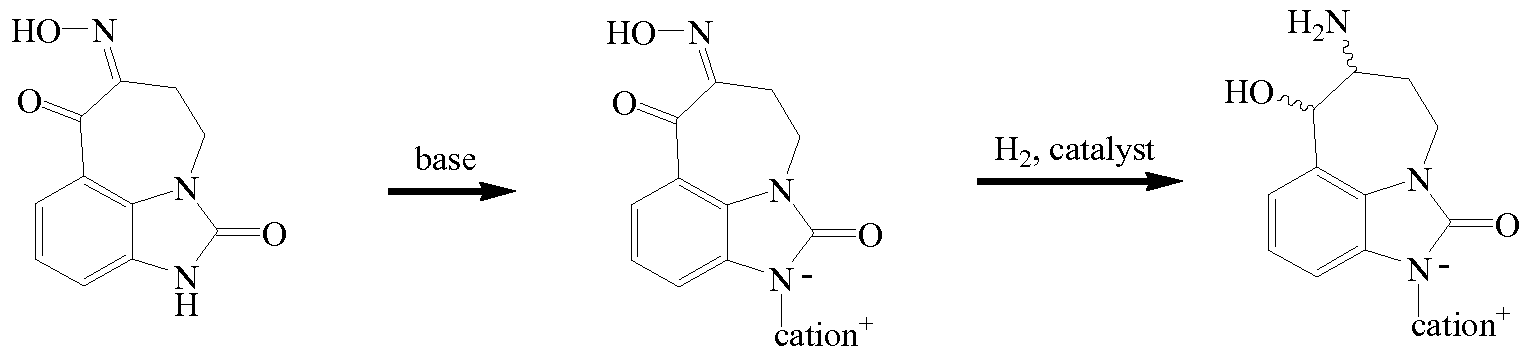
- the process for making zilpaterol free base comprises deprotonating 8,9-dihydro-2H-2,9a-diazabenzo[cd]azulene-1 ,6,7-trion-7-oxime with a base in water to form a 2H-2,9a-diazabenzo[cd]azulene-1 ,6,7-trion-7-oxime salt that goes into solution, and then hydrogenating the salt in the presence of a catalyst to form the corresponding racemic frans-7-amino-6-hydroxy-6,7,8,9-tetrahydro-2H-2,9a- diazabenzo[cd]azulen-1-one salt as follows (the wavy lines represent the trans configuration):
- the base comprises KOH
- the hydrogenation is conducted in the presence of a catalyst comprising palladium on carbon (Pd/C):
- concentration of 8,9-dihydro-2H-2,9a-diazabenzo[cd]azulene- 1 ,6,7-trion-7-oxime reagent at the beginning of the above hydrogenation is at least about 0.08 kg/kg.
- concentration is from about 0.08 to about 0.24 kg/kg or from about 0.16 to about 0.24 kg/kg (e.g., about 0.20 kg/kg).
- the base is generally added to the solution while stirring until the solution becomes clear, which typically represents a point at which substantially all (or all) the 8,9-dihydro-2H- 2,9a-diazabenzo[cd]azulene-1 ,6,7-trion-7-oxime is de-protonated to form a salt, which, in turn, goes into solution.
- the base is KOH
- the molar ratio of KOH to 8,9-dihydro-2H-2,9a-diazabenzo[cd]azulene-1 ,6,7-trion-7-oxime reagent is at least about 1.2, such as from about 1.2 to about 2.2 or from about 1.4 to about 1.7 (e.g., about 1.6).
- the base is typically introduced as part of an aqueous base solution (e.g., an aqueous solution comprising 45% by weight KOH).
- undissolved 8,9-dihydro-2H-2,9a-diazabenzo[cd]azulene-1 ,6,7- trion-7-oxime reagent and any other impurity may be further removed by, for example, contacting it with activated carbon (charcoal).
- activated carbon charcoal
- the mass ratio of the activated carbon to 8,9-dihydro-2H-2,9a-diazabenzo[cd]azulene-1 ,6,7-trion-7-oxime reagent is typically no greater than about 0.13 kg/kg.
- the ratio is from about 0.046 to about 0.056 kg/kg (e.g., about 0.051 kg/kg).
- the activated carbon is typically removed using, for example, filtration and/or centrifugation.
- the mass ratio of hydrogenation catalyst (e.g., Pd/C) to 8,9- dihydro-2H-2,9a-diazabenzo[cd]azulene-1 ,6,7-trion-7-oxime reagent is at least about 0.01 kg/kg. In some such embodiments, for example, the ratio is from about 0.03 to about 0.13 kg/kg, from about 0.030 to about 0.12 kg/kg, or from about 0.030 to about 0.060 kg/kg (e.g., about 0.040 kg/kg). In some embodiments, additional catalyst may be added to increase the conversion rate and/or increase the amount of conversion. Typically, however, the ratio of catalyst to 8,9-dihydro-2H-2,9a-diazabenzo[cd]azulene-1 ,6,7-trion-7- oxime reagent is less than 0.13 kg/kg.
- Pd/C hydrogenation catalyst
- At least of portion (and, in some embodiments, substantially all or all) of the de-protonation and hydrogenation is conducted at a temperature of greater than
- 25 0 C such as from about 30 to about 5O 0 C or from about 35 to about 45 0 C (e.g., about
- reaction time for the hydrogenation reaction will vary, depending on various factors, including, for example, the reagent amounts, temperature, pressure, reactor configuration, and other reaction conditions. It also will depend on the desired conversion. In general, the reaction time in a batch reactor is no greater than about 90 hours.
- the reaction time is from about 2.5 to about 90 hours, from about 2.5 to about 50 hours, from about 2.5 to about 24 hours, from about 2.5 to about 5 hours, or from about 2.5 to about 4.5 hours (e.g., about 3.5 hours).
- shorter reaction times than these ranges may be used, such shorter periods may coincide with less hydrogenation and yield loss.
- greater reaction times may be used, such longer periods may coincide with, for example, inefficient use of energy resources, equipment, and/or manpower.
- the catalyst is typically removed from the product solution via, for example, filtration or centrifugation.
- the product solution is typically filtered until it is substantially (or, in some embodiments, completely) clear.
- the process comprises combining an aqueous solution of a trans- 7-amino-6-hydroxy-6,7,8,9-tetrahydro-2H-2,9a-diazabenzo[cd]azulen-1 -one salt with acetone, and then decreasing the pH with acid to cause the amine of the frans-7-amino- 6-hydroxy-6,7,8,9-tetrahydro-2H-2,9a-diazabenzo[cd]azulen-1-one salt to form, in situ, an isopropylimino group via a nucleophilic addition-elimination reaction:
- the frans-7-amino-6-hydroxy-6,7,8,9-tetrahydro- 2H-2,9a-diazabenzo[cd]azulen-1-one salt is a potassium salt, and the acid is acetic acid:
- the amount of acid (e.g., acetic acid) introduced into the reaction mixture for the above imine formation is restricted such that it does not reduce the reaction mixture pH to less than about 7.1.
- the pH during at least a portion (and, in some such embodiments, substantially all or all) is from about 7.2 to about 7.8, from about 7.3 to about 7.7, or from about 7.4 to about 7.6 (e.g., about 7.5).
- the molar ratio of acetone to frans-7-amino-6-hydroxy-6, 7,8,9- tetrahydro-2H-2,9a-diazabenzo[cd]azulen-1-one salt is at least about 1.0. In some such embodiments, the molar ratio is greater than 1.0 (i.e., a molar excess of acetone is used), such as, for example, at least about 4.0. For example, in some such embodiments, the molar ratio is from about 4.0 to about 21 , from about 4.5 to about 15, or from about 5 to about 10 (e.g., about 7.5). In some embodiments, the imine formation is conducted at a temperature of no greater than 4O 0 C.
- the reaction is conducted at from about 20 to about 4O 0 C or from about 25 to about 35 0 C (e.g., about 3O 0 C).
- the frans-7-amino-6-hydroxy-6,7,8,9-tetrahydro-2H-2,9a- diazabenzo[cd]azulen-1-one salt solution is at such a temperature before the acetone and/or acetic acid are added.
- the imine formation may be conducted over a range of pressures, including atmospheric pressure, less than atmospheric pressure, and greater than atmospheric pressure. Typically, however, it is conducted at about atmospheric pressure.
- the process of this invention comprises hydrogenating trans-7- [isopropylimino]6-hydroxy-6,7,8,9-tetrahydro-2H-2,9a-diazabenzo[cd]azulen-1-one in the presence of a catalyst:
- the hydrogenation is conducted in the presence of a catalyst comprising platinum on a carbon support (Pt/C).
- a catalyst comprising platinum on a carbon support
- the hydrogenation follows the formation of frans-7-[isopropylimino]6-hydroxy-6,7,8,9- tetrahydro-2H-2,9a-diazabenzo[cd]azulen-1-one in the presence of acetic acid (HOAc).
- HOAc acetic acid
- the hydrogenation forms a zilpaterol-HOAc solution.
- the reaction is:
- the ratio of catalyst (e.g., Pt/C) to frans-7-[isopropylimino]6- hydroxy-6,7,8,9-tetrahydro-2H-2,9a-diazabenzo[cd]azulen-1-one in the above hydrogenation is at least about 0.01 kg/kg.
- the ratio is from about 0.02 to about 0.09 kg/kg, from about 0.02 to about 0.07 kg/kg, or from about 0.02 to about 0.05 kg/kg (e.g., about 0.03 kg/kg).
- additional catalyst may be added to increase the conversion rate and/or increase the amount of conversion.
- the ratio of catalyst to frans-7-[isopropylimino]6-hydroxy- 6,7,8,9-tetrahydro-2H-2,9a-diazabenzo[cd]azulen-1-one reagent is less than 0.10 kg/kg.
- At least of portion (and, in some embodiments, substantially all or all) of the hydrogenation is conducted at a temperature of greater than 25 0 C, such as from about 60 to about 8O 0 C or from about 65 to about 75 0 C (e.g., about 7O 0 C).
- the reaction mixture is heated to such a temperature over a time period that includes an initial portion of the hydrogenation. In such embodiments, this heating may begin before, at the beginning of, or shortly after the beginning of the hydrogenation.
- the hydrogenation may be conducted at atmospheric pressure or lesser or greater pressures, in some embodiments, at least a portion of the hydrogenation is conducted at a pressure that is greater than atmospheric pressure.
- This pressure may be, for example, from about 3 to about 10 bar, from about 6 to about 10 bar, or from about 7 to about 9 bar (e.g., about 8 bar).
- the reaction time for the hydrogenation reaction will vary, depending on various factors, including the reagent amounts, temperature, pressure, reactor configuration, and other reaction conditions. It also depends on the desired conversion. In general, the reaction time in a batch reactor will be no greater than about 140 hours. In some embodiments, for example, the reaction time is from about 5 minutes to about 140 hours, from about 0.5 to about 50 hours, from about 0.5 to about 24 hours, from about 0.5 to about 5 hours, or from about 1.5 to about 3.5 hours (e.g., about 2.5 hours).
- reaction times may coincide with less hydrogenation and yield loss.
- greater reaction times may be used, such longer periods may coincide with, for example, inefficient use of energy resources, equipment, and/or manpower.
- acid is introduced to the product mixture to reduce the pH.
- the acid comprises acetic acid.
- acid is added until the pH is decreased to less than about 7.5.
- acid is added until the pH is from about 5.0 to about 7.4, from about 6.0 to about 7.4, from about 6.5 to about 7.0, or from about 6.5 to about 6.9 (e.g., about 6.8).
- the temperature of the product mixture is decreased before and/or during such acid addition.
- the temperature is decreased to a temperature that is no greater than about 4O 0 C.
- the temperature is decreased to a temperature of from about 20 to about 4O 0 C or from about 26 to about 35 0 C (e.g., about 3O 0 C).
- the catalyst is typically removed from the product solution via, for example, filtration or centrifugation.
- the catalyst is washed with water or an aqueous acid solution, such as an aqueous acetic acid solution (e.g., a solution comprising 7% acetic acid by weight).
- the solution used to wash the catalyst may be reintroduced into the product solution.
- the product solution is filtered until the solution is substantially (or, in some embodiments, completely) clear.
- zilpaterol free base is precipitated. This may be achieved by one or more various precipitation methods.
- the precipitation comprises increasing the pH of the product mixture.
- the pH of the product mixture is increased by adding base.
- bases may be used.
- the base is added in the form of an aqueous solution.
- the base comprises NaOH (e.g., an aqueous solution comprising from about 25 to about 30% by weight NaOH).
- sufficient base is added to increase the pH to at least about 9.7.
- the amount of base is sufficient to increase the pH to at least about 10 or at least about 1 1.
- the temperature of the product mixture during the base addition is greater than 25 0 C. In some such embodiments, for example, the temperature is from about 45 to about 6O 0 C (e.g., about 5O 0 C).
- precipitation of the zilpaterol free base also includes concentrating the product mixture by, for example, distillation. In some such embodiments, this occurs before the pH is increased. In general, acetone is first distilled off, which may be followed by distilling off a portion of the water.
- the amount of volume reduction will depend on, for example, the concentration of zilpaterol base in the product mixture.
- the volume of the product mixture is decreased to less than a temperature of about 90% of its initial volume. In some such embodiments, for example, the volume is decreased to from about 65 to about 75% of its initial volume (e.g., to about 70% of its initial volume). Typically, the volume reduction is less than about 50%.
- an alkylalcohol is added to partially or completely prevent lump formation of zilpaterol free base solids.
- the alkylalcohol is ethanol.
- at least a portion (and, more typically, all) of the alcohol is added before the pH of the product mixture is decreased to precipitate the zilpaterol free base.
- the amount of alcohol may vary. In some embodiments, for example, the ratio of alcohol (e.g., ethanol) to zilpaterol free base is at least about 0.15 l/mol.
- the ratio is from about 0.17 to about 0.65 l/mol, from about 0.2 to about 0.5 l/mol, or from about 0.25 to about 0.38 l/mol (e.g., about 0.30 l/mol).
- the product mixture is typically permitted to cool to a temperature of no greater than about 25 0 C. In some embodiments, for example, the mixture is cooled to a temperature of from about -5 to about 15 0 C (e.g., about O 0 C).
- the zilpaterol free base can be recovered using various separation techniques including, for example, filtration or centrifugation.
- the solids are further washed, typically with water.
- the amount of wash solution will depend on, for example, the impurity concentration in the solids.
- the ratio of water to zilpaterol free base is at least about 0.8 l/mol, such as from about from about 0.8 to about 1.6 l/mol, from about 0.85 to about 0.12 l/mol, or from about 0.85 to about 0.10 l/mol (e.g., about 0.9 l/mol).
- the above reactions may generally be conducted with various types of reactors.
- the surface of any such reactor preferably is stable when exposed to the reaction conditions in the reactor.
- Such reactors may include, for example, glass and glass-lined reactors.
- Other reactors may include, for example, stainless steel or other corrosion-resistant metal alloy reactors.
- this specification describes the use of the invention to make crystalline zilpaterol hydrochloride.
- the principles in the discussion are generally adaptable for preparing other zilpaterol salts, particularly acid addition salts.
- a particular salt may be advantageous over other salts due to one or more of its chemical or physical properties, such as stability in differing temperatures and humidities, or a desirable solubility in water, oil, or other solvent.
- the salt is pharmaceutically acceptable.
- pharmaceutically acceptable is used to characterize the salt as being appropriate for use in a pharmaceutical product.
- a pharmaceutically acceptable salt has one or more benefits that outweigh any deleterious effect that the salt may have.
- contemplated inorganic acids that may be used to form acid addition salts include hydrobromic, hydroiodic, nitric, carbonic, sulfuric, and phosphoric acid.
- organic acids include, for example, aliphatic, cycloaliphatic, aromatic, araliphatic, heterocyclic, carboxylic, and sulfonic classes of organic acids.
- organic salts include cholate, sorbate, laurate, acetate, trifluoroacetate, formate, propionate, succinate, glycolate, gluconate, digluconate, lactate, malate, tartaric acid (and derivatives thereof, e.g., dibenzoyltartrate), citrate, ascorbate, glucuronate, maleate, fumarate, pyruvate, aspartate, glutamate, benzoate, anthranilic acid, mesylate, stearate, salicylate, p-hydroxybenzoate, phenylacetate, mandelate (and derivatives thereof), embonate (pamoate), ethanesulfonate, benzenesulfonate, pantothenate, 2- hydroxyethanesulfonate, sulfanilate, cyclohexylaminosulfonate, algenic acid, ⁇ - hydroxybutyric acid, galactarate, galacta
- compositions comprising (or made from) a crystalline zilpaterol salt prepared in accordance with this invention may generally be used, for example, to increase the rate of weight gain, improve feed efficiency, and/or increase carcass leanness in livestock, poultry, and/or fish.
- the zilpaterol salt composition is administered orally.
- the composition is added to the intended recipient animal's drinking water.
- the zilpaterol salt is added to the intended recipient's feed, either directly or as part of a premix.
- Suitable oral dosage forms include, for example, solid dosage forms (e.g., tablets, hard or soft capsules, granules, powders, etc.), pastes, and liquid dosage forms (e.g., solutions, suspensions, emulsions, syrups, etc.). These dosage forms optionally comprise one or more suitable excipients.
- excipients generally include, for example, sweetening agents, flavoring agents, coloring agents, preservative agents, inert diluents (e.g., calcium carbonate, sodium carbonate, lactose, calcium phosphate, sodium phosphate, or kaolin), granulating and disintegrating agents (e.g., corn starch or alginic acid), binding agents (e.g., gelatin, acacia, or carboxymethyl cellulose), and lubricating agents (e.g., magnesium stearate, stearic acid, or talc).
- inert diluents e.g., calcium carbonate, sodium carbonate, lactose, calcium phosphate, sodium phosphate, or kaolin
- granulating and disintegrating agents e.g., corn starch or alginic acid
- binding agents e.g., gelatin, acacia, or carboxymethyl cellulose
- lubricating agents e.g., magnesium
- the solvent preferably has sufficient chemical properties and quantity to keep the zilpaterol salt solubilized at temperatures at the normal storage temperature for the composition.
- the crystalline zilpaterol salt is in the form of particles adhered to a support, which, in turn, is fed to the intended recipient animal.
- the supported crystalline zilpaterol salt may be incorporated into the intended recipient's feed, either directly or as part of a premix.
- Contemplated supports include, for example, insert supports, such as calcium carbonate, limestone, oyster shell flour, talc, soybean hulls, soybean meal, soybean feed, soybean mill run, wheat middlings, rice hulls, corn meal, corn germ meal, corn gluten, starch, sucrose, and lactose.
- Particularly contemplated supports include corn cob supports, such as the support discussed in US Patent 5,731 ,028.
- the size of the support is from about 300 to about 800 ⁇ m. It is therefore important, that the crystalline zilpaterol salt particles that are adhered to the support have a particle size that is less than the size of the support.
- the particles or at least about 99.5% of the particles
- the particles are less than about 300 ⁇ m.
- the particles or at least about 90% of the particles
- the sizes of the majority of the particles are from about 50 to about 200 ⁇ m.
- particle size refers to a number particle size as measured by conventional particle size measuring techniques well known to those skilled in the art, such as laser scattering, sedimentation field flow fractionation, photon correlation spectroscopy, or disk centrifugation.
- the particle size measurement indicated as Particle Size Distribution can be e.g. performed with a Malvern Mastersizer 2000 with the Hydro 2000G measuring cell, or with a Horiba LA-910 laser scattering particle size distribution analyzer.
- the crystalline zilpaterol salt particle size distribution is such that less than about 5% of the crystalline zilpaterol salt particles have particle sizes of less than about 15 ⁇ m.
- the feed mixture will vary depending on, for example, the type (e.g., species and breed), age, weight, activity, and condition of the intended recipient.
- various feeds are well known in the art, and often comprise cereals; sugars; grains; arachidic, tournsole, and soybean press cake; flours of animal origin, such as fish flour; amino acids; mineral salts; vitamins; antioxidants; etc.
- the zilpaterol salt composition can be incorporated into any feed that is available and used for the intended recipient animal.
- the zilpaterol salt composition may be administered via non-oral routes, such as rectally, via inhalation (e.g., via a mist or aerosol), transdermal ⁇ (e.g., via a transdermal patch), or parenterally (e.g., subcutaneous injection, intravenous injection, intramuscular injection, implanted device, partially implanted device etc.).
- the composition is administered via an implant, such as a subcutaneous implant.
- the composition may be administered in the form of an implant behind the ear.
- the zilpaterol salt composition is administered in a dosage form that provides an effective amount of the zilpaterol salt.
- the zilpaterol salt is the only active ingredient in the composition.
- the dosage preferably comprises an amount of the zilpaterol salt that, together with the amount of other active ingredient(s), constitutes an effective amount.
- an "effective amount" is an amount sufficient to increase the rate of weight gain, improve feed efficiency, and/or increase carcass leanness in the intended recipient (typically livestock, poultry, and/or fish).
- the composition When the composition is orally administered, it is typically preferred to use a daily dosage form.
- the preferred total daily dose of the zilpaterol salt is typically greater than about
- the daily dose is from about 0.01 to about 50 mg/kg, from about 0.01 to about 10 mg/kg, from about 0.05 to about 2 mg/kg, from about 0.1 to about 1 , or from about 0.1 to about 0.2 mg/kg. To illustrate, in some embodiments, the dose is about 0.15 mg/kg.
- the concentration of the zilpaterol salt in the feed is at least about 0.01 ppm (by weight).
- the zilpaterol salt concentration is preferably no greater than about 75 ppm (by weight).
- the zilpaterol salt concentration is no greater than about 38 ppm, from about 0.5 to about 20 ppm, from about 3 to about 8 ppm, or from about 3.7 to about 7.5 ppm (by weight).
- the zilpaterol salt concentration is preferably no greater than about 45 ppm (by weight). In some such embodiments, for example, the concentration is no greater than about 23 ppm, from about 0.5 to about 20 ppm, from about 2 to about 5 ppm, or from about 2.2 to about 4.5 ppm (by weight).
- the preferred total daily dose of the zilpaterol salt is typically greater than about 0.05 mg/kg (i.e., milligram of zilpaterol salt per kilogram body weight), particularly for bovine and swine animals. In some such embodiments, the daily dose is from about 0.1 to about 0.25 mg/kg.
- the concentration of the zilpaterol salt in the dosage form preferably is sufficient to provide the desired therapeutically effective amount of the zilpaterol salt in a volume that is acceptable for parenteral administration.
- an injection dosage form may be administered once per day, although it is contemplated that shorter or longer periods between doses also could be used.
- Factors affecting the preferred dosage regimen may include, for example, the type (e.g., species and breed), age, size, sex, diet, activity, and condition of the intended recipient; the type of administration used (e.g., oral via feed, oral via drinking water, subcutaneous implant, other parenteral route, etc.); pharmacological considerations, such as the activity, efficacy, pharmacokinetic, and toxicology profiles of the particular composition administered; and whether the zilpaterol salt is being administered as part of a combination of active ingredients.
- the preferred amount of the zilpaterol salt can vary, and, therefore, can deviate from the typical dosages set forth above. Determining such dosage adjustments is generally within the skill of those in the art using conventional means.
- the zilpaterol salt composition may be administered to the intended recipient a single time. In general, however, the composition is administered over time.
- the zilpaterol salt is administered daily for at least about 2 days, more typically daily for from about 10 to about 60 days, and still more typically daily for from about 20 to about 40 days.
- the composition is administered daily for from about the last 10 to about the last 60 days of the finishing period, or from about the last 20 to about the last 40 days of the finishing period.
- finishing period refers to the later stage of the growing period for an animal. During this period, livestock animals are typically confined in a feedlot.
- this period lasts for from about 90 to about 225 days, and depends on, for example, the starting body weight of the animal.
- the length of this withdrawal period may depend on, for example, the type (e.g., species and breed), age, weight, activity, and condition of the recipient animal, as well as the maximum acceptable residue concentration in the meat of the animal.
- Example 1 Preparation of 8,9-dihydro-2H,7H-2,9a-diazabenzo[cd]azulene-1,6-dione Part A. Preparation of chloro 2,3-dihydro-2-oxo-1 H-benzimidazol-1 -butanoate.
- This mixture was cooled to O 0 C, and the gas in the headspace was evacuated to 270-470 mbar (absolute). About half the content from the first reactor was added to the second reactor at from 5-2O 0 C. The mixture was maintained at 10-30 0 C for an additional 30-90 minutes. In parallel to and following the transfer, distillation of dichloromethane occurred. The line between the two reactors was rinsed with dichloromethane (150 ml). The resulting rinse and the contents in the second reactor were transferred to a third stirred-tank reactor. The transfer line between the second and third reactors was rinsed with water (200 L). This rinse also was charged to the third reactor.
- This rinse was charged to the third reactor.
- the dichloromethane was further distilled at 30-40 0 C under atmospheric pressure.
- the suspension was cooled to 0-5 0 C, and then centrifuged in two parts.
- Each of the resulting cakes was washed with four times water (390 L for each wash) and once with isopropanol (508 L) at 0-5 0 C. All the above steps were conducted under a N 2 atmosphere.
- N,N-dimethylformamide (7068 L) was charged to a stirred-tank reactor, followed by 8, 9-dihydro-2H,7H-2,9a-diazabenzo[cd]azulene-1 ,6-dione (450 kg total wet material, approximately 405 kg pure) prepared in accordance with the procedure in Example 1.
- the addition funnel was rinsed with N,N-dimethylformamide (105 L), and the rinse was charged to the reactor.
- the resulting mixture was heated at 45 0 C until all the 8,9-dihydro- 2H,7H-2,9a-diazabenzo[cd]azulene-1 ,6-dione was in solution.
- IPC was used to check the amount of pure 8, 9-dihydro-2H,7H-2,9a-diazabenzo[cd]azulene-1 ,6-dione in the mixture, and, from that measurement (together with the mass of wet 8,9-dihydro-2H,7H-2,9a- diazabenzo[cd]azulene-1 ,6-dione and N,N-dimethylformamide), the exact amount of 8,9- dihydro-2H,7H-2,9a-diazabenzo[cd]azulene-1 ,6-dione was calculated, which, in turn, was used to calculate the amounts of N,N-dimethylformamide (17.3 kg/kg), sodium nitrite (0.412 kg/kg) and HCI 33% (0.873 kg/kg).
- the mixture was cooled to 2O 0 C.
- sodium nitrite 167 kg, based on 405 kg 8,9-dihydro-2H,7H-2,9a- diazabenzo[cd]azulene-1 ,6-dione
- the addition funnel was rinsed with N, N- dimethylformamide (105 L), and the rinse was charged to the reactor. The temperature was then increased to 45 0 C.
- the first reactor was subsequently rinsed with N,N-dimethylformamide (105 L), and the rinse was charged to the second reactor.
- Water (2000 L) was then added over a 2-hour period at 38 0 C.
- the resulting mixture was cooled to O 0 C over 2-3 hours, and then stirred at that temperature for another 2-8 hours.
- the mixture was centrifuged at O 0 C, and the resulting cake was washed with three times with water (810 L each time), washed with acetone (1010 L), and dried at 65 0 C under vacuum. All the above steps, except for the IPC, were conducted under a N 2 atmosphere.
- a stirred-tank reactor was purged 3 times with N 2 between high pressure (3 bar, absolute) and low pressure (1 bar, absolute) for 10 minutes each. Then a pressure of 0.9 bar (absolute) was established. Water (790 kg) was then charged to the reactor, followed by 4,5-dihydro-imidazo[4,5,1-jk][1]benzazepin-2,6,7[1 H]-trione-6-oxime (255 kg) prepared in accordance with Example 2. The reactor contents were then heated to 4O 0 C.
- the resulting mixture in the reactor was stirred for 2- 3.5 hours at 4O 0 C and a H 2 pressure of 8 bar (absolute). Afterward, the reactor was vented over 30 minutes, and the reaction was analyzed using HPLC. The contents were then filtered in a filter loop for 90 minutes. The filter cake was washed with water (50 L), and removed to recover palladium. The filtered solution was analyzed via HPLC to confirm complete conversion, and then used in the next step.
- the mixture was heated to 7O 0 C over 1 hour while being stirred, and then maintained at that temperature for an additional 1.5 hours while being stirred.
- the reactor was then vented, and the headspace was purged with N 2 .
- the reaction was analyzed using HPLC.
- Acetic acid (8 kg) was then charged to the reactor, and the resulting mixture was cooled to 3O 0 C. More acetic acid was added to adjust the pH to 6.8.
- the mixture was then transferred through a filter loop for 1 hour while being maintained at 3O 0 C.
- the resulting cake was washed with 7% aqueous acetic acid (75 L).
- the filtered solution was transferred to another stirred-tank reactor to be used in the next step.
- the stirred-tank reactor containing the product from Part B was purged 3 times with N 2 between high pressure (2 bar, absolute) and low pressure (1 bar, absolute) for 10 minutes each. Then a pressure of 0.9 bar (absolute) was established. Next, the mixture was concentrated by distillation to about 70%. The concentrated mixture was cooled to 65 0 C. Ethanol (331 L) was charged to the reactor, and the resulting mixture was cooled to 5O 0 C. The pH was adjusted to 11 using 25-30% NaOH. This caused zilpaterol free base to precipitate. The temperature was decreased to O 0 C to facilitate the precipitation, and maintained at that temperature for an additional hour. The solids were filtered off, and washed with water (700 L).
- zilpaterol hydrochloride concentration was determined to be acceptable, polysorbate 60 (18.5 kg) was added. The resulting mixture (in the form of an emulsion) was cooled to 45 0 C. Zilpaterol hydrochloride monohydrate seed crystals (50 g, in the shape of needles) were charged to the mixture to induce crystallization. The mixture was stirred at a temperature of 45 0 C for 15 minutes. The temperature of the resulting white suspension was decreased to a temperature of 21 0 C over 90 minutes. Afterward, micronized zilpaterol hydrochloride trihydrate seed crystals (342 g) were charged to transform monohydrate crystals to trihydrate crystals (in the shape of prisms). After 2 hours, the mixture was cooled to 2 0 C. The solids were separated via centrifugation, and washed with acetone (300 L).
- the headspace in a drier was first purged 3 times with N 2 between high pressure (2 bar, absolute) and low pressure (1 bar, absolute) for 10 minutes each. After introducing the solids into the drier, the pressure was reduced to 20 mbar (absolute). The temperature in the drier was then increased to 3O 0 C. The temperature was maintained at 3O 0 C until the water content in the solids was no greater than 16% (by weight). Afterward, the temperature was further increased to 6O 0 C and then maintained at that temperature until the water content in the solids was less than 1% (by weight). The temperature was then decreased to 35 0 C. The pressure in the drier headspace was then increased to 0.9 bar using N 2 over 15 minutes to form the final product which, in turn, was transferred into storage containers.
- zilpaterol hydrochloride concentration was determined to be acceptable, polysorbate 60 (18.5 kg) was added. The resulting mixture was cooled to 5O 0 C. Zilpaterol hydrochloride monohydrate seed crystals (50 g, in the shape of needles) were charged to the mixture to induce crystallization. The mixture was stirred at a temperature of 5O 0 C for 15 minutes (10-20 min). The temperature of the resulting white suspension was decreased to a temperature of 18 0 C over 90 minutes. Afterward, micronized zilpaterol hydrochloride trihydrate seed crystals (342 g) were charged to transform monohydrate crystals to trihydrate crystals (in the shape of prisms). After 2 hours (1-15 h), the mixture was cooled to O 0 C. The solids were separated via centrifugation, and washed with acetone (300 L).
- water may be added or removed (via, for example, distillation) to obtain the desired concentration.
- zilpaterol hydrochloride concentration was determined to be acceptable, polysorbate 60 (8 kg) was added. The resulting mixture was cooled to 5O 0 C. Zilpaterol hydrochloride monohydrate seed crystals (50 g, in the shape of needles) were charged to the mixture to induce crystallization. The mixture was stirred at a temperature of 5O 0 C for 15 minutes (10-20 min). The temperature of the resulting white suspension was decreased to a temperature of 18 0 C over 90 minutes.
- micronized zilpaterol hydrochloride trihydrate seed crystals (342 g) were charged to transform monohydrate crystals to trihydrate crystals (in the shape of prisms). After 2 hours (1-15 h), the mixture was cooled to O 0 C. The solids were separated via centrifugation, and washed with acetone (300 L).
- Table 1 shows the Particle Size Distribution (relative amounts of particles present, sorted according to size) of zilpaterol hydrochloride batches produced according to the crystallization process of Examples 4.
- Example 5 First illustration of a contemplated suitable dosage form.
- a tablet is prepared containing 2.5 or 5 mg of the crystalline HCI salt of Example 4, and sufficient excipient of lactose, wheat starch, treated starch, rice starch, talc, and magnesium stearate for a final weight of 100 mg.
- Example 6 Second illustration of a contemplated suitable dosage form.
- Granules are prepared containing 12.5 or 25 mg of the crystalline HCI salt of Example 6 in each daily dose of granules.
- Example 7 Third illustration of a contemplated suitable dosage form.
- Crystalline zilpaterol hydrochloride particles of Example 4 are secured to a 300-800 ⁇ m corn cob support to form a premix using the methodology discussed in European Patent 0197188.
- the concentration of the crystalline zilpaterol HCI salt in the premix is 3% (by weight). At least 95% of the crystal particles have sizes that are greater than 15 ⁇ m and less than 250 ⁇ m.
- Example 8 Fourth illustration of a contemplated suitable dosage form.
- Crystalline zilpaterol hydrochloride particles of Example 4 are secured to a 300-800 ⁇ m corn cob support to form a premix using the methodology discussed in European Patent 0197188.
- the concentration of the crystalline zilpaterol HCI salt in the premix is 3% (by weight).
- At least 95% of the crystal particles have particle sizes that are greater 15 ⁇ m, at least 90% of the crystal particles have a size of less than 200 ⁇ m, and at least 99.5% of the crystal particles have a size of less than 300 ⁇ m.
Landscapes
- Chemical & Material Sciences (AREA)
- Organic Chemistry (AREA)
- Health & Medical Sciences (AREA)
- Pharmacology & Pharmacy (AREA)
- Animal Behavior & Ethology (AREA)
- Veterinary Medicine (AREA)
- Public Health (AREA)
- Chemical Kinetics & Catalysis (AREA)
- General Chemical & Material Sciences (AREA)
- Medicinal Chemistry (AREA)
- Nuclear Medicine, Radiotherapy & Molecular Imaging (AREA)
- Bioinformatics & Cheminformatics (AREA)
- Engineering & Computer Science (AREA)
- Life Sciences & Earth Sciences (AREA)
- General Health & Medical Sciences (AREA)
- Hematology (AREA)
- Diabetes (AREA)
- Obesity (AREA)
- Endocrinology (AREA)
- Neurology (AREA)
- Orthopedic Medicine & Surgery (AREA)
- Physical Education & Sports Medicine (AREA)
- Pharmaceuticals Containing Other Organic And Inorganic Compounds (AREA)
- Fodder In General (AREA)
- Feed For Specific Animals (AREA)
Abstract
Description




Claims
Priority Applications (7)
| Application Number | Priority Date | Filing Date | Title |
|---|---|---|---|
| CN200980150450.6A CN102256982B (en) | 2008-12-17 | 2009-12-16 | Process for making a crystalline zilpaterol salt |
| PL17152839T PL3190114T3 (en) | 2008-12-17 | 2009-12-16 | Process for making a crystalline zilpaterol salt |
| MX2011006596A MX343468B (en) | 2008-12-17 | 2009-12-16 | Process for making a crystalline zilpaterol salt. |
| EP09771387A EP2379560A1 (en) | 2008-12-17 | 2009-12-16 | Process for making a crystalline zilpaterol salt |
| CA2747331A CA2747331C (en) | 2008-12-17 | 2009-12-16 | Process for making a crystalline zilpaterol salt |
| EP17152839.1A EP3190114B1 (en) | 2008-12-17 | 2009-12-16 | Process for making a crystalline zilpaterol salt |
| ZA2011/04230A ZA201104230B (en) | 2008-12-17 | 2011-06-07 | Process for making a crystalline zilpaterol salt |
Applications Claiming Priority (4)
| Application Number | Priority Date | Filing Date | Title |
|---|---|---|---|
| US13831008P | 2008-12-17 | 2008-12-17 | |
| EP08171966.8 | 2008-12-17 | ||
| US61/138,310 | 2008-12-17 | ||
| EP08171966 | 2008-12-17 |
Publications (1)
| Publication Number | Publication Date |
|---|---|
| WO2010070004A1 true WO2010070004A1 (en) | 2010-06-24 |
Family
ID=41078216
Family Applications (1)
| Application Number | Title | Priority Date | Filing Date |
|---|---|---|---|
| PCT/EP2009/067316 Ceased WO2010070004A1 (en) | 2008-12-17 | 2009-12-16 | Process for making a crystalline zilpaterol salt |
Country Status (10)
| Country | Link |
|---|---|
| US (1) | US8343956B2 (en) |
| EP (2) | EP3190114B1 (en) |
| CN (1) | CN102256982B (en) |
| CA (1) | CA2747331C (en) |
| MX (1) | MX343468B (en) |
| PL (1) | PL3190114T3 (en) |
| SI (1) | SI3190114T1 (en) |
| TW (1) | TW201033217A (en) |
| WO (1) | WO2010070004A1 (en) |
| ZA (1) | ZA201104230B (en) |
Cited By (1)
| Publication number | Priority date | Publication date | Assignee | Title |
|---|---|---|---|---|
| US9630967B2 (en) | 2012-12-18 | 2017-04-25 | Intervet Inc. | Process for making zilpaterol |
Families Citing this family (5)
| Publication number | Priority date | Publication date | Assignee | Title |
|---|---|---|---|---|
| BR112015022345A2 (en) | 2013-03-15 | 2017-07-18 | Intervet Int Bv | method for increasing beef production efficiency, composition for beef feed, medicinal article, medicinal food, and medicinal component feed |
| CN103554113B (en) * | 2013-09-25 | 2016-04-27 | 湖北美天生物科技有限公司 | A kind of synthetic method of hydrochloric acid zilpaterol |
| US9364483B2 (en) * | 2014-06-20 | 2016-06-14 | Laboratorios Virbac | Pre-mix composition for cattle |
| EP3317233B1 (en) | 2015-06-30 | 2019-04-17 | Dow Global Technologies LLC | Gypsum compositions containing crosslinked cellulose ethers for mortars with reduced stickiness |
| EP3488705A1 (en) | 2017-11-23 | 2019-05-29 | Saviela AG | Solubilized growth promoting product to be applied orally to animals and method for the respective feed preparation |
Citations (2)
| Publication number | Priority date | Publication date | Assignee | Title |
|---|---|---|---|---|
| EP0107569A1 (en) * | 1982-10-12 | 1984-05-02 | Roussel-Uclaf | 6-Amino-7-hydroxy-4,5,6,7-tetrahydroimidazo(4,5,1-j,k)(1)benzazepin-2(1H)-one derivatives, their salts, their preparation, their use as medicaments and compositions containing them |
| EP0753518A1 (en) * | 1995-06-13 | 1997-01-15 | Roussel Uclaf | A specific crystalline form of zilpaterol hydrochloride, process for its preparation and intermediates used |
Family Cites Families (10)
| Publication number | Priority date | Publication date | Assignee | Title |
|---|---|---|---|---|
| IT1185550B (en) | 1985-04-12 | 1987-11-12 | Dox Al Italia Spa | NON-DUSTY MIXTURES OF FLOURS OR FLOURS WITH ACTIVE INGREDIENTS FOR MANGIMISTICS |
| IE60964B1 (en) | 1986-12-11 | 1994-09-07 | Roussel Uclaf | Zootechnical compositions containing a beta-adrenergic |
| US7207289B2 (en) | 2004-05-20 | 2007-04-24 | Intervet International B.V. | Method of feeding the cattle with feed additives that increases beef production and reduces liver abscess |
| CA2656312C (en) | 2006-07-10 | 2014-09-09 | Intervet International B.V. | Zilpaterol enantiomer compositions and methods of making and using such compositions |
| WO2008050207A1 (en) | 2006-10-25 | 2008-05-02 | Pfizer Limited | Heterocyclic compounds useful as anabolic agents for livestock animals |
| US8629134B2 (en) | 2007-02-01 | 2014-01-14 | Intervet International B.V. | Enantioselective synthesis of 6-amino-7-hydroxy-4,5,6,7-tetrahydro-imidazo[4,5,1-jk][1]-benzazepin-2[1H]-one and zilpaterol |
| US7921060B2 (en) | 2007-02-08 | 2011-04-05 | Intervet International B.V. | Methods and systems for pricing products that enhance productivity |
| KR101240147B1 (en) | 2007-03-31 | 2013-03-08 | 인터벳 인터내셔널 비.브이. | Processes for making zilpaterol and salts thereof |
| AU2008234880B2 (en) | 2007-03-31 | 2011-10-20 | Intervet International B.V. | Processes for making zilpaterol and salts thereof |
| US8580772B2 (en) | 2007-12-06 | 2013-11-12 | Intervet Inc. | Combination therapies using melengestrol acetate and zilpaterol or its salts |
-
2009
- 2009-12-14 TW TW098142708A patent/TW201033217A/en unknown
- 2009-12-16 WO PCT/EP2009/067316 patent/WO2010070004A1/en not_active Ceased
- 2009-12-16 EP EP17152839.1A patent/EP3190114B1/en active Active
- 2009-12-16 PL PL17152839T patent/PL3190114T3/en unknown
- 2009-12-16 CN CN200980150450.6A patent/CN102256982B/en active Active
- 2009-12-16 EP EP09771387A patent/EP2379560A1/en not_active Withdrawn
- 2009-12-16 MX MX2011006596A patent/MX343468B/en active IP Right Grant
- 2009-12-16 SI SI200932036T patent/SI3190114T1/en unknown
- 2009-12-16 CA CA2747331A patent/CA2747331C/en active Active
-
2011
- 2011-03-03 US US13/039,455 patent/US8343956B2/en active Active
- 2011-06-07 ZA ZA2011/04230A patent/ZA201104230B/en unknown
Patent Citations (2)
| Publication number | Priority date | Publication date | Assignee | Title |
|---|---|---|---|---|
| EP0107569A1 (en) * | 1982-10-12 | 1984-05-02 | Roussel-Uclaf | 6-Amino-7-hydroxy-4,5,6,7-tetrahydroimidazo(4,5,1-j,k)(1)benzazepin-2(1H)-one derivatives, their salts, their preparation, their use as medicaments and compositions containing them |
| EP0753518A1 (en) * | 1995-06-13 | 1997-01-15 | Roussel Uclaf | A specific crystalline form of zilpaterol hydrochloride, process for its preparation and intermediates used |
Non-Patent Citations (3)
| Title |
|---|
| KUMAR SMITI ET AL: "Role of additives like polymers and surfactants in the crystallization of mebendazole.", YAKUGAKU ZASSHI : JOURNAL OF THE PHARMACEUTICAL SOCIETY OF JAPAN FEB 2008, vol. 128, no. 2, February 2008 (2008-02-01), pages 281 - 289, XP002547715, ISSN: 0031-6903 * |
| MULLIN, J.W.: "Crystallization", 2001, ELSEVIER BUTTERWORTH-HEINEMANN, XP002547716 * |
| VON BONSDORFF-NIKANDER A ET AL: "Optimizing the crystal size and habit of [beta]-sitosterol in suspension", AAPS PHARMSCITECH 2003 US, vol. 4, no. 3, 2003, XP002547714 * |
Cited By (1)
| Publication number | Priority date | Publication date | Assignee | Title |
|---|---|---|---|---|
| US9630967B2 (en) | 2012-12-18 | 2017-04-25 | Intervet Inc. | Process for making zilpaterol |
Also Published As
| Publication number | Publication date |
|---|---|
| CA2747331A1 (en) | 2010-06-24 |
| EP3190114A1 (en) | 2017-07-12 |
| CA2747331C (en) | 2018-01-23 |
| EP2379560A1 (en) | 2011-10-26 |
| EP3190114B1 (en) | 2019-11-06 |
| US20120058189A1 (en) | 2012-03-08 |
| CN102256982B (en) | 2014-12-10 |
| US8343956B2 (en) | 2013-01-01 |
| ZA201104230B (en) | 2012-02-29 |
| CN102256982A (en) | 2011-11-23 |
| MX343468B (en) | 2016-11-07 |
| TW201033217A (en) | 2010-09-16 |
| SI3190114T1 (en) | 2020-03-31 |
| MX2011006596A (en) | 2011-06-30 |
| PL3190114T3 (en) | 2020-05-18 |
Similar Documents
| Publication | Publication Date | Title |
|---|---|---|
| US8343956B2 (en) | Process for making a crystalline zilpaterol salt | |
| US8629134B2 (en) | Enantioselective synthesis of 6-amino-7-hydroxy-4,5,6,7-tetrahydro-imidazo[4,5,1-jk][1]-benzazepin-2[1H]-one and zilpaterol | |
| CA2656312C (en) | Zilpaterol enantiomer compositions and methods of making and using such compositions | |
| EP2535340B1 (en) | Process for making zilpaterol and salts thereof | |
| JP5856990B2 (en) | Zirpaterol and method for producing the salt | |
| US20130109673A1 (en) | Processes for making zilpaterol and salts thereof | |
| CN101652368A (en) | Process for making zilpaterol and salts thereof | |
| AU2016204871A1 (en) | Processes for making zilpaterol and salts thereof | |
| RU2442786C2 (en) | Ways of production of zilpaterol and its salts | |
| HK1136565B (en) | Processes for making zilpaterol and salts thereof |
Legal Events
| Date | Code | Title | Description |
|---|---|---|---|
| WWE | Wipo information: entry into national phase |
Ref document number: 200980150450.6 Country of ref document: CN |
|
| 121 | Ep: the epo has been informed by wipo that ep was designated in this application |
Ref document number: 09771387 Country of ref document: EP Kind code of ref document: A1 |
|
| REEP | Request for entry into the european phase |
Ref document number: 2009771387 Country of ref document: EP |
|
| WWE | Wipo information: entry into national phase |
Ref document number: 2009771387 Country of ref document: EP |
|
| WWE | Wipo information: entry into national phase |
Ref document number: 4211/CHENP/2011 Country of ref document: IN |
|
| WWE | Wipo information: entry into national phase |
Ref document number: 2747331 Country of ref document: CA |
|
| NENP | Non-entry into the national phase |
Ref country code: DE |
|
| WWE | Wipo information: entry into national phase |
Ref document number: MX/A/2011/006596 Country of ref document: MX |