WO2010056788A1 - Anti-hypercholesterolemic compounds - Google Patents
Anti-hypercholesterolemic compounds Download PDFInfo
- Publication number
- WO2010056788A1 WO2010056788A1 PCT/US2009/064092 US2009064092W WO2010056788A1 WO 2010056788 A1 WO2010056788 A1 WO 2010056788A1 US 2009064092 W US2009064092 W US 2009064092W WO 2010056788 A1 WO2010056788 A1 WO 2010056788A1
- Authority
- WO
- WIPO (PCT)
- Prior art keywords
- substituted
- unsubstituted
- phenyl
- alkyl
- mmol
- Prior art date
- Legal status (The legal status is an assumption and is not a legal conclusion. Google has not performed a legal analysis and makes no representation as to the accuracy of the status listed.)
- Ceased
Links
- 0 *c(cc1)ccc1F Chemical compound *c(cc1)ccc1F 0.000 description 4
- JYBQZRNPJUQRMW-UHFFFAOYSA-N CC(COCc1ccccc1)OCc1ccccc1 Chemical compound CC(COCc1ccccc1)OCc1ccccc1 JYBQZRNPJUQRMW-UHFFFAOYSA-N 0.000 description 1
- NZPXQKKAXFXBRW-GDRMZMBQSA-N CC(O[C@@H](CCC([C@@H](c(cc1)ccc1OC(C)=O)N1c(cc2)ccc2I)C1=O)C(CC1)=CC=C1F)=O Chemical compound CC(O[C@@H](CCC([C@@H](c(cc1)ccc1OC(C)=O)N1c(cc2)ccc2I)C1=O)C(CC1)=CC=C1F)=O NZPXQKKAXFXBRW-GDRMZMBQSA-N 0.000 description 1
- BUVYFQUPIXYDAD-DTKZEWQESA-N CCCc(cc1)ccc1N([C@]1([C@H]2CC[C@@H](c(cc3)ccc3F)O)C=CC=C(CCCC(C(O)=O)C(O)=O)C=CC1)C2=O Chemical compound CCCc(cc1)ccc1N([C@]1([C@H]2CC[C@@H](c(cc3)ccc3F)O)C=CC=C(CCCC(C(O)=O)C(O)=O)C=CC1)C2=O BUVYFQUPIXYDAD-DTKZEWQESA-N 0.000 description 1
- VEYUHKXALLWWJT-PFRPCOQVSA-N CS(NCCCc(cc1)ccc1N([C@@H](C1CC[C@@H](c(cc2)ccc2F)O)c2ccc(CCCCC(C(O)=O)C(O)=O)cc2)C1=O)(=O)=O Chemical compound CS(NCCCc(cc1)ccc1N([C@@H](C1CC[C@@H](c(cc2)ccc2F)O)c2ccc(CCCCC(C(O)=O)C(O)=O)cc2)C1=O)(=O)=O VEYUHKXALLWWJT-PFRPCOQVSA-N 0.000 description 1
- UGMVBYVKAKZFID-CCNCKIRNSA-N OCCCc(cc1)ccc1N([C@@H]([C@H]1CC[C@@H](c(cc2)ccc2F)O)c2ccc(CCCC(C(O)=O)C(O)=O)cc2)C1=O Chemical compound OCCCc(cc1)ccc1N([C@@H]([C@H]1CC[C@@H](c(cc2)ccc2F)O)c2ccc(CCCC(C(O)=O)C(O)=O)cc2)C1=O UGMVBYVKAKZFID-CCNCKIRNSA-N 0.000 description 1
Classifications
-
- C—CHEMISTRY; METALLURGY
- C07—ORGANIC CHEMISTRY
- C07D—HETEROCYCLIC COMPOUNDS
- C07D409/00—Heterocyclic compounds containing two or more hetero rings, at least one ring having sulfur atoms as the only ring hetero atoms
- C07D409/02—Heterocyclic compounds containing two or more hetero rings, at least one ring having sulfur atoms as the only ring hetero atoms containing two hetero rings
- C07D409/10—Heterocyclic compounds containing two or more hetero rings, at least one ring having sulfur atoms as the only ring hetero atoms containing two hetero rings linked by a carbon chain containing aromatic rings
-
- A—HUMAN NECESSITIES
- A61—MEDICAL OR VETERINARY SCIENCE; HYGIENE
- A61K—PREPARATIONS FOR MEDICAL, DENTAL OR TOILETRY PURPOSES
- A61K31/00—Medicinal preparations containing organic active ingredients
- A61K31/33—Heterocyclic compounds
- A61K31/395—Heterocyclic compounds having nitrogen as a ring hetero atom, e.g. guanethidine or rifamycins
- A61K31/397—Heterocyclic compounds having nitrogen as a ring hetero atom, e.g. guanethidine or rifamycins having four-membered rings, e.g. azetidine
-
- A—HUMAN NECESSITIES
- A61—MEDICAL OR VETERINARY SCIENCE; HYGIENE
- A61K—PREPARATIONS FOR MEDICAL, DENTAL OR TOILETRY PURPOSES
- A61K45/00—Medicinal preparations containing active ingredients not provided for in groups A61K31/00 - A61K41/00
- A61K45/06—Mixtures of active ingredients without chemical characterisation, e.g. antiphlogistics and cardiaca
-
- C—CHEMISTRY; METALLURGY
- C07—ORGANIC CHEMISTRY
- C07D—HETEROCYCLIC COMPOUNDS
- C07D205/00—Heterocyclic compounds containing four-membered rings with one nitrogen atom as the only ring hetero atom
- C07D205/02—Heterocyclic compounds containing four-membered rings with one nitrogen atom as the only ring hetero atom not condensed with other rings
- C07D205/06—Heterocyclic compounds containing four-membered rings with one nitrogen atom as the only ring hetero atom not condensed with other rings having one double bond between ring members or between a ring member and a non-ring member
- C07D205/08—Heterocyclic compounds containing four-membered rings with one nitrogen atom as the only ring hetero atom not condensed with other rings having one double bond between ring members or between a ring member and a non-ring member with one oxygen atom directly attached in position 2, e.g. beta-lactams
-
- C—CHEMISTRY; METALLURGY
- C07—ORGANIC CHEMISTRY
- C07D—HETEROCYCLIC COMPOUNDS
- C07D401/00—Heterocyclic compounds containing two or more hetero rings, having nitrogen atoms as the only ring hetero atoms, at least one ring being a six-membered ring with only one nitrogen atom
- C07D401/02—Heterocyclic compounds containing two or more hetero rings, having nitrogen atoms as the only ring hetero atoms, at least one ring being a six-membered ring with only one nitrogen atom containing two hetero rings
- C07D401/10—Heterocyclic compounds containing two or more hetero rings, having nitrogen atoms as the only ring hetero atoms, at least one ring being a six-membered ring with only one nitrogen atom containing two hetero rings linked by a carbon chain containing aromatic rings
-
- C—CHEMISTRY; METALLURGY
- C07—ORGANIC CHEMISTRY
- C07D—HETEROCYCLIC COMPOUNDS
- C07D403/00—Heterocyclic compounds containing two or more hetero rings, having nitrogen atoms as the only ring hetero atoms, not provided for by group C07D401/00
- C07D403/02—Heterocyclic compounds containing two or more hetero rings, having nitrogen atoms as the only ring hetero atoms, not provided for by group C07D401/00 containing two hetero rings
- C07D403/10—Heterocyclic compounds containing two or more hetero rings, having nitrogen atoms as the only ring hetero atoms, not provided for by group C07D401/00 containing two hetero rings linked by a carbon chain containing aromatic rings
-
- C—CHEMISTRY; METALLURGY
- C07—ORGANIC CHEMISTRY
- C07D—HETEROCYCLIC COMPOUNDS
- C07D417/00—Heterocyclic compounds containing two or more hetero rings, at least one ring having nitrogen and sulfur atoms as the only ring hetero atoms, not provided for by group C07D415/00
- C07D417/02—Heterocyclic compounds containing two or more hetero rings, at least one ring having nitrogen and sulfur atoms as the only ring hetero atoms, not provided for by group C07D415/00 containing two hetero rings
- C07D417/10—Heterocyclic compounds containing two or more hetero rings, at least one ring having nitrogen and sulfur atoms as the only ring hetero atoms, not provided for by group C07D415/00 containing two hetero rings linked by a carbon chain containing aromatic rings
Definitions
- the instant invention relates to substituted 2-azetidinones and the pharmaceutically acceptable salts there of, and to their use alone or in combination with other active agents to treat hypercholesterolemia and for preventing, halting or slowing the progression of atherosclerosis and related conditions and disease events. It has been clear for several decades that elevated blood cholesterol is a major risk factor for coronary heart disease, and many studies have shown that the risk of CHD events can be reduced by lipid-lowering therapy. Prior to 1987, the lipid-lowering armamentarium was limited essentially to a low saturated fat and cholesterol diet, the bile acid sequestrants (cholestyramine and colestipol), nicotinic acid (niacin), the fibrates and probucol.
- Probucol produces only a small reduction in LDL cholesterol and also reduces HDL cholesterol, which, because of the strong inverse relationship between HDL cholesterol level and CHD risk, is generally considered undesirable.
- lovastatin the first inhibitor of HMG-CoA reductase to become available for prescription in 1987, for the first time physicians were able to obtain large reductions in plasma cholesterol with very few adverse effects.
- Ezetimibe the first compound to receive regulatory approval in this class, is currently marketed in the U.S. under the tradename ZETIA®. Ezetimibe has the following chemical structure and is described in U.S. Patent No.'s Re. 37721 and
- the instant invention provides novel cholesterol absorption inhibitors, described below.
- One object of the instant invention is to provide novel cholesterol absorption inhibitors of Formula I
- a second object of the instant invention is to provide a method for inhibiting cholesterol absorption comprising administering a therapeutically effective amount of a compound of Formula I to a patient in need of such treatment.
- Another object is to provide a method for reducing plasma cholesterol levels, especially LDL-cholesterol, and treating hypercholesterolemia comprising administering a therapeutically effective amount of a compound of Formula I to a patient in need of such treatment.
- methods for preventing or reducing the risk of developing atherosclerosis, as well as for halting or slowing the progression of atherosclerotic disease once it has become clinically evident, comprising the administration of a prophylactically or therapeutically effective amount, as appropriate, of a compound of Formula I to a patient who is at risk of developing atherosclerosis or who already has atherosclerotic disease.
- Another object of the present invention is the use of the compounds of the present invention for the manufacture of a medicament useful in treating, preventing or reducing the risk of developing these conditions.
- Other objects of this invention are to provide processes for making the compounds of Formula I and to provide novel pharmaceutical compositions comprising these compounds. Additional objects will be evident from the following detailed description.
- novel cholesterol absorption inhibitors of the instant invention are compounds of structural Formula ⁇
- Ar is aryl, optionally substituted with one to three substituents selected from halo or Cj-C ⁇ alkyl;
- R is independently selected from H or unsubstituted or substituted C ⁇ -Cg alkyl
- Ra is independently selected from H, unsubstituted or substituted Cj-C ⁇ alkyl, oxo, -(CR2)tOR 12 , -C(O)ORl 2, -OC(O)Rl 2, -0C(0)0Rl2, -OC(O)NR7 2 , unsubstituted or substituted aryl;
- Rb is independently selected from H, unsubstituted or substituted C]-Cg alkyl, -(CR2)tORl2 ⁇ -C(O)ORl 2, O r unsubstituted or substituted aryl;
- Rl and R2 are independently selected from H or -OR;
- R4 is -S(O)2R 6 , Cj-Cg alkyl, -OR, aryl, heteroaryl, -NR7 2 , -C(O)OR, where Cj-C 6 alkyl, aryl or heteroaryl is optionally substituted with -CONR ⁇ , -(CRa2)pS(O)2R 6 ;
- R ⁇ is independently unsubstituted or substituted Cj-Cg alkyl or unsubstituted or substituted aryl;
- R? is independently H, unsubstituted or substituted Cj-Cg alkyl or unsubstituted or substituted aryl;
- R8 is independently (CRb 2 ) m , C 2 -Cg alkenyl, or C2-Cg alkynyl;
- R9 is independently (CRa 2 ) H , C 2 -Cg alkenyl, or C2-Cg alkynyl;
- Rl 2 is independently selected from H or unsubstituted or substituted Cj-Cg alkyl
- X is a bond, O, NR?, or C(O);
- n O, 1, 2, 3, 4, 5 or 6
- p is O or 1
- q is O 9 1, 2, 3 or 4
- t is O, 1, 2, 3 or 4;
- R is independently selected from H or unsubstituted or substituted C]-Cg alkyl
- R a is independently selected from H, unsubstituted or substituted C]-Cg alkyl, oxo, -(CR.2)tORl2, -C(O)ORl2 5 -OC(O)Rl 2, -0C(0)0Rl2, -OC(O)NRV 2 , unsubstituted or substituted aryl;
- Rb is independently selected from H, unsubstituted or substituted C]-Cg alkyl, -(CR2XOR ⁇ 2, -C(O)ORl 2, or unsubstituted or substituted aryl;
- Rl and R2 are independently selected from H or OR;
- R4 is -S(O)2R 6 , C 1 -Cg alkyl, -OR, aryl, heteroaryl, -NR?2, -C(O)OR, where C j -Cg alkyl, aryl or heteroaryl is optionally substituted with -CONR72, -(CR a 2)pS(O)2R 6 ;
- R6 is independently unsubstituted or substituted C]-Cg alkyl or unsubstituted or substituted aryl;
- R 7 is independently H, unsubstituted or substituted C]-Cg alkyl or unsubstituted or substituted aryl;
- R8 is independently (CRb2) m , C2 ⁇ Cg alkenyl, or C2-Cg alkynyl;
- R9 is independently (CR ⁇ ) n , C2-Cg alkenyl, or C 2 -Cg alkynyl;
- Rl 2 is independently selected from H or unsubstituted or substituted C]-Cg alkyl
- X is a bond, O, NR7, or C(O); m is O, 1, 2, 3, 4 or 5; n is 0, 1, 2, 3, 4, 5 or 6; p is 0 or 1 ; q is O, I 5 2, 3 or 4; t is 0 or 1 ;
- R is independently selected from H or unsubstituted or substituted C j-Cg alkyl
- Ra is independently selected from H, unsubstituted or substituted C]-Cg alkyl, oxo, -(CR2)tORl2 ; -C(O)OR 12 , unsubstituted or substituted aryl;
- Rb is independently selected from H 5 unsubstituted or substituted Ci-Cg alkyl, -(CR2)tORl2, -C(O)OR 12 , or unsubstituted or substituted aryl;
- R 1 and R 2 are independently selected from H or OR;
- R4 is -S(O)2R 6 , C i -Cg alkyl, -OR, aryl, heteroaryl, -NR?2, -C(O)OR 5 where C i -C 6 alkyl, aryl or heteroaryl is optionally substituted with -CONR ⁇ , ⁇ (CRa2) p S(O)2R 6 ;
- R6 is independently unsubstituted or substituted C]-Cg alkyl or unsubstituted or substituted aryl
- R7 is independently H, unsubstituted or substituted Ci-Cg alkyl or unsubstituted or substituted aryl
- Rl2 is independently selected from H or unsubstituted or substituted C]-Cg alkyl
- X is a bond, O 5 NR7, or C(O);
- n O 5 1, 2, 3, 4, 5 or 6;
- p is 0 or 1 ;
- t is 0 or 1 ;
- An embodiment of the instant invention is a compound selected from: (3- ⁇ 4-[(2S,3i?)-3- ⁇ (3S)-3-(4-fluorophenyl)-3-hydroxypropyI]-l-(4- ⁇ 3 ""
- each embodiment, class or sub-class described above for each variable (i.e., R, Ra, R7, etc.) in Formulae I, Ia and II may be combined with one or more of the embodiments, classes or sub-classes described above for one or more other variables, and all such sub-generic combinations are included within the scope of this invention.
- alkyl is intended to include both branched and straight-chain saturated aliphatic hydrocarbon groups having the specified number of carbon atoms.
- C ⁇ -CiO, as in “Ci-Cio alkyl” is defined to include groups having 1, 2 S 3, 4, 5, 6, 7, 8, 9 or 10 carbons in a linear or branched arrangement.
- C 1 -C I o alkyl specifically includes methyl, ethyl, ⁇ -propyl, /-propyl, n-butyl, /-butyl, /-butyl, pentyl, hexyl, heptyl, octyl, nonyl, decyl, and so on.
- cycloalkyl means a monocyclic saturated aliphatic hydrocarbon group having the specified number of carbon atoms.
- the cycloalkyl is optionally bridged (i.e., forming a bicyclic moiety), for example with a methylene, ethylene or propylene bridge.
- the bridge may be optionally substituted or branched.
- the cycloalkyl may be fused with an aryl group such as phenyl, and it is understood that the cycloalkyl substituent is attached via the cycloalkyl group.
- cycloalkyl includes cyclopropyl, methyl-cyclopropyl, 2,2- dimethyl-cyclobutyl, 2-ethyl-cyclopentyl, cyclohexyl, and so on.
- cycloalkyl includes the groups described immediately above and further includes monocyclic unsaturated aliphatic hydrocarbon groups.
- cycloalkyl as defined in this embodiment includes cyclopropyl, methyl-cyclopropyl, 2,2-dimethyl-cyclobutyl, 2-ethyl-cyclopentyl, cyclohexyl, cyclopentenyl, cyclobutenyl and so on.
- alkyl refers to Cl -C 12 alkyl and in a further embodiment, “alkyl” refers to C1-C6 alkyl.
- cycloalkyl refers to C3-C10 cycloalkyl and in a further embodiment, “cycloalkyl” refers to C3-C7 cycloalkyl.
- examples of “alkyl” include methyl, ethyl, ⁇ -propyl, /-propyl, n-butyl, f-butyl and i-butyl.
- alkyl groups defined herein may be "mono- or poly- substituted with -OH,” meaning that one or more hydroxyl substituents is present on the alkyl group, and that each carbon atom available for substitution in the alkyl group may independently be unsubstituted or mono-substituted with hydroxyl provided that at least one carbon atom is substituted with hydroxyl.
- alkylene means a hydrocarbon diradical group having the specified number of carbon atoms.
- alkylene includes -CH2-, -CH2CH2- and the like.
- alkylene refers to C1-C12 alkylene and in a further embodiment, “alkylene” refers to C1-C6 alkylene.
- alkenyl refers to a non- aromatic hydrocarbon radical, straight, branched or cyclic, containing from 2 to 10 carbon atoms and at least one carbon to carbon double bond. Preferably one carbon to carbon double bond is present, and up to four non-aromatic carbon-carbon double bonds may be present.
- C2-C6 alkenyl means an alkenyl radical having from 2 to 6 carbon atoms.
- Alkenyl groups include ethenyl, propenyl, butenyi, 2-methylbutenyl and cyclohexenyl.
- alkenyl group may contain double bonds and may be substituted if a substituted alkenyl group is indicated.
- alkynyl refers to a hydrocarbon radical straight, branched or cyclic, containing from 2 to 10 carbon atoms and at least one carbon to carbon triple bond. Up to three carbon-carbon triple bonds may be present.
- C2-C6 alkynyl means an alkynyl radical having from 2 to 6 carbon atoms.
- Alkynyl groups include ethynyl, propynyl, butynyl, 3- methylbutynyl and so on.
- the straight, branched or cyclic portion of the alkynyl group may contain triple bonds and may be substituted if a substituted alkynyl group is indicated.
- aryl is intended to mean any stable monocyclic or bicyclic carbon ring of up to 7 atoms in each ring, wherein at least one ring is aromatic.
- aryl elements include phenyl, naphthyl, tetrahydronaphthyl, indanyl and biphenyl.
- the aryl substituent is bicyclic and one ring is non-aromatic, it is understood that attachment is via the aromatic ring.
- aryl is an aromatic ring of 5 to 14 carbons atoms, and includes a carbocyclic aromatic group fused with a 5-or 6-membered cycloalkyl group such as indan.
- carbocyclic aromatic groups include, but are not limited to, phenyl, naphthyl, e.g., 1-naphthyl and 2-naphthyl; anthracenyl, e.g., 1-anthracenyl, 2-anthracenyl; phenanthrenyl; fiuorenonyl, e.g., 9-fluorenonyl, indanyl and the like.
- heteroaryl represents a stable monocyclic, bicyclic or tricyclic ring of up to 7 atoms in each ring, wherein at least one ring is aromatic and contains from 1 to 4 heteroatoms selected from the group consisting of O, N and S.
- heteroaryl refers to a monocyclic, bicyclic or tricyclic aromatic ring of 5- to 14-ring atoms of carbon and from one to four heteroatoms selected from O, N, or S.
- Heteroaryl groups within the scope of this definition include but are not limited to: acridinyl, carbazolyl, cinnolinyl, quinoxalinyl, pyrrazolyl, indolyl, benzotriazolyl, furanyl, thienyl, benzothienyl, benzofuranyl, quinolinyl, isoquinolinyl, oxazolyl, isoxazolyl, indolyl, pyrazinyl, pyridazinyl, pyridinyl, pyrimidinyl, pyrrolyl, tetrahydroquinoline.
- heteroaryl is also understood to include the N-oxide derivative of any nitrogen-containing heteroaryl.
- heteroaryl substituent is bicyclic and one ring is non-aromatic or contains no heteroatoms, it is understood that attachment can be via the aromatic ring, the non-aromatic ring, or via the heteroatom containing ring,
- heteroaryl is a monocyclic, bicyclic or tricyclic aromatic ring of 5- to 14-ring atoms of carbon and from one to four heteroatoms selected from O, N, or S.
- heteroaryl include, but are not limited to pyridyl, e.g., 2-pyridyl (also referred to as ⁇ -pyridyl), 3 -pyridyl (also referred to as ⁇ -pyridyl) and 4-pyridyl (also referred to as ( ⁇ -pyridyl); thienyl, e.g., 2-thienyl and 3-thienyl; furanyl, e.g., 2-furanyl and 3-furanyl; pyrimidyl, e.g., 2-pyrimidyl and 4-pyrimidyl; imidazolyl, e.g., 2-imidazolyl; pyranyl, e.g., 2- pyranyl and 3
- heteroaryl may also include a "fused polycyclic aromatic", which is a heteroaryl fused with one or more other heteroaryl or nonaromatic heterocyclic ring.
- Examples include, quinolinyl and isoquinolinyl, e.g., 2-quinolinyl, 3-quinolinyl, 4-quinolinyl, 5- quinolinyl, 6-quinolinyl, 7-quinolinyl and 8-quinolinyl, 1 -isoquinolinyl, 3-quinolinyl, 4- isoquinolinyl, 5 "isoquinolinyl, 6-isoquinolinyl, 7-isoquinolinyl and 8-isoquinolinyl; benzofuranyl, e.g., 2-benzofuranyl and 3 -benzofuranyl; dibenzofuranyl, e.g., 2,3- dihydrobenzofuranyl; dibenzothiophenyl; be
- heterocycle (also referred to herein as “heterocyclyl”), is a monocyclic, bicyclic or tricyclic saturated or unsaturated ring of 5- to 14-ring atoms of carbon and from one to four heteroaloms selected from O, N, S or P.
- Heterocyclyl therefore includes the above mentioned heteroaryls, as well as dihydro and tetrathydro analogs thereof. Further examples of “heterocyclyl” include, but are not limited to the following: azetidinyl, benzoimidazolyl, benzofuranyl, benzofurazanyl, benzopyrazolyl, benzotriazolyl, benzothiophenyl, benzoxazolyl, carbazolyl, carbolinyl, cinnolinyl, furanyl, imidazolyl, indolinyl, indolyl, indolazinyl, indazolyl, isobenzofuranyl, isoindolyl, isoquinolyl, isothiazolyl, isoxazolyl, naphthpyridinyl, oxadiazolyl, oxazolyl, oxazoline, isoxazoline, oxetanyl, pyranyl
- substitutable group can be a hydrogen atom that is replaced with a group other than hydrogen (i.e., a substituent group).
- substituent groups can be present. When multiple substituents are present, the substituents can be the same or different and substitution can be at any of the substitutable sites.
- alkyl groups which can also be substituted, with one or more substituents
- alkoxy groups which can be substituted
- a halogen or halo group F, Cl, Br, I
- amino, azido, N- alkylamino or N.,N-dialkylamino in which the alkyl groups can also be substituted
- N-arylamino or N,N-diarylamino in which the aryl groups can also be substituted
- esters (-C(O)-OR, where R can be a group such as alkyl, aryl, etc., which can be substituted), ureas (-NHC(O)-NHR, where R can be a group such as
- alkylaryl group is an alkyl group substituted with an aromatic group, preferably a phenyl group.
- a preferred alkylaryl group is a benzyl group.
- Suitable aromatic groups are described herein and suitable alkyl groups are described herein. Suitable substituents for an alkylaryl group are described herein.
- alkylheterocyclyl is an alkyl group substituted with a heterocyclyl group. Suitable heterocyclyl groups are described herein and suitable alkyl groups are described herein. Suitable substituents for an alkyheterocyclyl group are described herein, An “alkylcycloalkyl group” is an alkyl group substituted with a cycloalkyl group.
- Suitable cycloalkyl groups are described herein and suitable alkyl groups are described herein. Suitable substituents for an alkycycloalkyl group are described herein.
- aryloxy group is an aryl group that is attached to a compound via an oxygen (e.g., phenoxy).
- alkoxy group alkyloxy
- alkyloxy is a straight chain or branched C 1 -
- alkoxy groups include but are not limited to methoxy, ethoxy and propoxy.
- arylalkoxy group is an arylalkyl group that is attached to a compound via an oxygen on the alkyl portion of the arylalkyl (e.g., phenylmethoxy).
- arylamino group as used herein, is an aryl group that is attached to a compound via a nitrogen.
- an "arylalkylamino group” is an arylalkyl group that is attached to a compound via a nitrogen on the alkyl portion of the arylalkyl.
- alkylsulfonyl group is an alkyl group that is attached to a compound via the sulfur of a sulfonyl group
- Hydroxyl protecting groups may be used on intermediates during the synthetic procedures for making final products within the scope of this invention.
- Suitable protecting groups (designated as "PG" herein) for the hydroxyl groups include but are not limited to those that are known to be useful as hydroxyl protecting groups, such as for example benzyl, acetyl, benzoyl, f ⁇ ft-butyldiphenylsilyl, trimethylsilyl, /? ⁇ ra-methoxybenzyl, benzylidine, dimethylacetal and methoxy methyl. Conditions required to selectively add and remove such protecting groups are found in standard textbooks such as Greene, T, and Wuts, P. G. M., Protective Groups in Organic Synthesis, John Wiley & Sons, Inc., New York, NY, 1999.
- Compounds of Formula I may contain one or more asymmetric centers and can thus occur as racemates and racemic mixtures, single enantiomers, enantiomeric mixtures, diastereomeric mixtures and individual diastereomers. All such isomeric forms of the compounds of Formula I are included within the scope of this invention. Furthermore, some of the crystalline forms for compounds of the present invention may exist as polymorphs and as such are intended to be included in the present invention. In addition, some of the compounds of the instant invention may form solvates with water or organic solvents. Such hydrates and solvates are also encompassed within the scope of this invention.
- Ar is phenyl, which may be optionally substituted with one to three substituents selected from halo or C ⁇ -Cg alkyl.
- R is H or unsubstituted Cj-Cg alkyl.
- R is H
- Ra is independently selected from H or -(CR2)tOR* 2.
- Rb is H.
- Rl is H.
- R4 is S(O)2R 6 , Cj-Cg alkyl, OR, aryl, heteroaryl, where C ⁇
- C ⁇ alkyl, aryl or heteroaryl is optionally substituted with CONR ⁇ , (CR a 2)pS(O)2R 6 ;
- R*> is -(CRb2)m-
- R9 is
- X is a bond, O or NR?.
- the compounds of the present invention can be used in screening assays, where the assay is designed to identify new cholesterol absorption inhibitors.
- Radioactive isotopes of the compounds of Formula I are particularly useful in such assays, for example compounds of Formula I wherein sulfur is replaced with "hot" -35s- s and particularly wherein the radioactive sulfur isotope is incorporated within the R9 moiety. All such radioactive isotopes of the compounds of Formula I are included within the scope of this invention.
- the term "pharmaceutically acceptable salts” means non-toxic salts of the compounds employed in this invention which are generally prepared by reacting the free acid with a suitable organic or inorganic base, particularly those formed from cations such as sodium, potassium, aluminum, calcium, lithium, magnesium, zinc and tetramethylammoniurn, as well as those salts formed from amines such as ammonia, ethylenedi amine, N-methylglucamine, lysine, arginine, ornithine, choline, N,N'- dibenzylethylenediamine, chloroprocaine, diethanolamine, procaine, N-benzylphenethylamine, 1- p-chlorobenzyl-2-pyrrolidine-r-yl-methylbenzimidazole, diethylamine, piperazine, morphoHne, 2,4,4-trimethyl-2 ⁇ entamine and tris(hydroxymethyl)armnomethane.
- a suitable organic or inorganic base particularly those formed from c
- salts may be prepared from pharmaceutically acceptable non-toxic acids, including inorganic and organic acids.
- acids include acetic, benzenesulfonic, benzoic, camphorsulfonic, citric, ethanesulfonic, fumaric, gluconic, glutamic, hydrobromic, hydrochloric, isethionic, lactic, maleic, malic, mandelic, methanesulfonic, mucic, nitric, pamoic, pantothenic, phosphoric, succinic, sulfuric, tartaric, p- toluenesulfonic acid, and the like.
- esters of available hydroxy or carboxylic acid groups can optionally be formed as well.
- examples of pharmaceutically acceptable esters include, but are not limited to, -C 1-4 alkyl and -C 1-4 alkyl substituted with phenyl, dimethylamino and acetylamino.
- the term "patient” includes mammals, especially humans, who use the instant active agents for the prevention or treatment of a medical condition. Administering of the drug to the patient includes both self-administration and administration to the patient by another person.
- the patient may be in need of treatment for an existing disease or medical condition, or may desire prophylactic treatment to prevent or reduce the risk for diseases and medical conditions affected by inhibition of cholesterol absorption.
- therapeutically effective amount is intended to mean that amount of a pharmaceutical drug that will elicit the biological or medical response of a tissue, a system, animal or human that is being sought by a researcher, veterinarian, medical doctor or other clinician.
- prophylactically effective amount is intended to mean that amount of a pharmaceutical drug that will prevent or reduce the risk of occurrence of the biological or medical event that is sought to be prevented in a tissue, a system, animal or human by a researcher, veterinarian, medical doctor or other clinician.
- the dosage a patient receives can be selected so as to achieve the amount of LDL cholesterol lowering desired; the dosage a patient receives may also be titrated over time in order to reach a target LDL level.
- the dosage regimen utilizing a compound of the instant invention is selected in accordance with a variety of factors including type, species, age, weight, sex and medical condition of the patient; the severity of the condition to be treated; the potency of the compound chosen to be administered; the route of administration; and the renal and hepatic function of the patient. A consideration of these factors is well within the purview of the ordinarily skilled clinician for the purpose of determining the therapeutically effective or prophylactically effective dosage amount needed to prevent, counter, or arrest the progress of the condition.
- the compounds of the instant invention are cholesterol absorption inhibitors and are useful for reducing plasma cholesterol levels, particularly reducing plasma LDL cholesterol levels, when used either alone or in combination with another active agent, such as an anti- atherosclerotic agent, and more particularly a cholesterol biosynthesis inhibitor, for example an HMG-CoA reductase inhibitor.
- another active agent such as an anti- atherosclerotic agent
- a cholesterol biosynthesis inhibitor for example an HMG-CoA reductase inhibitor.
- the instant invention provides methods for inhibiting cholesterol absorption and for treating lipid disorders including hypercholesterolemia, comprising administering a therapeutically effective amount of a compound of Formula I to a person in need of such treatment.
- methods for preventing or reducing the risk of developing atherosclerosis, as well as for halting or slowing the progression of atherosclerotic disease once it has become clinically evident comprising the administration of a prophylactically or therapeutically effective amount, as appropriate, of a compound of Formula I to a mammal who is at risk of developing atherosclerosis or who already has atherosclerotic disease.
- Atherosclerosis encompasses vascular diseases and conditions that are recognized and understood by physicians practicing in the relevant fields of medicine.
- Atherosclerotic cardiovascular disease including restenosis following revascularization procedures, coronary heart disease (also known as coronary artery disease or ischemic heart disease), cerebrovascular disease including multi-infarct dementia, and peripheral vessel disease including erectile dysfunction are all clinical manifestations of atherosclerosis and are therefore encompassed by the terms "atherosclerosis” and "atherosclerotic disease.”
- a compound of Formula ⁇ may be administered to prevent or reduce the risk of occurrence, or recurrence where the potential exists, of a coronary heart disease event, a cerebrovascular event, and/or intermittent claudication.
- Coronary heart disease events are intended to include CHD death, myocardial infarction (i.e., a heart attack), and coronary revascularization procedures.
- Cerebrovascular events are intended to include ischemic or hemorrhagic stroke (also known as cerebrovascular accidents) and transient ischemic attacks. Intermittent claudication is a clinical manifestation of peripheral vessel disease.
- an atherosclerotic disease event as used herein is intended to encompass coronary heart disease events, cerebrovascular events, and intermittent claudication. It is intended that persons who have previously experienced one or more non-fatal atherosclerotic disease events are those for whom the potential for recurrence of such an event exists.
- the instant invention also provides a method for preventing or reducing the risk of a first or subsequent occurrence of an atherosclerotic disease event comprising the administration of a prophylactically effective amount of a compound of Formula I to a patient at risk for such an event.
- the patient may or may not have atherosclerotic disease at the time of administration, or may be at risk for developing it.
- Persons to be treated with the instant therapy include those at risk of developing atherosclerotic disease and of having an atherosclerotic disease event.
- Standard atherosclerotic disease risk factors are known to the average physician practicing in the relevant fields of medicine. Such known risk factors include but are not limited to hypertension, smoking, diabetes, low levels of high density lipoprotein (HDL) cholesterol, and a family history of atherosclerotic cardiovascular disease.
- HDL high density lipoprotein
- the oral dosage amount of the compound of Formula I is from about 0.1 to about 30 mg/kg of body weight per day, preferably about 0.1 to about 15 mg/kg of body weight per day. For an average body weight of 70 kg, the dosage level is therefore from about 5 mg to about 1000 mg of drug per day. However, dosage amounts will vary depending on factors as noted above, including the potency of the particular compound.
- the active drug of the present invention may be administered in divided doses, for example from two to four times daily, a single daily dose of the active drug is preferred. As examples, the daily dosage amount may be selected from, but not limited to, 5 mg, 10 mg, 15 mg, 20 mg, 25 mg, 40 mg, 50 mg, 75 mg, 80 mg, 100 mg and 200 mg.
- the active drug employed in the instant therapy can be administered in such oral forms as tablets, capsules, pills, powders, granules, elixirs, tinctures, suspensions, syrups, and emulsions.
- Oral formulations are preferred, and particularly solid oral formulations such as tablets.
- administration of the active drug can be via any pharmaceutically acceptable route and in any pharmaceutically acceptable dosage form. This includes the use of oral conventional rapid-release, time controlled-release and delayed-release (such enteric coated) pharmaceutical dosage forms. Additional suitable pharmaceutical compositions for use with the present invention are known to those of ordinary skill in the pharmaceutical arts; for example, see Remington's Pharmaceutical Sciences, Mack Publishing Co., Easton, PA.
- the active drug is typically administered in admixture with suitable pharmaceutical diluents, excipients or carriers (collectively referred to herein as "carrier” materials) suitably selected with respect to the intended form of administration, that is, oral tablets, capsules, elixirs, syrups and the like, and consistent with conventional pharmaceutical practices.
- carrier suitable pharmaceutical diluents, excipients or carriers
- the active drug component can be combined with a non-toxic, pharmaceutically acceptable, inert carrier such as lactose, starch, sucrose, glucose, modified sugars, modified starches, methyl cellulose and its derivatives, dicalcium phosphate, calcium sulfate, mannilol, sorbitol and other reducing and non-reducing sugars, magnesium stearate, steric acid, sodium stearyl fumarate, glyceryl behenate, calcium stearate and the like.
- a non-toxic, pharmaceutically acceptable, inert carrier such as lactose, starch, sucrose, glucose, modified sugars, modified starches, methyl cellulose and its derivatives, dicalcium phosphate, calcium sulfate, mannilol, sorbitol and other reducing and non-reducing sugars, magnesium stearate, steric acid, sodium stearyl fumarate, glyceryl behenate, calcium stearate and the like.
- suitable binders, lubricants, disintegrating agents and coloring and flavoring agents can also be incorporated into the mixture.
- Stabilizing agents such as antioxidants, for example butylated hydroxyanisole (BHA), 2,6-di-tert-butyl-4-methylphenol (BHT), propyl gallate, sodium ascorbate, citric acid, calcium metabisulphite, hydroquinone, and 7-hydroxycoumarin, particularly BHA, propyl gallate and combinations thereof, can also be added to stabilize the dosage forms.
- BHA butylated hydroxyanisole
- BHT 2,6-di-tert-butyl-4-methylphenol
- propyl gallate sodium ascorbate
- citric acid calcium metabisulphite
- hydroquinone hydroquinone
- 7-hydroxycoumarin particularly BHA, propyl gallate and combinations thereof
- a compound of Formula I is formulated together with an HMG-CoA reductase inhibitor such as simvastatin
- the instant invention also encompasses a process for preparing a pharmaceutical composition comprising combining a compound of Formula I with a pharmaceutically acceptable carrier. Also encompassed is the pharmaceutical composition which is made by combining a compound of Formula I with a pharmaceutically acceptable carrier.
- One or more additional active agents may be administered in combination with a compound of Formula I, and therefore an embodiment of the instant invention encompasses a drug combination.
- the drug combination encompasses a single dosage formulation comprised of the compound of Formula I and additional active agent or agents, as well as administration of each of the compound of Formula I and the additional active agent or agents in separate dosage formulations, which allows for concurrent or sequential administration of the active agents.
- the additional active agent or agents can be lipid modifying agents, particularly a cholesterol biosynthesis inhibitor such as an HMG-CoA reductase inhibitor, or agents having other pharmaceutical activities, or agents that have both lipid-modifying effects and other pharmaceutical activities.
- HMG-CoA reductase inhibitors useful for this purpose include statins in their lactonized or dihydroxy open acid forms and pharmaceutically acceptable salts and esters thereof, including but not limited to lovastatin (MEVACOR®; see US Patent No. 4,342,767); simvastatin (ZOCOR®; see US Patent No. 4,444,784); dihydroxy open-acid simvastatin, particularly the ammonium or calcium salts thereof; pravastatin, particularly the sodium salt thereof (PRA VACOL®; see US Patent No. 4,346,227); fluvastatin particularly the sodium salt thereof (LES COL®; see US Patent No.
- statins in their lactonized or dihydroxy open acid forms and pharmaceutically acceptable salts and esters thereof including but not limited to lovastatin (MEVACOR®; see US Patent No. 4,342,767); simvastatin (ZOCOR®; see US Patent No. 4,444,784); dihydroxy open-acid simvastatin,
- atorvastatin particularly the calcium salt thereof
- CRESTOR® see US Patent No. 5,260,440
- pitavastatin also referred to as NK-104 (see PCT international publication number WO 97/23200).
- additional active agents include but are not limited to one or more of FLAP inhibitors; 5 -lipoxygenase inhibitors; additional cholesterol absorption inhibitors such as ezetimibe (ZETI A®), described in U.S. Patent No.'s Re.
- cholesterol ester transfer protein (CETP) inhibitors for example JTT-705 and torcetrapib, also known as CP529,414
- HMG-CoA synthase inhibitors for example JTT-705 and torcetrapib
- HMG-CoA synthase inhibitors for example JTT-705 and torcetrapib
- squalene epoxidase inhibitors for example squalene synthetase inhibitors
- acyl-coenzyme A cholesterol acyltransferase (ACAT) inhibitors including selective inhibitors of ACAT-I or ACAT-2 as well as dual inhibitors of ACATl and -2
- microsomal triglyceride transfer protein (MTP) inhibitors niacin; niacin receptor agonists such as acipimox and acifran, as well as niacin receptor partial agonists
- platelet aggregation inhibitors
- a therapeutically or prophylactically effective amount, as appropriate, of a compound of Formula I can be used for the preparation of a medicament useful for inhibiting cholesterol absorption, as well as for treating and/or reducing the risk for diseases and conditions affected by inhibition of cholesterol absorption, such as treating lipid disorders, preventing or reducing the risk of developing atherosclerotic disease, halting or slowing the progression of atherosclerotic disease once it has become clinically manifest, and preventing or reducing the risk of a first or subsequent occurrence of an atherosclerotic disease event.
- the medicament may be comprised of about 5 mg to about 1000 mg of a compound of Formula L
- the medicament comprised of a compound of Formula I may also be prepared with one or more additional active agents, such as those described supra.
- the compounds of structural Formula I of the present invention can be prepared according to the procedures of the following Scheme and Examples, using appropriate materials, and are further exemplified by specific examples which follow. Moreover, by utilizing the procedures described herein, one of ordinary skill in the art can readily prepare additional compounds of the present invention claimed herein.
- the compounds illustrated in the examples are not, however, to be construed as forming the only genus that is considered as the invention.
- HPLC High Performance Liquid Chromatography
- HPLC Medium Pressure Liquid
- intermediate 1-1 is treated with a terminal alkyne of type 1-2 containing the R 12a group in the presence of a suitable palladium catalyst such as tetrakistriphenylphosphine ⁇ alladium(O) or [1,1'- bis(diphenyl ⁇ hosphino)ferrocene]dichloropalladium(II) or the like, and copper(I) iodide and an initiator such as tetra-n-butylammonium iodide.
- a suitable palladium catalyst such as tetrakistriphenylphosphine ⁇ alladium(O) or [1,1'- bis(diphenyl ⁇ hosphino)ferrocene]dichloropalladium(II) or the like
- copper(I) iodide and an initiator such as tetra-n-butylammonium iodide.
- the reaction is usually performed in an inert organic solvent such as DMF
- R 12a group within intermediate 1-2 may possess either carboxylic acid-protected or unprotected alkynyl-R 12a derivative 1-2.
- carboxylic acid protecting groups include, for example, benzyl, ethyl, methyl or any other suitable oxygen protecting group, or combinations thereof, compatible with earlier or subsequent chemical reactions.
- R !2a includes but is not limited to -Ci-ealkyl-
- Conversion of 1-3 to 1-4 can be achieved by treatment with guanidine and triethylamine in methanol to selectively remove the phenolic acetate; then converting the intermediate phenol to the triflate 1-4 via treatment with bis(trifluoromethylsulfonyl)amino pyridine in the presence of either triethylamine or N,N diiso ⁇ ropyl-N- ethyl amine in dichloromethane medium.
- the resulting triflate 1-4 is treated with an alkynyl-(CH 2 )y-heteroaryl group of type 1-5 in the presence of a suitable palladium catalyst such as tetrakistriphenylphosphine palladium(O) and copper(I) iodide with an initiator such as tetrabutylammonium iodide.
- a suitable palladium catalyst such as tetrakistriphenylphosphine palladium(O) and copper(I) iodide
- an initiator such as tetrabutylammonium iodide.
- the reaction is usually performed in an inert organic solvent such as DMF, at RT to 50 0 C, for a period of 1 to 5 hrs, and the product possesses an alkynyl-(CH2) y - heteroaryl group of structure 1-6.
- Hydrogenation of this bisalkyne intermediate 1-6 by treatment with 10% palladium on carbon catalyst under hydrogen atmosphere in a solvent such as ethyl acetate over 15-24 hours may achieve hydrogenation of the triple bonds along with the removal of any benzyl protecting groups in 1-6.
- An additional deprotection step may be included if there are useful protecting groups on the heteroaryl group know to those skilled in the art necessary to allow the chemistry to proceed in a facile fashion.
- These protecting groups may include trityl groups, t-butylcarbamate groups or other groups suitable for the protection of heterocyclic compounds or the functional groups attached to the heterocyclic group known to those skilled in the art.
- intermediate 1-4 from the above Scheme I may be utilized in reaction using trimethylsilyl acetylene 1-8 in the presence of a suitable palladium catalyst such as tetrakistriphenylphosphine palladium(O) and copper(I) iodide with an initiator such as tetrabutylammonium iodide.
- a suitable palladium catalyst such as tetrakistriphenylphosphine palladium(O) and copper(I) iodide with an initiator such as tetrabutylammonium iodide.
- the reaction is usually performed in an inert organic solvent such as DMF, at RT to 50 0 C, for a period of 1 to 5 hrs.
- the intermediate possessing a trimethylsilylalkynyl group may subsequently be treated with tetra-n- butylammonium fluoride in THF at O 0 C to remove the TM S -group and afford the terminal alkyne of structure 1-9.
- the reaction is usually performed in an inert organic solvent such as DMF, at RT to 50 0 C, for a period of 1 to 5 hrs, and the product possesses an alkynyl- heteroaryl group of structure I- 10.
- an inert organic solvent such as DMF
- Similar reaction steps as described in Scheme I may be utilized as outlined in Scheme II to afford compounds of the present invention 1-7.
- an additional deprotection step may be included if there are useful protecting groups on the heteroaryl group know to those skilled in the art necessary to allow the chemistry to proceed in a facile fashion.
- Hydrolysis or cleavage of any remaining hydroxyl protecting groups may be achieved with potassium cyanide or potassium trimethylsilanoate in an alcohol solvent such as ethanol at ambient temperature or heated to 5O 0 C for 1-2 hours affords the free hydroxyl groups of compounds 1-7.
- Scheme III describes the synthesis of compounds of present invention that contain heteroatom linked heteroaryl groups at R 9 of the present invention.
- the intermediate 1-4 may be reacted in a Pd-catalyzed cross-coupling reaction using the general conditions described earlier with an alkynylalcohol of general structure 1-11. Alternatively the hydroxyl group of 1-11 may be protected.
- the resulting alcohol intermediate 1-12 may be hydrogenated using the general conditions described above and the resulting alcohol oxidized to an aldehyde using conditions known to those skilled in the art such as the "Dess-Martin" reagent to provide intermediate 1-13.
- the aldehyde group of 1-13 may reacted in a reductive amination reaction with heteroaryl amine compounds using conditions known to those skilled in the art such as sodiumtriacetoxyboro hydride in the presence of a buffer such as KOAc and molecular sieves.
- the reaction product so obtained may be deprotected using the general procedures described earlier to produce compounds of the present invention I- 14 in which a nitrogen atom is in the link form the aryl group to the heteroaryl group.
- Conversion of 1-21 to -1-22 can be achieved by hydrogenation of the triple bond in the R? position, followed by treatment with guanidine and triethylamine in methanol to selectively remove the phenolic acetate; then converting the phenol to the triflate 1-22 via treatment with bis(trifluoromethylsulfonyl)amino pyridine in the presence of either triethylamine or N 9 N diisopropyl-N- ethyl amine in dichloromethane medium, Incorporation of the alkynyl-R 12a group is achieved by palladium assisted coupling of the triflate 1-22 with either carboxylic acid protected or unprotected alkynyl- R !2a derivative 1-23.
- carboxylic acid protecting groups include, for example, benzyl, ethyl, methyl or any other suitable oxygen protecting group, or combinations thereof, compatible with earlier or subsequent chemical reactions.
- R 12a includes but is
- 1-22 is treated with an alkynyl-R 12a of type 1-23 in the presence of a suitable palladium catalyst such as tetrakistriphenylphosphine palladium(O) and copper(I) iodide with an initiator such as tetrabutylammonium iodide.
- a suitable palladium catalyst such as tetrakistriphenylphosphine palladium(O) and copper(I) iodide with an initiator such as tetrabutylammonium iodide.
- the reaction is usually performed in an inert organic solvent such as DMF, at 50 0 C, for a period of 1 to 5 hrs, and the product possesses an alkynyl-R 12a of structure 1-24.
- Hydrogenation of the triple bond occurs along with the removal of any benzyl protecting groups contained in R 12a by treatment with 10% palladium on carbon catalyst under hydrogen atmosphere in a solvent such as ethyl acetate reacting over 15- 24 hours to form 1-25. Hydrolysis or cleavage of any remaining hydroxyl protecting groups may be performed at this time, or non-benzylic protecting groups can be removed prior to the hydrogenation step.
- alkyl carbonates that are contained in R 12a may be removed by treatment with mild aqueous base.
- the acetoxy group may be converted to the triflate using procedures described previously to produce 1-28 which may undergo alkyne cross coupling with with heteroaryl, sulfonamide and/or sulfone substituted alkynes as described in earlier Schemes to arrive at intermediate 1-29.
- the intermediate 1-29 may be converted to compounds of the present invention 1-7, 1-18, and/or 1-25 by the previously described hydrogenation and subsequent deprotection steps necessary to complete the synthesis.
- R 14 -(CH 2 ) y -heteroaryl, - ⁇ CH 2 ) y -S0 2 aikyl, or - ⁇ CH 2 ) y NR 10 R 11
- the preparation of compounds possessing a 2-hydroxyphenyl group in the final product 1-34 is outlined in Scheme VII.
- the bis(benzyloxy)intermediate 1-30 may be treated with a terminal alkyne of type 1-24 in the presence of a suitable palladium catalyst such as tetrakistriphenylphosphine palladium(O) or [l,l '-bis(diphenylphosphino)ferrocene] dichloropalladium(II) or the like, and copper(I) iodide.
- a suitable palladium catalyst such as tetrakistriphenylphosphine palladium(O) or [l,l '-bis(diphenylphosphino)ferrocene] dichloropalladium(II) or the like, and copper(I) iodide.
- the reaction is usually performed in an inert organic solvent such as DMF, between room temperature and 100 0 C, for a period of 6-48
- Alkyne 1-24 may contain a radioactive atom such as 35s to provide the corresponding radiolabeled adduct upon reaction with 1-30.
- Conversion of 1-31 to 1-32 can be achieved by hydrogenation of the triple bond, with concomitant selective hydrogenolysis of the benzyl ether which is not at the 2-position, followed by converting the resulting phenol to the trifiate 1-32 via treatment with triflic anhydride 0 (trifiuoromethanesulfonic acid anhydride) in the presence of pyridine in dichloromethane medium.
- triflic anhydride 0 trifiuoromethanesulfonic acid anhydride
- Methansulfonylchloride (1.40 mL, 18.1 mmol) was added dropwise to a stirred solution of propargylamine (1.00 g, 18.1 mmol) and dimethyl aminopyridine (44.0 mg, 0.36 mmol) in pyridine (10 mL) at 0 0 C. After aging for approximately 15 h, the reaction mixture was poured into IN HCl and extracted twice with ethyl acetate. The combined organic extracts were washed with saturated aqueous sodium bicarbonate, brine, dried (MgS ⁇ 4), filtered and concentrated in vacuo, to afford the title compound i-1. Crude i-1 crystallized on standing and was used without further purification.
- Methanesulfonylchloride (1.12 mL, 14,5 mmol) was added to a stirred solution of iV-methylpropargylamine (1.22 mL, 14.5 mmol) and dimethylaminopyridine (35 mg, 0.30 mmol) in pyridine (10 mL) at room temperature. After aging for approximately 15 h, the reaction mixture was poured into ethyl acetate and washed successively with IN HCl and brine. The organic phase was dried (Na 2 SO 4 ), filtered and concentrated in vacuo, to afford the title compound (i-2), which was used without further purification.
- Step C Preparation of (lS)-l-(4-fluorophenyl)-3-[(3 ⁇ , 45)-l-(4- ⁇ 3- [(methylsulfonyl)amino]propyl ⁇ phenyl)-2-oxo-4-(4- ⁇ [(trifluoromethyl)- sulfonyl]oxy ⁇ phenyl)azetidin-3-yl]propyl acetate (i-10a wherein RlO is -H)
- Guanidine hydrochloride (1.34 g, 13.93 mmol) was added to a mixture of the intermediate from Step B, (8.5g, 13,93 mmol) and triethylamine (1.95 mL, 13.93 mmol) in methanol (150 mL). After 3 h, the solvent was removed under vacuum and the residue was dissolved in EtOAc (20OmL) / water (10OmL) and 2N aq. HCl. The mixture was transferred to a separatory funnel and the layers separated. The organic layer was washed with brine (10OmL), dried (MgSO 4 ), filtered and concentrated in vacuo to afford a clear oil.
- the crude intermediate was dissolved in methylene chloride (100 mL) and to the solution was added (bis(trifiuoromethylsulfonyl)amino pyridine (8.14g, 13.93 mmol), triethylamine (1.95 mL, 13.93mmol), DMAP ( ⁇ 100 rag, catalytic).
- the resulting solution was stirred for 2 h at room temperature.
- the reaction was quenched with IN aq. HCl and the organic layer was separated.
- the organic extract was washed with brine, dried (MgSO 4 ) and concentrated in vacuo.
- Step D Preparation of dibenzyl (3- ⁇ 4-[(25,3 ⁇ )-3-[(3S)-3-(acetyloxy)-3-(4- fluorophenyl)propyl]-l-(4- ⁇ 3 -[(methylsulfonyl)amino]propyl ⁇ phenyl)-4- oxoazetindin-2-yl)phenyl ⁇ prop-2-yn- 1 -yl)malonate
- EtOAc (-ImL) was added to cover the solid catalyst mixture. To this mixture was added a solution of the intermediate from above in ethanol (4mL) and ethyl acetate (2 mL). The resulting suspension set under hydrogen atmosphere and stirred vigorously for 2 hours. The catalyst was filtered through filter aid and MgSO 4 and washed with EtOH/EtOAc.
- Step A Preparation of (1 S)- 1 -(4-fluorophenyl)-3-[(2S,3R)-l -(4-hydroxyphenyl)-2-(4- iodophenyl) ⁇ 4-oxoazetidin-3-yl] propyl acetate.
- Step D Preparation of dibenzyl ⁇ 3-[4-((2S r ,3 ⁇ )-3-[(35)-3-(acetyloxy)-3-(4- fluorophenyl)propyl] - 1 - ⁇ 4- [6-(methylsulfonyl)hex- 1 -yn- 1 -yljphenyl ⁇ -4- oxoazetidin-2-yl)phenyl]prop-2-yn-l-yl ⁇ malonate.
- Step E Preparation of ⁇ 3-[4-((2S r s 3 J R)-3-[(35)-3-(Acetyloxy)-3-(4-fluorophenyl)pro ⁇ yl]- 1 ⁇
- Step F Preparation of ⁇ 3-[4-((25,3 ⁇ )-3-[(35)-3-(4-Fluorophenyl)-3-hydroxypropyl]-l - ⁇ 4-
- Step A Preparation of dibenzyl ⁇ 3-[4-((25 5 3/?)-3-[(35)-3-(acetyloxy)-3-(4- fluorophenyl)pro ⁇ yl]-4-oxo-l- ⁇ 4-[(trimethylsilyl)ethynyl]phenyt ⁇ azetidin-2- yl)phenyl]prop-2-yn- 1 -yl ⁇ malonate.
- Step C Preparation of dibenzyl (3- ⁇ 4-[(2S,3i ⁇ )-3-[(3S)-3-(acetyloxy)-3-(4- fiuorophenyl)propyl] - 1 -(4- ⁇ [2-(aminocarbony I)- 1 ,3 -thiazol-4-yl ] ethynyl ⁇ phenyl)- 4-oxoazetidin-2 -yl] phenyl ⁇ prop-2-yn- 1 -yl)mal onate.
- the bis ⁇ acetylene compound (6.5 mg) from Example 30, Step C was dissolved in ethanol (3 ml) and 10% palladium on carbon (5 mg) was added to the ethanol solution. After three vacuum then flush with hydrogen cycles, the ethanol solution was hydrogenated at atmospheric pressure and at room temperature with hydrogen gas contained in a balloon reservoir for 2 hours when the reaction was judged to be essentially over by analytical lc-ms.
- Step A Preparation of dibenzyl ⁇ 3-[4-((25,3 ⁇ )-3-[(35)-3-(acetyloxy)-3-(4- fluorophenyl)propyl] - 1 - ⁇ 4- [3 -(benzy loxy)prop- 1 -yn- 1 -yl]phenyl ⁇ -4-oxoazeti di n- 2-yl)phenyl]prop-2-yn-l-yl ⁇ malonate.
- Step F the acetate from Example 41, Step B above (12 mg; 0.0194mmol) was dissolved in ethanol (ImI) and potassium trimethylsilanoate (9.9 mg; 0.0775 mmol) added and stirred at room temperature for about 6.5 hours.
- the aqueous acetonitrile product fractions containing the desired product were concentrated down under reduced pressure to give the desired compound.
- Step A Preparation of dibenzyl (3- ⁇ 4-[(2 1 ?,3/?)-3-[(35)-3-(acetyloxy)-3-(4- fluorophenyl) ⁇ ropyl]-l-(4-allyiphenyi)-4-oxoazetidin-2-yl]phenyl ⁇ prop-2-yn-l- yl)malonate.
- the acetylene compound (10 mg) from Example 42, Step A was dissolved in ethanol (2ml) and ethyl acetate (2 ml) and 10% palladium on carbon (5 mg) was added to the solution. After three vacuum then flush with hydrogen cycles, the ethanol solution was hydrogenated at atmospheric pressure and at room temperature with hydrogen gas contained in a balloon reservoir. After 2.5 hours of hydrogenation, the reaction was judged to be essentially complete by lc-ms. The spent hydrogenation catalyst was removed by filtering through a 0,45- micron Acrodisk syringe filter and the filtrates obtained concentrated down to leave a colorless gum. m/z (ES) 544 (M- OAc) + .
- Step A Preparation of (3- ⁇ 4-[(2S,3 ⁇ )-3-[(35)-3-(acetyloxy)-3-(4-fluorophenyl)propyl]-l-
- step B above The acetate from step B above (11.5 mg) was dissolved in ethanol (2.5ml) and potassium trimethylsilanoate (7.5 mg) added stirred at room temperature for approximately 3.5 hours.
- the aqueous acetonitrile product fractions containing the desired product were concentrated down under reduced pressure to give the desired compound.
- Step A Preparation of dibenzyl [3-(4- ⁇ (25,3 J R)-3-[(35)-3-(acetyloxy)-3-(4- fluorophenyl) ⁇ ropyl]-4-oxo-l-[4-(pyrimidin-2-ylethynyl)phenyl]azetidin-2- yl ⁇ phenyl)prop-2 ⁇ yn- 1 -y 1] malonate
- the bis-acetylene compound (30 mg) from Example 44, Step A was dissolved in ethanol (5 ml) and ethyl acetate (2.5 ml) and 10% palladium on carbon (10 mg) was added to the solution. After three vacuum then flush with hydrogen cycles, the ethanol / EtOAc solution was hydrogenated at atmospheric pressure and at room temperature with hydrogen gas contained in a balloon reservoir. After 3 hours of hydrogenation, the reaction was judged to be essentially over by lc-ms. The spent hydrogenation catalyst was removed by filtering through a 0.45-micron Acrodisk syringe filter and the filtrates obtained concentrated down to leave a colorless gum.
- Step D Preparation of dibenzyl (3-[4-((2S r ,3i?)-3-[(35)-3-(acetyloxy)-3-(4-fluorophenyl) propyl] - 1 - ⁇ 4 ⁇ [3 -(methylthio)prop- 1 -yn- 1 -yl] ⁇ henyl ⁇ -4-oxoazetidin-2- yl) ⁇ henyl]prop-2-yn ⁇ l-yl ⁇ malonate.
- Step E Preparation of dibenzyl ⁇ 3-[4-((25 t ,3i?)-3-[(35)-3-(acetyloxy)-3-(4- fluoro ⁇ henyl)propyl]- 1 - ⁇ 4- [3-(methylsulfonyl)prop- 1 -yn- 1 -yl]phenyl ⁇ -4- oxoazetidin-2-yl)phenyl]prop-2-yn- 1 -yl ⁇ malonate
- Step F Preparation of ⁇ 3-[4-((2S,3R)-3-[(3S)-3-(acetyloxy) ⁇ 3-(4-fluorophenyl)propyl]-l-
- Step G Preparation of ⁇ 3-[4-((2S,3i?)-3-[(35)-3-(4-fluorophenyl)-3-hydroxypropyl]-l- ⁇ 4-
- Step A Preparation of 5 -(methyl thio)pent- 1 -yn-3-ol.
- Step D Preparation of dibenzyl ⁇ 3-[4"((25,3i?)-3-[(35)-3-(Acetyloxy)-3-(4- fluoro ⁇ henyl) ⁇ ropyl]-l- ⁇ 4-[3-(benzyloxy)-5-(methylsulfonyl)pent-l-yn-l- y 1] phenyl ⁇ -4-oxoazetidin-2-yl)pheny 1 ] prop-2 ⁇ yn- 1 -yl ⁇ malonate.
- the yellow oil was dissolved in anhydrous THF (10 ml) and stirred at O 0 C under a nitrogen atmosphere to which a 50% sodium hydride dispersion in oil (240mg mg; 5.000 mmol) was added in small batches. A cloudy yellow colored solution was formed after the evolution of hydrogen had ceased.
- Benzyl bromide (275 ⁇ l; 2.304 mmol) was injected in a single portion to the reaction mixture and the mixture stirred 24h at room temperature under the nitrogen atmosphere.
- the reaction was quenched with brine (10ml) along with 2N hydrochloric acid (5 ml), stirred for 5 minutes then the aqueous reaction mixture was extracted with diethyl ether (2 x 25 ml).
- Step C Preparation of [3-(4- ⁇ (2,S',3 J ff>3-[(35)-3-(acetyloxy)-3-(4-fiuorophenyl)propyl]- 1 -
- Step D Preparation of [3-(4- ⁇ (25,3 J R)-l-[4-(3,4-dihydroxybutyl)phenyl]-3-t(35)-3-(4- fluoro ⁇ henyl)-3 -hydroxypropyl] -4-oxoazetidin-2-yl ⁇ phenyl)propyl]malonic acid
- Step A Preparation of dibenzyl [3-(4- ⁇ (2S,3i?)-3-[(3S) ⁇ 3-(acetyloxy>3-(4- fluorophenyl)propyl] - 1 - [4-(acety loxy)phenyl] ⁇ 4-oxoazetidin-2 ⁇ yl ⁇ phenyl)prop-2- yn-l-yljmalonate.
- Step D Preparation of (3- ⁇ 4-[(2 ) S,3i?)-3-[(3S)-3-(4-fluorophenyl)-3-hydroxypropyl]-l -(4- hydroxy ⁇ henyl)-4-oxoazetidin-2-yl] ⁇ henyl ⁇ propyl)malonic acid.
- Step A Preparation of dibenzyl ⁇ 3-[4-((2S',3 ⁇ )-3-[(3S)-3-(acetyloxy)-3-(4- fluoro ⁇ henyl) ⁇ ro ⁇ yl] - 1 - ⁇ 4- [6-(methylsulfonyl)hex- 1 -yn- 1 -yl]phenyl ⁇ -4- oxoazetidin-2-yl)phenyl]prop-2-yn-l -yl ⁇ (hydroxy)malonate.
- Step C Preparation of ⁇ 3-[4-((2S,3 J R)-3-[(35)-3-(4-fluorophenyl)-3-hydroxy ⁇ ropyl]-l- ⁇ 4-
- the sulfone (18mg; 0.0243 mmol) from Example 50, Step B was dissolved in ethanol (1.5 ml) and potassium trimethylsilanoate (10.9 mg; 0.052 mmol).
- the reaction solution was stirred at room temperature.
- the deprotection reaction was judged to be essentially complete by analytical lc-ms after 2h.
- the crude reaction solution was diluted to 2 ml with more ethanol, the solution was filtered through a0.45-micron Acrodisk syringe filter.
- the fractions containing the product were concentrated down under reduced pressure to give the hydroxymalonate.
- Step A Preparation of l- ⁇ [/er/-Butyl(dimethyi)silyl]oxy ⁇ but-3-yn-2-ol
- the light yellow colored filtrate was concentrated down under reduced pressure and the yellow oil residue obtained after evaporation was purified by column chromatography on a Biotage SPl on a 4OM Flash cartridge using a ethyl acetate and hexanes gradient 5% rising to 25%.
- the alcohol product was isolated as a clear oil.
- Step B Preparation of ⁇ [2-(benzyloxy)but ⁇ 3-yn4-yl]oxy ⁇ (f ⁇ r ⁇ butyl)dimethylsilane.
- the black oil thus obtained was purified by preparative lie on silica gel plates eluted with EtOAc and hexanes (2:3 v/v) to obtain the title compound, mlz (ES) 1048 (M+Na) + , 966 (M- OAc) + .
- Step D Preparation of dibenzyl ⁇ 3-[4-((2S,3 ⁇ )-3-[(35)-3-(acetyloxy)-3-(4- fluorophenyl) ⁇ ropyl] - 1 - ⁇ 4- [3-(benzyloxy)-4-hydroxybut- 1 -yn- 1 -y ⁇ ]phenyl ⁇ -4- oxoazetidin-2-yl)phenyl]prop-2-yn- 1 -yl ⁇ malonate.
- Step G Preparation of ⁇ 3-[4-((25,3i?)-3-[(35)-3-(acetyloxy)-3-(4-fluorophenyl)pro ⁇ yl]-l- ⁇ 4-[3 -hydroxy-4 ⁇ (methylthio)butyl]phenyl ⁇ -4-oxoazetidin-2- yl)phenyl]propyl ⁇ malonic acid.
- Step H Preparation of ⁇ 3-[4-((2S,3 ⁇ -3-[(3S)-3-(acetyloxy)-3-(4-fluorophenyl)propyl]-l -
- Step I Preparation of ⁇ 3-[4 ⁇ ((25' s 3 J R)-3-[(3S)-3-(4-fluorophenyl)-3-hydroxypropyl]-l- ⁇ 4-
- Step A Preparation of 2-hydroxy-4-iodobenzaldehyde.
- reaction vessel with the reflux condenser in place was removed from the cooling bath and warmed quickly to 80 0 C (bath temperature). After 0.25 h of heating the solids started to dissolve and around 1 h of heating the reaction solution was almost a homogeneous golden yellow color which slowly started to turn to an orange color. The reaction was kept at 80 0 C for 18.5 hours; the reaction had become a deep orange in color.
- the reaction mixture was cooled to room temperature and quenched with saturated aqueous ammonium chloride solution (350 ml). The aqueous acetonitrile mixture was shaken with EtOAc (150 ml) and transferred into a separatory funnel.
- the solid was purified in 3 batches on a Biotage SPl system on 4OM Flash silica cartridge using a gradient of EtOAc and hexanes 0->2% (350 ml), 2->15% (1250 ml) 15->20% (350 ml).
- the aldehyde fractions were concentrated down to leave an off-white feathery solid. This solid was crystallized from hexanes to give 6g of the pure aldehyde.
- the mother liqours were purified on silica gel preparative tic plates eluted with EtOAc and hexanes (7:93 v/v) from which a further 300 of the desired aldehyde was recovered (Total 6.3g).
- AUyI iodide (2.32 ml; 25.4 mmol) was added over 5 minutes drop by drop to a solution of 2-hydroxy-4-iodobenzaldehyde (6g; 24.2 mmol) from Example 16 Step A above and l,8-diazabicyclo[5.4.0]undec-7-ene (DBU) (3.83 ml; 25.4 mmol) in dry acetonitrile (30 ml).
- DBU l,8-diazabicyclo[5.4.0]undec-7-ene
- Step C Preparation of iV ⁇ (lir)-[2-(allyloxy)-4-iodophenyl]methylene ⁇ -4-bromoaniline.
- Step D Preparation of (4i?)-3-[(5.y)-5- ⁇ [/er/-butyI(dimethyl)silyl]oxy ⁇ -5-(4 ⁇ fluorophenyl)- -l,3-oxazolidin-2-one.
- Step E Preparation of (4 ⁇ )-3-[(2/?,55)-2- ⁇ (5)-[2-(allyloxy)-4-iodophenyl][(4- bromophenyl)amino]methyl ⁇ -5- ⁇ [f ⁇ r ⁇ -butyl(dimethyl)silyl]oxy ⁇ -5-(4- fluorophenyl)pentanoyl]-4-phenyl- 1 ,3-oxazolidin-2-one.
- Step F Preparation of (3i?,4S)-4-[2-(al ⁇ yloxy)-4-iodophenyl]-l ⁇ (4-bromo ⁇ henyl) ⁇ 3-[(3S>
- N,O-Bis(t ⁇ methylsilyl)acetamide (1.6 ml) was added to a solution of the oxazolidinone product (1685 mg; 1.8461 mmol) from Step E above in anhydrous methyl t-butyl ether MTBE) (3.5 ml). This solution stirred for 0.25 hour at room temperature under a nitrogen atmosphere then tetrabutylammonium fluoride trihydrate (29.1 mg; 0.0923 mmol) was quickly weighed and added to the MTBE solution. The reaction mixture was allowed to stir at room temperature under a nitrogen atmosphere overnight. The reaction was checked by lc-ms for product formation.
- Step G Preparation of dibenzyl [3-(3-(allyloxy)-4- ⁇ (2S,3 ⁇ )-l-(4-)-3-[(35)-3- ⁇ [fert- butyl(dimethyI)silyl]oxy ⁇ -3-(4-fluorophenyl)propyl]-4-oxoazetidin-2- yl ⁇ henyl)prop-2-yn-l-ylJmalonate.
- Step H Preparation of dibenzyl ⁇ 3-[4-((25,3i?)-3-[(35)-3- ⁇ [fert-butyl(dimethyl)silyl]oxy ⁇ - 3 -(4-fiuorophenyl)propyl] - 1 - ⁇ 4- [6-(methylsulfonyl)hex- 1 -yn- 1 -yljphenyl ⁇ -4- oxoazetidin-2-yl)-3-hydroxyphenyl]prop-2-yn- 1 -yljmalonate
- Step I Preparation of dibenzyl ⁇ 3-[4 ⁇ ((2S,3i?)-3 ⁇ [(35)-3-(4-fiuorophenyl)-3- hydroxypropyl] - 1 - ⁇ 4- [6-(methylsulfonyl)hex- 1 -yn- 1 -yl]phenyl ⁇ -4-oxoazetidin-2- yl)-3-hydroxyphenyl]prop-2-yn- 1 -yl ⁇ malonate.
- Step J Preparation of ⁇ 3-[4-((25 ; 3i?)-3-[(35)-3-(4-fluorophenyl)-3-hydroxypropyl]-l - ⁇ 4-
- Step A Preparation of dibenzyl [3-(4- ⁇ (2S,3RyH ⁇ - ⁇ omo ⁇ ny ⁇ )-3-[(3S)'3 ⁇ [tert- butyl(dimethyl)silyl]oxy ⁇ -3-(4-fluorophenyl)propyl]-4-oxoazetidin-2-yl ⁇ -3- hydroxyphenyl)prop-2-yn- 1 -yljmalonate.
- Example 53, Step F dibenzyl prop- 2-yn-l-ylmalonate (515 mg; 1.5988 mmol)
- Example 53, Step A were dissolved in anhydrous CH 2 Cl 2 (2.5 ml). Tetrakis(triphenylphosphine)-palladium(0) (92.4 mg; 0.0799 mmol), tetrabutylammonium iodide (29.5 mg; 0.0799 mmol) and copper(I) iodide (15.2 mg; 0.0799 mmol) were added then triethylamine (3 ml).
- the band at the top of the preparative tic plate that fluoresced under ultra-violet and had a R f ⁇ 0.75 was dibenzyl [3-(3-(allyloxy)-4- ⁇ (2S,3R)- 1 -(4- ⁇ 5-(benzyloxy)-4-[(benzyloxy)carbonyl]-5-oxopent- 1 -yn- 1 -yl ⁇ phenyl)-3-[(3S)-3- ⁇ [terf-butyl(dimethyl)silyl]oxy ⁇ -3-(4-fluorophenyl)propyl]-4-oxoazetidin-2-yl ⁇ phenyl)prop-2- yn-l-yl]malonate (150 mg), the second band (R f ⁇ 0.55) was the desired dibenzyl [3-(4-((25,3 ⁇ )- l-(4-bromophenyl)-3-[(3S)-3- ⁇
- Step C Preparation of dibenzyl ⁇ 3-[4-((2 ( S,3i?)-3-[(3S)-3-(4-fluorophenyl)-3- hydroxypropyl]-4-oxo-l - ⁇ 4-[4-( IH- 1 ,2,4-triazol- 1 -yl)but- 1 -yn-1 - y l]phenyl ⁇ azetidin-2-yl)-3 -hydroxyphenyl] prop-2-yn ⁇ 1 -y 1 ⁇ malonate .
- Step D Preparation of ⁇ 3-[4-((25,3i?)-3-[(35)-3-(4-fluorophenyl)-3-]-4-oxo-l- ⁇ 4-[4-(lH- l,2,4-triazol-l-yl)butyl]phenyl ⁇ azetidin-2-yl)-3-hydroxyphenyl]propyl ⁇ malonic acid.
- Compounds of this invention were determined to inhibit cholesterol absorption employing the Cholesterol Absorption Assay in Rat, below.
- the assay involves comparing a test compound to ezetimibe with respect to their ability to inhibit cholesterol absorption in rat or mice. Both ezetimibe and the tested compounds of this invention inhibited cholesterol absorption by >90% at the highest dose tested. Compounds of this inventions that were tested had an ID 50 ⁇ lmg/kg.
Landscapes
- Chemical & Material Sciences (AREA)
- Organic Chemistry (AREA)
- Health & Medical Sciences (AREA)
- Medicinal Chemistry (AREA)
- Pharmacology & Pharmacy (AREA)
- Epidemiology (AREA)
- Life Sciences & Earth Sciences (AREA)
- Animal Behavior & Ethology (AREA)
- General Health & Medical Sciences (AREA)
- Public Health (AREA)
- Veterinary Medicine (AREA)
- Pharmaceuticals Containing Other Organic And Inorganic Compounds (AREA)
Abstract
One object of the instant invention is to provide novel cholesterol absorption inhibitors of Formula I or pharmaceutically acceptable salts thereof.
Description
TITLE OF THE INVENTION Anti-hypercholesterolemic Compounds
BACKGROUND OF THE INVENTION
The instant invention relates to substituted 2-azetidinones and the pharmaceutically acceptable salts there of, and to their use alone or in combination with other active agents to treat hypercholesterolemia and for preventing, halting or slowing the progression of atherosclerosis and related conditions and disease events. It has been clear for several decades that elevated blood cholesterol is a major risk factor for coronary heart disease, and many studies have shown that the risk of CHD events can be reduced by lipid-lowering therapy. Prior to 1987, the lipid-lowering armamentarium was limited essentially to a low saturated fat and cholesterol diet, the bile acid sequestrants (cholestyramine and colestipol), nicotinic acid (niacin), the fibrates and probucol. Unfortunately, all of these treatments have limited efficacy or tolerability, or both. Substantial reductions in LDL (low density lipoprotein) cholesterol accompanied by increases in HDL (high density lipoprotein) cholesterol could be achieved by the combination of a lipid-lowering diet and a bile acid sequestrant, with or without the addition of nicotinic acid. However, this therapy is not easy to administer or tolerate and was therefore often unsuccessful except in specialist lipid clinics. The fibrates produce a moderate reduction in LDL cholesterol accompanied by increased HDL cholesterol and a substantial reduction in triglycerides, and because they are well tolerated these drugs have been more widely used. Probucol produces only a small reduction in LDL cholesterol and also reduces HDL cholesterol, which, because of the strong inverse relationship between HDL cholesterol level and CHD risk, is generally considered undesirable. With the introduction of lovastatin, the first inhibitor of HMG-CoA reductase to become available for prescription in 1987, for the first time physicians were able to obtain large reductions in plasma cholesterol with very few adverse effects.
Recent studies have unequivocally demonstrated that lovastatin, simvastatin and pravastatin, all members of the HMG-CoA reductase inhibitor class, slow the progression of atherosclerotic lesions in the coronary and carotid arteries. Simvastatin and pravastatin have also been shown to reduce the risk of coronary heart disease events, and in the case of simvastatin a highly significant reduction in the risk of coronary death and total mortality has been shown by the Scandinavian Simvastatin Survival Study. This study also provided some evidence for a reduction in cerebrovascular events. Despite the substantial reduction in the risk of coronary morbidity and mortality achieved by simvastatin, the risk is still substantial in the treated patients. For example, in the Scandinavian Simvastatin Survival Study, the 42% reduction in the
risk of coronary death still left 5% of the treated patients to die of their disease over the course of this 5 year study. Further reduction of risk is clearly needed.
A more recent class of anti-hyperlipidemic agents that has emerged includes inhibitors of cholesterol absorption. Ezetimibe, the first compound to receive regulatory approval in this class, is currently marketed in the U.S. under the tradename ZETIA®. Ezetimibe has the following chemical structure and is described in U.S. Patent No.'s Re. 37721 and

Sugar-substituted 2-azetidinones, including glucuronidated analogs and methods for making them are disclosed in U.S. Patent No. 5,756,470. Additional cholesterol absorption inhibitors are described in WO2002/066464 Al (applied for by Kotobuki Pharmaceutical Co.), and US2002/0137689 Al (Glombik et al.).
In the ongoing effort to discover novel treatments for hyperlipidemia and atherosclerotic process, the instant invention provides novel cholesterol absorption inhibitors, described below.
SUMMARY OF THE INVENTION
One object of the instant invention is to provide novel cholesterol absorption inhibitors of Formula I

I or pharmaceutically acceptable salts thereof.
A second object of the instant invention is to provide a method for inhibiting cholesterol absorption comprising administering a therapeutically effective amount of a compound of Formula I to a patient in need of such treatment. Another object is to provide a
method for reducing plasma cholesterol levels, especially LDL-cholesterol, and treating hypercholesterolemia comprising administering a therapeutically effective amount of a compound of Formula I to a patient in need of such treatment.
As a further object, methods are provided for preventing or reducing the risk of developing atherosclerosis, as well as for halting or slowing the progression of atherosclerotic disease once it has become clinically evident, comprising the administration of a prophylactically or therapeutically effective amount, as appropriate, of a compound of Formula I to a patient who is at risk of developing atherosclerosis or who already has atherosclerotic disease. Another object of the present invention is the use of the compounds of the present invention for the manufacture of a medicament useful in treating, preventing or reducing the risk of developing these conditions. Other objects of this invention are to provide processes for making the compounds of Formula I and to provide novel pharmaceutical compositions comprising these compounds. Additional objects will be evident from the following detailed description.
DETAILED DESCRIPTION OF THE INVENTION
The novel cholesterol absorption inhibitors of the instant invention are compounds of structural Formula ϊ

Wherein
Ar is aryl, optionally substituted with one to three substituents selected from halo or Cj-C^ alkyl;
R is independently selected from H or unsubstituted or substituted C^ -Cg alkyl;
Ra is independently selected from H, unsubstituted or substituted Cj-C^ alkyl, oxo, -(CR2)tOR12, -C(O)ORl 2, -OC(O)Rl 2, -0C(0)0Rl2, -OC(O)NR72, unsubstituted or substituted aryl;
Rb is independently selected from H, unsubstituted or substituted C]-Cg alkyl, -(CR2)tORl2} -C(O)ORl 2, Or unsubstituted or substituted aryl;
Rl and R2 are independently selected from H or -OR;
R4 is -S(O)2R6, Cj-Cg alkyl, -OR, aryl, heteroaryl, -NR72, -C(O)OR, where Cj-C6 alkyl, aryl or heteroaryl is optionally substituted with -CONR^, -(CRa2)pS(O)2R6;
Rό is independently unsubstituted or substituted Cj-Cg alkyl or unsubstituted or substituted aryl;
R? is independently H, unsubstituted or substituted Cj-Cg alkyl or unsubstituted or substituted aryl;
R8 is independently (CRb2)m, C2-Cg alkenyl, or C2-Cg alkynyl;
R9 is independently (CRa2)H, C2-Cg alkenyl, or C2-Cg alkynyl;
Rl 2 is independently selected from H or unsubstituted or substituted Cj-Cg alkyl;
X is a bond, O, NR?, or C(O);
m is O5 1, 2, 3, 4 or 5; n is O, 1, 2, 3, 4, 5 or 6; p is O or 1; q is O9 1, 2, 3 or 4; t is O, 1, 2, 3 or 4;
or a pharmaceutically acceptable salt thereof.
In a further embodiment of the instant invention, the compounds are represented by Formula Ia:

Ia wherein
R is independently selected from H or unsubstituted or substituted C]-Cg alkyl;
Ra is independently selected from H, unsubstituted or substituted C]-Cg alkyl, oxo, -(CR.2)tORl2, -C(O)ORl25 -OC(O)Rl 2, -0C(0)0Rl2, -OC(O)NRV2, unsubstituted or substituted aryl;
Rb is independently selected from H, unsubstituted or substituted C]-Cg alkyl, -(CR2XORΪ2, -C(O)ORl 2, or unsubstituted or substituted aryl;
Rl and R2 are independently selected from H or OR;
R4 is -S(O)2R6, C 1 -Cg alkyl, -OR, aryl, heteroaryl, -NR?2, -C(O)OR, where C j -Cg alkyl, aryl or heteroaryl is optionally substituted with -CONR72, -(CRa2)pS(O)2R6;
R6 is independently unsubstituted or substituted C]-Cg alkyl or unsubstituted or substituted aryl;
R7 is independently H, unsubstituted or substituted C]-Cg alkyl or unsubstituted or substituted aryl;
R8 is independently (CRb2)m, C2~Cg alkenyl, or C2-Cg alkynyl;
R9 is independently (CR^)n, C2-Cg alkenyl, or C2-Cg alkynyl;
Rl 2 is independently selected from H or unsubstituted or substituted C]-Cg alkyl;
X is a bond, O, NR7, or C(O);
m is O, 1, 2, 3, 4 or 5; n is 0, 1, 2, 3, 4, 5 or 6; p is 0 or 1 ; q is O, I5 2, 3 or 4; t is 0 or 1 ;
or a pharmaceutically acceptable salt thereof,
In further embodiment of the instant invention are compounds of Formula II:

II
Wherein
R is independently selected from H or unsubstituted or substituted C j-Cg alkyl;
Ra is independently selected from H, unsubstituted or substituted C]-Cg alkyl, oxo, -(CR2)tORl2; -C(O)OR12, unsubstituted or substituted aryl;
Rb is independently selected from H5 unsubstituted or substituted Ci-Cg alkyl, -(CR2)tORl2, -C(O)OR12, or unsubstituted or substituted aryl;
R1 and R2 are independently selected from H or OR;
R4 is -S(O)2R6, C i -Cg alkyl, -OR, aryl, heteroaryl, -NR?2, -C(O)OR5 where C i -C6 alkyl, aryl or heteroaryl is optionally substituted with -CONR^, ~(CRa2)pS(O)2R6;
R6 is independently unsubstituted or substituted C]-Cg alkyl or unsubstituted or substituted aryl;
R7 is independently H, unsubstituted or substituted Ci-Cg alkyl or unsubstituted or substituted aryl;
Rl2 is independently selected from H or unsubstituted or substituted C]-Cg alkyl;
X is a bond, O5 NR7, or C(O);
m is O, 1, 2, 3, 4 or 5; n is O5 1, 2, 3, 4, 5 or 6; p is 0 or 1 ; t is 0 or 1 ;
or a pharmaceutically acceptable salt thereof.
An embodiment of the instant invention is a compound selected from


or a pharmaceutically acceptable salt thereof.
An embodiment of the instant invention is a compound selected from: (3-{4-[(2S,3i?)-3-{(3S)-3-(4-fluorophenyl)-3-hydroxypropyI]-l-(4-{3 ""
[(methylsulfonyl)amino] propyl } phenyl)-4-oxoazeti ndin-2-yl]phenyI } propyl)malonic acid ;
(4-{4_[(2S, 3i?)-3-[(35)-3-(4-fluorophenyl)-3-hydroxypropyl]-l-(4-{3-
[(methylsulfonyϊ)amino]propyl}phenyl}-4-oxoazetidin-2-yl]phenyl)butyl} malonic acid; (4-{4-[(2^ 3i?)-3-[(3S)-3-(4-fiuorophenyl)-3-hydroxypropyl]-l-(4-{4-
[(methy lsulfonyl)amino] butyl } phenyl } -4-oxoazetidin-2-yl]pheny l)butyl } malonic acid;
(4.{4_[(2S, 3R)-3-[(3S)-3-(4-fluorophenyl)-3-hydroxypropyl]-l-(4-{5-
[(melhylsulfonyl)amino]pentyl } phenyl} -4-oxoazetidin-2-yl]phenyl)butyl } malonic acid;
(4-{4_[(2S, 3R)-3-[(3S)-3-(4-fluorophenyl)-3-hydroxypropyl]-l-(4-{6-
[(methylsulfonyl)amino]hexyl}phenyl}-4-oxoazetidin-2-yl]phenyl)butyl} malonic acid;
(3-{4-[(2^5 3Λ)-3-|:(351)-3-(4-fluorophenyl)-3-hydroxypropyl]-l-(4-{4- [(methylsulfonyl)amino]butyl}phenyl}-4-oxoazetidin-2-yl]phenyl)propyl} malonic acid;
(3-{4-[(25, 3i?)-3-[(35)-3-(4-fluorophenyl)-3-hydroxypropyl]-l-(4-{5"
[(methylsulfonyl)amino]pentyl}ρhenyl}-4-oxoazetidin-2-yl]ρhenyl)propyl} malonic acid; (3-{4-[(2S, 3i?)-3-[(3-?)-3-(4-fluorophenyl)-3-hydroxypropyl]-l-(4-{6-
[(methylsulfonyl)amino]hexyl}phenyl}-4-oxoazetidin-2-yl]phenyl)ρroρyl} malonic acid;
{3-[4-((2Sr s3Λ)-3-[(3S)-3-(4-Fluorophenyl)-3-hydroxypropyl]-l-{4-[6-
(methylsulfonyl)hexyl]phenyl } -4-oxoazetidin-2-yl)ρhenyl]propyI } malonic acid;
(3-[4-((25, 3Λ)-3-[(3S)-3-(4-fluorophenyl)-3-hydroxypropyl]-l-(4-E4-
(methylsulfonyl)butyl]phenyl}-4-oxoazetidin-2-yl)phenyl]propyl}malonic acid; {3-[4-((25, 3Λ)-3-[(3iS)-3-(4-fluoroplienyl)-3-hydroxypropyl]4-(4-[5-
(methylsulfonyl)pentyljphenyl } -4-oxoazetidin-2-yl)phenyl]propyl } malonic acid;
{3-[4-((25, 3Λ)-3-[(3S)-3-(4-fluorophenyl)-3-hydiOxypropyI]-l-{4-[4-
(methylsulfonyl)butyl]phenyl } -4-oxoazetidin-2-yl)phenyl]proρyl } malonic acid;
[3-(4- { (2S, 3R)- 1 -[4-(3 -tert-butoxypropyl)ρhenyl] -3-[(3 S)-3-(4-fluorophenyl)-3 -hydroxypropyl] - 4-oxoazetidin-2-yl}phenyl)propyl]raalonic acid;
[3-(4-{(25; 3i?)-3-[(35)-3-(4-fluorophenyl)-3-hydroxypropyl]-l-[4-(4-hydroxybutyl)phenyl]-4- oxoazetidin-2-yl}phenyl)propyl]malonic acid;
{3-(4- {(2S, 3R)-3-[(3S)-3-(4-fluorophenyl)-3-hydroxypropyl]-4-oxo- 1 -(4-[3-(I H- 1 ,2,4-triazole-
1 -yl)propyl]phenyl}azetidin-2-yl)phenyl]propyl} malonic acid; {3-(4-{(2S> 3R)-3-[(3S)-3-(4-fluorophenyl)-3-hydroxypropyl]-4-oxo-l-(4-[3-(lH-l,2,3-triazole-
1 -yl)propyl] phenyl }azetidin-2-yl)ρhenyl] propyl} malonic acid;
{3-[4-((2S3 3R)-3-[(3S)-3-(4-fluorophenyl)-3-hydroxypropyl]-4-oxo-l-{4-[3-(lH-ls2,3-triazol-l- yl)propyl]phenyl} azetidin-2-yl)phenyl]propyl} malonic acid;
[3-[4-{(2S, 3R)-l-[4-(6-amino-6-oxohexyl)phenyl]-3-[(3S)-3-(4-fluorophenyl)-3- hydroxypropyl]-4-oxoazetidin-2-yl}phenyl)propyl]malonic acid;
[3-[4-{(2S, 3R)-l-[4-(5-amino-5-oxopentyl)phenyl]-3-[(3S)-3-(4-fluorophenyl)-3- hydroxypropyl] -4-oxoazetidin-2-yl } phenyl)propyl]malonic acid;
{3-[4-((2S, 3R)-3-[(3S)-3-(4-fluorophenyl)-3-hydroxypropyl]-4-oxo-l-{4-[6-(lH-l,2,4-triazol-l- yl)hexyl]phenyl}azetidin-2-yl)phenyl]propyl} malonic acid; {3-[4-((2SJ 3R)-3-[(3S)-3-(4-fluorophenyl)-3-hydroxypropyl]-4-oxo-l-{4-[5-(lH-ls2,4-triazol-l- yl)pentyl]phenyl} azetidin-2-yl)phenyl]propyl} malonic acid;
{ 3-(4- {(2S, 3i?)-3-[(35)-3-(4-fluorophenyl)-3-hydroxypropyl]-4-oxo- 1 -(4-[4-(l/f-l ,2,4-triazole-
1 -yl)butyl]phenyl} azetidin-2-yl)phenyl]propyl }malonic acid;
{3-[4-((2S, 3R)-3-[(3S)-3-(4-fluorophenyl)-3-hydroxyρropyl]-4-oxoazetidine-l,2-diyl}bis(4,l- ρhenylenepropane-3 , 1 -diyl)] dimalonic acid;
{3-(4- {(25, 3i?)-3-[(3(S)-3-(4-fluorophenyl)-3-hydroxypropyl]-4-oxo- 1 -(4-[5-(1H- 1 ,2,4-triazole-
3 -yl)pentyl]phenyl } azetidin-2-yl)phenyl]propyl} malonic acid;
{3-(4-{(25J 3Λ)-3-[(35)-3-(4-fluorophenyl)-3-hydroxypropyl]-4-oxo-l-(4-[4-(lH-l,2s4-triazole-
3-yl)butyl]phenyl} azetidin-2-yl)phenyl]propyl} malonic acid; {3-t4-((2S, 3R)-3-[(3S)-3-(4-fluorophenyl)-3-hydroxypropyl]-4-oxo-l-{4-[6-(lΗ-l,2,4-triazol-3- yl)hexy 1] phenyl } azetidin-2-yl)pheny 1 ] propyl } malonic acid;
[3-(4-{(25,3^)-l-(4-{2-[2-(aminocarbonyl)-l)3-thiazol-4-yl]ethyl}phenyl)-3-[(3^-3-(4- fliiorophenyl)- 3 -hydroxypropyl] -4-oxoazetidin-2-y 1 } phenyl)propyl] malonic acid ;
[3-(4-{(2S, 3R)-3-[(3S)-3-(4-fluorophenyl)-3-hydroxypropyl]-4-oxo-l-[4-(2-pyridin-2- ylethyl)phenyl] azetidin-2-yl } phenyl]propyl]malonic acid; (3-{4-[(21y, 3/?)-3-[(35)-3-(4-fluorophenyl)-3-hydroxypropyl]-l-(4-{2-t4-
(methylsulfonyl)phenyl] ethy! } phenyl)-4-oxoazetidin-2-yl]phenyl } proρyl)malonic acid;
[3-(4-{(2S; 3R)-3-[(3S)-3-(4-fluorophenyl)-3-hydroxypropyl3-l-[4-(2-{4-
[(methylsulfonyl)methyl]phenyl } ethyl)phenyi] -4-oxoazetidϊn-2-yl } phenyl)propyl] malonic acid;
{3-[4-((2S, 3iϊ)-3-[(35)-3-(4-fluorophenyl)-3-hydroxypropyl]-4-oxo-l-(4-[2-(lH-l,2,4-triazol-3- yl)elhyl]phenyl}azetidin-2~yl)phenyl] propyl} malonic acid;
[3-(4-{(2S, 3R)-l-{4-{2-[4-(aminocarbonyl)-l,3-thiazol-2-yl]ethyl}phenyl)-3-[(3S)-3-(4- fluorophenyl)-3-hydroxypropyl]-4-oxoazetidin-2-yl}phenyl)proρyl]malonic acid;
[3-(4-{(2S, 3R)-l-{4-{2-[2-(aminocarbonyl)-l,3-thiazol-4-yl]ethyl}phenyl)-3-[(3S)-3-(4- fluorophenyl)-3 -hydroxypropyl] -4-oxoazetidin-2-yl} phenyl)propyl]malonic acid; [3-(4-{(2Sf 3R)-l-{4-{2-t2-(aminocarbonyl)-l,3-thiazol-5-yl]ethyl}phenyl)-3-[(3S)-3-(4- fiuoroρhenyl)-3-hydroxypropyl]-4-oxoazetidin-2-yl}phenyl)proρyl]malonic acid;
[3-(4-{(2S, 3R)-l-{4-{2-[5-(aminocarbonyl)-2-thienyl]ethyl}prienyl)-3-[(3S)-3-(4- fluorophenyI)-3 -hydroxypropyl] -4-oxoazetidin-2-yl } phenyl)propyl]malonic acid;
{3-[4-((2S5 3R)-3-[(3S)-3-(4-fluorophenyl)-3-hydroxypropyl]-l-{4-[2-(lH-imidazol-2- yl)ethyl]phenyl}-4-oxoazetidin-2-yl)phenyl]propyl}malonic acid;
{3-[4-((2Ss 3R)-3-[(3S)-3-(4-fluorophenyl)-3-hydroxypropyl]-4-oxo-l-{4-[2-(lH-pyrazol-4- yl)ethyl]phenyl} azetidin-2-yl)phenyl]propyl} malonic acid;
[3-(4-{(25,3iϊ)-3-[(35)-3-(4-fluorophenyl)-3-hydroxypropyl]-l-[4-(3-hydroxypropyl)phenyl]-4- oxoazetidin-2-yl }phenyl)proρyl] malonic acid; (3-{4-[(2Sr,3Jff)-3-[(3S)-3-(4-fluorophenyl)-3-hydroxypropyl]-4-oxo- 1 -(4-propylphenyl)azetidin-
2-yl]phenyl}propyl)malonic acid;
[ 3 _(4_ { (2S,3 R)- 1 -(4-ethylpheny l)-3 - [(3 S)- 3 -(4-flυorophenyl)- 3 -hydroxypropyl] -4-oxoazeιidin-2- yl}phenyl)ρroρyl] malonic acid;
{3-[4-((25,3i!)-3-[(3S)-3-(4-fluorophenyl)-3-hydroxypropyl]-4-oxo-l-{4-[2-(l,4,5,6- tetrahydropyrimidin-2-yl)ethyl]phenyl}azetidin-2-yl)phenyl]propyl }malonic acid; {3-[4-((25,3^)-3-[(35)-3-(4-fluorophenyl)-3-hydroxypropyl]-l-{4-[3-
(methylsul fonyl)propyl] phenyl } -4-oxoazetidin-2-yl)phenyl] propyl } malonic acid;
{3-[4-((25,3if)-3-[(3^)-3-(4-Fluorophenyl)-3-hydroxyρropyl]-l-{4-[3-hydroxy-5-
(methylsulfonyl)pentyl]phenyl } -4-oxoazetidin-2-yl)ρhenyl]propyl } malonic acid; {3-[4-((2S, 3R)-3-[(3S)-3-(4-fluorophenyl)-3-hydroxypropyI]-l-{4-[3-hydroxyl-5-
(methy 1 sulfonyl)hexy 1 Jphenyl } -4-oxoazetidin-2-y l)phenyl] propyl } malonic aci d ;
[3-(4-{(25f3i?)-l-[4-(3J4-dihydroxybυtyl)phenyl]-3-[(35)-3-(4-fluorophenyl)-3-hydroxypropyl]-4- oxoazetidin-2-y 1 } phenyl)propyl] malonic acid;
(3 - { 4- [(2S,3Λ)-3 - [(35)-3 -(4-fluorophenyl)-3-hydroxyproρyl]- 1 -(4-hydroxyphertyl)-4-oxoazetidin-
2-yl]phenyl}propyl)malonic acid; {3~[4-((2553i?)-3-[(35)-3-(4-fluorophenyl)-3-hydroxypropyl]-l-{4-[6-
(methylsulfonyl)hexyl]ρhenyl}~4-oxoazelidin-2-yl)phenyl]propyl}(hydroxy)malonic acid;
{3-[4-((25f 3/f)-3-[(3S)-3-(4-fluorophenyl>3-hydroxypropyl]-4-oxo-l-(4-[6-(lH-l,2!4-triazol-l- yl)hexyl] phenyl } azetidin-2-yl )phenyl]propyl } (hydroxyl)malonic acid
{3-[4-((25,3Λ)-3-[(3S)-3-(4-fluorophenyl)-3-hydroxypropyl]-l-{4~[3-hydroxy-4- (methylsulfonyl)butyl]phenyl } -4-oxoazetidin-2-yl)phenyl] propyl} malonic acid;
{3-[4-((25,3i?)-3-[(35)-3-(4-fluorophenyl)-3-hydroxypropyl]-l-{4-[6-
(methylsulfonyl)hexyl]phenyl}-4-oxoazetidin-2-yl)-3-hydroxyphenyl]proρyl}malonic acid;
{3-t4-((2->,3i?)-3-[(3JS)-3-(4-fluorophenyl)-3-hydroxypropyl]-4~oxo-l-{4-[4-(lH-l,2,4-triazol-l- yl)butyl]phenyl } azetidin-2-yl)-3-hydroxypherryl]propyl } malonic acid;
or a pharmaceutically acceptable salt thereof.
Each embodiment, class or sub-class described above for each variable (i.e., R, Ra, R7, etc.) in Formulae I, Ia and II may be combined with one or more of the embodiments, classes or sub-classes described above for one or more other variables, and all such sub-generic combinations are included within the scope of this invention.
As used herein, "alkyl" is intended to include both branched and straight-chain saturated aliphatic hydrocarbon groups having the specified number of carbon atoms. For example, C^ -CiO, as in "Ci-Cio alkyl" is defined to include groups having 1, 2S 3, 4, 5, 6, 7, 8, 9 or 10 carbons in a linear or branched arrangement. For example, "C 1 -C I o alkyl" specifically includes methyl, ethyl, ^-propyl, /-propyl, n-butyl, /-butyl, /-butyl, pentyl, hexyl, heptyl, octyl, nonyl, decyl, and so on. The term "cycloalkyl" means a monocyclic saturated aliphatic hydrocarbon group having the specified number of carbon atoms. The cycloalkyl is optionally bridged (i.e., forming a bicyclic moiety), for example with a methylene, ethylene or propylene bridge. The bridge may be optionally substituted or branched. The cycloalkyl may be fused with an aryl group such as phenyl, and it is understood that the cycloalkyl substituent is attached via the cycloalkyl group. For example, "cycloalkyl" includes cyclopropyl, methyl-cyclopropyl, 2,2- dimethyl-cyclobutyl, 2-ethyl-cyclopentyl, cyclohexyl, and so on. In an embodiment of the invention the term "cycloalkyl" includes the groups described immediately above and further includes monocyclic unsaturated aliphatic hydrocarbon groups. For example, "cycloalkyl" as defined in this embodiment includes cyclopropyl, methyl-cyclopropyl, 2,2-dimethyl-cyclobutyl, 2-ethyl-cyclopentyl, cyclohexyl, cyclopentenyl, cyclobutenyl and so on. In an embodiment, if the
number of carbon atoms is not specified, "alkyl" refers to Cl -C 12 alkyl and in a further embodiment, "alkyl" refers to C1-C6 alkyl. In an embodiment, if the number of carbon atoms is not specified, "cycloalkyl" refers to C3-C10 cycloalkyl and in a further embodiment, "cycloalkyl" refers to C3-C7 cycloalkyl. In an embodiment, examples of "alkyl" include methyl, ethyl, ^-propyl, /-propyl, n-butyl, f-butyl and i-butyl.
Certain alkyl groups defined herein may be "mono- or poly- substituted with -OH," meaning that one or more hydroxyl substituents is present on the alkyl group, and that each carbon atom available for substitution in the alkyl group may independently be unsubstituted or mono-substituted with hydroxyl provided that at least one carbon atom is substituted with hydroxyl. This encompasses alkyl groups where every available carbon atom is mono-substituted with hydroxyl as well as those where fewer than all available carbon atoms are mono- substituted with hydroxyl.
The term "alkylene" means a hydrocarbon diradical group having the specified number of carbon atoms. For example, "alkylene" includes -CH2-, -CH2CH2- and the like. In an embodiment, if the number of carbon atoms is not specified, "alkylene" refers to C1-C12 alkylene and in a further embodiment, "alkylene" refers to C1-C6 alkylene.
If no number of carbon atoms is specified, the term "alkenyl" refers to a non- aromatic hydrocarbon radical, straight, branched or cyclic, containing from 2 to 10 carbon atoms and at least one carbon to carbon double bond. Preferably one carbon to carbon double bond is present, and up to four non-aromatic carbon-carbon double bonds may be present. Thus, "C2-C6 alkenyl" means an alkenyl radical having from 2 to 6 carbon atoms. Alkenyl groups include ethenyl, propenyl, butenyi, 2-methylbutenyl and cyclohexenyl. The straight, branched or cyclic portion of the alkenyl group may contain double bonds and may be substituted if a substituted alkenyl group is indicated. The term "alkynyl" refers to a hydrocarbon radical straight, branched or cyclic, containing from 2 to 10 carbon atoms and at least one carbon to carbon triple bond. Up to three carbon-carbon triple bonds may be present. Thus, "C2-C6 alkynyl" means an alkynyl radical having from 2 to 6 carbon atoms. Alkynyl groups include ethynyl, propynyl, butynyl, 3- methylbutynyl and so on. The straight, branched or cyclic portion of the alkynyl group may contain triple bonds and may be substituted if a substituted alkynyl group is indicated.
In one embodiment, as used herein, "aryl" is intended to mean any stable monocyclic or bicyclic carbon ring of up to 7 atoms in each ring, wherein at least one ring is aromatic. Examples of such aryl elements include phenyl, naphthyl, tetrahydronaphthyl, indanyl and biphenyl. In cases where the aryl substituent is bicyclic and one ring is non-aromatic, it is understood that attachment is via the aromatic ring.
In another embodiment, "aryl" is an aromatic ring of 5 to 14 carbons atoms, and includes a carbocyclic aromatic group fused with a 5-or 6-membered cycloalkyl group such as
indan. Examples of carbocyclic aromatic groups include, but are not limited to, phenyl, naphthyl, e.g., 1-naphthyl and 2-naphthyl; anthracenyl, e.g., 1-anthracenyl, 2-anthracenyl; phenanthrenyl; fiuorenonyl, e.g., 9-fluorenonyl, indanyl and the like. A carbocyclic aromatic group is optionally substituted with a designated number of substituents, described below. The term heteroaryl, as used herein, represents a stable monocyclic, bicyclic or tricyclic ring of up to 7 atoms in each ring, wherein at least one ring is aromatic and contains from 1 to 4 heteroatoms selected from the group consisting of O, N and S. In another embodiment, the term heteroaryl refers to a monocyclic, bicyclic or tricyclic aromatic ring of 5- to 14-ring atoms of carbon and from one to four heteroatoms selected from O, N, or S. Heteroaryl groups within the scope of this definition include but are not limited to: acridinyl, carbazolyl, cinnolinyl, quinoxalinyl, pyrrazolyl, indolyl, benzotriazolyl, furanyl, thienyl, benzothienyl, benzofuranyl, quinolinyl, isoquinolinyl, oxazolyl, isoxazolyl, indolyl, pyrazinyl, pyridazinyl, pyridinyl, pyrimidinyl, pyrrolyl, tetrahydroquinoline. As with the definition of heterocycle below, "heteroaryl" is also understood to include the N-oxide derivative of any nitrogen-containing heteroaryl. In cases where the heteroaryl substituent is bicyclic and one ring is non-aromatic or contains no heteroatoms, it is understood that attachment can be via the aromatic ring, the non-aromatic ring, or via the heteroatom containing ring,
In another embodiment, "heteroaryl" is a monocyclic, bicyclic or tricyclic aromatic ring of 5- to 14-ring atoms of carbon and from one to four heteroatoms selected from O, N, or S. Examples of heteroaryl include, but are not limited to pyridyl, e.g., 2-pyridyl (also referred to as α-pyridyl), 3 -pyridyl (also referred to as β-pyridyl) and 4-pyridyl (also referred to as (γ-pyridyl); thienyl, e.g., 2-thienyl and 3-thienyl; furanyl, e.g., 2-furanyl and 3-furanyl; pyrimidyl, e.g., 2-pyrimidyl and 4-pyrimidyl; imidazolyl, e.g., 2-imidazolyl; pyranyl, e.g., 2- pyranyl and 3 -pyranyl; pyrazolyl, e.g., 4-pyrazolyl and 5-pyrazolyl; thiazolyl, e.g., 2-thiazolyl, 4- thiazolyl and 5-thiazolyl; thiadiazolyl; isothiazolyl; oxazolyl, e.g., 2-oxazoyl, 4-oxazoyl and 5- oxazoyl; isoxazoyl; pyrrolyl; pyridazinyl; pyrazinyl and the like. Heterocyclic aromatic (or heteroaryl) as defined above may be optionally substituted with a designated number of substituents, as described below for aromatic groups.
In an embodiment, "heteroaryl" may also include a "fused polycyclic aromatic", which is a heteroaryl fused with one or more other heteroaryl or nonaromatic heterocyclic ring. Examples include, quinolinyl and isoquinolinyl, e.g., 2-quinolinyl, 3-quinolinyl, 4-quinolinyl, 5- quinolinyl, 6-quinolinyl, 7-quinolinyl and 8-quinolinyl, 1 -isoquinolinyl, 3-quinolinyl, 4- isoquinolinyl, 5 "isoquinolinyl, 6-isoquinolinyl, 7-isoquinolinyl and 8-isoquinolinyl; benzofuranyl, e.g., 2-benzofuranyl and 3 -benzofuranyl; dibenzofuranyl, e.g., 2,3- dihydrobenzofuranyl; dibenzothiophenyl; benzothienyl, e.g., 2-benzothienyl and 3 -benzothienyl; indolyl, e.g., 2-indolyl and 3-indolyl; benzothiazolyl, e.g., 2-benzothiazolyl; benzooxazolyl, e.g., 2-benzooxazolyl; benzimidazolyl, e.g., 2-benzoimidazolyl; isoindolyl, e.g., 1-isoindolyl and 3-
isoindolyl; benzotriazolyl; purinyl; thianaphthenyl, pyrazinyland the like. Fused polycyclic aromatic ring systems may optionally be substituted with a designated number of substituents, as described herein.
In an embodiment, "heterocycle" (also referred to herein as "heterocyclyl"), is a monocyclic, bicyclic or tricyclic saturated or unsaturated ring of 5- to 14-ring atoms of carbon and from one to four heteroaloms selected from O, N, S or P.
"Heterocyclyl" therefore includes the above mentioned heteroaryls, as well as dihydro and tetrathydro analogs thereof. Further examples of "heterocyclyl" include, but are not limited to the following: azetidinyl, benzoimidazolyl, benzofuranyl, benzofurazanyl, benzopyrazolyl, benzotriazolyl, benzothiophenyl, benzoxazolyl, carbazolyl, carbolinyl, cinnolinyl, furanyl, imidazolyl, indolinyl, indolyl, indolazinyl, indazolyl, isobenzofuranyl, isoindolyl, isoquinolyl, isothiazolyl, isoxazolyl, naphthpyridinyl, oxadiazolyl, oxazolyl, oxazoline, isoxazoline, oxetanyl, pyranyl, pyrazinyl, pyrazolyl, pyridazinyl, pyridopyridinyl, pyridazinyl, pyridyl, pyrimidyl, pyrrolyl, quinazolinyl, quinolyl, quinoxalinyl, tetrahydropyranyl, tetrahydrothiopyranyl, tetrahydroisoquinolinyl, tetrazolyl, tetrazolopyridyl, thiadiazolyl, thiazolyl, thienyl, triazolyl, 1 ;4-dioxanyl, hexahydroazepinyl, piperazinyl, piperidinyl, pyridin-2-onyl, pyrrolidinyl, morpholinyl, thiomorpholinyl, dihydrobenzoimidazolyl, dihydrobenzofuranyl, dihydrobenzothiophenyl, dihydrobenzoxazolyl, dihydrofuranyl, dihydroimidazolyl, dihydroindolyl, dihydroisooxazolyl, dihydroisoquinolinyl, dihydroisothiazolyl, dihydrooxadiazolyl, dihydrooxazolyl, dihydropyranyl dihydropyrazinyl, dihydropyrazolyl, dihydropyridinyl, dihydropyridyl, dihydropyrimidinyl, dihydropyrrolyl, dihydroquinolinyl, dihydrotetrazolyl, dihydrothiadiazolyl, dihydrothiazolyl, dihydrothienyl, dihydrotriazolyl, dihydroazetidinyl, methylenedioxybenzoyl, tetrahydrofuranyl, tetrahydrodropyranyl, tetrahydropyridyl, tetrahydropyrazinyl, tetrahydroisoquinolinyl, tetrahydroquinolinyl and tetrahydrothienyl, and N-oxides thereof. Attachment of a heterocyclyl substituent can occur via a carbon atom or via a heteroatom.
As used herein, many moieties or groups are referred to as being either "substituted or unsubstituted". When a moiety is referred to as substituted, it denotes that any portion of the moiety that is known to one skilled in the art as being available for substitution can be substituted. The phrase "optionally substituted with one or more substituents" means one substituent, two substituents, three substituents, four substituents or five substituents. For example, the substitutable group can be a hydrogen atom that is replaced with a group other than hydrogen (i.e., a substituent group). Multiple substituent groups can be present. When multiple substituents are present, the substituents can be the same or different and substitution can be at any of the substitutable sites. Such means for substitution are well known in the art. For purposes of exemplification, which should not be construed as limiting the scope of this invention, some examples of groups that are substituents are: alkyl groups (which can also be
substituted, with one or more substituents), alkoxy groups (which can be substituted), a halogen or halo group (F, Cl, Br, I), hydroxy, nitro, oxo, -CN, -CF3, -COH, -COOH, amino, azido, N- alkylamino or N.,N-dialkylamino (in which the alkyl groups can also be substituted), N-arylamino or N,N-diarylamino (in which the aryl groups can also be substituted), esters (-C(O)-OR, where R can be a group such as alkyl, aryl, etc., which can be substituted), ureas (-NHC(O)-NHR, where R can be a group such as alkyl, aryl, etc., which can be substituted), carbamates (- NHC(O)-OR, where R can be a group such as alkyl, aryl, etc., which can be substituted), sulfonamides (-NHS(O)2R, where R can be a group such as alkyl, aryl, etc., which can be substituted), alkylsulfonyl (which can be substituted), aryl (which can be substituted), cycloalkyl (which can be substituted) alkylaryl (which can be substituted), heterocyclyl (which can be substituted), alkylheterocyclyl (which can be substituted), alkylcycloalkyl (which can be substituted), and aryloxy.
An "alkylaryl group" (arylalkyl) is an alkyl group substituted with an aromatic group, preferably a phenyl group. A preferred alkylaryl group is a benzyl group. Suitable aromatic groups are described herein and suitable alkyl groups are described herein. Suitable substituents for an alkylaryl group are described herein.
An "alkylheterocyclyl" group" is an alkyl group substituted with a heterocyclyl group. Suitable heterocyclyl groups are described herein and suitable alkyl groups are described herein. Suitable substituents for an alkyheterocyclyl group are described herein, An "alkylcycloalkyl group" is an alkyl group substituted with a cycloalkyl group.
Suitable cycloalkyl groups are described herein and suitable alkyl groups are described herein. Suitable substituents for an alkycycloalkyl group are described herein.
An "aryloxy group" is an aryl group that is attached to a compound via an oxygen (e.g., phenoxy). An "alkoxy group" (alkyloxy), as used herein, is a straight chain or branched C1-
Cj2 or cyclic C3-C]2 alkyl group that is connected to a compound via an oxygen atom. Examples of alkoxy groups include but are not limited to methoxy, ethoxy and propoxy.
An "arylalkoxy group" (arylalkyloxy) is an arylalkyl group that is attached to a compound via an oxygen on the alkyl portion of the arylalkyl (e.g., phenylmethoxy). An "arylamino group" as used herein, is an aryl group that is attached to a compound via a nitrogen.
As used herein, an "arylalkylamino group" is an arylalkyl group that is attached to a compound via a nitrogen on the alkyl portion of the arylalkyl.
An "alkylsulfonyl group" as used herein, is an alkyl group that is attached to a compound via the sulfur of a sulfonyl group,
Hydroxyl protecting groups may be used on intermediates during the synthetic procedures for making final products within the scope of this invention. Suitable protecting
groups (designated as "PG" herein) for the hydroxyl groups include but are not limited to those that are known to be useful as hydroxyl protecting groups, such as for example benzyl, acetyl, benzoyl, føft-butyldiphenylsilyl, trimethylsilyl, /?αra-methoxybenzyl, benzylidine, dimethylacetal and methoxy methyl. Conditions required to selectively add and remove such protecting groups are found in standard textbooks such as Greene, T, and Wuts, P. G. M., Protective Groups in Organic Synthesis, John Wiley & Sons, Inc., New York, NY, 1999.
Compounds of Formula I may contain one or more asymmetric centers and can thus occur as racemates and racemic mixtures, single enantiomers, enantiomeric mixtures, diastereomeric mixtures and individual diastereomers. All such isomeric forms of the compounds of Formula I are included within the scope of this invention. Furthermore, some of the crystalline forms for compounds of the present invention may exist as polymorphs and as such are intended to be included in the present invention. In addition, some of the compounds of the instant invention may form solvates with water or organic solvents. Such hydrates and solvates are also encompassed within the scope of this invention. In an embodiment, Ar is phenyl, which may be optionally substituted with one to three substituents selected from halo or C \ -Cg alkyl.
In an embodiment of the instant invention, R is H or unsubstituted Cj-Cg alkyl.
In a further embodiment, R is H.
In an embodiment, Ra is independently selected from H or -(CR2)tOR* 2. In an embodiment, Rb is H.
In an embodiment of Rl is H.
In an embodiment, R4 is S(O)2R6, Cj-Cg alkyl, OR, aryl, heteroaryl, where C\~
Cβ alkyl, aryl or heteroaryl is optionally substituted with CONR^, (CRa2)pS(O)2R6;
In an embodiment, R*> is -(CRb2)m- In an embodiment, R9 is
In an embodiment, X is a bond, O or NR?.
In an embodiment, the integer m is 2, 3, or 4. In a further embodiment, the integer m is 3 or 4. In an embodiment, the integer n is 1, 2, 3, 4, 5, or 6. In a further embodiment, the integer n is 2, 3, 4, 5, or 6. Due to their activity as cholesterol absorption inhibitors, the compounds of the present invention can be used in screening assays, where the assay is designed to identify new cholesterol absorption inhibitors. Radioactive isotopes of the compounds of Formula I are particularly useful in such assays, for example compounds of Formula I wherein sulfur is replaced with "hot" -35s-s and particularly wherein the radioactive sulfur isotope is incorporated within the R9 moiety. All such radioactive isotopes of the compounds of Formula I are included within the scope of this invention.
Reference to the compounds of this invention as those of "Formula I," "Formula Ia" and "Formula II" is intended herein to encompass compounds falling within the scope of each of these structural formulas including pharmaceutically acceptable salts and esters thereof where such salts and esters are possible. Herein, the term "pharmaceutically acceptable salts" means non-toxic salts of the compounds employed in this invention which are generally prepared by reacting the free acid with a suitable organic or inorganic base, particularly those formed from cations such as sodium, potassium, aluminum, calcium, lithium, magnesium, zinc and tetramethylammoniurn, as well as those salts formed from amines such as ammonia, ethylenedi amine, N-methylglucamine, lysine, arginine, ornithine, choline, N,N'- dibenzylethylenediamine, chloroprocaine, diethanolamine, procaine, N-benzylphenethylamine, 1- p-chlorobenzyl-2-pyrrolidine-r-yl-methylbenzimidazole, diethylamine, piperazine, morphoHne, 2,4,4-trimethyl-2~ρentamine and tris(hydroxymethyl)armnomethane.
When the compound of the present invention is basic, salts may be prepared from pharmaceutically acceptable non-toxic acids, including inorganic and organic acids. Such acids include acetic, benzenesulfonic, benzoic, camphorsulfonic, citric, ethanesulfonic, fumaric, gluconic, glutamic, hydrobromic, hydrochloric, isethionic, lactic, maleic, malic, mandelic, methanesulfonic, mucic, nitric, pamoic, pantothenic, phosphoric, succinic, sulfuric, tartaric, p- toluenesulfonic acid, and the like. Particularly preferred are citric, hydrobromic, hydrochloric, maleic, phosphoric, sulfuric, and tartaric acids. Pharmaceutically acceptable esters of available hydroxy or carboxylic acid groups can optionally be formed as well. Examples of pharmaceutically acceptable esters include, but are not limited to, -C 1-4 alkyl and -C 1-4 alkyl substituted with phenyl, dimethylamino and acetylamino.
The term "patient" includes mammals, especially humans, who use the instant active agents for the prevention or treatment of a medical condition. Administering of the drug to the patient includes both self-administration and administration to the patient by another person. The patient may be in need of treatment for an existing disease or medical condition, or may desire prophylactic treatment to prevent or reduce the risk for diseases and medical conditions affected by inhibition of cholesterol absorption. The term "therapeutically effective amount" is intended to mean that amount of a pharmaceutical drug that will elicit the biological or medical response of a tissue, a system, animal or human that is being sought by a researcher, veterinarian, medical doctor or other clinician. The term "prophylactically effective amount" is intended to mean that amount of a pharmaceutical drug that will prevent or reduce the risk of occurrence of the biological or medical event that is sought to be prevented in a tissue, a system, animal or human by a researcher, veterinarian, medical doctor or other clinician. Particularly, the dosage a patient receives can be selected so as to achieve the amount of LDL cholesterol lowering desired; the
dosage a patient receives may also be titrated over time in order to reach a target LDL level. The dosage regimen utilizing a compound of the instant invention is selected in accordance with a variety of factors including type, species, age, weight, sex and medical condition of the patient; the severity of the condition to be treated; the potency of the compound chosen to be administered; the route of administration; and the renal and hepatic function of the patient. A consideration of these factors is well within the purview of the ordinarily skilled clinician for the purpose of determining the therapeutically effective or prophylactically effective dosage amount needed to prevent, counter, or arrest the progress of the condition.
The compounds of the instant invention are cholesterol absorption inhibitors and are useful for reducing plasma cholesterol levels, particularly reducing plasma LDL cholesterol levels, when used either alone or in combination with another active agent, such as an anti- atherosclerotic agent, and more particularly a cholesterol biosynthesis inhibitor, for example an HMG-CoA reductase inhibitor. Thus the instant invention provides methods for inhibiting cholesterol absorption and for treating lipid disorders including hypercholesterolemia, comprising administering a therapeutically effective amount of a compound of Formula I to a person in need of such treatment. Further provided are methods for preventing or reducing the risk of developing atherosclerosis, as well as for halting or slowing the progression of atherosclerotic disease once it has become clinically evident, comprising the administration of a prophylactically or therapeutically effective amount, as appropriate, of a compound of Formula I to a mammal who is at risk of developing atherosclerosis or who already has atherosclerotic disease.
Atherosclerosis encompasses vascular diseases and conditions that are recognized and understood by physicians practicing in the relevant fields of medicine. Atherosclerotic cardiovascular disease including restenosis following revascularization procedures, coronary heart disease (also known as coronary artery disease or ischemic heart disease), cerebrovascular disease including multi-infarct dementia, and peripheral vessel disease including erectile dysfunction are all clinical manifestations of atherosclerosis and are therefore encompassed by the terms "atherosclerosis" and "atherosclerotic disease."
A compound of Formula ϊ may be administered to prevent or reduce the risk of occurrence, or recurrence where the potential exists, of a coronary heart disease event, a cerebrovascular event, and/or intermittent claudication. Coronary heart disease events are intended to include CHD death, myocardial infarction (i.e., a heart attack), and coronary revascularization procedures. Cerebrovascular events are intended to include ischemic or hemorrhagic stroke (also known as cerebrovascular accidents) and transient ischemic attacks. Intermittent claudication is a clinical manifestation of peripheral vessel disease. The term
"atherosclerotic disease event" as used herein is intended to encompass coronary heart disease events, cerebrovascular events, and intermittent claudication. It is intended that persons who
have previously experienced one or more non-fatal atherosclerotic disease events are those for whom the potential for recurrence of such an event exists.
Accordingly, the instant invention also provides a method for preventing or reducing the risk of a first or subsequent occurrence of an atherosclerotic disease event comprising the administration of a prophylactically effective amount of a compound of Formula I to a patient at risk for such an event. The patient may or may not have atherosclerotic disease at the time of administration, or may be at risk for developing it.
Persons to be treated with the instant therapy include those at risk of developing atherosclerotic disease and of having an atherosclerotic disease event. Standard atherosclerotic disease risk factors are known to the average physician practicing in the relevant fields of medicine. Such known risk factors include but are not limited to hypertension, smoking, diabetes, low levels of high density lipoprotein (HDL) cholesterol, and a family history of atherosclerotic cardiovascular disease. Published guidelines for determining those who are at risk of developing atherosclerotic disease can be found in: Executive Summary of the Third Report of the National Cholesterol Education Program (NCEP) Expert Panel on Detection, Evaluation, and Treatment of High Blood Cholesterol in Adults (Adult Treatment Panel III), JAMA5 2001 ; 285 pp.2486-2497. People who are identified as having one or more of the above- noted risk factors are intended to be included in the group of people considered at risk for developing atherosclerotic disease. People identified as having one or more of the above-noted risk factors, as well as people who already have atherosclerosis, are intended to be included within the group of people considered to be at risk for having an atherosclerotic disease event.
The oral dosage amount of the compound of Formula I is from about 0.1 to about 30 mg/kg of body weight per day, preferably about 0.1 to about 15 mg/kg of body weight per day. For an average body weight of 70 kg, the dosage level is therefore from about 5 mg to about 1000 mg of drug per day. However, dosage amounts will vary depending on factors as noted above, including the potency of the particular compound. Although the active drug of the present invention may be administered in divided doses, for example from two to four times daily, a single daily dose of the active drug is preferred. As examples, the daily dosage amount may be selected from, but not limited to, 5 mg, 10 mg, 15 mg, 20 mg, 25 mg, 40 mg, 50 mg, 75 mg, 80 mg, 100 mg and 200 mg.
The active drug employed in the instant therapy can be administered in such oral forms as tablets, capsules, pills, powders, granules, elixirs, tinctures, suspensions, syrups, and emulsions. Oral formulations are preferred, and particularly solid oral formulations such as tablets. For compounds of Formula I, administration of the active drug can be via any pharmaceutically acceptable route and in any pharmaceutically acceptable dosage form. This includes the use of oral conventional rapid-release, time controlled-release and delayed-release
(such enteric coated) pharmaceutical dosage forms. Additional suitable pharmaceutical compositions for use with the present invention are known to those of ordinary skill in the pharmaceutical arts; for example, see Remington's Pharmaceutical Sciences, Mack Publishing Co., Easton, PA. In the methods of the present invention, the active drug is typically administered in admixture with suitable pharmaceutical diluents, excipients or carriers (collectively referred to herein as "carrier" materials) suitably selected with respect to the intended form of administration, that is, oral tablets, capsules, elixirs, syrups and the like, and consistent with conventional pharmaceutical practices. For instance, for oral administration in the form of a tablet or capsule, the active drug component can be combined with a non-toxic, pharmaceutically acceptable, inert carrier such as lactose, starch, sucrose, glucose, modified sugars, modified starches, methyl cellulose and its derivatives, dicalcium phosphate, calcium sulfate, mannilol, sorbitol and other reducing and non-reducing sugars, magnesium stearate, steric acid, sodium stearyl fumarate, glyceryl behenate, calcium stearate and the like. For oral administration in liquid form, the drug components can be combined with non-toxic, pharmaceutically acceptable inert carrier such as ethanol, glycerol, water and the like. Moreover, when desired or necessary, suitable binders, lubricants, disintegrating agents and coloring and flavoring agents can also be incorporated into the mixture. Stabilizing agents such as antioxidants, for example butylated hydroxyanisole (BHA), 2,6-di-tert-butyl-4-methylphenol (BHT), propyl gallate, sodium ascorbate, citric acid, calcium metabisulphite, hydroquinone, and 7-hydroxycoumarin, particularly BHA, propyl gallate and combinations thereof, can also be added to stabilize the dosage forms. When a compound of Formula I is formulated together with an HMG-CoA reductase inhibitor such as simvastatin, the use of at least one stabilizing agent is preferred in the composition. Other suitable components include gelatin, sweeteners, natural and synthetic gums such as acacia, tragacanth or alginates, carboxymethylcellulose, polyethylene glycol, waxes and the like.
The instant invention also encompasses a process for preparing a pharmaceutical composition comprising combining a compound of Formula I with a pharmaceutically acceptable carrier. Also encompassed is the pharmaceutical composition which is made by combining a compound of Formula I with a pharmaceutically acceptable carrier.
One or more additional active agents may be administered in combination with a compound of Formula I, and therefore an embodiment of the instant invention encompasses a drug combination. The drug combination encompasses a single dosage formulation comprised of the compound of Formula I and additional active agent or agents, as well as administration of each of the compound of Formula I and the additional active agent or agents in separate dosage formulations, which allows for concurrent or sequential administration of the active agents. The additional active agent or agents can be lipid modifying agents, particularly a cholesterol
biosynthesis inhibitor such as an HMG-CoA reductase inhibitor, or agents having other pharmaceutical activities, or agents that have both lipid-modifying effects and other pharmaceutical activities. Examples of HMG-CoA reductase inhibitors useful for this purpose include statins in their lactonized or dihydroxy open acid forms and pharmaceutically acceptable salts and esters thereof, including but not limited to lovastatin (MEVACOR®; see US Patent No. 4,342,767); simvastatin (ZOCOR®; see US Patent No. 4,444,784); dihydroxy open-acid simvastatin, particularly the ammonium or calcium salts thereof; pravastatin, particularly the sodium salt thereof (PRA VACOL®; see US Patent No. 4,346,227); fluvastatin particularly the sodium salt thereof (LES COL®; see US Patent No. 5,354,772); atorvastatin, particularly the calcium salt thereof (LIPITOR®; see US Patent No. 5,273,995); rosuvastatin (CRESTOR®; see US Patent No. 5,260,440); and pitavastatin also referred to as NK-104 (see PCT international publication number WO 97/23200). Examples of additional active agents which may be employed include but are not limited to one or more of FLAP inhibitors; 5 -lipoxygenase inhibitors; additional cholesterol absorption inhibitors such as ezetimibe (ZETI A®), described in U.S. Patent No.'s Re. 37721 and 5,846,966; cholesterol ester transfer protein (CETP) inhibitors, for example JTT-705 and torcetrapib, also known as CP529,414; HMG-CoA synthase inhibitors; squalene epoxidase inhibitors; squalene synthetase inhibitors (also known as squalene synthase inhibitors); acyl-coenzyme A: cholesterol acyltransferase (ACAT) inhibitors including selective inhibitors of ACAT-I or ACAT-2 as well as dual inhibitors of ACATl and -2; microsomal triglyceride transfer protein (MTP) inhibitors; niacin; niacin receptor agonists such as acipimox and acifran, as well as niacin receptor partial agonists; LDL (low density lipoprotein) receptor inducers; platelet aggregation inhibitors, for example glycoprotein Ilb/IIIa fibrinogen receptor antagonists and aspirin; human peroxisome proliferator activated receptor gamma (PP ARγ) agonists including the compounds commonly referred to as glitazones for example pioglitazone and rosiglitazone and, including those compounds included within the structural class known as thiazolidinediones as well as those PP ARγ agonists outside the thiazolidinedione structural class; PP ARa agonists such as clofibrate, fenofibrate including tnicronized fenofibrate, and gemfibrozil; PPAR dual α/γ agonists; vitamin Bg (also known as pyridoxine) and the pharmaceutically acceptable salts thereof such as the HCl salt; vitamin B \2 (also known as cyanocobalamin); folic acid or a pharmaceutically acceptable salt or ester thereof such as the sodium salt and the methylglucamine salt; anti-oxidant vitamins such as vitamin C and E and beta carotene; beta-blockers; angiotensin II antagonists such as losartan; angiotensin converting enzyme inhibitors such as enalapril and captopril; calcium channel blockers such as nifedipine and diltiazam; endothelian antagonists; agents that enhance ABCl gene expression; FXR ligands including both inhibitors and agonists; and LXR ligands including both inhibitors and agonists of all sub-types of this receptor, e.g. LXRα and LXRβ; bisphosphonate compounds such as
alendronate sodium; and cyclooxygenase-2 inhibitors such as rofecoxib, celecoxib and valdecoxib.
A therapeutically or prophylactically effective amount, as appropriate, of a compound of Formula I can be used for the preparation of a medicament useful for inhibiting cholesterol absorption, as well as for treating and/or reducing the risk for diseases and conditions affected by inhibition of cholesterol absorption, such as treating lipid disorders, preventing or reducing the risk of developing atherosclerotic disease, halting or slowing the progression of atherosclerotic disease once it has become clinically manifest, and preventing or reducing the risk of a first or subsequent occurrence of an atherosclerotic disease event. For example, the medicament may be comprised of about 5 mg to about 1000 mg of a compound of Formula L
The medicament comprised of a compound of Formula I may also be prepared with one or more additional active agents, such as those described supra.
The compounds of structural Formula I of the present invention can be prepared according to the procedures of the following Scheme and Examples, using appropriate materials, and are further exemplified by specific examples which follow. Moreover, by utilizing the procedures described herein, one of ordinary skill in the art can readily prepare additional compounds of the present invention claimed herein. The compounds illustrated in the examples are not, however, to be construed as forming the only genus that is considered as the invention.
The Examples further illustrate details for the preparation of the compounds of the present invention. Those skilled in the art will readily understand that known variations of the conditions and processes of the following preparative procedures can be used to prepare these compounds.
A variety of chromatographic techniques may be employed in the preparation of the compounds. These techniques include, but are not limited to: High Performance Liquid Chromatography (HPLC) including normal- reversed- and chiral-phase; Medium Pressure Liquid
Chromatography (MPLC), Super Critical Fluid Chromatography; preparative Thin Layer
Chromatography (prep TLC); flash chromatography with silica gel or reversed-phase silica gel; ion-exchange chromatography; and radial chromatography. All temperatures are degrees Celsius unless otherwise noted. Some abbreviations used herein include:
Ac Acyl (CH3C(O)-)
Aq. Aqueous
Bn Benzyl
Br Bromide
C. Celsius calc. Calculated
DCM Dichloromethane
DIEA N1 iV-diisopropylethylamine
DMAP 4-dimethylaminopyridine
DMF N,N~dimethylformamide equiv. Equivalent(s)
ES-MS Electron Spray Ion-Mass Spectroscopy
EtOAc Ethyl acetate h Hour(s)
HPLC High pressure liquid chromatography
I Iodide min Minute(s) mp Melting point
MPLC Medium pressure liquid chromatography
MS Mass spectrum
NMO N-methylmorρholine N-oxide
OTf Triflate
Prep, Preparative r.t. (or it or RT) Room temperature sat. Saturated
TBAI Tetrabutylammonium iodide
TBS Tert-butyl dimethylsilyl
TEA Triethyl amine
TFA Trifluoroacetic acid
THF Tetrahydrofuran
TLC Thin layer chromatography
TMS Trimethylsilyl
SCHEMES
The general Schemes below illustrate a method for the syntheses of compounds of the present invention. All substituents and variables (e.g., Ar5 R, Ra, q, etc.) are as defined above in Formula I unless indicated otherwise. As used in the schemes, integer y may be 0, 1, 2, 3, 4, 5 or 6.
In Scheme I, intermediate 1-1 is treated with a terminal alkyne of type 1-2 containing the R12a group in the presence of a suitable palladium catalyst such as tetrakistriphenylphosphine ρalladium(O) or [1,1'- bis(diphenylρhosphino)ferrocene]dichloropalladium(II) or the like, and copper(I) iodide and an initiator such as tetra-n-butylammonium iodide. The reaction is usually performed in an inert organic solvent such as DMF, between room temperature and 100 0C5 for a period of 6-48 h, and
the product is an internal alkyne of structural formula 1-3. R12a group within intermediate 1-2 may possess either carboxylic acid-protected or unprotected alkynyl-R12a derivative 1-2. Examples of carboxylic acid protecting groups (PG) include, for example, benzyl, ethyl, methyl or any other suitable oxygen protecting group, or combinations thereof, compatible with earlier or subsequent chemical reactions. As an example, R!2a includes but is not limited to -Ci-ealkyl-

CO2Bn and and , Conversion of 1-3 to 1-4 can be achieved by treatment with guanidine and triethylamine in methanol to selectively remove the phenolic acetate; then converting the intermediate phenol to the triflate 1-4 via treatment with bis(trifluoromethylsulfonyl)amino pyridine in the presence of either triethylamine or N,N diisoρropyl-N- ethyl amine in dichloromethane medium. The resulting triflate 1-4 is treated with an alkynyl-(CH2)y-heteroaryl group of type 1-5 in the presence of a suitable palladium catalyst such as tetrakistriphenylphosphine palladium(O) and copper(I) iodide with an initiator such as tetrabutylammonium iodide. The reaction is usually performed in an inert organic solvent such as DMF, at RT to 50 0C, for a period of 1 to 5 hrs, and the product possesses an alkynyl-(CH2)y- heteroaryl group of structure 1-6. Hydrogenation of this bisalkyne intermediate 1-6 by treatment with 10% palladium on carbon catalyst under hydrogen atmosphere in a solvent such as ethyl acetate over 15-24 hours may achieve hydrogenation of the triple bonds along with the removal of any benzyl protecting groups in 1-6. An additional deprotection step may be included if there are useful protecting groups on the heteroaryl group know to those skilled in the art necessary to allow the chemistry to proceed in a facile fashion. These protecting groups may include trityl groups, t-butylcarbamate groups or other groups suitable for the protection of heterocyclic compounds or the functional groups attached to the heterocyclic group known to those skilled in the art. Hydrolysis or cleavage of any remaining hydroxyl protecting groups may be performed at this time, or non-benzylic protecting groups can be removed prior to the hydrogenation step. For example, di-methyl carbonates that are contained in Rl2a may be removed by treatment with aqueous mild base.
Scheme I
poly-sαsbtitatef! carbonate


In an alternative procedure shown in Scheme II, intermediate 1-4 from the above Scheme I may be utilized in reaction using trimethylsilyl acetylene 1-8 in the presence of a suitable palladium catalyst such as tetrakistriphenylphosphine palladium(O) and copper(I) iodide with an initiator such as tetrabutylammonium iodide. The reaction is usually performed in an
inert organic solvent such as DMF, at RT to 50 0C, for a period of 1 to 5 hrs. The intermediate possessing a trimethylsilylalkynyl group may subsequently be treated with tetra-n- butylammonium fluoride in THF at O0C to remove the TM S -group and afford the terminal alkyne of structure 1-9. This intermediate may be utilized in a second cross coupling reaction with a heteroaryl-X compound wherein X = Br, I, or OTf in the presence of a suitable palladium catalyst such as tetrakistriphenylphosphine palladium(O) and copper(I) iodide with an initiator such as tetrabutylammonium iodide. The reaction is usually performed in an inert organic solvent such as DMF, at RT to 50 0C, for a period of 1 to 5 hrs, and the product possesses an alkynyl- heteroaryl group of structure I- 10. Similar reaction steps as described in Scheme I may be utilized as outlined in Scheme II to afford compounds of the present invention 1-7. For example, hydrogenation of this bisalkyne intermediate I- 10, an additional deprotection step may be included if there are useful protecting groups on the heteroaryl group know to those skilled in the art necessary to allow the chemistry to proceed in a facile fashion. Hydrolysis or cleavage of any remaining hydroxyl protecting groups may be achieved with potassium cyanide or potassium trimethylsilanoate in an alcohol solvent such as ethanol at ambient temperature or heated to 5O0C for 1-2 hours affords the free hydroxyl groups of compounds 1-7.
Scheme II

Scheme III describes the synthesis of compounds of present invention that contain heteroatom linked heteroaryl groups at R9 of the present invention. The intermediate 1-4 may be reacted in a Pd-catalyzed cross-coupling reaction using the general conditions described earlier with an alkynylalcohol of general structure 1-11. Alternatively the hydroxyl group of 1-11 may be protected. The resulting alcohol intermediate 1-12 may be hydrogenated using the general conditions described above and the resulting alcohol oxidized to an aldehyde using conditions known to those skilled in the art such as the "Dess-Martin" reagent to provide intermediate 1-13. The aldehyde group of 1-13 may reacted in a reductive amination reaction with heteroaryl amine compounds using conditions known to those skilled in the art such as sodiumtriacetoxyboro
hydride in the presence of a buffer such as KOAc and molecular sieves. The reaction product so obtained may be deprotected using the general procedures described earlier to produce compounds of the present invention I- 14 in which a nitrogen atom is in the link form the aryl group to the heteroaryl group. Scheme III

1-4


Another alternative to heteroaryl substitution was the incorporation of a sulfone moiety outlined in Scheme IV. Intermediate 1-4 from the above Scheme I may be utilized in
reaction using alkyl-sulfone substituted alkyne 1-15 in the presence of a suitable palladium catalyst such as tetrakistriphenylphosphine palladium(O) and copper(I) iodide with an initiator such as tetrabutylammonium iodide. The reaction is usually performed in an inert organic solvent such as DMF, at RT to 50 0C, for a period of 1 to 5 hrs. Similar reaction steps as described in Scheme I were utilized as outlined in Scheme II to afford compounds of the present invention ϊ-18. Hydrogenation of this bisalkyne intermediate 1-16 by treatment with 10% palladium on carbon catalyst under hydrogen atmosphere in a solvent such as ethyl acetate over 15-24 hours may achieve hydrogenation of the triple bonds along with the removal of any benzyl protecting groups in 1-16, Hydrolysis or cleavage of any remaining hydroxyl protecting groups may be achieved with potassium cyanide or potassium trimethylsilanoate in an alcohol solvent such as ethanol at ambient temperature or heated to 5O0C for 1-2 hours affords the free hydroxyl groups of compounds I- 18.
Scheme IV

Scheme V, 1-19 is treated with a terminal alkyne of type 1-20 in the presence of a suitable palladium catalyst such as tetrakistriphenylphosphine palladium(O) or [1 ,1 '-
bis(diphenylρhosphino)ferrocene]dichloropalladium(ll) or the like, and copper© iodide. The reaction is usually performed in an inert organic solvent such as DMF, between room temperature and 100 0C5 for a period of 6-48 h, and the product is an internal alkyne of structural formula 1-3. Alkyne 1-20 may contain a radioactive atom such as 35s to provide the corresponding radiolabeled adduct upon reaction with 1-19. Conversion of 1-21 to -1-22 can be achieved by hydrogenation of the triple bond in the R? position, followed by treatment with guanidine and triethylamine in methanol to selectively remove the phenolic acetate; then converting the phenol to the triflate 1-22 via treatment with bis(trifluoromethylsulfonyl)amino pyridine in the presence of either triethylamine or N9N diisopropyl-N- ethyl amine in dichloromethane medium, Incorporation of the alkynyl-R12a group is achieved by palladium assisted coupling of the triflate 1-22 with either carboxylic acid protected or unprotected alkynyl- R!2a derivative 1-23. Examples of carboxylic acid protecting groups (PG) include, for example, benzyl, ethyl, methyl or any other suitable oxygen protecting group, or combinations thereof, compatible with earlier or subsequent chemical reactions. As an example, R12a includes but is

In this method, 1-22 is treated with an alkynyl-R12a of type 1-23 in the presence of a suitable palladium catalyst such as tetrakistriphenylphosphine palladium(O) and copper(I) iodide with an initiator such as tetrabutylammonium iodide. The reaction is usually performed in an inert organic solvent such as DMF, at 50 0C, for a period of 1 to 5 hrs, and the product possesses an alkynyl-R12a of structure 1-24. Hydrogenation of the triple bond occurs along with the removal of any benzyl protecting groups contained in R12a by treatment with 10% palladium on carbon catalyst under hydrogen atmosphere in a solvent such as ethyl acetate reacting over 15- 24 hours to form 1-25. Hydrolysis or cleavage of any remaining hydroxyl protecting groups may be performed at this time, or non-benzylic protecting groups can be removed prior to the hydrogenation step. For example, alkyl carbonates that are contained in R12a may be removed by treatment with mild aqueous base.
Scheme V

Another synthetic route to compounds of the present invention is outlined in Scheme VI. Cross- coupling of iodide intermediate 1-1 with allyl or vinyl stannane intermediates (y = 0, 1) may be performed in the presence of a palladium catalysts such as Pd(PPh3)4 or PdCl2(PPh3)2 in an inert solvent such as DMF at RT or elevated temperature. The subsequent vinyl compound 1-26 may be reacted in an olefin cross metathesis with a vinyl intermediate containing R12a using an appropriate catalyst useful olefin metathesis known to those skilled in the art. These catalysts may include the "Shrock" catalyst or the "Zhan" catalyst to produce the intermediates of general
structure 1-27. The acetoxy group may be converted to the triflate using procedures described previously to produce 1-28 which may undergo alkyne cross coupling with with heteroaryl, sulfonamide and/or sulfone substituted alkynes as described in earlier Schemes to arrive at intermediate 1-29. The intermediate 1-29 may be converted to compounds of the present invention 1-7, 1-18, and/or 1-25 by the previously described hydrogenation and subsequent deprotection steps necessary to complete the synthesis. Scheme VI

R14 = -(CH2)y-heteroaryl, -{CH2)y-S02aikyl, or -{CH2)yNR10R11
The preparation of compounds possessing a 2-hydroxyphenyl group in the final product 1-34 is outlined in Scheme VII. The bis(benzyloxy)intermediate 1-30 may be treated with
a terminal alkyne of type 1-24 in the presence of a suitable palladium catalyst such as tetrakistriphenylphosphine palladium(O) or [l,l '-bis(diphenylphosphino)ferrocene] dichloropalladium(II) or the like, and copper(I) iodide. The reaction is usually performed in an inert organic solvent such as DMF, between room temperature and 100 0C, for a period of 6-48 h, and the product is an internal alkyne of structural formula 1-31. Alkyne 1-24 may contain a radioactive atom such as 35s to provide the corresponding radiolabeled adduct upon reaction with 1-30. Conversion of 1-31 to 1-32 can be achieved by hydrogenation of the triple bond, with concomitant selective hydrogenolysis of the benzyl ether which is not at the 2-position, followed by converting the resulting phenol to the trifiate 1-32 via treatment with triflic anhydride 0 (trifiuoromethanesulfonic acid anhydride) in the presence of pyridine in dichloromethane medium. The remaining steps can be performed as described in Scheme I.
Scheme VII


I S
The following examples are provided to illustrate the invention and are not to be construed as limiting the scope of the invention in any matter. Within the following synthetic examples, reference to an intermediate from a prior step is a reference to an intermediate compound made
in a prior step within the same example, unless otherwise noted. The following designations are used in the Examples for certain repetitively used intermediates:
Preparation of dibenzyl ethynylmalonate(i-l):

To a solution of dibenzyl malonate (2g, 7.03 mmol) in anhydrous DMF/THF (1 :1 solution, 50 mL) set under nitrogen atmosphere and cooled to OoC was added in portions sodium hydride (NaH, 60% in oil, 310 mg) and the resulting mixture stirred for one hour at O0C. To this mixture was then added propargyl bromide (0.63 mL, 7.03 mmol) via syringe and the resulting mixture stirred for 3 hours allowing to warm to room temperature. Quench reaction with aqueous saturated solution of ammonium chloride and extract with ether (3x50 mL). Combine organics and wash with water (50 mL) followed by brine (50 mL). Dry organics over sodium sulfate, filter and concentrate in vacuo. Horizon MPLC purification using a gradient eluant of 0-60% ethyl acetate in hexane afforded the title compound (1.89 g, 94%) as a clear oil. 1HNMR (500 MHz, CDCl3) δ: 7.40-7.31 (m, 10H), 5.21 (s, 4H), 3.73 (t, J - 7.5 Hz, IH), 3.51 (s, IH), 2.86 (dd, J = 2.6, 7.6 Hz, 2H).
The compound (3/f!45)-3-[(3,S)-3-(4-fluorophenyl)-3-hydroxypropyl]-4-(4- hydroxyphenyl)-l-(4-iodophenyl)azetidin-2-one (κ2) and (K3) were prepared according to Burnett, D. S.; Caplen, M. A.; Domalski, M. S.; Browne, M. E.; Davis, H. R. Jr.; Clader, J. W. Bioorg. Med, Chem. Lett. (2002), 12, 311. Compound k5 is the dihydroxy-protected analog of iU 4, where the protecting groups are acetyl.

Preparation of 4-[(25'J3i?)-3-[(35)-3-(acetyloxy)-3-(4-fluoropheiiyl)propyl]-l -(4-iodophenyI)-4- oxoazetidin-2-yl]phenyl acetate (i-4):

To a solution of (liS)-l-(4-fluorophenyl)-3-[(2553^)-2-(4-hydroxyphenyl)-l-(4- iodophenyl)-4-oxoazetidin-3-yl]propyl acetate (i-4) (2g, 3.58 mmol) (prepared according to Burnett, D. S.; Caplen, M. A.; Domalski, M. S.; Browne, M. E.; Davis, H. R. Jr.; Clader, J. W. Bioorg. Med. Chem. Lett. (2002), 12, 311) in CH2Cl2 (25 mL) under nitrogen atmosphere was added acetic anhydride (0.4 mL, 4.30 mmol), triethylamine (0.75 mL, 5.38 mmol) and DMAP. The reaction mixture was stirred at RT for lhr and the solvent removed under vacuum. The residue was purified by MPLC (silica column) with stepwise gradient elution; (0 - 100% EtOAc/hexanes as eluent) to afford the title compound (i-5). mlz (ES) (M-OAc)+. 1HNMR (500 MHz, CDCl3) δ: 7.57 (d, J - 8.6, IH) 7.38-7.26 (m, 5H), 7.22 (br d, J = 7.1 H, 2H), 7.14 ( d, J = 8.5 Hz, IH), 7.08-7.02 (m, 3H), 5.74 (t, J - 6.7 Hz, IH)1 4.62 (d, J = 2.3 Hz, IH), 3.10 (dt, J = 2.3, 7.8 Hz, IH), 2.34 (s, 3H)5 2.08 (s, 3H)5 2.09-2.03 (m, 2H)5 1.94-1.86 (m, 2H)
Preparation of N-prop-2-yn-l-ylmethanesulfonamide (i-5):
H O
,NS" Me
O
Il iΛ- O
Methansulfonylchloride (1.40 mL, 18.1 mmol) was added dropwise to a stirred solution of propargylamine (1.00 g, 18.1 mmol) and dimethyl aminopyridine (44.0 mg, 0.36 mmol) in pyridine (10 mL) at 0 0C. After aging for approximately 15 h, the reaction mixture was poured into IN HCl and extracted twice with ethyl acetate. The combined organic extracts were washed with saturated aqueous sodium bicarbonate, brine, dried (MgSθ4), filtered and concentrated in vacuo, to afford the title compound i-1. Crude i-1 crystallized on standing and was used without further purification. 1HNMR (500 MHz, CDCl3) δ: 4.92 (br s, IH), 3.99 (dd, J - 2.3, 6.2 Hz, 2H), 3.11 (s, 3H)5 2.70 (br t, J - 2.3 Hz).
Preparation of vV-Methyl-iV-prop-2-yn-l-ylmethanesulfonamide (i-6):

Additional intermediates described in the Examples:
= olefin


( 1 SV 3 - [Y2 S .3 RV2- r2.4-bisCbenzyloxy)υhenyll - 1 -(4-iodopheny D- 4-oxoazetidin-3 -y Il - 1 -(4- fluorophenyppropyl acetate (i-12) was prepared from 2,4-bisbenzyloxyacetaldehyde and A- iodoaniline using procedures as described in Vaccaro, W.D. et al., Bioorg. Med. Chem., vol. 6

Preparation of 4-(methylsulfonyl)but-l -yne

A solution of 3-butyn-l-ol (1000 mg; 14.27mmol) and methanesulfonyl chloride (1.63gf 14.27 mmol) in dichloromethane (35ml) was cooled in a bath to O0C and to this solution triethylamine (2.09 ml, 14.98mmol) in dichloromethane (5 ml) was added drop by drop over about 5 minutes. The resulting reaction mixture was stirred vigorously for 0.5 h at O0C and then the stirring was continued for a further 0.5 h at room temperature. The volatiles were removed on a rotary evaporator under reduced pressure and the residues left were partitioned between diethyl ether (2 x 50 ml) and IN hydrochloric acid (50 ml). The combined ethereal extracts were dried over anhydrous magnesium sulfate powder, filtered and the resulting filtrates concentrated
under reduced pressure to leave a pale yellow mobile liquid which was the but-3-yn-l-yl methanesulfonate ester.
To a solution of the crude but-3-yn-l-yl methanesulfonate ( 0.5g, 3.37mmol) in ethanol (7.5 ml) was added sodium thiomethoxide (248mg, 3.54mmol) powder in small batches over about 5 minutes and the resulting mixture stirred under an inert atmosphere for 12h at room temperature. A few drops of distilled water were added to dissolve up the cloudy solution and give a faint yellow homogeneous solution. A peracetic acid solution was prepared from 30% aqueous hydrogen peroxide (3 ml), acetic acid (5 ml) and 3 drops of cone, sulfuric acid at O0C. A portion of this peracid solution (3ml) was added cautiously to the ethanol solution and the reaction mixture was stirred at room temperature for 8h, then concentrated on a rotary evaporator and the oily residues obtained were partitioned with dichloromethane (3x 25ml) and water. The combined dichloromethane extracts were washed with saturated sodium carbonate solution added to neutralize the acid (tested with pH paper) and with saturated sodium sulfite solution to remove excess oxidant (until negative to starch iodide paper). The dichloromethane layer was dried over anhydrous magnesium sulfate powder, filtered and the filtrates concentrated under reduced pressure. The oil which remained on evaporation was purified on preparative tic plates that were eluted with dichloromethane: Methanol (97:3 v/v) to give the product 4- (methylsulfonyl)but-l-yne (139.2 mg) as a mobile liquid.1H-NMR (400 MHz, CD3OD) δ: 3.19 (t, J= 7 Hz, 2H), 2.98 (s, 3H), 2.74 (dt, J= 7, 2.5 Hz, 2H), 2.13 (t, J = 2.5 Hz, IH).

Intermediates related to those described above of varying chain length may be prepared from the appropriate starting materials using the procedures described above.
EXAMPLE 1
(3-{4-[(25,3i?)-3-{(3S)-3-(4-fluorophenyl)-3-hydroxypropyl]-l-(4-{3 - [(methyisulfonyl)amino]propyl}phenyl)-4-oxoazetindin-2-yl]phenyl}propyl)malonic acid Step A: Preparation of 4-[(2S, 3i?)-3-[(35}-3-(acetyloxy)-3-(4-fluorophenyl)propyl]-l-(4- { 3-[(methylsulfonyl)amino]prop- 1 -yn- 1 -yl}phenyl)-4-oxoazetidin-2-yl]phenyl acetate (i-9 wherein RlO is -H)

Dichlorobis(triphenylphosphine)palladium(II) (1.27 g, 1.68 mmol) and copper(I) iodide (632 mg, 3.32 mmol) were added to a solution of Ϊ4 (10.0 g, 16.6 mmol) and h6_ (3.34 g, 25.0 mmol) in triethylamine (16.2 mL, 116.34 mmol) and DMF (150 mL). The reaction mixture was saturated with nitrogen and stirred at room temperature. After 2h, the reaction mixture was partitioned between 40OmL EtOAc and 25OmL water. The organic layer was washed with water (15OmL), brine (15OmL), dried (MgSO4), filtered and concentrated in vacuo. Purification of the crude residue by MPLC (silica column) with stepwise gradient elution; (0 - 100% EtOAc/hexanes as eluent) afforded the title compound, mlz (ES) 629 (M+Na) +, 547 (M-OAc)+. 1HNMR (500 MHz, CDCl3) δ: 7.35 (d, J = 8.4 Hz, IH), 7.28 (dd, J = 6.4, 8.4 Hz5 IH), 7.19 (d, J = 8.5 Hz5 IH), 7.12 (d, J = 8.5 Hz5 IH), 7.08 (d, J - 8.3 Hz, IH), 7.02 (dd, J - 6.5, 8.6 Hz, IH), 5.72 (1, 6,6 Hz5 IH), 4.60 (d, J = 2.3 Hz, IH), 4.21-4.16 (m, IH), 4.15 (overlapped dd, J - 7.1, 11 Hz, IH), 3.15-3.12 (m, 2H), 3.09-3.04 (m, IH), 2.96 (s, 3H), 2.58 (t, 7.6 Hz, 2H), 2.30 (s, 3H), 2.07 (overlapped s, 3H), 2.09- 2.03 (m, 2H), 1.90-1.83 (m, 4H). Step B: Preparation of 4-[(2S5 3Λ)-3-[(3S >3-(acetyloxy)-3-(4-fluorophenyl)propyl]- 1 -(4-
{3-[(methylsulfonyl)amino] propyl}phenyl)-4-oxoazetidin-2-yl]phenyl acetate
(i-10a wherein RlO is -H)

A mixture of the intermediate from Step A (8.5 g, 14 mmol) and 10% palladium on activated carbon (2.2 g) in ethanol (10OmL) and EtOAc (150 mL) was hydrogenated at atmospheric pressure. After 15 h, the reaction mixture was filtered through MgSO4 and filter aid and the filtered catalyst washed several times with EtOAc. The filtrate was concentrated in vacuo to afford the title compound which was used without further purification, mlz (ES) 663 (M+Na)+, 551 (M-OAc)+.
Step C: Preparation of (lS)-l-(4-fluorophenyl)-3-[(3Λ, 45)-l-(4-{3- [(methylsulfonyl)amino]propyl}phenyl)-2-oxo-4-(4-{[(trifluoromethyl)- sulfonyl]oxy}phenyl)azetidin-3-yl]propyl acetate (i-10a wherein RlO is -H)

The crude intermediate was dissolved in methylene chloride (100 mL) and to the solution was added (bis(trifiuoromethylsulfonyl)amino pyridine (8.14g, 13.93 mmol), triethylamine (1.95 mL, 13.93mmol), DMAP (~100 rag, catalytic). The resulting solution was stirred for 2 h at room temperature. The reaction was quenched with IN aq. HCl and the organic layer was separated. The organic extract was washed with brine, dried (MgSO4) and concentrated in vacuo. Purification of the crude residue by MPLC (silica column) with stepwise gradient elution (0 - 100% EtOAc/hexanes as eluent) afforded the title compound, m/z (ES) 723 (M+Na)+, 641 (M-OAc)+. Step D: Preparation of dibenzyl (3-{4-[(25,3Λ)-3-[(3S)-3-(acetyloxy)-3-(4- fluorophenyl)propyl]-l-(4-{3 -[(methylsulfonyl)amino]propyl}phenyl)-4- oxoazetindin-2-yl)phenyl}prop-2-yn- 1 -yl)malonate

(4- { 3 -[(methylsulfonyl)amino]propyl } ρhenyl)-4-oxoazetindin~2- yl] phenyl }propyl)malonic acid

A roundbottom flask was charged with 10% Pd-C (30mg) and 30mg 20% Pd(OH)2 -C EtOAc (-ImL) was added to cover the solid catalyst mixture. To this mixture was added a solution of the intermediate from Step D, (75 mg, 0.86 mmol) in ethanol (3mL) and ethyl acetate (1 mL). The resulting suspension set under hydrogen atmosphere and stirred vigorously for lhr. The catalysts were filtered, solids washed with ethanol and the solvent was removed under vacuum to obtain partially hydrogenated intermediate. The reaction procedure was repeated as above. A roundbottom flask was charged with 10% Pd-C (50mg) and 30mg 20% Pd(OH)2 -C. EtOAc (-ImL) was added to cover the solid catalyst mixture. To this mixture was added a solution of the intermediate from above in ethanol (4mL) and ethyl acetate (2 mL). The resulting suspension set under hydrogen atmosphere and stirred vigorously for 2 hours. The catalyst was filtered through filter aid and MgSO4 and washed with EtOH/EtOAc. The filtrate was concentrated in vacuo to afford the title compound, mlz (ES) 637 (M-OAc)+,
Preparation of (3-{4-[(2S,3Λ)-3-{(3S)-3-(4-fluorophenyl)-3-hydroxypropyl]-l-(4- { 3 -[(methylsulfonyl)amino]propyl } phenyl)-4-oxoazetindin-2- yl] phenyl }propyl)malonic acid

To a solution of the intermediate from Step F, (50 mg, 0.072 mmol) in methanol (2.5 mL) was added potassium cyanide (5 mg) and the resulting solution stirred at 5O0C for 2 hours. The solution was concentrated and the residue purified by Gilson HPLC eluting with a gradient eluant method of 30-90% acetonitrile in water (0.1% TFA buffer) to afford the title compound as a white solid, mlz (ES) 637 (M-OH)+ and 677 (M+Na)+ 1HNMR (500 MHz, CD3OD) δ: 7.33 (dd, J = 6.5, 8.4 Hz, 2H)5 7.27 (d, J = 8.3 Hz, 2H), 7.22 (d; J = 8.0 Hz, 2H)5 7.19 (d, J = 8.5 Hz, 2H), 7.13 (d, J = 8.4 Hz, 2H)5 7.03 (app t, J = 8.7 Hz, 2H), 4.80 (br d, J = 2.1 Hz5 IH), 4.60 (t, J - 6.8 Hz, IH), 3.10 (t, J - 6.9 Hz, IH), 3.08-3.04 (m, IH), 2.78-2.75 (m, 2H), 2.65-2.60 (m, 2H), 2.58 (br app t, J = 7.4 Hz5 IH)5 2.18 (t, J = 7.4 Hz, IH), 2.20-1.81 (m, 4H), 1.66-1.60 (m, 3H), 1.35-1.28 (m, 4H), 0.92-0.86 (m, IH).
Employing procedures similar to those described in Example 1 , the following compounds in Table 1 were prepared from the appropriate starting materials:
TABLE l :

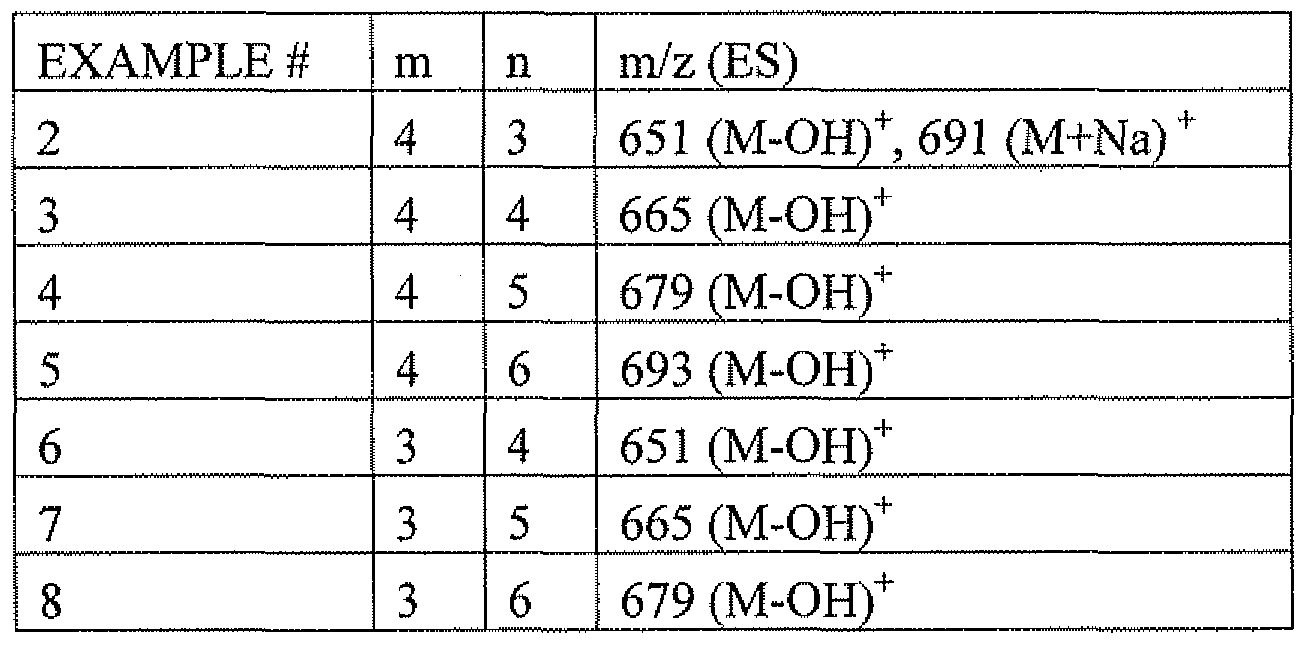
(4-{4.[(25, 3^)-3-[(35)-3-(4-fluorophenyl)-3-hydroxypropyl]-l-(4-{3- [(methyIsulfonyl)amino]propyl}phenyl}-4-oxoazetidin-2-yl]phenyl)butyl}malonic acid; (Example 2)
(4_{4-[(25, 3i?)-3-[(3S)-3-(4-fluorophenyl)-3-hydroxypropyl)-l-(4-{4- [(methylsulfonyl)amino]butyl}phenyl}-4-oxoazetidin-2-yl]pheny])butyl}malonic acid; (Example
3)
(4.{4_[(2S, 3R)-3-[(3S)-3-(4-fluorophenyl)-3-hydroxypropyl]-l-(4-{5- [(methylsulfonyl)amino]pentyl } phenyl } -4-oxoazetidin-2-yl]phenyl)butyl } malonic acid; (Example 4) (4-{4-[(2S, 3R)-3-[(3S)-3-(4-fluorophenyl)-3-hydroxypropyl]-l-(4-{6-
[(methylsulfonyl)amino]hexyl}ρhenyl}-4-oxoazetidin-2-yl]phenyl)butyl }malonic acid; (Example
5)
(3-{4-[(2S, 3Jff)-3-[(35)-3-(4-fluorophenyl)-3-hydroxypropyl]-l-(4-{4-
[(methylsiilfonyl)amino]butyl}ρhenyl}-4-oxoazetidin-2-yl]phenyl)propyl}malonic acid; (Example 6)
(3-{4-[(25, 3i?)-3-[(3S)-3-(4-fluorophenyl)-3-hydroxypropyl]-l-(4-{5-
[(methylsulfonyl)amino]pentyl}phenyl}-4-oxoazetidin-2-yl]phenyl)propyl}malonic acid;
(Example 7)
(3-{4-[(25, 3i?)-3-[(35)-3-(4-fluorophenyl)-3-hydroxypropyl]- 1 -(4-{6- [(melhylsulfonyl)amino]hexyl}phenyl}-4-oxoazetidin-2-yl]phenyl)propyl}malonic acid;
(Example 8)
EXAMPLE 9
{3-[4-((25,3i?)-3-[(3fS)-3-(4-Fluorophenyl)-3-hydroxypropyl]-l-{4-[6-
(methylsulfonyl)hexyl]phenyl } -4-oxoazetidin-2-yl)phenyl]ρroρyl }malonic acid.

Step A: Preparation of (1 S)- 1 -(4-fluorophenyl)-3-[(2S,3R)-l -(4-hydroxyphenyl)-2-(4- iodophenyl)~4-oxoazetidin-3-yl] propyl acetate.

Preparation of (15)-l-(4-fiuorophenyl)-3-[(25,3Λ)-2-(4-iodophenyl)-4-oxo-l-(4-
 {[(trifluoromethyl)sulfonyl]oxy}phenyl)azetidin-3-yl]propyl acetate.

(liS).l.(4.fluorophenyl)-3-[(25J3i?)-l-(4-hydroxyphenyl)-2-(4-iodophenyl)-4- oxoazetidin-3-yl]propyl acetate from Example 9, Step A (980 mg; 1.752 mmol) was dissolved in
CH2Cl2 (10 ml) and lriethyl amine (270 μl; 1.927mmol) and N-phenyltrifluoromethane sulfonimide (657 mg; 1.840 mmol) were added and stirred together at room temperature for 3.5 hours. The volatiles from the reaction mixture were removed under reduced pressure and the oil residue partitioned with 2N-hydrochloric acid (50 ml) and diethyl ether (2 x 50 ml). The two ethereal extracts were combined and dried over anhydrous Na2SO4 powder, filtered and concentrated under vacuum. The residue was purified by preparative silica gel plates eluted with CH2Cl2 and methanol (98:2) to afford the triflate compound. mlz (ES) 714 (M+Na) +, 632 (M- OAc)+.
Preparation of dibenzyl (3-{4-[(2S;3fl)-3-[(3S)-3-(acetyloxy)-3-(4- fluorophenyl)propyl J -4-oxo- 1 -(4-
{[(trifluoromethyl)sulfonyl]oxy}phenyl)azetidin-2-yl]phenyl}prop-2-yn-l- yl)malonate.

A solution of (l(S)-l-(4-fluorophenyl)-3-[(25,3i?)-2-(4-iodophenyl)-4-oxo- l-(4-{[(trifluoromethyl)sulfonyl]oxy}phenyl)azetidin-3-yl]propyl acetate (1000 mg; 1.446 mmol) from Example 3, Step B, dibenzyl prop-2-yn-l-yl malonate (721 mg; 2.169 mmol) (i-1), tetrakis(triphenylphosphine)palladium(0) (83.6 mg; 0.072 mmol) and copper(I) iodide (13.8 mg; 0.072 mmol) were mixed together in dry CH2Cl2 (5 ml). Nitrogen gas was bubbled slowly through the CH2Cl2 solution for approximately 5 minutes and then triethylamine (2 ml) added. The reaction vessel sealed under a nitrogen atmosphere and the reaction mixture stirred at room temperature for 6.5h. The volatiles were removed from the reaction products under reduced. The oil thus obtained was purified by preparative silica gel plates eluted with EtOAc and Hexanes (1 : 1 v/v) to afford the title compound, mlz (ES) 909 (M+Na) +, 826 (M- OAc)+.
Step D: Preparation of dibenzyl {3-[4-((2Sr,3Λ)-3-[(35)-3-(acetyloxy)-3-(4- fluorophenyl)propyl] - 1 - {4- [6-(methylsulfonyl)hex- 1 -yn- 1 -yljphenyl } -4- oxoazetidin-2-yl)phenyl]prop-2-yn-l-yl}malonate.

Dibenzyl (3-{4-[(25;3Λ)-3-[(31S)-3-(acetyloxy)-3-(4-fluorophenyl)ρropyl3-4-oxo- 1 -(4- { [(trifluoromethyl)sulfonyl] oxy } phenyl)azetidin-2-yl] phenyl } prop-2-yn- 1 -yl)malonate (Example 9, Step C; 100 mg; 0.113 mmol) and 6-(methylsulfonyl)-hex-l-yne (i-10b; 36.2 mg; 0.226 mmol), tetrabutylammonium iodide (2.1 mg ; 0.0056 mmol), tetrakis(triphenyl- phosphine)palladium(O) (6.5 mg; 0.0056 mmol), copper(I) iodide (1.1 mg; 0.0056 mmol) were dissolved in anhydrous DMF (1 ml) and triethylamine (1 ml). Nitrogen gas was slowly bubbled through the solution for 2 minutes then the reaction vessel was sealed under a nitrogen atmosphere and the contents heated in a bath set at 7O0C for 11.5 hours. The reaction mixture was cooled to room temperature and concentrated under reduced pressure to remove the volatiles. Purification of the black oil by preparative silica gel plates eluted with EtOAc and Hexanes (2:1 v/v) afforded on isolation the title compound, m/z (ES) 836 (M- OAc)+.
Step E: Preparation of {3-[4-((2Sr s3JR)-3-[(35)-3-(Acetyloxy)-3-(4-fluorophenyl)proρyl]- 1 ■
{ 4- [6-(methy 1 sulfonyl)hexy ljphenyl } -4-oxoazetidin-2-yl)phenyl]propyl } malonic acid.

Dibenzyl { 3-[4-((25J3i?)-3-[(35)-3-(acetyloxy)-3-(4-fluorophenyl)propyl]- 1 -{4-[6- (methylsulfony l)hex- 1 -yn- 1 -yl] phenyl } -4-oxoazetidin-2-y l)phenyl]prop-2-yn- 1 -yl } malonate , (37 mg) from Example 9, Step C was dissolved in ethanol (5ml) and ethyl acetate (3 ml) and 10% palladium on carbon (10 mg) was added to the solution, After three vacuum then flush with hydrogen cycles, the ethanol solution was hydrogenated at atmospheric pressure and at room temperature with hydrogen gas contained in a balloon reservoir. After 4 hours of hydrogenation, the reaction was judged to be essentially over by lc-ms. The spent hydrogenation catalyst was removed by filtering through a 0.45-micron Acrodisk syringe filter and the filtrates obtained concentrated down to leave a colorless gum. The amount of the hydrogenated product isolated was 20 mg and the majority of this crude product was taken on to the next step. A small sample
(5 mg) of the crude diacid was purified by reverse phase prep lc-ms collecting m/z = 664.2 (M- OAc)+. m/z (ES) 746 (M+Na) +, 664 (M- OAc)+.
Step F: Preparation of {3-[4-((25,3Λ)-3-[(35)-3-(4-Fluorophenyl)-3-hydroxypropyl]-l -{4-
[6-(methylsulfonyl)hexy 1] phenyl } -4-oxoazetidin-2-yl)phenyl]propy 1 } malonic acid.

{3-[4-((25'}3i?)-3-[(35)-3-(Acetyloxy)~3~(4-fluorophenyl)propyl]-l-{4-[6- (methylsulfonyl)hexyl]phenyl}-4-oxoazetϊdin-2-yl)phenyl]propyl} malonic acid from step E above (15 rag; 0.021mmol) was dissolved in ethanol (ImI) and potassium trimethylsilanoate (10.6 mg; 0.083mmol) added and the reaction mixture was stirred at room temperature for about 2 hours. The reaction mixture was purified by reversed phase preparative lc-ms collecting on m/z = 664.2. The aqueous acetonitrile product fractions containing the desired product were concentrated down under reduced pressure to afford the desired compound, m/z (ES) 704 (M+Na) +, 664 (M-OH)+.
1H-NMR (400 MHz, CD3OD) δ; 1.30 (m, 2H), 1.42 (m, 2H), 1.57 (m, 2H), 1.63 (m, 2H), 1.73 (m, 2H), 1.87 (complex, 6H), 2.51 (t, J = 7.5Hz, 2H), 2.63 (t, J = 7.5Hzs 2H), 2.90 (s, 3H), 3.04 (broad t, J = 8Hz, 3H), 3.32 (t, J = 5.5Hz, IH), 4.58 (t, J = 7Hz, IH), 4.77 (d, J = 1.5Hz, IH), 6.97-7.33 (complex, 12H).
Employing procedures similar to those described in Example 9, the following compounds in Table 2 were prepared from the appropriate starting materials:
TABLE 2:


(3-[4-((2S, 3U)-3-[(35)-3-(4-fluorophenyl)-3-hydroxypropyl]- 1 -(4-[4-(methyf sulfonyl)butyl] phenyl} -4-oxoazetidin-2-yl)phenyl] propyl }malonic acid; (Example 10) {3-[4-((2^, 3i?)-3-[(35)-3-(4-fluorophenyl)-3-hydroxypropyl]-l-(4-[5-(methylsulfonyl)pentyl] phenyl }-4-oxoazetidin-2-yl)phenyl]propyl}malonic acid; (Example 1 1)
EXAMPLE # STRUCTURE m/z(ES)


[3-(4-{(25,3^)-l-(4-{2-[2-(aminocarbonyl)-l,3-thiazol-4-yl]ethyl}phenyl)-3-[(35)-3-(4- fluorophenyl)-3-hydroxypropyl]-4-oxoazetidin-2~yl}phenyl)propyl]malonic acid.

Step A: Preparation of dibenzyl {3-[4-((2553/?)-3-[(35)-3-(acetyloxy)-3-(4- fluorophenyl)proρyl]-4-oxo-l-{4-[(trimethylsilyl)ethynyl]phenyt}azetidin-2- yl)phenyl]prop-2-yn- 1 -yl } malonate.

The triflate from Example 2 Step C (400 mg; 0,452 mmol) and trimethylsilyl- acetylene (220 mg; 2.258 mmol), telrabutylammonium iodide (8.3 mg; 0.0226 mmol) tetrakis(triphenylphosphine)palladium(0) (26 mg; 0.0226 mmol), copper(I) iodide (4.3 mg; 0.0226 mmol) were dissolved in anhydrous DMF (2 ml) and triethylamine (2 ml). Nitrogen gas was slowly bubbled through the solution for 5 minutes then the reaction vessel was sealed under a nitrogen atmosphere and the contents heated in a bath set at 7O0C for 22 hours. The reaction mixture was concentrated under reduced pressure to remove the volatiles, leaving behind a black oil. Purification of the black oil by preparative tic on silica gel plates eluted with EtOAc and Hexanes (1 :2 v/v) afforded the title compound, m/z (ES) 774 (M- OAc)4.
Preparation of dibenzyl (3-{4-[(2S,3Λ)-3-[(35)-3-(acetyloxy)-3-(4- fluoroρhenyl)propyl] - 1 -(4-ethynylphenyl)-4-oxoazetidin-2-yl]phenyl } prop-2-yn- l-yl)malonate.

A solution of the silyl acetylene (350 mg; 0.420 mmol) from Example 30, Step A in THF (1.5 ml) was cooled in an ice-water bath and to this a IM tetrabutylammioniυm fluoride (TBAF) solution in THF ((0.44 ml; 0.440 mmol) was added. The progress of the reaction was followed by lc-ms and after about 0.75h the reaction was essentially complete. The reaction was quenched with water (3 ml) and extracted with EtOAc (2 x 5ml). The two ethyl acetate extracts were combined and dried over anhydrous MgSO4. The spent drying agent was filtered off and the filtrates concentrated under reduced pressure to leave a light brown oil. Purification of the crude product was effected by preparative tic on silica plates using an eluant of EtOAc and Hexanes (1:2 v/v). mlz (ES) 702 (M- OAc)+.
Step C: Preparation of dibenzyl (3-{4-[(2S,3iϊ)-3-[(3S)-3-(acetyloxy)-3-(4- fiuorophenyl)propyl] - 1 -(4- { [2-(aminocarbony I)- 1 ,3 -thiazol-4-yl ] ethynyl } phenyl)- 4-oxoazetidin-2 -yl] phenyl } prop-2-yn- 1 -yl)mal onate.

The acetylene from Example 30, Step B (30 mg; 0.0394 mmol) and 4-bromo-l,3- thiazole-2~carboxamide (12.2mg; 0.059 mmol), tetrabutylammonium iodide (0.7 mg ; 0.002 mmol) tetrakϊs(triphenylphosphine)ρalladium(0) (2.3 mg; 0.002 mmol), copper(I) iodide (0.4 mg; 0.002 mmol) were dissolved in anhydrous DMF (0.75 ml) and triethylamine (0.5 ml). Nitrogen gas was slowly bubbled through the solution for 3 minutes then the reaction vessel was sealed under a nitrogen atmosphere and the contents heated in a bath set at 7O0C for 19 hours. The reaction mixture was concentrated under reduced pressure to remove the volatiles, leaving a black oil. Purification of the black oil by preparative tic on silica gel plates eluted with EtOAc and hexanes (3:1 v/v) afforded the title compound, mlz (ES) 828 (M- OAc)+.
Preparation of (3-{4-[(25,3^)-3-[(35)-3-(acetyloxy)-3-(4-fluorophenyl)propyl]-l- (4- (2-[2-(aminocarbonyl)- 1 ,3-thiazol-4-yl]ethyl}phenyl)~4-oxoazetidin-2- yl]phenyl}propyl)malonic acid.

The bis~acetylene compound (6.5 mg) from Example 30, Step C was dissolved in ethanol (3 ml) and 10% palladium on carbon (5 mg) was added to the ethanol solution. After three vacuum then flush with hydrogen cycles, the ethanol solution was hydrogenated at atmospheric pressure and at room temperature with hydrogen gas contained in a balloon reservoir for 2 hours when the reaction was judged to be essentially over by analytical lc-ms. The spent hydrogenation catalyst was removed by filtering through a 0.45-micron Acrodisk syringe filter and the filtrates obtained concentrated down to leave a yellow colored oil. Purification of the oil was effected by prep lc-ms collecting m/z = 656.2. m/z (ES) 738 (M+Na) +, 656 (M- OAc)+.
Preparation of [3-(4- {(2S,3R)- 1 -(4- {2-[2-(aminocarbonyl)-l ,3-thiazol-4- yl] ethyl } phenyl)-3 -[(3 S)-3 -(4~fluorophenyl)-3 -hydroxypropy 1] -4-oxoazetidin-2- yl}phenyl)proρyl]malonic acid.

The acetate from Example 30, step D above (4 mg) was dissolved in ethanol (ImI) and potassium trimethylsilanoate (2,5 mg) added and the reaction mixture stirred at room temperature for approximately 2 hours. The crude reaction mixture was filtered through a 0.45 micron Acrodisk syringe filter and the filtrate solution purified by reversed phase preparative lc- ms collecting on m/z = 656.3. The aqueous acetonitrile product fractions containing the desired product were concentrated down under reduced pressure to give the desired compound, m/z (ES) 696 (M+Na) +, 656 (M-OH)+. 1H-NMR (400 MHz, CD3OD) δ: 1.68 (m, 2H), 1.90
(complex 6H)5 2.66 (t J = 7.5 Hz, 2H), 2.98 (t, J - 7.5 Hz, 2H), 3.07 (complex, 3H)5 3.32 (obscured, IH)54.62 (t J= 6Hz, IH), 4.80 (d J=2Hz, IH), 7.00-7.37 (complex, 13H).
Table 3: Other compounds made using techniques similar to the route described in Example 30. Example # STRUCTURE m/z (ES)

[3-(4-{(25,3iϊ)-3-[(35)-3-(4-fluoroρhenyl)-3-hydroxypropyl]-l-[4-(3-hydroxypropyl)phenyl]-4- oxoazetidin-2-yl } phenyl)proρyl] malonic acid.

Step A: Preparation of dibenzyl {3-[4-((25,3Λ)-3-[(35)-3-(acetyloxy)-3-(4- fluorophenyl)propyl] - 1 - {4- [3 -(benzy loxy)prop- 1 -yn- 1 -yl]phenyl } -4-oxoazeti di n- 2-yl)phenyl]prop-2-yn-l-yl}malonate.

In a similar way to Example 2 Step D, the triflate (100 mg; 0.113 mmol) and benzyl prop-2-yn-l-yl ether (41.3 mg; 0.282 mmol), tetrabutylammonium iodide (2.1 mg ; 0.0056 mmol), tetrakis(triphenyl-phosphine)palladium(0) (6.5 mg; 0.0056 mmol), copper(I) iodide (1.1 mg; 0.0056 mmol) were dissolved in anhydrous DMF (1.5 ml) and trielhylamine (0.5 ml). Nitrogen gas was slowly bubbled through the solution for 3 minutes then the reaction vessel was sealed under a nitrogen atmosphere and the contents heated in a bath set at 7O0C for 5 hours. The reaction mixture was cooled to room temperature and concentrated under reduced pressure to remove the volatiles, leaving a black oil. Purification of the black oil by preparative tic on silica gel plates eluted with EtOAc and Hexanes (1 :1 v/v) afforded the title compound. mlz (ES) 904 (M+Na) +, 822 (M-OAc)+.
Preparation of [3-(4-{(25')3i?)-3-[(35)-3-(acetyloxy)-3-(4-fiuorophenyl)propyl]-l - [4-(3-hydroxypropyl)phenyl]-4-oxoazetidin-2-yl}phenyl)propyl] malonic acid.

Preparation of [3-(4- { (25,3Λ)-3 -[(3S)-3 -(4-fluorophenyl>3 -hydroxypropyl] - 1 - [4- (3 -hydroxypropyl )phenyl] -4-oxoazeti din-2-yl } ρhenyl)propy 1] malonic acid.

In an analogous manner to Example 2, Step F the acetate from Example 41, Step B above (12 mg; 0.0194mmol) was dissolved in ethanol (ImI) and potassium trimethylsilanoate (9.9 mg; 0.0775 mmol) added and stirred at room temperature for about 6.5 hours. The reaction mixture was purified by mass directed reverse phase preparative lc-ms collecting on m/z = 560.2. The aqueous acetonitrile product fractions containing the desired product were concentrated down under reduced pressure to give the desired compound. 1H-NMR (400 MHz, CD3OD) δ: 1.66 (m, 2H), 1.74 9m, 2HO, 1.80-2.02 (complex, 6H), 2.57 (t, J - 7.5Hz, 2H), 2.63 (t, J =
7.5Hz), 3.04 (br, IH), 3.30 (obscured, IH), 3.49 (t, I = 7.5Hz5 2H), 4.58 (broad t, IH), 4.77 (d, J = 2 Hz, IH), 6.97-7.32 (complex, 12H). m/z (ES) 600 (M+Na)+, 560 (M-OH)+.
EXAMPLE 42
Preparation of (3-{4-[(2S,3R)-3-[(3S)-3-(4-fluorophenyl)-3-hydroxypropyl]~4-oxo-l-(4- ρropylphenyl)azetidin-2-yl]phenyl}propyl)malonic acid


The inflate from Example 2 Step C (100 mg; 0.113 mmol) and allyltributyltin (74,8 mg; 0.258 mmol), tetrakis(triphenylphosphine)palladϊum(0) (6.5 mg; 0.0056 mmol), lithium chloride (47.9 mg; 1.129 mmol) were dissolved in anhydrous dioxane (3.5 ml). Nitrogen gas was slowly bubbled through the solution for 2 minutes then the reaction vessel was sealed under a nitrogen atmosphere and the contents heated in a bath set at 850C for 6 hours. The reaction mixture was concentrated under reduced pressure to remove the volatiles, leaving behind a black oil. Purification of the black oil by preparative tic on silica gel plates eluted with EtOAc and Hexanes (1:2 v/v) afforded the title compound, mlz (ES) 718 (M- OAc)+.
Preparation of (3- {4-[(2JS,3^)-3-[(35)-3-(acetyloxy)-3-(4-fluorophenyl)propyl]-4- oxo-1 -(4-proρylphenyl)azetidm-2-yl]phenyl}propyl)malonic acid.

The acetylene compound (10 mg) from Example 42, Step A was dissolved in ethanol (2ml) and ethyl acetate (2 ml) and 10% palladium on carbon (5 mg) was added to the solution. After three vacuum then flush with hydrogen cycles, the ethanol solution was hydrogenated at atmospheric pressure and at room temperature with hydrogen gas contained in a balloon reservoir. After 2.5 hours of hydrogenation, the reaction was judged to be essentially complete by lc-ms. The spent hydrogenation catalyst was removed by filtering through a 0,45- micron Acrodisk syringe filter and the filtrates obtained concentrated down to leave a colorless gum. m/z (ES) 544 (M- OAc)+.
Preparation of (3- {4-[(25',3i?)-3-[(35)-3-(4-fluorophenyl)-3-hydroxypropyl]-4- oχo-1 -(4-ρropylphenyl)azetidin-2-yl]pheny 1 } ρropyl)malonic acid.

The acetate from Example 42, step B above (6 mg) was dissolved in ethanol (ImI) and potassium trimethylsilanoate (6,4 mg) added; the reaction mixture was stirred at room temperature for approximately 4.5 hours. The crude reaction mixture was filtered through a 0.45 micron Acrodisk syringe filter and the solution purified by reversed phase preparative lc-ms collecting on m/z = 544,2. The aqueous acetonitrile product fractions containing the desired product were concentrated down under reduced pressure to give the desired compound. 1H- NMR (500 MHz, CD3OD) 6: 0.90 (t, 3H) ,1.58 (m,2H), 1.67 (m, 2H), 1.80-2.00 (complex, 6H), 2.50 (t, 2H), 2.66 (q, 2H), 3.06 (broad, IH)5 3.28-3.30 (complex, partially obscured IH), 4.61 (broad t,, IH), 4.80 (d, IH), 7.00-7.33 (complex, 12H). m/z (ES) 584 (M+Na)+, 544 (M-OH)+
EXAMPLE 43
[3-(4-{(2S',3JR)-l-(4-ethylphenyl)-3-[(35)-3-(4-fluorophenyl)-3-hydroxypropyl]-4-oxoazetidin-2-
yl}phenyl)ρropyl]malonic acid.
 Step A: Preparation of (3- {4-[(2S,3Λ)-3-[(35)-3-(acetyloxy)-3-(4-fluorophenyl)propyl]-l-
(4-ethylphenyl)-4-oxoazetidin-2-yl]phenyl}propyl)malonic acid.

The bis-acetylene compound (25 mg) from Example 2, Step B was dissolved in ethanol (3 ml) and ethyl acetate (2 ml) to which 10% palladium on carbon (10 mg) was added to the solution. After three vacuum then flush with hydrogen cycles, the ethanol / EtOAc solution was hydrogenated at atmospheric pressure and at room temperature with hydrogen gas contained in a balloon reservoir. After 5 hours of hydrogenation, the reaction was judged to be essentially over by lc-ms. The spent hydrogenation catalyst was removed by filtering through a 0.45-micron
Acrodisk syringe filter and the filtrates obtained concentrated down to leave a colorless gum. m/z (ES) 613 (M+Na)+, 530 (M- OAc)+.
Preparation of [3-(4-{(2SJ3i?)-l-(4-ethylphenyl)-3-[(3(S)-3-(4-fluorophenyl)-3- hydroxypropyl] -4-oxoazetidin-2-yl } ρhenyl)propyl]malonic acid.

The acetate from step B above (11.5 mg) was dissolved in ethanol (2.5ml) and potassium trimethylsilanoate (7.5 mg) added stirred at room temperature for approximately 3.5 hours. The crude reaction mixture was filtered through a 0.45 micron Acrodisk syringe filter and the solution purified by reversed phase preparative lc-ms collecting on m/z = 530.2. The aqueous acetonitrile product fractions containing the desired product were concentrated down under reduced pressure to give the desired compound. 1H-NMR (400 MHz, CD3OD) δ: 1.20 (t, J = 7.5Hz, 3H), 1.58 (m, 2H), 1.76-2.00 (complex, 6H), 2.55 (t, J = 7.5Hz, 2H)S 2.62 (q, J = 7.5Hz, 2H), 3.03 (broad, IH), 3.28-3.30 (m, partially obscured IH)54.59 (broad t, J = 6Hz, IH), 4.77 (d, J - 2Hz,lH), 6.97-7.32 (complex, 12H). m/z (ES) 570 (M+Na) +, 530 (M- OH)+.
EXAMPLE 44
{3-[4-((25,3U)-3-[(3S)-3-(4-fluorophenyl)-3-hydroxypropyl]-4-oxo-l-{4-[2-(l ,4,5,6- tetrahydropyrimidin-2-yl)ethyI)phenyl}azetidin-2-yl)phenyl]propyl}malonic acid.

Step A: Preparation of dibenzyl [3-(4- {(25,3JR)-3-[(35)-3-(acetyloxy)-3-(4- fluorophenyl)ρropyl]-4-oxo-l-[4-(pyrimidin-2-ylethynyl)phenyl]azetidin-2- yl } phenyl)prop-2~yn- 1 -y 1] malonate

The acetylene from Example 3, Step B (80 mg; 0.112 mmol) and 2- bromopyrimidine (35.7mg; 0.223 mmol), tetrabutylammonium iodide (2.1 mg ; 0.0056 mmol) tetrakis(triphenylphosphine) palladium(O) (6.4 mg; 0.0056 mmol), copper(I) iodide (L l mg; 0.0056 mmol) were dissolved in anhydrous DMF (1 ml) and triethylamiπe (0.5 ml). Nitrogen gas was slowly bubbled through the solution for 3 minutes then the reaction vessel was sealed under a nitrogen atmosphere and the contents heated in a bath set at 7O0C for 16 hours. The reaction mixture was concentrated under reduced pressure to remove the volatiles, leaving a black oil. Purification of the black oil by preparative tic on silica gel plates eluted with EtOAc and hexanes (2: 1 v/v) afforded the title compound, m/z (ES) 780 (M- OAc)+.
Preparation of {3-[4-((2,S,3i?)-3-[(3S)-3-(acetyloxy)-3-(4-fiuorophenyl)propyl]-4- oxo- 1 - {4-[2-( 1 ,4,5,6-tetrahydropyrimidin-2-yl)ethyl]phenyl} azetidin-2- yl)phenyl]ρropyl}malonic acid.

The bis-acetylene compound (30 mg) from Example 44, Step A was dissolved in ethanol (5 ml) and ethyl acetate (2.5 ml) and 10% palladium on carbon (10 mg) was added to the solution. After three vacuum then flush with hydrogen cycles, the ethanol / EtOAc solution was hydrogenated at atmospheric pressure and at room temperature with hydrogen gas contained in a balloon reservoir. After 3 hours of hydrogenation, the reaction was judged to be essentially over by lc-ms. The spent hydrogenation catalyst was removed by filtering through a 0.45-micron Acrodisk syringe filter and the filtrates obtained concentrated down to leave a colorless gum. m/z (ES) 672 (M+H)+, 612 (M- OAc)+.
Preparation of {3-[4-((25,3Λ)-3-[(3iS)-3-(4-fluorophenyl)-3-hydroxypropyl]-4- OXO- 1 -{4-[2-(l ,4,5,6-tetrahydropyrimidin~2-yl)ethyl]phenyl}azetidin-2- yl)phenyl]propyl}malonic acid

The acetate from Example 44, Step B above (9 mg) was dissolved in ethanol (1.5ml) and potassium trimethylsilanoate (6 mg) added; the reaction mixture was stirred at room temperature for approximately 6 hours. The crude reaction mixture was filtered through a 0.45 micron Acrodisk syringe filter and the solution purified by reversed phase preparative lc-ms collecting on m/z = 612.2. The aqueous acetonitrile product fractions containing the desired product were concentrated down under reduced pressure to give the desired compound. 1HNMR (400 MHz, CD3OD) δ: 1.58 (m,2H), 1.75-2.03 (complex, 8H), 2.55 (t, J = 7.5Hz, 2H), 2.64 (t, J - 7.5Hz, 2H), 2.95 (t, J = 7.5 Hz5 2H), 3.05 (broad, IH), 3.22-3.30 (complex, partially obscured 5H), 4.59 (broad t, J = 6Hz, IH), 4.81 (obscured, IH), 6.98-7.38 (complex, 12H). m/z (ES) 630 (M+H)+, 612 (M-OH)+
EXAMPLE 45
{3-[4-((25s3Λ)-3-[(35)-3-(4-fluorophenyl)-3-hydroxypropyl]-l-{4-[3- (methylsulfonyl)propyl]phenyl) -4-oxoazetidin-2-yl)phenyl] propyl} malonic acid.

Preparation of dibenzyl [3-(4-{(2^3i?)-3-[(35f)-3-(acetyloxy)-3-(4- fluorophenyl)propyl]- 1 - [4-(3 - { [/er?-butyl(dimethyl)silyl j oxy } prop- 1 -yn- 1 - yl)phenyl]-4-oxoazetidin-2-yl}phenyl)ρrop-2-yn- 1 -yl]malonate.
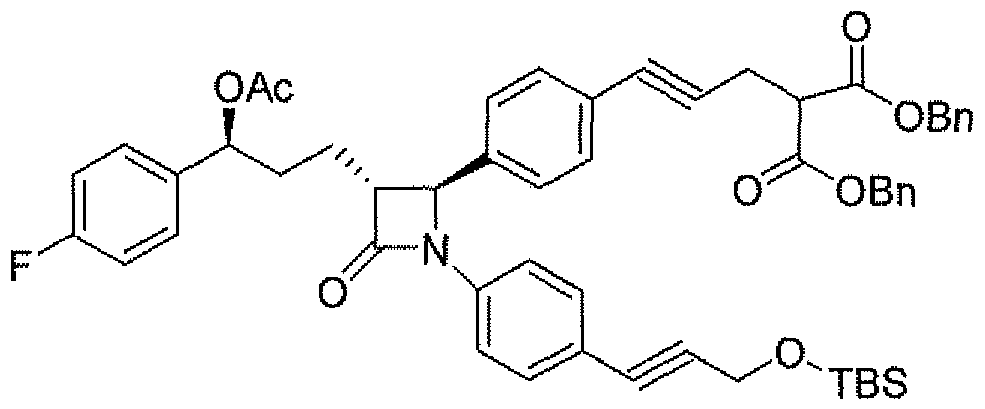
The triflate from Example 2, Step C (200 mg; 0.2258 mmol) and t- butyldimethylsilyl-propargyϊ ether (96.1 mg; 0.5644 mmol), tetrabutylammoniura iodide (4.2 mg; 0.0113 mmol), tetrakis(triphenylphosphine)palladium(0) (13 mg; 0.0113 mmol), copρer(I) iodide (2.1 mg; 0.0113 mmol) were dissolved in anhydrous DMF (2 ml) and triethylamine (2 ml). Nitrogen gas was slowly bubbled through the solution for 5 minutes then the reaction vessel was sealed under a nitrogen atmosphere and the contents heated in a bath set at 7O0C for 10.5 hours. The reaction mixture was concentrated under reduced pressure to remove the volatiles, leaving behind a black oil. Purification of the black oil by preparative tic on silica gel plates eluted with EtOAc and Hexanes (1: 1 v/v) afforded the title compound, mlz (ES) 774 (M- OAc)+.
Preparation of dibenzyl [3-(4-{(2S,3Λ)-3-[(35)-3-(acetyloxy)-3-(4- fluorophenyl)propyl]- 1 -[4-(3-hydroxyprop- 1 -yn- 1 -yi)phenyl]-4-oxoazetidin-2- yl}pherryl)prop-2-yn- 1 -yl]malonate

The silyl ether (150 mg) from Example 45, Step A was dissolved in dry THF (1 ml), stirred at O0C and to this solution a 1 M tetrabutylammonium fluoride (TBAF) solution in THF (182 μl, 0.182 mmol) was added. The reaction solution turned a yellow color on adding the fluoride reagent. The reaction mixture was stirred for 45 minutes and then was quenched with water and the EtOAc (~5 ml) was added. The aqueous layer was separated and discarded; the organic phase was dried with anhydrous MgSO4. The spent drying agent was filtered off and the filtrates concentrated down and purified by preparative tic on silica gel plates and eluted with EtOAc and Hexanes (2: 1 v/v). mlz (ES) 732 (M-OH)+
Preparation of dibenzyl (3-{4-[(25,3Λ)-3-[(35)-3-(ac«rtyloxy)-3-(4- fluorophenyl)propyl] - 1 -(4- { 3 -[(methylsulfonyl)oxy]prop- 1 -yn- 1 -yl } phenyl)-4- oxoazetidin-2-yl]phenyl}prop-2-yn- 1 -yl)malonate.

A solution of the alcohol (75 mg; 0.095 mmol) from Example 45, Step B and triethylamine (66 μl) in CH2C12 (4 ml) was cooled in a C02-acetone cold bath. Methanesulfonyl chloride (26 μl) was added to the methylene chloride solution. The reaction mixture was allowed to warm from -7O0C to room temperature over approximately 0.5 hours. The mesylation reaction was essentially complete from the analytical lc-ms trace by the time the reaction had reached room temperature. The reaction was concentrated down to ~1 ml and taken on to the thiolate displacement described in Step D below.
Step D: Preparation of dibenzyl (3-[4-((2Sr,3i?)-3-[(35)-3-(acetyloxy)-3-(4-fluorophenyl) propyl] - 1 - {4~[3 -(methylthio)prop- 1 -yn- 1 -yl]ρhenyl } -4-oxoazetidin-2- yl)ρhenyl]prop-2-yn~l-yl}malonate.
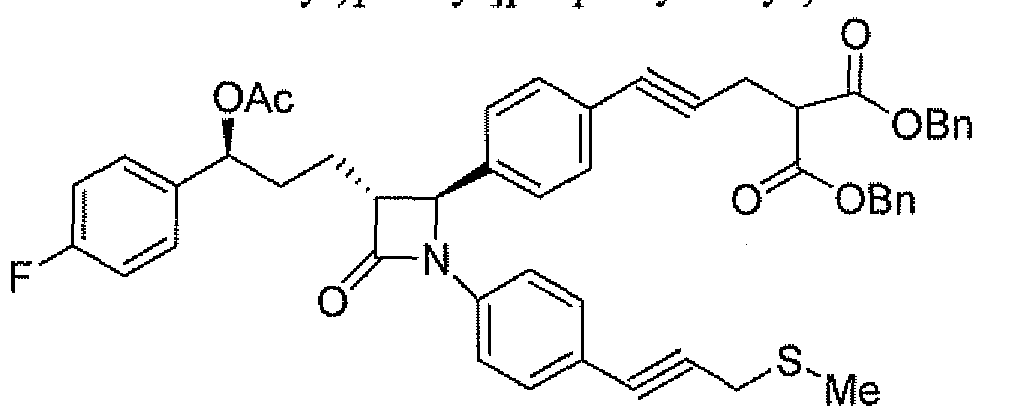
The crude mesylate (0.095 mmol) from Example 45, Step C was reacted with sodium thiomethoxide (10 mg; 0.142 mmol) in ethanol (5 ml) for 2 hours. The reaction was partitioned with 2N-hydrochloric acid (5 ml) and ethyl acetate (3 x 5 ml). The ethyl acetate extracts were combined and dried over anhydrous MgSO4 powder, filtered and the filtrates concentrated. The residues from evaporation were purified by preparative tic on silica gel plates eluted with Hexanes: EtOAc 1 :1 v/v. The sulfide product was isolated as an oil. m/z (ES) 762 (M-OAc)+
Step E: Preparation of dibenzyl {3-[4-((25t,3i?)-3-[(35)-3-(acetyloxy)-3-(4- fluoroρhenyl)propyl]- 1 - {4- [3-(methylsulfonyl)prop- 1 -yn- 1 -yl]phenyl } -4- oxoazetidin-2-yl)phenyl]prop-2-yn- 1 -yl}malonate
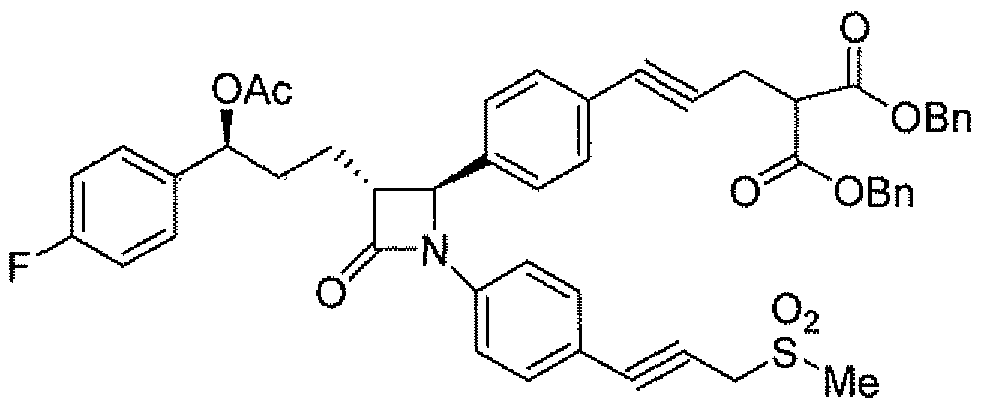
A solution of the sulfide (35 mg; 0.043 mmol) from Example 45, Step D in CH2CI2 (6 ml) was stirred at room temperature with 75% m-CPBA powder (24.5 mg; 0.107 mmol) for 2.5 hours by which time the reaction was complete as judged by lc-ms. The reaction mixture was partitioned with 2N aqueous sodium hydroxide (5 ml) and CH2CI2 (3 x 5 ml). The
CH2CI2 extracts were combined and washed with 2N hydrochloric acid (5 ml) and dried over anhydrous MgSO4 powder, filtered and the filtrates concentrated under reduced pressure, leaving a brown oil. Purification of the oil was effected by preparative tic on silica gel plates with an eluant of EtOAc : Hexanes (2:1 v/v) to afford the title compound, mlz (ES) 794 (M-OAc)+
Step F: Preparation of {3-[4-((2S,3R)-3-[(3S)-3-(acetyloxy)~3-(4-fluorophenyl)propyl]-l-
{4-[3-(methylsulfonyl)propyl]phenyl}-4-oxoazetidin-2-yl)phenyl]propyl}malonic acid.

A solution of the sulfone (20 mg) from Example 45, Step E was dissolved in ethanol (3 ml) and ethyl acetate (3 ml) solvent mixture. The hydrogenation catalyst 10%- palladium on carbon (7 mg) was added and the reaction mixture was hydrogenated for 4.5h at room temperature and at atmospheric pressure. The catalyst filtered off and the filtrate concentrated under reduced pressure to afford the desired malonic acid derivative, mlz (ES) 622 (M-OAc)+
Step G: Preparation of {3-[4-((2S,3i?)-3-[(35)-3-(4-fluorophenyl)-3-hydroxypropyl]-l-{4-
[3 -(methylsulfony l)propy I ]phenyl } -4-oxoazetidin-2-y l)pheny 1] propyl } malonic acid.

The sulfone (8mg; 0,012 mmol) from Example 45, Step F in ethanol (1.3 ml) was reacted with potassium trimethylsilanoate (5.3 mg; 0.041 mmol) for 6h at room temperature. The crude reaction mixture was diluted to 2ral with more ethanol and the filtered through a 0.45- micron Acrodisk syringe filter and the Filtrate that was obtained purified by reverse phase mass- directed prep lc-ras collecting on m/z = 622.2 and 640.2. The fractions containing the product were concentrated to give the title compound. 1H-NMR (400 MHz, CD3OD) δ: 1.50 (m,2H), 1.84 (complex, 8H); 2.08 (m, 2H), 2.55 (t, J - 7.5Hz, 2H), 2.77 (t, J = 7.5Hz5 2H), 2.91 (s, 3H), 3.07 (complex, 3H), 3.28 (m, IH), 4.59 (t, J = 6Hz, IH), 4.08 (d, J = 2Hz, IH), 6.98-7.35 (complex, 12H). m/z (ES) 622 (M-OAc)+
EXAMPLE 46
{3-[4-((25,3Λ)-3-[(35f)-3-(4-Fluorophenyl)-3-hydroxypropyl]-l-{4-[3-hydroxy-5- (methylsulfonyl)ρentyl]phenyl}-4-oxoazetidin-2-yl)phenyl]propyl}malonic


A 0.5M solution of ethynyl magnesium bromide in THF (10 ml) was added drop by drop to a solution of 3-(methylthio)propanal (500 mg; 4.800 mmol) in THF (20ml) that was stirred at O0C under a nitrogen atmosphere. The reaction was quenched by the addition of saturated aqueous ammonium chloride solution (5 ml) 0.25h after the addition of the Grignard was completed. The crude reaction mixture was extracted with diethyl ether (3 x 15ml), the ethereal extracts were combined and dried over anhydrous Na2SO4 powder, filtered and
concentrated under reduced pressure to leave a yellow oil. 1H-NMR (500 MHz, CDC13) δ: 1.99 (m, 2H), 2.12 (s, 3H), 2.14 (s, IH), 2.61 (t, J - 7.5Hz, 2H), 5.06 (t, J - 5Hz5 IH).
Preparation of [({ l-[2-(methyIthio)ethyl]prop-2-yn-l-yl}oxy)methyl]benzene.

A solution of 5-(methyϊthio)pertt-l-yn-3-ol (300 mg; 2.304 mmol) in THF (7.5 ml) was cooled to O0C in an iced water bath and stirred under a nitrogen atmosphere to which a 50% sodium hydride dispersion in oil (121.6 mg; 2.534 mmol) was added in small batches. A yellow colored solution was formed after the evolution of hydrogen had ceased. Benzyl bromide (275 μl; 2.304 mmol) was added in a single portion and the reaction mixture stirred 16h at room temperature under the nitrogen atmosphere. The reaction was quenched with water (5 ml) followed by 2N hydrochloric acid (5 ml), then extracted with diethyl ether (2 x 10 ml). The ethereal extracts were combined, dried over anhydrous Na2SO4 powder, filtered and the filtrates concentrated under reduced pressure to leave a yellow oil.
Preparation of [( { 1 -[2-(methylsulfonyl)ethyl]prop-2-yn- 1 -yl } oxy)methyl]benzene

Step D: Preparation of dibenzyl {3-[4"((25,3i?)-3-[(35)-3-(Acetyloxy)-3-(4- fluoroρhenyl)ρropyl]-l-{4-[3-(benzyloxy)-5-(methylsulfonyl)pent-l-yn-l- y 1] phenyl } -4-oxoazetidin-2-yl)pheny 1 ] prop-2 ~yn- 1 -yl } malonate.

The sulfone (57mg; 0.226 mmol) and the triflate from Example 2, Step C (lOOmg; 0.113mmol) in DMF (1 mL) and triethylamine (0,5 ml) was coupled with tetrakis(triρhenyl- phosphine) palladium(O) (6.5 mg; 0.0056 mmol) in the presence of tetrabutylammonium iodide (2.1 mg ; 0.0056 mmol) and copper(ϊ) iodide (1.1 mg; 0.0056 mmol) according to the method described in Example 2 Step D. The reaction was heated for 14h and then worked up and purified as in Example 2 Step D. The bis-acetylene beta lactam product was isolated as a yellow powdery solid, mlz (ES) 1011 (M+Na)+; 941 (M+ Na-OAc)+
Preparation of { 3-[4-((25',3J?)-3-[(35)-3-(acetyloxy)-3-(4-fluorophenyl)ρropyl]- 1 - { 4- [3 -hydroxy- 5 -(methy lsulfonyl)pentyl]phenyl } -4-oxoazetidin-2- yl)phenyl]propyl}malonic acid.

The sulfone (8 mg) from Example 46, Step D immediately above was hydro genated according to the procedure described in Example 2 Step D with 10% palladium on carbon (20 mg) in ethanol (7,5 ml) and ethyl acetate (7.5 ml) solvent mixture for 12 hours. The spent catalyst was removed and the filtrate thus obtained was concentrated down to leave a colorless gum that solidified into a white mass on standing. The white solid was the desired malonic acid derivative and this crude solid was taken on to the deprotection step, m/z (ES) 666 (M-OAc)+
Preparation of {3-[4-((25')3i?)-3-[(3S)-3-(4-fluorophenyl)-3-hydroxypropyl]- 1 - {4- [3-hydroxy-5~(methylsulfonyl)pentyl]phenyl } ~4-oxoazetidin-2- yl)phenyl]propyl} malonic acid.

A solution of the white solid hydroxy sulfone (45mg; 0.062 mmol) intermediate of Example 9 Step E in ethanol (1.5 ml) was reacted with potassium trimethylsilanoate (27,8 mg; 0.217 mmol) according to the procedure in Example 2 Step E for 4.5h at room temperature, The reaction mixture was diluted with more ethanol to make the solution up to 4 ml, filtered and the filtrates purified by reverse phase mass directed preparative lc-ms collecting on m/z = 665.4 and 683.4. The product containing fractions were concentrated down under reduced pressure to afford the title compound. 1H-NMR (400 MHz, CD3OD) δ: 1.67 (complex, 4H), 1.88 (complex, 6H), 2.65 (complex, 4H), 2.92 (s, 3H), 3.06 (complex, IH), 3.10-3.26 (complex, 2H), 3.33 (t obscured, IH), 3.59 (m, IH), 4.59 (t, J = 6.5 Hz, IH)5 4.78 (d J ~ 2Hz, IH), 6.99-7.32 (complex, 12H). m/z (ES) 706 (M+ Na)+; 666 (M-OH)+
Employing procedures similar to those described in the examples immediately above, the following compounds in Table 4 were prepared from the appropriate starting materials.
Table 4;
Example # STRUCTURE m/z (ES)

EXAMPLE 48
[3-(4-{(25,3if)-l-[4-(3,4-dihydroxybutyl)phenyl]-3-[(3fS)-3-(4-fluorophenyl)-3-hydroxypropyl]- 4-oxoazetidin~2-yl}phenyl)propyl]malonic acid.


A solution 0.5M ethynylmagnesium bromide in THF (8 ml; 4 mmol) was added drop by drop to a solution of (benzyloxy)acetaldehyde (60Qmg; 3.995 mmol) in THF (4 ml) at O0C under a nitrogen atmosphere. The reaction mixture was stirred for another 0.75h at O0C after the Grignard addition was completed. The reaction was quenched with brine (15ml) along with 2N hydrochloric acid (15 ml), stirred for 5 minutes then the aqueous reaction mixture was extracted with diethyl ether (3 x 25 ml). The extracts were combined and dried over anhydrous MgS 04 powder, filtered and the filtrates concentrated under reduced pressure to give the product a pale yellow oil.
The yellow oil was dissolved in anhydrous THF (10 ml) and stirred at O0C under a nitrogen atmosphere to which a 50% sodium hydride dispersion in oil (240mg mg; 5.000 mmol) was added in small batches. A cloudy yellow colored solution was formed after the evolution of hydrogen had ceased. Benzyl bromide (275 μl; 2.304 mmol) was injected in a single portion to the reaction mixture and the mixture stirred 24h at room temperature under the nitrogen atmosphere. The reaction was quenched with brine (10ml) along with 2N hydrochloric acid (5 ml), stirred for 5 minutes then the aqueous reaction mixture was extracted with diethyl ether (2 x 25 ml). The extracts were combined and dried over anhydrous Na2SO4 powder, filtered and the filtrates concentrated under reduced pressure to give the product a pale yellow oil. Purification of oil was effected on a Biotage SPl system on a Flash 4OM silica cartridge using a 0 -> 15% ethyl acetate and hexane gradient. The dibenzyl ether product was isolated as a colorless oil. 1H- NMR (500 MHz, CD3OD) δ: 2.52 (s, IH), 3.73 (complex, 2H), 4.37 (complex, IH)5 4.62 (complex, 3H), 4.87 (d, J = 12 Hz, IH), 7.28-7.42 (complex, 12H). mfz (ES) 289 (M+Na)+
Preparation of dibenzyl {3-[4-((2S,3R)-3-[(3S)-3-(acetyloxy>3-(4- fluorophenyl)propyl] - 1 - { 4- [3 s4-bis(benzyloxy)but- 1 -yn- 1 -yl ] phenyl } -4- oxoazetidin-2-yl)phenyl]prop-2-yn- 1 -yl } malonate.

The dibenzyl ether (22.5mg; 0.0847 mmol) from Example 48, Step A above and the trifiate from Example 2, Step C (50mg; 0.0564mmol) dissolved in DMF (1 mL) and triethylamine (0.5 ml) was coupled with tetrakis(triphenylphosphine)palladium(0) (3.3 mg;
0.0028 mmol) in the presence of tetrabutylammonium iodide (1 mg ; 0.0028 mmol) and copper(I) iodide (0.5 mg; 0.0028 mmol) according to the method described in Example 2 Step D. The reaction was heated for 22h and then worked up and purified as in Example 2, Step D. The bis-acetylene beta-lactam product was isolated, mlz (ES) 1024 (M+Na)+; 965 (M+ Na-OAc)+
Step C: Preparation of [3-(4- {(2,S',3Jff>3-[(35)-3-(acetyloxy)-3-(4-fiuorophenyl)propyl]- 1 -
[4-(3 f4-dihydroxybutyl)phenyl] -4~oxoazetidin-2-yl } pheny l)proρyl] malonic acid

The dibenzyl ether (55 mg) from Example 48, Step B immediately above was hydrogenated according to the procedure described in Example 2, Step D with 10% palladium on carbon (15 mg) in ethanol (5 ml) and ethyl acetate (5 ml) solvent mixture for 12 hours. The spent catalyst was removed and the filtrate thus obtained was concentrated down to leave the desired malonic acid derivative, mlz (ES) 673 (M+Na)+
Step D: Preparation of [3-(4-{(25,3JR)-l-[4-(3,4-dihydroxybutyl)phenyl]-3-t(35)-3-(4- fluoroρhenyl)-3 -hydroxypropyl] -4-oxoazetidin-2-yl } phenyl)propyl]malonic acid

A solution of the diol-diacid from Example 48, Step C (32mg; 0.049 mmol) intermediate above in ethanol (1 ml) was reacted with potassium trimethylsilanoate (22,1 mg; 0.172 mmol) according to the procedure in Example 2, Step E for 1.5h at room temperature. The reaction mixture was neutralized with a couple of small drops of 2N hydrochloric acid, filtered and the filtrates purified by reveres phase mass directed prep lc-ms collecting on m/z = 598.4 and 607.4. The product containing fractions were concentrated down under reduced pressure to afford the title compound. 1H-NMR (400 MHz, CD3OD) δ: 1.66 (complex, 4H), 1.88 (complex, 6H), 2.64 (complex, 4H), 3.05 (ra, IH), 3.42 (complex 2H), 3.53 (m, IH), 4.59 (t, J - 6.5Hz, IH), 4.78 (d, J = 2Hz, IH), 6.98-7.33 (complex, 12H). mlz (ES) 590 (M-OH)+; 630 (M+Na)÷
EXAMPLE 49
(3-{4-[(25,3i?)-3-[(35)-3-(4-fluorophenyl)-3-hydroxypropyl]4-(4-hydroxyphenyl)-4- oxoazetidin-2-y l]phenyl } propyl)malonic acid

Step A: Preparation of dibenzyl [3-(4-{(2S,3i?)-3-[(3S)~3-(acetyloxy>3-(4- fluorophenyl)propyl] - 1 - [4-(acety loxy)phenyl] ~4-oxoazetidin-2~yl } phenyl)prop-2- yn-l-yljmalonate.

A solution of the iodo-diacetate (1000 mg; 1.663 mmoϊ) from the prep lab, acetylene diester (700 mg; 2.169 mmol), tetrakis(triphenylphosphine)palladium(0) (83.6 mg;
0.072 mmol) and copper(I) iodide (13.8 mg; 0.072 mmol) were mixed together in dry CH2CI2 (5 ml). Nitrogen gas was bubbled slowly through the CH2CI2 solution for approximately 5 minutes and then triethylamme (2 ml) added. The reaction vessel sealed under a nitrogen atmosphere and the reaction mixture stirred at room temperature for 16.5h. The volatiles were removed from the reaction products under reduced pressure to leave a dark oil residue. The oil thus obtained was purified by preparative tic on silica gel plates eluted with MeOH and CH2CI2 (5:95 v/v) to obtain the desired product, mlz (ES) 818 (M+Na) +, 736 (M- OAc)+.
Preparation of dibenzyl (3-{4-[(2fS,3i?)-3-[(35)-3-(acetyloxy)-3-(4-
 fiuoroρhenyl)propyl]- 1 -(4-hydroxyphenyl)-4-oxoazetidin-2-yl]phenyl }prop-2-yn- 1 -yl)malonate.

The diacetate (482 mg) from Example 49, Step A and triethylamine (1 ml) were dissolved in methanol (5 ml) and stirred at room temperature under a nitrogen atmosphere.
Distilled water (0.5 ml) was added and the reaction mixture stirred for 8 hours and then the reaction mixture was concentrated on a rotary evaporator equipped with a vacuum pump to remove the aqueous solvent. The oil that remained after evaporation was purified on silica gel chromatography plates with an eluant of CH2C12 and methanol (95:5 v/v). 1H-NMR (400 MHz, CDCl3) δ: 1.86 (complex, 2H), 2.01 (complex, 2H), 2.07 (s, 3H), 3.05 (d, J=7.5Hz, 2H), 3.07 (broad t, j=7.5Hz, IH), 3.76 (t, J=7.5Hz, IH), 4.58 (d, J=2Hz, IH)5 5.20 (s, 4H), 5.34 (broad, IH), 5.70 (t, J=7Hz, IH), 6.72 (d, J=8.5Hz, 2H), 7.02 (t, J=8.5Hz, 2H), 7.12 (d, J=8.5Hz, 2H), 7.19-7.33 (complex, 16H).
Preparation of (3-{4-[(25,3^)-3-[(35)-3-(acetyloxy)-3-(4-fluorophenyl)propyl]-l - (4-hydroxyphenyl)-4-oxoazetidin-2-yl]phenyl}propyl)malonic acid.

A solution of the dϊbenzyl ester (350 mg) from Example 49, Step B in ethanol (15 ml) was hydrogenated over 10% palladium on carbon (100 mg) for 3.5 hours in a similar manner to that described in Example 2, Step E above. The spent catalyst was removed by filtration through a 0.45 -micron Acrodisk syringe filter and the resultant filtrate concentrated on a rotary evaporator under reduced pressure to leave a yellow glass-like solid. This material was purified by reverse phase mass directed lc-ms collecting m/z = 518.1. The desired malonic acid product was isolated from the purification. 1H-NMR (400 MHz, CD3OD) δ: 1,65 (complex, 2H), 1.76- 2.14 (complex, 6H), 2.01 (s, 3H), 2.64 (t, J=7.5Hz, 2H), 3.02 (broad t, J=8Hz, IH), 3.31 (obscured, IH), 4.73 (d, J=2Hz;lH), 5.68(1, J=7Hz, IH), 6.63 (d, J=8.5Hz, 2H), 7.00-7.10 (complex, 4H), 7.17-7.34 (complex, 6H). m/z (ES) 518 (M-OAc)+; 600 (M+Na) +
Step D: Preparation of (3-{4-[(2)S,3i?)-3-[(3S)-3-(4-fluorophenyl)-3-hydroxypropyl]-l -(4- hydroxyρhenyl)-4-oxoazetidin-2-yl]ρhenyl} propyl)malonic acid.

The acetate from Example 49, Step C above (15mg) was dissolved in ethanol (1.5 ml) and potassium trimethylsilanoate (15 mg) added stirred at room temperature for
approximately 6.5 hours. The crude reaction mixture was filtered through a 0.45 micron Acrodisk syringe filter and the solution purified by reverse phase preparative lc-ms collecting on m/z = 518.1. The aqueous acetonitrile product fractions containing the desired product were concentrated down under reduced pressure to give the desired compound. 1H-NMR (400 MHz, CD3OD) δ: 1.65(complex, 2H), 1.89 (complex, 6H), 2.63 (t, J - 7.5Hz, 2H), 3.02 (broad m, IH), 3.31 (obscured t,lH), 4.58(t, J - 7Hz, IH), 4.73 (d; J = 2Hz, IH), 6.64 (broad d, 1 = 8.5Hz, 2H), 6.98-7.12 (complex 4H), 7.17-732 (complex, 6H). m/z (ES) 558 (M+Na) +, 518 (M-OH)+.
EXAMPLE 50
{3-[4-((2S,3/?)-3-[(35)-3-(4-fluorophenyl)-3-hydroxypropyl]-l-{4-[6- (methylsulfonyl)hexyl]ρhenyl } -4-oxoazetidin-2-yl)phenyl]proρyl } (hydroxy)malonic acid.

Step A: Preparation of dibenzyl {3-[4-((2S',3Λ)-3-[(3S)-3-(acetyloxy)-3-(4- fluoroρhenyl)ρroρyl] - 1 - {4- [6-(methylsulfonyl)hex- 1 -yn- 1 -yl]phenyl } -4- oxoazetidin-2-yl)phenyl]prop-2-yn-l -yl }(hydroxy)malonate.

The sulfone (dibenzyl {3-[4-((25r,3i?)-3-[(35)-3-(acetyloxy)-3-(4- fluorophenyl)ρropyl]-l-{4-[6-(methylsulfonyl)hex-l-yn-l-yl]phenyl}-4-oxoazetidin-2- yl)phenyl]prop-2-yn-l-yl}malonate ) (60mg; 0.067 mmol) from Example 2, Step D was dissolved in anhydrous DMF (0.4 ml) and cesium fluoride (22,4 mg; 0.147mmol) was added to the DMF solution. An oxygen atmosphere was introduced over the reaction mixture by using a balloon filled with oxygen gas. The reaction mixture was stirred at room temperature and the progress of the reaction monitored by analytical lc-ms. After 6 hours the reaction was essentially complete. The volatiles were removed from the reaction mixture under reduced pressure on a rotary evaporator with a vacuum pump leaving behind an orange colored oil. The oil was purified by preparative tic on silica gel plates eluted with EtOAc; Hexanes (2: 1 v/v) to afford the title compound, m/z (ES) 934 (M+Na)+, 852 (M-OAc)+.
Step B: Preparation of {3-[4-((2^3i?)-3-[(35)-3-(acetyloxy)-3-(4-fiuorophenyl)propyl]-l-
{4- [6-(raethylsulfonyl)hexyl]phenyl } -4-oxoazetidin-2- yl)phenyl]propyl} (hydroxy)malonic acid.
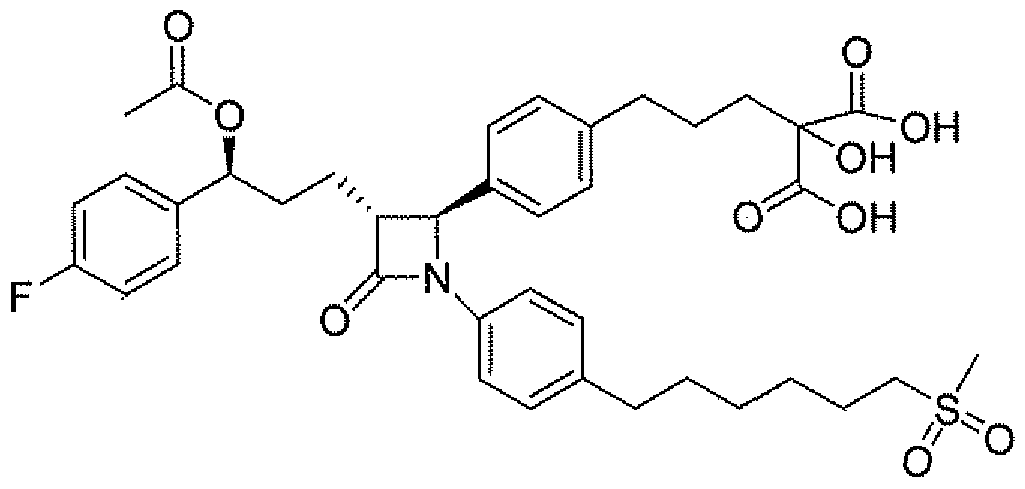
The acetylene compound (31.8 mg) from Example 50, Step A was dissolved in ethanol (4 ml) and ethyl acetate (4 ml) andlθ% palladium on carbon (10 mg) was added to the ethanol / EtOAc solution. After three vacuum then flush with hydrogen cycles, the ethanol solution was hydrogenated at atmospheric pressure and at room temperature with hydrogen gas contained in a balloon reservoir. The reaction was judged to be essentially over by analytical Ic- ms in about 6 hours. The spent hydrogenation catalyst was removed by filtering through a 0.45- micron Acrodisk syringe filter and the filtrates obtained concentrated down to leave a yellow colored oil, the hydrogenated product. The crude hydrogenated material was taken on to the deprotection described in Step C immediately below, mlz (ES) 763 (M+Na) + > 680 (M- OAc)+.
Step C: Preparation of {3-[4-((2S,3JR)-3-[(35)-3-(4-fluorophenyl)-3-hydroxyρropyl]-l-{4-
[6-(methylsulfonyl)hexyl]phenyl}-4-oxoazetidin-2-yl)phenyl]propyl}(hydroxy)malonic acid,

The sulfone (18mg; 0.0243 mmol) from Example 50, Step B was dissolved in ethanol (1.5 ml) and potassium trimethylsilanoate (10.9 mg; 0.052 mmol). The reaction solution was stirred at room temperature. The deprotection reaction was judged to be essentially complete by analytical lc-ms after 2h. The crude reaction solution was diluted to 2 ml with more ethanol, the solution was filtered through a0.45-micron Acrodisk syringe filter. The filtered solution was purified by reverse phase mass directed lc-ms collecting on m/z = 680.3. The fractions containing the product were concentrated down under reduced pressure to give the hydroxymalonate. 1H-NMR (400 MHz, CD3OD) δ: 1.27-2.15 (complex 16H), 2.53 (t, J =
7.5Hz, 2H), 2.63 (t, J - 7.5Hz5 2H), 2.91 (s, 3H), 3.05 (broad t, J - 8 Hz5 3H)5 4.59 (t, J = 6Hz, IH), 4.78 (d, J = 2 Hz, IH), 6.99 - 7.33 (complex, 12H). miz (ES) 720 (M+Na) +, 680 (M-OH)+.
Employing procedures similar to those described in Example 50 above, the following compounds in Table 5 were prepared from the appropriate starting materials
Table 5:
Example # STRUCTURE mfz (ES)

EXAMPLE 52
{3-[4-((2^3^>3-[(35)-3-(4-fluorophenyl)-3-hydroxypropyl]-l-{4-[3-hydroxy-4-
(methylsulfonyl)butyl]phenyl } -4-oxoazetidin-2-yl)phenyl]propyl } malonic acid

OH
O- TBS
A solution of {[/ert-butyl(dimethyl)silyl]oxy}acetaldehyde (2.5g; 14.3 mmol) in anhydrous THF (45 ml) was cooled and stirred at O0C to which 0.5 M ethynyϊmagnesium bromide (31.6ml; 15.8 mmol) in THF was added over 10 minutes. The reaction mixture was stirred and maintained at O0C for 0.25h then quenched with 5% aqueous citric acid (-10 ml), stirred for 5 minutes and partitioned with diethyl ether (2 x 25 ml). The ethereal extracts were combined and dried over anhydrous MgSO4 powder and filtered. The light yellow colored filtrate was concentrated down under reduced pressure and the yellow oil residue obtained after evaporation was purified by column chromatography on a Biotage SPl on a 4OM Flash cartridge using a ethyl acetate and hexanes gradient 5% rising to 25%. The alcohol product was isolated
as a clear oil. 1H-NMR (400 MHz, CDCl3) 5: 0.12 (s, 6H), 0.93 (s, 9H), 2.44 (d, J = 2.5Hz5IH), 2.61 (broad s, IH), 3.68 (dd, J - 10 & 7 Hz, IH), 3.81 (dd, J = 10 & 4Hz, IH), 4.41 (ddd> J = 7, 4 & 2.5 Hz, IH).
Step B: Preparation of {[2-(benzyloxy)but~3-yn4-yl]oxy}(før^butyl)dimethylsilane.

A solution of the alcohol (2.25g; 11.230 mmol) from Example 52, Step A in THF (10 ml) was stirred at O0C under a nitrogen atmosphere. Powdered 50% sodium hydride dispersion in oil (593 mg; 12.353 mmol) was gradually added followed with benzyl bromide (1.54 ml; 12.915 mmol). The reaction mixture was stirred 0.5h at O0C and then warmed quickly to room temperature and stirred for 2.5h. By tic, the reaction was essentially complete after this time. The reaction was quenched with 5%-aqueous citric acid (5 ml) and brine (5ml) then extracted with diethyl ether (3 x 25ml). The ethereal extracts were combined and dried over anhydrous MgSO4 powder, filtered and the filtrates concentrated under reduced pressure on a rotary evaporator to leave a yellow mobile liquid. This crude product was purified by silica gel chromatography using an eluant of EtOAc :Hexanes (1 :4 v/v). 1H-NMR (400 MHz, CDCl3) δ: 0.08 (s, 6H), 0.91 (s, 9H), 2.46 (d, J - 2 Hz, IH), 3.82 (dq, J - 7.5, 10.5 Hz, 2H), 4.18 (complex, IH), 4.59 (d, J - 12Hz5 IH), 4.84 (d, J = 12 Hz, IH), 7.28-7.43 (complex, 5H).
Preparation of dibenzyl [3-(4-{(2S,3i?)-3-[(3S>3-(acetyloxy)-3-(4- fluorophenyl)propyl]- 1 -[4-(3-(benzyloxy)-4- { [/e^-butyi(dimethyl)silyl] oxy } but- l-yn-l-yl)phenyl]-4-oxoazetidin-2-yl}phenyl)prop-2-yn-l-yl]malonate.

The triflate (365 mg; 0.412 mmol) from Example 2, Step C was reacted with the acetylene (179.5 mg; 0.618 mmol) from Example 52, Step B above using tetrabutylammonium iodide (7.6 mg; 0.0206 mmol) tetrakis(triρhenylphosphine)palϊadium(0) (23.8 mg; 0.021 mmol) and copper(I) iodide (3.9 mg; 0.021 mmol) were mixed together in dry DMF (1.5 ml) and triethylamine (1 ml) in a similar manner to the instruction in Example 2 Step C for 26 hours,
The volaliles were removed from the reaction products under reduced pressure to leave a dark oil residue. The black oil thus obtained was purified by preparative lie on silica gel plates eluted with EtOAc and hexanes (2:3 v/v) to obtain the title compound, mlz (ES) 1048 (M+Na) +, 966 (M- OAc)+.
Step D: Preparation of dibenzyl {3-[4-((2S,3Λ)-3-[(35)-3-(acetyloxy)-3-(4- fluorophenyl)ρropyl] - 1 - {4- [3-(benzyloxy)-4-hydroxybut- 1 -yn- 1 -yϊ]phenyl } -4- oxoazetidin-2-yl)phenyl]prop-2-yn- 1 -yl}malonate.

THF (1.5 ml) was stirred at room temperature and to this solution IM tetrabutylammonium fluoride (TBAF) in THF (175 μl; 0.175 mmol) was added. The reaction was stirred for 0,5h at room temperature, then the reaction was quenched with water (2 ml) and partitioned with diethyl ether (2 x 2ml). The ethereal extracts were combined and dried over anhydrous Na2SO4 and concentrated under reduced pressure. The oil that remained after evaporation was purified by preparative tic on silica gel plates eluted with EtOAc and hexanes (2:3 v/v). mlz (ES) 852 (M- OAc)+.
Preparation of dibenzyl (3-{4-[(2S',3Λ)-3-[(35)-3-(acelyIoxy)-3-(4- fl uorophenyl)propy 1 ] - 1 -(4- { 3 -(benzyloxy)-4- [(methylsulfonyl)oxy] but- 1 -yn- 1 - y 1 } pheny l)-4-oxoazetidin-2-y l]phenyl } ρrop-2-yn- 1 -yl)malonate .

A stirred solution of the bis-acetylene alcohol (45mg; 0.049 mmol) from Step D in anhydrous CH2CI2 (2 ml) was cooled to -4O0C in a dry ice/ acetonitrile cold bath.
Triethylamine (13.8 μl; 0.0987 mmol) was added drop by drop and this was followed by methanesulfonyl chloride (7.3 μl; 0.0987 mmol). The reaction was stirred for 0.25 h at around -
4O0C, then warmed to room temperature; the reaction mixture was maintained for 15 minutes. The reaction mixture was quenched with water (2.5 ml) and partitioned with CH2CI2 (3 x 2.5 ml). The CH2CI2 extracts were combined and dried over anhydrous MgSO4 powder, filtered and the filtrates concentrated down under reduced pressure to leave an orange colored oil. The oil was purified by preparative tic on silica gel plates eluted with EtOAc and hexanes (2:3 v/v) to afford the title compound, miz (ES) 930 (M- OAc)+.
Preparation of (3-{4-[(25s3Λ)-3-[(35)-3-(acetyloxy)-3-(4-fluorophenyl)propyl]-l- (4- { 3 -hydroxy-4- [(methylsulfonyl)oxy]butyl } phenyl)-4~oxoazetidin-2~ yl]phenyl}propyl)malonic acid.

A solution of the mesylate (40mg) from Example 52, Step E above was dissolved in a solvent mixture of ethanol (3 ml) and EtOAc (3 ml) and was hydrogenated for 3h over 10% palladium on carbon (10 mg) in a similar manner to that described in Example 2, Step E. The crude reaction mixture was filtered through a 0.45 -micron Acrodisk syringe filter and concentrated down to give the crude product.
Step G: Preparation of {3-[4-((25,3i?)-3-[(35)-3-(acetyloxy)-3-(4-fluorophenyl)proρyl]-l- {4-[3 -hydroxy-4~(methylthio)butyl]phenyl } -4-oxoazetidin-2- yl)phenyl]propyl}malonic acid.

The crude mesylate from the hydrogenation Example 52, Step F was dissolved in a solvent mixture of CH2C12 (2 ml) and isopropanol (0,25 ml) and sodium thiomethoxide (7.6 mg) was added followed by two drops of water from a Pasteur pipette. The reaction mixture was stirred for 5h at room temperature under a nitrogen atmosphere. The progress of the reaction was
monitored by analytical lc-ms. The volatiles were removed under reduced pressure and the crude product was obtained. m/z (ES) 620 (M- OAc)+.
Step H: Preparation of {3-[4-((2S,3φ-3-[(3S)-3-(acetyloxy)-3-(4-fluorophenyl)propyl]-l -
{ 4- [3 -hydroxy-4-(methy lsulfony l)butyl] phenyl } -4-oxoazetidin-2- yϊ)phenyl]propyl}malonic acid.

The crude sulfide compound from Example 52, Step G in ethanol was treated with 8 drops of peracetic acid from a Pasteur pipette and stirred at room temperature for 3 hours after which time the product was observed in analytical lc-ms spectrum. The reaction was quenched with aqueous sodium sulfite solution (-0.25 ml), stirred for a few minutes, then the volatiles removed with an active nitrogen gas stream to leave a pasty solid. This material was dissolved in ImI ethanol and the material filtered through a 0.45 m Acrodisk syringe filter to provide the crude material, mlz (ES) 652 (M- OAc)+.
Step I: Preparation of {3-[4~((25's3JR)-3-[(3S)-3-(4-fluorophenyl)-3-hydroxypropyl]-l-{4-
[3-hydroxy-4-(methyIsulfonyl)butyl]phenyl}-4-oxoazetidin-2- yl)phenyl] propyl }malonic acid.

The crude product (6 mg) from Example 52, Step H was deprotected as described in Example 2, Step F. After purification by mass directed reverse phase prep lc-ms 2mg of the desired product was obtained. 1H-NMR (400 MHz, CD3OD) δ: 1.60-1.97 (complex, 10H), 2.65 (complex, 4H), 3.00 (s, 3H), 3.03-3.14 (complex, 2H), 3.25 (complex, IH), 3.31 (obscured t, IH), 4.06 (broad m, IH), 4.59 (t, J = 6 Hz, IH), 4.79 (d, J = 2Hz, IH), 6.99-7.33 (complex, 12H). mlz (ES) 692 (M+Na)+, 652 (M- OH)+.
EXAMPLE 53
{3-[4-((25's3Λ)-3-[(3^)-3-(4-fluorophenyl)-3-hydroxypropyl]- 1 - {4-[6- (methylsulfonyOhexylJphenylj^-oxoazetidirt-l-yO-S-hydroxypheny^propyljmalonic acid.

Step A: Preparation of 2-hydroxy-4-iodobenzaldehyde.

The reaction was carried out in a large flask equipped with a stirrer and reflux condenser. A solution of 3-Iodophenol (1Og; 45,4 mmol) in acetonitrile (160 ml) was cooled in an ice-water bath and magnesium chloride (12.8g; 134.4 mmol) was added to the phenol in small batches over 10 minutes to give a pink cloudy solution. Triethylamine (50.6 ml; 363.2 mmol) was added to the acetonitrile solution gradually over 5 minutes keeping the solution at ~0 0C and this was followed with the addition of paraformaldehyde (19.2g; 636 mmol) in small 0.5-lg batches over 10 minutes. Once the addition of the paraformaldehyde was complete the reaction vessel with the reflux condenser in place was removed from the cooling bath and warmed quickly to 80 0C (bath temperature). After 0.25 h of heating the solids started to dissolve and around 1 h of heating the reaction solution was almost a homogeneous golden yellow color which slowly started to turn to an orange color. The reaction was kept at 80 0C for 18.5 hours; the reaction had become a deep orange in color. The reaction mixture was cooled to room temperature and quenched with saturated aqueous ammonium chloride solution (350 ml). The aqueous acetonitrile mixture was shaken with EtOAc (150 ml) and transferred into a separatory funnel. The layers were separated and the aqueous layer extracted with EtOAc (2 x 150 ml). The three EtOAc layers were combined and washed successively with saturated aqueous NaHCO3 (2 x 150 ml), IN hydrochloric acid (2 x 150 ml) and lastly with saturated brine (2 x 100 ml). The orange colored solution with the crude product was dried over anhydrous Na2SO4 powder, filtered through a Celite® pad and the filtrate concentrated under reduced pressure to leave an orange colored oil that slowly solidified on standing. The solid was purified in 3 batches on a Biotage SPl system on 4OM Flash silica cartridge using a gradient of EtOAc and hexanes 0->2% (350 ml), 2->15% (1250 ml) 15->20% (350 ml). The aldehyde fractions were concentrated down to leave an off-white feathery solid. This solid was crystallized from hexanes
to give 6g of the pure aldehyde. The mother liqours were purified on silica gel preparative tic plates eluted with EtOAc and hexanes (7:93 v/v) from which a further 300 of the desired aldehyde was recovered (Total 6.3g). There was also -800 mg of the isomeric aldehyde obtained from the purification. The NMR data for 2-hydroxy-4-iodobenzaldehyde is as follows :- 1H-NMR (400 MHz, CDCl3) δ: 7.25 (d, J = 8 Hz, IHO, 7.42 (dd, J = 8 & 1.5 Hz, IH), 7.46 (d, J - 1.5Hz, IH), 9.87 (s, IH)5 11.04 (s, IH).
The NMR data for the isomeric 2-hydroxy-6-iodobenzaldehyde was:- 1H-NMR (400 MHz, CDCl3) δ: 6.99 (d, J = 8 Hz, IH), 7.15 (t, J = 8 Hz, IH)3 7.50 (d, J = 8 Hz, IH), 10.09 (s, IH), 12.07 (s, IH).
Preparation of 2 -(Allyloxy)-4-iodobenzaldehyde

AUyI iodide (2.32 ml; 25.4 mmol) was added over 5 minutes drop by drop to a solution of 2-hydroxy-4-iodobenzaldehyde (6g; 24.2 mmol) from Example 16 Step A above and l,8-diazabicyclo[5.4.0]undec-7-ene (DBU) (3.83 ml; 25.4 mmol) in dry acetonitrile (30 ml). The resulting reaction mixture was heated to 65 0C and maintained at that temperature for 3.5 hours. The volatiles were then removed under reduced pressure on a rotary evaporator to leave a golden yellow oil. The oil was carefully partitioned between 2N-hydrochloric acid (100 ml) and diethyl ether (3 x 100 ml). The ethereal extracts were combined and then dried over anhydrous MgSO4 powder, filtered and the ethereal filtrates concentrated under reduced pressure to obtain an off white solid. The solid was triturated with a small volume of hexanes and ether (9:1 v/v). The solid material was filtered off at the pump on a filter paper in a Buchner funnel, washed with a small amount of hexanes and ether (9: 1 v/v) and dried to constant weight. 2 -(Allyloxy)-4- iodobenzaldehyde was isolated as an off white solid that had the following NMR spectrum. 1H- NMR (400 MHz, CDCl3) δ: 4.66 (dt, J - 5 & 1.5 Hz, 2H), 5.38 (dq, J = 1 1.5 & 1.5 Hz, IH), 5.47 (dq, J = 17.5, 1.5 Hz, IH), 6.08 (ddt, J = 17.5 & 11.5 & 5 Hz, IH), 7.37(d; J =1 Hz, IH), 7.43 (d, J = 8 Hz, IH), 7.54 ( d, J = 8 Hz5 IH), 10.46 (s, IH).
Step C: Preparation of iV~{(lir)-[2-(allyloxy)-4-iodophenyl]methylene}-4-bromoaniline.

The aldehyde, (as described in Step B above; Ig; 3,471 mmol) was dissolved in dry isopropanol (25 ml), stirred and warmed Io 65 0C and to the resulting clear pale yellow solution 4-bromo-anilme (597 mg; 3.471 mmol) was added gradually over 5 minutes. The resulting solution was stirred for 3h at 65 0C. A bright yellow precipitate began to form in the reaction vessel after -0.5 hours after the addition of the aniline. After 3 hours the reaction was concentrated to dryness on a rotary evaporator under reduced pressure to afford a bright yellow solid. The solid residue was triturated with -10 ml of hexanes and ether (1 :4 v/v). The yellow solid was filtered off at the pump on a filter paper in a Buchner funnel and the imine was dried. 1H-NMR (400 MHz, D6-DMSO) θ: 4.72 (dt, J - 5 & 1.5 Hz, 2H), 5.28 (dq, J = 10.5 & 1.5 Hz, IH), 5.40 (dq, J =16.5 Hz & 1.5 Hz, IH), 6.06 (ddd} J = 16.5, 10.5 & 5 Hz, IH)5 7.17 (d, J = 8.5 Hz, 2H)5 7.44 (dd, J = 8.5 Hz, 1.5 Hz, IH), 7.51 (d, J = 1.5 Hz, IH), 7.56 (d, J = 8.5 Hz, 2H), 7.30 (d, J - 8.5 Hz, IH), 8.77 (s, IH).
Step D: Preparation of (4i?)-3-[(5.y)-5-{[/er/-butyI(dimethyl)silyl]oxy}-5-(4~fluorophenyl)- -l,3-oxazolidin-2-one.

A solution comprising (4J?)-3-[(55)-5-(4-fluorophenyl)-5-hydroxypentanoyl]-4- phenyl-l,3-oxazolidin-2-one (2g; 5.596 mmol) and triethyl amine (975 μl; 6.995 mmol) in anhydrous CH2C12 (20 ml) was stirred and cooled to 0 0C under a nitrogen atmosphere, t- Butyldimethylsilyl trifiuoromethanesulfonate (1.4 ml; 6.156 mmol) was added drop by drop over 5 minutes to the CH2C12 solution and the resulting reaction mixture stirred at 0 0C for 0.5 hour then Ih at room temperature. The reaction was quenched with saturated aqueous sodium bicarbonate solution (25 ml) and the layers separated in a funnel. The CH2C12 layer was diluted with diethyl ether (50 ml) and washed successively with 2M-hydrochloric acid (25 ml), water (25 ml) and brine (25 ml). The organic phase was dried over anhydrous MgSO4 powder, filtered and
the filtrate concentrated under reduced pressure on a rotary evaporator. The yellow oil residue obtained on evaporation was purified on a Biotage SPl system using a 4OM silica gel cartridge using a EtOAc and hexanes gradient to afford the title compound, m/z (ES) 472 (M+H)+
Step E: Preparation of (4Λ)-3-[(2/?,55)-2-{(5)-[2-(allyloxy)-4-iodophenyl][(4- bromophenyl)amino]methyl}-5-{[førϊ-butyl(dimethyl)silyl]oxy}-5-(4- fluorophenyl)pentanoyl]-4-phenyl- 1 ,3-oxazolidin-2-one.

A stirred solution of the imine (1.5g; 3.393 mmol) from Step C above and the TBS ether (1.28g; 2.714 mmol) from Step D above in anhydrous CH2Cl2 (10 ml) was stirred at O0C under nitrogen atmosphere, to which diisopropylethylamine (0.71 nil; 4.072 mmol) was added. The resulting solution was stirred for 0.25h at O0C then the reaction vessel transferred into a cryobath set at -4O0C and allowed to equilibrate at the lower temperature for 15 minutes. Titanium(IV) chloride (372 μl; 3.393 mmol) was added drop by drop to the cold orange solution. The resulting red solution was stirred at -4O0C for Ih then a solution of acetic acid (775 μl; 13.572 mmol) in dry CH2C12 (10 ml) was dripped into the reaction over 0.5h, then the reaction stirred for a further 1 ,5h at -4O0C. The reaction vessel was removed from the cryobath and the reaction immediately quenched with cold 2M-hydrochloric acid (25 ml), stirred and allowed to warm to room temperature. Ethyl acetate (50 ml) was added and the layers were separated and the EtOAc layer was washed successively with saturated aqueous NaHCO3 (50ml), 10% aqueous NaHSO3 (50 ml), water (50 ml) and with more aqueous NaHCO3 (50ml). The organic phase was dried over anhydrous MgS 04 powder, filtered and the orange colored filtrate that was obtained concentrated under reduced pressure on a rotary evaporator to give an orange colored oil. Purification of the orange oil was effected on a Biotage SPl system using a 4OM silica gel cartridge using a EtOAc and hexanes gradient, m/z (ES) 912 and 914 (M+H)÷
Step F: Preparation of (3i?,4S)-4-[2-(alϊyloxy)-4-iodophenyl]-l ~(4-bromoρhenyl)~3-[(3S>
3 - { [tert-butyl(dimethyl)silyl] oxy } -3 -(4-fluorophenyl)propyl] azetidin-2-one

N,O-Bis(tπmethylsilyl)acetamide (1.6 ml) was added to a solution of the oxazolidinone product (1685 mg; 1.8461 mmol) from Step E above in anhydrous methyl t-butyl ether MTBE) (3.5 ml). This solution stirred for 0.25 hour at room temperature under a nitrogen atmosphere then tetrabutylammonium fluoride trihydrate (29.1 mg; 0.0923 mmol) was quickly weighed and added to the MTBE solution. The reaction mixture was allowed to stir at room temperature under a nitrogen atmosphere overnight. The reaction was checked by lc-ms for product formation. The reaction was quenched by the addition of water (10 ml) and then partitioned with EtOAc (2 x 10 ml). The EtOAc extracts were combined and dried over anhydrous Na2SO4 powder. The drying agent was filtered off and the filtrate thus obtained concentrated under reduced pressure on a rotary evaporator to leave an orange colored oil, Purification of the oil on a Biotage SPl system using a 4OM silica gel cartridge using a EtOAc and hexanes gradient to afford the product. 1H-NMR (400 MHz, CDC13) δ: -0.16 (s, 3H), 0.02 (s, 3H), 0.88(s, 9H), 1.88 (complex, 4H), 2.99 (dt, J= 8, 2.5Hz, IH), 4.55 (complex, 2H), 4.66 (t, J = 5.5Hz, IH), 4.95 (d, J=2 Hz, IH), 5.32 (dd, J - 10.5 & 1 Hz, IH), 5.38 (dd, J = 17.5 & 1 Hz, IH), 5.96 (ddt J = 17.5, 10.5, 5 Hz, IH), 6.84 (d, J=8Hz, 2H), 6,99 (t, J = 8.5 Hz, 2H), 7.14 (d, J = 9 Hz, 2H), 7.22 (s, IH), 7.24 (m, 2H), 7.37 (d, J = 9Hz, 2H). mlz (ES) 750 and 752 (M+H)+
Step G: Preparation of dibenzyl [3-(3-(allyloxy)-4-{(2S,3Λ)-l-(4-)-3-[(35)-3-{[fert- butyl(dimethyI)silyl]oxy}-3-(4-fluorophenyl)propyl]-4-oxoazetidin-2- yl}ρhenyl)prop-2-yn-l-ylJmalonate.

The beta-lactam (365mg; 0.4863 mmol) from Step F above, dibenzyl ρrop-2-yn-l- ylmalonate (200 mg; 0.6079 mmol) as described in Example 53, Step A were dissolved in anhydrous CH2Cl2 (3 ml). Tetrakis(triphenylphosphine) palladium(O) (56.2 mg; 0.0486 mmol) and copper(I) iodide (9.3 mg; 0.0486 mmol) were added then triethylamine (3 ml) was added. A
slow stream of nitrogen gas was bubbled through the solution for 3 minutes, the reaction mixture was sealed under a nitrogen atmosphere and the stirred at room temperature for 4 hours by which time the product had formed as judged by analytical lc-ms. The volatiles were stripped off on a rotary evaporator under reduced pressure to the yellow oil residue that remained purified by preparative tic on silica gel plates that were eluted with hexanes and EtOAc (3:1 v/v). The band Rf -0.35 was removed and the product was isolated off the silica, mlz (ES) 772 and 774 (M- OTBS)+
Step H: Preparation of dibenzyl {3-[4-((25,3i?)-3-[(35)-3-{[fert-butyl(dimethyl)silyl]oxy}- 3 -(4-fiuorophenyl)propyl] - 1 - { 4- [6-(methylsulfonyl)hex- 1 -yn- 1 -yljphenyl } -4- oxoazetidin-2-yl)-3-hydroxyphenyl]prop-2-yn- 1 -yljmalonate

A solution of the beta-lactam bromide (135mg; 0.1376 mmol) from Step G above and 6-(methylsulfonyl)hex-l-yne ( 41 mg; 0.2564 mmol), tetrakis(triphenylphosphine)- palladium(O) (14.8 mg; 0.0128 mmol), tetrabutylammonium iodide (4.7 mg; 0. 0128 mmol) and copper(I) iodide (2.4 mg; 0.0128 mmol) were mixed together in dry DMF (1 ml) and triethylamine (1 ml). A slow stream of nitrogen gas was bubbled through the solution for 5 minutes, the reaction mixture was sealed under a nitrogen atmosphere and the reaction placed in a heating bath (T = 70 0C) for 10.5 hours then set aside to cool to room temperature. The volatiles were removed under reduced pressure to leave a dark brown oil. The oil was purified on silica gel preparative tic plates eluted with EtOAc and Hexanes (1 :2 v/v). The band just above the origin to Rf = 0.15 that fluoresced under short wavelength u.v. light was removed from the plate and the product isolated from the silica gel. mlz (ES) 852 (M-OTBS)+
Step I: Preparation of dibenzyl {3-[4~((2S,3i?)-3~[(35)-3-(4-fiuorophenyl)-3- hydroxypropyl] - 1 - {4- [6-(methylsulfonyl)hex- 1 -yn- 1 -yl]phenyl } -4-oxoazetidin-2- yl)-3-hydroxyphenyl]prop-2-yn- 1 -yl} malonate.

Step J: Preparation of {3-[4-((25;3i?)-3-[(35)-3-(4-fluorophenyl)-3-hydroxypropyl]-l -{4-
[6-(rnethylsulfonyl)hexyl]phenyl}-4-oxoazetidin-2-yi)-3- hydroxyphenyl] propyl } malonic acid.

A solution of the bis-acetylene (6.5 mg) compound from Step I above was combined with 10% palladium on carbon (2.5 mg) in ethanol (1.5 ml). This reaction was subjected to three vacuum then flush with hydrogen cycles and the sample was hydrogenated at room temperature and at atmospheric pressure for 0.5h. The reaction was judged to be essentially complete by analytical lc-ms. The spent catalyst was removed from the reaction solution by filtration through a 0.45-micron Acrodisk syringe filter. The filtrates were concentrated down to give a colorless clear glass-like solid that was the desired product that had the following spectroscopic data. 1H-NMR (500 MHz, CDCl3) δ: 1.34 (complex, 2H), 1.47 (complex, 2H), 1.62 (complex, 4H), 1.77 (complex 2H), 1.90 (comp, 6H), 2.56 (q, J=8.5Hz, 4H)S 2.93 (ss 3H), 3.08 (t, J - 8Hz, IH), 3.14(broad t, J - 6Hz, IH), 3.32 (obsc, IH), 4.61 (t, J = 4.5 Hz, IH), 5.07 (d, J = 2Hz, IH), 6.64 (d, J = 8 Hz, IH), 6.70 (s, IH), 7.00-7.10 (complex, 5H), 7.19 (d, J = 8 Hz, 2H), 7.33 (t, J = 8 Hz, 2H). m/z (ES) 680 (M-OH) +
EXAMPLE 54
{ 3-[4-((21S,3/f)-3-[(35)-3-(4-fiuorophenyl)-3-hydroxyρropyl]-4-oxo- 1 - {4-[4-(l H- 1 ,2,4-triazol- 1 ■ ylJbutyljphenyllazetidin^-yO-S-hydroxyphenyljpropylJmalonic acid.

Step A: Preparation of dibenzyl [3-(4-{(2S,3RyH^-^omoφ^ny\)-3-[(3S)'3~{[tert- butyl(dimethyl)silyl]oxy}-3-(4-fluorophenyl)propyl]-4-oxoazetidin-2-yl}-3- hydroxyphenyl)prop-2-yn- 1 -yljmalonate.

The beta-lactam (600mg; 0.7994 mmol) from Example 53, Step F, dibenzyl prop- 2-yn-l-ylmalonate (515 mg; 1.5988 mmol) Example 53, Step A were dissolved in anhydrous CH2Cl2 (2.5 ml). Tetrakis(triphenylphosphine)-palladium(0) (92.4 mg; 0.0799 mmol), tetrabutylammonium iodide (29.5 mg; 0.0799 mmol) and copper(I) iodide (15.2 mg; 0.0799 mmol) were added then triethylamine (3 ml). A slow stream of nitrogen gas was bubbled through the solution for 3 minutes, the reaction mixture was sealed under a nitrogen atmosphere and then stirred at room temperature for 18 hours by which time the product had formed as judged by analytical lc-ms. The volatiles were stripped off on a rotary evaporator under reduced pressure. The yellow oil residue that remained was purified by preparative tic on silica gel plates that were eluted with hexanes and EtOAc (3:1 v/v). The silica gel with product were removed and the product isolated off the silica to give three thick gums. The band at the top of the preparative tic plate that fluoresced under ultra-violet and had a Rf ~ 0.75 was dibenzyl [3-(3-(allyloxy)-4- {(2S,3R)- 1 -(4- { 5-(benzyloxy)-4-[(benzyloxy)carbonyl]-5-oxopent- 1 -yn- 1 -yl } phenyl)-3-[(3S)-3- {[terf-butyl(dimethyl)silyl]oxy}-3-(4-fluorophenyl)propyl]-4-oxoazetidin-2-yl}phenyl)prop-2- yn-l-yl]malonate (150 mg), the second band (Rf ~ 0.55) was the desired dibenzyl [3-(4-((25,3^)- l-(4-bromophenyl)-3-[(3S)-3-{[tert-butyl(dimethyl)silyl]oxy}-3-(4-fluorophenyl)proρyl]-4- oxoazetidin-2-yl}-3-hydroxyphenyl)prop-2-yn-l-yl]malonate (236 mg). Dibenzyl [3-(4- {(2S,3JR)-l-(4-bromophenyl)-3-[(35)-3-{[^r/-butyl(dimeuiyl)silyl]oxy}-3-(4- fluorophenyl)proρyl] -4-oxoazetidin-2-yl} -3-hydroxyphenyl)proρ-2-yn- 1 -yljmalonate was characterized by the following peak in the mass spectrum, m/z (ES) 772 and 774 (M-OTBS)+ ; 904 and 906 (M+H) +
Preparation of dibenzyl {3-[4-((25,3Λ)-3-[(35)-3-{[tørf-butyl(dimethyl)silyl]oxy}- 3 -(4-fluorophenyl)propyl] -4-oxo- 1 - { 4- [4-( 1 H- 1 ,2,4-tr iazol- 1 -yl)but- 1 -yn- 1 - yl]phenyl}azetidin-2-yl)-3-hydroxyphenyl]prop-2-yn-l-yl}malonate.

A solution of the beta-lactam bromide (75mg; 0.0829 mmol) from Step A above and l-but-3-yn-l-yl-l//-l,2,4-triazole (24 mg; 0.1984 mmol), tetrakis(triphenyl- phosphine)palladium(O) (9.2 mg; 0.0079 mmol), tetrabutylammonium iodide (1.5 mg; 0.0079 mmol) and copρer(I) iodide (1.5 mg; 0.0079 mmol) were mixed together in dry DMF (1.5 ml) and triethylamine (2 ml). A slow stream of nitrogen gas was bubbled through the solution for 5 minutes, the reaction mixture was sealed under a nitrogen atmosphere and the reaction placed in a heating bath (T = 70 0C) for 7 hours then set aside to cool to room temperature. The volatiles were removed under reduced pressure and the residues were diluted with acetonitrile to 4 ml. The solution that was formed was filtered through a 0,45 -micron Acrodϊsk syringe filter and the filtrates purified by reverse phase mass directed lc-ms collecting m/z = 945.3. The product containing fractions obtained after purification were concentrated down under reduced pressure to afford 25mg of an oil. The oil contained the desired silyl ether along with some desilyated compound, m/z (ES) 945 (M+H)+
Step C: Preparation of dibenzyl {3-[4-((2(S,3i?)-3-[(3S)-3-(4-fluorophenyl)-3- hydroxypropyl]-4-oxo-l - {4-[4-( IH- 1 ,2,4-triazol- 1 -yl)but- 1 -yn-1 - y l]phenyl } azetidin-2-yl)-3 -hydroxyphenyl] prop-2-yn~ 1 -y 1 } malonate .

A solution of the silyl ether (10,5 mg) from Step B above was dissolved in acetonitrile (1.5 ml) and stirred at room temperature to which 25% aqueous solution of trifluoroacetic acid (from 3ml water to 1 ml TFA)(0.5 ml) added. The reaction mixture was stirred at room temperature and the progress of the reaction was periodically monitored by
analytical lc-ms. After 3 h the reaction was judged to be complete and the reaction mixture was concentrated to dryness under reduced pressure on a rotary evaporator with a vacuum pump. A yellow gum was obtained, m/z (ES) 831 (M+H)+
Step D: Preparation of {3-[4-((25,3i?)-3-[(35)-3-(4-fluorophenyl)-3-]-4-oxo-l-{4-[4-(lH- l,2,4-triazol-l-yl)butyl]phenyl}azetidin-2-yl)-3-hydroxyphenyl]propyl}malonic acid.

A solution of the bis-acetylene (7.5 mg) compound from Step C above was combined with 10% palladium on carbon (3.5 mg) in ethanol (1.75 ml). This reaction was subjected to three vacuum then flush with hydrogen cycles and the sample was hydrogenate at room temperature and at atmospheric pressure for 2.5h. The reaction was judged to be essentially complete by analytical lc-ms. The spent catalyst was removed from the reaction solution by filtration through a 0.45-micron Acrodisk syringe filter. The filtrates were concentrated down to give a yellow glass-like solid. This solid was dissolved in acetonitrile (2 ml) and the acetonitrile solution was purified by reverse phase mass directed lc-ms collecting m/z = 640.3 and 658,3. The product containing fractions that were obtained from the separation were concentrated down to give the desired product with the following spectroscopic data. IH-NMR (500 MHz5 CD3OD) δ: 1.55 (complex, 2H), 1.65 (complex, 2H)5 1.80-2.10 (complex, 8H), 2.57 (q, J - 3.5 Hz, 2H), 3.14 (broad t IH), 3.32 (obsc, IH), 4.25 (t, J = 7Hz, IH), 4.61 (t, J = 5.5 Hz5 IH), 5.06 (broad s, IH), 6.63 (d, J = 7.5Hz, IH), 6.69 (s, IH), 6.98-7.13 (complex, 5H), 7.19 (d, J - 7.5 Hz, 2H), 7.32 (broad t, J - 6Hz, 2H), 8.12 (broad s, IH), 8.66 (broad s, IH). m/z (ES) 641 (M-OH)+; 659 (M + H)+
The following analogs were also made according to the method described in Example 53.
Table 7: Example # Structure m/z (ES)


Compounds of this invention were determined to inhibit cholesterol absorption employing the Cholesterol Absorption Assay in Rat, below. The assay involves comparing a test compound to ezetimibe with respect to their ability to inhibit cholesterol absorption in rat or mice. Both ezetimibe and the tested compounds of this invention inhibited cholesterol absorption by >90% at the highest dose tested. Compounds of this inventions that were tested had an ID 50 < lmg/kg.
Cholesterol Absorption Assay in Rats (RICA Assay): CD male rats (n = 5 /group), aged 5 weeks, were dosed orally with 0.5 ml 0.25 % methyl cellulose solution with or without test compound or ezetimibe (0.0003 to 1 mg/kg). 0.5 to 16 hrs later all of the rats were dosed orally with 0.5 ml INTRALIPID® containing 5 μCi [3H] -cholesterol per rat. Five hours later, the animals were euthanized, and liver and blood were collected. Cholesterol counts in liver and plasma were determined, and percent inhibition of cholesterol absorption was calculated.
Below is a list of some of the compounds described in the Experimental section with the testing data from the RICA assa .


While the invention has been described and illustrated with reference to certain particular embodiments thereof, those skilled in the art will appreciate that various changes, modifications and substitutions can be made therein without departing from the spirit and scope of the invention. For example, effective dosages other than the particular dosages as set forth herein above may be applicable as a consequence of variations in the responsiveness of the mammal being treated for any of the indications for the active agents used in the instant invention as indicated above. Likewise, the specific pharmacological responses observed may vary according to and depending upon the particular active compound selected or whether there are present pharmaceutical carriers, as well as the type of formulation employed, and such expected variations or differences in the results are contemplated in accordance with the objects and practices of the present invention. It is intended, therefore, that the invention be defined by the scope of the claims which follow and that such claims be interpreted as broadly as is reasonable.
Claims
WHAT IS CLAIMED IS:
A compound of Formula I:

Wherein
Ar is aryl, optionally substituted with one to three substituents selected from halo or Cj-Cg alkyl;
R is independently selected from H or unsubstituted or substituted C j -C5 alkyl;
Ra is independently selected from H, unsubstituted or substituted Cj-Cg alkyl, oxo, -(CR2XORlS, -C(O)ORl 2} -OC(O)Rl 2, -OC(O)ORl 2, -OC(O)NR72, unsubstituted or substituted aryl;
Rb is independently selected from H, unsubstituted or substituted Cj-Cg alkyl, -(CR2XORlS5 -C(O)ORlS, Or unsubstituted or substituted aryl;
Rl and R2 are independently selected from H or -OR;
R4 is -S(O)2R6, Cj-Cg alkyl, -OR, aryl, heleroaryl, ~NR?2, -C(O)OR, where Ci-Cg alkyl, aryl or heteroaryl is optionally substituted with -CONRV2, -(CRa2)pS(O)2R6;
R6 is independently unsubstituted or substituted Cj-Cg alkyl or unsubstituted or substituted aryl;
R7 is independently H, unsubstituted or substituted Cj-Cg alkyl or unsubstituted or substituted aryl;
R8 is independently (CRb2)m, C2-Cg alkenyl, or C2-Cg alkynyl; R9 is independently (CR^)n, C2-Cg alkenyl, or C2-Cg alkynyl;
Rl2 is independently selected from H or unsubstituted or substituted Q-Cg alkyl;
X is a bond, O, NR7, or C(O);
m is O, 1, 2, 3, 4 or 5; n is O, 1, 2, 3, 4, 5 or 6; p is O or 1; q is O, 1, 2, 3 or 4; t is O, 1 , 2, 3 or 4;
or a pharmaceutically acceptable salt thereof.
2. The compound, according to Claim 1 „ of Formula Ia:

Ia
R is independently selected from H or unsubstituted or substituted C^-Cg alkyl;
Ra is independently selected from H, unsubstituted or substituted Cj -Cg alkyl, oxo, -(CR2)t0Rl2, -C(O)ORl 2, -OC(O)Rl 2, -OC(O)OR^, -OC(O)NR72, unsubstituted or substituted aryl;
Rb is independently selected from H, unsubstituted or substituted Cj-Cg alkyl, -(CR2)tORl2, -C(O)ORl2, or unsubstituted or substituted aryl;
Rl and R2 are independently selected from H or OR;
R4 is -S(O)2R6, Ci -Cg alkyl, -OR, aryl, heteroaryl, -NR?2, -C(O)OR, where Ci-Cg alkyl, aryl or heteroaryl is optionally substituted with -CONR72, -(CRa2)pS(O)2R6; Rό is independently unsubstituted or substituted Cj-Cg alkyl or unsubstituted or substituted aryl;
R7 is independently H, unsubstituted or substituted Cj -Cg alkyl or unsubstituted or substituted aryl;
R8 is independently (CRt>2)m, C2"C6 alkenyl, or C2-Cg alkynyl;
R9 is independently (CR&2)n> C2-Cg alkenyl, or C2-Cg alkynyl;
Rl 2 is independently selected from H or unsubstituted or substituted C]-Cg alkyl;
X is a bond, O, NR7, or C(O);
m is O, 1, 2, 3, 4 or 5; n is O, 1, 2, 3, 4, 5 or 6; p is O or 1 ; q is 0, 1, 2, 3 or 4; t is 0 or 1 ;
or a pharmaceutically acceptable salt thereof.
3. The compound, according to Claim 2, of Formula II:

Wherein
R is independently selected from H or unsubstituted or substituted Cj-Cg alkyl;
Ra is independently selected from H, unsubstituted or substituted Cj-Cg alkyl, oxo, -(CR2)tORl2s -C(O)ORl2, unsubstituted or substituted aryl;
Rb is independently selected from H, unsubstituted or substituted C] -C6 alkyl, -(CR2)tORl2, -C(O)ORl2, or unsubstituted or substituted aryl;
Rl and R2 are independently selected from H or OR;
R4 is -S(O)2R6, C1-Cg alkyl, -OR, aryl, heteroaryl, -NR72S -C(O)OR, where C]-C6 alkyl, aryl or heteroaryl is optionally substituted with -CONR^, -(CRa2)pS(O)2R6;
R6 is independently unsubstituted or substituted C] -C6 alkyl or unsubstituted or substituted aryl;
R7 is independently H, unsubstituted or substituted C]-C6 alkyl or unsubstituted or substituted aryl;
Rl 2 is independently selected from H or unsubstituted or substituted C]-C6 alkyl;
X is a bond, Of NR7, or C(O);
m is O, 1, 2, 3, 4 or 5; n is O, 1, 2, 3, 4, 5 or 6; p is O or 1 ; t is 0 or 1 ;
or a pharmaceutically acceptable salt thereof.
4. A compound selected from:


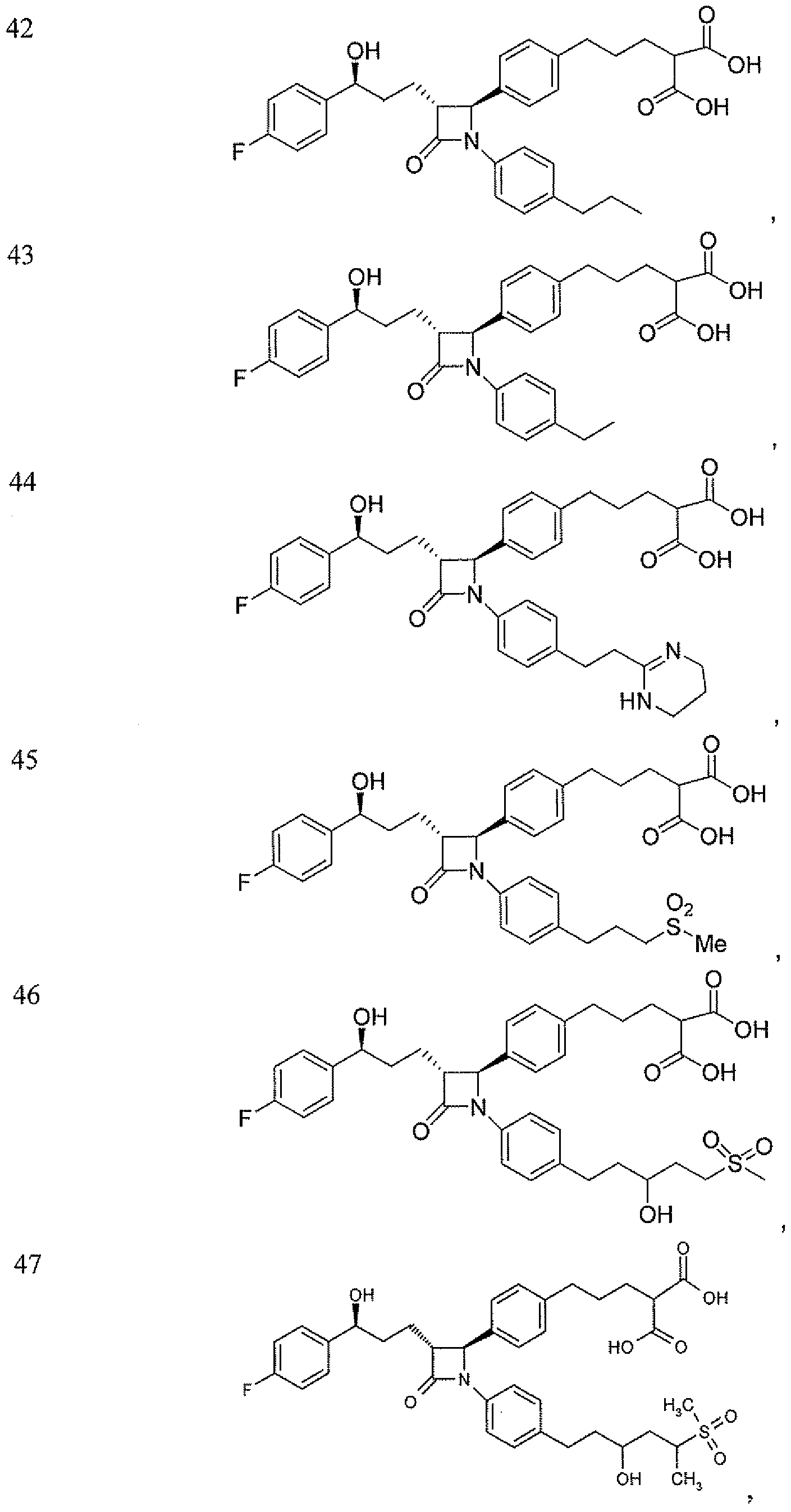


5. A method of reducing plasma LDL-cholesterol levels comprising administering a therapeutically effective amount of a compound of claim 1 to a patient in need of such treatment.
6. The method of claim 5 comprising administering a therapeutically effective amount of a compound of claim 1 in combination with a therapeutically effective amount of a cholesterol biosynthesis inhibitor to a patient in need of such treatment.
7. A method of treating hypercholesterolemia comprising administering a therapeutically effective amount of a compound of claim 1 to a patient in need of such treatment.
8. A method of treating or reducing the risk for developing atherosclerosis comprising administering a therapeutically effective amount of a compound of claim 1 to a patient in need of such treatment.
9. A method of reducing the risk for having an atherosclerotic disease event comprising administering a prophylactically effective amount of a compound of claim 1 to a patient in at risk for such an event.
10. A pharmaceutical composition comprising a compound of claim 1 and a pharmaceutically acceptable carrier.
1 1. The pharmaceutical composition of claim 10 additionally comprising a cholesterol biosynthesis inhibitor.
Applications Claiming Priority (2)
| Application Number | Priority Date | Filing Date | Title |
|---|---|---|---|
| US19948708P | 2008-11-17 | 2008-11-17 | |
| US61/199,487 | 2008-11-17 |
Publications (1)
| Publication Number | Publication Date |
|---|---|
| WO2010056788A1 true WO2010056788A1 (en) | 2010-05-20 |
Family
ID=42170309
Family Applications (1)
| Application Number | Title | Priority Date | Filing Date |
|---|---|---|---|
| PCT/US2009/064092 Ceased WO2010056788A1 (en) | 2008-11-17 | 2009-11-12 | Anti-hypercholesterolemic compounds |
Country Status (1)
| Country | Link |
|---|---|
| WO (1) | WO2010056788A1 (en) |
Cited By (3)
| Publication number | Priority date | Publication date | Assignee | Title |
|---|---|---|---|---|
| WO2011140219A1 (en) | 2010-05-04 | 2011-11-10 | Codexis, Inc. | Biocatalysts for ezetimibe synthesis |
| CN105814068A (en) * | 2014-02-27 | 2016-07-27 | 四川海思科制药有限公司 | A substituted phosphoramidate derivative, its preparation method and application |
| US11919879B2 (en) | 2021-06-16 | 2024-03-05 | Celgene Corporation | Carboxylic acid containing azetidinyl compounds for the treatment of neurodegenerative diseases |
Citations (2)
| Publication number | Priority date | Publication date | Assignee | Title |
|---|---|---|---|---|
| US7176193B2 (en) * | 2002-06-19 | 2007-02-13 | Sanofi-Aventis Deutschland Gmbh | Acid-group-substituted diphenylazetidinones, process for their preparation, medicaments comprising these compounds, and their use |
| US20070078098A1 (en) * | 2005-10-05 | 2007-04-05 | Devita Robert J | Anti-hypercholesterolemic compounds |
-
2009
- 2009-11-12 WO PCT/US2009/064092 patent/WO2010056788A1/en not_active Ceased
Patent Citations (2)
| Publication number | Priority date | Publication date | Assignee | Title |
|---|---|---|---|---|
| US7176193B2 (en) * | 2002-06-19 | 2007-02-13 | Sanofi-Aventis Deutschland Gmbh | Acid-group-substituted diphenylazetidinones, process for their preparation, medicaments comprising these compounds, and their use |
| US20070078098A1 (en) * | 2005-10-05 | 2007-04-05 | Devita Robert J | Anti-hypercholesterolemic compounds |
Cited By (5)
| Publication number | Priority date | Publication date | Assignee | Title |
|---|---|---|---|---|
| WO2011140219A1 (en) | 2010-05-04 | 2011-11-10 | Codexis, Inc. | Biocatalysts for ezetimibe synthesis |
| CN105814068A (en) * | 2014-02-27 | 2016-07-27 | 四川海思科制药有限公司 | A substituted phosphoramidate derivative, its preparation method and application |
| CN105814068B (en) * | 2014-02-27 | 2017-08-04 | 四川海思科制药有限公司 | A substituted phosphoramidate derivative, its preparation method and application |
| US11919879B2 (en) | 2021-06-16 | 2024-03-05 | Celgene Corporation | Carboxylic acid containing azetidinyl compounds for the treatment of neurodegenerative diseases |
| US12552771B2 (en) | 2021-06-16 | 2026-02-17 | Celgene Corporation | Carboxylic acid containing azetidinyl compounds for the treatment of neurodegenerative diseases |
Similar Documents
| Publication | Publication Date | Title |
|---|---|---|
| RU2397982C2 (en) | Novel compounds with antibacterial action | |
| EP3483142B1 (en) | Aromatic acetylene or aromatic ethylene compound, intermediate, preparation method, pharmaceutical composition and use thereof | |
| TWI856956B (en) | ANTAGONISTS OF HUMAN INTEGRIN α4β7 | |
| EP3275867B1 (en) | Pyrido-fused bicyclic compounds as urat1 inhibitors for treating hyperuricemia | |
| EP3354650B1 (en) | Compounds useful as inhibitors of atr kinase | |
| EP3704106B1 (en) | Alkene compounds as farnesoid x receptor modulators | |
| CN105439946B (en) | Carboxylic acid compound and its production and use | |
| AU2001242172B2 (en) | Tri-aryl-substituted-ethane PDE4 inhibitors | |
| EP3704107B1 (en) | Multicyclic compounds as farnesoid x receptor modulators | |
| CA2880165A1 (en) | Partially saturated nitrogen-containing heterocyclic compound | |
| EP3052099B1 (en) | Novel pyrrolidine derived beta 3 adrenergic receptor agonists | |
| WO1999046262A1 (en) | Benzofurylpyrone derivatives | |
| CN110461838B (en) | Oxadiazole Transient Receptor Potential Channel Inhibitors | |
| CN113710656A (en) | Substituted bicyclic compounds as farnesoid X receptor modulators | |
| WO2004011448A1 (en) | Therapeutic compounds for treating dyslipidemic conditions | |
| CN105566311A (en) | Oxazole and isoxazole crac modulators | |
| EP2086324A2 (en) | Heterocyclyl-substituted anti-hypercholesterolemic compounds | |
| US20070078098A1 (en) | Anti-hypercholesterolemic compounds | |
| US20100035857A1 (en) | Anti-hypercholesterolemic compounds | |
| WO2010056788A1 (en) | Anti-hypercholesterolemic compounds | |
| AU2009314205A1 (en) | Gamma secretase modulators | |
| BR112021015930A2 (en) | SUBSTITUTED AMIDE COMPOUNDS USEFUL AS FARNESOID X RECEPTOR MODULATORS | |
| CA3129619A1 (en) | Substituted amide compounds useful as farnesoid x receptor modulators | |
| TW201422611A (en) | □ □ derivatives | |
| HK40070400A (en) | Oxadiazole transient receptor potential channel inhibitors |
Legal Events
| Date | Code | Title | Description |
|---|---|---|---|
| 121 | Ep: the epo has been informed by wipo that ep was designated in this application |
Ref document number: 09826697 Country of ref document: EP Kind code of ref document: A1 |
|
| NENP | Non-entry into the national phase |
Ref country code: DE |
|
| 122 | Ep: pct application non-entry in european phase |
Ref document number: 09826697 Country of ref document: EP Kind code of ref document: A1 |