WO2010051820A1 - Multiplexed cytokine vaccination - Google Patents
Multiplexed cytokine vaccination Download PDFInfo
- Publication number
- WO2010051820A1 WO2010051820A1 PCT/DK2009/050294 DK2009050294W WO2010051820A1 WO 2010051820 A1 WO2010051820 A1 WO 2010051820A1 DK 2009050294 W DK2009050294 W DK 2009050294W WO 2010051820 A1 WO2010051820 A1 WO 2010051820A1
- Authority
- WO
- WIPO (PCT)
- Prior art keywords
- species
- nucleic acid
- cancer
- childhood
- cells
- Prior art date
- Legal status (The legal status is an assumption and is not a legal conclusion. Google has not performed a legal analysis and makes no representation as to the accuracy of the status listed.)
- Ceased
Links
Classifications
-
- A—HUMAN NECESSITIES
- A61—MEDICAL OR VETERINARY SCIENCE; HYGIENE
- A61K—PREPARATIONS FOR MEDICAL, DENTAL OR TOILETRY PURPOSES
- A61K39/00—Medicinal preparations containing antigens or antibodies
-
- A—HUMAN NECESSITIES
- A61—MEDICAL OR VETERINARY SCIENCE; HYGIENE
- A61K—PREPARATIONS FOR MEDICAL, DENTAL OR TOILETRY PURPOSES
- A61K39/00—Medicinal preparations containing antigens or antibodies
- A61K39/0005—Vertebrate antigens
- A61K39/0011—Cancer antigens
- A61K39/001136—Cytokines
-
- A—HUMAN NECESSITIES
- A61—MEDICAL OR VETERINARY SCIENCE; HYGIENE
- A61K—PREPARATIONS FOR MEDICAL, DENTAL OR TOILETRY PURPOSES
- A61K39/00—Medicinal preparations containing antigens or antibodies
- A61K39/0005—Vertebrate antigens
- A61K39/0011—Cancer antigens
- A61K39/001144—Hormones, e.g. calcitonin
-
- A—HUMAN NECESSITIES
- A61—MEDICAL OR VETERINARY SCIENCE; HYGIENE
- A61K—PREPARATIONS FOR MEDICAL, DENTAL OR TOILETRY PURPOSES
- A61K39/00—Medicinal preparations containing antigens or antibodies
- A61K39/12—Viral antigens
-
- A—HUMAN NECESSITIES
- A61—MEDICAL OR VETERINARY SCIENCE; HYGIENE
- A61K—PREPARATIONS FOR MEDICAL, DENTAL OR TOILETRY PURPOSES
- A61K39/00—Medicinal preparations containing antigens or antibodies
- A61K39/12—Viral antigens
- A61K39/21—Retroviridae, e.g. equine infectious anemia virus
-
- A—HUMAN NECESSITIES
- A61—MEDICAL OR VETERINARY SCIENCE; HYGIENE
- A61K—PREPARATIONS FOR MEDICAL, DENTAL OR TOILETRY PURPOSES
- A61K39/00—Medicinal preparations containing antigens or antibodies
- A61K39/12—Viral antigens
- A61K39/29—Hepatitis virus
-
- A—HUMAN NECESSITIES
- A61—MEDICAL OR VETERINARY SCIENCE; HYGIENE
- A61K—PREPARATIONS FOR MEDICAL, DENTAL OR TOILETRY PURPOSES
- A61K39/00—Medicinal preparations containing antigens or antibodies
- A61K39/39—Medicinal preparations containing antigens or antibodies characterised by the immunostimulating additives, e.g. chemical adjuvants
-
- C—CHEMISTRY; METALLURGY
- C07—ORGANIC CHEMISTRY
- C07K—PEPTIDES
- C07K14/00—Peptides having more than 20 amino acids; Gastrins; Somatostatins; Melanotropins; Derivatives thereof
- C07K14/005—Peptides having more than 20 amino acids; Gastrins; Somatostatins; Melanotropins; Derivatives thereof from viruses
-
- A—HUMAN NECESSITIES
- A61—MEDICAL OR VETERINARY SCIENCE; HYGIENE
- A61K—PREPARATIONS FOR MEDICAL, DENTAL OR TOILETRY PURPOSES
- A61K39/00—Medicinal preparations containing antigens or antibodies
- A61K2039/51—Medicinal preparations containing antigens or antibodies comprising whole cells, viruses or DNA/RNA
- A61K2039/525—Virus
- A61K2039/5256—Virus expressing foreign proteins
-
- A—HUMAN NECESSITIES
- A61—MEDICAL OR VETERINARY SCIENCE; HYGIENE
- A61K—PREPARATIONS FOR MEDICAL, DENTAL OR TOILETRY PURPOSES
- A61K39/00—Medicinal preparations containing antigens or antibodies
- A61K2039/51—Medicinal preparations containing antigens or antibodies comprising whole cells, viruses or DNA/RNA
- A61K2039/53—DNA (RNA) vaccination
-
- A—HUMAN NECESSITIES
- A61—MEDICAL OR VETERINARY SCIENCE; HYGIENE
- A61K—PREPARATIONS FOR MEDICAL, DENTAL OR TOILETRY PURPOSES
- A61K39/00—Medicinal preparations containing antigens or antibodies
- A61K2039/54—Medicinal preparations containing antigens or antibodies characterised by the route of administration
-
- A—HUMAN NECESSITIES
- A61—MEDICAL OR VETERINARY SCIENCE; HYGIENE
- A61K—PREPARATIONS FOR MEDICAL, DENTAL OR TOILETRY PURPOSES
- A61K39/00—Medicinal preparations containing antigens or antibodies
- A61K2039/545—Medicinal preparations containing antigens or antibodies characterised by the dose, timing or administration schedule
-
- A—HUMAN NECESSITIES
- A61—MEDICAL OR VETERINARY SCIENCE; HYGIENE
- A61K—PREPARATIONS FOR MEDICAL, DENTAL OR TOILETRY PURPOSES
- A61K39/00—Medicinal preparations containing antigens or antibodies
- A61K2039/555—Medicinal preparations containing antigens or antibodies characterised by a specific combination antigen/adjuvant
- A61K2039/55511—Organic adjuvants
- A61K2039/55516—Proteins; Peptides
-
- A—HUMAN NECESSITIES
- A61—MEDICAL OR VETERINARY SCIENCE; HYGIENE
- A61K—PREPARATIONS FOR MEDICAL, DENTAL OR TOILETRY PURPOSES
- A61K39/00—Medicinal preparations containing antigens or antibodies
- A61K2039/555—Medicinal preparations containing antigens or antibodies characterised by a specific combination antigen/adjuvant
- A61K2039/55511—Organic adjuvants
- A61K2039/55522—Cytokines; Lymphokines; Interferons
-
- A—HUMAN NECESSITIES
- A61—MEDICAL OR VETERINARY SCIENCE; HYGIENE
- A61K—PREPARATIONS FOR MEDICAL, DENTAL OR TOILETRY PURPOSES
- A61K39/00—Medicinal preparations containing antigens or antibodies
- A61K2039/555—Medicinal preparations containing antigens or antibodies characterised by a specific combination antigen/adjuvant
- A61K2039/55511—Organic adjuvants
- A61K2039/55522—Cytokines; Lymphokines; Interferons
- A61K2039/55527—Interleukins
- A61K2039/55533—IL-2
-
- A—HUMAN NECESSITIES
- A61—MEDICAL OR VETERINARY SCIENCE; HYGIENE
- A61K—PREPARATIONS FOR MEDICAL, DENTAL OR TOILETRY PURPOSES
- A61K39/00—Medicinal preparations containing antigens or antibodies
- A61K2039/555—Medicinal preparations containing antigens or antibodies characterised by a specific combination antigen/adjuvant
- A61K2039/55511—Organic adjuvants
- A61K2039/55561—CpG containing adjuvants; Oligonucleotide containing adjuvants
-
- A—HUMAN NECESSITIES
- A61—MEDICAL OR VETERINARY SCIENCE; HYGIENE
- A61K—PREPARATIONS FOR MEDICAL, DENTAL OR TOILETRY PURPOSES
- A61K39/00—Medicinal preparations containing antigens or antibodies
- A61K2039/555—Medicinal preparations containing antigens or antibodies characterised by a specific combination antigen/adjuvant
- A61K2039/55511—Organic adjuvants
- A61K2039/55566—Emulsions, e.g. Freund's adjuvant, MF59
-
- C—CHEMISTRY; METALLURGY
- C12—BIOCHEMISTRY; BEER; SPIRITS; WINE; VINEGAR; MICROBIOLOGY; ENZYMOLOGY; MUTATION OR GENETIC ENGINEERING
- C12N—MICROORGANISMS OR ENZYMES; COMPOSITIONS THEREOF; PROPAGATING, PRESERVING, OR MAINTAINING MICROORGANISMS; MUTATION OR GENETIC ENGINEERING; CULTURE MEDIA
- C12N2710/00—MICROORGANISMS OR ENZYMES; COMPOSITIONS THEREOF; PROPAGATING, PRESERVING, OR MAINTAINING MICROORGANISMS; MUTATION OR GENETIC ENGINEERING; CULTURE MEDIA dsDNA viruses
- C12N2710/00011—Details
- C12N2710/10011—Adenoviridae
- C12N2710/10311—Mastadenovirus, e.g. human or simian adenoviruses
- C12N2710/10341—Use of virus, viral particle or viral elements as a vector
- C12N2710/10343—Use of virus, viral particle or viral elements as a vector viral genome or elements thereof as genetic vector
-
- C—CHEMISTRY; METALLURGY
- C12—BIOCHEMISTRY; BEER; SPIRITS; WINE; VINEGAR; MICROBIOLOGY; ENZYMOLOGY; MUTATION OR GENETIC ENGINEERING
- C12N—MICROORGANISMS OR ENZYMES; COMPOSITIONS THEREOF; PROPAGATING, PRESERVING, OR MAINTAINING MICROORGANISMS; MUTATION OR GENETIC ENGINEERING; CULTURE MEDIA
- C12N2740/00—Reverse transcribing RNA viruses
- C12N2740/00011—Details
- C12N2740/10011—Retroviridae
- C12N2740/16011—Human Immunodeficiency Virus, HIV
- C12N2740/16111—Human Immunodeficiency Virus, HIV concerning HIV env
- C12N2740/16122—New viral proteins or individual genes, new structural or functional aspects of known viral proteins or genes
-
- C—CHEMISTRY; METALLURGY
- C12—BIOCHEMISTRY; BEER; SPIRITS; WINE; VINEGAR; MICROBIOLOGY; ENZYMOLOGY; MUTATION OR GENETIC ENGINEERING
- C12N—MICROORGANISMS OR ENZYMES; COMPOSITIONS THEREOF; PROPAGATING, PRESERVING, OR MAINTAINING MICROORGANISMS; MUTATION OR GENETIC ENGINEERING; CULTURE MEDIA
- C12N2740/00—Reverse transcribing RNA viruses
- C12N2740/00011—Details
- C12N2740/10011—Retroviridae
- C12N2740/16011—Human Immunodeficiency Virus, HIV
- C12N2740/16111—Human Immunodeficiency Virus, HIV concerning HIV env
- C12N2740/16134—Use of virus or viral component as vaccine, e.g. live-attenuated or inactivated virus, VLP, viral protein
-
- C—CHEMISTRY; METALLURGY
- C12—BIOCHEMISTRY; BEER; SPIRITS; WINE; VINEGAR; MICROBIOLOGY; ENZYMOLOGY; MUTATION OR GENETIC ENGINEERING
- C12N—MICROORGANISMS OR ENZYMES; COMPOSITIONS THEREOF; PROPAGATING, PRESERVING, OR MAINTAINING MICROORGANISMS; MUTATION OR GENETIC ENGINEERING; CULTURE MEDIA
- C12N2740/00—Reverse transcribing RNA viruses
- C12N2740/00011—Details
- C12N2740/10011—Retroviridae
- C12N2740/16011—Human Immunodeficiency Virus, HIV
- C12N2740/16211—Human Immunodeficiency Virus, HIV concerning HIV gagpol
- C12N2740/16222—New viral proteins or individual genes, new structural or functional aspects of known viral proteins or genes
-
- C—CHEMISTRY; METALLURGY
- C12—BIOCHEMISTRY; BEER; SPIRITS; WINE; VINEGAR; MICROBIOLOGY; ENZYMOLOGY; MUTATION OR GENETIC ENGINEERING
- C12N—MICROORGANISMS OR ENZYMES; COMPOSITIONS THEREOF; PROPAGATING, PRESERVING, OR MAINTAINING MICROORGANISMS; MUTATION OR GENETIC ENGINEERING; CULTURE MEDIA
- C12N2740/00—Reverse transcribing RNA viruses
- C12N2740/00011—Details
- C12N2740/10011—Retroviridae
- C12N2740/16011—Human Immunodeficiency Virus, HIV
- C12N2740/16311—Human Immunodeficiency Virus, HIV concerning HIV regulatory proteins
- C12N2740/16322—New viral proteins or individual genes, new structural or functional aspects of known viral proteins or genes
-
- C—CHEMISTRY; METALLURGY
- C12—BIOCHEMISTRY; BEER; SPIRITS; WINE; VINEGAR; MICROBIOLOGY; ENZYMOLOGY; MUTATION OR GENETIC ENGINEERING
- C12N—MICROORGANISMS OR ENZYMES; COMPOSITIONS THEREOF; PROPAGATING, PRESERVING, OR MAINTAINING MICROORGANISMS; MUTATION OR GENETIC ENGINEERING; CULTURE MEDIA
- C12N2770/00—MICROORGANISMS OR ENZYMES; COMPOSITIONS THEREOF; PROPAGATING, PRESERVING, OR MAINTAINING MICROORGANISMS; MUTATION OR GENETIC ENGINEERING; CULTURE MEDIA ssRNA viruses positive-sense
- C12N2770/00011—Details
- C12N2770/24011—Flaviviridae
- C12N2770/24211—Hepacivirus, e.g. hepatitis C virus, hepatitis G virus
- C12N2770/24222—New viral proteins or individual genes, new structural or functional aspects of known viral proteins or genes
-
- C—CHEMISTRY; METALLURGY
- C12—BIOCHEMISTRY; BEER; SPIRITS; WINE; VINEGAR; MICROBIOLOGY; ENZYMOLOGY; MUTATION OR GENETIC ENGINEERING
- C12N—MICROORGANISMS OR ENZYMES; COMPOSITIONS THEREOF; PROPAGATING, PRESERVING, OR MAINTAINING MICROORGANISMS; MUTATION OR GENETIC ENGINEERING; CULTURE MEDIA
- C12N2770/00—MICROORGANISMS OR ENZYMES; COMPOSITIONS THEREOF; PROPAGATING, PRESERVING, OR MAINTAINING MICROORGANISMS; MUTATION OR GENETIC ENGINEERING; CULTURE MEDIA ssRNA viruses positive-sense
- C12N2770/00011—Details
- C12N2770/24011—Flaviviridae
- C12N2770/24211—Hepacivirus, e.g. hepatitis C virus, hepatitis G virus
- C12N2770/24234—Use of virus or viral component as vaccine, e.g. live-attenuated or inactivated virus, VLP, viral protein
-
- C—CHEMISTRY; METALLURGY
- C12—BIOCHEMISTRY; BEER; SPIRITS; WINE; VINEGAR; MICROBIOLOGY; ENZYMOLOGY; MUTATION OR GENETIC ENGINEERING
- C12N—MICROORGANISMS OR ENZYMES; COMPOSITIONS THEREOF; PROPAGATING, PRESERVING, OR MAINTAINING MICROORGANISMS; MUTATION OR GENETIC ENGINEERING; CULTURE MEDIA
- C12N2840/00—Vectors comprising a special translation-regulating system
- C12N2840/20—Vectors comprising a special translation-regulating system translation of more than one cistron
- C12N2840/203—Vectors comprising a special translation-regulating system translation of more than one cistron having an IRES
- C12N2840/206—Vectors comprising a special translation-regulating system translation of more than one cistron having an IRES having multiple IRES
Definitions
- the present invention relates to a method of treating, ameliorating or preventing a clinical condition, wherein a plurality of non-identical nucleic acid species encoding a distinct cytokine or hormone are provided to a population of cells, wherein only one or a few such nucleic acid species are provided per cell.
- a similar method is also provided, wherein an additional plurality of non-identical nucleic acid species encoding distinct species of immunogenic polypeptides is provided to said population of cells, such that each cell is provided with nucleic acid species encoding a distinct combination of a distinct cytokine or hormone and a distinct immunogenic polypeptide.
- compositions and kits-of-parts are provided for practicing the methods of the present invention.
- Immune-mediated diseases and immune-mediated transplant rejection collectively affect tens of millions of Americans and result in high medical and social costs. Over the past 40 years, advances in the treatment and prevention of transplant rejection have been achieved largely through the development of increasingly potent but globally immunosuppressive drugs. Systemic lucocorticosteroids, calcineurin inhibitors, antimetabolites, purine synthesis inhibitors, and panreactive imAbs have met with a degree of clinical success in treating acute transplant rejection.1
- Such therapies generally require life-long use, are costly and are associated with serious side effects, including nephrotoxicity, diabetes, and immunosuppression, exposing patients to heightened risks of infection and malignancy.
- peripheral tolerance ie, clonal inactivation, clonal deletion, and cytokinedependent suppression and immune deviation
- peripheral tolerance ie, clonal inactivation, clonal deletion, and cytokinedependent suppression and immune deviation
- the existence of multiple pathways presents a wide range of potential targets for intervention. Indeed, dozens of ligands, receptors, and signalling intermediates provide the structural underpinnings for a host of candidate drugs. This complexity also introduces many practical challenges because of the potential for functional redundancies in the targeted pathways and heterogeneity in their expression among different diseases and affected individuals.
- Naive T cells require 2 distinct signals to become fully activated.
- Signal 1 is propagated on presentation of antigen to the T cell, initiating a signaling cascade involving a number of molecules, including the CD4 or CD8 coreceptors and their associated kinases.
- Professional antigen-presenting cells deliver additional costimulatory signals, termed signal 2 that elicit robust and durable T-cell responses.
- Receptors act either directly in a costimulatory fashion or by upregulating other receptors and ligands needed for generation of signal 2, including CD28 itself.
- a major effect of costimulation is production of IL-2 and other cytokines required for T-cell proliferation and for arming differentiated T cells to take on effector functions. Once fully differentiated and armed for effector functions, neither CD4+ nor CD8+ T cells require costimulatory signals to respond.
- immunogenic peptides For the purpose of immunotherapy, vectors expressing immunogenic peptides are known in the art. Traditionally, these immunogenic epitopes have been cloned to constitute a polypeptide consisting of several epitopes. In the present invention, the target cell is limited to only express a single epitope that are translated as a small peptide ready for loading onto the MHC presentation complex without further processing, thereby increasing the effectiveness of peptide vaccination. Summary of invention
- the present invention provides a new approach for treating, preventing and/or ameliorating a clinical disorder, in particular infectious disorders, cancer and/or autoimmune disorders.
- the present invention relates to a method of treating, preventing or ameliorating a clinical condition, said method comprising a. providing a population of cells, b. bringing a plurality of non-identical nucleic acid species into contact with said population of cells, wherein said contact results in uptake of said nucleic acid species in said cells, and wherein each of said non-identical nucleic acid species encodes a distinct species of cytokine or hormone, or a functional homologue or part thereof, c. obtaining an immunogenic response of said population of cells, wherein each individual cell of said population of cells take up at the most 5 non- identical nucleic acid species.
- the present invention relates to a composition
- a composition comprising a. a plurality of non-identical nucleic acid species encoding distinct species of cytokine or hormone, or a functional homologue or part thereof as defined in the present invention, and/or b. a plurality of non-identical nucleic acid species encoding distinct species of immunogenic polypeptides of the present invention, and/or c. a plurality of non-identical vector species of the present invention, and/or d. a plurality of non-identical retroviral particle species of the present invention, and/or e. a population of gene gun particles of the present invention, f. a plurality of any physical entity species comprising any component of any of a. to e. for use as a medicament.
- a third aspect relates to a kit-of-parts comprising a composition of the present invention, and at least one additional active ingredient for use as a medicament.
- a fourth aspect relates to a method of reducing the risk of an human individual encountering a clinical condition, said method comprising administration of a composition of the present invention and/or a kit-of-parts of the present invention to said individual in an amount sufficient to generate a protective immune response.
- the present invention relates to a method of immunizing an animal, said method comprising administration of a composition of the present invention and/or a kit-of-parts of the present invention to said individual in an amount sufficient to generate a protective immune response.
- a sixth aspect relates to a method of monitoring immunization, said method comprising the steps of a. providing a blood sample from an individual, b. providing a composition of the present invention and/or a kit-of-parts of the present invention, and c. determining whether said blood sample comprises antibodies or T-cells comprising T-cell receptors specifically binding at least one species of said immunogenic polypeptides or part thereof thereby determining whether an immune response has been raised in said individual.
- a seventh aspect relates to a method of monitoring immunization, said method comprising the steps of a. providing a blood sample from an individual, b. providing a plurality of non-identical nucleic acid species into contact with said population of cells, wherein said contact results in uptake of said nucleic acid species in said cells, and wherein each of said non-identical nucleic acid species encodes a distinct species of cytokine or hormone, or a functional homologue or part thereof to a population of blood cells, wherein each individual cell of said population of cells take up at the most 5 non-identical nucleic acid species c.
- An eighth aspect of the present invention relates to use of a composition and/or a kit- of-parts according to the present invention for the manufacture of a medicament for the treatment, amelioration and/or prevention of a disorder of the present invention.
- An ninth aspect relates to a composition and/or a kit-of-parts according to the present invention for the treatment, amelioration and/or prevention of a disorder of the present invention.
- the present invention relates to a pharmaceutical composition for the treatment, amelioration and/or prevention of a disorder as defined in the present invention comprising a composition and/or a kit-of-parts according to the present invention.
- FIG. 1 Schematic illustration of the vector CMVbipep.
- the vector is a circular DNA construct of approximately 5.800 bp.
- a chimeric Akv CMV-promoter is placed ahead of the cloning site used for MHC-1 peptides, eg. RGPGRAFVT, AMQMLKETI etc.
- the translation is always initiated using a startcodon encoding a methionine.
- An IRES- element is placed ahead of the second cloning site used for immunogenic stimuli, eg.
- Figure 3 illustrating the superior protection at viral challenge in monkeys immunized with live attenuated SIV. Numbers from Koff et al, 2006. Figure 4.
- MLV-paticles inner red core
- FIG. 4 By pseudotyping of MLV-paticles (inner red core) with HIV envelope, it is possible to make retroviral particles that can infect CD4+ cells through the CD4 receptor and the CXCR4 co-receptor.
- FIG. 5 Schematic presentation of CMVBipep with cloning sites.
- Figure 7 shows the IL-2 secretion cells transduced with CMVbipep-virus encoding
- Figure 9. showing the groups of mice that were immunized in the study Figure 10. showing the results from the IFN- ⁇ ELISPOT assay.
- Figure 1 1. shows the results from the IL-2 ELISPOT assay
- the present invention provides to novel treatment strategies.
- a vaccination strategy wherein a pool of cells are transduced/transfected with a variety of vectors each expressing a specific protein/polypeptide encoding a gene selected from a pool of cytokines but where any given cell only contains from one to a few species of each vectors.
- This strategy will be used to transducer/transfect infected cell and/or cancer cells either in vivo or ex vivo. If the cells are transduced ex vivo the cells will be reintroduced into the patient after transduction.
- the advantages of this new approach are that cancer cells and/or infected cells already before the treatment contain all the immunogenic peptides. By transfecting/transducing these with vector expressing cytokines the immune response can be augmented.
- the immunesystem By limiting the vectors used to transfect/transducer the individual cells to one or only a few vectors the immunesystem will only have to react to one specific cytokine in the vicinity of the transduced/transfected cell but the whole array of vector expressing cytokines can still be used in the patient resulting in better control of the individual pathways leading to immunrejection of the cancer/infected cells
- a vaccination regime to prevent or treat infection/cancer wherein a pool of cells are transduced/transfected with a variety of vectors each expressing a specific protein/polypeptide encoding a gene selected from a pool of cytokines combined with expression of a specific peptide selected from a pool of peptides presented by MHC Class I or Class Il molecules, but where any given cell only contains from one to a few species of each vectors.
- This type of vaccination strategy will be used to transduce target cells in vivo. Again the result is one cell expressing one immunogenic peptide and one cytokine.
- the immunesystem By limiting the vectors used to transduce the individual cells to one or only a few vectors the immunesystem will only have to react to one specific immunogenic polypeptide in combination with one specific cytokine in the vicinity of the transduced/transfected cell but the whole array of vector expressing cytokines can still be used in the patient resulting in better control of the individual pathways leading to immunrejection.
- a major objective of the present invention to provide an approach for treating, preventing and/or ameliorating a clinical disorder, in particular infectious disorders, cancer and/or autoimmune disorders.
- a plurality of non- identical nucleic acid species, each encoding a distinct cytokine or hormone or a functional homolog or part thereof are provided to a population of cells.
- only one or a few nucleic acid species are taken up by each cell.
- each individual cell comprise only one or a few nucleic acid species, and therefore only express one or a few cytokine or hormone species.
- compositions and kits-of-parts are provided for practicing the methods of the present invention. HIV-1 polypeptides and nucleic acids encoding said polypeptides for production of a vaccine against HIV-1.
- the present invention provides nucleic acids encoding immunogenic polypeptides or part thereof, as well as eukaryotic expression vectors comprising at least one said nucleic acid or part thereof. Also provided are biological entities such as eukaryotic cells, prokaryotic cells and/or viral particles, in particular retroviral particles, A kit-of- parts is also provided comprising said vaccine composition a second active ingredient, such as an immunostimulating composition, for example one or more interleukins and/or an antibiotic, such as amoxicillin, penicillin, acyclovir and/or vidarabine.
- an immunostimulating composition for example one or more interleukins and/or an antibiotic, such as amoxicillin, penicillin, acyclovir and/or vidarabine.
- the invention also provides for the use of the polypeptides, antigens, nucleic acids, vectors and biological entities for the manufacture of a medicament, and for methods of treating, preventing or ameliorating a clinical condition.
- the invention also provides methods for producing a vaccine and/or an antibody by administering a polypeptide, antigen, nucleic acid, vector and/or biological entity of the invention.
- the components of the present invention can be used to induce an immune response against HIV, as well as to enhance the immune response in an immunized mammal relative to HIV antigen alone.
- the vaccine composition and/or components thereof of the invention can also induce HIV specific CD4 T helper cells and CD8+ T cells yielding potent Th1 immune responses against a broad spectrum of HIV epitopes, providing a strong HIV- specific cytotoxic T lymphocyte response.
- the vaccine compositions and components thereof of the invention are useful for preventing HIV infection and/or slowing progression to AIDS in infected individuals.
- compositions, components and methods can be used to elicit potent Th1 cellular and humoral immune responses specific for conserved HIV epitopes, elicit HIV- specific CD4 T helper cells, HIV-specific cytotoxic T lymphocyte activity, stimulate production of chemokines and cyotokines such as beta-chemokines, interferon-gamma, interleukin 2 (IL2), interleukin 7 (IL7), interleukin 15 (IL15), alpha-defensin, and the like, and increase memory cells.
- the vaccine compositions and components thereof can be administered via various routes of administration, and can be used to prevent maternal transmission of HIV, for vaccination of newborns, children and high-risk individuals, and for vaccination of infected individuals.
- the components of the present invention can also be used in combination with other HIV therapies, including antiretroviral therapy (ART) with various combinations of nuclease and protease inhibitors and agents to block viral entry, such as T20.
- ART antiretroviral therapy
- a retroviral vector comprises a retroviral vector capable of being transcribed into RNA, which can be packaged into a retroviral particle, reverse transcribed into double stranded DNA and inserted into the host genome by the retroviral enzymatic machinery.
- an internal ribosome entry site IVS
- heterologous is used hereinafter for any combination of nucleic acid sequences that is not normally found intimately associated in nature.
- the terms “bicistronic” and “polycistronic” as used herein, relates to a transcript encoding a transcript, which comprise two or more open reading frames, respectively.
- the replication deficient vector of the present invention comprises one open reading frame, two open reading frames, three, four, five or six open reading frames.
- polynucleotide or “nucleic acid” refers to a polymeric form of nucleotides at least 2 bases in length.
- isolated nucleic acid sequence is meant a polynucleotide that is not immediately contiguous with either of the coding sequences with which it is immediately contiguous (one on the 5' end and one on the 3' end) in the naturally occurring genome of the organism from which it is derived. The term therefore includes, for example, a recombinant DNA or RNA which is incorporated into a viral vector.
- the nucleotides of the invention can be ribonucleotides, deoxyribonucleotides, or modified forms of either nucleotide.
- nucleic acid and “nucleic acid sequence” refer to a nucleotide, oligonucleotide, polynucleotide, or any fragment thereof. These phrases also refer to DNA or RNA of genomic or synthetic origin which may be single-stranded or double- stranded and may represent the sense or the antisense strand, to peptide nucleic acid (PNA), or to any DNA-like or RNA-like material.
- polynucleotide(s) generally refers to any polyribonucleotide or polydeoxyribonucleotide, which may be unmodified RNA or DNA or modified RNA or DNA.
- polynucleotides as used herein refers to, among others, single-and double-stranded DNA, DNA that is a mixture of single- and double-stranded regions, single- and double-stranded RNA, and RNA that is mixture of single- and double-stranded regions, hybrid molecules comprising DNA and RNA that may be single-stranded or, more typically, double-stranded or a mixture of single- and double- stranded regions.
- polynucleotide as used herein can also refer to triple- stranded regions comprising RNA or DNA or both RNA and DNA. The strands in such regions may be from the same molecule or from different molecules. The regions may include all of one or more of the molecules, but more typically involve only a region of some of the molecules.
- polynucleotide includes DNAs or RNAs as described above that contain one or more modified bases.
- DNAs or RNAs with backbones modified for stability or for other reasons are “polynucleotides” as that term is intended herein.
- DNAs or RNAs comprising unusual bases, such as inosine, or modified bases, such as tritylated bases, to name just two examples are polynucleotides as the term is used herein.
- polynucleotide as it is employed herein embraces such chemically, enzymatically or metabolically modified forms of polynucleotides, as well as the chemical forms of DNA and RNA characteristic of viruses and cells, including simple and complex cells, inter alia.
- amino acid and amino acid sequence refer to an oligopeptide, peptide, polypeptide, or protein sequence, or a fragment of any of these, and to naturally occurring or synthetic molecules.
- amino acid sequence is recited to refer to a sequence of a naturally occurring protein molecule
- amino acid sequence and like terms are not meant to limit the amino acid sequence to the complete native amino acid sequence associated with the recited protein molecule.
- amino acids in the present invention are designated by their conventional single letter code.
- a “detectable label” refers to a reporter molecule or enzyme that is capable of generating a measurable signal and is covalently or noncovalently joined to a polynucleotide or polypeptide.
- a “fragment” or “part” in relation to polynucleotide, nucleic acid or polypeptide is a unique portion of said polynucleotide, nucleic acid or polypeptide, which is identical in sequence to but shorter in length than the parent sequence.
- the term “fragment” or “part” in the present invention may refer to shorter sequences derived from cytokine or hormone polypeptides, as disclosed in the present invention.
- a fragment may comprise up to the entire length of the defined sequence, minus one nucleotide or amino acid residue.
- a fragment may comprise from 5 to 1000 contiguous nucleotides or amino acid residues.
- a fragment used as a probe, primer, antigen, therapeutic molecule, or for other purposes may be at least 5, 10, 15, 16, 20, 25, 30, 40, 50, 60, 75, 100, 150, 250 or at least 500 contiguous nucleotides or amino acid residues in length. Fragments may be preferentially selected from certain regions of a molecule.
- a polypeptide fragment may comprise a certain length of contiguous amino acids selected from the first 250 or 500 amino acids (or first 25% or 50%) of a polypeptide as shown in a certain defined sequence. Clearly these lengths are exemplary, and any length that is supported by the specification, including the Sequence Listing, tables, and figures, may be encompassed by the present embodiments.
- sequence similarity refers to sequence similarity or, interchangeably, sequence identity, between two or more polynucleotide sequences or two or more polypeptide sequences.
- Methods of alignment of sequences for comparison are well-known in the art.
- Various programs and alignment algorithms are described and present a detailed consideration of sequence alignment methods and homology calculations, such as VECTOR NTI.
- sequence identity is expressed in terms of the similarity between the sequences, otherwise referred to as sequence identity.
- Sequence identity is frequently measured in terms of percentage identity (or similarity or homology); the higher the percentage, the more similar the two sequences will be.
- the NCBI Basic Local Alignment Search Tool (BLAST) is available from several sources, including the National Center for Biotechnology Information (NBCI, Bethesda, Md.) and on the Internet, for use in connection with the sequence analysis programs blastp, blastn, blastx, tblastn and tblastx. It can be accessed at http://www.ncbi.nlm.nih.gov/BLAST/. A description of how to determine sequence identity using this program is available at http://www.ncbi. nlm.nih.gov/BLAST/blast_help. html.
- Homologs of the disclosed polypeptides are typically characterised by possession of at least 94% sequence identity counted over the full length alignment with the disclosed amino acid sequence using the NCBI Basic Blast 2.0, gapped blastp with databases such as the nr or swissprot database. Alternatively, one may manually align the sequences and count the number of identical amino acids. This number divided by the total number of amino acids in your sequence multiplied by 100 results in the percent identity.
- percent identity and % identity refer to the percentage of residue matches between at least two polynucleotide sequences aligned using a standardized algorithm. Such an algorithm may insert, in a standardized and reproducible way, gaps in the sequences being compared in order to optimize alignment between two sequences, and therefore achieve a more meaningful comparison of the two sequences.
- nucleic acid sequences that do not show a high degree of identity may nevertheless encode similar amino acid sequences due to the degeneracy of the genetic code. It is understood that changes in a nucleic acid sequence can be made using this degeneracy to produce multiple nucleic acid sequences that all encode substantially the same protein.
- percent identity and % identity refer to the percentage of residue matches between at least two polypeptide sequences aligned using a standardized algorithm.
- Methods of polypeptide sequence alignment are well-known. Some alignment methods take into account conservative amino acid substitutions. Such conservative substitutions, explained in more detail above, generally preserve the charge and hydrophobicity at the site of substitution, thus preserving the structure (and therefore function) of the polypeptide.
- Percent identity may be measured over the length of an entire defined polypeptide sequence, for example, as defined by a particular SEQ ID number, or may be measured over a shorter length, for example, over the length of a fragment taken from a larger, defined polypeptide sequence, for instance, a fragment of at least 15, at least 20, at least 30, at least 40, at least 50, at least 70 or at least 150 contiguous residues.
- Such lengths are exemplary only, and it is understood that any fragment length supported by the sequences shown herein, in the tables, figures or Sequence Listing, may be used to describe a length over which percentage identity may be measured.
- Percent identity may be measured over the length of an entire defined sequence, for example, as defined by a particular SEQ ID number, or may be measured over a shorter length, for example, over the length of a fragment taken from a larger, defined sequence, for instance, a fragment of at least 20, at least 30, at least 40, at least 50, at least 70, at least 100, or at least 200 contiguous nucleotides.
- Such lengths are exemplary only, and it is understood that any fragment length supported by the sequences shown herein, in the tables, figures, or Sequence Listing, may be used to describe a length over which percentage identity may be measured.
- operably linked refers to the situation in which a first nucleic acid sequence, amino acid sequence or ligand is placed in a functional relationship with a second nucleic acid sequence, amino acid sequence or ligand.
- a promoter is operably linked to a coding sequence if the promoter affects the transcription or expression of the coding sequence.
- Operably linked DNA sequences or protein or ligands may be in close proximity or contiguous and, where necessary to join two protein coding regions, in the same reading frame.
- IRS internal ribosome entry site
- RNA transcripts with the capacity to allow translation of two or more ORF are designated bi- or polycistronic RNA transcripts, respectively.
- treatment comprises any type of therapy, which aims at terminating, preventing, ameliorating and/or reducing the susceptibility to a clinical condition as described herein.
- treatment relates to prophylactic treatment, i.e. a therapy to reduce the susceptibility of a clinical condition, a disorder or condition as defined herein.
- treatment refers to obtaining a desired pharmacologic and/or physiologic effect, covering any treatment of a pathological condition or disorder in a mammal, including a human.
- the effect may be prophylactic in terms of completely or partially preventing a disorder or symptom thereof and/or may be therapeutic in terms of a partial or complete cure for a disorder and/or adverse affect attributable to the disorder.
- treatment includes (1 ) preventing the disorder from occurring or recurring in a subject who may be predisposed to the disorder but has not yet been diagnosed as having it, (2) inhibiting the disorder, such as arresting its development, (3) stopping or terminating the disorder or at least symptoms associated therewith, so that the host no longer suffers from the disorder or its symptoms, such as causing regression of the disorder or its symptoms, for example, by restoring or repairing a lost, missing or defective function, or stimulating an inefficient process, or (4) relieving, alleviating, or ameliorating the disorder, or symptoms associated therewith, where ameliorating is used in a broad sense to refer to at least a reduction in the magnitude of a parameter, such as inflammation, pain, and/or immune deficiency.
- a parameter such as inflammation, pain, and/or immune deficiency
- prevention refers to a decrease in the occurrence of pathological cells and/or another disease phenotype in an animal.
- the prevention may be complete, e.g., the total absence of pathological cells and/or disease phenotype in a subject.
- the prevention may also be partial, such that the occurrence of pathological cells and/or disease phenotype in a subject is less than that which would have occurred without the present invention.
- Prevention also refers to reduced susceptibility to a clinical condition.
- a “replication-deficient retroviral vector” is a vector, which does not comprise all essential genes for viral propagation.
- the vector may comprise one or more nucleic acid sequences encoding retroviral components.
- a pharmaceutically acceptable carrier is essentially non-toxic to recipients at the dosages and concentrations employed and are compatible with other ingredients of the formulation.
- the carrier for a formulation containing polypeptides would not normally include oxidizing agents and other compounds that are known to be deleterious to polypeptides.
- Suitable carriers include, but are not limited to, water, dextrose, glycerol, saline, ethanol, and combinations thereof.
- the carrier can contain additional agents such as wetting or emulsifying agents, pH buffering agents, or adjuvants which enhance the effectiveness of the formulation.
- Adjuvants of the invention include, but are not limited to Freunds's, Montanide ISA Adjuvants [Seppic, Paris, France], Ribi's Adjuvants (Ribi ImmunoChem Research, Inc., Hamilton, MT), I Hunter's TiterMax (CytRx Corp., Norcross, GA), Aluminum Salt Adjuvants (Alhydrogel - Superfos of Denmark/Accurate Chemical and Scientific Co., Westbury, NY), Nitrocellulose-Adsorbed Protein, Encapsulated Antigens, and Gerbu Adjuvant (Gerbu Biotechnik GmbH, Gaiberg, Germany/C-C Biotech, Poway, CA).
- Topical carriers include liquid petroleum, isopropyl palmitate, polyethylene glycol, ethanol (95%), polyoxyethylene monolaurate (5%) in water, or sodium lauryl sulfate (5%) in water.
- Other materials such as anti-oxidants, humectants, viscosity stabilizers, and similar agents can be added as necessary.
- Percutaneous penetration enhancers such as Azone can also be included.
- “Pharmaceutically acceptable salts” include the acid addition salts (formed with the free amino groups of the polypeptide) and which are formed with inorganic acids such as, for example, hydrochloric or phosphoric acids, or such organic acids as acetic, mandelic, oxalic, and tartaric. Salts formed with the free carboxyl groups can also be derived from inorganic bases such as, for example, sodium, potassium, ammonium, calcium, or ferric hydroxides, and such organic bases as isopropylamine, trimethylamine, 2-ethylamino ethanol, and histidine.
- Compositions for oral administration can form solutions, suspensions, tablets, pills, capsules, sustained release formulations, oral rinses, or powders.
- unit dosage form refers to physically discrete units suitable as unitary dosages for human and animal subjects, each unit containing a predetermined quantity of compounds of the present invention calculated in an "effective amount,” that is, a dosage sufficient to produce the desired result or effect in association with a pharmaceutically acceptable carrier.
- effective amount that is, a dosage sufficient to produce the desired result or effect in association with a pharmaceutically acceptable carrier.
- the specifications for the novel unit dosage forms of the present invention depend on the particular compound employed, the host, and the effect to be achieved, as well as the pharmacodynamics associated with each compound in the host.
- epipe means a protein determinant capable of specific binding to an antibody or a T-cell receptor.
- Epitopes usually consist of chemically active surface groupings of molecules such as amino acids or sugar side chains and usually have specific three dimensional structural characteristics, as well as specific charge characteristics. Conformational and nonconformational epitopes are distinguished in that the binding to the former but not the latter is lost in the presence of denaturing solvents.
- the term "species" is frequently used, for example in relation to nucleic acid species, vector species, polypeptide species, such as cytokine species and immunogenic polypeptide species.
- a species for example, a nucleic acid species or an amino acid species relates to nucleic acid molecules or polypeptides with identical polynucleotide sequence or amino acid sequence, respectively.
- a species may comprise several identical molecules of, for example, polynuclotides or polypeptides; the term merely relates to an identical sequence composition between molecules of the same species.
- a nucleic acid species and nucleic acid sequence is used interchangeably; however a nucleic acid sequence nay comprise several nucleic acid species.
- a nucleic acid vector may comprise one or more nucleic acid species, for example a distinct nucleic acid species encoding a cytokine and another nucleic acid species encoding an immunogenic polypeptide.
- nucleic acid or polypeptide Different species of nucleic acid or polypeptide are intrinsically non-identical. Nevertheless, the term "non-identical” is used herein in relation to for example nucleic acid species, cytokine species and vector species, to stress the fact that the species differ with respect to polynucleotide sequence or amino acid sequence.
- Non-identical nucleic acid, polypeptide, such as cytokine molecules differ by at least one nucleotide or amino acid.
- non-identical species differ by at least 2 residues, such as at least 3, for example at least 4, for example at least 5 such as at least 10, for example at least 15, such as at least 20, such as at least 30, at least 40, at least 50, at least 60, at least 70, at least 80, at least 90, for example at least 100, 200, 300, 400, 500, such as at least 1000 residues.
- the sequence identity between different species may be less than 98%, such as less than 95%, such as less than 90, for example less than 80%, less than 70, less than 60, less than 50%, 40%, 30%, 20%, foe example less than 10%, such as less than 5% for example 0%.
- nucleic acid species may encode a distinct species of cytokine or hormone, i.e. said nucleic acid species encodes a cytokine species, which is not encoded by other nucleic acid species. Due to the degeneracy of the genetic code, different nucleic acid species may encode the same polypeptide species, such as a cytokine species or an immunogenic polypeptide species.
- nucleic acid species encoding distinct cytokine species and/or immunogenic polypeptide species comprise a multiplicity of nucleic acid species, wherein each nucleic acid species encode a unique cytokine polypeptide species or a unique immunogenic polypeptide species or a unique combination of a cytokine polypeptide species or a unique immunogenic polypeptide species.
- the term "plurality” is used herein in relation to for example nucleic acid species. As used herein, the term “plurality” relates to a multiplicity, i.e.
- bringing into contact is meant to comprise any method which is suitable for providing a nucleic acid to a cell, wherein said cell is brought into contact with said nucleic acid, and wherein said contact results in the cellular uptake of said nucleic acid.
- the nucleic acid species need not necessarily physically contact the cell.
- the nucleic acid may be comprised in a physical entity such as a retroviral particle, a liposome or a nanoparticle.
- the nucleic acid species may be comprised in a suitable vector, such as a nucleic acid vector as described elsewhere herein.
- a suitable vector such as a nucleic acid vector as described elsewhere herein.
- Nonlimiting examples include retroviral infection with retroviral particles, lipofection and/or gene gun administration.
- the nucleic acid may exist as extrachromosomal nucleic acid, or be processed and integrated in the genome of the cell.
- a polypeptide encoded by said nucleic acid may be expressed by the cell.
- a population is used herein for example in relation to a "population of cells", or a “population of gene gun particles”.
- a population is a number of for example cells or gene gun particles, which are targeted or employed in a method, kit or composition of the present invention.
- a population may comprise one or more subpopluations.
- the term "subpopulations" are regarded as non-overlapping groups comprised in the larger population.
- a "subset” is a group of elements, which are contained within another set of elements.
- a population may consist of two subset of subpopulation, i.e. each subset comprise a number of unique subpopulations, which are not comprised on the other subset of subpopulations.
- Immunomodulating polypeptide include any polypeptide or peptide, which affect the immune response in an animal including a human being.
- the immunomodulating peptide may be an immunostimulating polypeptide, an immunodominant polypeptide and/or a genetic adjuvant.
- the immunomodulating polypeptide may be a cytokine or hormone, or a functional homolog or part thereof.
- the expression "immunogenic" is used to describe an agent capable of eliciting at least one type of immune response directed against an HIV envelope polypeptide or fragment thereof.
- an immune response may be any response, in particular a CTL response where CTLs are generated that are capable of recognising the HLA/polypeptide complex presented on cell surfaces resulting in cell lysis, i.e. the vaccine elicits the production in the vaccinated subject of effector T-cells having a cytotoxic effect against the host cells harbouring the retroviral vector or RNA thereof; as well as an antibody response giving rise to the production of anti-HIV antibodies.
- Adjuvant Any substance whose admixture with an administered immunogenic polypeptide/peptide/antigen/nucleic acid construct/biological entity increases or otherwise modifies the immune response to said determinant.
- Antibody Immunoglobulin molecules and active portions of immunoglobulin molecules.
- Antibodies are for example intact immunoglobulin molecules or fragments thereof retaining the immunologic activity.
- Antigen Any substance that can bind to a clonally distributed immune receptor (T-cell or B-cell receptor). Usually a peptide, polypeptide or a multimeric polypeptide. Antigens are preferably capable of eliciting an immune response.
- APC Antigen-presenting cell.
- An APC is a cell that displays foreign antigen complexed with MHC on its surface. T-cells may recognize this complex using their T-cell receptor
- TCR TCR
- APCs fall into two categories: professional, (of which there are three types: Dendritic cells, macrophages and B-cells) or non-professional (does not constitutively express the Major histocompatibility complex proteins required for interaction with naive T cells; these are expressed only upon stimulation of the non-professional APC by certain cytokines such as IFN- ⁇ ).
- Boost To boost by a booster shot or dose is to give an additional dose of an immunizing agent, such as a vaccine, given at a time after the initial dose to sustain the immune response elicited by the previous dose of the same agent.
- an immunizing agent such as a vaccine
- Neoplastic refers to an abnormal proliferation of cells.
- Carrier Entity or compound to which for example antigens, polypeptides and/or biological entities are coupled to aid in the induction of an immune response.
- Chimeric protein A genetically engineered protein that is encoded by a nucleotide sequence made by a splicing together of two or more complete or partial genes or a series of (non)random nucleic acids.
- Clinical condition A condition that requires medical attention, herein especially conditions associated with the expression of HIV polypeptides such as envelope proteins. Examples of such conditions include: cancers and infections.
- Complement A complex series of blood proteins whose action "complements" the work of antibodies. Complement destroys bacteria, produces inflammation, and regulates immune reactions.
- CTL Cytotoxic T lymphocyte. A sub group of T-cells expressing CD8 along with the T- cell receptor and therefore able to respond to antigens presented by class I molecules.
- Cytokine Growth or differentiation modulator, used non-determinative herein, and should not limit the interpretation of the present invention and claims.
- cytokines growth or differentiation modulator, used non-determinative herein, and should not limit the interpretation of the present invention and claims.
- cytokines adhesion or accessory molecules, or any combination thereof, may be employed alone or in combination with the cytokines.
- Delivery vehicle An entity whereby a nucleotide sequence or polypeptide or both can be transported from at least one media to another.
- DC Dendritic cell.
- DCs are immune cells and form part of the mammalian immune system. Their main function is to process antigen material and present it on the surface to other cells of the immune system, thus functioning as antigen-presenting cells (APCs).
- APCs antigen-presenting cells
- HIV refers to all forms, subtypes and variations of the HIV virus, and is synonymous with the older terms for HIV, such as HTLVIII and LAV.
- Various cell lines capable of propagating HIV or permanently infected with the HIV virus have been developed and deposited with the ATCC, including HuT 78 cells and the HuT 78 derivative H9, as well as those having accession numbers CCL 214, TIB 161 , CRL 1552 and CRL 8543, which are described in U.S. Pat. No. 4,725,669 and GaIIo, Scientific American 256:46 (1987).
- MHC Major histocompatibility complex, two main subclasses of MHC, Class I and Class Il exist.
- Pathogen a specific causative agent of disease, especially a biological agent such as a virus, bacteria, prion or parasite that can cause disease to its host, also referred to as an infectious agent.
- Peptide Plurality of covalently linked amino acid residues defining a sequence and linked by amide bonds. The term is used analogously with oligopeptide and polypeptide. The natural and/or non-natural amino acids may be linked by peptide bonds or by non-peptide bonds. The term peptide also embraces post-translational modifications introduced by chemical or enzyme-catalyzed reactions, as are known in the art. The term can refer to a variant or fragment of a polypeptide.
- physiologically acceptable carriers also termed excipients, or stabilizers are non-toxic to the cell or individual being exposed thereto at the dosages and concentrations employed.
- physiologically acceptable carriers include buffers such as phosphate, citrate, and other organic acids; antioxidants including ascorbic acid; low molecular weight (less than about 10 residues) polypeptide; proteins, such as serum albumin, gelatin, or immunoglobulins; hydrophilic polymers such as polyvinylpyrrolidone; amino acids such as glycine, glutamine, asparagine, arginine or lysine; monosaccharides, disaccharides, and other carbohydrates including glucose, mannose, or dextrins; chelating agents such as EDTA; sugar alcohols such as mannitol or sorbitol; salt- forming counterions such as sodium; and/or nonionic surfactants such as TWEEN. TM., polyethylene glycol (P
- Promoter A binding site in a DNA chain at which RNA polymerase binds to initiate transcription of messenger RNA by one or more nearby structural genes.
- Signal peptide A short sequence of amino acids that determine the eventual location of a protein in the cell, also referred to as sorting peptide.
- Surfactant A surface active agent capable of reducing the surface tension of a liquid in which it is dissolved.
- a surfactant is a compound containing a polar group which is hydrophilic and a non polar group which is hydrophobic and often composed of a fatty chain.
- Treg Regulatory T cells / T lymphocytes
- Vaccine A substance or composition capable of inducing an immune response in an animal. Also referred to herein as an immunogenic composition.
- An immune response being an immune response (humoral/antibody and/or cellular) inducing memory in an organism, resulting in the infectious agent, being met by a secondary rather than a primary response, thus reducing its impact on the host organism.
- a vaccine of the present invention may be given as a prophylactic and/or therapeutic medicament.
- the composition may comprise one or more of the following: HIV-1 envelope polypeptide(s), antigen(s), nucleic acid(s), vector(s), biological entities, adjuvants and pharmaceutical carriers.
- Vector a genetically engineered nucleic acid construct. Typically comprising several elements such as genes or fragments of same, promoters, enhancers, terminators, polyA tails, linkers, polylinkers, operative linkers, multiple cloning sites (MCS), markers, STOP codons, other regulatory elements, internal ribosomal entry sites (IRES) or others.
- the present invention comprises expression vectors, such as eukaryotic or prokaryotic mammalian expression vectors, as well as vectors of retroviral origin.
- Virosome A virosome is a fusion between a virus and a liposome, for example a liposome with HIV-1 envelope polypeptides.
- the present invention provides methods, composition, kits-of-parts and uses for targeting a population of cells with a plurality of non. identical nucleic acid species encoding a cytokine or hormone and/or a plurality of non. identical nucleic acid species encoding distinct species of immunogenic polypeptides, wherein each individual cell of said population of cells take up at the most 5 non-identical nucleic acid species encoding a cytokine or hormone and/or at the most 5 non. identical nucleic acid species encoding distinct species of immunogenic polypeptides.
- the polypeptide(s) encoded by the nucleic acid species are expressed, after uptake in the respective cells. Expression of a cytokine or hormone and/or an immunogenic polypeptide of the present invention triggers an immunogenic response on said population of cells.
- a population of cells according to the present invention may be derived from any animal, such as a mammal, preferably a human being. Moreover, the population of cells is derived from any tissue. In one embodiment, the population of cells is derived from blood cells. In another embodiment, the population of cells is derived from carcinogenic tissue cells, such as a tumor or melanoma. In yet another embodiment, the population of cells is derived from stem cells, for example hematopoietic stem cells.
- the term "population of cells” as used herein refers exclusively to cells, which are brought into contact with a nucleic acid species of the present invention, and where said contact results in the nucleic acid species to be taken up by the respective cell of said population of cells.
- Cells, which do not take up a nucleic acid species of the present invention are not comprised in the term "population of cells” as used herein.
- the population of cells may exist in a mixture with other cells, which do not take up a nucleic acid species of the present invention, for example, the population of cells may be imbedded in a large group of cells, such as a tissue, a tumor, or a melanoma, of which only a subgroup of the cells take up a nucleic acid species of this invention, that subgroup being designated herein as "a population of cells”.
- the population of cells may consititute at least 1 percent of the treated tissue or group of cells, such as at least 2, at least 3, at least 4, at least 5 %, for example at least 10 percent, such as at least 15 percent, such as at least 20 percent, such as at least 30, for example at least 40, such as at least 50, for example at least 60, such as at least 70, for example at least 80, such as at least 90, for example at least 95, such as 100 percent of the treated tissue or group of cells.
- the population of cells may consititute at the most 1 percent of the treated tissue or group of cells, such as at the most 2, at the most 3, at the most 4, at the most 5 %, for example at the most 10 percent, such as at the most 15 percent, such as at the most 20 percent, such as at the most 30, for example at the most 40, such as at the most 50, for example at the most 60, such as at the most 70, for example at the most 80, such as at the most 90, for example at the most 95, such as at the most 10O percent of the treated tissue or group of cells.
- a population of cells may comprise one or more subpopluations.
- the term "subpopulations" are regarded as non-overlapping groups comprised in the larger population.
- the nucleic acid species of the present invention may be provided to the population of cells in a manner, wherein on average at the most 1 , 2, 3, 4, or 5 nucleic acid species are taken up by each individual cell.
- the number of nucleic acid acid species taken up by each cell may follow a certain statistical distribution depending one the method of transfection. For example by transfection or administration with gene gun, the number of nucleic acid species taken up by each cell may follow a normal distribution, wherein each individual cell of the population of cells on average take up at the most 1 , 2, 3, 4, or 5 nucleic acid species, however, preferably at the most 1 nucleic acid species.
- the population of cells is for example divided into five subpopulation, wherein each subpopulation have taken up 1 , 2, 3, 4, or 5 nucleic acid species.
- each individual cell of a first subpopulation of said population of cells takes up one and not more than one nucleic acid species encoding said cytokine or hormone or functional homologue or part thereof and/or one and not more than one additional nucleic acid species encoding said immunogenic polypeptide
- each individual cell of a second subpopulation of said population of cells takes up two and not more than two nucleic acid species encoding said cytokine or hormone or functional homologue or part thereof and/or two and not more than two additional nucleic acid species encoding said immunogenic polypeptide
- each individual cell of a third subpopulation of said population of cells takes up three and not more than three nucleic acid species encoding said cytokine or hormone or functional homologue or part thereof and/or three and not more than three additional nucleic acid species encoding said immunogenic polypeptide
- the cells of said first, second, third and fourth subpopulations together comprise at least 1 percent, such as at least 5 percent, for example at least 10 percent, such as at least 15 percent, such as at least 20 percent, such as at least 30, for example at least 40, such as at least 50, for example at least 60, such as at least 70, for example at least 80, such as at least 90, for example at least 95, such as 100 percent of said population of cells.
- the cells of said first, second, and third subpopulations together comprise at least 1 percent, such as at least 5 percent, for example at least 10 percent, such as at least 15 percent, such as at least 20 percent, such as at least 30, for example at least 40, such as at least 50, for example at least 60, such as at least 70, for example at least 80, such as at least 90, for example at least 95, such as 100 percent of said population of cells.
- the cells of said first and second subpopulations together comprise at least 1 percent, such as at least 5 percent, for example at least 10 percent, such as at least 15 percent, such as at least 20 percent, such as at least 30, for example at least 40, such as at least 50, for example at least 60, such as at least 70, for example at least 80, such as at least 90, for example at least 95, such as 100 percent of said population of cells.
- said first subpopulation comprise at least 1 percent, such as at least 5 percent, for example at least 10 percent, such as at least 15 percent, such as at least 20 percent, such as at least 30, for example at least 40, such as at least 50, for example at least 60, such as at least 70, for example at least 80, such as at least 90, for example at least 95, such as 100 percent of said population of cells.
- the first subpopulation comprises at least 80 percent of said population of cells.
- the second subpopulation comprise at least 10 percent, such as at least 20 percent, such as at least 30, for example at least 40, such as at least 50, for example at least 60, such as at least 70, for example at least 80, such as at least 90, for example at least 95, such as at least 98 percent of said population of cells.
- the third subpopulation comprise at least 10 percent, such as at least 20 percent, such as at least 30, for example at least 40, such as at least 50, for example at least 60, such as at least 70, for example at least 80, such as at least 90, for example at least 95, such as at least 98 percent of said population of cells.
- the fourth subpopulation comprise at least 10 percent, such as at least 20 percent, such as at least 30, for example at least 40, such as at least 50, for example at least 60, such as at least 70, for example at least 80, such as at least 90, for example at least 95, such as at least 98 percent of said population of cells.
- the fifth subpopulation comprise at least 10 percent, such as at least 20 percent, such as at least 30, for example at least 40, such as at least 50, for example at least 60, such as at least 70, for example at least 80, such as at least 90, for example at least 95, such as at least 98 percent of said population of cells.
- said fifth subpopulation comprise at the most 1 percent, such as at the most 5 percent, for example at the most 10 percent, such as at the most 15 percent, such as at the most 20 percent, such as at the most 30, for example at the most 40, such as at the most 50, for example at the most 60, such as at the most 70, for example at the most 80, such as at the most 90, for example at the most 95, such as 100 percent of said population of cells.
- the fourth subpopulation comprise at the most 10 percent, such as at the most 20 percent, such as at the most 30, for example at the most 40, such as at the most 50, for example at the most 60, such as at the most 70, for example at the most 80, such as at the most 90, for example at the most 95, such as at the most 98 percent of said population of cells.
- the third subpopulation comprise at the most 10 percent, such as at the most 20 percent, such as at the most 30, for example at the most 40, such as at the most 50, for example at the most 60, such as at the most 70, for example at the most 80, such as at the most 90, for example at the most 95, such as at the most 98 percent of said population of cells.
- the second subpopulation comprise at the most 10 percent, such as at the most 20 percent, such as at the most 30, for example at the most 40, such as at the most 50, for example at the most 60, such as at the most 70, for example at the most 80, such as at the most 90, for example at the most 95, such as at the most 98 percent of said population of cells.
- the first subpopulation comprise at the most 10 percent, such as at the most 20 percent, such as at the most 30, for example at the most 40, such as at the most 50, for example at the most 60, such as at the most 70, for example at the most 80, such as at the most 90, for example at the most 95, such as at the most 98 percent of said population of cells.
- Cytokines or hormones A primary aspect of the present invention relates to a method of treating, preventing or ameliorating a clinical condition, said method comprising a. providing a population of cells, b. bringing a plurality of non-identical nucleic acid species into contact with said population of cells, wherein said contact results in uptake of said nucleic acid species in said cells, and wherein each of said non-identical nucleic acid species encodes a distinct species of cytokine or hormone, or a functional homologue or part thereof, c. obtaining an immunogenic response of said population of cells, wherein each individual cell of said population of cells take up at the most 5 non-identical nucleic acid species.
- Other aspects of the invention relates to compositions, kits-of-parts and uses, which comprise nucleic acid species encoding distinct species of cytokine or hormone, or a functional homolog or part thereof.
- Cytokines are naturally existing polypeptides, which serve as messenger molecules within an animal, such as a human being. Cytokines act on specific cytokine receptors in the cells they affect. In particular, cytokines facilitate communication among immune system cells. Generally, Cytokines are smaller, water-soluble proteins and glycoproteins with a mass between 8 and 30 kDa.
- nucleic acid species encoding cytokines may be replaced by nucleic acid species encoding any immunomodulating polypeptide or peptide, such as an immunostimulating polypeptide, a genetic adjuvant, and/or hormone, and/or functional homologs and fragments of said cytokine, immunomodulating polypeptide, hormone or functional homolog.
- immunomodulating polypeptide or peptide such as an immunostimulating polypeptide, a genetic adjuvant, and/or hormone, and/or functional homologs and fragments of said cytokine, immunomodulating polypeptide, hormone or functional homolog.
- the cytokine or immunomodulating peptide species of the present invention are selected from the group consisting of IL-1 ⁇ , IL-2, IL-2 receptor subunit alpha, IL-4, IL-5, IL-6, IL-7, IL-8_, IL-10, IL-12, IL-15, IL-18, IL-21 , GM-csf, TNF- ⁇ , IFN- ⁇ , IFN-Y, CCL2, CCL3, and/or CCL5 and/or fragments or functional homologes thereof.
- the immunomodulating polypeptide is any one polypeptide selected from the group consisting of SEQ ID NO: 47 to 86 and/or fragments or functional homologes thereof.
- the cytokine species is selected from the group consisting of IL-2, IL-4, IL-5, IL-7, IL-12, GM-csf, and/or TNF- ⁇ .
- the cytokine is an artificial IL-12 (Chengyong Jiang et al., Infection And Immunity, 1999).
- the nucleic acid species encode at least 2, such as at least 3, such as 4, 5, 6, 7, 8, 9, 10, 11 , 12, 13, 14, such as at least 15 species of cytokine or immunomodulating peptide species of the present invention are selected from the group consisting of IL-1 ⁇ , IL-2, IL-2 receptor subunit alpha, IL-4, IL-5, IL-6, IL-7, IL-8_, IL-10, IL-12, IL-15, IL-18, IL-21 , GM-csf, TNF- ⁇ , IFN- ⁇ , IFN- ⁇ , CCL2, CCL3, and/or CCL5 and/or fragments or functional homologes thereof, for example selected from the group consisting of IFN- ⁇ , IFN- ⁇ , CCL2, CCL3, and/or CCL5 and/or fragments or functional homologes thereof, or for example selected from the group consisting of IL- 1 ⁇ , IL-2, IL-2 receptor subunit alpha, IL-8_, IL-10
- the cytokine or immunomodulating peptide species of the present invention are selected from the group consisting of Cholera toxin, C3d, Synthetic TLR9-agonsits, including: CpG 1826-ODN (TCCATGACGTTCCTGACGTT) CpG 2006/7909-ODN (TCGTCGTTTTGTCGTTTTGTCGTT).
- the cytokine or immunomodulating peptide species of the present invention are selected from the group consisting of SEQ ID NO: 84, 85 and/or 86.
- the methods, vectors, kits-of-parts, compositions and uses of the present invention are suitable for treatment of HIV and/or AIDS.
- the cytokine and/or immunomodulating polypeptides are selected from the group consisting of IL-1 ⁇ , IL-2, IL-2 receptor subunit alpha, IL-4, IL-5, IL-6, IL-7, IL-8, IL-10, IL-12, IL-18, IL-15, IL-21 , GM-csf, TNF- ⁇ , IFN- ⁇ , IFN- ⁇ , CCL2, CCL3 and/or CCL5.
- the cytokine species is selected from the group consisting of IL-2, IL-4, IL-5, IL-7, IL-12, GM-csf, and/or TNF- ⁇ .
- Immunogenic polypeptide species employ or comprise a plurality of non-identical nucleic acid species encoding an immunomodulating polypeptide, such as a cytokin or a hormone or functional homologs or parts thereof, wherein said nucleic acid species are provided to a population of cells, wherein each cell takes up one or a few, such as at the most 5, 4, 3, 2, or one nucleic acid species.
- an immunomodulating polypeptide such as a cytokin or a hormone or functional homologs or parts thereof
- each cell takes up one or a few, such as at the most 5, 4, 3, 2, or one nucleic acid species.
- the immunomodulating agents may enhance an immune response in a cell, which already express an immunogenic peptide/epitope, for example in certain diseases such as cancer forms and/or HIV, see elsewhere herein.
- the immune response may be triggered by the methods, vectors, kits-of-parts, compositions and uses of the present invention, wherein additional nucleic acid species are introduced, said nucleic acid species encoding an immunogenic polypeptide.
- an animal including a human being may be subject to vaccination, i.e. prophylactic treatment by the methods, vectors, kits-of-parts, compositions and uses provided herein.
- the plurality of nucleic acid species encoding an immunomodulating polypeptide is supplemented with a plurality of additional non-identical nucleic acid species, wherein each said additional non-identical nucleic acid species encodes a distinct species of immunogenic polypeptide, wherein each individual cell of said population of cells takes up at the most 5, such as 4, 3, 2, preferably 1 of said additional non-identical nucleic acid species.
- a distinct nucleic acid species encoding an immunomodulating polypeptide species and a distinct nucleic acid species encoding an immunogenic polypeptide species may be located in the same nucleic acid sequence, wherein each nucleic acid sequence encodes a distinct combination of one immunomodulating polypeptide species and one immunogenic polypeptide species. That nucleic acid sequence may further be comprised in a nucleic acid vector, such as a eukaryotic or mammalian expression vector or a retroviral vector.
- nucleic acid species encoding a distinct immunomodulating polypeptide species and the nucleic acid species encoding a distinct immunogenic polypeptide species is located in the different nucleic acid sequences, for example in different nucleic acid vector sequences.
- the present invention provides a plurality of non-identical nucleic acid species, wherein each nucleic acid species encodes a distinct species of immunogenic polypeptide.
- the plurality of non-identical nucleic acid species encoding distinct species of immunogenic polypeptide comprises at least 2 nucleic acid species encoding distinct immunogenic polypeptide species, such as at least 3, for example at least 4, such as at least 5 nucleic acid species, such as at least 10, such as at least 15 species, for example at least 20, such as at least 25 species, such as at least 30, such as at least 40 species, for example at least 50, such as at least 60 species such as at least 70, such as at least 80 species, for example at least 90, such as at least 100 species, for example at least 150 nucleic acid species, for example at least 200, such as at least 300 species such as at least 400, such as at least 500 species, for example at least 600, such as at least 700 species, for example at least 800 nucleic acid species.
- the plurality of non-identical nucleic acid species encodes at least 2 nucleic acid species encoding distinct immunogenic polypeptide species, such as at least 3, for example at least 4, such as at least 5 nucleic acid species, such as at least 10, such as at least 15 species, for example at least 20, such as at least 25 species, such as at least 30, such as at least 40 species, for example at least 50, such as at least 60 species such as at least 70, such as at least 80 species, for example at least 90, such as at least 100 species, for example at least 150 nucleic acid species, for example at least 200, such as at least 300 species such as at least 400, such as at least 500 species, for example at least 600, such as at least 700 species, for example at least 800 distinct immunogenic polypeptide species.
- distinct immunogenic polypeptide species such as at least 3, for example at least 4, such as at least 5 nucleic acid species, such as at least 10, such as at least 15 species, for example at least 20, such as at least 25 species, such as at least 30, such as at least
- the immunogenic polypeptides of the methods, vectors, kits-of- parts, compositions and uses of the present invention consist of a consecutive sequence of in the range of from 5 to 50 amino acids.
- the immunogenic polypeptides consists of a consecutive sequence of at least 5 amino acids, such as at least 20 amino acids, such as at least 30, such as at least 40, such as at least 50, for example at least 60, such as at least 70, for example at least 80, such as at least 90, for example at least 100 amino acids.
- the immunogenic polypeptides consist of 8 to 10 or 18 to 25 consecutive amino acids.
- the immunogenic polypeptides of the present invention preferably comprise at least 3, such as 4, 5, 6, 7, 8, 9, 10, 1 1 , such as at least 12 consecutive amino acids.
- the immunogenic polypeptide consists of at the most 50 amino acid residues, for example at the most 45 amino acid residues, such as at the most 40 amino acid residues, for example at the most 35 amino acid residues, such as at the most 30 amino acid residues, for example at the most 25 amino acid residues, such as 20 to 25 amino acid residues.
- the immunogenic polypeptide consists of at the most 20 amino acid residues, for example at the most 19 amino acid residues, such as at the most 18 amino acid residues, for example at the most 17 amino acid residues, such as at the most 16 amino acid residues, for example at the most 15 amino acid residues, such as at the most 14 amino acid residues, for example at the most 13 amino acid residues, such as at the most 12 amino acid residues, for example at the most 11 amino acid residues, such as 8 to 10 amino acid residues.
- the immunogenic polypeptides are in the range of 7- 12 consecutive amino acids such as consisting of 7, 8, 9, 10, 11 , or 12 consecutive amino acid residues. In another preferred embodiment, the immunogenic polypeptides are in the range of 7-10 consecutive amino acids. In another preferred embodiment, the immunogenic polypeptides are in the range of 10-13 consecutive amino acids. In another preferred embodiment, translation of the immunogenic polypeptide is initiated using a startcodon encoding a methionine.
- any immunogenic polypeptide or nucleic acid sequences encoding said immunogenic polypeptide of the present invention is also claimed with a first redue, which as a methionine residue, or a nucleic acid sequence encoding a methionine residue as the first residue.
- the plurality of non-identical nucleic acid species encodes at least one, more preferably a plurality of distinct immunogenic polypeptide species selected from the group consisting of the antigens set out in table 1 a below. More specifically, the plurality of non-identical nucleic acid species encodes at least one, more preferably a plurality of distinct immunogenic polypeptide species comprising at least 3, such as at least 6, 7, 8, 9, 10, such as at least 1 1 consecutive amino acid residues selected from any region of the group consisting of the antigens set out in table 1a below.
- the plurality of nucleic acid species of the methods, vectors, kits- of-parts, compositions and uses of the present invention encode at least 2, such as at least 3, such as 4, 5, 6, 7, 8, 9, 10, 11 , 12, 13, 14, such as at least 15 species of cytokine or immunomodulating peptide species of the present invention are selected from the group consisting of the immunogenic polypeptides set out in any of tables 1a and 1 b below.
- Table 1a Unique human tumor Antigens for all cancers recognized by class I and class Il HLA-restricted T cells (Source The Journal of Immunology, 2007, 178: 1975-1979.)
- the nucleic acid species encoding immunogenic polypeptides of the methods, vectors, kits-of-parts, compositions and uses of the present invention are selected from any region of a gene involved in a clinical condition.
- said clinical condition is HIV
- the plurality of nucleic acid species encoding immunogenic polypeptides of the methods, vectors, kits-of-parts, compositions and uses of the present invention are in one embodiment selected from any regions of a gene involved in HIV infection, and/or selected from any regions of a gene encoded by an HIV retrovirus, such as gag, pol, rev, or env.
- the plurality of immunogenic polypeptide species of the methods, vectors, kits-of-parts, compositions and uses of the present invention are selected from any regions of an HIV-1 envelope polypeptide from any HIV-1 subtype, for example from any regions of any polypeptide sequence selected from the group consisting of SEQ ID NO: 1-46, or functional homologs thereof, or polypeptide species having at least 70% identity, such as at least 75%, for example at least 80%, such as at least 90% identity to any of said polypeptides.
- the immunogenic polypeptides of the methods, vectors, kits-of-parts, compositions and uses of the present invention consist of 9-1 1 consecutive amino acid residues or 1 1-12 consecutive amino acid residues selected from any region of an HIV-1 envelope polypeptide from any HIV-1 subtype, for example from any region of any polypeptide sequence selected from the group consisting of SEQ ID NO: 1-46, or functional homologs thereof, or polypeptides having at least 70% identity, such as at least 75%, for example at least 80%, such as at least 90% identity to any of said polypeptides.
- a methionine residue is inserted at the N-terminus of the immunogenic polypeptide derived from any of SEQ ID NO: 1-46, for initiating translation.
- the plurality of non-identical nucleic acid species encodes at least one, more preferably a plurality of distinct immunogenic polypeptide species selected from the group consisting SEQ ID NO: 95 to 1159, as set out in table 1 b below. More specifically, the plurality of non-identical nucleic acid species encodes at least one, more preferably a plurality of distinct immunogenic polypeptide species comprising at least 3, such as at least 6, 7, 8, 9, 10, such as at least 1 1 consecutive amino acid residues selected from any region of the group of peptides consisting SEQ ID NO: 95 to 1159.
- the immunogenic polypeptides are also claimed without a methionine at the first position, i.e where the N-terminal methionine is deleted.
- the plurality of nucleic acid species encoding immunogenic polypeptide species according to the present invention comprise nucleic acid species encoding at least one immunogenic polypeptide selected from the group consisting of polypeptide sequences RGPGRAFVT, AMQMLKETI, MRGPGRAFVT, MAMQMLKETI, and/or a part comprising at least 7 amino acids thereof
- the methods, vectors, kits-of-parts, compositions and uses of the present invention may be employed for providing any immunogenic polypeptide, which are recognized by the major histocompatability complex (MHC).
- MHC major histocompatability complex
- the plurality of nucleic acid species of the methods, vectors, kits-of-parts, compositions and uses of the present invention comprise any nucleic acid species encoding any immunogenic polypeptide, which is recognized by the major histocompatability complex (MHC).
- MHC class I molecules are recognized by CD8 T-cells, which are the principal effector cells of the adaptive immune response.
- MHC class Il molecules are mainly expressed on the surface of antigen presenting cells (APCs), the most important of which appears to be the dendritic cells. APCs stimulate na ⁇ ve T-cells, as well as other cells in the immune system. They stimulate both CD8 T-cells and CD4 T-cells.
- the immunogenic polypeptide species of the present invention are MHC Class l-restricted peptide fragments consisting of 7-10 consecutive amino acids from any immunogenic polypeptide disclosed herein, for example any peptide selected from the group consisting of SEQ ID NO: 95 to 1159.
- said MHC Class I- restricted peptide fragments are characterized by having at least one of several features, one of which is the ability to bind to the Class I HLA molecule to which it is restricted at an affinity as measured by the amount of the peptide that is capable of half maximal recovery of the Class I HLA molecule (C50 value) which is at the most 50 ⁇ M as determined by for example an assembly binding assay, based on stabilization of the HLA molecule after loading of peptide to a peptide transporter deficient cell line. Subsequently, correctly folded stable HLA heavy chains are immunoprecipitated using conformation dependent antibodies and the peptide binding is quantitated.
- the peptides of this embodiment comprises (or more preferably consists of) at the most 200, preferably at the most 100, more preferably at the most 50, yet more preferably at the most 25, even more preferably at the most 20, yet even more preferably at the most 15, such as at the most 10, for example in the range of 8 to 10 contiguous amino acids of any of SEQ ID NO 1 -46 and/or 95-1159, or a functional homolog thereof.
- the immunogenic polypeptide of the invention in one having a C50 value, which is at the most 30 ⁇ M, such as a C50 value, which is at the most 20 ⁇ M including C50 values of at the most 10 ⁇ M, at the most 5 ⁇ M and/or at the most 2 ⁇ M.
- any immunogenic polypeptide or nucleic acid sequences encoding said immunogenic polypeptide, wherein a methionine residue, or a nucleic acid sequence encoding a methionine residue is inserted at the N-terminus of an immunogenic polypeptide provided herein, is also within the scope of the present invention.
- the immunogenic polypeptides are no longer than 8 to 10 amino acid residues are provided.
- Polypeptides longer than 8 to 10 amino acids are processed by the proteasome to a shorter length for binding to HLA molecules.
- the "long" polypeptide / protein / protein fragment / variant is processed into a series of smaller peptides in the cytosol by the proteasome.
- multiple HLA classes may be targeted with one immunogenic polypeptides.
- only one particular HLA class is targeted.
- only one HLA class is targeted per cell, i.e. only one immunogenic polypeptide is restricted by a HLA class protein per cell.
- the immunogenic polypeptide species of the present invention are MHC Class ll-restricted peptide fragments comprising at least 9 consecutive amino acid residues selected from any region of any immunogenic polypeptide disclosed herein, for example any peptide selected from the group consisting of SEQ ID NO: 95 to 1159.
- said MHC Class ll-restricted peptide fragments are characterized by having at least one of several features described herein below.
- the peptides of this embodiment comprises (or more preferably consists of) between 4 and 120, preferably between 8 and 100, more preferably between 10 and 75, yet more preferably between 12 and 60, even more preferably between 15 and 40, such as between 18 and 25 contiguous amino acids of any of SEQ ID NO 1-46 and/or 95-1159, or a functional homolog thereof.
- the peptide comprises a methionine residue at the N-terminus, the example the peptide is any peptide selected from the group consisting of SEQ ID NO: 95-1 159, wherein a methionine residue has been inserted as the N-terminal amino acid.
- the present invention provides a plurality of non-identical nucleic acid species, each nucleic acid species encoding distinct immunogenic polypeptide species, which is an MHC Class l-restricted peptide or an MHC class ll- restricted peptide having at least one of the following characteristics: (i) capable of eliciting INF- ⁇ -producing cells in a PBL population of a cancer patient at a frequency of at least 1 per 10 4 PBLs as determined by an ELISPOT assay, and/or (ii) capable of in situ detection in an individual of cytotoxic T-lymphocytes (CTLs) that are reactive with the immunogenic peptide epitope,
- CTLs cytotoxic T-lymphocytes
- peptides capable of raising a specific T-cell response as determined by an ELISPOT assay, for example the ELISPOT assay described in Example 1 herein below.
- preferred immunogenic polypeptides according to the present invention are peptides capable of raising a specific T-cell response as measured by an ELISPOT assay, wherein more than 50 peptide specific spots per 10 8 cells, more preferably per 10 7 , even more preferably per 10 6 , yet more preferably per 10 5 cells, such as per 10 4 cells are measured.
- immunogenic polypeptides are peptides that are capable of eliciting a cellular immune response in an individual suffering from a clinical condition selected from the group consisting of infectious disorders, autoimmune disorder and/or cancer, as specified elsewhere herein, most preferably HIV, AIDS, hepatitis C and/or any cancer form.
- immunogenic polypeptides are peptides that are capable of eliciting a cellular immune response in an individual suffering from a clinical condition characterized by the expression of a polypeptide selected from the group consisting of SEQ ID NO: 1 -46 and/or 95-1159, the clinical condition preferably being a cancer or infection, and most preferably a cancer.
- the HLA system represents the human major histocompatibility (MHC) system.
- MHC human major histocompatibility
- MHC systems control a range of characteristics: transplantation antigens, thymus dependent immune responses, certain complement factors and predisposition for certain diseases.
- the MHC codes for three different types of molecules, i.e. Class I, Il and III molecules, which determine the more general characteristics of the MHC.
- Class I molecules are so-called HLA-A, HLA-B and HLA-C molecules that are presented on the surface of most nucleated cells and thrombocytes.
- the immunogenic polypeptides of the present invention are characterized by their ability to bind to (being restricted by) a particular MHC Class I HLA molecule.
- an immunogenic polypeptide is one which is restricted by a MHC Class I HLA-A molecule including HLA-A1 , HLA-A2, HLA-A3, HLA-A9, HLA-A10, HLA- A1 1 , HLA-AwI 9, HLA-A23(9), HLA-A24(9), HLA-A25(10), HLA-A26(10), HLA-A28, HLA-A29(w19), HLA-A30(w19), HLA-A31 (w19), HLA-A32(w19), HLA-Aw33(w19), HLA- Aw34(10), HLA-Aw36, HLA-Aw43, HLA-Aw66(10), HLA-Aw68(28), HLA-A69(28).
- MHC Class I HLA-A molecule including HLA-A1 , HLA-A2, HLA-A3, HLA-A9, HLA-A10, HLA- A1 1 , HLA
- the peptide of the invention is restricted by a MHC Class I HLA species selected from the group consisting of HLA-A1 , HLA-A2, HLA-A3, HLA-A1 1 and HLA-A24.
- the peptide of the invention is restricted by a MHC Class I HLA species HLA-A2 or HLA-A3.
- an immunogenic polypeptide of the invention is a peptide, which is restricted by a MHC Class I HLA-B molecule including any of the following: HLA-B5, HLA-B7, HLA-B8, HLA-B12, HLA-B13, HLA-B14, HLA-B15, HLA- B16, HLA-B17, HLA-B18, HLA-B21 , HLA-Bw22, HLA-B27, HLA-B35, HLA-B37, HLA- B38, HLA-B39, HLA-B40, HLA-Bw41 , HLA-Bw42, HLA-B44, HLA-B45, HLA-Bw46 and
- the MHC Class I HLA-B species to which the peptide of the invention is capable of binding is selected from HLA-B7, HLA-B35, HLA-B44, HLA-B8, HLA-B15, HLA-B27 and HLA-B51.
- an immunogenic polypeptide of the invention is a peptide, which is restricted by a MHC Class I HLA-C molecule including but not limited to any of the following: HLA-CwI , HLA-Cw2, HLA-Cw3, HLA-Cw4, HLA-Cw5, HLA- Cw6, HLA-Cw7 and HLA-CwL
- an immunogenic polypeptide of the invention is a peptide, which is restricted by a MHC Class Il HLA molecule including but not limited to any of the following: HLA-DPA-1 , HLA-DPB-1 , HLA-DQA1 , HLA-DQB1 , HLA-DRA, HLA-DRB and all alleles in these groups and HLA-DM, HLA-DO.
- a MHC Class Il HLA molecule including but not limited to any of the following: HLA-DPA-1 , HLA-DPB-1 , HLA-DQA1 , HLA-DQB1 , HLA-DRA, HLA-DRB and all alleles in these groups and HLA-DM, HLA-DO.
- anchor residues Such predominant amino acid residues are also referred to herein as “anchor residues” or “anchor residue motifs”.
- immunogenic polypeptides can be derived from a target polypeptide, for example HIV-1 envelope such as any of SEQ ID NO: 1-59, which are likely to bind to a specific HLA molecule.
- HIV-1 envelope such as any of SEQ ID NO: 1-59
- Representative examples of such analyses for a range of HLA molecules are given in the below table 2.
- nonapeptides potentially having the ability to bind to HLA-A3 would have one of the following sequences: X-L-Y-X-X-X-X-K, X-L-Y-X-X-X-X-Y; X-L-Y-X-X-X-X-F or X-V-Y-X-X-X-X-X-K (X indicating any amino acid residue).
- sequences potentially having the ability to bind to any other HLA molecule can be designed. It will be appreciated that the person of ordinary skill in the art will be able to identify further "anchor residue motifs" for a given HLA molecule.
- the immunogenic polypeptide species of the invention may have a sequence which is a native sequence of HIV envelope, such as defined by any of SEQ ID NO: 1-46.
- immunogenic polypeptide having a higher affinity to any given HLA molecule may be derived from such a native sequence by modifying the sequence by substituting, deleting or adding at least one amino acid residue, e.g. on the basis of the procedure described above, whereby anchor residue motifs in respect of the given HLA molecule are identified.
- the immunogenic polypeptides of the invention include peptides, the sequences of which comprise, for each of the specific HLA alleles listed in the table, any of the amino acid residues as indicated in table 2 above.
- the immunogenic polypeptides of the invention may be any of the above- mentioned peptides comprising contiguous sequences from any of SEQ ID NO: 1-46 and/or 59-1 159, wherein in the range of 1 to 10, preferably in the range of 1 to 5, more preferably in the range of 1 to 3, even more preferably in the range of 1 to 2, yet more preferably 1 amino acid has been exchanged for another amino acid, preferably in a manner so that the peptide comprises one or more, preferably all anchor residues of a given HLA-A specific peptide as indicated in table 2 above.
- a preferred HLA species includes MHC Class I HLA-B species selected from the group consisting of HLA-B7, HLA -B35, HLA -B44, HLA-B8, HLA-B15, HLA-B27 and HLA-B51.
- An approach to identifying immunogenic polypeptides of the invention includes the following steps: selecting a particular HLA molecule, e.g. one occurring at a high rate in a given population, carrying out an alignment analysis as described above to identify "anchor residue motifs" in the target protein, for example HIV-1 envelope, isolating or constructing peptides of a suitable size that comprise one or more of the identified anchor residues and testing the resulting peptides for the capability of the peptides to elicit INF- ⁇ -producing cells in a PBL population of a cancer patient at a frequency of at least 1 per 10 4 PBLs as determined by an ELISPOT assay as described in Example 1.
- a significant feature of the immunogenic polypeptides of the invention is the capability to recognize or elicit INF- ⁇ -producing responder T cells, i.e. cytotoxic T cells (CTLs) that specifically recognize the particular peptide in a PBL population, on an APC or tumor / neoplastic cells of an individual suffering from a clinical condition of the present invention, such as an infectious disorder, an autoimmune disease and/or any cancer form as described elsewhere herein (target cells).
- CTLs cytotoxic T cells
- target cells e.g. tumor cells
- the peptide is capable of eliciting or recognizing INF-Y -producing T cells at a frequency of at least 1 per 10 4 PBLs as determined by an ELISPOT assay as used herein. More preferably the frequency is at least 5 per 10 4 PBLs, most preferably at least 10 per 10 4 PBLs, such as at least 50 or 100 per 10 4 PBLs.
- immunogenic peptides compete for a limited number of class I molecules. Those with the lowest affinity are unlikely to bind MHC-I and are subsequently degraded. Notably, immunodominant peptides are not always those with the highest affinity for a given MHC-I molecule, as shown in murine models, an observation that has been extended to EBV, and HIV epitopes. Another factor involved in epitope hierarchy is the amount and kinetics of protein production.
- LCMV lymphocytic choriomeningitis virus
- EBV vaccinia virus
- epitopes from ubiquitinylated proteins or from defective ribosomal translation products relies on sequential cleavages, mainly by the proteasome and other amino- or endopeptidases in the cytosol and in the ER. Poorly processed epitopes or epitopes with a low affinity for transporter associated with antigen processing (TAP) will be less likely to enter the ER and be loaded onto the MHC.
- TEP antigen processing
- the importance of antigen-processing efficiency on epitope hierarchy is indirectly demonstrated by the effect of mutations impairing epitope production and presentation. Artificial mutations in flanking regions of mouse viral epitopes as well as naturally occurring mutations flanking HIV or HCV epitopes have been shown to impair their processing and presentation and to lead to CTL escape.
- mice deficient in an ER aminopeptidase (ERAAP/ERAP1 ) or in immunoproteasome subunits involved in epitope trimming present a different pattern of viral and cellular CTL immunodominant responses than WT mice, strongly supporting the role of finely tuned antigen- processing activities in establishing immunodominance.
- the immunogenic polypeptide of the present invention are preferably within the range of small peptides which can be loaded directly without any further trimming of the polypeptide
- the present invention relates to a plurality of non-identical nucleic acid species, wherein each of said nucleic acid encodes a distinct cytokine or hormone, or a functional homologue or part thereof and/or a plurality of non-identical nucleic acid species, wherein each of said nucleic acid encodes a distinct immunogenic polypeptide as defined herein.
- the non-identical nucleic acid species encoding a distinct species of cytokine or hormone, or a functional homologue or part thereof is comprised in a nucleic acid expression vector species
- each said additional non-identical nucleic acid species encoding a distinct species of said immunogenic polypeptide is comprised in a nucleic acid expression vector species.
- each expression vector species comprises one and not more than one nucleic acid encoding a distinct species of cytokine or hormone, or a functional homologue or part thereof and/or one and not more than one nucleic acid encoding a distinct species of said immunogenic polypeptide.
- the present invention provides nucleic acid vectors, which comprise nucleic acid sequences encoding immunomodulating polypeptide (cytokine or hormone) and/or immunogenic polypeptides as defined elsewhere herein.
- the present invention provides a plurality of non-identical nucleic acid vector species, wherein wherein each of said non-identical nucleic acid vector species comprises a distinct nucleic acid species encoding a distinct species of cytokine or hormone, or a functional homologue or part thereof, and/or a distinct nucleic acid species encoding a distinct species of immunogenic polypeptide comprising at least 3, such as at least 7 consecutive amino acids.
- the present invention provides a plurality of non-identical nucleic acid vector species, wherein wherein each of said nucleic acid vector species comprises a distinct nucleic acid species encoding a distinct species of cytokine or hormone, or a functional homologue or part thereof.
- the present invention provides a plurality of non-identical nucleic acid vector species, wherein wherein each of said nucleic acid vector species comprises a distinct combination of a nucleic acid species encoding a distinct species of cytokine or hormone, or a functional homologue or part thereof, and a distinct nucleic acid species encoding a distinct species of immunogenic polypeptide comprising at least 3, such as at least 7 consecutive amino acids.
- the plurality of nucleic acid vectors of the present invention are provided to a population of cell by a method of transfectionas defined elsewhere herein, wherein each individual cell of said population of cells takes up at the most 5, such as 4, 3, 2, or 1 of said non-identical nucleic acid vector species.
- the plurality of nucleic acid vector species is on one embodiment provided by gene gun as described herein.
- a nucleic acid acid vector of the present invention comprises any suitable eukaryotic expression vector or retroviral vector as defined herein below. Numerous vectors are available and the skilled person will be able to select a useful vector for the specific purpose.
- the vector may, for example, be in the form of a plasmid, cosmid, viral particle or artificial chromosome.
- the appropriate nucleic acid sequence may be inserted into the vector by a variety of procedures, for example, DNA may be inserted into an appropriate restriction endonuclease site(s) using techniques well known in the art.
- the vector may furthermore comprise one or more of a signal sequence, an origin of replication, one or more marker genes, an enhancer element, a promoter, and a transcription termination sequence.
- the vector may also comprise additional sequences, such as enhancers, poly-A tails, linkers, polylinkers, operative linkers, multiple cloning sites (MCS), STOP codons, internal ribosomal entry sites (IRES) and host homologous sequences for integration or other defined elements.
- the vector is preferably an expression vector, comprising the nucleic acid operably linked to a regulatory nucleic acid sequence directing expression thereof in a suitable cell.
- said regulatory nucleic acid sequence should in general be capable of directing expression in a mammalian cell, preferably a human cell, more preferably in an antigen presenting cell or a T-cell.
- the nucleic acid vector species may comprise at least one intron, which will facilitate the transport from the nucleus to the cytoplasma of the vector encoded RNA, for example in packaging cells.
- the vector is capable of expressing RNA in the cytoplasm by cytoplasmic transcription, which can be translated into envelope polypeptide.
- the vector is also, in one embodiment, capable of expressing high levels of vector encoded RNA, which is transported to the cytoplasma to be translated into envelope polypeptide as encoded in the vector.
- the vector species of the present invention is transcribed in the nucleus, thereby producing high levels of transcript, which after transport to the cytoplasm can be translated into polypeptide.
- the vector of the present invention may be transfected into a packaging cell which is capable of producing viral particles comprising said lentiviral envelope polypeptide.
- the nucleic acid vector species of the present invention may comprise at least one additional nucleic acid sequence, in addition to a nucleic acid encoding an immunomodulating polypeptide and/or a nucleic acid species encoding an immunogenic polypeptide.
- the vector species may comprise a reporter gene.
- the at least one additional nucleic acid sequence of a vector of the present invention encodes a reporter gene.
- reporter gene refers to any reporter gene that can be used to evaluate whether a host cell harbours the vector, provirus, retroviral particle, composition and/or kits-of- parts of the present invention. A number of reporter genes and systems for detection exist which will be appreciated by a person skilled in the art.
- the reporter gene of the present invention is selected from the group consisting of the enhanced green fluorescent protein (eGFP), lac Z, dsRed, enhanced yellow fluorescent protein (eYFP), enhanced cyan fluorescent protein (eCFP), enhanced blue fluorescent protein (eBFP) and the human alpha-1 -antitrypsin (hAAT). It is understood that any of the enhanced green fluorescent protein (eGFP), lac Z, dsRed, enhanced yellow fluorescent protein (eYFP), enhanced cyan fluorescent protein (eCFP), enhanced blue fluorescent protein (eBFP) or the human alpha-1 -antitrypsin (hAAT) there are also claimed in separate embodiments. In a preferred embodiment the eGFP gene is used.
- the vector species of the present invention comprise a suicide gene and/or a selection gene encoding a selective marker.
- the selection gene of the present invention may be any gene suitable for example for selecting cells harbouring the vector constructs of the present invention.
- the selection gene is a gene that confers resistance to antibiotics or drugs. Examples of such selection genes are the puromycin resistance gene (Puro), the tetracycline resistance gene, the streptomycin resistance gene, the hygromycin B resistance gene (Hygro), the zeocin resistance gene (zeo), the neomycin resistance gene (neo),and the blasticidin resistance gene (Bst).
- the selection gene of the present invention is selected from the group consisting of puromycin resistance gene (Puro), the tetracycline resistance gene, the streptomycin resistance gene, the hygromycin B resistance gene (Hygro), the zeocin resistance gene (zeo), the neomycin resistance gene (neo) and the blasticidin resistance gene (Bst).
- the selection gene is selected from the group consisting of puromycin resistance gene (Puro), the hygromycin B resistance gene (Hygro), the zeocin resistance gene (zeo), the neomycin resistance gene (neo) and the blasticidin resistance gene (Bst).
- the resistance gene is selected from any of puromycin resistance gene (Puro), the tetracycline resistance gene, the streptomycin resistance gene, the hygromycin B resistance gene (Hygro), the zeocin resistance gene (zeo), the neomycin resistance gene (neo) or the blasticidin resistance gene (Bst).
- the resistance gene is the neomycin resistance gene.
- the selective marker is neomycin phosphotransferase II.
- the suicide gene and/or a selection gene encoding a selective marker according to the present invention is in another embodiment Herpes simplex virus thymidine kinase (HSV-TK).
- HSV-TK Herpes simplex virus thymidine kinase
- the genes of the nucleic acids and/or vectors of the present invention are under the control of a constitutive promoter, however in another embodiment, the promoter is non-constitutive and may be activated.
- nucleic acid vectors of the present invention comprising a distinct combination of nucleic acid species encoding, for example, a cytokine and an immunogenic polypeptide are bicistronic or multicistronic. Therefore, in one embodiment, the nucleic vectors of the present invention further comprise at least one internal ribosomal entry site.
- the vector according to the present invention comprises, in one embodiment, two additional nucleic acid sequences, three, four, five or six additional nucleic acid sequences and at least two IRES elements, three, four, five or six IRES elements.
- the at least one IRES are of different origin. Specifically, the nucleic acid sequence encoding an immunomodulating polypeptide of the present invention or fragment thereof may be preceded by an IRES.
- any of the immunogenic polypeptides may be preceded by an IRES.
- An IRES preceding a nucleic acid sequence results in the translation of said sequence under the control of the IRES.
- the immunomodulating polypeptide e.g. cytokine
- the immunogenic polypeptide is translated under the control of IRES.
- the cytokine or hormone, or a functional homologue or part thereof, and/or said immunogenic polypeptide is translated from the vector transcript by means of an internal ribosomal entry site (IRES).
- IRES elements comprise any suitable element, which supports translation of an open reading frame.
- the IRES may be derived from picornaviridae, retroviridae or retrotransposons, mammalia or combinations thereof.
- the IRES is selected from the IRES elements of encephalomyocarditis (ECMV) or another picornavirus.
- the IRES according to the present invention can be derived from the IRES element of elF4G.
- nucleic acid species When an IRES element is comprise in the vector, multiple nucleic acid species may be expressed by the same promoter. However as an alternative to the inclusion of IRES elements in the vector, the nucleic acid species encoding a distinct cytokine or hormone, or a functional homologue or part thereof, and the nucleic acid species encoding said immunogenic polypeptide are, in one embodiment, expressed by different promoters of the nucleic acid vector.
- nucleic acid species encoding the cytokine or hormone, or a functional homologue or part thereof, and the nucleic acid species encoding said immunogenic polypeptide in one embodiment comprise identical 3'-untranslated region (UTR), i.e. the nucleic acid sequence of the 3'-UTR of the two nucleic acid species are the same.
- the 3'-UTR comprise different cis-acting elements involved in transcriptional and translational regulation as well as imRNa/mRNP metabolism, for example polyadenylation signal and/or 3'-processing elements.
- nucleic acid species of the vector comprise different 3'-untranslated region.
- nucleic acid species encoding an immunomodulating polypeptide e.g. cytokine
- said nucleic acid species encoding said immunogenic polypeptide are produced by different splicing of the same vector transcript species.
- the present invention relates to a plurality of non-identical nucleic acid vector species, wherein each species comprises a distinct nucleic acid species encoding an immunomodulating polypeptide, such as a cytokine or hormone selected from the group consisting of SEQ ID NO: 1-46 and/or a functional homolog and/or part thereof.
- an immunomodulating polypeptide such as a cytokine or hormone selected from the group consisting of SEQ ID NO: 1-46 and/or a functional homolog and/or part thereof.
- the present invention relates to a plurality of non-identical nucleic acid vector species, wherein each species comprises a distinct nucleic acid species encoding an immunogenic polypeptide selected from the group consisting of SEQ ID NO: 95-1 159.
- the present invention relates to a plurality of non-identical nucleic acid vector species, wherein each species comprises a distinct combination of one distinct nucleic acid species encoding an immunomodulating polypeptide, such as a cytokine or hormone selected from the group consisting of SEQ ID NO: 1-46, a functional homolog and/or part thereof and one distinct nucleic acid species encoding an immunogenic polypeptide selected from the group consisting of SEQ ID NO: 95-1 159.
- an immunomodulating polypeptide such as a cytokine or hormone selected from the group consisting of SEQ ID NO: 1-46, a functional homolog and/or part thereof
- an immunogenic polypeptide selected from the group consisting of SEQ ID NO: 95-1 159.
- the vector species comprises an intron.
- the intron is deleted by splicing, thus, facilitating the transport from the nucleus to the cytoplasm of said vector encoded RNA in packaging cells.
- the vectors of the present invention may also comprise a constitutive transport element (CTE).
- CTE facilitates the transport of the vector encoded RNA from the nucleus to the cytoplasm of the semipackaging cell.
- the vector may comprise a Rev responsive element (RRE).
- RRE Rev responsive element
- the presence of an RRE in the RNA transcript facilitates its transport from the nucleus to the cytoplasma of the semipackaging cell, when REV/REX is coexpressed.
- the vector is transcribed in the cytoplasm, thereby producing high levels of transcript, which can be translated into cytokine polypeptide or immunogenic polypeptide species.
- the nucleic acid vector species of the present invention may be any eukaryotic expression vector, for example a mammalian expression vector, a yeast vector, or a protozoan vector.
- the vector is any suitable eukaryotic expression vector, preferably a a mammalian expression vector or a human expression vector.
- nucleic acid species as set out herein encoding an immunomodulating polypeptide species (e.g. a cytokine) and/or an immunogenic polypeptide may be comprised in separate vectors.
- one vector may comprise a distinct combination of a nucleic acid species encoding an immunomodulating polypeptide (e.g. a cytokine) and a nucleic acid species encoding an immunogenic polypeptide.
- nucleic acid species encoding a distinct species of cytokine or hormone, or a functional homologue or part thereof, and said additional nucleic acid species encoding a distinct species of said immunogenic polypeptide are comprised in separate nucleic acid expression vectors species, and in another embodiment, nucleic acid species encoding a distinct species of cytokine or hormone, or a functional homologue or part thereof, and said additional nucleic acid species encoding a distinct species of said immunogenic polypeptide are comprised in the same nucleic acid expression vector species.
- the design of the vectors of the present invention allows the vectors to be used for vaccination purposes, e.g. as componentc of a pharmaceutical composition, such as a vaccine composition.
- a pharmaceutical composition such as a vaccine composition.
- the vectors as defined by the present invention upon transfection into a population of cells, are capable of inducing an immunogenic response in a host animal.
- said immunogenic response is an antibody response and/or cytotoxic T Lymphocyte (CTL) response.
- CTL cytotoxic T Lymphocyte
- the immunogenic response is a CTL response, wherein said vector is integrated into the genome of a host cell.
- the plurality of non-identical nucleic acid species, wherein each of said nucleic acid encodes a distinct immunomodulating polypeptide (e.g. cytokine) or part thereof and the plurality of non-identical nucleic acid species, wherein each of said nucleic acid encodes a distinct immunogenic polypeptide as defined herein are in one preferred embodiment comprised in a plurality retroviral vector species.
- Each retroviral vector species of said plurality of retroviral vector species comprise either a distinct nucleic acid species encoding a distinct immunomodulating polypeptide (e.g. cytokine) or part thereof, or a specific combination of one nucleic acid species encoding said distinct immunomodulating polypeptide (e.g. cytokine) or part thereof and a nucleic acid encoding a distinct immunogenic polypeptide as defined herein.
- the non-identical nucleic acid species encoding a distinct species of cytokine or hormone, or a functional homologue or part thereof is comprised in a retroviral vector species
- each said additional non-identical nucleic acid species encoding a distinct species of said immunogenic polypeptide is comprised in a retroviral vector species.
- each retroviral vector species comprises one and not more than one nucleic acid encoding a distinct species of cytokine or hormone, or a functional homologue or part thereof and/or one and not more than one nucleic acid encoding a distinct species of said immunogenic polypeptide.
- the methods, composition, kits-of-parts and/or uses of the present invention relates to a plurality of retroviral vector species, wherein each vector species comprise a distinct combination of a nucleic acid species encoding an immunomodulating polypeptide (e.g. a cytokine) and a nucleic acid species encoding an immunogenic polypeptide.
- the methods, composition, kits-of-parts and/or uses of the present invention relates to a plurality of retroviral vector species, wherein each vector species comprise a distinct nucleic acid species encoding an immunomodulating polypeptide (e.g. a cytokine).
- nucleic acid species encoding said cytokine or hormone, or a functional homologue or part thereof, and/or said nucleic acid species encoding said immunogenic polypeptide are comprised in a retroviral vector species, or a retroviral vector transcript species, for example a retroviral expression vector.
- the retroviral vector is in one embodiment a non-integrating retroviral vector.
- the retroviral vector is selected from the group consisting of SEQ ID NO: 87-94.
- the retroviral vector species of the present invention is comprised in a retroviral particle, in a liposome, a nanoparticle or any other physical or biological entity as described herein.
- the retroviral vector can be derived from any species of retroviridae.
- the retroviral vector is derived from Orthoretrovirinae, comprising Alpharetrovirus, Betaretrovirus, and Gammaretrovirus.
- the retroviral vector is derived from Avian carcinoma Mill Hill virus 2, Avian leukosis virus, Avian myeloblastosis virus, Avian myelocytomatosis virus 29, Avian sarcoma virus CT10, Fujinami sarcoma virus, Rous sarcoma virus, UR2 sarcoma virus or Y73 sarcoma virus.
- Each of the alphaviruses specified above is intended to be an individual embodiment. Consequently, a retroviral vector according to the present invention derived from each of them is claimed individually.
- the retroviral vector is derived from Jaagsiekte sheep retrovirus, Langur virus, Mason-Pfizer monkey virus, Mouse mammary tumor virus or Squirrel monkey retrovirus.
- betaviruses specified herein is intended to be an individual embodiment. Consequently, a retroviral vector according to the present invention derived from each of them may be claimed individually.
- the retroviral vector according to the present invention is derived from a gammaretrovirus, including avian, and mammalian gammaretroviruses, for example murine retroviruses, such as murine leukaemia viruses and other related viruses.
- the vectors of the present invention are preferably derived from gammaretroviruses, for example Murine Leukemia Virus (MLV), Moloney Murine Leukemia Virus (MoMLV), or Akv MLV.
- the retroviral vector is in one embodiment derived from Chick syncytial virus, Feline leukemia virus, Finkel-Biskis-Jinkins murine sarcoma virus, Gardner-Arnstein feline sarcoma virus, Gibbon ape leukemia virus, Guinea pig type-C oncovirus, Hardy- Zuckerman feline sarcoma virus, Harvey murine sarcoma virus, Kirsten murine sarcoma virus, Moloney murine sarcoma virus, Murine leukemia virus (MLV), Porcine type-C oncovirus, Reticuloendotheliosis virus, Snyder-Theilen feline sarcoma virus, Trager duck spleen necrosis virus, Viper retrovirus or Woolly monkey sarcoma virus.
- the retroviral vector is derived from Murine Leukemia Virus (MLV) or Moloney Murine Leukemia Virus (MoMLV) or Akv MLV.
- the retroviral vector is derived from Avian
- (Reticuloendotheliosis) virus group such as Chick syncytial virus, Reticuloendotheliosis virus, Avian spleen necrosis virus , Spleen necrosis virus, Mammalian virus group , Murine endogenous retrovirus , Murine leukemia-related retroviruses , Epicrionops marmoratus retrovirus , lchthyophis kohtaoensis retrovirus , Osteolaemus tetraspis retrovirus , Sericulus bakeri retrovirus , Terdus iliacus retrovirus , Tomistoma schlegelii retrovirus , Viper berus retrovirus , Xenotropic MuLV-related virus , Monodelphis sp.
- Chick syncytial virus such as Chick syncytial virus, Reticuloendotheliosis virus, Avian spleen necrosis virus , Spleen necrosis virus
- Retrovirus Replication competent viruses , Feline leukemia virus , Gibbon ape leukemia virus (GALV) , Murine leukemia virus , Porcine type-C oncovirus , Replication defective viruses , Abelson murine leukemia virus , Gardner-Arnstein feline sarcoma virus , Hardy-Zuckerman feline sarcoma virus , Harvey murine sarcoma virus , Kirsten murine sarcoma virus , Moloney murine sarcoma virus , Murine osteosarcoma virus , Snyder- Theilen feline sarcoma virus , Spleen focus-forming virus , Woolly monkey sarcoma virus, unclassified Gammaretrovirus , Baboon endogenous virus , Baboon endogenous virus strain M7, Feline endogenous virus , Feline endogenous virus ECE1 , Feline endogenous virus RD1 14, Koala retrovirus , Macaca mulatta type C retrovirus
- the retroviral vector is derived from Bovine immunodeficiency virus, Caprine arthritis encephalitis virus, Equine infectious anemia virus, Feline immunodeficiency virus, Human immunodeficiency virus 1 , Human immunodeficiency virus 2, Puma lentivirus, Simian immunodeficiency virus, Visna/maedi virus and/or hepatitis C.
- the retroviral vectors and genomes of biological entities, of the present invention in one embodiment, further comprise a constitutive transport element (CTE) that is characterised in that it serves as a signal of nuclear export of unspliced viral RNAs.
- CTE constitutive transport element
- the CTE of the present invention may be selected from the CTEs listed below in table
- the CTE is derived from for Mason-Pfizer monkey virus, in another preferred embodiment the CTE is derived from the Woodchuck Hepatitis virus, for example the Woodchuck Hepatitis virus posttranscriptional regulatory element (WPRE).
- WPRE Woodchuck Hepatitis virus posttranscriptional regulatory element
- the retroviral vector may comprise a Rev responsive element (RRE).
- RRE Rev responsive element
- the presence of an RRE in the RNA transcript facilitates its transport from the nucleus to the cytoplasma, for example in a semipackaging cell, when REV/REX is coexpressed.
- the vector is transcribed in the cytoplasm, thereby producing high levels of transcript, which can be translated into envelope polypeptide. This envelope polypeptide may then be incorporated into viral particles in a packaging/producer cell.
- the retroviral vector species comprises an IRES, wherein said IRES is located in the 3'-LTR or the 5'-LTR, or in a region flanked by the 3'-LTR and the 5'-LTR.
- said IRES may be located in the R region of both the 5'-LTR and/or 3'-LTR.
- the IRES is located in the U3 region of the 3'-Long Terminal Repeat or the U5 region of the 5'-LTR.
- said IRES is located in the U3 region between the inverted repeats and the transcription regulatory elements.
- each said physical entity species comprise distinct: a. non-identical nucleic acid species encoding distinct species of cytokine or hormone, or a functional homologue or part thereof as defined elsewhere herein, and/or b. non-identical nucleic acid species encoding distinct species of immunogenic polypeptides as defined elsewhere herein, and/or c. non-identical vector species as defined elsewhere herein, and/or d. non-identical retroviral particle species as defined elsewhere herein, and/or e. gene gun particles as defined elsewhere herein.
- the physical entity may be any biological entity and include for example a virual particle, a liposome, a nanoparticle, a virosome, a protzoa, an enterobacteria, any gene gun particle (any particle which can be used by a gene gun), such as a gold particle, and/or a nanoparticle or a liposome with synthetic envelope polypeptides.
- the present invention provides a plurality of non-identical biological entity species, such as a eukaryotic cell, a prokaryotic cell, a viral particle, and/or a retroviral particle, wherein each said non-identical biological entity species comprises a distinct nucleic acid species encoding a distinct species of cytokine or hormone, or a functional homologue or part thereof, and/or a distinct species of an immunogenic polypeptide comprising at least 3, such as at least 7 consecutive amino acids. Cytokine or hormone species, or functional homologs or parts thereof as well as immunogenic polypeptides are defined elsewhere herein.
- each physical entity comprise at least one nucleic acid species encoding an immunogenic polypeptide species selected from the group consisting of SEQ ID NO: 95-1 159.
- the nucleic acid species enocode an immunogenic polypeptide comprising at least 3, such as at least 7 consecutive amino acids selected from any region of an HIV-1 envelope polypeptide selected from the group consisting of SEQ ID NO: 1-46.
- the plurality of physical entity species of the present invention is a plurality biological entity species.
- the biological entity is a retroviral particle and/or provirus.
- the biological entity is a prokaryotic cell and/or a eukaryotic cell, such as a mammalian cell.
- the biological entity is a liposome, a nanoparticle, a virosome, a protzoa, and/or enterobacteria.
- the biological entity may be prokaryotic and/or eukaryotic cells in the intestinal tract and/or other parts of the digestive system.
- the biological entity may be a nanoparticle or a liposome with synthetic envelope polypeptides.
- the present invention provides a method of treating, preventing or ameliorating a clinical condition, said method comprising a. providing a population of cells, b. bringing a plurality non-identical physical entity species into contact with said population of cells, wherein said contact results in uptake of said physical entity species in said cells, and wherein each of said non- identical physical entity species encodes a distinct species of cytokine or hormone, or a functional homologue or part thereof, and c. obtaining an immunogenic response of said population of cells, wherein each individual cell of said population of cells take up at the most 5, such as 4, 3, 2, and preferably 1 non-identical physical entity species.
- the immunogenic polypeptide is expressed on the surface of the physical entity of the present invention.
- the immunogenic polypeptide of said physical entity comprises gal-alfa1- 3Galbeta1 -4GIcNAc-R epitopes.
- the physical entity of the present invention is capable of mediating fusion of said physical entity and cells expressing receptors for HIV.
- the physical entity of the present invention is capable of infecting a CD4 positive cell.
- the physical entity is in one embodiment capable of inducing an immunogenic response in a host animal.
- said immunogenic response may be directed towards said physical entity in said host animal.
- the host animal may be any animal, however, preferably a mammal, more preferably a human being.
- the biological entity of the present invention is capable of infecting mammalian cells, such as preferably human cells.
- mammalian cells such as preferably human cells.
- human cells comprise any sort of human cell including mutated human cells pathogenic cells as well as any type of human stem cell.
- the physical entity is a nanoparticle, for example a nanoparticle with synthetic envelope peptides, a liposome, for example a virosome or any combination thereof.
- the present invention provides a plurality of non-identical liposome species, wherein each said liposome species comprise a distinct nucleic acid species encoding a distinct species of cytokine or hormone, or a functional homologue or part thereof, and/or a distinct species of an immunogenic polypeptide comprising at least 3, such as at least 7 consecutive amino acids. Cytokine or hormone species, or functional homologs or parts thereof as well as immunogenic polypeptides are defined elsewhere herein.
- physical entity such as a biological entity of the present invention, which express a distinct cytokine or hormone polypeptide or a functional homolog or part thereof and/or an immunogenic polypeptide as defined herein are encapsulated, wherein the capsules have a porous capsule wall which is permeable to said retroviral particles and/or said biological entity.
- the distinct nucleic acid species of the plurality of non-identical nucleic acid species encoding distinct species of cytokines of hormones and/or immunogenic polypeptides is in one embodiment comprised in a retroviral vector, as described elsewhere herein.
- the present invention also encompass a plurality of non-identical retroviral vectors, wherein each retroviral vector species comprise a distinct nucleic acid species encoding a distinct species of a cytokine or hormone and/or a distinct species of a immunogenic polypeptides.
- That plurality of non-identical retroviral vectors is in one embodiment packaged into a plurality of non-identical retroviral particles, wherein each species of retroviral particle comprise a distinct nucleic acid encoding a distinct species of cytokines of hormones, and/or a distinct species of immunogenic polypeptide, as defined elsewhere herein.
- the plurality of nucleic acid species according to the present invention is in one embodiment provided to the population of cells by retroviral infection, by bringing said plurality of retroviral particles into contact with said population of cells.
- a main aspect of the present invention is to provide a plurality of retroviral particles, which is fusogenic, i.e. the fusogenic particles are infectious and mediate fusion with target cells.
- the retroviral particles comprise a plurality of nucleic acid species encoding a cytokine or hormone or a functional homolog or part thereof, wherein at least one cytokine or hormone is selected from the group consisting of SEQ ID NO: 47-86 and/or a functional homolog thereof.
- the plurality of non-identical nucleic acid species encoding a distinct cytokine or hormone or a functional homolog or part thereof are as defined elsewhere herein.
- the retroviral particles comprise a plurality of nucleic acid species encoding an immunogenic polypeptide, wherein at least one of said peptide species is selected from the group consisting of SEQ ID NO: 1-46 and/or 95- 1 159 and/or any part thereof, preferably consisting of 7-9, or 10-1 1 amino acid residues thereof.
- the plurality of non-identical nucleic acid species encoding a distinct immunogenic polypeptide are as defined elsewhere herein.
- the retroviral particle of the present invention is derived from any retrovirus, including any of the retroviruses, wherefrom the retroviral vectors of the present invention may be derived, as describes above.
- the retroviral particle is a gamma-retroviral particle.
- the retroviral particle is a murine leukaemia virus.
- the retroviral particles of the present invention are fusogenic and/or infectious.
- the retroviral particle may be s pseudotyped particle, such as a pseudotyped MLV particle.
- the particle may infect a target population of cells by any suitable receptor.
- the plurality retroviral particles of the present invention infect the population of cells by means of the CD4-CXCR4/CCR5 receptor pathway.
- present invention relates to any component of the present invention including a vector, a nucleic acid, a physical entity, such as a retroviral particle, a composition, and/or a kit-of-parts described herein comprising a retroviral envelope polypeptide, capable of mediating infection of a cell, by use of the CD4-CXCR4/CCR5 receptor pathway.
- the retroviral vector of the present invention is in one embodiment constructed as a replication-defective vector based on any of the retroviruses mentioned elsewhere herein.
- a replication-defective retroviral vector is characterised in that, one or more genes essential for virus replication, packaging of viral RNA and/or formation of infective particle, have been deleted from the retroviral vector.
- a specialised producer cell providing the deleted genes is needed.
- Such producer cell are constructed by transducing a cell with DNA constructs encoding the genetic information of the retroviral proteins, which are essential for packaging a retroviral vector genome and generating viral particles.
- producer cells refers to cells that express trans-acting virus-encoded components necessary for the packaging of retroviral RNA genome or derivatives thereof.
- Packaging cells are also referred to as producer cells, and the terms are used interchangeably and synonymously herein.
- Packaging/producer cells are often produced by transfecting cells with genetic information and/or genes essential for retroviral particle formation.
- the culture of packaging cells is subsequently supertransfected with the vector DNA.
- the genetic information and/or genes essential for retroviral particle formation and the vector DNA may also be introduced in a single round of transfection.
- Supertransfection here describes another or a second transfection event, namely the transfection of the packaging cell with the vector.
- the resulting supertransfected packaging cell will subsequently produce infectious viral particles comprising the vector RNA genome. Said particles, which will be released from the packaging cell, can be isolated. It should be noted that only supertransfected packaging cells produce infectious viral particles. Accordingly, the transduction efficiency directly correlates with the amount of infectious viral particles produced.
- the retroviral particle of the present invention is obtained by transfection of a producer cell with a retroviral vector or part thereof, or an RNA or part thereof according to the present invention.
- the present invention relates to a producer cell comprising a vector as provided by the present invention.
- one of said nucleic acid sequences encoding said cytokine or hormone polypeptide and/or an immunogenic polypeptide is under translational control of a heterologous IRES.
- the retroviral particle according to the present invention comprises vesicular stomatitis virus envelope (VSV-G), the amphotropic murine leukemia virus envelope, Mutated SL3-2 envelope, Xenotropic murine leukaemia virus envelope, 10A1 virus envelope, Hepatitis virus C envelope, gibbon ape leukaemia virus. Human T-cell lymphotropic virus, or envelopes of endogenous human retroviruses.
- the retroviral particle comprises the G glycoprotein of the vesicular stomatitis virus envelope (VSV-G).
- the retroviral particles are preferably capable of infecting animal cells, such as mammalian cells, preferably human cells.
- the retroviral particles are capable of infecting stem cells.
- the retroviral particles are capable of infecting a CD4 positive cell.
- the retroviral particles of the present invention are capable of inducing an immunogenic response in a host animal, preferably a human being.
- the retroviral packaging cells or semipackaging cells producing retroviral particles are encapsulated.
- any other physical entity such as a biological entity of the present invention, which express a cytokine or hormone polypeptide or a functional homolog or part thereof and/or an immunogenic polypeptide as defined herein are encapsulated, wherein the capsules have a porous capsule wall which is permeable to said retroviral particles and/or said biological entity.
- the producer cell does not comprise lentiviral tat or rev, for example HIV-1 tat or rev. Also the rex gene originating from HTLV is not present in the host cell.
- a primary aspect of the present invention relates to a method of treating, preventing or ameliorating a clinical condition, wherein a plurality of non-identical nucleic acid species is provided to a population of cells, wherein said contact results in uptake of said nucleic acid species in said cells, and wherein each of said non-identical nucleic acid species encodes a distinct species of cytokine or hormone, or a functional homologue or part thereof, and wherein each individual cell of said population of cells take up at the most 5 non-identical nucleic acid species.
- a plurality of additional non-identical nucleic acid species is also provided to said population of cell, wherein each said additional non-identical nucleic acid species encodes a distinct species of immunogenic polypeptide comprising at least 3, such as at least 7 consecutive amino acids, wherein each individual cell of said population of cells takes up at the most 5 of said additional non-identical nucleic acid species.
- immunogenic polypeptide comprising at least 3, such as at least 7 consecutive amino acids
- the primary aspect if the present invention relates to the transduction of the cells of the population of target cells, wherein only one or a few nucleic acid species or vector species of the present invention are transferred to each cell of the targeted population.
- only one or a few nucleic acid species encoding a cytokine or hormone or part thereof as defined herein are provided to each cell.
- one or a few nucleic acid species encoding a distinct cytokine or hormone species or part thereof as defined herein and one or a few nucleic acid species encoding an immunogenic polypeptide are provided to each cell.
- the nucleic acid species are in one embodiment comprised in a nucleic acid vector as defined elsewhere herein, such as a mammalian expression vector or a retroviral vector.
- nucleic acid species are transferred to each cell.
- the number of nucleic acid species provided per cell and/or taken up per cell may follow a statistical distribution, such as a normal distribution. It is therefore comprehended that in the present invention, when the term "one or a few" nucleic acid species per cell is to be interpreted as an average measure.
- each individual cell of a first subpopulation of said population of cells takes up one and not more than one nucleic acid species encoding said cytokine or hormone or functional homologue or part thereof and/or one and not more than one additional nucleic acid species encoding said immunogenic polypeptide
- each individual cell of a second subpopulation of said population of cells takes up two and not more than two nucleic acid species encoding said cytokine or hormone or functional homologue or part thereof and/or two and not more than two additional nucleic acid species encoding said immunogenic polypeptide
- each individual cell of a third subpopulation of said population of cells takes up three and not more than three nucleic acid species encoding said cytokine or hormone or functional homologue or part thereof and/or three and not more than three additional nucleic acid species encoding said immunogenic polypeptide
- the cells of said first, second, third and fourth subpopulations comprise at least 20 percent, such as at least 30, for example at least 40, such as at least 50, for example at least 60, such as at least 70, for example at least 80, such as at least 90, for example at least 95, such as 100 percent of said population of cells.
- the cells of said first, second, and third subpopulations comprise at least 20 percent, such as at least 30, for example at least 40, such as at least 50, for example at least 60, such as at least 70, for example at least 80, such as at least 90, for example at least 95, such as 100 percent of said population of cells.
- the cells of said first and second subpopulations comprise at least 20 percent, such as at least 30, for example at least 40, such as at least 50, for example at least 60, such as at least 70, for example at least 80, such as at least 90, for example at least 95, such as 100 percent of said population of cells.
- the first subpopulation comprise at least 20 percent, such as at least 30, for example at least 40, such as at least 50, for example at least 60, such as at least 70, for example at least 80, such as at least 90, for example at least 95, such as 100 percent of said population of cells.
- the first subpopulation comprises at least 80 percent of said population of cells.
- the second subpopulation comprise at least 10 percent, such as at least 20 percent, such as at least 30, for example at least 40, such as at least 50, for example at least 60, such as at least 70, for example at least 80, such as at least 90, for example at least 95, such as at least 98 percent of said population of cells.
- the population of cells of the present invention comprise any cells, which may be targeted for treatment of an infectious disorder, an autoimmune disorder and/or a cancer form as described elsewhere herein.
- the population of cells are derived from any tissue, animal tissue or human tissue.
- the targeted cells are human cells, for example a population of cancer cells.
- the population of target cells are in one embodiment animal cells, such as mammalian cells, preferably human cells.
- the target cells are stem cells.
- the target cells are CD4 positive cells.
- the host animal is a human being.
- the population of cells are may be removed from a tissues or from the animal or human body. However, in another embodiment, the population of cells are treated in situ, i.e. without removal from the animal or human body.
- One embodiment of the present invention relates to any component of the present invention including a vector, a nucleic acid, a physical entity, such as a retroviral particle, a composition, and/or a kit-of-parts described herein comprising a retroviral envelope polypeptide, capable of mediating infection of a cell, by use of the CD4- CXCR4/CCR5 receptor pathway.
- embodiments of the present invention comprise any components of the present invention comprising an HIV- envelope polypeptide as defined herein, capable of mediating infection of a CD4-positive cell, and/or a CXCR4/CCR5-positive cell.
- CD4 (cluster of differentiation 4) is a glycoprotein that is found primarily on the surface of helper T cells, as well as regulatory T cells and dendritic cells. CD4 is a member of the immunoglobulin superfamily. It has four immunoglobulin domains (D1 to D4) that are exposed on the extracellular surface of the cell: D1 and D3 resemble immunoglobulin variable (IgV) domains, while D2 and D4 resemble immunoglobulin constant (IgC) domains. On T cells, CD4 is the co-receptor for the T cell receptor (TCR) and recruits the tyrosine kinase lck.
- TCR T cell receptor
- CD4 is also a primary receptor used by HIV-1 to gain entry into host T cells.
- the HIV-1 envelope gp120 protein attaches to CD4, creating a shift in the conformation of the viral gp120 protein, which allows HIV-1 to bind to two other cell surface receptors on the host cell (the chemokine receptors CCR5 and CXCR4).
- the chemokine receptors CCR5 and CXCR4 Following another change in shape of a different HIV-1 envelope protein (gp41 ), HIV inserts a fusion peptide into the host T cell that allows the outer membrane of the virus to fuse with the T-cell membrane.
- HIV infection leads to a progressive reduction in the number of T cells possessing CD4 receptors and, therefore, the CD4 count is used as an indicator to help physicians decide when to begin treatment in HIV-infected patients.
- CD4-positive cell or "CXCR4/CCR5-positive cell” as used herein, relates to any cells expressing CD4 receptor or CXCR4/CCR5 receptor, respectively.
- the CD4 receptor and/or CXCR/CCR5 receptor may be accessible from the extracellular space at the cellular membrane.
- the present invention provides methods, kits-of-parts, compositions, and uses for treating, preventing or ameliorating a clinical condition.
- the present invention relates to a method of treating, preventing or ameliorating a clinical condition, said method comprising a. providing a population of cells, b. bringing a plurality of non-identical nucleic acid species into contact with said population of cells, wherein said contact results in uptake of said nucleic acid species in said cells, and wherein each of said non-identical nucleic acid species encodes a distinct species of cytokine or hormone, or a functional homologue or part thereof, c. obtaining an immunogenic response of said population of cells, wherein each individual cell of said population of cells take up at the most 5 non-identical nucleic acid species.
- a clinical condition of the present invention comprises any infectious disorder, autoimmune disorder, and/or cancer form.
- the clinical conditions of the present invention comprise any kind of clinical condition giving rise to an immune response, including inflammation, and therefore include infectious diseases, chronic infections, autoimmune conditions and allergic inflammations.
- infections such as infectious diseases, chronic infections, autoimmune conditions, allergic inflammations and cancer are all clinical conditions of relevance for the present invention.
- the clinical conditions of most relevance for the present invention are presented in turn hereunder as Infectious disorders, autoimmune disorders/allergy, and cancer.
- An infectious disorder may be caused by a virus, and viral diseases against which the methods, kits-of-parts, composition and uses of the present invention may be provided, for example in the treatment of HIV, AIDS, AIDS Related Complex (ARC); thus it is an object of the present invention to administer a component if the present invention as the treatment of or as part of the treatment of these viral infections.
- viral diseases against which the methods, kits-of-parts, composition and uses of the present invention may be provided, for example in the treatment of HIV, AIDS, AIDS Related Complex (ARC); thus it is an object of the present invention to administer a component if the present invention as the treatment of or as part of the treatment of these viral infections.
- the methods, kits-of-parts, compositions and uses of the present invention are employed in the treatment of an infectious disorder, wherein said infectious disorder according to the present invention is selected from the group consisting of AIDS, Anal Warts, Anthrax, Bronchitis, Bug-borne Diseases, Campylobacter, Cellulitis, Chickenpox, Chlamydia Infections, Common Cold, Crab Lice, Cryptosporidiosis, Cytomegalovirus Infections, Dengue, Diphtheria, E.
- clinical condition of the methods, compositions, kits-of-parts and/or uses of the present invention is an infectious disorder selected from the group consisting of AIDS, Anthrax, Campylobacter, Chlamydia Infections, Common Cold, Cytomegalovirus Infections, Dengue, Diphtheria, E. CoIi Infections, Gonorrhea, Hepatitis C, Herpes Simplex, Herpes Zoster, HPV, Influenza, Legionnaire's Disease, Leprosy, Lyme Disease, Malaria, Measles, Norwalk Virus Infections, Salmonella Infections, Scabies, Shigella Infections, Syphilis, Tuberculosis, and/or West Nile Virus.
- infectious disorder selected from the group consisting of AIDS, Anthrax, Campylobacter, Chlamydia Infections, Common Cold, Cytomegalovirus Infections, Dengue, Diphtheria, E. CoIi Infections, Gonorr
- the clinical condition is hepatitis C.
- the clinical condition is HIV, such as HIV-1 or HIV-2, AIDS and/or AIDS related complex (ARC).
- a treatment of any infectious disease by the methods, kits- of-parts, compositions and/or uses according to the present invention may be given in conjunction with a further (second) active ingredient or in combination with a further treatment such as antibiotic treatment, chemotherapy, treatment with immunostimulating substances, treatment using dendritic cells, antiviral agents anti parasitic agents and so forth.
- antibiotics refers to substances with antibacterial, anti-fungal, anti-viral and/or anti-parasitical activity; examples of relevance to the present invention include, but are not limited to: Amikacin, Gentamycin, Kanamycin, Neomycin, Netilmicin, Paromomycin, Streptomycin, Tobramycin, Ertapenem, Imipenem, Meropenem, Chloramphenicol, Fluoroquinolones, Ciprofloxacin, Gatifloxacin, Gemifloxacin, Grepafloxacin, Levofloxacin, Lomefloxacin, Moxifloxacin, Norfloxacin, Ofloxacin, Sparfloxacin, Trovafloxacin, Glycopeptides, Vancomycin, Lincosamides, Clindamycin, Macrolides / Ketolides
- Minocycline, Tetracycline, Azole antifungals Clotrimazole Fluconazole, Itraconazole, Ketoconazole, Miconazole, Voriconazole, Amphotericin B, Nystatin, Echinocandin, Caspofungin, Micafungin, Ciclopirox, Flucytosine, Griseofulvin, and Terbinafine.
- antivirals such as Vidarabine, Acyclovir, Gancyclovir and Valcyte (valganciclovir), Nucleoside-analog reverse transcriptase inhibitors (NRTI): AZT
- NRTI Non-nucleoside reverse transcriptase inhibitors
- NRTI Non-nucleoside reverse transcriptase inhibitors
- the present invention regards the methods, kits-of-parts, compositions and/or uses according to the present invention comprise a plurality of non-identical nucleic acid species as defined elsewhere herein, for the treatment of an infectious disorder, such as HIV, AIDS and/or ARC in combination with at least one antibiotic.
- the methods, kits-of-parts, compositions and/or uses of the present invention are used for the treatment of chronic infections e.g. HIV, AIDS and/or ARC and therefore is used in combination with any of the above listed antibiotics such as anti-viral agents.
- chronic infections e.g. HIV, AIDS and/or ARC
- any of the above listed antibiotics such as anti-viral agents.
- the methods, kits-of-parts, compositions and uses of the present invention are employed in the treatment of a clinical condition, wherein said clinical condition is an autoimmune disorder.
- An autoimmune disorder in the context of the present invention includes any autoimmune condition and allergic inflammation, including autoimmune diseases, airborne allergy, and/or food allergy.
- Inflammation is the complex biological response of vascular tissues to harmful stimuli, such as pathogens, damaged cells, or irritants. It is a protective attempt by the organism to remove the injurious stimuli as well as initiate the healing process for the tissue. Inflammation can be classified as either acute or chronic.
- Acute inflammation is the initial response of the body to harmful stimuli and is achieved by the increased movement of plasma and leukocytes from the blood into the injured tissues.
- a cascade of biochemical events propagates and matures the inflammatory response, involving the local vascular system, the immune system, and various cells within the injured tissue.
- Prolonged inflammation known as chronic inflammation, leads to a progressive shift in the type of cells which are present at the site of inflammation and is characterized by simultaneous destruction and healing of the tissue from the inflammatory process.
- the methods, kits-of-parts, compositions and uses of the present invention are employed in the treatment of a clinical condition, wherein said clinical condition is an autoimmune disease selected from the group consisting of Rheumatoid Arthritis (RA), Type 1 diabetes, Multiple Sclerosis (MS), Systemic Lupus Erythematosus (SLE), Inflammatory Bowel Disease (IBD), and/or Autoimmune Thyroid Disease (ATD).
- RA Rheumatoid Arthritis
- MS Multiple Sclerosis
- SLE Systemic Lupus Erythematosus
- IBD Inflammatory Bowel Disease
- ATTD Autoimmune Thyroid Disease
- kits-of-parts, compositions and uses of the present invention are employed in the treatment of a clinical condition, wherein said clinical condition is a food allergy selected from the group consisting of Food Allergy: Egg Allergy, Milk Allergy, Peanut Allergy, and/or Soy Allergy.
- kits-of-parts, compositions and uses of the present invention are employed in the treatment of a clinical condition, wherein said clinical condition is an airborne allergy selected from the group consisting of Pollen Allergy, Mold Allergy, Dust Mite Allergy, and/or Animal Allergy.
- the cancer form is selected from the group consisting of Acute Lymphoblastic Leukemia - Adult, Acute Lymphoblastic Leukemia - Childhood, Acute Myeloid Leukemia - Adult, Acute Myeloid Leukemia - Childhood, Adrenocortical Carcinoma, Adrenocortical Carcinoma - Childhood, AIDS-Related Cancers, AIDS-Related Lymphoma, Anal Cancer, Appendix Cancer, Astrocytoma - Childhood Cerebellar, Astrocytoma - Childhood Cerebral, Basal Cell Carcinoma - Skin Cancer (Nonmelanoma), Bile Duct Cancer - Extrahepatic, Bladder Cancer, Bladder Cancer - Childhood, Bone Cancer - Osteosarcoma and Malignant Fibrous Histiocytoma, Brain Stem G
- the cancer form is skin cancer, or malignant melanoma.
- the present invention also pertains to a composition, such as a pharmaceutical composition, for example a vaccine composition for treating, preventing and/or ameliorating a clinical conditions as defined herein, for example an infectious disorder, an autoimmune disorder and/or cancer; in other words the composition of the present invention is in a preferred embodiment a pharmaceutical composition or a vaccine composition, and is accordingly referred to as such.
- the vaccine composition of the present invention may also be referred to as a pharmaceutical composition, and the term "composition" incorporates both a pharmaceutical composition and a vaccine composition.
- the compositions of the present invention may be "traditional" vaccine compositions comprising antigens such as proteins, polypeptides and/or nucleic acid molecules.
- compositions comprising cells, such as modified cells originating from the individual and later processed, or to compositions comprising complex molecules such as antibodies or TCRs.
- the vaccine compositions of the present invention may comprise viral particles such as retroviral particle as defined elsewhere herein. All compositions and/or vaccine compositions of the present invention are claimed for use as a medicament.
- a vaccine is a substance or composition capable of inducing an immune response in an individual.
- the composition may comprise one or more of the following: an "active component" such as an antigen(s) (e.g. protein, polypeptides, peptides, nucleic acids and the like), nucleic acid constructs comprising one or more antigens amongst other elements, cells, (e.g. loaded APC, T cells for adoptive transfer aso.), complex molecules (Antibodies, TCRs and MHC complexes and more), carriers, adjuvants and pharmaceutical carriers.
- an antigen(s) e.g. protein, polypeptides, peptides, nucleic acids and the like
- nucleic acid constructs comprising one or more antigens amongst other elements
- cells e.g. loaded APC, T cells for adoptive transfer aso.
- complex molecules Antibodies, TCRs and MHC complexes and more
- carriers adjuvants and pharmaceutical carriers.
- the present invention relates to a composition, such as a vaccine composition
- a composition such as a vaccine composition
- a composition comprising a. a plurality of non-identical nucleic acid species encoding distinct species of cytokine or hormone, or a functional homologue or part thereof as defined elsewhere herein, and/or b. a plurality of non-identical nucleic acid species encoding distinct species of immunogenic polypeptides as defined elsewhere herein, and/or c. a plurality of non-identical vector species as defined elsewhere herein, and/or d. a plurality of non-identical retroviral particle species as defined elsewhere herein, and/or e. a population of gene gun particles as defined elsewhere herein, and/or f. a plurality of any physical entity species comprising any component of any of a. to e, and/or g. an adjuvant and/or a carrier.
- the present invention also in one aspect, relates to a method of producing a vaccine composition of the present invention as defined elsewhere herein, comprising combining a. a plurality of non-identical nucleic acid species encoding distinct species of cytokine or hormone, or a functional homologue or part thereof as defined elsewhere herein, and/or b. a plurality of non-identical nucleic acid species encoding distinct species of immunogenic polypeptides as defined elsewhere herein, and/or c. a plurality of non-identical vector species as defined elsewhere herein, and/or d. a plurality of non-identical retroviral particle species as defined elsewhere herein, and/or e. a population of gene gun particles as defined elsewhere herein, and/or f. a plurality of any physical entity species comprising any component of any of a. to e, and/or g. an adjuvant and/or a carrier
- the cytokine or hormone, or a functional homolog or part thereof comprise any such protein, as defined elsewhere herein, including any cytokine selected from the group consisting of SEQ ID NO: 47 to 94.
- the immunogenic polypeptide species of the composition above consists of a consecutive sequence of in the range of from 7-10 amino acids.
- the immunogenic polypeptide species of the composition above consists of a consecutive sequence of at least 10 amino acids, such as at least 20 amino acids, such as at least 30, such as at least 40, such as at least 50, for example at least 60, such as at least 70, for example at least 80, such as at least 90, for example at least 100 amino acids.
- the immunogenic polypeptide species of the composition above consists of 7 to 10 consecutive amino acids or 10-12 consecutive amino acid residues of a polypeptide as defined herein, for example any peptide selected from the group consisting of SEQ ID NO: 95-1159.
- the immunogenic polypeptide species of the composition above consists of 7 to 10 consecutive amino acids or 10-12 consecutive amino acid residues selected from any region of a polypeptide selected from the group consisting of SEQ ID NO: 1-46.
- composition of the invention is capable of eliciting an immune response against any peptide derived from a polypeptide involved in a clinical condition of the present invention.
- composition of the invention is capable of eliciting an immune response against an HIV-1 envelope polypeptide, for example a peptide consisting of 7 to 10 consecutive amino acids or 10-12 consecutive amino acid residues selected from any region of a polypeptide selected from the group consisting of SEQ ID NO: 1-46, and/or any peptide selected from the group consisting of SEQ ID NO: 95-1159, and/or a functional homolog thereof having at least 70% identity to any such immunogenic polypeptide, when said composition is administered to an individual.
- the composition of the invention is capable of eliciting an immune response against an antigen presenting cell expressing such an immunogenic polypeptide of the present invention, for example and/or against a physical entity of the present invention, when administered to an individual.
- the individual is infected with HIV.
- the composition of the invention is in one embodiment capable of eliciting a cellular immune response in the individual.
- the composition is capable of eliciting the production in a vaccinated individual of effector T-cells having a cytotoxic effect against HIV-1 infected cells in a subject.
- the vaccine composition is capable of eliciting the production in a vaccinated individual of regulatory T-cells having a cytotoxic effect against cells expressing HIV-1 envelope polypeptide or part thereof, and/or antigen presenting cells expressing HIV-1 envelope or part thereof.
- the composition of the present invention is capable of initiating an antibody response in an individual and/or a physical entity, such as a biological entity.
- the composition is to be given against infection with HIV, in particular HIV-1.
- the present invention therefore also pertains to a vaccine composition which is administered to an animal including a human being, in which the vaccine is capable of eliciting an immune response against a disease caused by a lentivirus, in particular HIV-1.
- a vaccine composition of the present invention is capable of eliciting a clinical response in a subject, wherein the clinical response is characterised by a reduced susceptibility, resistance, stabilisation, remission or curing/recovery of an HIV infection and/or AIDS.
- One embodiment combines any one of the components of the compositions of the present invention with various at least one adjuvant and/or immunomodulating peptide to produce a vaccine composition, wherein said components include a plurality of non- identical nucleic acid species encoding distinct species of cytokine or hormone, or a functional homologue or part thereof as defined elsewhere herein, and/or a plurality of non-identical nucleic acid species encoding distinct species of immunogenic polypeptides as defined elsewhere herein, and/or a plurality of non-identical vector species as defined elsewhere herein, and/or a plurality of non-identical retroviral particle species as defined elsewhere herein, and/or a population of gene gun particles as defined elsewhere herein, and/or a plurality of any physical entity species according to the present invention.
- adjuvants are substances which promote immune responses. Frequently, the adjuvant of choice is Freund's complete or incomplete adjuvant, or killed B. pertussis organisms, used e.g. in combination with alum precipitated antigen.
- adjuvants A general discussion of adjuvants is provided in Goding, Monoclonal Antibodies: Principles & Practice (2nd edition, 1986) at pages 61-63. Goding notes, however, that when the antigen of interest is of low molecular weight, or is poorly immunogenic, coupling to an immunogenic carrier is recommended.
- carrier molecules examples include keyhole limpet haemocyanin, bovine serum albumin, ovalbumin and fowl immunoglobulin.
- saponin extracts have also been suggested to be useful as adjuvants in immunogenic compositions. Recently, it has been proposed to use granulocyte-macrophage colony stimulating factor (GM-CSF), a well known cytokine, as an adjuvant (WO 97/28816).
- GM-CSF granulocyte-macrophage colony stimulating factor
- cytokine a well known cytokine
- the vaccine compositions according to the invention preferably comprise an adjuvant and/or a carrier and/or at least one immunomodulating peptide.
- an adjuvant and/or a carrier and/or at least one immunomodulating peptide examples of useful adjuvants and carriers are given elsewhere herein.
- the biological components of the present invention such as the plurality of nucleic acid species, vector species or retroviral particle species present in the composition can be associated with a carrier such as e.g. a protein or an antigen-presenting cell to a T cell.
- the use of adjuvants is desired when the immunogenic agents of the present invention are used to boost the immune response due to the ability of the biological entities of the present invention, such as retroviral particles are able to infect, integrate and display immunogenic polypeptides on the surface of a host cell, thereby boosting or enhancing the immune response, in particular the CTL response as discussed elsewhere herein.
- Adjuvants are any substance whose admixture into the vaccine composition increases or otherwise modifies the immune response of the biological entity coated with the HIV- 1 envelope polypeptide or fragment thereof as defined elsewhere herein.
- Carriers are scaffold structures, for example a polypeptide or a polysaccharide, to which the plurality of nucleic acid species, vector species, retroviral particle species, and/or physical entity species coated with the immunogenic polypeptide is capable of being associated.
- a vaccine composition according to the present invention may comprise more than one different adjuvant.
- the invention encompasses a therapeutic composition further comprising any adjuvant substance including any of the above or combinations thereof. It is also contemplated that the composition of the present invention and the adjuvant can be administered separately in any appropriate sequence.
- a carrier may be present independently of an adjuvant.
- the inclusion of a carrier is relevant in connection with using a physical entity of the present invention to boost the immune response due to the ability of the retroviral particles of the present invention to infect, integrate and display the immunogenic polypeptide on the surface of a host cell, thereby boosting or enhancing the immune response, in particular the CTL response as discussed elsewhere herein.
- the present invention encompasses a pharmaceutical composition, such as a vaccine composition further comprising at least one adjuvant and/or carrier including any combination thereof. It is also contemplated that the composition of the present invention and the adjuvant, carrier and/or any combination thereof can be administered separately in any appropriate sequence.
- compositions may be prepared and administered using any conventional protocol known by a person skilled in the art. It will be appreciated by the person skilled in the art that the protocol may be easily adapted to any of the vaccine compositions described herein.
- the vaccine compositions of the invention are useful for the prophylaxis of HIV infection or for treatment of HIV infection in a human being, where the human being is receiving treatment for the infection.
- the compositions, pharmaceutical compositions, vaccines and vaccine compositions of the invention are suitable for the treatment, amelioration and/or prevention of a lentiviral infection, such as HIV infection, including HIV-1 infection, and AIDS.
- the choice of components in the vaccine composition of the invention will depend on parameters determinable by the person of skill in the art.
- the composition of the invention comprise combination of two or more HIV-1 envelope polypeptides, antigens, nucleic acids, mammalian vectors and/or physical entities.
- the vaccine composition may contain any combination of those components of the present invention.
- the composition may comprise a combination of a peptide restricted by a HLA-A molecule and a peptide restricted by a HLA-B molecule, e.g. including those HLA-A and HLA-B molecules that correspond to the prevalence of HLA phenotypes in the target population, such as e.g. HLA-A2 and HLA-B35.
- the composition may comprise a peptide restricted by an HLA-C molecule.
- epitopes can be administered in an 'MHC-ready' form, which enables presentation through exogenous loading independently of antigen uptake and processing by host antigen-presenting cells.
- the peptides of the present invention comprise both peptides in a short 'MHC-ready' form and in a longer form requiring processing by the proteasome thus providing a more complex vaccine composition that can target multiple tumor antigens. This approach allows for the targeting of different HLA groups by the vaccine, and thus a higher likelihood of the vaccine functioning in diverse populations.
- a composition according to the present invention may comprise one or more than one adjuvant, lmmunostimulatory adjuvants augment antigen-specific immune responses by physical localization and improved presentation of antigen, and by provocation of inflammatory or innate immune responses (Petrovsky N, Aguilar JC. Vaccine adjuvants: current state and future trends. Immunol Cell Biol 2004;82(5):488-96).
- a key feature in the innate immune system is its capability to detect foreign organisms using a set of cell receptors termed pattern-recognition receptors (PRR).
- PRR pattern-recognition receptors
- One family of PRRs are Toll-Like Receptors, such as Toll-Like Receptor 9 (TLR9). TLR9 detects unmethylated CpG dinucleotides, which are relative common in the genomes of most bacteria and DNA viruses.
- CpG oligodeoxynucleotides ODNs
- Cooper (2005) used CpG 7909 as an adjuvant to a hepatitis B vaccination schedule in HIV patients and after 12 months seroprotective titres were found in 100% of subjects in the CpG group compared to 63% in the control group (p 0.008).
- immunotherapy with a ragweed-toll-like receptor 9 agonist vaccine for allergic rhinitis appeared to offer long-term clinical efficacy in the treatment of ragweed allergic rhinitis (Creticos PS, Schroeder JT and Hamilton RG, et al.
- TLR9-receptor agonists are also currently being evaluated as adjuvant to novel malaria vaccine candidates but they are also being used in a number of cancer trials.
- nucleic acids, vectors, methods, physical entities, retroviral particles, uses, compositions, vaccines, vaccine compositions and kits-of- parts according to the present invention comprise an adjuvant and/or a nucleic acid sequence encoding an adjuvant.
- the adjuvant of the present invention is an immunostimulatory adjuvant.
- immunostimulatory adjuvants are toll-like receptor agonists, such as agonists for TLR9, including CpG ODNs.
- TLR agonist may in one embodiment be utilized as a mean of attracting and activating antigen presenting cells (APC; primarily Monocyte/macrophages and dendritic cells). This allows to selectively targeting the infection of pseudotyped MLV particles to the activated APC and thus promoting immunological cross-talk.
- APC antigen presenting cells
- the components of the present invention comprises at least one immunomodulating peptide and/or at least one nucleic acid sequence encoding an immunomodulating peptide.
- the at least one additional nucleic acid sequence of a vector of the present invention encodes an immunomodulating polypeptide.
- said immunomodulating peptide may be an immunostimulating polypeptide, an immunodominant polypeptide and/or a genetic adjuvant.
- Such embodiments include components of the present invention including vectors, nucleic acids, retroviral particles, compositions, and kit-of-parts comprising at least one cytokine and/or hormone, and/or at least one nucleic acid sequence encoding a cytokine and/or a hormone.
- cytokines examples include without restriction lnterleukin-2 (IL-2), lnterleukin-4 (IL-4) , lnterleukin-10 (IL-10) , Granulocyte- macrophage colony stimulating factor (GM-CSF), Vascular endothelial growth factor (VEGF), lnterleukin-12 (IL-12) , Fibroblast growth factor (FGF), lnterleukin-7 (IL-7) , lnterleukin-6 (IL-6) , Tumor Necrosis Factor-alpha (TNF-a) , Tumor Necrosis Factor- beta (TNF-b), Lymphotactin, Interferon-alpha (IFN-a), Interferon-beta (IFN-b), Interferon-gamma (IFN-g), Tumor Necrosis Factor (TNF), lnterleukin-15 (IL-15) , lnterleukin-5 (IL-5) , lnterleuk
- cytokine polypeptide or a fragment thereof derived from each of them are claimed individually.
- Immunomodulating polypeptides may also be expressed by the vector by including at least one nucleic acid sequence encoding an immunomodulating polypeptide.
- a number of immunomodulating peptides are known to the person skilled in the art.
- the immunomodulating polypeptides may be immunostimulatory adjuvants, immunostimulatory cytokines or immunostimulant polypeptides other than cytokines.
- Non-limiting examples of immunomodulating polypeptides according to the present invention are shown in table 5a, table 5b and table 5c.
- Table 5a List of preferred immunostimulatory adjuvants which can be used as immunostimulatory adjuvants according to the present invention.
- Table 5b List of immunostimulatory cytokines, which can be used as immunostimulatory adjuvants according to the present invention. Genetic adjuvants other than cytokines and conventional adjuvants.
- Table 5c List of immunostimulatory cytokines, which can be used as immunostimulatory adjuvants according to the present invention. (Vaccine. 2001 Mar 21 ;19(17-19):2647-56. Genetic adjuvants for DNA vaccines. Scheerlinck JY.)
- Adjuvants could for example be selected from the group consisting of: AIK(SO 4 ⁇ , AINa(SO 4 ) 2 , AINH 4 (SO 4 ), silica, alum, AI(OH) 3 , Ca 3 (PO 4 ) 2 , kaolin, carbon, aluminum hydroxide, muramyl dipeptides, N-acetyl-muramyl-L-threonyl-D-isoglutamine (thr- DMP), N-acetyl-nornuramyl-L-alanyl-D-isoglutamine (CGP 1 1687, also referred to as nor-MDP), N-acetylmuramyul-L-alanyl-D-isoglutaminyl-L-alanine-2-(1 '2'-dipalmitoyl-sn - glycero-3-hydroxphosphoryloxy)-ethylamine (CGP 19835A, also referred to as MTP-
- lipid A lipid A
- FCA Freund's Complete Adjuvant
- FCA Freund 's Incomplete Adjuvants
- Merck Adjuvant 65 polynucleotides (for example, poly IC and poly AU acids), wax D from Mycobacterium, tuberculosis, substances found in Corynebacterium parvum, Bordetella pertussis, and members of the genus Brucella, Titermax, ISCOMS, Quil A, ALUN (see US 58767 and 5,554,372), Lipid A derivatives, choleratoxin derivatives, HSP derivatives, LPS derivatives, synthetic peptide matrixes or GMDP, lnterleukin 1 , lnterleukin 2, Montanide ISA-51 and QS-21.
- Preferred adjuvants to be used with the invention include oil/surfactant based adjuvants such as Montanide adjuvants (available from Seppic, Belgium), preferably Montanide ISA-51.
- Other preferred adjuvants are bacterial DNA based adjuvants, such as adjuvants including CpG oligonucleotide sequences.
- Yet other preferred adjuvants are viral dsRNA based adjuvants, such as poly I:C.
- Imidazochinilines are yet another example of preferred adjuvants. The most preferred adjuvants are adjuvants suitable for human use.
- Montanide adjuvants may be selected from the group consisting of Montanide ISA-51 , Montanide ISA-50, Montanide ISA-70, Montanide ISA-206, Montanide ISA-25, Montanide ISA-720, Montanide ISA-708, Montanide ISA-763A, Montanide ISA-207, Montanide ISA-264, Montanide ISA-27, Montanide ISA-35, Montanide ISA 51 F, Montanide ISA 016D and Montanide IMS, preferably from the group consisting of Montanide ISA-51 , Montanide IMS and
- Montanide ISA-720 more preferably from the group consisting of Montanide ISA-51.
- Montanide ISA-51 (Seppic, Inc.) is oil/surfactant based adjuvants in which different surfactants are combined with a non-metabolizable mineral oil, a metabolizable oil, or a mixture of the two. They are prepared for use as an emulsion with an aqueous solution comprising HIV-1 envelope polypeptide or peptide fragment thereof.
- the surfactant is mannide oleate.
- QS-21 Antigenics; Aquila Biopharmaceuticals, Framingham, MA
- QS-21 and Montanide ISA-51 adjuvants can be provided in sterile, single-use vials.
- GM-CSF is another preferred adjuvant of the present invention.
- GM-CSF has been used as an adjuvant for a decade and may preferably be GM-CSF as described in WO 97/28816.
- the vaccine composition adjuvant is selected from the group consisting of bacterial DNA based adjuvants, oil/surfactant based adjuvants, viral dsRNA based adjuvants, imidazochinilines, and/or incomplete Freund's adjuvant (IFA).
- the vaccine composition adjuvant is a Montanide ISA adjuvant.
- the adjuvant is Montanide ISA 51 or Montanide ISA 720.
- the adjuvant is Montanide ISA 51.
- the adjuvant is GM-CSF.
- composition and/or vaccine composition of the present invention may comprise any adjuvant substance and/or carrier including any of the above or combinations thereof.
- a carrier may be present independently of an adjuvant.
- the function of a carrier can for example be to increase the molecular weight of in particular peptide fragments in order to increase their activity or immunogenicity, to confer stability, to increase the biological activity, or to increase serum half-life.
- a carrier may aid in presenting the HIV-1 envelope polypeptide, variant or peptide fragments thereof to T-cells.
- the carrier may be any suitable carrier known to a person skilled in the art, for example a protein or an antigen presenting cell.
- a carrier protein could be, but is not limited to, keyhole limpet hemocyanin, serum proteins such as transferrin, bovine serum albumin, human serum albumin, thyroglobulin or ovalbumin, immunoglobulins, or hormones, such as insulin or palmitic acid.
- the carrier must be a physiologically acceptable carrier acceptable to humans and safe.
- tetanus toxoid and/or diptheria toxoid are suitable carriers in one embodiment of the invention.
- the carrier may be dextrans for example sepharose.
- compositions of the present invention are provided associated with a carrier such as e.g. a protein of the above or an antigen-presenting cell such as e.g. a dendritic cell (DC).
- a carrier such as e.g. a protein of the above or an antigen-presenting cell such as e.g. a dendritic cell (DC).
- DC dendritic cell
- the amount of the plurality of nucleic acid species, and/or components of the composition of the present invention, such as nucleic acid species encoding cytokine or immunogenic polypeptides, vector species retroviral particle species, gene gun particles and/or physical entity species may vary, depending on the particular application and the particular component.
- a single dose of a plurality of nucleic acid species or retroviral particles is preferably anywhere from about 1 ng to about 5000 ⁇ g, such as about 1 ⁇ g to about 4000 ⁇ g more preferably from about 50 ⁇ g to about 2500 ⁇ g such as about 100 ⁇ g to about 1000 ⁇ g.
- Modes of administration within the scope of the present invention include intradermal, subcutaneous and intravenous administration, implantation in the form of a time release formulation, etc. Any and all forms of administration known to the art are encompassed herein. Also any and all conventional dosage forms that are known in the art to be appropriate for formulating injectable immunogenic peptide composition are encompassed, such as lyophilized forms and solutions, suspensions or emulsion forms containing, if required, conventional pharmaceutically acceptable carriers, diluents, preservatives, adjuvants, buffer components, etc.
- the plurality of nucleic acid species and/or compositions of the present invention may be prepared and administered using any conventional protocol known by a person skilled in the art.
- the immunoprotective effect of the composition of the invention can be determined using several approaches known to those skilled in the art.
- a successful immune response may also be determined by the occurrence of DTH reactions after immunization and/or the detection of antibodies specifically recognizing the peptide(s) of the vaccine composition.
- the plurality of nucleic acid species and/or compositions of the present invention according to the invention may be administered to an individual in therapeutically effective amounts.
- the effective amount may vary according to a variety of factors such as the individual's condition, weight, sex and age. Other factors include the mode of administration.
- the plurality of nucleic acid species and/or compositions may be provided to the individual by a variety of routes such as subcutaneous, topical, oral and intramuscular. Administration of pharmaceutical compositions is accomplished orally or parenterally. Methods of parenteral delivery include topical, intra-arterial (directly to the tissue), intramuscular, subcutaneous, intramedullary, intrathecal, intraventricular, intravenous, intraperitoneal, or intranasal administration.
- the present invention also has the objective of providing suitable topical, oral, systemic and parenteral pharmaceutical formulations for use in the methods of prophylaxis and treatment with the vaccine composition.
- the plurality of nucleic acid species of the present invention are brought into contact with a population of cells by anu method of administration or method of transfection, which allows for the nucleic acid to be taken op by the cells.
- Most preferred methods are injection or gene gun.
- the plurality of nucleic acid species and/or vaccine compositions can, for example, be administered in such oral dosage forms as tablets, capsules (each including timed release and sustained release formulations), pills, powders, granules, elixirs, tinctures, solutions, suspensions, syrups and emulsions, or by injection.
- any and all conventional dosage forms that are known in the art to be appropriate for formulating injectable immunogenic peptide composition are encompassed, such as lyophilized forms and solutions, suspensions or emulsion forms containing, if required, conventional pharmaceutically acceptable carriers, diluents, preservatives, adjuvants, buffer components, etc.
- Preferred modes of administration of the plurality of nucleic acid species and/or compositions of the invention include, but are not limited to systemic administration, such as intravenous or subcutaneous administration, intradermal administration, intramuscular administration, intranasal administration, oral administration, rectal administration, vaginal administration, pulmonary administration and generally any form of mucosal administration. Furthermore, it is within the scope of the present invention that the means for any of the administration forms mentioned in the herein are included in the present invention.
- a plurality of nucleic acid species and/or composition according to the present invention can be administered once, or any number of times such as two, three, four or five times. Administering the vaccine more than once has the effect of boosting the resulting immune response. The immune response can further be boosted by administering the plurality of nucleic acid species and/or composition in a form or body part different from the previous administration.
- the booster shot is either a homologous or a heterologous booster shot.
- a homologous booster shot is a where the first and subsequent vaccinations comprise the same constructs and more specifically the same delivery vehicle especially the same viral vector.
- a heterologous booster shot is where identical constructs are comprised within different viral vectors.
- the present invention relates to a method of treating, preventing or ameliorating a clinical condition, wherein each individual cell of a population of cells take up at the most 5, such as 4, 3, 2, preferably 1 non-identical nucleic acid species, which are provided a said population of cells, and wherein said nucleic acid species belong to a plurality of nucleic acid species encoding distinct species of cytokine or hormone, or a functional homologue or part thereof, and/or distinct species of immunogenic polypeptides. It is comprehended that any method of transfection, wherein each individual cell of a population of cells take up at the most 5, such as 4, 3,
- the present invention relates to a method and/or use, wherein a. a plurality of non-identical nucleic acid species encoding distinct species of cytokine or hormone, or a functional homologue or part thereof as defined herein above, and/or b. a plurality of nucleic acid species encoding said immunogenic polypeptide as defined herein above, and/or c. a vector as defined herein above, and/or d. a retroviral particle of the present invention, and/or e. a plurality of physical entity species of the present invention is brought into contact with said population of cells by any method of transfection, wherein each individual cell of said population of cells take up at the most 5, such as 4,
- nucleic acid species 1, 2, preferably 1 said nucleic acid species, vector species, retroviral particle species and/or physical entity.
- the cells can be transduced by means or retroviral vectors which results in a single integration of the vector into the target cell, thus allowing the transfer of only one nucleic acid species or nucleic acid vector per cell.
- the cells are transduced by means of a gene gun.
- the method of transfection is selected from the group consisting of gene gun administration and/or retroviral infection with retroviral particles.
- said method of transfection is gene gun administration.
- the plurality of non-identical nucleic acid species, vector species and/or retroviral vector species are attached to a population of gene gun particles, which are administered by gene gun.
- the gene gun particles are administered to any population of cells, preferably a population of human cells, such as cancer cells, and/or blood cells.
- the gene gun was originally a Crosman air pistol modified to fire dense tungsten particles. The design was first used on onions to deliver particles coated with a marker gene. Genetic transformation can then be proven when the onion tissue expresses the gene.
- the earliest custom manufactured gene guns (Fabricated by Nelson Allen) used a 22 caliber nailgun cartridge to propel an extruded polyethylene cylinder (bullet) down a 22 cal. Douglas barrel.
- a droplet of the tungsten powder and genetic material was placed on the bullet and shot down the barrel at a lexan "stopping" disk with a petri dish below.
- the bullet welded to the disk and the genetic information blasted into the sample in the dish with a doughnut effect (devastation in the middle, a ring of good transformation and little around the edge).
- the gun was connected to a vacuum pump and was under vacuum while firing. Later the design was refined by removing the "surge tank” and changing to nonexplosive propellants.
- DuPont added a plastic extrusion to the exterior to visually improve the machine for mass production to the scientific community. Improvements include the use of helium propellant and a multi- disk-collision delivery mechanism. Other heavy metals, such as gold and silver are also used. Gold may be favored because it has better uniformity than tungsten and tungsten can be toxic to cells.
- Gene guns have been used for plant cells and bacteria, because these cells have a hard cell wall, where as other methods necessitate the production of protoplasts before gene introduction.
- the gene gun is also useful for transfecting animal cells that are non-dividing, are in primary culture, or are resistant to usual methods of gene transfection.
- a gene gun is suitable for direct in situ intracellular delivery with a gene. Moreover, it is independent of cell type in various species.
- the setting for the gene gun can be modulated in various ways allowing for approximately one particle per cell, thereby allowing the transfer of only one or a few attached nucleic acid species, vector species, and/or physical entity species, such as retroviral particles according to the present invention.
- batches of particles, wherein each particle in the batch are coated with only one plasmid encoding one cytokine or one cytokine and one peptide may be produced.
- immunisation may be performed intrarectal or intranasal. This can also be performed using a gene gun.
- at the most 10, such as at the most 9, 8, 7, 6, 5, 4, 3, 2, or 1 gene gun particle on average are provided per cell.
- the gene gun particles may be produced from any material, however, in a preferred embodiment, the gene gun particles are gold particles. In another embodiment, the gene gun particles are silver or tungsten particles.
- nucleic acid species encoding distinct species of cytokine or hormone, or a functional homologue or part thereof as defined herein above at the most 5, such as at the most 4, 3, 2, or at the most 1 said a. nucleic acid species encoding distinct species of cytokine or hormone, or a functional homologue or part thereof as defined herein above, and/or b. nucleic acid species encoding distinct species of cytokine as defined herein above, and/or c. vector species as defined herein above, and/or d. retroviral particle species as defined herein above are attached to each gene gun particle of said population of gene gun particles.
- the population of gene gun particles comprises a subpopulation of at least 50%, such as at least 60 %, for example at least 70%, such as at least 80%, such as at least 90%, for example at least 95% of said population of gene gun particles, wherein one and not more than one of said nucleic acid species encoding distinct species of cytokine or hormone, or a functional homologue or part thereof, and/or nucleic acid species encoding distinct species of immunogenic polypeptides, and/or, vector species and/or retroviral particle species is attached to each gene gun particle of said subpopulation of gene gun particles.
- the population of gene gun particles comprises a plurality of non-identical subpopulations, wherein a distinct species of said nucleic acid, vector and/or retroviral particle is attached to the gene gun particles of each subpopulation.
- a plurality of nucleic acid species, vector species and/or retroviral particle species encoding a cytokine or hormone or a functional homologue or part thereof are attached to gene gun particles of a first subpopulation of gene gun particles, and/or a plurality of nucleic acid species, vector species and/or retroviral particle species encoding an immunogenic polypeptide are attached to gene gun particles of a second subpopulation of gene gun particles.
- first subpopulation of gene gun particles comprise at least 10%, such as at least 20%, for example 30%, such as at least 40%, for example at least 50%, such as at least 60 %, for example at least 70%, such as at least 80%, such as at least 90%, for example at least 95%, such as 100% of said population of gene gun particles
- second subpopulation of gene gun particles comprise at least 10%, such as at least 20%, for example 30%, such as at least 40%, for example at least 50%, such as at least 60 %, for example at least 70%, such as at least 80%, such as at least 90%, for example at least 95%, such as 100% of said population of gene gun particles.
- said first subpopulations of gene gun particles comprise at least 75%, such as 80%, for example 85%, such as 90%, such as 95%, such as 100% of said population of gene gun particles.
- said first and second subpopulations of gene gun particles together comprise at least 95%, such as 100% of said population of gene gun particles.
- the population of gene gun particles comprises: a. a first subset of subpopulations of gene gun particles, wherein distinct nucleic acid species encoding a cytokine or hormone or a functional homologue or part thereof as defined herein above, or a vector species as defined herein above, a physical entity and/or a retroviral particle species as defined herein are attached to the gene gun particles of each subpopulation of said first subset of subpopulations of gene gun particles, and/or b.
- a second subset of subpopulations of gene gun particles wherein distinct nucleic acid species encoding an immunogenic polypeptide as defined herein above, or a vector species as defined herein above, a physical entity and/or retroviral particle species as defined herein above are attached to the gene gun particles of each subpopulation of said first subset of subpopulations of gene gun particles.
- the gene gun particles may be administered by any route of administration known to those of skill within the art.
- the plurality of nucleic acid species, vector species, physical entities, retroviral particles and/or population of gene gun particles are administered by subcutaneous, intraperitonal, intramuscular, intravenous, rectal, and/or nasal administration.
- the plurality of nucleic acid species, vector species, and/or retroviral particle species of the present invention are provided to a population of cells by retroviral infection, wherein a retroviral particle is employed, which is capable of infecting specific target cells. Infection of a target cell can occur by receptor mediated endocytosis and/or membrane fusion, as described elsewhere.
- composition herein provided is used in combination with a second active ingredient.
- the administration of the vaccine composition and the second active ingredient may be sequential or combined.
- the selection of second active ingredient depends on the clinical condition, which is treated by the methods, kits-of-parts, compositions and uses of the present invention. Examples of such additional ingredients, second active ingredients are provided elsewhere herein, and include for example conventional anticancer drugs, antiinflammatory substances, antibiotic treatment, chemotherapy, and/or treatment with immunostimulating substances. It is a further aspect that the methods and/or compositions may be used in combination with other therapy of relevance for the given clinical condition to be treated.
- Such therapy may include surgery and/or gene therapy, immunostimulating substances or antibodies; a person skilled in the art is able to determine the appropriate combination treatment for a given scenario.
- a further medical treatment such as treatment with immunostimulating substances, gene therapy, treatment with antibodies and/or antibiotics and treatment using dendritic cells.
- kit-of-parts refers to components packaged or marked for use together.
- the kit-of-parts contain any component of the present invention, including a composition as defined herein, for example comprising a. a plurality of non-identical nucleic acid species encoding distinct species of cytokine or hormone, or a functional homologue or part thereof as defined herein above, and/or b. a plurality of non-identical nucleic acid species encoding distinct species of immunogenic polypeptides as defined herein above, and/or c. a plurality of non-identical vector species as defined herein above, and/or d.
- kits-of parts of the present invention are also claimed for use as a medicament.
- kits-of-parts can contain any two components in one container, and a third component and any additional components in one or more separate containers.
- a kit-of- parts further contains instructions for combining the components so as to formulate an immunogenic composition suitable for administration to a mammal.
- the components of the kit-of-parts are preferably comprised in individual compositions, it is however within the scope of the present invention that the components of the kit-of-parts all are comprised within the same composition. The components of the kit-of-parts may thus be administered simultaneously or sequentially in any order.
- kits-of-parts comprising the vaccine composition as defined previously herein, and a second active ingredient.
- the kit-of- parts preferably comprises an adjuvant and/or a carrier. Examples of useful adjuvants are given elsewhere herein.
- the vaccine composition may in a kit-of-parts of the present invention be associated with an adjuvant and/or a carrier.
- adjuvants are any substance whose admixture into the vaccine composition increases or otherwise modifies the immune response to an HIV-1 envelope polypeptide or a peptide fragment thereof, as defined herein.
- Carriers are scaffold structures, for example a polypeptide or a polysaccharide, to which the HIV-1 envelope or peptide fragment thereof is capable of being associated and which aids in the presentation of especially the peptides of the present invention.
- Examples of carriers are provided elsewhere herein.
- Some of the peptide fragments of the invention are relatively small molecules and it may therefore be required in compositions as described herein to combine the peptides with various materials such as adjuvants and/or carriers, to produce vaccines, immunogenic compositions, etc.
- Adjuvants broadly defined, are substances which promote immune responses.
- a carrier may be present independently of an adjuvant.
- the function of a carrier can for example be to increase the molecular weight of in particular peptide fragments in order to increase their activity or immunogenicity, to confer stability, to increase the biological activity, or to increase serum half-life.
- a carrier may aid in presenting the HIV-1 envelope polypeptide, variant or peptide fragments thereof to T-cells.
- the carrier may be any suitable carrier known to a person skilled in the art, for example a protein or an antigen presenting cell.
- a carrier protein could be, but is not limited to, keyhole limpet hemocyanin, serum proteins such as transferrin, bovine serum albumin, human serum albumin, thyroglobulin or ovalbumin, immunoglobulins, or hormones, such as insulin or palmitic acid.
- the carrier must be a physiologically acceptable carrier acceptable to humans and safe.
- tetanus toxoid and/or diptheria toxoid are suitable carriers in one embodiment of the invention.
- the carrier may be dextrans for example sepharose.
- the plurality of nucleic acid species encoding distinct cytokine or hormone species and/or immunogenic polypeptide species in the composition of the present invention is associated with a carrier such as e.g. a protein of the above or an antigen-presenting cell such as e.g. a dendritic cell (DC).
- a carrier such as e.g. a protein of the above or an antigen-presenting cell such as e.g. a dendritic cell (DC).
- DC dendritic cell
- kits-of-parts comprising a therapeutically effective amount of a plurality of nucleic acid species, vector species, provirus species, retroviral particle species, compositions, and/or vaccine composition of the present invention.
- the second active ingredient in the kit-of-parts of the present invention is an immunostimulating composition.
- the immunostimulating composition comprises one or more interleukins.
- the interleukins are selected from the group consisting of IL-2 and/or IL-21.
- the second active ingredient in the kit-of-parts of the present invention is an antibiotic, such as an antibiotic is selected from the group consisting of amoxicillin, penicillin, acyclovir and/or vidarabine.
- kits-of-parts of the present invention are to be administered simultaneously or sequentially.
- the invention also relates to a kit-of-parts comprising a. a plurality of non-identical nucleic acid species encoding distinct species of cytokine or hormone, or a functional homologue or part thereof as defined herein above, for example any polypeptide selected from the group consisting of SEQ ID NO: 47-86 and/or part thereof, and/or b.
- a plurality of non-identical nucleic acid species encoding distinct species of immunogenic polypeptides as defined herein above, for example any immunogenic polypeptide selected from the group consisting of SEQ ID NO: 1 -46 and/or SEQ ID NO: 95-1159 and/or part thereof, and/or c. a plurality of non-identical vector species as defined herein above, for example any vector selected from the group consisting of SEQ ID NO: 87-94 and/or part thereof, and/or d. a plurality of non-identical retroviral particle species as defined herein above, and/or e. a population of gene gun particles as defined herein above, f. a plurality of any physical entity species comprising any component of any of a. to e, and
- the invention also relates to a kit-of-parts comprising a. a plurality of non-identical nucleic acid species encoding distinct species of cytokine or hormone, or a functional homologue or part thereof as defined herein above, for example any polypeptide selected from the group consisting of SEQ ID NO: 47-86 and/or part thereof, and/or b. a plurality of non-identical nucleic acid species encoding distinct species of immunogenic polypeptides as defined herein above, for example any immunogenic polypeptide selected from the group consisting of SEQ ID NO: 1-46 and/or SEQ ID NO: 95-1 159 and/or part thereof, and/or c.
- non-identical vector species as defined herein above, for example any vector selected from the group consisting of SEQ ID NO: 87-94 and/or part thereof, and/or d. a plurality of non-identical retroviral particle species as defined herein above, and/or e. a population of gene gun particles as defined herein above, f. a plurality of any physical entity species comprising any component of any of a. to e, and and instructions on how to use the kit of parts.
- the invention also relates to a kit-of-parts comprising a. a plurality of non-identical nucleic acid species encoding distinct species of cytokine or hormone, or a functional homologue or part thereof as defined herein above, for example any polypeptide selected from the group consisting of SEQ ID NO: 47-86 and/or part thereof, and/or b. a plurality of non-identical nucleic acid species encoding distinct species of immunogenic polypeptides as defined herein above, for example any immunogenic polypeptide selected from the group consisting of SEQ ID NO: 1-46 and/or SEQ ID NO: 95-1 159 and/or part thereof, and/or c.
- non-identical vector species as defined herein above, for example any vector selected from the group consisting of SEQ ID NO: 87-94 and/or part thereof, and/or d. a plurality of non-identical retroviral particle species as defined herein above, and/or e. a population of gene gun particles as defined herein above, f. a plurality of any physical entity species comprising any component of any of a. to e, and and a second active ingredient.
- the second active ingredient is chosen in correspondence with the clinical condition to be treated so that the second active ingredient is chosen among other clinical agents suitable for treatment of the specific clinical condition, for example HIV, AIDS and/or ARC, which is known the person skilled in the art.
- the second active ingredient is preferably an anti-biotic and/or an anti-viral agent.
- the components of the kit can be combined ex viva to produce an immunogenic composition, or alternatively, any two components can be combined ex vivo, and administered with a third component, such that an immunogenic composition forms in vivo.
- an nucleic acid species, vectors, and/or physical entities of the present invention can be emulsified in, dissolved in, mixed with, or adsorbed to an adjuvant and injected into a mammal, preceded or followed by injection of a second component, such as an adjuvant and/or a carrier.
- a second component such as an adjuvant and/or a carrier.
- each component of the kit can be administered separately.
- Those skilled in the art understand that there are various methods of combining and administering the components of the kit-of-parts, so as to enhance the immune response in a mammal.
- kit-of-parts can be administered by the same routes of administration as a vaccine composition of the present invention, for example it can be administered locally or systemically by methods well known in the art, including, but not limited to, intramuscular, intradermal, intravenous, subcutaneous, intraperitoneal, intranasal, oral or other mucosal routes.
- the present invention provides a number of therapeutical applications. All components of the present invention including the plurality of nucleic acid species, plurality of vector species, plurality of physical entity species, such as plurality retroviral particles, compositions, and/or kits-of-parts are claimed for use as a medicament. It is understood that said components of the present invention may be used for treating a medical condition. Thus, one aspect of the present invention relates to the use of any component of the present invention for the manufacture of a medicament for the treatment, prevention and/or amelioration of a clinical condition.
- any component of the present invention including the plurality of nucleic acid species, plurality of vector species, plurality of physical entity species, such as plurality retroviral particles, compositions, and/or kits-of-parts for treating, ameliorating and/or preventing a clinical condition.
- said clinical condition is an infectious disorder, such as HIV infection, such as HIV-1 infection and/or AIDS and/or ARC, an autoimmune disorder and/or a cancer as described elsewhere herein.
- said treatment is prophylactic treatment of any such disorder, for example by reducing the susceptibility of lentiviral infection, such as HIV infection and/or AIDS and/or ARC.
- one aspect of the present invention relates to the use of any component of the present invention, including the plurality of nucleic acid species, plurality of vector species, plurality of physical entity species, such as plurality retroviral particles, compositions, and/or kits-of-parts for the manufacture of a medicament for the treatment, prevention and/or amelioration of an infectious disorder, an autoimmune disorder, and/or a cancer, said disorders including lentiviral infection, such as HIV infection and/or AIDS and/or ARC. Also, the present invention relates to any said component of the present invention for treating, ameliorating and/or preventing lentiviral infection, including HIV infection and/or AIDS and/or ARC.
- the present invention also relates to use of any of said component of the present invention, including the plurality of nucleic acid species, plurality of vector species, plurality of physical entity species, such as plurality retroviral particles, compositions, and/or kits- of-parts for the manufacture of a medicament for lentiviral vaccination, such as HIV vaccination, such as HIV-1 vaccination.
- the present invention relates to the use of any said component of the present invention for the manufacture of a medicament for gene therapy. Another aspect relates to the use of any component of the present invention for the manufacture of a medicament for immune therapy.
- One aspect of the present invention relates to a method of treating, preventing or ameliorating a clinical condition, said method comprising administering to an individual suffering from said clinical condition an effective amount of any said component of the present invention.
- the clinical condition is an infection, and/or more specifically HIV infection and/or AIDS and/or ARC.
- the individual suffering from HIV infection and/or AIDS is preferably a human being.
- said human being is HIV seronegative.
- said human being is HIV seropositive.
- any of said component of the present invention is repeated/administered to said organism two or more times.
- any use of a component of the present invention for the manufacture of a medicament, and/or methods of treating, preventing and/or ameliorating a clinical condition comprising administering a component of the present invention may be combined with a further treatment.
- the further treatment is selected from the group consisting of treatment with immunostimulating substances, gene therapy, treatment with antibodies, treatment using dendritic cells and/or treatments against infections.
- the present invention relates to a method of reducing the risk of an individual encountering a clinical condition, said method comprising administration of a composition and/or a kit-of-parts as defined elsewhere herein to said individual in an amount sufficient to generate a protective immune response.
- the clinical condition is an infectious disorder, an autoimmune disorder and/or any cancer form, such as preferably HIV, and/or AIDS.
- the method, composition, kits-of-parts, and uses of the present invention is capable of eliciting INF- ⁇ -producing cells in a PBL population of an individual suffering from a clinical condition at a frequency of at least 10 per 10 4 PBLs.
- the composition of the invention is a pharmaceutical composition, such as a vaccine composition. It is therefore of interest, and an aspect of the present invention to monitor the immunization in an individual to whom the vaccine composition of the present invention is administered.
- the pharmaceutical composition may thus be an immunogenic composition or vaccine capable of eliciting an immune response to a clinical condition as described herein, i.e. an infectious disorder, an autoimmune disorder and/or any cancer form, preferably HIV infection and/or AIDS.
- immunogenic composition or vaccine refers to a composition eliciting at least one type of immune response directed against cells expressing an immunogenic polypeptide species of the present invention, including any peptide selected from the group consisting of SEQ ID NO: 95-1 159, including mammalian cells, APCs or DCs and/or retroviral particles.
- an immune response may be any of the following: A CTL response where CTLs are generated that are capable of recognizing the HLA/peptide complex presented on cell surfaces resulting in cell lysis, i.e.
- the vaccine elicits the production in the vaccinated subject of effector T-cells having a cytotoxic effect against the cancer cells; a B-cell response giving rise to the production of anti-HIV antibodies; and/or a DTH type of immune response. It is on object of the present invention to monitor the immunization of an individual by monitoring any of the above reactions subsequent to administering the composition of the present invention to said individual.
- the invention relates to methods of monitoring immunization, said method comprising the steps of a. providing a blood sample from an individual, b. providing a composition as defined in any one of claims 71 to 73 and/or a kit-of-parts as defined in any one of claim 74 to 76, and c. determining whether said blood sample comprises antibodies or T-cells comprising T-cell receptors specifically binding at least one species of said immunogenic polypeptides or part thereof thereby determining whether an immune response has been raised in said individual.
- the invention in another aspect, relates to methods of monitoring immunization, said method comprising the steps of a. providing a blood sample from an individual, b. providing a plurality of non-identical nucleic acid species into contact with said population of cells, wherein said contact results in uptake of said nucleic acid species in said cells, and wherein each of said non-identical nucleic acid species encodes a distinct species of cytokine or hormone, or a functional homologue or part thereof to a population of blood cells, wherein each individual cell of said population of cells take up at the most 5 non-identical nucleic acid species c. determining whether said blood sample comprises antibodies or T-cells comprising T-cell receptors specifically binding at least one species of said immunogenic polypeptides or part thereof thereby determining whether an immune response has been raised in said individual.
- the individual is preferably a human being, for example a human being that has been immunized with an immunogenic polypeptide of the present invention, for example a peptide selected from the group consisting of SEQ ID NO: 95-1 159, or a fragment thereof consisting of 7 to 9, or 10 to 11 amino acid residues, a plurality of non-identical nucleic acid species, a plurality of physical entity species, such as retroviral particles, a vaccine composition, and/or a kit-of-parts of the present invention.
- an immunogenic polypeptide of the present invention for example a peptide selected from the group consisting of SEQ ID NO: 95-1 159, or a fragment thereof consisting of 7 to 9, or 10 to 11 amino acid residues, a plurality of non-identical nucleic acid species, a plurality of physical entity species, such as retroviral particles, a vaccine composition, and/or a kit-of-parts of the present invention.
- the components of the present invention including the plurality of nucleic acid species, plurality of vector species, plurality of physical entity species, such as plurality retroviral particles, compositions, and/or kits-of-parts are capable of inducing an immunogenic response in a host animal, for example in a human.
- the immunogenic response may be divided into to two types of responses, the antibody response and the cytotoxic T lymphocyte (CTL) response.
- CTL cytotoxic T lymphocyte
- Virus specific antibodies are important in and may protect against viral infections.
- the most effective type of antiviral antibody is "neutralizing" antibody - this is antibody which binds to the virus, usually to the viral envelope of the virus particle or capsid proteins, and which blocks the virus from binding and gaining entry to the host cell.
- Virus specific antibodies may also act as opsonins in enhancing phagocytosis of virus particles - this effect may be further enhanced by complement activation by antibody-coated virus particles e.g. through production of the viral particles in eukaryotic cells e.g. mouse cells that ads gal-alfa1-3Galbeta1 -4GIcNAc-R epitopes on the envelope protein.
- viral proteins are expressed on the surface of the infected cell. These may act as targets for virus-specific antibodies, and may lead to complement-mediated lysis of the infected cell, or may direct a subset of natural killer cells to lyse the infected cell through a process known as antibody-directed cellular cytotoxicity (ADCC).
- ADCC antibody-directed cellular cytotoxicity
- virus infection may induce the production of specific antibodies of the IgA isotype, which may be protective against infection at these surfaces. Not all antibodies to viruses are protective, however, and in certain cases an antibody to the virus may facilitate its entry into a cell through Fc receptor-mediated uptake of the antibody coated particle. Such antibodies are called enhancing antibodies.
- antibody is most effective at an early stage, before the virus has gained entry to its target cell. In this respect, antibody is relatively ineffective in primary viral infections, due mainly to the lag phase in antibody production. Preformed antibody, particularly neutralising antibody, however, is an effective form of protective immunity against viral infections, as witnessed by the success of many viral vaccines, which work by stimulating virus-neutralising antibody responses.
- the principal effector cells which are involved in clearing established viral infections are the virus specific cytotoxic T lymphocytes (CTL), for example the CD8+ cytotoxic T lymphocytes. These cells recognise (viral) antigens which have been synthesised within cell's nucleus or cytosol, and which have been degraded. They are presented at the cell's surface as short peptides associated with self class I MHC molecules. The recognition of antigen by CD8+ T cells is, therefore, distinct from that of CD4+ T cells in several respects.
- CTL virus specific cytotoxic T lymphocytes
- MHC class I MHC molecules are expressed on almost all somatic cells, so virtually any cell, on infection with virus, can act as a "target” cell for antigen specific CTL (contrasts with the limited tissue distribution of class Il MHC); recognition of an antigen presenting cell (APC) by an antigen-specific CTL usually results in the destruction of the APC.
- APC antigen presenting cell
- the immune response is produced against the immunogenic polypeptide species, preferably derived from HIV envelope polypeptide which is displayed on the host cells or the virus particles carrying the envelope.
- the virus particles carrying an immunogenic polypeptide species may be given to an animal, including a human, as a vaccine.
- the vaccine is produced as described herein using a vector of the present invention and/or a retroviral particle and given to an animal for example a human being.
- the retroviral particle produced according to the present invention may infect a host cell and upon integration of the vector of the present invention into the genome of the host cell, transcription and translation by the host cell, the HIV envelope polypeptide is presented on the surface of the host cell. The host cell targeted in this manner will be subject to a CTL response.
- a component such as a vector and/or a biological or physical entity described herein is able to induce an immune response.
- the response may be an antibody response following vaccination with retroviral particles using the vector of the present invention.
- the immune response is a CTL response.
- the immunogenic response is a CTL response, wherein said vector, RNA, mRNA of the present invention is integrated into the genome of a host cell.
- the vector or retroviral particle is able to infect, integrate and display the distinct immunogenic polypeptide species on the surface of a host cell, thus providing a means of boosting or enhancing the immune response as compared to viral vaccines that are not able to infect human cells.
- a specific embodiment of the present invention is provided a plurality of non-identical non-infectious retroviral particle species, which express distinct immunogenic polypeptide species as described herein and display said immunogenic polypeptide on its surface, thereby allowing the immune system to recognize said immunogenic polypeptide.
- the components of the present invention including the plurality of nucleic acid species, plurality of vector species, plurality of physical entity species, such as plurality retroviral particles, compositions, and/or kits-of-parts can thus be used alone or in combination with other vaccines directed against a clinical condition as defined elsewhere herein, for example HIV infection and/or cancer.
- antibody is most effective at an early stage, before the virus has gained entry to its target cell.
- antibody is relatively ineffective in primary viral infections, due mainly to the lag phase in antibody production.
- Preformed antibody, particularly neutralising antibody is an effective form of protective immunity against viral infections, as witnessed by the success of many viral vaccines, which work by stimulating virus-neutralising antibody responses.
- the present invention thus provides an additional feature which renders the vaccine capable for eliciting a CTL response.
- An immunogenic composition of the invention is effective in enhancing an immune response, for example, enhanced beta-chemokine and/or ILI5, IFN, IL2, TNFa production, increased HIV-specific CD4 helper cells, lgG2b antibody production, HIV specific cytotoxic T lymphocyte (CTL) production, IFNy production by CD4+ cells and CD8 T cells, and the like, in a mammal administered the composition.
- an immune response for example, enhanced beta-chemokine and/or ILI5, IFN, IL2, TNFa production, increased HIV-specific CD4 helper cells, lgG2b antibody production, HIV specific cytotoxic T lymphocyte (CTL) production, IFNy production by CD4+ cells and CD8 T cells, and the like.
- beta -chemokine RANTES production of the beta -chemokine RANTES can be detected and quantitated using an ELISA assay of supernatants of T cells (such as lymph node cells or peripheral blood cells) from mammals administered the composition.
- T cells such as lymph node cells or peripheral blood cells
- T cells from an immunized mammal can be stimulated with HIV antigen in combination with antigen-presenting thymocytes, and the beta - chemokine levels measured in the supernatant.
- T cell supernatant or a blood or plasma sample from an immunized mammal can be assayed.
- production of other beta-chemokines such as MIP-Ia and MIP-I 1 B, can be detected and quantitated using commercially available ELISA assays, according to the manufacturer's instructions.
- Methods of measuring cytokine production including inteferon, ILLS, IL2, TNFa, IL10 and IL7, by ELISPOT, ELISA, or intracellular cytokine staining are well known to those skilled in the art (see, for example, Robbins et al., AIDS 17:1 121-1 126 (2003)).
- An immunogenic composition of the invention can further be capable of enhancing HIV- specific lgG2b antibody production in a mammal administered the composition.
- High levels of lgG2b antibodies, which are associated with a Th1 type response, are correlated with protection against HIV infection and progression to AIDS.
- the invention provides compositions that can increase a TH1 response.
- An immunogenic composition of the invention can further be capable of enhancing HIV-specific cytotoxic T lymphocyte (CTL) responses in a mammal administered the composition.
- An immunogenic composition of the invention can increase IFN-y production by both CD4+ T cells and CD8+ T cells. IFN-y production by CD4+ T cells is characterized as a classic CD4 helper 2 5 response important to cell-mediated immunity.
- CD4+ T cells producing both IFN and IL2 may be most effective.
- CTL activity is an important component of an effective prophylactic or therapeutic anti-HIV immune response.
- Methods of determining whether a CTL response is enhanced following administration of an immunogenic composition of the invention are well known in the art, and include cytolytic assays and LPA assays (described, for example, in Demi et al. supra (1999); see Example III), and ELISA and ELISPOT assays for CD8-specific IFN-y production (see U.S. application serial No. 09/565,906 and WO 00/67787 and Examples I and Il below), intracellular staining and FACS analysis using a myriad of antibodies against cell surface markers. Examples
- the Enzyme-Linked ImmunoSpot (ELISpot) assay is a very sensitive immunoassay, allowing the detection of a secreted cytokine at the single cell level. With detection levels that can be as low as one cell in 100 000, the ELISpot is one of the most sensitive cellular assays available. Depending on the substance analyzed, it is between 20 and 200 times more sensitive than a conventional ELISA.
- the assay is schematically depicted in figurei .
- the ELISpot displays a similar sensitivity as a RT-PCR analysis but detects the secreted protein instead of the mRNA. For cytokine analyses this is advantageous since many cytokines are translationally regulated.
- ELISpot analyses are also less impaired by binding proteins and protease activity since the analyte is bound to the capture antibody immediately after secretion. Due to its high sensitivity, the ELISpot has proven particularly useful when studying small populations of active cells such as those regularly found in specific immune responses.
- cytokine-specific monoclonal antibodies are immobilized on a solid phase.
- the cells to be investigated are added to the wells in presence or absence of stimuli and incubated for a relevant time period to allow cytokine production.
- the secreted cytokine will bind to the capture antibodies in the vicinity of the producing cells and, after removal of the cells by washing, detection anti-cytokine antibodies are added. These antibodies are either directly conjugated with enzyme or biotinylated, in which case a third step with enzyme conjugated Streptavidin is required. Finally a substrate is added which will form a colored, insoluble precipitate when catalyzed by the enzyme. This way a visible spot corresponding to the location of the producing cell is formed. The spots can be counted under a dissection microscope or with an automated ELISpot reader and the frequency of positive cells registered.
- the immune response in immunized mice may for example be investigated by the three different ELISpot Assays described below, each of which is giving valuable information about the nature of the elicited immune response
- IFN- Y is the hallmark cytokine of the Th1 cells that regulate the cell mediated immune response. IFN- ⁇ has antiviral, immunoregulatory, and anti-tumour properties.
- TCR T cell receptor
- IL-2 receptor Antigen binding to the T cell receptor (TCR) stimulates the secretion of IL-2, and the expression of IL-2 receptors IL-2R.
- IL-2 is necessary for the development of T cell immunologic memory, one of the unique characteristics of the immune system, which depends upon the expansion of the number and function of antigen-selected T cell clones.
- Granzyme b Cytolytic T lymphocytes (CTL) have the remarkable ability to recognize, bind, and lyse specific target cells. They are thought to protect their host by lysing cells bearing on their surface 'MHC-1 bound antigens, usually peptides or proteins resulting from infection by intracellular pathogens. Granzyme b is crucial for the rapid induction of target cell apoptosis by CTL in cell-mediated immune response.
- CTL Cytolytic T lymphocytes
- Assessment of presentation of antigenic peptides on MHC class I molecules in a quantitative manner can be done by various well described methods. Methods include the use of HPLC fractionation of extracted peptides (Anton et al., 1997), monoclonal Ab (imAb) or multivalent TCR specific for a given MHC-peptide complex (Andersen et al., 1996; O'Herrin et al., 1997; Porgador et al., 1997), T cell hybridomas (Sanderson and Shastri, 1994; Usherwood et al., 1999; Canaday et al., 2003), TCR transgenic cells (Robson et al., 2003), T cell lines (Chen et al., 2000; Schnurr et al., 2005) or Dynamic quantification of MHC class l-peptide presentation to CD8+ T cells via intracellular cytokine staining (Pang et al 2006).
- HIV Human Immunodeficiency Virus
- HIV is an enveloped retrovirus that infects cells of the immune system expressing the CD4 receptor and one of the coreceptors CCR5 / CXCR4. HIV is mainly transmitted sexually and the first cells to be infected are likely to be CD4+ T lymphocytes (CD4+ T cells) of the vaginal or gut mucosa. Monocytes, machrophages and dendritic cells are also susceptible to HIV (2,3).
- the virus enters the host cells by binding of the viral surface protein Env gp 120 subunit to the CD4 receptor and one of the coreceptors upon which the viral RNA genome is released into the cytoplasm.
- the RNA genome is translated into a double-stranded DNA copy which is transported into the cell nucleus and integrated into the host cell genome (4). From that point a permanent infection is established, and both cellular mechanisms and viral enzymes participate in the continuous production of new HIV particles that contribute to a gradual breakdown of the immune system.
- HIV has a lot of different clades and subtypes and they all have different antigen composition.
- HIV is a moving target that readily mutates in the individual patient.
- Previous viral vaccines have all been against viruses that do not change over time. How to address the mutations and massive genetic variety of HIV in a vaccine remains a daunting scientific challenge.
- HEPS HIV-exposed seronegative individuals
- PBMC peripheral blood mononuclear cells
- HEPS-study compares the HIV-specific cellular immune response between HIV-infected and uninfected female sex workers in Kenya (8).
- the study interestingly shows an HIV-specific CTL-response among infected as well as uninfected HEPS, suggesting that in the HEPS population, a small population of cells is likely to have been HIV-infected at some point.
- the main finding of the study is that the CTL- response among HEPS was predominantly mucosal whereas it was mainly systemic among the HIV-infected women.
- ⁇ -retroviral vectors derived from murine leukemia virus can be pseudotyped with HIV envelope protein, (see figure 4).
- HIV env-pseudotyped ⁇ -retroviral particles can to a large extent imitate a real HIV infection, their route of infection being the same.
- the use of MLV-vectors expressing HIV-envelope on the surface has previously been tested for vaccine purposes in rhesus macaques (15).
- CD4+ cells were harvested from a rhesus macaque, the cells were ex vivo transduced with HIV-Env expressing MLV vectors and subsequently re- inoculated into the macaque.
- the MLV vectors induced both a potent systemic cell mediated and humoral immune response. No viral challenge was performed and hence the efficiency of the measured immune response cannot be judged.
- CMVbipep is a bicistronic ⁇ -retroviral vector derived from MLV.
- the bicistronic design enables the placement of two gene fragments of choise in the vector in two cloning positions of the vector (see figure 5).
- the first cloning position is designed for small fragments, eg 8-10mer peptides, that will be processed and presented in MHC I complexes by the cells infected by the virus (16).
- Another gene of choice can be placed - eg the gene of fluorescent egfp-marker that enables ex vivo monitoring of cells transduced with the virus.
- Another obvious strategy would be to place the gene of an adjuvant of choice which would be delivered specifically to the exact cells that present the immunogenic epitope in MHC I complex.
- the aim of the study of this example was to evaluate the possibility of inducing an antigen-specific, cell mediated immune response in Balb/c mice by in vivo injection of CMVbipep-retroviruses encoding an immunogenic HIV CTL epitope from the HIV envelope gene.
- the following routes of administration of virus were tested: intramuscular (IM), subcutaneous (SC), intraperatoneal (IP) and rectal.
- IM intramuscular
- SC subcutaneous
- IP intraperatoneal
- ⁇ -retrovi ruses only infect dividing cells and we also wanted to test if we could enhance any given cell mediated immune response by co-administration of CpG, a stimulatory TLR-9 agonist known to induce cell proliferation and enhance immune responses to various vaccines (17).
- RGPGRAFVT an immunodominant CTL epitope from the HIV env V3 loop known to induce a cell mediated immune response in Balb/c mice was synthesized using PCR amplification.
- Primers used for synthesis of antigens and DNA sequence analysis were purchased from DNA Technology A/S.
- the primers were designed with BamHI and Xbal restrictionssites matching those of CMVBipep, as described in (16).
- the PCR product was visualized using an agarose gel band and purified using illistra GFX PCR DNA and Gel Band Purification Kit from GE Healthcare.
- PCR product and CMVBipep were digested with restriction endonucleases BamH I and Xbal, purchased from New England Biolabs.
- PCR product and CMVBipep were subsequently ran on an agarose gel band and purified with the GFX Kit. Ligation of RGPGRAFVT into CMVBipep was performed in 20 ⁇ L reactions at 16oC for one hour, using T4 DNA Ligase from Invitrogen.
- IL-2 can enhance the cell mediated immune response to vaccine antigens.
- Genes encoding murine GM-csf and IL-2 were purchased from Eurofins MWG GmbH,
- the genes had MIuI and AFIII restrictionssites matching the second cloning position of CMVbipep.
- the genes and CMVbipep were digested with restriction endonucleases MIuI and AFIII, purchased from New England Biolabs. Purifucation and cloning were performed as described above.
- DH ⁇ 5 cells Chemically competent DH ⁇ 5 cells were purchased from Invitrogen. DH ⁇ 5 cells were transformed with CMVBipep encoding RGPGRAFVT and cytokines IL-2/GM-csf by addition of 2 ⁇ L of the ligation mix to the cells. These were heat-shocked for 45 seconds at 42oC. 250 ⁇ L of S. O. C. medium from invitrogen was added and the tube was shaken horizontally (225 rpm) at 37oC for one hour. 10 ⁇ L was spread on agar plates with 100 ⁇ g/ml ampicillin. Only DH ⁇ 5 cells containing a circular plasmid can grow on ampicillin agar plates. Plates were incubated over night at 37 oC.
- Plasmid DNA from transduced cells was purified using NucleoBond Xtra Midi from Macherey-Nagel as described by the manufacturer. The successful cloning was verified by performing DNA sequence analysis of the DNA purified from single bacterial colonies. Sequence primers were purchased from DNA Technology A/S and DNA sequence analysis was performed using a Hitachi 3130 Genetic Analyser from Applied Biosystems.
- Plat-e cells were maintained in DMEM with 10 % FCS supplemented with 1 %
- PenStrep. DMEM and FCS were purchased from Invitrogen A/S. The cells were kept at 37 degrees C in a 5 % CO 2 , 95 % air humidified incubator.
- Plat-e cells are modified human 293 cells that continuously produce ⁇ -retroviral particles pseudotyped with an ecotrophic envelope.
- ⁇ -retroviral particles pseudotyped with an ecotrop envelope were produced by transfecting Plat-e cells with CmvBipep-RGPGRAFVT using Lipofectamine 2000 Transfection Reagent as described by the manufacturer, Invitrogen A/S.
- cell supernatant was collected, filtered through a 0,45 ⁇ m filter and centrifuged 90 minutes at 27.000 RPM in a Beckman L80 ultracentrifuge. Supernatant was discharged, and a small visible viruspellet was dissolved in sterile PBS containing 10 % DMSO. The virus was frozen at - 80 degrees C.
- a Balb/c fibroblast cell line generously donated by Mogens Duch, Institute of Molecular Biology, University of Aarhus, was used for in vitro analysis of the y - retroviral particles.
- Cells were maintained in DMEM with 10 % Newborn Calf Serum supplemented with 1 % PenStrep and kept at 37 degrees C in a 5 % CO2, 95 % air humidified incubator. 10 5 cells were seeded in each well in a 6 well dish.
- CMVbipep- RGPGRAFVT-Neo was thawed and the Balb/c cells were transduced with a dilution series of the virus.
- Cells infected by virus were positively selected by adding G418 to the cell culture media.
- GM-csf Elisa kit was purchased from R&D Systems, IL-2 Elisa kit from BIOSOURCE was purchased from Invitrogen. Elisa results are shown in figure 7 and 8:
- mice 6-8 weeks old were supplied by Taconic Europe and housed in the animal facility of Pipeline Biotech A/S.
- Groups of 3 mice were primed on day 0 with 10 6 mixed particles (8 x 10⁵ CMVBipep-RGPGRAFVT, 105 CMVBipep-RGPGRAFVT+IL-2 and 10 5 CMVBipep-RGPGRAFVT+GM-csf ) and boosted on day 7 with 4 x 10 5 CMVBipep-RGPGRAFVT+GM-csf.
- the immunization schedule is shown in figure 9.
- the TLR-9 agonist, CpG, (ODN1826) was purchased from Invivogen.
- CpG 10 ⁇ g of CpG dissolved in sterile PBS was co-administered with particles. The mice were terminated 14 days after the first dosing and spleens were harvested from all mice. Spleens were dissected out and placed in a RPMI solution in a 10 ml test tube.
- IFN- ⁇ and IL-2 Elispot assays were purchased from Mabtech. Microplates precoated with capture antibody were blocked with RPMI containing 10 % fetal calf serum. Spleens were mashed in a homogenisator and splenocytes were isolated by centrifugation 15 min at 2000 RPM (4 oC) in a Hereus Christ Cryofuge 8000 over a Ficoll-Paque PLUS gradient. Splenocytes were counted and IFN- ⁇ and IL-2 Elispot Assays were performed as follows.
- Splenocytes from immunized mice were added to the plates in triplicates at 2,5 x 10 5 cells/well and stimulated with 10 ⁇ g/ml of a stimulatory peptide, INCTRPNNNTRKRIRIQRGPGRAFVTIGKIGN, purchased from CASLO Laboratory. Plates were put in a 370C humidified incubator with 5% CO2. After 36 hours, spots were revealed with the biotin-conjugated antibody, followed by streptavidin ALP and BCIP/NBT substrate solution. Spots were counted using an ImmunoScan reader from Cellular Technology LTD, and results were expressed as spot-forming cells per million splenocytes.
- a stimulatory peptide INCTRPNNNTRKRIRIQRGPGRAFVTIGKIGN
- CMVBipep-RGPGRAFVT particles by different routes in Balb/c mice elicited an antigen-specific CTL-immune response.
- IP-, SC- and IM-immunization gave quite strong immune reactions in the mice whereas the rectal administration of particles gave a minor yet significant positive result.
- Our data furthermore show that the co-administration of CpG resulted in an enhanced immune response when mice were immunized IP and SC. CpG seemingly diminished the immune response in mice that received intrarectal and IM-immunizations which we did not expect. In various studies it has been shown that CpG increases the immune response when used as an adjuvant in IM-immunizations.
- Figure 1 1 shows that splenocytes from mice immunized IP, SC, IM and intrarectally all secreted IL-2 in the presence of specific antigen.
- CpG the picture from the IFN- ⁇ Elispot repeats itself: In the IP and SC immunization, CpG increased the immune response as measured by IL-2 secretion quite strongly, whereas CpG diminished the immune response in mice given an IM-injection.
- mice used for negative control in this study were injected with PBS.
- a different negative control will be used in the upcoming studies as we shall inject CpG and integration-defective CMV-Bipep particles encoding the same epitope. Injection this formulation will clearly demonstrate whether the immune response adheres from integration of the viral RNA into the genome of the host cells.
- Retroviral vectors for vaccine development induction of HIV-1 -specific humoral and cellular immune responses in rhesus macaques using a novel MLV(HIV-I ) pseudotype vector. J.Biotechnol. 2006 JuI 25;124(3):615-625.
- malignant melanomas can be treated.
- This example displays two routes for the treatment of malignant melanoma according to the present invention.
- Route 1 Direct transduction/transfer of cytokines directly into melanoma cells by either retroviral vectors or gene gun.
- Multiple batches of retroviral vector particles or gold particles will be produced where each batch will transfer one expression vector expressing one of the cytokines as defined in the present invention, for example any of SEQ ID NO: 47-86.
- the whole population of batches will contain vectors expressing at least five of said cytokines.
- After production of the individual batches of expression vectors these will be mixed to constitute a mixed population of particles each expressing only a single (or a few) nuceic acid species encoding a distinct cytokine.
- This mixed batch will be used to transfer the expression vectors directly into the tumor cells using settings allowing for on average one particle per cell.
- the tumor cells will constitute a heterogenous population of cells where the targeted population of tumor cells will express all of the cytokine species provided to the population in total but where the individual targeted tumor cells on the average only will express a single cytokine.
- Route 2 Direct transduction/transfer of vectors expressing a cytokine and an additional polypeptide for immune recognition by peptides presented on MHC molecules.
- a population of different batches of vectors or gene gun particles will be produced, wherein each batch contains a vector expressing one immunogenic polypeptide of the present invention, for example any peptide selected from the group consisting of SEQ ID NO: 95-1 159 and one cytokine as defined in the present invention, for example any of SEQ ID NO: 47-86.
- the population of batches will contain at least five distinct combinations of particles expressing an immunogenic polypeptide of the present invention, for example any peptide selected from the group consisting of SEQ ID NO: 95-1159 and a cytokine of the present invention.
- batches of particles will be produced, which comprises expression vectors for all combinations of immunogenic polypeptides as listed herein and cytokines as listed herein. After production of the individual batches of expression vectors these will be mixed to form a mixed population of particles each expressing only a single cytokine and a single immunogenic peptide, i.e. I distinct combination of immunogenic polypeptide and cytokine or hormone. This mixed batch will be used to transfer the expression vectors directly into the patient as described elsewhere (IV, IM, SC etc) using settings allowing for on average one particle per transfected cell of the targeted population of cells.
- the target cells After transfer the target cells will constitute a heterogeneous population of cells which will express a plurality of distinct combinations of immunogenic peptides and cytokines transferred but where the individual target cell on the average only will express a single cytokine and a single immunogenic polypeptide combination.
- the HIV envelope (RGPGRAFVT) and gag (AMQMLKETI) epitopes were cloned. These epitopes have been chosen for mouse studies because studies have shown them to be immunogenic in mice.
- the gag epitope AMQMLKETI is recognized by both mouse and human MHC genotypes (A2, H-2 d , H-2 kd , H-2D d , H-2K d , H-2d).
- Hepatitis C Virus - vaccine development
- HCV Hepatitis C
- the virus poses a global problem with more than 170 million people infected worldwide (2).
- the infection is characterized by a huge productivity - 1012 viral particles being produced daily and an error prone polymerase causing the virus to exist as quasispecies with a high variability (3).
- These characteristics are probably the underlying reason why the infection establishes itself as a chronic disease, which is often the case, since on the average 75% of all persons exposed to HCV develop chronic disease (4).
- the infection causes a serious health problem since a significant proportion of patients develop cirrhosis and is at risk to develop incompensated liver disease and hepatocellular carcinoma within 15-20 years. Both are conditions with a very poor prognosis.
- Treatment with interferon and ribavirin though improved over the years is still successivefull in only about 50% of those infected with genotype 1 , the most prevalent genotype in Europe and the U.S.A.
- the treatment is associated with severe side-effects and is given for 6-12 months.
- a lot of contraindications exist and only a minority of patients are offered treatment.
- a significant number of infected patients have a history of or present I.V. abuse.
- the CD8 response is weak in patients with chronic HCV and seems to target only a few epitopes (9), exhibit defects such as reduced secretion of IFN-gamma and reduced proliferative capacity (10).
- the reason for these defects is probably multifactor and several causes have been suggested: Impairment of antigen presenting cells (11 ), impairment of CD8 activation by HCV core protein (12), lack of CD4 assistance (13), or suppression by regulatory T-cells (14).
- Viral escape mutants are frequently the result of the T cell defects mentioned combined with the high viral productivity and variability. This phenomenon is described in the chimpanzee model (15) as well as in human (16).
- the HLA background is probably important for this phenomenon (17). The importance of the humeral response is less clear.
- Sterilizing immunity intuitively would depend on neutralizing immunity; however reinfection is seen with the same genotype, both in man and chimpanzees.
- Neutralizing antibodies are often not seen in patients recovering from acute hepatitis and also such antibodies can be found in patients with chronic hepatitis (18).
- neutralizing antibodies were associated with HCV clearance.
- interesting epitopes for neutralizing antibodies have been described on the E1 E2 glucoproteins with a "hot spot" adjacent to the hypervaraible region (HVR1 ) (19).
- E1 An immundominant region in E1 (aa 121-135) was used in a polypeptide vaccine and stimulated a potent CD4 response in a mouse model when used with a TLR-3 agonist (Poly i:C) and anti CD 40 antibody. No CD8 response was seen (20).
- NS3 peptides (aa 1073-1081 and aa 1038-1047) elicited a strong CD8 and CD4 response when used together with a full length rNS3 peptide.
- a consensus sequence was constructed from 15 genotype 1a NS3 isolates, and from 19 1 b NS3 isolates.
- peptides from these constructs elicited a cellular immunresponse in mice targeting an immunogenic epitope near the c terminal part of NS3.
- the response was directed against different parts of NS3 and NS4a (21 ).
- E1 and E2 envelope antigen (aa192-746) and
- the vaccine was used with a TLR agonist (CpG) and MF59 as an adjuvant and injected twice in mice and boosted with a defective alfa virus (Sindbis-VEE) expressing E1 , E2 and NS3, 4 and 5.
- CpG TLR agonist
- MF59 MF59
- a defective alfa virus Sindbis-VEE
- TLR agonist important for a Th1 response.
- a strong CD4 and CD8 response was seen.
- regimen 1 CD81 blocking antibodies and cross neutralization against heterolog virus (same genotype?) were found (23).
- a vaccine using a defective adenovirus transfected with a vector encoding the NS3-NS5b region from a 1 b strain was given week 0 and 4 and boosted at week 25 to 10 chimpanzees.
- Five microgram DNA plasmid was further injected weeks 35, 37 and 39 (+ electrical treatment) All chimpanzees were then challenged with 100 cid of HCV strain H77 (genotype 1a).
- Pseudoparticles carrying envelope from 1a strain were used to detect neutralizing antibodies from 8 chimpanzees and 4 humans with resolving infection. Neutralizing antibodies were detected only in 1 of 4 chimps and no humans. In 1 chimpanzee and 2 humans with chronic infection neutralizing antibodies were detected. These antibodies could neutralize 4a and 6a strains. The hypervariable region was targeted. (27).
- T cell immunresponse seems to be critical to avoid chronicity, but cannot confer sterilizing immunity. Since most acute cases are subclinical and with relatively few symptoms a T cell vaccine could be interesting. To be effective a broad CD4 and CD8 response most be obtained. The NS3 (+NS4 and 5 perhaps) seem to be good candidates and most involve Consenus Sequences? from all major genotypes and probably some of the subtypes. TLR agonists are valuable adjuvants. Envelope (E1 and E2) can elicit some T-cell response but are of more value to stimulate antibody production. Protection is difficult since failure and chronicity can be seen even with repeated challenge with the same virus (28). References
- SEQ ID NOs: 1-46 HIV envelope polypeptide prototypes for different HIV-1 subtypes.
- SEQ ID NO: 47 - 86 lmmunomodulating polypeptides, such as cytokines; SEQ ID NO: 47-48: IL-1 ⁇ ; SEQ ID NO: 49-50: IL-2; SEQ ID NO: 51-52: IL-2 receptor subunit alpha; SEQ ID NO: 53-54: IL-4; SEQ ID NO: 55-56: IL-5; SEQ ID NO: 57-58: IL-6; SEQ ID NO: 59-60: IL-7; SEQ ID NO: 1 160 amino acid sequence: human il-8; SEQ ID NO: 61- 62: IL-10; SEQ ID NO: 63-64: IL-12; SEQ ID NO: 65-66: IL-15; SEQ ID NO: 67-68: IL- 18; SEQ ID NO: 69-70: IL-21 ; SEQ ID NO: 71-72: GM-c
- SEQ ID NO: 82-83 CCL5; SEQ ID NO: 84: Cholera toxin; SEQ ID NO: 85: C3d; SEQ ID NO: 86: CpG 1826-ODN; SEQ ID NO: 87: CMVbipep vector sequence; SEQ ID NO: 88: CMVbipep vector sequence, CMVbipep with immunogenic RGPGRAFVT-epitop from HIV envelope (underscored); SEQ ID NO: 89: CMVbipep vector sequence; SEQ ID NO: 90: CMVbipep vector sequence, CMVbipep with immunogenic RGPGRAFVT- epitop from HIV envelope (underscored) and mouse IL-2 (in bold); SEQ ID NO: 91 : CMVbipep vector sequence, CMVbipep with immunogenic RGPGRAFVT-epitop from HIV envelope (underscored) and mouse GM-csf (in bold); SEQ ID NO: 92: CMVbipe
Landscapes
- Health & Medical Sciences (AREA)
- Life Sciences & Earth Sciences (AREA)
- Chemical & Material Sciences (AREA)
- Medicinal Chemistry (AREA)
- General Health & Medical Sciences (AREA)
- Microbiology (AREA)
- Mycology (AREA)
- Pharmacology & Pharmacy (AREA)
- Epidemiology (AREA)
- Animal Behavior & Ethology (AREA)
- Immunology (AREA)
- Public Health (AREA)
- Veterinary Medicine (AREA)
- Virology (AREA)
- Oncology (AREA)
- Communicable Diseases (AREA)
- Organic Chemistry (AREA)
- Endocrinology (AREA)
- Proteomics, Peptides & Aminoacids (AREA)
- Biophysics (AREA)
- Genetics & Genomics (AREA)
- Molecular Biology (AREA)
- General Chemical & Material Sciences (AREA)
- Biochemistry (AREA)
- Hematology (AREA)
- Chemical Kinetics & Catalysis (AREA)
- Gastroenterology & Hepatology (AREA)
- Medicines That Contain Protein Lipid Enzymes And Other Medicines (AREA)
- Medicines Containing Material From Animals Or Micro-Organisms (AREA)
Abstract
A method is provided for treating, ameliorating or preventing a clinical condition, wherein a plurality of non-identical nucleic acid species encoding a distinct cytokine or hormone are provided to a population of cells, wherein only one or a few such nucleic acid species are provided per cell. A method is also provided, wherein an additional plurality of non-identical nucleic acid species encoding distinct species of immunogenic polypeptides is provided to said population of cells, such that each cell is provided with nucleic acid species encoding a distinct combination of a distinct cytokine or hormone and a distinct immunogenic polypeptide. Also provided are compositions and kits-of-parts comprising a plurality of non-identical nucleic acid species encoding distinct species of cytokine or hormone, and/or a plurality of non-identical nucleic acid species encoding distinct species of immunogenic polypeptides for use as a medicament.
Description
Multiplexed cytokine vaccination
Field of invention
The present invention relates to a method of treating, ameliorating or preventing a clinical condition, wherein a plurality of non-identical nucleic acid species encoding a distinct cytokine or hormone are provided to a population of cells, wherein only one or a few such nucleic acid species are provided per cell. A similar method is also provided, wherein an additional plurality of non-identical nucleic acid species encoding distinct species of immunogenic polypeptides is provided to said population of cells, such that each cell is provided with nucleic acid species encoding a distinct combination of a distinct cytokine or hormone and a distinct immunogenic polypeptide. Moreover, compositions and kits-of-parts are provided for practicing the methods of the present invention.
Background of invention
Immune-mediated diseases and immune-mediated transplant rejection collectively affect tens of millions of Americans and result in high medical and social costs. Over the past 40 years, advances in the treatment and prevention of transplant rejection have been achieved largely through the development of increasingly potent but globally immunosuppressive drugs. Systemic lucocorticosteroids, calcineurin inhibitors, antimetabolites, purine synthesis inhibitors, and panreactive imAbs have met with a degree of clinical success in treating acute transplant rejection.1 However, such therapies generally require life-long use, are costly and are associated with serious side effects, including nephrotoxicity, diabetes, and immunosuppression, exposing patients to heightened risks of infection and malignancy. Surprisingly, these agents have had only a modest effect on chronic graft rejection and long-term graft survival and have had limited utility in the management of autoimmune diseases and asthma and allergy. Hence a major goal of modern clinical immunology is to develop new strategies and treatments that will induce a state of immune tolerance by selectively blocking or eliminating pathogenic immune responses while maintaining protective immunity.
A variety of agents and approaches to induce or restore immune tolerance are now entering clinical trials and, if successful, will find applications in a range of clinical
scenarios, spanning allergy and autoimmunity in addition to transplantation. During immune development, the thymus molds the developing T-cell repertoire centrally by means of deletion of self-reactive clones. Small numbers of autoreactive T cells escape to the periphery, either through incomplete negative selection or because not all peripheral antigens are displayed within the thymus. These self-reactive T cells are inactivated at extrathymic sites, primarily the lymph nodes and spleen, when mature T cells encounter self-antigens. The processes that regulate peripheral tolerance (ie, clonal inactivation, clonal deletion, and cytokinedependent suppression and immune deviation) operate, to varying degrees, in the generation and maintenance of tolerance, although their relative contributions might vary depending on the nature of the antigen and the location in which tolerization occurs. The existence of multiple pathways presents a wide range of potential targets for intervention. Indeed, dozens of ligands, receptors, and signalling intermediates provide the structural underpinnings for a host of candidate drugs. This complexity also introduces many practical challenges because of the potential for functional redundancies in the targeted pathways and heterogeneity in their expression among different diseases and affected individuals.
Naive T cells require 2 distinct signals to become fully activated. Signal 1 is propagated on presentation of antigen to the T cell, initiating a signaling cascade involving a number of molecules, including the CD4 or CD8 coreceptors and their associated kinases. Professional antigen-presenting cells (APCs) deliver additional costimulatory signals, termed signal 2 that elicit robust and durable T-cell responses. Receptors act either directly in a costimulatory fashion or by upregulating other receptors and ligands needed for generation of signal 2, including CD28 itself. A major effect of costimulation is production of IL-2 and other cytokines required for T-cell proliferation and for arming differentiated T cells to take on effector functions. Once fully differentiated and armed for effector functions, neither CD4+ nor CD8+ T cells require costimulatory signals to respond.
For the purpose of immunotherapy, vectors expressing immunogenic peptides are known in the art. Traditionally, these immunogenic epitopes have been cloned to constitute a polypeptide consisting of several epitopes. In the present invention, the target cell is limited to only express a single epitope that are translated as a small peptide ready for loading onto the MHC presentation complex without further processing, thereby increasing the effectiveness of peptide vaccination.
Summary of invention
The present invention provides a new approach for treating, preventing and/or ameliorating a clinical disorder, in particular infectious disorders, cancer and/or autoimmune disorders.
In one aspect, the present invention relates to a method of treating, preventing or ameliorating a clinical condition, said method comprising a. providing a population of cells, b. bringing a plurality of non-identical nucleic acid species into contact with said population of cells, wherein said contact results in uptake of said nucleic acid species in said cells, and wherein each of said non-identical nucleic acid species encodes a distinct species of cytokine or hormone, or a functional homologue or part thereof, c. obtaining an immunogenic response of said population of cells, wherein each individual cell of said population of cells take up at the most 5 non- identical nucleic acid species.
In another aspect, the present invention relates to a composition comprising a. a plurality of non-identical nucleic acid species encoding distinct species of cytokine or hormone, or a functional homologue or part thereof as defined in the present invention, and/or b. a plurality of non-identical nucleic acid species encoding distinct species of immunogenic polypeptides of the present invention, and/or c. a plurality of non-identical vector species of the present invention, and/or d. a plurality of non-identical retroviral particle species of the present invention, and/or e. a population of gene gun particles of the present invention, f. a plurality of any physical entity species comprising any component of any of a. to e. for use as a medicament.
A third aspect relates to a kit-of-parts comprising a composition of the present invention, and at least one additional active ingredient for use as a medicament.
A fourth aspect relates to a method of reducing the risk of an human individual encountering a clinical condition, said method comprising administration of a composition of the present invention and/or a kit-of-parts of the present invention to said individual in an amount sufficient to generate a protective immune response.
In a fifth aspect the present invention relates to a method of immunizing an animal, said method comprising administration of a composition of the present invention and/or a kit-of-parts of the present invention to said individual in an amount sufficient to generate a protective immune response.
A sixth aspect relates to a method of monitoring immunization, said method comprising the steps of a. providing a blood sample from an individual, b. providing a composition of the present invention and/or a kit-of-parts of the present invention, and c. determining whether said blood sample comprises antibodies or T-cells comprising T-cell receptors specifically binding at least one species of said immunogenic polypeptides or part thereof thereby determining whether an immune response has been raised in said individual.
A seventh aspect relates to a method of monitoring immunization, said method comprising the steps of a. providing a blood sample from an individual, b. providing a plurality of non-identical nucleic acid species into contact with said population of cells, wherein said contact results in uptake of said nucleic acid species in said cells, and wherein each of said non-identical nucleic acid species encodes a distinct species of cytokine or hormone, or a functional homologue or part thereof to a population of blood cells, wherein each individual cell of said population of cells take up at the most 5 non-identical nucleic acid species c. determining whether said blood sample comprises antibodies or T-cells comprising T-cell receptors specifically binding at least one species of said immunogenic polypeptides or part thereof thereby determining whether an immune response has been raised in said individual.
An eighth aspect of the present invention relates to use of a composition and/or a kit- of-parts according to the present invention for the manufacture of a medicament for the treatment, amelioration and/or prevention of a disorder of the present invention.
An ninth aspect relates to a composition and/or a kit-of-parts according to the present invention for the treatment, amelioration and/or prevention of a disorder of the present invention.
In a tenth aspect the present invention relates to a pharmaceutical composition for the treatment, amelioration and/or prevention of a disorder as defined in the present invention comprising a composition and/or a kit-of-parts according to the present invention.
Description of Drawings
Figure 1. The ELISpot Method
Figure 2. Schematic illustration of the vector CMVbipep. The vector is a circular DNA construct of approximately 5.800 bp. A chimeric Akv CMV-promoter is placed ahead of the cloning site used for MHC-1 peptides, eg. RGPGRAFVT, AMQMLKETI etc. The translation is always initiated using a startcodon encoding a methionine. An IRES- element is placed ahead of the second cloning site used for immunogenic stimuli, eg.
IL-2, GM-csf etc.
Figure 3. illustrating the superior protection at viral challenge in monkeys immunized with live attenuated SIV. Numbers from Koff et al, 2006. Figure 4. By pseudotyping of MLV-paticles (inner red core) with HIV envelope, it is possible to make retroviral particles that can infect CD4+ cells through the CD4 receptor and the CXCR4 co-receptor.
Figure 5 Schematic presentation of CMVBipep with cloning sites.
Figure 6. DNA-sequence from transduced cells shown above - the encoded peptide sequence shown below.
Figure 7. shows the IL-2 secretion cells transduced with CMVbipep-virus encoding
RGPGRAFVT and IL-2. Background secretion of IL-2 from untransduced cells shown in yellow.
Figure 8. showing the GM-csf secretion cells transduced with CMVbipep-virus encoding RGPGRAFVT and GM-csf. Background secretion of GM-csf from untransduced and IL-2 transduced
Figure 9. showing the groups of mice that were immunized in the study Figure 10. showing the results from the IFN-γ ELISPOT assay. Figure 1 1. shows the results from the IL-2 ELISPOT assay
Detailed description of the invention
To increase the effectiveness of DNA vaccination the present invention provides to novel treatment strategies.
I): A vaccination strategy wherein a pool of cells are transduced/transfected with a variety of vectors each expressing a specific protein/polypeptide encoding a gene selected from a pool of cytokines but where any given cell only contains from one to a few species of each vectors. This strategy will be used to transducer/transfect infected cell and/or cancer cells either in vivo or ex vivo. If the cells are transduced ex vivo the cells will be reintroduced into the patient after transduction. The advantages of this new approach are that cancer cells and/or infected cells already before the treatment contain all the immunogenic peptides. By transfecting/transducing these with vector expressing cytokines the immune response can be augmented. By limiting the vectors used to transfect/transducer the individual cells to one or only a few vectors the immunesystem will only have to react to one specific cytokine in the vicinity of the transduced/transfected cell but the whole array of vector expressing cytokines can still be used in the patient resulting in better control of the individual pathways leading to immunrejection of the cancer/infected cells
II): A vaccination regime to prevent or treat infection/cancer wherein a pool of cells are transduced/transfected with a variety of vectors each expressing a specific protein/polypeptide encoding a gene selected from a pool of cytokines combined with expression of a specific peptide selected from a pool of peptides presented by MHC Class I or Class Il molecules, but where any given cell only contains from one to a few species of each vectors. This type of vaccination strategy will be used to transduce target cells in vivo. Again the result is one cell expressing one immunogenic peptide and one cytokine. By limiting the vectors used to transduce the individual cells to one or only a few vectors the immunesystem will only have to react to one specific immunogenic polypeptide in combination with one specific cytokine in the vicinity of the transduced/transfected cell but the whole array of vector expressing cytokines can still
be used in the patient resulting in better control of the individual pathways leading to immunrejection.
Thus, it is a major objective of the present invention to provide an approach for treating, preventing and/or ameliorating a clinical disorder, in particular infectious disorders, cancer and/or autoimmune disorders. In the present invention, a plurality of non- identical nucleic acid species, each encoding a distinct cytokine or hormone or a functional homolog or part thereof are provided to a population of cells. Importantly, only one or a few nucleic acid species are taken up by each cell. Thus, in a population of treated cells, each individual cell comprise only one or a few nucleic acid species, and therefore only express one or a few cytokine or hormone species. Moreover, compositions and kits-of-parts are provided for practicing the methods of the present invention. HIV-1 polypeptides and nucleic acids encoding said polypeptides for production of a vaccine against HIV-1.
The present invention provides nucleic acids encoding immunogenic polypeptides or part thereof, as well as eukaryotic expression vectors comprising at least one said nucleic acid or part thereof. Also provided are biological entities such as eukaryotic cells, prokaryotic cells and/or viral particles, in particular retroviral particles, A kit-of- parts is also provided comprising said vaccine composition a second active ingredient, such as an immunostimulating composition, for example one or more interleukins and/or an antibiotic, such as amoxicillin, penicillin, acyclovir and/or vidarabine. Specifically, the invention also provides for the use of the polypeptides, antigens, nucleic acids, vectors and biological entities for the manufacture of a medicament, and for methods of treating, preventing or ameliorating a clinical condition, The invention also provides methods for producing a vaccine and/or an antibody by administering a polypeptide, antigen, nucleic acid, vector and/or biological entity of the invention.
The components of the present invention can be used to induce an immune response against HIV, as well as to enhance the immune response in an immunized mammal relative to HIV antigen alone. Advantageously, the vaccine composition and/or components thereof of the invention can also induce HIV specific CD4 T helper cells and CD8+ T cells yielding potent Th1 immune responses against a broad spectrum of HIV epitopes, providing a strong HIV- specific cytotoxic T lymphocyte response. Thus, the vaccine compositions and components thereof of the invention are useful for
preventing HIV infection and/or slowing progression to AIDS in infected individuals. The compositions, components and methods can be used to elicit potent Th1 cellular and humoral immune responses specific for conserved HIV epitopes, elicit HIV- specific CD4 T helper cells, HIV-specific cytotoxic T lymphocyte activity, stimulate production of chemokines and cyotokines such as beta-chemokines, interferon-gamma, interleukin 2 (IL2), interleukin 7 (IL7), interleukin 15 (IL15), alpha-defensin, and the like, and increase memory cells. The vaccine compositions and components thereof can be administered via various routes of administration, and can be used to prevent maternal transmission of HIV, for vaccination of newborns, children and high-risk individuals, and for vaccination of infected individuals. The components of the present invention can also be used in combination with other HIV therapies, including antiretroviral therapy (ART) with various combinations of nuclease and protease inhibitors and agents to block viral entry, such as T20.
Terms and definitions
To facilitate understanding of the invention, a number of terms are defined below.
The term "a retroviral vector" comprises a retroviral vector capable of being transcribed into RNA, which can be packaged into a retroviral particle, reverse transcribed into double stranded DNA and inserted into the host genome by the retroviral enzymatic machinery. For translation of the cytokine, in a particular embodiment, an internal ribosome entry site (IRES) has been inserted upstream of the cytokine in the exemplified retroviral expression vector The term "heterologous" is used hereinafter for any combination of nucleic acid sequences that is not normally found intimately associated in nature.
The terms "bicistronic" and "polycistronic" as used herein, relates to a transcript encoding a transcript, which comprise two or more open reading frames, respectively. In one embodiment the replication deficient vector of the present invention comprises one open reading frame, two open reading frames, three, four, five or six open reading frames.
The term "polynucleotide" or "nucleic acid" refers to a polymeric form of nucleotides at least 2 bases in length. By "isolated nucleic acid sequence" is meant a polynucleotide that is not immediately contiguous with either of the coding sequences with which it is immediately contiguous (one on the 5' end and one on the 3' end) in the naturally occurring genome of the organism from which it is derived. The term therefore
includes, for example, a recombinant DNA or RNA which is incorporated into a viral vector. The nucleotides of the invention can be ribonucleotides, deoxyribonucleotides, or modified forms of either nucleotide. The term includes single and double stranded forms of DNA. The phrases "nucleic acid" and "nucleic acid sequence" refer to a nucleotide, oligonucleotide, polynucleotide, or any fragment thereof. These phrases also refer to DNA or RNA of genomic or synthetic origin which may be single-stranded or double- stranded and may represent the sense or the antisense strand, to peptide nucleic acid (PNA), or to any DNA-like or RNA-like material. The term "polynucleotide(s)" generally refers to any polyribonucleotide or polydeoxyribonucleotide, which may be unmodified RNA or DNA or modified RNA or DNA. Thus, for instance, polynucleotides as used herein refers to, among others, single-and double-stranded DNA, DNA that is a mixture of single- and double-stranded regions, single- and double-stranded RNA, and RNA that is mixture of single- and double-stranded regions, hybrid molecules comprising DNA and RNA that may be single-stranded or, more typically, double-stranded or a mixture of single- and double- stranded regions. In addition, polynucleotide as used herein can also refer to triple- stranded regions comprising RNA or DNA or both RNA and DNA. The strands in such regions may be from the same molecule or from different molecules. The regions may include all of one or more of the molecules, but more typically involve only a region of some of the molecules.
As used herein, the term "polynucleotide" includes DNAs or RNAs as described above that contain one or more modified bases. Thus, DNAs or RNAs with backbones modified for stability or for other reasons are "polynucleotides" as that term is intended herein. Moreover, DNAs or RNAs comprising unusual bases, such as inosine, or modified bases, such as tritylated bases, to name just two examples, are polynucleotides as the term is used herein.
It will be appreciated that a great variety of modifications have been made to DNA and RNA that serve many useful purposes known to those of skill in the art. The term polynucleotide as it is employed herein embraces such chemically, enzymatically or metabolically modified forms of polynucleotides, as well as the chemical forms of DNA and RNA characteristic of viruses and cells, including simple and complex cells, inter alia. The term "amino acid" and "amino acid sequence" refer to an oligopeptide, peptide, polypeptide, or protein sequence, or a fragment of any of these, and to naturally
occurring or synthetic molecules. Where "amino acid sequence" is recited to refer to a sequence of a naturally occurring protein molecule, "amino acid sequence" and like terms are not meant to limit the amino acid sequence to the complete native amino acid sequence associated with the recited protein molecule. Unless otherwise specified, the amino acids in the present invention are designated by their conventional single letter code.
A "detectable label" refers to a reporter molecule or enzyme that is capable of generating a measurable signal and is covalently or noncovalently joined to a polynucleotide or polypeptide. A "fragment" or "part" in relation to polynucleotide, nucleic acid or polypeptide is a unique portion of said polynucleotide, nucleic acid or polypeptide, which is identical in sequence to but shorter in length than the parent sequence. For example, the term "fragment" or "part" in the present invention may refer to shorter sequences derived from cytokine or hormone polypeptides, as disclosed in the present invention. A fragment may comprise up to the entire length of the defined sequence, minus one nucleotide or amino acid residue. For example, a fragment may comprise from 5 to 1000 contiguous nucleotides or amino acid residues. A fragment used as a probe, primer, antigen, therapeutic molecule, or for other purposes, may be at least 5, 10, 15, 16, 20, 25, 30, 40, 50, 60, 75, 100, 150, 250 or at least 500 contiguous nucleotides or amino acid residues in length. Fragments may be preferentially selected from certain regions of a molecule. For example, a polypeptide fragment may comprise a certain length of contiguous amino acids selected from the first 250 or 500 amino acids (or first 25% or 50%) of a polypeptide as shown in a certain defined sequence. Clearly these lengths are exemplary, and any length that is supported by the specification, including the Sequence Listing, tables, and figures, may be encompassed by the present embodiments.
The term "Homology" refers to sequence similarity or, interchangeably, sequence identity, between two or more polynucleotide sequences or two or more polypeptide sequences. Methods of alignment of sequences for comparison are well-known in the art. Various programs and alignment algorithms are described and present a detailed consideration of sequence alignment methods and homology calculations, such as VECTOR NTI. The similarity between two nucleic acid sequences, or two amino acid sequences, is expressed in terms of the similarity between the sequences, otherwise referred to as sequence identity. Sequence identity is frequently measured in terms of percentage
identity (or similarity or homology); the higher the percentage, the more similar the two sequences will be.
The NCBI Basic Local Alignment Search Tool (BLAST) is available from several sources, including the National Center for Biotechnology Information (NBCI, Bethesda, Md.) and on the Internet, for use in connection with the sequence analysis programs blastp, blastn, blastx, tblastn and tblastx. It can be accessed at http://www.ncbi.nlm.nih.gov/BLAST/. A description of how to determine sequence identity using this program is available at http://www.ncbi. nlm.nih.gov/BLAST/blast_help. html. Homologs of the disclosed polypeptides are typically characterised by possession of at least 94% sequence identity counted over the full length alignment with the disclosed amino acid sequence using the NCBI Basic Blast 2.0, gapped blastp with databases such as the nr or swissprot database. Alternatively, one may manually align the sequences and count the number of identical amino acids. This number divided by the total number of amino acids in your sequence multiplied by 100 results in the percent identity.
The terms "percent identity" and "% identity," as applied to polynucleotide sequences, refer to the percentage of residue matches between at least two polynucleotide sequences aligned using a standardized algorithm. Such an algorithm may insert, in a standardized and reproducible way, gaps in the sequences being compared in order to optimize alignment between two sequences, and therefore achieve a more meaningful comparison of the two sequences.
Nucleic acid sequences that do not show a high degree of identity may nevertheless encode similar amino acid sequences due to the degeneracy of the genetic code. It is understood that changes in a nucleic acid sequence can be made using this degeneracy to produce multiple nucleic acid sequences that all encode substantially the same protein.
The phrases "percent identity" and "% identity," as applied to polypeptide sequences, refer to the percentage of residue matches between at least two polypeptide sequences aligned using a standardized algorithm. Methods of polypeptide sequence alignment are well-known. Some alignment methods take into account conservative amino acid substitutions. Such conservative substitutions, explained in more detail above, generally preserve the charge and hydrophobicity at the site of substitution, thus preserving the structure (and therefore function) of the polypeptide.
Percent identity may be measured over the length of an entire defined polypeptide sequence, for example, as defined by a particular SEQ ID number, or may be measured over a shorter length, for example, over the length of a fragment taken from a larger, defined polypeptide sequence, for instance, a fragment of at least 15, at least 20, at least 30, at least 40, at least 50, at least 70 or at least 150 contiguous residues. Such lengths are exemplary only, and it is understood that any fragment length supported by the sequences shown herein, in the tables, figures or Sequence Listing, may be used to describe a length over which percentage identity may be measured. Percent identity may be measured over the length of an entire defined sequence, for example, as defined by a particular SEQ ID number, or may be measured over a shorter length, for example, over the length of a fragment taken from a larger, defined sequence, for instance, a fragment of at least 20, at least 30, at least 40, at least 50, at least 70, at least 100, or at least 200 contiguous nucleotides. Such lengths are exemplary only, and it is understood that any fragment length supported by the sequences shown herein, in the tables, figures, or Sequence Listing, may be used to describe a length over which percentage identity may be measured. The term "operably linked" refers to the situation in which a first nucleic acid sequence, amino acid sequence or ligand is placed in a functional relationship with a second nucleic acid sequence, amino acid sequence or ligand. For instance, a promoter is operably linked to a coding sequence if the promoter affects the transcription or expression of the coding sequence. Operably linked DNA sequences or protein or ligands may be in close proximity or contiguous and, where necessary to join two protein coding regions, in the same reading frame. The term "internal ribosome entry site" (IRES) defines a sequence motif which promotes attachment of ribosomes to that motif on internal mRNA sequences.
Furthermore, all factors needed to efficiently start translation at the AUG-start-codon following said IRES attach to this sequence motive. Consequently, an mRNA containing a sequence motive of a translation control element, e. g. IRES, results in two translational products, one initiating from the 5'end of the mRNA and the other by an internal translation mechanism mediated by IRES. Accordingly, the insertion of a translational control element, such as IRES, operably linked to an ORF into a retroviral genome allows the translation of this additional ORF from a viral RNA transcript. Such RNA transcripts with the capacity to allow translation of two or more ORF are designated bi- or polycistronic RNA transcripts, respectively.
The term "treatment", as used anywhere herein comprises any type of therapy, which aims at terminating, preventing, ameliorating and/or reducing the susceptibility to a clinical condition as described herein. In a preferred embodiment, the term treatment relates to prophylactic treatment, i.e. a therapy to reduce the susceptibility of a clinical condition, a disorder or condition as defined herein.
Thus, "treatment," "treating," and the like, as used herein, refer to obtaining a desired pharmacologic and/or physiologic effect, covering any treatment of a pathological condition or disorder in a mammal, including a human. The effect may be prophylactic in terms of completely or partially preventing a disorder or symptom thereof and/or may be therapeutic in terms of a partial or complete cure for a disorder and/or adverse affect attributable to the disorder. That is, "treatment" includes (1 ) preventing the disorder from occurring or recurring in a subject who may be predisposed to the disorder but has not yet been diagnosed as having it, (2) inhibiting the disorder, such as arresting its development, (3) stopping or terminating the disorder or at least symptoms associated therewith, so that the host no longer suffers from the disorder or its symptoms, such as causing regression of the disorder or its symptoms, for example, by restoring or repairing a lost, missing or defective function, or stimulating an inefficient process, or (4) relieving, alleviating, or ameliorating the disorder, or symptoms associated therewith, where ameliorating is used in a broad sense to refer to at least a reduction in the magnitude of a parameter, such as inflammation, pain, and/or immune deficiency.
The terms "prevent," "preventing," and "prevention", as used herein, refer to a decrease in the occurrence of pathological cells and/or another disease phenotype in an animal. The prevention may be complete, e.g., the total absence of pathological cells and/or disease phenotype in a subject. The prevention may also be partial, such that the occurrence of pathological cells and/or disease phenotype in a subject is less than that which would have occurred without the present invention. Prevention also refers to reduced susceptibility to a clinical condition. The terms "ameliorate", "ameliorating" and "amelioration" , as used herein, specifically refers to an improvement of health status in an animal including a human being in relation to a clinical condition in response to a treatment according to the present invention. Thus, the terms encompass the situation, characterized by a decrease in any disease phenotype or disease symptom, including the occurrence of pathological cells in an animal in response to a method or treatment according to this invention.
A "replication-deficient retroviral vector" according to the present invention, is a vector, which does not comprise all essential genes for viral propagation. The vector may comprise one or more nucleic acid sequences encoding retroviral components. A "pharmaceutically acceptable carrier," "pharmaceutically acceptable diluent," or "pharmaceutically acceptable excipient", or "pharmaceutically acceptable vehicle," used interchangeably herein, refer to a non-toxic solid, semisolid or liquid filler, diluent, encapsulating material or formulation auxiliary of any conventional type. A pharmaceutically acceptable carrier is essentially non-toxic to recipients at the dosages and concentrations employed and are compatible with other ingredients of the formulation. For example, the carrier for a formulation containing polypeptides would not normally include oxidizing agents and other compounds that are known to be deleterious to polypeptides. Suitable carriers include, but are not limited to, water, dextrose, glycerol, saline, ethanol, and combinations thereof. The carrier can contain additional agents such as wetting or emulsifying agents, pH buffering agents, or adjuvants which enhance the effectiveness of the formulation. Adjuvants of the invention include, but are not limited to Freunds's, Montanide ISA Adjuvants [Seppic, Paris, France], Ribi's Adjuvants (Ribi ImmunoChem Research, Inc., Hamilton, MT), I Hunter's TiterMax (CytRx Corp., Norcross, GA), Aluminum Salt Adjuvants (Alhydrogel - Superfos of Denmark/Accurate Chemical and Scientific Co., Westbury, NY), Nitrocellulose-Adsorbed Protein, Encapsulated Antigens, and Gerbu Adjuvant (Gerbu Biotechnik GmbH, Gaiberg, Germany/C-C Biotech, Poway, CA). Topical carriers include liquid petroleum, isopropyl palmitate, polyethylene glycol, ethanol (95%), polyoxyethylene monolaurate (5%) in water, or sodium lauryl sulfate (5%) in water. Other materials such as anti-oxidants, humectants, viscosity stabilizers, and similar agents can be added as necessary. Percutaneous penetration enhancers such as Azone can also be included.
"Pharmaceutically acceptable salts" include the acid addition salts (formed with the free amino groups of the polypeptide) and which are formed with inorganic acids such as, for example, hydrochloric or phosphoric acids, or such organic acids as acetic, mandelic, oxalic, and tartaric. Salts formed with the free carboxyl groups can also be derived from inorganic bases such as, for example, sodium, potassium, ammonium, calcium, or ferric hydroxides, and such organic bases as isopropylamine, trimethylamine, 2-ethylamino ethanol, and histidine. Compositions for oral administration can form solutions, suspensions, tablets, pills, capsules, sustained release formulations, oral rinses, or powders.
The term "unit dosage form," as used herein, refers to physically discrete units suitable as unitary dosages for human and animal subjects, each unit containing a predetermined quantity of compounds of the present invention calculated in an "effective amount," that is, a dosage sufficient to produce the desired result or effect in association with a pharmaceutically acceptable carrier. The specifications for the novel unit dosage forms of the present invention depend on the particular compound employed, the host, and the effect to be achieved, as well as the pharmacodynamics associated with each compound in the host. The term "epitope" means a protein determinant capable of specific binding to an antibody or a T-cell receptor. Epitopes usually consist of chemically active surface groupings of molecules such as amino acids or sugar side chains and usually have specific three dimensional structural characteristics, as well as specific charge characteristics. Conformational and nonconformational epitopes are distinguished in that the binding to the former but not the latter is lost in the presence of denaturing solvents.
In the present invention, the term "species" is frequently used, for example in relation to nucleic acid species, vector species, polypeptide species, such as cytokine species and immunogenic polypeptide species. A species, for example, a nucleic acid species or an amino acid species relates to nucleic acid molecules or polypeptides with identical polynucleotide sequence or amino acid sequence, respectively. A species may comprise several identical molecules of, for example, polynuclotides or polypeptides; the term merely relates to an identical sequence composition between molecules of the same species. A nucleic acid species and nucleic acid sequence is used interchangeably; however a nucleic acid sequence nay comprise several nucleic acid species. For example, a nucleic acid vector may comprise one or more nucleic acid species, for example a distinct nucleic acid species encoding a cytokine and another nucleic acid species encoding an immunogenic polypeptide. Different species of nucleic acid or polypeptide are intrinsically non-identical. Nevertheless, the term "non-identical" is used herein in relation to for example nucleic acid species, cytokine species and vector species, to stress the fact that the species differ with respect to polynucleotide sequence or amino acid sequence. Non-identical nucleic acid, polypeptide, such as cytokine molecules differ by at least one nucleotide or amino acid. However, in general non-identical species differ by at least 2 residues, such as at least 3, for example at least 4, for example at least 5 such as at least 10, for
example at least 15, such as at least 20, such as at least 30, at least 40, at least 50, at least 60, at least 70, at least 80, at least 90, for example at least 100, 200, 300, 400, 500, such as at least 1000 residues. The sequence identity between different species may be less than 98%, such as less than 95%, such as less than 90, for example less than 80%, less than 70, less than 60, less than 50%, 40%, 30%, 20%, foe example less than 10%, such as less than 5% for example 0%.
The term "distinct" as used herein in relation to species of for example nucleic acid or cytokine polypeptide is meant to indicate that said species is unique in relation to other species. For example, a nucleic acid species may encode a distinct species of cytokine or hormone, i.e. said nucleic acid species encodes a cytokine species, which is not encoded by other nucleic acid species. Due to the degeneracy of the genetic code, different nucleic acid species may encode the same polypeptide species, such as a cytokine species or an immunogenic polypeptide species. However, nucleic acid species encoding distinct cytokine species and/or immunogenic polypeptide species comprise a multiplicity of nucleic acid species, wherein each nucleic acid species encode a unique cytokine polypeptide species or a unique immunogenic polypeptide species or a unique combination of a cytokine polypeptide species or a unique immunogenic polypeptide species. The term "plurality" is used herein in relation to for example nucleic acid species. As used herein, the term "plurality" relates to a multiplicity, i.e. more than one species, such as 2, 3, 4, 5, 6, 7, 8, 9, 10, 1 1 , 12, 13, 14, 15, 16, 17, 18, 19, 20, such as at least 30, for example at least 40, for example at least 50, such as at least 60 for example at least 70, 80, 90, for example at least 100, 200, 300, 400, for example at least 500 species. The term "bringing into contact" as used herein is meant to comprise any method which is suitable for providing a nucleic acid to a cell, wherein said cell is brought into contact with said nucleic acid, and wherein said contact results in the cellular uptake of said nucleic acid. The nucleic acid species need not necessarily physically contact the cell. For example, the nucleic acid may be comprised in a physical entity such as a retroviral particle, a liposome or a nanoparticle. Moreover, the nucleic acid species may be comprised in a suitable vector, such as a nucleic acid vector as described elsewhere herein. A number of such methods are known to those of skill within the art. Nonlimiting examples include retroviral infection with retroviral particles, lipofection and/or gene gun administration.
The term "uptake" as used herein in relation to cells, which take up nucleic acid species in response to being contacted with said nucleic acid, as described above, merely denotes that the nucleic acid is internalized by said cell. The nucleic acid may exist as extrachromosomal nucleic acid, or be processed and integrated in the genome of the cell. Moreover, a polypeptide encoded by said nucleic acid may be expressed by the cell.
The term "population" is used herein for example in relation to a "population of cells", or a "population of gene gun particles". A population is a number of for example cells or gene gun particles, which are targeted or employed in a method, kit or composition of the present invention. A population may comprise one or more subpopluations. In the present invention, the term "subpopulations" are regarded as non-overlapping groups comprised in the larger population.
A "subset" is a group of elements, which are contained within another set of elements. For example a population may consist of two subset of subpopulation, i.e. each subset comprise a number of unique subpopulations, which are not comprised on the other subset of subpopulations.
"Immunomodulating polypeptide" according to the present invention include any polypeptide or peptide, which affect the immune response in an animal including a human being. The immunomodulating peptide may be an immunostimulating polypeptide, an immunodominant polypeptide and/or a genetic adjuvant. Specifically, the immunomodulating polypeptide may be a cytokine or hormone, or a functional homolog or part thereof.
As used herein, the expression "immunogenic" is used to describe an agent capable of eliciting at least one type of immune response directed against an HIV envelope polypeptide or fragment thereof. Thus, such an immune response may be any response, in particular a CTL response where CTLs are generated that are capable of recognising the HLA/polypeptide complex presented on cell surfaces resulting in cell lysis, i.e. the vaccine elicits the production in the vaccinated subject of effector T-cells having a cytotoxic effect against the host cells harbouring the retroviral vector or RNA thereof; as well as an antibody response giving rise to the production of anti-HIV antibodies.
Adjuvant: Any substance whose admixture with an administered immunogenic polypeptide/peptide/antigen/nucleic acid construct/biological entity increases or otherwise modifies the immune response to said determinant.
Antibody: Immunoglobulin molecules and active portions of immunoglobulin molecules.
Antibodies are for example intact immunoglobulin molecules or fragments thereof retaining the immunologic activity.
Antigen: Any substance that can bind to a clonally distributed immune receptor (T-cell or B-cell receptor). Usually a peptide, polypeptide or a multimeric polypeptide. Antigens are preferably capable of eliciting an immune response.
APC: Antigen-presenting cell. An APC is a cell that displays foreign antigen complexed with MHC on its surface. T-cells may recognize this complex using their T-cell receptor
(TCR). APCs fall into two categories: professional, (of which there are three types: Dendritic cells, macrophages and B-cells) or non-professional (does not constitutively express the Major histocompatibility complex proteins required for interaction with naive T cells; these are expressed only upon stimulation of the non-professional APC by certain cytokines such as IFN-γ).
Boost: To boost by a booster shot or dose is to give an additional dose of an immunizing agent, such as a vaccine, given at a time after the initial dose to sustain the immune response elicited by the previous dose of the same agent.
Cancer: Herein any preneoplastic or neoplastic disease, benign or malignant, where
"neoplastic" refers to an abnormal proliferation of cells.
Carrier: Entity or compound to which for example antigens, polypeptides and/or biological entities are coupled to aid in the induction of an immune response.
Chimeric protein: A genetically engineered protein that is encoded by a nucleotide sequence made by a splicing together of two or more complete or partial genes or a series of (non)random nucleic acids.
Clinical condition: A condition that requires medical attention, herein especially conditions associated with the expression of HIV polypeptides such as envelope proteins. Examples of such conditions include: cancers and infections.
Complement: A complex series of blood proteins whose action "complements" the work of antibodies. Complement destroys bacteria, produces inflammation, and regulates immune reactions. CTL: Cytotoxic T lymphocyte. A sub group of T-cells expressing CD8 along with the T- cell receptor and therefore able to respond to antigens presented by class I molecules.
Cytokine: Growth or differentiation modulator, used non-determinative herein, and should not limit the interpretation of the present invention and claims. In addition to the cytokines, adhesion or accessory molecules, or any combination thereof, may be employed alone or in combination with the cytokines.
Delivery vehicle: An entity whereby a nucleotide sequence or polypeptide or both can be transported from at least one media to another.
DC: Dendritic cell. (DCs) are immune cells and form part of the mammalian immune system. Their main function is to process antigen material and present it on the surface to other cells of the immune system, thus functioning as antigen-presenting cells (APCs).
HIV: As used herein, the term "HIV" refers to all forms, subtypes and variations of the HIV virus, and is synonymous with the older terms for HIV, such as HTLVIII and LAV. Various cell lines capable of propagating HIV or permanently infected with the HIV virus have been developed and deposited with the ATCC, including HuT 78 cells and the HuT 78 derivative H9, as well as those having accession numbers CCL 214, TIB 161 , CRL 1552 and CRL 8543, which are described in U.S. Pat. No. 4,725,669 and GaIIo, Scientific American 256:46 (1987). MHC: Major histocompatibility complex, two main subclasses of MHC, Class I and Class Il exist.
Pathogen: a specific causative agent of disease, especially a biological agent such as a virus, bacteria, prion or parasite that can cause disease to its host, also referred to as an infectious agent. Peptide: Plurality of covalently linked amino acid residues defining a sequence and linked by amide bonds. The term is used analogously with oligopeptide and polypeptide. The natural and/or non-natural amino acids may be linked by peptide bonds or by non-peptide bonds. The term peptide also embraces post-translational modifications introduced by chemical or enzyme-catalyzed reactions, as are known in the art. The term can refer to a variant or fragment of a polypeptide. Pharmaceutical carriers: also termed excipients, or stabilizers are non-toxic to the cell or individual being exposed thereto at the dosages and concentrations employed. Often the physiologically acceptable carrier is an aqueous pH buffered solution. Examples of physiologically acceptable carriers include buffers such as phosphate, citrate, and other organic acids; antioxidants including ascorbic acid; low molecular weight (less than about 10 residues) polypeptide; proteins, such as serum albumin, gelatin, or immunoglobulins; hydrophilic polymers such as polyvinylpyrrolidone; amino acids such as glycine, glutamine, asparagine, arginine or lysine; monosaccharides, disaccharides, and other carbohydrates including glucose, mannose, or dextrins; chelating agents such as EDTA; sugar alcohols such as mannitol or sorbitol; salt-
forming counterions such as sodium; and/or nonionic surfactants such as TWEEN. TM., polyethylene glycol (PEG), and PLURONICS.TM.
Promoter: A binding site in a DNA chain at which RNA polymerase binds to initiate transcription of messenger RNA by one or more nearby structural genes. Signal peptide: A short sequence of amino acids that determine the eventual location of a protein in the cell, also referred to as sorting peptide.
Surfactant: A surface active agent capable of reducing the surface tension of a liquid in which it is dissolved. A surfactant is a compound containing a polar group which is hydrophilic and a non polar group which is hydrophobic and often composed of a fatty chain.
Treg: Regulatory T cells / T lymphocytes
Vaccine: A substance or composition capable of inducing an immune response in an animal. Also referred to herein as an immunogenic composition. An immune response being an immune response (humoral/antibody and/or cellular) inducing memory in an organism, resulting in the infectious agent, being met by a secondary rather than a primary response, thus reducing its impact on the host organism. A vaccine of the present invention may be given as a prophylactic and/or therapeutic medicament. The composition may comprise one or more of the following: HIV-1 envelope polypeptide(s), antigen(s), nucleic acid(s), vector(s), biological entities, adjuvants and pharmaceutical carriers.
Vector: a genetically engineered nucleic acid construct. Typically comprising several elements such as genes or fragments of same, promoters, enhancers, terminators, polyA tails, linkers, polylinkers, operative linkers, multiple cloning sites (MCS), markers, STOP codons, other regulatory elements, internal ribosomal entry sites (IRES) or others. The present invention comprises expression vectors, such as eukaryotic or prokaryotic mammalian expression vectors, as well as vectors of retroviral origin. Virosome: A virosome is a fusion between a virus and a liposome, for example a liposome with HIV-1 envelope polypeptides.
Population of cells
The present invention provides methods, composition, kits-of-parts and uses for targeting a population of cells with a plurality of non. identical nucleic acid species encoding a cytokine or hormone and/or a plurality of non. identical nucleic acid species encoding distinct species of immunogenic polypeptides, wherein each individual cell of said population of cells take up at the most 5 non-identical nucleic acid species
encoding a cytokine or hormone and/or at the most 5 non. identical nucleic acid species encoding distinct species of immunogenic polypeptides. In a preferred embodiment, the polypeptide(s) encoded by the nucleic acid species are expressed, after uptake in the respective cells. Expression of a cytokine or hormone and/or an immunogenic polypeptide of the present invention triggers an immunogenic response on said population of cells.
A population of cells according to the present invention may be derived from any animal, such as a mammal, preferably a human being. Moreover, the population of cells is derived from any tissue. In one embodiment, the population of cells is derived from blood cells. In another embodiment, the population of cells is derived from carcinogenic tissue cells, such as a tumor or melanoma. In yet another embodiment, the population of cells is derived from stem cells, for example hematopoietic stem cells.
Importantly, the term "population of cells" as used herein, refers exclusively to cells, which are brought into contact with a nucleic acid species of the present invention, and where said contact results in the nucleic acid species to be taken up by the respective cell of said population of cells. Cells, which do not take up a nucleic acid species of the present invention are not comprised in the term "population of cells" as used herein. Accordingly, the population of cells may exist in a mixture with other cells, which do not take up a nucleic acid species of the present invention, for example, the population of cells may be imbedded in a large group of cells, such as a tissue, a tumor, or a melanoma, of which only a subgroup of the cells take up a nucleic acid species of this invention, that subgroup being designated herein as "a population of cells". The population of cells may consititute at least 1 percent of the treated tissue or group of cells, such as at least 2, at least 3, at least 4, at least 5 %, for example at least 10 percent, such as at least 15 percent, such as at least 20 percent, such as at least 30, for example at least 40, such as at least 50, for example at least 60, such as at least 70, for example at least 80, such as at least 90, for example at least 95, such as 100 percent of the treated tissue or group of cells. On the other hand, the population of cells may consititute at the most 1 percent of the treated tissue or group of cells, such as at the most 2, at the most 3, at the most 4, at the most 5 %, for example at the most 10 percent, such as at the most 15 percent, such as at the most 20 percent, such as at the most 30, for example at the most 40, such as at the most 50, for example at the most 60, such as at the most 70, for example at the most 80, such as at the most 90, for
example at the most 95, such as at the most 10O percent of the treated tissue or group of cells.
A population of cells may comprise one or more subpopluations. In the present invention, the term "subpopulations" are regarded as non-overlapping groups comprised in the larger population.
It is understood, the the nucleic acid species of the present invention may be provided to the population of cells in a manner, wherein on average at the most 1 , 2, 3, 4, or 5 nucleic acid species are taken up by each individual cell. However, the number of nucleic acid acid species taken up by each cell may follow a certain statistical distribution depending one the method of transfection. For example by transfection or administration with gene gun, the number of nucleic acid species taken up by each cell may follow a normal distribution, wherein each individual cell of the population of cells on average take up at the most 1 , 2, 3, 4, or 5 nucleic acid species, however, preferably at the most 1 nucleic acid species. The population of cells is for example divided into five subpopulation, wherein each subpopulation have taken up 1 , 2, 3, 4, or 5 nucleic acid species.
Therefore, in a specific embodiment of the methods, compositions, kits-of-parts and uses of the present invention, i) each individual cell of a first subpopulation of said population of cells takes up one and not more than one nucleic acid species encoding said cytokine or hormone or functional homologue or part thereof and/or one and not more than one additional nucleic acid species encoding said immunogenic polypeptide, and/or ii) each individual cell of a second subpopulation of said population of cells takes up two and not more than two nucleic acid species encoding said cytokine or hormone or functional homologue or part thereof and/or two and not more than two additional nucleic acid species encoding said immunogenic polypeptide, and/or iii) each individual cell of a third subpopulation of said population of cells takes up three and not more than three nucleic acid species encoding said cytokine or hormone or functional homologue or part thereof and/or three and not more than three additional nucleic acid species encoding said immunogenic polypeptide, and/or iv) each individual cell of a fourth subpopulation of said population of cells takes up four and not more than four nucleic acid species encoding said cytokine or
hormone or functional homologue or part thereof and/or four and not more than four additional nucleic acid species encoding said immunogenic polypeptide, and/or v) each individual cell of a fifth subpopulation of said population of cells takes up five and not more than five nucleic acid species encoding said cytokine or hormone or functional homologue or part thereof and/or five and not more than five additional nucleic acid species encoding said immunogenic polypeptide.
In one such embodiment, the cells of said first, second, third and fourth subpopulations together comprise at least 1 percent, such as at least 5 percent, for example at least 10 percent, such as at least 15 percent, such as at least 20 percent, such as at least 30, for example at least 40, such as at least 50, for example at least 60, such as at least 70, for example at least 80, such as at least 90, for example at least 95, such as 100 percent of said population of cells. In another embodiment , the cells of said first, second, and third subpopulations together comprise at least 1 percent, such as at least 5 percent, for example at least 10 percent, such as at least 15 percent, such as at least 20 percent, such as at least 30, for example at least 40, such as at least 50, for example at least 60, such as at least 70, for example at least 80, such as at least 90, for example at least 95, such as 100 percent of said population of cells.
In yet another embodiment, the cells of said first and second subpopulations together comprise at least 1 percent, such as at least 5 percent, for example at least 10 percent, such as at least 15 percent, such as at least 20 percent, such as at least 30, for example at least 40, such as at least 50, for example at least 60, such as at least 70, for example at least 80, such as at least 90, for example at least 95, such as 100 percent of said population of cells.
In a further embodiment, said first subpopulation comprise at least 1 percent, such as at least 5 percent, for example at least 10 percent, such as at least 15 percent, such as at least 20 percent, such as at least 30, for example at least 40, such as at least 50, for example at least 60, such as at least 70, for example at least 80, such as at least 90, for example at least 95, such as 100 percent of said population of cells. In another embodiment, the first subpopulation comprises at least 80 percent of said population of cells. In a further embodiment, the second subpopulation comprise at least 10 percent, such as at least 20 percent, such as at least 30, for example at least 40, such as at least 50,
for example at least 60, such as at least 70, for example at least 80, such as at least 90, for example at least 95, such as at least 98 percent of said population of cells. In a further embodiment, the third subpopulation comprise at least 10 percent, such as at least 20 percent, such as at least 30, for example at least 40, such as at least 50, for example at least 60, such as at least 70, for example at least 80, such as at least 90, for example at least 95, such as at least 98 percent of said population of cells. In a further embodiment, the fourth subpopulation comprise at least 10 percent, such as at least 20 percent, such as at least 30, for example at least 40, such as at least 50, for example at least 60, such as at least 70, for example at least 80, such as at least 90, for example at least 95, such as at least 98 percent of said population of cells.
In a further embodiment, the fifth subpopulation comprise at least 10 percent, such as at least 20 percent, such as at least 30, for example at least 40, such as at least 50, for example at least 60, such as at least 70, for example at least 80, such as at least 90, for example at least 95, such as at least 98 percent of said population of cells.
In a further embodiment, said fifth subpopulation comprise at the most 1 percent, such as at the most 5 percent, for example at the most 10 percent, such as at the most 15 percent, such as at the most 20 percent, such as at the most 30, for example at the most 40, such as at the most 50, for example at the most 60, such as at the most 70, for example at the most 80, such as at the most 90, for example at the most 95, such as 100 percent of said population of cells.
In a further embodiment, the fourth subpopulation comprise at the most 10 percent, such as at the most 20 percent, such as at the most 30, for example at the most 40, such as at the most 50, for example at the most 60, such as at the most 70, for example at the most 80, such as at the most 90, for example at the most 95, such as at the most 98 percent of said population of cells.
In a further embodiment, the third subpopulation comprise at the most 10 percent, such as at the most 20 percent, such as at the most 30, for example at the most 40, such as at the most 50, for example at the most 60, such as at the most 70, for example at the most 80, such as at the most 90, for example at the most 95, such as at the most 98 percent of said population of cells.
In a further embodiment, the second subpopulation comprise at the most 10 percent, such as at the most 20 percent, such as at the most 30, for example at the most 40, such as at the most 50, for example at the most 60, such as at the most 70, for
example at the most 80, such as at the most 90, for example at the most 95, such as at the most 98 percent of said population of cells.
In a further embodiment, the first subpopulation comprise at the most 10 percent, such as at the most 20 percent, such as at the most 30, for example at the most 40, such as at the most 50, for example at the most 60, such as at the most 70, for example at the most 80, such as at the most 90, for example at the most 95, such as at the most 98 percent of said population of cells.
Cytokines or hormones A primary aspect of the present invention relates to a method of treating, preventing or ameliorating a clinical condition, said method comprising a. providing a population of cells, b. bringing a plurality of non-identical nucleic acid species into contact with said population of cells, wherein said contact results in uptake of said nucleic acid species in said cells, and wherein each of said non-identical nucleic acid species encodes a distinct species of cytokine or hormone, or a functional homologue or part thereof, c. obtaining an immunogenic response of said population of cells, wherein each individual cell of said population of cells take up at the most 5 non-identical nucleic acid species. Other aspects of the invention relates to compositions, kits-of-parts and uses, which comprise nucleic acid species encoding distinct species of cytokine or hormone, or a functional homolog or part thereof.
Cytokines are naturally existing polypeptides, which serve as messenger molecules within an animal, such as a human being. Cytokines act on specific cytokine receptors in the cells they affect. In particular, cytokines facilitate communication among immune system cells. Generally, Cytokines are smaller, water-soluble proteins and glycoproteins with a mass between 8 and 30 kDa.
However, in the present invention nucleic acid species encoding cytokines may be replaced by nucleic acid species encoding any immunomodulating polypeptide or peptide, such as an immunostimulating polypeptide, a genetic adjuvant, and/or hormone, and/or functional homologs and fragments of said cytokine, immunomodulating polypeptide, hormone or functional homolog.
In one embodiment, the cytokine or immunomodulating peptide species of the present invention are selected from the group consisting of IL-1 β, IL-2, IL-2 receptor subunit
alpha, IL-4, IL-5, IL-6, IL-7, IL-8_, IL-10, IL-12, IL-15, IL-18, IL-21 , GM-csf, TNF-α, IFN- α, IFN-Y, CCL2, CCL3, and/or CCL5 and/or fragments or functional homologes thereof. In another embodiment, the immunomodulating polypeptide is any one polypeptide selected from the group consisting of SEQ ID NO: 47 to 86 and/or fragments or functional homologes thereof. In a preferred embodiment, the cytokine species is selected from the group consisting of IL-2, IL-4, IL-5, IL-7, IL-12, GM-csf, and/or TNF-α. In a preferred embodiment, the cytokine is an artificial IL-12 (Chengyong Jiang et al., Infection And Immunity, 1999).
In one embodiment, the nucleic acid species encode at least 2, such as at least 3, such as 4, 5, 6, 7, 8, 9, 10, 11 , 12, 13, 14, such as at least 15 species of cytokine or immunomodulating peptide species of the present invention are selected from the group consisting of IL-1 β, IL-2, IL-2 receptor subunit alpha, IL-4, IL-5, IL-6, IL-7, IL-8_, IL-10, IL-12, IL-15, IL-18, IL-21 , GM-csf, TNF-α, IFN-α, IFN-γ, CCL2, CCL3, and/or CCL5 and/or fragments or functional homologes thereof, for example selected from the group consisting of IFN-α, IFN-γ, CCL2, CCL3, and/or CCL5 and/or fragments or functional homologes thereof, or for example selected from the group consisting of IL- 1 β, IL-2, IL-2 receptor subunit alpha, IL-8_, IL-10, IL-12, IL-15, IL-18, IL-21 , GM-csf, TNF-α, IFN-α, IFN-γ, CCL2, CCL3, and/or CCL5 and/or fragments or functional homologes thereofselected from the group consisting of IL-1 β, IL-12, IL-15, IL-18, IL- 21 , GM-csf, TNF-α, IFN-α, IFN-γ, CCL2, CCL3, and/or CCL5 and/or fragments or functional homologes thereofselected from the group consisting of IL-10, IL-12, IL-15, IL-18, IL-21 , GM-csf, TNF-α, IFN-α, IFN-γ, CCL2, CCL3, and/or CCL5 and/or fragments or functional homologes thereofselected from the group consisting of IL-1 β, IL-2, IL-2 receptor subunit alpha, IL-4, IL-5, IL-6, IL-7, IFN-α, IFN-γ, and/or CCL5 and/or fragments or functional homologes thereof
In another embodiment, the cytokine or immunomodulating peptide species of the present invention are selected from the group consisting of Cholera toxin, C3d, Synthetic TLR9-agonsits, including: CpG 1826-ODN (TCCATGACGTTCCTGACGTT) CpG 2006/7909-ODN (TCGTCGTTTTGTCGTTTTGTCGTT). In one embodiment, the cytokine or immunomodulating peptide species of the present invention are selected from the group consisting of SEQ ID NO: 84, 85 and/or 86.
In a particular embodiment, the methods, vectors, kits-of-parts, compositions and uses of the present invention are suitable for treatment of HIV and/or AIDS. In these cases, the cytokine and/or immunomodulating polypeptides are selected from the group consisting of IL-1 β, IL-2, IL-2 receptor subunit alpha, IL-4, IL-5, IL-6, IL-7, IL-8, IL-10, IL-12, IL-18, IL-15, IL-21 , GM-csf, TNF-α, IFN- α, IFN-γ, CCL2, CCL3 and/or CCL5. In a preferred embodiment, the cytokine species is selected from the group consisting of IL-2, IL-4, IL-5, IL-7, IL-12, GM-csf, and/or TNF-α.
Immunogenic polypeptide species In a primary aspect, the methods, vectors, kits-of-parts, compositions and uses of the present invention employ or comprise a plurality of non-identical nucleic acid species encoding an immunomodulating polypeptide, such as a cytokin or a hormone or functional homologs or parts thereof, wherein said nucleic acid species are provided to a population of cells, wherein each cell takes up one or a few, such as at the most 5, 4, 3, 2, or one nucleic acid species. It is understood that the immunomodulating agents may enhance an immune response in a cell, which already express an immunogenic peptide/epitope, for example in certain diseases such as cancer forms and/or HIV, see elsewhere herein.
However, in cells, which do not express specific epitopes, the immune response may be triggered by the methods, vectors, kits-of-parts, compositions and uses of the present invention, wherein additional nucleic acid species are introduced, said nucleic acid species encoding an immunogenic polypeptide. In this case, an animal including a human being may be subject to vaccination, i.e. prophylactic treatment by the methods, vectors, kits-of-parts, compositions and uses provided herein. Thus, in these embodiments, the plurality of nucleic acid species encoding an immunomodulating polypeptide is supplemented with a plurality of additional non-identical nucleic acid species, wherein each said additional non-identical nucleic acid species encodes a distinct species of immunogenic polypeptide, wherein each individual cell of said population of cells takes up at the most 5, such as 4, 3, 2, preferably 1 of said additional non-identical nucleic acid species.
In the plurality of nucleic acid species encoding immunomodulating polypeptide species and in the plurality of nucleic acid species encoding immunogenic polypeptide species, a distinct nucleic acid species encoding an immunomodulating polypeptide species and
a distinct nucleic acid species encoding an immunogenic polypeptide species may be located in the same nucleic acid sequence, wherein each nucleic acid sequence encodes a distinct combination of one immunomodulating polypeptide species and one immunogenic polypeptide species. That nucleic acid sequence may further be comprised in a nucleic acid vector, such as a eukaryotic or mammalian expression vector or a retroviral vector. Alternatively, the nucleic acid species encoding a distinct immunomodulating polypeptide species and the nucleic acid species encoding a distinct immunogenic polypeptide species is located in the different nucleic acid sequences, for example in different nucleic acid vector sequences.
The present invention, thus, provides a plurality of non-identical nucleic acid species, wherein each nucleic acid species encodes a distinct species of immunogenic polypeptide. The plurality of non-identical nucleic acid species encoding distinct species of immunogenic polypeptide comprises at least 2 nucleic acid species encoding distinct immunogenic polypeptide species, such as at least 3, for example at least 4, such as at least 5 nucleic acid species, such as at least 10, such as at least 15 species, for example at least 20, such as at least 25 species, such as at least 30, such as at least 40 species, for example at least 50, such as at least 60 species such as at least 70, such as at least 80 species, for example at least 90, such as at least 100 species, for example at least 150 nucleic acid species, for example at least 200, such as at least 300 species such as at least 400, such as at least 500 species, for example at least 600, such as at least 700 species, for example at least 800 nucleic acid species. Moreover, the plurality of non-identical nucleic acid species encodes at least 2 nucleic acid species encoding distinct immunogenic polypeptide species, such as at least 3, for example at least 4, such as at least 5 nucleic acid species, such as at least 10, such as at least 15 species, for example at least 20, such as at least 25 species, such as at least 30, such as at least 40 species, for example at least 50, such as at least 60 species such as at least 70, such as at least 80 species, for example at least 90, such as at least 100 species, for example at least 150 nucleic acid species, for example at least 200, such as at least 300 species such as at least 400, such as at least 500 species, for example at least 600, such as at least 700 species, for example at least 800 distinct immunogenic polypeptide species.
In one embodiment, the immunogenic polypeptides of the methods, vectors, kits-of- parts, compositions and uses of the present invention consist of a consecutive
sequence of in the range of from 5 to 50 amino acids. However in another embodiment, the immunogenic polypeptides consists of a consecutive sequence of at least 5 amino acids, such as at least 20 amino acids, such as at least 30, such as at least 40, such as at least 50, for example at least 60, such as at least 70, for example at least 80, such as at least 90, for example at least 100 amino acids. In another embodiment, the immunogenic polypeptides consist of 8 to 10 or 18 to 25 consecutive amino acids.
The immunogenic polypeptides of the present invention preferably comprise at least 3, such as 4, 5, 6, 7, 8, 9, 10, 1 1 , such as at least 12 consecutive amino acids. In one embodiment, the immunogenic polypeptide consists of at the most 50 amino acid residues, for example at the most 45 amino acid residues, such as at the most 40 amino acid residues, for example at the most 35 amino acid residues, such as at the most 30 amino acid residues, for example at the most 25 amino acid residues, such as 20 to 25 amino acid residues. In another embodiment, the immunogenic polypeptide consists of at the most 20 amino acid residues, for example at the most 19 amino acid residues, such as at the most 18 amino acid residues, for example at the most 17 amino acid residues, such as at the most 16 amino acid residues, for example at the most 15 amino acid residues, such as at the most 14 amino acid residues, for example at the most 13 amino acid residues, such as at the most 12 amino acid residues, for example at the most 11 amino acid residues, such as 8 to 10 amino acid residues.
In a most preferred embodiment, the immunogenic polypeptides are in the range of 7- 12 consecutive amino acids such as consisting of 7, 8, 9, 10, 11 , or 12 consecutive amino acid residues. In another preferred embodiment, the immunogenic polypeptides are in the range of 7-10 consecutive amino acids. In another preferred embodiment, the immunogenic polypeptides are in the range of 10-13 consecutive amino acids. In another preferred embodiment, translation of the immunogenic polypeptide is initiated using a startcodon encoding a methionine. Thus, any immunogenic polypeptide or nucleic acid sequences encoding said immunogenic polypeptide of the present invention is also claimed with a first redue, which as a methionine residue, or a nucleic acid sequence encoding a methionine residue as the first residue.
In a specific embodiment of the methods, vectors, kits-of-parts, compositions and uses of the present invention, the plurality of non-identical nucleic acid species encodes at least one, more preferably a plurality of distinct immunogenic polypeptide species
selected from the group consisting of the antigens set out in table 1 a below. More specifically, the plurality of non-identical nucleic acid species encodes at least one, more preferably a plurality of distinct immunogenic polypeptide species comprising at least 3, such as at least 6, 7, 8, 9, 10, such as at least 1 1 consecutive amino acid residues selected from any region of the group consisting of the antigens set out in table 1a below.
In one embodiment, the plurality of nucleic acid species of the methods, vectors, kits- of-parts, compositions and uses of the present invention encode at least 2, such as at least 3, such as 4, 5, 6, 7, 8, 9, 10, 11 , 12, 13, 14, such as at least 15 species of cytokine or immunomodulating peptide species of the present invention are selected from the group consisting of the immunogenic polypeptides set out in any of tables 1a and 1 b below.
Table 1a. Unique human tumor Antigens for all cancers recognized by class I and class Il HLA-restricted T cells (Source The Journal of Immunology, 2007, 178: 1975-1979.)


HIV immunogenic polypeptide species
In one embodiment, the nucleic acid species encoding immunogenic polypeptides of the methods, vectors, kits-of-parts, compositions and uses of the present invention are selected from any region of a gene involved in a clinical condition. In one preferred embodiment, said clinical condition is HIV, i.e. the plurality of nucleic acid species encoding immunogenic polypeptides of the methods, vectors, kits-of-parts, compositions and uses of the present invention are in one embodiment selected from any regions of a gene involved in HIV infection, and/or selected from any regions of a gene encoded by an HIV retrovirus, such as gag, pol, rev, or env.
In a specific embodiment, the plurality of immunogenic polypeptide species of the methods, vectors, kits-of-parts, compositions and uses of the present invention are selected from any regions of an HIV-1 envelope polypeptide from any HIV-1 subtype, for example from any regions of any polypeptide sequence selected from the group consisting of SEQ ID NO: 1-46, or functional homologs thereof, or polypeptide species having at least 70% identity, such as at least 75%, for example at least 80%, such as at
least 90% identity to any of said polypeptides. In a preferred embodiment, the immunogenic polypeptides of the methods, vectors, kits-of-parts, compositions and uses of the present invention consist of 9-1 1 consecutive amino acid residues or 1 1-12 consecutive amino acid residues selected from any region of an HIV-1 envelope polypeptide from any HIV-1 subtype, for example from any region of any polypeptide sequence selected from the group consisting of SEQ ID NO: 1-46, or functional homologs thereof, or polypeptides having at least 70% identity, such as at least 75%, for example at least 80%, such as at least 90% identity to any of said polypeptides. In a preferred embodiment, a methionine residue is inserted at the N-terminus of the immunogenic polypeptide derived from any of SEQ ID NO: 1-46, for initiating translation.
In a specific embodiment of the methods, vectors, kits-of-parts, compositions and uses of the present invention, the plurality of non-identical nucleic acid species encodes at least one, more preferably a plurality of distinct immunogenic polypeptide species selected from the group consisting SEQ ID NO: 95 to 1159, as set out in table 1 b below. More specifically, the plurality of non-identical nucleic acid species encodes at least one, more preferably a plurality of distinct immunogenic polypeptide species comprising at least 3, such as at least 6, 7, 8, 9, 10, such as at least 1 1 consecutive amino acid residues selected from any region of the group of peptides consisting SEQ ID NO: 95 to 1159. The immunogenic polypeptides are also claimed without a methionine at the first position, i.e where the N-terminal methionine is deleted.
Table 1 b. Immunogenic polypeptides for HIV treatment.


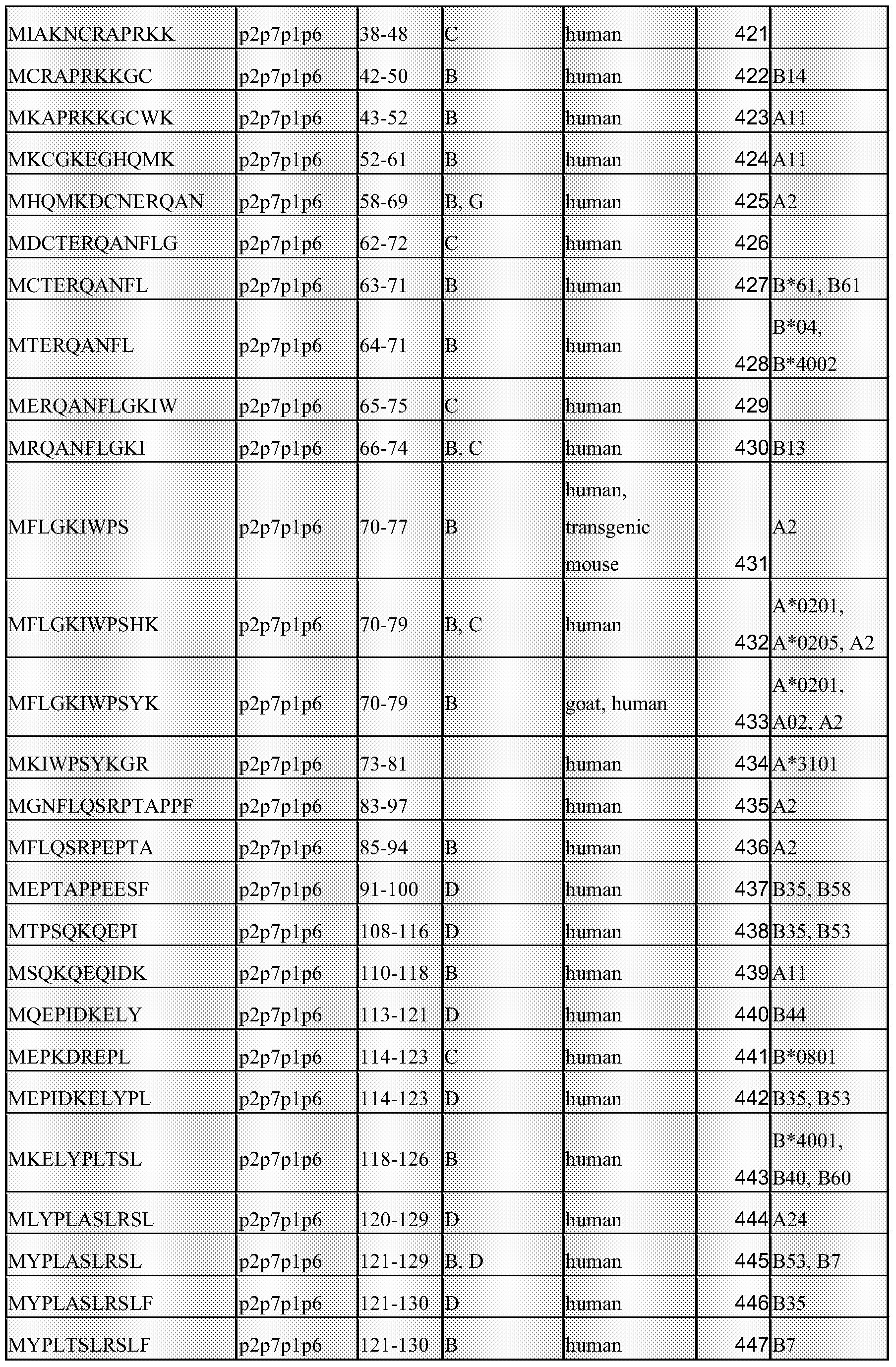


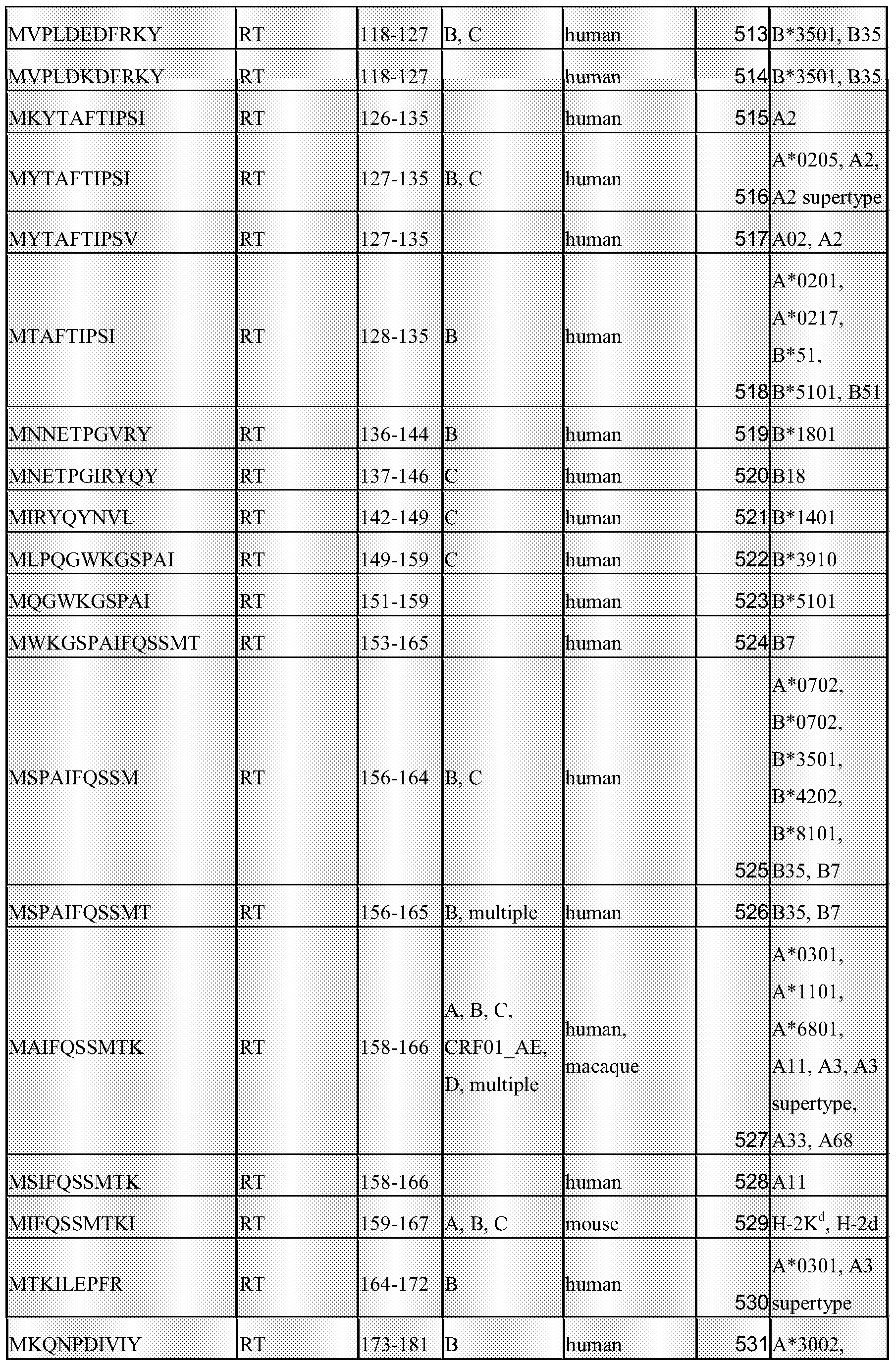


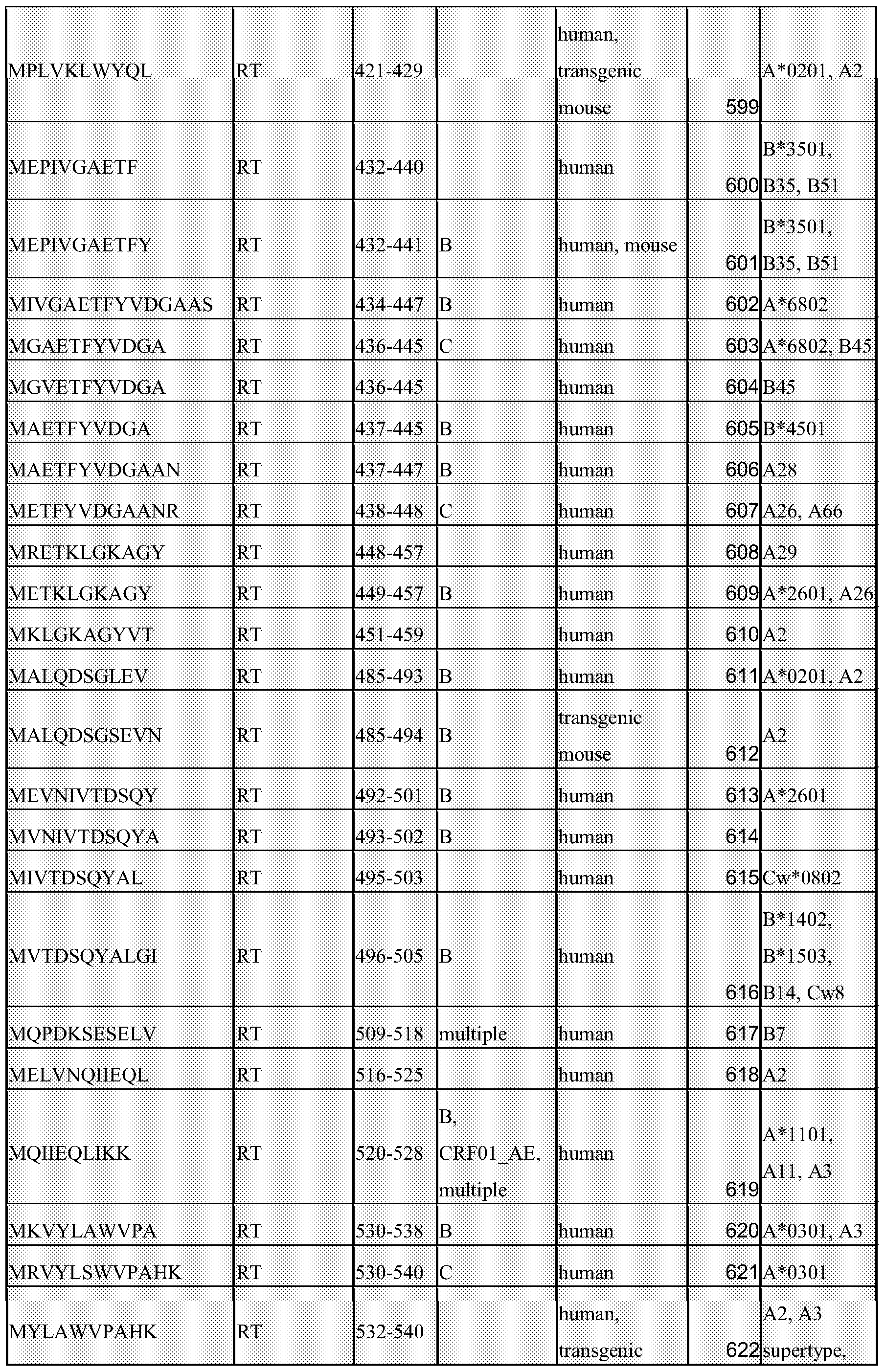


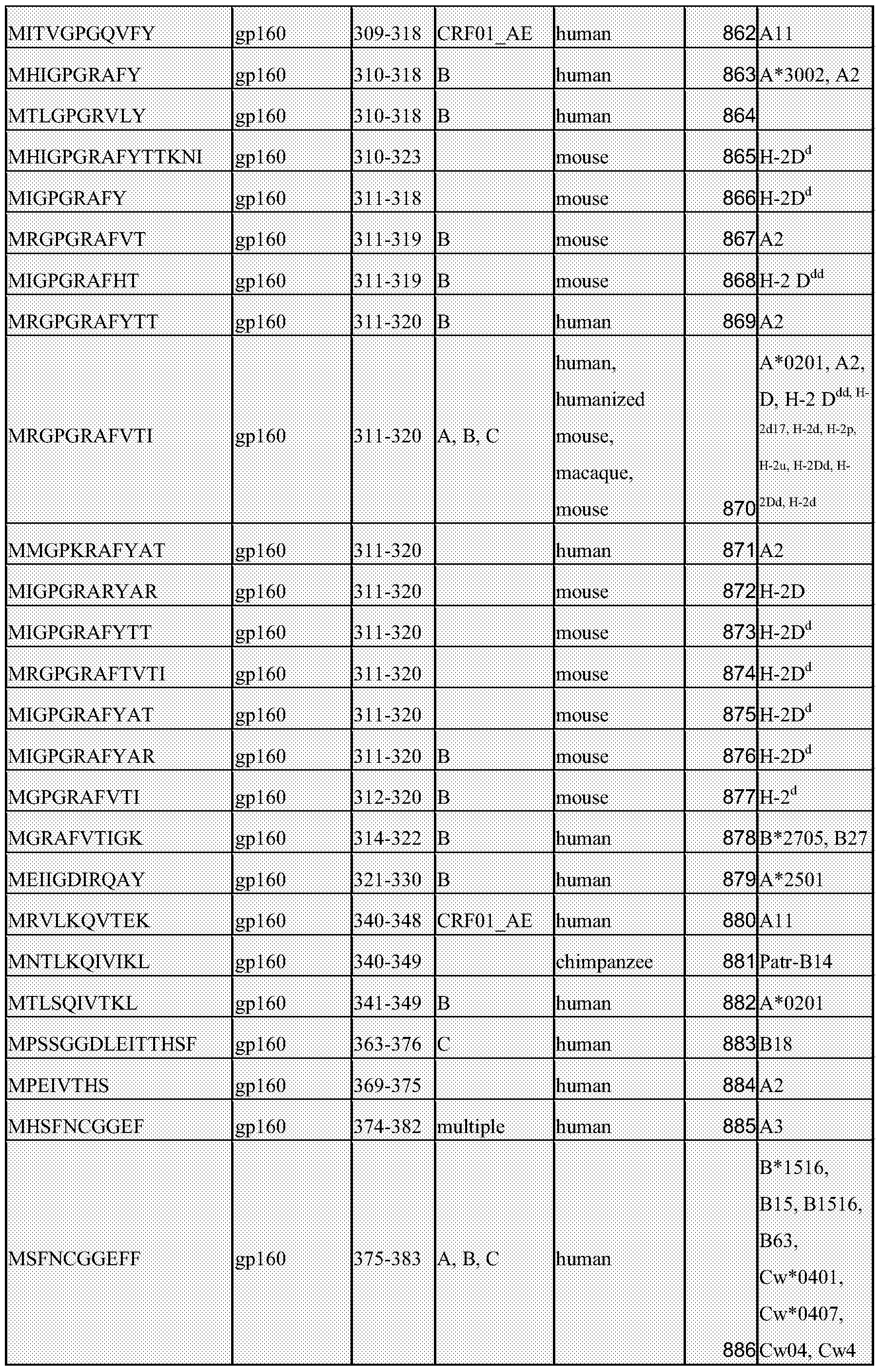


In a specific embodiment, the plurality of nucleic acid species encoding immunogenic polypeptide species according to the present invention comprise nucleic acid species encoding at least one immunogenic polypeptide selected from the group consisting of polypeptide sequences RGPGRAFVT, AMQMLKETI, MRGPGRAFVT, MAMQMLKETI, and/or a part comprising at least 7 amino acids thereof
MHC
In general, the methods, vectors, kits-of-parts, compositions and uses of the present invention may be employed for providing any immunogenic polypeptide, which are recognized by the major histocompatability complex (MHC). Thus, the plurality of nucleic acid species of the methods, vectors, kits-of-parts, compositions and uses of the present invention comprise any nucleic acid species encoding any immunogenic polypeptide, which is recognized by the major histocompatability complex (MHC).
There are two types of MHC molecules; MHC class I molecules and MHC class Il molecules. MHC class I molecules are recognized by CD8 T-cells, which are the principal effector cells of the adaptive immune response. MHC class Il molecules are mainly expressed on the surface of antigen presenting cells (APCs), the most important of which appears to be the dendritic cells. APCs stimulate naϊve T-cells, as well as other cells in the immune system. They stimulate both CD8 T-cells and CD4 T-cells.
In one embodiment, the immunogenic polypeptide species of the present invention are MHC Class l-restricted peptide fragments consisting of 7-10 consecutive amino acids
from any immunogenic polypeptide disclosed herein, for example any peptide selected from the group consisting of SEQ ID NO: 95 to 1159. Specifically, said MHC Class I- restricted peptide fragments are characterized by having at least one of several features, one of which is the ability to bind to the Class I HLA molecule to which it is restricted at an affinity as measured by the amount of the peptide that is capable of half maximal recovery of the Class I HLA molecule (C50 value) which is at the most 50 μM as determined by for example an assembly binding assay, based on stabilization of the HLA molecule after loading of peptide to a peptide transporter deficient cell line. Subsequently, correctly folded stable HLA heavy chains are immunoprecipitated using conformation dependent antibodies and the peptide binding is quantitated. The peptides of this embodiment comprises (or more preferably consists of) at the most 200, preferably at the most 100, more preferably at the most 50, yet more preferably at the most 25, even more preferably at the most 20, yet even more preferably at the most 15, such as at the most 10, for example in the range of 8 to 10 contiguous amino acids of any of SEQ ID NO 1 -46 and/or 95-1159, or a functional homolog thereof.
This assay provides a simple means of screening candidate peptides for their ability to bind to a given HLA allele molecule at the above affinity. In preferred embodiments, the immunogenic polypeptide of the invention in one having a C50 value, which is at the most 30 μM, such as a C50 value, which is at the most 20 μM including C50 values of at the most 10 μM, at the most 5 μM and/or at the most 2 μM.
Translation of the MHC restricted immunogenic polypeptide is initiated using a startcodon encoding a methionine. Thus, any immunogenic polypeptide or nucleic acid sequences encoding said immunogenic polypeptide, wherein a methionine residue, or a nucleic acid sequence encoding a methionine residue is inserted at the N-terminus of an immunogenic polypeptide provided herein, is also within the scope of the present invention.
In a preferred of the present invention, the immunogenic polypeptides are no longer than 8 to 10 amino acid residues are provided. Polypeptides longer than 8 to 10 amino acids are processed by the proteasome to a shorter length for binding to HLA molecules. Thus, when administering a polypeptide longer than 8 to 10 amino acid residues long, the "long" polypeptide / protein / protein fragment / variant is processed into a series of smaller peptides in the cytosol by the proteasome. Thus, by providing a
longer polypeptide that may be processed by the proteasome into a variety of different shorter peptides, multiple HLA classes may be targeted with one immunogenic polypeptides. By providing a smaller immunogenic polypeptide of 8 to 10 amino acids according to the present invention, only one particular HLA class is targeted. In a preferred embodiment of the present invention, only one HLA class is targeted per cell, i.e. only one immunogenic polypeptide is restricted by a HLA class protein per cell.
In another preferred embodiment, the immunogenic polypeptide species of the present invention are MHC Class ll-restricted peptide fragments comprising at least 9 consecutive amino acid residues selected from any region of any immunogenic polypeptide disclosed herein, for example any peptide selected from the group consisting of SEQ ID NO: 95 to 1159. Specifically, said MHC Class ll-restricted peptide fragments are characterized by having at least one of several features described herein below. The peptides of this embodiment comprises (or more preferably consists of) between 4 and 120, preferably between 8 and 100, more preferably between 10 and 75, yet more preferably between 12 and 60, even more preferably between 15 and 40, such as between 18 and 25 contiguous amino acids of any of SEQ ID NO 1-46 and/or 95-1159, or a functional homolog thereof. In one embodiment, the peptide comprises a methionine residue at the N-terminus, the example the peptide is any peptide selected from the group consisting of SEQ ID NO: 95-1 159, wherein a methionine residue has been inserted as the N-terminal amino acid.
In particular embodiments the present invention provides a plurality of non-identical nucleic acid species, each nucleic acid species encoding distinct immunogenic polypeptide species, which is an MHC Class l-restricted peptide or an MHC class ll- restricted peptide having at least one of the following characteristics: (i) capable of eliciting INF-γ -producing cells in a PBL population of a cancer patient at a frequency of at least 1 per 104 PBLs as determined by an ELISPOT assay, and/or (ii) capable of in situ detection in an individual of cytotoxic T-lymphocytes (CTLs) that are reactive with the immunogenic peptide epitope,
(iii) capable of inducing the growth in vitro of T-cells specific for any polypeptide selected from the group consisting of SEQ ID NO: 1 -46 and/or 95-1159 (iv) capable of inducing the growth in vitro of T-cells specific for an infectious disorder, an autoimmune disorder and/or any cancer form as described elsewhere herein.
More preferred peptides according to the present invention are peptides capable of raising a specific T-cell response as determined by an ELISPOT assay, for example the ELISPOT assay described in Example 1 herein below. Some polypeptides although they do not bind MHC class I or class Il with high affinity, may still give rise to a T-cell response as determined by ELISPOT. Other peptides capable of binding MHC class I or class Il with high affinity also give rise to a T-cell response as determined by ELISPOT. Both kinds of immunogenic polypeptides are preferred peptides according to the invention.
Hence, preferred immunogenic polypeptides according to the present invention are peptides capable of raising a specific T-cell response as measured by an ELISPOT assay, wherein more than 50 peptide specific spots per 108 cells, more preferably per 107, even more preferably per 106, yet more preferably per 105 cells, such as per 104 cells are measured.
Most preferred immunogenic polypeptides according to the present invention are peptides that are capable of eliciting a cellular immune response in an individual suffering from a clinical condition selected from the group consisting of infectious disorders, autoimmune disorder and/or cancer, as specified elsewhere herein, most preferably HIV, AIDS, hepatitis C and/or any cancer form.
Other preferred immunogenic polypeptides according to the present invention are peptides that are capable of eliciting a cellular immune response in an individual suffering from a clinical condition characterized by the expression of a polypeptide selected from the group consisting of SEQ ID NO: 1 -46 and/or 95-1159, the clinical condition preferably being a cancer or infection, and most preferably a cancer.
As described above, the HLA system represents the human major histocompatibility (MHC) system. Generally, MHC systems control a range of characteristics: transplantation antigens, thymus dependent immune responses, certain complement factors and predisposition for certain diseases. More specifically, the MHC codes for three different types of molecules, i.e. Class I, Il and III molecules, which determine the more general characteristics of the MHC. Of these molecules, the Class I molecules are so-called HLA-A, HLA-B and HLA-C molecules that are presented on the surface of most nucleated cells and thrombocytes.
The immunogenic polypeptides of the present invention are characterized by their ability to bind to (being restricted by) a particular MHC Class I HLA molecule. Thus, in one embodiment an immunogenic polypeptide is one which is restricted by a MHC Class I HLA-A molecule including HLA-A1 , HLA-A2, HLA-A3, HLA-A9, HLA-A10, HLA- A1 1 , HLA-AwI 9, HLA-A23(9), HLA-A24(9), HLA-A25(10), HLA-A26(10), HLA-A28, HLA-A29(w19), HLA-A30(w19), HLA-A31 (w19), HLA-A32(w19), HLA-Aw33(w19), HLA- Aw34(10), HLA-Aw36, HLA-Aw43, HLA-Aw66(10), HLA-Aw68(28), HLA-A69(28). More simple designations are also used throughout the literature, where only the primary numeric designation is used, e.g. HLA-A19 or HLA-A24 instead of HLA-AwI 9 and HLA- A24(49), respectively. In specific embodiments, the peptide of the invention is restricted by a MHC Class I HLA species selected from the group consisting of HLA-A1 , HLA-A2, HLA-A3, HLA-A1 1 and HLA-A24. In specific embodiment, the peptide of the invention is restricted by a MHC Class I HLA species HLA-A2 or HLA-A3.
In further useful embodiments, an immunogenic polypeptide of the invention is a peptide, which is restricted by a MHC Class I HLA-B molecule including any of the following: HLA-B5, HLA-B7, HLA-B8, HLA-B12, HLA-B13, HLA-B14, HLA-B15, HLA- B16, HLA-B17, HLA-B18, HLA-B21 , HLA-Bw22, HLA-B27, HLA-B35, HLA-B37, HLA- B38, HLA-B39, HLA-B40, HLA-Bw41 , HLA-Bw42, HLA-B44, HLA-B45, HLA-Bw46 and
HLA-Bw47. In specific embodiments of the invention, the MHC Class I HLA-B species to which the peptide of the invention is capable of binding is selected from HLA-B7, HLA-B35, HLA-B44, HLA-B8, HLA-B15, HLA-B27 and HLA-B51.
In further useful embodiments, an immunogenic polypeptide of the invention is a peptide, which is restricted by a MHC Class I HLA-C molecule including but not limited to any of the following: HLA-CwI , HLA-Cw2, HLA-Cw3, HLA-Cw4, HLA-Cw5, HLA- Cw6, HLA-Cw7 and HLA-CwL
In further useful embodiments, an immunogenic polypeptide of the invention is a peptide, which is restricted by a MHC Class Il HLA molecule including but not limited to any of the following: HLA-DPA-1 , HLA-DPB-1 , HLA-DQA1 , HLA-DQB1 , HLA-DRA, HLA-DRB and all alleles in these groups and HLA-DM, HLA-DO.
The selection of peptides potentially having the ability to bind to a particular HLA molecule can be made by the alignment of known sequences that bind to a given particular HLA molecule to thereby reveal the predominance of a few related amino acids at particular positions in the peptides. Such predominant amino acid residues are also referred to herein as "anchor residues" or "anchor residue motifs". By following such a relatively simple procedure based on known sequence data that can be found in accessible databases, immunogenic polypeptides can be derived from a target polypeptide, for example HIV-1 envelope such as any of SEQ ID NO: 1-59, which are likely to bind to a specific HLA molecule. Representative examples of such analyses for a range of HLA molecules are given in the below table 2.
Table 2


Thus, as an example, nonapeptides potentially having the ability to bind to HLA-A3 would have one of the following sequences: X-L-Y-X-X-X-X-X-K, X-L-Y-X-X-X-X-X-Y;
X-L-Y-X-X-X-X-X-F or X-V-Y-X-X-X-X-X-K (X indicating any amino acid residue). In a similar manner, sequences potentially having the ability to bind to any other HLA molecule can be designed. It will be appreciated that the person of ordinary skill in the art will be able to identify further "anchor residue motifs" for a given HLA molecule.
The immunogenic polypeptide species of the invention may have a sequence which is a native sequence of HIV envelope, such as defined by any of SEQ ID NO: 1-46. However, immunogenic polypeptide having a higher affinity to any given HLA molecule may be derived from such a native sequence by modifying the sequence by substituting, deleting or adding at least one amino acid residue, e.g. on the basis of the procedure described above, whereby anchor residue motifs in respect of the given HLA molecule are identified.
Thus, in useful embodiments, the immunogenic polypeptides of the invention include peptides, the sequences of which comprise, for each of the specific HLA alleles listed in the table, any of the amino acid residues as indicated in table 2 above.
Thus, the immunogenic polypeptides of the invention may be any of the above- mentioned peptides comprising contiguous sequences from any of SEQ ID NO: 1-46 and/or 59-1 159, wherein in the range of 1 to 10, preferably in the range of 1 to 5, more preferably in the range of 1 to 3, even more preferably in the range of 1 to 2, yet more preferably 1 amino acid has been exchanged for another amino acid, preferably in a manner so that the peptide comprises one or more, preferably all anchor residues of a given HLA-A specific peptide as indicated in table 2 above.
Examples of preferable HLA species, to which preferred immunogenic polypeptides of the present invention are restricted include: a MHC Class I HLA species selected from the group consisting of HLA-A1 , HLA-A2, HLA-A3, HLA-A1 1 and HLA-A24, more preferably the peptide is restricted by HLA-A3 or HLA-A2. Alternatively, a preferred HLA species includes MHC Class I HLA-B species selected from the group consisting of HLA-B7, HLA -B35, HLA -B44, HLA-B8, HLA-B15, HLA-B27 and HLA-B51.
An approach to identifying immunogenic polypeptides of the invention includes the following steps: selecting a particular HLA molecule, e.g. one occurring at a high rate in a given population, carrying out an alignment analysis as described above to identify
"anchor residue motifs" in the target protein, for example HIV-1 envelope, isolating or constructing peptides of a suitable size that comprise one or more of the identified anchor residues and testing the resulting peptides for the capability of the peptides to elicit INF-γ -producing cells in a PBL population of a cancer patient at a frequency of at least 1 per 104 PBLs as determined by an ELISPOT assay as described in Example 1.
A significant feature of the immunogenic polypeptides of the invention is the capability to recognize or elicit INF-γ -producing responder T cells, i.e. cytotoxic T cells (CTLs) that specifically recognize the particular peptide in a PBL population, on an APC or tumor / neoplastic cells of an individual suffering from a clinical condition of the present invention, such as an infectious disorder, an autoimmune disease and/or any cancer form as described elsewhere herein (target cells). This activity is readily determined by subjecting PBLs, APCs or target cell (e.g. tumor cells) from an individual to an ELISPOT assay. Prior to the assay, it may be advantageous to stimulate the cells to be assayed by contacting the cells with the immunogenic polypeptide, or the plurality of such peptides to be tested. Preferably, the peptide is capable of eliciting or recognizing INF-Y -producing T cells at a frequency of at least 1 per 104 PBLs as determined by an ELISPOT assay as used herein. More preferably the frequency is at least 5 per 104 PBLs, most preferably at least 10 per 104 PBLs, such as at least 50 or 100 per 104 PBLs.
Expression of peptides for MHC presentation
Multiple immunogenic peptides compete for a limited number of class I molecules. Those with the lowest affinity are unlikely to bind MHC-I and are subsequently degraded. Notably, immunodominant peptides are not always those with the highest affinity for a given MHC-I molecule, as shown in murine models, an observation that has been extended to EBV, and HIV epitopes. Another factor involved in epitope hierarchy is the amount and kinetics of protein production. This has been shown for several viruses such as lymphocytic choriomeningitis virus (LCMV), EBV, and vaccinia virus, in which earlier proteins are expressed, processed, and presented first, and may also be true for HIV since the most immunodominant responses are located in early accessory proteins such as Nef and highly expressed proteins like Gag. Nevertheless, within Gag and Nef lie subdominant epitopes, suggesting that other cellular factors are involved. TCR repertoire and epitope affinity for the TCR also play a role in immunodominance . In addition to the above factors, the efficiency of antigen
processing has been shown to influence viral epitope hierarchy in animal models. The processing of epitopes from ubiquitinylated proteins or from defective ribosomal translation products relies on sequential cleavages, mainly by the proteasome and other amino- or endopeptidases in the cytosol and in the ER. Poorly processed epitopes or epitopes with a low affinity for transporter associated with antigen processing (TAP) will be less likely to enter the ER and be loaded onto the MHC. The importance of antigen-processing efficiency on epitope hierarchy is indirectly demonstrated by the effect of mutations impairing epitope production and presentation. Artificial mutations in flanking regions of mouse viral epitopes as well as naturally occurring mutations flanking HIV or HCV epitopes have been shown to impair their processing and presentation and to lead to CTL escape. Mice deficient in an ER aminopeptidase (ERAAP/ERAP1 ) or in immunoproteasome subunits involved in epitope trimming present a different pattern of viral and cellular CTL immunodominant responses than WT mice, strongly supporting the role of finely tuned antigen- processing activities in establishing immunodominance.
Expression of peptides for MHC class I presentation are more efficient when expressed as small peptides that can be loaded directly without any further trimming of the polypeptide and it is more efficient to produce the peptides endogenous than it is to add the peptides exogenous. Therefore, the immunogenic polypeptide of the present invention are preferably within the range of small peptides which can be loaded directly without any further trimming of the polypeptide
Vectors As set out elsewhere herein, the present invention relates to a plurality of non-identical nucleic acid species, wherein each of said nucleic acid encodes a distinct cytokine or hormone, or a functional homologue or part thereof and/or a plurality of non-identical nucleic acid species, wherein each of said nucleic acid encodes a distinct immunogenic polypeptide as defined herein. Thus, in one embodiment of the methods, composition, kits-of-parts and/or uses of the present invention, the non-identical nucleic acid species encoding a distinct species of cytokine or hormone, or a functional homologue or part thereof is comprised in a nucleic acid expression vector species, and/or each said additional non-identical nucleic acid species encoding a distinct species of said immunogenic polypeptide is comprised in a nucleic acid expression vector species. In as preferred embodiment, each expression vector species comprises one and not more
than one nucleic acid encoding a distinct species of cytokine or hormone, or a functional homologue or part thereof and/or one and not more than one nucleic acid encoding a distinct species of said immunogenic polypeptide.
In one aspect, the present invention provides nucleic acid vectors, which comprise nucleic acid sequences encoding immunomodulating polypeptide (cytokine or hormone) and/or immunogenic polypeptides as defined elsewhere herein. Specifically, the present invention provides a plurality of non-identical nucleic acid vector species, wherein wherein each of said non-identical nucleic acid vector species comprises a distinct nucleic acid species encoding a distinct species of cytokine or hormone, or a functional homologue or part thereof, and/or a distinct nucleic acid species encoding a distinct species of immunogenic polypeptide comprising at least 3, such as at least 7 consecutive amino acids.
Thus in one embodiment, the present invention provides a plurality of non-identical nucleic acid vector species, wherein wherein each of said nucleic acid vector species comprises a distinct nucleic acid species encoding a distinct species of cytokine or hormone, or a functional homologue or part thereof.
In another embodiment, the present invention provides a plurality of non-identical nucleic acid vector species, wherein wherein each of said nucleic acid vector species comprises a distinct combination of a nucleic acid species encoding a distinct species of cytokine or hormone, or a functional homologue or part thereof, and a distinct nucleic acid species encoding a distinct species of immunogenic polypeptide comprising at least 3, such as at least 7 consecutive amino acids.
Importantly, the plurality of nucleic acid vectors of the present invention are provided to a population of cell by a method of transfectionas defined elsewhere herein, wherein each individual cell of said population of cells takes up at the most 5, such as 4, 3, 2, or 1 of said non-identical nucleic acid vector species. The plurality of nucleic acid vector species is on one embodiment provided by gene gun as described herein.
A nucleic acid acid vector of the present invention comprises any suitable eukaryotic expression vector or retroviral vector as defined herein below. Numerous vectors are available and the skilled person will be able to select a useful vector for the specific
purpose. The vector may, for example, be in the form of a plasmid, cosmid, viral particle or artificial chromosome. The appropriate nucleic acid sequence may be inserted into the vector by a variety of procedures, for example, DNA may be inserted into an appropriate restriction endonuclease site(s) using techniques well known in the art. Apart from the nucleic acid sequence according to the invention, the vector may furthermore comprise one or more of a signal sequence, an origin of replication, one or more marker genes, an enhancer element, a promoter, and a transcription termination sequence. The vector may also comprise additional sequences, such as enhancers, poly-A tails, linkers, polylinkers, operative linkers, multiple cloning sites (MCS), STOP codons, internal ribosomal entry sites (IRES) and host homologous sequences for integration or other defined elements. Methods for engineering nucleic acid constructs are well known in the art (see, e.g., Molecular Cloning: A Laboratory Manual, Sambrook et al., eds., Cold Spring Harbor Laboratory, 2nd Edition, Cold Spring Harbor, N.Y., 1989). The vector is preferably an expression vector, comprising the nucleic acid operably linked to a regulatory nucleic acid sequence directing expression thereof in a suitable cell. Within the scope of the present invention said regulatory nucleic acid sequence should in general be capable of directing expression in a mammalian cell, preferably a human cell, more preferably in an antigen presenting cell or a T-cell.
The nucleic acid vector species may comprise at least one intron, which will facilitate the transport from the nucleus to the cytoplasma of the vector encoded RNA, for example in packaging cells. In another embodiment, the vector is capable of expressing RNA in the cytoplasm by cytoplasmic transcription, which can be translated into envelope polypeptide. The vector is also, in one embodiment, capable of expressing high levels of vector encoded RNA, which is transported to the cytoplasma to be translated into envelope polypeptide as encoded in the vector. Thus, in one embodiment the vector species of the present invention is transcribed in the nucleus, thereby producing high levels of transcript, which after transport to the cytoplasm can be translated into polypeptide. The vector of the present invention may be transfected into a packaging cell which is capable of producing viral particles comprising said lentiviral envelope polypeptide.
The nucleic acid vector species of the present invention may comprise at least one additional nucleic acid sequence, in addition to a nucleic acid encoding an immunomodulating polypeptide and/or a nucleic acid species encoding an
immunogenic polypeptide. For example, the vector species may comprise a reporter gene. Thus, in one embodiment, the at least one additional nucleic acid sequence of a vector of the present invention encodes a reporter gene. In the present context the term "reporter gene" refers to any reporter gene that can be used to evaluate whether a host cell harbours the vector, provirus, retroviral particle, composition and/or kits-of- parts of the present invention. A number of reporter genes and systems for detection exist which will be appreciated by a person skilled in the art. For example the reporter gene of the present invention is selected from the group consisting of the enhanced green fluorescent protein (eGFP), lac Z, dsRed, enhanced yellow fluorescent protein (eYFP), enhanced cyan fluorescent protein (eCFP), enhanced blue fluorescent protein (eBFP) and the human alpha-1 -antitrypsin (hAAT). It is understood that any of the enhanced green fluorescent protein (eGFP), lac Z, dsRed, enhanced yellow fluorescent protein (eYFP), enhanced cyan fluorescent protein (eCFP), enhanced blue fluorescent protein (eBFP) or the human alpha-1 -antitrypsin (hAAT) there are also claimed in separate embodiments. In a preferred embodiment the eGFP gene is used.
In another embodiment of the present invention, the vector species of the present invention comprise a suicide gene and/or a selection gene encoding a selective marker. The selection gene of the present invention may be any gene suitable for example for selecting cells harbouring the vector constructs of the present invention. Typically the selection gene is a gene that confers resistance to antibiotics or drugs. Examples of such selection genes are the puromycin resistance gene (Puro), the tetracycline resistance gene, the streptomycin resistance gene, the hygromycin B resistance gene (Hygro), the zeocin resistance gene (zeo), the neomycin resistance gene (neo),and the blasticidin resistance gene (Bst). Therefore, the selection gene of the present invention is selected from the group consisting of puromycin resistance gene (Puro), the tetracycline resistance gene, the streptomycin resistance gene, the hygromycin B resistance gene (Hygro), the zeocin resistance gene (zeo), the neomycin resistance gene (neo) and the blasticidin resistance gene (Bst). In a preferred embodiment the selection gene is selected from the group consisting of puromycin resistance gene (Puro), the hygromycin B resistance gene (Hygro), the zeocin resistance gene (zeo), the neomycin resistance gene (neo) and the blasticidin resistance gene (Bst). It is appreciated that the resistance gene is selected from any of puromycin resistance gene (Puro), the tetracycline resistance gene, the streptomycin resistance gene, the hygromycin B resistance gene (Hygro), the zeocin resistance
gene (zeo), the neomycin resistance gene (neo) or the blasticidin resistance gene (Bst). In a preferred embodiment the resistance gene is the neomycin resistance gene. In another preferred embodiment, the selective marker is neomycin phosphotransferase II.
The suicide gene and/or a selection gene encoding a selective marker according to the present invention is in another embodiment Herpes simplex virus thymidine kinase (HSV-TK).
In a specific embodiment, the genes of the nucleic acids and/or vectors of the present invention are under the control of a constitutive promoter, however in another embodiment, the promoter is non-constitutive and may be activated.
The nucleic acid vectors of the present invention comprising a distinct combination of nucleic acid species encoding, for example, a cytokine and an immunogenic polypeptide are bicistronic or multicistronic. Therefore, in one embodiment, the nucleic vectors of the present invention further comprise at least one internal ribosomal entry site. Thus, the vector according to the present invention comprises, in one embodiment, two additional nucleic acid sequences, three, four, five or six additional nucleic acid sequences and at least two IRES elements, three, four, five or six IRES elements. In one embodiment, the at least one IRES are of different origin. Specifically, the nucleic acid sequence encoding an immunomodulating polypeptide of the present invention or fragment thereof may be preceded by an IRES. Similarly, any of the immunogenic polypeptides may be preceded by an IRES. An IRES preceding a nucleic acid sequence results in the translation of said sequence under the control of the IRES. In one embodiment of the present invention the immunomodulating polypeptide (e.g. cytokine) or fragment thereof is translated under the control of IRES. In another embodiment, the immunogenic polypeptide is translated under the control of IRES.
Thus, in one embodiment of the methods, compositions, kits-of-parts and/or uses of the present invention, the cytokine or hormone, or a functional homologue or part thereof, and/or said immunogenic polypeptide is translated from the vector transcript by means of an internal ribosomal entry site (IRES).
The IRES elements according to the present invention comprise any suitable element, which supports translation of an open reading frame. For example, the IRES may be derived from picornaviridae, retroviridae or retrotransposons, mammalia or combinations thereof. In a specific embodiment, the IRES is selected from the IRES elements of encephalomyocarditis (ECMV) or another picornavirus. Specifically, the IRES according to the present invention can be derived from the IRES element of elF4G.
When an IRES element is comprise in the vector, multiple nucleic acid species may be expressed by the same promoter. However as an alternative to the inclusion of IRES elements in the vector, the nucleic acid species encoding a distinct cytokine or hormone, or a functional homologue or part thereof, and the nucleic acid species encoding said immunogenic polypeptide are, in one embodiment, expressed by different promoters of the nucleic acid vector.
Moreover, the nucleic acid species encoding the cytokine or hormone, or a functional homologue or part thereof, and the nucleic acid species encoding said immunogenic polypeptide in one embodiment comprise identical 3'-untranslated region (UTR), i.e. the nucleic acid sequence of the 3'-UTR of the two nucleic acid species are the same. The 3'-UTR comprise different cis-acting elements involved in transcriptional and translational regulation as well as imRNa/mRNP metabolism, for example polyadenylation signal and/or 3'-processing elements. In another embodiment, nucleic acid species of the vector comprise different 3'-untranslated region.
In a specific embodiment of the methods, compositions, kits-of-parts and/or uses of the present invention, the nucleic acid species encoding an immunomodulating polypeptide (e.g. cytokine) or part thereof, and said nucleic acid species encoding said immunogenic polypeptide are produced by different splicing of the same vector transcript species.
In a preferred embodiment, the present invention relates to a plurality of non-identical nucleic acid vector species, wherein each species comprises a distinct nucleic acid species encoding an immunomodulating polypeptide, such as a cytokine or hormone selected from the group consisting of SEQ ID NO: 1-46 and/or a functional homolog and/or part thereof. In another embodiment, the present invention relates to a plurality
of non-identical nucleic acid vector species, wherein each species comprises a distinct nucleic acid species encoding an immunogenic polypeptide selected from the group consisting of SEQ ID NO: 95-1 159. In yet another embodiment, the present invention relates to a plurality of non-identical nucleic acid vector species, wherein each species comprises a distinct combination of one distinct nucleic acid species encoding an immunomodulating polypeptide, such as a cytokine or hormone selected from the group consisting of SEQ ID NO: 1-46, a functional homolog and/or part thereof and one distinct nucleic acid species encoding an immunogenic polypeptide selected from the group consisting of SEQ ID NO: 95-1 159.
In one embodiment, the vector species comprises an intron. The intron is deleted by splicing, thus, facilitating the transport from the nucleus to the cytoplasm of said vector encoded RNA in packaging cells. As an alternative to an intron, the vectors of the present invention may also comprise a constitutive transport element (CTE). The CTE facilitates the transport of the vector encoded RNA from the nucleus to the cytoplasm of the semipackaging cell. In another approach, the vector may comprise a Rev responsive element (RRE). The presence of an RRE in the RNA transcript facilitates its transport from the nucleus to the cytoplasma of the semipackaging cell, when REV/REX is coexpressed. In one specific embodiment, the vector is transcribed in the cytoplasm, thereby producing high levels of transcript, which can be translated into cytokine polypeptide or immunogenic polypeptide species.
Eukaryotic expression vector
The nucleic acid vector species of the present invention may be any eukaryotic expression vector, for example a mammalian expression vector, a yeast vector, or a protozoan vector. The vector is any suitable eukaryotic expression vector, preferably a a mammalian expression vector or a human expression vector.
The nucleic acid species as set out herein encoding an immunomodulating polypeptide species (e.g. a cytokine) and/or an immunogenic polypeptide may be comprised in separate vectors. Alternatively, one vector may comprise a distinct combination of a nucleic acid species encoding an immunomodulating polypeptide (e.g. a cytokine) and a nucleic acid species encoding an immunogenic polypeptide. Thus, in one embodiment, the nucleic acid species encoding a distinct species of cytokine or hormone, or a functional homologue or part thereof, and said additional nucleic acid
species encoding a distinct species of said immunogenic polypeptide are comprised in separate nucleic acid expression vectors species, and in another embodiment, nucleic acid species encoding a distinct species of cytokine or hormone, or a functional homologue or part thereof, and said additional nucleic acid species encoding a distinct species of said immunogenic polypeptide are comprised in the same nucleic acid expression vector species.
The design of the vectors of the present invention allows the vectors to be used for vaccination purposes, e.g. as componentc of a pharmaceutical composition, such as a vaccine composition. Thus, in one embodiment, upon transfection into a population of cells, the vectors as defined by the present invention are capable of inducing an immunogenic response in a host animal. For example, said immunogenic response is an antibody response and/or cytotoxic T Lymphocyte (CTL) response. In another embodiment, the immunogenic response is a CTL response, wherein said vector is integrated into the genome of a host cell.
Retroviral vector
The plurality of non-identical nucleic acid species, wherein each of said nucleic acid encodes a distinct immunomodulating polypeptide (e.g. cytokine) or part thereof and the plurality of non-identical nucleic acid species, wherein each of said nucleic acid encodes a distinct immunogenic polypeptide as defined herein are in one preferred embodiment comprised in a plurality retroviral vector species. Each retroviral vector species of said plurality of retroviral vector species comprise either a distinct nucleic acid species encoding a distinct immunomodulating polypeptide (e.g. cytokine) or part thereof, or a specific combination of one nucleic acid species encoding said distinct immunomodulating polypeptide (e.g. cytokine) or part thereof and a nucleic acid encoding a distinct immunogenic polypeptide as defined herein.
Thus, in one embodiment of the methods, composition, kits-of-parts and/or uses of the present invention, the non-identical nucleic acid species encoding a distinct species of cytokine or hormone, or a functional homologue or part thereof is comprised in a retroviral vector species, and/or each said additional non-identical nucleic acid species encoding a distinct species of said immunogenic polypeptide is comprised in a retroviral vector species. In a preferred embodiment, each retroviral vector species comprises one and not more than one nucleic acid encoding a distinct species of
cytokine or hormone, or a functional homologue or part thereof and/or one and not more than one nucleic acid encoding a distinct species of said immunogenic polypeptide.
In a preferred embodiment, the methods, composition, kits-of-parts and/or uses of the present invention relates to a plurality of retroviral vector species, wherein each vector species comprise a distinct combination of a nucleic acid species encoding an immunomodulating polypeptide (e.g. a cytokine) and a nucleic acid species encoding an immunogenic polypeptide. In another preferred embodiment, the methods, composition, kits-of-parts and/or uses of the present invention relates to a plurality of retroviral vector species, wherein each vector species comprise a distinct nucleic acid species encoding an immunomodulating polypeptide (e.g. a cytokine).
Thus in one embodiment, the nucleic acid species encoding said cytokine or hormone, or a functional homologue or part thereof, and/or said nucleic acid species encoding said immunogenic polypeptide are comprised in a retroviral vector species, or a retroviral vector transcript species, for example a retroviral expression vector.
The retroviral vector is in one embodiment a non-integrating retroviral vector.
In a specific embodiment, the retroviral vector is selected from the group consisting of SEQ ID NO: 87-94.
In one embodiment, the retroviral vector species of the present invention is comprised in a retroviral particle, in a liposome, a nanoparticle or any other physical or biological entity as described herein.
The retroviral vector can be derived from any species of retroviridae. In one embodiment, the retroviral vector is derived from Orthoretrovirinae, comprising Alpharetrovirus, Betaretrovirus, and Gammaretrovirus. In a specific embodiment, the retroviral vector is derived from Avian carcinoma Mill Hill virus 2, Avian leukosis virus, Avian myeloblastosis virus, Avian myelocytomatosis virus 29, Avian sarcoma virus CT10, Fujinami sarcoma virus, Rous sarcoma virus, UR2 sarcoma virus or Y73 sarcoma virus. Each of the alphaviruses specified above is intended to be an individual
embodiment. Consequently, a retroviral vector according to the present invention derived from each of them is claimed individually.
In another specific embodiment, the retroviral vector is derived from Jaagsiekte sheep retrovirus, Langur virus, Mason-Pfizer monkey virus, Mouse mammary tumor virus or Squirrel monkey retrovirus. Each of the betaviruses specified herein is intended to be an individual embodiment. Consequently, a retroviral vector according to the present invention derived from each of them may be claimed individually.
In another embodiment the retroviral vector according to the present invention is derived from a gammaretrovirus, including avian, and mammalian gammaretroviruses, for example murine retroviruses, such as murine leukaemia viruses and other related viruses. The vectors of the present invention are preferably derived from gammaretroviruses, for example Murine Leukemia Virus (MLV), Moloney Murine Leukemia Virus (MoMLV), or Akv MLV.
The retroviral vector is in one embodiment derived from Chick syncytial virus, Feline leukemia virus, Finkel-Biskis-Jinkins murine sarcoma virus, Gardner-Arnstein feline sarcoma virus, Gibbon ape leukemia virus, Guinea pig type-C oncovirus, Hardy- Zuckerman feline sarcoma virus, Harvey murine sarcoma virus, Kirsten murine sarcoma virus, Moloney murine sarcoma virus, Murine leukemia virus (MLV), Porcine type-C oncovirus, Reticuloendotheliosis virus, Snyder-Theilen feline sarcoma virus, Trager duck spleen necrosis virus, Viper retrovirus or Woolly monkey sarcoma virus. Each of the gammaviruses specified herein is intended to be an individual embodiment. Consequently, a retroviral vector according to the present invention derived from each of them may be claimed individually. In a particularly preferred embodiment, the retroviral vector is derived from Murine Leukemia Virus (MLV) or Moloney Murine Leukemia Virus (MoMLV) or Akv MLV.
In a specific embodiment, the retroviral vector is derived from Avian
(Reticuloendotheliosis) virus group such as Chick syncytial virus, Reticuloendotheliosis virus, Avian spleen necrosis virus , Spleen necrosis virus, Mammalian virus group , Murine endogenous retrovirus , Murine leukemia-related retroviruses , Epicrionops marmoratus retrovirus , lchthyophis kohtaoensis retrovirus , Osteolaemus tetraspis retrovirus , Sericulus bakeri retrovirus , Terdus iliacus retrovirus , Tomistoma schlegelii
retrovirus , Viper berus retrovirus , Xenotropic MuLV-related virus , Monodelphis sp. retrovirus, Replication competent viruses , Feline leukemia virus , Gibbon ape leukemia virus (GALV) , Murine leukemia virus , Porcine type-C oncovirus , Replication defective viruses , Abelson murine leukemia virus , Gardner-Arnstein feline sarcoma virus , Hardy-Zuckerman feline sarcoma virus , Harvey murine sarcoma virus , Kirsten murine sarcoma virus , Moloney murine sarcoma virus , Murine osteosarcoma virus , Snyder- Theilen feline sarcoma virus , Spleen focus-forming virus , Woolly monkey sarcoma virus, unclassified Gammaretrovirus , Baboon endogenous virus , Baboon endogenous virus strain M7, Feline endogenous virus , Feline endogenous virus ECE1 , Feline endogenous virus RD1 14, Koala retrovirus , Macaca mulatta type C retrovirus , Macaca endogenous retrovirus, MLV-related retrovirus , Rat leukemia virus , Rat sarcoma virus , RD1 14 retrovirus , Recombinant M-MuLV/RaLV retrovirus, Murine endogenous retrovirus , Murine leukemia-related retroviruses , Epicrionops marmoratus retrovirus , lchthyophis kohtaoensis retrovirus , Osteolaemus tetraspis retrovirus , Sericulus bakeri retrovirus , Terdus iliacus retrovirus , Tomistoma schlegelii retrovirus , Viper berus retrovirus , Xenotropic MuLV-related virus , Xenotropic MuLV- related virus VP35 , Xenotropic MuLV-related virus VP42 , Xenotropic MuLV-related virus VP62, Monodelphis sp. retrovirus, Replication competent viruses , Feline leukemia virus , Feline leukemia provirus (clone CFE-16) , Feline leukemia provirus (clone CFE-6) , Feline leukemia provirus ftt , Feline leukemia virus strain A/Glasgow-1 , Feline leukemia virus strain B/lambda-B1 , Feline leukemia virus strain C/FA27 , Feline leukemia virus strain C/FS246 , Feline leukemia virus strain C/Sarma , Feline sarcoma virus , Gardner-Arnstein feline leukemia oncovirus B, Gibbon ape leukemia virus (GALV) , Simian sarcoma-associated virus, Murine leukemia virus , AKR (endogenous) murine leukemia virus , Friend murine leukemia virus , Moloney murine leukemia virus , Murine leukemia virus isolates , unclassified Murine leukemia virus , Porcine type-C oncovirus , Porcine endogenous retrovirus , Porcine endogenous type C retrovirus, Replication defective viruses , Abelson murine leukemia virus , Gardner-Arnstein feline sarcoma virus , Hardy-Zuckerman feline sarcoma virus , Feline sarcoma virus (STRAIN HARDY-ZUCKERMAN 2) , Feline sarcoma virus (STRAIN HARDY-ZUCKERMAN 4), Harvey murine sarcoma virus , Kirsten murine sarcoma virus , Moloney murine sarcoma virus , Cas-NS-1 murine sarcoma virus , FBJ murine osteosarcoma virus , Moloney murine sarcoma virus (STRAIN HT-1 ) , Moloney murine sarcoma virus (STRAIN M1 ) , Moloney murine sarcoma virus (strain TS110) , Murine sarcoma virus 361 1 , Myeloproliferative sarcoma virus , NS.C58 murine sarcoma virus, Murine
osteosarcoma virus , FBR murine osteosarcoma virus, Snyder-Theilen feline sarcoma virus , Spleen focus-forming virus , Friend spleen focus-forming virus , Rauscher spleen focus-forming virus or Woolly monkey sarcoma virus. Each of the gammaviruses mentioned above is intended to be an individual embodiment. Consequently, a retroviral vector according to the present invention derived from each of them is claimed individually.
In another embodiment, the retroviral vector is derived from Bovine immunodeficiency virus, Caprine arthritis encephalitis virus, Equine infectious anemia virus, Feline immunodeficiency virus, Human immunodeficiency virus 1 , Human immunodeficiency virus 2, Puma lentivirus, Simian immunodeficiency virus, Visna/maedi virus and/or hepatitis C.
The retroviral vectors and genomes of biological entities, of the present invention, in one embodiment, further comprise a constitutive transport element (CTE) that is characterised in that it serves as a signal of nuclear export of unspliced viral RNAs.
The CTE of the present invention may be selected from the CTEs listed below in table
3.
Table 3. CTE elements

In a particular embodiment the CTE is derived from for Mason-Pfizer monkey virus, in another preferred embodiment the CTE is derived from the Woodchuck Hepatitis virus, for example the Woodchuck Hepatitis virus posttranscriptional regulatory element (WPRE).
Moreover, the retroviral vector may comprise a Rev responsive element (RRE). The presence of an RRE in the RNA transcript facilitates its transport from the nucleus to the cytoplasma, for example in a semipackaging cell, when REV/REX is coexpressed. In one specific embodiment, the vector is transcribed in the cytoplasm, thereby
producing high levels of transcript, which can be translated into envelope polypeptide. This envelope polypeptide may then be incorporated into viral particles in a packaging/producer cell.
In a specific embodiment of the present invention, the retroviral vector species comprises an IRES, wherein said IRES is located in the 3'-LTR or the 5'-LTR, or in a region flanked by the 3'-LTR and the 5'-LTR. In particular, said IRES may be located in the R region of both the 5'-LTR and/or 3'-LTR. In another embodiment, the IRES is located in the U3 region of the 3'-Long Terminal Repeat or the U5 region of the 5'-LTR. In yet another specific embodiment of the present invention, said IRES is located in the U3 region between the inverted repeats and the transcription regulatory elements.
Physical entity
The scope of the present invention extents to a plurality of any physical entity species, wherein said each said physical entity species comprise distinct: a. non-identical nucleic acid species encoding distinct species of cytokine or hormone, or a functional homologue or part thereof as defined elsewhere herein, and/or b. non-identical nucleic acid species encoding distinct species of immunogenic polypeptides as defined elsewhere herein, and/or c. non-identical vector species as defined elsewhere herein, and/or d. non-identical retroviral particle species as defined elsewhere herein, and/or e. gene gun particles as defined elsewhere herein.
The physical entity may be any biological entity and include for example a virual particle, a liposome, a nanoparticle, a virosome, a protzoa, an enterobacteria, any gene gun particle (any particle which can be used by a gene gun), such as a gold particle, and/or a nanoparticle or a liposome with synthetic envelope polypeptides.
In a primary aspect, the present invention provides a plurality of non-identical biological entity species, such as a eukaryotic cell, a prokaryotic cell, a viral particle, and/or a retroviral particle, wherein each said non-identical biological entity species comprises a distinct nucleic acid species encoding a distinct species of cytokine or hormone, or a functional homologue or part thereof, and/or a distinct species of an immunogenic polypeptide comprising at least 3, such as at least 7 consecutive amino acids. Cytokine
or hormone species, or functional homologs or parts thereof as well as immunogenic polypeptides are defined elsewhere herein. In a preferred embodiment of the plurality of physical entities of the present invention, each physical entity comprise at least one nucleic acid species encoding an immunogenic polypeptide species selected from the group consisting of SEQ ID NO: 95-1 159. In another embodiment, the nucleic acid species enocode an immunogenic polypeptide comprising at least 3, such as at least 7 consecutive amino acids selected from any region of an HIV-1 envelope polypeptide selected from the group consisting of SEQ ID NO: 1-46.
In a preferred embodiment, the plurality of physical entity species of the present invention is a plurality biological entity species. In one example, the biological entity is a retroviral particle and/or provirus. However, in another preferred embodiment the biological entity is a prokaryotic cell and/or a eukaryotic cell, such as a mammalian cell. In yet another embodiment the biological entity is a liposome, a nanoparticle, a virosome, a protzoa, and/or enterobacteria. Specifically, the biological entity may be prokaryotic and/or eukaryotic cells in the intestinal tract and/or other parts of the digestive system. Moreover, the biological entity may be a nanoparticle or a liposome with synthetic envelope polypeptides.
Thus, in one embodiment, the present invention provides a method of treating, preventing or ameliorating a clinical condition, said method comprising a. providing a population of cells, b. bringing a plurality non-identical physical entity species into contact with said population of cells, wherein said contact results in uptake of said physical entity species in said cells, and wherein each of said non- identical physical entity species encodes a distinct species of cytokine or hormone, or a functional homologue or part thereof, and c. obtaining an immunogenic response of said population of cells, wherein each individual cell of said population of cells take up at the most 5, such as 4, 3, 2, and preferably 1 non-identical physical entity species.
In a preferred embodiment the immunogenic polypeptide is expressed on the surface of the physical entity of the present invention.
Specifically, the immunogenic polypeptide of said physical entity comprises gal-alfa1- 3Galbeta1 -4GIcNAc-R epitopes. The physical entity of the present invention is capable of mediating fusion of said physical entity and cells expressing receptors for HIV. In another embodiment, the physical entity of the present invention is capable of infecting a CD4 positive cell. Moreover, the physical entity is in one embodiment capable of inducing an immunogenic response in a host animal. In particular, said immunogenic response may be directed towards said physical entity in said host animal. The host animal may be any animal, however, preferably a mammal, more preferably a human being. However, in one preferred embodiment, the biological entity of the present invention is capable of infecting mammalian cells, such as preferably human cells. In the present context, the term "human cells" comprise any sort of human cell including mutated human cells pathogenic cells as well as any type of human stem cell.
In a specific embodiment, the physical entity is a nanoparticle, for example a nanoparticle with synthetic envelope peptides, a liposome, for example a virosome or any combination thereof. Thus, in a specific embodiment, the present invention provides a plurality of non-identical liposome species, wherein each said liposome species comprise a distinct nucleic acid species encoding a distinct species of cytokine or hormone, or a functional homologue or part thereof, and/or a distinct species of an immunogenic polypeptide comprising at least 3, such as at least 7 consecutive amino acids. Cytokine or hormone species, or functional homologs or parts thereof as well as immunogenic polypeptides are defined elsewhere herein.
In a specific embodiment, physical entity, such as a biological entity of the present invention, which express a distinct cytokine or hormone polypeptide or a functional homolog or part thereof and/or an immunogenic polypeptide as defined herein are encapsulated, wherein the capsules have a porous capsule wall which is permeable to said retroviral particles and/or said biological entity.
Retroviral particles
The distinct nucleic acid species of the plurality of non-identical nucleic acid species encoding distinct species of cytokines of hormones and/or immunogenic polypeptides is in one embodiment comprised in a retroviral vector, as described elsewhere herein. Thus, the present invention also encompass a plurality of non-identical retroviral
vectors, wherein each retroviral vector species comprise a distinct nucleic acid species encoding a distinct species of a cytokine or hormone and/or a distinct species of a immunogenic polypeptides. That plurality of non-identical retroviral vectors is in one embodiment packaged into a plurality of non-identical retroviral particles, wherein each species of retroviral particle comprise a distinct nucleic acid encoding a distinct species of cytokines of hormones, and/or a distinct species of immunogenic polypeptide, as defined elsewhere herein.
Thus, the plurality of nucleic acid species according to the present invention is in one embodiment provided to the population of cells by retroviral infection, by bringing said plurality of retroviral particles into contact with said population of cells.
A main aspect of the present invention is to provide a plurality of retroviral particles, which is fusogenic, i.e. the fusogenic particles are infectious and mediate fusion with target cells.
In a preferred embodiment, the retroviral particles comprise a plurality of nucleic acid species encoding a cytokine or hormone or a functional homolog or part thereof, wherein at least one cytokine or hormone is selected from the group consisting of SEQ ID NO: 47-86 and/or a functional homolog thereof. In another embodiment, the plurality of non-identical nucleic acid species encoding a distinct cytokine or hormone or a functional homolog or part thereof are as defined elsewhere herein.
In another preferred embodiment, the retroviral particles comprise a plurality of nucleic acid species encoding an immunogenic polypeptide, wherein at least one of said peptide species is selected from the group consisting of SEQ ID NO: 1-46 and/or 95- 1 159 and/or any part thereof, preferably consisting of 7-9, or 10-1 1 amino acid residues thereof. In another embodiment, the plurality of non-identical nucleic acid species encoding a distinct immunogenic polypeptide are as defined elsewhere herein.
The retroviral particle of the present invention is derived from any retrovirus, including any of the retroviruses, wherefrom the retroviral vectors of the present invention may be derived, as describes above. In a preferred embodiment, the retroviral particle is a gamma-retroviral particle. In a specific embodiment, the retroviral particle is a murine leukaemia virus.
In one embodiment, the retroviral particles of the present invention are fusogenic and/or infectious.
The retroviral particle may be s pseudotyped particle, such as a pseudotyped MLV particle. The particle may infect a target population of cells by any suitable receptor. In one example, the plurality retroviral particles of the present invention infect the population of cells by means of the CD4-CXCR4/CCR5 receptor pathway. Thus, in one embodiment, present invention relates to any component of the present invention including a vector, a nucleic acid, a physical entity, such as a retroviral particle, a composition, and/or a kit-of-parts described herein comprising a retroviral envelope polypeptide, capable of mediating infection of a cell, by use of the CD4-CXCR4/CCR5 receptor pathway.
Producer cells
The retroviral vector of the present invention is in one embodiment constructed as a replication-defective vector based on any of the retroviruses mentioned elsewhere herein. A replication-defective retroviral vector is characterised in that, one or more genes essential for virus replication, packaging of viral RNA and/or formation of infective particle, have been deleted from the retroviral vector. Thus, to reconstitute the viral life cycle and generate viral particles comprising such replication defective vectors a specialised producer cell (packaging cell) providing the deleted genes is needed. Such producer cell are constructed by transducing a cell with DNA constructs encoding the genetic information of the retroviral proteins, which are essential for packaging a retroviral vector genome and generating viral particles.
Thus, producer cells according to the present invention refers to cells that express trans-acting virus-encoded components necessary for the packaging of retroviral RNA genome or derivatives thereof. Packaging cells are also referred to as producer cells, and the terms are used interchangeably and synonymously herein.
Packaging/producer cells are often produced by transfecting cells with genetic information and/or genes essential for retroviral particle formation. The culture of packaging cells is subsequently supertransfected with the vector DNA. However, the genetic information and/or genes essential for retroviral particle formation and the
vector DNA may also be introduced in a single round of transfection. Supertransfection here describes another or a second transfection event, namely the transfection of the packaging cell with the vector. The resulting supertransfected packaging cell will subsequently produce infectious viral particles comprising the vector RNA genome. Said particles, which will be released from the packaging cell, can be isolated. It should be noted that only supertransfected packaging cells produce infectious viral particles. Accordingly, the transduction efficiency directly correlates with the amount of infectious viral particles produced.
In the presence of a retroviral vector genome (the process known as transduction) a producer cell will generate infectious viral particles which comprise the retroviral genome derived from the vector. The viral particles produced in this manner will be released and can infect another producer cell. Such producer cells are also designated as packaging cells. In one embodiment, the retroviral particle of the present invention is obtained by transfection of a producer cell with a retroviral vector or part thereof, or an RNA or part thereof according to the present invention.
In one aspect, the present invention relates to a producer cell comprising a vector as provided by the present invention. According to one embodiment of the present invention, one of said nucleic acid sequences encoding said cytokine or hormone polypeptide and/or an immunogenic polypeptide is under translational control of a heterologous IRES.
In another embodiment, the retroviral particle according to the present invention comprises vesicular stomatitis virus envelope (VSV-G), the amphotropic murine leukemia virus envelope, Mutated SL3-2 envelope, Xenotropic murine leukaemia virus envelope, 10A1 virus envelope, Hepatitis virus C envelope, gibbon ape leukaemia virus. Human T-cell lymphotropic virus, or envelopes of endogenous human retroviruses. In one embodiment, the retroviral particle comprises the G glycoprotein of the vesicular stomatitis virus envelope (VSV-G).
The retroviral particles are preferably capable of infecting animal cells, such as mammalian cells, preferably human cells. In a specific embodiment, the retroviral particles are capable of infecting stem cells. In another specific embodiment, the retroviral particles are capable of infecting a CD4 positive cell. Moreover, the retroviral
particles of the present invention are capable of inducing an immunogenic response in a host animal, preferably a human being.
In a specific embodiment, the retroviral packaging cells or semipackaging cells producing retroviral particles are encapsulated. Similarly, any other physical entity, such as a biological entity of the present invention, which express a cytokine or hormone polypeptide or a functional homolog or part thereof and/or an immunogenic polypeptide as defined herein are encapsulated, wherein the capsules have a porous capsule wall which is permeable to said retroviral particles and/or said biological entity. In a particular embodiment of the present invention, the producer cell does not comprise lentiviral tat or rev, for example HIV-1 tat or rev. Also the rex gene originating from HTLV is not present in the host cell.
Target cells - population of cells
A primary aspect of the present invention relates to a method of treating, preventing or ameliorating a clinical condition, wherein a plurality of non-identical nucleic acid species is provided to a population of cells, wherein said contact results in uptake of said nucleic acid species in said cells, and wherein each of said non-identical nucleic acid species encodes a distinct species of cytokine or hormone, or a functional homologue or part thereof, and wherein each individual cell of said population of cells take up at the most 5 non-identical nucleic acid species.
In one embodiment, a plurality of additional non-identical nucleic acid species is also provided to said population of cell, wherein each said additional non-identical nucleic acid species encodes a distinct species of immunogenic polypeptide comprising at least 3, such as at least 7 consecutive amino acids, wherein each individual cell of said population of cells takes up at the most 5 of said additional non-identical nucleic acid species. Examples of cytokine, hormones and immunogenic polypeptide are provided elsewhere herein.
Thus, the primary aspect if the present invention relates to the transduction of the cells of the population of target cells, wherein only one or a few nucleic acid species or vector species of the present invention are transferred to each cell of the targeted population. In one embodiment, only one or a few nucleic acid species encoding a cytokine or hormone or part thereof as defined herein are provided to each cell. However, in another embodiment, one or a few nucleic acid species encoding a distinct
cytokine or hormone species or part thereof as defined herein and one or a few nucleic acid species encoding an immunogenic polypeptide are provided to each cell. The nucleic acid species are in one embodiment comprised in a nucleic acid vector as defined elsewhere herein, such as a mammalian expression vector or a retroviral vector.
It is understood, that in the present invention, preferably one or a few nucleic acid species are transferred to each cell. However, depending on the means of administration, the number of nucleic acid species provided per cell and/or taken up per cell may follow a statistical distribution, such as a normal distribution. It is therefore comprehended that in the present invention, when the term "one or a few" nucleic acid species per cell is to be interpreted as an average measure.
Thus, in one embodiment, i) each individual cell of a first subpopulation of said population of cells takes up one and not more than one nucleic acid species encoding said cytokine or hormone or functional homologue or part thereof and/or one and not more than one additional nucleic acid species encoding said immunogenic polypeptide, and/or ii) each individual cell of a second subpopulation of said population of cells takes up two and not more than two nucleic acid species encoding said cytokine or hormone or functional homologue or part thereof and/or two and not more than two additional nucleic acid species encoding said immunogenic polypeptide, and/or iii) each individual cell of a third subpopulation of said population of cells takes up three and not more than three nucleic acid species encoding said cytokine or hormone or functional homologue or part thereof and/or three and not more than three additional nucleic acid species encoding said immunogenic polypeptide, and/or iv) each individual cell of a fourth subpopulation of said population of cells takes up four and not more than four nucleic acid species encoding said cytokine or hormone or functional homologue or part thereof and/or four and not more than four additional nucleic acid species encoding said immunogenic polypeptide, and/or
v) each individual cell of a fifth subpopulation of said population of cells takes up five and not more than five nucleic acid species encoding said cytokine or hormone or functional homologue or part thereof and/or five and not more than five additional nucleic acid species encoding said immunogenic polypeptide.
In one embodiment, the cells of said first, second, third and fourth subpopulations comprise at least 20 percent, such as at least 30, for example at least 40, such as at least 50, for example at least 60, such as at least 70, for example at least 80, such as at least 90, for example at least 95, such as 100 percent of said population of cells. In another embodiment, the cells of said first, second, and third subpopulations comprise at least 20 percent, such as at least 30, for example at least 40, such as at least 50, for example at least 60, such as at least 70, for example at least 80, such as at least 90, for example at least 95, such as 100 percent of said population of cells. In another embodiment, the cells of said first and second subpopulations comprise at least 20 percent, such as at least 30, for example at least 40, such as at least 50, for example at least 60, such as at least 70, for example at least 80, such as at least 90, for example at least 95, such as 100 percent of said population of cells. In yet another embodiment, the first subpopulation comprise at least 20 percent, such as at least 30, for example at least 40, such as at least 50, for example at least 60, such as at least 70, for example at least 80, such as at least 90, for example at least 95, such as 100 percent of said population of cells.
In a further embodiment, the first subpopulation comprises at least 80 percent of said population of cells. In another embodiment, the second subpopulation comprise at least 10 percent, such as at least 20 percent, such as at least 30, for example at least 40, such as at least 50, for example at least 60, such as at least 70, for example at least 80, such as at least 90, for example at least 95, such as at least 98 percent of said population of cells.
The population of cells of the present invention comprise any cells, which may be targeted for treatment of an infectious disorder, an autoimmune disorder and/or a cancer form as described elsewhere herein. The population of cells are derived from any tissue, animal tissue or human tissue. In a preferred embodiment, the targeted cells are human cells, for example a population of cancer cells.
The population of target cells are in one embodiment animal cells, such as mammalian cells, preferably human cells. In a specific embodiment, the target cells are stem cells. In another specific embodiment, the target cells are CD4 positive cells. In one embodiment, the host animal is a human being.
The population of cells are may be removed from a tissues or from the animal or human body. However, in another embodiment, the population of cells are treated in situ, i.e. without removal from the animal or human body.
One embodiment of the present invention relates to any component of the present invention including a vector, a nucleic acid, a physical entity, such as a retroviral particle, a composition, and/or a kit-of-parts described herein comprising a retroviral envelope polypeptide, capable of mediating infection of a cell, by use of the CD4- CXCR4/CCR5 receptor pathway. Thus, embodiments of the present invention comprise any components of the present invention comprising an HIV- envelope polypeptide as defined herein, capable of mediating infection of a CD4-positive cell, and/or a CXCR4/CCR5-positive cell.
CD4 (cluster of differentiation 4) is a glycoprotein that is found primarily on the surface of helper T cells, as well as regulatory T cells and dendritic cells. CD4 is a member of the immunoglobulin superfamily. It has four immunoglobulin domains (D1 to D4) that are exposed on the extracellular surface of the cell: D1 and D3 resemble immunoglobulin variable (IgV) domains, while D2 and D4 resemble immunoglobulin constant (IgC) domains. On T cells, CD4 is the co-receptor for the T cell receptor (TCR) and recruits the tyrosine kinase lck.
CD4 is also a primary receptor used by HIV-1 to gain entry into host T cells. The HIV-1 envelope gp120 protein attaches to CD4, creating a shift in the conformation of the viral gp120 protein, which allows HIV-1 to bind to two other cell surface receptors on the host cell (the chemokine receptors CCR5 and CXCR4). Following another change in shape of a different HIV-1 envelope protein (gp41 ), HIV inserts a fusion peptide into the host T cell that allows the outer membrane of the virus to fuse with the T-cell membrane. HIV infection leads to a progressive reduction in the number of T cells possessing CD4 receptors and, therefore, the CD4 count is used as an indicator to help physicians decide when to begin treatment in HIV-infected patients.
The terms "CD4-positive cell" or "CXCR4/CCR5-positive cell" as used herein, relates to any cells expressing CD4 receptor or CXCR4/CCR5 receptor, respectively. The CD4 receptor and/or CXCR/CCR5 receptor may be accessible from the extracellular space at the cellular membrane.
Disorders
The present invention provides methods, kits-of-parts, compositions, and uses for treating, preventing or ameliorating a clinical condition. In one broad aspect, the present invention relates to a method of treating, preventing or ameliorating a clinical condition, said method comprising a. providing a population of cells, b. bringing a plurality of non-identical nucleic acid species into contact with said population of cells, wherein said contact results in uptake of said nucleic acid species in said cells, and wherein each of said non-identical nucleic acid species encodes a distinct species of cytokine or hormone, or a functional homologue or part thereof, c. obtaining an immunogenic response of said population of cells, wherein each individual cell of said population of cells take up at the most 5 non-identical nucleic acid species.
A clinical condition of the present invention comprises any infectious disorder, autoimmune disorder, and/or cancer form. The clinical conditions of the present invention comprise any kind of clinical condition giving rise to an immune response, including inflammation, and therefore include infectious diseases, chronic infections, autoimmune conditions and allergic inflammations. Thus, infections, such as infectious diseases, chronic infections, autoimmune conditions, allergic inflammations and cancer are all clinical conditions of relevance for the present invention. The clinical conditions of most relevance for the present invention are presented in turn hereunder as Infectious disorders, autoimmune disorders/allergy, and cancer.
Infections
An infectious disorder may be caused by a virus, and viral diseases against which the methods, kits-of-parts, composition and uses of the present invention may be provided, for example in the treatment of HIV, AIDS, AIDS Related Complex (ARC); thus it is an
object of the present invention to administer a component if the present invention as the treatment of or as part of the treatment of these viral infections.
In one embodiment, the methods, kits-of-parts, compositions and uses of the present invention are employed in the treatment of an infectious disorder, wherein said infectious disorder according to the present invention is selected from the group consisting of AIDS, Anal Warts, Anthrax, Bronchitis, Bug-borne Diseases, Campylobacter, Cellulitis, Chickenpox, Chlamydia Infections, Common Cold, Crab Lice, Cryptosporidiosis, Cytomegalovirus Infections, Dengue, Diphtheria, E. CoIi Infections, Ehrlichiosis, Fever, Flea Bites, Foodborne Diseases, Fungal Infections, Gonorrhea, Hepatitis, Hepatitis C, Herpes Simplex, Herpes Zoster, HPV, Impetigo, Infectious Diseases (General), Influenza, Legionnaire's Disease, Leprosy, Lyme Disease, Malaria, Measles, Meningitis, MRSA, Mumps, Norwalk Virus Infections, Parasitic Diseases, Pelvic Inflammatory Disease, Pfiesteria piscicida, PID, Pneumonia, Polio and Post-Polio Syndrome, Rubella, Salmonella Infections, Scabies, Severe Acute Respiratory Syndrome, Sexually Transmitted Diseases, Shigella Infections, Shingles (Herpes Zoster), Sinusitis, Smallpox, Staphylococcal Infections, STD, Streptococcal Infections, Syphilis, Tetanus, Tick Bites, Trichomoniasis, Tuberculosis, Viral Infections, and/or West Nile Virus.
In one embodiment, clinical condition of the methods, compositions, kits-of-parts and/or uses of the present invention is an infectious disorder selected from the group consisting of AIDS, Anthrax, Campylobacter, Chlamydia Infections, Common Cold, Cytomegalovirus Infections, Dengue, Diphtheria, E. CoIi Infections, Gonorrhea, Hepatitis C, Herpes Simplex, Herpes Zoster, HPV, Influenza, Legionnaire's Disease, Leprosy, Lyme Disease, Malaria, Measles, Norwalk Virus Infections, Salmonella Infections, Scabies, Shigella Infections, Syphilis, Tuberculosis, and/or West Nile Virus.
In a preferred embodiment, the clinical condition is hepatitis C. In another preferred embodiment, the clinical condition is HIV, such as HIV-1 or HIV-2, AIDS and/or AIDS related complex (ARC).
Infectious Disease Combination Treatment
It is further provided for that a treatment of any infectious disease by the methods, kits- of-parts, compositions and/or uses according to the present invention may be given in
conjunction with a further (second) active ingredient or in combination with a further treatment such as antibiotic treatment, chemotherapy, treatment with immunostimulating substances, treatment using dendritic cells, antiviral agents anti parasitic agents and so forth.
Examples of a second active ingredient that may be used in the treatment of an infectious disease in combination with the vaccine of the present invention include, and are not limited to antibiotics. The term antibiotics herein refers to substances with antibacterial, anti-fungal, anti-viral and/or anti-parasitical activity; examples of relevance to the present invention include, but are not limited to: Amikacin, Gentamycin, Kanamycin, Neomycin, Netilmicin, Paromomycin, Streptomycin, Tobramycin, Ertapenem, Imipenem, Meropenem, Chloramphenicol, Fluoroquinolones, Ciprofloxacin, Gatifloxacin, Gemifloxacin, Grepafloxacin, Levofloxacin, Lomefloxacin, Moxifloxacin, Norfloxacin, Ofloxacin, Sparfloxacin, Trovafloxacin, Glycopeptides, Vancomycin, Lincosamides, Clindamycin, Macrolides / Ketolides, Azithromycin, Clarithromycin, Dirithromycin, Erythromycin, Cefadroxil, Cefazolin, Cephalexin, Cephalothin, Cephapirin, Cephradine, Cefaclor, Cefamandole, Cefonicid, Cefotetan, Cefoxitin, Cefprozil, Cefuroxime, Loracarbef, Cefdinir, Cefditoren, Cefixime, Cefoperazone, Cefotaxime, Cefpodoxime, Ceftazidime, Ceftibuten, Ceftizoxime, Ceftriaxone, Cefepime, Monobactams, Aztreonam, Nitroimidazoles, Metronidazole, Oxazolidinones, Linezolid, Penicillins, Amoxicillin, Amoxicillin / Clavulanate, Ampicillin, Sulbactam, Bacampicillin, Carbenicillin, Cloxacillin, Dicloxacillin, Methicillin, Mezlocillin, Nafcillin, Oxacillin, Penicillin G, Penicillin V, Piperacillin, Piperacillin / Tazobactam, Ticarcillin, Ticarcillin / Clavulanate, Streptogramins, Quinupristin, Dalfopristin, Sulfonamide / Sulfamethoxazole, Trimethoprim, Tetracyclines, Demeclocycline, Doxycycline,
Minocycline, Tetracycline, Azole antifungals Clotrimazole Fluconazole, Itraconazole, Ketoconazole, Miconazole, Voriconazole, Amphotericin B, Nystatin, Echinocandin, Caspofungin, Micafungin, Ciclopirox, Flucytosine, Griseofulvin, and Terbinafine. Of further relevance are antivirals such as Vidarabine, Acyclovir, Gancyclovir and Valcyte (valganciclovir), Nucleoside-analog reverse transcriptase inhibitors (NRTI): AZT
(Zidovudine), ddl (Didanosine), ddC (Zalcitabine), d4T (Stavudine), 3TC (Lamivudine), Non-nucleoside reverse transcriptase inhibitors (NNRTI): Nevirapine, Delavirdine, Protease Inhibitors: Saquinavir, Ritonavir, Indinavir, Nelfinavir, Ribavirin, Amantadine / Rimantadine, Relenza and Tamiflu, Pleconaril, Interferons
In an embodiment, the present invention regards the methods, kits-of-parts, compositions and/or uses according to the present invention comprise a plurality of non-identical nucleic acid species as defined elsewhere herein, for the treatment of an infectious disorder, such as HIV, AIDS and/or ARC in combination with at least one antibiotic. Preferably, the methods, kits-of-parts, compositions and/or uses of the present invention are used for the treatment of chronic infections e.g. HIV, AIDS and/or ARC and therefore is used in combination with any of the above listed antibiotics such as anti-viral agents.
Autoimmune disorder, including allergy:
In one embodiment, the methods, kits-of-parts, compositions and uses of the present invention are employed in the treatment of a clinical condition, wherein said clinical condition is an autoimmune disorder. An autoimmune disorder in the context of the present invention includes any autoimmune condition and allergic inflammation, including autoimmune diseases, airborne allergy, and/or food allergy. Inflammation is the complex biological response of vascular tissues to harmful stimuli, such as pathogens, damaged cells, or irritants. It is a protective attempt by the organism to remove the injurious stimuli as well as initiate the healing process for the tissue. Inflammation can be classified as either acute or chronic. Acute inflammation is the initial response of the body to harmful stimuli and is achieved by the increased movement of plasma and leukocytes from the blood into the injured tissues. A cascade of biochemical events propagates and matures the inflammatory response, involving the local vascular system, the immune system, and various cells within the injured tissue. Prolonged inflammation, known as chronic inflammation, leads to a progressive shift in the type of cells which are present at the site of inflammation and is characterized by simultaneous destruction and healing of the tissue from the inflammatory process.
In one embodiment, the methods, kits-of-parts, compositions and uses of the present invention are employed in the treatment of a clinical condition, wherein said clinical condition is an autoimmune disease selected from the group consisting of Rheumatoid Arthritis (RA), Type 1 diabetes, Multiple Sclerosis (MS), Systemic Lupus Erythematosus (SLE), Inflammatory Bowel Disease (IBD), and/or Autoimmune Thyroid Disease (ATD).
In another embodiment, the methods, kits-of-parts, compositions and uses of the present invention are employed in the treatment of a clinical condition, wherein said clinical condition is a food allergy selected from the group consisting of Food Allergy: Egg Allergy, Milk Allergy, Peanut Allergy, and/or Soy Allergy.
In another embodiment, the methods, kits-of-parts, compositions and uses of the present invention are employed in the treatment of a clinical condition, wherein said clinical condition is an airborne allergy selected from the group consisting of Pollen Allergy, Mold Allergy, Dust Mite Allergy, and/or Animal Allergy.
Cancer forms
The methods, compositions, kit-of-parts and uses of the present invention may be used for treating, preventing and/or ameliorating any cancer form. In one embodiment, the cancer form is selected from the group consisting of Acute Lymphoblastic Leukemia - Adult, Acute Lymphoblastic Leukemia - Childhood, Acute Myeloid Leukemia - Adult, Acute Myeloid Leukemia - Childhood, Adrenocortical Carcinoma, Adrenocortical Carcinoma - Childhood, AIDS-Related Cancers, AIDS-Related Lymphoma, Anal Cancer, Appendix Cancer, Astrocytoma - Childhood Cerebellar, Astrocytoma - Childhood Cerebral, Basal Cell Carcinoma - Skin Cancer (Nonmelanoma), Bile Duct Cancer - Extrahepatic, Bladder Cancer, Bladder Cancer - Childhood, Bone Cancer - Osteosarcoma and Malignant Fibrous Histiocytoma, Brain Stem Glioma - Childhood, Brain Tumor - Adult, Brain Tumor - Brain Stem Glioma - Childhood, Brain Tumor - Central Nervous System Embryonal Tumors - Childhood, Brain Tumor - Cerebellar Astrocytoma - Childhood, Brain Tumor - Cerebral Astrocytoma/Malignant Glioma - Childhood, Brain Tumor - Ependymoblastoma - Childhood, Brain Tumor -
Ependymoma - Childhood, Brain Tumor - Medulloblastoma - Childhood, Brain Tumor - Medulloepithelioma - Childhood, Brain Tumor - Pineal Parenchymal Tumors of Intermediate Differentiation - Childhood , Brain Tumor - Supratentorial Primitive Neuroectodermal Tumors and Pineoblastoma - Childhood, Brain Tumor - Visual Pathway and Hypothalamic Glioma - Childhood, Brain and Spinal Cord Tumors - Childhood (Other), Breast Cancer, Breast Cancer and Pregnancy, Breast Cancer - Childhood, Breast Cancer - Male, Bronchial Tumors - Childhood, Burkitt Lymphoma, Carcinoid Tumor - Childhood, Carcinoid Tumor.Gastrointestinal, Carcinoma of Unknown Primary, Central Nervous System Embryonal Tumors - Childhood , Central Nervous System Lymphoma - Primary, Cerebellar Astrocytoma - Childhood, Cerebral
Astrocytoma/Malignant Glioma - Childhood, Cervical Cancer, Cervical Cancer - Childhood, Childhood Cancers, Chordoma - Childhood, Chronic Lymphocytic Leukemia, Chronic Myelogenous Leukemia, Chronic Myeloproliferative Disorders, Colon Cancer, Colorectal Cancer - Childhood, Cutaneous T-CeII Lymphoma - see Mycosis Fungoides and Sezary Syndrome, Embryonal Tumors - Central Nervous System - Childhood , Endometrial Cancer, Ependymoblastoma - Childhood , Ependymoma - Childhood, Esophageal Cancer, Esophageal Cancer - Childhood, Ewing Family of Tumors, Extracranial Germ Cell Tumor - Childhood, Extragonadal Germ Cell Tumor, Extrahepatic Bile Duct Cancer, Eye Cancer - Intraocular Melanoma, Eye Cancer - Retinoblastoma, Gallbladder Cancer, Gastric (Stomach) Cancer, Gastric (Stomach) Cancer - Childhood, Gastrointestinal Carcinoid Tumor, Gastrointestinal Stromal Tumor (GIST), Gastrointestinal Stromal Cell Tumor - Childhood, Germ Cell Tumor - Extracranial - Childhood, Germ Cell Tumor - Extragonadal, Germ Cell Tumor - Ovarian, Gestational Trophoblastic Tumor, Glioma - Adult, Glioma - Childhood Brain Stem, Glioma - Childhood Cerebral Astrocytoma, Glioma - Childhood Visual Pathway and Hypothalamic, Hairy Cell Leukemia, Head and Neck Cancer, Hepatocellular (Liver) Cancer - Adult (Primary), Hepatocellular (Liver) Cancer - Childhood (Primary), Hodgkin Lymphoma - Adult, Hodgkin Lymphoma - Childhood, Hypopharyngeal Cancer, Hypothalamic and Visual Pathway Glioma - Childhood, Intraocular Melanoma, Islet Cell Tumors (Endocrine Pancreas), Kaposi Sarcoma, Kidney (Renal Cell) Cancer, Kidney Cancer - Childhood, Laryngeal Cancer, Laryngeal Cancer - Childhood, Leukemia - Acute Lymphoblastic - Adult, Leukemia - Acute Lymphoblastic - Childhood, Leukemia - Acute Myeloid - Adult, Leukemia - Acute Myeloid - Childhood, Leukemia - Chronic Lymphocytic, Leukemia - Chronic Myelogenous, Leukemia - Hairy Cell, Lip and Oral Cavity Cancer, Liver Cancer - Adult (Primary), Liver Cancer - Childhood (Primary),
Lung Cancer - Non-Small Cell, Lung Cancer - Small Cell, Lymphoma - AIDS-Related, Lymphoma - Burkitt, Lymphoma - Cutaneous T-CeII - see Mycosis Fungoides and Sezary Syndrome, Lymphoma - Hodgkin - Adult, Lymphoma - Hodgkin - Childhood, Lymphoma - Non-Hodgkin - Adult, Lymphoma - Non-Hodgkin - Childhood, Lymphoma - Primary Central Nervous System, Macroglobulinemia - Waldenstrom, Malignant Fibrous Histiocytoma of Bone and Osteosarcoma, Medulloblastoma - Childhood, Medulloepithelioma - Childhood , Melanoma, Melanoma - Intraocular (Eye), Merkel Cell Carcinoma, Mesothelioma - Adult Malignant, Mesothelioma - Childhood, Metastatic Squamous Neck Cancer with Occult Primary, Mouth Cancer, Multiple Endocrine Neoplasia Syndrome - Childhood, Multiple Myeloma/Plasma Cell Neoplasm, Mycosis
Fungoides, Myelodysplastic Syndromes, Myelodysplastic/Myeloproliferative Diseases, Myelogenous Leukemia - Chronic, Myeloid Leukemia - Adult Acute, Myeloid Leukemia - Childhood Acute, Myeloma - Multiple, Myeloproliferative Disorders - Chronic, Nasal Cavity and Paranasal Sinus Cancer, Nasopharyngeal Cancer, Nasopharyngeal Cancer - Childhood, Neuroblastoma, Non-Hodgkin Lymphoma - Adult, Non-Hodgkin
Lymphoma - Childhood, Non-Small Cell Lung Cancer, Oral Cancer - Childhood, Oral Cavity Cancer - Lip and, Oropharyngeal Cancer, Osteosarcoma and Malignant Fibrous Histiocytoma of Bone, Ovarian Cancer - Childhood, Ovarian Epithelial Cancer, Ovarian Germ Cell Tumor, Ovarian Low Malignant Potential Tumor, Pancreatic Cancer, Pancreatic Cancer - Childhood, Pancreatic Cancer - Islet Cell Tumors, Papillomatosis - Childhood, Paranasal Sinus and Nasal Cavity Cancer, Parathyroid Cancer, Penile Cancer, Pharyngeal Cancer, Pheochromocytoma, Pineal Parenchymal Tumors of Intermediate Differentiation - Childhood , Pineoblastoma and Supratentorial Primitive Neuroectodermal Tumors - Childhood, Pituitary Tumor, Plasma Cell Neoplasm/Multiple Myeloma, Pleuropulmonary Blastoma, Pregnancy and Breast Cancer, Primary Central Nervous System Lymphoma, Prostate Cancer, Rectal Cancer, Renal Cell (Kidney) Cancer, Renal Cell (Kidney) Cancer - Childhood, Renal Pelvis and Ureter - Transitional Cell Cancer, Respiratory Tract Carcinoma Involving the NUT Gene on Chromosome 15, Retinoblastoma, Rhabdomyosarcoma - Childhood, Salivary Gland Cancer, Salivary Gland Cancer - Childhood, Sarcoma - Ewing Family of Tumors, Sarcoma - Kaposi,
Sarcoma - Soft Tissue - Adult, Sarcoma - Soft Tissue - Childhood, Sarcoma - Uterine, Sezary Syndrome, Skin Cancer (Nonmelanoma), Skin Cancer - Childhood, Skin Cancer (Melanoma), malignant melanoma, Skin Carcinoma - Merkel Cell, Small Cell Lung Cancer, Small Intestine Cancer, Soft Tissue Sarcoma - Adult, Soft Tissue Sarcoma - Childhood, Squamous Cell Carcinoma - see Skin Cancer (Nonmelanoma), Squamous Neck Cancer with Occult Primary - Metastatic, Stomach (Gastric) Cancer, Stomach (Gastric) Cancer - Childhood, Supratentorial Primitive Neuroectodermal Tumors - Childhood, T-CeII Lymphoma - Cutaneous - see Mycosis Fungoides and Sezary Syndrome, Testicular Cancer, Throat Cancer, Thymoma and Thymic Carcinoma, Thymoma and Thymic Carcinoma - Childhood, Thyroid Cancer, Thyroid Cancer - Childhood, Transitional Cell Cancer of the Renal Pelvis and Ureter, Trophoblastic Tumor - Gestational, Unknown Primary Site - Carcinoma of - Adult, Unknown Primary Site - Cancer of - Childhood, Unusual Cancers of Childhood, Ureter and Renal Pelvis - Transitional Cell Cancer, Urethral Cancer, Uterine Cancer - Endometrial, Uterine Sarcoma, Vaginal Cancer, Vaginal Cancer - Childhood, Visual
Pathway and Hypothalamic Glioma - Childhood, Vulvar Cancer, Waldenstrom Macroglobulinemia, Wilms Tumor and/or Women's Cancers.
In a preferred embodiment, the cancer form is skin cancer, or malignant melanoma.
Composition
The present invention also pertains to a composition, such as a pharmaceutical composition, for example a vaccine composition for treating, preventing and/or ameliorating a clinical conditions as defined herein, for example an infectious disorder, an autoimmune disorder and/or cancer; in other words the composition of the present invention is in a preferred embodiment a pharmaceutical composition or a vaccine composition, and is accordingly referred to as such. However, the vaccine composition of the present invention may also be referred to as a pharmaceutical composition, and the term "composition" incorporates both a pharmaceutical composition and a vaccine composition. The compositions of the present invention may be "traditional" vaccine compositions comprising antigens such as proteins, polypeptides and/or nucleic acid molecules. They may also be in the form of compositions comprising cells, such as modified cells originating from the individual and later processed, or to compositions comprising complex molecules such as antibodies or TCRs. In particular, the vaccine compositions of the present invention may comprise viral particles such as retroviral particle as defined elsewhere herein. All compositions and/or vaccine compositions of the present invention are claimed for use as a medicament.
Generally, a vaccine is a substance or composition capable of inducing an immune response in an individual. The composition may comprise one or more of the following: an "active component" such as an antigen(s) (e.g. protein, polypeptides, peptides, nucleic acids and the like), nucleic acid constructs comprising one or more antigens amongst other elements, cells, (e.g. loaded APC, T cells for adoptive transfer aso.), complex molecules (Antibodies, TCRs and MHC complexes and more), carriers, adjuvants and pharmaceutical carriers. The various components of a vaccine composition according to the present invention are disclosed in more detail elsewhere herein.
In a broadest aspect, the present invention relates to a composition, such as a vaccine composition comprising
a. a plurality of non-identical nucleic acid species encoding distinct species of cytokine or hormone, or a functional homologue or part thereof as defined elsewhere herein, and/or b. a plurality of non-identical nucleic acid species encoding distinct species of immunogenic polypeptides as defined elsewhere herein, and/or c. a plurality of non-identical vector species as defined elsewhere herein, and/or d. a plurality of non-identical retroviral particle species as defined elsewhere herein, and/or e. a population of gene gun particles as defined elsewhere herein, and/or f. a plurality of any physical entity species comprising any component of any of a. to e, and/or g. an adjuvant and/or a carrier.
The present invention also in one aspect, relates to a method of producing a vaccine composition of the present invention as defined elsewhere herein, comprising combining a. a plurality of non-identical nucleic acid species encoding distinct species of cytokine or hormone, or a functional homologue or part thereof as defined elsewhere herein, and/or b. a plurality of non-identical nucleic acid species encoding distinct species of immunogenic polypeptides as defined elsewhere herein, and/or c. a plurality of non-identical vector species as defined elsewhere herein, and/or d. a plurality of non-identical retroviral particle species as defined elsewhere herein, and/or e. a population of gene gun particles as defined elsewhere herein, and/or f. a plurality of any physical entity species comprising any component of any of a. to e, and/or g. an adjuvant and/or a carrier
In one embodiment, the cytokine or hormone, or a functional homolog or part thereof comprise any such protein, as defined elsewhere herein, including any cytokine selected from the group consisting of SEQ ID NO: 47 to 94.
In one embodiment, the immunogenic polypeptide species of the composition above consists of a consecutive sequence of in the range of from 7-10 amino acids. However
in another embodiment, the immunogenic polypeptide species of the composition above consists of a consecutive sequence of at least 10 amino acids, such as at least 20 amino acids, such as at least 30, such as at least 40, such as at least 50, for example at least 60, such as at least 70, for example at least 80, such as at least 90, for example at least 100 amino acids. In another embodiment, the immunogenic polypeptide species of the composition above consists of 7 to 10 consecutive amino acids or 10-12 consecutive amino acid residues of a polypeptide as defined herein, for example any peptide selected from the group consisting of SEQ ID NO: 95-1159. In another embodiment, the immunogenic polypeptide species of the composition above consists of 7 to 10 consecutive amino acids or 10-12 consecutive amino acid residues selected from any region of a polypeptide selected from the group consisting of SEQ ID NO: 1-46.
The composition of the invention is capable of eliciting an immune response against any peptide derived from a polypeptide involved in a clinical condition of the present invention. In one embodiment, composition of the invention is capable of eliciting an immune response against an HIV-1 envelope polypeptide, for example a peptide consisting of 7 to 10 consecutive amino acids or 10-12 consecutive amino acid residues selected from any region of a polypeptide selected from the group consisting of SEQ ID NO: 1-46, and/or any peptide selected from the group consisting of SEQ ID NO: 95-1159, and/or a functional homolog thereof having at least 70% identity to any such immunogenic polypeptide, when said composition is administered to an individual. In another embodiment, the composition of the invention is capable of eliciting an immune response against an antigen presenting cell expressing such an immunogenic polypeptide of the present invention, for example and/or against a physical entity of the present invention, when administered to an individual. In one embodiment the individual is infected with HIV. The composition of the invention is in one embodiment capable of eliciting a cellular immune response in the individual. For example, the composition is capable of eliciting the production in a vaccinated individual of effector T-cells having a cytotoxic effect against HIV-1 infected cells in a subject. In another embodiment, the vaccine composition is capable of eliciting the production in a vaccinated individual of regulatory T-cells having a cytotoxic effect against cells expressing HIV-1 envelope polypeptide or part thereof, and/or antigen presenting cells expressing HIV-1 envelope or part thereof. In another embodiment, the
composition of the present invention is capable of initiating an antibody response in an individual and/or a physical entity, such as a biological entity.
In a particular embodiment the composition is to be given against infection with HIV, in particular HIV-1. The present invention therefore also pertains to a vaccine composition which is administered to an animal including a human being, in which the vaccine is capable of eliciting an immune response against a disease caused by a lentivirus, in particular HIV-1. Thus, a vaccine composition of the present invention is capable of eliciting a clinical response in a subject, wherein the clinical response is characterised by a reduced susceptibility, resistance, stabilisation, remission or curing/recovery of an HIV infection and/or AIDS.
One embodiment combines any one of the components of the compositions of the present invention with various at least one adjuvant and/or immunomodulating peptide to produce a vaccine composition, wherein said components include a plurality of non- identical nucleic acid species encoding distinct species of cytokine or hormone, or a functional homologue or part thereof as defined elsewhere herein, and/or a plurality of non-identical nucleic acid species encoding distinct species of immunogenic polypeptides as defined elsewhere herein, and/or a plurality of non-identical vector species as defined elsewhere herein, and/or a plurality of non-identical retroviral particle species as defined elsewhere herein, and/or a population of gene gun particles as defined elsewhere herein, and/or a plurality of any physical entity species according to the present invention.
Examples of adjuvants and immunomodulating peptides are described elsewhere herein. Adjuvants, broadly defined, are substances which promote immune responses. Frequently, the adjuvant of choice is Freund's complete or incomplete adjuvant, or killed B. pertussis organisms, used e.g. in combination with alum precipitated antigen. A general discussion of adjuvants is provided in Goding, Monoclonal Antibodies: Principles & Practice (2nd edition, 1986) at pages 61-63. Goding notes, however, that when the antigen of interest is of low molecular weight, or is poorly immunogenic, coupling to an immunogenic carrier is recommended. Examples of such carrier molecules include keyhole limpet haemocyanin, bovine serum albumin, ovalbumin and fowl immunoglobulin. Various saponin extracts have also been suggested to be useful as adjuvants in immunogenic compositions. Recently, it has been proposed to use
granulocyte-macrophage colony stimulating factor (GM-CSF), a well known cytokine, as an adjuvant (WO 97/28816).
The vaccine compositions according to the invention preferably comprise an adjuvant and/or a carrier and/or at least one immunomodulating peptide. Examples of useful adjuvants and carriers are given elsewhere herein. Thus, the biological components of the present invention, such as the plurality of nucleic acid species, vector species or retroviral particle species present in the composition can be associated with a carrier such as e.g. a protein or an antigen-presenting cell to a T cell.
In particular the use of adjuvants is desired when the immunogenic agents of the present invention are used to boost the immune response due to the ability of the biological entities of the present invention, such as retroviral particles are able to infect, integrate and display immunogenic polypeptides on the surface of a host cell, thereby boosting or enhancing the immune response, in particular the CTL response as discussed elsewhere herein.
Adjuvants are any substance whose admixture into the vaccine composition increases or otherwise modifies the immune response of the biological entity coated with the HIV- 1 envelope polypeptide or fragment thereof as defined elsewhere herein. Carriers are scaffold structures, for example a polypeptide or a polysaccharide, to which the plurality of nucleic acid species, vector species, retroviral particle species, and/or physical entity species coated with the immunogenic polypeptide is capable of being associated.
Desirable functionalities of adjuvants capable of being used in accordance with the present invention are listed in the below table 4.
Table 4. Modes of adjuvant action


A vaccine composition according to the present invention may comprise more than one different adjuvant. Furthermore, the invention encompasses a therapeutic composition further comprising any adjuvant substance including any of the above or combinations thereof. It is also contemplated that the composition of the present invention and the adjuvant can be administered separately in any appropriate sequence.
A carrier may be present independently of an adjuvant. In particular, the inclusion of a carrier is relevant in connection with using a physical entity of the present invention to boost the immune response due to the ability of the retroviral particles of the present invention to infect, integrate and display the immunogenic polypeptide on the surface of a host cell, thereby boosting or enhancing the immune response, in particular the CTL response as discussed elsewhere herein.
The present invention encompasses a pharmaceutical composition, such as a vaccine composition further comprising at least one adjuvant and/or carrier including any
combination thereof. It is also contemplated that the composition of the present invention and the adjuvant, carrier and/or any combination thereof can be administered separately in any appropriate sequence.
The pharmaceutical compositions may be prepared and administered using any conventional protocol known by a person skilled in the art. It will be appreciated by the person skilled in the art that the protocol may be easily adapted to any of the vaccine compositions described herein.
In on embodiment of the invention, the vaccine compositions of the invention are useful for the prophylaxis of HIV infection or for treatment of HIV infection in a human being, where the human being is receiving treatment for the infection. In a further embodiment, the compositions, pharmaceutical compositions, vaccines and vaccine compositions of the invention are suitable for the treatment, amelioration and/or prevention of a lentiviral infection, such as HIV infection, including HIV-1 infection, and AIDS.
The choice of components in the vaccine composition of the invention will depend on parameters determinable by the person of skill in the art. The composition of the invention comprise combination of two or more HIV-1 envelope polypeptides, antigens, nucleic acids, mammalian vectors and/or physical entities. Thus, as examples, the vaccine composition may contain any combination of those components of the present invention. Also, the composition may comprise a combination of a peptide restricted by a HLA-A molecule and a peptide restricted by a HLA-B molecule, e.g. including those HLA-A and HLA-B molecules that correspond to the prevalence of HLA phenotypes in the target population, such as e.g. HLA-A2 and HLA-B35. Additionally, the composition may comprise a peptide restricted by an HLA-C molecule.
In the case of peptide-based vaccines, epitopes can be administered in an 'MHC-ready' form, which enables presentation through exogenous loading independently of antigen uptake and processing by host antigen-presenting cells. The peptides of the present invention comprise both peptides in a short 'MHC-ready' form and in a longer form requiring processing by the proteasome thus providing a more complex vaccine composition that can target multiple tumor antigens. This approach allows for the
targeting of different HLA groups by the vaccine, and thus a higher likelihood of the vaccine functioning in diverse populations.
Adjuvants A composition according to the present invention may comprise one or more than one adjuvant, lmmunostimulatory adjuvants augment antigen-specific immune responses by physical localization and improved presentation of antigen, and by provocation of inflammatory or innate immune responses (Petrovsky N, Aguilar JC. Vaccine adjuvants: current state and future trends. Immunol Cell Biol 2004;82(5):488-96). A key feature in the innate immune system is its capability to detect foreign organisms using a set of cell receptors termed pattern-recognition receptors (PRR). One family of PRRs are Toll-Like Receptors, such as Toll-Like Receptor 9 (TLR9). TLR9 detects unmethylated CpG dinucleotides, which are relative common in the genomes of most bacteria and DNA viruses.
Use of CpG oligodeoxynucleotides (ODNs) as adjuvants has been tested in several vaccine trials. Cooper (2005) used CpG 7909 as an adjuvant to a hepatitis B vaccination schedule in HIV patients and after 12 months seroprotective titres were found in 100% of subjects in the CpG group compared to 63% in the control group (p=0.008). In a recent study immunotherapy with a ragweed-toll-like receptor 9 agonist vaccine for allergic rhinitis appeared to offer long-term clinical efficacy in the treatment of ragweed allergic rhinitis (Creticos PS, Schroeder JT and Hamilton RG, et al. Immunotherapy with a ragweed-toll-like receptor 9 agonist vaccine for allergic rhinitis. N Engl J Med 2006;355(14): 1445-55). TLR9-receptor agonists are also currently being evaluated as adjuvant to novel malaria vaccine candidates but they are also being used in a number of cancer trials.
Some of the shortcomings of regular vaccination are:
• need for several boosts to achieve protection • delay in rise of protective antibodies
• prevalence of vaccine non-responders (as outlined above - this is particularly a problem for immune-compromised individuals)
• cost of antigen and vaccine production which is a very significant limitation in the development of new conjugated pneumococcal vaccines.
• poorly protective antibodies with low affinity - this has been observed in a number of trials with pneumococcal vaccines in HIV-infected individuals.
• Fall in antibody titre over time.
These shortcomings can be overcome by the effects of TLR9-agonists:
• Reduce number of vaccinations required to achieve seroprotection (this was demonstrated in the Engerix and CpG7909 trial (Cooper CL, Davis HL and Angel JB, et al. CPG 7909 adjuvant improves hepatitis B virus vaccine seroprotection in antiretroviral-treated HIV-infected adults. AIDS 2005;19(14):1473-9))
Accelerate seroconversion, possibly permitting post-exposure vaccination
• Reduce non-responders rate Reduce amount of antigen required
• Increase antibody avidity and protective activity • More sustained antibody levels
Thus in one embodiment, the nucleic acids, vectors, methods, physical entities, retroviral particles, uses, compositions, vaccines, vaccine compositions and kits-of- parts according to the present invention comprise an adjuvant and/or a nucleic acid sequence encoding an adjuvant.
In one embodiment, the adjuvant of the present invention is an immunostimulatory adjuvant. Examples of such adjuvants are toll-like receptor agonists, such as agonists for TLR9, including CpG ODNs.
TLR agonist may in one embodiment be utilized as a mean of attracting and activating antigen presenting cells (APC; primarily Monocyte/macrophages and dendritic cells). This allows to selectively targeting the infection of pseudotyped MLV particles to the activated APC and thus promoting immunological cross-talk.
In yet another embodiment, the components of the present invention, including the nucleic acids, vectors, methods, physical entities, retroviral particles, uses, compositions, vaccines, vaccine compositions and kits-of-parts, comprises at least one immunomodulating peptide and/or at least one nucleic acid sequence encoding an immunomodulating peptide. For example, the at least one additional nucleic acid
sequence of a vector of the present invention encodes an immunomodulating polypeptide. Specifically, said immunomodulating peptide may be an immunostimulating polypeptide, an immunodominant polypeptide and/or a genetic adjuvant. Such embodiments include components of the present invention including vectors, nucleic acids, retroviral particles, compositions, and kit-of-parts comprising at least one cytokine and/or hormone, and/or at least one nucleic acid sequence encoding a cytokine and/or a hormone. Examples of cytokines include without restriction lnterleukin-2 (IL-2), lnterleukin-4 (IL-4) , lnterleukin-10 (IL-10) , Granulocyte- macrophage colony stimulating factor (GM-CSF), Vascular endothelial growth factor (VEGF), lnterleukin-12 (IL-12) , Fibroblast growth factor (FGF), lnterleukin-7 (IL-7) , lnterleukin-6 (IL-6) , Tumor Necrosis Factor-alpha (TNF-a) , Tumor Necrosis Factor- beta (TNF-b), Lymphotactin, Interferon-alpha (IFN-a), Interferon-beta (IFN-b), Interferon-gamma (IFN-g), Tumor Necrosis Factor (TNF), lnterleukin-15 (IL-15) , lnterleukin-5 (IL-5) , lnterleukin-13 (IL-13) , lnterleukin-1a (IL-1 alfa) , lnterleukin-1 b (IL- 1 beta) , lnterleukin-18 (IL-18), MCP-1 , MIP-I a, MIP-I b, RANTES, TCA-3, CD80, CD86, CD40L, CCL3, CCL4, CCL5, Lymphocyte Chemotactic Factor (LCF), Erythropoietin (EPO), Prothymosin-alpha, Thymopoietin, Thymosin-alpha-1. Each of the cytokines mentioned herein is intended to be an individual embodiment. Consequently, a vector, method, provirus, use, composition, vaccine, vaccine composition and/or kit comprising at least one heterologous nucleic acid sequence encoding a cytokine polypeptide or a fragment thereof derived from each of them are claimed individually.
Immunomodulating polypeptides may also be expressed by the vector by including at least one nucleic acid sequence encoding an immunomodulating polypeptide. A number of immunomodulating peptides are known to the person skilled in the art. The immunomodulating polypeptides may be immunostimulatory adjuvants, immunostimulatory cytokines or immunostimulant polypeptides other than cytokines. Non-limiting examples of immunomodulating polypeptides according to the present invention are shown in table 5a, table 5b and table 5c.
Table 5a. List of preferred immunostimulatory adjuvants which can be used as immunostimulatory adjuvants according to the present invention.


Table 5b. List of immunostimulatory cytokines, which can be used as immunostimulatory adjuvants according to the present invention. Genetic adjuvants other than cytokines and conventional adjuvants.

Table 5c. List of immunostimulatory cytokines, which can be used as immunostimulatory adjuvants according to the present invention. (Vaccine. 2001 Mar 21 ;19(17-19):2647-56. Genetic adjuvants for DNA vaccines. Scheerlinck JY.)

Adjuvants could for example be selected from the group consisting of: AIK(SO4^, AINa(SO4)2, AINH4 (SO4), silica, alum, AI(OH)3, Ca3 (PO4)2, kaolin, carbon, aluminum hydroxide, muramyl dipeptides, N-acetyl-muramyl-L-threonyl-D-isoglutamine (thr- DMP), N-acetyl-nornuramyl-L-alanyl-D-isoglutamine (CGP 1 1687, also referred to as nor-MDP), N-acetylmuramyul-L-alanyl-D-isoglutaminyl-L-alanine-2-(1 '2'-dipalmitoyl-sn - glycero-3-hydroxphosphoryloxy)-ethylamine (CGP 19835A, also referred to as MTP- PE), RIBI (MPL+TDM+CWS) in a 2% squalene/Tween-80.RTM. emulsion, lipopolysaccharides and its various derivatives, including lipid A, Freund's Complete Adjuvant (FCA), Freund's Incomplete Adjuvants, Merck Adjuvant 65, polynucleotides (for example, poly IC and poly AU acids), wax D from Mycobacterium, tuberculosis, substances found in Corynebacterium parvum, Bordetella pertussis, and members of the genus Brucella, Titermax, ISCOMS, Quil A, ALUN (see US 58767 and 5,554,372), Lipid A derivatives, choleratoxin derivatives, HSP derivatives, LPS derivatives, synthetic peptide matrixes or GMDP, lnterleukin 1 , lnterleukin 2, Montanide ISA-51 and QS-21. Preferred adjuvants to be used with the invention include oil/surfactant based adjuvants such as Montanide adjuvants (available from Seppic, Belgium), preferably Montanide ISA-51. Other preferred adjuvants are bacterial DNA based adjuvants, such as adjuvants including CpG oligonucleotide sequences. Yet other preferred adjuvants
are viral dsRNA based adjuvants, such as poly I:C. Imidazochinilines are yet another example of preferred adjuvants. The most preferred adjuvants are adjuvants suitable for human use.
Montanide adjuvants (all available from Seppic, Belgium), may be selected from the group consisting of Montanide ISA-51 , Montanide ISA-50, Montanide ISA-70, Montanide ISA-206, Montanide ISA-25, Montanide ISA-720, Montanide ISA-708, Montanide ISA-763A, Montanide ISA-207, Montanide ISA-264, Montanide ISA-27, Montanide ISA-35, Montanide ISA 51 F, Montanide ISA 016D and Montanide IMS, preferably from the group consisting of Montanide ISA-51 , Montanide IMS and
Montanide ISA-720, more preferably from the group consisting of Montanide ISA-51. Montanide ISA-51 (Seppic, Inc.) is oil/surfactant based adjuvants in which different surfactants are combined with a non-metabolizable mineral oil, a metabolizable oil, or a mixture of the two. They are prepared for use as an emulsion with an aqueous solution comprising HIV-1 envelope polypeptide or peptide fragment thereof. The surfactant is mannide oleate. QS-21 (Antigenics; Aquila Biopharmaceuticals, Framingham, MA) is a highly purified, water-soluble saponin that handles as an aqueous solution. QS-21 and Montanide ISA-51 adjuvants can be provided in sterile, single-use vials.
The well-known cytokine GM-CSF is another preferred adjuvant of the present invention. GM-CSF has been used as an adjuvant for a decade and may preferably be GM-CSF as described in WO 97/28816.
In a preferred embodiment, the vaccine composition adjuvant is selected from the group consisting of bacterial DNA based adjuvants, oil/surfactant based adjuvants, viral dsRNA based adjuvants, imidazochinilines, and/or incomplete Freund's adjuvant (IFA). In another preferred embodiment, the vaccine composition adjuvant is a Montanide ISA adjuvant. In another preferred embodiment the adjuvant is Montanide ISA 51 or Montanide ISA 720. In another preferred embodiment, the adjuvant is Montanide ISA 51. In yet another embodiment, the adjuvant is GM-CSF.
Carriers
The composition and/or vaccine composition of the present invention may comprise any adjuvant substance and/or carrier including any of the above or combinations thereof.
A carrier may be present independently of an adjuvant. The function of a carrier can for example be to increase the molecular weight of in particular peptide fragments in order to increase their activity or immunogenicity, to confer stability, to increase the biological activity, or to increase serum half-life. Furthermore, a carrier may aid in presenting the HIV-1 envelope polypeptide, variant or peptide fragments thereof to T-cells. The carrier may be any suitable carrier known to a person skilled in the art, for example a protein or an antigen presenting cell. A carrier protein could be, but is not limited to, keyhole limpet hemocyanin, serum proteins such as transferrin, bovine serum albumin, human serum albumin, thyroglobulin or ovalbumin, immunoglobulins, or hormones, such as insulin or palmitic acid. For immunization of humans, the carrier must be a physiologically acceptable carrier acceptable to humans and safe. However, tetanus toxoid and/or diptheria toxoid are suitable carriers in one embodiment of the invention. Alternatively, the carrier may be dextrans for example sepharose.
Thus, in one embodiment the compositions of the present invention are provided associated with a carrier such as e.g. a protein of the above or an antigen-presenting cell such as e.g. a dendritic cell (DC).
Dosis and administration
The amount of the plurality of nucleic acid species, and/or components of the composition of the present invention, such as nucleic acid species encoding cytokine or immunogenic polypeptides, vector species retroviral particle species, gene gun particles and/or physical entity species may vary, depending on the particular application and the particular component. However, a single dose of a plurality of nucleic acid species or retroviral particles is preferably anywhere from about 1 ng to about 5000 μg, such as about 1 μg to about 4000 μg more preferably from about 50 μg to about 2500 μg such as about 100 μg to about 1000 μg.
Modes of administration within the scope of the present invention include intradermal, subcutaneous and intravenous administration, implantation in the form of a time release formulation, etc. Any and all forms of administration known to the art are encompassed herein. Also any and all conventional dosage forms that are known in the art to be appropriate for formulating injectable immunogenic peptide composition are encompassed, such as lyophilized forms and solutions, suspensions or emulsion
forms containing, if required, conventional pharmaceutically acceptable carriers, diluents, preservatives, adjuvants, buffer components, etc.
The plurality of nucleic acid species and/or compositions of the present invention may be prepared and administered using any conventional protocol known by a person skilled in the art. The immunoprotective effect of the composition of the invention can be determined using several approaches known to those skilled in the art. A successful immune response may also be determined by the occurrence of DTH reactions after immunization and/or the detection of antibodies specifically recognizing the peptide(s) of the vaccine composition.
The plurality of nucleic acid species and/or compositions of the present invention according to the invention may be administered to an individual in therapeutically effective amounts. The effective amount may vary according to a variety of factors such as the individual's condition, weight, sex and age. Other factors include the mode of administration.
The plurality of nucleic acid species and/or compositions may be provided to the individual by a variety of routes such as subcutaneous, topical, oral and intramuscular. Administration of pharmaceutical compositions is accomplished orally or parenterally. Methods of parenteral delivery include topical, intra-arterial (directly to the tissue), intramuscular, subcutaneous, intramedullary, intrathecal, intraventricular, intravenous, intraperitoneal, or intranasal administration. The present invention also has the objective of providing suitable topical, oral, systemic and parenteral pharmaceutical formulations for use in the methods of prophylaxis and treatment with the vaccine composition.
The plurality of nucleic acid species of the present invention are brought into contact with a population of cells by anu method of administration or method of transfection, which allows for the nucleic acid to be taken op by the cells. Most preferred methods are injection or gene gun. However, the plurality of nucleic acid species and/or vaccine compositions can, for example, be administered in such oral dosage forms as tablets, capsules (each including timed release and sustained release formulations), pills, powders, granules, elixirs, tinctures, solutions, suspensions, syrups and emulsions, or by injection. Likewise, they may also be administered in intravenous (both bolus and
infusion), intraperitoneal, subcutaneous, topical with or without occlusion, or intramuscular form, all using forms well known to those of ordinary skill in the pharmaceutical arts. An effective but non-toxic amount of the vaccine, comprising any of the herein described compounds can be employed as a prophylactic or therapeutic agent. Also any and all conventional dosage forms that are known in the art to be appropriate for formulating injectable immunogenic peptide composition are encompassed, such as lyophilized forms and solutions, suspensions or emulsion forms containing, if required, conventional pharmaceutically acceptable carriers, diluents, preservatives, adjuvants, buffer components, etc.
Preferred modes of administration of the plurality of nucleic acid species and/or compositions of the invention include, but are not limited to systemic administration, such as intravenous or subcutaneous administration, intradermal administration, intramuscular administration, intranasal administration, oral administration, rectal administration, vaginal administration, pulmonary administration and generally any form of mucosal administration. Furthermore, it is within the scope of the present invention that the means for any of the administration forms mentioned in the herein are included in the present invention.
A plurality of nucleic acid species and/or composition according to the present invention can be administered once, or any number of times such as two, three, four or five times. Administering the vaccine more than once has the effect of boosting the resulting immune response. The immune response can further be boosted by administering the plurality of nucleic acid species and/or composition in a form or body part different from the previous administration. The booster shot is either a homologous or a heterologous booster shot. A homologous booster shot is a where the first and subsequent vaccinations comprise the same constructs and more specifically the same delivery vehicle especially the same viral vector. A heterologous booster shot is where identical constructs are comprised within different viral vectors.
In a broad aspect, the present invention relates to a method of treating, preventing or ameliorating a clinical condition, wherein each individual cell of a population of cells take up at the most 5, such as 4, 3, 2, preferably 1 non-identical nucleic acid species, which are provided a said population of cells, and wherein said nucleic acid species belong to a plurality of nucleic acid species encoding distinct species of cytokine or
hormone, or a functional homologue or part thereof, and/or distinct species of immunogenic polypeptides. It is comprehended that any method of transfection, wherein each individual cell of a population of cells take up at the most 5, such as 4, 3,
2, preferably 1 nucleic acid species, vector species and/or retroviral vector species is within the scope of the present invention. Thus in one embodiment, the present invention relates to a method and/or use, wherein a. a plurality of non-identical nucleic acid species encoding distinct species of cytokine or hormone, or a functional homologue or part thereof as defined herein above, and/or b. a plurality of nucleic acid species encoding said immunogenic polypeptide as defined herein above, and/or c. a vector as defined herein above, and/or d. a retroviral particle of the present invention, and/or e. a plurality of physical entity species of the present invention is brought into contact with said population of cells by any method of transfection, wherein each individual cell of said population of cells take up at the most 5, such as 4,
3, 2, preferably 1 said nucleic acid species, vector species, retroviral particle species and/or physical entity.
To restrict the delivery of only one or a few nucleic acid species per cell, according to the methods of the present invention several means of transfer can be used. In one example, the cells can be transduced by means or retroviral vectors which results in a single integration of the vector into the target cell, thus allowing the transfer of only one nucleic acid species or nucleic acid vector per cell. In another means of transfer, the cells are transduced by means of a gene gun. Thus in one embodiment, the method of transfection is selected from the group consisting of gene gun administration and/or retroviral infection with retroviral particles. In a preferred embodiment, said method of transfection is gene gun administration. Thus in one embodiment of the method of the present invention, the plurality of non-identical nucleic acid species, vector species and/or retroviral vector species are attached to a population of gene gun particles, which are administered by gene gun. The gene gun particles are administered to any population of cells, preferably a population of human cells, such as cancer cells, and/or blood cells.
The gene gun was originally a Crosman air pistol modified to fire dense tungsten particles. The design was first used on onions to deliver particles coated with a marker gene. Genetic transformation can then be proven when the onion tissue expresses the gene. The earliest custom manufactured gene guns (Fabricated by Nelson Allen) used a 22 caliber nailgun cartridge to propel an extruded polyethylene cylinder (bullet) down a 22 cal. Douglas barrel. A droplet of the tungsten powder and genetic material was placed on the bullet and shot down the barrel at a lexan "stopping" disk with a petri dish below. The bullet welded to the disk and the genetic information blasted into the sample in the dish with a doughnut effect (devastation in the middle, a ring of good transformation and little around the edge). The gun was connected to a vacuum pump and was under vacuum while firing. Later the design was refined by removing the "surge tank" and changing to nonexplosive propellants. DuPont added a plastic extrusion to the exterior to visually improve the machine for mass production to the scientific community. Improvements include the use of helium propellant and a multi- disk-collision delivery mechanism. Other heavy metals, such as gold and silver are also used. Gold may be favored because it has better uniformity than tungsten and tungsten can be toxic to cells.
Gene guns have been used for plant cells and bacteria, because these cells have a hard cell wall, where as other methods necessitate the production of protoplasts before gene introduction. However, the gene gun is also useful for transfecting animal cells that are non-dividing, are in primary culture, or are resistant to usual methods of gene transfection. A gene gun is suitable for direct in situ intracellular delivery with a gene. Moreover, it is independent of cell type in various species. The setting for the gene gun can be modulated in various ways allowing for approximately one particle per cell, thereby allowing the transfer of only one or a few attached nucleic acid species, vector species, and/or physical entity species, such as retroviral particles according to the present invention.
In order to obtain expression of one cytokine per cell or one cytokine and one immunogenic peptide per cell, batches of particles, wherein each particle in the batch are coated with only one plasmid encoding one cytokine or one cytokine and one peptide may be produced. In order to obtain a high mucosal protection, immunisation may be performed intrarectal or intranasal. This can also be performed using a gene gun.
In one embodiment of the present invention, at the most 10, such as at the most 9, 8, 7, 6, 5, 4, 3, 2, or 1 gene gun particle on average are provided per cell. The gene gun particles may be produced from any material, however, in a preferred embodiment, the gene gun particles are gold particles. In another embodiment, the gene gun particles are silver or tungsten particles.
When providing the plurality of nucleic acid species to a population of cells according to the present invention by use of gene gun administration, care is to be taken that only one or a few species are provided and taken up by each individual cell. In one embodiment, at the most 5, such as at the most 4, 3, 2, or at the most 1 said a. nucleic acid species encoding distinct species of cytokine or hormone, or a functional homologue or part thereof as defined herein above, and/or b. nucleic acid species encoding distinct species of cytokine as defined herein above, and/or c. vector species as defined herein above, and/or d. retroviral particle species as defined herein above are attached to each gene gun particle of said population of gene gun particles.
In one such embodiment, the population of gene gun particles comprises a subpopulation of at least 50%, such as at least 60 %, for example at least 70%, such as at least 80%, such as at least 90%, for example at least 95% of said population of gene gun particles, wherein one and not more than one of said nucleic acid species encoding distinct species of cytokine or hormone, or a functional homologue or part thereof, and/or nucleic acid species encoding distinct species of immunogenic polypeptides, and/or, vector species and/or retroviral particle species is attached to each gene gun particle of said subpopulation of gene gun particles.
In another embodiment, the population of gene gun particles comprises a plurality of non-identical subpopulations, wherein a distinct species of said nucleic acid, vector and/or retroviral particle is attached to the gene gun particles of each subpopulation.
In another embodiment, a plurality of nucleic acid species, vector species and/or retroviral particle species encoding a cytokine or hormone or a functional homologue or part thereof are attached to gene gun particles of a first subpopulation of gene gun
particles, and/or a plurality of nucleic acid species, vector species and/or retroviral particle species encoding an immunogenic polypeptide are attached to gene gun particles of a second subpopulation of gene gun particles. For example, that first subpopulation of gene gun particles comprise at least 10%, such as at least 20%, for example 30%, such as at least 40%, for example at least 50%, such as at least 60 %, for example at least 70%, such as at least 80%, such as at least 90%, for example at least 95%, such as 100% of said population of gene gun particles, and/or the second subpopulation of gene gun particles comprise at least 10%, such as at least 20%, for example 30%, such as at least 40%, for example at least 50%, such as at least 60 %, for example at least 70%, such as at least 80%, such as at least 90%, for example at least 95%, such as 100% of said population of gene gun particles. In one embodiment, said first subpopulations of gene gun particles comprise at least 75%, such as 80%, for example 85%, such as 90%, such as 95%, such as 100% of said population of gene gun particles. In a further embodiment, said first and second subpopulations of gene gun particles together comprise at least 95%, such as 100% of said population of gene gun particles.
In a specific embodiment, the population of gene gun particles comprises: a. a first subset of subpopulations of gene gun particles, wherein distinct nucleic acid species encoding a cytokine or hormone or a functional homologue or part thereof as defined herein above, or a vector species as defined herein above, a physical entity and/or a retroviral particle species as defined herein are attached to the gene gun particles of each subpopulation of said first subset of subpopulations of gene gun particles, and/or b. a second subset of subpopulations of gene gun particles, wherein distinct nucleic acid species encoding an immunogenic polypeptide as defined herein above, or a vector species as defined herein above, a physical entity and/or retroviral particle species as defined herein above are attached to the gene gun particles of each subpopulation of said first subset of subpopulations of gene gun particles.
The gene gun particles may be administered by any route of administration known to those of skill within the art. In one embodiment, the plurality of nucleic acid species, vector species, physical entities, retroviral particles and/or population of gene gun
particles are administered by subcutaneous, intraperitonal, intramuscular, intravenous, rectal, and/or nasal administration.
In another specific embodiment, the plurality of nucleic acid species, vector species, and/or retroviral particle species of the present invention are provided to a population of cells by retroviral infection, wherein a retroviral particle is employed, which is capable of infecting specific target cells. Infection of a target cell can occur by receptor mediated endocytosis and/or membrane fusion, as described elsewhere.
Second active ingredient
It is an aspect of the present invention that the composition herein provided is used in combination with a second active ingredient. The administration of the vaccine composition and the second active ingredient may be sequential or combined. The selection of second active ingredient depends on the clinical condition, which is treated by the methods, kits-of-parts, compositions and uses of the present invention. Examples of such additional ingredients, second active ingredients are provided elsewhere herein, and include for example conventional anticancer drugs, antiinflammatory substances, antibiotic treatment, chemotherapy, and/or treatment with immunostimulating substances. It is a further aspect that the methods and/or compositions may be used in combination with other therapy of relevance for the given clinical condition to be treated. Such therapy may include surgery and/or gene therapy, immunostimulating substances or antibodies; a person skilled in the art is able to determine the appropriate combination treatment for a given scenario. In some cases it will be appropriate to combine the treatment method of the invention with a further medical treatment such as treatment with immunostimulating substances, gene therapy, treatment with antibodies and/or antibiotics and treatment using dendritic cells.
Kit of Parts As used herein, the term "kit-of-parts" refers to components packaged or marked for use together. In one aspect, the kit-of-parts contain any component of the present invention, including a composition as defined herein, for example comprising a. a plurality of non-identical nucleic acid species encoding distinct species of cytokine or hormone, or a functional homologue or part thereof as defined herein above, and/or
b. a plurality of non-identical nucleic acid species encoding distinct species of immunogenic polypeptides as defined herein above, and/or c. a plurality of non-identical vector species as defined herein above, and/or d. a plurality of non-identical retroviral particle species as defined herein above, and/or e. a population of gene gun particles as defined herein above, f. a plurality of any physical entity species comprising any component of any of a. to e, and at least one additional active ingredient. The kits-of parts of the present invention are also claimed for use as a medicament.
A kit-of-parts can contain any two components in one container, and a third component and any additional components in one or more separate containers. Optionally, a kit-of- parts further contains instructions for combining the components so as to formulate an immunogenic composition suitable for administration to a mammal. The components of the kit-of-parts are preferably comprised in individual compositions, it is however within the scope of the present invention that the components of the kit-of-parts all are comprised within the same composition. The components of the kit-of-parts may thus be administered simultaneously or sequentially in any order.
One aspect of the present invention, relates to a kit-of-parts comprising the vaccine composition as defined previously herein, and a second active ingredient. The kit-of- parts preferably comprises an adjuvant and/or a carrier. Examples of useful adjuvants are given elsewhere herein. Thus, the vaccine composition may in a kit-of-parts of the present invention be associated with an adjuvant and/or a carrier. As specified previously, adjuvants are any substance whose admixture into the vaccine composition increases or otherwise modifies the immune response to an HIV-1 envelope polypeptide or a peptide fragment thereof, as defined herein. Carriers are scaffold structures, for example a polypeptide or a polysaccharide, to which the HIV-1 envelope or peptide fragment thereof is capable of being associated and which aids in the presentation of especially the peptides of the present invention. Examples of carriers are provided elsewhere herein. Some of the peptide fragments of the invention are relatively small molecules and it may therefore be required in compositions as described herein to combine the peptides with various materials such as adjuvants
and/or carriers, to produce vaccines, immunogenic compositions, etc. Adjuvants, broadly defined, are substances which promote immune responses.
A carrier may be present independently of an adjuvant. The function of a carrier can for example be to increase the molecular weight of in particular peptide fragments in order to increase their activity or immunogenicity, to confer stability, to increase the biological activity, or to increase serum half-life. Furthermore, a carrier may aid in presenting the HIV-1 envelope polypeptide, variant or peptide fragments thereof to T-cells. The carrier may be any suitable carrier known to a person skilled in the art, for example a protein or an antigen presenting cell. A carrier protein could be, but is not limited to, keyhole limpet hemocyanin, serum proteins such as transferrin, bovine serum albumin, human serum albumin, thyroglobulin or ovalbumin, immunoglobulins, or hormones, such as insulin or palmitic acid. For immunization of humans, the carrier must be a physiologically acceptable carrier acceptable to humans and safe. However, tetanus toxoid and/or diptheria toxoid are suitable carriers in one embodiment of the invention. Alternatively, the carrier may be dextrans for example sepharose.
Thus, it is an aspect of the present invention that the plurality of nucleic acid species encoding distinct cytokine or hormone species and/or immunogenic polypeptide species in the composition of the present invention is associated with a carrier such as e.g. a protein of the above or an antigen-presenting cell such as e.g. a dendritic cell (DC).
One aspect of the present invention relates to a kit-of-parts comprising a therapeutically effective amount of a plurality of nucleic acid species, vector species, provirus species, retroviral particle species, compositions, and/or vaccine composition of the present invention.
In one embodiment, the second active ingredient in the kit-of-parts of the present invention is an immunostimulating composition. Examples of immunostimulatory agents are provided elsewhere herein, however, in one preferred embodiment, the immunostimulating composition comprises one or more interleukins. For example, the interleukins are selected from the group consisting of IL-2 and/or IL-21.
In another embodiment, the second active ingredient in the kit-of-parts of the present invention is an antibiotic, such as an antibiotic is selected from the group consisting of amoxicillin, penicillin, acyclovir and/or vidarabine.
The compositions provided by the kits-of-parts of the present invention are to be administered simultaneously or sequentially. The invention also relates to a kit-of-parts comprising a. a plurality of non-identical nucleic acid species encoding distinct species of cytokine or hormone, or a functional homologue or part thereof as defined herein above, for example any polypeptide selected from the group consisting of SEQ ID NO: 47-86 and/or part thereof, and/or b. a plurality of non-identical nucleic acid species encoding distinct species of immunogenic polypeptides as defined herein above, for example any immunogenic polypeptide selected from the group consisting of SEQ ID NO: 1 -46 and/or SEQ ID NO: 95-1159 and/or part thereof, and/or c. a plurality of non-identical vector species as defined herein above, for example any vector selected from the group consisting of SEQ ID NO: 87-94 and/or part thereof, and/or d. a plurality of non-identical retroviral particle species as defined herein above, and/or e. a population of gene gun particles as defined herein above, f. a plurality of any physical entity species comprising any component of any of a. to e, and
The invention also relates to a kit-of-parts comprising a. a plurality of non-identical nucleic acid species encoding distinct species of cytokine or hormone, or a functional homologue or part thereof as defined herein above, for example any polypeptide selected from the group consisting of SEQ ID NO: 47-86 and/or part thereof, and/or b. a plurality of non-identical nucleic acid species encoding distinct species of immunogenic polypeptides as defined herein above, for example any immunogenic polypeptide selected from the group consisting of SEQ ID NO: 1-46 and/or SEQ ID NO: 95-1 159 and/or part thereof, and/or
c. a plurality of non-identical vector species as defined herein above, for example any vector selected from the group consisting of SEQ ID NO: 87-94 and/or part thereof, and/or d. a plurality of non-identical retroviral particle species as defined herein above, and/or e. a population of gene gun particles as defined herein above, f. a plurality of any physical entity species comprising any component of any of a. to e, and and instructions on how to use the kit of parts.
The invention also relates to a kit-of-parts comprising a. a plurality of non-identical nucleic acid species encoding distinct species of cytokine or hormone, or a functional homologue or part thereof as defined herein above, for example any polypeptide selected from the group consisting of SEQ ID NO: 47-86 and/or part thereof, and/or b. a plurality of non-identical nucleic acid species encoding distinct species of immunogenic polypeptides as defined herein above, for example any immunogenic polypeptide selected from the group consisting of SEQ ID NO: 1-46 and/or SEQ ID NO: 95-1 159 and/or part thereof, and/or c. a plurality of non-identical vector species as defined herein above, for example any vector selected from the group consisting of SEQ ID NO: 87-94 and/or part thereof, and/or d. a plurality of non-identical retroviral particle species as defined herein above, and/or e. a population of gene gun particles as defined herein above, f. a plurality of any physical entity species comprising any component of any of a. to e, and and a second active ingredient.
Preferably, the second active ingredient is chosen in correspondence with the clinical condition to be treated so that the second active ingredient is chosen among other clinical agents suitable for treatment of the specific clinical condition, for example HIV, AIDS and/or ARC, which is known the person skilled in the art. For example, if treating a microbial / viral infection, the second active ingredient is preferably an anti-biotic and/or an anti-viral agent.
The components of the kit can be combined ex viva to produce an immunogenic composition, or alternatively, any two components can be combined ex vivo, and administered with a third component, such that an immunogenic composition forms in vivo. For example, an nucleic acid species, vectors, and/or physical entities of the present invention can be emulsified in, dissolved in, mixed with, or adsorbed to an adjuvant and injected into a mammal, preceded or followed by injection of a second component, such as an adjuvant and/or a carrier. Likewise, each component of the kit can be administered separately. Those skilled in the art understand that there are various methods of combining and administering the components of the kit-of-parts, so as to enhance the immune response in a mammal. The kit-of-parts can be administered by the same routes of administration as a vaccine composition of the present invention, for example it can be administered locally or systemically by methods well known in the art, including, but not limited to, intramuscular, intradermal, intravenous, subcutaneous, intraperitoneal, intranasal, oral or other mucosal routes.
Medical applications
The present invention provides a number of therapeutical applications. All components of the present invention including the plurality of nucleic acid species, plurality of vector species, plurality of physical entity species, such as plurality retroviral particles, compositions, and/or kits-of-parts are claimed for use as a medicament. It is understood that said components of the present invention may be used for treating a medical condition. Thus, one aspect of the present invention relates to the use of any component of the present invention for the manufacture of a medicament for the treatment, prevention and/or amelioration of a clinical condition.
Another aspect relates to any component of the present invention including the plurality of nucleic acid species, plurality of vector species, plurality of physical entity species, such as plurality retroviral particles, compositions, and/or kits-of-parts for treating, ameliorating and/or preventing a clinical condition. In a preferred embodiment, said clinical condition is an infectious disorder, such as HIV infection, such as HIV-1 infection and/or AIDS and/or ARC, an autoimmune disorder and/or a cancer as described elsewhere herein. In another preferred embodiment, said treatment is prophylactic treatment of any such disorder, for example by reducing the susceptibility of lentiviral infection, such as HIV infection and/or AIDS and/or ARC.
Thus, one aspect of the present invention relates to the use of any component of the present invention, including the plurality of nucleic acid species, plurality of vector species, plurality of physical entity species, such as plurality retroviral particles, compositions, and/or kits-of-parts for the manufacture of a medicament for the treatment, prevention and/or amelioration of an infectious disorder, an autoimmune disorder, and/or a cancer, said disorders including lentiviral infection, such as HIV infection and/or AIDS and/or ARC. Also, the present invention relates to any said component of the present invention for treating, ameliorating and/or preventing lentiviral infection, including HIV infection and/or AIDS and/or ARC. The present invention also relates to use of any of said component of the present invention, including the plurality of nucleic acid species, plurality of vector species, plurality of physical entity species, such as plurality retroviral particles, compositions, and/or kits- of-parts for the manufacture of a medicament for lentiviral vaccination, such as HIV vaccination, such as HIV-1 vaccination.
In one aspect, the present invention relates to the use of any said component of the present invention for the manufacture of a medicament for gene therapy. Another aspect relates to the use of any component of the present invention for the manufacture of a medicament for immune therapy.
One aspect of the present invention relates to a method of treating, preventing or ameliorating a clinical condition, said method comprising administering to an individual suffering from said clinical condition an effective amount of any said component of the present invention. In one embodiment, the clinical condition is an infection, and/or more specifically HIV infection and/or AIDS and/or ARC. Moreover, the individual suffering from HIV infection and/or AIDS is preferably a human being. In one embodiment, said human being is HIV seronegative. However, in another embodiment, said human being is HIV seropositive. In one embodiment of the methods of treating, preventing or ameliorating a clinical condition according to the present invention, and/or any of said component of the present invention is repeated/administered to said organism two or more times.
Any use of a component of the present invention for the manufacture of a medicament, and/or methods of treating, preventing and/or ameliorating a clinical condition
comprising administering a component of the present invention may be combined with a further treatment. In one example, the further treatment is selected from the group consisting of treatment with immunostimulating substances, gene therapy, treatment with antibodies, treatment using dendritic cells and/or treatments against infections.
In another aspect, the present invention relates to a method of reducing the risk of an individual encountering a clinical condition, said method comprising administration of a composition and/or a kit-of-parts as defined elsewhere herein to said individual in an amount sufficient to generate a protective immune response.
In one embodiment, the clinical condition is an infectious disorder, an autoimmune disorder and/or any cancer form, such as preferably HIV, and/or AIDS.
In another embodiment, the method, composition, kits-of-parts, and uses of the present invention is capable of eliciting INF-γ -producing cells in a PBL population of an individual suffering from a clinical condition at a frequency of at least 10 per 104 PBLs.
Monitoring immunization
In preferred embodiments, the composition of the invention is a pharmaceutical composition, such as a vaccine composition. It is therefore of interest, and an aspect of the present invention to monitor the immunization in an individual to whom the vaccine composition of the present invention is administered. The pharmaceutical composition may thus be an immunogenic composition or vaccine capable of eliciting an immune response to a clinical condition as described herein, i.e. an infectious disorder, an autoimmune disorder and/or any cancer form, preferably HIV infection and/or AIDS.
The expression "immunogenic composition or vaccine" refers to a composition eliciting at least one type of immune response directed against cells expressing an immunogenic polypeptide species of the present invention, including any peptide selected from the group consisting of SEQ ID NO: 95-1 159, including mammalian cells, APCs or DCs and/or retroviral particles. Thus, such an immune response may be any of the following: A CTL response where CTLs are generated that are capable of recognizing the HLA/peptide complex presented on cell surfaces resulting in cell lysis, i.e. the vaccine elicits the production in the vaccinated subject of effector T-cells having a cytotoxic effect against the cancer cells; a B-cell response giving rise to the production of anti-HIV antibodies; and/or a DTH type of immune response. It is on
object of the present invention to monitor the immunization of an individual by monitoring any of the above reactions subsequent to administering the composition of the present invention to said individual.
In one aspect, the invention relates to methods of monitoring immunization, said method comprising the steps of a. providing a blood sample from an individual, b. providing a composition as defined in any one of claims 71 to 73 and/or a kit-of-parts as defined in any one of claim 74 to 76, and c. determining whether said blood sample comprises antibodies or T-cells comprising T-cell receptors specifically binding at least one species of said immunogenic polypeptides or part thereof thereby determining whether an immune response has been raised in said individual.
In another aspect, the invention relates to methods of monitoring immunization, said method comprising the steps of a. providing a blood sample from an individual, b. providing a plurality of non-identical nucleic acid species into contact with said population of cells, wherein said contact results in uptake of said nucleic acid species in said cells, and wherein each of said non-identical nucleic acid species encodes a distinct species of cytokine or hormone, or a functional homologue or part thereof to a population of blood cells, wherein each individual cell of said population of cells take up at the most 5 non-identical nucleic acid species c. determining whether said blood sample comprises antibodies or T-cells comprising T-cell receptors specifically binding at least one species of said immunogenic polypeptides or part thereof thereby determining whether an immune response has been raised in said individual.
The individual is preferably a human being, for example a human being that has been immunized with an immunogenic polypeptide of the present invention, for example a peptide selected from the group consisting of SEQ ID NO: 95-1 159, or a fragment thereof consisting of 7 to 9, or 10 to 11 amino acid residues, a plurality of non-identical nucleic acid species, a plurality of physical entity species, such as retroviral particles, a vaccine composition, and/or a kit-of-parts of the present invention.
Immunogenic response
The components of the present invention including the plurality of nucleic acid species, plurality of vector species, plurality of physical entity species, such as plurality retroviral particles, compositions, and/or kits-of-parts are capable of inducing an immunogenic response in a host animal, for example in a human. The immunogenic response may be divided into to two types of responses, the antibody response and the cytotoxic T lymphocyte (CTL) response.
In the antibody response, specific antibodies are important in and may protect against viral infections. The most effective type of antiviral antibody is "neutralizing" antibody - this is antibody which binds to the virus, usually to the viral envelope of the virus particle or capsid proteins, and which blocks the virus from binding and gaining entry to the host cell. Virus specific antibodies may also act as opsonins in enhancing phagocytosis of virus particles - this effect may be further enhanced by complement activation by antibody-coated virus particles e.g. through production of the viral particles in eukaryotic cells e.g. mouse cells that ads gal-alfa1-3Galbeta1 -4GIcNAc-R epitopes on the envelope protein. In addition, in the case of some viral infections, viral proteins are expressed on the surface of the infected cell. These may act as targets for virus-specific antibodies, and may lead to complement-mediated lysis of the infected cell, or may direct a subset of natural killer cells to lyse the infected cell through a process known as antibody-directed cellular cytotoxicity (ADCC). At mucosal surfaces (such as the respiratory and gastrointestinal tracts), virus infection may induce the production of specific antibodies of the IgA isotype, which may be protective against infection at these surfaces. Not all antibodies to viruses are protective, however, and in certain cases an antibody to the virus may facilitate its entry into a cell through Fc receptor-mediated uptake of the antibody coated particle. Such antibodies are called enhancing antibodies.
During the course of a viral infection, antibody is most effective at an early stage, before the virus has gained entry to its target cell. In this respect, antibody is relatively ineffective in primary viral infections, due mainly to the lag phase in antibody production. Preformed antibody, particularly neutralising antibody, however, is an effective form of protective immunity against viral infections, as witnessed by the
success of many viral vaccines, which work by stimulating virus-neutralising antibody responses.
The principal effector cells which are involved in clearing established viral infections are the virus specific cytotoxic T lymphocytes (CTL), for example the CD8+ cytotoxic T lymphocytes. These cells recognise (viral) antigens which have been synthesised within cell's nucleus or cytosol, and which have been degraded. They are presented at the cell's surface as short peptides associated with self class I MHC molecules. The recognition of antigen by CD8+ T cells is, therefore, distinct from that of CD4+ T cells in several respects. It requires synthesis of the target antigen within the cell (and is therefore restricted largely to virally infected or tumour cells); it is "restricted" by class I MHC molecules (as opposed to MHC class Il restriction for CD4+ T cells); MHC class I molecules are expressed on almost all somatic cells, so virtually any cell, on infection with virus, can act as a "target" cell for antigen specific CTL (contrasts with the limited tissue distribution of class Il MHC); recognition of an antigen presenting cell (APC) by an antigen-specific CTL usually results in the destruction of the APC.
In the context of the present invention the immune response is produced against the immunogenic polypeptide species, preferably derived from HIV envelope polypeptide which is displayed on the host cells or the virus particles carrying the envelope. The virus particles carrying an immunogenic polypeptide species may be given to an animal, including a human, as a vaccine. The vaccine is produced as described herein using a vector of the present invention and/or a retroviral particle and given to an animal for example a human being. The retroviral particle produced according to the present invention may infect a host cell and upon integration of the vector of the present invention into the genome of the host cell, transcription and translation by the host cell, the HIV envelope polypeptide is presented on the surface of the host cell. The host cell targeted in this manner will be subject to a CTL response.
In one embodiment of the present invention a component, such as a vector and/or a biological or physical entity described herein is able to induce an immune response. The response may be an antibody response following vaccination with retroviral particles using the vector of the present invention. However, in yet another embodiment the immune response is a CTL response. In a specific embodiment, the immunogenic
response is a CTL response, wherein said vector, RNA, mRNA of the present invention is integrated into the genome of a host cell.
In one embodiment, the vector or retroviral particle is able to infect, integrate and display the distinct immunogenic polypeptide species on the surface of a host cell, thus providing a means of boosting or enhancing the immune response as compared to viral vaccines that are not able to infect human cells. In a specific embodiment of the present invention, however, is provided a plurality of non-identical non-infectious retroviral particle species, which express distinct immunogenic polypeptide species as described herein and display said immunogenic polypeptide on its surface, thereby allowing the immune system to recognize said immunogenic polypeptide.
The components of the present invention including the plurality of nucleic acid species, plurality of vector species, plurality of physical entity species, such as plurality retroviral particles, compositions, and/or kits-of-parts can thus be used alone or in combination with other vaccines directed against a clinical condition as defined elsewhere herein, for example HIV infection and/or cancer.
During the course of a infection with for example viral infection, such as HIV infection, antibody is most effective at an early stage, before the virus has gained entry to its target cell. In this respect, antibody is relatively ineffective in primary viral infections, due mainly to the lag phase in antibody production. Preformed antibody, particularly neutralising antibody, however, is an effective form of protective immunity against viral infections, as witnessed by the success of many viral vaccines, which work by stimulating virus-neutralising antibody responses. In contrast to existing vaccines against lentiviruses, the present invention thus provides an additional feature which renders the vaccine capable for eliciting a CTL response.
An immunogenic composition of the invention is effective in enhancing an immune response, for example, enhanced beta-chemokine and/or ILI5, IFN, IL2, TNFa production, increased HIV-specific CD4 helper cells, lgG2b antibody production, HIV specific cytotoxic T lymphocyte (CTL) production, IFNy production by CD4+ cells and CD8 T cells, and the like, in a mammal administered the composition. As described in U.S. application serial No. 09/565,906, filed May S. 2000, and WO 00/67787, each of which is incorporated herein by reference, and in Examples I and III, below, production
of the beta -chemokine RANTES can be detected and quantitated using an ELISA assay of supernatants of T cells (such as lymph node cells or peripheral blood cells) from mammals administered the composition. In order to determine antigen-specific beta -chemokine production, T cells from an immunized mammal can be stimulated with HIV antigen in combination with antigen-presenting thymocytes, and the beta - chemokine levels measured in the supernatant. In order to determine non- specific beta -chemokine production, either T cell supernatant or a blood or plasma sample from an immunized mammal can be assayed. Similarly, production of other beta-chemokines, such as MIP-Ia and MIP-I 1B, can be detected and quantitated using commercially available ELISA assays, according to the manufacturer's instructions. Methods of measuring cytokine production, including inteferon, ILLS, IL2, TNFa, IL10 and IL7, by ELISPOT, ELISA, or intracellular cytokine staining are well known to those skilled in the art (see, for example, Robbins et al., AIDS 17:1 121-1 126 (2003)).
An immunogenic composition of the invention can further be capable of enhancing HIV- specific lgG2b antibody production in a mammal administered the composition. High levels of lgG2b antibodies, which are associated with a Th1 type response, are correlated with protection against HIV infection and progression to AIDS. Thus, the invention provides compositions that can increase a TH1 response. An immunogenic composition of the invention can further be capable of enhancing HIV-specific cytotoxic T lymphocyte (CTL) responses in a mammal administered the composition. An immunogenic composition of the invention can increase IFN-y production by both CD4+ T cells and CD8+ T cells. IFN-y production by CD4+ T cells is characterized as a classic CD4 helper 2 5 response important to cell-mediated immunity. CD4+ T cells producing both IFN and IL2 may be most effective. IFN- production by CD8+ T cells is representative of a cytotoxic -= T lymphocyte (CTL) response, and is highly correlated with cytolytic activity. Cells producing both IFN and TNFa may be most effective. CTL activity is an important component of an effective prophylactic or therapeutic anti-HIV immune response. Methods of determining whether a CTL response is enhanced following administration of an immunogenic composition of the invention are well known in the art, and include cytolytic assays and LPA assays (described, for example, in Demi et al. supra (1999); see Example III), and ELISA and ELISPOT assays for CD8-specific IFN-y production (see U.S. application serial No. 09/565,906 and WO 00/67787 and Examples I and Il below), intracellular staining and FACS analysis using a myriad of antibodies against cell surface markers.
Examples
Example 1 Detection of cytokine
The Enzyme-Linked ImmunoSpot (ELISpot) assay is a very sensitive immunoassay, allowing the detection of a secreted cytokine at the single cell level. With detection levels that can be as low as one cell in 100 000, the ELISpot is one of the most sensitive cellular assays available. Depending on the substance analyzed, it is between 20 and 200 times more sensitive than a conventional ELISA. The assay is schematically depicted in figurei .
In fact, the ELISpot displays a similar sensitivity as a RT-PCR analysis but detects the secreted protein instead of the mRNA. For cytokine analyses this is advantageous since many cytokines are translationally regulated.
ELISpot analyses are also less impaired by binding proteins and protease activity since the analyte is bound to the capture antibody immediately after secretion. Due to its high sensitivity, the ELISpot has proven particularly useful when studying small populations of active cells such as those regularly found in specific immune responses.
Assay Procedure
As a first step, cytokine-specific monoclonal antibodies are immobilized on a solid phase. In the second step, the cells to be investigated are added to the wells in presence or absence of stimuli and incubated for a relevant time period to allow cytokine production.
The secreted cytokine will bind to the capture antibodies in the vicinity of the producing cells and, after removal of the cells by washing, detection anti-cytokine antibodies are added. These antibodies are either directly conjugated with enzyme or biotinylated, in which case a third step with enzyme conjugated Streptavidin is required. Finally a substrate is added which will form a colored, insoluble precipitate when catalyzed by the enzyme. This way a visible spot corresponding to the location of the producing cell is formed. The spots can be counted under a dissection microscope or with an automated ELISpot reader and the frequency of positive cells registered.
The immune response in immunized mice may for example be investigated by the three different ELISpot Assays described below, each of which is giving valuable information about the nature of the elicited immune response
The secretion of IFN-γ.
IFN- Y is the hallmark cytokine of the Th1 cells that regulate the cell mediated immune response. IFN-γ has antiviral, immunoregulatory, and anti-tumour properties.
The secretion of IL-2.
Antigen binding to the T cell receptor (TCR) stimulates the secretion of IL-2, and the expression of IL-2 receptors IL-2R. The IL-2/IL-2R interaction then stimulates the growth, differentiation and survival of antigen-selected cytotoxic T cells via the activation of the expression of specific genes. As such, IL-2 is necessary for the development of T cell immunologic memory, one of the unique characteristics of the immune system, which depends upon the expansion of the number and function of antigen-selected T cell clones.
The secretion of Granzyme b Cytolytic T lymphocytes (CTL) have the remarkable ability to recognize, bind, and lyse specific target cells. They are thought to protect their host by lysing cells bearing on their surface 'MHC-1 bound antigens, usually peptides or proteins resulting from infection by intracellular pathogens. Granzyme b is crucial for the rapid induction of target cell apoptosis by CTL in cell-mediated immune response.
Example 2
Asssessment of peptides pressented by MHC molecules.doc
Assessment of presentation of antigenic peptides on MHC class I molecules in a quantitative manner can be done by various well described methods. Methods include the use of HPLC fractionation of extracted peptides (Anton et al., 1997), monoclonal Ab (imAb) or multivalent TCR specific for a given MHC-peptide complex (Andersen et al., 1996; O'Herrin et al., 1997; Porgador et al., 1997), T cell hybridomas (Sanderson and Shastri, 1994; Usherwood et al., 1999; Canaday et al., 2003), TCR transgenic cells (Robson et al., 2003), T cell lines (Chen et al., 2000; Schnurr et al., 2005) or Dynamic
quantification of MHC class l-peptide presentation to CD8+ T cells via intracellular cytokine staining (Pang et al 2006).
Anton, L. C, Yewdell, J.W., Bennink, J. R., 1997. MHC class I associated peptides produced from endogenous gene products with vastly different efficiencies. J. Immunol. 158, 2535.
Andersen, P. S., Stryhn, A., Hansen, B. E., Fugger, L., Engberg, J., Buus, S., 1996. A recombinant antibody with the antigen-specific, major histocompatibility complex- restricted specificity of T cells. Proc. Natl. Acad. Sci. U. S. A. 93, 1820.
O'Herrin, S. M., Lebowitz, M.S., Bieler, J.G., al-Ramadi, B. K., Utz, U., Bothwell, A.L., Schneck, J. P., 1997. Analysis of the expression of peptide-major histocompatibility complexes using high affinity soluble divalent T cell receptors. J. Exp. Med. 186, 1333.
Porgador, A., Yewdell, J.W., Deng, Y., Bennink, J. R., Germain, R.N., 1997. Localization, quantitation, and in situ detection of specific peptide-MHC class I complexes using a monoclonal antibody. Immunity 6, 715.
Sanderson, S., Shastri, N., 1994. LacZ inducible, antigen/MHCspecific T cell hybrids. Int. Immunol. 6, 369.
Usherwood, EJ. , Hogg, T.L., Woodland, D. L., 1999. Enumeration of antigen- presenting cells in mice infected with Sendai virus. J. Immunol. 162, 3350.
Canaday, D. H., Gehring, A., Leonard, E.G., Eilertson, B., Schreiber, J. R., Harding, CV. , Boom, W. H., 2003. T-cell hybridomas from HLA-transgenic mice as tools for analysis of human antigen processing. J. Immunol. Methods 281 , 129.
Robson, N. C, Beacock-Sharp, H., Donachie, A.M., Mowat, A.M., 2003. Dendritic cell maturation enhances CD8+ T-cell responses to exogenous antigen via a proteasome- independent mechanism of major histocompatibility complex class I loading. Immunology 109, 374.
Chen.W., Anton, L. C, Bennink, J. R., Yewdell, J.W., 2000. Dissecting the multifactorial causes of immunodominance in class l-restricted T cell responses to viruses. Immunity
12, 83.
Schnurr, M., Chen, Q., Shin, A., Chen, W., Toy, T., Jenderek, C, Green, S.,
Miloradovic, L., Drane, D., Davis, I. D., Villadangos, J., Shortman, K., Maraskovsky, E.,
Cebon, J., 2005. Tumor antigen processing and presentation depends critically on dendritic cell type and the mode of antigen delivery. Blood 105, 2465.
Pang KG, Wei JQ, Chen W. Dynamic quantification of MHC class l-peptide presentation to CD8+ T cells via intracellular cytokine staining. J Immunol Methods. 2006 Apr 20;31 1 (1-2):12-8. Epub 2006 Feb 20.
Example 3
Human Immunodeficiency Virus (HIV)
Introduction Infection with HIV is one of the major global health problems with an estimated number of 33.2 million people living with HIV worldwide in the year 2007. In the same year 2.5 million people are estimated to have been newly infected with HIV and approximately 2.1 million people died from AIDS (1 ). HIV is an enveloped retrovirus that infects cells of the immune system expressing the CD4 receptor and one of the coreceptors CCR5 / CXCR4. HIV is mainly transmitted sexually and the first cells to be infected are likely to be CD4+ T lymphocytes (CD4+ T cells) of the vaginal or gut mucosa. Monocytes, machrophages and dendritic cells are also susceptible to HIV (2,3). The virus enters the host cells by binding of the viral surface protein Env gp 120 subunit to the CD4 receptor and one of the coreceptors upon which the viral RNA genome is released into the cytoplasm. The RNA genome is translated into a double-stranded DNA copy which is transported into the cell nucleus and integrated into the host cell genome (4). From that point a permanent infection is established, and both cellular mechanisms and viral enzymes participate in the continuous production of new HIV particles that contribute to a gradual breakdown of the immune system.
Despite the promise of effective anti-HIV drugs, there is no medical cure for HIV, and the ultimate solution to the pandemic would be an effective preventive HIV vaccine. More than 20 years of intensive studies of HIV pathology has not resulted in a major scientific breakthrough in the vaccine area. What complicates matters the most is the genetics of HIV. HIV has a lot of different clades and subtypes and they all have different antigen composition. Furthermore, HIV is a moving target that readily mutates in the individual patient. Previous viral vaccines have all been against viruses that do not change over time. How to address the mutations and massive genetic variety of HIV in a vaccine remains a monumental scientific challenge.
HIV Vaccine development
Correlates of immunity against HIV?
Despite 20 years of intensive studies and search for an HIV vaccine, the correlates of protective immunity have yet to be defined in terms of an HIV vaccine. Yet, the
existence of people who have been exposed to HIV on numerous occasions and still remain uninfected indicates that protection against HIV is possible. A recent prospective study among of HIV-exposed seronegative individuals (HEPS) - Kenyan female sex workers - shows that the presence of genital HIV-specific neutralizing IgA and systemic proliferative responses in circulating peripheral blood mononuclear cells (PBMC) at enrolment were markers that correlated well with the absence of HIV-infection (5). The study showed no relation between the systemic CTL- response as measured by IFN-γ ELISPOT and protection from HIV-infection. The study is unique with regards to the prospective, blinded design which adds to the value of the data presented. A previous study among female sex workers in Kenya equally demonstrated the frequent presence of genital anti-HIV IgA capable of neutralizing a primary HIV isolate (6). A study from 2000 among 26 Gambian HEPS fail to show any vaginal anti-HIV antibodies and the authors thus conclude that resistance against HIV infection can occur in the absence of specific antibodies against HIV at the genital mucosa (7).
Another HEPS-study compares the HIV-specific cellular immune response between HIV-infected and uninfected female sex workers in Kenya (8). The study interestingly shows an HIV-specific CTL-response among infected as well as uninfected HEPS, suggesting that in the HEPS population, a small population of cells is likely to have been HIV-infected at some point. The main finding of the study is that the CTL- response among HEPS was predominantly mucosal whereas it was mainly systemic among the HIV-infected women.
Though unable to conclusively demonstrate the nature of protective immunity against HIV, the different findings among HEPS add to the idea that a future HIV vaccine will have to elicit a mucosal immune response and that both antibodies and CTL-responses are likely to contribute to the protection from HIV-infection.
Animal Studies
A lot of the current knowledge in the HIV vaccine field derives from studies in different animal models. In rhesus macaques it has been shown that intravenous (IV) administration of monoclonal neutralizing anti-HIV IgG antibodies prior to vaginal challenge with SHIV were sufficient to protect the animals from infection or pathogenic manifestations of SHIV-infection (9,10). Though administered IV, the antibodies could be identified in the vaginal mucosa of the macaques. The above mentioned studies both support the important role of mucosal anti-HIV antibodies in a future vaccine.
Superior vaccine protection in macaques is primarily observed from strategies based on a live D attenuated vaccine strain. A recent review (1 1 ) focused on this issue from the Indian macaque model and the findings have been compiled in figure 3.
Almost all of the macaques immunized with live attenuated virus were protected when they were challenged with SIV, whereas few macaques immunized by alternative approaches were protected. However the macaque studies revealed that with time, attenuated SIV regains its virulence and a significant number of macaques immunized with live attenuated SIV developed AIDS from the vaccine. Thus the use of live attenuated HIV for vaccine in humans is not an option and an obvious strategy would be to pursue the development of a vaccine modality that imitates live attenuated HIV the most. So far, though, there seems to have been a general reluctance using retroviral vectors in HIV vaccine development because of fear of insertional mutagenesis.
Clinical Trials in Humans
Some HIV-vaccine approaches have been tested in humans as proof-of-concept, but only a few have reached phase Mb/Ill - and the ones tested so far have all failed. In 2003 a vaccine candidate using recombinant gp 120 from HIV envelope as vaccine- antigen to elicit neutralizing antibodies failed in a phase III trial. More than 5.000 volunteers - primarily men who have sex with men - enrolled in the clinical trial were randomized to receive 7 intramuscular (IM) injections of either recombinant gp 120 or placebo. There was no overall protection of the vaccine candidate. Another approach aiming at eliciting CTL responses (ALVAC-HIV) was tested in phase I and Il trials but it never reached phase III because the vector used for antigen delivery lacked significant immogenicity (12). In late 2003, a 16.000-person phase III trial was initiated combining AIDSVax with ALVAC-HIV, two vaccine candidates that had already failed individually as described above. The AIDSVax- ALVAC-HIV study is to be completed in 2009. A recent phase Nb HIV-vaccine trial conducted by Merck used an adenovirus vector, Ad5, for delivery of three HIV genes. The study was designed to elicit a cell mediated immune response, and the purpose was rather to reduce viral load in those infected by HIV than to prevent infection. The trial was stopped prematurely when preliminary results indicated that the vaccine might increase the susceptibility to HIV among persons with preexisting antibodies to the Ad5-vector (13). Furthermore, the results showed no difference in viral load between those infected by HIV in the vaccine arm
and those infected by HIV in the placebo arm (14). The disappointing results from clinical trials in humans urge the search for novel HIVD 1 vaccine strategies, and the above mentioned results from immunization studies in rhesus macaques suggest that imitating the use of live attenuated HIV might be a reasonable way to pursue.
y-retroviral VaccineTechnology
Different viral vectors have been tested for efficient delivery of antigens in the ongoing search for an HIV-vaccine, eg adenoviral vectors, lentiviral vectors and γ-retroviral vectors. γ-retroviral vectors derived from murine leukemia virus (MLV) can be pseudotyped with HIV envelope protein, (see figure 4).
HIV env-pseudotyped γ-retroviral particles can to a large extent imitate a real HIV infection, their route of infection being the same. The use of MLV-vectors expressing HIV-envelope on the surface has previously been tested for vaccine purposes in rhesus macaques (15). CD4+ cells were harvested from a rhesus macaque, the cells were ex vivo transduced with HIV-Env expressing MLV vectors and subsequently re- inoculated into the macaque. The MLV vectors induced both a potent systemic cell mediated and humoral immune response. No viral challenge was performed and hence the efficiency of the measured immune response cannot be judged.
CMVbipep is a bicistronic γ-retroviral vector derived from MLV. The bicistronic design enables the placement of two gene fragments of choise in the vector in two cloning positions of the vector (see figure 5). The first cloning position is designed for small fragments, eg 8-10mer peptides, that will be processed and presented in MHC I complexes by the cells infected by the virus (16). On the second cloning position, another gene of choice can be placed - eg the gene of fluorescent egfp-marker that enables ex vivo monitoring of cells transduced with the virus. Another obvious strategy would be to place the gene of an adjuvant of choice which would be delivered specifically to the exact cells that present the immunogenic epitope in MHC I complex.
Aim of study
The aim of the study of this example was to evaluate the possibility of inducing an antigen-specific, cell mediated immune response in Balb/c mice by in vivo injection of CMVbipep-retroviruses encoding an immunogenic HIV CTL epitope from the HIV envelope gene. The following routes of administration of virus were tested:
intramuscular (IM), subcutaneous (SC), intraperatoneal (IP) and rectal. γ-retrovi ruses only infect dividing cells and we also wanted to test if we could enhance any given cell mediated immune response by co-administration of CpG, a stimulatory TLR-9 agonist known to induce cell proliferation and enhance immune responses to various vaccines (17).
Materiale and methods
Synthesis and cloning of antigen
RGPGRAFVT, an immunodominant CTL epitope from the HIV env V3 loop known to induce a cell mediated immune response in Balb/c mice was synthesized using PCR amplification. Primers used for synthesis of antigens and DNA sequence analysis were purchased from DNA Technology A/S. The primers were designed with BamHI and Xbal restrictionssites matching those of CMVBipep, as described in (16). The PCR product was visualized using an agarose gel band and purified using illistra GFX PCR DNA and Gel Band Purification Kit from GE Healthcare. PCR product and CMVBipep were digested with restriction endonucleases BamH I and Xbal, purchased from New England Biolabs. Both PCR product and CMVBipep were subsequently ran on an agarose gel band and purified with the GFX Kit. Ligation of RGPGRAFVT into CMVBipep was performed in 20 μL reactions at 16oC for one hour, using T4 DNA Ligase from Invitrogen.
Cloning of adjuvants
Immunization studies in Balb/c mice have demonstrated that the cytokines GM-csf and
IL-2 can enhance the cell mediated immune response to vaccine antigens. Genes encoding murine GM-csf and IL-2 were purchased from Eurofins MWG GmbH,
Germany. The genes had MIuI and AFIII restrictionssites matching the second cloning position of CMVbipep. The genes and CMVbipep were digested with restriction endonucleases MIuI and AFIII, purchased from New England Biolabs. Purifucation and cloning were performed as described above.
Verification of cloning
Chemically competent DHα5 cells were purchased from Invitrogen. DHα5 cells were transformed with CMVBipep encoding RGPGRAFVT and cytokines IL-2/GM-csf by addition of 2 μL of the ligation mix to the cells. These were heat-shocked for 45 seconds at 42oC. 250 μL of S. O. C. medium from invitrogen was added and the tube
was shaken horizontally (225 rpm) at 37oC for one hour. 10 μL was spread on agar plates with 100 μg/ml ampicillin. Only DHα5 cells containing a circular plasmid can grow on ampicillin agar plates. Plates were incubated over night at 37 oC. Single bacterial colonies were picked from the agarplate and subsequently grown in ampicillin- containing LB-medium overnight. Plasmid DNA from transduced cells was purified using NucleoBond Xtra Midi from Macherey-Nagel as described by the manufacturer. The successful cloning was verified by performing DNA sequence analysis of the DNA purified from single bacterial colonies. Sequence primers were purchased from DNA Technology A/S and DNA sequence analysis was performed using a Hitachi 3130 Genetic Analyser from Applied Biosystems.
Production of y - retroviral particles
Plat-e cells were maintained in DMEM with 10 % FCS supplemented with 1 %
PenStrep. DMEM and FCS were purchased from Invitrogen A/S. The cells were kept at 37 degrees C in a 5 % CO2, 95 % air humidified incubator. Plat-e cells are modified human 293 cells that continuously produce γ-retroviral particles pseudotyped with an ecotrophic envelope. γ-retroviral particles pseudotyped with an ecotrop envelope were produced by transfecting Plat-e cells with CmvBipep-RGPGRAFVT using Lipofectamine 2000 Transfection Reagent as described by the manufacturer, Invitrogen A/S. On day 2 and 3 after the transfection, cell supernatant was collected, filtered through a 0,45 μm filter and centrifuged 90 minutes at 27.000 RPM in a Beckman L80 ultracentrifuge. Supernatant was discharged, and a small visible viruspellet was dissolved in sterile PBS containing 10 % DMSO. The virus was frozen at - 80 degrees C.
In Vitro testing of y - retroviral particles
A Balb/c fibroblast cell line, generously donated by Mogens Duch, Institute of Molecular Biology, University of Aarhus, was used for in vitro analysis of the y - retroviral particles. Cells were maintained in DMEM with 10 % Newborn Calf Serum supplemented with 1 % PenStrep and kept at 37 degrees C in a 5 % CO2, 95 % air humidified incubator. 105 cells were seeded in each well in a 6 well dish. CMVbipep- RGPGRAFVT-Neo was thawed and the Balb/c cells were transduced with a dilution series of the virus. Cells infected by virus were positively selected by adding G418 to the cell culture media. Cell colonies were counted after two weeks, and virus titer was approximately 2 * 1 O7VmL
Previous studies have shown that cells transduced by CMVbipep-virus precents the viral encoded peptide bound in MHC I molecules on the cell surface (16). DNA from transduced cells was purified and analyzed as described above. DNA-sequence and encoded peptide are shown in figure 6.
Cells were subsequently transduced with CMVbipep-virus encoding RGPGRAFVT and GM-csf or IL-2. Cell supernatant collected on day 2 after transfection was used for performed Elisa measurement of GM-csf and IL-2, repectively. GM-csf Elisa kit was purchased from R&D Systems, IL-2 Elisa kit from BIOSOURCE was purchased from Invitrogen. Elisa results are shown in figure 7 and 8:
Immunization of mice
Female Balb/c mice 6-8 weeks old were supplied by Taconic Europe and housed in the animal facility of Pipeline Biotech A/S. Groups of 3 mice were primed on day 0 with 106 mixed particles (8 x 10⁵ CMVBipep-RGPGRAFVT, 105 CMVBipep-RGPGRAFVT+IL-2 and 105 CMVBipep-RGPGRAFVT+GM-csf ) and boosted on day 7 with 4 x 10⁵ CMVBipep-RGPGRAFVT+GM-csf. The immunization schedule is shown in figure 9.
The TLR-9 agonist, CpG, (ODN1826) was purchased from Invivogen. In mice receiving CpG, 10 μg of CpG dissolved in sterile PBS was co-administered with particles. The mice were terminated 14 days after the first dosing and spleens were harvested from all mice. Spleens were dissected out and placed in a RPMI solution in a 10 ml test tube.
IFN-v and IL-2 Elispot Assays
IFN-γ and IL-2 Elispot assays were purchased from Mabtech. Microplates precoated with capture antibody were blocked with RPMI containing 10 % fetal calf serum. Spleens were mashed in a homogenisator and splenocytes were isolated by centrifugation 15 min at 2000 RPM (4 oC) in a Hereus Christ Cryofuge 8000 over a Ficoll-Paque PLUS gradient. Splenocytes were counted and IFN-γ and IL-2 Elispot Assays were performed as follows. Splenocytes from immunized mice were added to the plates in triplicates at 2,5 x 10⁵ cells/well and stimulated with 10 μg/ml of a stimulatory peptide, INCTRPNNNTRKRIRIQRGPGRAFVTIGKIGN, purchased from CASLO Laboratory. Plates were put in a 370C humidified incubator with 5% CO2. After
36 hours, spots were revealed with the biotin-conjugated antibody, followed by streptavidin ALP and BCIP/NBT substrate solution. Spots were counted using an ImmunoScan reader from Cellular Technology LTD, and results were expressed as spot-forming cells per million splenocytes.
Results
CD8+ cells that are activated by recognition of the specific antigens they are primed to recognize secrete IFN-γ among other molecules and ELISPOT assays are a widely used method for the detection of IFN-γ secreting cells at single cell level. Results from IFN-γ Elispot assay are summarized in figure 10.
As figure 10 illustrates, the injection of CMVBipep-RGPGRAFVT particles by different routes in Balb/c mice elicited an antigen-specific CTL-immune response. IP-, SC- and IM-immunization gave quite strong immune reactions in the mice whereas the rectal administration of particles gave a minor yet significant positive result. Our data furthermore show that the co-administration of CpG resulted in an enhanced immune response when mice were immunized IP and SC. CpG seemingly diminished the immune response in mice that received intrarectal and IM-immunizations which we did not expect. In various studies it has been shown that CpG increases the immune response when used as an adjuvant in IM-immunizations. Bearing that in mind and watching the results in the SC- and IP-immunizations, we speculate that the particles with and without CpG used for the IM- and intrarectal immunizations might have been exchanged by mistake. Activated lymphocytes proliferate in response to autocrine IL-2-secretion. We performed IL-2 Elispot assay to get a rough idea, whether splenocytes will be able to proliferate in the presence of antigen. Results from IL-2 Elispot assay are summarized in figure 1 1.
Figure 1 1 shows that splenocytes from mice immunized IP, SC, IM and intrarectally all secreted IL-2 in the presence of specific antigen. As for the role of CpG, the picture from the IFN-γ Elispot repeats itself: In the IP and SC immunization, CpG increased the immune response as measured by IL-2 secretion quite strongly, whereas CpG diminished the immune response in mice given an IM-injection. Once again, we believe that the particles with and without CpG used for the IM- and intrarectal immunizations have been exchanged by mistake.
Discussion
In this study we demonstrated that in vivo injection of γ-retroviral particles in Balb/c mice elicited an antigen specific cell mediated immune response. 4 different routes of administration were tested and all 4 routes resulted in a systemic immune response as measured by IFN-γ and IL-s ELISPOT. These results are very encouraging and they call for further studies. As regards the role of co-administration of the TLR-9 agonist CpG with the particles, the results are somehow inconclusive. CpG seemingly increases the immune response when administered IP and SC whereas it seems to diminish the immune response when administered IM and intrarectally. We would have expected CpG to have the same - positive, if any - effect by all the routes and we speculate that the particles with and without CpG for IM- and rectal administration might have been mixed up. To clarify this issue, a repetition of the study has been planned. The mice used for negative control in this study were injected with PBS. A different negative control will be used in the upcoming studies as we shall inject CpG and integration-defective CMV-Bipep particles encoding the same epitope. Injection this formulation will clearly demonstrate whether the immune response adheres from integration of the viral RNA into the genome of the host cells. At this point we cannot know with certainty if the packaging cells used for production of particles make a reverse transcription of the RNA of the vector, process the DNA and secrete the epitope, although it does not seem likely. If that should be the case, the injection of the epitope secreted from the packaging cells could cause the immune reaction in the mice. A lot of questions are still to be answered and we envisage clarifying the following matters in upcoming studies: Can we induce a mucosal immune response by injection of our particles? Can we influence the immune response by injecting particles that encode for the epitope and specific cytokines known to function as adjuvants? Longitudinal studies will demonstrate if a pool of memory cells are created by the immunizations and we intend to include a Granzyme B ELISPOT assay to asses if the CD8+ cells are capable of mediating lysis when they are stimulated with the epitope. Finally we shall also establish a flow based cell proliferation assay to analyze how many, and which subpopulations of cells that divide when stimulated with a peptide covering the epitope they are encoded to recognize.
References (1 ) UNAIDS. 2008 Report on the global AIDS epidemic.
(2) Picker LJ. lmmunopathogenesis of acute AIDS virus infection. Curr.Opin. Immunol. 2006 Aug;18(4):399-405.
(3) Levy JA. HIV pathogenesis: knowledge gained after two decades of research. Adv.Dent.Res. 2006 Apr 1 ;19(1 ):10-16. (4) Hladik F, McElrath MJ. Setting the stage: host invasion by HIV. Nat. Rev. Immunol. 2008 Jun;8(6):447-457.
(5) Hirbod T, Kaul R, Reichard C, Kimani J, Ngugi E, Bwayo JJ, et al. HIV-neutralizing immunoglobulin A and HIV-specific proliferation are independently associated with reduced HIV acquisition in Kenyan sex workers. AIDS 2008 Mar 30;22(6):727-735. (6) Devito C, Hinkula J, Kaul R, Lopalco L, Bwayo JJ, Plummer F, et al. Mucosal and plasma IgA from HIV-exposed seronegative individuals neutralize a primary HIV-1 isolate. AIDS 2000 Sep 8;14(13):1917-1920.
(7) Dorrell L, Hessell AJ, Wang M, Whittle H, Sabally S, Rowland-Jones S, et al. Absence of specific mucosal antibody responses in HIV-exposed uninfected sex workers from the Gambia. AIDS 2000 Jun 16;14(9):1 117-1 122.
(8) Kaul R, Plummer FA, Kimani J, Dong T, Kiama P, Rostron T, et al. HIV-1 -specific mucosal CD8+ lymphocyte responses in the cervix of HIV-1 -resistant prostitutes in Nairobi. J.Immunol. 2000 Feb 1 ;164(3):1602-1611.
(9) Mascola JR, Stiegler G, VanCott TC, Katinger H, Carpenter CB, Hanson CE, et al. Protection of macaques against vaginal transmission of a pathogenic HIV-1/SIV chimeric virus by passive infusion of neutralizing antibodies. Nat. Med. 2000;6(2):207- 210.
(10) Baba TW, Liska V, Hofmann-Lehmann R, Vlasak J, Xu W, Ayehunie S, et al. Human neutralizing monoclonal antibodies of the IgGI subtype protect against mucosal simian-human immunodeficiency virus infection. Nat.Med. 2000;6(2):200-205.
(1 1 ) Koff WC, Johnson PR, Watkins Dl, Burton DR, Lifson JD, Hasenkrug KJ, et al. HIV vaccine design: insights from live attenuated SIV vaccines. Nat. Immunol. 2006 Jan;7(1 ):19-23.
(12) Editorial. Cold shower for AIDS vaccines. Nat.Med. 2007;13(12):1389-1390. (13) Sekaly RP. The failed HIV Merck vaccine study: a step back or a launching point for future vaccine development? J. Exp. Med. 2008 Jan 21 ;205(1 ):7-12.
(14) Cohen J. AIDS research. Promising AIDS vaccine's failure leaves field reeling. Science 2007 Oct 5;318(5847):28-29.
(15) Neumann J, Stitz J, Konig R, Seibold E, Norley S, Flory E, et al. Retroviral vectors for vaccine development: induction of HIV-1 -specific humoral and cellular immune
responses in rhesus macaques using a novel MLV(HIV-I ) pseudotype vector. J.Biotechnol. 2006 JuI 25;124(3):615-625.
(16) Tolstrup AB, Duch M, Dalum I, Pedersen FS, Mouritsen S. Functional screening of a retroviral peptide library for MHC class I presentation. Gene 2001 Jan 24;263(1- 2):77-84.
(17) Klinman DM. lmmunotherapeutic uses of CpG oligodeoxynucleotides. Nat.Rev.lmmunol. 2004;4(4):249-258.
Example 4
Treatment of cancer by the methods, compositions, kits-of-parts or uses of the present invention.
Many types of cancers can be treated by the methods, compositions, kits-of-parts and/or uses of the present invention. Specifically, malignant melanomas can be treated. This example displays two routes for the treatment of malignant melanoma according to the present invention.
Route 1 : Direct transduction/transfer of cytokines directly into melanoma cells by either retroviral vectors or gene gun. Multiple batches of retroviral vector particles or gold particles will be produced where each batch will transfer one expression vector expressing one of the cytokines as defined in the present invention, for example any of SEQ ID NO: 47-86. The whole population of batches will contain vectors expressing at least five of said cytokines. After production of the individual batches of expression vectors these will be mixed to constitute a mixed population of particles each expressing only a single (or a few) nuceic acid species encoding a distinct cytokine. This mixed batch will be used to transfer the expression vectors directly into the tumor cells using settings allowing for on average one particle per cell. After transfer the tumor cells will constitute a heterogenous population of cells where the targeted population of tumor cells will express all of the cytokine species provided to the population in total but where the individual targeted tumor cells on the average only will express a single cytokine.
Route 2 Direct transduction/transfer of vectors expressing a cytokine and an additional polypeptide for immune recognition by peptides presented on MHC molecules. A population of different batches of vectors or gene gun particles will be produced,
wherein each batch contains a vector expressing one immunogenic polypeptide of the present invention, for example any peptide selected from the group consisting of SEQ ID NO: 95-1 159 and one cytokine as defined in the present invention, for example any of SEQ ID NO: 47-86. The population of batches will contain at least five distinct combinations of particles expressing an immunogenic polypeptide of the present invention, for example any peptide selected from the group consisting of SEQ ID NO: 95-1159 and a cytokine of the present invention. In the extreme case batches of particles will be produced, which comprises expression vectors for all combinations of immunogenic polypeptides as listed herein and cytokines as listed herein. After production of the individual batches of expression vectors these will be mixed to form a mixed population of particles each expressing only a single cytokine and a single immunogenic peptide, i.e. I distinct combination of immunogenic polypeptide and cytokine or hormone. This mixed batch will be used to transfer the expression vectors directly into the patient as described elsewhere (IV, IM, SC etc) using settings allowing for on average one particle per transfected cell of the targeted population of cells. After transfer the target cells will constitute a heterogeneous population of cells which will express a plurality of distinct combinations of immunogenic peptides and cytokines transferred but where the individual target cell on the average only will express a single cytokine and a single immunogenic polypeptide combination.
The list of peptides and cytokines of the present invention are only to be considered suggestive as additional immunogenic peptides and cytokines may be used according to the present invention if such cytokines or immunogenic peptides are shown to have any impact on the desired immune response
Example 5
Test of HIV immunogenic polypeptide
The HIV envelope (RGPGRAFVT) and gag (AMQMLKETI) epitopes were cloned. These epitopes have been chosen for mouse studies because studies have shown them to be immunogenic in mice. The gag epitope AMQMLKETI is recognized by both mouse and human MHC genotypes (A2, H-2d, H-2kd, H-2Dd, H-2Kd, H-2d).
Example 6 Hepatitis C Virus - vaccine development
Hepatitis C (HCV) is a single stranded RNA virus belonging to the flavivirus family. Six genotypes and a number of subtypes are identified. The virus poses a global problem with more than 170 million people infected worldwide (2). The infection is characterized by a huge productivity - 1012 viral particles being produced daily and an error prone polymerase causing the virus to exist as quasispecies with a high variability (3). These characteristics are probably the underlying reason why the infection establishes itself as a chronic disease, which is often the case, since on the average 75% of all persons exposed to HCV develop chronic disease (4). The infection causes a serious health problem since a significant proportion of patients develop cirrhosis and is at risk to develop incompensated liver disease and hepatocellular carcinoma within 15-20 years. Both are conditions with a very poor prognosis. Treatment with interferon and ribavirin though improved over the years is still succesfull in only about 50% of those infected with genotype 1 , the most prevalent genotype in Europe and the U.S.A. The treatment is associated with severe side-effects and is given for 6-12 months. A lot of contraindications exist and only a minority of patients are offered treatment. A significant number of infected patients have a history of or present I.V. abuse.
Immunity
The correlates of limited disease without progression to chronicity have been studied on a number of occasions. The T-cell response seems to be of greatest importance since a strong and multispecific and sustained CD4 and CD8 response is seen in patients who recovers after the acute stage (5,6), whereas those progressing to chronicity have a weak, monospecific or even absent CD4 response (7). As for the CD8 response the picture is less clear, both weak and narrowly focused (8), and lack of correlation between the CD8 response in self-limited and chronic disease have been reported (4). In the latter study T-cell dysfunction and maturation defects were described, however. In general the CD8 response is weak in patients with chronic HCV and seems to target only a few epitopes (9), exhibit defects such as reduced secretion of IFN-gamma and reduced proliferative capacity (10). The reason for these defects is probably multifactor and several causes have been suggested: Impairment of antigen presenting cells (11 ), impairment of CD8 activation by HCV core protein (12), lack of CD4 assistance (13), or suppression by regulatory T-cells (14). Viral escape mutants are frequently the result of the T cell defects mentioned combined with the high viral productivity and variability. This phenomenon is described in the chimpanzee model (15) as well as in human (16). The HLA background is probably
important for this phenomenon (17). The importance of the humeral response is less clear. Sterilizing immunity intuitively would depend on neutralizing immunity; however reinfection is seen with the same genotype, both in man and chimpanzees. Neutralizing antibodies are often not seen in patients recovering from acute hepatitis and also such antibodies can be found in patients with chronic hepatitis (18). In one study, where the primary viral isolate was available neutralizing antibodies were associated with HCV clearance. Interesting epitopes for neutralizing antibodies have been described on the E1 E2 glucoproteins with a "hot spot" adjacent to the hypervaraible region (HVR1 ) (19).
Viral regions of interest in vaccine development T-cell response.
An immundominant region in E1 (aa 121-135) was used in a polypeptide vaccine and stimulated a potent CD4 response in a mouse model when used with a TLR-3 agonist (Poly i:C) and anti CD 40 antibody. No CD8 response was seen (20). In the same study NS3 peptides (aa 1073-1081 and aa 1038-1047) elicited a strong CD8 and CD4 response when used together with a full length rNS3 peptide. A consensus sequence was constructed from 15 genotype 1a NS3 isolates, and from 19 1 b NS3 isolates. The peptides from these constructs elicited a cellular immunresponse in mice targeting an immunogenic epitope near the c terminal part of NS3. In rhesus monkeys the response was directed against different parts of NS3 and NS4a (21 ). peptides
E1 from 20 patients (genotype 1-5) were cloned and used as a plasmid DNA vaccine in mice (IM injection x 4). A moderate and cross reactive T cell response and a low to moderate humoral response was seen (22)
A polypeptide constructed from
1 ) E1 and E2 envelope antigen (aa192-746) and
2) NS3, NS4 and NS5 (aa1027-3012)
The vaccine was used with a TLR agonist (CpG) and MF59 as an adjuvant and injected twice in mice and boosted with a defective alfa virus (Sindbis-VEE) expressing E1 , E2 and NS3, 4 and 5. When using 1 ) a good CD8 reactivity against E2 epitope and a good CD4 reactivity against an E1 and less well against anE2 epitope. TLR agonist important for a Th1 response. With 2) a strong CD4 and CD8 response was seen. With regimen 1 ) CD81 blocking antibodies and cross neutralization against heterolog virus (same genotype?) were found (23). A vaccine using a defective adenovirus transfected
with a vector encoding the NS3-NS5b region from a 1 b strain (BK-strain) was given week 0 and 4 and boosted at week 25 to 10 chimpanzees. Five microgram DNA plasmid was further injected weeks 35, 37 and 39 (+ electrical treatment) All chimpanzees were then challenged with 100 cid of HCV strain H77 (genotype 1a).
Nine of 10 viruses had a short viraemic infection and only became chronic. Peripheral and intrahepatic HCV CD8 and CD4 lymphocytes reacting with vaccine and virus epitopes. The Chimpanzee developing a chronic infection had an immune escape variant (I308 epitope) (26).
Humoral response
Humanized SCID mice treated with reconvalescens serum and challenged. No correlation between protection and titer of neutralizing antibodies was seen (24). Monoclonal antibodies from mice, chimpanzees and man treated for HCV with interferon-Alpha were made. 2 MoAbs could neutralize pseudotyped particles carrying 1 a, 1 b, 4a, 5 b and 6a but not 2a or 3a. Epitopes were mapped to E1 epitopes (aa313- 327). E1 epitopes more conserved than E2 8 (25).
Pseudoparticles carrying envelope from 1a strain were used to detect neutralizing antibodies from 8 chimpanzees and 4 humans with resolving infection. Neutralizing antibodies were detected only in 1 of 4 chimps and no humans. In 1 chimpanzee and 2 humans with chronic infection neutralizing antibodies were detected. These antibodies could neutralize 4a and 6a strains. The hypervariable region was targeted. (27).
Conclusion
T cell immunresponse seems to be critical to avoid chronicity, but cannot confer sterilizing immunity. Since most acute cases are subclinical and with relatively few symptoms a T cell vaccine could be interesting. To be effective a broad CD4 and CD8 response most be obtained. The NS3 (+NS4 and 5 perhaps) seem to be good candidates and most involve Consenus Sequences? from all major genotypes and probably some of the subtypes. TLR agonists are valuable adjuvants. Envelope (E1 and E2) can elicit some T-cell response but are of more value to stimulate antibody production. Protection is difficult since failure and chronicity can be seen even with repeated challenge with the same virus (28).
References
1 Rice CM: In Fields BN, Knippe DM, Hawley PM editors Fields Virology. Lipnicot and Raven: Philadephia 1996: 931-60.
2 J Viral Hepat 1999; 1 :564-9 3 Semin Liver Dis 1995;15:41-63.
4 Hepatology 2002;36:s35-46.
5 J CNn Virol 2006:36: 24-31.
6 Hepatol 2005;42: 104-12
7 Antvir Res 2006;69:129-41 8 J Exp Med 2001 ;194:1395-1406.
9 Gastroenterol 2004; 127:924-36
10 Hepatol 2005;42:828-37
1 1 Immunol 2007:121 :281-292
12 J Clin Invest 2000:106:1239-49. 13 Journal of Infectious Diseases 2000:181 :1528-36.
14 J Virol 2005:79:7860-67.
15 Immunity 2001 :15:885-95.
16 J Exp Med 2005:201 :1741-52.
17 Hepatol 2006:43:563-72. 18 Clinical Infect Dis 2005:41 :667-75.
19 Biol Chem 2008:389:457-67 (Review)
20 Antivir Res 2007;74:25-35.
21 Vaccine 2008 in press
22 Eur J Clin Invest 2007;37:396-406. 23 J Virol 2008:82:7492-7503.
24 Hepatol 2008:47:1846-55.
25 J Virol 2008:82:966-73.
26 Nature Medicine 2006:12:190-7.
27 PNAS 2005; 102:4560-65. 28 J Virol 82:8183-95.
Sequences
SEQ ID NOs: 1-46: HIV envelope polypeptide prototypes for different HIV-1 subtypes. SEQ ID NO: 47 - 86: lmmunomodulating polypeptides, such as cytokines; SEQ ID NO: 47-48: IL-1 β; SEQ ID NO: 49-50: IL-2; SEQ ID NO: 51-52: IL-2 receptor subunit alpha; SEQ ID NO: 53-54: IL-4; SEQ ID NO: 55-56: IL-5; SEQ ID NO: 57-58: IL-6; SEQ ID NO: 59-60: IL-7; SEQ ID NO: 1 160 amino acid sequence: human il-8; SEQ ID NO: 61- 62: IL-10; SEQ ID NO: 63-64: IL-12; SEQ ID NO: 65-66: IL-15; SEQ ID NO: 67-68: IL- 18; SEQ ID NO: 69-70: IL-21 ; SEQ ID NO: 71-72: GM-csf; SEQ ID NO: 73-75: TNF-α; SEQ ID NO: 76-77: IFN-γ; SEQ ID NO: 78-79: CCL2; SEQ ID NO: 80-81 : CCL3; SEQ
ID NO: 82-83: CCL5; SEQ ID NO: 84: Cholera toxin; SEQ ID NO: 85: C3d; SEQ ID NO: 86: CpG 1826-ODN; SEQ ID NO: 87: CMVbipep vector sequence; SEQ ID NO: 88: CMVbipep vector sequence, CMVbipep with immunogenic RGPGRAFVT-epitop from HIV envelope (underscored); SEQ ID NO: 89: CMVbipep vector sequence; SEQ ID NO: 90: CMVbipep vector sequence, CMVbipep with immunogenic RGPGRAFVT-
epitop from HIV envelope (underscored) and mouse IL-2 (in bold); SEQ ID NO: 91 : CMVbipep vector sequence, CMVbipep with immunogenic RGPGRAFVT-epitop from HIV envelope (underscored) and mouse GM-csf (in bold); SEQ ID NO: 92: CMVbipep vector sequence, CMVbipep with immunogenic AMQMLKETI-epitop from HIV gag (underlined); SEQ ID NO: 93: CMVbipep vector sequence, CMVbipep with immunogenic AMQMLKETI-epitop from HIV gag (underlined) and mouse IL-2 (in bold); SEQ ID NO: 94: CMVbipep vector sequence, CMVbipep with immunogenic AMQMLKETI-epitop from HIV gag (underlined) and mouse GM-csf (in bold); SEQ ID NO: 95-1159: Immunogenic polypeptides for HIV treatment, see table 1 b.; SEQ ID NO: 1 160: Human IL-8; SEQ ID NO: 1 161 : CpG 2006/7909-ODN
Claims
1. A method of treating, preventing or ameliorating a clinical condition, said method comprising
a. providing a population of cells,
b. bringing a plurality of non-identical nucleic acid species into contact with said population of cells, wherein said contact results in uptake of said nucleic acid species in said cells, and wherein each of said non-identical nucleic acid species encodes a distinct species of cytokine or hormone, or a functional homologue or part thereof,
c. obtaining an immunogenic response of said population of cells,
wherein each individual cell of said population of cells take up at the most 5 non-identical nucleic acid species.
2. The method according to claim 2, wherein said plurality of non-identical nucleic acid species encoding distinct species of cytokine or hormone or a functional homologue or part thereof further comprises a plurality of additional non- identical nucleic acid species, wherein each said additional non-identical nucleic acid species encodes a distinct species of immunogenic polypeptide comprising at least 3, such as at least 7 consecutive amino acids, wherein each individual cell of said population of cells takes up at the most 5 of said additional non- identical nucleic acid species.
3. The method according to any of the preceding claims, wherein said distinct species of cytokine or hormone, or a functional homologue or part thereof and/or said distinct immunogenic polypeptide is expressed within each said individual cell.
4. The method according to any of the preceding claims, wherein i) each individual cell of a first subpopulation of said population of cells takes up one and not more than one nucleic acid species encoding said cytokine or hormone or functional homologue or part thereof and/or one and not more than one additional nucleic acid species encoding said immunogenic polypeptide, and/or ii) each individual cell of a second subpopulation of said population of cells takes up two and not more than two nucleic acid species encoding said cytokine or hormone or functional homologue or part thereof and/or two and not more than two additional nucleic acid species encoding said immunogenic polypeptide, and/or iii) each individual cell of a third subpopulation of said population of cells takes up three and not more than three nucleic acid species encoding said cytokine or hormone or functional homologue or part thereof and/or three and not more than three additional nucleic acid species encoding said immunogenic polypeptide, and/or iv) each individual cell of a fourth subpopulation of said population of cells takes up four and not more than four nucleic acid species encoding said cytokine or hormone or functional homologue or part thereof and/or four and not more than four additional nucleic acid species encoding said immunogenic polypeptide, and/or v) each individual cell of a fifth subpopulation of said population of cells takes up five and not more than five nucleic acid species encoding said cytokine or hormone or functional homologue or part thereof and/or five and not more than five additional nucleic acid species encoding said immunogenic polypeptide.
5. The method according to claim 4, wherein the cells of said first, second, third and fourth subpopulations together comprise at least 1 percent, such as at least 5 percent, for example at least 10 percent, such as at least 15 percent, such as at least 20 percent, such as at least 30, for example at least 40, such as at least 50, for example at least 60, such as at least 70, for example at least 80, such as at least 90, for example at least 95, such as 100 percent of said population of cells.
6. The method according to claim 4, wherein the cells of said first, second, and third subpopulations together comprise at least 1 percent, such as at least 5 percent, for example at least 10 percent, such as at least 15 percent, such as at least 20 percent, such as at least 30, for example at least 40, such as at least 50, for example at least 60, such as at least 70, for example at least 80, such as at least 90, for example at least 95, such as 100 percent of said population of cells.
7. The method according to claim 4, wherein the cells of said first and second subpopulations together comprise at least 1 percent, such as at least 5 percent, for example at least 10 percent, such as at least 15 percent, such as at least 20 percent, such as at least 30, for example at least 40, such as at least 50, for example at least 60, such as at least 70, for example at least 80, such as at least 90, for example at least 95, such as 100 percent of said population of cells.
8. The method according to any of the preceding claims, wherein said first subpopulation comprise at least 1 percent, such as at least 5 percent, for example at least 10 percent, such as at least 15 percent, such as at least 20 percent, such as at least 30, for example at least 40, such as at least 50, for example at least 60, such as at least 70, for example at least 80, such as at least 90, for example at least 95, such as 100 percent of said population of cells.
9. The method according to any of the preceding claims, wherein said second subpopulation comprise at least 10 percent, such as at least 20 percent, such as at least 30, for example at least 40, such as at least 50, for example at least 60, such as at least 70, for example at least 80, such as at least 90, for example at least 95, such as at least 98 percent of said population of cells.
10. The method according to any of the preceding claims, wherein said clinical condition is an infectious disorder, an autoimmune disorder, and/or a cancer form.
1 1. The method according to claim 10, wherein said infectious disorder is selected from the group consisting of AIDS, Anal Warts, Anthrax, Bronchitis, Bug-borne Diseases, Campylobacter, Cellulitis, Chickenpox, Chlamydia Infections,
Common Cold, Crab Lice, Cryptosporidiosis, Cytomegalovirus Infections, Dengue, Diphtheria, E. CoIi Infections, Ehrlichiosis, Fever, Flea Bites, Foodborne Diseases, Fungal Infections, Gonorrhea, Hepatitis, Hepatitis C, Herpes Simplex, Herpes Zoster, HPV, Impetigo, Infectious Diseases (General), Influenza, Legionnaire's Disease, Leprosy, Lyme Disease, Malaria, Measles,
Meningitis, MRSA, Mumps, Norwalk Virus Infections, Parasitic Diseases, Pelvic Inflammatory Disease, Pfiesteria piscicida, PID, Pneumonia, Polio and Post- Polio Syndrome, Rubella, Salmonella Infections, Scabies, Severe Acute Respiratory Syndrome, Sexually Transmitted Diseases, Shigella Infections, Shingles (Herpes Zoster), Sinusitis, Smallpox, Staphylococcal Infections, STD, Streptococcal Infections, Syphilis, Tetanus, Tick Bites, Trichomoniasis, Tuberculosis, Viral Infections, and/or West Nile Virus.
12. The method according to claim 10, wherein said infectious disorder is selected from the group consisting of AIDS, Anthrax, Campylobacter, Chlamydia Infections, Common Cold, Cytomegalovirus Infections, Dengue, Diphtheria, E. CoIi Infections, Gonorrhea, Hepatitis C, Herpes Simplex, Herpes Zoster, HPV, Influenza, Legionnaire's Disease, Leprosy, Lyme Disease, Malaria, Measles, Norwalk Virus Infections, Salmonella Infections, Scabies, Shigella Infections,
Syphilis, Tuberculosis, and/or West Nile Virus.
13. The method according to claim 10, wherein said infectious disorder is selected from the group consisting of HIV, such as HIV-1 or HIV-2, AIDS and/or AIDS related complex (ARC).
14. The method according to claim 10, wherein said infectious disorder is hepatitis
C.
15. The method according to claim 10, wherein said clinical condition is an autoimmune disorder selected from the group consisting of Rheumatoid Arthritis (RA), Type 1 diabetes, Multiple Sclerosis (MS), Systemic Lupus Erythematosus (SLE), Inflammatory Bowel Disease (IBD), and/or Autoimmune Thyroid Disease
(ATD).
16. The method according to claim 10, wherein said autoimmune disorder is a food allergy selected from the group consisting of Egg Allergy, Milk Allergy, Peanut Allergy, and/or Soy Allergy.
17. The method according to claim 10, wherein said autoimmune disorder is an airborne allergy selected from the group consisting of Pollen Allergy, Mold Allergy, Dust Mite Allergy, and/or Animal Allergy.
18. The method according to claim 10, wherein said clinical condition is cancer.
19. The method according to claim 18, wherein said cancer is selected from the group consisting of Acute Lymphoblastic Leukemia - Adult, Acute Lymphoblastic Leukemia - Childhood, Acute Myeloid Leukemia - Adult, Acute Myeloid Leukemia - Childhood, Adrenocortical Carcinoma, Adrenocortical Carcinoma - Childhood, AIDS-Related Cancers, AIDS-Related Lymphoma, Anal Cancer, Appendix Cancer, Astrocytoma - Childhood Cerebellar, Astrocytoma - Childhood Cerebral, Basal Cell Carcinoma - Skin Cancer (Nonmelanoma), Bile
Duct Cancer - Extrahepatic, Bladder Cancer, Bladder Cancer - Childhood, Bone Cancer - Osteosarcoma and Malignant Fibrous Histiocytoma, Brain Stem Glioma - Childhood, Brain Tumor - Adult, Brain Tumor - Brain Stem Glioma - Childhood, Brain Tumor - Central Nervous System Embryonal Tumors - Childhood, Brain Tumor - Cerebellar Astrocytoma - Childhood, Brain Tumor -
Cerebral Astrocytoma/Malignant Glioma - Childhood, Brain Tumor - Ependymoblastoma - Childhood, Brain Tumor - Ependymoma - Childhood, Brain Tumor - Medulloblastoma - Childhood, Brain Tumor - Medulloepithelioma
- Childhood, Brain Tumor - Pineal Parenchymal Tumors of Intermediate Differentiation - Childhood , Brain Tumor - Supratentorial Primitive
Neuroectodermal Tumors and Pineoblastoma - Childhood, Brain Tumor - Visual Pathway and Hypothalamic Glioma - Childhood, Brain and Spinal Cord Tumors
- Childhood (Other), Breast Cancer, Breast Cancer and Pregnancy, Breast Cancer - Childhood, Breast Cancer - Male, Bronchial Tumors - Childhood, Burkitt Lymphoma, Carcinoid Tumor - Childhood, Carcinoid
Tumor.Gastrointestinal, Carcinoma of Unknown Primary, Central Nervous System Embryonal Tumors - Childhood , Central Nervous System Lymphoma - Primary, Cerebellar Astrocytoma - Childhood, Cerebral Astrocytoma/Malignant Glioma - Childhood, Cervical Cancer, Cervical Cancer - Childhood, Childhood Cancers, Chordoma - Childhood, Chronic Lymphocytic Leukemia, Chronic
Myelogenous Leukemia, Chronic Myeloproliferative Disorders, Colon Cancer, Colorectal Cancer - Childhood, Cutaneous T-CeII Lymphoma - see Mycosis Fungoides and Sezary Syndrome, Embryonal Tumors - Central Nervous System - Childhood , Endometrial Cancer, Ependymoblastoma - Childhood , Ependymoma - Childhood, Esophageal Cancer, Esophageal Cancer -
Childhood, Ewing Family of Tumors, Extracranial Germ Cell Tumor - Childhood, Extragonadal Germ Cell Tumor, Extrahepatic Bile Duct Cancer, Eye Cancer - Intraocular Melanoma, Eye Cancer - Retinoblastoma, Gallbladder Cancer, Gastric (Stomach) Cancer, Gastric (Stomach) Cancer - Childhood, Gastrointestinal Carcinoid Tumor, Gastrointestinal Stromal Tumor (GIST), Gastrointestinal Stromal Cell Tumor - Childhood, Germ Cell Tumor - Extracranial - Childhood, Germ Cell Tumor - Extragonadal, Germ Cell Tumor - Ovarian, Gestational Trophoblastic Tumor, Glioma - Adult, Glioma - Childhood Brain Stem, Glioma - Childhood Cerebral Astrocytoma, Glioma - Childhood Visual Pathway and Hypothalamic, Hairy Cell Leukemia, Head and Neck
Cancer, Hepatocellular (Liver) Cancer - Adult (Primary), Hepatocellular (Liver) Cancer - Childhood (Primary), Hodgkin Lymphoma - Adult, Hodgkin Lymphoma
- Childhood, Hypopharyngeal Cancer, Hypothalamic and Visual Pathway Glioma - Childhood, Intraocular Melanoma, Islet Cell Tumors (Endocrine Pancreas), Kaposi Sarcoma, Kidney (Renal Cell) Cancer, Kidney Cancer -
Childhood, Laryngeal Cancer, Laryngeal Cancer - Childhood, Leukemia - Acute Lymphoblastic - Adult, Leukemia - Acute Lymphoblastic - Childhood, Leukemia
- Acute Myeloid - Adult, Leukemia - Acute Myeloid - Childhood, Leukemia - Chronic Lymphocytic, Leukemia - Chronic Myelogenous, Leukemia - Hairy Cell, Lip and Oral Cavity Cancer, Liver Cancer - Adult (Primary), Liver Cancer -
Childhood (Primary), Lung Cancer - Non-Small Cell, Lung Cancer - Small Cell, Lymphoma - AIDS-Related, Lymphoma - Burkitt, Lymphoma - Cutaneous T-CeII
- see Mycosis Fungoides and Sezary Syndrome, Lymphoma - Hodgkin - Adult, Lymphoma - Hodgkin - Childhood, Lymphoma - Non-Hodgkin - Adult, Lymphoma - Non-Hodgkin - Childhood, Lymphoma - Primary Central Nervous
System, Macroglobulinemia - Waldenstrom, Malignant Fibrous Histiocytoma of Bone and Osteosarcoma, Medulloblastoma - Childhood, Medulloepithelioma - Childhood , Melanoma, Melanoma - Intraocular (Eye), Merkel Cell Carcinoma, Mesothelioma - Adult Malignant, Mesothelioma - Childhood, Metastatic Squamous Neck Cancer with Occult Primary, Mouth Cancer, Multiple Endocrine
Neoplasia Syndrome - Childhood, Multiple Myeloma/Plasma Cell Neoplasm, Mycosis Fungoides, Myelodysplastic Syndromes,
Myelodysplastic/Myeloproliferative Diseases, Myelogenous Leukemia - Chronic, Myeloid Leukemia - Adult Acute, Myeloid Leukemia - Childhood Acute, Myeloma - Multiple, Myeloproliferative Disorders - Chronic, Nasal Cavity and
Paranasal Sinus Cancer, Nasopharyngeal Cancer, Nasopharyngeal Cancer - Childhood, Neuroblastoma, Non-Hodgkin Lymphoma - Adult, Non-Hodgkin Lymphoma - Childhood, Non-Small Cell Lung Cancer, Oral Cancer - Childhood, Oral Cavity Cancer - Lip and, Oropharyngeal Cancer, Osteosarcoma and Malignant Fibrous Histiocytoma of Bone, Ovarian Cancer - Childhood, Ovarian Epithelial Cancer, Ovarian Germ Cell Tumor, Ovarian Low Malignant Potential Tumor, Pancreatic Cancer, Pancreatic Cancer - Childhood, Pancreatic Cancer - Islet Cell Tumors, Papillomatosis - Childhood, Paranasal Sinus and Nasal Cavity Cancer, Parathyroid Cancer, Penile Cancer, Pharyngeal Cancer, Pheochromocytoma, Pineal Parenchymal Tumors of Intermediate
Differentiation - Childhood , Pineoblastoma and Supratentorial Primitive Neuroectodermal Tumors - Childhood, Pituitary Tumor, Plasma Cell Neoplasm/Multiple Myeloma, Pleuropulmonary Blastoma, Pregnancy and Breast Cancer, Primary Central Nervous System Lymphoma, Prostate Cancer, Rectal Cancer, Renal Cell (Kidney) Cancer, Renal Cell (Kidney) Cancer -
Childhood, Renal Pelvis and Ureter - Transitional Cell Cancer, Respiratory Tract Carcinoma Involving the NUT Gene on Chromosome 15, Retinoblastoma, Rhabdomyosarcoma - Childhood, Salivary Gland Cancer, Salivary Gland Cancer - Childhood, Sarcoma - Ewing Family of Tumors, Sarcoma - Kaposi, Sarcoma - Soft Tissue - Adult, Sarcoma - Soft Tissue - Childhood, Sarcoma -
Uterine, Sezary Syndrome, Skin Cancer (Nonmelanoma), Skin Cancer - Childhood, Skin Cancer (Melanoma), malignant melanoma, Skin Carcinoma - Merkel Cell, Small Cell Lung Cancer, Small Intestine Cancer, Soft Tissue Sarcoma - Adult, Soft Tissue Sarcoma - Childhood, Squamous Cell Carcinoma - see Skin Cancer (Nonmelanoma), Squamous Neck Cancer with Occult
Primary - Metastatic, Stomach (Gastric) Cancer, Stomach (Gastric) Cancer - Childhood, Supratentorial Primitive Neuroectodermal Tumors - Childhood, T- CeII Lymphoma - Cutaneous - see Mycosis Fungoides and Sezary Syndrome, Testicular Cancer, Throat Cancer, Thymoma and Thymic Carcinoma, Thymoma and Thymic Carcinoma - Childhood, Thyroid Cancer, Thyroid Cancer -
Childhood, Transitional Cell Cancer of the Renal Pelvis and Ureter, Trophoblastic Tumor - Gestational, Unknown Primary Site - Carcinoma of - Adult, Unknown Primary Site - Cancer of - Childhood, Unusual Cancers of Childhood, Ureter and Renal Pelvis - Transitional Cell Cancer, Urethral Cancer, Uterine Cancer - Endometrial, Uterine Sarcoma, Vaginal Cancer, Vaginal
Cancer - Childhood, Visual Pathway and Hypothalamic Glioma - Childhood, Vulvar Cancer, Waldenstrom Macroglobulinemia, Wilms Tumor and/or Women's Cancers.
20. The method according to any of the preceding claims, wherein said plurality of non-identical nucleic acid species encoding distinct species of cytokine or hormone or a functional homologue or part thereof comprises at least 2, such as at least 3, for example at least 4, such as at least 5 nucleic acid species, such as at least 10, such as at least 15 species, for example at least 20, such as at least 25 species, such as at least 30, such as at least 40 species, for example at least 50, such as at least 60 species such as at least 70, such as at least 80 species, for example at least 90, such as at least 100 species, for example at least 150 nucleic acid species.
21. The method according to claim 20, wherein said cytokine or hormone is selected from the group consisting of IL-1 β, IL-2, IL-2 receptor subunit alpha, IL- 4, IL-5, IL-6, IL-7, IL-8_, IL-10, IL-12, IL-15, IL-18, IL-21 , GM-csf, TNF-α, IFN-α,
IFN-Y, CCL2, CCL3, and/or CCL5 and/or fragments or functional homologes thereof.
22. The method according to claim 20, wherein said cytokine or hormone is selected from the group consisting of SEQ ID NO: 47-86, and/or functional homologs or parts thereof.
23. The method according to claim 20, wherein said cytokine or hormone are selected from the group consisting of IL-2, IL-4, IL-5, IL-7, IL-12, GM-csf, and/or TNF-α.
24. The method according to any of the preceding claims, wherein said plurality of non-identical nucleic acid species encoding a distinct species of immunogenic polypeptide comprises at least 2, such as at least 3, for example at least 4, such as at least 5 nucleic acid species, such as at least 10, such as at least 15 species, for example at least 20, such as at least 25 species, such as at least 30, such as at least 40 species, for example at least 50, such as at least 60 species such as at least 70, such as at least 80 species, for example at least
90, such as at least 100 species, for example at least 150 nucleic acid species.
25. The method according to any of the preceding claims, wherein said distinct immunogenic polypeptide species are selected from any region of a gene involved in a clinical condition according to any of claims 10 to 19.
26. The method according to any of the preceding claims, wherein said distinct immunogenic polypeptide species are selected from any region of a gene involved in HIV infection.
27. The method according to any of the preceding claims, wherein said distinct immunogenic polypeptide species are selected from any region of a gene encoded by HIV.
28. The method according to any of the preceding claims, wherein said distinct immunogenic polypeptide species are selected from any region of an HIV envelope polypeptide, such as defined in any of SEQ ID NO: 1-46, or a functional homolog thereof, or a polypeptide having at least 70% identity to any of said polypeptides.
29. The method according to any of the preceding claims, wherein said distinct immunogenic polypeptide species are selected from the group consisting of SEQ ID NO: 95 to 1159.
30. The method according to claim 29, wherein the plurality of nucleic acid species encoding immunogenic polypeptide species comprise at least one nucleic acid species encoding an immunogenic polypeptide selected from the group consisting of polypeptide sequences RGPGRAFVT, AMQMLKETI, MRGPGRAFVT, MAMQMLKETI, and/or a part comprising at least 7 amino acids thereof.
31. The method according to any of the preceding claims, wherein said distinct immunogenic polypeptide species consist of 7-10 consecutive amino acids.
32. The method according to any of the preceding claims, wherein said distinct immunogenic polypeptide species are pressented by an MHC class I molecule.
33. The method according to claim 32, wherein said MHC Class l-presented polypeptide species have at least one of the following characteristics: a) capable of eliciting INF-γ -producing cells in a PBL population of a cancer patient at a frequency of at least 1 per 104 PBLs as determined by an ELISPOT assay, and/or b) capable of in situ detection in an individual of cytotoxic T-lymphocytes
(CTLs) that are reactive with the immunogenic peptide epitope, and/or c) capable of inducing the growth in vitro of T-cells specific for any polypeptide selected from the group consisting of SEQ ID NO: 1-46 and/or 95-1 159, and/or d) capable of inducing the growth in vitro of T-cells specific for an infectious disorder, an autoimmune disorder and/or any cancer form as defined in any one of claims 10 to 19.
34. The method according to any of the preceding claims, wherein said distinct immunogenic polypeptide consist of 10-13 consecutive amino acids.
35. The method according to any of the preceding claims, wherein said distinct immunogenic polypeptide is restricted by an MHC class Il molecule.
36. The method according to any of the preceding claims, wherein each said non- identical nucleic acid species encoding a distinct species of cytokine or hormone, or a functional homologue or part thereof is comprised in a nucleic acid expression vector species, and/or each said additional non-identical nucleic acid species encoding a distinct species of said immunogenic polypeptide is comprised in a nucleic acid expression vector species.
37. The method according to claim 36, wherein each said expression vector species comprises one and not more than one nucleic acid encoding a distinct species of cytokine or hormone, or a functional homologue or part thereof and/or one and not more than one nucleic acid encoding a distinct species of said immunogenic polypeptide.
38. The method according to claim 36, wherein said nucleic acid species encoding a distinct species of cytokine or hormone, or a functional homologue or part thereof, and said additional nucleic acid species encoding a distinct species of said immunogenic polypeptide are comprised in separate nucleic acid expression vectors species.
39. The method according to claim 36, wherein said nucleic acid species encoding a distinct species of cytokine or hormone, or a functional homologue or part thereof, and said additional nucleic acid species encoding a distinct species of said immunogenic polypeptide are comprised in the same nucleic acid expression vector species.
40. The method according to claim 39, wherein said cytokine or hormone, or a functional homologue or part thereof, and/or said immunogenic polypeptide is translated from the vector transcript by means of an internal ribosomal entry site (IRES).
41. The method according to any of the preceding claims, wherein said nucleic acid species encoding said cytokine or hormone, or a functional homologue or part thereof, and said nucleic acid species encoding said immunogenic polypeptide are expressed by different promoters.
42. The method according to any of the preceding claims, wherein said nucleic acid species encoding said cytokine or hormone, or a functional homologue or part thereof, and said nucleic acid species encoding said immunogenic polypeptide comprise the identical 3'-untranslated region, including polyadenylation signal and/or 3'-processing elements.
43. The method according to any of the preceding claims, wherein said nucleic acid species encoding said cytokine or hormone, or a functional homologue or part thereof, and said nucleic acid species encoding said immunogenic polypeptide comprise different 3'-untranslated region.
44. The method according to any of the preceding claims, wherein said nucleic acid species encoding said cytokine or hormone, or a functional homologue or part thereof, and said nucleic acid species encoding said immunogenic polypeptide are produced by different splicing of the same vector transcript species.
45. The method according to any of the preceding claims, wherein said nucleic acid species encoding said cytokine or hormone, or a functional homologue or part thereof, and/or said nucleic acid species encoding said immunogenic polypeptide are comprised in a retroviral vector species, or a retroviral vector transcript species.
46. The method according to claim 45, wherein said vector is a retroviral expression vector.
47. The method according to any of claims 45 to 46, wherein said vector is a non- integrating retroviral vector.
48. The method according to claim 36, wherein said vector is selected from the group consisting of SEQ ID NO: 87-94.
49. The method according to any of claims 45 to 48, wherein said nucleic acid species and/or retroviral vector is comprised in a retroviral particle.
50. The method according to any of the preceding claims, wherein
a. said plurality of non-identical nucleic acid species encoding distinct species of cytokine or hormone, or a functional homologue or part thereof as defined in any of claims 20 to 23, and/or
b. said plurality of nucleic acid species encoding said immunogenic polypeptide as defined in any of claims 24 to 35, and/or
c. said vector as defined in any of claims 36 to 49, and/or
d. said retroviral particle of claim 49
is brought into contact with said population of cells by any method of transfection, wherein each individual cell of said population of cells take up at the most 5, preferably 1 nucleic acid species, vector species and/or retroviral vector species.
51. The method according to claim 50, wherein said method of transfection is selected from the group consisting of gene gun administration and/or retroviral infection with retroviral particles.
52. The method according to claim 50, wherein said method of transfection is gene gun administration.
53. The method according to claim 52, wherein said plurality of non-identical nucleic acid species, vector species and/or retroviral vector species are attached to a population of gene gun particles, which are administered by gene gun.
54. The method according to any of claims 52 to 53, wherein at the most 10, such as at the most 9, 8, 7, 6, 5, 4, 3, 2, or 1 gene gun particle on average are provided per cell.
55. The method according to any of claims 52 to 54, wherein said gene gun particles are gold particles.
56. The method according to any of claims 52 to 55, wherein at the most 5, such as at the most 4, 3, 2, or at the most 1 said
a. nucleic acid species encoding distinct species of cytokine or hormone, or a functional homologue or part thereof, and/or
b. nucleic acid species encoding distinct species of cytokine, and/or
c. vector species, and/or
d. retroviral particle species
is attached to each gene gun particle of said population of gene gun particles.
57. The method according to claim 56, wherein said population of gene gun particles comprises a subpopulation of at least 50%, such as at least 60 %, for example at least 70%, such as at least 80%, such as at least 90%, for example at least 95% of said population of gene gun particles, wherein one and not more than one of said nucleic acid species encoding distinct species of cytokine or hormone, or a functional homologue or part thereof, and/or nucleic acid species encoding distinct species of immunogenic polypeptides, and/or, vector species and/or retroviral particle species is attached to each gene gun particle of said subpopulation of gene gun particles.
58. The method according to any one of claims 56 and 57, wherein said population of gene gun particles comprises a plurality of non-identical subpopulations, wherein a distinct species of said nucleic acid, vector and/or retroviral particle is attached to the gene gun particles of each subpopulation.
59. The method according to any one of claims 56 to 58, wherein
a. a plurality of nucleic acid species, vector species and/or retroviral particle species encoding a cytokine or hormone or a functional homologue or part thereof are attached to gene gun particles of a first subpopulation of gene gun particles, and/or b. a plurality of nucleic acid species, vector species and/or retroviral particle species encoding an immunogenic polypeptide are attached to gene gun particles of a second subpopulation of gene gun particles.
60. The method according to claim 59, wherein said first subpopulation of gene gun particles comprise at least 10%, such as at least 20%, for example 30%, such as at least 40%, for example at least 50%, such as at least 60 %, for example at least 70%, such as at least 80%, such as at least 90%, for example at least 95%, such as 100% of said population of gene gun particles, and/or wherein said second subpopulation of gene gun particles comprise at least 10%, such as at least 20%, for example 30%, such as at least 40%, for example at least
50%, such as at least 60 %, for example at least 70%, such as at least 80%, such as at least 90%, for example at least 95%, such as 100% of said population of gene gun particles.
61. The method according to claim 60, wherein said first subpopulations of gene gun particles comprise at least 95%, such as 100% of said population of gene gun particles.
62. The method according to claim 60, wherein said first and second subpopulations of gene gun particles together comprise at least 95%, such as 100% of said population of gene gun particles.
63. The method according to any of claims 52 to 62, wherein said population of gene gun particles comprises:
a. a first subset of subpopulations of gene gun particles, wherein distinct nucleic acid species encoding a cytokine or hormone or a functional homologue or part thereof according to any of claims 20 to 23, or a vector species according to any of claims 36 to 48, and/or a retroviral particle species according to claim 49 are attached to the gene gun particles of each subpopulation of said first subset of subpopulations of gene gun particles, and/or
b. a second subset of subpopulations of gene gun particles, wherein distinct nucleic acid species encoding an immunogenic polypeptide according to any of claims 24 to 35, or a vector species according to any of claims 36 to 48, and/or retroviral particle species according to claim 49 are attached to the gene gun particles of each subpopulation of said first subset of subpopulations of gene gun particles.
64. The method according to any of the preceding claims, wherein said plurality of nucleic acid species, vector species, retroviral particles and/or population of gene gun particles are administered by subcutaneous, intraperitonal, intramuscular, intravenous, rectal, and/or nasal administration.
65. The method according to any of the preceding claims, which is capable of eliciting INF-γ -producing cells in a PBL population of an individual suffering from a clinical condition at a frequency of at least 10 per 104 PBLs.
66. The method according to any of the preceding claims, wherein the method is capable of eliciting a clinical response in a subject, wherein the clinical response is characterised by a stable disease, a partial response or complete remission.
67. A composition comprising
a. a plurality of non-identical nucleic acid species encoding distinct species of cytokine or hormone, or a functional homologue or part thereof as defined in any of claims 20 to 23, and/or
b. a plurality of non-identical nucleic acid species encoding distinct species of immunogenic polypeptides as defined in any of claims 24 to 35, and/or
c. a plurality of non-identical vector species as defined in any of claims 36 to 48, and/or
d. a plurality of non-identical retroviral particle species as defined in claim 49, and/or
e. a population of gene gun particles as defined in any of claims 54 to 63,
f. a plurality of any physical entity species comprising any component of any of a. to e. for use as a medicament.
68. The composition according to claim 67, further comprising at least one adjuvant and/or carrier.
69. The composition according to claim 68, wherein said adjuvant is selected from the group consisting of AIK(SO4)2, AINa(SO4)2, AINH4 (SO4), silica, alum,
AI(OH)3, Ca3 (PO4)2, kaolin, carbon, aluminum hydroxide, muramyl dipeptides, N-acetyl-muramyl-L-threonyl-D-isoglutamine (thr-DMP), N-acetyl-nornuramyl-L- alanyl-D-isoglutamine (CGP 1 1687, also referred to as nor-MDP), N- acetylmuramyul-L-alanyl-D-isoglutaminyl-L-alanine-2-(1 '2'-dipalmitoyl-sn - glycero-3-hydroxphosphoryloxy)-ethylamine (CGP 19835A, also referred to as
MTP-PE), RIBI (MPL+TDM+CWS) in a 2% squalene/Tween-80.RTM. emulsion, lipopolysaccharides and its various derivatives, including lipid A, Freund's Complete Adjuvant (FCA), Freund's Incomplete Adjuvants, Merck Adjuvant 65, polynucleotides (for example, poly IC and poly AU acids), wax D from Mycobacterium, tuberculosis, substances found in Corynebacterium parvum,
Bordetella pertussis, and members of the genus Brucella, Titermax, ISCOMS, Quil A, ALUN (see US 58767 and 5,554,372), Lipid A derivatives, choleratoxin derivatives, HSP derivatives, LPS derivatives, synthetic peptide matrixes or GMDP, lnterleukin 1 , lnterleukin 2, Montanide ISA-51 and QS-21.
70. The composition according to any of claims 67 to 69 for the treatment, amelioration and/or prevention of a clinical condition as defined in any of claims 10 to 19.
71. A kit-of-parts comprising a composition as defined in any of claims 67 to 70, and at least one additional active ingredient for use as a medicament.
72. The kit-of-parts according to claim 71 , wherein said at least one active ingredient is an adjuvant and/or a carrier.
73. The kit-of-parts according to claim 72, wherein said carrier is selected from the group consisting of carrier is selected from the group consisting of keyhole limpet hemocyanin, serum proteins such as transferrin, bovine serum albumin, human serum albumin, thyroglobulin or ovalbumin, immunoglobulins, or hormones, such as insulin or palmitic acid.
74. The kit-of-parts according to claim 71 , wherein said at least one active ingredient is an immunostimulating agent, such as an interleukin selected from the group consisting of IL-2 and/or IL-21.
75. The kit-of-parts according to claim 71 , wherein at least one additional active ingredient is an antibiotic, such as an antibiotic is selected from the group consisting of amoxicillin, penicillin, acyclovir and/or vidarabine.
76. The kit-of-parts according to any of claims 71 and/or 75, wherein the components of the kit-of-parts may thus be administered simultaneously or sequentially in any order
77. The kit-of-parts according to any of claims 71 to 76, further contains instructions for combining the components so as to formulate an immunogenic composition suitable for administration to a mammal.
78. A method of reducing the risk of an individual encountering a clinical condition, said method comprising administration of a composition as defined in any one of claims 67 to 70 and/or a kit-of-parts as defined in any one of claim 71 to 77 to said individual in an amount sufficient to generate a protective immune response.
79. The method according to claim 78, wherein said clinical condition is a clinical condition as defined in any of any one of claims 10 to 19.
80. A method of immunizing an animal, said method comprising administration of a composition as defined in any one of claims 67 to 70 and/or a kit-of-parts as defined in any one of claim 71 to 77 to said individual in an amount sufficient to generate a protective immune response.
81. A method of monitoring immunization, said method comprising the steps of
a. providing a blood sample from an individual,
b. providing a composition as defined in any one of claims 67 to 70 and/or a kit-of-parts as defined in any one of claim 71 to 77, and c. determining whether said blood sample comprises antibodies or T-cells comprising T-cell receptors specifically binding at least one species of said immunogenic polypeptides or part thereof
thereby determining whether an immune response has been raised in said individual.
82. A method of monitoring immunization, said method comprising the steps of
a. providing a blood sample from an individual,
b. providing a plurality of non-identical nucleic acid species into contact with said population of cells, wherein said contact results in uptake of said nucleic acid species in said cells, and wherein each of said non- identical nucleic acid species encodes a distinct species of cytokine or hormone, or a functional homologue or part thereof to a population of blood cells, wherein each individual cell of said population of cells take up at the most 5 non-identical nucleic acid species
c. determining whether said blood sample comprises antibodies or T-cells comprising T-cell receptors specifically binding at least one species of said immunogenic polypeptides or part thereof
thereby determining whether an immune response has been raised in said individual.
83. Use of a composition as defined in any one of claims 67 to 70 and/or a kit-of- parts as defined in any one of claim 71 to 77 for the manufacture of a medicament for the treatment, amelioration and/or prevention of a disorder as defined in any of claim 10 to 19.
84. A composition as defined in any one of claims 67 to 70 and/or a kit-of-parts as defined in any one of claim 71 to 77 for the treatment, amelioration and/or prevention of a disorder as defined in any of claim 10 to 19.
85. A pharmaceutical composition for the treatment, amelioration and/or prevention of a disorder as defined in any of claim 10 to 19 comprising a composition as defined in any one of claims 67 to 70 and/or a kit-of-parts as defined in any one of claim 71 to 77.
Applications Claiming Priority (2)
| Application Number | Priority Date | Filing Date | Title |
|---|---|---|---|
| DKPA200801553 | 2008-11-10 | ||
| DKPA200801553 | 2008-11-10 |
Publications (1)
| Publication Number | Publication Date |
|---|---|
| WO2010051820A1 true WO2010051820A1 (en) | 2010-05-14 |
Family
ID=41600395
Family Applications (1)
| Application Number | Title | Priority Date | Filing Date |
|---|---|---|---|
| PCT/DK2009/050294 Ceased WO2010051820A1 (en) | 2008-11-10 | 2009-11-10 | Multiplexed cytokine vaccination |
Country Status (1)
| Country | Link |
|---|---|
| WO (1) | WO2010051820A1 (en) |
Cited By (5)
| Publication number | Priority date | Publication date | Assignee | Title |
|---|---|---|---|---|
| WO2014139456A1 (en) * | 2013-03-15 | 2014-09-18 | 复旦大学 | Application of aluminum hydroxide in preparation of medicament for treatment of liver cancer |
| CN107245510A (en) * | 2017-05-23 | 2017-10-13 | 中山大学附属第三医院 | Kit and method for spike immunocyte |
| US10214730B2 (en) | 2011-04-19 | 2019-02-26 | The Research Foundation For The State University Of New York | Adeno-associated-virus Rep sequences, vectors and viruses |
| CN113893331A (en) * | 2020-07-06 | 2022-01-07 | 中国农业科学院特产研究所 | Product for inducing female deer to grow antler, preparation method thereof, method for inducing female deer to grow antler and application thereof |
| US11365230B2 (en) | 2015-11-09 | 2022-06-21 | Immune Design Corp. | Compositions comprising lentiviral vectors expressing IL-12 and methods of use thereof |
Citations (4)
| Publication number | Priority date | Publication date | Assignee | Title |
|---|---|---|---|---|
| WO1998017799A1 (en) * | 1996-10-23 | 1998-04-30 | The Trustees Of The University Of Pennsylvania | Immunotherapy and improved vaccines |
| WO2000067787A2 (en) * | 1999-05-06 | 2000-11-16 | The Immune Response Corporation | Hiv immunogenic compositions and methods |
| US20040219169A1 (en) * | 1999-08-26 | 2004-11-04 | Bermudes David G. | Compositions and methods for delivery of an agent using attenuated Salmonella containing phage |
| US20040266713A1 (en) * | 2003-04-23 | 2004-12-30 | Shan Lu | Methods and compositions for solid tumor treatment |
-
2009
- 2009-11-10 WO PCT/DK2009/050294 patent/WO2010051820A1/en not_active Ceased
Patent Citations (4)
| Publication number | Priority date | Publication date | Assignee | Title |
|---|---|---|---|---|
| WO1998017799A1 (en) * | 1996-10-23 | 1998-04-30 | The Trustees Of The University Of Pennsylvania | Immunotherapy and improved vaccines |
| WO2000067787A2 (en) * | 1999-05-06 | 2000-11-16 | The Immune Response Corporation | Hiv immunogenic compositions and methods |
| US20040219169A1 (en) * | 1999-08-26 | 2004-11-04 | Bermudes David G. | Compositions and methods for delivery of an agent using attenuated Salmonella containing phage |
| US20040266713A1 (en) * | 2003-04-23 | 2004-12-30 | Shan Lu | Methods and compositions for solid tumor treatment |
Cited By (7)
| Publication number | Priority date | Publication date | Assignee | Title |
|---|---|---|---|---|
| US10214730B2 (en) | 2011-04-19 | 2019-02-26 | The Research Foundation For The State University Of New York | Adeno-associated-virus Rep sequences, vectors and viruses |
| WO2014139456A1 (en) * | 2013-03-15 | 2014-09-18 | 复旦大学 | Application of aluminum hydroxide in preparation of medicament for treatment of liver cancer |
| US11365230B2 (en) | 2015-11-09 | 2022-06-21 | Immune Design Corp. | Compositions comprising lentiviral vectors expressing IL-12 and methods of use thereof |
| CN107245510A (en) * | 2017-05-23 | 2017-10-13 | 中山大学附属第三医院 | Kit and method for spike immunocyte |
| CN107245510B (en) * | 2017-05-23 | 2020-10-30 | 中山大学附属第三医院 | Kit and method for tracing immune cells |
| CN113893331A (en) * | 2020-07-06 | 2022-01-07 | 中国农业科学院特产研究所 | Product for inducing female deer to grow antler, preparation method thereof, method for inducing female deer to grow antler and application thereof |
| CN113893331B (en) * | 2020-07-06 | 2024-11-26 | 中国农业科学院特产研究所 | A product for inducing female deer to grow antlers and a preparation method thereof, and a method and application of inducing female deer to grow antlers |
Similar Documents
| Publication | Publication Date | Title |
|---|---|---|
| US12370253B2 (en) | Pre-immunization and immunotherapy | |
| JP7551157B2 (en) | HIV Vaccination and Immunotherapy | |
| JP2020103317A (en) | Improved vaccines and methods for using the same | |
| CA2505583C (en) | Polyvalent, primary hiv-1 glycoprotein dna vaccines and vaccination methods | |
| WO2010022740A2 (en) | Hiv-1 envelope polypeptides for hiv vaccine | |
| Mulligan et al. | Excellent safety and tolerability of the human immunodeficiency virus type 1 pGA2/JS2 plasmid DNA priming vector vaccine in HIV type 1 uninfected adults | |
| WO2010051820A1 (en) | Multiplexed cytokine vaccination | |
| Nehete et al. | Selective induction of cell-mediated immunity and protection of rhesus macaques from chronic SHIVKU2 infection by prophylactic vaccination with a conserved HIV-1 envelope peptide-cocktail | |
| ES2388443T3 (en) | Methods and compositions for inducing an immune response against HIV and trial models | |
| Rollman et al. | Evaluation of immunogenicity and efficacy of combined DNA and adjuvanted protein vaccination in a human immunodeficiency virus type 1/murine leukemia virus pseudotype challenge model | |
| Peters | HIV immunotherapeutic vaccines | |
| Sheppard et al. | The prospects for vaccines against HIV-1: more than a field of long-term nonprogression? | |
| KR20090090953A (en) | AIDS DNA vaccine (X-127) or recombinant adenovirus for the prevention and treatment of AIDS | |
| Hanke et al. | Role for cytotoxic T lymphocytes in protection against HIV infection and AIDS | |
| Cafaro et al. | Innovative Approaches to Develop Prophylactic and Therapeutic Vaccines | |
| Malm | Assessing the Immunogenicity of Gtu-based Hiv-1 Multigene Dna Vaccines in Murine Models | |
| Kochhar et al. | Advancement in AIDS vaccine development | |
| CN101420976A (en) | Combined method for generating an immune response |
Legal Events
| Date | Code | Title | Description |
|---|---|---|---|
| 121 | Ep: the epo has been informed by wipo that ep was designated in this application |
Ref document number: 09760085 Country of ref document: EP Kind code of ref document: A1 |
|
| 122 | Ep: pct application non-entry in european phase |
Ref document number: 09760085 Country of ref document: EP Kind code of ref document: A1 |