WO2010051391A1 - Use of anti-cs1 antibodies for treatment of rare lymphomas - Google Patents

Use of anti-cs1 antibodies for treatment of rare lymphomas Download PDF

Info

Publication number
WO2010051391A1
WO2010051391A1 PCT/US2009/062648 US2009062648W WO2010051391A1 WO 2010051391 A1 WO2010051391 A1 WO 2010051391A1 US 2009062648 W US2009062648 W US 2009062648W WO 2010051391 A1 WO2010051391 A1 WO 2010051391A1
Authority
WO
WIPO (PCT)
Prior art keywords
antibody
csl
antigen binding
cell lymphoma
binding fragment
Prior art date
Legal status (The legal status is an assumption and is not a legal conclusion. Google has not performed a legal analysis and makes no representation as to the accuracy of the status listed.)
Ceased
Application number
PCT/US2009/062648
Other languages
French (fr)
Inventor
Daniel Afar
Eric Hsi
Current Assignee (The listed assignees may be inaccurate. Google has not performed a legal analysis and makes no representation or warranty as to the accuracy of the list.)
AbbVie Inc
Cleveland Clinic
Original Assignee
Facet Biotech Corp
Cleveland Clinic
Priority date (The priority date is an assumption and is not a legal conclusion. Google has not performed a legal analysis and makes no representation as to the accuracy of the date listed.)
Filing date
Publication date
Application filed by Facet Biotech Corp, Cleveland Clinic filed Critical Facet Biotech Corp
Priority to BRPI0921433A priority Critical patent/BRPI0921433A2/en
Priority to CN2009801458194A priority patent/CN102216332A/en
Priority to JP2011534785A priority patent/JP2012507555A/en
Priority to US13/126,754 priority patent/US8603477B2/en
Priority to EP09749271A priority patent/EP2361263A1/en
Publication of WO2010051391A1 publication Critical patent/WO2010051391A1/en
Anticipated expiration legal-status Critical
Ceased legal-status Critical Current

Links

Classifications

    • A—HUMAN NECESSITIES
    • A61—MEDICAL OR VETERINARY SCIENCE; HYGIENE
    • A61K—PREPARATIONS FOR MEDICAL, DENTAL OR TOILETRY PURPOSES
    • A61K39/00—Medicinal preparations containing antigens or antibodies
    • A61K39/395—Antibodies; Immunoglobulins; Immune serum, e.g. antilymphocytic serum
    • C—CHEMISTRY; METALLURGY
    • C07—ORGANIC CHEMISTRY
    • C07K—PEPTIDES
    • C07K16/00—Immunoglobulins [IG], e.g. monoclonal or polyclonal antibodies
    • C07K16/18—Immunoglobulins [IG], e.g. monoclonal or polyclonal antibodies against material from animals or humans
    • C07K16/28—Immunoglobulins [IG], e.g. monoclonal or polyclonal antibodies against material from animals or humans against receptors, cell surface antigens or cell surface determinants
    • C07K16/2803—Immunoglobulins [IG], e.g. monoclonal or polyclonal antibodies against material from animals or humans against receptors, cell surface antigens or cell surface determinants against the immunoglobulin superfamily
    • A—HUMAN NECESSITIES
    • A61—MEDICAL OR VETERINARY SCIENCE; HYGIENE
    • A61P—SPECIFIC THERAPEUTIC ACTIVITY OF CHEMICAL COMPOUNDS OR MEDICINAL PREPARATIONS
    • A61P35/00—Antineoplastic agents
    • A—HUMAN NECESSITIES
    • A61—MEDICAL OR VETERINARY SCIENCE; HYGIENE
    • A61K—PREPARATIONS FOR MEDICAL, DENTAL OR TOILETRY PURPOSES
    • A61K39/00—Medicinal preparations containing antigens or antibodies
    • A61K2039/505—Medicinal preparations containing antigens or antibodies comprising antibodies

Definitions

  • the present invention relates to the use of anti-CSl antibodies for the treatment of NK lymphomas, NK/T-cell lymphomas, and angioimmunoblastic lymphomas.
  • CSl CD2-subset 1
  • SLAMF7 SLAMF7
  • CRACC CACC
  • 19A APEX-I
  • FOAP 12 Genbank Accession Number NM_021181.3
  • CSl is not expressed on normal tissues nor on CD34 + stem cells but its expression has been reported on primary myeloma, natural killer cells, cytotoxic t cells and activated B cells.
  • Non-Hodgkin's lymphomas are cancers of lymphoid tissue (lymph nodes, spleen, and other organs of the immune system). Non-Hodgkin's lymphomas include slow- growing lymphomas, moderately aggressive lymphomas and aggressive lymphomas of B- cell, T-cell origin, or natural killer (NK)-cell origin. For example, angioimmunoblastic lymphomas are moderately aggressive lymphomas that constitute 1-2% of Non-Hodgkin's lymphomas. Patients with this disease usually present at an advanced stage and show systemic involvement.
  • lymphoma e.g., to high-grade T-cell immunoblastic lymphoma or Epstein-Barr virus positive diffuse large B-cell lymphoma.
  • T/NK and NK-cell lymphomas are rare forms of non-Hodgkin's lymphomas that are more common among Asians in comparison to other ethnic groups. These lymphomas develop mostly in the nasal cavity and occasionally in other sites, such as the skin and intestinal tract. Most tumors show NK-cell, and occasionally T-cell, phenotypes. Extranodal NK/T-cell lymphomas are uncommon neoplasms that are highly aggressive and show a strong association with Epstein-Barr virus (EBV), which is considered to be an etiologic agent of these tumors. To this date, there is no satisfactory therapy for advanced forms of these lymphomas.
  • EBV Epstein-Barr virus
  • CSl (CRACC, SLAMF7, CD319) is a member of the signaling lymphocyte activating molecule-related receptor family. It is highly and uniformly expressed on the cell surface of benign and malignant plasma cells. Lower levels of CSl have also been reported on NK cells and NK-like T-cells (NK/T). CSl expression in NK and T-cell lymphomas - aggressive lymphomas for which no effective therapy exists - was heretofore unknown. The expression of CSl in NK and peripheral T-cell lymphomas as compared to normal NK and T cells was determined.
  • CSl In contrast to the low expression levels of CSl on normal NK cells and NK-like T-cells (NK/T), CSl is highly expressed in NK and peripheral T-cell lymphomas. Targeting CSl in other cancerous cell types has been shown to inhibit the proliferation of cancer cells. For example, CSl is highly expressed on myeloma cells and HuLuc63, an anti-CSl antibody, exhibits in vitro antibody-dependent cellular cytotoxicity (ADCC) in primary myeloma cells and in vivo anti-tumor activity (Hsi et al, 2008, Clin. Cancer Res. 14(9):2775-84).
  • ADCC antibody-dependent cellular cytotoxicity
  • NK cell lymphoma, NK/T cell lymphoma and angioimmunoblastic T-cell lymphoma by administering to a patient in need thereof a therapeutically effective amount of an anti-CSl antibody or antigen binding fragment thereof, or an anti-CSl antibody-drug conjugate are described herein.
  • the anti-CSl antibodies, fragments and conjugates can be administered as monotherapies or in combinations with other therapeutic agents, for example in combination with the standard of care therapy for the corresponding class of lymphoma.
  • Specific therapeutic regimens are provided herein.
  • Patients with NK cell lymphoma, NK/T cell lymphoma or angioimmunoblastic T-cell lymphoma at any stage can benefit from treatment in accordance with the methods described herein.
  • Figures 1A-1B are examples of immunohistochemistry demonstrating CSl expression in peripheral non-Hodgkin's T-cell lymphoma ( Figure IA) and angioimmunoblastic non-Hodgkin's T-cell lymphoma ( Figure IB). IHC score was 3+ for both samples. Anti-CSl antibody 1G9 was used for the detection of CSl.
  • Figures 2A-2C are examples of immunohistochemistry demonstrating CSl expression in NK/T-cell lymphoma at 4Ox ( Figure 2A) and at 10x ( Figure 2B) magnification, with Figure 2C showing immunohistochemistry with a negative control antibody.
  • IHC score for the sample shown in Figures 2A-2B was 4+.
  • Anti-CSl antibody 1G9 was used for the detection of CSl; the negative control antibody was MsIgGl.
  • FIG. 3 shows the results of flow cytometry experiments to detect expression of CSl.
  • CS 1 is expressed in the majority of NK cells (upper panels) and NK-like T-cells (lower panels).
  • Figure 4 shows CSl expression in normal tonsil.
  • Figure 5 shows CSl expression in T-cell lymphoma and NK lymphoma.
  • Figure 6 shows CSl expression the HANKl NK/T-cell lymphoma cell line.
  • antibody refers to an immunoglobulin molecule that specifically binds to, or is immunologically reactive with, a particular antigen, and includes polyclonal, monoclonal, genetically engineered and otherwise modified forms of antibodies, including but not limited to chimeric antibodies, humanized antibodies, heteroconjugate antibodies (e.g., bispecific antibodies, diabodies, triabodies, and tetrabodies), and antigen binding fragments of antibodies, including e.g., Fab', F(ab')2, Fab, Fv, rlgG, and scFv fragments.
  • mAb monoclonal antibody
  • mAb monoclonal antibody
  • Fab and F(ab')2 fragments lack the Fc fragment of intact antibody, clear more rapidly from the circulation of the animal or plant, and may have less non-specific tissue binding than an intact antibody (Wahl et al, 1983, J. Nucl. Med. 24:316).
  • Anti-CSl antibodies that are suitable for use in the methods of the treatment disclosed herein include, but are not limited to, isolated antibodies that bind one or more of the three epitope clusters identified on CSl and monoclonal antibodies produced by the hybridoma cell lines: Luc2, Luc3, Lucl5, Luc22, Luc23, Luc29, Luc32, Luc34, Luc35, Luc37, Luc38, Luc39, Luc56, Luc60, Luc63, Luc69, LucX.l, LucX.2 or Luc90.
  • suitable anti-CSl antibodies include antibodies that bind one or more of the three epitope clusters identified on CSl (SEQ ID NO: 1, Table 1 below; see, e.g., U.S. Patent Publication No. 2006/0024296, the content of which is incorporated herein by reference).
  • the CSl antibody binding sites have been grouped into 3 epitope clusters: • the epitope cluster defined by Luc90, which binds to hu50/mu50. This epitope covers from about amino acid residue 23 to about amino acid residue 151 of human CSl. This epitope is resided within the domain 1 (V domain) of the extracellular domain.
  • This epitope is also recognized by Luc34, LucX (including LucXi and LucX 2 ) and Luc69;
  • the epitope cluster defined by Luc63, which binds to mu75/hu25. This epitope covers from about amino acid residue 170 to about amino acid residue 227 of human CSl. This epitope is resided within domain 2 (C2 domain) of human CSl. This epitope is also recognized by Luc4, Luc 12, Luc23, Luc29, Luc32 and Luc37.
  • the anti-CSl antibody used in the present methods is Luc63 or comprises the light chain variable region and/or heavy chain variable region sequence of Luc63.
  • the amino acid sequences for the heavy chain variable region and the light chain variable region for Luc63 are disclosed in U.S. Patent Publication No. 2005/0025763 as SEQ ID NO:5 and SEQ ID NO:6, respectively, the contents of which are incorporated herein by reference.
  • the sequences of the heavy and light chain variable regions of Luc63 are represented herein by SEQ ID NO:1 and SEQ ID NO:2, respectively.
  • the an anti-CSl antibody used in the treatment of NK lymphomas, NK/T-cell lymphomas, or angioimmunoblastic lymphomas comprises the heavy chain CDR sequences, light chain CDR sequences, or both heavy and light chain CDR sequences of Luc63, or comprises one, two or three CDR sequences having at least 80%, at least 85%, or at least 90% sequence identity to the heavy chain CDR sequences, light chain CDR sequences, or both heavy and light chain CDR sequences of Luc63.
  • the heavy chain CDR sequences of Luc63 are represented herein by SEQ ID NOS. 3, 4 and 5
  • the light chain CDR sequence of Luc63 are represented herein by SEQ ID NOS. 6, 7 and 8.
  • the anti-CSl antibody used in the present methods is HuLuc63 or comprises the light chain variable region and/or heavy chain variable region sequence of HuLuc63.
  • the amino acid sequences for the heavy chain variable region and the light chain variable region for HuLuc63 are disclosed in U.S. Patent Publication No. 2006/0024296 as SEQ ID NO:41 and SEQ ID NO:44, respectively, the contents of which are incorporated herein by reference.
  • the sequences of the heavy and light chain variable regions of HuLuc63 are represented herein by SEQ ID NO:9 and SEQ ID NO: 10, respectively.
  • the an anti-CSl antibody used in the treatment of NK lymphomas, NK/T-cell lymphomas, or angioimmunoblastic lymphomas comprises the heavy chain CDR sequences, light chain CDR sequences, or both heavy and light chain CDR sequences of HuLuc63, or comprises one, two or three CDR sequences having at least 80%, at least 85%, or at least 90% sequence identity to the heavy chain CDR sequences, light chain CDR sequences, or both heavy and light chain CDR sequences of HuLuc63.
  • the heavy chain CDR sequences of HuLuc63 are represented herein by SEQ ID NOS. 11, 12 and 13
  • the light chain CDR sequence of HuLuc63 are represented herein by SEQ ID NOS. 14, 15 and 16.
  • the anti-CSl antibody used in the present methods is Luc90 or comprises the light chain variable region and/or heavy chain variable region sequence of Luc90.
  • the amino acid sequences for the heavy chain variable region and the light chain variable region for Luc90 are disclosed in U.S. Patent Publication No. 2005/0025763 as SEQ ID NO:3 and SEQ ID NO:4, respectively, the contents of which are incorporated herein by reference.
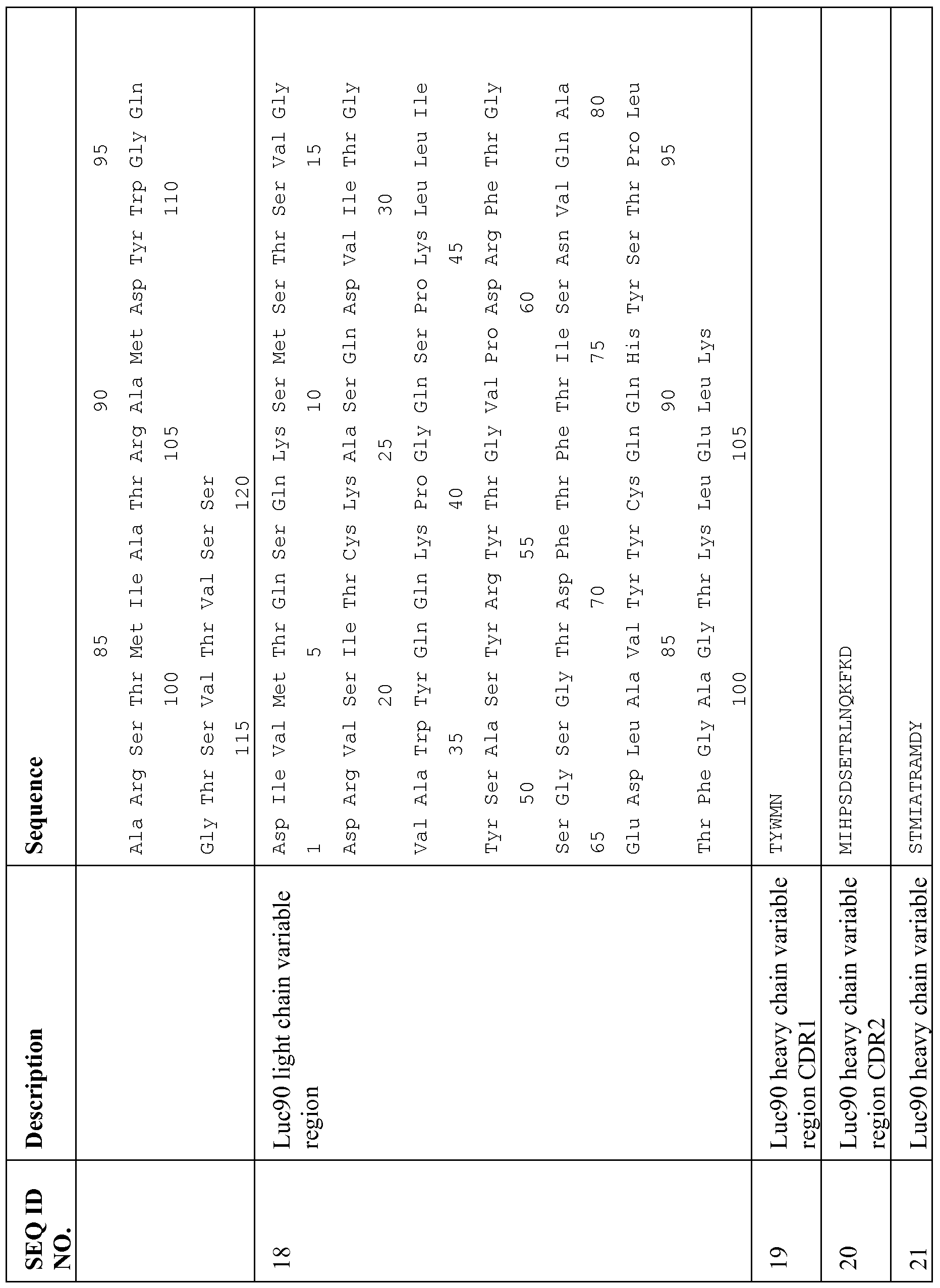
  • the sequences of the heavy and light chain variable regions of Luc90 are represented herein by SEQ ID NO: 17 and SEQ ID NO: 18, respectively.
  • the an anti-CSl antibody used in the treatment of NK lymphomas, NK/T-cell lymphomas, or angioimmunoblastic lymphomas comprises the heavy chain CDR sequences, light chain CDR sequences, or both heavy and light chain CDR sequences of Luc90, or comprises one, two or three CDR sequences having at least 80%, at least 85%, or at least 90% sequence identity to the heavy chain CDR sequences, light chain CDR sequences, or both heavy and light chain CDR sequences of Luc90.
  • the heavy chain CDR sequences of Luc90 are represented herein by SEQ ID NOS. 19, 20 and 21, and the light chain CDR sequence of Luc90 are represented herein by SEQ ID NOS. 22, 23 and 24.
  • the anti-CSl antibody used in the present methods is Luc34 or comprises the light chain variable region and/or heavy chain variable region sequence of Luc34.
  • the amino acid sequences for the heavy chain variable region and the light chain variable region for Luc34 are disclosed in U.S. Patent Publication No. 2005/0025763 as SEQ ID NO: 7 and SEQ ID NO:8, respectively, the contents of which are incorporated herein by reference.
  • the sequences of the heavy and light chain variable regions of Luc34 are represented herein by SEQ ID NO:25 and SEQ ID NO:26, respectively.
  • the an anti-CSl antibody used in the treatment of NK lymphomas, NK/T-cell lymphomas, or angioimmunoblastic lymphomas comprises the heavy chain CDR sequences, light chain CDR sequences, or both heavy and light chain CDR sequences of Luc34, or comprises one, two or three CDR sequences having at least 80%, at least 85%, or at least 90% sequence identity to the heavy chain CDR sequences, light chain CDR sequences, or both heavy and light chain CDR sequences of Luc34.
  • the heavy chain CDR sequences of Luc34 are represented herein by SEQ ID NOS. 27, 28 and 29, and the light chain CDR sequence of Luc34 are represented herein by SEQ ID NOS. 30, 31 and 32.
  • the anti-CSl antibody used in the present methods is the LucX antibody LucX.2 or comprises the light chain variable region and/or heavy chain variable region sequence of LucX.2.
  • the amino acid sequences for the heavy chain variable region and the light chain variable region for LucX.2 are disclosed in U.S. Patent Publication No. 2006/0024296 as SEQ ID NO:66 and SEQ ID NO:67, respectively, the contents of which are incorporated herein by reference.
  • the sequences of the heavy and light chain variable regions of LucX.2 are represented herein by SEQ ID NO:33 and SEQ ID NO:34, respectively.
  • the an anti-CSl antibody used in the treatment of NK lymphomas, NK/T-cell lymphomas, or angioimmunoblastic lymphomas comprises the heavy chain CDR sequences, light chain CDR sequences, or both heavy and light chain CDR sequences of LucX.2, or comprises one, two or three CDR sequences having at least 80%, at least 85%, or at least 90% sequence identity to the heavy chain CDR sequences, light chain CDR sequences, or both heavy and light chain CDR sequences of LucX.2.
  • the heavy chain CDR sequences of LucX.2 are represented herein by SEQ ID NOS. 35, 36 and
  • Table 1 provides the sequences of HuLuc63, Luc90, Luc34 and LucX.2 identified above: SEQID Description Sequence NO.
  • Table 1 Light and heavy chain variable region sequences (in three-letter code) and CDR sequences (in single letter code) of anti- CSl antibodies useful for treatment of rare lymphomas.
  • anti-CSl antibodies useful in the methods disclosed herein compete with Luc63 or Luc90 for binding to CSl .
  • the ability to compete for binding to CSl can be tested using a competition assay.
  • CSl is adhered onto a solid surface, e.g., a micro well plate, by contacting the plate with a solution of CSl ⁇ e.g., at a concentration of 5 ⁇ g/ml in PBS over night at 4°C). The plate is washed and blocked (e.g., in TBS buffer with 5 mM CaCl 2 and 2% BSA).
  • a solution of fluorescently labeled Luc63 or Luc90 (e.g., at a concentration of 1 ⁇ g/ml, 2 ⁇ g/ml, or 5 ⁇ g/ml) is added to the plate and plates are incubated for 2 hours.
  • the plate is washed, the competing anti-CSl antibody (the "test” antibody) is added (e.g., at a concentration of 3 ⁇ g/ml, 10 ⁇ g/ml, 20 ⁇ g/ml, 50 ⁇ g/ml or 100 ⁇ g/ml), and the plates incubated for 1 hour.
  • the assay can be performed in parallel at different concentrations of competing antibody.
  • MFI mean fluorescence intensity
  • control plates which were not incubated with a test antibody, e.g., were incubated with an isotype control antibody.
  • MFI mean fluorescence intensity
  • this neutralizing assay can also be used to test competition between Luc63 or Luc90 and another anti-CSl antibody.
  • the anti-CSl antibody is used as a reference antibody and Luc63 or Luc90 is used as a test antibody.
  • soluble CSl membrane-bound CSl can be used, for example recombinantly expressed on cells (preferably mammalian cells, e.g., COS cells) in culture.
  • the hybridoma cell line producing the antibody Luc90 has been deposited with the American Type Culture Collection (ATCC) at P.O. Box 1549, Manassas, Va. 20108, as accession number PTA-5091. The deposit of this hybridoma cell line was received by the ATCC on Mar. 26, 2003. The hybridoma cell line Luc63 has also been deposited with the ATCC at the address listed above, as accession number PTA-5950. The deposit of the Luc63 antibody was received by the ATCC on May 6, 2004.
  • ATCC American Type Culture Collection
  • an anti-CSl antibody useful to treat a rare lymphoma reduces the MFI of labeled Luc63 or Luc90 by at least 40%, by at least 50%, by at least 60%, by at least 70%, by at least 80%, by at least 90%, or by a percentage ranging between any two of the foregoing values (e.g., an anti-CSl antibody reduces the MFI of labeled Luc63 or luc90 by 50% to 70%) when the anti-CSl antibody is used at a concentration of 3 ⁇ g/ml, 10 ⁇ g/ml, 20 ⁇ g/ml, 50 ⁇ g/ml, 100 ⁇ g/ml, or at a concentration ranging between any two of the foregoing values (e.g., at a concentration ranging from 20 ⁇ g/ml to 50 ⁇ g/ml).
  • Luc63 or Luc90 reduces the MFI of a labeled anti-CSl antibody useful in the methods disclosed herein by at least 40%, by at least 50%, by at least 60%, by at least 70%, by at least 80%, by at least 90%, or by a percentage ranging between any two of the foregoing values (e.g., Luc63 or Luc90 reduces the MFI of a labeled an anti-CSl antibody by 50% to 70%) when Luc63 or Luc90 is used at a concentration of 3 ⁇ g/ml, 10 ⁇ g/ml, 20 ⁇ g/ml, 50 ⁇ g/ml, 100 ⁇ g/ml, or at a concentration ranging between any two of the foregoing values (e.g., at a concentration ranging from 10 ⁇ g/ml to 50 ⁇ g/ml).
  • Anti-CSl antibodies useful in the present methods include antibodies that induce antibody-dependent cytotoxicity (ADCC) of CSl -expressing cells.
  • ADCC antibody-dependent cytotoxicity
  • the ADCC of an anti-CSl antibody can be improved by using antibodies that have low levels of or lack fucose.
  • Antibodies lacking fucose have been correlated with enhanced ADCC (antibody- dependent cellular cytotoxicity) activity, especially at low doses of antibody (Shields et ah, 2002, J. Biol. Chem. 277:26733-26740; Shinkawa et ah, 2003, J. Biol. Chem. 278:3466).
  • Methods of preparing fucose-less antibodies include growth in rat myeloma YB2/0 cells (ATCC CRL 1662).
  • YB 2/0 cells express low levels of FUT8 mRNA, which encodes an enzyme (.alpha. 1,6- fucosyltransferase) necessary for fucosylation of polypeptides.
  • Alternative methods for increasing ADDC activity include mutations in the Fc portion of a CSl antibody, particularly mutations which increase antibody affinity for an Fc ⁇ R receptor.
  • a correlation between increased Fc ⁇ R binding with mutated Fc has been demonstrated using targeted cytoxicity cell- based assays (Shields et ah, 2001, J. Biol. Chem.
  • Methods for increasing ADCC activity through specific Fc region mutations include the Fc variants comprising at least one amino acid substitution at a position selected from the group consisting of: 234, 235, 239, 240, 241, 243, 244, 245, 247, 262, 263, 264, 265, 266, 267, 269, 296, 297, 298, 299, 313, 325, 327, 328, 329, 330 and 332, wherein the numbering of the residues in the Fc region is that of the EU index as in Kabat (Kabat et ah, Sequences of Proteins of Immunological Interest (National Institute of Health, Bethesda, Md.
  • said Fc variants comprise at least one substitution selected from the group consisting of L234D, L234E, L234N, L234Q, L234T, L234H, L234Y, L234I, L234V, L234F, L235D, L235S, L235N, L235Q, L235T, L235H, L235Y, L235I, L235V, L235F, S239D, S239E, S239N, S239Q, S239F, S239T, S239H, S239Y, V240I, V240A, V240T, V240M, F241W, F241L, F241Y, F241E, F241R, F243W, F243L, F243Y, F243R, F243Q, P244H, P245A, P247V, P247G, V262I, V262A, V262T, V262E
  • Fc variants can also be selected from the group consisting of V264L, V264I, F241W, F241L, F243W, F243L, F241L/F243L/V262I/V264I, F241W/F243W, F241W/F243W/V262A/V264A, F241L/V262I, F243L/V264I, F243L/V262I/V264W, F241Y/F243Y/V262T/V264T, F241E/F243R/V262E/V264R, F241E/F243Q/V262T/V264E, F241R/F243Q/V262T/V264R, F241E/F243Y/V262T/V264R, L328M, L328E, L328F, I332E, L3238M/I332E, P244H, P245A, P247V, W313F, P
  • Antibody-associated ADCC activity can be monitored and quantified through measurement of lactate dehydrogenase (LDH) release in the culture supernatant of CS 1 - expressing cells, which is rapidly released upon damage to the plasma membrane.
  • the CSl- expressing cells are in certain embodiments lymphoma cells, for example T-cell, NK-cell, or NK-T cell lymphoma cells.
  • the antibodies induce at least 10%, 20%, 30%, 40%, 50%, 60%, or 80% cytotoxicity of the target cells.
  • An example of an ADCC assay that can be used to measure ADCC of an anti-CSl antibody is that of Tai et ah, 2008, Blood 112: 1329-1337.
  • scFv refers to a single chain Fv antibody in which the variable domains of the heavy chain and the light chain from a traditional antibody have been joined to form one chain.
  • references to "VH” refer to the variable region of an immunoglobulin heavy chain of an antibody, including the heavy chain of an Fv, scFv , or Fab.
  • References to "VL” refer to the variable region of an immunoglobulin light chain, including the light chain of an Fv, scFv , dsFv or Fab.
  • Antibodies (Abs) and immunoglobulins (Igs) are glycoproteins having the same structural characteristics. While antibodies exhibit binding specificity to a specific target, immunoglobulins include both antibodies and other antibody-like molecules which lack target specificity.
  • Native antibodies and immunoglobulins are usually heterotetrameric glycoproteins of about 150,000 daltons, composed of two identical light (L) chains and two identical heavy (H) chains. Each heavy chain has at one end a variable domain (VH) followed by a number of constant domains. Each light chain has a variable domain at one end (VL) and a constant domain at its other end.
  • CDRs Complementary Determining Regions
  • FR framework regions
  • the amino acid position/boundary delineating a hypervariable region of an antibody can vary, depending on the context and the various definitions known in the art. Some positions within a variable domain can be viewed as hybrid hypervariable positions in that these positions can be deemed to be within a hypervariable region under one set of criteria while being deemed to be outside a hypervariable region under a different set of criteria. One or more of these positions can also be found in extended hypervariable regions.
  • variable domains of native heavy and light chains each comprise four FR regions, largely by adopting a ⁇ -sheet configuration, connected by three CDRs, which form loops connecting, and in some cases forming part of, the ⁇ -sheet structure.
  • the CDRs in each chain are held together in close proximity by the FR regions and, with the CDRs from the other chain, contribute to the formation of the target binding site of antibodies (See Kabat et ah, Sequences of Proteins of Immunological Interest (National Institute of Health, Bethesda, Md. 1987).
  • numbering of immunoglobulin amino acid residues is done according to the immunoglobulin amino acid residue numbering system of Kabat et ah, unless otherwise indicated.
  • antibody fragment refers to a portion of a full-length antibody, generally the target binding or variable region.
  • antibody fragments include Fab, Fab', F(ab')2 and Fv fragments.
  • An "Fv” fragment is the minimum antibody fragment which contains a complete target recognition and binding site. This region consists of a dimer of one heavy and one light chain variable domain in a tight, non-covalent association (VH -VL dimer). It is in this configuration that the three CDRs of each variable domain interact to define a target binding site on the surface of the VH -VL dimer. Collectively, the six CDRs confer target binding specificity to the antibody.
  • variable domain or half of an Fv comprising only three CDRs specific for a target
  • Single-chain Fv or “sFv” antibody fragments comprise the VH and VL domains of an antibody, wherein these domains are present in a single polypeptide chain.
  • the Fv polypeptide further comprises a polypeptide linker between the VH and VL domains which enables the sFv to form the desired structure for target binding.
  • the Fab fragment contains the constant domain of the light chain and the first constant domain (CHl) of the heavy chain.
  • Fab' fragments differ from Fab fragments by the addition of a few residues at the carboxyl terminus of the heavy chain CHi domain including one or more cysteines from the antibody hinge region.
  • F(ab') fragments are produced by cleavage of the disulfide bond at the hinge cysteines of the F(ab')2 pepsin digestion product. Additional chemical couplings of antibody fragments are known to those of ordinary skill in the art.
  • the anti-CSl antibodies are monoclonal antibodies.
  • the term "monoclonal antibody” as used herein is not limited to antibodies produced through hybridoma technology.
  • the term “monoclonal antibody” refers to an antibody that is derived from a single clone, including any eukaryotic, prokaryotic, or phage clone, and not the method by which it is produced.
  • Monoclonal antibodies can be prepared using a wide variety of techniques known in the art including the use of hybridoma, recombinant, and phage display technologies, or a combination thereof. In other embodiments, including in vivo use of the anti-CSl antibodies in humans and in vitro detection assays, chimeric, primatized, humanized, or human antibodies can be used.
  • the anti-CSl antibodies are chimeric antibodies.
  • the term "chimeric" antibody as used herein refers to an antibody having variable sequences derived from a non-human immunoglobulins, such as rat or mouse antibody, and human immunoglobulins constant regions, typically chosen from a human immunoglobulin template. Methods for producing chimeric antibodies are known in the art. See, e.g., Morrison, 1985, Science 229(4719): 1202-7; Oi et al, 1986, BioTechniques 4:214-221; Gillies et ah, 1985, J. Immunol. Methods 125: 191-202; U.S. Pat. Nos. 5,807,715; 4,816,567; and 4,816397, which are incorporated herein by reference in their entireties.
  • the anti-CSl antibodies are humanized antibodies.
  • "Humanized" forms of non-human ⁇ e.g., murine) antibodies are chimeric immunoglobulins, immunoglobulin chains or fragments thereof (such as Fv, Fab, Fab', F(ab')2 or other target- binding subsequences of antibodies) which contain minimal sequences derived from non- human immunoglobulin.
  • the humanized antibody will comprise substantially all of at least one, and typically two, variable domains, in which all or substantially all of the CDR regions correspond to those of a non-human immunoglobulin and all or substantially all of the FR regions are those of a human immunoglobulin consensus sequence.
  • the humanized antibody can also comprise at least a portion of an immunoglobulin constant region (Fc), typically that of a human immunoglobulin template chosen.
  • Fc immunoglobulin constant region
  • Humanization is a technique for making a chimeric antibody in which one or more amino acids or portions of the human variable domain have been substituted by the corresponding sequence from a non-human species.
  • Humanized antibodies are antibody molecules generated in a non-human species that bind the desired antigen having one or more complementarity determining regions (CDRs) from the non-human species and framework (FR) regions from a human immunoglobulin molecule. Often, framework residues in the human framework regions will be substituted with the corresponding residue from the CDR donor antibody to alter, preferably improve, antigen binding.
  • framework substitutions are identified by methods well known in the art, e.g., by modeling of the interactions of the CDR and framework residues to identify framework residues important for antigen binding and sequence comparison to identify unusual framework residues at particular positions. See, e.g., Riechmann et al., 1988, Nature 332:323-7 and Queen et al, U.S. Patent Nos: 5,530,101; 5,585,089; 5,693,761; 5,693,762; and 6,180,370 (each of which is incorporated by reference in its entirety). Antibodies can be humanized using a variety of techniques known in the art including, for example, CDR-grafting (EP239400; PCT publication WO 91/09967; U.S. Patent Nos.
  • humanized antibodies are prepared as described in Queen et al, U.S. Patent Nos: 5,530,101; 5,585,089; 5,693,761; 5,693,762; and 6,180,370 (each of which is incorporated by reference in its entirety).
  • the anti-CSl antibodies are human antibodies.
  • Completely "human” anti-CSl antibodies can be desirable for therapeutic treatment of human patients.
  • "human antibodies” include antibodies having the amino acid sequence of a human immunoglobulin and include antibodies isolated from human immunoglobulin libraries or from animals transgenic for one or more human immunoglobulin and that do not express endogenous immunoglobulins.
  • Human antibodies can be made by a variety of methods known in the art including phage display methods described above using antibody libraries derived from human immunoglobulin sequences. See U.S. Patent Nos.
  • Completely human antibodies that recognize a selected epitope can be generated using a technique referred to as "guided selection.”
  • a selected non-human monoclonal antibody e.g., a mouse antibody
  • is used to guide the selection of a completely human antibody recognizing the same epitope Jespers et ah, 1988, Biotechnology 12:899-903.
  • the anti-CSl antibodies are primatized antibodies.
  • the term "primatized antibody” refers to an antibody comprising monkey variable regions and human constant regions. Methods for producing primatized antibodies are known in the art. See e.g., U.S. Patent Nos. 5,658,570; 5,681,722; and 5,693,780, which are incorporated herein by reference in their entireties.
  • the anti-CSl antibodies are bispecific antibodies.
  • Bispecif ⁇ c antibodies are monoclonal, preferably human or humanized, antibodies that have binding specificities for at least two different antigens.
  • one of the binding specificities can be directed towards CSl, the other can be for any other antigen, and preferably for a cell-surface protein, receptor, receptor subunit, tissue- specific antigen, virally derived protein, virally encoded envelope protein, bacterially derived protein, or bacterial surface protein, etc.
  • the anti-CSl antibodies are derivatized antibodies.
  • the derivatized antibodies that have been modified, e.g. , by glycosylation, acetylation, pegylation, phosphorylation, amidation, derivatization by known protecting/blocking groups, proteolytic cleavage, linkage to a cellular ligand or other protein (see Section 5.2 for a discussion of antibody conjugates), etc. Any of numerous chemical modifications may be carried out by known techniques, including, but not limited to, specific chemical cleavage, acetylation, formylation, metabolic synthesis of tunicamycin, etc. Additionally, the derivative may contain one or more non-classical amino acids.
  • the anti-CSl antibodies or fragments thereof can be antibodies or antibody fragments whose sequence has been modified to reduce at least one constant region-mediated biological effector function relative to the corresponding wild type sequence.
  • the immunoglobulin constant region segment of the antibody can be mutated at particular regions necessary for Fc receptor (FcR) interactions (See e.g., Canfield and Morrison, 1991, J. Exp. Med. 173 : 1483- 1491; and Lund et al, 1991, J. Immunol. 147:2657-2662).
  • FcR Fc receptor
  • Reduction in FcR binding ability of the antibody can also reduce other effector functions which rely on FcR interactions, such as opsonization and phagocytosis and antigen-dependent cellular cytotoxicity.
  • the anti-CSl antibodies or fragments thereof can be antibodies or antibody fragments that have been modified to acquire at least one constant region-mediated biological effector function relative to an unmodified antibody.
  • the immunoglobulin constant region segment of the antibody can be mutated to enhance Fc ⁇ R interactions (See, e.g., US 2006/0134709 Al). Enhancement of Fc ⁇ R binding can increase antigen-dependent cellular cytotoxicity of an anti-CSl antibody.
  • an anti-CSl antibody has a constant region that binds Fc ⁇ RIIA, Fc ⁇ RIIB and/or Fc ⁇ RIIIA with greater affinity than the corresponding wild type constant region.
  • the anti-CSl antibodies or fragments thereof can be antibodies or antibody fragments that have been modified to increase or reduce their binding affinities to the fetal Fc receptor, FcRn.
  • FcRn the immunoglobulin constant region segment of the antibody can be mutated at particular regions necessary for FcRn interactions (See e.g., WO 2005/123780). Increasing the binding affinity to FcRn should increase the antibody's serum half-life, and reducing the binding affinity to FcRn should conversely reduce the antibody's serum half-life.
  • the anti-CSl antibody is of the IgG class in which at least one of amino acid residues 250, 314, and 428 of the heavy chain constant region is substituted with an amino acid residue different from that present in the unmodified antibody.
  • the antibodies of IgG class include antibodies of IgGi, IgG 2 , IgG 3 , and IgG4.
  • the substitution can be made at position 250, 314, or 428 alone, or in any combinations thereof, such as at positions 250 and 428, or at positions 250 and 314, or at positions 314 and 428, or at positions 250, 314, and 428, with positions 250 and 428 as a preferred combination.
  • the substituting amino acid can be any amino acid residue different from that present in that position of the unmodified antibody.
  • the substituting amino acid residue can be any amino acid residue other than threonine, including, but not limited to, alanine, cysteine, aspartic acid, glutamic acid, phenylalanine, glycine, histidine, isoleucine, lysine, leucine, methionine, asparagine, proline, glutamine, arginine, serine, valine, tryptophan, or tyrosine.
  • the substituting amino acid residue can be any amino acid residue other than leucine, including, but not limited to, alanine, cysteine, aspartic acid, glutamic acid, phenylalanine, glycine, histidine, isoleucine, lysine, methionine, asparagine, proline, glutamine, arginine, serine, threonine, valine, tryptophan, or tyrosine.
  • the substituting amino acid residues can be any amino acid residue other than methionine, including, but not limited to, alanine, cysteine, aspartic acid, glutamic acid, phenylalanine, glycine, histidine, isoleucine, lysine, leucine, asparagine, proline, glutamine, arginine, serine, threonine, valine, tryptophan, or tyrosine.
  • Specific combinations of suitable amino acid substitutions are identified in Table 1 of WO 2005/123780, which table is incorporated by reference herein in its entirety. See also, Hinton et ah, US Patent Nos. 7,217,797, 7,361,740, 7,365,168, and 7,217,798, which are incorporated herein by reference in their entireties.
  • an anti-CS 1 antibody has one or more amino acids inserted into one or more of its hypervariable region, for example as described in US 2007/0280931.
  • the anti-CS 1 antibodies are antibody conjugates that are modified, e.g., by the covalent attachment of any type of molecule to the antibody, such that covalent attachment does not interfere with binding to CSl.
  • an anti-CS 1 antibody can be conjugated to an effector moiety or a label.
  • effector moiety includes, for example, antineoplastic agents, drugs, toxins, biologically active proteins, for example enzymes, other antibody or antibody fragments, synthetic or naturally occurring polymers, nucleic acids ⁇ e.g., DNA and RNA), radionuclides, particularly radioiodide, radioisotopes, chelated metals, nanoparticles and reporter groups such as fluorescent compounds or compounds which can be detected by NMR or ESR spectroscopy.
  • anti-CS 1 antibodies can be conjugated to an effector moiety, such as a cytotoxic agent, a radionuclide or drug moiety to modify a given biological response.
  • the effector moiety can be a protein or polypeptide, such as, for example and without limitation, a toxin (such as abrin, ricin A, Pseudomonas exotoxin, or Diphtheria toxin), a signaling molecule (such as ⁇ -interferon, ⁇ -interferon, nerve growth factor, platelet derived growth factor or tissue plasminogen activator), a thrombotic agent or an anti-angiogenic agent (e.g., angiostatin or endostatin) or a biological response modifier such as a cytokine or growth factor (e.g., inter leukin- 1 (IL-I), interleukin-2 (IL-2), interleukin-6 (IL-6), granulocyte macrophage colony stimulating factor (IL-I), inter leuk
  • the effector moieties can be cytotoxins or cytotoxic agents.
  • cytotoxins and cytotoxic agents include taxol, cytochalasin B, gramicidin D, ethidium bromide, emetine, mitomycin, etoposide, tenoposide, vincristine, vinblastine, colchicin, doxorubicin, daunorabicin, dihydroxy anthracin dione, mitoxantrone, mithramycin, actinomycin D, 1-dehydrotestosterone, glucocorticoids, procaine, tetracaine, lidocaine, propranolol, and puromycin and analogs or homologs thereof.
  • Effector moieties also include, but are not limited to, antimetabolites (e.g. methotrexate, 6-mercaptopurine, 6-thioguanine, cytarabine, 5-fluorouracil decarbazine), alkylating agents (e.g., mechlorethamine, thioepa chlorambucil, melphalan, carmustine (BSNU) and lomustine (CCNU), cyclothosphamide, busulfan, dibromomannitol, streptozotocin, mitomycin C5 and cis-dichlorodiamine platinum (II) (DDP) cisplatin), anthracyc lines (e.g., daunorabicin (formerly daunomycin) and doxorubicin), antibiotics (e.g., dactinomycin (formerly actinomycin), bleomycin, mithramycin, anthramycin (AMC), calicheamicins or
  • effector moieties can include radionuclides such as, but not limited to, In 111 and Y 90 , Lu 177 , Bismuth 213 , Californium 252 , Iridium 192 and Tungsten 18s /Rhenium 188 and drags such as, but not limited to, alkylphosphocholines, topoisomerase I inhibitors, taxoids and suramin.
  • radionuclides such as, but not limited to, In 111 and Y 90 , Lu 177 , Bismuth 213 , Californium 252 , Iridium 192 and Tungsten 18s /Rhenium 188 and drags such as, but not limited to, alkylphosphocholines, topoisomerase I inhibitors, taxoids and suramin.
  • the antibody or fragment thereof is fused via a covalent bond (e.g., a peptide bond), at optionally the N-terminus or the C-terminus, to an amino acid sequence of another protein (or portion thereof; preferably at least a 10, 20 or 50 amino acid portion of the protein).
  • a covalent bond e.g., a peptide bond
  • the antibody, or fragment thereof is linked to the other protein at the N- terminus of the constant domain of the antibody.
  • Recombinant DNA procedures can be used to create such fusions, for example as described in WO 86/01533 and EP0392745.
  • the effector molecule can increase half- life in vivo, and/or enhance the delivery of an antibody across an epithelial barrier to the immune system. Examples of suitable effector molecules of this type include polymers, albumin, albumin binding proteins or albumin binding compounds such as those described in WO 2005/117984.
  • anti-CSl antibodies can be attached to poly(ethyleneglycol) (PEG) moieties.
  • PEG moieties can be attached through any available amino acid side-chain or terminal amino acid functional group located in the antibody fragment, for example any free amino, imino, thiol, hydroxyl or carboxyl group.
  • Such amino acids can occur naturally in the antibody fragment or can be engineered into the fragment using recombinant DNA methods. See for example U.S. Patent No. 5,219,996. Multiple sites can be used to attach two or more PEG molecules.
  • PEG moieties are covalently linked through a thiol group of at least one cysteine residue located in the antibody fragment. Where a thiol group is used as the point of attachment, appropriately activated effector moieties, for example thiol selective derivatives such as maleimides and cysteine derivatives, can be used.
  • an anti-CSl antibody conjugate is a modified Fab' fragment which is PEGylated, i.e., has PEG (poly(ethyleneglycol)) covalently attached thereto, e.g., according to the method disclosed in EP0948544.
  • PEG poly(ethyleneglycol)
  • label when used herein refers to a detectable compound or composition which can be conjugated directly or indirectly to an anti-CSl antibody.
  • the label can itself be detectable (e.g., radioisotope labels or fluorescent labels) or, in the case of an enzymatic label, can catalyze chemical alteration of a substrate compound or composition which is detectable.
  • Useful fluorescent moieties include, but are not limited to, fluorescein, fluorescein isothiocyanate, rhodamine, 5- dimethylamine- 1 -napthalenesulfonyl chloride, phycoerythrin and the like.
  • Useful enzymatic labels include, but are not limited to, alkaline phosphatase, horseradish peroxidase, glucose oxidase and the like.
  • CSl antibodies described herein are useful for treating NK lymphomas, NK/T-cell lymphomas, and angioimmunoblastic T-cell lymphoma.
  • NK lymphomas and NK/T- cell lymphomas can be divided into nasal, non-nasal, and aggressive lymphoma/leukemia subtypes, all of which can benefit from treatment with an anti-CSl antibody according to the methods described herein.
  • Treatment of a disease encompasses the treatment of patients already diagnosed as having any form of the disease at any clinical stage or manifestation; the delay of the onset or evolution or aggravation or deterioration of the symptoms or signs of the disease; and/or preventing and/or reducing the severity of the disease.
  • the lymphoma Prior to administering an anti-CSl antibody for the treatment of lymphoma, the lymphoma can be tested for CS 1 expression, for example by assaying a biopsy from the patient for CS 1 RNA or protein. CS 1 expression can be assayed on the biopsy sample (e.g. , by immunohistochemistry) or on a nucleic acid or protein extract from the sample (e.g. , using RT- PCR).
  • a "subject" or “patient” to whom an anti-CSl antibody is administered can be a mammal, such as a non-primate (e.g., cow, pig, horse, cat, dog, rat, etc.) or a primate (e.g., monkey or human).
  • a non-primate e.g., cow, pig, horse, cat, dog, rat, etc.
  • a primate e.g., monkey or human.
  • the human is a pediatric patient. In other aspects, the human is an adult patient.
  • compositions comprising an anti-CSl antibody and, optionally one or more additional therapeutic agents, such as the second therapeutic agents described in Section 5.4 below, are described herein.
  • the compositions typically are supplied as part of a sterile, pharmaceutical composition that includes a pharmaceutically acceptable carrier.
  • This composition can be in any suitable form (depending upon the desired method of administering it to a patient).
  • the anti-CSl antibodies can be administered to a patient by a variety of routes such as orally, transdermally, subcutaneously, intranasally, intravenously, intramuscularly, intrathecally, topically or locally.
  • routes such as orally, transdermally, subcutaneously, intranasally, intravenously, intramuscularly, intrathecally, topically or locally.
  • the most suitable route for administration in any given case will depend on the particular antibody, the subject, and the nature and severity of the disease and the physical condition of the subject.
  • an anti-CSl antibody such as HuLuc63 will be administered intravenously.
  • an anti-CSl antibody is present in a pharmaceutical composition at a concentration sufficient to permit intravenous administration at 0.5 mg/kg to 20 mg/kg.
  • the concentration of HuLuc63 suitable for use in the compositions and methods described herein includes, but is not limited to, 0.5 mg/kg, 0.75 mg/kg, 1 mg/kg, 2 mg/kg, 2.5 mg/kg, 3 mg/kg, 4 mg/kg, 5 mg/kg, 6 mg/kg, 7 mg/kg, 8 mg/kg, 9 mg/kg, 10 mg/kg, 11 mg/kg, 12 mg/kg, 13 mg/kg, 14 mg/kg, 15 mg/kg, 16 mg/kg, 17 mg/kg, 18 mg/kg, 19 mg/kg, 20 mg/kg, or a concentration ranging between any of the foregoing values, e.g., 1 mg/kg to 10 mg/kg, 5 mg/kg to 15 mg/kg, or 10 mg/kg to 18 mg/kg.
  • the effective dose of an anti-CSl antibody can range from about 0.001 to about 750 mg/kg per single (e.g. , bolus) administration, multiple administrations or continuous administration, or to achieve a serum concentration of 0.01-5000 ⁇ g/ml serum concentration per single (e.g., bolus) administration, multiple administrations or continuous administration, or any effective range or value therein depending on the condition being treated, the route of administration and the age, weight and condition of the subject.
  • each dose can range from about 0.5 mg to about 50 mg per kilogram of body weight or from about 3 mg to about 30 mg per kilogram body weight.
  • the antibody is can be formulated as an aqueous solution.
  • compositions can be conveniently presented in unit dose forms containing a predetermined amount of an anti-CS 1 antibody per dose.
  • a unit can contain 0.5 mg to 5 g, for example, but without limitation, 1 mg, 10 mg, 20 mg, 30 mg, 40 mg, 50 mg, 100 mg, 200 mg, 300 mg, 400 mg, 500 mg, 750 mg, 1000 mg, or any range between any two of the foregoing values, for example 10 mg to 1000 mg, 20 mg to 50 mg, or 30 mg to 300 mg.
  • Pharmaceutically acceptable carriers can take a wide variety of forms depending, e.g., on the condition to be treated or route of administration.
  • Determination of the effective dosage, total number of doses, and length of treatment with an anti-CSl antibody is well within the capabilities of those skilled in the art, and can be determined using a standard dose escalation study to identify the maximum tolerated dose (MTD) (see, e.g., Richardson et ah, 2002, Blood, 100(9):3063- 3067, the content of which is incorporated herein by reference).
  • MTD maximum tolerated dose
  • Therapeutic formulations of the anti-CSl antibodies suitable in the methods described herein can be prepared for storage as lyophilized formulations or aqueous solutions by mixing the antibody having the desired degree of purity with optional pharmaceutically-acceptable carriers, excipients or stabilizers typically employed in the art (all of which are referred to herein as "carriers"), i.e., buffering agents, stabilizing agents, preservatives, isotonifiers, non- ionic detergents, antioxidants, and other miscellaneous additives.
  • carriers i.e., buffering agents, stabilizing agents, preservatives, isotonifiers, non- ionic detergents, antioxidants, and other miscellaneous additives.
  • Such additives must be nontoxic to the recipients at the dosages and concentrations employed.
  • Buffering agents help to maintain the pH in the range which approximates physiological conditions. They can present at concentration ranging from about 2 mM to about 50 mM.
  • Suitable buffering agents include both organic and inorganic acids and salts thereof such as citrate buffers ⁇ e.g., monosodium citrate-disodium citrate mixture, citric acid-trisodium citrate mixture, citric acid-monosodium citrate mixture, etc.), succinate buffers ⁇ e.g., succinic acid- monosodium succinate mixture, succinic acid-sodium hydroxide mixture, succinic acid- disodium succinate mixture, etc.), tartrate buffers ⁇ e.g., tartaric acid-sodium tartrate mixture, tartaric acid-potassium tartrate mixture, tartaric acid-sodium hydroxide mixture, etc.), fumarate buffers ⁇ e.g., fumaric acid-monosodium fumarate mixture, fumaric acid-disodium fum
  • Preservatives can be added to retard microbial growth, and can be added in amounts ranging from 0.2%- 1% (w/v).
  • Suitable preservatives include phenol, benzyl alcohol, meta- cresol, methyl paraben, propyl paraben, octadecyldimethylbenzyl ammonium chloride, benzalconium halides (e.g., chloride, bromide, and iodide), hexamethonium chloride, and alkyl parabens such as methyl or propyl paraben, catechol, resorcinol, cyclohexanol, and 3-pentanol.
  • Isotonicifiers sometimes known as “stabilizers” can be added to ensure isotonicity of liquid compositions and include polhydric sugar alcohols, preferably trihydric or higher sugar alcohols, such as glycerin, erythritol, arabitol, xylitol, sorbitol and mannitol.
  • Stabilizers refer to a broad category of excipients which can range in function from a bulking agent to an additive which solubilizes the therapeutic agent or helps to prevent denaturation or adherence to the container wall.
  • Typical stabilizers can be polyhydric sugar alcohols (enumerated above); amino acids such as arginine, lysine, glycine, glutamine, asparagine, histidine, alanine, ornithine, L-leucine, 2-phenylalanine, glutamic acid, threonine, etc., organic sugars or sugar alcohols, such as lactose, trehalose, stachyose, mannitol, sorbitol, xylitol, ribitol, myoinisitol, galactitol, glycerol and the like, including cyclitols such as inositol; polyethylene glycol; amino acid polymers; sulfur containing reducing agents, such as urea, glutathione, thioctic acid, sodium thioglycolate, thioglycerol, ⁇ -monothioglycerol and sodium thio sulfate; low
  • Non-ionic surfactants or detergents can be added to help solubilize the therapeutic agent as well as to protect the therapeutic protein against agitation-induced aggregation, which also permits the formulation to be exposed to shear surface stressed without causing denaturation of the protein.
  • Suitable non-ionic surfactants include polysorbates (20, 80, etc.), polyoxamers (184, 188 etc.), Pluronic polyols, polyoxyethylene sorbitan monoethers (TWEEN®-20, TWEEN®-80, etc.).
  • Non-ionic surfactants can be present in a range of about 0.05 mg/ml to about 1.0 mg/ml, or in a range of about 0.07 mg/ml to about 0.2 mg/ml.
  • Additional miscellaneous excipients include bulking agents (e.g., starch), chelating agents (e.g., EDTA), antioxidants (e.g., ascorbic acid, methionine, vitamin E), and cosolvents.
  • bulking agents e.g., starch
  • chelating agents e.g., EDTA
  • antioxidants e.g., ascorbic acid, methionine, vitamin E
  • cosolvents e.g., ascorbic acid, methionine, vitamin E
  • the formulation herein can also contain a second therapeutic agent in addition to an anti-CSl antibody.
  • a second therapeutic agent is provided in Section 5.4 below.
  • the dosing schedule can vary from once a month to daily depending on a number of clinical factors, including the type of disease, severity of disease, and the patient's sensitivity to the anti-CSl antibody.
  • an anti-CSl antibody is administered daily, twice weekly, three times a week, every 5 days, every 10 days, every two weeks, every three weeks, every four weeks or once a month, or in any range between any two of the foregoing values, for example from every four weeks to every month, from every 10 days to every two weeks, or from two to three times a week, etc.
  • an anti-CSl antibody to be administered will vary according to the particular antibody, the subject, and the nature and severity of the disease, the physical condition of the subject, the therapeutic regimen (e.g., whether a second therapeutic agent is used), and the selected route of administration; the appropriate dosage can be readily determined by a person skilled in the art.
  • the combinatorial methods involve the administration of at least two agents to a patient, the first of which is an anti-CSl antibody and the second of which is a second therapeutic agent.
  • the anti-CSl antibody and the second therapeutic agent can be administered simultaneously, sequentially or separately.
  • NK-cell lymphomas present with stage I/II disease, and frontline radiotherapy is the most important key to successful treatment.
  • Many stage I/II patients treated with radiotherapy fail systemically, implying that concomitant chemotherapy may be needed.
  • Chemotherapy is indicated for advanced nasal NK-cell lymphoma, and the non-nasal and aggressive subtypes.
  • Treatment results are generally unsatisfactory.
  • High-dose chemotherapy with hematopoietic stem cell transplantation has been suggested to be beneficial to selected patients (Kwong et ah, 2005, Leukemia 19:2186-94).
  • An anti-CSl antibody can be beneficially administered in combination with any therapeutic regimen entailing radiotherapy, chemotherapy, or other therapeutic agents.
  • the combinatorial therapy methods described herein can result in a greater than additive effect, providing therapeutic benefits when monotherapy with the anti-CSl antibody or second therapeutic agent is therapeutically effective.
  • an anti-CSl antibody is typically administered approximately 0 to 60 days prior to or after the administration of a second therapeutic agent.
  • an anti-CSl antibody is administered from about 30 minutes to about 1 hour prior to or after the administration of the second therapeutic agent, or from about 1 hour to about 2 hours prior to or after the administration of the second therapeutic agent, or from about 2 hours to about 4 hours prior to or after the administration of the second therapeutic agent, or from about 4 hours to about 6 hours prior to or after the administration of the second therapeutic agent, or from about 6 hours to about 8 hours prior to or after the administration of the second therapeutic agent, or from about 8 hours to about 16 hours prior to or after the administration of the second therapeutic agent, or from about 16 hours to 1 day prior to or after the administration of the second therapeutic agent, or from about 1 to 5 days prior to or after the administration of the second therapeutic agent, or from about 5 to 10 days prior to or after the administration of the second therapeutic agent, or from about 10 to 15 days prior to or after the administration of the second therapeutic agent, or from about 15 to 20 days prior
  • any time period referenced supra may be construed to mean the numerical range stated less up to 20% at its lower end, to plus up to 20 % at its upper end ⁇ e.g., a time period of "about 40 to 50 days” means a time period ranging from 32 to 60 days).
  • a time period of "about 40 to 50 days” means a time period ranging from 32 to 60 days).
  • the use of the term "about” in the context of a time period refers to the numerical range stated less 2%, 3%, 5%, 10%, or 15% at its lower end, plus up to 2%, 3%, 5%, 10%, or 15% at its upper end.
  • the anti-CSl antibody and the second therapeutic agent can be administered concurrently, either simultaneously or successively.
  • the anti-CS 1 antibody and the second therapeutic agent are said to be administered successively if they are administered to the patient on the same day, for example during the same patient visit. Successive administration can occur 1, 2, 3, 4, 5, 6, 7 or 8 hours apart.
  • the anti-CSl antibody and the second therapeutic agent are said to be administered separately if they are administered to the patient on the different days, for example, the anti-CSl antibody of the invention and the second therapeutic agent can be administered at a 1-day, 2-day or 3-day, one -week, 2-week or monthly intervals.
  • administration of the anti-CSl antibody can precede or follow administration of the second therapeutic agent.
  • the anti-CSl antibody and the second therapeutic agent can be administered concurrently for a period of time, followed by a second period of time in which the administration of the anti-CSl antibody and the second therapeutic agent is alternated.
  • the dosage of the anti-CSl antibody and/or the dosage of the second therapeutic agent administered is about 10% to 90% of the generally accepted efficacious dose range for single therapy regimens.
  • about 10%, about 15%, about 25%, about 30%, about 40%, about 50%, about 60%, about 75%, or about 90% of the generally accepted efficacious dose range is used, or a dosage ranging between any of the foregoing values (e.g., 10% to 40%, 30% to 75% , or 60% to 90% of the of the generally accepted efficacious dose range) is used.
  • the second therapeutic agent is an anti-inflammatory agent, a chemotherapeutic agent, a radiotherapeutic, an immunosuppressive agent, a cytotoxic drug, a targeted agent, a hormonal agent, or a support care agent.
  • Suitable anti-inflammatory agents include, but are not limited to, pentasa, mesalazine, asacol, codeine phosphate, benorylate, fenbufen, naprosyn, diclofenac, etodolac and indomethacin, aspirin and ibuprofen.
  • Suitable chemotherapeutic agents include, but are not limited to, radioactive molecules, toxins, also referred to as cytotoxins or cytotoxic agents, which includes any agent that is detrimental to the viability of cells, agents, and liposomes or other vesicles containing chemotherapeutic compounds.
  • chemotherapeutic agents include but are not limited to 1-dehydrotestosterone, 5-fluorouracil decarbazine, 6-mercaptopurine, 6- thioguanine, actinomycin D, adriamycin, aldesleukin, alkylating agents, allopurinol sodium, altretamine, amifostine, anastrozole, anthramycin (AMC)), anti-mitotic agents, cis- dichlorodiamine platinum (II) (DDP) cisplatin), diamino dichloro platinum, anthracyclines, antibiotics, antimetabolites, asparaginase, BCG live (intravesical), betamethasone sodium phosphate and betamethasone acetate, bicalutamide, bleomycin sulfate, busulfan, calcium leucouorin, calicheamicin, capecitabine, carboplatin, lomustine (CCNU), carmustine (BSNU), Chloramb
  • Suitable targeted agents include bevacizumab, sutinib, sorafenib, 2-methoxyestradiol or 2ME2, finasunate, PTK787, vandetanib, afiibercept, volociximab, etaracizumab (MEDI-522), cilengitide, erlotinib, cetuximab, panitumumab, gefitinib, trastuzumab, TKI258, CP-751,871, atacicept, rituximab, alemtuzumab, aldesleukine, atlizumab, tocilizumab, temsirolimus, everolimus, NPI- 1387, MLNM3897, HCD122, SGN-40, HLLl, huN901-DMl, atiprimod, natalizumab, bortezomib, carfilzomib, NPI-
  • Suitable hormonal agents include anastrozole, letrozole, goserelin, tamoxifen, dexamethasone, prednisone, and prednisilone.
  • Suitable supportive care agents such as pamidronate, zoledonic acid, ibandronate, gallium nitrate, denosumab, darbepotin alpha, epoetin alpha, eltrombopag, and pegfilgrastim.
  • the second therapeutic agent is any combination therapy regimen used for the treatment of non-Hodgkin's lymphomas.
  • Typical regimens include:
  • chemotherapeutic regimens are known in the art and can be used as "second therapeutic agents" in conjunction with an anti-CSl antibody therapy.
  • the chemotherapeutic regimens can be accompanied by anti-emetics, such as Compazine, Zofran or Kytril.
  • CSl (CRACC, SLAMF7, CD319) is a member of the signaling lymphocyte activating molecule-related receptor family. It is highly and uniformly expressed on the cell surface of benign and malignant plasma cells. Lower levels of CSl have also been reported on NK cells and NK- like T-cells (NK/T). CS 1 expression in NK and T-cell lymphomas - aggressive lymphomas for which no effective therapy exists - is unknown. The expression of CSl in normal NK/T cells and in a series of NK and peripheral T-cell lymphomas (PTCL) was examined.
  • PTCL peripheral T-cell lymphomas
  • CSl expression in normal NK and T-cells were assessed by gene expression profiling using automated immunohistochemistry (IHC, Ventana Medical Systems).
  • Flow cytometry FACSCalibur, Becton Dickinson was performed on blood from normal samples using a directly conjugated Alexa-488 elotuzumab (HuLuc63).
  • CS 1 protein on normal blood NK and NK/T cells was confirmed by flow cytometry with Alexa-488 HuLuc63.
  • the majority of normal NK and NK/T cells expressed CSl (mean % positive and standard deviation of 96% +/- 4% and 71 % +/- 24%, respectively).
  • Tumor samples from patients with nasal type NK/T cell lymphoma as well as other peripheral T-cell lymphomas by IHC were assayed for CS 1 expression.
  • Biopsies from 13 patients (5 from the United States, 8 from Korea) with nasal type NK/T cell lymphomas were evaluated by IHC. 12 of 13 (92%) patient samples expressed CSl with most cases showing a majority of cells positive.
  • 46 PTCLs were also evaluated (including 9 AITL). Overall, 8/46 (17%) of the PTCL cases expressed CSl. However, of the AITLs, 4 of 9 (44%) expressed CSl.
  • CSl (CD319, CRACC, SLAMF7) is a member of the signaling lymphocyte activating- molecule-related receptor family. It has recently been identified as a cell surface antibody target selectively expressed in plasma cells (Hsi et ciL, 2008, Clin. Cancer Res. 14:2775-2784).
  • Other members of the signaling lymphocyte activating-molecule (SLAM)-related receptor family include SLAM(CD 150), 2B4 (CD244), CD84, NTB-A (Ly- 108), and Ly-9 (CD229). These molecules are characterized by two or four extracellular immunoglobulin (Ig)-like domains and an intracellular signaling domain with immune receptor tyrosine-based switch motifs with the consensus amino acid sequence TxYxxV/I.
  • CSl a humanized antibody to CSl
  • HuLuc63 a humanized antibody to CSl
  • HuLuc63 a humanized antibody to CSl
  • CSl is expressed at lower levels in normal NK cells and a subset of T-cells (Hsi et ah, 2008, Clin. Cancer Res. 14:2775-2784).
  • Flow cytometry CSl expression in normal NK and T-cells was assessed by gene expression profiling. Flow cytometry (FACSCalibur, Becton Dickinson) was performed on normal blood samples using a directly conjugated FITC-elotuzumab. Anti-CSl -PE mouse monoclonal antibodies (Clone 235614) for flow cytometry were obtained from R&D Systems (Minneapolis, MN).
  • PBL Peripheral blood lymphocyte
  • NK cells and, to a lesser extent, CD 16/56 positive-T-cells expressed CSl (mean% positive and standard deviation of 97% +/- 4% and 67 % +/- 29%, respectively) (Figure 3).
  • CSl mean% positive and standard deviation of 97% +/- 4% and 67 % +/- 29%, respectively.
  • PTCL NOS peripheral T-cell lymphoma
  • AITL angioimmunoblastic T-cell lymphoma
  • nasal type NK/T cell lymphoma was evaluated. The results of this study are summarized in Table 2 below:
  • FIG. 4 shows the pattern in normal tonsil in which scattered T-cells and plasma cells (enriched in subepithelial areas) are positive.
  • 4 were CD8+. Only 1 of 8 (15%) AITLs were positive and this case was CD4+ ( Figure 5).
  • CSl The great majority of nasal type NK/T-cell lymphomas express CSl. CSl is also expressed on certain PTCL NOS and AITL.

Landscapes

  • Health & Medical Sciences (AREA)
  • Chemical & Material Sciences (AREA)
  • Immunology (AREA)
  • Medicinal Chemistry (AREA)
  • Life Sciences & Earth Sciences (AREA)
  • Organic Chemistry (AREA)
  • General Health & Medical Sciences (AREA)
  • Veterinary Medicine (AREA)
  • Animal Behavior & Ethology (AREA)
  • Molecular Biology (AREA)
  • Proteomics, Peptides & Aminoacids (AREA)
  • Biophysics (AREA)
  • Genetics & Genomics (AREA)
  • Biochemistry (AREA)
  • Public Health (AREA)
  • Pharmacology & Pharmacy (AREA)
  • Chemical Kinetics & Catalysis (AREA)
  • Nuclear Medicine, Radiotherapy & Molecular Imaging (AREA)
  • General Chemical & Material Sciences (AREA)
  • Engineering & Computer Science (AREA)
  • Bioinformatics & Cheminformatics (AREA)
  • Microbiology (AREA)
  • Mycology (AREA)
  • Epidemiology (AREA)
  • Peptides Or Proteins (AREA)
  • Medicines Containing Antibodies Or Antigens For Use As Internal Diagnostic Agents (AREA)
  • Medicines That Contain Protein Lipid Enzymes And Other Medicines (AREA)

Abstract

Uses of anti-CS1 antibodies, alone or in combination with other agents, for the treatment of rare lymphomas, such as NK lymphomas, NK/T-cell lymphomas, and angioimmunoblastic lymphomas.

Description

USE OF ANTI-CSl ANTIBODIES FOR TREATMENT OF RARE LYMPHOMAS
CROSS REFERENCE TO RELATED APPLICATION
[0001] This application claims the priority benefit under 35 U. S. C. § 119(e) of U.S. Provisional Application No. 61/110,295, filed on October 31, 2008, and U.S. Provisional Application No. 61/118,244, filed on November 26, 2008, the contents of each of which is incorporated by reference herein in its entirety.
1. FIELD OF THE INVENTION
[0002] The present invention relates to the use of anti-CSl antibodies for the treatment of NK lymphomas, NK/T-cell lymphomas, and angioimmunoblastic lymphomas.
2. BACKGROUND
[0003] CSl (CD2-subset 1), also known as SLAMF7, CRACC, 19A, APEX-I, and FOAP 12 (Genbank Accession Number NM_021181.3), is member of the CD2 family of cell surface glycoproteins. CSl is not expressed on normal tissues nor on CD34+ stem cells but its expression has been reported on primary myeloma, natural killer cells, cytotoxic t cells and activated B cells.
[0004] Non-Hodgkin's lymphomas are cancers of lymphoid tissue (lymph nodes, spleen, and other organs of the immune system). Non-Hodgkin's lymphomas include slow- growing lymphomas, moderately aggressive lymphomas and aggressive lymphomas of B- cell, T-cell origin, or natural killer (NK)-cell origin. For example, angioimmunoblastic lymphomas are moderately aggressive lymphomas that constitute 1-2% of Non-Hodgkin's lymphomas. Patients with this disease usually present at an advanced stage and show systemic involvement. Although steroid therapy is initially beneficial in many patients, the disease usually progresses to another form of lymphoma (e.g., to high-grade T-cell immunoblastic lymphoma or Epstein-Barr virus positive diffuse large B-cell lymphoma).
[0005] T/NK and NK-cell lymphomas are rare forms of non-Hodgkin's lymphomas that are more common among Asians in comparison to other ethnic groups. These lymphomas develop mostly in the nasal cavity and occasionally in other sites, such as the skin and intestinal tract. Most tumors show NK-cell, and occasionally T-cell, phenotypes. Extranodal NK/T-cell lymphomas are uncommon neoplasms that are highly aggressive and show a strong association with Epstein-Barr virus (EBV), which is considered to be an etiologic agent of these tumors. To this date, there is no satisfactory therapy for advanced forms of these lymphomas.
[0006] Thus, there is still a need for new therapies and therapeutic regimens for treating rare lymphomas such as NK lymphomas, NK/T-cell lymphomas, and angioimmunoblastic T-cell lymphomas.
[0007] Citation or identification of any reference in Section 2 or in any other section of this application shall not be construed as an admission that such reference is available as prior art to the present invention.
3. SUMMARY
[0008] CSl (CRACC, SLAMF7, CD319) is a member of the signaling lymphocyte activating molecule-related receptor family. It is highly and uniformly expressed on the cell surface of benign and malignant plasma cells. Lower levels of CSl have also been reported on NK cells and NK-like T-cells (NK/T). CSl expression in NK and T-cell lymphomas - aggressive lymphomas for which no effective therapy exists - was heretofore unknown. The expression of CSl in NK and peripheral T-cell lymphomas as compared to normal NK and T cells was determined. In contrast to the low expression levels of CSl on normal NK cells and NK-like T-cells (NK/T), CSl is highly expressed in NK and peripheral T-cell lymphomas. Targeting CSl in other cancerous cell types has been shown to inhibit the proliferation of cancer cells. For example, CSl is highly expressed on myeloma cells and HuLuc63, an anti-CSl antibody, exhibits in vitro antibody-dependent cellular cytotoxicity (ADCC) in primary myeloma cells and in vivo anti-tumor activity (Hsi et al, 2008, Clin. Cancer Res. 14(9):2775-84).
[0009] Accordingly, methods of treating NK cell lymphoma, NK/T cell lymphoma and angioimmunoblastic T-cell lymphoma by administering to a patient in need thereof a therapeutically effective amount of an anti-CSl antibody or antigen binding fragment thereof, or an anti-CSl antibody-drug conjugate are described herein. The anti-CSl antibodies, fragments and conjugates can be administered as monotherapies or in combinations with other therapeutic agents, for example in combination with the standard of care therapy for the corresponding class of lymphoma. Specific therapeutic regimens are provided herein. Patients with NK cell lymphoma, NK/T cell lymphoma or angioimmunoblastic T-cell lymphoma at any stage can benefit from treatment in accordance with the methods described herein.
[0010] All publications mentioned in this specification are herein incorporated by reference. Any discussion of documents, acts, materials, devices, articles or the like that has been included in this specification is solely for the purpose of providing a context for the present disclosure. It is not to be taken as an admission that any or all of these matters form part of the prior art base or were common general knowledge in the field relevant to the present disclosure as it existed anywhere before the priority date of this application.
[0011] The features and advantages of the disclosure will become further apparent from the following detailed description of embodiments thereof.
[0012] It should be noted that the indefinite articles "a" and "an" and the definite article "the" are used in the present application, as is common in patent applications, to mean one or more unless the context clearly dictates otherwise. Further, the term "or" is used in the present application, as is common in patent applications, to mean the disjunctive "or" or the conjunctive "and."
4. BRIEF DESCRIPTION OF THE FIGURES
[0013] Figures 1A-1B are examples of immunohistochemistry demonstrating CSl expression in peripheral non-Hodgkin's T-cell lymphoma (Figure IA) and angioimmunoblastic non-Hodgkin's T-cell lymphoma (Figure IB). IHC score was 3+ for both samples. Anti-CSl antibody 1G9 was used for the detection of CSl.
[0014] Figures 2A-2C are examples of immunohistochemistry demonstrating CSl expression in NK/T-cell lymphoma at 4Ox (Figure 2A) and at 10x (Figure 2B) magnification, with Figure 2C showing immunohistochemistry with a negative control antibody. IHC score for the sample shown in Figures 2A-2B was 4+. Anti-CSl antibody 1G9 was used for the detection of CSl; the negative control antibody was MsIgGl.
[0015] Figure 3 shows the results of flow cytometry experiments to detect expression of CSl. CS 1 is expressed in the majority of NK cells (upper panels) and NK-like T-cells (lower panels).
[0016] Figure 4 shows CSl expression in normal tonsil.
[0017] Figure 5 shows CSl expression in T-cell lymphoma and NK lymphoma. [0018] Figure 6 shows CSl expression the HANKl NK/T-cell lymphoma cell line.
5. DETAILED DESCRIPTION 5.1 Anti-CSl Antibodies
[0019] The present disclosure relates to the use of anti-CSl antibodies to treat rare lymphomas such as NK/T-cell lymphomas. Unless indicated otherwise, the term "antibody" (Ab) refers to an immunoglobulin molecule that specifically binds to, or is immunologically reactive with, a particular antigen, and includes polyclonal, monoclonal, genetically engineered and otherwise modified forms of antibodies, including but not limited to chimeric antibodies, humanized antibodies, heteroconjugate antibodies (e.g., bispecific antibodies, diabodies, triabodies, and tetrabodies), and antigen binding fragments of antibodies, including e.g., Fab', F(ab')2, Fab, Fv, rlgG, and scFv fragments. Moreover, unless otherwise indicated, the term "monoclonal antibody" (mAb) is meant to include both intact molecules, as well as, antibody fragments (such as, for example, Fab and F(ab')2 fragments) which are capable of specifically binding to a protein. Fab and F(ab')2 fragments lack the Fc fragment of intact antibody, clear more rapidly from the circulation of the animal or plant, and may have less non-specific tissue binding than an intact antibody (Wahl et al, 1983, J. Nucl. Med. 24:316).
[0020] Anti-CSl antibodies that are suitable for use in the methods of the treatment disclosed herein include, but are not limited to, isolated antibodies that bind one or more of the three epitope clusters identified on CSl and monoclonal antibodies produced by the hybridoma cell lines: Luc2, Luc3, Lucl5, Luc22, Luc23, Luc29, Luc32, Luc34, Luc35, Luc37, Luc38, Luc39, Luc56, Luc60, Luc63, Luc69, LucX.l, LucX.2 or Luc90. These monoclonal antibodies are named as the antibodies: Luc2, Luc3, Lucl5, Luc22, Luc23, Luc29, Luc32, Luc34, Luc35, Luc37, Luc38, Luc39, Luc56, Luc60, Luc63, Luc69, LucX and Luc90, respectively, hereafter. Humanized versions are denoted by the prefix "hu" or "Hu" (see, e.g., U.S. Patent Publication Nos. 2005/0025763 and 2006/0024296, the contents of which are incorporated herein by reference).
[0021] In certain embodiments, suitable anti-CSl antibodies include antibodies that bind one or more of the three epitope clusters identified on CSl (SEQ ID NO: 1, Table 1 below; see, e.g., U.S. Patent Publication No. 2006/0024296, the content of which is incorporated herein by reference). As disclosed in U.S. Patent Publication No. 2006/0024296, the CSl antibody binding sites have been grouped into 3 epitope clusters: • the epitope cluster defined by Luc90, which binds to hu50/mu50. This epitope covers from about amino acid residue 23 to about amino acid residue 151 of human CSl. This epitope is resided within the domain 1 (V domain) of the extracellular domain. This epitope is also recognized by Luc34, LucX (including LucXi and LucX2) and Luc69;
• the epitope cluster defined by Luc38, which binds to mu25/hu75 and hu50/mu50. This epitope likely covers from about amino acid residue 68 to about amino acid residue 151 of human CSl. This epitope is also recognized by Luc5; and
• the epitope cluster defined by Luc63, which binds to mu75/hu25. This epitope covers from about amino acid residue 170 to about amino acid residue 227 of human CSl. This epitope is resided within domain 2 (C2 domain) of human CSl. This epitope is also recognized by Luc4, Luc 12, Luc23, Luc29, Luc32 and Luc37.
[0022] In a specific example, the anti-CSl antibody used in the present methods is Luc63 or comprises the light chain variable region and/or heavy chain variable region sequence of Luc63. The amino acid sequences for the heavy chain variable region and the light chain variable region for Luc63 are disclosed in U.S. Patent Publication No. 2005/0025763 as SEQ ID NO:5 and SEQ ID NO:6, respectively, the contents of which are incorporated herein by reference. The sequences of the heavy and light chain variable regions of Luc63 are represented herein by SEQ ID NO:1 and SEQ ID NO:2, respectively. In other aspects, the an anti-CSl antibody used in the treatment of NK lymphomas, NK/T-cell lymphomas, or angioimmunoblastic lymphomas comprises the heavy chain CDR sequences, light chain CDR sequences, or both heavy and light chain CDR sequences of Luc63, or comprises one, two or three CDR sequences having at least 80%, at least 85%, or at least 90% sequence identity to the heavy chain CDR sequences, light chain CDR sequences, or both heavy and light chain CDR sequences of Luc63. The heavy chain CDR sequences of Luc63 are represented herein by SEQ ID NOS. 3, 4 and 5, and the light chain CDR sequence of Luc63 are represented herein by SEQ ID NOS. 6, 7 and 8.
[0023] In a specific example, the anti-CSl antibody used in the present methods is HuLuc63 or comprises the light chain variable region and/or heavy chain variable region sequence of HuLuc63. The amino acid sequences for the heavy chain variable region and the light chain variable region for HuLuc63 are disclosed in U.S. Patent Publication No. 2006/0024296 as SEQ ID NO:41 and SEQ ID NO:44, respectively, the contents of which are incorporated herein by reference. The sequences of the heavy and light chain variable regions of HuLuc63 are represented herein by SEQ ID NO:9 and SEQ ID NO: 10, respectively. In other aspects, the an anti-CSl antibody used in the treatment of NK lymphomas, NK/T-cell lymphomas, or angioimmunoblastic lymphomas comprises the heavy chain CDR sequences, light chain CDR sequences, or both heavy and light chain CDR sequences of HuLuc63, or comprises one, two or three CDR sequences having at least 80%, at least 85%, or at least 90% sequence identity to the heavy chain CDR sequences, light chain CDR sequences, or both heavy and light chain CDR sequences of HuLuc63. The heavy chain CDR sequences of HuLuc63 are represented herein by SEQ ID NOS. 11, 12 and 13, and the light chain CDR sequence of HuLuc63 are represented herein by SEQ ID NOS. 14, 15 and 16.
[0024] In another specific example, the anti-CSl antibody used in the present methods is Luc90 or comprises the light chain variable region and/or heavy chain variable region sequence of Luc90. The amino acid sequences for the heavy chain variable region and the light chain variable region for Luc90 are disclosed in U.S. Patent Publication No. 2005/0025763 as SEQ ID NO:3 and SEQ ID NO:4, respectively, the contents of which are incorporated herein by reference. The sequences of the heavy and light chain variable regions of Luc90 are represented herein by SEQ ID NO: 17 and SEQ ID NO: 18, respectively. In other aspects, the an anti-CSl antibody used in the treatment of NK lymphomas, NK/T-cell lymphomas, or angioimmunoblastic lymphomas comprises the heavy chain CDR sequences, light chain CDR sequences, or both heavy and light chain CDR sequences of Luc90, or comprises one, two or three CDR sequences having at least 80%, at least 85%, or at least 90% sequence identity to the heavy chain CDR sequences, light chain CDR sequences, or both heavy and light chain CDR sequences of Luc90. The heavy chain CDR sequences of Luc90 are represented herein by SEQ ID NOS. 19, 20 and 21, and the light chain CDR sequence of Luc90 are represented herein by SEQ ID NOS. 22, 23 and 24.
[0025] In yet another specific example, the anti-CSl antibody used in the present methods is Luc34 or comprises the light chain variable region and/or heavy chain variable region sequence of Luc34. The amino acid sequences for the heavy chain variable region and the light chain variable region for Luc34 are disclosed in U.S. Patent Publication No. 2005/0025763 as SEQ ID NO: 7 and SEQ ID NO:8, respectively, the contents of which are incorporated herein by reference. The sequences of the heavy and light chain variable regions of Luc34 are represented herein by SEQ ID NO:25 and SEQ ID NO:26, respectively. In other aspects, the an anti-CSl antibody used in the treatment of NK lymphomas, NK/T-cell lymphomas, or angioimmunoblastic lymphomas comprises the heavy chain CDR sequences, light chain CDR sequences, or both heavy and light chain CDR sequences of Luc34, or comprises one, two or three CDR sequences having at least 80%, at least 85%, or at least 90% sequence identity to the heavy chain CDR sequences, light chain CDR sequences, or both heavy and light chain CDR sequences of Luc34. The heavy chain CDR sequences of Luc34 are represented herein by SEQ ID NOS. 27, 28 and 29, and the light chain CDR sequence of Luc34 are represented herein by SEQ ID NOS. 30, 31 and 32.
[0026] In yet another specific example, the anti-CSl antibody used in the present methods is the LucX antibody LucX.2 or comprises the light chain variable region and/or heavy chain variable region sequence of LucX.2. The amino acid sequences for the heavy chain variable region and the light chain variable region for LucX.2 are disclosed in U.S. Patent Publication No. 2006/0024296 as SEQ ID NO:66 and SEQ ID NO:67, respectively, the contents of which are incorporated herein by reference. The sequences of the heavy and light chain variable regions of LucX.2 are represented herein by SEQ ID NO:33 and SEQ ID NO:34, respectively. In other aspects, the an anti-CSl antibody used in the treatment of NK lymphomas, NK/T-cell lymphomas, or angioimmunoblastic lymphomas comprises the heavy chain CDR sequences, light chain CDR sequences, or both heavy and light chain CDR sequences of LucX.2, or comprises one, two or three CDR sequences having at least 80%, at least 85%, or at least 90% sequence identity to the heavy chain CDR sequences, light chain CDR sequences, or both heavy and light chain CDR sequences of LucX.2. The heavy chain CDR sequences of LucX.2 are represented herein by SEQ ID NOS. 35, 36 and
37, and the light chain CDR sequence of LucX.2 are represented herein by SEQ ID NOS.
38, 39 and 40.
[0027] Table 1 below provides the sequences of HuLuc63, Luc90, Luc34 and LucX.2 identified above: SEQID Description Sequence NO.
1 Luc63 heavy chain variable GIu VaI Lys Leu Leu GIu Ser GIy GIy GIy Leu VaI GIn Pro GIy GIy region 1 5 10 15
Ser Leu Lys Leu Ser Cys Ala Ala Ser GIy Phe Asp Phe Ser Arg Tyr
20 25 30
Trp Met Ser Trp VaI Arg GIn Ala Pro GIy Lys GIy Leu GIu Trp He
35 40 45
GIy GIu He Asn Pro Asp Ser Ser Thr He Asn Tyr Thr Pro Ser Leu
50 55 60
Lys Asp Lys Phe He He Ser Arg Asp Asn Ala Lys Asn Thr Leu Tyr
65 70 75 80
Leu GIn Met Ser Lys VaI Arg Ser GIu Asp Thr Ala Leu Tyr Tyr Cys
85 90 95
Ala Arg Pro Asp GIy Asn Tyr Trp Tyr Phe Asp VaI Trp GIy Ala GIy
100 105 HO
Thr Thr VaI Thr VaI Ser Ser
115
2 Luc63 light chain variable Asp He VaI Met Thr GIn Ser His Lys Phe Met Ser Thr Ser VaI GIy region 1 5 10 15
Asp Arg VaI Ser He Thr Cys Lys Ala Ser GIn Asp VaI GIy He Ala
20 25 30
VaI Ala Trp Tyr GIn GIn Lys Pro GIy GIn Ser Pro Lys Leu Leu He
35 40 45
Tyr Trp Ala Ser Thr Arg His Thr GIy VaI Pro Asp Arg Phe Thr GIy
Figure imgf000010_0001
SEQID Description Sequence NO.
35 40 45
GIy GIu He Asn Pro Asp Ser Ser Thr He Asn Tyr Ala Pro Ser Leu
50 55 60
Lys Asp Lys Phe He He Ser Arg Asp Asn Ala Lys Asn Ser Leu Tyr
65 70 75 80
Leu GIn Met Asn Ser Leu Arg Ala GIu Asp Thr Ala VaI Tyr Tyr Cys
85 90 95
Ala Arg Pro Asp GIy Asn Tyr Trp Tyr Phe Asp VaI Trp GIy GIn GIy
100 105 HO
Thr Leu VaI Thr VaI Ser Ser
115
10 HuLuc63 light chain Asp He GIn Met Thr GIn Ser Pro Ser Ser Leu Ser Ala Ser VaI GIy variable region 1 5 10 15
Asp Arg VaI Thr He Thr Cys Lys Ala Ser GIn Asp VaI GIy He Ala
20 25 30
VaI Ala Trp Tyr GIn GIn Lys Pro GIy Lys VaI Pro Lys Leu Leu He
35 40 45
Tyr Trp Ala Ser Thr Arg His Thr GIy VaI Pro Asp Arg Phe Ser GIy
50 55 60
Ser GIy Ser GIy Thr Asp Phe Thr Leu Thr He Ser Ser Leu GIn Pro
65 70 75 80
GIu Asp VaI Ala Thr Tyr Tyr Cys GIn GIn Tyr Ser Ser Tyr Pro Tyr
85 90 95
Thr Phe GIy GIn GIy Thr Lys VaI GIu He Lys
Figure imgf000012_0001
Figure imgf000013_0001
SEQID Description Sequence NO. region CDR3
22 Luc90 light chain variable KASQDVITGVA region CDRl
23 Luc90 light chain variable SASYRYT region CDR2
24 Luc90 light chain variable QQHYSTPLT region CDR3
25 Luc34 heavy chain variable GIn VaI GIn Leu GIn GIn Ser GIy Ala GIu Leu Ala Arg Pro GIy Ala region 1 5 10 15
Ser VaI Lys Leu Ser Cys Lys Ala Ser GIy Tyr Thr Phe Thr Ser Tyr
20 25 30
Trp Met GIn Trp VaI Lys GIn Arg Pro GIy GIn GIy Leu GIu Trp He
35 40 45
GIy Ala He Tyr Pro GIy Asp GIy Asp Thr Arg Tyr Thr GIn Lys Phe
50 55 60
Lys GIy Lys Ala Thr Leu Thr Ala Asp Lys Ser Ser Ser Thr Ala Tyr
65 70 75 80
Met GIn Leu Ser Ser Leu Ala Ser GIu Asp Ser Ala VaI Tyr Tyr Cys
85 90 95
Ala Arg GIy Lys VaI Tyr Tyr GIy Ser Asn Pro Phe Ala Tyr Trp GIy
100 105 HO
GIn GIy Thr Leu VaI Thr VaI Ser Ala
115 120
26 Luc34 light chain variable Asp He GIn Met Thr GIn Ser Ser Ser Tyr Leu Ser VaI Ser Leu GIy region
Figure imgf000015_0001
SEQID Description Sequence NO. region CDR3
33 LucX.2 heavy chain Gin VaI GIn Leu GIn GIn Ser GIy Pro GIu Leu VaI Lys Pro GIy Ala variable region 1 5 10 15
Ser VaI Lys He Ser Cys Lys Ala Ser GIy Tyr Ala Phe Ser Ser Ser
20 25 30
Trp Met Asn Trp VaI Lys GIn Arg Pro GIy GIn GIy Leu GIu Trp He
35 40 45
GIy Arg He Tyr Pro GIy Asp GIy Asp Thr Lys Tyr Asn GIy Lys Phe
50 55 60
Lys GIy Lys Ala Thr Leu Thr Ala Asp Lys Ser Ser Ser Thr Ala Tyr
65 70 75 80
Met GIn Leu Ser Ser Leu Thr Ser VaI Asp Ser Ala VaI Tyr Phe Cys
85 90 95
Ala Arg Ser Thr Met He Ala Thr GIy Ala Met Asp Tyr Trp GIy GIn
100 105 HO
GIy Thr Ser VaI Thr VaI Ser Ser
115 120
34 LucX.2 light chain variable Asp He VaI Met Thr GIn Ser His Lys Phe Met Ser Thr Ser VaI GIy region 1 5 10 15
Asp Arg VaI Ser He Thr Cys Lys Ala Ser GIn Asp VaI Ser Thr Ala
20 25 30
VaI Ala Trp Tyr GIn GIn Lys Pro GIy GIn Ser Pro Lys Leu Leu He
35 40 45
Tyr Ser Ala Ser Tyr Arg Tyr Thr GIy VaI Pro Asp Arg Phe Thr GIy
Figure imgf000017_0001
Table 1: Light and heavy chain variable region sequences (in three-letter code) and CDR sequences (in single letter code) of anti- CSl antibodies useful for treatment of rare lymphomas.
[0028] In certain embodiments, anti-CSl antibodies useful in the methods disclosed herein compete with Luc63 or Luc90 for binding to CSl . The ability to compete for binding to CSl can be tested using a competition assay. In one example of a competition assay, CSl is adhered onto a solid surface, e.g., a micro well plate, by contacting the plate with a solution of CSl {e.g., at a concentration of 5 μg/ml in PBS over night at 4°C). The plate is washed and blocked (e.g., in TBS buffer with 5 mM CaCl2 and 2% BSA). A solution of fluorescently labeled Luc63 or Luc90 (the "reference" antibody) (e.g., at a concentration of 1 μg/ml, 2 μg/ml, or 5 μg/ml) is added to the plate and plates are incubated for 2 hours. The plate is washed, the competing anti-CSl antibody (the "test" antibody) is added (e.g., at a concentration of 3 μg/ml, 10 μg/ml, 20 μg/ml, 50 μg/ml or 100 μg/ml), and the plates incubated for 1 hour. The assay can be performed in parallel at different concentrations of competing antibody. Plates are washed and the mean fluorescence intensity ("MFI") is measured as compared to control plates (which were not incubated with a test antibody, e.g., were incubated with an isotype control antibody). Variations on this neutralizing assay can also be used to test competition between Luc63 or Luc90 and another anti-CSl antibody. For example, in certain aspects, the anti-CSl antibody is used as a reference antibody and Luc63 or Luc90 is used as a test antibody. Additionally, instead of soluble CSl membrane-bound CSl can be used, for example recombinantly expressed on cells (preferably mammalian cells, e.g., COS cells) in culture. Generally, about 104 to 106 transfectants, and, in a specific embodiment, about 105 transfectants, are used. Other formats for competition assays are known in the art and can be employed. The hybridoma cell line producing the antibody Luc90 has been deposited with the American Type Culture Collection (ATCC) at P.O. Box 1549, Manassas, Va. 20108, as accession number PTA-5091. The deposit of this hybridoma cell line was received by the ATCC on Mar. 26, 2003. The hybridoma cell line Luc63 has also been deposited with the ATCC at the address listed above, as accession number PTA-5950. The deposit of the Luc63 antibody was received by the ATCC on May 6, 2004.
[0029] In various embodiments, an anti-CSl antibody useful to treat a rare lymphoma reduces the MFI of labeled Luc63 or Luc90 by at least 40%, by at least 50%, by at least 60%, by at least 70%, by at least 80%, by at least 90%, or by a percentage ranging between any two of the foregoing values (e.g., an anti-CSl antibody reduces the MFI of labeled Luc63 or luc90 by 50% to 70%) when the anti-CSl antibody is used at a concentration of 3 μg/ml, 10 μg/ml, 20 μg/ml, 50 μg/ml, 100 μg/ml, or at a concentration ranging between any two of the foregoing values (e.g., at a concentration ranging from 20 μg/ml to 50 μg/ml).
[0030] In other embodiments, Luc63 or Luc90 reduces the MFI of a labeled anti-CSl antibody useful in the methods disclosed herein by at least 40%, by at least 50%, by at least 60%, by at least 70%, by at least 80%, by at least 90%, or by a percentage ranging between any two of the foregoing values (e.g., Luc63 or Luc90 reduces the MFI of a labeled an anti-CSl antibody by 50% to 70%) when Luc63 or Luc90 is used at a concentration of 3 μg/ml, 10 μg/ml, 20 μg/ml, 50 μg/ml, 100 μg/ml, or at a concentration ranging between any two of the foregoing values (e.g., at a concentration ranging from 10 μg/ml to 50 μg/ml).
[0031] Anti-CSl antibodies useful in the present methods include antibodies that induce antibody-dependent cytotoxicity (ADCC) of CSl -expressing cells. The ADCC of an anti-CSl antibody can be improved by using antibodies that have low levels of or lack fucose. Antibodies lacking fucose have been correlated with enhanced ADCC (antibody- dependent cellular cytotoxicity) activity, especially at low doses of antibody (Shields et ah, 2002, J. Biol. Chem. 277:26733-26740; Shinkawa et ah, 2003, J. Biol. Chem. 278:3466). Methods of preparing fucose-less antibodies include growth in rat myeloma YB2/0 cells (ATCC CRL 1662). YB 2/0 cells express low levels of FUT8 mRNA, which encodes an enzyme (.alpha. 1,6- fucosyltransferase) necessary for fucosylation of polypeptides. Alternative methods for increasing ADDC activity include mutations in the Fc portion of a CSl antibody, particularly mutations which increase antibody affinity for an FcγR receptor. A correlation between increased FcγR binding with mutated Fc has been demonstrated using targeted cytoxicity cell- based assays (Shields et ah, 2001, J. Biol. Chem. 276:6591-6604; Presta et ah, 2002, Biochem Soc. Trans. 30:487-490). Methods for increasing ADCC activity through specific Fc region mutations include the Fc variants comprising at least one amino acid substitution at a position selected from the group consisting of: 234, 235, 239, 240, 241, 243, 244, 245, 247, 262, 263, 264, 265, 266, 267, 269, 296, 297, 298, 299, 313, 325, 327, 328, 329, 330 and 332, wherein the numbering of the residues in the Fc region is that of the EU index as in Kabat (Kabat et ah, Sequences of Proteins of Immunological Interest (National Institute of Health, Bethesda, Md. 1987). In certain specific embodiments, said Fc variants comprise at least one substitution selected from the group consisting of L234D, L234E, L234N, L234Q, L234T, L234H, L234Y, L234I, L234V, L234F, L235D, L235S, L235N, L235Q, L235T, L235H, L235Y, L235I, L235V, L235F, S239D, S239E, S239N, S239Q, S239F, S239T, S239H, S239Y, V240I, V240A, V240T, V240M, F241W, F241L, F241Y, F241E, F241R, F243W, F243L, F243Y, F243R, F243Q, P244H, P245A, P247V, P247G, V262I, V262A, V262T, V262E, V263I, V263A, V263T, V263M, V264L, V264I, V264W, V264T, V264R, V264F, V264M, V264Y, V264E, D265G, D265N, D265Q, D265Y, D265F, D265V, D265I, D265L, D265H, D265T, V266I, V266A, V266T, V266M, S267Q, S267L, E269H, E269Y, E269F, E269R, Y296E, Y296Q, Y296D, Y296N, Y296S, Y296T, Y296L, Y296I, Y296H, N297S, N297D, N297E, A298H, T299I, T299L, T299A, T299S, T299V, T299H, T299F, T299E, W313F, N325Q, N325L, N325I, N325D, N325E, N325A, N325T, N325V, N325H, A327N, A327L, L328M, L328D, L328E, L328N, L328Q, L328F, L328I, L328V, L328T, L328H, L328A, P329F, A330L, A330Y, A330V, A330I, A330F, A330R, A330H, I332D, I332E, I332N, I332Q, I332T, I332H, I332Y and I332A, wherein the numbering of the residues in the Fc region is that of the EU index as in Kabat. Fc variants can also be selected from the group consisting of V264L, V264I, F241W, F241L, F243W, F243L, F241L/F243L/V262I/V264I, F241W/F243W, F241W/F243W/V262A/V264A, F241L/V262I, F243L/V264I, F243L/V262I/V264W, F241Y/F243Y/V262T/V264T, F241E/F243R/V262E/V264R, F241E/F243Q/V262T/V264E, F241R/F243Q/V262T/V264R, F241E/F243Y/V262T/V264R, L328M, L328E, L328F, I332E, L3238M/I332E, P244H, P245A, P247V, W313F, P244H/P245A/P247V, P247G, V264I/I332E, F241E/F243R/V262E/V264R/I332E, F241E/F243Q/V262T/264E/I332E, F241R/F243Q/V262T/V264R/I332E, F241E/F243Y/V262T/V264R/I332E, S298A/I332E, S239E/I332E, S239Q/I332E, S239E, D265G, D265N, S239E/D265G, S239E/D265N, S239E/D265Q, Y296E, Y296Q, T299I, A327N, S267Q/A327S, S267L/A327S, A327L, P329F, A330L, A330Y, I332D, N297S, N297D, N297S/I332E, N297D/I332E, N297E/I332E, D265Y/N297D/I332E, D265Y/N297D/T299L/I332E, D265F/N297E/I332E, L328I/I332E, L328Q/I332E, I332N, I332Q, V264T, V264F, V240I, V263I, V266I, T299A, T299S, T299V, N325Q, N325L, N325I, S239D, S239N, S239F, S239D/I332D, S239D/I332E, S239D/I332N, S239D/I332Q, S239E/I332D, S239E/I332N, S239E/I332Q, S239N/I332D, S239N/I332E, S239N/I332N, S239N/I332Q, S239Q/I332D, S239Q/I332N, S239Q/I332Q, Y296D, Y296N, F241Y/F243Y/V262T/V264T/N297D/I332E, A330Y/I332E, V264I/A330Y/I332E, A330L/I332E, V264I/A330L/I332E, L234D, L234E, L234N, L234Q, L234T, L234H, L234Y, L234I, L234V, L234F, L235D, L235S, L235N, L235Q, L235T, L235H, L235Y, L235I, L235V, L235F, S239T, S239H, S239Y, V240A, V240T, V240M, V263A, V263T, V263M, V264M, V264Y, V266A, V266T, V266M, E269H, E269Y, E269F, E269R, Y296S, Y296T, Y296L, Y296I, A298H, T299H, A330V, A330I, A330F, A330R, A330H, N325D, N325E, N325A, N325T, N325V, N325H, L328D/I332E, L328E/I332E, L328N/I332E, L328Q/I332E, L328V/I332E, L328T/I332E, L328H/I332E, L328I/I332E, L328A, I332T, I332H, I332Y, I332A, S239E/V264I/I332E, S239Q/V264I/I332E, S239E/V264I/A330Y/I332E, S239E/V264I/S298A/A330Y/I332E, S239D/N297D/I332E, S239E/N297D/I332E, S239D/D265V/N297D/I332E, S239D/D265I/N297D/I332E, S239D/D265L/N297D/I332E, S239D/D265F/N297D/I332E, S239D/D265Y/N297D/I332E, S239D/D265H/N297D/I332E, S239D/D265T/N297D/I332E, V264E/N297D/I332E, Y296D/N297D/I332E, Y296E/N297D/I332E, Y296N/N297D/I332E, Y296Q/N297D/I332E, Y296H/N297D/I332E, Y296T/N297D/I332E, N297D/T299V/I332E, N297D/T299I/I332E, N297D/T299L/I332E, N297D/T299F/I332E, N297D/T299H/I332E, N297D/T299E/I332E, N297D/A330Y/I332E, N297D/S298A/A330Y/I332E, S239D/A330Y/I332E, S239N/A330Y/I332E, S239D/A330L/I332E, S239N/A330L/I332E, V264I/S298A/I332E, S239D/S298A/I332E, S239N/S298A/I332E, S239D/V264I/I332E, S239D/V264I/S298A/I332E, AND S239D/264I/A330L/I332E, wherein the numbering of the residues in the Fc region is that of the EU index as in Kabat. See also PCT WO 2004/029207, Apr. 8, 2004, incorporated by reference herein.
[0032] Antibody-associated ADCC activity can be monitored and quantified through measurement of lactate dehydrogenase (LDH) release in the culture supernatant of CS 1 - expressing cells, which is rapidly released upon damage to the plasma membrane. The CSl- expressing cells are in certain embodiments lymphoma cells, for example T-cell, NK-cell, or NK-T cell lymphoma cells. In various embodiments, the antibodies induce at least 10%, 20%, 30%, 40%, 50%, 60%, or 80% cytotoxicity of the target cells. An example of an ADCC assay that can be used to measure ADCC of an anti-CSl antibody is that of Tai et ah, 2008, Blood 112: 1329-1337. [0033] Also encompassed by the present disclosure is the use of anti-CSl scFv molecules. The term "scFv" refers to a single chain Fv antibody in which the variable domains of the heavy chain and the light chain from a traditional antibody have been joined to form one chain.
[0034] References to "VH" refer to the variable region of an immunoglobulin heavy chain of an antibody, including the heavy chain of an Fv, scFv , or Fab. References to "VL" refer to the variable region of an immunoglobulin light chain, including the light chain of an Fv, scFv , dsFv or Fab. Antibodies (Abs) and immunoglobulins (Igs) are glycoproteins having the same structural characteristics. While antibodies exhibit binding specificity to a specific target, immunoglobulins include both antibodies and other antibody-like molecules which lack target specificity. Native antibodies and immunoglobulins are usually heterotetrameric glycoproteins of about 150,000 daltons, composed of two identical light (L) chains and two identical heavy (H) chains. Each heavy chain has at one end a variable domain (VH) followed by a number of constant domains. Each light chain has a variable domain at one end (VL) and a constant domain at its other end.
[0035] Complementary Determining Regions ("CDRs") refers to the hypervariable regions in the light chain and the heavy chain variable domains. The more highly conserved portions of variable domains are called the framework regions ("FR"). The amino acid position/boundary delineating a hypervariable region of an antibody can vary, depending on the context and the various definitions known in the art. Some positions within a variable domain can be viewed as hybrid hypervariable positions in that these positions can be deemed to be within a hypervariable region under one set of criteria while being deemed to be outside a hypervariable region under a different set of criteria. One or more of these positions can also be found in extended hypervariable regions. The variable domains of native heavy and light chains each comprise four FR regions, largely by adopting a β-sheet configuration, connected by three CDRs, which form loops connecting, and in some cases forming part of, the β-sheet structure. The CDRs in each chain are held together in close proximity by the FR regions and, with the CDRs from the other chain, contribute to the formation of the target binding site of antibodies (See Kabat et ah, Sequences of Proteins of Immunological Interest (National Institute of Health, Bethesda, Md. 1987). As used herein, numbering of immunoglobulin amino acid residues is done according to the immunoglobulin amino acid residue numbering system of Kabat et ah, unless otherwise indicated.
[0036] The term "antibody fragment" refers to a portion of a full-length antibody, generally the target binding or variable region. Examples of antibody fragments include Fab, Fab', F(ab')2 and Fv fragments. An "Fv" fragment is the minimum antibody fragment which contains a complete target recognition and binding site. This region consists of a dimer of one heavy and one light chain variable domain in a tight, non-covalent association (VH -VL dimer). It is in this configuration that the three CDRs of each variable domain interact to define a target binding site on the surface of the VH -VL dimer. Collectively, the six CDRs confer target binding specificity to the antibody. However, even a single variable domain (or half of an Fv comprising only three CDRs specific for a target) has the ability to recognize and bind target, although at a lower affinity than the entire binding site. "Single-chain Fv" or "sFv" antibody fragments comprise the VH and VL domains of an antibody, wherein these domains are present in a single polypeptide chain. Generally, the Fv polypeptide further comprises a polypeptide linker between the VH and VL domains which enables the sFv to form the desired structure for target binding.
[0037] The Fab fragment contains the constant domain of the light chain and the first constant domain (CHl) of the heavy chain. Fab' fragments differ from Fab fragments by the addition of a few residues at the carboxyl terminus of the heavy chain CHi domain including one or more cysteines from the antibody hinge region. F(ab') fragments are produced by cleavage of the disulfide bond at the hinge cysteines of the F(ab')2 pepsin digestion product. Additional chemical couplings of antibody fragments are known to those of ordinary skill in the art.
[0038] In some embodiments, the anti-CSl antibodies are monoclonal antibodies. The term "monoclonal antibody" as used herein is not limited to antibodies produced through hybridoma technology. The term "monoclonal antibody" refers to an antibody that is derived from a single clone, including any eukaryotic, prokaryotic, or phage clone, and not the method by which it is produced. Monoclonal antibodies can be prepared using a wide variety of techniques known in the art including the use of hybridoma, recombinant, and phage display technologies, or a combination thereof. In other embodiments, including in vivo use of the anti-CSl antibodies in humans and in vitro detection assays, chimeric, primatized, humanized, or human antibodies can be used.
[0039] In some embodiments, the anti-CSl antibodies are chimeric antibodies. The term "chimeric" antibody as used herein refers to an antibody having variable sequences derived from a non-human immunoglobulins, such as rat or mouse antibody, and human immunoglobulins constant regions, typically chosen from a human immunoglobulin template. Methods for producing chimeric antibodies are known in the art. See, e.g., Morrison, 1985, Science 229(4719): 1202-7; Oi et al, 1986, BioTechniques 4:214-221; Gillies et ah, 1985, J. Immunol. Methods 125: 191-202; U.S. Pat. Nos. 5,807,715; 4,816,567; and 4,816397, which are incorporated herein by reference in their entireties.
[0040] In some embodiments, the anti-CSl antibodies are humanized antibodies. "Humanized" forms of non-human {e.g., murine) antibodies are chimeric immunoglobulins, immunoglobulin chains or fragments thereof (such as Fv, Fab, Fab', F(ab')2 or other target- binding subsequences of antibodies) which contain minimal sequences derived from non- human immunoglobulin. In general, the humanized antibody will comprise substantially all of at least one, and typically two, variable domains, in which all or substantially all of the CDR regions correspond to those of a non-human immunoglobulin and all or substantially all of the FR regions are those of a human immunoglobulin consensus sequence. The humanized antibody can also comprise at least a portion of an immunoglobulin constant region (Fc), typically that of a human immunoglobulin template chosen. Humanization is a technique for making a chimeric antibody in which one or more amino acids or portions of the human variable domain have been substituted by the corresponding sequence from a non-human species. Humanized antibodies are antibody molecules generated in a non-human species that bind the desired antigen having one or more complementarity determining regions (CDRs) from the non-human species and framework (FR) regions from a human immunoglobulin molecule. Often, framework residues in the human framework regions will be substituted with the corresponding residue from the CDR donor antibody to alter, preferably improve, antigen binding. These framework substitutions are identified by methods well known in the art, e.g., by modeling of the interactions of the CDR and framework residues to identify framework residues important for antigen binding and sequence comparison to identify unusual framework residues at particular positions. See, e.g., Riechmann et al., 1988, Nature 332:323-7 and Queen et al, U.S. Patent Nos: 5,530,101; 5,585,089; 5,693,761; 5,693,762; and 6,180,370 (each of which is incorporated by reference in its entirety). Antibodies can be humanized using a variety of techniques known in the art including, for example, CDR-grafting (EP239400; PCT publication WO 91/09967; U.S. Patent Nos. 5,225,539; 5,530,101 and 5,585,089), veneering or resurfacing (EP592106; EP519596; Padlan, 1991, MoI. Immunol, 28:489-498; Studnicka et al, 1994, Prot. Eng. 7:805-814; Roguska et al, 1994, Proc. Natl. Acad. Sci. 91:969-973, and chain shuffling (U.S. Patent No. 5,565,332), all of which are hereby incorporated by reference in their entireties.
[0041] In some embodiments, humanized antibodies are prepared as described in Queen et al, U.S. Patent Nos: 5,530,101; 5,585,089; 5,693,761; 5,693,762; and 6,180,370 (each of which is incorporated by reference in its entirety).
[0042] In some embodiments, the anti-CSl antibodies are human antibodies. Completely "human" anti-CSl antibodies can be desirable for therapeutic treatment of human patients. As used herein, "human antibodies" include antibodies having the amino acid sequence of a human immunoglobulin and include antibodies isolated from human immunoglobulin libraries or from animals transgenic for one or more human immunoglobulin and that do not express endogenous immunoglobulins. Human antibodies can be made by a variety of methods known in the art including phage display methods described above using antibody libraries derived from human immunoglobulin sequences. See U.S. Patent Nos. 4,444,887 and 4,716,111; and PCT publications WO 98/46645; WO 98/50433; WO 98/24893; WO 98/16654; WO 96/34096; WO 96/33735; and WO 91/10741, each of which is incorporated herein by reference in its entirety. Human antibodies can also be produced using transgenic mice which are incapable of expressing functional endogenous immunoglobulins, but which can express human immunoglobulin genes. See, e.g., PCT publications WO 98/24893; WO 92/01047; WO 96/34096; WO 96/33735; U.S. Patent Nos. 5,413,923; 5,625,126; 5,633,425; 5,569,825; 5,661,016; 5,545,806; 5,814,318; 5,885,793; 5,916,771; and 5,939,598, which are incorporated by reference herein in their entireties. In addition, companies such as Abgenix (Fremont, CA) (now part of Amgen) and Medarex (Princeton, NJ) can be engaged to provide human antibodies directed against a selected antigen using technology similar to that described above. Completely human antibodies that recognize a selected epitope can be generated using a technique referred to as "guided selection." In this approach a selected non-human monoclonal antibody, e.g., a mouse antibody, is used to guide the selection of a completely human antibody recognizing the same epitope (Jespers et ah, 1988, Biotechnology 12:899-903).
[0043] In some embodiments, the anti-CSl antibodies are primatized antibodies. The term "primatized antibody" refers to an antibody comprising monkey variable regions and human constant regions. Methods for producing primatized antibodies are known in the art. See e.g., U.S. Patent Nos. 5,658,570; 5,681,722; and 5,693,780, which are incorporated herein by reference in their entireties.
[0044] In some embodiments, the anti-CSl antibodies are bispecific antibodies. Bispecifϊc antibodies are monoclonal, preferably human or humanized, antibodies that have binding specificities for at least two different antigens. In the bispecific antibodies useful in the present methods, one of the binding specificities can be directed towards CSl, the other can be for any other antigen, and preferably for a cell-surface protein, receptor, receptor subunit, tissue- specific antigen, virally derived protein, virally encoded envelope protein, bacterially derived protein, or bacterial surface protein, etc.
[0045] In some embodiments, the anti-CSl antibodies are derivatized antibodies. For example, but not by way of limitation, the derivatized antibodies that have been modified, e.g. , by glycosylation, acetylation, pegylation, phosphorylation, amidation, derivatization by known protecting/blocking groups, proteolytic cleavage, linkage to a cellular ligand or other protein (see Section 5.2 for a discussion of antibody conjugates), etc. Any of numerous chemical modifications may be carried out by known techniques, including, but not limited to, specific chemical cleavage, acetylation, formylation, metabolic synthesis of tunicamycin, etc. Additionally, the derivative may contain one or more non-classical amino acids.
[0046] In some embodiments, the anti-CSl antibodies or fragments thereof can be antibodies or antibody fragments whose sequence has been modified to reduce at least one constant region-mediated biological effector function relative to the corresponding wild type sequence. To modify an anti-CSl antibody such that it exhibits reduced binding to the Fc receptor, the immunoglobulin constant region segment of the antibody can be mutated at particular regions necessary for Fc receptor (FcR) interactions (See e.g., Canfield and Morrison, 1991, J. Exp. Med. 173 : 1483- 1491; and Lund et al, 1991, J. Immunol. 147:2657-2662). Reduction in FcR binding ability of the antibody can also reduce other effector functions which rely on FcR interactions, such as opsonization and phagocytosis and antigen-dependent cellular cytotoxicity.
[0047] In yet other aspects, the anti-CSl antibodies or fragments thereof can be antibodies or antibody fragments that have been modified to acquire at least one constant region-mediated biological effector function relative to an unmodified antibody. To modify an anti-CSl antibody such that it exhibits increased binding to the Fcγ receptor (FcγR), the immunoglobulin constant region segment of the antibody can be mutated to enhance FcγR interactions (See, e.g., US 2006/0134709 Al). Enhancement of FcγR binding can increase antigen-dependent cellular cytotoxicity of an anti-CSl antibody. In specific embodiments, an anti-CSl antibody has a constant region that binds FcγRIIA, FcγRIIB and/or FcγRIIIA with greater affinity than the corresponding wild type constant region.
[0048] In yet another aspects, the anti-CSl antibodies or fragments thereof can be antibodies or antibody fragments that have been modified to increase or reduce their binding affinities to the fetal Fc receptor, FcRn. To alter the binding affinity to FcRn, the immunoglobulin constant region segment of the antibody can be mutated at particular regions necessary for FcRn interactions (See e.g., WO 2005/123780). Increasing the binding affinity to FcRn should increase the antibody's serum half-life, and reducing the binding affinity to FcRn should conversely reduce the antibody's serum half-life. In particular embodiments, the anti-CSl antibody is of the IgG class in which at least one of amino acid residues 250, 314, and 428 of the heavy chain constant region is substituted with an amino acid residue different from that present in the unmodified antibody. The antibodies of IgG class include antibodies of IgGi, IgG2, IgG3, and IgG4. The substitution can be made at position 250, 314, or 428 alone, or in any combinations thereof, such as at positions 250 and 428, or at positions 250 and 314, or at positions 314 and 428, or at positions 250, 314, and 428, with positions 250 and 428 as a preferred combination. For each position, the substituting amino acid can be any amino acid residue different from that present in that position of the unmodified antibody. For position 250, the substituting amino acid residue can be any amino acid residue other than threonine, including, but not limited to, alanine, cysteine, aspartic acid, glutamic acid, phenylalanine, glycine, histidine, isoleucine, lysine, leucine, methionine, asparagine, proline, glutamine, arginine, serine, valine, tryptophan, or tyrosine. For position 314, the substituting amino acid residue can be any amino acid residue other than leucine, including, but not limited to, alanine, cysteine, aspartic acid, glutamic acid, phenylalanine, glycine, histidine, isoleucine, lysine, methionine, asparagine, proline, glutamine, arginine, serine, threonine, valine, tryptophan, or tyrosine. For position 428, the substituting amino acid residues can be any amino acid residue other than methionine, including, but not limited to, alanine, cysteine, aspartic acid, glutamic acid, phenylalanine, glycine, histidine, isoleucine, lysine, leucine, asparagine, proline, glutamine, arginine, serine, threonine, valine, tryptophan, or tyrosine. Specific combinations of suitable amino acid substitutions are identified in Table 1 of WO 2005/123780, which table is incorporated by reference herein in its entirety. See also, Hinton et ah, US Patent Nos. 7,217,797, 7,361,740, 7,365,168, and 7,217,798, which are incorporated herein by reference in their entireties.
[0049] In yet other aspects, an anti-CS 1 antibody has one or more amino acids inserted into one or more of its hypervariable region, for example as described in US 2007/0280931.
5.2 Antibody Conjugates
[0050] In some embodiments, the anti-CS 1 antibodies are antibody conjugates that are modified, e.g., by the covalent attachment of any type of molecule to the antibody, such that covalent attachment does not interfere with binding to CSl.
[0051] For example, in some embodiments an anti-CS 1 antibody can be conjugated to an effector moiety or a label. The term "effector moiety" as used herein includes, for example, antineoplastic agents, drugs, toxins, biologically active proteins, for example enzymes, other antibody or antibody fragments, synthetic or naturally occurring polymers, nucleic acids {e.g., DNA and RNA), radionuclides, particularly radioiodide, radioisotopes, chelated metals, nanoparticles and reporter groups such as fluorescent compounds or compounds which can be detected by NMR or ESR spectroscopy.
[0052] By way of another example, anti-CS 1 antibodies can be conjugated to an effector moiety, such as a cytotoxic agent, a radionuclide or drug moiety to modify a given biological response. The effector moiety can be a protein or polypeptide, such as, for example and without limitation, a toxin (such as abrin, ricin A, Pseudomonas exotoxin, or Diphtheria toxin), a signaling molecule (such as α-interferon, β-interferon, nerve growth factor, platelet derived growth factor or tissue plasminogen activator), a thrombotic agent or an anti-angiogenic agent (e.g., angiostatin or endostatin) or a biological response modifier such as a cytokine or growth factor (e.g., inter leukin- 1 (IL-I), interleukin-2 (IL-2), interleukin-6 (IL-6), granulocyte macrophage colony stimulating factor (GM-CSF), granulocyte colony stimulating factor (G- CSF), or nerve growth factor (NGF)).
[0053] In another example the effector moieties can be cytotoxins or cytotoxic agents. Examples of cytotoxins and cytotoxic agents include taxol, cytochalasin B, gramicidin D, ethidium bromide, emetine, mitomycin, etoposide, tenoposide, vincristine, vinblastine, colchicin, doxorubicin, daunorabicin, dihydroxy anthracin dione, mitoxantrone, mithramycin, actinomycin D, 1-dehydrotestosterone, glucocorticoids, procaine, tetracaine, lidocaine, propranolol, and puromycin and analogs or homologs thereof.
[0054] Effector moieties also include, but are not limited to, antimetabolites (e.g. methotrexate, 6-mercaptopurine, 6-thioguanine, cytarabine, 5-fluorouracil decarbazine), alkylating agents (e.g., mechlorethamine, thioepa chlorambucil, melphalan, carmustine (BSNU) and lomustine (CCNU), cyclothosphamide, busulfan, dibromomannitol, streptozotocin, mitomycin C5 and cis-dichlorodiamine platinum (II) (DDP) cisplatin), anthracyc lines (e.g., daunorabicin (formerly daunomycin) and doxorubicin), antibiotics (e.g., dactinomycin (formerly actinomycin), bleomycin, mithramycin, anthramycin (AMC), calicheamicins or duocarmycins), and anti-mitotic agents (e.g., vincristine and vinblastine).
[0055] Other effector moieties can include radionuclides such as, but not limited to, In111 and Y90, Lu177, Bismuth213, Californium252, Iridium192 and Tungsten 18s/Rhenium188 and drags such as, but not limited to, alkylphosphocholines, topoisomerase I inhibitors, taxoids and suramin.
[0056] Techniques for conjugating such effector moieties to antibodies are well known in the art (See, e.g., Hellstrom et ah, Controlled Drag Delivery, 2nd Ed., at pp. 623-53 (Robinson et ah, eds., 1987)); Thorpe et ah, 1982, Immunol. Rev. 62: 119-58 and Dubowchik eϊ α/., 1999, Pharmacology and Therapeutics 83:67-123).
[0057] In one example, the antibody or fragment thereof is fused via a covalent bond (e.g., a peptide bond), at optionally the N-terminus or the C-terminus, to an amino acid sequence of another protein (or portion thereof; preferably at least a 10, 20 or 50 amino acid portion of the protein). Preferably the antibody, or fragment thereof, is linked to the other protein at the N- terminus of the constant domain of the antibody. Recombinant DNA procedures can be used to create such fusions, for example as described in WO 86/01533 and EP0392745. In another example the effector molecule can increase half- life in vivo, and/or enhance the delivery of an antibody across an epithelial barrier to the immune system. Examples of suitable effector molecules of this type include polymers, albumin, albumin binding proteins or albumin binding compounds such as those described in WO 2005/117984.
[0058] In some embodiments, anti-CSl antibodies can be attached to poly(ethyleneglycol) (PEG) moieties. For example, if the antibody is an antibody fragment, the PEG moieties can be attached through any available amino acid side-chain or terminal amino acid functional group located in the antibody fragment, for example any free amino, imino, thiol, hydroxyl or carboxyl group. Such amino acids can occur naturally in the antibody fragment or can be engineered into the fragment using recombinant DNA methods. See for example U.S. Patent No. 5,219,996. Multiple sites can be used to attach two or more PEG molecules. Preferably PEG moieties are covalently linked through a thiol group of at least one cysteine residue located in the antibody fragment. Where a thiol group is used as the point of attachment, appropriately activated effector moieties, for example thiol selective derivatives such as maleimides and cysteine derivatives, can be used.
[0059] In another example, an anti-CSl antibody conjugate is a modified Fab' fragment which is PEGylated, i.e., has PEG (poly(ethyleneglycol)) covalently attached thereto, e.g., according to the method disclosed in EP0948544. See also Poly(ethyleneglycol) Chemistry, Biotechnical and Biomedical Applications, (J. Milton Harris (ed.), Plenum Press, New York, 1992); Poly(ethyleneglycol) Chemistry and Biological Applications, (J. Milton Harris and S. Zalipsky, eds., American Chemical Society, Washington D. C, 1997); and Bioconjugation Protein Coupling Techniques for the Biomedical Sciences, (M. Aslam and A. Dent, eds., Grove Publishers, New York, 1998); and Chapman, 2002, Advanced Drug Delivery Reviews 54:531- 545.
[0060] The word "label" when used herein refers to a detectable compound or composition which can be conjugated directly or indirectly to an anti-CSl antibody. The label can itself be detectable (e.g., radioisotope labels or fluorescent labels) or, in the case of an enzymatic label, can catalyze chemical alteration of a substrate compound or composition which is detectable. Useful fluorescent moieties include, but are not limited to, fluorescein, fluorescein isothiocyanate, rhodamine, 5- dimethylamine- 1 -napthalenesulfonyl chloride, phycoerythrin and the like. Useful enzymatic labels include, but are not limited to, alkaline phosphatase, horseradish peroxidase, glucose oxidase and the like.
5.3 Therapeutic Methods, Pharmaceutical Compositions and Routes of Administration
[0061] The CSl antibodies described herein are useful for treating NK lymphomas, NK/T-cell lymphomas, and angioimmunoblastic T-cell lymphoma. Clinically, NK lymphomas and NK/T- cell lymphomas can be divided into nasal, non-nasal, and aggressive lymphoma/leukemia subtypes, all of which can benefit from treatment with an anti-CSl antibody according to the methods described herein.
[0062] Treatment of a disease encompasses the treatment of patients already diagnosed as having any form of the disease at any clinical stage or manifestation; the delay of the onset or evolution or aggravation or deterioration of the symptoms or signs of the disease; and/or preventing and/or reducing the severity of the disease.
[0063] Prior to administering an anti-CSl antibody for the treatment of lymphoma, the lymphoma can be tested for CS 1 expression, for example by assaying a biopsy from the patient for CS 1 RNA or protein. CS 1 expression can be assayed on the biopsy sample (e.g. , by immunohistochemistry) or on a nucleic acid or protein extract from the sample (e.g. , using RT- PCR).
[0064] A "subject" or "patient" to whom an anti-CSl antibody is administered can be a mammal, such as a non-primate (e.g., cow, pig, horse, cat, dog, rat, etc.) or a primate (e.g., monkey or human). In certain aspects, the human is a pediatric patient. In other aspects, the human is an adult patient.
[0065] Compositions comprising an anti-CSl antibody and, optionally one or more additional therapeutic agents, such as the second therapeutic agents described in Section 5.4 below, are described herein. The compositions typically are supplied as part of a sterile, pharmaceutical composition that includes a pharmaceutically acceptable carrier. This composition can be in any suitable form (depending upon the desired method of administering it to a patient).
[0066] The anti-CSl antibodies can be administered to a patient by a variety of routes such as orally, transdermally, subcutaneously, intranasally, intravenously, intramuscularly, intrathecally, topically or locally. The most suitable route for administration in any given case will depend on the particular antibody, the subject, and the nature and severity of the disease and the physical condition of the subject. Typically, an anti-CSl antibody such as HuLuc63 will be administered intravenously.
[0067] In typical embodiments, an anti-CSl antibody is present in a pharmaceutical composition at a concentration sufficient to permit intravenous administration at 0.5 mg/kg to 20 mg/kg. In some embodiments, the concentration of HuLuc63 suitable for use in the compositions and methods described herein includes, but is not limited to, 0.5 mg/kg, 0.75 mg/kg, 1 mg/kg, 2 mg/kg, 2.5 mg/kg, 3 mg/kg, 4 mg/kg, 5 mg/kg, 6 mg/kg, 7 mg/kg, 8 mg/kg, 9 mg/kg, 10 mg/kg, 11 mg/kg, 12 mg/kg, 13 mg/kg, 14 mg/kg, 15 mg/kg, 16 mg/kg, 17 mg/kg, 18 mg/kg, 19 mg/kg, 20 mg/kg, or a concentration ranging between any of the foregoing values, e.g., 1 mg/kg to 10 mg/kg, 5 mg/kg to 15 mg/kg, or 10 mg/kg to 18 mg/kg.
[0068] The effective dose of an anti-CSl antibody can range from about 0.001 to about 750 mg/kg per single (e.g. , bolus) administration, multiple administrations or continuous administration, or to achieve a serum concentration of 0.01-5000 μg/ml serum concentration per single (e.g., bolus) administration, multiple administrations or continuous administration, or any effective range or value therein depending on the condition being treated, the route of administration and the age, weight and condition of the subject. In certain embodiments, each dose can range from about 0.5 mg to about 50 mg per kilogram of body weight or from about 3 mg to about 30 mg per kilogram body weight. The antibody is can be formulated as an aqueous solution.
[0069] Pharmaceutical compositions can be conveniently presented in unit dose forms containing a predetermined amount of an anti-CS 1 antibody per dose. Such a unit can contain 0.5 mg to 5 g, for example, but without limitation, 1 mg, 10 mg, 20 mg, 30 mg, 40 mg, 50 mg, 100 mg, 200 mg, 300 mg, 400 mg, 500 mg, 750 mg, 1000 mg, or any range between any two of the foregoing values, for example 10 mg to 1000 mg, 20 mg to 50 mg, or 30 mg to 300 mg. Pharmaceutically acceptable carriers can take a wide variety of forms depending, e.g., on the condition to be treated or route of administration.
[0070] Determination of the effective dosage, total number of doses, and length of treatment with an anti-CSl antibody is well within the capabilities of those skilled in the art, and can be determined using a standard dose escalation study to identify the maximum tolerated dose (MTD) (see, e.g., Richardson et ah, 2002, Blood, 100(9):3063- 3067, the content of which is incorporated herein by reference).
[0071] Therapeutic formulations of the anti-CSl antibodies suitable in the methods described herein can be prepared for storage as lyophilized formulations or aqueous solutions by mixing the antibody having the desired degree of purity with optional pharmaceutically-acceptable carriers, excipients or stabilizers typically employed in the art (all of which are referred to herein as "carriers"), i.e., buffering agents, stabilizing agents, preservatives, isotonifiers, non- ionic detergents, antioxidants, and other miscellaneous additives. See, Remington's Pharmaceutical Sciences, 16th edition (Osol, ed. 1980). Such additives must be nontoxic to the recipients at the dosages and concentrations employed.
[0072] Buffering agents help to maintain the pH in the range which approximates physiological conditions. They can present at concentration ranging from about 2 mM to about 50 mM. Suitable buffering agents include both organic and inorganic acids and salts thereof such as citrate buffers {e.g., monosodium citrate-disodium citrate mixture, citric acid-trisodium citrate mixture, citric acid-monosodium citrate mixture, etc.), succinate buffers {e.g., succinic acid- monosodium succinate mixture, succinic acid-sodium hydroxide mixture, succinic acid- disodium succinate mixture, etc.), tartrate buffers {e.g., tartaric acid-sodium tartrate mixture, tartaric acid-potassium tartrate mixture, tartaric acid-sodium hydroxide mixture, etc.), fumarate buffers {e.g., fumaric acid-monosodium fumarate mixture, fumaric acid-disodium fumarate mixture, monosodium fumarate-disodium fumarate mixture, etc.), gluconate buffers {e.g., gluconic acid-sodium glyconate mixture, gluconic acid-sodium hydroxide mixture, gluconic acid-potassium glyuconate mixture, etc.), oxalate buffer {e.g., oxalic acid-sodium oxalate mixture, oxalic acid-sodium hydroxide mixture, oxalic acid-potassium oxalate mixture, etc), lactate buffers {e.g., lactic acid-sodium lactate mixture, lactic acid-sodium hydroxide mixture, lactic acid-potassium lactate mixture, etc.) and acetate buffers {e.g., acetic acid-sodium acetate mixture, acetic acid-sodium hydroxide mixture, etc.). Additionally, phosphate buffers, histidine buffers and trimethylamine salts such as Tris can be used.
[0073] Preservatives can be added to retard microbial growth, and can be added in amounts ranging from 0.2%- 1% (w/v). Suitable preservatives include phenol, benzyl alcohol, meta- cresol, methyl paraben, propyl paraben, octadecyldimethylbenzyl ammonium chloride, benzalconium halides (e.g., chloride, bromide, and iodide), hexamethonium chloride, and alkyl parabens such as methyl or propyl paraben, catechol, resorcinol, cyclohexanol, and 3-pentanol. Isotonicifiers sometimes known as "stabilizers" can be added to ensure isotonicity of liquid compositions and include polhydric sugar alcohols, preferably trihydric or higher sugar alcohols, such as glycerin, erythritol, arabitol, xylitol, sorbitol and mannitol. Stabilizers refer to a broad category of excipients which can range in function from a bulking agent to an additive which solubilizes the therapeutic agent or helps to prevent denaturation or adherence to the container wall. Typical stabilizers can be polyhydric sugar alcohols (enumerated above); amino acids such as arginine, lysine, glycine, glutamine, asparagine, histidine, alanine, ornithine, L-leucine, 2-phenylalanine, glutamic acid, threonine, etc., organic sugars or sugar alcohols, such as lactose, trehalose, stachyose, mannitol, sorbitol, xylitol, ribitol, myoinisitol, galactitol, glycerol and the like, including cyclitols such as inositol; polyethylene glycol; amino acid polymers; sulfur containing reducing agents, such as urea, glutathione, thioctic acid, sodium thioglycolate, thioglycerol, α-monothioglycerol and sodium thio sulfate; low molecular weight polypeptides (e.g., peptides of 10 residues or fewer); proteins such as human serum albumin, bovine serum albumin, gelatin or immunoglobulins; hydrophylic polymers, such as polyvinylpyrrolidone monosaccharides, such as xylose, mannose, fructose, glucose; disaccharides such as lactose, maltose, sucrose and trisaccacharides such as raffinose; and polysaccharides such as dextran. Stabilizers can be present in the range from 0.1 to 10,000 weights per part of weight active protein.
[0074] Non-ionic surfactants or detergents (also known as "wetting agents") can be added to help solubilize the therapeutic agent as well as to protect the therapeutic protein against agitation-induced aggregation, which also permits the formulation to be exposed to shear surface stressed without causing denaturation of the protein. Suitable non-ionic surfactants include polysorbates (20, 80, etc.), polyoxamers (184, 188 etc.), Pluronic polyols, polyoxyethylene sorbitan monoethers (TWEEN®-20, TWEEN®-80, etc.). Non-ionic surfactants can be present in a range of about 0.05 mg/ml to about 1.0 mg/ml, or in a range of about 0.07 mg/ml to about 0.2 mg/ml.
[0075] Additional miscellaneous excipients include bulking agents (e.g., starch), chelating agents (e.g., EDTA), antioxidants (e.g., ascorbic acid, methionine, vitamin E), and cosolvents.
[0076] The formulation herein can also contain a second therapeutic agent in addition to an anti-CSl antibody. Examples of suitable second therapeutic agents are provided in Section 5.4 below.
[0077] The dosing schedule can vary from once a month to daily depending on a number of clinical factors, including the type of disease, severity of disease, and the patient's sensitivity to the anti-CSl antibody. In specific embodiments, an anti-CSl antibody is administered daily, twice weekly, three times a week, every 5 days, every 10 days, every two weeks, every three weeks, every four weeks or once a month, or in any range between any two of the foregoing values, for example from every four weeks to every month, from every 10 days to every two weeks, or from two to three times a week, etc.
[0078] The dosage of an anti-CSl antibody to be administered will vary according to the particular antibody, the subject, and the nature and severity of the disease, the physical condition of the subject, the therapeutic regimen (e.g., whether a second therapeutic agent is used), and the selected route of administration; the appropriate dosage can be readily determined by a person skilled in the art.
[0079] It will be recognized by one of skill in the art that the optimal quantity and spacing of individual dosages of an anti-CSl antibody will be determined by the nature and extent of the condition being treated, the form, route and site of administration, and the age and condition of the particular subject being treated, and that a physician will ultimately determine appropriate dosages to be used. This dosage can be repeated as often as appropriate. If side effects develop the amount and/or frequency of the dosage can be altered or reduced, in accordance with normal clinical practice. 5.4 Combination Therapy
[0080] Described below are combinatorial methods in which the anti-CSl antibodies can be utilized. The combinatorial methods involve the administration of at least two agents to a patient, the first of which is an anti-CSl antibody and the second of which is a second therapeutic agent. The anti-CSl antibody and the second therapeutic agent can be administered simultaneously, sequentially or separately.
[0081] Most nasal NK-cell lymphomas present with stage I/II disease, and frontline radiotherapy is the most important key to successful treatment. Many stage I/II patients treated with radiotherapy fail systemically, implying that concomitant chemotherapy may be needed. Chemotherapy is indicated for advanced nasal NK-cell lymphoma, and the non-nasal and aggressive subtypes. However, treatment results are generally unsatisfactory. High-dose chemotherapy with hematopoietic stem cell transplantation has been suggested to be beneficial to selected patients (Kwong et ah, 2005, Leukemia 19:2186-94). An anti-CSl antibody can be beneficially administered in combination with any therapeutic regimen entailing radiotherapy, chemotherapy, or other therapeutic agents. The combinatorial therapy methods described herein can result in a greater than additive effect, providing therapeutic benefits when monotherapy with the anti-CSl antibody or second therapeutic agent is therapeutically effective.
[0082] An anti-CSl antibody is typically administered approximately 0 to 60 days prior to or after the administration of a second therapeutic agent. In some embodiments, an anti-CSl antibody is administered from about 30 minutes to about 1 hour prior to or after the administration of the second therapeutic agent, or from about 1 hour to about 2 hours prior to or after the administration of the second therapeutic agent, or from about 2 hours to about 4 hours prior to or after the administration of the second therapeutic agent, or from about 4 hours to about 6 hours prior to or after the administration of the second therapeutic agent, or from about 6 hours to about 8 hours prior to or after the administration of the second therapeutic agent, or from about 8 hours to about 16 hours prior to or after the administration of the second therapeutic agent, or from about 16 hours to 1 day prior to or after the administration of the second therapeutic agent, or from about 1 to 5 days prior to or after the administration of the second therapeutic agent, or from about 5 to 10 days prior to or after the administration of the second therapeutic agent, or from about 10 to 15 days prior to or after the administration of the second therapeutic agent, or from about 15 to 20 days prior to or after the administration of the second therapeutic agent, or from about 20 to 30 days prior to or after the administration of the second therapeutic agent, or from about 30 to 40 days prior to or after the administration of the second therapeutic agent, or from about 40 to 50 days prior to or after the administration of the second therapeutic agent, or from about 50 to 60 days prior to or after the administration of the second therapeutic agent. In this context, the term "about" with respect to any time period referenced supra may be construed to mean the numerical range stated less up to 20% at its lower end, to plus up to 20 % at its upper end {e.g., a time period of "about 40 to 50 days" means a time period ranging from 32 to 60 days). In specific embodiment, the use of the term "about" in the context of a time period refers to the numerical range stated less 2%, 3%, 5%, 10%, or 15% at its lower end, plus up to 2%, 3%, 5%, 10%, or 15% at its upper end.
[0083] Thus, the anti-CSl antibody and the second therapeutic agent can be administered concurrently, either simultaneously or successively. As used herein, the anti-CS 1 antibody and the second therapeutic agent are said to be administered successively if they are administered to the patient on the same day, for example during the same patient visit. Successive administration can occur 1, 2, 3, 4, 5, 6, 7 or 8 hours apart. In contrast, the anti-CSl antibody and the second therapeutic agent are said to be administered separately if they are administered to the patient on the different days, for example, the anti-CSl antibody of the invention and the second therapeutic agent can be administered at a 1-day, 2-day or 3-day, one -week, 2-week or monthly intervals.
[0084] In the methods described herein, administration of the anti-CSl antibody can precede or follow administration of the second therapeutic agent. As a non-limiting example, the anti-CSl antibody and the second therapeutic agent can be administered concurrently for a period of time, followed by a second period of time in which the administration of the anti-CSl antibody and the second therapeutic agent is alternated.
[0085] Because of the potentially synergistic effects of administering an anti-CSl antibody and a second therapeutic agent, such agents can be administered in amounts that, if one or both of the agents is administered alone, is/are not therapeutically effective. For example, in various embodiments, the dosage of the anti-CSl antibody and/or the dosage of the second therapeutic agent administered is about 10% to 90% of the generally accepted efficacious dose range for single therapy regimens. In some embodiments, about 10%, about 15%, about 25%, about 30%, about 40%, about 50%, about 60%, about 75%, or about 90% of the generally accepted efficacious dose range is used, or a dosage ranging between any of the foregoing values (e.g., 10% to 40%, 30% to 75% , or 60% to 90% of the of the generally accepted efficacious dose range) is used.
[0086] In certain aspects, the second therapeutic agent is an anti-inflammatory agent, a chemotherapeutic agent, a radiotherapeutic, an immunosuppressive agent, a cytotoxic drug, a targeted agent, a hormonal agent, or a support care agent.
[0087] Suitable anti-inflammatory agents include, but are not limited to, pentasa, mesalazine, asacol, codeine phosphate, benorylate, fenbufen, naprosyn, diclofenac, etodolac and indomethacin, aspirin and ibuprofen.
[0088] Suitable chemotherapeutic agents include, but are not limited to, radioactive molecules, toxins, also referred to as cytotoxins or cytotoxic agents, which includes any agent that is detrimental to the viability of cells, agents, and liposomes or other vesicles containing chemotherapeutic compounds. Examples of suitable chemotherapeutic agents include but are not limited to 1-dehydrotestosterone, 5-fluorouracil decarbazine, 6-mercaptopurine, 6- thioguanine, actinomycin D, adriamycin, aldesleukin, alkylating agents, allopurinol sodium, altretamine, amifostine, anastrozole, anthramycin (AMC)), anti-mitotic agents, cis- dichlorodiamine platinum (II) (DDP) cisplatin), diamino dichloro platinum, anthracyclines, antibiotics, antimetabolites, asparaginase, BCG live (intravesical), betamethasone sodium phosphate and betamethasone acetate, bicalutamide, bleomycin sulfate, busulfan, calcium leucouorin, calicheamicin, capecitabine, carboplatin, lomustine (CCNU), carmustine (BSNU), Chlorambucil, Cisplatin, Cladribine, Colchicin, conjugated estrogens, Cyclophosphamide, Cyclothosphamide, Cytarabine, Cytarabine, cytochalasin B, Cytoxan, Dacarbazine, Dactinomycin, dactinomycin (formerly actinomycin), daunirubicin HCL, daunorucbicin citrate, denileukin diftitox, Dexrazoxane, Dibromomannitol, dihydroxy anthracin dione, Docetaxel, dolasetron mesylate, doxorubicin HCL, dronabinol, E. coli L-asparaginase, emetine, epoetin-α, Erwinia L-asparaginase, esterified estrogens, estradiol, estramustine phosphate sodium, ethidium bromide, ethinyl estradiol, etidronate, etoposide citrororum factor, etoposide phosphate, filgrastim, floxuridine, fluconazole, fludarabine phosphate, fluorouracil, flutamide, folinic acid, gemcitabine HCL, glucocorticoids, goserelin acetate, gramicidin D, granisetron HCL, hydroxyurea, idarubicin HCL, ifosfamide, interferon α-2b, irinotecan HCL, letrozole, leucovorin calcium, leuprolide acetate, levamisole HCL, lidocaine, lomustine, maytansinoid, mechlorethamine HCL, medroxyprogesterone acetate, megestrol acetate, melphalan HCL, mercaptipurine, mesna, methotrexate, methyltestosterone, mithramycin, mitomycin C, mitotane, mitoxantrone, nilutamide, octreotide acetate, ondansetron HCL, paclitaxel, pamidronate disodium, pentostatin, pilocarpine HCL, plimycin, polifeprosan 20 with carmustine implant, porfimer sodium, procaine, procarbazine HCL, propranolol, rituximab, sargramostim, streptozotocin, tamoxifen, taxol, teniposide, tenoposide, testolactone, tetracaine, thioepa chlorambucil, thioguanine, thiotepa, topotecan HCL, toremifene citrate, trastuzumab, tretinoin, valrubicin, vinblastine sulfate, vincristine sulfate, and vinorelbine tartrate.
[0089] Suitable targeted agents include bevacizumab, sutinib, sorafenib, 2-methoxyestradiol or 2ME2, finasunate, PTK787, vandetanib, afiibercept, volociximab, etaracizumab (MEDI-522), cilengitide, erlotinib, cetuximab, panitumumab, gefitinib, trastuzumab, TKI258, CP-751,871, atacicept, rituximab, alemtuzumab, aldesleukine, atlizumab, tocilizumab, temsirolimus, everolimus, NPI- 1387, MLNM3897, HCD122, SGN-40, HLLl, huN901-DMl, atiprimod, natalizumab, bortezomib, carfilzomib, NPI-0052, tanespimycin, saquinavir mesylate, ritonavir, nelfinavir mesylate, indinavir sulfate, belinostat, LBH589, mapatumumab, lexatumumab, AMG951, ABT-737, oblimersen, plitidepsin, SCIO-469, P276-00, enzastaurin, tipifarnib, perifosine, imatinib, dasatinib, lenalidomide, thalidomide, simvastatin, and celecoxib.
[0090] Suitable hormonal agents include anastrozole, letrozole, goserelin, tamoxifen, dexamethasone, prednisone, and prednisilone.
[0091] Suitable supportive care agents such as pamidronate, zoledonic acid, ibandronate, gallium nitrate, denosumab, darbepotin alpha, epoetin alpha, eltrombopag, and pegfilgrastim.
[0092] In certain aspects, the second therapeutic agent is any combination therapy regimen used for the treatment of non-Hodgkin's lymphomas. Typical regimens include:
Figure imgf000039_0001
Figure imgf000040_0001
Figure imgf000041_0001
[0093] Other regimens are known in the art and can be used as "second therapeutic agents" in conjunction with an anti-CSl antibody therapy. The chemotherapeutic regimens can be accompanied by anti-emetics, such as Compazine, Zofran or Kytril.
6. EXAMPLE 1: CSl IS EXPRESSED IN NASAL TYPE NK/T CELL
LYMPHOMAS AND ANGIOIMMUNOBLASTIC T-CELL LYMPHOMAS
[0094] Background: CSl (CRACC, SLAMF7, CD319) is a member of the signaling lymphocyte activating molecule-related receptor family. It is highly and uniformly expressed on the cell surface of benign and malignant plasma cells. Lower levels of CSl have also been reported on NK cells and NK- like T-cells (NK/T). CS 1 expression in NK and T-cell lymphomas - aggressive lymphomas for which no effective therapy exists - is unknown. The expression of CSl in normal NK/T cells and in a series of NK and peripheral T-cell lymphomas (PTCL) was examined.
[0095] Methods: CSl expression in normal NK and T-cells were assessed by gene expression profiling using automated immunohistochemistry (IHC, Ventana Medical Systems). Flow cytometry (FACSCalibur, Becton Dickinson) was performed on blood from normal samples using a directly conjugated Alexa-488 elotuzumab (HuLuc63). Archival formalin-fixed, paraffin-embedded tissues from PTCLs, including angioimmunoblastic T-cell lymphomas (AITL) and nasal type NK/T cell lymphomas were tested for CSl expression using the a paraffin-reactive 1G9 monoclonal antibody (described in Hsi et al., 2008, Clinical Cancer Research 14:2775-2784). The samples were then blocked with the Sniper reagent (Biocare) and the primary antibody applied at 2.5 μg/mL for 32 minutes at 37°C. Ventana DABmap with universal secondary antibody was used for antibody detection. [0096] Result: Gene expression profiling showed CSl expression in purified NK and NK/T cells. Cell surface expression of CS 1 protein on normal blood NK and NK/T cells (n=l 8 samples) was confirmed by flow cytometry with Alexa-488 HuLuc63. The majority of normal NK and NK/T cells expressed CSl (mean % positive and standard deviation of 96% +/- 4% and 71 % +/- 24%, respectively). Tumor samples from patients with nasal type NK/T cell lymphoma as well as other peripheral T-cell lymphomas by IHC were assayed for CS 1 expression. Biopsies from 13 patients (5 from the United States, 8 from Korea) with nasal type NK/T cell lymphomas were evaluated by IHC. 12 of 13 (92%) patient samples expressed CSl with most cases showing a majority of cells positive. 46 PTCLs were also evaluated (including 9 AITL). Overall, 8/46 (17%) of the PTCL cases expressed CSl. However, of the AITLs, 4 of 9 (44%) expressed CSl.
[0097] Conclusion: CSl is expressed on nearly all nasal type NK/T cell lymphomas and in a substantial proportion of AITLs.
7. EXAMPLE 2: CSl IS EXPRESSED IN NASAL TYPE NK/T CELL
LYMPHOMAS AND ANGIOIMMUNOBLASTIC T-CELL LYMPHOMAS
7.1 INTRODUCTION
[0098] CSl (CD319, CRACC, SLAMF7) is a member of the signaling lymphocyte activating- molecule-related receptor family. It has recently been identified as a cell surface antibody target selectively expressed in plasma cells (Hsi et ciL, 2008, Clin. Cancer Res. 14:2775-2784). Other members of the signaling lymphocyte activating-molecule (SLAM)-related receptor family include SLAM(CD 150), 2B4 (CD244), CD84, NTB-A (Ly- 108), and Ly-9 (CD229). These molecules are characterized by two or four extracellular immunoglobulin (Ig)-like domains and an intracellular signaling domain with immune receptor tyrosine-based switch motifs with the consensus amino acid sequence TxYxxV/I.
[0099] A humanized antibody to CSl (elotuzumab, also known as HuLuc63) is currently under investigation in relapsed multiple myeloma (T ai et ah, 2008, Blood 112(4): 1329-37; Tai et ah, 2007, Blood. 110(5): 1656-63). Although selectively expressed in benign and malignant plasma cells, CSl is expressed at lower levels in normal NK cells and a subset of T-cells (Hsi et ah, 2008, Clin. Cancer Res. 14:2775-2784). In this study, expression of CSl in a series of T- cell lymphomas and nasal type NK cell, an aggressive lymphoma without satisfactory treatment options, was characterized.
7.2 METHODS
[0100] Cases and Immunohistochemistry: Study cases were derived from the archives of the Cleveland Clinic and Samsung Hospital. Diagnoses were established according to established criteria of the WHO classification for hematolymphoid tumors. For the mature T-cell lymphomas a tissue microarray was constructed using duplicate lmm diameter cores (Beecher Instruments). Immunohistochemistry was performed as described monoclonal antibodies to CD4 and CD8 (Ventana Medical Systems, Tucson AZ) or with the paraffin reactive anti-CSl monoclonal antibody 1G9 (Hsi et al, 2008, Clin. Cancer Res. 14:2775-2784). Cases were considered positive if greater than 20% of tumor cells expressed CSl. HANKl cells are an IL-2 dependent cell line derived from a nasal type NK/T lymphoma as previously described (Kagami et al, 1998, Br. J. Haematol. 103:669-677).
[0101] Flow cytometry: CSl expression in normal NK and T-cells was assessed by gene expression profiling. Flow cytometry (FACSCalibur, Becton Dickinson) was performed on normal blood samples using a directly conjugated FITC-elotuzumab. Anti-CSl -PE mouse monoclonal antibodies (Clone 235614) for flow cytometry were obtained from R&D Systems (Minneapolis, MN).
7.3 RESULTS
7.3.1 Peripheral blood lymphocyte (PBL) flow cytometry
[0102] Prior gene profiling studies have demonstrated CSl expression in normal NK cells (Boles et al, 2001, Immunol Rev. 181:234-49; Boles et al, 2001, Immunogenetics. 52:302- 307). Murine monoclonal antibodies to CSl demonstrated high expression of CSl in NK and NK/T cells (Hsi et al, 2008, Clin. Cancer Res. 14:2775-2784). Using directly conjugated elotuzumab, flow cytometry was performed in order to confirm expression patterns of CSl in normal lymphocytes. 12 specimens were analyzed. B and CD4+ T-cells lacked appreciable amounts of CSl. However, NK cells and, to a lesser extent, CD 16/56 positive-T-cells expressed CSl (mean% positive and standard deviation of 97% +/- 4% and 67 % +/- 29%, respectively) (Figure 3). The expression of CSl in peripheral T-cell lymphoma, not otherwise specified (PTCL NOS), angioimmunoblastic T-cell lymphoma (AITL), and nasal type NK/T cell lymphoma was evaluated. The results of this study are summarized in Table 2 below:
Figure imgf000044_0001
Table 2: CSl expression in lymphocyte subsets
7.3.2 CSl expression in T Cell Lymphoma and Nasal- Type NK/T Cell lymphoma
[0103] A paraffin reactive CSl antibody (clone 1G9) was developed and used for immunohistochemistry in archival fixed tissues. Figure 4 shows the pattern in normal tonsil in which scattered T-cells and plasma cells (enriched in subepithelial areas) are positive. 37 peripheral T-cell lymphomas consisting of 29 PTCL NOS from 27 patients and 8 AITLs were studied. 7/29 (24%) of PTCL NOS cases were positive. Two patients each had two biopsies. In one, both specimens were negative while in the other, one relapse specimen was negative while the initial specimen was positive. In the 6 CSl+ PTCL NOS specimens for which CD4 or CD8 expression could be assigned, 4 were CD8+. Only 1 of 8 (15%) AITLs were positive and this case was CD4+ (Figure 5).
[0104] Because NK andNK-like T-cells expressed CSl, we also examined a series of nasal type NK/T cell lymphomas. 12 of 13 cases (92%) expressed CSl . Thus, as a group this lymphoma type more frequently expressed CSl compared to the most common types of mature T-cell lymphomas (P<.0001, Fisher exact). Examination of the nasal NK/T cell lymphoma cell line HANKl by flow cytometry confirmed CSl surface expression (Figure 6).
7.4 CONCLUSIONS
[0105] The great majority of nasal type NK/T-cell lymphomas express CSl. CSl is also expressed on certain PTCL NOS and AITL.
[0106] All publications, patents, patent applications and other documents cited in this application are hereby incorporated by reference in their entireties for all purposes to the same extent as if each patient publication, patent, patent application or other document were patiently indicated to be incorporated by reference for all purposes.
[0107] While various specific embodiments have been illustrated and described, it will be appreciated that various changes can be made without departing from the spirit and scope of the invention(s).

Claims

WHAT IS CLAIMED IS:
1. A method of treating NK cell lymphoma, NK/T cell lymphoma, angioimmunoblastic T-cell lymphoma (AITL), or peripheral T cell lymphoma not otherwise specified (PTCL-NOS), comprising, administering to a human patient in need thereof a therapeutically effective amount of an anti-CSl antibody or antigen binding fragment thereof, or an anti-CSl antibody-drug conjugate comprising anti-CSl antibody or antigen binding fragment conjugated to a cytotoxic agent.
2. The method of claim 1 , wherein the anti-CS 1 antibody or antigen binding fragment thereof, or the anti-CSl antibody-drug conjugate, is administered as a monotherapy.
3. The method of claim 1, further comprising administering to said patient a second therapeutic agent.
4. A method of treating NK cell lymphoma, NK/T cell lymphoma, AITL, or PTCL-NOS, comprising administering to a human patient in need thereof a therapeutically effective amount of a combination therapy comprising (a) an anti-CSl antibody or antigen binding fragment thereof, or an anti-CSl antibody-drug conjugate comprising an anti-CSl antibody or antigen binding fragment conjugated to a cytotoxic agent, and (b) a second therapeutic agent.
5. The method of claim 1 or claim 4, wherein the anti-CSl antibody or antigen binding fragment thereof, or the anti-CSl antibody-drug conjugate, induces ADCC in cells of said lymphoma.
6. The method of any one of claims 1 to 4, wherein the anti-CSl antibody or antigen binding fragment thereof, or the anti-CSl antibody-drug conjugate, comprises heavy chain CDR sequences with at least 85% sequence identity to the CDR sequences of SEQ ID NOS:3, 4 and 5.
7. The method of claim 6, wherein the anti-CS 1 antibody or antigen binding fragment thereof, or the anti-CS 1 antibody-drug conjugate, comprises light chain CDR sequences with at least 85% sequence identity to the CDR sequences of SEQ ID NOS: 6, 7 and 8.
8. The method of any one of claims 1 to 4, wherein the anti-CS 1 antibody or antigen binding fragment thereof, or the anti-CS 1 antibody-drug conjugate, comprises a heavy chain variable region of SEQ ID NO: 1 and a light chain variable region of SEQ ID NO:2.
9. The method of any one of claims 1 to 4, wherein the anti-CS 1 antibody or antigen binding fragment thereof, or the anti-CS 1 antibody-drug conjugate, comprises heavy chain CDR sequences with at least 85% sequence identity to the CDR sequences of SEQ ID NOS: 11, 12 and 13.
10. The method of claim 9, wherein the anti-CS 1 antibody or antigen binding fragment thereof, or the anti-CS 1 antibody-drug conjugate, comprises light chain CDR sequences with at least 85% sequence identity to the CDR sequences of SEQ ID NOS: 14, 15 and 16.
11. The method of any one of claims 1 to 4, wherein the anti-CS 1 antibody or antigen binding fragment thereof, or the anti-CS 1 antibody-drug conjugate, comprises a heavy chain variable region of SEQ ID NO: 9 and a light chain variable region of SEQ ID NO: 10.
12. The method of any one of claims 1 to 4, wherein the anti-CS 1 antibody or antigen binding fragment thereof, or the anti-CS 1 antibody-drug conjugate, comprises heavy chain CDR sequences with at least 85% sequence identity to the CDR sequences of SEQ ID NOS: 19, 20 and 21.
13. The method of claim 12, wherein the anti-CS 1 antibody or antigen binding fragment thereof, or the anti-CS 1 antibody-drug conjugate, comprises light chain CDR sequences with at least 85% sequence identity to the CDR sequences of SEQ ID NOS:22, 23 and 24.
14. The method of any one of claims 1 to 4, wherein the anti-CSl antibody or antigen binding fragment thereof, or the anti-CSl antibody-drug conjugate, comprises a heavy chain variable region of SEQ ID NO: 17 and a light chain variable region of SEQ ID NO: 18.
15. The method of any one of claims 1 to 4, wherein the anti-CSl antibody or antigen binding fragment thereof, or the anti-CSl antibody-drug conjugate, comprises heavy chain CDR sequences with at least 85% sequence identity to the CDR sequences of SEQ ID NOS:27, 28 and 29.
16. The method of claim 15, wherein the anti-CSl antibody or antigen binding fragment thereof, or the anti-CSl antibody-drug conjugate, comprises light chain CDR sequences with at least 85% sequence identity to the CDR sequences of SEQ ID NOS:30, 31 and 32.
17. The method of any one of claims 1 to 4, wherein the anti-CSl antibody or antigen binding fragment thereof, or the anti-CSl antibody-drug conjugate, comprises a heavy chain variable region of SEQ ID NO:25 and a light chain variable region of SEQ ID NO:26.
18. The method of any one of claims 1 to 4, wherein the anti-CSl antibody or antigen binding fragment thereof, or the anti-CSl antibody-drug conjugate, comprises heavy chain CDR sequences with at least 85% sequence identity to the CDR sequences of SEQ ID NOS:35, 36 and 37.
19. The method of claim 15, wherein the anti-CSl antibody or antigen binding fragment thereof, or the anti-CSl antibody-drug conjugate, comprises light chain CDR sequences with at least 85% sequence identity to the CDR sequences of SEQ ID NOS:38, 39 and 40.
20. The method of any one of claims 1 to 4, wherein the anti-CSl antibody or antigen binding fragment thereof, or the anti-CSl antibody-drug conjugate, comprises a heavy chain variable region of SEQ ID NO:33 and a light chain variable region of SEQ ID NO:34.
21. The method of any one of claims 1 to 4, wherein the anti-CSl antibody or antigen binding fragment thereof, or the anti-CSl antibody-drug conjugate, competes with monoclonal antibody Luc63, as produced by the hybridoma deposited with the American Type Culture Collection ("ATCC") and assigned accession no. PTA-5950, for binding to CSl .
22. The method of any one of claims 1 to 4, wherein the anti-CSl antibody or antigen binding fragment thereof, or the anti-CS 1 antibody-drug conjugate, competes with the monoclonal antibody Luc90, as produced by the hybridoma deposited with the ATCC and assigned accession no. PTA-5091, for binding to CSl.
23. The method of any one of claims 1 to 22, wherein the patient has NK cell lymphoma.
24. The method of claim 23, wherein the NK cell lymphoma is stage I/II NK cell lymphoma.
25. The method of claim 23, wherein the NK cell lymphoma is advanced NK cell lymphoma.
26. The method of claim 23, wherein the NK cell lymphoma is aggressive NK cell lymphoma.
27. The method of claim 23, wherein the NK cell lymphoma is nasal-type NK cell lymphoma.
28. The method of claim 23, wherein the NK cell lymphoma is peripheral NK cell lymphoma.
29. The method of any one of claims 23 to 28, wherein said NK cell lymphoma is positive for CSl expression.
30. The method of claim 29, further comprising, prior to said administration, assaying said NK cell lymphoma for CS 1 expression.
31. The method of any one of claims 1 to 22, wherein the patient has NK/T cell lymphoma.
32. The method of claim 31 , wherein the NK/T cell lymphoma is nasal-type NK/T cell lymphoma.
33. The method of claim 31 , wherein the NK/T cell lymphoma is peripheral NK/T cell lymphoma.
34. The method of any one of claims 31 to 33, wherein said NK/T cell lymphoma is positive for CSl expression.
35. The method of claim 34, further comprising, prior to said administration, assaying said NK/T cell lymphoma for CSl expression.
36. The method of any one of claims 1 to 22, wherein the patient has AITL.
37. The method of claim 36, wherein said AITL is positive for CSl expression.
38. The method of claim 37, further comprising prior to said administration assaying said AITL for CS 1 expression.
39. The method of any one of claims 1 to 22, wherein the patient has PTCL-NOS.
40. The method of claim 39, wherein said PTCL-NOS is positive for CS 1 expression.
41. The method of claim 40, further comprising prior to said administration assaying said PTCL-NOS for CSl expression.
42. The method of any one of claims 3 to 41 , wherein the second therapeutic agent is a radiotherapeutic.
43. The method of claim 42, wherein the second therapeutic agent is a chemotherapeutic.
44. The method of claim 43 wherein the chemotherapeutic agent is a cytotoxic agent.
45. The method of claim 44, wherein the cytotoxic agent is methotrexate, dexamethasone, L-asparaginase, Avastin, Campath, etoposide, Velcade, clofariabine, a proteasome inhibitor (PR-171, NPI0052), tositumumab, Ibriumumab, Everolimus, thalidomide, cisplatin, adriamycin, revlimid, melphalan, batracyclin, lapatinib, lexatumumab, ispenesib, an HSP 90 inhibitor (17-AAG, gelanamycin, tanespimycin), arsenic trioxide.
46. The method of any one of claims 3 to 38, wherein the second therapeutic agent is an anti-angiogenic agent.
47. The method of claim 46, wherein the anti-angiogenic agent is sutent, M200, avastin, lapatinib, or an anti-HDGF antibody.
48. The method of any one of claims 3 to 38, wherein the second therapeutic agent is a cytokine, a tyrosine kinase inhibitor, a kinase inhibitor, or an HDAC inhibitor.
49. The method of any one of claims 3 to 38, wherein the second therapeutic agent is a combination therapy.
50. The method of claim 49, wherein the combination therapy is CHOP (Cyclophosphamide, Adriamycin, Vincristine, and Prednisone).
51. The method of claim 50, wherein the combination therapy further comprises Rituxan therapy.
52. The method of any one of claims 3 to 51 , wherein the anti-CS 1 antibody and the second therapeutic agent are administered simultaneously, sequentially or separately.
53. The method of any one of claims 1 to 52, wherein the anti-CS 1 antibody or antigen binding fragment thereof, or an anti-CS 1 antibody-drug conjugate is administered subcutaneously.
54. The method of any one of claims 1 to 52, wherein the anti-CSl antibody or antigen binding fragment thereof, or an anti-CSl antibody-drug conjugate is administered intravenously.
55. The method of any one of claims 1 to 52, wherein the anti-CSl antibody or antigen binding fragment thereof, or an anti-CSl antibody-drug conjugate is administered topically.
56. The method of any one of claims 1 to 52, wherein the anti-CSl antibody or antigen binding fragment thereof, or an anti-CSl antibody-drug conjugate is administered locally.
PCT/US2009/062648 2008-10-31 2009-10-29 Use of anti-cs1 antibodies for treatment of rare lymphomas Ceased WO2010051391A1 (en)

Priority Applications (5)

Application Number Priority Date Filing Date Title
BRPI0921433A BRPI0921433A2 (en) 2008-10-31 2009-10-29 use of anti-cs1 antibodies to treat rare lymphomas
CN2009801458194A CN102216332A (en) 2008-10-31 2009-10-29 Use of anti-cs1 antibodies for treatment of rare lymphomas
JP2011534785A JP2012507555A (en) 2008-10-31 2009-10-29 Use of anti-CS1 antibodies in the treatment of rare diseases
US13/126,754 US8603477B2 (en) 2008-10-31 2009-10-29 Use of anti-CS1 antibodies for treatment of rare lymphomas
EP09749271A EP2361263A1 (en) 2008-10-31 2009-10-29 Use of anti-cs1 antibodies for treatment of rare lymphomas

Applications Claiming Priority (4)

Application Number Priority Date Filing Date Title
US11029508P 2008-10-31 2008-10-31
US61/110,295 2008-10-31
US11824408P 2008-11-26 2008-11-26
US61/118,244 2008-11-26

Publications (1)

Publication Number Publication Date
WO2010051391A1 true WO2010051391A1 (en) 2010-05-06

Family

ID=41718912

Family Applications (1)

Application Number Title Priority Date Filing Date
PCT/US2009/062648 Ceased WO2010051391A1 (en) 2008-10-31 2009-10-29 Use of anti-cs1 antibodies for treatment of rare lymphomas

Country Status (7)

Country Link
US (1) US8603477B2 (en)
EP (1) EP2361263A1 (en)
JP (1) JP2012507555A (en)
KR (1) KR20110096536A (en)
CN (1) CN102216332A (en)
BR (1) BRPI0921433A2 (en)
WO (1) WO2010051391A1 (en)

Cited By (19)

* Cited by examiner, † Cited by third party
Publication number Priority date Publication date Assignee Title
EP2714732A4 (en) * 2011-05-25 2014-12-10 Merck Sharp & Dohme PROCESS FOR THE PREPARATION OF Fc-CONTAINING POLYPEPTIDES WITH ENHANCED PROPERTIES
US8940742B2 (en) 2012-04-10 2015-01-27 Infinity Pharmaceuticals, Inc. Heterocyclic compounds and uses thereof
WO2015069703A1 (en) 2013-11-06 2015-05-14 Bristol-Myers Squibb Company Immunotherapeutic dosing regimens and combinations thereof
US9187552B2 (en) 2010-05-27 2015-11-17 Merck Sharp & Dohme Corp. Method for preparing antibodies having improved properties
US9359365B2 (en) 2013-10-04 2016-06-07 Infinity Pharmaceuticals, Inc. Heterocyclic compounds and uses thereof
WO2016090070A1 (en) 2014-12-04 2016-06-09 Bristol-Myers Squibb Company Combination of anti-cs1 and anti-pd1 antibodies to treat cancer (myeloma)
WO2017003990A1 (en) 2015-06-29 2017-01-05 Bristol-Myers Squibb Company Immunotherapeutic dosing regimens comprising pomalidomide and an anti-cs1 antibody for treating cancer
US9708348B2 (en) 2014-10-03 2017-07-18 Infinity Pharmaceuticals, Inc. Trisubstituted bicyclic heterocyclic compounds with kinase activities and uses thereof
US9751888B2 (en) 2013-10-04 2017-09-05 Infinity Pharmaceuticals, Inc. Heterocyclic compounds and uses thereof
US9775844B2 (en) 2014-03-19 2017-10-03 Infinity Pharmaceuticals, Inc. Heterocyclic compounds and uses thereof
US10160761B2 (en) 2015-09-14 2018-12-25 Infinity Pharmaceuticals, Inc. Solid forms of isoquinolinones, and process of making, composition comprising, and methods of using the same
US10227409B2 (en) 2013-05-03 2019-03-12 Ohio State Innovation Foundation CS1-specific chimeric antigen receptor engineered immune effector cells
WO2019149743A1 (en) 2018-01-30 2019-08-08 Cellectis Combination comprising allogeneic immune cells deficient for an antigen present on both t-cells and pathological cells and therapeutic antibody against said antigen
US10494433B2 (en) 2013-11-06 2019-12-03 Bristol-Myers Squibb Company Combination of anti-KIR and anti-CS1 antibodies to treat multiple myeloma
US10759806B2 (en) 2016-03-17 2020-09-01 Infinity Pharmaceuticals, Inc. Isotopologues of isoquinolinone and quinazolinone compounds and uses thereof as PI3K kinase inhibitors
EP3601365A4 (en) * 2017-03-29 2021-01-13 Agency for Science, Technology and Research ANTI-OLIGOSACCHARIDE ANTIBODIES
US10919914B2 (en) 2016-06-08 2021-02-16 Infinity Pharmaceuticals, Inc. Heterocyclic compounds and uses thereof
US10973914B2 (en) 2015-02-20 2021-04-13 Ohio State Innovation Foundation Bivalent antibody directed against NKG2D and tumor associated antigens
WO2021092044A1 (en) 2019-11-05 2021-05-14 Bristol-Myers Squibb Company M-protein assays and uses thereof

Families Citing this family (60)

* Cited by examiner, † Cited by third party
Publication number Priority date Publication date Assignee Title
US20050025763A1 (en) 2003-05-08 2005-02-03 Protein Design Laboratories, Inc. Therapeutic use of anti-CS1 antibodies
US9856320B2 (en) 2012-05-15 2018-01-02 Bristol-Myers Squibb Company Cancer immunotherapy by disrupting PD-1/PD-L1 signaling
DK2839860T3 (en) 2012-10-12 2019-06-17 Medimmune Ltd Pyrrolobenzodiazepines and their conjugates
BR122020023058B1 (en) * 2012-12-10 2023-12-05 Biogen Ma Inc ISOLATED NUCLEIC ACID OR NUCLEIC ACIDS
ES2687439T3 (en) 2013-03-13 2018-10-25 Medimmune Limited Pyrrolobenzodiazepines and conjugates thereof
US10738278B2 (en) 2014-07-15 2020-08-11 Juno Therapeutics, Inc. Engineered cells for adoptive cell therapy
EP3193940A1 (en) 2014-09-10 2017-07-26 Medimmune Limited Pyrrolobenzodiazepines and conjugates thereof
EP3191524A4 (en) * 2014-09-12 2018-05-30 The Regents of The University of California Macropinocytosing human anti-cd46 antibodies and targeted cancer therapeutics
MA42895A (en) 2015-07-15 2018-05-23 Juno Therapeutics Inc MODIFIED CELLS FOR ADOPTIVE CELL THERAPY
CN109862919A (en) 2016-10-11 2019-06-07 免疫医疗有限公司 Antibody-drug conjugates in combination with immune-mediated therapeutic agents
US10137121B2 (en) 2017-02-21 2018-11-27 Kura Oncology, Inc. Methods of treating cancer with farnesyltransferase inhibitors
WO2018156609A1 (en) * 2017-02-21 2018-08-30 Kura Oncology, Inc. Methods of treating cancer with farnesyltransferase inhibitors
CN110997902B (en) 2017-06-20 2021-11-30 居里研究所 SUV39H1 deficient immune cells
WO2019089858A2 (en) 2017-11-01 2019-05-09 Juno Therapeutics, Inc. Methods of assessing or monitoring a response to a cell therapy
US11066475B2 (en) 2017-11-01 2021-07-20 Juno Therapeutics, Inc. Chimeric antigen receptors specific for B-cell maturation antigen and encoding polynucleotides
MA49911A (en) 2017-11-01 2020-06-24 Juno Therapeutics Inc ANTIBODIES AND CHEMERICAL ANTIGENIC RECEPTORS SPECIFIC TO THE B-LYMPHOCYTE MATURATION ANTIGEN
CA3080509A1 (en) 2017-11-01 2019-05-09 Juno Therapeutics, Inc. Process for producing a t cell composition
WO2019089848A1 (en) 2017-11-01 2019-05-09 Juno Therapeutics, Inc. Methods associated with tumor burden for assessing response to a cell therapy
JP7357626B2 (en) 2017-11-01 2023-10-06 ジュノー セラピューティクス インコーポレイテッド Process for producing therapeutic compositions of engineered cells
BR112020011223A2 (en) 2017-12-08 2020-11-17 Juno Therapeutics Inc phenotypic markers for cell therapy and related methods
CN119193493A (en) 2017-12-08 2024-12-27 朱诺治疗学股份有限公司 Process for producing engineered T cell compositions
AU2018379091A1 (en) 2017-12-08 2020-06-25 Juno Therapeutics, Inc. Serum-free media formulation for culturing cells and methods of use thereof
CA3098103A1 (en) 2018-05-23 2019-11-28 Adc Therapeutics Sa Molecular adjuvant
WO2020029918A1 (en) * 2018-08-06 2020-02-13 正大天晴药业集团股份有限公司 Quinoline derivative for treating extranodal nk/t cell lymphoma
CN112805378A (en) 2018-08-09 2021-05-14 朱诺治疗学股份有限公司 Methods for assessing integrated nucleic acids
US12473345B2 (en) 2018-11-01 2025-11-18 Juno Therapeutics, Inc. Methods for treatment using chimeric antigen receptors specific for B-cell maturation antigen
CN119569895A (en) 2018-11-01 2025-03-07 朱诺治疗学股份有限公司 G protein coupled receptor class C group 5 member D (GPRC 5D) specific chimeric antigen receptor
WO2020119793A1 (en) * 2018-12-14 2020-06-18 Wuxi Biologics (Shanghai) Co., Ltd. Humanized antibodies against ox40, method for preparing the same, and use thereof
SG11202111372VA (en) 2019-05-01 2021-11-29 Juno Therapeutics Inc Cells expressing a chimeric receptor from a modified cd247 locus, related polynucleotides and methods
CA3136737A1 (en) 2019-05-01 2020-11-05 Juno Therapeutics, Inc. Cells expressing a recombinant receptor from a modified tgfbr2 locus, related polynucleotides and methods
BR112021026832A2 (en) 2019-07-02 2022-05-10 Hutchinson Fred Cancer Res Recombinant ad35 vectors and related gene therapy enhancements
EP4003407A1 (en) 2019-07-23 2022-06-01 Mnemo Therapeutics Immune cells defective for suv39h1
CN112442126B (en) * 2019-09-04 2022-07-29 杭州济元基因科技有限公司 Monoclonal antibody of anti-human CS1 antigen and CAR-T cell thereof
IL297147B1 (en) 2020-04-10 2026-05-01 Juno Therapeutics Inc Methods and uses related to cell therapy engineered with a chimeric antigen receptor targeting b-cell maturation antigen
KR20230024283A (en) 2020-05-13 2023-02-20 주노 쎄러퓨티크스 인코퍼레이티드 Methods for identifying features associated with clinical response and uses thereof
EP4171616A1 (en) 2020-06-26 2023-05-03 Juno Therapeutics GmbH Engineered t cells conditionally expressing a recombinant receptor, related polynucleotides and methods
JP7886313B2 (en) 2020-07-30 2026-07-07 アンスティテュ・クリー Immune cells with a defect in SOCS1
US20230372528A1 (en) 2020-10-16 2023-11-23 University Of Georgia Research Foundation, Inc. Glycoconjugates
JP2023549780A (en) 2020-11-04 2023-11-29 ジュノー セラピューティクス インコーポレイテッド Cells expressing chimeric receptors from engineered invariant CD3 immunoglobulin superfamily chain loci and related polynucleotides and methods
GB202102396D0 (en) 2021-02-19 2021-04-07 Adc Therapeutics Sa Molecular adjuvant
KR20230165771A (en) 2021-03-03 2023-12-05 주노 쎄러퓨티크스 인코퍼레이티드 Combination of T cell therapy and DGK inhibitor
CN117916256A (en) 2021-05-06 2024-04-19 朱诺治疗学有限公司 Methods for stimulating and transducing T cells
US20240269282A1 (en) 2021-05-10 2024-08-15 Institut Curie Methods for the Treatment of Cancer, Inflammatory Diseases and Autoimmune Diseases
US20250304915A1 (en) 2021-05-25 2025-10-02 Institut Curie Myeloid Cells Overexpressing BCL2
KR20240013793A (en) * 2021-05-27 2024-01-30 셀진 코포레이션 Methods of treating multiple myeloma using combination therapy
CN117980327A (en) 2021-11-03 2024-05-03 杭州多禧生物科技有限公司 Specific conjugation of antibodies
JP2025501272A (en) 2021-12-28 2025-01-17 ムネモ・セラピューティクス Immune cells with inactivated SUV39H1 and modified TCR
KR20240137075A (en) 2022-01-28 2024-09-19 주노 쎄러퓨티크스 인코퍼레이티드 Method for preparing a cell composition
CA3252736A1 (en) 2022-02-18 2023-08-24 Rakuten Medical, Inc. Anti-programmed death-ligand 1 (pd-l1) antibody molecules, encoding polynucleotides, and methods of use
EP4499677A1 (en) 2022-03-31 2025-02-05 Institut Curie Modified rela protein for inducing interferon expression and engineered immune cells with improved interferon expression
US20250297282A1 (en) 2022-05-05 2025-09-25 Juno Therapeutics Gmbh Viral-binding protein and related reagents, articles, and methods of use
US20250302954A1 (en) 2022-05-11 2025-10-02 Celgene Corporation Methods to overcome drug resistance by re-sensitizing cancer cells to treatment with a prior therapy via treatment with a t cell therapy
US20250345432A1 (en) 2022-05-25 2025-11-13 Celgene Corporation Method for predicting response to a t cell therapy
WO2023230581A1 (en) 2022-05-25 2023-11-30 Celgene Corporation Methods of manufacturing t cell therapies
KR20250061756A (en) 2022-09-08 2025-05-08 주노 쎄러퓨티크스 인코퍼레이티드 Combination of T cell therapy and continuous or intermittent DGK inhibitor administration
WO2024100604A1 (en) 2022-11-09 2024-05-16 Juno Therapeutics Gmbh Methods for manufacturing engineered immune cells
CN121100267A (en) 2022-12-09 2025-12-09 朱诺治疗学股份有限公司 Machine learning method for predicting cell phenotype using holographic imaging
US20260232729A1 (en) 2023-02-03 2026-08-13 C3S2 Gmbh Methods for non-viral manufacturing of engineered immune cells
WO2026093520A1 (en) 2024-10-31 2026-05-07 Institut Curie Short-csf1-associated extracellular vesicles and uses thereof
WO2026133125A1 (en) 2024-12-16 2026-06-25 Janssen Biotech, Inc. T cell-specific promoters and methods of use

Citations (3)

* Cited by examiner, † Cited by third party
Publication number Priority date Publication date Assignee Title
US20030113332A1 (en) * 2001-12-12 2003-06-19 University Of North Texas Health Science Center At Fort Worth Immuno activation of CS1 receptor in natural killer cells to inhibit tumor cell growth
US20060024296A1 (en) * 2003-05-08 2006-02-02 Protein Design Labs, Inc. Therapeutic use of anti-CS1 antibodies
WO2008019376A2 (en) * 2006-08-07 2008-02-14 Pdl Biopharma, Inc. Compositions and methods using anti-cs1 antibodies to treat multiple myeloma

Family Cites Families (5)

* Cited by examiner, † Cited by third party
Publication number Priority date Publication date Assignee Title
WO2001046260A2 (en) 1999-12-23 2001-06-28 Bristol-Myers Squibb Company Novel immunoglobulin superfamily members apex-1, apex-2 and apex-3 and uses thereof
JP4596916B2 (en) * 2002-09-05 2010-12-15 メディミューン,エルエルシー Method for preventing or treating T cell malignancies by administering a CD2 antagonist
CA2832136C (en) 2002-09-27 2015-11-17 Xencor Optimized fc variants and methods for their generation
US20050025763A1 (en) * 2003-05-08 2005-02-03 Protein Design Laboratories, Inc. Therapeutic use of anti-CS1 antibodies
RU2007104022A (en) * 2004-07-02 2008-08-10 Дженентек, Инк. (Us) COMPOSITIONS FOR THE TREATMENT OF NON-HODGKINIAN LYMPHOMA AND METHODS OF APPLICATION

Patent Citations (3)

* Cited by examiner, † Cited by third party
Publication number Priority date Publication date Assignee Title
US20030113332A1 (en) * 2001-12-12 2003-06-19 University Of North Texas Health Science Center At Fort Worth Immuno activation of CS1 receptor in natural killer cells to inhibit tumor cell growth
US20060024296A1 (en) * 2003-05-08 2006-02-02 Protein Design Labs, Inc. Therapeutic use of anti-CS1 antibodies
WO2008019376A2 (en) * 2006-08-07 2008-02-14 Pdl Biopharma, Inc. Compositions and methods using anti-cs1 antibodies to treat multiple myeloma

Non-Patent Citations (10)

* Cited by examiner, † Cited by third party
Title
CHEN ANDY I ET AL: "Beyond the guidelines in the treatment of peripheral T-cell lymphoma: new drug development.", JOURNAL OF THE NATIONAL COMPREHENSIVE CANCER NETWORK : JNCCN APR 2008, vol. 6, no. 4, April 2008 (2008-04-01), pages 428 - 435, XP009130514, ISSN: 1540-1405 *
GALLAMINI ANDREA ET AL: "Alemtuzumab (Campath-1H) and CHOP chemotherapy as first-line treatment of peripheral T-cell lymphoma: results of a GITIL (Gruppo Italiano Terapie Innovative nei Linfomi) prospective multicenter trial.", BLOOD 1 OCT 2007, vol. 110, no. 7, 1 October 2007 (2007-10-01), pages 2316 - 2323, XP002571729, ISSN: 0006-4971 *
GREER JOHN P: "Therapy of peripheral T/NK neoplasms.", HEMATOLOGY / THE EDUCATION PROGRAM OF THE AMERICAN SOCIETY OF HEMATOLOGY. AMERICAN SOCIETY OF HEMATOLOGY. EDUCATION PROGRAM 2006, 2006, pages 331 - 337, XP002571732, ISSN: 1520-4391 *
HALENE STEPHANIE ET AL: "Sustained remission from angioimmunoblastic T-cell lymphoma induced by alemtuzumab.", NATURE CLINICAL PRACTICE. ONCOLOGY MAR 2006, vol. 3, no. 3, March 2006 (2006-03-01), pages 165 - 168 ; QUI, XP002571728, ISSN: 1743-4254 *
HSI E D ET AL: "CS1, a potential new therapeutic antibody target for the treatment of multiple myeloma", CLINICAL CANCER RESEARCH 20080501 US, vol. 14, no. 9, 1 May 2008 (2008-05-01), pages 2775 - 2784, XP002571730, ISSN: 1078-0432 *
HSI ED ET AL: "CS1 IS EXPRESSED IN NASAL TYPE NK/T CELL LYMPHOMAS: IMPLICATIONS FOR TARGETED THERAPY WITH ELOTUZUMAB (HULUC63)", XP002571725, Retrieved from the Internet <URL:http://facetbiotech.com/images/uploads/pdfs/ASH2008_Hsiposter_final.pdf> [retrieved on 20100304] *
HSI ERIC D ET AL: "CS-1 Is Expressed in Nasal Type NK/T Cell Lymphomas and Angioimmunoblastic T-Cell Lymphomas: Implications for Targeted Therapy with Elotuzumab (HuLuc63)", BLOOD, vol. 112, no. 11, November 2008 (2008-11-01), & 50TH ANNUAL MEETING OF THE AMERICAN- SOCIETY-OF-HEMATOLOGY; SAN FRANCISCO, CA, USA; DECEMBER 06 -09, 2008, pages 628 - 629, XP009130456, ISSN: 0006-4971 *
LIANG XIAYUAN ET AL: "Natural killer cell neoplasms.", CANCER 1 APR 2008, vol. 112, no. 7, 1 April 2008 (2008-04-01), pages 1425 - 1436, XP002571726, ISSN: 0008-543X *
TAI YU-TZU ET AL: "Anti-CS1 humanized monoclonal antibody HuLuc63 inhibits myeloma cell adhesion and induces aritibody-dependent cellular cytotoxicity in the bone marrow mitieu", BLOOD, vol. 112, no. 4, August 2008 (2008-08-01), pages 1329 - 1337, XP002571731, ISSN: 0006-4971 *
WULF GERALD G ET AL: "CD45 monoclonal antibody-mediated cytolysis of human NK and T lymphoma cells.", HAEMATOLOGICA JUL 2006, vol. 91, no. 7, July 2006 (2006-07-01), pages 886 - 894, XP002571727, ISSN: 1592-8721 *

Cited By (39)

* Cited by examiner, † Cited by third party
Publication number Priority date Publication date Assignee Title
US11959118B2 (en) 2010-05-27 2024-04-16 Merck Sharp & Dohme Llc Fc-containing polypeptides having improved properties and comprising mutations at positions 243 and 264 of the Fc-region
US9187552B2 (en) 2010-05-27 2015-11-17 Merck Sharp & Dohme Corp. Method for preparing antibodies having improved properties
US10858686B2 (en) 2010-05-27 2020-12-08 Merck Sharp & Dohme Corp. Method for preparing antibodies having improved properties
EP2714732A4 (en) * 2011-05-25 2014-12-10 Merck Sharp & Dohme PROCESS FOR THE PREPARATION OF Fc-CONTAINING POLYPEPTIDES WITH ENHANCED PROPERTIES
US9328170B2 (en) 2011-05-25 2016-05-03 Merck Sharp & Dohme Corp. Method for preparing Fc containing polypeptides having improved properties
US8940742B2 (en) 2012-04-10 2015-01-27 Infinity Pharmaceuticals, Inc. Heterocyclic compounds and uses thereof
US9255108B2 (en) 2012-04-10 2016-02-09 Infinity Pharmaceuticals, Inc. Heterocyclic compounds and uses thereof
US11845794B2 (en) 2013-05-03 2023-12-19 Ohio State Innovation Foundation CS1-specific chimeric antigen receptor engineered immune effector cells
US10358494B2 (en) 2013-05-03 2019-07-23 Ohio State Innovation Foundation CS1-specific chimeric antigen receptor engineered immune effector cells
US10227409B2 (en) 2013-05-03 2019-03-12 Ohio State Innovation Foundation CS1-specific chimeric antigen receptor engineered immune effector cells
US9359365B2 (en) 2013-10-04 2016-06-07 Infinity Pharmaceuticals, Inc. Heterocyclic compounds and uses thereof
US12152032B2 (en) 2013-10-04 2024-11-26 Infinity Pharmaceuticals, Inc. Heterocyclic compounds and uses thereof
US9828377B2 (en) 2013-10-04 2017-11-28 Infinity Pharmaceuticals, Inc. Heterocyclic compounds and uses thereof
US9751888B2 (en) 2013-10-04 2017-09-05 Infinity Pharmaceuticals, Inc. Heterocyclic compounds and uses thereof
US10329299B2 (en) 2013-10-04 2019-06-25 Infinity Pharmaceuticals, Inc. Heterocyclic compounds and uses thereof
WO2015069703A1 (en) 2013-11-06 2015-05-14 Bristol-Myers Squibb Company Immunotherapeutic dosing regimens and combinations thereof
US10494433B2 (en) 2013-11-06 2019-12-03 Bristol-Myers Squibb Company Combination of anti-KIR and anti-CS1 antibodies to treat multiple myeloma
US10675286B2 (en) 2014-03-19 2020-06-09 Infinity Pharmaceuticals, Inc. Heterocyclic compounds and uses thereof
US9775844B2 (en) 2014-03-19 2017-10-03 Infinity Pharmaceuticals, Inc. Heterocyclic compounds and uses thereof
US11541059B2 (en) 2014-03-19 2023-01-03 Infinity Pharmaceuticals, Inc. Heterocyclic compounds and uses thereof
US10253047B2 (en) 2014-10-03 2019-04-09 Infinity Pharmaceuticals, Inc. Heterocyclic compounds and uses thereof
US10941162B2 (en) 2014-10-03 2021-03-09 Infinity Pharmaceuticals, Inc. Heterocyclic compounds and uses thereof
US9708348B2 (en) 2014-10-03 2017-07-18 Infinity Pharmaceuticals, Inc. Trisubstituted bicyclic heterocyclic compounds with kinase activities and uses thereof
WO2016090070A1 (en) 2014-12-04 2016-06-09 Bristol-Myers Squibb Company Combination of anti-cs1 and anti-pd1 antibodies to treat cancer (myeloma)
US10973914B2 (en) 2015-02-20 2021-04-13 Ohio State Innovation Foundation Bivalent antibody directed against NKG2D and tumor associated antigens
EP3950065A1 (en) 2015-06-29 2022-02-09 Bristol-Myers Squibb Company Immunotherapeutic dosing regimens comprising pomalidomide and an anti-cs1 antibody for treating cancer
WO2017003990A1 (en) 2015-06-29 2017-01-05 Bristol-Myers Squibb Company Immunotherapeutic dosing regimens comprising pomalidomide and an anti-cs1 antibody for treating cancer
US10925867B2 (en) 2015-06-29 2021-02-23 Bristol-Myers Squibb Company Immunotherapeutic dosing regimens comprising pomalidomide and an anti-CS1 antibody for treating cancer
US11939333B2 (en) 2015-09-14 2024-03-26 Infinity Pharmaceuticals, Inc. Solid forms of isoquinolinones, and process of making, composition comprising, and methods of using the same
US11247995B2 (en) 2015-09-14 2022-02-15 Infinity Pharmaceuticals, Inc. Solid forms of isoquinolinones, and process of making, composition comprising, and methods of using the same
US10160761B2 (en) 2015-09-14 2018-12-25 Infinity Pharmaceuticals, Inc. Solid forms of isoquinolinones, and process of making, composition comprising, and methods of using the same
US12384792B2 (en) 2015-09-14 2025-08-12 Twelve Therapeutics, Inc. Solid forms of isoquinolinones, and process of making, composition comprising, and methods of using the same
US10759806B2 (en) 2016-03-17 2020-09-01 Infinity Pharmaceuticals, Inc. Isotopologues of isoquinolinone and quinazolinone compounds and uses thereof as PI3K kinase inhibitors
US10919914B2 (en) 2016-06-08 2021-02-16 Infinity Pharmaceuticals, Inc. Heterocyclic compounds and uses thereof
US11124579B2 (en) 2017-03-29 2021-09-21 Agency For Science, Technology And Research Anti oligosaccharide antibody
EP3601365A4 (en) * 2017-03-29 2021-01-13 Agency for Science, Technology and Research ANTI-OLIGOSACCHARIDE ANTIBODIES
WO2019149743A1 (en) 2018-01-30 2019-08-08 Cellectis Combination comprising allogeneic immune cells deficient for an antigen present on both t-cells and pathological cells and therapeutic antibody against said antigen
WO2021092044A1 (en) 2019-11-05 2021-05-14 Bristol-Myers Squibb Company M-protein assays and uses thereof
US12699097B2 (en) 2019-11-05 2026-08-04 Bristol-Myers Squibb Company M-protein assays

Also Published As

Publication number Publication date
EP2361263A1 (en) 2011-08-31
US20110206701A1 (en) 2011-08-25
US8603477B2 (en) 2013-12-10
CN102216332A (en) 2011-10-12
JP2012507555A (en) 2012-03-29
BRPI0921433A2 (en) 2017-06-06
KR20110096536A (en) 2011-08-30

Similar Documents

Publication Publication Date Title
US8603477B2 (en) Use of anti-CS1 antibodies for treatment of rare lymphomas
US20130058921A1 (en) Use of autologous effector cells and antibodies for treatment of multiple myeloma
CN115066436B (en) Antibodies targeting CD276 antigen and other modulators of CD276 antigen and their uses
EP2371391B1 (en) Therapeutic use of anti-CS1 antibodies
EP2301576B1 (en) Therapeutic use of Anti-CS1 Antibodies
EP2542256B1 (en) Antibodies reactive with b7-h3, immunologically active fragments thereof and uses thereof
US11760807B2 (en) GPC3-targeting drug which is administered to patient responsive to GPC3-targeting drug therapy
EP3104880B1 (en) Improved methods for the treatment of vascularizing cancers
KR20150128796A (en) Treatment and prevention of acute kidney injury using anti-alpha v beta 5 antibodies
US10035860B2 (en) Anti-alpha V beta 6 antibodies and uses thereof
WO2014144466A1 (en) Anti-alpha v beta 6 antibodies and uses thereof
EP4491230A1 (en) Cross-specific antigen binding proteins (abp) targeting leukocyte immunoglobulin-like receptor subfamily b1 (lilrb1) and lilrb2, combinations and uses thereof
KR20250129687A (en) Cross-specific antigen binding proteins (ABPs) targeting leukocyte immunoglobulin-like receptor subfamily B1 (LILRB1) and LILRB2, combinations thereof, and uses thereof
AU2015213401B9 (en) Therapeutic use of anti-CS1 antibodies
HK1242213A1 (en) Therapeutic use of anti-cs1 antibodies
HK1228955A1 (en) Gpc3-targeted therapeutic agent for administration to patients for whom gpc3-targeted therapeutic agent therapy is effective
HK1155670B (en) Therapeutic use of anti-cs1 antibodies
HK1155670A1 (en) Therapeutic use of anti-cs1 antibodies
HK1173649A (en) Antibodies reactive with b7-h3, immunologically active fragments thereof and uses thereof
HK1173649B (en) Antibodies reactive with b7-h3, immunologically active fragments thereof and uses thereof
HK1163497B (en) Therapeutic use of anti-cs1 antibodies

Legal Events

Date Code Title Description
WWE Wipo information: entry into national phase

Ref document number: 200980145819.4

Country of ref document: CN

121 Ep: the epo has been informed by wipo that ep was designated in this application

Ref document number: 09749271

Country of ref document: EP

Kind code of ref document: A1

WWE Wipo information: entry into national phase

Ref document number: 13126754

Country of ref document: US

Ref document number: 2011534785

Country of ref document: JP

NENP Non-entry into the national phase

Ref country code: DE

WWE Wipo information: entry into national phase

Ref document number: 2009749271

Country of ref document: EP

ENP Entry into the national phase

Ref document number: 20117012364

Country of ref document: KR

Kind code of ref document: A

ENP Entry into the national phase

Ref document number: PI0921433

Country of ref document: BR

Kind code of ref document: A2

Effective date: 20110502