WO2010048091A2 - Boron crosslinkers for fracturing fluids with appreciably lower polymer loading and related methods and compositions - Google Patents

Boron crosslinkers for fracturing fluids with appreciably lower polymer loading and related methods and compositions Download PDF

Info

Publication number
WO2010048091A2
WO2010048091A2 PCT/US2009/061174 US2009061174W WO2010048091A2 WO 2010048091 A2 WO2010048091 A2 WO 2010048091A2 US 2009061174 W US2009061174 W US 2009061174W WO 2010048091 A2 WO2010048091 A2 WO 2010048091A2
Authority
WO
WIPO (PCT)
Prior art keywords
combinations
ring
polyboronic
polyboronic compound
fracturing fluid
Prior art date
Legal status (The legal status is an assumption and is not a legal conclusion. Google has not performed a legal analysis and makes no representation as to the accuracy of the status listed.)
Ceased
Application number
PCT/US2009/061174
Other languages
French (fr)
Other versions
WO2010048091A3 (en
Inventor
Hong Sun
Frances De Benedictis
Qi Qu
Jerry Edwin Pardue
Current Assignee (The listed assignees may be inaccurate. Google has not performed a legal analysis and makes no representation or warranty as to the accuracy of the list.)
BJ Services Co USA
Original Assignee
BJ Services Co USA
Priority date (The priority date is an assumption and is not a legal conclusion. Google has not performed a legal analysis and makes no representation as to the accuracy of the date listed.)
Filing date
Publication date
Priority claimed from US12/255,125 external-priority patent/US8173580B2/en
Priority claimed from US12/580,352 external-priority patent/US8389763B2/en
Priority claimed from US12/580,322 external-priority patent/US8420577B2/en
Application filed by BJ Services Co USA filed Critical BJ Services Co USA
Priority to AU2009307821A priority Critical patent/AU2009307821A1/en
Priority to CA2741273A priority patent/CA2741273C/en
Priority to BRPI0919899A priority patent/BRPI0919899A2/en
Publication of WO2010048091A2 publication Critical patent/WO2010048091A2/en
Publication of WO2010048091A3 publication Critical patent/WO2010048091A3/en
Anticipated expiration legal-status Critical
Ceased legal-status Critical Current

Links

Classifications

    • CCHEMISTRY; METALLURGY
    • C09DYES; PAINTS; POLISHES; NATURAL RESINS; ADHESIVES; COMPOSITIONS NOT OTHERWISE PROVIDED FOR; APPLICATIONS OF MATERIALS NOT OTHERWISE PROVIDED FOR
    • C09KMATERIALS FOR MISCELLANEOUS APPLICATIONS, NOT PROVIDED FOR ELSEWHERE
    • C09K8/00Compositions for drilling of boreholes or wells; Compositions for treating boreholes or wells, e.g. for completion or for remedial operations
    • C09K8/60Compositions for stimulating production by acting on the underground formation
    • C09K8/62Compositions for forming crevices or fractures
    • C09K8/66Compositions based on water or polar solvents
    • C09K8/68Compositions based on water or polar solvents containing organic compounds
    • C09K8/685Compositions based on water or polar solvents containing organic compounds containing cross-linking agents
    • CCHEMISTRY; METALLURGY
    • C07ORGANIC CHEMISTRY
    • C07FACYCLIC, CARBOCYCLIC OR HETEROCYCLIC COMPOUNDS CONTAINING ELEMENTS OTHER THAN CARBON, HYDROGEN, HALOGEN, OXYGEN, NITROGEN, SULFUR, SELENIUM OR TELLURIUM
    • C07F5/00Compounds containing elements of Groups 3 or 13 of the Periodic Table
    • C07F5/02Boron compounds
    • C07F5/025Boronic and borinic acid compounds
    • CCHEMISTRY; METALLURGY
    • C09DYES; PAINTS; POLISHES; NATURAL RESINS; ADHESIVES; COMPOSITIONS NOT OTHERWISE PROVIDED FOR; APPLICATIONS OF MATERIALS NOT OTHERWISE PROVIDED FOR
    • C09KMATERIALS FOR MISCELLANEOUS APPLICATIONS, NOT PROVIDED FOR ELSEWHERE
    • C09K8/00Compositions for drilling of boreholes or wells; Compositions for treating boreholes or wells, e.g. for completion or for remedial operations
    • C09K8/60Compositions for stimulating production by acting on the underground formation
    • C09K8/84Compositions based on water or polar solvents
    • C09K8/86Compositions based on water or polar solvents containing organic compounds
    • C09K8/88Compositions based on water or polar solvents containing organic compounds macromolecular compounds
    • C09K8/887Compositions based on water or polar solvents containing organic compounds macromolecular compounds containing cross-linking agents
    • CCHEMISTRY; METALLURGY
    • C09DYES; PAINTS; POLISHES; NATURAL RESINS; ADHESIVES; COMPOSITIONS NOT OTHERWISE PROVIDED FOR; APPLICATIONS OF MATERIALS NOT OTHERWISE PROVIDED FOR
    • C09KMATERIALS FOR MISCELLANEOUS APPLICATIONS, NOT PROVIDED FOR ELSEWHERE
    • C09K8/00Compositions for drilling of boreholes or wells; Compositions for treating boreholes or wells, e.g. for completion or for remedial operations
    • C09K8/60Compositions for stimulating production by acting on the underground formation
    • C09K8/84Compositions based on water or polar solvents
    • C09K8/86Compositions based on water or polar solvents containing organic compounds
    • C09K8/88Compositions based on water or polar solvents containing organic compounds macromolecular compounds
    • C09K8/90Compositions based on water or polar solvents containing organic compounds macromolecular compounds of natural origin, e.g. polysaccharides, cellulose

Definitions

  • the present invention relates to compositions and methods of fracturing hydrocarbon producing formations.
  • the present invention also relates to polyboronic compositions and methods of making them. More specifically, the present invention relates to a crosslinking system for use with the fracturing fluids to increase viscosity of the fracturing fluids.
  • Hydraulic fracturing techniques are widely used to enhance oil and gas production from subterranean formations.
  • a fluid is injected into a well bore under high pressure. Once the natural reservoir fracture gradient is exceeded, the fracturing fluid initiates a fracture in the formation that generally continues to grow during pumping.
  • the treatment design generally requires the fluid to reach a maximum viscosity as it enters the fracture that affects the fracture length and width.
  • the viscosity of most fracturing fluids is generated from water-soluble polysaccharides, such as galactoma ⁇ nans or cellulose derivatives. Linear gels that can be operated at ambient temperature do not have the necessary viscosity for proper proppant transferring at elevated temperature.
  • crosslinking agents or crosslinkers such as borate, titanate, or zirconium (Zr) ions
  • the gelled fluid can be accompanied by a propping agent (i.e., proppant) that results in placement of the proppant within the fracture that has been produced.
  • the proppant remains in the produced fracture to prevent the complete closure of the fracture and to form a conductive channel extending from the well bore into the formation being treated once the fracturing fluid is recovered.
  • Guar based fracturing fluids are the most commonly used fluids in reservoir stimulation, As indicated previously, stimulation of oil and gas wells has been improved by the ability to crosslink fracturing fluids, such as guar.
  • Crosslinking agents are used to significantly improve the viscosity of the system for various downhole conditions. Some common crosslinking agents include boron and zirconium or other metallic compounds. Boron crosslinked gels are more commonly used due to its reversibility to mechanical shearing and favorable environmental properties.
  • fracturing fluids and methods of fracturing subterranean formations are provided as embodiments of the present invention.
  • the compositions and methods described herein are effective and allow for lower polymer loadings in fracturing jobs.
  • a fracturing fluid composition is provided.
  • the fracturing fluid includes a hydratable polymer capable of gelling in the presence of a crosslinking agent comprising apolyboronic compound.
  • fracturing subterranean formations are also provided as embodiments of the present invention.
  • a method of fracturing a subterranean formation is provided.
  • water and a hydratable polymer capable of gelling are blended together and allowed to hydrate to form a hydrated polymer solution.
  • a crosslinking agent comprising a polyboronic compound is added to the hydrated polymer solution to produce a crosslinked fracturing fluid.
  • the crosslinked fracturing fluid is then injected into the subterranean formation to fracture the formation.
  • a method of fracturing a subterranean formation is provided as an embodiment of the present invention.
  • a fracturing fluid comprising a hydratable polymer is crosslinked by contacting the fracturing fluid with a polyboronic compound to produce a crosslinked fracturing fluid.
  • the crosslinked fracturing fluid of the present invention has a higher viscosity when compared with the fracturing fluid being crosslinked with a conventional boric acid compound as a crosslinking agent at the same polymer loading.
  • the crosslinked fracturing fluid is then injected into the subterranean formation to fracture the formation.
  • the resulting viscosity of the fracturing fluid of the present invention is higher than the resulting viscosity of fracturing fluids of the same polymer loading using conventional boric acid as the crosslinking agent.
  • the increased viscosity of the crosslinked fracturing fluid of the present invention allows for a less amount of polymer to be used to achieve comparable results as prior art crosslinked fracturing fluids having higher polymer loadings.
  • the resulting fracturing fluid of the present invention has a lower Ccc (critical crosslinking concentration) than the same polymer being crosslinked with conventional boric acid crosslinking agent.
  • polyboronic compounds and methods of making them are provided as embodiments of the present invention.
  • the polyboronic compounds and methods of making them described herein can be used as crosslinking agents in compositions and methods described herein. It is believed that they can also be used in other applications, as well.
  • FIGURE 1 is a chart showing the viscosity (cP) of GW-3 guar at various concentrations (ppt) using various crosslinking agents in accordance with embodiments of the present invention and in accordance with prior art embodiments.
  • FIGURE 2 is a chart showing the viscosity (cP) of GW-45 guar derivative at various concentrations (ppt) using various crosslinking agents in accordance with embodiments of the present invention and in accordance with prior art embodiments.
  • a crosslinked fracturing fluid composition includes a hydratable polymer capable of gelling in the presence of a crosslinking agent comprising a polyboronic compound.
  • Typical hydratable polymers include, not limited to, polysaccharide, guar gum, guar gum derivatives, locust bean gum, karaya gum, carboxymethyl cellulose, carboxymethylhydroxyethyl cellulose, hydroxyethyl cellulose, or combinations thereof.
  • Various types of polyboronic compounds can be used in embodiments of the present invention, as described herein.
  • Conventional boron crosslinking agents used in hydraulic fracturing fluids are generally composed of borate salts or esters.
  • the polyboronic compounds of the present invention are more effective when compared to the conventional boron crosslinking agents, which enables users to lower the polymer loading for fracturing jobs.
  • fracturing subterranean formations are also provided as embodiments of the present invention.
  • a method of fracturing a subterranean formation is provided.
  • water and a hydratable polymer capable of gelling in the presence of a crosslinking agent are blended together and allowed to hydrate to form a hydrated polymer solution.
  • a crosslinking agent comprising a polyboronic compound is added to the hydrated polymer solution to produce a crosslinked fracturing fluid.
  • the cross linked fracturing fluid is then injected into the subterranean formation to fracture the formation.
  • a method of fracturing a subterranean formation is provided as an embodiment of the present invention, hi this embodiment, a fracturing fluid comprising a hydratable polymer is crosslinked by contacting the fracturing fluid with a polyboronic compound to produce a crosslinked fracturing fluid.
  • the crosslinked fracturing fluid of the present invention has a higher viscosity when compared with the fracturing fluid being crosslinked with conventional boric acid crosslinking agents.
  • the crosslinked fracturing fluid is then injected into the subterranean formation to fracture the formation.
  • the amounts of the components within the fracturing fluid can be varied in various embodiments of the present invention.
  • the polyboronic compound can be present in a range of about 0.02 vol. % to about 0.5 vol. % of the fracturing fluid composition; alternatively, in a range of about 0.10 vol. % to about 0.25 vol. %.
  • the polyboronic compounds can be present in a range that is effective for achieving the desired viscosity of the resulting fracturing fluid, as will be apparent to those of skill in the art.
  • the methods and compositions described herein can be used with various types of fracturing fluid systems.
  • the hydratable polymer can be varied depending upon the needs of a particular fracturing job.
  • the hydratable polymer can be guar gum, guar gum derivatives, locust bean gum, karaya gum, carboxymethyl cellulose, carboxymethylhydroxyethyl cellulose, hydroxyethyl cellulose, or combinations thereof.
  • Other suitable hydratable polymers that are compatible with the methods and compositions described herein can be used and are to be considered within the scope of the present invention.
  • the methods and the compositions described herein are very efficient and have a lower polymer loading when compared with the same polymer system being crosslinked using conventional crosslinking agents, such as boric acid.
  • the methods and compositions described herein can have a higher viscosity when compared with the same amount of polymer that has been crosslinked with conventional crosslinking agents, such as boric acid.
  • the fracturing fluid composition of the present invention has a Ccc of less than about 12 ppt. In another aspect, the fracturing fluid composition of the present invention has a Ccc less than about 15.5 ppt.
  • Suitable polyboronic compounds can include 2,5- thiophenediboronic acid (TDBA), 1,4-benzenediboronic acid (BDBA), 4,4'-biphenyldiboronic acid (BPDBA), or combinations thereof.
  • TDBA 2,5- thiophenediboronic acid
  • BDBA 1,4-benzenediboronic acid
  • BPDBA 4,4'-biphenyldiboronic acid
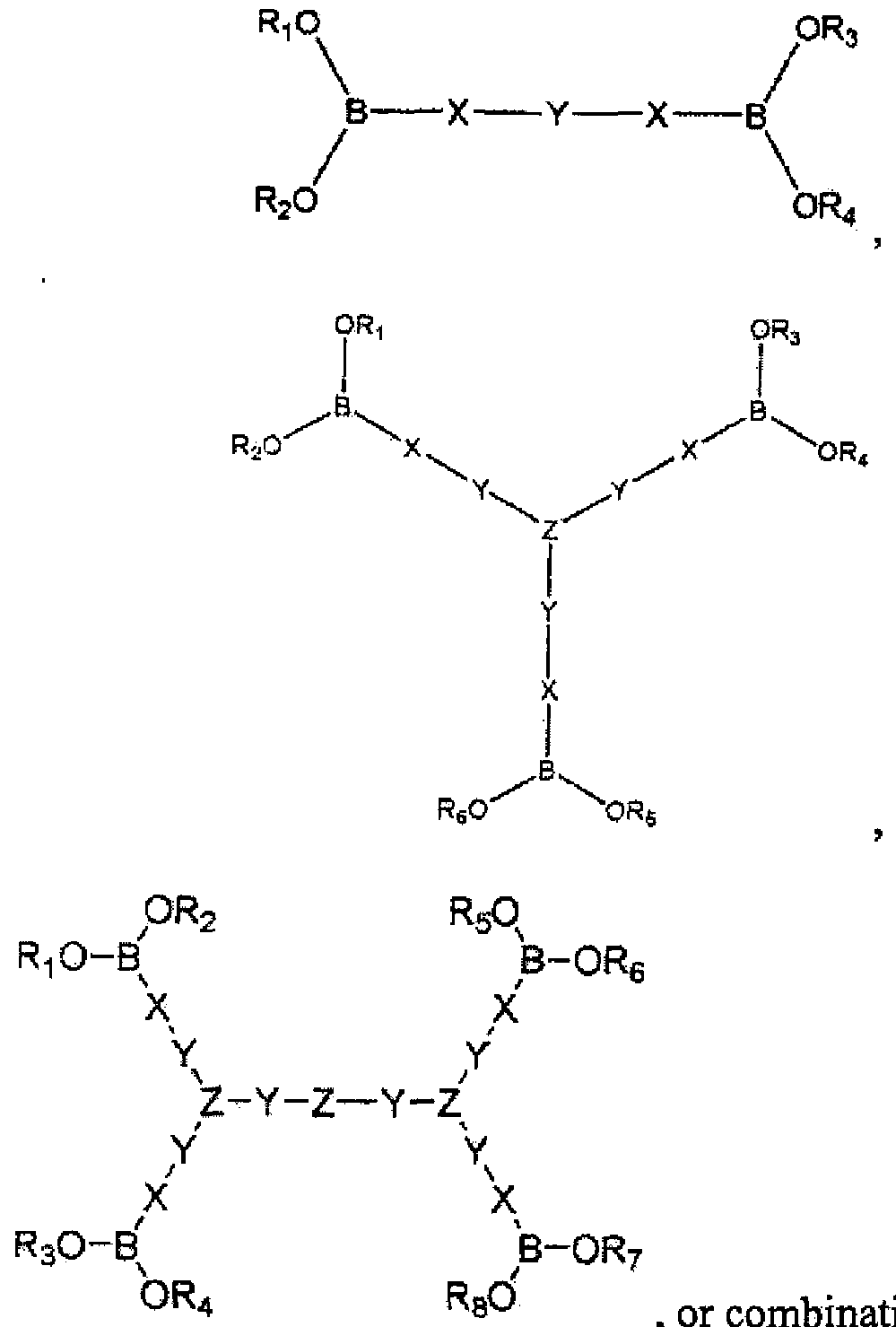
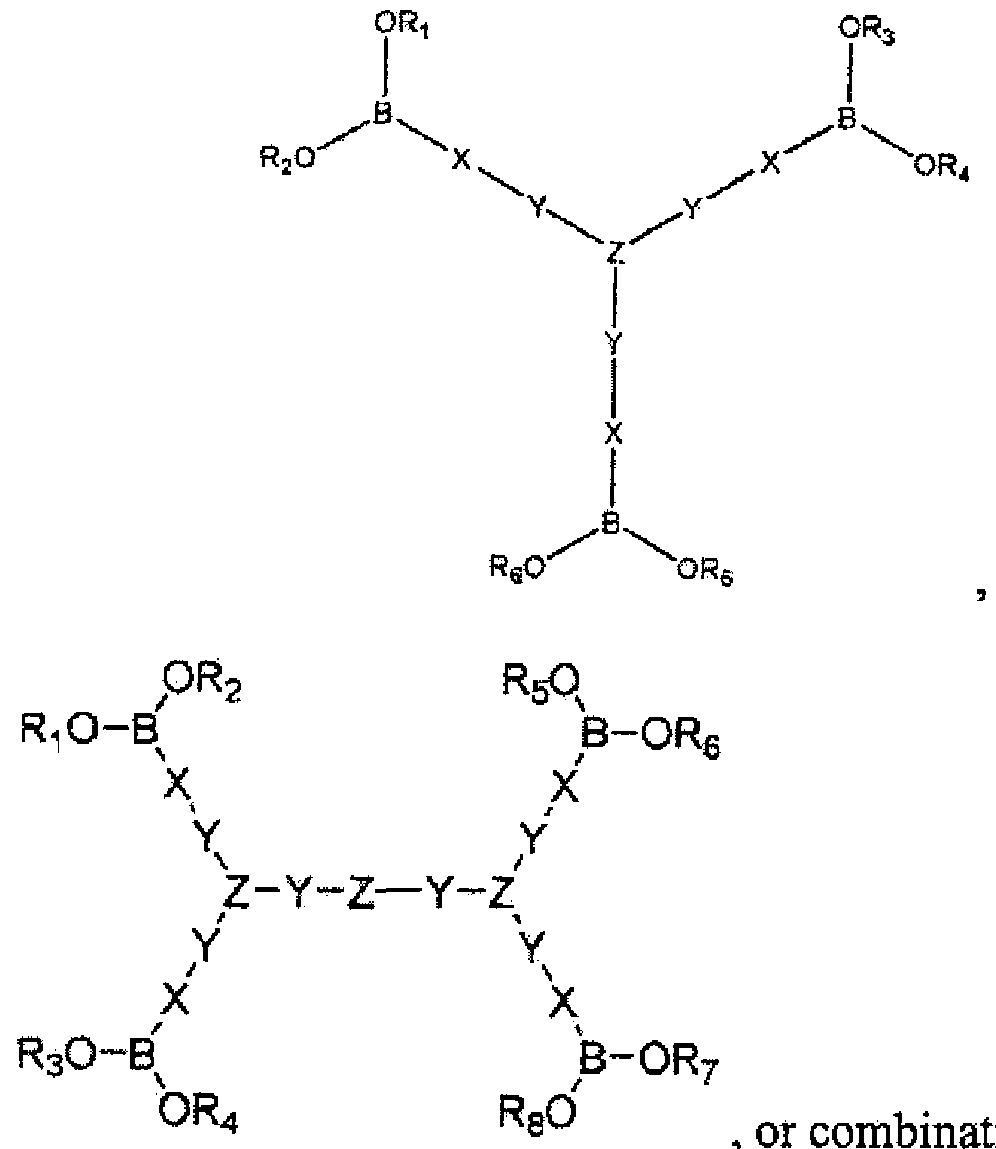
  • the polyboronic compounds can include compounds having the following structures:
  • RpRg can be hydrogen, alkyl group, alkenyl group, alkynyl group, aryl group, or combinations thereof.
  • Rj-R 8 can be, but is not required to be, identical and they can also be from the same fragment to form ring structures (such as, R 1 , R 2 -CH 2 CH 2 -, -C(CHb) 2 C(CH 3 ) 2 -, etc);
  • X can be carbon, nitrogen, silicon, or combinations thereof.
  • a compound with X being nitrogen to incorporate multiple boron atoms into the structure by the chemical bonding between N and B atoms is acceptable.
  • Y can be a spacer, which can be straight chain of-(CH 2 )-, straight chain with pendant(s), straight chain with branching, aromatic ring(s) directly connected, aromatic ring(s) indirectly connected, fused aromatic rings, heterocyclic ring(s) directly connected, heterocyclic ring(s) indirectly connected, fused heterocyclic rings, aliphatic ring(s) directly connected, aliphatic ring(s) indirectly connected, fused aliphatic rings, or combinations thereof.
  • Y can be phenylene, biphenylene, triphenylene, fluorene, fluorenone, naphthalene, methylene bisphenylene, stilbene, or combinations thereof.
  • X can also be part of Y when Y has ring structure(s).
  • Z can be carbon, silicon, oxygen, nitrogen, alkyl group, alkenyl group, alkynyl group, aromatic ring(s), aliphatic ring(s), heterocyclic ring(s), or combinations thereof.
  • Z can also be a metal atom, such as, Al, Zr, Ti, Zn, or the like connected to other parts of the structure via chelation and/or other chemical interactions.
  • Z can also be a fragment of Y.
  • the general structure of suitable polyboronic compounds can be further extended to dendrimeric "poly" boronic compounds. Other suitable types of polyboronic compounds will be understood by those of skill in the art and are to be considered within the scope of the present invention.
  • the polyboronic compounds belong to a different type of chemistry from conventional boric acid, its ester derivatives and polyboric acids and their salts.
  • boron atoms are not connected to any atom other than oxygen, which leads to hydrolyzation in aqueous solution and release of boric acid.
  • the actual crosslinking species is boric acid after hydrolysis of borate esters or polyborates.
  • boron atom is connected to at least one atom other than the oxygen atoms, especially carbon or nitrogen, the corresponding compounds are called boronic acids (or boronic esters) and they are different compounds and possess different chemical properties.
  • the active crosslinking species is not boric acid, but polyboronic compounds instead.
  • these diboronic or polyboronic compounds are used as crosslinking agents, they will provide two or more boron atom sites, each is capable of being chelated with the two cis- hydroxyls in the backbone of the hydratable polymers. Therefore, a triboronic compound can crosslink three polysaccharide chains via three boron atoms within one crosslinking agent molecule.
  • the polyboronic species are the crosslinking agents, not boric acid hydrolyzed from corresponding esters, as shown in prior art, as delayed boric acid crosslinking agents.
  • N when N is attached to B, to form stable (OR) 2 BNHRHNB(OR) 2 structure is particularly preferred.
  • additives can be useful in the present invention.
  • Additives used in the oil and gas industry and known in the art including but not limited to, corrosion inhibitors, non-emulsifiers, iron control agents, delay additives, silt suspenders, flowback additives, pH adjusting agents, clay stabilizer, surfactants, and gel breakers, can also be used in embodiments of the present invention.
  • Proppants including, but not limited to, frac sand, resin coated sand, quartz sand grains, ceramic proppant, tempered glass beads, rounded walnut shell fragments, aluminum pellets, and nylon pellets at desired size can also be used.
  • Proppant is typically used in concentrations that range between about 1 pound per gallon of the fracturing fluid composition to about 8 pounds per gallon of the fracturing fluid composition.
  • Other suitable additives useful in the present invention will be apparent to those of skill in the art and are to be considered within the scope of the present invention.
  • the fracturing fluid of the present invention can be used by pumping the fluid into a well bore penetrating the subterranean formation to be fractured. The fracturing fluid is injected at a rate sufficient to fracture the formation and to place proppant into the fracture.
  • lower loadings of polymer can be used to obtain equivalent fracturing fluid performance at reduced overall treatment costs.
  • Reduced polymer loadings can also result in less damage to the surrounding subterranean formation after the fracturing treatment. Guar based polymers are attributed with causing damage to the fracture sand pack and reducing the effective fracture width.
  • the present invention permits substantial reduction in the amount of polymer injected into the formation while maintaining optimal fluid properties for creating the fracture.
  • C * , C ** , and Ccc are often used as the leading indexes to represent the efficiency of a crosslinked polymer fluid, C * , C ** and Ccc depend on the type of polymer being used, as well as, possibly the type of cros slinking agent used.
  • Ccc is used to describe the critical crosslinking concentration for polymer chains, as will be understood by those of skill in the art.
  • the term "Ccc” is generally considered to be minimum polymer concentration where the fluid is able to be crosslinked. It was proposed by others that Ccc is largely independent on the type of crosslinking agent used while depends on only the type of polymer that was used.
  • a method of making a polyboronic compound is provided.
  • a polymeric amine is contacted with a trialkylborate in the presence of a solvent to produce the polyboronic compound having more than one B-N bond.
  • a solvent to produce the polyboronic compound having more than one B-N bond.
  • Excess trialkylborate can be used.
  • an insufficient amount of trialkylborate can be used.
  • the polyboronic compound can have the following structures:
  • Ri-Rs is hydrogen, alkyl group, alkenyl group, alkynyl group, aryl group, or combinations thereof;
  • X is nitrogen;
  • Y is a straight chain Of-(CH 2 )-, a straight chain with pendant(s), a straight chain with branching, aromatic ring(s) directly connected, aromatic ring(s) indirectly connected, fused aromatic rings, heterocyclic ring(s) directly connected, heterocyclic ring(s) indirectly connected, fused heterocyclic rings, aliphatic ring(s) directly connected, aliphatic ring(s) indirectly connected, fused aliphatic rings, or combinations thereof; and Z is carbon, silicon, oxygen, nitrogen, alkyl group, alkenyl group, alkynyl group, aromatic ring(s), aliphatic ring(s), heterocyclic ring(s), a metal atom, or combinations thereof.
  • the polymeric amine can include ethylenediamine, diethylene triamine (DETA), triethylenetetramine (TETA), tetraethylenepentamine (TEPA), 1,2-, 1,3-propylenediamine, dipropylenetri amine, tripropylenetetramine, tetrapropylenepentamine, ethylene propylene triamine, ethylene dipropylene tetramine, diethylene propylene pentamine, ethylene tripropylene pentamine, diethylene dipropylene pentamine, Methylene propylene pentamine, polyethyler ⁇ rnine (e.g, Epomin® from Nippon Shokubai, LupasolTM from BASF, LupamineTM from BASF, etc.), poly(ethyleneoxy)amines, poly(propyleneoxy)amines (i.e., Jeffamine® T-40
  • the types of trialkylborates suitable in the present invention can also be varied.
  • the trialkylborate can include trimethylborate, triethylborate, tripropylborate, triisopropyl borate, tributyl borate, tri(fert-butyl)borate, or combinations thereof.
  • Other suitable types of trialkylborates that can be used in the present invention will be apparent to those of skill in the art and are to be considered within the scope of the present invention.
  • the types of solvents that can be used in the present invention can also be varied.
  • the solvent can include methanol, ethanol, propanol, 2-propanol, butanol, 2-butanol, tert-butsnol, or combinations thereof.
  • Other suitable types of solvents that can be used in the present invention will be apparent to those of skill in the art and are to be considered within the scope of the present invention.
  • the polyboronic compounds of the present invention have more than one B-N in the structure.
  • the number of B-N bonds can be varied depending upon the type of polymeric amine or trialkylborate selected to produce the polyboronic compound, hi an aspect, the polyboronic compound can include at least two B-N bonds. In another aspect, the polyboronic compound can include as many B-N bonds as there are N atoms in the polymeric amine.
  • another method of making a polyboronic compound is provided. In this embodiment, a polymeric amine is contacted with a trialkylborate in the presence of a solvent to produce the polyboronic compound.
  • the polymeric amine comprises ethylenediamine, diethylene triamine (DETA), triethylenetetramine (TETA), tetraethylenepentamine (TEPA), 1,2-, 1,3-propylenediamine, dipropylenetriamine, tripropylenetetramine, tetrapropylenepentamuie, ethylene propylene triamine, ethylene dipropylene tetramine, diethylene propylene tetramine, ethylene tripropylene pentamine, diethylene dipropylene pentamine, Methylene propylene pentamine, polyethylenimine, poly(ethyleneoxy)amines, poly(propyleneoxy)amines or combinations thereof; and the polyboronic compound comprises
  • a polyboronic compound having more than one B-N bond that provides more than one borate reaction (crosslinking) site is provided.
  • the polyboronic compound comprising:
  • ester analogs such as ethyl boronate, etc.
  • the polyboronic compound can include
  • the polyboronic compound can include
  • R]-R 8 is hydrogen, alkyl group, alkenyl group, alkynyl group, aryl group, or combinations thereof;
  • X is nitrogen;
  • Y is a straight chain Of -(CH 2 )-, a straight chain with pendant(s), a straight chain with branching, aromatic ring(s) directly connected, aromatic ring(s) indirectly connected, fused aromatic rings, heterocyclic ring(s) directly connected, heterocyclic ring(s) indirectly connected, fused heterocyclic rings, aliphatic ring(s) directly connected, aliphatic ring(s) indirectly connected, fused aliphatic rings, or combinations thereof; and Z is carbon, silicon, oxygen, nitrogen, alkyl group, alkenyl group, alkynyl group, aromatic ring(s), aliphatic ring(s), heterocyclic ring(s), a metal atom, or combinations thereof.
  • the polyboronic compound can be produced by contacting a polymeric amine with a trialkylborate in the presences of a solvent.
  • the polymeric amine can be ethylenediamine, diethylene triamine (DETA), triethylenetetramine (TETA), tetraethylenepentamine (TEPA), 1,2-, 1,3-propylenediamine, dipropylenetriamine, tripropylenetetramine, tetrapropylenepentamine, ethylene propylene triamine, ethylene dipropylene tetramine, diethylene propylene tetramine, ethylene tripropylene pentamine, diethylene dipropylene pentamine, triethylene propylene pentamine, polyethylenimine, poly(ethyleneoxy)amines, poly(propyleneoxy) amines, or combinations thereof; and the trialkylborate can be trimethylborate, triethylborate, tripropylborate, triisopropyl borate, tribu
  • Example 1 was used to determine Ccc and to test the effectiveness of the crosslinking agents made in accordance with embodiments of the present invention.
  • 25 ppt (0.3%) solution of guar gum (GW-3, which is commercially available from BJ Services Company) was prepared by hydrati ng GW-3 powder. After at least 30 minutes, the solution was systematically diluted to obtain 6, 7, 8, 9, 10, 11, 12, 13, 14, 15, 16, 17, 18, 19, 20, 21, 22, 23, 24 ppt solutions. Other additives (such as buffer, clay stabilizer, and bactericide) were added to the GW-3 guar solution.
  • the crosslinking agents made in accordance with embodiments of the present invention were then added by mixing. The polymer/crosslinking agent ratio was kept constant. The viscosity of the crosslinked gel was measured on Farm 35 instrument at room temperature. The polymer/crosslinking agent ratios were as follows;
  • the Ccc values were calculated for two different types of guar fracturing fluids, GW-3 and GW-45, that were crosslinked with four different types of crosslinking agents.
  • GW-3 and GW-45 are guar based polymers commercially available from BJ Services Company.
  • Table 1 a lower Ccc was obtained using the various polyboronic compounds (i.e., TDBA, BDBA, and BPDBA) when compared to the same guar polymers being crosslinked with conventional boric acid (BA).
  • BA boric acid
  • Example 4 illustrates one embodiment of the synthetic preparation of a polyboronic compound having the following structure. This example can be used to illustrate how polyboronic compounds are generally synthesized. The synthesis scheme can be extended to other type of polyboronic compounds.
  • a 150 mL 3-necked round bottom flask was equipped with a reflux condenser guarded with a CaCl 2 drying tube, a temperature indicator and a pressure-equalizing addition funnel.
  • Into the flask was added 7.3 g tris(2-aminoethyl) amine, followed with 15 g anhydrous MeOH.
  • 20.8 g freshly distilled trimethyl borate was transferred into the addition funnel and was then diluted with 6.9 g anhydrous MeOH.
  • the trimethyl borate solution was added drop by drop into the flask at a temperature below 4O 0 C. After the completion of the addition, the resultant solution was allowed to stand at room temperature for 30 minutes and then heated to reflux for at least 4 hours.
  • Example 5 can be used as a crosslinking agent in accordance with embodiments of the present invention, such as those described in Example 5.
  • Example S 1 the viscoelastic properties (n') and viscosities (cP) of two crosslinked guar polymer systems were compared. 25 ppt of GW-3 was crosslinked with 0.4 mmol compound prepared in Example 4 and 4 gpt 25% sodium hydroxide (NaOH) at 150 0 F and compared with an optimized crosslinked system that was prepared by crosslinking 25 ppt of GW-3 with CXB-IO (Lightning 2500), which is commercially available from BJ Services Company. As shown in Table 3, the results clearly demonstrate that these polyboronic compounds used in embodiments of the present invention can effectively lower polymer loading for fracturing stimulation.
  • compositions and/or methods disclosed and claimed herein can be made and executed without undue experimentation in light of the present disclosure. While the compositions and methods of this invention have been described in terms of preferred embodiments, it will be apparent to those of skill in the art that variations can be applied to the compositions and/or methods and in the steps or in the sequence of steps of the methods described herein without departing from the concept, spirit and scope of the invention. More specifically, it will be apparent that certain agents that are chemically related can be substituted for the agents described herein while the same or similar results would be achieved. All such similar substitutes and modifications apparent to those skilled in the art are deemed to be within the scope and concept of the invention.

Landscapes

  • Chemical & Material Sciences (AREA)
  • Organic Chemistry (AREA)
  • Life Sciences & Earth Sciences (AREA)
  • General Life Sciences & Earth Sciences (AREA)
  • Engineering & Computer Science (AREA)
  • Materials Engineering (AREA)
  • Compositions Of Macromolecular Compounds (AREA)
  • Processes Of Treating Macromolecular Substances (AREA)

Abstract

Fracturing fluid compositions and methods of fracturing subterranean formations using polyboronic compounds as crosslinking agents. Polyboronic compounds and methods of making them. The polyboronic compounds are produced by contacting a polymeric amine with a trialkylborates in the presence of a solvent so that the resulting molecule has more than one B-N bond. The compositions and methods of the present invention allow for lower polymer loadings because achieving higher fracturing fluid viscosities can be achieved using less polymer than in traditional crosslinked systems.

Description

BORON CROSSLINKERS FOR FRACTURING FLUIDS WITH APPRECIABLY LOWER POLYMER LOADING AND RELATED METHODS AND COMPOSITIONS
CROSS REFERENCE TO RELATED APPLICATIONS
[0001] This application claims the benefit of U.S. Patent Application Serial No. 12/255,125, which is titled "Boron Crosslinkers for Fracturing Fluids with Appreciably Lower Polymer Loading" filed October 21, 2008; U.S. Patent Application Serial No. 12/580,322, which is titled "Methods of Making Polyboronic Compounds and Compositions Related Thereto" filed October 16, 2009; and U.S. Patent Application Serial No. 12/580,352, which is titled "Methods of Making Polyboronic Compounds and Compositions Related Thereto" filed October 16, 2009, which hereby are incorporated by reference in their entirety.
BACKGROUND OF THE INVENTION Field of the Invention
[0002] The present invention relates to compositions and methods of fracturing hydrocarbon producing formations. The present invention also relates to polyboronic compositions and methods of making them. More specifically, the present invention relates to a crosslinking system for use with the fracturing fluids to increase viscosity of the fracturing fluids.
Description of the Related Art
[0003] Hydraulic fracturing techniques are widely used to enhance oil and gas production from subterranean formations. During hydraulic fracturing, a fluid is injected into a well bore under high pressure. Once the natural reservoir fracture gradient is exceeded, the fracturing fluid initiates a fracture in the formation that generally continues to grow during pumping. The treatment design generally requires the fluid to reach a maximum viscosity as it enters the fracture that affects the fracture length and width. The viscosity of most fracturing fluids is generated from water-soluble polysaccharides, such as galactomaπnans or cellulose derivatives. Linear gels that can be operated at ambient temperature do not have the necessary viscosity for proper proppant transferring at elevated temperature. The use of crosslinking agents or crosslinkers, such as borate, titanate, or zirconium (Zr) ions, can further increase the viscosity. The gelled fluid can be accompanied by a propping agent (i.e., proppant) that results in placement of the proppant within the fracture that has been produced. The proppant remains in the produced fracture to prevent the complete closure of the fracture and to form a conductive channel extending from the well bore into the formation being treated once the fracturing fluid is recovered.
[Q004] Guar based fracturing fluids are the most commonly used fluids in reservoir stimulation, As indicated previously, stimulation of oil and gas wells has been improved by the ability to crosslink fracturing fluids, such as guar. Crosslinking agents are used to significantly improve the viscosity of the system for various downhole conditions. Some common crosslinking agents include boron and zirconium or other metallic compounds. Boron crosslinked gels are more commonly used due to its reversibility to mechanical shearing and favorable environmental properties.
[0005] While boron and zirconium crosslinking agents are effective for many types of guar based fracturing fluids, a certain amount of the guar polymer is needed to achieve the viscosity necessary to fractionate the formation. It is desirable to use as little polymer as possible in a fracturing fluid so that the overall cost of the fracturing job is lower, less polymer residue remains in the fracture and the sand pack after breaking, and formation damage is minimized. [0006] m view of the foregoing, a need exists for a crosslinking agent that would effectively increase the viscosity of the polymer, which simultaneously reduces the polymer loading as much as possible in fracturing fluids. A need also exists for compounds, such as polyboronic compounds, that can be prepared and have more than one B-N bond that helps with functions, such as crosslinking. Additionally, it would be advantageous if such crosslinking system is compatible with existing fracturing systems.
SUMMARY OF THE INVENTION
[0007] In view of the foregoing, crosslinked fracturing fluids and methods of fracturing subterranean formations are provided as embodiments of the present invention. The compositions and methods described herein are effective and allow for lower polymer loadings in fracturing jobs. [0008] As an embodiment of the present invention, a fracturing fluid composition is provided. In this embodiment, the fracturing fluid includes a hydratable polymer capable of gelling in the presence of a crosslinking agent comprising apolyboronic compound.
[0009] Besides the compositional embodiments, methods of fracturing subterranean formations are also provided as embodiments of the present invention. For example, as another embodiment of the present invention, a method of fracturing a subterranean formation is provided. In this embodiment, water and a hydratable polymer capable of gelling are blended together and allowed to hydrate to form a hydrated polymer solution. Once the hydrated polymer solution is formed, a crosslinking agent comprising a polyboronic compound is added to the hydrated polymer solution to produce a crosslinked fracturing fluid. The crosslinked fracturing fluid is then injected into the subterranean formation to fracture the formation.
[0010] As another example, a method of fracturing a subterranean formation is provided as an embodiment of the present invention. In this embodiment, a fracturing fluid comprising a hydratable polymer is crosslinked by contacting the fracturing fluid with a polyboronic compound to produce a crosslinked fracturing fluid. The crosslinked fracturing fluid of the present invention has a higher viscosity when compared with the fracturing fluid being crosslinked with a conventional boric acid compound as a crosslinking agent at the same polymer loading. The crosslinked fracturing fluid is then injected into the subterranean formation to fracture the formation.
[0011] The resulting viscosity of the fracturing fluid of the present invention is higher than the resulting viscosity of fracturing fluids of the same polymer loading using conventional boric acid as the crosslinking agent. The increased viscosity of the crosslinked fracturing fluid of the present invention allows for a less amount of polymer to be used to achieve comparable results as prior art crosslinked fracturing fluids having higher polymer loadings. The resulting fracturing fluid of the present invention has a lower Ccc (critical crosslinking concentration) than the same polymer being crosslinked with conventional boric acid crosslinking agent. [0012] In addition to the crosslinking agent, as an embodiment of the present invention, polyboronic compounds and methods of making them are provided as embodiments of the present invention. The polyboronic compounds and methods of making them described herein can be used as crosslinking agents in compositions and methods described herein. It is believed that they can also be used in other applications, as well.
BRIEF DESCRIPTION OF THE DRAWINGS
[0013] FIGURE 1 is a chart showing the viscosity (cP) of GW-3 guar at various concentrations (ppt) using various crosslinking agents in accordance with embodiments of the present invention and in accordance with prior art embodiments.
[0014] FIGURE 2 is a chart showing the viscosity (cP) of GW-45 guar derivative at various concentrations (ppt) using various crosslinking agents in accordance with embodiments of the present invention and in accordance with prior art embodiments.
[0015] While the invention is susceptible to various modifications and alternative forms, specific embodiments have been shown by way of example in the drawings and will be described in detail herein. However, it should be understood that the invention is not intended to be limited to the particular forms disclosed. Rather, the intention is to cover all modifications, equivalents and alternatives falling within the spirit and scope of the invention as defined by the appended claims.
DESCRIPTION OF ILLUSTRATIVE EMBODIMENTS
[0016] Illustrative embodiments of the invention are described below as they might be employed in the operation and in the treatment of oilfield applications. In the interest of clarity, not all features of an actual implementation are described in this specification. It will of course be appreciated that in the development of any such actual embodiment, numerous implementation- specific decisions must be made to achieve the developers' specific goals, which will vary from one implementation to another. Moreover, it will be appreciated that such a development effort might be complex and time-consuming, but would nevertheless be a routine undertaking for those of ordinary skill in the art having the benefit of this disclosure. Further aspects and advantages of the various embodiments of the invention will become apparent from consideration of the following description.
[0017] As an embodiment of the present invention, a crosslinked fracturing fluid composition is provided. In this embodiment, the fracturing fluid includes a hydratable polymer capable of gelling in the presence of a crosslinking agent comprising a polyboronic compound. Typical hydratable polymers include, not limited to, polysaccharide, guar gum, guar gum derivatives, locust bean gum, karaya gum, carboxymethyl cellulose, carboxymethylhydroxyethyl cellulose, hydroxyethyl cellulose, or combinations thereof. Various types of polyboronic compounds can be used in embodiments of the present invention, as described herein. Conventional boron crosslinking agents used in hydraulic fracturing fluids are generally composed of borate salts or esters. The polyboronic compounds of the present invention are more effective when compared to the conventional boron crosslinking agents, which enables users to lower the polymer loading for fracturing jobs.
[0018] Besides the compositional embodiments, methods of fracturing subterranean formations are also provided as embodiments of the present invention. For example, as another embodiment of the present invention, a method of fracturing a subterranean formation is provided. In this embodiment, water and a hydratable polymer capable of gelling in the presence of a crosslinking agent are blended together and allowed to hydrate to form a hydrated polymer solution. Once the hydrated polymer solution is formed, a crosslinking agent comprising a polyboronic compound is added to the hydrated polymer solution to produce a crosslinked fracturing fluid. The cross linked fracturing fluid is then injected into the subterranean formation to fracture the formation.
[0019] As another example, a method of fracturing a subterranean formation is provided as an embodiment of the present invention, hi this embodiment, a fracturing fluid comprising a hydratable polymer is crosslinked by contacting the fracturing fluid with a polyboronic compound to produce a crosslinked fracturing fluid. The crosslinked fracturing fluid of the present invention has a higher viscosity when compared with the fracturing fluid being crosslinked with conventional boric acid crosslinking agents. The crosslinked fracturing fluid is then injected into the subterranean formation to fracture the formation.
[0020] The amounts of the components within the fracturing fluid can be varied in various embodiments of the present invention. For example, the polyboronic compound can be present in a range of about 0.02 vol. % to about 0.5 vol. % of the fracturing fluid composition; alternatively, in a range of about 0.10 vol. % to about 0.25 vol. %. In an aspect, the polyboronic compounds can be present in a range that is effective for achieving the desired viscosity of the resulting fracturing fluid, as will be apparent to those of skill in the art.
[0021] The methods and compositions described herein can be used with various types of fracturing fluid systems. The hydratable polymer can be varied depending upon the needs of a particular fracturing job. For example, the hydratable polymer can be guar gum, guar gum derivatives, locust bean gum, karaya gum, carboxymethyl cellulose, carboxymethylhydroxyethyl cellulose, hydroxyethyl cellulose, or combinations thereof. Other suitable hydratable polymers that are compatible with the methods and compositions described herein can be used and are to be considered within the scope of the present invention.
[0022] The methods and the compositions described herein are very efficient and have a lower polymer loading when compared with the same polymer system being crosslinked using conventional crosslinking agents, such as boric acid. The methods and compositions described herein can have a higher viscosity when compared with the same amount of polymer that has been crosslinked with conventional crosslinking agents, such as boric acid. In an aspect, the fracturing fluid composition of the present invention has a Ccc of less than about 12 ppt. In another aspect, the fracturing fluid composition of the present invention has a Ccc less than about 15.5 ppt.
[0023] In an aspect, various compounds can be used as the polyboronic compound used in embodiments of the present invention. Suitable polyboronic compounds can include 2,5- thiophenediboronic acid (TDBA), 1,4-benzenediboronic acid (BDBA), 4,4'-biphenyldiboronic acid (BPDBA), or combinations thereof. In an aspect, the polyboronic compounds can include compounds having the following structures:
Figure imgf000008_0001
Figure imgf000009_0001
Figure imgf000009_0002
or combinations thereof, wherein, RpRg can be hydrogen, alkyl group, alkenyl group, alkynyl group, aryl group, or combinations thereof. Rj-R8 can be, but is not required to be, identical and they can also be from the same fragment to form ring structures (such as, R1, R2 -CH2CH2-, -C(CHb)2 C(CH3)2-, etc); X can be carbon, nitrogen, silicon, or combinations thereof. In an aspect, a compound with X being nitrogen to incorporate multiple boron atoms into the structure by the chemical bonding between N and B atoms is acceptable. Y can be a spacer, which can be straight chain of-(CH2)-, straight chain with pendant(s), straight chain with branching, aromatic ring(s) directly connected, aromatic ring(s) indirectly connected, fused aromatic rings, heterocyclic ring(s) directly connected, heterocyclic ring(s) indirectly connected, fused heterocyclic rings, aliphatic ring(s) directly connected, aliphatic ring(s) indirectly connected, fused aliphatic rings, or combinations thereof. For example, Y can be phenylene, biphenylene, triphenylene, fluorene, fluorenone, naphthalene, methylene bisphenylene, stilbene, or combinations thereof. In an aspect, X can also be part of Y when Y has ring structure(s). Z can be carbon, silicon, oxygen, nitrogen, alkyl group, alkenyl group, alkynyl group, aromatic ring(s), aliphatic ring(s), heterocyclic ring(s), or combinations thereof. Z can also be a metal atom, such as, Al, Zr, Ti, Zn, or the like connected to other parts of the structure via chelation and/or other chemical interactions. Z can also be a fragment of Y. The general structure of suitable polyboronic compounds can be further extended to dendrimeric "poly" boronic compounds. Other suitable types of polyboronic compounds will be understood by those of skill in the art and are to be considered within the scope of the present invention.
[0024] The polyboronic compounds belong to a different type of chemistry from conventional boric acid, its ester derivatives and polyboric acids and their salts. In the chemistry nature of these boric acids or their derivatives, boron atoms are not connected to any atom other than oxygen, which leads to hydrolyzation in aqueous solution and release of boric acid. When used as crosslinking agents, the actual crosslinking species is boric acid after hydrolysis of borate esters or polyborates. When boron atom is connected to at least one atom other than the oxygen atoms, especially carbon or nitrogen, the corresponding compounds are called boronic acids (or boronic esters) and they are different compounds and possess different chemical properties. When they contact water or base, even at elevated temperatures, the B-C (or B-N, B-Si, etc.) bond will not hydrolyze, and therefore the active crosslinking species is not boric acid, but polyboronic compounds instead. When these diboronic or polyboronic compounds are used as crosslinking agents, they will provide two or more boron atom sites, each is capable of being chelated with the two cis- hydroxyls in the backbone of the hydratable polymers. Therefore, a triboronic compound can crosslink three polysaccharide chains via three boron atoms within one crosslinking agent molecule. In other words, the polyboronic species are the crosslinking agents, not boric acid hydrolyzed from corresponding esters, as shown in prior art, as delayed boric acid crosslinking agents. In an aspect, when N is attached to B, to form stable (OR)2BNHRHNB(OR)2 structure is particularly preferred.
[0025] Besides the polymer and crosslinking agents described herein, various additives can be useful in the present invention. Additives used in the oil and gas industry and known in the art, including but not limited to, corrosion inhibitors, non-emulsifiers, iron control agents, delay additives, silt suspenders, flowback additives, pH adjusting agents, clay stabilizer, surfactants, and gel breakers, can also be used in embodiments of the present invention. Proppants including, but not limited to, frac sand, resin coated sand, quartz sand grains, ceramic proppant, tempered glass beads, rounded walnut shell fragments, aluminum pellets, and nylon pellets at desired size can also be used. Proppant is typically used in concentrations that range between about 1 pound per gallon of the fracturing fluid composition to about 8 pounds per gallon of the fracturing fluid composition. Other suitable additives useful in the present invention will be apparent to those of skill in the art and are to be considered within the scope of the present invention. [0026] The fracturing fluid of the present invention can be used by pumping the fluid into a well bore penetrating the subterranean formation to be fractured. The fracturing fluid is injected at a rate sufficient to fracture the formation and to place proppant into the fracture. [0027] As another advantage of the present invention, lower loadings of polymer can be used to obtain equivalent fracturing fluid performance at reduced overall treatment costs. Reduced polymer loadings can also result in less damage to the surrounding subterranean formation after the fracturing treatment. Guar based polymers are attributed with causing damage to the fracture sand pack and reducing the effective fracture width. The present invention permits substantial reduction in the amount of polymer injected into the formation while maintaining optimal fluid properties for creating the fracture.
[002S] C*, C**, and Ccc are often used as the leading indexes to represent the efficiency of a crosslinked polymer fluid, C*, C** and Ccc depend on the type of polymer being used, as well as, possibly the type of cros slinking agent used. As used herein, the term "Ccc" is used to describe the critical crosslinking concentration for polymer chains, as will be understood by those of skill in the art. The term "Ccc" is generally considered to be minimum polymer concentration where the fluid is able to be crosslinked. It was proposed by others that Ccc is largely independent on the type of crosslinking agent used while depends on only the type of polymer that was used. As a result of the findings related to the present invention, it was discovered that the conventional theory is not necessarily true. The examples described herein show that the type of crosslinking agent used can affect Ccc, which is contrary to what was previously believed. The structures of the crosslinking agents of the present invention lowered the Ccc of guar polymer so significantly that the polymer solutions can be effectively crosslinked at concentrations much lower than widely accepted Ccc values. [0029] In addition to the crosslinking agent and related compositions and methods, polyboronic compounds and methods of making them are also provided as embodiments of the present invention. The polyboronic compounds and methods of making them described herein can be used as crosslinking agents in the compositions and methods described herein. It is believed that they can also be used in other applications, as well.
[0030] In an embodiment, a method of making a polyboronic compound is provided. In this embodiment, a polymeric amine is contacted with a trialkylborate in the presence of a solvent to produce the polyboronic compound having more than one B-N bond. Excess trialkylborate can be used. Alternatively, an insufficient amount of trialkylborate can be used. [0031] In an aspect, the polyboronic compound can have the following structures:
Figure imgf000012_0001
or combinations thereof, wherein Ri-Rs is hydrogen, alkyl group, alkenyl group, alkynyl group, aryl group, or combinations thereof; X is nitrogen; Y is a straight chain Of-(CH2)-, a straight chain with pendant(s), a straight chain with branching, aromatic ring(s) directly connected, aromatic ring(s) indirectly connected, fused aromatic rings, heterocyclic ring(s) directly connected, heterocyclic ring(s) indirectly connected, fused heterocyclic rings, aliphatic ring(s) directly connected, aliphatic ring(s) indirectly connected, fused aliphatic rings, or combinations thereof; and Z is carbon, silicon, oxygen, nitrogen, alkyl group, alkenyl group, alkynyl group, aromatic ring(s), aliphatic ring(s), heterocyclic ring(s), a metal atom, or combinations thereof. [0032] As with other embodiments of the present invention, various types of polymeric amines can be used to produce the polyboronic compounds of the present invention. In an aspect, the polymeric amine can include ethylenediamine, diethylene triamine (DETA), triethylenetetramine (TETA), tetraethylenepentamine (TEPA), 1,2-, 1,3-propylenediamine, dipropylenetri amine, tripropylenetetramine, tetrapropylenepentamine, ethylene propylene triamine, ethylene dipropylene tetramine, diethylene propylene pentamine, ethylene tripropylene pentamine, diethylene dipropylene pentamine, Methylene propylene pentamine, polyethylerύrnine (e.g, Epomin® from Nippon Shokubai, Lupasol™ from BASF, Lupamine™ from BASF, etc.), poly(ethyleneoxy)amines, poly(propyleneoxy)amines (i.e., Jeffamine® T-403 from Huntsman Corporation, Polyetheramine T-5000 from BASF, etc.) or combinations thereof. Other suitable types of polymeric amines that can be used in the present invention will be apparent to those of skill in the art and are to be considered within the scope of the present invention. [0033] Besides varying the types of polymeric amines that can be used in the present invention, the types of trialkylborates suitable in the present invention can also be varied. For example, in an aspect, the trialkylborate can include trimethylborate, triethylborate, tripropylborate, triisopropyl borate, tributyl borate, tri(fert-butyl)borate, or combinations thereof. Other suitable types of trialkylborates that can be used in the present invention will be apparent to those of skill in the art and are to be considered within the scope of the present invention. [0034] Similarly to the polymeric amines and the trialkylborates, the types of solvents that can be used in the present invention can also be varied. For example, in an aspect, the solvent can include methanol, ethanol, propanol, 2-propanol, butanol, 2-butanol, tert-butsnol, or combinations thereof. Other suitable types of solvents that can be used in the present invention will be apparent to those of skill in the art and are to be considered within the scope of the present invention.
[0035] The polyboronic compounds of the present invention have more than one B-N in the structure. The number of B-N bonds can be varied depending upon the type of polymeric amine or trialkylborate selected to produce the polyboronic compound, hi an aspect, the polyboronic compound can include at least two B-N bonds. In another aspect, the polyboronic compound can include as many B-N bonds as there are N atoms in the polymeric amine. [0036] As another embodiment of the present invention, another method of making a polyboronic compound is provided. In this embodiment, a polymeric amine is contacted with a trialkylborate in the presence of a solvent to produce the polyboronic compound. The polymeric amine comprises ethylenediamine, diethylene triamine (DETA), triethylenetetramine (TETA), tetraethylenepentamine (TEPA), 1,2-, 1,3-propylenediamine, dipropylenetriamine, tripropylenetetramine, tetrapropylenepentamuie, ethylene propylene triamine, ethylene dipropylene tetramine, diethylene propylene tetramine, ethylene tripropylene pentamine, diethylene dipropylene pentamine, Methylene propylene pentamine, polyethylenimine, poly(ethyleneoxy)amines, poly(propyleneoxy)amines or combinations thereof; and the polyboronic compound comprises
Figure imgf000014_0001
and its other ester analogs, such as ethyl boronate, etc. As with other embodiments of the present invention, excess trialkylborate can be used during the step of contacting the polymeric amine with the trialkylborate. Alternatively, an insufficient amount of trialkylborate can be used. [0037] As yet another embodiment of the present invention, a polyboronic compound having more than one B-N bond that provides more than one borate reaction (crosslinking) site is provided. In an aspect, the polyboronic compound comprising:
Figure imgf000015_0001
and its other ester analogs, such as ethyl boronate, etc.
[0038] In embodiments of the present invention, the polyboronic compound can include
Figure imgf000015_0002
wherein the sum of x, y and z is 5 or 6. Besides this compound, its other ester analogs can also be included, such as ethyl boronate, as will be apparent to those of skill in the art and are to be considered within the scope of the present invention. [0039] In an aspect, the polyboronic compound can include
Figure imgf000015_0003
Figure imgf000016_0001
PR? RsOv
R1O-B B-OR6
Z-Y-Z- Y-Z
/ \
X X
R3O-B' B-OR7
OR4 R8O or combinations thereof, wherein R]-R8 is hydrogen, alkyl group, alkenyl group, alkynyl group, aryl group, or combinations thereof; X is nitrogen; Y is a straight chain Of -(CH2)-, a straight chain with pendant(s), a straight chain with branching, aromatic ring(s) directly connected, aromatic ring(s) indirectly connected, fused aromatic rings, heterocyclic ring(s) directly connected, heterocyclic ring(s) indirectly connected, fused heterocyclic rings, aliphatic ring(s) directly connected, aliphatic ring(s) indirectly connected, fused aliphatic rings, or combinations thereof; and Z is carbon, silicon, oxygen, nitrogen, alkyl group, alkenyl group, alkynyl group, aromatic ring(s), aliphatic ring(s), heterocyclic ring(s), a metal atom, or combinations thereof. [0040] The polyboronic compound can be produced by contacting a polymeric amine with a trialkylborate in the presences of a solvent. In an aspect, the polymeric amine can be ethylenediamine, diethylene triamine (DETA), triethylenetetramine (TETA), tetraethylenepentamine (TEPA), 1,2-, 1,3-propylenediamine, dipropylenetriamine, tripropylenetetramine, tetrapropylenepentamine, ethylene propylene triamine, ethylene dipropylene tetramine, diethylene propylene tetramine, ethylene tripropylene pentamine, diethylene dipropylene pentamine, triethylene propylene pentamine, polyethylenimine, poly(ethyleneoxy)amines, poly(propyleneoxy) amines, or combinations thereof; and the trialkylborate can be trimethylborate, triethylborate, tripropylborate, triisopropyl borate, tributyl borate, tri(før/-butyl)borate, or combinations thereof.
EXAMPLES
10041J The following examples are included to demonstrate the use of compositions in accordance with embodiments of the present invention. It should be appreciated by those of skill in the art that the techniques disclosed in the examples that follow represent techniques discovered by the inventors to function well in the practice of the invention. However, those of skill in the art should, in light of the present disclosure, appreciate that many changes can be made in the specific embodiments that are disclosed and still obtain a like or similar result without departing from the scope of the invention. Example 1
[0042] Example 1 was used to determine Ccc and to test the effectiveness of the crosslinking agents made in accordance with embodiments of the present invention. 25 ppt (0.3%) solution of guar gum (GW-3, which is commercially available from BJ Services Company) was prepared by hydrati ng GW-3 powder. After at least 30 minutes, the solution was systematically diluted to obtain 6, 7, 8, 9, 10, 11, 12, 13, 14, 15, 16, 17, 18, 19, 20, 21, 22, 23, 24 ppt solutions. Other additives (such as buffer, clay stabilizer, and bactericide) were added to the GW-3 guar solution. The crosslinking agents made in accordance with embodiments of the present invention were then added by mixing. The polymer/crosslinking agent ratio was kept constant. The viscosity of the crosslinked gel was measured on Farm 35 instrument at room temperature. The polymer/crosslinking agent ratios were as follows;
TDBA/GW-3 =0.079 BDBA/GW-3=0.039 BPDBA/GW-3=0.056 BA/GW-3=0.022 TDBA/GW-45=1.10 BDBA/GW-45= 1.13 BA/GW-45=0.2233
The ratios were kept constant within each crosslinking agent to obtain systematic readings. The viscosity was plotted against the concentration to observe changes in viscosity versus concentration change, as shown in Figures 1 and 2. As concentration increases, a change in slope occurs. The interception of the slopes of the two regions defines Ccc. Example 2
[0043] The Ccc values were calculated for two different types of guar fracturing fluids, GW-3 and GW-45, that were crosslinked with four different types of crosslinking agents. GW-3 and GW-45 are guar based polymers commercially available from BJ Services Company. As can be seen in Table 1, a lower Ccc was obtained using the various polyboronic compounds (i.e., TDBA, BDBA, and BPDBA) when compared to the same guar polymers being crosslinked with conventional boric acid (BA). The results of this example show that the type of crosslinking agent can greatly affect the Ccc, which is contrary to what is conventionally accepted in the industry.
Figure imgf000018_0001
Example 3
[0044] In this example, the viscoelastic properties (n') and viscosities (cP) of two crosslinked guar polymer systems were compared. 15 ppt of GW-3 was crosslinked with 0.27 mmol BPDBA at 150 0F and compared with a typical crosslinked system that was prepared by crosslinking 20 ppt of GW-3 with CXB-10 (Lightning 2000), which is commercially available from BJ Services Company. As shown in Table 2, the results clearly demonstrate that these polyboronic compounds used in embodiments of the present invention can effectively lower polymer loading for fracturing stimulation. The reduction of the polymer loading is related to the size of the group separating the two boronic acids.
Figure imgf000018_0002
Figure imgf000019_0002
Example 4
[0045] Example 4 illustrates one embodiment of the synthetic preparation of a polyboronic compound having the following structure. This example can be used to illustrate how polyboronic compounds are generally synthesized. The synthesis scheme can be extended to other type of polyboronic compounds.
[0046] In this example, a 150 mL 3-necked round bottom flask was equipped with a reflux condenser guarded with a CaCl2 drying tube, a temperature indicator and a pressure-equalizing addition funnel. Into the flask was added 7.3 g tris(2-aminoethyl) amine, followed with 15 g anhydrous MeOH. Under nitrogen, 20.8 g freshly distilled trimethyl borate was transferred into the addition funnel and was then diluted with 6.9 g anhydrous MeOH. Under magnetic agitation, the trimethyl borate solution was added drop by drop into the flask at a temperature below 4O0C. After the completion of the addition, the resultant solution was allowed to stand at room temperature for 30 minutes and then heated to reflux for at least 4 hours. The resulting compound
Figure imgf000019_0001
can be used as a crosslinking agent in accordance with embodiments of the present invention, such as those described in Example 5. Example 5
[0047] In Example S1 the viscoelastic properties (n') and viscosities (cP) of two crosslinked guar polymer systems were compared. 25 ppt of GW-3 was crosslinked with 0.4 mmol compound prepared in Example 4 and 4 gpt 25% sodium hydroxide (NaOH) at 150 0F and compared with an optimized crosslinked system that was prepared by crosslinking 25 ppt of GW-3 with CXB-IO (Lightning 2500), which is commercially available from BJ Services Company. As shown in Table 3, the results clearly demonstrate that these polyboronic compounds used in embodiments of the present invention can effectively lower polymer loading for fracturing stimulation.
Figure imgf000020_0001
[0048] All of the compositions and/or methods disclosed and claimed herein can be made and executed without undue experimentation in light of the present disclosure. While the compositions and methods of this invention have been described in terms of preferred embodiments, it will be apparent to those of skill in the art that variations can be applied to the compositions and/or methods and in the steps or in the sequence of steps of the methods described herein without departing from the concept, spirit and scope of the invention. More specifically, it will be apparent that certain agents that are chemically related can be substituted for the agents described herein while the same or similar results would be achieved. All such similar substitutes and modifications apparent to those skilled in the art are deemed to be within the scope and concept of the invention.

Claims

WHAT IS CLAIMED IS:
1. A fracturing fluid composition comprising: a. a hydratable polymer capable of gelling in the presence of a crosslinking agent; and b. a crosslinking agent comprising a polyboronic compound.
2. The fracturing fluid composition of claim 1, wherein the polyboronic compound is present in a range of about 0.02 vol. % to about 0.5 vol. % of the fracturing fluid composition and the hydratable polymer is guar gum, guar gum derivatives, locust bean gum, karaya gum, carboxymethyl cellulose, carboxymethylhydroxyethyl cellulose, hydroxyethyl cellulose, or combinations thereof.
3. The fracturing fluid composition of claim 1, wherein the polyboronic compound comprises
Figure imgf000021_0001
wherein Rj-Rg is hydrogen, alkyl group, alkenyl group, alkynyl group, aryl group, or combinations thereof; X is carbon, nitrogen, silicon, or combinations thereof;
Y is a straight chain of -(CH2)-, a straight chain with pendant(s), a straight chain with branching, aromatic ring(s) directly connected, aromatic ring(s) indirectly connected, fused aromatic rings, heterocyclic ring(s) directly connected, heterocyclic ring(s) indirectly connected, fused heterocyclic rings, aliphatic ring(s) directly connected, aliphatic ring(s) indirectly connected, fused aliphatic rings, or combinations thereof; and Z is carbon, silicon, oxygen, nitrogen, alkyl group, alkenyl group, alkynyl group, aromatic ring(s), aliphatic ring(s), heterocyclic ring(s), a metal atom, or combinations thereof.
4. The fracturing fluid composition of claim 3, wherein
Ri - Rg are from a same fragment to form a ring structure;
Y is phenylene, biphenylene, triphenylene, fluorene, fluorenone, naphthalene, methylene bisphenylene, stilbene, or combinations thereof;
X is part of Y when Y has ring structure(s); Z is AI, Zr, Ti, Zn, or combinations thereof; Z is a fragment of Y; or combinations thereof.
5. The fracturing fluid composition composition of claim 1, wherein the polyboronic compound has at least one B-C bond.
6. The fracturing fluid composition of claim 1, wherein the polyboronic compound is 2,5- thiophenediboronic acid (TDBA), 1 ,4-benzenediboronic acid (BDBA), 4,4'- biphenyldiboronic acid (BPDBA), or combinations thereof.
7. The fracturing fluid composition of claim 1, wherein the polyboronic compound has at least one N-B bond.
8. A method of fracturing a subterranean formation comprising the steps of: a. blending together water and a hydratable polymer capable of gelling in the presence of a crosslinking agent; b. allowing the hydratable polymer to hydrate to form a hydrated polymer solution; c. adding a crosslinking agent comprising a polyboronic compound to the hydrated polymer solution to produce a crosslinked fracturing fluid; and d. injecting the crosslinked fracturing fluid into the subterranean formation to fracture the formation.
9. The method of claim 8, wherein the polyboronic compound is present in a range of about 0.02 vol. % to about 0.5 vol. % of the fracturing fluid composition.
10. The method of claim 8, wherein the polyboronic compound comprises
Figure imgf000023_0001
, or combinations thereof, wherein Rj-R8 is hydrogen, alkyl group, alkenyl group, alkynyl group, aryl group, or combinations thereof;
X is carbon, nitrogen, silicon, or combinations thereof;
Y is a straight chain of -(CH2)-, a straight chain with pendant(s), a straight chain with branching,, aromatic ring(s) directly connected, aromatic ring(s) indirectly connected, fused aromatic rings, heterocyclic ring(s) directly connected, heterocyclic rmg(s) indirectly connected, fused heterocyclic rings, aliphatic ring(s) directly connected, aliphatic ring(s) indirectly connected, fused aliphatic rings, or combinations thereof; and Z is carbon, silicon, oxygen, nitrogen, alkyl group, alkenyl group, alkynyl group, aromatic ring(s), aliphatic ring(s), heterocyclic ring(s), a metal atom, or combinations thereof.
11. The method of claim 8, wherein:
Rj - R8 are from a same fragment to form a ring structure;
Y is phenylene, biphenylene, triphenylene, fluorene, fluorenone, naphthalene, methylene bisphenylene, stilbene, or combinations thereof;
X is part of Y when Y has ring structure(s);
Z is Al, Zr, Ti, Zn, or combinations thereof;
Z is a fragment of Y; or combinations thereof.
12. The method of claim 8, wherein the polyboronic compound is 2,5-thiophenediboronic acid (TDBA), 1.4-benzenediboronic acid (BDBA), 4,4'-biphenyldiboronic acid (BPDBA), or combinations thereof.
13. The method of claim 8, wherein the polyboronic compound has at least one N-B bond.
14. A method of fracturing a subterranean formation comprising the steps of: a. crosslinking a fracturing fluid comprising a hydratable polymer by contacting the fracturing fluid with a polyboronic compound to produce a crosslinked fracturing fluid; and b. injecting the crosslinked fracturing fluid into the subterranean formation to fracture the formation.
15. The method of claim 14, wherein the polyboronic compound is present in a range of about 0.02 vol. % to about 0.5 vol. % of the fracturing fluid composition.
16. The method of claim 14, wherein the polyboronic compound comprises
Figure imgf000024_0001
Figure imgf000025_0001
, or combinations thereof, wherein Ri-R8 is hydrogen, alkyl group, alkenyl group, alkynyl group, aryl group, or combinations thereof;
X is carbon, nitrogen, silicon, or combinations thereof;
Y is a straight chain Of-(CH2K a straight chain with pendant(s), a straight chain with branching, aromatic ring(s) directly connected, aromatic ring(s) indirectly connected, fused aromatic rings, heterocyclic ring(s) directly connected, heterocyclic ring(s) indirectly connected, fused heterocyclic rings, aliphatic ring(s) directly connected, aliphatic ring(s) indirectly connected, fused aliphatic rings, or combinations thereof; and Z is carbon, silicon, oxygen, nitrogen, alkyl group, alkenyl group, alkynyl group, aromatic ring(s), aliphatic ring(s), heterocyclic ring(s), a metal atom, or combinations thereof.
17. The method of claim 14, wherein:
Ri - R8 are from a same fragment to form a ring structure;
Y is phenylene, biphenylene, triphenylene, fluorene, fluorenone, naphthalene, methylene bisphenylene, stilbene, or combinations thereof;
X is part of Y when Y has ring structure(s); Z is Al, Zr, Ti, Zn, or combinations thereof; Z is a fragment of Y; or combinations thereof.
18. The method of claim 14, wherein the polyboronic compound is 2,5-thiophenediboronic acid (TDBA), 1,4-benzenediboronic acid (BDBA), 4-4'-biphenyldiboronic acid (BPDBA), or combinations thereof.
19. The method of claim 14, wherein the polyboronic compound has at least one N-B bond.
20. A method of making a polyboronic compound comprising contacting a polymeric amine with a trialkylborate in the presence of a solvent to produce the polyboronic compound having more than one B-N bond.
21. The method of claim 20, wherein the polyboronic compound comprises
Figure imgf000026_0001
22. The method of claim 20, wherein the polyboronic compound comprises
Figure imgf000026_0002
wherein x + y + z = 5 or 6.
23. The method of claim 20, wherein the polyboronic compound comprises
Figure imgf000027_0001
QR, R5O
R1O-B' B-OR6
Y
Z-Y-Z- Y-Z
.Y
R3O-B B-OR7
OR4 Ra0 or combinations thereof, wherein R1-Rs is hydrogen, alkyl group, alkenyl group, alkytiyl group, aryl group, or combinations thereof; X is nitrogen;
Y is a straight chain of -(CH2)-, a straight chain with pendant(s), a straight chain with branching, aromatic ring(s) directly connected, aromatic ring(s) indirectly connected, fused aromatic rings, heterocyclic ring(s) directly connected, heterocyclic ring(s) indirectly connected, fused heterocyclic rings, aliphatic ring(s) directly connected, aliphatic ring(s) indirectly connected, fused aliphatic rings, or combinations thereof; and Z is carbon, silicon, oxygen, nitrogen, alkyl group, alkenyl group, alkynyl group, aromatic ring(s), aliphatic ring(s), heterocyclic ring(s), a metal atom, or combinations thereof.
24. The method of claim 20, wherein the polymeric amine comprises ethylenediamine, diethylene triamine (DETA)5 triethylenetetramine (TETA), tetraethylenepentamine (TEPA), 1,2-, 1,3- propylenediamine, dipropylenetriamine, tripropylenetetrarniαe, tetrapropylenepentamine, ethylene propylene triamine, ethylene dipropylene tetramine, diethylene propylene tetramine, ethylene tripropylene pentamine, diethylene dipropylene pentamine, triethylene propylene pentamine, polyethylenimine, ρoly(ethyleneoxy)amines, poly(propyleneoxy) amines, or combinations thereof.
25. The method of claim 20, wherein the trialkylborate comprises trimethylborate, triethylborate, tripropylborate, triisopropyl borate, tributyl borate, tri(tert-butyl)borate, or combinations thereof.
26. The method of claim 20, wherein the solvent comprises methanol, ethanol, propanol, 2- propanol, butanol, 2-butanol, tert-butanol, or combinations thereof.
27. The method of claim 20, wherein the step of contacting the polymeric amine with the trialkylborate includes contacting the polymeric amine with an excess amount of trialkylborate or an insufficient amount of trialkylborate.
28. The method of claim 20, wherein the polyboronic compound comprises at least two B-N bonds.
29. The method of claim 20, wherein the polyboronic compound comprises as many B-N bonds as there are N atoms in the polymeric amine.
30. A method of making a polyboronic compound comprising contacting a polymeric amine with a trialkylborate in the presence of a solvent to produce the polyboronic compound, wherein the polymeric amine comprises ethylenediamine, diethylene triamine (DETA), triethylenetetramine (TETA), tetraethylenepentamine (TEPA), 1,2-, 1,3-propylenediamine, dipropylenetriamine, tripropylenetetramine, tetrapropylenepentamine, ethylene propylene triamine, ethylene dipropylene tetramine, diethylene propylene tetramine, ethylene tripropylene pentamine, diethylene dipropylene pentamine, triethylene propylene pentamine, polyethylenimine, pσly(ethyleneoxy)amines, poly(propyleneoxy)amines, or combinations thereof.
31. The method of claim 30, wherein the polyboronic compound comprises:
Figure imgf000029_0001
wherein x + y + z — 5 or 6;
Figure imgf000029_0002
Figure imgf000030_0001
or combinations thereof.
32. The method of claim 30, wherein the trialkylborate comprises trimethylborate, triethylborate, tripropylborate, triisopropyl borate, tributyl borate,
Figure imgf000030_0002
or combinations thereof.
33. The method of claim 30, wherein the solvent comprises methanol, ethanol, propanol, 2- propanol, butanol, 2-butanol, tert-butanol, or combinations thereof.
34. The method of claim 30, wherein the polyboronic compound has as many B-N bonds as an alkyl group of the trialkylborate has carbon molecules.
35. The method of claim 30, wherein the step of contacting the polymeric amine with the trialkylborate includes contacting the polymeric amine with excess or an insufficient amount of trialkylborate.
36. A polyboronic compound having more than one B-N bond that provides more than one borate reaction (crosslinking) site.
37. The polyboronic compound of claim 36 comprising:
Figure imgf000030_0003
Figure imgf000031_0001
wherein x + y + z = 5 or 6,
Figure imgf000031_0002
or combinations thereof, wherein Rj-Rg is hydrogen, alkyl group, alkenyl group, alkynyl group, aryl group, or combinations thereof; X is nitrogen; Y is a straight chain of -(CH2)-, a straight chain with pendant(s), a straight chain with branching, aromatic ring(s) directly connected, aromatic ring(s) indirectly connected, fused aromatic rings, heterocyclic ring(s) directly connected, heterocyclic ring(s) indirectly connected, fused heterocyclic rings, aliphatic ring(s) directly connected, aliphatic ring(s) indirectly connected, fused aliphatic rings, or combinations thereof; and Z is carbon, silicon, oxygen, nitrogen, alkyl group, alkenyl group, alkynyl group, aromatic ring(s), aliphatic ring(s), heterocyclic ring(s), a metal atom, or combinations thereof.
38. The polyboronic compound of claim 36 produced by contacting a polymeric amine with a trialkylborate in the presences of a solvent.
39. The polyboronic compound of claim 38, wherein the polymeric amine is ethylenediamine, diethylene triamine (DETA), triethylenetetramine (TETA), tetraethylenepentamine (TEPA), 1,2-, 1,3-propylenediamine, dipropylenetriamine, tripropylenetetramine, tetrapropylenepentamine, ethylene propylene triamine, ethylene dipropylene tetramine, diethylene propylene tetramine, ethylene tripropylene pentamine, diethylene dipropylene pentamine, triethylene propylene pentamine, polyethylenimine, poly(ethyleneoxy)amines, poly(propyleneoxy)amines, or combinations thereof; and the trialkylborate is trimethylborate, triethylborate, tripropylborate, triisopropyl borate, tributyl borate, tri(fert-butyl)b orate, or combinations thereof.
PCT/US2009/061174 2008-10-21 2009-10-19 Boron crosslinkers for fracturing fluids with appreciably lower polymer loading and related methods and compositions Ceased WO2010048091A2 (en)

Priority Applications (3)

Application Number Priority Date Filing Date Title
AU2009307821A AU2009307821A1 (en) 2008-10-21 2009-10-19 Boron crosslinkers for fracturing fluids with appreciably lower polymer loading and related methods and compositions
CA2741273A CA2741273C (en) 2008-10-21 2009-10-19 Boron crosslinkers for fracturing fluids with appreciably lower polymer loading and related methods and compositions
BRPI0919899A BRPI0919899A2 (en) 2008-10-21 2009-10-19 boron crosslinkers for appreciably lower polymerically charged fracture fluids and related methods and compositions

Applications Claiming Priority (6)

Application Number Priority Date Filing Date Title
US12/255,125 US8173580B2 (en) 2008-10-21 2008-10-21 Boron crosslinkers for fracturing fluids with appreciably lower polymer loading
US12/255,125 2008-10-21
US12/580,352 US8389763B2 (en) 2008-10-21 2009-10-16 Methods of making polyboronic compounds and compositions related thereto
US12/580,322 2009-10-16
US12/580,322 US8420577B2 (en) 2008-10-21 2009-10-16 Methods of making polyboronic compounds and compositions related thereto
US12/580,352 2009-10-16

Publications (2)

Publication Number Publication Date
WO2010048091A2 true WO2010048091A2 (en) 2010-04-29
WO2010048091A3 WO2010048091A3 (en) 2010-06-24

Family

ID=41510788

Family Applications (1)

Application Number Title Priority Date Filing Date
PCT/US2009/061174 Ceased WO2010048091A2 (en) 2008-10-21 2009-10-19 Boron crosslinkers for fracturing fluids with appreciably lower polymer loading and related methods and compositions

Country Status (4)

Country Link
AU (1) AU2009307821A1 (en)
BR (1) BRPI0919899A2 (en)
CA (1) CA2741273C (en)
WO (1) WO2010048091A2 (en)

Cited By (7)

* Cited by examiner, † Cited by third party
Publication number Priority date Publication date Assignee Title
WO2012001363A1 (en) * 2010-06-30 2012-01-05 Halliburton Energy Services, Inc. Multifunctional boronic crosslinkers and associated methods
WO2011159161A3 (en) * 2010-06-18 2012-05-03 Universiteit Twente Boronated polymers
CN102775979A (en) * 2012-07-19 2012-11-14 中国石油天然气股份有限公司 A kind of high-efficiency cross-linking agent for reducing the use concentration of guar gum and preparation method thereof
AU2012258416B2 (en) * 2010-06-30 2013-09-12 Halliburton Energy Services, Inc. Multifunctional boronic acid crosslinking agents and associated methods
WO2016080979A1 (en) * 2014-11-19 2016-05-26 Halliburton Energy Services, Inc. Silica crosslinker including boronic acid functionalities or esters thereof for treatment of subterranean formations
WO2017048249A1 (en) * 2015-09-16 2017-03-23 Halliburton Energy Services, Inc. Low-polymer loading treatment fluid for use in subterranean formation operations
CN112111263A (en) * 2020-09-23 2020-12-22 中国石油大学(华东) A kind of preparation method of high temperature resistant clean fracturing fluid

Family Cites Families (7)

* Cited by examiner, † Cited by third party
Publication number Priority date Publication date Assignee Title
US3284410A (en) * 1965-06-22 1966-11-08 Lubrizol Corp Substituted succinic acid-boron-alkylene amine-cyanamido derived additive and lubricating oil containing same
GB1545629A (en) * 1977-07-27 1979-05-10 Ici Ltd Process for preparing diaminodikto-,diaminodihydroxy-aminohydroxydiketo-,dihydroxyketimino-and diketo dihydroxy-hydronaphthacene derivatives
US4328113A (en) * 1980-01-14 1982-05-04 Mobil Oil Corporation Friction reducing additives and compositions thereof
US4474671A (en) * 1983-02-04 1984-10-02 Mobil Oil Corporation Products of reaction of organic diamines, boron compounds and acyl sarcosines and lubricants containing same
FR2855180B1 (en) * 2003-05-23 2006-07-14 Rhodia Chimie Sa AQUEOUS FLUID COMPRISING A BORONATE POLYMER AND A LIGAND POLYMER AND USE IN OPERATING OIL OR GAS STORAGE
US7405183B2 (en) * 2004-07-02 2008-07-29 Halliburton Energy Services, Inc. Methods and compositions for crosslinking polymers with boronic acids
US7687441B2 (en) * 2004-10-25 2010-03-30 Halliburton Energy Services, Inc. Boronic acid networking agents and associated methods

Cited By (11)

* Cited by examiner, † Cited by third party
Publication number Priority date Publication date Assignee Title
WO2011159161A3 (en) * 2010-06-18 2012-05-03 Universiteit Twente Boronated polymers
WO2012001363A1 (en) * 2010-06-30 2012-01-05 Halliburton Energy Services, Inc. Multifunctional boronic crosslinkers and associated methods
US8424603B2 (en) 2010-06-30 2013-04-23 Halliburton Energy Services, Inc. Multifunctional boronic crosslinkers and associated methods
AU2011273187B2 (en) * 2010-06-30 2013-08-15 Halliburton Energy Services, Inc. Multifunctional boronic crosslinkers and associated methods
AU2012258416B2 (en) * 2010-06-30 2013-09-12 Halliburton Energy Services, Inc. Multifunctional boronic acid crosslinking agents and associated methods
US8708045B2 (en) 2010-06-30 2014-04-29 Halliburton Energy Services, Inc. Multifunctional boronic acid crosslinking agents and associated methods
CN102775979A (en) * 2012-07-19 2012-11-14 中国石油天然气股份有限公司 A kind of high-efficiency cross-linking agent for reducing the use concentration of guar gum and preparation method thereof
WO2016080979A1 (en) * 2014-11-19 2016-05-26 Halliburton Energy Services, Inc. Silica crosslinker including boronic acid functionalities or esters thereof for treatment of subterranean formations
AU2014412067B2 (en) * 2014-11-19 2018-04-26 Halliburton Energy Services, Inc. Silica crosslinker including boronic acid functionalities or esters thereof for treatment of subterranean formations
WO2017048249A1 (en) * 2015-09-16 2017-03-23 Halliburton Energy Services, Inc. Low-polymer loading treatment fluid for use in subterranean formation operations
CN112111263A (en) * 2020-09-23 2020-12-22 中国石油大学(华东) A kind of preparation method of high temperature resistant clean fracturing fluid

Also Published As

Publication number Publication date
WO2010048091A3 (en) 2010-06-24
CA2741273A1 (en) 2010-04-29
CA2741273C (en) 2017-03-14
AU2009307821A1 (en) 2010-04-29
BRPI0919899A2 (en) 2016-02-16

Similar Documents

Publication Publication Date Title
US8173580B2 (en) Boron crosslinkers for fracturing fluids with appreciably lower polymer loading
US8420577B2 (en) Methods of making polyboronic compounds and compositions related thereto
US9534167B2 (en) Fracturing method using polyboronic compound
CA2741273C (en) Boron crosslinkers for fracturing fluids with appreciably lower polymer loading and related methods and compositions
CA2709984C (en) Process to prepare zirconium-based cross-linker compositions and their use in oil field applications
CA2708805C (en) Process to prepare borozirconate solution and use as a cross-linker in hydraulic fracturing fluids
US11208590B2 (en) Compositions and methods for stabilizing water sensitive clays and migrating fines in subterranean formations
CA2679889C (en) Zirconium-based cross-linker compositions and their use in high ph oil field applications
WO2008068657A2 (en) Method for treating a subterranean formation
US20140155305A1 (en) Thickening of fluids
GB2434577A (en) Preparation of phosphate esters having reduced phosphorus volatility from phosphorus pentoxide, for use in non-volatile phosphorus hydrocarbon gelling agent
EP1984471A2 (en) Zirconium cross-linking composition and methods of use
US8389763B2 (en) Methods of making polyboronic compounds and compositions related thereto
US8921597B2 (en) Preparation of boron crosslinking agents for fracturing fluids
CA2678783C (en) Zirconium-based cross-linker compositions and their use in high ph oil field applications
CA2934281C (en) Boosters for breakers containing iron compounds
Loveless et al. Multifunctional boronic acid crosslinker for fracturing fluids
US20090166041A1 (en) Zirconium-hydroxy alkylated amine-hydroxy carboxylic acid cross-linking composition for use with high pH polymer solutions
WO2008082504A1 (en) Stable solutions of zirconium hydroxyalkylethylene diamine complex and use in oil field applications
HK1139416B (en) Zirconium-based cross-linker compositions and their use in high ph oil field applications
HK1139690A (en) Process for stabilized zirconium triethanolamine complex and uses in oil field applications
HK1139415A (en) Zirconium-based cross-linker compositions and their use in high ph oil field applications

Legal Events

Date Code Title Description
121 Ep: the epo has been informed by wipo that ep was designated in this application

Ref document number: 09744268

Country of ref document: EP

Kind code of ref document: A2

WWE Wipo information: entry into national phase

Ref document number: 2009307821

Country of ref document: AU

WWE Wipo information: entry into national phase

Ref document number: 2741273

Country of ref document: CA

ENP Entry into the national phase

Ref document number: 2009307821

Country of ref document: AU

Date of ref document: 20091019

Kind code of ref document: A

122 Ep: pct application non-entry in european phase

Ref document number: 09744268

Country of ref document: EP

Kind code of ref document: A2

NENP Non-entry into the national phase

Ref country code: DE

ENP Entry into the national phase

Ref document number: PI0919899

Country of ref document: BR

Kind code of ref document: A2

Effective date: 20110425