WO2010045008A1 - AMIDES OF THIENO[2,3-d]PYRIMIDINE AND THEIR USE AS ADENOSINE A2a RECEPTOR ANTAGONISTS - Google Patents

AMIDES OF THIENO[2,3-d]PYRIMIDINE AND THEIR USE AS ADENOSINE A2a RECEPTOR ANTAGONISTS Download PDF

Info

Publication number
WO2010045008A1
WO2010045008A1 PCT/US2009/058709 US2009058709W WO2010045008A1 WO 2010045008 A1 WO2010045008 A1 WO 2010045008A1 US 2009058709 W US2009058709 W US 2009058709W WO 2010045008 A1 WO2010045008 A1 WO 2010045008A1
Authority
WO
WIPO (PCT)
Prior art keywords
alkyl
pyridyl
disorder
optionally substituted
cyclopropyl
Prior art date
Legal status (The legal status is an assumption and is not a legal conclusion. Google has not performed a legal analysis and makes no representation as to the accuracy of the status listed.)
Ceased
Application number
PCT/US2009/058709
Other languages
French (fr)
Inventor
Devraj Chakravarty
Brian Christopher Shook
Current Assignee (The listed assignees may be inaccurate. Google has not performed a legal analysis and makes no representation or warranty as to the accuracy of the list.)
Janssen Pharmaceutica NV
Original Assignee
Janssen Pharmaceutica NV
Priority date (The priority date is an assumption and is not a legal conclusion. Google has not performed a legal analysis and makes no representation as to the accuracy of the date listed.)
Filing date
Publication date
Application filed by Janssen Pharmaceutica NV filed Critical Janssen Pharmaceutica NV
Priority to MX2011003963A priority Critical patent/MX2011003963A/en
Priority to CA2740408A priority patent/CA2740408A1/en
Publication of WO2010045008A1 publication Critical patent/WO2010045008A1/en
Anticipated expiration legal-status Critical
Ceased legal-status Critical Current

Links

Classifications

    • CCHEMISTRY; METALLURGY
    • C07ORGANIC CHEMISTRY
    • C07DHETEROCYCLIC COMPOUNDS
    • C07D495/00Heterocyclic compounds containing in the condensed system at least one hetero ring having sulfur atoms as the only ring hetero atoms
    • C07D495/02Heterocyclic compounds containing in the condensed system at least one hetero ring having sulfur atoms as the only ring hetero atoms in which the condensed system contains two hetero rings
    • C07D495/04Ortho-condensed systems
    • AHUMAN NECESSITIES
    • A61MEDICAL OR VETERINARY SCIENCE; HYGIENE
    • A61PSPECIFIC THERAPEUTIC ACTIVITY OF CHEMICAL COMPOUNDS OR MEDICINAL PREPARATIONS
    • A61P25/00Drugs for disorders of the nervous system
    • AHUMAN NECESSITIES
    • A61MEDICAL OR VETERINARY SCIENCE; HYGIENE
    • A61PSPECIFIC THERAPEUTIC ACTIVITY OF CHEMICAL COMPOUNDS OR MEDICINAL PREPARATIONS
    • A61P25/00Drugs for disorders of the nervous system
    • A61P25/14Drugs for disorders of the nervous system for treating abnormal movements, e.g. chorea, dyskinesia
    • A61P25/16Anti-Parkinson drugs
    • AHUMAN NECESSITIES
    • A61MEDICAL OR VETERINARY SCIENCE; HYGIENE
    • A61PSPECIFIC THERAPEUTIC ACTIVITY OF CHEMICAL COMPOUNDS OR MEDICINAL PREPARATIONS
    • A61P25/00Drugs for disorders of the nervous system
    • A61P25/28Drugs for disorders of the nervous system for treating neurodegenerative disorders of the central nervous system, e.g. nootropic agents, cognition enhancers, drugs for treating Alzheimer's disease or other forms of dementia

Definitions

  • This invention relates to a novel arylindenopyrimidine and its therapeutic and prophylactic uses.
  • Disorders treated and/or prevented include neurodegenerative and movement disorders ameliorated by antagonizing Adenosine A2a receptors.
  • Adenosine A2a Receptors Adenosine is a purine nucleotide produced by all metabolically active cells within the body. Adenosine exerts its effects via four subtypes of cell surface receptors (Al, A2a, A2b and A3), which belong to the G protein coupled receptor superfamily (Stiles, G.L. Journal of Biological Chemistry, 1992, 267, 6451). Al and A3 couple to inhibitory G protein, while A2a and A2b couple to stimulatory G protein.
  • A2a receptors are mainly found in the brain, both in neurons and glial cells (highest level in the striatum and nucleus accumbens, moderate to high level in olfactory tubercle, hypothalamus, and hippocampus etc. regions) (Rosin, D. L.; Robeva, A.; Woodard, R. L.; Guyenet, P. G.; Linden, J. Journal of Comparative Neurology, 1998, 401, 163).
  • A2a receptors are found in platelets, neutrophils, vascular smooth muscle and endothelium (Gessi, S.; Varani, K. ; Merighi, S. ; Ongini, E.; Bores, P. A. British Journal of Pharmacology, 2000, 129, T).
  • the striatum is the main brain region for the regulation of motor activity, particularly through its innervation from dopaminergic neurons originating in the substantial nigra.
  • the striatum is the major target of the dopaminergic neuron degeneration in patients with Parkinson's Disease (PD).
  • A2a receptors are co-localized with dopamine D2 receptors, suggesting an important site for the integration of adenosine and dopamine signaling in the brain (Fink, J. S.; Weaver, D. Ri; Rivkees, S. A.; Peterfreund, R. A.; Pollack, A. E.; Adler, E. M.; Reppert, S. M. Brain Research Molecular Brain Research, 1992,14,186).
  • A2a knockout mice with genetic blockade of A2a function have been found to be less sensitive to motor impairment and neurochemical changes when they were exposed to neurotoxin MPTP (Chen, J. F.; Xu, K.; I Petzer, J. P.; Steal, R.; Xu, Y. H.; Beilstein, M.; Sonsalla, P. K.; Castagnoli, K.; Castagnoli, N., Jr.; Schwarsschild, M. A. Journal of Neuroscience, 2001, 1 21, RCl 43).
  • adenosine A2a receptor blockers may provide a new class of antiparkinsonian agents (Impagnatiello, F.; Bastia, E.; Ongini, E.; Monopoli, A. Emerging Therapeutic Targets, 2000, 4, 635).
  • Antagonists of the A 2A receptor are potentially useful therapies for the treatment of addiction.
  • Major drugs of abuse opiates, cocaine, ethanol, and the like
  • dopamine signaling in neurons particularly those found in the nucleus accumbens, which contain high levels of A 2A adenosine receptors.
  • An A 2A receptor antagonist could be used to treat attention deficit hyperactivity disorder (ADHD) since caffeine (a non selective adenosine antagonist) can be useful for treating ADHD, and there are many interactions between dopamine and adenosine neurons.
  • ADHD attention deficit hyperactivity disorder
  • caffeine a non selective adenosine antagonist
  • Antagonists of the A 2A receptor are potentially useful therapies for the treatment of depression.
  • a 2A antagonists are known to induce activity in various models of depression including the forced swim and tail suspension tests. The positive response is mediated by dopaminergic transmission and is caused by a prolongation of escape-directed behavior rather than by a motor stimulant effect.
  • Antagonists of the A 2A receptor are potentially useful therapies for the treatment of anxiety.
  • a 2 A antagonist have been shown to prevent emotional/anxious responses in vivo. Neurobiology of Disease (2007), 28(2) 197-205.
  • Compounds of Formula A are potent small molecule antagonists of the Adenosine A2a receptor.
  • R 1 is phenyl wherein said phenyl is optionally substituted with up to three substituents independently selected from the group consisting of F, Cl, Br, and OCH 3 , or a single substituent selected from the group consisting of: OH, OCH 2 CF 3 , OC ( i_ 4) alkyl, C ( i_ 4) alkyl, CHF 2 , OCF 3 , CF 3 , cyclopropyl and CN; or R 1 is heteroaryl optionally substituted with one substituent selected from the group consisting of: -OH, OC ( i_ 4) alkyl, CF 3 , OCF 3 , Cl, Br, -CN, F, CHF 2 , cyclopropyl, and C ⁇ alkyl;
  • said ring is phenyl or heteroaryl wherein said phenyl or heteroaryl is optionally substituted with -CN, F, Cl, Br, NO 2 , -CF 3 , 0C ( i_ 4 )alkyl, OCF 3 , or C ⁇ alkyl, alternatively said ring may be heterocyclyl optionally substituted with C (1-4 )alkyl; wherein R a is C ⁇ alkyl, H, -CH 2 -pyridyl, or pyridyl;
  • R b is H, or -CH 3 ;
  • R c is H, or -N(C ( i- 4) alkyl) 2 ;
  • the invention provides compounds of Formula A wherein:
  • R 1 is phenyl wherein said phenyl is optionally substituted with up to three substituents independently selected from the group consisting of F, Cl, Br, and OCH 3 , or a single substituent selected from the group consisting of: OH, OCH 2 CF 3 , OC ( i_ 4) alkyl, C ( i_ 4) alkyl, CHF 2 , OCF 3 , CF 3 , cyclopropyl and CN; or R 1 is heteroaryl optionally substituted with one substituent selected from the group consisting of: -OH, OC ( i_ 4) alkyl, CF 3 , OCF 3 , Cl, Br, -CN, F, CHF 2 , cyclopropyl, and C ( i_ 4) alkyl;
  • said ring is phenyl or heteroaryl wherein said phenyl or heteroaryl is optionally substituted with -CN, F, Cl, Br, NO 2 , -CF 3 , 0C ( i_ 4 )alkyl, OCF 3 , or C ⁇ alkyl, alternatively said ring may be heterocyclyl optionally substituted with C (1-4 )alkyl; wherein R a is C ⁇ alkyl, H, -CH 2 -pyridyl, or pyridyl;
  • R b is H, or -CH 3 ;
  • R c is H, or -N(C ( i- 4) alkyl) 2 ; and solvates, hydrates, tautomers, and pharmaceutically acceptable salts thereof.
  • R 1 is an aromatic ring selected from the group consisting of phenyl, furyl, oxazolyl, isoxazolyl, pyridyl, and thiazolyl, wherein said aromatic ring is optionally substituted with - CN, F, Cl, Br, -CF 3 , OC (1-4) alkyl, OCF 3 , C (1-4) alkyl, or cyclopropyl; wherein X is a direct bond or C ( i_ 4) alkyl, and said ring is pyridyl optionally substituted with F, Cl, or Br, alternatively said ring may be heterocyclyl optionally substituted with methyl; wherein R a is C ( i_ 4) alkyl, H, -CH 2 -pyridyl, or pyridyl;
  • R b is H, or -CH 3 ; and R c is H, or -N(C(i_ 4 )alkyl) 2 ; and solvates, hydrates, tautomers, and pharmaceutically acceptable salts thereof.
  • R 1 is an aromatic ring selected from the group consisting of phenyl, furyl, oxazolyl, isoxazolyl, pyridyl, and thiazolyl, wherein said aromatic ring is optionally substituted with CN, F, -CF 3 , OC ( i_ 4) alkyl, OCF 3 , C ( i_ 4) alkyl, or cyclopropyl;
  • pyridyl is optionally substituted with Cl; wherein R a is C ( i_ 4 )alkyl, H, -CH 2 -pyridyl, or pyridyl; R b is H, or -CH 3 ; and R c is H, or -N(C ( i_ 4) alkyl) 2 ; and solvates, hydrates, tautomers, and pharmaceutically acceptable salts thereof.
  • R 1 is an aromatic ring selected from the group consisting of phenyl, furyl, oxazolyl, isoxazolyl, pyridyl, and thiazolyl, wherein said aromatic ring is optionally substituted with CN, -CF 3 , OC ( i_ 4) alkyl, OCF 3 , C ( i_ 4) alkyl, or cyclopropyl;
  • R b is H, or -CH 3 ;
  • R c is H, or -N(C ( i_ 4) alkyl) 2 ; and solvates, hydrates, tautomers, and pharmaceutically acceptable salts thereof.
  • R 1 is an aromatic ring selected from the group consisting of phenyl, furyl, oxazolyl, isoxazolyl, and thiazolyl, wherein said aromatic ring is optionally substituted with -CN, -CF 3 , C ( i_ 4) alkyl, or cyclopropyl;
  • R a is C ⁇ alkyl, H, or pyridyl
  • R b is H, or -CH 3 ;
  • R c is H, or -N(C ( i _ 4 )alkyl) 2 ; and solvates, hydrates, tautomers, and pharmaceutically acceptable salts thereof.
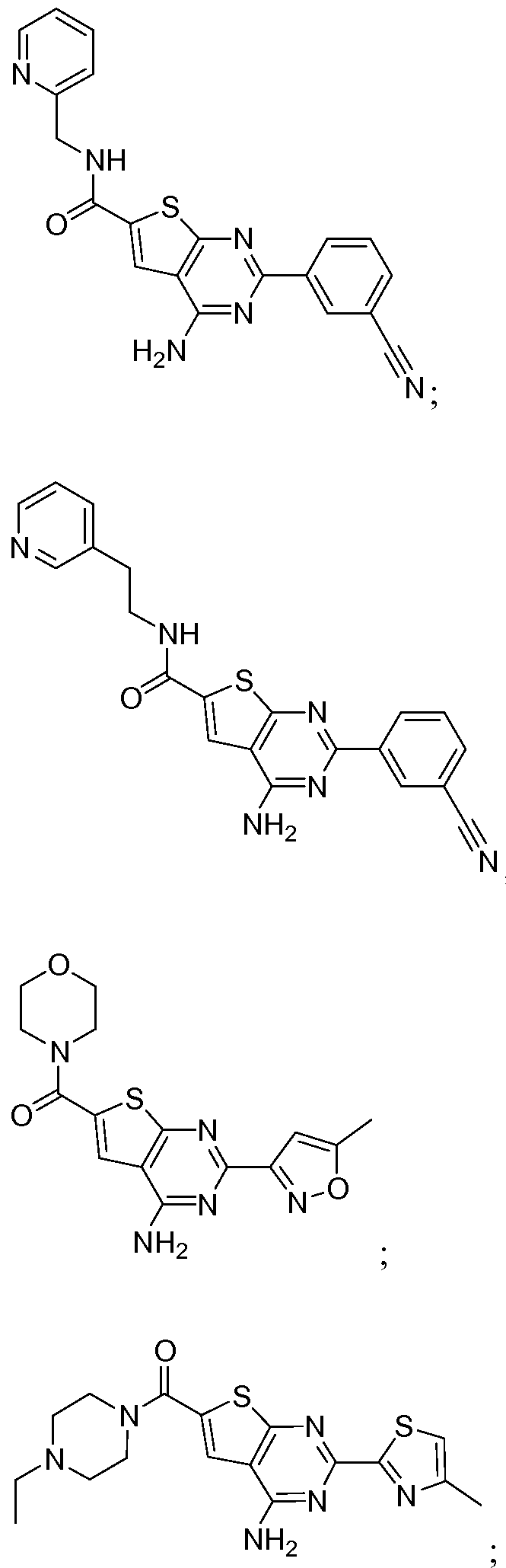
  • the invention is directed to a compound selected from the group consisting of:
  • This invention further provides a method of treating a subject having a condition ameliorated by antagonizing Adenosine A2a receptors, which comprises administering to the subject a therapeutically effective dose of a compound of Formula A.
  • This invention further provides a method of preventing a disorder ameliorated by antagonizing Adenosine A2a receptors in a subject, comprising of administering to the subject a prophylactically effective dose of the compound of claim 1 either preceding or subsequent to an event anticipated to cause a disorder ameliorated by antagonizing Adenosine A2a receptors in the subject.
  • Compounds of Formula A can be isolated and used as free bases. They can also be isolated and used as pharmaceutically acceptable salts.
  • salts include hydrobromic, hydroiodic, hydrochloric, perchloric, sulfuric, maleic, fumaric, malic, tartaric, citric, adipic, benzoic, mandelic, methanesulfonic, hydroethanesulfonic, benzenesulfonic, oxalic, palmoic, 2 naphthalenesulfonic, p- toluenesulfonic, cyclohexanesulfamic and saccharic.
  • This invention also provides a pharmaceutical composition
  • a pharmaceutical composition comprising a compound of Formula A and a pharmaceutically acceptable carrier.
  • Pharmaceutically acceptable carriers are well known to those skilled in the art and include, but are not limited to, from about 0.01 to about 0.1 M and preferably 0.05 M phosphate buyer or 0.8% saline.
  • Such pharmaceutically acceptable carriers can be aqueous or non-aqueous solutions, suspensions and emulsions.
  • non-aqueous solvents are propylene glycol, polyethylene glycol, vegetable oils such as olive oil, and injectable organic esters such as ethyl oleate.
  • Aqueous carriers include water, ethanol, alcoholic/aqueous solutions, glycerol, emulsions or suspensions, including saline and buffered media.
  • Oral carriers can be elixirs, syrups, capsules, tablets and the like.
  • the typical solid carrier is an inert substance such as lactose, starch, glucose, methyl-cellulose, magnesium stearate, dicalcium phosphate, mannitol and the like.
  • Parenteral carriers include sodium chloride solution, Ringer's dextrose, dextrose and sodium chloride, lactated Ringer's and fixed oils.
  • Intravenous carriers include fluid and nutrient replenishers, electrolyte replenishers such as those based on Ringer's dextrose and the like. Preservatives and other additives can also be present, such as, for example, antimicrobials, antioxidants, chelating agents, inert gases and the like. All carriers can be mixed as needed with disintegrants, diluents, granulating agents, lubricants, binders and the like using conventional techniques known in the art.
  • This invention further provides a method of treating a subject having a condition ameliorated by antagonizing Adenosine A2a receptors, which comprises administering to the subject a therapeutically effective dose of a compound of Formula A.
  • the disorder is a neurodegenerative or movement disorder.
  • disorders treatable by the instant pharmaceutical composition include, without limitation, Parkinson's Disease, Huntington's Disease, Multiple System Atrophy, Corticobasal Degeneration, Alzheimer's Disease, and Senile Dementia.
  • the disorder is Parkinson's disease.
  • the term "subject” includes, without limitation, any animal or artificially modified animal having a disorder ameliorated by antagonizing adenosine A2a receptors.
  • the subject is a human.
  • Administering the instant pharmaceutical composition can be effected or performed using any of the various methods known to those skilled in the art.
  • Compounds of Formula A can be administered, for example, intravenously, intramuscularly, orally and subcutaneously.
  • the instant pharmaceutical composition is administered orally.
  • administration can comprise giving the subject a plurality of dosages over a suitable period of time. Such administration regimens can be determined according to routine methods.
  • a “therapeutically effective dose” of a pharmaceutical composition is an amount sufficient to stop, reverse or reduce the progression of a disorder.
  • a “prophylactically effective dose” of a pharmaceutical composition is an amount sufficient to prevent a disorder, i.e., eliminate, ameliorate and/or delay the disorder's onset. Methods are known in the art for determining therapeutically and prophylactically effective doses for the instant pharmaceutical composition.
  • the effective dose for administering the pharmaceutical composition to a human for example, can be determined mathematically from the results of animal studies.
  • the therapeutically and/or prophylactically effective dose is a dose sufficient to deliver from about 0.001 mg/kg of body weight to about 200 mg/kg of body weight of a compound of Formula A. In another embodiment, the therapeutically and/or prophylactically effective dose is a dose sufficient to deliver from about 0.05 mg/kg of body weight to about 50 mg/kg of body weight. More specifically, in one embodiment, oral doses range from about 0.05 mg/kg to about 100 mg/kg daily. In another embodiment, oral doses range from about 0.05 mg/kg to about 50 mg/kg daily, and in a further embodiment, from about 0.05 mg/kg to about 20 mg/kg daily.
  • infusion doses range from about 1.0,ug/kg/min to about 10 mg/kg/min of inhibitor, admixed with a pharmaceutical carrier over a period ranging from about several minutes to about several days.
  • the instant compound can be combined with a pharmaceutical carrier at a drug/carrier ratio of from about 0.001 to about 0.1.
  • the invention also provides a method of treating addiction in a mammal, comprising administering a therapeutically effective dose of a compound of Formula A.
  • the invention also provides a method of treating ADHD in a mammal, comprising administering a therapeutically effective dose of a compound of Formula A.
  • the invention also provides a method of treating depression in a mammal, comprising administering a therapeutically effective dose of a compound of Formula A.
  • the invention also provides a method of treating anxiety in a mammal, comprising administering a therapeutically effective dose of a compound of Formula A.
  • C a- * refers to an alkyl, alkenyl, alkynyl, alkoxy or cycloalkyl radical or to the alkyl portion of a radical in which alkyl appears as the prefix root containing from a to b carbon atoms inclusive.
  • Ci_ 4 denotes a radical containing 1, 2, 3 or 4 carbon atoms.
  • alkyl refers to a saturated branched or straight chain monovalent hydrocarbon radical, wherein the radical is derived by the removal of one hydrogen atom from a single carbon atom. Unless specifically indicated (e.g. by the use of a limiting term such as "terminal carbon atom"), substituent variables may be placed on any carbon chain atom.
  • Typical alkyl radicals include, but are not limited to, methyl, ethyl, propyl, isopropyl and the like. Examples include Ci-salkyl, Ci- ⁇ alkyl and Ci- 4 alkyl groups.
  • heteroaryl refers to a radical derived by the removal of one hydrogen atom from a ring carbon atom of a heteroaromatic ring system.
  • Typical heteroaryl radicals include furyl, thienyl, pyrrolyl, oxazolyl, thiazolyl, imidazolyl, pyrazolyl, isoxazolyl, isothiazolyl, oxadiazolyl, triazolyl, thiadiazolyl, pyridinyl, pyridazinyl, pyrimidinyl, pyrazinyl, indolizinyl, indolyl, isoindolyl, benzo[ ⁇ ]furyl, benzo[ ⁇ ]thienyl, indazolyl, benzimidazolyl, benzthiazolyl, purinyl, 4H-quinolizinyl, quinolinyl, isoquinolinyl, cinnolinyl, phthal
  • Scheme 1 illustrates the synthetic route leading to compounds of Formula A.
  • 2- amino-3-cyanothiophene I condensation under basic conditions with R ⁇ -CN, where R 1 is as defined in Formula A, affords the aminopyrimidine II.
  • the aminopyrimidine II is then reacted with N-bromosuccinimide (NBS), which gives the bromothiophene III.
  • NBS N-bromosuccinimide
  • Bromothiophene III can undergo palladium catalyzed amidation with CO and R 2 -H, where R 2 is as defined in Formula A, to afford compounds of Formula A.
  • Scheme 2 illustrates the synthetic route to compounds of Formula R ⁇ -CN, where R 1 is a Q 1- 4)alkyl substituted furan.
  • Scheme 2 also illustrates how any R 1 -C ⁇ 2CH3 may be converted into R X -CN.
  • Bromofuran IV can react with alkylzinc reagents in the presence of a palladium catalyst to give V.
  • Ester V (or any R ⁇ CChCHs) is reacted with ammonium hydroxide to give the corresponding amide VI.
  • Dehydration of the amide is accomplished using POCI3 in pyridine to give the desired heterocyclic nitrile R X -CN.
  • Example 1 step a
  • Neat c ⁇ -2,6-dimethylmorpholine 70 ⁇ L, 0.56 mmol was added to a toluene (2 mL)/ DMF (0.4 mL) solution of 3-(4-Amino-6-bromo-thieno[2,3-d]pyrimidin-2-yl)-benzonitrile (124 mg, 0.37 mmol), Xantphos (21 mg, 0.04 mmol), Pd(OAc) 2 (8 mg, 0.04 mmol), and Na 2 CO 3 (118 mg, 1.11 mmol) and the reaction flask was evacuated and purged 3 times with CO (balloon). The mixture was then heated to 100 0 C.
  • the title compound was prepared using thiazole-2-carbonitrile and morpholine in place of 1,3-dicyanobenzene and c ⁇ -2,6-dimethylmorpholine, respectively, as described in Example 1.
  • the thiazole-2-carbonitrile was prepared using thiazole-2-carboxylic acid ethyl ester in place of 5-cyclopropyl-furan-2-carboxylic acid methyl ester, as described in Example 14.
  • the title compound was prepared using oxazole-2-carbonitrile and morpholine in place of 1,3-dicyanobenzene and c ⁇ -2,6-dimethylmorpholine, respectively, as described in Example 1.
  • the oxazole-2-carbonitrile was prepared using oxazole-2-carboxylic acid ethyl ester in place of 5-cyclopropyl-furan-2-carboxylic acid methyl ester, as described in Example 14.
  • 1 H NMR (Acetone, 300MHz): ⁇ 8.13 (s, 1 H), 7.95 (s, 1 H), 7.41 (s, 1 H), 7.34 (br. s., 2 H), 3.64 - 3.90 ppm (m, 8 H); MS m/e 332 (M+H).
  • Example 10 4-Amino-2-(3-cyano-phenyl)-thieno[2,3-d]pyrimidine-6-carboxylic acid (2- morpholin-4-yl-ethyl)-amide
  • Example 12 4-Amino-2-(4-methyl-thiazol-2-yl)-thieno [2,3-d] pyrimidine-6-carboxylic acid (tetrahydro-pyran-4-yl)-amide
  • Example 13 4-Amino-2-oxazol-2-yl-thieno [2,3-d] pyrimidine-6-carboxylic acid (tetrahydro-pyran-4-yl)-amide
  • the title compound was prepared using oxazole-2-carbonitrile and tetrahydro-pyran-4- ylamine in place of 1,3-dicyanobenzene and c ⁇ -2,6-dimethylmorpholine, respectively, as described in Example 1.
  • the oxazole-2-carbonitrile was prepared using oxazole-2-carboxylic acid ethyl ester in place of 5-cyclopropyl-furan-2-carboxylic acid methyl ester, as described in Example 14.
  • 1 H NMR (Acetone, 300MHz): ⁇ 8.37 (s, 1 H), 8.13 (s, 1 H), 7.94 (br. s., 1 H), 7.41 (s, 1 H), 7.33-7.40 (br.
  • Example 14 step a 5-Cyclopropyl-furan-2-carboxylic acid methyl ester
  • 5-cyclopropyl-furan-2-carboxylic acid methyl ester (650 mg, 3.9 mmol) was suspended in concentrated NH 4 OH (20 mL) and stirred vigorously. After 16 h the mixture was diluted with water and the aqueous phase was extracted with EtOAc. The combined organic extracts were washed with water and brine, dried (Na 2 SO 4 ), concentrated and used without further purification to give 550 mg of 5-cyclopropyl-furan-2-carboxylic acid amide.
  • Neat POCI3 (0.48 mL, 5.1 mmol) was added to a pyridine solution (9 mL) of 5-cyclopropyl- furan-2-carboxylic acid amide (550 mg, 3.6 mmol). After 2 h the mixture was cooled to 0 0 C and taken to pH 4.5 with concentrated aqueous HCl. The aqueous mixture was extracted with Et 2 ⁇ and the combined extracts were washed with brine, dried (Na 2 SO 4 ), concentrated and used without further purification to give 478 mg of 5-cyclopropyl-furan-2-carbonitrile.
  • the title compound was prepared using 5-cyclopropyl-furan-2-carbonitrile and pyridin-3-yl- methylamine in place of 1,3-dicyanobenzene and c ⁇ -2,6-dimethylmorpholine, respectively, as described in Example 1.
  • Example 16 ⁇ Amino ⁇ - ⁇ -cyano-pheny ⁇ -thieno ⁇ S-dlpyrimidine- ⁇ -carboxylic acid (2- pyridin-3-yl-ethyl)-amide
  • Example 20 4-Amino-2-(4-methyl-thiazol-2-yl)-thieno [2,3-d] pyrimidine-6-carboxylic acid (6-chloro-pyridin-3-yl-methyl)-amide hydrochloride
  • the title compound was prepared using 5-methyl-isoxazole-3-carbonitrile and pyridin-3-yl- methylamine in place of 1,3-dicyanobenzene and c ⁇ -2,6-dimethylmorpholine, respectively, as described in Example 1.
  • the title compound was prepared using oxazole-2-carbonitrile and pyridin-2-yl-methylamine in place of 1,3-dicyanobenzene and c ⁇ -2,6-dimethylmorpholine, respectively, as described in Example 1.
  • the oxazole-2-carbonitrile was prepared using oxazole-2-carboxylic acid ethyl ester in place of 5-cyclopropyl-furan-2-carboxylic acid methyl ester, as described in Example 14.
  • Example 25 4-Amino-2-oxazol-2-yl-thieno[2,3-d]pyrimidine-6-carboxylic acid (2- morpholin-4-yl-ethyl)-amide
  • the title compound was prepared using oxazole-2-carbonitrile and 2-morpholin-4-yl- ethylamine in place of 1,3-dicyanobenzene and c ⁇ -2,6-dimethylmorpholine, respectively, as described in Example 1.
  • the oxazole-2-carbonitrile was prepared using oxazole-2-carboxylic acid ethyl ester in place of 5-cyclopropyl-furan-2-carboxylic acid methyl ester, as described in Example 14.
  • 1 H NMR (Acetone, 300MHz): ⁇ 8.05 (s, 1 H), 7.99 (s, 1 H), 7.76 (br.
  • the title compound was prepared using 4-trifluoromethyl-triiazole-2-carbonitrile and morpholine in place of 1,3-dicyanobenzene and c ⁇ -2,6-dimethylmorpholine, respectively, as described in Example 1.
  • the 4-trifluoromethyl-thiazole-2-carbonitrile was prepared using 5- trifluoromethyl-thiazole-2-carboxylic acid ethyl ester in place of 5-cyclopropyl-furan-2- carboxylic acid methyl ester, as described in Example 14.
  • 1 H NMR (Acetone, 300MHz): ⁇ 8.41 (s, 1 H), 7.96 (s, 1 H), 7.41 (br. s., 2 H), 3.65 - 3.89 ppm (m, 8 H); MS m/e 416 (M+H).
  • Example 30 step a S-Isopropyl-furan ⁇ -carboxylic acid methyl ester
  • title com 1 p 1 oun '" d was prepared using 5-isopropyl-furan-2-carbonitrile and morpholine in place of 1,3-dicyanobenzene and c ⁇ -2,6-dimethylmorpholine, respectively, as described in Example 1.
  • the 5-isopropyl-furan-2-carbonitrile was prepared using 5-isopropyl-furan-2- carboxylic acid methyl ester in place of 5-cyclopropyl-furan-2-carboxylic acid methyl ester, as described in Example 14.
  • the title compound was prepared using 5-isopropyl-furan-2-carbonitrile and 1-tert-butyl- piperazine in place of 1,3-dicyanobenzene and c ⁇ -2,6-dimethylmorpholine, respectively, as described in Example 1.
  • the 5-isopropyl-furan-2-carbonitrile was prepared using 5- isopropyl-furan-2-carboxylic acid methyl ester in place of 5-cyclopropyl-furan-2-carboxylic acid methyl ester, as described in Example 30.
  • the title compound was prepared using 5-cyclopropyl-furan-2-carbonitrile and 1-tert-butyl- piperazine in place of 1,3-dicyanobenzene and c ⁇ -2,6-dimethylmorpholine, respectively, as described in Example 1.
  • the 5-cyclopropyl-furan-2-carbonitrile was prepared as described in Example 14.
  • the title compound was prepared using 5-ethyl-furan-2-carbonitrile and morpholine in place of 1,3-dicyanobenzene and c ⁇ -2,6-dimethylmorpholine, respectively, as described in Example 1.
  • the 5-isopropyl-furan-2-carbonitrile was prepared using 5-ethyl-furan-2- carboxylic acid methyl ester in place of 5-cyclopropyl-furan-2-carboxylic acid methyl ester, as described in Example 30.
  • Ligand binding assay of adenosine A2a receptor was performed using plasma membrane of HEK293 cells containing human A2a adenosine receptor (PerkinElmer, RB- HA2a) and radioligand [ 3 H]CGS21680 (PerkinElmer, NET1021). Assay was set up in 96- well polypropylene plate in total volume of 200 ⁇ L by sequentially adding 20 ⁇ Ll :20 diluted membrane, 130 ⁇ Lassay buffer (50 mM Tris ⁇ Cl, pH7.4 10 mM MgCl 2 , 1 mM EDTA) containing [ 3 H] CGS21680, 50 ⁇ L diluted compound (4X) or vehicle control in assay buffer.
  • Assay was set up in 96- well polypropylene plate in total volume of 200 ⁇ L by sequentially adding 20 ⁇ Ll :20 diluted membrane, 130 ⁇ Lassay buffer (50 mM Tris ⁇ Cl, pH7.4 10 mM M
  • Nonspecific binding was determined by 80 mM NECA. Reaction was carried out at room temperature for 2 hours before filtering through 96-well GF/C filter plate pre-soaked in 50 mM Tris ⁇ Cl, pH7.4 containing 0.3% polyethylenimine. Plates were then washed 5 times with cold 50 mM Tris ⁇ Cl, pH7.4, dried and sealed at the bottom. Microscintillation fluid 30 ⁇ L was added to each well and the top sealed. Plates were counted on Packard Topcount for [ 3 H]. Data was analyzed in Microsoft Excel and GraphPad Prism programs. (Varani, K.; Gessi, S.; Dalpiaz, A.; Borea, P.A. British Journal of Pharmacology, 1996, 117, 1693)
  • A2a Receptor Functional Assay A2AGAL2
  • cryopreserved CHO-Kl cells overexpressing the human adenosine A2a receptor and containing a cAMP inducible beta-galactosidase reporter gene were thawed, centrifuged, DMSO containing media removed, and then seeded with fresh culture media into clear 384-well tissue culture treated plates (BD #353961) at a concentration of 1OK cells/well. Prior to assay, these plates were cultured for two days at 37°C, 5% CO 2 , 90% Rh. On the day of the functional assay, culture media was removed and replaced with 45uL assay medium (Hams/F-12 Modified (Mediatech # 10-080CV) supplemented w/ 0.1% BSA).
  • Test compounds were diluted and 11 point curves created at a 100Ox concentration in 100% DMSO. Immediately after addition of assay media to the cell plates, 5OnL of the appropriate test compound antagonist or agonist control curves were added to cell plates using a Cartesian Hummingbird. Compound curves were allowed to incubate at room temperature on cell plates for approximately 15 minutes before addition of a 15nM NECA (Sigma E2387) agonist challenge (5uL volume). A control curve of NECA, a DMSO/Media control, and a single dose of Forskolin (Sigma F3917) were also included on each plate. After additions, cell plates were allowed to incubate at 37°C, 5% CO 2 , 90% Rh for 5.5 - 6 hours.
  • Adenosine Al Receptor Functional Assay (A1 GAL2)
  • cryopreserved CHO-Kl cells overexpressing the human adenosine Al receptor and containing a cAMP inducible beta-galactosidase reporter gene were thawed, centrifuged, DMSO containing media removed, and then seeded with fresh culture media into clear 384-well tissue culture treated plates (BD #353961) at a concentration of 1OK cells/well. Prior to assay, these plates were cultured for two days at 37°C, 5% CO 2 , 90% Rh. On the day of the functional assay, culture media was removed and replaced with 45uL assay medium (Hams/F-12 Modified (Mediatech # 10-080CV) supplemented w/ 0.1% BSA).
  • Test compounds were diluted and 11 point curves created at a 100Ox concentration in 100% DMSO. Immediately after addition of assay media to the cell plates, 5OnL of the appropriate test compound antagonist or agonist control curves were added to cell plates using a Cartesian Hummingbird. Compound curves were allowed to incubate at room temperature on cell plates for approximately 15 minutes before addition of a 4nM r-PIA (Sigma P4532)/luM Forskolin (Sigma F3917) agonist challenge (5uL volume). A control curve of r-PIA inluM Forskolin, a DMSO/Media control, and a single dose of Forskolin were also included on each plate.
  • a blank space indicates that no data was available.

Landscapes

  • Health & Medical Sciences (AREA)
  • Chemical & Material Sciences (AREA)
  • Organic Chemistry (AREA)
  • Engineering & Computer Science (AREA)
  • Bioinformatics & Cheminformatics (AREA)
  • Biomedical Technology (AREA)
  • Neurology (AREA)
  • Neurosurgery (AREA)
  • Nuclear Medicine, Radiotherapy & Molecular Imaging (AREA)
  • General Health & Medical Sciences (AREA)
  • General Chemical & Material Sciences (AREA)
  • Chemical Kinetics & Catalysis (AREA)
  • Pharmacology & Pharmacy (AREA)
  • Life Sciences & Earth Sciences (AREA)
  • Animal Behavior & Ethology (AREA)
  • Medicinal Chemistry (AREA)
  • Public Health (AREA)
  • Veterinary Medicine (AREA)
  • Psychology (AREA)
  • Hospice & Palliative Care (AREA)
  • Psychiatry (AREA)
  • Pharmaceuticals Containing Other Organic And Inorganic Compounds (AREA)

Abstract

This invention relates to a novel thieno[2,3-d]pyrimidine, formula (A), and its therapeutic and prophylactic uses, wherein R1 and R2 are definedin the specification. Disorders treated and/or prevented include Parkinson's Disease.

Description

AMIDES OF THIENO [2,3-d] PYRIMIDINE AND THEIR USE AS ADENOSINE A2a RECEPTOR ANTAGONISTS
CROSS-REFERENCE TO RELATED APPLICATIONS
The present application claims the benefits of the filing of U.S. Provisional Application No. 61/104,783 filed October 13, 2008. The complete disclosures of the aforementioned related patent applications are hereby incorporated herein by reference for all purposes.
FIELD OF THE INVENTION
This invention relates to a novel arylindenopyrimidine and its therapeutic and prophylactic uses. Disorders treated and/or prevented include neurodegenerative and movement disorders ameliorated by antagonizing Adenosine A2a receptors.
BACKGROUND OF THE INVENTION
Adenosine A2a Receptors Adenosine is a purine nucleotide produced by all metabolically active cells within the body. Adenosine exerts its effects via four subtypes of cell surface receptors (Al, A2a, A2b and A3), which belong to the G protein coupled receptor superfamily (Stiles, G.L. Journal of Biological Chemistry, 1992, 267, 6451). Al and A3 couple to inhibitory G protein, while A2a and A2b couple to stimulatory G protein. A2a receptors are mainly found in the brain, both in neurons and glial cells (highest level in the striatum and nucleus accumbens, moderate to high level in olfactory tubercle, hypothalamus, and hippocampus etc. regions) (Rosin, D. L.; Robeva, A.; Woodard, R. L.; Guyenet, P. G.; Linden, J. Journal of Comparative Neurology, 1998, 401, 163).
In peripheral tissues, A2a receptors are found in platelets, neutrophils, vascular smooth muscle and endothelium (Gessi, S.; Varani, K. ; Merighi, S. ; Ongini, E.; Bores, P. A. British Journal of Pharmacology, 2000, 129, T). The striatum is the main brain region for the regulation of motor activity, particularly through its innervation from dopaminergic neurons originating in the substantial nigra. The striatum is the major target of the dopaminergic neuron degeneration in patients with Parkinson's Disease (PD). Within the striatum, A2a receptors are co-localized with dopamine D2 receptors, suggesting an important site for the integration of adenosine and dopamine signaling in the brain (Fink, J. S.; Weaver, D. Ri; Rivkees, S. A.; Peterfreund, R. A.; Pollack, A. E.; Adler, E. M.; Reppert, S. M. Brain Research Molecular Brain Research, 1992,14,186).
Neurochemical studies have shown that activation of A2a receptors reduces the binding affinity of D2 agonist to their receptors. This D2R and A2aR receptor-receptorinteraction has been demonstrated instriatal membrane preparations of rats (Ferre, S.; con Euler, G.; Johansson, B.; Fredholm, B. B.; Fuxe, K. Proceedings of the National Academy of Sciences I of the United States of America, 1991, 88, 7238) as well as in fibroblast cell lines after transfected with A2aR and D2R cDNAs (Salim, H. ; Ferre, S.; Dalai, A.; Peterfreund, R. A.; Fuxe, K.; Vincent, J. D.; Lledo, P. M. Journal of Neurochemistry, 2000, 74, 432). In vivo, pharmacological blockade of A2a receptors using A2a antagonist leads to beneficial effects in dopaminergic neurotoxin MPTP(I -methyl-4-pheny- 1,2,3, 6-tetrahydropyridine)-induced PC) in various species, including mice, rats, and monkeys (Ikeda, K.; Kurokawa, M.; Aoyana, S.; Kuwana, Y. Journal of Neurochemistry, 2002, 80, 262).
Furthermore, A2a knockout mice with genetic blockade of A2a function have been found to be less sensitive to motor impairment and neurochemical changes when they were exposed to neurotoxin MPTP (Chen, J. F.; Xu, K.; I Petzer, J. P.; Steal, R.; Xu, Y. H.; Beilstein, M.; Sonsalla, P. K.; Castagnoli, K.; Castagnoli, N., Jr.; Schwarsschild, M. A. Journal of Neuroscience, 2001, 1 21, RCl 43).
In humans, the adenosine receptor antagonist theophylline has been found to produce beneficial effects in PD patients (Mally, J.; Stone, T. W. Journal of the Neurological Sciences, 1995, 132, 129). Consistently, recent epidemiological study has shown that high caffeine consumption makes people less likely to develop PD (Ascherio, A.; Zhang, S. M.; Hernan, M. A.; Kawachi, L; Colditz, G. A.; Speizer, F. E.; Willett, W. C. Annals of Neurology, 2001, 50, 56). In summary, adenosine A2a receptor blockers may provide a new class of antiparkinsonian agents (Impagnatiello, F.; Bastia, E.; Ongini, E.; Monopoli, A. Emerging Therapeutic Targets, 2000, 4, 635). Antagonists of the A2A receptor are potentially useful therapies for the treatment of addiction. Major drugs of abuse (opiates, cocaine, ethanol, and the like) either directly or indirectly modulate dopamine signaling in neurons particularly those found in the nucleus accumbens, which contain high levels of A2A adenosine receptors. Dependence has been shown to be augmented by the adenosine signaling pathway, and it has been shown that administration of an A2A receptor antagonist redues the craving for addictive substances ("The Critical Role of Adenosine A2A Receptors and Gi βγ Subunits in Alcoholism and Addiction: From Cell Biology to Behavior", by Ivan Diamond and Lina Yao, (The Cell Biology of Addiction, 2006, pp 291-316) and "Adaptations in Adenosine Signaling in Drug Dependence: Therapeutic Implications", by Stephen P. Hack and Macdonald J. Christie, Critical Review in Neurobiology, Vol. 15, 235-274 (2003)). See also Alcoholism: Clinical and Experimental Research (2007), 31(8), 1302-1307.
An A2A receptor antagonist could be used to treat attention deficit hyperactivity disorder (ADHD) since caffeine (a non selective adenosine antagonist) can be useful for treating ADHD, and there are many interactions between dopamine and adenosine neurons. Clinical Genetics (2000), 58(1), 31-40 and references therein.
Antagonists of the A2A receptor are potentially useful therapies for the treatment of depression. A2A antagonists are known to induce activity in various models of depression including the forced swim and tail suspension tests. The positive response is mediated by dopaminergic transmission and is caused by a prolongation of escape-directed behavior rather than by a motor stimulant effect. Neurology (2003), 61(suppl 6) S82-S87.
Antagonists of the A2A receptor are potentially useful therapies for the treatment of anxiety. A2A antagonist have been shown to prevent emotional/anxious responses in vivo. Neurobiology of Disease (2007), 28(2) 197-205.
SUMMARY OF THE INVENTION
Compounds of Formula A are potent small molecule antagonists of the Adenosine A2a receptor.
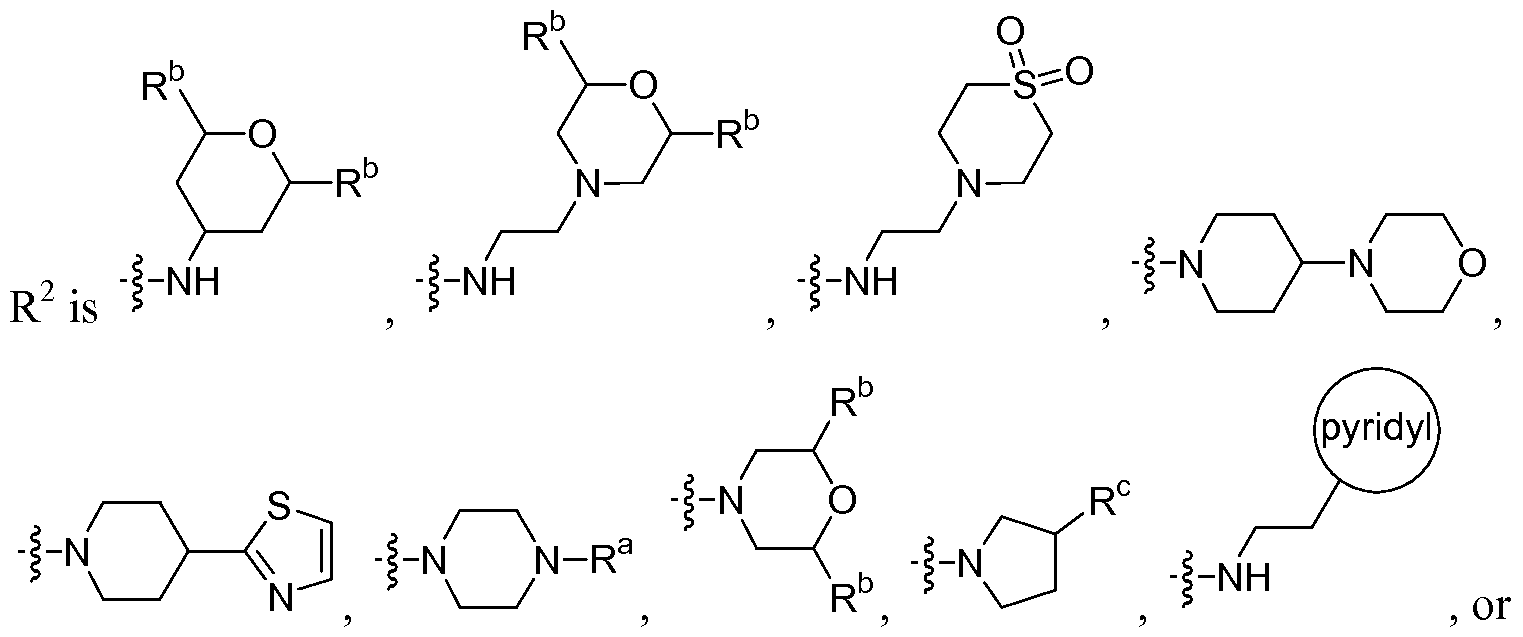
Figure imgf000005_0001
wherein:
R1 is phenyl wherein said phenyl is optionally substituted with up to three substituents independently selected from the group consisting of F, Cl, Br, and OCH3, or a single substituent selected from the group consisting of: OH, OCH2CF3, OC(i_4)alkyl, C(i_4)alkyl, CHF2, OCF3, CF3, cyclopropyl and CN; or R1 is heteroaryl optionally substituted with one substituent selected from the group consisting of: -OH, OC(i_4)alkyl, CF3, OCF3, Cl, Br, -CN, F, CHF2, cyclopropyl, and C^alkyl;
-i-
Figure imgf000005_0002
Figure imgf000005_0003
and said ring is phenyl or heteroaryl wherein said phenyl or heteroaryl is optionally substituted with -CN, F, Cl, Br, NO2, -CF3, 0C(i_4)alkyl, OCF3, or C^^alkyl, alternatively said ring may be heterocyclyl optionally substituted with C(1-4)alkyl; wherein Ra is C^alkyl, H, -CH2-pyridyl, or pyridyl;
Rb is H, or -CH3; and
Rc is H, or -N(C(i-4)alkyl)2;
and solvates, hydrates, tautomers, and pharmaceutically acceptable salts thereof.
DETAILED DESCRIPTION OF THE INVENTION
The invention provides compounds of Formula A
Figure imgf000006_0001
wherein:
R1 is phenyl wherein said phenyl is optionally substituted with up to three substituents independently selected from the group consisting of F, Cl, Br, and OCH3, or a single substituent selected from the group consisting of: OH, OCH2CF3, OC(i_4)alkyl, C(i_4)alkyl, CHF2, OCF3, CF3, cyclopropyl and CN; or R1 is heteroaryl optionally substituted with one substituent selected from the group consisting of: -OH, OC(i_4)alkyl, CF3, OCF3, Cl, Br, -CN, F, CHF2, cyclopropyl, and C(i_4)alkyl;
Figure imgf000006_0002
Figure imgf000006_0003
and said ring is phenyl or heteroaryl wherein said phenyl or heteroaryl is optionally substituted with -CN, F, Cl, Br, NO2, -CF3, 0C(i_4)alkyl, OCF3, or C^^alkyl, alternatively said ring may be heterocyclyl optionally substituted with C(1-4)alkyl; wherein Ra is C^alkyl, H, -CH2-pyridyl, or pyridyl;
Rb is H, or -CH3; and
Rc is H, or -N(C(i-4)alkyl)2; and solvates, hydrates, tautomers, and pharmaceutically acceptable salts thereof.
In another embodiment of the invention:
R1 is an aromatic ring selected from the group consisting of phenyl, furyl, oxazolyl, isoxazolyl, pyridyl, and thiazolyl, wherein said aromatic ring is optionally substituted with - CN, F, Cl, Br, -CF3, OC(1-4)alkyl, OCF3, C(1-4)alkyl, or cyclopropyl;
Figure imgf000007_0001
wherein X is a direct bond or C(i_4)alkyl, and said ring is pyridyl optionally substituted with F, Cl, or Br, alternatively said ring may be heterocyclyl optionally substituted with methyl; wherein Ra is C(i_4)alkyl, H, -CH2-pyridyl, or pyridyl;
Rb is H, or -CH3; and Rc is H, or -N(C(i_4)alkyl)2; and solvates, hydrates, tautomers, and pharmaceutically acceptable salts thereof.
In another embodiment of the invention:
R1 is an aromatic ring selected from the group consisting of phenyl, furyl, oxazolyl, isoxazolyl, pyridyl, and thiazolyl, wherein said aromatic ring is optionally substituted with CN, F, -CF3, OC(i_4)alkyl, OCF3, C(i_4)alkyl, or cyclopropyl;
Figure imgf000007_0002
, {pyridyl
-|-NH v_y wherein said pyridyl is optionally substituted with Cl; wherein Ra is C(i_4)alkyl, H, -CH2-pyridyl, or pyridyl; Rb is H, or -CH3; and Rc is H, or -N(C(i_4)alkyl)2; and solvates, hydrates, tautomers, and pharmaceutically acceptable salts thereof.
In another embodiment of the invention:
R1 is an aromatic ring selected from the group consisting of phenyl, furyl, oxazolyl, isoxazolyl, pyridyl, and thiazolyl, wherein said aromatic ring is optionally substituted with CN, -CF3, OC(i_4)alkyl, OCF3, C(i_4)alkyl, or cyclopropyl;
Figure imgf000008_0001
j — (pyridyl]
Figure imgf000008_0002
, or -f s-NH V_y wherein said pyridyl is optionally substituted with Cl; wherein Ra is C(i_4)alkyl, H, -CH2-pyridyl, or pyridyl;
Rb is H, or -CH3; and
Rc is H, or -N(C(i_4)alkyl)2; and solvates, hydrates, tautomers, and pharmaceutically acceptable salts thereof.
In another embodiment of the invention:
R1 is an aromatic ring selected from the group consisting of phenyl, furyl, oxazolyl, isoxazolyl, and thiazolyl, wherein said aromatic ring is optionally substituted with -CN, -CF3, C(i_4)alkyl, or cyclopropyl;
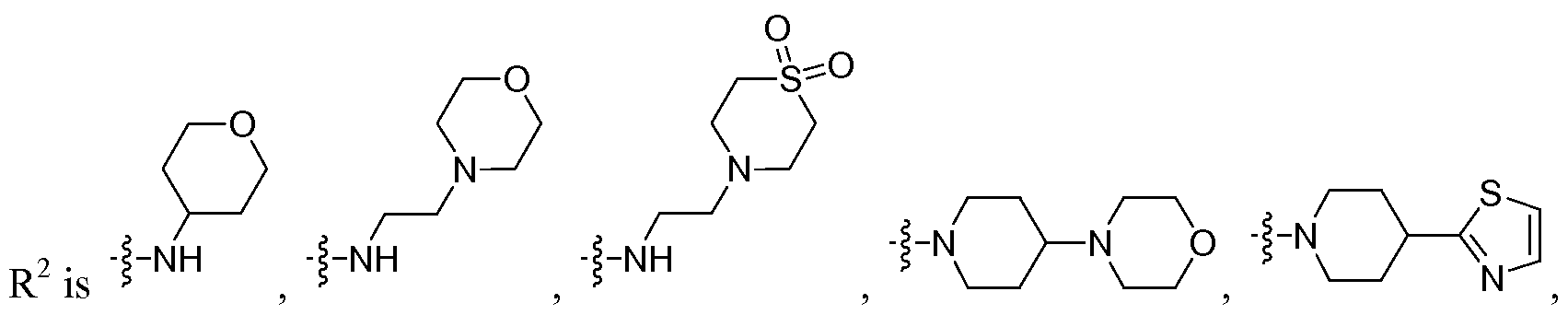
Figure imgf000009_0001
-f- -i-N >— N O -|-
Figure imgf000009_0002
Figure imgf000009_0003
Figure imgf000009_0004
wherein Ra is C^alkyl, H, or pyridyl;
Rb is H, or -CH3; and
Rc is H, or -N(C(i _4)alkyl)2; and solvates, hydrates, tautomers, and pharmaceutically acceptable salts thereof.
In another embodiment of the invention, the invention is directed to a compound selected from the group consisting of:
Figure imgf000009_0005
Figure imgf000010_0001
Figure imgf000011_0001
Figure imgf000012_0001
11
Figure imgf000013_0001
Figure imgf000014_0001
Figure imgf000015_0001
Figure imgf000016_0001
Figure imgf000017_0001
and solvates hydrates tautomers and pharmaceutically acceptable salts thereof.
This invention further provides a method of treating a subject having a condition ameliorated by antagonizing Adenosine A2a receptors, which comprises administering to the subject a therapeutically effective dose of a compound of Formula A. This invention further provides a method of preventing a disorder ameliorated by antagonizing Adenosine A2a receptors in a subject, comprising of administering to the subject a prophylactically effective dose of the compound of claim 1 either preceding or subsequent to an event anticipated to cause a disorder ameliorated by antagonizing Adenosine A2a receptors in the subject.
Compounds of Formula A can be isolated and used as free bases. They can also be isolated and used as pharmaceutically acceptable salts.
Examples of such salts include hydrobromic, hydroiodic, hydrochloric, perchloric, sulfuric, maleic, fumaric, malic, tartaric, citric, adipic, benzoic, mandelic, methanesulfonic, hydroethanesulfonic, benzenesulfonic, oxalic, palmoic, 2 naphthalenesulfonic, p- toluenesulfonic, cyclohexanesulfamic and saccharic.
This invention also provides a pharmaceutical composition comprising a compound of Formula A and a pharmaceutically acceptable carrier.
Pharmaceutically acceptable carriers are well known to those skilled in the art and include, but are not limited to, from about 0.01 to about 0.1 M and preferably 0.05 M phosphate buyer or 0.8% saline. Such pharmaceutically acceptable carriers can be aqueous or non-aqueous solutions, suspensions and emulsions. Examples of non-aqueous solvents are propylene glycol, polyethylene glycol, vegetable oils such as olive oil, and injectable organic esters such as ethyl oleate. Aqueous carriers include water, ethanol, alcoholic/aqueous solutions, glycerol, emulsions or suspensions, including saline and buffered media. Oral carriers can be elixirs, syrups, capsules, tablets and the like. The typical solid carrier is an inert substance such as lactose, starch, glucose, methyl-cellulose, magnesium stearate, dicalcium phosphate, mannitol and the like. Parenteral carriers include sodium chloride solution, Ringer's dextrose, dextrose and sodium chloride, lactated Ringer's and fixed oils. Intravenous carriers include fluid and nutrient replenishers, electrolyte replenishers such as those based on Ringer's dextrose and the like. Preservatives and other additives can also be present, such as, for example, antimicrobials, antioxidants, chelating agents, inert gases and the like. All carriers can be mixed as needed with disintegrants, diluents, granulating agents, lubricants, binders and the like using conventional techniques known in the art.
This invention further provides a method of treating a subject having a condition ameliorated by antagonizing Adenosine A2a receptors, which comprises administering to the subject a therapeutically effective dose of a compound of Formula A.
In one embodiment, the disorder is a neurodegenerative or movement disorder. Examples of disorders treatable by the instant pharmaceutical composition include, without limitation, Parkinson's Disease, Huntington's Disease, Multiple System Atrophy, Corticobasal Degeneration, Alzheimer's Disease, and Senile Dementia.
In one preferred embodiment, the disorder is Parkinson's disease.
As used herein, the term "subject" includes, without limitation, any animal or artificially modified animal having a disorder ameliorated by antagonizing adenosine A2a receptors. In a preferred embodiment, the subject is a human.
Administering the instant pharmaceutical composition can be effected or performed using any of the various methods known to those skilled in the art. Compounds of Formula A can be administered, for example, intravenously, intramuscularly, orally and subcutaneously. In the preferred embodiment, the instant pharmaceutical composition is administered orally. Additionally, administration can comprise giving the subject a plurality of dosages over a suitable period of time. Such administration regimens can be determined according to routine methods.
As used herein, a "therapeutically effective dose" of a pharmaceutical composition is an amount sufficient to stop, reverse or reduce the progression of a disorder. A "prophylactically effective dose" of a pharmaceutical composition is an amount sufficient to prevent a disorder, i.e., eliminate, ameliorate and/or delay the disorder's onset. Methods are known in the art for determining therapeutically and prophylactically effective doses for the instant pharmaceutical composition. The effective dose for administering the pharmaceutical composition to a human, for example, can be determined mathematically from the results of animal studies.
In one embodiment, the therapeutically and/or prophylactically effective dose is a dose sufficient to deliver from about 0.001 mg/kg of body weight to about 200 mg/kg of body weight of a compound of Formula A. In another embodiment, the therapeutically and/or prophylactically effective dose is a dose sufficient to deliver from about 0.05 mg/kg of body weight to about 50 mg/kg of body weight. More specifically, in one embodiment, oral doses range from about 0.05 mg/kg to about 100 mg/kg daily. In another embodiment, oral doses range from about 0.05 mg/kg to about 50 mg/kg daily, and in a further embodiment, from about 0.05 mg/kg to about 20 mg/kg daily. In yet another embodiment, infusion doses range from about 1.0,ug/kg/min to about 10 mg/kg/min of inhibitor, admixed with a pharmaceutical carrier over a period ranging from about several minutes to about several days. In a further embodiment, for topical administration, the instant compound can be combined with a pharmaceutical carrier at a drug/carrier ratio of from about 0.001 to about 0.1.
The invention also provides a method of treating addiction in a mammal, comprising administering a therapeutically effective dose of a compound of Formula A.
The invention also provides a method of treating ADHD in a mammal, comprising administering a therapeutically effective dose of a compound of Formula A.
The invention also provides a method of treating depression in a mammal, comprising administering a therapeutically effective dose of a compound of Formula A.
The invention also provides a method of treating anxiety in a mammal, comprising administering a therapeutically effective dose of a compound of Formula A.
DEFINITIONS: The term "Ca-*" (where a and b are integers referring to a designated number of carbon atoms) refers to an alkyl, alkenyl, alkynyl, alkoxy or cycloalkyl radical or to the alkyl portion of a radical in which alkyl appears as the prefix root containing from a to b carbon atoms inclusive. For example, Ci_4 denotes a radical containing 1, 2, 3 or 4 carbon atoms.
The term "alkyl," whether used alone or as part of a substituent group, refers to a saturated branched or straight chain monovalent hydrocarbon radical, wherein the radical is derived by the removal of one hydrogen atom from a single carbon atom. Unless specifically indicated (e.g. by the use of a limiting term such as "terminal carbon atom"), substituent variables may be placed on any carbon chain atom. Typical alkyl radicals include, but are not limited to, methyl, ethyl, propyl, isopropyl and the like. Examples include Ci-salkyl, Ci-βalkyl and Ci-4alkyl groups.
The term "heteroaryl" refers to a radical derived by the removal of one hydrogen atom from a ring carbon atom of a heteroaromatic ring system. Typical heteroaryl radicals include furyl, thienyl, pyrrolyl, oxazolyl, thiazolyl, imidazolyl, pyrazolyl, isoxazolyl, isothiazolyl, oxadiazolyl, triazolyl, thiadiazolyl, pyridinyl, pyridazinyl, pyrimidinyl, pyrazinyl, indolizinyl, indolyl, isoindolyl, benzo[έ]furyl, benzo[έ]thienyl, indazolyl, benzimidazolyl, benzthiazolyl, purinyl, 4H-quinolizinyl, quinolinyl, isoquinolinyl, cinnolinyl, phthalzinyl, quinazolinyl, quinoxalinyl, 1,8-naphthyridinyl, pteridinyl and the like.
ABBREVIATIONS:
Herein and throughout this application, the following abbreviations may be used.
Cy cyclohexyl
DMF dimethylformamide
DMSO dimethylsulfoxide
Et ethyl
EtOAc ethyl acetate
KOtBu potassium tert-butoxide Me methyl
NBS N-bromo succinimide
OAc acetate
Pd(dppf)Cl2 [l,r-Bis(diphenylphosphino)ferrocene]dichloropalladium (II) py pyridine
THF tetrahydrofuran
Xantphos 9,9-Dimethyl-4,5-bis(diphenylphosphino)xanthene
EXAMPLES:
Compounds of formula A can be prepared by methods known to those who are skilled in the art. The following reaction schemes are only meant to represent examples of the invention and are in no way meant to be a limit of the invention.
Scheme 1
Figure imgf000022_0001
Figure imgf000022_0002
Scheme 1 illustrates the synthetic route leading to compounds of Formula A. Starting with 2- amino-3-cyanothiophene I, condensation under basic conditions with R^-CN, where R1 is as defined in Formula A, affords the aminopyrimidine II. The aminopyrimidine II is then reacted with N-bromosuccinimide (NBS), which gives the bromothiophene III. Bromothiophene III can undergo palladium catalyzed amidation with CO and R2-H, where R2 is as defined in Formula A, to afford compounds of Formula A.
Scheme 2
Figure imgf000023_0001
IV
j? NH4OH j? PQCI3, N^
^O^R1 H2N^R1 ^R1
V vi
Scheme 2 illustrates the synthetic route to compounds of Formula R^-CN, where R1 is a Q1- 4)alkyl substituted furan. Scheme 2 also illustrates how any R1-Cθ2CH3 may be converted into RX-CN. Bromofuran IV can react with alkylzinc reagents in the presence of a palladium catalyst to give V. Ester V (or any R^CChCHs) is reacted with ammonium hydroxide to give the corresponding amide VI. Dehydration of the amide is accomplished using POCI3 in pyridine to give the desired heterocyclic nitrile RX-CN.
EXAMPLES:
The following examples are for exemplary purposes only, and are in no way meant to limit the invention.
Example 1: 3-[4-Amino-6-(2,6-dimethyl-morpholine-4-carbonyl)-thieno[2,3- d] pyrimidin-2-yl] -benzo nitrile
Example 1: step a
3-(4-Amino-thieno[2,3-d]pyrimidin-2-yl)-benzo nitrile
Figure imgf000023_0002
Solid potassium-tert-butoxide (1.1 g, 10.1 mmol) was added to a dioxane solution (20 mL) of 2-Amino-thiophene-3-carbonitrile (5.0 g, 40.3 mmol) and 1,3-dicyanobenzene (7.2 g, 56.5 mmol). The resulting slurry was stirred vigorously at 130 0C for 15 minutes. The dark slurry was cooled to room temperature, diluted with THF, and dry packed onto silica gel. The material was the purified via column chromatography to give 10.2 g of the title compound.
Example 1: step b
3-(4-Amino-6-bromo-thieno [2,3-d] pyrimidin-2-yl)-benzonitrile
Figure imgf000024_0001
Solid NBS (1.6 g, 8.7 mmol) was added to a DMF solution (20 mL) of 3-(4-Amino- thieno[2,3-d]pyrimidin-2-yl)-benzonitrile (2.0 g, 7.9 mmol). After 45 minutes water was added and the resulting precipitate was collected by filtration, washed with water, and dried in vacuo to give 2.4 g of the title compound.
Example 1: step c
3-[4-Amino-6-(2,6-dimethyl-morpholine-4-carbonyl)-thieno[2,3-d]pyrimidin-2-yl]- benzonitrile (1)
Figure imgf000024_0002
Neat cώ-2,6-dimethylmorpholine (70 μL, 0.56 mmol) was added to a toluene (2 mL)/ DMF (0.4 mL) solution of 3-(4-Amino-6-bromo-thieno[2,3-d]pyrimidin-2-yl)-benzonitrile (124 mg, 0.37 mmol), Xantphos (21 mg, 0.04 mmol), Pd(OAc)2 (8 mg, 0.04 mmol), and Na2CO3 (118 mg, 1.11 mmol) and the reaction flask was evacuated and purged 3 times with CO (balloon). The mixture was then heated to 100 0C. After 5 h the mixture was filtered hot and washed with EtOAc. The organic layer was then washed with brine, water and brine, dried (Na2SO4), dry packed onto silica gel and purified via column chromatography to give 66 mg of the title compound as the free base, which was dissolved in THF and added to 1 mL of 1 N HCl in ether, concentrated, and dried in vacuo to give the title compound 3-[4-Amino-6-(2,6- dimethyl-morpholine-4-carbonyl)-thieno[2,3-d]pyrimidin-2-yl]-benzonitrile (1) as the HCl salt (1). 1H NMR (Acetone, 300MHz): δ = 8.73 - 8.80 (m, 2 H), 7.86 - 7.93 (m, 2 H), 7.68 - 7.78 (m, 1 H), 7.26 (br. s., 2 H), 4.37 (d, J=12.8 Hz, 2 H), 3.66 (ddd, J=10.6, 6.3, 2.6 Hz, 2 H), 3.41 (q, J=6.8 Hz, 2 H), 2.84 (s, 3 H), 2.81 ppm (s, 3 H); MS m/e 394 (M+H).
Example 2: 3-[4-Amino-6-(morpholine-4-carbonyl)-thieno[2,3-d]pyrimidin-2-yl]- benzonitrile
Figure imgf000025_0001
The title compound was prepared using morpholine in place of cώ-2,6-dimethylmorpholine as described in Example 1. 1H NMR (CHLOROFORM-d, 300MHz): δ = 8.77 (s, 1 H), 8.69 (d, J=7.9 Hz, 1 H), 7.73 (d, J=7.5 Hz, 1 H), 7.46 - 7.63 (m, 1 H), 5.63 (br. s., 2 H), 3.79 ppm (d, J=3.8 Hz, 8 H); MS m/e 344 (M+H); MS m/e 366 (M+H).
Example 3: [4-Amino-2-(4-methyl-thiazol-2-yl)-thieno[2,3-d]pyrimidin-6-yl]-morpholin- 4-yl-methanone
Figure imgf000025_0002
The title compound was prepared using 4-methyl-thiazole-2-carbonitrile and morpholine in place of 1,3-dicyanobenzene and cώ-2,6-dimethylmorpholine, respectively, as described in Example 1. 1H NMR (DMSO-d6, 300MHz): δ = 8.00 (br. s., 2 H), 7.97 (s, 1 H), 7.47 (s, 1 H), 3.70 (d, J=5.3 Hz, 8 H), 2.45 ppm (s, 3 H); MS m/e 362 (M+H). Example 4: (4-Amino-2-thiazol-2-yl-thieno [2,3-d]pyrimidin-6-yl)-morpholin-4-yl- methanone
Figure imgf000026_0001
The title compound was prepared using thiazole-2-carbonitrile and morpholine in place of 1,3-dicyanobenzene and cώ-2,6-dimethylmorpholine, respectively, as described in Example 1. The thiazole-2-carbonitrile was prepared using thiazole-2-carboxylic acid ethyl ester in place of 5-cyclopropyl-furan-2-carboxylic acid methyl ester, as described in Example 14. 1H NMR (Acetone, 300MHz): δ = 8.00 (d, J=3.0 Hz, 1 H), 7.95 (s, 1 H), 7.77 (d, J=3.4 Hz, 1 H), 7.34 (br. s., 2 H), 3.67 - 3.88 ppm (m, 8 H); MS m/e 348 (M+H).
Example 5: [4-Amino-2-(5-methyl-furan-2-yl)-thieno [2,3-d] pyrimidin-6-yl] -morpholin- 4-yl-methanone
Figure imgf000026_0002
The title compound was prepared using 5-methyl-2-furonitrile and morpholine in place of 1,3-dicyanobenzene and cώ-2,6-dimethylmorpholine, respectively, as described in Example 1. 1H NMR (DMSO-d6, 300MHz): δ = 7.91 (s, 1 H), 7.79 (br. s., 2 H), 7.09 (d, J=3.0 Hz, 1 H), 6.29 (d, J=3.4 Hz, 1 H), 3.69 (d, J=4.9 Hz, 8 H), 2.37 ppm (s, 3 H); MS m/e 345 (M+H).
Example 6: (4-Amino-2-oxazol-2-yl-thieno[2,3-d]pyrimidin-6-yl)-morpholin-4-yl- methanone
Figure imgf000026_0003
The title compound was prepared using oxazole-2-carbonitrile and morpholine in place of 1,3-dicyanobenzene and cώ-2,6-dimethylmorpholine, respectively, as described in Example 1. The oxazole-2-carbonitrile was prepared using oxazole-2-carboxylic acid ethyl ester in place of 5-cyclopropyl-furan-2-carboxylic acid methyl ester, as described in Example 14. 1H NMR (Acetone, 300MHz): δ = 8.13 (s, 1 H), 7.95 (s, 1 H), 7.41 (s, 1 H), 7.34 (br. s., 2 H), 3.64 - 3.90 ppm (m, 8 H); MS m/e 332 (M+H).
Example 7: 4-Amino-2-(4-methyl-thiazol-2-yl)-thieno[2,3-d]pyrimidine-6-carboxylic acid [2-(l,l-dioxo-l-thiomorpholin-4-yl)-ethyl]-amide
Figure imgf000027_0001
The title compound was prepared using 4-methyl-thiazole-2-carbonitrile and 2-(l,l-dioxo-l- thiomorpholin-4-yl)-ethylamine in place of 1,3-dicyanobenzene and cis-2,6- dimethylmorpholine, respectively, as described in Example 1. 1H NMR (Acetone, 300MHz): δ = 9.01 (br. s., 1 H), 8.67 (s, 1 H), 7.50 (s, 1 H), 4.06 (br. s., 4 H), 3.94 (d, J=5.3 Hz, 2 H), 3.73 (t, J=5.5 Hz, 2 H), 3.67 (br. s., 4 H), 2.48 (s, 3 H), 1.24 (s, 2H); MS m/e 453 (M+H)
Example 8: [4-Amino-2-(4-methyl-thiazol-2-yl)-thieno[2,3-d]pyrimidin-6-yl]-(4-pyridin- 4-yl-piperazin-l-yl)-methanone
Figure imgf000027_0002
The title compound was prepared using 4-methyl-thiazole-2-carbonitrile and 1 -pyridin-4-yl- piperazine in place of 1,3-dicyanobenzene and cώ-2,6-dimethylmorpholine, respectively, as described in Example 1. 1H NMR (DMSO-d6, 300MHz): δ = 8.26 - 8.37 (m, J=7.5 Hz, 2 H), 8.07 (s, 1 H), 8.06 (br. s., 2 H), 7.48 (s, 1 H), 7.12 - 7.25 (m, J=7.5 Hz, 2 H), 3.72 - 4.04 ppm (m, 8 H), 2.48 (s, 3 H); MS m/e 438 (M+H)
Example 9: 3-[4-Amino-6-(4-tert-butyl-piperazine-l-carbonyl)-thieno[2,3-d]pyrimidin- 2-yl]-benzonitrile
Figure imgf000028_0001
The title compound was prepared using 1 -tert-butyl-piperazine in place of cis-2,6- dimethylmorpholine as described in Example 1. 1H NMR (Acetone, 300MHz): δ = 8.59 - 8.66 (m, 2 H), 7.68 - 7.85 (m, 2 H), 7.45 - 7.65 (m, 1 H), 7.14 (br. s., 2 H), 3.67 (br. s., 4 H), 2.58 (br. s., 4 H), 0.98 ppm (s, 9 H); MS m/e 421 (M+H).
Example 10: 4-Amino-2-(3-cyano-phenyl)-thieno[2,3-d]pyrimidine-6-carboxylic acid (2- morpholin-4-yl-ethyl)-amide
Figure imgf000028_0002
The title compound was prepared using 2-morpholin-4-yl-ethylamine in place of cis-2,6- dimethylmorpholine as described in Example 1. 1H NMR (DMSO-d6, 300MHz): δ = 8.62 - 8.72 (m, 2 H), 8.56 (t, J=5.7 Hz, 1 H), 8.10 (s, 1 H), 7.97 (d, J=7.9 Hz, 1 H), 7.91 (br. s., 2 H), 7.73 (t, J=7.7 Hz, 1 H), 3.55 - 3.65 (m, 4 H), 3.40 (q, J=6.8 Hz, 2 H), 2.39-2.48 ppm (m, 6 H); MS m/e 409 (M+H).
Example 11: 4-Amino-2-(4-methyl-thiazol-2-yl)-thieno[2,3-d]pyrimidine-6-carboxylic acid (2-pyridin-3-yl-ethyl)-amide
Figure imgf000029_0001
The title compound was prepared using 4-methyl-thiazole-2-carbonitrile and 2-pyridin-3-yl- ethylamine in place of 1,3-dicyanobenzene and cώ-2,6-dimethylmorpholine, respectively, as described in Example 1. 1H NMR (DMSO-d6, 300MHz): δ = 8.79 (s, 1 H), 8.48 (d, J=1.9 Hz, 1 H), 8.43 (dd, J=4.9, 1.5 Hz, 1 H), 8.07 (s, 1 H), 7.98 (br. s., 2 H), 7.69 (d, J=7.9 Hz, 1 H), 7.46 (s, 1 H), 7.33 (dd, J=7.7, 4.7 Hz, 1 H), 3.53 (d, J=5.7 Hz, 2 H), 2.89 (t, J=7.0 Hz, 2 H), 2.45 ppm (s, 3 H); MS m/e 397 (M+H).
Example 12: 4-Amino-2-(4-methyl-thiazol-2-yl)-thieno [2,3-d] pyrimidine-6-carboxylic acid (tetrahydro-pyran-4-yl)-amide
Figure imgf000029_0002
The title compound was prepared using 4-methyl-thiazole-2-carbonitrile and tetrahydro- pyran-4-ylamine in place of 1,3-dicyanobenzene and cώ-2,6-dimethylmorpholine, respectively, as described in Example 1. 1H NMR (Acetone, 300MHz): δ = 8.10 (s, 1 H), 7.78 (br. s., 1 H), 7.32 (s, 1 H), 7.18-7.25 (br. s., 2H), 3.93 (d, J=9.4 Hz, 1 H), 3.81 (d, J=7.5 Hz, 1 H), 3.48 (td, J=I 1.8, 2.1 Hz, 2 H), 3.38 (td, J=I 1.5, 2.3 Hz, 1 H), 2.49 (s, 3 H), 1.88 - 1.97 (m, 1 H), 1.80 (m, 1 H), 1.55 - 1.73 (m, 1 H), 1.35 ppm (dd, J=13.0, 4.3 Hz, 1 H); MS m/e 376 (M+H).
Example 13: 4-Amino-2-oxazol-2-yl-thieno [2,3-d] pyrimidine-6-carboxylic acid (tetrahydro-pyran-4-yl)-amide
Figure imgf000029_0003
The title compound was prepared using oxazole-2-carbonitrile and tetrahydro-pyran-4- ylamine in place of 1,3-dicyanobenzene and cώ-2,6-dimethylmorpholine, respectively, as described in Example 1. The oxazole-2-carbonitrile was prepared using oxazole-2-carboxylic acid ethyl ester in place of 5-cyclopropyl-furan-2-carboxylic acid methyl ester, as described in Example 14. 1H NMR (Acetone, 300MHz): δ = 8.37 (s, 1 H), 8.13 (s, 1 H), 7.94 (br. s., 1 H), 7.41 (s, 1 H), 7.33-7.40 (br. s., 2 H), 4.04 - 4.26 (m, 1 H), 3.81 - 4.03 (m, 2 H), 3.47 (td, J=I 1.8, 2.1 Hz, 2 H), 1.92 (dd, J=12.4, 2.3 Hz, 2 H), 1.59 - 1.78 ppm (m, 2 H); MS m/e 346 (M+H).
Example 14: 4-Amino-2-(5-cyclopropyl-furan-2-yl)-thieno[2,3-d]pyrimidine-6- carboxylic acid (pyridin-3-ylmethyl)-amide
Example 14: step a 5-Cyclopropyl-furan-2-carboxylic acid methyl ester
Figure imgf000030_0001
Solid cyclopropylboronic acid (575 mg, 6.7 mmol) was added to a toluene (22 mL)/ water (1.1 mL) solution of 5-bromo-furan-2-carboxylic acid methyl ester (980 mg, 4.8 mmol), Pd(OAc)2 (54 mg, 0.2 mmol), P(Cy)3 (135 mg, 0.5 mmol), and K3PO4 (3.6 g, 16.8 mmol). The resulting mixture was heated to 90 0C. After 5 h the mixture was cooled, filtered and extracted with EtOAc. The combined organic extracts were washed with water and brine, dried (Na2SO4), concentrated and purified via column chromatography to give 650 mg of 5- cyclopropyl-furan-2-carboxylic acid methyl ester.
Example 14: step b 5-Cyclopropyl-furan-2-carboxylic acid amide
Figure imgf000030_0002
5-cyclopropyl-furan-2-carboxylic acid methyl ester (650 mg, 3.9 mmol) was suspended in concentrated NH4OH (20 mL) and stirred vigorously. After 16 h the mixture was diluted with water and the aqueous phase was extracted with EtOAc. The combined organic extracts were washed with water and brine, dried (Na2SO4), concentrated and used without further purification to give 550 mg of 5-cyclopropyl-furan-2-carboxylic acid amide.
Example 14: step c S-Cyclopropyl-furan-l-carbonitrile
Figure imgf000031_0001
Neat POCI3 (0.48 mL, 5.1 mmol) was added to a pyridine solution (9 mL) of 5-cyclopropyl- furan-2-carboxylic acid amide (550 mg, 3.6 mmol). After 2 h the mixture was cooled to 0 0C and taken to pH 4.5 with concentrated aqueous HCl. The aqueous mixture was extracted with Et2θ and the combined extracts were washed with brine, dried (Na2SO4), concentrated and used without further purification to give 478 mg of 5-cyclopropyl-furan-2-carbonitrile.
Example 14: step d
4-Amino-2-(5-cyclopropyl-furan-2-yl)-thieno[2,3-d]pyrimidine-6-carboxylic acid
(pyridin-3-ylmethyl)-amide (14)
Figure imgf000031_0002
The title compound was prepared using 5-cyclopropyl-furan-2-carbonitrile and pyridin-3-yl- methylamine in place of 1,3-dicyanobenzene and cώ-2,6-dimethylmorpholine, respectively, as described in Example 1. 1H NMR (DMSO-d6, 300MHz): δ = 9.30 (s, 1 H), 8.80 (s, 1 H), 8.72 (d, J=4.5 Hz, 1 H), 8.25 (d, J=7.9 Hz, 1 H), 8.14 (s, 1 H), 7.73 - 7.90 (m, 3 H), 7.10 (d, J=3.4 Hz, 1 H), 6.26 (d, J=3.4 Hz, 1 H), 4.60 (d, J=5.7 Hz, 2 H), 2.02 (d, J=15.1 Hz, 1 H), 0.91 - 1.03 (m, 2 H), 0.70 - 0.85 ppm (m, 2 H); MS m/e 392 (M+H) Example 15: ^Amino-l-^-cyano-pheny^-thieno^S-djpyrimidine-ό-carboxylic acid (pyridin-2-ylmethyl)-amide
Figure imgf000032_0001
The title compound was prepared using pyridin-2-yl-methylamine in place of cis-2,6- dimethylmorpholine as described in Example 1. 1H NMR (Acetone, 300MHz): δ = 8.69 - 8.83 (m, 3 H), 8.54 (d, J=3.8 Hz, 1 H), 8.21 (s, 1 H), 7.88 (d, J=7.5 Hz, 1 H), 7.61 - 7.81 (m, 2 H), 7.43 (d, J=7.9 Hz, 1 H), 7.13 - 7.33 (m, 3 H), 4.70 ppm (d, J=5.7 Hz, 2 H); MS m/e 387 (M+H).
Example 16: ^Amino^-^-cyano-pheny^-thieno^S-dlpyrimidine-ό-carboxylic acid (2- pyridin-3-yl-ethyl)-amide
Figure imgf000032_0002
The title compound was prepared using 2-pyridin-3-yl-ethylamine in place of cis-2,6- dimethylmorpholine as described in Example 1. 1H NMR (Acetone, 300MHz): δ = 9.80 (br. s., 1 H), 9.66 (d, J=4.9 Hz, 1 H), 9.44 - 9.55 (m, 2 H), 9.40 (d, J=7.9 Hz, 1 H), 9.13 (br. s., 1 H), 9.04 (s, 1 H), 8.79 - 8.94 (m, 1 H), 8.64 (d, J=7.5 Hz, 1 H), 8.47 (t, J=8.3 Hz, 1 H), 4.50 - 4.67 (m, 2 H), 3.96 - 4.14 (m, 2 H), 2.67 - 2.90(m, 2 H); MS m/e 401 (M+H)
Example 17: [4-Amino-2-(5-methyl-isoxazol-3-yl)-thieno[2,3-d]pyrimidin-6-yl]- morpholin-4-yl-methanone
Figure imgf000033_0001
The title compound was prepared using S-methyl-isoxazole-S-carbonitrile and morpholine in place of 1,3-dicyanobenzene and cώ-2,6-dimethylmorpholine, respectively, as described in Example 1. 1H NMR (DMSO-d6, 300MHz): δ = 7.97 (s, 3 H), 6.71 (s, 1 H), 3.70 (m, 8 H), 2.48 ppm (s, 3 H); MS m/e 346 (M+H).
Example 18: [4-Amino-2-(4-methyl-thiazol-2-yl)-thieno[2,3-d]pyrimidin-6-yl]-(4-ethyl- piperazin-l-yl)-methanone hydrochloride
Figure imgf000033_0002
The title compound was prepared using 4-methyl-thiazole-2-carbonitrile and 1-ethyl- piperazine in place of 1,3-dicyanobenzene and cώ-2,6-dimethylmorpholine, respectively, as described in Example 1. 1H NMR (DMSO-d6, 300MHz): δ = 8.12 (s, 1 H), 7.50 (s, 1 H), 4.47 (br. m., 4 H), 3.53 (m., 4 H), 3.16 (m, 2 H), 2.45 (s, 3 H), 1.18 - 1.33 (m, 3 H); MS m/e 389 (M+H)
Example 19: 4-Amino-2-(3-cyano-phenyl)-thieno[2,3-d]pyrimidine-6-carboxylic acid (pyridin-3-ylmethyl)-amide
Figure imgf000033_0003
The title compound was prepared using pyridin-3-yl-methylamine in place of cis-2,6- dimethylmorpholine as described in Example 1. 1H NMR (DMSO-d6, 300MHz): δ = 8.60 - 8.68 (m, 2 H), 8.47 (d, J=4.9 Hz, 1 H), 7.93 (d, J=7.9 Hz, 1 H), 7.65 - 7.82 (m, 3 H), 7.60 (br. s., 2 H), 7.45 - 7.54 (m, 1 H), 7.40 (s, 1 H), 6.64 (d, J=5.3 Hz, 1 H), 6.24 ppm (d, J=5.3 Hz, 2 H); MS m/e 387 (M+H)
Example 20: 4-Amino-2-(4-methyl-thiazol-2-yl)-thieno [2,3-d] pyrimidine-6-carboxylic acid (6-chloro-pyridin-3-yl-methyl)-amide hydrochloride
Figure imgf000034_0001
The title compound was prepared using 4-methyl-thiazole-2-carbonitrile and (6-Chloro- pyridin-3-yl)-methylamine in place of 1,3-dicyanobenzene and cώ-2,6-dimethylmorpholine, respectively, as described in Example 1. 1H NMR (Acetone, 300MHz): δ = 7.22 (d, J=2.6 Hz, 1 H), 6.99 (s, 1 H), 6.66 (dd, J=8.1, 2.4 Hz, 1 H), 6.21 (d, J=8.3 Hz, 1 H), 6.11 (s, 1 H), 3.35 - 3.51 (m, 2 H), 1.26 ppm (s, 3 H); MS m/e 417 (M+H)
Example 21: 4-Amino-2-(5-methyl-isoxazol-3-yl)-thieno[2,3-d]pyrimidine-6-carboxylic acid (pyridin-3-ylmethyl)-amide
Figure imgf000034_0002
The title compound was prepared using 5-methyl-isoxazole-3-carbonitrile and pyridin-3-yl- methylamine in place of 1,3-dicyanobenzene and cώ-2,6-dimethylmorpholine, respectively, as described in Example 1. 1H NMR (MeOD, 300MHz): δ = 8.85 (s, 1 H), 8.73 (d, J=5.3 Hz, 1 H), 8.51 (d, J=8.3 Hz, 1 H), 8.06 (s, 1 H), 7.97 (dd, J=8.3, 5.7 Hz, 1 H), 6.73 (s, 1 H), 4.76 (s, 2 H), 2.52 (s, 3 H); MS m/e 367 (M+H) Example 22: 4-Amino-2-(5-methyl-isoxazol-3-yl)-thieno[2,3-d]pyrimidine-6-carboxylic acid (2-pyridin-3-yl-ethyl)-amide
Figure imgf000035_0001
The title compound was prepared using S-methyl-isoxazole-S-carbonitrile and 2-pyridin-3-yl- ethylamine in place of 1,3-dicyanobenzene and cώ-2,6-dimethylmorpholine, respectively, as described in Example 1. 1H NMR (DMSO-d6, 300MHz): δ = 8.78 - 8.90 (m, 1 H), 8.73 (s, 1 H), 8.67 (d, J=4.5 Hz, 1 H), 8.20 (d, J=7.9 Hz, 1 H), 8.11 (s, 1 H), 7.99 (br. s., 2 H), 7.76 (dd, J=I.1, 5.5 Hz, 1 H), 6.71 (s, 1 H), 3.59 (q, J=6.5 Hz, 2 H), 3.01(t, J=6.8 Hz, 2 H), 2.48 (s, 3H); MS m/e 381 (M+H)
Example 23: [4-Amino-2-(4-methyl-thiazol-2-yl)-thieno[2,3-d]pyrimidin-6-yl]-(4-tert- butyl-piperazin-l-yl)-methanone
Figure imgf000035_0002
The title compound was prepared using 4-methyl-thiazole-2-carbonitrile and 1-tert-butyl- piperazine in place of 1,3-dicyanobenzene and cώ-2,6-dimethylmorpholine, respectively, as described in Example 1. 1H NMR (DMSO-d6, 300MHz): δ = 11.15 (br. s., 2 H), 7.40 (s, 1 H), 7.06 (s, 1 H), 4.49 (d, J=13.6 Hz, 4 H), 3.56 (d, J=12.1 Hz, 4 H), 2.45 (s., 3 H), 1.23 ppm (s, 9 H);MS m/e 417 (M+H)
Example 24: 4-Amino-2-oxazol-2-yl-thieno[2,3-d]pyrimidine-6-carboxylic acid (pyridin- 2-ylmethyl)-amide
Figure imgf000036_0001
The title compound was prepared using oxazole-2-carbonitrile and pyridin-2-yl-methylamine in place of 1,3-dicyanobenzene and cώ-2,6-dimethylmorpholine, respectively, as described in Example 1. The oxazole-2-carbonitrile was prepared using oxazole-2-carboxylic acid ethyl ester in place of 5-cyclopropyl-furan-2-carboxylic acid methyl ester, as described in Example 14. 1H NMR (DMSO-d6, 400MHz): δ = 9.28 (t, J=5.6 Hz, 1 H), 8.54 (d, J=4.9 Hz, 1 H), 8.30 (s, 1 H), 8.22 (s, 1 H), 8.04 (br. s., 2 H), 7.74 - 7.83 (m, 1 H), 7.47 (s, 1 H), 7.37 (d, J=7.8 Hz, 1 H), 7.24 - 7.33 (m, 1 H), 4.58 ppm (d, J=5.9 Hz, 2 H); MS m/e 353 (M+H).
Example 25: 4-Amino-2-oxazol-2-yl-thieno[2,3-d]pyrimidine-6-carboxylic acid (2- morpholin-4-yl-ethyl)-amide
Figure imgf000036_0002
The title compound was prepared using oxazole-2-carbonitrile and 2-morpholin-4-yl- ethylamine in place of 1,3-dicyanobenzene and cώ-2,6-dimethylmorpholine, respectively, as described in Example 1. The oxazole-2-carbonitrile was prepared using oxazole-2-carboxylic acid ethyl ester in place of 5-cyclopropyl-furan-2-carboxylic acid methyl ester, as described in Example 14. 1H NMR (Acetone, 300MHz): δ = 8.05 (s, 1 H), 7.99 (s, 1 H), 7.76 (br. s., 1 H), 7.27 (s, 3 H), 3.47 - 3.56 (m, 4 H), 3.42 (q, J=6.4 Hz, 2 H), 2.48 (t, J=6.6 Hz, 2 H), 2.31 - 2.43 (m, 4 H); MS m/e 375 (M+H).
Example 26: [4-Amino-2-(4-trifluoromethyl-thiazol-2-yl)-thieno[2,3-d]pyrimidin-6-yl]- morpholin-4-yl-methanone
Figure imgf000037_0001
The title compound was prepared using 4-trifluoromethyl-triiazole-2-carbonitrile and morpholine in place of 1,3-dicyanobenzene and cώ-2,6-dimethylmorpholine, respectively, as described in Example 1. The 4-trifluoromethyl-thiazole-2-carbonitrile was prepared using 5- trifluoromethyl-thiazole-2-carboxylic acid ethyl ester in place of 5-cyclopropyl-furan-2- carboxylic acid methyl ester, as described in Example 14. 1H NMR (Acetone, 300MHz): δ = 8.41 (s, 1 H), 7.96 (s, 1 H), 7.41 (br. s., 2 H), 3.65 - 3.89 ppm (m, 8 H); MS m/e 416 (M+H).
Example 27: 4-Amino-2-(4-methyl-thiazol-2-yl)-thieno[2,3-d]pyrimidine-6-carboxylic acid (pyridin-3-ylmethyl)-amide
Figure imgf000037_0002
The title compound was prepared using 4-methyl-thiazole-2-carbonitrile and pyridin-3-yl- methylamine in place of 1,3-dicyanobenzene and cώ-2,6-dimethylmorpholine, respectively, as described in Example 1. 1H NMR (DMSO-d6, 300MHz): δ = 9.29 (s, 1 H), 8.58 (d, J=1.9 Hz, 1 H), 8.48 (dd, J=4.5, 1.5 Hz, 1 H), 8.15 (s, 1 H), 7.98 (br. s., 2 H), 7.75 (d, J=8.3 Hz, 1 H), 7.47 (s, 1 H), 7.38 (dd, J=I 2, 4.9 Hz, 1 H), 4.50 (d, J=6.0 Hz, 2 H), 2.45 (s, 3 H); MS m/e 383 (M+H)
Example 28: [4-Amino-2-(4-methyl-thiazol-2-yl)-thieno[2,3-d]pyrimidin-6-yl]-(4- pyridin-2-ylmethyl-piperazin-l-yl)-methanone
Figure imgf000038_0001
The title compound was prepared using 4-methyl-thiazole-2-carbonitrile and l-pyridin-2- ylmethyl-piperazine in place of 1,3-dicyanobenzene and cώ-2,6-dimethylmorpholine, respectively, as described in Example 1. 1H NMR (DMSOd6, 300MHz): δ = 8.72 (d, J=3.8 Hz, 1 H), 8.02 (s, 2 H), 7.97 (td, J=I.1, 1.5 Hz, 2 H), 7.43 - 7.60 (m, 3 H), 4.57 (s, 2 H), 4.02 (br. s., 4 H), 3.40 (br. s., 4 H), 2.48 (s, 3 H); MS m/e 452 (M+H)
Example 29: ^-Amino-l-^-cyclopropyl-furan-l-ylHhieno^S-dlpyrimidin-ό-yl]- morpholin-4-yl-methanone
Figure imgf000038_0002
The title compound was prepared using 5-cyclopropyl-furan-2-carbonitrile and morpholine in place of 1,3-dicyanobenzene and cώ-2,6-dimethylmorpholine, respectively, as described in Example 1. The 5-cyclopropyl-furan-2-carbonitrile was prepared as described in Example 14. 1H NMR (CHLOROFORM-d, 300MHz): δ = 7.43 (s, 1 H), 7.21 (d, J=3.4 Hz, 1 H), 6.06 (d, J=3.4 Hz, 1 H), 5.57 (br. s., 2 H), 3.66 - 3.85 (m, 8 H), 2.00 - 2.12 (m, 1 H), 0.80 - 1.06 ppm (m, 4 H); MS m/e 371 (M+H).
Example 30: [4-Amino-2-(5-isopropyl-furan-2-yl)-thieno[2,3-d]pyrimidin-6-yl]- morpholin-4-yl-methanone
Example 30: step a S-Isopropyl-furan^-carboxylic acid methyl ester
Figure imgf000039_0001
A 0.5 M THF solution (7.3 mL, 3.6 mmol) of isopropylzinc bromide was added to a THF solution (2 mL) of 5-bromo-furan-2-carboxylic acid methyl ester (250 mg, 1.2 mmol) and Pd(dppf)Cl2 (98 mg, 0.1 mmol) and the resulting mixture was heated to 70 0C. After 15 h the mixture was cooled, water was added and the aqueous phase was extracted with EtOAc. The combined organic extracts were washed with water and brine, dried (Na2SO4), concentrated and purified via column chromatography to give 150 mg of 5-isoopropyl-furan-2-carboxylic acid methyl ester. Steps b and c of Example 14 were followed to access the desired carbonitrile.
Example 30: step b
[4-Amino-2-(5-isopropyl-furan-2-yl)-thieno[2,3-d]pyrimidin-6-yl]-morpholin-4-yl- methanone (30)
Figure imgf000039_0002
e title com 1p1oun '"d was prepared using 5-isopropyl-furan-2-carbonitrile and morpholine in place of 1,3-dicyanobenzene and cώ-2,6-dimethylmorpholine, respectively, as described in Example 1. The 5-isopropyl-furan-2-carbonitrile was prepared using 5-isopropyl-furan-2- carboxylic acid methyl ester in place of 5-cyclopropyl-furan-2-carboxylic acid methyl ester, as described in Example 14. 1H NMR (CHLOROFORM-d, 300MHz): δ = 7.47 (s, 1 H), 7.23 (d, J=3.4 Hz, 1 H), 6.08 - 6.25 (m, 1 H), 5.69 (s, 2 H), 3.68 - 3.82 (m, 8 H), 3.12 (dt, J=13.7, 6.9 Hz, 1 H), 1.32 ppm (d, J=7.2 Hz, 6 H); MS m/e 373 (M+H).
Example 31: [4-Amino-2-(5-isopropyl-furan-2-yl)-thieno[2,3-d]pyrimidin-6-yl]-(4-tert- butyl-piperazin-l-yl)-methanone
Figure imgf000040_0001
The title compound was prepared using 5-isopropyl-furan-2-carbonitrile and 1-tert-butyl- piperazine in place of 1,3-dicyanobenzene and cώ-2,6-dimethylmorpholine, respectively, as described in Example 1. The 5-isopropyl-furan-2-carbonitrile was prepared using 5- isopropyl-furan-2-carboxylic acid methyl ester in place of 5-cyclopropyl-furan-2-carboxylic acid methyl ester, as described in Example 30. 1H NMR (CHLOROFORM-d, 400MHz): δ = 7.41 (s, 1 H), 7.23 (d, J=3.2 Hz, 1 H), 6.09 - 6.24 (m, 1 H), 5.48 (br. s., 2 H), 3.80 (br. s., 4 H), 3.08 - 3.18 (m, 1 H), 2.66 (br. s., 4 H), 1.33 (d, J=6.8 Hz, 6 H), 1.10 ppm (s, 9 H); MS m/e 428 (M+H).
Example 32: [4-Amino-2-(5-cyclopropyl-furan-2-yl)-thieno[2,3-d]pyrimidin-6-yl]-(4- tert-butyl-piperazin-l-yl)-methanone
Figure imgf000040_0002
The title compound was prepared using 5-cyclopropyl-furan-2-carbonitrile and 1-tert-butyl- piperazine in place of 1,3-dicyanobenzene and cώ-2,6-dimethylmorpholine, respectively, as described in Example 1. The 5-cyclopropyl-furan-2-carbonitrile was prepared as described in Example 14. 1H NMR (CHLOROFORM-d, 300MHz): δ = 7.41 (s, 1 H), 7.21 (d, J=3.4 Hz, 1 H), 6.06 (d, J=3.4 Hz, 1 H), 5.54 (s, 2 H), 3.71 - 3.84 (m, 4 H), 2.55 - 2.69 (m, 4 H), 1.98 - 2.13 (m, 1 H), 1.09 (s, 9 H), 0.92 - 1.02 (m, 2 H), 0.79 - 0.90 ppm (m, 2 H); MS m/e 426 (M+H). Example 33: [4-Amino-2-(4-methyl-thiazol-2-yl)-thieno[2,3-d]pyrimidin-6-yl]-(4- thiazol-2-yl-piperazin-l-yl)-methanone
Figure imgf000041_0001
The title compound was prepared using 4-methyl-thiazole-2-carbonitrile and l-thiazol-2-yl- piperazine in place of 1,3-dicyanobenzene and cώ-2,6-dimethylmorpholine, respectively, as described in Example 1. 1H NMR (DMSO-d6, 300MHz): δ = 8.06 (s, 2H), 8.01 (s, 1 H), 7.48 (s, 1 H), 7.19 - 7.29 (m, 1 H), 6.88 - 6.98 (m, 1 H), 3.88 (br. s, 4H), 3.58 (br. s, 4 H), 2.48 (s, 3 H); MS m/e 444 (M+H)
Example 34: [4-Amino-2-(5-ethyl-furan-2-yl)-thieno[2,3-d]pyrimidin-6-yl]-morpholin- 4-yl-methanone
Figure imgf000041_0002
The title compound was prepared using 5-ethyl-furan-2-carbonitrile and morpholine in place of 1,3-dicyanobenzene and cώ-2,6-dimethylmorpholine, respectively, as described in Example 1. The 5-isopropyl-furan-2-carbonitrile was prepared using 5-ethyl-furan-2- carboxylic acid methyl ester in place of 5-cyclopropyl-furan-2-carboxylic acid methyl ester, as described in Example 30. 1H NMR (Acetone, 300MHz): δ = 7.73 (s, 1 H), 7.00 (d, J=3.4 Hz, 1 H), 6.91 br. s., 2 H), 6.11 (d, J=3.4 Hz, 1 H), 3.55 - 3.71 (m, 8 H), 2.55 - 2.66 (m, 2 H), 1.15 ppm (t, J=7.5 Hz, 3 H); MS m/e 359 (M+H). Biological Assays and Activity
Ligand Binding Assay for Adenosine A2a Receptor (A2A-B)
Ligand binding assay of adenosine A2a receptor was performed using plasma membrane of HEK293 cells containing human A2a adenosine receptor (PerkinElmer, RB- HA2a) and radioligand [3H]CGS21680 (PerkinElmer, NET1021). Assay was set up in 96- well polypropylene plate in total volume of 200 μL by sequentially adding 20 μLl :20 diluted membrane, 130 μLassay buffer (50 mM TrisΗCl, pH7.4 10 mM MgCl2, 1 mM EDTA) containing [3H] CGS21680, 50 μL diluted compound (4X) or vehicle control in assay buffer. Nonspecific binding was determined by 80 mM NECA. Reaction was carried out at room temperature for 2 hours before filtering through 96-well GF/C filter plate pre-soaked in 50 mM TrisΗCl, pH7.4 containing 0.3% polyethylenimine. Plates were then washed 5 times with cold 50 mM TrisΗCl, pH7.4, dried and sealed at the bottom. Microscintillation fluid 30 μL was added to each well and the top sealed. Plates were counted on Packard Topcount for [3H]. Data was analyzed in Microsoft Excel and GraphPad Prism programs. (Varani, K.; Gessi, S.; Dalpiaz, A.; Borea, P.A. British Journal of Pharmacology, 1996, 117, 1693)
Adenosine A2a Receptor Functional Assay (A2AGAL2)
To initiate the functional assay, cryopreserved CHO-Kl cells overexpressing the human adenosine A2a receptor and containing a cAMP inducible beta-galactosidase reporter gene were thawed, centrifuged, DMSO containing media removed, and then seeded with fresh culture media into clear 384-well tissue culture treated plates (BD #353961) at a concentration of 1OK cells/well. Prior to assay, these plates were cultured for two days at 37°C, 5% CO2, 90% Rh. On the day of the functional assay, culture media was removed and replaced with 45uL assay medium (Hams/F-12 Modified (Mediatech # 10-080CV) supplemented w/ 0.1% BSA). Test compounds were diluted and 11 point curves created at a 100Ox concentration in 100% DMSO. Immediately after addition of assay media to the cell plates, 5OnL of the appropriate test compound antagonist or agonist control curves were added to cell plates using a Cartesian Hummingbird. Compound curves were allowed to incubate at room temperature on cell plates for approximately 15 minutes before addition of a 15nM NECA (Sigma E2387) agonist challenge (5uL volume). A control curve of NECA, a DMSO/Media control, and a single dose of Forskolin (Sigma F3917) were also included on each plate. After additions, cell plates were allowed to incubate at 37°C, 5% CO2, 90% Rh for 5.5 - 6 hours. After incubation, media was removed, and cell plates were washed Ix 5OuL with DPBS w/o Ca & Mg (Mediatech 21 -031-CV). Into dry wells, 2OuL of Ix Reporter Lysis Buffer (Promega E3971 (diluted in dEtO from 5x stock)) was added to each well and plates frozen at -200C overnight. For β-galactosidase enzyme colorimetric assay, plates were thawed out at room temperature and 20 μL 2X assay buffer (Promega) was added to each well. Color was allowed to develop at 37°C, 5% CO2, 90% Rh for 1 - 1.5 h or until reasonable signal appeared. The colorimetric reaction was stopped with the addition of 60 μL/well IM sodium carbonate. Plates were counted at 405 nm on a SpectraMax Microplate Reader (Molecular Devices). Data was analyzed in Microsoft Excel and IC/EC50 curves were fit using a standardized macro.
Adenosine Al Receptor Functional Assay (A1 GAL2)
To initiate the functional assay, cryopreserved CHO-Kl cells overexpressing the human adenosine Al receptor and containing a cAMP inducible beta-galactosidase reporter gene were thawed, centrifuged, DMSO containing media removed, and then seeded with fresh culture media into clear 384-well tissue culture treated plates (BD #353961) at a concentration of 1OK cells/well. Prior to assay, these plates were cultured for two days at 37°C, 5% CO2, 90% Rh. On the day of the functional assay, culture media was removed and replaced with 45uL assay medium (Hams/F-12 Modified (Mediatech # 10-080CV) supplemented w/ 0.1% BSA). Test compounds were diluted and 11 point curves created at a 100Ox concentration in 100% DMSO. Immediately after addition of assay media to the cell plates, 5OnL of the appropriate test compound antagonist or agonist control curves were added to cell plates using a Cartesian Hummingbird. Compound curves were allowed to incubate at room temperature on cell plates for approximately 15 minutes before addition of a 4nM r-PIA (Sigma P4532)/luM Forskolin (Sigma F3917) agonist challenge (5uL volume). A control curve of r-PIA inluM Forskolin, a DMSO/Media control, and a single dose of Forskolin were also included on each plate. After additions, cell plates were allowed to incubate at 37°C, 5% CO2, 90% Rh for 5.5 - 6 hours. After incubation, media was removed, and cell plates were washed Ix 5OuL with DPBS w/o Ca & Mg (Mediatech 21-031-CV). Into dry wells, 2OuL of Ix Reporter Lysis Buffer (Promega E3971 (diluted in dH2θ from 5x stock)) was added to each well and plates frozen at -200C overnight. For β-galactosidase enzyme colorimetric assay, plates were thawed out at room temperature and 20 μL 2X assay buffer (Promega) was added to each well. Color was allowed to develop at 37°C, 5% CO2, 90% Rh for 1 - 1.5 h or until reasonable signal appeared. The colorimetric reaction was stopped with the addition of 60 μL/well IM sodium carbonate. Plates were counted at 405 nm on a SpectraMax Microplate Reader (Molecular Devices). Data was analyzed in Microsoft Excel and IC/EC50 curves were fit using a standardized macro.
A2a ASSAY DATA
Figure imgf000044_0001
Figure imgf000045_0001
A blank space indicates that no data was available.
While the foregoing specification teaches the principles of the present invention, with examples provided for the purpose of illustration, it will be understood that the practice of the invention encompasses all of the usual variations, adaptations and/or modifications as come within the scope of the following claims and their equivalents.
All publications disclosed in the above specification are hereby incorporated by reference in full.

Claims

We Claim:
1. The compounds of Formula A
NHr2* Formula A wherein:
R1 is phenyl wherein said phenyl is optionally substituted with up to three substituents independently selected from the group consisting of F, Cl, Br, and OCH3, or a single substituent selected from the group consisting of: OH, OCH2CF3, OC(i_4)alkyl, C(i_4)alkyl, CHF2, OCF3, CF3, cyclopropyl and CN; or R1 is heteroaryl optionally substituted with one substituent selected from the group consisting of: -OH, OC(i_4)alkyl, CF3, OCF3, Cl, Br, -CN, F, CHF2, cyclopropyl, and C(i_4)alkyl;
-f-N VN O J- -|-N I
Figure imgf000046_0001
Figure imgf000046_0002
wherein X is a direct bond or C(i_4)alkyl, and said ring is phenyl or heteroaryl wherein said phenyl or heteroaryl is optionally substituted with -CN, F, Cl, Br, NO2, -CF3, OC(i_4)alkyl, OCF3, or C(i_4)alkyl, alternatively said ring may be heterocyclyl optionally substituted with C(i-4)alkyl; wherein Ra is C(i_4)alkyl, H, -CH2-pyridyl, or pyridyl;
Rb is H, or -CH3; and
Rc is H, or -N(C(i_4)alkyl)2; and solvates, hydrates, tautomers, and pharmaceutically acceptable salts thereof.
2. A compound of Claiml, wherein:
R1 is an aromatic ring selected from the group consisting of phenyl, furyl, oxazolyl, isoxazolyl, pyridyl, and thiazolyl, wherein said aromatic ring is optionally substituted with - CN, F, Cl, Br, -CF3, OC(1-4)alkyl, OCF3, C(1-4)alkyl, or cyclopropyl;
Figure imgf000047_0001
wherein X is a direct bond or C(i_4)alkyl, and said ring is pyridyl optionally substituted with F, Cl, or Br, alternatively said ring may be heterocyclyl optionally substituted with methyl; wherein Ra is C(i_4)alkyl, H, -CH2-pyridyl, or pyridyl;
Rb is H, or -CH3; and Rc is H, or -N(C(i_4)alkyl)2; and solvates, hydrates, tautomers, and pharmaceutically acceptable salts thereof.
3. A compound of Claim 2, wherein:
R1 is an aromatic ring selected from the group consisting of phenyl, furyl, oxazolyl, isoxazolyl, pyridyl, and thiazolyl, wherein said aromatic ring is optionally substituted with CN, F, -CF3, OC(i_4)alkyl, OCF3, C(i_4)alkyl, or cyclopropyl;
Figure imgf000047_0002
, {Pyridyl
-|-NH v_y wherein said pyridyl is optionally substituted with Cl; wherein Ra is C(i_4)alkyl, H, -CH2-pyridyl, or pyridyl; Rb is H, or -CH3; and Rc is H, or -N(C(i_4)alkyl)2; and solvates, hydrates, tautomers, and pharmaceutically acceptable salts thereof.
4. A compound of Claim 3, wherein:
R1 is an aromatic ring selected from the group consisting of phenyl, furyl, oxazolyl, isoxazolyl, pyridyl, and thiazolyl, wherein said aromatic ring is optionally substituted with CN, -CF3, OC(i_4)alkyl, OCF3, C(i_4)alkyl, or cyclopropyl;
Figure imgf000048_0001
j — (pyridyl]
Figure imgf000048_0002
, or -f s-NH V_y wherein said pyridyl is optionally substituted with Cl; wherein Ra is C(i_4)alkyl, H, -CH2-pyridyl, or pyridyl;
Rb is H, or -CH3; and
Rc is H, or -N(C(i_4)alkyl)2; and solvates, hydrates, tautomers, and pharmaceutically acceptable salts thereof.
5. A compound of Claim 4, wherein:
R1 is an aromatic ring selected from the group consisting of phenyl, furyl, oxazolyl, isoxazolyl, and thiazolyl, wherein said aromatic ring is optionally substituted with -CN, -CF3, C(i_4)alkyl, or cyclopropyl;
Figure imgf000049_0001
-I- \-H >— N O -|-
Figure imgf000049_0002
Figure imgf000049_0003
Figure imgf000049_0004
wherein Ra is C(i_4)alkyl, H, or pyridyl;
Rb is H, or -CH3; and
Rc is H, or -N(C(i_4)alkyl)2; and solvates, hydrates, tautomers, and pharmaceutically acceptable salts thereof.
6. A compound selected from the group consisting of:
Figure imgf000049_0005
Figure imgf000050_0001

Figure imgf000051_0001
Figure imgf000052_0001
51
Figure imgf000053_0001
Figure imgf000054_0001
Figure imgf000055_0001
Figure imgf000056_0001
Figure imgf000057_0001
and solvates hydrates tautomers and pharmaceutically acceptable salts thereof.
7. A pharmaceutical composition comprising the compound of Claim 1; and a pharmaceutically acceptable carrier.
8. A method of treating a subject having a disorder ameliorated by antagonizing Adenosine A2a receptors in appropriate cells in the subject, which comprises administering to the subject a therapeutically effective dose of the compound of Claim 1.
9. A method of preventing a disorder ameliorated by antagonizing Adenosine A2a receptors in appropriate cells in the subject, comprising administering to the subject a prophylactically effective dose of the com pound of Claim 1 either preceding or subsequent to an event anticipated to cause a disorder ameliorated by antagonizing Adenosine A2a receptors in appropriate cells in the subject.
10. The method of Claim 8, comprising administering to the subject a therapeutically or prophylactically effective dose of the pharmaceutical composition of Claim 7.
11. The method of Claim 9, comprising administering to the subject a therapeutically or prophylactically effective dose of the pharmaceutical composition of Claim 7.
12. The method of Claim 8, wherein the disorder is a neurodegenerative disorder or a movement disorder.
13. The method of Claim 8, wherein the disorder is selected from the group consisting of Parkinson's Disease, Huntington's Disease, Multiple System Atrophy, Corticobasal Degeneration, Alzheimer's Disease, and Senile Dementia.
14. The method of Claim 9, wherein the disorder is a neurodegenerative disorder or a movement disorder.
15. The method of Claim 9, wherein the disorder is selected from the group consisting of Parkinson's Disease, Huntington's Disease, Multiple System Atrophy, Corticobasal Degeneration, Alzheimer's Disease, and Senile Dementia.
16. The method of Claim 8, wherein the disorder is Parkinson's Disease.
17. The method of Claim 8, wherein the disorder is addiction.
18. The method of Claim 8, wherein the disorder is Attention Deficit Hyperactivity Disorder (ADHD).
19. The method of Claim 8, wherein the disorder is depression.
20. The method of Claim 8, where the disorder is anxiety.
PCT/US2009/058709 2008-10-13 2009-09-29 AMIDES OF THIENO[2,3-d]PYRIMIDINE AND THEIR USE AS ADENOSINE A2a RECEPTOR ANTAGONISTS Ceased WO2010045008A1 (en)

Priority Applications (2)

Application Number Priority Date Filing Date Title
MX2011003963A MX2011003963A (en) 2008-10-13 2009-09-29 AMIDES OF THIENO[2,3-d]PYRIMIDINE AND THEIR USE AS ADENOSINE A2a RECEPTOR ANTAGONISTS.
CA2740408A CA2740408A1 (en) 2008-10-13 2009-09-29 Amides of thieno[2,3-d]pyrimidine and their use as adenosine a2a receptor antagonists

Applications Claiming Priority (4)

Application Number Priority Date Filing Date Title
US10478308P 2008-10-13 2008-10-13
US61/104,783 2008-10-13
US12/479,209 US20100093714A1 (en) 2008-10-13 2009-06-05 AMIDES OF THIENO[2,3-d]PYRIMIDINE AND THEIR USE AS ADENOSINE A2a RECEPTOR ANTAGONISTS
US12/479,209 2009-06-05

Publications (1)

Publication Number Publication Date
WO2010045008A1 true WO2010045008A1 (en) 2010-04-22

Family

ID=42099434

Family Applications (1)

Application Number Title Priority Date Filing Date
PCT/US2009/058709 Ceased WO2010045008A1 (en) 2008-10-13 2009-09-29 AMIDES OF THIENO[2,3-d]PYRIMIDINE AND THEIR USE AS ADENOSINE A2a RECEPTOR ANTAGONISTS

Country Status (4)

Country Link
US (1) US20100093714A1 (en)
CA (1) CA2740408A1 (en)
MX (1) MX2011003963A (en)
WO (1) WO2010045008A1 (en)

Cited By (4)

* Cited by examiner, † Cited by third party
Publication number Priority date Publication date Assignee Title
WO2011101861A1 (en) 2010-01-29 2011-08-25 Msn Laboratories Limited Process for preparation of dpp-iv inhibitors
CN110382481A (en) * 2016-11-21 2019-10-25 转化药物开发有限责任公司 Heterocyclic compound as kinase inhibitor
EP3616753A1 (en) * 2018-08-31 2020-03-04 Corvus Pharmaceuticals, Inc. Compounds for modulating adenosine a2b receptor and adenosine a2a receptor
US11254686B1 (en) 2017-08-31 2022-02-22 Corvus Pharmaceuticals, Inc. Compounds and methods for modulating adenosine A2B receptor and adenosine A2A receptor

Citations (6)

* Cited by examiner, † Cited by third party
Publication number Priority date Publication date Assignee Title
WO1999021617A2 (en) * 1997-10-29 1999-05-06 Medco Research, Inc. Allosteric adenosine receptor modulators
WO2001062233A2 (en) * 2000-02-25 2001-08-30 F. Hoffmann La Roche Ag Adenosine receptor modulators
EP1329454A1 (en) * 2000-09-29 2003-07-23 Nippon Soda Co., Ltd. Thienopyrimidine compounds and their salts and process for preparation of both
WO2004065391A1 (en) * 2003-01-23 2004-08-05 Almirall Prodesfarma S.A. 4-AMINOTHIENO[2,3-d]PYRIMIDINE-6-CARBONITRILE DERIVATIVES AS PDE7 INHIBITORS
WO2005075483A1 (en) * 2004-02-05 2005-08-18 Astrazeneca Ab Substituted thieno - and thiazolo - [2, 3-d] pyridines as inhibitors of tie2
WO2006100095A1 (en) * 2005-03-24 2006-09-28 Curacyte Discovery Gmbh Substituted carboxamides method for production and use thereof as tnf-alpha release inhibitors

Patent Citations (6)

* Cited by examiner, † Cited by third party
Publication number Priority date Publication date Assignee Title
WO1999021617A2 (en) * 1997-10-29 1999-05-06 Medco Research, Inc. Allosteric adenosine receptor modulators
WO2001062233A2 (en) * 2000-02-25 2001-08-30 F. Hoffmann La Roche Ag Adenosine receptor modulators
EP1329454A1 (en) * 2000-09-29 2003-07-23 Nippon Soda Co., Ltd. Thienopyrimidine compounds and their salts and process for preparation of both
WO2004065391A1 (en) * 2003-01-23 2004-08-05 Almirall Prodesfarma S.A. 4-AMINOTHIENO[2,3-d]PYRIMIDINE-6-CARBONITRILE DERIVATIVES AS PDE7 INHIBITORS
WO2005075483A1 (en) * 2004-02-05 2005-08-18 Astrazeneca Ab Substituted thieno - and thiazolo - [2, 3-d] pyridines as inhibitors of tie2
WO2006100095A1 (en) * 2005-03-24 2006-09-28 Curacyte Discovery Gmbh Substituted carboxamides method for production and use thereof as tnf-alpha release inhibitors

Non-Patent Citations (1)

* Cited by examiner, † Cited by third party
Title
V. D. PATIL ET AL.: "Synthesis and biological activity of a novel adenosine analogue, 3-.beta.-D-ribofuranosylthieno[2,3-d]pyrimidin-4-one", J. MED. CHEM., vol. 28, no. 4, 1985, pages 423 - 427, XP002559023 *

Cited By (4)

* Cited by examiner, † Cited by third party
Publication number Priority date Publication date Assignee Title
WO2011101861A1 (en) 2010-01-29 2011-08-25 Msn Laboratories Limited Process for preparation of dpp-iv inhibitors
CN110382481A (en) * 2016-11-21 2019-10-25 转化药物开发有限责任公司 Heterocyclic compound as kinase inhibitor
US11254686B1 (en) 2017-08-31 2022-02-22 Corvus Pharmaceuticals, Inc. Compounds and methods for modulating adenosine A2B receptor and adenosine A2A receptor
EP3616753A1 (en) * 2018-08-31 2020-03-04 Corvus Pharmaceuticals, Inc. Compounds for modulating adenosine a2b receptor and adenosine a2a receptor

Also Published As

Publication number Publication date
US20100093714A1 (en) 2010-04-15
CA2740408A1 (en) 2010-04-22
MX2011003963A (en) 2011-05-03

Similar Documents

Publication Publication Date Title
EP1590352A1 (en) 4-AMINOTHIENO [2,3-d] PYRIMIDINE-6-CARBONITRILE DERIVATIVES AS PDE7 INHIBITORS
US20100093702A1 (en) METHYLENE AMINES OF THIENO[2,3-d]PYRIMIDINE AND THEIR USE AS ADENOSINE A2a RECEPTOR ANTAGONISTS
US20100093764A1 (en) AMINES AND SULFOXIDES OF THIENO[2,3-d]PYRIMIDINE AND THEIR USE AS ADENOSINE A2a RECEPTOR ANTAGONISTS
RS20060237A (en) Arylindenopyridines and arylindenopyridines and their use as adenosine a2a receptor antagonist
WO2010045008A1 (en) AMIDES OF THIENO[2,3-d]PYRIMIDINE AND THEIR USE AS ADENOSINE A2a RECEPTOR ANTAGONISTS
US20040082578A1 (en) Arylindenopyridines and related therapeutic and prophylactic methods
AU2008316821A1 (en) Arylindenopyrimidines and their use as adenosine A2a receptor antagonists
US20100093723A1 (en) HETEROCYCLYL AND CYCLOALKYL SUBSTITUTED THIENO[2,3 d]PYRIMIDINE AND THEIR USE AS ADENOSINE A2a RECEPTOR ANTAGONISTS
CA2740410A1 (en) Phenyl and heteroaryl substituted thieno[2,3-d] pyrimidines and their use as adenosine a2a receptor antagonists
WO2011053508A1 (en) ALKYL SUBSTITUTED ARYLINDENOPYRIMIDINES AND THEIR USE AS HIGHLY SELECTIVE ADENOSINE A2a RECEPTOR ANTAGONISTS
US20100093756A1 (en) HETEROARYL SUBSTITUTED THIENO[2,3-d]PYRIMIDINE AND THEIR USE AS ADENOSINE A2a RECEPTOR ANTAGONISTS
MX2012005004A (en) Heteroaryl substituted arylindenopyrimidines and their use as highly selective adenosine a2a receptor antagonists.
AU2010313574A1 (en) 2-amino-9-[4-(4-methoxy-phenoxy) - piperid in -1-yl] -4-phenyl-indeno [1,2-d] pyrimidin -5 -one and its use as a highly selective adenosine A2A receptor antagonist
CA2740411A1 (en) Heteroaryl and phenyl substituted thieno[2,3-d]pyrimidines and their use as adenosine a2a receptor antagonists
US20100093763A1 (en) PHENYL SUBSTITUTED THIENO[2,3-d]PYRIMIDINES AND THEIR USE AS ADENOSINE A2a RECEPTOR ANTAGONISTS
CA2779120A1 (en) Heterocyclyl substituted arylindenopy-rimidines and their use as highly selective adenosine a2a receptor antagonists
MXPA06003737A (en) Arylindenopyridines and arylindenopyridines and their use as adenosine a2a receptor antagonist
KR20060108652A (en) Arylenedenopyridine and their use as arylenedenopyridine and A2a receptor antagonists

Legal Events

Date Code Title Description
121 Ep: the epo has been informed by wipo that ep was designated in this application

Ref document number: 09736732

Country of ref document: EP

Kind code of ref document: A1

WWE Wipo information: entry into national phase

Ref document number: 2740408

Country of ref document: CA

NENP Non-entry into the national phase

Ref country code: DE

WWE Wipo information: entry into national phase

Ref document number: 2011532131

Country of ref document: JP

Ref document number: MX/A/2011/003963

Country of ref document: MX

WWE Wipo information: entry into national phase

Ref document number: 2009736732

Country of ref document: EP

NENP Non-entry into the national phase

Ref country code: JP