WO2010044685A1 - Nitrophenyl mustard alcohols, their corresponding phosphates and their use as targeted cytotoxic agents - Google Patents
Nitrophenyl mustard alcohols, their corresponding phosphates and their use as targeted cytotoxic agents Download PDFInfo
- Publication number
- WO2010044685A1 WO2010044685A1 PCT/NZ2009/000226 NZ2009000226W WO2010044685A1 WO 2010044685 A1 WO2010044685 A1 WO 2010044685A1 NZ 2009000226 W NZ2009000226 W NZ 2009000226W WO 2010044685 A1 WO2010044685 A1 WO 2010044685A1
- Authority
- WO
- WIPO (PCT)
- Prior art keywords
- amino
- formula
- bis
- compound
- ethyl
- Prior art date
- Legal status (The legal status is an assumption and is not a legal conclusion. Google has not performed a legal analysis and makes no representation as to the accuracy of the status listed.)
- Ceased
Links
- 0 CC(C)(C)OC(Cc(c([N+]([O-])=O)c1)cc(N(CC*)CC*)c1[N+]([O-])=O)=O Chemical compound CC(C)(C)OC(Cc(c([N+]([O-])=O)c1)cc(N(CC*)CC*)c1[N+]([O-])=O)=O 0.000 description 5
Classifications
-
- C—CHEMISTRY; METALLURGY
- C07—ORGANIC CHEMISTRY
- C07F—ACYCLIC, CARBOCYCLIC OR HETEROCYCLIC COMPOUNDS CONTAINING ELEMENTS OTHER THAN CARBON, HYDROGEN, HALOGEN, OXYGEN, NITROGEN, SULFUR, SELENIUM OR TELLURIUM
- C07F9/00—Compounds containing elements of Groups 5 or 15 of the Periodic Table
- C07F9/02—Phosphorus compounds
- C07F9/06—Phosphorus compounds without P—C bonds
- C07F9/08—Esters of oxyacids of phosphorus
- C07F9/09—Esters of phosphoric acids
- C07F9/091—Esters of phosphoric acids with hydroxyalkyl compounds with further substituents on alkyl
-
- A—HUMAN NECESSITIES
- A61—MEDICAL OR VETERINARY SCIENCE; HYGIENE
- A61K—PREPARATIONS FOR MEDICAL, DENTAL OR TOILETRY PURPOSES
- A61K31/00—Medicinal preparations containing organic active ingredients
- A61K31/16—Amides, e.g. hydroxamic acids
- A61K31/165—Amides, e.g. hydroxamic acids having aromatic rings, e.g. colchicine, atenolol, progabide
- A61K31/166—Amides, e.g. hydroxamic acids having aromatic rings, e.g. colchicine, atenolol, progabide having the carbon of a carboxamide group directly attached to the aromatic ring, e.g. procainamide, procarbazine, metoclopramide, labetalol
-
- A—HUMAN NECESSITIES
- A61—MEDICAL OR VETERINARY SCIENCE; HYGIENE
- A61K—PREPARATIONS FOR MEDICAL, DENTAL OR TOILETRY PURPOSES
- A61K31/00—Medicinal preparations containing organic active ingredients
- A61K31/66—Phosphorus compounds
- A61K31/661—Phosphorus acids or esters thereof not having P—C bonds, e.g. fosfosal, dichlorvos, malathion or mevinphos
-
- A—HUMAN NECESSITIES
- A61—MEDICAL OR VETERINARY SCIENCE; HYGIENE
- A61K—PREPARATIONS FOR MEDICAL, DENTAL OR TOILETRY PURPOSES
- A61K45/00—Medicinal preparations containing active ingredients not provided for in groups A61K31/00 - A61K41/00
- A61K45/06—Mixtures of active ingredients without chemical characterisation, e.g. antiphlogistics and cardiaca
-
- A—HUMAN NECESSITIES
- A61—MEDICAL OR VETERINARY SCIENCE; HYGIENE
- A61K—PREPARATIONS FOR MEDICAL, DENTAL OR TOILETRY PURPOSES
- A61K47/00—Medicinal preparations characterised by the non-active ingredients used, e.g. carriers or inert additives; Targeting or modifying agents chemically bound to the active ingredient
- A61K47/50—Medicinal preparations characterised by the non-active ingredients used, e.g. carriers or inert additives; Targeting or modifying agents chemically bound to the active ingredient the non-active ingredient being chemically bound to the active ingredient, e.g. polymer-drug conjugates
- A61K47/51—Medicinal preparations characterised by the non-active ingredients used, e.g. carriers or inert additives; Targeting or modifying agents chemically bound to the active ingredient the non-active ingredient being chemically bound to the active ingredient, e.g. polymer-drug conjugates the non-active ingredient being a modifying agent
- A61K47/62—Medicinal preparations characterised by the non-active ingredients used, e.g. carriers or inert additives; Targeting or modifying agents chemically bound to the active ingredient the non-active ingredient being chemically bound to the active ingredient, e.g. polymer-drug conjugates the non-active ingredient being a modifying agent the modifying agent being a protein, peptide or polyamino acid
- A61K47/66—Medicinal preparations characterised by the non-active ingredients used, e.g. carriers or inert additives; Targeting or modifying agents chemically bound to the active ingredient the non-active ingredient being chemically bound to the active ingredient, e.g. polymer-drug conjugates the non-active ingredient being a modifying agent the modifying agent being a protein, peptide or polyamino acid the modifying agent being a pre-targeting system involving a peptide or protein for targeting specific cells
- A61K47/67—Enzyme prodrug therapy, e.g. gene directed enzyme drug therapy [GDEPT] or VDEPT
-
- A—HUMAN NECESSITIES
- A61—MEDICAL OR VETERINARY SCIENCE; HYGIENE
- A61P—SPECIFIC THERAPEUTIC ACTIVITY OF CHEMICAL COMPOUNDS OR MEDICINAL PREPARATIONS
- A61P35/00—Antineoplastic agents
-
- B—PERFORMING OPERATIONS; TRANSPORTING
- B82—NANOTECHNOLOGY
- B82Y—SPECIFIC USES OR APPLICATIONS OF NANOSTRUCTURES; MEASUREMENT OR ANALYSIS OF NANOSTRUCTURES; MANUFACTURE OR TREATMENT OF NANOSTRUCTURES
- B82Y5/00—Nanobiotechnology or nanomedicine, e.g. protein engineering or drug delivery
-
- C—CHEMISTRY; METALLURGY
- C07—ORGANIC CHEMISTRY
- C07C—ACYCLIC OR CARBOCYCLIC COMPOUNDS
- C07C237/00—Carboxylic acid amides, the carbon skeleton of the acid part being further substituted by amino groups
- C07C237/28—Carboxylic acid amides, the carbon skeleton of the acid part being further substituted by amino groups having the carbon atom of at least one of the carboxamide groups bound to a carbon atom of a non-condensed six-membered aromatic ring of the carbon skeleton
- C07C237/32—Carboxylic acid amides, the carbon skeleton of the acid part being further substituted by amino groups having the carbon atom of at least one of the carboxamide groups bound to a carbon atom of a non-condensed six-membered aromatic ring of the carbon skeleton having the nitrogen atom of the carboxamide group bound to an acyclic carbon atom of a hydrocarbon radical substituted by oxygen atoms
-
- C—CHEMISTRY; METALLURGY
- C07—ORGANIC CHEMISTRY
- C07C—ACYCLIC OR CARBOCYCLIC COMPOUNDS
- C07C309/00—Sulfonic acids; Halides, esters, or anhydrides thereof
- C07C309/63—Esters of sulfonic acids
- C07C309/64—Esters of sulfonic acids having sulfur atoms of esterified sulfo groups bound to acyclic carbon atoms
- C07C309/65—Esters of sulfonic acids having sulfur atoms of esterified sulfo groups bound to acyclic carbon atoms of a saturated carbon skeleton
- C07C309/66—Methanesulfonates
Definitions
- the present invention relates to novel nitrophenyl mustard alcohols, to their corresponding phosphates, and to their use in cancer therapy as targeted cytotoxic agents.
- Symmetric (hetero)aromatic mustards are a class of compounds widely used in cancer therapy, both as direct cytotoxins (Feyns, Anayl tical Profiles of Drug Substances, 1984, 13 265), and as prodrugs for hypoxia (Palmer et al.,/. Med. Chem., 1990, 33, 112; Lee et al., Bioorg. Med. Chem. Lett., 1998, 8, 1741), antibody-directed enzyme-prodrug therapy (ADEPT) (Springer et al, /. Med. Chem., 1995, 38, 5051), and gene-directed enzyme-prodrug therapy (GDEPT) (Niculescu-Duvaz et al., /. Med. Chem., 2003, 46, 1690).
- Asymmetric (hetero)aromatic mustards have also been described for use as prodrugs for hypoxia (Denny et al., PCT Int. Appl. WO 04033415 Al), in ADEPT (Pedley et al., Cancer Res., 1999, 59, 3998), and GDEPT (Springer et al., PCT Int. Appl. WO01085960 Al).
- the present invention provides compounds of Formula I and Formula II as shown below:
- X represents Cl, Br, I, or OSO 2 R 1 ,
- Y represents Cl, Br, I, or OSO 2 R 1 ,
- Z represents at any available ring position -CO- or -SO 2 -
- R represents: (1) a straight or branched chain C,_ 6 alkyl group or -CH 2 CH 2 OMe, when X and Y are the same, or (2) a straight or branched chain C,_ 6 alkyl group or -CH 2 CH 2 OMe when X and Y are different,
- R 1 represents a straight or branched chain C,_ 6 alkyl group, and n is an integer from 1 to 6; and pharmaceutically acceptable salts thereof.
- the compounds are of Formula Ia or Ha as shown below:
- the compounds are of Formula Ib or lib as shown below:
- X, Y, R and n are as defined for Formulae I and II.
- the compounds are of Formula Ib or lib, where n is an integer from 1 to 3, preferably 2.
- the compounds are of Formula Ib or Hb, where R is selected from methyl, ethyl, propyl and isopropyl when X and Y are the same, and from propyl, isopropyl and butyl when X and Y are different.
- the compounds are of Formula Ib or lib, where X and Y are both Br. In other embodiments, X and Y are both I. In other embodiments, X and Y are both OSO 2 CH 3 .
- one of X and Y is Br or Cl and the other is OSO 2 CH,.
- the compounds are of Formula Ic or Hc
- the compound is of Formula I and is selected from the following:
- the compound is of Formula II and is selected from the following:
- the invention provides a pharmaceutical composition
- a pharmaceutical composition comprising a compound of Formula I or II as defined above or a pharmaceutically acceptable salt thereof and a pharmaceutically acceptable carrier.
- the present invention provides the use of a compound of Formula I or II as defined above or a pharmaceutically acceptable salt thereof in the preparation of a medicament for the treatment of cancer.
- the present invention provides a method for the production of an anti-cancer effect in a warm-blooded animal such as a human, wherein the method comprises administering to the animal an effective amount of a compound of Formula I or II as defined above or a pharmaceutically acceptable salt thereof.
- the present invention provides a method for the production of an anti-cancer effect in a cell, wherein the method comprises contacting the cell with an effective amount of a compound of formula I or II as defined above or a pharmaceutically acceptable salt thereof.
- the present invention provides the use of a compound of Formula I or II as defined above or a pharmaceutically acceptable salt thereof in the preparation of a medicament for the production of an anti-cancer effect in a warm-blooded animal such as a human.
- the present invention provides a method for the treatment of a cancer in a warm-blooded animal such as a human, which comprises administering to the animal an effective amount of a compound of Foimula I or II as defined above or a pharmaceutically acceptable salt thereof
- the compound can be administered as a monotherapy, but will more usually be administered as part of a combination approach together with one or more other anti-cancer agents.
- the method of treating cancer further includes the step of administering radiation treatment
- the invention piovides a method of ablating tumour cells, comprising the step of administering a compound of Formula I or Formula II as defined above or a pharmaceutically acceptable salt thereof to said cells in an amount effective to ablate those cells
- the compound of Formula I or II is administered as part of a combination treatment
- administration is in combination with a therapy that results in expression of an exogenous nitroreductase enzyme within, or therapeutically proximate to, a tumour
- the expression of the nitroreductase enzyme results from GDEPT (gene- directed enzyme prodiug therapy), such as VDEPT (virus-directed enzyme prodrug therapy), or CDEPT (Clos (ndia-directc ⁇ enzyme prodrug therapy)
- GDEPT gene- directed enzyme prodiug therapy
- VDEPT virus-directed enzyme prodrug therapy
- CDEPT Clos (ndia-directc ⁇ enzyme prodrug therapy)
- the expiession of the nitroreductase enzyme results from GDEPT and the nitroreductase enzyme that is expressed is encoded by the nfsB gene of either E. coh or orthologous genes in Clostridia species
- an exogenous nitroreductase may be introduced by ADEPT (antibody-directed enzyme piodrug therapy) DEFINITIONS
- Arm cancer effects include, but are not limited to, anti tumour effects, the response rate, the time to disease progression and the survival rate
- Anti tumour effects include but are not limited to inhibition of tumour growth, tumour growth delay, regression of tumour, shrinkage of tumour, increased time to regrowth of tumour on cessation of treatment and slowing of disease progression
- Effective amount means an amount of a compound that, when administered to a sub j ect for treating a cancer, is sufficient to effect such treatment for the cancer
- the “effective amount” will vary depending on the cancer to be treated, the compound to be administered, the seventy of the cancer treated, the age and relative health of the sub j ect, the route and form of administration, whether the treatment is monotherapy or combination therapy, the judgement of the attending clinician, and other factors
- “Pharmaceutically acceptable” means that which is useful in preparing a pharmaceutical composition that is generally safe, non toxic, and neither biologically nor otherwise undesirable and includes that which is acceptable for veterinary as well as human pharmaceutical use
- “Pharmaceutically acceptable salts” of a compound means salts that are pharmaceutically acceptable, as defined herein, and that possess the desired pharmacological activity of the parent compound
- Such salts include acid addition salts formed with inorganic acids such as hydrochloric acid, hydrobromic acid, sulfuric acid, nitric acid, phosphoric acid and the like, or formed with organic acids such as acetic acid, methanesulfonic acid, maleic acid, tartaric acid, citric acid and the like, or salts formed when an acidic proton present m the parent compound either is replaced by a metal ion, e g an alkali metal ion, an alkaline earth ion, or an aluminium ion, or coordinates with an organic or inorganic base
- Acceptable organic bases include ethanolamine, diethanolamine, N- methylglucamine, triethanolamine and the like
- Acceptable inoiganic bases include aluminium hydroxide, calcium hydroxide, potassium hydroxide, sodium carbonate and sodium
- Warm blooded animal means any member of the mammalia class including, but not limited to humans, non human primates such as chimpanzees and other apes and monkey species, farm animals such as cattle, horses, sheep, goats, and swine, domestic animals such as rabbits, dogs and cats, laboiatory animals including rodents, such as rats, mice and guinea pigs, and the like BRIEF DESCRIPTION OF THE FIGURES
- Figure 1 shows the correlation between lipophilicity (LogP) and cytotoxicity (IC 5n ) at low cell density, for certain compounds of the invention
- Figure 2 shows the correlation between lipophihcity (LogP) and cytotoxicity (C 10 ) against NTR- expressmg 'activator' cells at high cell densities, for certain compounds of the invention
- Figure 3 shows the correlation between Ltpophilicity (LogP) and cytotoxicity (C 10 ) against NTR-naive 'target' cells when grown at high cell densities in the presence of 1% NTR-positive 'activator' cells, for certain compounds of the invention
- Figure 4 shows a human normal tissue microarray stained for aldo-keto reductase IC3 expression
- Figure 5 shows cell cytotoxicity data for a number of compounds of die invention, and indicates that incremental N-alkyl extension of C2 hydroxyalkyl carboxyamide sidechains diminishes AKRl C3 dependent cell sensitivity under aerobic conditions
- the present invention relates to a class of compounds for use as agents or drugs for cancer therapy and related methods
- it provides a specific class of nitrophenyl mustards of Formula II and their corresponding phosphates of Formula I, as defined above, for use as targeted cytotoxic agents or bioreductive prodrugs
- the nitrophenyl mustards are relatively inactive in their nitro form
- the nitrophenyl mustard compounds penetrate tumour tissue and are able to be selectively ieduced to an active (cytotoxic) form by a range of nitroreductase enzymes
- This active form is able to kill the tumour cells
- the nitroreductase enzyme may be an enzyme endogenous to the tumour cells, such as an enzyme expressed in hypoxic regions within the tumour, which reduces the nitrophenyl mustard compounds under hypoxic conditions.
- the nitroreductase may be an exogenous enzyme.
- Such an enzyme may be present within or therapeutically proximate to the tumour cells by expression of appropriately encoding nucleic acid that has been introduced into the patient.
- GDEPT gene-directed enzyme prodrug therapy
- VDEPT virus-directed enzyme prodrug therapy
- CDEPT C7Wra/r ⁇ -directed enzyme prodrug therapy
- GDEPT is described, for example, in US 6,310,237 (Denny et at).
- VDEPT is described, for example, in Pm. Natl. Acad. Sa. USA (1991) 88, 8039 (Ruber et a/).
- an exogenous nitroreductase can be introduced by ADEPT (antibody-directed enzyme prodrug therapy).
- ADEPT antibody-directed enzyme prodrug therapy
- This approach to cancer therapy is disclosed in WO 88/07378 and involves the administration of a monoclonal antibody-enzyme conjugate.
- the enzyme of the con j ugate is one that is capable of reducing a prodrug and the monoclonal antibody is one that will bind to a tumour associated antigen.
- the prodrug compound is converted into an anti-tumour agent under the influence of the enzyme.
- the mustard is reduced
- the active form of the mustard (a cytotoxic metabolite) is capable of back diffusion (known as the bystander effect) to kill nitroreductase-naive cells within the tumour.
- Mustards with good bystander effects are preferred.
- the preferred dinitrobenzamide mustard prodrug compounds of Formula I and II may be prepared employing methods analogous to those described in the literature (Atwell et al, PCT Int. Appl. WO 2008030112 Al; Yang et al, Tetrahedron, 2007, 63, 5470-5476, Atwell et al, J Med. Chem. 2007, 50, 1197-1212; Denny et al, PCT Int. Appl. WO 2005042471 Al; Denny et al, PCT Int. Appl. WO
- the preferred dinitrobenzamide mustard prodrug compounds of Formula II may be prepared as shown in scheme 1 from the known 3-chloro-2,6-dinitrobenzoic acid (Palmer et al, J. Med. Chem.
- asymmetric halogen/alkyl sulfonate mustards VIII, IX
- VIII, IX asymmetric halogen/alkyl sulfonate mustards
- X bis-alkyl sulfonate mustards
- the preferred dinitrobenzamide mustard prodrug compounds of Formula II may be prepared as shown in scheme 2 from the known 3-chloro-2,6- dinitrobenzoic acid (Palmer et al, J Med. Chem. 1996, 39, 2518-2528), or the commercially available 2-chloro-3,5-dinitrobenzoic acid and 5-chloro-2,4-dinitrobenzoic acid, respectively.
- Reaction with tert-butyl acetate in the presence of perchloric acid provides the respective tert-butyl esters (XI).
- Reaction of these with diethanolamine in dioxane then affords the respective diols (XII)-
- the preferred asymmetric dinitrobenzamide mustard prodrug compounds of Formula II may also be prepared following the methodology of Yang et al (Tetrahedron, 2007, 63, 5470-5476) as shown in scheme 3
- the above described tert-butyl esters (XI) can be reacted with aziridine ethanol in the presence of a metal hahde (LiCl, LiBr or NaI) to provide the haloethyl half-mustards (XVII), which can be derivatised to the halo/alkylsulfonate mustards (XVIII) by reaction with the appropriate alkylsulfonic anhydride in the presence of pyridine and catalytic dimethylaminopyridine (DMAP) Tert-butyl ester depiotection, acid chloride formation and amide coupling with secondary hydroxyalkyl amines, as described above, then provides the asymmetric halogen/alkyl sulfonate
- the preferred dinitrobenzenesulfonamide mustard prodrug compounds of Formula II may be prepared as shown in scheme 4 from the known 2-chloro-3,5-dinitrobenzenesulfonyl chloride and 5-chloro-2,4-dinitrobenzenesulfonyl chloride (McN ally et al, 1944, US 2358465; Herbert and Holhman, Tetrahedron, 1965, 21, 663-75), respectively. Reaction with secondary hydroxyalkyl amines, that are themselves commercially available or readily prepared using the reductive animation method of Saavedra (J. Org. Chem. 1985, 50, 2271), provides the dinitrobenzenesulfonamides (XX).
- the asymmetric halogen/alkyl sulfonate mustards (XXIV, XXV) can be prepared from their symmetrical counterparts by reaction with approximately one equivalent of a silver alkylsulfonate salt in an appropriate solvent, such as acetomtrile.
- the bis-alkyl sulfonate mustards (XXVI) can be prepared from their symmetrical counterparts by reaction with an excess of a silver alkylsulfonate salt in an appropriate solvent, such as acetomtrile
- phosphates of Formula I may be prepared as shown in scheme 5 from the preferred prodrug compounds of Formula II by reaction of these alcohol derivatives with di-tert- butyl dnsopropylphosphoramidite utilizing lH-tetrazole as the base, followed by oxidation with either r ⁇ -chloroperoxybenzoic acid (,W-CPBA) or 70% aqueous hydrogen peroxide, to provide the di- / ⁇ -butylphosphate ester intermediates (XXVII).
- Acid mediated hydrolysis employing t ⁇ fluoroacetic acid (TFA) in dichloromethane, then provides the phosphates of Formula I as their free acids.
- Scheme 6 illustrates the preparation of a number of dinitrobenzamide mustard prodrug compounds of Formula I and II according to the invention
- Reaction of the commercially available 2-chloro-3,5-dinitrobenzoic acid (21) with iV, ⁇ /-bis(2-chloroethyl)amine hydrochloride in dioxane employing ttiethylamine as base provides the dichloro mustard acid (22) Conversion of this to the acid chloride and then reaction with secondary hydroxyalkyl amines, which are themselves commercially available or readily prepared using the reductive armnation method of Saavedra (J. Org. Chem.
- Phosphates of Formula I were prepared from the alcohols (2-4, 9, 10) by reaction with di-/er/-butyl dnsopropylphosphoramidite utilizing lH-tetrazole as the base, followed by oxidation with either w-chloroperoxybenzoic acid (w-CPBA) or 70% aqueous hydrogen peroxide, to provide the di-t ⁇ ?-butylphosphatc ester intermediates (28-32).
- Acid mediated hydrolysis employing trifluoroacetic acid (TFA) in dichloromethane, then provides the phosphates (34-38) of Formula I as their free acids.
- the phosphate (39) of reference compound (12) was prepared similarly, as described above 1) SOCI 2 , DMF, reflux HCI 2) RNH(CH 2 J n OH, THF, -10 "C
- Schemes 7 below illustrates an alternative preparation of a number of dinitrobenzamide mustard prodrug compounds of formula II according to the invention.
- Conversion of the commercially available 2-chloro-3,5-dinitrobenzoic acid (21), via the known compounds 40 and 41, to the bis- methylsulfonate (42) was achieved following the method of Atwell et al (Journal of Labelled Compounds and Radiopharmaceuticals, 2007, 50, 7-12).
- Trifluoroacetic acid mediated tert-butyl ester hydrolysis followed by conversion of the intermediate acid (43) to its acid chloride, employing oxalyl chloride in the presence of magnesium oxide, and then subsequent reaction of this acid chloride with 2-(isopropylamino)ethanol and 2-(propylamino)ethanol respectively, gave bis- mesylates 19 and 20.
- the compounds of the Formulae I and II of the present invention can be used in the treatment of cancer of the human or animal body
- the treatment may be of any cancer type that includes hypoxic regions, as the mustards of Formula II are reduced by enzymes present in such regions
- the cancers treated may be solid tumours, such as ovarian, colon, brain, thyroid, pancreas, bladder, breast, prostate, lung (such as small cell lung tumour cells and large cell lung carcinoma), cervical and skin cancer
- the cancer may be leukaemia, multiple myeloma or lymphoma All of these cancers present with hypoxic regions, particularly where tumours are growing or have become large
- the compounds of the invention can be administered in the form of pharmaceutical compositions, containing one or more compounds of the invention in combination with one or more pharmaceutically acceptable carriers
- the pharmaceutically acceptable carner(s) should be non-toxic and not interfere with the efficacy of the active ingredient
- the precise nature of the earner will depend on the route of administration, which can be oral, or parenteral, including intravenous, cutaneous, subcutaneous, intramuscular, intravascular or by infusion
- compositions suitable for oral administration can be in tablet, capsule, powder or liquid form
- a tablet may comprise one or mote solid car ⁇ eis and/or ad j uvants
- a capsule may include a solid carrier such as gelatin
- Liquid pharmaceutical compositions may comprise a liquid carrier such as water, petroleum, animal or vegetable oils, mineral oil or synthetic oil.
- Physiological saline solution, dextrose or other saccharide solutions or glycols such as ethylene glycol, propylene glycol or polyethylene glycol may be included
- the pharmaceutical composition may conveniently be in the form of a parenterally acceptable aqueous solution which is pyrogen-free and has a suitable pH, isotonicity and stability.
- a parenterally acceptable aqueous solution which is pyrogen-free and has a suitable pH, isotonicity and stability.
- Those of skill in the art are able to prepare suitable solutions using, for example, isotonic vehicles such as sodium chloride injection, Ringer's injection, and Lactated Ringer's injection.
- Preservatives, stabilisers, buffers, antioxidants and/or other additives may be included as required.
- the exact dose of the compound to be administered will be at the discretion of the physician, taking into account the type of cancer, the therapeutic approach (monotherapy or combination therapy) and the overall condition and needs of the patient. Typical doses and administration schedules will be determined by experience in clinical trials. Total doses are expected to be in the range from about 0 1 to 200 mg/kg per subject, such as about 10 mg/kg per subject. The amount of compound administered may be between about 20% and 100% of the maximum tolerated dose of the sub j ect.
- the compounds of Formula I and II can be used as single agents or in combination with one or more other cytotoxic or other therapeutic agents or therapies, especially those that are relatively ineffective against hypoxic cells, such as radiation therapy. Where such other agents and/or radiotherapy are administered in combination with a compound of the invention, the radiation and/or other agents may be administered before, during or after administration of the compound of Formula I and II
- the compound of Formula I or II may be administered for activation
- the exogenous nitroreductase enzyme will be present within oi therapeutically proximate the tumour preferably as the result of introduction and expression of nucleic acid encoding it.
- Introduction of the nucleic acid may be part of GDEPT (gene-directed enzyme prodrug therapy), which includes VDEPT (virus-directed enzyme prodrug therapy) and CDEPT (Clostn ⁇ a- ⁇ ixected enzyme prodrug therapy).
- GDEPT gene-directed enzyme prodrug therapy
- VDEPT virus-directed enzyme prodrug therapy
- CDEPT Clostn ⁇ a- ⁇ ixected enzyme prodrug therapy
- the nitroreductase enzyme expressed as part of this approach can, for example, be encoded by the nfsB gene of either E. coli or by orthologous genes in Clostridia species.
- any exogenous nitroreductase having the ability to reduce the mustard prodrugs of the invention can be encoded and introduced.
- nitroreductases include: (1) E.coli NfsA- Vass SO, Jarrom D, Wilson WR, Hyde EI, Searle PF. E. coll NfsA- an alternative nitroreductase for prodrug activation gene therapy in combination with CB1954. BrJ Cancer, 2009;100: 1903-11; (2) E.toh YieF: Barak Y, Thorne SH, Ackerley DF, Lynch SV, Contag CH, Matin A. New enzyme for reductive cancer chemotherapy, YieF, and its improvement by directed evolution.
- an exogenous nitroreductase can be introduced by ADEPT (antibody-directed enzyme prodrug therapy).
- GDEPT GDEPT
- tumour hypoxia is a less reliable target, meaning that activation by endogenous enzymes is insufficient on its own.
- compounds of Formula I upon administration to a subject, are hydrolysed in vivo to form compounds of Formula II, and that compounds of Formula II are reduced selectively under hypoxic conditions by endogenous nitroreductases (or by introduced nitroreductases, for example, when GDEPT is used in con j unction with administration of the compounds) to form cytotoxic amino compounds.
- a series of dinitrobenzamide mustard prodrugs were synthesised and and characterised by HPLC, • MS, NMR and elemental analysis. Solubility and stability of compounds in media (+ 5% Fetal calf serum) were determined by HPLC. LogP values (n-octanol/water) were measured across a range of DNBMs and used to train the program ACD/LogPv9.0 with System Training and Accuracy Extender (Adv Chem Develop Labs, Inc., Ontario, Canada). This was then used to calculate values for the other compounds. A subset of representative compounds is provided in Table 1 in accordance with the generic structure provided.
- MCL multi-cellular layer
- MCLs were then exposed to prodrug for 5h After treatment, MCLs were enzyme dissociated, diluted in fresh medium and plated to determine clonogenic survival
- NTR+ clonogenic activator
- NRR- target cells
- cells were plated in non-selective medium (total cells) and medium containing 1 ⁇ M puromycin (activator cells) Colonies were grown for 10 days before staining Colonies containing >50 cells were counted
- the survival of the 1% NTR-expressing 'activators' themselves in co-culture (C 10 — Ac) were also determined.
- Figure 1 shows the correlation between lipophilicity (LogP) and cytotoxicity (IC 50 ) at low cell density.
- Figure 2 shows the correlation between lipophilicity (LogP) and cytotoxicity (C 10 ) against NTR- expressing 'activator' cells at high cell densities.
- compounds 2 and 3 provide unexpected improvement in bystander (NTR negative) cell sterilisation, where only ⁇ 1 uM of prodrug is required to sterilise 90% of bystander 'target' cells when in the presence of NTR activator cells
- This activity cannot be predicted based upon any known physicochemical property such as logP, molecular weight, hydrogen bond donor/acceptor groups or mustard leaving group
- the unexpected improvement in bystander cell killing cannot not predicted based upon measured cytotoxicty against NTR positive cells, irrespective of whether this is measured in two or three dimensions as shown in Figures 1 and 2, respectively
- DNBM prodrug PR- 104 (reference compound 11) has been reported as activated under aerobic conditions by the human ketosteroid reductase AKRl C3 (ACC. No. NM-003739), in addition to being activated under hypoxia (Patterson, A.V., Guise, C.P., Abbattista, M , van Leeuwen, W.,
- the bioreductive prodrug PR- 104 is activated under aerobic conditions by human aldo-keto reductase 1C3 (prostaglandin F synthase). Eur J Cancer Suppl., 2008, 6[12], 473) It is considered that this relative loss of selectivity for hypoxic reductase dependent metabolism, and thus for hypoxic cells, may be an undesirable feature for some patients and in some circumstances. This is based on the observation that
- AKRl C3 is expressed in a range of normal tissues, some of which are likely to be sensitive to the actions of activated nitrogen mustards.
- Figure 4 shows a human normal tissue microarray stained for AKRl C3 expression
- a monoclonal antibody selective for AKRl C3 protein was used to evaluate 33 normal tissues (duplicate cores) using standard immunohistochemical detection methods Significant expression is seen in bladder, stomach, small intestine, stomach, colon, kidney, hver, pancreas and thymus. Low level staining was also seen in 5-10 % of bone marrow cells. These tissues are likely to be hypersensitive to exposure to prodrugs that can be activated by this nitroreductase.
- HCT-I l 6 VX r cell ATCC CCL-247
- HCT-116 AKR '° cells engineered to express human aldo-keto reductase 1C3 (AKRl C3; NM_003739) were passaged as monolayers in minimal essential media (ocMEM; Gibco, Invitrogen Corporation, Grand Island, NY, USA) supplemented with 5% FBS, (GIBCO NZ Ltd, Auckland, New Zealand) without antibiotics for ⁇ 3 months from frozen stocks confirmed to be mycoplasma free by PCR-ELISA (Roche Diagnostics Mannheim, Germany).
- the stain was solubilised by the addition of lOO ⁇ l of 1OmM unbuffered Tns (AppkChem GmbH, Darmstadt, Germany), left for lhr in the dark shaking at 150 rpm (Barnstead-Labline; Barnstead International, Dubuque, 10, USA). Plates were then read on an ELx 808 Absorbance Microplate Reader (Bzo-Tek Instruments, Winooski, VT, USA).
- Figure 5 shows cell cytotoxicity data that indicates incremental N-alkyl extension of C2 hydroxyalkyl carboxyamide sidechains diminishes AICRl C3 dependent cell sensitivity under aerobic conditions.
- compounds with such N-alkyl extensions are increasingly less susceptible to AKRl C3 activation
- R propyl onwards
- This diminished susceptibilit ) to aerobic AKRlC3-mediated activation restores selectivity for hypoxic reductase activation It also reduces if not eliminates unintended activation of the prodrugs of the invention where a GDEPT or other approach involving an exogenous nitroreductase is employed.
Landscapes
- Health & Medical Sciences (AREA)
- Chemical & Material Sciences (AREA)
- Life Sciences & Earth Sciences (AREA)
- Organic Chemistry (AREA)
- General Health & Medical Sciences (AREA)
- Medicinal Chemistry (AREA)
- Pharmacology & Pharmacy (AREA)
- Animal Behavior & Ethology (AREA)
- Public Health (AREA)
- Veterinary Medicine (AREA)
- Engineering & Computer Science (AREA)
- Epidemiology (AREA)
- Molecular Biology (AREA)
- Bioinformatics & Cheminformatics (AREA)
- Nanotechnology (AREA)
- Proteomics, Peptides & Aminoacids (AREA)
- Crystallography & Structural Chemistry (AREA)
- Biochemistry (AREA)
- Biophysics (AREA)
- Biotechnology (AREA)
- General Engineering & Computer Science (AREA)
- Medical Informatics (AREA)
- Cell Biology (AREA)
- Genetics & Genomics (AREA)
- Chemical Kinetics & Catalysis (AREA)
- General Chemical & Material Sciences (AREA)
- Nuclear Medicine, Radiotherapy & Molecular Imaging (AREA)
- Acyclic And Carbocyclic Compounds In Medicinal Compositions (AREA)
- Pharmaceuticals Containing Other Organic And Inorganic Compounds (AREA)
Abstract
The invention provides nitrophenyl mustard compounds useful in cancer therapy as targeted cytotoxic agents, of Formula (I) and Formula (II): wherein X represents C1, Br, I, or OSO2R1, Y represents C1, Br, I, or OSO2R1, Z represents at any available ring position -CO- or -SO2-, R represents: (1) a straight or branched chain C1-6 alkyl group or -CH2CH2OMe, when X and Y are the same, or (2) a straight or branched chain C3-6 alkyl group or -CH2CH2OMe when X and Y are different, R1 represents a straight or branched chain C1-6 alkyl group, and n is an integer from 1 to 6; and pharmaceutically acceptable salts thereof. Also provided are pharmaceutical compositions, comprising the compounds of Formula (I) and (II), and methods of treating cancer by administration of the compounds.
Description
NITROPHENYL MUSTARD ALCOHOLS, THEIR CORRESPONDING PHOSPHATES AND THEIR USE AS TARGETED CYTOTOXIC AGENTS
FIELD OF THE INVENTION
The present invention relates to novel nitrophenyl mustard alcohols, to their corresponding phosphates, and to their use in cancer therapy as targeted cytotoxic agents.
BACKGROUND OF THE INVENTION
Symmetric (hetero)aromatic mustards are a class of compounds widely used in cancer therapy, both as direct cytotoxins (Feyns, Anayl tical Profiles of Drug Substances, 1984, 13 265), and as prodrugs for hypoxia (Palmer et al.,/. Med. Chem., 1990, 33, 112; Lee et al., Bioorg. Med. Chem. Lett., 1998, 8, 1741), antibody-directed enzyme-prodrug therapy (ADEPT) (Springer et al, /. Med. Chem., 1995, 38, 5051), and gene-directed enzyme-prodrug therapy (GDEPT) (Niculescu-Duvaz et al., /. Med. Chem., 2003, 46, 1690).
Asymmetric (hetero)aromatic mustards have also been described for use as prodrugs for hypoxia (Denny et al., PCT Int. Appl. WO 04033415 Al), in ADEPT (Pedley et al., Cancer Res., 1999, 59, 3998), and GDEPT (Springer et al., PCT Int. Appl. WO01085960 Al).
Dinitrobenzamide mustards bearing alcohol side chains pendant at a carboxamide (-CONH-) group and their phosphate derivatives have been described in WO 05042471. A process for preparing such mustards and intermediates produced by that process are described in WO 08030112 Al.
It is an object of the present invention to provide a specific class of nitrophenyl mustard alcohols and their corresponding phosphates, for use as targeted anticancer agents, or to at least to provide a useful alternative.
SUMMARY OF THE INVENTION
In a first aspect, the present invention provides compounds of Formula I and Formula II as shown below:

wherein
X represents Cl, Br, I, or OSO2R1,
Y represents Cl, Br, I, or OSO2R1,
Z represents at any available ring position -CO- or -SO2-,
R represents: (1) a straight or branched chain C,_6 alkyl group or -CH2CH2OMe, when X and Y are the same, or (2) a straight or branched chain C,_6 alkyl group or -CH2CH2OMe when X and Y are different,
R1 represents a straight or branched chain C,_6 alkyl group, and n is an integer from 1 to 6; and pharmaceutically acceptable salts thereof.
In preferred embodiments, the compounds are of Formula Ia or Ha as shown below:

Ia Ha wherein X, Y, Z, R and n are as defined for Formulae I and II.
In further preferred embodiments, the compounds are of Formula Ib or lib as shown below:

Ib Hb wherein X, Y, R and n are as defined for Formulae I and II.
In certain embodiments, the compounds are of Formula Ib or lib, where n is an integer from 1 to 3, preferably 2.
In certain embodiments, the compounds are of Formula Ib or Hb, where R is selected from methyl, ethyl, propyl and isopropyl when X and Y are the same, and from propyl, isopropyl and butyl when X and Y are different.
In certain embodiments, the compounds are of Formula Ib or lib, where X and Y are both Br. In other embodiments, X and Y are both I. In other embodiments, X and Y are both OSO2CH3.
In other embodiments, one of X and Y is Br or Cl and the other is OSO2CH,.
In other embodiments, the compounds are of Formula Ic or Hc

Ic Hc wherein X, Y, R and n are as defined for Formulae I and II
In certain embodiments, the compound is of Formula I and is selected from the following:
2-f {2-[Bis(2-bromoethyl)amino]-3,5-dinitrobenzoyl} (meth}l)amino]ethyl dihydrogen phosphate (34),
2'[{2-[Bis(2-bromoethyl)arnino]-3,5-dirntrobenzoyl}(ethyl)arnino]ethyl dihydrogen phosphate (35),
2'[{2-[Bis(2-bromoethyl)amino]-3,5-dinitrobenzoyl} (isopropyl)amino]ethyl dihydrogen phosphate (36),
2-[{2-[Bis(2-iodoethyl)amino]-3,5-dinitrobenzoyl} (methyl)amino]ethyl dihydrogen phosphate (37) and
2-[{2-[Bis(2-iodoethyl)amino]-3,5-dinitrobenzoyl}(propyl)amino]ethyl dihydrogen phosphate (38); and pharmaceutically acceptable salts thereof
In certain embodiments, the compound is of Formula II and is selected from the following:
2-|Εis(2-brornoethyl)amino]-A/-(2-hydroxyethyl)-JV-rnethyl-3,5-dinitrobenzarnide (2),
2-[Bis(2-brornoethyl)amino]-iV-ethyl-iV-(2-hydroxyethyl)-3,5-dinitrobenzarnide (3),
2-|Εis(2-bromoethyl)aniino]-N'(2-hydroxyethyl)-AJ-isopropyl-3,5-dinitrobenzarnide (4),
2-[Bis(2-bromoethyl)arnino]-N-(2-hydroxyethyl)-3,5-dinitro-iV-propylbenzarnide (5),
2-p3is(2-brornoethyl)arnino]-N-(3-hydroxyρropyl)-JV-tnethyl-3,5-dinitrobenzaπiide (7),
2-|Εis(2-iodoemyl)amino]-A/-(2-hydroxyethyl)-N-methyl-3,5-dinitrobenzarnide (9),
2-[Bis(2-iodoethyl)arnino]-N-(2-hydroxyethyl)-3,5-dinitro-AT-propylbenzarnide (10),
2-((2-Bromoethyl)-2-{[(2-hydroxyethyl)(isopropyl)arnino]carbonyl}-4,6-dinitroanilino)ethyl methanesulfonate (13),
2-((2-Bromoethyl)-2- { [(2-hydroxyethyl) (propyl) amino] carbonyl} -4,6-dinitroanilino)ethyl methanesulfonate (14),
2-((2-Chloroethyl)-2- { [(2-hydroxyethyl) (isopropyl)amino]carbonyl) -4,6-dinitroanilino) ethyl methanesulfonate (16),
2-((2-Chloroethyl)-2- { [(2-hydroxyethyl) (propyl) amino] carbonyl} -4,6-dinitroanilino)ethyl methanesulfonate (17),
2-(2-{[(2-Hydroxyethyl)(isopropyl)amino]carbonyl} {2-[(methylsulfonyl)oxy]ethyl}-4,6- dinitroanilino) ethyl methanesulfonate (19),
2-(2-{[(2-Hydroxyethyl)(ρropyl)amino]carbonyl} {2-[(methylsulfonyl)oxy]ethyl}-4,6- dinitroanilino)ethyl methanesulfonate (20),
2-[Bis(2-bromoethyl)amino]-AJ-(4-hydroxybutyl)-N-methyl-3,5-dinitrobenzamide (101),
2-pis(2-brornoethyl)amino]-AT-(5-hydxoxypentyl)-N-rnethyl-3,5-dinitrobenzainide (102),
2-[Bis(2-bromoethyl)arnino]-AT-(6-hydroxyhexyl)-N-methyl-3,5-dinitrobenzarnide (103),
2-|Εis(2-bromoethyl)amino]-N-(hydroxymethyl)-N-(3-hydroxypropyl)-3,5-dinittobenzamide (104),
2-|Εis(2-bromoetiiyl)arnino]-iV-ethyl-AJ-(4-hydroxybutyl)-3,5-dinitrobenzainide (105),
2-[Eis(2-bromoetiiyl)amino]-W-ethyl-N-(5-hydroxypentyl)-3,5-dinitrobenzamide (106), and
2-pis(2-bromoethyl)amino]-AT-ethyl-N-(6-hydroxyhexyl)-3,5-dinitroben2amide (107);
and pharmaceutically acceptable salts thereof.
In another aspect, the invention provides a pharmaceutical composition comprising a compound of Formula I or II as defined above or a pharmaceutically acceptable salt thereof and a pharmaceutically acceptable carrier.
In a further aspect, the present invention provides the use of a compound of Formula I or II as defined above or a pharmaceutically acceptable salt thereof in the preparation of a medicament for the treatment of cancer.
In another aspect, the present invention provides a method for the production of an anti-cancer effect in a warm-blooded animal such as a human, wherein the method comprises administering to the animal an effective amount of a compound of Formula I or II as defined above or a pharmaceutically acceptable salt thereof.
In a further aspect, the present invention provides a method for the production of an anti-cancer effect in a cell, wherein the method comprises contacting the cell with an effective amount of a compound of formula I or II as defined above or a pharmaceutically acceptable salt thereof.
In another aspect, the present invention provides the use of a compound of Formula I or II as defined above or a pharmaceutically acceptable salt thereof in the preparation of a medicament for the production of an anti-cancer effect in a warm-blooded animal such as a human.
In a further aspect, the present invention provides a method for the treatment of a cancer in a warm-blooded animal such as a human, which comprises administering to the animal an effective amount of a compound of Foimula I or II as defined above or a pharmaceutically acceptable salt thereof
The compound can be administered as a monotherapy, but will more usually be administered as part of a combination approach together with one or more other anti-cancer agents.
In certain embodiments, the method of treating cancer further includes the step of administering radiation treatment
In a further aspect, the invention piovides a method of ablating tumour cells, comprising the step of administering a compound of Formula I or Formula II as defined above or a pharmaceutically acceptable salt thereof to said cells in an amount effective to ablate those cells
In certain embodiments of the methods described above, the compound of Formula I or II is administered as part of a combination treatment
In one preferred approach, administration is in combination with a therapy that results in expression of an exogenous nitroreductase enzyme within, or therapeutically proximate to, a tumour
In certain embodiments, the expression of the nitroreductase enzyme results from GDEPT (gene- directed enzyme prodiug therapy), such as VDEPT (virus-directed enzyme prodrug therapy), or CDEPT (Clos (ndia-directcά enzyme prodrug therapy)
In certain embodiments, the expiession of the nitroreductase enzyme results from GDEPT and the nitroreductase enzyme that is expressed is encoded by the nfsB gene of either E. coh or orthologous genes in Clostridia species
In an alternative embodiment, an exogenous nitroreductase may be introduced by ADEPT (antibody-directed enzyme piodrug therapy)
DEFINITIONS
"Arm cancer effects" include, but are not limited to, anti tumour effects, the response rate, the time to disease progression and the survival rate "Anti tumour" effects include but are not limited to inhibition of tumour growth, tumour growth delay, regression of tumour, shrinkage of tumour, increased time to regrowth of tumour on cessation of treatment and slowing of disease progression
"Effective amount" means an amount of a compound that, when administered to a subject for treating a cancer, is sufficient to effect such treatment for the cancer The "effective amount" will vary depending on the cancer to be treated, the compound to be administered, the seventy of the cancer treated, the age and relative health of the subject, the route and form of administration, whether the treatment is monotherapy or combination therapy, the judgement of the attending clinician, and other factors
"Pharmaceutically acceptable", means that which is useful in preparing a pharmaceutical composition that is generally safe, non toxic, and neither biologically nor otherwise undesirable and includes that which is acceptable for veterinary as well as human pharmaceutical use
"Pharmaceutically acceptable salts" of a compound means salts that are pharmaceutically acceptable, as defined herein, and that possess the desired pharmacological activity of the parent compound Such salts include acid addition salts formed with inorganic acids such as hydrochloric acid, hydrobromic acid, sulfuric acid, nitric acid, phosphoric acid and the like, or formed with organic acids such as acetic acid, methanesulfonic acid, maleic acid, tartaric acid, citric acid and the like, or salts formed when an acidic proton present m the parent compound either is replaced by a metal ion, e g an alkali metal ion, an alkaline earth ion, or an aluminium ion, or coordinates with an organic or inorganic base Acceptable organic bases include ethanolamine, diethanolamine, N- methylglucamine, triethanolamine and the like Acceptable inoiganic bases include aluminium hydroxide, calcium hydroxide, potassium hydroxide, sodium carbonate and sodium hydroxide
"Warm blooded animal" means any member of the mammalia class including, but not limited to humans, non human primates such as chimpanzees and other apes and monkey species, farm animals such as cattle, horses, sheep, goats, and swine, domestic animals such as rabbits, dogs and cats, laboiatory animals including rodents, such as rats, mice and guinea pigs, and the like
BRIEF DESCRIPTION OF THE FIGURES
Figure 1 shows the correlation between lipophilicity (LogP) and cytotoxicity (IC5n) at low cell density, for certain compounds of the invention
Figure 2 shows the correlation between lipophihcity (LogP) and cytotoxicity (C10) against NTR- expressmg 'activator' cells at high cell densities, for certain compounds of the invention
Figure 3 shows the correlation between Ltpophilicity (LogP) and cytotoxicity (C10) against NTR-naive 'target' cells when grown at high cell densities in the presence of 1% NTR-positive 'activator' cells, for certain compounds of the invention
Figure 4 shows a human normal tissue microarray stained for aldo-keto reductase IC3 expression
Figure 5 shows cell cytotoxicity data for a number of compounds of die invention, and indicates that incremental N-alkyl extension of C2 hydroxyalkyl carboxyamide sidechains diminishes AKRl C3 dependent cell sensitivity under aerobic conditions
DETAILED DESCRIPTION OF THE INVENTION
Compounds of the invention
The present invention relates to a class of compounds for use as agents or drugs for cancer therapy and related methods In particular, it provides a specific class of nitrophenyl mustards of Formula II and their corresponding phosphates of Formula I, as defined above, for use as targeted cytotoxic agents or bioreductive prodrugs
The nitrophenyl mustards are relatively inactive in their nitro form Without wishing to be bound by theory, it is believed that the nitrophenyl mustard compounds penetrate tumour tissue and are able to be selectively ieduced to an active (cytotoxic) form by a range of nitroreductase enzymes This active form is able to kill the tumour cells
The nitroreductase enzyme may be an enzyme endogenous to the tumour cells, such as an enzyme expressed in hypoxic regions within the tumour, which reduces the nitrophenyl mustard compounds under hypoxic conditions. Alternatively, the nitroreductase may be an exogenous enzyme. Such an enzyme may be present within or therapeutically proximate to the tumour cells by expression of appropriately encoding nucleic acid that has been introduced into the patient. An approach for therapeutic introduction of enzyme-encoding nucleic acid is GDEPT (gene-directed enzyme prodrug therapy), which includes VDEPT (virus-directed enzyme prodrug therapy) and CDEPT (C7Wra/rø-directed enzyme prodrug therapy). GDEPT is described, for example, in US 6,310,237 (Denny et at). VDEPT is described, for example, in Pm. Natl. Acad. Sa. USA (1991) 88, 8039 (Ruber et a/).
In an alternative embodiment, an exogenous nitroreductase can be introduced by ADEPT (antibody-directed enzyme prodrug therapy). This approach to cancer therapy is disclosed in WO 88/07378 and involves the administration of a monoclonal antibody-enzyme conjugate. The enzyme of the conjugate is one that is capable of reducing a prodrug and the monoclonal antibody is one that will bind to a tumour associated antigen. The prodrug compound is converted into an anti-tumour agent under the influence of the enzyme.
Preferably, however the mustard is reduced, the active form of the mustard (a cytotoxic metabolite) is capable of back diffusion (known as the bystander effect) to kill nitroreductase-naive cells within the tumour. Mustards with good bystander effects are preferred.
Methods of preparing the compounds of the invention are described below
Preparation of dinitrobenzamide mustard prodrugs of the invention
The preferred dinitrobenzamide mustard prodrug compounds of Formula I and II may be prepared employing methods analogous to those described in the literature (Atwell et al, PCT Int. Appl. WO 2008030112 Al; Yang et al, Tetrahedron, 2007, 63, 5470-5476, Atwell et al, J Med. Chem. 2007, 50, 1197-1212; Denny et al, PCT Int. Appl. WO 2005042471 Al; Denny et al, PCT Int. Appl. WO
2004033415 Al; Fπedlos et al, J. Med. Chem. 1997, 40, 1270-1275; Atwell et al, Anti-Cancer Drug Design, 1996, 11, 553-567; Palmer et al, J. Med. Chem 1996, 39, 2518-2528; Palmer et al, J Med. Chem. 1994, 37, 2175-84.)
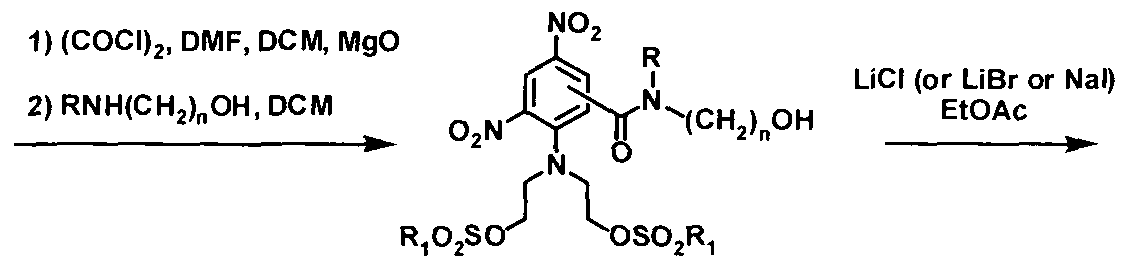
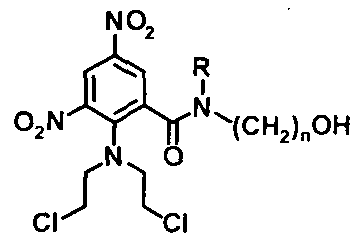
In general terms, the preferred dinitrobenzamide mustard prodrug compounds of Formula II may be prepared as shown in scheme 1 from the known 3-chloro-2,6-dinitrobenzoic acid (Palmer et al, J. Med. Chem. 1996, 39, 2518-2528), or the commercially available 2-chloro-3,5-dinitrobenzoic acid and 5-chloro-2,4-dinitrobenzoic acid, respectively. Reaction with A/rN-bis(2-chloroethyl)amine hydrochloride in dioxane employing triethylamine as base provides the dichloro mustard acids (IV). Conversion of these to their respective acid chlorides and then reaction with secondary hydroxyalkyl amines, which are themselves commercially available or readily prepared using the reductive amination method of Saavedra (J. Org Chem. 1985, 50, 2271), provides the dinitrobenzamides (V). Sodium iodide or lithium bromide mediated halogen exchange then provides the symmetrical diiodo and dibromo mustards VI and VII, respectively. The asymmetric halogen/alkyl sulfonate mustards (VIII, IX) can be prepared from their symmetrical counterparts by reaction with approximately one equivalent of a silver alkylsulfonate salt in an appropriate solvent, such as acetonitrile. The bis-alkyl sulfonate mustards (X) can be prepared from their symmetrical counterparts (for example V) by reaction with an excess of a silver alkylsulfonate salt in an appropriate solvent, such as acetonitrile.

Vl VII VIII IX
Scheme 1
As an alternative method, in general terms, the preferred dinitrobenzamide mustard prodrug compounds of Formula II may be prepared as shown in scheme 2 from the known 3-chloro-2,6- dinitrobenzoic acid (Palmer et al, J Med. Chem. 1996, 39, 2518-2528), or the commercially available 2-chloro-3,5-dinitrobenzoic acid and 5-chloro-2,4-dinitrobenzoic acid, respectively. Reaction with tert-butyl acetate in the presence of perchloric acid provides the respective tert-butyl esters (XI). Reaction of these with diethanolamine in dioxane then affords the respective diols (XII)-
Conversion of these to the bis-alkylsulfonates (XIII) can be achieved utilizing the appropriate alkylsulfomc anhydride in the presence of pyridine and catalytic dimethylaminopyridine (DMAP)
Tπfluoroacetic acid mediated tert-butyl ester hydrolysis, followed by conversion of the intermediate acids (XIV) to their respective acid chlorides, employing oxalyl chloride in the presence of magnesium oxide, and then subsequent reaction of these acid chlorides with secondary hydroxyalkyl amines, that are themselves commercially available or readily prepared using the reductive animation method of Saavedra Q Org Chem 1985, 50, 2271), provides the bis-alkylsulfonate dinitrobenzamides (XV) Lithium chloride, lithium bromide or sodium iodide mediated partial alkyl sulfonate displacement, followed by the appropriate chromatography, then provides the asymmetric halogen/alkyl sulfonate mustards (XVI)
NH(CH2CH2OH)2 TFA dioxane DCM


(R1SO2J2O1 DCM XIV
XII X = Y = OH pyridine, DMAP
XIII X = Y = OSO2R1
0 0C
or NaI)

XV XVI X = Cl, Br, I
Scheme 2
As an alternative method, in general terms, the preferred asymmetric dinitrobenzamide mustard prodrug compounds of Formula II may also be prepared following the methodology of Yang et al (Tetrahedron, 2007, 63, 5470-5476) as shown in scheme 3 The above described tert-butyl esters (XI) can be reacted with aziridine ethanol in the presence of a metal hahde (LiCl, LiBr or NaI) to provide the haloethyl half-mustards (XVII), which can be derivatised to the halo/alkylsulfonate mustards (XVIII) by reaction with the appropriate alkylsulfonic anhydride in the presence of pyridine and catalytic dimethylaminopyridine (DMAP) Tert-butyl ester depiotection, acid chloride formation and amide coupling with secondary hydroxyalkyl amines, as described above, then provides the asymmetric halogen/alkyl sulfonate mustards of Formula II
DCM


Xl XVII X = Cl, Br, I XVIII X = Cl, Br, I
Scheme 3
Preparation of dinitrobenzenesulfonamide mustard prodrugs of the invention
In general terms, the preferred dinitrobenzenesulfonamide mustard prodrug compounds of Formula II may be prepared as shown in scheme 4 from the known 2-chloro-3,5-dinitrobenzenesulfonyl chloride and 5-chloro-2,4-dinitrobenzenesulfonyl chloride (McN ally et al, 1944, US 2358465; Herbert and Holhman, Tetrahedron, 1965, 21, 663-75), respectively. Reaction with secondary hydroxyalkyl amines, that are themselves commercially available or readily prepared using the reductive animation method of Saavedra (J. Org. Chem. 1985, 50, 2271), provides the dinitrobenzenesulfonamides (XX). Chlorine displacement with iV,JV-bis(2-chloroethyl) amine hydrochloride in dioxane employing tnethylamine as base, provides the dichloro mustards (XXI) Sodium iodide or lithium bromide mediated halogen exchange men provides the symmetrical dnodo and dibromo mustards XXII and XXIII, respectively. The asymmetric halogen/alkyl sulfonate mustards (XXIV, XXV) can be prepared from their symmetrical counterparts by reaction with approximately one equivalent of a silver alkylsulfonate salt in an appropriate solvent, such as acetomtrile. The bis-alkyl sulfonate mustards (XXVI) can be prepared from their symmetrical counterparts by reaction with an excess of a silver alkylsulfonate salt in an appropriate solvent, such as acetomtrile

XXII XXIII XXIV XXV
Scheme 4
Preparation of phosphates of dinitrobenzamide and dinitrobenzenesulfonamide mustard prodrugs of the invention In general terms, phosphates of Formula I may be prepared as shown in scheme 5 from the preferred prodrug compounds of Formula II by reaction of these alcohol derivatives with di-tert- butyl dnsopropylphosphoramidite utilizing lH-tetrazole as the base, followed by oxidation with either rø-chloroperoxybenzoic acid (,W-CPBA) or 70% aqueous hydrogen peroxide, to provide the di- /^-butylphosphate ester intermediates (XXVII). Acid mediated hydrolysis, employing tπfluoroacetic acid (TFA) in dichloromethane, then provides the phosphates of Formula I as their free acids.

Il XXVII I
Scheme 5
Scheme 6 below illustrates the preparation of a number of dinitrobenzamide mustard prodrug compounds of Formula I and II according to the invention Reaction of the commercially available 2-chloro-3,5-dinitrobenzoic acid (21) with iV,Λ/-bis(2-chloroethyl)amine hydrochloride in dioxane employing ttiethylamine as base provides the dichloro mustard acid (22) Conversion of this to the acid chloride and then reaction with secondary hydroxyalkyl amines, which are themselves commercially available or readily prepared using the reductive armnation method of Saavedra (J. Org. Chem. 1985, 50, 2271), provides the dmitrobenzamides (23-27) Lithium bromide or sodium iodide mediated halogen exchange then provides the symmetrical dibromo and diiodo mustards (2- 5, 7 and 9, 10, respectively). The asymmetric bromo/methyl sulfonate mustard (12) was prepared as a reference compound, from its symmetrical dibromo counterpart (2) by reaction with one equivalent of silver mesylate in acetomtrile. Phosphates of Formula I were prepared from the alcohols (2-4, 9, 10) by reaction with di-/er/-butyl dnsopropylphosphoramidite utilizing lH-tetrazole as the base, followed by oxidation with either w-chloroperoxybenzoic acid (w-CPBA) or 70% aqueous hydrogen peroxide, to provide the di-tø?-butylphosphatc ester intermediates (28-32). Acid mediated hydrolysis, employing trifluoroacetic acid (TFA) in dichloromethane, then provides the phosphates (34-38) of Formula I as their free acids. The phosphate (39) of reference compound (12) was prepared similarly, as described above
1) SOCI2, DMF, reflux HCI 2) RNH(CH2JnOH, THF, -10 "C


21 22 23 R = Me, n = 2
24 R = Et, n = 2 25 R = ι-Pr, n = 2 26 R = n-Pr, n = 2 27 R = Me, n = 3 10 °C
TFA DCM -15 °C 0 °C


- 2 X = Y = Bn R = Me, n = 2 28 X = Y = Bn R = Me, n = 2 34 X = Y = Br, R = Me, n = 2
3 X = Y = Br, R = Et, n = 2 29 X = Y = Br, R = Et, n = 2 35 X = Y = Bη R = Et, n = 2
4 X = Y = Bn R = ι-Pr, π = 2 30 X = Y = Bn R = I-Pn n = 2 36 X = Y = Br, R = I-Pn n = 2
AgOMs
5 X = Y = Bn R = n-Pn n = 2 31 X = Y = I, R = Me, n = 2 37 X = Y = I, R = Me, n = 2 CH3CN 7 X = Y = Bn R = Me, n = 3 32 x = γ = |, R = n-Pr, n = 2 38 X = Y = I, R = n-Pr, n = 2 reflux 9 X = Y = I, R = Me, n = 2 33 X = Br, Y = OSO2CH3, R = Me, n = 2 39 X = Br, Y = OSO2CH3, R = Me, n = 2
10 X = Y = l, R = n-Pr, n = 2
- 12 X = Br, Y = OSO2CH3, R = Me, n = 2
Scheme 6
Preparation of comparative compounds (1, 6, 8 and 11), unsubstituted at the carboxamide nitrogen, was as described by Denny et al (PCT Int. Appl. WO 2005042471 Al; PCT Int. Appl WO
2004033415 Al)
Schemes 7 below illustrates an alternative preparation of a number of dinitrobenzamide mustard prodrug compounds of formula II according to the invention. Conversion of the commercially available 2-chloro-3,5-dinitrobenzoic acid (21), via the known compounds 40 and 41, to the bis- methylsulfonate (42) was achieved following the method of Atwell et al (Journal of Labelled Compounds and Radiopharmaceuticals, 2007, 50, 7-12). Trifluoroacetic acid mediated tert-butyl ester hydrolysis, followed by conversion of the intermediate acid (43) to its acid chloride, employing oxalyl chloride in the presence of magnesium oxide, and then subsequent reaction of this acid chloride with 2-(isopropylamino)ethanol and 2-(propylamino)ethanol respectively, gave bis- mesylates 19 and 20. Lithium bromide and lithium chloride, mediated partial alkyl sulfonate displacement, followed by chromatography, then gave the asymmetric bromo/methyl sulfonates (13, 14) and chloro/methylsulfonates (16, 17), respectively.

19 R = I-Pr 13 X = Br, Y = OSO2CH3, R = i-Pr 20 R = n-Pr 14 X = Br, Y = OSO2CH3, R = n-Pr
16 X = Cl, Y = OSO2CH3, R = |-Pr
17 X = Cl, Y = OSO2CH3, R = n-Pr
Scheme 7 Therapeutic uses of the compounds of the invention
The compounds of the Formulae I and II of the present invention can be used in the treatment of cancer of the human or animal body In particular embodiments, the treatment may be of any cancer type that includes hypoxic regions, as the mustards of Formula II are reduced by enzymes present in such regions For example, the cancers treated may be solid tumours, such as ovarian, colon, brain, thyroid, pancreas, bladder, breast, prostate, lung (such as small cell lung tumour cells and large cell lung carcinoma), cervical and skin cancer Alternatively, the cancer may be leukaemia, multiple myeloma or lymphoma All of these cancers present with hypoxic regions, particularly where tumours are growing or have become large
The compounds of the invention can be administered in the form of pharmaceutical compositions, containing one or more compounds of the invention in combination with one or more pharmaceutically acceptable carriers
The pharmaceutically acceptable carner(s) should be non-toxic and not interfere with the efficacy of the active ingredient The precise nature of the earner will depend on the route of administration, which can be oral, or parenteral, including intravenous, cutaneous, subcutaneous, intramuscular, intravascular or by infusion
Pharmaceutical compositions suitable for oral administration can be in tablet, capsule, powder or liquid form A tablet may comprise one or mote solid carπeis and/or adjuvants A capsule may include a
solid carrier such as gelatin Liquid pharmaceutical compositions may comprise a liquid carrier such as water, petroleum, animal or vegetable oils, mineral oil or synthetic oil. Physiological saline solution, dextrose or other saccharide solutions or glycols such as ethylene glycol, propylene glycol or polyethylene glycol may be included
For parenteral injection, the pharmaceutical composition may conveniently be in the form of a parenterally acceptable aqueous solution which is pyrogen-free and has a suitable pH, isotonicity and stability. Those of skill in the art are able to prepare suitable solutions using, for example, isotonic vehicles such as sodium chloride injection, Ringer's injection, and Lactated Ringer's injection. Preservatives, stabilisers, buffers, antioxidants and/or other additives may be included as required.
The exact dose of the compound to be administered will be at the discretion of the physician, taking into account the type of cancer, the therapeutic approach (monotherapy or combination therapy) and the overall condition and needs of the patient. Typical doses and administration schedules will be determined by experience in clinical trials. Total doses are expected to be in the range from about 0 1 to 200 mg/kg per subject, such as about 10 mg/kg per subject. The amount of compound administered may be between about 20% and 100% of the maximum tolerated dose of the subject.
The compounds of Formula I and II can be used as single agents or in combination with one or more other cytotoxic or other therapeutic agents or therapies, especially those that are relatively ineffective against hypoxic cells, such as radiation therapy. Where such other agents and/or radiotherapy are administered in combination with a compound of the invention, the radiation and/or other agents may be administered before, during or after administration of the compound of Formula I and II
In certain embodiments, the compound of Formula I or II may be administered for activation
(reduction) by an exogenous nitroreductase enzyme. The exogenous nitroreductase enzyme will be present within oi therapeutically proximate the tumour preferably as the result of introduction and expression of nucleic acid encoding it. Introduction of the nucleic acid may be part of GDEPT (gene-directed enzyme prodrug therapy), which includes VDEPT (virus-directed enzyme prodrug therapy) and CDEPT (Clostnώa-άixected enzyme prodrug therapy). The nitroreductase enzyme expressed as part of this approach can, for example, be encoded by the nfsB gene of either E. coli or by orthologous genes in Clostridia species. However, it will be appreciated that any exogenous nitroreductase having the ability to reduce the mustard prodrugs of the invention can be encoded and introduced. Examples of such nitroreductases include: (1) E.coli NfsA- Vass SO, Jarrom D, Wilson WR, Hyde EI, Searle PF. E. coll NfsA- an alternative nitroreductase for prodrug activation
gene therapy in combination with CB1954. BrJ Cancer, 2009;100: 1903-11; (2) E.toh YieF: Barak Y, Thorne SH, Ackerley DF, Lynch SV, Contag CH, Matin A. New enzyme for reductive cancer chemotherapy, YieF, and its improvement by directed evolution. MoI Cancer Tber 2006;5: 97-103; and (3) B.amylohquefaciens YwrO Anlezark GM, Vaughan T, Fashola-Stone E, Michael NP, Murdoch H, Sims MA, Stubbs S, Wigley S, Minton NP Bacillus amyloliquefaciens orthologue of Bacillus subαlis ywrO encodes a nitroreductase enzyme which activates the prodrug CB 1954. Microbiology 2002; 14: 297-306.
In an alternative embodiment, an exogenous nitroreductase can be introduced by ADEPT (antibody-directed enzyme prodrug therapy).
A GDEPT approach is preferred It is envisaged that the use of GDEPT in combination of a compound of the present invention may be particularly beneficial when the cancer to be treated is one in which tumour hypoxia is a less reliable target, meaning that activation by endogenous enzymes is insufficient on its own.
Without wishing to be bound by theory, it is believed that compounds of Formula I, upon administration to a subject, are hydrolysed in vivo to form compounds of Formula II, and that compounds of Formula II are reduced selectively under hypoxic conditions by endogenous nitroreductases (or by introduced nitroreductases, for example, when GDEPT is used in conjunction with administration of the compounds) to form cytotoxic amino compounds.
The invention will now be described in more detail with reference to the following non-kmiting experimental section.
EXPERIMENTAL
1. SYNTHESIS 1.1 Chemical synthesis
Combustion analyses were performed by the Microchemical Laboratory, University of Otago, Dunedin, NZ. Melting points were determined using either an Electrothermal Model 9200 and are as read. 1H NMR spectra were measured either on a Bruker Avance-400 spectrometer and are referenced to Me4Si. High resolution mass spectra were recorded on a Vanan VG-70SE spectrometer at nominal 5000 resolution Mass spectrometry was performed on a ThermoFinnigan
MSQ single quadrupole mass spectrometer. Mass detection was performed with an APCI source, using simultaneous positive and negative ion acquisition. Unless otherwise indicated, compounds were purified by flash column chromatography on Silica gel 60 support (Scharlau, 230-400 mesh ASTM), using the indicated eluants.
1.1.1 Preparation of the N-alkyl carboxamide mustard alcohols
1.1.1.1 2-[Bis(2-bromoethyl)amino]-iV-(2-hydroxyethyl)-N-methyl-3,5-dinitrobenzamide (2)
A mixture of 2-chloro-3,5-dinitrobenzoic acid (21) (25.0 g, 10.10 mol), bis(2-chloroethyl)amine hydrochloride (36.2 g, 0.20 mol) and Et3N (42.3 mL, 0.30 mol) in dioxane (400 mL) was stirred at 25 0C for 72 h, then concentrated below 30 0C to 150 mL and diluted with excess IN aqueous HCl. Prolonged cooling at 0 0C provided a solid which was collected by filtration and chromatographed on silica gel, eluting with EtOAc/petroleum ether (3:1). The product thus obtained was triturated with 1Pr2O to give 2-[bis(2-chloroethyl)amino]-3,5-dinitrobenzoic acid (22) (26.9 g, 75%) as a yellow solid: mp (MeOH/H2O) 142-143 0C; 1H NMR [(CD3)2SO] δ 14-16 (br s, 1 H), 8.81 (d, / = 2.8 Hz, 1 H), 8.59 (d, / = 2.8 Hz, 1 H), 3.70 (t, / = 6.7 Hz, 4 H), 3.46 (t, / = 6.7 Hz, 4 H).
A stirred solution of 2-[bis(2-chloroethyl)amino]-3,5-dinitrobenzoic acid (22) (15.0 g, 42.6 mmol) in SOCl2 (100 mL) and DMF (5 drops) was heated under reflux for 3 h, then cooled to room temperature and the excess SOCl2 was removed under reduced pressure. The resulting crude 2- [bis(2-chloroethyl)amino]-3,5-dimtrobenzoyl chloride was dissolved in THF (50 mL) and added slowly to a stirred solution of 2-(methylamino)ethanol (9.60 g, 12.8 mmol) in THF (80 mL) at -10 °C. The mixture was stirred at —10 "C for 5 mm, then acidified with 0.5 N aqueous HCl (110 mL), concentrated to half volume under reduced pressure and extracted with EtOAc (2x). The combined organic phases were washed with brine, dried and evaporated, and the residue was chromatographed on silica gel, eluting with EtOAc, followed by crystallisation from EtOAc/iPr2O, to give 2-[bis(2- chloiOethyl)amino]-N-(2-hydroxyethyl)-N-methyl-3,5-dinitrobenzamide (23) (15.82 g, 91%): mp 136-137 0C; 1H NMR [(CDO2SO] δ (mixture of rotamers) 8.71, 8.69 (2d J = 2.8 Hz, 1 H), 8.39, 8.34 (dj = 2.8 Hz, 1 H), 4.90-4.81 (m, 1 H), 3.73-3.29, 3.18-3,11 (2m, 12 H), 3.03, 2.94 (2s, 3 H). Anal. Calcd for C14H18Cl2N4O6: C, 41.1; H, 4.4; N, 13.7; Cl, 17.3%; found: C, 41.4; H, 4.6; N, 13 8; Cl, 17.3%.
A mixture of 23 (20.0 g, 49 mmol) and LiBr (63.7 g, 730 mmol) in dry 3-methyl-2-butanone (methyl ethyl ketone; MEK) (150 mL) was stirred at reflux for 3 h, then concentrated under reduced
pressure to remove most of the solvent. The residue was partitioned between EtOAc and water and the organic layer was washed with 10% aqueous NaI, dried and evaporated under reduced pressure. The residue was treated with further LiBr (63.7 g, 730 mmol) as above and worked up to provide crude product. A solution of this in EtOAc was filtered through a plug of silica gel, followed by crystallisation from EtOAc, to give 2-[bis(2-bromoethyl)amino]-JV-(2-hydroxyethyl)-JV-methyl-3J5- dimtrobenzamide (2) (17.44 g, 72%) as a yellow solid: mp 130-132 0C; 1H NMR [(CD3)2SO] (mixture of rotamers) δ 8.71, 8.69 (2dJ = 2.8 Hz, 1 H), 8.40, 8.34 (2d J = 2.8 Hz, 1 H), 4.85 (br s, 1 H), 3.70-3.33, 3.18-3.11 (2m, 12 H), 3.03, 2.95 (2s, 3 H). Anal. Calcd for C14H18Br2N4O6: C, 33.8; H, 3.6; N, 11.3%; found: C, 34.2; H, 3.9; N, 11.4%.
1.1.1.2 2-p3is(2-bromoethyl)amino]-N-ethyl-N-(2-hydroxyethyl)-3,5-dinitrobenzarnide (3)
A stirred solution of 2-[bis(2-chloroethyl)amino]-3,5-dinitrobenzoic acid (22) (1.50 g, 4.26 mmol) in SOCl2 (15 mL) and DMF (3 drops) was heated under reflux for 3 h, then cooled to room temperature and the excess SOCl2 was removed under reduced pressure. The resulting crude 2- [bis(2-chloroethyl)amino]-3,5-dinitrobenzoyl chloride was dissolved in THF (12 mL) and slowly added to a stirred solution of 2-(ethylarruno)ethanol (prepared according to the literature procedure; J.Org.Chem. 1985, 50, 2271) (1 14 g, 12 79 mmol) in THF (12 mL) at -10 °C. The mixture was stirred for 20 mm at -10 0C, then treated with aqueous HCl (0.5 M, 12 mL) to pH ~ 3 before being extracted with EtOAc. The combined organic layers were washed with brine, dried with Na2SO4 and concentrated under reduced pressure. The residue was purified by flash column chromatography on silica gel eluting with CH2Cl2/MeOH (99T) to give 2-[bis(2-chloroethyl)amino]-N-ethyl-iV-(2- hydroxyethyl)-3,5-dinitrobenzamide (24) (1.21 g, 67%) as a yellow solid: m.p. 92-93 °C; 1HNMR [(CD,)2SO] (mixture of rotamers) δ 8 70, 8.69 (2dJ = 2.2 Hz, IH), 8.38, 8.29 (2d J = 2.2 Hz, IH), 4.84 (s, br, IH), 3.78-3.68 (m, 7H), 3 58-3.42 (m, 4H), 3 37-3.21 (m, 3H), 1 19, 1 06 (2tJ = 6.9 Hz, 3H) Anal. Calcd for C15H20Cl2N4O6: C, 42.6; H, 4 8; N, 13.2; found: C, 42.7; H, 4.7; N, 13.4.
A mixture of 2-[bis(2-chloroethyl)amino]-N-eth}l-N-(2-hydroxyethyl)-3,5-dinitrobenzamide (24) (1.13 g, 2.67 mmol) and LiBr (4.64 g, 53.46 mmol) in MEK (10 mL) was heated under reflux with stirring for 3 h, then concentrated under reduced pressure to dryness The residue was dissolved in EtOAc, washed with deionized water, 10% aqueous NaBr, dried with Na2SO4 and concentrated under reduced pressure. The residue was resubmitted to LiBr (4.64 g, 53 46 mmol) in MEK (10 mL) followed by the above workup to provide the crude product, which was then purified by flash column chromatography on silica gel eluting with CH2Cl2/MeOH (9:1) to give 2-[bis(2- bromoethyl)amino]-N-ethyl-N-(2-hydroxyethyl)-3,5-dinitrobenzamide (3) (1.17 g, 86%) as a yellow
solid: m.p. 105-107 °C; 1HNMR [(CD3)2SO] (mixture of rotamers) 5 8.71, 8.69 (2dJ = 2.8 Hz, IH), 8.40, 8.30 (2d, 2.8 Hz, IH), 4.86-4.814 (m, IH), 3.80-3.62 (m, 3H), 3.60-3.52 (m, 7H), 3.46-3.17 (m, 4H), 1.19, 1.07 (2tJ = 7.07 Hz, 3H). Anal. Calcd for C15H20Br2N4O6-O. IMEK: C, 35.8; H, 4.1; N, 10.7%; found: C, 35.7; H, 3.9; N, 10.7%.
1.1.1.3 2-(Εis(2-bromoethyl)arnino]-iV-(2-liydroxyethyl)-iV-isopropyl-3,5-dinitrobenzarnide (4)
A stirred solution of 2-[bis(2-chloroethyl)amino]-3,5-dinitrobenzoic acid (22) (1.50 g, 4.26 mmol) in SOCl2 (15 mL) and DMF (3 drops) was heated under reflux for 3 h, then cooled to room temperature and the excess SOCl2 was removed under reduced pressure. The resulting crude 2- [bis(2-chloroethyl)amino]-3,5-dinitrobenzoyl chloride was dissolved in THF (12 mL) and slowly added to a stirred solution of 2-(isopropylamino)ethanol (1.38 g, 13.39 mmol) in THF (12 mL) at - 10 °C. The mixture was stirred for 20 min at -10 °C, then treated with aqueous HCl (0.5 M, 12 mL) to pH ~ 3 before being extracted with EtOAc. The combined organic layers were washed with brine, dried with Na2SO4 and concentrated under reduced pressure. The residue was purified by flash column chromatography on silica gel eluting with CH2Cl2/MeOH (99:1) to give 2-[bis(2- chloroethyl) amino]-N-(2-hydroxyethyl)-A[-isopropyl-3,5-dinitrobenzamide (25) (1.01 g, 54%) as a yellow solid: m.p. 110-111 0C. 1HNMR [(CD,)2SO] (mixture of rotamers) δ 8.71, 8.68 (2d, / = 2.8 Hz, IH), 8.36, 8.25 (2dJ = 2.8 Hz, IH), 4.80, 4.74 (2tJ = 5.7 Hz, IH), 4.22, 3.82 (2m, IH), 3.76- 3.65 (m, 4H), 3.58-3.35 (m, 5H), 3.33-3.18 (m, 3H), 1.35 (d,/ = 6.7 Hz, 3H), 1.16 (2d, / = 8.4, 6.5
Hz, 3H). Anal. Calcd for C16H22Cl2N4O6: C, 44.0; H, 5.1; N, 12.8%; found: C, 44.2; H, 5.2; N, 12.5%.
A mixture of 2-[bis(2-chloroethyl)amino]-AT-(2-hydroxyethyl)-iV-isopiOpyl-3,5-dinitrobenzamide (25) (1.0 g, 2.29 mmol) and LiBr (3.97 g, 45.74 mmol) in MEK (20 mL) was heated under reflux with stirring for 3 h, then concentrated under reduced pressure to dryness. The residue was dissolved in EtOAc, washed with deionized water and then 10% aqueous NaBr before being dried with Na2SO4 and concentrated under reduced pressure. The residue was resubrrutted to LiBr (3.97 g, 45.74 mmol) in MEK (20 mL) and then the above workup to provide the crude product, which was then purified by flash column chromatography on silica gel eluting with CH2Cl2/MeOH (9:1) to give 2-pDis(2-bromoethyl)amino]-iV-(2-hydroxyethyl)-N-isopropyl-3,5-dinitrobenzamide (4) (960 mg,
80%) as a yellow solid: m.p. 110-112 0C. 1HNMR [(CD3)2SO] (mixture of rotamers) δ 8.72, 8.69 (2d, / = 2.8 Hz, IH), 8.38, 8.26 (2d, 2.8 Hz, IH), 4.81, 4.75 (2t, / = 5.8 Hz, IH), 4.22, 4.18 (2m, IH), 3.78-3.72 (m, IH), 3.61-3.49 (m, 6H), 3.48-3.24 (m, 4H), 3.21 (tj = 5.8 Hz, IH), 1.35 (d, / = 6.8 Hz, 3H), 1.17 (2dJ = 6.5, 2.7 Hz, 3H). Anal. Calcd for C16H22Br2N4O6: C, 36.5; H, 4.2; N, 10.7%; found: C, 36.8; H, 4.2; N, 10.6%.
1.1.1.4 2-(Bis(2-brornoethyl)aniino]-Λ/-(2-hydroxyethyl)-3,5-dinitro-Λr-propylbenzamicle (5)
A stirred solution of 2-[bis(2-chloroethyl)amino]-3,5-dinitrobenzoic acid (22) (5.00 g, 14.20 mmol) in SOCl2 (50 mL) and DMF (5 drops) was heated under reflux for 3 h, then cooled to room temperature and the excess SOCl2 was removed under reduced pressure. The resulting crude 2- [bis(2-chloroethyl)amino]-3,5-dinitrobenzoyl chloride was dissolved in THF (40 mL) and slowly added to a stirred solution of 2-(propylamino)ethanol (4.60 g, 44.63 mmol) in THF (40 mL) at -10 °C. The mixture was stirred for 20 min at -10 0C, then treated with aqueous HCl (0.5 M, 40 mL) to pH ~ 3 before being extracted with EtOAc. The combined organic layers were washed with brine, dried with Na2SO4 and concentrated under reduced pressure. The residue was purified by flash column chromatography on silica gel eluting with CH2Cl2/MeOH (99:1) to give 2-[bis(2-chloroethyl) amino]-iV-(2-hydroxyethyl)-3,5-dinitro-i\J-propylbenzamide (26) (3.73 g, 60%) as a yellow oil. 1HNMR [(CDj)2SO] (mixture of rotamers) δ 8.71, 8.68 (2dJ = 2.8 Hz, IH), 8.38, 8.24 (2dJ = 2.8 Hz, IH), 4.84, 4.80 (2tJ = 5.2 Hz, IH), 3.72-3.65 (m, 5H), 3.63-3.42 (m, 4H), 3.39-3.31 (m, 2H),
3.24-3.12 (m, 2H), 1.66, 1.55 (2m, 2H), 0.94, 0.73 (2tJ = 7.4 Hz, 3H). HRMS(ESI) calcd for C16H23 Cl2N4O6 [M+H]+ m/z 437.0989: found 437.0993.
A mixture of 2-[bis(2-chloroethyl) amino]-N-(2-hydroxyethyl)-3,5-dinitro-N-propylbenzamide (26) (3.50 g, 8.00 mmol) and LiBr (13.90 g, 160.00 mmol) in MEK (70 mL) was heated under reflux with stirring for 3 h, then concentrated under reduced pressure to dryness. The residue was dissolved in EtOAc, washed with deiomzed water and then 10% aqueous NaBr before being dried with Na2SO4 and concentrated under reduced pressure. The residue was resubmitted to LiBr (13.90 g, 160.00 mmol) in MEK (70 mL) and then the above workup to provide the crude product, which was then purified by flash column chromatography on silica gel eluting with CH2Cl2/MeOH (9:1) to give 2- [bis(2-bromoethyl)amino]-N-(2-hydroxyethyl)-3,5-dinitro-N-propylbenzamide (5) (3.58 g, 85%) as a yellow solid: m.p. (101-102 °C). 1HNMR [(CDO2SO] (mixture of rotamers) δ 8.72, 8.69 (2d, / = 2.8 Hz, IH), 8.39, 8.25 (2d, 2.8 Hz, IH), 4.85, 4.82 (2tJ = 5.2 Hz, IH), 3.69-3.52 (m, 8H), 3.48-3.31 (m, 4H), 3.24-3.16 (m, 2H), 1.66, 1.55 (2m, 2H), 0.93, 0.74 (2tJ = 7.3 Hz, 3H). Anal. Calcd for C16H22Br2N4O6-O-IEtOAc: C, 36.8; H, 4.3; N, 10.5; Br 29.9%; found: C, 37.2; H, 4.2; N, 10.7; Br 30.0%.
1.1.1.5 2-rBis(2-bromoethyl)amino]-Λ/-(3-hydroxypropyl)-i\J-methyl-3,5-dinitrobenzamide (7)
A stirred solution of 2-[bis(2-chloroethyl)amino]-3,5-dirutrobenzoic acid (22) (1.50 g, 4.26 mmol) in SOCl2 (15 mL) and DMF (3 drops) was heated under reflux for 3 h, then cooled to room temperature and the excess SOCl2 was removed under reduced pressure. The resulting crude 2- [bis(2-chloroethyl)amino]-3,5-dinitrobenzoyl chloride was dissolved in THF (12 mL) and slowly added to a stirred solution of 3-(mediylamino)propanol (prepared according to the literature procedure; J. Org.Chem. 1979, 44, 2718) (1.14 g, 12.78 mmol) in THF (12 mL) at -10 0C. The mixture was stirred for 20 nun at -10 °C, then treated with aqueous HCl (0.5 M, 12 mL) to pH ~ 3 before being ectracted with EtOAc. The combined organic layers were washed with brine, dried with Na2SO4, concentrated under reduced pressure and the residue was recrystalkzed from CH2Cl2/hexane to give 2-[bis(2-chloroethyl)amino]-iV-(3-hydroxyρropyl)-N-methyl-3,5-dinitro benzamide (27) (1.30 g, 72%) as a yellow solid: m.p. 125-128 0C. 1HNMR [(CD,)2SO] (mixture of rotamers) δ 8.70 (d J = 2.8 Hz, IH), 8.28 (2d,/ = 2.8, 1.0 Hz, IH), 4.55, 4.38 (2t J = 5.1 Hz, IH), 3.71-3.67 (m, 4H), 3.54-3.44 (m, 5H), 3.36-3.26 (m, 3H), 3.00, 2.90 (2s, 3H), 1.81-1.74 (m, IH), 1.70- 1.66 (m, IH). Anal. Calcd for C15H20Cl2N4O6: C, 42.6; H, 4.8; N, 13.2%; found: C, 42.7; H, 4.8; N, 12.9%.
A mixture of 2-pDis(2-chloroethyl)amino]-JV-(3-hydroxypropyl)-iV-methyl-3,5-dinitrobenzamide (27) (1.30 g, 3.07 mmol) and LiBr (5.34 g, 61.52 mmol) in MEK (10 mL) was heated under reflux with stirring for 3 h, then concentrated under reduced pressure to dryness. The residue was dissolved in EtOAc, washed with deiomzed water and then 10% aqueous NaBr before being dried with Na2SO4 and concentrated under reduced pressure. The residue was resubmitted to LiBr (5.34 g, 61.52 mmol) in MEK (10 mL) before being worked up as above. Purification of the crude product by flash column chromatography on silica gel eluting with CH2Cl2/MeOH (9:1) provided 2-[bis(2- bromoethyl)amino]-N-(3-hydroxypropyl)-N-methyl-3,5-dinitrobenzamide (7) (1.21 g, 77%) as a yellow solid: m.p. > 300 °C. 1HNMR [(CD^)2SO] (mixture of rotamers) δ 8.71 (dj = 2.7 Hz, IH), 8.29 (2d, 2.7, 1.4 Hz, IFI), 4.55, 4.37 (2tJ = 5.1 Hz, IH), 3.54-3.50 (m, 9H), 3.41-3 31 (m, 3H), 3.01, 2.91 (2s, 3H), 1.81-1.75 (m, IH), 1.71-1.64 (m, IH). Anal. Calcd for C15H20Br2N4O6: C, 35.2; H, 3.9; N, 10.9%; found: C, 35.5; H, 4.0; N, 10.7%.
1.1.1 6 2-[Bis(2-iodoethyl)amino]-N-(2-hydroxyethyl)-N-methyl-3,5-dinitrobenzamide (9)
A mixture of 2-[bis(2-chloroethyl)amino]-N-(2-hydroxyethyl)-N-methyl-3,5-dinitrobenzamide (23) (1.50 g, 3.67 mmol) and NaI (2.20 g, 14.66 mmol) in EtOAc (20 mL) was heated at 60 "C with stirring for 3 h, before being washed with deionized water, dried with Na2SO4 and concentrated under reduced pressure. The residue was resubmitted to NaI (2.20 g, 14.66 mmol) in EtOAc (20
mL) before being worked up as above. Purification of the crude product by flash column chromatography on silica gel eluting with CH2Cl2/MeOH (9:1) provided 2-[bis(2-iodoethyl)amino]- N-(2-hydroxyethyl)-N-methyl-3,5-dinitrobenzamide (9) (1.35 g, 62%) as a yellow solid: m.p. 129-131 °C. 1HNMR [(CD,)2SO] (mixture of rotamers) δ 8.71, 8.68 (2d, / = 2.8 Hz, IH), 8.38, 8.33 (2d,/ = 2.8 Hz, IH), 4.86 (br, s, IH), 3.68-3.12 (m, 12H), 2.95, 3.04 (2s, 3). Anal. Calcd for C14H18I2N4O6: C, 28.4; H, 3.1; N, 9.5; I, 42.9%; found: C, 28.7; H, 3.0; N, 9.2; I, 42.6%.
1.1.1.7 2-[Bis(2-iodoethyl)amino]-N-(2-hydroxyethyl)-3,5-dinitro-N-propylbenzamide (10)
A mixture of 2-[bis(2-chloroethyl) arnino]-iV-(2-hydroxyethyl)-3,5-dinitro-AJ-propylbenzarnide (26)
(1.40 g, 3.20 mmol) and NaI (1.92 g, 12.8 mmol) in EtOAc (20 mL) was heated at 60 0C with stirring for 3 h, before being washed with deionized water, dried with Na2SO4 and concentrated under reduced pressure. The residue was resubmitted to NaI (1.92 g, 12.8 mmol) in EtOAc (20 mL) before being worked up as above. Purification of the crude product by flash column chromatography on silica gel eluting with CH2Cl2/MeOH (9:1), followed by trituration from Et2O/hexane provided 2- |bis(2-iodoethyl)amino]-N-(2-hydroxyethyl)-3,5-dinitro-Λ'-propylbenzamide (10) (1.28 g, 64%) as a yellow solid: m.p. 127-129 °C. 1HNMR [(CD,)2SO] (mixture of rotamers) δ 8.71, 8.68 (2dJ = 2.8 Hz, IH), 8.38, 8.24 (2dJ = 2.8 Hz, IH), 4.83, 4.82 (2t, / = 5.2 Hz, IH), 3.70-3.15 (m, 14H), 1.72, 1.47 (2m, 2H), 0.94, 0.73 (2t J = 7.4 Hz, 3H). Anal. Calcd for CIf)H22I2N4Of).0.05Hexane: C, 31.7; H, 3.5; N, 9.0; I, 41.0%; found: C, 31.4; H, 3.7; N, 9.0; I, 40.6%.
1.1.1.8 2-((2-Bromoethyl)-2- {[(2-hydroxyethyl)(methyl)amino]carbonyl}-4,6-dinitroanilino)ethyl methanesulfonate (12) (reference compound)
A solution of 2 (10.06 g, 20.2 mmol) in MeCN (75 mL) was treated with AgOMs (3.69 g, 18.2 mmol) under reflux with stirring for 1 h. The mixture was concentrated under reduced pressure and the residue was extracted with EtOAc, evaporated, and chromatographed on silica gel. Elution with EtOAc/petroleum ether (2:1) gave unreacted 2 (3.59 g), while elution with EtOAc, concentration of the eluate to small volume and dilution with petroleum ether gave 2-((2-bromoethyl)-2-{[(2- hydroxyethyl)(methyl)amino]carbonyl}-4,6-dinitroanilino)ethyl methanesulfonate (12) (3.48 g, 34%) as a yellow gum; 1H NMR [(CD,)2SO] (mixture of rotamers) δ 8.71, 8.69 (2d, / = 2.8 Hz, 1 H), 8.40, 8.34 (2dJ = 2.8 Hz, 1 H), 4.87 (br s, 1 H), 4.31-4.19 (m, 2 H), 3.71-3.10 (m, 13 H), 3.03, 2.95 (2s, 3 H). HRMS(FAB) calcd for C15H22 79BrN4O9S [M+H]+ m/ξ 513.0219: found 513.0273.
1.1.1.9 2-(2- { [(2-Hydroxyethyl)(isopropyl)amino]carbonyl} {2-[(methylsulfonyl)oxy]ethyl} -4,6- dimtroarulino) ethyl methanesulfonate (19)
A solution of tert-butyl 2-(bis{2-[(methylsulfonyl)oxy]ethyl}amino)-3,5-dinitrobenzoate (42) (Atwell et al, Journal of Labelled Compounds and Radiopharmaceuticals, 2007, 50, 7-12) (7.60 g, 14.4 mmol) in CH7Cl, (60 mL) was cooled to 5 °C and treated with TFA (45 mL). The mixture was stirred at room temperature for 1.5 h, and then concentrated to dryness under reduced pressure. The residue was recrystallized from CH2Cl2/dnsopropyl ether to give 2-(bis{2-
[(methylsulfonyl)oxy]ethyl}amino)-3,5-dinitrobenzoic acid (43) as a yellow solid (6.79 g, 98%): m.p. 135-138 °C. 1HNMR [(CD3)2SO] δ 14.11 (br, s, IH), 8.82 (d, / = 2.8 Hz, IH), 8.61 (dj = 2.8 Hz, IH), 4.29 (t,/ = 5.5 Hz, 4H), 3.50 (tj = 5.4 Hz, 4H), 3.12 (s, 6H). Anal. Calcd for CnH17N1O12S2: C, 33.1; H, 3.6; N, 8.9%; found: C, 33.2; H, 3.6; N, 8.8%.
A mixture of 2-(bis{2-[(methylsulfonyl)oxy]ethyl}amino)-3,5-dinitrobenzoic acid (43) (600 mg, 1.27 mmol) and MgO (666 mg, 15.5 mmol) in CH2Cl2 ( 10 mL) was cooled to 0 °C and treated with oxalyl chloride (655 μL, 7.6 mmol ) and DMF (5 drops). The mixture was stirred at 15 °C for 1 h, filtered and then treated with a solution of 2-(isopropylamino)ethanol (171 mg, 1.7 mmol) and triethyl amine (297 μL, 1.9 mmol) in CH2Cl2 (10 mL). The mixture was stirred at 0 °C for 30 nun, diluted with CH2Cl2, washed with water and aqueous solution of methane sulfonic acid. The organic layers were dried with Na2 SO4 and then concentrated under reduced pressure. The residue was then purified by flash column chromatography on silica gel eluting with CH2Cl2/MeOH (99:1) to provide 2- (2- { [(2-hydroxy ethyl) (isopropyl)amino] carbonyl} {2- [(methylsulfonyl) oxy] ethyl } -4,6- dinitroanilino)ethyl methanesulfonate (19) (470 mg, 66 %) as a yellow gum; 1H NMR [(CD,)2SO] (mixture of rotamers) δ 8.70, 8.68 (2d,/ = 2.8 Hz, IH), 8.37, 8.26 (2d, / = 2.8 Hz, IH), 4.81, 4.77 (2tJ = 5.7 Hz, IH), 4.34-4.24 (m, 4H), 3.87-3.69 (2m, IH), 3.63-3.31 (m, 7H), 3.26-3.17 (m, IH), 3.15 (2s, 6H), 1 36 (dj = 6.8 Hz, 3H), 1.21, 1.16 (2dJ = 6.5 Hz, 3H). Anal. Calcd for C18FI28N4O12S2: C, 38.8; H, 5.1; N, 10.1%; found: C, 39.2; H, 5.2; N, 9.8%.
1.1.1.10 2-(2- {[(2-Hydroxyethyl)(proρyl)amino]carbonyl} {2-[(methylsulfonyl)oxy]ethyl}-4,6- dinitroanihno)ethyl methanesulfonate (20)
A mixture of 2-(bis{2-[(methylsulfonyl)oxy]ethyl}amino)-3,5-dinitrobenzoic acid (43) (333 mg, 0.7 mmol) and MgO (341 mg, 8.5 mmol) in CH2Cl2 ( 5 mL) was cooled to 0 °C and treated with oxalyl chloride (364 μL, 4.2 mmol ) and DMF (3 drops). The mixture was stirred at 15 0C for 1 h, filtered
and then treated with a solution of 2-(propylamino)ethanol (105 μL, 0.9 mmol) and triethyl amine (160 μL, 1.1 mmol) in CH2Cl2 (5 niL) The mixture was stirred at 0 °C for 40 min, diluted with CH2Cl2, washed with water and aqueous solution of methane sulfonic acid. The organic layers were dried with Na2 SO4 and then concentrated under reduced pressure. The residue was then purified by flash column chromatography on silica gel eluting with CH2Cl2/MeOH (99:1) to provide 2-(2-{[(2- hydroxyethyl)(propyl)amino]carbonyl} {2-[(methylsulfonyl)oxy]ethyl}-4,6-dinitroanilino)ethyl methanesulfonate (20) (230 mg, 58 %) as a yellow gum; 1H NMR [(CDO2SO] (mixture of rotamers) 6 8.71, 8.69 (2dJ = 2.8 Hz, IH), 8.38, 8 25 (2d, / = 2.8 Hz, IH), 4.85, 4.82 (2t, J = 5.2 Hz, IH), 4.32-4.27 (m, 4H), 3.68-3.50 (m, 5H), 3.45-3.39 (m, 3H), 3.34-3.19 (m, 2H), 3.14 (2s, 6H), 1.70-1.60 (m, 2H), 0.93, 0.73 (2tJ = 7.4 Hz, 3H) HRMS(ESI) calcd for C18H29N4O12S2 [M+H]+ »/•* 557.1218: found 557.1202.
1.1.1.11 2-((2-Bromoethyl)-2- {[(2-hydroxyethyl)(isopropyl)amino]carbonyl} -4,6-dinitroanilino) ethyl methanesulfonate (13)
A mixture of 2-(2-{[(2-hydroxyethyl)(isoprop)l)amino]carbonyl} {2-[(methylsulfonyl)oxy]ethyl}-4,6- dinitroanilino) ethyl methanesulfonate (19) (230 mg, 0 4 mmol) and LiBr (68 mg, 0.8 mmol) in EtOAc (25 mL) was heated with stirring at 45 0C for 3 h The mixture was then cooled to the room temperature, diluted with EtOAc, washed with water, dried with Na2SO4 and concentrated under reduced pressure. Purification of the crude product by flash column chromatography on silica gel eluting with CH2Cl2/MeOH (99:1) provided 2-((2-bromoethyl)-2- {[(2- hydroxyeώyl)(isopropyl)arnino]carbon}l}-4,6-dinitroanilino)ethyl methanesulfonate (13) (110 mg, 49% ) as a yellow gum, 1H NMR [(CDO2SO] (mixture of rotamers) δ 8.70, 8.68 (2dJ = 2.8 Hz, IH), 8.37, 8.26 (2dJ = 2.8 Hz, IH), 4.82, 4 76 (2tJ = 5 8 Hz, IH), 4.32-4.15 (m, 2H), 3 87, 3.71 (2m, IH) 3.63-3.33 (m, 8H), 3.30-3 18 (m, 2H), 3 14 (2s, 3H), 1 36 (dj = 6.8 Hz, 3H), 1.20, 1.15 (2m, 3H).
1.1.1.12 2-((2-Bromoethyl)-2- {[(2-hydroxyethyl)(proρyl)amino]carbonyl}-4,6-dinitroanilino)ethyl methanesulfonate (14)
A mixture of 2-(2-{[(2-hydroxyethyl)(propyl)amino]carbonyl} {2-[(methylsulfonyl)oxy]ethyl}-4,6- dinitroanilino) ethyl methanesulfonate (20) (75 mg, 0.1 mmol) and LiBr (18 mg, 0.2 mmol) in EtOAc (15 mL) was heated with stirring at 45 0C for 1 h The mixture was then cooled to the room temperature, diluted with EtOAc, washed with water, dried with Na7SO4 and concentrated under reduced pressure. Purification of the crude product by flash column chromatography on silica gel
eluting with CH2Cl2/MeOH (99:1) provided 2-((2-bromoethyl)-2-{[(2- hydroxyethyl)(proρyl)ammo]carbonyl}-4,6-dinitroanilino)ethyl methanesulfonate (14) (33 mg, 45% ) as a yellow gum; 1H NMR [(CDO2SO] (mixture of rotamers) δ 8.70, 8.69 (2dJ = 2.8 Hz, IH), 8.38, 8.25 (2dJ = 2.8 Hz, IH), 4.84, 4.82 (2tJ = 5.2 Hz, IH), 4.31-4.26 (m, 2H), 3.70-3.32 (m, 10H), 3.25-3.16 (m, 2H), 3.14 (2s, 3H), 1.70-1.50 (m, 2H), 0.94, 0.73 (2tJ = 7.3 Hz, 3H). HRMS(ESI) calcd for C17H26BrN4O9S [M+H]+ m/ξ 541.0598: found 541.0603.
1.1.1.13 2-((2-Chloroethyl)-2- { [(2-hydroxyethyl) (isopropyl)amino]carbonyl} -4,6-dinitroanilino)ethyl methanesulfonate (16)
A mixture of 2-(2-{[(2-hydroxyethyl)(isopropyl)amino]carbonyl} {2-[(methylsulfonyl)oxy]ethyl}-4,6- dinitroanilino)ethyl methanesulfonate (19) (180 mg, 0.3 mmol) and LiCl (178 mg, 4.2 mmol) in EtOAc (25 rtiL) was heated with stirring at 60 0C for 5 h. The mixture was then cooled to the room temperature, diluted with EtOAc, washed with water and brine, dried with Na2SO4 and concentrated under reduced pressure. Purification of the crude product by flash column chromatography on silica gel eluting with CH2Cl,/MeOH (99:1) provided 2-((2-chloroethyl)-2-{[(2- hydroxyethyl)(isopropyl)amino]carbonyl}-4,6-dinitroanilino) ethyl methanesulfonate (16) (86 mg, 54% ) as a yellow gum; 1H NMR [(CD3)2SO] (mixture of rotamers) δ 8.70, 8.68 (2d J = 2.8 Hz, IH), 8.37, 8.26 (2dJ = 2.8 Hz, IH), 4.81, 4.76 (2tJ = 5.8 Hz, IH), 4.32-4.15 (m, 2H), 3.87-3.65 (m, 3H), 3.63-3.32 (m, 7H), 3.27-3.17 (m, IH), 3.14 (2s, 3H), 1.35 (dj = 6.8 Hz, 3H), 1 20, 1.15 (2m, 3H). HRMS(ESI) calcd for C17H26ClN4O9S [M+H]+ /w/ξ 497.1104: found 497.1107.
1.1.1.14 2-((2-Chloroethyl)-2- { [(2-hydroxyethyl) (propyl)amino]carbonyl} -4,6-dimtroanilino)ethyl methanesulfonate (17)
A mixture of 2-(2-{[(2-hydroxyethyl)(propyl)amino]carbonyl} {2-[(methylsulfonyl)oxy]ethyl}-4,6- dimtroanilino)ethyl methanesulfonate (20) (120 mg, 0.2 mmol) and LiCl (119 mg, 2.8 mmol) in EtOAc (20 mL) was heated with stirring at 60 °C for 5 h. The mixture was then cooled to the room temperature, diluted with EtOAc, washed with water and brine, dried with Na2SO4 and concentrated under reduced pressure. Purification of the crude product by flash column chromatography on silica gel eluting with CH2Cl2/MeOH (99:1) provided 2-((2-chloroethyl)-2- {[(2- hydroxyethyl)(propyl)amino]carbonyl}-4,6-dinitroanilino)ethyl methanesulfonate (17) (50 mg, 47% ) as a yellow gum; 1H NMR [(CDO2SO] (mixture of rotamers) δ 8.70, 8.69 (2d J = 2.8 Hz, IH), 8.37, 8.25 (2dJ = 2 8 Hz, IH), 4.84, 4.82 (2tJ = 5.2 Hz, IH), 4.31-4.26 (m, 2H), 3.73-3.32 (m, 10H),
3.25-3.18 (m, 2H), 3.14 (2s, 3H), 1.69-1.51 (m, 2H), 0.93, 0.73 (2tJ = 7.3 Hz, 3H). HRMS(ESI) calcd for C17H26ClN4O9S [M+H]+ ^ 497.1104: found 497.1111.
1.1.2 Preparation of the N-alkyl carboxamide mustard phosphates
1.1.2.1 2-[{2-pis(2-brornoethyl)amino]-3,5-dinitrobenzoyl}(rnethyl)arnino]ethyl dihydrogen phosphate (34)
A stirred solution of 2-[bis(2-bromoethyl)amino]-N-(2-hydroxyethyl)-N-methyl-3,5- dinitrobenzamide (2) (5.69 g, 11.42 mmol) in 1 H-tetrazole (123 mL, 52.55 mmol; 3% w/w solution in MeCN) and DMF (10 mL) at 10 °C was treated with slow addition of di-tert-butyl diisopropylphosphoramidite (95%, 14.4 mL, 45.68 mmol) under N2. The mixture was stirred at room temperature for 3 h, then cooled to -15 °C and treated with slow addition of a solution of m- CPBA (50%, 20.0 g, 115.87 mmol) m CH2Cl2 (150 mL). After further stirring at room temperature for 2 h the reaction mixture was then concentrated under reduce pressure and the residue was dissolved in EtOAc, washed with 10% aqueous Na2S2O5, 5% aqueous NaHCO3 and water before being dried with Na2SO4 and concentrated under reduced pressure. The crude product was purified by flash column chromatography on sihca gel eluting with hexane/EtOAc (1:1) to give 2-[{2-[bis(2- bronioethyl)arriino]-3,5-diriitrobenzoyl}(methyl)amino]ethyl
 phosphate (28) (5.70 g, 72%) as a yellow gum. 1HNMR [(CD^)2SO] (mixture of rotamers) δ 8.72, 8.70 (2d, / = 2.8 Hz, IH), 8.34, 8.29 (2dJ = 2.8 Hz, IH), 4.13-3.72 (m, 3H), 3.62-3.31 (m, 9H), 3.05, 2.96 (2s, 3H), 1.45, 1.40, 1.37 (3s, 18H). HRMS(FAB) CaIc. for C22H16 79Br2N4O9P (MH+) m/z 689.0587, found: 689.0582; CaIc. for C22H36 79Br81BrN4O9P (MH+) m/z 691.0566, found: 691.0575; CaIc. for C22H16 81Br2N4O9P (MH+) m/z 693.0546, found: 693.0562.
A stirred solution of 2T{2-[bis(2-bromoethyl)amino]-3,5-dimtrobenzoyl} (methyl)ammo]ethyl dx(tert- butyl) phosphate (28) (5.70 g, 8.26 mmol) in CH2Cl2 (140 mL) was treated with TFA (140 mL) at room temperature with stirring for 1 h, then concentrated under reduced pressure to remove the excess TFA. The resulted yellow residue was dissolved in MeCN, filtered and concentrated to give 2-[{2-[bis(2-bromoethyl)amino]-3,5-dinitrobenzoyl}(methyl)amino]ethyl dihydrogen phosphate (34) (4.77 g, 100%) as a yellow solid: m.p. 93-96 °C. 1HNMR [(CDO2SO] (mixture of rotamers) δ 8.72, 8.68 (2dJ = 2.7 Hz, IH), 8.40, 8.30 (2dJ = 2.7 Hz, IH), 4.10-3.69 (m, 3H), 3.60-3.33 (m, 9H), 3.05, 2.97 (2s, 3H), signals corresponding to P(OH)2 protons not observed. HRJVIS(FAB) CaIc. for C14H2n 79Br2N4O9P (MH+) m/z 576.9335, found: 576.9323; CaIc. for C14H211 79Br81BrN4O9P (MH+) m/z 578.9314, found: 578.9325; CaIc. for C14H20 81Br2N4O9P (MH+) m/z 580.9294, found: 580.9293.
1.1.2.2 2-[{2-pis(2-brornoethyl)arnino]-3,5-dinitrobenzoyl}(ethyl)atnino]ethyl dihydrogen phosphate
(35)
A stirred solution of 2-(bis(2-bromoetτiyl)aniino]-Ar-ethyl-Λ^-(2-hydroxyethyl)-3,5-dinitroben2arnide (3) (1.0 g, 1.95 mmol) in lH-tetrazole (21 mL, 8.98 mmol; 3% w/w solution in MeCN) and DMF (1.5 mL) at 10 0C was treated with slow addition of di-/<?#-butyl dnsopropylphosphoramidite (95%, 2.5 mL, 7.92 mmol) under N2. The mixture was stirred at room temperature for 3 h, then cooled to - 15 0C and treated with slow addition of a solution of rø-CPBA (50%, 3.37 g, 19.53 mmol) in CH2Cl2 (25 mL). After a further 2 h stirring at room temperature the reaction mixture was concentrated under reduce pressure and the residue dissolved in CH2Cl9, washed with 10% aqueous Na2S2O5, 5% aqueous NaHCO, and water before being dried with Na2SO4 and concentrated under reduced pressure. The crude product was purified by flash column chromatography on silica gel eluting with hexane/EtOAc (1:1) to give 2-[{2-[bis(2-brornoethyl)amino]-3,5-dinitrobenzoyl}(ethyl)amino]ethyl di(Λ?rf-butyl) phosphate (29) as a yellow gum (1.21 g, 88%). 1HNMR [(CD3)2SO] (mixture of rotamers) δ 8.73, 8.70 (2d J = 2.7 Hz, IH), 8.32, 8.26 (2dJ = 2.8 Hz, IH), 4 17-3.76 (m, 3H), 3.64- 3.19 (m, 11H), 1.45, 1.40, 1.37 (3s, 18H), 1.20, 1.07 (2t, 7.1 Hz, 3H). HRMS(ESI) CaIc. for C21H17 79Br2N4NaO9P (MNa+) /w/z 725.0564, found: 725.0557; CaIc. for C21H17 79Br81BrN4NaO9P (MNa+) ml T. 727.0539, found: 727.0541; CaIc. for C23H17 81Br2N4NaO9P (MNa+) m/z 729.0524, found: 729.0517.
A stirred solution of 2-[{2-[bis(2-bromoethyl)amino]-3,5-dinitrobenzoyl}(ethyl)amino]ethyl άiitert- butyl) phosphate (29) (1.20 g, 1.70 mmol) in CH2Cl2 (35 mL) was treated with TFA (35 mL) at room temperature with stirring for 1 h, then concentrated under reduced pressure to remove excess TFA. The resulted yellow solid was dissolved in MeCN, filtered and concentrated to give 2-[{2-[bis(2- bromoethyl)amino]-3,5-dinitrobenzoyl}(ediyl)aniino]ethyl dihydrogen phosphate (35) (875 mg, 87%) as a yellow solid: m.p. 165-168 0C. 1HNMR [(CDO2SO] (mixture of rotamers) δ 11.03 (s, br, 2H), 8.72, 8.68 (2d,/ = 2.7 Hz, IH), 8.35, 8.28 (2d,/ = 2.8 Hz, IH), 4.13-3.77 (m, 3H), 3.63-3.24 (m, HH), 1.20, 1.08 (2t, 3H). HRMS(ESI) CaIc. for C15H20 79Br2N4NaO9P (MH ) m/z 588.9325, found: 588.9340; CaIc. for C15H20 79Br81BrN4NaO9P (MH) m/z 590.9306, found: 590.9321; CaIc. for C15H20 81Br2N4NaO9P (MH ) m/z 592.9289, found: 592.9304.
1.1.2.3 2-[{2-[Bis(2-bromoethyl)arnino]-3,5-dirutrobenzoyl} (isopropyl)arnino]ethyl dihydrogen phosphate (36)
A stirred solution of 2-(bis(2-bromoethyl)amino]-N-(2-hydroxyethyl)-iV-isopropyl-3,5- dinitrobenzamide (4) (600 mg, 1.14 mmol) in l fj-tetrazole (12 2 mL, 5.25 mmol; 3% w/w solution in MeCN) and DMF (0.8 mL) at 10 0C was treated with slow addition of di-/ietf-butyl diisopropylphosphoramidite (95%, 1.5 mL, 4.56 mmol) under N2 The mixture was stirred at room temperature for 3 h, then cooled to -15 °C and treated with slow addition of a solution of m-CVBA (50%, 2.00 g, 11.4 mmol) in CH2Cl2 (20 mL) After a further 2 h stirring at room temperature the reaction mixture was concentrated under reduce pressure and the residue dissolved in CH2Cl2, washed with 10% aqueous Na2S2O5, 5% aqueous NaHCO-, and water before being dried with Na2SO4 and concentrated under reduced pressure. The crude product was purified by flash column chromatography on silica gel eluting with hexane/EtOAc (2T) to give 2-[{2-[bis(2- bromoethyl)amino]-3,5-dinitrobenzoyl}(isoproρyl)amino]ethyl di(fert-butyl) phosphate (30) as a yellow gum (616 mg, 75%). 1HNMR [(CD3)2SO] (mixture of rotamers) δ 8.74, 8.69 (2dJ = 2.8 Hz, IH), 8.32, 8.29 (2dJ = 2.8 Hz, IH), 4.29, 4 14 (2m, IH), 3.94, 380 (2m, IH), 3.65-3.23 (m, HH), 1.45, 1.43 (2s, 18H), 1.34 (dj = 6 8 Hz, 3H), 1 20, 1.18 (2m, 3H)
A stirred solution of 2-[{2-[bis(2-bronioethyl)amino]-3,5-dinitrobenzoyl}(isoproρyl)arruno]ethyl di(fetf-butyl) phosphate (30) (610 mg, 1.01 mmol) in CH2Cl2 (15 mL) was treated with TFA (15 mL) at room temperature with stirring for 1 h, then concentrated under reduced pressure to remove excess TFA. The resulted yellow solid was dissolved in CH2Cl2/ dusopropyl ether and precipitated with hexane to give 2-[{2-[bis(2-bromoethyl)amino]-3,5-dinitrobenzoyl}(isoρropyl)amino]ethyl dihydrogen phosphate (36) (489 mg, 95%) as a yellow gum 1HNMR [(CD,)2SO] (mixture of rotamers) δ 8.73, 8.66 (2dJ = 2.7 Hz, IH), 8.32, 8 29 (2dJ = 2 8 Hz, IH), 4.29-3.30 (m, 15H), 1 34 (d,/ = 6.8 Hz, 3H), 1 20, 1.18 (2m, 3FI)
1.1.2.4 2-[{2-[Bis(2-iodoethyl)amino]-3,5-dimttobenzoyl}(methyl)amino]ethyl dihydrogen phosphate
(37)
A stirred solution of 2-[bis(2-iodoethyl)amino]-N-(2-hydroxyethyl)-Λ/-methyl-3,5-dinitrobenzamide (9) (3.25 g, 5.49 mmol) and 1 f7-tetrazole (615 mg, 8.78 mmol) in DMF (15 mL) at 0 0C was treated dropwise with di-tert-butyl diisopropylphosphoramidite (95%, 2.37 mL, 7.13 mmol). The mixture was warmed to room temperature for 2 h, then cooled to 0 °C and treated with a solution of 70% aqueous H2O2 (1.5 mL) in THF (2 mL). The mixture was warmed to 15 0C for 30 mm, then poured into ice-water and extracted with EtOAc (2x). The combined organic phases were washed with 5% aqueous Na2S2O5, water (3x), dried, and concentrated under reduced pressure below 30 0C. The residue was chromatographed on silica gel, eluting with EtOAc/petroleum ether (1:1), and the
product was precipitated from a CH2Cl2 solution with hexane to give 2-[{2-[bis(2-iodoethyl)amrno]- 3,5-dinitrobenzoyl}(methyl)amino]ethyl di(/m'-butyl) phosphate (31) (2.92 g, 68%) as an unstable yellow gum; 1H NMR [(CDO2SO] (mixture of rotamers) δ 8.71, 8.68 (2d J = 2.8 Hz, 1 H), 8.32, 8.26 (2dJ = 2.8 Hz, 1 H), 4.21-4.03, 3.88-3.20 (2m, 12H), 3.05-2.96 (2s, 3 H), 1.45, 1.40, 1.37 (3s, 18 H). HRMS(FAB) CaIc. for C22H36I2N4O9P [M+H]+ m/z 785.0310; found 785.0321.
A solution of 2-[{2-[bis(2-iodoethyl)amino]-3,5-dinitrobenzoyl}(niethyl)aniino]ethyl diført-butyϊ) phosphate (31) (1.22 g, 1.56 mmol) in CH2Cl2 (10 mL) was treated with TFA (10 mL) for 1 h at room temperature, then concentrated under reduced pressure below 30 °C to a small volume. The solution was diluted with CH2Cl2 (4 mL), filtered, then 1Pr2O was slowly added to precipitate 2-[{2- [bis(2-iodoethyl)arnino]-3,5-dimtrobenzoyl}(memyl)amino]ethyl dihydrogen phosphate (37) (0.96 g, 96%) as a yellow solid: mp 78-82 0C; 1H NMR [(CD3)2SO] (mixture of rotamers) δ 8.71, 8.66 (2dJ = 2.8 Hz, 1 H), 8.39, 8.28 (2dJ = 2.8 Hz, 1 H), 4.18-3.17 (m, 12 H), 3.05, 2.97 (2s, 3 H), P(OH)2 signals not seen. HRMS(FAB) CaIc. for C14H2J2N4O9P [M+H]+ ml ^ 672.9058; found 672.9058.
1.1.2.5 2-[{2-pis(2-iodoethyl)arnino]-3,5-dinitrobenzoyl}(propyl)arnino]ethyl dihydrogen phosphate (38)
A stirred solution of 2-[bis(2-iodoetiiyl)arnino]-N-(2-hydroxyethyl)-3,5-dinitro-N-propylbenzarnide (10) (3.40 g, 5.48 mmol) and 1 H-tetrazole (615 mg, 8.78 mmol) in DMF (15 mL) at 0 0C was treated dropwise with dnsopropylphosphoramidite (95%, 2.37 mL, 7.13 mmol). The mixture was warned to room temperature for 2 h, then cooled to 0 0C and treated with a solution of 70% aqueous H2O2 (1.5 mL) in THF (2 mL). The mixture was warmed to 15 0C for 30 min, then poured into ice-water and extracted with EtOAc (2x). The combined organic phases were washed with 5% aqueous Na2S2O5, water (3x), dried, and concentrated under reduced pressure below 30 0C. The residue was chromatographed on silica gel, eluting with EtOAc/petroleum ether (1:1), and the product was precipitated from a CH, Cl, solution with hexane to give 2-[{2-[bis(2-iodoethyl)amino]- 3,5-dinitrobenzoyl} (isopropyl)amino]ethyl
 phosphate (32) (2.73 g, 61%) as an unstable yellow gum; 1H NMR [(CD,)2SO] (mixture of rotamers) δ 8.71, 8.68 (2d J = 2.7 Hz, 1 H), 8.26, 8.25 (2dJ = 2.7 Hz, 1 H), 4.21-3.97, 3.88-3.06 (2m, 14H), 1.75-1.44 (m, 2 H), 1.45, 1.39, 1.36 (3s, 18 H), 0.94, 0.74 (2tJ = 7.3 Hz, 3 H). HRMS(FAB) CaIc. for C24H40I2N4O9P [M+H]+ /»/_* 813.0623; found 813.0628.
A solution of 2-[{2-[bis(2-iodoethyl)amino]-3,5-dinitrobenzoyl} (isopropyl)amino]ethyl di(#r/-butyl) phosphate (32) (1.46 g, 1.80 mmol) in CH2Cl2 (12 mL) was treated with TFA (12 mL) for 1 h at
room temperature, then evaporated under reduced pressure below 30 0C. The residue was crystallised from TFA/iPr2O and then from Me2CO/CH2Cl2/iPr2O to give 2-[{2-[bis(2- iodoethyl)amino]-3,5-dinitrobenzoyl}(propyl)amino]ethyl dihydrogen phosphate (38) (1.03 g, 82%) as a yellow solid: mp 139-140 0C; 1H NMR [(CD3J2SO] (mixture of rotamers) δ 11.1 (br, 2 H), 8.71, 8.66 (2d,/ = 2.7 Hz, 1 H), 8.29, 8.25 (2d,J = 2.7 Hz, 1 H), 4.16-2.90 (m, 14 H), 1.75-1.46 (m, 2 H), 0.94, 0.74 (2tJ = 7.3 Hz, 3 H). HRMS(FAB) CaIc. for C16H24I2N4O9P [M+H]+ m/Z 700.9371; found 700.9366.
1.1.2.6 2-[(2-Bromoethyl)-2-({methyl[2-(phosphonooxy)ethyl]amino}carbonyl)-4,6- dinitroanilino] ethyl methanesulfonate (39) (reference compound)
A stirred solution of 2-((2-bromoethyl)-2-{[(2-hydroxyethyl)(methyl)amino]carbonyl}-4,6- dinitroanilino) ethyl methanesulfonate (12) (2.00 g, 3.90 mmol) in DMF (5 mL) at 10 0C was treated with lH-tetrazole (17.3 mL, 5.85 mmol; 3% w/w solution in MeCN), followed by the slow addition of di-/^-butyl dϋsopropylphosphoramidite (95%, 1.68 mL, 5.06 mmol). The mixture was warmed to room temperature for 2 h, then cooled to 0 0C and treated with a solution of 70% aqueous H2O2 (0.9 mL) in THF (1 mL). The mixture was warmed to 15 "C for 20 min, then poured into ice-water and extracted with EtOAc (2x). The combined organic phases were washed with 5% aqueous Na2S2O5, water (3x), dried, and concentrated under reduced pressure below 30 0C. The residue was chromatographed on silica gel, eluting with EtOAc/petroleum ether (4:1). The eluate was concentrated to small volume and diluted with petroleum ether to give 2-[(2-bromoethyl)-2-(6-fe^- butoxy-2,8,8-trimethyl-6-oxido-5,7-dioxa-2-a2a-6-phosphanon-l-anoyl)-4,6-dinitroanilino]ethyl methanesulfonate (33) (1.96 g, 71%) as an unstable yellow gum; 1H NMR [(CD3)2SO] (mixture of rotamers) δ 8.72, 8.70 (2d J = 2.7 Hz, 1 H), 8.34, 8.29 (2d J = 2.7 Hz, 1 H), 4.33-4.23, 4.19-4.04, 3,89-3.30 (3m, 12H), 3.16, 3.14 (2s, 3 H), 3.06, 2.97 (2s, 3 H), 1.44, 1.40, 1.37 (3s, 18 H). HRMS(FAB) CaIc. for C2VH3,/yBrN4O12PS [M+H]+ m/z 705.1206; found 705.2111.
A stirred solution of 2-[(2-bromoethyl)-2-(6-Λv7-butoxy-2,8,8-trimethyl-6-oxido-5,7-dioxa-2-aza-6- phosphanon-l-anoyl)-4,6-dinitroanilino]ethyl methanesulfonate (33) (1.56 g, 2.21 mmol) in CH2Cl2 (8 mL) was treated with TFA (8 mL) for 1 h at room temperature, then concentrated under reduced pressure below 30 0C. The resulting gum was dissolved in CH2Cl2 (30 mL) and the filtered solution was refrigerated at 5 0C for 16 h. The separated yellow solid was collected, washed with CH2Cl2, and dried under high vacuum to give 2-[(2-bromoethyl)-2-({methyl[2- (phosphonooxy)ethyl]amino}carbonyl)-4,6-dinittoani]ino]ethyl methanesulfonate (39) (1.16 g, 88%): mp 137-138 0C; 1H NMR [(CDj)2SO] (mixture of rotamers) δ 8.72, 8.68 (2dJ = 2.8 Hz, 1 H), 8.41,
8.31 (2dJ = 2.8 Hz, 1 H), 4.35-4.20 (m, 2 H), 4.18-3.27 (m, 10 H), 3.15, 3.14 (2s, 3 H), 3.05-2.97 (2s, 3 H), P(OH)2 signals not seen. HRMS(FAB) CaIc. for C15H22 79BrN4O12PS [M+H]+ m/% 592.9954; found 592.9953. Anal. Calcd for C15H22BrN4O12PS: C, 30.4; H, 3.7; N, 9.4; P, 5.2%; found: C, 30.5; H, 3.6; N, 9.3; P, 5.3%.
2. CYTOTOXICITY TESTING OF COMPOUNDS OF THE INVENTION
2.1 Optimisation of bystander cell killing
A series of dinitrobenzamide mustard prodrugs were synthesised and and characterised by HPLC, • MS, NMR and elemental analysis. Solubility and stability of compounds in media (+ 5% Fetal calf serum) were determined by HPLC. LogP values (n-octanol/water) were measured across a range of DNBMs and used to train the program ACD/LogPv9.0 with System Training and Accuracy Extender (Adv Chem Develop Labs, Inc., Ontario, Canada). This was then used to calculate values for the other compounds. A subset of representative compounds is provided in Table 1 in accordance with the generic structure provided.

Table 1:
Cmpd X/Y R n MW LogP Hydrogen bond
Donors Acceptors
1 Br H 2 484 2.3 2 10
2 Br CH3 2 498 2.8 1 9
3 Br C2H5 2 5 12 3.3 1 9
4 Br iPr 2 526 3.7 1 9
5 Br nPr 2 526 3.9 1 9
6 Br H 3 498 2 5 2 10
7 Br CH3 3 5 12 3.0 1 9
8 I H 2 578 2.9 2 10
9 1 CH3 2 592 3.4 1 9
10 1 nPr 2 620 4.4 1 9
11 Br/OSO2CH3 H 2 499 1.0 2 13
12 Br/OSO2CH3 CH3 2 5 13 1.6 1 12
In Table 1 above, compounds 1, 6, 8, 11 and 12 are ieference compounds, included to demonstrate the different, and advantageous, properties of the compounds of the invention
Compounds were subjected to testing, including in a low-cell density cytotoxicity assay Cells (500 cells/well) were seeded in 96-well plates and exposed to prodrug for 4h, washed, then left to grow for a further 5 days The sulforhodarmne B colourimetric assay was employed to measure cellular cytotoxicity and determine IC50 values (concentration of prodrug required to inhibit proliferation by 50%) Parental HCTl 16 cells and cells expressing the illustrative nitroreductase gene NfsB from Escherichia coll (termed NTR) were evaluated head-to-head
In parallel, a three dimensional high-cell density multi-cellular layer (MCL) clonogenic assay was performed 1 xlθή cells of either 100% HCT-116" ' or containing 99% WT with a minor 1% HCT- 116N 1R cell population were seeded into a collagen-coated Teflon microporous membrane and left to grow for 3 days. MCLs were then exposed to prodrug for 5h After treatment, MCLs were enzyme dissociated, diluted in fresh medium and plated to determine clonogenic survival To discriminate clonogenic activator (NTR+) from target (NTR-) colonies, cells were plated in non-selective medium (total cells) and medium containing 1 μM puromycin (activator cells) Colonies were grown for 10 days before staining Colonies containing >50 cells were counted
The prodrug exposure concentration resulting in 90% cell kill (C10, 10% survival) of NTR-naive parental (WT) cells grown alone (C10 = T), or when grown in intimate contact (co-culture) with 1%
NTR activators (C111 = Tc) was measured. The survival of the 1% NTR-expressing 'activators' themselves in co-culture (C10 — Ac) were also determined.
The low cell density and high cell density cytotoxicity results are summarised in Table 2:

These data were subject to analysis to examine the relationship between physicochemical properties and cytotoxicity at low and high cell densities.
Figure 1 shows the correlation between lipophilicity (LogP) and cytotoxicity (IC50) at low cell density.
It was observed that increasing prodrug lipophilicity (logP) was strongly associated with loss of potency against NTR-expressing HCTl 16 cells in 2D cell cultures (r2 =0.92; p<0.01).
Figure 2 shows the correlation between lipophilicity (LogP) and cytotoxicity (C10) against NTR- expressing 'activator' cells at high cell densities.
It was observed that increasing prodrug lipophilicity (logP) was strongly associated with loss of potency against NTR-expressing HCT116 cells in 3D cell cultures (r2 =0.91; p <0.01).
Figure 3 shows the correlation between lipophilicity (LogP) and cytotoxicity (C10) against NTR-naive 'target' cells when grown at high cell densities in the presence of 1% NTR-positive 'activator' cells.
Clonogenic kill of the 99% NTR-negative bystander cells by the 1% NTR in 3D culture MCLs could not be predicted by prodrug lipophilicit} (r2 = 0 06) or potency against the NTR expressing cells themselves at either low or high cell density (Figures 1 and 2, respectively). Thus, there was no apparent trend to any known parameter
For example, compounds 2 and 3 provide unexpected improvement in bystander (NTR negative) cell sterilisation, where only ~ 1 uM of prodrug is required to sterilise 90% of bystander 'target' cells when in the presence of NTR activator cells This activity cannot be predicted based upon any known physicochemical property such as logP, molecular weight, hydrogen bond donor/acceptor groups or mustard leaving group Further, the unexpected improvement in bystander cell killing cannot not predicted based upon measured cytotoxicty against NTR positive cells, irrespective of whether this is measured in two or three dimensions as shown in Figures 1 and 2, respectively
Conventional screening methods would typically identify the most cytotoxic prodrugs against NTR- positive cells in low-density monolayer proliferation assays, which as demonstrated will fail to identify the most active compounds against bystander cells Thus compounds 2 and 3 are unexpectedly superior in their ability to sterilise cells in local proximity to NTR positive cells This property is highly desirable to maximise activity of NTR-based therapeutic strategies
2.2 Activation of prodrugs by aldo-keto reductase 1C3 (AKR1C3).
DNBM prodrug PR- 104 (reference compound 11) has been reported as activated under aerobic conditions by the human ketosteroid reductase AKRl C3 (ACC. No. NM-003739), in addition to being activated under hypoxia (Patterson, A.V., Guise, C.P., Abbattista, M , van Leeuwen, W.,
Pullen, S.M., Ferry, D.M., Denny, W.A., Guilford, P., and Wilson, W.R. The bioreductive prodrug PR- 104 is activated under aerobic conditions by human aldo-keto reductase 1C3 (prostaglandin F synthase). Eur J Cancer Suppl., 2008, 6[12], 473) It is considered that this relative loss of selectivity for hypoxic reductase dependent metabolism, and thus for hypoxic cells, may be an undesirable feature for some patients and in some circumstances. This is based on the observation that
AKRl C3 is expressed in a range of normal tissues, some of which are likely to be sensitive to the actions of activated nitrogen mustards.
Figure 4 shows a human normal tissue microarray stained for AKRl C3 expression
A monoclonal antibody selective for AKRl C3 protein was used to evaluate 33 normal tissues (duplicate cores) using standard immunohistochemical detection methods Significant expression is seen in bladder, stomach, small intestine, stomach, colon, kidney, hver, pancreas and thymus. Low level staining was also seen in 5-10 % of bone marrow cells. These tissues are likely to be hypersensitive to exposure to prodrugs that can be activated by this nitroreductase.
2.3 Cellular cytotoxicity determinations for parental HCT116 cell populations and a clonal population stably expressing aldo-keto reductase 1C3 (AKR1C3)
Table 3

# Intra-expeπmental IC5n value ratio (Mean ± SD)
Parental HCT-I l 6VX r cell (ATCC CCL-247) and HCT-116AKR'° cells engineered to express human aldo-keto reductase 1C3 (AKRl C3; NM_003739) were passaged as monolayers in minimal essential media (ocMEM; Gibco, Invitrogen Corporation, Grand Island, NY, USA) supplemented with 5% FBS, (GIBCO NZ Ltd, Auckland, New Zealand) without antibiotics for <3 months from frozen stocks confirmed to be mycoplasma free by PCR-ELISA (Roche Diagnostics Mannheim, Germany). Cells were removed from T75 flask (Becton Dickinson Biosciences, Bedford, MA) with 1 ml of warm 0.05% trypsin/EDTA (Invitrogen Corporation, Carlsbad, CA, USA), counted (Z2 Coulter Particle Count and cell Analyzer, Beckman Coulter, Fullerton, CA, USA) and diluted to give 500/well (in 100 μl) and left to attach for at ≥4 hrs (37°C, humidified incubator, 5% CO2). Frozen stocks of compounds 1-12 (in DMSO) was thawed and diluted to required concentration with αMEM. Aliquots were diluted 1:100 so organic solvent concentrations (DMSO) in the cell cultures did not exceed 1%. 50 μl of diluted drug stock was added directly to the top-well, where solubility limitations required, 150 μl of drug solution was added directly to aspirated wells. The drugs were then diluted along the plate in 3-fold serial dilutions using a 12-channel pipette (Biolab Limited, Albany, Auckland, New Zealand). Plates were returned to the 37°C, 5% CO2 incubator and left for 4 hrs. After the incubation period cells were washed three times and plates were filled with 200 μl of αMEM containing 5% FCS and 1% penicillin/streptomycin {Gibco, Invitrogen Corporation, Grand Island, NY, USA), and left for a further 5 days in a 37 0C, 5% CO2 incubator. After five days cells were fixed by
adding 67μl of cold 40% trichloroacetic acid (Merck KGaA, Darmstadt, Germany) to each well, to give a final concentration of 10%. Plates were held at 4 0C for 1 hour. After 1 hr, plates were rinsed in tap water 3-4 times, with excess water being drained prior to staining. After the plates were rinsed, 50μl of 0.4% sulforhodamine B (SRB; Sigma Aldrich, St. horns, MO. USA) in 1% acetic acid (Merck KGaA, Darmstadt, Germany) was added to each well and left for 30 minutes in the dark. Plates were rinsed in 1 % acetic acid and excess fluid was drained. The stain was solubilised by the addition of lOOμl of 1OmM unbuffered Tns (AppkChem GmbH, Darmstadt, Germany), left for lhr in the dark shaking at 150 rpm (Barnstead-Labline; Barnstead International, Dubuque, 10, USA). Plates were then read on an ELx 808 Absorbance Microplate Reader (Bzo-Tek Instruments, Winooski, VT, USA). Wavelengths on the plate reader were set at 490nm for measurement filter and 450nm for reference filter (the reference filter was subtracted from the measurement filter to give final absorbance: 490- 450) The data was used to calculate the IC50 value (KC4 microplate data analysis software V3.4, Bio-Tek), where 50% suppression of cell growth has occurred relative to untreated controls. N = 2- 6 independent experiments IC50 value (Mean ± 1 SD) were determined for each HCTl 16 population and intra-experimental sensitivity ratio calculated (Mean ± 1 SD)
Anal) sis of compounds for their ability to inhibit the growth of HCTl 16 cancer cells engineered to express AIOIl C3 (by stable expression vector transfer) has provided the unexpected finding that selected alkyl substituents on the nitrogen of the carboxyl side chain can ameliorate cellular sensitivity to prodrug candidates in air.
This is lllustiated by the compound series 1 to 5, where compounds 4 and 5 have lost their ability to inhibit the growth of AKRl C3 expressing cells over parental non-expressing cells. The loss of activity for compound 5 by addition of an N-propyl group is independently confirmed with compound 8 (NH) and 9 (N-methyl) versus 10 (N-propyl), where an identical structure activity relationship (SAR) is observed. This SAR is displayed in Figure 5
Figure 5 shows cell cytotoxicity data that indicates incremental N-alkyl extension of C2 hydroxyalkyl carboxyamide sidechains diminishes AICRl C3 dependent cell sensitivity under aerobic conditions. Thus, compounds with such N-alkyl extensions are increasingly less susceptible to AKRl C3 activation This is particularly notable with compounds of the invention where X and Y are the same, as well as with compounds of the invention where X and Y are different and with an extended alkyl chain (R = propyl onwards) This diminished susceptibilit) to aerobic AKRlC3-mediated activation restores selectivity for hypoxic reductase activation It also reduces if not eliminates
unintended activation of the prodrugs of the invention where a GDEPT or other approach involving an exogenous nitroreductase is employed.
It is appreciated that variations and modifications may be made to the invention as described without departing from the spirit and scope of the invention.
Throughout this specification, unless the context requires otherwise, the words "comprise", "comprising" and the like, are construed in an inclusive sense as opposed to an exclusive sense, that is to say, in the sense of "including, but not limited to".
The reference to any prior art in this specification is not, and should not be taken as, an acknowledgement or any form of suggestion that that prior art forms part of the common general knowledge.
The foregoing describes the invention including preferred forms thereof. Alterations or modifications that would be apparent to the skilled person are intended to be included.
Claims
1. A compound of Formula I or Formula II:

wherein
X represents Cl, Br, I, or OSO2R1,
Y represents Cl, Br, I, or OSO2R1, Z represents at any available ring position -CO- or -SO2-,
R represents: (1) a straight or branched chain C1 6 alkyl group or -CH2CH2OMe, when X and
Y are the same, or (2) a straight or branched chain C, 6 alkyl group or -CH2CH2OMe when X and Y are different,
R1 represents a straight or branched chain C1 ή alkyl group, and n is an integer from 1 to 6; and pharmaceutically acceptable salts thereof.
2. A compound according to claim 1 , of Formula Ia or Ha:

3. A compound according to claim 1, of Formula Ib or lib:

4. A compound of Formula Ib or lib according to claim 3, where n is an integer of from 1 to 3.
5. A compound of Formula Ib or Hb according to claim 3 or 4, where X and Y are the same and R is selected from methyl, ethyl, propyl and isopropyl.
6. A compound of Formula Ib or lib according to any one of claims 3 to 5, wherein X and Y are both Br.
7. A compound of Formula Ib or lib according to any one of claims 3 to 5, wherein X and Y are both I.
8. A compound of Formula Ib or lib according to any one of claims 3 to 5, wherein X and Y are both OSO2CH1.
9. A compound of formula Ib or lib according to claim 3 or 4, wherein X and Y are different and R is selected from propyl, isopropyl and butyl.
10. A compound of Formula Ib or Hb according to any one of claims 3, 4 and 9, wherein one of X and Y is Br or Cl and the other is OSO2CH,.
11. A compound according to claim 1, of Formula Ic or He:

Ic Hc wherein X, Y, R and n are as defined for Formulae I and II.
12. A compound of Formula I according to claim 1, selected from the group consisting of- 2-[{2-|Tiis(2-broinoethyl)arnino]-3,5-dinitrobenzoyl}(rnethyl)arnino]ethyl dihydrogen phosphate (34),
2-[{2-[Bis(2-bromoethyl)amino]-3,5-dinitrobenzoyl} (ethyl)amino]ethyl dihydrogen phosphate (35),
2-[{2-[Bis(2-bromoethyl)aniino]-3,5-diiiitrobenzoyl}(isoρropyl)amino]ethyl dihydrogen phosphate (36),
2-[{2-|T3is(2-iodoethyl)arnino]-3,5-dinitrobenzoyl}(rnethyl)arnino]ethyl dihydrogen phosphate
(37) and
2-[{2-[Bis(2-iodoethyl)amino]-3,5-dinitrobenzoyl} (propyl)amino] ethyl dihydrogen phosphate (38);
and pharmaceutically acceptable salts thereof.
13. A compound of Formula II according to claim 1, selected from the group consisting of:
2-[Bis(2-bromoethyl)amino]-N-(2-hydroxyethyl)-N-methyl-3,5-dinitrobenzamide (2),
2-(13is(2-bromoethyl)arnino]-N-ethyl-N-(2-hydroxyethyl)-3,5-dinitrobenzarnide (3),
2-(Bis(2-brornoethyl)arnino]-N-(2-hydroxyethyl)-Λ'-isopiOpyl-3,5-dinitrobenzarnide (4),
2-[Bis(2-bromoethyl)amino]-N-(2-hydroxyethyl)-3,5-dinitro-N-ρropylbenzamide (5),
2-(13is(2-brornoethyl)arnmo]-N-(3-hydroxyρropyl)-N-methyl-3,5-diriitrobenzarnide (7),
2-[Bis(2-iodoethyl)amino]-iV-(2-hydroxyethyl)-N-methyl-3,5-dinitrobenzamide (9),
2-[Bis(2-iodoethyl)amino]-N-(2-hydroxyethyl)-3,5-dinitro-N-pLOpylbenzamide (10), 2-((2-Bromoethyl)-2- { [(2-hydroxyethyl) (isopropyl)amino]carbonyl} -4,6-dinitxoanilino)ethyl methanesulfonate (13),
2-((2-Bromoethyl)-2- { [(2-hydroxyethyl) (propyl) amino] carbonyl} -4,6-dinitroanilino)ethyl methanesulfonate (14),
2-((2-Chloroethyl)-2-{[(2-hydroxyetiiyl)(isopropyl)arnino]carbonyl}-4,6-dinitroanilino)ethyl methanesulfonate (16),
2-((2-Chloroethyl)-2-{[(2-hydroxyethyl)(propyl)amino]carbonyl}-4,6-dinitroanilino)ethyl methanesulfonate (17),
2-(2- { [(2-Hydroxyethyl)(isopropyl)amino]carbonyl} {2-[(methylsulfonyl)oxy]ethyl} -4,6- dinitroanilino)ethyl methanesulfonate (19)-,
2-(2-{[(2-Hydroxyethyl)(propyl)amino]carbonyl} {2-[(methylsulfonyl)oxy]ethyl}-4,6- dinitroanilino)ethyl methanesulfonate (20),
2-[Bis(2-bromoethyl)amino]-N-(4-hydroxybutyl)-A[-methyl-3,5-dinitrobenzamide (101),
2-[Bis(2-bronioethyl)amino]-J\'-(5-hydroxypentyl)-iV-rnethyl-3,5-dinitrobenzamide (102),
2-[Bis(2-bromoethyl)amino]-J\/-(6-hydroxyhexyl)-iV-methyl-3,5-dinitroben2amide (103),
2-[Bis(2-brornoethyl)armno]-N-(liydroxyrnethyl)-iV-(3-hydroxypropyl)-3,5-dinitrobenzarnide
(104),
2-[Bis(2-bromoethyl)amino]-N-ethyl-JN-(4-hydroxybutyl)-3,5-dinitrobenzamide (105),
2-[Bis(2-bromoethyl)amino]-N-ethyl-N-(5-hydroxypentyl)-3,5-dinitrobenzamide (106), and
2-[Bis(2-bromoethyl)amino]-A/-ethyl-JV-(6-hydroxyhexyl)-3,5-dinitrobenzamide (107);
and pharmaceutically acceptable salts thereof.
14 A pharmaceutical composition comprising a compound of Formula I or II as defined in claim 1 or a pharmaceutically acceptable salt thereof and a pharmaceutically acceptable carrier
15 A method for the production of an antt cancer effect in a warm blooded animal such as a human, wherein the method comprises administering to the animal an effective amount of a compound of Formula I or II as defined in claim 1 or a pharmaceutically acceptable salt thereof
16 A method for the production of an anti cancer effect in a cell, wherein the method comprises contacting the cell with an effective amount of a compound of formula I or II as defined in claim 1 or a pharmaceutically acceptable salt thereof
17 The use of a compound of Formula I or II as defined in claim 1 or a pharmaceutically acceptable salt thereof in the preparation of a medicament for the production of an anticancer effect in a warm-blooded animal such as a human
18 A mediod for the treatment of a cancer in a warm-blooded animal such as a human, which comprises administering to the animal an effective amount of a compound of Formula I or II as defined in claim 1 or a pharmaceutically acceptable salt thereof
19 The use of a compound of Formula I or II as defined in claim 1 or a pharmaceutically acceptable salt thereof in the preparation of a medicament for the treatment of cancer
20 A method according to any one of claims 15, 16 and 18, furthei including the step of administering radiation treatment
21 A method of ablating tumour cells, comprising administering a compound of Formula I or
Formula II as defined in claim 1, or a pharmaceutically acceptable salt thereof, to said cells in an amount effective to ablate those cells
22. A method according to any one of claims 15, 16, 20 and 21, wherein the compound of Formula I or II is administered in combination with a therapy that results in expression of an exogenous nitroreductase enzyme within, or therapeutically proximate to, a tumour.
23. A method according to claim 22, wherein the expression of die nitroreductase enzyme results from GDEPT (gene-directed enzyme prodrug therapy) and the nitroreductase enzyme that is expressed is encoded by the nfsB gene of either E. coll or orthologous genes in Clostridia species.
Applications Claiming Priority (2)
| Application Number | Priority Date | Filing Date | Title |
|---|---|---|---|
| NZ57213308 | 2008-10-17 | ||
| NZ572133 | 2008-10-17 |
Publications (1)
| Publication Number | Publication Date |
|---|---|
| WO2010044685A1 true WO2010044685A1 (en) | 2010-04-22 |
Family
ID=42106696
Family Applications (1)
| Application Number | Title | Priority Date | Filing Date |
|---|---|---|---|
| PCT/NZ2009/000226 Ceased WO2010044685A1 (en) | 2008-10-17 | 2009-10-16 | Nitrophenyl mustard alcohols, their corresponding phosphates and their use as targeted cytotoxic agents |
Country Status (1)
| Country | Link |
|---|---|
| WO (1) | WO2010044685A1 (en) |
Cited By (4)
| Publication number | Priority date | Publication date | Assignee | Title |
|---|---|---|---|---|
| WO2014031012A1 (en) | 2012-08-23 | 2014-02-27 | Auckland Uniservices Limited | Novel prodrugs and methods of use thereof |
| US10202408B2 (en) | 2012-08-23 | 2019-02-12 | Health Innovation Ventures B.V. | Prodrugs and methods of use thereof |
| CN109846876A (en) * | 2019-04-18 | 2019-06-07 | 济宁医学院附属医院 | Application of lignan compounds in antitumor and preparation of medicine |
| CN112218627A (en) * | 2018-05-30 | 2021-01-12 | 康维尔特制药有限公司 | Prodrugs and their use in medicine |
Citations (4)
| Publication number | Priority date | Publication date | Assignee | Title |
|---|---|---|---|---|
| WO1993011099A1 (en) * | 1991-11-28 | 1993-06-10 | Cancer Research Campaign Technology Limited | Nitroaniline derivatives and their use as antitumor agents |
| WO2005042471A1 (en) * | 2003-10-31 | 2005-05-12 | Auckland Uniservices Limited | Novel nitrophenyl mustard and nitrophenylaziridine alcohols and their corresponding phosphates and their use as targeted cytotoxic agents |
| WO2008030112A1 (en) * | 2006-09-04 | 2008-03-13 | Auckland Uniservices Limited | Processes of preparing asymmetric dinitrobenzamide mustard compounds, intermediate compounds useful therein and products obtained therefrom |
| WO2008033040A1 (en) * | 2006-09-11 | 2008-03-20 | Auckland Uniservices Limited | Combination approaches to cancer treatment |
-
2009
- 2009-10-16 WO PCT/NZ2009/000226 patent/WO2010044685A1/en not_active Ceased
Patent Citations (4)
| Publication number | Priority date | Publication date | Assignee | Title |
|---|---|---|---|---|
| WO1993011099A1 (en) * | 1991-11-28 | 1993-06-10 | Cancer Research Campaign Technology Limited | Nitroaniline derivatives and their use as antitumor agents |
| WO2005042471A1 (en) * | 2003-10-31 | 2005-05-12 | Auckland Uniservices Limited | Novel nitrophenyl mustard and nitrophenylaziridine alcohols and their corresponding phosphates and their use as targeted cytotoxic agents |
| WO2008030112A1 (en) * | 2006-09-04 | 2008-03-13 | Auckland Uniservices Limited | Processes of preparing asymmetric dinitrobenzamide mustard compounds, intermediate compounds useful therein and products obtained therefrom |
| WO2008033040A1 (en) * | 2006-09-11 | 2008-03-20 | Auckland Uniservices Limited | Combination approaches to cancer treatment |
Cited By (8)
| Publication number | Priority date | Publication date | Assignee | Title |
|---|---|---|---|---|
| WO2014031012A1 (en) | 2012-08-23 | 2014-02-27 | Auckland Uniservices Limited | Novel prodrugs and methods of use thereof |
| US9505791B2 (en) | 2012-08-23 | 2016-11-29 | Health Innovation Ventures B.V. | Prodrugs and methods of use thereof |
| US9873710B2 (en) | 2012-08-23 | 2018-01-23 | Health Innovation Ventures B.V. | Prodrugs and methods of use thereof |
| US10202408B2 (en) | 2012-08-23 | 2019-02-12 | Health Innovation Ventures B.V. | Prodrugs and methods of use thereof |
| CN112218627A (en) * | 2018-05-30 | 2021-01-12 | 康维尔特制药有限公司 | Prodrugs and their use in medicine |
| CN112218627B (en) * | 2018-05-30 | 2024-04-16 | 康维尔特制药有限公司 | Prodrugs and their medical applications |
| CN109846876A (en) * | 2019-04-18 | 2019-06-07 | 济宁医学院附属医院 | Application of lignan compounds in antitumor and preparation of medicine |
| CN109846876B (en) * | 2019-04-18 | 2021-05-25 | 济宁医学院附属医院 | Application of lignan compounds in antitumor and preparation of medicine |
Similar Documents
| Publication | Publication Date | Title |
|---|---|---|
| KR101198571B1 (en) | Phosphoramidate alkylator prodrug | |
| WO2023014979A9 (en) | Conjugates comprising covalent binders for targeting intracellular kras g12c proteins | |
| AU2009302546B2 (en) | Carbazole compounds and therapeutic uses of the compounds | |
| US7273877B2 (en) | 5-substituted-4-[(substituted phenyl) amino]-2-pyridone derivatives | |
| AU2004285831B2 (en) | Novel nitrophenyl mustard and nitrophenylaziridine alcohols and their corresponding phosphates and their use as targeted cytotoxic agents | |
| CA3003271A1 (en) | Compositions and methods for inhibiting arginase activity | |
| US20110178087A1 (en) | Compositions and Their Use as Anti-Tumor Agents | |
| CN105051041A (en) | Heterocyclic glutaminase inhibitors | |
| CN118176194A (en) | Conjugates comprising covalent binding agents for targeting intracellular proteins | |
| AU2022201000A1 (en) | Chelated PSMA inhibitors | |
| KR20220002871A (en) | N-acyl-[4-[(4-aryl-phenyl)sulfonylmethyl]piperidine] compounds and their therapeutic uses | |
| CN108349997A (en) | Tryptophan dioxygenase(IDO1 and TDO)Inhibitor and its purposes in the treatment | |
| WO2010044685A1 (en) | Nitrophenyl mustard alcohols, their corresponding phosphates and their use as targeted cytotoxic agents | |
| TW202438069A (en) | Exitecan derivatives and antibody-drug conjugates thereof | |
| US9173946B2 (en) | Bifunctional hydroxy-bisphosphonic acid derivatives | |
| WO2021014415A2 (en) | Small molecule inhibitors of acetyl coenzyme a synthetase short chain 2 (acss2) | |
| US20220402867A1 (en) | Sulfo-substituted biaryl compound or salt thereof, preparation method therefor, and use thereof | |
| US9062009B2 (en) | Macrocyclic compounds and metal complexes for bioimaging and biomedical applications | |
| CA3099148A1 (en) | Inhibitors of the ras oncoprotein, methods of making and methods of use thereof | |
| JP7696301B2 (en) | Compounds, compositions, and methods for protein degradation | |
| JP2020532538A (en) | Therapeutic metal complexes and ligands and methods of their preparation and use | |
| CN114555573A (en) | Prostaglandin E2(PGE2)EP4Receptor antagonists | |
| EP0317956A2 (en) | Anti-tumor prodrugs | |
| US20190010173A1 (en) | Compositions and methods for inhibition of cathepsins | |
| CZ20023615A3 (en) | Substituted phosphorus-amidate compound, process of its preparation, pharmaceutical preparation in which the compound is comprised and use thereof |
Legal Events
| Date | Code | Title | Description |
|---|---|---|---|
| 121 | Ep: the epo has been informed by wipo that ep was designated in this application |
Ref document number: 09820807 Country of ref document: EP Kind code of ref document: A1 |
|
| NENP | Non-entry into the national phase |
Ref country code: DE |
|
| 122 | Ep: pct application non-entry in european phase |
Ref document number: 09820807 Country of ref document: EP Kind code of ref document: A1 |