WO2010036612A1 - A method and apparatus for security-risk based admission control - Google Patents
A method and apparatus for security-risk based admission control Download PDFInfo
- Publication number
- WO2010036612A1 WO2010036612A1 PCT/US2009/057685 US2009057685W WO2010036612A1 WO 2010036612 A1 WO2010036612 A1 WO 2010036612A1 US 2009057685 W US2009057685 W US 2009057685W WO 2010036612 A1 WO2010036612 A1 WO 2010036612A1
- Authority
- WO
- WIPO (PCT)
- Prior art keywords
- network
- user device
- user
- admitted
- security
- Prior art date
- Legal status (The legal status is an assumption and is not a legal conclusion. Google has not performed a legal analysis and makes no representation as to the accuracy of the status listed.)
- Ceased
Links
Classifications
-
- H—ELECTRICITY
- H04—ELECTRIC COMMUNICATION TECHNIQUE
- H04L—TRANSMISSION OF DIGITAL INFORMATION, e.g. TELEGRAPHIC COMMUNICATION
- H04L63/00—Network architectures or network communication protocols for network security
- H04L63/14—Network architectures or network communication protocols for network security for detecting or protecting against malicious traffic
-
- H—ELECTRICITY
- H04—ELECTRIC COMMUNICATION TECHNIQUE
- H04L—TRANSMISSION OF DIGITAL INFORMATION, e.g. TELEGRAPHIC COMMUNICATION
- H04L67/00—Network arrangements or protocols for supporting network services or applications
- H04L67/2866—Architectures; Arrangements
- H04L67/30—Profiles
- H04L67/303—Terminal profiles
-
- H—ELECTRICITY
- H04—ELECTRIC COMMUNICATION TECHNIQUE
- H04L—TRANSMISSION OF DIGITAL INFORMATION, e.g. TELEGRAPHIC COMMUNICATION
- H04L67/00—Network arrangements or protocols for supporting network services or applications
- H04L67/34—Network arrangements or protocols for supporting network services or applications involving the movement of software or configuration parameters
-
- H—ELECTRICITY
- H04—ELECTRIC COMMUNICATION TECHNIQUE
- H04L—TRANSMISSION OF DIGITAL INFORMATION, e.g. TELEGRAPHIC COMMUNICATION
- H04L2463/00—Additional details relating to network architectures or network communication protocols for network security covered by H04L63/00
- H04L2463/144—Detection or countermeasures against botnets
-
- H—ELECTRICITY
- H04—ELECTRIC COMMUNICATION TECHNIQUE
- H04L—TRANSMISSION OF DIGITAL INFORMATION, e.g. TELEGRAPHIC COMMUNICATION
- H04L63/00—Network architectures or network communication protocols for network security
- H04L63/10—Network architectures or network communication protocols for network security for controlling access to devices or network resources
- H04L63/102—Entity profiles
Definitions
- the present invention relates to the fields of communication networks and network security; more particularly, the present invention relates to admission control that decides to admit user devices into a network based on security risk assessments of user devices waiting to connect the network and those already in the network.
- Admission control in a communication network amounts to the decision of admitting a particular subscriber/user into the system or not every time that subscriber/user wants to connect to the network and use network's resources.
- the traditional admission control policies typically address authorization, authentication, and quality of service issues in their decision processes.
- This multi-agent model also considers the interactions between self -protection in different individuals, where the decision of one individual to self-protect affects the losses of others in the case of attack.
- the analysis applies this analysis to two different kinds of networks, a full mesh and a star network very similar to the Internet's power law network form. They observe a threshold phenomenon, in which the reduced premiums for self-protection for insured users cause a small portion of the population to invest in self -protection, which ultimately causes all users to self- protect.
- a method and apparatus for security risk-based admission control.
- the method comprises: receiving a request from the user device to access the network; determining whether to admit the user device based on a security-based admission control policy that admits user devices based on a constraint optimization that attempts to maximize the sum utility of the currently admitted user devices in view of a security assessment of the user device and security risk imposed on the network and already admitted user devices if the user device is admitted to the network, wherein the constraint optimization is based on a utility associated with admitting the user device to the network, a reputation value associated with the user device, and a botnet damage estimation on the network associated with the user device; and admitting the user device to the network based on results of determining whether to admit the user device.
- Figure 1 illustrates one embodiment of a network with user devices and an admission controller.
- Figure 2 is a flow diagram of one embodiment of a process for admitting a user device waiting to enter a network having one or more currently admitted user devices, based on a security assessment of the user devices.
- Figure 3 is a flow diagram of one embodiment of a process for admitting one or more user devices into a network.
- Figure 4 is a block diagram of an exemplary computer system.
- FIG. 5 is a flow diagram of one of embodiment of the admission control process.
- An admission control policy for communication and computer networks is disclosed.
- the admission policy is targeted towards building a secure network, where the security is not rigid in the sense that network and users can bear a certain degree of security risk, where the cost of feasible attacks is marginalized and/or compensated (e.g., through insurance).
- numerous details are set forth to provide a more thorough explanation of the present invention. It will be apparent, however, to one skilled in the art, that the present invention may be practiced without these specific details. In other instances, well-known structures and devices are shown in block diagram form, rather than in detail, in order to avoid obscuring the present invention.
- This apparatus may be specially constructed for the required purposes, or it may comprise a general purpose computer selectively activated or reconfigured by a computer program stored in the computer.
- a computer program may be stored in a computer readable storage medium, such as, but is not limited to, any type of disk including floppy disks, optical disks, CD-ROMs, and magnetic-optical disks, read-only memories (ROMs), random access memories (RAMs), EPROMs, EEPROMs, magnetic or optical cards, or any type of media suitable for storing electronic instructions, and each coupled to a computer system bus.
- a machine-readable medium includes any mechanism for storing or transmitting information in a form readable by a machine (e.g., a computer).
- a machine-readable medium includes read only memory ("ROM”); random access memory (“RAM”); magnetic disk storage media; optical storage media; and/or flash memory devices.
- a security-based admission control policy for maintaining secure networks is disclosed.
- the admission control policy is used to establish a secure network whose resources such as links, routers, switches, data centers, storage, services, etc. can be used by only the users admitted into the system.
- the network to be secured might be a private network, it can be a public network with users carrying devices that have installed right set of hardware and software solutions allowed and/or controlled by the network, or it can be a network with multiple isolated virtualized slices running over the same set of physical resources without interfering with each other and some of the slices run the admission control policies as disclosed herein.
- the admission policy is targeted towards building a secure network, where the security is not rigid in the sense that network, and users can bear a certain degree of security risk, where the cost of feasible attacks is marginalized and/or compensated (e.g., through insurance).
- the admission control policy disclosed herein uses the security risks as a system constraint and tries to maximally improve the utility of admission decision.
- the admission control policy not only determines whether a user is admissible or not, but when the user is admissible as well.
- Figure 1 illustrates one embodiment of a network with user devices
- User devices 101-106 may be mobile or fixed stations or devices. Although only 6 are shown, the number of user devices may be more or less than this number. Note that for purposes herein, the terms "user device” and “user” will be used interchangeably with respect to their admittance into the network.
- an admission controller 120 admits network users based on their security assessment and imposed security risk on the network and other network users.
- admission controller 120 assesses the risk based on the past behavior of the user as well as the real-time scanning and device inspection before the admission into the system.
- Admission controller 120 manages the accessed network and makes an admission decision for each candidate network user by computing the overall risk after the admission of that particular user. If the overall risk is below a certain threshold that can be accommodated by the network operator, admission controller 120 admits the user; otherwise, admission controller 120 delays the user's admission is delayed until the overall risk drops below the threshold.
- the overall risk can be reduced due to (1) increased reputation of the users who are already in the system, (2) departed users, (3) increased reputation of the user waiting to be admitted during the scanning and inspection period, (4) capacity increase inside the network and at the edges, (5) accumulated wealth by the operator due to the premium charged to access the network, and so on.
- admission controller 120 decides when to admit each user based on the system constraints and utility of admitting each user at a particular access delay.
- admission control 120 uses a security-based admission control policy for maintaining secure networks, where the admission control policy uses the security risks as a system constraint and tries to maximally improve the utility of admission decision.
- the utility reflects the service level agreement or quality of service, while the system constraints reflect the quality of security for the admitted users.
- admission controller 120 using the admission control policy, not only determines whether a user is admissible or not, but when the user is admissible as well.
- the network of Figure 1 also includes monitoring device 121 that monitors network traffic and/or congestion as well as a scanning device 122 that scans user devices seeking entry into the network and downloads security patches (or causes the download of security patches) to these user devices based on the results of their scan.
- admission controller 120, monitoring device 121, and scanning device 122 may be one device or multiple devices and may comprise a client or server that contains a network interface or some other method that can be used to provide connectivity to the network, and may be located anywhere inside the network.
- FIG. 2 is a flow diagram of one embodiment of a process for admitting a user device waiting to enter a network having one or more currently admitted user devices, based on a security assessment of the user devices.
- the process is performed by processing logic that may comprise hardware (e.g., circuitry, dedicated logic, etc.), software (such as is run on a general purpose computer system or a dedicated machine), or a combination of both.
- the processing logic is part of or controlled by an admission controller.
- the process begins by processing logic receiving a request from the user device to access the network (processing block 201).
- processing logic scans the user device to perform security checks and downloads any necessary software based on scanning results (processing block 202).
- processing logic increases reputation value of the user device responsive to the scanning of the user device and the downloading of software updates.
- processing logic determines whether to admit the user device based on a security-based admission control policy that admits user devices based on a constraint optimization that attempts to maximize the sum utility of the currently admitted user devices in view of a security assessment of the user device and security risk imposed on the network and already admitted user devices if the user device is admitted to the network, where the constraint optimization is based on a utility associated with admitting the user device to the network, a reputation value associated with the user device, and a botnet damage estimation on the network associated with the user device (processing block 203).
- the security assessment is based on a reputation value.
- processing logic determines to admit the user device to use the network occurs if results of determining whether to admit the user device occurs indicate a likelihood of possible damage that can be incurred by the user device and the one or more currently admitted user devices to disrupt one or more network services is lower than a threshold.
- the likelihood of possible damage comprises the likelihood that the user device and the one or more currently admitted user devices could cooperate together to become a botnet.
- determining whether to admit the user device is based on a traffic injection rate of the user device, a reputation value indicative of a trust level for the user device with respect to the network, and each reputation value of the one or more currently admitted user devices.
- processing logic determines when the user device is to be admitted (prior to admitting the user device) (processing block 204).
- processing logic admits the user device to the network based on results of determining whether to admit the user device (processing block 205). Note that processing logic may determine whether to admit the user and admit the user occurs prior to completion of both scanning the user device to perform security checks and downloading software updates to address security risks identified from the security checks.
- FIG. 3 is a flow diagram of one embodiment of a process for admitting one or more user devices into a network.
- the process is performed by processing logic that may comprise hardware (e.g., circuitry, dedicated logic, etc.), software (such as is run on a general purpose computer system or a dedicated machine), or a combination of both.
- the processing logic is part of or controlled by an admission controller.
- processing logic of the admission controller receives requests from user devices to access the network (processing block 301).
- processing logic of the admission controller uses a utility function to compute a priority for each user (processing block 302).
- the priority is based on the maximum admission delay and a derivative of the utility function.
- Other concave utility functions can be similarly defined and for each a different priority function can be computed.
- processing logic of the admission controller orders the users from the lowest priority to the highest (processing block 303). After the priority is computed, processing logic of the admission controller sets an admission threshold where only the users above the threshold are labeled as admissible (processing block 304).
- Processing logic of the admission controller computes the admission delay for those determined to be admissible (processing block 305). Then, processing logic in the admission controller admits the users at time equal to the arrival time of user i into the system plus its admission delay (processing block 306).
- each user device U 1 , i e ⁇ l, ... , N ⁇ that attempts to join the secure network is characterized with two parameters: reputation p t , p t e [ ⁇ , p t max J and traffic injection rate r t (i.e.
- p hmax ⁇ 1
- tha.tp hmax 1.
- Reputation p t signifies the trust level put on that user by the network.
- the system determines its initial reputation value p lfi based on the results of real-time scanning the user device, past interactions between the user and the network, etc.
- an access control list which shows what privileges user has to access network and networked resources, it can be also used, particularly since the more privileges a user has the more damage it can cause and hence the higher the risk is.
- the admission control policy mechanism of the admission controller makes an admission decision for each user device by computing the overall risk after the admission for that particular user.
- the reputation of an admitted user is assessed and updated in real-time starting from an initial value at the time of the user's arrival: where g( ⁇ t )is a non-negative non-decreasing function of admission delay T 1 , i.e., as the access delay increases the system either discovers that the specific user is secure and the reputation increases or discovers that the user does not have the required properties and forces the user to update the device, which results in increase of the user's reputation (otherwise the reputation remains the same).
- r ⁇ is the rate user u ⁇ can connect to the network, i.e., the user
- the form of f is a linear function of ⁇ ; , but it can take other arbitrary forms as long as it is non-decreasing with the sum rate.
- a reputation value per user (e.g., 0 ⁇ p 7 ⁇ l) that signifies the trust level put on that user by the system is used.
- the trust is continuously updated based on the past interactions and reputation of the user as well as based on the real-time scanning of the user device.
- the quantity (1- p ⁇ ) is then used to measure the likelihood/probability of user j becoming a member of a malicious subset Bi. Assuming the misbehavior of one arbitrary user is independent of another arbitrary user, the damage probability ⁇ i of a particular subset of users Bi is computed as in one embodiment.
- the admission control policy guarantees that expected damage over all possible subsets of admitted users is less than a threshold D th , which is computed based on the a-priori assessment of the cost of damage that is tolerable to the network operator and end users.
- D th involves many considerations such as the service level agreement (SLA) between the users of the network and the network operator, premiums paid to access the network, premiums paid to get insurance based on this threshold, the compensation amount by the operator if the SLA is violated and/or an insurance payment is made, the accumulated wealth of the operator and insurer, future cost implications on the victim of the security attack, etc.
- the admission controller computes the expected damage as: where the expectation is taken over the set B of all possible subsets Bi.
- the admission controller uses the admission control policy to determine which user to admit at what time by solving the following optimization question:
- the objective of the admission controller is to maximize the sum utility of users admitted into the system, where the individual utilities depend on the admission delay of that particular user.
- N denotes the number of users that are not yet admitted into the network.
- the admission control policy can be executed periodically or after each new user arrival. When a user arrives at time t, there are already other users either already admitted into the system or waiting for their admission time as computed by the solution of the utility optimization presented above.
- the number of users N in the optimization problem then corresponds to the total number of users whose arrival time plus the previously computed admission delay exceeds the current time. In other words, N corresponds to the users who are not already admitted into the system and waiting to get admitted. Therefore, at each new arrival, N might be different and for some users admission control algorithm can be executed for more than once according to an updated utility function.
- the first constraint (1) reflects the cost of expected damage over the set of possible attack points on the system
- the second constraint (2) reflects the fact that the reputation pi of each user device is assessed and updated in real-time starting from an initial value at the time of user's arrival
- the last constraint (3) reflects the fact that user reputation is less than 1 and greater than zero.
- the function g ⁇ ⁇ ) is a non-negative increasing function of the admission delay T 1 .
- the second constraint means that/?, is a non-negative non-decreasing function of the admission delay, i.e., it cannot be smaller than the initial reputation, and it increases with time. As soon as a user requests to connect to the system, it starts with an initial reputation value securely obtained by off-line evaluation and the admission controller begins scanning the user device.
- the user device As time progresses and user passes certain scanning steps as secure, its reputation increases. When the user device passes the scan, its reputation value increases. When a step is not passed, the user device is quarantined and the necessary security patches (after being downloaded) are installed, after which the admission controller increase to the reputation value for the user device because the user device is now up to the current security level. User devices do not need to wait until a full scanning is completed and/or necessary patches are applied. If their current risk imposed on the network as captured by constraint (1) is acceptable and there is greater gain of admitting the user earlier than the full scan in accordance with the utility maximization, then the user can be admitted earlier. However, the scanning process and reputation update continues even after the user is admitted to the system.
- g( T 1 ) is a linear function of the form g( ⁇ t , where ⁇ is a positive constant.
- ⁇ can be set to l/ ⁇ mi , v , where r v is typically in the order of seconds or minutes (e.g., 50 seconds).
- users do not need to wait until a full scanning is completed and/or necessary patches are applied. If the risk they impose on the network as captured by Eq. 1 is acceptable and there is greater gain in admitting the user earlier rather than after performing a full scan, then the user can be admitted earlier. However, the scanning process and the reputation updates continue even after the user is admitted to the network.
- the admission control policy defines the damage
- s is set to 1.
- an upper bound that is convex in p,'s can be used instead of using the exact value of the expected value computation in (1).
- One such function is in the form of with ⁇ being a real value between 1 and 2 N , r t is the allowed connection rate of i-th user. Note that ⁇ TM is an upper bound. Also, smaller values of ⁇ can be used to more tightly upper bound the expected damage.
- ⁇ ⁇ ms ⁇ (l - p l0 )/ (X represents the maximum delay user i can observe before being admitted into the system (after T 1 ⁇ x the user' s reputation becomes one, thus it does not pose a security risk).
- T 1 V 1 - 1 I- (XYr 1 AU T hmax or equivalently, due to the fact that U'(x) is a decreasing function of x.
- ⁇ is referred to as the user priority function. Note that the lower ⁇ values would result in admitting more users into the system since more users would satisfy the above inequality. A lower ⁇ would also decrease the admission delay of each user since U'(x) is a decreasing function of x and so U' ⁇ l (— Jt) is an increasing function of x.
- a lower ⁇ value implies a lower admission delay for users in set A.
- the sum utility increases.
- the users are then admitted at time ⁇ arr , + T 1 , where ⁇ arr l is the arrival time of user i into the system.
- each new user arrival triggers the re-execution of the algorithm for the users who are waiting for admission either because their admission time is not reached or because their admission time is not yet computed (e.g., the newly arrived users).
- ⁇ be the set of all possible subsets of Z.
- the first constraint given by (5) can then be rewritten as
- the damage threshold is reduced by the expected damage that can be caused by different subsets of users who are already admitted into the network. As before when linear approximation is used, in one embodiment, this damage is computed as
- FIG. 5 is a flow diagram of one of embodiment of the admission control process as described above.
- the utility function Ui(T 1 J is a concave non- increasing function of T 1 .
- the following utility function is used:
- T 1 represents the additional delay due to the re-executed admission control algorithm.
- FIG. 4 is a block diagram of an exemplary computer system that may perform one or more of the operations described herein.
- computer system 400 may comprise an exemplary client or server computer system.
- Computer system 400 comprises a communication mechanism or bus 411 for communicating information, and a processor 412 coupled with bus 411 for processing information.
- Processor 412 includes a microprocessor, but is not limited to a microprocessor, such as, for example, PentiumTM, PowerPCTM, AlphaTM, etc.
- System 400 further comprises a random access memory (RAM), or other dynamic storage device 404 (referred to as main memory) coupled to bus 411 for storing information and instructions to be executed by processor 412.
- RAM random access memory
- main memory main memory
- Main memory 404 also may be used for storing temporary variables or other intermediate information during execution of instructions by processor 412.
- Computer system 400 also comprises a read only memory (ROM) and/or other static storage device 406 coupled to bus 411 for storing static information and instructions for processor 412, and a data storage device 407, such as a magnetic disk or optical disk and its corresponding disk drive. Data storage device 407 is coupled to bus 411 for storing information and instructions.
- Computer system 400 may further be coupled to a display device 421, such as a cathode ray tube (CRT) or liquid crystal display (LCD), coupled to bus 411 for displaying information to a computer user.
- CTR cathode ray tube
- LCD liquid crystal display
- An alphanumeric input device 422 may also be coupled to bus 411 for communicating information and command selections to processor 412.
- An additional user input device is cursor control 423, such as a mouse, trackball, trackpad, stylus, or cursor direction keys, coupled to bus 411 for communicating direction information and command selections to processor 412, and for controlling cursor movement on display 421.
- cursor control 423 such as a mouse, trackball, trackpad, stylus, or cursor direction keys
- Another device that may be coupled to bus 411 is hard copy device
- bus 411 Another device that may be coupled to bus 411 is a wired/wireless communication capability 425 to communicate to a network (via a network interface) or another device (e.g., mobile device).
Landscapes
- Engineering & Computer Science (AREA)
- Computer Networks & Wireless Communication (AREA)
- Signal Processing (AREA)
- Computer Security & Cryptography (AREA)
- Computer Hardware Design (AREA)
- Computing Systems (AREA)
- General Engineering & Computer Science (AREA)
- Computer And Data Communications (AREA)
- Data Exchanges In Wide-Area Networks (AREA)
Abstract
A method and apparatus is disclosed herein for security risk-based admission control. In one embodiment, the method comprises: receiving a request from the user device to access the network; determining whether to admit the user device based on a security-based admission control policy that admits user devices based on a constraint optimization that attempts to maximize the sum utility of the currently admitted user devices in view of a security assessment of the user device and security risk imposed on the network and already admitted user devices if the user device is admitted to the network, wherein the constraint optimization is based on a utility associated with admitting the user device to the network, a reputation value associated with the user device, and a botnet damage estimation on the network associated with the user device; and admitting the user device to the network based on results of determining whether to admit the user device.
Description
A METHOD AND APPARATUS FOR SECURITY-RISK BASED ADMISSION CONTROL
PRIORITY
[0001] The present patent application claims priority to and incorporates by reference the corresponding provisional patent application serial no. 61/100,192, titled, "A Method and Apparatus for Security-Risk Based Admission Control", filed on September 25, 2008.
FIELD OF THE INVENTION
[0002] The present invention relates to the fields of communication networks and network security; more particularly, the present invention relates to admission control that decides to admit user devices into a network based on security risk assessments of user devices waiting to connect the network and those already in the network.
BACKGROUND OF THE INVENTION
[0003] Admission control in a communication network amounts to the decision of admitting a particular subscriber/user into the system or not every time that subscriber/user wants to connect to the network and use network's resources. The traditional admission control policies typically address authorization, authentication, and quality of service issues in their decision processes.
[0004] Security risks arise due to several facts such as: subscriber's private information can be compromised, subscriber devices are compromised and are used to launch attack on others by spreading malware, many subscriber devices together form a botnet to launch distributed denial of service attacks on the network itself and/or on other network users, mainly businesses, etc. The damages can be measured both in monetary and network performance terms. The network performance can be measured as the disconnectivity incurred inside the network or at the edge links of the network that connects businesses and users to the communication network, e.g., Internet.
[0005] Cyber insurance was first proposed as a method for mitigating the residual risk in the Internet in 2000. The cyber insurance policy was offered through a partnership of two companies: security company Counterpane and insurance company Lloyd's of London.
[0006] There are a number of problems that arise in this field, which are analogous with the auto and health insurance markets. Others have stated that, just like other successful insurance markets, the cyber insurance market will be developed over time in a response to experience and result in well-functioning insurance markets.
[0007] An analysis of the impact of insurance and self- investment in user- user interactions has been developed. This analysis indicates that protection against attacks involves four different responses: 1) avoid the risk, 2) absorb the risk, 3) self- protect to mitigate the risk, and 4) transfer the risk through insurance or hedging. The analysis starts with a utility function model of the interplay between insurance and self protection in the single agent case. Depending on the costs of self protection and insurance versus the probability and perceived loss from attack, users are motivated to either insure and seek self -protection, not insure and seek self- protection, or absorb the risk by not protecting. The analysis then extends this model to multiple agents and examines the effects of moral hazard (the tendency of people to engage in more risky actions when they believe their losses will be compensated). This multi-agent model also considers the interactions between self -protection in different individuals, where the decision of one individual to self-protect affects the losses of others in the case of attack. The analysis applies this analysis to two different kinds of networks, a full mesh and a star network very similar to the Internet's power law network form. They observe a threshold phenomenon, in which the reduced premiums for self-protection for insured users cause a small portion of the population to invest in self -protection, which ultimately causes all users to self- protect.
[0008] Others have assumed that the security risk of each player in the network depends on a linear combination of investments of all users in the network and have shown that the Price of Anarchy (POA) is very large in the one-shot game and increases with the number of players. In the repeated game, it is possible to
achieve social optimum if it doesn't interfere with individual rationality. However, implementing this strategy in a repeated game requires cooperation and communication among the players. This can be achieved either in an environment where all players cooperate or when a social planner that ensures certain level of investments by all users is used.
[0009] The applicability of the existing insurance schemes in the current
Internet has been explored. Using standard insurance models, whether business models based on cyber insurance schemes that utilize such insurance models can survive in the competitive insurance market have been analyzed. After taking into account information asymmetry (before contract signing) and hidden information (after contract signing), it would appear that no policy that is based on the current insurance models can survive in the competitive market. Therefore, different Internet architecture must be adopted for mitigating and/or eliminating this information asymmetry.
SUMMARY OF THE INVENTION
[0010] A method and apparatus is disclosed herein for security risk-based admission control. In one embodiment, the method comprises: receiving a request from the user device to access the network; determining whether to admit the user device based on a security-based admission control policy that admits user devices based on a constraint optimization that attempts to maximize the sum utility of the currently admitted user devices in view of a security assessment of the user device and security risk imposed on the network and already admitted user devices if the user device is admitted to the network, wherein the constraint optimization is based on a utility associated with admitting the user device to the network, a reputation value associated with the user device, and a botnet damage estimation on the network associated with the user device; and admitting the user device to the network based on results of determining whether to admit the user device.
BRIEF DESCRIPTION OF THE DRAWINGS
[0011] The present invention will be understood more fully from the detailed description given below and from the accompanying drawings of various
embodiments of the invention, which, however, should not be taken to limit the invention to the specific embodiments, but are for explanation and understanding only.
Figure 1 illustrates one embodiment of a network with user devices and an admission controller.
Figure 2 is a flow diagram of one embodiment of a process for admitting a user device waiting to enter a network having one or more currently admitted user devices, based on a security assessment of the user devices.
Figure 3 is a flow diagram of one embodiment of a process for admitting one or more user devices into a network.
Figure 4 is a block diagram of an exemplary computer system.
Figure 5 is a flow diagram of one of embodiment of the admission control process.
DETAILED DESCRIPTION OF THE PRESENT INVENTION
[0012] An admission control policy for communication and computer networks is disclosed. In one embodiment, the admission policy is targeted towards building a secure network, where the security is not rigid in the sense that network and users can bear a certain degree of security risk, where the cost of feasible attacks is marginalized and/or compensated (e.g., through insurance). [0013] In the following description, numerous details are set forth to provide a more thorough explanation of the present invention. It will be apparent, however, to one skilled in the art, that the present invention may be practiced without these specific details. In other instances, well-known structures and devices are shown in block diagram form, rather than in detail, in order to avoid obscuring the present invention.
[0014] Some portions of the detailed descriptions which follow are presented in terms of algorithms and symbolic representations of operations on data bits within a computer memory. These algorithmic descriptions and representations are the means used by those skilled in the data processing arts to most effectively convey the substance of their work to others skilled in the art. An algorithm is here, and generally, conceived to be a self-consistent sequence of steps leading to a desired
result. The steps are those requiring physical manipulations of physical quantities. Usually, though not necessarily, these quantities take the form of electrical or magnetic signals capable of being stored, transferred, combined, compared, and otherwise manipulated. It has proven convenient at times, principally for reasons of common usage, to refer to these signals as bits, values, elements, symbols, characters, terms, numbers, or the like.
[0015] It should be borne in mind, however, that all of these and similar terms are to be associated with the appropriate physical quantities and are merely convenient labels applied to these quantities. Unless specifically stated otherwise as apparent from the following discussion, it is appreciated that throughout the description, discussions utilizing terms such as "processing" or "computing" or "calculating" or "determining" or "displaying" or the like, refer to the action and processes of a computer system, or similar electronic computing device, that manipulates and transforms data represented as physical (electronic) quantities within the computer system's registers and memories into other data similarly represented as physical quantities within the computer system memories or registers or other such information storage, transmission or display devices. [0016] The present invention also relates to apparatus for performing the operations herein. This apparatus may be specially constructed for the required purposes, or it may comprise a general purpose computer selectively activated or reconfigured by a computer program stored in the computer. Such a computer program may be stored in a computer readable storage medium, such as, but is not limited to, any type of disk including floppy disks, optical disks, CD-ROMs, and magnetic-optical disks, read-only memories (ROMs), random access memories (RAMs), EPROMs, EEPROMs, magnetic or optical cards, or any type of media suitable for storing electronic instructions, and each coupled to a computer system bus.
[0017] The algorithms and displays presented herein are not inherently related to any particular computer or other apparatus. Various general purpose systems may be used with programs in accordance with the teachings herein, or it may prove convenient to construct more specialized apparatus to perform the required method steps. The required structure for a variety of these systems will
appear from the description below. In addition, the present invention is not described with reference to any particular programming language. It will be appreciated that a variety of programming languages may be used to implement the teachings of the invention as described herein.
[0018] A machine-readable medium includes any mechanism for storing or transmitting information in a form readable by a machine (e.g., a computer). For example, a machine-readable medium includes read only memory ("ROM"); random access memory ("RAM"); magnetic disk storage media; optical storage media; and/or flash memory devices.
Overview
[0019] A security-based admission control policy for maintaining secure networks is disclosed. In one embodiment, the admission control policy is used to establish a secure network whose resources such as links, routers, switches, data centers, storage, services, etc. can be used by only the users admitted into the system. The network to be secured might be a private network, it can be a public network with users carrying devices that have installed right set of hardware and software solutions allowed and/or controlled by the network, or it can be a network with multiple isolated virtualized slices running over the same set of physical resources without interfering with each other and some of the slices run the admission control policies as disclosed herein. In one embodiment, the admission policy is targeted towards building a secure network, where the security is not rigid in the sense that network, and users can bear a certain degree of security risk, where the cost of feasible attacks is marginalized and/or compensated (e.g., through insurance). [0020] In one embodiment, the admission control policy disclosed herein uses the security risks as a system constraint and tries to maximally improve the utility of admission decision. In one embodiment, the admission control policy not only determines whether a user is admissible or not, but when the user is admissible as well.
[0021] Figure 1 illustrates one embodiment of a network with user devices
101-106 and an admission controller 120 which determines whether to admit user devices into the network based on a policy. User devices 101-106 may be mobile or
fixed stations or devices. Although only 6 are shown, the number of user devices may be more or less than this number. Note that for purposes herein, the terms "user device" and "user" will be used interchangeably with respect to their admittance into the network.
[0022] Using the policy, an admission controller 120 admits network users based on their security assessment and imposed security risk on the network and other network users. In one embodiment, admission controller 120 assesses the risk based on the past behavior of the user as well as the real-time scanning and device inspection before the admission into the system. Admission controller 120 manages the accessed network and makes an admission decision for each candidate network user by computing the overall risk after the admission of that particular user. If the overall risk is below a certain threshold that can be accommodated by the network operator, admission controller 120 admits the user; otherwise, admission controller 120 delays the user's admission is delayed until the overall risk drops below the threshold. In one embodiment, the overall risk can be reduced due to (1) increased reputation of the users who are already in the system, (2) departed users, (3) increased reputation of the user waiting to be admitted during the scanning and inspection period, (4) capacity increase inside the network and at the edges, (5) accumulated wealth by the operator due to the premium charged to access the network, and so on.
[0023] When there is more than one user waiting to get admitted at a given time, admission controller 120 decides when to admit each user based on the system constraints and utility of admitting each user at a particular access delay. In one embodiment, admission control 120 uses a security-based admission control policy for maintaining secure networks, where the admission control policy uses the security risks as a system constraint and tries to maximally improve the utility of admission decision. In one embodiment, the utility reflects the service level agreement or quality of service, while the system constraints reflect the quality of security for the admitted users.
[0024] In one embodiment, admission controller 120, using the admission control policy, not only determines whether a user is admissible or not, but when the user is admissible as well.
[0025] The network of Figure 1 also includes monitoring device 121 that monitors network traffic and/or congestion as well as a scanning device 122 that scans user devices seeking entry into the network and downloads security patches (or causes the download of security patches) to these user devices based on the results of their scan. Note that admission controller 120, monitoring device 121, and scanning device 122 may be one device or multiple devices and may comprise a client or server that contains a network interface or some other method that can be used to provide connectivity to the network, and may be located anywhere inside the network.
[0026] Figure 2 is a flow diagram of one embodiment of a process for admitting a user device waiting to enter a network having one or more currently admitted user devices, based on a security assessment of the user devices. The process is performed by processing logic that may comprise hardware (e.g., circuitry, dedicated logic, etc.), software (such as is run on a general purpose computer system or a dedicated machine), or a combination of both. In one embodiment, the processing logic is part of or controlled by an admission controller. [0027] Referring to Figure 2, the process begins by processing logic receiving a request from the user device to access the network (processing block 201). In response to the request, processing logic scans the user device to perform security checks and downloads any necessary software based on scanning results (processing block 202). In one embodiment, where the security assessment is based on a reputation value of a user device, processing logic increases reputation value of the user device responsive to the scanning of the user device and the downloading of software updates.
[0028] After receiving a request to enter a network, processing logic determines whether to admit the user device based on a security-based admission control policy that admits user devices based on a constraint optimization that attempts to maximize the sum utility of the currently admitted user devices in view of a security assessment of the user device and security risk imposed on the network and already admitted user devices if the user device is admitted to the network, where the constraint optimization is based on a utility associated with admitting the user device to the network, a reputation value associated with the user device, and a
botnet damage estimation on the network associated with the user device (processing block 203). In one embodiment, the security assessment is based on a reputation value. In one embodiment, processing logic determines to admit the user device to use the network occurs if results of determining whether to admit the user device occurs indicate a likelihood of possible damage that can be incurred by the user device and the one or more currently admitted user devices to disrupt one or more network services is lower than a threshold. In one embodiment, the likelihood of possible damage comprises the likelihood that the user device and the one or more currently admitted user devices could cooperate together to become a botnet. In one embodiment, determining whether to admit the user device is based on a traffic injection rate of the user device, a reputation value indicative of a trust level for the user device with respect to the network, and each reputation value of the one or more currently admitted user devices.
[0029] Once a determination has been made to admit a user device, processing logic determines when the user device is to be admitted (prior to admitting the user device) (processing block 204).
[0030] Next, processing logic admits the user device to the network based on results of determining whether to admit the user device (processing block 205). Note that processing logic may determine whether to admit the user and admit the user occurs prior to completion of both scanning the user device to perform security checks and downloading software updates to address security risks identified from the security checks.
[0031] Figure 3 is a flow diagram of one embodiment of a process for admitting one or more user devices into a network. The process is performed by processing logic that may comprise hardware (e.g., circuitry, dedicated logic, etc.), software (such as is run on a general purpose computer system or a dedicated machine), or a combination of both. In one embodiment, the processing logic is part of or controlled by an admission controller.
[0032] The process begins by processing logic of the admission controller receiving requests from user devices to access the network (processing block 301). [0033] Using a utility function, processing logic of the admission controller computes a priority for each user (processing block 302). In one embodiment, the
priority is based on the maximum admission delay and a derivative of the utility function. Other concave utility functions can be similarly defined and for each a different priority function can be computed.
[0034] Next, processing logic of the admission controller orders the users from the lowest priority to the highest (processing block 303). After the priority is computed, processing logic of the admission controller sets an admission threshold where only the users above the threshold are labeled as admissible (processing block 304).
[0035] Processing logic of the admission controller computes the admission delay for those determined to be admissible (processing block 305). Then, processing logic in the admission controller admits the users at time equal to the arrival time of user i into the system plus its admission delay (processing block 306).
Specific Algorithm Embodiments
[0036] In one embodiment, there are K user devices that have already been admitted into the network and N user devices waiting to be admitted. The utility of the network increases as more users are admitted. In one embodiment, the goal of the network is to admit as many users as quickly as possible while keeping expected damages below a tolerable threshold. In order to achieve this, the network constructs an admission policy that admits users based on a security assessment and the security risk they impose to the network and to the already admitted users. [0037] Each user device U1, i e {l, ... , N} that attempts to join the secure network is characterized with two parameters: reputation pt, pt e [θ, pt max J and traffic injection rate rt (i.e. the user is allowed to inject traffic no faster than this rate). While for some cases, phmax < 1, in one embodiment, it is assumed tha.tphmax =1. Reputation pt signifies the trust level put on that user by the network. When user U1 requests access to the secure network, the system determines its initial reputation value plfi based on the results of real-time scanning the user device, past interactions between the user and the network, etc. In another embodiment, if an access control list exist, which shows what privileges user has to access network and networked resources, it can be also used, particularly since the more privileges a user has the more damage it can cause and hence the higher the risk is.
[0038] After pφ is determined for all user devices waiting for admission, the admission control policy mechanism of the admission controller makes an admission decision for each user device by computing the overall risk after the admission for that particular user. The reputation of an admitted user is assessed and updated in real-time starting from an initial value at the time of the user's arrival:
 where g(τt )is a non-negative non-decreasing function of admission delay T1 , i.e., as the access delay increases the system either discovers that the specific user is secure and the reputation increases or discovers that the user does not have the required properties and forces the user to update the device, which results in increase of the user's reputation (otherwise the reputation remains the same). [0039] The admission controller also captures the security threat of a given subset Bi = Ju11, ul2, ..., uim} of admitted user devices U11 to uim by the sum rate m
Σ; = ^ rl} where rυ is the rate user uυ can connect to the network, i.e., the user
device is allowed to inject traffic at most at this rate. The damage D(B1) that can be caused by subset B1 is then modeled as a non-decreasing monotonic function of ∑t , i.e., D(B1) = f(∑; ). In one embodiment, the form of f is a linear function of Σ; , but it can take other arbitrary forms as long as it is non-decreasing with the sum rate. In one embodiment, the function f that is used is linear f(∑, ) = cx∑; for some constant
"c".
[0040] In one embodiment, a reputation value per user (e.g., 0<p7<l) that signifies the trust level put on that user by the system is used. The trust is continuously updated based on the past interactions and reputation of the user as well as based on the real-time scanning of the user device. The quantity (1- p}) is then used to measure the likelihood/probability of user j becoming a member of a malicious subset Bi. Assuming the misbehavior of one arbitrary user is independent of another arbitrary user, the damage probability πi of a particular subset of users Bi is computed as
in one embodiment.
[0041] In one embodiment, the admission control policy guarantees that expected damage over all possible subsets of admitted users is less than a threshold Dth, which is computed based on the a-priori assessment of the cost of damage that is tolerable to the network operator and end users. The computation of Dth involves many considerations such as the service level agreement (SLA) between the users of the network and the network operator, premiums paid to access the network, premiums paid to get insurance based on this threshold, the compensation amount by the operator if the SLA is violated and/or an insurance payment is made, the accumulated wealth of the operator and insurer, future cost implications on the victim of the security attack, etc. In one embodiment, the admission controller computes the expected damage as:
 where the expectation is taken over the set B of all possible subsets Bi. [0042] In one embodiment, the admission controller uses the admission control policy to determine which user to admit at what time by solving the following optimization question:
N max ∑E/. Cr, ) ι=l s.t. EB [D] ≤ Tth (1)
P, = P10 + 8(τ, ) ' i=h- - -, N (2)
0 ≤ p, ≤ l , i=l,..., N (3)
In other words, the objective of the admission controller is to maximize the sum utility of users admitted into the system, where the individual utilities depend on the admission delay of that particular user. As set forth above, N denotes the number of users that are not yet admitted into the network. The admission control policy can be executed periodically or after each new user arrival. When a user arrives at time t, there are already other users either already admitted into the system or waiting for their admission time as computed by the solution of the utility optimization presented above. The number of users N in the optimization problem then
corresponds to the total number of users whose arrival time plus the previously computed admission delay exceeds the current time. In other words, N corresponds to the users who are not already admitted into the system and waiting to get admitted. Therefore, at each new arrival, N might be different and for some users admission control algorithm can be executed for more than once according to an updated utility function.
[0043] The first constraint (1) reflects the cost of expected damage over the set of possible attack points on the system, the second constraint (2) reflects the fact that the reputation pi of each user device is assessed and updated in real-time starting from an initial value at the time of user's arrival, while the last constraint (3) reflects the fact that user reputation is less than 1 and greater than zero. The function g{τι ) is a non-negative increasing function of the admission delay T1 . The second constraint means that/?, is a non-negative non-decreasing function of the admission delay, i.e., it cannot be smaller than the initial reputation, and it increases with time. As soon as a user requests to connect to the system, it starts with an initial reputation value securely obtained by off-line evaluation and the admission controller begins scanning the user device.
[0044] In one embodiment, as time progresses and user passes certain scanning steps as secure, its reputation increases. When the user device passes the scan, its reputation value increases. When a step is not passed, the user device is quarantined and the necessary security patches (after being downloaded) are installed, after which the admission controller increase to the reputation value for the user device because the user device is now up to the current security level. User devices do not need to wait until a full scanning is completed and/or necessary patches are applied. If their current risk imposed on the network as captured by constraint (1) is acceptable and there is greater gain of admitting the user earlier than the full scan in accordance with the utility maximization, then the user can be admitted earlier. However, the scanning process and reputation update continues even after the user is admitted to the system. [0045] In one embodiment, g( T1 ) is a linear function of the form g(τt , where α is a positive constant. For a maximum scanning delay target
of r v , α can be set to l/τmi,v , where r v is typically in the order of seconds or minutes (e.g., 50 seconds). Note that in one embodiment, in the optimization framework, users do not need to wait until a full scanning is completed and/or necessary patches are applied. If the risk they impose on the network as captured by Eq. 1 is acceptable and there is greater gain in admitting the user earlier rather than after performing a full scan, then the user can be admitted earlier. However, the scanning process and the reputation updates continue even after the user is admitted to the network.
[0046] In one embodiment, the admission control policy defines the damage
D(B1) of subset B1 as a linear function of sum rate of B1, i.e., D(B1) =SX∑! . In one embodiment, s is set to 1. In another embodiment, instead of using the exact value of the expected value computation in (1), an upper bound that is convex in p,'s can be used. One such function is in the form of
 with γ being a real value between 1 and 2 N , rt is the allowed connection rate of i-th user. Note that γ™ is an upper bound. Also, smaller values of γ can be used to more tightly upper bound the expected damage.
[0047] With the linear approximations for the constraints, the optimization problem becomes a convex optimization problem. Accordingly, the following Lagrangian function is defined:
ψ{λ,μ) = ∑Uι{τι )-λ(γ∑{l- pιO -aτι )τι -rth) -∑μι{pιO +aτι -l) ι=l V ι=l J ι=l where λ andμι are the Lagrange multipliers. Solving for the Kuhn-Tucker conditions reveals that:
∑U;-ι[-αKλ]rι (9)
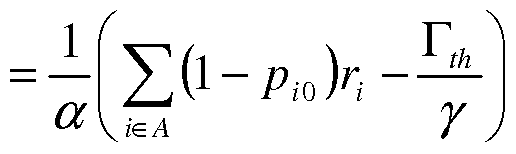 where U' (.) is the derivative of U1 and U''1 (.) is the inverse function of U' (.).
[0048] Let A be the set of users who are admitted into the system before they reach the maximum reputation level. Once λ is computed, the admission delay of each user i can be computed as:

Here, τι msκ = (l - pl0 )/ (X represents the maximum delay user i can observe before being admitted into the system (after T1 ^x the user' s reputation becomes one, thus it does not pose a security risk).
[0049] To find the admission times for each user, the value of the set A needs to be determined. First, observe that for each i e A , the following inequality exists:
T1 = V1 -1 I- (XYr1AU Thmax or equivalently,
 due to the fact that U'(x) is a decreasing function of x. For purposes herein, λ, is referred to as the user priority function. Note that the lower λ values would result in admitting more users into the system since more users would satisfy the above inequality. A lower λ would also decrease the admission delay of each user since U'(x) is a decreasing function of x and so U'~l(— Jt) is an increasing function of x.
Therefore, a lower λ value implies a lower admission delay for users in set A. As a result, the sum utility increases. In one embodiment, the optimum solution finds the smallest X(A) > 0 such that the above constraints are satisfied. [0050] Note that if a user with λ, is in A, then all j such that λ ≥ X1 must be in A. In one embodiment, all users are sorted in increasing λ, such that λ}i < λ]2 < ... < λ]N . Set A can then be one of the following (N +1) subsets A(O) =
{ju... JN], A(I) = {J2,...JN}, A(2) = {J3,...JN}, ..., A(N- 1) = {jN}, A(N) = 0 . In one embodiment, the admission controller executes the following algorithm: for m=0 to N
A := A(m);
Compute λ according to Eq. (9);

If A' ≡ A set X = λ and exit; Else continue to next iteration;
end
[0051] After the algorithm halts, the admission controller computes the admission time T1 of each user i according to Eq. (10) using λ = λ and the last A.
The users are then admitted at time τarr , + T1 , where τarr l is the arrival time of user i into the system.
[0052] In a typical case, where there are multiple arrivals of users over a certain period of time, each new user arrival triggers the re-execution of the algorithm for the users who are waiting for admission either because their admission time is not reached or because their admission time is not yet computed (e.g., the newly arrived users). Suppose Z denotes the set of users at time t who are already admitted into the network, not yet departed, and have reputation less than one, i.e., Z = {Vj : T arr l + T1 < t < τdepart l A P1 < l}. Also, let Ψ be the set of all possible subsets of Z. The first constraint given by (5) can then be rewritten as
EB [D] ≤ Yth - Eψ [D] . In other words, the damage threshold is reduced by the expected damage that can be caused by different subsets of users who are already admitted into the network. As before when linear approximation is used, in one embodiment, this damage is computed as

After the new conditions are taken into account (i.e., the expected damage is updated with the newly arrived users, their reputations, and traffic injection rates), the admission times for the users who are still waiting to enter the network are computed/recomputed using the same algorithm as before. [0053] Figure 5 is a flow diagram of one of embodiment of the admission control process as described above.
Solution for a Specific Utility Function
[0054] In one embodiment, the utility function Ui(T1 J is a concave non- increasing function of T1 . In one embodiment, the following utility function is used:

[0055] Using this expression for the utility, the exact values of priority λ, are calculated from Eq. (11):
 where T1113x represents the maximum tolerable access delay. In one embodiment, the value of β is 1.
[0056] For this specific utility function, the following observations are evident. First, the users with a higher upload rate have lower λ, values, and hence they are more likely to be excluded from set A and wait until the end of a full scan. Also, users with lower T1 max (i.e., with higher initial reputation) are also likely to be delayed until their systems are fully scanned. At first sight, this might seem surprising, since the users with a higher initial reputation value are likely to pose less security risk. However, the key here is the utility function: when users have high initial reputation value, their maximum delays T1 max are already small and their utilities are little impacted by the extra delay. Hence, from the network point of view, it is reasonable to preferentially opt for eliminating the security risks of lower reputation users with full scanning and patching.
[0057] Following the steps of the admission algorithm outlined above and utilizing the expression for λ, from Eq. 14, the expression for λ is computed from Eq.
9:

U;~i- aγrιX] = τ_ £- (16) aγrtλ and the access delay is:

An Example of a Computer System
[0059] Figure 4 is a block diagram of an exemplary computer system that may perform one or more of the operations described herein. Referring to Figure 4, computer system 400 may comprise an exemplary client or server computer system. Computer system 400 comprises a communication mechanism or bus 411 for communicating information, and a processor 412 coupled with bus 411 for processing information. Processor 412 includes a microprocessor, but is not limited to a microprocessor, such as, for example, Pentium™, PowerPC™, Alpha™, etc. [0060] System 400 further comprises a random access memory (RAM), or other dynamic storage device 404 (referred to as main memory) coupled to bus 411 for storing information and instructions to be executed by processor 412. Main memory 404 also may be used for storing temporary variables or other intermediate information during execution of instructions by processor 412. [0061] Computer system 400 also comprises a read only memory (ROM) and/or other static storage device 406 coupled to bus 411 for storing static information and instructions for processor 412, and a data storage device 407, such as a magnetic disk or optical disk and its corresponding disk drive. Data storage device 407 is coupled to bus 411 for storing information and instructions. [0062] Computer system 400 may further be coupled to a display device 421, such as a cathode ray tube (CRT) or liquid crystal display (LCD), coupled to bus 411 for displaying information to a computer user. An alphanumeric input device 422, including alphanumeric and other keys, may also be coupled to bus 411 for communicating information and command selections to processor 412. An additional user input device is cursor control 423, such as a mouse, trackball, trackpad, stylus, or cursor direction keys, coupled to bus 411 for communicating direction information and command selections to processor 412, and for controlling cursor movement on display 421. [0063] Another device that may be coupled to bus 411 is hard copy device
424, which may be used for marking information on a medium such as paper, film,
or similar types of media. Another device that may be coupled to bus 411 is a wired/wireless communication capability 425 to communicate to a network (via a network interface) or another device (e.g., mobile device).
[0064] Note that any or all of the components of system 400 and associated hardware may be used in the present invention. However, it can be appreciated that other configurations of the computer system may include some or all of the devices. [0065] Whereas many alterations and modifications of the present invention will no doubt become apparent to a person of ordinary skill in the art after having read the foregoing description, it is to be understood that any particular embodiment shown and described by way of illustration is in no way intended to be considered limiting. Therefore, references to details of various embodiments are not intended to limit the scope of the claims which in themselves recite only those features regarded as essential to the invention.
Claims
1. A method for admitting a user device waiting to enter a network having one or more currently admitted user devices, the method comprising: receiving a request from the user device to access the network; determining whether to admit the user device based on a security-based admission control policy that admits user devices based on a constraint optimization that attempts to maximize the sum utility of the currently admitted user devices in view of a security assessment of the user device and security risk imposed on the network and already admitted user devices if the user device is admitted to the network, wherein the constraint optimization is based on a utility associated with admitting the user device to the network, a reputation value associated with the user device, and a botnet damage estimation on the network associated with the user device; and admitting the user device to the network based on results of determining whether to admit the user device.
2. An admission control for use in admitting a user device waiting to enter a network having one or more currently admitted user devices, the admission control comprising: a memory to store instructions; and a processor coupled to the memory to execute the instructions to perform a method comprising receiving a request from the user device to access the network, determining whether to admit the user device based on a security- based admission control policy that admits user devices based on a constraint optimization that attempts to maximize the sum utility of the currently admitted user devices in view of a security assessment of the user device and security risk imposed on the network and already admitted user devices if the user device is admitted to the network, wherein the constraint optimization is based on a utility associated with admitting the user device to the network, a reputation value associated with the user device, and a botnet damage estimation on the network associated with the user device, and admitting the user device to the network based on results of determining whether to admit the user device.
3. An article of manufacture having one or more computer readable storage media storing instructions which when executed by an admission controller of a network cause the admission controller to perform a method comprising: receiving a request from the user device to access the network; determining whether to admit the user device based on a security-based admission control policy that admits user devices based on a constraint optimization that attempts to maximize the sum utility of the currently admitted user devices in view of a security assessment of the user device and security risk imposed on the network and already admitted user devices if the user device is admitted to the network, wherein the constraint optimization is based on a utility associated with admitting the user device to the network, a reputation value associated with the user device, and a botnet damage estimation on the network associated with the user device; and admitting the user device to the network based on results of determining whether to admit the user device.
Applications Claiming Priority (4)
| Application Number | Priority Date | Filing Date | Title |
|---|---|---|---|
| US10019208P | 2008-09-25 | 2008-09-25 | |
| US61/100,192 | 2008-09-25 | ||
| US12/537,760 | 2009-08-07 | ||
| US12/537,760 US8316428B2 (en) | 2008-09-25 | 2009-08-07 | Method and apparatus for security-risk based admission control |
Publications (1)
| Publication Number | Publication Date |
|---|---|
| WO2010036612A1 true WO2010036612A1 (en) | 2010-04-01 |
Family
ID=42038969
Family Applications (1)
| Application Number | Title | Priority Date | Filing Date |
|---|---|---|---|
| PCT/US2009/057685 Ceased WO2010036612A1 (en) | 2008-09-25 | 2009-09-21 | A method and apparatus for security-risk based admission control |
Country Status (2)
| Country | Link |
|---|---|
| US (1) | US8316428B2 (en) |
| WO (1) | WO2010036612A1 (en) |
Families Citing this family (48)
| Publication number | Priority date | Publication date | Assignee | Title |
|---|---|---|---|---|
| US10037421B2 (en) | 2010-11-29 | 2018-07-31 | Biocatch Ltd. | Device, system, and method of three-dimensional spatial user authentication |
| US12101354B2 (en) * | 2010-11-29 | 2024-09-24 | Biocatch Ltd. | Device, system, and method of detecting vishing attacks |
| US10083439B2 (en) | 2010-11-29 | 2018-09-25 | Biocatch Ltd. | Device, system, and method of differentiating over multiple accounts between legitimate user and cyber-attacker |
| US10897482B2 (en) | 2010-11-29 | 2021-01-19 | Biocatch Ltd. | Method, device, and system of back-coloring, forward-coloring, and fraud detection |
| US11223619B2 (en) | 2010-11-29 | 2022-01-11 | Biocatch Ltd. | Device, system, and method of user authentication based on user-specific characteristics of task performance |
| US10164985B2 (en) | 2010-11-29 | 2018-12-25 | Biocatch Ltd. | Device, system, and method of recovery and resetting of user authentication factor |
| US8938787B2 (en) * | 2010-11-29 | 2015-01-20 | Biocatch Ltd. | System, device, and method of detecting identity of a user of a mobile electronic device |
| US10728761B2 (en) | 2010-11-29 | 2020-07-28 | Biocatch Ltd. | Method, device, and system of detecting a lie of a user who inputs data |
| US10032010B2 (en) | 2010-11-29 | 2018-07-24 | Biocatch Ltd. | System, device, and method of visual login and stochastic cryptography |
| US10747305B2 (en) | 2010-11-29 | 2020-08-18 | Biocatch Ltd. | Method, system, and device of authenticating identity of a user of an electronic device |
| US9483292B2 (en) | 2010-11-29 | 2016-11-01 | Biocatch Ltd. | Method, device, and system of differentiating between virtual machine and non-virtualized device |
| US10834590B2 (en) | 2010-11-29 | 2020-11-10 | Biocatch Ltd. | Method, device, and system of differentiating between a cyber-attacker and a legitimate user |
| US10621585B2 (en) | 2010-11-29 | 2020-04-14 | Biocatch Ltd. | Contextual mapping of web-pages, and generation of fraud-relatedness score-values |
| US10917431B2 (en) | 2010-11-29 | 2021-02-09 | Biocatch Ltd. | System, method, and device of authenticating a user based on selfie image or selfie video |
| US10055560B2 (en) | 2010-11-29 | 2018-08-21 | Biocatch Ltd. | Device, method, and system of detecting multiple users accessing the same account |
| US10474815B2 (en) | 2010-11-29 | 2019-11-12 | Biocatch Ltd. | System, device, and method of detecting malicious automatic script and code injection |
| US10970394B2 (en) | 2017-11-21 | 2021-04-06 | Biocatch Ltd. | System, device, and method of detecting vishing attacks |
| US11269977B2 (en) | 2010-11-29 | 2022-03-08 | Biocatch Ltd. | System, apparatus, and method of collecting and processing data in electronic devices |
| US10949757B2 (en) | 2010-11-29 | 2021-03-16 | Biocatch Ltd. | System, device, and method of detecting user identity based on motor-control loop model |
| US10949514B2 (en) | 2010-11-29 | 2021-03-16 | Biocatch Ltd. | Device, system, and method of differentiating among users based on detection of hardware components |
| US10476873B2 (en) | 2010-11-29 | 2019-11-12 | Biocatch Ltd. | Device, system, and method of password-less user authentication and password-less detection of user identity |
| US10069837B2 (en) * | 2015-07-09 | 2018-09-04 | Biocatch Ltd. | Detection of proxy server |
| US20190158535A1 (en) * | 2017-11-21 | 2019-05-23 | Biocatch Ltd. | Device, System, and Method of Detecting Vishing Attacks |
| US9526006B2 (en) * | 2010-11-29 | 2016-12-20 | Biocatch Ltd. | System, method, and device of detecting identity of a user of an electronic device |
| US10298614B2 (en) * | 2010-11-29 | 2019-05-21 | Biocatch Ltd. | System, device, and method of generating and managing behavioral biometric cookies |
| US10586036B2 (en) | 2010-11-29 | 2020-03-10 | Biocatch Ltd. | System, device, and method of recovery and resetting of user authentication factor |
| US10776476B2 (en) | 2010-11-29 | 2020-09-15 | Biocatch Ltd. | System, device, and method of visual login |
| US10069852B2 (en) | 2010-11-29 | 2018-09-04 | Biocatch Ltd. | Detection of computerized bots and automated cyber-attack modules |
| US10404729B2 (en) | 2010-11-29 | 2019-09-03 | Biocatch Ltd. | Device, method, and system of generating fraud-alerts for cyber-attacks |
| US9069942B2 (en) * | 2010-11-29 | 2015-06-30 | Avi Turgeman | Method and device for confirming computer end-user identity |
| US20250016199A1 (en) * | 2010-11-29 | 2025-01-09 | Biocatch Ltd. | Device, System, and Method of Detecting Vishing Attacks |
| US10685355B2 (en) * | 2016-12-04 | 2020-06-16 | Biocatch Ltd. | Method, device, and system of detecting mule accounts and accounts used for money laundering |
| US10262324B2 (en) | 2010-11-29 | 2019-04-16 | Biocatch Ltd. | System, device, and method of differentiating among users based on user-specific page navigation sequence |
| US10395018B2 (en) | 2010-11-29 | 2019-08-27 | Biocatch Ltd. | System, method, and device of detecting identity of a user and authenticating a user |
| US11210674B2 (en) | 2010-11-29 | 2021-12-28 | Biocatch Ltd. | Method, device, and system of detecting mule accounts and accounts used for money laundering |
| US9172678B2 (en) | 2011-06-28 | 2015-10-27 | At&T Intellectual Property I, L.P. | Methods and apparatus to improve security of a virtual private mobile network |
| KR20130022046A (en) * | 2011-08-24 | 2013-03-06 | 한국전자통신연구원 | Method and system for enhancing the privacy of contact information in profile |
| US9384336B1 (en) * | 2012-10-08 | 2016-07-05 | Symantec Corporation | Systems and methods for modifying security based on reputation information |
| KR102060703B1 (en) | 2013-03-11 | 2020-02-11 | 삼성전자주식회사 | Optimizing method of mobile system |
| CN103873483B (en) * | 2014-03-31 | 2017-05-24 | 北京工业大学 | Access control method based on repeated game |
| US9848005B2 (en) * | 2014-07-29 | 2017-12-19 | Aruba Networks, Inc. | Client reputation driven role-based access control |
| GB2539705B (en) | 2015-06-25 | 2017-10-25 | Aimbrain Solutions Ltd | Conditional behavioural biometrics |
| GB2552032B (en) | 2016-07-08 | 2019-05-22 | Aimbrain Solutions Ltd | Step-up authentication |
| US10198122B2 (en) | 2016-09-30 | 2019-02-05 | Biocatch Ltd. | System, device, and method of estimating force applied to a touch surface |
| US10579784B2 (en) | 2016-11-02 | 2020-03-03 | Biocatch Ltd. | System, device, and method of secure utilization of fingerprints for user authentication |
| US10397262B2 (en) | 2017-07-20 | 2019-08-27 | Biocatch Ltd. | Device, system, and method of detecting overlay malware |
| US11606353B2 (en) | 2021-07-22 | 2023-03-14 | Biocatch Ltd. | System, device, and method of generating and utilizing one-time passwords |
| US11979291B1 (en) * | 2022-10-27 | 2024-05-07 | Red Hat, Inc. | Cluster boundary enforcer service |
Citations (3)
| Publication number | Priority date | Publication date | Assignee | Title |
|---|---|---|---|---|
| US20050228874A1 (en) * | 2004-04-08 | 2005-10-13 | Edgett Jeff S | Method and system for verifying and updating the configuration of an access device during authentication |
| WO2005107204A1 (en) * | 2004-05-04 | 2005-11-10 | Telecom Italia S.P.A. | Method and system for access control in distributed object-oriented systems |
| WO2005111841A2 (en) * | 2004-05-10 | 2005-11-24 | Trusted Network Technologies, Inc. | System, apparatuses, methods and computer-readable media for determining security status of computer before establishing connection thereto |
Family Cites Families (1)
| Publication number | Priority date | Publication date | Assignee | Title |
|---|---|---|---|---|
| US20050049892A1 (en) * | 2003-07-22 | 2005-03-03 | Miller Charles J. | System and method for supply chain collaborative risk management |
-
2009
- 2009-08-07 US US12/537,760 patent/US8316428B2/en active Active
- 2009-09-21 WO PCT/US2009/057685 patent/WO2010036612A1/en not_active Ceased
Patent Citations (3)
| Publication number | Priority date | Publication date | Assignee | Title |
|---|---|---|---|---|
| US20050228874A1 (en) * | 2004-04-08 | 2005-10-13 | Edgett Jeff S | Method and system for verifying and updating the configuration of an access device during authentication |
| WO2005107204A1 (en) * | 2004-05-04 | 2005-11-10 | Telecom Italia S.P.A. | Method and system for access control in distributed object-oriented systems |
| WO2005111841A2 (en) * | 2004-05-10 | 2005-11-24 | Trusted Network Technologies, Inc. | System, apparatuses, methods and computer-readable media for determining security status of computer before establishing connection thereto |
Also Published As
| Publication number | Publication date |
|---|---|
| US20100077470A1 (en) | 2010-03-25 |
| US8316428B2 (en) | 2012-11-20 |
Similar Documents
| Publication | Publication Date | Title |
|---|---|---|
| US8316428B2 (en) | Method and apparatus for security-risk based admission control | |
| US11848957B1 (en) | Session management | |
| Rios Insua et al. | An adversarial risk analysis framework for cybersecurity | |
| US12088616B2 (en) | Deep cyber vulnerability mitigation system | |
| Rabai et al. | A cybersecurity model in cloud computing environments | |
| US9330262B2 (en) | Systems and methods for runtime adaptive security to protect variable assets | |
| Panaousis et al. | Cybersecurity games and investments: A decision support approach | |
| Vakilinia et al. | A coalitional cyber-insurance framework for a common platform | |
| TWI719508B (en) | Threshold value determination and identity verification method, device, electronic equipment and storage medium | |
| CN105763547A (en) | Third-party authorization method and third-party authorization system | |
| US20090241168A1 (en) | System and methods for protecting confidential information on network sites based on security awareness | |
| KR20150070340A (en) | Security broker | |
| US20090205046A1 (en) | Method and apparatus for compensating for and reducing security attacks on network entities | |
| Pal et al. | A new trusted and collaborative agent based approach for ensuring cloud security | |
| CA2675664A1 (en) | Escalation of user identity and validation requirements to counter a threat | |
| KR101987312B1 (en) | Method, apparatus and computer program for security investment considering characteristics of cloud service | |
| Jain et al. | Optimizing payment gateways in Fintech using AI-Augmented OCR and intelligent workflow | |
| CN109714301A (en) | Register Risk Identification Method, device, electronic equipment and storage medium | |
| US11677765B1 (en) | Distributed denial of service attack mitigation | |
| Paavolainen et al. | Risks from spam attacks on blockchains for intemet-of-things devices | |
| Rahaman et al. | Security Benefits in Small Medium Business Enterprise Through Cloud Adoption | |
| Halabi | Adaptive security risk mitigation in edge computing: Randomized defense meets prospect theory | |
| CN114301711B (en) | Anti-riot brushing method, device, equipment, storage medium and computer program product | |
| CN117014187A (en) | Access control method, device, equipment and storage medium of cloud computing service | |
| Radosavac et al. | On the use of admission control for better quality of security |
Legal Events
| Date | Code | Title | Description |
|---|---|---|---|
| 121 | Ep: the epo has been informed by wipo that ep was designated in this application |
Ref document number: 09792781 Country of ref document: EP Kind code of ref document: A1 |
|
| 122 | Ep: pct application non-entry in european phase |
Ref document number: 09792781 Country of ref document: EP Kind code of ref document: A1 |
|
| NENP | Non-entry into the national phase |
Ref country code: DE |