WO2010035892A1 - Speech recognition method - Google Patents
Speech recognition method Download PDFInfo
- Publication number
- WO2010035892A1 WO2010035892A1 PCT/JP2009/067135 JP2009067135W WO2010035892A1 WO 2010035892 A1 WO2010035892 A1 WO 2010035892A1 JP 2009067135 W JP2009067135 W JP 2009067135W WO 2010035892 A1 WO2010035892 A1 WO 2010035892A1
- Authority
- WO
- WIPO (PCT)
- Prior art keywords
- model
- environment
- speech
- noise
- speech recognition
- Prior art date
- Legal status (The legal status is an assumption and is not a legal conclusion. Google has not performed a legal analysis and makes no representation as to the accuracy of the status listed.)
- Ceased
Links
Classifications
-
- G—PHYSICS
- G10—MUSICAL INSTRUMENTS; ACOUSTICS
- G10L—SPEECH ANALYSIS TECHNIQUES OR SPEECH SYNTHESIS; SPEECH RECOGNITION; SPEECH OR VOICE PROCESSING TECHNIQUES; SPEECH OR AUDIO CODING OR DECODING
- G10L15/00—Speech recognition
- G10L15/20—Speech recognition techniques specially adapted for robustness in adverse environments, e.g. in noise, of stress induced speech
-
- G—PHYSICS
- G10—MUSICAL INSTRUMENTS; ACOUSTICS
- G10L—SPEECH ANALYSIS TECHNIQUES OR SPEECH SYNTHESIS; SPEECH RECOGNITION; SPEECH OR VOICE PROCESSING TECHNIQUES; SPEECH OR AUDIO CODING OR DECODING
- G10L15/00—Speech recognition
- G10L15/06—Creation of reference templates; Training of speech recognition systems, e.g. adaptation to the characteristics of the speaker's voice
- G10L15/065—Adaptation
Definitions
- the present invention is concerned with the technical field of pattern recognition and specifically speech recognition. More particularly, the present invention is concerned with speech recognition in noisy environments.
- Speech recognition is a technique which relies on the use of trained models such as Hidden Markov Models (HMMs) to decode an audio speech signal into recognisable words which can either be displayed or further processed. Further processing may include outputting the text into a language translation device or converting it into an understandable instruction for use voice controlled apparatus.
- HMMs Hidden Markov Models
- Further processing may include outputting the text into a language translation device or converting it into an understandable instruction for use voice controlled apparatus.
- the models are trained in a noise-free environment.
- the systems are generally used in relatively noisy environments compared to the laboratory training environment.
- VTS vector Taylor series
- JUD joint uncertainty decoding
- ⁇ x r , ⁇ r x , ⁇ y r , and ⁇ r y are respectively the mean and covariance for clean and noisy speech in regression class r
- ⁇ r y X is the cross covariance matrix.
- the calculation of ⁇ r vx is costly from a computational point of view and is often approximated by a first order Taylor expansion.
- the JUD is essentially equivalent to the VTS method since they both involve the calculation of a first order Taylor series.
- the first order calculation is performed for each Gaussian whereas in the JUD, it is performed for each regression class. This means that the JUD method is computationally advantageous over the VTS method.
- the JUD method has considerably lower accuracy than VTS.
- the present inventors have attempted to address the above problem and derive a speech recognition method which is computationally on a par with a JUD method but also achieves better accuracy than the VTS method.
- the present invention provides a speech recognition method, comprising: receiving a speech input in a first noise environment which comprises a sequence of observations; determining the likelihood of a sequence of words arising from the sequence of observations using an acoustic model, comprising: providing an acoustic model for performing speech recognition on a input signal which comprises a sequence of observations, wherein the model has been trained to recognise speech in a second noise environment, the model having a plurality of model parameters relating to the probability distribution of a word or part thereof being related to an observation; and adapting the model trained in the second environment to that of the first environment, the speech recognition method further comprising determining the likelihood of a sequence of observations occurring in a given language using a language model; combining the likelihoods determined by the acoustic model and the language model and outputting a sequence of words identified from the speech input signal, wherein adapting the model trained in the second environment to that of the first environment comprises using second order or higher order Taylor expansion coefficients derived for a group of probability
- the model may be adapted by converting the parameters obtained for the second noise environment into parameters for the first noise environment.
- the means and the variance of the pdf determined for the second noise environment may be directly modified to means and variances of pdfs in the first noise environment.
- the model may also be adapted in a way which has the effect of modifying these parameters, but which does not directly translate these parameters.
- the JUD style adaptation of equation (d) above may be used.
- the groups are further combined to form aggregated groups and jth order Taylor coefficients are calculated and used for the groups and j+l tn order coefficients are calculated and used for the aggregated groups, where j is an integer of at least one.
- the groups are preferably regression classes which are formed during the training of the model in the second noise environment. These classes will usually be formed before the model is used for speech recorded in the first environment.
- the groups are regression classes formed by sequentially subdividing the total number of probability distributions by two, to form 2 classes, then 4 classes, then 8 classes etc to form a regression tree.
- the number of regression classes may be in the range from 4 to 32, for example preferable 8 to 32.
- the first order Taylor coefficients may be calculated for classes on one level on the regression tree, whereas the second order may be calculated for a different level with fewer regression classes. It has been found that calculating the second order coefficients for the regression tree level with just two classes provides significant improvement.
- the delta and delta-delta mean and or variance are also used. However, it is not necessary to use the same order of Taylor expansion on each of the static, delta and delta-delta parts.
- the second order is calculated for the static and delta parts, but not for the delta- delta parts. It is also possible just to calculate the second order for the static parts alone.
- the noise parameters may comprises a component for additive noise and a component for convolutional noise.
- the relationship between a feature or observation in the first noise environment and a feature or observation in the second noise environment maybe related by:
- y is the observation in the first noise environment
- x is the observation in the second noise environment
- n is the additive noise
- h is the convolutional noise in the first environment with respect to the second environment
- C is the discrete cosine transformation matrix.
- the means of the noise parameters are estimated and used to determine the Taylor expansion coefficients.
- the process of estimating the means may involve performing an initial estimate from parts of the speech input signal where speech is not present.
- the initial estimate may be further refined by using a well known method such as an expectation-maximisation method in which it is based on the whole utterance, i.e. not only the silence part.
- the probability functions are Gaussians and the acoustic model is a hidden Markov Model.
- the first environment is a noisy environment and the second environment is a noise free environment.
- the present invention can be used to adapt a model between any two environments with different noise levels.
- the method may be embodied in a system such that the system always applies the method without performing any test for noisiness of the environment.
- a noise test may be performed first to see if the noise conditions warrant the use of compensating the model as described above.
- the invention may be used as part of a speech translation system where the output of the above method is translated into a different language; and outputted the recognised speech in the different language.
- the outputting may comprise using a text to speech conversion method.
- the present invention provides a speech recognition apparatus, the apparatus comprising: a receiver for a speech input, the speech input comprising a sequence of observations, a processor adapted to determine the likelihood of a sequence of words arising from the sequence of observations using an acoustic model, the processor being adapted to : provide an acoustic model for performing speech recognition on the input signal, wherein the model has been trained to recognise speech in a second noise environment which is different to the first noise environment of the speech input, the model having a plurality of model parameters relating to the probability distribution of a word or part thereof being related to an observation; adapting the model trained in the second environment to that of the first environment; the processor being further adapted to determine the likelihood of a sequence of observations occurring in a given language using a language model; and combine the likelihoods determined by the acoustic model and the language model, the apparatus further comprising an output adapted for outputting a sequence of words identified from the speech input signal, wherein adapting the model trained in the second environment to that
- the method comprises: providing a model for performing speech recognition on a input signal which comprises a sequence of observations, wherein the model has been trained to recognise speech in a second noise environment, the model having a plurality of model parameters relating to the probability distribution of a word or part thereof being related to an observation; and adapting the model trained in the second environment to that of the first environment; wherein adapting the model trained in the second environment to that of the first environment comprises using second order or higher order Taylor expansion coefficients derived for a group of probability distributions and wherein the same expansion coefficient is used for the whole group.
- the present invention provides a method of adapting a pattern recognition model between first and second noise environments, the method comprising: providing a model for performing pattern recognition on a input signal which comprises a seguence of observations, wherein the model has been trained to recognise a pattern in the second noise environment, the model having a plurality of model parameters relating to the probability distribution of a component of a pattern being related to an observation; and adapting the model trained in the second environment to that of the first environment, wherein adapting the model trained in the second environment to that of the first environment comprises using second order or higher order Taylor expansion coefficients derived for a group of probability distributions and wherein the same expansion coefficient is used for the whole group
- the present invention provides a computer running a computer program configured to cause a computer to perform any of the above methods,
- FIG. 1 is a schematic of a general speech recognition system
- FIG. 2 is a schematic of the components of a speech recognition processor
- FIG. 3 is a schematic of a Gaussian probability function
- FIG. 4 is a schematic plot of acoustic space representing both probability density functions and an observation vector
- FIG. 5 is a flow diagram showing a speech recognition method in accordance with an embodiment of the present invention.
- FIG. 6 is a schematic of a regression tree
- FIG. 7 is a plot of an error rate in a speech recognition system against number of aggression classes for the present invention and the prior art methods
- FIG. 8 is a plot of the number of transforms involved against number of aggressions classes for the method of the present invention and the prior art. Best Mode for Carrying Out the Invention
- FIG. 1 is a schematic of a very basic speech recognition system.
- a user (not shown) speaks into microphone 1 or other collection device for an audio system.
- the device 1 could be substituted by a memory which contains audio data previously recorded or the device 1 may be a network connection for receiving audio data from a remote location.
- the speech signal is then directed into a speech processor 3 which will be described in more detail with reference to FIG. 2.
- the speech processor 3 takes the speech signal and turns it into text corresponding to the speech signal.
- the output may be in the form of a display 5 which outputs to a screen.
- the output could be directed to a printer or the like.
- the output could be in the form of an electronic signal which is provided to a further system 9.
- the further system 9 could be part of a speech translation system which takes the outputted text from processor 3 and then converts it into a different language. The converted text is then outputted via a further text or speech system.
- the text outputted by the processor 3 could be used to operate different types of equipment, for example, it could be part of a mobile phone, car, etc. where the user controls various functions via speech.
- FIG. 2 is a block diagram of the standard components of a speech recognition processor 3 of the type shown in FIG. 1.
- the speech signal received from microphone, through a network or from a recording medium 1 is directed into front-end unit 11.
- the front end unit 11 digitises the received speech signal and splits it into frames of equal lengths.
- the speech signals are then subjected to a spectral analysis to determine various parameters which are plotted in an "acoustic space". The parameters which are derived will be discussed in more detail later.
- the front end unit 11 also removes signals which are believed not to be speech signals and other irrelevant information.
- Popular front end units comprise apparatus which use filter bank (F BANK) parameters, MelFrequency Cepstral Coefficients (MFCC) and Perceptual Linear Predictive (PLP) parameters.
- F BANK filter bank
- MFCC MelFrequency Cepstral Coefficients
- PLP Perceptual Linear Predictive
- the input vector is then fed into a decoder 13 which cooperates with both an acoustic model section 15 and a language model section 17.
- the acoustic model section 15 will generally operate using Hidden Markov Models. However, it is also possible to use acoustic models based on connectionist models and hybrid models.
- the acoustic model unit 15 derives the likelihood of a sequence of observations corresponding to a word or part thereof on the basis of the acoustic input alone.
- the language model section 17 contains information concerning probabilities of a certain sequence of words or parts of words following each other in a given language. Generally a static model is used. The most popular method is the N-gram model.
- the decoder 13 then traditionally uses a dynamic programming (DP) approach to find the best transcription for a given speech utterance using the results from the acoustic model 15 and the language model 17. This is then output via the output device 19 which allows the text to be displayed, presented or converted for further use e.g. in speech to speech translation or to control a voice activated device.
- DP dynamic programming
- HMM Hidden Markov Model
- PDFs probability density functions
- this probability distribution will be a Gaussian distribution in n-dimensional space.
- FIG. 3 A schematic example of a generic Gaussian distribution is shown in FIG. 3.
- the horizontal axis corresponds to a parameter of the input vector in one dimension and the probability distribution is for a particular word or part thereof relating to the observation.
- an observation corresponding to an acoustic vector x has a probability pi of corresponding to the word whose probability distribution is shown in FIG. 3.
- the shape and position of the Gaussian is defined by its mean and variance.
- FIG. 4 is schematic plot of acoustic space where an observation is represented by an observation vector or feature vector x ⁇ .
- the open circles g correspond to the means of Gaussians or other probability distribution functions plotted in acoustic space.
- the acoustic model will calculate a number of different likelihoods that the feature vector xi corresponds to a word or part thereof represented by the Gaussians. These likelihoods are then used in the acoustic model and combined with probabilities from the language model to determine the text spoken.
- the acoustic model is generally trained under noise-free or so-called "clean" conditions. However, the error rate of the system will increase if the speech inputted into the system is then collected under noisier conditions.
- the front-end unit 11 described with reference to FIG. 2 can remove some of the noise. However, some of it is so engrained into the inputted speech signal that it is impossible to remove at this early stage.
- FIG. 5 is a flow diagram of a method in accordance with an embodiment of the present invention for coping with a noisy input signal when using an acoustic model which has been trained under clean conditions.
- the noisy input signal is collected in S51. This has been explained with reference to FIGS. 1 and 2.
- noise is then determined in step S53.
- a possible method of estimating the noise is to evaluate a part of the input signal where there is no speech. Often the first and last few frames are assumed to have no speech.
- noise is categorised as either additive noise n or convolutional noise h.
- Additive noise n is the general background noise whereas convolutional noise h is the channel noise.
- a model for relating features in a noisy environment to those of a clean environment is expressed as:
- C denotes the discrete cosine transformation matrix
- n, h, x and y are static features for additive noise, convolutional noise, clean speech and noisy speech respectively.
- the delta term is the first derivative with respect to time of the mean or variance and the delta-delta term is the second derivative with respect to time of the mean or variance.
- regression classes are used to form the groups.
- Regression classes are generated with Gaussians which model certain characteristics being grouped together. They are developed during initial training of the model in the second or clean noise environment and so are available for use. This regression process is well-known and will not be described in more detail here
- FIG. 6 shows a schematic of a regression tree which is used to form the regression classes.
- level (i) all of the Gaussians from one group. This group is then divided into two classes at level (ii) . These two classes are then sub-divided again into four classes at level (iii) , then into eight classes at level (iv) etc.
- step S57 the Taylor expansion coefficients for each class are determined.
- I is the identity matrix.
- the mean and variances of the Gaussians for a noisy environment and a clean environment can be related.
- Taylor expansion coefficients are calculated for each Gaussian.
- the known JUD method also uses a Taylor expansion.
- the likelihood calculation for each Gaussian mixture of the full noisy feature Y which includes static, delta and delta-delta parts is: where assuming that mixture m relates to the rth regression class, A r , b r and ⁇ r ] D are JUD transforms related to the regression class:
- ⁇ x r , ⁇ r x , ⁇ v r , and ⁇ r v are respectively the mean and covariance for clean and noisy speech in regression class r
- ⁇ r vx is the cross covariance matrix
- the JUD then becomes largely equivalent to the VTS method except that instead of using the mean of each mixture, the JUD applies the expansion over the mean of the regression class.
- the method in accordance with the embodiment can be thought of as a JUD method using a second or higher order Taylor expansion.
- a second order approximation and using the extension point ( ⁇ x r . ⁇ i n , u h) the second order Taylor on this feature vector is
- d m , d m ⁇ , d m ⁇ are vectors dependent on each mixture.
- the parameters are used to modify the existing acoustic model parameters as set out in step S59.
- the acoustic model is then run for noisy input using the modified parameters in step 61.
- the identified words are then output in step 63.
- the first and second order Taylor coefficients are calculated for each regression class in the regression class level chosen. For example, if level (iv) is chosen, then the first and second order Taylor coefficients are calculated for each of the 8 regression classes on that level.
- the first order Taylor coefficient is calculated for each of the regression classes to which the Gaussians have been assigned.
- the second order Taylor coefficients are only calculated for the higher groups.
- FIG. 6 there are 8 regression classes on level (iv) R ⁇ to Rg.
- the first order Taylor expansion coefficient will be calculated from the means from each of the regression classes R ] _ to Rg.
- the second order Taylor coefficients will only be calculated for the 4 classes of level (iii) .
- the same second order Taylor coefficients are used for classes R]_ and R2 and the same second order Taylor coefficients are used for groups R3 and R4.
- the above approximation enhances the speed of operation since the g vector and the W r and K r matrices are costly in the second order approximation. Therefore, by reducing the overall number of these matrices and vectors which need to be calculated, the efficiency may be improved.
- the lower order terms in the Taylor series are more important than the higher order ones. Specifically, the zeroth order term g is most important for the Taylor expansion, the first order term W r is less important whereas the second order term K r is of least importance. Therefore only calculating to K r for a larger group which will be applied to more than one group will not result in a significant change in accuracy.
- the method can be adapted to that different levels of regression classes are used for different orders of Taylor expansion coefficients with lower order coefficients being calculated for more regression classes and higher order coefficients being calculated for fewer classes. It has also been noted that applying a second order approximation for JUD in the delta-delta feature part provides little improvement to accuracy compared to the static and delta parts. Considering the computational costs, it is preferred to only calculate the second order JUD for the static and delta parts and use just the first order JUD for the delta-delta part.
- FIG. 7 is a plot of the word error rate (WER) against number of regression classes used. The result is shown for the prior art methods of VTS, second order VTS (2 nd VTS) . It should be noted that both of these traces are constant regardless of the number of regression classes simply because they do not use regression classes.
- the data also shows first order JUD (1 st JUD) results. Finally, results from two implementations of the present embodiment are shown, 2 nd JUD where both the first order an second order coefficients are calculated for each regression class and 2 nd JUD-TIE2 where first order coefficients are calculated for each regression class and 2 nd order coefficients are only calculated for 2 regressions classes (i.e. level (ii) of FIG. 6).
- Test sets A and B respectively include four types of additive noise with SNR ranging from 20 to 0 decibels where set C also contains convolutional noise.
- the clean training set was used to train the model and test sets A and B were used for the regression test.
- the first order VTS was then applied to adapt the HMM in order to generate an initial recognition hypothesis.
- Table 2 shows the number of transformations i.e. K and W matrices involved in each method.
- the computational cost is quantified as "number of instructions" against number of regression classes is shown in FIG. 8.
- the JUD based methods have a limited number of transforms compared to VTS and therefore far less computational costs.
- the second order approximation in JUD does introduce extra computational costs, but it is still much faster than first order and second VTS.
- Such an extra computational cost could be largely reduced by using the simplified second order approximation.
- JUD with simplified second order approximation is about 60% faster than the first order VTS.
Landscapes
- Engineering & Computer Science (AREA)
- Computational Linguistics (AREA)
- Health & Medical Sciences (AREA)
- Audiology, Speech & Language Pathology (AREA)
- Human Computer Interaction (AREA)
- Physics & Mathematics (AREA)
- Acoustics & Sound (AREA)
- Multimedia (AREA)
- Artificial Intelligence (AREA)
- Machine Translation (AREA)
Abstract
A speech recognition method comprises receiving a speech input in a first noise environment which comprises a sequence of observations, determining the likelihood of a sequence of words arising from the sequence of observations using an acoustic model, adapting the model trained in a second noise environment to that of the first environment, wherein adapting the model trained in the second environment to that of the first environment comprises using second order or higher order Taylor expansion coefficients derived for a group of probability distributions and the same expansion coefficient is used for the whole group.
Description
D E S C R I P T I O N
SPEECH RECOGNITION METHOD
Technical Field
The present invention is concerned with the technical field of pattern recognition and specifically speech recognition. More particularly, the present invention is concerned with speech recognition in noisy environments.
Background Art
Speech recognition is a technique which relies on the use of trained models such as Hidden Markov Models (HMMs) to decode an audio speech signal into recognisable words which can either be displayed or further processed. Further processing may include outputting the text into a language translation device or converting it into an understandable instruction for use voice controlled apparatus. Generally, the models are trained in a noise-free environment. However, in use, the systems are generally used in relatively noisy environments compared to the laboratory training environment.
Two successful techniques have been developed for speech recognition in noisy environments. The first of these is the vector Taylor series (VTS) method. The VTS method is described in Acero et al: "HMM adaptation
using vector Taylor series for noisy speech recognition", In ICSLP-2000, vol.3, 869-872. The VTS method compensates the HMM on each Gaussian mixture level. The system uses the mean value of each mixture as the Taylor extension points and calculates the Taylor extension matrices for each mixture. The likelihood during recognition is then expressed as: p(yIm)=N(y; μy m; ∑y m) (a) where p(ylm) is the likelihood of the Gaussian mixture m from the noisy speech feature y, μv and ∑v are the Gaussian mixture mean and variance.
In the VTS, it is assumed that the relationship between noisy and clean features is as follows:


The above method suffers from the problem in that it is computationally very laborious since conversion parameters need to be calculated for each Gaussian in the HMM. Generally, in this procedure, only the first order Taylor series expansion is used.
An alternative method is the so-called joint uncertainty decoding (JUD) method, which is described in Liao, H. / Gales, M. J. F. (2005) : "Joint uncertainty decoding for noise robust speech recognition", In INTERSPEECH-2005, 3129-3132. The JUD method calculates the output probability for the mixture m as follows:

It is assumed that mixture m belongs to the r^h regression class the method is performed in a class-by- class basis. This means that the JUD transforms relate to the same regression class are defined as:

After manipulating the results, it can be seen that the JUD is essentially equivalent to the VTS method since they both involve the calculation of a first order Taylor series. However, in the VTS, the first order calculation is performed for each Gaussian whereas in the JUD, it is performed for each regression class. This means that the JUD method is computationally advantageous over the VTS method. However, the JUD method has considerably lower accuracy than VTS.
Disclosure of Invention
The present inventors have attempted to address the above problem and derive a speech recognition method which is computationally on a par with a JUD method but also achieves better accuracy than the VTS method.
Thus, in a first aspect, the present invention provides a speech recognition method, comprising: receiving a speech input in a first noise environment which comprises a sequence of observations; determining the likelihood of a sequence of
words arising from the sequence of observations using an acoustic model, comprising: providing an acoustic model for performing speech recognition on a input signal which comprises a sequence of observations, wherein the model has been trained to recognise speech in a second noise environment, the model having a plurality of model parameters relating to the probability distribution of a word or part thereof being related to an observation; and adapting the model trained in the second environment to that of the first environment, the speech recognition method further comprising determining the likelihood of a sequence of observations occurring in a given language using a language model; combining the likelihoods determined by the acoustic model and the language model and outputting a sequence of words identified from the speech input signal, wherein adapting the model trained in the second environment to that of the first environment comprises using second order or higher order Taylor expansion coefficients derived for a group of probability distributions and wherein the same expansion coefficient is used for the whole group. The model may be adapted by converting the
parameters obtained for the second noise environment into parameters for the first noise environment. For example, the means and the variance of the pdf determined for the second noise environment may be directly modified to means and variances of pdfs in the first noise environment. The model may also be adapted in a way which has the effect of modifying these parameters, but which does not directly translate these parameters. For example, the JUD style adaptation of equation (d) above may be used.
In a preferred embodiment, the groups are further combined to form aggregated groups and jth order Taylor coefficients are calculated and used for the groups and j+ltn order coefficients are calculated and used for the aggregated groups, where j is an integer of at least one.
The groups are preferably regression classes which are formed during the training of the model in the second noise environment. These classes will usually be formed before the model is used for speech recorded in the first environment.
In a further preferred embodiment, the groups are regression classes formed by sequentially subdividing the total number of probability distributions by two, to form 2 classes, then 4 classes, then 8 classes etc to form a regression tree. In such an arrangement, the number of regression classes may be in the range from 4
to 32, for example preferable 8 to 32.
The first order Taylor coefficients may be calculated for classes on one level on the regression tree, whereas the second order may be calculated for a different level with fewer regression classes. It has been found that calculating the second order coefficients for the regression tree level with just two classes provides significant improvement.
Although it is possible to perform speech recognition using just the static parts of speech preferably the delta and delta-delta mean and or variance are also used. However, it is not necessary to use the same order of Taylor expansion on each of the static, delta and delta-delta parts. In a preferred embodiment, the second order is calculated for the static and delta parts, but not for the delta- delta parts. It is also possible just to calculate the second order for the static parts alone.
The noise parameters may comprises a component for additive noise and a component for convolutional noise.
The relationship between a feature or observation in the first noise environment and a feature or observation in the second noise environment maybe related by:

In the preferred embodiment, the means of the noise parameters are estimated and used to determine the Taylor expansion coefficients. The process of estimating the means may involve performing an initial estimate from parts of the speech input signal where speech is not present. The initial estimate may be further refined by using a well known method such as an expectation-maximisation method in which it is based on the whole utterance, i.e. not only the silence part.
Generally, the probability functions are Gaussians and the acoustic model is a hidden Markov Model.
In many situations the first environment is a noisy environment and the second environment is a noise free environment. However, it will be appreciated by those skilled in the art that the present invention can be used to adapt a model between any two environments with different noise levels.
The method may be embodied in a system such that the system always applies the method without performing any test for noisiness of the environment. Alternatively, a noise test may be performed first to
see if the noise conditions warrant the use of compensating the model as described above.
The invention may be used as part of a speech translation system where the output of the above method is translated into a different language; and outputted the recognised speech in the different language. The outputting may comprise using a text to speech conversion method.
In a second aspect, the present invention provides a speech recognition apparatus, the apparatus comprising: a receiver for a speech input, the speech input comprising a sequence of observations, a processor adapted to determine the likelihood of a sequence of words arising from the sequence of observations using an acoustic model, the processor being adapted to : provide an acoustic model for performing speech recognition on the input signal, wherein the model has been trained to recognise speech in a second noise environment which is different to the first noise environment of the speech input, the model having a plurality of model parameters relating to the probability distribution of a word or part thereof being related to an observation; adapting the model trained in the second environment to that of the first environment;
the processor being further adapted to determine the likelihood of a sequence of observations occurring in a given language using a language model; and combine the likelihoods determined by the acoustic model and the language model, the apparatus further comprising an output adapted for outputting a sequence of words identified from the speech input signal, wherein adapting the model trained in the second environment to that of the first environment comprises using second order or higher order Taylor expansion coefficients derived for a group of probability distributions and wherein the same expansion coefficient is used for the whole group.
The above can be thought of as a method for adapting a speech recognition model between first and second noise environments, thus, in a third aspect, the method comprises: providing a model for performing speech recognition on a input signal which comprises a sequence of observations, wherein the model has been trained to recognise speech in a second noise environment, the model having a plurality of model parameters relating to the probability distribution of a word or part thereof being related to an observation; and
adapting the model trained in the second environment to that of the first environment; wherein adapting the model trained in the second environment to that of the first environment comprises using second order or higher order Taylor expansion coefficients derived for a group of probability distributions and wherein the same expansion coefficient is used for the whole group.
Although the above description has concentrated on speech recognition, the method could also be applied to other forms of pattern recognition.
Therefore, in a fourth aspect, the present invention provides a method of adapting a pattern recognition model between first and second noise environments, the method comprising: providing a model for performing pattern recognition on a input signal which comprises a seguence of observations, wherein the model has been trained to recognise a pattern in the second noise environment, the model having a plurality of model parameters relating to the probability distribution of a component of a pattern being related to an observation; and adapting the model trained in the second environment to that of the first environment, wherein adapting the model trained in the second environment to that of the first environment
comprises using second order or higher order Taylor expansion coefficients derived for a group of probability distributions and wherein the same expansion coefficient is used for the whole group In a fifth aspect, the present invention provides a computer running a computer program configured to cause a computer to perform any of the above methods,
The present invention will now described with reference to the following non-limiting embodiments in which:
Brief Description of Drawings FIG. 1 is a schematic of a general speech recognition system;
FIG. 2 is a schematic of the components of a speech recognition processor;
FIG. 3 is a schematic of a Gaussian probability function;
FIG. 4 is a schematic plot of acoustic space representing both probability density functions and an observation vector;
FIG. 5 is a flow diagram showing a speech recognition method in accordance with an embodiment of the present invention;
FIG. 6 is a schematic of a regression tree; FIG. 7 is a plot of an error rate in a speech recognition system against number of aggression classes for the present invention and the prior art methods;
and
FIG. 8 is a plot of the number of transforms involved against number of aggressions classes for the method of the present invention and the prior art. Best Mode for Carrying Out the Invention
FIG. 1 is a schematic of a very basic speech recognition system. A user (not shown) speaks into microphone 1 or other collection device for an audio system. The device 1 could be substituted by a memory which contains audio data previously recorded or the device 1 may be a network connection for receiving audio data from a remote location.
The speech signal is then directed into a speech processor 3 which will be described in more detail with reference to FIG. 2.
The speech processor 3 takes the speech signal and turns it into text corresponding to the speech signal. Many different forms of output are available. For example, the output may be in the form of a display 5 which outputs to a screen. Alternatively, the output could be directed to a printer or the like. Also, the output could be in the form of an electronic signal which is provided to a further system 9. For example, the further system 9 could be part of a speech translation system which takes the outputted text from processor 3 and then converts it into a different language. The converted text is then outputted via a
further text or speech system.
Alternatively, the text outputted by the processor 3 could be used to operate different types of equipment, for example, it could be part of a mobile phone, car, etc. where the user controls various functions via speech.
FIG. 2 is a block diagram of the standard components of a speech recognition processor 3 of the type shown in FIG. 1. The speech signal received from microphone, through a network or from a recording medium 1 is directed into front-end unit 11.
The front end unit 11 digitises the received speech signal and splits it into frames of equal lengths. The speech signals are then subjected to a spectral analysis to determine various parameters which are plotted in an "acoustic space". The parameters which are derived will be discussed in more detail later.
The front end unit 11 also removes signals which are believed not to be speech signals and other irrelevant information. Popular front end units comprise apparatus which use filter bank (F BANK) parameters, MelFrequency Cepstral Coefficients (MFCC) and Perceptual Linear Predictive (PLP) parameters. The output of the front end unit is in the form of an input vector which is in n-dimensional acoustic space.
The input vector is then fed into a decoder 13
which cooperates with both an acoustic model section 15 and a language model section 17. The acoustic model section 15 will generally operate using Hidden Markov Models. However, it is also possible to use acoustic models based on connectionist models and hybrid models. The acoustic model unit 15 derives the likelihood of a sequence of observations corresponding to a word or part thereof on the basis of the acoustic input alone. The language model section 17 contains information concerning probabilities of a certain sequence of words or parts of words following each other in a given language. Generally a static model is used. The most popular method is the N-gram model. The decoder 13 then traditionally uses a dynamic programming (DP) approach to find the best transcription for a given speech utterance using the results from the acoustic model 15 and the language model 17. This is then output via the output device 19 which allows the text to be displayed, presented or converted for further use e.g. in speech to speech translation or to control a voice activated device.
This description will be mainly concerned with the use of an acoustic model which is a Hidden Markov Model (HMM) . However, it could also be used for other models .
The actual model used in this embodiment is a standard model, the details of which are outside the scope of this patent application. However, the model will require the provision of probability density functions (pdfs) which relate to the probability of an observation represented by an acoustic vector being related to a word or part thereof. Generally, this probability distribution will be a Gaussian distribution in n-dimensional space. A schematic example of a generic Gaussian distribution is shown in FIG. 3. Here, the horizontal axis corresponds to a parameter of the input vector in one dimension and the probability distribution is for a particular word or part thereof relating to the observation. For example, in FIG. 3, an observation corresponding to an acoustic vector x has a probability pi of corresponding to the word whose probability distribution is shown in FIG. 3. The shape and position of the Gaussian is defined by its mean and variance. These parameters are determined during training for the vocabulary which the acoustic model, they will be referred to as the "model parameters". In a HMM, once the model parameters have been determined, the model can be used to determine the likelihood of a sequence of observations corresponding to a sequence of words or parts of words.
FIG. 4 is schematic plot of acoustic space where
an observation is represented by an observation vector or feature vector x^. The open circles g correspond to the means of Gaussians or other probability distribution functions plotted in acoustic space. During decoding, the acoustic model will calculate a number of different likelihoods that the feature vector xi corresponds to a word or part thereof represented by the Gaussians. These likelihoods are then used in the acoustic model and combined with probabilities from the language model to determine the text spoken.
The acoustic model is generally trained under noise-free or so-called "clean" conditions. However, the error rate of the system will increase if the speech inputted into the system is then collected under noisier conditions. The front-end unit 11 described with reference to FIG. 2 can remove some of the noise. However, some of it is so engrained into the inputted speech signal that it is impossible to remove at this early stage.
FIG. 5 is a flow diagram of a method in accordance with an embodiment of the present invention for coping with a noisy input signal when using an acoustic model which has been trained under clean conditions. First, the noisy input signal is collected in S51. This has been explained with reference to FIGS. 1 and 2.
An indication of the noise in this signal is then
determined in step S53. A possible method of estimating the noise is to evaluate a part of the input signal where there is no speech. Often the first and last few frames are assumed to have no speech. In a preferred method, noise is categorised as either additive noise n or convolutional noise h. Additive noise n is the general background noise whereas convolutional noise h is the channel noise.
A model for relating features in a noisy environment to those of a clean environment is expressed as:

Here C denotes the discrete cosine transformation matrix, n, h, x and y are static features for additive noise, convolutional noise, clean speech and noisy speech respectively.
Thus, it is possible to compensate for a noisy- environment once the noise parameters have been established. The noise varies from frame to frame during the collection of the speech signal. However, from the frames noted above, it is possible to estimate the mean of the additive noise, the variance of the additive noise, the mean of the convolutional noise and the variance of the convolutional noise. Generally, it is assumed that the convolutional noise is constant over each utterance and therefore its variance is
assumed to be 0.
It is also possible to estimate the delta and delta-delta terms of the mean and variance of the noise. The delta term is the first derivative with respect to time of the mean or variance and the delta- delta term is the second derivative with respect to time of the mean or variance.
In this embodiment, regression classes are used to form the groups. Regression classes are generated with Gaussians which model certain characteristics being grouped together. They are developed during initial training of the model in the second or clean noise environment and so are available for use. This regression process is well-known and will not be described in more detail here
FIG. 6 shows a schematic of a regression tree which is used to form the regression classes. At level (i) all of the Gaussians from one group. This group is then divided into two classes at level (ii) . These two classes are then sub-divided again into four classes at level (iii) , then into eight classes at level (iv) etc. In step S57, the Taylor expansion coefficients for each class are determined.
The use of Taylor expansion coefficients for coping with a noisy environment is known. In the known VTS method, equation 1 above is approximated using a Taylor extension point (xe, ne, he) to give the
following equation:

Where I is the identity matrix. Using the above, the mean and variances of the Gaussians for a noisy environment and a clean environment can be related. In this prior art method, Taylor expansion coefficients are calculated for each Gaussian. The known JUD method also uses a Taylor expansion. In the JUD method, the likelihood calculation for each Gaussian mixture of the full noisy feature Y which includes static, delta and delta-delta parts is:
 where assuming that mixture m relates to the rth regression class, Ar, br and Ξr]D are JUD transforms related to the regression class:


Using this method, it is possible to relate the means and variances of the Gaussians in a noisy environment directly to those in a clean environment as for VTS above.
The JUD then becomes largely equivalent to the VTS method except that instead of using the mean of each mixture, the JUD applies the expansion over the mean of the regression class.
The method in accordance with the embodiment can be thought of as a JUD method using a second or higher order Taylor expansion. Using a second order approximation and using the extension point (μx r. \in, uh) the second order Taylor on this feature vector is


Taking the mean value on both sides of the above equations, the new JUD formulae for HMM mean adaptation are obtained as:

In the formula above, dm, dm β, dm^^ are vectors dependent on each mixture.
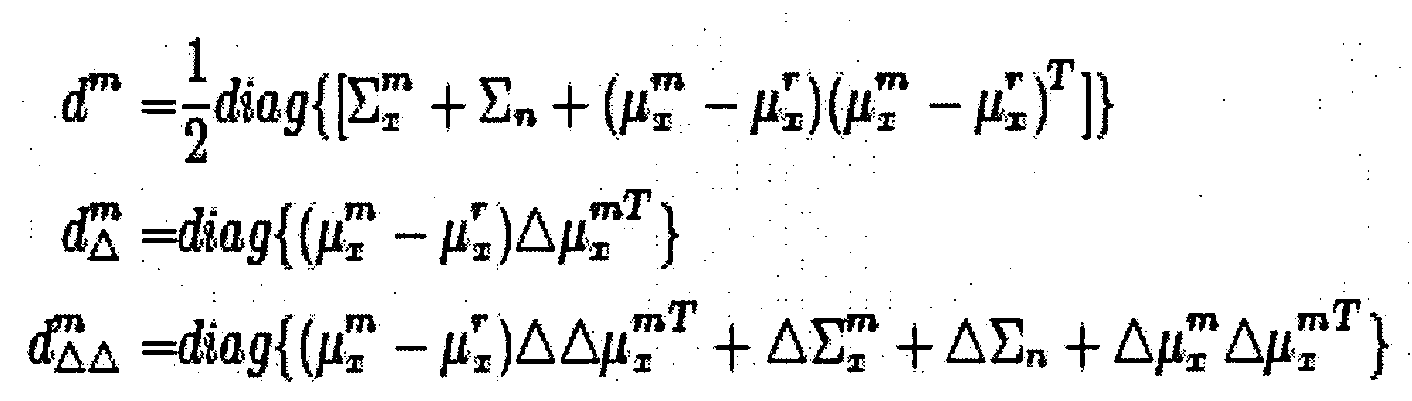
This means that the likelihood calculation can be rewritten as:
 where :

Once the parameters have been determined, they are used to modify the existing acoustic model parameters as set out in step S59.
The acoustic model is then run for noisy input using the modified parameters in step 61. The identified words are then output in step 63.
In the method in accordance with the first embodiment, the first and second order Taylor coefficients are calculated for each regression class in the regression class level chosen. For example, if level (iv) is chosen, then the first and second order Taylor coefficients are calculated for each of the 8
regression classes on that level.
In the second embodiment, the first order Taylor coefficient is calculated for each of the regression classes to which the Gaussians have been assigned. However, the second order Taylor coefficients are only calculated for the higher groups. For example, in FIG. 6 there are 8 regression classes on level (iv) R^ to Rg. The first order Taylor expansion coefficient will be calculated from the means from each of the regression classes R]_ to Rg. However, the second order Taylor coefficients will only be calculated for the 4 classes of level (iii) . Thus, the same second order Taylor coefficients are used for classes R]_ and R2 and the same second order Taylor coefficients are used for groups R3 and R4.
The above approximation enhances the speed of operation since the g vector and the Wr and Kr matrices are costly in the second order approximation. Therefore, by reducing the overall number of these matrices and vectors which need to be calculated, the efficiency may be improved. Based on the theory of Taylor expansion, the lower order terms in the Taylor series are more important than the higher order ones. Specifically, the zeroth order term g is most important for the Taylor expansion, the first order term Wr is less important whereas the second order term Kr is of least importance.
Therefore only calculating to Kr for a larger group which will be applied to more than one group will not result in a significant change in accuracy.
Thus, the method can be adapted to that different levels of regression classes are used for different orders of Taylor expansion coefficients with lower order coefficients being calculated for more regression classes and higher order coefficients being calculated for fewer classes. It has also been noted that applying a second order approximation for JUD in the delta-delta feature part provides little improvement to accuracy compared to the static and delta parts. Considering the computational costs, it is preferred to only calculate the second order JUD for the static and delta parts and use just the first order JUD for the delta-delta part.
FIG. 7 is a plot of the word error rate (WER) against number of regression classes used. The result is shown for the prior art methods of VTS, second order VTS (2nd VTS) . It should be noted that both of these traces are constant regardless of the number of regression classes simply because they do not use regression classes. The data also shows first order JUD (1st JUD) results. Finally, results from two implementations of the present embodiment are shown, 2nd JUD where both the first order an second order coefficients are calculated for each regression class
and 2nd JUD-TIE2 where first order coefficients are calculated for each regression class and 2nd order coefficients are only calculated for 2 regressions classes (i.e. level (ii) of FIG. 6). The data was collection using the Aurora 2 database of connected digits. The database is divided into two training sets (clean and multi-condition) and three noisy testing sets. Test sets A and B respectively include four types of additive noise with SNR ranging from 20 to 0 decibels where set C also contains convolutional noise. In the experiment, the clean training set was used to train the model and test sets A and B were used for the regression test.
Regression was performed using a HMM from the HTK: Hidden Markov Model Toolkit 2 version 1.5 1993 S.
Young. Each digit was modelled by 16 HMM states with three mixtures and silence was modelled by three states each with six mixtures. This left 546 mixtures in all. The front end was a 13 dimensional MFCC including the zeroth coefficient with their delta and delta-delta components. The regression process is implemented in a two-class mode similar to that used by Li et al "High performance HMM adaptation with joint compensation of additive and convolutive distortions via a vector Taylor series" Proc. of ASRU Dec 2007.
In the experiment the initial noise parameters μn,∑n and μ^ as well as a delta and delta-delta terms
were estimated from the first and last 20 frames in each utterance.
The first order VTS was then applied to adapt the HMM in order to generate an initial recognition hypothesis.
An expectation-maximization based VTS noise estimation process was adopted to refine the noise parameters based on the initial hypothesis.
There refined noise parameters were then used in the above methods to compensate the HMM and obtain the final recognition results.
As the number of regression classes increases, it is clear that the performance of JUD with first order approximation becomes closer and closer to that of first order VTS. However, by applying the second order Taylor extension, JUD either in its simplified form or not improves performance consistently. The performance becomes significantly better than first-order VTS when the number of regression classes is larger than 16. It is interesting to note that the simplified version achieves better performance than the non- simplified version on the Aurora 2. The more detailed results are shown in Table 1 below which indicates that the simplified second order JUD even with 32 regression classes brings 6.1% relative improvement on WER for set A and 5.6% for set B in VTS. Such an improvement is consistent across all noise types.

Table 2 shows the number of transformations i.e. K and W matrices involved in each method.

The computational cost is quantified as "number of instructions" against number of regression classes is shown in FIG. 8. The JUD based methods have a limited number of transforms compared to VTS and therefore far less computational costs. Compared to the original JUD, the second order approximation in JUD does introduce extra computational costs, but it is still much faster than first order and second VTS. Such an extra computational cost could be largely reduced by using the simplified second order approximation. Given the 6% WER improvement with 32 regression classes on set A, JUD with simplified second order approximation is about 60% faster than the first order VTS.
Claims
C L A I M S 1. A speech recognition method, comprising: receiving a speech input in a first noise environment which comprises a sequence of observations; determining the likelihood of a sequence of words arising from the sequence of observations using an acoustic model, comprising: providing an acoustic model for performing speech recognition on a input signal which comprises a sequence of observations, wherein said model has been trained to recognise speech in a second noise environment, said model having a plurality of model parameters relating to the probability distribution of a word or part thereof being related to an observation; adapting the model trained in the second environment to that of the first environment; the speech recognition method further comprising determining the likelihood of a sequence of observations occurring in a given language using a language model; combining the likelihoods determined by the acoustic model and the language model and outputting a sequence of words identified from said speech input signal, wherein adapting the model trained in the second environment to that of the first environment comprises using second order or higher order Taylor expansion coefficients derived for a group of probability distributions and wherein the same expansion coefficient is used for the whole group.
2. A speech recognition method according to claim 1, wherein the groups are regression classes formed by regression during the initial training of the model .
3. A speech recognition method according to either of claims 1 or 2, wherein the groups are further combined to form aggregated groups and jth order Taylor coefficients are calculated and used for said groups and j+lth order coefficients are calculated and used for said aggregated groups.
4. A speech recognition method according to any one of claims 1 to 3, wherein the model parameters comprise the static mean and static variance.
5. A speech recognition method according to claim 4, wherein the model parameters also comprise delta and delta-delta parts of the mean and variance, and where the second order or higher order terms are not calculated for the delta-delta part.
6. A speech recognition method according to any one of claims 1 to 5, wherein the noise parameters comprises a component for additive noise and a component for convolutional noise.
7. A speech recognition method according to claim 6, wherein the relationship between an observation in the first noise environment is related to an observation in the second noise environment by:

8. A speech recognition method according to any one of claims 1 to 7, wherein the means of the noise parameters are estimated and used to determine the Taylor expansion coefficients.
9. A speech recognition method according claim 8, wherein an initial estimate of the means is obtained from parts of the speech input signal where speech is not present.
10. A speech recognition system according to any one of claims 1 to 9, wherein the probability functions are Gaussians.
11. A speech recognition system according to any one of claims 1 to 10, wherein the acoustic model is a hidden Markov Model.
12. A speech recognition system according to any one of claims 1 to 11, wherein the first environment is a noisy environment and the second environment is a noise free environment.
13. A speech translation method, comprising: recognising a speech input signal according to any one of claims 1 to 12; translating said recognised speech into a different language; and outputting said recognised speech in said different language.
14. A speech translation method according to claim 13, wherein outputting said recognised speech comprises using a text to speech conversion method.
15. A method of adapting a speech recognition model between first and second noise environments, the method comprising: providing a model for performing speech recognition on a input signal which comprises a sequence of observations, wherein said model has been trained to recognise speech in a second noise environment, said model having a plurality of model parameters relating to the probability distribution of a word or part thereof being related to an observation; and adapting the model trained in the second environment to that of the first environment; wherein adapting the model trained in the second environment to that of the first environment comprises using second order or higher order Taylor expansion coefficients derived for a group of probability distributions and wherein the same expansion coefficient is used for the whole group.
16. A method of adapting a pattern recognition model between first and second noise environments, the method comprising: providing a model for performing pattern recognition on a input signal which comprises a sequence of observations, wherein said model has been trained to recognise a pattern in a second noise environment, said model having a plurality of model parameters relating to the probability distribution of a component of a pattern being related to an observation; and adapting the model trained in the second environment to that of the first environment, wherein adapting the model trained in the second environment to that of the first environment comprises using second order or higher order Taylor expansion coefficients derived for a group of probability distributions and wherein the same expansion coefficient is used for the whole group.
17. A computer running a computer program configured to cause a computer to perform the method of any one of claims 1 to 16.
18. A speech recognition apparatus, said apparatus comprising: a receiver for a speech input, said speech input comprising a sequence of observations, a processor adapted to determine the likelihood of a sequence of words arising from the sequence of observations using an acoustic model, said processor being adapted to: provide an acoustic model for performing speech recognition on said input signal, wherein said model has been trained to recognise speech in a second noise environment which is different to the first noise environment of said speech input, said model having a plurality of model parameters relating to the probability distribution of a word or part thereof being related to an observation; and adapting the model trained in the second environment to that of the first environment, the processor being further adapted for determining the likelihood of a sequence of observations occurring in a given language using a language model; and combine the likelihoods determined by the acoustic model and the language model, the apparatus further comprising an output adapted for outputting a sequence of words identified from said speech input signal, wherein adapting the model trained in the second environment to that of the first environment comprises using second order or higher order Taylor expansion coefficients derived for a group of probability distributions and wherein the same expansion coefficient is used for the whole group
19. A speech recognition apparatus according to claim 18, further adapted to combine the groups further to form aggregated groups and j^h order Taylor coefficients are calculated and used for groups and j+ltn order coefficients are calculated and used for said aggregated groups.
20. An apparatus according to either of claims 18 or 19, wherein the output comprises a display, printer or electronic signal readable by a further apparatus.
Priority Applications (2)
| Application Number | Priority Date | Filing Date | Title |
|---|---|---|---|
| JP2011513765A JP5242782B2 (en) | 2008-09-29 | 2009-09-24 | Speech recognition method |
| US12/763,438 US8417522B2 (en) | 2008-09-29 | 2010-04-20 | Speech recognition method |
Applications Claiming Priority (2)
| Application Number | Priority Date | Filing Date | Title |
|---|---|---|---|
| GB0817824.6 | 2008-09-29 | ||
| GB0817824A GB2464093B (en) | 2008-09-29 | 2008-09-29 | A speech recognition method |
Related Child Applications (1)
| Application Number | Title | Priority Date | Filing Date |
|---|---|---|---|
| US12/763,438 Continuation US8417522B2 (en) | 2008-09-29 | 2010-04-20 | Speech recognition method |
Publications (1)
| Publication Number | Publication Date |
|---|---|
| WO2010035892A1 true WO2010035892A1 (en) | 2010-04-01 |
Family
ID=40019748
Family Applications (1)
| Application Number | Title | Priority Date | Filing Date |
|---|---|---|---|
| PCT/JP2009/067135 Ceased WO2010035892A1 (en) | 2008-09-29 | 2009-09-24 | Speech recognition method |
Country Status (4)
| Country | Link |
|---|---|
| US (1) | US8417522B2 (en) |
| JP (1) | JP5242782B2 (en) |
| GB (1) | GB2464093B (en) |
| WO (1) | WO2010035892A1 (en) |
Cited By (2)
| Publication number | Priority date | Publication date | Assignee | Title |
|---|---|---|---|---|
| GB2478314A (en) * | 2010-03-02 | 2011-09-07 | Toshiba Res Europ Ltd | Incorporating context dependency in an acoustic model for both speech recognition and synthesis |
| GB2482874A (en) * | 2010-08-16 | 2012-02-22 | Toshiba Res Europ Ltd | A speech processing system that applies speaker adaptation techniques into an environment mismatch function |
Families Citing this family (10)
| Publication number | Priority date | Publication date | Assignee | Title |
|---|---|---|---|---|
| CN101416237B (en) * | 2006-05-01 | 2012-05-30 | 日本电信电话株式会社 | Speech dereverberation method and device based on probabilistic model of source and room acoustics |
| US8660842B2 (en) * | 2010-03-09 | 2014-02-25 | Honda Motor Co., Ltd. | Enhancing speech recognition using visual information |
| US8972256B2 (en) | 2011-10-17 | 2015-03-03 | Nuance Communications, Inc. | System and method for dynamic noise adaptation for robust automatic speech recognition |
| US10395672B2 (en) * | 2012-05-31 | 2019-08-27 | Elwha Llc | Methods and systems for managing adaptation data |
| US9899026B2 (en) | 2012-05-31 | 2018-02-20 | Elwha Llc | Speech recognition adaptation systems based on adaptation data |
| US10431235B2 (en) | 2012-05-31 | 2019-10-01 | Elwha Llc | Methods and systems for speech adaptation data |
| US9275638B2 (en) * | 2013-03-12 | 2016-03-01 | Google Technology Holdings LLC | Method and apparatus for training a voice recognition model database |
| US9177546B2 (en) * | 2013-08-28 | 2015-11-03 | Texas Instruments Incorporated | Cloud based adaptive learning for distributed sensors |
| EP4325824A1 (en) * | 2022-08-19 | 2024-02-21 | GN Audio A/S | Speakerphone and server device for environment acoustics determination and related methods |
| EP4325823A1 (en) * | 2022-08-19 | 2024-02-21 | GN Audio A/S | Speakerphone with environment acoustics characterization and related methods |
Citations (2)
| Publication number | Priority date | Publication date | Assignee | Title |
|---|---|---|---|---|
| JP2004102287A (en) * | 2002-09-06 | 2004-04-02 | Microsoft Corp | Nonlinear observation model removing noise from deteriorated signal |
| JP2006084732A (en) * | 2004-09-15 | 2006-03-30 | Univ Of Tokyo | Model adaptation method for speech recognition under noise based on polynomial approximation |
Family Cites Families (16)
| Publication number | Priority date | Publication date | Assignee | Title |
|---|---|---|---|---|
| JP3102195B2 (en) * | 1993-04-02 | 2000-10-23 | 三菱電機株式会社 | Voice recognition device |
| JP3452443B2 (en) * | 1996-03-25 | 2003-09-29 | 三菱電機株式会社 | Speech recognition device under noise and speech recognition method under noise |
| US6026359A (en) * | 1996-09-20 | 2000-02-15 | Nippon Telegraph And Telephone Corporation | Scheme for model adaptation in pattern recognition based on Taylor expansion |
| JP3587966B2 (en) * | 1996-09-20 | 2004-11-10 | 日本電信電話株式会社 | Speech recognition method, apparatus and storage medium |
| JPH1195786A (en) * | 1997-09-16 | 1999-04-09 | Nippon Telegr & Teleph Corp <Ntt> | Pattern recognition method and apparatus and recording medium storing pattern recognition program |
| US6865531B1 (en) * | 1999-07-01 | 2005-03-08 | Koninklijke Philips Electronics N.V. | Speech processing system for processing a degraded speech signal |
| JP4297602B2 (en) * | 2000-09-18 | 2009-07-15 | パイオニア株式会社 | Speech recognition system |
| US7668718B2 (en) * | 2001-07-17 | 2010-02-23 | Custom Speech Usa, Inc. | Synchronized pattern recognition source data processed by manual or automatic means for creation of shared speaker-dependent speech user profile |
| US7139703B2 (en) * | 2002-04-05 | 2006-11-21 | Microsoft Corporation | Method of iterative noise estimation in a recursive framework |
| US7457745B2 (en) * | 2002-12-03 | 2008-11-25 | Hrl Laboratories, Llc | Method and apparatus for fast on-line automatic speaker/environment adaptation for speech/speaker recognition in the presence of changing environments |
| US7076422B2 (en) * | 2003-03-13 | 2006-07-11 | Microsoft Corporation | Modelling and processing filled pauses and noises in speech recognition |
| US7165026B2 (en) * | 2003-03-31 | 2007-01-16 | Microsoft Corporation | Method of noise estimation using incremental bayes learning |
| JP2004325897A (en) * | 2003-04-25 | 2004-11-18 | Pioneer Electronic Corp | Apparatus and method for speech recognition |
| US7363221B2 (en) * | 2003-08-19 | 2008-04-22 | Microsoft Corporation | Method of noise reduction using instantaneous signal-to-noise ratio as the principal quantity for optimal estimation |
| CN101622660A (en) * | 2007-02-28 | 2010-01-06 | 日本电气株式会社 | Speech recognition device, speech recognition method, and speech recognition program |
| JP2010078650A (en) * | 2008-09-24 | 2010-04-08 | Toshiba Corp | Speech recognizer and method thereof |
-
2008
- 2008-09-29 GB GB0817824A patent/GB2464093B/en not_active Expired - Fee Related
-
2009
- 2009-09-24 WO PCT/JP2009/067135 patent/WO2010035892A1/en not_active Ceased
- 2009-09-24 JP JP2011513765A patent/JP5242782B2/en not_active Expired - Fee Related
-
2010
- 2010-04-20 US US12/763,438 patent/US8417522B2/en not_active Expired - Fee Related
Patent Citations (2)
| Publication number | Priority date | Publication date | Assignee | Title |
|---|---|---|---|---|
| JP2004102287A (en) * | 2002-09-06 | 2004-04-02 | Microsoft Corp | Nonlinear observation model removing noise from deteriorated signal |
| JP2006084732A (en) * | 2004-09-15 | 2006-03-30 | Univ Of Tokyo | Model adaptation method for speech recognition under noise based on polynomial approximation |
Non-Patent Citations (2)
| Title |
|---|
| H. LIAO ET AL.: "Adaptive Training with Joint Uncertainty Decoding for Robust Recognition of Noisy Data", ACOUSTICS, SPEECH AND SIGNAL PROCESSING, 2007. ICASSP 2007. IEEE INTERNATIONAL CONFERENCE ON, vol. 4, - 20 April 2007 (2007-04-20), pages IV-389 - IV-392 * |
| JINYU LI ET AL.: "High-performance HMM adaptation with joint compensation of additive and convolutive distortions via Vector Taylor Series", AUTOMATIC SPEECH RECOGNITION & UNDERSTANDING, 2007. ASRU. IEEE WORKSHOP ON, 9 December 2007 (2007-12-09), pages 65 - 70 * |
Cited By (6)
| Publication number | Priority date | Publication date | Assignee | Title |
|---|---|---|---|---|
| GB2478314A (en) * | 2010-03-02 | 2011-09-07 | Toshiba Res Europ Ltd | Incorporating context dependency in an acoustic model for both speech recognition and synthesis |
| GB2478314B (en) * | 2010-03-02 | 2012-09-12 | Toshiba Res Europ Ltd | A speech processor, a speech processing method and a method of training a speech processor |
| US9043213B2 (en) | 2010-03-02 | 2015-05-26 | Kabushiki Kaisha Toshiba | Speech recognition and synthesis utilizing context dependent acoustic models containing decision trees |
| GB2482874A (en) * | 2010-08-16 | 2012-02-22 | Toshiba Res Europ Ltd | A speech processing system that applies speaker adaptation techniques into an environment mismatch function |
| GB2482874B (en) * | 2010-08-16 | 2013-06-12 | Toshiba Res Europ Ltd | A speech processing system and method |
| US8620655B2 (en) | 2010-08-16 | 2013-12-31 | Kabushiki Kaisha Toshiba | Speech processing system and method |
Also Published As
| Publication number | Publication date |
|---|---|
| GB2464093A (en) | 2010-04-07 |
| JP2012504250A (en) | 2012-02-16 |
| US8417522B2 (en) | 2013-04-09 |
| JP5242782B2 (en) | 2013-07-24 |
| US20100204988A1 (en) | 2010-08-12 |
| GB2464093B (en) | 2011-03-09 |
| GB0817824D0 (en) | 2008-11-05 |
Similar Documents
| Publication | Publication Date | Title |
|---|---|---|
| US8417522B2 (en) | Speech recognition method | |
| Li et al. | An overview of noise-robust automatic speech recognition | |
| US6026359A (en) | Scheme for model adaptation in pattern recognition based on Taylor expansion | |
| US8595006B2 (en) | Speech recognition system and method using vector taylor series joint uncertainty decoding | |
| JP3457431B2 (en) | Signal identification method | |
| US9043213B2 (en) | Speech recognition and synthesis utilizing context dependent acoustic models containing decision trees | |
| US8620655B2 (en) | Speech processing system and method | |
| AU2013305615B2 (en) | Method and system for selectively biased linear discriminant analysis in automatic speech recognition systems | |
| US20120130716A1 (en) | Speech recognition method for robot | |
| KR101236539B1 (en) | Apparatus and Method For Feature Compensation Using Weighted Auto-Regressive Moving Average Filter and Global Cepstral Mean and Variance Normalization | |
| US5890113A (en) | Speech adaptation system and speech recognizer | |
| US20110257976A1 (en) | Robust Speech Recognition | |
| US20150221320A1 (en) | Online Maximum-Likelihood Mean and Variance Normalization for Speech Recognition | |
| Jalalvand et al. | Robust continuous digit recognition using reservoir computing | |
| US20050010406A1 (en) | Speech recognition apparatus, method and computer program product | |
| JP4960845B2 (en) | Speech parameter learning device and method thereof, speech recognition device and speech recognition method using them, program and recording medium thereof | |
| US20120245940A1 (en) | Guest Speaker Robust Adapted Speech Recognition | |
| Zhang et al. | Minimum phoneme error based heteroscedastic linear discriminant analysis for speech recognition | |
| JPH10149191A (en) | Model adaptation method, apparatus and storage medium | |
| KR100612843B1 (en) | Probability Density Compensation Method, Consequent Speech Recognition Method and Apparatus for Hidden Markov Models | |
| Lawrence et al. | Integrated bias removal techniques for robust speech recognition | |
| Loweimi et al. | Use of generalised nonlinearity in vector taylor series noise compensation for robust speech recognition | |
| Munteanu et al. | Robust Romanian language automatic speech recognizer based on multistyle training | |
| Tian et al. | A unified compensation approach for speech recognition in severely adverse environment | |
| GB2463909A (en) | Speech recognition utilising determination of a back-off group of code words in using an acoustic model. |
Legal Events
| Date | Code | Title | Description |
|---|---|---|---|
| 121 | Ep: the epo has been informed by wipo that ep was designated in this application |
Ref document number: 09816303 Country of ref document: EP Kind code of ref document: A1 |
|
| WWE | Wipo information: entry into national phase |
Ref document number: 2011513765 Country of ref document: JP |
|
| NENP | Non-entry into the national phase |
Ref country code: DE |
|
| 122 | Ep: pct application non-entry in european phase |
Ref document number: 09816303 Country of ref document: EP Kind code of ref document: A1 |