WO2010023443A2 - Light-emitting material and device - Google Patents
Light-emitting material and device Download PDFInfo
- Publication number
- WO2010023443A2 WO2010023443A2 PCT/GB2009/002073 GB2009002073W WO2010023443A2 WO 2010023443 A2 WO2010023443 A2 WO 2010023443A2 GB 2009002073 W GB2009002073 W GB 2009002073W WO 2010023443 A2 WO2010023443 A2 WO 2010023443A2
- Authority
- WO
- WIPO (PCT)
- Prior art keywords
- polymer
- general formula
- light
- structural unit
- emitting
- Prior art date
- Legal status (The legal status is an assumption and is not a legal conclusion. Google has not performed a legal analysis and makes no representation as to the accuracy of the status listed.)
- Ceased
Links
Classifications
-
- C—CHEMISTRY; METALLURGY
- C08—ORGANIC MACROMOLECULAR COMPOUNDS; THEIR PREPARATION OR CHEMICAL WORKING-UP; COMPOSITIONS BASED THEREON
- C08G—MACROMOLECULAR COMPOUNDS OBTAINED OTHERWISE THAN BY REACTIONS ONLY INVOLVING UNSATURATED CARBON-TO-CARBON BONDS
- C08G61/00—Macromolecular compounds obtained by reactions forming a carbon-to-carbon link in the main chain of the macromolecule
- C08G61/02—Macromolecular compounds containing only carbon atoms in the main chain of the macromolecule, e.g. polyxylylenes
- C08G61/10—Macromolecular compounds containing only carbon atoms in the main chain of the macromolecule, e.g. polyxylylenes only aromatic carbon atoms, e.g. polyphenylenes
-
- C—CHEMISTRY; METALLURGY
- C08—ORGANIC MACROMOLECULAR COMPOUNDS; THEIR PREPARATION OR CHEMICAL WORKING-UP; COMPOSITIONS BASED THEREON
- C08G—MACROMOLECULAR COMPOUNDS OBTAINED OTHERWISE THAN BY REACTIONS ONLY INVOLVING UNSATURATED CARBON-TO-CARBON BONDS
- C08G61/00—Macromolecular compounds obtained by reactions forming a carbon-to-carbon link in the main chain of the macromolecule
- C08G61/12—Macromolecular compounds containing atoms other than carbon in the main chain of the macromolecule
-
- C—CHEMISTRY; METALLURGY
- C09—DYES; PAINTS; POLISHES; NATURAL RESINS; ADHESIVES; COMPOSITIONS NOT OTHERWISE PROVIDED FOR; APPLICATIONS OF MATERIALS NOT OTHERWISE PROVIDED FOR
- C09K—MATERIALS FOR MISCELLANEOUS APPLICATIONS, NOT PROVIDED FOR ELSEWHERE
- C09K11/00—Luminescent materials, e.g. electroluminescent or chemiluminescent
- C09K11/06—Luminescent materials, e.g. electroluminescent or chemiluminescent containing organic luminescent materials
-
- H—ELECTRICITY
- H05—ELECTRIC TECHNIQUES NOT OTHERWISE PROVIDED FOR
- H05B—ELECTRIC HEATING; ELECTRIC LIGHT SOURCES NOT OTHERWISE PROVIDED FOR; CIRCUIT ARRANGEMENTS FOR ELECTRIC LIGHT SOURCES, IN GENERAL
- H05B33/00—Electroluminescent light sources
- H05B33/12—Light sources with substantially two-dimensional [2D] radiating surfaces
- H05B33/14—Light sources with substantially two-dimensional [2D] radiating surfaces characterised by the chemical or physical composition or the arrangement of the electroluminescent material, or by the simultaneous addition of the electroluminescent material in or onto the light source
-
- H—ELECTRICITY
- H10—SEMICONDUCTOR DEVICES; ELECTRIC SOLID-STATE DEVICES NOT OTHERWISE PROVIDED FOR
- H10K—ORGANIC ELECTRIC SOLID-STATE DEVICES
- H10K50/00—Organic light-emitting devices
- H10K50/10—OLEDs or polymer light-emitting diodes [PLED]
- H10K50/11—OLEDs or polymer light-emitting diodes [PLED] characterised by the electroluminescent [EL] layers
-
- H—ELECTRICITY
- H10—SEMICONDUCTOR DEVICES; ELECTRIC SOLID-STATE DEVICES NOT OTHERWISE PROVIDED FOR
- H10K—ORGANIC ELECTRIC SOLID-STATE DEVICES
- H10K50/00—Organic light-emitting devices
- H10K50/10—OLEDs or polymer light-emitting diodes [PLED]
- H10K50/14—Carrier transporting layers
-
- H—ELECTRICITY
- H10—SEMICONDUCTOR DEVICES; ELECTRIC SOLID-STATE DEVICES NOT OTHERWISE PROVIDED FOR
- H10K—ORGANIC ELECTRIC SOLID-STATE DEVICES
- H10K85/00—Organic materials used in the body or electrodes of devices covered by this subclass
- H10K85/10—Organic polymers or oligomers
- H10K85/111—Organic polymers or oligomers comprising aromatic, heteroaromatic, or aryl chains, e.g. polyaniline, polyphenylene or polyphenylene vinylene
-
- H—ELECTRICITY
- H10—SEMICONDUCTOR DEVICES; ELECTRIC SOLID-STATE DEVICES NOT OTHERWISE PROVIDED FOR
- H10K—ORGANIC ELECTRIC SOLID-STATE DEVICES
- H10K85/00—Organic materials used in the body or electrodes of devices covered by this subclass
- H10K85/10—Organic polymers or oligomers
- H10K85/111—Organic polymers or oligomers comprising aromatic, heteroaromatic, or aryl chains, e.g. polyaniline, polyphenylene or polyphenylene vinylene
- H10K85/115—Polyfluorene; Derivatives thereof
-
- H—ELECTRICITY
- H10—SEMICONDUCTOR DEVICES; ELECTRIC SOLID-STATE DEVICES NOT OTHERWISE PROVIDED FOR
- H10K—ORGANIC ELECTRIC SOLID-STATE DEVICES
- H10K85/00—Organic materials used in the body or electrodes of devices covered by this subclass
- H10K85/10—Organic polymers or oligomers
- H10K85/151—Copolymers
-
- H—ELECTRICITY
- H10—SEMICONDUCTOR DEVICES; ELECTRIC SOLID-STATE DEVICES NOT OTHERWISE PROVIDED FOR
- H10K—ORGANIC ELECTRIC SOLID-STATE DEVICES
- H10K85/00—Organic materials used in the body or electrodes of devices covered by this subclass
- H10K85/60—Organic compounds having low molecular weight
- H10K85/615—Polycyclic condensed aromatic hydrocarbons, e.g. anthracene
- H10K85/623—Polycyclic condensed aromatic hydrocarbons, e.g. anthracene containing five rings, e.g. pentacene
-
- C—CHEMISTRY; METALLURGY
- C08—ORGANIC MACROMOLECULAR COMPOUNDS; THEIR PREPARATION OR CHEMICAL WORKING-UP; COMPOSITIONS BASED THEREON
- C08G—MACROMOLECULAR COMPOUNDS OBTAINED OTHERWISE THAN BY REACTIONS ONLY INVOLVING UNSATURATED CARBON-TO-CARBON BONDS
- C08G2261/00—Macromolecular compounds obtained by reactions forming a carbon-to-carbon link in the main chain of the macromolecule
- C08G2261/10—Definition of the polymer structure
- C08G2261/12—Copolymers
- C08G2261/126—Copolymers block
-
- C—CHEMISTRY; METALLURGY
- C08—ORGANIC MACROMOLECULAR COMPOUNDS; THEIR PREPARATION OR CHEMICAL WORKING-UP; COMPOSITIONS BASED THEREON
- C08G—MACROMOLECULAR COMPOUNDS OBTAINED OTHERWISE THAN BY REACTIONS ONLY INVOLVING UNSATURATED CARBON-TO-CARBON BONDS
- C08G2261/00—Macromolecular compounds obtained by reactions forming a carbon-to-carbon link in the main chain of the macromolecule
- C08G2261/10—Definition of the polymer structure
- C08G2261/16—End groups
- C08G2261/164—End groups comprising organic end groups
-
- C—CHEMISTRY; METALLURGY
- C08—ORGANIC MACROMOLECULAR COMPOUNDS; THEIR PREPARATION OR CHEMICAL WORKING-UP; COMPOSITIONS BASED THEREON
- C08G—MACROMOLECULAR COMPOUNDS OBTAINED OTHERWISE THAN BY REACTIONS ONLY INVOLVING UNSATURATED CARBON-TO-CARBON BONDS
- C08G2261/00—Macromolecular compounds obtained by reactions forming a carbon-to-carbon link in the main chain of the macromolecule
- C08G2261/10—Definition of the polymer structure
- C08G2261/16—End groups
- C08G2261/164—End groups comprising organic end groups
- C08G2261/1644—End groups comprising organic end groups comprising other functional groups, e.g. OH groups, NH groups, COOH groups or boronic acid
-
- C—CHEMISTRY; METALLURGY
- C08—ORGANIC MACROMOLECULAR COMPOUNDS; THEIR PREPARATION OR CHEMICAL WORKING-UP; COMPOSITIONS BASED THEREON
- C08G—MACROMOLECULAR COMPOUNDS OBTAINED OTHERWISE THAN BY REACTIONS ONLY INVOLVING UNSATURATED CARBON-TO-CARBON BONDS
- C08G2261/00—Macromolecular compounds obtained by reactions forming a carbon-to-carbon link in the main chain of the macromolecule
- C08G2261/30—Monomer units or repeat units incorporating structural elements in the main chain
- C08G2261/31—Monomer units or repeat units incorporating structural elements in the main chain incorporating aromatic structural elements in the main chain
- C08G2261/314—Condensed aromatic systems, e.g. perylene, anthracene or pyrene
- C08G2261/3142—Condensed aromatic systems, e.g. perylene, anthracene or pyrene fluorene-based, e.g. fluorene, indenofluorene, or spirobifluorene
-
- C—CHEMISTRY; METALLURGY
- C08—ORGANIC MACROMOLECULAR COMPOUNDS; THEIR PREPARATION OR CHEMICAL WORKING-UP; COMPOSITIONS BASED THEREON
- C08G—MACROMOLECULAR COMPOUNDS OBTAINED OTHERWISE THAN BY REACTIONS ONLY INVOLVING UNSATURATED CARBON-TO-CARBON BONDS
- C08G2261/00—Macromolecular compounds obtained by reactions forming a carbon-to-carbon link in the main chain of the macromolecule
- C08G2261/30—Monomer units or repeat units incorporating structural elements in the main chain
- C08G2261/31—Monomer units or repeat units incorporating structural elements in the main chain incorporating aromatic structural elements in the main chain
- C08G2261/316—Monomer units or repeat units incorporating structural elements in the main chain incorporating aromatic structural elements in the main chain bridged by heteroatoms, e.g. N, P, Si or B
- C08G2261/3162—Arylamines
-
- C—CHEMISTRY; METALLURGY
- C09—DYES; PAINTS; POLISHES; NATURAL RESINS; ADHESIVES; COMPOSITIONS NOT OTHERWISE PROVIDED FOR; APPLICATIONS OF MATERIALS NOT OTHERWISE PROVIDED FOR
- C09K—MATERIALS FOR MISCELLANEOUS APPLICATIONS, NOT PROVIDED FOR ELSEWHERE
- C09K2211/00—Chemical nature of organic luminescent or tenebrescent compounds
- C09K2211/10—Non-macromolecular compounds
- C09K2211/1003—Carbocyclic compounds
- C09K2211/1007—Non-condensed systems
-
- C—CHEMISTRY; METALLURGY
- C09—DYES; PAINTS; POLISHES; NATURAL RESINS; ADHESIVES; COMPOSITIONS NOT OTHERWISE PROVIDED FOR; APPLICATIONS OF MATERIALS NOT OTHERWISE PROVIDED FOR
- C09K—MATERIALS FOR MISCELLANEOUS APPLICATIONS, NOT PROVIDED FOR ELSEWHERE
- C09K2211/00—Chemical nature of organic luminescent or tenebrescent compounds
- C09K2211/10—Non-macromolecular compounds
- C09K2211/1003—Carbocyclic compounds
- C09K2211/1011—Condensed systems
-
- C—CHEMISTRY; METALLURGY
- C09—DYES; PAINTS; POLISHES; NATURAL RESINS; ADHESIVES; COMPOSITIONS NOT OTHERWISE PROVIDED FOR; APPLICATIONS OF MATERIALS NOT OTHERWISE PROVIDED FOR
- C09K—MATERIALS FOR MISCELLANEOUS APPLICATIONS, NOT PROVIDED FOR ELSEWHERE
- C09K2211/00—Chemical nature of organic luminescent or tenebrescent compounds
- C09K2211/14—Macromolecular compounds
- C09K2211/1408—Carbocyclic compounds
- C09K2211/1416—Condensed systems
-
- C—CHEMISTRY; METALLURGY
- C09—DYES; PAINTS; POLISHES; NATURAL RESINS; ADHESIVES; COMPOSITIONS NOT OTHERWISE PROVIDED FOR; APPLICATIONS OF MATERIALS NOT OTHERWISE PROVIDED FOR
- C09K—MATERIALS FOR MISCELLANEOUS APPLICATIONS, NOT PROVIDED FOR ELSEWHERE
- C09K2211/00—Chemical nature of organic luminescent or tenebrescent compounds
- C09K2211/14—Macromolecular compounds
- C09K2211/1408—Carbocyclic compounds
- C09K2211/1425—Non-condensed systems
-
- C—CHEMISTRY; METALLURGY
- C09—DYES; PAINTS; POLISHES; NATURAL RESINS; ADHESIVES; COMPOSITIONS NOT OTHERWISE PROVIDED FOR; APPLICATIONS OF MATERIALS NOT OTHERWISE PROVIDED FOR
- C09K—MATERIALS FOR MISCELLANEOUS APPLICATIONS, NOT PROVIDED FOR ELSEWHERE
- C09K2211/00—Chemical nature of organic luminescent or tenebrescent compounds
- C09K2211/14—Macromolecular compounds
- C09K2211/1408—Carbocyclic compounds
- C09K2211/1433—Carbocyclic compounds bridged by heteroatoms, e.g. N, P, Si or B
-
- H—ELECTRICITY
- H10—SEMICONDUCTOR DEVICES; ELECTRIC SOLID-STATE DEVICES NOT OTHERWISE PROVIDED FOR
- H10K—ORGANIC ELECTRIC SOLID-STATE DEVICES
- H10K2101/00—Properties of the organic materials covered by group H10K85/00
- H10K2101/10—Triplet emission
Definitions
- the present invention is concerned with a light emitting material and with an organic light-emitting device containing the same.
- a typical organic light-emitting device comprises a substrate, on which is supported an anode, a cathode and a light-emitting layer situated in between the anode and cathode and comprising at least one polymeric electroluminescent material.
- OLED organic light-emitting device
- holes are injected into the device through the anode and electrons are injected into the device through the cathode.
- the holes and electrons combine in the light-emitting layer to form an exciton which then undergoes radioactive decay to emit light.
- a layer of hole injection material such as poly(ethylene dioxythiophene)/polystyrene sulphonate (PEDOT/PSS)
- PEDOT/PSS poly(ethylene dioxythiophene)/polystyrene sulphonate
- a hole transport layer may be provided between the anode and the light-emitting layer to assist transport of holes to the light-emitting layer.
- Luminescent conjugated polymers are an important class of materials that will be used in organic light emitting devices for the next generation of information technology based consumer products.
- OLEDs organic light emitting diodes
- conjugated polymers may be readily formed by Suzuki or Yamamoto polymerisation. This enables a high degree of control over the regioregulatory of the resultant polymer. Blue light-emitting polymers have been disclosed. "Synthesis of a segmented conjugated polymer chain giving a blue-shifted electroluminescence and improved efficiency" by P.L. Burn, A.B. Holmes, A. Kraft, D.D.C. Bradley, A.R. Brown and R. H. Friend, J.Chem. Soc, Chem.
- WO 00/55927 discloses an organic polymer having a plurality of regions along the length of the polymer backbone and comprising two or more of the following:
- a third region for accepting and combining positive and negative charge carriers to generate light and having a third bandgap defined by a third LUMO level and a third HOMO level, wherein each region comprises one or more monomers and the quantity and arrangement of the monomers in the organic polymer is elected so that the first, second and third bandgaps are distinct from one another in the polymer.
- the following polymer is said to emit blue light:
- Polymers comprising this type of amine repeat unit typically have a CIE(y) value of about 0.2.
- JP2000007594 discloses the preparation of benzo[k]fluoranthene derivative materials for organic electronic devices. These small molecule compounds are said to emit blue colour.
- US 6534198 discloses a homopolysilane with aryl side groups.
- the polysilane is said to have excellent charge transport properties.
- the polymers can be prepared by Yamamoto coupling or Suzuki polymerisation. It is further said that the polymers can be used to emit light in an electroluminescent diode. Comonomer units are disclosed in paragragh 0029. WO2006/ 114364 relates to a method for producing polyfluoranthenes containing repeat units:
- the polyfluoranthenes can be used in a light-emitting layer of an OLED.
- homopolymers and AB copolymers are prepared.
- One exemplified AB copolymer is:
- Rapta et al, Chemistry- A European Journal (2006), 12(11), 3103-3113 discloses a series of fluorantheopyracylene oligomers. The colour of emission was green-blue.
- Tseng et al, Applied Letters Physics (2006), 88(9), 093512/1-093512/3 discloses a blue-fluorescent fluoranthene dopant in a dlpyrenylfluorene host.
- Chiechi et al, Advanced materials (2006), 18(3), 325-328 discloses blue emission from 7, 8, 10- triphenylfluoranthene (TPF).
- Suzuki et al. Synthetic Metals (2004), 143(1), 89-96 discloses triarylbenzenes and teraarylbenzenes as host materials for the fluoranthene blue emitter Ide 102.
- US2006/0238110 discloses an organic EL display.
- the organic layer, between the anode and cathode, contains a vinyl polymer obtained by polymerising a monomer:
- the fluoranthene will be in a side group pendant from the polymer main chain.
- the vinyl polymer acts as a dopant for luminescence.
- the polymer may be a copolymer.
- the present inventors have identified that there exists a problem with currently available blue light emitting materials. Specifically, the blue colour often has to be compromised in order to obtain adequate efficiency and lifetime properties of the material. In the case of blue light-emitting semiconducting polymers, this is by incorporation of repeat units that improve efficiency and lifetime properties, but which affect the conjugation of the polymer and, thus, the colour of emission therefrom.
- a problem of the present invention to provide a new light emitting material, preferably a blue-light emitting material with a good combination of emission colour and efficiency and lifetime properties.
- a highly desired colour of emission is deep blue with a y coordinate of less than or equal to 0.12, more preferably in the range 0.04-0.12, as measured on a CIE 1931 chromaticity chart.
- a first aspect of the present invention provides a light-emitting polymer as specified in claim 1.
- the polymer may have one or more light-emitting end capping groups comprising a structural unit having general formula 1 :
- the structural unit having general formula 1 may be comprised in a group that is linked directly to the end of the polymer main chain.
- the structural unit having general formula 1 may be comprised in a side group that is pendent from a group that is linked directly to the end of the polymer main chain.
- the structural unit may be pendent from a conjugated group such as an aryl or heteroaryl group as shown below:
- a preferred aryl group is fluorene.
- the end capping group may be linked to the polymer conjugatively or non- conjugatively.
- the structural unit having general formula 1 is comprised in a side group, it is preferred that it is non-conjugatively linked to the main chain.
- the light emitting polymer has two end capping groups, each comprising a structural unit having general formula 1 or fused derivatives thereof.
- the bandgap of repeat units in the polymer chain should be such that they transport charge to the light-emitting end capping groups and do not quench emission therefrom.
- the light emitting polymer contains less than or equal to 3 mol%, more preferably less than or equal to 2 mol%, of a repeat unit comprising a structural unit having general formula 1. More preferably, the light emitting polymer contains less than or equal to 1 mol% of a repeat unit comprising a structural unit having general formula 1.
- These levels of incorporation of the repeat unit can be considered to be dopant levels of incorporation, where the repeat unit does not form a main component in the polymer chain.
- a preferred end capping group or repeat unit comprises a fused derivative of general formula 1, for example a fused derivative of general formula 1 having formula 3:
- a preferred end capping group or repeat unit comprises a structural unit having formula 4:
- R 1 and R 2 independently represent any suitable substituents. Preferred substituents enhance solubility or extend conjugation.
- Ri and R 2 independently represent a substituent comprising phenyl, more preferably alkylphenyl. Further substituents (not shown) may be present on the structural unit shown in formula 4. For example, one or more of substituents R 3 to R 5 may be present:
- R 3 to R 5 represent any suitable substituents.
- Preferred substituents are as defined for R 1 and R 2 .
- a preferred end capping group or repeat unit comprises benzofluoranthene, having general formula 6:
- the structural unit of general formula 6 may be substituted or unsubstituted.
- the structural unit could be linked non-conjugatively at one of the positions shown below:
- this structural unit preferably is conjugatively linked into the polymer chain.
- the end capping group or repeat unit may comprise a fused derivative of general formula 3.
- the repeat unit may comprise a structural unit having general formula 10, where the rings shown by a dashed line are independently optional:
- a further embodiment of the present invention provides a light-emitting polymer comprising a light-emitting repeat unit having general formula 11, 12 or 13:
- repeat unit is linked directly to an adjacent repeat unit at at least one of the positions shown by *;
- R 1 , R 2 and R 3 are independently selected from alkyl and optionally substituted aryl or heteroaryl ; a>0, b>0, c>0, provided that a+b+c ⁇ l; and at least one of R 1 , R 2 and R 3 is linked directly to an adjacent repeat unit;
- a particularly preferred end-capping group or repeat unit of formula 10 has formula 10(a):
- each Ar which may be the same or different, is as defined above.
- the repeat unit of general formula 11 may be substituted or unsubstituted.
- each R , R and/or R may be the same or different.
- the polymer is preferably a conjugated polymer.
- the polymer is solution processable.
- the light emitted by the polymer is blue.
- the polymer comprises a hole transport co-repeat unit. Further, it is preferred that the polymer contains an electron transport co-repeat unit. Most preferably, the polymer comprises a hole transport co- repeat unit and an electron transport co-repeat unit.
- the bandgaps, and particularly the HOMO levels, of the co-repeat units must be appropriately chosen so that light emission from the light-emitting repeat unit is not quenched.
- the polymer comprises a hole transport co-repeat unit at a concentration up to 50 mol%, more preferably 1-10 mol%, yet more preferably about 5 mol%.
- Preferred concentrations of the light-emitting repeat unit in the polymer are as defined above.
- the electron transport co-repeat unit makes up the remainder of the polymer once account is taken of the light-emitting repeat unit and the hole transport co-repeat unit.
- a preferred hole transport co-repeat unit comprises an amine, preferably a triarylamine.
- Preferred triarylamines include those satisfying general formula 14:
- Ar 1 and Ar 2 are optionally substituted aryl, heteroaryl, biaryl or biheteroaryl groups, n is greater than or equal to 1, preferably 1 or 2, and R is H or a substituent, preferably a substituent.
- R is preferably alkyl or aryl or heteroaryl, most preferably aryl or heteroaryl. Any of the aryl or heteroaryl groups in the unit of formula 14 may be substituted.
- Preferred substituents include alkyl and alkoxy groups. Any of the aryl or heteroaryl groups in the repeat unit of Formula 14 may be linked by a direct bond or a divalent linking atom or group.
- Preferred divalent linking atoms and groups include O, S; substituted N; and substituted C.
- Particularly preferred units satisfying formula 14 include units of Formulae 15-17:
- Ar 1 and Ar 2 are as defined above; and Ar 3 is optionally substituted aryl or heteroaryl. Where present, preferred substituents for Ar 3 include alkyl and alkoxy groups.
- Repeat units of formula 14 are preferably provided in an amount up to 50 mol%, preferably up to 20 mol%, more preferably up to 10 mol%.
- a preferred electron transport co-repeat unit comprises fluorene preferably optionally substituted, 2,7-linked fluorene, most preferably a group satisifying general formula 18:
- R 1 and R 2 are independently selected from hydrogen or optionally substituted alkyl, alkoxy, aryl, arylalkyl, heteroaryl and heteroarylalkyl. More preferably, at least one of R 1 and R 2 comprises an optionally substituted C 4 -C 20 alkyl or aryl group.
- the present inventors have been able to provide blue-light emitting polymers that also are efficient when used in an organic light emitting device. EQE values in the range of 4-4.2% have been obtained with blue-light emitting polymers according to the invention.
- substituents may be present in the general formulae illustrated throughout this application.
- substituents include solubilising groups such as Ci -20 alkyl or alkoxy; electron withdrawing groups such as fluorine, nitro or cyano; and substituents for increasing glass transition temperature (Tg) of the polymer.
- a second aspect of the present invention provides a composition comprising a polymer host and a small molecule light-emitting compound as specified in claims 19 and 20.
- the polymer host preferably is conjugated.
- the polymer host preferably comprises an electron transport repeat unit.
- a preferred electron transport co-repeat unit comprises fluorene preferably optionally substituted, 2,7-linked fluorene, most preferably a group satisifying general formula 18.
- the polymer host preferably comprises a hole transport repeat unit, more preferably in combination with an electron transport repeat unit.
- a preferred hole transport co- repeat unit comprises an amine, preferably a triarylamine.
- Preferred triarylamines include those satisfying general formulae 14 to 17.
- the polymer host may additionally contain a light-emitting repeat unit, provided that the light-emitting repeat unit is selected so that it does not quench emission from the light-emitting compound.
- a preferred polymer host is a copolymer.
- the copolymer preferably comprises an electron transport repeat unit and a hole transport repeat unit.
- a preferred light-emitting compound comprising a structural unit having general formula 1 is a small molecule.
- Preferred small molecules comprise a structural unit as defined in any one of formulae 3 to 6, 10 or 12.
- a third aspect of the present invention provides an organic light-emitting device (OLED) having a light-emitting layer comprising a polymer according to the first aspect of the present invention or a composition according to the second aspect of the present invention.
- OLED organic light-emitting device
- the architecture of a device according to the fifth aspect of the invention comprises a transparent glass or plastic substrate 1, an anode 2 and a cathode 4.
- a light-emitting layer 3 comprising a polymer according to any one of the first to third aspects or a composition according to the fourth aspect is provided between anode 2 and cathode 4.
- At least one of the electrodes is semi-transparent in order that light may be absorbed (in the case of a photoresponsive device) or emitted (in the case of an OLED).
- the anode is transparent, it typically comprises indium tin oxide.
- Further layers may be located between anode 2 and cathode 3, such as charge transporting, charge injecting or charge blocking layers.
- a conductive hole injection layer which may be formed from a conductive organic or inorganic material provided between the anode 2 and the light emitting layer 3 to assist hole injection from the anode into the layer or layers of semiconducting polymer.
- doped organic hole injection materials include doped poly(ethylene dioxythiophene) (PEDT), in particular PEDT doped with a charge-balancing polyacid such as polystyrene sulfonate (PSS) as disclosed in EP 0901176 and EP 0947123, polyacrylic acid or a fiuorinated sulfonic acid, for example Nafion ®; polyaniline as disclosed in US 5723873 and US 5798170; and poly(thienothiophene).
- Examples of conductive inorganic materials include transition metal oxides such as VOx MoOx and RuOx as disclosed in Journal of Physics D: Applied Physics (1996), 29(11), 2750-2753.
- a hole transporting layer located between anode 2 and light-emitting layer 3 preferably has a HOMO level of less than or equal to 5.5 eV, more preferably around 4.8-5.5 eV. HOMO levels may be measured by cyclic voltammetry, for example.
- an electron transporting layer located between light-emitting layer 3 and cathode 4 preferably has a LUMO level of around 3-3.5 eV.
- Light-emitting layer 3 may consist of the polymer or composition alone or may comprise the polymer or composition in combination with one or more further materials.
- the polymer or composition may be blended with hole and/or electron transporting materials as disclosed in, for example, WO 99/48160.
- Cathode 4 is selected from materials that have a workfunction allowing injection of electrons into the electroluminescent layer. Other factors influence the selection of the cathode such as the possibility of adverse interactions between the cathode and the electroluminescent material.
- the cathode may consist of a single material such as a layer of aluminium. Alternatively, it may comprise a plurality of metals, for example a bilayer of a low workfunction material and a high workfunction material such as calcium and aluminium as disclosed in WO 98/10621; elemental barium as disclosed in WO 98/57381, Appl. Phys. Lett.
- the cathode preferably has a workfunction of less than 3.5 eV, more preferably less than 3.2 eV, most preferably less than 3 eV. Work functions of metals can be found in, for example, Michaelson, J. Appl. Phys. 48(11), 4729, 1977.
- the cathode may be opaque or transparent.
- Transparent cathodes are particularly advantageous for active matrix devices because emission through a transparent anode in such devices is at least partially blocked by drive circuitry located underneath the emissive pixels.
- a transparent cathode will comprises a layer of an electron injecting material that is sufficiently thin to be transparent. Typically, the lateral conductivity of this layer will be low as a result of its thinness. In this case, the layer of electron injecting material is used in combination with a thicker layer of transparent conducting material such as indium tin oxide.
- a transparent cathode device need not have a transparent anode (unless, of course, a fully transparent device is desired), and so the transparent anode used for bottom-emitting devices may be replaced or supplemented with a layer of reflective material such as a layer of aluminium.
- transparent cathode devices are disclosed in, for example, GB 2348316.
- the substrate preferably has good barrier properties for prevention of ingress of moisture and oxygen into the device.
- the substrate is commonly glass, however alternative substrates may be used, in particular where flexibility of the device is desirable.
- the substrate may comprise a plastic as in US 6268695 which discloses a substrate of alternating plastic and barrier layers or a laminate of thin glass and plastic as disclosed in EP 0949850.
- the device is preferably encapsulated with an encapsulant (not shown) to prevent ingress of moisture and oxygen.
- encapsulants include a sheet of glass, films having suitable barrier properties such as alternating stacks of polymer and dielectric as disclosed in, for example, WO 01/81649 or an airtight container as disclosed in, for example, WO 01/19142.
- a getter material for absorption of any atmospheric moisture and / or oxygen that may permeate through the substrate or encapsulant may be disposed between the substrate and the encapsulant.
- FIG. 1 illustrates a device wherein the device is formed by firstly forming an anode on a substrate followed by deposition of an electroluminescent layer and a cathode, however it will be appreciated that the device of the invention could also be formed by firstly forming a cathode on a substrate followed by deposition of an electroluminescent layer and an anode.
- a fourth aspect of present invention provides a device comprising an OLED according to the third aspect of the invention.
- Devices according to the fourth aspect include light sources and displays, such as full colour displays.
- An enbodiment of the present invention provides a method for making a polymer according to the first aspect of the invention. Said method includes the steps of:
- an end capping reagent comprising a structural unit having general formula 1 and a reactive group capable of reacting with the polymer chain to cause termination thereof.
- a further embodiment of the present invention provides a method for making a polymer including the step of: polymerising monomers in a monomer feed, said monomer feed including no more than 5 mol% of a monomer comprising two or more reactive groups suitable for participation in the polymerisation reaction and a structural unit having general formula 1.
- Another embodiment of the present invention provides a method for making a polymer including the step of: polymerising monomers in a monomer feed, said monomer feed including at least one monomer comprising two or more reactive groups suitable for participation in the polymerisation reaction and a structural unit having general formula 11, 12, or 13; where, for general formulae 11 and 13, the two or more reactive groups are each independently located at a position shown by * and, for general formula 12, the two or more reactive groups are each independently linked to one of R 1 , R 2 or R 3 .
- Suzuki polymerisation as described in, for example, WO 00/53656
- Yamamoto polymerisation as described in, for example, T. Yamamoto, "Electrically Conducting And Thermally Stable D - Conjugated Poly(arylene)s Prepared by Organometallic Processes", Progress in Polymer Science 1993, 17, 1153-1205.
- These polymerisation techniques both operate via a "metal insertion” wherein the metal atom of a metal complex catalyst is inserted between an aryl group and a leaving group of a monomer.
- a nickel complex catalyst is used
- Suzuki polymerisation a palladium complex catalyst is used.
- the structural unit of Formula I is introduced as an endcapping group, it may either be added at the end of the polymerisation or during or at the start of the polymerisation reaction. If endcapping material is added during or at the start of the polymerisation reaction, the molecular weight of the resultant polymer will depend on the ratio of monomers to endcapping reactive groups. Preferably, the endcapping reactive groups are provided in an amount up to 1 mol%, preferably 0.1-0.5 mol%.
- a monomer having two reactive halogen groups is used.
- at least one reactive group is a boron derivative group such as a boronic acid or boronic ester and the other reactive group is a halogen.
- Preferred halogens are chlorine, bromine and iodine, most preferably bromine.
- repeat units and end groups comprising aryl groups as described throughout this application may be derived from a monomer carrying a suitable leaving group.
- Suzuki polymerisation may be used to prepare regioregular, block and random copolymers.
- homopolymers or random copolymers may be prepared when one reactive group is a halogen and the other reactive group is a boron derivative group.
- block or regioregular, in particular AB, copolymers may be prepared when both reactive groups of a first monomer are boron and both reactive groups of a second monomer are halogen.
- other leaving groups capable of participating in metal insertion include groups include tosylate, mesylate and triflate.
- a further aspect of the present invention provides a monomer or end capping reagent comprising one, two or more reactive groups suitable for participation in a polymerisation reaction and a structural unit having general formula 1, 11, 12, or 13; where, for general formulae 11 and 13, the one, two or more reactive groups are each independently located at a position shown by * and, for general formula 12, the one, two or more reactive groups are each independently linked to one R 1 , R 2 or R 3 .
- a yet further aspect of the present invention provides a method of making a device as specified in claim 30.
- a single polymer or a plurality of polymers may be deposited from solution to form layer 5.
- the polymers according to the first to third aspects preferably are solution processible.
- Suitable solvents for polyarylenes, in particular polyfluorenes include mono- or poly-alkylbenzenes such as toluene and xylene.
- Particularly preferred solution deposition techniques are spin-coating and inkjet printing.
- Spin-coating is particularly suitable for devices wherein patterning of the electroluminescent material is unnecessary - for example for lighting applications or simple monochrome segmented displays.
- InkJet printing is particularly suitable for high information content displays, in particular full colour displays. InkJet printing of OLEDs is described in, for example, EP 0880303.
- solution deposition techniques include dip-coating, roll printing and screen printing.
- Figure 1 illustrates an organic light-emitting device.
- Figure 2 shows solution PL spectra of some fluoranthene derivatives according to the present invention.
- Charge transporting polymers include poly(arylene vinylenes) such as poly(p- phenylene vinylenes) and polyarylenes which may be present in the device.
- Preferred charge transporting polymers comprise a first repeat unit selected from arylene repeat units as disclosed in, for example, Adv. Mater. 2000 12(23) 1737-1750 and references therein.
- Examplary first repeat units include: 1 ,4-phenylene repeat units as disclosed in J. Appl. Phys.
- preferred charge transport polymers comprise optionally substituted, 2,7- linked fluorene, most preferably a group satisfying general formula 18.
- a charge transport polymer may provide one or more of the functions of hole transport and electron transport depending on which layer of the device it is used in and the nature of co-repeat units.
- a homopolymer of fluorene repeat units such as a homopolymer of 9,9- dialkylfluoren-2,7-diyl, may be utilised to provide electron transport.
- a copolymer comprising triarylamine repeat unit in particular a repeat unit comprising a group having general formula 14, may be utilised to provide hole transport.
- Particularly preferred hole transporting polymers of this type are copolymers of a fluorene repeat unit and a triarylamine repeat unit.
- a copolymer comprising fluorene repeat units of formula 18 and an amine repeat unit of formula 15 was prepared by Suzuki polymerisation as described in WO 00/53656, except that end-capping unit having formula 6, 3 or 1 as described above was added at the start of the polymerisation process in an amount of 0.25 mol%.
- Example 2 A compound of formula 1 was blended with a copolymer comprising fluorene repeat units of formula 18 and amine repeat units of formula 15 to provide a blue light- emitting composition.
- This monomer can be incorporated in polymers by Suzuki polymerisation as described in WO 00/53656 using standard conditions. It can be introduced at the start of the polymerization, or can be introduced as an end-cap at the end of the polymerization.
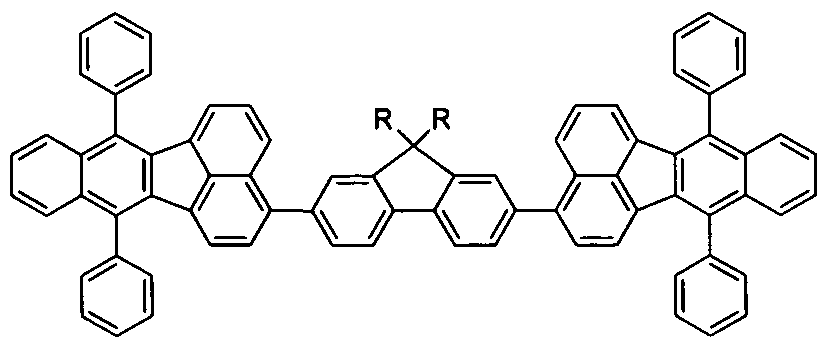
- R denotes an optionally substituted alkyl, aryl or heteroaryl group.
Landscapes
- Chemical & Material Sciences (AREA)
- Engineering & Computer Science (AREA)
- Materials Engineering (AREA)
- Organic Chemistry (AREA)
- Physics & Mathematics (AREA)
- Medicinal Chemistry (AREA)
- Chemical Kinetics & Catalysis (AREA)
- Polymers & Plastics (AREA)
- Health & Medical Sciences (AREA)
- Spectroscopy & Molecular Physics (AREA)
- Optics & Photonics (AREA)
- Electroluminescent Light Sources (AREA)
- Polyoxymethylene Polymers And Polymers With Carbon-To-Carbon Bonds (AREA)
Abstract
Description


Claims


Priority Applications (4)
| Application Number | Priority Date | Filing Date | Title |
|---|---|---|---|
| US13/057,753 US20110180758A1 (en) | 2008-08-28 | 2009-08-26 | Light-emitting Material and Device |
| CN2009801333803A CN102137911A (en) | 2008-08-28 | 2009-08-26 | Light-emitting material and device |
| DE112009002093T DE112009002093T5 (en) | 2008-08-28 | 2009-08-26 | Light-emitting material and device |
| JP2011524444A JP2012500886A (en) | 2008-08-28 | 2009-08-26 | Luminescent materials and devices |
Applications Claiming Priority (2)
| Application Number | Priority Date | Filing Date | Title |
|---|---|---|---|
| GB0815693.7A GB2463040B (en) | 2008-08-28 | 2008-08-28 | Light-emitting material |
| GB0815693.7 | 2008-08-28 |
Publications (2)
| Publication Number | Publication Date |
|---|---|
| WO2010023443A2 true WO2010023443A2 (en) | 2010-03-04 |
| WO2010023443A3 WO2010023443A3 (en) | 2010-05-27 |
Family
ID=39865894
Family Applications (1)
| Application Number | Title | Priority Date | Filing Date |
|---|---|---|---|
| PCT/GB2009/002073 Ceased WO2010023443A2 (en) | 2008-08-28 | 2009-08-26 | Light-emitting material and device |
Country Status (8)
| Country | Link |
|---|---|
| US (1) | US20110180758A1 (en) |
| JP (1) | JP2012500886A (en) |
| KR (1) | KR20110043791A (en) |
| CN (1) | CN102137911A (en) |
| DE (1) | DE112009002093T5 (en) |
| GB (1) | GB2463040B (en) |
| TW (1) | TW201022403A (en) |
| WO (1) | WO2010023443A2 (en) |
Cited By (5)
| Publication number | Priority date | Publication date | Assignee | Title |
|---|---|---|---|---|
| JP2011174058A (en) * | 2010-01-29 | 2011-09-08 | Sumitomo Chemical Co Ltd | Polymer compound, method for producing the same and light-emitting element using the polymer compound |
| WO2012116498A1 (en) * | 2011-03-03 | 2012-09-07 | Tongji University | Fluoranthene copolymers and methods of making and using the same |
| CN102770475A (en) * | 2010-02-25 | 2012-11-07 | 住友化学株式会社 | Fluoranthene polymeric compound |
| US8445868B2 (en) | 2011-03-14 | 2013-05-21 | Tongji University | Oligofluoranthenes and methods and apparatuses for detecting nitroaromatics using the same |
| JP2013531100A (en) * | 2010-06-25 | 2013-08-01 | ケンブリッジ ディスプレイ テクノロジー リミテッド | Organic light emitting device and method |
Families Citing this family (3)
| Publication number | Priority date | Publication date | Assignee | Title |
|---|---|---|---|---|
| JP5708022B2 (en) * | 2010-02-25 | 2015-04-30 | 住友化学株式会社 | Benzofluoranthene polymer |
| EP2586076B2 (en) | 2010-06-25 | 2019-10-23 | Cambridge Display Technology Limited | Organic light-emitting device and method |
| KR20170117584A (en) * | 2015-02-18 | 2017-10-23 | 캠브리지 디스플레이 테크놀로지 리미티드 | Organic light-emitting polymers containing light-emitting repeating units in the polymer backbone and devices containing them |
Family Cites Families (35)
| Publication number | Priority date | Publication date | Assignee | Title |
|---|---|---|---|---|
| US5723873A (en) | 1994-03-03 | 1998-03-03 | Yang; Yang | Bilayer composite electrodes for diodes |
| DE4436773A1 (en) | 1994-10-14 | 1996-04-18 | Hoechst Ag | Conjugated polymers with spirocenters and their use as electroluminescent materials |
| JP3865406B2 (en) | 1995-07-28 | 2007-01-10 | 住友化学株式会社 | 2,7-Aryl-9-substituted fluorene and 9-substituted fluorene oligomers and polymers |
| US5798170A (en) | 1996-02-29 | 1998-08-25 | Uniax Corporation | Long operating life for polymer light-emitting diodes |
| WO1998005187A1 (en) | 1996-07-29 | 1998-02-05 | Cambridge Display Technology Limited | Electroluminescent devices with electrode protection |
| CN1108730C (en) | 1996-09-04 | 2003-05-14 | 剑桥显示技术有限公司 | Organic light-emitting device with improved cathode |
| JP3899566B2 (en) | 1996-11-25 | 2007-03-28 | セイコーエプソン株式会社 | Manufacturing method of organic EL display device |
| JPH1135688A (en) * | 1997-05-19 | 1999-02-09 | Canon Inc | Silicon-containing compound, method for producing the silicon-containing compound, and light-emitting device using the silicon-containing compound |
| US6452218B1 (en) | 1997-06-10 | 2002-09-17 | Uniax Corporation | Ultra-thin alkaline earth metals as stable electron-injecting electrodes for polymer light emitting diodes |
| GB9718393D0 (en) | 1997-08-29 | 1997-11-05 | Cambridge Display Tech Ltd | Electroluminescent Device |
| GB9805476D0 (en) | 1998-03-13 | 1998-05-13 | Cambridge Display Tech Ltd | Electroluminescent devices |
| KR100697861B1 (en) | 1998-03-13 | 2007-03-22 | 캠브리지 디스플레이 테크놀로지 리미티드 | Electric field light emitting devices |
| GB2335884A (en) | 1998-04-02 | 1999-10-06 | Cambridge Display Tech Ltd | Flexible substrates for electronic or optoelectronic devices |
| JP4041582B2 (en) | 1998-06-17 | 2008-01-30 | 三井化学株式会社 | Benzo [k] fluoranthene derivatives |
| US6268695B1 (en) * | 1998-12-16 | 2001-07-31 | Battelle Memorial Institute | Environmental barrier material for organic light emitting device and method of making |
| GB9903251D0 (en) | 1999-02-12 | 1999-04-07 | Cambridge Display Tech Ltd | Opto-electric devices |
| JP3310658B1 (en) | 1999-03-05 | 2002-08-05 | ケンブリッジ ディスプレイ テクノロジー リミテッド | Polymer synthesis method |
| GB2348316A (en) | 1999-03-26 | 2000-09-27 | Cambridge Display Tech Ltd | Organic opto-electronic device |
| KR20020066321A (en) | 1999-09-03 | 2002-08-14 | 듀폰 디스플레이즈, 인크. | Encapsulation of organic electronic devices |
| US6413645B1 (en) | 2000-04-20 | 2002-07-02 | Battelle Memorial Institute | Ultrabarrier substrates |
| JP2004519830A (en) | 2001-04-17 | 2004-07-02 | コーニンクレッカ フィリップス エレクトロニクス エヌ ヴィ | LED with conductive transparent polymer layer containing low sulfate and high metal ions |
| DE10211648A1 (en) * | 2002-03-15 | 2003-09-25 | Basf Ag | Polymers based on fluoranthene and their use |
| JP4293592B2 (en) * | 2003-03-28 | 2009-07-08 | Tdk株式会社 | Organic EL device and organic EL display |
| US20050064234A1 (en) * | 2003-09-18 | 2005-03-24 | Franky So | Emissive polymer layer |
| DE10345583A1 (en) * | 2003-09-29 | 2005-05-19 | Basf Ag | Synthesis of phenyl-substituted fluoranthenes by Diels-Alder reaction and their use |
| DE10355786A1 (en) * | 2003-11-26 | 2005-06-30 | Covion Organic Semiconductors Gmbh | Conjugated polymers, their preparation and use |
| DE102004043497A1 (en) * | 2004-09-06 | 2006-03-09 | Basf Ag | Synthesis of polynaphthalenes and their use |
| DE102005019880A1 (en) * | 2005-04-28 | 2006-11-09 | Basf Ag | Synthesis of phenyl-substituted polyfluoranthenes and their use |
| US20090066227A1 (en) * | 2005-12-20 | 2009-03-12 | Canon Kabushiki Kaisha | Organic light-emitting device |
| KR101313094B1 (en) * | 2006-01-24 | 2013-12-31 | 삼성디스플레이 주식회사 | Polymer with 1,8-naphthalimide unit and Organic Electroluminescence Device containing the same |
| JP4211799B2 (en) * | 2006-04-13 | 2009-01-21 | セイコーエプソン株式会社 | Organic EL compound and organic EL device |
| EP2049616A4 (en) * | 2006-08-04 | 2012-10-17 | Canon Kk | Organic luminescent device and benzo[k]fluoranthene compound |
| US8277955B2 (en) * | 2006-10-17 | 2012-10-02 | Seiko Epson Corporation | Compound for organic EL device and organic EL device |
| JP5361238B2 (en) * | 2007-05-16 | 2013-12-04 | キヤノン株式会社 | Benzo [a] fluoranthene compound and organic light-emitting device using the same |
| EP2223949A4 (en) * | 2007-12-11 | 2011-11-23 | Idemitsu Kosan Co | POLYMER-BASED COMPOUND AND LIGHT-EMITTING DEVICE USING SUCH COMPOUND |
-
2008
- 2008-08-28 GB GB0815693.7A patent/GB2463040B/en not_active Expired - Fee Related
-
2009
- 2009-08-26 JP JP2011524444A patent/JP2012500886A/en active Pending
- 2009-08-26 DE DE112009002093T patent/DE112009002093T5/en not_active Withdrawn
- 2009-08-26 CN CN2009801333803A patent/CN102137911A/en active Pending
- 2009-08-26 WO PCT/GB2009/002073 patent/WO2010023443A2/en not_active Ceased
- 2009-08-26 US US13/057,753 patent/US20110180758A1/en not_active Abandoned
- 2009-08-26 KR KR1020117006966A patent/KR20110043791A/en not_active Withdrawn
- 2009-08-28 TW TW098129200A patent/TW201022403A/en unknown
Cited By (10)
| Publication number | Priority date | Publication date | Assignee | Title |
|---|---|---|---|---|
| JP2011174058A (en) * | 2010-01-29 | 2011-09-08 | Sumitomo Chemical Co Ltd | Polymer compound, method for producing the same and light-emitting element using the polymer compound |
| US20120326095A1 (en) * | 2010-01-29 | 2012-12-27 | Sumitomo Chemical Company, Limited | Polymer compound, method for producing same, and light-emitting element using the polymer compound |
| CN102770475A (en) * | 2010-02-25 | 2012-11-07 | 住友化学株式会社 | Fluoranthene polymeric compound |
| US9388101B2 (en) | 2010-02-25 | 2016-07-12 | Sumitomo Chemical Company, Limited | Fluoranthene polymer compound |
| JP2013531100A (en) * | 2010-06-25 | 2013-08-01 | ケンブリッジ ディスプレイ テクノロジー リミテッド | Organic light emitting device and method |
| WO2012116498A1 (en) * | 2011-03-03 | 2012-09-07 | Tongji University | Fluoranthene copolymers and methods of making and using the same |
| US8394643B2 (en) | 2011-03-03 | 2013-03-12 | Tongji University | Fluoranthene copolymers and methods of making and using the same |
| CN103298850A (en) * | 2011-03-03 | 2013-09-11 | 同济大学 | Fluoranthene copolymers and methods for their preparation and use |
| CN103298850B (en) * | 2011-03-03 | 2015-03-25 | 同济大学 | Fluoranthene copolymers and methods for their preparation and use |
| US8445868B2 (en) | 2011-03-14 | 2013-05-21 | Tongji University | Oligofluoranthenes and methods and apparatuses for detecting nitroaromatics using the same |
Also Published As
| Publication number | Publication date |
|---|---|
| JP2012500886A (en) | 2012-01-12 |
| TW201022403A (en) | 2010-06-16 |
| WO2010023443A3 (en) | 2010-05-27 |
| DE112009002093T5 (en) | 2011-07-07 |
| US20110180758A1 (en) | 2011-07-28 |
| GB2463040A (en) | 2010-03-03 |
| GB0815693D0 (en) | 2008-10-08 |
| KR20110043791A (en) | 2011-04-27 |
| GB2463040B (en) | 2012-10-31 |
| CN102137911A (en) | 2011-07-27 |
Similar Documents
| Publication | Publication Date | Title |
|---|---|---|
| EP2630675B1 (en) | Organic light-emitting device and method | |
| TWI482760B (en) | Compounds for use in opto-electrical devices | |
| TWI529192B (en) | Organic light emitting polymer and device | |
| WO2013005031A1 (en) | Organic light emitting device and method | |
| JP6225120B2 (en) | polymer | |
| EP2326695A2 (en) | Blue-light emitting material | |
| US20110180758A1 (en) | Light-emitting Material and Device | |
| EP2076581A1 (en) | Light emissive device | |
| US20180138426A1 (en) | Light-emitting compound | |
| CN102395646B (en) | Organic Light Emitting Materials and Devices | |
| WO2013064793A1 (en) | Compound, device and method of making same | |
| GB2488258A (en) | Electroluminescent copolymer | |
| JP5274448B2 (en) | Photoelectric polymer and device | |
| EP1969654A2 (en) | Light emissive device | |
| US20160372667A1 (en) | Light emitting composition and device | |
| CN102395615A (en) | Monomer, polymerization method, and polymer | |
| JP2009535795A5 (en) | ||
| GB2481227A (en) | An organic electroluminescent device comprising a plasticiser | |
| EP3259276A1 (en) | Compound, composition and organic light-emitting device | |
| WO2015079261A1 (en) | Polymer and organic light-emitting device | |
| Xun et al. | Light emitting polymers | |
| WO2015044656A1 (en) | Polymer and organic light emitting device |
Legal Events
| Date | Code | Title | Description |
|---|---|---|---|
| WWE | Wipo information: entry into national phase |
Ref document number: 200980133380.3 Country of ref document: CN |
|
| 121 | Ep: the epo has been informed by wipo that ep was designated in this application |
Ref document number: 09785008 Country of ref document: EP Kind code of ref document: A2 |
|
| ENP | Entry into the national phase |
Ref document number: 2011524444 Country of ref document: JP Kind code of ref document: A |
|
| WWE | Wipo information: entry into national phase |
Ref document number: 13057753 Country of ref document: US |
|
| ENP | Entry into the national phase |
Ref document number: 20117006966 Country of ref document: KR Kind code of ref document: A |
|
| 122 | Ep: pct application non-entry in european phase |
Ref document number: 09785008 Country of ref document: EP Kind code of ref document: A2 |