WO2010022690A2 - A method of preparation of highly pure vildagliptin - Google Patents
A method of preparation of highly pure vildagliptin Download PDFInfo
- Publication number
- WO2010022690A2 WO2010022690A2 PCT/CZ2009/000105 CZ2009000105W WO2010022690A2 WO 2010022690 A2 WO2010022690 A2 WO 2010022690A2 CZ 2009000105 W CZ2009000105 W CZ 2009000105W WO 2010022690 A2 WO2010022690 A2 WO 2010022690A2
- Authority
- WO
- WIPO (PCT)
- Prior art keywords
- vildagliptin
- chloroacetyl
- mixture
- pyrrolidine
- amino
- Prior art date
- Legal status (The legal status is an assumption and is not a legal conclusion. Google has not performed a legal analysis and makes no representation as to the accuracy of the status listed.)
- Ceased
Links
- 0 *=C(CN(CC(N(CCC1)[C@@]1C#N)=O)C(CC(C1)C2)(C3)C1CC23O)N(CCC1)[C@]1C#N Chemical compound *=C(CN(CC(N(CCC1)[C@@]1C#N)=O)C(CC(C1)C2)(C3)C1CC23O)N(CCC1)[C@]1C#N 0.000 description 1
- ICKKCQVVBAQJIL-MTGDKIBOSA-N N#C[C@H](CCC1)N1C(CN(CC[N+](CCC1)([C@@H]1C#N)[O-])C(CC(C1)C2)(C1C1)C2C1O)=O Chemical compound N#C[C@H](CCC1)N1C(CN(CC[N+](CCC1)([C@@H]1C#N)[O-])C(CC(C1)C2)(C1C1)C2C1O)=O ICKKCQVVBAQJIL-MTGDKIBOSA-N 0.000 description 1
- OJJDGXWIEGTJOZ-JFQZXIRVSA-N N#C[C@H](CCC1)N1C(CNC(CC(C1)C2)(C3)C1CC23O)=O Chemical compound N#C[C@H](CCC1)N1C(CNC(CC(C1)C2)(C3)C1CC23O)=O OJJDGXWIEGTJOZ-JFQZXIRVSA-N 0.000 description 1
Classifications
-
- C—CHEMISTRY; METALLURGY
- C07—ORGANIC CHEMISTRY
- C07D—HETEROCYCLIC COMPOUNDS
- C07D207/00—Heterocyclic compounds containing five-membered rings not condensed with other rings, with one nitrogen atom as the only ring hetero atom
- C07D207/02—Heterocyclic compounds containing five-membered rings not condensed with other rings, with one nitrogen atom as the only ring hetero atom with only hydrogen or carbon atoms directly attached to the ring nitrogen atom
- C07D207/04—Heterocyclic compounds containing five-membered rings not condensed with other rings, with one nitrogen atom as the only ring hetero atom with only hydrogen or carbon atoms directly attached to the ring nitrogen atom having no double bonds between ring members or between ring members and non-ring members
- C07D207/10—Heterocyclic compounds containing five-membered rings not condensed with other rings, with one nitrogen atom as the only ring hetero atom with only hydrogen or carbon atoms directly attached to the ring nitrogen atom having no double bonds between ring members or between ring members and non-ring members with hetero atoms or with carbon atoms having three bonds to hetero atoms with at the most one bond to halogen, e.g. ester or nitrile radicals, directly attached to ring carbon atoms
- C07D207/16—Carbon atoms having three bonds to hetero atoms with at the most one bond to halogen, e.g. ester or nitrile radicals
-
- A—HUMAN NECESSITIES
- A61—MEDICAL OR VETERINARY SCIENCE; HYGIENE
- A61P—SPECIFIC THERAPEUTIC ACTIVITY OF CHEMICAL COMPOUNDS OR MEDICINAL PREPARATIONS
- A61P3/00—Drugs for disorders of the metabolism
- A61P3/08—Drugs for disorders of the metabolism for glucose homeostasis
- A61P3/10—Drugs for disorders of the metabolism for glucose homeostasis for hyperglycaemia, e.g. antidiabetics
Definitions
- the present invention deals with a new method of obtaining highly chemically pure and pharmaceutically usable vildagliptin (I), including methods of analytic control of the production process and quality of the target substance.
- Vildagliptin (I) is an effective substance for the treatment of second type diabetes. Its therapeutic effect is based on inhibition of the enzyme dipeptidyl peptidase IV (DPP-IV).
- L-prolinamide (II) was used as the input raw material, which is first acyled on nitrogen in a potassium carbonate - tetrahydrofuran system, and subsequently the amidic group is dehydrated to a nitrile. Trifluoroacetic acid anhydride was used as the dehydration agent.
- the output of the first stage was l-chloroacetyl-(S)-2-cyanopyrrolidine described by chemical formula (IV), where X stands for a chlorine atom.
- WO 2004/092127 Al describes a process of preparation of vildagliptin (I), in which L-prolinamide (II) reacts with an acylation agent according to Scheme 2.
- a significant characteristic of the process is the use of the Vilsmeier Reagent (a mixture of POCl 3 and DMF) for dehydration of the amide to a nitride.
- the final stage of preparation of vildagliptin as well as its crystallization was performed in a 2-butanone environment. A crystalline product with the melting point of 148°C was obtained.
- the substituent R in formula (VII) represents a wide range of substituents, among them also unsubstituted adamantane, but not adamantanol, which is a structural constituent of vildagliptin.
- the claims as well as examples of WO 98/19998 A2 describe a process of preparation of derivatives differing in the R group.
- Y represents a series of various substituents, structurally different from adamantane as well as from previously described substituents.
- the synthesis was performed from L-prolinamide (II) with the use of tetrahydrofuran as the solvent, potassium carbonate as the base and TFAA as the dehydration agent.
- WO 03/051848 describes preparation of both l-haloacetyl-(S)-2- cyanopyrrolidine derived from chloro- and bromoacetic acid, and the derivatives where the halogen was substituted with suitable leaving groups, e.g. alkyl sulfonate, aryl sulfonate, acyloxy groups.
- suitable leaving groups e.g. alkyl sulfonate, aryl sulfonate, acyloxy groups.
- the process of preparation of l-chloroacetyl-(S)-2-cyano pyrrolidine according to WO 2006/100181 A2 comprises acylation of L-prolinamide with the use of chloroacetyl chloride (triethylamine - dichloromethane system) and subsequent use of a dehydration agent for conversion of the amidic group to a nitrile.
- the dehydration agent used was the Vilsmeier reagent in many variations (e.g. POCl 3 -DMF, SOCl 2 -DMF, cyanuric chloride-DMF).
- vildagliptin According to the referenced literature processes of purification of vildagliptin are based on the use of separation techniques (column chromatography) or on crystallization from an organic solvent. According to application no. WO 00/34241 crude vildagliptin was purified chromatographically; a substance with the melting point of 138-14O 0 C was obtained. According to E.B.Villhauer et.al: J.Med.Chem. 2003, 46, 2774-2789 vildagliptin was finally crystallized from ethyl acetate and isopropyl alcohol and yielded a nearly white crystalline substance with the melting point of 148-150 °C. According to WO 2004/092127 Al vildagliptin was crystallized in an environment of 2-butanone and subsequently washed with t- butyl methyl ether to provide a substance with the melting point of 148 °C.
- Patent application no. WO 2007/019255 describes salts of vildagliptin (I) with acids in the proportion of 1 :1, including their use in the particular pharmaceutical sphere. These are salts of vildagliptin both with mineral and organic acids (mono- and polycarboxylic, sulfonic, etc.), incl. polymorphs of these salts described by means of X-ray diffraction. The possibility of generation of vildagliptin salts, especially hydrochloride, had already been described before filing of this application (Villhauer E. B., et al.: J. Med. Chem. 46, 2774 (2003)).
- the process of preparation of a pharmaceutically acceptable ingredient as well as the resulting quality of the ingredient must be under strict control in accordance with the principles of the Good Production Practice.
- an array of methods of analytic chemistry are used among which separation techniques allowing very sensitive analyzing of the ingredient as well as its mixtures with other substances occupy a prominent position.
- High Performance Liquid Chromatography (HPLC), or Gas Chromatography (GC) are usually used for this purpose.
- Impurities present in the API are then determined by the relative position of the peak in the HPLC or GC chromatogram while the peak position is usually expressed as the time (in minutes) necessary for the impurity to travel from the point of sample injection to the HPLC or GC column filled with a suitable sorbent to the detection place.
- Retention time The time necessary for a chemical substance (e.g. API or impurity) to get from the injection point to the detector under standard conditions is referred to as the "retention time”.
- Retention times (rt) related to the retention time of a standard are called “relative retention times”.
- the relative retention time (rrt) of the API usually takes the value 1, components that need a shorter time to travel to the detector manifest lower relative retention times than 1 while components travelling more slowly exhibit higher relative retention times than 1.
- the relative retention times are considered as standard characteristics of the analyzed substance, i.e. they only depend on the chemical structure of the particular constituent.
- the position of the peak in the chromatogram, or the retention time, is only a quality parameter that does not provide information about the quantity of the analyzed substance.
- the result of the quantity determination is usually expressed in percent by weight. If standards of impurities (including raw materials, intermediate products and optic isomers) are not available, it is very difficult to determine their actual content in the API, to find an acceptable analytic method and to perform its validation. Without the possibility of reliable quality assurance of the API it is not possible to control the process of its production and use the obtained substance for the preparation of a pharmaceutical formulation.
- HPLC or GC HPLC or GC
- Isolated impurities or chemically prepared standards of impurities can be used as "external” or "internal” standards in HPLC.
- quantity determination standards of impurities are used in the "standard addition” method or for the determination of "response factors" (Strobel H. A., Heineman W.R., Chemical Instrumentation: A Systematic Approach (Wiley & Sons: New York 1989), Snyder L.R., Kirkland JJ. Introduction to Modern Liquid Chromatography (John Wiley & Sons: New York 1979)).
- Standards of impurities, analytic methods of chemical purity of the API and quantity determination methods are extremely important for the control of the production process and consequently for successful commercialization of the product.
- Enantiomers Optically active substances, which rotate the plane of linearly polarized light, form pairs of optical isomers, called enantiomers.
- Enantiomers are isomeric compounds that behave towards each other as mirror images and that differ in a number of their characteristics, especially their biological effect.
- Enantiomers usually contain a chiral centre located on a carbon atom. In the case of vildagliptin and its intermediates this centre is located on carbon 2 of the pyrrolidine cycle.
- enantiomers are referred to as (S)/(R) or alternatively (L)/(D) enantiomers.
- the substance with formula (X) is D-prolinamide, the substance with formula (XI) is 1- chloroacetyl-2-(R)-pyrrolidine carboxamide, the substance with formula (XII) is 1- chloroacetyl-(R)-2-cyanopyrrolidine, the substance with formula (XIII) is (2R)-I -[[(3- hydroxytricyclo[3.3.1.1(3,7)]dec-l-yl)amino]acetyl]-2-pyrrolidine carbonitrile or alternatively also D-vildagliptin.
- the content of the (R)-, or (D)- enantiomer in the target substance must not exceed the limit of 0.15%. Due to the setting of analytic methods for determination of optical purity it is usually necessary to synthesize the standards of both the enantiomers.
- the solution presented by us represents a new and convenient method of obtaining highly chemically pure vildagliptin (I), including methods of analytical control of the production process and quality of the target substance.
- the invention provides especially processes concerning carrying out of chemical synthesis and methods of purification of vildagliptin.
- the invention further provides analytical standards and analytical methods used for the control of the production process and final quality of vildagliptin.
- the input raw materials for the execution of the first stage included L-prolinamide (II) and a suitable acylation agent selected from the group consisting of chloroacetyl chloride, bromoacetyl bromide or bromoacetyl chloride.
- a linear or cyclic ether selected from the group consisting of diethyl ether, t-butyl methyl ether, ethylene glycol dimethyl ether, substituted glycols, polyethylene glycols, tetrahydrofuran, 2-methyl tetrahydrofuran a 1,4-dioxane can be used. If solvents of a different type are used, e.g.
- a suitable base for the reaction of L-prolinamide with the acylation agent will comprise a tertiary amine selected from the group consisting of trimethylamine, triethylamine, diisopropylethylamine, N-methylpyrolidine, N-methylmorpholine and N- methylpiperidine.
- the first isolated fraction of the product was characterized by the content of the desired constituent in the interval of 40-60% (by weight) while nearly the whole rest of the content to 100% was represented by the inert trialkylamine hydrohalogenide.
- the process employed is described in Example 1.
- an acid anhydride was used, conveniently trifluoroacetic acid anhydride
- an inert organic solvent with a reduced content of water can be used, preferably a linear or cyclic ether selected from the group consisting of diethyl ether, t-butyl methyl ether, ethylene glycol dimethyl ether, substituted glycols, polyethylene glycols, tetrahydrofuran, 2-methyl tetrahydrofuran a 1,4-dioxane.
- a suitable solvent for the extraction of l-haloacetyl-(S)-2-cyanopyrrolidine may be a solvent selected from the group consisting of chloroform, dichloromethane, diethyl ether, dimethylcarbonate, ethyl acetate and isopropyl acetate.
- a mixture of an organic ketone, ester and polar aprotic solvent was used as the reaction environment .
- Organic ketones that can be used for this purpose comprise e.g. acetone, 2-butanone or cyclohexanone, applicable esters are e.g. ethyl acetate, isopropyl acetate or dimethyl carbonate while the polar aprotic solvent may be selected e.g.
- the second fraction of crude vildagliptin (I) was successfully isolated, exhibiting approx. 90% chemical purity according to HPLC analysis.
- the final crystallizations of the second fraction of raw vildagliptin were first carried out from the mixture of a ketone, ester and polar aprotic solvent, conveniently from a mixture of DMF, isopropyl acetate and 2- butanone. Subsequently, there was the final crystallization from a suitable solvent selected from toluene, 2-methyltetrahydrofuran, 2-butanone, dimethylcarbonate, isopropyl acetate, isopropyl alcohol.
- the second fraction of vildagliptin in the API quality was obtained. The process employed of preparation of vildagliptin in a pharmaceutically acceptable quality is described in Example 3.
- vildagliptin The final crystallizations of vildagliptin were carried out in a number of solvents of various types, from the non-polar toluene, through 2-methyltetrahydrofuran and 2-butanone with medium polarity, polar aprotic esters of carboxylic acids to strongly polar and protic alcohols.
- Samples of vildagliptin crystals prepared by crystallization from solvents selected from the toluene, 2-methyltetrahydrofuran, 2-butanone, dimethylcarbonate, isopropyl acetate, isopropyl alcohol range were subject to X-ray powder diffraction measurement. The same holds good for samples of the first and second fractions of crude vildagliptin.
- This impurity is (2S)-l- ⁇ [ ⁇ 2-[(2S)-2-cyanopvrrolidin-l-yl]-2-oxoethyl ⁇ [(3- hydroxytricyclo-[3.3.1.1(3,7)]dec-l-yl)amino]]acetyl ⁇ -pyrrolidine-2-carbonitrile, described by chemical formula (XIV).
- a set of analytical standards of enantiomers of the intermediates and vildagliptin itself was prepared.
- the preparation of the analytical standard of l-chloroacetyl-2-(R)-pyrrolidine carboxamide (XI) was based on D-prolinamide (X) and chloroacetyl chloride and was characterized by the use of an organic ester for the final crystallization of the standard.
- the obtained analytical standard manifests a high chemical purity (HPLC purity of 99.78%), a high content of the desired constituent (the content determined by argentometric titration of chlorine released by a reaction of the substance with sodium hydroxide was 99.8%) and a high optical purity, i.e. a very low content of the opposite enantiomer (S) (the content of the (S)- enantiomer according to HPLC was lower than 0.05 %).
- HPLC purity high chemical purity of 99.78%)
- a high content of the desired constituent the content determined by argentometric titration of chlorine released by a reaction of the substance with sodium hydroxide was 99.8%
- a high optical purity i.e. a very low content of the opposite enantiomer (S) (the content of the (S)- enantiomer according to HPLC was lower than 0.05 %).
- the preparation of the analytical standard of l-chloroacetyl-(R)-2-cyanopyrrolidine (XII) was based on the use of l-chloroacetyl-2-(R)-pyrrolidine carboxamide (XI) and trifluoroacetic acid anhydride in the environment of anhydrous tetrahydrofuran.
- the obtained analytical standard manifests a high chemical purity (HPLC purity of 99.58%), a high content of the desired constituent (the content determined by argentometric titration of chlorine released by a reaction of the substance with sodium hydroxide was 99.4%) and a high optical purity, i.e. a very low content of the opposite enantiomer (S) (the content of the (S)-enantiomer according to HPLC was lower than 0.05 %).
- S the content of the (S)-enantiomer according to HPLC was lower than 0.05 %).
- Analytical methods of quality control which must be sufficiently reliable and precise, are integral parts of every production process of an API.
- evaluation of quality of the target vildagliptin (I) and isolated intermediates methods of High Performance Liquid Chromatography (HPLC) have been developed for the determination of chemical purity on one hand and for the determination of the content of the target substance and for evaluation of optical purity of vildagliptin (I on the other hand.
- HPLC High Performance Liquid Chromatography
- a method has been developed for verifying the content of 3-amino-l-adamantanol (V) on the basis of Gas Chromatography (GC).
- the reason for using the GC technique was a low detection response of 3-amino-l-adamantanol in the HPLC technique using UV detection of analyzed substances.
- the result of the GC analysis exhibited dependence on the injection temperature, see Table 2.
- An increase of the content of 3-amino-l-adamantanol was observed when a method characterized by the injection temperature of 250 0 C and higher was used. Through a reduction of this temperature the unacceptable contents of 3-amino-l-adamantanol got below the limit value (0.15 %).
- the reason for the dependence of the analysis result on the injection temperature is the course of the decomposition reaction, when vildagliptin exposed to the critical and higher temperature is decomposed back to the initial 3-amino-l-adamantanol.
- Our invented process of chemical synthesis and purification of vildagliptin (I) can be conveniently used for the production of highly chemically pure vildagliptin and subsequently of a drug for the treatment of type 2 diabetes.
- Our methods of chemical analysis and the analytical standards of vildagliptin, its intermediates and optical isomers prepared by us can be used for the production control of vildagliptin in the quality required for pharmaceutical substances with a number of advantages.
- Fig. 1 HPLC chromatograms obtained by gradient elution of a solution of pure vildagliptin (I) (a) and a solution of vildagliptin (I) with additions of standards of specific impurities (b). The content of each added impurity is 10 % with regard to vildagliptin.
- Fig. 2 An HPLC chromatogram obtained by isocratic elution of a solution of vildagliptin (I) (a) and a solution of vildagliptin with 20% addition of the D-vildagliptin standard (b).
- Fig. 3. 1 H NMR spectra of solutions in DMSO-D 6
- the separated substance was aspirated, washed with isopropyl acetate (400 ml) and dried in vacuum. 90 g of a white powder (the HPLC content determined with the use of the standard was 97.5%, HPLC purity with triethylamine hydrochloride disregarded was 99.1 %).
- EXAMPLE 2 (preparation of l-chloroacetyl-(S)-2-cyanopyrrolidine) [1] 1500 g of a mixture of l-chloroacetyl-2-(S)-pyrrolidine carboxamide with triethylamine (amide content of 52-54 %) were suspended in 3000 ml of dry THF. After 30 minutes 825 ml of TFAA were added to the stirred suspension. After the addition of the dehydration agent the suspension got diluted, was slightly heated up by the reaction heat and became light yellow. At the laboratory temperature the mixture was stirred for approximately another 4 hours. [2] Then the mixture was filtered and the filtration cake was washed with THF (2 x 350 ml to the filtrate).
- l-Chloroacetyl-(S)-2-cyanopyrrolidine (530 g) was mixed with 1060 ml of isopropyl acetate, the mixture was mildly heated up until the substance got dissolved (ca. 45 0 C); before further use (see point [2]) the solution was mixed with 1060 ml of dry dimethylformamide.
- 3-amino-l-adamantanol (530 g) was mixed with 3600 ml of 2-butanone, potassium iodide (25 g) and potassium carbonate (2120 g) were added to the stirred suspension.
- the suspension was stirred in a bath with the temperature of 35-40°C and the solution prepared in accordance with point [1] was added dropwise during 1.25 h. Then, the reaction mixture was stirred at 37 ⁇ 3 0 C for 1 hour and thereafter it was heated to moderate reflux (approx. 75-80 0 C) for 30 minutes; subsequently, the hot suspension was filtered, the filtration cake was washed with 3 x 450 ml of hot 2-butanone. The obtained clear filtrate was stirred under slow cooling. After a while the solution became cloudy due to separation of the product. The suspension was stirred at the laboratory temperature. Then, filtration followed and the cake was washed with 2 x 340 ml of isopropyl acetate. A white crystalline powder with chemical purity higher than 99% was obtained (determined with HPLC). The crystalline modification was verified with the use of X-ray powder diffraction.
- the first fraction of crude vildagliptin from point [2] (470 g) was mixed with 3400 ml of 2- butanone.
- the stirred mixture was heated up to the boiling temperature and stirred while boiling for about 5 minutes. Subsequently, the hot solution was filtered through heated filtration apparatus. The filtrate was stirred being very slowly cooled down for 2 hours. Then, filtration was performed and the filtration cake was washed with 2-butanone (2 x 390 ml).
- the product was dried in vacuum (65 °C, 15 mbar). After drying the product was obtained in the form of white crystalline powder with chemical purity higher than 99.9 % (according to HPLC and GC analyses).
- EXAMPLE 5 (preparation of an analytical standard of l-chloroacetyl-(S)-2-cyanopyrrolidine) [1] 40 g of L-prolinamide were suspended in 800 ml of dry tetrahydrofuran, 50 ml of triethylamine were added and the mixture was stirred and mildly heated up (35°C) until a solution was obtained. [2] In 200 ml of dry tetrahydrofuran 30 ml of chloroacetyl chloride were dissolved. The obtained solution was cooled in a saline bath under an argon atmosphere and the solution prepared in accordance with the procedure of point [1] was added to the solution dropwise during ca. 3 hours under intense stirring.
- the poured-off solution was left at standstill to the next day. On the bottom of the vessel a block of crystals was separated. Then, the mother liquor was poured off the crystal block. The obtained mother liquor was processed with the method specified in point [5], the isolated crystalline fraction was processed in accordance with point [6]. [5] The ochre-coloured solution was extracted with chloroform (5x50 ml). The combined chloroform fractions were washed with water (10 ml), dried over sodium sulphate and before the filtration of the desiccant, silica gel and aluminium oxide were added. After filtration of the desiccant and sorbents the solvent was evaporated in vacuum.
- EXAMPLE 6 (preparation of a standard of l-chloroacetyl-2-(R)-pyrrolidine carboxamide) [1] 20 g of D-prolinamide were suspended in 400 ml of dry tetrahydrofuran, 25 ml of triethylamine were added and the mixture was stirred and mildly heated (35 °C) until a solution was obtained.
- Example 6 were suspended in 50 ml of dry THF. 16 ml of TFAA were added to the stirred suspension. In ca. 10 minutes the suspension passed into a yellow solution. At the laboratory temperature the mixture was stirred for ca. 30 minutes.
- reaction mixture was concentrated in a vacuum rotational evaporator (bath approx. 60°C, vacuum 15 mbar) to the maximum possible extent, 100 ml of a saturated solution of sodium hydrogen carbonate were slowly added to the concentrated residue, the resulting mixture was heated in a bath with the temperature of 80°C; subsequently the yellow solution was poured off the minority brown matter stuck to the walls of the vessel.
- the removed solution was extracted with chloroform (6x30 ml), the chloroform solution was dried over sodium sulphate and just before the filtration a small quantity of chromatographic silica gel and aluminium oxide was added.
- the clear yellow solution obtained by filtration was concentrated in a vacuum rotational evaporator.
- EXAMPLE 8 (preparation of a standard preparation of (2R)-I -[[(3- hydroxytricyclo [3.3.1.1 (3 ,7)] dec- 1 -yl)amino] acetyl] -2-pyrrolidine carbonitrile) [1] 10 g of l-chloroacetyl-(R)-2-cyanopyrrolidine (obtained by the procedure of Example 7) were mixed with 40 ml of isopropyl acetate and the mixture was mildly heated until the dissolution of the substance (ca. 40 0 C); before further use 40 ml of dimethylformamide were added.
- the obtained filtrate was stirred under slow cooling. After a while the solution started to get cloudy due to separation of the product. Stirring of the suspension continued at the laboratory temperature. Then, the filtration followed and the cake was washed with 2x20 ml of isopropyl acetate. The isolated product was dried in vacuum (70 0 C, 15 mbar). The procedure provided 4.4 g of a white crystalline powder with the melting point of 149-151 0 C, with the chemical purity of 99.0% according to HPLC, with the content of (S)-enantiomer less than 0.05% HPLC and the content of 3-amino-l-adamantanol less than 0.05 % (determined by GC).
- the resulting suspension was stirred and slowly heated to boiling for 4.5 hours. Then, the hot reaction mixture was filtered and the filtration cake was washed with 2x15 ml of 2-butanone. [2] The filtrate produced by the procedure of point [1] was concentrated in vacuum, the residue was washed with heptane and ether.
- the residual honey-like product represented a mixture of the input vildagliptin and the target substance.
- ANALYTICAL METHODS (A, B, C): The process of preparation and quality of vildagliptin (I) were controlled by means of a number of analytical methods. The prominent position was occupied by separation methods: High Performance Liquid Chromatography (HPLC) and Gas Chromatography (GC). For the control of chemical purity and content of vildagliptin method (A) of HPLC analysis was developed, for the control of optical purity method (B) of HPLC analysis was developed and for the verification of presence of L-prolinamide (II) and 3- amino-1-adamantanol (V) method (C) of GC analysis was developed.
- HPLC High Performance Liquid Chromatography
- GC Gas Chromatography
- Tested vildagliptin solution 8 ml of the sample solvent are added to 15.0 mg of the tested substance, the mixture is put in an ultrasonic bath for 5 minutes and, after dissolution and cooling to the laboratory temperature, completed up to 10.0 ml with the sample solvent.
- Reference solution 8 ml of the sample solvent are added to 15.0 mg of the tested substance, the mixture is put in an ultrasonic bath for 5 minutes and, after dissolution and cooling to the laboratory temperature, completed up to 10.0 ml by the sample solvent.
- 1.0 ml of this solution is pipetted to a 100ml volumetric flask and completed with the sample solvent. Then, 1.0 ml of this solution is pipetted to a 10ml volumetric flask and completed up to the mark (0.1%) with the sample solvent.
- Pi peak area of the individual impurity in the chromatogram of the tested solution;
- P ref peak area of vildagliptin in the chromatogram of the reference solution;
- Tested vildagliptin solution 4 ml of the sample solvent are added to 50.0 mg of the tested substance, the mixture is put in an ultrasonic bath for 5 minutes and, after dissolution and cooling to the laboratory temperature, completed up to 5.0 ml with the sample solvent.
- Reference solution 4 ml of the sample solvent are added to 50.0 mg of the reference substance, the mixture is put in an ultrasonic bath for 5 minutes and, after dissolution and cooling to the laboratory temperature, completed up to 5.0 ml with the sample solvent. 1.0 ml of this solution is pipetted to a 100ml volumetric flask and completed with the sample solvent.
- Pi peak area of the impurity - R-vildagliptin in the chromatogram of the tested solution; P ref ... peak area of vildagliptin in the chromatogram of the reference solution; m ref ... weight of the reference substance - vildagliptin for the preparation of the reference solution in mg (converted to the content in the dried substance and to the drying loss); m ... weight of the tested substance for the preparation of the tested solution in mg (converted to the drying loss).
- Carrier gas He, 30 cm/s (3.7 ml/min)
- Detector FID, 300 °C Supply solution: 7.5 mg of L-prolinamide and 7.5 mg of 3-amino-l-adamantanol are weighed and put in a 10ml volumetric flash and completed with ethanol to the mark.
- Reference solution 1.0 ml of the supply solution is transferred to a 10ml volumetric flash and completed with ethanol up to the mark.
- Tested solution 50.0 mg of the tested sample are weighed and put in a 2ml vial, dissolved in 1.0 ml of ethanol and the vial is closed.
Landscapes
- Health & Medical Sciences (AREA)
- Chemical & Material Sciences (AREA)
- Organic Chemistry (AREA)
- Diabetes (AREA)
- General Chemical & Material Sciences (AREA)
- Emergency Medicine (AREA)
- Hematology (AREA)
- Obesity (AREA)
- Engineering & Computer Science (AREA)
- Chemical Kinetics & Catalysis (AREA)
- Endocrinology (AREA)
- Medicinal Chemistry (AREA)
- Nuclear Medicine, Radiotherapy & Molecular Imaging (AREA)
- Bioinformatics & Cheminformatics (AREA)
- Pharmacology & Pharmacy (AREA)
- Life Sciences & Earth Sciences (AREA)
- Animal Behavior & Ethology (AREA)
- General Health & Medical Sciences (AREA)
- Public Health (AREA)
- Veterinary Medicine (AREA)
- Pharmaceuticals Containing Other Organic And Inorganic Compounds (AREA)
- Pyrrole Compounds (AREA)
Abstract
The present invention deals with a new method of preparation of chemically highly pure and pharmaceutically usable vildagliptin (I), including analytic control of the production process and quality of the target substance. The newly found process is based on the preparation and isolation of a mixture of l-haloacetyl-2-(S)-pyrrolidine carboxamide of chemical formula (VI), where X stands for a chlorine or bromine atom, with trialkylamine hydrohalides of chemical formula R1R2R3N*HX, where R1, R2 and R3 independently stand for a linear or branched alkyl with 1 to 6 carbon atoms, substituents R1 and R2 can be connected with a bridge and form a cycle with 2 to 6 carbon atoms, or can be connected with an ether bond, X stands for a chlorine or bromine atom. The invention also deals with analytical standards and analytical methods used for the control of the production process and final quality of vildagliptin.
Description
A method of preparation of highly pure vildagliptin
Technical Field
5 The present invention deals with a new method of obtaining highly chemically pure and pharmaceutically usable vildagliptin (I), including methods of analytic control of the production process and quality of the target substance.
Background Art .0
Vildagliptin (I) is an effective substance for the treatment of second type diabetes. Its therapeutic effect is based on inhibition of the enzyme dipeptidyl peptidase IV (DPP-IV).
Vildagliptin, chemically (2S)- l-[[(3-hydroxytricyclo[3.3.1.1 (3,7)]dec- l-yl)amino]acetyl]-2- pyrrolidine carbonitrile, is described by chemical formula (I).

The first solution of chemical synthesis of vildagliptin (I) was described in patent no. WO
£0 00/34241. The patent dealt with chemical synthesis of both vildagliptin itself (process in accordance with Scheme 1) starting from L-prolinamide described by chemical formula (II) and chloroacetyl chloride described by chemical formula (III), where X stands for a chlorine atom, and the advanced intermediates (l-chloroacetyl-(S)-2-cyanopyrrolidine described by chemical formula (IV), where X stands for a chlorine atom, and 3-amino-l-adamantanol
.5 described by chemical formula (V).

(ii) (Hi) (IV) (V)
50
In the first stage of synthesis L-prolinamide (II) was used as the input raw material, which is first acyled on nitrogen in a potassium carbonate - tetrahydrofuran system, and subsequently the amidic group is dehydrated to a nitrile. Trifluoroacetic acid anhydride was used as the
dehydration agent. The output of the first stage was l-chloroacetyl-(S)-2-cyanopyrrolidine described by chemical formula (IV), where X stands for a chlorine atom. In the next stage the intermediate (IV, X=Cl) monoalkyled 3-amino-l-adamantanol (V) in a dichloromethane - potassium carbonate system, producing vildagliptin (I). The crude product was finally chromatographically purified; a solid substance with the melting point of 138-140 °C was obtained. The used synthetic procedure is described by Scheme 1.

(a) K2CO3, THF, (b) TFAA, THF, (c) K2CO3, CH2Cl2
Scheme 1
A method of preparation of vildagliptin (I) was further described in E.B.Villhauer et.al.: J.Med.Chem. 2003, 46, 2774-2789. The preparation of l-chloroacetyl-(S)-2-cyanopyrrolidine (IV, X=Cl), analogous to patent no. WO 00/34241 and Scheme 1 was described there in the experimental part. It also mentioned a method of preparation of the previously not isolated intermediate, l-chloroacetyl-2-(S)-pyrrolidine carboxamide, described by chemical formula (VI), where X stands for a chlorine atom.
CONH2
£Nτr>
(Vl)
According to J.Med.Chem. 2003, 46, 2774-2789 the procedure did not manage to provide the intermediate (VI, X=Cl) in a crystalline form, but only in the form of a caramel-like product. The preparation of vildagliptin itself was described in the article in the form of a general method used for the preparation of a series of similar chemical structures; there was a note concerning vildagliptin that it was finally crystallized from ethyl acetate and isopropyl alcohol
while a white crystalline substance with the melting point of 148-150°C was obtained. The article provides the following link to crystallographic data of vildagliptin: http://pubs.acs.org.
Application no. WO 2004/092127 Al describes a process of preparation of vildagliptin (I), in which L-prolinamide (II) reacts with an acylation agent according to Scheme 2. A significant characteristic of the process is the use of the Vilsmeier Reagent (a mixture of POCl3 and DMF) for dehydration of the amide to a nitride. The final stage of preparation of vildagliptin as well as its crystallization was performed in a 2-butanone environment. A crystalline product with the melting point of 148°C was obtained.
l λ

(II)

(a) isopropyl acetate, DMF (b) POCl3, DMF (c) K2CO3, KI, 2-butanon
Scheme 2
Chemical structures very similar to vildagliptin were already described in the document no. WO 98/19998 A2. The claims contained the following general structure (VII):
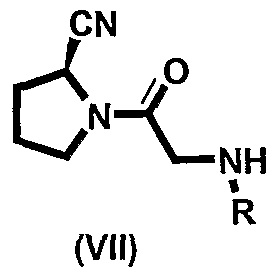
The substituent R in formula (VII) represents a wide range of substituents, among them also unsubstituted adamantane, but not adamantanol, which is a structural constituent of vildagliptin. The claims as well as examples of WO 98/19998 A2 describe a process of preparation of derivatives differing in the R group. As regards precursors of these substances, the examples described the preparation of the derivative of 1 -bromoacetyl-(S)-2- cyanopyrrolidine (IV, X=Br) derived from bromoacetyl bromide (III, X=Br). The solvent used was dichloromethane, the base was triethylamine (Et3N), the catalyst was dimethylamino
pyridine (DMAP) and the dehydration agent was trifluoroacetic acid anhydride (TFAA). The reaction proceeds according to scheme 3.

(II) (III, X=Br) (IV, X=Br) (a) Et3N, CH2Cl2, DMAP (b) TFAA, CH2Cl2
Scheme 3
Chemical structures very similar to vildagliptin (I) were also described in another patent no. WO 01/96295 A2. The claims contained a general chemical structure described by the following formula (VIII):

Syntheses of advanced intermediates of vildagliptin are also mentioned in other patent applications that otherwise deal with substances that are structurally different from vildagliptin. E.g. WO 03/051848 describes preparation of both l-haloacetyl-(S)-2- cyanopyrrolidine derived from chloro- and bromoacetic acid, and the derivatives where the halogen was substituted with suitable leaving groups, e.g. alkyl sulfonate, aryl sulfonate, acyloxy groups. For dehydration of the amidic group trifluoroacetic acid anhydride (TFAA) was used again.
In the specialized article: E.B.Villhauer et.al.:J.Med.Chem. 2002, 45, 2362-2365 synthesis of l-haloacetyl-(S)-2-cyanopyrrolidine (IV, X = Cl or Br) derived both from chloroacetic and bromoacetic acid was described.
The topic of advanced intermediates of vildagliptin is also discussed in application no. WO 2006/100181 A2. It is a patent dealing with a compound with similar effects as vildagliptin, which is described by chemical formula (IX):

Compound (IX) has a common intermediate with vildagliptin, namely l-chloroacetyl-(S)-2- cynopyrrolidine (IV, X=Cl). The process of preparation of l-chloroacetyl-(S)-2-cyano pyrrolidine according to WO 2006/100181 A2 comprises acylation of L-prolinamide with the use of chloroacetyl chloride (triethylamine - dichloromethane system) and subsequent use of a dehydration agent for conversion of the amidic group to a nitrile. The dehydration agent used was the Vilsmeier reagent in many variations (e.g. POCl3-DMF, SOCl2-DMF, cyanuric chloride-DMF).
All the processes of synthesis of vildagliptin (I) described so far are based on a reaction of l-haloacetyl-(S)-2-cyanopyrrolidine (IV, X = Cl or Br) with 3-amino-l-adamantanol (V). More possibilities have been described for the synthesis of l-haloacetyl-(S)-2- cyanopyrrolidine (IV, X = CI or Br), which is obtained from L-prolinamide by reaction with chloroacetyl chloride or bromoacetyl bromide and subsequent dehydration of the amidic group to a nitrile group without isolation of the intermediate, which is l-haloacetyl-2-(S)-pyrrolidine carboxamide (VI, X = Cl or Br). This dehydration was achieved either with trifluoroacetic acid anhydride (TFAA) or with the Vilsmeier reagent (most frequently POC13/DMF, or possibly other modifications). Other alterations of the process consisted in the use of different solvents and bases.
According to the referenced literature processes of purification of vildagliptin are based on the use of separation techniques (column chromatography) or on crystallization from an organic
solvent. According to application no. WO 00/34241 crude vildagliptin was purified chromatographically; a substance with the melting point of 138-14O0C was obtained. According to E.B.Villhauer et.al: J.Med.Chem. 2003, 46, 2774-2789 vildagliptin was finally crystallized from ethyl acetate and isopropyl alcohol and yielded a nearly white crystalline substance with the melting point of 148-150 °C. According to WO 2004/092127 Al vildagliptin was crystallized in an environment of 2-butanone and subsequently washed with t- butyl methyl ether to provide a substance with the melting point of 148 °C.
Patent application no. WO 2007/019255 describes salts of vildagliptin (I) with acids in the proportion of 1 :1, including their use in the particular pharmaceutical sphere. These are salts of vildagliptin both with mineral and organic acids (mono- and polycarboxylic, sulfonic, etc.), incl. polymorphs of these salts described by means of X-ray diffraction. The possibility of generation of vildagliptin salts, especially hydrochloride, had already been described before filing of this application (Villhauer E. B., et al.: J. Med. Chem. 46, 2774 (2003)).
The processes of preparation, isolation and purification of vildagliptin have an extraordinary economic significance as they make it possible to obtain a chemically pure substance that can be used for pharmaceutical purposes. In general, the chemical purity of the Active Pharmaceutical Ingredient (API) produced in an industrial scale is one of the critical parameters for its commercialization. The American Food and Drug Administration (FDA) as well as European authorities for drug control require API's to be free of impurities to the maximum possible extent in accordance with the instruction Q7A of ICH (International Conference on Harmonization). The purpose is to achieve maximum safety of use of the medicament in the clinical practice. National administration and control authorities usually require the content of an individual impurity in the API not to exceed the limit of 0.1%. All substances (generally referred to as impurities) contained in the API in a quantity exceeding 0.1% should be isolated and characterized in accordance with ICH recommendations. Nevertheless, the content of substances with a known structure (isolated and characterized) in a pharmaceutically acceptable ingredient should not exceed the limit of 0.15%.
The process of preparation of a pharmaceutically acceptable ingredient as well as the resulting quality of the ingredient must be under strict control in accordance with the principles of the Good Production Practice. For this control an array of methods of analytic chemistry are used
among which separation techniques allowing very sensitive analyzing of the ingredient as well as its mixtures with other substances occupy a prominent position. High Performance Liquid Chromatography (HPLC), or Gas Chromatography (GC) are usually used for this purpose. Impurities present in the API are then determined by the relative position of the peak in the HPLC or GC chromatogram while the peak position is usually expressed as the time (in minutes) necessary for the impurity to travel from the point of sample injection to the HPLC or GC column filled with a suitable sorbent to the detection place. The time necessary for a chemical substance (e.g. API or impurity) to get from the injection point to the detector under standard conditions is referred to as the "retention time". Retention times (rt) related to the retention time of a standard (usually rt of the API) are called "relative retention times". The relative retention time (rrt) of the API usually takes the value 1, components that need a shorter time to travel to the detector manifest lower relative retention times than 1 while components travelling more slowly exhibit higher relative retention times than 1. Under standard conditions the relative retention times are considered as standard characteristics of the analyzed substance, i.e. they only depend on the chemical structure of the particular constituent.
The position of the peak in the chromatogram, or the retention time, is only a quality parameter that does not provide information about the quantity of the analyzed substance. For reliable determination of the content of the analyzed constituent it is necessary to have an analytical standard of the substance. The result of the quantity determination is usually expressed in percent by weight. If standards of impurities (including raw materials, intermediate products and optic isomers) are not available, it is very difficult to determine their actual content in the API, to find an acceptable analytic method and to perform its validation. Without the possibility of reliable quality assurance of the API it is not possible to control the process of its production and use the obtained substance for the preparation of a pharmaceutical formulation.
For unambiguous determination of the retention times of the analyzed substances and to be able to measure their quantities it is necessary to obtain standards of both the API itself and individual impurities, which usually also comprise the input raw materials, intermediate products and optical isomers. For the standards it is first necessary to verify the correctness of their chemical structure with the use of suitable methods. This is usually done by means of
spectral methods, especially NMR (Nuclear Magnetic Resonance), MS (Mass Spectroscopy) or a combination of a separation and spectral method, e.g. LC-MS (combination of Liquid Chromatography and Mass Spectroscopy). As soon as the chemical structures of standards of the API as well as isolated impurities are verified, it is possible to develop an analytic method (e.g. HPLC or GC) that will allow to evaluate the purity of each produced batch of API in a standard and reproducible way, or to determine the exact content of a selected constituent Isolated impurities or chemically prepared standards of impurities can be used as "external" or "internal" standards in HPLC. For the purposes of quantity determination standards of impurities are used in the "standard addition" method or for the determination of "response factors" (Strobel H. A., Heineman W.R., Chemical Instrumentation: A Systematic Approach (Wiley & Sons: New York 1989), Snyder L.R., Kirkland JJ. Introduction to Modern Liquid Chromatography (John Wiley & Sons: New York 1979)). Standards of impurities, analytic methods of chemical purity of the API and quantity determination methods are extremely important for the control of the production process and consequently for successful commercialization of the product.
Optically active substances, which rotate the plane of linearly polarized light, form pairs of optical isomers, called enantiomers. Enantiomers are isomeric compounds that behave towards each other as mirror images and that differ in a number of their characteristics, especially their biological effect. Enantiomers usually contain a chiral centre located on a carbon atom. In the case of vildagliptin and its intermediates this centre is located on carbon 2 of the pyrrolidine cycle. Depending on the spatial arrangement in the place of the chirality centre enantiomers are referred to as (S)/(R) or alternatively (L)/(D) enantiomers. Vildagliptin and its enantiomers are characterized by absolute configuration (S), or (L) respectively. Optical isomers of these substances then show the opposite absolute configuration, i.e. (R) or (D). The chemical formulae of the opposite enantiomers of vildagliptin and its precursors are as follows:

(X) (Xl) (XII) (XIII)
The substance with formula (X) is D-prolinamide, the substance with formula (XI) is 1- chloroacetyl-2-(R)-pyrrolidine carboxamide, the substance with formula (XII) is 1- chloroacetyl-(R)-2-cyanopyrrolidine, the substance with formula (XIII) is (2R)-I -[[(3- hydroxytricyclo[3.3.1.1(3,7)]dec-l-yl)amino]acetyl]-2-pyrrolidine carbonitrile or alternatively also D-vildagliptin.
In the case of pharmaceutically acceptable vildagliptin (I) the content of the (R)-, or (D)- enantiomer in the target substance must not exceed the limit of 0.15%. Due to the setting of analytic methods for determination of optical purity it is usually necessary to synthesize the standards of both the enantiomers.
The solution presented by us represents a new and convenient method of obtaining highly chemically pure vildagliptin (I), including methods of analytical control of the production process and quality of the target substance.
Disclosure of Invention
The invention provides especially processes concerning carrying out of chemical synthesis and methods of purification of vildagliptin. The invention further provides analytical standards and analytical methods used for the control of the production process and final quality of vildagliptin.
We have found out a process of preparation of vildagliptin, which consists of three synthetic stages and proceeds according to Scheme 4.
R3N*HX

(III, X = Cl, Br) (Vl, X = Cl, Br) X = Cl, Br

Scheme 4
A substantial characteristic of our process of chemical synthesis of vildagliptin (I) that distinguishes it from previous solutions is carrying out of the preparation and isolation of the intermediate l-haloacetyl-2-(S)-pyrrolidine carboxamide (VI, X= Cl or Br) in the solid state, usually as its mixture with a trialkylamine hydrohalide of general formula R1R2R3N^HX, where R1, R2 and R3 independently stand for a linear or branched alkyl with 1 to 6 carbon atoms, the R1 and R2 substituents may be connected by a bridge and form a cycle with 2 to 6 carbon atoms or may be connected by an ether bond, X stands for a chlorine or bromine atom. Separation of solid l-haloacetyl-2-(S)-pyrrolidine carboxamide (VI, X= CI or Br) directly from the reaction mixture was unexpected as this substance had not been obtained in a crystalline form so far. Separation of the solid substance from the reaction mixture allows to obtain chemically pure l-haloacetyl-2-(S)-pyrrolidine carboxamide (VI, X= CI or Br) free of undesired impurities that may otherwise continue to the next synthetic stages and impair the quality of the target vildagliptin. At the same time, the admixture of inert trialkylamine hydrohalide does not disturb carrying out of the subsequent reactions in any way. The input raw materials for the execution of the first stage included L-prolinamide (II) and a suitable acylation agent selected from the group consisting of chloroacetyl chloride, bromoacetyl bromide or bromoacetyl chloride. As a suitable reaction environment a linear or cyclic ether selected from the group consisting of diethyl ether, t-butyl methyl ether, ethylene glycol dimethyl ether, substituted glycols, polyethylene glycols, tetrahydrofuran, 2-methyl tetrahydrofuran a 1,4-dioxane can be used. If solvents of a different type are used, e.g. dichloromethane or chloroform, predominantly solid trialkylamine hydrohalogenide is separated from the reaction mixture and no separation of a mixture of the solid trialkylamine hydrohalogenide sufficiently enriched in l-haloacetyl-2-(S)-pyrrolidine carboxamide (VI, X= CI or Br) occurs. As a suitable base for the reaction of L-prolinamide with the acylation agent will comprise a tertiary amine selected from the group consisting of trimethylamine, triethylamine, diisopropylethylamine, N-methylpyrolidine, N-methylmorpholine and N-
methylpiperidine. An advantage of the use of trialkylamines as compared to the formerly used potassium carbonate is their solubility in the reaction environment and the resulting possibility of using a molar equivalent or only a slight excess of the base with regard to L-prolinamide. Slow addition of a bigger volume of the solution of L-prolinamide and trialkylamine to a smaller volume of the solution of the acylation reagent has proved to be a very important parameter of successful accomplishment of the synthesis. During slow adding the strongly reactive acylation reagent was not deteriorated due to the occurrence of undesired secondary reactions. The inverted regime of reagent dosing caused separation of the trialkylamine hydrohalide with a reduced or even negligible content of the desired product. After the end of the reaction performed in the standard way l-haloacetyl-2-(S)-pyrrolidine carboxamide (VI, X= Cl or Br) was isolated in two fractions. The first and at the same time majority fraction was filtered off from the reaction environment as a mixture of the desired product with the trialkylamine hydrohalide of general formula R1R2R3N^HX, where R1, R2 and R3 independently stand for a linear or branched alkyl with 1 to 6 carbon atoms, the Ri and R2 substituents may be connected by a bridge and to form a cycle with 2 to 6 carbon atoms or may be connected by an ether bond, X stands for a chlorine or bromine atom. The first isolated fraction of the product was characterized by the content of the desired constituent in the interval of 40-60% (by weight) while nearly the whole rest of the content to 100% was represented by the inert trialkylamine hydrohalogenide. The other and at the same time minority fraction of l-haloacetyl-2-(S)-pyrrolidine carboxamide (VI, X= Cl or Br), which was isolated from the concentrated filtrate of the reaction mixture, manifested a higher content of l-haloacetyl-2-(S)-pyrrolidine carboxamide (VI, X= Cl or Br) than 95% (by weight) and at the same time a lower content of the trialkylamine hydrohalide. The process employed is described in Example 1.
For the control of the production process, especially for reliable setting of analytic methods it was necessary to prepare an analytical standard of l-chloroacetyl-2-(S)-pyrrolidine carboxamide (VI, X=Cl) with acceptable chemical purity and content. To achieve an acceptable quality of the standard the substance had to be freed of all foreign constituents, it was especially necessary to remove the contained trialkylamine hydrohalide. This was achieved by a procedure characterized by addition of a solution of chloroacetyl chloride to a mixture of L-prolinamide and triethylamine. Within this inverted method of reagent dosing the trialkylamine hydrohalide was almost exclusively separated from the reaction mixture while 1-
chloroacetyl-2-(S)-pyrrolidine carboxamide remained dissolved in the reaction environment. Isolation of the product then consisted in filtering off solid triethylamine hydrochloride, vacuum evaporation of the solvent from the filtrate and crystallization of the residue from a suitable solvent. By means of this method a highly chemically pure analytical standard was obtained that can be used for the purposes of setting the determination methods of chemical purity as well as the content of the analyzed substance in any sample. The process used for the preparation of the analytical standard of l-chloroacetyl-2-(S)-pyrrolidine carboxamide (VI, X=Cl) is described in Example 4.
The input raw material for the execution of the second stage of vildagliptin was the mixture of l-haloacetyl-2-(S)-pyrrolidine carboxamide (VI, X = Cl or Br) and trialkylamine hydrohalide from the previous stage. As the dehydration agent an acid anhydride was used, conveniently trifluoroacetic acid anhydride, as the solvent an inert organic solvent with a reduced content of water can be used, preferably a linear or cyclic ether selected from the group consisting of diethyl ether, t-butyl methyl ether, ethylene glycol dimethyl ether, substituted glycols, polyethylene glycols, tetrahydrofuran, 2-methyl tetrahydrofuran a 1,4-dioxane. The product of the second stage of chemical synthesis of vildagliptin, l-haloacetyl-(S)-2-cyano pyrrolidine (IV, X= Cl or Br), was obtained after concentration of the reaction mixture, neutralization of the residue with a solution of an alkali metal hydrogen carbonate, filtration of the solution with an added sorbent and extraction of the product from the aqueous phase into an organic solvent. A suitable solvent for the extraction of l-haloacetyl-(S)-2-cyanopyrrolidine (IV, X= Cl or Br) may be a solvent selected from the group consisting of chloroform, dichloromethane, diethyl ether, dimethylcarbonate, ethyl acetate and isopropyl acetate. After drying of the solution of l-haloacetyl-(S)-2-cyanopyrrolidine (IV, X= Cl or Br), filtration of the desiccant, concentration and washing of the concentrated residue with a non-polar organic solvent selected from the group consisting of pentane, 2-methylbutane, petroleum ether, hexane, heptane, cyclohexane and cyclopentane the product of the second synthetic stage spontaneously crystallized from the melt. THE PROCESS EMPLOYED is described in Example 2.
For the control of the production process, especially for reliable setting of analytical methods it was necessary to prepare an analytical standard of l-chloroacetyl-(S)-2-cyanopyrrolidine (IV, X=Cl) with an acceptable chemical purity and content. This was achieved by a procedure
characterized by crystallization of l-chloroacetyl-(S)-2-cyanopyrrolidine first from the aqueous phase and then from the melt as well. The process used for the preparation of the analytical standard of l-chloroacetyl-(S)-2-cyanopyrrolidine (IV, X=Cl) is described in Example 5 in a detailed way. The process provided a highly chemically pure analytical standard that can be used for the purposes of setting the determination methods of chemical purity as well as the content of the analyzed substance in any sample.
The last synthetic stage of preparation of vildagliptin (I) consists in a reaction of 1-haloacetyl- (S)-2-cyanopyrrolidine (IV, X= Cl or Br) and 3-amino-l-adamantanol (V). As the reaction environment a mixture of an organic ketone, ester and polar aprotic solvent was used. Organic ketones that can be used for this purpose comprise e.g. acetone, 2-butanone or cyclohexanone, applicable esters are e.g. ethyl acetate, isopropyl acetate or dimethyl carbonate while the polar aprotic solvent may be selected e.g. from dimethylformamide, dimethylacetamide, dimethylsulfoxide, N-methylpyrolidone, hexamethylphosphoramide, polyethylene glycols or crown ethers. The best results were achieved with a mixture of dimethylformamide, isopropyl acetate and 2-butanone. As the base an alkaline metal carbonate can be used while as a suitable catalyst an iodide of an alkali metal selected from lithium, sodium, potassium and caesium can be used. The heterogeneous reaction mixture was stirred at the temperature of approx. 35-40 0C. Before the isolation the mixture was heated up to over 60 0C, conveniently to the temperature of approx. 80 0C. The solid inorganic fraction was filtered off while hot. The reason for this procedure was minimization of losses of the product, which remains undissolved in the suspension together with inorganic salts at lower temperatures.
Then, crystallization of the first crude fraction of vildagliptin followed from the filtered stirred reaction mixture, which was getting cold. This way vildagliptin (I) was obtained manifesting approximately 99% chemical purity according to HPLC analysis. After isolation this first fraction was finally crystallized from a suitable solvent selected from the group consisting of toluene, 2-methyltetrahydrofuran, 2-butanone, dimethylcarbonate, isopropyl acetate and isopropyl alcohol. This procedure produced the first fraction of vildagliptin in the API quality, i.e. as a substance that can be used for the preparation of a pharmaceutical formulation.
From the concentrated reaction mixture from which the first fraction of crude vildagliptin had been obtained the second fraction of crude vildagliptin (I) was successfully isolated, exhibiting
approx. 90% chemical purity according to HPLC analysis. The final crystallizations of the second fraction of raw vildagliptin were first carried out from the mixture of a ketone, ester and polar aprotic solvent, conveniently from a mixture of DMF, isopropyl acetate and 2- butanone. Subsequently, there was the final crystallization from a suitable solvent selected from toluene, 2-methyltetrahydrofuran, 2-butanone, dimethylcarbonate, isopropyl acetate, isopropyl alcohol. The second fraction of vildagliptin in the API quality was obtained. The process employed of preparation of vildagliptin in a pharmaceutically acceptable quality is described in Example 3.
The final crystallizations of vildagliptin were carried out in a number of solvents of various types, from the non-polar toluene, through 2-methyltetrahydrofuran and 2-butanone with medium polarity, polar aprotic esters of carboxylic acids to strongly polar and protic alcohols. Samples of vildagliptin crystals prepared by crystallization from solvents selected from the toluene, 2-methyltetrahydrofuran, 2-butanone, dimethylcarbonate, isopropyl acetate, isopropyl alcohol range were subject to X-ray powder diffraction measurement. The same holds good for samples of the first and second fractions of crude vildagliptin. All the X-ray records can be mutually matched and correspond to a crystalline substance. According to the PDF database the obtained data conform to a previously published crystalline modification of vildagliptin (J.Med.Chem. 2003, 46, 2774). The results of the crystallizations are summarized in Table 1.
Table 1

* In each case 2.5 g of vildagliptin were crystallized.
The product prepared by crystallization of the first fractions of crude vildagliptin in the above mentioned way, described in more detail in Example 3, was use as the analytical standard of (2S)- 1 - [ [(3 -hydroxytricyclo [3.3.1.1 (3 ,7)] dec- 1 -yl)amino] acetyl] -2-pyrrolidine carbonitrile (I) .
The last stage of preparation of vildagliptin (I) is complicated by the occurrence of undesired impurities that are generated due to secondary or subsequent reactions. The generated impurities must be removed during the isolation of the crude product and subsequent crystallizations. Out of the undesired substances contained in the reaction mixture and in the crude product the structure of one impurity has been successfully determined by means of LC MS. This impurity is (2S)-l-{[{2-[(2S)-2-cyanopvrrolidin-l-yl]-2-oxoethyl}[(3- hydroxytricyclo-[3.3.1.1(3,7)]dec-l-yl)amino]]acetyl}-pyrrolidine-2-carbonitrile, described by chemical formula (XIV).

The substance (XIV) is apparently produced by the subsequent alkylation reaction of the primarily produced vildagliptin with another molecule of l-haloacetyl-(S)-2-cyanopyrrolidine (IV, X = CI or Br). An analytical standard of the compound (XIV) has successfully been obtained by reaction of vildagliptin with l-chloroacetyl-(S)-2-cyano-pyrrolidine (IV, X = Cl) and by chromatographic separation of the mixture, which contained both the impurity (XIV) and vildagliptin (I). The process employed is described in Example 9.
For the purpose of verifying the optical purity of vildagliptin and setting the analytical methods a set of analytical standards of enantiomers of the intermediates and vildagliptin itself was prepared. The preparation of the analytical standard of l-chloroacetyl-2-(R)-pyrrolidine carboxamide (XI) was based on D-prolinamide (X) and chloroacetyl chloride and was characterized by the use of an organic ester for the final crystallization of the standard. The obtained analytical standard manifests a high chemical purity (HPLC purity of 99.78%), a high content of the desired constituent (the content determined by argentometric titration of chlorine released by a reaction of the substance with sodium hydroxide was 99.8%) and a high optical purity, i.e. a very low content of the opposite enantiomer (S) (the content of the (S)-
enantiomer according to HPLC was lower than 0.05 %). The process employed is described in Example 6.
The preparation of the analytical standard of l-chloroacetyl-(R)-2-cyanopyrrolidine (XII) was based on the use of l-chloroacetyl-2-(R)-pyrrolidine carboxamide (XI) and trifluoroacetic acid anhydride in the environment of anhydrous tetrahydrofuran. The obtained analytical standard manifests a high chemical purity (HPLC purity of 99.58%), a high content of the desired constituent (the content determined by argentometric titration of chlorine released by a reaction of the substance with sodium hydroxide was 99.4%) and a high optical purity, i.e. a very low content of the opposite enantiomer (S) (the content of the (S)-enantiomer according to HPLC was lower than 0.05 %). The process employed is described in a detailed way in
Example 7.
The preparation of the analytical standard of (2R)- l-[[(3-hydroxytricyclo[3.3.1.1(3, 7)]dec-l- yl)amino]-acetyl]-2-pyrrolidine carbonitrile (XIII) was based on the use of l-chloroacetyl-(R)-
2-cyanopyrrolidine (XII) and 3-amino-l-adamantanol (V). The obtained analytical standard manifests a high chemical purity (HPLC purity of 99.40%), a high content of the desired constituent (the content determined by acidimetric titration was 99.6%) and a high optical purity, i.e. a very low content of the opposite enantiomer (S) (the content of the (S)- enantiomer according to HPLC was lower than 0.05 %). The process employed is described in
Example 8.
Analytical methods of quality control, which must be sufficiently reliable and precise, are integral parts of every production process of an API. For the control of the preparation process, evaluation of quality of the target vildagliptin (I) and isolated intermediates methods of High Performance Liquid Chromatography (HPLC) have been developed for the determination of chemical purity on one hand and for the determination of the content of the target substance and for evaluation of optical purity of vildagliptin (I on the other hand. Moreover, a method has been developed for verifying the content of 3-amino-l-adamantanol (V) on the basis of Gas Chromatography (GC). The reason for using the GC technique was a low detection response of 3-amino-l-adamantanol in the HPLC technique using UV detection of analyzed substances. The result of the GC analysis exhibited dependence on the injection temperature, see Table 2. An increase of the content of 3-amino-l-adamantanol was observed
when a method characterized by the injection temperature of 2500C and higher was used. Through a reduction of this temperature the unacceptable contents of 3-amino-l-adamantanol got below the limit value (0.15 %). The reason for the dependence of the analysis result on the injection temperature is the course of the decomposition reaction, when vildagliptin exposed to the critical and higher temperature is decomposed back to the initial 3-amino-l-adamantanol.
Table 2. GC analysis of vildagliptin performed under various temperature conditions

The chromatographic methods employed are described in a more detailed way in the Examples.
Our invented process of chemical synthesis and purification of vildagliptin (I) can be conveniently used for the production of highly chemically pure vildagliptin and subsequently of a drug for the treatment of type 2 diabetes. Our methods of chemical analysis and the analytical standards of vildagliptin, its intermediates and optical isomers prepared by us can be used for the production control of vildagliptin in the quality required for pharmaceutical substances with a number of advantages.
Brief Description of Drawings
Fig. 1. HPLC chromatograms obtained by gradient elution of a solution of pure vildagliptin (I) (a) and a solution of vildagliptin (I) with additions of standards of specific impurities (b). The content of each added impurity is 10 % with regard to vildagliptin.
Sequence of peaks: 1 - l-chloroacetyl-2-(S)-pyrrolidine carboxamide, 2 - l-chloroacetyl-(S)- 2-cyanopyrrolidine, 3 - vildagliptin (I)5 4 - (2S)-l-{[{2-[(2S)-2-cyanopyrrolidin-l-yl]-2- oxoethyl} [(3-hydroxytricyclo-[3.3.1.1 (3 ,7)] dec- 1 -yl)amino] ] acetyl} -pyrrolidine-2-carbonitrile
Fig. 2. An HPLC chromatogram obtained by isocratic elution of a solution of vildagliptin (I) (a) and a solution of vildagliptin with 20% addition of the D-vildagliptin standard (b).
Fig. 3. 1H NMR spectra of solutions in DMSO-D6
(a) For the mixture of l-chloroacetyl-2-(S)-pyrrolidine carboxamide with triethylamide hydrochloride prepared by the procedure of Example 1.
(b) For the analytical standard of l-chloroacetyl-2-(S)-pyrrolidine carboxamide prepared by the procedure of Example 4.
Fig. 4. 1H NMR spectra of solutions in DMSO-D6
(a) For the mixture of l-chloroacetyl-(S)-2-cyanopyrrolidine with triethylamine hydrochloride prepared by the procedure of Example 2. (b) For the analytical standard of l-chloroacetyl-(S)-2-cyanopyrrolidine prepared by the procedure of Example 5.
Fig. 5. 1H NMR spectra of solutions in DMSO-D6
(a) For vildagliptin prepared by the procedure of Example 3 (b) For the analytical standard of (2S)-l-{[{2-[(2S)-2-cyanoρyrrolidin-l-yl]-2-oxoethyl}[(3- hydroxytricyclo [3.3.1.1 (3 ,7)] dec- 1 -yl)amino] ] acetyl}pyrrolidine-2-carbonitrile prepared by the procedure of Example 9.
Examples
The object of the invention will be explained in a more detailed way by means of the following Examples, which, however, do not have any influence on the scope of the invention defined in the claims.
EXAMPLE 1 (preparation of l-chloroacetyl-2-(S)-pyrrolidine carboxamide)
[1] 640 g of L-prolinamide were suspended in 12,800 ml of dry tetrahydrofuran; 800 ml of triethylamine were added and the mixture was stirred and mildly heated up (35 0C) until a solution was obtained. [2] In 3200 ml of dry tetrahydrofuran 480 ml of chloroacetyl chloride were dissolved. The obtained solution was cooled in a saline bath under an argon atmosphere and the solution prepared in accordance with the procedure of point [1] was added to the solution dropwise under intense stirring during 2 to 3 hours. During the dripping a white to light beige suspension separated. [3] After mixing of the reagents the obtained mixture was further stirred at the laboratory temperature for 20 hours; subsequently, filtration was performed and the cake was washed twice with 800 ml of THF.
[4] The wet product was dried in vacuum (65-70 °C, 20-25 mbar). A white crystalline powder was obtained (the HPLC content determined using the standard was 52-54 % of
l-chloroacetyl-2-(S)-pyrrolidine carboxamide in a mixtxire with triethylamine hydrochloride, HPLC purity with triethylamine hydrochloride disregarded was 97.5 %, HPLC). [5] The mother liquors were concentrated in vacuum, 800 ml of isopropyl acetate were added to the oily to honey-like residue and the mixture was stirred until separation of solid matter. The separated substance was aspirated, washed with isopropyl acetate (400 ml) and dried in vacuum. 90 g of a white powder (the HPLC content determined with the use of the standard was 97.5%, HPLC purity with triethylamine hydrochloride disregarded was 99.1 %).
EXAMPLE 2 (preparation of l-chloroacetyl-(S)-2-cyanopyrrolidine) [1] 1500 g of a mixture of l-chloroacetyl-2-(S)-pyrrolidine carboxamide with triethylamine (amide content of 52-54 %) were suspended in 3000 ml of dry THF. After 30 minutes 825 ml of TFAA were added to the stirred suspension. After the addition of the dehydration agent the suspension got diluted, was slightly heated up by the reaction heat and became light yellow. At the laboratory temperature the mixture was stirred for approximately another 4 hours. [2] Then the mixture was filtered and the filtration cake was washed with THF (2 x 350 ml to the filtrate).
[3] The filtrate obtained by the procedure of point [2] was concentrated in vacuum (bath temperature ca. 60 0C, vacuum 15 mbar), 7500 ml of a saturated solution of sodium hydrogen carbonate were slowly added to the concentrated residue. The resulting mixture was heated to the temperature of 70-80 °C, 15 g of active charcoal were added and after stirring the mixture was filtered while still hot. Clear yellow filtrate was left to cool down below 40°C; then, extraction with chloroform (5 x 1100 ml) was performed, the combined chloroform fractions were washed with water (500 ml) and dried over sodium sulphate. Just before the filtration of the solution a small quantity of chromatographic silica gel and aluminium oxide was added. The clear yellow solution obtained by filtration was concentrated in vacuum.
[4] 400 ml of heptane were added to the crude oily product, after stirring most of the heptane was poured off. Finally, the residual heptane was evaporated in vacuum. The obtained oily product was subsequently left to cool down freely while crystallization from the melt to a block of solid substance occurred. The product was dried after prior mechanical disruption in a vacuum rotational evaporator (bath temperature about 45 0C, vacuum 15 mbar). 550 g of light yellow powder with the melting point of 57-62 0C were obtained.
EXAMPLE 3 (preparation of (2S)-l-[[(3-hydroxytricyclo[3.3.1.1(3,7)]dec-l- yl)amino] acetyl] -2-pyrrolidine carbonitrile)
[1] l-Chloroacetyl-(S)-2-cyanopyrrolidine (530 g) was mixed with 1060 ml of isopropyl acetate, the mixture was mildly heated up until the substance got dissolved (ca. 45 0C); before further use (see point [2]) the solution was mixed with 1060 ml of dry dimethylformamide. [2] 3-amino-l-adamantanol (530 g) was mixed with 3600 ml of 2-butanone, potassium iodide (25 g) and potassium carbonate (2120 g) were added to the stirred suspension. The suspension was stirred in a bath with the temperature of 35-40°C and the solution prepared in accordance with point [1] was added dropwise during 1.25 h. Then, the reaction mixture was stirred at 37±3 0C for 1 hour and thereafter it was heated to moderate reflux (approx. 75-80 0C) for 30 minutes; subsequently, the hot suspension was filtered, the filtration cake was washed with 3 x 450 ml of hot 2-butanone. The obtained clear filtrate was stirred under slow cooling. After a while the solution became cloudy due to separation of the product. The suspension was stirred at the laboratory temperature. Then, filtration followed and the cake was washed with 2 x 340 ml of isopropyl acetate. A white crystalline powder with chemical purity higher than 99% was obtained (determined with HPLC). The crystalline modification was verified with the use of X-ray powder diffraction.
[3] The filtrate containing DMF, isopropyl acetate and 2-butanone was concentrated in vacuum, 2-butanone (1300 ml) was added to the mixture of the honey-like residue and separated crystals; the separated crystals were stirred to form a homogeneous suspension and finally, the mixture was left at standstill for 1 hour. Then, it was filtered, the cake was washed with 2-butanone (2 x 250 ml) and isopropyl acetate (1 x 250 ml). Vacuum drying then followed (65 0C, 10-15 mbar). The second fraction of the crude product was obtained with the chemical purity of approx. 90% (determined with the use of HPLC). [4] Crystallization of the first fraction of the crude product from 2-butanone
The first fraction of crude vildagliptin from point [2] (470 g) was mixed with 3400 ml of 2- butanone. The stirred mixture was heated up to the boiling temperature and stirred while boiling for about 5 minutes. Subsequently, the hot solution was filtered through heated filtration apparatus. The filtrate was stirred being very slowly cooled down for 2 hours. Then, filtration was performed and the filtration cake was washed with 2-butanone (2 x 390 ml). The product was dried in vacuum (65 °C, 15 mbar). After drying the product was obtained in the form of white crystalline powder with chemical purity higher than 99.9 % (according to HPLC
and GC analyses). The content of the substance determined by acidimetric titration was 99.9%. The crystalline modification was verified with the use of X-ray powder diffraction. [5] Crystallization of the second fraction of the crude product Crystallization from a mixture of DMF, isopropyl acetate, 2-butanone 220 g of the second fraction of crude vildagliptin obtained in accordance with point [3] were suspended in a mixture of 240 ml of DMF, 240 ml of isopropyl acetate and 850 ml of 2- butanone. The material was dissolved at about 80°C, the hot solution was filtered and the filtrate was stirred under slow cooling. The separated suspension was filtered off and the filtration cake was washed with 2 x 140 ml of isopropyl acetate. After drying the product was obtained in the form of white crystalline powder with chemical purity higher than 99.8% (determined with the use of HPLC). Crystallization from 2-butanone
135 g of vildagliptin from previous crystallization were mixed with 975 ml of 2-butanone, the stirred mixture was heated up to boiling until the input substance got dissolved. The nearly boiling solution was filtered and the obtained filtrate was stirred while being slowly cooled for ca. 1.5 h. Then, filtration followed and the cake was washed with 2 x 110 ml of 2-butanone. The product was dried in vacuum (70 °C, 10-15 mbar). After drying the product was obtained in the form of white crystalline powder with chemical purity higher than 99.9 % (according to HPLC and GC analyses).
Vildagliptin obtained by the procedure of points [1] and [2] was crystallized from a number of solvents. 2.5 g of vildagliptin were crystallized in each case while vildagliptin was first dissolved in a boiling solvent. The obtained solutions were stirred under slow cooling for approximately 1 hour. During the cooling of the reaction mixture the product was separated. The following solvents were used: toluene (30 ml), 2-methyltetrahydrofuran (50 ml), 2- butanone (20 ml), isopropyl acetate (75 ml), dimethylcarbonate (25 ml) and isopropyl alcohol (25 ml). The crystalline modification was verified with the use of X-ray powder diffraction. The results of the crystallizations are summarized in Table 1.
By a procedure analogous to Example 3 an analytical standard of (2S)-l-[[(3- hydroxytricyclo[3.3.1.1(3,7)]dec-l-yl)amino]acetyl]-2-pyrrolidine carbonitrile was prepared.
EXAMPLE 4 (preparation of an analytical standard of l-chloroacetyl-2-(S)-pyrrolidine carboxamide)
[1] 20 g of L-prolinamide were suspended in 400 ml of dry tetrahydrofuran, 25 ml of triethylamine in 100 ml of tetrahydrofuran were added and the mixture was stirred until a turbid solution was obtained (ca. 20 minutes).
[2] In 25 ml of dry tetrahydrofuran 15 ml of chloroacetyl chloride were dissolved. The obtained solution was cooled in a saline bath under an argon atmosphere and during approx. 80 minutes and under intensive stirring it was added dropwise to the solution prepared in accordance with point [I]. [3] After mixing of the reagents the resulting solution was mixed at the laboratory temperature for another 6 hours and then it was left to stand overnight. Subsequently, filtration, was carried out and the cake was washed with 2x25 ml of THF. The wet product was dried in vacuum (70 °C, 20 mbar). 32.8 g of solid triethylamine hydrochloride were obtained. [4] The filtrate obtained in point [3] was concentrated in vacuum, 100 ml of ethyl acetate were added to the oily to honey-like residue and the resulting solution was concentrated in vacuum. Finally, 50 ml of ethyl acetate were added, the separated substance was aspirated, washed with ethyl acetate (3x25 ml) and dried in vacuum (70 °C, 20 mbar). 13.5 g of an off-white power were obtained (HPLC purity 99.88 %, the content determined by argentometric titration. of chlorine released by reaction of the substance with sodium hydroxide was 99.7%).
EXAMPLE 5 (preparation of an analytical standard of l-chloroacetyl-(S)-2-cyanopyrrolidine) [1] 40 g of L-prolinamide were suspended in 800 ml of dry tetrahydrofuran, 50 ml of triethylamine were added and the mixture was stirred and mildly heated up (35°C) until a solution was obtained. [2] In 200 ml of dry tetrahydrofuran 30 ml of chloroacetyl chloride were dissolved. The obtained solution was cooled in a saline bath under an argon atmosphere and the solution prepared in accordance with the procedure of point [1] was added to the solution dropwise during ca. 3 hours under intense stirring. During the dripping white to light beige suspension was separated. [3] After mixing of the reagents the obtained mixture was further stirred at the laboratory temperature for 4 hours, then 55 ml of TFAA were added and the stirring continued at the laboratory temperature for 20 hours; subsequently, filtration was performed. The filtration cake mostly contained triethylamine hydrochloride.
[4] The filtrate obtained by means of the procedure of point [3] was concentrated in vacuum (bath ca. 60°C, vacuum 15 mbar) and 500 ml of the saturated solution of sodium hydrogen carbonate were added to the residue. The mixture was then heated in a bath with the temperature of 8O0C, after that the yellow to ochre liquid was poured off the minority oil stuck to the walls of the vessel. The poured-off solution was left at standstill to the next day. On the bottom of the vessel a block of crystals was separated. Then, the mother liquor was poured off the crystal block. The obtained mother liquor was processed with the method specified in point [5], the isolated crystalline fraction was processed in accordance with point [6]. [5] The ochre-coloured solution was extracted with chloroform (5x50 ml). The combined chloroform fractions were washed with water (10 ml), dried over sodium sulphate and before the filtration of the desiccant, silica gel and aluminium oxide were added. After filtration of the desiccant and sorbents the solvent was evaporated in vacuum. The concentrated residue in the form of yellow oil was washed with 2x 25 ml of heptane. Finally, the residual heptane was evaporated in vacuum. The obtained oily product subsequently crystallized from melt to a solid substance block. The product was dried after mechanical disruption on a vacuum rotational evaporator (bath temperature about 45 °C, vacuum 15 mbar). 19.11 g of a light yellow powder with the melting point of 56-61°C, HPLC purity of 98.6% and HPLC content of 97.8% were obtained (the product contained residual triethylamine hydrochloride). [6] The crystalline fraction was dissolved in 100 ml of chloroform, a small quantity of water was separated, the chloroform solution was washed with 10 ml of water and then dried over sodium sulphate, filtered with the addition of a small quantity of silica gel and aluminium oxide. The filtrate was concentrated in vacuum. The residue in the form of yellow oil was washed with 2x20 ml of heptane. Finally, the residual heptane was evaporated in vacuum. The obtained oily product subsequently crystallized from melt to a solid substance block. The product was dried after mechanical disruption in a vacuum rotational evaporator (bath temperature about 45 0C, vacuum 15 mbar). 19.24 g of an off-white powder with the melting point of 61-640C and HPLC purity of 99.8% were obtained. The content of the substance determined by argentometric titration of chlorine released by reaction of the substance with sodium hydroxide was 99.5%. The product isolated in accordance with point [6] was used as an analytical standard.
EXAMPLE 6 (preparation of a standard of l-chloroacetyl-2-(R)-pyrrolidine carboxamide)
[1] 20 g of D-prolinamide were suspended in 400 ml of dry tetrahydrofuran, 25 ml of triethylamine were added and the mixture was stirred and mildly heated (35 °C) until a solution was obtained.
[2] In 100 ml of dry tetrahydrofuran 15 ml of chloroacetyl chloride were dissolved. The obtained solution was cooled in a saline bath under an argon atmosphere and the solution prepared in accordance with the procedure of point [1] was added to the solution dropwise during approx. 100 minutes under intensive stirring. During the dripping white to light beige suspension was separated. [3] After mixing of the reagents the mixture was further stirred for 20 hours; it was subsequently filtered and the cake was washed with 20 ml of THF.
[4] The filtrate was concentrated in vacuum, 100 ml of isopropyl acetate were added to the oily or honey-like residue, the mixture was concentrated in vacuum, 100 ml of isopropyl acetate were added again and the mixture was concentrated again. 200 ml of isopropyl acetate were added to the concentrated residua and the mixture was heated to boiling. Then, the suspension was filtered while hot and the cake was washed with 100 ml of isopropyl acetate. The isolated product was dried in vacuum (10-15 mbar, 70°C). The procedure yielded 25.1 g of a light beige powder with the melting point of 132-1370C, chemical purity of 99.78% (determined by HPLC) and the content of the desired constituent of 99.3% determined by argentometric titration of chlorine released by reaction of the substance with sodium hydroxide.
EXAMPLE 7 (preparation of a standard of l-chloroacetyl-(R)-2-cyanoρyrrolidine)
[1] 20 g of l-chloroacetyl-2-(R)-pyrrolidine carboxamide (obtained by the procedure of
Example 6) were suspended in 50 ml of dry THF. 16 ml of TFAA were added to the stirred suspension. In ca. 10 minutes the suspension passed into a yellow solution. At the laboratory temperature the mixture was stirred for ca. 30 minutes.
[2] Then, the reaction mixture was concentrated in a vacuum rotational evaporator (bath approx. 60°C, vacuum 15 mbar) to the maximum possible extent, 100 ml of a saturated solution of sodium hydrogen carbonate were slowly added to the concentrated residue, the resulting mixture was heated in a bath with the temperature of 80°C; subsequently the yellow solution was poured off the minority brown matter stuck to the walls of the vessel. The removed solution was extracted with chloroform (6x30 ml), the chloroform solution was dried over sodium sulphate and just before the filtration a small quantity of chromatographic silica
gel and aluminium oxide was added. The clear yellow solution obtained by filtration was concentrated in a vacuum rotational evaporator.
[3] 25 ml of heptane were added to the oily product obtained by the procedure in accordance with point [2]; after stirring most of the heptane was poured off and the procedure was repeated with another 25 ml of heptane. Finally, the residual heptane was evaporated in vacuum. The obtained oily product then crystallized from melt to a solid substance block. The product was dried after mechanical disruption in a vacuum rotational evaporator (bath temperature about 500C, vacuum 10-15 mbar). 14.5 g of a light beige crystalline powder were obtained, melting point 59-65°C, chemical purity according to HPLC 99.53% and the content of the desired constituent 99.4% determined by argentometric titration of chlorine released by reaction of the substance with sodium hydroxide.
EXAMPLE 8 (preparation of a standard preparation of (2R)-I -[[(3- hydroxytricyclo [3.3.1.1 (3 ,7)] dec- 1 -yl)amino] acetyl] -2-pyrrolidine carbonitrile) [1] 10 g of l-chloroacetyl-(R)-2-cyanopyrrolidine (obtained by the procedure of Example 7) were mixed with 40 ml of isopropyl acetate and the mixture was mildly heated until the dissolution of the substance (ca. 400C); before further use 40 ml of dimethylformamide were added. [2] 3-amino-l-adamantanol (10 g) was mixed with 70 ml of 2-butanone and potassium iodide (0.5 g) and potassium carbonate (40 g) were added to the stirred suspension. The suspension was stirred in a bath with the temperature of ca. 350C and during 70 minutes the solution prepared in accordance with point [1] was added dropwise. Subsequently, the reaction mixture was stirred at ca. 37±3 0C for 1 hour and then to mild reflux (approx. 75-80 0C) for 30 minutes; thereafter the hot suspension was filtered and the filtration cake was washed with 3x20 ml of hot 2-butanone. 45.1 g of an inorganic cake were obtained. The obtained filtrate was stirred under slow cooling. After a while the solution started to get cloudy due to separation of the product. Stirring of the suspension continued at the laboratory temperature. Then, the filtration followed and the cake was washed with 2x20 ml of isopropyl acetate. The isolated product was dried in vacuum (70 0C, 15 mbar). The procedure provided 4.4 g of a white crystalline powder with the melting point of 149-151 0C, with the chemical purity of 99.0% according to HPLC, with the content of (S)-enantiomer less than 0.05% HPLC and the content of 3-amino-l-adamantanol less than 0.05 % (determined by GC). The content of the desired constituent determined by acidimetric titration was 99.1 %.
EXAMPLE 9 (preparation of (2S)-l-{[{2-[(2S)-2-cyanopyrrolidin-l-yl]-2-oxoethyl}[(3- hydroxytxicyclo[3.3.1.1(3,7)]dec-l-yl)amino]]acetyl}pyrrolidme-2-carbonitrile) [1] 1.4 g of (2S)-l-[[(3-hydroxytricyclo[3.3.1.1(3,7)]dec-l-yl)ammo]acetyl]-2-pyrrolidine- carbonitrile were suspended in 20 ml of 2-butanone, 0.1 g of potassium iodide, 5 g of potassium carbonate, 1 ml of dimethylformamide, 0.85 g of l-chloroacetyl-(S)-2- cyanopyrrolidine and 5 ml of isopropyl acetate were added. The resulting suspension was stirred and slowly heated to boiling for 4.5 hours. Then, the hot reaction mixture was filtered and the filtration cake was washed with 2x15 ml of 2-butanone. [2] The filtrate produced by the procedure of point [1] was concentrated in vacuum, the residue was washed with heptane and ether. The residual honey-like product represented a mixture of the input vildagliptin and the target substance.
[3] The mixture obtained by the procedure of point [2] was dissolved in a solution of methanol in chloroform (17:83) and chromatographic separation was performed with the use of silica gel as the stationary phase and a mixture of methanol with chloroform in the volume proportion of 17:83 as the mobile phase. The fractions that contained the target compound were combined, concentrated in vacuum, the residue was dissolved in isopropyl acetate and the solution was added dropwise to a mixture of diethyl ether and heptane. The separated solid substance was filtered, washed with heptane and dried in vacuum. 0.33 g of an analytical standard of the substance (XIV) were obtained, melting point 81-85 °C, MS m/z 440,2658 ([M+l]+, orbitrap), chemical purity according to HPLC 95.8 %.
ANALYTICAL METHODS (A, B, C): The process of preparation and quality of vildagliptin (I) were controlled by means of a number of analytical methods. The prominent position was occupied by separation methods: High Performance Liquid Chromatography (HPLC) and Gas Chromatography (GC). For the control of chemical purity and content of vildagliptin method (A) of HPLC analysis was developed, for the control of optical purity method (B) of HPLC analysis was developed and for the verification of presence of L-prolinamide (II) and 3- amino-1-adamantanol (V) method (C) of GC analysis was developed.
(A) High Performance Liquid Chromatography (HPLC), chemical purity and content of vildagliptin
Equipment: High-pressure liquid chromatograph with a UV (PDA) detector.
Tested vildagliptin solution: 8 ml of the sample solvent are added to 15.0 mg of the tested substance, the mixture is put in an ultrasonic bath for 5 minutes and, after dissolution and cooling to the laboratory temperature, completed up to 10.0 ml with the sample solvent. Reference solution: 8 ml of the sample solvent are added to 15.0 mg of the tested substance, the mixture is put in an ultrasonic bath for 5 minutes and, after dissolution and cooling to the laboratory temperature, completed up to 10.0 ml by the sample solvent. 1.0 ml of this solution is pipetted to a 100ml volumetric flask and completed with the sample solvent. Then, 1.0 ml of this solution is pipetted to a 10ml volumetric flask and completed up to the mark (0.1%) with the sample solvent.
Column: A stainless-steel column with the length of 250 mm and the inner diameter of 4.6 mm filled with an amorphous octadecylsilyl organosilicon polymer with an inserted polar group R (5 μm), e.g. X-Terra RP 18 or equivalent. Mobile phase: A: ammonium buffer: 1 ml of 25% ammonium hydroxide is dissolved in 1000 ml of water for chromatography R, pH of the solution is adjusted to the value of 9.5 + 0.05 using a 50% solution of phosphoric acid R. B: methanol Rl
Flow: 1 ml/min Detection: UV 210 nm
Column temperature: 30°C
Sample temperature: 10°C
Injection volume: 20 μl
Time of analysis: 45 min Sample solvent: methanol Rl
Elution: gradient type


Relative retention times related to vildagliptin (Rt 22 min) l-chloroacetyl-2-(S)-pyrrolidine carboxamide 0.24 1 -chloroacetyl-(S)-2-cyanopyrrolidine 0.38 (2S)-l-{[{2-[(2S)-2-cyanopyrrolidin-l-yl]-2-oxoethyl}[(3-hydroxytricyclo[3.3.1.1(3,7)]dec-l- yl)ammo]]acetyl}pvrrolidme-2-carbonitrile 1.27
Evaluation: Individual contents of impurities (x;), expressed in %, are calculated from the following equation:
■j - *> ""'■' - 100 P,,, - m -1000 wherein:
Pi ... peak area of the individual impurity in the chromatogram of the tested solution; Pref ... peak area of vildagliptin in the chromatogram of the reference solution; mref .. weight of the reference substance - vildagliptin for the preparation of the reference solution in mg (converted to the content in the dried substance and to the drying loss); m ... weight of the tested substance for the preparation of the tested solution in mg (converted to the drying loss).
Content evaluation: evaluated for an external standard
(B) High Performance Liquid Chromatography (HPLC), determination of optical purity
Equipment: High-pressure liquid chromatograph with a UV (PDA) detector.
Tested vildagliptin solution: 4 ml of the sample solvent are added to 50.0 mg of the tested substance, the mixture is put in an ultrasonic bath for 5 minutes and, after dissolution and cooling to the laboratory temperature, completed up to 5.0 ml with the sample solvent.
Reference solution: 4 ml of the sample solvent are added to 50.0 mg of the reference substance, the mixture is put in an ultrasonic bath for 5 minutes and, after dissolution and cooling to the laboratory temperature, completed up to 5.0 ml with the sample solvent. 1.0 ml of this solution is pipetted to a 100ml volumetric flask and completed with the sample solvent.
Then, 1.5 ml of this solution is pipetted to a 10ml volumetric flask and completed up to the mark (0.15%) with the sample solvent.
Column 250 x 4.6 mm (5 μm, Diacel) Stationary phase: Chiralpak AD-H
Mobile phase: n-Hexane/2-propanol/ethanol/ammonium hydroxide 70/15/15/0.05
(v/v/v/v)
Elution: isocratic
Flow: 1 ml/min Detection: UV 210 nm
Column temperature: 35°C
Sample temperature: 250C
Injection volume: 10 μl
Time of analysis: 25 min Sample solvent: ethanol Rl
Approximate retention times:
(2S)-l-[[(3-hydroxytricyclo[3.3.1.1(3,7)]dec-l-yl)amino]acetyl]-2-pyrrolidine carbonitrile 15.6 min
(2R)-l-[[(3-hydroxytricyclo[3.3.1.1(3,7)]dec-l-yl)amino]acetyl]-2-pyrrolidine-carbonitrile 14.1 min
Evaluation: The content of the impurity - R-vildagliptin, expressed in %, is calculated from the equation:
P - m 3P,5 x =-L — τ£— — ' P - m -10 '
wherein:
Pi ... peak area of the impurity - R-vildagliptin in the chromatogram of the tested solution; Pref ... peak area of vildagliptin in the chromatogram of the reference solution;
mref ... weight of the reference substance - vildagliptin for the preparation of the reference solution in mg (converted to the content in the dried substance and to the drying loss); m ... weight of the tested substance for the preparation of the tested solution in mg (converted to the drying loss).
(C) Gas Chromatography, determination of L-prolinamide and 3-amino-l- adamantanol
Chromatographic conditions: Column: Rtx-1 (15 m, 0.53 mm ID, 1.5 μm df) or equivalent
Temperature program: 60 °C (2 min), gradient 20 °C/min to 280 0C (15 min)
Carrier gas: He, 30 cm/s (3.7 ml/min)
Injection: lμl, split 10:1, 200 0C
Detector: FID, 300 °C Supply solution: 7.5 mg of L-prolinamide and 7.5 mg of 3-amino-l-adamantanol are weighed and put in a 10ml volumetric flash and completed with ethanol to the mark.
Reference solution: 1.0 ml of the supply solution is transferred to a 10ml volumetric flash and completed with ethanol up to the mark.
Tested solution: 50.0 mg of the tested sample are weighed and put in a 2ml vial, dissolved in 1.0 ml of ethanol and the vial is closed.
Evaluation: Using the external standard method.
Claims
1. A method of preparation of highly pure vildagliptin, i.e. (2S)-l-[[(3- hydroxytricyclo [3.3.1.1 (3 ,7)] dec- 1 -yl)amino] acetyl] -2-pyrrolidine carbonitrile of formula I

starting from L-prolinamide, characterized by preparing l-haloacetyl-2-(S)- pyrrolidine carboxamide of general formula VI
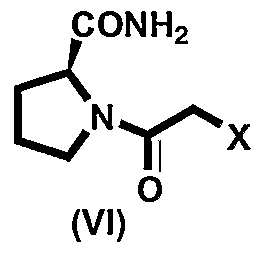
wherein X stands for a chlorine or bromine atom, in a mixture with trialkylamine hydrohalides of general formula RiR2R3N*HX, wherein R1, R2 and R3 independently stand for a linear or branched alkyl with 1 to 6 carbon atoms, substituents R1 and R2 can be connected with a bridge and form a cycle with 2 to 6 carbon atoms, or can be connected with an ether bond, and X stands for a chlorine or bromine atom.
2. The method according to claim 1, characterized in that in the prepared compound of formula VI X stands for chlorine.  (Vl, X=CI)
3. The method according to claim 2, characterized by preparation and isolation of l-chloroacetyl-2-(S)-pyrrolidine carboxamide and/or its mixture with trialkylamine hydrohalides selected from the group consisting of hydrohalides of trimethylamine, triethylamine, diisopropylethylamine, N-methylmorpholine, N-methylpyrrolidine and N-methylpiperidine.
4. The method according to claim 3, characterized by preparation and isolation of l-chloroacetyl-2-(S)-pyrrolidine carboxamide and/or its mixture with triethylamine hydrochloride in the solid state.
5. A method of preparation of highly pure vildagliptin, comprising the following steps:
(a) preparation of a mixture of l-haloacetyl-2-(S)-pyrrolidine carboxamide with trialkylamine hydrohalides of general formula R1R2R3N*HX, wherein R1, R2 and R3 independently stand for a linear or branched alkyl with 1 to 6 carbon atoms, substituents R1 and R2 can be connected with a bridge and form a cycle with 2 to 6 carbon atoms, or can be connected with an ether bond, and X stands for a chlorine or bromine atom;
(b) dehydration of the mixture obtained in step (a) by the effect of a dehydration agent; (c) isolation of 1 -haloacetyl-(S)-2-cyanopyrrolidine of general formula IV

wherein X stands for a chlorine or bromine atom;
(d) alkylation of 3 -amino- 1 -adamantanol of general formula V

(e) isolation of crude vildagliptin from the reaction mixture; and
(f) purification of crude vildagliptin by crystallization from a suitable solvent.
6. A method of preparation of highly pure vildagliptin, comprising the following steps:
(a) isolation of a mixture of l-haloacetyl-2-(S)-pyrrolidine carboxamide with trialkylamine hydrohalides, which is obtained by the effect of a suitable acylation agent on a mixture of L-prolinamide and a tertiary amine selected from the group consisting of trimethylamine, triethylamine, diisopropylethylamine, N-methylpyrrolidine, N-methylmorpholine, N- methylpiperidine, N-ethylpyrrolidine, N-ethylmorpholine and N- ethylpiperidine in the presence of a linear or cyclic ether selected from the group consisting of diethyl ether, t-butyl methyl ether, ethylene glycol dimethyl ether, substituted glycols, polyethylene glycols, tetrahydrofuran, 2-methyltetrahydrofuran, and 1,4-dioxane;
(b) dehydration of said mixture of l-haloacetyl-2-(S)-pyrrolidine carboxamide with trialkylamine hydrohalides by the effect of an acid anhydride in an inert organic solvent with a reduced content of water;
(c) isolation of l-haloacetyl-(S)-2-cyanopyrrolidine following neutralization of the reaction mixture, extraction of the product with an organic solvent selected from the group consisting of chloroform, dichloromethane, diethyl ether, dimethylcarbonate, ethyl acetate, and isopropyl acetate, drying of the solution, filtration of the desiccant, evaporation of the solvent and washing of the residue with a non-polar organic solvent selected from the group consisting of pentane, 2-methylbutane, petroleum ether, hexane, heptane, cyclopentane, and cyclohexane; • (d) alkylation of 3-amino-l-adamantanol in a mixture of potassium carbonate and potassium iodide by the effect of l-haloacetyl-(S)-2-cyanopyrrolidine in the presence of an organic ketone, an ester and a polar aprotic solvent;
(e) isolation of crude vildagliptin by crystallization from the reaction medium after previous removal of inorganic salts by filtration when hot at a . temperature of the mixture above 6O0C;
(f) purification of crude vildagliptin by crystallization from a suitable solvent.
7. A method of preparation of highly pure vildagliptin, comprising the following steps: (a) preparation and isolation of a mixture of l-chloroacetyl-2-(S)-pyrrolidine carboxamide with triethylamine hydrochloride obtained by the effect of chloroacetyl chloride on a mixture of L-prolinamide and triethylamine; (b) dehydration of said mixture of l-chloroacetyl-2-(S)-pyrrolidine carboxamide with triethylamine hydrochloride by the effect of trifluoroacetic acid anhydride in a solvent with a reduced content of water;
(c) isolation of l-chloroacetyl-(S)-2-cyanopyrrolidine following neutralization of the reaction mixture, extraction of the product with chloroform or dichloromethane, drying of the solution, filtration of the desiccant, evaporation of the solvent and washing with a non-polar organic solvent selected from the group consisting of pentane, 2-methylbutane, petroleum ether, hexane, heptane, cyclopentane, and cyclohexane; (d) alkylation of 3-amino-l-adamantanol in a mixture of an alkali metal carbonate and iodide by the effect of l-chloroacetyl-(S)-2-cyanopyrrolidine in a mixture of 2-butanone, isopropyl acetate and dimethylformamide in any proportion of the constituents;
(e) isolation of crude vildagliptin by crystallization from the reaction medium after previous removal of inorganic salts when hot by filtration at a temperature of the mixture above 6O0C;
(f) purification of crude vildagliptin by crystallization from a solvent selected from the group consisting of toluene, 2-butanone, 2-methyltetrahydrofuran, dimethylcarbonate, isopropyl acetate, isopropyl alcohol, and their mixtures in any proportion of the constituents.
8. The method according to any one of claims 1 to 7, characterized in that the acylating agent in the reaction of L-prolinamide is chloroacetyl chloride, bromoacetyl bromide or bromoacetyl chloride.
9. The method according to any one of claims 1 to 7, characterized in that the dehydration agent in the dehydration of the mixture of l-haloacetyl-2-(S)~ pyrrolidine carboxamide with trialkylamine hydrohalides is trifluoroacetic acid anhydride.
10. The method according to any one of claims 1 to 7, characterized in that the inert organic solvent with reduced water content in the dehydration of the mixture of 1- haloacetyl-2-(S)-pyrrolidine carboxamide with trialkylamine hydrohalides is a linear or cyclic ether selected from the group consisting of diethyl ether, t-butyl methyl ether, tetrahydrofuran, 2-methyltetrahydrofuran, and 1,4-dioxane.
11. The method according to any one of claims 1 to 7, characterized in that at least one solvent in the alkylation of 3-amino-l-adamantanol by the effect of 1-haloacetyl-
(S)-2-cyanopyrrolidine is an organic ketone selected from the group consisting of acetone, 2-butanone or cyclohexanone.
12. The method according to any one of claims 1 to 7, characterized in that at least one solvent in the alkylation of 3-amino-l-adamantanol by the effect of 1-haloacetyl-
(S)-2-cyanopyrrolidine is an ester selected from the group consisting of ethyl acetate, isopropyl acetate and dimethylcarbonate.
13. The method according to any one of claims 1 to 7, characterized in that at least one solvent in the alkylation of 3-amino-l-adamantanol by the effect of 1-haloacetyl-
(S)-2-cyanopyrrolidine is a polar aprotic solvent selected from the group consisting of dimethylformamide, dimethylacetamide, dimethylsulfoxide,
N-methylpyrrolidone, hexamethylphosphoramide, polyethylene glycol, and a crown ether.
14. The method according to any one of claims 1 to 7, characterized in that at least one solvent in the alkylation of 3-amino-l-adamantanol by the effect of 1-haloacetyl- (S)-2-cyanopyrrolidine is acetone, 2-butanone, cyclohexanone, ethyl acetate, isopropyl acetate, dimethylcarbonate, dimethylformamide, dimethylacetamide, dimethylsulfoxide, N-methylpyrrolidone, hexamethylphosphoramide, a polyethylene glycol, a crown ether, or a mixture thereof in any proportions.
15. The method according to any one of claims 1 to 7, characterized in that the mixture of an organic ketone, an ester and a polar aprotic solvent is a mixture of 2- butanone, isopropyl acetate and dimethylformamide in any proportions.
16. The method according to any one of claims 1 to 7, characterized in that the suitable solvent for crystallization of vildagliptin is a ketone selected from the group consisting of acetone, 2-butanone, and cyclohexanone, or a mixture of these solvents in any proportions.
17. The method according to any one of claims 1 to 7, characterized in that the suitable solvent for crystallization of vildagliptin is toluene or 2-methyltetrahydrofuran or a mixture of these solvents in any proportions.
18. The method according to any one of claims 1 to 7, characterized in that the suitable solvent for crystallization of vildagliptin is an organic ester selected from the group consisting of dimethylcarbonate, ethyl acetate, and isopropyl acetate, or mixtures of these solvents in any proportions.
19. The method according to any one claims 1 to 7, characterized in that the suitable solvent for crystallization of vildagliptin is an alcohol selected from the group consisting of methanol, ethanol, n-propyl alcohol, isopropyl alcohol, butanols, and amyl alcohols, or a mixture of these solvents in any proportions.
20. The method according to any one of claims 1 to 7, characterized in that the suitable solvent for crystallization of vildagliptin is acetone, 2-butanone, cyclohexanone, toluene, 2-methyltetrahydrofuran, dimethylcarbonate, ethyl acetate, isopropyl acetate, methanol, ethanol, n-propyl alcohol, isopropyl alcohol, butanols, or amyl alcohols, or a mixture of these solvents in any proportions.
21. An analytical standard of l-chloroacetyl-2-(S)-pyrrolidine carboxamide.
22. An analytical standard of l-chloroacetyl-2-(S)-pyrrolidine carboxamide, characterized by the content of the desired constituent of 95% and higher.
23. An analytical Standard of l-chloroacetyl-2-(S)-pyrrolidine carboxamide, characterized by the content of the desired constituent of 98% and higher.
24. An analytical standard of l-chloroacetyl-(S)-2-cyanopyrrolidine.
25. An analytical standard of l-chloroacetyl-(S)-2-cyanopyrrolidine, characterized by the content of the desired constituent of 95% and higher.
26. An analytical standard of l-chloroacetyl-(S)-2-cyanopyrrolidine, characterized by the content of the desired constituent of 98% and higher.
27. An analytical standard of (2S)-l-[[(3-hydroxytricyclo[3.3.1.1(3,7)]dec-l- yl)amino] acetyl] -2-pyrrolidine carbonitrile.
28. An analytical standard of (2S)-l-[[(3-hydroxytricyclo[3.3.1.1(3,7)]dec-l- yl)amino]acetyl]-2-pyrrolidine carbonitrile, characterized by the content of the desired constituent of 95% and higher.
29. An analytical standard of (2S)-l-[[(3-hydroxytricyclo[3.3.1.1(3,7)]dec-l- yl)amino]acetyl]-2 -pyrrolidine carbonitrile, characterized by the content of the desired constituent of 98% and higher.
30. An analytical standard of (2S)-l-{[{2-[(2S)-2-cyanopyrrolidin-l-yl]-2- oxoethyl} [(3-hydroxytricyclo[3.3.1.1 (3,7)]dec-l-yl)amino]]acetyl}pyrrolidine-2- carbonitrile.
31. An analytical standard of (2S)-l-{[{2-[(2S)-2-cyanopyrrolidin-l-yl]-2- oxoethyl}[(3-hydiOxytricyclo[3.3.1.1(3,7)]dec-l-yl)amino]]acetyl}pyrrolidine-2- carbonitrile, characterized by the content of the desired constituent of 95% and higher.
32. An analytical standard of (2S)-l-{[{2-[(2S)-2-cyanopyrrolidin-l-yl]-2- oxoethyl}[(3-hydroxytricyclo[3.3.1.1(3,7)]dec-l-yl)amino]]acetyl}pyrrolidine-2- carbonitrile, characterized by the content of the desired constituent of 98% and higher.
33. An analytical standard of l-chloroacetyl-2-(R)-pyrrolidine carboxamide.
34. An analytical standard of l-chloroacetyl-2-(R)-pyrrolidine carboxamide, characterized by the content of the desired constituent of 95% and higher.
35. An analytical standard of l-chloroacetyl-2-(R)-pyrrolidine carboxamide, characterized by the content of the desired constituent of 98% and higher.
36. An analytical standard of l-chloroacetyl-(R)-2-cyanopyrrolidine.
37. An analytical standard of l-chloroacetyl-(R)-2-cyanopyrrolidine, characterized by the content of the desired constituent of 95 % and higher.
38. An analytical standard of l-chloroacetyl-(R)-2-cyanopyrrolidine, characterized by the content of the desired constituent of 98% and higher.
39. An analytical standard of (2R)-l-[[(3-hydroxytricyclo[3.3.1.1(3,7)]dec-l- yl)amino]acetyl]-2-pyrrolidine carbonitrile.
40. An analytical standard of (2R)-l-[[(3-hydroxytricyclo[3.3.1.1(3,7)]dec-l- yl)amino]acetyl]-2-pyrrolidine carbonitrile, characterized by the content of the desired constituent of 95% and higher.
41. An analytical standard of (2R)-l-[[(3-hydroxytricyclo[3.3.1.1(3,7)]dec-l- yl)amino] acetyl] -2-pyrrolidine carbonitrile, characterized by the content of the desired constituent of 98% and higher.
42. A method of preparation of the analytical Standard of l-chloroacetyl-2-(S)- pyrrolidine carboxamide, comprising addition of a chloroacetyl chloride solution to a mixture of L-prolinamide and triethylamine, isolation of the product after removal of the solid triethylamine hydrochloride by filtration, vacuum evaporation of the solvent from the filtrate and crystallization of the residue from a suitable solvent.
43. A method of preparation of the analytical standard of l-chloroacetyl-(S)-2- cyanopyrrolidine, comprising reaction of L-prolinamine with chloroacetyl chloride and crystallization of the prepared l-chloroacetyl-(S)-2-cyanopyrrolidine from the aqueous phase and from the melt.
44. A method of preparation of the analytical standard of (2S)-l-[[(3- hydroxytricyclo[3.3.1.1(3,7)]dec-l-yl)amino]acetyl]-2-pyrrolidine carbonitrile, comprising the preparation and isolation of l-chloroacetyl-2-(S)-pyrrolidine carboxamide in the solid state, followed by dehydration of l-chloroacetyl-2-(S)- pyrrolidine carboxamide with trifluoroacetic acid anhydride, reaction of the intermediate obtained by the dehydration with 3-amino-l-adamantanol, isolation of crude vildagliptin and crystallization of crude vildagliptin from a solvent selected from the group consisting of acetone, 2-butanone, cyclohexanone, toluene, 2-methyltetrahydrofuran, dimethylcarbonate, ethyl acetate, isopropyl acetate, methanol, ethanol, n-propyl alcohol, isopropyl alcohol, butanols, and amyl alcohols, or a mixture of these solvents in any proportions.
45. A method of preparation of (2S)-l-{[{2-[(2S)-2-cyanopyrrolidin-l-yl]-2- oxoethyl}[(3-hydroxytricyclo[3.3.1.1(3,7)]dec-l-yl)amino]]acetyl}pyrrolidin-2- carbonitrile described by chemical formula (XIV)

(XlV)
characterized by reaction of vildagliptin with l-chloroacetyl-(S)-2-cyano- pyrrolidine or l-bromoacetyl-(S)-2-cyanopyrrolidine and chromatographic separation of the obtained mixture of substances.
46. A method of preparation of the analytical standard of (2R)-I -[[(3- hydroxytricyclo [3.3.1.1 (3 ,7)] dec- 1 -yl)amino] acetyl] -2 -pyrrolidine carbonitrile, characterized by preparation and isolation of l-chloroacetyl-2-(R)-pyrrolidine carboxamide in the solid state, followed by dehydration of l-chloroacetyl-2-(R)- pyrrolidine carboxamide with trifluoroacetic acid anhydride, reaction of the derivative obtained by the dehydration with 3-amino-l-adamantanol, isolation and crystallization of crude (2R)-l-[[(3-hydroxytricyclo[3.3.1.1(3,7)]dec-l- yl)amino] acetyl] -2 -pyrrolidine carbonitrile from a solvent selected from the group consisting of acetone, 2-butanone, cyclohexanone, toluene, 2-methyltetrahydrofuran, dimethylcarbonate, ethyl acetate, isopropyl acetate, methanol, ethanol, n-propyl alcohol, isopropyl alcohol, butanols, and amyl alcohols, or a mixture of these solvents in any proportions.
47. A method of preparation of the analytical standard of l-chloroacetyl-2-(R)- pyrrolidine carboxamide, characterized by reaction of chloroacetyl chloride with D- prolinamide, isolation of the crude product and its crystallization from a suitable solvent.
48. A method of preparation of the analytical standard of l-chloroacetyl-(R)-2- cyanopyrrolidine, characterized by dehydration of l-chloroacetyl-2-(R)-pyrrolidine carboxamide with trifluoroacetic acid anhydride, isolation of the crude product and its crystallization.
49. A method of preparation of the analytical standard of (2R)-l-[[(3- hydroxytricyclo [3.3.1.1 (3 ,7)]dec- 1 -yl)amino] acetyl]-2-pyrrolidine carbonitrile, characterized by reaction of l-chloroacetyl-(R)-2-cyanopyrrolidine with 3-amino- adamantanol and isolation of the product from the reaction mixture by crystallization.
50. Use of the analytical standards according to claims 21 to 41 as reference standards for setting of analytical methods destined for the quality control of the production process of vildagliptin, as well as for evaluation of quality of vildagliptin destined for the preparation of pharmaceutical products.
51. A method of determination of chemical purity or content of vildagliptin, including determination of the content of specific impurities, comprising HPLC performed in the gradient or isocratic mode.
52. A method of HPLC analysis destined for the control of the production process of vildagliptin, as well as for evaluation of quality of vildagliptin, based on use of a mixture of methanol and an aqueous solution of ammonium hydroxide and phosphoric acid as the mobile phase, further characterized by the use of a reverse stationary phase and performed in the isocratic or gradient mode.
53. A method of determination of optical purity of vildagliptin by means of HPLC analysis, characterized by the use of a mixture of solvents selected from the group consisting of n-hexane, 2-propanol, ethanol, and ammonium hydroxide as the mobile phase, performed in the isocratic or gradient mode
54. A method of determination of chemical purity or content of vildagliptin, including determination of the content of 3-amino-l-adamantanol and L-prolinamide, comprising the use of GC analysis.
55. A method of GC analysis destined for the control of the production process of vildagliptin, as well as evaluation of quality of vildagliptin, characterized by a temperature program in the range from 6O0C to 2800C.
56. Use of the analytical methods according to claims 51 to 55 for the production of highly pure vildagliptin.
57. Highly pure vildagliptin containing 0.15% or less of (2S)-l-{[{2-[(2S)-2- cyanopyrrolidin-l-yl]-2-oxoethyl} [(3-hydroxytricyclo[3.3.1.1(3, 7)] dec- 1- yl)amino]]acetyl}pyrrolidine-2-cyrbonitrile, described by chemical formula (XIV), as determined on the basis of normalization of areas in an HPLC chromatogram.

58. Highly pure vildagliptin containing 0.15% or less of l-halogenacetyl-(S)-2- cyanopyrrolidine of chemical formula (IV), where X stands for a chlorine or bromine atom, as determined on the basis of normalization of areas in an HPLC chromatogram.

59. Highly pure vildagliptin containing 0.15% or less of 3-amino-l-adamantanol, described by formula (V), as determined on the basis of normalization of areas in an GC chromatogram. 
(V)
60. Highly pure vildagliptin containing 0.15% or less of the (D)-enantiomer, i.e. (2R)-
1 -[ [(3 -hydroxytricyclo[3.3.1.1 (3,7)] dec- 1 -yl)amino] acetyl] -2-pyrrolidine- carbonitrile, described by formula (XIII), as determined on the basis of normalization of areas in an HPLC chromatogram.

(XlIl)
61. Highly pure vildagliptin containing less than 0.5% of foreign substances, as determined on the basis of normalization of areas in an HPLC or GC chromatogram.
62. Highly pure vildagliptin produced by the method of any one of claims 1 to 20, characterized by the chemical purity of 99.5% or higher and the content of individual impurities of 0.15% or less.
63. Use of highly pure vildagliptin prepared by the method of any one of claims 1 to 20 as the active pharmaceutical substance for the preparation of a pharmaceutical formulation with the antihyperglycemic effect.
Applications Claiming Priority (2)
| Application Number | Priority Date | Filing Date | Title |
|---|---|---|---|
| CZ20080512A CZ2008512A3 (en) | 2008-08-26 | 2008-08-26 | Process for preparing extremely pure vildagliptin |
| CZPV2008-512 | 2008-08-26 |
Publications (2)
| Publication Number | Publication Date |
|---|---|
| WO2010022690A2 true WO2010022690A2 (en) | 2010-03-04 |
| WO2010022690A3 WO2010022690A3 (en) | 2010-11-11 |
Family
ID=41721993
Family Applications (1)
| Application Number | Title | Priority Date | Filing Date |
|---|---|---|---|
| PCT/CZ2009/000105 Ceased WO2010022690A2 (en) | 2008-08-26 | 2009-08-25 | A method of preparation of highly pure vildagliptin |
Country Status (2)
| Country | Link |
|---|---|
| CZ (1) | CZ2008512A3 (en) |
| WO (1) | WO2010022690A2 (en) |
Cited By (25)
| Publication number | Priority date | Publication date | Assignee | Title |
|---|---|---|---|---|
| WO2012004210A1 (en) | 2010-07-06 | 2012-01-12 | Chemelectiva Srl | Process and intermediates for preparation of an active ingredient |
| WO2012022994A1 (en) | 2010-08-19 | 2012-02-23 | Egis Gyogyszergyar Nyilvanosan Mukodo Reszvenytarsasag | Preparation process of vildagliptin |
| CN102617434A (en) * | 2012-03-29 | 2012-08-01 | 中国科学院上海有机化学研究所 | Process for preparing Vildagliptin by one-pot method |
| ITMI20112224A1 (en) * | 2011-12-06 | 2013-06-07 | Chemelectiva S R L | NEW PROCESS AND INTERMEDIATE FOR THE SYNTHESIS OF VILDAGLIPTIN |
| CN103351320A (en) * | 2013-06-17 | 2013-10-16 | 张家港威胜生物医药有限公司 | Preparation method of (S)-1-(2-chloroacetyl)-pyrrolidine-2-formamide |
| WO2013179300A2 (en) | 2012-05-04 | 2013-12-05 | Megafine Pharma (P) Ltd. | A process for the preparation of vildagliptin and its intermediate thereof |
| CN103787944A (en) * | 2012-11-01 | 2014-05-14 | 天津药物研究院 | Preparation method of 1-(2-chloroacetyl)-2-(S)-nitrile pyrrolidine |
| CN103804267A (en) * | 2014-02-21 | 2014-05-21 | 张家港威胜生物医药有限公司 | Simple environment-friendly synthesis process of vildagliptin |
| WO2015092806A1 (en) * | 2013-12-18 | 2015-06-25 | Harman Finochem Limited | An advanced and cost-effective process for preparing highly pure vildagliptin |
| CN104744334A (en) * | 2015-03-25 | 2015-07-01 | 合肥创新医药技术有限公司 | Preparation method for vildagliptin |
| CN104945299A (en) * | 2015-05-28 | 2015-09-30 | 烟台万润药业有限公司 | Efficient synthesis method of vildagliptin |
| WO2015145467A1 (en) * | 2014-03-28 | 2015-10-01 | Laurus Labs Private Limited | An improved process for preparing vildagliptin |
| CN105085360A (en) * | 2015-09-10 | 2015-11-25 | 南京理工大学 | Preparation method of high-purity vildagliptin |
| CN105153165A (en) * | 2015-07-30 | 2015-12-16 | 上海医药集团青岛国风药业股份有限公司 | Preparation method for vildagliptin impurity |
| CN105884669A (en) * | 2014-09-15 | 2016-08-24 | 深圳翰宇药业股份有限公司 | Method for preparing substituted (S)-pyrrolidine-2-formonitrile and vildagliptin |
| CN106338564A (en) * | 2016-09-27 | 2017-01-18 | 海口南陆医药科技股份有限公司 | Method for detecting enantiomer in vildagliptin midbody |
| CN107219307A (en) * | 2016-03-22 | 2017-09-29 | 中美华世通生物医药科技(武汉)有限公司 | The method that enantiomter impurity in song Ge Lieting bulk drugs and its preparation is determined using HPLC |
| CN107311907A (en) * | 2017-07-29 | 2017-11-03 | 合肥创新医药技术有限公司 | A kind of preparation method of vildagliptin isomer impurities |
| CN110940759A (en) * | 2019-12-23 | 2020-03-31 | 河北科技大学 | A kind of HPLC detection method of vildagliptin intermediate-5 |
| CN112394127A (en) * | 2020-12-08 | 2021-02-23 | 海南通用三洋药业有限公司 | Method for determining content of 3-amino-1-adamantanol and L-prolinamide in vildagliptin |
| CN112557582A (en) * | 2020-12-17 | 2021-03-26 | 南通恒华粘合材料科技有限公司 | Method for measuring hydroxyl value of polyester polyol |
| CN112939837A (en) * | 2021-02-03 | 2021-06-11 | 海南通用三洋药业有限公司 | Method for preparing vildagliptin through multiphase compound continuous production |
| WO2021116897A1 (en) * | 2019-12-10 | 2021-06-17 | Optimus Drugs (P) Ltd | Process for the preparation of vildagliptin |
| WO2022003405A1 (en) | 2020-07-03 | 2022-01-06 | Savoi Guilherme | One-pot process to obtain a pyrrolidine-2-carbonitrile intermediate compound and industrial scale telescopic process to prepare (2s)-1-[n-(3-hydroxyadamantan-1-yl)glycyl]-2-pyrrolidinecarbonitrile (vildagliptin) using same |
| CN114814050A (en) * | 2022-03-29 | 2022-07-29 | 浙江美诺华药物化学有限公司 | Impurity detection method of 3-amino-1-adamantanol |
Families Citing this family (1)
| Publication number | Priority date | Publication date | Assignee | Title |
|---|---|---|---|---|
| CN109827984B (en) * | 2019-02-27 | 2022-05-17 | 南京江北新区生物医药公共服务平台有限公司 | Method for determining content of impurities or structural analogue reference substances in L-prolinamide synthesis process |
Citations (7)
| Publication number | Priority date | Publication date | Assignee | Title |
|---|---|---|---|---|
| WO1998019998A2 (en) | 1996-11-07 | 1998-05-14 | Novartis Ag | N-substituted 2-cyanopyrrolidines |
| WO2000034241A1 (en) | 1998-12-10 | 2000-06-15 | Novartis Ag | N-substituted 2-cyanopyrrolidines |
| WO2001096295A2 (en) | 2000-06-13 | 2001-12-20 | Novartis Ag | 2-cyanopyrrolidine derivatives and their use as medicaments |
| WO2003051848A2 (en) | 2001-12-14 | 2003-06-26 | Ferring Bv | Imidazolidineacetic acid derivatives |
| WO2004092127A1 (en) | 2003-04-16 | 2004-10-28 | Novartis Ag | Process for the preparation of n-substituted 2-cyanopyrrolidines |
| WO2006100181A2 (en) | 2005-03-22 | 2006-09-28 | F. Hoffmann-La Roche Ag | New salt and polymorphs of a dpp-iv inhibitor |
| WO2007019255A2 (en) | 2005-08-04 | 2007-02-15 | Novartis Ag | Salts of vildagliptin |
Family Cites Families (3)
| Publication number | Priority date | Publication date | Assignee | Title |
|---|---|---|---|---|
| JP4184378B2 (en) * | 2003-01-31 | 2008-11-19 | 株式会社三和化学研究所 | Compounds that inhibit dipeptidyl peptidase IV |
| AR064833A1 (en) * | 2007-01-10 | 2009-04-29 | Medichem Sa | A PROCEDURE FOR THE PREPARATION OF VILDAGLIPTIN |
| WO2009058531A1 (en) * | 2007-10-31 | 2009-05-07 | Exxonmobil Chemical Patents Inc. | Oxidation of hydrocarbons |
-
2008
- 2008-08-26 CZ CZ20080512A patent/CZ2008512A3/en unknown
-
2009
- 2009-08-25 WO PCT/CZ2009/000105 patent/WO2010022690A2/en not_active Ceased
Patent Citations (7)
| Publication number | Priority date | Publication date | Assignee | Title |
|---|---|---|---|---|
| WO1998019998A2 (en) | 1996-11-07 | 1998-05-14 | Novartis Ag | N-substituted 2-cyanopyrrolidines |
| WO2000034241A1 (en) | 1998-12-10 | 2000-06-15 | Novartis Ag | N-substituted 2-cyanopyrrolidines |
| WO2001096295A2 (en) | 2000-06-13 | 2001-12-20 | Novartis Ag | 2-cyanopyrrolidine derivatives and their use as medicaments |
| WO2003051848A2 (en) | 2001-12-14 | 2003-06-26 | Ferring Bv | Imidazolidineacetic acid derivatives |
| WO2004092127A1 (en) | 2003-04-16 | 2004-10-28 | Novartis Ag | Process for the preparation of n-substituted 2-cyanopyrrolidines |
| WO2006100181A2 (en) | 2005-03-22 | 2006-09-28 | F. Hoffmann-La Roche Ag | New salt and polymorphs of a dpp-iv inhibitor |
| WO2007019255A2 (en) | 2005-08-04 | 2007-02-15 | Novartis Ag | Salts of vildagliptin |
Non-Patent Citations (7)
| Title |
|---|
| E.B.VILLHAUER, J.MED.CHEM., vol. 45, 2002, pages 2362 - 2365 |
| E.B.VILLHAUER, J.MED.CHEM., vol. 46, 2003, pages 2774 - 2789 |
| J.MED.CHEM., vol. 46, 2003, pages 2774 |
| J.MED.CHEM., vol. 46, 2003, pages 2774 - 2789 |
| SNYDER L.R.; KIRKLAND J.J.: "Introduction to Modern Liquid Chromatography", 1979, JOHN WILEY & SONS |
| STROBEL H.A.; HEINEMAN W.R.: "Chemical Instrumentation: A Systematic Approach", 1989, WILEY & SONS |
| VILLHAUER E. B. ET AL., J. MED. CHEM., vol. 46, 2003, pages 2774 |
Cited By (33)
| Publication number | Priority date | Publication date | Assignee | Title |
|---|---|---|---|---|
| WO2012004210A1 (en) | 2010-07-06 | 2012-01-12 | Chemelectiva Srl | Process and intermediates for preparation of an active ingredient |
| WO2012022994A1 (en) | 2010-08-19 | 2012-02-23 | Egis Gyogyszergyar Nyilvanosan Mukodo Reszvenytarsasag | Preparation process of vildagliptin |
| ITMI20112224A1 (en) * | 2011-12-06 | 2013-06-07 | Chemelectiva S R L | NEW PROCESS AND INTERMEDIATE FOR THE SYNTHESIS OF VILDAGLIPTIN |
| WO2013083326A1 (en) | 2011-12-06 | 2013-06-13 | Chemelectiva S.R.L. | New process and intermediates for the synthesis of vildagliptin |
| CN102617434A (en) * | 2012-03-29 | 2012-08-01 | 中国科学院上海有机化学研究所 | Process for preparing Vildagliptin by one-pot method |
| WO2013179300A2 (en) | 2012-05-04 | 2013-12-05 | Megafine Pharma (P) Ltd. | A process for the preparation of vildagliptin and its intermediate thereof |
| WO2013179300A3 (en) * | 2012-05-04 | 2014-08-28 | Megafine Pharma (P) Ltd. | A process for the preparation of vildagliptin and its intermediate thereof |
| CN103787944A (en) * | 2012-11-01 | 2014-05-14 | 天津药物研究院 | Preparation method of 1-(2-chloroacetyl)-2-(S)-nitrile pyrrolidine |
| CN103351320A (en) * | 2013-06-17 | 2013-10-16 | 张家港威胜生物医药有限公司 | Preparation method of (S)-1-(2-chloroacetyl)-pyrrolidine-2-formamide |
| WO2015092806A1 (en) * | 2013-12-18 | 2015-06-25 | Harman Finochem Limited | An advanced and cost-effective process for preparing highly pure vildagliptin |
| CN103804267A (en) * | 2014-02-21 | 2014-05-21 | 张家港威胜生物医药有限公司 | Simple environment-friendly synthesis process of vildagliptin |
| WO2015123998A1 (en) * | 2014-02-21 | 2015-08-27 | 张家港威胜生物医药有限公司 | Method for synthesizing vildagliptin |
| CN103804267B (en) * | 2014-02-21 | 2016-06-08 | 张家港威胜生物医药有限公司 | A kind of synthesis technique of vildagliptin |
| WO2015145467A1 (en) * | 2014-03-28 | 2015-10-01 | Laurus Labs Private Limited | An improved process for preparing vildagliptin |
| CN105884669B (en) * | 2014-09-15 | 2020-05-15 | 深圳翰宇药业股份有限公司 | Process for the preparation of substituted (S) -pyrrolidine-2-carbonitriles and vildagliptin |
| CN105884669A (en) * | 2014-09-15 | 2016-08-24 | 深圳翰宇药业股份有限公司 | Method for preparing substituted (S)-pyrrolidine-2-formonitrile and vildagliptin |
| CN104744334A (en) * | 2015-03-25 | 2015-07-01 | 合肥创新医药技术有限公司 | Preparation method for vildagliptin |
| CN104945299A (en) * | 2015-05-28 | 2015-09-30 | 烟台万润药业有限公司 | Efficient synthesis method of vildagliptin |
| CN104945299B (en) * | 2015-05-28 | 2017-03-15 | 烟台万润药业有限公司 | A kind of high-efficiency synthesis method of vildagliptin |
| CN105153165A (en) * | 2015-07-30 | 2015-12-16 | 上海医药集团青岛国风药业股份有限公司 | Preparation method for vildagliptin impurity |
| CN105085360A (en) * | 2015-09-10 | 2015-11-25 | 南京理工大学 | Preparation method of high-purity vildagliptin |
| CN107219307A (en) * | 2016-03-22 | 2017-09-29 | 中美华世通生物医药科技(武汉)有限公司 | The method that enantiomter impurity in song Ge Lieting bulk drugs and its preparation is determined using HPLC |
| CN106338564A (en) * | 2016-09-27 | 2017-01-18 | 海口南陆医药科技股份有限公司 | Method for detecting enantiomer in vildagliptin midbody |
| CN107311907A (en) * | 2017-07-29 | 2017-11-03 | 合肥创新医药技术有限公司 | A kind of preparation method of vildagliptin isomer impurities |
| WO2021116897A1 (en) * | 2019-12-10 | 2021-06-17 | Optimus Drugs (P) Ltd | Process for the preparation of vildagliptin |
| CN110940759A (en) * | 2019-12-23 | 2020-03-31 | 河北科技大学 | A kind of HPLC detection method of vildagliptin intermediate-5 |
| WO2022003405A1 (en) | 2020-07-03 | 2022-01-06 | Savoi Guilherme | One-pot process to obtain a pyrrolidine-2-carbonitrile intermediate compound and industrial scale telescopic process to prepare (2s)-1-[n-(3-hydroxyadamantan-1-yl)glycyl]-2-pyrrolidinecarbonitrile (vildagliptin) using same |
| CN112394127A (en) * | 2020-12-08 | 2021-02-23 | 海南通用三洋药业有限公司 | Method for determining content of 3-amino-1-adamantanol and L-prolinamide in vildagliptin |
| WO2022121383A1 (en) * | 2020-12-08 | 2022-06-16 | 海南通用三洋药业有限公司 | Method for determining contents of 3-amino-1-adamantanol and l-prolinamide in vildagliptin |
| CN112557582A (en) * | 2020-12-17 | 2021-03-26 | 南通恒华粘合材料科技有限公司 | Method for measuring hydroxyl value of polyester polyol |
| CN112557582B (en) * | 2020-12-17 | 2022-11-01 | 南通恒华粘合材料科技有限公司 | Method for measuring hydroxyl value of polyester polyol |
| CN112939837A (en) * | 2021-02-03 | 2021-06-11 | 海南通用三洋药业有限公司 | Method for preparing vildagliptin through multiphase compound continuous production |
| CN114814050A (en) * | 2022-03-29 | 2022-07-29 | 浙江美诺华药物化学有限公司 | Impurity detection method of 3-amino-1-adamantanol |
Also Published As
| Publication number | Publication date |
|---|---|
| WO2010022690A3 (en) | 2010-11-11 |
| CZ2008512A3 (en) | 2010-03-10 |
Similar Documents
| Publication | Publication Date | Title |
|---|---|---|
| WO2010022690A2 (en) | A method of preparation of highly pure vildagliptin | |
| AU2019258116B2 (en) | Method for the preparation of (4S)-4-(4-cyano-2-methoxyphenyl)-5-ethoxy-2,8-dimethyl-1,4-dihydro-1-6-naphthyridine-3-carbox-amide by racemate separation by means of diastereomeric tartaric acid esters | |
| EP2118056A2 (en) | Process for preparing vildagliptin | |
| IL292180A (en) | Process for the preparation of 2-cyanoethyl (4s)-4-(4-cyano-2-methoxy-phenyl)-5-ethoxy-2,8-dimethyl-1,4-dihydro-1,6-naphthyridine-3-carboxylate by resolution of racemates by means of diastereomeric tartaric acid esters | |
| IL292192A (en) | Process for the preparation of (2-cyanoethyl (4s)-4-(4-cyano-2-methoxy-phenyl)-5-hydroxy-2,8-dimethyl-1,4-dihydro-1,6-naphthyridin-3-carboxylate by racemate separation by means of diastereomeric tartaric acid esters | |
| Pirkle et al. | Nuclear magnetic resonance determination of enantiomeric composition and absolute configuration of amines, alcohols, and thiols with. alpha.-[1-(9-anthryl)-2, 2, 2-trifluoroethoxy] acetic acid as a chiral derivatizing agent | |
| Koepke et al. | Unusually facile solvolysis of primary tosylates. A case for participation by the N-nitroso group | |
| Wu et al. | Synthesis, crystallization and characterization of diastereomeric salts formed by ephedrine and malic acid in water | |
| CA2561387A1 (en) | An isolated atomoxetine impurity, processes for the preparation of atomoxetine impurities and their use as reference standards | |
| Meuer et al. | Novel family of heterocyclic strained helixes. Cesium-assisted syntheses, conformational and chiroptical properties and geometries | |
| WO2001085675A2 (en) | Fluorous tagging compounds and their use | |
| CN106831524B (en) | A kind of chiral pyrrolidine ketone acetamide derivative and its preparation method and application | |
| CN111471467B (en) | A polymer-type lyotropic liquid crystal material, its preparation method and its application in the separation of chiral drugs | |
| Ribeiro et al. | Synthesis of (R)-(−) and (S)-(+)-3-(1-pyrrolyl) propyl-N-(3, 5-dinitrobenzoyl)-α-phenylglycinate and derivatives. A suitable chiral polymeric phase precursor | |
| JP2007512357A (en) | Method for preparing a form of atorvastatin calcium substantially free of impurities | |
| Takeuchi et al. | Chemistry of novel compounds with multifunctional carbon structure. 8. Application of the α-cyano-α-fluorophenylacetic acid (CFPA) method to the enantiomeric excess determination of some hindered alcohols in asymmetric and natural product syntheses | |
| JP2006169158A (en) | Process for producing optically active amino acids | |
| Vekemans et al. | Conformational interlocking in axially chiral methyl N-(2', 4'-dimethylnicotinoyl)-N-methylphenylalaninates | |
| CN1660814A (en) | (1R,2R)-or (1S,2S)-1-(4'-substituted-1',8'-naphthoimide)-2-aminocyclohexane and its preparation and use | |
| Ellis et al. | Michael addition reactions between various nucleophilic glycine equivalents and (S, E)-1-enoyl-5-oxo-N-phenylpyrrolidine-2-carboxamide, an optimal type of chiral Michael acceptor in the asymmetric synthesis of β-phenyl pyroglutamic acid and related compounds | |
| Ma et al. | A convenient and highly stereoselective method for synthesis of octahydropyrano [3, 2-b] pyrrole derivatives | |
| CN111793017A (en) | A kind of preparation method of lactam compound | |
| RU2805573C2 (en) | Method of preparation of (4s)-4-(4-cyano-2-methoxyphenyl)-5-ethoxy-2,8-dimethyl-1,4-dihydro-1,6-naphyridine-3-carboxamide by separation of the racemate using a diastereomeric composite tartaric acid ester | |
| RU2780560C1 (en) | Method for producing (1r,2s)-1-(6-bromo-2-methoxyquinoline-3-yl)-4-dimethylamino-2-(1-naphthyl)-1-phenylbutane-2-ol and a pharmacologically acceptable salt thereof | |
| Mykhaylychenko et al. | One-pot cascade synthesis of fluorinated thiazolidine-, thiazoline-and thiazole-5-carboxylic acid esters from N-monosubstituted perfluoroalkanethioamides |
Legal Events
| Date | Code | Title | Description |
|---|---|---|---|
| NENP | Non-entry into the national phase |
Ref country code: DE |
|
| 121 | Ep: the epo has been informed by wipo that ep was designated in this application |
Ref document number: 09805898 Country of ref document: EP Kind code of ref document: A2 |
|
| 122 | Ep: pct application non-entry in european phase |
Ref document number: 09805898 Country of ref document: EP Kind code of ref document: A2 |