WO2010014727A1 - Pharmaceutical compositions and methods for producing low impurity concentrations of the same - Google Patents
Pharmaceutical compositions and methods for producing low impurity concentrations of the same Download PDFInfo
- Publication number
- WO2010014727A1 WO2010014727A1 PCT/US2009/052127 US2009052127W WO2010014727A1 WO 2010014727 A1 WO2010014727 A1 WO 2010014727A1 US 2009052127 W US2009052127 W US 2009052127W WO 2010014727 A1 WO2010014727 A1 WO 2010014727A1
- Authority
- WO
- WIPO (PCT)
- Prior art keywords
- clevidipine
- composition
- less
- substance
- approximately equal
- Prior art date
- Legal status (The legal status is an assumption and is not a legal conclusion. Google has not performed a legal analysis and makes no representation as to the accuracy of the status listed.)
- Ceased
Links
Classifications
-
- A—HUMAN NECESSITIES
- A61—MEDICAL OR VETERINARY SCIENCE; HYGIENE
- A61K—PREPARATIONS FOR MEDICAL, DENTAL OR TOILETRY PURPOSES
- A61K31/00—Medicinal preparations containing organic active ingredients
- A61K31/33—Heterocyclic compounds
- A61K31/395—Heterocyclic compounds having nitrogen as a ring hetero atom, e.g. guanethidine or rifamycins
- A61K31/435—Heterocyclic compounds having nitrogen as a ring hetero atom, e.g. guanethidine or rifamycins having six-membered rings with one nitrogen as the only ring hetero atom
- A61K31/44—Non condensed pyridines; Hydrogenated derivatives thereof
- A61K31/4418—Non condensed pyridines; Hydrogenated derivatives thereof having a carbocyclic group directly attached to the heterocyclic ring, e.g. cyproheptadine
-
- A—HUMAN NECESSITIES
- A61—MEDICAL OR VETERINARY SCIENCE; HYGIENE
- A61K—PREPARATIONS FOR MEDICAL, DENTAL OR TOILETRY PURPOSES
- A61K31/00—Medicinal preparations containing organic active ingredients
- A61K31/33—Heterocyclic compounds
- A61K31/395—Heterocyclic compounds having nitrogen as a ring hetero atom, e.g. guanethidine or rifamycins
- A61K31/435—Heterocyclic compounds having nitrogen as a ring hetero atom, e.g. guanethidine or rifamycins having six-membered rings with one nitrogen as the only ring hetero atom
- A61K31/44—Non condensed pyridines; Hydrogenated derivatives thereof
- A61K31/4422—1,4-Dihydropyridines, e.g. nifedipine, nicardipine
-
- A—HUMAN NECESSITIES
- A61—MEDICAL OR VETERINARY SCIENCE; HYGIENE
- A61K—PREPARATIONS FOR MEDICAL, DENTAL OR TOILETRY PURPOSES
- A61K31/00—Medicinal preparations containing organic active ingredients
- A61K31/33—Heterocyclic compounds
- A61K31/395—Heterocyclic compounds having nitrogen as a ring hetero atom, e.g. guanethidine or rifamycins
- A61K31/435—Heterocyclic compounds having nitrogen as a ring hetero atom, e.g. guanethidine or rifamycins having six-membered rings with one nitrogen as the only ring hetero atom
- A61K31/4353—Heterocyclic compounds having nitrogen as a ring hetero atom, e.g. guanethidine or rifamycins having six-membered rings with one nitrogen as the only ring hetero atom ortho- or peri-condensed with heterocyclic ring systems
- A61K31/436—Heterocyclic compounds having nitrogen as a ring hetero atom, e.g. guanethidine or rifamycins having six-membered rings with one nitrogen as the only ring hetero atom ortho- or peri-condensed with heterocyclic ring systems the heterocyclic ring system containing a six-membered ring having oxygen as a ring hetero atom, e.g. rapamycin
-
- A—HUMAN NECESSITIES
- A61—MEDICAL OR VETERINARY SCIENCE; HYGIENE
- A61K—PREPARATIONS FOR MEDICAL, DENTAL OR TOILETRY PURPOSES
- A61K31/00—Medicinal preparations containing organic active ingredients
- A61K31/33—Heterocyclic compounds
- A61K31/395—Heterocyclic compounds having nitrogen as a ring hetero atom, e.g. guanethidine or rifamycins
- A61K31/495—Heterocyclic compounds having nitrogen as a ring hetero atom, e.g. guanethidine or rifamycins having six-membered rings with two or more nitrogen atoms as the only ring heteroatoms, e.g. piperazine or tetrazines
- A61K31/505—Pyrimidines; Hydrogenated pyrimidines, e.g. trimethoprim
- A61K31/519—Pyrimidines; Hydrogenated pyrimidines, e.g. trimethoprim ortho- or peri-condensed with heterocyclic rings
-
- A—HUMAN NECESSITIES
- A61—MEDICAL OR VETERINARY SCIENCE; HYGIENE
- A61P—SPECIFIC THERAPEUTIC ACTIVITY OF CHEMICAL COMPOUNDS OR MEDICINAL PREPARATIONS
- A61P9/00—Drugs for disorders of the cardiovascular system
-
- A—HUMAN NECESSITIES
- A61—MEDICAL OR VETERINARY SCIENCE; HYGIENE
- A61P—SPECIFIC THERAPEUTIC ACTIVITY OF CHEMICAL COMPOUNDS OR MEDICINAL PREPARATIONS
- A61P9/00—Drugs for disorders of the cardiovascular system
- A61P9/12—Antihypertensives
-
- G—PHYSICS
- G01—MEASURING; TESTING
- G01N—INVESTIGATING OR ANALYSING MATERIALS BY DETERMINING THEIR CHEMICAL OR PHYSICAL PROPERTIES
- G01N30/00—Investigating or analysing materials by separation into components using adsorption, absorption or similar phenomena or using ion-exchange, e.g. chromatography or field flow fractionation
- G01N30/02—Column chromatography
Definitions
- the instant invention relates to pharmaceutical compositions, and in particular to compositions of clevidipine having a reduced level of impurities, and a method of maintaining the stability of such pharmaceutical compositions.
- Clevidipine which is also known as CleviprexTM, is a short-acting, vascular selective calcium antagonist that has been shown to reduce arterial blood pressure with a fast termination of effect due to metabolism by blood and tissue esterases, As an arterial-selective vasodilator, clevidipine reduces peripheral vascular resistance directly, without dilating the venous capacitance bed.
- Clevidipine is typically formulated as a liquid emulsion suitable for intravenous administration.
- Lipid emulsions are widely used in parenteral nutrition use for approximately 30 years and in the recent past have been used as drug carriers for insoluble drugs such as propofol (Diprivan®), and diazepam.
- insoluble drugs such as propofol (Diprivan®)
- diazepam Apart from their ability to deliver insoluble drugs, emulsions are also suitable dosage forms for drugs like clevidipine that are susceptible to hydrolytic breakdown. Emulsions have also been reported to prevent drugs from adhering to plastic administration sets used during intravenous injection, and reduce local toxicity on infusion.
- compositions containing clevidipine As a pharmaceutical composition, it is essential that clevidipine maintains its stability. Over the past several years, various impurities have been identified in compositions containing clevidipine as an active ingredient. For example, some impurities arise from the process used in making clevidipine, while others are due to gradual degradation of the active ingredient. As a pharmaceutical composition, it is essential to maintain stability and minimize the amount of impurities regardless of their source or the mechanism of degradation.
- compositions of clevidipine having acceptable stability profiles with respect to their ultimate potency and impurity levels.
- methods for maintaining the stability of compositions having clevidipine as an active ingredient are also a need for methods for maintaining the stability of compositions having clevidipine as an active ingredient.
- the first aspect of the present invention describes a number of impurities which may be derived from clevidipine through a hydrolysis, decarboxylation and condensation reaction. It describes the structure of these impurities and methods of detecting and analyzing these impurities.
- the second aspect of the present invention describes methods of reducing the amount of such impurities in a pharmaceutical compositions having clevidipine as an active ingredient.
- the third aspect of the present invention describes pharmaceutical compositions prepared or stored using the methods described herein wherein the level of certain impurities is minimized or reduced
- the present invention describes pharmaceutical composition having clevidipine as an active ingredient, and having a reduced level of one or more impurities selected from a group consisting of Substance 23, Substance 24, Substance 25 and
- the present invention describes a pharmaceutical composition having clevidipine as an active ingredient, wherein the compositions contains equal or no more than 0.2% of an impurity on a weight-to-weight of impurity to clevidipine and the impurity is selected from a group consisting of Substance 23, 24 and 25.
- the present invention describes a pharmaceutical composition having clevidipine or any of its pharmaceutically acceptable salt forms, as the active ingredient, wherein the composition contains equal or no more than 0.2% on a weight-to-weight of impurity to clevidipine for each of the purities, Substance 23, 24 and 25.
- the present invention includes compositions having cievidipine, as an active ingredient, wherein the composition contain a reduced level of an amount of the impurity H168/79 that is no greater than about 1.5% weight-to-weight of impurity to clevidipine basis, or where the ratio of the area under the chromatographic curve between clevidipine and H168/79 is equal or greater than 60 to 0.9.
- the present invention also includes compositions having clevidipine or any of its pharmaceutical acceptable salt forms, as an active ingredient, wherein the compositions contain a reduced level of an amount of the impurities H168/79, Substance 23, Substance 24, and Substance 25 that the level of H168/79 is no greater than about 1.5% on a weight-to ⁇ we ⁇ ght of impurity to clevidipine or where the ratio of the area under the chromatographic curve between cievidipine and each of Substance 23, Substance 24, and/or Substance 25 is equal or greater than 500 to 1 , and the ratio the area under the chromatographic curve between clevidipine and H168/79 is equal or greater than 60 to 0.9.
- the present invention also describes a method of manufacturing compositions having clevidipine as an active ingredient, and an amount of the impurity H168/79 that is no greater than about 1.0% weight-to-weight of impurity to clevidipine, or where the ratio between clevidipine and H 168/79 is equal or greater than 100 to 1.
- the fourth aspect of the present invention is a method of treating or alleviating a disease or condition in a subject in need thereof, comprising administering to the subject an effective amount of a pharmaceutical composition having cSevidipine or any of its pharmaceutical acceptable salt forms as the active ingredient, wherein the level of impurities is reduced or minimized to no more than 0.2% weight-to-weight of impurity to clev ⁇ dipine for any of Substance 23, Substance 24, and Substance 25, and no more than 1 ,5% for H 168/79 based on a weight-to-weight of impurity to clev ⁇ dipine .
- the disease or condition refers to any disease or condition which may be treated using a selective calcium channel block, such as clevidipine. Examples of such disease or condition incSude, without limitation, hypertension, such as primary hypertension, secondary hypertension, acute hypertension, chronic hypertension, high blood
- FIG. 1 illustrates a proposed degradation pathway of clevidipine.
- clevidipine is a fast acting dihydropyridine calcium channel blocking agent developed for the treatment of various conditions, such as hypertension, including primary hypertension, secondary hypertension, acute hypertension, chronic hypertension and perioperative hypertension in cardiac surgery, high blood pressure, chest pain (angina), migraines, brain aneurysm complications, irregular heartbeats (arrhythmia) and Raynaud's disease,
- hypertension including primary hypertension, secondary hypertension, acute hypertension, chronic hypertension and perioperative hypertension in cardiac surgery, high blood pressure, chest pain (angina), migraines, brain aneurysm complications, irregular heartbeats (arrhythmia) and Raynaud's disease
- clevidipine reduces peripheral vascular resistance directly, without dilating the venous capacitance bed.
- the end effect can be a reduction in systolic blood pressure.
- clevidipine shall mean and include all varieties of forms of cievidipine. Unless otherwise specified, examples of such forms incSude all pharmaceutically acceptably salts, esters, isomers, stereo isomers, crystalline and amorphous forms.
- salts shall refer to salts prepared from pharmaceutically acceptable non-toxic bases or acids including inorganic or organic bases and inorganic or organic acids.
- examples of salts derived from inorganic bases include aluminum, ammonium, calcium, copper, ferric, ferrous, lithium, magnesium, manganic salts, manganous, potassium, sodium, zinc, and the like. Particularly preferred are the ammonium, calcium, magnesium, potassium, and sodium salts.
- Salts derived from pharmaceutically acceptable organic non-toxic bases include salts of primary, secondary, and tertiary amines, substituted amines including naturally occurring substituted amines, cyclic amines, and basic ion exchange resins, such as arginine, betaine, caffeine, choline, N 1 N 1 - dibenzylethylenediamine, diethylamine, 2-diethylaminoethanol, 2- dimethylaminoethanol, ethanolamine, ethylenediamine, N-ethyl- morphoiine, N-ethylpiperidine, glucamine, glucosamine, histidine, hydrabamine, isopropylamine, lysine, methylglucamine, morpholine, piperazine, piperidine, polyamine resins, procaine, purines, theobromine, triethylamine, trimethylamine, tripropylamine, tromethamine, and the like.
- basic ion exchange resins such
- Clevidipine is manufactured by reaction of c acid with chloromethyl butyrate to obtain clevidipine. This reaction can be done optionally in the presence of a corresponding hydrogen carbonate, such as KHCO 3 , in refiuxing acetonitrile. Inorganic salts can be removed by filtration and the product is crystallized by the addition of isopropanol and water with subsequent cooling. It can also be crystallized by exchanging solvent from acetonitrile to a mixture of alcohol, such as ethanol or isopropanol, and water with repeated evaporations. In the further purification of the product the crystals are washed with a mixture of water and ethanol or isopropanol.
- a corresponding hydrogen carbonate such as KHCO 3
- Clevidipine is practically insoluble in water, and thus is typically formulated as a liquid emulsion suitable for intravenous administration. Typically, each mL may contain 0.5 mg clevidipine in approximately 20% soybean oil emulsion for intravenous administration.
- Other ingredients may include glycerin, water, purified egg yolk phospholipids, and sodium hydroxide to adjust pH.
- Emulsions offer much better solubility, less side effects of the vehicle and better stability than conventional solutions. Oil-in-water emulsions also prevent the compound from adherence to plastic infusion sets that are to be used when administering the compound. These emulsions provide a fast release and decay, and offer much better in vivo solubility properties, fewer side effects of the vehicle and better stability than conventional solutions. Further information regarding the formulation of clevidipine can be found in U.S. Patent No. 5,739,152, the entire disclosure of which is incorporated by reference herein as if set forth in its entirety. [26] It was previously unknown that compositions having clevidipine as an active ingredient are heat intolerant and sensitive to water content.
- the present invention provides compositions that include clevidipine and minimized impurity levels, along with methods of manufacturing and preserving these pharmaceutical compositions.
- clevidipine degrades under adverse conditions into several impurities that compromise the purity and ultimately the potency of clevidipine.
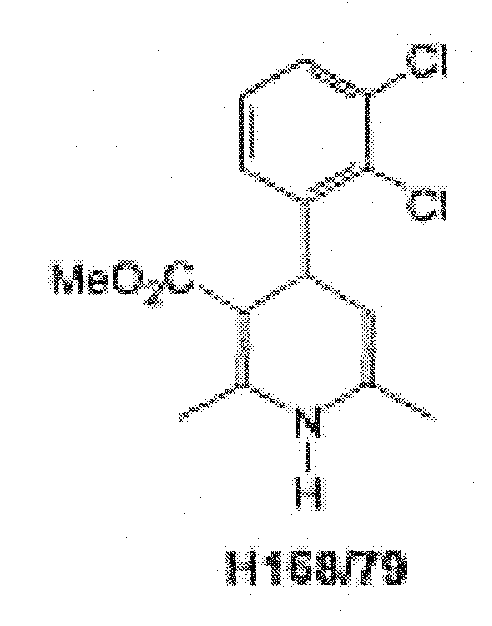
- clevidipine metabolizes into H 168/79, which is also called methyl 4-(2 ! ,3'-dicloropenyl)-1 ,4-dihydro-2,6, ⁇ dimethyl-5-pyridine- carboxylate, and is shown in the following formula:
- clevidipine a degradation pathway of clevidipine is proposed, and is shown in Figure 1.
- This pathway includes a number of clevidipine degradation products, such as H324/78, H 152/66, H152/81 , H168/79, H207/59, and H207/36, for example.
- the pathway also illustrates the further degradation of H 168/79, by way of hydrolysis and condensation, into Substance 23, Substance 24, and/or Substance 25.
- the composition of Substance 23, Substance 24, and Substance 25 is as follows.
- H152/81 , H168/79 and H207/59 are metabolites of clevidipine.
- H324/78 is a pyridine analog of the active ingredient and is formed by the oxidation of clevidipine.
- Degradation product H152/81 is a dihydropyridine carboxylic acid and is formed from the hydrolysis of clevidipine.
- H 152/81 can undergo decarboxylation and oxidation sequentially to form H 168/79 and H207/59 respectively.
- the degradation product H 168/79 can undergo hydrolysis to form the diketo ester H207/36 which can further cyciiz ⁇ to form substituted cyclohexenone derivative impurities such as Substance 23 and Substance 25.
- Substance 24, a diastereomer of Substance 23, may also form during this reaction.
- the level of impurities in the composition is as low as possible. Therefore, while various exemplary embodiments of pharmaceutical compositions include amounts of impurities within acceptable and effective ranges for the compositions as a whole, the more pure the composition, meaning the higher the percent of clevidipine or any of its acceptable salt forms, the better.
- Substance 23 is an impurity generated through the degradation of
- H 168/79 The degradation of H 168/79 is accelerated when exposed to temperatures in excess of 25oC as compared to temperatures below 5oC, Therefore, the level of Substance 23 increases at higher temperatures.
- Substance 25 is an impurity generated through the degradation of H 168/79 and may increase in quantity as H 168/79 degrades.
- Previously unidentified Substance 24 is also a degradation product of
- the present invention further includes a method of identifying and quantifying levels of Substance 24 in pharmaceutical samples having clevidipine as an active ingredient.
- the method of detecting Substance 24 in pharmaceutical samples having cSevidipine as an active ingredient includes the step of isolating the individual chemical compounds making up the degradants or impurities found in the clevidipine degradation pathway. This can be accomplished by column chromatography, such as high pressure liquid chromatography ("HPLC”), for example.
- HPLC high pressure liquid chromatography
- the pharmaceutical sample having clevidipine as an active ingredient can introduced in small volume to the column and the resulting analysis of the eiuent may illustrate the isolation and identification of peaks representative of Substance 24.
- any optimization of the HPLC method may be performed to give the best separation of peaks as between the various impurities found in the degradation of clevidipine.
- Typical HPLC methods useful in the present invention are presented in Examples 1 and 2. Based on this method of detecting Substance 24, the lower limit of detection, or the minimum detectibSe level of Substance 24, may be approximately 0.01 % area of the pharmaceutical composition containing clevidipine as an active ingredient. Alternatively, there could be a lower limit of Substance 24, where the ratio of clevidipine to Substance 24 may be equal or similar to 9000 to 1 which is equal to or similar to 0.01 %.
- the lower limit of Substance 25 or Substance 23 detection may be set forth as a ratio of clevidipine to Substance 25 or Substance 23, where the ratio of clevidipine to Substance 25 or Substance 23 may be equal or similar to 9000 to 1 which is equal to or similar to 0.01 %.
- Clevidipine assay and related substances were tested at each time point by a stability indicating method.
- This method is an isocratic, normal phase HPLC method with peak detection at 220 nm wavelength.
- Injection volume 20 ⁇ l.
- New column should be conditioned overnight at Q.2mL/min. When a degradation product is eluted, column can be washed with filtered ethanol for about 2 hours at 1.0 mL/min, then proceed with equilibration.
- This method is an isocratic, normal phase HPLC method with peak detection at 220 nm wavelength.
- Injection volume 20 ⁇ l to 100 ⁇ l.
- Run time about 60 minutes.
- the present invention includes pharmaceutical compositions having clevidipine as an active ingredient, wherein the level of impurity
- H168/79 is no more than 1 ,5% on a weight-by-weight basis.
- the pharmaceutical composition includes clevidipine as an active ingredient and an amount of H 168/79 that is no greater than about 1.2%. In other embodiments, the amount of H168/79 is preferably no greater than about 1.0%, and most preferably no greater than about 0.5%.
- These compositions may further include other degradants in variable amounts as described herein, provided the required level of potency of clevidipine remains satisfactory and effective for use to treat any indication as described or incorporated by reference herein.
- the pharmaceutical composition exemplified in Tables 1 , 2 and 3 are emulsions.
- the emulsions comprise: clevidipine 0.5 mg/ml., egg yolk phospholipid 1.2%, soybean oil 20%, glycerol 2.25%. The remainder being water adjusted to a pH between 6 and 8.8.
- the products were packaged in 100 ml glass type Il bottles with 28 mm West compound 1821 black stopper and aluminum seal.
- the pharmaceutical composition includes clevidipine as an active ingredient and H168/79, where the ratio of areas under the peak from an HPLC chromatogram between clevidipine and H 168/79 is equal or above 60 to 0.9.
- the ratio between clevidipine and H 168/79 can be equal to or above 100 to 1 , 200 to 1 , or 1000 to 1.
- the ratio between clevidipine and H 168/79 can be between 2000 to 1 and 1000 to 1.
- These compositions may further include other degradants in variable amounts as described herein, provided the required level of potency of clevidipine remains satisfactory and effective for use to treat any indication as described or incorporated by reference herein.
- the above mentioned methods of stabilizing pharmaceutical compounds having clevidipine as an active ingredient provide a shelf life of at least 36 months for the compositions, when stored at about 2oC to 8oC After being removed from this refrigerated condition and placed at roughly room temperature (15oC to 30oC), the compositions remain stable for up to at least 2 additional months.
- the present invention also includes a method of maintaining the stability of a pharmaceutical composition having clevidipine as the active ingredient, including the slowing down or otherwise inhibiting of the hydrolysis pathway of clevidipine by reducing or inhibiting the amount of water in the process of manufacturing the composition, as well as the emulsification process in the final formulation.
- clevidipine is manufactured by reaction of 4-(2',3'-dichlorophenyl)-1 ,4-dihydro-5- acid with chloromethy! butyrate to obtain clevidipine.
- This reaction can be done optionally in the presence of a corresponding hydrogen carbonate, such as in -refluxing acetonitrile.
- Inorganic salts can be removed by filtration and the product is crystallized by the addition of isopropanol with subsequent cooling. It can also be crystallized by exchanging solvent from acetonitrile to a mixture of alcohol, such as ethanol or isopropanol, with repeated evaporations.
- Clevidipine is typically formulated as a liquid emulsion suitable for intravenous administration.
- Lipid emulsions are widely used in parenteral nutrition use for approximately 30 years and in the recent past have been used as drug carriers for insoluble drugs such as propofol (Diprivan®), and diazepam.
- insoluble drugs such as propofol (Diprivan®)
- diazepam Apart from their ability to deliver insoluble drugs, emulsions are also suitable dosage forms for drugs like clevidipine that are susceptible to hydrolytic breakdown. Emulsions have also been reported to prevent drugs from adhering to plastic administration sets used during intravenous injection, and reduce local toxicity on infusion.
- each mL may contain 0.5 mg clevidipine in approximately
- soybean oil emulsion for intravenous administration may include glycerin , purified egg yolk phospholipids and sodium hydroxide to adjust pH.
- water for injection is dispensed to a mix tank at about 74oC to about 78oC.
- Glycerin is added, and the aqueous phase is cooled to about 6OoC to about 7OoC prior to addition of the oil phase.
- soybean oil is dispensed into a dissolving tank, mixed and heated to about 7OoC to about 82oC.
- Clevidipine is then added to the soybean oil mixture and heated to about 78oC to about 82oC.
- Egg yolk phospholipids are then added to the mixture.
- the aqueous and oil phases are mixed together to form an emulsion, and the pH is adjusted with 1 N sodium hydroxide to a pH of about 6 to about 8.8.
- the emulsion is then homogenized at a pressure of about 500 to 8000 psi and a temperature of about 5OoC to about 55oC to a fine particle size.
- the emulsion is homogenized at about 25° C, More preferably at about 15° C, still more preferably at about 10° C and most preferably at about 5° C.
- the samples are filtered and dispensed into 5OmL or 10OmL bottles and capped with siliconized rubber stoppers, and crimp sealed with an aluminum overseal. Further information regarding the formulation of clevidipine can be found in U.S. Patent No. 5,739,152, the entire disclosure of which is incorporated by reference herein as if set forth in its entirety.
- Emulsions of the present invention comprise an oil-in-water emulsion comprising: a) clevidipine, b) a lipid phase, c) an emulsifier, and d) water or a buffer.
- the emulsion may also contain co-solvents or other solubility enhancers, antioxidants, stabilizers, pH-adjusting agents or tonicity modifying agents, such as glycerol.
- clevidipine is present from about 0.4 mg/ml to about 0.8 mg/ml.
- clevidipine is present from abut 0.45 mg/m! to about 0.55 mg/ml.
- the lipid phase is present from about 1 % to about 35%, preferably from about 18% to about 22%.
- the emulsifier is present from about 0.01 to about 2 times the weight of the lipid phase, preferably from about 0.5% to about 4% and more preferably from about 1 % to about 1.32%.
- the remainder of the emulsion is water or buffer.
- the preferred range of water or buffer is about 75% to about 90%.
- the pH of the emulsion is adjusted to about 6 to about 8.8, preferably from about 7.5 to about 8.8.
- glycerol is present from about 2% to about 2.5%. Percentages of the emulsion composition are expressed as weight/weight.
- Lipid phases in the emulsion are any pharmaceutically acceptable oil, preferably triglycerides such as soy bean oil, safflower seed oil, olive oil, cottonseed oil, sunflower oil, sesame oil, peanut oil, corn oil, medium chain triglycerides (such as Miglyol.RTM. 812 or 810) or triacetin.
- the lipid phase may also be propylene glycol diesters or monoglycerides (such as acetylareal monoglycerides).
- the lipid phase can also be a mixture of said ingredients.
- the most preferred lipid phase is soy bean oil.
- Emulsifsers are any pharmaceutically acceptable emulsifier, preferably phospholipids extracted from egg yolk or soy bean, synthetic phosphatidyl cholines or purified phosphatidyl cholines from vegetable origin. Hydrogenated derivatives can also be used, such as phosphatidyl choline hydrogenated (egg) and phosphatidyl choline hydrogenated (soya).
- egg phosphatidyl choline hydrogenated
- sia phosphatidyl choline hydrogenated
- Emulsifiers may also be non-ionic surfactants such as po!oxamers (for example Poloxamer 188 and 407), poloxamines, polyoxyethylene stearates, polyoxyethylene sorbitan fatty acid esters or sorbitan fatty acid esters, Ionic suffactants may also be used such as cholic acid and deoxycholic acid or surface active deriviatives or salts thereof.
- the emulsifier can also be a mixture of said ingredients.
- the most preferred emulsifier is egg yolk phospholipid.
Landscapes
- Health & Medical Sciences (AREA)
- General Health & Medical Sciences (AREA)
- Chemical & Material Sciences (AREA)
- Life Sciences & Earth Sciences (AREA)
- Pharmacology & Pharmacy (AREA)
- Veterinary Medicine (AREA)
- Public Health (AREA)
- Animal Behavior & Ethology (AREA)
- Medicinal Chemistry (AREA)
- Epidemiology (AREA)
- General Chemical & Material Sciences (AREA)
- Organic Chemistry (AREA)
- Nuclear Medicine, Radiotherapy & Molecular Imaging (AREA)
- Chemical Kinetics & Catalysis (AREA)
- Heart & Thoracic Surgery (AREA)
- Cardiology (AREA)
- Bioinformatics & Cheminformatics (AREA)
- Engineering & Computer Science (AREA)
- Analytical Chemistry (AREA)
- Physics & Mathematics (AREA)
- Biochemistry (AREA)
- General Physics & Mathematics (AREA)
- Immunology (AREA)
- Pathology (AREA)
- Pharmaceuticals Containing Other Organic And Inorganic Compounds (AREA)
- Hydrogenated Pyridines (AREA)
- Acyclic And Carbocyclic Compounds In Medicinal Compositions (AREA)
- Medicinal Preparation (AREA)
Abstract
Description


Claims


Priority Applications (16)
| Application Number | Priority Date | Filing Date | Title |
|---|---|---|---|
| JP2011521291A JP5674660B2 (en) | 2008-08-01 | 2009-07-29 | Pharmaceutical composition and method for producing pharmaceutical composition with low impurity concentration |
| EA201170289A EA021336B1 (en) | 2008-08-01 | 2009-07-29 | Pharmaceutical compositions and methods for producing the same with low impurity concentrations |
| NZ591205A NZ591205A (en) | 2008-08-01 | 2009-07-29 | Pharmaceutical compositions comprising clevidipine and methods for producing low impurity concentrations of the same |
| DK09803550.4T DK2320740T3 (en) | 2008-08-01 | 2009-07-29 | PHARMACEUTICAL COMPOSITIONS OF CLEVIDIPIN AND METHODS OF PREPARING CONCENTRATIONS THEREOF |
| MX2011001240A MX2011001240A (en) | 2008-08-01 | 2009-07-29 | Pharmaceutical compositions and methods for producing low impurity concentrations of the same. |
| HRP20140434AT HRP20140434T1 (en) | 2008-08-01 | 2009-07-29 | PHARMACEUTICAL COMPOSITION OF CLEVIDIPINE AND METHODS FOR PRODUCING THE SAME WITH LOW CONCENTRATIONS OF IMPURITY |
| BRPI0916936A BRPI0916936B8 (en) | 2008-08-01 | 2009-07-29 | pharmaceutical compositions, use of clevidipine and method of reducing impurities. |
| SI200930923T SI2320740T1 (en) | 2008-08-01 | 2009-07-29 | Pharmaceutical compositions of clevidipine and methods for producing low impurity concentrations of the same |
| PL09803550T PL2320740T3 (en) | 2008-08-01 | 2009-07-29 | Pharmaceutical compositions of clevidipine and methods for producing low impurity concentrations of the same |
| CA2732760A CA2732760A1 (en) | 2008-08-01 | 2009-07-29 | Pharmaceutical compositions comprising clevidipine and methods for producing low impurity concentrations of the same |
| EP09803550.4A EP2320740B1 (en) | 2008-08-01 | 2009-07-29 | Pharmaceutical compositions of clevidipine and methods for producing low impurity concentrations of the same |
| ES09803550.4T ES2468837T3 (en) | 2008-08-01 | 2009-07-29 | Pharmaceutical compositions of clevidipine and methods for producing low impurity concentrations thereof |
| AU2009276560A AU2009276560B2 (en) | 2008-08-01 | 2009-07-29 | Pharmaceutical compositions and methods for producing low impurity concentrations of the same |
| CN200980139203.6A CN102170786B (en) | 2008-08-01 | 2009-07-29 | Pharmaceutical compositions and methods for producing low impurity concentrations of the same |
| KR1020117004358A KR101772602B1 (en) | 2008-08-01 | 2009-07-29 | Pharmaceutical compositions and methods for producing low impurity concentrations of the same |
| SM201400081T SMT201400081B (en) | 2008-08-01 | 2014-06-25 | Pharmaceutical compositions of clevidipine and method to produce concentrations thereof with a low or impurity level |
Applications Claiming Priority (4)
| Application Number | Priority Date | Filing Date | Title |
|---|---|---|---|
| US8559708P | 2008-08-01 | 2008-08-01 | |
| US61/085,597 | 2008-08-01 | ||
| US9377208P | 2008-09-03 | 2008-09-03 | |
| US61/093,772 | 2008-09-03 |
Publications (1)
| Publication Number | Publication Date |
|---|---|
| WO2010014727A1 true WO2010014727A1 (en) | 2010-02-04 |
Family
ID=41610719
Family Applications (1)
| Application Number | Title | Priority Date | Filing Date |
|---|---|---|---|
| PCT/US2009/052127 Ceased WO2010014727A1 (en) | 2008-08-01 | 2009-07-29 | Pharmaceutical compositions and methods for producing low impurity concentrations of the same |
Country Status (20)
| Country | Link |
|---|---|
| US (6) | US20100113534A1 (en) |
| EP (2) | EP2719386A1 (en) |
| JP (1) | JP5674660B2 (en) |
| KR (1) | KR101772602B1 (en) |
| CN (1) | CN102170786B (en) |
| AU (1) | AU2009276560B2 (en) |
| BR (1) | BRPI0916936B8 (en) |
| CA (2) | CA2732760A1 (en) |
| CY (1) | CY1116490T1 (en) |
| DK (1) | DK2320740T3 (en) |
| EA (1) | EA021336B1 (en) |
| ES (1) | ES2468837T3 (en) |
| HR (1) | HRP20140434T1 (en) |
| MX (1) | MX2011001240A (en) |
| NZ (1) | NZ591205A (en) |
| PL (1) | PL2320740T3 (en) |
| PT (1) | PT2320740E (en) |
| SI (1) | SI2320740T1 (en) |
| SM (1) | SMT201400081B (en) |
| WO (1) | WO2010014727A1 (en) |
Cited By (7)
| Publication number | Priority date | Publication date | Assignee | Title |
|---|---|---|---|---|
| JP2014504259A (en) * | 2010-10-12 | 2014-02-20 | ザ メディシンズ カンパニー | Clevidipine emulsion formulation containing antibacterial agent |
| WO2014066870A1 (en) | 2012-10-26 | 2014-05-01 | The Medicines Company | Methods for controlling blood pressure and reducing dyspnea in heart failure |
| CN104974042A (en) * | 2014-04-09 | 2015-10-14 | 上海信谊金朱药业有限公司 | Preparation method of compound |
| CN104974043A (en) * | 2014-04-09 | 2015-10-14 | 上海信谊金朱药业有限公司 | Preparation method of impurity compound of clevidipine butyrate |
| CN105853353A (en) * | 2015-01-20 | 2016-08-17 | 江苏正大丰海制药有限公司 | Method for preparing clevidipine fat emulsion injection |
| WO2019123221A1 (en) * | 2017-12-20 | 2019-06-27 | Aurobindo Pharma Limited | Pharmaceutical composition comprising clevidipine and process for preparation thereof |
| US11103490B2 (en) | 2010-10-12 | 2021-08-31 | Chiesi Farmaceutici S.P.A. | Clevidipine emulsion formulations containing antimicrobial agents |
Families Citing this family (8)
| Publication number | Priority date | Publication date | Assignee | Title |
|---|---|---|---|---|
| MX2011001240A (en) | 2008-08-01 | 2011-08-12 | Medicines Co | Pharmaceutical compositions and methods for producing low impurity concentrations of the same. |
| CN103134891A (en) * | 2011-11-30 | 2013-06-05 | 天津金耀集团有限公司 | Measuring method of content of butyric acid clevidipine butyrate and content of related substances |
| CN103417539B (en) * | 2013-08-22 | 2015-11-25 | 北京蓝丹医药科技有限公司 | A kind of Clevidipine butyrate pharmaceutical composition |
| WO2015179334A1 (en) * | 2014-05-19 | 2015-11-26 | The Medicines Company | Clevidipine nanoparticles and pharmaceutical compositions thereof |
| CN104458937B (en) * | 2014-11-20 | 2017-02-22 | 北京京科泰来科技有限公司 | Method for detecting related substances in cleviprex fat emulsion |
| CN104597192B (en) * | 2014-12-31 | 2016-08-24 | 武汉科福新药有限责任公司 | A kind of butyrate clevidipine and preparation thereof have the detection method of related substance |
| CN107362139B (en) * | 2017-08-29 | 2020-11-03 | 辅必成(上海)医药科技有限公司 | Emulsion injection of clevidipine butyrate |
| CN109956943B (en) * | 2019-04-18 | 2021-07-20 | 合肥合源药业有限公司 | Decarboxylation condensation impurity in dihydropyridine drug and preparation and control method thereof |
Citations (7)
| Publication number | Priority date | Publication date | Assignee | Title |
|---|---|---|---|---|
| US20030119883A1 (en) * | 2001-08-28 | 2003-06-26 | Pfizer Inc. | Crystalline material |
| US20050272763A1 (en) * | 2002-08-02 | 2005-12-08 | Toupence Richard B | Substituted furo[2,3-b]pyridine derivatives |
| US20050276824A1 (en) * | 1999-03-31 | 2005-12-15 | Pharmacia & Upjohn Company | Pharmaceutical emulsions for retroviral protease inhibitors |
| US20060047125A1 (en) * | 2004-08-24 | 2006-03-02 | Recordati Ireland Limited | Lercanidipine salts |
| WO2006118210A1 (en) * | 2005-04-28 | 2006-11-09 | Eisai R & D Management Co., Ltd. | Method of preventing dihydropyridine compound from degradation |
| US20070196465A1 (en) * | 2005-07-28 | 2007-08-23 | George Bobotas | Treatment with dihydropyridine calcium channel blockers and omega-3 fatty acids and a combination product thereof |
| US20080019978A1 (en) * | 2005-05-17 | 2008-01-24 | Schering Corporation | Nitrogen-containing heterocyclic compounds and methods of use thereof |
Family Cites Families (17)
| Publication number | Priority date | Publication date | Assignee | Title |
|---|---|---|---|---|
| US4150744A (en) * | 1976-02-27 | 1979-04-24 | Smith & Nephew Pharmaceuticals Ltd. | Packaging |
| DE3532129A1 (en) * | 1985-09-10 | 1987-03-12 | Bayer Ag | GELATINE CONTAINING SS CAROTINE |
| SE9303657D0 (en) * | 1993-11-05 | 1993-11-05 | Astra Ab | Short-acting dihydropyridines |
| SE9303744D0 (en) * | 1993-11-12 | 1993-11-12 | Astra Ab | Pharmaceutical emulsion |
| GB9405593D0 (en) | 1994-03-22 | 1994-05-11 | Zeneca Ltd | Pharmaceutical compositions |
| SE9804002D0 (en) | 1998-11-23 | 1998-11-23 | Astra Ab | New manufacturing process |
| PT1165091E (en) | 1999-03-31 | 2005-05-31 | Upjohn Co | PHARMACEUTICAL EMULSES FOR RETROVIRAL PROTEASE INHIBITORS |
| JP2003104888A (en) | 2001-09-28 | 2003-04-09 | Taiyo Yakuhin Kogyo Kk | Tablet of dihydropyridine derivative |
| US20060160834A1 (en) * | 2003-06-06 | 2006-07-20 | Fong Tung M | Combination therapy for the treatment of hypertension |
| US20050186230A1 (en) | 2004-01-23 | 2005-08-25 | Sd Pharmaceuticals, Inc. | Elemene compositions containing liquid oil |
| DE602005018387D1 (en) | 2004-10-06 | 2010-01-28 | Eisai R&D Man Co Ltd | MEDICAL COMPOSITION, PROCESS FOR YOUR HDI-HYDROPYRIDINE COMPOUND IN A MEDICAL COMPOSITION |
| MX2011001240A (en) | 2008-08-01 | 2011-08-12 | Medicines Co | Pharmaceutical compositions and methods for producing low impurity concentrations of the same. |
| EP2330895A4 (en) | 2008-08-22 | 2013-07-31 | Milestone Pharmaceuticals Inc | SHORT-ACTING BENZOTHIAZEPINE CALCIUM CHANNEL BLOCKERS AND USES THEREOF |
| CN101766568A (en) | 2008-12-31 | 2010-07-07 | 北京利乐生制药科技有限公司 | Emulsion containing clevidipine and preparation process and application thereof |
| CN101780036B (en) | 2010-03-30 | 2011-11-16 | 武汉武药科技有限公司 | Butyrate clevidipine lipid microsphere injection and preparation method thereof |
| US8658676B2 (en) | 2010-10-12 | 2014-02-25 | The Medicines Company | Clevidipine emulsion formulations containing antimicrobial agents |
| WO2012051116A1 (en) | 2010-10-12 | 2012-04-19 | The Medicines Company | Clevidipine emulsion formulations containing antimicrobial agents |
-
2009
- 2009-07-29 MX MX2011001240A patent/MX2011001240A/en active IP Right Grant
- 2009-07-29 EP EP14150954.7A patent/EP2719386A1/en not_active Withdrawn
- 2009-07-29 EP EP09803550.4A patent/EP2320740B1/en active Active
- 2009-07-29 KR KR1020117004358A patent/KR101772602B1/en active Active
- 2009-07-29 BR BRPI0916936A patent/BRPI0916936B8/en active IP Right Grant
- 2009-07-29 CN CN200980139203.6A patent/CN102170786B/en active Active
- 2009-07-29 HR HRP20140434AT patent/HRP20140434T1/en unknown
- 2009-07-29 DK DK09803550.4T patent/DK2320740T3/en active
- 2009-07-29 ES ES09803550.4T patent/ES2468837T3/en active Active
- 2009-07-29 AU AU2009276560A patent/AU2009276560B2/en active Active
- 2009-07-29 NZ NZ591205A patent/NZ591205A/en unknown
- 2009-07-29 WO PCT/US2009/052127 patent/WO2010014727A1/en not_active Ceased
- 2009-07-29 CA CA2732760A patent/CA2732760A1/en not_active Abandoned
- 2009-07-29 SI SI200930923T patent/SI2320740T1/en unknown
- 2009-07-29 PL PL09803550T patent/PL2320740T3/en unknown
- 2009-07-29 EA EA201170289A patent/EA021336B1/en not_active IP Right Cessation
- 2009-07-29 JP JP2011521291A patent/JP5674660B2/en active Active
- 2009-07-29 CA CA3108961A patent/CA3108961C/en active Active
- 2009-07-29 PT PT98035504T patent/PT2320740E/en unknown
- 2009-07-29 US US12/511,631 patent/US20100113534A1/en not_active Abandoned
-
2012
- 2012-08-30 US US13/600,056 patent/US20120322835A1/en not_active Abandoned
-
2013
- 2013-06-17 US US13/919,893 patent/US20140005233A1/en not_active Abandoned
-
2014
- 2014-05-30 CY CY20141100388T patent/CY1116490T1/en unknown
- 2014-06-25 SM SM201400081T patent/SMT201400081B/en unknown
-
2018
- 2018-11-21 US US16/197,647 patent/US11058672B2/en active Active
-
2021
- 2021-06-16 US US17/304,216 patent/US20220000849A1/en not_active Abandoned
-
2024
- 2024-09-16 US US18/885,921 patent/US20250213540A1/en active Pending
Patent Citations (7)
| Publication number | Priority date | Publication date | Assignee | Title |
|---|---|---|---|---|
| US20050276824A1 (en) * | 1999-03-31 | 2005-12-15 | Pharmacia & Upjohn Company | Pharmaceutical emulsions for retroviral protease inhibitors |
| US20030119883A1 (en) * | 2001-08-28 | 2003-06-26 | Pfizer Inc. | Crystalline material |
| US20050272763A1 (en) * | 2002-08-02 | 2005-12-08 | Toupence Richard B | Substituted furo[2,3-b]pyridine derivatives |
| US20060047125A1 (en) * | 2004-08-24 | 2006-03-02 | Recordati Ireland Limited | Lercanidipine salts |
| WO2006118210A1 (en) * | 2005-04-28 | 2006-11-09 | Eisai R & D Management Co., Ltd. | Method of preventing dihydropyridine compound from degradation |
| US20080019978A1 (en) * | 2005-05-17 | 2008-01-24 | Schering Corporation | Nitrogen-containing heterocyclic compounds and methods of use thereof |
| US20070196465A1 (en) * | 2005-07-28 | 2007-08-23 | George Bobotas | Treatment with dihydropyridine calcium channel blockers and omega-3 fatty acids and a combination product thereof |
Non-Patent Citations (3)
| Title |
|---|
| GYLLENHALL ET AL.: "Packed-column supercritical fluid chromatography for the purity analysis of clevidipine, a new dihyrdopyridine drug.", JOURNAL OF CHROMATOGRAPHY A, vol. 862, no. ISS 1, 1999, pages 95 - 104, XP009150407 * |
| NORDLANDER ET AL.: "Pharmacodynamic, Pharmacokinetic and Clinical Effects of Clevidipine, an Ultrashort-acting Calcium Antagonist for Rapid Blood Pressure Control.", CARDIVASCULAR DRUG REVIEWS, vol. 22, no. 3, 2004, pages 227 - 250, XP008142879, Retrieved from the Internet <URL:http:/lwww.edictforpressurecontrol.com/pdf/NorlanderCardiovascDrugRev.pdf> * |
| See also references of EP2320740A4 * |
Cited By (12)
| Publication number | Priority date | Publication date | Assignee | Title |
|---|---|---|---|---|
| JP2014504259A (en) * | 2010-10-12 | 2014-02-20 | ザ メディシンズ カンパニー | Clevidipine emulsion formulation containing antibacterial agent |
| JP2014196322A (en) * | 2010-10-12 | 2014-10-16 | ザ メディシンズ カンパニー | Clevidipine emulsion formulations containing antimicrobial agents |
| EP2627173B1 (en) | 2010-10-12 | 2015-03-25 | The Medicines Company | Clevidipine emulsion formulations containing antimicrobial agents |
| JP2016183183A (en) * | 2010-10-12 | 2016-10-20 | ザ メディシンズ カンパニー | Clevidipine emulsion formulations containing antimicrobial agents |
| US10010537B2 (en) | 2010-10-12 | 2018-07-03 | Chiesi Farmaceutici S.P.A. | Clevidipine emulsion formulations containing antimicrobial agents |
| US11103490B2 (en) | 2010-10-12 | 2021-08-31 | Chiesi Farmaceutici S.P.A. | Clevidipine emulsion formulations containing antimicrobial agents |
| WO2014066870A1 (en) | 2012-10-26 | 2014-05-01 | The Medicines Company | Methods for controlling blood pressure and reducing dyspnea in heart failure |
| US10881645B2 (en) | 2012-10-26 | 2021-01-05 | Chiesi Farmaceutici S.P.A. | Methods for controlling blood pressure and reducing dyspnea in heart failure |
| CN104974042A (en) * | 2014-04-09 | 2015-10-14 | 上海信谊金朱药业有限公司 | Preparation method of compound |
| CN104974043A (en) * | 2014-04-09 | 2015-10-14 | 上海信谊金朱药业有限公司 | Preparation method of impurity compound of clevidipine butyrate |
| CN105853353A (en) * | 2015-01-20 | 2016-08-17 | 江苏正大丰海制药有限公司 | Method for preparing clevidipine fat emulsion injection |
| WO2019123221A1 (en) * | 2017-12-20 | 2019-06-27 | Aurobindo Pharma Limited | Pharmaceutical composition comprising clevidipine and process for preparation thereof |
Also Published As
Similar Documents
| Publication | Publication Date | Title |
|---|---|---|
| US20250213540A1 (en) | Pharmaceutical compositions and methods for producing low impurity concentrations of the same | |
| US20230302002A1 (en) | Pharmaceutical Compositions and Methods for Stabilizing the Same | |
| DK2627173T3 (en) | CLEVIDIPIN emulsion formulations CONTAINING ANTIMICROBIAL AGENTS | |
| HK1233507A1 (en) | Pharmaceutical compositions and methods for stabilizing the same |
Legal Events
| Date | Code | Title | Description |
|---|---|---|---|
| WWE | Wipo information: entry into national phase |
Ref document number: 200980139203.6 Country of ref document: CN |
|
| 121 | Ep: the epo has been informed by wipo that ep was designated in this application |
Ref document number: 09803550 Country of ref document: EP Kind code of ref document: A1 |
|
| ENP | Entry into the national phase |
Ref document number: 2011521291 Country of ref document: JP Kind code of ref document: A |
|
| ENP | Entry into the national phase |
Ref document number: 2732760 Country of ref document: CA |
|
| WWE | Wipo information: entry into national phase |
Ref document number: MX/A/2011/001240 Country of ref document: MX |
|
| WWE | Wipo information: entry into national phase |
Ref document number: 2011020198 Country of ref document: EG |
|
| WWE | Wipo information: entry into national phase |
Ref document number: 591205 Country of ref document: NZ |
|
| WWE | Wipo information: entry into national phase |
Ref document number: 2009803550 Country of ref document: EP |
|
| ENP | Entry into the national phase |
Ref document number: 20117004358 Country of ref document: KR Kind code of ref document: A |
|
| WWE | Wipo information: entry into national phase |
Ref document number: 1315/CHENP/2011 Country of ref document: IN |
|
| WWE | Wipo information: entry into national phase |
Ref document number: 2009276560 Country of ref document: AU |
|
| WWE | Wipo information: entry into national phase |
Ref document number: 201170289 Country of ref document: EA |
|
| NENP | Non-entry into the national phase |
Ref country code: DE |
|
| ENP | Entry into the national phase |
Ref document number: 2009276560 Country of ref document: AU Date of ref document: 20090729 Kind code of ref document: A |
|
| ENP | Entry into the national phase |
Ref document number: PI0916936 Country of ref document: BR Kind code of ref document: A2 Effective date: 20110201 |