WO2009134754A1 - Benzoimidazole glycinamides as prolyl hydroxylase inhibitors - Google Patents
Benzoimidazole glycinamides as prolyl hydroxylase inhibitors Download PDFInfo
- Publication number
- WO2009134754A1 WO2009134754A1 PCT/US2009/041908 US2009041908W WO2009134754A1 WO 2009134754 A1 WO2009134754 A1 WO 2009134754A1 US 2009041908 W US2009041908 W US 2009041908W WO 2009134754 A1 WO2009134754 A1 WO 2009134754A1
- Authority
- WO
- WIPO (PCT)
- Prior art keywords
- phenyl
- benzoimidazole
- acetic acid
- carbonyl
- amino
- Prior art date
- Legal status (The legal status is an assumption and is not a legal conclusion. Google has not performed a legal analysis and makes no representation as to the accuracy of the status listed.)
- Ceased
Links
- UKTRCAWJVRSEFY-UHFFFAOYSA-N COc1cccc(-c2ccc3[nH]c(C(NCC(O)=O)=O)nc3c2)c1 Chemical compound COc1cccc(-c2ccc3[nH]c(C(NCC(O)=O)=O)nc3c2)c1 UKTRCAWJVRSEFY-UHFFFAOYSA-N 0.000 description 1
- SAJFEWWEQYOQQK-UHFFFAOYSA-N OC(CNC(c1nc(cc(cc2)-c3cc(OCc4cc(Cl)ccc4)ccc3)c2[nH]1)=O)=O Chemical compound OC(CNC(c1nc(cc(cc2)-c3cc(OCc4cc(Cl)ccc4)ccc3)c2[nH]1)=O)=O SAJFEWWEQYOQQK-UHFFFAOYSA-N 0.000 description 1
- RKHLKVVNNPGRJN-UHFFFAOYSA-N OC(CNC(c1nc2cc(-c3cc(C(NCc4ccccc4)=O)ccc3F)ccc2[nH]1)=O)=O Chemical compound OC(CNC(c1nc2cc(-c3cc(C(NCc4ccccc4)=O)ccc3F)ccc2[nH]1)=O)=O RKHLKVVNNPGRJN-UHFFFAOYSA-N 0.000 description 1
- AOYABLNMLSETKS-UHFFFAOYSA-N OC(CNC(c1nc2ccccc2[nH]1)=O)=O Chemical compound OC(CNC(c1nc2ccccc2[nH]1)=O)=O AOYABLNMLSETKS-UHFFFAOYSA-N 0.000 description 1
Classifications
-
- C—CHEMISTRY; METALLURGY
- C07—ORGANIC CHEMISTRY
- C07D—HETEROCYCLIC COMPOUNDS
- C07D403/00—Heterocyclic compounds containing two or more hetero rings, having nitrogen atoms as the only ring hetero atoms, not provided for by group C07D401/00
- C07D403/02—Heterocyclic compounds containing two or more hetero rings, having nitrogen atoms as the only ring hetero atoms, not provided for by group C07D401/00 containing two hetero rings
- C07D403/04—Heterocyclic compounds containing two or more hetero rings, having nitrogen atoms as the only ring hetero atoms, not provided for by group C07D401/00 containing two hetero rings directly linked by a ring-member-to-ring-member bond
-
- A—HUMAN NECESSITIES
- A61—MEDICAL OR VETERINARY SCIENCE; HYGIENE
- A61P—SPECIFIC THERAPEUTIC ACTIVITY OF CHEMICAL COMPOUNDS OR MEDICINAL PREPARATIONS
- A61P1/00—Drugs for disorders of the alimentary tract or the digestive system
- A61P1/04—Drugs for disorders of the alimentary tract or the digestive system for ulcers, gastritis or reflux esophagitis, e.g. antacids, inhibitors of acid secretion, mucosal protectants
-
- A—HUMAN NECESSITIES
- A61—MEDICAL OR VETERINARY SCIENCE; HYGIENE
- A61P—SPECIFIC THERAPEUTIC ACTIVITY OF CHEMICAL COMPOUNDS OR MEDICINAL PREPARATIONS
- A61P17/00—Drugs for dermatological disorders
- A61P17/02—Drugs for dermatological disorders for treating wounds, ulcers, burns, scars, keloids, or the like
-
- A—HUMAN NECESSITIES
- A61—MEDICAL OR VETERINARY SCIENCE; HYGIENE
- A61P—SPECIFIC THERAPEUTIC ACTIVITY OF CHEMICAL COMPOUNDS OR MEDICINAL PREPARATIONS
- A61P19/00—Drugs for skeletal disorders
-
- A—HUMAN NECESSITIES
- A61—MEDICAL OR VETERINARY SCIENCE; HYGIENE
- A61P—SPECIFIC THERAPEUTIC ACTIVITY OF CHEMICAL COMPOUNDS OR MEDICINAL PREPARATIONS
- A61P19/00—Drugs for skeletal disorders
- A61P19/08—Drugs for skeletal disorders for bone diseases, e.g. rachitism, Paget's disease
-
- A—HUMAN NECESSITIES
- A61—MEDICAL OR VETERINARY SCIENCE; HYGIENE
- A61P—SPECIFIC THERAPEUTIC ACTIVITY OF CHEMICAL COMPOUNDS OR MEDICINAL PREPARATIONS
- A61P29/00—Non-central analgesic, antipyretic or antiinflammatory agents, e.g. antirheumatic agents; Non-steroidal antiinflammatory drugs [NSAID]
-
- A—HUMAN NECESSITIES
- A61—MEDICAL OR VETERINARY SCIENCE; HYGIENE
- A61P—SPECIFIC THERAPEUTIC ACTIVITY OF CHEMICAL COMPOUNDS OR MEDICINAL PREPARATIONS
- A61P3/00—Drugs for disorders of the metabolism
- A61P3/04—Anorexiants; Antiobesity agents
-
- A—HUMAN NECESSITIES
- A61—MEDICAL OR VETERINARY SCIENCE; HYGIENE
- A61P—SPECIFIC THERAPEUTIC ACTIVITY OF CHEMICAL COMPOUNDS OR MEDICINAL PREPARATIONS
- A61P3/00—Drugs for disorders of the metabolism
- A61P3/08—Drugs for disorders of the metabolism for glucose homeostasis
- A61P3/10—Drugs for disorders of the metabolism for glucose homeostasis for hyperglycaemia, e.g. antidiabetics
-
- A—HUMAN NECESSITIES
- A61—MEDICAL OR VETERINARY SCIENCE; HYGIENE
- A61P—SPECIFIC THERAPEUTIC ACTIVITY OF CHEMICAL COMPOUNDS OR MEDICINAL PREPARATIONS
- A61P31/00—Antiinfectives, i.e. antibiotics, antiseptics, chemotherapeutics
-
- A—HUMAN NECESSITIES
- A61—MEDICAL OR VETERINARY SCIENCE; HYGIENE
- A61P—SPECIFIC THERAPEUTIC ACTIVITY OF CHEMICAL COMPOUNDS OR MEDICINAL PREPARATIONS
- A61P31/00—Antiinfectives, i.e. antibiotics, antiseptics, chemotherapeutics
- A61P31/04—Antibacterial agents
-
- A—HUMAN NECESSITIES
- A61—MEDICAL OR VETERINARY SCIENCE; HYGIENE
- A61P—SPECIFIC THERAPEUTIC ACTIVITY OF CHEMICAL COMPOUNDS OR MEDICINAL PREPARATIONS
- A61P43/00—Drugs for specific purposes, not provided for in groups A61P1/00-A61P41/00
-
- A—HUMAN NECESSITIES
- A61—MEDICAL OR VETERINARY SCIENCE; HYGIENE
- A61P—SPECIFIC THERAPEUTIC ACTIVITY OF CHEMICAL COMPOUNDS OR MEDICINAL PREPARATIONS
- A61P7/00—Drugs for disorders of the blood or the extracellular fluid
-
- A—HUMAN NECESSITIES
- A61—MEDICAL OR VETERINARY SCIENCE; HYGIENE
- A61P—SPECIFIC THERAPEUTIC ACTIVITY OF CHEMICAL COMPOUNDS OR MEDICINAL PREPARATIONS
- A61P7/00—Drugs for disorders of the blood or the extracellular fluid
- A61P7/06—Antianaemics
-
- A—HUMAN NECESSITIES
- A61—MEDICAL OR VETERINARY SCIENCE; HYGIENE
- A61P—SPECIFIC THERAPEUTIC ACTIVITY OF CHEMICAL COMPOUNDS OR MEDICINAL PREPARATIONS
- A61P9/00—Drugs for disorders of the cardiovascular system
-
- A—HUMAN NECESSITIES
- A61—MEDICAL OR VETERINARY SCIENCE; HYGIENE
- A61P—SPECIFIC THERAPEUTIC ACTIVITY OF CHEMICAL COMPOUNDS OR MEDICINAL PREPARATIONS
- A61P9/00—Drugs for disorders of the cardiovascular system
- A61P9/08—Vasodilators for multiple indications
-
- A—HUMAN NECESSITIES
- A61—MEDICAL OR VETERINARY SCIENCE; HYGIENE
- A61P—SPECIFIC THERAPEUTIC ACTIVITY OF CHEMICAL COMPOUNDS OR MEDICINAL PREPARATIONS
- A61P9/00—Drugs for disorders of the cardiovascular system
- A61P9/10—Drugs for disorders of the cardiovascular system for treating ischaemic or atherosclerotic diseases, e.g. antianginal drugs, coronary vasodilators, drugs for myocardial infarction, retinopathy, cerebrovascula insufficiency, renal arteriosclerosis
-
- C—CHEMISTRY; METALLURGY
- C07—ORGANIC CHEMISTRY
- C07D—HETEROCYCLIC COMPOUNDS
- C07D235/00—Heterocyclic compounds containing 1,3-diazole or hydrogenated 1,3-diazole rings, condensed with other rings
- C07D235/02—Heterocyclic compounds containing 1,3-diazole or hydrogenated 1,3-diazole rings, condensed with other rings condensed with carbocyclic rings or ring systems
- C07D235/04—Benzimidazoles; Hydrogenated benzimidazoles
- C07D235/24—Benzimidazoles; Hydrogenated benzimidazoles with hetero atoms or with carbon atoms having three bonds to hetero atoms with at the most one bond to halogen, e.g. ester or nitrile radicals, directly attached in position 2
-
- C—CHEMISTRY; METALLURGY
- C07—ORGANIC CHEMISTRY
- C07D—HETEROCYCLIC COMPOUNDS
- C07D403/00—Heterocyclic compounds containing two or more hetero rings, having nitrogen atoms as the only ring hetero atoms, not provided for by group C07D401/00
- C07D403/14—Heterocyclic compounds containing two or more hetero rings, having nitrogen atoms as the only ring hetero atoms, not provided for by group C07D401/00 containing three or more hetero rings
-
- C—CHEMISTRY; METALLURGY
- C07—ORGANIC CHEMISTRY
- C07D—HETEROCYCLIC COMPOUNDS
- C07D471/00—Heterocyclic compounds containing nitrogen atoms as the only ring hetero atoms in the condensed system, at least one ring being a six-membered ring with one nitrogen atom, not provided for by groups C07D451/00 - C07D463/00
- C07D471/02—Heterocyclic compounds containing nitrogen atoms as the only ring hetero atoms in the condensed system, at least one ring being a six-membered ring with one nitrogen atom, not provided for by groups C07D451/00 - C07D463/00 in which the condensed system contains two hetero rings
- C07D471/04—Ortho-condensed systems
-
- C—CHEMISTRY; METALLURGY
- C07—ORGANIC CHEMISTRY
- C07D—HETEROCYCLIC COMPOUNDS
- C07D473/00—Heterocyclic compounds containing purine ring systems
- C07D473/40—Heterocyclic compounds containing purine ring systems with halogen atoms or perhalogeno-alkyl radicals directly attached in position 2 or 6
-
- C—CHEMISTRY; METALLURGY
- C07—ORGANIC CHEMISTRY
- C07D—HETEROCYCLIC COMPOUNDS
- C07D487/00—Heterocyclic compounds containing nitrogen atoms as the only ring hetero atoms in the condensed system, not provided for by groups C07D451/00 - C07D477/00
- C07D487/02—Heterocyclic compounds containing nitrogen atoms as the only ring hetero atoms in the condensed system, not provided for by groups C07D451/00 - C07D477/00 in which the condensed system contains two hetero rings
- C07D487/04—Ortho-condensed systems
-
- C—CHEMISTRY; METALLURGY
- C07—ORGANIC CHEMISTRY
- C07D—HETEROCYCLIC COMPOUNDS
- C07D513/00—Heterocyclic compounds containing in the condensed system at least one hetero ring having nitrogen and sulfur atoms as the only ring hetero atoms, not provided for in groups C07D463/00, C07D477/00 or C07D499/00 - C07D507/00
- C07D513/02—Heterocyclic compounds containing in the condensed system at least one hetero ring having nitrogen and sulfur atoms as the only ring hetero atoms, not provided for in groups C07D463/00, C07D477/00 or C07D499/00 - C07D507/00 in which the condensed system contains two hetero rings
- C07D513/04—Ortho-condensed systems
Definitions
- the present invention relates to certain benzoimidazole glycinamide compounds, pharmaceutical compositions containing them, and methods of using them for the treatment of disease states, disorders, and conditions mediated by prolyl hydroxylase activity.
- HIFs Hypoxia- inducible factors
- HIF- ⁇ Three forms of HIF- ⁇ have been described: HIF-1 ⁇ , HIF-2 ⁇ and HIF-3 ⁇ (Scheuermann et al., 2007, Methods Enzymol., 435:3- 24). Pairing of a HIF ⁇ sub-unit with H IF-1 ⁇ forms a functional heterodimeric protein that subsequently recruits other transcriptional factors such as p300 and CBP (Semenza, 2001 , Trends MoI Med., 7(8):345-50).
- a family of highly conserved oxygen, iron, and 2-oxoglutarate-dependent prolyl hydroxylase (PHD) enzymes mediate the cells response to hypoxia via post- translational modification of HIF (Ivan et al., 2001 , Science, 292:464-68; Jaakkola et al., 2001 , Science, 292:468-72).
- PHD catalyzes the hydroxylation of two conserved proline residues within HIF.
- Von Hippel Lindau (VHL) protein binds selectively to hydroxylated HIF.
- VHL The binding of VHL renders HIF a target for polyubiquitination by the E3 ubiquitin ligase complex and its subsequent degradation by the 26S proteasome (Ke et al., 2006, MoI Pharmacol. 70(5):1469-80; Semenza, Sci STKE., 2007, 407(cm8):1 -3).
- affinity of PHD for oxygen is within the physiological range of oxygen and oxygen is a necessary co-factor for the reaction, PHD is inactivated when oxygen tension is reduced. In this way, HIF is rapidly degraded under normoxic conditions but accumulates in cells under hypoxic conditions or when PHD is inhibited.
- PHD1 Four isotypes of PHD have been described: PHD1 , PHD2, PHD3, and PHD4 (Epstein et al., 2001 , Cell, 107:43-54; Kaelin, 2005, Annu Rev Biochem., 74:115-28; Schmid et al., 2004, J Cell MoI Med., 8:423-31 ).
- the different isotypes are ubiquitously expressed but are differentially regulated and have distinct physiological roles in the cellular response to hypoxia. There is evidence that the various isotypes have different selectivity for the three different HIF ⁇ sub-types (Epstein et al., supra).
- PHD1 is primarily nuclear
- PHD2 is primarily cytoplasmic
- PHD3 appears to be both cytoplasmic and nuclear
- PHD2 appears to be the predominant HIF ⁇ prolyl hydroxylase under normoxic conditions (Ivan et al., 2002. Proc Natl Acad Sci. USA, 99(21 ): 13459-64; Berra et al., 2003, EMBO J., 22:4082-90).
- the three isotypes have a high degree of amino-acid homology and the active site of the enzyme is highly conserved.
- the HIF target gene products are involved in a number of physiological and pathophysiological processes including but not limited to: erythropoiesis, angiogenesis, regulation of energy metabolism, vasomotor function, and cell apoptosis/proliferation.
- the first gene described as a HIF target was that encoding erythropoietin (EPO) (Wang et al., 1993, supra). It was recognized that a reduction in the oxygen carrying capacity of the blood is sensed in the kidney and that the kidney and liver respond by releasing more EPO, the hormone that stimulates red blood cell proliferation and maturation.
- EPO erythropoietin
- EPO has a number of other important effects on non-hematopoietic cell types and has emerged as a key tissue-protective cytokine (Arcasoy, 2008, Br J Haematol., 141 :14-31 ). Thus EPO is now implicated in wound healing and angiogenesis as well as the response of tissues to ischemic insult. Most of the enzymes involved in anaerobic glycolysis are encoded by HIF target genes and as a result glycolysis is increased in hypoxic tissues (Shaw, 2006, Curr Opin Cell Biol., 18(6):598-608).
- HIF target gene products in this pathway include but are not limited to: glucose transporters such as GLUT-1 (Ebert et al., 1995, J Biol Chem., 270(49):29083-89), enzymes involved in the break down of glucose to pyruvate such as hexokinase and phosphoglycerate kinase 1 (Firth et al., 1994, Proc Natl Acad Sci. USA, 91 :6496-6500) as well as lactate dehydrogenase (Firth et al., supra). HIF target gene products are also involved in the regulation of cellular metabolism.
- pyruvate dehydrogenase kinase-1 is a target HIF gene product and regulates the entry of pyruvate into the Kreb's cycle by reducing the activity of pyruvate dehydrogenase by phosphorylation (Kim et al., 2006, Cell Metab., 3:177-85; Papandreou et al., 2006, Cell Metab., 3:187-197).
- HIF target gene products are also involved in angiogenesis.
- VEGF vascular endothelial growth factor
- VEGF vascular endothelial growth factor
- HIF target gene products also function in the regulation of vascular tone and include heme oxygenase-1 (Lee et al., 1997, J Biol Chem., 272(9):5375-81 ).
- a number of HIF regulated gene products such as platelet- derived growth factor (PDGF) (Yoshida et al., 2006, J Neurooncol., 76(1 ):13-21 ), vascular endothelial growth factor (Breen, 2007, J Cell Biochem., 102(6):1358-67) and EPO (Arcasoy, supra) also function in the coordinated response to wound healing.
- PDGF platelet- derived growth factor
- Targeted disruption of the prolyl hydroxylase (PHD) enzyme activity by small molecules has potential utility in the treatment of disorders of oxygen sensing and distribution.
- disorders of oxygen sensing and distribution examples include but are not limited to: anemia; sickle cell anemia; peripheral vascular disease; coronary artery disease; heart failure; protection of tissue from ischemia in conditions such as myocardial ischemia, myocardial infarction and stroke; preservation of organs for transplant; treatment of tissue ischemia by regulating and/or restoring blood flow, oxygen delivery and/or energy utilization; acceleration of wound healing particularly in diabetic and aged patients; treatment of burns; treatment of infection; bone healing, and bone growth.
- targeted disruption of PHD is expected to have utility in treating metabolic disorders such as diabetes, obesity, ulcerative colitis, inflammatory bowel disease and related disorders such as Crohn's disease.
- metabolic disorders such as diabetes, obesity, ulcerative colitis, inflammatory bowel disease and related disorders such as Crohn's disease.
- HIF has been shown to be the primary transcriptional factor that leads to increased erythropoietin production under conditions of hypoxia (Wang et al., 1993, supra). While treatment with recombinant human erythropoietin has been demonstrated to be an effective method of treating anemia, small molecule mediated PHD inhibition can be expected to offer advantages over treatment with erythropoietin. Specifically, the function of other HIF gene products are necessary for hematopoesis and regulation of these factors increases the efficiency of hematopoesis.
- HIF target gene products that are critical for hematopoesis include: transferrin (Rolfs et al., 1997, J Biol Chem., 272(32):20055- 62), transferrin receptor (Lok et al., 1999, J Biol Chem., 274(34):24147-52; Tacchini et al., 1999, J Biol Chem., 274(34):24142-46) and ceruloplasmin (Mukhopadhyay et al., 2000, J Biol Chem., 275(28):21048-54).
- transferrin Rolfs et al., 1997, J Biol Chem., 272(32):20055- 62
- transferrin receptor Liok et al., 1999, J Biol Chem., 274(34):24147-52
- Tacchini et al. 1999, J Biol Chem., 274(34):2414
- Hepcidin expression is also suppressed by HIF (Peyssonnaux et al., 2007, J Clin Invest., 117(7):1926-32) and small molecule inhibitors of PHD have been shown to reduce hepcidin production (Braliou et al., 2008, J Hepatol., 48:801 -10).
- Hepcidin is a negative regulator of the availability of the iron that is necessary for hematopoesis, so a reduction in hepcidin production is expected to be beneficial to the treatment of anemia.
- PHD inhibition may also be useful when used in conjunction with other treatments for anemia including iron supplementation and/or exogenous erythropoietin.
- PHD inhibitors increase the expression of genes that lead to changes in metabolism that are beneficial under ischemic conditions (Semenza, 2007, Biochem J., 405:1 -9). Many of the genes encoding enzymes involved in anaerobic glycolysis are regulated by HIF and glycolysis is increased by inhibiting PHD (Shaw, supra).
- HIF target genes in this pathway include but are not limited to: GLUT-1 (Ebert et al., supra), hexokinase, phosphoglycerate kinase 1 , lactate dehydrogenase (Firth et al., supra), pyruvate dehydrogenase kinase-1 (Kim et al., supra; Papandreou et al., supra). Pyruvate dehydrogenase kinase-1 suppresses the entry of pyruvate into the Kreb's cycle.
- HIF mediates a switch in the expression of the cytochromes involved in electron transport in the mitochondria (Fukuda et al., 2007, Ce//, 129(1 ):111 -22). This change in the cytochrome composition optimizes the efficiency in ATP production under hypoxic conditions and reduces the production of injurious oxidative phosphorylation by-products such as hydrogen peroxide and superoxide. With prolonged exposure to hypoxia, HIF drives autophagy of the mitochondria resulting a reduction in their number (Zhang H et al., 2008, J Biol Chem. 283: 10892- 10903). This adaptation to chronic hypoxia reduces the production of hydrogen peroxide and superoxide while the cell relies on glycolysis to produce energy.
- a further adaptive response produced by HIF elevation is up-regulation of cell survival factors.
- IGF Insulin-like growth factor
- IGF-binding protein 2 and 3 a further adaptive response produced by HIF elevation.
- Overall accumulation of HIF under hypoxic conditions governs an adaptive up-regulation of glycolysis, a reduction in oxidative phosphorylation resulting in a reduction in the production of hydrogen peroxide and superoxide, optimization of oxidative phosphorylation protecting cells against ischemic damage.
- PHD inhibitors are expected to be useful in organ and tissue transplant preservation (Bernhardt et al., 2007, Methods Enzymol., 435:221 -45). While benefit may be achieved by administering PHD inhibitors before harvesting organs for transplant, administration of an inhibitor to the organ/tissue after harvest, either in storage (e.g., cardioplegia solution) or post- transplant, may also be of therapeutic benefit.
- PHD inhibitors are expected to be effective in preserving tissue from regional ischemia and/or hypoxia. This includes ischemia/hypoxia associated with inter alia: angina, myocardial ischemia, stroke, ischemia of skeletal muscle. There are a number of lines of experimental evidence that support the concept that PHD inhibition and subsequent elevation of HIF as a useful method for preserving ischemic tissue. Recently, ischemic pre-conditioning has been demonstrated to be a HIF-dependent phenomenon (Cai et al., 2008, Cardiovasc Res., 77(3):463-70).
- Ischemic pre-conditioning is a well known phenomenon whereby short periods of hypoxia and/or ischemia protect tissue from subsequent longer periods of ischemia (Murry et al., 1986, Circulation, 1986 74(5):1124-36; Das et al., 2008, IUBMB Life, 60(4):199-203). Ischemic pre-conditioning is known to occur in humans as well as experimental animals (Darling et al., 2007, Basic Res Cardiol., 102(3):274-8; Kojima I et al., 2007, J Am Soc Nephrol., 18:1218-26).
- PHD inhibition The reduced reliance on aerobic metabolism via the Kreb's cycle in the mitochondria and an increased reliance on anaerobic glycolysis produced by PHD inhibition may have beneficial effects in normoxic tissues. It is important to note that PHD inhibition has also been shown to elevate HIF under normoxic conditions. Thus, PHD inhibition produces a pseudohypoxia associated with the hypoxic response being initiated through HIF but with tissue oxygenation remaining normal. The alteration of metabolism produced by PHD inhibition can also be expected to provide a treatment paradigm for diabetes, obesity and related disorders, including co-morbidities. Globally, the collection of gene expression changes produced by PHD inhibition reduce the amount of energy generated per unit of glucose and will stimulate the body to burn more fat to maintain energy balance. The mechanisms for the increase in glycolysis are discussed above.
- hypoxic response to effects that are expected to be beneficial for the treatment of diabetes and obesity.
- high altitude training is well known to reduce body fat (Armellini et al., 1997, Horm Metab Res., 29(9):458-61 ).
- Hypoxia and hypoxia mimetics such as desferrioxamine have been shown to prevent adipocyte differentiation (Lin et al., 2006, J Biol Chem., 281 (41 ):30678-83; Carriere et al., 2004, J Biol Chem., 279(39):40462-69). The effect is reversible upon returning to normoxic conditions.
- Small molecular inhibitors of PHD have been demonstrated to have beneficial effects in animal models of diabetes and obesity (Intl. Pat. Appl. Publ. WO2004/052284, June 24, 2004; WO2004/052285, June 24, 2004).
- db/db mouse and Zucker fa/fa rat models were lowering of: blood glucose concentration, fat mass in both abdominal and visceral fat pads, hemoglobin A1 c, plasma triglycerides, body weight as well as changes in established disease bio-markers such as increases in the levels of adrenomedullin and leptin.
- Leptin is a known HIF target gene product (Grosfeld et al., 2002, J Biol Chem., 277(45):42953-57). Gene products involved in the metabolism in fat cells were demonstrated to be regulated by PHD inhibition in a HIF-dependent fashion (Intl. Pat. Appl. Publ. WO2004/052285, supra). These include apolipoprotein A-IV, acyl CoA thioesterase, carnitine acetyl transferase, and insulin-like growth factor binding protein (IGFBP)-I .
- IGFBP insulin-like growth factor binding protein
- PHD inhibitors are expected to be therapeutically useful as stimulants of vasculogenesis, angiogenesis, and arteriogenesis. These processes establish or restore blood flow and oxygenation to the tissues under ischemia and/or hypoxia conditions (Semenza et al., 2007, J Cell Biochem., 102:840-47; Semenza, 2007, Exp Physiol., 92(6):988-91 ). It has been shown that physical exercise increases HIF-1 and vascular endothelial growth factor in experimental animal models and in humans (Gustafsson et al. 2001 , Front Biosci., 6:D75-89) and consequently the number of blood vessels in skeletal muscle.
- VEGF is a well-known HIF target gene product that is a key driver of angiogenesis (Liu et al., supra). While administration of various forms of VEGF receptor activators are potent stimuli for angiogenesis, the blood vessel resulting from this potential form of therapy are leaky. This is considered to limit the potentially utility of VEGF for the treatment of disorders of oxygen delivery. The increased expression of a single angiogenic factor may not be sufficient for functional vascularization (Semenza, 2007, supra).
- PHD inhibition offers a potential advantage over other such angiogenic therapies in that it stimulates a controlled expression of multiple angiogenic growth factors in a HIF-dependent fashion including but not limited to: placental growth factor (PLGF), angiopoietin-1 (ANGPT1 ), angiopoietin-2 (ANGPT2), platelet-derived growth factor beta (PDGFB) (Carmeliet, 2004, J Intern Med., 255:538-61 ; Kelly et al., 2003, Circ Res., 93:1074- 81 ) and stromal cell derived factor 1 (SDF-1 ) (Ceradini et al., 2004, Nat Med.,
- PLGF placental growth factor
- ANGPT1 angiopoietin-1
- ANGPT2 angiopoietin-2
- PDGFB platelet-derived growth factor beta
- SDF-1 stromal cell derived factor 1
- HIF Adenovirus-mediated over-expression of HIF has been demonstrated to induce angiogenesis in non-ischemic tissue of an adult animal (Kelly et al., 2003, Circ Res., 93(11 ):1074-81 ) providing evidence that therapies that elevate HIF, such as PHD inhibition, will induce angiogenesis.
- Placental growth factor (PLGF) also a HIF target gene, has been show to play a critical role in angiogenesis in ischemic tissue (Carmeliet, 2004, J Intern Med., 255(5):538-61 ; Luttun et al., 2002, Ann N Y Acad Sci., 979:80-93).
- PHD inhibitors will be effective in stimulating angiogenesis in the setting of tissue ischemia, particularly muscle ischemia. It is expected that therapeutic angiogenesis produced by PHD inhibitors will be useful in restoring blood flow to tissues and therefore the treatment of disease including but not restricted to angina pectoris, myocardial ischemia and infarction, peripheral ischemic disease, claudication, gastric and duodenal ulcers, ulcerative colitis, and inflammatory bowel disease.
- PHD and HIF play a central role in tissue repair and regeneration including healing of wounds and ulcers.
- Recent studies have demonstrated that an increased expression of all three PHDs at wound sites in aged mice with a resulting reduction in HIF accumulation (Chang et al., supra).
- elevation of HIF in aged mice by administering desferrioxamine increased the degree of wound healing back to levels observed in young mice.
- HIF elevation was suppressed compared to non-diabetic litter mates (Mace et al., 2007, Wound Repair Regen., 15(5):636-45).
- HIF target genes such as VEGF, Nos2, and Hmoxi
- the beneficial effect of PHD inhibition is not restricted to the skin and small molecule inhibitors of PHD have recently been demonstrated to provide benefit in a mouse model of colitis (Robinson et al., 2008, Gastroenterology, 134(1 ):145-55).
- PHD inhibition resulting in accumulation of HIF is expected to act by at least four mechanisms to contribute to accelerated and more complete healing of wounds and burns: 1 ) protection of tissue jeopardized by hypoxia and/or ischemia, 2) stimulation of angiogenesis to establish or restore appropriate blood flow to the site, 3) recruitment of endothelial progenitor cells to wound sites, 4) stimulation of the release of growth factors that specifically stimulate healing and regeneration.
- PDGF platelet-derived growth factor
- RegranexTM Recombinant human platelet-derived growth factor
- Becaplermin has been shown to be effective in accelerating wound healing in diabetic patients (Steed, 2006, Plast Reconstr Surg., 117(7 Suppl):143S-149S; Nagai et al., 2002, Expert Opin Biol Ther., 2(2):211-8).
- PHD inhibition is expected to increase the expression of endogenous PDGF and produce a similar or more beneficial effect to those produced with becaplermin alone.
- Studies in animals have shown that topical application of PDGF results in increased wound DNA, protein, and hydroxyproline amounts; formation of thicker granulation and epidermal tissue; and increased cellular repopulation of wound sites.
- PDGF exerts a local effect on enhancing the formation of new connective tissue.
- the effectiveness of PHD inhibition is expected to be greater than that produced by becaplermin due to the additional tissue protective and pro-angiogenic effects mediated by HIF.
- PHD inhibitors may be useful to maintain stem cells and progenitor cells in a pluripotent state and to drive differentiation to desired cell types.
- Stem cells may be useful in culturing and expanding stem cell populations and may hold cells in a pluripotent state while hormones and other factors are administered to the cells to influence the differentiation and cell fate.
- a further use of PHD inhibitors in the area of stem cell and progenitor cell therapeutics relates to the use of PHD inhibitors to condition these cells to withstand the process of implantation into the body and to generate an appropriate response to the body to make the stem cell and progenitor cell implantation viable (Hu et al., 2008, J Thorac Cardiovasc Surg., 135(4):799-808). More specifically PHD inhibitors may facilitate the integration of stem cells and draw in an appropriate blood supply to sustain the stem cells once they are integrated. This blood vessel formation will also function to carry hormones and other factors released from these cells to the rest of the body.
- PHD inhibitors may also be useful in the treatment of infection (Peyssonnaux et al., 2005, J Invest Dermatol., 115(7):1806-15; Peyssonnaux et al., 2008 J Invest Dermatol., 2008 Aug;128(8):1964-8).
- HIF elevation has been demonstrated to increase the innate immune response to infection in phagocytes and in keratinocytes. Phagocytes in which HIF is elevated show increased bactehacidal activity, increased nitric oxide production and increased expressed of the antibacterial peptide cathelicidin. These effects may also be useful in treating infection from burns. HIF has also been shown to be involved in bone growth and healing (Pfander
- HIF stimulates of glycolysis to provide energy to allow the synthesis of extracellular matrix of the epiphyseal chondrocytes under a hypoxic environment. HIF also plays a role in driving the release of VEGF and angiogenesis in bone healing process. The growth of blood vessels into growing or healing bone can be the rate limiting step in the process. Certain small molecules with Prolyl Hydroxylase antagonistic activities have been described in the literature.
- benzimidazole derivatives have been disclosed in the literature and are otherwise known.
- WO 2008033739 describes certain benzoimidazolecarboxamides as bradykinin B1 receptor modulators; Journal of the Chemical Society, Perkin Transactions 1 : Organic and Bio-Organic Chemistry (1997), (9), 1375-1384 describes the formation of N-oxide benzoimidazoles; Journal of Heterocyclic Chemistry (1987), 24(1 ), 165-9 describes the synthesis and spectral properties of some N-(2-benzimidazoyl)-amino esters and their N-oxides; and Tetrahedron Letters (1971 ), (47), 4511-14 describes the mild conversion of peptides containing 2,4-dinitrophenylglycyl moiety to a derivative of 6-nitrobenzoimidazole-1 - oxide-glycyl compounds.
- the present invention is directed to novel benzimidazole derivatives which are useful for this purpose.
- the present invention is generally directed to compounds that are PHD inhibitors and are of the formula (I), Formula (I)
- n 4;
- R 1 is independently selected from H, halo, -Ci -4 alkyl, -OCi -4 alkyl, -CF 3 , -OCF 3 , -OH, - NO2, -NR a R b , monocyclic or bicyclic heteroaryl, naphthyl, phenyl optionally substituted with R c ;
- R a and R b are each independently H, -Ci -4 alkyl, -C(O)-Ci -4 alkyl, -C(O)-phenyl, -SO 2 - Ci -4 alkyl, -SO 2 -phenyl, benzyl optionally substituted with R d , phenyl optionally substituted with R d , or R a and R b can be taken together with the nitrogen to which they are attached to form an optionally substituted monocyclic heterocycloalkyl ring optionally containing one or more O, S or N;
- R c is independently halo, -Ci -4 alkyl, -OCi -4 alkyl, -O-phenyl, -C(O)NH-(CH 2 )-phenyl, -
- R d is phenyl optionally substituted with halo; and enantiomers, diastereomers, racemates thereof, or pharmaceutically acceptable salts thereof.
- the invention also relates to pharmaceutically acceptable salts, pharmaceutically acceptable prodrugs, and pharmaceutically active metabolites of compounds Formula (I).
- the compound of Formula (I) is a compound selected from those species described or exemplified in the detailed description below.
- compositions each comprising: (a) an effective amount of a compound of Formula (I), or a pharmaceutically acceptable salt, pharmaceutically acceptable prodrug, or pharmaceutically active metabolite thereof; and (b) a pharmaceutically acceptable excipient.
- the invention is directed to a method of treating a subject suffering from or diagnosed with a disease, disorder, or medical condition mediated by a prolyl hydroxylase enzyme activity, comprising administering to the subject in need of such treatment an effective amount of a compound of Formula (I), or a pharmaceutically acceptable salt, pharmaceutically acceptable prodrug, or pharmaceutically active metabolite thereof.
- the disease, disorder, or medical condition is selected from: anemia, vascular disorders, metabolic disorders, and wound healing.
- alkyl refers to a straight- or branched-chain alkyl group having from 1 to 12 carbon atoms in the chain.
- alkyl groups include methyl (Me, which also may be structurally depicted by the symbol, 7"), ethyl (Et), n-propyl, isopropyl, butyl, isobutyl, sec-butyl, tert-butyl (tBu), pentyl, isopentyl, tert-pentyl, hexyl, isohexyl, and groups that in light of the ordinary skill in the art and the teachings provided herein would be considered equivalent to any one of the foregoing examples.
- cycloalkyl refers to a saturated or partially saturated, monocyclic, fused polycyclic, or spiro polycyclic carbocycle having from 3 to 12 ring atoms per carbocycle.
- Illustrative examples of cycloalkyl groups include the following entities, in the form of properly bonded moieties:
- heterocycloalkyl refers to a monocyclic ring structure that is saturated or partially saturated and has from 4 to 7 ring atoms per ring structure selected from carbon atoms and up to two heteroatoms selected from nitrogen, oxygen, and sulfur.
- the ring structure may optionally contain up to two oxo groups on sulfur ring members.
- Illustrative entities, in the form of properly bonded moieties include:
- heteroaryl refers . Q to a m.onocyclicO, fuse.d bicyclic,. o-r fused . polycyclic aromatic heterocycle (ring structure having ring atoms selected from carbon atoms and up to four heteroatoms selected from nitrogen, oxygen, and sulfur) having from 3 to 12 ring atoms per heterocycle.
- heteroaryl groups include the following entities, in the form of properly bonded moieties:
- halogen represents chlorine, fluorine, bromine or iodine.
- halo represents chloro, fluoro, bromo or iodo.
- substituted means that the specified group or moiety bears one or more substituents.
- unsubstituted means that the specified group bears no substituents.
- optionally substituted means that the specified group is unsubstituted or substituted by one or more substituents.
- substituted is used to describe a structural system, the substitution is meant to occur at any valency-allowed position on the system. In cases where a specified moiety or group is not expressly noted as being optionally substituted or substituted with any specified substituent, it is understood that such a moiety or group is intended to be unsubstituted.
- any formula given herein is intended to represent compounds having structures depicted by the structural formula as well as certain variations or forms.
- compounds of any formula given herein may have asymmetric centers and therefore exist in different enantiomeric forms. All optical isomers and stereoisomers of the compounds of the general formula, and mixtures thereof, are considered within the scope of the formula.
- any formula given herein is intended to represent a racemate, one or more enantiomeric forms, one or more diastereomeric forms, one or more atropisomeric forms, and mixtures thereof.
- certain structures may exist as geometric isomers (i.e., cis and trans isomers), as tautomers, or as atropisomers.
- any formula given herein is intended to refer also to hydrates, solvates, and polymorphs of such compounds, and mixtures thereof, even if such forms are not listed explicitly.
- Certain compounds of Formula (I) or pharmaceutically acceptable salts of compounds of Formula (I) may be obtained as solvates.
- Solvates include those formed from the interaction or complexation of compounds of the invention with one or more solvents, either in solution or as a solid or crystalline form. In some embodiments, the solvent is water and then the solvates are hydrates.
- certain crystalline forms of compounds of Formula (I) or pharmaceutically acceptable salts of compounds of Formula (I) may be obtained as co-crystals. In certain embodiments of the invention, compounds of Formula (I) were obtained in a crystalline form.
- crystalline forms of compounds of Formula (I) were cubic in nature.
- pharmaceutically acceptable salts of compounds of Formula (I) were obtained in a crystalline form.
- compounds of Formula (I) were obtained in one of several polymorphic forms, as a mixture of crystalline forms, as a polymorphic form, or as an amorphous form.
- compounds of Formula (I) convert in solution between one or more crystalline forms and/or polymorphic forms.
- references to a chemical entity herein stands for a reference to any one of: (a) the actually recited form of such chemical entity, and (b) any of the forms of such chemical entity in the medium in which the compound is being considered when named.
- reference herein to a compound such as R-COOH encompasses reference to any one of, for example, R-COOH (S ), R-COOH (SO i), and R- COO ⁇ (soi)-
- R-COOH (S ) refers to the solid compound, as it could be for example in a tablet or some other solid pharmaceutical composition or preparation
- R-COOH(soi) refers to the undissociated form of the compound in a solvent
- R- COO ⁇ (soi) refers to the dissociated form of the compound in a solvent, such as the dissociated form of the compound in an aqueous environment, whether such dissociated form derives from R-COOH, from a salt thereof, or from any other entity that yields R
- an expression such as "exposing an entity to compound of formula R- COOH” refers to the exposure of such entity to the form, or forms, of the compound R-COOH that exists, or exist, in the medium in which such exposure takes place.
- an expression such as "reacting an entity with a compound of formula R-COOH” refers to the reacting of (a) such entity in the chemically relevant form, or forms, of such entity that exists, or exist, in the medium in which such reacting takes place, with (b) the chemically relevant form, or forms, of the compound R-COOH that exists, or exist, in the medium in which such reacting takes place.
- a zwitterionic compound is encompassed herein by referring to a compound that is known to form a zwitterion, even if it is not explicitly named in its zwitterionic form.
- Terms such as zwitterion, zwittehons, and their synonyms zwitterionic compound(s) are standard lUPAC-endorsed names that are well known and part of standard sets of defined scientific names.
- the name zwitterion is assigned the name identification CHEBI:27369 by the Chemical Entities of Biological lnerest (ChEBI) dictionary of molecular entities.
- a zwitterion or zwitterionic compound is a neutral compound that has formal unit charges of opposite sign.
- aminoethanoic acid (the amino acid glycine) has the formula H 2 NCH 2 COOH, and it exists in some media (in this case in neutral media) in the form of the zwittehon + H 3 NCH 2 COO " .
- Zwitterions, zwitterionic compounds, inner salts and dipolar ions in the known and well established meanings of these terms are within the scope of this invention, as would in any case be so appreciated by those of ordinary skill in the art.
- isotopes examples include isotopes of hydrogen, carbon, nitrogen, oxygen, phosphorous, fluorine, and chlorine, such as 2 H, 3 H, 11 C, 13 C, 14 C, 15 N, 18 O, 17 0, 31 P, 32 P, 35 S, 18 F, 36 CI, 125 I, respectively.
- isotopically labeled compounds are useful in metabolic studies (preferably with 14 C), reaction kinetic studies (with, for example 2 H or 3 H), detection or imaging techniques [such as positron emission tomography (PET) or single-photon emission computed tomography (SPECT)] including drug or substrate tissue distribution assays, or in radioactive treatment of patients.
- PET positron emission tomography
- SPECT single-photon emission computed tomography
- an 18 F or 11 C labeled compound may be particularly preferred for PET or SPECT studies.
- substitution with heavier isotopes such as deuterium (i.e., 2 H) may afford certain therapeutic advantages resulting from greater metabolic stability, for example increased in vivo half-life or reduced dosage requirements.
- isotopically labeled compounds of this invention and prodrugs thereof can generally be prepared by carrying out the procedures disclosed in the schemes or in the examples and preparations described below by substituting a readily available isotopically labeled reagent for a non-isotopically labeled reagent.
- S 2 exampie is S 3 ; Sample is S 2 and S 2 e ⁇ ampie is S 4 ; and equivalents of each one of such choices.
- S 1 ex ampie is one of Si and S 2
- S 2 ex ampie is one of S 3 and S 4 " is accordingly used herein for the sake of brevity, but not by way of limitation.
- the foregoing first example on substituent terminology, which is stated in generic terms, is meant to illustrate the various substituent assignments described herein.
- embodiments of this invention comprise the various groupings that can be made from the listed assignments, taken independently, and equivalents thereof.
- substituent S e ⁇ am P ie is one of Si , S 2 , and S 3
- this listing refers to embodiments of this invention for which S ex ampie is Sv, S ex ampie is S 2 ; S ex ampie is S 3 ; S ex ampie is one of Si and S 2 ; Sexampie is one of Si and S 3 ; Sexampie is one of S 2 and S 3 ; Sexampie is one of Si, S 2 and S 3 ; and S exam pi e is any equivalent of each one of these choices.
- C 1-J 1 ' with j > i when applied herein to a class of substituents, is meant to refer to embodiments of this invention for which each and every one of the number of carbon members, from i to j including i and j, is independently realized.
- Ci-3 refers independently to embodiments that have one carbon member (Ci), embodiments that have two carbon members (C2), and embodiments that have three carbon members (C3).
- C n - m alkyl refers to an aliphatic chain, whether straight or branched, with a total number N of carbon members in the chain that satisfies n ⁇ N ⁇ m, with m > n.
- any disubstituent referred to herein is meant to encompass the various attachment possibilities when more than one of such possibilities are allowed.
- the instant invention also includes methods of making such a compound, pharmaceutical composition, pharmaceutically acceptable salt, pharmaceutically acceptable prodrug, and pharmaceutically active metabolites thereof.
- each R 1 is independently selected from H, halogen, -NO 2 , -Ci -4 alkyl, -OCi -4 alkyl, -CF 3 , -OCF 3 , -N(R a )(R b ) (wherein R a and R b are each independently H, -Ci -4 alkyl, -C(O)-Ci -4 alkyl, -C(O)-phenyl, -SO 2 -Ci- 4 alkyl, -SO 2 -phenyl, benzyl optionally substituted with R d , phenyl optionally substituted with R d (R d is phenyl optionally substituted with halo), or R a and R b can be taken together with the nitrogen to which they are attached to form an optionally substituted monocyclic heterocycloalkyl ring optionally containing one or more O, S or N), and aryloxy.
- each R 1 is independently selected from the group consisting of H, 3-(3'-chlorobenzyloxy)phenyl, 3-(2'- chlorobenzyloxy)phenyl, 3-(4'-chlorobenzyloxy)phenyl, 3-(3'-fluorobenzyloxy)phenyl, 3-(2'-fluorobenzyloxy)phenyl, 4-phenoxy-phenyl, 3-benzyloxy-5-fluoro-phenyl, 3- quinoline, 3-chloro-4-(3'-chlorobenzyloxy)phenyl, 4-(3'-chlorobenzyloxy)-3,5- dimethylphenyl, 3-methoxyphenyl, 5-benzylcarbamoyl-2-fluoro-phenyl, 2- naphthalene, 4-propoxy-phenyl, 4-chloro-3-methyl-phenyl, 5-chloro-2-fluoro-phenyl, 5-benzoyla
- the invention includes also pharmaceutically acceptable salts of the compounds of Formula (I), preferably of those described above and of the specific compounds exemplified herein, and methods of treatment using such salts.
- a "pharmaceutically acceptable salt” is intended to mean a salt of a free acid or base of a compound represented by Formula (I) that is non-toxic, biologically tolerable, or otherwise biologically suitable for administration to the subject. See, generally, S. M. Berge, et al., “Pharmaceutical Salts", J Pharm Sci., 1977, 66:1 -19, and Handbook of Pharmaceutical Salts, Properties, Selection, and Use, Stahl and Wermuth, Eds., Wiley-VCH and VHCA, Zurich, 2002.
- Examples of pharmaceutically acceptable salts are those that are pharmacologically effective and suitable for contact with the tissues of patients without undue toxicity, irritation, or allergic response.
- a compound of Formula (I) may possess a sufficiently acidic group, a sufficiently basic group, or both types of functional groups, and accordingly react with a number of inorganic or organic bases, and inorganic and organic acids, to form a pharmaceutically acceptable salt.
- Examples of pharmaceutically acceptable salts include sulfates, pyrosulfates, bisulfates, sulfites, bisulfites, phosphates, monohydrogen-phosphates, dihydrogenphosphates, metaphosphates, pyrophosphates, chlorides, bromides, iodides, acetates, propionates, decanoates, caprylates, acrylates, formates, isobutyrates, caproates, heptanoates, propiolates, oxalates, malonates, succinates, suberates, sebacates, fumarates, maleates, butyne-1 ,4-dioates, hexyne-1 ,6-dioates, benzoates, chlorobenzoates, methylbenzoates, dinitrobenzoates, hydroxybenzoates, methoxybenzoates, phthalates, sulfonates, xylenesulfonates, phenylacetates,
- the desired pharmaceutically acceptable salt may be prepared by any suitable method available in the art, for example, treatment of the free base with an inorganic acid, such as hydrochloric acid, hydrobromic acid, sulfuric acid, sulfamic acid, nitric acid, boric acid, phosphoric acid, and the like, or with an organic acid, such as acetic acid, phenylacetic acid, propionic acid, stearic acid, lactic acid, ascorbic acid, maleic acid, hydroxymaleic acid, isethionic acid, succinic acid, valeric acid, fumaric acid, malonic acid, pyruvic acid, oxalic acid, glycolic acid, salicylic acid, oleic acid, palmitic acid, lauric acid, a pyranosidyl acid, such as glucuronic acid or galacturonic acid, an alpha-hydroxy acid, such as mandelic acid, citric acid, or tartaric acid, an inorganic acid, such as hydrochloric acid,
- the desired pharmaceutically acceptable salt may be prepared by any suitable method, for example, treatment of the free acid with an inorganic or organic base, such as an amine (primary, secondary or tertiary), an alkali metal hydroxide, alkaline earth metal hydroxide, any compatible mixture of bases such as those given as examples herein, and any other base and mixture thereof that are regarded as equivalents or acceptable substitutes in light of the ordinary level of skill in this technology.
- an inorganic or organic base such as an amine (primary, secondary or tertiary), an alkali metal hydroxide, alkaline earth metal hydroxide, any compatible mixture of bases such as those given as examples herein, and any other base and mixture thereof that are regarded as equivalents or acceptable substitutes in light of the ordinary level of skill in this technology.
- suitable salts include organic salts derived from amino acids, such as N-methyl-D-glucamine, lysine, choline, glycine and arginine, ammonia, carbonates, bicarbonates, primary, secondary, and tertiary amines, and cyclic amines, such as tromethamine, benzylamines, pyrrolidines, piperidine, morpholine, and piperazine, and inorganic salts derived from sodium, calcium, potassium, magnesium, manganese, iron, copper, zinc, aluminum, and lithium.
- amino acids such as N-methyl-D-glucamine, lysine, choline, glycine and arginine
- ammonia carbonates, bicarbonates, primary, secondary, and tertiary amines
- cyclic amines such as tromethamine, benzylamines, pyrrolidines, piperidine, morpholine, and piperazine
- inorganic salts derived
- the invention also relates to pharmaceutically acceptable prodrugs of the compounds of Formula (I), and treatment methods employing such pharmaceutically acceptable prodrugs.
- prodrug means a precursor of a designated compound that, following administration to a subject, yields the compound in vivo via a chemical or physiological process such as solvolysis or enzymatic cleavage, or under physiological conditions (e.g., a prodrug on being brought to physiological pH is converted to the compound of Formula (I)).
- a “pharmaceutically acceptable prodrug” is a prodrug that is non-toxic, biologically tolerable, and otherwise biologically suitable for administration to the subject. Illustrative procedures for the selection and preparation of suitable prodrug derivatives are described, for example, in "Design of Prodrugs", ed. H. Bundgaard, Elsevier, 1985.
- Exemplary prodrugs include compounds having an amino acid residue, or a polypeptide chain of two or more (e.g., two, three or four) amino acid residues, covalently joined through an amide or ester bond to a free amino, hydroxy, or carboxylic acid group of a compound of Formula (I).
- amino acid residues include the twenty naturally occurring amino acids, commonly designated by three letter symbols, as well as 4-hydroxyproline, hydroxylysine, demosine, isodemosine, 3-methylhistidine, norvalin, beta-alanine, gamma-aminobutyric acid, citrulline homocysteine, homosehne, ornithine and methionine sulfone.
- amides include those derived from ammonia, primary Chalky! amines and secondary di(Ci-6alkyl) amines. Secondary amines include 5- or 6-membered heterocycloalkyl or heteroaryl ring moieties. Examples of amides include those that are derived from ammonia, Ci -3 alkyl primary amines, and di(Ci -2 alkyl)amines. Examples of esters of the invention include Ci -7 alkyl, C 5-7 cycloalkyl, phenyl, and phenyl(Ci-6alkyl) esters.
- esters include methyl esters.
- Prodrugs may also be prepared by dehvatizing free hydroxy groups using groups including hemisuccinates, phosphate esters, dimethylaminoacetates, and phosphoryloxymethyloxycarbonyls, following procedures such as those outlined in Fleisher et al., Adv. Drug Delivery Rev. 1996, 19, 115-130. Carbamate derivatives of hydroxy and amino groups may also yield prodrugs. Carbonate derivatives, sulfonate esters, and sulfate esters of hydroxy groups may also provide prodrugs.
- acyl group may be an alkyl ester, optionally substituted with one or more ether, amine, or carboxylic acid functionalities, or where the acyl group is an amino acid ester as described above, is also useful to yield prodrugs.
- Prodrugs of this type may be prepared as described in Greenwald, et al., J Med Chem. 1996, 39, 10, 1938-40. Free amines can also be derivatized as amides, sulfonamides or phosphonamides. All of these prodrug moieties may incorporate groups including ether, amine, and carboxylic acid functionalities.
- the present invention also relates to pharmaceutically active metabolites of the compounds of Formula (I), which may also be used in the methods of the invention.
- a "pharmaceutically active metabolite” means a pharmacologically active product of metabolism in the body of a compound of Formula (I) or salt thereof.
- Prodrugs and active metabolites of a compound may be determined using routine techniques known or available in the art. See, e.g., Bertolini, et al., J Med Chem. 1997, 40, 2011 -2016; Shan, et a ⁇ ., J Pharm Sci. 1997, 86 (7), 765-767; Bagshawe, Drug Dev Res. 1995, 34, 220-230; Bodor, Adv Drug Res.
- modulators include both inhibitors and activators, where “inhibitors” refer to compounds that decrease, prevent, inactivate, desensitize or down-regulate PHD expression or activity, and “activators” are compounds that increase, activate, facilitate, sensitize, or up-regulate PHD expression or activity.
- treat or “treating” as used herein is intended to refer to administration of an active agent or composition of the invention to a subject for the purpose of effecting a therapeutic or prophylactic benefit through modulation of prolyl hydroxylase activity. Treating includes reversing, ameliorating, alleviating, inhibiting the progress of, lessening the severity of, or preventing a disease, disorder, or condition, or one or more symptoms of such disease, disorder or condition mediated through modulation of PHD activity.
- subject refers to a mammalian patient in need of such treatment, such as a human.
- the invention relates to methods of using the compounds described herein to treat subjects diagnosed with or suffering from a disease, disorder, or condition mediated by Prolyl Hydroxylase, such as: Anemia, vascular disorders, metabolic disorders, and wound healing. Symptoms or disease states are intended to be included within the scope of "medical conditions, disorders, or diseases.”
- hypoxic disorders refers to a condition where there is an insufficient level of oxygen provided in the blood or to tissues and organs. Hypoxic disorders can occur through a variety of mechanisms including where there is an insufficient capacity of the blood to carry oxygen (i.e. anemia), where there is an inadequate flow of blood to the tissue and/or organ caused by either heart failure or blockage of blood vessels and/or arteries (i.e. ischemia), where there is reduced barometric pressure (i.e. elevation sickness at high altitudes), or where dysfunctional cells are unable to properly make use of oxygen (i.e. hystotoxic conditions). Accordingly, one of skill in the art would readily appreciate the present invention to be useful in the treatment of a variety of hypoxic conditions including anemia, heart failure, coronary artery disease, thromboembolism, stroke, angina and the like.
- molecules of the present invention are useful in the treatment or prevention of anemia comprising treatment of anemic conditions associated with chronic kidney disease, polycystic kidney disease, aplastic anemia, autoimmune hemolytic anemia, bone marrow transplantation anemia, Churg-Strauss syndrome, Diamond Blackfan anemia, Fanconi's anemia, Felty syndrome, graft versus host disease, hematopoietic stem cell transplantation, hemolytic uremic syndrome, myelodysplastic syndrome, nocturnal paroxysmal hemoglobinuria, osteomyelofibrosis, pancytopenia, pure red-cell aplasia, purpura Schoenlein- Henoch, refractory anemia with excess of blasts, rheumatoid arthritis, Shwachman syndrome, sickle cell disease, thalassemia major, thalassemia minor, thrombocytopenic purpura, anemic or non-anemic patients undergoing surgery, anemia associated with or secondary to
- PHD inhibition may also be used to treat symptoms of anemia including chronic fatigue, pallor and dizziness.
- molecules of the present invention are useful for the treatment or prevention of diseases of metabolic disorders, including but not limited to diabetes and obesity.
- molecules of the present invention are useful for the treatment or prevention of vascular disorders. These include but are not limited to hypoxic or wound healing related diseases requiring pro-angiogenic mediators for vasculogenesis, angiogenesis, and arteriogenesis
- an effective amount of a pharmaceutical agent according to the invention is administered to a subject suffering from or diagnosed as having such a disease, disorder, or condition.
- An "effective amount” means an amount or dose sufficient to generally bring about the desired therapeutic or prophylactic benefit in patients in need of such treatment for the designated disease, disorder, or condition.
- Effective amounts or doses of the compounds of the present invention may be ascertained by routine methods such as modeling, dose escalation studies or clinical trials, and by taking into consideration routine factors, e.g., the mode or route of administration or drug delivery, the pharmacokinetics of the compound, the severity and course of the disease, disorder, or condition, the subject's previous or ongoing therapy, the subject's health status and response to drugs, and the judgment of the treating physician.
- An example of a dose is in the range of from about 0.001 to about 200 mg of compound per kg of subject's body weight per day, preferably about 0.05 to 100 mg/kg/day, or about 1 to 35 mg/kg/day, in single or divided dosage units (e.g., BID, TID, QID).
- a suitable dosage amount is from about 0.05 to about 7 g/day, or about 0.2 to about 2.5 g/day.
- the dose may be adjusted for preventative or maintenance treatment.
- the dosage or the frequency of administration, or both may be reduced as a function of the symptoms, to a level at which the desired therapeutic or prophylactic effect is maintained.
- treatment may cease. Patients may, however, require intermittent treatment on a long-term basis upon any recurrence of symptoms.
- the agents of the invention may be used in combination with additional active ingredients in the treatment of the above conditions.
- the additional compounds may be co-administered separately with an agent of Formula (I) or included with such an agent as an additional active ingredient in a pharmaceutical composition according to the invention.
- additional active ingredients are those that are known or discovered to be effective in the treatment of conditions, disorders, or diseases mediated by PHD enzyme or that are active against another targets associated with the particular condition, disorder, or disease, such as an alternate PHD modulator.
- the combination may serve to increase efficacy (e.g., by including in the combination a compound potentiating the potency or effectiveness of a compound according to the invention), decrease one or more side effects, or decrease the required dose of the compound according to the invention.
- a pharmaceutical composition of the invention comprises: (a) an effective amount of a compound of Formula (I), or a pharmaceutically acceptable salt, pharmaceutically acceptable prodrug, or pharmaceutically active metabolite thereof; and (b) a pharmaceutically acceptable excipient.
- a "pharmaceutically acceptable excipient” refers to a substance that is nontoxic, biologically tolerable, and otherwise biologically suitable for administration to a subject, such as an inert substance, added to a pharmacological composition or otherwise used as a vehicle, carrier, or diluent to facilitate administration of a compound of the invention and that is compatible therewith.
- excipients include calcium carbonate, calcium phosphate, various sugars and types of starch, cellulose derivatives, gelatin, vegetable oils, and polyethylene glycols.
- a "pharmaceutically acceptable excipient” refers to a substance that is nontoxic, biologically tolerable, and otherwise biologically suitable for administration to a subject, such as an inert substance, added to a pharmacological composition or otherwise used as a vehicle, carrier, or diluent to facilitate administration of a agent and that is compatible therewith.
- excipients include calcium carbonate, calcium phosphate, various sugars and types of starch, cellulose derivatives, gelatin, vegetable oils, and polyethylene glycols.
- Suitable excipients may also include antioxidants. Such antioxidants may be used in a pharmaceutical composition or in a storage medium to prolong the shelf-life of the drug product.
- compositions containing one or more dosage units of the compounds of the invention may be prepared using suitable pharmaceutical excipients and compounding techniques now or later known or available to those skilled in the art.
- the compositions may be administered in the inventive methods by oral, parenteral, rectal, topical, or ocular routes, or by inhalation.
- the preparation may be in the form of tablets, capsules, sachets, dragees, powders, granules, lozenges, powders for reconstitution, liquid preparations, or suppositories.
- the compositions are formulated for intravenous infusion, topical administration, or oral administration.
- a preferred mode of use of the invention is local administration of PHD inhibitors particularly to sites where tissue has become or has been made ischemic. This may be achieved via a specialized catheter, angioplasty balloon or stent placement balloon.
- the compounds of the invention can be provided in the form of tablets or capsules, or as a solution, emulsion, or suspension.
- the compounds may be formulated to yield a dosage of, e.g., from about 0.05 to about 100 mg/kg daily, or from about 0.05 to about 35 mg/kg daily, or from about 0.1 to about 10 mg/kg daily.
- Oral tablets may include a compound according to the invention mixed with pharmaceutically acceptable excipients such as inert diluents, disintegrating agents, binding agents, lubricating agents, sweetening agents, flavoring agents, coloring agents and preservative agents.
- suitable inert fillers include sodium and calcium carbonate, sodium and calcium phosphate, lactose, starch, sugar, glucose, methyl cellulose, magnesium stearate, mannitol, sorbitol, and the like.
- Exemplary liquid oral excipients include ethanol, glycerol, water, and the like.
- Starch, polyvinyl-pyrrolidone (PVP), sodium starch glycolate, microcrystalline cellulose, and alginic acid are suitable disintegrating agents.
- Binding agents may include starch and gelatin.
- the lubricating agent if present, may be magnesium stearate, stearic acid or talc. If desired, the tablets may be coated with a material such as glyceryl monostearate or glyceryl distearate to delay absorption in the gastrointestinal tract, or may be coated with an enteric coating.
- Capsules for oral administration include hard and soft gelatin capsules.
- compounds of the invention may be mixed with a solid, semi-solid, or liquid diluent.
- Soft gelatin capsules may be prepared by mixing the compound of the invention with water, an oil such as peanut oil or olive oil, liquid paraffin, a mixture of mono and di-glycerides of short chain fatty acids, polyethylene glycol 400, or propylene glycol.
- Liquids for oral administration may be in the form of suspensions, solutions, emulsions or syrups or may be presented as a dry product for reconstitution with water or other suitable vehicle before use.
- Such liquid compositions may optionally contain: pharmaceutically-acceptable excipients such as suspending agents (for example, sorbitol, methyl cellulose, sodium alginate, gelatin, hydroxyethylcellulose, carboxymethylcellulose, aluminum stearate gel and the like); non-aqueous vehicles, e.g., oil (for example, almond oil or fractionated coconut oil), propylene glycol, ethyl alcohol, or water; preservatives (for example, methyl or propyl p-hydroxybenzoate or sorbic acid); wetting agents such as lecithin; and, if desired, flavoring or coloring agents.
- suspending agents for example, sorbitol, methyl cellulose, sodium alginate, gelatin, hydroxyethylcellulose, carboxymethylcellulose, aluminum stearate
- the active agents of this invention may also be administered by non-oral routes.
- the compositions may be formulated for rectal administration as a suppository.
- parenteral use including intravenous, intramuscular, intraperitoneal, or subcutaneous routes, the compounds of the invention may be provided in sterile aqueous solutions or suspensions, buffered to an appropriate pH and isotonicity or in parenterally acceptable oil.
- Suitable aqueous vehicles include Ringer's solution and isotonic sodium chloride.
- Such forms will be presented in unit- dose form such as ampules or disposable injection devices, in multi-dose forms such as vials from which the appropriate dose may be withdrawn, or in a solid form or pre- concentrate that can be used to prepare an injectable formulation.
- Illustrative infusion doses may range from about 1 to 1000 ⁇ g/kg/minute of compound, admixed with a pharmaceutical carrier over a period ranging from several minutes to several days.
- the compounds may be mixed with a pharmaceutical carrier at a concentration of about 0.1 % to about 10% of drug to vehicle.
- a pharmaceutical carrier for topical administration, may be mixed with a pharmaceutical carrier at a concentration of about 0.1 % to about 10% of drug to vehicle.
- Another mode of administering the compounds of the invention may utilize a patch formulation to affect transdermal delivery.
- Compounds of the invention may alternatively be administered in methods of this invention by inhalation, via the nasal or oral routes, e.g., in a spray formulation also containing a suitable carrier.
- benzoimidazole-2-carboxylic acids of general formula (II) are coupled with the glycine esters of formula (III) using peptide coupling conditions.
- Preferred conditions include treatment with a peptide coupling reagent such as HATU in the presence of a base such as DIPEA in solvent such as DMF, to provide glycinamides of formula (IV).
- Hydrolysis of the ester moiety, when R 3 is Ci- 4 alkyl, under general conditions provides compounds of Formula (I).
- Examples general hydrolysis conditions include exposure to aqueous base such as aq. NaOH, aq. LiOH, aq. KOH, or a mixture thereof, in a solvent such as THF or exposure to an acid such as HCI.
- Benzoimidazole intermediates of formula (IX) and (X) that are not commercially available or that are not previously described are prepared as shown in Scheme C.
- Known benzoimidazoles of general formula (VIII), where R 3 is Ci -4 alkyl, are coupled to the appropriate acid chloride or sulfonyl chloride, in the presence of a base such as DIPEA in a solvent such as THF at temperatures ranging from 0 0 C to room temperature, to provide intermediates of formula (IX) and (X) respectively.
- Reductive amination of benzoimidazoles of general formula (VIII) with a suitable aldehyde provides benzoimidazoles of formula (Xl).
- Preferred conditions include treatment with a reducing agent such as NaBH(OAc) 3 , NaBH 4 , or NaCNBH 3 in a solvent such as 1 ,2-dichlorethane (DCE), with optional additives such as acetic acid or a Lewis acid.
- a reducing agent such as NaBH(OAc) 3 , NaBH 4 , or NaCNBH 3
- DCE 1 ,2-dichlorethane
- Compounds prepared according to the schemes described above may be obtained as single enantiomers, diastereomers, or regioisomers, by enantio-, diastero-, or regiospecific synthesis, or by resolution.
- Compounds prepared according to the schemes above may alternately be obtained as racemic (1 :1 ) or non-racemic (not 1 :1 ) mixtures or as mixtures of diastereomers or regioisomers.
- single enantiomers may be isolated using conventional separation methods known to one skilled in the art, such as chiral chromatography, recrystallization, diastereomeric salt formation, dehvatization into diastereomeric adducts, biotransformation, or enzymatic transformation.
- regioisomehc or diastereomeric mixtures are obtained, single isomers may be separated using conventional methods such as chromatography or crystallization.
- these materials were purchased as preferred stereospecific enantiomers which retained their specificity throughout the synthesis reactions.
- reaction mixtures were magnetically stirred at room temperature (rt). Where solutions were “dried,” they were generally dried over a drying agent such as Na2SO 4 or MgSO 4 . Where mixtures, solutions, and extracts were “concentrated”, they were typically concentrated on a rotary evaporator under reduced pressure.
- Thin-layer chromatography TLC was performed using Merck silica gel 60 F 2 5 4 2.5 cm x 7.5 cm 250 ⁇ m or 5.0 cm x 10.0 cm 250 ⁇ m pre-coated silica gel plates.
- Preparative thin-layer chromatography was performed using EM Science silica gel 60 F 2 S 4 20 cm x 20 cm 0.5 mm pre-coated plates with a 20 cm x 4 cm concentrating zone.
- HPLC was performed on a Dionex APS2000 LC/MS with a Phenomenex Gemini C18 (5 ⁇ m, 30 x 100 mm) column, and a gradient of 5 to 100% acetonitrile/water (20 mM NH 4 OH) over 16.3 min, and a flow rate of 30 mL/min.
- Mass spectra (MS) were obtained on an Agilent series 1100 MSD equipped with a ESI/APCI positive and negative multimode source unless otherwise indicated.
- DRX spectrometers The format of the 1 H NMR data below is: chemical shift in ppm downfield of the tetramethylsilane reference (apparent multiplicity, coupling constant J in Hz, integration). Chemical names were generated using Chem Draw Version 6.0.2 (CambridgeSoft, Cambridge, MA) or ACD/Name Version 9 (Advanced Chemistry Development, Toronto, Ontario, Canada).
- Example 1 [(1H-Benzoimidazole-2-carbonyl)-amino]-acetic acid.
- Step A [(1H-Benzoimidazole-2-carbonyl)-amino]-acetic acid methyl ester.
- Example 7 [(S-Methoxy-I H-benzoimidazole ⁇ -carbonylJ-aminoJ-acetic acid.
- Example 8 ( ⁇ 5-[3-(3-Chloro-benzyloxy)-phenyl]-1 H-benzoimidazole-2-carbonyl ⁇ - amino)-acetic acid.
- Step A [(5-bromo-1 H-benzoimidazole-2-carbonyl)-amino]-acetic acid methyl ester.
- the titled compound was prepared in a manner analogous to Example 1 Step A, substituting 5-bromo-1 /-/-benzoinnidazole-2-carboxylic acid for 1 H-benzoimidazole- 2-carboxylic acid.
- Step B 5-Bromo-2-(methoxycarbonylmethyl-carbamoyl)-benzoimidazole-1 - carboxylic acid te/f-butyl ester and 6-Bromo-2-(methoxycarbonylmethyl-carbamoyl)- benzoimidazole-1 -carboxylic acid te/t-butyl ester.
- Step C 5-[3-(3-Chloro-benzyloxy)-phenyl]-2-(methoxycarbonylmethyl- carbamoyl)-benzoimidazole-1 -carboxylic acid te/t-butyl ester and 6-[3-(3-Chloro- benzyloxy)-phenyl]-2-(methoxycarbonylmethyl-carbamoyl)-benzoimidazole-1 - carboxylic acid te/t-butyl ester. [1 ,1 '-
- Bis(diphenylphosphino)ferrocene]dichloropalladiunn (0.046 g, 0.06 mmol) was added to a mixture of cesium fluoride (0.19 g, 1.2 mmol), 3-(3'- chlorobenzyloxy)phenylboronic acid (0.22 g, 0.75 mmol), 5-bromo-2- (methoxycarbonylmethyl-carbamoyO-benzoimidazole-i -carboxylic acid te/t-butyl ester and 6-bromo-2-(methoxycarbonylmethyl-carbamoyl)-benzoimidazole-1 - carboxylic acid te/f-butyl ester (0.26 g, 0.63 mmol) and DME (5 ml_) in a sealable tube.
- Step D ( ⁇ 5-[3-(3-Chloro-benzyloxy)-phenyl]-1 H-benzoimidazole-2-carbonyl ⁇ - amino)-acetic acid methyl ester.
- TFA 0.45 g, 3.9 mmol
- 6-[3-(3-chloro-benzyloxy)-phenyl]- 2-(methoxycarbonylmethyl-carbamoyl)-benzoimidazole-1 -carboxylic acid te/t-butyl ester (0.22 g, 0.39 mmol) and CH 2 CI 2 (2 ml).
- Example 11 ( ⁇ 5-[3-(3-Fluoro-benzyloxy)-phenyl]-1 /-/-benzoimidazole-2-carbonyl ⁇ - amino)-acetic acid.
- Example 12 ( ⁇ 5-[3-(2-Fluoro-benzyloxy)-phenyl]-1 H-benzoimidazole-2-carbonyl ⁇ - amino)-acetic acid.
- Example 14 ⁇ [5-(3-Benzyloxy-5-fluoro-phenyl) -1 H-benzoimidazole-2-carbonyl]- amino ⁇ -acetic acid.
- Example 15 [( ⁇ -Quinolin-S-yl-I H-benzoimidazole ⁇ -carbonyl) -amino]-acetic acid.
- Example 16 ( ⁇ 5-[3-Chloro-4-(3-chloro-benzyloxy)phenyl] -1 H-benzoimidazole-2- carbonyl ⁇ -amino)-acetic acid.
- Example 17 ( ⁇ 5-[4-(3-Chloro-benzyloxy)-3,5-dimethyl-phenyl]-1 H-benzoimidazole-2- carbonyl ⁇ -amino)-acetic acid.
- Example 18 ⁇ [5-(3-Methoxy-phenyl)-1 H-benzoimidazole-2-carbonyl]-amino ⁇ -acetic acid.
- Example 19 ⁇ [5-(5-Benzylcarbamoyl-2-fluoro-phenyl)-1 H-benzoimidazole-2- carbonyl]-amino ⁇ -acetic acid.
- Example 20 [(5-Naphthalen-2-yl-1 /-/-benzoimidazole-2-carbonyl)-amino]-acetic acid.
- Example 21 ⁇ [5-(4-Propoxy-phenyl)-1 H-benzoimidazole-2-carbonyl]-amino ⁇ -acetic acid.
- Example 22 ⁇ [5-(4-Chloro-3-methyl-phenyl)-1 H-benzoimidazole-2-carbonyl]-amino ⁇ - acetic acid.
- Example 23 ⁇ [5-(5-Chloro-2-fluoro-phenyl)-1 /-/-benzoimidazole-2-carbonyl]-amino ⁇ - acetic acid.
- Step A 5-Benzoylamino-1 /-/-benzoinnidazole-2-carboxylic acid methyl ester.
- DIPEA 0.45 ml_, 2.6 mmol
- THF 5 ml_
- benzoyl chloride 0.154 g, 1.09 mmol
- Step C [(5-Benzoylamino-1 H-benzoimidazole-2-carbonyl)-amino]-acetic acid.
- the titled compound was prepared in a manner analogous to Example 1 , substituting 5-benzoylamino-1 /-/-benzoinnidazole-2-carboxylic acid for 1 H-benzoimidazole-2- carboxylic acid in step A.
- Step A 5-Benzenesulfonylamino-1 /-/-benzoimidazole-2-carboxylic acid methyl ester.
- DIPEA 0.45 ml_, 2.6 mmol
- S-amino-I H-benzoimidazole ⁇ -carboxylic acid methyl ester 0.200 g, 1.04 mmol
- THF 5 ml_
- benzenesulfonyl chloride 0.193 g, 1.09 mmol.
- Step B [(6-Benzenesulfonylamino-1 H-benzoimidazole-2-carbonyl)-amino]- acetic acid.
- the titled compound was prepared in a manner analogous to Example 24, Steps B-C, substituting 5-benzenesulfonylamino-1 /-/-benzoimidazole-2-carboxylic acid methyl ester for S-benzoylamino-I H-benzoimidazole ⁇ -carboxylic acid methyl ester in Step B.
- Step A 6-Benzylamino-1 /-/-benzoinnidazole-2-carboxylic acid methyl ester.
- benzaldehyde (0.11 ml_, 1.0 mmol) and NaBH(OAc) 3 (0.309 g, 1.46 mmol) were added to a solution of 5-amino-1 H-benzoimidazole-2-carboxylic acid methyl ester (0.200 g, 1.04 mmol) and 1 , 2-dichloroethane (4 ml_).
- Step A ⁇ -tert-Butyl-benzoimidazole ⁇ -carboxylic acid.
- the titled compound was prepared according to the methods as described in: Zhu, Yongbao; Skupinska, Krystyna A.; McEachern, Ernest J. Facile preparation of substituted benzoimidazole- 2-carboxylates. Heterocycles (2006), 67(2), 769-775. MS(ESI/CI) calcd. for Ci 2 Hi 4 N 2 O 2 , 218.3; m/z found, 216.9 [M-H] " .
- Step B [( ⁇ -tert-Butyl-I H-benzoinnidazole ⁇ -carbonylJ-anninol-acetic acid.
- the titled compound was prepared in a manner analogous to EXAMPLE 1.
- Accession ID NM_022051 was cloned into a pBAD vector (Invitrogen), incorporating both an N-terminal histidine tag and a Smt3-tag, both of which are cleaved by UIpI .
- Protein production was achieved by expression in BL21 cells grown in Terrific Broth containing 100 ⁇ g/ml ampicillin. Cell cultures were inoculated at 37° C and grown to an OD 6 Oo of 0.8. Cultures were induced with 0.1 % arabinose and grown overnight at 20° C with continuous shaking at 225 rpm. Cells were then harvested by centrifugation and stored at -80° C.
- Cell pellets were suspended in Buffer A (50 mM Ths-HCI pH 7.2, 100 mM NaCI, 100 mM L-arginine, 1 mM TCEP, 0.05% (w/v) NP- 40, 50 mM imidazole) followed by the addition of lysozyme and benzonase. Cells were lysed by sonication and the lysate was cleared by centrifugation (15,000 rpm, 90 min, 4° C). The protein was purified by nickel affinity chromatography using a HisTrap Crude FF column (GE Healthcare). Samples were eluted in Buffer A with a 50-20OmM imidazole gradient.
- Buffer A 50 mM Ths-HCI pH 7.2, 100 mM NaCI, 100 mM L-arginine, 1 mM TCEP, 0.05% (w/v) NP- 40, 50 mM imidazole
- the PHD2i8i -4 i7 polypeptide (3 ⁇ g) was pre-incubated for 30 minutes with test compound prior to assessing the enzymatic activity of the polypeptide.
- the PHD enzymatic assay was then performed by transferring the purified PHD2i 8 i -4 i7 polypeptide (3 ⁇ g) mixture with compound to 0.5 ml of reaction mixture containing the following: synthetic HIF-1 ⁇ peptide comprising residues [KNPFSTGDTDLDLEMLAPYIPMDDDFQLRSFDQLS] (10 ⁇ M, California Peptide Research Inc., Napa, CA), and [5- 14 C]-2-oxoglutaric acid (50 mCi/mmol, Moravek Chemicals, Brea, CA) in reaction buffer (40 mM Tris-HCI, pH 7.5, 0.4 mg/ml catalase, 0.5 mM DTT, 1 mM ascorbate) for 10 minutes in the presence of compound.
- the reaction was stopped by addition of 50 ⁇ l of 70 mM H 3 PO 4 and 50 ⁇ l of 500 mM NaH 2 PO 4 , pH 3.2. Detection of [ 14 C]-succinic acid was achieved by separating from [5- 14 C]-2-oxoglutaric acid by incubating the reaction mixture with 100 ⁇ l of 0.16 M DNP prepared in 30% perchloric acid. Next, 50 ⁇ l of unlabeled 20 mM 2-oxoglutaric acid/20 mM succinic acid, serving as carrier for the radioactivity, was added to the mixture, and was allowed to proceed for 30 minutes at room temperature.
- the reaction was then incubated with 50 ⁇ l of 1 M 2-oxoglutaric acid for 30 additional minutes at room temperature to precipitate the excess DNP.
- the reaction was then centrifuged at 2800 x g for 10 minutes at room temperature to separate [ 14 C]-succinic acid in the supernatant from the precipitated [ 14 C]- dinitrophenylhydrazone. Fractions of the supernatant (400 ⁇ l) were counted using a beta counter (Beckman Coulter, Fullerton, CA). Inhibition of PHD2 18 i -4 i 7 activity was measured as a decrease in [ 14 C]-succinic acid production.
- IC 5 O values were estimated by fitting the data to a three-parameter logistic function using GraphPad Prism, version 4.02 (Graph Pad Software, San Diego, CA). IC50 values up to 100 ⁇ M were quantified otherwise were noted as >100 ⁇ M. All compounds were diluted at 10 mM in 100% DMSO (w/v) and tested from 100 ⁇ M to 30 nM at half-log serial dilutions, with a final concentration of 2% DMSO (w/v) in the assay.
- Hep-3B cells (ATCC, Manassas, VA) were plated in 96-well plates at 20,000 cells per well in 100 ⁇ l of DMEM containing 10% fetal bovine serum, 1 % non-essential amino acids, 50 IU/mL of penicillin and 50 ⁇ g/mL of streptomycin (all cell culture reagents from Invitrogen, Carlsbad, CA). Twenty-four hours after plating, compounds were added and incubated for an additional 24 hours. All test compounds were dissolved at 10 mM in 100% DMSO (w/v) and were tested under saturating conditions with final compound concentrations at 100 ⁇ M in 1 % DMSO (w/v).
Landscapes
- Chemical & Material Sciences (AREA)
- Organic Chemistry (AREA)
- Health & Medical Sciences (AREA)
- Public Health (AREA)
- General Chemical & Material Sciences (AREA)
- Animal Behavior & Ethology (AREA)
- Life Sciences & Earth Sciences (AREA)
- Veterinary Medicine (AREA)
- Pharmacology & Pharmacy (AREA)
- Chemical Kinetics & Catalysis (AREA)
- General Health & Medical Sciences (AREA)
- Medicinal Chemistry (AREA)
- Nuclear Medicine, Radiotherapy & Molecular Imaging (AREA)
- Engineering & Computer Science (AREA)
- Bioinformatics & Cheminformatics (AREA)
- Diabetes (AREA)
- Hematology (AREA)
- Physical Education & Sports Medicine (AREA)
- Heart & Thoracic Surgery (AREA)
- Cardiology (AREA)
- Rheumatology (AREA)
- Obesity (AREA)
- Communicable Diseases (AREA)
- Oncology (AREA)
- Vascular Medicine (AREA)
- Orthopedic Medicine & Surgery (AREA)
- Dermatology (AREA)
- Urology & Nephrology (AREA)
- Emergency Medicine (AREA)
- Pain & Pain Management (AREA)
- Endocrinology (AREA)
- Child & Adolescent Psychology (AREA)
- Pharmaceuticals Containing Other Organic And Inorganic Compounds (AREA)
- Plural Heterocyclic Compounds (AREA)
- Nitrogen Condensed Heterocyclic Rings (AREA)
- Nitrogen And Oxygen Or Sulfur-Condensed Heterocyclic Ring Systems (AREA)
- Steroid Compounds (AREA)
- Enzymes And Modification Thereof (AREA)
Abstract
The present invention is directed to benzoimidazole compounds of the formula: I and enantiomers, diastereomers, racemates, and pharmaceutically acceptable salts thereof. Compounds of the present invention are useful in pharmaceutical compositions and methods for the treatment of disease states, disorders, and conditions modulated by prolyl hydroxylase activity.
Description
BENZOIMIDAZOLE GLYCINAMIDES AS PROLYL HYDROXYLASE INHIBITORS
Field of the Invention
The present invention relates to certain benzoimidazole glycinamide compounds, pharmaceutical compositions containing them, and methods of using them for the treatment of disease states, disorders, and conditions mediated by prolyl hydroxylase activity.
Background of the Invention Cells respond to hypoxia by activating the transcription of genes involved in cell survival, oxygen delivery and utilization, angiogenesis, cellular metabolism, regulation of blood pressure, hematopoiesis, and tissue preservation. Hypoxia- inducible factors (HIFs) are key transcriptional regulators of these genes (Semenza et al., 1992, MoI Cell Biol., 12(12):5447-54; Wang et al., 1993, J Biol Chem., 268(29):21513-18; Wang et al., 1993, Proc Natl Acad ScL, 90:4304-08; Wang et al., 1995, J Biol Chem., 270(3):1230-37). Three forms of HIF-α have been described: HIF-1 α, HIF-2α and HIF-3α (Scheuermann et al., 2007, Methods Enzymol., 435:3- 24). Pairing of a HIFα sub-unit with H IF-1 β forms a functional heterodimeric protein that subsequently recruits other transcriptional factors such as p300 and CBP (Semenza, 2001 , Trends MoI Med., 7(8):345-50). A family of highly conserved oxygen, iron, and 2-oxoglutarate-dependent prolyl hydroxylase (PHD) enzymes mediate the cells response to hypoxia via post- translational modification of HIF (Ivan et al., 2001 , Science, 292:464-68; Jaakkola et al., 2001 , Science, 292:468-72). Under normoxic conditions, PHD catalyzes the hydroxylation of two conserved proline residues within HIF. Von Hippel Lindau (VHL) protein binds selectively to hydroxylated HIF. The binding of VHL renders HIF a target for polyubiquitination by the E3 ubiquitin ligase complex and its subsequent degradation by the 26S proteasome (Ke et al., 2006, MoI Pharmacol. 70(5):1469-80; Semenza, Sci STKE., 2007, 407(cm8):1 -3). As the affinity of PHD for oxygen is within the physiological range of oxygen and oxygen is a necessary co-factor for the reaction, PHD is inactivated when oxygen tension is reduced. In this way, HIF is rapidly degraded under normoxic conditions but accumulates in cells under hypoxic conditions or when PHD is inhibited.
Four isotypes of PHD have been described: PHD1 , PHD2, PHD3, and PHD4 (Epstein et al., 2001 , Cell, 107:43-54; Kaelin, 2005, Annu Rev Biochem., 74:115-28; Schmid et al., 2004, J Cell MoI Med., 8:423-31 ). The different isotypes are ubiquitously expressed but are differentially regulated and have distinct physiological roles in the cellular response to hypoxia. There is evidence that the various isotypes have different selectivity for the three different HIFα sub-types (Epstein et al., supra). In terms of cellular localization, PHD1 is primarily nuclear, PHD2 is primarily cytoplasmic, and PHD3 appears to be both cytoplasmic and nuclear (Metzen E, et al. 2003, J Cell Sci., 116(7):1319-26). PHD2 appears to be the predominant HIFα prolyl hydroxylase under normoxic conditions (Ivan et al., 2002. Proc Natl Acad Sci. USA, 99(21 ): 13459-64; Berra et al., 2003, EMBO J., 22:4082-90). The three isotypes have a high degree of amino-acid homology and the active site of the enzyme is highly conserved.
The HIF target gene products are involved in a number of physiological and pathophysiological processes including but not limited to: erythropoiesis, angiogenesis, regulation of energy metabolism, vasomotor function, and cell apoptosis/proliferation. The first gene described as a HIF target was that encoding erythropoietin (EPO) (Wang et al., 1993, supra). It was recognized that a reduction in the oxygen carrying capacity of the blood is sensed in the kidney and that the kidney and liver respond by releasing more EPO, the hormone that stimulates red blood cell proliferation and maturation. EPO has a number of other important effects on non-hematopoietic cell types and has emerged as a key tissue-protective cytokine (Arcasoy, 2008, Br J Haematol., 141 :14-31 ). Thus EPO is now implicated in wound healing and angiogenesis as well as the response of tissues to ischemic insult. Most of the enzymes involved in anaerobic glycolysis are encoded by HIF target genes and as a result glycolysis is increased in hypoxic tissues (Shaw, 2006, Curr Opin Cell Biol., 18(6):598-608). The known HIF target gene products in this pathway include but are not limited to: glucose transporters such as GLUT-1 (Ebert et al., 1995, J Biol Chem., 270(49):29083-89), enzymes involved in the break down of glucose to pyruvate such as hexokinase and phosphoglycerate kinase 1 (Firth et al., 1994, Proc Natl Acad Sci. USA, 91 :6496-6500) as well as lactate dehydrogenase (Firth et al., supra). HIF target gene products are also involved in the regulation of
cellular metabolism. For example, pyruvate dehydrogenase kinase-1 is a target HIF gene product and regulates the entry of pyruvate into the Kreb's cycle by reducing the activity of pyruvate dehydrogenase by phosphorylation (Kim et al., 2006, Cell Metab., 3:177-85; Papandreou et al., 2006, Cell Metab., 3:187-197). HIF target gene products are also involved in angiogenesis. For example, vascular endothelial growth factor (VEGF) (Liu et al., 1995, Circ Res., 77(3):638-43) is a known regulator of angiogenesis and vasculogenesis. HIF target gene products also function in the regulation of vascular tone and include heme oxygenase-1 (Lee et al., 1997, J Biol Chem., 272(9):5375-81 ). A number of HIF regulated gene products such as platelet- derived growth factor (PDGF) (Yoshida et al., 2006, J Neurooncol., 76(1 ):13-21 ), vascular endothelial growth factor (Breen, 2007, J Cell Biochem., 102(6):1358-67) and EPO (Arcasoy, supra) also function in the coordinated response to wound healing.
Targeted disruption of the prolyl hydroxylase (PHD) enzyme activity by small molecules has potential utility in the treatment of disorders of oxygen sensing and distribution. Examples include but are not limited to: anemia; sickle cell anemia; peripheral vascular disease; coronary artery disease; heart failure; protection of tissue from ischemia in conditions such as myocardial ischemia, myocardial infarction and stroke; preservation of organs for transplant; treatment of tissue ischemia by regulating and/or restoring blood flow, oxygen delivery and/or energy utilization; acceleration of wound healing particularly in diabetic and aged patients; treatment of burns; treatment of infection; bone healing, and bone growth. In addition, targeted disruption of PHD is expected to have utility in treating metabolic disorders such as diabetes, obesity, ulcerative colitis, inflammatory bowel disease and related disorders such as Crohn's disease. (Recent Patents on Inflammation & Allergy Drug Discovery, 2009, 3, 1 -16).
HIF has been shown to be the primary transcriptional factor that leads to increased erythropoietin production under conditions of hypoxia (Wang et al., 1993, supra). While treatment with recombinant human erythropoietin has been demonstrated to be an effective method of treating anemia, small molecule mediated PHD inhibition can be expected to offer advantages over treatment with erythropoietin. Specifically, the function of other HIF gene products are necessary
for hematopoesis and regulation of these factors increases the efficiency of hematopoesis. Examples of HIF target gene products that are critical for hematopoesis include: transferrin (Rolfs et al., 1997, J Biol Chem., 272(32):20055- 62), transferrin receptor (Lok et al., 1999, J Biol Chem., 274(34):24147-52; Tacchini et al., 1999, J Biol Chem., 274(34):24142-46) and ceruloplasmin (Mukhopadhyay et al., 2000, J Biol Chem., 275(28):21048-54). Hepcidin expression is also suppressed by HIF (Peyssonnaux et al., 2007, J Clin Invest., 117(7):1926-32) and small molecule inhibitors of PHD have been shown to reduce hepcidin production (Braliou et al., 2008, J Hepatol., 48:801 -10). Hepcidin is a negative regulator of the availability of the iron that is necessary for hematopoesis, so a reduction in hepcidin production is expected to be beneficial to the treatment of anemia. PHD inhibition may also be useful when used in conjunction with other treatments for anemia including iron supplementation and/or exogenous erythropoietin. Studies of mutations in the PHD2 gene occurring naturally in the human population provide further evidence for the use of PHD inhibitors to treat anemia. Two recent reports have shown that patients with dysfunctional mutations in the PHD2 gene display increased erythrocytosis and elevated blood hemoglobin (Percy et al., 2007, PNAS, 103(3):654-59; Al-Sheikh et al., 2008, Blood Cells MoI Dis., 40:160-65). In addition, a small molecule PHD inhibitor has been evaluated in healthy volunteers and patients with chronic kidney disease (U.S. pat. appl. US2006/0276477, December 7, 2006). Plasma erythropoietin was increased in a dose-dependent fashion and blood hemoglobin concentrations were increased in the chronic kidney disease patients.
Metabolic adaptation and preservation of tissues are jeopardized by ischemia. PHD inhibitors increase the expression of genes that lead to changes in metabolism that are beneficial under ischemic conditions (Semenza, 2007, Biochem J., 405:1 -9). Many of the genes encoding enzymes involved in anaerobic glycolysis are regulated by HIF and glycolysis is increased by inhibiting PHD (Shaw, supra). Known HIF target genes in this pathway include but are not limited to: GLUT-1 (Ebert et al., supra), hexokinase, phosphoglycerate kinase 1 , lactate dehydrogenase (Firth et al., supra), pyruvate dehydrogenase kinase-1 (Kim et al., supra; Papandreou et al., supra). Pyruvate dehydrogenase kinase-1 suppresses the entry of pyruvate into the Kreb's cycle. HIF mediates a switch in the expression of the cytochromes involved
in electron transport in the mitochondria (Fukuda et al., 2007, Ce//, 129(1 ):111 -22). This change in the cytochrome composition optimizes the efficiency in ATP production under hypoxic conditions and reduces the production of injurious oxidative phosphorylation by-products such as hydrogen peroxide and superoxide. With prolonged exposure to hypoxia, HIF drives autophagy of the mitochondria resulting a reduction in their number (Zhang H et al., 2008, J Biol Chem. 283: 10892- 10903). This adaptation to chronic hypoxia reduces the production of hydrogen peroxide and superoxide while the cell relies on glycolysis to produce energy. A further adaptive response produced by HIF elevation is up-regulation of cell survival factors. These factors include: Insulin-like growth factor (IGF) 2, IGF-binding protein 2 and 3 (Feldser et al., 1999, Cancer Res. 59:3915-18). Overall accumulation of HIF under hypoxic conditions governs an adaptive up-regulation of glycolysis, a reduction in oxidative phosphorylation resulting in a reduction in the production of hydrogen peroxide and superoxide, optimization of oxidative phosphorylation protecting cells against ischemic damage. Thus, PHD inhibitors are expected to be useful in organ and tissue transplant preservation (Bernhardt et al., 2007, Methods Enzymol., 435:221 -45). While benefit may be achieved by administering PHD inhibitors before harvesting organs for transplant, administration of an inhibitor to the organ/tissue after harvest, either in storage (e.g., cardioplegia solution) or post- transplant, may also be of therapeutic benefit.
PHD inhibitors are expected to be effective in preserving tissue from regional ischemia and/or hypoxia. This includes ischemia/hypoxia associated with inter alia: angina, myocardial ischemia, stroke, ischemia of skeletal muscle. There are a number of lines of experimental evidence that support the concept that PHD inhibition and subsequent elevation of HIF as a useful method for preserving ischemic tissue. Recently, ischemic pre-conditioning has been demonstrated to be a HIF-dependent phenomenon (Cai et al., 2008, Cardiovasc Res., 77(3):463-70). Ischemic pre-conditioning is a well known phenomenon whereby short periods of hypoxia and/or ischemia protect tissue from subsequent longer periods of ischemia (Murry et al., 1986, Circulation, 1986 74(5):1124-36; Das et al., 2008, IUBMB Life, 60(4):199-203). Ischemic pre-conditioning is known to occur in humans as well as experimental animals (Darling et al., 2007, Basic Res Cardiol., 102(3):274-8; Kojima
I et al., 2007, J Am Soc Nephrol., 18:1218-26). While the concept of preconditioning is best known for its protective effects in the heart, it also applies to other tissues including but not limited to: liver, skeletal muscle, liver, lung, kidney, intestine and brain (Pasupathy et al., 2005, Eur J Vase Endovasc Surg., 29:106-15; Mallick et al., 2004, Dig Dis Sci., 49(9):1359-77). Experimental evidence for the tissue protective effects of PHD inhibition and elevation of HIF have been obtained in a number of animal models including: germ-line knock out of PHD1 which conferred protection of the skeletal muscle from ischemic insult (Aragones et al., 2008, Nat Genet., 40(2):170-80), silencing of PHD2 through the use of siRNA which protected the heart from ischemic insult (Natarajan et al., 2006, Circ Res., 98(1 ):133-40), inhibition of PHD by administering carbon monoxide which protected the myocardium from ischemic injury (Chin et al., 2007, Proc Natl Acad Sci. U.S.A., 104(12):5109-14), hypoxia in the brain which increased the tolerance to ischemia (Bernaudin et al., 2002, J Cereb Blood Flow Metab., 22(4):393-403). In addition, small molecule inhibitors of PHD protect the brain in experimental stroke models (Siddiq et al., 2005, J Biol Chem., 280(50):41732-43). Moreover, HIF up-regulation has also been shown to protect the heart of diabetic mice, where outcomes are generally worse (Natarajan et a., 2008, J Cardiovasc Pharmacol., 51 (2):178-187). The tissue protective effects may also be observed in Buerger's disease, Raynaud's disease, and acrocyanosis.
The reduced reliance on aerobic metabolism via the Kreb's cycle in the mitochondria and an increased reliance on anaerobic glycolysis produced by PHD inhibition may have beneficial effects in normoxic tissues. It is important to note that PHD inhibition has also been shown to elevate HIF under normoxic conditions. Thus, PHD inhibition produces a pseudohypoxia associated with the hypoxic response being initiated through HIF but with tissue oxygenation remaining normal. The alteration of metabolism produced by PHD inhibition can also be expected to provide a treatment paradigm for diabetes, obesity and related disorders, including co-morbidities. Globally, the collection of gene expression changes produced by PHD inhibition reduce the amount of energy generated per unit of glucose and will stimulate the body to burn more fat to maintain energy balance. The mechanisms
for the increase in glycolysis are discussed above. Other observations link the hypoxic response to effects that are expected to be beneficial for the treatment of diabetes and obesity. Thus, high altitude training is well known to reduce body fat (Armellini et al., 1997, Horm Metab Res., 29(9):458-61 ). Hypoxia and hypoxia mimetics such as desferrioxamine have been shown to prevent adipocyte differentiation (Lin et al., 2006, J Biol Chem., 281 (41 ):30678-83; Carriere et al., 2004, J Biol Chem., 279(39):40462-69). The effect is reversible upon returning to normoxic conditions. Inhibition of PHD activity during the initial stages of adipogenesis inhibits the formation of new adipocytes (Floyd et al., 2007, J Cell Biochem., 101 :1545-57). Hypoxia, cobalt chloride and desferrioxamine elevated HIF and inhibited PPAR gamma 2 nuclear hormone receptor transcription (Yun et al., 2002, Dev Cell., 2:331 - 41 ). As PPAR gamma 2 is an important signal for adipocyte differentiation, PHD inhibition can be expected to inhibit adipocyte differentiation. These effects were shown to be mediated by the HIF-regulated gene DEC1/Stra13 (Yun et al., supra). Small molecular inhibitors of PHD have been demonstrated to have beneficial effects in animal models of diabetes and obesity (Intl. Pat. Appl. Publ. WO2004/052284, June 24, 2004; WO2004/052285, June 24, 2004). Among the effects demonstrated for PHD inhibitors in mouse diet-induced obesity, db/db mouse and Zucker fa/fa rat models were lowering of: blood glucose concentration, fat mass in both abdominal and visceral fat pads, hemoglobin A1 c, plasma triglycerides, body weight as well as changes in established disease bio-markers such as increases in the levels of adrenomedullin and leptin. Leptin is a known HIF target gene product (Grosfeld et al., 2002, J Biol Chem., 277(45):42953-57). Gene products involved in the metabolism in fat cells were demonstrated to be regulated by PHD inhibition in a HIF-dependent fashion (Intl. Pat. Appl. Publ. WO2004/052285, supra). These include apolipoprotein A-IV, acyl CoA thioesterase, carnitine acetyl transferase, and insulin-like growth factor binding protein (IGFBP)-I .
PHD inhibitors are expected to be therapeutically useful as stimulants of vasculogenesis, angiogenesis, and arteriogenesis. These processes establish or restore blood flow and oxygenation to the tissues under ischemia and/or hypoxia conditions (Semenza et al., 2007, J Cell Biochem., 102:840-47; Semenza, 2007, Exp Physiol., 92(6):988-91 ). It has been shown that physical exercise increases HIF-1
and vascular endothelial growth factor in experimental animal models and in humans (Gustafsson et al. 2001 , Front Biosci., 6:D75-89) and consequently the number of blood vessels in skeletal muscle. VEGF is a well-known HIF target gene product that is a key driver of angiogenesis (Liu et al., supra). While administration of various forms of VEGF receptor activators are potent stimuli for angiogenesis, the blood vessel resulting from this potential form of therapy are leaky. This is considered to limit the potentially utility of VEGF for the treatment of disorders of oxygen delivery. The increased expression of a single angiogenic factor may not be sufficient for functional vascularization (Semenza, 2007, supra). PHD inhibition offers a potential advantage over other such angiogenic therapies in that it stimulates a controlled expression of multiple angiogenic growth factors in a HIF-dependent fashion including but not limited to: placental growth factor (PLGF), angiopoietin-1 (ANGPT1 ), angiopoietin-2 (ANGPT2), platelet-derived growth factor beta (PDGFB) (Carmeliet, 2004, J Intern Med., 255:538-61 ; Kelly et al., 2003, Circ Res., 93:1074- 81 ) and stromal cell derived factor 1 (SDF-1 ) (Ceradini et al., 2004, Nat Med.,
10(8):858-64). Expression of angiopoietin-1 during angiogenesis produces leakage- resistant blood vessels, in contrast to the vessels produced by administration of VEGF alone (Thurston et al., 1999, Science, 286:2511-14; Thurston et al., 2000, Nat Med., 6(4):460-3; Elson et al., 2001 , Genes Dev., 15(19):2520-32). Stromal cell derived factor 1 (SDF-1 ) has been shown to be critical to the process of recruiting endothelial progenitor cells to the sites of tissue injury. SDF-1 expression increased the adhesion, migration and homing of circulating CXCR4-positive progenitor cells to ischemic tissue. Furthermore inhibition of SDF-1 in ischemic tissue or blockade of CXCR4 on circulating cells prevents progenitor cell recruitment to sites of injury (Ceradini et al., 2004, supra; Ceradini et al., 2005, Trends Cardiovasc Med.,
15(2):57-63). Importantly, the recruitment of endothelial progenitor cells to sites of injury is reduced in aged mice and this is corrected by interventions that increase HIF at the wound site (Chang et al., 2007, Circulation, 116(24):2818-29). PHD inhibition offers the advantage not only of increasing the expression of a number of angiogenic factions but also a co-ordination in their expression throughout the angiogenesis process and recruitment of endothelial progenitor cells to ischemic tissue.
Evidence for the utility of PHD inhibitors as pro-angiogenic therapies is provided by the following observations. Adenovirus-mediated over-expression of HIF has been demonstrated to induce angiogenesis in non-ischemic tissue of an adult animal (Kelly et al., 2003, Circ Res., 93(11 ):1074-81 ) providing evidence that therapies that elevate HIF, such as PHD inhibition, will induce angiogenesis. Placental growth factor (PLGF), also a HIF target gene, has been show to play a critical role in angiogenesis in ischemic tissue (Carmeliet, 2004, J Intern Med., 255(5):538-61 ; Luttun et al., 2002, Ann N Y Acad Sci., 979:80-93). The potent pro- angiogenic effects of therapies that elevate HIF have been demonstrated, via HIF over-expression, in skeletal muscle (Pajusola et al., 2005, FASEB J., 19(10):1365-7; Vincent et al., 2000, Circulation, 102:2255-61 ) and in the myocardium (Shyu et al., 2002, Cardiovasc Res., 54:576-83). The recruitment of endothelial progenitor cells to the ischemic myocardium by the HIF target gene SDF-1 has also been demonstrated (Abbott et al., 2004, Circulation, 110(21 ):3300-05). These findings support the general concept that PHD inhibitors will be effective in stimulating angiogenesis in the setting of tissue ischemia, particularly muscle ischemia. It is expected that therapeutic angiogenesis produced by PHD inhibitors will be useful in restoring blood flow to tissues and therefore the treatment of disease including but not restricted to angina pectoris, myocardial ischemia and infarction, peripheral ischemic disease, claudication, gastric and duodenal ulcers, ulcerative colitis, and inflammatory bowel disease.
PHD and HIF play a central role in tissue repair and regeneration including healing of wounds and ulcers. Recent studies have demonstrated that an increased expression of all three PHDs at wound sites in aged mice with a resulting reduction in HIF accumulation (Chang et al., supra). Thus, elevation of HIF in aged mice by administering desferrioxamine increased the degree of wound healing back to levels observed in young mice. Similarly, in a diabetic mouse model, HIF elevation was suppressed compared to non-diabetic litter mates (Mace et al., 2007, Wound Repair Regen., 15(5):636-45). Topical administration of cobalt chloride, a hypoxia mimetic, or over-expression of a murine HIF that lacks the oxygen-dependent degradation domain and thus provides for a constitutively active form of HIF, resulted in increased HIF at the wound site, increased expression of HIF target genes such as
VEGF, Nos2, and Hmoxi and accelerated wound healing. The beneficial effect of PHD inhibition is not restricted to the skin and small molecule inhibitors of PHD have recently been demonstrated to provide benefit in a mouse model of colitis (Robinson et al., 2008, Gastroenterology, 134(1 ):145-55). PHD inhibition resulting in accumulation of HIF is expected to act by at least four mechanisms to contribute to accelerated and more complete healing of wounds and burns: 1 ) protection of tissue jeopardized by hypoxia and/or ischemia, 2) stimulation of angiogenesis to establish or restore appropriate blood flow to the site, 3) recruitment of endothelial progenitor cells to wound sites, 4) stimulation of the release of growth factors that specifically stimulate healing and regeneration.
Recombinant human platelet-derived growth factor (PDGF) is marketed as becaplermin (Regranex™) and has been approved by the Food and Drug Administration of the United States of America for "Treatment of lower extremity diabetic neuropathic ulcers that extend into the subcutaneous tissue or beyond, and have adequate blood supply". Becaplermin has been shown to be effective in accelerating wound healing in diabetic patients (Steed, 2006, Plast Reconstr Surg., 117(7 Suppl):143S-149S; Nagai et al., 2002, Expert Opin Biol Ther., 2(2):211-8). As PDGF is a HIF gene target (Schultz et al., 2006, Am J Physiol Heart Circ Physiol., 290(6):H2528-34; Yoshida et al., 2006, J Neurooncoi, 76(1 ):13-21 ), PHD inhibition is expected to increase the expression of endogenous PDGF and produce a similar or more beneficial effect to those produced with becaplermin alone. Studies in animals have shown that topical application of PDGF results in increased wound DNA, protein, and hydroxyproline amounts; formation of thicker granulation and epidermal tissue; and increased cellular repopulation of wound sites. PDGF exerts a local effect on enhancing the formation of new connective tissue. The effectiveness of PHD inhibition is expected to be greater than that produced by becaplermin due to the additional tissue protective and pro-angiogenic effects mediated by HIF.
The beneficial effects of inhibition of PHD are expected to extend not only to accelerated wound healing in the skin and colon but also to the healing of other tissue damage including but not limited to gastrointestinal ulcers, skin graft replacements, burns, chronic wounds and frost bite.
Stem cells and progenitor cells are found in hypoxic niches within the body and hypoxia regulates their differentiation and cell fate (Simon et al., 2008, Nat Rev MoI Cell Biol., 9:285-96). Thus PHD inhibitors may be useful to maintain stem cells and progenitor cells in a pluripotent state and to drive differentiation to desired cell types. Stem cells may be useful in culturing and expanding stem cell populations and may hold cells in a pluripotent state while hormones and other factors are administered to the cells to influence the differentiation and cell fate.
A further use of PHD inhibitors in the area of stem cell and progenitor cell therapeutics relates to the use of PHD inhibitors to condition these cells to withstand the process of implantation into the body and to generate an appropriate response to the body to make the stem cell and progenitor cell implantation viable (Hu et al., 2008, J Thorac Cardiovasc Surg., 135(4):799-808). More specifically PHD inhibitors may facilitate the integration of stem cells and draw in an appropriate blood supply to sustain the stem cells once they are integrated. This blood vessel formation will also function to carry hormones and other factors released from these cells to the rest of the body.
PHD inhibitors may also be useful in the treatment of infection (Peyssonnaux et al., 2005, J Invest Dermatol., 115(7):1806-15; Peyssonnaux et al., 2008 J Invest Dermatol., 2008 Aug;128(8):1964-8). HIF elevation has been demonstrated to increase the innate immune response to infection in phagocytes and in keratinocytes. Phagocytes in which HIF is elevated show increased bactehacidal activity, increased nitric oxide production and increased expressed of the antibacterial peptide cathelicidin. These effects may also be useful in treating infection from burns. HIF has also been shown to be involved in bone growth and healing (Pfander
D et al., 2003 J Cell Sci., 116(Pt 9):1819-26., Wang et al., 2007 J Clin Invest, 17(6):1616-26.) and may therefore be used to heal or prevent fractures. HIF stimulates of glycolysis to provide energy to allow the synthesis of extracellular matrix of the epiphyseal chondrocytes under a hypoxic environment. HIF also plays a role in driving the release of VEGF and angiogenesis in bone healing process. The growth of blood vessels into growing or healing bone can be the rate limiting step in the process.
Certain small molecules with Prolyl Hydroxylase antagonistic activities have been described in the literature. These include, but are not limited to, certain imidazo[1 ,2-a]pyridine derivatives (Warshakoon et al., 2006, Bioorg Med Chem Lett., 16(21 ):5598-601 ), substituted pyridine derivatives (Warshakoon et al., 2006, Bioorg Med Chem Lett., 16(21 ):5616-20), certain pyrazolopyridines (Warshakoon et al., 2006, Bioorg Med Chem Lett., 16(21 ):5687-90), certain bicyclic heteroaromatic N- substituted glycine derivatives (Intl. Pat. Appl. Publ. WO2007/103905, September 13, 2007), quinoline based compounds (Intl. Pat. Appl. Publ. WO2007/070359, June 21 , 2007), certain pyhmidinethone N-substituted glycine derivatives (Intl. Pat. Appl. Publ. WO2007/150011 , December 27, 2007), and substituted aryl or heteroaryl amide compounds (U.S. Pat. Appl. Publ. No.: US 2007/0299086, December 27, 2007).
Certain benzimidazole derivatives have been disclosed in the literature and are otherwise known. For example, WO 2008033739 describes certain benzoimidazolecarboxamides as bradykinin B1 receptor modulators; Journal of the Chemical Society, Perkin Transactions 1 : Organic and Bio-Organic Chemistry (1997), (9), 1375-1384 describes the formation of N-oxide benzoimidazoles; Journal of Heterocyclic Chemistry (1987), 24(1 ), 165-9 describes the synthesis and spectral properties of some N-(2-benzimidazoyl)-amino esters and their N-oxides; and Tetrahedron Letters (1971 ), (47), 4511-14 describes the mild conversion of peptides containing 2,4-dinitrophenylglycyl moiety to a derivative of 6-nitrobenzoimidazole-1 - oxide-glycyl compounds.
However, there remains a need for potent prolyl hydroxylase modulators with desirable pharmaceutical properties. Notwithstanding the above, the present invention is directed to novel benzimidazole derivatives which are useful for this purpose.
Summary of the Invention
The present invention is generally directed to compounds that are PHD inhibitors and are of the formula (I),
Formula (I)

R1 is independently selected from H, halo, -Ci-4alkyl, -OCi-4alkyl, -CF3, -OCF3, -OH, - NO2, -NRaRb, monocyclic or bicyclic heteroaryl, naphthyl, phenyl optionally substituted with Rc;
Ra and Rb are each independently H, -Ci-4alkyl, -C(O)-Ci-4alkyl, -C(O)-phenyl, -SO2- Ci-4alkyl, -SO2-phenyl, benzyl optionally substituted with Rd, phenyl optionally substituted with Rd, or Ra and Rb can be taken together with the nitrogen to which they are attached to form an optionally substituted monocyclic heterocycloalkyl ring optionally containing one or more O, S or N; Rc is independently halo, -Ci-4alkyl, -OCi-4alkyl, -O-phenyl, -C(O)NH-(CH2)-phenyl, -
O-CH2-Rd
Rd is phenyl optionally substituted with halo; and enantiomers, diastereomers, racemates thereof, or pharmaceutically acceptable salts thereof.
Isomeric forms of the compounds of formula (I), and of their pharmaceutically acceptable salts, are encompassed within the present invention, and reference herein to one of such isomeric forms is meant to refer to at least one of such isomeric forms. One of ordinary skill in the art will recognize that compounds according to this invention may exist, for example, in a single isomeric form whereas other compounds may exist in the form of a regioisomeric mixture.
The invention also relates to pharmaceutically acceptable salts, pharmaceutically acceptable prodrugs, and pharmaceutically active metabolites of compounds Formula (I). In certain preferred embodiments, the compound of Formula (I) is a compound selected from those species described or exemplified in the detailed description below.
In a further general aspect, the invention relates to pharmaceutical compositions each comprising: (a) an effective amount of a compound of Formula (I), or a pharmaceutically acceptable salt, pharmaceutically acceptable prodrug, or
pharmaceutically active metabolite thereof; and (b) a pharmaceutically acceptable excipient.
In another general aspect, the invention is directed to a method of treating a subject suffering from or diagnosed with a disease, disorder, or medical condition mediated by a prolyl hydroxylase enzyme activity, comprising administering to the subject in need of such treatment an effective amount of a compound of Formula (I), or a pharmaceutically acceptable salt, pharmaceutically acceptable prodrug, or pharmaceutically active metabolite thereof.
In certain preferred embodiments of the inventive method, the disease, disorder, or medical condition is selected from: anemia, vascular disorders, metabolic disorders, and wound healing.
Additional embodiments, features, and advantages of the invention will be apparent from the following detailed description and through practice of the invention.
Detailed Description
The invention may be more fully appreciated by reference to the following description, including the following glossary of terms and the concluding examples. For the sake of brevity, the disclosures of the publications, including patents, cited in this specification are herein incorporated by reference.
As used herein, the terms "including", "containing" and "comprising" are used herein in their open, non-limiting sense.
The term "alkyl" refers to a straight- or branched-chain alkyl group having from 1 to 12 carbon atoms in the chain. Examples of alkyl groups include methyl (Me, which also may be structurally depicted by the symbol, 7"), ethyl (Et), n-propyl, isopropyl, butyl, isobutyl, sec-butyl, tert-butyl (tBu), pentyl, isopentyl, tert-pentyl, hexyl, isohexyl, and groups that in light of the ordinary skill in the art and the teachings provided herein would be considered equivalent to any one of the foregoing examples. The term "cycloalkyl" refers to a saturated or partially saturated, monocyclic, fused polycyclic, or spiro polycyclic carbocycle having from 3 to 12 ring atoms per
carbocycle. Illustrative examples of cycloalkyl groups include the following entities, in the form of properly bonded moieties:

A "heterocycloalkyl" refers to a monocyclic ring structure that is saturated or partially saturated and has from 4 to 7 ring atoms per ring structure selected from carbon atoms and up to two heteroatoms selected from nitrogen, oxygen, and sulfur. The ring structure may optionally contain up to two oxo groups on sulfur ring members. Illustrative entities, in the form of properly bonded moieties, include:
Q.
 te.rmQ "heteroaryl" refers.Q to a m.onocyclicO, fuse.d bicyclic,. o-r fused . polycyclic aromatic heterocycle (ring structure having ring atoms selected from carbon atoms and up to four heteroatoms selected from nitrogen, oxygen, and sulfur) having from 3 to 12 ring atoms per heterocycle. Illustrative examples of heteroaryl groups include the following entities, in the form of properly bonded moieties:

"halo" represents chloro, fluoro, bromo or iodo.
The term "substituted" means that the specified group or moiety bears one or more substituents. The term "unsubstituted" means that the specified group bears no substituents. The term "optionally substituted" means that the specified group is unsubstituted or substituted by one or more substituents. Where the term
"substituted" is used to describe a structural system, the substitution is meant to occur at any valency-allowed position on the system. In cases where a specified moiety or group is not expressly noted as being optionally substituted or substituted with any specified substituent, it is understood that such a moiety or group is intended to be unsubstituted.
Any formula given herein is intended to represent compounds having structures depicted by the structural formula as well as certain variations or forms. In particular, compounds of any formula given herein may have asymmetric centers and therefore exist in different enantiomeric forms. All optical isomers and stereoisomers of the compounds of the general formula, and mixtures thereof, are considered within the scope of the formula. Thus, any formula given herein is intended to represent a racemate, one or more enantiomeric forms, one or more diastereomeric forms, one or more atropisomeric forms, and mixtures thereof. Furthermore, certain structures may exist as geometric isomers (i.e., cis and trans isomers), as tautomers, or as atropisomers.
Additionally, any formula given herein is intended to refer also to hydrates, solvates, and polymorphs of such compounds, and mixtures thereof, even if such forms are not listed explicitly. Certain compounds of Formula (I) or pharmaceutically acceptable salts of compounds of Formula (I) may be obtained as solvates. Solvates include those formed from the interaction or complexation of compounds of the invention with one or more solvents, either in solution or as a solid or crystalline form. In some embodiments, the solvent is water and then the solvates are
hydrates. In addition, certain crystalline forms of compounds of Formula (I) or pharmaceutically acceptable salts of compounds of Formula (I) may be obtained as co-crystals. In certain embodiments of the invention, compounds of Formula (I) were obtained in a crystalline form. In other embodiments, crystalline forms of compounds of Formula (I) were cubic in nature. In other embodiments, pharmaceutically acceptable salts of compounds of Formula (I) were obtained in a crystalline form. In still other embodiments, compounds of Formula (I) were obtained in one of several polymorphic forms, as a mixture of crystalline forms, as a polymorphic form, or as an amorphous form. In other embodiments, compounds of Formula (I) convert in solution between one or more crystalline forms and/or polymorphic forms.
To provide a more concise description, some of the quantitative expressions given herein are not qualified with the term "about". It is understood that, whether the term "about" is used explicitly or not, every quantity given herein is meant to refer to the actual given value, and it is also meant to refer to the approximation to such given value that would reasonably be inferred based on the ordinary skill in the art, including equivalents and approximations due to the experimental and/or measurement conditions for such given value. Whenever a yield is given as a percentage, such yield refers to a mass of the entity for which the yield is given with respect to the maximum amount of the same entity that could be obtained under the particular stoichiometric conditions. Concentrations that are given as percentages refer to mass ratios, unless indicated differently.
Reference to a chemical entity herein stands for a reference to any one of: (a) the actually recited form of such chemical entity, and (b) any of the forms of such chemical entity in the medium in which the compound is being considered when named. For example, reference herein to a compound such as R-COOH, encompasses reference to any one of, for example, R-COOH(S), R-COOH(SOi), and R- COO~(soi)- In this example, R-COOH(S) refers to the solid compound, as it could be for example in a tablet or some other solid pharmaceutical composition or preparation; R-COOH(soi) refers to the undissociated form of the compound in a solvent; and R- COO~(soi) refers to the dissociated form of the compound in a solvent, such as the dissociated form of the compound in an aqueous environment, whether such dissociated form derives from R-COOH, from a salt thereof, or from any other entity
that yields R-COO" upon dissociation in the medium being considered. In another example, an expression such as "exposing an entity to compound of formula R- COOH" refers to the exposure of such entity to the form, or forms, of the compound R-COOH that exists, or exist, in the medium in which such exposure takes place. In still another example, an expression such as "reacting an entity with a compound of formula R-COOH" refers to the reacting of (a) such entity in the chemically relevant form, or forms, of such entity that exists, or exist, in the medium in which such reacting takes place, with (b) the chemically relevant form, or forms, of the compound R-COOH that exists, or exist, in the medium in which such reacting takes place. In this regard, if such entity is for example in an aqueous environment, it is understood that the compound R-COOH is in such same medium, and therefore the entity is being exposed to species such as R-COOH(aq) and/or R-COO"(aq), where the subscript "(aq)" stands for "aqueous" according to its conventional meaning in chemistry and biochemistry. A carboxylic acid functional group has been chosen in these nomenclature examples; this choice is not intended, however, as a limitation but it is merely an illustration. It is understood that analogous examples can be provided in terms of other functional groups, including but not limited to hydroxyl, basic nitrogen members, such as those in amines, and any other group that interacts or transforms according to known manners in the medium that contains the compound. Such interactions and transformations include, but are not limited to, dissociation, association, tautomehsm, solvolysis, including hydrolysis, solvation, including hydration, protonation, and deprotonation.
In another example, a zwitterionic compound is encompassed herein by referring to a compound that is known to form a zwitterion, even if it is not explicitly named in its zwitterionic form. Terms such as zwitterion, zwittehons, and their synonyms zwitterionic compound(s) are standard lUPAC-endorsed names that are well known and part of standard sets of defined scientific names. In this regard, the name zwitterion is assigned the name identification CHEBI:27369 by the Chemical Entities of Biological lnerest (ChEBI) dictionary of molecular entities. As generally well known, a zwitterion or zwitterionic compound is a neutral compound that has formal unit charges of opposite sign. Sometimes these compounds are referred to by the term "inner salts". Other sources refer to these compounds as "dipolar ions",
although the latter term is regarded by still other sources as a misnomer. As a specific example, aminoethanoic acid (the amino acid glycine) has the formula H2NCH2COOH, and it exists in some media (in this case in neutral media) in the form of the zwittehon +H3NCH2COO". Zwitterions, zwitterionic compounds, inner salts and dipolar ions in the known and well established meanings of these terms are within the scope of this invention, as would in any case be so appreciated by those of ordinary skill in the art. Because there is no need to name each and every embodiment that would be recognized by those of ordinary skill in the art, no structures of the zwitterionic compounds that are associated with the compounds of this invention are given explicitly herein. They are, however, part of the embodiments of this invention. No further examples in this regard are provided herein because the interactions and transformations in a given medium that lead to the various forms of a given compound are known by any one of ordinary skill in the art. Any formula given herein is also intended to represent unlabeled forms as well as isotopically labeled forms of the compounds, lsotopically labeled compounds have structures depicted by the formulas given herein except that one or more atoms are replaced by an atom having a selected atomic mass or mass number. Examples of isotopes that can be incorporated into compounds of the invention include isotopes of hydrogen, carbon, nitrogen, oxygen, phosphorous, fluorine, and chlorine, such as 2H, 3H, 11C, 13C, 14C, 15N, 18O, 170, 31P, 32P, 35S, 18F, 36CI, 125I, respectively. Such isotopically labeled compounds are useful in metabolic studies (preferably with 14C), reaction kinetic studies (with, for example 2H or 3H), detection or imaging techniques [such as positron emission tomography (PET) or single-photon emission computed tomography (SPECT)] including drug or substrate tissue distribution assays, or in radioactive treatment of patients. In particular, an 18F or 11C labeled compound may be particularly preferred for PET or SPECT studies. Further, substitution with heavier isotopes such as deuterium (i.e., 2H) may afford certain therapeutic advantages resulting from greater metabolic stability, for example increased in vivo half-life or reduced dosage requirements. Isotopically labeled compounds of this invention and prodrugs thereof can generally be prepared by carrying out the procedures disclosed in the schemes or in the examples and
preparations described below by substituting a readily available isotopically labeled reagent for a non-isotopically labeled reagent.
When referring to any formula given herein, the selection of a particular moiety from a list of possible species for a specified variable is not intended to define the same choice of the species for the variable appearing elsewhere. In other words, where a variable appears more than once, the choice of the species from a specified list is independent of the choice of the species for the same variable elsewhere in the formula, unless stated otherwise.
By way of a first example on substituent terminology, if substituent S1 eχamPie is one of Si and S2, and substituent S2 exampie is one of S3 and S4, then these assignments refer to embodiments of this invention given according to the choices
S example iS Si and S example iS S3; S example iS Si and S example iS S4; S example iS S2 and
S2exampie is S3; Sample is S2 and S2 eχampie is S4; and equivalents of each one of such choices. The shorter terminology "S1 exampie is one of Si and S2, and S2 exampie is one of S3 and S4" is accordingly used herein for the sake of brevity, but not by way of limitation. The foregoing first example on substituent terminology, which is stated in generic terms, is meant to illustrate the various substituent assignments described herein. The foregoing convention given herein for substituents extends, when applicable, to members such as R1, R2, A, X4, X5, X6, X7, Ra, Rb, Rc, Rd, and Re, and any other generic substituent symbol used herein.
Furthermore, when more than one assignment is given for any member or substituent, embodiments of this invention comprise the various groupings that can be made from the listed assignments, taken independently, and equivalents thereof. By way of a second example on substituent terminology, if it is herein described that substituent SeχamPie is one of Si , S2, and S3, this listing refers to embodiments of this invention for which Sexampie is Sv, Sexampie is S2; Sexampie is S3; Sexampie is one of Si and S2; Sexampie is one of Si and S3; Sexampie is one of S2 and S3; Sexampie is one of Si, S2 and S3; and Sexampie is any equivalent of each one of these choices. The shorter terminology "Sexampie is one of Si, S2, and S3" is accordingly used herein for the sake of brevity, but not by way of limitation. The foregoing second example on substituent terminology, which is stated in generic terms, is meant to illustrate the various substituent assignments described herein. The foregoing convention given herein
for substituents extends, when applicable, to members such as R1, R2, A, X4, X5, X6, X7, Ra, Rb, Rc, Rd, and Re, and any other generic substituent symbol used herein.
The nomenclature "C1-J 1' with j > i, when applied herein to a class of substituents, is meant to refer to embodiments of this invention for which each and every one of the number of carbon members, from i to j including i and j, is independently realized. By way of example, the term Ci-3 refers independently to embodiments that have one carbon member (Ci), embodiments that have two carbon members (C2), and embodiments that have three carbon members (C3).
The term Cn-malkyl refers to an aliphatic chain, whether straight or branched, with a total number N of carbon members in the chain that satisfies n < N < m, with m > n.
Any disubstituent referred to herein is meant to encompass the various attachment possibilities when more than one of such possibilities are allowed. For example, reference to disubstituent -A-B-, where A ≠ B, refers herein to such disubstituent with A attached to a first substituted member and B attached to a second substituted member, and it also refers to such disubstituent with A attached to the second substituted member and B attached to the first substituted member.
According to the foregoing interpretive considerations on assignments and nomenclature, it is understood that explicit reference herein to a set implies, where chemically meaningful and unless indicated otherwise, independent reference to embodiments of such set, and reference to each and every one of the possible embodiments of subsets of the set referred to explicitly.
Chemical depictions are intended to portray the compound portions containing the orientations as written. The present invention is generally directed to compounds of formula (I),

In preferred embodiments for Formula (I), each R1 is independently selected from H, halogen, -NO2, -Ci-4alkyl, -OCi-4alkyl, -CF3, -OCF3, -N(Ra)(Rb) (wherein Ra and Rb are each independently H, -Ci-4alkyl, -C(O)-Ci-4alkyl, -C(O)-phenyl, -SO2-Ci- 4alkyl, -SO2-phenyl, benzyl optionally substituted with Rd, phenyl optionally substituted with Rd (Rd is phenyl optionally substituted with halo), or Ra and Rb can be taken together with the nitrogen to which they are attached to form an optionally substituted monocyclic heterocycloalkyl ring optionally containing one or more O, S or N), and aryloxy.
In preferred embodiments of Formula (I), each R1 is independently selected from the group consisting of H, 3-(3'-chlorobenzyloxy)phenyl, 3-(2'- chlorobenzyloxy)phenyl, 3-(4'-chlorobenzyloxy)phenyl, 3-(3'-fluorobenzyloxy)phenyl, 3-(2'-fluorobenzyloxy)phenyl, 4-phenoxy-phenyl, 3-benzyloxy-5-fluoro-phenyl, 3- quinoline, 3-chloro-4-(3'-chlorobenzyloxy)phenyl, 4-(3'-chlorobenzyloxy)-3,5- dimethylphenyl, 3-methoxyphenyl, 5-benzylcarbamoyl-2-fluoro-phenyl, 2- naphthalene, 4-propoxy-phenyl, 4-chloro-3-methyl-phenyl, 5-chloro-2-fluoro-phenyl, 5-benzoylamino, 5-benzenesulfonylamino, and 6-benzylamino. Exemplary compounds of the present invention are set forth in the Table below.


The invention includes also pharmaceutically acceptable salts of the compounds of Formula (I), preferably of those described above and of the specific compounds exemplified herein, and methods of treatment using such salts. A "pharmaceutically acceptable salt" is intended to mean a salt of a free acid or base of a compound represented by Formula (I) that is non-toxic, biologically tolerable, or otherwise biologically suitable for administration to the subject. See, generally, S. M. Berge, et al., "Pharmaceutical Salts", J Pharm Sci., 1977, 66:1 -19, and Handbook of Pharmaceutical Salts, Properties, Selection, and Use, Stahl and Wermuth, Eds., Wiley-VCH and VHCA, Zurich, 2002. Examples of pharmaceutically acceptable salts are those that are pharmacologically effective and suitable for contact with the tissues of patients without undue toxicity, irritation, or allergic response. A compound of Formula (I) may possess a sufficiently acidic group, a sufficiently basic group, or both types of functional groups, and accordingly react with a number of inorganic or organic bases, and inorganic and organic acids, to form a pharmaceutically acceptable salt. Examples of pharmaceutically acceptable salts include sulfates, pyrosulfates, bisulfates, sulfites, bisulfites, phosphates, monohydrogen-phosphates, dihydrogenphosphates, metaphosphates,
pyrophosphates, chlorides, bromides, iodides, acetates, propionates, decanoates, caprylates, acrylates, formates, isobutyrates, caproates, heptanoates, propiolates, oxalates, malonates, succinates, suberates, sebacates, fumarates, maleates, butyne-1 ,4-dioates, hexyne-1 ,6-dioates, benzoates, chlorobenzoates, methylbenzoates, dinitrobenzoates, hydroxybenzoates, methoxybenzoates, phthalates, sulfonates, xylenesulfonates, phenylacetates, phenylpropionates, phenylbutyrates, citrates, lactates, γ-hydroxybutyrates, glycolates, tartrates, methane-sulfonates, propanesulfonates, naphthalene-1 -sulfonates, naphthalene-2- sulfonates, and mandelates. When the compound of Formula (I) contains a basic nitrogen, the desired pharmaceutically acceptable salt may be prepared by any suitable method available in the art, for example, treatment of the free base with an inorganic acid, such as hydrochloric acid, hydrobromic acid, sulfuric acid, sulfamic acid, nitric acid, boric acid, phosphoric acid, and the like, or with an organic acid, such as acetic acid, phenylacetic acid, propionic acid, stearic acid, lactic acid, ascorbic acid, maleic acid, hydroxymaleic acid, isethionic acid, succinic acid, valeric acid, fumaric acid, malonic acid, pyruvic acid, oxalic acid, glycolic acid, salicylic acid, oleic acid, palmitic acid, lauric acid, a pyranosidyl acid, such as glucuronic acid or galacturonic acid, an alpha-hydroxy acid, such as mandelic acid, citric acid, or tartaric acid, an amino acid, such as aspartic acid, glutaric acid or glutamic acid, an aromatic acid, such as benzoic acid, 2-acetoxybenzoic acid, naphthoic acid, or cinnamic acid, a sulfonic acid, such as laurylsulfonic acid, p-toluenesulfonic acid, methanesulfonic acid, ethanesulfonic acid, any compatible mixture of acids such as those given as examples herein, and any other acid and mixture thereof that are regarded as equivalents or acceptable substitutes in light of the ordinary level of skill in this technology.
When the compound of Formula (I) is an acid, such as a carboxylic acid or sulfonic acid, the desired pharmaceutically acceptable salt may be prepared by any suitable method, for example, treatment of the free acid with an inorganic or organic base, such as an amine (primary, secondary or tertiary), an alkali metal hydroxide, alkaline earth metal hydroxide, any compatible mixture of bases such as those given as examples herein, and any other base and mixture thereof that are regarded as
equivalents or acceptable substitutes in light of the ordinary level of skill in this technology. Illustrative examples of suitable salts include organic salts derived from amino acids, such as N-methyl-D-glucamine, lysine, choline, glycine and arginine, ammonia, carbonates, bicarbonates, primary, secondary, and tertiary amines, and cyclic amines, such as tromethamine, benzylamines, pyrrolidines, piperidine, morpholine, and piperazine, and inorganic salts derived from sodium, calcium, potassium, magnesium, manganese, iron, copper, zinc, aluminum, and lithium.
The invention also relates to pharmaceutically acceptable prodrugs of the compounds of Formula (I), and treatment methods employing such pharmaceutically acceptable prodrugs. The term "prodrug" means a precursor of a designated compound that, following administration to a subject, yields the compound in vivo via a chemical or physiological process such as solvolysis or enzymatic cleavage, or under physiological conditions (e.g., a prodrug on being brought to physiological pH is converted to the compound of Formula (I)). A "pharmaceutically acceptable prodrug" is a prodrug that is non-toxic, biologically tolerable, and otherwise biologically suitable for administration to the subject. Illustrative procedures for the selection and preparation of suitable prodrug derivatives are described, for example, in "Design of Prodrugs", ed. H. Bundgaard, Elsevier, 1985.
Exemplary prodrugs include compounds having an amino acid residue, or a polypeptide chain of two or more (e.g., two, three or four) amino acid residues, covalently joined through an amide or ester bond to a free amino, hydroxy, or carboxylic acid group of a compound of Formula (I). Examples of amino acid residues include the twenty naturally occurring amino acids, commonly designated by three letter symbols, as well as 4-hydroxyproline, hydroxylysine, demosine, isodemosine, 3-methylhistidine, norvalin, beta-alanine, gamma-aminobutyric acid, citrulline homocysteine, homosehne, ornithine and methionine sulfone.
Additional types of prodrugs may be produced, for instance, by dehvatizing free carboxyl groups of structures of Formula (I) as amides or alkyl esters. Examples of amides include those derived from ammonia, primary Chalky! amines and secondary di(Ci-6alkyl) amines. Secondary amines include 5- or 6-membered heterocycloalkyl or heteroaryl ring moieties. Examples of amides include those that are derived from ammonia, Ci-3alkyl primary amines, and di(Ci-2alkyl)amines.
Examples of esters of the invention include Ci-7alkyl, C5-7cycloalkyl, phenyl, and phenyl(Ci-6alkyl) esters. Preferred esters include methyl esters. Prodrugs may also be prepared by dehvatizing free hydroxy groups using groups including hemisuccinates, phosphate esters, dimethylaminoacetates, and phosphoryloxymethyloxycarbonyls, following procedures such as those outlined in Fleisher et al., Adv. Drug Delivery Rev. 1996, 19, 115-130. Carbamate derivatives of hydroxy and amino groups may also yield prodrugs. Carbonate derivatives, sulfonate esters, and sulfate esters of hydroxy groups may also provide prodrugs. Derivatization of hydroxy groups as (acyloxy)methyl and (acyloxy)ethyl ethers, wherein the acyl group may be an alkyl ester, optionally substituted with one or more ether, amine, or carboxylic acid functionalities, or where the acyl group is an amino acid ester as described above, is also useful to yield prodrugs. Prodrugs of this type may be prepared as described in Greenwald, et al., J Med Chem. 1996, 39, 10, 1938-40. Free amines can also be derivatized as amides, sulfonamides or phosphonamides. All of these prodrug moieties may incorporate groups including ether, amine, and carboxylic acid functionalities.
The present invention also relates to pharmaceutically active metabolites of the compounds of Formula (I), which may also be used in the methods of the invention. A "pharmaceutically active metabolite" means a pharmacologically active product of metabolism in the body of a compound of Formula (I) or salt thereof. Prodrugs and active metabolites of a compound may be determined using routine techniques known or available in the art. See, e.g., Bertolini, et al., J Med Chem. 1997, 40, 2011 -2016; Shan, et a\., J Pharm Sci. 1997, 86 (7), 765-767; Bagshawe, Drug Dev Res. 1995, 34, 220-230; Bodor, Adv Drug Res. 1984, 13, 224-331 ; Bundgaard, Design of Prodrugs (Elsevier Press, 1985); and Larsen, Design and Application of Prodrugs, Drug Design and Development (Krogsgaard-Larsen, et al., eds., Harwood Academic Publishers, 1991 ).
The compounds of Formula (I) and their pharmaceutically acceptable salts, pharmaceutically acceptable prodrugs, and pharmaceutically active metabolites of the present invention are useful as modulators of PHD in the methods of the invention. "Modulators" include both inhibitors and activators, where "inhibitors" refer to compounds that decrease, prevent, inactivate, desensitize or down-regulate PHD
expression or activity, and "activators" are compounds that increase, activate, facilitate, sensitize, or up-regulate PHD expression or activity.
The term "treat" or "treating" as used herein is intended to refer to administration of an active agent or composition of the invention to a subject for the purpose of effecting a therapeutic or prophylactic benefit through modulation of prolyl hydroxylase activity. Treating includes reversing, ameliorating, alleviating, inhibiting the progress of, lessening the severity of, or preventing a disease, disorder, or condition, or one or more symptoms of such disease, disorder or condition mediated through modulation of PHD activity. The term "subject" refers to a mammalian patient in need of such treatment, such as a human.
Accordingly, the invention relates to methods of using the compounds described herein to treat subjects diagnosed with or suffering from a disease, disorder, or condition mediated by Prolyl Hydroxylase, such as: Anemia, vascular disorders, metabolic disorders, and wound healing. Symptoms or disease states are intended to be included within the scope of "medical conditions, disorders, or diseases."
As used herein the term "hypoxia" or "hypoxic disorder" refers to a condition where there is an insufficient level of oxygen provided in the blood or to tissues and organs. Hypoxic disorders can occur through a variety of mechanisms including where there is an insufficient capacity of the blood to carry oxygen (i.e. anemia), where there is an inadequate flow of blood to the tissue and/or organ caused by either heart failure or blockage of blood vessels and/or arteries (i.e. ischemia), where there is reduced barometric pressure (i.e. elevation sickness at high altitudes), or where dysfunctional cells are unable to properly make use of oxygen (i.e. hystotoxic conditions). Accordingly, one of skill in the art would readily appreciate the present invention to be useful in the treatment of a variety of hypoxic conditions including anemia, heart failure, coronary artery disease, thromboembolism, stroke, angina and the like.
In a preferred embodiment, molecules of the present invention are useful in the treatment or prevention of anemia comprising treatment of anemic conditions associated with chronic kidney disease, polycystic kidney disease, aplastic anemia, autoimmune hemolytic anemia, bone marrow transplantation anemia, Churg-Strauss
syndrome, Diamond Blackfan anemia, Fanconi's anemia, Felty syndrome, graft versus host disease, hematopoietic stem cell transplantation, hemolytic uremic syndrome, myelodysplastic syndrome, nocturnal paroxysmal hemoglobinuria, osteomyelofibrosis, pancytopenia, pure red-cell aplasia, purpura Schoenlein- Henoch, refractory anemia with excess of blasts, rheumatoid arthritis, Shwachman syndrome, sickle cell disease, thalassemia major, thalassemia minor, thrombocytopenic purpura, anemic or non-anemic patients undergoing surgery, anemia associated with or secondary to trauma, sideroblastic anemia, anemic secondary to other treatment including: reverse transcriptase inhibitors to treat HIV, corticosteroid hormones, cyclic cisplatin or non-cisplatin-containing chemotherapeutics, vinca alkaloids, mitotic inhibitors, topoisomerase Il inhibitors, anthracyclines, alkylating agents, particularly anemia secondary to inflammatory, aging and/or chronic diseases. PHD inhibition may also be used to treat symptoms of anemia including chronic fatigue, pallor and dizziness. In another preferred embodiment, molecules of the present invention are useful for the treatment or prevention of diseases of metabolic disorders, including but not limited to diabetes and obesity. In another preferred embodiment, molecules of the present invention are useful for the treatment or prevention of vascular disorders. These include but are not limited to hypoxic or wound healing related diseases requiring pro-angiogenic mediators for vasculogenesis, angiogenesis, and arteriogenesis
In treatment methods according to the invention, an effective amount of a pharmaceutical agent according to the invention is administered to a subject suffering from or diagnosed as having such a disease, disorder, or condition. An "effective amount" means an amount or dose sufficient to generally bring about the desired therapeutic or prophylactic benefit in patients in need of such treatment for the designated disease, disorder, or condition. Effective amounts or doses of the compounds of the present invention may be ascertained by routine methods such as modeling, dose escalation studies or clinical trials, and by taking into consideration routine factors, e.g., the mode or route of administration or drug delivery, the pharmacokinetics of the compound, the severity and course of the disease, disorder, or condition, the subject's previous or ongoing therapy, the subject's health status
and response to drugs, and the judgment of the treating physician. An example of a dose is in the range of from about 0.001 to about 200 mg of compound per kg of subject's body weight per day, preferably about 0.05 to 100 mg/kg/day, or about 1 to 35 mg/kg/day, in single or divided dosage units (e.g., BID, TID, QID). For a 70-kg human, an illustrative range for a suitable dosage amount is from about 0.05 to about 7 g/day, or about 0.2 to about 2.5 g/day.
Once improvement of the patient's disease, disorder, or condition has occurred, the dose may be adjusted for preventative or maintenance treatment. For example, the dosage or the frequency of administration, or both, may be reduced as a function of the symptoms, to a level at which the desired therapeutic or prophylactic effect is maintained. Of course, if symptoms have been alleviated to an appropriate level, treatment may cease. Patients may, however, require intermittent treatment on a long-term basis upon any recurrence of symptoms.
In addition, the agents of the invention may be used in combination with additional active ingredients in the treatment of the above conditions. The additional compounds may be co-administered separately with an agent of Formula (I) or included with such an agent as an additional active ingredient in a pharmaceutical composition according to the invention. In an exemplary embodiment, additional active ingredients are those that are known or discovered to be effective in the treatment of conditions, disorders, or diseases mediated by PHD enzyme or that are active against another targets associated with the particular condition, disorder, or disease, such as an alternate PHD modulator. The combination may serve to increase efficacy (e.g., by including in the combination a compound potentiating the potency or effectiveness of a compound according to the invention), decrease one or more side effects, or decrease the required dose of the compound according to the invention.
The compounds of the invention are used, alone or in combination with one or more other active ingredients, to formulate pharmaceutical compositions of the invention. A pharmaceutical composition of the invention comprises: (a) an effective amount of a compound of Formula (I), or a pharmaceutically acceptable salt, pharmaceutically acceptable prodrug, or pharmaceutically active metabolite thereof; and (b) a pharmaceutically acceptable excipient.
A "pharmaceutically acceptable excipient" refers to a substance that is nontoxic, biologically tolerable, and otherwise biologically suitable for administration to a subject, such as an inert substance, added to a pharmacological composition or otherwise used as a vehicle, carrier, or diluent to facilitate administration of a compound of the invention and that is compatible therewith. Examples of excipients include calcium carbonate, calcium phosphate, various sugars and types of starch, cellulose derivatives, gelatin, vegetable oils, and polyethylene glycols.
A "pharmaceutically acceptable excipient" refers to a substance that is nontoxic, biologically tolerable, and otherwise biologically suitable for administration to a subject, such as an inert substance, added to a pharmacological composition or otherwise used as a vehicle, carrier, or diluent to facilitate administration of a agent and that is compatible therewith. Examples of excipients include calcium carbonate, calcium phosphate, various sugars and types of starch, cellulose derivatives, gelatin, vegetable oils, and polyethylene glycols. Suitable excipients may also include antioxidants. Such antioxidants may be used in a pharmaceutical composition or in a storage medium to prolong the shelf-life of the drug product.
Delivery forms of the pharmaceutical compositions containing one or more dosage units of the compounds of the invention may be prepared using suitable pharmaceutical excipients and compounding techniques now or later known or available to those skilled in the art. The compositions may be administered in the inventive methods by oral, parenteral, rectal, topical, or ocular routes, or by inhalation. The preparation may be in the form of tablets, capsules, sachets, dragees, powders, granules, lozenges, powders for reconstitution, liquid preparations, or suppositories. Preferably, the compositions are formulated for intravenous infusion, topical administration, or oral administration. A preferred mode of use of the invention is local administration of PHD inhibitors particularly to sites where tissue has become or has been made ischemic. This may be achieved via a specialized catheter, angioplasty balloon or stent placement balloon.
For oral administration, the compounds of the invention can be provided in the form of tablets or capsules, or as a solution, emulsion, or suspension. To prepare the oral compositions, the compounds may be formulated to yield a dosage of, e.g.,
from about 0.05 to about 100 mg/kg daily, or from about 0.05 to about 35 mg/kg daily, or from about 0.1 to about 10 mg/kg daily.
Oral tablets may include a compound according to the invention mixed with pharmaceutically acceptable excipients such as inert diluents, disintegrating agents, binding agents, lubricating agents, sweetening agents, flavoring agents, coloring agents and preservative agents. Suitable inert fillers include sodium and calcium carbonate, sodium and calcium phosphate, lactose, starch, sugar, glucose, methyl cellulose, magnesium stearate, mannitol, sorbitol, and the like. Exemplary liquid oral excipients include ethanol, glycerol, water, and the like. Starch, polyvinyl-pyrrolidone (PVP), sodium starch glycolate, microcrystalline cellulose, and alginic acid are suitable disintegrating agents. Binding agents may include starch and gelatin. The lubricating agent, if present, may be magnesium stearate, stearic acid or talc. If desired, the tablets may be coated with a material such as glyceryl monostearate or glyceryl distearate to delay absorption in the gastrointestinal tract, or may be coated with an enteric coating.
Capsules for oral administration include hard and soft gelatin capsules. To prepare hard gelatin capsules, compounds of the invention may be mixed with a solid, semi-solid, or liquid diluent. Soft gelatin capsules may be prepared by mixing the compound of the invention with water, an oil such as peanut oil or olive oil, liquid paraffin, a mixture of mono and di-glycerides of short chain fatty acids, polyethylene glycol 400, or propylene glycol.
Liquids for oral administration may be in the form of suspensions, solutions, emulsions or syrups or may be presented as a dry product for reconstitution with water or other suitable vehicle before use. Such liquid compositions may optionally contain: pharmaceutically-acceptable excipients such as suspending agents (for example, sorbitol, methyl cellulose, sodium alginate, gelatin, hydroxyethylcellulose, carboxymethylcellulose, aluminum stearate gel and the like); non-aqueous vehicles, e.g., oil (for example, almond oil or fractionated coconut oil), propylene glycol, ethyl alcohol, or water; preservatives (for example, methyl or propyl p-hydroxybenzoate or sorbic acid); wetting agents such as lecithin; and, if desired, flavoring or coloring agents.
The active agents of this invention may also be administered by non-oral routes. For example, the compositions may be formulated for rectal administration as a suppository. For parenteral use, including intravenous, intramuscular, intraperitoneal, or subcutaneous routes, the compounds of the invention may be provided in sterile aqueous solutions or suspensions, buffered to an appropriate pH and isotonicity or in parenterally acceptable oil. Suitable aqueous vehicles include Ringer's solution and isotonic sodium chloride. Such forms will be presented in unit- dose form such as ampules or disposable injection devices, in multi-dose forms such as vials from which the appropriate dose may be withdrawn, or in a solid form or pre- concentrate that can be used to prepare an injectable formulation. Illustrative infusion doses may range from about 1 to 1000 μg/kg/minute of compound, admixed with a pharmaceutical carrier over a period ranging from several minutes to several days.
For topical administration, the compounds may be mixed with a pharmaceutical carrier at a concentration of about 0.1 % to about 10% of drug to vehicle. Another mode of administering the compounds of the invention may utilize a patch formulation to affect transdermal delivery.
Compounds of the invention may alternatively be administered in methods of this invention by inhalation, via the nasal or oral routes, e.g., in a spray formulation also containing a suitable carrier.
Abbreviations and acronyms used herein including the following:


Exemplary compounds useful in methods of the invention will now be described by reference to the illustrative synthetic schemes for their general preparation below and the specific examples that follow. Artisans will recognize that, to obtain the various compounds herein, starting materials may be suitably selected so that the ultimately desired substituents will be carried through the reaction scheme with or without protection as appropriate to yield the desired product. Alternatively, it may be necessary or desirable to employ, in the place of the ultimately desired substituent, a suitable group that may be carried through the reaction scheme and replaced as appropriate with the desired substituent. Unless otherwise specified, the variables are as defined above in reference to Formula (I). Reactions may be performed between the melting point and the reflux temperature of the solvent, and preferably between O 0C and the reflux temperature of the solvent. Reactions may also be conducted in sealed pressure vessels above the normal reflux temperature of the solvent.
Within each scheme provided herein, numbers for each formula are presented for convenience only. Although generally specific to the respective scheme, these references however should not be considered limiting and each scheme, including all of its elements, are broadly applicable for various embodiments of the present invention.
Scheme A

(M) (IV) (I)
Referring to Scheme A, benzoimidazole-2-carboxylic acids of general formula (II) are coupled with the glycine esters of formula (III) using peptide coupling conditions. Preferred conditions include treatment with a peptide coupling reagent such as HATU in the presence of a base such as DIPEA in solvent such as DMF, to provide glycinamides of formula (IV). Hydrolysis of the ester moiety, when R3 is Ci- 4alkyl, under general conditions provides compounds of Formula (I). Examples general hydrolysis conditions include exposure to aqueous base such as aq. NaOH, aq. LiOH, aq. KOH, or a mixture thereof, in a solvent such as THF or exposure to an acid such as HCI.
Scheme B

An alternative method for preparing compounds of Formula (VII) is shown in Scheme B. Benzoimidazole intermediates of formula (IV), are protected with a suitable nitrogen protecting group under standard conditions. Preferably, PG is a SEM, MEM or di-te/t-butyl-dicarbonyl group. Under Suzuki conditions, compounds of formula (V), where HAL is Br, are reacted with substituted aryl or heteroaryl boronic acids or esters, in the presence of an organotransition metal catalyst such as
PdCI2(dppf) and a suitable base such as CsF in a solvent such as DME, to provide biaryl intermediates of formula (Vl). Removal of the PG protecting group under conditions known in the art, for example, by exposure to an acid such as trifluoroacetic acid, and the like provides intermediates of formula (VII). Scheme C

(X)
Benzoimidazole intermediates of formula (IX) and (X) that are not commercially available or that are not previously described are prepared as shown in Scheme C. Known benzoimidazoles of general formula (VIII), where R3 is Ci-4alkyl, are coupled to the appropriate acid chloride or sulfonyl chloride, in the presence of a base such as DIPEA in a solvent such as THF at temperatures ranging from 0 0C to room temperature, to provide intermediates of formula (IX) and (X) respectively.
Scheme D

(VIII) (Xl)
Reductive amination of benzoimidazoles of general formula (VIII) with a suitable aldehyde provides benzoimidazoles of formula (Xl). Preferred conditions include treatment with a reducing agent such as NaBH(OAc)3, NaBH4, or NaCNBH3
in a solvent such as 1 ,2-dichlorethane (DCE), with optional additives such as acetic acid or a Lewis acid.
Compounds prepared according to the schemes described above may be obtained as single enantiomers, diastereomers, or regioisomers, by enantio-, diastero-, or regiospecific synthesis, or by resolution. Compounds prepared according to the schemes above may alternately be obtained as racemic (1 :1 ) or non-racemic (not 1 :1 ) mixtures or as mixtures of diastereomers or regioisomers.
Where racemic and non-racemic mixtures of enantiomers are obtained, single enantiomers may be isolated using conventional separation methods known to one skilled in the art, such as chiral chromatography, recrystallization, diastereomeric salt formation, dehvatization into diastereomeric adducts, biotransformation, or enzymatic transformation. Where regioisomehc or diastereomeric mixtures are obtained, single isomers may be separated using conventional methods such as chromatography or crystallization. For starting materials requiring stereospecific amino acid chemistry, these materials were purchased as preferred stereospecific enantiomers which retained their specificity throughout the synthesis reactions.
The following examples are provided to further illustrate the invention and various preferred embodiments.
Examples Chemistry
In obtaining the compounds described in the examples below and the corresponding analytical data, the following experimental and analytical protocols were followed unless otherwise indicated.
Unless otherwise stated, reaction mixtures were magnetically stirred at room temperature (rt). Where solutions were "dried," they were generally dried over a drying agent such as Na2SO4 or MgSO4. Where mixtures, solutions, and extracts were "concentrated", they were typically concentrated on a rotary evaporator under reduced pressure.
Thin-layer chromatography (TLC) was performed using Merck silica gel 60 F254 2.5 cm x 7.5 cm 250 μm or 5.0 cm x 10.0 cm 250 μm pre-coated silica gel plates. Preparative thin-layer chromatography was performed using EM Science silica gel 60 F2S4 20 cm x 20 cm 0.5 mm pre-coated plates with a 20 cm x 4 cm concentrating zone.
Normal-phase flash column chromatography (FCC) was performed on silica gel (SiO2) eluting with 2 M NH3 in MeOH/DCM, unless otherwise noted. Reversed-phase HPLC was performed on a Hewlett Packard HPLC Series 1100, with a Phenomenex Luna C18 (5 μm, 4.6x150 mm) column. Detection was done at λ = 230, 254 and 280 nm. The gradient was 10 to 99% acetonitrile/water (0.05% trifluoroacetic acid) over 5.0 min with a flow rate of 1 mL/min. Alternatively, HPLC was performed on a Dionex APS2000 LC/MS with a Phenomenex Gemini C18 (5 μm, 30 x 100 mm) column, and a gradient of 5 to 100% acetonitrile/water (20 mM NH4OH) over 16.3 min, and a flow rate of 30 mL/min. Mass spectra (MS) were obtained on an Agilent series 1100 MSD equipped with a ESI/APCI positive and negative multimode source unless otherwise indicated. DRX spectrometers. The format of the 1H NMR data below is: chemical shift in ppm downfield of the tetramethylsilane reference (apparent multiplicity, coupling constant J in Hz, integration). Chemical names were generated using Chem Draw Version 6.0.2 (CambridgeSoft, Cambridge, MA) or ACD/Name Version 9 (Advanced Chemistry Development, Toronto, Ontario, Canada).
Example 1 : [(1H-Benzoimidazole-2-carbonyl)-amino]-acetic acid.

According to Scheme A, triethylamine (0.77 mL, 5.5 mmol) was added dropwise to a mixture of 1H-benzoimidazole-2-carboxylic acid (0.20 g, 1.2 mmol), glycine methyl ester hydrochloride (0.17 g, 1.4 mmol), HATU (0.57 g, 1.5 mmol), and DMF (10 mL). The reaction was allowed to proceed for 16 h at 23 0C. Water (25 mL) was added,
and the resulting precipitate was collected and dried (0.18 g, 61 %). MS(ESI/CI): mass calcd. for CIiHnN3O3, 233.2; m/z found, 234.1 [M+H]+. 1H NMR (500 MHz, DMSO-CZ6): 13.29 (s, 1 H), 9.23 (t, J = 6.1 Hz, 1 H), 7.75 (d, J = 7.2 Hz, 1 H), 7.55 (d, J = 7.26 Hz, 1 H), 7.31 (m, 2H), 4.08 (d, J = 6.1 Hz, 2H), 3.68 (s, 3H). Step B: [(1/-/-Benzoimidazole-2-carbonyl)-amino]-acetic acid . A solution of
LiOH H2O (0.090 g, 2.1 mmol) and H2O (2 ml_) was added to a mixture of [(1 H- benzoimidazole-2-carbonyl)-amino]-acetic acid methyl ester (0.10 g, 0.43 mmol) and THF (5 ml_). The resulting mixture was stirred rapidly for 30 min, followed by removal of THF under reduced pressure. A solution of 1 M aqueous HCI (3 ml_) was added, and the resulting precipitate was collected to provide the titled compound (0.085 g, 90%). MS (ESI/CI): mass calcd. for Ci0H9N3O3, 219.2; m/z found, 220.0 [M+H]+. 1H NMR (500 MHz, DMSO-c/6): 12.40-12.90 (broad s, 2H), 9.06 (t, J = 6.10, 6.10 Hz, 1 H), 7.64 (s, 1 H), 7.31 (m, 2H), 3.99 (d, J = 6.14 Hz, 2H).
The compounds in Examples 2-7 were prepared using methods analogous to those described in Example 1.
Example 2: [(5,6-Dichloro-1H-benzoimidazole-2-carbonyl)-amino]-acetic acid.


The titled compound was prepared in a manner analogous to Example 1 substituting G-nitro-I H-benzoimidazole^-carboxylic acid for I H-benzoimidazole-2-carboxylic acid in Step A. MS (ESI/CI): mass calcd. for Ci0H8N4O5, 264.05; m/z found, 265.0
[M+H]+. 1H NMR (400 MHz, DMSO-c/β ): resonances assignable to major tautomer, 14.02 (s, 0.65H), 12.78 (s, 1 H), 9.34 (br t, J = 6.0 Hz, 1 H), 8.64 (br s, 1 H), 8.25 (dd, J = 8.9, 1.8 Hz, 1 H), 7.74 (d, J = 8.8, 1 H), 3.99 (d, J = 6.4 Hz, 2H); resonances assignable to minor tautomer, 14.07 (s, 1 H), 12.78 (s, 1 H), 9.34 (br t, J = 6.0 Hz, 1 H), 8.39 (br s, 1 H), 8.18 (d, J = 8.8, 1 H), 7.97 (d, J = 9.2, 1 H), 3.99 (d, J = 6.4 Hz, 2H).
Example 4: [(5,7-Bis-thfluoromethyl-1 H-benzoimidazole-2-carbonyl)-amino]-acetic acid.

The titled compound was prepared in a manner analogous to Example 1 substituting 5,7-bis-thfluoromethyl-1 H-benzoimidazole-2-carboxylic acid for I H-benzoimidazole- 2-carboxylic acid in Step A. MS (ESI/CI): mass calcd. for Ci2H7F6N3O3, 355.2; m/z found, 354.0 [M-H]". 1H NMR (400 MHz, DMSO-c/6 ): 1H NMR (600 MHz, DMSO- Cf6): 14.39 (s, 1 H), 12.83 (s,1 H), 9.16 (s, 1 H), 8.15 (s, 1 H), 7.94-7.93 (m, 1 H), 4.03 (d, J = 6.1 Hz, 2H).
Example 5: [(5-lodo-1 /-/-benzoimidazole-2-carbonyl)-annino]-acetic acid.

The titled compound was prepared in a manner analogous to Example 1 substituting S-iodo-I H-benzoimidazole^-carboxylic acid for I H-benzoimidazole-2-carboxylic acid in Step A. MS (ESI/CI): mass calcd. for Ci0H8IN3O3, 345.1 ; m/z found, 343.9 [M-H]". 1H NMR (500 MHz, DMSO-c/6, mixture of tautomers): 13.50 (s, 0.51 H, major tautomer), 13.41 (s, 0.48H, minor tautomer), 12.73 (s, 1 H), 9.16 (t, J = 6.0 Hz, 1 H), 8.11 (s, 0.51 H, major tautomer), 7.87 (s, 0.48H, minor tautomer), 7.61 (d, J = 8.7 Hz, 0.48H, minor tautomer), 7.58 (s, 1 H), 7.39 (d, J = 8.7, 0.51 H, major tautomer), 3.97 (d, J = 6.1 Hz, 2H).
Example 6: [(5-Bromo-1 H-benzoimidazole-2-carbonyl)-amino]-acetic acid.

Example 7: [(S-Methoxy-I H-benzoimidazole^-carbonylJ-aminoJ-acetic acid.

Example 8: ({5-[3-(3-Chloro-benzyloxy)-phenyl]-1 H-benzoimidazole-2-carbonyl}- amino)-acetic acid.

Step A: [(5-bromo-1 H-benzoimidazole-2-carbonyl)-amino]-acetic acid methyl ester. The titled compound was prepared in a manner analogous to Example 1 Step A, substituting 5-bromo-1 /-/-benzoinnidazole-2-carboxylic acid for 1 H-benzoimidazole- 2-carboxylic acid.
Step B: 5-Bromo-2-(methoxycarbonylmethyl-carbamoyl)-benzoimidazole-1 - carboxylic acid te/f-butyl ester and 6-Bromo-2-(methoxycarbonylmethyl-carbamoyl)- benzoimidazole-1 -carboxylic acid te/t-butyl ester. According to Scheme B, triethylamine (0.57 g, 10 mmol), 4-(dimethylamino)pyridine (0.06 g, 0.5 mmol), and (BoC)2O (2.2 g, 10.3 mmol) were added to a solution of [(5-bromo-1 H- benzoimidazole-2-carbonyl)-amino]-acetic acid methyl ester (1.6 g, 5.1 mmol) and CH2CI2 (30 ml). The resulting mixture was stirred at 23 0C for 1 hr. The solution was then concentrated and the residue was chromatographed (15:85 EtOAc/hexanes) to produce the titled compounds (2.3 g,110%). MS (ESI/CI): mass calcd. for C16H18BrN3O5, 411.0; m/z found, 412.0 [M+H]+.
Step C: 5-[3-(3-Chloro-benzyloxy)-phenyl]-2-(methoxycarbonylmethyl- carbamoyl)-benzoimidazole-1 -carboxylic acid te/t-butyl ester and 6-[3-(3-Chloro- benzyloxy)-phenyl]-2-(methoxycarbonylmethyl-carbamoyl)-benzoimidazole-1 -
carboxylic acid te/t-butyl ester. [1 ,1 '-
Bis(diphenylphosphino)ferrocene]dichloropalladiunn (0.046 g, 0.06 mmol) was added to a mixture of cesium fluoride (0.19 g, 1.2 mmol), 3-(3'- chlorobenzyloxy)phenylboronic acid (0.22 g, 0.75 mmol), 5-bromo-2- (methoxycarbonylmethyl-carbamoyO-benzoimidazole-i -carboxylic acid te/t-butyl ester and 6-bromo-2-(methoxycarbonylmethyl-carbamoyl)-benzoimidazole-1 - carboxylic acid te/f-butyl ester (0.26 g, 0.63 mmol) and DME (5 ml_) in a sealable tube. The reaction mixture was stirred at 80 0C for 3 h, then the mixture was allowed to cool and was diluted with EtOAc (50 ml) and filtered. The filtrate was concentrated and the residue was chromatographed (85:15 EtOAc/hexanes) to produce the titled compounds (0.22 g, 63%). MS (ESI/CI): mass calcd. for C29H28CIN3O6, 549.2; m/z found, 550.1 [M+H]+.
Step D: ({5-[3-(3-Chloro-benzyloxy)-phenyl]-1 H-benzoimidazole-2-carbonyl}- amino)-acetic acid methyl ester. TFA (0.45 g, 3.9 mmol) was added to a solution of 5-[3-(3-chloro-benzyloxy)-phenyl]-2-(methoxycarbonylmethyl-carbamoyl)- benzoimidazole-1 -carboxylic acid te/t-butyl ester, 6-[3-(3-chloro-benzyloxy)-phenyl]- 2-(methoxycarbonylmethyl-carbamoyl)-benzoimidazole-1 -carboxylic acid te/t-butyl ester (0.22 g, 0.39 mmol) and CH2CI2 (2 ml). The mixture was stirred for 1 hr and was neutralized with sat. NaHCO3. The resulting precipitate was collected to afford the titled compound (0.12 g, 67%). MS (ESI/CI): mass calcd. for C24H20CIN3O4, 449.1 ; m/z found, 450.1 [M+H]+. 1H NMR (400 MHz, DMSO-c/6, tautomeric broadening): 13.78-12.68 (m, 1 H), 9.24 (d, J = 1.1 Hz, 1 H), 8.06-7.53 (m, 4H), 7.52- 7.37 (m, 4H), 7.36-7.24 (m, 2H), 7.02 (d, J = 6.7 Hz, 1 H), 5.23 (s, 2H), 4.09 (d, J = 6.1 Hz, 2H), 3.68 (s, 3H). Step E: ({5-[3-(3-Chloro-benzyloxy)-phenyl]-1 H-benzoimidazole-2-carbonyl}- amino)-acetic acid. The titled compound was prepared in a manner analogous to EXAMPLE 1 , Step B, substituting ({5-[3-(3-chloro-benzyloxy)-phenyl]-1 H- benzoimidazole-2-carbonyl}-amino)-acetic acid methyl ester for [(1 H- benzoimidazole-2-carbonyl)-amino]-acetic acid methyl ester. MS (ESI/CI): mass calcd. for C23Hi8CIN3O4, 435.1 ; m/z found, 436.1 [M+H]+. 1H NMR (400 MHz, DMSO- d6, tautomeric broadening): 13.37 (d, J = 13.6 Hz, 1 H), 9.06 (d, J = 5.8 Hz, 1 H), 8.09-
7.53 (m, 4H), 7.53-7.36 (m, 4H), 7.36-7.24 (m, 2H), 7.09-6.95 (m, 1 H), 5.23 (s, 2H), 3.99 (d, J = 6.1 Hz, 2H).
The compounds in Examples 9-23 were prepared using methods analogous to those described in Example 8.
Example 9: ({5-[3-(2-Chloro-benzyloxy)-phenyl]-1 H-benzoimidazole-2-carbonyl}- amino)-acetic acid.
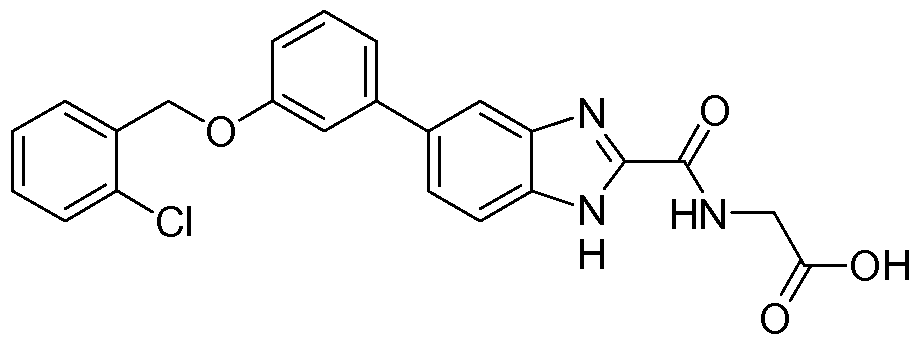
The titled compound was prepared in a manner analogous to Example 8, substituting 3-(2'-chlorobenzyloxy)phenylboronic acid for 3-(3'-chlorobenzyloxy)phenylboronic acid in Step C. MS (ESI/CI): mass calcd. for C2SHi8CIN3O4, 435.1 ; m/z found, 436.1 [M+H]+. 1H NMR (400 MHz, DMSO-c/6, tautomeric broadening): 13.41 (d, J = 12.9 Hz, 1 H), 9.12 (d, J = 5.5 Hz, 1 H), 8.09-7.18 (m, 9H), 7.04 (t, J = 6.3, Hz, 1 H), 5.27 (s, 2H), 3.98 (d, J = 6.1 Hz, 2H).
Example 10: ({5-[3-(4-Chloro-benzyloxy)-phenyl]-1 H-benzoimidazole-2-carbonyl}- amino)-acetic acid^

The titled compound was prepared in a manner analogous to Example 8, substituting 3-(4'-chlorobenzyloxy)phenylboronic acid for 3-(3'-chlorobenzyloxy)phenylboronic acid in Step C. MS (ESI/CI): mass calcd. for C23Hi8CIN3O4, 435.1 ; m/z found, 436.1 [M+H T]+1-. 1 Η NMR (400 MHz, DMSO-c/6, tautomeric broadening): 13.36 (d, J = 12.6
Hz, 1 H), 9.07 (dd, J = 14.4, 6.0 Hz, 1 H), 8.07-7.19 (m, 10H), 7.01 (t, J = 6.2, 6.2 Hz, 1 H), 5.21 (s, 2H), 4.00 (d, J = 6.1 Hz, 2H).
Example 11 : ({5-[3-(3-Fluoro-benzyloxy)-phenyl]-1 /-/-benzoimidazole-2-carbonyl}- amino)-acetic acid.

The titled compound was prepared in a manner analogous to Example 8 substituting 3-(3'-fluorobenzyloxy)phenylboronic acid for 3-(3'-chlorobenzyloxy)phenylboronic acid in Step C. MS (ESI/CI): mass calcd. for C2SHi8FN3O4, 419.1 ; m/z found, 420.1 [M+H]+. 1H NMR (400 MHz, DMSO-c/6, tautomeric broadening): 13.37 (d, J = 13.2 Hz, 1 H), 9.08 (s, 1 H), 8.12-7.22 (m, 9H), 7.21-7.12 (m, 1 H), 7.02 (d, J = 7.4 Hz, 1 H), 5.24 (s, 2H), 4.00 (d, J = 6.1 Hz, 2H).
Example 12: ({5-[3-(2-Fluoro-benzyloxy)-phenyl]-1 H-benzoimidazole-2-carbonyl}- amino)-acetic acid.

The titled compound was prepared in a manner analogous to Example 8 substituting 3-(2'-fluorobenzyloxy)phenylboronic acid for 3-(3'-chlorobenzyloxy)phenylboronic acid in Step C. MS (ESI/CI): mass calcd. for C23Hi8FN3O4, 419.1 ; m/z found, 420.1 [M+H]+. 1H NMR (400 MHz, DMSO-c/6, tautomeric broadening): 13.36 (d, J = 13.7 Hz, 1 H), 9.35-8.77 (m, 1 H), 8.09-7.16 (m, 10H), 7.03 (t, J = 6.1 , 6.1 Hz, 1 H), 5.25 (s, 2H), 3.99 (d, J = 6.1 Hz, 2H).
Example 13: {[5-(4-Phenoxy-phenyl) -1 /-/-benzoimidazole-2-carbonyl]-annino}-acetic acid.

The titled compound was prepared in a manner analogous to Example 8, substituting 4-phenoxy-phenyl boronic acid for 3-(3'-chlorobenzyloxy)phenylboronic acid in Step C. MS (ESI/CI): mass calcd. for C22Hi7N3O4, 387.1 ; m/z found, 388.1 [M+H]+. 1H NMR (400 MHz, DMSO-c/6, tautomeric broadening): 9.14 (s, 1 H), 7.82 (s, 1 H), 7.77-7.68 (m, 3H), 7.60 (dd, J = 8.5, 1.7 Hz, 1 H), 7.43 (dd, J = 8.5, 7.4 Hz, 2H), 7.23-7.14 (m, 1 H), 7.14-7.04 (m, 4H), 3.99 (d, J = 6.1 Hz, 2H).
Example 14: {[5-(3-Benzyloxy-5-fluoro-phenyl) -1 H-benzoimidazole-2-carbonyl]- amino}-acetic acid.

Example 15: [(δ-Quinolin-S-yl-I H-benzoimidazole^-carbonyl) -amino]-acetic acid.

The titled compound was prepared in a manner analogous to Example 8, substituting 3-quinoline boronic acid for 3-(3'-chlorobenzyloxy)phenylboronic acid in Step C. MS (ESI/CI): mass calcd. for Ci9Hi4N4O3, 346.1 ; m/z found, 347.1 [M+H]+. 1H NMR (400 MHz, DMSO-c/e, tautomeric broadening): 9.37 (d, J = 2.2 Hz, 1 H), 9.13 (t, J = 6.1 , 6.1 Hz, 1 H), 8.81 (d, J = 1.8 Hz, 1 H), 8.21 -8.06 (m, 3H), 7.90-7.78 (m, 3H), 7.77-7.63 (m, 1 H), 4.02 (d, J = 6.1 Hz, 2H).
Example 16: ({5-[3-Chloro-4-(3-chloro-benzyloxy)phenyl] -1 H-benzoimidazole-2- carbonyl}-amino)-acetic acid.

The titled compound was prepared in a manner analogous to Example 8, substituting 3-chloro-4-(3'-chlorobenzyloxy)phenylboronic acid for 3-(3'- chlorobenzyloxy)phenylboronic acid in Step C. MS (ESI/CI): mass calcd. for C23Hi7CI2N3O4, 469.1 ; m/z found, 470.1 [M+H]+. 1H NMR (400 MHz, DMSO-c/6, tautomeric broadening): 13.41 (d, J = 17.1 Hz, 1 H), 9.12 (d, J = 6.1 Hz, 1 H), 8.06- 7.52 (m, 6H), 7.53-7.38 (m, 3H), 7.37-7.27 (m, 1 H), 5.30 (s, 2H), 3.99 (d, J = 6.1 Hz, 2H).
Example 17: ({5-[4-(3-Chloro-benzyloxy)-3,5-dimethyl-phenyl]-1 H-benzoimidazole-2- carbonyl}-amino)-acetic acid.

The titled compound was prepared in a manner analogous to Example 8, substituting 4-(3'-chlorobenzyloxy)-3,5-dimethylphenylboronic acid for 3-(3'- chlorobenzyloxy)phenylboronic acid in Step C. 1H NMR (400 MHz, DMSO-c/6, tautomeric broadening): 13.40 (br s, 1 H), 13.36 (br s, 1 H), 9.06-9.15 (m, 1 H), 7.34- 7.95 (m, 9H), 4.87 (s, 2H), 3.99 (d, J = 6.07 Hz, 2H), 2.33 (s, 6H).
Example 18: {[5-(3-Methoxy-phenyl)-1 H-benzoimidazole-2-carbonyl]-amino}-acetic acid.

The titled compound was prepared in a manner analogous to Example 8, substituting 3-methoxyphenyl boronic acid for 3-(3'-chlorobenzyloxy)phenylboronic acid in Step C. 1H NMR (400 MHz, DMSO-c/6, tautomeric broadening): 13.36 (br. s, 1 H), 9.07 (br. m, 1 H), 6.95-8.10 (m, 7H), 4.00 (d, J = 6.09 Hz, 1 H), 3.84 (s, 3H).
Example 19: {[5-(5-Benzylcarbamoyl-2-fluoro-phenyl)-1 H-benzoimidazole-2- carbonyl]-amino}-acetic acid.

Example 20: [(5-Naphthalen-2-yl-1 /-/-benzoimidazole-2-carbonyl)-amino]-acetic acid.

The titled compound was prepared in a manner analogous to Example 8, substituting
2-naphthaleneboronic acid for 3-(3'-chlorobenzyloxy)phenylboronic acid in Step C. MS (ESI/CI): mass calcd. for C20Hi5N3O3, 345.4; m/z found, 346.1 [M+H]+. 1H NMR (400 MHz, DMSO-c/e, tautomeric broadening): 13.41 -13.52 (m, 1 H), 9.09-9.20 (m, 1 H), 8.26 (br. s, 1 H), 7.60-8.10 (m, 7H), 7.45-7.60 (m, 2H), 4.00 (d, J = 6.1 Hz, 2H).
Example 21 : {[5-(4-Propoxy-phenyl)-1 H-benzoimidazole-2-carbonyl]-amino}-acetic acid.

The titled compound was prepared in a manner analogous to Example 8, substituting 4-propoxy-phenylboronic acid for 3-(3'-chlorobenzyloxy)phenylboronic acid in Step C. MS (ESI/CI): mass calcd. for Ci9Hi9N3O4, 353.4; m/z found, 354.1 [M+H]+. 1H NMR (400 MHz, DMSO-c/6, tautomeric broadening): 12.90-13.80 (br s, 1 H), 9.08-
9.16 (m, 1 H), 7.50-8.10 (m, 3H), 7.10-7.45 (m, 3H), 6.91 -6.97 (m, 1 H), 6.45-6.64 (br. m, 1 H), 3.96-4.06 (m, 4H), 2.54-2.57 (m, 2H), 1.72-1.83 (m, 3H).
Example 22: {[5-(4-Chloro-3-methyl-phenyl)-1 H-benzoimidazole-2-carbonyl]-amino}- acetic acid.

The titled compound was prepared in a manner analogous to Example 8, substituting 4-chloro-3-methyl-phenylboronic acid for 3-(3'-chlorobenzyloxy)phenylboronic acid in Step C. MS (ESI/CI): mass calcd. for Ci7Hi4CIN3O4, 343.8; m/z found, 344.1 [M+H]+. 1H NMR (400 MHz, DMSO-c/6, tautomeric broadening): 13.35-13.53 (br. m, 1 H), 9.00-9.22 (m, 1 H), 7.46-8.42 (m, 6H), 4.00 (d, J = 6.1 Hz, 2H), 2.42 (s, 3H).
Example 23: {[5-(5-Chloro-2-fluoro-phenyl)-1 /-/-benzoimidazole-2-carbonyl]-amino}- acetic acid.

The titled compound was prepared in a manner analogous to Example 8, substituting 5-chloro-2-fluoro-phenylboronic acid for 3-(3'-chlorobenzyloxy)phenylboronic acid in Step C. MS (ESI/CI): mass calcd. for Ci6HiiCIFN3O4, 347.7; m/z found, 348.0
[M+H]+. 1H NMR (400 MHz, DMSO-c/6, tautomeric broadening): 13.45-13.53 (m, 1 H), 9.13-9.22 (m, 1 H), 7.35-7.96 (m, 6H), 3.98 (d, J = 6.1 Hz).
Example 24: [(5-Benzoylannino-1 /-/-benzoinnidazole-2-carbonyl)-annino]-acetic acid.

Step A: 5-Benzoylamino-1 /-/-benzoinnidazole-2-carboxylic acid methyl ester. According to Scheme C, DIPEA (0.45 ml_, 2.6 mmol) was added to a solution of 5- amino-1 /-/-benzoinnidazole-2-carboxylic acid methyl ester (0.200 g, 1.04 mmol) in THF (5 ml_) at 0 0C, followed by benzoyl chloride (0.154 g, 1.09 mmol). After 2 h, the reaction was quenched with water (6 ml_), the THF was evaporated, and the resulting aqueous layer extracted with EtOAc (3 x 15 ml_). The combined organic layers were washed with brine (15 ml_), dried, and concentrated to yield the desired product (0.272 g, 89%). MS (ESI/CI): mass calcd. for Ci6H13N3O3, 295.10; m/z found, 296.1 [M+H]+. 1H NMR (400 MHz, DMSO-c/6): 13.50 (s, 0.3H), 13.44 (s, 0.7H), 10.41 (s, 0.7H), 10.33 (s, 0.3H), 8.30 (d, J = 2.0 Hz, 0.7H), 8.26 (d, J = 1.2 Hz, 0.3H), 8.01-7.96 (m, 2H), 7.76-7.70 (m, 1 H), 7.63-7.51 (m, 4H), 3.96-3.94 (m, 3H). Step B: S-Benzoylamino-I H-benzoimidazole^-carboxylic acid. LiOH H2O (0.23 g, 5.4 mmol) was added to a solution of 5-benzoylamino-1 H-benzoimidazole-2- carboxylic acid methyl ester (0.25 g, 0.85 mmol) and THF (6 ml_) at rt, followed by water (2 ml_). After stirring for 1 h the THF was evaporated and HCI (1 M, 10 ml_) was added. The resulting precipitate was dried to yield the desired compound (0.210 g, 88%). MS (ESI): mass calcd. for Ci5HnN3O3, 281.08; m/z found, 282.1 [M+H]+. 1 H NMR (400 MHz, DMSO-c/6): 10.42 (s, 1 H), 8.30 (d, J = 1.2 Hz, 1 H), 7.99 (dt, J = 6.8, 1.6 Hz, 2H), 7.71-7.52 (m, 5H).
Step C: [(5-Benzoylamino-1 H-benzoimidazole-2-carbonyl)-amino]-acetic acid. The titled compound was prepared in a manner analogous to Example 1 , substituting 5-benzoylamino-1 /-/-benzoinnidazole-2-carboxylic acid for 1 H-benzoimidazole-2- carboxylic acid in step A. MS (ESI/CI): mass calcd. for Ci7Hi4N4O4, 338.10; m/z found, 339.1 [M+H]+. 1H NMR (400 MHz, DMSO-c/6): 10.36 (s, 1 H), 9.08 (t, J = 6.0 Hz, 1 H), 8.27 (t, J = 1.2 Hz, 1 H), 8.00 (t, J = 1.3 Hz, 1 H), 7.98 (t, J = 1.8 Hz, 1 H), 7.69-7.49 (m, 5H), 3.98 (d, J = 6.1 Hz, 2H).
Example 25: [(6-Benzenesulfonylamino-i H-benzoimidazole-2-carbonyl)-amino]- acetic acid.
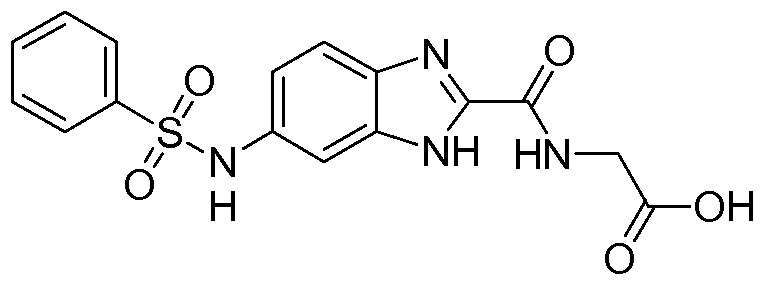
Step B: [(6-Benzenesulfonylamino-1 H-benzoimidazole-2-carbonyl)-amino]- acetic acid. The titled compound was prepared in a manner analogous to Example 24, Steps B-C, substituting 5-benzenesulfonylamino-1 /-/-benzoimidazole-2-carboxylic acid methyl ester for S-benzoylamino-I H-benzoimidazole^-carboxylic acid methyl ester in Step B. MS (ESI/CI): mass calcd. for Ci6Hi4N4O5S, 374.07; m/z found, 375.0 [M+H]+. 1H NMR (400 MHz, DMSO-c/6): 10.24 (s, 1 H), 9.03 (t, J = 6.2 Hz, 1 H), 7.73-7.71 (m, 1 H), 7.70 (t, J = 1.8, 1 H), 7.61-7.44 (m, 4H), 7.33 (d, J = 1.8 Hz, 1 H), 7.04 (dd, J = 8.8, 2.0 Hz, 1 H), 3.94 (d, J = 6.1 Hz, 2H).
Example 26: [(6-Benzylamino-1 H-benzoimidazole-2-carbonyl)-amino]-acetic acid.
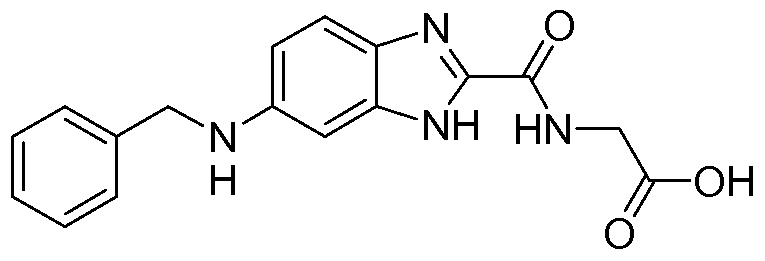
The titled compound was prepared in a manner analogous to Example 24, Step B-C, substituting 6-benzylamino-1 /-/-benzoinnidazole-2-carboxylic acid methyl ester for 5- benzoylamino-1 H-benzoimidazole-2-carboxylic acid methyl ester in Step B. MS (ESI/CI): mass calcd. for Ci7Hi6N4O3, 324.12; m/z found, 325.1 [M+H]+. 1H NMR (400 MHz, CD3OD): 7.62 (d, J = 6.8 Hz, 1 H), 7.47-7.28 (m, 5H), 7.20-7.08 (m, 2H), 4.51 (s, 2H), 4.17 (s, 2H).
Example 27: [(5-tert-Butyl-1 H-benzoimidazole-2-carbonyl)-amino]-acetic acid.

Step A: δ-tert-Butyl-benzoimidazole^-carboxylic acid. The titled compound was prepared according to the methods as described in: Zhu, Yongbao; Skupinska, Krystyna A.; McEachern, Ernest J. Facile preparation of substituted benzoimidazole- 2-carboxylates. Heterocycles (2006), 67(2), 769-775. MS(ESI/CI) calcd. for
Ci2Hi4N2O2, 218.3; m/z found, 216.9 [M-H]". 1H NMR (500 MHz, DMSO): 7.59 (d, J = 8.7, 1 H), 7.55 (d, J = 1.2, 1 H), 7.49 (dd, J = 8.7, 1.8, 1 H), 1.34 (s, 9H).
Step B: [(δ-tert-Butyl-I H-benzoinnidazole^-carbonylJ-anninol-acetic acid. The titled compound was prepared in a manner analogous to EXAMPLE 1. MS (Cl): mass calcd. for Ci4Hi7N3O3, 274.3; m/z found, 276.1 [M+H]+. 1H NMR (600 MHz, DMSO): 13.18 (br. s, 1 H), 12.73 (s, 1 H), 9.04 (s, 1 H), 7.74 - 7.35 (m, 3H), 3.98 (d, J = 6.1 , 2H), 1.36 (s, J = 14.0, 9H).
Biological Protocols:
As indicated herein (see table above), the biological activity of the exemplified compounds was determined according to the following protocols.
Expression and purification of PHD218i-4u
The human PHD2 expression construct containing amino acids 181 -417 of GenBank
Accession ID NM_022051 was cloned into a pBAD vector (Invitrogen), incorporating both an N-terminal histidine tag and a Smt3-tag, both of which are cleaved by UIpI . Protein production was achieved by expression in BL21 cells grown in Terrific Broth containing 100 μg/ml ampicillin. Cell cultures were inoculated at 37° C and grown to an OD6Oo of 0.8. Cultures were induced with 0.1 % arabinose and grown overnight at 20° C with continuous shaking at 225 rpm. Cells were then harvested by centrifugation and stored at -80° C. Cell pellets were suspended in Buffer A (50 mM Ths-HCI pH 7.2, 100 mM NaCI, 100 mM L-arginine, 1 mM TCEP, 0.05% (w/v) NP- 40, 50 mM imidazole) followed by the addition of lysozyme and benzonase. Cells were lysed by sonication and the lysate was cleared by centrifugation (15,000 rpm, 90 min, 4° C). The protein was purified by nickel affinity chromatography using a HisTrap Crude FF column (GE Healthcare). Samples were eluted in Buffer A with a 50-20OmM imidazole gradient. Cleavage of the Smt tag with UIpI protease was achieved via overnight incubation with dialyzing against Buffer A. The PHD2i8i-4i7 sample was then passed over a second HisTrap Crude FF column (GE Healthcare) to remove uncleaved protein. The flow-through was then dialyzed into 50 mM MES pH 6.0, 1 mM TCEP, 5 mM NaCI for ion exchange chromatography on a HiTrap SP
Cation Exchange column (GE Healthcare). The PHD2i8i-4i7 protein was eluted with a 0-0.2 M NaCI gradient. Fractions were pooled for further purification by size exclusion chromatography over a Superdex 75 Size Exclusion Column (GE Healthcare). Final protein was concentrated to 4 mg/ml and dialyzed in 10 mM PIPES pH 7.0, 100 mM NaCI, 0.5 mM TCEP. The protein was determined to have a purity of >95% by gel electrophoresis.
Enzyme Activity Assay
The PHD2i8i-4i7 polypeptide (3 μg) was pre-incubated for 30 minutes with test compound prior to assessing the enzymatic activity of the polypeptide. The PHD enzymatic assay was then performed by transferring the purified PHD2i8i-4i7 polypeptide (3 μg) mixture with compound to 0.5 ml of reaction mixture containing the following: synthetic HIF-1 α peptide comprising residues [KNPFSTGDTDLDLEMLAPYIPMDDDFQLRSFDQLS] (10 μM, California Peptide Research Inc., Napa, CA), and [5-14C]-2-oxoglutaric acid (50 mCi/mmol, Moravek Chemicals, Brea, CA) in reaction buffer (40 mM Tris-HCI, pH 7.5, 0.4 mg/ml catalase, 0.5 mM DTT, 1 mM ascorbate) for 10 minutes in the presence of compound. The reaction was stopped by addition of 50 μl of 70 mM H3PO4 and 50 μl of 500 mM NaH2PO4, pH 3.2. Detection of [14C]-succinic acid was achieved by separating from [5-14C]-2-oxoglutaric acid by incubating the reaction mixture with 100 μl of 0.16 M DNP prepared in 30% perchloric acid. Next, 50 μl of unlabeled 20 mM 2-oxoglutaric acid/20 mM succinic acid, serving as carrier for the radioactivity, was added to the mixture, and was allowed to proceed for 30 minutes at room temperature. The reaction was then incubated with 50 μl of 1 M 2-oxoglutaric acid for 30 additional minutes at room temperature to precipitate the excess DNP. The reaction was then centrifuged at 2800 x g for 10 minutes at room temperature to separate [14C]-succinic acid in the supernatant from the precipitated [14C]- dinitrophenylhydrazone. Fractions of the supernatant (400 μl) were counted using a beta counter (Beckman Coulter, Fullerton, CA). Inhibition of PHD218i-4i7 activity was measured as a decrease in [14C]-succinic acid production. The IC5O values were estimated by fitting the data to a three-parameter logistic function using GraphPad
Prism, version 4.02 (Graph Pad Software, San Diego, CA). IC50 values up to 100μM were quantified otherwise were noted as >100μM. All compounds were diluted at 10 mM in 100% DMSO (w/v) and tested from 100μM to 30 nM at half-log serial dilutions, with a final concentration of 2% DMSO (w/v) in the assay.
Cellular Assay
Hep-3B cells (ATCC, Manassas, VA) were plated in 96-well plates at 20,000 cells per well in 100 μl of DMEM containing 10% fetal bovine serum, 1 % non-essential amino acids, 50 IU/mL of penicillin and 50 μg/mL of streptomycin (all cell culture reagents from Invitrogen, Carlsbad, CA). Twenty-four hours after plating, compounds were added and incubated for an additional 24 hours. All test compounds were dissolved at 10 mM in 100% DMSO (w/v) and were tested under saturating conditions with final compound concentrations at 100μM in 1 % DMSO (w/v). Fifty microliters of the supernatant was then transferred to a human Hypoxia assay kit (Meso-Scale Discovery, Gaithersburg, MD). Erythropoietin in the supernatant was detected according to the manufacturer's instructions as follows. EPO detection plates were blocked with 3% BSA in PBS overnight and 50 μl of the supernatant was incubated at room temperature in an orbital shaker for 2 h. Twenty-five microliters of 0.5 μg/ml anti-EPO detection antibody was added for 2 hours at room temperature in an orbital shaker. After 3 washes in PBS, 150 μl of 1X read buffer is added and the plate is then read on the MSD SECTOR instrument. Data was then analyzed by determining the percent of EPO secretion in the presence of 10μM or 100μM compound relative to an assay control compound, 7-[(4-Chloro-phenyl)-(5-methyl- isoxazol-3-ylamino)-methyl]-quinolin-8-ol. Data is reported as a percentage of EPO secretion of the control compound and shows to be reproducible within 10%. While the invention has been illustrated by reference to exemplary and preferred embodiments, it will be understood that the invention is intended not to be limited to the foregoing detailed description.
Claims
1. A compound having PHD inhibitor activity of the formula (I):

R1 is independently selected from H, halo, -Ci-4alkyl, -OCi-4alkyl, -CF3, -OCF3, -OH, - NO2, NRaRb, monocyclic or bicyclic heteroaryl, naphthyl, phenyl optionally substituted with Rc;
Ra and Rb are each independently H, -Ci-4alkyl, -C(O)-Ci-4alkyl, -C(O)-phenyl, -SO2- Ci-4alkyl, -SO2-phenyl, benzyl optionally substituted with Rd, phenyl optionally substituted with Rd, or Ra and Rb can be taken together with the nitrogen to which they are attached to form an optionally substituted monocyclic heterocycloalkyl ring optionally containing one or more O, S or N;
Rc is independently halo, -Ci-4alkyl, -OCi-4alkyl, -O-phenyl, -C(O)NH-(CH2)-phenyl, - O-CH2-Rd
Rd is phenyl optionally substituted with halo; and pharmaceutically acceptable salts thereof.
2. The compound of claim 1 , wherein R1 is selected from the group consisting of H, phenyl, -NHC(O)-phenyl, -NHS(O)2-phenyl, benzyl, -NH-benzyl, -O-benzyl, 3-(3'- chlorobenzyloxy)phenyl, 3-(2'-chlorobenzyloxy)phenyl, 3-(4'-chlorobenzyloxy)phenyl, 3-(3'-fluorobenzyloxy)phenyl, 3-(2'-fluorobenzyloxy)phenyl, 4-phenoxy-phenyl, 3- benzyloxy-5-fluoro-phenyl, 3-quinoline, 3-chloro-4-(3'-chlorobenzyloxy)phenyl, 4-(3'- chlorobenzyloxy)-3,5-dimethylphenyl, 3-methoxyphenyl, 5-benzylcarbamoyl-2-fluoro- phenyl, 2-naphthalene, 4-propoxy-phenyl, 4-chloro-3-methyl-phenyl, and 5-chloro-2- fluoro-phenyl.
3. The compound of claim 1 , wherein R1 is independently selected from H, -I, -Br, - Cl, -OCF3, -NO2, -CH3, -OCH3, -CF3, phenyl, naphthyl, and quinolinyl.
4. A compound selected from the group consisting of:
[(1 H-Benzoimidazole-2-carbonyl)-amino]-acetic acid;
[(5,6-Dichloro-1 H-benzoimidazole-2-carbonyl)-amino]-acetic acid;
[(6-Nitro-1 H-benzoimidazole-2-carbonyl)-amino]-acetic acid; [(5,7-Bis-thfluoromethyl-1 H-benzoimidazole-2-carbonyl)-amino]-acetic acid;
[(5-lodo-1 H-benzoimidazole-2-carbonyl)-amino]-acetic acid;
[(6-Bromo-1 H-benzoimidazole-2-carbonyl)-amino]-acetic acid;
[(6-Methoxy-1 H-benzoimidazole-2-carbonyl)-amino]-acetic acid;
({5-[3-(3-Chloro-benzyloxy)-phenyl]-1 H-benzoimidazole-2-carbonyl}-amino)-acetic acid;
({5-[3-(2-Chloro-benzyloxy)-phenyl]-1 H-benzoimidazole-2-carbonyl}-amino)-acetic acid;
({5-[3-(4-Chloro-benzyloxy)-phenyl]-1 H-benzoimidazole-2-carbonyl}-amino)-acetic acid; ({S-β-^-Fluoro-benzyloxyJ-phenyll-I H-benzoimidazole^-carbonylJ-aminoJ-acetic acid;
({5-[3-(2-Fluoro-benzyloxy)-phenyl]-1 H-benzoimidazole-2-carbonyl}-amino)-acetic acid;
{[5-(4-Phenoxy-phenyl) -1 H-benzoimidazole-2-carbonyl]-amino}-acetic acid; {[5-(3-Benzyloxy-5-fluoro-phenyl) -1 H-benzoimidazole-2-carbonyl]-amino}-acetic acid;
[(5-Quinolin-3-yl-1 H-benzoimidazole-2-carbonyl) -amino]-acetic acid;
({5-[3-Chloro-4-(3-chloro-benzyloxy)phenyl] -1 H-benzoimidazole-2-carbonyl}-amino)- acetic acid; ^-^(S-Chloro-benzyloxyJ-S.δ-dimethyl-phenyll-I H-benzoimidazole^-carbonyl}- amino)-acetic acid;
{[5-(3-Methoxy-phenyl)-1 H-benzoimidazole-2-carbonyl]-amino}-acetic acid;
{^-(δ-Benzylcarbamoyl^-fluoro-phenyO-I H-benzoimidazole^-carbonyll-amino}- acetic acid; [(5-Naphthalen-2-yl-1 H-benzoimidazole-2-carbonyl)-amino]-acetic acid;
{[5-(4-Propoxy-phenyl)-1 H-benzoimidazole-2-carbonyl]-amino}-acetic acid;
{[5-(4-Chloro-3-methyl-phenyl)-1 H-benzoimidazole-2-carbonyl]-amino}-acetic acid; {[5-(5-Chloro-2-fluoro-phenyl)-1 H-benzoimidazole-2-carbonyl]-annino}-acetic acid; [(δ-Benzoylannino-I H-benzoinnidazole^-carbonylJ-anninol-acetic acid; [(θ-Benzenesulfonylamino-I H-benzoimidazole^-carbonylJ-aminol-acetic acid; [(θ-Benzylamino-I H-benzoimidazole^-carbonylJ-aminol-acetic acid; [(5-tert-Butyl-1 H-benzoimidazole-2-carbonyl)-annino]-acetic acid; and pharmaceutically acceptable salts thereof.
5. A pharmaceutical composition comprising a pharmaceutically acceptable excipient and an effective amount of compound having PHD inhibitor activity of formula (I):

R1 is in nddeeppec ndently selected from H, halo, -Ci-4alkyl, -OCi-4alkyl, -CF3, -OCF3, -OH, NO2, NRaRb, monocyclic or bicyclic heteroaryl, naphthyl, phenyl optionally substituted with Rc;
Ra and Rb are each independently H, -Ci-4alkyl, -C(O)-Ci-4alkyl, -C(O)-phenyl, -SO2- Ci-4alkyl, -SO2-phenyl, benzyl optionally substituted with Rd, phenyl optionally substituted with Rd, or Ra and Rb can be taken together with the nitrogen to which they are attached to form an optionally substituted monocyclic heterocycloalkyl ring optionally containing one or more O, S or N; Rc is independently halo, -Ci-4alkyl, -OCi-4alkyl, -O-phenyl, -C(O)NH-(CH2)-phenyl, -
O-CH2-Rd
Rd is phenyl optionally substituted with halo; and enantiomers, diastereomers, racemates, and pharmaceutically acceptable salts thereof.
6. A pharmaceutical composition comprising one or more compounds selected from the group consisting of: [(1 H-Benzoimidazole-2-carbonyl)-amino]-acetic acid; [(5,6-Dichloro-1 H-benzoinnidazole-2-carbonyl)-annino]-acetic acid;
[(6-Nitro-1 H-benzoimidazole-2-carbonyl)-amino]-acetic acid;
[(5,7-Bis-trifluoronnethyl-1 H-benzoinnidazole-2-carbonyl)-annino]-acetic acid;
[(5-lodo-1 H-benzoimidazole-2-carbonyl)-annino]-acetic acid; [(θ-Bromo-I H-benzoimidazole^-carbonylJ-aminol-acetic acid;
[(6-Methoxy-1 H-benzoimidazole-2-carbonyl)-annino]-acetic acid;
({5-[3-(3-Chloro-benzyloxy)-phenyl]-1 H-benzoimidazole-2-carbonyl}-annino)-acetic acid;
({5-[3-(2-Chloro-benzyloxy)-phenyl]-1 H-benzoimidazole-2-carbonyl}-annino)-acetic acid;
({5-[3-(4-Chloro-benzyloxy)-phenyl]-1 H-benzoimidazole-2-carbonyl}-annino)-acetic acid;
({S-β-^-Fluoro-benzyloxyJ-phenyll-I H-benzoimidazole^-carbonylJ-aminoJ-acetic acid; ({5-[3-(2-Fluoro-benzyloxy)-phenyl]-1 H-benzoimidazole-2-carbonyl}-annino)-acetic acid;
{[5-(4-Phenoxy-phenyl) -1 H-benzoimidazole-2-carbonyl]-amino}-acetic acid;
{[5-(3-Benzyloxy-5-fluoro-phenyl) -1 H-benzoimidazole-2-carbonyl]-annino}-acetic acid; [(5-Quinolin-3-yl-1 H-benzoimidazole-2-carbonyl) -amino]-acetic acid;
({5-[3-Chloro-4-(3-chloro-benzyloxy)phenyl] -1 H-benzoimidazole-2-carbonyl}-annino)- acetic acid;
({5-[4-(3-Chloro-benzyloxy)-3,5-dimethyl-phenyl]-1 H-benzoimidazole-2-carbonyl}- amino)-acetic acid; {[5-(3-Methoxy-phenyl)-1 H-benzoinnidazole-2-carbonyl]-annino}-acetic acid;
{^-(δ-Benzylcarbannoyl^-fluoro-phenyO-I H-benzoinnidazole^-carbonyll-annino}- acetic acid;
[(5-Naphthalen-2-yl-1 H-benzoimidazole-2-carbonyl)-annino]-acetic acid;
{[5-(4-Propoxy-phenyl)-1 H-benzoimidazole-2-carbonyl]-annino}-acetic acid; {[5-(4-Chloro-3-methyl-phenyl)-1 H-benzoimidazole-2-carbonyl]-amino}-acetic acid;
{[5-(5-Chloro-2-fluoro-phenyl)-1 H-benzoimidazole-2-carbonyl]-annino}-acetic acid;
[(5-Benzoylamino-1 H-benzoimidazole-2-carbonyl )-amino]-acetic acid; [(θ-Benzenesulfonylamino-I H-benzoimidazole^-carbonylJ-aminol-acetic acid; [(6-Benzylannino-1 H-benzoinnidazole-2-carbonyl)-annino]-acetic acid; [(5-tert-Butyl-1 H-benzoimidazole-2-carbonyl)-annino]-acetic acid; and pharmaceutically acceptable salts thereof.
7. A method for the treatment of anemia, hypoxia, ischemia, peripheral vascular disease, myocardial infarction, stroke, diabetes, obesity, inflammatory bowel disease, ulcerative colitis, Crohn's disease, wounds, infection, burns and bone fracture comprising the step of administering to a patient in need thereof a therapeutically effective amount of compound having PHD inhibitor activity of formula (I):

NO2, NRaRb, monocyclic or bicyclic heteroaryl, naphthyl, phenyl optionally substituted with Rc; Ra and Rb are each independently H, -Ci-4alkyl, -C(O)-Ci-4alkyl, -C(O)-phenyl, -SO2-
Ci-4alkyl, -SO2-phenyl, benzyl optionally substituted with Rd, phenyl optionally substituted with Rd, or Ra and Rb can be taken together with the nitrogen to which they are attached to form an optionally substituted monocyclic heterocycloalkyl ring optionally containing one or more O, S or N; Rc is independently halo, -Ci-4alkyl, -OCi-4alkyl, -O-phenyl, -C(O)NH-(CH2)-phenyl, -
O-CH2-Rd Rd is phenyl optionally substituted with halo; and enantiomers, diastereomers, racemates, and pharmaceutically acceptable salts thereof.
8. A method for treating a hypoxic disorder comprising the step of administering to a patient in need thereof a therapeutically effective amount of compound having PHD inhibitor activity of formula (I):

R1 is independently selected from H, halo, -Ci-4alkyl, -OCi-4alkyl, -CF3, -OCF3, -OH, - NO2, NRaRb, monocyclic or bicyclic heteroaryl, naphthyl, phenyl optionally substituted with Rc; Ra and Rb are each independently H, -Ci-4alkyl, -C(O)-Ci-4alkyl, -C(O)-phenyl, -SO2- Ci-4alkyl, -SO2-phenyl, benzyl optionally substituted with Rd, phenyl optionally substituted with Rd, or Ra and Rb can be taken together with the nitrogen to which they are attached to form an optionally substituted monocyclic heterocycloalkyl ring optionally containing one or more O, S or N; Rc is independently halo, -Ci-4alkyl, -OCi-4alkyl, -O-phenyl, -C(O)NH-(CH2)-phenyl, -
O-CH2-Rd
Rd is phenyl optionally substituted with halo; and enantiomers, diastereomers, racemates, and pharmaceutically acceptable salts thereof.
Applications Claiming Priority (2)
| Application Number | Priority Date | Filing Date | Title |
|---|---|---|---|
| US4853108P | 2008-04-28 | 2008-04-28 | |
| US61/048,531 | 2008-04-28 |
Publications (1)
| Publication Number | Publication Date |
|---|---|
| WO2009134754A1 true WO2009134754A1 (en) | 2009-11-05 |
Family
ID=40756595
Family Applications (2)
| Application Number | Title | Priority Date | Filing Date |
|---|---|---|---|
| PCT/US2009/041902 Ceased WO2009134750A1 (en) | 2008-04-28 | 2009-04-28 | Benzoimidazoles as prolyl hydroxylase inhibitors |
| PCT/US2009/041908 Ceased WO2009134754A1 (en) | 2008-04-28 | 2009-04-28 | Benzoimidazole glycinamides as prolyl hydroxylase inhibitors |
Family Applications Before (1)
| Application Number | Title | Priority Date | Filing Date |
|---|---|---|---|
| PCT/US2009/041902 Ceased WO2009134750A1 (en) | 2008-04-28 | 2009-04-28 | Benzoimidazoles as prolyl hydroxylase inhibitors |
Country Status (15)
| Country | Link |
|---|---|
| US (8) | US8759345B2 (en) |
| EP (1) | EP2294066B9 (en) |
| JP (5) | JP6022769B2 (en) |
| CN (2) | CN105622580B (en) |
| BR (1) | BRPI0911444B8 (en) |
| CA (1) | CA2722772C (en) |
| CY (1) | CY1115621T1 (en) |
| DK (1) | DK2294066T3 (en) |
| ES (1) | ES2523720T3 (en) |
| HR (1) | HRP20141038T2 (en) |
| PL (1) | PL2294066T3 (en) |
| PT (1) | PT2294066E (en) |
| RU (1) | RU2531354C2 (en) |
| SI (1) | SI2294066T1 (en) |
| WO (2) | WO2009134750A1 (en) |
Cited By (3)
| Publication number | Priority date | Publication date | Assignee | Title |
|---|---|---|---|---|
| WO2012110789A1 (en) | 2011-02-15 | 2012-08-23 | Isis Innovation Limited | Method for assaying ogfod1 activity |
| WO2013014449A1 (en) | 2011-07-28 | 2013-01-31 | Isis Innovation Limited | Assay for histidinyl hydroxylase activity |
| CN113382729A (en) * | 2018-10-03 | 2021-09-10 | 阿克比治疗有限公司 | Benzimidazole derivatives for the treatment of inflammatory disorders |
Families Citing this family (36)
| Publication number | Priority date | Publication date | Assignee | Title |
|---|---|---|---|---|
| PT2294066E (en) * | 2008-04-28 | 2014-11-21 | Janssen Pharmaceutica Nv | Benzoimidazoles as prolyl hydroxylase inhibitors |
| ES2360316B1 (en) | 2008-12-10 | 2012-05-08 | Antonio Avila Chulia | PROCEDURE FOR ENCRYPTION AND AUTHENTICATION OF A DATA SIGNAL. |
| RU2528412C2 (en) * | 2009-02-10 | 2014-09-20 | Янссен Фармацевтика Нв | Quinazolinones as prolyl hydroxylase inhibitors |
| EP2456310A4 (en) * | 2009-07-23 | 2013-01-23 | Univ Vanderbilt | SUBSTITUTED BENZOIMIDAZOLESULFONAMIDES AND SUBSTITUTED INDOLESULFONAMIDES AS MGLUR4 POTENTIALIZERS |
| JP5934645B2 (en) | 2009-09-11 | 2016-06-15 | プロビオドルグ エージー | Heterocyclic derivatives as glutaminyl cyclase inhibitors |
| US8242284B1 (en) * | 2009-09-21 | 2012-08-14 | The United States Of America As Represented By The United States Department Of Energy | Anti-cancer agents based on 6-trifluoromethoxybenzimidazole derivatives and method of making |
| KR20120115252A (en) * | 2009-11-06 | 2012-10-17 | 벤더르빌트 유니버시티 | Aryl and heteroaryl sulfones as mglur4 allosteric potentiators, compositions, and methods of treating neurological dysfunction |
| US8680098B2 (en) | 2010-03-05 | 2014-03-25 | Janssen Pharmaceutica, Nv | Substituted aza-bicyclic imidazole derivatives useful as TRPM8 receptor modulators |
| WO2012033149A1 (en) | 2010-09-10 | 2012-03-15 | 塩野義製薬株式会社 | Hetero ring-fused imidazole derivative having ampk activating effect |
| CN102219745B (en) * | 2011-04-15 | 2013-10-30 | 清华大学深圳研究生院 | 2-aryl substituted benzimidazole derivatives, as well as preparation method and application thereof |
| US9079930B2 (en) | 2011-09-23 | 2015-07-14 | Merck Sharp & Dohme Corp. | Substituted pyrimidines |
| EP2758058B1 (en) | 2011-09-23 | 2017-04-26 | Merck Sharp & Dohme Corp. | Substituted pyrimidines |
| WO2013063221A1 (en) * | 2011-10-25 | 2013-05-02 | Janssen Pharmaceutica Nv | Meglumine salt formulations of 1-(5,6-dichloro-1h-benzo[d]imidazol-2-yl)-1h-pyrazole-4-carboxylic acid |
| TW201412744A (en) * | 2012-08-23 | 2014-04-01 | Mitsubishi Tanabe Pharma Corp | Pyrazolopyrimidine compound |
| TW201534597A (en) | 2013-06-20 | 2015-09-16 | Ab Science | Benzimidazole derivatives as selective proteine kinase inhibitors |
| WO2016034108A1 (en) | 2014-09-02 | 2016-03-10 | 广东东阳光药业有限公司 | Quinolinone compound and use thereof |
| BR112019010511A2 (en) | 2016-11-23 | 2019-09-17 | Bayer Ag | fused bicyclic heterocycle derivatives as pesticides |
| MX2019015879A (en) | 2017-07-07 | 2020-02-07 | Immatics Biotechnologies Gmbh | NEW PEPTIDES AND NEW PEPTIDE COMBINATIONS FOR USE IN IMMUNOTHERAPY AGAINST LUNG CANCER, INCLUDING NSCLC, SCLC AND OTHER CANCERS. |
| CA3106385A1 (en) * | 2018-09-13 | 2020-03-19 | Kissei Pharmaceutical Co., Ltd. | Imidazopyridinone compound |
| TWI803696B (en) * | 2018-09-14 | 2023-06-01 | 日商橘生藥品工業股份有限公司 | Hypoxanthine compound |
| CN110305072B (en) * | 2019-06-25 | 2023-09-19 | 中国药科大学 | Compounds with phosphodiesterase 4D and acid sphingomyelinase inhibitory activity and their applications |
| EP4066898B1 (en) | 2019-11-28 | 2026-01-07 | Nihon Nohyaku Co., Ltd. | Benzimidazole compound or salt thereof, agricultural and horticultural insecticidal and acaricidal agent comprising said compound, and method for using said insecticidal and acaricidal agent |
| JP7385467B2 (en) * | 2019-12-26 | 2023-11-22 | キッセイ薬品工業株式会社 | hypoxanthine compound |
| CN113248475B (en) * | 2020-02-11 | 2023-03-17 | 中国科学院上海药物研究所 | Heterocyclic substituted benzimidazole dimer or pharmaceutically acceptable salt, composition and application thereof |
| CN115244054B (en) * | 2020-03-11 | 2024-07-16 | 橘生药品工业株式会社 | Crystals of hypoxanthine compound |
| JP7504822B2 (en) * | 2020-03-12 | 2024-06-24 | キッセイ薬品工業株式会社 | Pharmaceutical Compositions Containing Imidazopyridinone Compounds |
| WO2021216530A1 (en) | 2020-04-20 | 2021-10-28 | Akebia Therapeutics, Inc. | Treatment of viral infections, of organ injury, and of related conditions using a hif prolyl hydroxylase inhibitor or a hif-alpha stabilizer |
| CN112209885A (en) * | 2020-09-07 | 2021-01-12 | 宁夏大漠药业有限公司 | Production process and production device of fenbendazole |
| WO2022150623A1 (en) | 2021-01-08 | 2022-07-14 | Akebia Therapeutics, Inc. | Compounds and composition for the treatment of anemia |
| EP4347022A1 (en) | 2021-05-27 | 2024-04-10 | Keryx Biopharmaceuticals, Inc. | Pediatric formulations of ferric citrate |
| USD1029155S1 (en) | 2021-06-25 | 2024-05-28 | Spin Master Ltd. | Toy |
| US11376515B1 (en) | 2021-06-29 | 2022-07-05 | Spin Master Ltd. | Transformable toy |
| CN118900840A (en) * | 2022-02-18 | 2024-11-05 | 英矽智能科技知识产权有限公司 | Membrane-associated tyrosine and threonine-specific CDC2 inhibitory kinase (PKMYT1) inhibitors and uses thereof |
| US12576341B2 (en) | 2022-08-12 | 2026-03-17 | Spin Master Ltd. | Transformable toy |
| US11712636B1 (en) | 2022-08-12 | 2023-08-01 | Spin Master Ltd. | Transformable toy |
| WO2025049599A1 (en) | 2023-08-29 | 2025-03-06 | President And Fellows Of Harvard College | Methods for treating muscle-related disorders by modulating prolyl hydroxylase 3 |
Citations (1)
| Publication number | Priority date | Publication date | Assignee | Title |
|---|---|---|---|---|
| WO2007136990A2 (en) * | 2006-05-16 | 2007-11-29 | Smithkline Beecham Corporation | Prolyl hydroxylase inhibitors |
Family Cites Families (47)
| Publication number | Priority date | Publication date | Assignee | Title |
|---|---|---|---|---|
| JPS60227260A (en) | 1983-11-14 | 1985-11-12 | Toppan Printing Co Ltd | Setup method |
| CA1297788C (en) | 1986-10-22 | 1992-03-24 | Judith Feinberg | Treatment of aids virus with recombinant human alpha interferon |
| DE3824658A1 (en) | 1988-07-15 | 1990-01-18 | Schering Ag | N-HETARYL IMIDAZOLE DERIVATIVES |
| US5258362A (en) | 1991-06-11 | 1993-11-02 | Abbott Laboratories | Renin inhibiting compounds |
| DE69523182T2 (en) | 1995-06-06 | 2002-02-07 | Pfizer | SUBSTITUTED N- (INDOL-2-CARBONYL) GLYCINAMIDES AND DERIVATIVES AS GLYCOGEN PHOSPHORYLASE INHIBITORS |
| DE19649460A1 (en) | 1996-11-26 | 1998-05-28 | Bayer Ag | New substituted pyrazole derivatives |
| DE69819311T2 (en) | 1997-03-07 | 2004-07-29 | Metabasis Therapeutics Inc., San Diego | NEW BENZIMIDAZOL INHIBITORS OF FRUCTOSE-1,6-BISPHOSPHATASE |
| DE19746287A1 (en) | 1997-10-20 | 1999-04-22 | Hoechst Marion Roussel De Gmbh | Substituted isoquinoline-2-carboxylic acid amides, their preparation and their use as medicaments |
| JP2002504546A (en) * | 1998-02-27 | 2002-02-12 | ファイザー・プロダクツ・インク | N-[(substituted 5- or diazatriunsaturated) carbonyl] guanidine derivatives for the treatment of ischemia |
| US8124582B2 (en) | 2002-12-06 | 2012-02-28 | Fibrogen, Inc. | Treatment of diabetes |
| US7618940B2 (en) | 2002-12-06 | 2009-11-17 | Fibrogen, Inc. | Fat regulation |
| WO2004108681A1 (en) | 2003-06-06 | 2004-12-16 | Fibrogen, Inc. | Nitrogen-containing heteroaryl compounds and their use in increasing endogenous erythropoietin |
| ATE403654T1 (en) | 2003-07-28 | 2008-08-15 | Janssen Pharmaceutica Nv | BENZIMIDAZOLE, BENZOTHIAZOLE AND BENZOXAZOLE DERIVATIVES AND THEIR USE AS LTA4H MODULATORS |
| BRPI0418212A (en) | 2003-12-29 | 2007-04-27 | Banyu Pharma Co Ltd | a pharmaceutically acceptable compound or salt thereof, a glucokinase activator, and, medicaments for the therapy and / or prevention of diabetes, and obesity |
| JP2006022769A (en) * | 2004-07-09 | 2006-01-26 | Toyota Motor Corp | Exhaust gas purification device for internal combustion engine |
| US8703795B2 (en) | 2005-03-02 | 2014-04-22 | Fibrogen, Inc. | Thienopyridine compounds, and methods of use thereof |
| JP2006254624A (en) * | 2005-03-11 | 2006-09-21 | Fuji Electric Holdings Co Ltd | AC / AC converter controller |
| DE102005019712A1 (en) * | 2005-04-28 | 2006-11-09 | Bayer Healthcare Ag | Dipyridyl-dihydropyrazolone and its use |
| AU2006254897A1 (en) | 2005-06-06 | 2006-12-14 | Fibrogen, Inc. | Improved treatment for anemia using a HIF-alpha stabilising agent |
| WO2007038571A2 (en) | 2005-09-26 | 2007-04-05 | Smithkline Beecham Corporation | Prolyl hydroxylase antagonists |
| ES2274712B1 (en) * | 2005-10-06 | 2008-03-01 | Laboratorios Almirall S.A. | NEW IMIDAZOPIRIDINE DERIVATIVES. |
| EP1960363B1 (en) | 2005-12-09 | 2014-01-22 | Amgen, Inc. | Quinolone based compounds exhibiting prolyl hydroxylase inhibitory activity, compositions and uses thereof |
| BRPI0707302B8 (en) | 2006-01-27 | 2021-05-25 | Fibrogen Inc | cyanoisoquinoline compounds that act on tissue damage associated with ischemia, hypoxia and anemia, as well as pharmaceutical composition comprising them |
| AR059733A1 (en) | 2006-03-07 | 2008-04-23 | Smithkline Beecham Corp | COMPOSITE DERIVED FROM GLYCIN N- REPLACED WITH BICYCLE HETEROAROMATICS, PHARMACEUTICAL COMPOSITION THAT INCLUDES IT, USE TO PREPARE A MEDICINAL PRODUCT TO TREAT ANEMIA AND PROCESS FOR PREPARATION |
| JO2934B1 (en) | 2006-06-23 | 2015-09-15 | سميث كلاين بيتشام كوربوريشن | Prolyl Hydroxylase Inhibitors |
| PL3357911T3 (en) | 2006-06-26 | 2022-09-05 | Akebia Therapeutics Inc. | Prolyl hydroxylase inhibitors and methods of use |
| WO2008033739A2 (en) | 2006-09-12 | 2008-03-20 | Neurogen Corporation | Benzimidazole carboxamide derivatives |
| DE102006050516A1 (en) | 2006-10-26 | 2008-04-30 | Bayer Healthcare Ag | New pyrazol-3-one compounds are hypoxia-inducible transcription factor-prolyl-4-hydroxylase inhibitors useful e.g. to treat and/or prophylaxis heart-circulation diseases, heart failure, anemia, chronic kidney diseases and renal failure |
| CN101611007A (en) | 2006-12-20 | 2009-12-23 | 先灵公司 | Novel JNK Inhibitors |
| TW200845991A (en) | 2007-01-12 | 2008-12-01 | Smithkline Beecham Corp | N-substituted glycine derivatives: hydroxylase inhibitors |
| TW200845994A (en) | 2007-01-12 | 2008-12-01 | Smithkline Beecham Corp | N-substituted glycine derivatives: prolyl hydroxylase inhibitors |
| JP2010524935A (en) | 2007-04-18 | 2010-07-22 | メルク・シャープ・エンド・ドーム・コーポレイション | Novel 1,8-naphthyridine compounds |
| US8048894B2 (en) | 2007-04-18 | 2011-11-01 | Amgen Inc. | Quinolones and azaquinolones that inhibit prolyl hydroxylase |
| US8030346B2 (en) | 2007-05-04 | 2011-10-04 | Amgen Inc. | Heterocyclic quinolone derivatives that inhibit prolyl hydroxylase activity |
| EP2155746A2 (en) | 2007-05-04 | 2010-02-24 | Amgen, Inc | Diazaquinolones that inhibit prolyl hydroxylase activity |
| DE102007048447A1 (en) | 2007-10-10 | 2009-04-16 | Bayer Healthcare Ag | New substituted dihydropyrazole-3-thione compounds are hypoxia inducible factor-prolyl-4-hydroxylase inhibitor, useful for preparing medicament to treat and/or prevent e.g. cardiovascular diseases, wound healing and anemia |
| DE102007049157A1 (en) | 2007-10-13 | 2009-04-16 | Bayer Healthcare Ag | New substituted 2,3-dihydro-(1,2,3)triazol-4-one compounds are hypoxia inducible factor-prolyl-4-hydroxylase inhibitor, useful for preparing medicament to treat and/or prevent e.g. cardiovascular diseases, inflammatory disease and anemia |
| WO2009073669A1 (en) | 2007-12-03 | 2009-06-11 | Fibrogen, Inc. | Isoxazolopyridine derivatives for use in the treatment of hif-mediated conditions |
| EP2240178A4 (en) | 2007-12-19 | 2011-10-26 | Glaxosmithkline Llc | Prolyl hydroxylase inhibitors |
| WO2009086592A1 (en) | 2008-01-04 | 2009-07-16 | Garvan Institute Of Medical Research | Method of increasing metabolism |
| EP2252619B1 (en) | 2008-01-11 | 2013-10-09 | Fibrogen, Inc. | Isothiazole-pyridine derivatives as modulators of hif (hypoxia inducible factor) activity |
| AU2009217541A1 (en) | 2008-02-25 | 2009-09-03 | Merck Sharp & Dohme Corp. | Tetrahydrothieno pyridines |
| CA2716798A1 (en) | 2008-02-25 | 2009-09-03 | Merck Sharp & Dohme Corp. | Tetrahydrofuropyridones |
| CA2714111A1 (en) | 2008-02-25 | 2009-09-03 | Merck Sharp & Dohme Corp. | Tetrahydro-1h-pyrrolo fused pyridones |
| ES2524883T3 (en) | 2008-03-18 | 2014-12-15 | Merck Sharp & Dohme Corp. | 4-Hydroxypyrimidine-5-substituted carboxamides |
| PT2294066E (en) * | 2008-04-28 | 2014-11-21 | Janssen Pharmaceutica Nv | Benzoimidazoles as prolyl hydroxylase inhibitors |
| WO2013063221A1 (en) * | 2011-10-25 | 2013-05-02 | Janssen Pharmaceutica Nv | Meglumine salt formulations of 1-(5,6-dichloro-1h-benzo[d]imidazol-2-yl)-1h-pyrazole-4-carboxylic acid |
-
2009
- 2009-04-28 PT PT97395529T patent/PT2294066E/en unknown
- 2009-04-28 HR HRP20141038TT patent/HRP20141038T2/en unknown
- 2009-04-28 DK DK09739552.9T patent/DK2294066T3/en active
- 2009-04-28 CN CN201610073238.6A patent/CN105622580B/en active Active
- 2009-04-28 PL PL09739552T patent/PL2294066T3/en unknown
- 2009-04-28 BR BRPI0911444A patent/BRPI0911444B8/en not_active IP Right Cessation
- 2009-04-28 EP EP09739552.9A patent/EP2294066B9/en active Active
- 2009-04-28 WO PCT/US2009/041902 patent/WO2009134750A1/en not_active Ceased
- 2009-04-28 CA CA2722772A patent/CA2722772C/en active Active
- 2009-04-28 CN CN200980126060.5A patent/CN102076680B/en active Active
- 2009-04-28 ES ES09739552.9T patent/ES2523720T3/en active Active
- 2009-04-28 RU RU2010148421/04A patent/RU2531354C2/en active
- 2009-04-28 JP JP2011507570A patent/JP6022769B2/en not_active Expired - Fee Related
- 2009-04-28 SI SI200931057T patent/SI2294066T1/en unknown
- 2009-04-28 WO PCT/US2009/041908 patent/WO2009134754A1/en not_active Ceased
- 2009-04-28 US US12/990,104 patent/US8759345B2/en active Active
-
2013
- 2013-09-03 US US14/016,872 patent/US8865713B2/en active Active
-
2014
- 2014-05-20 US US14/282,901 patent/US9073923B2/en active Active - Reinstated
- 2014-09-30 CY CY20141100793T patent/CY1115621T1/en unknown
-
2015
- 2015-06-05 US US14/732,332 patent/US20150284335A1/en not_active Abandoned
- 2015-12-14 US US14/968,763 patent/US20160168127A1/en not_active Abandoned
-
2016
- 2016-03-07 JP JP2016043107A patent/JP6254624B2/en not_active Expired - Fee Related
-
2017
- 2017-09-05 US US15/695,958 patent/US20180215732A9/en not_active Abandoned
- 2017-11-30 JP JP2017229865A patent/JP2018065841A/en not_active Withdrawn
-
2019
- 2019-03-07 US US16/295,476 patent/US10851083B2/en active Active
- 2019-06-18 JP JP2019112687A patent/JP6900424B2/en not_active Expired - Fee Related
-
2020
- 2020-11-24 US US17/103,482 patent/US11618744B2/en active Active
-
2021
- 2021-06-16 JP JP2021100045A patent/JP2021152045A/en not_active Withdrawn
Patent Citations (1)
| Publication number | Priority date | Publication date | Assignee | Title |
|---|---|---|---|---|
| WO2007136990A2 (en) * | 2006-05-16 | 2007-11-29 | Smithkline Beecham Corporation | Prolyl hydroxylase inhibitors |
Non-Patent Citations (1)
| Title |
|---|
| WARSHAKOON ET AL: "A novel series of imidazo[1,2-a]pyridine derivatives as HIF-1alpha prolyl hydroxylase inhibitors", BIOORGANIC & MEDICINAL CHEMISTRY LETTERS, PERGAMON, ELSEVIER SCIENCE, GB, vol. 16, no. 21, 1 November 2006 (2006-11-01), pages 5598 - 5601, XP005663500, ISSN: 0960-894X * |
Cited By (3)
| Publication number | Priority date | Publication date | Assignee | Title |
|---|---|---|---|---|
| WO2012110789A1 (en) | 2011-02-15 | 2012-08-23 | Isis Innovation Limited | Method for assaying ogfod1 activity |
| WO2013014449A1 (en) | 2011-07-28 | 2013-01-31 | Isis Innovation Limited | Assay for histidinyl hydroxylase activity |
| CN113382729A (en) * | 2018-10-03 | 2021-09-10 | 阿克比治疗有限公司 | Benzimidazole derivatives for the treatment of inflammatory disorders |
Also Published As
Similar Documents
| Publication | Publication Date | Title |
|---|---|---|
| US11618744B2 (en) | Benzoimidazoles as prolyl hydroxylase inhibitors | |
| US10975062B2 (en) | 4-aminoquinazolinyl compounds as prolyl hydroxylase inhibitors | |
| EP2396316B1 (en) | Quinazolinones as prolyl hydroxylase inhibitors | |
| AU2017221812B2 (en) | Quinazolinones as prolyl hydroxylase inhibitors | |
| HK1155447B (en) | Benzoimidazoles as prolyl hydroxylase inhibitors |
Legal Events
| Date | Code | Title | Description |
|---|---|---|---|
| 121 | Ep: the epo has been informed by wipo that ep was designated in this application |
Ref document number: 09739556 Country of ref document: EP Kind code of ref document: A1 |
|
| NENP | Non-entry into the national phase |
Ref country code: DE |
|
| 122 | Ep: pct application non-entry in european phase |
Ref document number: 09739556 Country of ref document: EP Kind code of ref document: A1 |