WO2009013545A2 - Chemical compounds - Google Patents
Chemical compounds Download PDFInfo
- Publication number
- WO2009013545A2 WO2009013545A2 PCT/GB2008/050617 GB2008050617W WO2009013545A2 WO 2009013545 A2 WO2009013545 A2 WO 2009013545A2 GB 2008050617 W GB2008050617 W GB 2008050617W WO 2009013545 A2 WO2009013545 A2 WO 2009013545A2
- Authority
- WO
- WIPO (PCT)
- Prior art keywords
- heterocyclyl
- carbocyclyl
- occurrence
- alkyl
- optionally
- Prior art date
- Legal status (The legal status is an assumption and is not a legal conclusion. Google has not performed a legal analysis and makes no representation as to the accuracy of the status listed.)
- Ceased
Links
- 0 COC(N(*)*)=O Chemical compound COC(N(*)*)=O 0.000 description 2
- GXWXEIUGMFVVTG-XGNMISCSSA-N C[C@@H](c(nc1)ccc1F)N/C(/C)=N/C(/N/C(/C=C(C)C)=N/C)=C1/N(C)C=CC1=C Chemical compound C[C@@H](c(nc1)ccc1F)N/C(/C)=N/C(/N/C(/C=C(C)C)=N/C)=C1/N(C)C=CC1=C GXWXEIUGMFVVTG-XGNMISCSSA-N 0.000 description 1
Classifications
-
- C—CHEMISTRY; METALLURGY
- C07—ORGANIC CHEMISTRY
- C07D—HETEROCYCLIC COMPOUNDS
- C07D513/00—Heterocyclic compounds containing in the condensed system at least one hetero ring having nitrogen and sulfur atoms as the only ring hetero atoms, not provided for in groups C07D463/00, C07D477/00 or C07D499/00 - C07D507/00
- C07D513/02—Heterocyclic compounds containing in the condensed system at least one hetero ring having nitrogen and sulfur atoms as the only ring hetero atoms, not provided for in groups C07D463/00, C07D477/00 or C07D499/00 - C07D507/00 in which the condensed system contains two hetero rings
- C07D513/04—Ortho-condensed systems
-
- A—HUMAN NECESSITIES
- A61—MEDICAL OR VETERINARY SCIENCE; HYGIENE
- A61P—SPECIFIC THERAPEUTIC ACTIVITY OF CHEMICAL COMPOUNDS OR MEDICINAL PREPARATIONS
- A61P35/00—Antineoplastic agents
-
- C—CHEMISTRY; METALLURGY
- C07—ORGANIC CHEMISTRY
- C07D—HETEROCYCLIC COMPOUNDS
- C07D473/00—Heterocyclic compounds containing purine ring systems
- C07D473/26—Heterocyclic compounds containing purine ring systems with an oxygen, sulphur, or nitrogen atom directly attached in position 2 or 6, but not in both
- C07D473/32—Nitrogen atom
- C07D473/34—Nitrogen atom attached in position 6, e.g. adenine
-
- C—CHEMISTRY; METALLURGY
- C07—ORGANIC CHEMISTRY
- C07D—HETEROCYCLIC COMPOUNDS
- C07D487/00—Heterocyclic compounds containing nitrogen atoms as the only ring hetero atoms in the condensed system, not provided for by groups C07D451/00 - C07D477/00
- C07D487/02—Heterocyclic compounds containing nitrogen atoms as the only ring hetero atoms in the condensed system, not provided for by groups C07D451/00 - C07D477/00 in which the condensed system contains two hetero rings
- C07D487/04—Ortho-condensed systems
-
- C—CHEMISTRY; METALLURGY
- C07—ORGANIC CHEMISTRY
- C07D—HETEROCYCLIC COMPOUNDS
- C07D495/00—Heterocyclic compounds containing in the condensed system at least one hetero ring having sulfur atoms as the only ring hetero atoms
- C07D495/02—Heterocyclic compounds containing in the condensed system at least one hetero ring having sulfur atoms as the only ring hetero atoms in which the condensed system contains two hetero rings
- C07D495/04—Ortho-condensed systems
-
- C—CHEMISTRY; METALLURGY
- C07—ORGANIC CHEMISTRY
- C07D—HETEROCYCLIC COMPOUNDS
- C07D498/00—Heterocyclic compounds containing in the condensed system at least one hetero ring having nitrogen and oxygen atoms as the only ring hetero atoms
- C07D498/02—Heterocyclic compounds containing in the condensed system at least one hetero ring having nitrogen and oxygen atoms as the only ring hetero atoms in which the condensed system contains two hetero rings
- C07D498/04—Ortho-condensed systems
Definitions
- the present invention relates to novel compounds, their pharmaceutical compositions and methods of use.
- the present invention relates to therapeutic methods for the treatment and prevention of cancers and to the use of these compounds in the manufacture of medicaments for the treatment and prevention of myeloproliferative disorders and cancers.
- JAK Janus-associated kinase
- STAT signal transducers and activators of transcription
- the JAK family consists of four non-receptor tyrosine kinases Tyk2, JAKl, JAK2, and JAK3, which play a critical role in cytokine- and growth factor mediated signal transduction.
- Cytokine and/or growth factor binding to cell-surface receptor(s) promotes receptor dimerization and facilitates activation of receptor-associated JAK by autophosphorylation.
- Activated JAK phosphorylates the receptor, creating docking sites for SH2 domain-containing signalling proteins, in particular the STAT family of proteins (STATl, 2, 3, 4, 5a, 5b and 6).
- Receptor- bound STATs are themselves phosphorylated by JAKs, promoting their dissociation from the receptor, and subsequent dimerization and translocation to the nucleus.
- the STATs bind DNA and cooperate with other transcription factors to regulate expression of a number of genes including, but not limited to, genes encoding apoptosis inhibitors (e.g. BcI-XL, McI-I) and cell cycle regulators (e.g. Cyclin D1/D2, c-myc) (Haura et al., Nature Clinical
- apoptosis inhibitors e.g. BcI-XL, McI-I
- cell cycle regulators e.g. Cyclin D1/D2, c-myc
- JAK2 JAK2 kinase domain with an oligomerization domain
- TEL- JAK2 JAK2 kinase domain with an oligomerization domain
- Bcr-JAK2 oligomerization domain
- PCM1-JAK2 PCM1-JAK
- V617F valine-to- phenylalanine
- Typical compounds of Formula (I) are believed to possess JAK kinase inhibitory activity and are accordingly useful for their anti-proliferation and/or pro-apoptotic activity and in methods of treatment of the human or animal body.
- the invention also relates to processes for the manufacture of said compound, or pharmaceutically acceptable salts thereof, to pharmaceutical compositions containing it and to its use in the manufacture of medicaments for use in the production of an anti-proliferation and/or pro-apoptotic effect in warm-blooded animals such as man.
- the applicants provide methods of using said compound, or pharmaceutically acceptable salts thereof, in the treatment of myeloproliferative disorders, myelodysplastic syndrome and cancer.
- the properties of the compounds of Formula (I) are expected to be of value in the treatment of myeloproliferative disorders, myelodysplastic syndrome, and cancer by inhibiting the tyrosine kinases, particularly the JAK family and more particularly JAK2.
- Methods of treatment target tyrosine kinase activity, particularly the JAK family activity and more particularly JAK2 activity, which is involved in a variety of myeloproliferative disorders, myelodysplastic syndrome and cancer related processes.
- inhibitors of tyrosine kinases are expected to be active against myeloproliferative disorders such as chronic myeloid leukemia, polycythemia vera, essential thrombocythemia, myeloid metaplasia with myelofibrosis, idiopathic myelofibrosis, chronic myelomonocytic leukemia and hypereosinophilic syndrome, myelodysplastic syndromes and neoplastic disease such as carcinoma of the breast, ovary, lung, colon, prostate or other tissues, as well as leukemias, myelomas and lymphomas, tumors of the central and peripheral nervous system, and other tumor types such as melanoma, fibrosarcoma and osteosarcoma.
- Tyrosine kinase inhibitors, particularly the JAK family inhibitors and more particularly JAK2 inhibitors are also expected to be useful for the treatment other proliferative diseases including but not limited to autoimmune
- the compounds of Formula (I), or pharmaceutically acceptable salts thereof are expected to be of value in the treatment or prophylaxis of against myeloproliferative disorders selected from chronic myeloid leukemia, polycythemia vera, essential thrombocythemia, myeloid metaplasia with myelofibrosis, idiopathic myelofibrosis, chronic myelomonocytic leukemia and hypereosinophilic syndrome, myelodysplastic syndromes and cancers selected from oesophageal cancer, myeloma, hepatocellular, pancreatic, cervical cancer, Ewings sarcoma, neuroblastoma, Kaposi's sarcoma, ovarian cancer, breast cancer, colorectal cancer, prostate cancer, bladder cancer, melanoma, lung cancer - non small cell lung cancer (NSCLC), and small cell lung cancer (SCLC), gastric cancer, head and neck cancer, mesothelioma,
- the present invention relates to compounds of Formula (I):
- Ring A is a 5-membered aromatic heterocyclic ring, wherein said 5-membered aromatic heterocyclic ring is optionally substituted on carbon with one or more R 2 , and wherein any -NH- moiety of said 5-membered aromatic heterocyclic ring is optionally substituted with R *;
- X is selected from -O-, -NH-, and -S-;
- D is selected from CH and N;
- R 1 is selected from halo, -CN, Ci_6alkyl, C 2 -6alkenyl, C 2 -6alkynyl, carbocyclyl, heterocyclyl, -OR la , -SR la , -N(R la ) 2 , -N(R la )C(O)R lb , -N(R la )N(R la ) 2 , -NO 2 , -N(R la )OR la , -ON(R la ) 2 , -C(O)H
- R 3 is selected from H, halo, -CN, Ci- ⁇ alkyl, C 2 _6alkenyl, C 2 _6alkynyl, carbocyclyl, heterocyclyl, -OR 3a , -SR 3a , -N(R 3a ) 2 , -N(R 3a )C(O)R 3b , -N(R 3a )N(R 3a ) 2 , -NO 2 , -N(R 3a )-OR 3a , -O-N(R 3a ) 2 , -C(O)H, -C(O)R 3b , -C(O) 2 R 3a , -C(O)N(R 3a ) 2 , -C(O)N(R 3a )(OR 3a ), -OC(O)N(R 3a ) 2 , -N(R 3a )C(O) 2 R 3 , -
- R 3a in each occurrence is independently selected from H, Ci_ 6 alkyl, carbocyclyl, and heterocyclyl, wherein said Ci_6alkyl, carbocyclyl, and heterocyclyl in each occurrence are optionally and independently substituted on carbon with one or more R , and wherein any -NH- moiety of said heterocyclyl is optionally substituted with R ;
- R 3b in each occurrence is selected from Ci_ 6 alkyl, C 2 _ 6 alkenyl, C 2 _ 6 alkynyl, carbocyclyl, and heterocyclyl, wherein said Ci_6alkyl, C 2 _6alkenyl, C 2 _6alkynyl, carbocyclyl, and heterocyclyl in each occurrence are optionally and independently substituted on carbon with one or more R 30 , and wherein any -NH- moiety of said heterocyclyl is optionally substituted with R 30* ;
- R 4 is selected from halo, -CN, Ci_6alkyl, C 2 -6alkenyl, C 2 -6alkynyl, carbocyclyl, heterocyclyl, -OR 4a , -SR 4a , -N(R 4a ) 2 , -N(R 4a )C(O)R 4b , -N(R 4a )N(R 4a ) 2
- R 4a in each occurrence is independently selected from H, Ci_ 6 alkyl, carbocyclyl, and heterocyclyl, wherein said Ci_6alkyl, carbocyclyl, and heterocyclyl in each occurrence are optionally and independently substituted on carbon with one or more R 40 , and wherein any -NH- moiety of said heterocyclyl is optionally substituted with R ;
- R 4b in each occurrence is selected from Ci- ⁇ alkyl, C 2 _6alkenyl, C 2 _6alkynyl, carbocyclyl, and heterocyclyl, wherein said Ci_6alkyl, C 2 _6alkenyl, C 2 _6alkynyl, carbocyclyl, and heterocyclyl in each occurrence are optionally and independently substituted on carbon with one or more R 40 , and wherein any -NH- moiety of said heterocyclyl is optionally substituted with R ;
- R 10 in each occurrence is independently selected from halo, -CN, Ci- ⁇ alkyl, C 2 _6alkenyl, C 2 _ 6 alkynyl, carbocyclyl, heterocyclyl, -OR 10a , -SR 1Oa , -N(R 10a ) 2 , -N(R 10a )C(O)R 10b , -N(R 10a )N(R
- R 1Ob in each occurrence is independently selected from Ci- ⁇ alkyl, C 2 - 6 alkenyl, C 2 - 6 alkynyl, carbocyclyl, and heterocyclyl, wherein said C h alky 1, C 2 -6alkenyl, C 2 -6alkynyl, carbocyclyl, and heterocyclyl in each occurrence are optionally and independently substituted on carbon with one or more R a , and wherein any -NH- moiety of said heterocyclyl is optionally substituted with R a* ;
- R 1Oc in each occurrence is independently selected from H, Ci_ 6 alkyl, carbocyclyl, and heterocyclyl, wherein said Ci_ 6 alkyl, carbocyclyl, and heterocyclyl in each occurrence are optionally and independently substituted on carbon with one or more R a , and wherein any -NH- moiety of said heterocyclyl is optionally substituted with R a* ;
- R 20 in each occurrence is independently selected from halo, -CN, Ci_ 6 alkyl, C 2 - 6 alkenyl, C 2 - 6 alkynyl, carbocyclyl, heterocyclyl, -OR 20a , -SR 20a , -N(R 20a ) 2 , -N(R 20a )C(O)R 20b , -N(R 20a )N(R 20a ) 2 , -NO 2 , -N(R 20a )-OR 20a , -O-N(R 20a ) 2 , -C(O)H, -C(O)R 20b , -C(O) 2 R 20a , -C(O)N(R 20a ) 2 , -C(O)N(R 20a )(OR 20a ), -OC(O)N(R 20a ) 2 , -N(R 20a )C(O) 2 R 20a
- R 20a in each occurrence is independently selected from H, Ci_ 6 alkyl, carbocyclyl, and heterocyclyl, wherein said Ci_6alkyl, carbocyclyl, and heterocyclyl in each occurrence are optionally and independently substituted on carbon with one or more R , and wherein any -NH- moiety of said heterocyclyl is optionally substituted with R ;
- R 20b in each occurrence is independently selected from Ci_ 6 alkyl, C 2 _ 6 alkenyl, C 2 _ 6 alkynyl, carbocyclyl, and heterocyclyl, wherein said Ci_6alkyl, C 2 _6alkenyl, C 2 _6alkynyl, carbocyclyl, and heterocyclyl in each occurrence are optionally and independently substituted on carbon with one or more R b , and wherein any -NH- moiety of said heterocyclyl is optionally substituted with R b* ;
- R 20c in each occurrence is independently selected from H, Ci_ 6 alkyl, carbocyclyl, and heterocyclyl, wherein said Ci_6alkyl, carbocyclyl, and heterocyclyl in each occurrence are optionally and independently substituted on carbon with one or more R , and wherein any -NH- moiety of said heterocyclyl is optionally substituted with R b* ;
- R 30 in each occurrence is independently selected from halo, -CN, Ci- ⁇ alkyl, C 2 -6alkenyl, C 2 - 6 alkynyl, carbocyclyl, heterocyclyl, -OR 30a , -SR 3Oa , -N(R 30a ) 2 , -N(R 30a )C(O)R 30b , -N(R 3Oa )N(R 3Oa ) 2 , -NO 2 , -N(R 30a )-OR 30a , -O-N(R 30a ) 2 , -C(O)H, -C(O)R 30b , -C(O) 2 R 30a , -C(O)N(R 30a ) 2 , -C(O)N(R 30a )(OR 30a ), -OC(O)N(R 30a ) 2 , -N(R 30a )C(O) 2 R
- R 30a in each occurrence is independently selected from H, Ci_ 6 alkyl, carbocyclyl, and heterocyclyl, wherein said Ci_6alkyl, carbocyclyl, and heterocyclyl in each occurrence are optionally and independently substituted on carbon with one or more R c , and wherein any -NH- moiety of said heterocyclyl is optionally substituted with R c ;
- R 30b in each occurrence is independently selected from Ci- ⁇ alkyl, C 2 _ 6 alkenyl, C 2 _ 6 alkynyl, carbocyclyl, and heterocyclyl, wherein said C h alky 1, C 2 _6alkenyl, C 2 _6alkynyl, carbocyclyl, and heterocyclyl in each occurrence are optionally and independently substituted on carbon with one or more R c , and wherein any -NH- moiety of said heterocyclyl is optionally substituted with R 0* ;
- R 30c in each occurrence is independently selected from Ci_6alkyl, carbocyclyl, and heterocyclyl, wherein said Ci_ 6 alkyl, carbocyclyl, and heterocyclyl in each occurrence are optionally and independently substituted on carbon with one or more R c , and wherein any -NH- moiety of said heterocyclyl is optionally substituted with R 0* ;
- R 40 in each occurrence is
- R 40b in each occurrence is independently selected from Ci_ 6 alkyl, C 2 _ 6 alkenyl, C 2 _ 6 alkynyl, carbocyclyl, and heterocyclyl, wherein said Ci_6alkyl, C 2 _6alkenyl, C 2 _6alkynyl, carbocyclyl, and heterocyclyl in each occurrence are optionally and independently substituted on carbon with one or more R d , and wherein any -NH- moiety of said heterocyclyl is optionally substituted with R d* ;
- R 40c in each occurrence is independently selected from Ci_6alkyl, carbocyclyl, and heterocyclyl, wherein said Ci_6alkyl, carbocyclyl, and heterocyclyl in each occurrence are optionally and independently substituted on carbon with one or more R , and wherein any -NH- moiety of said heterocyclyl is optionally substituted with R d* ;
- R m in each occurrence is independently selected from H, Ci_6alkyl, carbocyclyl, and heterocyclyl; R" in each occurrence is independently selected from Ci- ⁇ alkyl, C 2 - 6 alkenyl, C 2 _ 6 alkynyl, carbocyclyl, and heterocyclyl; and n is selected from O, 1, 2, 3, and 4.
- Ci- 4 alkyl includes Cialkyl (methyl), C 2 alkyl (ethyl), Csalkyl (propyl and isopropyl) and C4alkyl (butyl, 1-methylpropyl, 2-methylpropyl, and ⁇ -butyl).
- alkyl refers to both straight and branched chain saturated hydrocarbon radicals having the specified number of carbon atoms. References to individual alkyl groups such as “propyl” are specific for the straight chain version only and references to individual branched chain alkyl groups such as 'isopropyl' are specific for the branched chain version only.
- alkenyl refers to both straight and branched chain hydrocarbon radicals having the specified number of carbon atoms and containing at least one carbon-carbon double bond.
- C 2 _6alkenyl includes, but is not limited to, groups such as C 2 _ 5 alkenyl, C 2 _ 4 alkenyl, ethenyl, 2-propenyl, 2-methyl-2-propenyl, 3-butenyl, 4-pentenyl, and 5-hexenyl.
- alkynyl refers to both straight and branched chain hydrocarbon radicals having the specified number of carbon atoms and containing at least one carbon-carbon triple bond.
- C 2 _6alkynyl includes, but is not limited to, groups such as C 2 - 5 alkynyl, C 2 _ 4 alkynyl, ethynyl, 2-propynyl, 2-methyl-2-propynyl, 3-butynyl, 4-pentynyl, and 5-hexynyl.
- Halo refers to fluoro, chloro, bromo and iodo. In one aspect, the term “halo” may refer to fluoro, chloro, and bromo. In another aspect, the term “halo” may refer to fluoro and chloro.
- Carbocyclyl - refers to a saturated, partially saturated, or unsaturated, mono or bicyclic carbon ring that contains 3 to 12 ring atoms, of which one or more -CH 2 - groups may be optionally replaced with a corresponding number of -C(O)- groups.
- Carbocyclyl include, but are not limited to, adamantyl, cyclopropyl, cyclobutyl, cyclopentyl, cyclopentenyl, cyclohexyl, cyclohexenyl, indanyl, naphthyl, oxocyclopentyl, 1-oxoindanyl, phenyl, and tetralinyl.
- Heterocvclyl refers to a saturated, partially saturated, or unsaturated, mono or bicyclic ring containing 4 to 12 ring atoms of which at least one ring atom is selected from nitrogen, sulfur, and oxygen, and which may, unless otherwise specified, be carbon or nitrogen linked, and of which a -CH2- group can optionally be replaced by a -C(O)-.
- Ring sulfur atoms may be optionally oxidized to form S-oxides.
- Ring nitrogen atoms may be optionally oxidized to form N-oxides.
- heterocyclyl include, but are not limited to, 1,3-benzodioxolyl, 3,5-dioxopiperidinyl, furanyl, imidazolyl, indolyl, isoquinolinyl, isothiazolyl, isoxazolyl, morpholino, 2-oxa-5-azabicyclo[2.2.1]hept-5-yl, oxazolyl, 2-oxopyrrolidinyl, 2-oxo-l,3-thiazolidinyl, piperazinyl, piperidyl, 2H-pyranyl, pyrazolyl, pyridinyl, pyrrolyl, pyrrolidinyl, pyrrolidinyl, pyrimidinyl, pyrazinyl, pyrazolyl, pyridazinyl, 4-pyridonyl, quinolyl, tetrahydrofuranyl, tetra
- heterocyclyl may be “5- or 6-membered heterocyclyl,” which refers to a saturated, partially saturated, or unsaturated, monocyclic ring containing 5 or 6 ring atoms, of which at least one ring atom is selected from nitrogen, sulfur, and oxygen, and of which a -C ⁇ 2- group may be optionally replaced by a -C(O)- group.
- “5- or 6-membered heterocyclyl” groups may be carbon or nitrogen linked. Ring nitrogen atoms may be optionally oxidized to form an N-oxide. Ring sulfur atoms may be optionally oxidized to form S-oxides.
- 5- or 6-membered heterocyclyl include, but are not limited to, 3,5-dioxopiperidinyl, furanyl, imidazolyl, isothiazolyl, isoxazolyl, morpholino, oxazolyl, 2-oxopyrrolidinyl, 2-oxo-l,3-thiazolidinyl, piperazinyl, piperidyl, 2H- pyranyl, pyrazolyl, pyridinyl, pyrrolyl, pyrrolidinyl, pyrrolidinyl, pyrimidinyl, pyrazinyl, pyrazolyl, pyridazinyl, 4-pyridonyl, tetrahydrofuranyl, tetrahydropyranyl, thiazolyl, thiadiazolyl, thiazolidinyl, thiomorpholino, thiophenyl, and pyridine-N-oxid
- heterocyclyl and “5- or 6-membered heterocyclyl” may be “6-membered heterocyclyl,” which refers to a saturated, partially saturated, or unsaturated, monocyclic ring containing 6 ring atoms, of which at least one ring atom is selected from nitrogen, sulfur, and oxygen, and of which a -CH 2 - group may be optionally replaced by a -C(O)- group.
- “6-membered heterocyclyl” groups may be carbon or nitrogen linked. Ring nitrogen atoms may be optionally oxidized to form an
- Ring sulfur atoms may be optionally oxidized to form S-oxides.
- Illustrative examples of "6-membered heterocyclyl” include, but are not limited to, 3,5-dioxopiperidinyl, morpholino, piperazinyl, piperidinyl, 2H-pyranyl, pyrazinyl, pyridazinyl, pyridinyl, and pyrimidinyl.
- heterocyclyl may be “6-membered heteroaryl.”
- the term “6- membered heteroaryl” is intended to refer to a monocyclic, aromatic heterocyclyl ring containing 6 ring atoms. Unless otherwise specified, "6-membered heteroaryl” groups may be carbon or nitrogen linked. Ring nitrogen atoms may be optionally oxidized to form an N-oxide. Ring sulfur atoms may be optionally oxidized to form S-oxides.
- Illustrative examples of the term “6- membered heteroaryl” include, but are not limited to, pyrazinyl, pyridazinyl, pyrimidinyl, and pyridinyl.
- Ring A For the purposes of describing Ring A, the term "5-memebered aromatic heterocyclic ring” refers to a monocyclic aromatic ring containing 5 ring atoms of which at least one ring atom is selected from nitrogen, sulfur, and oxygen.
- the 5-membered aromatic heterocyclic ring and the pyrimidine ring shown in Formula (I) to which it is fused form a bicyclic ring system. It is to be understood that pi electrons of Ring A may be de localized over the whole of the bicyclic ring.
- Ring sulfur atoms may be optionally oxidized to form S-oxides.
- Ring nitrogen atoms may be optionally oxidized to form N-oxides.
- 5-membered aromatic heterocyclic ring examples include, but are not limited to, imidazole, oxazole, pyrrole, thiazole, and thiophene.
- Ring A is designated as being, for example, "imidazole,” it should be understood that the imidazole ring is fused, via two adjacent ring carbon atoms, to the pyrimidine ring shown in Formula (I).
- the -N(R) 2 group is intended to encompass: 1) those -N(R) 2 groups in which both R substituents are the same, such as those in which both R substituents are, for example, Ci_6alkyl; and 2) those -N(R) 2 groups in which each R substituent is different, such as those in which one R substituent is, for example, H, and the other R substituent is, for example, carbocyclyl.
- the bonding atom of a group may be any suitable atom of that group; for example, propyl includes prop-1-yl and prop-2-yl.
- Effective Amount means an amount of a compound or composition which is sufficient enough to significantly and positively modify the symptoms and/or conditions to be treated (e.g., provide a positive clinical response).
- the effective amount of an active ingredient for use in a pharmaceutical composition will vary with the particular condition being treated, the severity of the condition, the duration of the treatment, the nature of concurrent therapy, the particular active ingredient(s) being employed, the particular pharmaceutically-acceptable excipient(s)/carrier(s) utilized, and like factors within the knowledge and expertise of the attending physician.
- an effective amount of a compound of Formula (I) for use in the treatment of cancer is an amount sufficient to symptomatically relieve in a warm-blooded animal such as man, the symptoms of cancer and myeloproliferative diseases, to slow the progression of cancer and myeloproliferative diseases, or to reduce in patients with symptoms of cancer and myeloproliferative diseases the risk of getting worse.
- Leaving Group is intended to refer to groups readily displaceable by a nucleophile such as an amine nucleophile, an alcohol nucleophile, or a thiol nucleophile. Examples of suitable leaving groups include halo, such as chloro and bromo, and sulfonyloxy group, such as methanesulfonyloxy and toluene-4-sulfonyloxy.
- Optionally substituted indicates that substitution is optional and therefore it is possible for the designated group to be either substituted or unsubstituted. In the event a substitution is desired, any number of hydrogens on the designated group may be replaced with a selection from the indicated substituents, provided that the normal valency of the atoms on a particular substituent is not exceeded, and that the substitution results in a stable compound.
- a particular group when a particular group is designated as being optionally substituted with "one or more" substituents, the particular may be unsubstituted.
- the particular group may bear one substituent.
- the particular substituent may bear two substituents.
- the particular group may bear three substituents.
- the particular group may bear four substituents.
- the particular group may bear one or two substituents.
- the particular group may be unsubstituted, or may bear one or two substituents.
- substituent D when D is CH, the hydrogen of the CH moiety is optionally substituted with R 4 when n is at least 1.
- the term “pharmaceutically acceptable” refers to those compounds, materials, compositions, and/or dosage forms which are, within the scope of sound medical judgment, suitable for use in contact with the tissues of human beings and animals without excessive toxicity, irritation, allergic response, or other problem or complication, commensurate with a reasonable benefit/risk ratio.
- Protecting Group is intended to refer to those groups used to prevent selected reactive groups (such as carboxy, amino, hydroxy, and mercapto groups) from undergoing undesired reactions.
- suitable protecting groups for a hydroxy group include, but are not limited to, an acyl group; alkanoyl groups such as acetyl; aroyl groups, such as benzoyl; silyl groups, such as trimethylsilyl; and arylmethyl groups, such as benzyl.
- the deprotection conditions for the above hydroxy protecting groups will necessarily vary with the choice of protecting group.
- an acyl group such as an alkanoyl or an aroyl group may be removed, for example, by hydrolysis with a suitable base such as an alkali metal hydroxide, for example lithium or sodium hydroxide.
- silyl group such as trimethylsilyl may be removed, for example, by fluoride or by aqueous acid; or an arylmethyl group such as a benzyl group may be removed, for example, by hydrogenation in the presence of a catalyst such as palladium-on-carbon.
- suitable protecting groups for an amino group include, but are not limited to, acyl groups; alkanoyl groups such as acetyl; alkoxycarbonyl groups, such as methoxycarbonyl, ethoxycarbonyl, and ⁇ -butoxycarbonyl; arylmethoxycarbonyl groups, such as benzyloxycarbonyl; and aroyl groups, such benzoyl.
- alkanoyl groups such as acetyl
- alkoxycarbonyl groups such as methoxycarbonyl, ethoxycarbonyl, and ⁇ -butoxycarbonyl
- arylmethoxycarbonyl groups such as benzyloxycarbonyl
- aroyl groups such benzoyl.
- an acyl group such as an alkanoyl or alkoxycarbonyl group or an aroyl group may be removed for example, by hydrolysis with a suitable base such as an alkali metal hydroxide, for example lithium or sodium hydroxide.
- a suitable base such as an alkali metal hydroxide, for example lithium or sodium hydroxide.
- an acyl group such as a ⁇ -butoxycarbonyl group may be removed, for example, by treatment with a suitable acid as hydrochloric, sulfuric, phosphoric acid or trifluoroacetic acid and an arylmethoxycarbonyl group such as a benzyloxycarbonyl group may be removed, for example, by hydrogenation over a catalyst such as palladium-on-carbon, or by treatment with a Lewis acid, for example boron trichloride).
- a suitable alternative protecting group for a primary amino group is, for example, a phthaloyl group, which may be removed by treatment with an alkylamine, for example dimethylaminopropylamine or 2-hydroxyethylamine, or with hydrazine.
- Another suitable protecting group for an amine is, for example, a cyclic ether such as tetrahydrofuran, which may be removed by treatment with a suitable acid such as trifluoroacetic acid.
- the protecting groups may be removed at any convenient stage in the synthesis using conventional techniques well known in the chemical art, or they may be removed during a later reaction step or work-up.
- Compounds of Formula (I) may form stable pharmaceutically acceptable acid or base salts, and in such cases administration of a compound as a salt may be appropriate.
- acid addition salts include acetate, adipate, ascorbate, benzoate, benzenesulfonate, bicarbonate, bisulfate, butyrate, camphorate, camphorsulfonate, choline, citrate, cyclohexyl sulfamate, diethylenediamine, ethanesulfonate, fumarate, glutamate, glycolate, hemisulfate, 2-hydroxyethyl- sulfonate, heptanoate, hexanoate, hydrochloride, hydrobromide, hydroiodide, hydroxymaleate, lactate, malate, maleate, methanesulfonate, meglumine, 2-naphthalenesulfonate, nitrate, oxalate, pamoate, persul
- base salts include ammonium salts; alkali metal salts such as sodium, lithium and potassium salts; alkaline earth metal salts such as aluminum, calcium and magnesium salts; salts with organic bases such as dicyclohexylamine salts and N-methyl-D-glucamine; and salts with amino acids such as arginine, lysine, ornithine, and so forth.
- basic nitrogen-containing groups may be quaternized with such agents as: lower alkyl halides, such as methyl, ethyl, propyl, and butyl halides; dialkyl sulfates such as dimethyl, diethyl, dibutyl; diamyl sulfates; long chain halides such as decyl, lauryl, myristyl and stearyl halides; arylalkyl halides such as benzyl bromide and others.
- Non-toxic physiologically-acceptable salts are preferred, although other salts may be useful, such as in isolating or purifying the product.
- the salts may be formed by conventional means, such as by reacting the free base form of the product with one or more equivalents of the appropriate acid in a solvent or medium in which the salt is insoluble, or in a solvent such as water, which is removed in vacuo or by freeze drying or by exchanging the anions of an existing salt for another anion on a suitable ion-exchange resin.
- Some compounds of Formula (I) may have chiral centres and/or geometric isomeric centres (E- and Z- isomers), and it is to be understood that the invention encompasses all such optical, diastereoisomers and geometric isomers.
- the invention further relates to any and all tautomeric forms of the compounds of Formula (I).
- Additional embodiments of the invention are as follows. These additional embodiments relate to compounds of Formula (I) and pharmaceutically acceptable salts thereof. Such specific substituents may be used, where appropriate, with any of the definitions, claims or embodiments defined hereinbefore or hereinafter.
- Ring A is a 5-membered aromatic heterocyclic ring, wherein said 5-membered aromatic heterocyclic ring is optionally substituted on carbon with one or more R , and wherein any -NH- moiety of said 5-membered aromatic heterocyclic ring is optionally substituted with R 2 *;
- R 2 is selected from halo, -CN, Ci_ 6 alkyl, C 2 - 6 alkenyl, C 2 - 6 alkynyl, carbocyclyl, heterocyclyl, -OR 2a , -SR 2a , -N(R 2a ) 2 , -N(R 2a )C(O)R 2b , -N(R 2a )N(R 2a ) 2 , -NO 2 , -N(R 2a )-OR 2a , -O-N(R 2a ) 2 , -C(O)H, -C(O)R 2b , -C(O) 2 R 2a , -C(O)N(R 2a ) 2 , -C(O)N(R 2a )(OR 2a ) -OC(O)N(R 2a ) 2 ,
- heterocyclyl is optionally substituted with R ;
- R 20 in each occurrence is independently selected from halo, -CN, Ci_ 6 alkyl, C 2 - 6 alkenyl,
- R 20* in each occurrence is independently selected from Ci_ 6 alkyl, carbocyclyl, heterocyclyl,
- R 20a in each occurrence is independently selected from H, Ci_ 6 alkyl, carbocyclyl, and heterocyclyl;
- R 20b in each occurrence is independently selected from Ci_ 6 alkyl, C 2 _ 6 alkenyl, C 2 _ 6 alkynyl, carbocyclyl, and heterocyclyl; and R 20c in each occurrence is independently selected from H, Ci_6alkyl, carbocyclyl, and heterocyclyl.
- Ring A together with the pyrimidine to which it is fused, forms a member selected from [l,3]oxazolo[5,4- ⁇ i]pyrimidine, 7H-purine, 5H-pyrrolo[3,2- ⁇ f]pyrimidine, [l,3]thiazolo[5,4- ⁇ f]pyrimidine, thieno[2,3- ⁇ i]pyrimidine, and thieno[3,2- ⁇ f]pyrimidine, wherein said [l,3]oxazolo[5,4- ⁇ i]pyrimidine, 7H-purine, 5H-pyrrolo[3,2- ⁇ i]pyrimidine, [l,3]thiazolo[5,4- ⁇ i]pyrimidine, thieno[2,3- ⁇ i]pyrimidine, and thieno[3,2- ⁇ i]pyrimidine are optionally substituted on carbon with one or more R , and wherein any -NH- moiety of said 7H-purine, 5H-pyrrolo[
- R 20 in each occurrence is independently selected from halo, -CN, Ci_ 6 alkyl, C 2 _ 6 alkenyl, C 2 - 6 alkynyl, carbocyclyl, heterocyclyl, -OR 20a , -SR 20a , -N(R 20a ) 2 , -N(R 20a )C(O)R 20b , -N(R 20a )N(R 20a ) 2 , -NO 2 , -N(R 20a )-OR 20a , -O-N(R 20a ) 2 , -C(O)H, -C(O)R 20b , -C(O) 2 R 20a ,
- R in each occurrence is independently selected from Ci_6alkyl, carbocyclyl, heterocyclyl, -C(O)H, -C(O)R 20b , -C(O) 2 R 20c , -C(O)N(R 20a ) 2 , -S(O)R 20b , -S(O) 2 R 20b , -S(O) 2 N(R 20a ) 2 ,
- R 20a in each occurrence is independently selected from H, Ci_ 6 alkyl, carbocyclyl, and heterocyclyl;
- R 20b in each occurrence is independently selected from Ci_ 6 alkyl, C 2 _ 6 alkenyl, C 2 _ 6 alkynyl, carbocyclyl, and heterocyclyl; and R 20c in each occurrence is independently selected from H, Ci_6alkyl, carbocyclyl, and heterocyclyl.
- Ring A together with the pyrimidine to which it is fused, forms a member selected from [l,3]oxazolo[5,4-d]pyrimidine, 7H-purine, 5H-pyrrolo[3,2-d]pyrimidine, [l,3]thiazolo[5,4- ⁇ f]pyrimidine, thieno[2,3- ⁇ i]pyrimidine, and thieno[3,2- ⁇ f]pyrimidine, wherein said [l,3]oxazolo[5,4-d]pyrimidine, 7H-purine, 5H-pyrrolo[3,2-d]pyrimidine, [l,3]thiazolo[5,4- Jjpyrimidine, thieno[2,3-J]pyrimidine, and thieno[3,2-J]pyrimidine are optionally substituted on carbon with one or more R 2 , and wherein any -NH- moiety of said 7H-purine and 5H- pyrrolo[3,2- ⁇ i]
- Ring A together with the pyrimidine to which it is fused, forms a member selected from [l,3]oxazolo[5,4-d]pyrimidine, 7H-purine, 5H-pyrrolo[3,2-d]pyrimidine, 7H- pyrrolo[2,3-d]pyrimidine, [l,3]thiazolo[5,4-d]pyrimidine, thieno[2,3-d]pyrimidine, and thieno[3,2-J]pyrimidine, wherein said [l,3]oxazolo[5,4-J]pyrimidine, 7H-purine, 5H- pyrrolo[3,2-d]pyrimidine, 7H-pyrrolo[2,3-J]pyrimidine, [l,3]thiazolo[5,4-d]pyrimidine, thieno[2,3-(i]pyrimidine, and thieno[3,2- ⁇ i]pyrimidine are optionally substituted on carbon with one or more R 2
- Ring A together with the pyrimidine to which it is fused forms [l,3]oxazolo[5,4-d]pyrimidine, wherein said [l,3]oxazolo[5,4-d]pyrimidine is optionally substituted on carbon with one or more R ; and R 2 is C 1-6 alkyl.
- Ring A, together with the pyrimidine to which it is fused forms 7H- purine, wherein said 7H-purine is optionally substituted on carbon with one or more R 2 , and wherein any -NH- moiety of said 7H-purine is optionally substituted with R u *;
- R 2 is Ci- 6 alkyl
- R 2 * is C 1-6 alkyl.
- Ring A together with the pyrimidine to which it is fused, forms 5H- pyrrolo[3,2- ⁇ i]pyrimidine, wherein said 5H-pyrrolo[3,2- ⁇ i]pyrimidine is optionally substituted on carbon with one ore more R 2 , and wherein any -NH- moiety of said 5H-pyrrolo[3,2- ⁇ i]pyrimidine is optionally substituted with one or more R 2 *; R 2 is C 1-6 alkyl; and
- R 2 * is C 1-6 alkyl.
- Ring A together with the pyrimidine to which it is fused, forms [l,3]thiazolo[5,4- Jjpyrimidine, wherein said [l,3]thiazolo[5,4-J]pyrimidine is optionally substituted on carbon with one or more R 2 ; and R 2 is C 1-6 alkyl.
- Ring A together with the pyrimidine to which it is fused, forms thieno[2,3- ⁇ i]pyrimidine, wherein said thieno[2,3- ⁇ f]pyrimidine is optionally substituted on carbon with one or more R 2 ; and R 2 is C 1-6 alkyl.
- Ring A together with the pyrimidine to which it is fused, forms thieno[3,2-J]pyrimidine, wherein said thieno[3,2-J]pyrimidine is optionally substituted on carbon with one or more R 2 ; and R 2 is C 1-6 alkyl.
- Ring A together with the pyrimidine to which it is fused, forms a member selected from [l,3]oxazolo[5,4-d]pyrimidine, 7H-purine, 5H-pyrrolo[3,2- ⁇ f]pyrimidine, [l,3]thiazolo[5,4- ⁇ f]pyrimidine, thieno[2,3- ⁇ i]pyrimidine, and thieno[3,2- ⁇ f]pyrimidine, wherein said [l,3]oxazolo[5,4- ⁇ i]pyrimidine, 7H-purine, 5H-pyrrolo[3,2- ⁇ i]pyrimidine, [l,3]thiazolo[5,4- ⁇ i]pyrimidine, thieno[2,3- ⁇ i]pyrimidine, and thieno[3,2- ⁇ i]pyrimidine are optionally substituted on carbon with one or more R , and wherein any -NH- moiety of said 7H-purine and 5H- pyrrolo
- Ring A together with the pyrimidine to which it is fused, forms a member selected from [l,3]oxazolo[5,4- ⁇ i]pyrimidine, 7H-purine, 5H-pyrrolo[3,2- ⁇ f]pyrimidine, 7H- pyrrolo[2,3- ⁇ i]pyrimidine, [l,3]thiazolo[5,4- ⁇ i]pyrimidine, thieno[2,3- ⁇ i]pyrimidine, and thieno[3,2- ⁇ i]pyrimidine, wherein said [l,3]oxazolo[5,4- ⁇ i]pyrimidine, 7H-purine, 5H- pyrrolo[3,2- ⁇ i]pyrimidine, 7H-pyrrolo[2,3- ⁇ f]pyrimidine, [l,3]thiazolo[5,4- ⁇ i]pyrimidine, thieno[2,3-J]pyrimidine, and thieno[3,2-J]pyrimidine are optionally substitute
- Ring A together with the pyrimidine to which it is fused, forms a member selected from 2-methyl[l,3]oxazolo[5,4- ⁇ f]pyrimidine, 7-methyl-7H-purine, 5-methyl- 5H-pyrrolo[3,2- ⁇ f]pyrimidine, 2-methyl[l,3]thiazolo[5,4- ⁇ i]pyrimidine, 7-methylthieno[3,2- ⁇ i]pyrimidine, thieno[2,3- ⁇ i]pyrimidine, and thieno[3,2- ⁇ i]pyrimidine.
- Ring A together with the pyrimidine to which it is fused, forms a member selected from 2-methyl[l,3]oxazolo[5,4- ⁇ i]pyrimidine, 7-methyl-7H-purine, 5-methyl-5H- pyrrolo[3,2-d]pyrimidine, 7H-pyrrolo[2,3-d]pyrimidine, 2-methyl[l,3]thiazolo[5,4-d]pyrimidine, 7-methylthieno[3,2-J]pyrimidine, thieno[2,3-J]pyrimidine, and thieno[3,2-J]pyrimidine.
- X is -NH-.
- D is CH.
- D is N.
- R 1 is selected from H, halo, -CN, Ci- ⁇ alkyl, C 2 -6alkenyl, C 2 -6alkynyl, carbocyclyl, heterocyclyl, -OR la , -SR la , -N(R la ) 2 , -N(R la )C(O)R lb , -N(R la )N(R la ) 2 , -NO 2 , -N(R la )-OR la , -O-N(R la ) 2 , -C(O)H, -C(O)R lb , -C(O) 2 R 13 , -C(O)N(R la ) 2 , -C(O)N(R la )(OR la ), -OC(O)N(R la ) 2 , -N(R la )C(O) 2 R la , -N(R la )C(O)N(O)N
- C 2 _6alkynyl, carbocyclyl, and heterocyclyl are optionally substituted on carbon with one or more R 10 , and wherein any -NH- moiety of said heterocyclyl is optionally substituted with R 10* ;
- R la in each occurrence is independently selected from H, Ci_ 6 alkyl, carbocyclyl, and heterocyclyl, wherein said Ci_6alkyl, carbocyclyl, and heterocyclyl in each occurrence are optionally and independently substituted on carbon with one or more R 10 , and wherein any -NH- moiety of said heterocyclyl is optionally substituted with R ;
- R lb in each occurrence is selected from Ci- ⁇ alkyl, C 2 _6alkenyl, C 2 _6alkynyl, carbocyclyl, and heterocyclyl, wherein said Ci_6alkyl, C 2 _6alkenyl, C 2 _6alkynyl, carbocyclyl, and heterocyclyl in each occurrence are optionally and independently substituted on carbon with one or more R 10 , and wherein any -NH- moiety of said heterocyclyl is optionally substituted with R 10* ;
- R 10 in each occurrence is independently selected from halo, -CN, Ci_ 6 alkyl, C 2 _ 6 alkenyl, C 2 _ 6 alkynyl, carbocyclyl, heterocyclyl, -OR 10a , -SR 1Oa , -N(R 10a ) 2 , -N(R 10a )C(O)R 10b , -N(R 10a )
- R 1Ob in each occurrence is independently selected from Ci- 6 alkyl, C 2 - 6 alkenyl, C 2 - 6 alkynyl, carbocyclyl, and heterocyclyl;
- R 1Oc in each occurrence is independently selected from H, carbocyclyl, and heterocyclyl.
- R 1 is selected from Ci_ 6 alkyl and -OR la ; and R la is selected from Ci_ 6 alkyl.
- R 1 is Ci_ 6 alkyl.
- R 1 is -OR la ; and R 1 is C 1-6 alkyl.
- R is selected from methyl, ethoxy, and isopropoxy.
- R 3 is selected from H, halo, -CN, Ci- ⁇ alkyl, C 2 -6alkenyl, C 2 -6alkynyl, carbocyclyl, heterocyclyl, -OR 3a , -SR 3a , -N(R 3a ) 2 , -N(R 3a )C(O)R 3b , -N(R 3a )N(R 3a ) 2 , -NO 2 , -N(R 3a )-OR 3a , -O-N(R 3a ) 2 , -C(O)H, -C(O)R 3b , -C(O) 2 R 33 , -C(O)N(R 3a ) 2 , -C(O)N(R 3a )(OR 3a ), -OC(O)N(R 3a ) 2 , -N(R 3a )C(O) 2 R 3 , -OR 3a
- R 3b in each occurrence is selected from d- ⁇ alkyl, C 2 _ 6 alkenyl, C 2 _ 6 alkynyl, carbocyclyl, and heterocyclyl, wherein said Ci_6alkyl, C 2 _6alkenyl, C 2 _6alkynyl, carbocyclyl, and heterocyclyl in each occurrence are optionally and independently substituted on carbon with one or more R 30 and wherein any -NH- moiety of said heterocyclyl is optionally substituted with R 30* ;
- R 30 in each occurrence is independently selected from halo, -CN, Ci_ 6 alkyl, C 2 - 6 alkenyl,
- R 30* in each occurrence is independently selected from Ci_ 6 alkyl, carbocyclyl, heterocyclyl,
- R 30a in each occurrence is independently selected from H, Ci_ 6 alkyl, carbocyclyl, and heterocyclyl;
- R 30b in each occurrence is independently selected from Ci_ 6 alkyl, C 2 _ 6 alkenyl, C 2 _ 6 alkynyl, carbocyclyl, and heterocyclyl; and R 30c in each occurrence is independently selected from Ci_6alkyl, carbocyclyl, and heterocyclyl.
- R 3 is Ci_ 6 alkyl.
- R 3 is methyl
- R 4 is selected from halo, -CN, Ci_ 6 alkyl, C 2 _ 6 alkenyl, C 2 _ 6 alkynyl, carbocyclyl, heterocyclyl, -OR 4a , -SR 4a , -N(R 4a ) 2 , -N(R 4a )C(O)R 4b , -N(R 4a )N(R 4a ) 2 , -NO 2 , -N(R 4a )-OR 4a , -O-N(R 4a ) 2 , -C(O)H, -C(O)R 4b , -C(O) 2 R 4a , -C(O)N(R 4a ) 2 , -C(O)N(R 4a )(OR 4a ) -OC(O)N(R 4a ) 2 , -N(R 4a )C(O) 2 R 4a ,
- R 4a in each occurrence is independently selected from H, Ci_ 6 alkyl, carbocyclyl, and heterocyclyl, wherein said Ci_6alkyl, carbocyclyl, and heterocyclyl in each occurrence are optionally and independently substituted on carbon with one or more R 40 , and wherein any -NH-
- R 4b in each occurrence is selected from Ci_ 6 alkyl, C 2 - 6 alkenyl, C 2 - 6 alkynyl, carbocyclyl, and heterocyclyl, wherein said Ci_6alkyl, C 2 -6alkenyl, C 2 -6alkynyl, carbocyclyl, and heterocyclyl in each occurrence are optionally and independently substituted on carbon with one or more R , and wherein any -NH- moiety of said heterocyclyl is optionally substituted with R ;
- R 40 in each occurrence is independently selected from halo, -CN, Ci- ⁇ alkyl, C 2 -6alkenyl, C 2 - 6 alkynyl, carbocyclyl, heterocyclyl, -OR 40a , -SR 40a , -N(R 40a ) 2 , -N(R 40a )C(O)R 40b , -N(R 40a )N(R 40a ) 2
- R 40b in each occurrence is independently selected from Ci- ⁇ alkyl, C 2 _ 6 alkenyl, C 2 _ 6 alkynyl, carbocyclyl, and heterocyclyl; and R 40c in each occurrence is independently selected from Ci_6alkyl, carbocyclyl, and heterocyclyl.
- R 4 is halo
- R 4 is fluoro
- R 4 is selected from halo, -CN, Ci- ⁇ alkyl, C 2 _6alkenyl, C 2 _6alkynyl, carbocyclyl, heterocyclyl, -OR 4a , -SR 4a , -N(R 4a ) 2 , -N(R 4a )C(O)R 4b , -N(R 4a )N(R 4a ) 2 , -NO 2 , -N(R 4a )-OR 4a , -O-N(R 4a ) 2 , -C(O)H, -C(O)R 4b , -C(O) 2 R 4a , -C(O)N(R 4a ) 2 , -C(O)N(R 4a )(OR 4a ) -OC(O)N(R 4a ) 2 , -N(R 4a )C(O) 2 R 4a ,
- R 4b in each occurrence is selected from Ci- ⁇ alkyl, C 2 -6alkenyl, C 2 -6alkynyl, carbocyclyl, and heterocyclyl, wherein said Ci_6alkyl, C 2 -6alkenyl, C 2 -6alkynyl, carbocyclyl, and heterocyclyl in each occurrence are optionally and independently substituted on carbon with one or more R 40 , and wherein any -NH- moiety of said heterocyclyl is optionally substituted with R 40* ;
- R 40 in each occurrence is independently selected from halo, -CN, Ci_ 6 alkyl, C 2 - 6 alkenyl, C 2 - 6 alkynyl, carbocyclyl, heterocyclyl, -OR 40a , -SR 40a , -N(R 40a ) 2 , -N(R 40a )C(O)R 40b , -N(R 40a )N(R 40a
- R 40b in each occurrence is independently selected from Ci_ 6 alkyl, C 2 _ 6 alkenyl, C 2 _ 6 alkynyl, carbocyclyl, and heterocyclyl;
- R 40c in each occurrence is independently selected from Ci- ⁇ alkyl, carbocyclyl, and heterocyclyl; and n is i .
- R 4 is halo; and n is 1.
- R 4 is fluoro; and n is 1.
- n 1
- n 1 or 2.
- Ring A is a 5-membered aromatic heterocyclic ring, wherein said 5-membered aromatic heterocyclic ring is optionally substituted on carbon with one or more R 2 , and wherein any -NH- moiety of said 5-membered aromatic heterocyclic ring is optionally substituted with R 2 *;
- X is -NH-
- D is selected from CH and N;
- R 1 is selected from H, halo, -CN, Ci- ⁇ alkyl, C 2 -6alkenyl, C 2 -6alkynyl, carbocyclyl, heterocyclyl, -OR la , -SR la , -N(R la ) 2 , -N(R la )C(O)R lb , -N(R la )N(R la ) 2 , -NO 2 , -N(R la )-OR la , -O-N(R la ) 2 , -C(O)H, -C(O)R lb , -C(O) 2 R 13 , -C(O)N(R la ) 2 , -C(O)N(R la )(OR la ), -OC(O)N(R la ) 2 , -N(R la )C(O) 2 R la , -N(R la
- R 3 is selected from H, halo, -CN, Ci_6alkyl, C 2- 6alkenyl, C 2- 6alkynyl, carbocyclyl, heterocyclyl, -OR 3a , -SR 3a , -N(R 3a ) 2 , -N(R 3a )C(O)R 3b , -N(R 3a )N(R 3a ) 2 , -NO 2 , -N(R 3a )-OR 3a , -O-N(R 3a ) 2 , -C(O)H, -C(O)R 3b , -C(O) 2 R 3a , -C(O)N(R 3a ) 2 , -C(O)N(R 3a )(OR 3a ), -OC(O)N(R 3a ) 2 , -N(R 3a )C(O) 2 R 3 , -N(R 3
- R R 3b in each occurrence is selected from Ci_ 6 alkyl, C 2 - 6 alkenyl, C 2 - 6 alkynyl, carbocyclyl, and heterocyclyl, wherein said Ci_6alkyl, C 2 -6alkenyl, C 2 -6alkynyl, carbocyclyl, and heterocyclyl in each occurrence are optionally and independently substituted on carbon with one or more R , and wherein any -NH- moiety of said heterocyclyl is optionally substituted with R ;
- R 4 is selected from halo, -CN, Ci- ⁇ alkyl, C 2 -6alkenyl, C 2 -6alkynyl, carbocyclyl, heterocyclyl, -OR 4a , -SR 4a , -N(R 4a ) 2 , -N(R 4a )C(O)R 4b , -N(R 4a )N(R 4a ) 2 , -NO 2 , -N(R 4a )-OR 4a , -O-N(R 4a ) 2 , -C(O)H, -C(O)R 4b , -C(O) 2 R 43 , -C(O)N(R 4a ) 2 , -C(O)N(R 4a )(OR 4a ) -OC(O)N(R 4a ) 2 , -N(R 4a )C(O) 2 R 4a , -N(R 4
- C 2 _6alkynyl, carbocyclyl, and heterocyclyl are optionally substituted on carbon with one or more R 40 , and wherein any -NH- moiety of said heterocyclyl is optionally substituted with R 40* ;
- R 4a in each occurrence is independently selected from H, Ci_ 6 alkyl, carbocyclyl, and heterocyclyl, wherein said Ci_6alkyl, carbocyclyl, and heterocyclyl in each occurrence are optionally and independently substituted on carbon with one or more R 40 , and wherein any -NH- moiety of said heterocyclyl is optionally substituted with R ;
- R 4b in each occurrence is selected from Ci- ⁇ alkyl, C 2 _6alkenyl, C 2 _6alkynyl, carbocyclyl, and heterocyclyl, wherein said Ci_6alkyl, C 2 _6alkenyl, C 2 _6alkynyl, carbocyclyl, and heterocyclyl in each occurrence are optionally and independently substituted on carbon with one or more R 40 , and wherein any -NH- moiety of said heterocyclyl is optionally substituted with R 40* ;
- R 10 in each occurrence is independently selected from halo, -CN, Ci_ 6 alkyl, C 2 _ 6 alkenyl, C 2 _ 6 alkynyl, carbocyclyl, heterocyclyl, -OR 10a , -SR 1Oa , -N(R 10a ) 2 , -N(R 10a )C(O)R 10b , -N(R 10a )N
- R 20 in each occurrence is independently selected from halo, -CN, Ci_ 6 alkyl, C 2 - 6 alkenyl, C 2 - 6 alkynyl, carbocyclyl, heterocyclyl, -OR 20a , -SR 20a , -N(R 20a ) 2 , -N(R 20a )C(O)R 20b , -N(R 20a )N(R 20a ) 2 , -NO 2 , -N(R 20a )-OR 20a , -O-N(R 20a ) 2 , -C(O)H, -C(O)R 20b , -C(O) 2 R 20a , -C(O)N(R 20a ) 2 , -C(O)N(R 20a )(OR 20a ), -OC(O)N(R 20a ) 2 , -N(R 20a )C(O) 2 R 20a
- R 20b in each occurrence is independently selected from d_ 6 alkyl, C 2 _ 6 alkenyl, C 2 _ 6 alkynyl, carbocyclyl, and heterocyclyl;
- R 20c in each occurrence is independently selected from H, Ci_ 6 alkyl, carbocyclyl, and heterocyclyl;
- R 30 in each occurrence is independently selected from halo, -CN, Ci_ 6 alkyl, C 2 _ 6 alkenyl, C 2 _ 6 alkynyl, carbocyclyl, heterocyclyl, -OR 30a , -SR 3Oa , -N(R 30a ) 2 , -N(R 30a )C(O)R 30b , -N(R 3Oa )N(R 3Oa ) 2 , -NO 2 , -N(R 30a )-OR 30a , -O-N(R 30a ) 2 , -C(O)H, -C(O)R 30b , -C(O) 2 R 30a , -C(O)N(R 30a ) 2 , -C(O)N(R 30a )(OR 30a ), -OC(O)N(R 30a ) 2 , -N(R 30a )C(O) 2
- R 30b in each occurrence is independently selected from Ci_ 6 alkyl, C 2 _ 6 alkenyl, C 2 _ 6 alkynyl, carbocyclyl, and heterocyclyl;
- R 30c in each occurrence is independently selected from Ci_6alkyl, carbocyclyl, and heterocyclyl;
- R 40 in each occurrence is independently selected from halo, -CN, Ci_ 6 alkyl, C 2 _ 6 alkenyl, C 2 - 6 alkynyl, carbocyclyl, heterocyclyl, -OR 40a , -SR 40a , -N(R 40a ) 2 , -N(R 40a )C(O)R 40b ,
- R in each occurrence is independently selected from Ci_6alkyl, carbocyclyl, heterocyclyl,
- R 40a in each occurrence is independently selected from H, Ci_ 6 alkyl, carbocyclyl, and heterocyclyl;
- R 40b in each occurrence is independently selected from Ci_ 6 alkyl, C 2 _ 6 alkenyl, C 2 _ 6 alkynyl, carbocyclyl, and heterocyclyl;
- R 40c in each occurrence is independently selected from d_ 6 alkyl, carbocyclyl, and heterocyclyl; n is 1.
- Ring A together with the pyrimidine to which it is fused, forms a member selected from [l,3]oxazolo[5,4-d]pyrimidine, 7H-purine, 5H-pyrrolo[3,2-d]pyrimidine, [l,3]thiazolo[5,4-d]pyrimidine, thieno[2,3-d]pyrimidine, and thieno[3,2-d]pyrimidine, wherein said [l,3]oxazolo[5,4- ⁇ i]pyrimidine, 7H-purine, 5H-pyrrolo[3,2- ⁇ i]pyrimidine, [l,3]thiazolo[5,4- ⁇ i]pyrimidine, thieno[2,3- ⁇ i]pyrimidine, and thieno[3,2- ⁇ i]pyrimidine are optionally substituted on carbon with one or more R 2 , and wherein any -NH- moiety of said 7H-purine and 5H- pyrrolo[3,2- ⁇
- D is selected from CH and N; R 1 is selected from Ci_ 6 alkyl and -OR la ; and R la is selected from Ci_ 6 alkyl.
- R 2 is Ci_ 6 alkyl; R 2 * is Ci_ 6 alkyl; R 3 is Ci_ 6 alkyl; R 4 is halo; and n is i .
- Ring A together with the pyrimidine to which it is fused, forms a member selected from [l,3]oxazolo[5,4- ⁇ i]pyrimidine, 7H-purine, 5H-pyrrolo[3,2- ⁇ f]pyrimidine, 7H- pyrrolo[2,3-d]pyrimidine, [l,3]thiazolo[5,4-d]pyrimidine, thieno[2,3-d]pyrimidine, and thieno[3,2-J]pyrimidine, wherein said [l,3]oxazolo[5,4-J]pyrimidine, 7H-purine, 5H- pyrrolo[3,2-d]pyrimidine, 7H-pyrrolo[2,3-d]pyrimidine, [l,3]thiazolo[5,4-d]pyrimidine, thieno[2,3-J]pyrimidine, and thieno[3,2-J]pyrimidine are optionally substituted on carbon with one or more R
- R 1 is selected from Ci_6alkyl and -OR la ;
- R la is selected from Ci_ 6 alkyl.
- R 2 is Ci_ 6 alkyl
- R 2 * is C 1-6 alkyl
- R 3 is C 1-6 alkyl
- R 4 is halo; and n is 1.
- Ring A together with the pyrimidine to which it is fused, forms a member selected from [l,3]oxazolo[5,4- ⁇ i]pyrimidine, 7H-purine, 5H-pyrrolo[3,2- ⁇ f]pyrimidine, 7H- pyrrolo[2,3- ⁇ i]pyrimidine, [l,3]thiazolo[5,4- ⁇ i]pyrimidine, thieno[2,3- ⁇ i]pyrimidine, and thieno[3,2- ⁇ i]pyrimidine, wherein said [l,3]oxazolo[5,4- ⁇ i]pyrimidine, 7H-purine, 5H- pyrrolo[3,2-J]pyrimidine, 7H-pyrrolo[2,3-J]pyrimidine, [l,3]thiazolo[5,4-d]pyrimidine, thieno[2,3-J]pyrimidine, and thieno[3,2-J]pyrimidine are optionally substituted on carbon with
- D is selected from CH and N; R 1 is selected from methyl, ethoxy, and isopropoxy; R 2 is methyl; R 2 * is methyl; R 3 is methyl; R 4 is fluoro; and n is 1.
- Ring A together with the pyrimidine to which it is fused, forms a member selected from 2-methyl[l,3]oxazolo[5,4-d]pyrimidine, 7-methyl-7H-purine, 5-methyl-5H- pyrrolo[3,2- ⁇ i]pyrimidine, 2-methyl[l,3]thiazolo[5,4- ⁇ i]pyrimidine, 7-methylthieno[3,2-
- R 1 is selected from methyl, ethoxy, and isopropoxy
- R 3 is methyl
- R 4 is fluoro; and n is 1.
- Ring A together with the pyrimidine to which it is fused, forms a member selected from 2-methyl[l,3]oxazolo[5,4- ⁇ f]pyrimidine, 7-methyl-7H-purine, 5-methyl-
- X is -NH-
- D is selected from CH and N;
- R 1 is selected from methyl, ethoxy, and isopropoxy
- R 3 is methyl; R 4 is fluoro; and n is 1.
- the present invention provides a compound of Formula (I), or a pharmaceutically acceptable salt thereof, as illustrated by the Examples, each of which provides a further independent aspect of the invention.
- Typical compounds of Formula (I) are believed to have utility for the treatment of myeloproliferative disorders, myelodysplastic syndrome and cancer by inhibiting the JAK tyrosine kinases, particularly the JAK2 family.
- Methods of treatment target tyrosine kinase activity, particularly the JAK family activity and more particularly JAK2 activity, which is involved in a variety of myeloproliferative disorders, myelodysplastic syndrome and cancer related processes.
- inhibitors of tyrosine kinase are expected to be active against myeloproliferative disorders such as chronic myeloid leukemia, polycythemia vera, essential thrombocythemia, myeloid metaplasia with myelofibrosis, idiopathic myelofibrosis, chronic myelomonocytic leukemia and hypereosinophilic syndrome, myelodysplastic syndromes and neoplastic disease such as carcinoma of the breast, ovary, lung, colon, prostate or other tissues, as well as leukemias, myelomas and lymphomas, tumors of the central and peripheral nervous system, and other tumor types such as melanoma, fibrosarcoma and osteosarcoma.
- Tyrosine kinase inhibitors, particularly the JAK family inhibitors and more particularly JAK2 inhibitors are also expected to be useful for the treatment other proliferative diseases including but not limited to
- the compounds of Formula (I) have been shown to inhibit tyrosine kinases, particularly the JAK family and more particularly JAK2, as determined by the JAK2 Assay described herein.
- the compounds of Formula (I) should also be useful as standards and reagents in determining the ability of a potential pharmaceutical to inhibit tyrosine kinases, particularly the JAK family and more particularly JAK2. These would be provided in commercial kits comprising a compound of this invention.
- JAK2 kinase activity may be determined by measuring the kinase's ability to phosphorylate synthetic tyrosine residues within a generic polypeptide substrate using an Amplified Luminescent Proximity Assay (Alphascreen) technology (PerkinElmer, 549 Albany Street, Boston, MA).
- Amplified Luminescent Proximity Assay Alphascreen
- a commercially available purified enzyme may be used. The enzyme may be C-terminal His6-tagged, recombinant, human JAK2, amino acids 808-end, (Genbank Accession number NM 004972) expressed by baculovirus in SG 1 cells (Upstate Biotechnology MA).
- the kinase reaction may be stopped by the addition of 30 mM ethylenediaminetetraacetic acid (EDTA).
- EDTA ethylenediaminetetraacetic acid
- the reaction may be performed in 384 well microtitre plates and the reaction products may be detected with the addition of streptavidin coated Donor Beads and phosphotyrosine-specific antibodies coated Acceptor Beads using the EnVision Multilabel Plate Reader after an overnight incubation at room temperature.
- Teween 20 is a registered trademark of ICI Americas, Inc.
- a compound of Formula (I), or a pharmaceutically acceptable salt thereof for use as a medicament.
- a compound of Formula (I), or a pharmaceutically acceptable salt thereof in the manufacture of a medicament for the treatment or prophylaxis of myeloproliferative disorders, myelodysplastic syndrome, and cancer, in a warm-blooded animal such as man.
- a compound of Formula (I), or a pharmaceutically acceptable salt thereof in the manufacture of a medicament for the treatment or prophylaxis of myeloproliferative disorders, myelodysplasia syndrome and cancers (solid and hematologic tumors), f ⁇ broproliferative and differentiative disorders, psoriasis, rheumatoid arthritis, Kaposi's sarcoma, haemangioma, acute and chronic nephropathies, atheroma, atherosclerosis, arterial restenosis, autoimmune diseases, acromegaly, acute and chronic inflammation, bone diseases, and ocular diseases with retinal vessel proliferation, in a warm-blooded animal such as man.
- a compound of Formula (I), or a pharmaceutically acceptable salt thereof in the manufacture of a medicament for treating chronic myeloid leukemia, polycythemia vera, essential thrombocythemia, myeloid metaplasia with myelofibrosis, idiopathic myelofibrosis, chronic myelomonocytic leukemia and hypereosinophilic syndrome, myelodysplastic syndromes and cancers selected from oesophageal cancer, myeloma, hepatocellular, pancreatic, cervical cancer, Ewings sarcoma, neuroblastoma, Kaposi's sarcoma, ovarian cancer, breast cancer, colorectal cancer, prostate cancer, bladder cancer, melanoma, lung cancer - non small cell lung cancer (NSCLC), and small cell lung cancer (SCLC), gastric cancer, head and neck cancer, mesothelioma, renal cancer, lymphoma
- a method for treating myeloproliferative disorders, myelodysplasia syndrome, and cancer, in a warm-blooded animal such as man comprising administering to said animal an effective amount of a compound of Formula (I), or a pharmaceutically acceptable salt thereof.
- a method for treating myeloproliferative disorders, myelodysplastic syndrome, and cancers solid and hematologic tumors
- f ⁇ broproliferative and differentiative disorders psoriasis, rheumatoid arthritis, Kaposi's sarcoma, haemangioma, acute and chronic nephropathies, atheroma, atherosclerosis, arterial restenosis, autoimmune diseases, acromegaly, acute and chronic inflammation, bone diseases, and ocular diseases with retinal vessel proliferation, in a warm-blooded animal such as man
- said method comprising administering to said animal an effective amount of a compound of Formula (I), or a pharmaceutically acceptable salt thereof.
- a method for producing an anti-proliferative effect in a warm-blooded animal such as man comprising administering to said animal an effective amount of a compound of Formula (I), or a pharmaceutically acceptable salt thereof.
- a method for producing a JAK inhibitory effect in a warmblooded animal such as man comprising administering to said animal an effective amount of a compound of Formula (I), or a pharmaceutically acceptable salt thereof.
- a method for treating cancer in a warm-blooded animal such as man comprising administering to said animal an effective amount of a compound of Formula (I), or a pharmaceutically acceptable salt thereof.
- a compound of Formula (I), or a pharmaceutically acceptable salt thereof for use in treating myeloproliferative disorders, myelodysplastic syndrome, and cancer, in a warm-blooded animal such as man.
- a compound of Formula (I), or a pharmaceutically acceptable salt thereof for use in treating myeloproliferative disorders, myelodysplastic syndrome, and cancers (solid and hematologic tumors), f ⁇ broproliferative and differentiative disorders, psoriasis, rheumatoid arthritis, Kaposi's sarcoma, haemangioma, acute and chronic nephropathies, atheroma, atherosclerosis, arterial restenosis, autoimmune diseases, acromegaly, acute and chronic inflammation, bone diseases, and ocular diseases with retinal vessel proliferation, in a warm-blooded animal such as man.
- a compound of Formula (I), or a pharmaceutically acceptable salt thereof for use in the production of an anti -proliferative effect, in a warm-blooded animal such as man.
- a compound of Formula (I), or a pharmaceutically acceptable salt thereof for use in the production of a JAK inhibitory effect in a warm-blooded animal such as man.
- a compound of Formula (I), or a pharmaceutically acceptable salt thereof for use in the treatment of cancer in a warm-blooded animal such as man.
- the treatment (or prophylaxis) of cancer may particularly refer to the treatment (or prophylaxis) of mesoblastic nephroma, mesothelioma, acute myeloblasts leukemia, acute lymphocytic leukemia, multiple myeloma, oesophageal cancer, myeloma, hepatocellular, pancreatic, cervical cancer, Ewings sarcoma, neuroblastoma, Kaposi's sarcoma, ovarian cancer, breast cancer including secretory breast cancer, colorectal cancer, prostate cancer including hormone refractory prostate cancer, bladder cancer, melanoma, lung cancer - non small cell lung cancer (NSCLC), and small cell lung cancer (SCLC), gastric cancer, head and neck cancer, renal cancer, lymphoma, thyroid cancer including papillary thyroid cancer, mesothelioma, leukaemia, tumors of the central and peripheral nervous
- a pharmaceutical composition comprising a compound of Formula (I), or a pharmaceutically acceptable salt thereof, and at least one pharmaceutically acceptable carrier, diluent, or excipient.
- a pharmaceutical composition comprising a compound of Formula (I), or a pharmaceutically acceptable salt thereof, and at least one pharmaceutically acceptable carrier, diluent, or excipient.
- compositions of the invention may be in a form suitable for oral use (for example as tablets, lozenges, hard or soft capsules, aqueous or oily suspensions, emulsions, dispersible powders or granules, syrups or elixirs), for topical use (for example as creams, ointments, gels, or aqueous or oily solutions or suspensions), for administration by inhalation (for example as a finely divided powder or a liquid aerosol), for administration by insufflation (for example as a finely divided powder) or for parenteral administration (for example as a sterile aqueous or oily solution for intravenous, subcutaneous, intramuscular or intramuscular dosing or as a suppository for rectal dosing).
- oral use for example as tablets, lozenges, hard or soft capsules, aqueous or oily suspensions, emulsions, dispersible powders or granules, syrups or elixir
- compositions of the invention may be obtained by conventional procedures using conventional pharmaceutical excipients well known in the art.
- compositions intended for oral use may contain, for example, one or more coloring, sweetening, flavoring and/or preservative agents.
- Suitable pharmaceutically acceptable excipients for a tablet formulation include, for example, inert diluents such as lactose, sodium carbonate, calcium phosphate or calcium carbonate; granulating and disintegrating agents such as corn starch or algenic acid; binding agents such as starch; lubricating agents such as magnesium stearate, stearic acid or talc; preservative agents such as ethyl or propyl />-hydroxybenzoate; and anti-oxidants, such as ascorbic acid.
- Tablet formulations may be uncoated or coated either to modify their disintegration and the subsequent absorption of the active ingredient within the gastrointestinal tract, or to improve their stability and/or appearance, in either case, using conventional coating agents and procedures well known in the art.
- Compositions for oral use may be in the form of hard gelatin capsules in which the active ingredient is mixed with an inert solid diluent, for example, calcium carbonate, calcium phosphate or kaolin, or as soft gelatin capsules in which the active ingredient is mixed with water or an oil such as peanut oil, liquid paraffin, or olive oil.
- an inert solid diluent for example, calcium carbonate, calcium phosphate or kaolin
- water or an oil such as peanut oil, liquid paraffin, or olive oil.
- Aqueous suspensions generally contain the active ingredient in finely powdered form or in the form of nano or micronized particles together with one or more suspending agents, such as sodium carboxymethylcellulose, methylcellulose, hydroxypropylmethylcellulose, sodium alginate, polyvinyl-pyrrolidone, gum tragacanth and gum acacia; dispersing or wetting agents such as lecithin or condensation products of an alkylene oxide with fatty acids (for example polyoxethylene stearate), or condensation products of ethylene oxide with long chain aliphatic alcohols, for example heptadecaethyleneoxycetanol, or condensation products of ethylene oxide with partial esters derived from fatty acids and a hexitol such as polyoxyethylene sorbitol monooleate, or condensation products of ethylene oxide with long chain aliphatic alcohols, for example heptadecaethyleneoxycetanol, or condensation products of ethylene oxide with partial esters derived from fatty acids and a hexito
- the aqueous suspensions may also contain one or more preservatives such as ethyl or propyl p_-hydroxybenzoate; anti-oxidants such as ascorbic acid); coloring agents; flavoring agents; and/or sweetening agents such as sucrose, saccharine or aspartame.
- preservatives such as ethyl or propyl p_-hydroxybenzoate
- anti-oxidants such as ascorbic acid
- coloring agents such as ascorbic acid
- flavoring agents such as ascorbic acid
- sweetening agents such as sucrose, saccharine or aspartame.
- Oily suspensions may be formulated by suspending the active ingredient in a vegetable oil such as arachis oil, olive oil, sesame oil or coconut oil or in a mineral oil such as liquid paraffin.
- the oily suspensions may also contain a thickening agent such as beeswax, hard paraffin or cetyl alcohol. Sweetening agents such as those set out above, and flavoring agents may be added to provide a palatable oral preparation. These compositions may be preserved by the addition of an anti-oxidant such as ascorbic acid.
- Dispersible powders and granules suitable for preparation of an aqueous suspension by the addition of water generally contain the active ingredient together with a dispersing or wetting agent, suspending agent and one or more preservatives. Suitable dispersing or wetting agents and suspending agents are exemplified by those already mentioned above. Additional excipients such as sweetening, flavoring and coloring agents, may also be present.
- the pharmaceutical compositions of the invention may also be in the form of oil-in-water emulsions.
- the oily phase may be a vegetable oil, such as olive oil or arachis oil, or a mineral oil, such as for example liquid paraffin or a mixture of any of these.
- Suitable emulsifying agents may be, for example, naturally-occurring gums such as gum acacia or gum tragacanth, naturally- occurring phosphatides such as soya bean, lecithin, an esters or partial esters derived from fatty acids and hexitol anhydrides (for example sorbitan monooleate) and condensation products of the said partial esters with ethylene oxide such as polyoxyethylene sorbitan monooleate.
- the emulsions may also contain sweetening, flavoring and preservative agents.
- Syrups and elixirs may be formulated with sweetening agents such as glycerol, propylene glycol, sorbitol, aspartame or sucrose, and may also contain a demulcent, preservative, flavoring and/or coloring agent.
- sweetening agents such as glycerol, propylene glycol, sorbitol, aspartame or sucrose, and may also contain a demulcent, preservative, flavoring and/or coloring agent.
- compositions may also be in the form of a sterile injectable aqueous or oily suspension, which may be formulated according to known procedures using one or more of the appropriate dispersing or wetting agents and suspending agents, which have been mentioned above.
- a sterile injectable preparation may also be a sterile injectable solution or suspension in a non-toxic parenterally-acceptable diluent or solvent, for example a solution in 1,3-butanediol.
- Compositions for administration by inhalation may be in the form of a conventional pressurized aerosol arranged to dispense the active ingredient either as an aerosol containing finely divided solid or liquid droplets.
- Conventional aerosol propellants such as volatile fluorinated hydrocarbons or hydrocarbons may be used and the aerosol device is conveniently arranged to dispense a metered quantity of active ingredient.
- the amount of active ingredient that is combined with one or more excipients to produce a single dosage form will necessarily vary depending upon the host treated and the particular route of administration.
- a formulation intended for oral administration to humans will generally contain, for example, from 0.5 mg to 4 g of active agent compounded with an appropriate and convenient amount of excipients which may vary from about 5 to about 98 percent by weight of the total composition.
- Dosage unit forms will generally contain about 1 mg to about 500 mg of an active ingredient.
- the size of the dose required for the therapeutic or prophylactic treatment of a particular disease state will necessarily be varied depending on the host treated, the route of administration and the severity of the illness being treated.
- a daily dose in the range of 1-50 mg/kg is employed. Accordingly, the optimum dosage may be determined by the practitioner who is treating any particular patient.
- the anti-cancer treatment defined herein may be applied as a sole therapy or may involve, in addition to the compound of the invention, conventional surgery or radiotherapy or chemotherapy.
- Such chemotherapy may include one or more of the following categories of anti -tumor agents:
- antiproliferative/antineoplastic drugs and combinations thereof, as used in medical oncology such as alkylating agents (for example cis-platin, carboplatin, cyclophosphamide, nitrogen mustard, melphalan, chlorambucil, busulphan and nitrosoureas); antimetabolites (for example antifolates such as fluoropyrimidines including 5-fluorouracil and tegafur, raltitrexed, methotrexate, cytosine arabinoside and hydroxyurea); antitumor antibiotics (for example anthracyclines such as adriamycin, bleomycin, doxorubicin, daunomycin, epirubicin, idarubicin, mitomycin-C, dactinomycin and mithramycin); antimitotic agents (for example vinca alkaloids such as vincristine, vinblastine, vindesine and vinorelbine and taxoids such as tax
- cytostatic agents such as antioestrogens (for example tamoxifen, toremifene, raloxifene, droloxifene and iodoxyfene), oestrogen receptor down regulators (for example fulvestrant), antiandrogens (for example bicalutamide, flutamide, nilutamide and cyproterone acetate), LHRH antagonists or LHRH agonists (for example goserelin, leuprorelin and buserelin), progestogens (for example megestrol acetate), aromatase inhibitors (for example as anastrozole, letrozole, vorazole and exemestane) and inhibitors of 5 ⁇ -reductase such as finasteride; (iii) agents which inhibit cancer cell invasion (for example metalloproteinase inhibitors such as marimastat and inhibitors of urokinase plasminogen activator receptor
- 6-acrylamido-N-(3-chloro-4-fluorophenyl)-7-(3-morpholinopropoxy)quinazolin-4-amine (CI 1033)), for example inhibitors of the platelet-derived growth factor family and for example inhibitors of the hepatocyte growth factor family, for example inhibitors or phosphotidylinositol 3-kinase (PI3K) and for example inhibitors of mitogen activated protein kinase (MEK1/2) and for example inhibitors of protein kinase B (PKB/Akt), for example inhibitors of Src tyrosine kinase family and/or Abelson (AbI) tyrosine kinase family such as AZD0530 and dasatinib (BMS-354825) and imatinib mesylate (GleevecTM); and any agents that modify STAT signalling;
- PI3K phosphotidylinositol 3-kinas
- antiangiogenic agents such as those which inhibit the effects of vascular endothelial growth factor, (for example the anti-vascular endothelial cell growth factor antibody bevacizumab [AvastinTM], compounds such as those disclosed in International Patent Applications WO 97/22596, WO 97/30035, WO 97/32856 and WO 98/13354) and compounds that work by other mechanisms (for example linomide, inhibitors of integrin ⁇ v ⁇ 3 function and angiostatin);
- vascular endothelial growth factor for example the anti-vascular endothelial cell growth factor antibody bevacizumab [AvastinTM]
- vastinTM anti-vascular endothelial cell growth factor antibody bevacizumab
- compounds that work by other mechanisms for example linomide, inhibitors of integrin ⁇ v ⁇ 3 function and angiostatin
- vascular damaging agents such as Combretastatin A4 and compounds disclosed in International Patent Applications WO 99/02166, WO 00/40529, WO 00/41669, WO 01/92224, WO 02/04434 and WO 02/08213;
- antisense therapies for example those which are directed to the targets listed above, such as ISIS 2503, an anti-ras antisense;
- gene therapy approaches including for example approaches to replace aberrant genes such as aberrant p53 or aberrant BRCAl or BRCA2, GDEPT (gene-directed enzyme pro-drug therapy) approaches such as those using cytosine deaminase, thymidine kinase or a bacterial nitroreductase enzyme and approaches to increase patient tolerance to chemotherapy or radiotherapy such as multi-drug resistance gene therapy;
- GDEPT gene-directed enzyme pro-drug therapy
- immunotherapy approaches including for example ex-vivo and in-vivo approaches to increase the immunogenicity of patient tumor cells, such as transfection with cytokines such as interleukin 2, interleukin 4 or granulocyte-macrophage colony stimulating factor, approaches to decrease T-cell anergy, approaches using transfected immune cells such as cytokine-transfected dendritic cells, approaches using cytokine -transfected tumor cell lines and approaches using anti-idiotypic antibodies and approaches using the immunomodulatory drugs thalidomide and lenalidomide [Revlimid R ]; and (x) other treatment regimes including: dexamethasone, proteasome inhibitors (including bortezomib), isotretinoin (13-cis retinoic acid), thalidomide, revemid, Rituxamab, ALIMTA, Cephalon's kinase inhibitors CEP-701 and CEP-2563, anti-Trk or anti-NG
- Such conjoint treatment may be achieved by way of the simultaneous, sequential or separate dosing of the individual components of the treatment.
- Such combination products employ the compounds of this invention, or pharmaceutically acceptable salts thereof, within the dosage range described hereinbefore and the other pharmaceutically-active agent within its approved dosage range.
- compounds of Formula (I) and pharmaceutically acceptable salts thereof are also useful as pharmacological tools in the development and standardization of in vitro and in vivo test systems for the evaluation of the effects of inhibitors of JAK2 in laboratory animals such as cats, dogs, rabbits, monkeys, rats and mice, as part of the search for new therapeutic agents.
- any of the alternate embodiments of the compounds of the invention described herein also apply.
- the inhibition of JAK activity particularly refers to the inhibition of JAK2 activity.
- the necessary starting materials for the procedures such as those described herein may be made by procedures which are selected from standard organic chemical techniques, techniques which are analogous to the synthesis of known, structurally similar compounds, or techniques which are analogous to the described procedure or the procedures described in the Examples.
- Process A - Compounds of Formula (A) and compounds of Formula (B) may be reacted together in the presence of a suitable solvent, examples of which include ketones such as acetone, alcohols such as ethanol and butanol, and aromatic hydrocarbons such as toluene and N-methyl pyrrolid- 2-one.
- a suitable solvent examples of which include ketones such as acetone, alcohols such as ethanol and butanol, and aromatic hydrocarbons such as toluene and N-methyl pyrrolid- 2-one.
- the reaction may advantageously occur in the presence of a suitable base, examples of which include inorganic bases such as potassium carbonate and cesium carbonate, and organic bases such as potassium tert-butoxide and sodium tert-butoxide.
- the reaction may be advantageously performed at a temperature in a range from 0 0 C to reflux. Heating the reaction may be particularly advantageous.
- compounds of Formula (A) and compounds of Formula (B) may be reacted together under standard Buchwald conditions (for example see J. Am. Chem. Soc, 118, 7215; J. Am. Chem. Soc, 119, 8451; J. Org. Chem., 62, 1568 and 6066), with a suitable base.
- suitable bases include inorganic bases such as cesium carbonate, and organic bases such as potassium ⁇ -butoxide.
- Such a reaction may advantageously occur in the presence of a palladium catalyst such as palladium acetate.
- solvents suitable for such a reaction include toluene, benzene, dioxane, and xylene.
- the -NH- moiety of the compound of Formula (B) may advantageously be protected with a suitable protecting group, examples of which include protecting groups such as tert-butoxycarbonyl.
- Process B - Compounds of Formula (D) and compounds of Formula (B) may be reacted together under conditions similar to those described for the reaction of compounds of Formula (A) with compounds of Formula (B).
- Formula (A) wherein L in each occurrence may be the same or different, and is a leaving group as described hereinabove.
- Compounds of Formula (D) and compounds of Formula (E) may be reacted together under conditions similar to those described for the reaction of compounds of Formula (A) with compounds of Formula (B).
- L in each occurrence may be the same or different, and is a leaving group as described hereinabove.
- Compounds of Formula (B) and compounds of Formula (E) may be reacted together in the presence of a suitable solvent, examples of which include ketones such as acetone, alcohols such as ethanol and butanol, and aromatic hydrocarbons such as toluene and N-methyl pyrrolid-2-one.
- a suitable solvent examples of which include ketones such as acetone, alcohols such as ethanol and butanol, and aromatic hydrocarbons such as toluene and N-methyl pyrrolid-2-one.
- the reaction advantageously will take place in the presence of a suitable base, examples of which include inorganic bases such as potassium carbonate and cesium carbonate, and organic bases such as potassium tert-butoxide and sodium tert-butoxide.
- the reaction is advantageously performed at a temperature in a range from 0 C to reflux.
- temperatures are given in degrees Celsius ( 0 C); operations are carried out at room temperature or ambient temperature, that is, in a range of 18-25 0 C;
- organic solutions were dried over anhydrous magnesium sulfate unless other wise stated; evaporation of organic solvent was carried out using a rotary evaporator under reduced pressure (4.5 - 30 mmHg) with a bath temperature of up to 60 0 C;
- chromatography means flash chromatography on silica gel; thin layer chromatography
- NMR data when given, NMR data is in the form of delta values for major diagnostic protons, given in part per million (ppm) relative to tetramethylsilane (TMS) as an internal standard, determined at 300 MHz in DMSO-d ⁇ unless otherwise stated;
- Biotage refers to normal phase flash column chromatography using pre-packed silica gel cartridges (12 g, 40 g, 80 g etc.) used according to the manufacturers instruction obtained from Biotage Inc, 1725 Discovery Drive Charlotteville, Virginia 22911, USA.
- "Gilson” refers to a YMC-AQC 18 reverse phase HPLC Column with dimension 20 mm/100 and 50 mm/250 in H 2 OMeCN with 0.1% TFA as mobile phase unless otherwise stated and used according to the manufacturers instruction obtained from Gilson, Inc. 3000 Parmenter Street, Middleton, WI 53562-0027, U.S.A.
- SFC super critical fluid chromatography
- ASFC Analytical SFC (ASC- 1000 Analytical SFC System with Diode Array Detector) and/or Preparative SFC (APS- 1000 AutoPrep Preparative SFC) and used according to the manufacturers instruction obtained from SFC Mettler Toledo AutoChem, Inc. 7075 Samuel Morse Drive Columbia MD 21046, U.S.A.
- DIPEA N, N-diisopropylethylamine N-diisopropylethylamine.
- a 10 ml microwave vial was charged with 2-chloro-5-fluoropyrimidine (2.0 g, 15.09 mmol), Pd 2 (dba) 3 (0.549 g, 0.6 mmol), dppf (0.67 g, 1.21 mmol), zinc cyanide (1.15 g, 9.81 mmol), and zinc dust (0.237 mg, 3.62 mmol).
- the flask was evacuated and backfilled with N 2 , and anhydrous DMAc.
- the vial was mounted onto a Personal Chemistry microwave reactor and heated at 100 0 C for 10 hours.
- the reaction mixture was diluted with EtOAc and then washed with brine three times. The organic layer was obtained and evaporated to dryness.
- N-( 1 -(5-Fluoropyrimidin-2-yl)vinyl)acetamide 5-Fluoropyrimidine-2-carbonitrile (Intermediate 4, 1.0 g, 8.1 mmol) in THF (10 ml) was added a solution of MeMgBr (3.3 ml, 9.75 mmol) in ether drop wise at 0 0 C. After addition, the reaction was warmed to room temperature, stirred at room temperature for 1 hour and then diluted with DCM (10 ml). Acetic anhydride (1.23 ml, 13.0 mmol) was added in one portion. The reaction was stirred at room temperature for 1 hour and 40 0 C for 1 hour.
- N-(l-(5-Fluoropyrimidin-2-yl)vinyl)acetamide (Intermediate 5, 0.10 g, 0.55 mmol) in MeOH (5 ml) under N2 was added (+)-l,2-bis((2 J 5, 5.S)-2,5-dietliylpliospliolano)benzene (cyclooctadiene)rhodium(I)trifluoromethanesulfonate (0.04 g, 0.0055 mmol).
- the solution was transferred to a high pressure bomb and charged 150 psi H2. The reaction was stirred at room temperature for 4 hours.
- N-( 1 -(5-Fluoropyridin-2-yl)vinyl)acetamide A solution of MeMgBr (170.3 ml, 510.98 mmol) in ether was diluted with 170 ml of anhydrous THF and cooled to 0 0 C. 5-Fluoropyridine-2-carbonitrile (Intermediate 9, 53.6 g, 425.82 mmol) in THF (170 ml) was added drop wise. The reaction was stirred at 0 0 C for 30 minutes, then diluted with DCM (170 ml).
- N- ⁇ ( IS)- 1 -(5-fluoropyridin-2-vP)ethyll acetamide To a solution of N-(l-(5-fluoropyridin-2-yl)vinyl)acetamide (Intermediate 10, 11.0 g, 61.1 mmol) in MeOH (120 ml) under N 2 was added (+)-l,2-bis((2S,5 ( S)-2,5- diethylphospholano)benzene(cyclooctadiene)rhodium(I)trifluoromethanesulfonate (0.441 g, 0.611 mmol). The solution was transferred to a high pressure bomb and charged 150 psi H 2 .
- the hydrochloride may be prepared by dissolving the title compound in MeOH and adding HCl/dioxane solution. Evaporation of the solvents provides the hydrochloride salt of the title compound as a tan solid.
- a microwave vessel was charged with 6-chloro-N 2 -[(l.S ⁇ )-l-(5-fluoropyrimidin-2-yl)ethyl]- ⁇ /4 -(5- methyl-lH-pyrazol-3-yl)pyrimidine-2,4-diamine (Intermediate 32, 155 mg, 0.44 mmol) and 2,2- dimethoxyethanamine (1402 mg, 13.33 mmol).
- the resulting solution was heated in a microwave for Ih at 140 0 C.
- the reaction was not complete, so it was heated for an extra hour at 160 0 C.
- a microwave reaction vessel was charged with 5-chloro-2-methyl-N-(5-methyl-lH-pyrazol-3- yl)[l,3]thiazolo[5,4-d]pyrimidin-7-amine (Intermediate 19, 150 mg, 0.53 mmol), (15)-l-(5- fluoropyrimidin-2-yl)ethanamine hydrochloride (Intermediate 8, 104 mg, 0.59 mmol) and DIPEA (0.28 mL, 1.59 mmol). Isoamyl alcohol (2 ml) was added, and the tube was sealed and heated in a microwave reactor at 160 0 C for 4 hours. The reaction mixture was concentrated in vacuo leaving a pink/brown solid.
- a microwave vessel was charged with a solution of fS / )- ⁇ /4 -(2,2-dimethoxyethyl)-N 2 -(l-(5- fluoropyrimidin-2-yl)ethyl)- ⁇ /6 -(5-methyl-lH-pyrazol-3-yl)pyrimidine-2,4,6-triamine (Intermediate 34, 0.184 g, 0.44mmol) in p-toluenesulfonic acid (2.5 ml, 15.53 mmol) in acetic acid (12%). The solution was heated to 160 0 C for 1.5 hours. Evaporation of the volatiles afforded a dark oil.
Landscapes
- Chemical & Material Sciences (AREA)
- Organic Chemistry (AREA)
- Health & Medical Sciences (AREA)
- Chemical Kinetics & Catalysis (AREA)
- General Chemical & Material Sciences (AREA)
- Medicinal Chemistry (AREA)
- Nuclear Medicine, Radiotherapy & Molecular Imaging (AREA)
- Pharmacology & Pharmacy (AREA)
- Life Sciences & Earth Sciences (AREA)
- Animal Behavior & Ethology (AREA)
- General Health & Medical Sciences (AREA)
- Public Health (AREA)
- Veterinary Medicine (AREA)
- Pharmaceuticals Containing Other Organic And Inorganic Compounds (AREA)
Abstract
The present invention relates to compounds of Formula (I) and to their salts, pharmaceutical compositions, methods of use, and methods for their preparation. These compounds provide a treatmentfor myeloproliferative disorders and cancer.
Description
Chemical Compounds
Field of the Invention
The present invention relates to novel compounds, their pharmaceutical compositions and methods of use. In addition, the present invention relates to therapeutic methods for the treatment and prevention of cancers and to the use of these compounds in the manufacture of medicaments for the treatment and prevention of myeloproliferative disorders and cancers.
Background of the Invention
The JAK (Janus-associated kinase)/STAT (signal transducers and activators of transcription) signalling pathway is involved in a variety of hyperproliferative and cancer related processes including cell-cycle progression, apoptosis, angiogenesis, invasion, metastasis and evasion of the immune system (Haura et al, Nature Clinical Practice Oncology, 2005, 2(6), 315-324; Verna et al, Cancer and Metastasis Reviews, 2003, 22, 423-434).
The JAK family consists of four non-receptor tyrosine kinases Tyk2, JAKl, JAK2, and JAK3, which play a critical role in cytokine- and growth factor mediated signal transduction. Cytokine and/or growth factor binding to cell-surface receptor(s), promotes receptor dimerization and facilitates activation of receptor-associated JAK by autophosphorylation. Activated JAK phosphorylates the receptor, creating docking sites for SH2 domain-containing signalling proteins, in particular the STAT family of proteins (STATl, 2, 3, 4, 5a, 5b and 6). Receptor- bound STATs are themselves phosphorylated by JAKs, promoting their dissociation from the receptor, and subsequent dimerization and translocation to the nucleus. Once in the nucleus, the STATs bind DNA and cooperate with other transcription factors to regulate expression of a number of genes including, but not limited to, genes encoding apoptosis inhibitors (e.g. BcI-XL, McI-I) and cell cycle regulators (e.g. Cyclin D1/D2, c-myc) (Haura et al., Nature Clinical
Practice Oncology, 2005, 2(6), 315-324; Verna et al., Cancer and Metastasis Reviews, 2003, 22, 423-434).
Over the past decade, a considerable amount of scientific literature linking constitutive JAK and/or STAT signalling with hyperproliferative disorders and cancer has been published.
Constitutive activation of the STAT family, in particular STAT3 and STAT5, has been detected in a wide range of cancers and hyperproliferative disorders (Haura et al, Nature Clinical Practice Oncology, 2005, 2(6), 315-324). Furthermore, aberrant activation of the JAK/STAT pathway provides an important proliferative and/or anti-apoptotic drive downstream of many kinases (e.g. Flt3, EGFR) whose constitutive activation have been implicated as key drivers in a variety of cancers and hyperproliferative disorders (Tibes et al., Annu Rev Pharmacol Toxicol 2550, 45, 357-384; Choudhary et al., International Journal of Hematology 2005, 82(2), 93-99; Sordella et al., Science 2004, 305, 1163-1167). In addition, impairment of negative regulatory proteins, such as the suppressors of cytokine signalling (SOCS) proteins, can also influence the activation status of the JAK/STAT signalling pathway in disease (JC Tan and Rabkin R, Pediatric Nephrology 2005, 20, 567-575).
Several mutated forms of JAK2 have been identified in a variety of disease settings. For example, translocations resulting in the fusion of the JAK2 kinase domain with an oligomerization domain, TEL- JAK2, Bcr-JAK2 and PCM1-JAK2, have been implicated in the pathogenesis of various hematologic malignancies (SD Turner and Alesander DR, Leukemia, 2006, 20, 572-582). More recently, a unique acquired mutation encoding a valine-to- phenylalanine (V617F) substitution in JAK2 was detected in a significant number of polycythemia vera, essential thrombocythemia and idiopathic myelofibrosis patients and to a lesser extent in several other diseases. The mutant JAK2 protein is able to activate downstream signalling in the absence of cytokine stimulation, resulting in autonomous growth and/or hypersensitivity to cytokines and is believed to play a role in driving these diseases (MJ Percy and McMullin MF, Hematological Oncology 2005, 23(3-4), 91-93).
Summary of the Invention The present invention provides compounds of Formula (I):

Formula (I)
or pharmaceutically acceptable salts thereof.
Typical compounds of Formula (I) are believed to possess JAK kinase inhibitory activity and are accordingly useful for their anti-proliferation and/or pro-apoptotic activity and in methods of treatment of the human or animal body. The invention also relates to processes for the manufacture of said compound, or pharmaceutically acceptable salts thereof, to pharmaceutical compositions containing it and to its use in the manufacture of medicaments for use in the production of an anti-proliferation and/or pro-apoptotic effect in warm-blooded animals such as man. Also in accordance with the present invention the applicants provide methods of using said compound, or pharmaceutically acceptable salts thereof, in the treatment of myeloproliferative disorders, myelodysplastic syndrome and cancer.
The properties of the compounds of Formula (I) are expected to be of value in the treatment of myeloproliferative disorders, myelodysplastic syndrome, and cancer by inhibiting the tyrosine kinases, particularly the JAK family and more particularly JAK2. Methods of treatment target tyrosine kinase activity, particularly the JAK family activity and more particularly JAK2 activity, which is involved in a variety of myeloproliferative disorders, myelodysplastic syndrome and cancer related processes. Thus, inhibitors of tyrosine kinases, particularly the JAK family and more particularly JAK2, are expected to be active against myeloproliferative disorders such as chronic myeloid leukemia, polycythemia vera, essential thrombocythemia, myeloid metaplasia
with myelofibrosis, idiopathic myelofibrosis, chronic myelomonocytic leukemia and hypereosinophilic syndrome, myelodysplastic syndromes and neoplastic disease such as carcinoma of the breast, ovary, lung, colon, prostate or other tissues, as well as leukemias, myelomas and lymphomas, tumors of the central and peripheral nervous system, and other tumor types such as melanoma, fibrosarcoma and osteosarcoma. Tyrosine kinase inhibitors, particularly the JAK family inhibitors and more particularly JAK2 inhibitors are also expected to be useful for the treatment other proliferative diseases including but not limited to autoimmune, inflammatory, neurological, and cardiovascular diseases.
Furthermore, the compounds of Formula (I), or pharmaceutically acceptable salts thereof, are expected to be of value in the treatment or prophylaxis of against myeloproliferative disorders selected from chronic myeloid leukemia, polycythemia vera, essential thrombocythemia, myeloid metaplasia with myelofibrosis, idiopathic myelofibrosis, chronic myelomonocytic leukemia and hypereosinophilic syndrome, myelodysplastic syndromes and cancers selected from oesophageal cancer, myeloma, hepatocellular, pancreatic, cervical cancer, Ewings sarcoma, neuroblastoma, Kaposi's sarcoma, ovarian cancer, breast cancer, colorectal cancer, prostate cancer, bladder cancer, melanoma, lung cancer - non small cell lung cancer (NSCLC), and small cell lung cancer (SCLC), gastric cancer, head and neck cancer, mesothelioma, renal cancer, lymphoma and leukaemia; particularly myeloma, leukemia, ovarian cancer, breast cancer and prostate cancer.
Detailed Description of the Invention
The present invention relates to compounds of Formula (I):

or pharmaceutically acceptable salts thereof, wherein
Ring A is a 5-membered aromatic heterocyclic ring, wherein said 5-membered aromatic heterocyclic ring is optionally substituted on carbon with one or more R2, and wherein any -NH- moiety of said 5-membered aromatic heterocyclic ring is optionally substituted with R *; X is selected from -O-, -NH-, and -S-; D is selected from CH and N; R1 is selected from halo, -CN, Ci_6alkyl, C2-6alkenyl, C2-6alkynyl, carbocyclyl, heterocyclyl, -ORla, -SRla, -N(Rla)2, -N(Rla)C(O)Rlb, -N(Rla)N(Rla)2, -NO2, -N(Rla)ORla, -ON(Rla)2, -C(O)H, -C(O)Rlb, -C(O)2R13, -C(O)N(Rla)2, -C(O)N(Rla)(ORla), -OC(O)N(Rla)2, -N(Rla)C(O)2Rla, -N(Rla)C(O)N(Rla)2, -OC(O)Rlb, -S(O)Rlb, -S(O)2Rlb, -S(O)2N(Rla)2, -N(Rla)S(O)2Rlb, -C(Rla)=N(Rla), and -C(Rla)=N(ORla), wherein said C1-6alkyl, C2_6alkenyl, C2_6alkynyl, carbocyclyl, and heterocyclyl are optionally substituted on carbon with one or more R10, and wherein any -NH- moiety of said heterocyclyl is optionally substituted with R10*; Rla in each occurrence is independently selected from H, Ci_6alkyl, carbocyclyl, and heterocyclyl, wherein said Ci_6alkyl, carbocyclyl, and heterocyclyl in each occurrence are optionally and independently substituted on carbon with one or more R10, and wherein any -NH- moiety of said heterocyclyl is optionally substituted with R10*; Rlb in each occurrence is selected from Ci_6alkyl, C2_6alkenyl, C2_6alkynyl, carbocyclyl, and heterocyclyl, wherein said Ci_6alkyl, C2_6alkenyl, C2_6alkynyl, carbocyclyl, and heterocyclyl in each occurrence are optionally and independently substituted on carbon with one or more R10, and wherein any -NH- moiety of said heterocyclyl is optionally substituted with R ; R2 is selected from H, halo, -CN, Ci-βalkyl, C2_6alkenyl, C2_6alkynyl, carbocyclyl, heterocyclyl, -OR2a, -SR2a, -N(R2a)2, -N(R2a)C(O)R2b, -N(R2a)N(R2a)2, -NO2, -N(R2a)OR2a, -ON(R2a)2, -C(O)H, -C(O)R2b, -C(O)2R2a, -C(O)N(R2a)2, -C(O)N(R2a)(OR2a) -OC(O)N(R2a)2, -N(R2a)C(O)2R2a, -N(R2a)C(O)N(R2a)2, -OC(O)R2b, -S(O)R2b, -S(O)2R2b, -S(O)2N(R2a)2, -N(R2a)S(O)2R2b, -C(R2a)=N(R2a), and -C(R2a)=N(OR2a), wherein said C1-6alkyl, C2_6alkenyl, C2_6alkynyl, carbocyclyl, and heterocyclyl are optionally substituted on carbon with one or more R20, and wherein any -NH- moiety of said heterocyclyl is optionally substituted with R20*;
R2* in each occurrence is independently selected from Ci_6alkyl, carbocyclyl, heterocyclyl, -C(O)H, -C(O)R2b, -C(O)2R2c, -C(O)N(R2a)2, -S(O)R2b, -S(O)2R2b, -S(O)2N(R2a)2, -C(R2a)=N(R2a), and -C(R2a)=N(OR2a), wherein said C1-6alkyl, carbocyclyl, and heterocyclyl in each occurrence are optionally and independently substituted on carbon with one or more R , and wherein any -NH- moiety of said heterocyclyl is optionally substituted with R ; R2a in each occurrence is independently selected from H, Ci_6alkyl, carbocyclyl, and heterocyclyl, wherein said Ci_6alkyl, carbocyclyl, and heterocyclyl in each occurrence are optionally and independently substituted on carbon with one or more R , and wherein any -NH- moiety of said heterocyclyl is optionally substituted with R20*; R2b in each occurrence is selected from Ci_6alkyl, C2-6alkenyl, C2_6alkynyl, carbocyclyl, and heterocyclyl, wherein said Ci_6alkyl, C2_6alkenyl, C2_6alkynyl, carbocyclyl, and heterocyclyl in each occurrence are optionally and independently substituted on carbon with one or more R20, and wherein any -NH- moiety of said heterocyclyl is optionally substituted with R ; R c in each occurrence is independently selected from H, Ci_6alkyl, carbocyclyl, and heterocyclyl, wherein said Ci_6alkyl, carbocyclyl, and heterocyclyl in each occurrence are optionally and independently substituted on carbon with one or more R , and wherein any -NH- moiety of said heterocyclyl is optionally substituted with R20*;
R3 is selected from H, halo, -CN, Ci-βalkyl, C2_6alkenyl, C2_6alkynyl, carbocyclyl, heterocyclyl, -OR3a, -SR3a, -N(R3a)2, -N(R3a)C(O)R3b, -N(R3a)N(R3a)2, -NO2, -N(R3a)-OR3a, -O-N(R3a)2, -C(O)H, -C(O)R3b, -C(O)2R3a, -C(O)N(R3a)2, -C(O)N(R3a)(OR3a), -OC(O)N(R3a)2, -N(R3a)C(O)2R3, -N(R3a)C(O)N(R3a)2, -OC(O)R3b, -S(O)R3b, -S(O)2R3b, -S(O)2N(R3a)2,
-N(R3a)S(O)2R3b, -C(R3a)=N(R3a), and -C(R3a)=N(OR3a), wherein said C1-6alkyl, C2_6alkenyl, C2_6alkynyl, carbocyclyl, and heterocyclyl are optionally substituted on carbon with one or more R30, and wherein any -NH- moiety of said heterocyclyl is optionally substituted with R30*; R3a in each occurrence is independently selected from H, Ci_6alkyl, carbocyclyl, and heterocyclyl, wherein said Ci_6alkyl, carbocyclyl, and heterocyclyl in each occurrence are optionally and independently substituted on carbon with one or more R , and wherein any -NH- moiety of said heterocyclyl is optionally substituted with R ;
R3b in each occurrence is selected from Ci_6alkyl, C2_6alkenyl, C2_6alkynyl, carbocyclyl, and heterocyclyl, wherein said Ci_6alkyl, C2_6alkenyl, C2_6alkynyl, carbocyclyl, and heterocyclyl in
each occurrence are optionally and independently substituted on carbon with one or more R30, and wherein any -NH- moiety of said heterocyclyl is optionally substituted with R30*; R4 is selected from halo, -CN, Ci_6alkyl, C2-6alkenyl, C2-6alkynyl, carbocyclyl, heterocyclyl, -OR4a, -SR4a, -N(R4a)2, -N(R4a)C(O)R4b, -N(R4a)N(R4a)2, -NO2, -N(R4a)-OR4a, -O-N(R4a)2, -C(O)H, -C(O)R4b, -C(O)2R4a, -C(O)N(R4a)2, -C(O)N(R4a)(OR4a) -OC(O)N(R4a)2, -N(R4a)C(O)2R4a, -N(R4a)C(O)N(R4a)2, -OC(O)R4b, -S(O)R4b, -S(O)2R4b, -S(O)2N(R4a)2,
-N(R4a)S(O)2R4b, -C(R4a)=N(R4a), and -C(R4a)=N(OR4a), wherein said C1-6alkyl, C2_6alkenyl, C2_6alkynyl, carbocyclyl, and heterocyclyl are optionally substituted on carbon with one or more R40, and wherein any -NH- moiety of said heterocyclyl is optionally substituted with R40*; R4a in each occurrence is independently selected from H, Ci_6alkyl, carbocyclyl, and heterocyclyl, wherein said Ci_6alkyl, carbocyclyl, and heterocyclyl in each occurrence are optionally and independently substituted on carbon with one or more R40, and wherein any -NH- moiety of said heterocyclyl is optionally substituted with R ;
R4b in each occurrence is selected from Ci-βalkyl, C2_6alkenyl, C2_6alkynyl, carbocyclyl, and heterocyclyl, wherein said Ci_6alkyl, C2_6alkenyl, C2_6alkynyl, carbocyclyl, and heterocyclyl in each occurrence are optionally and independently substituted on carbon with one or more R40, and wherein any -NH- moiety of said heterocyclyl is optionally substituted with R ; R10 in each occurrence is independently selected from halo, -CN, Ci-βalkyl, C2_6alkenyl, C2_6alkynyl, carbocyclyl, heterocyclyl, -OR10a, -SR1Oa, -N(R10a)2, -N(R10a)C(O)R10b, -N(R10a)N(R10a)2, -NO2, -N(R10a)-OR10a, -O-N(R10a)2, -C(O)H, -C(O)R10b, -C(O)2R10a, -C(O)N(R10a)2, -C(O)N(R10a)(OR10a), -OC(O)N(R10a)2, -N(R10a)C(O)2R10a, -N(R10a)C(O)N(R10a)2, -OC(O)R10b, -S(O)R10b, -S(O)2R10b, -S(O)2N(R10a)2, -N(R10a)S(O)2R10b, -C(R1Oa)=N(R1Oa), and -C(R10a)=N(OR10a), wherein said C1-6alkyl, C2_6alkenyl, C2_6alkynyl, carbocyclyl, and heterocyclyl in each occurrence are optionally and independently substituted on carbon with one or more Ra, and wherein any -NH- moiety of said heterocyclyl is optionally substituted with Ra*; R in each occurrence is independently selected from Ci_6alkyl, carbocyclyl, heterocyclyl, -C(O)H, -C(O)R10b, -C(O)2R10c, -C(O)N(R10a)2, -S(O)R10b, -S(O)2R10b, -S(O)2N(R10a)2, -C(R1Oa)=N(R1Oa), and -C(R10a)=N(OR10a), wherein said C1-6alkyl, carbocyclyl, and heterocyclyl in each occurrence are optionally and independently substituted on carbon with one or more Ra, and wherein any -NH- moiety of said heterocyclyl is optionally substituted with Ra*; R1Oa in each occurrence is independently selected from H, Ci_6alkyl, carbocyclyl, and
heterocyclyl, wherein said Ci_6alkyl, carbocyclyl, and heterocyclyl in each occurrence are optionally and independently substituted on carbon with one or more Ra, and wherein any -NH- moiety of said heterocyclyl is optionally substituted with Ra ;
R1Ob in each occurrence is independently selected from Ci-βalkyl, C2-6alkenyl, C2-6alkynyl, carbocyclyl, and heterocyclyl, wherein said Chalky 1, C2-6alkenyl, C2-6alkynyl, carbocyclyl, and heterocyclyl in each occurrence are optionally and independently substituted on carbon with one or more Ra, and wherein any -NH- moiety of said heterocyclyl is optionally substituted with Ra*; R1Oc in each occurrence is independently selected from H, Ci_6alkyl, carbocyclyl, and heterocyclyl, wherein said Ci_6alkyl, carbocyclyl, and heterocyclyl in each occurrence are optionally and independently substituted on carbon with one or more Ra, and wherein any -NH- moiety of said heterocyclyl is optionally substituted with Ra*;
R20 in each occurrence is independently selected from halo, -CN, Ci_6alkyl, C2-6alkenyl, C2-6alkynyl, carbocyclyl, heterocyclyl, -OR20a, -SR20a, -N(R20a)2, -N(R20a)C(O)R20b, -N(R20a)N(R20a)2, -NO2, -N(R20a)-OR20a, -O-N(R20a)2, -C(O)H, -C(O)R20b, -C(O)2R20a, -C(O)N(R20a)2, -C(O)N(R20a)(OR20a), -OC(O)N(R20a)2, -N(R20a)C(O)2R20a, -N(R20a)C(O)N(R20a)2, -OC(O)R20b, -S(O)R20b, -S(O)2R20b, -S(O)2N(R20a)2, -N(R20a)S(O)2R20b, -C(R20a)=N(R20a), and -C(R20a)=N(OR20a), wherein said C1-6alkyl, C2_6alkenyl, C2_6alkynyl, carbocyclyl, and heterocyclyl in each occurrence are optionally and independently substituted on carbon with one or more Rb, and wherein any -NH- moiety of said heterocyclyl is optionally substituted with Rb*; R20* in each occurrence is independently selected from Ci_6alkyl, carbocyclyl, heterocyclyl, -C(O)H, -C(O)R20b, -C(O)2R20c, -C(O)N(R20a)2, -S(O)R20b, -S(O)2R20b, -S(O)2N(R20a)2,
-C(R20a)=N(R20a), and -C(R20a)=N(OR20a), wherein said C1-6alkyl, carbocyclyl, and heterocyclyl in each occurrence are optionally and independently substituted on carbon with one or more Rb, and wherein any -NH- moiety of said heterocyclyl is optionally substituted with R ; R20a in each occurrence is independently selected from H, Ci_6alkyl, carbocyclyl, and heterocyclyl, wherein said Ci_6alkyl, carbocyclyl, and heterocyclyl in each occurrence are optionally and independently substituted on carbon with one or more R , and wherein any -NH- moiety of said heterocyclyl is optionally substituted with R ;
R20b in each occurrence is independently selected from Ci_6alkyl, C2_6alkenyl, C2_6alkynyl, carbocyclyl, and heterocyclyl, wherein said Ci_6alkyl, C2_6alkenyl, C2_6alkynyl, carbocyclyl, and
heterocyclyl in each occurrence are optionally and independently substituted on carbon with one or more Rb, and wherein any -NH- moiety of said heterocyclyl is optionally substituted with Rb*; R20c in each occurrence is independently selected from H, Ci_6alkyl, carbocyclyl, and heterocyclyl, wherein said Ci_6alkyl, carbocyclyl, and heterocyclyl in each occurrence are optionally and independently substituted on carbon with one or more R , and wherein any -NH- moiety of said heterocyclyl is optionally substituted with Rb*;
R30 in each occurrence is independently selected from halo, -CN, Ci-βalkyl, C2-6alkenyl, C2-6alkynyl, carbocyclyl, heterocyclyl, -OR30a, -SR3Oa, -N(R30a)2, -N(R30a)C(O)R30b, -N(R3Oa)N(R3Oa)2, -NO2, -N(R30a)-OR30a, -O-N(R30a)2, -C(O)H, -C(O)R30b, -C(O)2R30a, -C(O)N(R30a)2, -C(O)N(R30a)(OR30a), -OC(O)N(R30a)2, -N(R30a)C(O)2R30a, -N(R30a)C(O)N(R30a)2, -OC(O)R30b, -S(O)R30b, -S(O)2R30b, -S(O)2N(R30a)2, -N(R30a)S(O)2R30b, -C(R3Oa)=N(R3Oa), and -C(R30a)=N(OR30a), wherein said C1-6alkyl, C2_6alkenyl, C2_6alkynyl, carbocyclyl, and heterocyclyl in each occurrence are optionally and independently substituted on carbon with one or more Rc, and wherein any -NH- moiety of said heterocyclyl is optionally substituted with R0*; R in each occurrence is independently selected from Ci_6alkyl, carbocyclyl, heterocyclyl, -C(O)H, -C(O)R30b, -C(O)2R30c, -C(O)N(R30a)2, -S(O)R30b, -S(O)2R30b, -S(O)2N(R30a)2,
-C(R3Oa)=N(R3Oa), and -C(R30a)=N(OR30a), wherein said C1-6alkyl, carbocyclyl, and heterocyclyl in each occurrence are optionally and independently substituted on carbon with one or more Rc, and wherein any -NH- moiety of said heterocyclyl is optionally substituted with R0*; R30a in each occurrence is independently selected from H, Ci_6alkyl, carbocyclyl, and heterocyclyl, wherein said Ci_6alkyl, carbocyclyl, and heterocyclyl in each occurrence are optionally and independently substituted on carbon with one or more Rc, and wherein any -NH- moiety of said heterocyclyl is optionally substituted with Rc ;
R30b in each occurrence is independently selected from Ci-βalkyl, C2_6alkenyl, C2_6alkynyl, carbocyclyl, and heterocyclyl, wherein said Chalky 1, C2_6alkenyl, C2_6alkynyl, carbocyclyl, and heterocyclyl in each occurrence are optionally and independently substituted on carbon with one or more Rc, and wherein any -NH- moiety of said heterocyclyl is optionally substituted with R0*; R30c in each occurrence is independently selected from Ci_6alkyl, carbocyclyl, and heterocyclyl, wherein said Ci_6alkyl, carbocyclyl, and heterocyclyl in each occurrence are optionally and independently substituted on carbon with one or more Rc, and wherein any -NH- moiety of said heterocyclyl is optionally substituted with R0*;
R40 in each occurrence is independently selected from halo, -CN, Ci_6alkyl, C2-6alkenyl, C2-6alkynyl, carbocyclyl, heterocyclyl, -OR40a, -SR40a, -N(R40a)2, -N(R40a)C(O)R40b, -N(R40a)N(R40a)2, -NO2, -N(R40a)-OR40a, -O-N(R40a)2, -C(O)H, -C(O)R40b, -C(O)2R40a, -C(O)N(R40a)2, -C(O)N(R40a)(OR40a), -OC(O)N(R40a)2, -N(R40a)C(O)2R40a, -N(R40a)C(O)N(R40a)2, -OC(O)R40b, -S(O)R40b, -S(O)2R40b, -S(O)2N(R40a)2, -N(R40a)S(O)2R40b, -C(R40a)=N(R40a), and -C(R40a)=N(OR40a), wherein said d_6alkyl, C2_6alkenyl, C2_6alkynyl, carbocyclyl, and heterocyclyl in each occurrence are optionally and independently substituted on carbon with one or more Rd, and wherein any -NH- moiety of said heterocyclyl is optionally substituted with Rd*; R40* in each occurrence is independently selected from Ci_6alkyl, carbocyclyl, heterocyclyl, -C(O)H, -C(O)R40b, -C(O)2R40c, -C(O)N(R40a)2, -S(O)R40b, -S(O)2R40b, -S(O)2N(R40a)2, -C(R40a)=N(R40a), and -C(R40a)=N(OR40a), wherein said d_6alkyl, carbocyclyl, and heterocyclyl in each occurrence are optionally and independently substituted on carbon with one or more R , and wherein any -NH- moiety of said heterocyclyl is optionally substituted with R ; R40a in each occurrence is independently selected from H, Ci_6alkyl, carbocyclyl, and heterocyclyl, wherein said Ci_6alkyl, carbocyclyl, and heterocyclyl in each occurrence are optionally and independently substituted on carbon with one or more R , and wherein any -NH- moiety of said heterocyclyl is optionally substituted with R ;
R40b in each occurrence is independently selected from Ci_6alkyl, C2_6alkenyl, C2_6alkynyl, carbocyclyl, and heterocyclyl, wherein said Ci_6alkyl, C2_6alkenyl, C2_6alkynyl, carbocyclyl, and heterocyclyl in each occurrence are optionally and independently substituted on carbon with one or more Rd, and wherein any -NH- moiety of said heterocyclyl is optionally substituted with Rd*; R40c in each occurrence is independently selected from Ci_6alkyl, carbocyclyl, and heterocyclyl, wherein said Ci_6alkyl, carbocyclyl, and heterocyclyl in each occurrence are optionally and independently substituted on carbon with one or more R , and wherein any -NH- moiety of said heterocyclyl is optionally substituted with Rd*; Ra, Rb, Rc, and Rd in each occurrence are independently selected from halo, -CN, Ci_6alkyl, C2_6alkenyl, C2_6alkynyl, carbocyclyl, heterocyclyl, -ORm, -SRm, -N(Rm)2, -N(Rm)C(O)Rn, -N(Rm)N(Rm)2, -NO2, -N(Rm)-0Rm, -0-N(Rm)2, -C(O)H, -C(O)R", -C(O)2R111, -C(0)N(Rm)2, -C(0)N(Rm)(0Rm), -0C(0)N(Rm)2, -N(Rm)C(O)2Rm, -N(Rm)C(0)N(Rm)2, -OC(O)R", -S(O)R", -S(O)2R", -S(O)2N(Rm)2, -N(Rm)S(O)2R", -C(Rm)=N(Rm), and -C(Rm)=N(0Rm); Ra*, Rb*, Rc*, and Rd*in each occurrence are independently selected from Ci_6alkyl,
carbocyclyl, heterocyclyl, -C(O)H, -C(O)R", -C(O)2R111, -C(0)N(Rm)2, -S(O)R", -S(O)2R", -S(O)2N(Rm)2, -C(Rm)=N(Rm), and -C(Rm)=N(0Rm);
Rm in each occurrence is independently selected from H, Ci_6alkyl, carbocyclyl, and heterocyclyl; R" in each occurrence is independently selected from Ci-βalkyl, C2-6alkenyl, C2_6alkynyl, carbocyclyl, and heterocyclyl; and n is selected from O, 1, 2, 3, and 4.
In this specification the prefix Cx_y as used in terms such as Cx_yalkyl and the like (where x and y are integers) indicates the numerical range of carbon atoms that are present in the group; for example, Ci-4alkyl includes Cialkyl (methyl), C2alkyl (ethyl), Csalkyl (propyl and isopropyl) and C4alkyl (butyl, 1-methylpropyl, 2-methylpropyl, and ϊ-butyl).
Alkyl - As used herein the term "alkyl" refers to both straight and branched chain saturated hydrocarbon radicals having the specified number of carbon atoms. References to individual alkyl groups such as "propyl" are specific for the straight chain version only and references to individual branched chain alkyl groups such as 'isopropyl' are specific for the branched chain version only.
Alkenyl - As used herein, the term "alkenyl" refers to both straight and branched chain hydrocarbon radicals having the specified number of carbon atoms and containing at least one carbon-carbon double bond. For example, "C2_6alkenyl" includes, but is not limited to, groups such as C2_5alkenyl, C2_4alkenyl, ethenyl, 2-propenyl, 2-methyl-2-propenyl, 3-butenyl, 4-pentenyl, and 5-hexenyl.
Alkvnyl - As used herein, the term "alkynyl" refers to both straight and branched chain hydrocarbon radicals having the specified number of carbon atoms and containing at least one carbon-carbon triple bond. For example, "C2_6alkynyl" includes, but is not limited to, groups such as C2-5alkynyl, C2_4alkynyl, ethynyl, 2-propynyl, 2-methyl-2-propynyl, 3-butynyl, 4-pentynyl, and 5-hexynyl.
Halo - As used herein, the term "halo" refers to fluoro, chloro, bromo and iodo. In one aspect,
the term "halo" may refer to fluoro, chloro, and bromo. In another aspect, the term "halo" may refer to fluoro and chloro.
Carbocyclyl - As used herein, the term "carbocyclyl" refers to a saturated, partially saturated, or unsaturated, mono or bicyclic carbon ring that contains 3 to 12 ring atoms, of which one or more -CH2- groups may be optionally replaced with a corresponding number of -C(O)- groups.
Illustrative examples of "carbocyclyl" include, but are not limited to, adamantyl, cyclopropyl, cyclobutyl, cyclopentyl, cyclopentenyl, cyclohexyl, cyclohexenyl, indanyl, naphthyl, oxocyclopentyl, 1-oxoindanyl, phenyl, and tetralinyl.
Heterocvclyl - As used herein, the term "heterocyclyl" refers to a saturated, partially saturated, or unsaturated, mono or bicyclic ring containing 4 to 12 ring atoms of which at least one ring atom is selected from nitrogen, sulfur, and oxygen, and which may, unless otherwise specified, be carbon or nitrogen linked, and of which a -CH2- group can optionally be replaced by a -C(O)-. Ring sulfur atoms may be optionally oxidized to form S-oxides. Ring nitrogen atoms may be optionally oxidized to form N-oxides. Illustrative examples of the term "heterocyclyl" include, but are not limited to, 1,3-benzodioxolyl, 3,5-dioxopiperidinyl, furanyl, imidazolyl, indolyl, isoquinolinyl, isothiazolyl, isoxazolyl, morpholino, 2-oxa-5-azabicyclo[2.2.1]hept-5-yl, oxazolyl, 2-oxopyrrolidinyl, 2-oxo-l,3-thiazolidinyl, piperazinyl, piperidyl, 2H-pyranyl, pyrazolyl, pyridinyl, pyrrolyl, pyrrolidinyl, pyrrolidinyl, pyrimidinyl, pyrazinyl, pyrazolyl, pyridazinyl, 4-pyridonyl, quinolyl, tetrahydrofuranyl, tetrahydropyranyl, thiazolyl, thiadiazolyl, thiazolidinyl, thiomorpholino, thiophenyl, pyridine-N-oxidyl and quinoline-N-oxidyl.
5- or 6-Membered Ηeterocyclyl - In one aspect, "heterocyclyl" may be "5- or 6-membered heterocyclyl," which refers to a saturated, partially saturated, or unsaturated, monocyclic ring containing 5 or 6 ring atoms, of which at least one ring atom is selected from nitrogen, sulfur, and oxygen, and of which a -CΗ2- group may be optionally replaced by a -C(O)- group. Unless otherwise specified, "5- or 6-membered heterocyclyl" groups may be carbon or nitrogen linked. Ring nitrogen atoms may be optionally oxidized to form an N-oxide. Ring sulfur atoms may be optionally oxidized to form S-oxides. Illustrative examples of "5- or 6-membered heterocyclyl" include, but are not limited to, 3,5-dioxopiperidinyl, furanyl, imidazolyl, isothiazolyl, isoxazolyl,
morpholino, oxazolyl, 2-oxopyrrolidinyl, 2-oxo-l,3-thiazolidinyl, piperazinyl, piperidyl, 2H- pyranyl, pyrazolyl, pyridinyl, pyrrolyl, pyrrolidinyl, pyrrolidinyl, pyrimidinyl, pyrazinyl, pyrazolyl, pyridazinyl, 4-pyridonyl, tetrahydrofuranyl, tetrahydropyranyl, thiazolyl, thiadiazolyl, thiazolidinyl, thiomorpholino, thiophenyl, and pyridine-N-oxidyl.
6-Membered Ηeterocyclyl - In another aspect, "heterocyclyl" and "5- or 6-membered heterocyclyl" may be "6-membered heterocyclyl," which refers to a saturated, partially saturated, or unsaturated, monocyclic ring containing 6 ring atoms, of which at least one ring atom is selected from nitrogen, sulfur, and oxygen, and of which a -CH2- group may be optionally replaced by a -C(O)- group. Unless otherwise specified, "6-membered heterocyclyl" groups may be carbon or nitrogen linked. Ring nitrogen atoms may be optionally oxidized to form an
N-oxide. Ring sulfur atoms may be optionally oxidized to form S-oxides. Illustrative examples of "6-membered heterocyclyl" include, but are not limited to, 3,5-dioxopiperidinyl, morpholino, piperazinyl, piperidinyl, 2H-pyranyl, pyrazinyl, pyridazinyl, pyridinyl, and pyrimidinyl.
6-Membered Ηeteroaryl - In still another aspect, "heterocyclyl", "5- or 6-membered heterocyclyl," and "6-membered heterocyclyl" may be "6-membered heteroaryl." The term "6- membered heteroaryl" is intended to refer to a monocyclic, aromatic heterocyclyl ring containing 6 ring atoms. Unless otherwise specified, "6-membered heteroaryl" groups may be carbon or nitrogen linked. Ring nitrogen atoms may be optionally oxidized to form an N-oxide. Ring sulfur atoms may be optionally oxidized to form S-oxides. Illustrative examples of the term "6- membered heteroaryl" include, but are not limited to, pyrazinyl, pyridazinyl, pyrimidinyl, and pyridinyl.
Ring A - For the purposes of describing Ring A, the term "5-memebered aromatic heterocyclic ring" refers to a monocyclic aromatic ring containing 5 ring atoms of which at least one ring atom is selected from nitrogen, sulfur, and oxygen. The 5-membered aromatic heterocyclic ring and the pyrimidine ring shown in Formula (I) to which it is fused form a bicyclic ring system. It is to be understood that pi electrons of Ring A may be de localized over the whole of the bicyclic ring. Ring sulfur atoms may be optionally oxidized to form S-oxides. Ring nitrogen atoms may be optionally oxidized to form N-oxides. Illustrative examples of the term "5-membered
aromatic heterocyclic ring" include, but are not limited to, imidazole, oxazole, pyrrole, thiazole, and thiophene. When Ring A is designated as being, for example, "imidazole," it should be understood that the imidazole ring is fused, via two adjacent ring carbon atoms, to the pyrimidine ring shown in Formula (I).
Where a particular R group (e.g. Rla, R10, etc.) is present in a compound of Formula (I) more than once, it is intended that each selection for that R group is independent at each occurrence of any selection at any other occurrence. For example, the -N(R)2 group is intended to encompass: 1) those -N(R)2 groups in which both R substituents are the same, such as those in which both R substituents are, for example, Ci_6alkyl; and 2) those -N(R)2 groups in which each R substituent is different, such as those in which one R substituent is, for example, H, and the other R substituent is, for example, carbocyclyl.
Unless specifically stated, the bonding atom of a group may be any suitable atom of that group; for example, propyl includes prop-1-yl and prop-2-yl.
Effective Amount - As used herein, the phrase "effective amount" means an amount of a compound or composition which is sufficient enough to significantly and positively modify the symptoms and/or conditions to be treated (e.g., provide a positive clinical response). The effective amount of an active ingredient for use in a pharmaceutical composition will vary with the particular condition being treated, the severity of the condition, the duration of the treatment, the nature of concurrent therapy, the particular active ingredient(s) being employed, the particular pharmaceutically-acceptable excipient(s)/carrier(s) utilized, and like factors within the knowledge and expertise of the attending physician.
In particular, an effective amount of a compound of Formula (I) for use in the treatment of cancer is an amount sufficient to symptomatically relieve in a warm-blooded animal such as man, the symptoms of cancer and myeloproliferative diseases, to slow the progression of cancer and myeloproliferative diseases, or to reduce in patients with symptoms of cancer and myeloproliferative diseases the risk of getting worse.
Leaving Group - As used herein, the phrase "leaving group" is intended to refer to groups readily displaceable by a nucleophile such as an amine nucleophile, an alcohol nucleophile, or a thiol nucleophile. Examples of suitable leaving groups include halo, such as chloro and bromo, and sulfonyloxy group, such as methanesulfonyloxy and toluene-4-sulfonyloxy.
Optionally substituted - As used herein, the phrase "optionally substituted," indicates that substitution is optional and therefore it is possible for the designated group to be either substituted or unsubstituted. In the event a substitution is desired, any number of hydrogens on the designated group may be replaced with a selection from the indicated substituents, provided that the normal valency of the atoms on a particular substituent is not exceeded, and that the substitution results in a stable compound.
In one aspect, when a particular group is designated as being optionally substituted with "one or more" substituents, the particular may be unsubstituted. In another aspect, the particular group may bear one substituent. In another aspect, the particular substituent may bear two substituents. In still another aspect, the particular group may bear three substituents. In yet another aspect, the particular group may bear four substituents. In a further aspect, the particular group may bear one or two substituents. In still a further aspect, the particular group may be unsubstituted, or may bear one or two substituents.
With regard to substituent D, it is to be understood that when D is CH, the hydrogen of the CH moiety is optionally substituted with R4 when n is at least 1.
Pharmaceutically Acceptable - As used herein, the term "pharmaceutically acceptable" refers to those compounds, materials, compositions, and/or dosage forms which are, within the scope of sound medical judgment, suitable for use in contact with the tissues of human beings and animals without excessive toxicity, irritation, allergic response, or other problem or complication, commensurate with a reasonable benefit/risk ratio.
Protecting Group - As used herein, the term "protecting group" is intended to refer to those groups used to prevent selected reactive groups (such as carboxy, amino, hydroxy, and mercapto groups) from undergoing undesired reactions.
Illustrative examples of suitable protecting groups for a hydroxy group include, but are not limited to, an acyl group; alkanoyl groups such as acetyl; aroyl groups, such as benzoyl; silyl groups, such as trimethylsilyl; and arylmethyl groups, such as benzyl. The deprotection conditions for the above hydroxy protecting groups will necessarily vary with the choice of protecting group. Thus, for example, an acyl group such as an alkanoyl or an aroyl group may be removed, for example, by hydrolysis with a suitable base such as an alkali metal hydroxide, for example lithium or sodium hydroxide. Alternatively a silyl group such as trimethylsilyl may be removed, for example, by fluoride or by aqueous acid; or an arylmethyl group such as a benzyl group may be removed, for example, by hydrogenation in the presence of a catalyst such as palladium-on-carbon.
Illustrative examples of suitable protecting groups for an amino group include, but are not limited to, acyl groups; alkanoyl groups such as acetyl; alkoxycarbonyl groups, such as methoxycarbonyl, ethoxycarbonyl, and ϊ-butoxycarbonyl; arylmethoxycarbonyl groups, such as benzyloxycarbonyl; and aroyl groups, such benzoyl. The deprotection conditions for the above amino protecting groups necessarily vary with the choice of protecting group. Thus, for example, an acyl group such as an alkanoyl or alkoxycarbonyl group or an aroyl group may be removed for example, by hydrolysis with a suitable base such as an alkali metal hydroxide, for example lithium or sodium hydroxide. Alternatively an acyl group such as a ϊ-butoxycarbonyl group may be removed, for example, by treatment with a suitable acid as hydrochloric, sulfuric, phosphoric acid or trifluoroacetic acid and an arylmethoxycarbonyl group such as a benzyloxycarbonyl group may be removed, for example, by hydrogenation over a catalyst such as palladium-on-carbon, or by treatment with a Lewis acid, for example boron trichloride). A suitable alternative protecting group for a primary amino group is, for example, a phthaloyl group, which may be removed by treatment with an alkylamine, for example dimethylaminopropylamine or 2-hydroxyethylamine, or with hydrazine. Another suitable protecting group for an amine is, for example, a cyclic ether such as tetrahydrofuran, which may
be removed by treatment with a suitable acid such as trifluoroacetic acid.
The protecting groups may be removed at any convenient stage in the synthesis using conventional techniques well known in the chemical art, or they may be removed during a later reaction step or work-up.
With reference to substituent R for illustrative purposes, the following substituent definitions have the indicated meanings:

R1a O
-N(R1a)C(O)R1b = I N— U— R1b
,1a 1a
R ld O R
--NiN(^Rrv1a)jCv^(Ow)jNiN(^Rrv1a")^2 = ~ I I — N N— — U " —— N N—— R K11a

R13 O
-N(R1a)S(O)2R1b = J S-R
O
R1a R1a
-N(R1a)N(R1a)2 = J — N-N-R1a

-C(O)N(R1a)2

O -S(O)R1 b = | S— R1b
O
-S(O)2R1 b = ) — S— R1b
O
O R1a
-S(O)2 (R1a)2 = j S— N-R1ε
O

The compounds discussed herein in many instances were named and/or checked with ACD/Name by ACD/Labs®.
Compounds of Formula (I) may form stable pharmaceutically acceptable acid or base salts, and in such cases administration of a compound as a salt may be appropriate. Examples of acid addition salts include acetate, adipate, ascorbate, benzoate, benzenesulfonate, bicarbonate, bisulfate, butyrate, camphorate, camphorsulfonate, choline, citrate, cyclohexyl sulfamate, diethylenediamine, ethanesulfonate, fumarate, glutamate, glycolate, hemisulfate, 2-hydroxyethyl-
sulfonate, heptanoate, hexanoate, hydrochloride, hydrobromide, hydroiodide, hydroxymaleate, lactate, malate, maleate, methanesulfonate, meglumine, 2-naphthalenesulfonate, nitrate, oxalate, pamoate, persulfate, phenylacetate, phosphate, diphosphate, picrate, pivalate, propionate, quinate, salicylate, stearate, succinate, sulfamate, sulfanilate, sulfate, tartrate, tosylate (p-toluenesulfonate), trifluoroacetate, and undecanoate. Examples of base salts include ammonium salts; alkali metal salts such as sodium, lithium and potassium salts; alkaline earth metal salts such as aluminum, calcium and magnesium salts; salts with organic bases such as dicyclohexylamine salts and N-methyl-D-glucamine; and salts with amino acids such as arginine, lysine, ornithine, and so forth. Also, basic nitrogen-containing groups may be quaternized with such agents as: lower alkyl halides, such as methyl, ethyl, propyl, and butyl halides; dialkyl sulfates such as dimethyl, diethyl, dibutyl; diamyl sulfates; long chain halides such as decyl, lauryl, myristyl and stearyl halides; arylalkyl halides such as benzyl bromide and others. Non-toxic physiologically-acceptable salts are preferred, although other salts may be useful, such as in isolating or purifying the product.
The salts may be formed by conventional means, such as by reacting the free base form of the product with one or more equivalents of the appropriate acid in a solvent or medium in which the salt is insoluble, or in a solvent such as water, which is removed in vacuo or by freeze drying or by exchanging the anions of an existing salt for another anion on a suitable ion-exchange resin.
Some compounds of Formula (I) may have chiral centres and/or geometric isomeric centres (E- and Z- isomers), and it is to be understood that the invention encompasses all such optical, diastereoisomers and geometric isomers. The invention further relates to any and all tautomeric forms of the compounds of Formula (I).
It is also to be understood that certain compounds of Formula (I) can exist in solvated as well as unsolvated forms such as, for example, hydrated forms. It is to be understood that the invention encompasses all such solvated forms.
Additional embodiments of the invention are as follows. These additional embodiments relate to compounds of Formula (I) and pharmaceutically acceptable salts thereof. Such specific
substituents may be used, where appropriate, with any of the definitions, claims or embodiments defined hereinbefore or hereinafter.
Ring A
In one aspect, Ring A is a 5-membered aromatic heterocyclic ring, wherein said 5-membered aromatic heterocyclic ring is optionally substituted on carbon with one or more R , and wherein any -NH- moiety of said 5-membered aromatic heterocyclic ring is optionally substituted with R2*;
R2 is selected from halo, -CN, Ci_6alkyl, C2-6alkenyl, C2-6alkynyl, carbocyclyl, heterocyclyl, -OR2a, -SR2a, -N(R2a)2, -N(R2a)C(O)R2b, -N(R2a)N(R2a)2, -NO2, -N(R2a)-OR2a, -O-N(R2a)2, -C(O)H, -C(O)R2b, -C(O)2R2a, -C(O)N(R2a)2, -C(O)N(R2a)(OR2a) -OC(O)N(R2a)2,
-N(R2a)C(O)2R2a, -N(R2a)C(O)N(R2a)2, -OC(O)R2b, -S(O)R2b, -S(O)2R2b, -S(O)2N(R2a)2, -N(R2a)S(O)2R2b, -C(R2a)=N(R2a), and -C(R2a)=N(OR2a), wherein said C1-6alkyl, C2.6alkenyl, C2_6alkynyl, carbocyclyl, and heterocyclyl are optionally substituted on carbon with one or more R20, and wherein any -NH- moiety of said heterocyclyl is optionally substituted with R20*; R in each occurrence is independently selected from Ci_6alkyl, carbocyclyl, heterocyclyl, -C(O)H, -C(O)R2b, -C(O)2R2c, -C(O)N(R2a)2, -S(O)R2b, -S(O)2R2b, -S(O)2N(R2a)2, -C(R2a)=N(R2a), and -C(R2a)=N(OR2a), wherein said C1-6alkyl, carbocyclyl, and heterocyclyl in each occurrence are optionally and independently substituted on carbon with one or more R20, and wherein any -NH- moiety of said heterocyclyl is optionally substituted with R20*; R2a in each occurrence is independently selected from H, Ci_6alkyl, carbocyclyl, and heterocyclyl, wherein said Ci_6alkyl, carbocyclyl, and heterocyclyl in each occurrence are optionally and independently substituted on carbon with one or more R20, and wherein any -NH- moiety of said heterocyclyl is optionally substituted with R ; R2b in each occurrence is selected from Ci-βalkyl, C2_6alkenyl, C2_6alkynyl, carbocyclyl, and heterocyclyl, wherein said
 C2_6alkenyl, C2-6alkynyl, carbocyclyl, and heterocyclyl in each occurrence are optionally and independently substituted on carbon with one or more R , and wherein any -NH- moiety of said heterocyclyl is optionally substituted with R ; R2c in each occurrence is independently selected from H, Chalky 1, carbocyclyl, and heterocyclyl, wherein said Chalky 1, carbocyclyl, and heterocyclyl in each occurrence are optionally and
independently substituted on carbon with one or more R 20 , and wherein any -NH- moiety of said
C2_6alkenyl, C2-6alkynyl, carbocyclyl, and heterocyclyl in each occurrence are optionally and independently substituted on carbon with one or more R , and wherein any -NH- moiety of said heterocyclyl is optionally substituted with R ; R2c in each occurrence is independently selected from H, Chalky 1, carbocyclyl, and heterocyclyl, wherein said Chalky 1, carbocyclyl, and heterocyclyl in each occurrence are optionally and
independently substituted on carbon with one or more R 20 , and wherein any -NH- moiety of said
20* heterocyclyl is optionally substituted with R ;
R20 in each occurrence is independently selected from halo, -CN, Ci_6alkyl, C2-6alkenyl,
C2-6alkynyl, carbocyclyl, heterocyclyl, -OR20a, -SR20a, -N(R20a)2, -N(R20a)C(O)R20b,
-N(R20a)N(R20a)2, -NO2, -N(R20a)-OR20a, -O-N(R20a)2, -C(O)H, -C(O)R20b, -C(O)2R20a, -C(O)N(R20a)2, -C(O)N(R20a)(OR20a), -OC(O)N(R20a)2, -N(R20a)C(O)2R20a, -N(R20a)C(O)N(R20a)2,
-OC(O)R20b, -S(O)R20b, -S(O)2R20b, -S(O)2N(R20a)2, -N(R20a)S(O)2R20b, -C(R20a)=N(R20a), and
-C(R20a)=N(OR20a);
R20* in each occurrence is independently selected from Ci_6alkyl, carbocyclyl, heterocyclyl,
-C(O)H, -C(O)R20b, -C(O)2R20c, -C(O)N(R20a)2, -S(O)R20b, -S(O)2R20b, -S(O)2N(R20a)2, -C(R20a)=N(R20a), and -C(R20a)=N(OR20a);
R20a in each occurrence is independently selected from H, Ci_6alkyl, carbocyclyl, and heterocyclyl;
R20b in each occurrence is independently selected from Ci_6alkyl, C2_6alkenyl, C2_6alkynyl, carbocyclyl, and heterocyclyl; and R20c in each occurrence is independently selected from H, Ci_6alkyl, carbocyclyl, and heterocyclyl.
In another aspect, Ring A, together with the pyrimidine to which it is fused, forms a member selected from [l,3]oxazolo[5,4-<i]pyrimidine, 7H-purine, 5H-pyrrolo[3,2-<f]pyrimidine, [l,3]thiazolo[5,4-<f]pyrimidine, thieno[2,3-<i]pyrimidine, and thieno[3,2-<f]pyrimidine, wherein said [l,3]oxazolo[5,4-<i]pyrimidine, 7H-purine, 5H-pyrrolo[3,2-<i]pyrimidine, [l,3]thiazolo[5,4- <i]pyrimidine, thieno[2,3-<i]pyrimidine, and thieno[3,2-<i]pyrimidine are optionally substituted on carbon with one or more R , and wherein any -NH- moiety of said 7H-purine, 5H-pyrrolo[3,2- <i]pyrimidine, [l,3]thiazolo[5,4-<f]pyrimidine is optionally substituted with R2*; R2 is selected from halo, -CN, Ci_6alkyl, C2_6alkenyl, C2_6alkynyl, carbocyclyl, heterocyclyl, -OR2a, -SR2a, -N(R2a)2, -N(R2a)C(O)R2b, -N(R2a)N(R2a)2, -NO2, -N(R2a)-OR2a, -O-N(R2a)2, -C(O)H, -C(O)R2b, -C(O)2R2a, -C(O)N(R2a)2, -C(O)N(R2a)(OR2a) -OC(O)N(R2a)2, -N(R2a)C(O)2R2a, -N(R2a)C(O)N(R2a)2, -OC(O)R2b, -S(O)R2b, -S(O)2R2b, -S(O)2N(R2a)2, -N(R2a)S(O)2R2b, -C(R2a)=N(R2a), and -C(R2a)=N(OR2a), wherein said d_6alkyl, C2_6alkenyl, C2_6alkynyl, carbocyclyl, and heterocyclyl are optionally substituted on carbon with one or more
R20, and wherein any -NH- moiety of said heterocyclyl is optionally substituted with R20*; R2* in each occurrence is independently selected from Ci_6alkyl, carbocyclyl, heterocyclyl, -C(O)H, -C(O)R2b, -C(O)2R2c, -C(O)N(R2a)2, -S(O)R2b, -S(O)2R2b, -S(O)2N(R2a)2, -C(R2a)=N(R2a), and -C(R2a)=N(OR2a), wherein said C1-6alkyl, carbocyclyl, and heterocyclyl in each occurrence are optionally and independently substituted on carbon with one or more R , and wherein any -NH- moiety of said heterocyclyl is optionally substituted with R ; R2a in each occurrence is independently selected from H, Ci_6alkyl, carbocyclyl, and heterocyclyl, wherein said Ci_6alkyl, carbocyclyl, and heterocyclyl in each occurrence are optionally and independently substituted on carbon with one or more R20, and wherein any -NH- moiety of said heterocyclyl is optionally substituted with R20*; R2b in each occurrence is selected from Ci_6alkyl, C2-6alkenyl, C2_6alkynyl, carbocyclyl, and heterocyclyl, wherein said Ci_6alkyl, C2_6alkenyl, C2_6alkynyl, carbocyclyl, and heterocyclyl in each occurrence are optionally and independently substituted on carbon with one or more R , and wherein any -NH- moiety of said heterocyclyl is optionally substituted with R ; R c in each occurrence is independently selected from H, Ci_6alkyl, carbocyclyl, and heterocyclyl, wherein said Ci_6alkyl, carbocyclyl, and heterocyclyl in each occurrence are optionally and independently substituted on carbon with one or more R , and wherein any -NH- moiety of said heterocyclyl is optionally substituted with R20*;
R20 in each occurrence is independently selected from halo, -CN, Ci_6alkyl, C2_6alkenyl, C2-6alkynyl, carbocyclyl, heterocyclyl, -OR20a, -SR20a, -N(R20a)2, -N(R20a)C(O)R20b, -N(R20a)N(R20a)2, -NO2, -N(R20a)-OR20a, -O-N(R20a)2, -C(O)H, -C(O)R20b, -C(O)2R20a,
-C(O)N(R20a)2, -C(O)N(R20a)(OR20a), -OC(O)N(R20a)2, -N(R20a)C(O)2R20a, -N(R20a)C(O)N(R20a)2, -OC(O)R20b, -S(O)R20b, -S(O)2R20b, -S(O)2N(R20a)2, -N(R20a)S(O)2R20b, -C(R20a)=N(R20a), and

R in each occurrence is independently selected from Ci_6alkyl, carbocyclyl, heterocyclyl, -C(O)H, -C(O)R20b, -C(O)2R20c, -C(O)N(R20a)2, -S(O)R20b, -S(O)2R20b, -S(O)2N(R20a)2,
-C(R20a)=N(R20a), and -C(R20a)=N(OR20a);
R20a in each occurrence is independently selected from H, Ci_6alkyl, carbocyclyl, and heterocyclyl;
R20b in each occurrence is independently selected from Ci_6alkyl, C2_6alkenyl, C2_6alkynyl, carbocyclyl, and heterocyclyl; and
R20c in each occurrence is independently selected from H, Ci_6alkyl, carbocyclyl, and heterocyclyl.
In still another aspect, Ring A, together with the pyrimidine to which it is fused, forms a member selected from [l,3]oxazolo[5,4-d]pyrimidine, 7H-purine, 5H-pyrrolo[3,2-d]pyrimidine, [l,3]thiazolo[5,4-<f]pyrimidine, thieno[2,3-<i]pyrimidine, and thieno[3,2-<f]pyrimidine, wherein said [l,3]oxazolo[5,4-d]pyrimidine, 7H-purine, 5H-pyrrolo[3,2-d]pyrimidine, [l,3]thiazolo[5,4- Jjpyrimidine, thieno[2,3-J]pyrimidine, and thieno[3,2-J]pyrimidine are optionally substituted on carbon with one or more R2, and wherein any -NH- moiety of said 7H-purine and 5H- pyrrolo[3,2-<i]pyrimidine is optionally substituted with R2*; R2 is C1-6alkyl; and R2* is C1-6alkyl.
In yet another aspect, Ring A, together with the pyrimidine to which it is fused, forms a member selected from [l,3]oxazolo[5,4-d]pyrimidine, 7H-purine, 5H-pyrrolo[3,2-d]pyrimidine, 7H- pyrrolo[2,3-d]pyrimidine, [l,3]thiazolo[5,4-d]pyrimidine, thieno[2,3-d]pyrimidine, and thieno[3,2-J]pyrimidine, wherein said [l,3]oxazolo[5,4-J]pyrimidine, 7H-purine, 5H- pyrrolo[3,2-d]pyrimidine, 7H-pyrrolo[2,3-J]pyrimidine, [l,3]thiazolo[5,4-d]pyrimidine, thieno[2,3-(i]pyrimidine, and thieno[3,2-<i]pyrimidine are optionally substituted on carbon with one or more R2, and wherein any -NH- moiety of said 7H-purine, 5H-pyrrolo[3,2-<f]pyrimidine, and 7H-pyrrolo[2,3-<i]pyrimidine is optionally substituted with R2*; R2 is C1-6alkyl; and R2* is C1-6alkyl.
In a further aspect, Ring A together with the pyrimidine to which it is fused forms [l,3]oxazolo[5,4-d]pyrimidine, wherein said [l,3]oxazolo[5,4-d]pyrimidine is optionally substituted on carbon with one or more R ; and R2 is C1-6alkyl.
In still a further aspect, Ring A, together with the pyrimidine to which it is fused, forms 7H- purine, wherein said 7H-purine is optionally substituted on carbon with one or more R 2 , and wherein any -NH- moiety of said 7H-purine is optionally substituted with R u *;
R2 is Ci-6alkyl; and
R2* is C1-6alkyl.
In yet a further aspect, Ring A, together with the pyrimidine to which it is fused, forms 5H- pyrrolo[3,2-<i]pyrimidine, wherein said 5H-pyrrolo[3,2-<i]pyrimidine is optionally substituted on carbon with one ore more R2, and wherein any -NH- moiety of said 5H-pyrrolo[3,2-<i]pyrimidine is optionally substituted with one or more R2*; R2 is C1-6alkyl; and
R2* is C1-6alkyl.
In one aspect, Ring A, together with the pyrimidine to which it is fused, forms [l,3]thiazolo[5,4- Jjpyrimidine, wherein said [l,3]thiazolo[5,4-J]pyrimidine is optionally substituted on carbon with one or more R2; and R2 is C1-6alkyl.
In another aspect, Ring A, together with the pyrimidine to which it is fused, forms thieno[2,3- <i]pyrimidine, wherein said thieno[2,3-<f]pyrimidine is optionally substituted on carbon with one or more R2; and R2 is C1-6alkyl.
In still another aspect, Ring A, together with the pyrimidine to which it is fused, forms thieno[3,2-J]pyrimidine, wherein said thieno[3,2-J]pyrimidine is optionally substituted on carbon with one or more R2; and R2 is C1-6alkyl.
In yet another aspect, Ring A, together with the pyrimidine to which it is fused, forms a member selected from [l,3]oxazolo[5,4-d]pyrimidine, 7H-purine, 5H-pyrrolo[3,2-<f]pyrimidine, [l,3]thiazolo[5,4-<f]pyrimidine, thieno[2,3-<i]pyrimidine, and thieno[3,2-<f]pyrimidine, wherein
said [l,3]oxazolo[5,4-<i]pyrimidine, 7H-purine, 5H-pyrrolo[3,2-<i]pyrimidine, [l,3]thiazolo[5,4- <i]pyrimidine, thieno[2,3-<i]pyrimidine, and thieno[3,2-<i]pyrimidine are optionally substituted on carbon with one or more R , and wherein any -NH- moiety of said 7H-purine and 5H- pyrrolo[3,2-<i]pyrimidine is optionally substituted with R2*; R2 is methyl; and R2* is methyl.
In a further aspect, Ring A, together with the pyrimidine to which it is fused, forms a member selected from [l,3]oxazolo[5,4-<i]pyrimidine, 7H-purine, 5H-pyrrolo[3,2-<f]pyrimidine, 7H- pyrrolo[2,3-<i]pyrimidine, [l,3]thiazolo[5,4-<i]pyrimidine, thieno[2,3-<i]pyrimidine, and thieno[3,2-<i]pyrimidine, wherein said [l,3]oxazolo[5,4-<i]pyrimidine, 7H-purine, 5H- pyrrolo[3,2-<i]pyrimidine, 7H-pyrrolo[2,3-<f]pyrimidine, [l,3]thiazolo[5,4-<i]pyrimidine, thieno[2,3-J]pyrimidine, and thieno[3,2-J]pyrimidine are optionally substituted on carbon with one or more R , and wherein any -NH- moiety of said 7H-purine, 5H-pyrrolo[3,2-J]pyrimidine, and 7H-pyrrolo[2,3-J]pyrimidine is optionally substituted with R *; R2 is methyl; and R2* is methyl.
In still a further aspect, Ring A, together with the pyrimidine to which it is fused, forms a member selected from 2-methyl[l,3]oxazolo[5,4-<f]pyrimidine, 7-methyl-7H-purine, 5-methyl- 5H-pyrrolo[3,2-<f]pyrimidine, 2-methyl[l,3]thiazolo[5,4-<i]pyrimidine, 7-methylthieno[3,2- <i]pyrimidine, thieno[2,3-<i]pyrimidine, and thieno[3,2-<i]pyrimidine.
In yet a further aspect, Ring A, together with the pyrimidine to which it is fused, forms a member selected from 2-methyl[l,3]oxazolo[5,4-<i]pyrimidine, 7-methyl-7H-purine, 5-methyl-5H- pyrrolo[3,2-d]pyrimidine, 7H-pyrrolo[2,3-d]pyrimidine, 2-methyl[l,3]thiazolo[5,4-d]pyrimidine, 7-methylthieno[3,2-J]pyrimidine, thieno[2,3-J]pyrimidine, and thieno[3,2-J]pyrimidine.
X
In one aspect, X is -NH-.
D
In one aspect, D is CH.
In another aspect, D is N.
R^
In one aspect, R1 is selected from H, halo, -CN, Ci-βalkyl, C2-6alkenyl, C2-6alkynyl, carbocyclyl, heterocyclyl, -ORla, -SRla, -N(Rla)2, -N(Rla)C(O)Rlb, -N(Rla)N(Rla)2, -NO2, -N(Rla)-ORla, -O-N(Rla)2, -C(O)H, -C(O)Rlb, -C(O)2R13, -C(O)N(Rla)2, -C(O)N(Rla)(ORla), -OC(O)N(Rla)2, -N(Rla)C(O)2Rla, -N(Rla)C(O)N(Rla)2, -OC(O)Rlb, -S(O)Rlb, -S(O)2Rlb, -S(O)2N(Rla)2, -N(Rla)S(O)2Rlb, -C(Rla)=N(Rla), and -C(Rla)=N(ORla), wherein said C1-6alkyl, C2_6alkenyl,
C2_6alkynyl, carbocyclyl, and heterocyclyl are optionally substituted on carbon with one or more R10, and wherein any -NH- moiety of said heterocyclyl is optionally substituted with R10*; Rla in each occurrence is independently selected from H, Ci_6alkyl, carbocyclyl, and heterocyclyl, wherein said Ci_6alkyl, carbocyclyl, and heterocyclyl in each occurrence are optionally and independently substituted on carbon with one or more R10, and wherein any -NH- moiety of said heterocyclyl is optionally substituted with R ;
Rlb in each occurrence is selected from Ci-βalkyl, C2_6alkenyl, C2_6alkynyl, carbocyclyl, and heterocyclyl, wherein said Ci_6alkyl, C2_6alkenyl, C2_6alkynyl, carbocyclyl, and heterocyclyl in each occurrence are optionally and independently substituted on carbon with one or more R10, and wherein any -NH- moiety of said heterocyclyl is optionally substituted with R10*; R10 in each occurrence is independently selected from halo, -CN, Ci_6alkyl, C2_6alkenyl, C2_6alkynyl, carbocyclyl, heterocyclyl, -OR10a, -SR1Oa, -N(R10a)2, -N(R10a)C(O)R10b, -N(R10a)N(R10a)2, -NO2, -N(R10a)-OR10a, -O-N(R10a)2, -C(O)H, -C(O)R10b, -C(O)2R10a, -C(O)N(R10a)2, -C(O)N(R10a)(OR10a), -OC(O)N(R10a)2, -N(R10a)C(O)2R10a, -N(R10a)C(O)N(R10a)2, -OC(O)R10b, -S(O)R10b, -S(O)2R10b, -S(O)2N(R10a)2, -N(R10a)S(O)2R10b, -C(R1Oa)=N(R1Oa), and -C(R10a)=N(OR10a);
R in each occurrence is independently selected from Ci_6alkyl, carbocyclyl, heterocyclyl, -C(O)H, -C(O)R10b, -C(O)2R10c, -C(O)N(R10a)2, -S(O)R10b, -S(O)2R10b, -S(O)2N(R10a)2, -C(R1Oa)=N(R1Oa), and -C(R10a)=N(OR10a); and R1Oa in each occurrence is independently selected from H, Ci_6alkyl, carbocyclyl, and
heterocyclyl;
R1Ob in each occurrence is independently selected from Ci-6alkyl, C2-6alkenyl, C2-6alkynyl, carbocyclyl, and heterocyclyl; and
R1Oc in each occurrence is independently selected from H,
 carbocyclyl, and heterocyclyl.
In another aspect, R1 is selected from Ci_6alkyl and -ORla; and Rla is selected from Ci_6alkyl.
In still another aspect, R1 is Ci_6alkyl.
In yet another aspect, R1 is -ORla; and R1 is C1-6alkyl.
In a further aspect, R is selected from methyl, ethoxy, and isopropoxy.
E!
In one aspect, R3 is selected from H, halo, -CN, Ci-βalkyl, C2-6alkenyl, C2-6alkynyl, carbocyclyl, heterocyclyl, -OR3a, -SR3a, -N(R3a)2, -N(R3a)C(O)R3b, -N(R3a)N(R3a)2, -NO2, -N(R3a)-OR3a, -O-N(R3a)2, -C(O)H, -C(O)R3b, -C(O)2R33, -C(O)N(R3a)2, -C(O)N(R3a)(OR3a), -OC(O)N(R3a)2, -N(R3a)C(O)2R3, -N(R3a)C(O)N(R3a)2, -OC(O)R3b, -S(O)R3b, -S(O)2R3b, -S(O)2N(R3a)2,
-N(R3a)S(O)2R3b, -C(R3a)=N(R3a), and -C(R3a)=N(OR3a), wherein said C1-6alkyl, C2_6alkenyl, C2_6alkynyl, carbocyclyl, and heterocyclyl are optionally substituted on carbon with one or more R30, and wherein any -NH- moiety of said heterocyclyl is optionally substituted with R30*; R3a in each occurrence is independently selected from H, Chalky 1, carbocyclyl, and heterocyclyl, wherein said Ci-βalkyl, carbocyclyl, and heterocyclyl in each occurrence are optionally and independently substituted on carbon with one or more R , and wherein any -NH- moiety of said heterocyclyl is optionally substituted with R ;
R3b in each occurrence is selected from d-βalkyl, C2_6alkenyl, C2_6alkynyl, carbocyclyl, and heterocyclyl, wherein said Ci_6alkyl, C2_6alkenyl, C2_6alkynyl, carbocyclyl, and heterocyclyl in
each occurrence are optionally and independently substituted on carbon with one or more R 30 and wherein any -NH- moiety of said heterocyclyl is optionally substituted with R 30* ;
R30 in each occurrence is independently selected from halo, -CN, Ci_6alkyl, C2-6alkenyl,
C2-6alkynyl, carbocyclyl, heterocyclyl, -OR30a, -SR3Oa, -N(R30a)2, -N(R30a)C(O)R30b,
-N(R3Oa)N(R3Oa)2, -NO2, -N(R30a)-OR30a, -O-N(R30a)2, -C(O)H, -C(O)R30b, -C(O)2R30a, -C(O)N(R30a)2, -C(O)N(R30a)(OR30a), -OC(O)N(R30a)2, -N(R30a)C(O)2R30a, -N(R30a)C(O)N(R30a)2,
-OC(O)R30b, -S(O)R30b, -S(O)2R30b, -S(O)2N(R30a)2, -N(R30a)S(O)2R30b, -C(R3Oa)=N(R3Oa), and
-C(R30a)=N(OR30a);
R30* in each occurrence is independently selected from Ci_6alkyl, carbocyclyl, heterocyclyl,
-C(O)H, -C(O)R30b, -C(O)2R30c, -C(O)N(R30a)2, -S(O)R30b, -S(O)2R30b, -S(O)2N(R30a)2, -C(R3Oa)=N(R3Oa), and -C(R30a)=N(OR30a);
R30a in each occurrence is independently selected from H, Ci_6alkyl, carbocyclyl, and heterocyclyl;
R30b in each occurrence is independently selected from Ci_6alkyl, C2_6alkenyl, C2_6alkynyl, carbocyclyl, and heterocyclyl; and R30c in each occurrence is independently selected from Ci_6alkyl, carbocyclyl, and heterocyclyl.
In another aspect, R3 is Ci_6alkyl.
In still another aspect, R3 is methyl.
E!
In one aspect, R4 is selected from halo, -CN, Ci_6alkyl, C2_6alkenyl, C2_6alkynyl, carbocyclyl, heterocyclyl, -OR4a, -SR4a, -N(R4a)2, -N(R4a)C(O)R4b, -N(R4a)N(R4a)2, -NO2, -N(R4a)-OR4a, -O-N(R4a)2, -C(O)H, -C(O)R4b, -C(O)2R4a, -C(O)N(R4a)2, -C(O)N(R4a)(OR4a) -OC(O)N(R4a)2, -N(R4a)C(O)2R4a, -N(R4a)C(O)N(R4a)2, -OC(O)R4b, -S(O)R4b, -S(O)2R4b, -S(O)2N(R4a)2,
-N(R4a)S(O)2R4b, -C(R4a)=N(R4a), and -C(R4a)=N(OR4a), wherein said d_6alkyl, C2_6alkenyl, C2_6alkynyl, carbocyclyl, and heterocyclyl are optionally substituted on carbon with one or more R40, and wherein any -NH- moiety of said heterocyclyl is optionally substituted with R40*; R4a in each occurrence is independently selected from H, Ci_6alkyl, carbocyclyl, and heterocyclyl, wherein said Ci_6alkyl, carbocyclyl, and heterocyclyl in each occurrence are
optionally and independently substituted on carbon with one or more R 40 , and wherein any -NH-
40* moiety of said heterocyclyl is optionally substituted with R
R4b in each occurrence is selected from Ci_6alkyl, C2-6alkenyl, C2-6alkynyl, carbocyclyl, and heterocyclyl, wherein said Ci_6alkyl, C2-6alkenyl, C2-6alkynyl, carbocyclyl, and heterocyclyl in each occurrence are optionally and independently substituted on carbon with one or more R , and wherein any -NH- moiety of said heterocyclyl is optionally substituted with R ; R40 in each occurrence is independently selected from halo, -CN, Ci-βalkyl, C2-6alkenyl, C2-6alkynyl, carbocyclyl, heterocyclyl, -OR40a, -SR40a, -N(R40a)2, -N(R40a)C(O)R40b, -N(R40a)N(R40a)2, -NO2, -N(R40a)-OR40a, -O-N(R40a)2, -C(O)H, -C(O)R40b, -C(O)2R40a, -C(O)N(R40a)2, -C(O)N(R40a)(OR40a), -OC(O)N(R40a)2, -N(R40a)C(O)2R40a, -N(R40a)C(O)N(R40a)2, -OC(O)R40b, -S(O)R40b, -S(O)2R40b, -S(O)2N(R40a)2, -N(R40a)S(O)2R40b, -C(R40a)=N(R40a), and -C(R40a)=N(OR40a);
R in each occurrence is independently selected from Ci_6alkyl, carbocyclyl, heterocyclyl, -C(O)H, -C(O)R40b, -C(O)2R40c, -C(O)N(R40a)2, -S(O)R40b, -S(O)2R40b, -S(O)2N(R40a)2, -C(R40a)=N(R40a), and -C(R40a)=N(OR40a); R40a in each occurrence is independently selected from H, Ci_6alkyl, carbocyclyl, and heterocyclyl;
R40b in each occurrence is independently selected from Ci-βalkyl, C2_6alkenyl, C2_6alkynyl, carbocyclyl, and heterocyclyl; and R40c in each occurrence is independently selected from Ci_6alkyl, carbocyclyl, and heterocyclyl.
In another aspect, R4 is halo.
In still another aspect, R4 is fluoro.
R4 and n
In one aspect, R4 is selected from halo, -CN, Ci-βalkyl, C2_6alkenyl, C2_6alkynyl, carbocyclyl, heterocyclyl, -OR4a, -SR4a, -N(R4a)2, -N(R4a)C(O)R4b, -N(R4a)N(R4a)2, -NO2, -N(R4a)-OR4a, -O-N(R4a)2, -C(O)H, -C(O)R4b, -C(O)2R4a, -C(O)N(R4a)2, -C(O)N(R4a)(OR4a) -OC(O)N(R4a)2, -N(R4a)C(O)2R4a, -N(R4a)C(O)N(R4a)2, -OC(O)R4b, -S(O)R4b, -S(O)2R4b, -S(O)2N(R4a)2, -N(R4a)S(O)2R4b, -C(R4a)=N(R4a), and -C(R4a)=N(OR4a), wherein said C1-6alkyl, C2_6alkenyl,
C2-6alkynyl, carbocyclyl, and heterocyclyl are optionally substituted on carbon with one or more R40, and wherein any -NH- moiety of said heterocyclyl is optionally substituted with R40*; R4a in each occurrence is independently selected from H, Ci_6alkyl, carbocyclyl, and heterocyclyl, wherein said Ci_6alkyl, carbocyclyl, and heterocyclyl in each occurrence are optionally and independently substituted on carbon with one or more R , and wherein any -NH- moiety of said heterocyclyl is optionally substituted with R40*;
R4b in each occurrence is selected from Ci-βalkyl, C2-6alkenyl, C2-6alkynyl, carbocyclyl, and heterocyclyl, wherein said Ci_6alkyl, C2-6alkenyl, C2-6alkynyl, carbocyclyl, and heterocyclyl in each occurrence are optionally and independently substituted on carbon with one or more R40, and wherein any -NH- moiety of said heterocyclyl is optionally substituted with R40*; R40 in each occurrence is independently selected from halo, -CN, Ci_6alkyl, C2-6alkenyl, C2-6alkynyl, carbocyclyl, heterocyclyl, -OR40a, -SR40a, -N(R40a)2, -N(R40a)C(O)R40b, -N(R40a)N(R40a)2, -NO2, -N(R40a)-OR40a, -O-N(R40a)2, -C(O)H, -C(O)R40b, -C(O)2R40a, -C(O)N(R40a)2, -C(O)N(R40a)(OR40a), -OC(O)N(R40a)2, -N(R40a)C(O)2R40a, -N(R40a)C(O)N(R40a)2, -OC(O)R40b, -S(O)R40b, -S(O)2R40b, -S(O)2N(R40a)2, -N(R40a)S(O)2R40b, -C(R40a)=N(R40a), and -C(R40a)=N(OR40a);
R in each occurrence is independently selected from Ci_6alkyl, carbocyclyl, heterocyclyl, -C(O)H, -C(O)R40b, -C(O)2R40c, -C(O)N(R40a)2, -S(O)R40b, -S(O)2R40b, -S(O)2N(R40a)2, -C(R40a)=N(R40a), and -C(R40a)=N(OR40a); R40a in each occurrence is independently selected from H, Ci_6alkyl, carbocyclyl, and heterocyclyl;
R40b in each occurrence is independently selected from Ci_6alkyl, C2_6alkenyl, C2_6alkynyl, carbocyclyl, and heterocyclyl;
R40c in each occurrence is independently selected from Ci-βalkyl, carbocyclyl, and heterocyclyl; and n is i .
In another aspect, R4 is halo; and n is 1.
In still another aspect, R4 is fluoro; and
n is 1.
n
In one aspect, n is 1.
In another aspect, n is 1 or 2.
Ring A, X, D R1. R3, R4, and n
In one aspect, Ring A is a 5-membered aromatic heterocyclic ring, wherein said 5-membered aromatic heterocyclic ring is optionally substituted on carbon with one or more R2, and wherein any -NH- moiety of said 5-membered aromatic heterocyclic ring is optionally substituted with R2*;
X is -NH-;
D is selected from CH and N; R1 is selected from H, halo, -CN, Ci-βalkyl, C2-6alkenyl, C2-6alkynyl, carbocyclyl, heterocyclyl, -ORla, -SRla, -N(Rla)2, -N(Rla)C(O)Rlb, -N(Rla)N(Rla)2, -NO2, -N(Rla)-ORla, -O-N(Rla)2, -C(O)H, -C(O)Rlb, -C(O)2R13, -C(O)N(Rla)2, -C(O)N(Rla)(ORla), -OC(O)N(Rla)2, -N(Rla)C(O)2Rla, -N(Rla)C(O)N(Rla)2, -OC(O)Rlb, -S(O)Rlb, -S(O)2Rlb, -S(O)2N(Rla)2, -N(Rla)S(O)2Rlb, -C(Rla)=N(Rla), and -C(Rla)=N(ORla), wherein said C1-6alkyl, C2_6alkenyl, C2_6alkynyl, carbocyclyl, and heterocyclyl are optionally substituted on carbon with one or more R10, and wherein any -NH- moiety of said heterocyclyl is optionally substituted with R10*; Rla in each occurrence is independently selected from H, Ci_6alkyl, carbocyclyl, and heterocyclyl, wherein said Ci_6alkyl, carbocyclyl, and heterocyclyl in each occurrence are optionally and independently substituted on carbon with one or more R , and wherein any -NH- moiety of said heterocyclyl is optionally substituted with R ; Rlb in each occurrence is selected from Ci_6alkyl, C2_6alkenyl, C2_6alkynyl, carbocyclyl, and heterocyclyl, wherein said Ci_6alkyl, C2_6alkenyl, C2_6alkynyl, carbocyclyl, and heterocyclyl in each occurrence are optionally and independently substituted on carbon with one or more R , and wherein any -NH- moiety of said heterocyclyl is optionally substituted with R10*; R2 is selected from halo, -CN, Ci_6alkyl, C2_6alkenyl, C2_6alkynyl, carbocyclyl, heterocyclyl, -OR2a, -SR2a, -N(R2a)2, -N(R2a)C(O)R2b, -N(R2a)N(R2a)2, -NO2, -N(R2a)-OR2a, -O-N(R2a)2,
-C(O)H, -C(O)R2b, -C(O)2R23, -C(O)N(R2a)2, -C(O)N(R2a)(OR2a) -OC(O)N(R2a)2,
-N(R2a)C(O)2R2a, -N(R2a)C(O)N(R2a)2, -OC(O)R2b, -S(O)R2b, -S(O)2R2b, -S(O)2N(R2a)2, -N(R2a)S(O)2R2b, -C(R2a)=N(R2a), and -C(R2a)=N(OR2a), wherein said C1-6alkyl, C2_6alkenyl, C2_6alkynyl, carbocyclyl, and heterocyclyl are optionally substituted on carbon with one or more R20, and wherein any -NH- moiety of said heterocyclyl is optionally substituted with R20*; R in each occurrence is independently selected from Ci_6alkyl, carbocyclyl, heterocyclyl, -C(O)H, -C(O)R2b, -C(O)2R2c, -C(O)N(R2a)2, -S(O)R2b, -S(O)2R2b, -S(O)2N(R2a)2, -C(R2a)=N(R2a), and -C(R2a)=N(OR2a), wherein said C1-6alkyl, carbocyclyl, and heterocyclyl in each occurrence are optionally and independently substituted on carbon with one or more R20, and wherein any -NH- moiety of said heterocyclyl is optionally substituted with R20*; R2a in each occurrence is independently selected from H, Ci_6alkyl, carbocyclyl, and heterocyclyl, wherein said Ci_6alkyl, carbocyclyl, and heterocyclyl in each occurrence are optionally and independently substituted on carbon with one or more R , and wherein any -NH- moiety of said heterocyclyl is optionally substituted with R ; R2b in each occurrence is selected from Ci-βalkyl, C2_6alkenyl, C2_6alkynyl, carbocyclyl, and heterocyclyl, wherein said Ci-βalkyl, C2-6alkenyl, C2-6alkynyl, carbocyclyl, and heterocyclyl in each occurrence are optionally and independently substituted on carbon with one or more R , and wherein any -NH- moiety of said heterocyclyl is optionally substituted with R ; R2c in each occurrence is independently selected from H, Chalky 1, carbocyclyl, and heterocyclyl, wherein said Chalky 1, carbocyclyl, and heterocyclyl in each occurrence are optionally and independently substituted on carbon with one or more R20, and wherein any -NH- moiety of said heterocyclyl is optionally substituted with R20*;
R3 is selected from H, halo, -CN, Ci_6alkyl, C2-6alkenyl, C2-6alkynyl, carbocyclyl, heterocyclyl, -OR3a, -SR3a, -N(R3a)2, -N(R3a)C(O)R3b, -N(R3a)N(R3a)2, -NO2, -N(R3a)-OR3a, -O-N(R3a)2, -C(O)H, -C(O)R3b, -C(O)2R3a, -C(O)N(R3a)2, -C(O)N(R3a)(OR3a), -OC(O)N(R3a)2, -N(R3a)C(O)2R3, -N(R3a)C(O)N(R3a)2, -OC(O)R3b, -S(O)R3b, -S(O)2R3b, -S(O)2N(R3a)2,
-N(R3a)S(O)2R3b, -C(R3a)=N(R3a), and -C(R3a)=N(OR3a), wherein said C1-6alkyl, C2_6alkenyl, C2_6alkynyl, carbocyclyl, and heterocyclyl are optionally substituted on carbon with one or more R30, and wherein any -NH- moiety of said heterocyclyl is optionally substituted with R30*; R3a in each occurrence is independently selected from H, Ci_6alkyl, carbocyclyl, and heterocyclyl, wherein said Ci_6alkyl, carbocyclyl, and heterocyclyl in each occurrence are
optionally and independently substituted on carbon with one or more R 30 , and wherein any -NH-
30* moiety of said heterocyclyl is optionally substituted with R R3b in each occurrence is selected from Ci_6alkyl, C2-6alkenyl, C2-6alkynyl, carbocyclyl, and heterocyclyl, wherein said Ci_6alkyl, C2-6alkenyl, C2-6alkynyl, carbocyclyl, and heterocyclyl in each occurrence are optionally and independently substituted on carbon with one or more R , and wherein any -NH- moiety of said heterocyclyl is optionally substituted with R ;
R4 is selected from halo, -CN, Ci-βalkyl, C2-6alkenyl, C2-6alkynyl, carbocyclyl, heterocyclyl, -OR4a, -SR4a, -N(R4a)2, -N(R4a)C(O)R4b, -N(R4a)N(R4a)2, -NO2, -N(R4a)-OR4a, -O-N(R4a)2, -C(O)H, -C(O)R4b, -C(O)2R43, -C(O)N(R4a)2, -C(O)N(R4a)(OR4a) -OC(O)N(R4a)2, -N(R4a)C(O)2R4a, -N(R4a)C(O)N(R4a)2, -OC(O)R4b, -S(O)R4b, -S(O)2R4b, -S(O)2N(R4a)2, -N(R4a)S(O)2R4b, -C(R4a)=N(R4a), and -C(R4a)=N(OR4a), wherein said C1-6alkyl, C2_6alkenyl,
C2_6alkynyl, carbocyclyl, and heterocyclyl are optionally substituted on carbon with one or more R40, and wherein any -NH- moiety of said heterocyclyl is optionally substituted with R40*; R4a in each occurrence is independently selected from H, Ci_6alkyl, carbocyclyl, and heterocyclyl, wherein said Ci_6alkyl, carbocyclyl, and heterocyclyl in each occurrence are optionally and independently substituted on carbon with one or more R40, and wherein any -NH- moiety of said heterocyclyl is optionally substituted with R ;
R4b in each occurrence is selected from Ci-βalkyl, C2_6alkenyl, C2_6alkynyl, carbocyclyl, and heterocyclyl, wherein said Ci_6alkyl, C2_6alkenyl, C2_6alkynyl, carbocyclyl, and heterocyclyl in each occurrence are optionally and independently substituted on carbon with one or more R40, and wherein any -NH- moiety of said heterocyclyl is optionally substituted with R40*; R10 in each occurrence is independently selected from halo, -CN, Ci_6alkyl, C2_6alkenyl, C2_6alkynyl, carbocyclyl, heterocyclyl, -OR10a, -SR1Oa, -N(R10a)2, -N(R10a)C(O)R10b, -N(R10a)N(R10a)2, -NO2, -N(R10a)-OR10a, -O-N(R10a)2, -C(O)H, -C(O)R10b, -C(O)2R10a, -C(O)N(R10a)2, -C(O)N(R10a)(OR10a), -OC(O)N(R10a)2, -N(R10a)C(O)2R10a, -N(R10a)C(O)N(R10a)2, -OC(O)R10b, -S(O)R10b, -S(O)2R10b, -S(O)2N(R10a)2, -N(R10a)S(O)2R10b, -C(R1Oa)=N(R1Oa), and -C(R10a)=N(OR10a);
R in each occurrence is independently selected from Ci_6alkyl, carbocyclyl, heterocyclyl, -C(O)H, -C(O)R10b, -C(O)2R10c, -C(O)N(R10a)2, -S(O)R10b, -S(O)2R10b, -S(O)2N(R10a)2, -C(R1Oa)=N(R1Oa), and -C(R10a)=N(OR10a); R1Oa in each occurrence is independently selected from H, Ci_6alkyl, carbocyclyl, and
heterocyclyl;
R20 in each occurrence is independently selected from halo, -CN, Ci_6alkyl, C2-6alkenyl, C2-6alkynyl, carbocyclyl, heterocyclyl, -OR20a, -SR20a, -N(R20a)2, -N(R20a)C(O)R20b, -N(R20a)N(R20a)2, -NO2, -N(R20a)-OR20a, -O-N(R20a)2, -C(O)H, -C(O)R20b, -C(O)2R20a, -C(O)N(R20a)2, -C(O)N(R20a)(OR20a), -OC(O)N(R20a)2, -N(R20a)C(O)2R20a, -N(R20a)C(O)N(R20a)2, -OC(O)R20b, -S(O)R20b, -S(O)2R20b, -S(O)2N(R20a)2, -N(R20a)S(O)2R20b, -C(R20a)=N(R20a), and -C(R20a)=N(OR20a);
R in each occurrence is independently selected from Ci_6alkyl, carbocyclyl, heterocyclyl, -C(O)H, -C(O)R20b, -C(O)2R20c, -C(O)N(R20a)2, -S(O)R20b, -S(O)2R20b, -S(O)2N(R20a)2, -C(R20a)=N(R20a), and -C(R20a)=N(OR20a); R20a in each occurrence is independently selected from H, Ci_6alkyl, carbocyclyl, and heterocyclyl;
R20b in each occurrence is independently selected from d_6alkyl, C2_6alkenyl, C2_6alkynyl, carbocyclyl, and heterocyclyl; R20c in each occurrence is independently selected from H, Ci_6alkyl, carbocyclyl, and heterocyclyl;
R30 in each occurrence is independently selected from halo, -CN, Ci_6alkyl, C2_6alkenyl, C2_6alkynyl, carbocyclyl, heterocyclyl, -OR30a, -SR3Oa, -N(R30a)2, -N(R30a)C(O)R30b, -N(R3Oa)N(R3Oa)2, -NO2, -N(R30a)-OR30a, -O-N(R30a)2, -C(O)H, -C(O)R30b, -C(O)2R30a, -C(O)N(R30a)2, -C(O)N(R30a)(OR30a), -OC(O)N(R30a)2, -N(R30a)C(O)2R30a, -N(R30a)C(O)N(R30a)2, -OC(O)R30b, -S(O)R30b, -S(O)2R30b, -S(O)2N(R30a)2, -N(R30a)S(O)2R30b, -C(R3Oa)=N(R3Oa), and -C(R30a)=N(OR30a);
R30* in each occurrence is independently selected from Ci_6alkyl, carbocyclyl, heterocyclyl, -C(O)H, -C(O)R30b, -C(O)2R30c, -C(O)N(R30a)2, -S(O)R30b, -S(O)2R30b, -S(O)2N(R30a)2, -C(R3Oa)=N(R3Oa), and -C(R30a)=N(OR30a); R30a in each occurrence is independently selected from H, Ci_6alkyl, carbocyclyl, and heterocyclyl;
R30b in each occurrence is independently selected from Ci_6alkyl, C2_6alkenyl, C2_6alkynyl, carbocyclyl, and heterocyclyl; R30c in each occurrence is independently selected from Ci_6alkyl, carbocyclyl, and heterocyclyl; R40 in each occurrence is independently selected from halo, -CN, Ci_6alkyl, C2_6alkenyl,
C2-6alkynyl, carbocyclyl, heterocyclyl, -OR40a, -SR40a, -N(R40a)2, -N(R40a)C(O)R40b,
-N(R40a)N(R40a)2, -NO2, -N(R40a)-OR40a, -O-N(R40a)2, -C(O)H, -C(O)R40b, -C(O)2R40a,
-C(O)N(R40a)2, -C(O)N(R40a)(OR40a), -OC(O)N(R40a)2, -N(R40a)C(O)2R40a, -N(R40a)C(O)N(R40a)2,
-OC(O)R40b, -S(O)R40b, -S(O)2R40b, -S(O)2N(R40a)2, -N(R40a)S(O)2R40b, -C(R40a)=N(R40a), and
-C(R40a)=N(OR40a); R in each occurrence is independently selected from Ci_6alkyl, carbocyclyl, heterocyclyl,
-C(O)H, -C(O)R40b, -C(O)2R40c, -C(O)N(R40a)2, -S(O)R40b, -S(O)2R40b, -S(O)2N(R40a)2,
-C(R40a)=N(R40a), and -C(R40a)=N(OR40a);
R40a in each occurrence is independently selected from H, Ci_6alkyl, carbocyclyl, and heterocyclyl; R40b in each occurrence is independently selected from Ci_6alkyl, C2_6alkenyl, C2_6alkynyl, carbocyclyl, and heterocyclyl; and
R40c in each occurrence is independently selected from d_6alkyl, carbocyclyl, and heterocyclyl; n is 1.
In another aspect, Ring A, together with the pyrimidine to which it is fused, forms a member selected from [l,3]oxazolo[5,4-d]pyrimidine, 7H-purine, 5H-pyrrolo[3,2-d]pyrimidine, [l,3]thiazolo[5,4-d]pyrimidine, thieno[2,3-d]pyrimidine, and thieno[3,2-d]pyrimidine, wherein said [l,3]oxazolo[5,4-<i]pyrimidine, 7H-purine, 5H-pyrrolo[3,2-<i]pyrimidine, [l,3]thiazolo[5,4- <i]pyrimidine, thieno[2,3-<i]pyrimidine, and thieno[3,2-<i]pyrimidine are optionally substituted on carbon with one or more R2, and wherein any -NH- moiety of said 7H-purine and 5H- pyrrolo[3,2-<i]pyrimidine is optionally substituted with R2*; X is -NH-;
D is selected from CH and N; R1 is selected from Ci_6alkyl and -ORla; and Rla is selected from Ci_6alkyl. R2 is Ci_6alkyl; R2* is Ci_6alkyl; R3 is Ci_6alkyl; R4 is halo; and n is i .
In still another aspect, Ring A, together with the pyrimidine to which it is fused, forms a member selected from [l,3]oxazolo[5,4-<i]pyrimidine, 7H-purine, 5H-pyrrolo[3,2-<f]pyrimidine, 7H- pyrrolo[2,3-d]pyrimidine, [l,3]thiazolo[5,4-d]pyrimidine, thieno[2,3-d]pyrimidine, and thieno[3,2-J]pyrimidine, wherein said [l,3]oxazolo[5,4-J]pyrimidine, 7H-purine, 5H- pyrrolo[3,2-d]pyrimidine, 7H-pyrrolo[2,3-d]pyrimidine, [l,3]thiazolo[5,4-d]pyrimidine, thieno[2,3-J]pyrimidine, and thieno[3,2-J]pyrimidine are optionally substituted on carbon with one or more R , and wherein any -NH- moiety of said 7H-purine, 5H-pyrrolo[3,2-J]pyrimidine, and 7H-pyrrolo[2,3-<i]pyrimidine is optionally substituted with R2*;
X is -NH-; D is selected from CH and N;
R1 is selected from Ci_6alkyl and -ORla; and
Rla is selected from Ci_6alkyl.
R2 is Ci_6alkyl;
R2* is C1-6alkyl; R3 is C1-6alkyl;
R4 is halo; and n is 1.
In yet another aspect, Ring A, together with the pyrimidine to which it is fused, forms a member selected from [l,3]oxazolo[5,4-<i]pyrimidine, 7H-purine, 5H-pyrrolo[3,2-<f]pyrimidine, 7H- pyrrolo[2,3-<i]pyrimidine, [l,3]thiazolo[5,4-<i]pyrimidine, thieno[2,3-<i]pyrimidine, and thieno[3,2-<i]pyrimidine, wherein said [l,3]oxazolo[5,4-<i]pyrimidine, 7H-purine, 5H- pyrrolo[3,2-J]pyrimidine, 7H-pyrrolo[2,3-J]pyrimidine, [l,3]thiazolo[5,4-d]pyrimidine, thieno[2,3-J]pyrimidine, and thieno[3,2-J]pyrimidine are optionally substituted on carbon with one or more R2, and wherein any -NH- moiety of said 7H-purine, 5H-pyrrolo[3,2-<f]pyrimidine, and 7H-pyrrolo[2,3-J]pyrimidine is optionally substituted with R *; X is -NH-;
D is selected from CH and N; R1 is selected from methyl, ethoxy, and isopropoxy; R2 is methyl;
R2* is methyl; R3 is methyl; R4 is fluoro; and n is 1.
In a further aspect, Ring A, together with the pyrimidine to which it is fused, forms a member selected from 2-methyl[l,3]oxazolo[5,4-d]pyrimidine, 7-methyl-7H-purine, 5-methyl-5H- pyrrolo[3,2-<i]pyrimidine, 2-methyl[l,3]thiazolo[5,4-<i]pyrimidine, 7-methylthieno[3,2-
<i]pyrimidine, thieno[2,3-<i]pyrimidine, and thieno[3,2-<i]pyrimidine;
X is -NH-; D is selected from CH and N;
R1 is selected from methyl, ethoxy, and isopropoxy;
R3 is methyl;
R4 is fluoro; and n is 1.
In still a further aspect, Ring A, together with the pyrimidine to which it is fused, forms a member selected from 2-methyl[l,3]oxazolo[5,4-<f]pyrimidine, 7-methyl-7H-purine, 5-methyl-
5H-pyrrolo[3,2-<f]pyrimidine, 7H-pyrrolo[2,3-<i]pyrimidine, 2-methyl[l,3]thiazolo[5,4-
<i]pyrimidine, 7-methylthieno[3,2-J]pyrimidine, thieno[2,3-<i]pyrimidine, and thieno[3,2- <i]pyrimidine;
X is -NH-;
D is selected from CH and N;
R1 is selected from methyl, ethoxy, and isopropoxy;
R3 is methyl; R4 is fluoro; and n is 1.
In one aspect, the present invention provides a compound of Formula (I), or a pharmaceutically acceptable salt thereof, as illustrated by the Examples, each of which provides a further independent aspect of the invention.
Utility
Typical compounds of Formula (I) are believed to have utility for the treatment of myeloproliferative disorders, myelodysplastic syndrome and cancer by inhibiting the JAK tyrosine kinases, particularly the JAK2 family. Methods of treatment target tyrosine kinase activity, particularly the JAK family activity and more particularly JAK2 activity, which is involved in a variety of myeloproliferative disorders, myelodysplastic syndrome and cancer related processes. Thus, inhibitors of tyrosine kinase, particularly the JAK family and more particularly JAK2, are expected to be active against myeloproliferative disorders such as chronic myeloid leukemia, polycythemia vera, essential thrombocythemia, myeloid metaplasia with myelofibrosis, idiopathic myelofibrosis, chronic myelomonocytic leukemia and hypereosinophilic syndrome, myelodysplastic syndromes and neoplastic disease such as carcinoma of the breast, ovary, lung, colon, prostate or other tissues, as well as leukemias, myelomas and lymphomas, tumors of the central and peripheral nervous system, and other tumor types such as melanoma, fibrosarcoma and osteosarcoma. Tyrosine kinase inhibitors, particularly the JAK family inhibitors and more particularly JAK2 inhibitors are also expected to be useful for the treatment other proliferative diseases including but not limited to autoimmune, inflammatory, neurological, and cardiovascular diseases.
The compounds of Formula (I) have been shown to inhibit tyrosine kinases, particularly the JAK family and more particularly JAK2, as determined by the JAK2 Assay described herein.
The compounds of Formula (I) should also be useful as standards and reagents in determining the ability of a potential pharmaceutical to inhibit tyrosine kinases, particularly the JAK family and more particularly JAK2. These would be provided in commercial kits comprising a compound of this invention.
JAK2 kinase activity may be determined by measuring the kinase's ability to phosphorylate synthetic tyrosine residues within a generic polypeptide substrate using an Amplified Luminescent Proximity Assay (Alphascreen) technology (PerkinElmer, 549 Albany Street, Boston, MA).
To measure JAK2 kinase activity, a commercially available purified enzyme may be used. The enzyme may be C-terminal His6-tagged, recombinant, human JAK2, amino acids 808-end, (Genbank Accession number NM 004972) expressed by baculovirus in SG 1 cells (Upstate Biotechnology MA). After incubation of the kinase with a biotinylated substrate and adenosine triphosphate (ATP) for 60 minutes at room temperature, the kinase reaction may be stopped by the addition of 30 mM ethylenediaminetetraacetic acid (EDTA). The reaction may be performed in 384 well microtitre plates and the reaction products may be detected with the addition of streptavidin coated Donor Beads and phosphotyrosine-specific antibodies coated Acceptor Beads using the EnVision Multilabel Plate Reader after an overnight incubation at room temperature. "Tween 20" is a registered trademark of ICI Americas, Inc.

Although the pharmacological properties of the compounds of the Formula (I) may vary with structural change, typical compounds of the Formula (I) are believed to possess JAK inhibitory activity at IC50 concentrations (concentrations to achieve 50% inhibition) or doses at a level below 10 μM.
When tested in the above in- vitro assay the JAK inhibitory activity of the following examples was measured at the following IC50S.

Thus, in one aspect, there is provided a compound of Formula (I), or a pharmaceutically acceptable salt thereof, for use as a medicament.
In another aspect, there is provided the use of a compound of Formula (I), or a pharmaceutically acceptable salt thereof, in the manufacture of a medicament for the treatment or prophylaxis of myeloproliferative disorders, myelodysplastic syndrome, and cancer, in a warm-blooded animal such as man.
In still another aspect, there is provided the use of a compound of Formula (I), or a pharmaceutically acceptable salt thereof, in the manufacture of a medicament for the treatment or
prophylaxis of myeloproliferative disorders, myelodysplasia syndrome and cancers (solid and hematologic tumors), fϊbroproliferative and differentiative disorders, psoriasis, rheumatoid arthritis, Kaposi's sarcoma, haemangioma, acute and chronic nephropathies, atheroma, atherosclerosis, arterial restenosis, autoimmune diseases, acromegaly, acute and chronic inflammation, bone diseases, and ocular diseases with retinal vessel proliferation, in a warm-blooded animal such as man.
In yet another aspect, there is provided the use of a compound of Formula (I), or a pharmaceutically acceptable salt thereof, in the manufacture of a medicament for treating chronic myeloid leukemia, polycythemia vera, essential thrombocythemia, myeloid metaplasia with myelofibrosis, idiopathic myelofibrosis, chronic myelomonocytic leukemia and hypereosinophilic syndrome, myelodysplastic syndromes and cancers selected from oesophageal cancer, myeloma, hepatocellular, pancreatic, cervical cancer, Ewings sarcoma, neuroblastoma, Kaposi's sarcoma, ovarian cancer, breast cancer, colorectal cancer, prostate cancer, bladder cancer, melanoma, lung cancer - non small cell lung cancer (NSCLC), and small cell lung cancer (SCLC), gastric cancer, head and neck cancer, mesothelioma, renal cancer, lymphoma and leukaemia, in a warm-blooded animal such as man.
In a further aspect, there is provided the use of a compound of Formula (I), or a pharmaceutically acceptable salt thereof, in the manufacture of a medicament for the production of an anti-proliferative effect, in a warm-blooded animal such as man.
In still a further aspect, there is provided the use of a compound of Formula (I), or a pharmaceutically acceptable salt thereof, in the manufacture of a medicament for the production of a JAK inhibitory effect.
In yet a further aspect, there is provided the use of a compound of Formula (I), or a pharmaceutically acceptable salt thereof, in the manufacture of a medicament for the treatment of cancer.
In one aspect, there is provided a method for treating myeloproliferative disorders,
myelodysplasia syndrome, and cancer, in a warm-blooded animal such as man, said method comprising administering to said animal an effective amount of a compound of Formula (I), or a pharmaceutically acceptable salt thereof.
In another aspect, there is provided a method for treating myeloproliferative disorders, myelodysplastic syndrome, and cancers (solid and hematologic tumors), fϊbroproliferative and differentiative disorders, psoriasis, rheumatoid arthritis, Kaposi's sarcoma, haemangioma, acute and chronic nephropathies, atheroma, atherosclerosis, arterial restenosis, autoimmune diseases, acromegaly, acute and chronic inflammation, bone diseases, and ocular diseases with retinal vessel proliferation, in a warm-blooded animal such as man, said method comprising administering to said animal an effective amount of a compound of Formula (I), or a pharmaceutically acceptable salt thereof.
In still another aspect, there is provided a method for treating chronic myeloid leukemia, polycythemia vera, essential thrombocythemia, myeloid metaplasia with myelofibrosis, idiopathic myelofibrosis, chronic myelomonocytic leukemia and hypereosinophilic syndrome, myelodysplastic syndromes and cancers selected from oesophageal cancer, myeloma, hepatocellular, pancreatic, cervical cancer, Ewings sarcoma, neuroblastoma, Kaposi's sarcoma, ovarian cancer, breast cancer, colorectal cancer, prostate cancer, bladder cancer, melanoma, lung cancer - non small cell lung cancer (NSCLC), and small cell lung cancer (SCLC), gastric cancer, head and neck cancer, mesothelioma, renal cancer, lymphoma and leukaemia, in a warm-blooded animal such as man, said method comprising administering to said animal an effective amount of compound of Formula (I), or a pharmaceutically acceptable salt thereof.
In yet another aspect, there is provided a method for producing an anti-proliferative effect in a warm-blooded animal such as man, said method comprising administering to said animal an effective amount of a compound of Formula (I), or a pharmaceutically acceptable salt thereof.
In a further aspect, there is provided a method for producing a JAK inhibitory effect in a warmblooded animal such as man, said method comprising administering to said animal an effective amount of a compound of Formula (I), or a pharmaceutically acceptable salt thereof.
In still a further aspect, there is provided a method for treating cancer in a warm-blooded animal such as man, said method comprising administering to said animal an effective amount of a compound of Formula (I), or a pharmaceutically acceptable salt thereof.
In yet a further aspect, there is provided a compound of Formula (I), or a pharmaceutically acceptable salt thereof, for use in treating myeloproliferative disorders, myelodysplastic syndrome, and cancer, in a warm-blooded animal such as man.
In one aspect, there is provided a compound of Formula (I), or a pharmaceutically acceptable salt thereof, for use in treating myeloproliferative disorders, myelodysplastic syndrome, and cancers (solid and hematologic tumors), fϊbroproliferative and differentiative disorders, psoriasis, rheumatoid arthritis, Kaposi's sarcoma, haemangioma, acute and chronic nephropathies, atheroma, atherosclerosis, arterial restenosis, autoimmune diseases, acromegaly, acute and chronic inflammation, bone diseases, and ocular diseases with retinal vessel proliferation, in a warm-blooded animal such as man.
In another aspect, there is provided a compound of Formula (I), or a pharmaceutically acceptable salt thereof, for use in the treating chronic myeloid leukemia, polycythemia vera, essential thrombocythemia, myeloid metaplasia with myelofibrosis, idiopathic myelofibrosis, chronic myelomonocytic leukemia and hypereosinophilic syndrome, myelodysplastic syndromes and cancers selected from oesophageal cancer, myeloma, hepatocellular, pancreatic, cervical cancer, Ewings sarcoma, neuroblastoma, Kaposi's sarcoma, ovarian cancer, breast cancer, colorectal cancer, prostate cancer, bladder cancer, melanoma, lung cancer - non small cell lung cancer (NSCLC), and small cell lung cancer (SCLC), gastric cancer, head and neck cancer, mesothelioma, renal cancer, lymphoma and leukaemia, in a warm-blooded animal such as man.
In still another aspect, there is provided a compound of Formula (I), or a pharmaceutically acceptable salt thereof, for use in the production of an anti -proliferative effect, in a warm-blooded animal such as man.
In yet another further aspect, there is provided a compound of Formula (I), or a pharmaceutically acceptable salt thereof, for use in the production of a JAK inhibitory effect in a warm-blooded animal such as man.
In a further aspect, there is provided a compound of Formula (I), or a pharmaceutically acceptable salt thereof, for use in the treatment of cancer in a warm-blooded animal such as man.
In still a further aspect, where reference is made to the treatment (or prophylaxis) of cancer, it may particularly refer to the treatment (or prophylaxis) of mesoblastic nephroma, mesothelioma, acute myeloblasts leukemia, acute lymphocytic leukemia, multiple myeloma, oesophageal cancer, myeloma, hepatocellular, pancreatic, cervical cancer, Ewings sarcoma, neuroblastoma, Kaposi's sarcoma, ovarian cancer, breast cancer including secretory breast cancer, colorectal cancer, prostate cancer including hormone refractory prostate cancer, bladder cancer, melanoma, lung cancer - non small cell lung cancer (NSCLC), and small cell lung cancer (SCLC), gastric cancer, head and neck cancer, renal cancer, lymphoma, thyroid cancer including papillary thyroid cancer, mesothelioma, leukaemia, tumors of the central and peripheral nervous system, melanoma, fibrosarcoma including congenital fibrosarcoma and osteosarcoma. More particularly it refers to prostate cancer. In addition, more particularly it refers to SCLC, NSCLC, colorectal cancer, ovarian cancer and / or breast cancer. In a further aspect it may refer to hormone refractory prostate cancer.
In yet a further aspect, there is provided a pharmaceutical composition comprising a compound of Formula (I), or a pharmaceutically acceptable salt thereof, and at least one pharmaceutically acceptable carrier, diluent, or excipient.
In one aspect, there is provided a pharmaceutical composition comprising a compound of Formula (I), or a pharmaceutically acceptable salt thereof, and at least one pharmaceutically acceptable carrier, diluent, or excipient.
The compositions of the invention may be in a form suitable for oral use (for example as tablets, lozenges, hard or soft capsules, aqueous or oily suspensions, emulsions, dispersible powders or
granules, syrups or elixirs), for topical use (for example as creams, ointments, gels, or aqueous or oily solutions or suspensions), for administration by inhalation (for example as a finely divided powder or a liquid aerosol), for administration by insufflation (for example as a finely divided powder) or for parenteral administration (for example as a sterile aqueous or oily solution for intravenous, subcutaneous, intramuscular or intramuscular dosing or as a suppository for rectal dosing).
The compositions of the invention may be obtained by conventional procedures using conventional pharmaceutical excipients well known in the art. Thus, compositions intended for oral use may contain, for example, one or more coloring, sweetening, flavoring and/or preservative agents.
Suitable pharmaceutically acceptable excipients for a tablet formulation include, for example, inert diluents such as lactose, sodium carbonate, calcium phosphate or calcium carbonate; granulating and disintegrating agents such as corn starch or algenic acid; binding agents such as starch; lubricating agents such as magnesium stearate, stearic acid or talc; preservative agents such as ethyl or propyl />-hydroxybenzoate; and anti-oxidants, such as ascorbic acid. Tablet formulations may be uncoated or coated either to modify their disintegration and the subsequent absorption of the active ingredient within the gastrointestinal tract, or to improve their stability and/or appearance, in either case, using conventional coating agents and procedures well known in the art.
Compositions for oral use may be in the form of hard gelatin capsules in which the active ingredient is mixed with an inert solid diluent, for example, calcium carbonate, calcium phosphate or kaolin, or as soft gelatin capsules in which the active ingredient is mixed with water or an oil such as peanut oil, liquid paraffin, or olive oil.
Aqueous suspensions generally contain the active ingredient in finely powdered form or in the form of nano or micronized particles together with one or more suspending agents, such as sodium carboxymethylcellulose, methylcellulose, hydroxypropylmethylcellulose, sodium alginate, polyvinyl-pyrrolidone, gum tragacanth and gum acacia; dispersing or wetting agents
such as lecithin or condensation products of an alkylene oxide with fatty acids (for example polyoxethylene stearate), or condensation products of ethylene oxide with long chain aliphatic alcohols, for example heptadecaethyleneoxycetanol, or condensation products of ethylene oxide with partial esters derived from fatty acids and a hexitol such as polyoxyethylene sorbitol monooleate, or condensation products of ethylene oxide with long chain aliphatic alcohols, for example heptadecaethyleneoxycetanol, or condensation products of ethylene oxide with partial esters derived from fatty acids and a hexitol such as polyoxyethylene sorbitol monooleate, or condensation products of ethylene oxide with partial esters derived from fatty acids and hexitol anhydrides, for example polyethylene sorbitan monooleate. The aqueous suspensions may also contain one or more preservatives such as ethyl or propyl p_-hydroxybenzoate; anti-oxidants such as ascorbic acid); coloring agents; flavoring agents; and/or sweetening agents such as sucrose, saccharine or aspartame.
Oily suspensions may be formulated by suspending the active ingredient in a vegetable oil such as arachis oil, olive oil, sesame oil or coconut oil or in a mineral oil such as liquid paraffin. The oily suspensions may also contain a thickening agent such as beeswax, hard paraffin or cetyl alcohol. Sweetening agents such as those set out above, and flavoring agents may be added to provide a palatable oral preparation. These compositions may be preserved by the addition of an anti-oxidant such as ascorbic acid.
Dispersible powders and granules suitable for preparation of an aqueous suspension by the addition of water generally contain the active ingredient together with a dispersing or wetting agent, suspending agent and one or more preservatives. Suitable dispersing or wetting agents and suspending agents are exemplified by those already mentioned above. Additional excipients such as sweetening, flavoring and coloring agents, may also be present.
The pharmaceutical compositions of the invention may also be in the form of oil-in-water emulsions. The oily phase may be a vegetable oil, such as olive oil or arachis oil, or a mineral oil, such as for example liquid paraffin or a mixture of any of these. Suitable emulsifying agents may be, for example, naturally-occurring gums such as gum acacia or gum tragacanth, naturally- occurring phosphatides such as soya bean, lecithin, an esters or partial esters derived from fatty
acids and hexitol anhydrides (for example sorbitan monooleate) and condensation products of the said partial esters with ethylene oxide such as polyoxyethylene sorbitan monooleate. The emulsions may also contain sweetening, flavoring and preservative agents.
Syrups and elixirs may be formulated with sweetening agents such as glycerol, propylene glycol, sorbitol, aspartame or sucrose, and may also contain a demulcent, preservative, flavoring and/or coloring agent.
The pharmaceutical compositions may also be in the form of a sterile injectable aqueous or oily suspension, which may be formulated according to known procedures using one or more of the appropriate dispersing or wetting agents and suspending agents, which have been mentioned above. A sterile injectable preparation may also be a sterile injectable solution or suspension in a non-toxic parenterally-acceptable diluent or solvent, for example a solution in 1,3-butanediol.
Compositions for administration by inhalation may be in the form of a conventional pressurized aerosol arranged to dispense the active ingredient either as an aerosol containing finely divided solid or liquid droplets. Conventional aerosol propellants such as volatile fluorinated hydrocarbons or hydrocarbons may be used and the aerosol device is conveniently arranged to dispense a metered quantity of active ingredient.
For further information on formulation the reader is referred to Chapter 25.2 in Volume 5 of
Comprehensive Medicinal Chemistry (Corwin Hansch; Chairman of Editorial Board), Pergamon Press 1990.
The amount of active ingredient that is combined with one or more excipients to produce a single dosage form will necessarily vary depending upon the host treated and the particular route of administration. For example, a formulation intended for oral administration to humans will generally contain, for example, from 0.5 mg to 4 g of active agent compounded with an appropriate and convenient amount of excipients which may vary from about 5 to about 98 percent by weight of the total composition. Dosage unit forms will generally contain about 1 mg to about 500 mg of an active ingredient. For further information on Routes of Administration
and Dosage Regimes the reader is referred to Chapter 25.3 in Volume 5 of Comprehensive Medicinal Chemistry (Corwin Hansch; Chairman of Editorial Board), Pergamon Press 1990.
As stated above the size of the dose required for the therapeutic or prophylactic treatment of a particular disease state will necessarily be varied depending on the host treated, the route of administration and the severity of the illness being treated. Preferably a daily dose in the range of 1-50 mg/kg is employed. Accordingly, the optimum dosage may be determined by the practitioner who is treating any particular patient.
The anti-cancer treatment defined herein may be applied as a sole therapy or may involve, in addition to the compound of the invention, conventional surgery or radiotherapy or chemotherapy. Such chemotherapy may include one or more of the following categories of anti -tumor agents:
(i) antiproliferative/antineoplastic drugs and combinations thereof, as used in medical oncology, such as alkylating agents (for example cis-platin, carboplatin, cyclophosphamide, nitrogen mustard, melphalan, chlorambucil, busulphan and nitrosoureas); antimetabolites (for example antifolates such as fluoropyrimidines including 5-fluorouracil and tegafur, raltitrexed, methotrexate, cytosine arabinoside and hydroxyurea); antitumor antibiotics (for example anthracyclines such as adriamycin, bleomycin, doxorubicin, daunomycin, epirubicin, idarubicin, mitomycin-C, dactinomycin and mithramycin); antimitotic agents (for example vinca alkaloids such as vincristine, vinblastine, vindesine and vinorelbine and taxoids such as taxol and taxotere); and topoisomerase inhibitors (for example epipodophyllotoxins such as etoposide and teniposide, amsacrine, topotecan and camptothecin); and proteosome inhibitors (for example bortezomib [Velcade®]); and the agent anegrilide [Agrylin®]; and the agent alpha- interferon;
(ii) cytostatic agents such as antioestrogens (for example tamoxifen, toremifene, raloxifene, droloxifene and iodoxyfene), oestrogen receptor down regulators (for example fulvestrant), antiandrogens (for example bicalutamide, flutamide, nilutamide and cyproterone acetate), LHRH antagonists or LHRH agonists (for example goserelin, leuprorelin and buserelin), progestogens (for example megestrol acetate), aromatase
inhibitors (for example as anastrozole, letrozole, vorazole and exemestane) and inhibitors of 5α-reductase such as finasteride; (iii) agents which inhibit cancer cell invasion (for example metalloproteinase inhibitors such as marimastat and inhibitors of urokinase plasminogen activator receptor function); (iv) inhibitors of growth factor function, for example such inhibitors include growth factor antibodies, growth factor receptor antibodies (for example the anti-erbb2 antibody trastuzumab [Herceptin™] and the anti-erbbl antibody cetuximab [C225]) , farnesyl transferase inhibitors, tyrosine kinase inhibitors and serine/threonine kinase inhibitors, for example inhibitors of the epidermal growth factor family (for example EGFR family tyrosine kinase inhibitors such as N-(3-chloro-4-fluorophenyl)-7-methoxy-6-(3-morpholinopropoxy)quinazolin-4-amine
(gefitinib, AZDl 839), N-(3-ethynylphenyl)-6,7-bis (2-methoxyethoxy)quinazolin-4-amine (erlotinib, OSI-774) and
6-acrylamido-N-(3-chloro-4-fluorophenyl)-7-(3-morpholinopropoxy)quinazolin-4-amine (CI 1033)), for example inhibitors of the platelet-derived growth factor family and for example inhibitors of the hepatocyte growth factor family, for example inhibitors or phosphotidylinositol 3-kinase (PI3K) and for example inhibitors of mitogen activated protein kinase (MEK1/2) and for example inhibitors of protein kinase B (PKB/Akt), for example inhibitors of Src tyrosine kinase family and/or Abelson (AbI) tyrosine kinase family such as AZD0530 and dasatinib (BMS-354825) and imatinib mesylate (Gleevec™); and any agents that modify STAT signalling;
(v) antiangiogenic agents such as those which inhibit the effects of vascular endothelial growth factor, (for example the anti-vascular endothelial cell growth factor antibody bevacizumab [Avastin™], compounds such as those disclosed in International Patent Applications WO 97/22596, WO 97/30035, WO 97/32856 and WO 98/13354) and compounds that work by other mechanisms (for example linomide, inhibitors of integrin αvβ3 function and angiostatin);
(vi) vascular damaging agents such as Combretastatin A4 and compounds disclosed in International Patent Applications WO 99/02166, WO 00/40529, WO 00/41669, WO 01/92224, WO 02/04434 and WO 02/08213; (vii) antisense therapies, for example those which are directed to the targets listed above, such
as ISIS 2503, an anti-ras antisense;
(viii) gene therapy approaches, including for example approaches to replace aberrant genes such as aberrant p53 or aberrant BRCAl or BRCA2, GDEPT (gene-directed enzyme pro-drug therapy) approaches such as those using cytosine deaminase, thymidine kinase or a bacterial nitroreductase enzyme and approaches to increase patient tolerance to chemotherapy or radiotherapy such as multi-drug resistance gene therapy;
(ix) immunotherapy approaches, including for example ex-vivo and in-vivo approaches to increase the immunogenicity of patient tumor cells, such as transfection with cytokines such as interleukin 2, interleukin 4 or granulocyte-macrophage colony stimulating factor, approaches to decrease T-cell anergy, approaches using transfected immune cells such as cytokine-transfected dendritic cells, approaches using cytokine -transfected tumor cell lines and approaches using anti-idiotypic antibodies and approaches using the immunomodulatory drugs thalidomide and lenalidomide [RevlimidR]; and (x) other treatment regimes including: dexamethasone, proteasome inhibitors (including bortezomib), isotretinoin (13-cis retinoic acid), thalidomide, revemid, Rituxamab, ALIMTA, Cephalon's kinase inhibitors CEP-701 and CEP-2563, anti-Trk or anti-NGF monoclonal antibodies, targeted radiation therapy with 1311-metaiodobenzylguanidine (131I-MIBG), anti-G(D2) monoclonal antibody therapy with or without granulocyte- macrophage colony-stimulating factor (GM-CSF) following chemotherapy.
Such conjoint treatment may be achieved by way of the simultaneous, sequential or separate dosing of the individual components of the treatment. Such combination products employ the compounds of this invention, or pharmaceutically acceptable salts thereof, within the dosage range described hereinbefore and the other pharmaceutically-active agent within its approved dosage range.
In addition to its use in therapeutic medicine, compounds of Formula (I) and pharmaceutically acceptable salts thereof are also useful as pharmacological tools in the development and standardization of in vitro and in vivo test systems for the evaluation of the effects of inhibitors of JAK2 in laboratory animals such as cats, dogs, rabbits, monkeys, rats and mice, as part of the search for new therapeutic agents.
In any of the above-mentioned pharmaceutical composition, process, method, use, medicament, and manufacturing features of the instant invention, any of the alternate embodiments of the compounds of the invention described herein also apply.
In one aspect, the inhibition of JAK activity particularly refers to the inhibition of JAK2 activity.
Process
If not commercially available, the necessary starting materials for the procedures such as those described herein may be made by procedures which are selected from standard organic chemical techniques, techniques which are analogous to the synthesis of known, structurally similar compounds, or techniques which are analogous to the described procedure or the procedures described in the Examples.
It is noted that many of the starting materials for synthetic methods as described herein are commercially available and/or widely reported in the scientific literature, or could be made from commercially available compounds using adaptations of processes reported in the scientific literature. The reader is further referred to Advanced Organic Chemistry, 5X Edition, by Jerry March and Michael Smith, published by John Wiley & Sons 2001, for general guidance on reaction conditions and reagents.
It will also be appreciated that in some of the reactions mentioned herein it may be necessary/desirable to protect any sensitive groups in compounds. The instances where protection is necessary or desirable are known to those skilled in the art, as are suitable methods for such protection. Conventional protecting groups may be used in accordance with standard practice (for illustration see T.W. Greene, Protective Groups in Organic Synthesis, published by John Wiley and Sons, 1991) and as described hereinabove.
Compounds of Formula (I) may be prepared in a variety of ways. The Processes and Scheme shown below illustrate some methods for synthesizing compounds of Formula (I) and intermediates which may be used for the synthesis of compounds of Formula (I) (wherein Ring
A, X, D, R1, R3, R4, and n unless otherwise defined, are as defined hereinabove). Where a particular solvent or reagent is shown in a Scheme or referred to in the accompanying text, it is to be understood that the chemist of ordinary skill in the art will be able to modify that solvent or reagent as necessary. The Processes and Scheme are not intended to present an exhaustive list of methods for preparing the compounds of Formula (I); rather, additional techniques of which the skilled chemist is aware may be also be used for the compounds' synthesis. The claims are not intended to be limited to the structures shown in the Processes and Schemes.
The skilled chemist will be able to use and adapt the information contained and referenced within the above references, and accompanying Examples therein and also the Examples and Scheme herein, to obtain necessary starting materials and products.
1) Process A - reacting a compound of Formula (A):
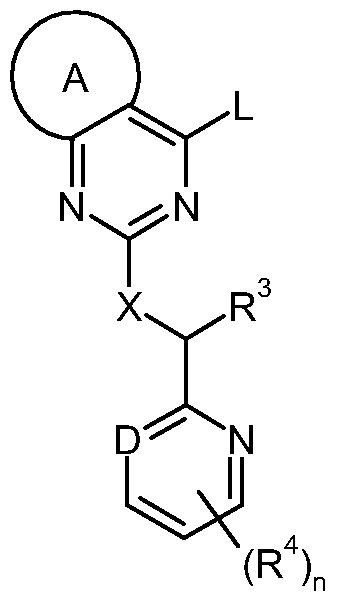
Formula (A) with a compound of Formula (B):
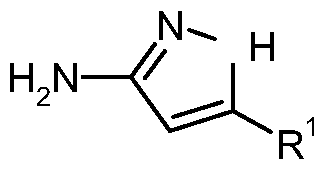
Formula (B); or
2) Process B - reacting a compound of Formula (C):

Formula (C) with a compound of Formula (D):

Formula (D); and thereafter if necessary: i) converting a compound of Formula (I) into another compound of Formula (I); ii) removing any protecting groups; and/or iii) forming a pharmaceutically acceptable salt, wherein L in each occurrence may be the same or different, and is a leaving group as described hereinabove.
For each of Processes A and B, it is to be understood that protecting groups may be used as necessary. Leaving groups suitable for use in Processes A and B include halo groups such as chloro. The Processes are discussed in more detail below.
Process A - Compounds of Formula (A) and compounds of Formula (B) may be reacted together in the presence of a suitable solvent, examples of which include ketones such as acetone, alcohols such as ethanol and butanol, and aromatic hydrocarbons such as toluene and N-methyl pyrrolid- 2-one. The reaction may advantageously occur in the presence of a suitable base, examples of which include inorganic bases such as potassium carbonate and cesium carbonate, and organic bases such as potassium tert-butoxide and sodium tert-butoxide. The reaction may be advantageously performed at a temperature in a range from 00C to reflux. Heating the reaction may be particularly advantageous.
In another aspect, compounds of Formula (A) and compounds of Formula (B) may be reacted together under standard Buchwald conditions (for example see J. Am. Chem. Soc, 118, 7215; J. Am. Chem. Soc, 119, 8451; J. Org. Chem., 62, 1568 and 6066), with a suitable base. Examples of suitable bases include inorganic bases such as cesium carbonate, and organic bases such as potassium ϊ-butoxide. Such a reaction may advantageously occur in the presence of a palladium catalyst such as palladium acetate. Examples of solvents suitable for such a reaction include toluene, benzene, dioxane, and xylene. The -NH- moiety of the compound of Formula (B) may advantageously be protected with a suitable protecting group, examples of which include protecting groups such as tert-butoxycarbonyl.
Process B - Compounds of Formula (D) and compounds of Formula (B) may be reacted together under conditions similar to those described for the reaction of compounds of Formula (A) with compounds of Formula (B).
Compounds of Formula (A) may be prepared according to Scheme 1:
Scheme 1

Formula (D)

Formula (A) wherein L in each occurrence may be the same or different, and is a leaving group as described hereinabove.
Compounds of Formula (D) and compounds of Formula (E) may be reacted together under conditions similar to those described for the reaction of compounds of Formula (A) with compounds of Formula (B).
Compounds of Formula (C) may be prepared according to Scheme 2:
Scheme 2

Formula (E) Formula (B) Formula (C)
wherein L in each occurrence may be the same or different, and is a leaving group as described hereinabove.
Compounds of Formula (B) and compounds of Formula (E) may be reacted together in the presence of a suitable solvent, examples of which include ketones such as acetone, alcohols such as ethanol and butanol, and aromatic hydrocarbons such as toluene and N-methyl pyrrolid-2-one. The reaction advantageously will take place in the presence of a suitable base, examples of which include inorganic bases such as potassium carbonate and cesium carbonate, and organic bases such as potassium tert-butoxide and sodium tert-butoxide. The reaction is advantageously performed at a temperature in a range from 0 C to reflux.
Examples
The invention will now be further described with reference to the following illustrative examples in which, unless stated otherwise:
(i) temperatures are given in degrees Celsius (0C); operations are carried out at room temperature or ambient temperature, that is, in a range of 18-25 0C;
(ii) organic solutions were dried over anhydrous magnesium sulfate unless other wise stated; evaporation of organic solvent was carried out using a rotary evaporator under reduced pressure (4.5 - 30 mmHg) with a bath temperature of up to 60 0C; (iii) chromatography means flash chromatography on silica gel; thin layer chromatography
(TLC) was carried out on silica gel plates; (iv) in general, the course of reactions was followed by TLC or liquid chromatography/mass spectroscopy (LC/MS) and reaction times are given for illustration only; (v) final products have satisfactory proton nuclear magnetic resonance (NMR) spectra and/or mass spectra data; (vi) yields are given for illustration only and are not necessarily those which can be obtained by diligent process development; preparations were repeated if more material was required;
(vii) when given, NMR data is in the form of delta values for major diagnostic protons, given in part per million (ppm) relative to tetramethylsilane (TMS) as an internal standard, determined at 300 MHz in DMSO-dβ unless otherwise stated;
(viii) chemical symbols have their usual meanings; (ix) solvent ratio was given in volume : volume (v/v) terms, (x) "ISCO" refers to normal phase flash column chromatography using pre-packed silica gel cartridges (12 g, 40 g etc.) used according to the manufacturers instruction obtained from ISCO, Inc, 4700 Superior Street Lincoln, NE, USA.
(xi) "Biotage" refers to normal phase flash column chromatography using pre-packed silica gel cartridges (12 g, 40 g, 80 g etc.) used according to the manufacturers instruction obtained from Biotage Inc, 1725 Discovery Drive Charlotteville, Virginia 22911, USA. (xii) "Gilson" refers to a YMC-AQC 18 reverse phase HPLC Column with dimension 20 mm/100 and 50 mm/250 in H2OMeCN with 0.1% TFA as mobile phase unless otherwise stated and used according to the manufacturers instruction obtained from Gilson, Inc. 3000 Parmenter Street, Middleton, WI 53562-0027, U.S.A. (xiii) "SFC (super critical fluid chromatography)" refers to Analytical SFC (ASC- 1000 Analytical SFC System with Diode Array Detector) and/or Preparative SFC (APS-
1000 AutoPrep Preparative SFC) and used according to the manufacturers instruction obtained from SFC Mettler Toledo AutoChem, Inc. 7075 Samuel Morse Drive Columbia MD 21046, U.S.A.
(xiv) Chiralcel OJ® and Chiralcel AD-H®, Chiralcel AD-S® or Chiralpak® IA columns are used according to the manufacturers instruction obtained from Chiral Technologies,Inc. 800NorthFivePointsRoad WestChester, PA19380, USA Parr Hydrogenator or Parr shaker type hydrogenators are systems for treating chemicals with hydrogen in the presence of a catalyst at pressures up to 5 atmospheres (60 psi) and temperatures to 80 0C.
(xv) the following abbreviations have been used:
DCM dichloromethane;
HPLC high-performance liquid chromatography;
DIPEA N, N-diisopropylethylamine.
DMF N,N-dimethylformamide;
THF tetrahydrofuran;
DMAP 4-dimethylaminopyridine;
DMSO dimethylsulphoxide;
EtOAc ethyl acetate;
Et2O diethyl ether;
BoC2O ϊ-butyloxycarbonyl anhydride;
BINAP 2,2'-bis(diphenylphosphino)-l,l'-binapthyl;
GC gas chromatography; o/n overnight; hr hours; mins minutes;
Pd2(dba)3 Tris(dibenzylideneacetone)dipalladium(0);
NMP N-methylpyrrolidone; dppf 1 , 1 '-bis(diphenylphosphino)ferrocene;
DMAc N,N-dimethylacetamide;
TEA triethylamine
TFA trifluoroacetic acid
TFAA trifluoroacetic anhydride
TBME t-butylmethyl ether j'PrOH. z'-propanol
Intermediate 1
5-Methoxy- lH-pyrazol-3 -amine
To a suspension of 3-amino-5-hydroxypyrazole (50.00 g, 0.50 mol) in CΗ2CI2 (800 mL) was added triphenylphosphine (155.64 g, 0.59 mol) and the resulting mixture was cooled to O0C. Diisopropyl azodicarboxylate (117.64 mL, 121 g, 0.59 mol) was added drop-wise over a period of 35 minutes (the temperature of the reaction mixture was kept below 2°C) to give a dark brown suspension (color differs from time to time). The reaction mixture was then held at 00C for 1 hour. An off white precipitation was observed after 30 minutes of the reaction. Methyl alcohol (50 mL, 40 g, 1.25 mol) was then added drop-wise over a period of 30 minutes at 00C as the slurry thinned considerably to give a yellow/orange suspension. The reaction mixture was then held at 00C for 1 hour. The reaction mixture was warmed slowly to ambient temperature and was then held at ambient temp overnight. The reaction mixture was filtered to remove undissolved solids. The filtrate was dried (MgSO4) and concentrated under reduced pressure to give yellow- orange oil. Purification by column chromatography (5% to 10% MeOH in CH2CI2) afforded the title compound as a waxy solid (5 g). 1H NMR (300 MHz, DMSO-d6) δ ppm 4.67 (s, 1 H) 3.61 (s, 3 H). LC-MS: 114 [M+1]+.
Intermediate 2
5-Ethoxy- lH-pyrazol-3 -amine 3-Amino-5-hydroxypyrazole and EtOH were reacted using a procedure similar to the one described for the synthesis of Intermediate 1, providing the title compound. 1H NMR (400 MHz, CD3OD) δ 4.85 (br s, 3 H), 4.02 (m, 2 H), 1.30 (t, 3 H).
Intermediate 3 5-Isopropoxy- lH-pyrazol-3 -amine
3-Amino-5-hydroxypyrazole and /PrOH were reacted using a procedure similar to the one described for the synthesis of Intermediate 1.
1H NMR (400 MHz) δ 10.3 (br s, 1 H), 4.84 (br s, 2 H), 4.65 (s, 1 H), 4.52 (m, 1 H), 1.20 (m, 6 H).
Intermediate 4
5-Fluoropyrimidine-2-carbonitrile
A 10 ml microwave vial was charged with 2-chloro-5-fluoropyrimidine (2.0 g, 15.09 mmol), Pd2(dba)3 (0.549 g, 0.6 mmol), dppf (0.67 g, 1.21 mmol), zinc cyanide (1.15 g, 9.81 mmol), and zinc dust (0.237 mg, 3.62 mmol). The flask was evacuated and backfilled with N2, and anhydrous DMAc. The vial was mounted onto a Personal Chemistry microwave reactor and heated at 100 0C for 10 hours. The reaction mixture was diluted with EtOAc and then washed with brine three times. The organic layer was obtained and evaporated to dryness. The dried residue was purified by silica gel chromatography (By ISCO Combiflash with gradient EtOAc and hexanes) to afford the title compound as a creamy solid (1.50 g, 80%). GC-MS: 123 [M].
1H NMR (CDCl3) δ: 8.80 (s, 2H).
Intermediate 5
N-( 1 -(5-Fluoropyrimidin-2-yl)vinyl)acetamide 5-Fluoropyrimidine-2-carbonitrile (Intermediate 4, 1.0 g, 8.1 mmol) in THF (10 ml) was added a solution of MeMgBr (3.3 ml, 9.75 mmol) in ether drop wise at 0 0C. After addition, the reaction was warmed to room temperature, stirred at room temperature for 1 hour and then diluted with DCM (10 ml). Acetic anhydride (1.23 ml, 13.0 mmol) was added in one portion. The reaction was stirred at room temperature for 1 hour and 40 0C for 1 hour. Saturated sodium bicarbonate solution (10 ml) was added and extracted with EtOAc (2x20 ml). The combined organic was dried over sodium sulfate. After removal of solvent, the resulted residue was purified by column chromatography (hexane-EtOAc = 2.5 : 1) to give the title compound as a white solid (0.38 g,
26%).
1H NMR (400 MHz) δ: 9.34 (s, IH), 8.95 (s, 2H), 6.25 (s, IH), 6.03 (s, IH), 2.11 (s, 3H). LC-MS: 182 [M+H]+ 182.
Intermediate 6
N-fd^-l-fS-Fluoropyrimidin-l-vDethyllacetamide
N-(l-(5-Fluoropyrimidin-2-yl)vinyl)acetamide (Intermediate 5, 0.10 g, 0.55 mmol) in MeOH (5 ml) under N2 was added (+)-l,2-bis((2J5, 5.S)-2,5-dietliylpliospliolano)benzene (cyclooctadiene)rhodium(I)trifluoromethanesulfonate (0.04 g, 0.0055 mmol). The solution was transferred to a high pressure bomb and charged 150 psi H2. The reaction was stirred at room temperature for 4 hours. The solvent was removed and the resulted residue was purified by column chromatography (EtOAc) to give the title compound as a white solid (0.096 g, 95%). 1H NMR (400 MHz) δ: 8.84 (d, 2H), 8.34 (d, IH), 5.00 (m, IH), 1.84 (s, 3H), 1.37 (d, 3H). LC-MS: 184 [M+l]+.
Enantiomeric excess determined by HPLC (Chiralpak IA; 95:5 CO2MeOH), >99% ee.
Intermediate 7 tert-Butyl [(15Vl-(5-fluoropyrimidin-2-yl)ethyl"|carbamate N-[(1S> l-(5-Fluoropyrimidin-2-yl)ethyl]acetamide (Intermediate 6, 0.20 g, 1.09 mmol), DMAP (0.027 g, 0.22 mmol) and BoC2O (0.60 g, 2.73 mmol) in THF (10 ml) was stirred at 50 0C for 40 hours. After cooling to room temperature, lithium hydroxide monohydrate (0.094 g, 2.24 mmol) and water (10 ml) was added. The reaction was stirred at room temperature for 9 hours. Ether (30 ml) was added, organic layer was separated, washed with brine (20 ml) and dried over sodium sulfate. After removal of solvent, the resulted residue was purified by column chromatography (Hex-EtOAc=5:l) to give the title compound as a pale yellow oil (0.21 g, 80%). 1H NMR (400 MHz) δ: 8.84 (s, 2H), 7.24 (d, IH), 4.74 (m, IH), 1.35 (s, 12H). LC-MS: 242 [M+l]+.
Intermediate 8
( IS)- 1 -(5-Fluoropyrimidin-2-yl)ethanamine hydrochloride
To a solution of tert-butyl [(l.S)-l-(5-fluoropyrimidin-2-yl)ethyl]carbamate (Intermediate 7, 0.21 g, 0.87 mmol) in DCM (5 ml) was added HCl (1.3 ml, 5.2 mmol) in dioxane. The reaction was stirred at room temperature for 3 hours. The solvent was removed to give the title product as white solid (quantitative).
LC-MS: 142 [M+l]4
Intermediate 9
5-Fluoropyridine-2-carbonitrile
2-Bromo-5-fluoropyridine (93.0 g, 528 mmol), Zn dust (8.29 g, 127 mmol), zinc cyanide (40.3 g, 343 mmol), dppf (11.7 g, 21.1 mmol) and Pd2dba3 (9.68 g, 10.6 mmol) in anhydrous DMAc (300 ml) were heated at 95 0C for 3 hours. After cooled to room temperature, brine (100 ml) and ether
(500 ml) was added. The solid formed was removed by filtration and washed with ether (300 ml).
The organic layer was separated, washed with brine (200 ml) and dried over sodium sulfate, and concentrated. After removal of solvent, the resulted residue was purified by column chromatography (hexane-DCM = 1:1) to give the title compound as a white solid (49 g, 72%).
1H NMR (400 MHz) δ: 8.82 (d, IH), 8.21 (dd, IH), 8.05 (dd, IH).
Intermediate 10
N-( 1 -(5-Fluoropyridin-2-yl)vinyl)acetamide A solution of MeMgBr (170.3 ml, 510.98 mmol) in ether was diluted with 170 ml of anhydrous THF and cooled to 0 0C. 5-Fluoropyridine-2-carbonitrile (Intermediate 9, 53.6 g, 425.82 mmol) in THF (170 ml) was added drop wise. The reaction was stirred at 0 0C for 30 minutes, then diluted with DCM (170 ml). Acetic anhydride (48.3 ml, 510.98 mmol) in DCM (100 ml) was added drop- wise at 0 0C. After addition, the reaction was warmed to room temperature and stirred at room temperature for 8 hours. Saturated sodium bicarbonate solution (50 ml) was added and extracted with EtOAc (2 x 200 ml). The combined organic was dried over sodium sulfate. After removal of solvent, the resulted residue was purified by column chromatography (hexane:EtOAc = 2.5:1) to give the title compound as a white solid (26.6 g, 35%). 1H NMR (400 MHz) δ: 9.37 (s, IH), 8.57 (d, IH), 7.81 (m, 2H), 6.01 (s, IH), 5.52 (s, IH), 2.08 (s, 3H).
LC-MS: 181 [M+l]+.
Intermediate 11
N-\( IS)- 1 -(5-fluoropyridin-2-vP)ethyll acetamide To a solution of N-(l-(5-fluoropyridin-2-yl)vinyl)acetamide (Intermediate 10, 11.0 g, 61.1
mmol) in MeOH (120 ml) under N2 was added (+)-l,2-bis((2S,5(S)-2,5- diethylphospholano)benzene(cyclooctadiene)rhodium(I)trifluoromethanesulfonate (0.441 g, 0.611 mmol). The solution was transferred to a high pressure bomb and charged 150 psi H2. The reaction stirred at room temperature and maintained inside pressure between 120-150 psi for 7 hours. The solvent was removed and the resulted residue was purified by column chromatography (EtOAc) to give the title compound as a white solid (9.8 g, 88%).
1H NMR (400 MHz) δ: 8.49 (d, J= 2.4 Hz, IH), 8.32 (d, J= 7.6 Hz, IH), 7.66 (m, IH), 7.39 (dd,
J= 4.4 and 8.8 Hz, IH), 4.95 (m, IH), 1.85 (s, 3H), 1.34 (d, J= 7.2 Hz, 3H).
LC-MS: 183 [M+l]+.
Enantiomeric excess determined by SFC(Chiralpak IA; 70:30 CO2MeOH), 95.3% ee.
Intermediate 12 tert-Bτtiyl r(l»S^-l-(5-fluoropyridin-2-yl)ethyllcarbamate
A solution of N-[(15)-l-(5-fluoropyridin-2-yl)ethyl]acetamide (Intermediate 11, 11.0 g, 60.37 mmol), DMAP (1.48 g, 12.07 mmol) and BoC2O (26.35 g, 120.7 mmol) in THF (100 ml) was stirred at 50 0C for 20 hours. After cooled to room temperature, lithium hydroxide monohydrate (5.19 g, 123.8 mmol) and water (100 ml) were added. The reaction was stirred at room temperature for 5 hours and diluted with ether (200 ml). The organic layer was separated, washed with brine (100 ml), and dried over sodium sulfate. After removal of solvent, the resulted residue was purified by column chromatography (hexane-EtOAc = 5:1) to give the title compound as a pale yellow oil (13.6 g, 94%).
1H NMR (400 MHz) δ: 8.46 (d, IH), 7.69 (m, IH), 7.35-7.41 (m, 2H), 4.67 (m, IH), 1.37 (s, 9H), 1.32 (d, 3H). LC-MS: 241 [M+l]+.
Intermediate 13 r(15yi-(5-Fluoropyridin-2-yl)ethyl"|amine
To a solution of tert-butyl [(l.S)-l-(5-fluoropyridin-2-yl)ethyl]carbamate (Intermediate 12, 12.8 g, 53.3 mmol) in DCM (100 ml) was added HCl/dioxane solution (107 ml, 4 N, 428 mmol). The reaction was stirred at room temperature for 3 hours. The solvent was removed and 50 ml of saturated sodium bicarbonate was added. The resulting aqueous solution was extracted with ether
(6 x 400 ml), dried over sodium sulfate and concentrated to give the title compound (7.30 g, 98%) as pale yellow oil.
'H NMR (400 MHz) δ: 8.44 (d, IH), 7.66 (m, IH), 7.53 (m, IH), 4.01 (q, IH), 1.94 (b, 2H), 1.26 (d, 3H).
LC-MS: 141 [M+l]+.
The hydrochloride may be prepared by dissolving the title compound in MeOH and adding HCl/dioxane solution. Evaporation of the solvents provides the hydrochloride salt of the title compound as a tan solid.
Intermediate 14
5-Amino-2-methyl-l,3-oxazole-4-carbonitrile
To a stirred solution of aminomalonitrile j9αrα-toluenesulfonate salt (2 g, 7.9 mmol) in pyridine (15 mL) was added acetyl chloride (0.68 g, 8.7 mmol) drop-wise at 00C. The resulting mixture was stirred at room temperature overnight. After the reaction was completed, the volatiles were evaporated to give a colored residue. The residue was purified by column chromatography to afford the title compound (0.6 g). 1H NMR (400 MHz, CDCl3) δ: 2.32 (s, 3H).
Intermediate 15 5J-Dichloro-2-methviri,31oxazolor5,4-</1pyrimidine
To a stirred solution of 5-amino-2-methyl-l,3-oxazole-4-carbonitrile (Intermediate 14, 0.2 g, 16.3mmol) in MeCN (3 mL) was added diphosgene (0.64 g, 32.5mmol) drop-wise at 00C. The solution was stirred at 1300C for 1 h. The volatiles were evaporated under reduced pressure and purification by column chromatography afforded the title compound (0.1 g). 1H NMR (400 MHz, CDCl3) δ: 2.75 (s, 3H). LC-MS: 204 [M+l]+.
Intermediate 16
5-Amino-2-methyl-l,3-thiazole-4-carbonitrile
To a stirred solution of aminomalonitrile/>αrα-toluenesulfonate salt (2 g) in pyridine (15 mL) was added ethyl ethane(dithioate) (0.68 g) drop-wise at room temperature. The reaction mixture was stirred at this temperature overnight. The volatiles were evaporated under reduced pressure and purification by column chromatography afforded the title compound (2.2 g). 1H NMR (400 MHz) δ: 2.48 (s, 3H).
Intermediate 17 5J-Dichloro-2-methviri,31thiazolor5,4-</1pyrimidine
5-Amino-2-methyl-l,3-thiazole-4-carbonitrile (Intermediate 16) and diphosgene were reacted using a procedure similar to the one described for the synthesis of Intermediate 15, providing the title compound. LC-MS: 220 [M+l]+. 1H NMR (400 MHz, CDCl3) δ: 2.93 (s, 3H).
Intermediate 18 2,4-Dichlorothienor2,3-(/1pyrimidine
2-Aminothiophene-3-carbonitrile and diphosgene, were reacted using a procedure similar to the one described for the synthesis of Intermediate 15, providing the title compound. LC-MS: 205 [M+l]+.
Intermediate 19
5-Chloro-2-methyl-N-(5-methyl-lH-pyrazol-3-yl)[l,31thiazolo[5,4-</1pyrimidin-7-amine A reaction vessel containing 5,7-dichloro-2-methyl[l,3]thiazolo[5,4-<i]pyrimidine (Intermediate 17, 300 mg, 1.36 mmol), 5-methyl-lH-pyrazol-3-amine (146 mg, 1.50 mmol) and DIPEA (0.47 mL, 2.72 mmol) in EtOH (0.5M) was heated at 600C overnight. LC/MS indicated that the desired product, 5-chloro-2-methyl-N-(5-methyl-lH-pyrazol-3-yl)[l,3]thiazolo[5,4-<i]pyrimidin- 7-amine, was formed. The reaction mixture was then slurried in ether and filtered. The product was collected as a purple precipitate (450 mg). LC-MS: 281 [M+l]+.
Intermediate 20
5-Chloro-2-methyl-N-(5-methyl- lH-pyrazol-3-vP)|" 1 ,31oxazolo[5,4-</lpyrimidin-7-amine 5,7-Dichloro-2-methyl[l,3]oxazolo[5,4-<i]pyrimidine (Intermediate 15) and 5-methyl-lH- pyrazol-3 -amine were reacted using a procedure similar to the one described for the synthesis of Intermediate 19, providing the title compound. LC-MS: 265 [M+l]+.
Intermediate 21
2-Chloro-7-methyl-N-(5-methyl-lH-pyrazol-3-yl)thienor3,2-(/1pyrimidin-4-amine 2,4-Dichloro-7-methylthieno[3,2-d]pyrimidine and 5 -methyl- lH-pyrazo 1-3 -amine were reacted using a procedure similar to the one described for the synthesis of Intermediate 19, providing the title compound. LC-MS: 280 [M+l]+.
Intermediate 22 2-Chloro-N-(5-methyl-lH-pyrazol-3-ylN)thieno[2,3-</1pyrimidin-4-amine
2,4-Dichlorothieno[2,3-<i]pyrimidine (Intermediate 18) and 5-methyl-lH-pyrazol-3-amine were reacted using a procedure similar to the one described for the synthesis of Intermediate 19, providing the title compound. LC-MS: 266 [M+l]+.
Intermediate 23
2-Chloro-5-methyl-N-(5-methyl-lH-pyrazol-3-yl)-5H-pyrrolo[3,2-(/1pyrimidin-4-amine 2,4-Dichloro-5-methyl-5H-pyrrolo[3,2-<i]pyrimidine and 5-methyl-lH-pyrazol-3-amine were reacted using a procedure similar to the one described for the synthesis of Intermediate 19, providing the title compound. LC-MS: 263 [M+l]+.
Intermediate 24
2-Chloro-7-methyl-N-(5-methyl-lH-pyrazol-3-yl)-7H-purin-6-amine
2,6-Dichloro-7-methyl-7H-purine and 5-methyl-lH-pyrazol-3-amine were reacted using a procedure similar to the one described for the synthesis of Intermediate 19, providing the title compound.
LC-MS: 264 [M+l]+.
Intermediate 25
2-Chloro-N-(5-methoxy-lH-pyrazol-3-ylN)-7-methylthieno[3,2-(/1pyrimidin-4-amine 2,4-Dichloro-7-methylthieno[3 ,2-<i]pyrimidine and 5-methoxy- lH-pyrazol-3 -amine (Intermediate 1) were reacted using a procedure similar to the one described for the synthesis of Intermediate 19, providing the title compound. LC-MS: 296 [M+l]+.
Intermediate 26
2-Chloro-N-(5-ethoxy-lH-pyrazol-3-yl)thienor3,2-(ilpyrimidin-4-amine 2,4-Dichlorothieno[3,2-<i]pyrimidine and 5-ethoxy-lH-pyrazol-3-amine (Intermediate 2) were reacted using a procedure similar to the one described for the synthesis of Intermediate 19, providing the title compound. LC-MS: 296 [M+l]+.
Intermediate 27 2-Chloro-N-(5-methoxy-lH-pyrazol-3-ylN)thieno[2,3-<ilpyrimidin-4-amine
2,4-Dichlorothieno[2,3-<i]pyrimidine (Intermediate 18) and 5-methoxy- lH-pyrazol-3 -amine (Intermediate 1) were reacted using a procedure similar to the one described for the synthesis of Intermediate 19, providing the title compound. LC-MS: 282 [M+l]+.
Intermediate 28
2-Chloro-N-(5-ethoxy-lH-pyrazol-3-yl)thienor2,3-(ilpyrimidin-4-amine
2,4-Dichlorothieno[2,3-<i]pyrimidine (Intermediate 18) and 5-ethoxy-lH-pyrazol-3-amine (Intermediate 2) were reacted using a procedure similar to the one described for the synthesis of Intermediate 19, providing the title compound.
LC-MS: 296 [M+l]4
Intermediate 29
2-Chloro-N-(5-isopropoxy-lH-pyrazol-3-yl)thienor2,3-(/1pyrimidin-4-amine The title compound was synthesized from 2,4-dichlorothieno[2,3-<i]pyrimidine (Intermediate 18) and 5-isopropoxy-lH-pyrazol-3-amine (Intermediate 3), using a procedure similar to the one described for the synthesis of Intermediate 19.
LC-MS: 310 [M+l]+.
Intermediate 30 2,6-Dichloro-N-(5-methyl-lH-pyrazol-3-yl)pyrimidin-4-amine
To a solution of 2,4,6-trichloropyrimidine (5 g) in EtOH (100 ml) were added DIPEA (7.3mL) and 5 -methyl- lH-pyrazol-3 -amine (2.78 g). The resulted solution was stirred at room temperature for 4hours. The title compound was obtained by filtration, washed with EtOH (1OmL) and dried o/n in a vacuum oven (5.7 g, 86%). LC-MS: 245 [M+l]+.
Intermediate 31
6-Chloro-N2-r(l»y)-l-(5-fluoropyridin-2-yl)ethyl1-N4-(5-methyl-lH-pyrazol-3-yl)pyrimidine-2.4- diamine To a solution of 2,6-dichloro-N-(5-methyl-lH-pyrazol-3-yl)pyrimidin-4-amine (Intermediate 30, 415mg) in n-butanol (8mL) were added DIPEA (0.75mL) and (15)-l-(5-fluoropyridin-2- yl)ethanamine hydrochloride (Intermediate 13, 286mg). The resulted solution was heated at 12O0C o/n. The volatiles were removed under reduced pressure to give a colored residue. This residue was purified by Gilson (10%->60% MeCN/Η2O) to afford the title compound (340mg, 57.5%).
LC-MS: 348 [M+l]+.
Intermediate 32
6-Chloro-N2-[(15f)-l-(5-fluoropyrimidin-2-yl)ethyll-Λ/4-(5-methyl-lH-pyrazol-3-yl)pyrimidine- 2,4-diamine
2,6-Dichloro-N-(5-methyl-lH-pyrazol-3-yl)pyrimidin-4-amine (Intermediate 30) and (15)-l-(5- fluoropyrimidin-2-yl)ethanamine hydrochloride (Intermediate 8) were reacted using a procedure analogous to that described for the synthesis of Intermediate 31, to give the title compound. LC-MS: 349 [M+l]+.
Intermediate 33
N4-(1.3-dioxolan-2-ylmethyl)-N2-r(l»S)-l-(5-fluoropyridin-2-yl)ethyl1-N5-(3-methyl-lH-pyrazol- 5 - vP)pyrimidine-2.4.6-triamine
A microwave tube was charged with a solution of 6-chloro-N2-[(15)-l-(5-fluoropyridin-2- yl)ethyl] -N* -(5 -methyl- lH-pyrazo 1-3 -yl)pyrimidine-2,4-diamine (Intermediate 31, 348 mg) in n- BuOH (3 mL). (1 ,3-Dioxolan-2-ylmethyl)amine (1 ml) and DIPEA (0.5 ml) were added and the resulting mixture was heated in a microwave at 16O0C for βhours. Evaporation of the volatiles gave a colored residue that was used in the next step without further purification. LC-MS: 415 [M+l]+.
Intermediate 34
^)-N4-(2,2-dimethoxyethyl)-N2-(l-(5-fluoropyrimidin-2-yl)ethyl)-N5-(5-methyl-lH-pyrazol-3- yl)pyrimidine-2.4.6-triamine
A microwave vessel was charged with 6-chloro-N2-[(l.S<)-l-(5-fluoropyrimidin-2-yl)ethyl]-Λ/4-(5- methyl-lH-pyrazol-3-yl)pyrimidine-2,4-diamine (Intermediate 32, 155 mg, 0.44 mmol) and 2,2- dimethoxyethanamine (1402 mg, 13.33 mmol). The resulting solution was heated in a microwave for Ih at 1400C. The reaction was not complete, so it was heated for an extra hour at 1600C.
The volatiles were evaporated under reduce pressure to give a brown oil, that was used in a subsequent step without any further purification.
LC-MS: 418 [M+Η]+.
Examplel
Ns-r(l»y)-l-(5-fluoropyrimidin-2-yl)ethyl1-2-methyl-N7-(5-methyl-lH-pyrazol-3- yl)ri,31thiazolor5,4-<ilpyrimidine-5J-diamine

A microwave reaction vessel was charged with 5-chloro-2-methyl-N-(5-methyl-lH-pyrazol-3- yl)[l,3]thiazolo[5,4-d]pyrimidin-7-amine (Intermediate 19, 150 mg, 0.53 mmol), (15)-l-(5- fluoropyrimidin-2-yl)ethanamine hydrochloride (Intermediate 8, 104 mg, 0.59 mmol) and DIPEA (0.28 mL, 1.59 mmol). Isoamyl alcohol (2 ml) was added, and the tube was sealed and heated in a microwave reactor at 160 0C for 4 hours. The reaction mixture was concentrated in vacuo leaving a pink/brown solid. This material was purified by Gilson (15-50% MeCN/EkO, 35 min) to give the title compound TFA salt as a pale yellow solid (66.8 mg). The TFA salt was dissolved in EtOAc, the organic phase was washed with NaHCO3 (2x), H2O and subsequent drying over MgSO4. Evaporation of the volatiles under reduced pressure gave the corresponding parent compound.
1H NMR δ 10.40 (br.s, 1 H) 8.86 (s, 2 H) 7.98 (br.s, 1 H) 6.21 (br.s, 1 H) 5.24 (s, 1 H) 2.67 (s, 3 H) 2.23 (s, 3 H) 1.52 (d, 3 H). LC-MS: 386 [M+1]+.
Example 2
Ns-r(iy)-l-(5-Fluoropyrimidin-2-vnethyl1-2-methyl-N7-(5-methyl-lH-pyrazol-3- yl)ri,31oxazolor5,4-^1pyrimidine-5J-diamine

5-Chloro-2-methyl-N-(5-methyl- lH-pyrazol-3-yl)[ 1 ,3]oxazolo[5,4-<i]pyrimidin-7-amine
(Intermediate 20) and (15)-l-(5-Fluoropyrimidin-2-yl)ethanamine hydrochloride
(Intermediate 8) were reacted using a procedure similar to the one described for the synthesis of
Example 1, providing the title compound.
1H NMR O 1.39 (d, 3 H) 2.24 (s, 3 H) 2.31 (s, 3 H) 4.79 - 5.24 (m, 1 H) 5.96 (s, 1 H) 7.05 (d, 1
H) 8.83 (d, 2 H) 10.70 (s, I H).
LC-MS: 370 [M+l]+.
Example 3 N2-r(l»y)-l-(5-Fluoropyrimidin-2-yl)ethyl1-7-methyl-N4-(5-methyl-lH-pyrazol-3-yl)thienor3,2- dlpyrimidine-2.4-diamine

1H NMR O 11.56 (s, 1 H) 8.97 (s, 2 H) 8.45 (br.s, 1 H) 7.96 (s, 1 H) 6.17 (s, 1 H) 5.32 (s, 1 H) 2.32 (s, 3 H) 2.27 (s, 3 H) 1.62 (d, 3 H). LC-MS: 385 [M+l]+.
Example 4
NNV2-r((Il,»y?))--!l--(5-Fluoropyrimidin-2-yl)ethyl1-N4-(5-methyl-lH-pyrazol-3-yl)thienor2,3- d1pyrimidine-2,4-diamine

2-Chloro-N-(5-methyl-lH-pyrazol-3-yl)thieno[2,3-(i]pyrimidin-4-amine (Intermediate 22) and (15)-l-(5-Fluoropyrimidin-2-yl)ethanamine hydrochloride (Intermediate 8) were reacted using a procedure similar to the one described for the synthesis of Example 1, providing the title compound.
1H NMR O 10.57 (br.s, 1 H) 8.88 (s, 2 H) 7.72 (s, I H) 7.19 (s, 1 H) 5.17 - 5.40 (m, 1 H) 2.18 - 2.34 (s, 3 H) 1.57 (d, 3 H). LC-MS: 371 [M+l]+.
Example 5
N2-[(15f)-l-(5-Fluoropyrimidin-2-yl)ethyll-N4-(5-methoxy-lH-pyrazol-3-yl)-7-methylthieno[3,2- (/1pyrimidine-2,4-diamine, TFA salt

2-Chloro-N-(5-methoxy-lH-pyrazol-3-yl)-7-methylthieno[3,2-(i]pyrimidin-4-amine (Intermediate 25) and (15)-l-(5-Fluoropyrimidin-2-yl)ethanamine hydrochloride (Intermediate 8) were reacted using a procedure similar to the one described for the synthesis of Example 1, providing the title product. LC-MS: 401 [M+l]+.
Example 6
N2-r(l»y)-l-(5-Fluoropyridin-2-yl)ethyl1-5-methyl-N4-(5-methyl-lH-pyrazol-3-yl)-5H- pyrrolor3,2-^pyrimidine-2,4-diamine

2-Chloro-5-methyl-N-(5-methyl-lH-pyrazol-3-yl)-5H-pyrrolo[3,2-(i]pyrimidin-4-amine (Intermediate 23) and [(l.S)-l-(5-Fluoropyridin-2-yl)ethyl]amine (Intermediate 13) were reacted using a procedure similar to the one described for the synthesis of Example 1, providing the title compound.
1H NMR O 1.53 (d, 3 H) 2.25 (s, 3 H) 3.62 (s, 3 H) 5.12 (m, 1 H) 6.25 (s, 1 H) 7.40 - 7.49 (m, 1 H) 7.53 (d, 1 H) 7.72 (ddd, 1 H) 8.57 (d, 1 H) 9.42 (s, 1 H). LC-MS: 367 [M+l]+.
Example 7 N2-r(iy)-l-(5-Fluoropyridin-2-yl)ethyl1-7-methyl-N5-(5-methyl-lH-pyrazol-3-yl)-7H-purine-2,6- diamine

2-Chloro-7-methyl-N-(5-methyl-lH-pyrazol-3-yl)-7H-purin-6-amine (Intermediate 24) and [(l1Sl)-l-(5-Fluoropyridin-2-yl)ethyl]amine (Intermediate 13) were reacted using a procedure similar to the one described for the synthesis of Example 1, providing the title compound.
1H NMR δ 1.52 (d, 3 H) 2.26 (s, 3 H) 4.09 (s, 3 H) 4.98 - 5.25 (m, 1 H) 5.96 (s, 1 H) 7.36 - 7.52 (m, 1 H) 7.74 (ddd, 1 H) 8.56 (d, 1 H) 9.70 (s, 1 H). LC-MS: 368 [M+l]+.
Example 8
N2-r(l»y)-l-(5-Fluoropyridin-2-yl)ethyl1-7-methyl-N4-(5-methyl-lH-pyrazol-3-yl)thienor3,2- (/1pyrimidine-2,4-diamine

2-Chloro-7-methyl-N-(5-methyl-lH-pyrazol-3-yl)thieno[3,2-(i]pyrimidin-4-amine (Intermediate
21) and [(l.S)-l-(5-Fluoropyridin-2-yl)ethyl]amine (Intermediate 13), were reacted using a procedure similar to the one described for the synthesis of Example 1, providing the title compound. 1H NMR O 1.56 (d, 3 H) 2.27 (s, 3 H) 2.31 (s, 3 H) 5.05 - 5.41 (m, 1 H) 6.17 (s, 1 H) 7.59 (dd, 1 H) 7.69 - 7.86 (m, 1 H) 7.96 (s, 1 H) 8.28 (s, 1 H) 8.62 (d, 1 H). LC-MS: 384 [M+l]+.
Example 9 N2-r(l»y)-l-(5-Fluoropyridin-2-yl)ethyl1-N4-(5-isopropoxy-lH-pyrazol-3-yl)thienor2.3- £/1pyrimidine-2,4-diamine

2-Chloro-N-(5-isopropoxy-lH-pyrazol-3-yl)thieno[2,3-<i]pyrimidin-4-amine (Intermediate 29) and [(l.S)-l-(5-Fluoropyridin-2-yl)ethyl]amine (Intermediate 13), were reacted using a procedure similar to the one described for the synthesis of Example 1, providing the title compound.
1H NMR (400 MHz) δ 12.20 (br s, 1 H), 10.26 (br s, 1 H), 8.51 (s, 1 H), 8.01 (s, 1 H), 7.65 (m, 1 H), 7.48 (m, 3 H), 7.08 (m, 1 H), 5.30 (s, 1 H), 5.15 (m, 1 H), 4.71 (m, 1 H), 1.46 (m, 3 H), 1.29 (m, 6 H). LC-MS: 414 [M+l]+.
Example 10
Λ/4-(5-Ethoxy-lH-pyrazol-3-yl)-N2-r(l»S)-l-(5-fluoropyridin-2-yl)ethyllthienor3,2-(ilpyrimidine- 2 ,4- diamine, TFA salt

2-Chloro-N-(5-ethoxy-lH-pyrazol-3-yl)thieno[3,2-<i]pyrimidin-4-amine (Intermediate 26) and [(l1Sl)-l-(5-fluoropyridin-2-yl)ethyl]amine (Intermediate 13) were reacted using a procedure similar to the one described for the synthesis of Example 1, providing the title product. 1H NMR O 0.79 - 0.97 (m, 3 H) 1.20 (d, 3 H) 3.31 - 3.55 (m, 2 H) 4.66 (s, 1 H) 4.70 - 4.98 (m, 1 H) 6.32 - 6.49 (m, 1 H) 6.63 - 6.91 (m, 2 H) 7.46 - 7.59 (m, 1 H) 7.67 (s, 1 H). LC-MS: 400 [M+l]+.
Example 11
N2-r(l»y)-l-(5-Fluoropyridin-2-yl)ethyl1-N4-(5-methoxy-lH-pyrazol-3-yl)thienor2.3- (/1pyrimidine-2,4-diamine

2-Chloro-N-(5-methoxy-lH-pyrazol-3-yl)thieno[2,3-(i]pyrimidin-4-amine (Intermediate 27) and
[(15)-l-(5-fluoropyridin-2-yl)ethyl]amine(Intermediate 13) were reacted using a procedure similar to the one described for the synthesis of Example 1, providing the title compound.
1H NMR (500 MHz, CD3OD) δ 1.58 (d, 3H) 3.86 (s, 3H) 5.20 (m, IH) 5.44 (s, IH) 6.99 (d, IH)
7.33 (d, IH) 7.53 (d, 2H) 8.40 (s, IH).
LC-MS: 386 [M+l]+.
Example 12
N2-r(l»y)-l-(5-Fluoropyridin-2-yl)ethyl1-N4-(5-methyl-lH-pyrazol-3-yl)thienor2.3-^1pyrimidine- 2,4-diamine

2-Chloro-N-(5-methyl-lH-pyrazol-3-yl)thieno[2,3-(i]pyrimidin-4-amine (Intermediate 22) and [(l.S<)-l-(5-fluoropyridin-2-yl)ethyl]amine (Intermediate 13) were reacted using a procedure similar to the one described for the synthesis of Example 1, providing the title compound.
1H NMR (500 MHz) δ 1.48 (d, 3H) 2.20 (s, 3H) 5.15 (m, IH) 7.00 (s, IH) 7.42 (m, 2H) 7.65 (m, 2H) 8.55 (d, IH) 9.81 (br , IH). LC-MS: 370 [M+l]+.
Example 13 N*-(5-Etiioxγ- lH-pyrazol-3-yl)-N2-r(l»y)-l-(5-fluoropyridin-2-yl)etliyl1thienor2,3-^1Pyrimidine- 2,4-diamine

2-Chloro-N-(5-ethoxy-lH-pyrazol-3-yl)thieno[2,3-<i]pyrimidin-4-amine (Intermediate 28) and [(l1Sl)-l-(5-fluoropyridin-2-yl)ethyl]amine (Intermediate 13) were reacted using a procedure similar to the one described for the synthesis of Example 1, providing the title compound.
1H NMR (SOO MHZ5 CDCI3) O 1.35 (t, 3H) 1.48 (d, 3H) 4.21 (q, 2H) 5.22 (m, IH) 5.32 (s, IH) 6.82 (d, IH) 7.11 (d, IH) 7.24-7.30 (m, 2H) 8.35 (d, IH). LC-MS: 400 [M+l]+.
Example 14
^-N2-(l-(5-Fluoropyridin-2-yl)ethyl)-N4-(5-methyl-lH-pyrazol-3-yl)-7H-pyrrolor2,3- dlpyrimidine-2,4-diamine, TFA salt

A microwave tube was charged with a solution of Λ/4-(l,3-dioxolan-2-ylmethyl)-N2-[(l.S)-l-(5- fluoropyridin-2-yl)ethyl]-Λ/6-(3-methyl-lH-pyrazol-5-yl)pyrimidine-2,4,6-triamine (Intermediate 33, 100 mg) in AcOH (3 mL) and was heated in a microwave at 13O0C for 5hours. Evaporation of the volatiles gave a colored residue that was purified by Gilson (5%->95% MeCN/Η2O) to provide the title product (30.3mg).
1H NMR (MeOD) δ 1.60 (d, 3 H) 2.30 (s, 3 H) 5.15 - 5.40 (m, 1 H) 6.01 (s, 1 H) 6.68 (s, 1 H) 7.01 (d, 1 H) 7.38 - 7.81 (m, 3 H) 8.44 (d, 1 H). LC-MS: 353 [M+l]+.
Example 15
^)-N2-(l-(5-Fluoropyrimidin-2-yl)ethyl)-N4-(5-methyl-lH-pyrazol-3-yl)-7H-pyrrolor2,3- dlpyrimidine-2,4-diamine

A microwave vessel was charged with a solution of fS/)-Λ/4-(2,2-dimethoxyethyl)-N2-(l-(5- fluoropyrimidin-2-yl)ethyl)-Λ/6-(5-methyl-lH-pyrazol-3-yl)pyrimidine-2,4,6-triamine
(Intermediate 34, 0.184 g, 0.44mmol) in p-toluenesulfonic acid (2.5 ml, 15.53 mmol) in acetic acid (12%). The solution was heated to 1600C for 1.5 hours. Evaporation of the volatiles afforded a dark oil. Purification by Gilson (5%->50% MeCN/EkO) afforded the title compound in the form of its TFA salt, as an off white solid (40 mg). The TFA salt was dissolved in EtOAc, the organic phase was washed with NaHCO3 (2x), H2O and subsequently dried over MgSO4. Evaporation of the volatiles under reduced pressure gave the title compound.
1H NMR (300 MHz, DMSO-D6) δ ppm 1.57 (d, J=6.78 Hz, 3 H) 2.31 (s, 3 H) 5.25 (s, 1 H) 6.07 (s, 1 H) 6.73 (s, 1 H) 7.01 (s, 1 H) 8.81 - 9.02 (m, 2 H) 11.90 (s, 1 H) LC-MS: 354 [M+l]+.
Claims
Claims
What is claimed is:
1. A compound of Formula (I):

or a pharmaceutically acceptable salt thereof, wherein
Ring A is a 5-membered aromatic heterocyclic ring, wherein said 5-membered aromatic heterocyclic ring is optionally substituted on carbon with one or more R , and wherein any -NH- moiety of said 5-membered aromatic heterocyclic ring is optionally substituted with R2*;
X is selected from -O-, -NH-, and -S-; D is selected from CH and N; R1 is selected from halo, -CN, Ci_6alkyl, C2-6alkenyl, C2-6alkynyl, carbocyclyl, heterocyclyl, -ORla, -SRla, -N(Rla)2, -N(Rla)C(O)Rlb, -N(Rla)N(Rla)2, -NO2, -N(Rla)ORla, -ON(Rla)2, -C(O)H, -C(O)Rlb, -C(O)2Rla, -C(O)N(Rla)2, -C(O)N(Rla)(ORla), -OC(O)N(Rla)2, -N(Rla)C(O)2Rla, -N(Rla)C(O)N(Rla)2, -OC(O)Rlb, -S(O)Rlb, -S(O)2Rlb, -S(O)2N(Rla)2, -N(Rla)S(O)2Rlb, -C(Rla)=N(Rla), and -C(Rla)=N(ORla), wherein said C1-6alkyl, C2_6alkenyl, C2_6alkynyl, carbocyclyl, and heterocyclyl are optionally substituted on carbon with one or more R , and wherein any -NH- moiety of said heterocyclyl is optionally substituted with R10*;
Rla in each occurrence is independently selected from H, Ci_6alkyl, carbocyclyl, and heterocyclyl, wherein said Ci_6alkyl, carbocyclyl, and heterocyclyl in each occurrence are optionally and independently substituted on carbon with one or more R10, and wherein any -NH- moiety of said heterocyclyl is optionally substituted with R10*; Rlb in each occurrence is selected from Ci-βalkyl, C2-6alkenyl, C2-6alkynyl, carbocyclyl, and heterocyclyl, wherein said
 C2-6alkenyl, C2-6alkynyl, carbocyclyl, and heterocyclyl in each occurrence are optionally and independently substituted on carbon with one or more R , and wherein any -NH- moiety of said heterocyclyl is optionally substituted with R10*; R2 is selected from H, halo, -CN, Ci_6alkyl, C2-6alkenyl, C2-6alkynyl, carbocyclyl, heterocyclyl, -OR2a, -SR2a, -N(R2a)2, -N(R2a)C(O)R2b, -N(R2a)N(R2a)2, -NO2,
-N(R2a)OR2a, -ON(R2a)2, -C(O)H, -C(O)R2b, -C(O)2R2a, -C(O)N(R2a)2, -C(O)N(R2a)(OR2a) -OC(O)N(R2a)2, -N(R2a)C(O)2R2a, -N(R2a)C(O)N(R2a)2, -OC(O)R2b, -S(O)R2b, -S(O)2R2b, -S(O)2N(R2a)2, -N(R2a)S(O)2R2b, -C(R2a)=N(R2a), and -C(R2a)=N(OR2a), wherein said C1-6alkyl, C2_6alkenyl, C2_6alkynyl, carbocyclyl, and heterocyclyl are optionally substituted on carbon with one or more R , and wherein any
-NH- moiety of said heterocyclyl is optionally substituted with R20*; R in each occurrence is independently selected from Ci_6alkyl, carbocyclyl, heterocyclyl, -C(O)H, -C(O)R2b, -C(O)2R2c, -C(O)N(R2a)2, -S(O)R2b, -S(O)2R2b, -S(O)2N(R2a)2, -C(R2a)=N(R2a), and -C(R2a)=N(OR2a), wherein said C1-6alkyl, carbocyclyl, and heterocyclyl in each occurrence are optionally and independently substituted on carbon with one or more R20, and wherein any -NH- moiety of said heterocyclyl is optionally substituted with R20*;
R2a in each occurrence is independently selected from H, Ci-βalkyl, carbocyclyl, and heterocyclyl, wherein said Ci-βalkyl, carbocyclyl, and heterocyclyl in each occurrence are optionally and independently substituted on carbon with one or more R , and wherein any -NH- moiety of said heterocyclyl is optionally substituted with R20*; R2b in each occurrence is selected from Ci-βalkyl, C2_6alkenyl, C2-6alkynyl, carbocyclyl, and heterocyclyl, wherein said
 C2_6alkenyl, C2_6alkynyl, carbocyclyl, and heterocyclyl in each occurrence are optionally and independently substituted on carbon
with one or more R , 20 , and wherein any -NH- moiety of said heterocyclyl is optionally substituted with R20*;
C2_6alkenyl, C2_6alkynyl, carbocyclyl, and heterocyclyl in each occurrence are optionally and independently substituted on carbon
with one or more R , 20 , and wherein any -NH- moiety of said heterocyclyl is optionally substituted with R20*;
R2c in each occurrence is independently selected from H, Ci_6alkyl, carbocyclyl, and heterocyclyl, wherein said Ci_6alkyl, carbocyclyl, and heterocyclyl in each occurrence are optionally and independently substituted on carbon with one or more R , and wherein any -NH- moiety of said heterocyclyl is optionally substituted with R20*;
R3 is selected from H, halo, -CN, Ci-βalkyl, C2-6alkenyl, C2-6alkynyl, carbocyclyl, heterocyclyl, -OR3a, -SR3a, -N(R3a)2, -N(R3a)C(O)R3b, -N(R3a)N(R3a)2, -NO2, -N(R3a)-OR3a, -O-N(R3a)2, -C(O)H, -C(O)R3b, -C(O)2R3a, -C(O)N(R3a)2, -C(O)N(R3a)(OR3a), -OC(O)N(R3a)2, -N(R3a)C(O)2R3, -N(R3a)C(O)N(R3a)2, -OC(O)R3b, -S(O)R3b, -S(O)2R3b, -S(O)2N(R3a)2, -N(R3a)S(O)2R3b, -C(R3a)=N(R3a), and
-C(R3a)=N(OR3a), wherein said C1-6alkyl, C2_6alkenyl, C2_6alkynyl, carbocyclyl, and heterocyclyl are optionally substituted on carbon with one or more R , and wherein any -NH- moiety of said heterocyclyl is optionally substituted with R30*; R3a in each occurrence is independently selected from H, Ci_6alkyl, carbocyclyl, and heterocyclyl, wherein said Ci_6alkyl, carbocyclyl, and heterocyclyl in each occurrence are optionally and independently substituted on carbon with one or more R , and wherein any -NH- moiety of said heterocyclyl is optionally substituted with R30*; R3b in each occurrence is selected from Ci_6alkyl, C2_6alkenyl, C2_6alkynyl, carbocyclyl, and heterocyclyl, wherein said Ci_6alkyl, C2_6alkenyl, C2_6alkynyl, carbocyclyl, and heterocyclyl in each occurrence are optionally and independently substituted on carbon with one or more R30, and wherein any -NH- moiety of said heterocyclyl is optionally substituted with R30*;
R4 is selected from halo, -CN, Ci-βalkyl, C2_6alkenyl, C2_6alkynyl, carbocyclyl, heterocyclyl, -OR4a, -SR4a, -N(R4a)2, -N(R4a)C(O)R4b, -N(R4a)N(R4a)2, -NO2, -N(R4a)-OR4a, -O-N(R4a)2, -C(O)H, -C(O)R4b, -C(O)2R4a, -C(O)N(R4a)2,
-C(O)N(R4a)(OR4a) -OC(O)N(R4a)2, -N(R4a)C(O)2R4a, -N(R4a)C(O)N(R4a)2, -OC(O)R4b, -S(O)R4b, -S(O)2R4b, -S(O)2N(R4a)2, -N(R4a)S(O)2R4b, -C(R4a)=N(R4a), and -C(R4a)=N(OR4a), wherein said C1-6alkyl, C2_6alkenyl, C2_6alkynyl, carbocyclyl, and heterocyclyl are optionally substituted on carbon with one or more R40, and wherein any -NH- moiety of said heterocyclyl is optionally substituted with R40*;
R4a in each occurrence is independently selected from H, Ci_6alkyl, carbocyclyl, and heterocyclyl, wherein said Ci_6alkyl, carbocyclyl, and heterocyclyl in each occurrence are optionally and independently substituted on carbon with one or more R40, and wherein any -NH- moiety of said heterocyclyl is optionally substituted with R40*; R4b in each occurrence is selected from Ci-βalkyl, C2-6alkenyl, C2-6alkynyl, carbocyclyl, and heterocyclyl, wherein said
 C2-6alkenyl, C2-6alkynyl, carbocyclyl, and heterocyclyl in each occurrence are optionally and independently substituted on carbon with one or more R , and wherein any -NH- moiety of said heterocyclyl is optionally substituted with R40*; R10 in each occurrence is independently selected from halo, -CN, Ci_6alkyl, C2-6alkenyl, C2-6alkynyl, carbocyclyl, heterocyclyl, -OR10a, -SR1Oa, -N(R10a)2, -N(R10a)C(O)R10b,
-N(R10a)N(R10a)2, -NO2, -N(R10a)-OR10a, -O-N(R10a)2, -C(O)H, -C(O)R10b, -C(O)2R10a, -C(O)N(R10a)2, -C(O)N(R10a)(OR10a), -OC(O)N(R10a)2, -N(R10a)C(O)2R10a, -N(R10a)C(O)N(R10a)2, -OC(O)R10b, -S(O)R10b, -S(O)2R10b, -S(O)2N(R10a)2, -N(R10a)S(O)2R10b, -C(R1Oa)=N(R1Oa), and -C(R10a)=N(OR10a), wherein said C1-6alkyl, C2_6alkenyl, C2_6alkynyl, carbocyclyl, and heterocyclyl in each occurrence are optionally and independently substituted on carbon with one or more Ra, and wherein any -NH- moiety of said heterocyclyl is optionally substituted with Ra*; R10* in each occurrence is independently selected from Ci_6alkyl, carbocyclyl, heterocyclyl, -C(O)H, -C(O)R10b, -C(O)2R10c, -C(O)N(R10a)2, -S(O)R10b, -S(O)2R10b, -S(O)2N(R10a)2, -C(R1Oa)=N(R1Oa), and -C(R10a)=N(OR10a), wherein said C1-6alkyl, carbocyclyl, and heterocyclyl in each occurrence are optionally and independently substituted on carbon with one or more Ra, and wherein any -NH- moiety of said heterocyclyl is optionally substituted with Ra*; R1Oa in each occurrence is independently selected from H, Ci-βalkyl, carbocyclyl, and heterocyclyl, wherein said Ci-βalkyl, carbocyclyl, and heterocyclyl in each occurrence are optionally and independently substituted on carbon with one or more Ra, and wherein any -NH- moiety of said heterocyclyl is optionally substituted with Ra*; R1Ob in each occurrence is independently selected from d-βalkyl, C2_6alkenyl, C2_6alkynyl, carbocyclyl, and heterocyclyl, wherein said Ci-βalkyl, C2_6alkenyl, C2-6alkynyl, carbocyclyl, and heterocyclyl in each occurrence are optionally and independently
substituted on carbon with one or more Ra, and wherein any -NH- moiety of said heterocyclyl is optionally substituted with Ra ;
R1Oc in each occurrence is independently selected from H, Ci_6alkyl, carbocyclyl, and heterocyclyl, wherein said Ci_6alkyl, carbocyclyl, and heterocyclyl in each occurrence are optionally and independently substituted on carbon with one or more Ra, and wherein any -NH- moiety of said heterocyclyl is optionally substituted with Ra*;
R20 in each occurrence is independently selected from halo, -CN, Ci-βalkyl, C2-6alkenyl, C2-6alkynyl, carbocyclyl, heterocyclyl, -OR20a, -SR20a, -N(R20a)2, -N(R20a)C(O)R20b, -N(R20a)N(R20a)2, -NO2, -N(R20a)-OR20a, -O-N(R20a)2, -C(O)H, -C(O)R20b, -C(O)2R20a, -C(O)N(R20a)2, -C(O)N(R20a)(OR20a), -OC(O)N(R20a)2, -N(R20a)C(O)2R20a, -N(R20a)C(O)N(R20a)2, -OC(O)R20b, -S(O)R20b, -S(O)2R20b, -S(O)2N(R20a)2,
-N(R20a)S(O)2R20b, -C(R20a)=N(R20a), and -C(R20a)=N(OR20a), wherein said C1-6alkyl, C2_6alkenyl, C2_6alkynyl, carbocyclyl, and heterocyclyl in each occurrence are optionally and independently substituted on carbon with one or more R , and wherein any -NH- moiety of said heterocyclyl is optionally substituted with R ; R in each occurrence is independently selected from Ci_6alkyl, carbocyclyl, heterocyclyl, -C(O)H, -C(O)R20b, -C(O)2R20c, -C(O)N(R20a)2, -S(O)R20b, -S(O)2R20b, -S(O)2N(R20a)2, -C(R20a)=N(R20a), and -C(R20a)=N(OR20a), wherein said C1-6alkyl, carbocyclyl, and heterocyclyl in each occurrence are optionally and independently substituted on carbon with one or more Rb, and wherein any -NH- moiety of said heterocyclyl is optionally substituted with Rb*;
R20a in each occurrence is independently selected from H, Ci_6alkyl, carbocyclyl, and heterocyclyl, wherein said Ci_6alkyl, carbocyclyl, and heterocyclyl in each occurrence are optionally and independently substituted on carbon with one or more R , and wherein any -NH- moiety of said heterocyclyl is optionally substituted with Rb*; R20b in each occurrence is independently selected from Ci-βalkyl, C2_6alkenyl, C2_6alkynyl, carbocyclyl, and heterocyclyl, wherein said
 C2_6alkenyl, C2_6alkynyl, carbocyclyl, and heterocyclyl in each occurrence are optionally and independently substituted on carbon with one or more Rb, and wherein any -NH- moiety of said heterocyclyl is optionally substituted with Rb*;
R20c in each occurrence is independently selected from H, Ci_6alkyl, carbocyclyl, and heterocyclyl, wherein said Ci_6alkyl, carbocyclyl, and heterocyclyl in each occurrence are optionally and independently substituted on carbon with one or more Rb, and wherein any -NH- moiety of said heterocyclyl is optionally substituted with Rb*; R30 in each occurrence is independently selected from halo, -CN, Ci-βalkyl, C2-6alkenyl, C2-6alkynyl, carbocyclyl, heterocyclyl, -OR30a, -SR3Oa, -N(R30a)2, -N(R30a)C(O)R30b,
C2_6alkenyl, C2_6alkynyl, carbocyclyl, and heterocyclyl in each occurrence are optionally and independently substituted on carbon with one or more Rb, and wherein any -NH- moiety of said heterocyclyl is optionally substituted with Rb*;
R20c in each occurrence is independently selected from H, Ci_6alkyl, carbocyclyl, and heterocyclyl, wherein said Ci_6alkyl, carbocyclyl, and heterocyclyl in each occurrence are optionally and independently substituted on carbon with one or more Rb, and wherein any -NH- moiety of said heterocyclyl is optionally substituted with Rb*; R30 in each occurrence is independently selected from halo, -CN, Ci-βalkyl, C2-6alkenyl, C2-6alkynyl, carbocyclyl, heterocyclyl, -OR30a, -SR3Oa, -N(R30a)2, -N(R30a)C(O)R30b,
-N(R3Oa)N(R3Oa)2, -NO2, -N(R30a)-OR30a, -O-N(R30a)2, -C(O)H, -C(O)R30b, -C(O)2R30a, -C(O)N(R30a)2, -C(O)N(R30a)(OR30a), -OC(O)N(R30a)2, -N(R30a)C(O)2R30a, -N(R30a)C(O)N(R30a)2, -OC(O)R30b, -S(O)R30b, -S(O)2R30b, -S(O)2N(R30a)2, -N(R30a)S(O)2R30b, -C(R3Oa)=N(R3Oa), and -C(R30a)=N(OR30a), wherein said C1-6alkyl, C2_6alkenyl, C2_6alkynyl, carbocyclyl, and heterocyclyl in each occurrence are optionally and independently substituted on carbon with one or more Rc, and wherein any -NH- moiety of said heterocyclyl is optionally substituted with Rc ; R in each occurrence is independently selected from Ci_6alkyl, carbocyclyl, heterocyclyl, -C(O)H, -C(O)R30b, -C(O)2R30c, -C(O)N(R30a)2, -S(O)R30b, -S(O)2R30b, -S(O)2N(R30a)2, -C(R3Oa)=N(R3Oa), and -C(R30a)=N(OR30a), wherein said C1-6alkyl, carbocyclyl, and heterocyclyl in each occurrence are optionally and independently substituted on carbon with one or more Rc, and wherein any -NH- moiety of said heterocyclyl is optionally substituted with R0*; R30a in each occurrence is independently selected from H, Ci_6alkyl, carbocyclyl, and heterocyclyl, wherein said Ci_6alkyl, carbocyclyl, and heterocyclyl in each occurrence are optionally and independently substituted on carbon with one or more Rc, and wherein any -NH- moiety of said heterocyclyl is optionally substituted with Rc ; R30b in each occurrence is independently selected from Ci-βalkyl, C2_6alkenyl, C2-6alkynyl, carbocyclyl, and heterocyclyl, wherein said
 C2_6alkenyl, C2-6alkynyl, carbocyclyl, and heterocyclyl in each occurrence are optionally and independently substituted on carbon with one or more Rc, and wherein any -NH- moiety of said heterocyclyl is optionally substituted with Rc ;
R30c in each occurrence is independently selected from d-6alkyl, carbocyclyl, and heterocyclyl, wherein said d-βalkyl, carbocyclyl, and heterocyclyl in each occurrence are
optionally and independently substituted on carbon with one or more Rc, and wherein any
-NH- moiety of said heterocyclyl is optionally substituted with Rc ; R40 in each occurrence is independently selected from halo, -CN, Ci_6alkyl, C2-6alkenyl, C2-6alkynyl, carbocyclyl, heterocyclyl, -OR40a, -SR40a, -N(R40a)2, -N(R40a)C(O)R40b, -N(R40a)N(R40a)2, -NO2, -N(R40a)-OR40a, -O-N(R40a)2, -C(O)H, -C(O)R40b, -C(O)2R40a, -C(O)N(R40a)2, -C(O)N(R40a)(OR40a), -OC(O)N(R40a)2, -N(R40a)C(O)2R40a,
-N(R40a)C(O)N(R40a)2, -OC(O)R40b, -S(O)R40b, -S(O)2R40b, -S(O)2N(R40a)2, -N(R40a)S(O)2R40b, -C(R40a)=N(R40a), and -C(R40a)=N(OR40a), wherein said d_6alkyl, C2_6alkenyl, C2_6alkynyl, carbocyclyl, and heterocyclyl in each occurrence are optionally and independently substituted on carbon with one or more Rd, and wherein any -NH- moiety of said heterocyclyl is optionally substituted with Rd*;
R40* in each occurrence is independently selected from Ci_6alkyl, carbocyclyl, heterocyclyl, -C(O)H, -C(O)R40b, -C(O)2R40c, -C(O)N(R40a)2, -S(O)R40b, -S(O)2R40b, -S(O)2N(R40a)2, -C(R40a)=N(R40a), and -C(R40a)=N(OR40a), wherein said d_6alkyl, carbocyclyl, and heterocyclyl in each occurrence are optionally and independently substituted on carbon with one or more R , and wherein any -NH- moiety of said heterocyclyl is optionally substituted with Rd*;
R40a in each occurrence is independently selected from H, Ci_6alkyl, carbocyclyl, and heterocyclyl, wherein said Ci_6alkyl, carbocyclyl, and heterocyclyl in each occurrence are optionally and independently substituted on carbon with one or more Rd, and wherein any -NH- moiety of said heterocyclyl is optionally substituted with Rd*;
R40b in each occurrence is independently selected from Ci_6alkyl, C2_6alkenyl, C2_6alkynyl, carbocyclyl, and heterocyclyl, wherein said Ci_6alkyl, C2_6alkenyl, C2_6alkynyl, carbocyclyl, and heterocyclyl in each occurrence are optionally and independently substituted on carbon with one or more R , and wherein any -NH- moiety of said heterocyclyl is optionally substituted with Rd*;
R c in each occurrence is independently selected from Ci_6alkyl, carbocyclyl, and heterocyclyl, wherein said Ci_6alkyl, carbocyclyl, and heterocyclyl in each occurrence are optionally and independently substituted on carbon with one or more Rd, and wherein any -NH- moiety of said heterocyclyl is optionally substituted with Rd*; Ra, Rb, Rc, and Rd in each occurrence are independently selected from halo, -CN,
Ci_6alkyl, C2-6alkenyl, C2-6alkynyl, carbocyclyl, heterocyclyl, -ORm, -SRm, -N(Rm)2,
-N(Rm)C(0)Rn, -N(Rm)N(Rm)2, -NO2, -N(Rm)-0Rm, -0-N(Rm)2, -C(O)H, -C(O)R",
-C(O)2R111, -C(0)N(Rm)2, -C(0)N(Rm)(0Rm), -0C(0)N(Rm)2, -N(Rm)C(O)2Rm,
-N(Rm)C(0)N(Rm)2, -OC(O)R", -S(O)R", -S(O)2R", -S(O)2N(Rm)2, -N(Rm)S(0)2R",
-C(Rm)=N(Rm), and -C(Rm)=N(0Rm); Ra*, Rb*, Rc*, and Rd*in each occurrence are independently selected from Ci_6alkyl, carbocyclyl, heterocyclyl, -C(O)H, -C(O)R", -C(O)2R"1, -C(0)N(Rm)2, -S(O)R", -S(O)2R",
-S(O)2N(Rm)2, -C(Rm)=N(Rm), and -C(Rm)=N(0Rm);
Rm in each occurrence is independently selected from H, Ci_6alkyl, carbocyclyl, and heterocyclyl; R" in each occurrence is independently selected from Ci-6alkyl, C2_6alkenyl, C2_6alkynyl, carbocyclyl, and heterocyclyl; and n is selected from O, 1, 2, 3, and 4.
2. A compound of Formula (I), or a pharmaceutically acceptable salt thereof, as claimed in claim 1, wherein:
Ring A, together with the pyrimidine to which it is fused, forms a member selected from [l,3]oxazolo[5,4-<f]pyrimidine, 7H-purine, 5H-pyrrolo[3,2-<i]pyrimidine, 7H-pyrrolo[2,3- <i]pyrimidine, [l,3]thiazolo[5,4-<i]pyrimidine, thieno[2,3-<i]pyrimidine, and thieno[3,2- <i]pyrimidine, wherein said [l,3]oxazolo[5,4-<f]pyrimidine, 7H-purine, 5H-pyrrolo[3,2- <i]pyrimidine, 7H-pyrrolo[2,3-<i]pyrimidine, [l,3]thiazolo[5,4-<i]pyrimidine, thieno[2,3-
<i]pyrimidine, and thieno[3,2-<i]pyrimidine are optionally substituted on carbon with one or more R , and wherein any -NH- moiety of said 7H-purine, 5H-pyrrolo[3,2- Jjpyrimidine, and 7H-pyrrolo[2,3-J]pyrimidine is optionally substituted with R *; R2 is Ci-6alkyl; and R2* is C1-6alkyl.
3. A compound of Formula (I), or a pharmaceutically acceptable salt thereof, as claimed in either one of claim 1 or 2, wherein:
X is -NH-.
4. A compound of Formula (I), or a pharmaceutically acceptable salt thereof, as claimed in any one of claims 1 to 3, wherein: R1 is selected from Ci_6alkyl and -ORla; and Rla is selected from Ci_6alkyl.
5. A compound of Formula (I), or a pharmaceutically acceptable salt thereof, as claimed in any one of claims 1 to 4, wherein: R3 is C1-6alkyl.
A compound of Formula (I), or a pharmaceutically acceptable salt thereof, as claimed in any one of claims 1 to 5, wherein: R4 is halo; and n is 1.
A compound of Formula (I):

Formula (I)
or a pharmaceutically acceptable salt thereof, wherein:
Ring A, together with the pyrimidine to which it is fused, forms a member selected from 2-methyl[l,3]oxazolo[5,4-d]pyrimidine, 7-methyl-7H-purine, 5-methyl-5H-pyrrolo[3,2-d]pyrimidine, 7H-pyrrolo[2,3-d]pyrimidine, 2-methyl[l,3]thiazolo[5,4-<i]pyrimidine, 7-methylthieno[3,2-<f]pyrimidine,
thieno[2,3-<i]pyrimidine, and thieno[3,2-<i]pyrimidine;
X is -NH-;
D is selected from CH and N;
R1 is selected from methyl, ethoxy, and isopropoxy;
R3 is methyl; R4 is fluoro; and n is 1.
8. A compound of Formula (I), or a pharmaceutically acceptable salt thereof, as claimed in any one of claims 1 to 7, for use as a medicament.
9. The use of a compound of Formula (I), or a pharmaceutically acceptable salt thereof, as claimed in any one of claims 1 to 7, in the manufacture of a medicament for the treatment of cancer.
10. A method for treating cancer in a warm-blooded animal such as man, said method comprising administering to said animal an effective amount of a compound of Formula (I), or a pharmaceutically acceptable salt thereof, as claimed in any one of claims 1 to 7.
11. A compound of Formula (I), or a pharmaceutically acceptable salt thereof, as claimed in any one of claims 1 to 7, for use in the treatment of cancer in a warm-blooded animal such as man.
12. A pharmaceutical composition comprising a compound of Formula (I), or a pharmaceutically acceptable salt thereof, as claimed in any one of claims 1 to 7, and at least one pharmaceutically acceptable carrier, diluent, or excipient.
13. A process for preparing a compound of Formula (I), or a pharmaceutically acceptable salt thereof, as claimed in any one of claims 1 to 7, wherein said process is selected from:
Process A - reacting a compound of Formula (A):

Formula (A) with a compound of Formula (B):

Formula (B); and
Process B - reacting a compound of Formula (C):

Formula (C) with a compound of Formula (D):

Formula (D); and thereafter if necessary:
i) converting a compound of Formula (I) into another compound of Formula (I); ii) removing any protecting groups; and/or iii) forming a pharmaceutically acceptable salt, wherein L in each occurrence may be the same or different, and is a leaving group as described hereinabove.
Applications Claiming Priority (2)
| Application Number | Priority Date | Filing Date | Title |
|---|---|---|---|
| US95222207P | 2007-07-26 | 2007-07-26 | |
| US60/952,222 | 2007-07-26 |
Publications (2)
| Publication Number | Publication Date |
|---|---|
| WO2009013545A2 true WO2009013545A2 (en) | 2009-01-29 |
| WO2009013545A3 WO2009013545A3 (en) | 2009-07-02 |
Family
ID=40281894
Family Applications (1)
| Application Number | Title | Priority Date | Filing Date |
|---|---|---|---|
| PCT/GB2008/050617 Ceased WO2009013545A2 (en) | 2007-07-26 | 2008-07-23 | Chemical compounds |
Country Status (1)
| Country | Link |
|---|---|
| WO (1) | WO2009013545A2 (en) |
Cited By (11)
| Publication number | Priority date | Publication date | Assignee | Title |
|---|---|---|---|---|
| WO2010103130A3 (en) * | 2009-03-13 | 2010-12-23 | Katholieke Universiteit Leuven, K.U.Leuven R&D | Thiazolopyrimidine modulators as immunosuppressive agents |
| WO2011093672A3 (en) * | 2010-01-29 | 2012-01-05 | Hanmi Pharm. Co., Ltd. | Bicyclic heteroaryl derivatives having inhibitory activity for protein kinase |
| WO2012030894A1 (en) * | 2010-09-01 | 2012-03-08 | Ambit Biosciences Corporation | Thienopyridine and thienopyrimidine compounds and methods of use thereof |
| JP2013517243A (en) * | 2010-01-14 | 2013-05-16 | サノフイ | 2,5-substituted oxazolopyrimidine derivatives |
| WO2013113715A1 (en) | 2012-02-03 | 2013-08-08 | Basf Se | Fungicidal pyrimidine compounds |
| CN103242341A (en) * | 2013-04-19 | 2013-08-14 | 中国科学院广州生物医药与健康研究院 | Thieno 2,4-substituted pyrimidine compound, and pharmaceutical composition and application thereof |
| WO2013135671A1 (en) | 2012-03-13 | 2013-09-19 | Basf Se | Fungicidal pyrimidine compounds |
| WO2015036058A1 (en) | 2013-09-16 | 2015-03-19 | Basf Se | Fungicidal pyrimidine compounds |
| WO2015036059A1 (en) | 2013-09-16 | 2015-03-19 | Basf Se | Fungicidal pyrimidine compounds |
| US9708272B2 (en) | 2014-08-29 | 2017-07-18 | Tes Pharma S.R.L. | Inhibitors of α-amino-β-carboxymuconic acid semialdehyde decarboxylase |
| WO2018137036A1 (en) | 2017-01-26 | 2018-08-02 | The Royal Institution For The Advancement Of Learning / Mcgill University | Substituted bicyclic pyrimidine-based compounds and compositions and uses thereof |
Family Cites Families (4)
| Publication number | Priority date | Publication date | Assignee | Title |
|---|---|---|---|---|
| BR0116493A (en) * | 2000-12-21 | 2003-09-30 | Vertex Pharma | Pyrazole compounds useful as protein kinase inhibitors |
| MY141220A (en) * | 2003-11-17 | 2010-03-31 | Astrazeneca Ab | Pyrazole derivatives as inhibitors of receptor tyrosine kinases |
| CA2608009A1 (en) * | 2005-05-16 | 2006-11-23 | Astrazeneca Ab | Pyrazolylaminopyrimidine derivatives useful as tyrosine kinase inhibitors |
| BRPI0618011A2 (en) * | 2005-10-28 | 2011-08-16 | Astrazeneca Ab | compound or a pharmaceutically acceptable salt thereof, process for the preparation thereof, pharmaceutical composition, use of a compound or a pharmaceutically acceptable salt thereof, and methods for producing an antiproliferative effect and a pro-apoptotic effect in an animal warm-blooded to treat disease and to produce a jak inhibiting effect on a warm-blooded animal |
-
2008
- 2008-07-23 WO PCT/GB2008/050617 patent/WO2009013545A2/en not_active Ceased
Cited By (21)
| Publication number | Priority date | Publication date | Assignee | Title |
|---|---|---|---|---|
| US8901132B2 (en) | 2009-03-13 | 2014-12-02 | Katholieke Universiteit Leuven, K.U. Leuven R&D | Thiazolopyrimidine modulators as immunosuppressive agents |
| WO2010103130A3 (en) * | 2009-03-13 | 2010-12-23 | Katholieke Universiteit Leuven, K.U.Leuven R&D | Thiazolopyrimidine modulators as immunosuppressive agents |
| US9221822B2 (en) | 2009-03-13 | 2015-12-29 | Katholieke Universiteit Leuven, K. U. Leuven R&D | Thiazolopyrimidine modulators as immunosuppressive agents |
| US9040544B2 (en) | 2010-01-14 | 2015-05-26 | Sanofi | 2,5-substituted oxazolopyrimidine derivatives |
| JP2013517243A (en) * | 2010-01-14 | 2013-05-16 | サノフイ | 2,5-substituted oxazolopyrimidine derivatives |
| CN102741256A (en) * | 2010-01-29 | 2012-10-17 | 韩美药品株式会社 | Bicyclic heteroaryl derivatives having inhibitory activity for protein kinase |
| EP2528920A4 (en) * | 2010-01-29 | 2013-08-07 | Hanmi Pharm Ind Co Ltd | BICYCLIC HETEROARYL DERIVATIVES HAVING PROTEIN KINASE INHIBITORY ACTIVITY |
| US10112954B2 (en) | 2010-01-29 | 2018-10-30 | Hanmi Pharm. Co., Ltd. | Bicyclic heteroaryl derivatives having inhibitory activity for protein kinase |
| WO2011093672A3 (en) * | 2010-01-29 | 2012-01-05 | Hanmi Pharm. Co., Ltd. | Bicyclic heteroaryl derivatives having inhibitory activity for protein kinase |
| CN102741256B (en) * | 2010-01-29 | 2015-12-02 | 韩美药品株式会社 | Protein kinase is had to the bicyclic heteroaryl derivative of inhibit activities |
| WO2012030894A1 (en) * | 2010-09-01 | 2012-03-08 | Ambit Biosciences Corporation | Thienopyridine and thienopyrimidine compounds and methods of use thereof |
| WO2013113715A1 (en) | 2012-02-03 | 2013-08-08 | Basf Se | Fungicidal pyrimidine compounds |
| WO2013135671A1 (en) | 2012-03-13 | 2013-09-19 | Basf Se | Fungicidal pyrimidine compounds |
| CN103242341A (en) * | 2013-04-19 | 2013-08-14 | 中国科学院广州生物医药与健康研究院 | Thieno 2,4-substituted pyrimidine compound, and pharmaceutical composition and application thereof |
| WO2015036058A1 (en) | 2013-09-16 | 2015-03-19 | Basf Se | Fungicidal pyrimidine compounds |
| WO2015036059A1 (en) | 2013-09-16 | 2015-03-19 | Basf Se | Fungicidal pyrimidine compounds |
| US9708272B2 (en) | 2014-08-29 | 2017-07-18 | Tes Pharma S.R.L. | Inhibitors of α-amino-β-carboxymuconic acid semialdehyde decarboxylase |
| US10513499B2 (en) | 2014-08-29 | 2019-12-24 | Tes Pharma S.R.L. | Inhibitors of alpha-amino-beta-carboxymuconic acid semialdehyde decarboxylase |
| US11254644B2 (en) | 2014-08-29 | 2022-02-22 | Tes Pharma S.R.L. | Inhibitors of alpha-amino-beta-carboxymuconic acid semialdehyde decarboxylase |
| WO2018137036A1 (en) | 2017-01-26 | 2018-08-02 | The Royal Institution For The Advancement Of Learning / Mcgill University | Substituted bicyclic pyrimidine-based compounds and compositions and uses thereof |
| US11279719B2 (en) | 2017-01-26 | 2022-03-22 | Youla S. Tsantrizos | Substituted bicyclic pyrimidine-based compounds and compositions and uses thereof |
Also Published As
| Publication number | Publication date |
|---|---|
| WO2009013545A3 (en) | 2009-07-02 |
Similar Documents
| Publication | Publication Date | Title |
|---|---|---|
| AU2008247159B2 (en) | 9-(pyrazol- 3 -yl) -9H- purine-2 -amine and 3-(pyrazol-3-yl) -3H-imidazo [4,5-B]pyridin-5-amine derivatives and their use for the treatment of cancer | |
| US20100204246A1 (en) | 5-aminopyrazol-3-yl-3h-imidazo (4,5-b) pyridine derivatives and their use for the treatment of cancer | |
| US20110201628A1 (en) | Heterocyclic jak kinase inhibitors | |
| AU2009259026B2 (en) | Tricyclic 2,4-diamin0-L,3,5-triazine derivatives useful for the treatment of cancer and myeloproliferative disorders | |
| WO2008132502A1 (en) | Pyrazolyl-amino-substituted pyrimidines and their use for the treatment of cancer | |
| WO2008117050A1 (en) | Pyrazolyl-amino-substituted pyrazines and their use for the treatment of cancer | |
| WO2010020810A1 (en) | 2-(imidaz0lylamin0)-pyridine derivatives and their use as jak kinase inhibitors | |
| EP2152702B1 (en) | Amino-thiazolyl- pyrimidine derivatives and their use for the treatment of cancer | |
| WO2009027736A2 (en) | 2,4 diaminopyrimid'lnes for the treatment of myeloproliferative disorders and cancer | |
| KR20170083145A (en) | Thieno[2,3-c]pyrrol-4-one derivatives as erk inhibitors | |
| WO2009007753A2 (en) | 4- (3-aminopyrazole) -pyrimidine derivativee and their use as tyrosine kinase inhibitors for the treatment of cancer | |
| WO2009095712A2 (en) | Chemical compounds | |
| HK1142067A (en) | 9-(pyraxzol-3-yl)-9h-purine-2-amine and 3-(pyrazol-3-yl)-3h-imidazo[4,5-b]pyridin-5-amine derivatives and their use for the treatment of cancer | |
| HK1141800A (en) | 5-aminopyrazol-3-yl-3h-imidazo [4,5-b] pyridine derivatives and their use for the treatment of cancer |
Legal Events
| Date | Code | Title | Description |
|---|---|---|---|
| NENP | Non-entry into the national phase |
Ref country code: DE |
|
| 121 | Ep: the epo has been informed by wipo that ep was designated in this application |
Ref document number: 08788592 Country of ref document: EP Kind code of ref document: A2 |
|
| 122 | Ep: pct application non-entry in european phase |
Ref document number: 08788592 Country of ref document: EP Kind code of ref document: A2 |