WO2008136754A1 - Novel benzyl - 2 -oxo-piperazinyl/ 7-oxo/5-oxa- [1,4] diazepanyl/ 2 -oxo- tetrahydropyrimidinyl derivatives - Google Patents
Novel benzyl - 2 -oxo-piperazinyl/ 7-oxo/5-oxa- [1,4] diazepanyl/ 2 -oxo- tetrahydropyrimidinyl derivatives Download PDFInfo
- Publication number
- WO2008136754A1 WO2008136754A1 PCT/SE2008/050520 SE2008050520W WO2008136754A1 WO 2008136754 A1 WO2008136754 A1 WO 2008136754A1 SE 2008050520 W SE2008050520 W SE 2008050520W WO 2008136754 A1 WO2008136754 A1 WO 2008136754A1
- Authority
- WO
- WIPO (PCT)
- Prior art keywords
- chlorobenzyl
- acetamide
- halogen
- hydrogen
- compound
- Prior art date
- Legal status (The legal status is an assumption and is not a legal conclusion. Google has not performed a legal analysis and makes no representation as to the accuracy of the status listed.)
- Ceased
Links
- QXQLBKFTXYHPND-UHFFFAOYSA-N CC(Nc(ccc(O)c1)c1OCN(CCN(Cc(cc1)ccc1Cl)C1)C1=O)=O Chemical compound CC(Nc(ccc(O)c1)c1OCN(CCN(Cc(cc1)ccc1Cl)C1)C1=O)=O QXQLBKFTXYHPND-UHFFFAOYSA-N 0.000 description 1
- LPNVCBXYENXLFC-LBPRGKRZSA-N O=C(CCNCc(cc1)ccc1Cl)NC[C@@H]1OC1 Chemical compound O=C(CCNCc(cc1)ccc1Cl)NC[C@@H]1OC1 LPNVCBXYENXLFC-LBPRGKRZSA-N 0.000 description 1
- VIXBMZRJRUWLJL-CYBMUJFWSA-N O=C1N(C[C@H]2OC2)CCN(Cc(cc2)ccc2Cl)C1 Chemical compound O=C1N(C[C@H]2OC2)CCN(Cc(cc2)ccc2Cl)C1 VIXBMZRJRUWLJL-CYBMUJFWSA-N 0.000 description 1
- FRUCJNCXHGXIDC-NRFANRHFSA-N O[C@@H](CN(CC1)CCN(Cc(cc2)ccc2O)C1=O)COc(cc(cc1)F)c1C(NC1CC1)=O Chemical compound O[C@@H](CN(CC1)CCN(Cc(cc2)ccc2O)C1=O)COc(cc(cc1)F)c1C(NC1CC1)=O FRUCJNCXHGXIDC-NRFANRHFSA-N 0.000 description 1
Classifications
-
- C—CHEMISTRY; METALLURGY
- C07—ORGANIC CHEMISTRY
- C07D—HETEROCYCLIC COMPOUNDS
- C07D405/00—Heterocyclic compounds containing both one or more hetero rings having oxygen atoms as the only ring hetero atoms, and one or more rings having nitrogen as the only ring hetero atom
- C07D405/02—Heterocyclic compounds containing both one or more hetero rings having oxygen atoms as the only ring hetero atoms, and one or more rings having nitrogen as the only ring hetero atom containing two hetero rings
- C07D405/06—Heterocyclic compounds containing both one or more hetero rings having oxygen atoms as the only ring hetero atoms, and one or more rings having nitrogen as the only ring hetero atom containing two hetero rings linked by a carbon chain containing only aliphatic carbon atoms
-
- A—HUMAN NECESSITIES
- A61—MEDICAL OR VETERINARY SCIENCE; HYGIENE
- A61P—SPECIFIC THERAPEUTIC ACTIVITY OF CHEMICAL COMPOUNDS OR MEDICINAL PREPARATIONS
- A61P11/00—Drugs for disorders of the respiratory system
-
- A—HUMAN NECESSITIES
- A61—MEDICAL OR VETERINARY SCIENCE; HYGIENE
- A61P—SPECIFIC THERAPEUTIC ACTIVITY OF CHEMICAL COMPOUNDS OR MEDICINAL PREPARATIONS
- A61P11/00—Drugs for disorders of the respiratory system
- A61P11/06—Antiasthmatics
-
- A—HUMAN NECESSITIES
- A61—MEDICAL OR VETERINARY SCIENCE; HYGIENE
- A61P—SPECIFIC THERAPEUTIC ACTIVITY OF CHEMICAL COMPOUNDS OR MEDICINAL PREPARATIONS
- A61P29/00—Non-central analgesic, antipyretic or antiinflammatory agents, e.g. antirheumatic agents; Non-steroidal antiinflammatory drugs [NSAID]
-
- C—CHEMISTRY; METALLURGY
- C07—ORGANIC CHEMISTRY
- C07D—HETEROCYCLIC COMPOUNDS
- C07D233/00—Heterocyclic compounds containing 1,3-diazole or hydrogenated 1,3-diazole rings, not condensed with other rings
- C07D233/04—Heterocyclic compounds containing 1,3-diazole or hydrogenated 1,3-diazole rings, not condensed with other rings having one double bond between ring members or between a ring member and a non-ring member
- C07D233/28—Heterocyclic compounds containing 1,3-diazole or hydrogenated 1,3-diazole rings, not condensed with other rings having one double bond between ring members or between a ring member and a non-ring member with hetero atoms or with carbon atoms having three bonds to hetero atoms with at the most one bond to halogen, e.g. ester or nitrile radicals, directly attached to ring carbon atoms
- C07D233/30—Oxygen or sulfur atoms
- C07D233/32—One oxygen atom
- C07D233/34—Ethylene-urea
-
- C—CHEMISTRY; METALLURGY
- C07—ORGANIC CHEMISTRY
- C07D—HETEROCYCLIC COMPOUNDS
- C07D239/00—Heterocyclic compounds containing 1,3-diazine or hydrogenated 1,3-diazine rings
- C07D239/02—Heterocyclic compounds containing 1,3-diazine or hydrogenated 1,3-diazine rings not condensed with other rings
- C07D239/06—Heterocyclic compounds containing 1,3-diazine or hydrogenated 1,3-diazine rings not condensed with other rings having one double bond between ring members or between a ring member and a non-ring member
- C07D239/08—Heterocyclic compounds containing 1,3-diazine or hydrogenated 1,3-diazine rings not condensed with other rings having one double bond between ring members or between a ring member and a non-ring member with hetero atoms directly attached in position 2
- C07D239/10—Oxygen or sulfur atoms
-
- C—CHEMISTRY; METALLURGY
- C07—ORGANIC CHEMISTRY
- C07D—HETEROCYCLIC COMPOUNDS
- C07D241/00—Heterocyclic compounds containing 1,4-diazine or hydrogenated 1,4-diazine rings
- C07D241/02—Heterocyclic compounds containing 1,4-diazine or hydrogenated 1,4-diazine rings not condensed with other rings
- C07D241/06—Heterocyclic compounds containing 1,4-diazine or hydrogenated 1,4-diazine rings not condensed with other rings having one or two double bonds between ring members or between ring members and non-ring members
- C07D241/08—Heterocyclic compounds containing 1,4-diazine or hydrogenated 1,4-diazine rings not condensed with other rings having one or two double bonds between ring members or between ring members and non-ring members with oxygen atoms directly attached to ring carbon atoms
-
- C—CHEMISTRY; METALLURGY
- C07—ORGANIC CHEMISTRY
- C07D—HETEROCYCLIC COMPOUNDS
- C07D243/00—Heterocyclic compounds containing seven-membered rings having two nitrogen atoms as the only ring hetero atoms
- C07D243/06—Heterocyclic compounds containing seven-membered rings having two nitrogen atoms as the only ring hetero atoms having the nitrogen atoms in positions 1 and 4
- C07D243/08—Heterocyclic compounds containing seven-membered rings having two nitrogen atoms as the only ring hetero atoms having the nitrogen atoms in positions 1 and 4 not condensed with other rings
Definitions
- the present invention relates to new compounds, to pharmaceutical composition containing said compounds and to the use of said compounds in therapy.
- the present invention further relates to processes for the preparation of said compounds and to new intermediates useful in the preparation thereof.
- Chemokines play an important role in immune and inflammatory responses in various diseases and disorders, including asthma, chronic obstructive pulmonary disease (COPD), allergic diseases, rheumatoid arthritis and atherosclerosis. These small secreted molecules are a growing superfamily of 8-14 kDa proteins characterised by a conserved four cysteine motif. The chemokine superfamily can be divided into two main groups exhibiting characteristic structural motifs, the Cys-X-Cys (C-X-C) and Cys-Cys (C-C) families. These are distinguished on the basis of a single amino acid insertion between the NH-proximal pair of cysteine residues and sequence similarity.
- Chemokines are attractants and activators of monocytes, lymphocytes and neutrophils.
- the C-C chemokines include potent chemoattractants such as human monocyte chemotactic proteins 1-3 (MCP-I, MCP-2 and MCP-3), RANTES (Regulated on Activation, Normal T Expressed and Secreted), eotaxin and the macrophage inflammatory proteins l ⁇ and l ⁇ (MIP-l ⁇ and MIP- l ⁇ ).
- the C-X-C chemokines include several potent chemoattractants such as interleukin-8 (IL-8) and neutrophil-activating peptide 2 (NAP-2).
- CCRl G protein-coupled receptors
- CCR2A the receptors designated CCR2, CCR2A, CCR2B, CCR3, CCR4, CCR5, CCR6, CCR7, CCR8, CCR9, CCRlO, CXCRl, CXCR2, CXCR3 and CXCR4.
- Chemokine Receptor 1 CCRl is highly expressed in tissues affected in different autoimmune, inflammatory, proliferative, hyper proliferative and immunologically mediated diseases, e.g. asthma, chronic obstructive pulmonary disease, multiple sclerosis and rheumatoid arthritis. Therefore, inhibiting CCRl -mediated events is expected to be effective in the treatment of such conditions.
- a desirable property for a drug acting at the CCRl receptor is that it has high potency e.g. as determined by its ability to inhibit the activity of the CCRl receptor. It is also desirable for such drugs to possess good selectivity and pharmacokinetic properties in order to further enhance drug efficacy. As an example, it can be advantageous for such drugs to possess good metabolic stability and bioavailability.
- hERG human ether-a-go-go- related-gene
- the present inventors have identified new compounds which modulate CCRl receptor activity and which are contemplated to have a particularly beneficial potency, selectivity and/or pharmacokinetic properties.
- n 0, 1 or 2;
- R 1 is halogen or Ci-C 6 haloalkyl
- Q is -CH 2 - or -C(O)- ;
- X, Y and Z are a bond, -CH 2 - or -C(O)-, provided that X, Y and Z are not all the same and that at least one of X, Y or Z is -C(O)-; q is 1 or 2;
- R 2 is hydrogen or C 1 -C 4 alkyl
- A is a bond, -0-, or C1-C3 alkyl
- R 3 is hydrogen, -NHC(O)R 6 , -NHS(O) 2 R 6 , -C(O)NR 7 R 8 , -COOR 9 , SO 3 R 9 or Ci-C 6 alkyl optionally substituted by t substituents independently selected from halogen, cyano, amino or hydroxyl; t is O, 1, 2 or 3;
- R 4 is hydrogen, halogen, hydroxyl, C 1 -C 3 alkoxy or Ci-C 6 hydroxyalkyl optionally substituted by u substituents independently selected from halogen, cyano, amino, CONH 2 , hydroxyl, Ci-C 6 haloalkyl, carboxyl, Ci-C 6 alkoxy, Ci-C 6 alkoxycarbonyl Or Ci-C 6 alkylcarbonylamino; u is O, 1, 2 or 3; p is O, 1, 2 or 3;
- R 5 is halogen, cyano, C 1 -C 3 alkoxy or Ci-C 3 haloalkyl
- R 6 is (i) hydrogen; (ii) Ci-C 6 alkyl; (iii) a 3- to 6-membered saturated or unsaturated ring, optionally comprising one or more heteroatom selected from nitrogen, oxygen and sulphur, and optionally further comprising a bridging group, the ring being optionally substituted with one or more substituent independently selected from halogen, hydroxyl, Ci-C 6 alkyl, Ci-C 6 hydroxyalkyl and Ci-C 6 haloalkyl, -O- and -OR 9 ; (iv) NR 7 R 8 ;
- R 7 and R 8 each independently represent; (i) hydrogen
- a 3- to 6-membered saturated or unsaturated ring optionally comprising one or more heteroatom selected from nitrogen, oxygen and sulphur, and optionally further comprising a bridging group, the ring being optionally substituted with one or more substituent independently selected from halogen, hydroxyl, -0-, Ci-C 6 alkyl, Ci-C 6 hydroxyalkyl and Ci-C 6 haloalkyl;
- C 3 -C 6 cycloalkyl optionally substituted with one or more substituent independently selected from halogen, amino, hydroxyl, -0-, Ci-C 6 haloalkyl, carboxyl, Ci-C 6 alkoxy, Ci-C 6 alkoxycarbonyl, Ci-C 6 alkylcarbonylamino and a 3- to 6-membered saturated or unsaturated ring, optionally comprising one or more heteroatom selected from nitrogen, oxygen and sulphur, and optionally further comprising a bridging group, the ring being optionally substituted with one or more substituent independently selected from halogen, hydroxyl, -0-, Ci-C 6 alkyl, Ci-C 6 hydroxyalkyl and Ci-C 6 haloalkyl; (iv) Ci-C 6 alkylsulphonyl; or
- R 7 and R 8 together with the nitrogen atom to which they are attached form a 4- to 7- membered saturated heterocyclic ring that optionally further comprises a ring nitrogen, oxygen or sulphur atom and that is optionally fused to a benzene ring to form a 8- to 11- membered ring system, the heterocyclic ring or ring system being optionally substituted with one or more substituent independently selected from halogen, hydroxyl, CONH 2 , Ci-C 6 alkyl, Ci-C 6 hydroxyalkyl, Ci-C 6 alkoxy, Ci-C 6 alkoxycarbonyl, Ci-C 6 haloalkyl, Ci- C 6 alkylamino, Ci-C 6 alkylcarbonyl, Ci-C 6 alkylcarbonylamino and Ci-C 6 alkylaminocarbonyl; and
- R 9 is hydrogen or Ci-C 6 alkyl; or a pharmaceutically acceptable salt thereof.
- Another embodiment of the invention relates to compounds of formula I wherein: m is O or 1 ;
- R 1 is halogen or Ci-C ⁇ haloalkyl;
- Q is -CH 2 - or -C(O)-;
- X, Y and Z are a bond, -CH 2 - or -C(O)-, provided that X, Y and Z are not all the same and that at least one of X, Y or Z is -C(O)-;
- q is 1 or 2;
- R 2 is hydrogen or C1-C4 alkyl
- A is a bond, -O- or C1-C3 alkyl
- R 3 is hydrogen, -NHC(O)R 6 , -C(O)NR 7 R 8 or Ci-C 3 alkyl optionally substituted by t substituents independently selected from halogen, cyano, amino or hydroxyl; t is O, 1 or 2;
- R 4 is hydrogen, halogen, hydroxyl or Ci-C4alkoxy; p is O, 1 or 2;
- R 5 is halogen, cyano, C 1 -C 3 alkoxy or Ci-C 3 haloalkyl
- R 6 is (i) hydrogen or (ii) Ci-C 4 alkyl
- R 7 and R 8 each independently represent; (i) hydrogen
- C 3 -C 6 cycloalkyl optionally substituted with one or more substituent independently selected from halogen, amino, hydroxyl, -0-, Ci-C 6 haloalkyl, carboxyl, Ci-C 6 alkoxy, Ci-C 6 alkoxycarbonyl and Ci-C 6 alkylcarbonylamino; or
- R 7 and R 8 together with the nitrogen atom to which they are attached form a 4- to 7- membered saturated heterocyclic ring; or a pharmaceutically acceptable salt thereof.
- a further embodiment of the invention relates to compounds of formula I wherein: wherein m is O or 1 ;
- R 1 is halogen
- Q is -CH 2 - or -C(O)- ;
- X, Y and Z are a bond, -CH 2 - or -C(O)-, provided that X, Y and Z are not all the same and that at least one of X, Y or Z is -C(O)-; q is 1 or 2;
- R 2 is hydrogen
- A is a bond
- R 3 is hydrogen, -NHC(O)R 6 or -C(O)NR 7 R 8 ;
- R 4 is hydrogen, halogen, hydroxyl or Ci -C 3 alkoxy; p is 0 or 1 ;
- R 5 is halogen or cyano
- R 6 is (i) hydrogen or (ii) Ci-C 6 alkyl
- R 7 and R 8 each independently represent; (i) hydrogen; (iii) C 3 -C 6 cycloalkyl; or
- R 7 and R 8 together with the nitrogen atom to which they are attached form a 5- to 6- membered saturated heterocyclic ring; and or a pharmaceutically acceptable salt thereof.
- m is 1 and R 1 is halogen, particularly a chlorine atom or a fluorine atom. In another embodiment R 1 is para-substituted on position 4.
- Q is -CH 2 -. In another embodiment of the invention Q is -C(O)-.
- X is bond
- Y is CH 2 and Z is C(O).
- X and Y are CH 2 and Z is C(O).
- X is C(O) and Y and Z are CH 2 .
- X and Y are a bond and Z is -C(O).
- the integer q is 1. In another embodiment q is 2.
- R 4 is hydrogen, halogen, hydroxyl, Ci-C ⁇ alkoxy or Ci-C 6 hydroxyalkyl, optionally substituted with halogen, cyano, hydroxyl, carboxyl or amido.
- R 4 is hydrogen.
- R 4 is halogen such as fluorine.
- R 4 is hydroxyl.
- R 4 is C 1 -C 4 alkoxy (e.g. methoxy, ethoxy, n-propoxy, isopropoxy, n-butoxy, isobutoxy or tert-butoxy).
- R 4 is methoxy.
- A is a bond and R 3 is -NHC(O)R 6 or - C(O)NR 7 R 8 .
- R 6 is selected from hydrogen.
- R 6 is a C1-C4 alkyl (e.g. methyl, ethyl, n-propyl, isopropyl, n-butyl, isobutyl or tert-butyl). In a particular embodiment of the present invention R 6 is methyl.
- R 7 and R 8 independently present a hydrogen, cyclopropyl, cyclobutyl, cyclopentyl, cyclohexyl, or R 7 and R 8 together with the nitrogen atom to which they are attached form a 5- to 6-membered heterocyclic ring.
- R 7 is hydrogen and R 8 is cyclopropyl.
- R 7 and R 8 form a pyrrolidine together with the nitrogen atom to which they are attached.
- the integer p is 0, 1 or 2. In one embodiment p is 0. In yet another embodiment p is 1.
- p is 1 and R 5 is a halogen, such as chlorine and fluorine. In another embodiment of the present invention p is 1 and R 5 is cyano.
- alkyl includes both straight and branched chain alkyl groups and may be, but are not limited to methyl, ethyl, n-propyl, i- propyl, n-butyl, i-butyl, s-butyl, t-butyl, n-pentyl, i-pentyl, neo-pentyl, n-hexyl or i-hexyl.
- alkoxy and hydroxyalkyl refers to radicals of the general formula -O-R, wherein R is selected from a hydrocarbon radical.
- alkoxy may include, but is not limited to methoxy, ethoxy, propoxy, isopropoxy, butoxy, t-butoxy, isobutoxy, cyclopropylmethoxy, allyloxy or propargyloxy.
- 'hydroxyalkyl' may also include alkyl groups as defined above substituted by one or more hydroxyl groups.
- cycloalkyl refers to an optionally substituted, partially or completely saturated monocyclic, bicyclic or bridged hydrocarbon ring system.
- the term “Ci-C 6 cycloalkyl” may be, but is not limited to cyclopropyl, cyclobutyl, cyclopentyl or cyclohexyl.
- the term "3- to 6-membered saturated or unsaturated ring' or '4- to 7-membered saturated or unsaturated heterocyclic ring' or '8- to 11-membered ring system', optionally comprising one or more heteroatom selected from nitrogen, oxygen and sulphur refers to a ringsystem having, in addition to carbon atoms, zero to three heteroatoms, including the oxidized form of nitrogen and sulfur and any quaternized form of a basic nitrogen, including, but not limited to cyclopropane, oxirane, cyclobutane, azetidine, cyclopentane, cyclohexane, benzyl, furane, thiophene, pyrrolidine, morpholine, piperidine, piperazine, pyrazine, azepane.
- bicyclic ring refers to a ringsystem in which one (carbo)cycle is fused to another (carbo)cycle.
- ringsystem refers to a hydrocarbon moiety comprising one to three fused rings, optionally having 6, 10 or 14 ⁇ atoms shared in a cyclic array and having, in addition to carbon atoms, zero to five heteroatoms.
- Fused ringsystems may include, but are not limited to, 8- azabicyclo[3.2.1]octane, 3-azabicyclo[3.2.1]octane, 2-azabicyclo[2.2.2]octane, indole, indoline, benzofuran, benzothiophene, naphtalene, chroman, quinazoline, phenoxazine, azulene, adamantane, anthracene or phenoxazine.
- haloalkyl means an alkyl group as defined above, which is substituted with halogen as defined above.
- C 1 - Cehaloalkyl may include, but is not limited to fluoromethyl, difluoromethyl, trifluoromethyl, fluoroethyl, difluoroethyl or bromopropyl
- the compound of formula I is selected from ⁇ /-(2- ⁇ 3-[3-(4-chlorobenzyl)-2-oxoimidazolidin-l-yl]-2- hydroxypropoxy ⁇ phenyl)acetamide, or a pharmaceutically acceptable salt thereof.
- the present invention relates to any one of the specific compounds mentioned above.
- the compounds of formula I are capable of existing in stereoisomeric forms. It will be understood that the invention encompasses the use of all geometric and optical isomers of the compounds of formula I and mixtures thereof including racemates. The use of tautomers and mixtures thereof also form an aspect of the present invention. Thus, compounds of formula I or relevant intermediates can be prepared as an enantiomeric mixture of the R and S enantiomers and optionally separated to provide both the R and S compounds.
- the compounds of formula I may be used in the form of a pharmaceutically acceptable salt, solvates or solvated salts thereof, conceivably an acid addition salt such as a hydrochloride, hydrobromide, phosphate, sulfphate, acetate, ascorbate, benzoate, 2- fluorobenzoate, 2,6-difluorobenzoate, (hemi)fumarate, furoate, succinate, maleate, tartrate, citrate, oxalate, xinafoate, methanesulphonate or/?-toluenesulphonate.
- an acid addition salt such as a hydrochloride, hydrobromide, phosphate, sulfphate, acetate, ascorbate, benzoate, 2- fluorobenzoate, 2,6-difluorobenzoate, (hemi)fumarate, furoate, succinate, maleate, tartrate, citrate, oxalate, xinafo
- Pharmaceutically acceptable salts may also be formed together with metals such as calcium, magnesium, sodium, potassium or zinc or bases such as piperazine, 2-aminoethanol, choline, diethylamine or diethanol amine.
- the compounds of formula I may be used in the form of a pharmaceutically acceptable salt, solvates or solvated salts thereof, like an amino acid addition salt such as L-lysine, glycine, L-glutamine, L-asparagine or L- arganine.
- a pharmaceutically acceptable salt also includes internal salt (zwitterionic) forms. Any reference to compounds of formula I or salts thereof also encompasses solvates of such compounds and solvates of such salts (e.g. hydrates).
- the present invention further provides a process for the preparation of a compound of formula I or a pharmaceutically acceptable salt thereof as defined above which comprises: (a) reacting a compound of formula II
- R 2 is as defined in formula I, and L 2 is a leaving group, such as halogen, in the presence of a suitable base;
- A, R , R and R and integer p are as defined in formula I, or a protected derivative thereof, in the presence of a suitable base; or (d) reacting a compound of formula VIII wherein R is as defined in formula I, L 3 is a suitable leaving group like a halogen or an alkyl/aryl sulfonate with a compound of formula VII
- R 2 , R 3 , R 4 and R 5 and integers p and q are as defined in formula I, with a compound of formula III; wherein, R 1 and Q and integer m are as defined in formula I, and L 1 is a suitable leaving group, like a halogen, in the presence of a suitable base,
- Process (a) - (e) may conveniently be carried out in a suitable solvent, e.g. water or an organic solvent selected from alcohol (e.g. methanol or ethanol), a hydrocarbon (e.g. toluene), cyanides (e.g. acetonitrile or butyronitrile), ethers (THF, dioxane), NMP, DCM or DMF at a temperature of, for example 20 0 C or above, such as a temperature in the range from 25-150 0 C.
- a suitable phase transfer catalyst such as tetrabutylammonium hydrosulfate or tetrabutylammonium iodide.
- a suitable base In processes (a), (b), (c) and (d), the choice of a suitable base would be routine for a person skilled in the art, and would include both organic bases, such as trietylamine, DIPEA and KHMDS and inorganic bases, such as potassium or cesium carbonate and sodium hydroxide.
- organic bases such as trietylamine, DIPEA and KHMDS
- inorganic bases such as potassium or cesium carbonate and sodium hydroxide.
- the active ingredients of the present invention may be administered by oral or parenteral (e.g. intravenous, subcutaneous, intramuscular or intraarticular) administration using conventional systemic dosage forms, such as tablets, capsules, pills, powders, aqueous or oily solutions or suspensions, emulsions and sterile injectable aqueous or oily solutions or suspensions.
- the active ingredients may also be administered topically (e.g. to the lung and/or airways) in the form of solutions, suspensions, aerosols and dry powder formulations.
- These dosage forms will usually include one or more pharmaceutically acceptable ingredients which may be selected, for example, from adjuvants, carriers, binders, lubricants, diluents, stabilising agents, buffering agents, emulsifying agents, viscosity-regulating agents, surfactants, preservatives, flavourings and colorants.
- pharmaceutically acceptable ingredients which may be selected, for example, from adjuvants, carriers, binders, lubricants, diluents, stabilising agents, buffering agents, emulsifying agents, viscosity-regulating agents, surfactants, preservatives, flavourings and colorants.
- the most appropriate method of administering the active ingredients is dependent on a number of factors.
- a pharmaceutical composition comprising a compound of formula I or (Ia), or pharmaceutically acceptable salt thereof in admixture with pharmaceutically acceptable adjuvant, diluent or carrier.
- compositions of the present invention may be prepared by mixing the active ingredient with a pharmaceutically acceptable adjuvant, diluent or carrier. Therefore, in a further aspect of the present invention there is provided a process for the preparation of a pharmaceutical composition, which comprises mixing a compound of formula I or (Ia), or pharmaceutically acceptable salt thereof, with a pharmaceutically acceptable adjuvant, diluent or carrier.
- the active ingredient of the present invention is administered by inhalation.
- the active ingredient is conveniently administered via inhalation (e.g. topically to the lung and/or airways) in the form of solutions, suspensions, aerosols or dry powder formulations. Administration may be by inhalation orally or intranasally.
- the active ingredient is preferably adapted to be administered, from a dry powder inhaler, pressurised metered dose inhaler, or a nebuliser.
- the active ingredient may be used in admixture with one or more pharmaceutically acceptable additives, diluents or carriers.
- suitable diluents or carriers include lactose (e.g. the monohydrate), dextran, mannitol or glucose.
- Metered dose inhaler devices may be used to administer the active ingredients, dispersed in a suitable propellant and with or without additional excipients such as ethanol, a surfactant, a lubricant, an anti-oxidant or a stabilising agent.
- suitable propellants include hydrocarbon, chlorofiuorocarbon and hydrofiuoroalkane (e.g. heptafiuoroalkane) propellants, or mixtures of any such propellants.
- Preferred propellants are P 134a and P227, each of which may be used alone or in combination with other propellants and/or surfactant and/or other excipients.
- Nebulised aqueous suspensions, solutions may also be employed, with or without a suitable pH and/or tonicity adjustment, either as a unit-dose or multi-dose formulations.
- Dry powder inhalers may be used to administer the active ingredients, alone or in combination with a pharmaceutically acceptable carrier, in the later case either as a finely divided powder or as an ordered mixture.
- the dry powder inhaler may be single dose or multi-dose and may utilise a dry powder or a powder-containing capsule.
- the active ingredient When the active ingredient is adapted to be administered, via a nebuliser it may be in the form of a nebulised aqueous suspension or solution, with or without a suitable pH or tonicity adjustment, either as a single dose or multidose device.
- Metered dose inhaler, nebuliser and dry powder inhaler devices are well known and a variety of such devices are available.
- the present invention provides a pharmaceutical product comprising, an active ingredient which is a compound of formula I or (Ia), or a pharmaceutically acceptable salt thereof, formulated for inhaled administration.
- the compound of formula I or (Ia), or a pharmaceutically acceptable salt thereof may be administered orally.
- the compounds of formula I or (Ia), salts and solvates thereof have activity as pharmaceuticals, and are surprisingly potent modulators of chemokine receptor (especially CCRl receptor) activity, and may be used in the treatment of autoimmune, inflammatory, proliferative and hyperproliferative diseases and immunologically-mediated diseases.
- chemokine receptor especially CCRl receptor
- a compound of the invention can be used in the treatment of:
- a compound of the invention can be used in the treatment of:
- respiratory tract obstructive diseases of the airways including: asthma, including bronchial, allergic, intrinsic, extrinsic, exercise-induced, drug-induced (including aspirin and NSAID-induced) and dust-induced asthma, both intermittent and persistent and of all severities, and other causes of airway hyper-responsiveness; chronic obstructive pulmonary disease (COPD); bronchitis, including infectious and eosinophilic bronchitis; emphysema; bronchiectasis; cystic fibrosis; sarcoidosis; farmer's lung and related diseases; hypersensitivity pneumonitis; lung fibrosis, including cryptogenic fibrosing alveolitis, idiopathic interstitial pneumonias, fibrosis complicating anti-neoplastic therapy and chronic infection, including tuberculosis and aspergillosis and other fungal infections; complications of lung transplantation; vasculitic and thrombotic disorders of the lung vasculature
- osteoarthritides associated with or including osteoarthritis/osteoarthrosis both primary and secondary to, for example, congenital hip dysplasia; cervical and lumbar spondylitis, and low back and neck pain; rheumatoid arthritis and Still's disease; seronegative spondyloarthropathies including ankylosing spondylitis, psoriatic arthritis, reactive arthritis and undifferentiated spondarthropathy; septic arthritis and other infection- related arthopathies and bone disorders such as tuberculosis, including Potts' disease and Poncet's syndrome; acute and chronic crystal-induced synovitis including urate gout, calcium pyrophosphate deposition disease, and calcium apatite related tendon, bursal and synovial inflammation; Behcet's disease; primary and secondary Sjogren's syndrome; systemic sclerosis and limited scleroderma; systemic lupus erythematosus, mixed connective tissue
- musculoskeletal disorders due to injury [for example sports injury] or disease: arthitides (for example rheumatoid arthritis, osteoarthritis, gout or crystal arthropathy), other joint disease (such as intervertebral disc degeneration or temporomandibular joint degeneration), bone remodelling disease (such as osteoporosis, Paget's disease or osteonecrosis), polychondritits, scleroderma, mixed connective tissue disorder, spondyloarthropathies or periodontal disease (such as periodontitis);
- arthitides for example rheumatoid arthritis, osteoarthritis, gout or crystal arthropathy
- other joint disease such as intervertebral disc degeneration or temporomandibular joint degeneration
- bone remodelling disease such as osteoporosis, Paget's disease or osteonecrosis
- polychondritits scleroderma
- mixed connective tissue disorder spondylo
- skin psoriasis, atopic dermatitis, contact dermatitis or other eczematous dermatoses, and delayed-type hypersensitivity reactions; phyto- and photodermatitis; seborrhoeic dermatitis, dermatitis herpetiformis, lichen planus, lichen sclerosus et atrophica, pyoderma gangrenosum, skin sarcoid, discoid lupus erythematosus, pemphigus, pemphigoid, epidermolysis bullosa, urticaria, angioedema, vasculitides, toxic erythemas, cutaneous eosinophilias, alopecia areata, male-pattern baldness, Sweet's syndrome, Weber-Christian syndrome, erythema multiforme; cellulitis, both infective and non-infective; panniculitis;cutaneous lymphomas, non-melanoma
- eyes blepharitis; conjunctivitis, including perennial and vernal allergic conjunctivitis; ulceris; anterior and posterior uveitis; choroiditis; autoimmune; degenerative or inflammatory disorders affecting the retina; ophthalmitis including sympathetic ophthalmitis; sarcoidosis; infections including viral , fungal, and bacterial;
- gastrointestinal tract glossitis, gingivitis, periodontitis; oesophagitis, including reflux; eosinophilic gastro-enteritis, mastocytosis, Crohn's disease, colitis including ulcerative colitis, proctitis, pruritis ani; coeliac disease, irritable bowel syndrome, and food-related allergies which may have effects remote from the gut (for example migraine, rhinitis or eczema);
- abdominal hepatitis, including autoimmune, alcoholic and viral; fibrosis and cirrhosis of the liver; cholecystitis; pancreatitis, both acute and chronic;
- nephritis including interstitial and glomerulonephritis; nephrotic syndrome; cystitis including acute and chronic (interstitial) cystitis and Hunner's ulcer; acute and chronic urethritis, prostatitis, epididymitis, oophoritis and salpingitis; vulvovaginitis; Peyronie's disease; erectile dysfunction (both male and female); 9. allograft rejection: acute and chronic following, for example, transplantation of kidney, heart, liver, lung, bone marrow, skin or cornea or following blood transfusion; or chronic graft versus host disease;
- CNS Alzheimer's disease and other dementing disorders including CJD and nvCJD; amyloidosis; multiple sclerosis and other demyelinating syndromes; cerebral atherosclerosis and vasculitis; temporal arteritis; myasthenia gravis; acute and chronic pain (acute, intermittent or persistent, whether of central or peripheral origin) including visceral pain, headache, migraine, trigeminal neuralgia, atypical facial pain, joint and bone pain, pain arising from cancer and tumor invasion, neuropathic pain syndromes including diabetic, post-herpetic, and HIV-associated neuropathies; neurosarcoidosis; central and peripheral nervous system complications of malignant, infectious or autoimmune processes;
- cardiovascular atherosclerosis, affecting the coronary and peripheral circulation; pericarditis; myocarditis , inflammatory and auto-immune cardiomyopathies including myocardial sarcoid; ischaemic reperfusion injuries; endocarditis, valvulitis, and aortitis including infective (for example syphilitic); vasculitides; disorders of the proximal and peripheral veins including phlebitis and thrombosis, including deep vein thrombosis and complications of varicose veins;
- oncology treatment of common cancers including prostate, breast, lung, ovarian, pancreatic, bowel and colon, stomach, skin and brain tumors and malignancies affecting the bone marrow (including the leukaemias) and lymphoproliferative systems, such as Hodgkin's and non-Hodgkin's lymphoma; including the prevention and treatment of metastatic disease and tumour recurrences, and paraneoplastic syndromes; and,
- gastrointestinal tract Coeliac disease, proctitis, eosinopilic gastro-enteritis, mastocytosis, Crohn's disease, ulcerative colitis, microscopic colitis, indeterminant colitis, irritable bowel disorder, irritable bowel syndrome, non-inflammatory diarrhea, food- related allergies which have effects remote from the gut, e.g., migraine, rhinitis and eczema.
- the invention further relates to combination therapies wherein a compound of the invention, or a pharmaceutical composition or composition comprising a compound of the invention, is administered concurrently or sequentially or as a combined preparation with another therapeutic agent or agents, for the treatment of one or more of the conditions listed.
- NSAIDs non-steroidal anti-inflammatory agents
- COX-I / COX-2 inhibitors whether applied topically or systemically
- piroxicam diclofenac
- propionic acids such as naproxen, flurbiprofen, fenoprofen, ketoprofen and ibuprofen
- fenamates such as mefenamic acid, indomethacin, sulindac, azapropazone, pyrazolones such as phenylbutazone, salicylates such as aspirin
- selective COX-2 inhibitors such as
- the present invention still further relates to the combination of a compound of the invention, together with a cytokine or agonist or antagonist of cytokine function, (including agents which act on cytokine signalling pathways such as modulators of the SOCS system) including alpha-, beta-, and gamma- interferons; insulin-like growth factor type I (IGF-I); interleukins (IL) including ILl to 17, and interleukin antagonists or inhibitors such as anakinra; tumour necrosis factor alpha (TNF- ⁇ ) inhibitors such as anti-TNF monoclonal antibodies (for example infliximab; adalimumab, and CDP-870) and TNF receptor antagonists including immunoglobulin molecules (such as etanercept) and low-molecular- weight agents such as pentoxyfylline.
- a cytokine or agonist or antagonist of cytokine function including agents which act on cytokine signalling pathways such as modulators of the SO
- the invention relates to a combination of a compound of the invention, with a monoclonal antibody targeting B-Lymphocytes (such as CD20 (rituximab), MRA-aIL16R and T-Lymphocytes, CTLA4-Ig, HuMax 11-15).
- B-Lymphocytes such as CD20 (rituximab), MRA-aIL16R and T-Lymphocytes, CTLA4-Ig, HuMax 11-15.
- the present invention still further relates to the combination of a compound of the invention, with a modulator of chemokine receptor function such as an antagonist of CCR2, CCR2A, CCR2B, CCR3, CCR4, CCR5, CCR6, CCR7, CCR8, CCR9, CCRlO and CCRl 1 (for the C-C family); CXCRl, CXCR2, CXCR3, CXCR4 and CXCR5 (for the C- X-C family) and CX 3 CRl for the C-X 3 -C family.
- a modulator of chemokine receptor function such as an antagonist of CCR2, CCR2A, CCR2B, CCR3, CCR4, CCR5, CCR6, CCR7, CCR8, CCR9, CCRlO and CCRl 1 (for the C-C family); CXCRl, CXCR2, CXCR3, CXCR4 and CXCR5 (for the C- X-C family) and CX 3 CRl for the C-
- the present invention further relates to the combination of a compound of the invention, with an inhibitor of matrix metalloprotease (MMPs), i.e., the stromelysins, the collagenases, and the gelatinases, as well as aggrecanase; especially collagenase-1 (MMP- 1), collagenase-2 (MMP-8), collagenase-3 (MMP- 13), stromelysin-1 (MMP-3), stromelysin-2 (MMP-IO), and stromelysin-3 (MMP-11) and MMP-9 and MMP- 12, including agents such as doxycycline.
- MMPs matrix metalloprotease
- the present invention still further relates to the combination of a compound of the invention, and a leukotriene biosynthesis inhibitor, 5 -lipoxygenase (5-LO) inhibitor or 5- lipoxygenase activating protein (FLAP) antagonist such as; zileuton; ABT-761; fenleuton; tepoxalin; Abbott-79175; Abbott-85761; a N-(5-substituted)-thiophene-2- alkylsulfonamide; 2,6-di-tert-butylphenolhydrazones; a methoxytetrahydropyrans such as Zeneca ZD-2138; the compound SB-210661; a pyridinyl-substituted 2-cyanonaphthalene compound such as L-739,010; a 2-cyanoquinoline compound such as L-746,530; or an indole or quinoline compound such as MK-591, MK-886, and BAY x 1005.
- the present invention further relates to the combination of a compound of the invention, and a receptor antagonist for leukotrienes (LT) B4, LTC4, LTD4, and LTE4.
- a receptor antagonist for leukotrienes (LT) B4, LTC4, LTD4, and LTE4 selected from the group consisting of the phenothiazin-3-ls such as L-651,392; amidino compounds such as CGS-25019c; benzoxalamines such as ontazolast; benzenecarboximidamides such as BIIL 284/260; and compounds such as zafirlukast, ablukast, montelukast, pranlukast, verlukast (MK-679), RG-12525, Ro-245913, iralukast (CGP 45715A), and BAY x 7195.
- a receptor antagonist for leukotrienes (LT) B4, LTC4, LTD4, and LTE4 selected from the
- the present invention still further relates to the combination of a compound of the invention, and a phosphodiesterase (PDE) inhibitor such as a methylxanthanine including theophylline and aminophylline; a selective PDE isoenzyme inhibitor including a PDE4 inhibitor an inhibitor of the isoform PDE4D, or an inhibitor of PDE5.
- PDE phosphodiesterase
- the present invention still further relates to the combination of a compound of the invention, and an endothelin antagonist such as Tezosentan, Bosentan, Enrasentan, and Sixtasentan.
- an endothelin antagonist such as Tezosentan, Bosentan, Enrasentan, and Sixtasentan.
- the present invention still further relates to the combination of a compound of the invention, and an angiotensin II antagonist such as Azilzartan, Losartan, Valsartan, Candesartan, and Telmisartan.
- an angiotensin II antagonist such as Azilzartan, Losartan, Valsartan, Candesartan, and Telmisartan.
- the present invention still further relates to the combination of a compound of the invention, or a pharmacuetically acceptable salt thereof, and a dual antagonists for both angiotensin II and endothelin A receptors (DARAs) such as disclosed in WO2000001389 and WO2001044239.
- DARAs angiotensin II and endothelin A receptors
- the present invention further relates to the combination of a compound of the invention, and an adenosine A2a agonist such as CGS-21680 and/or an adenosine A3 agonist such as IB-MECA and/or an adenosine A2b antagonist.
- an adenosine A2a agonist such as CGS-21680 and/or an adenosine A3 agonist such as IB-MECA and/or an adenosine A2b antagonist.
- the present invention further relates to the combination of a compound of the invention, and a histamine type 1 receptor antagonist such as cetirizine, loratadine, desloratadine, fexofenadine, acrivastine, terfenadine, astemizole, azelastine, levocabastine, chlorpheniramine, promethazine, cyclizine, or mizolastine; applied orally, topically or parenterally.
- a histamine type 1 receptor antagonist such as cetirizine, loratadine, desloratadine, fexofenadine, acrivastine, terfenadine, astemizole, azelastine, levocabastine, chlorpheniramine, promethazine, cyclizine, or mizolastine
- the present invention still further relates to the combination of a compound of the invention, and a proton pump inhibitor (such as omeprazole) or a gastroprotective histamine type 2 receptor antagonist.
- a proton pump inhibitor such as omeprazole
- a gastroprotective histamine type 2 receptor antagonist such as a gastroprotective histamine type 2 receptor antagonist.
- the present invention further relates to the combination of a compound of the invention, and an antagonist of the histamine type 4 receptor.
- the present invention still further relates to the combination of a compound of the invention, and an alpha- l/alpha-2 adrenoceptor agonist vasoconstrictor sympathomimetic agent, such as propylhexedrine, phenylephrine, phenylpropanolamine, ephedrine, pseudoephedrine, naphazoline hydrochloride, oxymetazoline hydrochloride, tetrahydrozoline hydrochloride, xylometazoline hydrochloride, tramazoline hydrochloride or ethylnorepinephrine hydrochloride.
- an alpha- l/alpha-2 adrenoceptor agonist vasoconstrictor sympathomimetic agent such as propylhexedrine, phenylephrine, phenylpropanolamine, ephedrine, pseudoephedrine, naphazoline hydrochloride, oxymetazoline hydroch
- the present invention further relates to the combination of a compound of the invention, and an anticholinergic agents including muscarinic receptor (Ml, M2, and M3) antagonist such as atropine, hyoscine, glycopyrrrolate, ipratropium bromide, tiotropium bromide, oxitropium bromide, pirenzepine or telenzepine.
- Ml, M2, and M3 antagonist such as atropine, hyoscine, glycopyrrrolate, ipratropium bromide, tiotropium bromide, oxitropium bromide, pirenzepine or telenzepine.
- the present invention still further relates to the combination of a compound of the invention, and a beta-adrenoceptor agonist (including beta receptor subtypes 1-4) such as isoprenaline, salbutamol, formoterol, salmeterol, terbutaline, orciprenaline, bitolterol mesylate, or pirbuterol, or a chiral enantiomer thereof.
- a beta-adrenoceptor agonist including beta receptor subtypes 1-4
- beta receptor subtypes 1-4 such as isoprenaline, salbutamol, formoterol, salmeterol, terbutaline, orciprenaline, bitolterol mesylate, or pirbuterol, or a chiral enantiomer thereof.
- the present invention further relates to the combination of a compound of the invention, and a chromone, such as sodium cromoglycate or nedocromil sodium.
- a chromone such as sodium cromoglycate or nedocromil sodium.
- the present invention still further relates to the combination of a compound of the invention, with a glucocorticoid, such as flunisolide, triamcinolone acetonide, beclomethasone dipropionate, budesonide, fluticasone propionate, ciclesonide or mometasone furoate.
- a glucocorticoid such as flunisolide, triamcinolone acetonide, beclomethasone dipropionate, budesonide, fluticasone propionate, ciclesonide or mometasone furoate.
- the present invention further relates to the combination of a compound of the invention, with an agent that modulates a nuclear hormone receptor such as PPARs.
- the present invention still further relates to the combination of a compound of the invention, together with an immunoglobulin (Ig) or Ig preparation or an antagonist or antibody modulating Ig function such as anti-IgE (for example omalizumab).
- Ig immunoglobulin
- Ig preparation or an antagonist or antibody modulating Ig function
- anti-IgE for example omalizumab
- the present invention further relates to the combination of a compound of the invention, and another systemic or topically-applied anti-inflammatory agent, such as thalidomide or a derivative thereof, a retinoid, dithranol or calcipotriol.
- a compound of the invention and another systemic or topically-applied anti-inflammatory agent, such as thalidomide or a derivative thereof, a retinoid, dithranol or calcipotriol.
- the present invention still further relates to the combination of a compound of the invention, and combinations of aminosalicylates and sulfapyridine such as sulfasalazine, mesalazine, balsalazide, and olsalazine; and immunomodulatory agents such as the thiopurines, and corticosteroids such as budesonide.
- aminosalicylates and sulfapyridine such as sulfasalazine, mesalazine, balsalazide, and olsalazine
- immunomodulatory agents such as the thiopurines, and corticosteroids such as budesonide.
- the present invention further relates to the combination of a compound of the invention, together with an antibacterial agent such as a penicillin derivative, a tetracycline, a macrolide, a beta-lactam, a fluoroquinolone, metronidazole, an inhaled aminoglycoside; an antiviral agent including acyclovir, famciclovir, valaciclovir, ganciclovir, cidofovir, amantadine, rimantadine, ribavirin, zanamavir and oseltamavir; a protease inhibitor such as indinavir, nelfinavir, ritonavir, and saquinavir; a nucleoside reverse transcriptase inhibitor such as didanosine, lamivudine, stavudine, zalcitabine or zidovudine; or a non-nucleoside reverse transcriptase inhibitor such as nevirap
- the present invention still further relates to the combination of a compound of the invention, and a cardiovascular agent such as a calcium channel blocker, a beta- adrenoceptor blocker, an angiotensin-converting enzyme (ACE) inhibitor, an angiotensin-2 receptor antagonist; a lipid lowering agent such as a statin or a fibrate; a modulator of blood cell morphology such as pentoxyfylline; thrombolytic, or an anticoagulant such as a platelet aggregation inhibitor.
- a cardiovascular agent such as a calcium channel blocker, a beta- adrenoceptor blocker, an angiotensin-converting enzyme (ACE) inhibitor, an angiotensin-2 receptor antagonist
- ACE angiotensin-converting enzyme
- angiotensin-2 receptor antagonist angiotensin-2 receptor antagonist
- a lipid lowering agent such as a statin or a fibrate
- a modulator of blood cell morphology such as pentoxyfylline
- the present invention further relates to the combination of a compound of the invention, and a CNS agent such as an antidepressant (such as sertraline), an anti-Parkinsonian drug (such as deprenyl, L-dopa, ropinirole, pramipexole, a MAOB inhibitor such as selegine and rasagiline, a comP inhibitor such as tasmar, an A-2 inhibitor, a dopamine reuptake inhibitor, an NMDA antagonist, a nicotine agonist, a dopamine agonist or an inhibitor of neuronal nitric oxide synthase), or an anti- Alzheimer's drug such as donepezil, rivastigmine, tacrine, a COX-2 inhibitor, propentofylline or metrifonate.
- a CNS agent such as an antidepressant (such as sertraline), an anti-Parkinsonian drug (such as deprenyl, L-dopa, ropinirole,
- the present invention still further relates to the combination of a compound of the invention, and an agent for the treatment of acute or chronic pain, such as a centrally or peripherally-acting analgesic (for example an opioid or derivative thereof), carbamazepine, phenytoin, sodium valproate, amitryptiline or other anti-depressant agent-s, paracetamol, or a non-steroidal anti-inflammatory agent.
- analgesic for example an opioid or derivative thereof
- carbamazepine for example an opioid or derivative thereof
- phenytoin for example an opioid or derivative thereof
- sodium valproate for example an opioid or derivative thereof
- amitryptiline or other anti-depressant agent-s for example an opioid or derivative thereof
- paracetamol for example an opioid or derivative thereof
- non-steroidal anti-inflammatory agent for example an opioid or derivative thereof
- the present invention further relates to the combination of a compound of the invention, together with a parenterally or topically-applied (including inhaled) local anaesthetic agent such as lignocaine or a derivative thereof.
- a parenterally or topically-applied (including inhaled) local anaesthetic agent such as lignocaine or a derivative thereof.
- a compound of the present invention can also be used in combination with an anti- osteoporosis agent including a hormonal agent such as raloxifene, or a biphosphonate such as alendronate.
- a hormonal agent such as raloxifene
- a biphosphonate such as alendronate.
- the present invention still further relates to the combination of a compound of the invention, together with a: (i) tryptase inhibitor; (ii) platelet activating factor (PAF) antagonist; (iii) interleukin converting enzyme (ICE) inhibitor; (iv) IMPDH inhibitor; (v) adhesion molecule inhibitors including VLA-4 antagonist; (vi) cathepsin; (vii) kinase inhibitor such as an inhibitor of tyrosine kinase (such as Btk, Itk, Jak3 or MAP, for example Gefitinib or Imatinib mesylate), a serine / threonine kinase (such as an inhibitor of a MAP kinase such as p38, JNK, protein kinase A, B or C, or inhibitors of kappaB kinases, such as IKKl, IKK2 or IKK3), or a kinase involved in cell cycle regulation (such
- - or B.sub2. -receptor antagonist for example colchicine;
- anti-gout agent for example colchicine;
- xanthine oxidase inhibitor for example allopurinol;
- uricosuric agent for example probenecid, sulfinpyrazone or benzbromarone;
- growth hormone secretagogue for example transforming growth factor (TGF ⁇ );
- PDGF platelet-derived growth factor
- PDGF platelet-derived growth factor
- fibroblast growth factor for example basic fibroblast growth factor (bFGF);
- GM-CSF granulocyte macrophage colony stimulating factor
- capsaicin cream for example tachykinin NK.
- NKP-608C sub 1. or NK.sub3.
- receptor antagonist such as NKP-608C, SB-233412 (talnetant) or D-4418;
- elastase inhibitor such as UT-77 or ZD-0892;
- TACE TNF-alpha converting enzyme inhibitor
- iNOS induced nitric oxide synthase
- chemoattractant receptor-homologous molecule expressed on TH2 cells such as a CRTH2 antagonist
- inhibitor of P38 agent modulating the function of Toll-like receptors (TLR),
- agent modulating the activity of purinergic receptors such as P2X7; or
- inhibitor of transcription factor activation such as NFkB, API, or STATS.
- a compound of the invention can also be used in combination with an existing therapeutic agent for the treatment of cancer, for example suitable agents include: (i) an antiproliferative/antineoplastic drug or a combination thereof, as used in medical oncology, such as an alkylating agent (for example cis-platin, carboplatin, cyclophosphamide, nitrogen mustard, melphalan, chlorambucil, busulphan or a nitrosourea); an antimetabolite (for example an antifolate such as a fluoropyrimidine like 5-fiuorouracil or tegafur, raltitrexed, methotrexate, cytosine arabinoside, hydroxyurea, gemcitabine or paclitaxel); an antitumour antibiotic (for example an anthracycline such as adriamycin, bleomycin, doxorubicin, daunomycin, epirubicin, idarubicin, mitomycin-C,
- a cytostatic agent such as an antioestrogen (for example tamoxifen, toremifene, raloxifene, droloxifene or iodoxyfene), an oestrogen receptor down regulator (for example fulvestrant), an antiandrogen (for example bicalutamide, flutamide, nilutamide or cyproterone acetate), a LHRH antagonist or LHRH agonist (for example goserelin, leuprorelin or buserelin), a progestogen (for example megestrol acetate), an aromatase inhibitor (for example as anastrozole, letrozole, vorazole or exemestane) or an inhibitor of 5 ⁇ -reductase such as finasteride;
- an antioestrogen for example tamoxifen, toremifene, raloxifene, droloxifene or iodoxyfene
- an agent which inhibits cancer cell invasion for example a metalloproteinase inhibitor like marimastat or an inhibitor of urokinase plasminogen activator receptor function
- an inhibitor of growth factor function for example: a growth factor antibody (for example the anti-erbb2 antibody trastuzumab, or the anti-erbbl antibody cetuximab [C225]), a farnesyl transferase inhibitor, a tyrosine kinase inhibitor or a serine/threonine kinase inhibitor, an inhibitor of the epidermal growth factor family (for example an EGFR family tyrosine kinase inhibitor such as N-(3-chloro-4-fluorophenyl)-7-methoxy-6-(3- morpholinopropoxy)quinazolin-4-amine (gefitinib, AZD 1839), N-(3-ethynylphenyl)-6,7- bis
- an antiangio genie agent such as one which inhibits the effects of vascular endothelial growth factor (for example the anti-vascular endothelial cell growth factor antibody bevacizumab, a compound disclosed in WO 97/22596, WO 97/30035, WO 97/32856 or WO 98/13354), or a compound that works by another mechanism (for example linomide, an inhibitor of integrin ⁇ v ⁇ 3 function or an angiostatin);
- vascular endothelial growth factor for example the anti-vascular endothelial cell growth factor antibody bevacizumab, a compound disclosed in WO 97/22596, WO 97/30035, WO 97/32856 or WO 98/13354
- a compound that works by another mechanism for example linomide, an inhibitor of integrin ⁇ v ⁇ 3 function or an angiostatin
- vascular damaging agent such as combretastatin A4, or a compound disclosed in WO 99/02166, WO 00/40529, WO 00/41669, WO 01/92224, WO 02/04434 or WO 02/08213;
- an agent used in antisense therapy for example one directed to one of the targets listed above, such as ISIS 2503, an anti-ras antisense;
- an agent used in a gene therapy approach for example approaches to replace aberrant genes such as aberrant p53 or aberrant BRCAl or BRCA2, GDEPT (gene-directed enzyme pro-drug therapy) approaches such as those using cytosine deaminase, thymidine kinase or a bacterial nitroreductase enzyme and approaches to increase patient tolerance to chemotherapy or radiotherapy such as multi-drug resistance gene therapy; or (ix) an agent used in an immunotherapeutic approach, for example ex-vivo and in-vivo approaches to increase the immunogenicity of patient tumour cells, such as trans fection with cytokines such as interleukin 2, interleukin 4 or granulocyte-macrophage colony stimulating factor, approaches to decrease T-cell anergy, approaches using transfected immune cells such as cytokine-transfected dendritic cells, approaches using cytokine-transfected tumour cell lines and approaches using anti-idiotypic antibodies.
- GDEPT gene-directed enzyme pro-drug
- the compounds of the invention can be combined with one or more agents for the treatment of such a condition.
- the one or more agents is selected from the list comprising: D a PDE4 inhibitor including an inhibitor of the isoform PDE4D; D a selective ⁇ .sub2.
- adrenoceptor agonist such as metaproterenol, isoproterenol, isoprenaline, albuterol, salbutamol, formoterol, salmeterol, terbutaline, orciprenaline, bitolterol mesylate, pirbuterol or indacaterol;
- D a muscarinic receptor antagonist for example a Ml , M2 or M3 antagonist, such as a selective M3 antagonist
- a Ml , M2 or M3 antagonist such as a selective M3 antagonist
- D a steroid such as budesonide
- D an inhibitor of p38 kinase function D an inhibitor of matrix metalloproteases, most preferably targeting MMP -2, -9 or MMP- 12; or,
- D an inhibitor of neutrophil serine proteases, most preferably neutrophil elastase or proteinase 3.
- the compounds of the invention can be administered by inhalation or by the oral route and the other agent can be administered by inhalation or by the oral route.
- the compounds of the invention and the other agent may be administered together. They may be administered sequencially. Or they may be administered separately.
- One embodiment of the present invention provides a compound of formula I or (Ia) or a pharmaceutically-acceptable salt, solvates or solvated salts, as hereinbefore defined for use in therapy.
- Another embodiment of the present invention provides the use of a compound of formula I or (Ia) or a pharmaceutically-acceptable salt, solvates or solvated salts, as hereinbefore defined in the manufacture of a medicament for the treatment of human diseases or conditions in which modulation of CCRl activity is beneficial.
- a further embodiment of the present invention provides the use of a compound of formula I or (Ia) or a pharmaceutically-acceptable salt, solvates or solvated salts, as hereinbefore defined in the manufacture of a medicament for treating a respiratory disease.
- Yet another embodiment of the present invention provides the use of a compound of formula I or (Ia) or a pharmaceutically-acceptable salt, solvates or solvated salts, as hereinbefore defined in the manufacture of a medicament for treating an airways disease.
- Yet a further embodiment of present invention provides the use of a compound of formula I or (Ia) or a pharmaceutically-acceptable salt, solvates or solvated salts, as hereinbefore defined in the manufacture of a medicament for treating an inflammatory disease.
- One embodiment of the present invention provides the use of a compound of formula I or (Ia) or a pharmaceutically-acceptable salt, solvates or solvated salts, as hereinbefore defined in the manufacture of a medicament for treating chronic obstructive pulmonary disease (COPD).
- COPD chronic obstructive pulmonary disease
- Another embodiment of the present invention provides the use of a compound of formula I or (Ia) or a pharmaceutically-acceptable salt, solvates or solvated salts, as hereinbefore defined in the manufacture of a medicament for treating asthma.
- a further embodiment of the present invention provides a method of treatment of respiratory diseases, airway diseases, inflammatory diseases, COPD and/or asthma, or any of the other disorders mentioned above, in a patient suffering from, or at risk of, said disease, which comprises administering to the patient a therapeutically effective amount of a compound of formula I or (Ia), or a pharmaceutically acceptable salt, solvates or solvated salts, as hereinbefore defined.
- One embodiment of the invention relates to an agent for the treatment of respiratory diseases, airway diseases, inflammatory diseases, COPD and/or asthma, , or any of the other disorders mentioned above, which comprises as active ingredient a compound of formula I or (Ia) or a pharmaceutically-acceptable salt, solvates or solvated salts.
- Another embodiment relates to the use of a pharmaceutical composition comprising the compound of formula I or (Ia) for the treatment of respiratory diseases, airway diseases, inflammatory diseases, COPD and/or asthma, or any of the other disorders mentioned above.
- the term “therapy” also includes “prophylaxis” unless there are specific indications to the contrary.
- the terms “therapeutic” and “therapeutically” should be construed accordingly.
- inhibitor and “antagonist” mean a compound that by any means, partly or completely, blocks the transduction pathway leading to the production of a response by the agonist.
- disorder means any condition and disease associated with CCRl receptor activity.
- the dosage administered will, of course, vary with the compound employed, the mode of administration, the treatment desired and the disorder indicated.
- the daily dosage of the compound of formula I or (Ia) may be in the range from 0.001 mg/kg to 30 mg/kg.
- the compound of formula I or (Ia) and pharmaceutically acceptable salts and solvates thereof may be used on their own but will generally be administered in the form of a pharmaceutical composition in which the formula I or (Ia) compound/salt/solvate (active ingredient) is in association with a pharmaceutically acceptable djuvants, diluents and/or carriers.
- the pharmaceutical composition will preferably comprise from 0.05 to 99 %w (per cent by weight), more preferably from 0.05 to 80 %w, still more preferably from 0.10 to 70 %w, and even more preferably from 0.10 to 50 %w, of active ingredient, all percentages by weight being based on total composition.
- Solvent A 0.1 %TF A/water
- Solvent B 0.08%TFA/acetonitrile Flow: 1 ml/min
- Method B Instrument Agilent 1100; Column: XTerra C8, 100 x 3 mm, 5 ⁇ particle size,
- step i using imidazolin-2-one (430 mg), 4-chlorobenzyl bromide (1.03 g) and potassium tert butoxide (560 mg) to give sub title compound (145 mg).
- HEK293 cells from ECACC, stably expressing recombinant human CCRl (HEK-CCRl) were used to prepare cell membranes containing CCRl .
- the membranes were stored at -70
- cpm test average cpm in wells with membranes and compound and [ 125 I] MIP- l ⁇ ;
- NSB average cpm in the wells with membranes and MIP-Ia and [ 125 I] MIP- l ⁇ (nonspecific binding);
- BO average cpm in wells with membranes and assay buffer and [ 125 I] MIP-Ia (maximum binding).
- the molar concentration of compound producing 50% displacement was derived using the Excel-based program XLfit (version 2.0.9) to fit data to a 4-parameter logistics function.
- the compounds were found to have activity less then 1 ⁇ M.
Landscapes
- Chemical & Material Sciences (AREA)
- Organic Chemistry (AREA)
- Health & Medical Sciences (AREA)
- Chemical Kinetics & Catalysis (AREA)
- Life Sciences & Earth Sciences (AREA)
- General Chemical & Material Sciences (AREA)
- Medicinal Chemistry (AREA)
- Nuclear Medicine, Radiotherapy & Molecular Imaging (AREA)
- Pulmonology (AREA)
- Pharmacology & Pharmacy (AREA)
- Veterinary Medicine (AREA)
- Animal Behavior & Ethology (AREA)
- General Health & Medical Sciences (AREA)
- Public Health (AREA)
- Engineering & Computer Science (AREA)
- Bioinformatics & Cheminformatics (AREA)
- Rheumatology (AREA)
- Pain & Pain Management (AREA)
- Pharmaceuticals Containing Other Organic And Inorganic Compounds (AREA)
Abstract
The present invention relates to new compounds of formula (I) or a pharmaceutically acceptable salt thereof, wherein Q, X, Y, Z, A, R1, R2, R3, R4, R5 and m, q and p are defined as in claim 1, processes for their preparation and to new intermediates used in the preparation thereof, pharmaceutical compositions comprising said compounds and to the use of said compounds in therapy.
Description
NOVEL BENZYL - 2 -OXO-PI PERAZI NYL/ 7-OXO/5-OXA- [1 ,4] DIAZEPANYL/ 2 -OXO- TETRAHYDROPYRIMIDINYL DERIVATIVES
THE FIELD OF THE INVENTION
The present invention relates to new compounds, to pharmaceutical composition containing said compounds and to the use of said compounds in therapy. The present invention further relates to processes for the preparation of said compounds and to new intermediates useful in the preparation thereof.
BACKGROUND OF THE INVENTION
Chemokines play an important role in immune and inflammatory responses in various diseases and disorders, including asthma, chronic obstructive pulmonary disease (COPD), allergic diseases, rheumatoid arthritis and atherosclerosis. These small secreted molecules are a growing superfamily of 8-14 kDa proteins characterised by a conserved four cysteine motif. The chemokine superfamily can be divided into two main groups exhibiting characteristic structural motifs, the Cys-X-Cys (C-X-C) and Cys-Cys (C-C) families. These are distinguished on the basis of a single amino acid insertion between the NH-proximal pair of cysteine residues and sequence similarity.
Chemokines are attractants and activators of monocytes, lymphocytes and neutrophils. The C-C chemokines include potent chemoattractants such as human monocyte chemotactic proteins 1-3 (MCP-I, MCP-2 and MCP-3), RANTES (Regulated on Activation, Normal T Expressed and Secreted), eotaxin and the macrophage inflammatory proteins lα and lβ(MIP-lα and MIP- lβ). The C-X-C chemokines include several potent chemoattractants such as interleukin-8 (IL-8) and neutrophil-activating peptide 2 (NAP-2).
Studies have demonstrated that the actions of the chemokines are mediated by subfamilies of G protein-coupled receptors, among which are the receptors designated CCRl, CCR2, CCR2A, CCR2B, CCR3, CCR4, CCR5, CCR6, CCR7, CCR8, CCR9, CCRlO, CXCRl, CXCR2, CXCR3 and CXCR4.
Chemokine Receptor 1 (CCRl) is highly expressed in tissues affected in different autoimmune, inflammatory, proliferative, hyper proliferative and immunologically mediated diseases, e.g. asthma, chronic obstructive pulmonary disease, multiple sclerosis and rheumatoid arthritis. Therefore, inhibiting CCRl -mediated events is expected to be effective in the treatment of such conditions.
International publication numbers WO04/005295 describes spiropiperidines which modulate MIP- lα chemokine receptor activity.
A desirable property for a drug acting at the CCRl receptor is that it has high potency e.g. as determined by its ability to inhibit the activity of the CCRl receptor. It is also desirable for such drugs to possess good selectivity and pharmacokinetic properties in order to further enhance drug efficacy. As an example, it can be advantageous for such drugs to possess good metabolic stability and bioavailability.
It is also desirable for compounds to exhibit low activity against the human ether-a-go-go- related-gene (hERG)-encoded potassium channel. In this regard, low activity against hERG binding in vitro is indicative of low activity in vivo.
The present inventors have identified new compounds which modulate CCRl receptor activity and which are contemplated to have a particularly beneficial potency, selectivity and/or pharmacokinetic properties.
DETAILED DESCRIPTION OF THE INVENTION
In accordance with the present invention, there is provided a compound of formula I
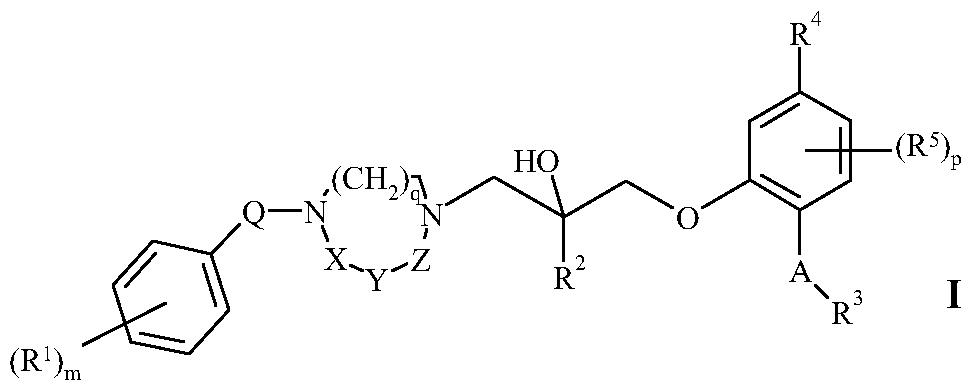
R1 is halogen or Ci-C6haloalkyl;
Q is -CH2- or -C(O)- ;
X, Y and Z are a bond, -CH2- or -C(O)-, provided that X, Y and Z are not all the same and that at least one of X, Y or Z is -C(O)-; q is 1 or 2;
R2 is hydrogen or C1-C4 alkyl;
A is a bond, -0-, or C1-C3 alkyl;
R3 is hydrogen, -NHC(O)R6, -NHS(O)2R6, -C(O)NR7R8, -COOR9, SO3R9 or Ci-C6 alkyl optionally substituted by t substituents independently selected from halogen, cyano, amino or hydroxyl; t is O, 1, 2 or 3;
R4 is hydrogen, halogen, hydroxyl, C1-C3 alkoxy or Ci-C6hydroxyalkyl optionally substituted by u substituents independently selected from halogen, cyano, amino, CONH2, hydroxyl, Ci-C6 haloalkyl, carboxyl, Ci-C6 alkoxy, Ci-C6 alkoxycarbonyl Or Ci-C6 alkylcarbonylamino; u is O, 1, 2 or 3; p is O, 1, 2 or 3;
R5 is halogen, cyano, C1-C3 alkoxy or Ci-C3haloalkyl;
R6 is (i) hydrogen; (ii) Ci-C6alkyl; (iii) a 3- to 6-membered saturated or unsaturated ring, optionally comprising one or more heteroatom selected from nitrogen, oxygen and sulphur, and optionally further comprising a bridging group, the ring being optionally
substituted with one or more substituent independently selected from halogen, hydroxyl, Ci-C6 alkyl, Ci-C6 hydroxyalkyl and Ci-C6 haloalkyl, -O- and -OR9; (iv) NR7R8;
R7 and R8 each independently represent; (i) hydrogen;
(ii) a 3- to 6-membered saturated or unsaturated ring, optionally comprising one or more heteroatom selected from nitrogen, oxygen and sulphur, and optionally further comprising a bridging group, the ring being optionally substituted with one or more substituent independently selected from halogen, hydroxyl, -0-, Ci-C6 alkyl, Ci-C6 hydroxyalkyl and Ci-C6 haloalkyl;
(iii) C3-C6 cycloalkyl, optionally substituted with one or more substituent independently selected from halogen, amino, hydroxyl, -0-, Ci-C6 haloalkyl, carboxyl, Ci-C6 alkoxy, Ci-C6 alkoxycarbonyl, Ci-C6 alkylcarbonylamino and a 3- to 6-membered saturated or unsaturated ring, optionally comprising one or more heteroatom selected from nitrogen, oxygen and sulphur, and optionally further comprising a bridging group, the ring being optionally substituted with one or more substituent independently selected from halogen, hydroxyl, -0-, Ci-C6 alkyl, Ci-C6 hydroxyalkyl and Ci-C6 haloalkyl; (iv) Ci-C6 alkylsulphonyl; or
(v) R7 and R8 together with the nitrogen atom to which they are attached form a 4- to 7- membered saturated heterocyclic ring that optionally further comprises a ring nitrogen, oxygen or sulphur atom and that is optionally fused to a benzene ring to form a 8- to 11- membered ring system, the heterocyclic ring or ring system being optionally substituted with one or more substituent independently selected from halogen, hydroxyl, CONH2, Ci-C6 alkyl, Ci-C6hydroxyalkyl, Ci-C6 alkoxy, Ci-C6 alkoxycarbonyl, Ci-C6 haloalkyl, Ci- C6alkylamino, Ci-C6alkylcarbonyl, Ci-C6 alkylcarbonylamino and Ci-C6 alkylaminocarbonyl; and
R9 is hydrogen or Ci-C6 alkyl; or a pharmaceutically acceptable salt thereof.
Another embodiment of the invention relates to compounds of formula I wherein: m is O or 1 ;
R1 is halogen or Ci-Cβhaloalkyl; Q is -CH2- or -C(O)-;
X, Y and Z are a bond, -CH2- or -C(O)-, provided that X, Y and Z are not all the same and that at least one of X, Y or Z is -C(O)-; q is 1 or 2;
R2 is hydrogen or C1-C4 alkyl;
A is a bond, -O- or C1-C3 alkyl;
R3 is hydrogen, -NHC(O)R6, -C(O)NR7R8 or Ci-C3 alkyl optionally substituted by t substituents independently selected from halogen, cyano, amino or hydroxyl; t is O, 1 or 2;
R4 is hydrogen, halogen, hydroxyl or Ci-C4alkoxy; p is O, 1 or 2;
R5 is halogen, cyano, C1-C3 alkoxy or Ci-C3haloalkyl;
R6 is (i) hydrogen or (ii) Ci-C4alkyl;
R7 and R8 each independently represent; (i) hydrogen;
(iii) C3-C6 cycloalkyl, optionally substituted with one or more substituent independently selected from halogen, amino, hydroxyl, -0-, Ci-C6 haloalkyl, carboxyl, Ci-C6 alkoxy, Ci-C6 alkoxycarbonyl and Ci-C6 alkylcarbonylamino; or
(v) R7 and R8 together with the nitrogen atom to which they are attached form a 4- to 7- membered saturated heterocyclic ring; or a pharmaceutically acceptable salt thereof.
A further embodiment of the invention relates to compounds of formula I wherein: wherein m is O or 1 ;
R1 is halogen;
Q is -CH2- or -C(O)- ;
X, Y and Z are a bond, -CH2- or -C(O)-, provided that X, Y and Z are not all the same and that at least one of X, Y or Z is -C(O)-; q is 1 or 2;
R2 is hydrogen;
A is a bond;
R3 is hydrogen, -NHC(O)R6 or -C(O)NR7R8;
R4 is hydrogen, halogen, hydroxyl or Ci -C3 alkoxy; p is 0 or 1 ;
R5 is halogen or cyano;
R6 is (i) hydrogen or (ii) Ci-C6alkyl;
R7 and R8 each independently represent; (i) hydrogen; (iii) C3-C6 cycloalkyl; or
(v) R7 and R8 together with the nitrogen atom to which they are attached form a 5- to 6- membered saturated heterocyclic ring; and or a pharmaceutically acceptable salt thereof.
In one embodiment of the invention m is 1 and R1 is halogen, particularly a chlorine atom or a fluorine atom. In another embodiment R1 is para-substituted on position 4.
In one embodiment of the invention Q is -CH2-. In another embodiment of the invention Q is -C(O)-.
In one embodiment X is bond, Y is CH2 and Z is C(O). In another embodiment X and Y are CH2 and Z is C(O). In a further embodiment X is C(O) and Y and Z are CH2. In yet another embodiment X and Y are a bond and Z is -C(O).
In one embodiment the integer q is 1. In another embodiment q is 2.
In one embodiment R4 is hydrogen, halogen, hydroxyl, Ci-Cδalkoxy or Ci-C6 hydroxyalkyl, optionally substituted with halogen, cyano, hydroxyl, carboxyl or amido. In another embodiment R4 is hydrogen. In yet another embodiment R4 is halogen such as fluorine. In one embodiment R4 is hydroxyl. In yet another embodiment R4 is C1-C4 alkoxy (e.g. methoxy, ethoxy, n-propoxy, isopropoxy, n-butoxy, isobutoxy or tert-butoxy). In a further embodiment R4 is methoxy.
In a further embodiment of the present invention, A is a bond and R3 is -NHC(O)R6 or - C(O)NR7R8.
In one embodiment R6 is selected from hydrogen.
In another embodiment R6 is a C1-C4 alkyl (e.g. methyl, ethyl, n-propyl, isopropyl, n-butyl, isobutyl or tert-butyl). In a particular embodiment of the present invention R6 is methyl.
In one embodiment R7 and R8 independently present a hydrogen, cyclopropyl, cyclobutyl, cyclopentyl, cyclohexyl, or R7 and R8 together with the nitrogen atom to which they are attached form a 5- to 6-membered heterocyclic ring. In one embodiment R7 is hydrogen and R8 is cyclopropyl. In yet a further embodiment R7 and R8 form a pyrrolidine together with the nitrogen atom to which they are attached.
In yet another embodiment of the present invention the integer p is 0, 1 or 2. In one embodiment p is 0. In yet another embodiment p is 1.
In one embodiment p is 1 and R5 is a halogen, such as chlorine and fluorine. In another embodiment of the present invention p is 1 and R5 is cyano.
For the avoidance of doubt the present invention relates to any one of compounds falling within the scope of formula I as defined above.
For the avoidance of doubt it is to be understood that where in this specification a group is qualified by 'hereinbefore defined', 'defined hereinbefore' or 'defined above' the said group encompasses the first occurring and broadest definition as well as each and all of the other definitions for that group.
For the avoidance of doubt it is to be understood that in this specification 'Ci-C 6' means a carbon group having 1, 2, 3, 4, 5 or 6 carbon atoms.
In this specification, unless stated otherwise, the term "alkyl" includes both straight and branched chain alkyl groups and may be, but are not limited to methyl, ethyl, n-propyl, i- propyl, n-butyl, i-butyl, s-butyl, t-butyl, n-pentyl, i-pentyl, neo-pentyl, n-hexyl or i-hexyl.
The term Ci-C 4 alkyl having 1 to 4 carbon atoms and may b,e but are not limited to, methyl, ethyl, n-propyl, i-propyl, butyl or tert-butyl.
The term "alkoxy" and "hydroxyalkyl", unless stated otherwise, refers to radicals of the general formula -O-R, wherein R is selected from a hydrocarbon radical. The term "alkoxy" may include, but is not limited to methoxy, ethoxy, propoxy, isopropoxy, butoxy, t-butoxy, isobutoxy, cyclopropylmethoxy, allyloxy or propargyloxy. The term 'hydroxyalkyl' may also include alkyl groups as defined above substituted by one or more hydroxyl groups.
In this specification, unless stated otherwise, the term "cycloalkyl" refers to an optionally substituted, partially or completely saturated monocyclic, bicyclic or bridged hydrocarbon ring system. The term "Ci-C 6cycloalkyl" may be, but is not limited to cyclopropyl, cyclobutyl, cyclopentyl or cyclohexyl.
In this specification, unless stated otherwise, the term "3- to 6-membered saturated or unsaturated ring' or '4- to 7-membered saturated or unsaturated heterocyclic ring' or '8- to 11-membered ring system', optionally comprising one or more heteroatom selected from nitrogen, oxygen and sulphur, refers to a ringsystem having, in addition to carbon atoms, zero to three heteroatoms, including the oxidized form of nitrogen and sulfur and any quaternized form of a basic nitrogen, including, but not limited to cyclopropane, oxirane, cyclobutane, azetidine, cyclopentane, cyclohexane, benzyl, furane, thiophene, pyrrolidine, morpholine, piperidine, piperazine, pyrazine, azepane.
In this specification, unless stated otherwise, the term "bicyclic ring" refers to a ringsystem in which one (carbo)cycle is fused to another (carbo)cycle. The term "ringsystem" refers to a hydrocarbon moiety comprising one to three fused rings, optionally having 6, 10 or 14 π atoms shared in a cyclic array and having, in addition to carbon atoms, zero to five heteroatoms. Fused ringsystems may include, but are not limited to, 8- azabicyclo[3.2.1]octane, 3-azabicyclo[3.2.1]octane, 2-azabicyclo[2.2.2]octane, indole, indoline, benzofuran, benzothiophene, naphtalene, chroman, quinazoline, phenoxazine, azulene, adamantane, anthracene or phenoxazine.
In this specification, unless stated otherwise, the terms "halo" and "halogen" may be fluorine, iodine, chlorine or bromine.
In this specification, unless stated otherwise, the term "haloalkyl" means an alkyl group as defined above, which is substituted with halogen as defined above. The term "C1- Cehaloalkyl" may include, but is not limited to fluoromethyl, difluoromethyl, trifluoromethyl, fluoroethyl, difluoroethyl or bromopropyl
It will be appreciated that throughout the specification, the number and nature of substituents on rings in the compounds of the invention will be selected so as to avoid sterically undesirable combinations.
In another embodiment of the present invention the compound of formula I is selected from
N-(2- {3-[4-(4-chlorobenzyl)-2-oxopiperazin- 1 -yl]-2-hydroxypropoxy} phenyl) acetamide,
Λ/-[2-({(25)-3-[4-(4-fluorobenzyl)-2-oxopiperazin-l-yl]-2-hydroxypropyl}oxy)-4- methoxypheny 1] acetamide ,
Λ/-[2-({(25)-3-[4-(4-fluorobenzyl)-2-oxopiperazin-l-yl]-2-hydroxypropyl}oxy)-4- hy droxypheny 1] acetamide ,
N-[2-({(25)-3-[4-(4-chlorobenzyl)-2-oxopiperazin-l-yl]-2- hydroxypropyl}oxy)phenyl]acetamide,
Λ/-[2-({(25)-3-[4-(4-chlorobenzyl)-2-oxopiperazin-l-yl]-2-hydroxypropyl}oxy)-4- methoxypheny 1] acetamide ,
Λ/-[2-({(25)-3-[4-(4-chlorobenzyl)-2-oxopiperazin-l-yl]-2-hydroxypropyl}oxy)-4- hy droxypheny 1] acetamide ,
Λ/-[2-({(25)-3-[4-(4-chlorobenzyl)-2-oxopiperazin-l-yl]-2-hydroxypropyl}oxy)-4- methoxypheny 1] acetamide ,
Λ/-[2-({(2i?)-3-[4-(4-chlorobenzyl)-2-oxopiperazin-l-yl]-2-hydroxypropyl}oxy)-4- hy droxypheny 1] acetamide ,
7V-[5-chloro-2-( {(25)-3-[4-(4-chlorobenzyl)-2-oxopiperazin- 1 -yl]-2-hydroxypropyl} oxy)-
4-methoxyphenyl]acetamide,
7V-[5-chloro-2-( {(2i?)-3-[4-(4-chlorobenzyl)-2-oxopiperazin- 1 -yl]-2-hydroxypropyl} oxy)-
4-hydroxyphenyl]acetamide,
Λ/-[5-cyano-2-({(2i?)-3-[4-(4-chlorobenzyl)-2-oxopiperazin-l-yl]-2-hydroxypropyl}oxy)- phenyl]acetamide,
5-Chloro-2( {(2S)-3-[4-(4-chlorobenzyl)-2-oxopiperazin- 1 -yl]-2-hydroxypropyl} oxy)-N- cyclopropylbenzamide,
4-(4-chlorobenzyl)- 1 - {3-[4-chloro-2-(pyrrolidin- 1 -ylcarbonyl)phenoxy]-2- hydroxypropyl}piperazin-2-one,
N-(2- {3-[4-(4-Chlorobenzoyl)-2-oxopiperazin- 1 -yl]-2-hydroxypropoxy} - phenyl)acetamide, or a pharmaceutically acceptable salt thereof.
In one embodiment of the present invention the compound of formula I is selected from
N-(2- {3-[4-(4-Chloro-benzyl)-7-oxo-[ 1 ,4]diazepan- 1 -yl]-2-hydroxy-propoxy} -phenyl)- acetamide,
2- {3-[4-(4-Chloro-benzyl)-5-oxo-[ 1 ,4]diazepan-l -yl]-2-hydroxy-propoxy} -7V-cyclopropyl-
4-fiuoro-benzamide,
Λ/-(2-{3-[4-(4-Choloro-benzyl)-5-oxo-[l,4]diazepan-l-yl]-2-hydroxy-propoxy}-4- hydroxy-phenyl)-acetamide, or a pharmaceutically acceptable salt thereof.
In yet another embodiment of the present invention the compound of formula I is selected from
7V-(5-chloro-2- {3-[3-(4-chlorobenzyl)-2-oxotetrahydropyrimidin- 1 (2H)-yl]-2- hydroxypropoxy}-4-methoxyphenyl)acetamide,
N-(2- {3-[3-(4-chlorobenzyl)-2-oxotetrahydropyrimidin- 1 (2H)-yl]-2- hydroxypropoxy}phenyl)acetamide,
N-[2-({(25)-3-[3-(4-chlorobenzyl)-2-oxotetrahydropyrimidin-l(2H)-yl]-2- hydroxypropyl] oxy } -4-hydroxyphenyl)acetamide,
N-[2-({(25)-3-[3-(4-chlorobenzyl)-2-oxotetrahydropyrimidin-l(2H)-yl]-2- hydroxypropyl]oxy}-4-methoxyphenyl)acetamide, or a pharmaceutically acceptable salt thereof.
In one embodiment of the present invention the compound of formula I is selected from
Λ/-(2-{3-[3-(4-chlorobenzyl)-2-oxoimidazolidin-l-yl]-2- hydroxypropoxy}phenyl)acetamide, or a pharmaceutically acceptable salt thereof.
For the avoidance of doubt the present invention relates to any one of the specific compounds mentioned above.
The compounds of formula I are capable of existing in stereoisomeric forms. It will be understood that the invention encompasses the use of all geometric and optical isomers of the compounds of formula I and mixtures thereof including racemates. The use of tautomers and mixtures thereof also form an aspect of the present invention. Thus, compounds of formula I or relevant intermediates can be prepared as an enantiomeric mixture of the R and S enantiomers and optionally separated to provide both the R and S compounds.
It will be appreciated that the compounds of formula I and salts may exist as zwitterions. Thus, whilst the compounds are drawn and referred to in the neutral form, they may exist also in internal salt (zwitterionic) form. The representation of formula I and the examples of the present invention covers both neutral and zwitterionic forms and mixtures thereof in all proportions.
The compounds of formula I may be used in the form of a pharmaceutically acceptable salt, solvates or solvated salts thereof, conceivably an acid addition salt such as a hydrochloride, hydrobromide, phosphate, sulfphate, acetate, ascorbate, benzoate, 2- fluorobenzoate, 2,6-difluorobenzoate, (hemi)fumarate, furoate, succinate, maleate, tartrate, citrate, oxalate, xinafoate, methanesulphonate or/?-toluenesulphonate. Pharmaceutically acceptable salts may also be formed together with metals such as calcium, magnesium, sodium, potassium or zinc or bases such as piperazine, 2-aminoethanol, choline, diethylamine or diethanol amine. Furthermore, the compounds of formula I may be used in the form of a pharmaceutically acceptable salt, solvates or solvated salts thereof, like an amino acid addition salt such as L-lysine, glycine, L-glutamine, L-asparagine or L- arganine. A pharmaceutically acceptable salt also includes internal salt (zwitterionic)
forms. Any reference to compounds of formula I or salts thereof also encompasses solvates of such compounds and solvates of such salts (e.g. hydrates).
Certain intermediates that are usefull for the making of the compounds of formula I may be synthesised using the procedures set out in WOO 1/098273 and WO04/005295
Thus, the present invention further provides a process for the preparation of a compound of formula I or a pharmaceutically acceptable salt thereof as defined above which comprises: (a) reacting a compound of formula II


(c) reacting a compound of formula VI
 wherein R » 1 , τ Ri 2 , Q, X, Y and Z and integers m and q are as defined in formula I, with a compound of formula VII


X.
Y' II wherein X, Y and Z and integer q are as defined in formula I and P1 is a hydrogen or a suitable leaving group; or (f) reacting a compound of formula IX


and therafter, if desired or necessary, carrying out one or more of the following steps I converting a compound of formula I obtained to a different compound of formula I;
(ii) removing of any protecting groups; and
(iii) forming a pharmaceutically acceptable salt and/or polymorph of the compound of formula I.
As will be apparent to a person skilled in the art, following the epoxide opening of intermediates like VI with the phenol or IX with amine, will produce an enantiomeric mixture of R and S, which can be separated to provide both the R and S enantiomer of compounds of formula I.
Process (a) - (e) may conveniently be carried out in a suitable solvent, e.g. water or an organic solvent selected from alcohol (e.g. methanol or ethanol), a hydrocarbon (e.g. toluene), cyanides (e.g. acetonitrile or butyronitrile), ethers (THF, dioxane), NMP, DCM or DMF at a temperature of, for example 20 0C or above, such as a temperature in the range from 25-150 0C. In the event of a biphasic system, a person skilled in the art would include a suitable phase transfer catalyst, such as tetrabutylammonium hydrosulfate or tetrabutylammonium iodide.
In processes (a), (b), (c) and (d), the choice of a suitable base would be routine for a person skilled in the art, and would include both organic bases, such as trietylamine, DIPEA and KHMDS and inorganic bases, such as potassium or cesium carbonate and sodium hydroxide.
As will be apparent to a person skilled in the art, that in the processes of the present invention certain functional groups such as carboxyl, hydroxyl, or amino groups in the starting reagents or intermediate compounds may need to be protected by protecting groups. Thus, the preparation of the compounds of formula I may involve, at an appropriate stage, the introduction or removal of one or more protecting groups. The protection and deprotection of functional groups is described in 'Protective Groups in Organic Chemistry', edited by J.W.F. McOmie, Plenum Press (1973) and 'Protective Groups in Organic Synthesis', 3rd edition, T. W. Greene and P.G.M. Wuts, Wiley- Interscience (1999).
Intermediates of the formula IV and formula VI and salts thereof are novel and comprise a further embodiment of the invention.
Another embodiment of the invention relates to compounds selected from
4-(4-chlorobenzyl)- 1 -(oxiran-2-ylmethyl)piperazin-2-one;
4-(4-chlorobenzyl)- 1 -[(25)-oxiran-2-ylmethyl]piperazin-2-one;
4-(4-chlorobenzyl)- 1 -[(2i?)-oxiran-2-ylmethyl]piperazin-2-one;
4-(4-fluorobenzyl)piperazine-2-one;
4-(4-fluorobenzyl)- 1 -[(25)-oxiran-2-ylmethyl]piperazin-2-one;
4-(4-chlorobenzoyl)- 1 -(oxiran-2-ylmethyl)piperazin-2-one;
1 -(4-chloro-benzyl)-4-oxiranylmethyl-[ 1 ,4]diazepan-5-one;
4-(4-chloro-benzyl)-5-oxo-[l,4]diazepane-l-carboxylic acid t-butyl ester;
4-(4-chloro-benzyl)-[l,4]diazepan-5-one; l-(4-chloro-benzyl)-4-[(2S)-oxiran-2-ylmethyl]-l,4-diazepan-5-one
1 -(4-chlorobenzyl)-3 -(oxiran-2ylmethyl)tetrahydropyrimidin-2( 1 H)-one; and l-(4-chlorobenzyl)-3-(oxiran-2ylmethyl)imidazolidin-2-one.
Another embodiment related to the use of these compounds as intermediates in the preparation of compounds of formula I.
Pharmaceutical composition
The active ingredients of the present invention may be administered by oral or parenteral (e.g. intravenous, subcutaneous, intramuscular or intraarticular) administration using conventional systemic dosage forms, such as tablets, capsules, pills, powders, aqueous or oily solutions or suspensions, emulsions and sterile injectable aqueous or oily solutions or suspensions. The active ingredients may also be administered topically (e.g. to the lung and/or airways) in the form of solutions, suspensions, aerosols and dry powder formulations. These dosage forms will usually include one or more pharmaceutically acceptable ingredients which may be selected, for example, from adjuvants, carriers, binders, lubricants, diluents, stabilising agents, buffering agents, emulsifying agents, viscosity-regulating agents, surfactants, preservatives, flavourings and colorants. As will be understood by those skilled in the art, the most appropriate method of administering the active ingredients is dependent on a number of factors.
One embodiment relates to a pharmaceutical composition comprising a compound of formula I or (Ia), or pharmaceutically acceptable salt thereof in admixture with pharmaceutically acceptable adjuvant, diluent or carrier.
The pharmaceutical compositions of the present invention may be prepared by mixing the active ingredient with a pharmaceutically acceptable adjuvant, diluent or carrier. Therefore, in a further aspect of the present invention there is provided a process for the preparation of a pharmaceutical composition, which comprises mixing a compound of formula I or (Ia), or pharmaceutically acceptable salt thereof, with a pharmaceutically acceptable adjuvant, diluent or carrier.
In one embodiment of the present invention, the active ingredient of the present invention is administered by inhalation.
The active ingredient is conveniently administered via inhalation (e.g. topically to the lung and/or airways) in the form of solutions, suspensions, aerosols or dry powder formulations. Administration may be by inhalation orally or intranasally. The active ingredient is preferably adapted to be administered, from a dry powder inhaler, pressurised metered dose inhaler, or a nebuliser.
The active ingredient may be used in admixture with one or more pharmaceutically acceptable additives, diluents or carriers. Examples of suitable diluents or carriers include lactose (e.g. the monohydrate), dextran, mannitol or glucose.
Metered dose inhaler devices may be used to administer the active ingredients, dispersed in a suitable propellant and with or without additional excipients such as ethanol, a surfactant, a lubricant, an anti-oxidant or a stabilising agent. Suitable propellants include hydrocarbon, chlorofiuorocarbon and hydrofiuoroalkane (e.g. heptafiuoroalkane) propellants, or mixtures of any such propellants. Preferred propellants are P 134a and P227, each of which may be used alone or in combination with other propellants and/or surfactant and/or other excipients. Nebulised aqueous suspensions, solutions may also be employed, with or without a suitable pH and/or tonicity adjustment, either as a unit-dose or multi-dose formulations.
Dry powder inhalers may be used to administer the active ingredients, alone or in combination with a pharmaceutically acceptable carrier, in the later case either as a finely divided powder or as an ordered mixture. The dry powder inhaler may be single dose or multi-dose and may utilise a dry powder or a powder-containing capsule.
When the active ingredient is adapted to be administered, via a nebuliser it may be in the form of a nebulised aqueous suspension or solution, with or without a suitable pH or tonicity adjustment, either as a single dose or multidose device.
Metered dose inhaler, nebuliser and dry powder inhaler devices are well known and a variety of such devices are available.
In one embodiment the present invention provides a pharmaceutical product comprising, an active ingredient which is a compound of formula I or (Ia), or a pharmaceutically acceptable salt thereof, formulated for inhaled administration. In an embodiment of the present invention, the compound of formula I or (Ia), or a pharmaceutically acceptable salt thereof, may be administered orally.
Medical use
The compounds of formula I or (Ia), salts and solvates thereof, have activity as pharmaceuticals, and are surprisingly potent modulators of chemokine receptor (especially CCRl receptor) activity, and may be used in the treatment of autoimmune, inflammatory, proliferative and hyperproliferative diseases and immunologically-mediated diseases.
A compound of the invention, or a pharmaceutically acceptable salt thereof, can be used in the treatment of:
A compound of the invention, can be used in the treatment of:
1. respiratory tract: obstructive diseases of the airways including: asthma, including bronchial, allergic, intrinsic, extrinsic, exercise-induced, drug-induced (including aspirin and NSAID-induced) and dust-induced asthma, both intermittent and persistent and of all severities, and other causes of airway hyper-responsiveness; chronic obstructive
pulmonary disease (COPD); bronchitis, including infectious and eosinophilic bronchitis; emphysema; bronchiectasis; cystic fibrosis; sarcoidosis; farmer's lung and related diseases; hypersensitivity pneumonitis; lung fibrosis, including cryptogenic fibrosing alveolitis, idiopathic interstitial pneumonias, fibrosis complicating anti-neoplastic therapy and chronic infection, including tuberculosis and aspergillosis and other fungal infections; complications of lung transplantation; vasculitic and thrombotic disorders of the lung vasculature, and pulmonary hypertension; antitussive activity including treatment of chronic cough associated with inflammatory and secretory conditions of the airways, and iatrogenic cough; acute and chronic rhinitis including rhinitis medicamentosa, and vasomotor rhinitis; perennial and seasonal allergic rhinitis including rhinitis nervosa (hay fever); nasal polyposis; acute viral infection including the common cold, and infection due to respiratory syncytial virus, influenza, coronavirus (including SARS) and adenovirus; 2. bone and joints: arthritides associated with or including osteoarthritis/osteoarthrosis, both primary and secondary to, for example, congenital hip dysplasia; cervical and lumbar spondylitis, and low back and neck pain; rheumatoid arthritis and Still's disease; seronegative spondyloarthropathies including ankylosing spondylitis, psoriatic arthritis, reactive arthritis and undifferentiated spondarthropathy; septic arthritis and other infection- related arthopathies and bone disorders such as tuberculosis, including Potts' disease and Poncet's syndrome; acute and chronic crystal-induced synovitis including urate gout, calcium pyrophosphate deposition disease, and calcium apatite related tendon, bursal and synovial inflammation; Behcet's disease; primary and secondary Sjogren's syndrome; systemic sclerosis and limited scleroderma; systemic lupus erythematosus, mixed connective tissue disease, and undifferentiated connective tissue disease; inflammatory myopathies including dermatomyositits and polymyositis; polymalgia rheumatica; juvenile arthritis including idiopathic inflammatory arthritides of whatever joint distribution and associated syndromes, and rheumatic fever and its systemic complications; vasculitides including giant cell arteritis, Takayasu's arteritis, Churg-Strauss syndrome, polyarteritis nodosa, microscopic polyarteritis, and vasculitides associated with viral infection, hypersensitivity reactions, cryoglobulins, and paraproteins; low back pain; Familial Mediterranean fever, Muckle -Wells syndrome, and Familial Hibernian Fever, Kikuchi disease; drug-induced arthalgias, tendonititides, and myopathies;
3. pain and connective tissue remodelling of musculoskeletal disorders due to injury [for example sports injury] or disease: arthitides (for example rheumatoid arthritis, osteoarthritis, gout or crystal arthropathy), other joint disease (such as intervertebral disc degeneration or temporomandibular joint degeneration), bone remodelling disease (such as osteoporosis, Paget's disease or osteonecrosis), polychondritits, scleroderma, mixed connective tissue disorder, spondyloarthropathies or periodontal disease (such as periodontitis);
4. skin: psoriasis, atopic dermatitis, contact dermatitis or other eczematous dermatoses, and delayed-type hypersensitivity reactions; phyto- and photodermatitis; seborrhoeic dermatitis, dermatitis herpetiformis, lichen planus, lichen sclerosus et atrophica, pyoderma gangrenosum, skin sarcoid, discoid lupus erythematosus, pemphigus, pemphigoid, epidermolysis bullosa, urticaria, angioedema, vasculitides, toxic erythemas, cutaneous eosinophilias, alopecia areata, male-pattern baldness, Sweet's syndrome, Weber-Christian syndrome, erythema multiforme; cellulitis, both infective and non-infective; panniculitis;cutaneous lymphomas, non-melanoma skin cancer and other dysplastic lesions; drug-induced disorders including fixed drug eruptions;
5. eyes: blepharitis; conjunctivitis, including perennial and vernal allergic conjunctivitis; iritis; anterior and posterior uveitis; choroiditis; autoimmune; degenerative or inflammatory disorders affecting the retina; ophthalmitis including sympathetic ophthalmitis; sarcoidosis; infections including viral , fungal, and bacterial;
6. gastrointestinal tract: glossitis, gingivitis, periodontitis; oesophagitis, including reflux; eosinophilic gastro-enteritis, mastocytosis, Crohn's disease, colitis including ulcerative colitis, proctitis, pruritis ani; coeliac disease, irritable bowel syndrome, and food-related allergies which may have effects remote from the gut (for example migraine, rhinitis or eczema);
7. abdominal: hepatitis, including autoimmune, alcoholic and viral; fibrosis and cirrhosis of the liver; cholecystitis; pancreatitis, both acute and chronic;
8. genitourinary: nephritis including interstitial and glomerulonephritis; nephrotic syndrome; cystitis including acute and chronic (interstitial) cystitis and Hunner's ulcer; acute and chronic urethritis, prostatitis, epididymitis, oophoritis and salpingitis; vulvovaginitis; Peyronie's disease; erectile dysfunction (both male and female);
9. allograft rejection: acute and chronic following, for example, transplantation of kidney, heart, liver, lung, bone marrow, skin or cornea or following blood transfusion; or chronic graft versus host disease;
10. CNS: Alzheimer's disease and other dementing disorders including CJD and nvCJD; amyloidosis; multiple sclerosis and other demyelinating syndromes; cerebral atherosclerosis and vasculitis; temporal arteritis; myasthenia gravis; acute and chronic pain (acute, intermittent or persistent, whether of central or peripheral origin) including visceral pain, headache, migraine, trigeminal neuralgia, atypical facial pain, joint and bone pain, pain arising from cancer and tumor invasion, neuropathic pain syndromes including diabetic, post-herpetic, and HIV-associated neuropathies; neurosarcoidosis; central and peripheral nervous system complications of malignant, infectious or autoimmune processes;
11. other auto-immune and allergic disorders including Hashimoto's thyroiditis, Graves' disease, Addison's disease, diabetes mellitus, idiopathic thrombocytopaenic purpura, eosinophilic fasciitis, hyper-IgE syndrome, antiphospholipid syndrome;
12. other disorders with an inflammatory or immunological component; including acquired immune deficiency syndrome (AIDS), leprosy, Sezary syndrome, and paraneoplastic syndromes;
13. cardiovascular: atherosclerosis, affecting the coronary and peripheral circulation; pericarditis; myocarditis , inflammatory and auto-immune cardiomyopathies including myocardial sarcoid; ischaemic reperfusion injuries; endocarditis, valvulitis, and aortitis including infective (for example syphilitic); vasculitides; disorders of the proximal and peripheral veins including phlebitis and thrombosis, including deep vein thrombosis and complications of varicose veins;
14. oncology: treatment of common cancers including prostate, breast, lung, ovarian, pancreatic, bowel and colon, stomach, skin and brain tumors and malignancies affecting the bone marrow (including the leukaemias) and lymphoproliferative systems, such as Hodgkin's and non-Hodgkin's lymphoma; including the prevention and treatment of metastatic disease and tumour recurrences, and paraneoplastic syndromes; and,
15. gastrointestinal tract: Coeliac disease, proctitis, eosinopilic gastro-enteritis, mastocytosis, Crohn's disease, ulcerative colitis, microscopic colitis, indeterminant colitis, irritable bowel disorder, irritable bowel syndrome, non-inflammatory diarrhea, food-
related allergies which have effects remote from the gut, e.g., migraine, rhinitis and eczema.
Combination therapies
The invention further relates to combination therapies wherein a compound of the invention, or a pharmaceutical composition or composition comprising a compound of the invention, is administered concurrently or sequentially or as a combined preparation with another therapeutic agent or agents, for the treatment of one or more of the conditions listed.
In particular, for the treatment of the inflammatory diseases such as (but not restricted to) rheumatoid arthritis, osteoarthritis, asthma, allergic rhinitis, chronic obstructive pulmonary disease (COPD), psoriasis, and inflammatory bowel disease, the compounds of the invention may be combined with agents listed below; non-steroidal anti-inflammatory agents (hereinafter NSAIDs) including non-selective cyclo-oxygenase COX-I / COX-2 inhibitors whether applied topically or systemically (such as piroxicam, diclofenac, propionic acids such as naproxen, flurbiprofen, fenoprofen, ketoprofen and ibuprofen, fenamates such as mefenamic acid, indomethacin, sulindac, azapropazone, pyrazolones such as phenylbutazone, salicylates such as aspirin); selective COX-2 inhibitors (such as meloxicam, celecoxib, rofecoxib, valdecoxib, lumarocoxib, parecoxib and etoricoxib); cyclo-oxygenase inhibiting nitric oxide donors (CINODs); glucocorticosteroids (whether administered by topical, oral, intramuscular, intravenous, or intra-articular routes); methotrexate; leflunomide; hydroxychloroquine; d-penicillamine; auranofin or other parenteral or oral gold preparations; analgesics; diacerein; intra-articular therapies such as hyaluronic acid derivatives; and nutritional supplements such as glucosamine.
The present invention still further relates to the combination of a compound of the invention, together with a cytokine or agonist or antagonist of cytokine function, (including agents which act on cytokine signalling pathways such as modulators of the SOCS system) including alpha-, beta-, and gamma- interferons; insulin-like growth factor type I (IGF-I); interleukins (IL) including ILl to 17, and interleukin antagonists or inhibitors such as
anakinra; tumour necrosis factor alpha (TNF-α) inhibitors such as anti-TNF monoclonal antibodies (for example infliximab; adalimumab, and CDP-870) and TNF receptor antagonists including immunoglobulin molecules (such as etanercept) and low-molecular- weight agents such as pentoxyfylline.
In addition the invention relates to a combination of a compound of the invention, with a monoclonal antibody targeting B-Lymphocytes (such as CD20 (rituximab), MRA-aIL16R and T-Lymphocytes, CTLA4-Ig, HuMax 11-15).
The present invention still further relates to the combination of a compound of the invention, with a modulator of chemokine receptor function such as an antagonist of CCR2, CCR2A, CCR2B, CCR3, CCR4, CCR5, CCR6, CCR7, CCR8, CCR9, CCRlO and CCRl 1 (for the C-C family); CXCRl, CXCR2, CXCR3, CXCR4 and CXCR5 (for the C- X-C family) and CX3CRl for the C-X3-C family.
The present invention further relates to the combination of a compound of the invention, with an inhibitor of matrix metalloprotease (MMPs), i.e., the stromelysins, the collagenases, and the gelatinases, as well as aggrecanase; especially collagenase-1 (MMP- 1), collagenase-2 (MMP-8), collagenase-3 (MMP- 13), stromelysin-1 (MMP-3), stromelysin-2 (MMP-IO), and stromelysin-3 (MMP-11) and MMP-9 and MMP- 12, including agents such as doxycycline.
The present invention still further relates to the combination of a compound of the invention, and a leukotriene biosynthesis inhibitor, 5 -lipoxygenase (5-LO) inhibitor or 5- lipoxygenase activating protein (FLAP) antagonist such as; zileuton; ABT-761; fenleuton; tepoxalin; Abbott-79175; Abbott-85761; a N-(5-substituted)-thiophene-2- alkylsulfonamide; 2,6-di-tert-butylphenolhydrazones; a methoxytetrahydropyrans such as Zeneca ZD-2138; the compound SB-210661; a pyridinyl-substituted 2-cyanonaphthalene compound such as L-739,010; a 2-cyanoquinoline compound such as L-746,530; or an indole or quinoline compound such as MK-591, MK-886, and BAY x 1005.
The present invention further relates to the combination of a compound of the invention, and a receptor antagonist for leukotrienes (LT) B4, LTC4, LTD4, and LTE4. selected from the group consisting of the phenothiazin-3-ls such as L-651,392; amidino compounds such as CGS-25019c; benzoxalamines such as ontazolast; benzenecarboximidamides such as BIIL 284/260; and compounds such as zafirlukast, ablukast, montelukast, pranlukast, verlukast (MK-679), RG-12525, Ro-245913, iralukast (CGP 45715A), and BAY x 7195.
The present invention still further relates to the combination of a compound of the invention, and a phosphodiesterase (PDE) inhibitor such as a methylxanthanine including theophylline and aminophylline; a selective PDE isoenzyme inhibitor including a PDE4 inhibitor an inhibitor of the isoform PDE4D, or an inhibitor of PDE5.
The present invention still further relates to the combination of a compound of the invention, and an endothelin antagonist such as Tezosentan, Bosentan, Enrasentan, and Sixtasentan.
The present invention still further relates to the combination of a compound of the invention, and an angiotensin II antagonist such as Azilzartan, Losartan, Valsartan, Candesartan, and Telmisartan.
The present invention still further relates to the combination of a compound of the invention, or a pharmacuetically acceptable salt thereof, and a dual antagonists for both angiotensin II and endothelin A receptors (DARAs) such as disclosed in WO2000001389 and WO2001044239.
The present invention further relates to the combination of a compound of the invention, and an adenosine A2a agonist such as CGS-21680 and/or an adenosine A3 agonist such as IB-MECA and/or an adenosine A2b antagonist.
The present invention further relates to the combination of a compound of the invention, and a histamine type 1 receptor antagonist such as cetirizine, loratadine, desloratadine, fexofenadine, acrivastine, terfenadine, astemizole, azelastine, levocabastine,
chlorpheniramine, promethazine, cyclizine, or mizolastine; applied orally, topically or parenterally.
The present invention still further relates to the combination of a compound of the invention, and a proton pump inhibitor (such as omeprazole) or a gastroprotective histamine type 2 receptor antagonist.
The present invention further relates to the combination of a compound of the invention, and an antagonist of the histamine type 4 receptor.
The present invention still further relates to the combination of a compound of the invention, and an alpha- l/alpha-2 adrenoceptor agonist vasoconstrictor sympathomimetic agent, such as propylhexedrine, phenylephrine, phenylpropanolamine, ephedrine, pseudoephedrine, naphazoline hydrochloride, oxymetazoline hydrochloride, tetrahydrozoline hydrochloride, xylometazoline hydrochloride, tramazoline hydrochloride or ethylnorepinephrine hydrochloride.
The present invention further relates to the combination of a compound of the invention, and an anticholinergic agents including muscarinic receptor (Ml, M2, and M3) antagonist such as atropine, hyoscine, glycopyrrrolate, ipratropium bromide, tiotropium bromide, oxitropium bromide, pirenzepine or telenzepine.
The present invention still further relates to the combination of a compound of the invention, and a beta-adrenoceptor agonist (including beta receptor subtypes 1-4) such as isoprenaline, salbutamol, formoterol, salmeterol, terbutaline, orciprenaline, bitolterol mesylate, or pirbuterol, or a chiral enantiomer thereof.
The present invention further relates to the combination of a compound of the invention, and a chromone, such as sodium cromoglycate or nedocromil sodium.
The present invention still further relates to the combination of a compound of the invention, with a glucocorticoid, such as flunisolide, triamcinolone acetonide,
beclomethasone dipropionate, budesonide, fluticasone propionate, ciclesonide or mometasone furoate.
The present invention further relates to the combination of a compound of the invention, with an agent that modulates a nuclear hormone receptor such as PPARs.
The present invention still further relates to the combination of a compound of the invention, together with an immunoglobulin (Ig) or Ig preparation or an antagonist or antibody modulating Ig function such as anti-IgE (for example omalizumab).
The present invention further relates to the combination of a compound of the invention, and another systemic or topically-applied anti-inflammatory agent, such as thalidomide or a derivative thereof, a retinoid, dithranol or calcipotriol.
The present invention still further relates to the combination of a compound of the invention, and combinations of aminosalicylates and sulfapyridine such as sulfasalazine, mesalazine, balsalazide, and olsalazine; and immunomodulatory agents such as the thiopurines, and corticosteroids such as budesonide.
The present invention further relates to the combination of a compound of the invention, together with an antibacterial agent such as a penicillin derivative, a tetracycline, a macrolide, a beta-lactam, a fluoroquinolone, metronidazole, an inhaled aminoglycoside; an antiviral agent including acyclovir, famciclovir, valaciclovir, ganciclovir, cidofovir, amantadine, rimantadine, ribavirin, zanamavir and oseltamavir; a protease inhibitor such as indinavir, nelfinavir, ritonavir, and saquinavir; a nucleoside reverse transcriptase inhibitor such as didanosine, lamivudine, stavudine, zalcitabine or zidovudine; or a non-nucleoside reverse transcriptase inhibitor such as nevirapine or efavirenz.
The present invention still further relates to the combination of a compound of the invention, and a cardiovascular agent such as a calcium channel blocker, a beta- adrenoceptor blocker, an angiotensin-converting enzyme (ACE) inhibitor, an angiotensin-2 receptor antagonist; a lipid lowering agent such as a statin or a fibrate; a modulator of
blood cell morphology such as pentoxyfylline; thrombolytic, or an anticoagulant such as a platelet aggregation inhibitor.
The present invention further relates to the combination of a compound of the invention, and a CNS agent such as an antidepressant (such as sertraline), an anti-Parkinsonian drug (such as deprenyl, L-dopa, ropinirole, pramipexole, a MAOB inhibitor such as selegine and rasagiline, a comP inhibitor such as tasmar, an A-2 inhibitor, a dopamine reuptake inhibitor, an NMDA antagonist, a nicotine agonist, a dopamine agonist or an inhibitor of neuronal nitric oxide synthase), or an anti- Alzheimer's drug such as donepezil, rivastigmine, tacrine, a COX-2 inhibitor, propentofylline or metrifonate.
The present invention still further relates to the combination of a compound of the invention, and an agent for the treatment of acute or chronic pain, such as a centrally or peripherally-acting analgesic (for example an opioid or derivative thereof), carbamazepine, phenytoin, sodium valproate, amitryptiline or other anti-depressant agent-s, paracetamol, or a non-steroidal anti-inflammatory agent.
The present invention further relates to the combination of a compound of the invention, together with a parenterally or topically-applied (including inhaled) local anaesthetic agent such as lignocaine or a derivative thereof.
A compound of the present invention, can also be used in combination with an anti- osteoporosis agent including a hormonal agent such as raloxifene, or a biphosphonate such as alendronate.
The present invention still further relates to the combination of a compound of the invention, together with a: (i) tryptase inhibitor; (ii) platelet activating factor (PAF) antagonist; (iii) interleukin converting enzyme (ICE) inhibitor; (iv) IMPDH inhibitor; (v) adhesion molecule inhibitors including VLA-4 antagonist; (vi) cathepsin; (vii) kinase inhibitor such as an inhibitor of tyrosine kinase (such as Btk, Itk, Jak3 or MAP, for example Gefitinib or Imatinib mesylate), a serine / threonine kinase (such as an inhibitor of a MAP kinase such as p38, JNK, protein kinase A, B or C, or inhibitors of kappaB kinases,
such as IKKl, IKK2 or IKK3), or a kinase involved in cell cycle regulation (such as a cylin dependent kinase); (viii) glucose-6 phosphate dehydrogenase inhibitor; (ix) kinin-B.subl. - or B.sub2. -receptor antagonist; (x) anti-gout agent, for example colchicine; (xi) xanthine oxidase inhibitor, for example allopurinol; (xii) uricosuric agent, for example probenecid, sulfinpyrazone or benzbromarone; (xiii) growth hormone secretagogue; (xiv) transforming growth factor (TGFβ); (xv) platelet-derived growth factor (PDGF); (xvi) fibroblast growth factor for example basic fibroblast growth factor (bFGF); (xvii) granulocyte macrophage colony stimulating factor (GM-CSF); (xviii) capsaicin cream; (xix) tachykinin NK. sub 1. or NK.sub3. receptor antagonist such as NKP-608C, SB-233412 (talnetant) or D-4418; (xx) elastase inhibitor such as UT-77 or ZD-0892; (xxi) TNF-alpha converting enzyme inhibitor (TACE); (xxii) induced nitric oxide synthase (iNOS) inhibitor; (xxiii) chemoattractant receptor-homologous molecule expressed on TH2 cells, (such as a CRTH2 antagonist); (xxiv) inhibitor of P38; (xxv) agent modulating the function of Toll-like receptors (TLR), (xxvi) agent modulating the activity of purinergic receptors such as P2X7; or (xxvii) inhibitor of transcription factor activation such as NFkB, API, or STATS.
A compound of the invention, can also be used in combination with an existing therapeutic agent for the treatment of cancer, for example suitable agents include: (i) an antiproliferative/antineoplastic drug or a combination thereof, as used in medical oncology, such as an alkylating agent (for example cis-platin, carboplatin, cyclophosphamide, nitrogen mustard, melphalan, chlorambucil, busulphan or a nitrosourea); an antimetabolite (for example an antifolate such as a fluoropyrimidine like 5-fiuorouracil or tegafur, raltitrexed, methotrexate, cytosine arabinoside, hydroxyurea, gemcitabine or paclitaxel); an antitumour antibiotic (for example an anthracycline such as adriamycin, bleomycin, doxorubicin, daunomycin, epirubicin, idarubicin, mitomycin-C, dactinomycin or mithramycin); an antimitotic agent (for example a vinca alkaloid such as vincristine, vinblastine, vindesine or vinorelbine, or a taxoid such as taxol or taxotere); or a topoisomerase inhibitor (for example an epipodophyllotoxin such as etoposide, teniposide, amsacrine, topotecan or a camptothecin);
(ii) a cytostatic agent such as an antioestrogen (for example tamoxifen, toremifene, raloxifene, droloxifene or iodoxyfene), an oestrogen receptor down regulator (for example fulvestrant), an antiandrogen (for example bicalutamide, flutamide, nilutamide or
cyproterone acetate), a LHRH antagonist or LHRH agonist (for example goserelin, leuprorelin or buserelin), a progestogen (for example megestrol acetate), an aromatase inhibitor (for example as anastrozole, letrozole, vorazole or exemestane) or an inhibitor of 5α-reductase such as finasteride;
(iii) an agent which inhibits cancer cell invasion (for example a metalloproteinase inhibitor like marimastat or an inhibitor of urokinase plasminogen activator receptor function); (iv) an inhibitor of growth factor function, for example: a growth factor antibody (for example the anti-erbb2 antibody trastuzumab, or the anti-erbbl antibody cetuximab [C225]), a farnesyl transferase inhibitor, a tyrosine kinase inhibitor or a serine/threonine kinase inhibitor, an inhibitor of the epidermal growth factor family (for example an EGFR family tyrosine kinase inhibitor such as N-(3-chloro-4-fluorophenyl)-7-methoxy-6-(3- morpholinopropoxy)quinazolin-4-amine (gefitinib, AZD 1839), N-(3-ethynylphenyl)-6,7- bis(2-methoxyethoxy)quinazolin-4-amine (erlotinib, OSI-774) or 6-acrylamido-N-(3- chloro-4-fluorophenyl)-7-(3-morpholinopropoxy)quinazolin-4-amine (CI 1033)), an inhibitor of the platelet-derived growth factor family, or an inhibitor of the hepatocyte growth factor family;
(v) an antiangio genie agent such as one which inhibits the effects of vascular endothelial growth factor (for example the anti-vascular endothelial cell growth factor antibody bevacizumab, a compound disclosed in WO 97/22596, WO 97/30035, WO 97/32856 or WO 98/13354), or a compound that works by another mechanism (for example linomide, an inhibitor of integrin αvβ3 function or an angiostatin);
(vi) a vascular damaging agent such as combretastatin A4, or a compound disclosed in WO 99/02166, WO 00/40529, WO 00/41669, WO 01/92224, WO 02/04434 or WO 02/08213; (vii) an agent used in antisense therapy, for example one directed to one of the targets listed above, such as ISIS 2503, an anti-ras antisense;
(viii) an agent used in a gene therapy approach, for example approaches to replace aberrant genes such as aberrant p53 or aberrant BRCAl or BRCA2, GDEPT (gene-directed enzyme pro-drug therapy) approaches such as those using cytosine deaminase, thymidine kinase or a bacterial nitroreductase enzyme and approaches to increase patient tolerance to chemotherapy or radiotherapy such as multi-drug resistance gene therapy; or (ix) an agent used in an immunotherapeutic approach, for example ex-vivo and in-vivo approaches to increase the immunogenicity of patient tumour cells, such as trans fection
with cytokines such as interleukin 2, interleukin 4 or granulocyte-macrophage colony stimulating factor, approaches to decrease T-cell anergy, approaches using transfected immune cells such as cytokine-transfected dendritic cells, approaches using cytokine-transfected tumour cell lines and approaches using anti-idiotypic antibodies. For example, for the treatment of airway disease, respiratory disease and/or an inflammatory disease such as for example chronic obstructive pulmonary disease and asthma, the compounds of the invention can be combined with one or more agents for the treatment of such a condition. Where such a combination is to be administered by inhalation, then the one or more agents is selected from the list comprising: D a PDE4 inhibitor including an inhibitor of the isoform PDE4D; D a selective β.sub2. adrenoceptor agonist such as metaproterenol, isoproterenol, isoprenaline, albuterol, salbutamol, formoterol, salmeterol, terbutaline, orciprenaline, bitolterol mesylate, pirbuterol or indacaterol;
D a muscarinic receptor antagonist (for example a Ml , M2 or M3 antagonist, such as a selective M3 antagonist) such as ipratropium bromide, tiotropium bromide, oxitropium bromide, pirenzepine or telenzepine; D a steroid (such as budesonide); D an inhibitor of p38 kinase function; D an inhibitor of matrix metalloproteases, most preferably targeting MMP -2, -9 or MMP- 12; or,
D an inhibitor of neutrophil serine proteases, most preferably neutrophil elastase or proteinase 3.
In another embodiment of the invention where such a combination is for the treatment of airway disease, respiratory disease and/or an inflammatory disease such as for example chronic obstructive pulmonary disease and asthma, the compounds of the invention, can be administered by inhalation or by the oral route and the other agent can be administered by inhalation or by the oral route. The compounds of the invention and the other agent, may be administered together. They may be administered sequencially. Or they may be administered separately.
One embodiment of the present invention provides a compound of formula I or (Ia) or a pharmaceutically-acceptable salt, solvates or solvated salts, as hereinbefore defined for use in therapy.
Another embodiment of the present invention provides the use of a compound of formula I or (Ia) or a pharmaceutically-acceptable salt, solvates or solvated salts, as hereinbefore defined in the manufacture of a medicament for the treatment of human diseases or conditions in which modulation of CCRl activity is beneficial.
A further embodiment of the present invention provides the use of a compound of formula I or (Ia) or a pharmaceutically-acceptable salt, solvates or solvated salts, as hereinbefore defined in the manufacture of a medicament for treating a respiratory disease.
Yet another embodiment of the present invention provides the use of a compound of formula I or (Ia) or a pharmaceutically-acceptable salt, solvates or solvated salts, as hereinbefore defined in the manufacture of a medicament for treating an airways disease.
Yet a further embodiment of present invention provides the use of a compound of formula I or (Ia) or a pharmaceutically-acceptable salt, solvates or solvated salts, as hereinbefore defined in the manufacture of a medicament for treating an inflammatory disease.
One embodiment of the present invention provides the use of a compound of formula I or (Ia) or a pharmaceutically-acceptable salt, solvates or solvated salts, as hereinbefore defined in the manufacture of a medicament for treating chronic obstructive pulmonary disease (COPD).
Another embodiment of the present invention provides the use of a compound of formula I or (Ia) or a pharmaceutically-acceptable salt, solvates or solvated salts, as hereinbefore defined in the manufacture of a medicament for treating asthma.
A further embodiment of the present invention provides a method of treatment of respiratory diseases, airway diseases, inflammatory diseases, COPD and/or asthma, or any
of the other disorders mentioned above, in a patient suffering from, or at risk of, said disease, which comprises administering to the patient a therapeutically effective amount of a compound of formula I or (Ia), or a pharmaceutically acceptable salt, solvates or solvated salts, as hereinbefore defined.
One embodiment of the invention relates to an agent for the treatment of respiratory diseases, airway diseases, inflammatory diseases, COPD and/or asthma, , or any of the other disorders mentioned above, which comprises as active ingredient a compound of formula I or (Ia) or a pharmaceutically-acceptable salt, solvates or solvated salts.
Another embodiment relates to the use of a pharmaceutical composition comprising the compound of formula I or (Ia) for the treatment of respiratory diseases, airway diseases, inflammatory diseases, COPD and/or asthma, or any of the other disorders mentioned above.
In the context of the present specification, the term "therapy" also includes "prophylaxis" unless there are specific indications to the contrary. The terms "therapeutic" and "therapeutically" should be construed accordingly.
In this specification, unless stated otherwise, the terms "inhibitor" and "antagonist" mean a compound that by any means, partly or completely, blocks the transduction pathway leading to the production of a response by the agonist.
The term "disorder", unless stated otherwise, means any condition and disease associated with CCRl receptor activity.
For the above-mentioned therapeutic uses the dosage administered will, of course, vary with the compound employed, the mode of administration, the treatment desired and the disorder indicated. The daily dosage of the compound of formula I or (Ia) may be in the range from 0.001 mg/kg to 30 mg/kg.
The compound of formula I or (Ia) and pharmaceutically acceptable salts and solvates thereof may be used on their own but will generally be administered in the form of a pharmaceutical composition in which the formula I or (Ia) compound/salt/solvate (active ingredient) is in association with a pharmaceutically acceptable djuvants, diluents and/or carriers. Depending on the mode of administration, the pharmaceutical composition will preferably comprise from 0.05 to 99 %w (per cent by weight), more preferably from 0.05 to 80 %w, still more preferably from 0.10 to 70 %w, and even more preferably from 0.10 to 50 %w, of active ingredient, all percentages by weight being based on total composition.
Examples
The present invention will now be further understood by reference to the following illustrative examples.
The following abbreviations are used:
APCI-MS Atmospheric Pressure Chemical Ionisation Mass Spectroscopy;
DCM Dichloromethane
DIPEA 7V,7V-Diz'sopropylethylamine;
DMF 7V,7V-Dimethylformamide
DMSO Dimethylsulfoxide;
HPLC High Performance Liquid Chromatography;
KHMDS Potassium hexamethyldisilazide
LC/MS Liquid Column Chromatography / Mass Spectroscopy;
TEA Triethylamine
TFA Trifluoroacetic acid;
THF Tetrahydrofuran
General Methods
1H NMR and 13C NMR spectra were recorded on a Varian Inova 400 MHz or a Varian Mercury-VX 300 MHz instrument. The central peaks of chloroform-J (δπ 7.27 ppm), dimethylsulfoxide-β?<5 (δπ 2.50 ppm), acetonitrile-Jj (δπ 1.95 ppm) or methanol-^ (δπ 3.31 ppm) were used as internal references. Flash chromatography was carried out using silica gel (0.040-0.063 mm, Merck). Unless stated otherwise, starting materials were
commercially available. All solvents and commercial reagents were of laboratory grade and were used as received.
The following method was used for LC/MS analysis:
Instrument Agilent 1100; Column Waters Symmetry 2.1 x 30 mm; Mass APCI; Flow rate 0.7 ml/min; Wavelength 254 nm; Solvent A: water + 0.1% TFA; Solvent B: acetonitrile + 0.1% TFA; Gradient 15-95%/B 2.7 min, 95% B 0.3 min.
The following method was used for LC analysis:
Method A. Instrument Agilent 1100; Column: Kromasil Cl 8 100 x 3 mm, 5μ particle size,
Solvent A: 0.1 %TF A/water, Solvent B: 0.08%TFA/acetonitrile Flow: 1 ml/min,
Gradient 10-100% B 20 min, 100% B 1 min. Absorption was measured at 220, 254 and
280 nm.
Method B. Instrument Agilent 1100; Column: XTerra C8, 100 x 3 mm, 5 μ particle size,
Solvent A: 15 mM NH3/water, Solvent B: acetonitrile Flow: 1 ml/min, Gradient 10-100%
B 20 min, 100% B 1 min. Absorption was measured at 220, 254 and 280 nm.
Intermediate 1
4-(4-chlorobenzyl)-l-(oxiran-2-ylmethyl)piperazin-2-one

A solution of piperazin-2-one (1 g), TEA (2 ml) and 4-chlorobenzyl bromide (2.05 g) in
DMF (5 ml) was stirred at ambient temperature for 2 h. The resulting precipitate was filtered, washed with diethyl ether and dried to give the 1.6 g of the subtitled product.
1H-NMR (CD3OD, 400 MHz): δ 7.39 (s, 2H), 7.34 (s, 2H), 3.36 (s, 2H), 3.30(m, 2H), 3.07
(s, 2H), 2.66(m, 2H); APCI-MS: m/z 225 (MH+).
U) 4-(4-chlorobenzyl)-l-(oxiran-2-ylmethyl)piperazin-2-one
To a vigorously stirred aq. NaOH (50 % wt, 2 ml) was added tetrabutylammonium hydrosulfate (40 mg), followed by 2-(chloromethyl)oxirane (1 ml). The mixture was stirred for 5 min, and 4-(4-chlorobenzyl)piperazin-2-one (179 mg) was added. The reaction
mixture was stirred at room temperature for 18 h, and then poured onto ice (10 g), and extracted with DCM (2 x 20 ml). The combined extracts were dried over Na2SO4, and the solvent was removed in vacuo. The residue was washed with n-heptane and dried in vacuo. to afford colourless oil (55 mg, 20 %).
1H-NMR (CDCl3, 400 MHz): δ 8.79 (s, IH), 8.25 (d, J= 7.8 Hz, IH), 7.58 (d, J= 8.4 Hz, 2H), 7.46 (d, J= 8.5 Hz, 2H), 6.99 (m, 2H), 6.94 - 6.87 (m, IH), 4.30 - 4.21 (m, IH), 4.25 (s, 2H), 4.02 (d, J= 5.2 Hz, 2H), 3.91 - 3.74 (m, 4H), 3.65 (s, 2H), 3.51 (dd, J= 13.9, 7.0 Hz, IH), 3.37 (t, J= 5.5 Hz, IH), 2.11 (s, 3H); APCI-MS: m/z 281 (MH+).
Intermediate 2
4-(4-chlorobenzyl)-l-[(2S)-oxiran-2-ylmethyl]piperazin-2-one

Prepared from (2i?)-2-(chloromethyl)oxirane using the procedure described for intermediate 1.
APCI-MS: m/z 281 (MH+).
Intermediate 3
4-(4-chlorobenzyl)-l - [(2R)-oxiran-2-ylmethyl] piperazin-2-one

Prepared from (25)-2-(chloromethyl)oxirane using the procedure described for intermediate 1.
APCI-MS: m/z 281 (MH+).
Intermediate 5
4-(4-fluorobenzyl)-l-[(2S)-oxiran-2-ylmethyl] piperazin-2-one
 i) 4-(4-fluorobenzyl)piperazine-2-one
The solution of 4-fluorobenzyl bromide (1.5 g, 7.82 mmol), pipirazine-2-one (767.3 mg,
i) 4-(4-fluorobenzyl)piperazine-2-one
The solution of 4-fluorobenzyl bromide (1.5 g, 7.82 mmol), pipirazine-2-one (767.3 mg,
7.66 mmol) and potasiumcarbonate (2.11 g, 15.32 mmol) in DMF (10 ml) was stirred at ambient temperature for 3 h. The precipitate was collected by filtration and washed with diethyl ether. The filter cake was dissolved in methanol and the insoluble material was filterd off. The solvent was eremoved in vacuo to give 1.25 g of the subtitle compound.
1H-NMR (300 MHz, CD3OD): δ 7.38 (2H, m); 7.07 (2H, m); 3.60 (2H, s); 3.32 (2H, m);
3.07 (2H,s); 2.66 (2H, m); APCI-MS m/z: 209 [MH+]
U) 4-(4-fluorobenzyl)-l-[(2S)-oxiran-2-ylmethyl]piperazin-2-one
Prepared from 4-(4-fluorobenzyl)piperazin-2-one and (2i?)-2-(chloromethyl)oxirane as described for intermediate 1.
APCI-MS: m/z 265 (MH+).
Intermediate 6
4-(4-chlorobenzoyl)-l-(oxiran-2-ylmethyl)piperazin-2-one

A solution of 4-chlorobenzoyl chloride (255 μl), piperazin-2-one (200 mg) and TEA (420 μl) in DMF (2 ml) was stirred for 1 h at ambient temperature, afterwhich the solvents are removed in vacuo. The crude product was purified by preparative RP-HPLC, using 0.1%
TFA in water and 0.1% TFA in acetonitrile in gradient as mobile phase. After freeze- drying the subtitled compound was obtained as a white amorphous solid (320 mg).
1H-NMR ((DMSO-J6, 400 MHz): δ 8.14 (IH, br. s); 7.55 (2H, d); 7.50 (2H, d); 4.2-3.85
(2H, m); 3.85-3.4 (2H, m); 3.32-3.16 (2H, m); APCI-MS m/z: 239 [MH+]
U) 4-(4-Chlorobenzoyl)-l-(oxiran-2-ylmethyl)piperazin-2-one
To a vigorously stirred aq. NaOH (50 % wt, 5 ml) was added tetrabutylammonium hydrosulfate (170 mg, 0.5 mmol), followed by 2-(bromomethyl)oxirane (10 ml). The mixture was stirred for 5 min, and 4-(4-chlorobenzoyl)piperazin-2-one (179 mg, 1 mmol) was added. The reaction mixture was stirred at room temperature overnight, and then poured onto ice (10 g), and extracted with dichloromethane (2 x 20 ml). The combined wxtracts were dried over Na2SO4, and the solvent was removed in vacuo. The residue was
washed with n-heptane and dried in vacuo to afford colourless oil. The oil was purified by flash-chromatography on silica using DCM and methanol in gradient as mobile phase giving the title compound as a colourless oil (272 mg).
1H-NMR (CDCl3, 400 MHz): δ 7.43 (2H, d); 7.40 (2H, d); 4.6-4.1 (3H, m); 4.1-3.7 (2H, m); 3.68-3.58 (IH, m); 3.54-3.40 (IH, m); 3.20-3.13 (IH, m); 3.04 (IH, dd);
2.81 (IH, dd); 3.52 (IH, dd); APCI-MS m/z: 295 [MH+]
Intermediate 7 l-(4-Chloro-benzyl)-4-oxiranylmethyl-[l,4]diazepan-5-one

To an ice cooled solution ofp-Chlorobenzyl bromide (296 mg) in CH2Cl2 (2.5 ml) a solution of [l,4]diazepan-5-one (150 mg, 1.31 mmol) and DIPEA (345 μL, 1.97 mmol) in CH2Cl2 (1.5 ml) was added. After stirring at 5 0C for 16 h the reaction mixture was concentrated in vacuo and purified by flash chromatography (SiO2, CH2Cl2-MeOH), providing the desired intermediate (285 mg).
1R NMR (CD3OD) δ 7.33 (m, 4H), 3.61 (s, 2H), 3.27-3.32 (m, 2H), 2.58-2.63 (m, 6H). APCI-MS m/z: 239 [MH+].
Intermediate 8
4-(4-Chloro-benzyl)-[l ,4] diazepan-5-one


5-Oxo-[l,4]diazepane-l-carboxylic acid t-butyl ester (70 mg, 0.33 mmol) was added to a solution of KHMDS (91 mg, 0.46 mmol) in dry THF (1.6 ml) at app. -70 0C. After stirring
for 15 min the/?-chlorobenzyl bromide (74 mg, 0.36 mmol) was added to the reaction mixture. The reaction was quenched after 6 h at -75 0C by addition OfH2O and diluted with CH2Cl2. The organic phase was washed with H2O and filtered through an Extrelut tube®, which was rinsed with CH2Cl2. The resulting organic phase was evaporated and purified by flash chromatography (SiO2, CH2Cl2-EtOAc) to give 50 mg of the subtitled compound as a semisolid.
1R NMR (CD3OD) δ 7.31 (m, 4H), 4.58 (s, 2H), 3.59 (m, 2H), 3.44-3.50 (m, 4H), 2.75 (m,
2H), 1.45 (s, 9H).
U) 4-(4-Chloro-benzyl)-[l , 4] diazepan-5-one
An ice-cooled solution of carbamate 4-(/?-chloro-benzyl)-5-oxo-[l,4]diazepane-l- carboxylic acid t-butyl ester (45 mg, 0.13 mmol) and TFA (0.2 ml) in DCM was stirred for
20 min at 0 0C and then at room temperature for 30 min. NaOH (6 M, aq) was added until pH»7 and the resulting biphasic mixture was vigorously stirred and then filtered through an Extrelut tube, which was rinsed with DCM. The organic solvent was removed in vacuo to give 30 mg of the titled compound.
1U NMR (CD3OD) δ 7.31 (m, 4H), 4.57 (s, 2H), 3.46 (m, 2H), 2.91 (m, 2H), 2.73 (m, 4H).
APCI-MS m/z: 239 [MH+].
Intermediate 9 l-(4-Chloro-benzyl)-4-[(2S)-oxiran-2-ylmethyl]-l,4-diazepan-5-one


Potassium tert butoxide (1.34 g) and tetrahydropyrimidine-2(lH)-one (1.2 g) in THF (15 ml) was stirred at room temperature for 45 min, cooled to 0 0C and 4-chlolorobenzyl bromide (2.46 g) was added. After 15 min at 0 0C the the reaction mixture was stirred at room temperature for 35 min, methanol (3 ml) was added and after 1 h, the reaction mixture was partitioned between ethyl acetate and water. The organic layer was dried over Na2SO4, filtered and the filtrate was concentrated in vacuo. The residue was purified by silica gel flash chromatography (0-2% methanol in dichloromethane, 0.2% NH4OH) to give sub title compound (265 mg). 1H-NMR (CD3OD, 400 MHz): δ 7.367.24 (m, 4H); 4.48 (s, 2H); 3.22 (m, 4H); 1.85 (s, 2H). APCI-MS: m/z 224 (MH+) U) l-(4-chlorobenzyl)-3-(oxiran-2ylmethyl)tetrahydropyrimidin-2(lH)-one To a stirred 50% aqueous NaOH (2 ml) was added n-tetrabutylammonium hydrogensulfate (40 mg) followed by addition of epichlorohydrin (1.2 ml) and after 5 min at room temperature l-(4-chlorobenzyl)tetrahydropyrimidin-2(lH)-one (225 mg) was added and stirred at room temperature for 18 h. The reaction was quenched with ice and the mixture was extracted with DCM. The combined organic layers were washed with water, dried over Na2SO4, filtered and the filtrate was concentrated in vacuo to give 350 mg of the titled intermediate which is used in examples 18 without further purification.
Intermediate 11 l-(4-chlorobenzyl)-3-(oxiran-2ylmethyl)imidazolidin-2-one

Reaction conditions as described for intermediate 11, step i) using imidazolin-2-one (430 mg), 4-chlorobenzyl bromide (1.03 g) and potassium tert butoxide (560 mg) to give sub
title compound (145 mg). 1H-NMR (DMSO-d6, 400 MHz): δ 7.40 (m, 2H); 7.26 (m, 2H); 4.20 (s, 2H); 3.20 (m, 4H). APCI-MS: m/z 211 (MH+) U) l-(4-chlorobenzyl)-3-(oxiran-2ylmethyl)imidazolidin-2-one Reaction conditions as described for intermediate 11, step ii) using l-(4- chlorobenzyl)imidazolidin-2-one (120 mg), epichlorohydrin (0.7 ml), n- tertbutylammonium hydrogensulfate (23 mg) in 50% aqueous NaOH (1.14 ml) to give intermediate l-(4-chlorobenzyl)-3-(oxiran-2-ylmethyl)imidazolidin-2-one which is used in example 22 without further purification.
Example 1
N-(2-{3-[4-(4-chlorobenzyl)-2-oxopiperazin-l-yl]-2-hydroxypropoxy}phenyl) acetamide

A mixture of 4-(4-chlorobenzyl)-l-(oxiran-2-ylmethyl)piperazin-2-one (28 mg), 7V-(2-hydroxyphenyl)acetamide (30 mg) and K2CO3 (28 mg) in dry DMF (1 ml) were stirred at 110 0C for 8 h. The reaction mixture was diluted with EtOAc (25 ml) and washed with water (2 x 20 ml). The organic solvent was dried over Na2SO4 and removed in vacuo. The residue was purificatied by HPLC affording the title compound as a salt with trifluoroacetic acid (14 mg).
1H-NMR (^-acetone, 400 MHz): δ 7.27 (m, 4H), 4.07 (dd, J= 14.4, 2.5 Hz, IH), 3.51 (m, IH), 3.52 (s, 2H), 3.35 (m, IH), 3.17 (s, 2H), 3.11 (m, 3H), 3.02 (dd, J= 14.3, 6.4 Hz, IH), 2.75 (t, J= 4.4 Hz, IH), 2.66 (m, 2H), 2.50 (dd, J= 4.7, 2.6 Hz, IH). APCI-MS: m/z 432 (MH+).
Example 2
N- [2- ({(2 S) -3- [4- (4-fluorobenzyl) -2-oxopiperazin-l -yl] -2-hydroxypropyl} oxy) -4- methoxyphenyl] acetamide
Chiral

A solution of 4-(4-fluorobenzyl)-l-[(21S)-oxiran-2-ylmethyl]piperazin-2-one (300 mg), N- (2-hydroxy-4-methoxyphenyl)acetamide (510 mg) and potassium carbonate (800 mg) in dry DMF (7 ml) was stirred at 100 0C for 3 h. After cooling and filtration the crude solution was purified over HPLC to give 110 mg of the title compound as TFA salt. 1H-NMR (400 MHz, CD3OD): δ 7.63 (IH , d, J= 8.78); 7.5O(1H, m); 7.20 (IH, m); 6.56(1H, d, J= 2.38Hz), 6.50 (IH, dd, J= 2.57Hz, 8.77Hz), 4.27 (IH, m), 4.22 (3H, s), 3.93- 4.03 (2H, m), 3.71-3.76 (7H , m), 3.68 (3H, br s), 3.51-3.56 (IH, m); 3.3 (IH , m), 2.12 (3H, s), APCI-MS: m/z 448.2, 446.2[MH+]
Example 3
N- [2- ({(2 S) -3- [4- (4-fluorobenzyl) -2-oxopiperazin-l-yl]-2-hydroxypropyl} oxy) -4- hydroxyphenyl] acetamide Chiral

A solution ofN-[2-({(2S)-3-[4-(4-fiuorobenzyl)-2-oxopiperazin-l-yl]-2- hydroxypropyl}oxy)-4-methoxyphenyl]acetamide (58 mg) and BBr3 (1.0 M solution in DCM, 2 ml) in DCM (2 ml) was stirred at ambient temperature for 4 h, then quenched with methanol. The solvent was removed in vacuo and the residue redissolved in DMF and filtered. The filtrate was concentrated in vacuo and purified on HPLC to give 28 mg of title product as TFA salt.
NMR (400MHz, CD3OD): δ 7.53 (IH , m); 7.47(1H, d, J=8.68Hz); 7.22 (IH, t, J= 8.67Hz, 8.59Hz); 6.46(1H, d, J= 2.38 Hz), 6.37(1H, dd, J= 2.38Hz, 6.2Hz), 4.27 (IH, m), 4.22 (3H, s), 3.93- 4.03 (2H, m), 3.71-3.76 (7H, m), 3.51-3.56 (IH, m); 3.3 (IH, m), 2.12 (3H, s); APCI-MS: m/z 432 [MH+]
Example 4
N-[2-({(2S)-3-[4-(4-chlorobenzyl)-2-oxopiperazin-l-yl]-2- hydroxypropyl}oxy)phenyl]acetamide Chiral

Prepared from 4-(4-chlorobenzyl)-l-[(25)-oxiran-2-ylmethyl]piperazin-2-one and using the procedure described for Example 1.
1H-NMR (400 MHz, CD3OD): δ 7.95 - 7.97 (2H, m), 7.11 - 7.15 (2H, m), 7.03 - 7.06
(2H, m), 6.96 - 7.00 (2H, m), 4.27 (IH, m), 4.15 (2H, s), 3.67 - 3.80 (2H, m), 3.64 (2H , s), 3.55 - 3.60 (3H, m), 3.32 (2H, m), 2.17 (3H, s).
APCI-MS: m/z 432 [MH+]
Example 5
N-[2-({(2S)-3-[4-(4-chlorobenzyl)-2-oxopiperazin-l-yl]-2-hydroxypropyl}oxy)-4- methoxyphenyl] acetamide Chiral

Prepared from 4-(4-chlorobenzyl)-l-[(25)-oxiran-2-ylmethyl]piperazin-2-one and 7V-(2- hydroxy-4-methoxyphenyl)acetamide using the procedure described for Example 2. 1H-NMR (400 MHz, CD3OD): δ 7.70 (IH, m), 7.49-7.43 (4H , m); 6.63(1H, m), 6.44 (IH, m), 4.27 (IH, m), 4.22 (3H, s), 3.99- 3.49 (6H, m), 3.26 (IH , m), 2.12 (3H, s); APCI-MS: m/z 462 [MH+]
Example 6
N-[2-({(2S)-3-[4-(4-chlorobenzyl)-2-oxopiperazin-l-yl]-2-hydroxypropyl}oxy)-4- hydroxyphenyl] acetamide
Chiral

Prepared from Λ/-[2-({(2S)-3-[4-(4-chlorobenzyl)-2-oxopiperazin-l-yl]-2- hydroxypropyl}oxy)-4-methoxyphenyl]acetamide as described in Example 3. NMR (400MHz, CD3OD): δ 7.49-7.43 (5H , m); 6.45(1H, m), 6.37(1H, m), 4.26 (IH, m), 4.00- 3.51 (6H, m), 3.26 (IH, m), 2.12 (3H, s); APCI-MS: m/z 447 [MH+]
Example 7
N-[2-({(2S)-3-[4-(4-chlorobenzyl)-2-oxopiperazin-l-yl]-2-hydroxypropyl}oxy)-4- methoxyphenyl] acetamide Chiral

Prepared from 4-(4-chlorobenzyl)-l-[(2i?)-oxiran-2-ylmethyl]piperazin-2-one and 7V-(2- hydroxy-4-methoxyphenyl)acetamide using the procedure described for Example 2. 1H-NMR (400 MHz, CD3OD): δ 7.70 (IH, m), 7.49-7.43 (4H , m); 6.63(1H, m), 6.44 (IH, m), 4.27 (IH, m), 4.22 (3H, s), 3.99- 3.49 (6H, m), 3.26 (IH , m), 2.12 (3H, s); APCI-MS: m/z 462 [MH+]
Example 8
N-[2-({(2R)-3-[4-(4-chlorobenzyl)-2-oxopiperazin-l-yl]-2-hydroxypropyl}oxy)-4- hydroxyphenyl] acetamide Chiral

NMR (400MHz, CD3OD): δ 7.49-7.43 (5H , m); 6.45(1H, m), 6.37(1H, m), 4.26 (IH, m), 4.00- 3.51 (6H, m), 3.26 (IH, m), 2.12 (3H, s); APCI-MS: m/z 447 [MH+]
Example 9
N-[5-chloro-2-({(2S)-3-[4-(4-chlorobenzyl)-2-oxopiperazin-l-yl]-2-hydroxypropyl}oxy)-4- methoxyphenyl] acetamide

Prepared from 4-(4-chlorobenzyl)-l-[(25)-oxiran-2-ylmethyl]piperazin-2-one and 7V-(5- chloro-2-hydroxy-4-methoxyphenyl)acetamide using the procedure described for Example
2.
1H-NMR (500 MHz, acetone-d6): δ 8.04 (IH , m), 7.39-7.35 (4H, m), 6.67 (IH, m), 4.21-
4.17 (IH, m), 3.99- 3.92 (2H, m), 3.80 (3H, s), 3.81-3.78 (IH , m), 3.58 (2H, s), 3.57-3.51
(2H, m), 3.45-3.40 (IH, m), 3.09 (2H, s), 2.74-2.70 (2H, m), 2.09 (3H, s); APCI-MS: m/z
496 [MH+]
Example 10
N-[5-chloro-2-({(2R)-3-[4-(4-chlorobenzyl)-2-oxopiperazin-l-yl]-2-hydroxypropyl}oxy)-4- hydroxyphenyl] acetamide

1H-NMR (500 MHz, acetone-d6): δ 8.70 (broad), 8.23 (IH , m), 7.39-7.35 (4H, m), 6.69 (IH, m), 4.21-4.17 (IH, m), 3.99- 3.92 (2H, m), 3.81-3.78 (IH , m), 3.58 (2H, s), 3.57-3.51 (2H, m), 3.45-3.40 (IH, m), 3.09 (2H, s), 2.74-2.70 (2H, m), 2.09 (3H, s); APCI-MS: m/z 482 [MH+]
Example 11
N-[5-cyano-2-({(2R)-3-[4-(4-chlorobenzyl)-2-oxopiperazin-l-yl]-2-hydroxypropyl}oxy)- l
phenyl] acetamide

Prepared from 4-(4-chlorobenzyl)-l-[(25)-oxiran-2-ylmethyl]piperazin-2-one and 7V-(5- cyano-2-hydroxyphenyl)acetamide using the procedure described for Example 2. 1H-NMR (500 MHz, CDCl3): δ 8.71 (IH, s), 8.42(broad), 7.35-7.28 (4H, m), 6.94 (IH, m), 4.28 (IH, m), 4.13-4.03 (2H, m), 3.70-3.20 (8H , m), 2.74-2.70 (2H, m), 2.23 (3H, s); APCI-MS: m/z 457 [MH+]
Example 12
5-Chloro-2({(2S)-3-[4-(4-chlorobenzyl)-2-oxopiperazin-l-yl]-2-hydroxypropyl}oxy)-N- cyclopropylbenzamide


A solution of 5-chloro-2-hydroxybenzoic acid (5 g) and thionyl chloride (10 ml) in toluene
(10 ml) was stirred at 110 0C for 7 h, afterwhich toluene (25 ml) was added and the reaction mixture was washed with an aqueous saturated solution of sodiumhydrogen carbonate (15 ml) and water (15 ml). The organic layer was dried over anhydrous sodiumsulphate, filtered and concentrated to give the acid chloride. The acid chloride (60 mg) was redissolved in pyridine (3 ml) and cyclopropylamine (36 mg) was added. The solution stirred at ambient temperature for 4 h, diluted with DCM (10 ml) and washed with
1 M HCl (5 ml) and water (5 ml). Drying over sodiumsulphate, filtration and removal of the solvent in vacuo gave the desired intermediate (50 mg) which was used without further purification.
1H-NMR (400MHz, (CD3)2SO): δ ppm , 7.91(1H, d, 2.55 Hz), 7.45 (IH, dd, J= 3.0Hz,
9Hz) 6.92(1H, d, J= 9Hz), 2.89 (IH, m), 0.62-0.78 (4H, m)
APCI-MS: m/z 212.1 [MH+]
U) 5-Chloro-2({(2S)-3-[4-(4-chlorobenzyl)-2-oxopiperazin-l-yl]-2-hydroxypropyl}oxy)-
N-cyclopropylbenzamide
Prepared from 4-(4-chlorobenzyl)-l-[(2i?)-oxiran-2-ylmethyl]piperazin-2-one and 5- chloro-7V-cyclopropyl-2-hydroxybenzamide using the procedure described for Example 1.
1H-NMR (400MHz, CD3OD): δ ppm , 7.8 (2H , d, 2.67Hz), 7.46-7.5(5H, m), 7.12(1H, d,
8.87Hz), 4.29 (IH, m), 4.25 (2H, s), 4.08- 4.19 (IH, m), 3.74- 3.81(3H, m), 3.73
(IH , d, ), 3.70(2H, s), 3.50-3.64 (2H , m), 3.42 (2H , m), 2.93 (IH, m), 0.80-0.85(2H, m),
0.67-0.71(2H, m); APCI-MS: m/z 492.1 [MH+]
Example 13
4-(4-chlorobenzyl)-l-{3-[4-chloro-2-(pyrrolidin-l-ylcarbonyl)phenoxy]-2- hydroxypropyljpiperazin-2-one

Prepared from 4-(4-chlorobenzyl)-l-[(2i?)-oxiran-2-ylmethyl]piperazin-2-one and 4- chloro-2-(pyrrolidin-lylcarbonyl)phenol (JOCS, PT2, 1995, 11, 2069) using the procedure described for Example 1.
1H-NMR (400MHz, CD3OD): δppm , 7.46-7.5(2H, m), 7.30(2H, m), 7.09-7.11 (3H, m), 4.08-4.24 (2H, m), 4.08- 4.19 (IH, m), 3.31- 3.79(15H, m), 1.98 (4H, m); APCI-MS: m/z 506.1 [MH+]
Example 14
N-(2-{3-[4-(4-Chlorobenzoyl)-2-oxopiperazin-l-yl]-2-hydroxypropoxy}-phenyl)acetamide

A mixture of 4-(4-chlorobenzoyl)-l-(oxiran-2-ylmethyl)piperazin-2-one (270 mg, 0.9 mmol), 7V-(2-hydroxyphenyl)acetamide (300 mg, 2.0 mmol) and potassium carbonate in DMF (3 ml) was stirred at 1100C for 2 h. Work-up with extraction from ethyl acetate and water, washing of organic phase and evaporation yielded a red oil. The crude product was purified by flash chromatography on silica using DCM and methanol in gradient. Evaporation of solvents yielded the titled compound as an amorphous solid (153 mg). 1H-NMR (400 MHz, CDCl3): δ 8.29 (IH, bs); 8.16 (IH, d); 7.42 (2H, d); 7.38 (2H, d); 7.04 (IH, dd); 7.00 (IH, dd); 6.89 (IH, d); 4.5-4.1 (2H, m); 4.29-4.23 (IH, m); 4.1-3.5 (2H, bm); 4.06 (IH, dd); 3.97 (IH, dd); 3.74-3.50 (4H, m); 2.20 (3H, s) APCI-MS m/z: 446 [MH+]
Example 15


A suspension of l-(/?-Chloro-benzyl)-4-oxiranylmethyl-[l,4]diazepan-5-one (30 mg), N-(2- hydroxy-phenyl)-acetamide (23 mg) and K2CO3 (28 mg) in DMF (0.8 ml) was stirred at 110 0C for 2 h. EtOAc and H2O were added and the two-phase mixture was stirred vigorously before filtration through an Extrelut tube, which was rinsed with DCM and EtOAc. The resulting organic phase was removed in vacuo to give an oil which was purified by preparative HPLC (Kromasil, CH3CN-H2O + 0.1% TFA), which upon freezedrying gave 2 mg of the desired compound as an amorphous TFA salt. 1U NMR (CD3OD) δ 7.98 (br d, J= 9.0 Hz, IH), 7.32 (s, 4H), 7.08 (br t, J= 7.4 Hz, IH), 6.99 (d, J= 8.0 Hz, IH), 6.94 (br t, J= 8.0 Hz, IH), 4.16 (m, IH), 4.04 (A-part of ABdd, J = 9.9, 3.7 Hz, IH), 3.95 (B-part of ABdd, J= 9.8, 5.8 Hz, IH), 3.74 (dd, J= 14.0, 4.6 Hz, IH), 3.65 (m, 2H), 3.58 (s, 2H), 3.48 (dd, J= 14.0, 7.3 Hz, IH), 2.71-2.59 (m, 6H), 2.19 (s, 3H); APCI-MS m/z: 446 [MH+].
Example 16
2-{3-[4-(4-Chloro-benzyl)-5-oxo-[l,4]diazepan-l-yl]-2-hydroxy-propoxy}-N-cyclopropyl- 4-fluoro-benzamide

1R NMR (CD3OD) δ 7.66 (dd, J= 8.6, 6.6 Hz, IH), 7.35 (m, 4H), 6.94 (dd, J= 2.3, 10.9 Hz, IH), 6.82 (dt, J= 8.6, 2.3 Hz, IH), 4.64 (br s, 2H), 4.41 (m, IH), 4.19 (A-part of ABdd, J= 10.0, 4.5 Hz, IH), 4.12 (B-part of ABdd, J= 10.0, 4.7 Hz, IH), 3.88-3.54 (m, 4H), 3.47 (m, 2H), 3.36 (m, 2H), 3.0-3.4 (m, 2H), 2.83 (m, IH), 0.77 (m, 2H), 0.60 (m, 2H); APCI-MS m/z: 490 [MH+].
Example 17
N-(2-{3-[4-(4-Choloro-benzyl)-5-oxo-[l,4]diazepan-l-yl]-2-hydroxy-propoxy}-4-hydroxy- phenyl)-acetamide

A solution of 4-(4-Chloro-benzyl)-[l,4]diazepan-5-one (15 mg) and 4-(acetylamino)-3- [(25)-oxiran-2-ylmethoxy]phenyl acetate (18 mg) in EtOH (1 ml) was heated to 80 0C for 3.5 h, afterwhich the temperature was adjusted to 50 0C. NaOH (100 μl, 2 M, aq.) was added and the mixture was stirred for Ih. HCl (100 μl, 2 M, aq) was added and the reaction mixture was concentrated in vacuo and purified by preparative HPLC (Kromasil, CH3CN- H2O + 0.1% TFA). Freezedrying gave 19 mg of the desired product as a white, amorphous TFA salt.
1R NMR (CD3OD) δ 7.38-7.29 (m, 5H), 6.48 (d, J= 2.3 Hz, IH), 6.40 (dd, J= 8.6, 2.5 Hz, IH), 4.63 (m, 2H), 4.38 (m, IH), 4.01 (m, 2H), 3.82-3.52 (m, 4H), 3.44 (m, 2H), 3.35 (m, 2H), 3.1-2.94 (m, 2H), 2.11 (s, 3H); APCI-MS m/z: 462 [MH+].
Example 18
N-(5-chloro-2-{3-[3-(4-chlorobenzyl)-2-oxotetrahydropyrimidin-l(2H)-yl]-2- hydroxypropoxy}-4-methoxyphenyl)acetamide

A suspension of l-(4-chlorobenzyl)-3-(oxiran-2-ylmethyl)tetrahydropyrimidin-2(lH)-one (approximately 450 mg), N-(5-chloro-2-hydroxy-4-methoxyphenyl)acetamide (WO2004005295) (420 mg) and K2CO3 (600 mg) in DMF (2 ml) was stirred at 120 0C for 3 h, cooled to room temperature and extracted with ethyl acetate. The combined organic layers were washed with water, dried with Na2SO4, filtered and the filtrate was concentrated in vacuo. The residue was purified by HPLC (25% CH3CN in water, 0.1% TFA) to give the title compound (20 mg).
1H-NMR (CD3OD, 400 MHz): δ 7.78 (s, IH); 7.30-7.19 (m. 4H); 6.78 (s, IH); 4.50 (d, J = 2.7 Hz, 2H); 4.22 (m, IH); 4.11 (dd, J= 3.9, 9.9 Hz, IH); 4.02 (dd, J= 5.6, 9.9 Hz, IH); 3.86 (s, 3H); 3.74 (dd, J= 5.1, 14.2 Hz, IH); 3.58-3.40 (m, 3H); 3.25 (t, J= 5.8 Hz, 2H); 2.15 (s, 3H); 1.88 (m, 2H). APCI-MS: m/z 496 (MH+)
Example 19
N-(2-{3-[3-(4-chlorobenzyl)-2-oxotetrahydropyrimidin-l(2H)-yl]-2- hydroxypropoxy}phenyl)acetamide

A suspension of l-(4-chlorobenzyl)-3-(oxiran-2-ylmethyl)tetrahydropyrimidin-2(lH)-one (350 mg), 7V-(2-hydroxyphenyl)acetamide (302 mg) and K2CO3 (276 mg) in DMF (1 ml)
was stirred at 120 0C for 2.5 h, cooled to room temperature, diluted with ethyl acetate (100 ml) and washed with water (2 x 20 ml). The organic layer was dried over Na2SO4, filtered and the filtrate was concentrated in vacuo. The residue was purified by silica gel flash chromatography (0-15% methanol in DCM, 0.2% NH4OH) to give the title compound (35 mg). 1H-NMR (CD3OD, 400 MHz): δ 7.98 (dd, J= 1.3, 8.0 Hz, IH); 7.29-7.20 (m, 4H); 7.09 (m, IH); 7.00 (m, IH); 6.95 (m, IH); 4.50 (m, 2H); 4.23 (m, IH); 4.08 (dd, J= 3.9, 10 Hz, IH); 3.97 (dd, J= 5.7, 10 Hz, IH); 3.74 (dd, J= 5.2, 14.2 Hz, lH);3.55-3.43 (m, 3H); 3.24 (t, J= 5.8 Hz, 2H); 2.18 (s, 3H); 1.96 m, 2H). APCI-MS: m/z 432 (MH+)
Example 20
N-[2-({(2S)-3-[3-(4-chlorobenzyl)-2-oxotetrahydropyrimidin-l(2H)-yl]-2- hydroxypropyl]oxy}-4-hydroxyphenyl)acetamide

1H-NMR (CD3OD, 400 MHz): δ 7.75 (d, J= 8.9 Hz, IH); 7.32-7.22 (m, 4H); 6.60 (d, J = 2.7 Hz, IH); 6.52 (dd, J= 2.6, 8.9 Hz, IH); 4.51 (m, 2H); 4.22 (m, IH); 4.06 (dd, J= 4.0, 10 Hz, IH); 3.96 (dd, J= 5.6, 10.0 Hz, IH); 3.78 (s, 3H); 3.72 (dd, J= 5.4, 14.2 Hz, IH); 3.54-3.42 (m, 3H); 3.24 (t, J= 5.8 Hz, 2H); 2.15 (s, 3H); 1.96 (m, 2H). APCI-MS: m/z 462 (MH+)
Example 21
N-[2-({(2S)-3-[3-(4-chlorobenzyl)-2-oxotetrahydropyrimidin-l(2H)-yl]-2- hydroxypropyl]oxy}-4-methoxyphenyl)acetamide
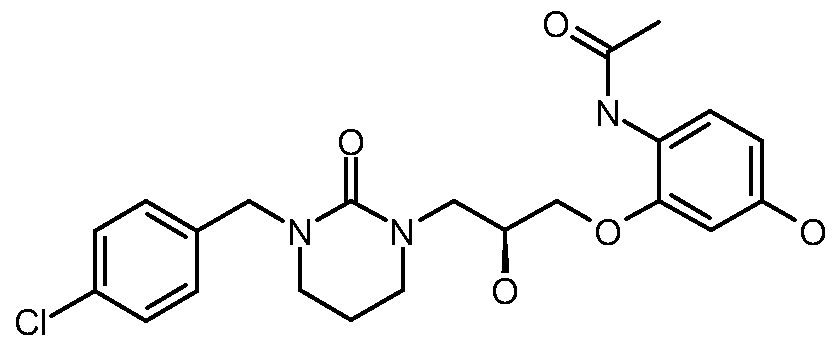
To an ice-cooled solution of Λ/-[2-({(2S)-3-[3-(4-chlorobenzyl)-2-oxotetrahydropyrimidin- l(2H)-yl]-2-hydroxypropyl}oxy)-4-methoxyphenyl] acetamide (15 mg) in DCM (1.5 ml) 1 M solution OfBBr3 in CH2Cl2 (0.6 ml) was added dropwise. After addition was complete, the reaction mixture was stirred at room temperature for 18 h. The reaction was quenched with methanol (1 ml) was added and after 30 min at room temperature the volatiles were removed in vacuo and the residue was purified by HPLC (20-90% CH3CN in H2O, 0.1% TFA) to give the title compound (6 mg).
1H-NMR (CD3OD, 400 MHz): δ 7.58 (d, J = 8.7 Hz, IH); 7.32-7.20 (m, 4H); 6.48 (d, J = 2.5 Hz, IH); 6.37 (dd, J = 2.6, 8.7 Hz, IH); 4.50 (m, 2H); 4.20 (m, IH); 4.02 (dd, J = 4.1, 9.9 Hz, IH); 3.94 (dd, J = 5.6, 9.9 Hz, IH); 3.71 (dd, J = 5.2, 14.2 Hz, IH); 3.48 (m, 3H); 3.22 (m, 2H); 2.14 (s, 3H); 1.53 (m, 2H). APCI-MS: m/z 448 (MH+)
Example 22
N-(2-{3-[3-(4-chlorobenzyl)-2-oxoimidazolidin-l-yl]-2-hydroxypropoxy}phenyl)acetam.ide
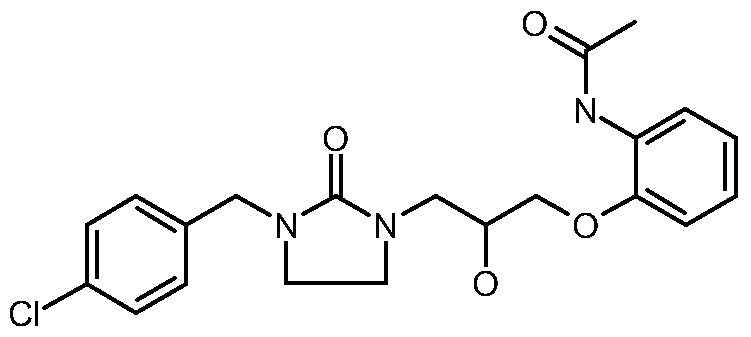
A suspension of l-(4-chlorobenzyl)-3-(oxiran-2ylmethyl)imidazolidin-2-one (approximately 400 mg), 7V-(2-hydroxyphenyl)acetamide (340 mg) and K2CO3 (430 mg) in DMF (0.7 ml) was stirred at 120 0C for 7 h, cooled to room temperature and partitioned between ethyl acetate and water. The organic layer was dried over Na2SO4, filtered and the filtrate was concentrated in vacuo. The residue was purified by silica gel flash
chromatography (0-2% methanol in dichloromethane, 0.2% NH4OH) to give the title compound (60 mg).
1H-NMR (CD3OD, 400 MHz): δ 7.98 (dd, J= 1.3, 8.0 Hz, IH); 7.29-7.20 (m, 4H); 7.09 (m, IH); 7.0 (m, IH); 6.95 (m, IH); 4.34 (s, 2H); 4.19 (m, IH); 4.06 (dd, J= 4.2, 9.9 Hz, IH); 4.01 (dd, J= 5.7, 10.0 Hz, IH); 3.52 (t, J= 6.7 Hz, 2H); 3.46 (dd, J= 2.0, 5.8 Hz, 2H); 3.26 (t, J= 8.4 Hz, 2H); 2.20 (s, 3H). APCI-MS: m/z 418 (MH+)
Assay
Human CCRl binding, assay
Membranes
HEK293 cells, from ECACC, stably expressing recombinant human CCRl (HEK-CCRl) were used to prepare cell membranes containing CCRl . The membranes were stored at -70
0C. The concentration of membranes of each batch was adjusted to 10% specific binding of
33 pM [125I] MIP-Ia.
Binding assay
100 μL of HEK-CCRl membranes diluted in assay buffer pH 7.4 ((137 mM NaCl (Merck, Cat No 1.06404), 5.7 mM Glucose (Sigma, Cat No G5400), 2.7 mM KCl (Sigma, Cat No P-9333), 0.36 mM NaH2PO4 x H2O (Merck, Cat No 1.06346), 10 mM HEPES (Sigma, Cat No H3375), 0.1% (w/v) Gelatine (Sigma, Cat No G2625)) with the addition of 17500 units/L Bacitracin (Sigma, Cat No B 1025) were added to each well of the 96 well filter plate (0.45 μm opaque Millipore cat no MHVB N4550). 12 μl of compound in assay buffer, containing 10% DMSO, was added to give final compound concentrations of IxIO"5 5-lxl0"9 5 M. 12 μl cold human recombinant MIP-Ia (270-LD-050, R&D Systems, Oxford, UK), 10 nM final concentration in assay buffer supplemented with 10% DMSO, was included in certain wells (without compound) as non-specific binding control (NSB). 12 μl assay buffer with 10% DMSO was added to certain wells (without compound) to detect maximal binding (BO).
12 μl [125I] MIP-Ia, diluted in assay buffer to a final concentration in the wells of 33 pM, was added to all wells. The plates with lid were then incubated for 1.5 hrs at room temperature. After incubation the wells were emptied by vacuum filtration (MultiScreen
Resist Vacuum Manifold system, Millipore) and washed once with 200 μl assay buffer. After the wash, all wells received an addition of 50 μl of scintillation fluid (OptiPhase "Supermix", Wallac Oy, Turko, Finland). Bound [125I] MIP- lα was measured using a Wallac Trilux 1450 MicroBeta counter. Window settings: Low 5-High 1020, 1-minute counting/well.
Calculation of percent displacement and IC50
The following equation was used to calculate percent displacement.
Percent displacement = 1- ((cpm test - cpm NSB) / (cpm BO- cpm NSB)) where:
cpm test = average cpm in wells with membranes and compound and [125I] MIP- lα;
NSB = average cpm in the wells with membranes and MIP-Ia and [125I] MIP- lα (nonspecific binding);
BO = average cpm in wells with membranes and assay buffer and [125I] MIP-Ia (maximum binding).
The molar concentration of compound producing 50% displacement (IC50) was derived using the Excel-based program XLfit (version 2.0.9) to fit data to a 4-parameter logistics function.
Compounds of the invention were found to inhibit CCRl.
In one embodiment of the invention, the compounds were found to have activity less then 1 μM.
In another embodiment of the invention, compounds were found to have activity less then 10O nM.
In one embodiment of the invention, the following compounds were found to have activity shown in the table below.

Claims
1. A compound of formula I

R1 is halogen or Ci-C6haloalkyl;
Q is -CH2- or -C(O)- ;
X, Y and Z are a bond, -CH2- or -C(O)-, provided that X, Y and Z are not all the same and that at least one of X, Y or Z is -C(O)-; q is 1 or 2;
R2 is hydrogen or C1-C4 alkyl;
A is a bond, -0-, or C1-C3 alkyl;
R3 is hydrogen, -NHC(O)R6, -NHS(O)2R6, -C(O)NR7R8, -COOR9, SO3R9 or Ci-C6 alkyl optionally substituted by t substituents independently selected from halogen, cyano, amino or hydroxyl; t is O, 1, 2 or 3;
R4 is hydrogen, halogen, hydroxyl, C1-C3 alkoxy or Ci-C6hydroxyalkyl optionally substituted by u substituents independently selected from halogen, cyano, amino, CONH2, hydroxyl, Ci-C6 haloalkyl, carboxyl, Ci-C6 alkoxy, Ci-C6 alkoxycarbonyl Or Ci-C6 alkylcarbonylamino; u is O, 1, 2 or 3; p is O, 1, 2 or 3;
R5 is halogen, cyano, C1-C3 alkoxy or Ci-C3haloalkyl;
R6 is (i) hydrogen; (ii) Ci-C6alkyl; (iii) a 3- to 6-membered saturated or unsaturated ring, optionally comprising one or more heteroatom selected from nitrogen, oxygen and sulphur, and optionally further comprising a bridging group, the ring being optionally substituted with one or more substituent independently selected from halogen, hydroxyl, Ci-C6 alkyl, Ci-C6 hydroxyalkyl and Ci-C6 haloalkyl, -O- and -OR9; (iv) NR7R8;
R7 and R8 each independently represent; (i) hydrogen;
(ii) a 3- to 6-membered saturated or unsaturated ring, optionally comprising one or more heteroatom selected from nitrogen, oxygen and sulphur, and optionally further comprising a bridging group, the ring being optionally substituted with one or more substituent independently selected from halogen, hydroxyl, -0-, Ci-C6 alkyl, Ci-C6 hydroxyalkyl and Ci-C6 haloalkyl;
(iii) C3-C6 cycloalkyl, optionally substituted with one or more substituent independently selected from halogen, amino, hydroxyl, -0-, Ci-C6 haloalkyl, carboxyl, Ci-C6 alkoxy, Ci-C6 alkoxycarbonyl, Ci-C6 alkylcarbonylamino and a 3- to 6-membered saturated or unsaturated ring, optionally comprising one or more heteroatom selected from nitrogen, oxygen and sulphur, and optionally further comprising a bridging group, the ring being optionally substituted with one or more substituent independently selected from halogen, hydroxyl, -0-, Ci-C6 alkyl, Ci-C6 hydroxyalkyl and Ci-C6 haloalkyl; (iv) Ci-C6 alkylsulphonyl; or
(v) R7 and R8 together with the nitrogen atom to which they are attached form a 4- to 7- membered saturated heterocyclic ring that optionally further comprises a ring nitrogen, oxygen or sulphur atom and that is optionally fused to a benzene ring to form a 8- to 11- membered ring system, the heterocyclic ring or ring system being optionally substituted with one or more substituent independently selected from halogen, hydroxyl, CONH2, Ci-C6 alkyl, Ci-C6hydroxyalkyl, Ci-C6 alkoxy, Ci-C6 alkoxycarbonyl, Ci-C6 haloalkyl, Ci- C6alkylamino, Ci-C6alkylcarbonyl, Ci-C6 alkylcarbonylamino and Ci-C6 alkylaminocarbonyl; and
R9 is hydrogen or Ci-C6 alkyl; or a pharmaceutically acceptable salt thereof.
2. A compounds of formula I wherein: m is O or 1 ;
R1 is halogen or Ci-Cβhaloalkyl; Q is -CH2- or -C(O)-;
X, Y and Z are a bond, -CH2- or -C(O)-, provided that X, Y and Z are not all the same and that at least one of X, Y or Z is -C(O)-; q is 1 or 2;
R2 is hydrogen or C1-C4 alkyl;
A is a bond, -O- or C1-C3 alkyl;
R3 is hydrogen, -NHC(O)R6, -C(O)NR7R8 or Ci-C3 alkyl optionally substituted by t substituents independently selected from halogen, cyano, amino or hydroxyl; t is O, 1 or 2;
R4 is hydrogen, halogen, hydroxyl or Ci-C4alkoxy; p is O, 1 or 2;
R5 is halogen, cyano, C1-C3 alkoxy or Ci-C3haloalkyl;
R6 is (i) hydrogen or (ii) Ci-C4alkyl;
R7 and R8 each independently represent; (i) hydrogen;
(iii) C3-C6 cycloalkyl, optionally substituted with one or more substituent independently selected from halogen, amino, hydroxyl, -0-, Ci-C6 haloalkyl, carboxyl, Ci-C6 alkoxy, Ci-C6 alkoxycarbonyl and Ci-C6 alkylcarbonylamino; or
(v) R7 and R8 together with the nitrogen atom to which they are attached form a 4- to 7- membered saturated heterocyclic ring; or a pharmaceutically acceptable salt thereof.
3. A compound according claim 1, wherein: m is O or 1 ;
R1 is halogen;
Q is -CH2- or -C(O)- ;
X, Y and Z are a bond, -CH2- or -C(O)-, provided that X, Y and Z are not all the same and that at least one of X, Y or Z is -C(O)-; q is 1 or 2;
R2 is hydrogen;
A is a bond;
R3 is hydrogen, -NHC(O)R6 or -C(O)NR7R8; R4 is hydrogen, halogen, hydroxyl, C1-C3 alkoxy or Ci-Cόhydroxyalkyl; p is 0 or 1 ;
R5 is halogen or cyano;
R6 is (i) hydrogen or (ii) Ci-C6alkyl;
R7 and R8 each independently represent; (i) hydrogen; (iii) Ci-C6 cycloalkyl; or
(v) R7 and R8 together with the nitrogen atom to which they are attached form a 4- to 7- membered saturated heterocyclic ring; and or a pharmaceutically acceptable salt thereof.
4. A compound according to any one of the preceding claims, wherein, wherein R1 is halogen.
5. A compound according to any one of the preceding claims, wherein R4 is hydrogen, halogen, hydroxyl or Ci-C6 alkoxy.
6. A compound according to any one of the preceding claims, wherein A is a bond and R3 is -NHC(O)R6 or -C(O)NR7R8.
7. A compound according to any one of the preceding claims, wherein R6 is (i) hydrogen or (ii) Ci-C6alkyl.
8. A compound according to any one of the preceding claims, wherein R7 and R8 independently present a a hydrogen, cyclopropyl, cyclobutyl, cyclopentyl, cyclohexyl, or R7 and R8 together with the nitrogen atom to which they are attached form a 5- to 6- membered heterocyclic ring.
9. A compound according to any one of the preceding claims, wherein R5 is halogen or cyano.
10. The compound selected from N-(2- {3-[4-(4-chlorobenzyl)-2-oxopiperazin- 1 -yl]-2-hydroxypropoxy} phenyl) acetamide,
Λ/-[2-({(25)-3-[4-(4-fluorobenzyl)-2-oxopiperazin-l-yl]-2-hydroxypropyl}oxy)-4- methoxypheny 1] acetamide ,
Λ/-[2-({(25)-3-[4-(4-fluorobenzyl)-2-oxopiperazin-l-yl]-2-hydroxypropyl}oxy)-4- hy droxypheny 1] acetamide ,
N-[2-({(25)-3-[4-(4-chlorobenzyl)-2-oxopiperazin-l-yl]-2- hydroxypropyl}oxy)phenyl]acetamide,
Λ/-[2-({(25)-3-[4-(4-chlorobenzyl)-2-oxopiperazin-l-yl]-2-hydroxypropyl}oxy)-4- methoxypheny 1] acetamide ,
Λ/-[2-({(25)-3-[4-(4-chlorobenzyl)-2-oxopiperazin-l-yl]-2-hydroxypropyl}oxy)-4- hy droxypheny 1] acetamide ,
Λ/-[2-({(25)-3-[4-(4-chlorobenzyl)-2-oxopiperazin-l-yl]-2-hydroxypropyl}oxy)-4- methoxypheny 1] acetamide ,
Λ/-[2-({(2i?)-3-[4-(4-chlorobenzyl)-2-oxopiperazin-l-yl]-2-hydroxypropyl}oxy)-4- hy droxypheny 1] acetamide ,
7V-[5-chloro-2-( {(25)-3-[4-(4-chlorobenzyl)-2-oxopiperazin- 1 -yl]-2-hydroxypropyl} oxy)-
4-methoxyphenyl]acetamide,
7V-[5-chloro-2-( {(2i?)-3-[4-(4-chlorobenzyl)-2-oxopiperazin- 1 -yl]-2-hydroxypropyl} oxy)-
4-hydroxyphenyl]acetamide,
Λ/-[5-cyano-2-({(2i?)-3-[4-(4-chlorobenzyl)-2-oxopiperazin-l-yl]-2-hydroxypropyl}oxy)- phenyljacetamide,
5-Chloro-2( {(2S)-3-[4-(4-chlorobenzyl)-2-oxopiperazin- 1 -yl]-2-hydroxypropyl} oxy)-N- cyclopropylbenzamide,
4-(4-chlorobenzyl)- 1 - {3-[4-chloro-2-(pyrrolidin- 1 -ylcarbonyl)phenoxy]-2- hydroxypropyl}piperazin-2-one,
N-(2- {3-[4-(4-Chlorobenzoyl)-2-oxopiperazin- 1 -yl]-2-hydroxypropoxy} - phenyl)acetamide,
N-(2- {3-[4-(4-Chloro-benzyl)-7-oxo-[ 1 ,4]diazepan- 1 -yl]-2-hydroxy-propoxy} -phenyl)- acetamide,
2- {3-[4-(4-Chloro-benzyl)-5-oxo-[ 1 ,4]diazepan-l -yl]-2-hydroxy-propoxy} -7V-cyclopropyl-
4-fluoro-benzamide, Λ/-(2-{3-[4-(4-Choloro-benzyl)-5-oxo-[l,4]diazepan-l-yl]-2-hydroxy-propoxy}-4- hydroxy-phenyl)-acetamide,
7V-(5-chloro-2- {3-[3-(4-chlorobenzyl)-2-oxotetrahydropyrimidin- 1 (2H)-yl]-2- hydroxypropoxy}-4-methoxyphenyl)acetamide,
N-(2- {3-[3-(4-chlorobenzyl)-2-oxotetrahydropyrimidin- 1 (2H)-yl]-2- hydroxypropoxy}phenyl)acetamide,
N-[2-({(25)-3-[3-(4-chlorobenzyl)-2-oxotetrahydropyrimidin-l(2H)-yl]-2- hydroxypropyl] oxy } -4-hydroxyphenyl)acetamide,
N-[2-({(25)-3-[3-(4-chlorobenzyl)-2-oxotetrahydropyrimidin-l(2H)-yl]-2- hydroxypropyl] oxy} -4-methoxyphenyl)acetamide,
Λ/-(2-{3-[3-(4-chlorobenzyl)-2-oxoimidazolidin-l-yl]-2- hydroxypropoxy}phenyl)acetamide, or a pharmaceutically acceptable salt thereof.
11. A pharmaceutical composition comprising a compound of formula I, or a pharmaceutically acceptable salt, solvates or solvated salts, as claimed in any one of claims 1 to 9, in association with a pharmaceutically acceptable adjuvants, diluents and/or carriers.
12. A compound of formula I, or a pharmaceutically acceptable salt, solvates or solvated salts, as claimed in any one of claims 1 to 9 for use in therapy.
13. Use of a compound of formula I, or a pharmaceutically acceptable salt, solvates or solvated salts, as claimed in any one of claims 1 to 9, in the manufacture of a medicament for treating a respiratory disease.
14. Use of a compound of formula I, or a pharmaceutically acceptable salt, solvates or solvated salts, as claimed in any one of claims 1 to 9, in the manufacture of a medicament for treating airway diseases, inflammatory diseases, COPD and/or asthma.
15. A method of treatment of respiratory diseases, airway diseases, inflammatory diseases, COPD and/or asthma, in a patient suffering from, or at risk of, said disease, which comprises administering to the patient a therapeutically effective amount of the compound of formula I, or a pharmaceutically acceptable salt, solvates or solvated salts, as claimed in any one of claims 1 to 9.
16. The compounds
4-(4-chlorobenzyl)- 1 -(oxiran-2-ylmethyl)piperazin-2-one;
4-(4-chlorobenzyl)- 1 -[(25)-oxiran-2-ylmethyl]piperazin-2-one;
4-(4-chlorobenzyl)- 1 -[(2i?)-oxiran-2-ylmethyl]piperazin-2-one;
4-(4-fluorobenzyl)piperazine-2-one;
4-(4-fluorobenzyl)- 1 -[(25)-oxiran-2-ylmethyl]piperazin-2-one;
4-(4-chlorobenzoyl)- 1 -(oxiran-2-ylmethyl)piperazin-2-one;
1 -(4-chloro-benzyl)-4-oxiranylmethyl-[ 1 ,4]diazepan-5-one;
4-(4-chloro-benzyl)-5-oxo-[l,4]diazepane-l-carboxylic acid t-butyl ester;
4-(4-chloro-benzyl)-[l,4]diazepan-5-one; l-(4-chloro-benzyl)-4-[(2S)-oxiran-2-ylmethyl]-l,4-diazepan-5-one
1 -(4-chlorobenzyl)-3 -(oxiran-2ylmethyl)tetrahydropyrimidin-2( 1 H)-one; and l-(4-chlorobenzyl)-3-(oxiran-2ylmethyl)imidazolidin-2-one.
17. The use of the compounds according to claim 15 as intermediates in the preparation if compounds of formula I according to claim 1.
Applications Claiming Priority (2)
| Application Number | Priority Date | Filing Date | Title |
|---|---|---|---|
| US91639007P | 2007-05-07 | 2007-05-07 | |
| US60/916,390 | 2007-05-07 |
Publications (1)
| Publication Number | Publication Date |
|---|---|
| WO2008136754A1 true WO2008136754A1 (en) | 2008-11-13 |
Family
ID=39943761
Family Applications (1)
| Application Number | Title | Priority Date | Filing Date |
|---|---|---|---|
| PCT/SE2008/050520 Ceased WO2008136754A1 (en) | 2007-05-07 | 2008-05-07 | Novel benzyl - 2 -oxo-piperazinyl/ 7-oxo/5-oxa- [1,4] diazepanyl/ 2 -oxo- tetrahydropyrimidinyl derivatives |
Country Status (1)
| Country | Link |
|---|---|
| WO (1) | WO2008136754A1 (en) |
Cited By (3)
| Publication number | Priority date | Publication date | Assignee | Title |
|---|---|---|---|---|
| WO2010006938A1 (en) | 2008-07-16 | 2010-01-21 | F. Hoffmann-La Roche Ag | Novel heterocyclyl compounds for treatment of cardiovascular disease |
| WO2010150281A2 (en) | 2009-06-26 | 2010-12-29 | Panacea Biotec Ltd. | Novel azabicyclohexanes |
| CN117003778A (en) * | 2023-03-22 | 2023-11-07 | 烟台盛凯伦化学科技有限公司 | A kind of preparation method of 3-chloro-4-(cyclopropylcarbamoyl)phenylboronic acid |
Citations (2)
| Publication number | Priority date | Publication date | Assignee | Title |
|---|---|---|---|---|
| WO2001062729A1 (en) * | 2000-02-25 | 2001-08-30 | Astrazeneca Ab | Novel compounds |
| WO2001098272A1 (en) * | 2000-06-20 | 2001-12-27 | Astrazeneca Ab | Novel compounds |
-
2008
- 2008-05-07 WO PCT/SE2008/050520 patent/WO2008136754A1/en not_active Ceased
Patent Citations (4)
| Publication number | Priority date | Publication date | Assignee | Title |
|---|---|---|---|---|
| WO2001062729A1 (en) * | 2000-02-25 | 2001-08-30 | Astrazeneca Ab | Novel compounds |
| WO2001062757A1 (en) * | 2000-02-25 | 2001-08-30 | Astrazeneca Ab | Novel compounds |
| WO2001062728A1 (en) * | 2000-02-25 | 2001-08-30 | Astrazeneca Ab | Novel compounds |
| WO2001098272A1 (en) * | 2000-06-20 | 2001-12-27 | Astrazeneca Ab | Novel compounds |
Cited By (4)
| Publication number | Priority date | Publication date | Assignee | Title |
|---|---|---|---|---|
| WO2010006938A1 (en) | 2008-07-16 | 2010-01-21 | F. Hoffmann-La Roche Ag | Novel heterocyclyl compounds for treatment of cardiovascular disease |
| US8071586B2 (en) | 2008-07-16 | 2011-12-06 | Hoffmann-La Roche Inc. | Heterocyclyl compounds |
| WO2010150281A2 (en) | 2009-06-26 | 2010-12-29 | Panacea Biotec Ltd. | Novel azabicyclohexanes |
| CN117003778A (en) * | 2023-03-22 | 2023-11-07 | 烟台盛凯伦化学科技有限公司 | A kind of preparation method of 3-chloro-4-(cyclopropylcarbamoyl)phenylboronic acid |
Similar Documents
| Publication | Publication Date | Title |
|---|---|---|
| US8507544B2 (en) | Bi-aryl amide compounds as CRTh2 receptor modulators | |
| US7741360B2 (en) | Bi-aryl or aryl-heteroaryl substituted indoles | |
| US8058294B2 (en) | Pharmaceutical salts of N-[2-(diethylamino)ethyl]-N-(2-{[2-(4-hydroxy-2-oxo-2,3-dihydro-1,3-benzothiazol-7-yl)ethyl]amino}ethyl)-3-[2-(1-napthyl)ethoxy]propanamide | |
| US20120232101A1 (en) | Novel Compounds | |
| US20080255150A1 (en) | Novel Compounds | |
| WO2008121065A1 (en) | Novel pyrrolidine derivatives as antagonists of the chemokine receptor | |
| WO2008104752A1 (en) | Dihydropyridones as elastase inhibitors | |
| US20080058309A1 (en) | Novel Compounds 171 | |
| US20120289513A1 (en) | (4-tert-butylpiperazin-2-yl)(piperazin-1-yl)methanone-n-carboxamide derivatives | |
| AU2005257707B2 (en) | Chemical compounds I | |
| US20080293742A1 (en) | Novel N-(Fluoro-Pyrazinyl)-Phenylsulfonamides as Modulators of Chemokine Receptor Ccr4 | |
| US20100081692A1 (en) | Novel 1-Benzyl-4-Piperidinamines that are Useful in the Treatment of COPD and Asthma | |
| US20090042942A1 (en) | Muscarinic Receptor Antagonists | |
| US20090012125A1 (en) | Piperidine Derivatives, Their Process for Preparation, Their Use as Therapeutic Agents and Pharmaceutical Compositions Containing Them | |
| WO2008121066A1 (en) | Novel tricyclic spiropiperidines or spiropyrrolidines and their use as modulators of chemokine receptors | |
| WO2008150231A1 (en) | New heterocyclic compounds for treatment of respiratory, airway or inflammatory disorders | |
| US20080200505A1 (en) | Piperidines for the Treatment of Chemokine Mediated Diseases | |
| WO2008099165A1 (en) | Piperidine derivatives and their use for treatment of ccr8 mediated diseases | |
| US20090118288A1 (en) | N-Benzyl-Morpholine Derivatives as Modulators of the Chemokine Receptor | |
| US20090197914A1 (en) | Piperidine Derivatives, Their Process for Preparation, Their Use as Therapeutic Agents and Pharmaceutical Compositions Containing Them | |
| WO2007035154A1 (en) | Novel n-pyrazinil-phenylsulfonamide derivatives as chemokine receptor modulators for use in the treatment of asthma | |
| HK1148002B (en) | A quinoline derivative acting as a p2x7-receptor antagonist | |
| HK1148002A1 (en) | A quinoline derivative acting as a p2x7-receptor antagonist |
Legal Events
| Date | Code | Title | Description |
|---|---|---|---|
| 121 | Ep: the epo has been informed by wipo that ep was designated in this application |
Ref document number: 08794132 Country of ref document: EP Kind code of ref document: A1 |
|
| NENP | Non-entry into the national phase |
Ref country code: DE |
|
| 122 | Ep: pct application non-entry in european phase |
Ref document number: 08794132 Country of ref document: EP Kind code of ref document: A1 |