WO2008077005A1 - Corrosion inhibitor composition comprising a built-in intensifier - Google Patents
Corrosion inhibitor composition comprising a built-in intensifier Download PDFInfo
- Publication number
- WO2008077005A1 WO2008077005A1 PCT/US2007/087851 US2007087851W WO2008077005A1 WO 2008077005 A1 WO2008077005 A1 WO 2008077005A1 US 2007087851 W US2007087851 W US 2007087851W WO 2008077005 A1 WO2008077005 A1 WO 2008077005A1
- Authority
- WO
- WIPO (PCT)
- Prior art keywords
- iodide
- corrosion inhibitor
- inhibitor composition
- corrosion
- acid
- Prior art date
- Legal status (The legal status is an assumption and is not a legal conclusion. Google has not performed a legal analysis and makes no representation as to the accuracy of the status listed.)
- Ceased
Links
Classifications
-
- C—CHEMISTRY; METALLURGY
- C09—DYES; PAINTS; POLISHES; NATURAL RESINS; ADHESIVES; COMPOSITIONS NOT OTHERWISE PROVIDED FOR; APPLICATIONS OF MATERIALS NOT OTHERWISE PROVIDED FOR
- C09K—MATERIALS FOR MISCELLANEOUS APPLICATIONS, NOT PROVIDED FOR ELSEWHERE
- C09K8/00—Compositions for drilling of boreholes or wells; Compositions for treating boreholes or wells, e.g. for completion or for remedial operations
- C09K8/54—Compositions for in situ inhibition of corrosion in boreholes or wells
-
- C—CHEMISTRY; METALLURGY
- C09—DYES; PAINTS; POLISHES; NATURAL RESINS; ADHESIVES; COMPOSITIONS NOT OTHERWISE PROVIDED FOR; APPLICATIONS OF MATERIALS NOT OTHERWISE PROVIDED FOR
- C09K—MATERIALS FOR MISCELLANEOUS APPLICATIONS, NOT PROVIDED FOR ELSEWHERE
- C09K8/00—Compositions for drilling of boreholes or wells; Compositions for treating boreholes or wells, e.g. for completion or for remedial operations
- C09K8/60—Compositions for stimulating production by acting on the underground formation
- C09K8/62—Compositions for forming crevices or fractures
- C09K8/72—Eroding chemicals, e.g. acids
- C09K8/74—Eroding chemicals, e.g. acids combined with additives added for specific purposes
-
- C—CHEMISTRY; METALLURGY
- C23—COATING METALLIC MATERIAL; COATING MATERIAL WITH METALLIC MATERIAL; CHEMICAL SURFACE TREATMENT; DIFFUSION TREATMENT OF METALLIC MATERIAL; COATING BY VACUUM EVAPORATION, BY SPUTTERING, BY ION IMPLANTATION OR BY CHEMICAL VAPOUR DEPOSITION, IN GENERAL; INHIBITING CORROSION OF METALLIC MATERIAL OR INCRUSTATION IN GENERAL
- C23F—NON-MECHANICAL REMOVAL OF METALLIC MATERIAL FROM SURFACE; INHIBITING CORROSION OF METALLIC MATERIAL OR INCRUSTATION IN GENERAL; MULTI-STEP PROCESSES FOR SURFACE TREATMENT OF METALLIC MATERIAL INVOLVING AT LEAST ONE PROCESS PROVIDED FOR IN CLASS C23 AND AT LEAST ONE PROCESS COVERED BY SUBCLASS C21D OR C22F OR CLASS C25
- C23F11/00—Inhibiting corrosion of metallic material by applying inhibitors to the surface in danger of corrosion or adding them to the corrosive agent
- C23F11/04—Inhibiting corrosion of metallic material by applying inhibitors to the surface in danger of corrosion or adding them to the corrosive agent in markedly acid liquids
Definitions
- This invention relates generally to corrosion inhibitors and more specifically to the use of corrosion inhibitor compositions comprising iodide salts for extending the effectiveness of acid corrosion inhibitors, particularly in oil field acidizing operations.
- Acids and acid solutions have long been used in the stimulation of oil wells, gas wells, water wells, and similar boreholes. Acid stimulation is performed in wells completed in subterranean formations. Acid stimulation is used in conjunction with hydraulic fracturing techniques and matrix acid stimulation techniques. In both acid fracturing and matrix acid stimulation, the well treating acid solutions, usually HCl or mixtures of HCl and HF, are pumped through the well tubular goods and injected into the formation where the acid attacks formation materials increasing its permeability to oil and/or gas.
- acid solutions usually HCl or mixtures of HCl and HF
- the well treating acid In order to protect the equipment and tubular goods from the corrosive effects of the acid, the well treating acid almost always includes a corrosion inhibitor, frequently referred to as ACI's.
- ionizable salts are not compatible with organic based corrosion inhibitor formulations.
- metal chlorides or iodide salts are not soluble in the organic liquids used in corrosion inhibitor formulations. Therefore, metal chloride or iodide salt intensifiers must be formulated separately and used in combination with organic based corrosion inhibitors. Use of these so-called “external intensifiers” therefore results in increased on-site formulation, handling, transport and application costs.
- this invention is a corrosion inhibitor composition
- a corrosion inhibitor composition comprising one or more organic solvents, one or more corrosion inhibitor intermediates; and about 0.5 to about 20 weight percent of one or more iodide salts dissolved in said composition.
- this invention is a method of inhibiting corrosion of a steel surface in contact with an acidic fluid comprising contacting the steel surface with an acid solution comprising aqueous acid and an effective corrosion inhibiting amount of a corrosion inhibitor composition comprising one or more organic solvents, one or more corrosion inhibitor intermediates and about 0.1 to about 20 weight percent of one or more iodide salts dissolved in said composition.
- this invention is a method of treating a subterranean formation penetrated by a wellbore comprising pumping through well tubular goods and injecting into the formation an effective treating amount of an acid solution comprising aqueous acid and an amount of a corrosion inhibitor composition comprising one or more organic solvents, one or more corrosion inhibitor intermediates and about 0.1 to about 20 weight percent of one or more iodide salts dissolved in said composition effective to inhibit the corrosion of metallic surfaces of said well tubular goods in contact with said acid solution.
- this invention is a method of preparing an acid solution which provides enhanced protection against corrosion of metallic surfaces in contact with said solution comprising mixing an aqueous acid solution with an effective corrosion inhibiting amount of the corrosion inhibitor composition comprising one or more organic solvents, one or more corrosion inhibitor intermediates and about 0.1 to about 20 weight percent of one or more iodide salts dissolved in said composition.
- This invention therefore provides ACI compositions in which the intensifier is formulated into the composition, thereby eliminating or reducing the need for external intensifiers.
- the corrosion inhibitor composition of this invention comprises one or more organic solvents, one or more corrosion inhibitor intermediates and one or more iodide salts. Each of these components, as well as the acid solution in which they are used, are described below.
- Suitable iodide salts include any organic or inorganic iodide salts which can be dissolved in the organic solvent/corrosion inhibitor mixture and which are capable of generating an effective corrosion inhibiting amount of iodide under use conditions.
- Iodide salts suitable for use in a corrosion inhibitor composition according to this invention may be empirically selected based on the cationic portion of the iodide salt, the other ingredients (in particular the types of solvents) used in the inhibitor formulation, and the amount of iodide salt desired in the finished composition.
- the iodide salts are selected from lithium iodide, sodium iodide, potassium iodide, calcium iodide, magnesium iodide, ammonium iodide, tetraethylammonium iodide, tetrapropylammonium iodide, tetrabutylammonium iodide, tetrapentylammonium iodide, tetrahexylammonium iodide, tetraheptylammonium iodide, tetraphenylammonium iodide, phenytrimethyf ammonium iodide and (ethyl)triphenylphosphonium iodide.
- the iodide salts are selected from lithium iodide, phenyltrimethylammonium iodide, (ethyl)triphenylphosphonium iodide, tetrabutylammonium iodide, tetraethylammonium iodide, tetrapropylammonium iodide and ammonium iodide.
- the iodide salt is ammonium iodide.
- Any acid corrosion inhibitor intermediates known in the art and derivatives thereof may be used in the corrosion inhibitor composition. These include the acetylenic alcohols, quaternary amine compounds, unsaturated aldehydes, amines, and Mannich reaction products of aromatic nitrogen compounds, monoamines and aldehydes. These ACI components are described below.
- Acetylenic alcohols employed in the present invention typically have formula:
- R 1 , R 2 and R3 are independently hydrogen, alkyl groups having 1 to 18 carbon atoms, naphthyl, phenyl, and alkyl substituted phenyls having 1 to 10 carbon atoms in the alkyl substituent.
- Representative acetylenic alcohols include methyl butynol, methyl pentynol, ethyl octynol, propargyl alcohol, hexynol, benzyl butynol, naphthyl butynol, and the like.
- Acetylenic alcohols having 3 to 10 carbon atoms are preferred.
- Quaternary amine compounds comprise aromatic nitrogen compounds including alkyl pyridine-N-methyl chloride quaternary, alkyl pyridine-N-benzyl chloride quaternary, quinoline- N-methyl chloride quaternary, quinoline-N-benzyl chloride quaternary, quinoline-N-(chloro- benzyl chloride) quaternary, isoquinoline quaternaries, benzoquinoline quaternaries, chloromethyl naphthalene quaternaries and mixtures of such compounds, and the like.
- the quaternary amine compounds may also be coupled with a metal compound such as described in U.S. Patent ⁇ os. 5,002,673; 5,089,153; 5,130,034; 5,200,096; and 5,209,859, incorporated herein by reference.
- Unsaturated aldehydes include, for example, those listed in U.S. Patent No. 4,734,259 (Col. 3 and 4), and U.S. Pat. No. 5,013,483 (CoI. 2, 3, and 4), incorporated herein by reference.
- a particularly preferred aldehyde is cinnamaldehyde.
- Corrosion inhibiting amines include amines, amides, and imidazolines.
- amines include primary, secondary and tertiary alkyl amines; cyclic amines such as alkyl pyridines; crude quinolines; fatty polyamines such as tallow diamine; aromatic amines such as aniline; and derivatives of these amines.
- preferred amides include fatty acid polyamines such as tall oil fatty acid reacted with triethylene tetramine in a 1:1 mole ratio; tallow fatty acid reacted with tetraethylene penta amine in a 1 : 1 mole ratio or derivatives of this class of compounds.
- An example of an imidazoline ACI includes tall oil fatty acid reacted with triethylene tetramine (and derivatives thereof) such as those described in U.S. Application Ser. No. 962,464 filed on October 15, 1992, incorporated herein by reference.
- Organic solvents useable in the composition of this invention include organic liquids selected from polar aprotic solvents, aromatic solvents, terpinols, and alcohols.
- Representative aprotic solvents include N,N-dimethyl formamide (DMF), dimethylsulfoxide (DMSO), dimethylacetamide (DMA), l-methyl-2-pyrrolidone ("pyrro ⁇ done”), tetramethylene sulfone ("sulfolane”), acetone, formamide, acetonitrile, and the like.
- Aromatic solvents include heavy aromatic naptha, xylene, toluene, and others such as described in Patent ⁇ os. 4,498,997,
- Alcohols include methanol, ethanol, propanol, isopropanol (IPA), 1- butanol, ⁇ o-butanol, t ⁇ rt-butanol, ethylene glycol, diethylene glycol, monobutyl ether of ethylene glycol, glycerine and the like.
- IPA isopropanol
- the solvents are selected from methanol, isopropanol, ethanol, 1- butanol, ⁇ o-butanol, tert-butanol, acetonitrile, N,N-dimethyl formamide, formamide, and acetone.
- the corrosion inhibitor composition further comprises one or more surfactants.
- the surfactants serve to disperse the acid corrosion inhibitor in the acidic solution as well as to help wet the tubular goods to permit filming of the ACI.
- Suitable surfactants include nonionics having hydrophilic-lipophilic balance (HLB) numbers of 1 to 18, preferably 3 to 16 such as laureates, stearates, and oleates.
- ⁇ onionic surfactants further include the polyoxyethylene surfactants, such as ethoxylated alkyl phenols and ethoxylated aliphatic alcohols, polyethylene glycol esters of fatty, resin, and tall oil acids and polyoxyethylene esters of fatty acids.
- surfactants are polyoxyethylene alkyl phenol wherein the alkyl group is linear or branched Cg-C 12 and contains above about 60 weight percent poly oxyethylene.
- Octyl and nonyl phenols containing 9 to 15 moles ethylene oxide per mole hydrophobe are the preferred ethoxylated alkyl phenol surfactants.
- the polyoxyethylene esters of fatty acids include the mono and dioleates and sesquioleates wherein the molecular weight of the esterified polyethylene glycol is between about 200 and 1,000.
- the nonionic surfactants may be blended to provide the desired properties.
- a particularly useful surfactant is a blend of polyethylene glycol esters of fatty acids and ethoxylated alkylphenols.
- surfactants include cationic amines, quaternary amines, amphoterics, anionic sulfates and anionic sulfonates.
- the corrosion inhibitor composition further comprises a co-extender such as a formic acid compound.
- the formic acid compound may be selected from formic acid, formate esters and formamides.
- Representative formic acid compounds include formic acid, methyl formate, ethyl formate, ben2yl formate, formamide, dimethyl formamide, formaniline, and the like and mixtures thereof.
- the iodide salt is added to the organic solvents and optional water. To this mixture is added any additional ingredients followed by any surfactants used. This entire mixture is then allowed to stir until all of the iodide salt is dissolved. Finally, all the corrosion inhibitor intermediates are added and the mixture is again stirred to ensure complete intermingling of all the ingredients to form the completed corrosion inhibitor composition.
- the corrosion inhibitor composition comprises about 0.1 to about 60 weight percent solvents, about 0.1 to about 25 weight percent surfactants, about 0.1 to about 80 weight percent corrosion inhibitor intermediates and about 0.1 to about 20 weight percent iodide salts.
- the corrosion inhibitor composition comprises about 1 to about 50 weight percent solvents, about 1 to about 20 weight percent surfactants, about 10 to about 70 weight percent corrosion inhibitor intermediates and about 0.2 to about 10 weight percent iodide salts. In another embodiment, the corrosion inhibitor composition comprises about 5 to about
- the corrosion inhibitor composition comprises about 10 to about 40 weight percent solvents, about 10 to about 15 weight percent surfactants, about 30 to about 50 weight percent corrosion inhibitor intermediates and about 1 to about 2 weight percent iodide salts.
- the corrosion inhibitor composition may be used with any well treating acids used in the oil field.
- Representative well treating acids include hydrochloric acid (HCI), hydrofluoric acid (HF), mixtures of HCl and HF (i.e. mud acid), acetic acid, formic acid, and other organic acids and anhydrides.
- HCI hydrochloric acid
- HF hydrofluoric acid
- the corrosion inhibitor formulation is introduced into the well treating acid at a concentration sufficient to coat the well tubulars and equipment.
- concentration of the acid corrosion inhibitor formulation in the acid solution should generally be sufficient to provide the acid solution with at least 0.001 weight percent of the iodide salt.
- the upper limit of the iodide salt will be controlled by economics. Generally speaking, from about 0.1 to 5 weight percent of the total acid corrosion inhibitor formulation in the acid solution will provide satisfactory protection for the well tubulars.
- the concentration of the formulation in the well treating acid should be sufficient to provide protection to the metal (e.g. steel or chrome alloys) tubulars against corrosion.
- concentration of the formulation will depend on the temperature of the well, the exposure time of the tubulars to the acid solution, the type of acid, and type of metal alloy.
- concentration of the ACI in the acid solution should be between 0.1 to 20 weight percent, preferably 0.1 to 10 weight percent and more preferably 0.1 to 5 weight percent.
- An 8 oz glass jar is charged with 10.05 g of N,N-dimethylformamide, 12.35 g of isopropanol, and 1.00 g of ammonium iodide. This mixture is stirred until all the ammonium iodide is dissolved. To this mixture is added 1.08 g of ethyl octynol, 9.24 g of propargyl alcohol, and 16.33 g of surfactant. Again the contents are thoroughly mixed until mixture is uniform in appearance. To this mixture is then added 39.95 g of quaternary nitrogen compounds and 10,00 g of amine compounds. This mixture is then intimately mixed until uniform in appearance.
- Iodide salts A-H designate phenyltrimethylammonium iodide (A), (ethyl)triphenylphosphonium iodide (B), lithium iodide (C), tetrabutylammonium iodide (D), tetraethylammonium iodide (E), tetrapropylammonium iodide (F), tetramethylammonium iodide (G) and ammonium iodide (H).
- the iodide salt is present in an amount of one percent by weight.
- the iodide salt is present in an amount of two percent by weight.
- iodide salts may be suitably formulated into corrosion inhibitor compositions.
- the stability of the ACIs listed above is a critical factor in determining if an ACI formulation is successful. Because acid corrosion inhibitors contain complex mixtures of several compounds all in a balanced, stable formula the addition of any particular iodide compound could disrupt this stability by causing precipitation or separation of the ACI components or perhaps decreased ACI performance versus the non-iodide containing ACI.
- the stability of representative corrosion inhibitor compositions of the invention is shown in Tables 5 and 6.
- Table 6 shows the stabilities of various iodide-containing ACIs that differ quite significantly in their formulations when compared to the ACIs in Table 5 (see Tables 1-4 for formulation differences).
- Representative iodide salts dissolve readily except for the tetramethylammonium iodide salt, which is insoluble. Furthermore, no apparent precipitate forms after 72 hours in these formulations and no layering of the corrosion inhibitor components is evident.
- Corrosion testing by weight loss are determined on different metal test coupons including N80, Cr 13, and
- CT900 in a simulated treatment fluid made up from an aqueous mixture of hydrochloric acid or hydrochloric/hydrofluoric acid mixtures (HF generated in situ using ammonium bifluoride).
- a simulated treatment fluid made up from an aqueous mixture of hydrochloric acid or hydrochloric/hydrofluoric acid mixtures (HF generated in situ using ammonium bifluoride).
- 100 mL of the treatment fluid is used, to which is added the selected amount of acid corrosion inhibitor given in gallons per thousand (GPT). Any additional external intensifiers are then added to the treatment fluid.
- the selected test coupons are then added to the inhibited acid mixtures and these mixtures are then placed in a high temperature and pressure corrosion autoclave unit. These coupons remained in the autoclave under pressure for the test duration (typically 4 or 6 hours) at 3000 psi. After that the coupons are removed, cleaned and weighed to obtain their weight loss.
- the corrosion value is then given in lb/ft 2 .
- the coupons are also visually inspected for any pitting corrosion and assigned a value of 0-7. Values 0-3 are considered acceptable rates while any value higher than that are not acceptable. The results are shown in Tables 7-12.
- Tables 7-10 show that a soluble iodide source can be formulated into an acid corrosion inhibitor successfully while providing respectable corrosion protection.
- Changing solvent conditions in the ACI formulation or the cationic portion of the iodide salt can influence the solubility of the selected iodide source.
- the utilization of as little as 1 percent by weight of an iodide salt can positively influence the corrosion protection provided by the ACI. This is shown when comparing the formulation of an ACI that was made with an iodide salt versus one that was not.
- a representative ACI, A.8, is selected to further investigate the corrosion protection capabilities of an iodide-containing ACI at higher temperature, with other metallurgies, and with the use of an additional external intensifier such as formic acid. These tests are carried out side by side with other commercially available ACIs for comparison purposes.
- Generic composition information is show in Table 11.
- Table 12 shows the corrosion test results for representative ACI A.8. The corrosion testing is done at 250 0 F, 300 0 F, and 350 0 F with both N80 and CT900 coupons.
- Table 13 shows the corrosion data acquired for the ACI labeled A.8 at 250 0 F, 300 0 F, and 35O°F with CrI 3 coupons. In both Tables 12 and 13, the data are collected alongside the commercially available ACI data for comparison purposes. Table 11. Composition of Commercially Available ACIs
Landscapes
- Chemical & Material Sciences (AREA)
- Life Sciences & Earth Sciences (AREA)
- General Life Sciences & Earth Sciences (AREA)
- Engineering & Computer Science (AREA)
- Materials Engineering (AREA)
- Organic Chemistry (AREA)
- Chemical Kinetics & Catalysis (AREA)
- General Chemical & Material Sciences (AREA)
- Mechanical Engineering (AREA)
- Metallurgy (AREA)
- Preventing Corrosion Or Incrustation Of Metals (AREA)
Abstract
A corrosion inhibitor composition comprising one or more organic solvents, one or more corrosion inhibitor intermediates and about 0.1 to about 20 weight percent of one or more iodide salts dissolved in said composition and methods of using the corrosion inhibitor composition in acid fracturing and matrix acid stimulation of subterranean formations.
Description
CORROSION INHIBITOR COMPOSITION COMPRISING A BUILT-IN INTENSIFIER
TECHNICAL FIELD
This invention relates generally to corrosion inhibitors and more specifically to the use of corrosion inhibitor compositions comprising iodide salts for extending the effectiveness of acid corrosion inhibitors, particularly in oil field acidizing operations.
BACKGROUND OF THE INVENTION
Acids and acid solutions have long been used in the stimulation of oil wells, gas wells, water wells, and similar boreholes. Acid stimulation is performed in wells completed in subterranean formations. Acid stimulation is used in conjunction with hydraulic fracturing techniques and matrix acid stimulation techniques. In both acid fracturing and matrix acid stimulation, the well treating acid solutions, usually HCl or mixtures of HCl and HF, are pumped through the well tubular goods and injected into the formation where the acid attacks formation materials increasing its permeability to oil and/or gas.
In order to protect the equipment and tubular goods from the corrosive effects of the acid, the well treating acid almost always includes a corrosion inhibitor, frequently referred to as ACI's.
In order to extend the effectiveness of the acid corrosion inhibitors, the literature suggests the use of additives, including the metal salts of iodide and chloride as disclosed in Patent Nos 3,773,465; 4,871,024; 4,997,040; 3,773,465.
One of the problems encountered in using the ionizable salts is that they are not compatible with organic based corrosion inhibitor formulations. For example, it is generally understood that metal chlorides or iodide salts are not soluble in the organic liquids used in corrosion inhibitor formulations. Therefore, metal chloride or iodide salt intensifiers must be formulated separately and used in combination with organic based corrosion inhibitors. Use of these so-called "external intensifiers" therefore results in increased on-site formulation, handling, transport and application costs.
SUMMARY OF THE INVENTION
In an embodiment, this invention is a corrosion inhibitor composition comprising one or more organic solvents, one or more corrosion inhibitor intermediates; and about 0.5 to about 20 weight percent of one or more iodide salts dissolved in said composition.
In another embodiment, this invention is a method of inhibiting corrosion of a steel surface in contact with an acidic fluid comprising contacting the steel surface with an acid solution comprising aqueous acid and an effective corrosion inhibiting amount of a corrosion inhibitor composition comprising one or more organic solvents, one or more corrosion inhibitor intermediates and about 0.1 to about 20 weight percent of one or more iodide salts dissolved in said composition.
In another embodiment, this invention is a method of treating a subterranean formation penetrated by a wellbore comprising pumping through well tubular goods and injecting into the formation an effective treating amount of an acid solution comprising aqueous acid and an amount of a corrosion inhibitor composition comprising one or more organic solvents, one or more corrosion inhibitor intermediates and about 0.1 to about 20 weight percent of one or more iodide salts dissolved in said composition effective to inhibit the corrosion of metallic surfaces of said well tubular goods in contact with said acid solution.
In another embodiment, this invention is a method of preparing an acid solution which provides enhanced protection against corrosion of metallic surfaces in contact with said solution comprising mixing an aqueous acid solution with an effective corrosion inhibiting amount of the corrosion inhibitor composition comprising one or more organic solvents, one or more corrosion inhibitor intermediates and about 0.1 to about 20 weight percent of one or more iodide salts dissolved in said composition. This invention therefore provides ACI compositions in which the intensifier is formulated into the composition, thereby eliminating or reducing the need for external intensifiers.
DETAILED DESCRIPTION OF THE INVENTION
The corrosion inhibitor composition of this invention comprises one or more organic solvents, one or more corrosion inhibitor intermediates and one or more iodide salts. Each of these components, as well as the acid solution in which they are used, are described below.
Suitable iodide salts include any organic or inorganic iodide salts which can be dissolved in the organic solvent/corrosion inhibitor mixture and which are capable of generating an effective corrosion inhibiting amount of iodide under use conditions.
Iodide salts suitable for use in a corrosion inhibitor composition according to this invention may be empirically selected based on the cationic portion of the iodide salt, the other ingredients (in particular the types of solvents) used in the inhibitor formulation, and the amount of iodide salt desired in the finished composition.
In an embodiment, the iodide salts are selected from lithium iodide, sodium iodide, potassium iodide, calcium iodide, magnesium iodide, ammonium iodide, tetraethylammonium iodide, tetrapropylammonium iodide, tetrabutylammonium iodide, tetrapentylammonium iodide, tetrahexylammonium iodide, tetraheptylammonium iodide, tetraphenylammonium iodide, phenytrimethyf ammonium iodide and (ethyl)triphenylphosphonium iodide.
In another embodiment, the iodide salts are selected from lithium iodide, phenyltrimethylammonium iodide, (ethyl)triphenylphosphonium iodide, tetrabutylammonium iodide, tetraethylammonium iodide, tetrapropylammonium iodide and ammonium iodide. In another embodiment, the iodide salt is ammonium iodide.
Any acid corrosion inhibitor intermediates known in the art and derivatives thereof may be used in the corrosion inhibitor composition. These include the acetylenic alcohols, quaternary amine compounds, unsaturated aldehydes, amines, and Mannich reaction products of aromatic nitrogen compounds, monoamines and aldehydes. These ACI components are described below. Acetylenic alcohols employed in the present invention typically have formula:
R2 R1-C=C-C-OH
Ra
where R1, R2 and R3 are independently hydrogen, alkyl groups having 1 to 18 carbon atoms, naphthyl, phenyl, and alkyl substituted phenyls having 1 to 10 carbon atoms in the alkyl substituent. Representative acetylenic alcohols include methyl butynol, methyl pentynol, ethyl
octynol, propargyl alcohol, hexynol, benzyl butynol, naphthyl butynol, and the like. Acetylenic alcohols having 3 to 10 carbon atoms are preferred.
Quaternary amine compounds comprise aromatic nitrogen compounds including alkyl pyridine-N-methyl chloride quaternary, alkyl pyridine-N-benzyl chloride quaternary, quinoline- N-methyl chloride quaternary, quinoline-N-benzyl chloride quaternary, quinoline-N-(chloro- benzyl chloride) quaternary, isoquinoline quaternaries, benzoquinoline quaternaries, chloromethyl naphthalene quaternaries and mixtures of such compounds, and the like. The quaternary amine compounds may also be coupled with a metal compound such as described in U.S. Patent Νos. 5,002,673; 5,089,153; 5,130,034; 5,200,096; and 5,209,859, incorporated herein by reference.
Unsaturated aldehydes include, for example, those listed in U.S. Patent No. 4,734,259 (Col. 3 and 4), and U.S. Pat. No. 5,013,483 (CoI. 2, 3, and 4), incorporated herein by reference. A particularly preferred aldehyde is cinnamaldehyde.
Corrosion inhibiting amines include amines, amides, and imidazolines. Examples of amines include primary, secondary and tertiary alkyl amines; cyclic amines such as alkyl pyridines; crude quinolines; fatty polyamines such as tallow diamine; aromatic amines such as aniline; and derivatives of these amines. Examples of preferred amides include fatty acid polyamines such as tall oil fatty acid reacted with triethylene tetramine in a 1:1 mole ratio; tallow fatty acid reacted with tetraethylene penta amine in a 1 : 1 mole ratio or derivatives of this class of compounds. An example of an imidazoline ACI includes tall oil fatty acid reacted with triethylene tetramine (and derivatives thereof) such as those described in U.S. Application Ser. No. 962,464 filed on October 15, 1992, incorporated herein by reference.
Mannich reaction products of aromatic nitrogen compounds, monoamines and aldehydes are described in Patent No. 4,871,848, incorporated herein by reference. Organic solvents useable in the composition of this invention include organic liquids selected from polar aprotic solvents, aromatic solvents, terpinols, and alcohols. Representative aprotic solvents include N,N-dimethyl formamide (DMF), dimethylsulfoxide (DMSO), dimethylacetamide (DMA), l-methyl-2-pyrrolidone ("pyrroϋdone"), tetramethylene sulfone ("sulfolane"), acetone, formamide, acetonitrile, and the like. Aromatic solvents include heavy aromatic naptha, xylene, toluene, and others such as described in Patent Νos. 4,498,997,
5,013,483 and 4,734,259. Alcohols include methanol, ethanol, propanol, isopropanol (IPA), 1- butanol, ώo-butanol, tørt-butanol, ethylene glycol, diethylene glycol, monobutyl ether of ethylene glycol, glycerine and the like.
In an embodiment, the solvents are selected from methanol, isopropanol, ethanol, 1-
butanol, ώo-butanol, tert-butanol, acetonitrile, N,N-dimethyl formamide, formamide, and acetone.
In an embodiment, the corrosion inhibitor composition further comprises one or more surfactants. The surfactants serve to disperse the acid corrosion inhibitor in the acidic solution as well as to help wet the tubular goods to permit filming of the ACI. Suitable surfactants include nonionics having hydrophilic-lipophilic balance (HLB) numbers of 1 to 18, preferably 3 to 16 such as laureates, stearates, and oleates. Νonionic surfactants further include the polyoxyethylene surfactants, such as ethoxylated alkyl phenols and ethoxylated aliphatic alcohols, polyethylene glycol esters of fatty, resin, and tall oil acids and polyoxyethylene esters of fatty acids. Examples of such surfactants are polyoxyethylene alkyl phenol wherein the alkyl group is linear or branched Cg-C12 and contains above about 60 weight percent poly oxyethylene. Octyl and nonyl phenols containing 9 to 15 moles ethylene oxide per mole hydrophobe are the preferred ethoxylated alkyl phenol surfactants. The polyoxyethylene esters of fatty acids include the mono and dioleates and sesquioleates wherein the molecular weight of the esterified polyethylene glycol is between about 200 and 1,000. In practice, the nonionic surfactants may be blended to provide the desired properties. A particularly useful surfactant is a blend of polyethylene glycol esters of fatty acids and ethoxylated alkylphenols.
Other useful surfactants include cationic amines, quaternary amines, amphoterics, anionic sulfates and anionic sulfonates.
In an embodiment, the corrosion inhibitor composition further comprises a co-extender such as a formic acid compound.
The formic acid compound may be selected from formic acid, formate esters and formamides. Representative formic acid compounds include formic acid, methyl formate, ethyl formate, ben2yl formate, formamide, dimethyl formamide, formaniline, and the like and mixtures thereof.
In a typical preparation of the corrosion inhibitor composition of the invention, the iodide salt is added to the organic solvents and optional water. To this mixture is added any additional ingredients followed by any surfactants used. This entire mixture is then allowed to stir until all of the iodide salt is dissolved. Finally, all the corrosion inhibitor intermediates are added and the mixture is again stirred to ensure complete intermingling of all the ingredients to form the completed corrosion inhibitor composition.
It should be noted that the order of addition of ingredients can vary depending on the particular corrosion inhibitor composition although generally it is easier to dissolve the iodide
salt before the addition of the corrosion inhibitor intermediates.
In an embodiment, the corrosion inhibitor composition comprises about 0.1 to about 60 weight percent solvents, about 0.1 to about 25 weight percent surfactants, about 0.1 to about 80 weight percent corrosion inhibitor intermediates and about 0.1 to about 20 weight percent iodide salts.
In another embodiment, the corrosion inhibitor composition comprises about 1 to about 50 weight percent solvents, about 1 to about 20 weight percent surfactants, about 10 to about 70 weight percent corrosion inhibitor intermediates and about 0.2 to about 10 weight percent iodide salts. In another embodiment, the corrosion inhibitor composition comprises about 5 to about
45 weight percent solvents, about 5 to about 20 weight percent surfactants, about 20 to about 60 weight percent corrosion inhibitor intermediates and about 0.5 to about 5 weight percent iodide salts.
In another embodiment, the corrosion inhibitor composition comprises about 10 to about 40 weight percent solvents, about 10 to about 15 weight percent surfactants, about 30 to about 50 weight percent corrosion inhibitor intermediates and about 1 to about 2 weight percent iodide salts.
The corrosion inhibitor composition may be used with any well treating acids used in the oil field. Representative well treating acids include hydrochloric acid (HCI), hydrofluoric acid (HF), mixtures of HCl and HF (i.e. mud acid), acetic acid, formic acid, and other organic acids and anhydrides. The most common acids are 3% HCl, 7- 1/2% HCl, 15% HCl, 28% HCl, and blends of HCl and HF (mud acid). Mud acid is typically a blend of 3 to 12% of HCl and 1 to 6% HF.
The corrosion inhibitor formulation is introduced into the well treating acid at a concentration sufficient to coat the well tubulars and equipment. The concentration of the acid corrosion inhibitor formulation in the acid solution should generally be sufficient to provide the acid solution with at least 0.001 weight percent of the iodide salt. The upper limit of the iodide salt will be controlled by economics. Generally speaking, from about 0.1 to 5 weight percent of the total acid corrosion inhibitor formulation in the acid solution will provide satisfactory protection for the well tubulars.
The concentration of the formulation in the well treating acid should be sufficient to provide protection to the metal (e.g. steel or chrome alloys) tubulars against corrosion. The concentration of the formulation will depend on the temperature of the well, the exposure time of the tubulars to the acid solution, the type of acid, and type of metal alloy. As mentioned above,
the concentration of the ACI in the acid solution should be between 0.1 to 20 weight percent, preferably 0.1 to 10 weight percent and more preferably 0.1 to 5 weight percent.
The foregoing may be better understood by reference to the following examples, which are shown for purposes of illustration and are not intended to limit the scope of the invention.
Example 1
Preparation of a representative corrosion inhibitor composition.
An 8 oz glass jar is charged with 10.05 g of N,N-dimethylformamide, 12.35 g of isopropanol, and 1.00 g of ammonium iodide. This mixture is stirred until all the ammonium iodide is dissolved. To this mixture is added 1.08 g of ethyl octynol, 9.24 g of propargyl alcohol, and 16.33 g of surfactant. Again the contents are thoroughly mixed until mixture is uniform in appearance. To this mixture is then added 39.95 g of quaternary nitrogen compounds and 10,00 g of amine compounds. This mixture is then intimately mixed until uniform in appearance.
Representative corrosion inhibitor compositions are shown in Tables 1-4. In the following tables, percentages are in weight percent based on the total weight of the
ACI composition. Iodide salts A-H designate phenyltrimethylammonium iodide (A), (ethyl)triphenylphosphonium iodide (B), lithium iodide (C), tetrabutylammonium iodide (D), tetraethylammonium iodide (E), tetrapropylammonium iodide (F), tetramethylammonium iodide (G) and ammonium iodide (H). In Tables 1, 3 and 4, the iodide salt is present in an amount of one percent by weight. In Table 2, the iodide salt is present in an amount of two percent by weight.
Table 1. 1% Iodide Containing ACI Formulations Inhibitor A.X Series

Table 2. 2% Iodide Containing ACI Formulations Inhibitor B. X Series

Table 3. Methanol and 1% Iodide Containing ACI Formulations Inhibitor CX Series


As shown in Tables 1-4, a variety of iodide salts may be suitably formulated into corrosion inhibitor compositions.
In addition to any performance benefits that the inclusion of an iodide salt may provide in an inhibitor formulation, the stability of the ACIs listed above is a critical factor in determining if an ACI formulation is successful. Because acid corrosion inhibitors contain complex mixtures of several compounds all in a balanced, stable formula the addition of any particular iodide compound could disrupt this stability by causing precipitation or separation of the ACI components or perhaps decreased ACI performance versus the non-iodide containing ACI. The stability of representative corrosion inhibitor compositions of the invention is shown in Tables 5 and 6.
Table 5. Iodide Salt Stability

As Table 5 shows, representative iodide salts used in a 1 percent by weight concentration were soluble in the ACI formulations and showed no precipitation after 72 hours except for the ACI labeled A.7 containing tetramethylammonium iodide, which would not initially dissolve in the inhibitor formulation. When the amount of phenyltrimethylarnmonium iodide, (ethyl)triphenylphosphonium iodide, ammonium iodide, tetraethylammonium iodide, and tetrapropylammonium iodide are doubled, the ease in which they dissolve is decreased although they all dissolve over 2 hours. After 24 hours, a precipitate is evident in the corrosion inhibitors
formulated with ammonium iodide and tetraethylammonium iodide.
Table 6. Iodide Salt Stability Chart
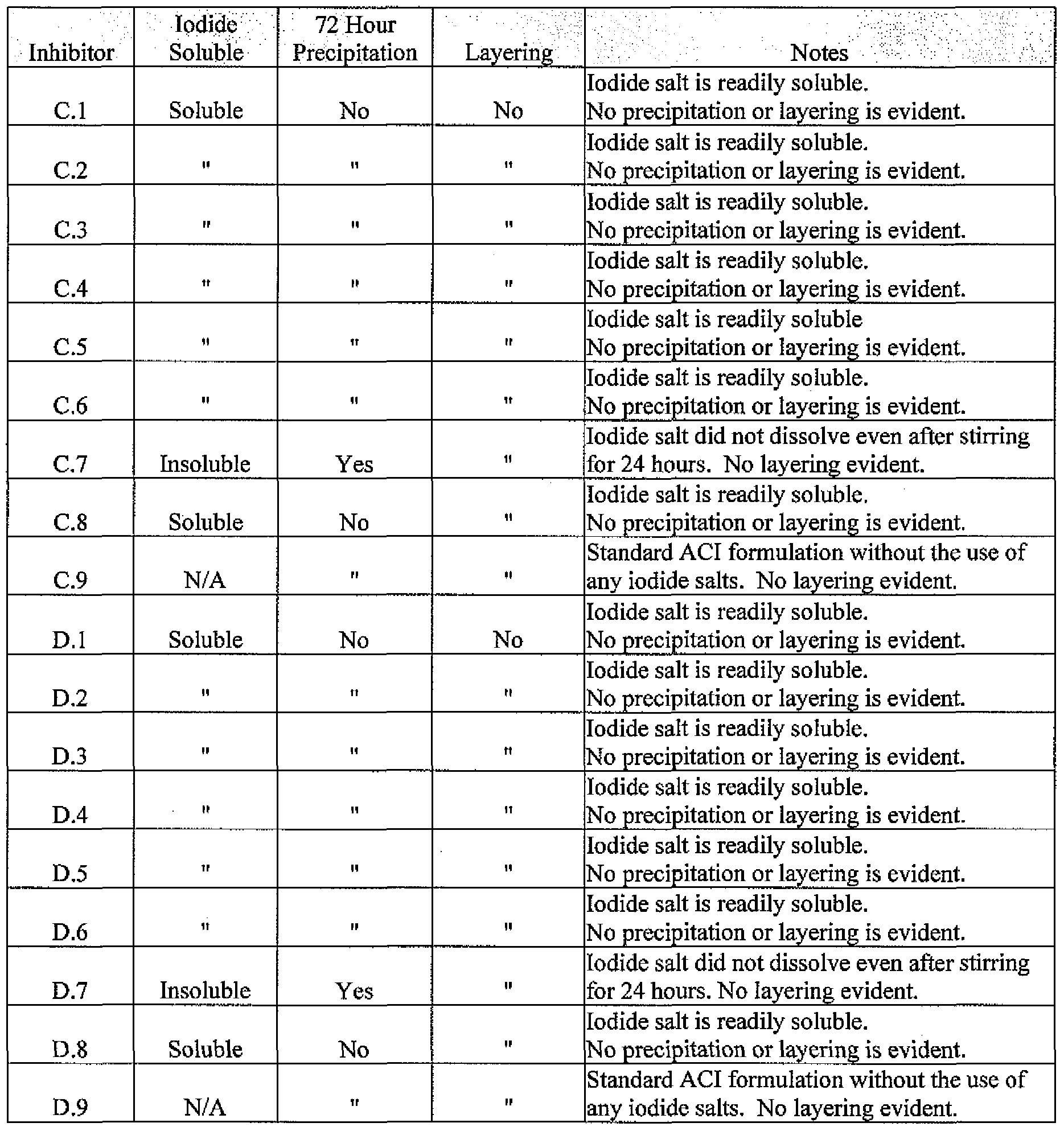
Table 6 shows the stabilities of various iodide-containing ACIs that differ quite significantly in their formulations when compared to the ACIs in Table 5 (see Tables 1-4 for formulation differences). Representative iodide salts dissolve readily except for the tetramethylammonium iodide salt, which is insoluble. Furthermore, no apparent precipitate forms after 72 hours in these formulations and no layering of the corrosion inhibitor components
is evident.
Example 2
Corrosion testing by weight loss. Corrosion rates are determined on different metal test coupons including N80, Cr 13, and
CT900 in a simulated treatment fluid made up from an aqueous mixture of hydrochloric acid or hydrochloric/hydrofluoric acid mixtures (HF generated in situ using ammonium bifluoride). Typically, 100 mL of the treatment fluid is used, to which is added the selected amount of acid corrosion inhibitor given in gallons per thousand (GPT). Any additional external intensifiers are then added to the treatment fluid. The selected test coupons are then added to the inhibited acid mixtures and these mixtures are then placed in a high temperature and pressure corrosion autoclave unit. These coupons remained in the autoclave under pressure for the test duration (typically 4 or 6 hours) at 3000 psi. After that the coupons are removed, cleaned and weighed to obtain their weight loss. The corrosion value is then given in lb/ft2. The coupons are also visually inspected for any pitting corrosion and assigned a value of 0-7. Values 0-3 are considered acceptable rates while any value higher than that are not acceptable. The results are shown in Tables 7-12.
Table 7. 275°F. 6 hours. 300Q psi. 20 GPT Inhibitor. 15% HCl

Table 8. 275°P, 6 hours. 3000 psi. 20 GPT Inhibitor. 15% HCl

Table 9. 275°F. 6 hours. 3000 psi. 20 GPT Inhibitor. 15% HCl
 Table 10. 275°F. 6 hours. 3000 psi. 20 GPT Inhibitor. 15% HCl

The data in Tables 7-10 show that a soluble iodide source can be formulated into an acid corrosion inhibitor successfully while providing respectable corrosion protection. Changing solvent conditions in the ACI formulation or the cationic portion of the iodide salt can influence the solubility of the selected iodide source. Additionally, the utilization of as little as 1 percent by weight of an iodide salt can positively influence the corrosion protection provided by the ACI. This is shown when comparing the formulation of an ACI that was made with an iodide salt versus one that was not.
In order to further explore the capabilities of iodide-containing ACIs, a representative ACI, A.8, is selected to further investigate the corrosion protection capabilities of an iodide-containing ACI at higher temperature, with other metallurgies, and with the use of an additional external intensifier such as formic acid. These tests are carried out side by side with other commercially available ACIs for comparison purposes. Generic composition information is show in Table 11.
Table 12 shows the corrosion test results for representative ACI A.8. The corrosion testing is done at 2500F, 3000F, and 3500F with both N80 and CT900 coupons. Table 13 shows the corrosion data acquired for the ACI labeled A.8 at 2500F, 3000F, and 35O°F with CrI 3 coupons. In both Tables 12 and 13, the data are collected alongside the commercially available ACI data for comparison purposes.
Table 11. Composition of Commercially Available ACIs

*Includes, but is not limited to, acetylenic alcohols, ot,β-unsaturated aldehydes, organic acids, and transition metal salts
Table 12. Corrosion Inhibition Data at 3000 psi & 10 GPT of Inhibitor


The results from Tables 12 and 13 suggest that representative ACI A.8 works very well with formic acid as an external intensifier at a variety of temperatures and with several different metals. This ACI provides corrosion inhibition that is nearly the same, or in some cases better than, other commercially available ACIs.
Changes can be made in the composition, operation, and arrangement of the method of the invention described herein without departing from the concept and scope of the invention as defined in the claims.
Claims
1. A corrosion inhibitor composition comprising a) one or more organic solvents; b) one or more corrosion inhibitor intermediates; and c) about 0.1 to about 20 weight percent of one or more iodide salts dissolved in said composition.
2. The corrosion inhibitor composition of claim 1 wherein said iodide salts are selected from lithium iodide, sodium iodide, potassium iodide, calcium iodide, magnesium iodide, ammonium iodide, tetraethylammonium iodide, tetrapropylammonium iodide, tetrabutylammonium iodide, tetrapentylammonium iodide, tetrahexylammonium iodide, tetraheptylammonium iodide, tetraphenylammonium iodide, phenytrimethylarnmonium iodide and (ethy l)triphenylphosphonium iodide .
3. The corrosion inhibitor composition of claim 1 wherein said corrosion inhibitor intermediates are selected from the group consisting of acetylenic alcohols; quaternary ammonium compounds, α,β-unsaturated aldehydes, amines and Mannich reaction products.
4. The corrosion inhibitor composition of claim 3 further comprising one or more surfactants.
5. The corrosion inhibitor composition of claim 3 further comprising one or more dispersants.
6. The corrosion inhibitor composition of claim 3 further comprising one or more formic acid compounds.
7. The corrosion inhibitor composition of claim 2 wherein the organic solvents are selected from methanol, isopropanol, ethanol, 1-butanol, wo-butanol, tert-bυtanol, acetonitrile, N,N- dimethyl formamide, formamide and acetone.
8. The corrosion inhibitor composition of claim 7 comprising about 0.2 to about 10 weight percent iodide salts.
9. The corrosion inhibitor composition of claim 8 wherein said iodide salts are selected from the group consisting of lithium iodide, phenyltrimethylammonium iodide, (ethyl)triphenylphosphonium iodide, tetrabutylammonium iodide, tetraethylammonium iodide, tetrapropylammonium iodide and ammonium iodide.
10. The corrosion inhibitor composition of claim 9 comprising about 0.5 to about 5 weight percent of said iodide salts.
11. The corrosion inhibitor composition of claim 10 wherein the iodide salt is ammonium iodide.
12. The corrosion inhibitor composition of claim 11 comprising about 1 to about 2 weight percent ammonium iodide.
13. A method of preparing an acid solution providing enhanced protection against corrosion of metallic surfaces in contact with said solution comprising mixing an aqueous acid solution with an effective corrosion inhibiting amount of the corrosion inhibitor composition according to claim 1.
14. A method of inhibiting corrosion of a steel surface in contact with an acidic fluid comprising contacting the steel surface with an acid solution comprising aqueous acid and an effective corrosion inhibiting amount of the corrosion inhibitor according to claim 1.
15. A method of treating a subterranean formation penetrated by a wellbore comprising pumping through well tubular goods and injecting into the formation an effective treating amount of an acid solution comprising aqueous acid and an amount of the corrosion inhibitor composition according to claim 1 effective to inhibit the corrosion of metallic surfaces of said well tubular goods in contact with said acid solution.
16. The method of claim 15 wherein said treating is selected from the group consisting of acid fracturing and acid matrix stimulation.
Applications Claiming Priority (2)
| Application Number | Priority Date | Filing Date | Title |
|---|---|---|---|
| US11/612,770 US7842127B2 (en) | 2006-12-19 | 2006-12-19 | Corrosion inhibitor composition comprising a built-in intensifier |
| US11/612,770 | 2006-12-19 |
Publications (1)
| Publication Number | Publication Date |
|---|---|
| WO2008077005A1 true WO2008077005A1 (en) | 2008-06-26 |
Family
ID=39528097
Family Applications (1)
| Application Number | Title | Priority Date | Filing Date |
|---|---|---|---|
| PCT/US2007/087851 Ceased WO2008077005A1 (en) | 2006-12-19 | 2007-12-18 | Corrosion inhibitor composition comprising a built-in intensifier |
Country Status (3)
| Country | Link |
|---|---|
| US (1) | US7842127B2 (en) |
| AR (1) | AR063887A1 (en) |
| WO (1) | WO2008077005A1 (en) |
Cited By (5)
| Publication number | Priority date | Publication date | Assignee | Title |
|---|---|---|---|---|
| CN102162100A (en) * | 2011-03-28 | 2011-08-24 | 陕西驭腾实业有限公司 | Clay acid acidifying corrosion inhibitor, corrosion inhibitor composition and preparation method thereof |
| US8720570B2 (en) | 2011-02-04 | 2014-05-13 | Baker Hughes Incorporated | Method of corrosion mitigation using nanoparticle additives |
| WO2018074997A1 (en) * | 2016-10-17 | 2018-04-26 | Halliburton Energy Services, Inc. | Inhibiting corrosion in a downhole environment |
| US10221347B2 (en) | 2014-12-03 | 2019-03-05 | Halliburton Energy Services, Inc. | Methods and systems for suppressing corrosion of sensitive metal surfaces |
| US10407610B2 (en) | 2014-12-03 | 2019-09-10 | Halliburton Energy Services, Inc. | Methods and systems for suppressing corrosion of steel surfaces |
Families Citing this family (22)
| Publication number | Priority date | Publication date | Assignee | Title |
|---|---|---|---|---|
| MY148568A (en) * | 2004-12-09 | 2013-04-30 | Lonza Ag | Quaternary ammonium salts as a conversion coating or coating enhancement |
| KR101088025B1 (en) | 2009-01-28 | 2011-12-09 | 대한민국 (관리부서:국립문화재연구소) | Corrosion inhibitor composition for stabilization processing of bronze cultural properties and processing method thereof |
| KR101674702B1 (en) | 2009-05-13 | 2016-11-09 | 더루우브리졸코오포레이션 | Lubricating composition containing malic acid derivative |
| US8933000B2 (en) | 2009-09-11 | 2015-01-13 | Baker Hughes Incorporated | Corrosion inhibitor for acid stimulation systems |
| US20110100630A1 (en) * | 2009-11-02 | 2011-05-05 | Baker Hughes Incorporated | Method of Mitigating Corrosion Rate of Oilfield Tubular Goods |
| US8361937B2 (en) | 2010-12-01 | 2013-01-29 | Halliburton Energy Services, Inc. | Corrosion inhibitor compositions comprising reaction products of aldehydes and amides and related methods |
| US9074289B2 (en) | 2011-11-08 | 2015-07-07 | Nalco Company | Environmentally friendly corrosion inhibitor |
| CA2856220C (en) | 2011-11-23 | 2016-10-11 | Saleh H. Al-Mutairi | Dual-phase acid-based fracturing composition with corrosion inhibitors and method of use thereof |
| US20150354323A1 (en) * | 2014-06-10 | 2015-12-10 | Clearwater International, Llc | Non-alkyl pyridine sour corrosion inhibitors and methods for making and using same |
| GB2529723B (en) * | 2014-09-01 | 2017-04-05 | Schlumberger Holdings | A method of corrosion inhibition of metal |
| WO2016105996A1 (en) | 2014-12-22 | 2016-06-30 | Lonza Inc. | Corrosion inhibitor compositions for acidizing treatments |
| GB2554571B (en) | 2015-05-27 | 2022-02-09 | Halliburton Energy Services Inc | Corrosion inhibition of HCL treatment fluids with environmentally compatible solvent |
| US10619056B2 (en) | 2015-09-03 | 2020-04-14 | Ppg Industries Ohio, Inc. | Corrosion inhibitors and coating compositions containing the same |
| CN105694836A (en) * | 2016-01-05 | 2016-06-22 | 南京华洲新材料有限公司 | Diverting acid acidizing corrosion inhibitor and preparation method thereof |
| CN109477786A (en) | 2016-07-19 | 2019-03-15 | 艺康美国股份有限公司 | Controlling Industrial Water Treatment with Digital Imaging |
| CN109477802A (en) | 2016-07-19 | 2019-03-15 | 艺康美国股份有限公司 | Controlling Industrial Water Treatment with Digital Imaging |
| CN109294549A (en) * | 2018-08-30 | 2019-02-01 | 赵晴晴 | A kind of high temperature oil field acidification corrosion inhibitor and preparation method |
| CN109810040B (en) * | 2018-11-07 | 2020-02-18 | 西南石油大学 | A kind of preparation method and application of Mannich base quaternary ammonium salt high temperature acidification corrosion inhibitor |
| CN109735849B (en) * | 2019-02-15 | 2021-06-25 | 杭州冠洁工业清洗水处理科技有限公司 | Corrosion inhibitor for evaporative condenser galvanized pipe and process for cleaning condenser by using corrosion inhibitor |
| CN114907830A (en) * | 2021-02-07 | 2022-08-16 | 中国石油天然气股份有限公司 | Chloride stress corrosion cracking inhibitor for 13Cr stainless steel, preparation and application thereof |
| CN118085845B (en) * | 2024-02-26 | 2025-02-18 | 山东滨州昱诚化工科技有限公司 | A kind of corrosion inhibitor for acid fracturing and preparation method thereof |
| CN119060715B (en) * | 2024-08-22 | 2025-03-14 | 九江蓝卓新材料科技有限公司 | Acidification corrosion inhibitor that can resist high temperature of 190℃ |
Citations (2)
| Publication number | Priority date | Publication date | Assignee | Title |
|---|---|---|---|---|
| USH751H (en) * | 1988-06-10 | 1990-03-06 | Sullivan Daniel S | Method of inhibiting acid corrosion of ferrous metals |
| US6225261B1 (en) * | 1992-02-24 | 2001-05-01 | Halliburton Energy Services, Inc. | Composition and method for controlling precipitation when acidizing wells |
Family Cites Families (25)
| Publication number | Priority date | Publication date | Assignee | Title |
|---|---|---|---|---|
| US3773465A (en) * | 1970-10-28 | 1973-11-20 | Halliburton Co | Inhibited treating acid |
| US4141416A (en) * | 1976-05-24 | 1979-02-27 | Union Oil Company Of California | Enhanced oil recovery using alkaline sodium silicate solutions |
| US4498997A (en) * | 1983-06-24 | 1985-02-12 | Halliburton Company | Method and composition for acidizing subterranean formations |
| EP0212752B1 (en) * | 1985-08-14 | 1991-09-11 | Pumptech N.V. | Process and composition for inhibiting iron and steel corrosion |
| US4734259A (en) * | 1985-11-22 | 1988-03-29 | Dowell Schlumberger Incorporated | Mixtures of α,β-unsaturated aldehides and surface active agents used as corrosion inhibitors in aqueous fluids |
| US4871848A (en) * | 1987-01-27 | 1989-10-03 | The Dow Chemical Company | Compositions prepared from hydrocarbyl substituted nitrogen-containing aromatic heterocyclic compounds, an aldehyde and/or ketone and an amine |
| US4871024A (en) * | 1988-08-01 | 1989-10-03 | Baker Performance Chemicals Inc. | Fluid for treatment of a subterranean well for enhancement of production |
| US5002673A (en) * | 1989-03-31 | 1991-03-26 | Exxon Chemical Patents Inc. | Corrosion inhibitor and method of use |
| US4997040A (en) * | 1989-10-17 | 1991-03-05 | Baker Hughes Incorporated | Corrosion inhibition using mercury intensifiers |
| US5209859A (en) * | 1990-03-16 | 1993-05-11 | Exxon Chemical Patents, Inc. | Inhibited acid system for acidizing wells |
| US5089153A (en) * | 1990-03-16 | 1992-02-18 | Williams Dennis A | Method of inhibiting corrosion in acidizing wells |
| US5200096A (en) * | 1991-09-27 | 1993-04-06 | Exxon Chemical Patents Inc. | Method of inhibiting corrosion in acidizing wells |
| AU4791593A (en) * | 1992-08-14 | 1994-03-15 | Henkel Corporation | Low toxicity, non-carcinogenic inhibitors for acid pickling |
| US5543388A (en) * | 1993-08-05 | 1996-08-06 | Exxon Chemical Patents Inc. | Intensified corrosion inhibitor and method of use |
| US5697443A (en) * | 1996-02-09 | 1997-12-16 | Halliburton Energy Services, Inc. | Method and composition for acidizing subterranean formations utilizing corrosion inhibitor intensifiers |
| EP0869258A1 (en) * | 1997-04-03 | 1998-10-07 | Halliburton Energy Services, Inc. | Method and composition for acidizing subterranean formations utilizing corrosion inhibitor intensifiers |
| US6180057B1 (en) * | 1998-06-19 | 2001-01-30 | Nalco/Exxon Energy Chemicals L.P. | Corrosion inhibiting compositions and methods |
| EP1274883B1 (en) * | 2000-04-13 | 2006-06-28 | Baker Hughes Incorporated | Corrosion inhibitor |
| US20030183808A1 (en) * | 2002-03-28 | 2003-10-02 | Walker Michael L. | Corrosion inhibitor |
| US7216710B2 (en) * | 2004-02-04 | 2007-05-15 | Halliburton Energy Services, Inc. | Thiol/aldehyde corrosion inhibitors |
| US7073588B2 (en) * | 2004-02-27 | 2006-07-11 | Halliburton Energy Services, Inc. | Esterquat acidic subterranean treatment fluids and methods of using esterquats acidic subterranean treatment fluids |
| US20060264335A1 (en) * | 2005-05-17 | 2006-11-23 | Bj Services Company | Corrosion inhibitor intensifier and method of using the same |
| US20070010404A1 (en) * | 2005-07-08 | 2007-01-11 | Halliburton Energy Services, Inc. | Corrosion inhibitor or intensifier for use in acidizing treatment fluids |
| US20070069182A1 (en) * | 2005-09-26 | 2007-03-29 | Halliburton Energy Services, Inc. | Corrosion inhibitor compositions and associated methods |
| US20070071887A1 (en) * | 2005-09-26 | 2007-03-29 | Halliburton Energy Services, Inc. | Methods of inhibiting corrosion of a metal surface |
-
2006
- 2006-12-19 US US11/612,770 patent/US7842127B2/en not_active Expired - Fee Related
-
2007
- 2007-11-21 AR ARP070105171A patent/AR063887A1/en unknown
- 2007-12-18 WO PCT/US2007/087851 patent/WO2008077005A1/en not_active Ceased
Patent Citations (2)
| Publication number | Priority date | Publication date | Assignee | Title |
|---|---|---|---|---|
| USH751H (en) * | 1988-06-10 | 1990-03-06 | Sullivan Daniel S | Method of inhibiting acid corrosion of ferrous metals |
| US6225261B1 (en) * | 1992-02-24 | 2001-05-01 | Halliburton Energy Services, Inc. | Composition and method for controlling precipitation when acidizing wells |
Cited By (7)
| Publication number | Priority date | Publication date | Assignee | Title |
|---|---|---|---|---|
| US8720570B2 (en) | 2011-02-04 | 2014-05-13 | Baker Hughes Incorporated | Method of corrosion mitigation using nanoparticle additives |
| CN102162100A (en) * | 2011-03-28 | 2011-08-24 | 陕西驭腾实业有限公司 | Clay acid acidifying corrosion inhibitor, corrosion inhibitor composition and preparation method thereof |
| US10221347B2 (en) | 2014-12-03 | 2019-03-05 | Halliburton Energy Services, Inc. | Methods and systems for suppressing corrosion of sensitive metal surfaces |
| US10407610B2 (en) | 2014-12-03 | 2019-09-10 | Halliburton Energy Services, Inc. | Methods and systems for suppressing corrosion of steel surfaces |
| US10640697B2 (en) | 2014-12-03 | 2020-05-05 | Halliburton Energy Services, Inc. | Methods and systems for suppressing corrosion of metal surfaces |
| WO2018074997A1 (en) * | 2016-10-17 | 2018-04-26 | Halliburton Energy Services, Inc. | Inhibiting corrosion in a downhole environment |
| US10544356B2 (en) | 2016-10-17 | 2020-01-28 | Halliburton Energy Services, Inc. | Inhibiting corrosion in a downhole environment |
Also Published As
| Publication number | Publication date |
|---|---|
| AR063887A1 (en) | 2009-02-25 |
| US20080146464A1 (en) | 2008-06-19 |
| US7842127B2 (en) | 2010-11-30 |
Similar Documents
| Publication | Publication Date | Title |
|---|---|---|
| US7842127B2 (en) | Corrosion inhibitor composition comprising a built-in intensifier | |
| CA2124873C (en) | Iodine-containing corrosion inhibitor for oil field acidizing operations | |
| US7846879B2 (en) | Esterquat acidic subterranean treatment fluids and methods of using esterquats acidic subterranean treatment fluids | |
| US7994099B2 (en) | Corrosion inhibitor compositions comprising an aldehyde and a thiol and/or an amine functionalized ring structure and associated methods | |
| US7902124B2 (en) | Self-diverting acid treatment with formic-acid-free corrosion inhibitor | |
| US8062586B2 (en) | Methods and compositions for inhibiting metal corrosion | |
| US20110100630A1 (en) | Method of Mitigating Corrosion Rate of Oilfield Tubular Goods | |
| US7655158B2 (en) | Corrosion inhibitor | |
| US20120142563A1 (en) | Corrosion Inhibitor Compositions Comprising Reaction Products of Aldehydes and Amides and Related Methods | |
| US7994101B2 (en) | Corrosion inhibitor intensifier compositions and associated methods | |
| US8404157B2 (en) | Methods and compositions for inhibiting corrosion | |
| US8058211B2 (en) | Corrosion inhibitor intensifier compositions and associated methods | |
| WO2002103081A2 (en) | Halogen acid corrosion inhibitor base | |
| US20110140049A1 (en) | Corrosion Inhibitor Intensifier Compositions | |
| US10240240B2 (en) | Environmentally friendly corrosion inhibitors for high temperature applications |
Legal Events
| Date | Code | Title | Description |
|---|---|---|---|
| 121 | Ep: the epo has been informed by wipo that ep was designated in this application |
Ref document number: 07865770 Country of ref document: EP Kind code of ref document: A1 |
|
| NENP | Non-entry into the national phase |
Ref country code: DE |
|
| 122 | Ep: pct application non-entry in european phase |
Ref document number: 07865770 Country of ref document: EP Kind code of ref document: A1 |