WO2007147828A1 - Herbicidal compositions comprising a 3-heterocyclyl-substituted benzoyl compound - Google Patents
Herbicidal compositions comprising a 3-heterocyclyl-substituted benzoyl compound Download PDFInfo
- Publication number
- WO2007147828A1 WO2007147828A1 PCT/EP2007/056097 EP2007056097W WO2007147828A1 WO 2007147828 A1 WO2007147828 A1 WO 2007147828A1 EP 2007056097 W EP2007056097 W EP 2007056097W WO 2007147828 A1 WO2007147828 A1 WO 2007147828A1
- Authority
- WO
- WIPO (PCT)
- Prior art keywords
- compound
- compositions
- composition
- alkyl
- formula
- Prior art date
- Legal status (The legal status is an assumption and is not a legal conclusion. Google has not performed a legal analysis and makes no representation as to the accuracy of the status listed.)
- Ceased
Links
- 0 *c(c(C(c1c(*)c(*)c(*)c(*)c1)=O)c1O)n[n]1S Chemical compound *c(c(C(c1c(*)c(*)c(*)c(*)c1)=O)c1O)n[n]1S 0.000 description 1
Classifications
-
- A—HUMAN NECESSITIES
- A01—AGRICULTURE; FORESTRY; ANIMAL HUSBANDRY; HUNTING; TRAPPING; FISHING
- A01N—PRESERVATION OF BODIES OF HUMANS OR ANIMALS OR PLANTS OR PARTS THEREOF; BIOCIDES, e.g. AS DISINFECTANTS, AS PESTICIDES OR AS HERBICIDES; PEST REPELLANTS OR ATTRACTANTS; PLANT GROWTH REGULATORS
- A01N43/00—Biocides, pest repellants or attractants, or plant growth regulators containing heterocyclic compounds
- A01N43/72—Biocides, pest repellants or attractants, or plant growth regulators containing heterocyclic compounds having rings with nitrogen atoms and oxygen or sulfur atoms as ring hetero atoms
- A01N43/80—Biocides, pest repellants or attractants, or plant growth regulators containing heterocyclic compounds having rings with nitrogen atoms and oxygen or sulfur atoms as ring hetero atoms five-membered rings with one nitrogen atom and either one oxygen atom or one sulfur atom in positions 1,2
Definitions
- compositions comprising a 3-heterocyclyl-substituted benzoyl compound
- the present invention relates to herbicidally active compositions, which comprise
- R 1 , R 3 are selected, independently of each other, from the group consisting of halogen, Ci-C ⁇ -alkyl, Ci-C4-haloalkyl, Ci-C ⁇ -alkoxy, Ci-C4-haloalkoxy, Ci- C ⁇ -alkylthio, Ci-C ⁇ -alkylsulfinyl or Ci-C ⁇ -alkylsulfonyl;
- R 2 is a heterocyclic radical selected from the group consisting of isoxazol-3-yl, isoxazol-4-yl, isoxazol-5-yl, 4,5-dihydroisoxazol-3-yl, 4,5-dihydroisoxazol-4- yl and 4,5-dihydroisoxazol-5-yl, wherein the six heterocyclic radicals mentioned may be unsubstituted, or may carry 1 to 5 halogen atoms and/or 1 , 2, or 3 radicals selected from Ci-C4-alkyl, Ci-C4-alkoxy, Ci-C4-haloalkyl, Ci- C4-haloalkoxy and Ci-C4-alkylthio;
- R 4 is hydrogen, halogen or Ci-C ⁇ -alkyl
- R 5 is d-Ce-alkyl
- R 6 is hydrogen or Ci-C ⁇ -alkyl
- R 7 is Ci-C4-alkyl or Ci-C4-haloalkyl
- R 8 is selected from the group consisting of phenyl, naphthyl, pyrazolyl, isoxa- zolyl and pyridyl, wherein each of the 5 aforementioned radicals may be unsubstituted or may carry 1 to 6 halogen atoms and/or 1 , 2 or 3 radicals, selected from the group consisting of cyano, nitro, Ci-C ⁇ -alkyl, Ci-C 4 - haloalkyl, C 3 -C 6 -alkenyl, C 3 -C 6 -alkynyl, C 3 -C 7 -cycloalkyl, C 3 -C 7 - cycloalkenyl, Ci-C4-alkoxy, Ci-C4-haloalkoxy, Ci-C4-alkylthio, C1-C4- haloalkylthio, Ci-C4-alkylsulfonyl, Ci-C4-haloalkylsulf
- crop protection it is desirable in principle to increase the specificity and the reliability of the action of active compounds.
- crop protection product it is desirable for the crop protection product to control the harmful plants effectively and, at the same time, to be tolerated by the useful plants in question.
- Herbicidal 3-heterocyclyl-substituted benzoyl compounds of formula I have been described in WO 96/26206 and WO 98/31681.
- Herbicidal 3-sulfonylisoxazoline compounds of formula Il have been described in JP 09/328 483, EP-A 1364946, EP-A 1405853, WO 03/10165 and JP 2005/35924.
- WO 2005/104848 describes compositions containing a 3-sulfonylisoxazoline compounds of formula Il and an herbicide-antagonistically active amount of a safener.
- 3-heterocyclyl-substituted benzoyl compounds of formula I and 3- sulfonylisoxazolines Il are highly effective herbicides, their activity at low application rates is not always satisfactory. Moreover their compatibility with dicotyledonous crop plants such as cotton, oilseed rape and some graminaceous plants such as barley, millet, corn, rice, wheat and sugar cane is not always satisfactory, i.e. in addition to the harmful plants, the crop plants are also damaged to an extent which is not acceptable. Though it is in principle possible to spare crop plants by lowering the application rates, the extent of the control of harmful plants is naturally also reduced.
- WO 99/65314 discloses that joint application of certain herbicides with 3- heterocyclyl-substituted benzoyl compounds results in an increased overall herbicide action in comparison with a simple expected additive action.
- compositions comprising a) at least one 3-heterocyclyl-substituted benzoyl compound of formula I as defined herein and/or an agriculturally acceptable salt thereof; and b) at least one at least one 3-sulfonylisoxazoline compound of formula Il and/or an agriculturally acceptable salt thereof.
- compositions of the invention may also comprise, as a component c), one ore more safeners.
- Safeners also termed as herbicide safeners are organic compounds which in some cases lead to better crop plant compatibility when applied jointly with specifically acting herbicides. Some safeners are themselves herbicidally active. In these cases, the safeners act as antidote or antagonist in the crop plants and thus reduce or even prevent damage to the crop plants.
- a preferred embodiment of the invention relates to compositions which contain no safener or virtually no safener (i.e. less than 1 % by weight, based on the total amount of compound I and compound II).
- the invention relates in particular to compositions in the form of herbicidally active crop protection compositions as defined above, and in particular to those herbicide compositions, which additionally comprise at least one carrier material, including liquid and/or solid carrier materials.
- the compositions may also contain, if desired, one or more surfactants and, if desired, one or more further auxiliaries customary for crop protection compositions.
- these compositions may or may not comprise, as a component c) a safener.
- the invention furthermore relates to a method for controlling undesirable vegetation, which comprises applying a herbicidal composition according to the present invention to the undesirable plants.
- Application can be done before, during and/or after, preferably during and/or after, the emergence of the undesirable plants.
- the compounds of formulae I and Il and optionally the safener can be applied simultaneously or in succession.
- the invention furthermore relates to a method for controlling undesirable vegetation, which comprises allowing a composition according to the present invention to act on plants, their habitat or on seed.
- the invention furthermore relates to the use of a composition as defined herein for controlling undesirable vegetation in crops, in particular in crops of cereals, corn, soybeans, rice, oilseed rape, cotton, potatoes, groundnuts, preferably cereals, corn, soybeans or rice, or in perennial crops.
- a composition as defined herein for controlling undesirable vegetation in crops, in particular in crops of cereals, corn, soybeans, rice, oilseed rape, cotton, potatoes, groundnuts, preferably cereals, corn, soybeans or rice, or in perennial crops.
- the compounds of formulae I and Il and optionally the safener can be applied simultaneously or in succession in crops, where undesirable vegetation may occur.
- the invention furthermore relates to the use of a composition as defined herein for con- trolling undesirable vegetation in crops which, by genetic engineering or by breeding, are resistant to one or more herbicides and/or fungicides, and/or to attack by insects; preferably resistant to one or more herbicides.
- a composition as defined herein for con- trolling undesirable vegetation in crops which, by genetic engineering or by breeding, are resistant to one or more herbicides and/or fungicides, and/or to attack by insects; preferably resistant to one or more herbicides.
- the compounds of formulae I and Il and optionally the safener can be applied simultaneously or in succession in crops, where undesirable vegetation may occur.
- the invention furthermore relates to the use of a composition as defined herein for the desiccation or defoliation of plants.
- the compounds of formulae I and Il and optionally the safener can be ap- plied simultaneously or in succession to plants, where defoliation should be achieved.
- the herbicidally active compounds of formulae I and Il and safeners are formulated and applied jointly or separately, and, in the case of separate application, in which order the application takes place. It is only nec- essary, that the compounds of formulae I and Il and the optional safeners are applied in a time frame, which allows simultaneous action of the active ingredients on the plants.
- no safener or virtually no safener i.e. less than 1 % by weight, based on the total amount of compound I and compound II is applied.
- the invention also relates to compositions in the form of a crop protection composition formulated as a 2-component composition.
- the 2-component composition of the invention comprise a first composition which contains the active compound I and optionally a safener, and a second composition which comprises at least one com- pound of the formula Il and which may or may not or virtually not comprise a safener.
- the first and the second composition may also contain one or more carrier materials and, if appropriate, one or more surfactants, and/or further auxiliaries customary for crop protection compositions.
- the individ- ual compositions are applied in a time frame, which allows simultaneous action of the active ingredients of the first and the second composition on the plants.
- Halogenated substituents preferably carry one, two, three, four or five identical or different halogen atoms.
- the term halogen denotes in each case fluorine, chlorine, bromine or iodine.
- Ci-C 4 -alkyl CH 3 , C 2 H 5 , n-propyl, CH(CH 3 ) 2 , n-butyl, CH(CHa)-C 2 H 5 , CH 2 - CH(CHs) 2 and C(CH 3 ) 3 ;
- Ci-C ⁇ -alkyl Ci-C4-alkyl as mentioned above, and also, for example, n-pentyl, 1- methylbutyl, 2-methylbutyl, 3-methylbutyl, 2,2-dimethylpropyl, 1-ethylpropyl, n- hexyl, 1 ,1-dimethylpropyl, 1 ,2-dimethylpropyl, 1-methylpentyl, 2-methylpentyl, 3- methylpentyl, 4-methylpentyl, 1 ,1-dimethylbutyl, 1 ,2-dimethylbutyl, 1 ,3- dimethylbutyl, 2,2-dimethylbutyl, 2,3-
- Ci-C2-haloalkyl a methyl or ethyl radical, wherein the hydrogen atoms are partially or fully substituted by halogen, such as fluorine, chlorine, bromine and/or iodine, in particular chlorine and/or fluorine, examples including CH2F, CHF2, CF3, CH2CI, dichloromethyl, trichloromethyl, chlorofluoromethyl, dichlorofluoromethyl, chlorodifluoromethyl, 2-fluoroethyl, 2-chloroethyl, 2-brom-oethyl, 2-iodoethyl, 2,2- difluoroethyl, 2,2,2-trifluoroethyl, 2-chloro-2-fluor-oethyl, 2-chloro-2,2- difluoroethyl, 2,2-dichloro-2-fluoroethyl, 2,2,2-tri-chloroethyl, C 2 F 5 ;
- halogen such as
- Ci-C4-haloalkyl a Ci-C4-alkyl radical as mentioned above , wherein the hydrogen atoms are partially or fully substituted by halogen, such as fluorine, chlorine, bromine and/or iodine, in particular chlorine and/or fluorine, examples including CH 2 F, CHF2, CF3, CH2CI, dichloromethyl, trichloromethyl, chlorofluoromethyl, dichlorofluoromethyl, chlorodifluoromethyl, 2-fluoroethyl, 2-chloroethyl, 2-bromo- ethyl, 2-iodoethyl, 2,2-difluoroethyl, 2,2,2-trifluoroethyl, 2-chloro-2-fluoroethyl, 2-chloro-2,2-difluoroethyl, 2,2-dichloro-2-fluoroethyl, 2,2,2-trichloroethyl, C 2 F 5 ,
- Ci-C 4 -alkoxy OCH 3 , OC 2 H 5 , n-propoxy, OCH(CH 3 ) 2 , n-butoxy, OCH(CHa)-C 2 H 5 , OCH 2 -CH(CHa) 2 or OC(CH 3 ) 3 , preferably OCH 3 , OC 2 H 5 or OCH(CH 3 ) 2 ;
- Ci-C ⁇ -alkoxy a Ci-C4-alkoxy radical as mentioned above, and also, for example pentoxy, 1-methylbutoxy, 2-methylbutoxy, 3-methoxylbutoxy, 1 ,1- dimethylpropoxy, 1 ,2-dimethylpropoxy, 2,2-dimethylpropoxy, 1-ethylpropoxy, hexoxy, 1-methylpentoxy, 2-methylpentoxy, 3-methylpentoxy, 4-methylpentoxy, 1 ,1-dimethylbutoxy, 1 ,2-dimethylbutoxy, 1 ,3-dimethylbutoxy, 2,2-dimethylbutoxy, 2,3-dimethylbutoxy, 3,3-dimethylbutoxy, 1-ethylbutoxy, 2-ethylbutoxy, 1 ,1 ,2-tri- methylpropoxy, 1 ,2,2-trimethylpropoxy, 1-ethyl-i-methylpropoxy and 1 -ethyl-2- methylpropoxy;
- Ci-C4-haloalkoxy a Ci-C4-alkoxy radical as mentioned above, wherein the hydrogen atoms are partially or fully substituted by halogen, such as fluorine, chlorine, bromine and/or iodine, in particular chlorine and/or fluorine, examples including OCH 2 F, OCHF 2 , OCF 3 , OCH 2 CI, OCH(CI) 2 , OC(CI) 3 , chlorofluoromethoxy, dichlorofluoromethoxy, chlorodifluoromethoxy, 2-fluoroethoxy, 2-chloroethoxy, 2- bromoethoxy, 2-iodoethoxy, 2,2-difluoroethoxy, 2,2,2-trifluoroethoxy, 2-chloro-2- fluoroethoxy, 2-chloro-2,2-difluoroethoxy, 2,2-dichloro-2-fluoroethoxy, 2,2,2- trichloroethoxy, OC
- Ci-C 4 -alkylthio SCH 3 , SC 2 H 5 , n-propylthio, SCH(CH 3 ) 2 , n-butylthio, SCH(CH 3 )- C 2 H 5 , SCH 2 -CH(CHs) 2 or SC(CH 3 ) 3 , preferably SCH 3 or SC 2 H 5 ;
- Ci-C4-haloalkylthio a Ci-C4-alkylthio radical as mentioned above, wherein the hydrogen atoms are partially or fully substituted by halogen, such as fluorine, chlorine, bromine and/or iodine, in particular chlorine and/or fluorine, examples including SCH 2 F, SCHF 2 , SCH 2 CI, SCH(CI) 2 , SC(CI) 3 , SCF 3 , chlorofluoromethyl- thio, dichlorofluoromethylthio, chlorodifluoromethylthio, 2-fluoroethylthio, 2- chloroethylthio, 2-bromoethylthio, 2-iodoethylthio, 2,2-difluoroethylthio, 2,2,2- trifluoroethylthio, 2-chloro-2-fluoroethylthio, 2-chloro-2,2-difluoroethylthio,
- OCH(CHs) 2 n-butoxycarbonyl, CO-OCH(CHs)-C 2 H 5 , CO-OCH 2 -CH(CHs) 2 or CO-OC(CHs) 3 , preferably CO-OCH 3 or CO-OC 2 H 5 ;
- Ci-C 4 -alkylsulfonyl SO 2 -CH 3 , SO 2 -C 2 H 5 , SO 2 -CH 2 -C 2 H 5 , SO 2 -CH(CHs) 2 , n- butylsulfonyl, SO 2 -CH(CH 3 )-C 2 H 5 , SO 2 -CH 2 -CH(CHs) 2 or SO 2 -C(CH 3 ) 3 , preferably
- Ci-C 4 -haloalkylsulfonyl a Ci-C 4 -alkylsulfonyl radical - as mentioned above - wherein the hydrogen atoms are partially or fully substituted by halogen, such as fluorine, chlorine, bromine and/or iodine, in particular chlorine and/or fluorine, examples including SO 2 -CH 2 F, SO 2 -CHF 2 , SO 2 -CF 3 , SO 2 -CH 2 CI, SO 2 -CH(CI) 2 , SO 2 -C(CI) 3 , chlorofluoromethylsulfonyl, dichlorofluoromethylsulfonyl, chlorodi- fluoromethylsulfonyl, 2-fluoroethylsulfonyl, 2-chloroethylsulfonyl, 2- bromoethylsulfonyl, 2-iodoethylsulfonyl, 2,2-d
- C 3 -C6-alkenyl prop-1-en-1-yl, allyl, 1-methylethenyl, 1-buten-1-yl, 1-buten-2-yl, 1- buten-3-yl, 2-buten-1-yl, 1-methylprop-1-en-1-yl, 2-methylprop-1-en-1-yl, 1- methylprop-2-en-1-yl, 2-methylprop-2-en-1-yl, n-penten-1-yl, n-penten-2-yl, n- penten-3-yl, n-penten-4-yl, 1-methylbut-1-en-1-yl, 2-methylbut-1-en-1-yl, 3- methylbut-1-en-1-yl, 1-methylbut-2-en-1-yl, 2-methylbut-2-en-1-yl, 3-methylbut-2- en-1-yl, 1-methylbut-2-en-1-yl, 2-methylbut-2-en-1-yl, 3-methylbut-2- en-1-yl, 1-methylbut
- 2-en-1-yl 1-ethylbut-3-en-1-yl, 2-ethylbut-1-en-1-yl, 2-ethylbut-2-en-1-yl, 2- ethylbut-3-en-1-yl, 1 ,1 ,2-trimethylprop-2-en-1-yl, 1-ethyl-1-methylprop-2-en-1-yl, 1 -ethyl-2-methylprop-1 -en-1 -yl or 1 -ethyl-2-methylprop-2-en-1 -yl;
- - C3-C6-alkynyl prop-1-yn-1-yl, prop-2-yn-1-yl, n-but-1-yn-1-yl, n-but-1-yn-3-yl, n- but-1-yn-4-yl, n-but-2-yn-1-yl, n-pent-1-yn-1-yl, n-pent-1-yn-3-yl, n-pent-1-yn-4-yl, n-pent-1-yn-5-yl, n-pent-2-yn-1-yl, n-pent-2-yn-4-yl, n-pent-2-yn-5-yl, 3-methylbut- 1-yn-3-yl, 3-methylbut-1-yn-4-yl, n-hex-1-yn-1-yl, n-hex-1-yn-3-yl, n-hex-1-yn-4-yl, n-hex
- C3-C7-cycloalkyl a monocyclic saturated hydrocarbon ring having 3 to 7 ring members, such as cyclopropyl, cyclobutyl, cyclopentyl, cyclohexyl or cycloheptyl;
- C3-C7-cycloalkenyl monocyclic unsaturated hydrocarbon ring having 3 to 7 ring members, such as cycloprop-1-enyl, cycloprop-2-enyl, cyclobut-1-enyl, cyclobut- 2-enyl, cyclobut-1 ,3-dienyl, cyclopent-1-enyl, cyclopent-2-enyl, cyclopent-3-enyl, cyclopent-2,4-dienyl, cyclohex-1-enyl, cyclohex-2-enyl, cyclohex-3-enyl; cyclo- hex-1 ,3-dienyl, cyclohex-1 ,5-dienyl, cyclohex-2,4-dienyl, or cyclohex-2,5-dienyl.
- ring members such as cycloprop-1-enyl, cycloprop-2-enyl, cyclobut
- the compounds of formula I, the 3-sulfonylisoxazolines Il and/or the safeners are ca- pable of forming geometrical isomers, for example E/Z isomers, it is possible to use both the pure isomers and mixtures thereof in the compositions according to the invention.
- the compounds of formula I, the 3-sulfonylisoxazolines Il and/or the safeners have one or more centers of chirality and, as a consequence, are present as enanti- omers or diastereomers, it is possible to use both the pure enantiomers and di- astereomers and their mixtures in the compositions according to the invention.
- the compounds of formula I, the 3-sulfonylisoxazolines Il and/or the safeners have functional groups, which can be ionized, they can also be used in the form of their agriculturally acceptable salts.
- the salts of those cations are suitable whose cations have no adverse effect on the action of the active compounds ("agricultural acceptable").
- Preferred cations are the ions of the alkali metals, preferably of lithium, sodium and potassium, of the alkaline earth metals, preferably of calcium and magnesium, and of the transition metals, preferably of manganese, copper, zinc and iron, furthermore ammonium and substituted ammonium in which one to four hydrogen atoms are replaced by Ci-C4-alkyl, hydroxy-Ci-C4-alkyl, Ci-C4-alkoxy-Ci-C4-alkyl, hydroxy-Ci-C4-alkoxy-Ci- C4-alkyl, phenyl or benzyl, preferably ammonium, methylammonium, isopropylammo- nium, dimethylammonium, diisopropylammonium, trimethylammonium, tetramethyl- ammonium, tetraethylammonium, tetrabutylammonium, 2-hydroxyethylammonium, 2- (2-hydroxyeth
- the safeners that carry a carboxyl group can, instead of the active compounds mentioned above, also be employed in the form of an agriculturally acceptable derivative, for example as amides such as mono- or di- Ci-C ⁇ -alkylamides or arylamides, as esters, for example as allyl esters, propargyl esters, Ci-Cio-alkyl esters or alkoxyalkyl esters, and also as thioesters, for example as Ci-Cio-alkyl thioesters.
- active compounds having a COOH group which can also be employed as derivatives are: cloquintocet, fenchlorazole, isoxadifen ad mefenpyr.
- Preferred mono- and di-Ci-C ⁇ -alkylamides are the methyl- and the dimethylamides.
- Preferred arylamides are, for example, the anilidines and the 2-chloroanilides.
- Preferred alkyl esters are, for example, the methyl, ethyl, propyl, isopropyl, butyl, isobutyl, pentyl, mexyl (1-methylhexyl) or isooctyl (2-ethylhexyl) esters.
- Ci-C4-alkoxy-Ci-C4-alkyl esters are the straight-chain or branched C1-C4- alkoxyethyl esters, for example the methoxyethyl, ethoxyethyl or butoxyethyl esters.
- An example of the straight-chain or branched Ci-Cio-alkyl thioesters is the ethyl thioester.
- Preferred arylamides are, for example, the anilidines and the 2-chloroanilides.
- Preferred alkyl esters are, for example, the methyl, ethyl, propyl, isopropyl, butyl, isobu- tyl, pentyl, mexyl (1-methylhexyl) or isooctyl (2-ethylhexyl) esters.
- Preferred Ci-C4-alkoxy-Ci-C4-alkyl esters are the straight-chain or branched C1-C4- alkoxyethyl esters, for example the methoxyethyl, ethoxyethyl or butoxyethyl esters.
- An example of the straight-chain or branched Ci-Cio-alkyl thioesters is the ethyl thioester.
- compositions according to the invention preference is given to those 3-hetero- cyclyl-substituted benzoyl derivatives of the formula I in which the variables have the following meanings, either alone or in combination:
- R 1 halogen such as chlorine or bromine, Ci-C ⁇ -alkyl such as methyl or ethyl or Ci-
- C ⁇ -alkylsulfonyl such as methylsulfonyl or ethylsulfonyl; in particular chlorine, methyl or methylsulfonyl;
- R 2 a heterocyclic radical selected from the group: isoxazol-3-yl, isoxazol-5-yl and
- Ci-C4-haloalkyl Ci-C4-haloalkoxy or Ci-C4-alkylthio; in particular isoxazol-5-yl, 3-methyl-isoxazol-5-yl, 4,5-dihydroisoxazol-3-yl, 5- methyl-4,5-dihydroisoxazol-yl, 5-ethyl-4,5-dihydroisoxazol-3-yl or 4,5-dimethyl-
- R 3 halogen such as chlorine or bromine or Ci-C6-alkylsulfonyl such as methylsul- fonyl or ethylsulfonyl; in particular chlorine, methylsulfonyl or ethyl-sulfonyl;
- R 4 hydrogen or methyl, in particular hydrogen
- R 5 is Ci-C ⁇ -alkyl, such as methyl, ethyl, propyl, 1-methylethyl, butyl, 1-methylpropyl or 2-methylpropyl, in particular methyl, ethyl or 1-methylethyl;
- R 6 hydrogen or Ci-C ⁇ -alkyl, such as methyl or ethyl; especially preferably hydrogen or methyl.
- the composition contains a 3- heterocyclyl substituted benzoyl derivative of the formula I where R 4 is hydrogen and R 2 is a heterocyclic radical selected from the group consisting of isoxazol-3-yl, isoxazol- 4-yl and isoxazol-5-yl, it being possible for the three radicals mentioned to be unsubsti- tuted or mono- or polysubstituted by halogen, Ci-C4-alkyl, Ci-C4-alkoxy, C1-C4- haloalkyl, Ci-C4-haloalkoxy or Ci-C4-alkylthio.
- compositions are preferred wherein R 2 in formula I is isoxazol-3-yl which can be unsubstituted or mono- or polysubstituted by halogen, Ci-C4-alkyl, Ci-C4-alkoxy, Ci-C4-haloalkyl, C1-C4- haloalkoxy or Ci-C4-alkylthio.
- compositions are likewise preferred wherein R 2 in formula I is isoxazol-5-yl, which can be unsubstituted or mono- or polysubstituted by halogen, Ci-C4-alkyl, Ci-C4-alkoxy, Ci-C4-haloalkyl, Ci-C4-haloalkoxy or Ci-C4-alkylthio.
- R 1 , R 3 , R 5 and R 6 are as defined above.
- R 1 is halogen or Ci-C ⁇ -alkyl, in particular methyl
- R 3 is Ci-C ⁇ -alkylsulfonyl
- R 5 is Ci- C ⁇ -alkyl, in particular methyl, ethyl or 1-methylethyl
- R 6 is hydrogen or Ci-C ⁇ -alkyl, es- pecially preferably hydrogen or methyl.
- the composition contains a 3- heterocyclyl substituted benzoyl derivative of the formula I where R 4 is hydrogen and R 2 is a heterocyclic radical selected from the group consisting of 4,5-dihydroisoxazol-3- yl, 4,5-dihydroisoxazol-4-yl and 4,5-dihydroisoxazol-5-yl, it being possible for the three radicals mentioned to be unsubstituted or may carry 1 , 2, 3, 4 or 5 halogen and/or 1 , 2 or 3 radicals selected from Ci-C4-alkyl, Ci-C4-alkoxy, Ci-C4-haloalkyl, Ci-C4-haloalkoxy and Ci-C4-alkylthio.
- compositions are preferred wherein R 2 in formula I is 4,5- dihydroisoxazol-3-yl which can be unsubstituted or may carry 1 , 2, 3, 4 or 5 halogen and/or 1 , 2 or 3 radicals selected from Ci-C4-alkyl, Ci-C4-alkoxy, Ci-C4-haloalkyl, Ci- C4-haloalkoxy and Ci-C4-alkylthio.
- R 1 is halogen or Ci-C ⁇ -alkyl, in particular methyl
- R 2 is 4,5-dihydroisoxazol-3-yl which can be unsubstituted or may carry 1 , 2, 3, 4 or 5 halogen and/or 1 , 2 or 3 radicals selected from Ci-C4-alkyl, Ci-C4-alkoxy, C1-C4- haloalkyl, Ci-C4-haloalkoxy and Ci-C4-alkylthio;
- R 3 is d-Ce-alkylsulfonyl
- R 4 is hydrogen
- R 5 is Ci-C ⁇ -alkyl, such as methyl, ethyl, propyl, 1-methylethyl, butyl, 1-methylpropyl or 2-methylpropyl, in particular methyl, ethyl or 1-methylethyl; and R 6 hydrogen or Ci-C ⁇ -alkyl, such as methyl or ethyl; especially preferably hydrogen or methyl.
- R 8 is phenyl, naphthyl, isoxazolyl, pyrazolyl or pyridyl; in particular phenyl, 1 -naphthyl, 2-naphthyl, 3-isoxazolyl, 4-isoxazolyl, 3- pyrazolyl, 4-pyrazolyl 2-pyridyl, 3-pyridyl or 4-pyridyl; more preferably phenyl, 1 -naphthyl or 2-naphthyl; and very particularly preferably phenyl;
- each of the aforementioned radicals may be unsubstituted or substituted by 1 , 2, 3, 4 5 or 6 halogen atoms and/or by 1 , 2 or 3 substituents selected from the group consisting of cyano, nitro, Ci-C ⁇ -alkyl, Ci-C4-haloalkyl, C3-C6-alkenyl, C3-C6-alkynyl, C3-C7-cycloalkyl, C3-C7-cycloalkenyl, Ci-C4-alkoxy, C1-C4- haloalkoxy, Ci-C4-alkylthio, Ci-C4-haloalkylthio, Ci-C4-alkylsulfonyl, C1-C4- haloalkylsulfonyl, Ci-C4-alkylcarbonyl, Ci-C4-alkoxycarbonyl, phenyl and benzyl; particularly preferred unsubstituted or
- R 8 is pyrazolyl, in particular 3-pyrazolyl or 4-pyrazolyl, wherein each of the aforementioned radicals may be unsubstituted or substituted by 1 , or 2 halogen atoms and/or by 1 or 2 substituents selected from the group consisting of cyano, Ci-C ⁇ -alkyl, Ci-C4-haloalkyl, C3-C6-alkenyl, C3-C6-alkynyl, C3- C7-cycloalkyl, C3-C7-cycloalkenyl, Ci-C4-alkoxy, Ci-C4-haloalkoxy, Ci-C4-alkylthio,
- R 8 is phenyl or pyrazolyl, in particular phenyl or 4-pyrazolyl, wherein each of the aforementioned two radicals may be unsubstituted or substituted by 1 , 2 or 3 halogen atoms and/or by 1 or 2 substituents selected from the group consisting of CrC 4 -alkyl, Ci-C 4 -haloalkyl, Ci-C 4 -alkoxy, CrC 4 -haloalkoxy, phenyl and benzyl. particularly preferred substituted by 1 , 2 or 3 halogen atoms and/or 1 , 2 or 3 sub- stituents selected from the group consisting of Ci-C ⁇ -alkyl, Ci-C4-haloalkyl, Ci-
- Ci-C4-haloalkoxy phenyl and benzyl; especially preferred substituted by 1 , 2 or 3 halogen atoms and/or 1 , 2 or 3 substituents selected from the group consisting of Ci-C ⁇ -alkyl, Ci-C4-haloalkyl and Ci-C4-haloalkoxy.
- R 7 is Ci-C 4 -alkyl or Ci-C 4 -haloalkyl, preferably methyl or chloromethyl, especially preferred methyl; and R 8 is phenyl or 4-pyrazolyl, wherein each of the aforementioned two radicals may be unsubstituted or substituted by 1 , 2 or 3 halogen atoms and/or by 1 , 2 or 3 substituents selected from the group consisting of Ci-C4-alkyl, Ci-C4-haloalkyl, Ci-C4-alkoxy, C1-C4- haloalkoxy, phenyl and benzyl; preferably substituted by 1 to 3 halogen atoms and/or by 1 to 3 substitutents selected from the group consisting of Ci-C4-alkyl, Ci-C4-haloalkyl and C1-C4- haloalkoxy.
- compositions comprise at least one 3-sulfonylisoxazoline Il wherein the variables R 7 and R 8 have the following meanings (hereinbelow also referred to as 3-sulfonylisoxazolines Ma):
- R 7 is Ci-C 4 -alkyl or Ci-C 4 -haloalkyl, preferably Ci-C4-alkyl, especially preferred methyl;
- R 8 is phenyl, which is substituted by 1 to 3 halogen atoms.
- compositions comprise at least one 3-sulfonylisoxazoline Il wherein the variables R 7 and R 8 have the following meanings (hereinbelow also referred to as 3-sulfonylisoxazolines Mb):
- R 7 is Ci-C 4 -alkyl or Ci-C 4 -haloalkyl, preferably Ci-C4-alkyl, especially preferred methyl;
- R 8 is 4-pyrazolyl, which is substituted by 1 or 2 halogen atoms and/or 1 or 2 sub- stituents selected from the group consisting of methyl, trifluoromethyl, difluoro- methoxy or phenyl.
- compositions comprise at least one 3-sulfonylisoxazoline Il wherein the variables R 7 and R 8 have the following meanings (hereinbelow also referred to as 3-sulfonylisoxazolines lie):
- R 7 is Ci-C 4 -alkyl or Ci-C 4 -haloalkyl, preferably Ci-C 4 -alkyl, especially preferred methyl;
- R 8 is 3-pyrazolyl, which is substituted by 1 or 2 halogen atoms and/or 1 to 3 sub- stituents selected from the groups consisting of methyl, trifluoromethyl, difluoro- methoxy or phenyl.
- 3-sulfonylisoxazolines II especially 3- sulfonylisoxazolines Ma, Nb or Nc are the 3-sulfonylisoxazolines of the formula M' listed below wherein R 7 is methyl and R 8 has the meanings given in one row of table 2 (com- pounds 11.1 to II.7).
- Suitable safeners which can be used in the compositions according to the present in- vention are known in the art, e.g. from
- Safeners include benoxacor, cloquintocet, cyometrinil, dichlormid, dicyclonon, dietho- late, fenchlorazole, fenclorim, flurazole, fluxofenim, furilazole, isoxadifen, mefenpyr, mephenate, naphthalic anhydride, 2,2,5-trimethyl-3-(dichloracetyl)-1 ,3-oxazolidine, 4- (dichloroacetyl)-1-oxa-4-azaspiro[4.5]decane and oxabetrinil, as well as thereof agricul- turally acceptable salts and, provided they have a carboxyl group, their agriculturally acceptable derivatives.
- compositions according to the invention particularly preferably comprise at least one of the compounds selected from the group of benoxacor, cloquinto- cet, dichlormid, fenchlorazole, fenclorim, fluxofenim, furilazole, isoxadifen, mefenpyr, naphthalic anhydride, 2,2,5-trimethyl-3-(dichloroacetyl)-1 ,3-oxazolidine, and 4- (dichloroacetyl)-1-oxa-4-azaspiro[4.5]decane and oxabetrinil; and the agriculturally acceptable salt thereof and, in the case of compounds having a COOH group, an agriculturally acceptable derivative as defined above.
- binary and ternary compositions which comprise at least one 3-heterocyclyl-substituted benzoyl compound of formulae Ia, Ib, Ic, Id or Ie and at least one 3-sulfonylisoxazoline of formula Il and, if appropriate, one or more safeners.
- a preferred embodiment of the invention relates to binary compositions which contain only compounds I and Il and which do virtually not contain a safener (i.e. less than 1 % by weight, based on the total amount of compound I and compound II).
- binary compositions includes compositions which comprise one or more (for example 2 or 3) 3-heterocyclyl-substituted benzoyl compound of for- mula I and one or more (for example 2 or 3) 3-sulfonylisoxazolines II.
- ternary compositions includes compositions which comprise one or more (for example 2 or 3) 3-heterocyclyl-substituted benzoyl compound of formula I, one or more (for example 2 or 3) 3-sulfonylisoxazolines Il and one or more (for example 2 or 3) safeners.
- the weight ratio of the active compounds I : Il is usually in the range from 1 :50 to 2:1 , preferably in the range from 1 :20 to 1 :1 , in particular in the range from 1 :15 to 1 :2.
- compositions which comprise both at least one 3-heterocyclyl-substituted benzoyl compound of formula I, at least one 3-sulfonylisoxazoline Il and at least one safener
- the relative weight ratios of the components I : Il are generally as defined above, the weight ratio of compound I to safener is generally from 1 :100 to 20:1 , pref- erably from 1 :50 to 10:1.
- the weight ratio of 3-sulfonylisoxazoline Il to safener is preferably in the range from 50:1 to 1 :50.
- the relative weight ratios of compound I to compound Il to safener is are usually in the range from 1 :50:100 to 20:10:1 , preferably from 1 :20:50 to 10:10:1 , in particular from 1 :15:50 to 10:20:1.
- compositions of the invention which comprise
- compositions of the invention which comprise
- compositions of the invention which comprise
- compositions of the invention which comprise
- the 3- heterocyclyl-substituted benzoyl compound of formula I and the safeners can be used in the form of their agriculturally acceptable salts or in the form of an agriculturally acceptable derivative thereof as described above.
- the weight ratios of the individual components in the compositions are within the limits stated above.
- Particular preference is given to those compositions of the invention wherein the variables R 1 to R 8 in formulae I and Il have the preferred meanings, especially the particularly preferred meanings.
- compositions which, as active compound I comprise a 3-heterocyclyl-substituted benzoyl compound of formulae Ia.1 or the corresponding salt, in particular the sodium, potassium, lithium or ammonium salt, and which comprise the as further active compound, the substances listed in one row of table 3 (compositions 1.1 to 1.70).
- the weight ratios of the individual components in the compositions 1.1 to 1.70 are within the stated limits, in the case of binary compositions of compound Ia.1 and 3-sulfonylisoxazoline Il for example 1 :2, 1 :5, 1 :10 or 1 :15 and in the case of ternary compositions of compound Ia.1 , 3-sulfonylisoxazoline Il and safener I for example 1 :2:1 , 1 :5:1 , 1 :10:1 , 1 :15:1 , 1 :2:2, 1 :5:2, 1 :10:2, 1 :15:2, 1 :2:5, 1 :5:5, 1 :10:5 or 1 :15:5.
- compositions 2.1 - 2.70 which differ from the corresponding compositions 1.1 - 1.70 only in that the compound Ia.1 (or the corresponding salt) is replaced by the compound Ia.2 or the corresponding salt.
- compositions 3.1 - 3.70 which differ from the corresponding compositions 1.1 - 1.70 only in that the compound Ia.1 (or the corresponding salt) is replaced by the compound Ia.3 or the corresponding salt.
- compositions 4.1 - 4.70 which differ from the corresponding compositions 1.1 - 1.70 only in that the compound Ia.1 (or the corresponding salt) is replaced by the compound Ia.4 or the corresponding salt.
- compositions 5.1 - 5.70 which differ from the corresponding compositions 1.1 - 1.70 only in that the compound Ia.1 (or the corresponding salt) is replaced by the compound Ia.4 or the corresponding salt.
- compositions 6.1 - 6.70 which differ from the corre- sponding compositions 1.1 - 1.70 only in that the compound Ia.1 (or the corresponding salt) is replaced by the compound Ia.6 or the corresponding salt.
- compositions 7.1 - 7.70 which differ from the corresponding compositions 1.1 - 1.70 only in that the compound Ia.1 (or the corresponding salt) is replaced by the compound Ia.7 or the corresponding salt.
- compositions 8.1 - 8.70 which differ from the corresponding compositions 1.1 - 1.70 only in that the compound Ia.1 (or the corresponding salt) is replaced by the compound Ia.8 or the corresponding salt.
- compositions 9.1 - 9.70 which differ from the corre- sponding compositions 1.1 - 1.70 only in that the compound Ia.1 (or the corresponding salt) is replaced by the compound Ia.9 or the corresponding salt.
- compositions 10.1 - 10.70 which differ from the corresponding compositions 1.1 - 1.70 only in that the compound Ia.1 (or the corresponding salt) is replaced by the compound Ia.10 or the corresponding salt.
- compositions 11.1 - 1 1.70 which differ from the corresponding compositions 1.1 - 1.70 only in that the compound Ia.1 (or the corresponding salt) is replaced by the compound Ia.11 or the corresponding salt.
- compositions 12.1 - 12.70 which differ from the corresponding compositions 1.1 - 1.70 only in that the compound Ia.1 (or the corresponding salt) is replaced by the compound Ia.12 or the corresponding salt.
- compositions 13.1 - 13.70 which differ from the corresponding compositions 1.1 - 1.70 only in that the compound Ia.1 (or the corresponding salt) is replaced by the compound Ia.13 or the corresponding salt.
- compositions 14.1 - 14.70 which differ from the corre- sponding compositions 1.1 - 1.70 only in that the compound Ia.1 (or the corresponding salt) is replaced by the compound Ia.14 or the corresponding salt.
- compositions 15.1 - 2.70 which differ from the corresponding compositions 1.1 - 1.70 only in that the compound Ia.1 (or the corresponding salt) is replaced by the compound Ia.15 or the corresponding salt.
- compositions 16.1 - 16.70 which differ from the corresponding compositions 1.1 - 1.70 only in that the compound Ia.1 (or the corresponding salt) is replaced by the compound Ia.16 or the corresponding salt.
- compositions 17.1 - 17.70 which differ from the corresponding compositions 1.1 - 1.70 only in that the compound Ia.1 (or the corresponding salt) is replaced by the compound Ia.17 or the corresponding salt.
- compositions 18.1 - 18.70 which differ from the corresponding compositions 1.1 - 1.70 only in that the compound Ia.1 (or the corresponding salt) is replaced by the compound Ia.18 or the corresponding salt.
- compositions 19.1 - 19.70 which differ from the corre- sponding compositions 1.1 - 1.70 only in that the compound Ia.1 (or the corresponding salt) is replaced by the compound Ia.19 or the corresponding salt.
- compositions 20.1 - 20.70 which differ from the corresponding compositions 1.1 - 1.70 only in that the compound Ia.1 (or the corresponding salt) is replaced by the compound Ia.20 or the corresponding salt.
- compositions 21.1 - 21.70 which differ from the corresponding compositions 1.1 - 1.70 only in that the compound Ia.1 (or the corresponding salt) is replaced by the compound Ia.21 or the corresponding salt.
- compositions 22.1 - 22.70 which differ from the corresponding compositions 1.1 - 1.70 only in that the compound Ia.1 (or the corresponding salt) is replaced by the compound Ia.22 or the corresponding salt.
- compositions 23.1 - 23.70 which differ from the corresponding compositions 1.1 - 1.70 only in that the compound Ia.1 (or the corresponding salt) is replaced by the compound Ia.23 or the corresponding salt.
- compositions 24.1 - 24.70 which differ from the corre- sponding compositions 1.1 - 1.70 only in that the compound Ia.1 (or the corresponding salt) is replaced by the compound Ia.24 or the corresponding salt.
- compositions 25.1 - 25.70 which differ from the corresponding compositions 1.1 - 1.70 only in that the compound Ia.1 (or the corresponding salt) is replaced by the compound Ia.25 or the corresponding salt.
- compositions 26.1 - 26.70 which differ from the corresponding compositions 1.1 - 1.70 only in that the compound Ia.1 (or the corresponding salt) is replaced by the compound Ia.26 or the corresponding salt.
- compositions 27.1 - 27.70 which differ from the corresponding compositions 1.1 - 1.70 only in that the compound Ia.1 (or the corresponding salt) is replaced by the compound Ia.27 or the corresponding salt.
- compositions 28.1 - 28.70 which differ from the corresponding compositions 1.1 - 1.70 only in that the compound Ia.1 (or the corresponding salt) is replaced by the compound Ia.28 or the corresponding salt.
- compositions 29.1 - 29.70 which differ from the corre- sponding compositions 1.1 - 1.70 only in that the compound Ia.1 (or the corresponding salt) is replaced by the compound Ia.29 or the corresponding salt.
- compositions 30.1 - 30.70 which differ from the corresponding compositions 1.1 - 1.70 only in that the compound Ia.1 (or the corresponding salt) is replaced by the compound Ia.30 or the corresponding salt.
- compositions 31.1 - 31.70 which differ from the corresponding compositions 1.1 - 1.70 only in that the compound Ia.1 (or the corresponding salt) is replaced by the compound Ia.31 or the corresponding salt.
- compositions 32.1 - 32.70 which differ from the corresponding compositions 1.1 - 1.70 only in that the compound Ia.1 (or the corresponding salt) is replaced by the compound Ia.32 or the corresponding salt.
- compositions 33.1 - 33.70 which differ from the corresponding compositions 1.1 - 1.70 only in that the compound Ia.1 (or the corresponding salt) is replaced by the compound Ia.33 or the corresponding salt.
- compositions 34.1 - 34.70 which differ from the corre- sponding compositions 1.1 - 1.70 only in that the compound Ia.1 (or the corresponding salt) is replaced by the compound Ia.34 or the corresponding salt.
- compositions 35.1 - 35.70 which differ from the corresponding compositions 1.1 - 1.70 only in that the compound Ia.1 (or the corresponding salt) is replaced by the compound Ia.35 or the corresponding salt.
- compositions 36.1 - 36.70 which differ from the corresponding compositions 1.1 - 1.70 only in that the compound Ia.1 (or the corresponding salt) is replaced by the compound Ia.36 or the corresponding salt.
- compositions 37.1 - 37.70 which differ from the corresponding compositions 1.1 - 1.70 only in that the compound Ia.1 (or the corresponding salt) is replaced by the compound Ia.37 or the corresponding salt.
- compositions 38.1 - 38.70 which differ from the corresponding compositions 1.1 - 1.70 only in that the compound Ia.1 (or the corresponding salt) is replaced by the compound Ia.38 or the corresponding salt.
- compositions 39.1 - 39.70 which differ from the corre- sponding compositions 1.1 - 1.70 only in that the compound Ia.1 (or the corresponding salt) is replaced by the compound Ia.39 or the corresponding salt.
- compositions 40.1 - 40.70 which differ from the corresponding compositions 1.1 - 1.70 only in that the compound Ia.1 (or the corresponding salt) is replaced by the compound la.40 or the corresponding salt.
- compositions 41.1 - 41.70 which differ from the corresponding compositions 1.1 - 1.70 only in that the compound Ia.1 (or the corresponding salt) is replaced by the compound la.41 or the corresponding salt.
- compositions 42.1 - 42.70 which differ from the corresponding compositions 1.1 - 1.70 only in that the compound Ia.1 (or the corresponding salt) is replaced by the compound la.42 or the corresponding salt.
- compositions 43.1 - 43.70 which differ from the corresponding compositions 1.1 - 1.70 only in that the compound Ia.1 (or the corresponding salt) is replaced by the compound la.43 or the corresponding salt.
- compositions 44.1 - 44.70 which differ from the corre- sponding compositions 1.1 - 1.70 only in that the compound Ia.1 (or the corresponding salt) is replaced by the compound la.44 or the corresponding salt.
- compositions 45.1 - 45.70 which differ from the corresponding compositions 1.1 - 1.70 only in that the compound Ia.1 (or the corresponding salt) is replaced by the compound la.45 or the corresponding salt.
- compositions 46.1 - 46.70 which differ from the corresponding compositions 1.1 - 1.70 only in that the compound Ia.1 (or the corresponding salt) is replaced by the compound la.46 or the corresponding salt.
- compositions 47.1 - 47.70 which differ from the corresponding compositions 1.1 - 1.70 only in that the compound Ia.1 (or the corresponding salt) is replaced by the compound la.47 or the corresponding salt.
- composition comprises as component a) 4-[2-methyl-3-(4,5- dihydroisoxazol-3-yl)-4-methylsulfonyl-benzoyl]-1 -methyl-5-hydroxy-1 H-pyrazole and as a component b) a 3-sulfonylisoxazoline Il selected from compounds of the formula 11.1 to ll.7.
- the invention relates to compositions which comprise as component a) a 3-heterocyclyl substituted benzoyl compound I as defined above, in particular selected from the compounds Ia.1 to la.47, or a salt thereof, and as a component b) a 3-sulfonylisoxazoline Il as defined above, in particular selected from compounds of the formula 11.1 to II.7, except for a composition containing 4-[2-methyl-3- (4,5-dihydroisoxazol-3-yl)-4-methylsulfonyl-benzoyl]-1 -methyl-5-hydroxy-1 H-pyrazole and compound II.5.
- the invention relates to compositions which comprise as component a) a 3-heterocyclyl substituted benzoyl compound I as defined above, or a salt thereof, in particular selected from the compounds Ia.1 to la.47 or a salt thereof, and as a component b) a 3-sulfonylisoxazoline Il as defined above, except for compound II.5, in particular a 3-sulfonylisoxazoline selected from compounds of the formula 11.1 to II.4, II.6 and II.7.
- the weight ratios of the individual components in the compositions 1.1 to 47.70 are within the limits stated above, in the case of binary compositions of compound I and 3- sulfonylisoxazoline Il preferably from 1 :20 to 1 :1 , in particular from 1 :15 to 1 :2 for example 1 :2, 1 :5, 1 :10 or 1 :15, and in the case of ternary compositions of compound I, 3- sulfonylisoxazoline Il and safener preferably from 1 :20:50 to 10:10:1 , in particular from 1 :15:50 to 10:20:1 , for example 1 :2:1 , 1 :5:1 , 1 :10:1 , 1 :15:1 , 1 :2:2, 1 :5:2, 1 :10:2, 1 :15:2, 1 :2:5, 1 :5:5, 1 :10:5 or 1 :15:5.
- the components a) and b) and optionally safener c), in suspended, emulsified or dissolved form, can be present formulated jointly or separately.
- the use forms depend entirely on the intended use.
- compositions according to the invention can be applied, for example, in the form of directly sprayable aqueous solutions, powders, suspensions, also highly-concentrated aqueous, oily or other suspensions or dispersions, emulsions, oil dispersions, pastes, dusts, materials for spreading or granules, by means of spraying, atomizing, dusting, broadcasting or watering.
- the use forms depend on the intended use; in any case, they should ensure the finest possible distribution of the active compounds.
- the ready-to-use preparations comprise one or more liquid or solid carriers, if appropriate surfactants and if appropriate further auxiliaries which are customary for formulating crop protection products.
- surfactants if appropriate surfactants and if appropriate further auxiliaries which are customary for formulating crop protection products.
- further auxiliaries which are customary for formulating crop protection products.
- the person skilled in the art is sufficiently familiar with the recipes for such formulations.
- the ready-to-use preparations comprise the components a) and b) and optionally safener c) and auxiliaries which are customary for formulating crop protection products, which auxiliaries may also comprise a liquid carrier.
- Suitable inert additives with carrier function are essentially: mineral oil fractions of me- dium to high boiling point, such as kerosene and diesel oil, furthermore coal tar oils and oils of vegetable or animal origin, aliphatic, cyclic and aromatic hydrocarbons, e.g. paraffins, tetrahydronaphthalene, alkylated naphthalenes and their derivatives, alkylated benzenes and their derivatives, alcohols such as methanol, ethanol, propanol, butanol and cyclohexanol, ketones such as cyclohexanone, strongly polar solvents, e.g. amines such as N-methylpyrrolidone, and water.
- mineral oil fractions of me- dium to high boiling point such as kerosene and diesel oil, furthermore coal tar oils and oils of vegetable or animal origin, aliphatic, cyclic and aromatic hydrocarbons, e.g. paraffins, tetra
- Aqueous use forms can be prepared from emulsion concentrates, suspensions, pastes, wettable powders or water-dispersible granules by adding water.
- the active the components a) and b) and optionally safener c) as such or dissolved in an oil or solvent, can be homogenized in water by means of wetting agent, tackifier, dispersant or emulsifier.
- Suitable surfactants are the alkali metal salts, alkaline earth metal salts and ammonium salts of aromatic sulfonic acids, e.g. ligno-, phenol-, naphthalene- and dibutylnaphtha- lenesulfonic acid, and of fatty acids, of alkyl- and alkylarylsulfonates, of alkyl sulfates, lauryl ether sulfates and fatty alcohol sulfates, and salts of sulfated hexa-, hepta- and octadecanols and of fatty alcohol glycol ethers, condensates of sulfonated naphthalene and its derivatives with formaldehyde, condensates of naphthalene or of the naphtha- lenesulfonic acids with phenol and formaldehyde, polyoxyethylene octylphenol ether, ethoxylated is
- Powders, materials for spreading and dusts can be prepared by mixing or concomitant grinding of the active the components a) and b) and optionally safener c) with a solid carrier.
- Granules e.g. coated granules, impregnated granules and homogeneous granules, can be prepared by binding the active ingredients to solid carriers.
- Solid carriers are mineral earths such as silicas, silica gels, silicates, talc, kaolin, limestone, lime, chalk, bole, loess, clay, dolomite, diatomaceous earth, calcium sulfate, magnesium sulfate, magnesium oxide, ground synthetic materials, fertilizers such as ammonium sulfate, ammonium phosphate, ammonium nitrate, ureas, and products of vegetable origin such as cereal meal, tree bark meal, wood meal and nutshell meal, cellulose powders, or other solid carriers.
- the concentrations of the active the components a) and b) and optionally safener c) in the ready-to-use preparations can be varied within wide ranges.
- the formulations comprise from 0.001 to 98% by weight, preferably 0.01 to 95% by weight, of active ingredients(sum of the components a) and b) and optionally safener c)).
- the active ingredients are employed in a purity of from 90% to 100%, preferably 95% to 100% (according to NMR spectrum).
- the compounds according to the invention can, for example, be formulated as follows:
- I 20 parts by weight of the active compound composition in question or the individual components a) and b) and optionally safener c) are dissolved in a composition composed of 80 parts by weight of alkylated benzene, 10 parts by weight of the adduct of 8 to 10 mol of ethylene oxide to 1 mol of oleic acid N- monoethanolamide, 5 parts by weight of calcium dodecylbenzenesulfonate and 5 parts by weight of the adduct of 40 mol of ethylene oxide to 1 mol of castor oil.
- a composition composed of 80 parts by weight of alkylated benzene, 10 parts by weight of the adduct of 8 to 10 mol of ethylene oxide to 1 mol of oleic acid N- monoethanolamide, 5 parts by weight of calcium dodecylbenzenesulfonate and 5 parts by weight of the adduct of 40 mol of ethylene oxide to 1 mol of castor oil.
- IV 20 parts by weight of the active compound composition in question or the individual components a) and b) and optionally safener c) are mixed thoroughly with 3 parts by weight of sodium diisobutylnaphthalenesulfonate, 17 parts by weight of the sodium salt of a lignosulfonic acid from a sulfite waste liquor and 60 parts by weight of pulverulent silica gel, and the composition is ground in a hammer mill. Finely distributing the composition in 20 000 parts by weight of water gives a spray composition which comprises 0.1 % by weight of the active ingredient.
- V 3 parts by weight of the active compound composition in question or the individual components a) and b) and optionally safener c) are mixed with 97 parts by weight of finely divided kaolin. This gives a dust which comprises 3% by weight of the active ingredient.
- VI 20 parts by weight of the active compound composition in question or the individual components a) and b) and optionally safener c) are mixed intimately with 2 parts by weight of calcium dodecylbenzenesulfonate, 8 parts by weight of fatty alcohol polyglycol ether, 2 parts by weight of the sodium salt of a phenol-urea- formaldehyde condensate and 68 parts by weight of a paraffinic mineral oil. This gives a stable oily dispersion.
- VII 1 part by weight of the active compound composition in question or the individual components a) and b) and optionally safener c) are dissolved in a composition composed of 70 parts by weight of cyclohexanone, 20 parts by weight of ethoxy- lated isooctylphenol and 10 parts by weight of ethoxylated castor oil. This gives a stable emulsion concentrate.
- VIII 1 part by weight of the active compound composition in question or the individual components a) and b) and optionally safener c) are dissolved in a composition composed of 80 parts by weight of cyclohexanone and 20 parts by weight of Wet- tol® EM 31 (nonionic emulsifier based on ethoxylated castor oil). This gives a stable emulsion concentrate.
- the components a) i.e. the at least one compound of the formula I
- b) i.e. the at least one compound of the formula II
- optionally safener c can be formulated jointly or separately.
- the components a) and b) and optionally safener c) can be applied jointly or sepa- rately, simultaneously or successively, before, during or after emergence of the plants.
- the active components a) and b) and optionally safener c) are less well tolerated by certain crop plants, it is possible to use application methods in which the herbicidal compositions are sprayed with the aid of sprayers in such a way that the leaves of the sensitive crop plants are as far as possible unaffected, whereas the active compounds reach the leaves of the undesirable plants growing underneath or the uncovered soil surface (post-directed, lay-by).
- the required application rate of the composition of the pure active compounds, i.e. of components a) and b) and optionally safener c)without formulation auxiliary depends on the density of the undesired vegetation, on the development stage of the plants, on the climatic conditions of the location where the composition is used and on the application method.
- the application rate of components a) and b) and optionally safener c) (total amount of components a), b) and c)) is from 25 to 6000 g/ha, prefera- bly from 50 to 5000 g/ha of active substance.
- the required application rates of the compounds of formula I are generally in the range from 1 g/ha to 200 g/ha and preferably in the range from 5 g/ha to 100 g/ha or from 10 g/ha to 50 g/ha of active substance.
- the required application rates of the compounds of formula Il are generally in the range from 10 g/ha to 1000 g/ha and preferably in the range from 20 g/ha to 800 g/ha or from 50 g/ha to 500 g/ha of active substance.
- the required application rates of the safener are generally in the range from 1 g/ha to 5000 g/ha and preferably in the range from 2 g/ha to 5000 g/ha or from 5 g/ha to 5000 g/ha of active substance.
- compositions are applied to the plants mainly by spraying, in particular foliar spray- ing.
- Application can be carried out by customary spraying techniques using, for exam- pie, water as carrier and spray liquor rates of from about 50 to 2000 I/ha or 100 to 1000 I/ha (for example from 100 to 500 I/ha).
- Application of the herbicidal compositions by the low-volume and the ultra-low-volume method is possible, as is their application in the form of microgranules.
- compositions according to the present invention are suitable for controlling common harmful plants in useful plants, in particular in crops such as wheat, barley, oats, cereals, corn, soybean, sorghum, rice, oilseed rape, cotton, potatoes, dry beans, groundnuts, preferably crops of cereals, corn, soybeans, rice, oilseed rape, cotton, po- tatoes, groundnuts; more preferably cereals and corn; or in perennial crops.
- crops such as wheat, barley, oats, cereals, corn, soybean, sorghum, rice, oilseed rape, cotton, potatoes, dry beans, groundnuts, preferably crops of cereals, corn, soybeans, rice, oilseed rape, cotton, po- tatoes, groundnuts; more preferably cereals and corn; or in perennial crops.
- crops such as wheat, barley, oats, cereals, corn, soybean, sorghum, rice, oilseed rape, cotton, potatoes, dry beans, groundnuts,
- compositions according to the invention may be useful to apply the compositions according to the invention jointly as a composition with other crop protection products, for example with pesticides or agents for controlling phytopathogenic fungi or bacteria.
- pesticides or agents for controlling phytopathogenic fungi or bacteria are also of interest.
- miscibil- ity with mineral salt solutions which are employed for treating nutritional and trace element deficiencies.
- Non-phytotoxic oils and oil concentrates may also be added.
- compositions according to the invention can also be used in crop plants which are resistant to one or more herbicides owing to genetic engineering or breeding, which are resistant to one or more fungicides owing to genetic engineering or breeding, or which are resistant to attack by insects owing to genetic engineering or breeding.
- herbicidal EPSP synthase inhibitors such as, for example, glyphosate
- herbicidal glutamine synthase inhibitors such as, for example, glu- fosinate
- compositions according to the invention which comprise at least one 3-heterocyclyl-substituted benzoyl compound of formula I and at least one sulfonyli- soxazoline of formula Il have better herbicidal activity against harmful plants than would have been expected by the herbicidal activity of the individual compounds.
- the joint action of 3-heterocyclyl-substituted benzoyl compound of formula I and sulfonylisoxazolines of formula Il results in an enhanced activity against harmful plants in the sense of a synergy effect (synergism).
- the compositions can, based on the individual components, be used at lower application rates to achieve a herbicidal effect comparable to the individual components.
- compositions according to the invention which, in addition to the 3- heterocyclyl-substituted benzoyl compound of formula I and the sulfonylisoxazoline of formula II, comprise a safener are better tolerated by useful plants than the respective composition of 3-heterocyclyl-substituted benzoyl compound of formula I and sulfonylisoxazoline Il without safener.
- the 3-heterocyclyl-substituted benzoyl compound of formula I can be prepared by the preparation processes disclosed by the applications cited in the introductory part. With respect to the preparation of individual compounds, reference is made to the examples of WO 96/26206 and WO 98/31681. Compounds which are not explicitly disclosed in this document can be prepared in an analogous manner.
- the 3-sulfonylisoxazolines of formula Il can be prepared by the preparation processes disclosed by the earlier applications JP 09/328 483, WO 01/12613, WO 02/62770, WO 03/00686, WO 03/10165, WO 04/13106, WO 04/14138 and JP 2005/35924. With respect to the preparation of individual compounds, reference is made to the examples of the quoted patent applications. Compounds which are not explicitly disclosed in this document can be prepared in an analogous manner.
- the test plants were first grown to a height of 3 to 20 cm, depending on the plant habit, and only then treated.
- the herbicidal compositions were suspended or emulsified in water as distribution medium and sprayed using finely distributing nozzles.
- the respective components I and Il and/or safener were formulated as 10% by weight strength emulsion concentrate and introduced to the spray liquor with the amount of solvent system used for applying the active compound.
- the solvent used was water.
- test period extended over 21 days. During this time, the plants were tended, and their response to the treatments with active compound was evaluated.
- the evaluation for the damage caused by the chemical compositions was carried out using a scale from 0 to 100%, compared to the untreated control plants.
- 0 means no damage and 100 means complete destruction of the plants.
- compositions show a synergistic effect of the herbicidal activity. No noticeable increase of activity against crop plants is observed.
Landscapes
- Life Sciences & Earth Sciences (AREA)
- Agronomy & Crop Science (AREA)
- Pest Control & Pesticides (AREA)
- Plant Pathology (AREA)
- Health & Medical Sciences (AREA)
- Engineering & Computer Science (AREA)
- Dentistry (AREA)
- General Health & Medical Sciences (AREA)
- Wood Science & Technology (AREA)
- Zoology (AREA)
- Environmental Sciences (AREA)
- Agricultural Chemicals And Associated Chemicals (AREA)
Abstract
The present invention relates to herbicidal composition comprising: a) at least one 3-heterocyclyl-substituted benzoyl compound of the formula I wherein: R1, R3 are halogen, C1-C6-alkyl, C1-C4-haloalkyl, C1-C6-alkoxy, C1-C4-haloalkoxy, C1-C6-alkylthio, C1-C6-alkylsulfinyl or C1-C6-alkylsulfonyl; R2 is an optionally substituted heterocyclic radical selected from the group consisting of isoxazol-3-yl, isoxazol-4-yl, isoxazol-5-yl, 4,5-dihydroisoxazol-3-yl, 4,5-dihydroisoxazol-4-yl and 4,5-dihydroisoxazol-5-yl; R4 is hydrogen, halogen or C1-C6-alkyl; R5 is C1-C6-alkyl; R6 is hydrogen or C1-C6-alkyl; and/or an agriculturally acceptable salt thereof; and b) a at least one 3-sulfonylisoxazoline compound of formula II and/or an agriculturally acceptable salt thereof wherein: R7 is C1-C4-alkyl or C1-C4-haloalkyl; and R8 is selected from the group of phenyl, naphthyl, pyrazolyl, isoxazolyl and pyridyl, the radicals being unsubstituted or optionally substituted.
Description
Herbicidal compositions comprising a 3-heterocyclyl-substituted benzoyl compound
The present invention relates to herbicidally active compositions, which comprise
a) at least one 3-heterocyclyl-substituted benzoyl compound of formula I

wherein:
R1, R3 are selected, independently of each other, from the group consisting of halogen, Ci-Cδ-alkyl, Ci-C4-haloalkyl, Ci-Cβ-alkoxy, Ci-C4-haloalkoxy, Ci- Cδ-alkylthio, Ci-Cβ-alkylsulfinyl or Ci-Cδ-alkylsulfonyl;
R2 is a heterocyclic radical selected from the group consisting of isoxazol-3-yl, isoxazol-4-yl, isoxazol-5-yl, 4,5-dihydroisoxazol-3-yl, 4,5-dihydroisoxazol-4- yl and 4,5-dihydroisoxazol-5-yl, wherein the six heterocyclic radicals mentioned may be unsubstituted, or may carry 1 to 5 halogen atoms and/or 1 , 2, or 3 radicals selected from Ci-C4-alkyl, Ci-C4-alkoxy, Ci-C4-haloalkyl, Ci- C4-haloalkoxy and Ci-C4-alkylthio;
R4 is hydrogen, halogen or Ci-Cδ-alkyl;
R5 is d-Ce-alkyl;
R6 is hydrogen or Ci-Cδ-alkyl;
and/or an agriculturally acceptable salt thereof; and
b) at least one 3-sulfonylisoxazoline compound of formula Il and/or an agriculturally acceptable salt thereof
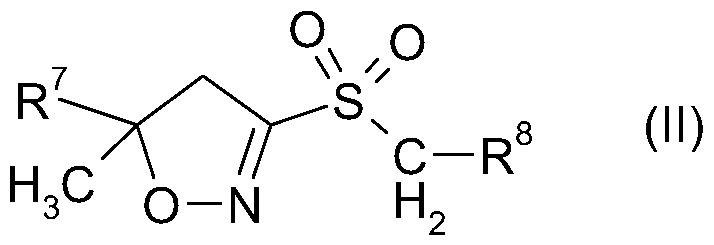
R7 is Ci-C4-alkyl or Ci-C4-haloalkyl; and
R8 is selected from the group consisting of phenyl, naphthyl, pyrazolyl, isoxa- zolyl and pyridyl, wherein each of the 5 aforementioned radicals may be unsubstituted or may carry 1 to 6 halogen atoms and/or 1 , 2 or 3 radicals, selected from the group consisting of cyano, nitro, Ci-Cδ-alkyl, Ci-C4- haloalkyl, C3-C6-alkenyl, C3-C6-alkynyl, C3-C7-cycloalkyl, C3-C7- cycloalkenyl, Ci-C4-alkoxy, Ci-C4-haloalkoxy, Ci-C4-alkylthio, C1-C4- haloalkylthio, Ci-C4-alkylsulfonyl, Ci-C4-haloalkylsulfonyl, C1-C4- alkylcarbonyl, Ci-C4-alkoxycarbonyl, phenyl and benzyl.
Background of the invention
In crop protection, it is desirable in principle to increase the specificity and the reliability of the action of active compounds. In particular, it is desirable for the crop protection product to control the harmful plants effectively and, at the same time, to be tolerated by the useful plants in question.
Herbicidal 3-heterocyclyl-substituted benzoyl compounds of formula I have been described in WO 96/26206 and WO 98/31681.
Herbicidal 3-sulfonylisoxazoline compounds of formula Il have been described in JP 09/328 483, EP-A 1364946, EP-A 1405853, WO 03/10165 and JP 2005/35924.
WO 2005/104848 describes compositions containing a 3-sulfonylisoxazoline compounds of formula Il and an herbicide-antagonistically active amount of a safener.
Although 3-heterocyclyl-substituted benzoyl compounds of formula I and 3- sulfonylisoxazolines Il are highly effective herbicides, their activity at low application rates is not always satisfactory. Moreover their compatibility with dicotyledonous crop plants such as cotton, oilseed rape and some graminaceous plants such as barley, millet, corn, rice, wheat and sugar cane is not always satisfactory, i.e. in addition to the harmful plants, the crop plants are also damaged to an extent which is not acceptable. Though it is in principle possible to spare crop plants by lowering the application rates, the extent of the control of harmful plants is naturally also reduced.
It is known that combined application of certain different herbicides with specific action might result in an enhanced activity of a herbicide component in comparison with a simple additive action. Such an enhanced activity is also termed a synergism or synergistic activity. As a consequence, it is possible to reduce the application rates of herbi- cidally active compounds required for controlling the harmful plants.
WO 99/65314, for example, discloses that joint application of certain herbicides with 3- heterocyclyl-substituted benzoyl compounds results in an increased overall herbicide action in comparison with a simple expected additive action.
US 2005/256004, for example, discloses that joint application of certain herbicides with herbicidal 3-sulfonylisoxazoline compounds results in an increased overall herbicide action in comparison with a simple expected additive action.
Unfortunately, it is usually not possible to predict synergistic activity for combinations of known herbicides, even if the compounds show a close structural similarity to known synergistic combinations.
Summary of the invention
It is an object of the present invention to provide herbicidal compositions, which show enhanced herbicide action in comparison with the herbicide action of 3-heterocyclyl- substituted benzoyl compounds of formula I and of 3-sulfonylisoxazolines of formula Il against undesirable harmful plants and/or to improve their compatibility with crop plants.
We have found that this object is achieved, surprisingly, by compositions comprising a) at least one 3-heterocyclyl-substituted benzoyl compound of formula I as defined herein and/or an agriculturally acceptable salt thereof; and b) at least one at least one 3-sulfonylisoxazoline compound of formula Il and/or an agriculturally acceptable salt thereof.
The compositions of the invention may also comprise, as a component c), one ore more safeners. Safeners, also termed as herbicide safeners are organic compounds which in some cases lead to better crop plant compatibility when applied jointly with specifically acting herbicides. Some safeners are themselves herbicidally active. In these cases, the safeners act as antidote or antagonist in the crop plants and thus reduce or even prevent damage to the crop plants. A preferred embodiment of the invention relates to compositions which contain no safener or virtually no safener (i.e. less than 1 % by weight, based on the total amount of compound I and compound II).
The invention relates in particular to compositions in the form of herbicidally active crop protection compositions as defined above, and in particular to those herbicide compositions, which additionally comprise at least one carrier material, including liquid and/or solid carrier materials. The compositions may also contain, if desired, one or more surfactants and, if desired, one or more further auxiliaries customary for crop protection compositions. Of course, these compositions may or may not comprise, as a component c) a safener.
The invention furthermore relates to a method for controlling undesirable vegetation, which comprises applying a herbicidal composition according to the present invention to the undesirable plants. Application can be done before, during and/or after, preferably during and/or after, the emergence of the undesirable plants. According to this method the compounds of formulae I and Il and optionally the safener can be applied simultaneously or in succession.
The invention furthermore relates to a method for controlling undesirable vegetation, which comprises allowing a composition according to the present invention to act on plants, their habitat or on seed.
The invention furthermore relates to the use of a composition as defined herein for controlling undesirable vegetation in crops, in particular in crops of cereals, corn, soybeans, rice, oilseed rape, cotton, potatoes, groundnuts, preferably cereals, corn, soybeans or rice, or in perennial crops. When using the compositions of the invention for this purpose the compounds of formulae I and Il and optionally the safener can be applied simultaneously or in succession in crops, where undesirable vegetation may occur.
The invention furthermore relates to the use of a composition as defined herein for con- trolling undesirable vegetation in crops which, by genetic engineering or by breeding, are resistant to one or more herbicides and/or fungicides, and/or to attack by insects; preferably resistant to one or more herbicides. When using the compositions of the invention for this purpose the compounds of formulae I and Il and optionally the safener can be applied simultaneously or in succession in crops, where undesirable vegetation may occur.
The invention furthermore relates to the use of a composition as defined herein for the desiccation or defoliation of plants. When using the compositions of the invention for this purpose the compounds of formulae I and Il and optionally the safener can be ap- plied simultaneously or in succession to plants, where defoliation should be achieved.
In the latter methods it is immaterial whether the herbicidally active compounds of formulae I and Il and safeners are formulated and applied jointly or separately, and, in the case of separate application, in which order the application takes place. It is only nec- essary, that the compounds of formulae I and Il and the optional safeners are applied in a time frame, which allows simultaneous action of the active ingredients on the plants. In a preferred embodiment of the methods according to the invention no safener or virtually no safener (i.e. less than 1 % by weight, based on the total amount of compound I and compound II) is applied.
Therefore, the invention also relates to compositions in the form of a crop protection composition formulated as a 2-component composition. The 2-component composition of the invention comprise a first composition which contains the active compound I and optionally a safener, and a second composition which comprises at least one com- pound of the formula Il and which may or may not or virtually not comprise a safener. A skilled person will readily understand that the first and the second composition may also contain one or more carrier materials and, if appropriate, one or more surfactants, and/or further auxiliaries customary for crop protection compositions. A skilled person will also readily understand that when using the 2-component composition, the individ- ual compositions are applied in a time frame, which allows simultaneous action of the active ingredients of the first and the second composition on the plants.
Detailed description of the invention
The organic moieties mentioned in the definition of the substituents R1, R2, R5, R6, R7 in formulae I or Il or as substituents on phenyl, naphthyl, pyrazolyl, isoxazolyl or pyridyl rings in formula Il are - like the term halogen - collective terms for individual enumerations of the individual group members. All hydrocarbon chains, i.e. all alkyl, haloalkyl, cycloalkyl, alkoxy, haloalkoxy, alkylamino, alkylthio, haloalkylthio, alkylsulfinyl, haloal- kylsulfinyl, alkylsulfonyl, haloalkylsulfonyl, alkenyl and alkynyl groups and corresponding moieties in larger groups such as alkylcarbonyl, alkylaminocarbonyl, dialkylamino- carbonyl, alkoxycarbonyl, etc., can be straight-chain or branched, the prefix Cn-Cm denoting in each case the possible number of carbon atoms in the group. Halogenated substituents preferably carry one, two, three, four or five identical or different halogen atoms. The term halogen denotes in each case fluorine, chlorine, bromine or iodine.
Examples of other meanings are:
Ci-C4-alkyl: CH3, C2H5, n-propyl, CH(CH3)2, n-butyl, CH(CHa)-C2H5, CH2- CH(CHs)2 and C(CH3)3;
Ci-Cβ-alkyl: Ci-C4-alkyl as mentioned above, and also, for example, n-pentyl, 1- methylbutyl, 2-methylbutyl, 3-methylbutyl, 2,2-dimethylpropyl, 1-ethylpropyl, n- hexyl, 1 ,1-dimethylpropyl, 1 ,2-dimethylpropyl, 1-methylpentyl, 2-methylpentyl, 3- methylpentyl, 4-methylpentyl, 1 ,1-dimethylbutyl, 1 ,2-dimethylbutyl, 1 ,3- dimethylbutyl, 2,2-dimethylbutyl, 2,3-dimethylbutyl, 3,3-dimethylbutyl, 1- ethylbutyl, 2-ethylbutyl, 1 ,1 ,2-trimethylpropyl, 1 ,2,2-trimethylpropyl, 1-ethyl-1- methylpropyl or 1-ethyl-2-methylpropyl, preferably methyl, ethyl, n-propyl, 1- methylethyl, n-butyl, 1 ,1-dimethylethyl, n-pentyl or n-hexyl;
Ci-C2-haloalkyl: a methyl or ethyl radical, wherein the hydrogen atoms are partially or fully substituted by halogen, such as fluorine, chlorine, bromine and/or iodine, in particular chlorine and/or fluorine, examples including CH2F, CHF2, CF3, CH2CI, dichloromethyl, trichloromethyl, chlorofluoromethyl, dichlorofluoromethyl, chlorodifluoromethyl, 2-fluoroethyl, 2-chloroethyl, 2-brom-oethyl, 2-iodoethyl, 2,2- difluoroethyl, 2,2,2-trifluoroethyl, 2-chloro-2-fluor-oethyl, 2-chloro-2,2- difluoroethyl, 2,2-dichloro-2-fluoroethyl, 2,2,2-tri-chloroethyl, C2F5;
Ci-C4-haloalkyl: a Ci-C4-alkyl radical as mentioned above , wherein the hydrogen atoms are partially or fully substituted by halogen, such as fluorine, chlorine, bromine and/or iodine, in particular chlorine and/or fluorine, examples including CH2F, CHF2, CF3, CH2CI, dichloromethyl, trichloromethyl, chlorofluoromethyl, dichlorofluoromethyl, chlorodifluoromethyl, 2-fluoroethyl, 2-chloroethyl, 2-bromo- ethyl, 2-iodoethyl, 2,2-difluoroethyl, 2,2,2-trifluoroethyl, 2-chloro-2-fluoroethyl, 2-chloro-2,2-difluoroethyl, 2,2-dichloro-2-fluoroethyl, 2,2,2-trichloroethyl, C2F5,
2-fluoropropyl, 3-fluoropropyl, 2,2-difluoropropyl, 2,3-difluoro-propyl, 2-chloro- propyl, 3-chloropropyl, 2,3-dichloropropyl, 2-bromopropyl, 3-bromopropyl, 3,3,3-trifluoropropyl, 3,3,3-trichloropropyl, 2,2,3,3,3-pentafluoropropyl, hepta- fluoro-propyl, 1 -(fluoromethyl)-2-fluoroethyl, 1 -(chloromethyl)-2-chloroethyl, 1-(bromomethyl)-2-bromoethyl, 4-fluorobutyl, 4-chlorobutyl, 4-bromobutyl or nonafluorobutyl;
Ci-C4-alkoxy: OCH3, OC2H5, n-propoxy, OCH(CH3)2, n-butoxy, OCH(CHa)-C2H5, OCH2-CH(CHa)2 or OC(CH3)3, preferably OCH3, OC2H5 or OCH(CH3)2;
Ci-Cβ-alkoxy: a Ci-C4-alkoxy radical as mentioned above, and also, for example pentoxy, 1-methylbutoxy, 2-methylbutoxy, 3-methoxylbutoxy, 1 ,1- dimethylpropoxy, 1 ,2-dimethylpropoxy, 2,2-dimethylpropoxy, 1-ethylpropoxy, hexoxy, 1-methylpentoxy, 2-methylpentoxy, 3-methylpentoxy, 4-methylpentoxy, 1 ,1-dimethylbutoxy, 1 ,2-dimethylbutoxy, 1 ,3-dimethylbutoxy, 2,2-dimethylbutoxy,
2,3-dimethylbutoxy, 3,3-dimethylbutoxy, 1-ethylbutoxy, 2-ethylbutoxy, 1 ,1 ,2-tri- methylpropoxy, 1 ,2,2-trimethylpropoxy, 1-ethyl-i-methylpropoxy and 1 -ethyl-2- methylpropoxy;
- Ci-C4-haloalkoxy: a Ci-C4-alkoxy radical as mentioned above, wherein the hydrogen atoms are partially or fully substituted by halogen, such as fluorine, chlorine, bromine and/or iodine, in particular chlorine and/or fluorine, examples including OCH2F, OCHF2, OCF3, OCH2CI, OCH(CI)2, OC(CI)3, chlorofluoromethoxy, dichlorofluoromethoxy, chlorodifluoromethoxy, 2-fluoroethoxy, 2-chloroethoxy, 2- bromoethoxy, 2-iodoethoxy, 2,2-difluoroethoxy, 2,2,2-trifluoroethoxy, 2-chloro-2- fluoroethoxy, 2-chloro-2,2-difluoroethoxy, 2,2-dichloro-2-fluoroethoxy, 2,2,2- trichloroethoxy, OC2F5, 2-fluoropropoxy, 3-fluoropropoxy, 2,2-difluoropropoxy, 2,3-difluoropropoxy, 2-chloropropoxy, 3-chloropropoxy, 2,3-dichloropropoxy, 2- bromopropoxy, 3-bromopropoxy, 3,3,3-trifluoropropoxy, 3,3,3-trichloropropoxy, 2,2,3,3,3-pentafluoropropoxy, OCF2-C2F5, 1-(CH2F)-2-fluoroethoxy, 1-(CH2CI)-2- chloroethoxy, 1-(CH2Br)-2-bromoethoxy, 4-fluorobutoxy, 4-chlorobutoxy, 4- bromobutoxy or nonafluorobutoxy, preferably Ci-C2-haloalkoxy such as OCHF2, OCF3, dichlorofluoromethoxy, chlorodifluoromethoxy or 2,2,2-trifluoroethoxy;
- Ci-C4-alkylthio: SCH3, SC2H5, n-propylthio, SCH(CH3)2, n-butylthio, SCH(CH3)- C2H5, SCH2-CH(CHs)2 or SC(CH3)3, preferably SCH3 or SC2H5;
Ci-C4-haloalkylthio: a Ci-C4-alkylthio radical as mentioned above, wherein the hydrogen atoms are partially or fully substituted by halogen, such as fluorine, chlorine, bromine and/or iodine, in particular chlorine and/or fluorine, examples including SCH2F, SCHF2, SCH2CI, SCH(CI)2, SC(CI)3, SCF3, chlorofluoromethyl- thio, dichlorofluoromethylthio, chlorodifluoromethylthio, 2-fluoroethylthio, 2- chloroethylthio, 2-bromoethylthio, 2-iodoethylthio, 2,2-difluoroethylthio, 2,2,2- trifluoroethylthio, 2-chloro-2-fluoroethylthio, 2-chloro-2,2-difluoroethylthio, 2,2- dichloro-2-fluoroethylthio, 2,2,2-trichloroethylthio, SC2F5, 2-fluoropropylthio, 3- fluoropropylthio, 2,2-difluoropropylthio, 2,3-difluoropropylthio, 2-chloropropylthio, 3-chloropropylthio, 2,3-dichloropropylthio, 2-bromopropylthio, 3-bromopropylthio, 3,3,3-trifluoropropylthio, 3,3,3-trichloropropylthio, SCH2-C2F5, SCF2-C2F5, 1- (CH2F)-2-fluoroethylthio, 1 -(CH2CI)-2-chloroethylthio, 1 -(CH2Br)-2-bromoethylthio, 4-fluorobutylthio, 4-chlorobutylthio, 4-bromobutylthio or SCF2-CF2-C2F5, preferably Ci-C2-haloalkylthio such as SCHF2, SCF3, dichlorofluoromethylthio, chlorodifluoromethylthio or 2,2,2-trifluoroethylthio;
(Ci-C4-alkyl)carbonyl: CO-CH3, CO-C2H5, CO-CH2-C2H5, CO-CH(CH3)2, n- butylcarbonyl, CO-CH(CHa)-C2H5, CO-CH2-CH(CHa)2 or CO-C(CH3)3, preferably CO-CH3 or CO-C2H5;
(Ci-C4-alkoxy)carbonyl: CO-OCH3, CO-OC2H5, n-propoxycarbonyl, CO-
OCH(CHs)2, n-butoxycarbonyl, CO-OCH(CHs)-C2H5, CO-OCH2-CH(CHs)2 or CO-OC(CHs)3, preferably CO-OCH3 or CO-OC2H5;
Ci-C4-alkylsulfonyl: SO2-CH3, SO2-C2H5, SO2-CH2-C2H5, SO2-CH(CHs)2, n- butylsulfonyl, SO2-CH(CH3)-C2H5, SO2-CH2-CH(CHs)2 or SO2-C(CH3)3, preferably
SO2-CH3 or SO2-C2H5;
Ci-C4-haloalkylsulfonyl: a Ci-C4-alkylsulfonyl radical - as mentioned above - wherein the hydrogen atoms are partially or fully substituted by halogen, such as fluorine, chlorine, bromine and/or iodine, in particular chlorine and/or fluorine, examples including SO2-CH2F, SO2-CHF2, SO2-CF3, SO2-CH2CI, SO2-CH(CI)2, SO2-C(CI)3, chlorofluoromethylsulfonyl, dichlorofluoromethylsulfonyl, chlorodi- fluoromethylsulfonyl, 2-fluoroethylsulfonyl, 2-chloroethylsulfonyl, 2- bromoethylsulfonyl, 2-iodoethylsulfonyl, 2,2-difluoroethylsulfonyl, 2,2,2- trifluoroethylsulfonyl, 2-chloro-2-fluoroethylsulfonyl, 2-chloro-2,2- difluoroethylsulfonyl, 2,2-dichloro-2-fluoroethylsulfonyl, 2,2,2- trichloroethylsulfonyl, SO2-C2F5, 2-fluoropropylsulfonyl, 3-fluoropropylsulfonyl, 2,2-difluoropropylsulfonyl, 2,3-difluoropropylsulfonyl, 2-chloropropylsulfonyl, 3- chloropropylsulfonyl, 2,3-dichloropropylsulfonyl, 2-bromopropylsulfonyl, 3- bromopropylsulfonyl, 3,3,3-trifluoropropylsulfonyl, 3,3,3-trichloropropylsulfonyl,
SO2-CH2-C2F5, SO2-CF2-C2F5, 1-(fluoromethyl)-2-fluoroethylsulfonyl, 1- (chloromethyl)-2-chloroethylsulfonyl, 1 -(bromomethyl)-2-bromoethylsulfonyl, 4- fluorobutylsulfonyl, 4-chlorobutylsulfonyl, 4-bromobutylsulfonyl or nonafluorobu- tylsulfonyl, preferably Ci-C2-haloalkylsulfony such as SO2-CF3, SO2-CH2CI or 2,2,2-trifluoroethylsulfonyl;
C3-C6-alkenyl: prop-1-en-1-yl, allyl, 1-methylethenyl, 1-buten-1-yl, 1-buten-2-yl, 1- buten-3-yl, 2-buten-1-yl, 1-methylprop-1-en-1-yl, 2-methylprop-1-en-1-yl, 1- methylprop-2-en-1-yl, 2-methylprop-2-en-1-yl, n-penten-1-yl, n-penten-2-yl, n- penten-3-yl, n-penten-4-yl, 1-methylbut-1-en-1-yl, 2-methylbut-1-en-1-yl, 3- methylbut-1-en-1-yl, 1-methylbut-2-en-1-yl, 2-methylbut-2-en-1-yl, 3-methylbut-2- en-1-yl, 1-methylbut-3-en-1-yl, 2-methylbut-3-en-1-yl, 3-methylbut-3-en-1-yl, 1 ,1- dimethylprop-2-en-1-yl, 1 ,2-dimethylprop-1-en-1-yl, 1 ,2-dimethylprop-2-en-1-yl, 1- ethylprop-1-en-2-yl, 1-ethylprop-2-en-1-yl, n-hex-1-en-1-yl, n-hex-2-en-1-yl, n- hex-3-en-1-yl, n-hex-4-en-1-yl, n-hex-5-en-1-yl, 1-methylpent-1-en-1-yl, 2-
methylpent-1-en-1-yl, 3-methylpent-1-en-1-yl, 4-methylpent-1-en-1-yl, 1- methylpent-2-en-1-yl, 2-methylpent-2-en-1-yl, 3-methylpent-2-en-1-yl, 4- methylpent-2-en-1-yl, 1-methylpent-3-en-1-yl, 2-methylpent-3-en-1-yl, 3- methylpent-3-en-1-yl, 4-methylpent-3-en-1-yl, 1-methylpent-4-en-1-yl, 2- methylpent-4-en-1-yl, 3-methylpent-4-en-1-yl, 4-methylpent-4-en-1-yl, 1 ,1- dimethylbut-2-en-1-yl, 1 ,1-dimethylbut-3-en-1-yl, 1 ,2-dimethylbut-1-en-1-yl, 1 ,2- dimethylbut-2-en-1-yl, 1 ,2-dimethylbut-3-en-1-yl, 1 ,3-dimethylbut-1-en-1-yl, 1 ,3- dimethylbut-2-en-1-yl, 1 ,3-dimethylbut-3-en-1-yl, 2,2-dimethylbut-3-en-1-yl, 2,3- dimethylbut-1-en-1-yl, 2,3-dimethylbut-2-en-1-yl, 2,3-dimethylbut-3-en-1-yl, 3,3- dimethylbut-1-en-1-yl, 3,3-dimethylbut-2-en-1-yl, 1 -ethylbut-1 -en-1 -yl, 1-ethylbut-
2-en-1-yl, 1-ethylbut-3-en-1-yl, 2-ethylbut-1-en-1-yl, 2-ethylbut-2-en-1-yl, 2- ethylbut-3-en-1-yl, 1 ,1 ,2-trimethylprop-2-en-1-yl, 1-ethyl-1-methylprop-2-en-1-yl, 1 -ethyl-2-methylprop-1 -en-1 -yl or 1 -ethyl-2-methylprop-2-en-1 -yl;
- C3-C6-alkynyl: prop-1-yn-1-yl, prop-2-yn-1-yl, n-but-1-yn-1-yl, n-but-1-yn-3-yl, n- but-1-yn-4-yl, n-but-2-yn-1-yl, n-pent-1-yn-1-yl, n-pent-1-yn-3-yl, n-pent-1-yn-4-yl, n-pent-1-yn-5-yl, n-pent-2-yn-1-yl, n-pent-2-yn-4-yl, n-pent-2-yn-5-yl, 3-methylbut- 1-yn-3-yl, 3-methylbut-1-yn-4-yl, n-hex-1-yn-1-yl, n-hex-1-yn-3-yl, n-hex-1-yn-4-yl, n-hex-1-yn-5-yl, n-hex-1-yn-6-yl, n-hex-2-yn-1-yl, n-hex-2-yn-4-yl, n-hex-2-yn-5- yl, n-hex-2-yn-6-yl, n-hex-3-yn-1-yl, n-hex-3-yn-2-yl, 3-methylpent-1-yn-1-yl, 3- methylpent-1-yn-3-yl, 3-methylpent-1-yn-4-yl, 3-methylpent-1-yn-5-yl, 4- methylpent-1-yn-1-yl, 4-methylpent-2-yn-4-yl or 4-methylpent-2-yn-5-yl, preferably prop-2-yn-1-yl;
- C3-C7-cycloalkyl: a monocyclic saturated hydrocarbon ring having 3 to 7 ring members, such as cyclopropyl, cyclobutyl, cyclopentyl, cyclohexyl or cycloheptyl;
C3-C7-cycloalkenyl: monocyclic unsaturated hydrocarbon ring having 3 to 7 ring members, such as cycloprop-1-enyl, cycloprop-2-enyl, cyclobut-1-enyl, cyclobut- 2-enyl, cyclobut-1 ,3-dienyl, cyclopent-1-enyl, cyclopent-2-enyl, cyclopent-3-enyl, cyclopent-2,4-dienyl, cyclohex-1-enyl, cyclohex-2-enyl, cyclohex-3-enyl; cyclo- hex-1 ,3-dienyl, cyclohex-1 ,5-dienyl, cyclohex-2,4-dienyl, or cyclohex-2,5-dienyl.
If the compounds of formula I, the 3-sulfonylisoxazolines Il and/or the safeners are ca- pable of forming geometrical isomers, for example E/Z isomers, it is possible to use both the pure isomers and mixtures thereof in the compositions according to the invention. If the compounds of formula I, the 3-sulfonylisoxazolines Il and/or the safeners have one or more centers of chirality and, as a consequence, are present as enanti- omers or diastereomers, it is possible to use both the pure enantiomers and di- astereomers and their mixtures in the compositions according to the invention.
If the compounds of formula I, the 3-sulfonylisoxazolines Il and/or the safeners have functional groups, which can be ionized, they can also be used in the form of their agriculturally acceptable salts. In general, the salts of those cations are suitable whose cations have no adverse effect on the action of the active compounds ("agricultural acceptable").
Preferred cations are the ions of the alkali metals, preferably of lithium, sodium and potassium, of the alkaline earth metals, preferably of calcium and magnesium, and of the transition metals, preferably of manganese, copper, zinc and iron, furthermore ammonium and substituted ammonium in which one to four hydrogen atoms are replaced by Ci-C4-alkyl, hydroxy-Ci-C4-alkyl, Ci-C4-alkoxy-Ci-C4-alkyl, hydroxy-Ci-C4-alkoxy-Ci- C4-alkyl, phenyl or benzyl, preferably ammonium, methylammonium, isopropylammo- nium, dimethylammonium, diisopropylammonium, trimethylammonium, tetramethyl- ammonium, tetraethylammonium, tetrabutylammonium, 2-hydroxyethylammonium, 2- (2-hydroxyethoxy)eth-1 -ylammonium, di(2-hydroxyeth-1 -yl)ammonium, benzyl- trimethylammonium, benzyltriethylammonium, furthermore phosphonium ions, sulfo- nium ions, preferably tri(Ci-C4-alkyl)sulfonium such as trimethylsulfonium, and sul- foxonium ions, preferably tri(Ci-C4-alkyl)sulfoxonium.
It is possible to use, for example, the compounds of formula I and cloquintocet, fenchlorazole, isoxadifen and mefenpyr, if desired, as salts of the agriculturally useful cations mentioned above, in the compositions according to the invention.
In the compositions according to the invention, the safeners that carry a carboxyl group can, instead of the active compounds mentioned above, also be employed in the form of an agriculturally acceptable derivative, for example as amides such as mono- or di- Ci-Cδ-alkylamides or arylamides, as esters, for example as allyl esters, propargyl esters, Ci-Cio-alkyl esters or alkoxyalkyl esters, and also as thioesters, for example as Ci-Cio-alkyl thioesters. Examples of active compounds having a COOH group which can also be employed as derivatives are: cloquintocet, fenchlorazole, isoxadifen ad mefenpyr.
Preferred mono- and di-Ci-Cδ-alkylamides are the methyl- and the dimethylamides. Preferred arylamides are, for example, the anilidines and the 2-chloroanilides. Preferred alkyl esters are, for example, the methyl, ethyl, propyl, isopropyl, butyl, isobutyl, pentyl, mexyl (1-methylhexyl) or isooctyl (2-ethylhexyl) esters. Preferred Ci-C4-alkoxy-Ci-C4-alkyl esters are the straight-chain or branched C1-C4- alkoxyethyl esters, for example the methoxyethyl, ethoxyethyl or butoxyethyl esters. An example of the straight-chain or branched Ci-Cio-alkyl thioesters is the ethyl thioester.
Preferred arylamides are, for example, the anilidines and the 2-chloroanilides. Preferred alkyl esters are, for example, the methyl, ethyl, propyl, isopropyl, butyl, isobu- tyl, pentyl, mexyl (1-methylhexyl) or isooctyl (2-ethylhexyl) esters. Preferred Ci-C4-alkoxy-Ci-C4-alkyl esters are the straight-chain or branched C1-C4- alkoxyethyl esters, for example the methoxyethyl, ethoxyethyl or butoxyethyl esters. An example of the straight-chain or branched Ci-Cio-alkyl thioesters is the ethyl thioester.
In the compositions according to the invention preference is given to those 3-hetero- cyclyl-substituted benzoyl derivatives of the formula I in which the variables have the following meanings, either alone or in combination:
R1 halogen such as chlorine or bromine, Ci-Cε-alkyl such as methyl or ethyl or Ci-
Cδ-alkylsulfonyl such as methylsulfonyl or ethylsulfonyl; in particular chlorine, methyl or methylsulfonyl;
R2 a heterocyclic radical selected from the group: isoxazol-3-yl, isoxazol-5-yl and
4,5-dihydroisoxazol-3-yl, it being possible for the three radicals mentioned to be unsubstituted or mono- or polysubstituted by halogen, Ci-C4-alkyl, Ci-C4-alkoxy,
Ci-C4-haloalkyl, Ci-C4-haloalkoxy or Ci-C4-alkylthio; in particular isoxazol-5-yl, 3-methyl-isoxazol-5-yl, 4,5-dihydroisoxazol-3-yl, 5- methyl-4,5-dihydroisoxazol-yl, 5-ethyl-4,5-dihydroisoxazol-3-yl or 4,5-dimethyl-
4,5-dihydroisoxazol-3-yl;
R3 halogen such as chlorine or bromine or Ci-C6-alkylsulfonyl such as methylsul- fonyl or ethylsulfonyl; in particular chlorine, methylsulfonyl or ethyl-sulfonyl;
R4 hydrogen or methyl, in particular hydrogen;
R5 is Ci-Cβ-alkyl, such as methyl, ethyl, propyl, 1-methylethyl, butyl, 1-methylpropyl or 2-methylpropyl, in particular methyl, ethyl or 1-methylethyl;
R6 hydrogen or Ci-Cδ-alkyl, such as methyl or ethyl; especially preferably hydrogen or methyl.
In a very preferred embodiment of the invention, the composition contains a 3- heterocyclyl substituted benzoyl derivative of the formula I where R4 is hydrogen and R2 is a heterocyclic radical selected from the group consisting of isoxazol-3-yl, isoxazol- 4-yl and isoxazol-5-yl, it being possible for the three radicals mentioned to be unsubsti- tuted or mono- or polysubstituted by halogen, Ci-C4-alkyl, Ci-C4-alkoxy, C1-C4-
haloalkyl, Ci-C4-haloalkoxy or Ci-C4-alkylthio. Amongst these, compositions are preferred wherein R2 in formula I is isoxazol-3-yl which can be unsubstituted or mono- or polysubstituted by halogen, Ci-C4-alkyl, Ci-C4-alkoxy, Ci-C4-haloalkyl, C1-C4- haloalkoxy or Ci-C4-alkylthio. Amongst these, compositions are likewise preferred wherein R2 in formula I is isoxazol-5-yl, which can be unsubstituted or mono- or polysubstituted by halogen, Ci-C4-alkyl, Ci-C4-alkoxy, Ci-C4-haloalkyl, Ci-C4-haloalkoxy or Ci-C4-alkylthio. In this embodiment, R1, R3, R5 and R6 are as defined above. In particular R1 is halogen or Ci-Cδ-alkyl, in particular methyl; R3 is Ci-Cδ-alkylsulfonyl, R5 is Ci- Cβ-alkyl, in particular methyl, ethyl or 1-methylethyl; R6 is hydrogen or Ci-Cδ-alkyl, es- pecially preferably hydrogen or methyl.
In a further very preferred embodiment of the invention, the composition contains a 3- heterocyclyl substituted benzoyl derivative of the formula I where R4 is hydrogen and R2 is a heterocyclic radical selected from the group consisting of 4,5-dihydroisoxazol-3- yl, 4,5-dihydroisoxazol-4-yl and 4,5-dihydroisoxazol-5-yl, it being possible for the three radicals mentioned to be unsubstituted or may carry 1 , 2, 3, 4 or 5 halogen and/or 1 , 2 or 3 radicals selected from Ci-C4-alkyl, Ci-C4-alkoxy, Ci-C4-haloalkyl, Ci-C4-haloalkoxy and Ci-C4-alkylthio.
Amongst these, compositions are preferred wherein R2 in formula I is 4,5- dihydroisoxazol-3-yl which can be unsubstituted or may carry 1 , 2, 3, 4 or 5 halogen and/or 1 , 2 or 3 radicals selected from Ci-C4-alkyl, Ci-C4-alkoxy, Ci-C4-haloalkyl, Ci- C4-haloalkoxy and Ci-C4-alkylthio.
Most particularly preferred are the 3-heterocyclyl-substi-tuted benzoyl derivatives of the formula I where
R1 is halogen or Ci-Cβ-alkyl, in particular methyl; and
R2 is 4,5-dihydroisoxazol-3-yl which can be unsubstituted or may carry 1 , 2, 3, 4 or 5 halogen and/or 1 , 2 or 3 radicals selected from Ci-C4-alkyl, Ci-C4-alkoxy, C1-C4- haloalkyl, Ci-C4-haloalkoxy and Ci-C4-alkylthio;
R3 is d-Ce-alkylsulfonyl;
R4 is hydrogen.
R5 is Ci-Cβ-alkyl, such as methyl, ethyl, propyl, 1-methylethyl, butyl, 1-methylpropyl or 2-methylpropyl, in particular methyl, ethyl or 1-methylethyl; and
R6 hydrogen or Ci-Cε-alkyl, such as methyl or ethyl; especially preferably hydrogen or methyl.
Particularly preferred 3-heterocyclyl-substituted benzoyl compounds are of the formula Ia (R4 = hydrogen, M = H), examples including the compounds Ia.1 to la.47, wherein for each compound R1 to R6 are as given in the rows of following Table 1 :


Particularly preferred 3-heterocyclyl-substituted benzoyl compounds are of the formula Ib (R4 = hydrogen, M = Na), examples including the compounds Ib.1 to lb.47, which differ from the compounds Ia.1 to la.47 only by the fact that they are present as the sodium salt.
Particularly preferred 3-heterocyclyl-substituted benzoyl compounds are of the formula Ic (R4 = hydrogen, M = Li), examples including the compounds Ic.1 to Ic.47, which differ from the compounds Ia.1 to la.47 only by the fact that they are present as the lith- ium salt.
Particularly preferred 3-heterocyclyl-substituted benzoyl compounds are of the formula Id (R4 = hydrogen, M = K), examples including the compounds ld.1 to ld.47, which differ from the compounds Ia.1 to la.47 only by the fact that they are present as the po- tassium salt.
Particularly preferred 3-heterocyclyl-substituted benzoyl compounds are of the formula Id (R4 = hydrogen, M = NH4), examples including the compounds Id.1 to ld.47, which differ from the compounds Ia.1 to Ia.47 only by the fact that they are present as the ammonium salt.
Most particularly preferred is 4-[2-chloro-3-(3-methyl-isoxazol-5-yl)-4-methylsulfonyl- benzoyl]-1-methyl-5-hydroxy-1 H-pyrazole, and their agriculturally acceptable salts, in particular the sodium, potassium, lithium or ammonium salt thereof.
Most particularly preferred is also 4-[2-methyl-3-(3-methyl-isoxazol-5-yl)-4- methylsulfonyl-benzoyl]-1-methyl-5-hydroxy-1 H-pyrazole, and their agriculturally acceptable salts, in particular the sodium, potassium, lithium or ammonium salt thereof.
Most especially preferred is 4-[2-chloro-3-(4,5-dihydro-isoxazol-3-yl)-4- methylsulfonylbenzoyl]-1 -methyl-5-hydroxy-1 H-pyrazole, and their agriculturally acceptable salts, in particular the sodium, potassium, lithium or ammonium salt thereof.
Most particularly preferred is also 4-[2-methyl-3-(4,5-dihydroisoxazol-3-yl)-4- methylsulfonyl-benzoyl]-1-methyl-5-hydroxy-1 H-pyrazole, and their agriculturally ac- ceptable salts, in particular the sodium, potassium, lithium or ammonium salt thereof.
Among the 3-sulfonylisoxazolines of formula II, preference is given to those wherein the variable R7 is methyl or chloromethyl.
Preference is also given to the 3-sulfonylisoxazolines of formula Il wherein R7 is C1-C4- alkyl, preferably methyl.
Preference is also given to those 3-sulfonylisoxazolines of formula Il wherein R8 is phenyl, naphthyl, isoxazolyl, pyrazolyl or pyridyl; in particular phenyl, 1 -naphthyl, 2-naphthyl, 3-isoxazolyl, 4-isoxazolyl, 3- pyrazolyl, 4-pyrazolyl 2-pyridyl, 3-pyridyl or 4-pyridyl; more preferably phenyl, 1 -naphthyl or 2-naphthyl; and very particularly preferably phenyl;
wherein each of the aforementioned radicals may be unsubstituted or substituted by 1 , 2, 3, 4 5 or 6 halogen atoms and/or by 1 , 2 or 3 substituents selected from the group consisting of cyano, nitro, Ci-Cδ-alkyl, Ci-C4-haloalkyl, C3-C6-alkenyl, C3-C6-alkynyl, C3-C7-cycloalkyl, C3-C7-cycloalkenyl, Ci-C4-alkoxy, C1-C4- haloalkoxy, Ci-C4-alkylthio, Ci-C4-haloalkylthio, Ci-C4-alkylsulfonyl, C1-C4- haloalkylsulfonyl, Ci-C4-alkylcarbonyl, Ci-C4-alkoxycarbonyl, phenyl and benzyl;
particularly preferred unsubstituted or substituted by 1 , 2 or 3 halogen atoms or 1 , 2 or 3 substituents selected from the group consisting of nitro, Ci-Cδ-alkyl, Ci- C4-haloalkyl, Ci-C4-alkoxy, Ci-C4-haloalkoxy, phenyl and benzyl; especially preferred unsubstituted or substituted by 1 , 2 or 3 halogen atoms or 1 , 2 or 3 substituents selected from the group consisting of nitro, Ci-Cδ-alkyl, C1-C4- haloalkyl and Ci-C4-haloalkoxy; very particularly preferred unsubstituted or substituted by 1 2, or 3 halogen atoms or 1 or 2 halogen atoms and 1 nitro group.
Preference is also given to those 3-sulfonylisoxazolines of formula Il wherein R8 is pyrazolyl, in particular 3-pyrazolyl or 4-pyrazolyl, wherein each of the aforementioned radicals may be unsubstituted or substituted by 1 , or 2 halogen atoms and/or by 1 or 2 substituents selected from the group consisting of cyano, Ci-Cδ-alkyl, Ci-C4-haloalkyl, C3-C6-alkenyl, C3-C6-alkynyl, C3- C7-cycloalkyl, C3-C7-cycloalkenyl, Ci-C4-alkoxy, Ci-C4-haloalkoxy, Ci-C4-alkylthio,
Ci-C4-haloalkylthio, Ci-C4-alkylsulfonyl, Ci-C4-haloalkylsulfonyl, C1-C4- alkylcarbonyl, Ci-C4-alkoxycarbonyl, phenyl and benzyl; particularly preferred unsubstituted or substituted by 1 or 2 halogen atoms or 1 or 2 substituents selected from the group consisting of Ci-Cδ-alkyl, Ci-C4-haloalkyl, Ci-C4-alkoxy, Ci-C4-haloalkoxy, phenyl and benzyl; particularly preferred unsubstituted or substituted by 1 or 2 halogen atoms or 1 or 2 substituents selected from the group consisting of Ci-Cδ-alkyl, Ci-C4-haloalkyl and Ci-C4-haloalkoxy; very particular preferred unsubstituted or substituted by 1 or 2 halogen atoms.
Particular preference is also given to those 3-sulfonylisoxazolines of formula Il wherein R8 is phenyl or 4-pyrazolyl; wherein each of the aforementioned radicals may be unsubstituted or substituted by 1 , 2, 3, 4 or 5 halogen atoms and/or by 1 , 2 or 3 substituents selected from the group consisting of cyano, Ci-Cδ-alkyl, Ci-C4-haloalkyl, C3-C6-alkenyl, C3-C6- alkynyl, C3-C7-cycloalkyl, C3-C7-cycloalkenyl, Ci-C4-alkoxy, Ci-C4-haloalkoxy, Ci- C4-alkylthio, Ci-C4-haloalkylthio, Ci-C4-alkysulfonyl, Ci-C4-haloalkylsulfonyl, Ci- C4-alkylcarbonyl, Ci-C4-alkoxycarbonyl, phenyl and benzyl; particularly preferred substituted by 1 ,2 or 3 halogen atoms and/or 1 , 2 or 3 sub- stituents selected from the group consisting of Ci-Cδ-alkyl, Ci-C4-haloalkyl, Ci-
C4-alkoxy, Ci-C4-haloalkoxy, phenyl and benzyl; especially preferred substituted by 1 , 2 or 3 halogen atoms and/or 1 , 2 or 3 substituents selected from the group consisting of Ci-Cδ-alkyl, Ci-C4-haloalkyl and Ci-C4-haloalkoxy.
More preference is given to those 3-sulfonylisoxazolines of formula Il wherein the variables R7 and R8 have the meanings given below: R7 is Ci-C4-alkyl, particular methyl;
R8 is phenyl or pyrazolyl, in particular phenyl or 4-pyrazolyl, wherein each of the aforementioned two radicals may be unsubstituted or substituted by 1 , 2 or 3 halogen atoms and/or by 1 or 2 substituents selected from the group consisting of CrC4-alkyl, Ci-C4-haloalkyl, Ci-C4-alkoxy, CrC4-haloalkoxy, phenyl and benzyl. particularly preferred substituted by 1 , 2 or 3 halogen atoms and/or 1 , 2 or 3 sub- stituents selected from the group consisting of Ci-Cβ-alkyl, Ci-C4-haloalkyl, Ci-
C4-alkoxy, Ci-C4-haloalkoxy, phenyl and benzyl; especially preferred substituted by 1 , 2 or 3 halogen atoms and/or 1 , 2 or 3 substituents selected from the group consisting of Ci-Cβ-alkyl, Ci-C4-haloalkyl and Ci-C4-haloalkoxy.
Preference is also given to those 3-sulfonylisoxazolines of formula Il wherein R7 is Ci-C4-alkyl or Ci-C4-haloalkyl, preferably methyl or chloromethyl, especially preferred methyl; and R8 is phenyl or 4-pyrazolyl, wherein each of the aforementioned two radicals may be unsubstituted or substituted by 1 , 2 or 3 halogen atoms and/or by 1 , 2 or 3 substituents selected from the group consisting of Ci-C4-alkyl, Ci-C4-haloalkyl, Ci-C4-alkoxy, C1-C4- haloalkoxy, phenyl and benzyl; preferably substituted by 1 to 3 halogen atoms and/or by 1 to 3 substitutents selected from the group consisting of Ci-C4-alkyl, Ci-C4-haloalkyl and C1-C4- haloalkoxy.
In a particular preferred embodiment of the invention, the compositions comprise at least one 3-sulfonylisoxazoline Il wherein the variables R7 and R8 have the following meanings (hereinbelow also referred to as 3-sulfonylisoxazolines Ma): R7 is Ci-C4-alkyl or Ci-C4-haloalkyl, preferably Ci-C4-alkyl, especially preferred methyl; R8 is phenyl, which is substituted by 1 to 3 halogen atoms.
In another particularly preferred embodiment of the invention, the compositions comprise at least one 3-sulfonylisoxazoline Il wherein the variables R7 and R8 have the following meanings (hereinbelow also referred to as 3-sulfonylisoxazolines Mb): R7 is Ci-C4-alkyl or Ci-C4-haloalkyl,
preferably Ci-C4-alkyl, especially preferred methyl;
R8 is 4-pyrazolyl, which is substituted by 1 or 2 halogen atoms and/or 1 or 2 sub- stituents selected from the group consisting of methyl, trifluoromethyl, difluoro- methoxy or phenyl.
In another particularly preferred embodiment of the invention, the compositions comprise at least one 3-sulfonylisoxazoline Il wherein the variables R7 and R8 have the following meanings (hereinbelow also referred to as 3-sulfonylisoxazolines lie): R7 is Ci-C4-alkyl or Ci-C4-haloalkyl, preferably Ci-C4-alkyl, especially preferred methyl; R8 is 3-pyrazolyl, which is substituted by 1 or 2 halogen atoms and/or 1 to 3 sub- stituents selected from the groups consisting of methyl, trifluoromethyl, difluoro- methoxy or phenyl.
Examples of particularly preferred 3-sulfonylisoxazolines II, especially 3- sulfonylisoxazolines Ma, Nb or Nc are the 3-sulfonylisoxazolines of the formula M' listed below wherein R7 is methyl and R8 has the meanings given in one row of table 2 (com- pounds 11.1 to II.7).


Suitable safeners, which can be used in the compositions according to the present in- vention are known in the art, e.g. from
The Compendium of Pesticide Common Names
(http://www.hclrss.demon.co.uk/index.html);
Farm Chemicals Handbook 2000 Vol. 86, Meister Publishing Company, 2000;
B. Hock, C. Fedtke, R. R. Schmidt, Herbizide, Georg Thieme Verlag, Stuttgart 1995;
W. H. Ahrens, Herbicide Handbook, 7th Edition, Weed Science Society of America, 1994; and
K. K. Hatzios, Herbicide Handbook, Supplement to 7th Edition, Weed Science Society of America, 1998.
Safeners include benoxacor, cloquintocet, cyometrinil, dichlormid, dicyclonon, dietho- late, fenchlorazole, fenclorim, flurazole, fluxofenim, furilazole, isoxadifen, mefenpyr, mephenate, naphthalic anhydride, 2,2,5-trimethyl-3-(dichloracetyl)-1 ,3-oxazolidine, 4- (dichloroacetyl)-1-oxa-4-azaspiro[4.5]decane and oxabetrinil, as well as thereof agricul- turally acceptable salts and, provided they have a carboxyl group, their agriculturally acceptable derivatives.
2,2,5-Trimethyl-3-(dichloroacetyl)-1 ,3-oxazolidine [CAS No. 52836-31-4] is also known under the name R-29148. 4-(Dichloroacetyl)-1-oxa-4- azaspiro[4.5]decane [CAS No. 71526-07-03] is also known under the names AD-67 and MON 4660.
As safener, the compositions according to the invention particularly preferably comprise at least one of the compounds selected from the group of benoxacor, cloquinto- cet, dichlormid, fenchlorazole, fenclorim, fluxofenim, furilazole, isoxadifen, mefenpyr, naphthalic anhydride, 2,2,5-trimethyl-3-(dichloroacetyl)-1 ,3-oxazolidine, and 4- (dichloroacetyl)-1-oxa-4-azaspiro[4.5]decane and oxabetrinil; and the agriculturally acceptable salt thereof and, in the case of compounds having a COOH group, an agriculturally acceptable derivative as defined above.
Particular preference is given to those binary and ternary compositions which comprise at least one 3-heterocyclyl-substituted benzoyl compound of formulae Ia, Ib, Ic, Id or Ie and at least one 3-sulfonylisoxazoline of formula Il and, if appropriate, one or more safeners. A preferred embodiment of the invention relates to binary compositions which contain only compounds I and Il and which do virtually not contain a safener (i.e. less than 1 % by weight, based on the total amount of compound I and compound II).
Here and below, the term "binary compositions" includes compositions which comprise one or more (for example 2 or 3) 3-heterocyclyl-substituted benzoyl compound of for- mula I and one or more (for example 2 or 3) 3-sulfonylisoxazolines II.
Correspondingly, the term "ternary compositions" includes compositions which comprise one or more (for example 2 or 3) 3-heterocyclyl-substituted benzoyl compound of formula I, one or more (for example 2 or 3) 3-sulfonylisoxazolines Il and one or more (for example 2 or 3) safeners.
In binary compositions the weight ratio of the active compounds I : Il is usually in the range from 1 :50 to 2:1 , preferably in the range from 1 :20 to 1 :1 , in particular in the range from 1 :15 to 1 :2.
In ternary compositions which comprise both at least one 3-heterocyclyl-substituted benzoyl compound of formula I, at least one 3-sulfonylisoxazoline Il and at least one safener, the relative weight ratios of the components I : Il are generally as defined above, the weight ratio of compound I to safener is generally from 1 :100 to 20:1 , pref- erably from 1 :50 to 10:1. The weight ratio of 3-sulfonylisoxazoline Il to safener is preferably in the range from 50:1 to 1 :50. In particular, the relative weight ratios of compound I to compound Il to safener is are usually in the range from 1 :50:100 to 20:10:1 , preferably from 1 :20:50 to 10:10:1 , in particular from 1 :15:50 to 10:20:1.
In a particular preferred embodiment of the invention, preference is given to those compositions of the invention which comprise
a) a 3-heterocyclyl-substituted benzoyl compound of formulae Ia, Ib, Ic, Id or Ie, in particular a compound selected from Ia.1 to Ia.47 or the corresponding salt, in particular the sodium, potassium, lithium or ammonium salt, more preferably a 3- heterocyclyl-substituted benzoyl compound selected from the compounds Ia.1 , Ia.27, Ia.29, Ia.44 and Ia.46 or the corresponding salt, in particular the sodium, potassium, lithium or ammonium salt; in combination with b) at least one, especially exactly one 3-sulfonylisoxazoline of formula II, especially of formula Ma, Mb or Nc; and c) optionally a safener, in particular selected from the group consisting of benox- acor, dichlormid, fenclorim, fluxofenim, furilazole, naphthalic anhydride, 2,2,5- trimethyl-3-(dichloroacetyl)-1 ,3-oxazolidine, 4-(dichloroacetyl)-1 -oxa-4- azaspiro[4.5]decane and oxabetrinil.
In particular preferred embodiment of the invention, preference is given to those compositions of the invention which comprise
a) a 3-heterocyclyl-substituted benzoyl compound of formulae Ia, Ib, Ic, Id or Ie, in particular a compound selected from Ia.1 to Ia.47 or the corresponding salt, in particular the sodium, potassium, lithium or ammonium salt, more preferably a 3- heterocyclyl-substituted benzoyl compound selected from the compounds Ia.1 , Ia.27, Ia.29, Ia.44 and la.46 or the corresponding salt, in particular the sodium, potassium, lithium or ammonium salt; in combination with b) a 3-sulfonylisoxazoline of formula Ma; and
c) optionally a safener of formula III, in particular selected from the group consisting of benoxacor, dichlormid, fenclorim, fluxofenim, furilazole, naphthalic anhydride, 2,2,5-trimethyl-3-(dichloroacetyl)-1 ,3-oxazolidine, 4-(dichloroacetyl)-1 -oxa-4- azaspiro[4.5]decane and oxabetrinil.
In another particular preferred embodiment of the invention, preference is given to those compositions of the invention which comprise
a) a 3-heterocyclyl-substituted benzoyl compound of formulae Ia, Ib, Ic, Id or Ie, in particular a compound selected from Ia.1 to Ia.47 or the corresponding salt, in particular the sodium, potassium, lithium or ammonium salt, more preferably a 3- heterocyclyl-substituted benzoyl compound selected from the compounds Ia.1 , Ia.27, Ia.29, Ia.44 and Ia.46 or the corresponding salt, in particular the sodium, potassium, lithium or ammonium salt; in combination with b) a 3-sulfonylisoxazoline of formula Mb; and c) optionally a safener of formula III, in particular selected from the group consisting of benoxacor, dichlormid, fenclorim, fluxofenim, furilazole, naphthalic anhydride, 2,2,5-trimethyl-3-(dichloroacetyl)-1 ,3-oxazolidine, 4-(dichloroacetyl)-1 -oxa-4- azaspiro[4.5]decane and oxabetrinil.
In another particular preferred embodiment of the invention, preference is given to those compositions of the invention which comprise
a) a 3-heterocyclyl-substituted benzoyl compound of formulae Ia, Ib, Ic, Id or Ie, in particular a compound selected from Ia.1 to Ia.47 or the corresponding salt, in particular the sodium, potassium, lithium or ammonium salt, more preferably a 3- heterocyclyl-substituted benzoyl compound selected from the compounds Ia.1 , Ia.27, Ia.29, Ia.44 and Ia.46 or the corresponding salt, in particular the sodium, potassium, lithium or ammonium salt; in combination with b) a 3-sulfonylisoxazoline of formula Mc; and c) optionally a safener of formula III, in particular selected from the group consisting of benoxacor, dichlormid, fenclorim, fluxofenim, furilazole, naphthalic anhydride, 2,2,5-trimethyl-3-(dichloroacetyl)-1 ,3-oxazolidine, 4-(dichloroacetyl)-1 -oxa-4- azaspiro[4.5]decane and oxabetrinil.
In the preferred or especially preferred compositions described above the 3- heterocyclyl-substituted benzoyl compound of formula I and the safeners can be used in the form of their agriculturally acceptable salts or in the form of an agriculturally acceptable derivative thereof as described above. The weight ratios of the individual components in the compositions are within the limits stated above.
Among the especially preferred compositions, particular preference is given to those compositions of the invention wherein the variables R1 to R8 in formulae I and Il have the preferred meanings, especially the particularly preferred meanings.
Preference is given, for example, to those compositions which, as active compound I, comprise a 3-heterocyclyl-substituted benzoyl compound of formulae Ia.1 or the corresponding salt, in particular the sodium, potassium, lithium or ammonium salt, and which comprise the as further active compound, the substances listed in one row of table 3 (compositions 1.1 to 1.70). The weight ratios of the individual components in the compositions 1.1 to 1.70 are within the stated limits, in the case of binary compositions of compound Ia.1 and 3-sulfonylisoxazoline Il for example 1 :2, 1 :5, 1 :10 or 1 :15 and in the case of ternary compositions of compound Ia.1 , 3-sulfonylisoxazoline Il and safener I for example 1 :2:1 , 1 :5:1 , 1 :10:1 , 1 :15:1 , 1 :2:2, 1 :5:2, 1 :10:2, 1 :15:2, 1 :2:5, 1 :5:5, 1 :10:5 or 1 :15:5.
Table 3


Preference is also given to the compositions 2.1 - 2.70 which differ from the corresponding compositions 1.1 - 1.70 only in that the compound Ia.1 (or the corresponding salt) is replaced by the compound Ia.2 or the corresponding salt.
Preference is also given to the compositions 3.1 - 3.70 which differ from the corresponding compositions 1.1 - 1.70 only in that the compound Ia.1 (or the corresponding salt) is replaced by the compound Ia.3 or the corresponding salt.
Preference is also given to the compositions 4.1 - 4.70 which differ from the corresponding compositions 1.1 - 1.70 only in that the compound Ia.1 (or the corresponding salt) is replaced by the compound Ia.4 or the corresponding salt.
Preference is also given to the compositions 5.1 - 5.70 which differ from the corresponding compositions 1.1 - 1.70 only in that the compound Ia.1 (or the corresponding salt) is replaced by the compound Ia.4 or the corresponding salt.
Preference is also given to the compositions 6.1 - 6.70 which differ from the corre- sponding compositions 1.1 - 1.70 only in that the compound Ia.1 (or the corresponding salt) is replaced by the compound Ia.6 or the corresponding salt.
Preference is also given to the compositions 7.1 - 7.70 which differ from the corresponding compositions 1.1 - 1.70 only in that the compound Ia.1 (or the corresponding salt) is replaced by the compound Ia.7 or the corresponding salt.
Preference is also given to the compositions 8.1 - 8.70 which differ from the corresponding compositions 1.1 - 1.70 only in that the compound Ia.1 (or the corresponding salt) is replaced by the compound Ia.8 or the corresponding salt.
Preference is also given to the compositions 9.1 - 9.70 which differ from the corre- sponding compositions 1.1 - 1.70 only in that the compound Ia.1 (or the corresponding salt) is replaced by the compound Ia.9 or the corresponding salt.
Preference is also given to the compositions 10.1 - 10.70 which differ from the corresponding compositions 1.1 - 1.70 only in that the compound Ia.1 (or the corresponding salt) is replaced by the compound Ia.10 or the corresponding salt.
Preference is also given to the compositions 11.1 - 1 1.70 which differ from the corresponding compositions 1.1 - 1.70 only in that the compound Ia.1 (or the corresponding salt) is replaced by the compound Ia.11 or the corresponding salt.
Preference is also given to the compositions 12.1 - 12.70 which differ from the corresponding compositions 1.1 - 1.70 only in that the compound Ia.1 (or the corresponding salt) is replaced by the compound Ia.12 or the corresponding salt.
Preference is also given to the compositions 13.1 - 13.70 which differ from the corresponding compositions 1.1 - 1.70 only in that the compound Ia.1 (or the corresponding salt) is replaced by the compound Ia.13 or the corresponding salt.
Preference is also given to the compositions 14.1 - 14.70 which differ from the corre- sponding compositions 1.1 - 1.70 only in that the compound Ia.1 (or the corresponding salt) is replaced by the compound Ia.14 or the corresponding salt.
Preference is also given to the compositions 15.1 - 2.70 which differ from the corresponding compositions 1.1 - 1.70 only in that the compound Ia.1 (or the corresponding salt) is replaced by the compound Ia.15 or the corresponding salt.
Preference is also given to the compositions 16.1 - 16.70 which differ from the corresponding compositions 1.1 - 1.70 only in that the compound Ia.1 (or the corresponding salt) is replaced by the compound Ia.16 or the corresponding salt.
Preference is also given to the compositions 17.1 - 17.70 which differ from the corresponding compositions 1.1 - 1.70 only in that the compound Ia.1 (or the corresponding salt) is replaced by the compound Ia.17 or the corresponding salt.
Preference is also given to the compositions 18.1 - 18.70 which differ from the corresponding compositions 1.1 - 1.70 only in that the compound Ia.1 (or the corresponding salt) is replaced by the compound Ia.18 or the corresponding salt.
Preference is also given to the compositions 19.1 - 19.70 which differ from the corre- sponding compositions 1.1 - 1.70 only in that the compound Ia.1 (or the corresponding salt) is replaced by the compound Ia.19 or the corresponding salt.
Preference is also given to the compositions 20.1 - 20.70 which differ from the corresponding compositions 1.1 - 1.70 only in that the compound Ia.1 (or the corresponding salt) is replaced by the compound Ia.20 or the corresponding salt.
Preference is also given to the compositions 21.1 - 21.70 which differ from the corresponding compositions 1.1 - 1.70 only in that the compound Ia.1 (or the corresponding salt) is replaced by the compound Ia.21 or the corresponding salt.
Preference is also given to the compositions 22.1 - 22.70 which differ from the corresponding compositions 1.1 - 1.70 only in that the compound Ia.1 (or the corresponding salt) is replaced by the compound Ia.22 or the corresponding salt.
Preference is also given to the compositions 23.1 - 23.70 which differ from the corresponding compositions 1.1 - 1.70 only in that the compound Ia.1 (or the corresponding salt) is replaced by the compound Ia.23 or the corresponding salt.
Preference is also given to the compositions 24.1 - 24.70 which differ from the corre- sponding compositions 1.1 - 1.70 only in that the compound Ia.1 (or the corresponding salt) is replaced by the compound Ia.24 or the corresponding salt.
Preference is also given to the compositions 25.1 - 25.70 which differ from the corresponding compositions 1.1 - 1.70 only in that the compound Ia.1 (or the corresponding salt) is replaced by the compound Ia.25 or the corresponding salt.
Preference is also given to the compositions 26.1 - 26.70 which differ from the corresponding compositions 1.1 - 1.70 only in that the compound Ia.1 (or the corresponding salt) is replaced by the compound Ia.26 or the corresponding salt.
Preference is also given to the compositions 27.1 - 27.70 which differ from the corresponding compositions 1.1 - 1.70 only in that the compound Ia.1 (or the corresponding salt) is replaced by the compound Ia.27 or the corresponding salt.
Preference is also given to the compositions 28.1 - 28.70 which differ from the corresponding compositions 1.1 - 1.70 only in that the compound Ia.1 (or the corresponding salt) is replaced by the compound Ia.28 or the corresponding salt.
Preference is also given to the compositions 29.1 - 29.70 which differ from the corre- sponding compositions 1.1 - 1.70 only in that the compound Ia.1 (or the corresponding salt) is replaced by the compound Ia.29 or the corresponding salt.
Preference is also given to the compositions 30.1 - 30.70 which differ from the corresponding compositions 1.1 - 1.70 only in that the compound Ia.1 (or the corresponding salt) is replaced by the compound Ia.30 or the corresponding salt.
Preference is also given to the compositions 31.1 - 31.70 which differ from the corresponding compositions 1.1 - 1.70 only in that the compound Ia.1 (or the corresponding salt) is replaced by the compound Ia.31 or the corresponding salt.
Preference is also given to the compositions 32.1 - 32.70 which differ from the corresponding compositions 1.1 - 1.70 only in that the compound Ia.1 (or the corresponding salt) is replaced by the compound Ia.32 or the corresponding salt.
Preference is also given to the compositions 33.1 - 33.70 which differ from the corresponding compositions 1.1 - 1.70 only in that the compound Ia.1 (or the corresponding salt) is replaced by the compound Ia.33 or the corresponding salt.
Preference is also given to the compositions 34.1 - 34.70 which differ from the corre- sponding compositions 1.1 - 1.70 only in that the compound Ia.1 (or the corresponding salt) is replaced by the compound Ia.34 or the corresponding salt.
Preference is also given to the compositions 35.1 - 35.70 which differ from the corresponding compositions 1.1 - 1.70 only in that the compound Ia.1 (or the corresponding salt) is replaced by the compound Ia.35 or the corresponding salt.
Preference is also given to the compositions 36.1 - 36.70 which differ from the corresponding compositions 1.1 - 1.70 only in that the compound Ia.1 (or the corresponding salt) is replaced by the compound Ia.36 or the corresponding salt.
Preference is also given to the compositions 37.1 - 37.70 which differ from the corresponding compositions 1.1 - 1.70 only in that the compound Ia.1 (or the corresponding salt) is replaced by the compound Ia.37 or the corresponding salt.
Preference is also given to the compositions 38.1 - 38.70 which differ from the corresponding compositions 1.1 - 1.70 only in that the compound Ia.1 (or the corresponding salt) is replaced by the compound Ia.38 or the corresponding salt.
Preference is also given to the compositions 39.1 - 39.70 which differ from the corre- sponding compositions 1.1 - 1.70 only in that the compound Ia.1 (or the corresponding salt) is replaced by the compound Ia.39 or the corresponding salt.
Preference is also given to the compositions 40.1 - 40.70 which differ from the corresponding compositions 1.1 - 1.70 only in that the compound Ia.1 (or the corresponding salt) is replaced by the compound la.40 or the corresponding salt.
Preference is also given to the compositions 41.1 - 41.70 which differ from the corresponding compositions 1.1 - 1.70 only in that the compound Ia.1 (or the corresponding salt) is replaced by the compound la.41 or the corresponding salt.
Preference is also given to the compositions 42.1 - 42.70 which differ from the corresponding compositions 1.1 - 1.70 only in that the compound Ia.1 (or the corresponding salt) is replaced by the compound la.42 or the corresponding salt.
Preference is also given to the compositions 43.1 - 43.70 which differ from the corresponding compositions 1.1 - 1.70 only in that the compound Ia.1 (or the corresponding salt) is replaced by the compound la.43 or the corresponding salt.
Preference is also given to the compositions 44.1 - 44.70 which differ from the corre- sponding compositions 1.1 - 1.70 only in that the compound Ia.1 (or the corresponding salt) is replaced by the compound la.44 or the corresponding salt.
Preference is also given to the compositions 45.1 - 45.70 which differ from the corresponding compositions 1.1 - 1.70 only in that the compound Ia.1 (or the corresponding salt) is replaced by the compound la.45 or the corresponding salt.
Preference is also given to the compositions 46.1 - 46.70 which differ from the corresponding compositions 1.1 - 1.70 only in that the compound Ia.1 (or the corresponding salt) is replaced by the compound la.46 or the corresponding salt.
Preference is also given to the compositions 47.1 - 47.70 which differ from the corresponding compositions 1.1 - 1.70 only in that the compound Ia.1 (or the corresponding salt) is replaced by the compound la.47 or the corresponding salt.
In particular the composition comprises as component a) 4-[2-methyl-3-(4,5- dihydroisoxazol-3-yl)-4-methylsulfonyl-benzoyl]-1 -methyl-5-hydroxy-1 H-pyrazole and as a component b) a 3-sulfonylisoxazoline Il selected from compounds of the formula 11.1 to ll.7.
In a particular embodiment, the invention relates to compositions which comprise as component a) a 3-heterocyclyl substituted benzoyl compound I as defined above, in particular selected from the compounds Ia.1 to la.47, or a salt thereof, and as a component b) a 3-sulfonylisoxazoline Il as defined above, in particular selected from compounds of the formula 11.1 to II.7, except for a composition containing 4-[2-methyl-3- (4,5-dihydroisoxazol-3-yl)-4-methylsulfonyl-benzoyl]-1 -methyl-5-hydroxy-1 H-pyrazole and compound II.5. In another embodiment, the invention relates to compositions which comprise as component a) a 3-heterocyclyl substituted benzoyl compound I as defined above, or a salt thereof, in particular selected from the compounds Ia.1 to la.47 or a salt thereof, and as a component b) a 3-sulfonylisoxazoline Il as defined above, except for compound II.5, in particular a 3-sulfonylisoxazoline selected from compounds of the formula 11.1 to II.4, II.6 and II.7.
The weight ratios of the individual components in the compositions 1.1 to 47.70 are within the limits stated above, in the case of binary compositions of compound I and 3- sulfonylisoxazoline Il preferably from 1 :20 to 1 :1 , in particular from 1 :15 to 1 :2 for example 1 :2, 1 :5, 1 :10 or 1 :15, and in the case of ternary compositions of compound I, 3- sulfonylisoxazoline Il and safener preferably from 1 :20:50 to 10:10:1 , in particular from 1 :15:50 to 10:20:1 , for example 1 :2:1 , 1 :5:1 , 1 :10:1 , 1 :15:1 , 1 :2:2, 1 :5:2, 1 :10:2, 1 :15:2, 1 :2:5, 1 :5:5, 1 :10:5 or 1 :15:5.
In the ready-to-use preparations, i.e. in the compositions according to the invention in the form of crop protection products, the components a) and b) and optionally safener c), in suspended, emulsified or dissolved form, can be present formulated jointly or separately. The use forms depend entirely on the intended use.
The compositions according to the invention can be applied, for example, in the form of directly sprayable aqueous solutions, powders, suspensions, also highly-concentrated aqueous, oily or other suspensions or dispersions, emulsions, oil dispersions, pastes, dusts, materials for spreading or granules, by means of spraying, atomizing, dusting,
broadcasting or watering. The use forms depend on the intended use; in any case, they should ensure the finest possible distribution of the active compounds.
Depending on the form in which the ready-to-use preparations are present in the com- positions according to the invention, they comprise one or more liquid or solid carriers, if appropriate surfactants and if appropriate further auxiliaries which are customary for formulating crop protection products. The person skilled in the art is sufficiently familiar with the recipes for such formulations.
The ready-to-use preparations comprise the components a) and b) and optionally safener c) and auxiliaries which are customary for formulating crop protection products, which auxiliaries may also comprise a liquid carrier.
Suitable inert additives with carrier function are essentially: mineral oil fractions of me- dium to high boiling point, such as kerosene and diesel oil, furthermore coal tar oils and oils of vegetable or animal origin, aliphatic, cyclic and aromatic hydrocarbons, e.g. paraffins, tetrahydronaphthalene, alkylated naphthalenes and their derivatives, alkylated benzenes and their derivatives, alcohols such as methanol, ethanol, propanol, butanol and cyclohexanol, ketones such as cyclohexanone, strongly polar solvents, e.g. amines such as N-methylpyrrolidone, and water.
Aqueous use forms can be prepared from emulsion concentrates, suspensions, pastes, wettable powders or water-dispersible granules by adding water. To prepare emulsions, pastes or oil dispersions, the active the components a) and b) and optionally safener c), as such or dissolved in an oil or solvent, can be homogenized in water by means of wetting agent, tackifier, dispersant or emulsifier. Alternatively, it is possible to prepare concentrates consisting of active substance, wetting agent, tackifier, dispersant or emulsifier and, if desired, solvent or oil, and these concentrates are suitable for dilution with water.
Suitable surfactants are the alkali metal salts, alkaline earth metal salts and ammonium salts of aromatic sulfonic acids, e.g. ligno-, phenol-, naphthalene- and dibutylnaphtha- lenesulfonic acid, and of fatty acids, of alkyl- and alkylarylsulfonates, of alkyl sulfates, lauryl ether sulfates and fatty alcohol sulfates, and salts of sulfated hexa-, hepta- and octadecanols and of fatty alcohol glycol ethers, condensates of sulfonated naphthalene and its derivatives with formaldehyde, condensates of naphthalene or of the naphtha- lenesulfonic acids with phenol and formaldehyde, polyoxyethylene octylphenol ether, ethoxylated isooctyl-, octyl- or nonylphenol, alkylphenyl polyglycol ethers, tributylphenyl polyglycol ether, alkylaryl polyether alcohols, isotridecyl alcohol, fatty alcohol/ethylene oxide condensates, ethoxylated castor oil, polyoxyethylene alkyl ether or polyoxypro-
pylene alkyl ether, lauryl alcohol polyglycol ether acetate, sorbitol esters, lignosulfite waste liquors or methylcellulose.
Powders, materials for spreading and dusts can be prepared by mixing or concomitant grinding of the active the components a) and b) and optionally safener c) with a solid carrier.
Granules, e.g. coated granules, impregnated granules and homogeneous granules, can be prepared by binding the active ingredients to solid carriers. Solid carriers are mineral earths such as silicas, silica gels, silicates, talc, kaolin, limestone, lime, chalk, bole, loess, clay, dolomite, diatomaceous earth, calcium sulfate, magnesium sulfate, magnesium oxide, ground synthetic materials, fertilizers such as ammonium sulfate, ammonium phosphate, ammonium nitrate, ureas, and products of vegetable origin such as cereal meal, tree bark meal, wood meal and nutshell meal, cellulose powders, or other solid carriers.
The concentrations of the active the components a) and b) and optionally safener c) in the ready-to-use preparations can be varied within wide ranges. In general, the formulations comprise from 0.001 to 98% by weight, preferably 0.01 to 95% by weight, of active ingredients(sum of the components a) and b) and optionally safener c)). The active ingredients are employed in a purity of from 90% to 100%, preferably 95% to 100% (according to NMR spectrum).
The compounds according to the invention can, for example, be formulated as follows:
I 20 parts by weight of the active compound composition in question or the individual components a) and b) and optionally safener c) are dissolved in a composition composed of 80 parts by weight of alkylated benzene, 10 parts by weight of the adduct of 8 to 10 mol of ethylene oxide to 1 mol of oleic acid N- monoethanolamide, 5 parts by weight of calcium dodecylbenzenesulfonate and 5 parts by weight of the adduct of 40 mol of ethylene oxide to 1 mol of castor oil. Pouring the solution into 100 000 parts by weight of water and finely distributing it therein gives an aqueous dispersion which comprises 0.02% by weight of the active ingredient.
II 20 parts by weight of the active compound composition in question or the individual components a) and b) and optionally safener c) are dissolved in a composition composed of 40 parts by weight of cyclohexanone, 30 parts by weight of iso- butanol, 20 parts by weight of the adduct of 7 mol of ethylene oxide to 1 mol of isooctylphenol and 10 parts by weight of the adduct of 40 mol of ethylene oxide
to 1 mol of castor oil. Pouring the solution into 100 000 parts by weight of water and finely distributing it therein gives an aqueous dispersion which comprises 0.02% by weight of the active ingredient.
III 20 parts by weight of the active compound composition in question or the individual components a) and b) and optionally safener c) are dissolved in a composition composed of 25 parts by weight of cyclohexanone, 65 parts by weight of a mineral oil fraction of boiling point 210 to 280oC and 10 parts by weight of the adduct of 40 mol of ethylene oxide to 1 mol of castor oil. Pouring the solution into 100 000 parts by weight of water and finely distributing it therein gives an a- queous dispersion which comprises 0.02% by weight of the active ingredient.
IV 20 parts by weight of the active compound composition in question or the individual components a) and b) and optionally safener c) are mixed thoroughly with 3 parts by weight of sodium diisobutylnaphthalenesulfonate, 17 parts by weight of the sodium salt of a lignosulfonic acid from a sulfite waste liquor and 60 parts by weight of pulverulent silica gel, and the composition is ground in a hammer mill. Finely distributing the composition in 20 000 parts by weight of water gives a spray composition which comprises 0.1 % by weight of the active ingredient.
V 3 parts by weight of the active compound composition in question or the individual components a) and b) and optionally safener c) are mixed with 97 parts by weight of finely divided kaolin. This gives a dust which comprises 3% by weight of the active ingredient.
VI 20 parts by weight of the active compound composition in question or the individual components a) and b) and optionally safener c) are mixed intimately with 2 parts by weight of calcium dodecylbenzenesulfonate, 8 parts by weight of fatty alcohol polyglycol ether, 2 parts by weight of the sodium salt of a phenol-urea- formaldehyde condensate and 68 parts by weight of a paraffinic mineral oil. This gives a stable oily dispersion.
VII 1 part by weight of the active compound composition in question or the individual components a) and b) and optionally safener c) are dissolved in a composition composed of 70 parts by weight of cyclohexanone, 20 parts by weight of ethoxy- lated isooctylphenol and 10 parts by weight of ethoxylated castor oil. This gives a stable emulsion concentrate.
VIII 1 part by weight of the active compound composition in question or the individual components a) and b) and optionally safener c) are dissolved in a composition
composed of 80 parts by weight of cyclohexanone and 20 parts by weight of Wet- tol® EM 31 (nonionic emulsifier based on ethoxylated castor oil). This gives a stable emulsion concentrate.
The components a) (i.e. the at least one compound of the formula I) and b) (i.e. the at least one compound of the formula II) and optionally safener c) can be formulated jointly or separately.
The components a) and b) and optionally safener c) can be applied jointly or sepa- rately, simultaneously or successively, before, during or after emergence of the plants.
If the active components a) and b) and optionally safener c) are less well tolerated by certain crop plants, it is possible to use application methods in which the herbicidal compositions are sprayed with the aid of sprayers in such a way that the leaves of the sensitive crop plants are as far as possible unaffected, whereas the active compounds reach the leaves of the undesirable plants growing underneath or the uncovered soil surface (post-directed, lay-by).
The required application rate of the composition of the pure active compounds, i.e. of components a) and b) and optionally safener c)without formulation auxiliary, depends on the density of the undesired vegetation, on the development stage of the plants, on the climatic conditions of the location where the composition is used and on the application method. In general, the application rate of components a) and b) and optionally safener c) (total amount of components a), b) and c)) is from 25 to 6000 g/ha, prefera- bly from 50 to 5000 g/ha of active substance.
The required application rates of the compounds of formula I are generally in the range from 1 g/ha to 200 g/ha and preferably in the range from 5 g/ha to 100 g/ha or from 10 g/ha to 50 g/ha of active substance.
The required application rates of the compounds of formula Il are generally in the range from 10 g/ha to 1000 g/ha and preferably in the range from 20 g/ha to 800 g/ha or from 50 g/ha to 500 g/ha of active substance.
The required application rates of the safener are generally in the range from 1 g/ha to 5000 g/ha and preferably in the range from 2 g/ha to 5000 g/ha or from 5 g/ha to 5000 g/ha of active substance.
The compositions are applied to the plants mainly by spraying, in particular foliar spray- ing. Application can be carried out by customary spraying techniques using, for exam-
pie, water as carrier and spray liquor rates of from about 50 to 2000 I/ha or 100 to 1000 I/ha (for example from 100 to 500 I/ha). Application of the herbicidal compositions by the low-volume and the ultra-low-volume method is possible, as is their application in the form of microgranules.
The compositions according to the present invention are suitable for controlling common harmful plants in useful plants, in particular in crops such as wheat, barley, oats, cereals, corn, soybean, sorghum, rice, oilseed rape, cotton, potatoes, dry beans, groundnuts, preferably crops of cereals, corn, soybeans, rice, oilseed rape, cotton, po- tatoes, groundnuts; more preferably cereals and corn; or in perennial crops. In another embodiment of the invention, they are useful for controlling the whole vegetation, i. e. they act as a total weed killer. Futhermore, in another embodiment of the present invention, the compositions are useful for controlling undesirable vegetation in forestry.
Moreover, it may be useful to apply the compositions according to the invention jointly as a composition with other crop protection products, for example with pesticides or agents for controlling phytopathogenic fungi or bacteria. Also of interest is the miscibil- ity with mineral salt solutions which are employed for treating nutritional and trace element deficiencies. Non-phytotoxic oils and oil concentrates may also be added.
The compositions according to the invention can also be used in crop plants which are resistant to one or more herbicides owing to genetic engineering or breeding, which are resistant to one or more fungicides owing to genetic engineering or breeding, or which are resistant to attack by insects owing to genetic engineering or breeding. Suitable are for example crop plants, preferably corn, wheat, barley, sunflower, rice, canola, soybeans, which are resistant to herbicidal EPSP synthase inhibitors, such as, for example, glyphosate, to herbicidal glutamine synthase inhibitors, such as, for example, glu- fosinate, to herbicidal protoporphyrinogen-IX oxidase inhibitors, such as, for example, butafenacil, or to herbicidal ALS inhibitors, such as, for example, imazamethabenz, imazamox, imazapic, imazapyr, imazaquin, imazethapyr, or crop plants which, owing to introduction of the gene for Bt toxin by genetic modification, are resistant to attack by certain insects.
Surprisingly, the compositions according to the invention which comprise at least one 3-heterocyclyl-substituted benzoyl compound of formula I and at least one sulfonyli- soxazoline of formula Il have better herbicidal activity against harmful plants than would have been expected by the herbicidal activity of the individual compounds. In other words, the joint action of 3-heterocyclyl-substituted benzoyl compound of formula I and sulfonylisoxazolines of formula Il results in an enhanced activity against harmful plants in the sense of a synergy effect (synergism). For this reason, the compositions can,
based on the individual components, be used at lower application rates to achieve a herbicidal effect comparable to the individual components.
Surprisingly, the compositions according to the invention which, in addition to the 3- heterocyclyl-substituted benzoyl compound of formula I and the sulfonylisoxazoline of formula II, comprise a safener are better tolerated by useful plants than the respective composition of 3-heterocyclyl-substituted benzoyl compound of formula I and sulfonylisoxazoline Il without safener.
The 3-heterocyclyl-substituted benzoyl compound of formula I can be prepared by the preparation processes disclosed by the applications cited in the introductory part. With respect to the preparation of individual compounds, reference is made to the examples of WO 96/26206 and WO 98/31681. Compounds which are not explicitly disclosed in this document can be prepared in an analogous manner.
The 3-sulfonylisoxazolines of formula Il can be prepared by the preparation processes disclosed by the earlier applications JP 09/328 483, WO 01/12613, WO 02/62770, WO 03/00686, WO 03/10165, WO 04/13106, WO 04/14138 and JP 2005/35924. With respect to the preparation of individual compounds, reference is made to the examples of the quoted patent applications. Compounds which are not explicitly disclosed in this document can be prepared in an analogous manner.
Use Examples
The effect of the herbicidal compositions according to the invention of components I and Il and, if appropriate, safener on the growth of undesirable plants compared to the herbicidally active compounds alone was demonstrated by the following greenhouse experiments:
For the pre-emergence treatment, directly after sowing the active compounds, which had been suspended or emulsified in water, were applied by means of finely distributed nozzles. The containers were irrigated gently to promote germination and growth and subsequently covered with transparent plastic hoods until plant had rooted. This cover caused uniform germination of the tests plants, unless this was adversely affected by active compounds.
For the post-emergence treatment, the test plants were first grown to a height of 3 to 20 cm, depending on the plant habit, and only then treated. Here, the herbicidal compositions were suspended or emulsified in water as distribution medium and sprayed using finely distributing nozzles.
The respective components I and Il and/or safener were formulated as 10% by weight strength emulsion concentrate and introduced to the spray liquor with the amount of solvent system used for applying the active compound. In the examples, the solvent used was water.
The test period extended over 21 days. During this time, the plants were tended, and their response to the treatments with active compound was evaluated.
The evaluation for the damage caused by the chemical compositions was carried out using a scale from 0 to 100%, compared to the untreated control plants. Here, 0 means no damage and 100 means complete destruction of the plants.
The plants used in the greenhouse experiments belonged to the following species:

The value E, which is to be expected if the activity of the individual compounds is just additive, was calculated using the method of S. R. Colby (1967) "Calculating synergistic and antagonistic responses of herbicide combinations", Weeds 15, p. 22 ff.
E = X + Y - (X. Y/100)
where X = effect in percent using 3-heterocyclyl-substituted benzoyl compound of formula I I at an application rate a;
Y = effect in percent using 3-sulfonylisoxazoline Il at an application rate b;
E = expected effect (in %) of I + Il at application rates a + b.
If the value observed in this manner is higher than the value E calculated according to Colby, a synergistic effect is present.
The following compounds have been tested:
3-heterocyclyl-substituted benzoyl compound of formula Ia.27 from table 1 ;
3-sulfonylisoxazoline 11.1 from table 2.
3-heterocyclyl-substituted benzoyl compound of formula Ia.29 from table 1 ;
3-sulfonylisoxazoline 11.1 from table 2. The results are presented in Tables 4 and 5.
Table 4:


The compositions show a synergistic effect of the herbicidal activity. No noticeable increase of activity against crop plants is observed.
Claims
1. A herbicidal composition comprising:
a) at least one 3-heterocyclyl-substituted benzoyl compound of the formula

wherein:
R1, R3 are selected, independently of each other, form the group consisting of halogen, Ci-Ce-alkyl, Ci-C4-haloalky|, Ci-Cβ-alkoxy, Ci-C4- haloalkoxy, Ci-C6-alkylthio, Ci-Cβ-alkylsulfinyl and Ci-C5- alkylsυlfonyl;
R3 is a heterocyclic radical selected from the group consisting of isoxa- zol-3-yl, isoxazol-4-yl, isoxazol-5-yl. 4,5-dihydroisoxazol-3-yl, 4,5- dihydroisoxazol-4-yl and 4,5-dihydroisoxazol-5-yl, wherein the six heterocyclic radicals mentioned may be unsubstituted, or may carry 1 to 5 halogen atoms and/or 1 , 2, or 3 radicals selected from C1-C4- alkyl, CrGt-alkoxy, Ci-C4-haloalkyl, Ci-C<rhaloalkoxy and C1-C4- alkylthio;
R4 is hydrogen, halogen or Ci-Cβ-alkyl;
R5 is d-Cβ-alkyl;
R6 is hydrogen or Ci-Ce-alkyl;
and/or an agriculturally acceptable salt thereof; and
b) a at least one 3-sulfonylisoxazoline compound of formula Il and/or an agriculturally acceptable salt thereof 
wherein:
R7 is CrC4-alkyl or CrC4-haloalkyl; and
R8 is selected from the group consisting of phenyl, naphthyl, pyrazolyl, isoxazolyl and pyridyl, wherein each of the 5 aforementioned radicals may be unsubstituted or may carry 1 to 6 halogen atoms and/or 1, 2 or 3 radicals, selected from the group consisting of cyano, nitro, Cr
Cβ-alkyl, Ci-C4-haloalkyl, C3-C6-alkenyl, C3-Cβ-alkynyi, C3-Cr cycloalkyl, C3-C7-cycloalkenyl, Ci-C4-alkoxy, Ci-C4-haloalkoxy, Ci-C4- alkylthio, Ci-C4-haloalkylthio, Ci-C4-alkylsulfonyl, C1-C4- haloalkylsulfonyl, Ci-C4-alkylcarbonyl, Ci-C4-a!koxycarbonyl, phenyl and benzyl.
2. The composition as claimed in claim 1, comprising, as component a), a compound of the formula I, where R4 is hydrogen.
3. The composition as claimed in any of claims 1 or 2, comprising, as component a), a compound of the formula I, where
R1 is halogen, Ci-Cβ-alkyi or d-Cβ-alkylsulfonyl; and
R3 is halogen or Ci-Cβ-alkylsulfonyl.
4. The composition as claimed in any of the preceding claims, comprising, as component a), a compound of the formula I, where R2 is selected from isoxazol-5-yl, S-methyl-isoxazol-δ-yl. ^δ-dihydroisoxazol-S-yl, 5-methyl-4,5-dihydroisoxazol-3- yl, 5-ethyl^,5-dihydroisoxazol-3-yl and 4,5-dimethyl-4,5-dihydroisoxazol-3-yl.
5. The composition as claimed in any of the preceding claims, comprising, as component a), 4-[2-chloro-3-(4,5-dihydroisoxazol-3-yl)-4-methylsulfonyl-benzoyl]-1- methyl-5-hydroxy-1 H-pyrazole including their agriculturally acceptable salts.
6. The composition as claimed in any of claims 1 to 4, comprising, as component a) 4-[2-methyl-3-(4,5-dihydroisoxazol-3-yl)-4-methylsulfonyl-benzoyl]-1-methyl-5- hydroxy-1 H-pyrazole including their agriculturally acceptable salts.
7. The composition as claimed in any of the preceding claims, comprising, as component b), a compound of the ϊormuia ii, wherein R* is pnenyi or 4-pyrazoiyl, wherein each of the aforementioned radicals may be unsubstituted or may carry 1 , 2 or 3 halogen atoms and/or 1 , 2 or 3 radicals selected from the group consisting of Ci-Cβ-alkyl, Ci-C-i-haloalkyl, Ci-C4-alkoxy, d-C-rhaloalkoxy. phenyl or benzyl.
β. The composition as claimed in claim 7, comprising, as component b), a compound of the formula II, wherein R7 is methyl.
9. The composition as claimed in any claim 8, comprising, as component b), a compound of the formula II, wherein R8 is phenyl or pyrazol-4-yl, wherein each of the aforementioned two radicals may be unsubstituted or may carry 1, 2 or 3 halogen atoms and/or by 1 or 2 radicals selected from the group consisting of  Ci-C4-haloalkyl, Ci-C4-alkoxy, CrC4-haloalkoxy, phenyl and benzyl.
10. The composition as claimed in any of the preceding claims, comprising, as component b), a compound of the formula II, wherein R7 is methyl and R8 is selected from 2,6-difluorophenyl, 2-fluorophenyl, 5-chloro-2-nitrophenyl, 1-methyl-3- trifluoromethyl-1 H-pyrazol-4-yl, 5-diflucτomethoxy-1 -methyl-3-trif!uoromethyl-1 H- pyrazol-4-yl, S-chloro-i-methyl-S-trifluoromethyM H-pyrazol-4-yl and 5-chloro-1- phenyl-3-trifluoromethyl-1H-pyrazol-4-yl.
11. The composition as claimed in any of the preceding claims, additionally comprising, as a component c), a safener.
12. The composition as claimed in claim 11 , wherein the safener is selected from the group of benoxacor, cloquintocet, cyometrinil, dichlormid, dicyclonon, dietholate, fenchlorazole, fenclorim, flurazole, fluxofenim, furilazole, isoxadifen, mefenpyr, mephenate, naphthalic anhydride, 2,2,5-trimethyl-3-(dichloracetyl)-1,3- oxazolidine, 4-(dichloroacetyl)-1-oxa-4-azaspiro[4.5]decane and oxabetrinil, including their agriculturally acceptable salts and, provided they have a carboxyl group, their agriculturally acceptable derivatives.
13. The composition as claimed in any of claims 1 to 10, containing no safener.
14. The composition as claimed in any of the preceding claims, additionally comprising at least one carrier.
15. The use of the compositions as claimed in any of the preceding claims for con- trolling undesirable vegetation.
16. A method for controlling undesirable vegetation, which comprises allowing a composition as claimed in claims 1 to 14 to act on plants, their habitat or on seed.
17. A method for controlling undesired vegetation as claimed in claim 16, which comprises applying the composition as claimed in claims 1 to 14 before, during and/or after the emergence of the undesirable plants; the components a) and b) being applied simultaneously or in succession.
18. The use of the compositions as claimed in claims 1 to 14 for controlling undesirable vegetation in crops.
19. The use as claimed in claim 18, wherein the crops are crops of wheat, barley, oats, cereals, corn, soybean, sorghum, rice, oilseed rape, cotton, potatoes, dry beans or groundnuts.
20. The use as claimed in claim 18, wherein the crops are crops of cereals, crops of rice, or crops of corn.
21. The use of the compositions as claimed in claims 1 to 14 for controlling undesirable vegetation in crops of plants, where the crop plants are resistant to one or more herbicides owing to genetic engineering and/or breeding.
Applications Claiming Priority (2)
| Application Number | Priority Date | Filing Date | Title |
|---|---|---|---|
| US81495106P | 2006-06-20 | 2006-06-20 | |
| US60/814,951 | 2006-06-20 |
Publications (1)
| Publication Number | Publication Date |
|---|---|
| WO2007147828A1 true WO2007147828A1 (en) | 2007-12-27 |
Family
ID=38626560
Family Applications (1)
| Application Number | Title | Priority Date | Filing Date |
|---|---|---|---|
| PCT/EP2007/056097 Ceased WO2007147828A1 (en) | 2006-06-20 | 2007-06-19 | Herbicidal compositions comprising a 3-heterocyclyl-substituted benzoyl compound |
Country Status (2)
| Country | Link |
|---|---|
| AR (1) | AR061541A1 (en) |
| WO (1) | WO2007147828A1 (en) |
Cited By (3)
| Publication number | Priority date | Publication date | Assignee | Title |
|---|---|---|---|---|
| US8765735B2 (en) | 2009-05-18 | 2014-07-01 | Infinity Pharmaceuticals, Inc. | Isoxazolines as inhibitors of fatty acid amide hydrolase |
| US8927551B2 (en) | 2009-05-18 | 2015-01-06 | Infinity Pharmaceuticals, Inc. | Isoxazolines as inhibitors of fatty acid amide hydrolase |
| US9149465B2 (en) | 2009-05-18 | 2015-10-06 | Infinity Pharmaceuticals, Inc. | Isoxazolines as inhibitors of fatty acid amide hydrolase |
Citations (6)
| Publication number | Priority date | Publication date | Assignee | Title |
|---|---|---|---|---|
| WO1999065314A1 (en) * | 1998-06-16 | 1999-12-23 | Basf Aktiengesellschaft | Herbicidal mixtures having a synergistic effect |
| WO2002087322A2 (en) * | 2001-04-27 | 2002-11-07 | Syngenta Participations Ag | Herbicidal composition |
| WO2004080172A2 (en) * | 2003-03-13 | 2004-09-23 | Basf Aktiengesellschaft | Herbicidal mixtures comprising a safener |
| WO2005104848A1 (en) * | 2004-04-30 | 2005-11-10 | Syngenta Participations Ag | Herbicidal composition |
| US20050256004A1 (en) * | 2002-08-07 | 2005-11-17 | Satoru Takahashi | Herbicide compositions |
| WO2006097322A2 (en) * | 2005-03-18 | 2006-09-21 | Syngenta Participations Ag | Herbicidal composition |
-
2007
- 2007-06-19 WO PCT/EP2007/056097 patent/WO2007147828A1/en not_active Ceased
- 2007-06-20 AR ARP070102709 patent/AR061541A1/en not_active Application Discontinuation
Patent Citations (6)
| Publication number | Priority date | Publication date | Assignee | Title |
|---|---|---|---|---|
| WO1999065314A1 (en) * | 1998-06-16 | 1999-12-23 | Basf Aktiengesellschaft | Herbicidal mixtures having a synergistic effect |
| WO2002087322A2 (en) * | 2001-04-27 | 2002-11-07 | Syngenta Participations Ag | Herbicidal composition |
| US20050256004A1 (en) * | 2002-08-07 | 2005-11-17 | Satoru Takahashi | Herbicide compositions |
| WO2004080172A2 (en) * | 2003-03-13 | 2004-09-23 | Basf Aktiengesellschaft | Herbicidal mixtures comprising a safener |
| WO2005104848A1 (en) * | 2004-04-30 | 2005-11-10 | Syngenta Participations Ag | Herbicidal composition |
| WO2006097322A2 (en) * | 2005-03-18 | 2006-09-21 | Syngenta Participations Ag | Herbicidal composition |
Cited By (3)
| Publication number | Priority date | Publication date | Assignee | Title |
|---|---|---|---|---|
| US8765735B2 (en) | 2009-05-18 | 2014-07-01 | Infinity Pharmaceuticals, Inc. | Isoxazolines as inhibitors of fatty acid amide hydrolase |
| US8927551B2 (en) | 2009-05-18 | 2015-01-06 | Infinity Pharmaceuticals, Inc. | Isoxazolines as inhibitors of fatty acid amide hydrolase |
| US9149465B2 (en) | 2009-05-18 | 2015-10-06 | Infinity Pharmaceuticals, Inc. | Isoxazolines as inhibitors of fatty acid amide hydrolase |
Also Published As
| Publication number | Publication date |
|---|---|
| AR061541A1 (en) | 2008-09-03 |
Similar Documents
| Publication | Publication Date | Title |
|---|---|---|
| KR100974124B1 (en) | 3-phenyluracil based herbicide mixture | |
| EP1458237B1 (en) | Herbicidal mixture based on 7-pyrazolylbenzoxazoles | |
| EP1605758B1 (en) | Herbicidal mixtures based on 3-phenyluracils | |
| US6624119B1 (en) | 3-[Benz(ox/thi)azol-7-yl]-1h-pyrimidine-2,4-diones | |
| CA2570882A1 (en) | A method for controlling coniferous plants | |
| EP1860945B1 (en) | Herbicidal compositions based on 3-phenyluracils and 3-sulfonylisoxazolines | |
| WO2007147828A1 (en) | Herbicidal compositions comprising a 3-heterocyclyl-substituted benzoyl compound | |
| CA2263093A1 (en) | Substituted 2-phenylpyridine as herbicide | |
| BRPI0212460B1 (en) | HERBICIDALLY ACTIVE COMPOSITION, METHOD FOR CONTROLLING UNDESIRABLE VEGETATION AND USES OF COMPOSITIONS |
Legal Events
| Date | Code | Title | Description |
|---|---|---|---|
| 121 | Ep: the epo has been informed by wipo that ep was designated in this application |
Ref document number: 07765504 Country of ref document: EP Kind code of ref document: A1 |
|
| NENP | Non-entry into the national phase |
Ref country code: DE |
|
| 122 | Ep: pct application non-entry in european phase |
Ref document number: 07765504 Country of ref document: EP Kind code of ref document: A1 |