WO2007117699A2 - Inhibition of shp2/ptpn11 protein tyrosine phosphatase by nsc-87877, nsc-117199 and their analogs - Google Patents
Inhibition of shp2/ptpn11 protein tyrosine phosphatase by nsc-87877, nsc-117199 and their analogs Download PDFInfo
- Publication number
- WO2007117699A2 WO2007117699A2 PCT/US2007/008876 US2007008876W WO2007117699A2 WO 2007117699 A2 WO2007117699 A2 WO 2007117699A2 US 2007008876 W US2007008876 W US 2007008876W WO 2007117699 A2 WO2007117699 A2 WO 2007117699A2
- Authority
- WO
- WIPO (PCT)
- Prior art keywords
- protein tyrosine
- tyrosine phosphatase
- shp2
- nsc
- api
- Prior art date
- Legal status (The legal status is an assumption and is not a legal conclusion. Google has not performed a legal analysis and makes no representation as to the accuracy of the status listed.)
- Ceased
Links
- 0 *C([C@@]1C2=NNc3c(*)c(*)ccc3)C(*)=C(*)C=C1N(*)C2O Chemical compound *C([C@@]1C2=NNc3c(*)c(*)ccc3)C(*)=C(*)C=C1N(*)C2O 0.000 description 9
- HXQJPXOASUAOBJ-GDNBJRDFSA-N CC(C)NS(c(cc1/C2=C/Nc(cccc3)c3C(O)=O)ccc1NC2=O)(=O)=O Chemical compound CC(C)NS(c(cc1/C2=C/Nc(cccc3)c3C(O)=O)ccc1NC2=O)(=O)=O HXQJPXOASUAOBJ-GDNBJRDFSA-N 0.000 description 1
- SGGQJVCINNQOGG-UHFFFAOYSA-N CN(C)S(c(cc1/C2=N/Nc3ccccc3[N+]([O-])=O)ccc1NC2=O)(=O)=O Chemical compound CN(C)S(c(cc1/C2=N/Nc3ccccc3[N+]([O-])=O)ccc1NC2=O)(=O)=O SGGQJVCINNQOGG-UHFFFAOYSA-N 0.000 description 1
- FMNLVGDFBCBTJZ-UHFFFAOYSA-N CNC(C(O)=O)=O Chemical compound CNC(C(O)=O)=O FMNLVGDFBCBTJZ-UHFFFAOYSA-N 0.000 description 1
- AMKMYXVFAOJGGQ-UHFFFAOYSA-N CNCc(cc1)ccc1O Chemical compound CNCc(cc1)ccc1O AMKMYXVFAOJGGQ-UHFFFAOYSA-N 0.000 description 1
- AKGSTTAKYFDPMP-UHFFFAOYSA-N O=C(c1cc(S(N2CCOCC2)(=O)=O)ccc1N1)C1=O Chemical compound O=C(c1cc(S(N2CCOCC2)(=O)=O)ccc1N1)C1=O AKGSTTAKYFDPMP-UHFFFAOYSA-N 0.000 description 1
- KUPVNIYCJZKGBC-UHFFFAOYSA-N OC(c1ccccc1N/N=C(/c1cc(S(O)(=O)=O)ccc1N1)\C1=O)=O Chemical compound OC(c1ccccc1N/N=C(/c1cc(S(O)(=O)=O)ccc1N1)\C1=O)=O KUPVNIYCJZKGBC-UHFFFAOYSA-N 0.000 description 1
- SSNHQRQHBLSMEP-UHFFFAOYSA-N [O-][N+](c1ccccc1N/N=C(/c1cc(S(NCc2ccc[o]2)(=O)=O)ccc1N1)\C1=O)=O Chemical compound [O-][N+](c1ccccc1N/N=C(/c1cc(S(NCc2ccc[o]2)(=O)=O)ccc1N1)\C1=O)=O SSNHQRQHBLSMEP-UHFFFAOYSA-N 0.000 description 1
Classifications
-
- A—HUMAN NECESSITIES
- A61—MEDICAL OR VETERINARY SCIENCE; HYGIENE
- A61K—PREPARATIONS FOR MEDICAL, DENTAL OR TOILETRY PURPOSES
- A61K31/00—Medicinal preparations containing organic active ingredients
- A61K31/33—Heterocyclic compounds
- A61K31/395—Heterocyclic compounds having nitrogen as a ring hetero atom, e.g. guanethidine or rifamycins
- A61K31/40—Heterocyclic compounds having nitrogen as a ring hetero atom, e.g. guanethidine or rifamycins having five-membered rings with one nitrogen as the only ring hetero atom, e.g. sulpiride, succinimide, tolmetin, buflomedil
- A61K31/403—Heterocyclic compounds having nitrogen as a ring hetero atom, e.g. guanethidine or rifamycins having five-membered rings with one nitrogen as the only ring hetero atom, e.g. sulpiride, succinimide, tolmetin, buflomedil condensed with carbocyclic rings, e.g. carbazole
- A61K31/404—Indoles, e.g. pindolol
- A61K31/405—Indole-alkanecarboxylic acids; Derivatives thereof, e.g. tryptophan, indomethacin
-
- C—CHEMISTRY; METALLURGY
- C07—ORGANIC CHEMISTRY
- C07D—HETEROCYCLIC COMPOUNDS
- C07D209/00—Heterocyclic compounds containing five-membered rings, condensed with other rings, with one nitrogen atom as the only ring hetero atom
- C07D209/02—Heterocyclic compounds containing five-membered rings, condensed with other rings, with one nitrogen atom as the only ring hetero atom condensed with one carbocyclic ring
- C07D209/04—Indoles; Hydrogenated indoles
- C07D209/30—Indoles; Hydrogenated indoles with hetero atoms or with carbon atoms having three bonds to hetero atoms with at the most one bond to halogen, directly attached to carbon atoms of the hetero ring
- C07D209/40—Nitrogen atoms, not forming part of a nitro radical, e.g. isatin semicarbazone
Definitions
- This invention relates to cancer therapy. More specifically, this invention relates to compounds useful in inhibiting Shp2/PTPN1 1 protein tyrosine phosphatase activity.
- Shp2 encoded by the PTPNl 1 gene, is a non-receptor PTP with two Src homology- 2 (SH2) domains (N-SH2, C-SH2) (Alonso et. al., 2004; Neel et al., 2003).
- SH2 Src homology- 2 domains
- cytokines such as epidermal growth factor (EGF), hepatocyte growth factor, and interleukin-6.
- EGF epidermal growth factor
- hepatocyte growth factor hepatocyte growth factor
- interleukin-6 interleukin-6
- Shp2 is basally inactive due to auto-inhibition by its N-SH2 domain (Hof et al., 1998). In growth factor- and cytokine-stimulated cells, Shp2 binds to tyrosine- phosphorylated docking proteins through its SH2 domains, resulting in its activation (Cunnick et al., 2001). It has been shown that Shp2 binds to Gabl (or Gab2) in cells stimulated with EGF, HGF, or interleukin-6 (Cunnick et al., 2001 ; Gu and Neel, 2003; Maroun et al., 2000; Nishida and Hirano, 2003).
- Shp2 has been implicated in pathogenicity of H. pylon.
- Cytotoxin-associated antigen A (CagA)-positive strains of //. pylori are strongly associated with gastritis and gastric cancer. After injected into host cells,
- CagA is retained on the plasma membrane and recruits Shp2 to induce transformation of gastric epithelial cells (Hatakeyama, 2004).
- PTPNI l mutations have been found in Noonan syndrome, juvenile myelomonocytic leukemia (JMML), and several types of human malignancies (Bentires-Alj et al., 2004; Tartaglia and GeIb, 2005).
- Noonan syndrome is a developmental disorder characterized by facial anomalies, short stature, heart disease, skeletal defects, and hematological disorders (Tartaglia and GeIb, 2005).
- Germline PTPNI l mutations are responsible for causing 50% of cases of Noonan syndrome. Some children with Noonan syndrome also develop JMML (Tartaglia et al., 2003).
- JMML is a progressive myelodysplastic/myeloproliferative disorder characterized by overproduction of tissue- infiltrating myeloid cells. Approximately 50% of cases of JMML have activating Ras mutations or homozygotic inactivation of the NFl gene that encodes a Ras-GTPase activating protein, neurofibromin. Somatic mutations in PTPNl 1 account for about 35% of JMML patients who do not have Ras or neurofibromin mutations (Kratz et al., 2005).
- Shp2 mutants found in Noonan syndrome and JMML are gain-of-function mutations, mostly resulting from weaker autoinhibition of the N-SH2 domain (Fragale et al., 2004; Keilhack et al., 2005).
- Shp2 is an important signaling component of growth factors, cytokines, and oncogenic bacteria.
- Gain-of-function Shp2 mutations are linked to childhood developmental disorder and juvenile leukemias. Therefore, Shp2 PTP is an important target for controlling growth factor receptor signaling and a potential target for development of novel therapies for Noonan syndrome . . JMML, and possibly other Shp2-associated cancers.
- PTP inhibitor development is an emerging area in the field of drug development (Bialy and Waldmann, 2005). Most efforts of PTP inhibitor discover/ and design have so far been focused on PTPlB and Cdc25 inhibitors (Lazo et al., 2002; Zhang, 2002). No systematic effort to identify Shp2-selective PTP inhibitors has been reported. While PTPlB inhibitors that cross-inhibit Shp2 have been found (Huang et al., 2003; Shen et al., 2001), none of them has demonstrated in vivo activity in cell cultures.
- the present invention provides compounds and associated methods for inhibiting a protein tyrosine phosphatase.
- NSC-87877 and NSC-117199 have been identified as Shp2 PTP inhibitors.
- NSC-87877 is active in cell-based assays and has no detectable off-target effects in the EGF-stimulated Erkl/2 activation pathway.
- a number of analogs of NSC-117199 have been produced. These analogs exhibit enhanced protein tyrosine phosphatase inhibition and are found to be potent inhibitors of Shpl and
- the present invention provides a method of inhibiting a protein tyrosine phosphatase in a cell comprising the step of contacting the cell with an effective amount of a compound having the formula (I):
- each Ri through R 5 are independently hydrogen, halogen, phenyl, nitro, sulfo, carboalkoxy, carboxyamide, benzylcarboxamide, straight chained, branched or cyclic alkyl, CO 2 H, SO 3 H, CO 2 NH 2 , SO 2 NH 2 , PO 3 H, CF 2 PO 3 H 5 (CH 2 ) n CO 2 H,
- R$ is hydrogen, halogen, phenyl, benzyl, nitro, sulfo, carboalkoxy, carboxyamide, straight chained, branched or cyclic alkyl.
- at least two of Ri, R 4 and Rs are hydrogen.
- the protein tyrosine phosphatase is a Shp protein tyrosine phosphatase selected from the group consisting of Shp 1 protein tyrosine phosphatase and Shp2 protein tyrosine phosphatase.
- Shp protein tyrosine phosphatase can be selective inhibitor of the Shp protein tyrosine phosphatase.
- the present invention further provides compounds of formula (1).
- the present invention provides a method of inhibiting a protein tyrosine phosphatase in a cell comprising the step of contacting the cell with an effective amount of a compound having the formula (II):
- R is SO 3 H, CO 2 H, SO 2 NH 1 PR, SO 2 NHCH 2 C 6 H 5 Cl or SO 2 NHCH 2 C 6 H 5 Cl; each ofR 2 and R3 are independently hydrogen, nitro, carboxy; and R 4 is hydrogen.
- the protein tyrosine phosphatase is a Shp protein tyrosine phosphatase selected from the group consisting of Shpl protein tyrosine phosphatase and Shp2 protein tyrosine phosphatase.
- Shp protein tyrosine phosphatase can be selective inhibitor of the Shp protein tyrosine phosphatase.
- the present invention further provides compounds of formula (II).
- the present invention provides a method of inhibiting a protein tyrosine phosphatase comprising the step of contacting the cell with an effective amount of a compound having the formula (III):
- each Ri through R 5 are independently hydrogen, halogen, phenyl, nitro, sulfo, carboalkoxy, carboxyamide, benzylcarboxamide, straight chained, branched or cyclic alkyl;
- R ⁇ is hydrogen, halogen, phenyl, benzyl, nitro, sulfo, carboalkoxy, carboxyamide, straight chained, branched or cyclic alkyl;
- R.7 is oxygen or nitrogen
- Re is hydrogen, halogen, phenyl, nitro, sulfo, carboalkoxy, carboxyamide, benzylcarboxamide, straight chained, branched or cyclic alkyl, SO 2 NH 1 PR, SO 2 NHCH 2 C 6 H 5 Cl or SO 2 NHCH 2 C 6 H 5 Cl.
- Shp2 protein tyrosine phosphatase can be selective inhibitor of the Shp protein tyrosine phosphatase.
- the present invention further provides compounds of formula (III).
- the present invention provides a method of treating a disease in a subject characterized by elevated protein tyrosine phosphatase activity comprising the step of administering to the subject in need thereof an effective amount of a compound having the formula (IV):
- each Ri through R 5 are independently hydrogen, halogen, phenyl, nitro, sulfo, carboalkoxy, carboxyamide, benzylcarboxamide, straight chained, branched or cyclic alkyl;
- Re is hydrogen, halogen, phenyl, benzyl, nitro, sulfo, carboalkoxy, carboxyamide, straight chained, branched or cyclic alkyl;
- R 7 is oxygen or nitrogen
- the elevated protein tyrosine phosphatase activity is associated with a disease selected from the group consisting of Noonan syndrome, juvenile myelomonocytic leukemia, Noonan-like disorder with multiple giant cell lesion syndrome, LEOPARD syndrome, acute lymphoblastic leukemia, and acute myelogenous leukemia.
- the present invention provides a method of inhibiting a protein tyrosine phosphatase comprising the step of contacting the cell with an effective amount of a compound having the formula (V):
- each Rj through R5 are independently hydrogen, halogen, phenyl, nitro, sulfo, carboalkoxy, carboxyamide, benzylcarboxamide, straight chained, branched or cyclic alkyl;
- R 6 is hydrogen, halogen, phenyl, benzyl, nitro, sulfo, carboalkoxy, carboxyamide, straight chained, branched or cyclic alky!;
- Rj is oxygen or nitrogen
- Rg is hydrogen, halogen, phenyl, nitro, sulfo, carboalkoxy, carboxyamide, benzylcarboxamide, straight chained, branched or cyclic alkyl, SO 2 NH 1 PR,
- Shp2 protein tyrosine phosphatase can be selective inhibitor of the Shp protein tyrosine phosphatase.
- the present invention further provides compounds of formula (V).
- the present invention provides a method of treating a disease in a subject characterized by elevated Shp2 protein tyrosine phosphatase comprising the step of administering to the patient an NSC-87877 (8-hydroxy-7-(6-sulfonaphthalen-2-yl)diazenyl- quinoline-5-sulfonic acid).
- the elevated protein tyrosine phosphatase activity is associated with a disease selected from the group consisting of Noonan syndrome, juvenile myelomonocytic leukemia, Noonan-like disorder with multiple giant cell lesion syndrome, LEOPARD syndrome, acute lymphoblastic leukemia, and acute myelogenous leukemia.
- a disease selected from the group consisting of Noonan syndrome, juvenile myelomonocytic leukemia, Noonan-like disorder with multiple giant cell lesion syndrome, LEOPARD syndrome, acute lymphoblastic leukemia, and acute myelogenous leukemia.
- Shp2 protein tyrosine phosphatase inhibitor in a subject comprising the steps of administering to a subject in need of such treatment NSC-87877 (8-hydroxy-7-(6- sulfonaphthalen-2-yl)diazenyl-quinoline-5-sulfonic acid).
- the present invention provides a method of inhibiting a protein tyrosine phosphatase comprising the step of contacting the cell with an effective amount of a compound having the formula (VI):
- each Rai through Ra ⁇ are independently hydrogen, halogen, phenyl, nitro, sulfo, carboalkoxy, carboxyamide, benzylcarboxamide, straight chained, branched or cyclic alkyl, CO 2 H 5 SO 3 H, CO 2 NH 2 , SO 2 NH 2 , PO 3 H, CF 2 PO 3 H, (CH 2 ) n CO 2 H, (CH 2 ) H CO 2 H, (CH 2 ) n SO 3 H, (CH 2 ) n CO 2 NH 2> (CH 2 ) n SO 2 NH 2 , (CH 2 ) n PO 3 H, O(CH 2 ) n CO 2 H, O(CH 2 ) n SO 3 H, O(CH 2 ) n CO 2 NH 2 , 0(CH 2 ) n SO 2 NH 2 , O(CH 2 ) n PO 3 H, NH(CH 2 ) n CO 2 H, NH(CH 2 ) n CO
- n l to 5.
- the present invention further provides methods of treating a disease in a subject characterized by elevated protein tyrosine phosphatase activity comprising the step of administering to the subject in need thereof an effective amount of any one of compounds (I) thorough (VI) or a combination thereof.
- the elevated protein tyrosine phosphatase activity is associated with a disease selected from the group consisting of Noonan syndrome, juvenile myelomonocytic leukemia, Noonan-like disorder with multiple giant cell lesion syndrome, LEOPARD syndrome, acute lymphoblastic leukemia, acute myelogenous leukemia, H. pylori-associated gastritis and gastric cancer.
- the present invention further provides methods of screening compounds for protein tyrosine phosphatase activity comprising the step of contacting a cell with the compound to be screened and measuring the protein tyrosine phosphatase activity and comparing the measured activity to the protein tyrosine phosphatase activity of a cell contacted with any one of compounds (1) thorough (VI).
- FIG. IA is an illustration of the chemical structure of NSC-87877 (8-hydroxy-7-(6- sulfonaphthalen-2-yl)diazenyl-quinoline-5-sulfonic acid).
- FIG. IB is an illustration of the chemical structure of NSC-I l 7199.
- FIG. 2 is an illustration of the molecular model of NSC-87877 binding to the Shp2
- FIG. 2A the protein surface of Shp2 PTP domain is shaded according to electrostatic potential.
- FIG. 2B there is provided an illustration of the hydrogen bonds formed between the NSC-87877 and the protein, via Arg-465, Lys-280 and Asn-281 are shown schematically but not to scale. The hydrogen bonds are defined with a minimum donor angle of 90° and minimum acceptor angle of 60° and maximum length of 2.5 A.
- FIG. 3 is an illustration of the inhibition of EGF-stimulated Shp2 activation by NSC- 87877.
- FIG. 3 is an illustration of the inhibition of EGF-stimulated Shp2 activation by NSC- 87877.
- Serum-starved HEK293 cells were pretreated with or without NSC-87877 (50 ⁇ M), stimulated with EGF or mock-treated, and Shp2 PTP activity was determined by the
- FIG. 4 shows the inhibition of Shp2-dependent Erkl/2 activation by NSC-87877.
- FIG. 4A is an immunoblot. Serum-starved HEK293 cells were pretreated with various concentrations of NSC-87877 (0-50 ⁇ M) for 3 h and then stimulated with EGF (1 ng/ml, 5 min). Erkl/2 activation was analyzed by immunoblotting of cell lysate supernatants (20 ⁇ g/each) with antibodies to phosphorylated, active Erkl/2 (pErk) or total Erk2 (tErk).
- FIG. 4B is a second immunoblot.
- FIG. 4C is a third immunoblot.
- HEK293 cells were pretreated with or without NSC-87877 (20 ⁇ M, 3 h) and then stimulated with EGF (1 ng/ml, 5 min) or PMA (100 nM, 10 min).
- Erkl/2 was immunoprecipitated from cell lysate supernatants (100 ⁇ g/each) and Erkl/2 kinase activity was determined by phosphorylati ⁇ g myelin basic protein (MBP) with [ ⁇ - 32 P]ATP.
- MBP phosphorylati ⁇ g myelin basic protein
- reaction mixtures were separated on a SDS-polyacrylamide gel, transferred onto a nitrocellulose filter, and subjected to autoradiography. After autoradiography, the filter was used for immunoblotting analysis with an antibody to Erk2 (tErk) to examine the amounts of Erk2 in immunoprecipitates.
- FIG. 5 shows that NSC-87877 has no apparent effect on signaling steps prior to Shp2 activation in EGF-stimulated cells.
- HEK293 cells were serum-starved for 18 h, pre- incubated with or without NSC-87877 (20 ⁇ M, 3 h), and then treated with EGF (5 ng/ml, 5 min) or BSA (-). Gabl was immunoprecipitated from cell lysate supernatants.
- Immunoprecipitates were analyzed by immunoblotting with antibodies to phosphotyrosine
- FIG. 6 is a series of histograms and immunoblots showing the inhibitory effects of
- paxillin was immunoprecipitated from serum-starved MDA-MB-468 cells treated with NSC-87877 and EGF as indicated.
- Paxillin immunoprecipitates was analyzed by immunoblotting with antibodies to phosphotyrosine (top panel) or paxillin (bottom panel).
- FIG. 6D is an immunoblot.
- Serum-starved MDA-MB-468 cells were treated with NSC-87877 and EGF as indicated. Cleared cell lysates (0.2 nig protein/each) were incubated with GST-agarose (control) or GST-RBD-agarose to pull down active-Ras-GTP, which was visualized by iminun ⁇ bl ⁇ tting with an a ⁇ ti-Ras antibody (top panel). Bottom panel, immunoblotting analysis of an equal amount of cell lysates (100 ⁇ g/each) with an anti-Ras antibody.
- FIG. 6E is another immunoblot.
- Serum-starved MDA-MB-468 cells were treated with indicated concentrations of NSC-87877 for 3 h and stimulated with EGF (2 ng/ml, 10 min) or mocked treated.
- Cell lysates (20 ⁇ g/each) were analyzed by immunoblotting with antibodies to phospho-Erkl/2 or total Erkl/2.
- FIG. 7 is an overview of scheme 1 chemical synthesis.
- FIG. 8 is an illustration of an overlay of NSC-117199 (dark-shaded chemical structure) and HL2-052-2 (light-shaded chemical structure) in the SHP2 active site.
- Shp2 is a non-receptor protein tyrosine phosphatase (PTP) encoded by the PTPNl 1 gene. It is involved in growth factor-induced activation of mitogen-activated protein (MAP) kinases Erkl and Erk2 (Erkl/2) and has been implicated in the pathogenicity of the oncogenic bacterium Helicobacter pylori (H pylori"). Moreover, gain-of-fimction Shp2 mutations have been found in childhood Ieukemias and Noonan syndrome. Thus, small molecule Shp2 PTP inhibitors are much needed reagents for evaluation of Shp2 as a therapeutic target and for chemical biology studies of Shp2 function.
- MAP mitogen-activated protein
- NSC-87877 was identified as a potent Shp2 PTP inhibitor.
- Site-directed mutagenesis and molecular modeling studies suggested that NSC-87877 binds to the catalytic cleft of Shp2 PTP.
- NSC-87877 cross- inhibited Shpl in vitro, but it was selective for Shp2 over other PTPs (PTPlB, HePTP, DEPl, CD45, and LAR).
- PTPlB HePTP
- DEPl DEPl, CD45, and LAR
- LAR LAR
- NSC-87877 inhibited EGF-induced activation of Shp2 FTP, Ras, and Erkl/2 in cell cultures but did not block EGF-induced Gabl tyrosine phosphorylation or Gabl-Shp2 association.
- NSC-87877 inhibited Erkl/2 activation by a Gabl-Shp2 chimera but did not affect the Shp2-independent Erkl/2 activation by phorbol 12-myristate 13-acetate (PMA).
- PMA phorbol 12-myristate 13-acetate
- administration means introducing the compound or a prodrug of the compound into the system of the animal in need of treatment.
- a compound of the invention or prodrug thereof is provided in combination with one or more other active agents (e.g., a cytotoxic agent, etc.)
- administration and its variants are each understood to include concurrent and sequential introduction of the compound or prodrug thereof and other agents.
- composition is intended to encompass a product comprising the specified ingredients in the specified amounts, as well as any product which results, directly or indirectly, from combination of the specified ingredients in the specified amounts.
- an effective amount means that amount of active compound or pharmaceutical agent that elicits the biological or medicinal response in a tissue, system, animal or human that is being sought by a researcher, veterinarian, medical doctor or other clinician.
- an effective amount comprises an amount sufficient to cause a tumor to shrink and/or to decrease the growth rate of the tumor (such as to suppress tumor growth) or to prevent or delay other unwanted cell proliferation.
- an effective amount is an amount sufficient to delay development.
- an effective amount is an amount sufficient to prevent or delay occurrence and/or recurrence.
- An effective amount can be administered in one or more doses.
- the effective amount of the drug or composition may: (i) reduce the number of cancer cells; (ii) reduce tumor size; (iii) inhibit, retard, slow to some extent and preferably stop cancer cell infiltration into peripheral organs; (iv) inhibit (i.e., slow to some extent and preferably stop) tumor metastasis; (v) inhibit tumor growth; (vi) prevent or delay occurrence and/or recurrence of tumor; and/or (vii) relieve to some extent one or more of the symptoms associated with the cancer.
- treating cancer refers to administration to a mammal af flicted w ith a cancerous condition and refers to an effect that al leviates the cancerous condition by killing the cancerous cells, but also to an effect that results in ihe inhibition of growth and/or metastasis of the cancer.
- treatment refers to obtaining beneficial or desired clinical results.
- beneficial or desired clinical results include, but are not limited to, any one or more of: alleviation of one or more symptoms (such as tumor growth or metastasis), diminishment of extent of cancer, stabilized (i.e., not worsening) state of cancer, preventing or delaying spread (e.g., metastasis) of the cancer, preventing or delaying occurrence or recurrence of cancer, delay or slowing of cancer progression, amelioration of the cancer state, and remission (whether partial or total).
- the methods of the invention contemplate any one or more of these aspects of treatment.
- a "subject in need of treatment” is a mammal with cancer that is life-threatening or that impairs health or shortens the lifespan of the mammal.
- a "pharmaceutically acceptable” component is one that is suitable for use with humans and/or animals without undue adverse side effects (such as toxicity, irritation, and allergic response) commensurate with a reasonable benefit/risk ratio.
- a "safe and effective amount” refers to the quantity of a component that is sufficient to yield a desired therapeutic response without undue adverse side effects (such as toxicity, irritation, or allergic response) commensurate with a reasonable benefit/risk ratio when used in the manner of this invention.
- a “pharmaceutically acceptable carrier” is a carrier, such as a solvent, suspending agent or vehicle, for delivering the compound or compounds in question to the animal or human.
- the carrier may be liquid or solid and is selected with the planned manner of administration in mind.
- Liposomes are also a pharmaceutical carrier.
- carrier includes any and all solvents, dispersion media, vehicles, coatings, diluents, antibacterial and antifungal agents, isotonic and absorption delaying agents, buffers, carrier solutions, suspensions, colloids, and the like. The use of such media and agents for pharmaceutical active substances is well known in the art. Except insofar as any conventional media or agent is incompatible with the active ingredient, its use in the therapeutic compositions is contemplated.
- Example 1 Identification of NSC-87877 as a Shp2 PTP Inhibitor.
- the NCl Diversity Set chemical library that contains 1981 compounds was screened for Shp2 PTP inhibitors using a GST-fusion protein of rodent Shp2 (GST-Shp2 ⁇ N).
- Confirmed hits >50% inhibition at 10 ⁇ M) that were either 1) organometallic agents, 2) arsenic compounds, 3) previously identified PTP inhibitors (NSC-668394, NSC-5069) (Lazo et al., 2002), 4) potential carcinogens, 5) with lower IC 50 for Shpl than that for Shp2 in the initial analyses, 6) a non-specific protein binding agent, or T) polymers were excluded from further analysis.
- Authentic compounds of the remaining seven hits were either obtained from independent sources or synthesized in house and then compared to the samples from the NCI Diversity Set library for inhibition of GST-Shp2. Only one of these compounds, NSC-87877 (Fig. I), showed a similar or greater potency than the sample of the same chemical identification obtained from NCI.
- NSC-87877 potently inhibited Shp2 with an IC 50 of
- NSC-87877 appeared to have no selectivity between human Shp2 and
- NSC-87877 showed approximately 5-, 24-, 206-, 266-, and 475-fold selectivity for Shp2 over PTPlB, HePTP, DEPl, CD45, and LAR (Table I).
- Example 2 -NSC-87877 binds to the Shp2 catalytic cleft.
- NSC-87877 ranked among top 10% (175*) of the compounds with the best GLIDE scores for the docking to the human Shp2 PTP domain in our virtual screening of 2368 3D structures derived from the NCI Diversity Set.
- Computer docking of NSC-87877 (Fig. 2) suggested that the B-ring sulfonic acid group forms hydrogen bond with the backbone NH group of Arg-465.
- Arg-465 is a conserved residue in the PTP signature motif (motif 9) VHCSXGXGR[T/S]G located at the base of the PTP catalytic cleft (Andersen et al., 2001).
- the A-ring sulfonic acid forms hydrogen bonds with the side-chain NH 3 group of Lys-280 and the side-chain NH 2 group of Asn-281.
- Lys-280/Asn-281 are non-conserved PTP residues located adjacent to the phosphotyrosine recognition loop (motif 1) (Andersen et al., 2001 ).
- the interaction between aromatic rings of the compound and the protein contributes to the binding through hydrophobic stabilization.
- NSC-1 17199 was docked to the catalytic site of Shp2 in the same way (See FIG. 8).
- the docked structure, along with the analog HL2-052-2 (see Table II) is shown in FIG. 8.
- the anionic goups on the isatin bind to the phosphate binding site of the PTP loop (shown as the grey tube in FIG. 8) and to Arg262, Lys364 and Lys 366.
- Shp2 PTP mutants containing changes in the Lys-280 and Asn-281 residues predicted to interact with NSC-87877.
- One (Shp2V280) mutant contained a Lys-280 to Val-280 mutation and the other (Shp2RD) mutant contained dual Lys-280/ Asn-281 to Arg-280/Asp-281 mutations.
- Shp2V280 and Shp2RD mutants were compared experimentally by the PTP assay.
- Lys-280 and/or Asn-281 are involved in NSC-87877 binding to Shp2.
- Example 3 - NSC-87877 inhibits EGF-stimulated Shp2 activation.
- HEK293 cells were pre-incubated with or without NSC-87877 and then stimulated with
- Shp2 was immunoprecipitated from cell lysates and Shp2 PTP activity was then determined in the immune complexes using DiFMUP as the substrate.
- Shp2 PTP activity increased 2.6-fold in response to EGF stimulation in the absence of NSC- 87877 pretreatment (Fig. 3). Incubation of NSC-87877 alone reduced the basal Shp2 PTP activity by 45%. The EGF-stimulated Shp2 activation was inhibited by 97% when cells were pretreated with 50 ⁇ M NSC-87877 (Fig. 3).
- NSC-87877 inhibited EGF-stimulated Erkl/2 activation in a concentration dependent manner.
- a 50% inhibition of EGF-stimulated Erkl/2 activation was observed at an average of 6 ⁇ M NSC-87877 in two independent experiments.
- Example 5 - NSC-87877 suppresses Erkl/2 activation by a Gabl-Shp2 chimera but does not affect PMA-induced Erkl/2 activation.
- FIG. 4B shows a representative dox-GlS2 cell line that demonstrated the property of dox-inducible expression of Flag- tagged GablPH-Shp2 ⁇ N.
- dox-GlS2 cell line shows a representative dox-GlS2 cell line that demonstrated the property of dox-inducible expression of Flag- tagged GablPH-Shp2 ⁇ N.
- dox in the absence of dox, there was little, residual level of GablPH- Shp2 ⁇ N in the cells and the level of active Erkl/2 was minimal.
- Induction of cells with dox induced GablPH-Shp2 ⁇ N expression and Erkl/2 activation (Fig. 4B).
- NSC- 87877 treated cells Erkl/2 activation by GablPH-Shp2 ⁇ N was inhibited.
- Example 6 NSC-87877 does not inhibit EGF-induced Gabl tyrosine phosphorylation and Gabl-Shp2 association.
- Shp2 is activated in EGF-stimulated cells by binding to tyrosine-phosphorylated
- Example 7 - NSC-87877 inhibits EGF-stimulated Shp2 PTP, Ras, and Erkl/2 activation in MDA-MB-468 cells that co-express Shp2 and Shpl .
- HEK293 cells express Shp2 but not Shpl . Since NSC-87877 inhibits Shp2 and
- Shp2 is a physiological substrate of Shp2 (Ren et al., 2004). As shown in Fig. 6C, EGF-induced paxillin dephosphorylation in MDA-MB-468 cells, which was inhibited by NSC-87877. Thus, inhibition of Shp2 PTP activity by NSC-87877 in MDA-MB-468 cells blocked dephosphorylation of its protein substrate in these cells, demonstrating a direct functional consequence of Shp2 inhibition. Shp2 functions upstream of Ras in the Ras- Erkl/2 MAP kinase pathway (Neel et al., 2003).
- EGF-induced Ras activation in MDA-MB-468 cells was analyzed by the GST-RBD pulldown assay. As shown in Fig. 6D, more active Ras was pulled down by GST-RBD in EGF-stimulated cells than that in serum-starved cells, indicating that Ras was activated in EGF-stimulated cells. However, if cells were pretreated with NSC-87877, EGF-induced Ras activation was blocked (Fig. 6D). Consistently, EGF-induced Erkl/2 activation was inhibited by NSC-87877 in MDA-MB-468 cells (Fig. 6E).
- NSC- 87877 can inhibit EGF-stimulated Erkl/2 activation in MDA-MB-468 cells that co-express Shp2 and Shpl. While molecular biology and genetic evidence has suggested that Shp2 plays important roles in growth factor and cytokine signaling and that Shp2 mutations arc linked to human diseases, chemical biology interrogation of Shp2 function and signaling mechanisms had not been possible due to the lack of a suitable Shp2 inhibitor. NSC-87877 has been identified herein as a potent Shp2 inhibitor and has been demonstrated to inhibit Shp2 PTP activity and Shp2-mediated Erkl/2 activation in intact cell models.
- Shpl is epigenetically silenced in some leukemias and lymphomas (Oka et al., 2002).
- Shpl PTP inhibition activity becomes irrelevant in cells that do not express Shpl or contain a minimal amount of Shpl.
- Shpl negatively regulates cytokine and immune receptor signaling in hematopoietic cells, the role of Shpl in epithelial cells is less clear.
- Expression of exogenous wildtype or PTP-inactive Shpl in HEK293 cells was found to have little effect on the Erkl/2-dependent EIk-I activation by EGF (Bennett et al., 1996).
- NSC-87877 contains two arylsulfonic acid groups, one as naphthylsulfonic acid and the other as quinolinesulfonic acid.
- the arylsulfonic acid moiety has been identified as a pharmacophore of PTP inhibitors (Huang et al., 2003; McCain ct al., 2004).
- suramin, a hexasulfonated polyaromatic naphthylurea, and several polysulf ⁇ ic derivatives of suramin that contain multiple naphthylsulfonic acid groups or phenylsulfonic acid groups are PTP inhibitors in vitro (McCain et al., 2004).
- Shpl and Shp2 Because of the similarity between Shpl and Shp2, development of a Shp2-specific inhibitor will be challenging but not impossible. Selectivity between Shpl and Shp2 (either towards Shpl or towards Shp2) was observed among several hits from the NCI Diversity Set chemical library (our unpublished data). Shpl and Shp2 catalytic domains are known to have different substrate specificity (O'Reilly and Neel, 1998), suggesting that the catalytic cleft is not identical between Shpl and Shp2. Furthermore, the surface electrostatic potential of the catalytic cleft is much more positive in human Shp2 than in human Shpl (Yang et al., 1998).
- the PTP catalytic cleft consists of a base and four sides in the 3D structures (Hof et al., 1998; Yang et al., 2003). Although amino acid residues present at the base of Shpl and Shp2 PTP catalytic clefts are identical, all four sides of the catalytic cleft contains one or more residues that are different between Shpl and Shp2. These differences will provide the basis for developing an Shp2-specific PTP inhibitor in our continuing effort.
- NCI Diversity Set chemical library of 1981 compounds was provided by the NCI Developmental Therapeutics Program. Information about the Diversity Set is available at http://www.dtp.nci.nih.gov/branches/dscb/diversitv explanation.html. After the initial identification of NSC-87877 from the NCI Diversity Set, the authentic, 98% pure NSC- 87877 [8-hydrox.y-7-(6-SLilfonaphthalcn-2-y!)diazenyl-quinoline-5-sui ronic acid] was obtained from Acros for subsequent experiments.
- Recombinant PTP Proteins Plasmids for expression of glutathione S-transferase (GST)-PTP fusion proteins of human Shp2 (residues 205-593), Shpl (residues 205-597), and PTPlB (residues 1-435) were constructed in pGEX-2T by PCR subcloning techniques.
- GST glutathione S-transferase
- a plasm id for GST fusion protein of human HePTP (residues 1-399) was constructed in pGEX-2T-KG.
- Arg/Asp (R280D281) mutants were generated by PCR-based mutagenesis. All constructs were verified by DNA sequencing.
- GST-PTP fusion proteins were expressed in E. coli DH5 ⁇ and affinity purified with glutathione Sepharose. After elution from glutathione affinity column, GST-fusion proteins were dialyzed with dialysis buffer (12.5 mM Tris-Cl, pH 7.5, 25 mM NaCl, 1 mM dithiothreitol (DTT), and 0.1% ⁇ -mercaptoethanol) at 4 0 C for 40 h and then stored in dialysis buffer plus 20% glycerol at -80 0 C. Recombinant CD45 (residues 584-1281) and LAR Dl domain were obtained from Calbiochem. Recombinant DEPl was from Abeam.
- PTP Activity Assay PTP activity was measured using the fluorogenic 6,8-difluoro-
- each reaction contained 25 mM MOPS (pH 7.0), 50 mM NaCl, 0.05% Tween-20, 1 mM DTT, 20 ⁇ M DiFMUP, 10 nM Microcystin LR, 20 nM GST-PTP, and 5 ⁇ l test compound or dimethyl sulfoxide (DMSO, solvent) in a total reaction volume of 100 ⁇ l in black 96-well plates. Reaction was initiated by addition of DiFMUP and the 08876
- IC50 was defined as the concentration of an inhibitor that caused a 50% decrease in the PTP activity.
- IC50 determination 8 concentrations of NSC-87877 at 1/3 dilution ( ⁇ 0.5 log) were tested.
- the ranges of NSC-87877 concentrations used in each PTP assay were determined from preliminary trials. Each experiment was performed in triplicate and IC 50 data were derived from at least three independent experiments.
- the curve-fitting program Prism 4 (GraphPad Software) was used to calculate the ICs 0 value.
- Computer docking was performed using the X-ray crystal structure of human Shp2 (PDB identification code: 2SHP) (Hof et al., 1998) using the GLIDE (Grid-Based Ligand Docking from Energetics, as part of the FirstDiscovery Suite from Schrodinger, L.L.C.) program (Friesner et al., 2004; Halgren et al., 2004).
- the N-SH2 domain of Shp2, which blocks the catalytic site, was removed from the 3D structure prior to the computer docking analysis.
- the GLIDE program relies on the Jorgensen OPLS-2001 force field.
- the optimal binding geometry for each model was obtained by utilization of Monte Carlo sampling techniques coupled with energy minimization.
- Plasmid pcDNA5/FRT/TO-GablPH-Shp2 ⁇ N was constructed by subcloning the coding sequence for Flag-Gab !PH-Shp2 ⁇ N (Cunnick et al., 2002) from pcDNA3.1 into pcDNA5/FRT/TO (Invitrogen) through HindIII and Apal sites.
- pcDNA5/FRT/TO-GablPH-Shp2 ⁇ N and pOG44 was then co-transfected into the FIp-In-T- Rex-293 cells (Invitrogen).
- Transfected cells were selected in Dulbecco's modified Eagle medium (DMEM)/ 10% tetracycline-free fetal bovine serum (FBS) medium containing 100 ⁇ g/ml hygromycin.
- DMEM Dulbecco's modified Eagle medium
- FBS fetal bovine serum
- Individual Hygromycin-resistant cell lines were screened for dox- inducible expression of Flag-tagged GablPH-Shp2 ⁇ N by immunoblotting analysis of cell lysates with an anti-Flag antibody (M2, from Sigma).
- M2 anti-Flag antibody
- 21 cell lines showed dox-inducible expression of Gab IPH- Shp2 ⁇ N.
- One of these 21 cell lines was randomly selected for use in the subsequent experiments.
- Cells were cultured in DMEM/10% FBS. Sub-confluent cells were serum-starved in DMEM/0.1% BSA for 18 h prior to treatment with NSC-87877 and stimulation with EGF or PMA. Cells were lysed on ice with Lysis Buffer A (50 mM Tris-HCl, pH 7.5, 150 mM NaCl, 1 mM EDTA, 1 mM EGTA, 25 mM NaF, 5 mM sedium pyrophosphate, 1 mM DTT, 20 mM p-nitrophenyl phosphate, 1 % Triton X-I OO).
- Lysis Buffer A 50 mM Tris-HCl, pH 7.5, 150 mM NaCl, 1 mM EDTA, 1 mM EGTA, 25 mM NaF, 5 mM sedium pyrophosphate, 1 mM DTT, 20 mM p-nitrophenyl phosphate, 1
- ⁇ mmunoprecipitates were washed twice with the PTP lysis buffer and twice with Reaction Buffer (20 mM Hepes pH 7.4, 1 mM EDTA, 5% Glycerol, 1 mM DTT) (Tartaglia et al., 2003).
- Reaction Buffer 20 mM Hepes pH 7.4, 1 mM EDTA, 5% Glycerol, 1 mM DTT
- Each Shp2 or Shpl immune complex was resuspended in 100 ⁇ l Reaction Buffer containing 50 ⁇ M DiFMUP and then incubated at room temperature for 20 min. After a brief centrifugation, supernatants were transferred into 96-weIl plates and the DiFMU fluorescence signal was measured. The remaining immune complexes were used for immunoblotting analysis of Shp2 or Shpl.
- Ras Activation Assay Active Ras in MDA-MB-468 cells was detected by means of Ras-GTP bound to a GST fusion protein of the Ras-GTP binding domain of Raf fragment (GST-RBD) (Cunnick et al., 2002) followed by immunoblotting with an anti-Ras antibody (Santa Cruz).
- Phosphorus oxychloride (27.17 g, 177.2 mmol) was added to a mixture of 5- isatinsulfonic acid sodium salt dihydrate (10.1 g, 35.5 mmol) in of tetramethylene sulfone (50 ml). The resulting mixture was stirred at 60 0 C for 3 h. After cooling to 0 0 C, water (120 ml) was added. The green precipitate was filtered, dissolved in ethyl acetate (200 ml) and washed with water (150 ml). The organic extracts were collected, dried over Na 2 SO 4 , filtered and the solvent removed under reduced pressure to provide a green solid.
- HL1-056 (NSCl 17199). This was obtained as a yellow solid from isatin-5-sulfonic acid and 2-nitrophenylhydrazine in a similar manner as described for preparation of rpml24.
- HL2-016-13 This was obtained as a yellow solid from rpml23 and 2- chlorophenylhydrazine in a similar manner as described for preparation of rpml68.
- HL2-016-8 This was obtained as a yellow solid from rpml63 and 2- chlorophenylhydrazine in a similar manner as described for preparation of rpml68.
- HL2-016-1 This was obtained as a yellow solid from rpm 123 and 2- chlorophenylhydrazine in a similar manner as described for preparation of rpm 168.
- HL2-016-2 This was obtained as a yellow solid from rpml25 and 2- chlorophenylhydrazine in a similar manner as described for preparation of rpml68.
- HL2-016-7 This was obtained as a yellow solid from rpml33 and 2- chlorophenylhydrazine in a similar manner as described for preparation of rpml68.
- HL2-016-16 This was obtained as a yellow solid from rpml28 and 2- chlorophenylhydrazine in a similar manner as described for preparation of rpm168.
- HL2-016-6 This was obtained as a yellow solid from rpml40 and 2- chlorophenylhydrazine in a similar manner as described for preparation of rpml68.
- HL2-016-15 This was obtained as a yellow solid from rpml42 and 2- chlorophenylhydrazine in a similar manner as described for preparation of rpml68.
- HL2-016-20 This was obtained as a yellow solid from rpml42 and 2- nitrophenylhydrazine in a similar manner as described for preparation of rpml68.
- HL2-016-21 This was obtained as a yellow solid from HL1-096-13 and 2- nitrohenylhydrazine in a similar manner as described for preparation of rpml68.
- the product was extracted with ethyl acetate (3 x 40 ml), dried over Na 2 SO 4 and the solvent removed under reduced pressure to provide a yellow solid.
- the pure compound rpm278 was obtained after trituration with a solution ethyl acetate/hexane (3:7, 40 ml) as a yellow solid (1.40 g, 3.38 mmol, 78 %), mp 190-192 * C.
- Oxindole (5.5 g, 41.30 mmol) was added portionwise to chlorosulfonic acid (50 ml) maintaining the temperature below 30 " C during the addition. After the addition the reaction mixture was stirred at room temperature for 1.5 h and then at 70 " C for 1 h. After cooling to room temperature, the reaction mixture was poured into ice-water (200 ml) and the pink precipitate was filtered, washed with water (50 ml) and dried, to give pure rpm277 (8.4 g, 36.36 mmol, 88 %), mp 280-282 "C.
- HL2-052-2 This was obtained as a yellow solid from rpm262 and 2- carboxylphenylhydrazine in a similar manner as described for preparation of rpm270.
- AHuminium trichloride (0.550 g, 2.50 mmol, 2.2 eq) was added to a solution of benzoyl chloride (0.319 g, 2.274 mol, 2 eq) in anhydrous DCM (5 ml). After stirring at room temperature under Ar for 30 min, methyl 5-carboxy indole (0.199 g, 1.157 mmol) was added. After stirring for 2h at room temperature, the reaction mixture was poured into water (5ml). The product was extracted with DCM (3 x 10 ml). The organic extracts were collected, dried over NazSO. and the solvent removed under reduced pressure to afford a brown solid.
- HL2-061 200 mg, 0.612 mmol
- pyridine was added (0.075ml, 0.85 mmol) followed by the appropriate aniline (0.85 mmol) shown above and stirred overnight (approximately 12 h).
- the resulting cloudy solution was diluted with EtOAc and washed with 4M HCl ( 6 ml).
- the organic phase was separated, washed with water, dried (Na 2 SO 4 ), and concentrated to obtain HL2-065-1 (203 mg, colourless oil), HL2-065-2 (252 mg, orange solid) and HL2- 065-3 (125 mg, pale yellow sold). These compounds were used in the next stage without further purification.
- HL2-065-3 1 H NMR (DMSO-ck, 400 MHz) ⁇ 11.25 (s, IH), 7.52 (s,lH), 7.40-7.38
- HL.2-070-6 See Table for Low Resolution and High resolution mass spectra.
- HL2-070-7 See Table for Low Resolution and High resolution mass spectra.
- HL2-070-9 See Table for Low Resolution and High resolution mass spectra.
- Phosphotyrosines 627 and 659 of Gabl constitute a bisphosphoryl tyrosine-based activation motif (BTAM) conferring binding and activation of SHP2. J Biol Chem 276(26):24380-24387.
- BTAM bisphosphoryl tyrosine-based activation motif
Landscapes
- Chemical & Material Sciences (AREA)
- Health & Medical Sciences (AREA)
- Organic Chemistry (AREA)
- Animal Behavior & Ethology (AREA)
- Epidemiology (AREA)
- Life Sciences & Earth Sciences (AREA)
- Pharmacology & Pharmacy (AREA)
- General Health & Medical Sciences (AREA)
- Public Health (AREA)
- Veterinary Medicine (AREA)
- Medicinal Chemistry (AREA)
- Pharmaceuticals Containing Other Organic And Inorganic Compounds (AREA)
- Measuring Or Testing Involving Enzymes Or Micro-Organisms (AREA)
Abstract
Compounds and associated methods for inhibiting a protein tyrosine phosphatase. By a combination of experimental and virtual screenings of the NCI Diversity Set chemical library, NSC-87877 and NSC-117199 have been identified as Shp2 PTP inhibitors. Significantly, NSC-87877 is active in cell-based assays and has no detectable off-target effects in the EGF-stimulated Erkl/2 activation pathway. Additionally, a number of analogs of NSC-1 17199 have been produced. These analogs exhibit enhanced protein tyrosine phosphatase inhibition and arc found to be potent and/or selectiv e inhibitors of Shp l and/or Shp2 protein tyrosine phosphatases.
Description
INHIBITION OF SHP2/PTPN11 PROTEIN TYROSINE PHOSPHATASE BY NSC-87877, NSC-117199, AND THEIR
ANALOGS
STATEMENT OF GOVERNMENT INTEREST
This invention was made with Government support under Grant No. CA77467 awarded by the National Cancer Institute, The Government has certain rights in the invention.
CROSS REFERENCE TO RELATED APPLICATIONS This application claims priority to currently pending U.S. Provisional Patent
Application 60/744,431, entitled, "Shp2 Protein Tyrosine Phosphatase Inhibitor", filed April 07, 2006, the contents of which are herein incorporated by reference.
FIELD OF INVENTION
This invention relates to cancer therapy. More specifically, this invention relates to compounds useful in inhibiting Shp2/PTPN1 1 protein tyrosine phosphatase activity.
BACKGROUND OF THE INVENTION
Shp2, encoded by the PTPNl 1 gene, is a non-receptor PTP with two Src homology- 2 (SH2) domains (N-SH2, C-SH2) (Alonso et. al., 2004; Neel et al., 2003). Molecular biology and genetic studies has shown that Shp2 mediates cell signaling by growth factors and cytokines, such as epidermal growth factor (EGF), hepatocyte growth factor, and interleukin-6. In particular, Shp2 is involved in activation of Erkl/2 MAP kinase by EGF (Deb et al., 1998).
Shp2 is basally inactive due to auto-inhibition by its N-SH2 domain (Hof et al., 1998). In growth factor- and cytokine-stimulated cells, Shp2 binds to tyrosine- phosphorylated docking proteins through its SH2 domains, resulting in its activation (Cunnick et al., 2001). It has been shown that Shp2 binds to Gabl (or Gab2) in cells stimulated with EGF, HGF, or interleukin-6 (Cunnick et al., 2001 ; Gu and Neel, 2003; Maroun et al., 2000; Nishida and Hirano, 2003). Gabl-Shp2 interaction as well as Shp2
PTP activity are necessary for Erkl/2 activation by these growth factors (Cunnick et al., 2002; Neel et al., 2003). While the mechanism by which growth factors activate Shp2 has been elucidated, those by which Shp2 produces downstream signals to activate Ras-Erkl/2 MAP kinase pathway and possibly other pathways are less clear and may be growth factor- and eel! context-dependent (Mohi et al., 2005).
Besides its role in growth factor and cytokine signaling, Shp2 has been implicated in pathogenicity of H. pylon. Cytotoxin-associated antigen A (CagA)-positive strains of //. pylori are strongly associated with gastritis and gastric cancer. After injected into host cells,
CagA is retained on the plasma membrane and recruits Shp2 to induce transformation of gastric epithelial cells (Hatakeyama, 2004).
Remarkably, PTPNI l mutations have been found in Noonan syndrome, juvenile myelomonocytic leukemia (JMML), and several types of human malignancies (Bentires-Alj et al., 2004; Tartaglia and GeIb, 2005). Noonan syndrome is a developmental disorder characterized by facial anomalies, short stature, heart disease, skeletal defects, and hematological disorders (Tartaglia and GeIb, 2005). Germline PTPNI l mutations are responsible for causing 50% of cases of Noonan syndrome. Some children with Noonan syndrome also develop JMML (Tartaglia et al., 2003). JMML is a progressive myelodysplastic/myeloproliferative disorder characterized by overproduction of tissue- infiltrating myeloid cells. Approximately 50% of cases of JMML have activating Ras mutations or homozygotic inactivation of the NFl gene that encodes a Ras-GTPase activating protein, neurofibromin. Somatic mutations in PTPNl 1 account for about 35% of JMML patients who do not have Ras or neurofibromin mutations (Kratz et al., 2005). It was reported recently that JMML-associated Shp2 mutants could transform murine bone marrow and fetal liver cells (Chan et al., 2005; Mohi et al., 2005; Schubbert et al., 2005) and caused fatal JMML-like disorder in Balb/c mice (Mohi et al., 2005). While molecular etiologies of Noonan syndrome and JMML are becoming clear, several mechanistic issues regarding how Shp2 mutants cause Noonan syndrome and JMML remain unanswered. Importantly, all Shp2 mutants found in Noonan syndrome and JMML are gain-of-function mutations, mostly resulting from weaker autoinhibition of the N-SH2 domain (Fragale et al., 2004; Keilhack et al., 2005).
In short, accumulated molecular biology and genetic evidence has suggested that Shp2 is an important signaling component of growth factors, cytokines, and oncogenic bacteria. Gain-of-function Shp2 mutations are linked to childhood developmental disorder and juvenile leukemias. Therefore, Shp2 PTP is an important target for controlling growth factor receptor signaling and a potential target for development of novel therapies for Noonan syndrome.. JMML, and possibly other Shp2-associated cancers.
PTP inhibitor development is an emerging area in the field of drug development (Bialy and Waldmann, 2005). Most efforts of PTP inhibitor discover/ and design have so far been focused on PTPlB and Cdc25 inhibitors (Lazo et al., 2002; Zhang, 2002). No systematic effort to identify Shp2-selective PTP inhibitors has been reported. While PTPlB inhibitors that cross-inhibit Shp2 have been found (Huang et al., 2003; Shen et al., 2001), none of them has demonstrated in vivo activity in cell cultures.
SUMMARY OF INVENTION
The present invention provides compounds and associated methods for inhibiting a protein tyrosine phosphatase. By a combination of experimental and virtual screenings of the NCI Diversity Set chemical library, NSC-87877 and NSC-117199 have been identified as Shp2 PTP inhibitors. Significantly, NSC-87877 is active in cell-based assays and has no detectable off-target effects in the EGF-stimulated Erkl/2 activation pathway. Additionally, a number of analogs of NSC-117199 have been produced. These analogs exhibit enhanced protein tyrosine phosphatase inhibition and are found to be potent inhibitors of Shpl and
Shp2.
In a first aspect the present invention provides a method of inhibiting a protein tyrosine phosphatase in a cell comprising the step of contacting the cell with an effective amount of a compound having the formula (I):
(I)

(CHz)nCO2H, (CH2),,SO3H, (CH2)nCO2NH2, (CHz)nSO2NH2, (CH2)nPO3H,
O(CH2)nCO2H, O(CH2)nSOjH, 0(CI b)nCO2NH2, O(CH2)nSO2NH2, 0(CHi)nPO3H, NH(CH2)nCO;H, N1H(C H2)HSO3I-I, NH(Cl l2)nCO2N i I2, NH(CHz)nSO2NH2, NH(CH2)nPO3H,

R$ is hydrogen, halogen, phenyl, benzyl, nitro, sulfo, carboalkoxy, carboxyamide, straight chained, branched or cyclic alkyl. In certain embodiments at least two of Ri, R4 and Rs are hydrogen. In further embodiments the protein tyrosine phosphatase is a Shp protein tyrosine phosphatase selected from the group consisting of Shp 1 protein tyrosine phosphatase and Shp2 protein tyrosine phosphatase. In still further embodiments Shp protein tyrosine phosphatase can be selective inhibitor of the Shp protein tyrosine phosphatase. The present invention further provides compounds of formula (1).
In a second aspect the present invention provides a method of inhibiting a protein tyrosine phosphatase in a cell comprising the step of contacting the cell with an effective amount of a compound having the formula (II):

In some embodiments the protein tyrosine phosphatase is a Shp protein tyrosine phosphatase selected from the group consisting of Shpl protein tyrosine phosphatase and Shp2 protein tyrosine phosphatase. In further embodiments Shp protein tyrosine phosphatase can be selective inhibitor of the Shp protein tyrosine phosphatase. The present invention further provides compounds of formula (II).
In a third aspect the present invention provides a method of inhibiting a protein tyrosine phosphatase comprising the step of contacting the cell with an effective amount of a compound having the formula (III):

R.7 is oxygen or nitrogen; and
Re is hydrogen, halogen, phenyl, nitro, sulfo, carboalkoxy, carboxyamide, benzylcarboxamide, straight chained, branched or cyclic alkyl, SO2NH1PR, SO2NHCH2C6H5Cl or SO2NHCH2C6H5Cl.
In some embodiments the protein tyrosine phosphatase is a Shp protein tyrosine phosphatase selected from the group consisting of Shpl protein tyrosine phosphatase and
Shp2 protein tyrosine phosphatase. In further embodiments Shp protein tyrosine phosphatase can be selective inhibitor of the Shp protein tyrosine phosphatase. The present invention further provides compounds of formula (III).
In a fourth aspect the present invention provides a method of treating a disease in a subject characterized by elevated protein tyrosine phosphatase activity comprising the step of administering to the subject in need thereof an effective amount of a compound having the formula (IV):

Re is hydrogen, halogen, phenyl, benzyl, nitro, sulfo, carboalkoxy, carboxyamide, straight chained, branched or cyclic alkyl;
R7 is oxygen or nitrogen; and
Rs is hydrogen, halogen, phenyl, nitro, sulfo, carboalkoxy, carbυxyamidc, benzylcarboxamide, straight chained, branched or cyclic alkyl, SO2NH1PR, SO2NHCH2C6H5CI or SO2NHCH2C6H5Cl. In certain embodiments the elevated protein tyrosine phosphatase activity is associated with a disease selected from the group consisting of Noonan syndrome, juvenile myelomonocytic leukemia, Noonan-like disorder with multiple giant cell lesion syndrome, LEOPARD syndrome, acute lymphoblastic leukemia, and acute myelogenous leukemia.
In a fifith aspect the present invention provides a method of inhibiting a protein tyrosine phosphatase comprising the step of contacting the cell with an effective amount of a compound having the formula (V):

wherein each Rj through R5 are independently hydrogen, halogen, phenyl, nitro, sulfo, carboalkoxy, carboxyamide, benzylcarboxamide, straight chained, branched or cyclic alkyl;
R6 is hydrogen, halogen, phenyl, benzyl, nitro, sulfo, carboalkoxy, carboxyamide, straight chained, branched or cyclic alky!;
Rj is oxygen or nitrogen; and
Rg is hydrogen, halogen, phenyl, nitro, sulfo, carboalkoxy, carboxyamide, benzylcarboxamide, straight chained, branched or cyclic alkyl, SO2NH1PR,
SO2NHCH2C6H5Cl or SO2NHCH2C6H5CI.
In some embodiments the protein tyrosine phosphatase is a Shp protein tyrosine phosphatase selected from the group consisting of Shpl protein tyrosine phosphatase and
Shp2 protein tyrosine phosphatase. In further embodiments Shp protein tyrosine phosphatase can be selective inhibitor of the Shp protein tyrosine phosphatase. The present invention further provides compounds of formula (V).
In a sixth aspect the present invention provides a method of treating a disease in a subject characterized by elevated Shp2 protein tyrosine phosphatase comprising the step of administering to the patient an NSC-87877 (8-hydroxy-7-(6-sulfonaphthalen-2-yl)diazenyl- quinoline-5-sulfonic acid).
In certain embodiments the elevated protein tyrosine phosphatase activity is associated with a disease selected from the group consisting of Noonan syndrome, juvenile myelomonocytic leukemia, Noonan-like disorder with multiple giant cell lesion syndrome, LEOPARD syndrome, acute lymphoblastic leukemia, and acute myelogenous leukemia. In a seventh aspect the present invention provides a method of selectively inhibiting
Shp2 protein tyrosine phosphatase inhibitor in a subject comprising the steps of administering to a subject in need of such treatment NSC-87877 (8-hydroxy-7-(6- sulfonaphthalen-2-yl)diazenyl-quinoline-5-sulfonic acid).
In a eigth aspect the present invention provides a method of inhibiting a protein tyrosine phosphatase comprising the step of contacting the cell with an effective amount of a compound having the formula (VI):

wherein each Rai through Ra^ are independently hydrogen, halogen, phenyl, nitro, sulfo, carboalkoxy, carboxyamide, benzylcarboxamide, straight chained, branched or cyclic alkyl, CO2H5 SO3H, CO2NH2, SO2NH2, PO3H, CF2PO3H, (CH2)nCO2H, (CH2)HCO2H, (CH2)nSO3H, (CH2)nCO2NH2> (CH2)nSO2NH2, (CH2)nPO3H, O(CH2)nCO2H, O(CH2)nSO3H, O(CH2)nCO2NH2, 0(CH2)nSO2NH2, O(CH2)nPO3H, NH(CH2)nCO2H, NH(CH2)nSO3H, NH(CH2)nCO2NH2, NH(CH2)nSθ2NH2, NH(CH2)nPO3H,

The present invention further provides methods of treating a disease in a subject characterized by elevated protein tyrosine phosphatase activity comprising the step of administering to the subject in need thereof an effective amount of any one of compounds (I) thorough (VI) or a combination thereof. In certain embodiments the elevated protein tyrosine phosphatase activity is associated with a disease selected from the group consisting of Noonan syndrome, juvenile myelomonocytic leukemia, Noonan-like disorder with
multiple giant cell lesion syndrome, LEOPARD syndrome, acute lymphoblastic leukemia, acute myelogenous leukemia, H. pylori-associated gastritis and gastric cancer.
The present invention further provides methods of screening compounds for protein tyrosine phosphatase activity comprising the step of contacting a cell with the compound to be screened and measuring the protein tyrosine phosphatase activity and comparing the measured activity to the protein tyrosine phosphatase activity of a cell contacted with any one of compounds (1) thorough (VI).
BRIEF DESCRIPTION OF THE DRAWfNGS
For a fuller understanding of the invention, reference should be made to the following detailed description, taken in connection with the accompanying drawings, in which:
FIG. IA is an illustration of the chemical structure of NSC-87877 (8-hydroxy-7-(6- sulfonaphthalen-2-yl)diazenyl-quinoline-5-sulfonic acid). FIG. IB is an illustration of the chemical structure of NSC-I l 7199. FIG. 2 is an illustration of the molecular model of NSC-87877 binding to the Shp2
PTP domain. In FIG. 2A the protein surface of Shp2 PTP domain is shaded according to electrostatic potential. In FIG. 2B there is provided an illustration of the hydrogen bonds formed between the NSC-87877 and the protein, via Arg-465, Lys-280 and Asn-281 are shown schematically but not to scale. The hydrogen bonds are defined with a minimum donor angle of 90° and minimum acceptor angle of 60° and maximum length of 2.5 A.
FIG. 3 is an illustration of the inhibition of EGF-stimulated Shp2 activation by NSC- 87877. Serum-starved HEK293 cells were pretreated with or without NSC-87877 (50 μM), stimulated with EGF or mock-treated, and Shp2 PTP activity was determined by the immune complex Shp2 PTP assay. The relative Shp2 PTP activity is shown in the histogram. Data were from two independent experiments performed in duplicate (n = 4). After determination of Shp2 PTP activity, Shp2 immunoprecipitates were analyzed by immunoblotting with an antibody to Shp2 (bottom panel beneath the histogram). *, p < 0.05.
FIG. 4 shows the inhibition of Shp2-dependent Erkl/2 activation by NSC-87877. FIG. 4A is an immunoblot. Serum-starved HEK293 cells were pretreated with various concentrations of NSC-87877 (0-50 μM) for 3 h and then stimulated with EGF (1 ng/ml, 5 min). Erkl/2 activation was analyzed by immunoblotting of cell lysate supernatants (20 μg/each) with antibodies to phosphorylated, active Erkl/2 (pErk) or total Erk2 (tErk). FIG. 4B is a second immunoblot.
 cel l line containing dox-inducible Gab l PH- Shp2ΔN (Dox-G l S2) was incubated in serum-free medium with or without dox (2 μg/ml) in the presence of indicated concentration of NSC-87877 for 3 h. Cell Iysates were analyzed by immunoblotting with antibody to Flag-tag (for detection of GablPH-Shp2ΔN), active Erkl/2 (pErk), or total Erk2 (tErk). PC, parental Flp-In-Rex-293 cells. Flag-GlS2, Flag- Gab 1 PH-Shp2ΔN cells. FIG. 4C is a third immunoblot. HEK293 cells were pretreated with or without NSC-87877 (20 μM, 3 h) and then stimulated with EGF (1 ng/ml, 5 min) or PMA (100 nM, 10 min). Erkl/2 was immunoprecipitated from cell lysate supernatants (100 μg/each) and Erkl/2 kinase activity was determined by phosphorylatiπg myelin basic protein (MBP) with [γ-32P]ATP. After the kinase reaction, reaction mixtures were separated on a SDS-polyacrylamide gel, transferred onto a nitrocellulose filter, and subjected to autoradiography. After autoradiography, the filter was used for immunoblotting analysis with an antibody to Erk2 (tErk) to examine the amounts of Erk2 in immunoprecipitates.
FIG. 5 shows that NSC-87877 has no apparent effect on signaling steps prior to Shp2 activation in EGF-stimulated cells. HEK293 cells were serum-starved for 18 h, pre- incubated with or without NSC-87877 (20 μM, 3 h), and then treated with EGF (5 ng/ml, 5 min) or BSA (-). Gabl was immunoprecipitated from cell lysate supernatants.
Immunoprecipitates were analyzed by immunoblotting with antibodies to phosphotyrosine
(pY), Gabl, or Shp2. An aliquot of each cell lysate supernatant (30 μg) was also examined by immunoblotting with an antibody to Shp2 (bottom panel). pY-Gabl, tyrosine- phosphorylated Gabl .
FIG. 6 is a series of histograms and immunoblots showing the inhibitory effects of
NSC-87877 in EGF-stimulated MDA-MB-468 cells. FIGS. 6A and 6B are a pair of histograms. Serum-starved MDA-MB-468 cells were treated with NSC-87877 and EGF as indicated and Shp2 (A) and Shpl PTP activities were determined by the immune complex
PTP assay. The relative PTP activities are shown (n = 4). In FIG. 6C paxillin was immunoprecipitated from serum-starved MDA-MB-468 cells treated with NSC-87877 and EGF as indicated. Paxillin immunoprecipitates was analyzed by immunoblotting with antibodies to phosphotyrosine (top panel) or paxillin (bottom panel). FIG. 6D is an immunoblot. Serum-starved MDA-MB-468 cells were treated with NSC-87877 and EGF as indicated. Cleared cell lysates (0.2 nig protein/each) were incubated with GST-agarose (control) or GST-RBD-agarose to pull down active-Ras-GTP, which was visualized by iminunυblυtting with an aπti-Ras antibody (top panel). Bottom panel, immunoblotting analysis of an equal amount of cell lysates (100 μg/each) with an anti-Ras antibody. FIG. 6E is another immunoblot. Serum-starved MDA-MB-468 cells were treated with indicated concentrations of NSC-87877 for 3 h and stimulated with EGF (2 ng/ml, 10 min) or mocked treated. Cell lysates (20 μg/each) were analyzed by immunoblotting with antibodies to phospho-Erkl/2 or total Erkl/2.
FIG. 7 is an overview of scheme 1 chemical synthesis. FIG. 8 is an illustration of an overlay of NSC-117199 (dark-shaded chemical structure) and HL2-052-2 (light-shaded chemical structure) in the SHP2 active site.
DETAILED DESCRIPTION OF THE PREFERRED EMBODIMENT
Shp2 is a non-receptor protein tyrosine phosphatase (PTP) encoded by the PTPNl 1 gene. It is involved in growth factor-induced activation of mitogen-activated protein (MAP) kinases Erkl and Erk2 (Erkl/2) and has been implicated in the pathogenicity of the oncogenic bacterium Helicobacter pylori (H pylori"). Moreover, gain-of-fimction Shp2 mutations have been found in childhood Ieukemias and Noonan syndrome. Thus, small molecule Shp2 PTP inhibitors are much needed reagents for evaluation of Shp2 as a therapeutic target and for chemical biology studies of Shp2 function. By screening the National Cancer Institute (NCI) Diversity Set chemical library, NSC-87877 was identified as a potent Shp2 PTP inhibitor. Site-directed mutagenesis and molecular modeling studies suggested that NSC-87877 binds to the catalytic cleft of Shp2 PTP. NSC-87877 cross- inhibited Shpl in vitro, but it was selective for Shp2 over other PTPs (PTPlB, HePTP, DEPl, CD45, and LAR). Importantly, NSC-87877 inhibited EGF-induced activation of Shp2 FTP, Ras, and Erkl/2 in cell cultures but did not block EGF-induced Gabl tyrosine
phosphorylation or Gabl-Shp2 association. Furthermore, NSC-87877 inhibited Erkl/2 activation by a Gabl-Shp2 chimera but did not affect the Shp2-independent Erkl/2 activation by phorbol 12-myristate 13-acetate (PMA). These results identified NSC-87877 as the first PTP inhibitor capable of inhibiting Shp2 PTP in cell cultures without a detectable off-target effect. This provides the first pharmacological evidence that Shp2 mediates EGF-indticed Crkl/2 MAP kinase activation.
Definitions
The term "administration" and variants thereof (e.g., "administering" a compound) in reference to a compound of the invention means introducing the compound or a prodrug of the compound into the system of the animal in need of treatment. When a compound of the invention or prodrug thereof is provided in combination with one or more other active agents (e.g., a cytotoxic agent, etc.), "administration" and its variants are each understood to include concurrent and sequential introduction of the compound or prodrug thereof and other agents. As used herein, the term "composition" is intended to encompass a product comprising the specified ingredients in the specified amounts, as well as any product which results, directly or indirectly, from combination of the specified ingredients in the specified amounts.
The term "therapeutically effective amount" as used herein means that amount of active compound or pharmaceutical agent that elicits the biological or medicinal response in a tissue, system, animal or human that is being sought by a researcher, veterinarian, medical doctor or other clinician. In reference to cancers or other unwanted cell proliferation, an effective amount comprises an amount sufficient to cause a tumor to shrink and/or to decrease the growth rate of the tumor (such as to suppress tumor growth) or to prevent or delay other unwanted cell proliferation. In some embodiments, an effective amount is an amount sufficient to delay development. In some embodiments, an effective amount is an amount sufficient to prevent or delay occurrence and/or recurrence. An effective amount can be administered in one or more doses. In the case of cancer, the effective amount of the drug or composition may: (i) reduce the number of cancer cells; (ii) reduce tumor size; (iii) inhibit, retard, slow to some extent and preferably stop cancer cell infiltration into
peripheral organs; (iv) inhibit (i.e., slow to some extent and preferably stop) tumor metastasis; (v) inhibit tumor growth; (vi) prevent or delay occurrence and/or recurrence of tumor; and/or (vii) relieve to some extent one or more of the symptoms associated with the cancer. The term "treating cancer" or "treatment of cancer" refers to administration to a mammal af flicted w ith a cancerous condition and refers to an effect that al leviates the cancerous condition by killing the cancerous cells, but also to an effect that results in ihe inhibition of growth and/or metastasis of the cancer.
As used herein, "treatment" refers to obtaining beneficial or desired clinical results. Beneficial or desired clinical results include, but are not limited to, any one or more of: alleviation of one or more symptoms (such as tumor growth or metastasis), diminishment of extent of cancer, stabilized (i.e., not worsening) state of cancer, preventing or delaying spread (e.g., metastasis) of the cancer, preventing or delaying occurrence or recurrence of cancer, delay or slowing of cancer progression, amelioration of the cancer state, and remission (whether partial or total). The methods of the invention contemplate any one or more of these aspects of treatment.
A "subject in need of treatment" is a mammal with cancer that is life-threatening or that impairs health or shortens the lifespan of the mammal.
A "pharmaceutically acceptable" component is one that is suitable for use with humans and/or animals without undue adverse side effects (such as toxicity, irritation, and allergic response) commensurate with a reasonable benefit/risk ratio.
A "safe and effective amount"- refers to the quantity of a component that is sufficient to yield a desired therapeutic response without undue adverse side effects (such as toxicity, irritation, or allergic response) commensurate with a reasonable benefit/risk ratio when used in the manner of this invention.
A "pharmaceutically acceptable carrier" is a carrier, such as a solvent, suspending agent or vehicle, for delivering the compound or compounds in question to the animal or human. The carrier may be liquid or solid and is selected with the planned manner of administration in mind. Liposomes are also a pharmaceutical carrier. As used herein,
"carrier" includes any and all solvents, dispersion media, vehicles, coatings, diluents, antibacterial and antifungal agents, isotonic and absorption delaying agents, buffers, carrier solutions, suspensions, colloids, and the like. The use of such media and agents for pharmaceutical active substances is well known in the art. Except insofar as any conventional media or agent is incompatible with the active ingredient, its use in the therapeutic compositions is contemplated.
The invention is described below in examples which arc intended to further describe the invention without limitation to its scope.
Example 1 - Identification of NSC-87877 as a Shp2 PTP Inhibitor. The NCl Diversity Set chemical library that contains 1981 compounds was screened for Shp2 PTP inhibitors using a GST-fusion protein of rodent Shp2 (GST-Shp2ΔN). Confirmed hits (>50% inhibition at 10 μM) that were either 1) organometallic agents, 2) arsenic compounds, 3) previously identified PTP inhibitors (NSC-668394, NSC-5069) (Lazo et al., 2002), 4) potential carcinogens, 5) with lower IC50 for Shpl than that for Shp2 in the initial analyses, 6) a non-specific protein binding agent, or T) polymers were excluded from further analysis. Authentic compounds of the remaining seven hits were either obtained from independent sources or synthesized in house and then compared to the samples from the NCI Diversity Set library for inhibition of GST-Shp2. Only one of these compounds, NSC-87877 (Fig. I), showed a similar or greater potency than the sample of the same chemical identification obtained from NCI.
The PTP inhibitory activity of NSC-87877 was then assessed against several human
PTPs in vitro. As shown in Table I, NSC-87877 potently inhibited Shp2 with an IC50 of
0.318 ± 0.049 (μM). NSC-87877 appeared to have no selectivity between human Shp2 and
Shpl in vitro. NSC-87877 showed approximately 5-, 24-, 206-, 266-, and 475-fold selectivity for Shp2 over PTPlB, HePTP, DEPl, CD45, and LAR (Table I).
Example 2 -NSC-87877 binds to the Shp2 catalytic cleft.
NSC-87877 ranked among top 10% (175*) of the compounds with the best GLIDE scores for the docking to the human Shp2 PTP domain in our virtual screening of 2368 3D structures derived from the NCI Diversity Set. Computer docking of NSC-87877 (Fig. 2)
suggested that the B-ring sulfonic acid group forms hydrogen bond with the backbone NH group of Arg-465. Arg-465 is a conserved residue in the PTP signature motif (motif 9) VHCSXGXGR[T/S]G located at the base of the PTP catalytic cleft (Andersen et al., 2001). The A-ring sulfonic acid forms hydrogen bonds with the side-chain NH3 group of Lys-280 and the side-chain NH2 group of Asn-281. Lys-280/Asn-281 are non-conserved PTP residues located adjacent to the phosphotyrosine recognition loop (motif 1) (Andersen et al., 2001 ). The interaction between aromatic rings of the compound and the protein contributes to the binding through hydrophobic stabilization.
NSC-1 17199 was docked to the catalytic site of Shp2 in the same way (See FIG. 8). The docked structure, along with the analog HL2-052-2 (see Table II) is shown in FIG. 8. This formed the basis of the design of the library of NSC-1 17199 analogs (with the isatin core) as shown in the compound Table (Table II). The anionic goups on the isatin bind to the phosphate binding site of the PTP loop (shown as the grey tube in FIG. 8) and to Arg262, Lys364 and Lys 366.
Table I. Inhibition of PTPs by NSC-87877 in vitro
PTP IC50* (μM) Selectivity (fold)
Shp2 0.318 ± 0.049 (N = I l) 1
Shpl 0.355 ± 0.073 (N = 5) 1
P I Pl B 1.691 ± 0.407 (N = 4) 5
HePTP 7.745 ± 1.561 (N = 4) 24
DEPl 65.617 + 4.120 (N = 3) 206
CD45 84.473 ± 16.185 (N = 3) 266
LAR 150.930 ±9.077 (N = 4) 475
Shp2V280 l.U0 ± 0.136 (N = 6) 3
Shp2RD 1.087 ± 0.162 (N = 6) 3
To evaluate this molecular model, we made two Shp2 PTP mutants containing changes in the Lys-280 and Asn-281 residues predicted to interact with NSC-87877. One (Shp2V280) mutant contained a Lys-280 to Val-280 mutation and the other (Shp2RD) mutant contained dual Lys-280/ Asn-281 to Arg-280/Asp-281 mutations. In silico prediction gave both Shp2V280 and Shp2RD mutants a 0.6 kcal/mole increase (destabilization) in the GLIDE docking score. Sensitivity of mutated and wild-type Shp2 to NSC-87877 inhibition was then compared experimentally by the PTP assay. As shown in Table I, Shp2V280 and Shp2RD were approximately 3-fold less sensitive to NSC-87877 inhibition (p = 0.0015 for comparison of ICsos between Shp2 and Shp2V280; p = 0.0062 for comparison of ICsos between Shp2 and Shp2RD). These data suggest that Lys-280 and/or Asn-281 are involved in NSC-87877 binding to Shp2.
Example 3 - NSC-87877 inhibits EGF-stimulated Shp2 activation.
To determine if NSC-87877 is able to inhibit Shp2 in the cells, serum-starved
HEK293 cells were pre-incubated with or without NSC-87877 and then stimulated with
EGF or mock-treated. Shp2 was immunoprecipitated from cell lysates and Shp2 PTP activity was then determined in the immune complexes using DiFMUP as the substrate.
Shp2 PTP activity increased 2.6-fold in response to EGF stimulation in the absence of NSC- 87877 pretreatment (Fig. 3). Incubation of NSC-87877 alone reduced the basal Shp2 PTP activity by 45%. The EGF-stimulated Shp2 activation was inhibited by 97% when cells were pretreated with 50 μM NSC-87877 (Fig. 3). Example 4 - NSC-87877 inhibits EGF-induced ErId /2 activation.
Molecular biology studies using overexpression of a PTP-inactive Shp2 mutant have suggested that Shp2 is involved in EGF-induced Erkl/2 activation (Deb et al., 1998). To evaluate if NSC-87877 could inhibit Shp2-dependent cell signaling in the cells, we examined the effect of NSC-87877 on EGF-stimulated Erkl/2 activation. Serum-starved HEK293 cells were pretreated with 0-50 μM NSC-87877 for 3 h and then stimulated with EGF for 5 min. Erkl/2 activation was determined by immunoblotting analysis of cell lysates with an anti-phospho-Erkl/2 antibody. As shown in Fig. 4A, NSC-87877 inhibited EGF-stimulated Erkl/2 activation in a concentration dependent manner. A 50% inhibition of EGF-stimulated Erkl/2 activation was observed at an average of 6 μM NSC-87877 in two independent experiments.
Example 5 - NSC-87877 suppresses Erkl/2 activation by a Gabl-Shp2 chimera but does not affect PMA-induced Erkl/2 activation.
It has been observed that expression of a chimeric protein (GablPH-Shp2ΔN) consisting of the Gabl PH domain and a constitutively active Shp2 N-SH2 domain deletion mutant resulted in Erkl/2 activation and that the Shp2 PTP activity is necessary for Erkl/2 activation by GablPH-Shp2ΔN (Cunnick et al., 2002). To examine if NSC-87877 could inhibit Shp2-dependent Erkl/2 activation that bypasses the ligand-receptor interaction, HEK293-derived cell lines (dox-GlS2) containing dox-inducible GablPH-Shp2ΔN were established using the Flp-In-T-Rex-293 cells. Fig. 4B (top panel) shows a representative
dox-GlS2 cell line that demonstrated the property of dox-inducible expression of Flag- tagged GablPH-Shp2ΔN. In the absence of dox, there was little, residual level of GablPH- Shp2ΔN in the cells and the level of active Erkl/2 was minimal. Induction of cells with dox induced GablPH-Shp2ΔN expression and Erkl/2 activation (Fig. 4B). However, in NSC- 87877 treated cells, Erkl/2 activation by GablPH-Shp2ΔN was inhibited. Coupled with data from figures 3 and 4A, this result suggests that the mechanism by which NSC-87877 inhibits EGF-induced Erkl/2 activation is not mediated by events upstream of Shp2 such as activation of EGF receptor. Furthermore, since there was no extracellular stimulation involved in the Erkl/2 activation by GablPH-Shp2ΔN, the observation that NSC-87877 could inhibit GablPH-Shp2ΔN-induced Erkl/2 activation indicates that the target of NSC- 87877 is intracellular.
Previous studies have shown that PMA-induced Erkl/2 activation is not affected by overexpression of a PTP-inactive Shp2 mutant (Yamauchi et al., 1995), suggesting that the protein kinase C (PKC) activator-mediated Erkl/2 activation is Shp2-independent. We, therefore, compared the effect of NSC-87877 on EGF- and PMA-stimulated Erkl/2 activation. Consistent with data presented in Fig. 4A, EGF-stimulated Erkl/2 activation was inhibited by NSC-87877 (Fig. 4C). In contrast, NSC-87877 did not affect PMA- induced Erkl/2 activation (Fig. 4C). PKC is known to activate the Erkl/2 MAP kinase cascade by directly phosphorylating Raf-1 (Carroll and May, 1994; Kolch et al., 1993). Thus, our data that NSC-87877 inhibited EGF-induced, but not PMA-induced, Erkl/2 activation, suggest that the target of NSC-87877 is upstream of Raf-1, consistent with the notion that NSC-87877 is acting on Shp2 to inhibit Erkl/2 activation.
Example 6 - NSC-87877 does not inhibit EGF-induced Gabl tyrosine phosphorylation and Gabl-Shp2 association. Shp2 is activated in EGF-stimulated cells by binding to tyrosine-phosphorylated
Gabl (and Gab2 if it is also expressed) (Cunnick et al., 2001). To further assess if NSC- 87877 has an off-target effect upstream of Shp2 activation in the EGF-stimulated cells, we analyzed EGF-induced Gabl tyrosine phosphorylation and Gabl-Shp2 association in HEK293 cells treated with NSC-87877 and/or EGF. HEK293 cells express Gabl but not Gab2. Fig. 5 shows that Gabl was not tyrosine-phosphorylated and Shp2 was not detected
in Gabl immunoprecipitates in the absence of EGF stimulation. Gabl became tyrosine- phosphorylated and Shp2 was co-immunoprecipitated with Gabl upon stimulation of cells with EGF. Fig. 5 also shows that NSC-87877 did not inhibit EGF-stimulated Gabl tyrosine phosphorylation and subsequent binding of Shp2 to Gabl . Immunoblotting analysis of cell lysate supernatants used for immunoprecipitation of Gabl indicated that an equal amount of Shp7 was present in each sample (Fig. 5, bottom panel). These
 indicate that NSC- 87877 does not affect EGF-activated signaling steps prior to Shp2 activation.
Example 7 - NSC-87877 inhibits EGF-stimulated Shp2 PTP, Ras, and Erkl/2 activation in MDA-MB-468 cells that co-express Shp2 and Shpl . HEK293 cells express Shp2 but not Shpl . Since NSC-87877 inhibits Shp2 and
Shpl with the similar IC50 in vitro, we next tested the inhibitory effect of NSC-87877 on EGF signaling in MDA-MB-468 cells that express both Shp2 and Shpl. Near confluent MDA-MB-468 cells were serum-starved, pretreated with NSC-87877 or solvent, and then stimulated with EGF. Shp2 and Shpl were immunoprecipitated from cell lysates and their PTP activities were determined by the immune complex PTP assay. Similar to that observed in HEK293 cells, EGF induced Shp2 activation in MDA-MB-468 cells and NSC- 87877 inhibited the EGF-induced Shp2 PTP activity in these cells (Fig. 6A). Shpl immunoprecipitated from serum-starved MDA-MB-468 cells had a similar low basal PTP activity as that of Shp2. Interestingly, EGF did not induce Shpl activation in repeated experiments (Fig. 6B).
Paxillin is a physiological substrate of Shp2 (Ren et al., 2004). As shown in Fig. 6C, EGF-induced paxillin dephosphorylation in MDA-MB-468 cells, which was inhibited by NSC-87877. Thus, inhibition of Shp2 PTP activity by NSC-87877 in MDA-MB-468 cells blocked dephosphorylation of its protein substrate in these cells, demonstrating a direct functional consequence of Shp2 inhibition. Shp2 functions upstream of Ras in the Ras- Erkl/2 MAP kinase pathway (Neel et al., 2003). To determine if NSC-87877 could inhibit Ras activation, EGF-induced Ras activation in MDA-MB-468 cells was analyzed by the GST-RBD pulldown assay. As shown in Fig. 6D, more active Ras was pulled down by GST-RBD in EGF-stimulated cells than that in serum-starved cells, indicating that Ras was activated in EGF-stimulated cells. However, if cells were pretreated with NSC-87877,
EGF-induced Ras activation was blocked (Fig. 6D). Consistently, EGF-induced Erkl/2 activation was inhibited by NSC-87877 in MDA-MB-468 cells (Fig. 6E). Thus, NSC- 87877 can inhibit EGF-stimulated Erkl/2 activation in MDA-MB-468 cells that co-express Shp2 and Shpl. While molecular biology and genetic evidence has suggested that Shp2 plays important roles in growth factor and cytokine signaling and that Shp2 mutations arc linked to human diseases, chemical biology interrogation of Shp2 function and signaling mechanisms had not been possible due to the lack of a suitable Shp2 inhibitor. NSC-87877 has been identified herein as a potent Shp2 inhibitor and has been demonstrated to inhibit Shp2 PTP activity and Shp2-mediated Erkl/2 activation in intact cell models. This represents the first successful effort of identification of a Shp2 PTP inhibitor that is effective in inhibiting Shp2-dependent Erkl/2 activation in the cells. The present invention also provides the first pharmacological evidence that Shp2 PTP is involved in growth factor-stimulated Erkl/2 activation. This important discovery opens a new avenue in Shp2 research by providing a novel tool for chemical biology exploration of Shp2 function and signaling mechanisms.
The in vitro PTP assays show that NSC-87877 inhibits Shp2 selectively over PTPlB, HePTP, DEPl, CD45, and LAR, but it inhibits Shp2 and Shpl with a similar potency. Development of a Shp2-specific inhibitor that does not cross-inhibit Shpl is a future aim. Nevertheless, the present invention illustrates that a Shp2 PTP inhibitor without selectivity between Shp2 and Shpl could still be a useful reagent for targeting Shp2 over other PTP inhibitors due in part to the differential expression of Shpl and Shp2. Unlike Shp2, which is ubiquitously expressed, Shpl expression is limited to hematopoietic cells and certain epithelial cells. Furthermore, Shpl is epigenetically silenced in some leukemias and lymphomas (Oka et al., 2002). Shpl PTP inhibition activity becomes irrelevant in cells that do not express Shpl or contain a minimal amount of Shpl. While Shpl negatively regulates cytokine and immune receptor signaling in hematopoietic cells, the role of Shpl in epithelial cells is less clear. Expression of exogenous wildtype or PTP-inactive Shpl in HEK293 cells was found to have little effect on the Erkl/2-dependent EIk-I activation by EGF (Bennett et al., 1996). Interestingly, the present data show that EGF activates Shp2 but not Shpl in the MDA-MB-468 human breast carcinoma cells. Thus, even in certain cells
where Shpl is present, it may not play a significant role in a particular signaling pathway. Under this condition, a Shp2 inhibitor without selectivity between Shpl and Shp2 can be used to analyze or control Shp2 function.
NSC-87877 contains two arylsulfonic acid groups, one as naphthylsulfonic acid and the other as quinolinesulfonic acid. The arylsulfonic acid moiety has been identified as a pharmacophore of PTP inhibitors (Huang et al., 2003; McCain ct al., 2004). In fact, suramin, a hexasulfonated polyaromatic naphthylurea, and several polysulfυπic derivatives of suramin that contain multiple naphthylsulfonic acid groups or phenylsulfonic acid groups, are PTP inhibitors in vitro (McCain et al., 2004). Although negatively charged arylsulfonic acids were thought to be unfavorable for cellular uptake, compounds containing multiple arylsulfonyl acid groups capable of entering cells are not without precedent. For instance, suramin, which has six arylsulfonic acid groups, can enter cells through an active process (Stein, 1993). Whereas the means by which NSC-87877 enters cells requires further investigation, it is possible that it may not occur by passive diffusion but rather through an active process. Consistent with this notion, we noticed that it was necessary to incubate cells with NSC-87877 for 2-3 h in order to observe the inhibitory effects of NSC- 87877 in the cells, suggesting that NSC-87877 cannot rapidly diffuse into cells.
Because of the similarity between Shpl and Shp2, development of a Shp2-specific inhibitor will be challenging but not impossible. Selectivity between Shpl and Shp2 (either towards Shpl or towards Shp2) was observed among several hits from the NCI Diversity Set chemical library (our unpublished data). Shpl and Shp2 catalytic domains are known to have different substrate specificity (O'Reilly and Neel, 1998), suggesting that the catalytic cleft is not identical between Shpl and Shp2. Furthermore, the surface electrostatic potential of the catalytic cleft is much more positive in human Shp2 than in human Shpl (Yang et al., 1998). The PTP catalytic cleft consists of a base and four sides in the 3D structures (Hof et al., 1998; Yang et al., 2003). Although amino acid residues present at the base of Shpl and Shp2 PTP catalytic clefts are identical, all four sides of the catalytic cleft contains one or more residues that are different between Shpl and Shp2. These differences will provide the basis for developing an Shp2-specific PTP inhibitor in our continuing effort.
MATERIALS AND METHODS
Chemical Library: The NCI Diversity Set chemical library of 1981 compounds was provided by the NCI Developmental Therapeutics Program. Information about the Diversity Set is available at http://www.dtp.nci.nih.gov/branches/dscb/diversitv explanation.html. After the initial identification of NSC-87877 from the NCI Diversity Set, the authentic, 98% pure NSC- 87877 [8-hydrox.y-7-(6-SLilfonaphthalcn-2-y!)diazenyl-quinoline-5-sui ronic acid] was obtained from Acros for subsequent experiments.
Recombinant PTP Proteins: Plasmids for expression of glutathione S-transferase (GST)-PTP fusion proteins of human Shp2 (residues 205-593), Shpl (residues 205-597), and PTPlB (residues 1-435) were constructed in pGEX-2T by PCR subcloning techniques.
A plasm id for GST fusion protein of human HePTP (residues 1-399) was constructed in pGEX-2T-KG. GST-Shp2 PTP containing Lys-280 to VaI (V280) and Lys-280/Asn-281 to
Arg/Asp (R280D281) mutants were generated by PCR-based mutagenesis. All constructs were verified by DNA sequencing.
GST-PTP fusion proteins were expressed in E. coli DH5α and affinity purified with glutathione Sepharose. After elution from glutathione affinity column, GST-fusion proteins were dialyzed with dialysis buffer (12.5 mM Tris-Cl, pH 7.5, 25 mM NaCl, 1 mM dithiothreitol (DTT), and 0.1% β-mercaptoethanol) at 4 0C for 40 h and then stored in dialysis buffer plus 20% glycerol at -80 0C. Recombinant CD45 (residues 584-1281) and LAR Dl domain were obtained from Calbiochem. Recombinant DEPl was from Abeam. GST fusion proteins of murine Shp2 (GST-Shp2ΔN) and Shpl have been reported (Cunnick et al., 1998; Cunnick et al., 2001) and were used in the chemical library screening and initial in vitro characterization. PTP Activity Assay: PTP activity was measured using the fluorogenic 6,8-difluoro-
4-methylumbelliferyl phosphate (DiFMUP, from Invitrogen) as the substrate. Unless otherwise specified, each reaction contained 25 mM MOPS (pH 7.0), 50 mM NaCl, 0.05% Tween-20, 1 mM DTT, 20 μM DiFMUP, 10 nM Microcystin LR, 20 nM GST-PTP, and 5 μl test compound or dimethyl sulfoxide (DMSO, solvent) in a total reaction volume of 100 μl in black 96-well plates. Reaction was initiated by addition of DiFMUP and the
08876
incubation time was 30 min at room temperature. DiFMU fluorescence signal was measured at an excitation of 355 nm and an emission of 460 nm with a Wallac Victor2 1420 plate reader. IC50 was defined as the concentration of an inhibitor that caused a 50% decrease in the PTP activity. For IC50 determination, 8 concentrations of NSC-87877 at 1/3 dilution (~ 0.5 log) were tested. The ranges of NSC-87877 concentrations used in each PTP assay were determined from preliminary trials. Each experiment was performed in triplicate and IC50 data were derived from at least three independent experiments. The curve-fitting program Prism 4 (GraphPad Software) was used to calculate the ICs0 value.
Computer Docking: Computer docking was performed using the X-ray crystal structure of human Shp2 (PDB identification code: 2SHP) (Hof et al., 1998) using the GLIDE (Grid-Based Ligand Docking from Energetics, as part of the FirstDiscovery Suite from Schrodinger, L.L.C.) program (Friesner et al., 2004; Halgren et al., 2004). The N-SH2 domain of Shp2, which blocks the catalytic site, was removed from the 3D structure prior to the computer docking analysis. The GLIDE program relies on the Jorgensen OPLS-2001 force field. The optimal binding geometry for each model was obtained by utilization of Monte Carlo sampling techniques coupled with energy minimization.
Preparation of HEK293 Cell Line for Doxycycline-inducible Expression of a Gabl- Shp2 Chimera: Plasmid pcDNA5/FRT/TO-GablPH-Shp2ΔN was constructed by subcloning the coding sequence for Flag-Gab !PH-Shp2ΔN (Cunnick et al., 2002) from pcDNA3.1 into pcDNA5/FRT/TO (Invitrogen) through HindIII and Apal sites. pcDNA5/FRT/TO-GablPH-Shp2ΔN and pOG44 was then co-transfected into the FIp-In-T- Rex-293 cells (Invitrogen). Transfected cells were selected in Dulbecco's modified Eagle medium (DMEM)/ 10% tetracycline-free fetal bovine serum (FBS) medium containing 100 μg/ml hygromycin. Individual Hygromycin-resistant cell lines were screened for dox- inducible expression of Flag-tagged GablPH-Shp2ΔN by immunoblotting analysis of cell lysates with an anti-Flag antibody (M2, from Sigma). Among 24 hygromycin-resistant cell lines that we have screened, 21 cell lines showed dox-inducible expression of Gab IPH- Shp2ΔN. One of these 21 cell lines was randomly selected for use in the subsequent experiments.
Cell Culture, Immunoprecipitation and Immunoblotting: Cells were cultured in DMEM/10% FBS. Sub-confluent cells were serum-starved in DMEM/0.1% BSA for 18 h prior to treatment with NSC-87877 and stimulation with EGF or PMA. Cells were lysed on ice with Lysis Buffer A (50 mM Tris-HCl, pH 7.5, 150 mM NaCl, 1 mM EDTA, 1 mM EGTA, 25 mM NaF, 5 mM sedium pyrophosphate, 1 mM DTT, 20 mM p-nitrophenyl phosphate, 1 % Triton X-I OO). Immunoprecipitation and immiinoblotting analyses of Gabi , Shp2, paxillin, and Erkl /2 were performed essentially as described (Cunnick et al., 2001 ; Ren et al., 2004). Erk l /2 kinase assay was performed as reported except that endogenous Erkl/2 kinase activity was measured (Cunnick et al., 2001). Immune Complex PTP Assay: Serum-starved cells were pretreated with NSC-
87877 (50 μM, 3 h) or DMSO (solvent) and then stimulated with EGF (100 ng/ml, 5 min) or left untreated. Cells were lysed in ice-cold PTP Lysis Buffer [25 mM Hepes pH7.4, 150 mM NaCl, 2 mM EDTA, 0.5% Triton X-100, 1 :50 diluted protease inhibitor cocktail (Roche)]. Shp2 or Shpl in cell lysate supernatants (0.5 mg/each) was immunoprecipitated with an antibody to Shp2 or an antibody to Shpl (Santa Cruz) plus Protein A-Sepharose for 2 h at 4 C. ϊmmunoprecipitates were washed twice with the PTP lysis buffer and twice with Reaction Buffer (20 mM Hepes pH 7.4, 1 mM EDTA, 5% Glycerol, 1 mM DTT) (Tartaglia et al., 2003). Each Shp2 or Shpl immune complex was resuspended in 100 μl Reaction Buffer containing 50 μM DiFMUP and then incubated at room temperature for 20 min. After a brief centrifugation, supernatants were transferred into 96-weIl plates and the DiFMU fluorescence signal was measured. The remaining immune complexes were used for immunoblotting analysis of Shp2 or Shpl.
Ras Activation Assay: Active Ras in MDA-MB-468 cells was detected by means of Ras-GTP bound to a GST fusion protein of the Ras-GTP binding domain of Raf fragment (GST-RBD) (Cunnick et al., 2002) followed by immunoblotting with an anti-Ras antibody (Santa Cruz).
Statistical Analysis: Statistical analyses were performed using unpaired t test with Welch's correction using the GraphPad Prism 4 program (GraphPad Software).
Development of Additional Inhibitors of Shp2 protein tyrosine kinase.
The following is a series of compounds that were synthesized based upon the NSC87877 and NSC 1 17199. See Table 2 for a further listing of the compounds. Percent PTP activity and IC50 for each of the compunds was determined as outlined above for NSC87877. 2,3-Dioxo-2,3-dihydro-lH-indole-5-sulfonyl chloride1 (rpm 121)

Phosphorus oxychloride (27.17 g, 177.2 mmol) was added to a mixture of 5- isatinsulfonic acid sodium salt dihydrate (10.1 g, 35.5 mmol) in of tetramethylene sulfone (50 ml). The resulting mixture was stirred at 60 0C for 3 h. After cooling to 0 0C, water (120 ml) was added. The green precipitate was filtered, dissolved in ethyl acetate (200 ml) and washed with water (150 ml). The organic extracts were collected, dried over Na2SO4, filtered and the solvent removed under reduced pressure to provide a green solid. The pure compound rpm 121 was obtained after recrystallization from ethyl acetate/hexane 1 : 1 as yellow solid (5.9 g, 21.1 mmol, 68 %). 1H NMR (400 MHz, CDC13:CD3CN 1 :1) δ 7.22 (IH, d, J 8.4 Hz), 8.16 (IH, d, J2.0 Hz), 8.23 (IH, dd, / 8.4, 2.0 Hz), 9.47 (IH, s), mp 200- 202 0C.
2,3-Dioxo-2,3-dihydro-lH-indole-5-sulfonic acid dimethylamide1 (rpm 123)

A mixture of dimethylamine (2M solution in THF) (0.668 mmol, 1.3 eq) and DIPEA (0.139 g, 1.02 mmol, 2 eq) was added to a solution of rpm 121 (0.126 g, 0.514 mmol) in anhydrous THF (4 ml) at 0 0C under Ar. The reaction mixture was stirred overnight at room temperature, and the mixture was poured into water (5 ml). The product was extracted with ethyl acetate (3 x 10 ml). The organic extracts were collected, dried over Na2SO4 and the solvent removed under reduced pressure. The pure compound rpm 123 was obtained after trituration with ethyl acetate (5 ml) as a yellow solid (0.90 g, 0.354 mmol, 68%), mp 150-
152 0C (lit mp 233 0C.) 1H NMR (400 MHz, DMSO-d6) δ 2.60 (6H, s), 7.09 (IH, d, J 8.3 Hz), 7.68 (IH, d, J2.0 Hz), 7.91 (IH, dd, J 8.3, 2.0 Hz), 1 1.44 (IH, s).
2,3-Dioxo-2,3-dihydro-lH-indole-5-sulfoniamide (rpm 125).

This was obtained from rpnilZl and ammonia (2 M solution in ethanol) in a similar manner as described for preparation of rpm 123. The pure compound rpml25 was obtained after trituration with ethyl acetate as a yellow solid (47%), mp 200 0C (dec). 1H NMR (400 MHz, DMSOd6) δ 7.02 (IH, d, J 8.2 Hz), 7.38 (2H, s,), 7.82 (IH, d, J 1.8 Hz), 7.95 (IH, dd, J8.2, 1.8 Hz), 1 1.35 (IH, s).
2,3-Dioxo-2,3-dihydro-lH-indole-5-sulfonic acid 4-methoxybenzylamide (rpm 126)

This was obtained from rpml21 and 4-methoxybenzylamine in a similar manner as described for preparation of rpml23. The pure compound rpm 126 was obtained after trituration ethyl acetate as a yellow solid (25%), mp 230 0C (dec). 1H NMR (400 MHz, DMSOd6) δ 3.66 (3H, s), 3.89 (2H, d, J 6.1 Hz), 6.77 (2H, d, J 8.8 Hz), 6.98 (IH, d, J 8.0 Hz), 7.08 (2H, d, J 8.8 Hz), 7.65 (IH, d, J 2.0 Hz), 7.88 (IH, dd, J 8.0, 2.0 Hz), 8.06 (IH, t, 76.1 Hz), 1 1.39 (IH, s).
2,3-Dioxo-2,3-dihydro-lH-indole-5-sulfonic acid 4-chlorobenχylamide (rpml27).

2,3-Dioxo-2,3-dihydro-lH-indole-5-sulfonic acid bcnzylmethylamidc (rpm 128).

This was obtained from rpm 121 and N-methylbenzylamine in a similar manner as described for preparation of rpml23. The pure compound rpml28 was obtained after trituration with ethyl acetate as a yellow solid (47%), mp 170-172 0C. 1H ΝMR (400 MHz,
DMSO-d6) δ 2.53 (3H, s), 4.13 (2H, s), 7.10 (IH, d, 78.4 Hz), 7.25-7.37 (5H, m), 7.79 (IH, d, 71.9 Hz), 8.01 (IH, dd, 78.4, 1.9 Hz).
2,3-Dioxo-2,3-dihydro-lH-indole-5-sulfonic acid 3-methoxybenzylamide (rpml29).

This was obtained from rpm 121 and 3-methoxybenzylamine in a similar manner as described for preparation of rpm 123. The pure compound rpm 129 was obtained after trituration with ethyl acetate as a yellow (54%), mp 215-217 0C. 1H ΝMR (400 MHz, DMSO-dβ) δ 3.65 (3H, s), 3.95 (2H, d, 76.6 Hz), 6.72- 6.77 (3H, m), 6.98 (IH, d, 78.2 Hz), 7.11-715 (IH, m), 7.68 (IH, d, 7 1.6 Hz), 7.89 (IH, dd, 7 8.2, 1.6 Hz), 8.15 (IH, t, 7 6.6 Hz), 11.39 (IH, s).
2,3-Dioxo-2,3-dihydro-lH-indole-5-sulfonic acid (thiophen-2-ylmethyl)amide (rpml30).

This was obtained from rpml21 and 2-thiophenemethylamine in a similar manner as described for preparation of rpml23. The pure compound rpnil3(J was obtained after trituration with ethyl acetate as a yellow solid (49%), mp 180 °C (dec). 1H NMR (400 MHz, DMSO-d6) δ 4.16 (2H, d, J 6.1 Hz), 6.86-6.88 (2H, m) 7.02 (IH, d, J 8.2 Hz), 7.37 (IH, dd, J 2.0, 4.4 Hz), 7.74 (IH, d, J 2.0 Hz), 7.92 (IH, dd, J 8.2, 2.0 Hz), 8.27 (IH, t, J 6.1 Hz), 11.40 (IH, s).
2f3-Dioxo-2,3-dihydro-lH-indole-5-sulfonic acid (2-dimethylamino-ethyl)amide (rpml31)

This was obtained from rpml21 and N,N-dimethylethylenediamine in a similar manner as described for preparation of rpml23. The crude product was used in the next step without further purification.
2,3-Dioxo-2,3-dihydro-lH-indole-5-sulfonic acid (2-dimethylamino-propyl)amide (HL1-096-13).

2,3-Dioxo-2,3-dihydro-lH-indole-5-sulfonic acid (pyridin-2-ylmethyl) amide (rpml33).

This was obtained from rpml21 and 2-(aminomethyl)pyridine in a similar manner as described for preparation of rpml23. The pure compound rpml33 was obtained after trituration with ethyl acetate as a yellow solid (58%), mp 140 0C (dec). 1H NMR (400 MHz, DMSOd6) δ 4.06 (2H, d, J 6.2 Hz), 6.99 (IH, d, J 8.4 Hz), 7.19-7.22 (IH, m), 7.32 (IH, d, J 7.7 Hz), 7.70 (IH, td, J 7.7, 1.7 Hz), 7.74 (IH, d, J 2.0 Hz), 7.91 (IH, dd, J 8.4, 2.0 Hz), 8.28 (IH, t, J 6.2 Hz), 8.39-8.40 (IH, m), 11.39 (IH, s).
2,3-Dioxo-2,3-dihydro-lH-indole-5-sulfonic acid (pyridin-4-ylmethyl)amide (rpml42).

This was obtained from rpml21 and 4-(aminomethyl)pyridine in a similar manner as described for preparation of rpml23. The crude was used in the next step without further purification.
2,3-Dioxo-2,3-dihydro-lH-indole-5-sulfonic acid propylamide (rpml58).

2,3-Dioxo-2,3-dihydro-lH-indole-5-sulfonic acid isopropylamide (rpml59).

(rpmlόl).

This was obtained from rpml21 and furfurylamine in a similar manner as described for preparation of rpml23. The pure compound rpmlόl was obtained after trituration with ethyl acetate ethyl acetate/hexane 3:2 as a yellow solid (95%), mp 120 0C (dec). 1H NMR (400 MHz, DMSO-dβ) δ 3.98 (2H, d, /6.0 Hz), 6.17 (IH, d, /3.2 Hz), 6.27 (IH, dd, / 1.6, 2.8 Hz), 6.99 (IH, d, / 8.4 Hz), 7.45 (IH, dd, / 0.8, 2.0 Hz), 7.71 (IH, d, / 2.0 Hz), 7.88 (IH, dd, / 1.8, 8.6 Hz), 8.18 (IH, t, /6.0 Hz), 11.40 (IH, s).
2,3-Dioxo-2,3-dihydro-lH-indole-5-sulfonlc acid (tetrahydrofuran-2- ylmethyl)amide (rpml66).

This was obtained from rpm l21 and tetrahydrofurfurylamine in a similar manner as described for preparation of rpml23. The pure compound rpπil66 was obtained after trituration with ethyl acetate ethyl acetate/hexane 3:2 as a yellow solid (66%), mp 180 0C (dec). 1H NMR (400 MHz, DMSOd6) δ 1.46-1.53 (IH, m), 1.69-1.85 (3H, m), 2.69-2.78 (2H1 m), 3.51-3.67 (2H, m), 3.74-3.80 (IH, m), 7.07 (IH, d, J 8.4 Hz), 7.25 (I H, t, J 7.6 Hz), 7.48 (IH, d, J6.S Hz), 7.04 (IH, d, J 8.2 Hz), 7.74 (IH, t, 76.2 Hz), 7.79 (IH, ά, J 1.9 Hz), 7.93 (IH, dd, J8.2, 1.9Hz), 13.42 (IH, s).
2,3-Dioxo-2,3-dihydro-lH-indole-5-sulfonic acid (2-methoxy-ethyl)amide (rpml62).

This was obtained from rpml21 and 2-methoxyethylamine in a similar manner as described for preparation of rpml23. The pure compound rpml62 was obtained after trituration with ethyl acetate:DCM (1:3, v/v) as a yellow solid (66%), mp 120 0C (dec). 1H NMR (400 MHz, DMSO-d6) δ 2.87 (2H, q, J 5.6 Hz), 3.14 (3H, s), 3.28 (2H, t, J 5.8 Hz), 7.04 (IH, d, JSA Hz), 7.75 (IH, t, J6.0 Hz), 7.78 (IH, d, J 1.6 Hz), 7.93 (IH, dd, J 1.8, 8.2 Hz), 11.38 (IH, s).
2,3-Dioxo-2,3-dihydro-lH-indole-5-sulfonic acid sec-butylamide (rpm 164).

5-(Morpholine-4-sulfυnyl)-lH-indolc-2,3-dionc2 (rpm 163)

A solution of rpml21 (0.211 g, 0.861 mmol) and morpholine (0.187 g, 2.139 mmol, 2.5 eq), in anhydrous DCM (7 ml) and anhydrous chloroform (1 ml) was stirred for 3h at room temperature under Ar. The yellow precipitate was collected by filtration and dried under vacuum. The crude product was used in the next step without further purification. l-Ethyl-2,3-dioxo-2,3-dihydro-lH-indole-5-sulfonic acid dimethylamide (rpm 157)


This was obtained from rpml23 and iodometliane in a similar manner as described for preparation of rpml57. The compound was purified via chromatography on silica ge! (hexanes/ethyl acetate 7:3) to give rpml53 as a red solid (19%), mp 190-192 0C 1H NMR (400 MHz, CDCl3) δ 2.74 (6H, s), 3.33 (3H, s), 7.08 (IH, d, J 8.2 Hz), 7.98 (IH, d, J 2.0 Hz), 8.05 (IH, dd, J 2.0, 8.2 Hz). l-Benzyl-2,3-dioxo-2,3-dihydro-lH-indole-5-sulfonic acid dimethylamide (rpml55).

This was obtained from rpml23 and benzylbromide in a similar manner as described for preparation of rpml57. The compound was purified via chromatography on silica gel (hexanes/ethyl acetate 6:4) to give rpml53 as a red solid (41 %), mp 152-154 0C. 1H NMR (400 MHz, CDCl3) δ 2.71 (6H, s), 4.98 (2H, s, CH2), 6.94 (IH, d, J 8.0 Hz), 7.33- 7.40 (5H, m), 7.91 (IH, dd, J2.0, 8.0 Hz), 7.98 (IH, d, J2.Q Hz).
3-[(2-Nitrophenyl)hydrazono]-2-oxo-2,3-dihydro-lH-indole-5-sulfonic acid dimethylamide (rpml24)

A solution of rpml23 (0.09 g, 0.354 mmol) and 2-nitrophenylhydrazine (0.059 g,
0.389 mmol, 1.1 eq) in ethanol (8 ml) was stirred for 4 h at 80 "C in presence of HCl (aq
4M, 4 drops). Pure compound was obtained by filtration and dried in vacuo (0.083 g, 0.213 mmol, 60%). MS (API-ES): m/z 390 (M+H)+; HRMS (API-ES) mlz Found: 390.0871
(M+H)+, 407.1 139 (M+NR,)+.
3-[(2-Nitrophenyl)hydrazono]-2-oxo-2,3-dihydro-lH-indole-5-sulfonicamide (rpml34).

This was obtained as a yellow solid (58%) from rpml25 and 2- nitrophenylhydrazine in a similar manner as described for preparation of rpml24. mp > 300 0C. 1H NMR (400 MHz, DMSOd6) δ 7.03 (IH, d, J 8.4 Hz), 7.19-7.24 (IH, m), 7.30 (2H, s), 7.77 (IH, dd, J2.0, 8.0 Hz), 7.81-785 (IH, m), 8.07 (IH, d, J 1.6 Hz), 8.21-824 (2H, m), 11.53 (IH, s), 14.24 (IH, s). MS (API-ES): m/z 362 [M+H]+, 379 (M+NH4)+; HRMS (API- ES) mlz Found: 379.0818 (M+NH4)+.
3-l(2-Nitrophenyl)hydrazono]-2-oxo-2,3-dihydro-lH-indole-5-sulfonic acid (pyridin-2-ylmethyl)amide (rpml35).

This was obtained as a yellow solid (58%) from rpml33 and 2- nitrophenylhydrazine in a similar manner as described for preparation of rpml24. MS (API-ES): m/z 453 (M+H)\ 475 (M+ Na)+; HRMS (API-ES) mlz Found: 453.0980 (M+H)+.
3-[(2-Nitrophenyl)hydrazono]-2-oxo-2,3-dihydro-lH-indole-5-sulfonic acid benzyl-methylantide (rpml36).

This was obtained as a yellow solid (54%) from rpm l28 and 2- nitrophenylhydrazine in a similar manner as described for preparation of rpm l24. MS (API-ES): m/z 466 (M+H)+, 488 (M +Na)+, HRMS (API-ES) m/z Found: 466.1 180(M+H)+.
3-l(2-Nitrophenyl)hydrazonoJ-2-oxo-2,3-dihydro-lH-indole-5-sulfonic acid 3- methoxybenzylamide (rpml37).

This was obtained as a yellow solid (45%) from rpml29 and 2- nitrophenylhydrazine in a similar manner as described for preparation of rpml24. MS (API-ES): m/z 481.2 [M+H]+, 499 (M+NH4)+, 504 (M+Na)+; HRMS (API-ES) m/z Found: 499.1392 (M+NH4)+.
3-[(2-Nitrophenyl)hydrazonoJ-2-oxo-2,3-dihydro-lH-indole-S-sulfonic acid4- methoxybenzylamide (rpml38).

3-[(2-Nitrophenyl)hydrazono]-2-oxo-2,3-dihydro-lH-indole-5-sulfonic acid 4- chlorobenzylamide (rpml39).

This was obtained as a yellow solid (43%) from rpml27 and 2- nitrophenylhydrazine in a similar manner as described for preparation of rpml24, mp > 300 0C. 1H NMR (400 MHz, DMSOd6) δ 3.98 (2H, d, J 6.4 Hz), 7.06 (IH, d, J 8.0 Hz), 7.23- 7.27 (5H, m), 7.70 (IH, dd, J 1.8, 8.2 Hz), 7.82 (IH7 t, J 8.4 Hz), 7.90 (IH, d, J 1.6 Hz), 8.13 (IH, t, J 6.4 Hz), 8.23 (2H, m), 11.56 (IH, s), 14.23 (IH, s). MS (API-ES): m/z 486 [M+H]+, 504 (M+NH4)+, 508 (M+Na)+; HRMS (API-ES) mlz Found: 503.0894 (M+NH4/; 486.0626 (M+H)+. 3-[(2-Nitrophenyl)hydrazono]-2-oxo-2,3-dihydro-lH-indole-5-sulfonic acid
(thiophen-2-ylmethyl)amide (rpml40).

This was obtained as a yellow solid (59%) from rpml30 and 2- nitropheny (hydrazine in a similar manner as described for preparation of rpml24. MS
(API-ES): m/z 475 [M+NHkf, 480 (M+Na)+; HRMS (API-ES) mlz Found: 475.0852

3-[(2-Nitrophenyl)hydrazono]-2-oxo-2,3-dihydro-lH-indole-5-sulfonic acid (pyridin-4-ylmethyl)amide (rpm 145).

This was obtained as a yellow solid (38%) from rpm 142 and 2- nitrophenylhydrazine in a similar manner as described for preparation of rpm 124. MS (API-ES): m/z 453 (M+H)+; HRMS (API-ES) mlz Found: 453.0978 (M+H)+ -.
3-[(2-Nitrophenyl)hydrazono]-2-oxo-2,3-dihydro-lH-indole-5-sulfonic acid (2- dimethylaminoethyl)amide (rpm 146).

This was obtained as a yellow solid (24%) from rpml31 and 2- nitrophenylhydrazine in a similar manner as described for preparation of rpm 124. MS (API-ES): m/z 433 (M+H)+; HRMS (API-ES) mlz Found: 433.1293 (M+H)+. l-Methyl-3-[(2-nitro-phenyl)-hydrazono]-2-oxo-2,3-dihydro-lH-indole-5-sulfonic acid dimethylamide (rpm 154).

This was obtained as a yellow solid (36%) from rpml53 and 2- nitrophenylhydrazine in a similar manner as described fυr preparation of rρm l 24. MS
(API-ES): m/∑ 404 [M+H]+; HRMS (API-ES) mlz Found: 404.1018 (M+H)+.
HL1-047. This was obtained as a yellow solid from isatin and 2- nitrophenylhydrazine in a similar manner as described for preparation of rpml24
HL1-050-1. This was obtained as a yellow solid from isatin and 2- chlorophenylhydrazine in a similar manner as described for preparation of rpml24
HL1-050-2. This was obtained as a yellow solid from isatin and 3- nitrophenylhydrazine in a similar manner as described for preparation of rpml24
HL1-056 (NSCl 17199). This was obtained as a yellow solid from isatin-5-sulfonic acid and 2-nitrophenylhydrazine in a similar manner as described for preparation of rpml24. HL2-056 (NSC117199): 1H NMR (DMSO-^s, 400 MHz) δ 1 1.22 (s, IH), 8.23- 8.18 (m, 2H), 7.83 (s, I H), 7.77 (t, I H), 7.57-7.55 (dd, J = 7.6 Hz, 1.2 Hz, IH), 7.17-7.13 (m, IH), 6.87 (d, J= 8.0 Hz, IH)
HL1-058-1. This was obtained as a yellow solid from isatin-5-sulfonic acid and 2- chlorophenylhydrazine in a similar manner as described for preparation of rpml24
3-[(2-Nitrophenyl)hydrazono]-2-oxo-2,3-dihydro-lH-indole-5-sιdfonic acid (furan-2-ylmethyl)amide (rpml68)

HL2-016-11. Tliis was obtained as a yellow solid from rpm lfil and 2- chlorophenylhydrazine in a similar manner as described for preparation of rμml68.
3-[(2-Nitrophenyl)hydrazono]-2-oxo-2,3-dihydro-lH-indote-5-suffonic acid isopropylamide (rpml69).

This was obtained as a yellow solid (50%) from rpml59 and 2- nitrophenylhydrazine in a similar manner as described for preparation of rpml68. MS (API-ES): m/z 421 (M+NR0+ (100%), 404 (M+H)+ (80%); HRMS (API-ES) mlz Found: 421.1285 (M-HNH4V; 404.1016 (M+H)+.
3-[(2-Nitrophenyl)-hydrazono]-2-oxo-2,3-dihydro-lH-indole-5-sulfonic acid propylamide (rpml70).

This was obtained as a yellow solid (56%) from rpml58 and 2- nitrophenylhydrazine in a similar manner as described for preparation of rpml68. MS
(API-ES): m/z 421 (M+NHjf (100%), 404 (M+H)+ (60%); HRMS (API-ES) mlz Found: 421.1287 (M+NH4)+; 404.1014 (M+H)+.
HL2-016-9. This was obtained as a yellow solid from rpml58 and 2- chlorophenylhydrazine in a similar manner as described for preparation of rpml68.
3-[(2-Nitrophenyl)hydrazono]-2-oxo-2,3-dihydro-lH-indole~5-sulfonic acid(2- tnethoxy ethyl) amide (rpin 171 ).

This was obtained as a yellow solid (49%) from rpml62 and 2- nitrophenylhydrazine in a similar manner as described for preparation of rpml68. MS (API-ES): m/z 420 (M+H)+ (100%); 437 (M+NH4)+ (40%), HRMS (API-ES) mlz Found: 437.1243 (M+NH4)+; 420.0979 (M+H)+.
HL2-016-12. This was obtained as a yellow solid from rpml62 and 2- chlorophenylhydrazine in a similar manner as described for preparation of rpml68.
3-[(2-Nitrophenyl)hydrazono]-2-oxo-2,3-dihydro-lH-indole-5-sulfonic acid (tetrahydrofuran-2-ylmethyl)amide (rpml72).

This was obtained as a yellow solid (63%) yield from rpml66 and 2- nitrophenylhydrazine in a similar manner as described for preparation of rpml68. MS (API-ES): m/z 446 (M+H)+, HRMS (API-ES) mlz Found: 463.1398 (M+NH4)+; 446.1 138(M+H)+ .
HL2-016-14. This was obtained as a yellow solid from rpml66 and 2- chlorophenylhydrazine in a similar manner as described for preparation of rpml68.
3-[(2-Nitrophenyl)hydrazono]-2-oxo-2,3-dihydro-lH-indole-5-sulfonic acid sec- butylamide (rpml73).

This was obtained as a yellow solid (50%) from rpml64 and 2- nitrophenylhydrazine in a similar manner as described for preparation of rpml68. MS (API-ES): m/z 418 (M+H)+ (100%); 435 (M+NH4)+ (60%); HRMS (API-ES) mlz Found: 435.1448 (NH-NH-O+; 418.1181 (M+H)+.
HL2-016-13. This was obtained as a yellow solid from rpml23 and 2- chlorophenylhydrazine in a similar manner as described for preparation of rpml68. l-Ethyl-3-[(2-nUro-phenyl)-hydrazono]-2-oxo-2,3-dihydro-lH-indole-5-sulfonic acid dimethylamide (rpml76).

This was obtained as a yellow solid (62%) from rpm and 2-nitrophenylhydrazine in a similar manner as described for preparation of rpm 168. MS (API-ES): m/z 418 (M+H)+; HRMS (API-ES) mlz Found: 435.1448 (M+NH4)"1"; 418.1180 (M+H)+.
5-(Morpholine-4-sulfonyl)-3-[(2-nitrophenyl)hydrazono]-l,3-dihydro-indol-2-one (rpml77).

This was obtained as a yellow solid (56%) yield from rμml63 and 2- nitrophenylhydrazine in a similar manner as described for preparation of rpml68. MS (API-ES): m/z 432 (M+H)+, 449 (M+NH4)+; HRMS (API-ES) mlz Found: 449.1240 (M+NH_j)+; 432.0974 (M+H)+.
HL2-016-8. This was obtained as a yellow solid from rpml63 and 2- chlorophenylhydrazine in a similar manner as described for preparation of rpml68. HL2- 016-8: 1H NMR (DMSO-tfd, 400 MHz) δ 13.10 (s, IH), 11.64 (s, IH), 7.91 (d, J = 8.4 Hz, IH), 7.86 (S5 I H), 7.64 (d, J = 8.4 Hz, IH), 7.51 (d, J = 8.4 Hz, IH), 7.42 (appt, IH), 7.16 (d, J = 8.4 Hz, IH), 7.09 (appt, 1 H), 3.62 (broad s, 4H), 2.86 (broad s, 2H). l-Benzyl-3-[(2-niiro-phenyl)-hydrazono]-2-oxo-2,3-dihydro-lH-indole-5-sulfonic acid dimethylamide (rpml56).

This was obtained as a yellow solid (21%) from rpm and 2-nitrophenylhydrazine in a similar manner as described for preparation of rpm 168. MS (API-ES): m/z 480 (M+H)+; HRMS (API-ES) mlz Found: 480.1289 (M+H)+ .
HL2-016-1. This was obtained as a yellow solid from rpm 123 and 2- chlorophenylhydrazine in a similar manner as described for preparation of rpm 168.
HL2-016-2. This was obtained as a yellow solid from rpml25 and 2- chlorophenylhydrazine in a similar manner as described for preparation of rpml68.
HL2-016-7. This was obtained as a yellow solid from rpml33 and 2- chlorophenylhydrazine in a similar manner as described for preparation of rpml68. HL2-016-16. This was obtained as a yellow solid from rpml28 and 2- chlorophenylhydrazine in a similar manner as described for preparation of rpm168.
HL2-016-5. This was obtained as a yellow solid from rpm l29 and 2- chlorophenylhydrazine in a similar manner as described for preparation of rpml68.
HL2-016-3. This was obtained as a yellow solid from rpml26 and 2- chlorophenylhydrazine in a similar manner as described for preparation of rpml68.
HL2-016-4. This was obtained as a yellow solid from rpml27 and 2- chlorophenylhydrazine in a similar manner as described for preparation of rpml68.
HL2-016-6. This was obtained as a yellow solid from rpml40 and 2- chlorophenylhydrazine in a similar manner as described for preparation of rpml68. HL2-016-15. This was obtained as a yellow solid from rpml42 and 2- chlorophenylhydrazine in a similar manner as described for preparation of rpml68.
HL2-016-19. This was obtained as a yellow solid from rpml31 and 2- chlorophenylhydrazine in a similar manner as described for preparation of rpml68.
HL2-016-10. This was obtained as a yellow solid from rpml59 and 2- chlorophenylhydrazine in a similar manner as described for preparation of rpml68. L2-
016-10: 1H NMR (400 MHz, DMSO-4$) δ 13.07 (s, IH), 11.54 (s, IH), 7.96 (s, IH), 7.84
(d, J= 8.0 Hz, IH), 7.71 (d, J = 7.20 Hz, IH), 7.49-7.41 (m, 3H), 7.09 (d, J = 7.60 Hz, IH),
0.94 and 0.92 (2 x s, 3H each), the (CHs)2CH signal is overlapped with H2O.
HL2-016-18. This was obtained as a yellow solid from rpml42 and 2- chlorophenylhydrazine in a similar manner as described for preparation of rpml68.
HL2-016-20. This was obtained as a yellow solid from rpml42 and 2- nitrophenylhydrazine in a similar manner as described for preparation of rpml68.
HL2-016-21. This was obtained as a yellow solid from HL1-096-13 and 2- nitrohenylhydrazine in a similar manner as described for preparation of rpml68.
HL2-016-22. This was obtained as a yellow solid from HL1-096-13 and 2- chlorophenylhydrazine in a similar manner as described for preparation of rpml68.
2-[N'-(5-Isopropylsulfamoyl-2-oxo-l,2-dihydro-indol-3-ylidene)- hydrazittυjbcnzoic acid (rpml86).

This was obtained as a yellow solid (68%) from rpml59 and 2- carboxylphenylhydrazine in a similar manner as described for preparation of rpml68. MS (API-ES): m/z 403 [M+H]+; HRMS (API-ES) mlz Found: 403.1066 (M+H)+.
2-[N'-(2-Oxo-5-sulfamoyl-l,2-dihydro-indol-3-ylidene)hydrazino]benzoic acid (rpml88).

This was obtained as a yellow solid (30%) from rpml25 and 2- carboxylphenylhydrazine in a similar manner as described for preparation of rpml68. MS (API-ES): m/z 359 [M-H]-; HRMS (API-ES) mlz Found: 359.0452 (M-H) .
2-{Nt-[5-(4-CMoro-benzylsulfamoyl)-2-oxo-l,2-dihydro-indol-3- ylidenejhydrazinojbenzoic acid (rpml91).

This was obtained as a yellow solid (66%) from rpml27 and 2- carbυ.xylμhenylhydrazine in a similar manner as described for preparation of rpmlfuS. MS
(API-ES): m/z 483.1 (M 3 "5,Cl-H)- (100%), 486 (M J'C1-H)' (70%); HRMS (API-ES) mlz Found: 483.0517 (M-H)- .
3-(Phenylhydrazono)-2-oxo-2,3-dihydro-lH-indole-5-sulfonic acid isυprυpylamide (rpm275).

This was obtained as a yellow solid (48%) from rpml59 and phenylhydrazine in a similar manner as described for preparation of rpml68. MS (API-ES): m/z 359 (M+H)+; HRMS (API-ES) mlz Found: 359.1169 (M+H)+.
3-[N'-(5-Isopropylsulfamoyl-2-oxo-l,2-dihydro-indol-3-ylidene)hydrazino]benzoic acid (rpm297).

This was obtained as a yellow solid (57%) from rpml59 and 3- carboxylphenylhydrazine in a similar manner as described for preparation of rpml68. mp
275 *C (dec). 1H NMR (400 MHz, DMSO-d6) δ 0.93 (6H, d, J 6.8 Hz), 3.21 (IH, sept, J 6.8
Hz), 7.05 (IH, d, J 8.4 Hz), 7.47-7.51 (2H, m, J 7.6 Hz), 7.45 (IH, d, J 8.0 Hz), 7.67-7.70 (3H, m), 7.92 (IH, d, J2.0 Hz), 8.05-8.06 (IH, m), 11.43 (IH, s), 12.76 (IH, s). MS (API- ES): m/z 403 (M+H)+; HRMS (API-ES) m/z Found: 403.1095 (M+H)+.
2-[N'-(5-Isopropylsulfamoyl-2-oxo-l,2-dihydro-indol-3-ylidene)hydrazino]benzoic acid pentafluorophenyl ester3 (rpm278)

Anhydrous pyridine (0.362 g, 4.59 mmol, 1.5 eq) and pentafluorophenyltrifluoro acetate (1.28 g, 4.59 mmol, 1.5 eq) were added to a solution of rpml86 (1.23 g, 3.06 mmol) in anhydrous in DMF (15 ml) at room temperature under Ar. The reaction mixture was stirred for 1 h at room temperature. PFPTFA (0.325 g, 1.16 mmol) and anhydrous pyridine (0.204 g, 2.58 mmol) were added. The reaction mixture was stirred for 30 min and poured into water (20 ml). The product was extracted with ethyl acetate (3 x 40 ml), dried over Na2SO4 and the solvent removed under reduced pressure to provide a yellow solid. The pure compound rpm278 was obtained after trituration with a solution ethyl acetate/hexane (3:7, 40 ml) as a yellow solid (1.40 g, 3.38 mmol, 78 %), mp 190-192 *C. 1H NMR (400 MHz, DMSOd6) δ 0.93 (6H, d, J 6.8 Hz), 3.19-3.24 (IH, m), 7.07 (IH, d, J 8.4 Hz), 7.25 (IH, t, J 7.6 Hz), 7.48 (IH, d, 76.8 Hz), 7.72 (IH, d, J 8.4 Hz), 7.86 (IH, X, J 1.6 Hz), 8.00 (IH, s), 8.18 (IH, d, J 8.4 Hz), 8.23 (IH, d, Jl.6 Hz), 11.44 (IH, s), 13.97 (IH, s).
3-[N'-(5-Isopropylsulfamoyl-2-oxo-l,2-dihydro-indol-3-ylidene)hydrazino]benzoic acid pentafluorophenyl ester (rpm323).

N-Furan-2-ylmethyl-2-[N'-(5-isopropylsulfamoyl-2-oxo-],2-dihydro-indol-3- ylidene)hydrazinn]hcnzanιide (rpm292)

Anhydrous pyridine (0.030 g, 0.379 mrnol, 1.5 eq) and fiirfurylamine (0.038 g, 0.390 mmol, 1.5 eq) were added to a solution of rpm278 (0.155 g, 0.264 mmol) anhydrous in acetonitrile (20 ml) at room temperature under Ar. The reaction mixture was stirred overnight at room temperature. The solvent was removed under reduced pressure to provide a yellow solid. The pure compound rpm292 was obtained after trituration with acetone (7 ml) as a brown solid (0.060 g, 0.125 mmol, 47%). MS (API-ES): m/z 482 (M+H)+; HRMS (API-ES) mlz Found: 482.1489 (M+H)\
2-[N'-(5-Isopropylsulfamoyl-2-oxo-l,2-dihydro-indol-3- ylidene)hydrazino]benzamide (rpm283).

This was obtained as a yellow solid (38%) yield from rpm.278 and ammonia (2M solution in ethanol) in a similar manner as described for preparation of rpm292. MS (API- ES): m/z 402 (M+H)+, m/z 385 (M-NH2)+; HRMS (API-ES) mlz Found: 402.1227 (M+H)+ .
N-(2-Dimethylaminoethyl)-2-[N'-(5-isopropylsulfamoyl-2-oxo-l,2-dihydro-indol- 3-ylidene)hydrazinoJbenzamide (rpm284).

This was obtained as a yellow solid (37%) yield from rpm278 and
 dimethylethylenediamine in a similar manner as described for preparation of rpm292. MS (ΛPI-ES): m/z 473.1 (M+H)+; HRMS (API-ES) mlz Found: 473.1975 (M+H)+.
2-[N'-(5-Isopropylsulfamoyl-2-oxo-l,2-dihydro-indol-3-ylidene)-hydruzino]-N-(2- methoxy ethyl) be nzamide (rpm285).

This was obtained as a yellow solid (49%) yield from rpm278 and 2- methoxyethylamine in a similar manner as described for preparation of rpm292. MS (API- ES): m/z 460 (M+H)+; HRMS (API-ES) mlz Found: 460.1652 (M+H)+.
N-Benzyl-2-[N'-(5-isopropylsulfamoyl-2-oxo-l,2-dihydro-indol-3- ylidene)hydrazino]benzamide (rpm287).

2-[N'-(5-Isopropylsulfamoyl-2-oxo-l,2-dihydro-indol-3-ylidene)hydrazino]-N- pyridin-3-ylmethylbenzamide (rpm290).

This was obtained as a yellow solid (37%) yield from rpm278 and 3- (aminomethyl)pyridine in a similar manner as described for preparation of rpm292. MS (API-ES): m/z 493 (M+H)+; HRMS (API-ES) m/z Found: 493.1649 (M+H)+.
2-[N'-(5-Isopropylsulfamoyl-2-oxo-l,2-dihydro-indol-3-ylidene)hydrazino]-N-(2- morpholin-4-yl-ethyl)benzamide (rpm293).

This was obtained as a yellow solid (67%) yield from rpm278 and 2-morpholin-4- yl-ethylamine in a similar manner as described for preparation of rpm292. MS (API-ES): m/z 515 (M+H)+; HRMS (API-ES) m/z Found: 515.2070 (M+H)+.
2-[N'-(5-Isopropylsulfamoyl-2-oxo-l,2-dihydro-indol-3-ylidene)hydrazinoJ-NJV- dimethylbenzamide (rpm294).

This was obtained as a yellow solid (43%) yield from rpm278 and dimethylamine
(2M solution in THF) in a similar manner as described for preparation of rpm292. MS (API-ES): m/z 430 (M+H)+; HRMS (API-ES) mlz Found: 430.1 540 (M+H)+.
2-[N'-(5-Isopropylsulfamoyl-2-oxo-l,2-dihydro-indol-3-ylldene)hydrazino]-N- methylbenzamide (rpm295).

This was obtained as a yellow solid (69%) yield from rpm278 and methylamine (40% solution in water) in a similar manner as described for preparation of rpm292. MS (API-ES): m/z 416 (M-I-H)+; HRMS (API-ES) mlz Found: 416.1385 (M+H)+.
N-Ethyl-2-[N'-(5-isopropylsulfamoyl-2~oxo-l,2-dihydro-indol-3- ylidene) hydrazine Jbenzamide (rpm296).

This was obtained as a yellow solid (75%) yield from rpm278 and methylamine (70% solution in water) in a similar manner as described for preparation of rpm292. MS (API- ES): m/z 430 (M+H)+; HRMS (API-ES) mlz Found: 430.1538 (M+H)+.
3-[N'-(5-Isopropylsulfamoyl-2-oxo-l,2-dihydro-indol-3-ylidene)hydrazino]benzamide (rpm325).
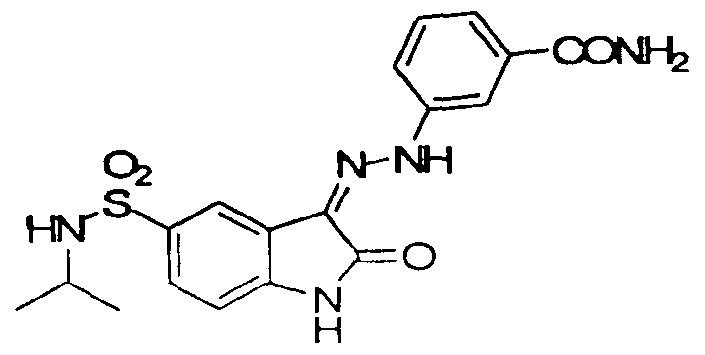
This was obtained as a yellow solid (54%) yield from rρm323 and ammonia (2 M in ethanol) in a similar manner as described for preparation of rpm292. MS (API-ES): m/z
402 [M+H]+, 419 (M+NH4)+, 424 (M+Na)+; HRJMS (API-ES) m/z Found:
402.1234(M+H)+, 419.1490 (M+NH4)+, 424.1050 (M+Na)+.
N-(2-Dimethylamino-ethyl)-3-[N'-(5-isopropylsulfamoyl-2-oxo~l,2-dihydro-indol- 3-ylidene)hydrazino]benzamide (rpm326).
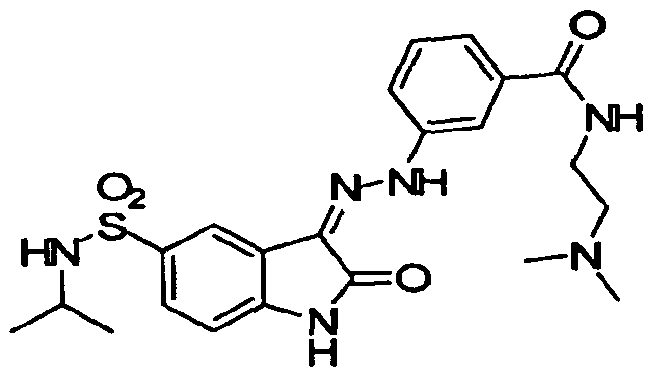
This was obtained as a yellow solid (39%) yield from rpm323 and NJJ- dimethylethylenediamine in a similar manner as described for preparation of rpm292. MS (API-ES): m/z 473 (M+H)+; HRMS (API-ES) mlz Found: 473.1976 (M+H)+ .
3-[N'-(5-Isopropylsulfamoyl-2-oxo-l,2-dihydro-indol-3-ylidene)hydrazino]-N-(2- methoxyethyl)benzamide (rpm327).
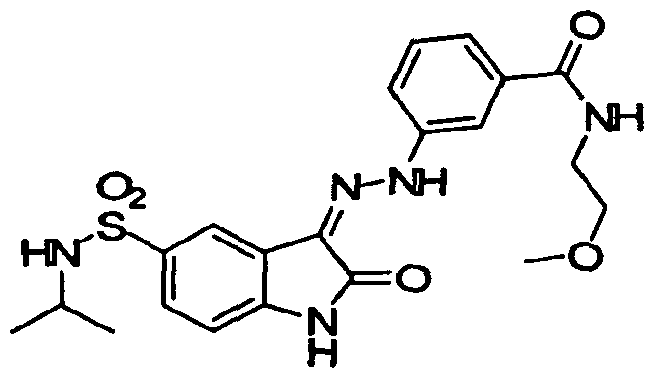
N-Benzyl-3-[N'-(5-isopropylsulfamoyl-2-oxo-l,2-dihydro-indol-3- ylidene)hydrazino]benzamide (rpm328) .

This was obtained as a yellow solid (70%) yield from rpm323 and benzylamine in a similar manner as described for preparation of rpm292. MS (API-ES): m/z 492 (M+H)+; HRMS (API-ES) mlz Found: 492.1691(M+H)+ .
3-[N'-(5-Isopropylsulfamoyl-2-oxo-l,2-dihydro-indol-3-ylidene)hydrazino]-N- pyridin-3-ylmethylbenzamide (rpm332).

This was obtained as a yellow solid (70%) yield from rpm323 and 3- (aminomethyl)pyridine in a similar manner as described for preparation of rpm292. MS (API-ES): m/z 493 (M+H)+; HRMS (API-ES) mlz Found: 493.1655 (M+H)+ .
N-Furan-2-ylmethyl-3-[N'-(5-isopropylsulfamoyl-2-oxo-l,2-dihydro-indol-3- ylidene)hydrazino]benzamide (rpm333).

This was obtained as a yellow solid (77%) yield from rpm323 and furfurylaminc in a similar manner as described for preparation of rpm292. MS (API-ES): m/z 482 (M ^H)+; HRMS (API-ES) m/z Found: 482.1489 (M+H)+ .
3-[N'-(5-Isopropylsulfamoyl-2-oxo-l,2-dihydro-indol-3-ylidene)hydrazino]-N-(2- morpholin-4-yl-ethyl)benzanιide (rpm334).

This was obtained as a yellow solid (57%) yield from rpm323 and 2-morpholin-4- • yl-ethylamine in a similar manner as described for preparation of rpm292. MS (API-ES): m/z 515 (M+H)+; HRMS (API-ES) m/z Found: 515.2071 (M+H)+ .
3-[N'-(5-Isopropylsulfamoyl-2-oxo-l,2-dihydro-indol-3-ylidene)hydrazino]-N- methylbenzamide (rpm330).

This was obtained as a yellow solid (79%) yield from rpm323 and methylamine (40% solution in water) in a similar manner as described for preparation of rpm292. MS (API-ES): m/z 416 (M+H)+; HRMS (API-ES) m/z Found: 416.1389 (M+H)+ .
N-Ethyl-3-[N'-(5-isopropylsulfamoyl-2-oxo-l,2-dihydro-mdol-3- ylidene)hydrazino]benzamide (rpm331).

This was obtained as a yellow solid (72%) yield from rpm323 and ethylamine (60% solution in water) in a similar manner as described for preparation of rpm292. MS (API-
ES): m/∑ 430 (M+H)+; HRMS (API-ES) mlz Found: 430.1546 (M+H)+.
2-Oxo-3-(phenylhydrazono)-2,3-dihydro-lH-indole-5-sulfonic acid (rpm215) .

A mixture of 5-isatinsulfonic acid sodium salt dihydrate (0.092 g, 0.3216 mmol) phenylhydrazine (0.052 g, 0.048 mmol, 1.5 eq) and HCl (aq 4M, 0.8 ml) in ethanol (3 mL) was heated in the CEM microwave at 120 "C for 15 min. The mixture was cooled to room temperature, the yellow precipitate was collected by filtration and dried, to give the pure compound (0.080 g, 0.280 mmol, 87%). MS (API-ES): m/z 316 (M-H)"; HRMS (API-ES) mlz Found: 316.0399 (M-H) . 2-Oxo-3-[(2-methylphenylhydrazono)]-2,3-dihydro-lH-indole-5-sulfonic acid
(rpm216).
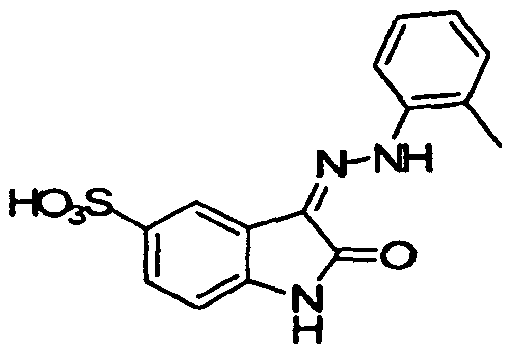
2-Oxo-3-[(2,6-dichlorophenylhydrazono)]-2,3-dihydro-lH-indole-5-sulfonic acid (rpm218).

This was obtained as a yellow solid (78%) from 5-isatinsulfonic acid sodium salt dihydrate and 2,6-dichlorophenylhydrazine in a similar manner as described for preparation of rPm215. MS (API-ES): m/z 383.9 (M 35Cl-Hy (100%), 385.9 (M 37Cl-H)" (70%); HRMS (API-ES) mlz Found: 383.9619 (M-H)".
2-Oxo-3-[(2-ethylphenylhydrazøno)]-2,3-dihydro-lH-indole-5-sulfonic acid (rpm219).

This was obtained as a yellow solid (30%) from 5-isatinsulfonic acid sodium salt dihydrate and 2-ethylphenylhydrazine in a similar manner as described for preparation of rpm215. MS (API-ES): m/z 344 (M-H)"; HRMS (API-ES) mlz Found: 344.0717, (M-H)".
2-Oxo-3-[(2-fluorophenylhydrazono)]-2,3-dihydro-lH-indole-5-sulfonic acid (rpm220).

This was obtained as a yellow solid (93%) from 5-isatinsυlfonic acid sodium salt dihydrate and 2-fhiorophenylhydrazine in a similar manner as described for preparation of rpm215. MS (API-ES): m/∑ 333.9 (M-H)"; HRMS (API-ES) mh Found: 334.0310, (M-H)".
2-Oxo-3-[(2-triβuorontethylphβnylhydrazono)]-2,3-dihydro-lH-indole-S-sulfonic acid (rpni221).

This was obtained as a yellow solid (87%) from 5-isatinsulfonic acid sodium salt dihydrate and 2-trifluoromethylphenylhydrazine in a similar manner as described for preparation of rpm215. MS (API-ES): m/z 384 (M-H)'; HRMS (API-ES) mlz Found: 384.0279 (M-H)-.
2-Oxo-3-(pentafluorophenylhydrazono)-2,3-dihydro-lH-indole-5-sulfonic acid (rpm222).

This was obtained as a yellow solid (51%) from 5-isatinsulfonic acid sodium salt dihydrate and pentafluoromethylphenylhydrazine in a similar manner as described for
preparation of rpm215. MS (API-ES): m/z 405.9 (M-H)"; HRMS (API-ES) mlz Found: 405.9935 (M-H)".
3-(Naphthalen-l-ylhydrazono)-2-oxo-2,3-dihydro-lH-indole-5-sulfonic acid (rpm223).

This was obtained as a red solid (78%) from 5-isatinsulfυnic acid sodium salt dihydrate and 1 -naphthylhydrazine in a similar manner as described for preparation of rpm215. MS (API-ES): m/z 366 (M-H)"; HRMS (API-ES) mlz Found: 366.0555,(M-H)".
2-Oxo-3-[(2,4-dichlorophenylhydrazono)]-2,3-dihydro-lH-indote-5-sulfonic acid (rpm224).

This was obtained as a yellow solid (69%) from 5-isatinsulfonic acid sodium salt dihydrate and 2,4-dichlorophenylhydrazine in a similar manner as described for preparation of rpm215. MS (API-ES): m/z 383.9 (M 35Cl-H)- (100%), 385.9 (M 37Cl-H)" (70%); HRMS (API-ES) mlz Found: 383.9619(M-H)\
2-Oxo-3-[(2,5-dichlorophenylhydrazono)]-2,3-dihydro-lH-indole-5-sulfonic acid (rpm225).

This was obtained as a yel low solid (76%) from 5-isatinsulfonic acid sodium salt dihydrate and 2,5-dichlorophenylhydrazine in a similar manner as described for preparation of rpm215. MS (API-ES): m/z 383.9 (M 35Cl-H)" (100%), 385.9 (M 37Cl-H)" (70%); HRMS (API-ES) m/z Found: 383.9618 (M-H)".
2-[N'-(2-Oxo-5-sulfo-l,2-dihydro-indol-3-ylidene)hydrazinυ]benzoic acid (rpm211).

A mixture of 5-isatinsulfonic acid sodium salt dihydrate (0.1 12 g, 0.391 mmol) 2- carboxylphenylhydrazine (0.052 g, 0.048 mmol, 1.5 eq) and HCl (aq 4M, (0.7 ml) in ethanol (3 mL) was heated in the CEM microwave at 180 °C for 5 min. The reaction mixture was cooled to room temperature, and the yellow precipitate was collected by filtration and dried., to give pure rPm211 (0.116 g, 0.321 mmol, 82%). MS (API-ES): m/z 360 (M-H)"; HRMS (API-ES) mlz Found: 360.0297 (M-H)'. 2-Oxo-2,3-dihydro-lH-indole-5-sulfonyl chloride1 (rpm277).

Oxindole (5.5 g, 41.30 mmol) was added portionwise to chlorosulfonic acid (50 ml) maintaining the temperature below 30 "C during the addition. After the addition the reaction mixture was stirred at room temperature for 1.5 h and then at 70 "C for 1 h. After cooling to
room temperature, the reaction mixture was poured into ice-water (200 ml) and the pink precipitate was filtered, washed with water (50 ml) and dried, to give pure rpm277 (8.4 g, 36.36 mmol, 88 %), mp 280-282 "C. 1H NMR (400 MHz, CD3CN) δ 3.59 (2H, s), 7.10 (IH, d, J8.7 Hz), 7.92 (IH, s), 7.95 (IH, dd, J2.2, 8.7 Hz), 8.95 (IH, s, NH). 2-Oxo-2,3-dihydro-lH-indole-5-sulfonic acid isopropylamide (rpm281).

This was obtained from rpm277 and isopropylamine in a similar manner as described for preparation of rpml23. The pure compound was obtained as a pink solid (91%) without further purification (lit Bioorg. and Med. Chem. Lett, 2004, 14, 187.), mp 233-235 'C. 1H NMR (400 MHz, DMSOd6) δ 0.92 (6H, d, J .7.6 Hz), 3.15 (IH, sext, J 7.6 Hz), 6.92 (IH, d, J 8.3 Hz), 7.38 (IH5 d, J 7.6 Hz), 7.58 (IH, s), 7.61 (IH, dd, J2.2, 8.3 Hz), 10.74 (IH, s, NH).
2-Oxo-2,3-dihydro-lH-indole-5-sulfonic acid 4-chloro-benzylamide (rpm307).

3-Dimethylaminomethylene-2-oxo-2^3-dihydro-lH-indole-5-sulfonic acid isopropylamide3 (rpm282).

A solution of rpm281 (0.180 g, 0.708 mmol) and N1N- dimethylformamidedimethylacetal (0.125 g, 0.85 mmol, 1.2 eq) in DMF (2 ml) was stirred for 1 h at room temperature. Water (7 ml) was added and the product extracted with ethyl acetate (3 x 10 ml). The organic extracts were collected, dried over Na2SO4 and the solvent evaporated under reduced pressure to give a yellow solid, which was used in the next step without further purification.
3-Ditnethylaminometlιylene-2-oxo-2,3-dihydro-lH-indolc-5-sulfo/uc acid 4- chlorobenzylamide (rpm309).

This was obtained from rpm307 in a similar manner as described for preparation of rpm282. The crude was used in next step without further purification.
2-[(5-Isopropylsulfamoyl-2-oxo-l,2-dihydro-indol-3-ylidenemethyl)amino]benzoic acid methyl ester (rpm335)

A mixture of rpm282 (0.260 g, 0.841 mmol) methyl-2-aminobenzoate (0.139 g, 0.925 mmol, 1.2 eq) and methansulfonic acid (0.088 g, 0.925 mmol, 1.1 eq) in ethanol (5 mL) was heated in the microwave at 150 'C for 5 min. The reaction mixture was cooled to 0 "C, and the orange precipitate was collected by filtration and dried, to give pure rpm335
(0.207 g, 0.498 mmol, 59 %). MS (API-ES): m/z 416 (M+H)+; HRMS (API-ES) mlz Found: 416.1276 (M+H)+ .
3-[(5-Isopropylsulfamoyl-2-oxo-l,2-dihydro-indol-3-ylidenemethyl)amino]benzoic acid ethyl ester (rpm302).

This was obtained as a yellow solid (47%) from rpm282 and ethyl-3-aιninobenzoate in a similar manner as described for preparation of rpm335. MS (API-ES): m/z 430 (M+H)+; HRMS (API-ES) mlz Found: 430.1435 (M+H)+.
4-[(5-Isopropylsulfamoyl-2-oxo-l,2-dihydro-indol-3-ylidenemethyl)amino]benzoic acid ethyl ester (rpm288).

This was obtained as a yellow solid (43%) from rpm282 and ethyl -4-aminobenzoate in a similar manner as described for preparation of rpm335. MS (API-ES): m/z 430
[M+H]+; HRMS (API-ES) mlz Found 430.1432 (M+H)+.
3-[(2-Nitrophenylamino)methylene]-2-oxo-2,3-dihydro-lH-indole-5-sulfonic acid isopropylamide (rpm303).

This was obtained as a orange solid (34%) from rpm282 and 2-nitroaniline in a similar manner as described for preparation of rpm335. MS (API-ES): m/z 403 [M+H]+;
HIlMS (API-ES) mlz Found: 430.1070 (M+H)+.
3-[(2-Nitrophenylaminomethylene]-2-oxo-2,3-dihydro-lH-indole-5-sulfonic acid 4-chlorobenzyluftiide (rpm310).

This was obtained as an orange solid (33%) from rpm309 and 2-nitroaniline in a similar manner as described for preparation of rpm335. MS (API-ES): m/z 485 [M+H]+;
HRMS (API-ES) mlz Found 485.0677 (M+H)+.
2-[(5-Isopropylsulfamoyl-2-oxo-l,2-dihydro-indol-3-ylidenemethyl)amino]benzoic acid (rpm336).

A suspension of rpm335 (0.155 g, 0.3734 mmol) in methanol (1 mL) and NaOH I M (1 ml) was heated in the microwave at 150 "C for 5 min. The reaction mixture was cooled to 0 °C, and the solvent distilled under reduced pressure and HCl (aq 4M, 5 m!)
added. The orange precipitate was collected by filtration, washed with water (10 ml) and dried, to give pure rpm336 (0.139 g, 0.346 mmol, 92 %). MS (API-ES): m/z 402 (M+H)+; HRMS (API-ES) mlz Found: 402.1116 (M+H)+.
3-[(5-Isopropylsulfamoyl-2-oxo-l,2-dihydro-indol-3-ylidenemethyl)amino]benzoic acid (rpm3θ4).

This was obtained as an orange solid (40%) from rpm302 in a similar manner as described for preparation of rpm336. MS (API-ES): m/z 402 (M+H)+; HRMS (API-ES) mlz Found: 402.1 114 (M+H)+ .
4-[(5-Isopropylsulfamoyl-2-oxo-l,2-dihydro-indol-3-ylidenemethyl)amino]benzoic acid (rpm305).

This was obtained as an orange solid (33%) from rpm288 in a similar manner as described for preparation of rpm336. MS (API-ES): m/z 402 (M+H)+; HRMS (API-ES) mlz Found: 402.1 1 19 (M+H)+.
3,3-Dibromo-2-oxo-2,3-dihydro-lH-indole-5-carboxylic acid methyl ester (rPm262)

3-[(2-Chlorυphenyl)hydrazonυ]-2-oxυ-2,3-dihydrυ-lH-indυle-5-carboxylic acid (RPM270).

CEM microwave at 150 °C for 5 min. After cooling down to room temperature, 2- chlorohydrazine (0.026 g, 0.149 mmol, 1 eq) was added to the reaction mixture, which was heated in the microwave at 150 "C for 5 min. After cooling down to room temperature, the formed yellow solid was collected by filtration washed with water (5 ml), cold methanol (2 ml) and dried. The pure compound was obtained without further purification (0.039 g, 0.121 mmol, 81). MS (API-ES): m/z 313.9 (M 35Cl-H)- (100%), 316 (M 37Cl-H)' (70%); HRMS (API-ES) m/z Found: 314.0344, (M-H)\
3-(Phenylhydrazono)-2-oxo-2,3-dihydro-lH-indole-5-carboxylic acid (rpm272) .

S-ftl-FluorophenylJhydrazonoJ^-oxo^^-dihydro-lH-indoleS-carboxylic acid (rpm319).

This was obtained as a yellow solid (72%) from rpm262 and 2- fluorophenylhydrazine in a similar manner as described for preparation of rpm270. MS (API-ES): m/z 298 (M-HV; HRMS (API-ES) m/z Found: 298.0639(M-H)' . 3-[(2-Ethylphenyl)hydrazono]-2-oxo-2,3-dihydro-lH-indole-5-carboxylic acid
(rpm320).

This was obtained as a yellow solid (65%) from rpm262 and 2- ethylphenylhydrazine in a similar manner as described for preparation of rpm270. MS (API-ES): m/z 308 (M-H)"; HRMS (API-ES) m/z Found: 308.1044 (M-H)".
HL2-052-2. This was obtained as a yellow solid from rpm262 and 2- carboxylphenylhydrazine in a similar manner as described for preparation of rpm270. HL2-
052-2: 1H NMR (DMSO-tfs, 400 MHz) δ 14.22 (s, IH), 11.27 (s, IH), 8.11 (s, IH), 8.07 (d,
J = 8.4 Hz, IH), 7.94 - 7.92 (dd, J= 7.6 Hz5 1.2 Hz, IH), 7.89-7.86 (dd, J= 8.4 Hz, 1.6 Hz, IH), 7.65 -7.61 (appt, IH), 7.11-7.07 (appt, IH), 6.99 (d, J= 10.4 Hz, IH).
HL2-052-3. This was obtained as a yellow solid from rpm262 and 3- carboxylphenylhydrazine in a similar manner as described for preparation of rpm270. HL2- 052-3: 1H NMR (DMSO-d6, 400 MHz) δ 12.96 (broad s, IH), 12.70 (s, IH), 11.37 (s, IH), 8.06 (s, IH), 8.00 (s, IH ) 7.87 - 7.85 (dd, J= 8.4 Hz, 1.2 Hz, IH), 7.72 (d, J= 8.0 Hz, IH), 7.60 (d, J = 7.2 Hz, IH), 7.49-7.45 (appt, IH), 7.00 (d, J= 8.4 Hz, IH).
HL2-054. This was obtained as a yellow solid from rpm262 and 2- nitrophenylhydrazine in a similar manner as described for preparation of rpm270
2-(5-Isopropylsulfamoyl-2-oxo-l,2-dihydro-indol-3-ylidenenιethyl)benzoic acid methyl ester (rpm347).

A solution of rpm281 (0.149 g, 0.586 mmol) and methyl 2-formylbenzoate (0.105 g, 0.645 mmol, 1.1 eq) in ethanol (10 ml) was stirred in presence of piperidine (1 drop) at 80 0C, under Ar for Ih. After cooling to room temperature, the solvent was removed under reduced pressure. The residue was dissolved in ethyl acetate (15 ml) and washed with HCl IM (10 ml). The organic extracts were collected, dried over Na2SO4 and the solvent removed under reduced pressure to afford a orange solid. The pure compound rpm347 was obtained after trituration with hexane/ethyl acetate mixture (6:4) (10 ml) as a off-white solid (0.135 g, 0.337 mmol, 60%), mp 271-273 0C. MS (API-ES): mJz 401 (M+H)+; HRMS (API- ES) mlz Found: 401.1 173 (M+H)+. 3-Benzoyl-lH-indole-S-carboxylic acid methyl ester (rpm341).

3-(Naphthalene-2-carbonyl)-lH-indole-5-carboxylic acid methyl ester (rpm350)

3-Benzoyl-lH-indole-S-carboxylic acid (rpm352).

3-(Naphthalene-2-carbonyl)-lH-indole-5-carhoxylic acid (rpm351).

This was obtained as a white solid (71%) yield from methyl rpm350 in a similar manner as described for preparation of rpm336, mp > 300 "C. 1H (400 MHz, DMSOd6) δ 7.49-7.43 (4H, m), 7.71 (IH, d, J6.4 Hz), 7.79 (IH, m), 7.88 (IH, dd, J 1.8, 8.6 Hz), 8.01 (2H, t, J 8.2 Hz), 8.09 (IH, d, J 7.6 Hz), 8.98 (IH, s), 12.31 (IH, bs). 13C NMR (100 MHz, DMSOd6) δ 113.00, 118.45, 124.66, 125.19, 125.34, 125.62, 125.93, 126.11, 126.62, 127.02, 127.54, 129.03, 130.62, 130.71, 134.02, 138.82, 139.00, 140.16, 168.76, 192.12. Synthesis of Pentafluorophenyl ester HL2-061 (See FIG. 7)
To a solution of indole carboxylic acid (0.5 g, 3.10 mmol) in DMF (3.00 ml) was added pentafluorophenyl trifluoroacetate (6.2 mmol, 1.068 ml) followed by pyridine (0.281 ml). The reaction mixture (a suspension was obtained at this stage) was stirred at r.t. under inert atmosphere for approximately 30 minutes. The reaction mixture was poured into ether (40 ml) and diluted with ethyl acetate (2 x 50 ml). The organics were washed with water, dried (NajSO-t) and concentrated to obtain an off white solid (70% yield, 720 mg, t.l.c. Rf- 0.71 EtOAc : Hexane, 1:1). No purification was necessary: 1H NMR (DMSO-cfe, 400 MHz) δ 11.7 (S5IH, NH), 8.49 (s, IH), 7.87-7.84 (dd, J = 8 Hz , 4Hz, IH), 7.59-7.55 (m, 2H), 6.67-6.66 (s, IH). General procedure for synthesis of intermediates; HL2-065-1, HL2-065-2, HL2-
065-3.
The starting material HL2-061 (200 mg, 0.612 mmol) was suspended in dry acetonitrile under argon, pyridine was added (0.075ml, 0.85 mmol) followed by the appropriate aniline (0.85 mmol) shown above and stirred overnight (approximately 12 h). The resulting cloudy solution was diluted with EtOAc and washed with 4M HCl ( 6 ml). The organic phase was separated, washed with water, dried (Na2SO4), and concentrated to obtain HL2-065-1 (203 mg, colourless oil), HL2-065-2 (252 mg, orange solid) and HL2- 065-3 (125 mg, pale yellow sold). These compounds were used in the next stage without further purification.
HL2-065-1: 1H NMR (DMSO-^6, 400 MHz) δ 1 1.25 (s, NH), 8.09 (s, IH), 8.02 (d, J = 8.0 Hz, IH, disappeared on D2O shake), 7.61 -7.59 (dd, J = 8.8 Hz, 1 .2 I Iz, 1 1 1), 7.40- 7.36 (m, 2H), 6.50-6.49 (s, IH), 4.12-4.07 (m, IH), 1.16 and 1.14 (2 x s, 6H).
HL2-065-2: 1H NMR (DMSO-^5, 400 MHz) δ 1 1.31 (s, I H), 8.93-8.90 (t, J = 8.0 Hz, IH), 8.14 (s, I H), 7.64-7.62 (dd, J = 8 Hz, 1.2 Hz, 1H)7.4O-7.31 (m, 5H) 6.51 (s, IH), 4.45 (s, 2H). HL2-065-3: 1H NMR (DMSO-ck, 400 MHz) δ 11.25 (s, IH), 7.52 (s,lH), 7.40-7.38
(m, 2H), 7.06-7.04 (dd, J = 8 Hz, 1.6 Hz, IH), 6.46-6.54 (s, IH) 3.32 (broad peak overlapped with H2O), 1.13-1.08 (broad s, 6H).
General procedure for synthesis of dibromo-oxindole intermediates; HL2-067- 1, HL2-067-2, HL2-067-3. The starting material HL2-065-1 (203 mg, 1.0 mmol), HL2-065-2 (252 mg. 0.88 mmol) and HL2-065-3 (125 mg, 0.557 mmol) was dissolved in aqueous isopropanol (5 ml), and NBS was added (0.533g, 0.47 Ig, and 0.307 respectively, portion wise over 30 min. period) with stirring under argon atmosphere. Reaction was monitored by t.l.c (EtOAc: Hexane , 1 :1). T.L.C. indicated the disappearance of the starting material. The reaction mixture was concentrated at r.t. The succinimide precipitate was filtered, washed with ether. The ether phase was concentrated to obtain the dibromo-oxindole products HL2-067-1 (220 mg), HL2-067-2 (225mg) and HL2-067-3 (220 mg). These compounds were used in the next step without purification.
General procedure for synthesis of final oxindole compounds; HL2-070-1, HL2- 070-2, HL2-070-3, HL2-070-4, HL2-070-5, HL2-070-6, HL2-070-7, HL2-070-8, HL2- 070-9.
The dibromoisatin amide intermediate HL2-067-1 (0.052 mg ), HL2-067-2 (70 mg) and HL2-067-3 (72mg mg) from the above procedure was suspended in MeOH (2.0 ml) in a microwave tube (CEM, 10 ml), and the required hydrazines (1.1 equivalents) were added (as shown in the Scheme 1) and irradiated for 5 minutes at 150 0C in CEM microwave reactor. The reaction tubes were left in an ice bath until a precipitate formed. The solid precipitate was filtered and analyzed by 1H NMR, Low Resolution Mass spectroscopy and High resolution Mass Spectroscopy (see Table 1 for mass spectral data). The average yield of the pure product isolated was 15mg.
HL2-070-1: 1H NMR (DMSO-J6, 400 MHz) δ 14.22 (s, IH, disappeared on D2O shake), 1 1.08 (s, IH, disappeared on D2O shake), 8.07 (d, J = 8.8 Hz, IH), 7.94 (appd, IH), 7.61-7.56 (m, 2H), 7.26 (d, J = 1.6 Hz, IH), 7.08 (m, IH), 6.95 (appd, IH), 1.15 (s, 6H), N- CHj signals overlapped with residual DMSO.
HL2-070-2: 1H NMR (DMSO-ek, 400 MHz) δ 12.75 (s, IH), 11.19 (s, IH), 7.98 (s, IH), 7.70 (d, J = 7.2 Hz, IH), 7.60 (d, J = 8 Hz, IH), 7.50-7.45 (m, 2H), 7.24 (d, J = 8.4 Hz, IH), 6.94 (d, J = 7.6 Hz, IH), 7.07 (s, 6H), N-CH2 signals overlapped with residual DMSO. In CD3-OD NMR displayed following peaks: 1H NMR (CD3-OD, 400 MHz) δ (8.07 (s, IH), 7.26 (d, J = 0.8 Hz, IH), 7.63-7.60 (m, 2H), 7.49-7.47 (m, IH), 7.29 (d, J = 8.0 Hz, IH), 7.01 (d, J = 8 Hz, IH), 3.57 - 3.55 ( 2 x m partially overlapped with H2O, 4H), 1.19- 1.18 (2 x s, 6H).
HL2-070-3: 1H NMR (DMSO-^, 400 MHz) δ 11.23 (s, IH, disappeared on D2O shake), 11.32 (s, IH, disappeared on D2O shake), 8.28 (d, J= 8Hz, IH), 8.22 (d, J= 8.4 Hz, IH), 7.79 (broad s, IH), 7.64 (s, IH), 7.32 (d, J= 7.6 Hz, IH), 7.19 (broad t, IH), 6.98 (d, J = 6.8 Hz, IH), 1.13 (s, 6H), N-CHj-signals are overlapped with H2O signal.
HL2-070-4: 1H NMR (DMSO-tfj, 400 MHz) δ 14.23 (s, IH)1 11.19 (s, IH), 9.08 (t, IH), 8.17 (s, IH), 7.95-7.84 (dd, J= 16 Hz, 1.2 Hz, 2H), 7.65-7.64 (t, J= 1.8 Hz, IH), 7.39 - 7.35 (m, 5H), 7.1 1-7.07 (t, J= 14 Hz, I H), 6.98 (d, J= 8.4 Hz, IH), 4.47-4.45 (d, J= 5.6 Hz, 3H).
HL2-070-S: 1H NMR (DMSO-d6, 400 MHz) δ 12.79 (s, IH), 1 1.31 (s, IH), 9.13 (s, IHO, 8.12 (s, IH), 8.04 (s, IH), 7.84 (d, J = 8.0 Hz, IH), 7.68-7.60 (dd, J= 24.0 Hz, 8.0 Hz, 2H), 7.50-7.46 (m, IH), 7.37- 7.33 (m, 4H), 76.99 (d, J= 8.0 Hz, IH), 4.47 (s, 2H).
HL.2-070-6: See Table for Low Resolution and High resolution mass spectra. HL2-070-7: See Table for Low Resolution and High resolution mass spectra.
HL2-070-9: See Table for Low Resolution and High resolution mass spectra.
IIL2-052-3: 1H NMR (DMSO-J5, 400 MHz) δ 12.96 (broad s, I H), 12 70 (s, I H), 1 1.37 (s, IH), 8.06 (s, IH), 8.00 (s, IH ) 7.87 - 7.85 (dd, J= 8.4 Hz, 1.2 Hz, IH), 7.72 (d, J
= 8.0 Hz, I H), 7.60 (d, J = 7.2 Hz, 111), 7.49-7.45 (appt, I H), 7.00 (d, J= 8 4 Hz, I H) REFERENCES:
Alonso A, Sasin J, Bottini N, Friedberg I, Friedberg I, Osterman A, Godzik A, Hunter T, Dixon J and Mustelin T (2004) Protein tyrosine phosphatases in the human genome. Cell 117(6):699-711.
Andersen JN, Mortensen OH, Peters GH, Drake PG, Iversen LF, Olsen OH, Jansen PG, Andersen HS, Tonks NK and Moller NP (2001) Structural and evolutionary relationships among protein tyrosine phosphatase domains. MoI Cell Biol 21(21):71 17- 7136.
Bennett AM, Hausdorff SF, O'Reilly AM, Freeman RM and Neel BG (1996) Multiple requirements for SHPTP2 in epidermal growth factor-mediated cell cycle progression . MoI Cell Biol 16(3) : 1189- 1202.
Bentires-Alj M, Paez JG, David FS, Keilhack H, Halmos B, Naoki K, Maris JM,
Richardson A, Bardelli A, Sugarbaker DJ, Richards WG, Du J, Girard L, Minna JD, Loh
ML, Fisher DE, Velculescu VE, Vogelstein B, Meyerson M, Sellers WR and Neel BG
(2004) Activating mutations of the noonan syndrome-associated SHP2/PTPN11 gene in human solid tumors and adult acute myelogenous leukemia. Cancer Res 64(24):8816-8820.
Bialy L and Waldmann H (2005) Inhibitors of protein tyrosine phosphatases: next- generation drugs? Angew Chem Int Ed Engl 44(25):3814-3839.
Carroll MP and May WS (1994) Protein kinase C-mediated serine phosphorylation directly activates Raf-1 in murine hematopoietic cells. J Biol Chem 269(2): 1249-1256.
Chan RJ, Leedy MB, Munugalavadla V, Voorhorst CS, Li Y, Yu M and Kapur R (2005) Human somatic PTPNI l mutations induce hematopoietic-cell hypersensitivity to granulocyte-macrophage colony-stimulating factor. Blood 105(9):3737-3742.
Chen, L, Sang, S, Yip, MLR, Lawrence, HR, Ren, Y, Guida, WC, sebti, SM, Lawrence, NJ, and Wu, J (2006) Discovery of a novel Shp2 protein tyrosine phosphatase inhibitor. MoI Pharmacol 70:562-570.
Cunnick JM, Dorsey JF, Mei L and Wu J (1998) Reversible regulation of ST-TP-I tyrosine phosphatase activity by oxidation. Biochem MoI Biol Int 45(5):887-894.
Cunnick JM, Mei L, Doupnik CA and Wu J (2001) Phosphotyrosines 627 and 659 of Gabl constitute a bisphosphoryl tyrosine-based activation motif (BTAM) conferring binding and activation of SHP2. J Biol Chem 276(26):24380-24387.
Cunnick JM, Meng S, Ren Y, Desponts C, Wang HG, Djeu JY and Wu J (2002) Regulation of the mitogen-activated protein kinase signaling pathway by SHP2. J Biol Chem 277(11):9498-9504.
Deb TB, Wong L, Salomon DS, Zhou G, Dixon JE, Gutkind JS, Thompson SA and
Johnson GR (1998) A common requirement for the catalytic activity and both SH2 domains of SHP-2 in mitogen-activated protein (MAP) kinase activation by the ErbB family of receptors. A specific role for SHP-2 in map, but not c-Jun amino-terminal kinase activation.
J Biol Chem 273(27):16643-16646.
Fragale A, Tartaglia M, Wu J and GeIb BD (2004) Noonan syndrome-associated SHP2/PTPN11 mutants cause EGF-dependent prolonged GABl binding and sustained ERK2/MAPK1 activation. Hum Mutat 23(3):267-277. Friesner RA, Banks JL, Murphy RB, Halgren TA, Klicic JJ, Mainz DT, Repasky
MP, Knoll EH, Shelley M, Perry JK, Shaw DE, Francis P and Shenkin PS (2004) Glide: a new approach for rapid, accurate docking and scoring. 1. Method and assessment of docking accuracy. J Med Chem 47(7): 1739-1749.
007/008876
Gu H and Neel BG (2003) The "Gab" in signal transduction. Trends Cell Biol 13(3):122-130.
Halgren TA, Murphy RB, Friesner RA, Beard HS, Frye LL, Pollard WT and Banks JL (2004) Glide: a new approach for rapid, accurate docking and scoring. 2. Enrichment factors in database screening. J Med Chem 47(7): 1750-1759.
Hatakeyama M (2004) Oncogenic mechanisms of the Helicobacter p\ lori CagA protein. Nat Rev Cancer 4(9):688-694.
Hof P, Pluskey S, Dhe-Paganon S, Eck MJ and Shoelson SE (1998) Crystal structure of the tyrosine phosphatase SHP-2. Cell 92(4):441 -450. Huang P, Ramphal J, Wei J, Liang C, Jallal B, McMahon G and Tang C (2003)
Structure-based design and discovery of novel inhibitors of protein tyrosine phosphatases. Bioorg Med Chem 11(8):1835-1849.
Keilhack H, David FS, McGregor M, Cantley LC and Neel BG (2005) Diverse biochemical properties of Shp2 mutants. Implications for disease phenotypes. J Biol Chem 280(35):30984-30993.
Kolch W, Heidecker G, Kochs G, Hummel R, Vahidi H, Mischak H, Finkenzeller G, Marme D and Rapp UR (1993) Protein kinase C alpha activates RAF-I by direct phosphorylation. Nature 364(6434):249-252.
Kratz CP, Niemeyer CM, Castleberry RP, Cetin M, Bergstrasser E, Emanuel PD, Hasle H, Kardos G, Klein C, Kojima S, Stary J, Trebo M, Zecca M, GeIb BD, Tartaglia M and Loh ML (2005) The mutational spectrum of PTPNI l in juvenile myelomonocytic leukemia and Noonan syndrome/myeloproliferative disease. Blood 106(6):2183-2185.
Lazo JS, Nemoto K, Pestell KE, Cooley K, Southwick EC, Mitchell DA, Furey W, Gussio R, Zaharevitz DW, Joo B and Wipf P (2002) Identification of a potent and selective pharmacophore for Cdc25 dual specificity phosphatase inhibitors. MoI Pharmacol 61(4):720-728.
Maroun CR, Naujokas MA, Holgado-Madruga M, Wong AJ and Park M (2000) The tyrosine phosphatase SHP-2 is required for sustained activation of extracellular signal-
regulated kinase and epithelial morphogenesis downstream from the met receptor tyrosine kinase. MoI Cell Biol 20(22):8513-8525.
McCain DF, Wu L, Nickel P, Kassack MU, Kreimeyer A, Gagliardi A, Collins DC and Zhang ZY (2004) Suramin derivatives as inhibitors and activators of protcin-tyrosine phosphatases. J Biol Chem 279(15):14713-14725.
Mohi MG, Williams IR, Dearolf CR, Chan G, Kutok JL, Cohen S, Morgan K, Boulton C, Shigematsu H, Keilhack H, Akashi K, Gilliland DG and Neel BG (2005) Prognostic, therapeutic, and mechanistic implications of a mouse model of leukemia evoked by Shp2 (PTPNl 1 ) mutations. Cancer Cell 7(2): 179-191 . Neel BG, Gu H and Pao L (2003) The 'Shp'ing news: SH2 domain-containing tyrosine phosphatases in cell signaling. Trends Biochem Sci 28(6):284-293.
Nishida K and Hirano T (2003) The role of Gab family scaffolding adapter proteins in the signal transduction of cytokine and growth factor receptors. Cancer Sci 94(12): 1029- 1033. O'Reilly AM and Neel BG (1998) Structural determinants of SHP-2 function and specificity in Xenopus mesoderm induction. MoI Cell Biol 18(1):161-177.
Oka T, Ouchida M, Koyama M, Ogama Y, Takada S, Nakatani Y, Tanaka T, Yoshino T, Hayashi K, Ohara N, Kondo E, Takahashi K, Tsuchiyama J, Tanimoto M, Shimizu K and Akagi T (2002) Gene silencing of the tyrosine phosphatase SHPl gene by aberrant methylation in leukemias/lymphomas. Cancer Res 62(22):6390-6394.
Ren Y, Meng S, Mei L, Zhao ZJ, Jove R and Wu J (2004) Roles of Gab 1 and SHP2 in paxillin tyrosine dephosphorylation and Src activation in response to epidermal growth factor. J Biol Chem 279(9):8497-8505.
Schubbert S, Lieuw K, Rowe SL, Lee CM, Li X, Loh ML, Clapp DW and Shannon KM (2005) Functional analysis of leukemia-associated PTPNI l mutations in primary hematopoietic cells. Blood 106(l):311-317.
Shen K, Keng YF, Wu L, Guo XL, Lawrence DS and Zhang ZY (2001) Acquisition of a specific and potent PTPlB inhibitor from a novel combinatorial library and screening procedure. J Biol Chem 276(50):47311 -47319.
Stein CA (1993) Suramin: a novel antineoplastic agent with multiple potential mechanisms of action. Cancer Res 53(10 Suppl):2239-2248.
Tartaglia M and GeIb BD (2005) Germ-line and somatic PTPNI l mutations in human disease. Eur J Med Genet 48(2):81-96. Tartaglia M, Niemeyer CM, Fragale A, Song X, Buechner J, Jung A, Hahlen K,
Hasle H, Licht JD and GeIb BD (2003) Somatic mutations in P TPN I l in juvenile myelomonocytic leukemia, myelodysplastic syndromes and acute myeloid leukemia. Nat Gem;/ 34(2): 148-150.
Yamauchi K, Milarski KL, Saltiel AR and Pessin JE (1995) Protein-tyrosine- phosphatase SHPTP2 is a required positive effector for insulin downstream signaling. Proc Natl Acad Sci U S Λ 92(3):664-668.
Yang J, Liang X, Niu T, Meng W, Zhao Z and Zhou GW (1998) Crystal structure of the catalytic domain of protein-tyrosine phosphatase SHP-I . J Biol Chem 273(43):28199- 28207. Yang J, Liu L, He D, Song X, Liang X, Zhao ZJ and Zhou GW (2003) Crystal structure of human protein-tyrosine phosphatase SHP-I . J Biol Chem 278(8):6516-6520.
Zhang ZY (2002) Protein tyrosine phosphatases: structure and function, substrate specificity, and inhibitor development. Annu Rev Pharmacol Toxicol 42:209-234.


6


87
2007/008876


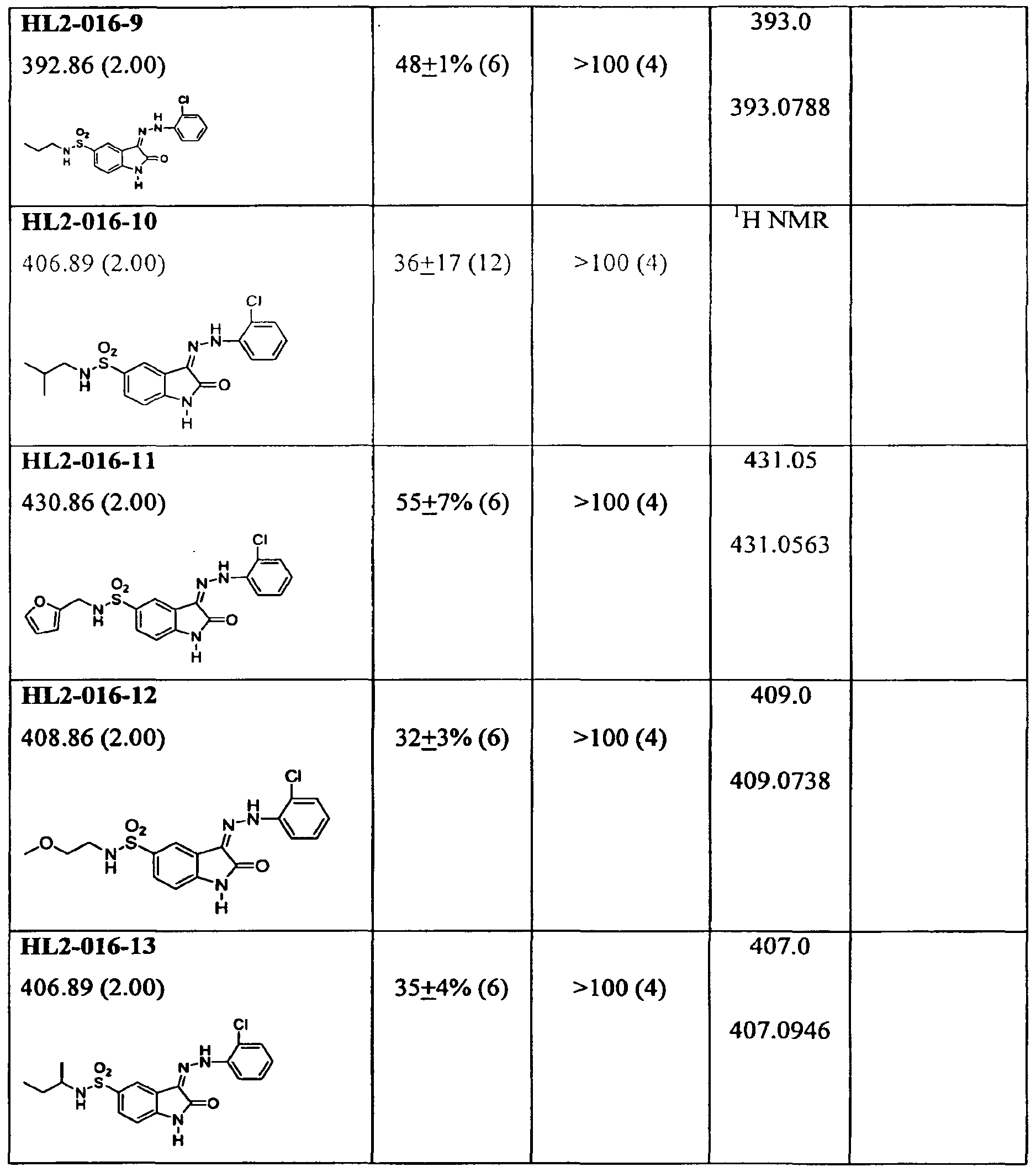


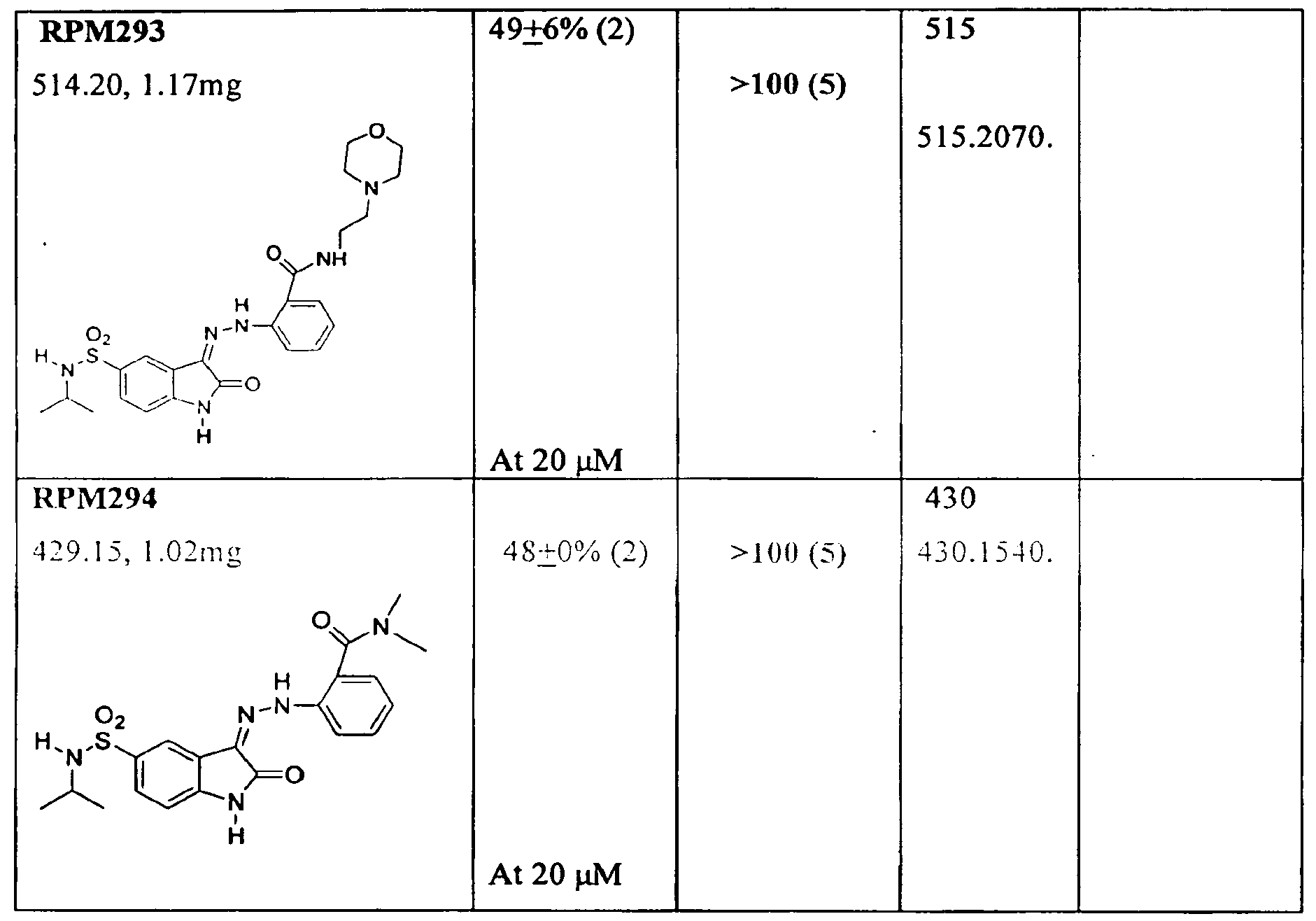


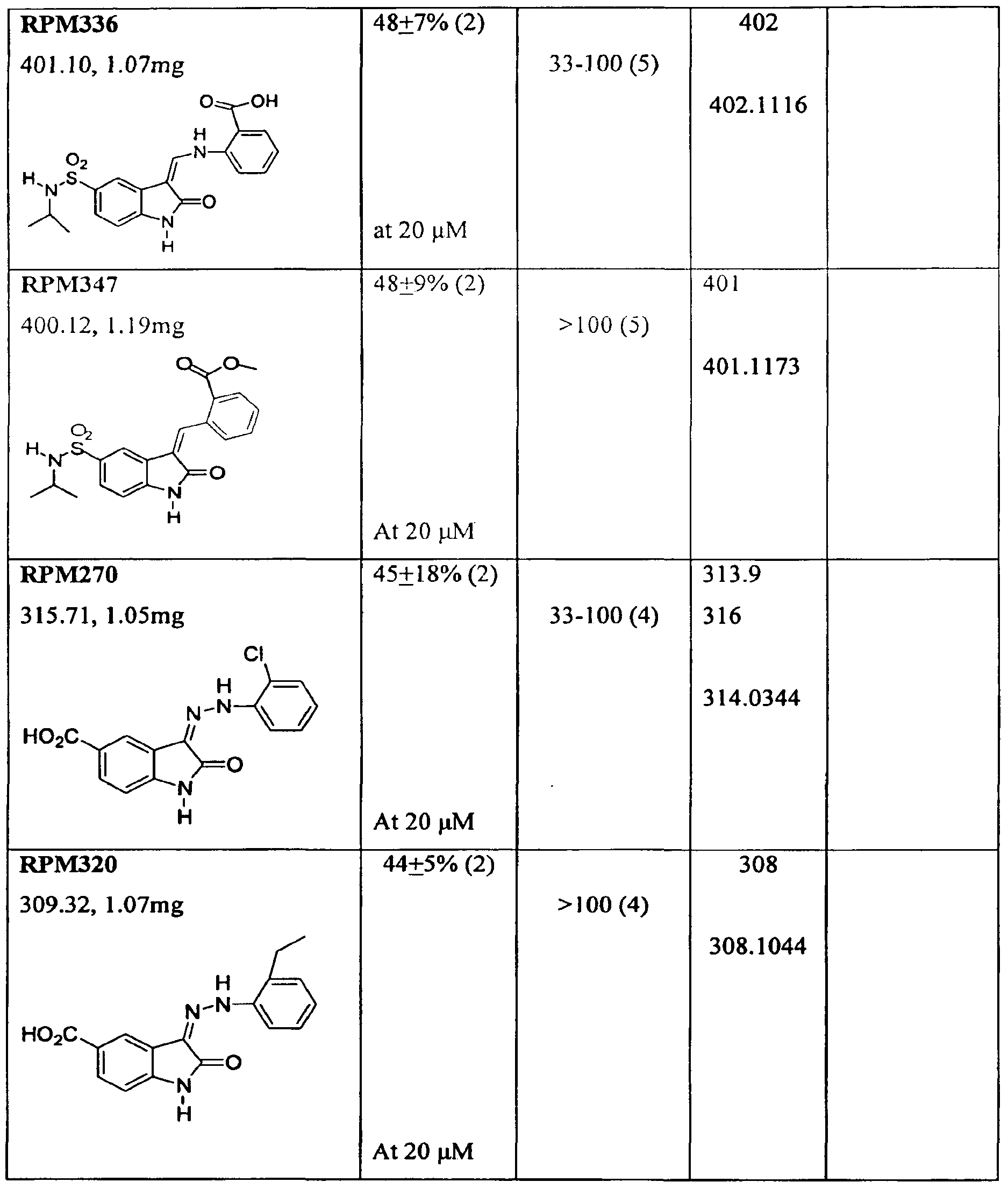


The disclosure of all publications cited above are expressly incorporated herein by reference, each in its entirety, to the same extent as if each were incorporated by reference individually.
It will be seen that the advantages set forth above, and those made apparent from the foregoing description, are efficiently attained and since certain changes may be made in the above construction without departing from the scope of the invention, it is intended that all matters contained in the foregoing description or shown in the accompanying drawings shall be interpreted as illustrative and not in a limiting sense.
It is also to be understood that the following claims are intended to cover all of the generic and specific features of the invention herein described, and all statements of the scope of the invention which, as a matter of language, might be said to fall therebetween. Now that the invention has been described,
Claims
1.) A method of inhibiting a protein tyrosine phosphatase in a cell comprising the step of contacting the cell with an effective amount of a compound having the formula
(I):

wherein each Ri through Rs are independently hydrogen, halogen, phenyl, nitro, sulfo, carboalkoxy, carboxyamide, benzylcarboxamide, straight chained, branched or cyclic alkyl, CO2H, SO3H3 CO2NH2, SO2NH2, PO3H, CF2PO3H, (CH2)nCO2H, (CH2)nCO2H, (CH2)nSO3H, (CH2)nCO2NH2, (CH2)nSO2NH2, (CH2)nPO3H, O(CH2)nCO2H, O(CH2)nSO3H, O(CH2)nCO2NH2, O(CH2)nSO2NH2, O(CH2)nPO3H, NH(CH2)nCO2H, NH(CH2)nSO3H, NH(CH2)HCO2NH2, NH(CH2)nSO2NH2, NH(CH2)nPO3H,


R6 is hydrogen, halogen, phenyl, benzyl, nitro, sulfo, carboalkoxy, carboxyamide, straight chained, branched or cyclic alkyl.
2.) The method according to claim 1 wherein at least two of R|, FL^ and Rj are hydrogen.
3.) The method according to claim 1 wherein the protein tyrosine phosphatase is a Shp protein tyrosine phosphatase selected from the group consisting of Shp 1 protein tyrosine phosphatase and Shp2 protein tyrosine phosphatase.
4.) The method according to claim 3 wherein the Shp protein tyrosine phosphatase is a selective inhibitor of the Shp protein tyrosine phosphatase.
5.) A method of inhibiting a protein tyrosine phosphatase in a cell comprising the step of contacting the cell with an effective amount of a compound having the formula (II):

6.) The method according to claim 5 wherein the protein tyrosine phosphatase is a Shp protein tyrosine phosphatase selected from the group consisting of Shp 1 protein tyrosine phosphatase and Shp2 protein tyrosine phosphatase.
7.) The method according to claim 6 wherein the Shp protein tyrosine phosphatase is a selective inhibitor of the Shp protein tyrosine phosphatase.
8.) A method of inhibiting a protein tyrosine phosphatase comprising the step of contacting the cell with an effective amount of a compound having the formula (III):

R6 is hydrogen, halogen, phenyl, benzyl, nitro, sulfo, carboalkoxy, carboxyamide, straight chained, branched or cyclic alkyl;
R.7 is oxygen or nitrogen; and
Rs is hydrogen, halogen, phenyl, nitro, sulfo, carboalkoxy, carboxyamide, benzylcarboxamide, straight chained, branched or cyclic alkyl, SOaNH1PR, SO2NHCH2C6H5Cl or SO2NHCH2C6H5Cl.
9.) The method according to claim 8 wherein the protein tyrosine phosphatase is a Shp protein tyrosine phosphatase selected from the group consisting of Shpl protein tyrosine phosphatase and Shp2 protein tyrosine phosphatase.
10.) The method according to claim 9 wherein the Shp protein tyrosine phosphatase is a selective inhibitor of the Shp protein tyrosine phosphatase.
I l l
1 1.) A method of treating a disease in a subject characterized by elevated protein tyrosine phosphatase activity comprising the step of administering to the subject in need thereof an effective amount of a compound having the formula (IV):
wherein  phenyl, nitro, sulfo, carboalkoxy, carboxyamide, benzylcarboxamide, straight chained, branched or cyclic alkyl;
R6 is hydrogen, halogen, phenyl, benzyl, nitro, sulfo, carboalkoxy, carboxyamide, straight chained, branched or cyclic alkyl;
R.7 is oxygen or nitrogen; and Re is hydrogen, halogen, phenyl, nitro, sulfo, carboalkoxy, carboxyamide, benzylcarboxamide, straight chained, branched or cyclic alkyl, SC^NH'PR, SO2NHCH2C6H5Cl or SO2NHCH2C6H5Cl.
12.) The method according to claim 1 1 wherein the elevated protein tyrosine phosphatase activity is associated with a disease selected from the group consisting of Noonan syndrome, juvenile myelomonocytic leukemia, Noonan-Iike disorder with multiple giant cell lesion syndrome, LEOPARD syndrome, acute lymphoblastic leukemia, acute myelogenous leukemia, H. pylori-associated gastritis and gastric cancer.
13.) A method of inhibiting a protein tyrosine phosphatase comprising the step of contacting the cell with an effective amount of a compound having the formula (V): 
wherein each Ri through R5 are independently hydrogen, halogen, phenyl, nitro, sulfo, carboalkoxy, carboxyamide, benzylcarboxamide, straight chained, branched or cyclic alkyl;
R0 is hy drogen, halogen, pheny l, benzyl, nitro, sulfo, carboalkoxy . carboxyamide, straight chained, branched or cyclic alkyl;
R7 is oxygen or nitrogen; and
Re is hydrogen, halogen, phenyl, nitro, sulfo, carboalkoxy, carboxyamide, benzylcarboxamide, straight chained, branched or cyclic alkyl, SO2NH1PR, SO2NHCH2C6H5Cl or SO2NHCH2C6H5Cl.
14.) The method according to claim 13 wherein the protein tyrosine phosphatase is a Shp protein tyrosine phosphatase selected from the group consisting of Shpl protein tyrosine phosphatase and Shp2 protein tyrosine phosphatase.
15.) The method according to claim 14 wherein the Shp protein tyrosine phosphatase is a selective inhibitor of the Shp protein tyrosine phosphatase.
16.) A method of treating a disease in a subject characterized by elevated Shp2 protein tyrosine phosphatase comprising the step of administering to the patient an NSC-STSyy Cδ-hydroxy-T-tό-sulfonaphthalen^-yOdiazenyl-quinoline-S-sulfonic acid).
17.) The method according to claim 16 wherein the disease is selected from the group consisting of Noonan syndrome, juvenile myelomonocytic leukemia, Noonan- like disorder with multiple giant cell lesion syndrome, LEOPARD syndrome, acute lymphoblastic leukemia, acute myelogenous leukemia, H. pylori-associated gastritis and gastric cancer.
18.) A method of inhibiting a protein tyrosine phosphatase comprising the step of contacting the cell with an effective amount of a compound having the formula (VI):

wherein each Rai through Raό are independently hydrogen, halogen, phenyl, nitro, sulfo, carboalkoxy, carboxyamide, benzylcarboxamide, straight chained, branched or cyclic alkyl, CO2H, SO3H, CO2NH2, SO2NH2, PO3H, CF2PO3H, (CH2)nCO2H, (CH2)nCO2H, (CH2)nSO3H, (CH2)nCθ2NH2, (CH2)nSO2NH2, (CH2)nPO3H, O(CH2)nCO2H, O(CH2)nSO3H, O(CH2)nCO2NH2, 0(CHz)nSO2NH2, O(CH2)nPO3H, NH(CH2)HCO2H, NH(CH2)nSO3H, NH(CH2)nCO2NH2, NH(CH2)nSO2NH2, NH(CH2)nPO3H,


Applications Claiming Priority (2)
| Application Number | Priority Date | Filing Date | Title |
|---|---|---|---|
| US74443106P | 2006-04-07 | 2006-04-07 | |
| US60/744,431 | 2006-04-07 |
Publications (2)
| Publication Number | Publication Date |
|---|---|
| WO2007117699A2 true WO2007117699A2 (en) | 2007-10-18 |
| WO2007117699A3 WO2007117699A3 (en) | 2008-10-09 |
Family
ID=38581695
Family Applications (1)
| Application Number | Title | Priority Date | Filing Date |
|---|---|---|---|
| PCT/US2007/008876 Ceased WO2007117699A2 (en) | 2006-04-07 | 2007-04-09 | Inhibition of shp2/ptpn11 protein tyrosine phosphatase by nsc-87877, nsc-117199 and their analogs |
Country Status (2)
| Country | Link |
|---|---|
| US (1) | US8987474B2 (en) |
| WO (1) | WO2007117699A2 (en) |
Cited By (19)
| Publication number | Priority date | Publication date | Assignee | Title |
|---|---|---|---|---|
| WO2009135000A3 (en) * | 2008-04-30 | 2010-02-18 | H. Lee Moffitt Cancer Center And Research Institute, Inc. | Inhibition of shp2/ptpn11 protein tyrosine phosphatase by nsc-117199 and analogs |
| WO2011110546A3 (en) * | 2010-03-08 | 2012-01-12 | MAX-PLANCK-Gesellschaft zur Förderung der Wissenschaften e.V. | Pharmaceutical composition comprising an inhibitor of shp-2 and screening method |
| WO2012041524A1 (en) | 2010-10-01 | 2012-04-05 | Max-Delbrück-Centrum Für Molekulare Medizin (Mdc) | Hydrazonopyrazolones as protein tyrosine phosphatase inhibitors |
| EP2508512A1 (en) * | 2011-03-31 | 2012-10-10 | King Saud University | Novel N,N'-hydrazino-bis-isatin derivatives with selective activity against multidrug-resistant cancer cells |
| JP2013525438A (en) * | 2010-04-29 | 2013-06-20 | アメリカ合衆国 | Human pyruvate kinase activator |
| US8987474B2 (en) | 2006-04-07 | 2015-03-24 | University Of South Florida | Inhibition of Shp2/PTPN11 protein tyrosine phosphatase by NSC-87877, NSC-117199 and their analogs |
| WO2016208682A1 (en) * | 2015-06-24 | 2016-12-29 | 味の素株式会社 | Method for producing oxazoledicarboxylic acid compound |
| WO2019027326A3 (en) * | 2017-08-04 | 2019-03-07 | Universiteit Leiden | Screening method |
| WO2020104635A1 (en) | 2018-11-23 | 2020-05-28 | INSERM (Institut National de la Santé et de la Recherche Médicale) | Use of shp2 inhibitors for the treatment of insulin resistance |
| WO2020180768A1 (en) | 2019-03-01 | 2020-09-10 | Revolution Medicines, Inc. | Bicyclic heteroaryl compounds and uses thereof |
| WO2020180770A1 (en) | 2019-03-01 | 2020-09-10 | Revolution Medicines, Inc. | Bicyclic heterocyclyl compounds and uses thereof |
| WO2021091982A1 (en) | 2019-11-04 | 2021-05-14 | Revolution Medicines, Inc. | Ras inhibitors |
| WO2021091956A1 (en) | 2019-11-04 | 2021-05-14 | Revolution Medicines, Inc. | Ras inhibitors |
| WO2021091967A1 (en) | 2019-11-04 | 2021-05-14 | Revolution Medicines, Inc. | Ras inhibitors |
| WO2021092115A1 (en) | 2019-11-08 | 2021-05-14 | Revolution Medicines, Inc. | Bicyclic heteroaryl compounds and uses thereof |
| WO2021108683A1 (en) | 2019-11-27 | 2021-06-03 | Revolution Medicines, Inc. | Covalent ras inhibitors and uses thereof |
| WO2022140427A1 (en) | 2020-12-22 | 2022-06-30 | Qilu Regor Therapeutics Inc. | Sos1 inhibitors and uses thereof |
| WO2023180245A1 (en) | 2022-03-21 | 2023-09-28 | INSERM (Institut National de la Santé et de la Recherche Médicale) | Use of shp2 inhibitors for inhibiting senescence |
| WO2025137507A1 (en) | 2023-12-22 | 2025-06-26 | Regor Pharmaceuticals, Inc. | Sos1 inhibitors and uses thereof |
Families Citing this family (15)
| Publication number | Priority date | Publication date | Assignee | Title |
|---|---|---|---|---|
| WO2010108177A2 (en) * | 2009-03-20 | 2010-09-23 | University Of South Florida | A method and composition using a dual specificity protein tyrosine phosphatase as an antimalarial drug target |
| KR101334466B1 (en) | 2011-02-09 | 2013-11-29 | 부산대학교 산학협력단 | New compounds having skin whitening, antioxidant and PPAR activity, and medical use thereof |
| US9493436B2 (en) * | 2011-04-26 | 2016-11-15 | Indiana University Research And Technology Corporation | Tyrosine phosphatase inhibitors and uses thereof to modulate the activity of enzymes involved in the pathology of Mycobacterium tuberculosis |
| WO2014113584A1 (en) * | 2013-01-16 | 2014-07-24 | Rhode Island Hospital | Compositions and methods for the prevention and treatment of osteolysis and osteoporosis |
| WO2014179095A1 (en) * | 2013-04-29 | 2014-11-06 | University Of Pittsburgh- Of The Commonwealth System Of Higher Education | Sterilization method |
| KR102161674B1 (en) * | 2014-02-18 | 2020-10-05 | 주식회사 대웅제약 | Isatin derivatives and method for preparation thereof |
| CN105732464A (en) * | 2014-12-31 | 2016-07-06 | 杏国新药股份有限公司 | Method for producing indole compound in large scale |
| EP4302834A3 (en) | 2016-07-12 | 2024-07-17 | Revolution Medicines, Inc. | 2,5-disubstituted 3-methyl pyrazines and 2,5,6-trisubstituted 3-methyl pyrazines as allosteric shp2 inhibitors |
| KR20190110588A (en) | 2017-01-23 | 2019-09-30 | 레볼루션 메디슨즈, 인크. | Pyridine Compounds as Allosteric SHP2 Inhibitors |
| JP7240319B2 (en) | 2017-01-23 | 2023-03-15 | レヴォリューション・メディスンズ,インコーポレイテッド | Bicyclic compounds as allosteric SHP2 inhibitors |
| CA3074690A1 (en) * | 2017-09-07 | 2019-03-14 | Revolution Medicines, Inc. | Shp2 inhibitor compositions and methods for treating cancer |
| TW201930292A (en) | 2017-10-12 | 2019-08-01 | 美商銳新醫藥公司 | Pyridine, pyrazine, and triazine compounds as allosteric SHP2 inhibitors |
| JP7361693B2 (en) | 2017-12-15 | 2023-10-16 | レヴォリューション・メディスンズ,インコーポレイテッド | Polycyclic compounds as allosteric SHP2 inhibitors |
| US11110171B2 (en) * | 2017-12-21 | 2021-09-07 | New York University | PD-1 related cancer therapy |
| US20220151921A1 (en) * | 2019-03-15 | 2022-05-19 | The Board Of Trustees Of The Leland Stanford Junior University | Monocyte-selective drug delivery system using single-walled carbon nanotubes to induce efferocytosis |
Family Cites Families (4)
| Publication number | Priority date | Publication date | Assignee | Title |
|---|---|---|---|---|
| GB9718913D0 (en) * | 1997-09-05 | 1997-11-12 | Glaxo Group Ltd | Substituted oxindole derivatives |
| US20040204458A1 (en) * | 2002-08-16 | 2004-10-14 | Boehringer Ingelheim Pharma Gmbh & Co. Kg | Use of Lck inhibitors for treatment of immunologic diseases |
| JP2007528423A (en) * | 2004-03-11 | 2007-10-11 | セコイア、ファーマシューティカルズ、インコーポレイテッド | Antiviral resistance retroviral protease inhibitors |
| WO2007117699A2 (en) | 2006-04-07 | 2007-10-18 | University Of South Florida | Inhibition of shp2/ptpn11 protein tyrosine phosphatase by nsc-87877, nsc-117199 and their analogs |
-
2007
- 2007-04-09 WO PCT/US2007/008876 patent/WO2007117699A2/en not_active Ceased
- 2007-04-09 US US11/733,023 patent/US8987474B2/en not_active Expired - Fee Related
Cited By (27)
| Publication number | Priority date | Publication date | Assignee | Title |
|---|---|---|---|---|
| US8987474B2 (en) | 2006-04-07 | 2015-03-24 | University Of South Florida | Inhibition of Shp2/PTPN11 protein tyrosine phosphatase by NSC-87877, NSC-117199 and their analogs |
| WO2009135000A3 (en) * | 2008-04-30 | 2010-02-18 | H. Lee Moffitt Cancer Center And Research Institute, Inc. | Inhibition of shp2/ptpn11 protein tyrosine phosphatase by nsc-117199 and analogs |
| WO2011110546A3 (en) * | 2010-03-08 | 2012-01-12 | MAX-PLANCK-Gesellschaft zur Förderung der Wissenschaften e.V. | Pharmaceutical composition comprising an inhibitor of shp-2 and screening method |
| JP2013525438A (en) * | 2010-04-29 | 2013-06-20 | アメリカ合衆国 | Human pyruvate kinase activator |
| US9708267B2 (en) | 2010-04-29 | 2017-07-18 | The United States Of America, As Represented By The Secretary, Department Of Health And Human Services | Activators of human pyruvate kinase |
| WO2012041524A1 (en) | 2010-10-01 | 2012-04-05 | Max-Delbrück-Centrum Für Molekulare Medizin (Mdc) | Hydrazonopyrazolones as protein tyrosine phosphatase inhibitors |
| EP2508512A1 (en) * | 2011-03-31 | 2012-10-10 | King Saud University | Novel N,N'-hydrazino-bis-isatin derivatives with selective activity against multidrug-resistant cancer cells |
| WO2016208682A1 (en) * | 2015-06-24 | 2016-12-29 | 味の素株式会社 | Method for producing oxazoledicarboxylic acid compound |
| CN107709289A (en) * | 2015-06-24 | 2018-02-16 | 味之素株式会社 | The manufacture method of oxazole dicarboxylic acid compound |
| CN107709289B (en) * | 2015-06-24 | 2020-10-27 | 味之素株式会社 | Method for producing oxazole dicarboxylic acid compound |
| WO2019027326A3 (en) * | 2017-08-04 | 2019-03-07 | Universiteit Leiden | Screening method |
| WO2020104635A1 (en) | 2018-11-23 | 2020-05-28 | INSERM (Institut National de la Santé et de la Recherche Médicale) | Use of shp2 inhibitors for the treatment of insulin resistance |
| WO2020180770A1 (en) | 2019-03-01 | 2020-09-10 | Revolution Medicines, Inc. | Bicyclic heterocyclyl compounds and uses thereof |
| WO2020180768A1 (en) | 2019-03-01 | 2020-09-10 | Revolution Medicines, Inc. | Bicyclic heteroaryl compounds and uses thereof |
| WO2021091982A1 (en) | 2019-11-04 | 2021-05-14 | Revolution Medicines, Inc. | Ras inhibitors |
| WO2021091956A1 (en) | 2019-11-04 | 2021-05-14 | Revolution Medicines, Inc. | Ras inhibitors |
| WO2021091967A1 (en) | 2019-11-04 | 2021-05-14 | Revolution Medicines, Inc. | Ras inhibitors |
| EP4696316A2 (en) | 2019-11-04 | 2026-02-18 | Revolution Medicines, Inc. | Ras inhibitors |
| EP4656201A2 (en) | 2019-11-04 | 2025-12-03 | Revolution Medicines, Inc. | Ras inhibitors |
| US11168102B1 (en) | 2019-11-08 | 2021-11-09 | Revolution Medicines, Inc. | Bicyclic heteroaryl compounds and uses thereof |
| US12258366B2 (en) | 2019-11-08 | 2025-03-25 | Revolution Medicines, Inc. | Bicyclic heteroaryl compounds and uses thereof |
| EP4620531A2 (en) | 2019-11-08 | 2025-09-24 | Revolution Medicines, Inc. | Bicyclic heteroaryl compounds and uses thereof |
| WO2021092115A1 (en) | 2019-11-08 | 2021-05-14 | Revolution Medicines, Inc. | Bicyclic heteroaryl compounds and uses thereof |
| WO2021108683A1 (en) | 2019-11-27 | 2021-06-03 | Revolution Medicines, Inc. | Covalent ras inhibitors and uses thereof |
| WO2022140427A1 (en) | 2020-12-22 | 2022-06-30 | Qilu Regor Therapeutics Inc. | Sos1 inhibitors and uses thereof |
| WO2023180245A1 (en) | 2022-03-21 | 2023-09-28 | INSERM (Institut National de la Santé et de la Recherche Médicale) | Use of shp2 inhibitors for inhibiting senescence |
| WO2025137507A1 (en) | 2023-12-22 | 2025-06-26 | Regor Pharmaceuticals, Inc. | Sos1 inhibitors and uses thereof |
Also Published As
| Publication number | Publication date |
|---|---|
| US20080176309A1 (en) | 2008-07-24 |
| WO2007117699A3 (en) | 2008-10-09 |
| US8987474B2 (en) | 2015-03-24 |
Similar Documents
| Publication | Publication Date | Title |
|---|---|---|
| US8987474B2 (en) | Inhibition of Shp2/PTPN11 protein tyrosine phosphatase by NSC-87877, NSC-117199 and their analogs | |
| Echalier et al. | Meriolins (3-(pyrimidin-4-yl)-7-azaindoles): synthesis, kinase inhibitory activity, cellular effects, and structure of a CDK2/cyclin A/meriolin complex | |
| He et al. | Small molecule tools for functional interrogation of protein tyrosine phosphatases | |
| Zhang et al. | Salicylic acid based small molecule inhibitor for the oncogenic Src homology-2 domain containing protein tyrosine phosphatase-2 (SHP2) | |
| WO2009135000A2 (en) | Inhibition of shp2/ptpn11 protein tyrosine phosphatase by nsc-117199 and analogs | |
| EP2666481B1 (en) | Method of regulating phosphorylation of sr protein and antiviral agents comprising sr protein activity regulator as the active ingredient | |
| Di Santo et al. | Novel bifunctional quinolonyl diketo acid derivatives as HIV-1 integrase inhibitors: design, synthesis, biological activities, and mechanism of action | |
| CN106883213A (en) | A novel dual inhibitor of EGFR and ALK kinases | |
| EP3668867B1 (en) | Synthesis, pharmacology and use of new and selective fms-like tyrosine kinase 3 (flt3) flt3 inhibitors | |
| Al-Karmalawy et al. | Lead optimization of BIBR1591 to improve its telomerase inhibitory activity: design and synthesis of novel four chemical series with in silico, in vitro, and in vivo preclinical assessments | |
| CA2385105A1 (en) | Mono- and bis-indolylquinones and prophylactic and therapeutic uses thereof | |
| EP1686988A1 (en) | Indirubin-type compounds, compositions, and methods for their use | |
| Hlavac et al. | Development of novel oxotriazinoindole inhibitors of aldose reductase: isosteric sulfur/oxygen replacement in the thioxotriazinoindole cemtirestat markedly improved inhibition selectivity | |
| EP3844166B1 (en) | Substituted macrocycles useful as kinase inhibitors | |
| CN103237797A (en) | Quinolin-4 (1h)-ketone derivatives as inhibitors of phosphatidylinositol 3-kinases | |
| US20250263404A1 (en) | Aminopyridines as activators of pi3 kinase | |
| Hosseini et al. | Synthesis, and in vitro biological evaluations of novel naphthoquinone conjugated to aryl triazole acetamide derivatives as potential anti-Alzheimer agents | |
| Cho et al. | Discovery of orally bioavailable phthalazinone analogues as an ENPP1 inhibitor for STING-mediated cancer immunotherapy | |
| Mishra et al. | Recent development in the search for epidermal growth factor receptor (EGFR) inhibitors based on the indole pharmacophore | |
| Liu et al. | In silico, synthesis and anticancer evaluation of benzamide tryptamine derivatives as novel eEF2K inhibitors | |
| Centko et al. | Combination of selective PARP3 and PARP16 inhibitory analogues of latonduine a corrects F508del-CFTR Trafficking | |
| CN110835334B (en) | Indole-substituted azole compound and application thereof | |
| Fröhner et al. | 4-benzimidazolyl-3-phenylbutanoic acids as novel PIF-pocket-targeting allosteric inhibitors of protein kinase PKCζ | |
| Nguyen et al. | Synthesis, cytotoxicity, apoptosis-inducing activity and molecular docking studies of novel isatin–podophyllotoxin hybrids | |
| Luther et al. | Design and synthesis of novel indole-quinoxaline hybrids to target phosphodiesterase 4 (PDE4) |
Legal Events
| Date | Code | Title | Description |
|---|---|---|---|
| 121 | Ep: the epo has been informed by wipo that ep was designated in this application |
Ref document number: 07775129 Country of ref document: EP Kind code of ref document: A2 |
|
| NENP | Non-entry into the national phase |
Ref country code: DE |
|
| 122 | Ep: pct application non-entry in european phase |
Ref document number: 07775129 Country of ref document: EP Kind code of ref document: A2 |