WO2007107499A1 - Quinoline derivatives useful as pde4 inhibitors - Google Patents
Quinoline derivatives useful as pde4 inhibitors Download PDFInfo
- Publication number
- WO2007107499A1 WO2007107499A1 PCT/EP2007/052478 EP2007052478W WO2007107499A1 WO 2007107499 A1 WO2007107499 A1 WO 2007107499A1 EP 2007052478 W EP2007052478 W EP 2007052478W WO 2007107499 A1 WO2007107499 A1 WO 2007107499A1
- Authority
- WO
- WIPO (PCT)
- Prior art keywords
- compound
- pharmaceutically acceptable
- formula
- compounds
- solvate
- Prior art date
- Legal status (The legal status is an assumption and is not a legal conclusion. Google has not performed a legal analysis and makes no representation as to the accuracy of the status listed.)
- Ceased
Links
- 0 Cc1cc(S(C(CC2)CCN2S(*)(=O)=O)(=O)=O)cc2c1ncc(C(N)=O)c2Nc1cc(*)ccc1 Chemical compound Cc1cc(S(C(CC2)CCN2S(*)(=O)=O)(=O)=O)cc2c1ncc(C(N)=O)c2Nc1cc(*)ccc1 0.000 description 1
Classifications
-
- C—CHEMISTRY; METALLURGY
- C07—ORGANIC CHEMISTRY
- C07D—HETEROCYCLIC COMPOUNDS
- C07D401/00—Heterocyclic compounds containing two or more hetero rings, having nitrogen atoms as the only ring hetero atoms, at least one ring being a six-membered ring with only one nitrogen atom
- C07D401/02—Heterocyclic compounds containing two or more hetero rings, having nitrogen atoms as the only ring hetero atoms, at least one ring being a six-membered ring with only one nitrogen atom containing two hetero rings
- C07D401/12—Heterocyclic compounds containing two or more hetero rings, having nitrogen atoms as the only ring hetero atoms, at least one ring being a six-membered ring with only one nitrogen atom containing two hetero rings linked by a chain containing hetero atoms as chain links
-
- A—HUMAN NECESSITIES
- A61—MEDICAL OR VETERINARY SCIENCE; HYGIENE
- A61P—SPECIFIC THERAPEUTIC ACTIVITY OF CHEMICAL COMPOUNDS OR MEDICINAL PREPARATIONS
- A61P11/00—Drugs for disorders of the respiratory system
-
- A—HUMAN NECESSITIES
- A61—MEDICAL OR VETERINARY SCIENCE; HYGIENE
- A61P—SPECIFIC THERAPEUTIC ACTIVITY OF CHEMICAL COMPOUNDS OR MEDICINAL PREPARATIONS
- A61P19/00—Drugs for skeletal disorders
-
- A—HUMAN NECESSITIES
- A61—MEDICAL OR VETERINARY SCIENCE; HYGIENE
- A61P—SPECIFIC THERAPEUTIC ACTIVITY OF CHEMICAL COMPOUNDS OR MEDICINAL PREPARATIONS
- A61P29/00—Non-central analgesic, antipyretic or antiinflammatory agents, e.g. antirheumatic agents; Non-steroidal antiinflammatory drugs [NSAID]
-
- A—HUMAN NECESSITIES
- A61—MEDICAL OR VETERINARY SCIENCE; HYGIENE
- A61P—SPECIFIC THERAPEUTIC ACTIVITY OF CHEMICAL COMPOUNDS OR MEDICINAL PREPARATIONS
- A61P37/00—Drugs for immunological or allergic disorders
Definitions
- the present invention relates to quinoline compounds, compositions and medicaments containing the compounds and processes for their preparation.
- the invention also relates to the use of said compounds, compositions and medicaments, for example as inhibitors of phosphodiesterases and/or for the treatment and/or prophylaxis of diseases or conditions for which a PDE4 inhibitor is indicated, in particular inflammatory and/or allergic diseases such as chronic obstructive pulmonary disease (COPD), asthma, rheumatoid arthritis and allergic rhinitis.
- COPD chronic obstructive pulmonary disease
- Phosphodiesterases comprise a superfamily of enzymes responsible for the hydrolysis and inactivation of the second messengers cyclic adenosine monophosphate (cAMP) and cyclic guanosine monophosphate (cGMP). Eleven different PDE families have been identified to date (PDE1 to PDE 1 1 ) which differ in substrate preference, catalytic activity, sensitivity to endogenous activators and inhibitors, and encoding genes.
- the PDE4 isoenzyme family exhibits a high affinity for cyclic AMP but has weak affinity for cyclic GMP; increased cyclic AMP levels caused by PDE4 inhibition are associated with the suppression of cell activation in a wide range of inflammatory and immune cells, including lymphocytes, macrophages, basophils, neutrophils, and eosinophils. Moreover, PDE4 inhibition decreases the release of the cytokine Tumor Necrosis Factor ⁇ (TNF ⁇ ).
- TNF ⁇ cytokine Tumor Necrosis Factor ⁇
- PDE4 inhibitors of varied chemical structures have been disclosed for the treatment or prevention of chronic and acute inflammatory diseases and of other pathological conditions, diseases and disorders known to be susceptible to amelioration by inhibition of PDE4.
- PDE4 inhibitors are thought to be effective in the treatment of asthma (e.g. see M.A.Giembycz, Drugs, Feb. 2000, 59(2), 193-212; Z. Huang et al., Current Opinion in Chemical Biology, 2001 , 5, 432-438; and refs cited therein) and COPD (e.g. see S. L. Wolda, Emerging Drugs, 2000, 5(3), 309-319; Z. Huang et al., Current Opinion in Chemical Biology, 2001 , 5, 432-438; and refs cited therein).
- COPD is often characterised by the presence of airflow obstruction due to chronic bronchitis and/or emphysema (S. L. Wolda, Emerging Drugs, 2000, 5(3), 309-319).
- PDE4 inhibitors are thought to be effective in the treatment of allergic rhinitis (e.g. see B. M. Schmidt et al., J. Allergy & Clinical Immunology, 108(4), 2001 , 530-536).
- PDE4 inhibitors are thought to be effective in the treatment of rheumatoid arthritis and multiple sclerosis (e.g. see H. J. Dyke et al., Expert Opinion on Investigational Drugs, January 2002, 11 (1 ), 1-13; C.Burnouf et al., Current Pharmaceutical Design, 2002, 8(14), 1255-1296; and A.M.Doherty, Current Opinion Chem. Biol., 1999, 3(4), 466-473; and refs cited therein). See e.g. A.M.Doherty, Current Opinion Chem. Biol., 1999, 3(4), 466- 473 and refs cited therein for atopic dermatitis use.
- PDE4 inhibitors have been suggested as having analgesic properties and thus being effective in the treatment of pain (A.Kumar et al., Indian J. Exp. Biol., 2000, 38(1 ), 26-30).
- WO 02/20489 A2 (Bristol-Myers-Squibb Company) discloses 4-aminoquinoline derivatives wherein the 4-amino group NR 4 R 5 may represent an acrylic amino group wherein R 4 and R 5 may each independently represent hydrogen, alkyl, cycloalkyl, aryl, heteroaryl etc.; NR 4 R 5 may alternatively represent an aliphatic heterocyclic group.
- the compounds are disclosed as inhibitors of cGMP phosphodiesterase, especially type 5 (PDE5).
- EP 0 480 052 discloses 4-aminoquinoline-3- carboxamides wherein the 4-amino group NHR 4 may represent an amino group wherein R 4 represents phenyl, tetrahydronaphthyl or naphthyl, optionally substituted with alkyl, halogen, alkoxy etc.; and the 3-carboxamide group CONR 2 R 3 represents a primary, secondary or tertiary carboxamide group.
- the compounds are disclosed as inhibitors of gastric acid secretion, and as cycloprotective agents; inhibition of the ATPase activated by H + and K + at the gastric wall cells is also disclosed.
- WO 2004/103998 discloses quinoline derivatives as phosphodiesterase inhibitors. It is desirable to find new compounds which bind to, and preferably inhibit, phosphodiesterase type IV (PDE4).
- PDE4 inhibitors cause emesis and/or nausea to greater or lesser extents (e.g. see Z. Huang et al., Current Opinion in Chemical Biology, 2001 , 5, 432-438, see especially pages 433-434 and refs cited therein). Therefore, it would be preferable but not essential that a PDE4 inhibitory compound causes only limited or manageable emetic side-effects.
- Emetic side-effects can for example be measured by the emetogenic potential of the compound when administered to ferrets; for example one can measure the time to onset, extent, frequency and/or duration of vomiting and/or writhing in ferrets after oral or parenteral administration of the compound. See for example A. Robichaud et al., "Emesis induced by inhibitors of PDE IV in the ferret" Neuropharmacology, 1999, 38, 289-297, erratum Neuropharmacology, 2001 , 40, 465-465.
- R 1 is Ci-5 alkyl, C3-5 cycloalkyl; R 2 is halogen, CN.
- a compound of formula (I), or a pharmaceutically acceptable salt or solvate thereof for use in therapy, in particular in the treatment of diseases or conditions for which a PDE4 inhibitor is indicated, more particularly inflammatory and/or allergic disease.
- a pharmaceutical composition comprising a compound of formula (I) or a pharmaceutically acceptable salt or solvate thereof and one or more of pharmaceutically acceptable carriers, diluents and excipients.
- a method of treating diseases or conditions for which a PDE4 inhibitor is indicated, more particularly inflammatory and/or allergic disease comprising administering a compound of formula (I) or a pharmaceutically acceptable salt or solvate thereof.
- a compound of formula (I), or a pharmaceutically acceptable salt or solvate thereof in the preparation of a medicament for use in the treatment of diseases or conditions for which a PDE4 inhibitor is indicated, more particularly inflammatory and/or allergic disease.
- a compound of formula (I) or a pharmaceutically acceptable salt, or solvate thereof for use in the treatment of diseases or conditions for which a PDE4 inhibitor is indicated, more particularly inflammatory and/or allergic disease.
- alkyl refers to straight or branched hydrocarbon chains containing the specified number of carbon atoms.
- Ci -5 alkyl means a straight or branched alkyl chain containing at least 1 , and at most 5 carbon atoms.
- alkyl as used herein include, but are not limited to, methyl, ethyl, n-propyl, iso-propyl, n-butyl, sec-butyl, iso-butyl, t-butyl, n-pentyl.
- cycloalkyl refers to a non-aromatic hydrocarbon ring containing the specified number of carbon atoms.
- C 3 - 5 cycloalkyl means a non-aromatic ring containing at least three, and at most five, ring carbon atoms.
- Examples of "cycloalkyl” as used herein include, but are not limited to, cyclopropyl, cyclobutyl, cyclopentyl.
- halogen refers to fluorine (F), chlorine (Cl), bromine (Br) or iodine (I), and the radicals, thereof, fluoro (-F), chloro (-Cl), bromo (-Br) and iodo (-I).
- PDE 4 inhibitor is used to mean a compound which binds to and preferably inhibits PDE 4 activity.
- diseases or conditions for which a PDE4 inhibitor is indicated is used to mean any disease state mediated or modulated by PDE 4 mechanisms, in particular inflammatory and/or allergic disease including asthma, chronic bronchitis, emphysema, atopic dermatitis, urticaria, allergic rhinitis (seasonal or perennial), vasomotor rhinitis, nasal polyps, allergic conjunctivitis, vernal conjunctivitis, occupational conjunctivitis, infective conjunctivitis, eosinophilic syndromes, eosinophilic granuloma, psoriasis, rheumatoid arthritis, chronic obstructive pulmonary disease (COPD) including chronic bronchitis and emphysema, septic shock, ulcerative colitis, Crohn's disease, irritable bowel disease, irritable bowel syndrome, reperfusion injury of the myocardium and
- COPD chronic
- a compound of the invention means a compound of formula (I) or a salt or solvate thereof.
- the term "effective amount” means that amount of a drug or pharmaceutical agent that will elicit the biological or medical response of a tissue, system, animal or human that is being sought, for instance, by a researcher or clinician.
- therapeutically effective amount means any amount which, as compared to a corresponding subject who has not received such amount, results in improved treatment, healing, prevention, or amelioration of a disease, disorder, or side effect, or a decrease in the rate of advancement of a disease or disorder.
- the term also includes within its scope amounts effective to enhance normal physiological function.
- solvate refers to a complex of variable stoichiometry formed by a solute (in this invention, a compound of formula (I), or a salt thereof) and a solvent.
- Such solvents for the purpose of the invention may not interfere with the biological activity of the solute.
- suitable solvents include, but are not limited to, water, acetone, methanol, ethanol and acetic acid.
- the solvent used is a pharmaceutically acceptable solvent.
- suitable pharmaceutically acceptable solvents include water, ethanol and acetic acid.
- Most preferably the solvent is water.
- the compounds of formula (I) may have the ability to crystallize in more than one form, a characteristic, which is known as polymorphism, and it is understood that such polymorphic forms (“polymorphs”) are within the scope of formula (I). Polymorphism generally can occur as a response to changes in temperature or pressure or both and can also result from variations in the crystallization process. Polymorphs can be distinguished by various physical characteristics known in the art such as x-ray diffraction patterns, solubility and melting point.
- the compounds described herein may contain one or more chiral atoms, or may otherwise be capable of existing as two enantiomers. Accordingly, the compounds of this invention include mixtures of enantiomers as well as purified enantiomers or enantiomerically enriched mixtures. Also included within the scope of the invention are the individual isomers of the compounds represented by formula (I) above as well as any wholly or partially equilibrated mixtures thereof. The present invention also covers the individual isomers of the compounds represented by the formulas above as mixtures with isomers thereof in which one or more chiral centres are inverted.
- the compounds of Formula (I) may form tautomers. It is understood that all tautomers and mixtures of tautomers of the compounds of the present invention are included within the scope of the compounds of the present invention.
- R 1 represents isopropyl, ethyl, cyclopropyl or methyl. In a further embodiment R 1 represents isopropyl.
- R 2 represents chloro or CN. In a further aspect, R 2 is chloro.
- the compounds of the present invention may be in the form of and/or may be administered as a pharmaceutically acceptable salt.
- suitable salts see Berge et al, J. Pharm. Sci. 1977, 66, 1-19.
- the salts of the present invention are pharmaceutically acceptable salts.
- Salts encompassed within the term “pharmaceutically acceptable salts” refer to non-toxic salts of the compounds of this invention.
- Suitable pharmaceutically acceptable salts can include acid addition salts.
- a pharmaceutically acceptable acid addition salt can be formed by reaction of a compound of formula (I) with a suitable inorganic or organic acid (such as hydrobromic, hydrochloric, sulfuric, nitric, phosphoric, p-toluenesulfonic, benzenesulfonic, methanesulfonic, ethanesulfonic, naphthalenesulfonic such as 2-naphthalenesulfonic), optionally in a suitable solvent such as an organic solvent, to give the salt which is usually isolated for example by crystallisation and filtration.
- a suitable inorganic or organic acid such as hydrobromic, hydrochloric, sulfuric, nitric, phosphoric, p-toluenesulfonic, benzenesulfonic, methanesulfonic, ethanesulfonic, naphthalenesulfonic such as 2-naphthalenesulfonic
- a suitable solvent such as an organic solvent
- a pharmaceutically acceptable acid addition salt of a compound of formula (I) can comprise or be for example a hydrobromide, hydrochloride, sulfate, nitrate, phosphate, p-toluenesulfonate, benzenesulfonate, methanesulfonate, ethanesulfonate, naphthalenesulfonate (e.g. 2- naphthalenesulfonate) salt.
- non-pharmaceutically acceptable salts e.g. trifluoroacetates
- the invention includes within its scope all possible stoichiometric and non-stoichiometric forms of the compounds of formula (I).
- the compounds of formula (I) and salts and solvates thereof are believed to be inhibitors of PDE4 activity, and thus be potentially useful in the treatment of diseases or conditions for which a PDE4 compound is indicated.
- the invention thus provides compounds of formula (I) and salts and solvates thereof for use in therapy, and particularly in the treatment of diseases or conditions for which a PDE4 compound is indicated, more particularly inflammatory and/or allergic disease.
- a method of treating diseases or conditions for which a PDE4 inhibitor is indicated, more particularly inflammatory and/or allergic disease comprising administering a compound of formula (I) or a pharmaceutically acceptable salt or solvate thereof.
- a compound of formula (I), or a pharmaceutically acceptable salt or solvate thereof in the preparation of a medicament for use in the treatment of diseases or conditions for which a PDE4 inhibitor is indicated, more particularly inflammatory and/or allergic disease.
- a compound of formula (I) or a pharmaceutically acceptable salt, or solvate thereof for use in the treatment of diseases or conditions for which a PDE4 inhibitor is indicated, more particularly inflammatory and/or allergic disease.
- “Therapy” and “treatment” may include treatment and/or prophylaxis. While it is possible that, for use in therapy, a compound of formula (I), as well as pharmaceutically acceptable solvates thereof, may be administered as the raw chemical, it is possible to present the active ingredient as a pharmaceutical composition. Accordingly, the invention further provides pharmaceutical compositions comprising a compound of the formula (I) and pharmaceutically acceptable salts, or solvates thereof, and one or more pharmaceutically acceptable carriers, diluents, or excipients.
- the compounds of the formula (I) and pharmaceutically acceptable salts, or solvates thereof, are as described above.
- the carrier(s), diluent(s) or excipient(s) must be acceptable in the sense of being compatible with the other ingredients of the composition and not deleterious to the recipient thereof.
- a process for the preparation of a pharmaceutical composition including admixing a compound of the formula (I), or pharmaceutically acceptable salts, or solvates thereof, with one or more pharmaceutically acceptable carriers, diluents or excipients.
- the pharmaceutical composition can be for use in the treatment and/or prophylaxis of any of the conditions described herein.
- the compounds of formula (I) are intended for use in pharmaceutical compositions it will be readily understood that they are each preferably provided in substantially pure form, for example, at least 60% pure, more suitably at least 75% pure and preferably at least 85% pure, especially at least 98% pure (% in a weight for weight basis).
- compositions may be presented in unit dose forms containing a predetermined amount of active ingredient per unit dose.
- Preferred unit dosage compositions are those containing a daily dose or sub-dose, or an appropriate fraction thereof, of an active ingredient. Such unit doses may therefore be administered more than once a day.
- Preferred unit dosage compositions are those containing a daily dose or sub-dose (for administration more than once a day), as herein above recited, or an appropriate fraction thereof, of an active ingredient.
- such pharmaceutical compositions may be prepared by any of the methods well known in the pharmacy art.
- compositions may be adapted for administration by any appropriate route, for example by the oral (including buccal or sublingual), rectal, inhaled, intranasal, topical (including buccal, sublingual or transdermal), vaginal or parenteral (including subcutaneous, intramuscular, intravenous or intradermal) route.
- Such compositions may be prepared by any method known in the art of pharmacy, for example by bringing into association the active ingredient with the carrier(s) or excipient(s).
- compositions adapted for oral administration may be presented as discrete units such as capsules or tablets; powders or granules; solutions or suspensions in aqueous or non-aqueous liquids; edible foams or whips; or oil-in-water liquid emulsions or water-in-oil liquid emulsions.
- the active drug component can be combined with an oral, non-toxic pharmaceutically acceptable inert carrier such as ethanol, glycerol, water and the like.
- an oral, non-toxic pharmaceutically acceptable inert carrier such as ethanol, glycerol, water and the like.
- Powders are prepared by reducing the compound to a suitable fine size and mixing with a similarly prepared pharmaceutical carrier such as an edible carbohydrate, as, for example, starch or mannitol. Flavoring, preservative, dispersing and coloring agent can also be present.
- Capsules are made by preparing a powder mixture, as described above, and filling formed gelatin sheaths.
- Glidants and lubricants such as colloidal silica, talc, magnesium stearate, calcium stearate or solid polyethylene glycol can be added to the powder mixture before the filling operation.
- a disintegrating or solubilizing agent such as agar-agar, calcium carbonate or sodium carbonate can also be added to improve the availability of the medicament when the capsule is ingested.
- suitable binders include starch, gelatin, natural sugars such as glucose or beta-lactose, corn sweeteners, natural and synthetic gums such as acacia, tragacanth or sodium alginate, carboxymethylcellulose, polyethylene glycol, waxes and the like.
- Lubricants used in these dosage forms include sodium oleate, sodium stearate, magnesium stearate, sodium benzoate, sodium acetate, sodium chloride and the like.
- Disintegrators include, without limitation, starch, methyl cellulose, agar, bentonite, xanthan gum and the like. Tablets are formulated, for example, by preparing a powder mixture, granulating or slugging, adding a lubricant and disintegrant and pressing into tablets.
- a powder mixture is prepared by mixing the compound, suitably comminuted, with a diluent or base as described above, and optionally, with a binder such as carboxymethylcellulose, an aliginate, gelatin, or polyvinyl pyrrolidone, a solution retardant such as paraffin, a resorption accelerator such as a quaternary salt and/or an absorption agent such as bentonite, kaolin or dicalcium phosphate.
- the powder mixture can be granulated by wetting with a binder such as syrup, starch paste, acadia mucilage or solutions of cellulosic or polymeric materials and forcing through a screen.
- the powder mixture can be run through the tablet machine and the result is imperfectly formed slugs broken into granules.
- the granules can be lubricated to prevent sticking to the tablet forming dies by means of the addition of stearic acid, a stearate salt, talc or mineral oil.
- the lubricated mixture is then compressed into tablets.
- the compounds of the present invention can also be combined with a free flowing inert carrier and compressed into tablets directly without going through the granulating or slugging steps.
- a clear or opaque protective coating consisting of a sealing coat of shellac, a coating of sugar or polymeric material and a polish coating of wax can be provided. Dyestuffs can be added to these coatings to distinguish different unit dosages.
- Oral fluids such as solution, syrups and elixirs can be prepared in dosage unit form so that a given quantity contains a predetermined amount of the compound.
- Syrups can be prepared by dissolving the compound in a suitably flavored aqueous solution, while elixirs are prepared through the use of a non-toxic alcoholic vehicle.
- Suspensions can be formulated by dispersing the compound in a non-toxic vehicle.
- Solubilizers and emulsifiers such as ethoxylated isostearyl alcohols and polyoxy ethylene sorbitol ethers, preservatives, flavor additive such as peppermint oil or natural sweeteners or saccharin or other artificial sweeteners, and the like can also be added.
- dosage unit compositions for oral administration can be microencapsulated.
- the formulation can also be prepared to prolong or sustain the release as for example by coating or embedding particulate material in polymers, wax or the like.
- the compounds of formula (I), and salts and solvates thereof, can also be administered in the form of liposome delivery systems, such as small unilamellar vesicles, large unilamellar vesicles and multilamellar vesicles.
- liposomes can be formed from a variety of phospholipids, such as cholesterol, stearylamine or phosphatidylcholines.
- compositions adapted for transdermal administration may be presented as discrete patches intended to remain in intimate contact with the epidermis of the recipient for a prolonged period of time.
- Pharmaceutical compositions adapted for topical administration may be formulated as ointments, creams, suspensions, lotions, powders, solutions, pastes, gels, sprays, aerosols or oils.
- compositions are preferably applied as a topical ointment or cream.
- the active ingredient may be employed with either a paraffinic or a water- miscible ointment base.
- the active ingredient may be formulated in a cream with an oil-in-water cream base or a water-in-oil base.
- compositions adapted for topical administrations to the eye include eye drops wherein the active ingredient is dissolved or suspended in a suitable carrier, especially an aqueous solvent.
- compositions adapted for topical administration in the mouth include lozenges, pastilles and mouth washes.
- compositions adapted for rectal administration may be presented as suppositories or as enemas.
- Dosage forms for nasal or inhaled administration may conveniently be formulated as aerosols, solutions, suspensions drops, gels or dry powders.
- the compound or salt of formula (I) is in a particle-size-reduced form, and more preferably the size-reduced form is obtained or obtainable by micronisation.
- the preferable particle size of the size-reduced (e.g. micronised) compound or salt or solvate is defined by a D50 value of about 0.5 to about 10 microns (for example as measured using laser diffraction).
- Aerosol formulations can comprise a solution or fine suspension of the active substance in a pharmaceutically acceptable aqueous or nonaqueous solvent. Aerosol formulations can be presented in single or multidose quantities in sterile form in a sealed container, which can take the form of a cartridge or refill for use with an atomising device or inhaler. Alternatively the sealed container may be a unitary dispensing device such as a single dose nasal inhaler or an aerosol dispenser fitted with a metering valve (metered dose inhaler) which is intended for disposal once the contents of the container have been exhausted.
- a metering valve metered dose inhaler
- the dosage form comprises an aerosol dispenser
- it preferably contains a suitable propellant under pressure such as compressed air, carbon dioxide or an organic propellant such as a hydrofluorocarbon (HFC).
- suitable HFC propellants include 1 ,1 ,1 ,2,3,3,3-heptafluoropropane and 1 ,1 ,1 ,2-tetrafluoroethane.
- the aerosol dosage forms can also take the form of a pump-atomiser.
- the pressurised aerosol may contain a solution or a suspension of the active compound. This may require the incorporation of additional excipients e.g. co-solvents and/or surfactants to improve the dispersion characteristics and homogeneity of suspension formulations. Solution formulations may also require the addition of co-solvents such as ethanol.
- Other excipient modifiers may also be incorporated to improve, for example, the stability and/or taste and/or fine particle mass characteristics (amount and/or profile) of the formulation.
- the pharmaceutical composition may be a dry powder inhalable composition.
- a dry powder inhalable composition can comprise a powder base such as lactose, glucose, trehalose, mannitol or starch, the compound of formula (I) or salt or solvate thereof (preferably in particle-size- reduced form, e.g. in micronised form), and optionally a performance modifier such as L- leucine or another amino acid, cellobiose octaacetate and/or metals salts of stearic acid such as magnesium or calcium stearate.
- the dry powder inhalable composition comprises a dry powder blend of lactose and the compound of formula (I) or salt thereof.
- the lactose is preferably lactose hydrate e.g. lactose monohydrate and/or is preferably inhalation-grade and/or fine-grade lactose.
- the particle size of the lactose is defined by 90% or more (by weight or by volume) of the lactose particles being less than 1000 microns (micrometres) (e.g. 10-1000 microns e.g. 30-1000 microns) in diameter, and/or 50% or more of the lactose particles being less than 500 microns (e.g. 10-500 microns) in diameter. More preferably, the particle size of the lactose is defined by 90% or more of the lactose particles being less than 300 microns (e.g.
- the particle size of the lactose is defined by 90% or more of the lactose particles being less than 100-200 microns in diameter, and/or 50% or more of the lactose particles being less than 40-70 microns in diameter.
- a suitable inhalation-grade lactose is E9334 lactose (10% fines) (Borculo Domo Ingredients, Hanzeplein 25, 8017 JD Zwolle, Netherlands).
- a pharmaceutical composition for inhaled administration can be incorporated into a plurality of sealed dose containers ⁇ e.g. containing the dry powder composition) mounted longitudinally in a strip or ribbon inside a suitable inhalation device.
- the container is rupturable or peel-openable on demand and the dose of e.g. the dry powder composition can be administered by inhalation via the device such as the DISKUS TM device, marketed by GlaxoSmithKline.
- the DISKUS TM inhalation device is for example described in GB 2242134 A, and in such a device at least one container for the pharmaceutical composition in powder form (the container or containers preferably being a plurality of sealed dose containers mounted longitudinally in a strip or ribbon) is defined between two members peelably secured to one another; the device comprises: a means of defining an opening station for the said container or containers; a means for peeling the members apart at the opening station to open the container; and an outlet, communicating with the opened container, through which a user can inhale the pharmaceutical composition in powder form from the opened container.
- the compound of formula (I) or pharmaceutically acceptable salts or solvates thereof may be formulated as a fluid formulation for delivery from a fluid dispenser, for example a fluid dispenser having a dispensing nozzle or dispensing orifice through which a metered dose of the fluid formulation is dispensed upon the application of a user-applied force to a pump mechanism of the fluid dispenser.
- a fluid dispenser for example a fluid dispenser having a dispensing nozzle or dispensing orifice through which a metered dose of the fluid formulation is dispensed upon the application of a user-applied force to a pump mechanism of the fluid dispenser.
- Such fluid dispensers are generally provided with a reservoir of multiple metered doses of the fluid formulation, the doses being dispensable upon sequential pump actuations.
- the dispensing nozzle or orifice may be configured for insertion into the nostrils of the user for spray dispensing of the fluid formulation into the nasal cavity.
- a fluid dispenser of the aforementioned type is described and illustrated in WO-A-2005/044354, the entire content of which is hereby incorporated herein by reference.
- the dispenser has a housing which houses a fluid discharge device having a compression pump mounted on a container for containing a fluid formulation.
- the housing has at least one finger-operable side lever which is movable inwardly with respect to the housing to cam the container upwardly in the housing to cause the pump to compress and pump a metered dose of the formulation out of a pump stem through a nasal nozzle of the housing.
- a particularly preferred fluid dispenser is of the general type illustrated in Figures 30-40 of WO-A-2005/044354.
- Pharmaceutical compositions adapted for vaginal administration may be presented as pessaries, tampons, creams, gels, pastes, foams or spray formulations.
- compositions adapted for parenteral administration include aqueous and non-aqueous sterile injection solutions which may contain anti-oxidants, buffers, bacteriostats and solutes which render the composition isotonic with the blood of the intended recipient; and aqueous and non-aqueous sterile suspensions which may include suspending agents and thickening agents.
- the compositions may be presented in unit- dose or multi-dose containers, for example sealed ampoules and vials, and may be stored in a freeze-dried (lyophilized) condition requiring only the addition of the sterile liquid carrier, for example water for injections, immediately prior to use.
- Extemporaneous injection solutions and suspensions may be prepared from sterile powders, granules and tablets.
- compositions may include other agents conventional in the art having regard to the type of formulation in question, for example those suitable for oral administration may include flavouring agents.
- each dosage unit for oral or parenteral administration preferably contains from 0.01 to 3000 mg, more preferably 0.5 to 1000 mg, of a compound of the formula (I) or a pharmaceutically acceptable salt thereof, calculated as the free base.
- Each dosage unit for nasal or inhaled administration preferably contains from 0.001 to 50 mg, more preferably 0.01 to 5 mg, of a compound of the formula (I) or a pharmaceutically acceptable salt thereof, calculated as the free base.
- the pharmaceutically acceptable compounds or salts of the invention can be administered in a daily dose (for an adult patient) of, for example, an oral or parenteral dose of 0.01 mg to 3000 mg per day or 0.5 to 1000 mg per day, or a nasal or inhaled dose of 0.001 to 50 mg per day or 0.01 to 5 mg per day, of the compound of the formula (I) or a pharmaceutically acceptable salt thereof, calculated as the free base.
- This amount may be given in a single dose per day or more usually in a number (such as two, three, four, five or six) of sub-doses per day such that the total daily dose is the same.
- An effective amount of a salt or solvate, thereof may be determined as a proportion of the effective amount of the compound of formula (I) per se.
- Combination therapies according to the present invention thus comprise the administration of at least one compound of formula (I) or a pharmaceutically acceptable salt or solvate thereof, and the use of at least one other pharmaceutically active agent.
- combination therapies according to the present invention comprise the administration of at least one compound of formula (I) or a pharmaceutically acceptable salt or solvate thereof, and at least one other pharmaceutically active agent.
- the compound(s) of formula (I) and the other pharmaceutically active agent(s) may be administered together in a single pharmaceutical composition or separately and, when administered separately this may occur simultaneously or sequentially in any order.
- the amounts of the compound(s) of formula (I) and the other pharmaceutically active agent(s) and the relative timings of administration will be selected in order to achieve the desired combined therapeutic effect.
- the compound and pharmaceutical compositions according to the invention may be used in combination with or include one or more other therapeutic agents, for example selected from anti-inflammatory agents (including a steroid), anticholinergic agents (particularly an M 1 ZM 2 ZM 3 receptor antagonist), ⁇ 2 -adrenoreceptor agonists, an anti-allergy agent, antiinfective agents such as antibiotics or antivirals, or antihistamines.
- anti-inflammatory agents including a steroid
- anticholinergic agents particularly an M 1 ZM 2 ZM 3 receptor antagonist
- ⁇ 2 -adrenoreceptor agonists particularly an M 1 ZM 2 ZM 3 receptor antagonist
- ⁇ 2 -adrenoreceptor agonists particularly an M 1 ZM 2 ZM 3 receptor antagonist
- anti-allergy agent particularly an M 1 ZM 2 ZM 3 receptor antagonist
- antiinfective agents such as antibiotics or antivirals, or antihistamines.
- the invention thus provides, in a further aspect, a combination comprising a compound of formula (I) or a pharmaceutically acceptable salt, or solvate thereof together with one or more other therapeutically active agents, for example selected from an anti-inflammatory agent such as another corticosteroid or an NSAID, an anticholinergic agent, a ⁇ 2 -adrenoreceptor agonist, an antiinfective agent such as an antibiotic or an antiviral, or an antihistamine.
- an anti-inflammatory agent such as another corticosteroid or an NSAID
- an anticholinergic agent such as another corticosteroid or an NSAID
- an anticholinergic agent such as a ⁇ 2 -adrenoreceptor agonist
- an antiinfective agent such as an antibiotic or an antiviral, or an antihistamine.
- the compound of the present invention when administered in combination with other therapeutic agents normally administered by the inhaled, intravenous, oral or intranasal route, that the resultant pharmaceutical composition may be administered by the same routes.
- Preferred combinations are those comprising one or two other therapeutic agents.
- Anti-inflammatory corticosteroids are well known in the art. Representative examples include fluticasone propionate (e.g. see US patent 4,335,121 ), beclomethasone 17- propionate ester, beclomethasone 17,21-dipropionate ester, dexamethasone or an ester thereof, mometasone or an ester thereof (e.g. mometasone furoate), ciclesonide, budesonide and flunisolide.
- fluticasone propionate e.g. see US patent 4,335,121
- beclomethasone 17- propionate ester beclomethasone 17,21-dipropionate ester
- dexamethasone or an ester thereof dexamethasone or an ester thereof
- mometasone or an ester thereof e.g. mometasone furoate
- ciclesonide e.g. mometasone furoate
- ciclesonide esonide
- anti-inflammatory corticosteroids are described in WO 02/12266 A1 (Glaxo Group Ltd), in particular, the compounds of Example 1 ( 6 ⁇ ,9 ⁇ -difluoro-17 ⁇ -[(2-furanylcarbonyl)oxy]-11 ⁇ -hydroxy-16 ⁇ -methyl-3-oxo- androsta-1 ,4-diene-17 ⁇ -carbothioic acid S-fluoromethyl ester) and Example 41 (6 ⁇ ,9 ⁇ - difluoro-1 1 ⁇ -hydroxy-16 ⁇ -methyl-17 ⁇ -[(4-methyl-1 ,3-thiazole-5-carbonyl)oxy]-3-oxo- androsta-1 ,4-diene-17 ⁇ -carbothioic acid S-fluoromethyl ester), or a pharmaceutically acceptable salt thereof.
- ⁇ 2 -adrenoreceptor agonists examples include salmeterol (e.g. as racemate or a single enantiomer such as the R-enantiomer), salbutamol, formoterol, salmefamol, fenoterol or terbutaline and salts thereof, for example the xinafoate salt of salmeterol, the sulphate salt or free base of salbutamol or the fumatrate salt of formoterol.
- Long-acting B 2 - adrenoreceptor agonists are preferred, especially those having a therapeutic effect over a 24 hour period, such as salmeterol or formoterol.
- anticholinergic compounds which may be used in combination with a compound of formula (I) or a pharmaceutically acceptable salt thereof are described in WO 03/01 1274 A2 and WO 02/069945 A2 / US 2002/0193393 A1 and US 2002/052312 A1.
- anticholinergic agents include muscarinic M3 antagonists, such as ipratropium bromide, oxitropium bromide or tiotropium bromide.
- Suitable combinations include, for example combinations comprising a compound of formula (I) or a pharmaceutically acceptable salt thereof together with other antiinflammatory agents such as an anti-flam matory corticosteroid; or a non-steroidal antiinflammatory drug (NSAID) such as leukotriene antagonist (e.g.
- NSAID non-steroidal antiinflammatory drug
- an iNOS inhibitor is preferably for oral administration.
- Suitable iNOS inhibitors include those disclosed in WO 93/13055, WO 98/30537, WO 02/50021 , WO 95/34534 and WO 99/62875.
- Suitable CCR3 inhibitors include those disclosed in WO 02/26722.
- the other therapeutic ingredient(s) may be used in the form of salts, for example as alkali metal or amine salts or as acid addition salts, or prodrugs, or as esters, for example lower alkyl esters, or as solvates, for example hydrates, to optimise the activity and/or stability and/or physical characteristics, such as solubility, of the therapeutic ingredient. It will be clear also that, where appropriate, the therapeutic ingredients may be used in optically pure form.
- compositions comprising a combination as defined above together with a pharmaceutically acceptable diluent or carrier represent a further aspect of the invention.
- These combinations are of particular interest in respiratory diseases and are conveniently adapted for inhaled or intranasal delivery.
- the individual compounds of such combinations may be administered either sequentially or simultaneously in separate or combined pharmaceutical compositions.
- the individual compounds will be administered simultaneously in a combined pharmaceutical composition.
- Appropriate doses of known therapeutic agents will be readily appreciated by those skilled in the art.
- the compounds of this invention may be made by a variety of methods, including standard chemistry. Any previously defined variable will continue to have the previously defined meaning unless otherwise indicated. Illustrative general synthetic methods are set out below and then specific compounds of the invention are prepared in the Working Examples.
- Compounds of general formula (I) may be prepared by methods known in the art of organic synthesis as set forth in WO 2004/103998 or the specific Examples described below. In all of the methods, it is well understood that protecting groups for sensitive or reactive groups may be employed where necessary in accordance with general principles of chemistry. Protecting groups are manipulated according to standard methods of organic synthesis (T. W. Green and P. G. M. Wuts (1999) Protective Groups in Organic Synthesis, 3 rd edition, John Wiley & Sons). These groups are removed at a convenient stage of the compound synthesis using methods that are readily apparent to those skilled in the art. The selection of processes as well as the reaction conditions and order of their execution shall be consistent with the preparation of compounds of Formula (I).
- the present invention includes both possible stereoisomers and includes not only racemic compounds but the individual enantiomers as well.
- a compound When a compound is desired as a single enantiomer, it may be obtained by stereospecific synthesis or by resolution of the final product or any convenient intermediate. Resolution of the final product, an intermediate, or a starting material may be effected by any suitable method known in the art. See, for example, Stereochemistry of Organic Compounds by E. L. ENeI, S. H. Wilen, and L. N. Mander (Wiley-lnterscience, 1994).
- '880 Ammonia' or '0.880 ammonia' refers to concentrated aqueous ammonia (specific gravity 0.880).
- 'Hydrophobic Frit' This refers to a Whatman PTFE filter medium (frit), pore size 5.0 ⁇ m, housed in a polypropylene tube.
- Room temperature this is usually in the range of about 20 to about 25 0 C.
- UV wavelength 215-33OnM
- Solvent B 0.1 % formic acid + IOmMolar ammonium acetate
- T RE ⁇ retention times (T RE ⁇ ) quoted herein may vary slightly (+/- 0.1 min.) when samples were run on different Waters machines, even though the same type of column and identical flow rates, injection volumes, solvents and gradients were used.
- Injection Volume 1 ml; or more preferably 0.5 ml
- Solvent B 95% acetonitrile + 5% formic acid; or more usually 99.95% acetonitrile +
- Ethyl 6-iodo-8-methyl-4-oxo-1 ,4-dihydro-3-quinolinecarboxylate (155g) (Intermediate 2) was suspended in a mixture of ethanol (445ml) and 2M sodium hydroxide (870ml), and the mixture was heated under reflux for 1 h. The solution was cooled, the solvent reduced to low volume (400ml removed), and the pH was adjusted to ca. pH 2 with concentrated hydrochloric acid ⁇ ca. 150ml) with cooling. A solid separated, which was washed with water, and dried at 40° under vacuum to give the title compound as a white solid (139g).
- Example 1 4-r(3-Chlorophenyl)amino1-8-methyl-6-( ⁇ 1-r(1-methylethyl)sulfonyl1-4- piperidinyl)sulfonyl)-3-quinolinecarboxamide
- Triethylamine (0.005ml) was added to a suspension of 4-[(3-chlorophenyl)amino]-8- methyl-6-(4-piperidinylsulfonyl)-3-quinolinecarboxamide dihydrochloride (Intermediate 1 1 ) (20mg) in dichloromethane (5ml), followed by ethanesuphonyl chloride (0.006ml). The reaction mixture was stirred for 3h then 1.0M sodium bicarbonate solution (5ml) was added, with stirring. A solid was precipitated. After filtering the organic phase through a hydrophobic frit, the solid was collected by filtration and purified by mass directed automated preparative HPLC to give the title compound as a white solid (7mg).
- Preferred compounds of the invention are selective PDE4 inhibitors, i.e. they inhibit PDE4 (e.g.
- PDE4B and/or PDE4D more strongly than they inhibit other PDE's such as PDE3 and/or
- Human recombinant PDE4B in particular the 2B splice variant thereof (HSPDE4B2B), is disclosed in WO 94/20079 and also in M. M. McLaughlin et al., "A low Km, rolipram- sensitive, cAMP-specific phosphodiesterase from human brain: cloning and expression of cDNA, biochemical characterisation of recombinant protein, and tissue distribution of mRNA", J. Biol. Chem., 1993, 268, 6470-6476.
- human recombinant PDE4B is described as being expressed in the PDE- deficient yeast Saccharomyces cerevisiae strain GL62, e.g. after induction by addition of 150 uM CuSO ⁇ and 100,000 x g supernatant fractions of yeast cell lysates are described for use in the harvesting of PDE4B enzyme.
- HSPDE4D3A Human recombinant PDE4D (HSPDE4D3A) is disclosed in P. A. Baecker et al., "Isolation of a cDNA encoding a human rolipram-sensitive cyclic AMP phosphodiesterase (PDE IV D )", Gene, 1994, 138, 253-256.
- Human recombinant PDE5 is disclosed in K. Loughney et al., "Isolation and characterisation of cDNAs encoding PDE5A, a human cGMP-binding, cGMP-specific 3',5'-cyclic nucleotide phosphodiesterase", Gene, 1998, 216, 139-147.
- PDE3 may be purified from bovine aorta as described by H. Coste and P. Grondin, "Characterisation of a novel potent and specific inhibitor of type V phosphodiesterase", Biochem. Pharmacol., 1995, 50, 1577-1585.
- PDE6 may be purified from bovine retina as described by: P. Catty and P. Deterre, "Activation and solubilization of the retinal cGMP-specific phosphodiesterase by limited proteolysis", Eur. J. Biochem., 1991 , 199, 263-269; A. Tar et al. "Purification of bovine retinal cGMP phosphodiesterase", Methods in Enzymology, 1994, 238, 3-12; and/or D. Srivastava et al. "Effects of magnesium on cyclic GMP hydrolysis by the bovine retinal rod cyclic GMP phosphodiesterase", Biochem. J., 1995, 308, 653-658.
- test compounds small volume, e.g. 0.5 ⁇ l, of solution in DMSO) were preincubated at ambient temperature in black 384-well microtitre plates (supplier: NUNC, code 262260) with PDE enzyme in 1OmM Tris-HCI buffer pH 7.2, 1 OmM MgCI 2 , 0.1 %
- IMAP binding reagent (Molecular Devices Ltd code: R7207) was added (60 ⁇ l of a 1 in 400 dilution in binding buffer of the kit stock solution) to terminate the assay. Plates were allowed to stand at ambient temperature for 1 hour. The FP ratio of parallel to perpendicular light was measured using an AnalystTM plate reader (from Molecular Devices Ltd). For inhibition curves, 11 concentrations (0.5nM - 30 ⁇ M) of each compound were assayed; more potent compounds were assayed over lower concentration ranges (assay concentrations were generally between 30 ⁇ M and 5OfM). Curves were analysed using ActivityBase and XLfit (ID Business Solutions Limited). Results were expressed as plC 5 o values.
Landscapes
- Health & Medical Sciences (AREA)
- Chemical & Material Sciences (AREA)
- Organic Chemistry (AREA)
- Pharmacology & Pharmacy (AREA)
- Animal Behavior & Ethology (AREA)
- Chemical Kinetics & Catalysis (AREA)
- General Chemical & Material Sciences (AREA)
- Medicinal Chemistry (AREA)
- Nuclear Medicine, Radiotherapy & Molecular Imaging (AREA)
- Veterinary Medicine (AREA)
- Public Health (AREA)
- Life Sciences & Earth Sciences (AREA)
- General Health & Medical Sciences (AREA)
- Engineering & Computer Science (AREA)
- Bioinformatics & Cheminformatics (AREA)
- Immunology (AREA)
- Pain & Pain Management (AREA)
- Rheumatology (AREA)
- Physical Education & Sports Medicine (AREA)
- Pulmonology (AREA)
- Pharmaceuticals Containing Other Organic And Inorganic Compounds (AREA)
Abstract
There is provided according to the invention novel compounds of formula (I) or pharmaceutically acceptable salts or solvates thereof. The invention also relates to the use of said compounds, compositions and medicaments, for example as inhibitors of phosphodiesterases and/or for the treatment and/or prophylaxis of diseases or conditions for which a PDE4 inhibitor is indicated, in particular inflammatory and/or allergic diseases such as chronic obstructive pulmonary disease (COPD), asthma, rheumatoid arthritis and allergic rhinitis.
Description
QUINOLINB DERIVATIVES USEFUL AS PDE4 INHIBITORS
Field of the Invention The present invention relates to quinoline compounds, compositions and medicaments containing the compounds and processes for their preparation. The invention also relates to the use of said compounds, compositions and medicaments, for example as inhibitors of phosphodiesterases and/or for the treatment and/or prophylaxis of diseases or conditions for which a PDE4 inhibitor is indicated, in particular inflammatory and/or allergic diseases such as chronic obstructive pulmonary disease (COPD), asthma, rheumatoid arthritis and allergic rhinitis.
Background to the Invention
Phosphodiesterases (PDEs) comprise a superfamily of enzymes responsible for the hydrolysis and inactivation of the second messengers cyclic adenosine monophosphate (cAMP) and cyclic guanosine monophosphate (cGMP). Eleven different PDE families have been identified to date (PDE1 to PDE 1 1 ) which differ in substrate preference, catalytic activity, sensitivity to endogenous activators and inhibitors, and encoding genes.
The PDE4 isoenzyme family exhibits a high affinity for cyclic AMP but has weak affinity for cyclic GMP; increased cyclic AMP levels caused by PDE4 inhibition are associated with the suppression of cell activation in a wide range of inflammatory and immune cells, including lymphocytes, macrophages, basophils, neutrophils, and eosinophils. Moreover, PDE4 inhibition decreases the release of the cytokine Tumor Necrosis Factor α (TNFα). The biology of PDE4 is described in several recent reviews, for example M. D. Houslay, Prog. Nucleic Acid Res. MoI. Biol. 2001 , 69, 249-315; J. E. Souness et al, Immunopharmacol. 2000 47, 127-162; or M. Conti and S. L. Jin, Prog. Nucleic Acid Res. MoI. Biol. 1999, 63, 1-38.
In view of these physiological effects, PDE4 inhibitors of varied chemical structures have been disclosed for the treatment or prevention of chronic and acute inflammatory diseases and of other pathological conditions, diseases and disorders known to be susceptible to amelioration by inhibition of PDE4.
PDE4 inhibitors are thought to be effective in the treatment of asthma (e.g. see M.A.Giembycz, Drugs, Feb. 2000, 59(2), 193-212; Z. Huang et al., Current Opinion in
Chemical Biology, 2001 , 5, 432-438; and refs cited therein) and COPD (e.g. see S. L. Wolda, Emerging Drugs, 2000, 5(3), 309-319; Z. Huang et al., Current Opinion in Chemical Biology, 2001 , 5, 432-438; and refs cited therein). COPD is often characterised by the presence of airflow obstruction due to chronic bronchitis and/or emphysema (S. L. Wolda, Emerging Drugs, 2000, 5(3), 309-319).
PDE4 inhibitors are thought to be effective in the treatment of allergic rhinitis (e.g. see B. M. Schmidt et al., J. Allergy & Clinical Immunology, 108(4), 2001 , 530-536).
PDE4 inhibitors are thought to be effective in the treatment of rheumatoid arthritis and multiple sclerosis (e.g. see H. J. Dyke et al., Expert Opinion on Investigational Drugs, January 2002, 11 (1 ), 1-13; C.Burnouf et al., Current Pharmaceutical Design, 2002, 8(14), 1255-1296; and A.M.Doherty, Current Opinion Chem. Biol., 1999, 3(4), 466-473; and refs cited therein). See e.g. A.M.Doherty, Current Opinion Chem. Biol., 1999, 3(4), 466- 473 and refs cited therein for atopic dermatitis use.
PDE4 inhibitors have been suggested as having analgesic properties and thus being effective in the treatment of pain (A.Kumar et al., Indian J. Exp. Biol., 2000, 38(1 ), 26-30).
WO 02/20489 A2 (Bristol-Myers-Squibb Company) discloses 4-aminoquinoline derivatives wherein the 4-amino group NR4R5 may represent an acrylic amino group wherein R4 and R5 may each independently represent hydrogen, alkyl, cycloalkyl, aryl, heteroaryl etc.; NR4R5 may alternatively represent an aliphatic heterocyclic group. The compounds are disclosed as inhibitors of cGMP phosphodiesterase, especially type 5 (PDE5).
EP 0 480 052 (Otsuka Pharmaceutical Co. Ltd.) discloses 4-aminoquinoline-3- carboxamides wherein the 4-amino group NHR4 may represent an amino group wherein R4 represents phenyl, tetrahydronaphthyl or naphthyl, optionally substituted with alkyl, halogen, alkoxy etc.; and the 3-carboxamide group CONR2R3 represents a primary, secondary or tertiary carboxamide group. The compounds are disclosed as inhibitors of gastric acid secretion, and as cycloprotective agents; inhibition of the ATPase activated by H+ and K+ at the gastric wall cells is also disclosed.
WO 2004/103998 (Glaxo Group Ltd) discloses quinoline derivatives as phosphodiesterase inhibitors.
It is desirable to find new compounds which bind to, and preferably inhibit, phosphodiesterase type IV (PDE4).
Many known PDE4 inhibitors cause emesis and/or nausea to greater or lesser extents (e.g. see Z. Huang et al., Current Opinion in Chemical Biology, 2001 , 5, 432-438, see especially pages 433-434 and refs cited therein). Therefore, it would be preferable but not essential that a PDE4 inhibitory compound causes only limited or manageable emetic side-effects. Emetic side-effects can for example be measured by the emetogenic potential of the compound when administered to ferrets; for example one can measure the time to onset, extent, frequency and/or duration of vomiting and/or writhing in ferrets after oral or parenteral administration of the compound. See for example A. Robichaud et al., "Emesis induced by inhibitors of PDE IV in the ferret" Neuropharmacology, 1999, 38, 289-297, erratum Neuropharmacology, 2001 , 40, 465-465.
Summary of the Invention
In one aspect of the invention there is provided a compound of formula (I) or a pharmaceutically acceptable salt or solvate thereof:

R1 is Ci-5 alkyl, C3-5 cycloalkyl; R2 is halogen, CN.
In a second aspect of the present invention, there is provided a compound of formula (I), or a pharmaceutically acceptable salt or solvate thereof for use in therapy, in particular in the treatment of diseases or conditions for which a PDE4 inhibitor is indicated, more particularly inflammatory and/or allergic disease.
In a third aspect of the present invention, there is provided a pharmaceutical composition comprising a compound of formula (I) or a pharmaceutically acceptable salt or solvate thereof and one or more of pharmaceutically acceptable carriers, diluents and excipients.
In a fourth aspect of the present invention, there is provided a method of treating diseases or conditions for which a PDE4 inhibitor is indicated, more particularly inflammatory and/or allergic disease comprising administering a compound of formula (I) or a pharmaceutically acceptable salt or solvate thereof.
In an fifth aspect of the present invention, there is provided the use of a compound of formula (I), or a pharmaceutically acceptable salt or solvate thereof in the preparation of a medicament for use in the treatment of diseases or conditions for which a PDE4 inhibitor is indicated, more particularly inflammatory and/or allergic disease.
In an sixth aspect of the invention there is provided a compound of formula (I) or a pharmaceutically acceptable salt, or solvate thereof for use in the treatment of diseases or conditions for which a PDE4 inhibitor is indicated, more particularly inflammatory and/or allergic disease.
Detailed Description of the Invention
As used herein, the term "alkyl" refers to straight or branched hydrocarbon chains containing the specified number of carbon atoms. For example, Ci-5 alkyl means a straight or branched alkyl chain containing at least 1 , and at most 5 carbon atoms. Examples of "alkyl" as used herein include, but are not limited to, methyl, ethyl, n-propyl, iso-propyl, n-butyl, sec-butyl, iso-butyl, t-butyl, n-pentyl.
As used herein, the term "cycloalkyl" refers to a non-aromatic hydrocarbon ring containing the specified number of carbon atoms. For example C3-5 cycloalkyl means a non-aromatic ring containing at least three, and at most five, ring carbon atoms. Examples of "cycloalkyl" as used herein include, but are not limited to, cyclopropyl, cyclobutyl, cyclopentyl.
As used herein the term "halogen" refers to fluorine (F), chlorine (Cl), bromine (Br) or iodine (I), and the radicals, thereof, fluoro (-F), chloro (-Cl), bromo (-Br) and iodo (-I).
The term PDE 4 inhibitor" is used to mean a compound which binds to and preferably inhibits PDE 4 activity.
The term "diseases or conditions for which a PDE4 inhibitor is indicated", is used to mean any disease state mediated or modulated by PDE 4 mechanisms, in particular inflammatory and/or allergic disease including asthma, chronic bronchitis, emphysema, atopic dermatitis, urticaria, allergic rhinitis (seasonal or perennial), vasomotor rhinitis, nasal polyps, allergic conjunctivitis, vernal conjunctivitis, occupational conjunctivitis, infective conjunctivitis, eosinophilic syndromes, eosinophilic granuloma, psoriasis, rheumatoid arthritis, chronic obstructive pulmonary disease (COPD) including chronic bronchitis and emphysema, septic shock, ulcerative colitis, Crohn's disease, irritable bowel disease, irritable bowel syndrome, reperfusion injury of the myocardium and brain, chronic glomerulonephritis, endotoxic shock, adult respiratory distress syndrome, multiple sclerosis, Parkinsons disease, schizophrenia or memory impairment (including Alzheimer's disease), pain and depression.
As used herein, "a compound of the invention" means a compound of formula (I) or a salt or solvate thereof.
As used herein, the term "effective amount" means that amount of a drug or pharmaceutical agent that will elicit the biological or medical response of a tissue, system, animal or human that is being sought, for instance, by a researcher or clinician. Furthermore, the term "therapeutically effective amount" means any amount which, as compared to a corresponding subject who has not received such amount, results in improved treatment, healing, prevention, or amelioration of a disease, disorder, or side effect, or a decrease in the rate of advancement of a disease or disorder. The term also includes within its scope amounts effective to enhance normal physiological function.
As used herein, the term "solvate" refers to a complex of variable stoichiometry formed by a solute (in this invention, a compound of formula (I), or a salt thereof) and a solvent.
Such solvents for the purpose of the invention may not interfere with the biological activity of the solute. Examples of suitable solvents include, but are not limited to, water, acetone, methanol, ethanol and acetic acid. Preferably the solvent used is a pharmaceutically acceptable solvent. Examples of suitable pharmaceutically acceptable solvents include water, ethanol and acetic acid. Most preferably the solvent is water.
The compounds of formula (I) may have the ability to crystallize in more than one form, a characteristic, which is known as polymorphism, and it is understood that such polymorphic forms ("polymorphs") are within the scope of formula (I). Polymorphism generally can occur as a response to changes in temperature or pressure or both and can also result from variations in the crystallization process. Polymorphs can be distinguished by various physical characteristics known in the art such as x-ray diffraction patterns, solubility and melting point.
Certain of the compounds described herein may contain one or more chiral atoms, or may otherwise be capable of existing as two enantiomers. Accordingly, the compounds of this invention include mixtures of enantiomers as well as purified enantiomers or enantiomerically enriched mixtures. Also included within the scope of the invention are the individual isomers of the compounds represented by formula (I) above as well as any wholly or partially equilibrated mixtures thereof. The present invention also covers the individual isomers of the compounds represented by the formulas above as mixtures with isomers thereof in which one or more chiral centres are inverted.
It is also noted that the compounds of Formula (I) may form tautomers. It is understood that all tautomers and mixtures of tautomers of the compounds of the present invention are included within the scope of the compounds of the present invention.
In one aspect, R1 represents isopropyl, ethyl, cyclopropyl or methyl. In a further embodiment R1 represents isopropyl.
In one aspect R2 represents chloro or CN. In a further aspect, R2 is chloro.
While the embodiments for each variable have generally been listed above separately for each variable, this invention includes those compounds in which several or each embodiment in formula (I) is selected from each of the embodiments listed above. Therefore, this invention is intended to include all combinations of embodiments for each variable.
Specific examples of compounds of the present invention include


The compounds of the present invention may be in the form of and/or may be administered as a pharmaceutically acceptable salt. For a review on suitable salts see Berge et al, J. Pharm. Sci. 1977, 66, 1-19.
Typically, the salts of the present invention are pharmaceutically acceptable salts. Salts encompassed within the term "pharmaceutically acceptable salts" refer to non-toxic salts of the compounds of this invention.
Suitable pharmaceutically acceptable salts can include acid addition salts.
A pharmaceutically acceptable acid addition salt can be formed by reaction of a compound of formula (I) with a suitable inorganic or organic acid (such as hydrobromic, hydrochloric, sulfuric, nitric, phosphoric, p-toluenesulfonic, benzenesulfonic, methanesulfonic, ethanesulfonic, naphthalenesulfonic such as 2-naphthalenesulfonic), optionally in a suitable solvent such as an organic solvent, to give the salt which is usually isolated for example by crystallisation and filtration. A pharmaceutically acceptable acid addition salt of a compound of formula (I) can comprise or be for example a hydrobromide, hydrochloride, sulfate, nitrate, phosphate, p-toluenesulfonate,
benzenesulfonate, methanesulfonate, ethanesulfonate, naphthalenesulfonate (e.g. 2- naphthalenesulfonate) salt.
Other non-pharmaceutically acceptable salts, e.g. trifluoroacetates, may be used, for example in the isolation of compounds of the invention, and are included within the scope of this invention.
The invention includes within its scope all possible stoichiometric and non-stoichiometric forms of the compounds of formula (I).
The compounds of formula (I) and salts and solvates thereof are believed to be inhibitors of PDE4 activity, and thus be potentially useful in the treatment of diseases or conditions for which a PDE4 compound is indicated.
The invention thus provides compounds of formula (I) and salts and solvates thereof for use in therapy, and particularly in the treatment of diseases or conditions for which a PDE4 compound is indicated, more particularly inflammatory and/or allergic disease.
In a further aspect of the present invention, there is provided a method of treating diseases or conditions for which a PDE4 inhibitor is indicated, more particularly inflammatory and/or allergic disease comprising administering a compound of formula (I) or a pharmaceutically acceptable salt or solvate thereof.
In a further aspect of the present invention, there is provided the use of a compound of formula (I), or a pharmaceutically acceptable salt or solvate thereof in the preparation of a medicament for use in the treatment of diseases or conditions for which a PDE4 inhibitor is indicated, more particularly inflammatory and/or allergic disease.
In further aspect of the invention there is provided a compound of formula (I) or a pharmaceutically acceptable salt, or solvate thereof for use in the treatment of diseases or conditions for which a PDE4 inhibitor is indicated, more particularly inflammatory and/or allergic disease.
"Therapy" and "treatment" may include treatment and/or prophylaxis.
While it is possible that, for use in therapy, a compound of formula (I), as well as pharmaceutically acceptable solvates thereof, may be administered as the raw chemical, it is possible to present the active ingredient as a pharmaceutical composition. Accordingly, the invention further provides pharmaceutical compositions comprising a compound of the formula (I) and pharmaceutically acceptable salts, or solvates thereof, and one or more pharmaceutically acceptable carriers, diluents, or excipients. The compounds of the formula (I) and pharmaceutically acceptable salts, or solvates thereof, are as described above. The carrier(s), diluent(s) or excipient(s) must be acceptable in the sense of being compatible with the other ingredients of the composition and not deleterious to the recipient thereof. In accordance with another aspect of the invention there is also provided a process for the preparation of a pharmaceutical composition including admixing a compound of the formula (I), or pharmaceutically acceptable salts, or solvates thereof, with one or more pharmaceutically acceptable carriers, diluents or excipients. The pharmaceutical composition can be for use in the treatment and/or prophylaxis of any of the conditions described herein.
Since the compounds of formula (I) are intended for use in pharmaceutical compositions it will be readily understood that they are each preferably provided in substantially pure form, for example, at least 60% pure, more suitably at least 75% pure and preferably at least 85% pure, especially at least 98% pure (% in a weight for weight basis).
Pharmaceutical compositions may be presented in unit dose forms containing a predetermined amount of active ingredient per unit dose. Preferred unit dosage compositions are those containing a daily dose or sub-dose, or an appropriate fraction thereof, of an active ingredient. Such unit doses may therefore be administered more than once a day. Preferred unit dosage compositions are those containing a daily dose or sub-dose (for administration more than once a day), as herein above recited, or an appropriate fraction thereof, of an active ingredient. Furthermore, such pharmaceutical compositions may be prepared by any of the methods well known in the pharmacy art.
Pharmaceutical compositions may be adapted for administration by any appropriate route, for example by the oral (including buccal or sublingual), rectal, inhaled, intranasal, topical (including buccal, sublingual or transdermal), vaginal or parenteral (including subcutaneous, intramuscular, intravenous or intradermal) route. Such compositions may be prepared by any method known in the art of pharmacy, for example by bringing into association the active ingredient with the carrier(s) or excipient(s).
Pharmaceutical compositions adapted for oral administration may be presented as discrete units such as capsules or tablets; powders or granules; solutions or suspensions in aqueous or non-aqueous liquids; edible foams or whips; or oil-in-water liquid emulsions or water-in-oil liquid emulsions.
For instance, for oral administration in the form of a tablet or capsule, the active drug component can be combined with an oral, non-toxic pharmaceutically acceptable inert carrier such as ethanol, glycerol, water and the like. Powders are prepared by reducing the compound to a suitable fine size and mixing with a similarly prepared pharmaceutical carrier such as an edible carbohydrate, as, for example, starch or mannitol. Flavoring, preservative, dispersing and coloring agent can also be present.
Capsules are made by preparing a powder mixture, as described above, and filling formed gelatin sheaths. Glidants and lubricants such as colloidal silica, talc, magnesium stearate, calcium stearate or solid polyethylene glycol can be added to the powder mixture before the filling operation. A disintegrating or solubilizing agent such as agar-agar, calcium carbonate or sodium carbonate can also be added to improve the availability of the medicament when the capsule is ingested.
Moreover, when desired or necessary, suitable binders, glidants, lubricants, sweetening agents, flavours, disintegrating agents and coloring agents can also be incorporated into the mixture. Suitable binders include starch, gelatin, natural sugars such as glucose or beta-lactose, corn sweeteners, natural and synthetic gums such as acacia, tragacanth or sodium alginate, carboxymethylcellulose, polyethylene glycol, waxes and the like. Lubricants used in these dosage forms include sodium oleate, sodium stearate, magnesium stearate, sodium benzoate, sodium acetate, sodium chloride and the like. Disintegrators include, without limitation, starch, methyl cellulose, agar, bentonite, xanthan gum and the like. Tablets are formulated, for example, by preparing a powder mixture, granulating or slugging, adding a lubricant and disintegrant and pressing into tablets. A powder mixture is prepared by mixing the compound, suitably comminuted, with a diluent or base as described above, and optionally, with a binder such as carboxymethylcellulose, an aliginate, gelatin, or polyvinyl pyrrolidone, a solution retardant such as paraffin, a resorption accelerator such as a quaternary salt and/or an absorption agent such as bentonite, kaolin or dicalcium phosphate. The powder mixture can be granulated by wetting with a binder such as syrup, starch paste, acadia mucilage or solutions of
cellulosic or polymeric materials and forcing through a screen. As an alternative to granulating, the powder mixture can be run through the tablet machine and the result is imperfectly formed slugs broken into granules. The granules can be lubricated to prevent sticking to the tablet forming dies by means of the addition of stearic acid, a stearate salt, talc or mineral oil. The lubricated mixture is then compressed into tablets. The compounds of the present invention can also be combined with a free flowing inert carrier and compressed into tablets directly without going through the granulating or slugging steps. A clear or opaque protective coating consisting of a sealing coat of shellac, a coating of sugar or polymeric material and a polish coating of wax can be provided. Dyestuffs can be added to these coatings to distinguish different unit dosages.
Oral fluids such as solution, syrups and elixirs can be prepared in dosage unit form so that a given quantity contains a predetermined amount of the compound. Syrups can be prepared by dissolving the compound in a suitably flavored aqueous solution, while elixirs are prepared through the use of a non-toxic alcoholic vehicle. Suspensions can be formulated by dispersing the compound in a non-toxic vehicle. Solubilizers and emulsifiers such as ethoxylated isostearyl alcohols and polyoxy ethylene sorbitol ethers, preservatives, flavor additive such as peppermint oil or natural sweeteners or saccharin or other artificial sweeteners, and the like can also be added.
Where appropriate, dosage unit compositions for oral administration can be microencapsulated. The formulation can also be prepared to prolong or sustain the release as for example by coating or embedding particulate material in polymers, wax or the like.
The compounds of formula (I), and salts and solvates thereof, can also be administered in the form of liposome delivery systems, such as small unilamellar vesicles, large unilamellar vesicles and multilamellar vesicles. Liposomes can be formed from a variety of phospholipids, such as cholesterol, stearylamine or phosphatidylcholines.
Pharmaceutical compositions adapted for transdermal administration may be presented as discrete patches intended to remain in intimate contact with the epidermis of the recipient for a prolonged period of time.
Pharmaceutical compositions adapted for topical administration may be formulated as ointments, creams, suspensions, lotions, powders, solutions, pastes, gels, sprays, aerosols or oils.
For treatments of the eye or other external tissues, for example mouth and skin, the compositions are preferably applied as a topical ointment or cream. When formulated in an ointment, the active ingredient may be employed with either a paraffinic or a water- miscible ointment base. Alternatively, the active ingredient may be formulated in a cream with an oil-in-water cream base or a water-in-oil base.
Pharmaceutical compositions adapted for topical administrations to the eye include eye drops wherein the active ingredient is dissolved or suspended in a suitable carrier, especially an aqueous solvent.
Pharmaceutical compositions adapted for topical administration in the mouth include lozenges, pastilles and mouth washes.
Pharmaceutical compositions adapted for rectal administration may be presented as suppositories or as enemas.
Dosage forms for nasal or inhaled administration may conveniently be formulated as aerosols, solutions, suspensions drops, gels or dry powders.
For compositions suitable and/or adapted for inhaled administration, it is preferred that the compound or salt of formula (I) is in a particle-size-reduced form, and more preferably the size-reduced form is obtained or obtainable by micronisation. The preferable particle size of the size-reduced (e.g. micronised) compound or salt or solvate is defined by a D50 value of about 0.5 to about 10 microns (for example as measured using laser diffraction).
Aerosol formulations, e.g. for inhaled administration, can comprise a solution or fine suspension of the active substance in a pharmaceutically acceptable aqueous or nonaqueous solvent. Aerosol formulations can be presented in single or multidose quantities in sterile form in a sealed container, which can take the form of a cartridge or refill for use with an atomising device or inhaler. Alternatively the sealed container may be a unitary dispensing device such as a single dose nasal inhaler or an aerosol dispenser fitted with a
metering valve (metered dose inhaler) which is intended for disposal once the contents of the container have been exhausted.
Where the dosage form comprises an aerosol dispenser, it preferably contains a suitable propellant under pressure such as compressed air, carbon dioxide or an organic propellant such as a hydrofluorocarbon (HFC). Suitable HFC propellants include 1 ,1 ,1 ,2,3,3,3-heptafluoropropane and 1 ,1 ,1 ,2-tetrafluoroethane. The aerosol dosage forms can also take the form of a pump-atomiser. The pressurised aerosol may contain a solution or a suspension of the active compound. This may require the incorporation of additional excipients e.g. co-solvents and/or surfactants to improve the dispersion characteristics and homogeneity of suspension formulations. Solution formulations may also require the addition of co-solvents such as ethanol. Other excipient modifiers may also be incorporated to improve, for example, the stability and/or taste and/or fine particle mass characteristics (amount and/or profile) of the formulation.
For pharmaceutical compositions suitable and/or adapted for inhaled administration, the pharmaceutical composition may be a dry powder inhalable composition. Such a composition can comprise a powder base such as lactose, glucose, trehalose, mannitol or starch, the compound of formula (I) or salt or solvate thereof (preferably in particle-size- reduced form, e.g. in micronised form), and optionally a performance modifier such as L- leucine or another amino acid, cellobiose octaacetate and/or metals salts of stearic acid such as magnesium or calcium stearate. Preferably, the dry powder inhalable composition comprises a dry powder blend of lactose and the compound of formula (I) or salt thereof. The lactose is preferably lactose hydrate e.g. lactose monohydrate and/or is preferably inhalation-grade and/or fine-grade lactose. Preferably, the particle size of the lactose is defined by 90% or more (by weight or by volume) of the lactose particles being less than 1000 microns (micrometres) (e.g. 10-1000 microns e.g. 30-1000 microns) in diameter, and/or 50% or more of the lactose particles being less than 500 microns (e.g. 10-500 microns) in diameter. More preferably, the particle size of the lactose is defined by 90% or more of the lactose particles being less than 300 microns (e.g. 10-300 microns e.g. 50-300 microns) in diameter, and/or 50% or more of the lactose particles being less than 100 microns in diameter. Optionally, the particle size of the lactose is defined by 90% or more of the lactose particles being less than 100-200 microns in diameter, and/or 50% or more of the lactose particles being less than 40-70 microns in diameter. Most importantly, it is preferable that about 3 to about 30% (e.g. about 10%) (by weight or by volume) of the particles are less than 50 microns or less than 20 microns in diameter. For
example, without limitation, a suitable inhalation-grade lactose is E9334 lactose (10% fines) (Borculo Domo Ingredients, Hanzeplein 25, 8017 JD Zwolle, Netherlands).
Optionally, in particular for dry powder inhalable compositions, a pharmaceutical composition for inhaled administration can be incorporated into a plurality of sealed dose containers {e.g. containing the dry powder composition) mounted longitudinally in a strip or ribbon inside a suitable inhalation device. The container is rupturable or peel-openable on demand and the dose of e.g. the dry powder composition can be administered by inhalation via the device such as the DISKUS TM device, marketed by GlaxoSmithKline. The DISKUS ™ inhalation device is for example described in GB 2242134 A, and in such a device at least one container for the pharmaceutical composition in powder form (the container or containers preferably being a plurality of sealed dose containers mounted longitudinally in a strip or ribbon) is defined between two members peelably secured to one another; the device comprises: a means of defining an opening station for the said container or containers; a means for peeling the members apart at the opening station to open the container; and an outlet, communicating with the opened container, through which a user can inhale the pharmaceutical composition in powder form from the opened container.
The compound of formula (I) or pharmaceutically acceptable salts or solvates thereof may be formulated as a fluid formulation for delivery from a fluid dispenser, for example a fluid dispenser having a dispensing nozzle or dispensing orifice through which a metered dose of the fluid formulation is dispensed upon the application of a user-applied force to a pump mechanism of the fluid dispenser. Such fluid dispensers are generally provided with a reservoir of multiple metered doses of the fluid formulation, the doses being dispensable upon sequential pump actuations. The dispensing nozzle or orifice may be configured for insertion into the nostrils of the user for spray dispensing of the fluid formulation into the nasal cavity. A fluid dispenser of the aforementioned type is described and illustrated in WO-A-2005/044354, the entire content of which is hereby incorporated herein by reference. The dispenser has a housing which houses a fluid discharge device having a compression pump mounted on a container for containing a fluid formulation. The housing has at least one finger-operable side lever which is movable inwardly with respect to the housing to cam the container upwardly in the housing to cause the pump to compress and pump a metered dose of the formulation out of a pump stem through a nasal nozzle of the housing. A particularly preferred fluid dispenser is of the general type illustrated in Figures 30-40 of WO-A-2005/044354.
Pharmaceutical compositions adapted for vaginal administration may be presented as pessaries, tampons, creams, gels, pastes, foams or spray formulations.
Pharmaceutical compositions adapted for parenteral administration include aqueous and non-aqueous sterile injection solutions which may contain anti-oxidants, buffers, bacteriostats and solutes which render the composition isotonic with the blood of the intended recipient; and aqueous and non-aqueous sterile suspensions which may include suspending agents and thickening agents. The compositions may be presented in unit- dose or multi-dose containers, for example sealed ampoules and vials, and may be stored in a freeze-dried (lyophilized) condition requiring only the addition of the sterile liquid carrier, for example water for injections, immediately prior to use. Extemporaneous injection solutions and suspensions may be prepared from sterile powders, granules and tablets.
It should be understood that in addition to the ingredients particularly mentioned above, the compositions may include other agents conventional in the art having regard to the type of formulation in question, for example those suitable for oral administration may include flavouring agents.
A therapeutically effective amount of a compound of the present invention will depend upon a number of factors including, for example, the age and weight of the animal, the precise condition requiring treatment and its severity, the nature of the formulation, and the route of administration, and will ultimately be at the discretion of the attendant physician or veterinarian. In the pharmaceutical composition, each dosage unit for oral or parenteral administration preferably contains from 0.01 to 3000 mg, more preferably 0.5 to 1000 mg, of a compound of the formula (I) or a pharmaceutically acceptable salt thereof, calculated as the free base. Each dosage unit for nasal or inhaled administration preferably contains from 0.001 to 50 mg, more preferably 0.01 to 5 mg, of a compound of the formula (I) or a pharmaceutically acceptable salt thereof, calculated as the free base.
The pharmaceutically acceptable compounds or salts of the invention can be administered in a daily dose (for an adult patient) of, for example, an oral or parenteral dose of 0.01 mg to 3000 mg per day or 0.5 to 1000 mg per day, or a nasal or inhaled dose of 0.001 to 50 mg per day or 0.01 to 5 mg per day, of the compound of the formula (I) or a pharmaceutically acceptable salt thereof, calculated as the free base. This amount may
be given in a single dose per day or more usually in a number (such as two, three, four, five or six) of sub-doses per day such that the total daily dose is the same. An effective amount of a salt or solvate, thereof, may be determined as a proportion of the effective amount of the compound of formula (I) per se.
The compounds of the present invention and their pharmaceutically acceptable salts and solvates thereof, may be employed alone or in combination with other therapeutic agents. Combination therapies according to the present invention thus comprise the administration of at least one compound of formula (I) or a pharmaceutically acceptable salt or solvate thereof, and the use of at least one other pharmaceutically active agent. Preferably, combination therapies according to the present invention comprise the administration of at least one compound of formula (I) or a pharmaceutically acceptable salt or solvate thereof, and at least one other pharmaceutically active agent. The compound(s) of formula (I) and the other pharmaceutically active agent(s) may be administered together in a single pharmaceutical composition or separately and, when administered separately this may occur simultaneously or sequentially in any order. The amounts of the compound(s) of formula (I) and the other pharmaceutically active agent(s) and the relative timings of administration will be selected in order to achieve the desired combined therapeutic effect.
The compound and pharmaceutical compositions according to the invention may be used in combination with or include one or more other therapeutic agents, for example selected from anti-inflammatory agents (including a steroid), anticholinergic agents (particularly an M1ZM2ZM3 receptor antagonist), β2-adrenoreceptor agonists, an anti-allergy agent, antiinfective agents such as antibiotics or antivirals, or antihistamines. The invention thus provides, in a further aspect, a combination comprising a compound of formula (I) or a pharmaceutically acceptable salt, or solvate thereof together with one or more other therapeutically active agents, for example selected from an anti-inflammatory agent such as another corticosteroid or an NSAID, an anticholinergic agent, a β2-adrenoreceptor agonist, an antiinfective agent such as an antibiotic or an antiviral, or an antihistamine.
It will be appreciated that when the compound of the present invention is administered in combination with other therapeutic agents normally administered by the inhaled, intravenous, oral or intranasal route, that the resultant pharmaceutical composition may be administered by the same routes.
Preferred combinations are those comprising one or two other therapeutic agents.
Anti-inflammatory corticosteroids are well known in the art. Representative examples include fluticasone propionate (e.g. see US patent 4,335,121 ), beclomethasone 17- propionate ester, beclomethasone 17,21-dipropionate ester, dexamethasone or an ester thereof, mometasone or an ester thereof (e.g. mometasone furoate), ciclesonide, budesonide and flunisolide. Further examples of anti-inflammatory corticosteroids are described in WO 02/12266 A1 (Glaxo Group Ltd), in particular, the compounds of Example 1 ( 6α,9α-difluoro-17α-[(2-furanylcarbonyl)oxy]-11 β-hydroxy-16α-methyl-3-oxo- androsta-1 ,4-diene-17β-carbothioic acid S-fluoromethyl ester) and Example 41 (6α,9α- difluoro-1 1 β-hydroxy-16α-methyl-17α-[(4-methyl-1 ,3-thiazole-5-carbonyl)oxy]-3-oxo- androsta-1 ,4-diene-17β-carbothioic acid S-fluoromethyl ester), or a pharmaceutically acceptable salt thereof.
Examples of β2-adrenoreceptor agonists include salmeterol (e.g. as racemate or a single enantiomer such as the R-enantiomer), salbutamol, formoterol, salmefamol, fenoterol or terbutaline and salts thereof, for example the xinafoate salt of salmeterol, the sulphate salt or free base of salbutamol or the fumatrate salt of formoterol. Long-acting B2- adrenoreceptor agonists are preferred, especially those having a therapeutic effect over a 24 hour period, such as salmeterol or formoterol.
Examples of anticholinergic compounds which may be used in combination with a compound of formula (I) or a pharmaceutically acceptable salt thereof are described in WO 03/01 1274 A2 and WO 02/069945 A2 / US 2002/0193393 A1 and US 2002/052312 A1. For example, anticholinergic agents include muscarinic M3 antagonists, such as ipratropium bromide, oxitropium bromide or tiotropium bromide.
Other suitable combinations include, for example combinations comprising a compound of formula (I) or a pharmaceutically acceptable salt thereof together with other antiinflammatory agents such as an anti-flam matory corticosteroid; or a non-steroidal antiinflammatory drug (NSAID) such as leukotriene antagonist (e.g. montelukast), an iNOS inhibitor, a tryptase inhibitor, IKK2 inhibitors, H1 and H1/H3 antagonists, A2a agonist, Syk inhibitors, an elastase inhibitor, a beta-2 integrin antagonist, an adenosine a2a agonist, a chemokine antagonist such as a CCR3 antagonist, or a 5-lipoxygenase inhibitor, or an
antinfective agent (e.g. an antibiotic or an antiviral). An iNOS inhibitor is preferably for oral administration. Suitable iNOS inhibitors, (inducible nitric oxide synthase inhibitors) include those disclosed in WO 93/13055, WO 98/30537, WO 02/50021 , WO 95/34534 and WO 99/62875. Suitable CCR3 inhibitors include those disclosed in WO 02/26722.
It will be clear to a person skilled in the art that, where appropriate, the other therapeutic ingredient(s) may be used in the form of salts, for example as alkali metal or amine salts or as acid addition salts, or prodrugs, or as esters, for example lower alkyl esters, or as solvates, for example hydrates, to optimise the activity and/or stability and/or physical characteristics, such as solubility, of the therapeutic ingredient. It will be clear also that, where appropriate, the therapeutic ingredients may be used in optically pure form.
The combinations referred to above may conveniently be presented for use in the form of a pharmaceutical composition and thus pharmaceutical compositions comprising a combination as defined above together with a pharmaceutically acceptable diluent or carrier represent a further aspect of the invention. These combinations are of particular interest in respiratory diseases and are conveniently adapted for inhaled or intranasal delivery.
The individual compounds of such combinations may be administered either sequentially or simultaneously in separate or combined pharmaceutical compositions. Preferably, the individual compounds will be administered simultaneously in a combined pharmaceutical composition. Appropriate doses of known therapeutic agents will be readily appreciated by those skilled in the art.
The compounds of this invention may be made by a variety of methods, including standard chemistry. Any previously defined variable will continue to have the previously defined meaning unless otherwise indicated. Illustrative general synthetic methods are set out below and then specific compounds of the invention are prepared in the Working Examples.
Compounds of general formula (I) may be prepared by methods known in the art of organic synthesis as set forth in WO 2004/103998 or the specific Examples described below. In all of the methods, it is well understood that protecting groups for sensitive or reactive groups may be employed where necessary in accordance with general principles of chemistry. Protecting groups are manipulated according to standard methods of
organic synthesis (T. W. Green and P. G. M. Wuts (1999) Protective Groups in Organic Synthesis, 3rd edition, John Wiley & Sons). These groups are removed at a convenient stage of the compound synthesis using methods that are readily apparent to those skilled in the art. The selection of processes as well as the reaction conditions and order of their execution shall be consistent with the preparation of compounds of Formula (I). Those skilled in the art will recognize if a stereocenter exists in compounds of Formula (I). Accordingly, the present invention includes both possible stereoisomers and includes not only racemic compounds but the individual enantiomers as well. When a compound is desired as a single enantiomer, it may be obtained by stereospecific synthesis or by resolution of the final product or any convenient intermediate. Resolution of the final product, an intermediate, or a starting material may be effected by any suitable method known in the art. See, for example, Stereochemistry of Organic Compounds by E. L. ENeI, S. H. Wilen, and L. N. Mander (Wiley-lnterscience, 1994).
EXAMPLES
The various aspects of the invention will now be described by reference to the following examples. These examples are merely illustrative and are not to be construed as a limitation of the scope of the present invention.
Abbreviations used herein:
DCM dichloromethane
DMF Λ/,A/-dimethyl formamide DIPEA /y,/V-diisopropylethyl amine ('P^NEt)
EtOAc ethyl acetate
EtOH ethanol
HCI hydrogen chloride or hydrochloric acid
MeCN acetonitrile MeOH methanol
NaHCO3 sodium bicarbonate
NaOH sodium hydroxide
Na2SO4 sodium sulphate
THF tetra h y d rof u ra n HPLC high pressure liquid chromatography
SPE solid phase extraction
NMR nuclear magnetic resonance (in which: s = singlet, d = doublet, t = triplet, q
= quartet, dd = doublet of doublets, m = multiplet, H = no. of protons) LCMS liquid chromatography/mass spectroscopy
TLC thin layer chromatography h hours
TRET retention time
'880 Ammonia' or '0.880 ammonia' refers to concentrated aqueous ammonia (specific gravity 0.880). 'Hydrophobic Frit'. This refers to a Whatman PTFE filter medium (frit), pore size 5.0μm, housed in a polypropylene tube.
Room temperature this is usually in the range of about 20 to about 25 0C.
General Experimental Details
Machine Methods used herein:
LCMS (liquid chromatography/mass spectroscopy) Waters ZQ mass spectrometer operating in positive ion electrospray mode, mass range
100-1000 amu.
UV wavelength : 215-33OnM
Column : 3.3cm x 4.6mm ID, 3μm ABZ+PLUS
Flow Rate : 3ml/min Injection Volume : 5μl
Solvent A : 95% acetonitrile + 0.05% formic acid
Solvent B : 0.1 % formic acid + IOmMolar ammonium acetate
Gradient : 0% A/0.7min, 0-100% A/3.5min, 100% A/1.1 min, 100-0% A/0.2min
It should be noted that retention times (TREτ) quoted herein may vary slightly (+/- 0.1 min.) when samples were run on different Waters machines, even though the same type of column and identical flow rates, injection volumes, solvents and gradients were used.
Mass Directed Automated Preparative HPLC column, conditions and eluent The preparative column used was a Supelcosil ABZplus (10cm x 2.12cm internal diameter; usual particle size 5μm)
UV wavelength : 200-32OnM
Flow : 20ml/min
Injection Volume: 1 ml; or more preferably 0.5 ml
Solvent A : 0.1 % formic acid
Solvent B : 95% acetonitrile + 5% formic acid; or more usually 99.95% acetonitrile +
0.05% formic acid
Gradient : 100% AΛI min, 100-80% A/9min, 80-1 % A/3.5min, 1 % A/1.4min, 1-
100%A/0.1 min
Intermediates and Examples
All reagents not detailed in the text below are commercially available from established suppliers such as Sigma-Aldrich.
Intermediates
Intermediate 1 : Diethyl {r(4-iodo-2-methylphenyl)aminolmethylidene)propanedioate

A mixture of 4-iodo-2-methylaniline (114g) (available from Aldrich) and diethyl (ethoxymethylene)malonate (160ml) (available from Aldrich) was heated to 90-950C for 45min; at ca. 60° solid precipitated. The mixture was cooled, and the solid was filtered off, washed with ethanol until the filtrate was colourless, and the solid dried in vacuo at room temperature overnight to give the title compound as a white solid (184g). 1 H NMR (400 MHz, DMSOd6) δ ppm 1.22 - 1.29 (m, 6 H) 2.26 (s, 3 H) 4.13 (q, J=7.07 Hz, 2 H) 4.21 (q, J=LQl Hz, 2 H) 7.26 (d, J=8.59 Hz, 1 H) 7.60 (d, J=8.59 Hz, 1 H) 7.66 (s, 1 H) 8.43 (d, J=13.14 Hz, 1 H) 10.85 (d, J=13.14 Hz, 1 H)
Intermediate 2: Ethyl 6-iodo-8-methyl-4-oxo-1 ,4-dihvdro-3-quinolinecarboxylate

Diphenyl ether (500ml) was heated to 220°, and diethyl {[(4-iodo-2- methylphenyl)amino]methylidene}propanedioate (Intermediate 1 ) (92g) was added portionwise over ca. 10min. The solution was heated at 240° for 1.5h. The solution was cooled and at 225° solid began to precipitate. The reaction was repeated as above on the same scale, and the two reaction mixtures combined. The solid was filtered off, washed with hexane (2x400ml), and dried at 40° in vacuo overnight to give the title compound as a beige solid (155g).
1 H NMR (400 MHz, DMSOd6) δ ppm 1.27 (t, J=LOl Hz, 3 H) 2.47 (s, 3 H) 4.22 (q, J=7.07 Hz, 2 H) 7.90 (s, 1 H) 8.29 (s, 1 H) 8.39 (s, 1 H) 11.75 (br. s., 1 H)
Intermediate 3: θ-lodo-δ-methyl^-oxo-'M-dihvdro-S-quinolinecarboxylic acid

Ethyl 6-iodo-8-methyl-4-oxo-1 ,4-dihydro-3-quinolinecarboxylate (155g) (Intermediate 2) was suspended in a mixture of ethanol (445ml) and 2M sodium hydroxide (870ml), and the mixture was heated under reflux for 1 h. The solution was cooled, the solvent reduced to low volume (400ml removed), and the pH was adjusted to ca. pH 2 with concentrated hydrochloric acid {ca. 150ml) with cooling. A solid separated, which was washed with water, and dried at 40° under vacuum to give the title compound as a white solid (139g). 1 H NMR (400 MHz, DMSO-Cf6) δ ppm 2.55 (s, 3 H) 8.08 (s, 1 H) 8.40 (s, 1 H) 8.62 (s, 1 H) 12.77 (s, 1 H) 15.02 (s, 1 H)
Intermediate 4: 4-Chloro-6-iodo-8-methyl-3-quinolinecarboxamide

A suspension of 6-iodo-8-methyl-4-oxo-1 ,4-dihydro-3-quinolinecarboxylic acid (Intermediate 3) (69g) in thionyl chloride (230ml) was stirred and Λ/,Λ/-dimethylformamide (0.23ml) was added. The mixture was heated under reflux. The suspension became a solid mass that would not stir; after 1 h the solid mass started to shrink and the mixture started to stir. After a further 20min most of the solid had dissolved, and the mixture was heated under reflux for 3h. The solution was allowed to cool, then the excess thionyl chloride was evaporated. Toluene was added and was azeotroped off three times to give a solid. The solid was added to stirred 880 ammonia solution (11). After 1 h, the resulting solid was filtered off, washed with water and dried in vacuo at 4O0C overnight to give the title compound (71g).
LC/MS Rt 3.05min m/z 347,349 [MH+]
Intermediate 5: 4-r(3-Chlorophenyl)amino1-6-iodo-8-methyl-3-quinolinecarboxamide hydrochloride

A mixture 4-chloro-6-iodo-8-methyl-3-quinolinecarboxamide (Intermediate 4) (15g) and 3- chloroaniline (Aldrich, 5ml) in acetonitrile (200ml) was stirred and heated at reflux overnight. The resultant suspension was filtered under suction. The residue was washed with acetonitrile and dried under suction to give the title compound as a yellow solid
(20.1g).
LC/MS Rt 3.31 min m/z 437 [MH+]
The following compounds were made in a similar manner as Intermediate 5, using acetonitrile as the solvent:


Intermediate 7: 1 ,1-Dimethylethyl 4-({3-(aminocarbonyl)-4-r(3-chlorophenyl)aminol-8- methyl-6-quinolinyl)thio)-1-piperidinecarboxvlate

A mixture containing 4-[(3-chlorophenyl)amino]-6-iodo-8-methyl-3-quinolinecarboxamide hydrochloride (Intermediate 5) (6.1g), 1 ,1-dimethylethyl 4-mercapto-1- piperidinecarboxylate (5.6g, synthesised according to US5317025A), potassium tert- butoxide (2.9g), tris(dibenzylideneacetone) dipalladium (1.2g) and (oxydi-2,1- phenylene)bis(diphenylphosphine) (0.7g) was dissolved in Λ/,Λ/-dimethylformamide (80ml) and stirred at 100°C for 1 h. The solvents were concentrated in vacuo and the residue was partitioned between ethyl acetate and water. The aqueous phase was
separated and extracted with ethyl acetate. The organics were combined, dried over sodium sulphate and concentrated in vacuo. The residue was purified on two 10Og silica gel SPE cartridges, eluting with a mixture of cyclohexane and ethyl acetate (gradient elution: 0-100% EtOAc) as the eluent. Impure fractions were combined and concentrated in vacuo, then purified on a further 10Og silica gel SPE cartridge. All fractions containing the pure product were combined and concentrated in vacuo to give the title compound as an orange solid (5.41g).
LC/MS Rt 3.76min m/z 527 [MH+]
The following compound was made in a similar manner as Intermediate 7:


Intermediate 9: 1 ,1-Dimethylethyl 4-({3-(aminocarbonyl)-4-r(3-chlorophenyl)amino1-8- methyl-6-quinolinyl>sulfonyl)-1-piperidinecarboxylate
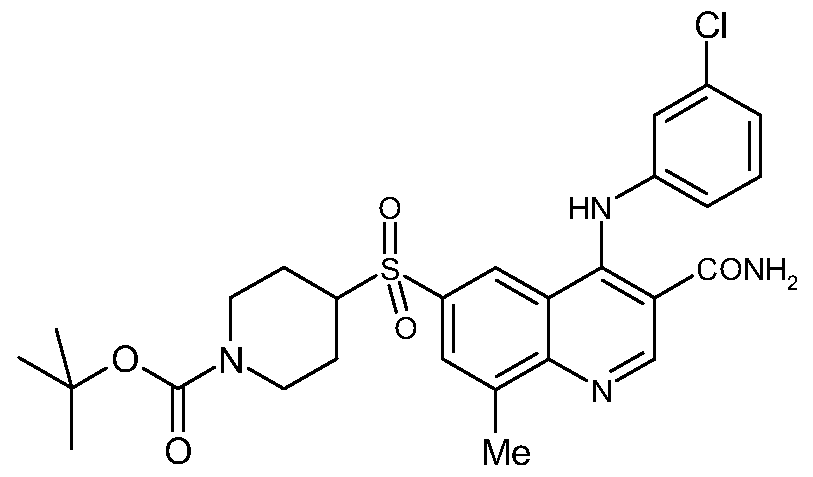
LC/MS Rt 3.18min m/z 559 [MH+]
The following compound was made in a similar manner as Intermediate 9:


Intermediate 1 1 : 4-r(3-Chlorophenyl)amino1-8-methyl-6-(4-piperidinylsulfonyl)-3- quinolinecarboxamide dihvdrochloride

LC/MS Rt 2.12min m/z 459 [MH+] The following compound was made in a similar manner as Intermediate 11 :


Examples
Example 1 : 4-r(3-Chlorophenyl)amino1-8-methyl-6-({1-r(1-methylethyl)sulfonyl1-4- piperidinyl)sulfonyl)-3-quinolinecarboxamide

1H NMR (400MHz in d6-DMSO, 27°C, δppm) 10.47 (s, 1 H), 9.12 (s, 1 H), 8.29 (br s, 1 H), 8.25 (s, 1 H), 7.92 (s, 1 H), 7.78 (br s, 1 H), 7.29 (t, 1 H), 7.08 (s, 1 H), 7.06 (d, 1 H), 6.99 (d, 1 H), 3.69 (m, 2H), 3.45 (tt, 1 H), 3.3 (m, 1 H, partially obscured by H2O in the DMSO), 2.87 (t, 2H), 2.78 (s, 3H), 1.80 (d, 2H), 1.34 (m, 2H), 1.17 (d, 6H).
LC/MS Rt 2.96 min m/z 565/567 [MH+]
Example 2: 4-r(3-Chlorophenyl)amino1-6-{ri-(ethylsulfonyl)-4-piperidinyl1sulfonyl>-8- methyl-3-quinolinecarboxamide

LC/MS Rt 2.84 min m/z 551/553 [MH+]
The following compounds were made in a similar manner as Example 2 from 4-[(3- chlorophenyl)amino]-8-methyl-6-(4-piperidinylsulfonyl)-3-quinolinecarboxamide dihydrochloride (Intermediate 11 ) and the appropriate sulphonyl chloride:


Example 5: 4-r(3-Cvanophenyl)aminol-8-methyl-6-{ri-(methylsulfonyl)-4- piperidinyl1sulfonyl>-3-quinolinecarboxamide

A solution of methanesulphonyl chloride (10mg) in dichloromethane (0.5ml) was added, rapidly drop-wise, to a stirred suspension of 4-[(3-cyanophenyl)amino]-8-methyl-6-(4- piperidinylsulfonyl)-3-quinolinecarboxamide (Intermediate 12) (35mg) and N, N- diisopropylethylamine (26mg) in dichloromethane (3ml). The reaction mixture was stirred for 1.75h. More methanesulphonyl chloride (10mg) and Λ/,Λ/-diisopropylethylamine (30mg) were added. The reaction mixture was stirred for a further 16h. More methanesulphonyl chloride (10mg) and 1 ,4-dioxan (3ml) were added. The reaction mixture was stirred for 2h, diluted with dichloromethane (10ml) and washed consecutively with 0.5M sodium bicarbonate solution (15ml) and 5% w/v citric acid solution (15ml). The organic phase (containing suspended solid) was separated and filtered under suction. The residue was washed with water and diethyl ether, then dried under suction to give the title compound as a white powder (11 mg).
LC/MS Rt 2.56 min m/z 528 [MH+]
Biological Assays
PDE3, PDE4B, PDE4D, PDE5 and PDE6 Primary assay methods
The activity of the compounds can be measured as described below. Preferred compounds of the invention are selective PDE4 inhibitors, i.e. they inhibit PDE4 (e.g.
PDE4B and/or PDE4D) more strongly than they inhibit other PDE's such as PDE3 and/or
PDE5.
PDE enzyme sources and literature references
Human recombinant PDE4B, in particular the 2B splice variant thereof (HSPDE4B2B), is disclosed in WO 94/20079 and also in M. M. McLaughlin et al., "A low Km, rolipram- sensitive, cAMP-specific phosphodiesterase from human brain: cloning and expression of
cDNA, biochemical characterisation of recombinant protein, and tissue distribution of mRNA", J. Biol. Chem., 1993, 268, 6470-6476. For example, in Example 1 of WO 94/20079, human recombinant PDE4B is described as being expressed in the PDE- deficient yeast Saccharomyces cerevisiae strain GL62, e.g. after induction by addition of 150 uM CuSOφ and 100,000 x g supernatant fractions of yeast cell lysates are described for use in the harvesting of PDE4B enzyme.
Human recombinant PDE4D (HSPDE4D3A) is disclosed in P. A. Baecker et al., "Isolation of a cDNA encoding a human rolipram-sensitive cyclic AMP phosphodiesterase (PDE IVD)", Gene, 1994, 138, 253-256.
Human recombinant PDE5 is disclosed in K. Loughney et al., "Isolation and characterisation of cDNAs encoding PDE5A, a human cGMP-binding, cGMP-specific 3',5'-cyclic nucleotide phosphodiesterase", Gene, 1998, 216, 139-147.
PDE3 may be purified from bovine aorta as described by H. Coste and P. Grondin, "Characterisation of a novel potent and specific inhibitor of type V phosphodiesterase", Biochem. Pharmacol., 1995, 50, 1577-1585.
PDE6 may be purified from bovine retina as described by: P. Catty and P. Deterre, "Activation and solubilization of the retinal cGMP-specific phosphodiesterase by limited proteolysis", Eur. J. Biochem., 1991 , 199, 263-269; A. Tar et al. "Purification of bovine retinal cGMP phosphodiesterase", Methods in Enzymology, 1994, 238, 3-12; and/or D. Srivastava et al. "Effects of magnesium on cyclic GMP hydrolysis by the bovine retinal rod cyclic GMP phosphodiesterase", Biochem. J., 1995, 308, 653-658.
Inhibition of PDE activity: Fluorescence Polarisation (FP) assay
The ability of compounds to inhibit PDE catalytic activity was determined by IMAP Fluorescence Polarisation (FP) assay (Molecular Devices Ltd code: R8062) in 384-well format. Test compounds (small volume, e.g. 0.5 μl, of solution in DMSO) were preincubated at ambient temperature in black 384-well microtitre plates (supplier: NUNC, code 262260) with PDE enzyme in 1OmM Tris-HCI buffer pH 7.2, 1 OmM MgCI2, 0.1 %
(w/v) bovine serum albumin, 0.05% NaN3 for 10-30 minutes. The enzyme level was set so that reaction was linear throughout the incubation.
For the PDE3, PDE4B and PDE4D assays Fluorescein adenosine 3',5'-cyclic phosphate (Molecular Devices Ltd code: R7091 ) was added to give ~ 4OnM final concentration. For the PDE5 and PDE6 assays Fluorescein guanosine 3',5'-cyclic phosphate (Molecular Devices Ltd code: R7090) was added to give ~ 4OnM final concentration. Plates were mixed on an orbital shaker for 10 seconds and incubated at ambient temperature for 40 minutes. IMAP binding reagent (Molecular Devices Ltd code: R7207) was added (60μl of a 1 in 400 dilution in binding buffer of the kit stock solution) to terminate the assay. Plates were allowed to stand at ambient temperature for 1 hour. The FP ratio of parallel to perpendicular light was measured using an Analyst™ plate reader (from Molecular Devices Ltd). For inhibition curves, 11 concentrations (0.5nM - 30μM) of each compound were assayed; more potent compounds were assayed over lower concentration ranges (assay concentrations were generally between 30μM and 5OfM). Curves were analysed using ActivityBase and XLfit (ID Business Solutions Limited). Results were expressed as plC5o values.
Compounds 1 - 5 had activity against PDE4B in the FP assay described above, with IC50 values of > 9.5.
Claims
1. A compound of formula (I) or a pharmaceutically acceptable salt or solvate thereof:

R1 is C1-5 alkyl, C3-5 cycloalkyl; R2 is halogen, CN.
2. A compound of formula (I) selected from the group consisting of:
4-[(3-chlorophenyl)amino]-8-methyl-6-({1-[(1-methylethyl)sulfonyl]-4-piperidinyl}sulfonyl)-
3-quinolinecarboxamide
4-[(3-chlorophenyl)amino]-6-{[1-(ethylsulfonyl)-4-piperidinyl]sulfonyl}-8-methyl-3- quinolinecarboxamide
4-[(3-chlorophenyl)amino]-8-methyl-6-{[1-(methylsulfonyl)-4-piperidinyl]sulfonyl}-3- quinolinecarboxamide
4-[(3-chlorophenyl)amino]-6-{[1-(cyclopropylsulfonyl)-4-piperidinyl]sulfonyl}-8-methyl-3- quinolinecarboxamide
4-[(3-cyanophenyl)amino]-8-methyl-6-{[1-(methylsulfonyl)-4-piperidinyl]sulfonyl}-3- quinolinecarboxamide
or a pharmaceutically acceptable salt or solvate thereof.
3. A method of treatment of diseases or conditions, for which a PDE4 inhibitor is indicated, comprising administering a compound of formula (I) or a pharmaceutically acceptable salt or solvate thereof according to any of claims 1 to 2.
4. A compound or a pharmaceutically acceptable salt or solvate thereof, according to claims 1 to 2 for use in therapy.
5. A compound or a pharmaceutically acceptable salt or solvate thereof, according to claims 1 to 2 for use in the treatment or prophylaxis of inflammatory and/or allergic diseases.
6. The use of a compound according to claims 1 to 2, or a pharmaceutically acceptable salt or solvate thereof, in the preparation of a medicament for the treatment of diseases or conditions for which a PDE4 inhibitor is indicated
7. A pharmaceutical composition which comprises a compound according to claims 1 to 2 or a pharmaceutically acceptable salt or solvate thereof optionally with a pharmaceutically acceptable carrier or excipient.
8. A pharmaceutical composition according to claim 7 which is suitable for inhaled administration.
9. A pharmaceutical composition according to claim 7 which is suitable for oral administration.
Applications Claiming Priority (2)
| Application Number | Priority Date | Filing Date | Title |
|---|---|---|---|
| GBGB0605462.1A GB0605462D0 (en) | 2006-03-17 | 2006-03-17 | Novel compounds |
| GB0605462.1 | 2006-03-17 |
Publications (1)
| Publication Number | Publication Date |
|---|---|
| WO2007107499A1 true WO2007107499A1 (en) | 2007-09-27 |
Family
ID=36293009
Family Applications (1)
| Application Number | Title | Priority Date | Filing Date |
|---|---|---|---|
| PCT/EP2007/052478 Ceased WO2007107499A1 (en) | 2006-03-17 | 2007-03-15 | Quinoline derivatives useful as pde4 inhibitors |
Country Status (2)
| Country | Link |
|---|---|
| GB (1) | GB0605462D0 (en) |
| WO (1) | WO2007107499A1 (en) |
Cited By (6)
| Publication number | Priority date | Publication date | Assignee | Title |
|---|---|---|---|---|
| JP2012513464A (en) * | 2008-12-23 | 2012-06-14 | ザ トラスティーズ オブ コロンビア ユニヴァーシティ イン ザ シティ オブ ニューヨーク | Phosphodiesterase inhibitors and uses thereof |
| US8367829B2 (en) | 2010-05-10 | 2013-02-05 | Gilead Sciences, Inc. | Bi-functional pyrazolopyridine compounds |
| US8394829B2 (en) | 2010-05-10 | 2013-03-12 | Gilead Sciences, Inc. | Bi-functional quinoline analogs |
| US9120788B2 (en) | 2013-02-19 | 2015-09-01 | Pfizer Inc. | Azabenzimidazole compounds |
| US9598421B2 (en) | 2014-08-06 | 2017-03-21 | Pfizer Inc. | Imidazopyridazine compounds |
| US10131669B2 (en) | 2014-07-24 | 2018-11-20 | Pfizer Inc. | Pyrazolopyrimidine compounds |
Citations (3)
| Publication number | Priority date | Publication date | Assignee | Title |
|---|---|---|---|---|
| WO2004103998A1 (en) * | 2003-05-21 | 2004-12-02 | Glaxo Group Limited | Quinoline derivatives as phosphodiesterase inhibitors |
| WO2005030212A1 (en) * | 2003-09-27 | 2005-04-07 | Glaxo Group Limited | 4-aminoquinoline-3-carboxamide derivatives as pde4 inhibitors |
| WO2005030725A1 (en) * | 2003-09-27 | 2005-04-07 | Glaxo Group Limited | Derivatives of 3-aminocarbonylquinoline, pharmaceutical compositions containing them and processes and intermediates for their preparation |
-
2006
- 2006-03-17 GB GBGB0605462.1A patent/GB0605462D0/en not_active Ceased
-
2007
- 2007-03-15 WO PCT/EP2007/052478 patent/WO2007107499A1/en not_active Ceased
Patent Citations (3)
| Publication number | Priority date | Publication date | Assignee | Title |
|---|---|---|---|---|
| WO2004103998A1 (en) * | 2003-05-21 | 2004-12-02 | Glaxo Group Limited | Quinoline derivatives as phosphodiesterase inhibitors |
| WO2005030212A1 (en) * | 2003-09-27 | 2005-04-07 | Glaxo Group Limited | 4-aminoquinoline-3-carboxamide derivatives as pde4 inhibitors |
| WO2005030725A1 (en) * | 2003-09-27 | 2005-04-07 | Glaxo Group Limited | Derivatives of 3-aminocarbonylquinoline, pharmaceutical compositions containing them and processes and intermediates for their preparation |
Cited By (10)
| Publication number | Priority date | Publication date | Assignee | Title |
|---|---|---|---|---|
| JP2012513464A (en) * | 2008-12-23 | 2012-06-14 | ザ トラスティーズ オブ コロンビア ユニヴァーシティ イン ザ シティ オブ ニューヨーク | Phosphodiesterase inhibitors and uses thereof |
| US8367829B2 (en) | 2010-05-10 | 2013-02-05 | Gilead Sciences, Inc. | Bi-functional pyrazolopyridine compounds |
| US8394829B2 (en) | 2010-05-10 | 2013-03-12 | Gilead Sciences, Inc. | Bi-functional quinoline analogs |
| US8450490B2 (en) | 2010-05-10 | 2013-05-28 | Gilead Sciences, Inc. | Bi-functional pyrazolopyridine compounds |
| US9120788B2 (en) | 2013-02-19 | 2015-09-01 | Pfizer Inc. | Azabenzimidazole compounds |
| US9815832B2 (en) | 2013-02-19 | 2017-11-14 | Pfizer Inc. | Azabenzimidazole compounds |
| US10131669B2 (en) | 2014-07-24 | 2018-11-20 | Pfizer Inc. | Pyrazolopyrimidine compounds |
| US9598421B2 (en) | 2014-08-06 | 2017-03-21 | Pfizer Inc. | Imidazopyridazine compounds |
| US10077269B2 (en) | 2014-08-06 | 2018-09-18 | Pfizer Inc. | Imidazopyridazine compounds |
| US10669279B2 (en) | 2014-08-06 | 2020-06-02 | Pfizer Inc. | Imidazopyridazine compounds |
Also Published As
| Publication number | Publication date |
|---|---|
| GB0605462D0 (en) | 2006-04-26 |
Similar Documents
| Publication | Publication Date | Title |
|---|---|---|
| KR101144548B1 (en) | Quinoline derivatives as phosphodiesterase inhibitors | |
| US10022376B2 (en) | Pyrazolopyridines and pyrazolopyrimidines | |
| EP1673086B1 (en) | 4-aminoquinoline-3-carboxamide derivatives as pde4 inhibitors | |
| US20040248923A1 (en) | Novel 4-anilinoquinoline-3-carboxamides | |
| US20080153799A1 (en) | Novel Quinoline-Carbaxamides as Jak3 Kinase Modulators | |
| EP2401270A1 (en) | Pyrazole derivatives used as ccr4 receptor antagonists | |
| WO2005030725A1 (en) | Derivatives of 3-aminocarbonylquinoline, pharmaceutical compositions containing them and processes and intermediates for their preparation | |
| EP2046787A1 (en) | Pyrazolo[3,4-b]pyridine compounds, and their use as pde4 inhibitors | |
| US20080280911A1 (en) | Cinnoline Compounds as Inhibitors of Phosphodiesterase Type IV (Pde4) | |
| US20090270444A1 (en) | 1,7-Naphthyridines | |
| WO2006089689A1 (en) | 2-quinolone compounds as inhibitors of phosphodiesterases | |
| WO2006097340A1 (en) | 1,7-naphthyridines as pde4 inhibitors | |
| WO2012025473A1 (en) | Cc.chemokine receptor 4 antagonists | |
| WO2012025474A1 (en) | Indazole compounds |
Legal Events
| Date | Code | Title | Description |
|---|---|---|---|
| 121 | Ep: the epo has been informed by wipo that ep was designated in this application |
Ref document number: 07712532 Country of ref document: EP Kind code of ref document: A1 |
|
| NENP | Non-entry into the national phase |
Ref country code: DE |
|
| 122 | Ep: pct application non-entry in european phase |
Ref document number: 07712532 Country of ref document: EP Kind code of ref document: A1 |