WO2007106450A2 - Diketo acids with nucleobase scaffolds: anti-hiv replication inhibitors targeted at hiv integrase in combination therapy - Google Patents
Diketo acids with nucleobase scaffolds: anti-hiv replication inhibitors targeted at hiv integrase in combination therapy Download PDFInfo
- Publication number
- WO2007106450A2 WO2007106450A2 PCT/US2007/006245 US2007006245W WO2007106450A2 WO 2007106450 A2 WO2007106450 A2 WO 2007106450A2 US 2007006245 W US2007006245 W US 2007006245W WO 2007106450 A2 WO2007106450 A2 WO 2007106450A2
- Authority
- WO
- WIPO (PCT)
- Prior art keywords
- azido
- dideoxy
- alkyl
- methyl
- independently
- Prior art date
- Legal status (The legal status is an assumption and is not a legal conclusion. Google has not performed a legal analysis and makes no representation as to the accuracy of the status listed.)
- Ceased
Links
- 0 COC(C(C=C(*)[C@@]1N=CN=C2N(Cc3ccccc3)C=NC12)=O)=O Chemical compound COC(C(C=C(*)[C@@]1N=CN=C2N(Cc3ccccc3)C=NC12)=O)=O 0.000 description 6
- XGYGNSFBSSDNPP-UHFFFAOYSA-N CC(C(C(N1)=O)=CN(Cc2ccccc2)C1=O)=O Chemical compound CC(C(C(N1)=O)=CN(Cc2ccccc2)C1=O)=O XGYGNSFBSSDNPP-UHFFFAOYSA-N 0.000 description 1
- WGQGUEGZMVQCHT-UHFFFAOYSA-N CC(C(C(N1Cc2ccccc2)=O)=CN(Cc2ccccc2)C1=O)=O Chemical compound CC(C(C(N1Cc2ccccc2)=O)=CN(Cc2ccccc2)C1=O)=O WGQGUEGZMVQCHT-UHFFFAOYSA-N 0.000 description 1
- ZSLKBMYXSXQZDT-UHFFFAOYSA-N CCOC(c([n]1Cc2ccccc2)nc2c1N=CN(Cc1ccccc1)C2=O)=C Chemical compound CCOC(c([n]1Cc2ccccc2)nc2c1N=CN(Cc1ccccc1)C2=O)=C ZSLKBMYXSXQZDT-UHFFFAOYSA-N 0.000 description 1
- XNFLLTDMQGADRG-UHFFFAOYSA-N CNC1=C(N(Cc2ccccc2)CBr)N=CNC1=O Chemical compound CNC1=C(N(Cc2ccccc2)CBr)N=CNC1=O XNFLLTDMQGADRG-UHFFFAOYSA-N 0.000 description 1
- WRARGDHZBNFOEF-JAIQZWGSSA-N COC(/C(/O)=C/C(C(C(N1Cc(cc2)ccc2F)=O)=CN(Cc2ccccc2)C1=O)=O)=O Chemical compound COC(/C(/O)=C/C(C(C(N1Cc(cc2)ccc2F)=O)=CN(Cc2ccccc2)C1=O)=O)=O WRARGDHZBNFOEF-JAIQZWGSSA-N 0.000 description 1
- PTSLJYMLSZJSPX-JMIUGGIZSA-N COC(/C(/O)=C/C(C(C(N1Cc(cccc2)c2F)=O)=CN(Cc2ccccc2F)C1=O)=O)=O Chemical compound COC(/C(/O)=C/C(C(C(N1Cc(cccc2)c2F)=O)=CN(Cc2ccccc2F)C1=O)=O)=O PTSLJYMLSZJSPX-JMIUGGIZSA-N 0.000 description 1
Classifications
-
- A—HUMAN NECESSITIES
- A61—MEDICAL OR VETERINARY SCIENCE; HYGIENE
- A61K—PREPARATIONS FOR MEDICAL, DENTAL OR TOILETRY PURPOSES
- A61K45/00—Medicinal preparations containing active ingredients not provided for in groups A61K31/00 - A61K41/00
- A61K45/06—Mixtures of active ingredients without chemical characterisation, e.g. antiphlogistics and cardiaca
-
- A—HUMAN NECESSITIES
- A61—MEDICAL OR VETERINARY SCIENCE; HYGIENE
- A61K—PREPARATIONS FOR MEDICAL, DENTAL OR TOILETRY PURPOSES
- A61K31/00—Medicinal preparations containing organic active ingredients
- A61K31/70—Carbohydrates; Sugars; Derivatives thereof
- A61K31/7042—Compounds having saccharide radicals and heterocyclic rings
- A61K31/7052—Compounds having saccharide radicals and heterocyclic rings having nitrogen as a ring hetero atom, e.g. nucleosides, nucleotides
- A61K31/706—Compounds having saccharide radicals and heterocyclic rings having nitrogen as a ring hetero atom, e.g. nucleosides, nucleotides containing six-membered rings with nitrogen as a ring hetero atom
- A61K31/7064—Compounds having saccharide radicals and heterocyclic rings having nitrogen as a ring hetero atom, e.g. nucleosides, nucleotides containing six-membered rings with nitrogen as a ring hetero atom containing condensed or non-condensed pyrimidines
- A61K31/7068—Compounds having saccharide radicals and heterocyclic rings having nitrogen as a ring hetero atom, e.g. nucleosides, nucleotides containing six-membered rings with nitrogen as a ring hetero atom containing condensed or non-condensed pyrimidines having oxo groups directly attached to the pyrimidine ring, e.g. cytidine, cytidylic acid
- A61K31/7072—Compounds having saccharide radicals and heterocyclic rings having nitrogen as a ring hetero atom, e.g. nucleosides, nucleotides containing six-membered rings with nitrogen as a ring hetero atom containing condensed or non-condensed pyrimidines having oxo groups directly attached to the pyrimidine ring, e.g. cytidine, cytidylic acid having two oxo groups directly attached to the pyrimidine ring, e.g. uridine, uridylic acid, thymidine, zidovudine
Definitions
- the present invention relates to the field of antiviral therapy, in particular the treatment of HIV infections in humans, preferably in combination therapy.
- HIV human immunodeficiency virus
- the human immunodeficiency virus, HIV encodes three key viral enzymes through its pol gene and these enzymes are critical for the replication of this virus [Fauci, Science,
- RT HIV reverse transcriptase
- PR HIV protease
- AIDS related complex (ARC) in HAART highly-active antiretroviral therapy
- ARC AIDS related complex
- HIV-I integrase is a protein of 32 kDa encoded at the
- HIV DNA into the host cell chromosome. Because integrase has no human counterpart and because it plays the significant role of completing the invasion of the human cell cell by HIV, it is an attractive target for the discovery of inhibitors of therapeutic potential.
- integrase Following assembly of viral DNA on integrase, the processing of viral DNA occurs where there is site specific endonuclease activity and two nucleotides are cleaved off from each 3 '-end of the double helical viral DNA to produce the tailored viral DNA recessed by two nucleotides and bearing a terminal CAOH-3'.
- integrase apparently activates the phosphodiester bond towards cleavage.
- the recessed viral DNA thus produced is joined in the next step to host cell DNA in the nucleus through a trans- esterification reaction. In this step, integrase positions the 3'-OH end of the viral DNA for nucleophilic attack on the phosphodiester bond in the host DNA.
- a variety of compounds are inhibitors of HIV integrase but some of these compounds are non-specific inhibitors of the enzyme while evidence suggests that others may possess some specificity.
- the various classes include nucleotides, oligonucleotides, dinucleotides, and miscellaneous small molecules including heterocyclic systems, natural products, diketo acids, sulfones and others [Nair, Rev. Med. Virol., 12, 179-193 (2002); Nair, Current Pharmaceutical Design, 9, 2553-2565 (2003); Chi and Nair, Bioorg. Med. Chem. Lett. 14, 4815-4817 (2004); Nair and coworkers, J. Am. Chem. Soc, 122, 5671-5677 (2000)].
- the class of previously studied compounds that are most directly relevant to this patent are diketo acids with aryl or heteroaryl substitutions. Some of these compounds are inhibitors of HTV integrase, but most commonly of only the strand transfer step.
- the integrase inhibition data have been reported in several scientific publications [Wai, et al., "4- Aryl-2,4-dioxobutanoic acid inhibitors of HIV-I integrase and viral replication in cells," J. Med. Chem. 43, 4923-4926 (2000); Pais, G. C. G., et al., "Structure activity of 3-aryl-l,3- diketo-containing compounds as HIV-I integrase inhibitors," J. Med.
- integrase by diketo acids may be the result of interaction of the functional groups on these compounds with metal ions in the active site of integrase, resulting in a functional sequestration of these critical metal cofactors [Grobler, J. A., et al, Proc. Natl. Acad. Sci. U.S.A. 99, 6661-6666 (2002)].
- Related patents to this application are: Selnick, H. G. et al., (Merck & Co. Inc.),
- Angeletti SPA "Preparation of N- substituted hydroxypyrimidinone carboxamide inhibitors of HIV integrase," WO 2003035077; Belyk, et al., (Merck & Co. Inc., Institute Di Richerche Di Biologia Molecolare P.
- Angeletti SPA "Preparation of N-(4-fluorobenzyl)-5-hydroxy-l-methyl-2-(l-methyl-l- ⁇ [(5-methyl-l,3,4-oxadiazol-2-yl)carbonyl]amino ⁇ ethyl)-6-oxo-l,6-dihydropyrimidine-4- carboxamide potassium salts as HIV integrase inhibitors," WO 2006060712; Sato, et al., (Japan Tobacco Inc.), “Preparation of quinolizinone compounds as HIV integrase inhibitors," WO 2006033422; Yoshida, H., et al., (Shionogi & Co.
- nucleic acid base (nucleobase) scaffold which is a requirement for potent activity and which was not previously recognized.
- a new class of diketo acids constructed on nucleobase scaffolds, and designed as inhibitors of HIV replication through inhibition of HIV integrase, is described.
- These compounds can be represented by the general formula I (and includes tautomers, regioisomers, geometric isomers and optical isomers thereof, as well as pharmaceutically acceptable salts thereof, where applicable), in which the moiety illustrated as a square is a molecular scaffold made up of a nucleic acid base (nucleobase) derivative.
- These compounds have application in the prevention or treatment of infection by HIV and the treatment of AIDS and ARC, either as the compounds, or as their pharmaceutically acceptable salts, with pharmaceutically acceptable carriers, used alone or preferably, in combination with antivirals, immunomodulators, antibiotics, vaccines, and other therapeutic agents as otherwise disclosed herein. Methods of treating AIDS and ARC and methods of treating or preventing infection by HIV are also described.
- the present invention further relates in preferred aspects to the use of at least one of the above compounds in combination with at least one additional compound, preferably an anti-HIV agent, as otherwise described herein.
- compound refers to any specific chemical compound disclosed herein and includes tautomers, regioisomers, geometric isomers, and where applicable, optical isomers thereof, as well as pharmaceutically acceptable salts thereof,.
- compound generally refers to a single compound, but also may include other compounds such as stereoisomers, regioisomers and/or optical isomers (including racemic mixtures) as well as specific enantiomers or enantiomerically enriched mixtures of disclosed compounds.
- patient or “subject” is used throughout the specification within context to describe an animal, generally a mammal and preferably a human, to whom treatment, including prophylactic treatment, with the compositions according to the present invention is provided.
- treatment including prophylactic treatment
- patient refers to that specific animal.
- the term "effective" is used herein y unless- otherwise indicated, to describe an amount of a compound or composition which, in context, is used to produce or effect an intended result, whether that result relates to the treatment of a viral, microbial or other disease state, disorder or condition associated with HIV, ARC or AIDS, including Kaposi's sarcoma, HBV infections and other microbial infection (tuberculosis and other infections often found in AIDS patients), or alternatively, is used to produce another compound, agent or composition or effect another intended result when the component is used within the context of its well-known use. This term subsumes all other effective amount or effective concentration terms which are otherwise described in the present application.
- nucleoside scaffold is used throughout the specification to mean a nucleoside base selected from uracil, xanthine, hypoxanthine and purine which contain at least four substituents at four substitutable positions on the nucleoside base, one of which is a ketoacid as otherwise defined herein and the other three of which R 1 , R 2 andR 3 , are as defined herein.
- heteroaryl shall mean a 5 or 6-membered heteroaromatic ring containing 1 to 2 heteroatoms selected from oxygen, nitrogen and sulfur, which heteroaromatic ring is optionally substituted with from 1 to 3 substituents such as halogen, hydroxyl, Qo alkyl, Ci -3 alkoxy and CF 3 .
- heteroaryl and heteroaryomatic ring are used interchangeably herein.
- human immunodeficieincy virus or "HIV” shall be used to describe human immunodeficiency viruses 1 and 2 (HIV-I and HIV-2).
- ARC and "AIDS” refer to syndromes of the immune system caused by the human immunodeficiency virus, which are characterized by susceptibility to certain diseases and T cell counts which are depressed compared to normal counts. HIV progresses from Category 1 (Asymptomatic HIV Disease) to Category 2 (ARC), to Category 3 (AIDS), with the severity of the disease.
- a Category 1 HIV infection is characterized by the patient or subject being HIV positive, asymptomatic (no symptoms) and having never had fewer than 500 CD4 cells. If the patient has had any of the AIDS-defining diseases listed for categories 2 (ARC) or 3 (AIDS), then the patient is not in this category. If the patient's t-cell count has ever dropped below 500, that patient is considered either Category 2 (ARC) or Category 3 (AIDS).
- a Category 2 (ARC) infection is characterized by the following criteria: The patient's T-cells have dropped below 500 but never below 200, and that patient has never had any Category 3 diseases (as set forth below) but have had at least one of the following defining illnesses —
- a Category 3 (AIDS) infection is characterized by the following criteria: your T-cells have dropped below 200 or you have had at least one of the following defining illnesses — '
- kansasii disseminated or extrapulmonary o Mycobacterium tuberculosis, any site (pulmonary** or extrapulmonary) o Mycobacterium, other species or unidentified species, disseminated or extrapulmonary o Pneumocystis carinii pneumonia o Pneumonia, recurrent** o Progressive multifocal leukoencephalopathy o Salmonella septicemia, recurrent o Toxoplasmosis of brain o Wasting syndrome due to HIV
- coadministration shall mean that at least two compounds or compositions are administered to the patient at the same time, such that effective amounts or concentrations of each of the two or more compounds may be found in the patient at a given point in time.
- compounds according to the present invention may be co-administered to a patient at the same time, the term embraces both administration of two or more agents at the same time or at different times, provided that effective concentrations of all coadministered compounds or compositions are found in the subject at a given time.
- one or more of the diketo acid compounds described above are coadministered in combination with at least one additional anti-HIV agent as otherwise described herein in a cocktail for the treatment of HIV infections.
- the co-administration of compounds results in synergistic anti-HIV activity of the therapy.
- the present invention is directed to compounds of the general molecular formula I, combinations thereof, or pharmaceutically acceptable salts thereof, in the inhibition of HFV integrase, the prevention or treatment of HIV infections and in the treatment of AIDS and ARC.
- Compounds of formula I are defined as follows:
- nucleobase scaffold and R groups are defined as:
- keto acids with uracil nucleobase scaffold (i) keto acids with uracil nucleobase scaffold
- R 1 and R 2 are independently: a) H, b) C 1-6 alkyl. c) C i-6 fluoroalkyl, d) Ci- 6 alkyl S(O) n R, wherein n selected from 0-2, R is selected from alkyl, phenyl and substituted phenyl with substituents selected from:
- each R b is 5 or 6 membered heteroaromatic ring containing 1 to 2 heteroatoms selected from oxygen, nitrogen and sulfiir, the ring could be substituted or not on carbon or nitrogen with 1 to 3 substituents selected from: 1) halogen,
- R 3 is selected from: a) H, b) C 1-6 alkyl, c) Halogen, d) Hydroxyl, e) Phenylthio, f) Substituted phenylthio with 1 to 3 substituents selected from:
- R 4 is selected from: a) CO 2 R C , wherein R c is selected from:
- keto acids with xanthine nucleobase scaffold (ii) keto acids with xanthine nucleobase scaffold
- R , R 2 and R 3 are independently: a) H, b) C 1-6 alky], c) Ci- ⁇ fluoroalkyl, d) Ci ⁇ alkyl S(O) n R, wherein n selected from 0-2, R selected from C 1 - 3 alkyl, phenyl and substituted phenyl with substituents selected from:
- each R b is 5 or 6 membered heteroaromatic ring containing 1 to 2 heteroatoms selected from oxygen, nitrogen and sulfur, the ring could be substituted or not on carbon or nitrogen with 1 to 3 substituents selected from: 1) halogen,
- R is selected from: a) C ⁇ 2 R c , wherein R c is selected from:
- keto acids with hypoxanthine nucleobase scaffold keto acids with hypoxanthine nucleobase scaffold
- R 1 , R 2 and R 3 are independently: a) H, b) C 1.6 alkyl, c) Ci- ⁇ fluoroalkyl, d) C i- 6 alkyl S(O) n R, wherein n selected from 0-2, R selected from Cu alkyl, phenyl and substituted phenyl with substituents selected from:
- each R b is 5 or 6 membered heteroaromatic ring containing 1 to 2 heteroatoms selected from oxygen, nitrogen and sulfur, the ring could be substituted or not on carbon or nitrogen with 1 to 3 substituents selected from: 1) halogen,
- R 4 is selected from: a) C ⁇ 2R c , wherein R c is selected from:
- R 1 , R 2 and 1 R 3 are independently: a) H, b) C ⁇ _6 alkyl, c) C i- 6 fluoroalkyl,
- Ci-6 alkyl S(O) n R wherein n selected from 0-2, R selected from C1-3 alkyl, phenyl and substituted phenyl with substituents selected from:
- Ci- 6 alkyl CO n R 8 wherein n selected from 1 and 2, R a selected from: l) C,- 6 alkyl, 2) H, h) Phenyl, 5 i) Substituted phenyl with 1 to 3 substituents selected from:
- each R b is 5 or 6 membered heteroaromatic ring containing 1 to 2 heteroatoms selected from oxygen, nitrogen and sulfur, the ring could be substituted or 30 not on carbon or nitrogen with 1 to 3 substituents selected from:
- R 4 is selected from: a) C ⁇ 2 R c , wherein R c is selected from:
- compositions useful for inhibiting HIV integrase comprising of an effective amount of a compound of this invention, optionally another anti-HFV agent (as discussed below) and a pharmaceutically acceptable carrier.
- Pharmaceutical compositions useful for treating infection by HIV or for treating AIDS or ARC are also included by the present invention.
- the present invention also includes methods for inhibiting the viral enzyme, HIV integrase, and a method of inhibiting HIV growth or replication, or treating an HIV infection or for treating AIDS or ARC.
- the present invention is directed to a pharmaceutical composition
- a pharmaceutical composition comprising, in combination, a therapeutically effective amount of a compound of the present invention in combination with a therapeutically effective amount of an agent for the treatment of AIDS selected from (i) an AIDS or HIV antiviral agent, (ii) an anti-infective agent, (iii) an immunomodulator, (iv) other useful therapeutic agents including antibiotics and other antiviral agents.
- the compounds of the present invention may have regioisomers with respect to R 1 , R 2 and R 3 and these regioisomeric forms are included in the present invention.
- the compounds of the present invention may have asymmetric centers and may occur as optical isomers and all of these isomeric forms are included in the present patent invention.
- the compounds may have geometric isomers and these forms are included in the present invention.
- Tautomeric forms may also exist with compounds of the present invention.
- the terminology "and tautomers thereof is used in describing tautomeric forms of compounds of formula I such as Ia and Ib (shown below).
- the compounds of the present invention are useful in the inhibition of HIV integrase, the prevention or treatment of infection by HIV and in the treatment of the disease known as AIDS. Treating AIDS or preventing or treating infection by HIV is defined as including the treatment of a wide range .of states of HIV infection: AIDS, ARC and actual or potential exposure to HIV (e.g., through blood transfusion, exchange of body fluids, bites, needle punctures, exposure to infected patient blood during medical or dental procedures, and other means). Other applications are also part of this invention.
- the compounds of this invention are useful in the preparation and execution of screening assays for antiviral compounds including in the isolation of viral enzyme mutants and in further understanding of the enzyme, HIV integrase.
- the present invention also provides for the use of a compound of structural formula (I) to make a pharmaceutical composition useful for inhibiting HIV integrase and in the treatment of AIDS or ARC.
- the compounds of the present invention may be administered in the form of "well- known pharmaceutically acceptable” salts.
- the latter is intended to include all acceptable salts such as acetate, lactobionate, benzenesulfonate, laurate, benzoate, malate, bicarbonate, maleate, bisulfate, mandelate, bitartrate, mesylate, borate, methylbromide, bromide, methylnitrate, calcium edetate, camsylate, mucate, carbonate, napsylate, chloride, nitrate, clavulanate, N-methylglucamine, citrate, ammonium salt, dihydrochloride, oleate, edetate, oxalate, edisylate, pamoate, estolate, palmitate, esylate, fumarate, phosphate, diphosphate, gluceptate, polygalacturonate, gluconate, salicylate, glutamate, stearate, glyco
- the pharmaceutically acceptable salts of this invention include those with counterions such as sodium, potassium, calcium, lithium, magnesium, zinc, and from bases such as ammonia, ethylenediamine, N-methyl-glutamine, lysine, arginine, ornithine, choline, N, N'-dibenzylethylenediamine, chloroprocaine, diethanolamine, procaine, N- benzylphenethylamine, diethylamine, piperazine, tris(hydroxymethyl)aminomethane, and tetramethylammonium hydroxide.
- bases such as ammonia, ethylenediamine, N-methyl-glutamine, lysine, arginine, ornithine, choline, N, N'-dibenzylethylenediamine, chloroprocaine, diethanolamine, procaine, N- benzylphenethylamine, diethylamine, piperazine, tris(hydroxymethyl)aminomethane
- esters can be employed, e.g., acetate, maleate, pivaloyloxymethyl and others, more preferably C 1 -C2 0 esters and those esters known in the art for improving solubility or hydrolysis characteristics for use as sustained release or prodrug formulations.
- Pharmaceutically acceptable esters can also be employed in the case where a phosphonic acid group [-PO(OH ⁇ ] is present. Diketo phosphonic acids attached to nucleobase scaffolds are also part of this invention.
- Therapeutically effective amounts of the compounds of the present invention may be administered to patients orally, parenterally, by inhalation spray, or rectally, in dosage unit formulations containing pharmaceutically-acceptable carriers, adjuvants and vehicles including nanoparticle drug delivery approaches.
- pharmaceutically acceptable is meant to infer that the carrier, diluent or excipient must be compatible with the other ingredients of the formulation and not deleterious to the patient or recipient.
- Pharmaceutical compositions may be in the form of orally-administrable suspensions or tablets, nasal sprays and injectible preparations (rnjectible aqueous or oleagenous suspensions or suppositories). This method of treatment is part of the invention.
- the administration approaches used orally as solution or suspension, immediate release tablets, nasal aerosol or inhalation, injectible solutions or suspensions or rectally administered in the form of suppositories) involve techniques that are well-known in the art of pharmaceutical formulation.
- the compounds of this invention can be administered orally to humans in a preferred form (such as tablets) and in a preferred dosage range of about 0.1 to 200 mg/kg body weight in divided doses.
- a preferred form such as tablets
- a preferred dosage range of about 0.1 to 200 mg/kg body weight in divided doses.
- the specific dose level and frequency of dosage for any particular patient may be varied and will depend upon a variety of factors including compound activity, compound metabolism and duration of action, patient age, body weight, general health, sex, diet, mode and time of administration, rate of excretion, drug combination, the severity of the particular condition, and the condition of the patient undergoing therapy.
- the present invention also includes therapeutically effective combinations of the HIV integrase inhibitor compounds of formula I with one or more other therapeutic agents such as AIDS antivirals, other antiviral agents, immunomodulators, antiinfectives, antibiotics, vaccines or other therapeutic agents. Some examples are given hereinbelow.
- Abacavir (1592U89) Glaxo Wellcome HIV infection, AIDS, GW 1592 ARC (RT inhibitor)
- Cidofovir Gilead Science CMV retinitis, herpes, papillomavirus
- Efavirenz DMP-266
- AIDS ARC
- ELlO Elan Corp PLC HIV infection (Gainesville, GA)
- Famciclovir Smith Kline Herpes zoster, herpes simplex
- HBY097 Hoechst Marion Roussel HIV infection, AIDS, ARC (non-nucleoside reverse transcriptase inhibitor)
- ISIS-2922 ISIS Pharmaceuticals CMV retinitis KNI-272 Natl. Cancer Institute HFV-associated diseases Lamivudine, 3TC Glaxo Wellcome HIV infection, AIDS, ARC (reverse transcriptase inhibitor); also with AZT
- PNU- 140690 Pharmacia Upjohn HIV infection, AIDS, ARC (protease inhibitor)
- Valaciclovir Glaxo Wellcome Genital HSV & CMV infections Virazole Ribavirin Viratek/ICN (Costa Asymptomatic HIV Mesa, CA) positive, LAS, ARC VX-478 Vertex HTV infection, AIDS, ARC Zalcitabine Hoffinann-LaRoche HF/ infection, AIDS, ARC with AZT Zidovudine; AZT Glaxo Wellcome HIV infection, AIDS, ARC, Kaposi's sarcoma, in combination with other therapies
- Abacavir succinate or GSK HIV infection, AIDS, Ziagen ® ) (reverse transcriptase inhibitor)
- Fuzeon ® or T-20
- Roche/Trimeris HIV infection AIDS, viral Fusion inhibitor
- Methionine-Enkephalin TNI Pharmaceutical AIDS, ARC (Chicago, IL)
- Tumor Necrosis Factor Genentech ARC in combination (TNF) w/gamma Interferon ANTI-INFECTIVES
- Pentamidine LyphoMed (Rosemont, PCP treatment Isethionate (IM & IV) IL)
- Megestrol Acetate Bristol-Myers Squibb Treatment of anorexia associated w/AIDS Testosterone Alza, Smith Kline AIDS-related wasting Total Enteral Nutrition Norwich Eaton Diarrhea and
- AIDS antivirals as described above and as otherwise set forth and described hereinbelow, other antivirals, immunomodulators, anti-infectives, antibiotics, vaccines, other therapeutic agents are not limited to the list in the above Table, but includes, in principle, any combination with any pharmaceutical composition useful for the treatment against infection by HIV or for treating AIDS or ARC.
- Preferred combinations are simultaneous or alternating treatments of a compound of the present invention and a protease inhibitor (e.g., indinavir, nelfinavir, ritonavir, saquinavir among others), a reverse transcriptase inhibitor [nucleoside (e.g., AZT, 3TC, ddC, ddl, d4T, abacavir and others, and/or non-nucleoside (e.g., efavirenz, nevirapine, and others), or some combination of two or more of these inhibitors (see Table above).
- a protease inhibitor e.g., indinavir, nelfinavir, ritonavir, saquinavir among others
- a reverse transcriptase inhibitor e.g., AZT, 3TC, ddC, ddl, d4T, abacavir and others
- non-nucleoside
- the compound of the present invention and other active agents may be separately administered or concurrently administered in effective amount.
- the administration of one element may be prior to, concurrent to, or subsequent to the administration of other agent(s).
- drugs or bioactive agents effective against HIV or having benefits when used in the treatment of HIV or secondary indications/conditions of HIV including AIDS/ARC and secondary conditions or disease states such as Kaposi's sarcoma, hepatitis B virus infections, etc., which may be combined with compounds according to the present invention in providing pharmaceutical compositions and methods of treating HIV infections or their secondary conditions or disease states.
- these drugs or bioactive agents are included in effective amounts to resolve the condition or disease state for which the compounds have been administered.
- HEPT-M • l-[(2-Hydroxyethoxy)methyl]-6-(phenylthio)-2-thiothymine
- HEPT-S
- Adefovir dipivoxil BisPom PMEA; GS-840; Preveon®
- Foscarnet Phosphonoformic acid
- Foscavir Phosphonoformic acid
- drugs and/or bioactive agents useful in the treatment of HIV infections, or conditions or disease states which are secondary to HIV infections is set forth hereinbelow.
- One or more of these agents may be used in combination (coadminstered) with at least one diketo acid anti-HIV agent as otherwise disclosed herein to treat HIV or one of its secondary conditions or disease states, including AIDS/ARC, Kaposi's sarcoma, hepatitis B virus infections, other microbial infections (such as tuberculosis) etc.
- these compounds are also included in effective amounts. These include: ACV; AK602; AMD070; APV; ATV; ATZ; AVX754 (apricitabine);
- Abacavir Abacavir / Lamivudine / Zidovudine
- Abacavir sulfate Abacavir sulfate/Lamivudine
- Abacavir/Lamivudine Abelecet; Acyclovir; Adefovir dipivoxil;
- Adriamycin Adriamycin; Agenerase; Aldesleukin; Alovudine; Aluvia; AmBisome; Amdoxovir; 5 Amphocin; Amphotec; Amphotericin B; Ampligen; Amprenavir; Androderm; Androgel;
- Apricitabine Aptivus; Atazanavir; Atripla; Azithromycin; BMS-378806; BMS-488043;
- Elvucitabine Emtricitabine; Tenofovir disoproxil fumarate; Emtriva; Enfufirtide; Entecavir;
- Epoetin alfa Epogen; Epzicom; Etopophos (phosphate salt); Etoposide; Etravirine;
- FTC Fluconazole; Fortovase; Fosamprenavir; Foxivudine tidoxil; Fungizone; Fuzeon; GS 15 9137; GSK-873,140 (aplaviroc); GW433908; GW640385 (brecanavir); Ganciclovir;
- INH Immune Globulin Intravenous (Human); Indinavir; Interferon alfa-2; Interleukin-2, recombinant human; Intron A (2b); Invirase; Isoniazid; Itraconazole; KP- 1461;
- Lamivudine/Zidovudine Lexiva; Lopinavir/Ritonavir; MK-0518; Nebupent; Nelfinavir; 20 Neutrexin; Nevirapine; Norvir; Nydrazid; Peptide T; PMPA Prodrug (Viread)' Prezista
- Trimetrexate Trizivir; Truvada (Emtriva and Viread combination); U-90152S (Delaviridine);
- ⁇ - hereinbelow.
- these agents may be used in combination (coadminstered) with at least one diketo acid anti-HIV agent as otherwise disclosed herein to treat HIV or one of its secondary conditions or disease states, including AIDS/ARC, Kaposi's sarcoma, hepatitis B virus infections, other microbial infections (such as tuberculosis) etc. When used, these compounds are also included in effective amounts.
- Abacavir Abacavir / Lamivudine / Zidovudine
- Abacavir sulfate Abacavir sulfate/Lamivudine
- Abacavir/Lamivudine Abelecet; Acyclovir; Adefovir dipivoxil;
- Adriamycin Adriamycin; Agenerase; Aldesleukin; Alovudine; Aluvia; AmBisome; Amdoxovir; Amphocin; Amphotec; Amphotericin B; Ampligen; Amprenavir; Androderm; Androgel;
- Apricitabine Aptivus; Atazanavir; Atripla; Azithromycin; BMS-378806; BMS-488043;
- Elvucitabine Emtricitabine; Emtricitabine;Tenofovir disoproxil fumarate; Emtriva;
- Etoposide Etravirine; FTC; Fluconazole; Fortovase; Fosamprenavir; Foxivudine tidoxil; Fungizone; Fuzeon; GS 9137; GSK-873,140 (aplaviroc); GW433908; GW640385
- brecanavir Ganciclovir
- Globulin Immune
- Growth hormone ⁇ human
- Hepsera Hivid
- Interferon alfa-2 Interleukin-2, recombinant human; Intron A (2b); Invirase; Isoniazid;
- VePesid VePesid; Vicriviroc; Videx; Viracept (Tennofovir DF); Viramune; Virazole; Viread;
- the following representative examples are provided to illustrate details for the preparation of the compounds of the present invention. The examples are not intended to be limitations on the scope of the present invention and they should not be so construed. Furthermore, the compounds described in the following examples are not to be viewed as forming the only set of compounds that is considered as the invention, and any combination of components of the compounds or their moieties may itself form a set. This has been addressed previously in this patent document. Those skilled in the art will readily comprehend that known variations of reaction conditions and synthetic conversions described in the following preparative procedures can be used to prepare these other compounds.
- Stepl preparation of 5-acetyl-l,3-dibenzyluracil (2a).
- Step 2 preparation of methyl 4-(l,3-dibenzyl-l,2,3,4-tetrahydro-2,4-dioxopyrimidin- 5-yl)-2-hydroxy-4-oxobut-2-enoate (3a) .
- Step 1 preparation of l,3-bis(2-fluorobenzyl)-5-acetyluracil (2b)
- Step 2 preparation of methyl 4-[l,3-bis(2-fluorobenzyl)-l,2,3,4-tetrahydro-2,4- dioxopyrimidin-5 -yl]-2-hydroxy-4-oxobut-2-enoate (3b).
- the title compound for this step was synthesized using a similar procedure to that described in the Example 1, step 2, except that 5-acetyl-l,3.-dibenzyluracil was replaced with l,3-bis(2-fluorobenzyl)-5-acetyluracil.
- the title compound was crystallized from the mixture of hexane and ethyl acetate (3 : 1) and obtained in 21.1% yield. Mp. 158-160 0 C.
- the title compound was synthesized using a similar procedure to that described in Example 2, except that methyl 4-(l,3-dibenzyl-l,2,3,4-tetrahydro-2,4-dioxopyrimidin-5-yl)- 2-hydroxy-4-oxobut-2-enoate was replaced with methyl 4-[l,3-bis(2-fluorobenzyl)-l,2,3,4- tetrahydro-2,4-dioxopyrimidin-5-yl]-2-hydroxy-4-oxobut-2-enoate (3b).
- the title compound was crystallized from hexane and ethyl acetate (2 : 1) to give an off-white solid. The yield was 56.5%. Mp.
- Step 2 preparation of methyl 4-[ l,3-bis(4-fluorobenzyl)- 1,2,3 ,4-tetrahydro-2,4- dioxopyrimidin-5-yl]-2-hydroxy-4-oxobut-2-enoate (3c).
- Example 2 except that methyl 4-(l,3-dibenzyl- 1,2,3 ,4-tetrahydro-2,4-dioxopyrimidin-5-yl)- 2-hydroxy-4-oxobut-2-enoate was replaced with methyl 4-[l,3-bis(4-fluorobenzyl)-l,2,3,4- tetrahydro-2,4-dioxopyrimidin-5-yl]-2-hydroxy-4-oxobut-2-enoate (3c).
- the title compound was crystalized from hexane and ethyl acetate (3 : 1). The yield was 49.7%. Mp. 186-188 0 C.
- Step 1 preparation of 1 ,3-bis(4-(trifiuoromethyl)benzy l)-5-acetyluracil (2d).
- Step 2 preparation of methyl 4-[l,3-bis(4-(trifluoromethyl)benzyl)-l,2,3,4- tetrahydro-2,4-dioxopyrimidin-5-yl]-2-hydroxy-4-oxobut-2-enoate (3d).
- Example 2 except that methyl 4-(l,3-dibenzyl-l ,2,3,4-tetrahydro-2,4-dioxo ⁇ yrimidin-5-yl)- 2-hydroxy-4-oxobut-2-enoate was replaced with methyl 4-[l,3-bis(4- (trifluoromethyl)benzyl)-l,2,3,4-tetrahydro-2,4-dioxopyrimidin-5-yl]-2-hydroxy-4-oxobut-2- enoate (3d).
- the title compound was recrystalized from hexane and ethyl acetate (3 : 1). The yield was 68.2%. Mp. 176-178 0 C.
- Step 1 preparation of 5-acetyl-l-benzyluracil (2e).
- Step 2 preparation of methyl 4-( 1 -benzyl- 1,2,3 ,4-tetrahydro-2,4-dioxopyrimidin-5- yl)-2-hydroxy-4-oxobut-2-enoate (3e).
- Example 2 replacing methyl 4-(l,3-dibenzyl-l,2,3,4-tetrahydro-2,4-dioxopyrimidin-5-yl)-2- hydroxy-4-oxobut-2-enoate with methyl 4-(l-benzyl-l,2,3,4-tetrahydro-2,4-dioxopyrimidin- 5-yl)-2-hydroxy-4-oxobut-2-enoate (3e).
- the title compound was crystallized from mixture of tetrahydofuran and chloroform (2 : 3). The yield was 79.7%. Mp. 195-197 0 C. 1 HNMR
- Step 1 preparation of 3-(4-fluorobenzyl)-5-acetyl-l-ben2yluracil (2f).
- Step 2 preparation of methyl 4-[3-(4-fluorobenzyl)-l -benzyl- l,2,3,4-tetrahydro-2,4- dioxopyrimidin-5-yl]-2-hydroxy-4-oxobut-2-enoate (3f).
- Example 1 step 2 replacing 5-acetyl-l,3-dibenzyluracil with 3-(4-fluorobenzyl)-5-acetyl-l- benzyluracil.
- the title compound was crystallized from ethanol and obtained in 30.5% yield. Mp. 165-167 0 C.
- 1 HNMR (CDCl 3 ): 15.04 (br, s, IH), 8.36 (s, IH), 7.72 (s, IH), 7.28-7.52 (m, 7H), 7.01 (t, 2H, J 8.5 Hz), 5.15 (s, 2H), 5.06 (s, 2H), 3.93 (s, 3H).
- Step 3 9-Benzyl-6-( ⁇ -ethoxyvinyl)purine (8).
- Step 5 Methyl 4-(9-benzyl-9H-purin-6-yl)-2-hydroxy-4-oxo-but-2-enoate (10).
- Step 1 Described in step 1 of Example 13.
- Step 2 Synthesis of 9-benzylpurine (12)
- N-bromosuccinamide (45.20 g, 253.9 mmol) and the reaction mixture stirred under an atmosphere of nitrogen and at reflux temperature for 5 h.
- the reaction mixture was transferred to a separatory funnel and washed with saturated sodium sulfite solution (2 x 250 mL) followed by brine solution (2 x 250 mL).
- the chloroform fraction was dried over anhydrous sodium sulfate and concentrated and the reddish oil was purified by flash chromatography on silica gel using EtOAc/hexane (4:6) for elution. Yield 6.05 g. (41.2 %).
- Step 6 Methyl 4-(9-benzyl-9H-purine-8-yl)-2-hydroxy-4-oxo-but-3-enoate (16).
- Methyl-4-(9-benzyl-9H-purin-6-yl)-4-ethoxy-2-oxo-but-3-enoate (210 mg, 0.50 mmole ) obtained in above step was stirred at room temperature in CH 2 Cl 2 (60 mL) and treated with FeCl 3 -OH 2 O ( 0.262 g, 0.9 mmole). The reaction mixture stirred at 40 0 C for 6 h and concentrated and the residue obtained was treated with 1 N HCl (50 mL) for 5 min and extracted with EtOAc (4 x 20 mL). The organic layer was dried over anhydrous sodium sulfate and concentrated to give a yellowish residue which was purified by ion exchange chromatography.
- Step 7 Synthesis of 4-(9-benzyl-9H-purine-8-yl)-2-hydroxy-4-oxo-but-3-enoic acid (17).
- reaction mixture allowed to stir at 0 0 C for 30 min and then at ambient temperature for 30 min.
- the reaction mixture was neutralized with 1 N HCl and the precipitated solid was filtered dried and triturated with chloroform to give yellow solid.
- Step 1 Described in step 1 of example 13.
- Step 2 Synthesis of 9-benzyl-8-bromoadenine (18).
- Step 4 l,9-Dibenzyl-6,9-dihydro-6-oxo-8-bromopurine (20).
- Step 5 Synthesis of l,9-dibenzyl-6,9-dihydro-6-oxo-8-( ⁇ -ethoxyvinyl)purine (21)
- Step 7 Methyl 4-(l ,9-benzyl-6,9-dihydro-6-oxo-lH-purin-8-yl)-2-hydroxy-4-oxo- but-3-enoate (23).
- Step 8 Synthesis of 4-(l,9-benzyl-6,9-dihydro-6-oxo-lH-purin-8-yl)-4-hydroxy-2- oxo-but-3-enoic acid (24).
- Step 2 preparation of ethyl 3-(l,3-dibenzyl-2,4-dioxo-l,2,3,4-tetrahydropyrimidin-5-yl)-3,3- ethylenedioxy-propionate (28)
- Step 4 preparation of dimethyl 3-(l,3-dibenzyl-2,4-dioxo-l,2,3,4-tetrahydropyrimidin-5-yl)- 1 -hydroxy-3-oxopropylphosphonate (31)
- Step 5 preparation of sodium methyl 3-(l,3-dibenzyl-2,4-dioxo-l,2,3,4-tetrahydropyrimidin- 5-yl)- 1 -hydroxy-3-oxoprop- 1 -enylphosphonate (33)
- Step 6 preparation of 3-(l,3-dibenzyl-2,4-dioxo-l,2,3,4-tetrahydropyrimidin-5-yl)-l- hydroxy-3-oxoprop-l-enylphosphonic acid as its monosodium salt (35)
Landscapes
- Health & Medical Sciences (AREA)
- Life Sciences & Earth Sciences (AREA)
- Chemical & Material Sciences (AREA)
- Medicinal Chemistry (AREA)
- Pharmacology & Pharmacy (AREA)
- Epidemiology (AREA)
- Animal Behavior & Ethology (AREA)
- General Health & Medical Sciences (AREA)
- Public Health (AREA)
- Veterinary Medicine (AREA)
- Molecular Biology (AREA)
- Pharmaceuticals Containing Other Organic And Inorganic Compounds (AREA)
Abstract
A new class of diketo acids constructed on nucleobase scaffolds, designed as inhibitors of HIV replication through inhibition of HIV integrase, is described. These compounds are useful in the prevention or treatment of infection by HFV and in the treatment of AIDS and ARC, either as the compounds, or as pharmaceutically acceptable salts, with pharmaceutically acceptable carriers, in combination with antivirals, immunomodulators, antibiotics, vaccines, and other therapeutic agents, especially other anti-HIV compounds (including other anti-HIV integrase agents), which can be used to create combination anti- HIV cocktails as disclosed herein. Methods of treating AIDS and ARC and methods of treating or preventing infection by HIV are also described. Compounds of the present application include those of formula I and include tautomers, regioisomers, geometric isomers, and where applicable, optical isomers thereof, and pharmaceutically acceptable salts thereof, wherein the nucleobase scaffold and R groups are as otherwise defined in the specification. These are combined with any number of typical other anti-HIV agents to provide an effective treatment modality for HIV infections, including AIDS and ARC.
Description
DIKETO ACIDS WITH NUCLEOBASE SCAFFOLDS: ANTI-HIV REPLICATION INHIBITORS TARGETED AT HIV INTEGRASE IN COMBINATION THERAPY FIELD OF THE INVENTION
The present invention relates to the field of antiviral therapy, in particular the treatment of HIV infections in humans, preferably in combination therapy.
The work leading to the instant patent application was supported in part by a grant from the National Institutes of Health, award number A143181. The United States government retains certain rights in the invention.
RELATED APPLICATIONS
This application claims the benefit of priority of provisional application US60/781,520, filed March 10, 2006, entitled "Diketo acids with nucleobase scaffolds: anti- HTV replications inhibitors targeted at HIV integrase".
BACKGROUND OF THE INVENTION
The human immunodeficiency virus, HIV, encodes three key viral enzymes through its pol gene and these enzymes are critical for the replication of this virus [Fauci, Science,
239, 617-622 (1988); Katz & Skalka, Anhu. Rev. Biochem., 63, 133-173 (1994); Frankel,
Annu. Rev. Biochem., 67, 1-25 (1998)]. For this reason, these enzymes of the pol gene have been targeted as potential sites of attack in the development of HIV antiviral chemotherapeutic agents [De Clercq, J. Med. Chem. 38, 2491-2517 (1995); Clin. Microbiol. Rev., 10, 674-693 (1997); De Clercq, Nature Reviews: Drug Discovery, 11, 13-25 (2002)].
Drug discovery involving two of these enzymes, HIV reverse transcriptase (RT) and HIV protease (PR), and subsequent clinical applications of some of these therapeutic agents in combination therapy for the treatment of acquired immunodeficiency syndrome (AIDS) and
AIDS related complex (ARC) in HAART (highly-active antiretroviral therapy) have suggested that this methodology of targeting key viral enzymes represents a useful approach in antiviral chemotherapy [Johnson & Gerber, in "Advances in Internal Medicine," vol. 44.
Mosby: St. Louis, 1-40 (2000); De Clercq, Nature Reviews: Drug Discovery, 1 1, 13-25
(2002); Miller & Hazuda, Current Opinion in Microbiology, 4, 535-539 (2001); Asante-
Appiah & Skalka, Adv. Virus Res., 52, .351-369 (1999); Nair, in "Recent Advances in Nucleosides: Chemistry and Chemotherapy," Elsevier Science: Netherlands, 149-166 (2002); DeClercq, Intl. J. Biochem. Cell Biol. 36, 1800-1822 (2004)]. While HIV RT and HIV PR have been extensively studied with respect to therapeutics, the third enzyme of the pol gene, HTV integrase, has received much less consideration [Miller & Hazuda, Current Opinion in Microbiology, 4, 535-539 (2001); Nair, Rev. Med. Virol, 12, 179-193 (2002); Nair, Current Pharmaceutical Design, 9, 2553-2565 (2003)].
At present there are no drugs in clinical use for HIV/AIDS where the mechanism of action is inhibition of HIV integrase. HIV-I integrase is a protein of 32 kDa encoded at the
3'-end of the pol gene [Asante-Appiah & Skalka, Adv. Virus Res., 52, 351-369 (1999);
Esposito & Craigie, Adv. Virus Res., 52, 319-333 (1999)]. It is involved in the integration of
HIV DNA into the host cell chromosome. Because integrase has no human counterpart and because it plays the significant role of completing the invasion of the human cell cell by HIV, it is an attractive target for the discovery of inhibitors of therapeutic potential.
Incorporation of HIV DNA into host chromosomal DNA in the cell nucleus catalyzed by integrase apparently occurs by a specifically defined sequence of 3'-processing or tailoring and strand transfer/ integration reactions [Asante-Appiah & Skalka, Adv. Virus Res., 52, 351- 369 (1999); Esposito & Craigie Adv. Virus Res., 52, 319-333 (1999)]. Prior to the initiation of the integration process, there is assembly of viral DNA, previously produced by reverse transcription, on the integrase. HIV integrase recognizes specific sequences in the LTRs of viral DNA. Following assembly of viral DNA on integrase, the processing of viral DNA occurs where there is site specific endonuclease activity and two nucleotides are cleaved off from each 3 '-end of the double helical viral DNA to produce the tailored viral DNA recessed by two nucleotides and bearing a terminal CAOH-3'. For this initial 3'-processing step, integrase apparently activates the phosphodiester bond towards cleavage. The recessed viral DNA thus produced is joined in the next step to host cell DNA in the nucleus through a trans- esterification reaction. In this step, integrase positions the 3'-OH end of the viral DNA for nucleophilic attack on the phosphodiester bond in the host DNA. In the subsequent step, there is cleavage of 4-6 bp in host DNA and the coupling involves the joining of processed CAOH-3' viral DNA ends to the 5'-phosphate ends of the host DNA. Finally, there is repair
of the resulting gapped intermediate mediated by .host cell enzymes, although a role here for the integrase is also possible.
A variety of compounds are inhibitors of HIV integrase but some of these compounds are non-specific inhibitors of the enzyme while evidence suggests that others may possess some specificity. The various classes include nucleotides, oligonucleotides, dinucleotides, and miscellaneous small molecules including heterocyclic systems, natural products, diketo acids, sulfones and others [Nair, Rev. Med. Virol., 12, 179-193 (2002); Nair, Current Pharmaceutical Design, 9, 2553-2565 (2003); Chi and Nair, Bioorg. Med. Chem. Lett. 14, 4815-4817 (2004); Nair and coworkers, J. Am. Chem. Soc, 122, 5671-5677 (2000)].
The class of previously studied compounds that are most directly relevant to this patent are diketo acids with aryl or heteroaryl substitutions. Some of these compounds are inhibitors of HTV integrase, but most commonly of only the strand transfer step. The integrase inhibition data have been reported in several scientific publications [Wai, et al., "4- Aryl-2,4-dioxobutanoic acid inhibitors of HIV-I integrase and viral replication in cells," J. Med. Chem. 43, 4923-4926 (2000); Pais, G. C. G., et al., "Structure activity of 3-aryl-l,3- diketo-containing compounds as HIV-I integrase inhibitors," J. Med. Chem. 45, 3184-3194 (2002); Marchand, C, et al., "Structural determinants for HIV-I integrase inhibition by β- diketo acids," J. Biol. Chem. Ill, 12596-12603 (2002); Sechi, M., et al., "Design and synthesis of novel indole beta-diketo acid derivatives as HIV-I integrase inhibitors," J. Med. Chem. 47, 5298-5310 (2004); Zhang, et al, "Azido-containing aryl β-keto acid HIV-I integrase inhibitors," Bioorg. Med. Chem. Lett. 13, 1215-1219 (2003), Nair, et al, "HIV integrase inhibitors with nucleobase scaffolds: discovery of a highly potent anti-HIV agent," J. Med. Chem. 49, 445-447 (2006); Nair, et al, "Conceptually novel HIV integrase inhibitors with nucleobase scaffolds: discovery of a highly potent anti-HIV agent," Antiviral Res. 70, A26 (2006); Sato, et al, "Novel HIV-I integrase inhibitors derived from quinolone antibiotics," J. Med. Chem. 49, 1506-1508 (2006); Nair et al, "Beta-diketo acids with purine nucleobase scaffolds: novel selective inhibitors of the strand transfer step of HIV integrase," Bioorg. Med. Chem. Lett. 16, 1920-1923 (2006), Chi et al, "A novel diketo phosphonic acid that exhibits specific, strand-transfer inhibition of HFV integrase and anti-HIV activity," Bioorg. Med. Chem. Lett. 17, 1266-1269 (2007)]. Other publications in the area are of peripheral relationship to this patent application.
The mechanism of inhibition of HIV. integrase by diketo acids may be the result of interaction of the functional groups on these compounds with metal ions in the active site of integrase, resulting in a functional sequestration of these critical metal cofactors [Grobler, J. A., et al, Proc. Natl. Acad. Sci. U.S.A. 99, 6661-6666 (2002)]. Related patents to this application are: Selnick, H. G. et al., (Merck & Co. Inc.),
"Preparation of nitrogen-containing 4-heteroaryl-2,4-dioxobutyric acids useful as HIV integrase inhibitors," WO 9962513; Young, S. D., et al., (Merck & Co. Inc.), "Preparation of aromatic and heteroaromatic 4-aryl-2,4-dioxobutyric acid derivatives useful as HIV integrase inhibitors," WO 9962897; Fujishita, T., et al., Yoshinaga, T., et al. (Shionogi & Co. Ltd.), "Preparation of aromatic heterocycle compounds having HIV integrase inhibiting activities," WO 0039086; Akihiko, S., (Shionogi & Co. Ltd.), "Medicinal compositions containing propenone derivatives," WO 0196329; Payne, L. S., et al., (Merck & Co. Inc.; Tularik, Inc.), "Preparation of l,3-diaryl-l,3-propanediones as HIV integrase inhibitors," WO 0100578; Egbertson, M., et al., (Merck & Co. Ltd.), "HIV integrase inhibitors," WO 9962520. Some of the patents cited above are closely related. However, none of the patents or publications describe the class of compounds according to the present invention. Other patents of peripheral relationship to this invention are: Anthony, et al., (Merck & Co. Inc.), "Aza and polyaza-napthalenyl-carboxamides useful as HIV integrase inhibitors," WO 02/30426; Sato, et al., (Japan Tobacco Inc.), "Preparation of 4-oxoquinoline derivatives as HIV integrase inhibitors," WO 2004046115; Sato, et al., (Japan Tobacco Inc.), "Novel 4-oxoquinoline compounds and use thereof as HIV integrase inhibitors," WO 20051 13509; Crescenzi, et al., (Institute Di Richerche Di Biologia Molecolare P. Angeletti SPA) "Preparation of N- substituted hydroxypyrimidinone carboxamide inhibitors of HIV integrase," WO 2003035077; Belyk, et al., (Merck & Co. Inc., Institute Di Richerche Di Biologia Molecolare P. Angeletti SPA), "Preparation of N-(4-fluorobenzyl)-5-hydroxy-l-methyl-2-(l-methyl-l- {[(5-methyl-l,3,4-oxadiazol-2-yl)carbonyl]amino}ethyl)-6-oxo-l,6-dihydropyrimidine-4- carboxamide potassium salts as HIV integrase inhibitors," WO 2006060712; Sato, et al., (Japan Tobacco Inc.), "Preparation of quinolizinone compounds as HIV integrase inhibitors," WO 2006033422; Yoshida, H., et al., (Shionogi & Co. Ltd.), "Preparation of carbamoyl- pyridinone derivative having HIV integrase inhibitory activity," WO 2006030807; Dress, et al., (Pfizer, Inc.), "Preparation of N-hydroxy pyrrolopyridinecarboxamides as inhibitors of HIV integrase," WO 2006027694.
While some of the patents cited above are more related than others, none of the patents or publications describe the class of compounds according to the present invention. In particular, compounds according to the present invention have a nucleic acid base (nucleobase) scaffold, which is a requirement for potent activity and which was not previously recognized.
Structures of three of the more active diketo acid compounds described in previous patents and publications are shown below. They are representative of the best of the previously known inhibitors of this family. They inhibit the strand transfer step in the HIV integrase assay but do not show significant inhibition of the 3'-processing step.
In vitro anti-HIV activity data

Compd. No: S-1360 L-731988 L-708906 IC50 (μM): 0.14* 1.0 5.5** CC50 (μM): 110* Not Given 88.3**
Therapeutic Index 786* Not Given 16** Patents: WO 0196329 WO 9962513 WO 9962520
Publications: Hazuda, D. J., et al., Hazuda, D. J., et al., Science 287, 646-650 Science 287, 646-650 (2000) (2000)
* Anti-HIV- 1 data of Yoshinaga et al from Proc. 9th Conference on Retroviruses and Opportunistic Infections, 2002 (no 8, p 55) cited by DeClercq, Int. J.
Biochem. & Cell Biol., 36, 1800-1822 (2004).
** These in vitro anti-HIV- 1 data were reported for compound L-708906 by the
DeClercq laboratory [Pannecouque, C, et al., Current Biology, 12, 1169-1177
(2002)].
However, the class of compounds described by us in this invention is not only significant because of the strong inhibition of both the 3 '-processing and strand transfer steps of HIV integrase, but also because of its enhanced potency and therapeutic index as evidenced by in vitro anti-HIV activity. Critical in the design of our compounds is the nucleic acid base (nucleobase) scaffold, which is a requirement for potent activity and which was not previously recognized.
As an example, in a side by side in vitro anti-HIV activity comparison with AZT (PBMC cell-based assay, HIV-1NL4-3)» the compound of the present invention shown below with a uracil scaffold (see also general formula I) had a therapeutic index of >10,000. In the same study, the control compound, AZT showed a therapeutic index of >5,556). This compound is also more active than the anti-HIV integrase inhibitors of the diketo acid class previously described in the publications and patents cited above. The therapeutic index of the best known such HIV integrase inhibitor previously reported (see compound number S- 1360 in Table above) in in vitro anti-HIV assays in PBMC was 786.
In vitro anti-HIV activity data for a compound of this invention

IC50 0.02 uM CC50 > 200 uM
Therapeutic Index > 10,000
SUMMARY OF THE INVENTION A new class of diketo acids constructed on nucleobase scaffolds, and designed as inhibitors of HIV replication through inhibition of HIV integrase, is described. These compounds can be represented by the general formula I (and includes tautomers, regioisomers, geometric isomers and optical isomers thereof, as well as pharmaceutically
acceptable salts thereof, where applicable), in which the moiety illustrated as a square is a molecular scaffold made up of a nucleic acid base (nucleobase) derivative. These compounds have application in the prevention or treatment of infection by HIV and the treatment of AIDS and ARC, either as the compounds, or as their pharmaceutically acceptable salts, with pharmaceutically acceptable carriers, used alone or preferably, in combination with antivirals, immunomodulators, antibiotics, vaccines, and other therapeutic agents as otherwise disclosed herein. Methods of treating AIDS and ARC and methods of treating or preventing infection by HIV are also described.
The present invention further relates in preferred aspects to the use of at least one of the above compounds in combination with at least one additional compound, preferably an anti-HIV agent, as otherwise described herein.
DETAILED DESCRIPTION OF THE INVENTION
The following terms shall be used throughout the specification to describe the present invention. Unless otherwise indicated, a term used to describe the present invention shall be given its ordinary meaning as understood by those skilled in the art.
The term "compound", as used herein, unless otherwise indicated, refers to any specific chemical compound disclosed herein and includes tautomers, regioisomers, geometric isomers, and where applicable, optical isomers thereof, as well as pharmaceutically acceptable salts thereof,. Within its use in context, the term compound generally refers to a single compound, but also may include other compounds such as stereoisomers, regioisomers and/or optical isomers (including racemic mixtures) as well as specific enantiomers or enantiomerically enriched mixtures of disclosed compounds.
The term "patient" or "subject" is used throughout the specification within context to describe an animal, generally a mammal and preferably a human, to whom treatment, including prophylactic treatment, with the compositions according to the present invention is provided. For treatment of those infections, conditions or disease states which are specific for a specific animal such as a human patient, the term patient refers to that specific animal.
The term "effective" is used hereiny unless- otherwise indicated, to describe an amount of a compound or composition which, in context, is used to produce or effect an intended result, whether that result relates to the treatment of a viral, microbial or other disease state, disorder or condition associated with HIV, ARC or AIDS, including Kaposi's sarcoma, HBV infections and other microbial infection (tuberculosis and other infections often found in AIDS patients), or alternatively, is used to produce another compound, agent or composition or effect another intended result when the component is used within the context of its well-known use. This term subsumes all other effective amount or effective concentration terms which are otherwise described in the present application.
The term "nucleobase scaffold" is used throughout the specification to mean a nucleoside base selected from uracil, xanthine, hypoxanthine and purine which contain at least four substituents at four substitutable positions on the nucleoside base, one of which is a ketoacid as otherwise defined herein and the other three of which R1, R2 andR3, are as defined herein.
The term "heteroaryl" shall mean a 5 or 6-membered heteroaromatic ring containing 1 to 2 heteroatoms selected from oxygen, nitrogen and sulfur, which heteroaromatic ring is optionally substituted with from 1 to 3 substituents such as halogen, hydroxyl, Qo alkyl, Ci-3 alkoxy and CF3. The terms heteroaryl and "heteroaromatic ring" are used interchangeably herein.
The term "human immunodeficieincy virus" or "HIV" shall be used to describe human immunodeficiency viruses 1 and 2 (HIV-I and HIV-2).
The terms "ARC" and "AIDS" refer to syndromes of the immune system caused by the human immunodeficiency virus, which are characterized by susceptibility to certain diseases and T cell counts which are depressed compared to normal counts. HIV progresses from Category 1 (Asymptomatic HIV Disease) to Category 2 (ARC), to Category 3 (AIDS), with the severity of the disease.
A Category 1 HIV infection is characterized by the patient or subject being HIV positive, asymptomatic (no symptoms) and having never had fewer than 500 CD4 cells. If the patient has had any of the AIDS-defining diseases listed for categories 2 (ARC) or 3
(AIDS), then the patient is not in this category. If the patient's t-cell count has ever dropped below 500, that patient is considered either Category 2 (ARC) or Category 3 (AIDS).
A Category 2 (ARC) infection is characterized by the following criteria: The patient's T-cells have dropped below 500 but never below 200, and that patient has never had any Category 3 diseases (as set forth below) but have had at least one of the following defining illnesses —
o Bacillary angiomatosis o Candidiasis, oropharyngeal (thrush) o Candidiasis, vulvovaginal; persistent, frequent, or poorly responsive to therapy o Cervical dysplasia (moderate or severe)/cervical carcinoma in situ o Constitutional symptoms, such as fever (38.5 C) or diarrhea lasting longer than 1 month o Hairy leukoplakia, oral o Herpes zoster (shingles), involving at least two distinct episodes or more than one dermatome o Idiopathic thrombocytopenic purpura o Listeriosis o Pelvic inflammatory disease, particularly if complicated by tubo-ovarian abscess o Peripheral neuropathy
According to the U.S. government, in Category 2 ARC, the immune system shows some signs of damage but it isn't life-threatening.
A Category 3 (AIDS) infection is characterized by the following criteria: your T-cells have dropped below 200 or you have had at least one of the following defining illnesses — '
o Candidiasis of bronchi, trachea, or lungs o Candidiasis, esophageal o Cervical cancer, invasive** o Coccidioidomycosis, disseminated or extrapulmonary o Cryptococcosis, extrapulmonary
o Cryptosporidiosis, chronic intestinal (greater than 1 month's duration) o Cytomegalovirus disease (other than liver, spleen, or nodes) o Cytomegalovirus retinitis (with loss of vision) o Encephalopathy, HIV-related o Herpes simplex: chronic ulcer(s) (greater than 1 month's duration); or bronchitis, pneumonitis, or esophagitis o Histoplasmosis, disseminated or extrapulmonary o Isosporiasis, chronic intestinal (greater than 1 month's duration) o Kaposi's sarcoma o Lymphoma, Burkitt's (or equivalent term) o Lymphoma, immunoblastic (or equivalent term) o Lymphoma, primary, of brain o Mycobacterium avium complex or M. kansasii, disseminated or extrapulmonary o Mycobacterium tuberculosis, any site (pulmonary** or extrapulmonary) o Mycobacterium, other species or unidentified species, disseminated or extrapulmonary o Pneumocystis carinii pneumonia o Pneumonia, recurrent** o Progressive multifocal leukoencephalopathy o Salmonella septicemia, recurrent o Toxoplasmosis of brain o Wasting syndrome due to HIV
The term "coadministration" or "combination therapy" shall mean that at least two compounds or compositions are administered to the patient at the same time, such that effective amounts or concentrations of each of the two or more compounds may be found in the patient at a given point in time. Although compounds according to the present invention may be co-administered to a patient at the same time, the term embraces both administration of two or more agents at the same time or at different times, provided that effective concentrations of all coadministered compounds or compositions are found in the subject at a given time. In certain preferred aspects of the present invention, one or more of the diketo acid compounds described above, are coadministered in combination with at least one additional anti-HIV agent as otherwise described herein in a cocktail for the treatment of HIV
infections. In particularly preferred aspects of the invention, the co-administration of compounds results in synergistic anti-HIV activity of the therapy.
The present invention is directed to compounds of the general molecular formula I, combinations thereof, or pharmaceutically acceptable salts thereof, in the inhibition of HFV integrase, the prevention or treatment of HIV infections and in the treatment of AIDS and ARC. Compounds of formula I are defined as follows:

I including tautomers, regioisomers, geometric isomers, and where applicable, optical isomers thereof, and pharmaceutically acceptable salts thereof, wherein the nucleobase scaffold and R groups are defined as:
(i) keto acids with uracil nucleobase scaffold;

R1 and R2 are independently: a) H, b) C1-6 alkyl. c) C i-6 fluoroalkyl, d) Ci-6 alkyl S(O)nR, wherein n selected from 0-2, R is selected from
 alkyl, phenyl and substituted phenyl with substituents selected from:
1) halogen,
2) hydroxy,
3) C1-3 alkyl,
4) C i-3 alkoxy,
S) CF3, e) C5-6 cycloalkyl with 1 to 3 substituents selected from:
1) halogen,
2) hydroxy, 3) Ca alkyl,
4) Ci-3 alkoxy,
5) CF3, f) Cι-6 alkenyl, g) Ci-6 alkyl COnRa, wherein n selected from 1 and 2, Ra selected from: I) Ci-* alkyl,
2) H, h) Phenyl, i) Substituted phenyl with 1 to 3 substituents selected from:
1) halogen, 2) hydroxy,
3) C3 alkyl,
4) Ci-3 alkoxy,
5) CF3, j) Benzyl, k) Substituted benzyl with 1 to 3 substituents selected from:
1) halogen,
2) hydroxy,
3) C1-3 alkyl,
4) C i-3 alkoxy, 5) CF3,
1) C2-6 alkyl substituted with phenyl, m) C2-6 alkyl substituted with phenyl, the phenyl group may be substituted with 1 to 3 substituents selected from:
1) halogen, 2) hydroxy,
3) C3 alkyl,
4) C 1.3 alkoxy,
5) CF3, n) Rb,
o) C i -6 alkyl substituted with Rb,
Wherein each Rb is 5 or 6 membered heteroaromatic ring containing 1 to 2 heteroatoms selected from oxygen, nitrogen and sulfiir, the ring could be substituted or not on carbon or nitrogen with 1 to 3 substituents selected from: 1) halogen,
2) hydroxy,
3) C1-3 alkyl,
4) C i-3 alkoxy,
5) CF3, R3 is selected from: a) H, b) C1-6 alkyl, c) Halogen, d) Hydroxyl, e) Phenylthio, f) Substituted phenylthio with 1 to 3 substituents selected from:
1) halogen,
2) hydroxy,
3) C1-3 alkyl, 4) C1-3 alkoxy,
5) CF3, g) Benzyl, h) Substituted benzyl with 1-3 substituents selected from:
1) halogen, 2) hydroxy,
3) C1-3 alkyl,
4) Ci-3 alkoxy,
5) CF3, R4 is selected from: a) CO2RC, wherein Rc is selected from:
1) C6 alkyl,
2) H,
3) sodium or other pharmaceutical acceptable salt,
b) P(O)(OR^(OR6), wherein Rd and Re could be same or not that are selected from:
1) C1-6 alkyl,
2) H, 3) sodium or other pharmaceutical acceptable salt.
(ii) keto acids with xanthine nucleobase scaffold;

R , R2 and R3 are independently: a) H, b) C1-6 alky], c) Ci-β fluoroalkyl, d) Ci^ alkyl S(O)nR, wherein n selected from 0-2, R selected from C 1-3 alkyl, phenyl and substituted phenyl with substituents selected from:
1) halogen,
2) hydroxy,
3) C3 alkyl,
4) C i-3 alkoxy, 5) CF3, e) C5.6 cycloalkyl with 1 to 3 substituents selected from:
1) halogen,
2) hydroxy,
3) d.3 alkyl, 4) C 1.3 alkoxy,
5) CF3, f) C1-6 alkenyl, g) Ci.<s alkyl COnR8, wherein n selected from 1 and 2, Ra selected from:
I) Cu6 alkyl,
2) H, h) Phenyl, i) Substituted phenyl with 1 to 3 substituents selected from: 1) halogen,
2) hydroxy,
3) C,.3 alkyl,
4) C i .3 alkoxy,
5) CF3, j) Benzyl, k) Substituted benzyl with 1 to 3 substituents selected from:
1) halogen,
2) hydroxy, 3) C,.3 alkyl, 4) C1-3 alkoxy,
5) CF3,
1) C2-6 alkyl substituted with phenyl, m) C2-6 alkyl substituted with phenyl, the phenyl group may be substituted with 1 to 3 substituents selected from: , 1) halogen,
2) hydroxy,
3) C1-3 alkyl,
4) CL3 alkoxy,
5) CF3, n) Rb, o) C i-6 alkyl substituted with Rb,
Wherein each Rb is 5 or 6 membered heteroaromatic ring containing 1 to 2 heteroatoms selected from oxygen, nitrogen and sulfur, the ring could be substituted or not on carbon or nitrogen with 1 to 3 substituents selected from: 1) halogen,
2) hydroxy,
3) C1-3 alkyl,
4) Ci-3 alkoxy,
5) CF3,
R is selected from: a) Cθ2Rc, wherein Rc is selected from:
1) CI-6 alkyl,
2) H,
3) sodium or other pharmaceutical acceptable salt, b) P(O)(OR^(OR6), wherein Rd and Re could be same or not that are selected from:
1) C6 alkyl,
2) H,
3) sodium or other pharmaceutical acceptable salt.
(iii) keto acids with hypoxanthine nucleobase scaffold;

R1, R2 and R3 are independently: a) H, b) C 1.6 alkyl, c) Ci-β fluoroalkyl, d) C i-6 alkyl S(O)nR, wherein n selected from 0-2, R selected from Cu alkyl, phenyl and substituted phenyl with substituents selected from:
1) halogen,
2) hydroxy,
3) C3 alkyl,
4) Ci-3 alkoxy,
5) CF3, e) C5-6 cycloalkyl with 1 to 3 substituents selected from:
1) halogen,
2) hydroxy, 3) C1-3 alkyl,
4) C i-3 alkoxy,
5) CF3,
£) C ,.6 alkenyl, g) C 1-6 alkyl COnRa, wherein n selected from 1 and 2, Ra selected from: I) C1-6 alkyl,
2) H, h) Phenyl, i) Substituted phenyl with 1 to 3 substituents selected from:
1) halogen, 2) hydroxy,
3) C3 alkyl,
4) Ci-3 alkoxy,
5) CF3, j) Benzyl, k) Substituted benzyl with 1 to 3 substituents selected from:
1) halogen,
2) hydroxy,
3) C1-3 alkyl,
4) Ci-3 alkoxy, 5) CF3,
1) C2-6 alkyl substituted with phenyl, m) C2-6 alkyl substituted with phenyl, the phenyl group may be substituted with 1 to 3 substituents selected from:
1) halogen, 2) hydroxy,
3) C1-3 alkyl,
4) C 1-3 alkoxy,
5) CF3, n) Rb,
o) C i-6 alkyl substituted with Rb,
Wherein each Rb is 5 or 6 membered heteroaromatic ring containing 1 to 2 heteroatoms selected from oxygen, nitrogen and sulfur, the ring could be substituted or not on carbon or nitrogen with 1 to 3 substituents selected from: 1) halogen,
2) hydroxy,
3) C1-3 alkyl, 4) Cj-3 alkoxy, 5) CF3, R4 is selected from: a) Cθ2Rc, wherein Rc is selected from:
1) Cw alkyl,
2) H,
3) sodium or other pharmaceutical acceptable salt, b) P(O)(OR^(OR6), wherein Rd and Re could be same or not that are selected from:
1) C1-6 alkyl,
2) H,
3) sodium or other pharmaceutical acceptable salt.
(iv) keto acids with purine nucleobase scaffold;


R1, R2 and 1 R3 are independently: a) H, b) Cι_6 alkyl, c) C i-6 fluoroalkyl,
Φ Ci-6 alkyl S(O)nR, wherein n selected from 0-2, R selected from C1-3 alkyl, phenyl and substituted phenyl with substituents selected from:
1) halogen,
2) hydroxy,
3) C1-3 alkyl,
4) Ci-3 alkoxy,
5) CF3, e) C5.6 cycloalkyl with 1 to 3 substituents selected from:
1) halogen,
2) hydroxy,
3) C1-3 alkyl,
4) Cj-3 alkoxy,
5) CF3,
0 C 1-6 alkenyl,
g) Ci-6 alkyl COnR8, wherein n selected from 1 and 2, Ra selected from: l) C,-6 alkyl, 2) H, h) Phenyl, 5 i) Substituted phenyl with 1 to 3 substituents selected from:
1) halogen,
2) hydroxy,
3) C1 -3 alkyl,
4) C1-3 alkoxy, 10 5) CF3, j) Benzyl, k) Substituted benzyl with 1 to 3 substituents selected from:
1) halogen,
2) hydroxy, 15 3) Ci-3 alkyl,
4) Ci-3 alkoxy,
5) CF3,
1) C2-6 alkyl substituted with phenyl, m) C2-6 alkyl substituted with phenyl, the phenyl group may be substituted 20 with 1 to 3 substituents selected from:
1) halogen,
2) hydroxy,
3) C,-3 alkyl,
4) C1-3 alkoxy, 25 5) CF3, n) Rb, o) Ci-6 alkyl substituted with Rb,
Wherein each Rb is 5 or 6 membered heteroaromatic ring containing 1 to 2 heteroatoms selected from oxygen, nitrogen and sulfur, the ring could be substituted or 30 not on carbon or nitrogen with 1 to 3 substituents selected from:
1) halogen,
2) hydroxy,
3) C1-3 alkyl,
— .
4) C1.3 alkoxy,
5) CF3,
R4 is selected from: a) Cθ2Rc, wherein Rc is selected from:
1) Cβ alkyl, 2) H,
3) sodium or other pharmaceutical acceptable salt, b) P(O)(OR^(OR6), wherein Rd and Re could be same or not that are selected from:
1) C,.6 alkyl, 2) H,
3) sodium or other pharmaceutical acceptable salt.
Also included within the present invention are pharmaceutical compositions useful for inhibiting HIV integrase, comprising of an effective amount of a compound of this invention, optionally another anti-HFV agent (as discussed below) and a pharmaceutically acceptable carrier. Pharmaceutical compositions useful for treating infection by HIV or for treating AIDS or ARC are also included by the present invention. The present invention also includes methods for inhibiting the viral enzyme, HIV integrase, and a method of inhibiting HIV growth or replication, or treating an HIV infection or for treating AIDS or ARC. In addition, the present invention is directed to a pharmaceutical composition comprising, in combination, a therapeutically effective amount of a compound of the present invention in combination with a therapeutically effective amount of an agent for the treatment of AIDS selected from (i) an AIDS or HIV antiviral agent, (ii) an anti-infective agent, (iii) an immunomodulator, (iv) other useful therapeutic agents including antibiotics and other antiviral agents.
The compounds of the present invention may have regioisomers with respect to R1, R2 and R3 and these regioisomeric forms are included in the present invention. The compounds of the present invention may have asymmetric centers and may occur as optical isomers and all of these isomeric forms are included in the present patent invention. The compounds may have geometric isomers and these forms are included in the present invention.
Tautomeric forms may also exist with compounds of the present invention. Thus, the terminology "and tautomers thereof is used in describing tautomeric forms of compounds of formula I such as Ia and Ib (shown below). By naming compounds as

(D (Ia)
\ /

(Ib)
being represented by the general formula I and tautomers thereof, it is understood that for the purposes of the present invention that tautomers Ia and Ib are also included.
Similarly, by referring to compound (Ia), it is understood for the purposes of the present application that the tautomers (I) and (Ib) are also intended. The same holds true for references to tautomer (Ib).
When the variables involving R1, R2, R3, R4 occur more than once in any formula I, its definition on each occurrence is independent of its definition at every other occurrence.
Combinations of nucleobase and variables are permissible only if such combinations result in stable compounds.
The compounds of the present invention are useful in the inhibition of HIV integrase, the prevention or treatment of infection by HIV and in the treatment of the disease known as AIDS. Treating AIDS or preventing or treating infection by HIV is defined as including the treatment of a wide range .of states of HIV infection: AIDS, ARC and actual or potential exposure to HIV (e.g., through blood transfusion, exchange of body fluids, bites, needle punctures, exposure to infected patient blood during medical or dental procedures, and other means). Other applications are also part of this invention. For example, the compounds of this invention are useful in the preparation and execution of screening assays for antiviral compounds including in the isolation of viral enzyme mutants and in further understanding of the enzyme, HIV integrase.
The present invention also provides for the use of a compound of structural formula (I) to make a pharmaceutical composition useful for inhibiting HIV integrase and in the treatment of AIDS or ARC.
The compounds of the present invention may be administered in the form of "well- known pharmaceutically acceptable" salts. The latter is intended to include all acceptable salts such as acetate, lactobionate, benzenesulfonate, laurate, benzoate, malate, bicarbonate, maleate, bisulfate, mandelate, bitartrate, mesylate, borate, methylbromide, bromide, methylnitrate, calcium edetate, camsylate, mucate, carbonate, napsylate, chloride, nitrate, clavulanate, N-methylglucamine, citrate, ammonium salt, dihydrochloride, oleate, edetate, oxalate, edisylate, pamoate, estolate, palmitate, esylate, fumarate, phosphate, diphosphate, gluceptate, polygalacturonate, gluconate, salicylate, glutamate, stearate, glycollylarsanilate, sulfate, hexylresorcinate, subacetate, hydrabamine, succinate, hydrobromide, tannate, hydrochloride, tartrate, hydroxynaphthoate, teoclate, iodide, tosylate, isothionate, triethiodide, lactate, panoate, valerate, and others which can be used as a dosage form for modifying the solubility or hydrolysis characteristics or can be used in sustained release or pro-drug formulations. The pharmaceutically acceptable salts of this invention include those with counterions such as sodium, potassium, calcium, lithium, magnesium, zinc, and from bases such as ammonia, ethylenediamine, N-methyl-glutamine, lysine, arginine, ornithine, choline, N, N'-dibenzylethylenediamine, chloroprocaine, diethanolamine, procaine, N- benzylphenethylamine, diethylamine, piperazine, tris(hydroxymethyl)aminomethane, and tetramethylammonium hydroxide.
Also, in the case of a carboxylic acid (-COOH) or an alcohol group being present, pharmaceutically acceptable esters can be employed, e.g., acetate, maleate, pivaloyloxymethyl and others, more preferably C1-C20 esters and those esters known in the art for improving solubility or hydrolysis characteristics for use as sustained release or prodrug formulations. Pharmaceutically acceptable esters can also be employed in the case where a phosphonic acid group [-PO(OH^] is present. Diketo phosphonic acids attached to nucleobase scaffolds are also part of this invention.
Therapeutically effective amounts of the compounds of the present invention may be administered to patients orally, parenterally, by inhalation spray, or rectally, in dosage unit formulations containing pharmaceutically-acceptable carriers, adjuvants and vehicles including nanoparticle drug delivery approaches. The term "pharmaceutically acceptable" is meant to infer that the carrier, diluent or excipient must be compatible with the other ingredients of the formulation and not deleterious to the patient or recipient. Pharmaceutical
compositions may be in the form of orally-administrable suspensions or tablets, nasal sprays and injectible preparations (rnjectible aqueous or oleagenous suspensions or suppositories). This method of treatment is part of the invention. The administration approaches used (orally as solution or suspension, immediate release tablets, nasal aerosol or inhalation, injectible solutions or suspensions or rectally administered in the form of suppositories) involve techniques that are well-known in the art of pharmaceutical formulation.
The compounds of this invention can be administered orally to humans in a preferred form (such as tablets) and in a preferred dosage range of about 0.1 to 200 mg/kg body weight in divided doses. The specific dose level and frequency of dosage for any particular patient may be varied and will depend upon a variety of factors including compound activity, compound metabolism and duration of action, patient age, body weight, general health, sex, diet, mode and time of administration, rate of excretion, drug combination, the severity of the particular condition, and the condition of the patient undergoing therapy.
The present invention also includes therapeutically effective combinations of the HIV integrase inhibitor compounds of formula I with one or more other therapeutic agents such as AIDS antivirals, other antiviral agents, immunomodulators, antiinfectives, antibiotics, vaccines or other therapeutic agents. Some examples are given hereinbelow.
ANTIVIRAL AGENTS
Drug Name Manufacturer Therapeutic Use 097 Hoechst/Bayer HIV infection, AIDS, ARC (NNRT inhibitor)
Amprenivir Glaxo Wellcome HIV infection, AIDS, 141W94, GW141 ARC (protease inhibitor)
Abacavir (1592U89) Glaxo Wellcome HIV infection, AIDS, GW 1592 ARC (RT inhibitor)
Acemannan Carrington Labs (Irving, ARC
TX) Acyclovir Burroughs Wellcome HIV infection, AIDS,
ARC, in combination with AZT
AD-439 Tanox Biosystems HIV infection, AIDS,
ARC AD-519 Tanox Biosystems HIV infection, AIDS,
ARC Adefovir dipivoxil Gilead Sciences HIV infection
AL-721 Ethigen (Los Angeles, ARC, PGL HIV positive, CA) AIDS
Alpha Interferon Glaxo Wellcome Kaposi's sarcoma, HIV in combination w/Retrovir
Ansamycin Adria Laboratories ARC LM 427 (Dublin, OH) Erbamont (Stamford, CT)
Antibody which Advanced Biotherapy AIDS, ARC neutralizes pH labile Concepts (Rockville, alpha aberrant MD) Interferon
AR 177 Aronex Pharm HIV infection, AIDS, ARC Beta-fluoro-ddA National Cancer Institute AIDS-associated diseases
BMS-232623 Bristol-Myers HIV infection, AIDS, (CGP-73547) Squibb/Novartis ARC (protease inhibitor)
BMS-234475 Bristol-Myers HIV infection, AIDS, (CGP-61755) Squibb/Novartis ARC (protease inhibitor)
CI-1012 Warner-Lambert fflV-1 infection
Cidofovir Gilead Science CMV retinitis, herpes, papillomavirus
Curdlan sulfate AJI Pharma USA HIV infection
Cytomegalovirus Medlmmune CMV retinitis Immune globin
Cytovene Syntex Sight threatening CMV Ganciclovir Peripheral CMV Retinitis ddl Bristol-Myers Squibb HIV infection, AIDS, Dideoxyinosine ARC; combination with AZT/d4T
DMP-450 AVID rCamden, NJ) HIV infection. AIDS,
ARC (protease inhibitor)
Efavirenz (DMP-266) DuPont Merck HIV infection, AIDS, ARC (non-nucleoside RT inhibitor
ELlO Elan Corp, PLC HIV infection (Gainesville, GA) Famciclovir Smith Kline Herpes zoster, herpes simplex
FTC Emory University HTV infection, AIDS, ARC (reverse transcriptase inhibitor)
GS 840 Gilead HIV infection, AIDS, ARC (reverse transcriptase inhibitor)
HBY097 Hoechst Marion Roussel HIV infection, AIDS, ARC (non-nucleoside reverse transcriptase inhibitor)
Hypericin VIMRx Pharm. HIV infection, AIDS, ARC
Recombinant Human Triton Biosciences AIDS, Kaposi's sarcoma, Interferon Beta (Almeda, CA) ARC
Interferon alfa-n3 Interferon Scienes ARC, AIDS
Indinavir Merck HIV infection. AIDS.
ARC, asymptomatic HIV positive; combination with AZT/ddl/ddC
ISIS-2922 ISIS Pharmaceuticals CMV retinitis KNI-272 Natl. Cancer Institute HFV-associated diseases Lamivudine, 3TC Glaxo Wellcome HIV infection, AIDS, ARC (reverse transcriptase inhibitor); also with AZT
Lobucavir Bristol-Myers Squibb CMV infection Nelfinavir Agouron Pharmaceuticals HIV infection, AIDS, ARC (protease inhibitor)
Nevirapine Boeheringer Ingleheim HIV infection, AIDS, ARC (RT inhibitor) Novapren Novaferon Labs, Inc. HIV inhibitor
(Akron, OH)
Peptide T Peninsula Labs (Belmont, AIDS
Octapeptide Sequence CA)
Trisodium Astra Pharm. Products, CW retinitis, HIV
Phosphonoformate Inc. infection, other CMV
PNU- 140690 Pharmacia Upjohn HIV infection, AIDS, ARC (protease inhibitor)
Probucol Vyrex HIV infection, AIDS RBC-CD4 Sheffield Med. Tech HIV infection, AIDS, (Houston, TX) ARC
Ritonavir Abbott HIV infection, AIDS, ARC (protease inhibitor) Saquinavir Hoffinann-LaRoche HIV infection, AIDS, ARC (protease inhibitor)
Stavudine; d4T Bristol-Myers Squibb HIV infection, AIDS,
Didehydrodeoxythymidine ARC
Valaciclovir Glaxo Wellcome Genital HSV & CMV infections Virazole Ribavirin Viratek/ICN (Costa Asymptomatic HIV Mesa, CA) positive, LAS, ARC VX-478 Vertex HTV infection, AIDS, ARC Zalcitabine Hoffinann-LaRoche HF/ infection, AIDS, ARC with AZT Zidovudine; AZT Glaxo Wellcome HIV infection, AIDS, ARC, Kaposi's sarcoma, in combination with other therapies
Tenofovir diisoproxil Gilead HIV infection, AIDS, fumarate salt (Viread®) (RT inhibitor)
Combivir® GSK HIV infection, AIDS, (RT inhibitor)
Abacavir succinate (or GSK HIV infection, AIDS,
Ziagen®) (reverse transcriptase inhibitor) Fuzeon® (or T-20) Roche/Trimeris HIV infection, AIDS, viral Fusion inhibitor
IMMUNQ-MODULATORS
Drue Name Manufacturer Therapeutic Use
AS-IOl Wyeth-Ayerst AIDS
Bropirimine Pharmacia Upjohn Advanced AIDS
Acemannan Carrington Labs, Inc. AIDS, ARC (Irving, TX)
CL246, 738 American Cyanamid AIDS, Kaposi's sarcoma Lederle Labs
ELlO Elan Corp, PLC HIV infection (Gainesville, GA)
FP-21399 Fuki Immuno PHARM Blocks HIV fusion with CD4+ cells
Gamma Interferon Genentech ARC, in combination w/TNF
Granulocyte Genetics Institute AIDS Macrophage Colony Sandoz Stimulating Factor
Granulocyte Hoeschst-Roussel AIDS Macrophage Colony Immunex Stimulating Factor
Granulocyte Schering-Plough AIDS, combination Macrophage Colony w/AZT Stimulating Factor HIV Core Particle Rorer Seropositive HIV Immunostimulant
IL-2 Cetus AIDS, in combination Interleukin-2 w/AZT
IL-2 Hoffman-LaRoche AIDS, ARC, HIV, in Interleukin-2 Immunex combination w/AZT
IL-2 Chiron AIDS, increase in CD4
Interleukin-2 cell counts
(aldeslukin)
Immune Globulin Cutter Biological Pediatric AIDS, in
Intravenous (Berkeley, CA) combination w/AZT
(human)
IMREG-I Imreg (New Orleans, LA) AIDS, Kaposi's sarcoma,
ARC, PGL IMREG-2 Imreg (New Orleans, LA AIDS, Kaposi's sarcoma,
ARC, PGL
Imuthiol Diethyl Merieux Institute AIDS, ARC Dithio Carbamate
Alpha-2 Interferon Schering Plough Kaposi's sarcoma w/AZT, AIDS
Methionine-Enkephalin TNI Pharmaceutical AIDS, ARC (Chicago, IL)
MTP-PE Ciba-Geigy Corp. Kaposi's sarcoma Muramyl-Tripeptide
Granulocyte Amgen AIDS, in combination
Colony Stimulating Factor w/AZT
Remune Immune Response Corp. Immunotherapeutic
rCD4 Genentech AIDS5 ARC
Recombinant Soluble Human CD4-IgG rCD4-IgG Hybrids AIDS, ARC
Recombinant Soluble Biogen AIDS, ARC Human CD4 Interferon Alfa 2a Hoffinan-LaRoche Kaposi's sarcoma, AIDS, AR, combination w/AZT
SK&F1-6528 Smith Kline HIV infection Soluble T4
Thymopentin Immunobiology Research HIV infection Institute (Annandale, NJ)
Tumor Necrosis Factor Genentech ARC, in combination (TNF) w/gamma Interferon
ANTI-INFECTIVES
Drufi Name Manufacturer Therapeutic Use
Clindamycin with Pharmacia Upjohn PCP Primaquine
Fluconazole Pfizer Cryptococcal meningitis, candidiasis
Pastille Squibb Corp. prevention of oral Nystatin Pastille candidiasis
Ornidyl Merrell Dow PCP Eflornithine
Pentamidine LyphoMed (Rosemont, PCP treatment Isethionate (IM & IV) IL)
Trimethoprim Antibacterial
Trimethoprim/sulfa Antibacterial
Piritrexim Burroughs Wellcome PCP treatment
Pentamidine isethionate Fisons Corporation PCP prophylaxis Spiramycin Rhone-Poulenc Cryptosporidial diarrhea Intraconazole-R51211 Janssen Pharm Histoplasmosis; cryptococcal meningitis
Trimetrexate Warner-Lambert PCP OTHER AGENTS
Drug Name Manufacturer Therapeutic Use
Daunorubicin NeXstar, Sequus Karposi's sarcoma
Recombinant Human Ortho Pharm. Corp. Severe anemia assocated Erythropoietin w/AZT therapy
Recombinant Human Serono AIDS-related wasting, Growth Hormone cachexia
Megestrol Acetate Bristol-Myers Squibb Treatment of anorexia associated w/AIDS Testosterone Alza, Smith Kline AIDS-related wasting
Total Enteral Nutrition Norwich Eaton Diarrhea and
Pharmaceuticals malabsorption related to
AIDS
The combinations of the compounds of this invention with AIDS antivirals (as described above and as otherwise set forth and described hereinbelow, other antivirals, immunomodulators, anti-infectives, antibiotics, vaccines, other therapeutic agents are not limited to the list in the above Table, but includes, in principle, any combination with any pharmaceutical composition useful for the treatment against infection by HIV or for treating AIDS or ARC. Preferred combinations are simultaneous or alternating treatments of a compound of the present invention and a protease inhibitor (e.g., indinavir, nelfinavir, ritonavir, saquinavir among others), a reverse transcriptase inhibitor [nucleoside (e.g., AZT, 3TC, ddC, ddl, d4T, abacavir and others, and/or non-nucleoside (e.g., efavirenz, nevirapine, and others), or some combination of two or more of these inhibitors (see Table above). A few representative examples of relevant patents citing combinations are: EPO 0,484,071, U.S. 5, 413,999, WO 9962513.
In such combinations the compound of the present invention and other active agents, for example as described hereinbelow, may be separately administered or concurrently administered in effective amount. In addition, the administration of one element may be prior to, concurrent to, or subsequent to the administration of other agent(s).
The following examples of drugs or bioactive agents effective against HIV or having benefits when used in the treatment of HIV or secondary indications/conditions of HIV, including AIDS/ARC and secondary conditions or disease states such as Kaposi's sarcoma, hepatitis B virus infections, etc., which may be combined with compounds according to the present invention in providing pharmaceutical compositions and methods of treating HIV infections or their secondary conditions or disease states. When included in pharmaceutical compositions or methods of treatment, these drugs or bioactive agents are included in effective amounts to resolve the condition or disease state for which the compounds have been administered.
• (-)βDioxolane-G; DXG;
• (-)β-Arctigenin; Arctigenin ;
• (-)-Carbovir; (-)-C-D4G; (-)-Carbovir;
• (-)-β-D-2,6-Diaminopurine dioxolanejAmdoxovir; DAPD; APD • (+)-2'-Deoxy-3t-oxa-4'-thiocytidine; dOTC (+)
• (+)-2'-Deoxy-3f-oxa-4'-thio-5-fluorocytidine; dOTFC (+)
• (+/-)-Cyclobut-G; A-69992; (+/-)-Lobucavir; C-Oxt-G; Cyclobut-G ; C-Oxetanocin-G
• (R)-2QuinCOAsnPhe[CHOHCH2]PipCONHtBu • (R)-3,6-Diamino-N-(aminomethyl)hexanamide; Bellenamine
• (R)-PMPA; (R)-9-(2-Phosphonylmethoxypropyl)adenine; PMPA-(R); Tenofovir
• (R)-PMPDAP; PMPDAP-(R)
• (S)-PMPA; (S)-9-(2-Phosphonylmethoxypropyl)adenine; PMPA(S)
• (S)-9-(2-Phosphonylmethoxypropyl)adenine; (S)-PMPA
• α-APA; R89439; Loviride
• α-APA deriv.; R87232
• α-APA deriv.; R88703
• α-APA enantiomer; R90385 • α-L-AZT; AZT-α-L
• α-L-DXC; α-L-Dioxalane-C; DXC-α-L-
• α-L-FTC; FTC-α-L-
• α-Monofluoromethyldehydroornithine methyl ester; MFMOME
• l,r-Azobisformamide; ADA; Azodicarbonamide
• 1-(1 l-OctyIamino-10-hydroxyundecyl)-3,7-dimethylxanthine; CT-2576
• l-(2t,3l-Dideoxy-2l-fluoro-β-D-threo-pentofiiranosyl)cytosine; Ro 31-6840
• l-(2t-Fluoro-2I,3l-dideoxy-B-D-erythro-pentofuranosyl)thymine; 2'FddT
• 1 -(2OHPr)-4-Substit-piperazine, thienyl carbamate deriv. « 1 -(2OHPr)-4-Substit-piperazine, thienyl carbamate deriv.
• l-(2OHPr)-4-Substit-piperazine, thienyl carbamate deriv.
• l-(2OHPr)-4-Substit-piperazine, thienyl carbamate deriv.
• l-[(2-Hydroxyethoxy)methyl]-6-(3-methylphenyl)thio)thymine; HEPT-M
• l-[(2-Hydroxyethoxy)methyl]-6-(phenylthio)-2-thiothymine; HEPT-S
• l-[(2-Hydroxyethoxy)methyl]-6-(phenylthio)thymine; HEPT
• 1 -Deoxynojirimycin ; Deoxynojirimycin
• 141W94; VX-478; Amprenavir; Agenerase®; Approved • 1592U89 Succinate; Abacavir Succinate; Ziagen® Approved
• 1 -Aminooxyethylamine; AEA
• l-Methoxyoxalyl-3,5-dicaffeoylquinic acid; l-MO-3,5-DCQA; DicafFeoylquinic acid deriv.
• lOH-2(Cbz-Tle)3PhPr [14]paracyclophane deriv.
• 10H-2(Cbz-ValNH)3PhPr [13]metacyclophane deriv. • 10H-2(Cbz-ValNH)3PhPr [13]paracyclophane deriv.
• 10H-2(Cbz-ValNH)3PhPr [14]paracyclophane deriv.
• 10H-2(Cbz-VaJNH)3PhPr [17]paracyclophane deriv.
• 12-Deoxyphorbol-13-(3E,5E-decadienoate); Phorbol deriv.
• I6.alpha.-Bromoepiandrosterone; Epi-Br; ; Inactivin; HE 2000; HE2000; PPB2; DHEA deriv.
• l-β-D-arabinofuranosyl-5-(2-bromovinyl)uracil; BV-ara-U; BVaraU; BV ara-U; Sorivudine; SQ-32756; Bravavir; Brovavir; Usevir; YN-72; Bromovinyl araU; BVAU
• 2l,3'-Didehydro-3'-deoxycytidine; D4C • 2',3 -Dideoxydidehydroguanosine; D4G
• 2',3'-Didehydro-3'-deoxythymidine; D4T; Stavudine; Zerit® Approved
• 2',3'-Dideoxy-31-fluoro-4-thiothymidine; 3'-F-4-Thio-ddT
• 2',3'-Dideoxy-3'-fluoro-5-bromouridine; FddBrU
• 2',3'-Dideoxy-3'-fluoro-5-chlorocytidine; 3'-F-5-Cl-ddC • 2',3'-Dideoxy-3l-fluoro-5-chlorouridine; 935U83; 5-Chloro-2',3'-dideoxy-3'-fluorouridine; FddClU; Raluridine
• 2',3'-Dideoxy-5-ethylcytidine; 5-Et-ddC
• 2',3'-Dideoxyadenosine; D2A; ddAdo; ddA
• 2',3'-Dideoxydidehydroadenosuie; d4A • 2',3 -Dideoxyguanosine; D2G; ddG
• 2I,3'-Dideoxy-3'-hydroxymethyl cytidine; 3'-Hydroxymethyl-ddC; BEA-005
• 2,5'-Anhydro-3'-azido-2',3'-dideoxyuridine; AZU-2,5'-anhydro
• 2,5'-Anhydro-3'-azido-3l-deoxythymidine; AZT-2,5'-anhydro
• 2',5'diSilySpiroT; TSAO-T
• 2',5'diSilySpiroT; TSAO-meA3T
• 2,6-Diamino-2',3'-clideoxypurine-9-ribofύranoside; ddDAPR; DAPDDR; 2,6-Diamino-ddP
• 2,6-Diaminopurine- 2',3'-dideoxydidehydroriboside; ddeDAPR • 2,6-Diaminopurine-3t-fluoro-2',3'-dideoxyriboside; 3'-F-ddDAPR
• 2-Aminobenzylstatine Valyl Cbz deriv.; Statine deriv.
• 2-Glycine amide-5-chlorophenyl 2-pyrryl ketone; GCPK
• [2-PyridCH2NCH3CO- VaI-NHCH(Bz)]CHOHCHOH; A-77003
• 2'-Azido-2',3'-dideoxyadenosine; 9-(2'-Azido-2',3'-dideoxy-β-D- erythropentofiiranosyl)adenine ; 2'-N3 ddA
• 2'-FddA(B-D-threo); F-ddA; 2'-F-dd-ara-A; 9-(2'-Fluoro-2\3'-dideoxy-B-D- threopentafuranosyl)adenine; Lodensine
• 2'-N3ddA (B-D-threo); 9-(2'-Azido-2l,3'-dideoxy-β-threopentafuranosyl)adenine
• 2-NaphCOAsnPhe[CHOHCH2]Pro-OtBu • 2-Nitrophenylphenylsulfone; NPPS
• 3-(3-Oxo-l-propenyl)-3'-azido-3'-deoxythymidine; 3-(3-Oxo- 1 -propenyl)AZT
• 3-(Phenylsulfonyl)-indole deriv. ; L-737,126
• 3,5-DCQA; 3,5-Dicaffeoylquinic acid; Dicaffeoylquinic acid • 3l-Azido-2',3'-dideoxy-5-[(cyanomethyI)oxy]uridine; 3'-N3-5-Cyanomethyloxy-ddU
• S'-Azido^'.S'-dideoxy-S-aminouridine; 3'-N3-5-NH2-ddU
• 3'-Azido-2',3'-dideoxy-5-aza-6-deazauridine; C-analog of 3'-N3-ddU
• S'-Azido^'.S'-dideoxy-S-bromouridine; 3'-N3-5-Br-ddU; AZddBrU
• 3l-Azido-2',3'-dideoxy-5-chlorocytidine; 3'-Az-5-Cl-ddC • 3'-Azido-2',3'-dideoxy-5-dimethylaminouridine; 3'-N3-5-NMe2-ddU
• 31-Azido-2',3'-dideoxy-5-ethyluridine; 3?-N3-5-EtddU; CS-85; AZddEtU
• 3'-Azido-2',3t-dideoxy-5-fluorocytidine; 3'-N3-5-F-ddC
• S'-Azido^'^'-dideoxy-S-fluorouridine; AZddFU
• S'-Azido^'^'-dideoxy-S-hydroxyuridine; 3'-N3-5-OH-ddU • 3'-Azido-2',3'-dideoxy-5-iodouridine; 3'-N3-5-I-ddU; AZddIU
• S'-Azido^'^'-dideoxy-S-methyaminouridine; 3'-N3-5-NHMe-ddU
• 3'-Azido-2',3'-dideoxy-5-methylcytidine; CS-92; 3'-N3-5-Me-ddC
• 3'-Azido-2',3'-dideoxy-5-thiocyanatouridine; 3'-N3-5-SCN-ddU
• 31-Azido-2t,3I-dideoxy-5-trifluoromethyluridine; 3'-N3-5-CF3-ddU
• S'-Azido^'^'-dideoxycytidine; CS-91; 3'-N3-ddC
• S'-Azido^'^'-dideoxyguanosine; AZG; 3f-N3ddG
• 3'-Azido-2t,3l-dideoxy-N4-5-dimethylcytidine; 3'-N3-N4-5-diMe-ddC • 3'-Azido-2t,3'-dideoxy-N4-OH-5-methylcytidine; 3'-N3-N4-OH-5-Me-ddC
• 3'-Azido-2',3'-dideoxyuridine; CS-87; 3'-N3ddU; AZdU; Uravidine
• 3'-Azido-3'-deoxy-6-azathymidine; 3'AZ-6AzaT
• 3-Azido-3t-deoxythymidilyl-(5I,5')-2',3'-dideoxy-5'-adenylic acid; AZT-P-ddA
• 3t-Azido-3'-deoxythymidilyl-(5',5l)-2',3'-dideoxy-5'-adenylic acid, 2-cyanoethyl ester; AZT- P(CyE)-ddA
• S'-Azido^'-deoxythymidilyHS'^'^'^'-dideoxy-S'-inosinic acid; AZT-P-ddl
• S'-Azido-S'-deoxythymidine-S'-φutylmethoxyvalinyOphosphate; 5'MeOValPO3(Bu)AZT
• 3'-Azido-5-chloro-2',3'-dideoxyuridine; AzddClUrd; AzddClU
• 3'-Deoxythymidine; ddT • 3'-FddA (B-D-Erythro); 9-(3'-Fluoro-2',3I-dideoxy-B-D-erythropentafuranosyl)adenine
• 3'-FddC; 3'-Fluoro-2',3'-dideoxycytidine
• 3'-FddG; 3'-Fluoro-2',3'-dideoxyguanosine
• 3'-FddT; Alovudine; FddT; FddThD; 3'-FLT; FLT
• 3'-FddU; S'-Fluoro^'^'-dideoxyuridine • 3'-Fluoro-2',3'-dideoxy-5-iodouridine; FddIU
• 3'-N3-ddA; 9-(3l-Azido-2',3'-dideoxy-B-D-erythropentafliranosyl)adenine
• 3TC; Lamivudine; Epivir® Approved;
• Lamivudine & Zidovudine; Combivir® 3TC & AZT; Approved
• 4'-Acetoamidophenyl4-guadinobenzoate; AGB
• 4'-Az-3'-dT; 4'-Azido-3'-deoxythymidine
• 4'-Az-5CldU ; 4I-Azido-5-chloro-2l-deoxyuridine
• 4'-AzdA; 4'-Azido-2'-deoxyadenosine
• 4'-AzdC; 4'-Azido-2'-deoxycytidiπe • 4'-AzdG; 4'-Azido-2'-deoxyguanosine
• 4'-AzdI; 4'-Azido-2'-deoxyinosine
• 4'-AzdU; 4'-Azido-2'-deoxyuridine
• 4'-Azido-2l-deoxy-β-D-erythro-pentofuranosyl-5-methyl-2,4-dioxopyrimidine; 4'- Azidothymidine
• 4'-Cyanothymidine; 4'-CN-T
• 4-Methyl-5-(pyrazinyl)-3H-l,2-dithiole-3-thione; Oltipraz f5
• 5'-[(1 ,4-Dihydro-l -methyl-3-pyridinylcarbonyl)oxy]-3'-azido-2l,3'-deoxythymidine; DP- AZT; HP-AZT; AZT Prodrug; AZT-DHP
• 5'-[[(Z)-4-amino-2-butenyl]methylamino]-5'-deoxyadenosine; MDL 73811
• S'-Alkylglycosidecarbonate of 3'-azido-3'-deoxythymidine; AcNHGlc-hexyl-CO3 AZT 0 • 5C13PhS-2IndolCONH2
• 5-Fluoro-2',3'-dideoxycytidine; 5-F-ddC
• 5-Methyl-3'-azido-2',3'-dideoxyisocytidine; MeAZddlsoC
• 6-O-Butanoylcastanospermine; BuCast; MDL 28,574; Celgosivir 5 • 6-ChIoro-9-(2,3-dideoxy-b-D-glyceropentofuranosyl)-9H-purine; D2C1P; 6-Chloro-ddP; CPDDR; 6Cl-ddP
• 6-Dimethylaminopurine-2',3'-dideoxyriboside; N-6-dimethylddA; DMAPDDR
• 7-Chloro-N-methyl-5-(lH-pyrrol-2-yl)-3H-l,4-benzodia2epin-2-amine ; Ro 24-7429 0 • 7-Chloro-5-(2-pyrryl)-3H-l,4-benzodiazepin-2(H)-one ; Ro 5-3335
• 8-Chloro-TIBO; Tivirapine; R86183
• 9-(2,3-Dideoxy-β-D-ribofuranosyl)-6-(methylthio)purine; D2SMeP 5 • 9-[Bis(OHMe)cBu]A; A-69463; Cyclobutyl-A; Cyclobut-A ; C-oxetanocin A
• A-76890
• A-77212
• A-80987; Ritonavir deriv. 0 • A-81525; Ritonavir deriv.
• A-83962; Ritonavir deriv.
• A-98881 ; Azacyclic urea deriv.
• AA; L-ascorbic acid; Calcium Ascorbate
• AAP-BHAP; U-104489; PNU- 104489
• Abacavir & Lamivudine & Zidovudine; Trizivir® ABC & (-)-3TC & AZT
• ABT-378; Lopinavir; Component of Kaletra; Aluviran®
. ABT-378 & ABT-538; Kaletra®; Lopinavir & Ritonavir; Aluviran® & Norvir® • ABT-538; Norvir®; Ritonavir; Component of Kaletra; Approved
• Acemannan
• Adefovir; PMEA; GS-0393
• Adefovir dipivoxil; BisPom PMEA; GS-840; Preveon®
• AG- 1343; Viracept®; Nelfinavir; Approved • AG1350; LY316957; Nelfinavir-octahydro-thienopyridine analog - AHPBA analog; R-87366
• Alpha-lipoic acid; α-Lipoic acid; Thioctic acid
• ALX40-4C
• AMD3100; JM3100 • Amprenavir phosphate; VX-175; GW433908; GW433908A (*Sodium Salt*); GW433908G (*Calcium Salt*); Fosamprenavir
• Ancer 20; Z-100
• Anti-sense 25-mer phosphorothioate; GEM91
• Atazanavir; CGP-73547; BMS-232632; BMS 232632; Zrivada; Latazanavir; Reyataz® • Atevirdine; U-87201E; BHAP deriv.
• Aurintricarboxylic acid; Dupont ATA; Dupont DA639; SD-095345; ATA
• AY 9944; trans- l,4-Bis(2-dichlorobenzylaminoethyl)cyclohexane dichlorhydrate
• AZT; Zidovudine; Azidothymidine; Retrovir®
• AZT-PO3(CH3)-AZT; O,OI-Bis(3'-azido-3t-deoxythymidin-5I-yl)methylphosphonate
• Baicalin; TJN-151
• Betulinic acid; Mairin
• Betulinic acid, 3-O-(3',3'-dimethylsuccinate)
• BHAP deriv. • BHAP deriv.
• BHAP deriv.
• BHAP deriv.
• BHAP deriv.
• BHAP deriv.; Rescriptor® ; Delavirdine; U-90152
• BHAP deriv.; U-88204E
• BI-RG-587; Nevirapine; Viramune® Approved
• BILA 1906 BS • BILA 2011 BS; Palinavir
• BILA 2185 BS
• Bis(2-nitrophenyl)sulfone; Bis(2NO2Ph)SO2; NSC633001
• bis-ValHOEt-N2aza-peptide isostere; CGP 53820
• bis-ValHOEt-N2aza-peptide isostere; CGP 53820 analog • BMS-186318
• BocPhe[CHOH(CH2)3CH=CHPhCO]IleAMBI; L-687,908
• BzOCValPhe[diCHOH(RR)]PheValBzOC
• BzOCValPhe[diCHOH(SS)]PheValBzOC
• C2-Sym Phosphinic amide deriv. (HOECHST AG)
• Calanolide A ; NSC675451
• Calanolide B
• Capravirine; S-1153
• Castanospermine • CbzAF(CHOHCH2)A VVOMe
• Cbz-Asn-Apns-Pro-NH-tBu; KNI- 102
• CGP 61755; Lasinavir
• CGP 64222
• CNI-H0294 • Coactinon;I-EBU; HEPT deriv.; MKC-442; Emivirine
• Conocurvone; NSC650891
• Coviracil; (-)FTC; (-)-2',3l-Dideoxy-5-fluoro-3'-thiacytidine; Emtricitabine; Emtriva
• C-Oxetanocin-G; A-69992; (+-)Lobucavir; C-Oxt-G; Cyclobut-G; (+-)Cyclobut-G
• Crixivan®; Indinavir; MK639; L-735,524; Approved • Curdlan Sulfate
• CV-N; Cyanovirin-N
• Cyclic Urea Amide; SD 146
• Cyclosporin A; Sandimmune® . [Me-Ile-4]Cyclosporin A; SDZ NIM 811
• D4A (L); L-2',3t-Didehydro-21,3'-dideoxyadenosine
• D4FC; D-D4FC; 2I,3I-Didehydro-2I >3'-dideoxy-5-fluorocytidine; DPC 817
• D4FC (L); L^'.S'-Didehydro^'^'-dideoxy-S-fluorocytidine • D4G (L); L-2',3'-Didehydro-2',3'-dideoxyguanosine
. D4I (L); L-21,3I-Didehydro-21,31-dideoxyinosine
• DABO
• ddC; Dideoxycytidine; Zalcitabine; Hivid®
• ddl; Dideoxyinosine; Didanosine; Videx® • Dehydroepiandrosterone; DHEA; Prasterone; Dehydroisoandrosterone; EL-IO
• Dextran Sulfate
• Dicaffeic acid ester; L-Chicoric acid
• DMP-266; Sustiva®; Efavirenz; Approved
• DMP-323; XM-323 • DMP-450
• Docosanol; n-Docosanol
• dOTC (-); (-)-2'-Deoxy-3'-oxa-4'-thiocytidine
• dOTFC (-); (-)-2'-Deoxy-3'-oxa-41-thio-5-fluorocytidine
• DP-178; Pentafuside; T-20; GP41 127-162 AA; Enfuvirtide; Fuzeon®
• E-BPTU; HEPT deriv.; NSC 648400
• E-EBU; HEPT deriv.; MKC-442 deriv.
• E-EBU-dM; HEPT deriv.; MKC-442 deriv.
• E-EPSeU; HEPT deriv.; MKC-442 deriv. • E-EPU; HEPT deriv.; MKC-442 deriv.
• Ebselen
• Etoposide
• Epoxy steriod deriv.; (4α,5α,17β)-17-Hydroxy-3-oxo-4,5-epoxyandrostane-2-carboxamide
• Eulicin
• Fenalamide Al; Phenalamide Al; Stipiamide
• Fleephilone
• Fluoroquinolone deriv.; K- 12
• Fortovase®; Invirase®; Saquinavir; Ro31-8959; Approved
• Foscarnet; Phosphonoformic acid; Foscavir;
• FPMDAP;
• FPMPA • FPMPG
• GPGRAF Octomer; SPC3
• Hammerhead anti-gag RNA Ribozyme B • Harzi phi lone
. HBY 097; Quinoxaline deriv. . HEPT deriv.; MKC-442 deriv.
• HEPT deriv.; MKC-442 deriv.
• HOCH2CH2 isostere; ThienopyridCON thienyl urethane deriv. • HOCH2CH2 isostere; ThienopyridCON thienyl urethane deriv.
• HOCH2CH2 isostere; ThienopyridCON thienyl urethane deriv.
• HOCH2CH2 isostere; ThienopyridCON thienyl urethane deriv.
• HOCH2CH2 isostere; ThienopyridCON thienyl urethane deriv.
• HOCH2CH2 isostere; ThienopyridCONthienyl urethane deriv.; LY326188 • HPMPA
- HPMPDAP
• HU; Hydroxyurea; Hydrea
• Hydroxocobalamin
• Hypericin
• Ingenol 3,5,20-triacetate; ITA; RD3-2118
• Ingenol deriv.; RD4-2138
• Inophyllum B
• Inophyllum P • iQoa-Mta-Apns-Thz-NH-tBu; KNI-272
• IsoquinCON furanyl urethane analog
• IsoquinCON thienyl urethane analog
• IsoquinCON thienyl urethane analog
• KNI-154; Noa-Asn-Apns-Thz-NH-tBu
• KNI-174; Noa-Asn-Apns-Dmt-NH-tBu
• KNI-227; Qoa-Mta-Apns-Thz-NH-tBu
• L-685,434
• L-685,434-6-Hydroxy derivative
• L-685,434-OEtMorphderivative; L-689,502
• L-685,434-OEtNMe2
• L-685,434-OPrMorph derivative • L-697,593; 2-Pyridinone deriv.
• L-697,639; 2-Pyridinone deriv.
• L-697,661; 2-Pyridinone deriv. . L-FddC; β-L-5F-ddC
• Lamivudine & Zidovudine; Combivir® 3TC & AZT; Approved • LY289612
• LY289612 analog
• LY289612 analog
• LY-300046-HC1; PETT deriv.; Trovirdine
• LY314163; Saquinavir/Nelfinavir deriv.. • LY-73497; N-(2-Phenethyl)-N'-(2-thiazolyl)thiourea; PETT
• MAP; Methyl acetylenic putrescine
• Michellamine A; NSC650898
• Michellamine B; NSC649324 • Michellamine F
• N-6-Et-ddA; N-Ethyl-2',3'-dideoxyadenosine
• N-6-methyl ddA; N6-Methyl-2',3'-dideoxyadenosine
• Naphthalene 2-sulphonate polymer; PRO 2000 • Nelfinavir-octahydro-thienopyridine analog
• Nonoxynol 9
• NSC625487; Thiazolobenzimidazole; TBZ
• Oxathiin deriv.; UC-38
• Oxathiin deriv.; UC-84
• P9941 • Penicillin Et(NH)2 Sym dimer
• Penicillin G, ET(NH)2 deriv.
• Penicillin, 2Isoquin-OHPrNH2 analog
• Penicillin, 2Isoquin-OHPrNH2 analog
• Pentosan Sulfate; Elmiron; SP54; Xylan Sulfate; . PETT Cl, F deriv.
• PETT deriv.
• PETT deriv.
• PETT deriv.
• PETT deriv. • Phenoxan
• Phorbol deriv.; Prostratin
• Platanic acid
• PMEDAP
• PMEG • PMEHx; PMEI
• PMEMAP
• PMET
• PNU-140690; U-140690; Tipranavir
• Pyridinone deriv. • Pyridinone deriv.
• Quinoxalin2thione deriv; S-2720
• Rl 4458; TIBO deriv.. • R82150; TIBO deriv..
• R82913; TIBO deriv.
• Resobene
• Ribavirin; Virazole
• Ro 31-8959-bis-thf deriv.
• Saquinavir/Nelfinavir deriv.
• Saquinavir/Nelfinavir deriv.
• SB-205569; Val-Phe-Phe-HOCH2CH2 isostere analog • SC-52151; Telinavir
• SDZ PRI 053
• Suramin Sodium
• T22 • Thalidomide
• Thiangazole; (-)-Thiangazole
• Thiazoloisoindol-5-one
• Thiazoloisoindol-5-one, deriv.
• Tle-Val-Sta, 5PhBuCOOH deriv.; Statine deriv. • Tle-Val-Sta, 5PhBuCOOH deriv.; Statine deriv.
• UC-781
• Val-Val-Sta, 5PhBuCOOH deriv.; Statine deriv. • Val-Val-Sta, 5PhBuCOOH deriv.; Statine deriv.
• Val-Val-Sta, 5PhBuCOOH deriv.; Statine deriv.
• Val-Val-Sta, 5PhBuCOOH deriv.; Statine deriv.
• Val-Val-Sta, 5PhBuCOOH deriv.; Statine deriv.
• VB-11,328 • Viread®; Tenofovir Disoproxil
An alternative list of drugs and/or bioactive agents useful in the treatment of HIV infections, or conditions or disease states which are secondary to HIV infections is set forth hereinbelow. One or more of these agents may be used in combination (coadminstered) with at least one diketo acid anti-HIV agent as otherwise disclosed herein to treat HIV or one of its secondary conditions or disease states, including AIDS/ARC, Kaposi's sarcoma, hepatitis B virus infections, other microbial infections (such as tuberculosis) etc. When used, these compounds are also included in effective amounts.
These include: ACV; AK602; AMD070; APV; ATV; ATZ; AVX754 (apricitabine);
AZT; Abacavir; Abacavir / Lamivudine / Zidovudine; Abacavir sulfate; Abacavir sulfate/Lamivudine; Abacavir/Lamivudine; Abelecet; Acyclovir; Adefovir dipivoxil;
Adriamycin; Agenerase; Aldesleukin; Alovudine; Aluvia; AmBisome; Amdoxovir; 5 Amphocin; Amphotec; Amphotericin B; Ampligen; Amprenavir; Androderm; Androgel;
Apricitabine; Aptivus; Atazanavir; Atripla; Azithromycin; BMS-378806; BMS-488043;
Bactrim; Baraclude; Bevirimat; Biaxin; Brecanavir; BufferGel; C31G; CD4-IgG2; CS; CV-
N; Calanolide A; Calcium hydroxylapatite; Carbopol 974P; Carrageenan; Carraguard;
Cellulose sulfate; Clarithromycin; Combivir; Copegus; Cotrimoxazole; Crixivan; Cyanovirin- 10 N; Cytovene; DAPD; DLV; DS; Darunavir; Delavirdine; Depo-Testosterone; Dextran sulfate; Didanosine; Diflucan; Doxil; Doxorubicin (liposomal); Dronabinol; EFV; Efavirenz;
Elvucitabine; Emtricitabine; Tenofovir disoproxil fumarate; Emtriva; Enfufirtide; Entecavir;
Epivir; Epoetin alfa; Epogen; Epzicom; Etopophos (phosphate salt); Etoposide; Etravirine;
FTC; Fluconazole; Fortovase; Fosamprenavir; Foxivudine tidoxil; Fungizone; Fuzeon; GS 15 9137; GSK-873,140 (aplaviroc); GW433908; GW640385 (brecanavir); Ganciclovir;
Globulin, Immune; Growth hormone (human); Hepsera; Hivid; Human growth hormone; IL-
2; INH; Immune Globulin Intravenous (Human); Indinavir; Interferon alfa-2; Interleukin-2, recombinant human; Intron A (2b); Invirase; Isoniazid; Itraconazole; KP- 1461;
Lamivudine/Zidovudine; Lexiva; Lopinavir/Ritonavir; MK-0518; Nebupent; Nelfinavir; 20 Neutrexin; Nevirapine; Norvir; Nydrazid; Peptide T; PMPA Prodrug (Viread)' Prezista
(Darunavir); PRO 140; PRO 2000; PRO 542 (CD4 IGg2); Procrit (Epoetin); Proleukin;
Racivir; Radiesse; Rrebetol; Rescriptor; Retrovir; Reyataz; Ribavirin; Rifabutin; Rifadin;
Rifampin; Rimactane; Ritonavir; Roferon-A (2a); Saquinavir; SCH-D (vicriviroc);
Somatropin; Stavudinie; Sulfamethoxazole / Trimethoprim; Sustanon; Sustiva; TNX-355; 25 Taxol; Tenofovir; Tenofovir disoproxil fumarate; Testosterone; Tipranavir; Toposar;
Trimetrexate; Trizivir; Truvada (Emtriva and Viread combination); U-90152S (Delaviridine);
UC-781; UK-427,857 (maraviroc); Valcyte; Valganciclovir; Valproic acid; VePesid;
Vicriviroc; Videx; Viracept (Tennofovir DF); Viramune; Virazole; Viread; Vitrasert;
Zalcitabine; Zerit; Ziagen; Zidovudine; Zithromax; Zovirax. 30
An alternative list of drugs and/or bioactive agents useful in the treatment of HIV infections, or conditions or disease states which are secondary to HIV infections is set forth
"^- hereinbelow. One or more of these agents may be used in combination (coadminstered) with
at least one diketo acid anti-HIV agent as otherwise disclosed herein to treat HIV or one of its secondary conditions or disease states, including AIDS/ARC, Kaposi's sarcoma, hepatitis B virus infections, other microbial infections (such as tuberculosis) etc. When used, these compounds are also included in effective amounts.
These include: ACV; AK602; AMD070; APV; ATV; ATZ; AVX754 (apricitabine);
AZT; Abacavir; Abacavir / Lamivudine / Zidovudine; Abacavir sulfate; Abacavir sulfate/Lamivudine; Abacavir/Lamivudine; Abelecet; Acyclovir; Adefovir dipivoxil;
Adriamycin; Agenerase; Aldesleukin; Alovudine; Aluvia; AmBisome; Amdoxovir; Amphocin; Amphotec; Amphotericin B; Ampligen; Amprenavir; Androderm; Androgel;
Apricitabine; Aptivus; Atazanavir; Atripla; Azithromycin; BMS-378806; BMS-488043;
Bactrim; Baraclude; Bevirimat; Biaxin; Brecanavir; BufferGel; C31G; CD4-IgG2; CS; CV-
N; Calanolide A; Calcium hydroxylapatite; Carbopol 974P; Carrageenan; Carraguard;
Cellulose sulfate; Clarithromycin; Combivir; Copegus; Cotrimoxazole; Crixivan; Cyanovirin- N; Cytovene; DAPD; DLV; DS; Darunavir; Delavirdine; Depo-Testosterone; Dextran sulfate; Didanosine; Diflucan; Doxil; Doxorubicin (liposomal); Dronabinol; EFV; Efavirenz;
Elvucitabine; Emtricitabine; Emtricitabine;Tenofovir disoproxil fumarate; Emtriva;
Enfufirtide; Entecavir; Epivϊr; Epoetin alfa; Epogen; Epzicom; Etopophos (phosphate salt);
Etoposide; Etravirine; FTC; Fluconazole; Fortovase; Fosamprenavir; Foxivudine tidoxil; Fungizone; Fuzeon; GS 9137; GSK-873,140 (aplaviroc); GW433908; GW640385
(brecanavir); Ganciclovir; Globulin, Immune; Growth hormone^ (human); Hepsera; Hivid;
Human growth hormone; IL-2; INH; Immune Globulin Intravenous (Human); Indinavir;
Interferon alfa-2; Interleukin-2, recombinant human; Intron A (2b); Invirase; Isoniazid;
Itraconazole; KP- 1461; Lamivudine/Zidovudine; Lexiva; Lopinavir/Ritonavir; MK-0518; Nebupent; Nelfinavir; Neutrexin; Nevirapine; Norvir; Nydrazid; Peptide T; PMPA Prodrug
(Viread)' Prezista (Darunavir); PRO 140; PRO 2000; PRO 542 (CD4 IGg2); Procrit
(Epoetin); Proleukin; Racivir; Radiesse; Rrebetol; Rescriptor; Retrovir; Reyataz; Ribavirin;
Rifabutin; Rifadin; Rifampin; Rimactane; Ritonavir; Roferon-A (2a); Saquinavir; SCH-D
(vicriviroc); Somatropin; Stavudinie; Sulfamethoxazole / Trimethoprim; Sustanon; Sustiva; TNX-355; Taxol; Tenofovir; Tenofovir disoproxil fumarate; Testosterone; Tipranavir;
Toposar; Trimetrexate; Trizivir; Truvada (Emtriva and Viread combination); U-90152S
(Delaviridine); UC-781; UK-427,857 (maraviroc); Valcyte; Valganciclovir; Valproic acid;
VePesid; Vicriviroc; Videx; Viracept (Tennofovir DF); Viramune; Virazole; Viread;
Vitrasert; Zalcitabine; Zerit; Ziagen; Zidovudine; Zithromax; Zovirax.
The following representative examples are provided to illustrate details for the preparation of the compounds of the present invention. The examples are not intended to be limitations on the scope of the present invention and they should not be so construed. Furthermore, the compounds described in the following examples are not to be viewed as forming the only set of compounds that is considered as the invention, and any combination of components of the compounds or their moieties may itself form a set. This has been addressed previously in this patent document. Those skilled in the art will readily comprehend that known variations of reaction conditions and synthetic conversions described in the following preparative procedures can be used to prepare these other compounds.
Chemical Synthesis
Chemical schemes for representative examples 1 through 12 are Schemes 1 and 2 shown below.

2a-d
BnBrZK2CO3 DMF

2e 2f
Ra-d: Bn, 2-F-Bn, 4-F-Bn, 4-CF3-Bn Scheme 1

2a-f 3a-f
1N HCI/dioxane

4a-f
a b C d e f
R Bn 2-F- 4-F- 4- H 4-F
Bn Bn CF3-Bn Bn
R' Bn 2-F- 4-F- 4- Bn
Bn Bn CF3-Bn Bn
Scheme 2
Representative Example 1
Methyl 4-(l,3-dibenzyl-l,2,3,4-tetrahydro-2,4-dioxopyrimidin-5-yl)-2-hydroxy-4- oxobut-2-enoate (3a).

Stepl: preparation of 5-acetyl-l,3-dibenzyluracil (2a).

A suspension of 5-acetyluracil (3.1 g, 20 mmol), and potassium carbonate (6.9 g, 50 mmol) in DMF (75 ml) was stirred for 20 min. Then benzyl bromide (6.0 ml, 50 mmol) was added. The resulting mixture was stirred for 8 h at room temperature. DMF was distilled under vacuum. The residue was purified by column (dichloromethane : methanol 40 : 1). The appropriate fraction was concentrated and crystallized from ethanoi to afford 5.34 g of a white solid. Yield was 79.8%. Mp. 92-93 0C. 1HNMR (CDCl3): 8.23 (s, IH), 7.29-7.49 (m,
10H), 5.17 (s, 2H), 5.01 (s, 2H), 2.62 (s, 3H). 13CNMR (CDCl3): 194.5, 160.7, 151.0, 148.4, 136.2, 134.4, 129.2, 129.0, 128.9, 128.5, 128.2, 127.8, 112.2, 53.4, 44.9, 30.7. FAB-HRMS:
[M+H]+ calcd. for C20H19N2O3 335.1396, found 335.1412.
Step 2: preparation of methyl 4-(l,3-dibenzyl-l,2,3,4-tetrahydro-2,4-dioxopyrimidin- 5-yl)-2-hydroxy-4-oxobut-2-enoate (3a) .

To a stirred solution of sodium f-butoxide (577 mg, 6 mmol) in anhydrous THF (15 ml) at room temperature was added, dropwise, dimethyl oxalate (472 mg, 4 mmol) in THF (7 ml) followed by 5-acetyl-l,3-dibenzyluracil (2a) (669 mg, 2 mmol) in THF (8 ml). The resulting mixture was stirred at room temperature for 4 h and then was acidified to pH=2. THF was evaporated. The residue in CH2Cl2 (100 ml) was washed with brine (20 ml) and purified by column chromatography (hexane : ethyl acetate, 2 : 1). The appropriate fraction was concentrated and crystallized from ethanoi to give 254 mg of a yellow solid. Yield was 29.1%. Mp. 158-159 0C. 1HNMR (CDCl3): 15.04 (s, br, IH), 8.36 (s, IH), 7.72 (s, IH), 7.29- 7.49 (m, 10H), 5.18 (s, 2H), 5.05 (s, 2H), 3.92 (s, 3H). 13CNMR (CDCl3): 185.7, 168.8,
162.4, 159.7, 150.5, 148.5, 136.0, 134.0, 129.4, 129.1, 129.0, 128.5, 128.3, 127.9, 109.0, 101.6, 53.7, 53.2, 45.0. FAB-HRMS: [M+H]+ calcd. for C23H2IN2O6 421.1400, found 421.1418.
Representative Example 2
4-(l,3-Dibenzyl-l,2,3,4-tetrahydro-2,4-dioxopyrimidin-5-yl)-2-hydroxy-4-oxobut-2- enoic acid (4a)

A solution of methyl 4-(l,3-dibenzyl-l,2,3,4-tetrahydro-2,4-dioxopyrimidin-5-yl)-2- hydroxy-4-oxobut-2-enoate (3a) (757 mg, 1.8 mmol) in dioxane (100 ml) was refluxed with IN HCl (60 ml) for 4h. The solution was evaporated to dryness. The resulting solid was recrystalized from hexane and ethyl acetate (3 : 1) to give 617mg a pale yellow solid. Yield was 84.2%. Mp. 186-188 0C. 1HNMR (DMSO-d6): 8.89 (s, IH), 7.57 (s, IH), 7.24-7.36 (m, 10H), 5.16 (s, 2H)5 5.02 (s, 2H). 13CNMR (DMSO-d<;): 186.1, 169.0, 163.2, 159.9, 151.1, 150.2, 136.5, 135.8, 128.7, 128.4, 128.0, 127.8, 127.6, 127.3, 107.7, 100.9, 52.8, 44.2. FAB- HRMS: [M+H]+ calcd. for C22H19N2O6 407.1243, found 407.1248.
Representative Example 3
Methyl 4-[l,3-bis(2-fluorobenzyl)-l, 2,3, 4-tetrahydro-2,4-dioxopyrimidin-5-yl]-2- hydroxy-4-oxobut-2-enoate (3b).

Step 1: preparation of l,3-bis(2-fluorobenzyl)-5-acetyluracil (2b)

The title compound for this step was synthesized using a similar procedure to that described in Example 1 , step 1 , except that benzyl bromide was replaced with 2-fluorobenzyl bromide. The yield was 43.9%. Mp. 149-150 0C. 1HNMR (CDCl3): 8.35 (d, IH, J=LO Hz), 7.36-7.44 (m, 2H), 7.04-7.26 (m, 6H), 5.24 (s, 2H), 5.07 (s, 2H), 2.62 (s, 3H). 13CNMR (CDCl3): 194.3, 161.1 (d, J=247.9 Hz), 160.7 (d, J=247.9 Hz), 160.6, 150.8, 148.8 (d, J=2.9 Hz), 131.3 (d, J=3.4 Hz), 130.9 (d, J=8.2 Hz), 129.19 (d, J=8.2 Hz), 129.17 (d, J=2.9 Hz), 124.7 (d, J=3.8 Hz), 124.1 (d, J=3.8 Hz), 123.1 (d, J=14.5 Hz), 121.4 (d, J=14.5 Hz), 115.9 (d, J=21.6 Hz), 115.5 (d, J=21.6 Hz), 112.2, 47.8, 38.8, 30.6.
FAB-HRMS: [M+H]+ calcd. for C20Hi7F2N2O3 371.1207, found 371.1202.
Step 2: preparation of methyl 4-[l,3-bis(2-fluorobenzyl)-l,2,3,4-tetrahydro-2,4- dioxopyrimidin-5 -yl]-2-hydroxy-4-oxobut-2-enoate (3b).

The title compound for this step was synthesized using a similar procedure to that described in the Example 1, step 2, except that 5-acetyl-l,3.-dibenzyluracil was replaced with l,3-bis(2-fluorobenzyl)-5-acetyluracil. The title compound was crystallized from the mixture of hexane and ethyl acetate (3 : 1) and obtained in 21.1% yield. Mp. 158-160 0C. 1HNMR(CDCl3): 15.06 (br, s, IH), 8.52 (s, IH), 7.69 (s, IH), 7.38-7.46 (m, 2H), 7.04-7.26 (m, 6H), 5.25 (s, 2H), 5.11 (s, 2H), 3.90 (s, 3H). 13CNMR(CDCl3): 185.3, 169.2, 162.4, 161.2 (d, J=247.3 Hz), 160.7 (d, J=247.9 Hz), 159.6, 150.3, 148.9 (d, J=3.4 Hz), 131.5 (d, J=3.4 Hz), 131.2 (d, J=8.7 Hz), 129.3 (d, J=8.2 Hz), 129.2 (d, J=3.4 Hz), 124.8 (d, J=3.8 Hz), 124.1
(d, J=3.9 Hz), 122.8 (d, J=14.5 Hz), 121.2 (d, J=14.3 Hz), 116.0 (d, J=21.1 Hz), 115.6 (d, J=21.6 Hz), 108.9, 101.5, 53.0, 48.2 (d, J=3.4 Hz), 38.9 (d, J=4.8 Hz). FAB-HRMS: [M+H]+ calcd. for C23H19F2N2O6 457.121 1, found 457.1203.
Representative Example 4
4-[l,3-Bis(2-fluorobenzyl)-l,2,3,4-tetrahydro-2,4-dioxopyrimidin-5-yl]-2-hydroxy-4- oxobut-2-enoic acid (4b).

The title compound was synthesized using a similar procedure to that described in Example 2, except that methyl 4-(l,3-dibenzyl-l,2,3,4-tetrahydro-2,4-dioxopyrimidin-5-yl)- 2-hydroxy-4-oxobut-2-enoate was replaced with methyl 4-[l,3-bis(2-fluorobenzyl)-l,2,3,4- tetrahydro-2,4-dioxopyrimidin-5-yl]-2-hydroxy-4-oxobut-2-enoate (3b). The title compound was crystallized from hexane and ethyl acetate (2 : 1) to give an off-white solid. The yield was 56.5%. Mp. 178-179 0C. 1H NMR(DMSO-d6): 15.00 (br, s, IH), 14.02 (br, s, IH), 8.90 (s, IH), 7.55 (s, IH), 7.08-7.40 (m, 8H), 5.23 (s, 2H), 5.05 (s, 2H). 13CNMR(DMSO-d6): 185.7, 169.2, 163.0, 160.2 (d, J=246.0 Hz), 159.8 (d, J=244.6 Hz), 159.7, 151.2, 149-9, 130.2, 129.0 (d, J=8.2 Hz), 128.4 (d, J=3.9 Hz), 124.5 (d, J=3.3 Hz), 124.3 (d, J=3.3 Hz), 123.1 (d, J=13.9 Hz), 122.3 (d, J=14.5 Hz), 115.4 (d, J=21.1 Hz), 115.1 (d, J=21.1 Hz), 107.6, 100.7, 47.8 (d, J=3.4 Hz), 38.2 (d, J=4.8 Hz).
FAB-HRMS: [M+H]+ calcd. for C22HnF2N2O6443.1055, found 443.1045.
Representative Example 5
Methyl 4-[l,3-bis(4-fluorobenzyl)-l,2,3,4-tetrahydro-2,4-dioxopyrimidin-5-yl]-2- hydroxy-4-oxobut-2-enoate (3c).
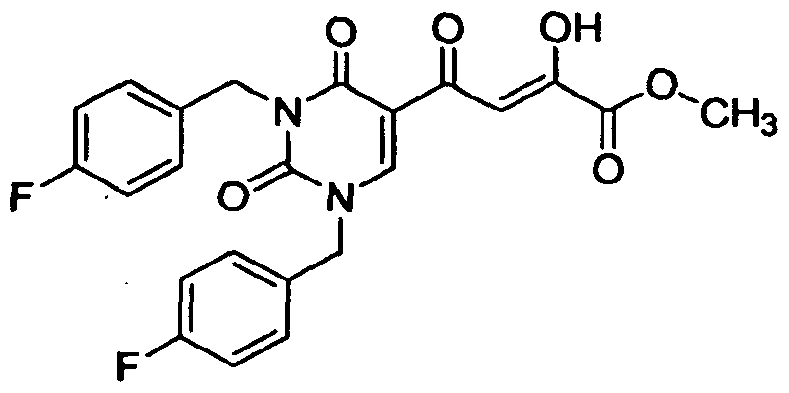
Step 1: l,3-bis(4-fluorobenzyl)-5-acetyluracil (2c)
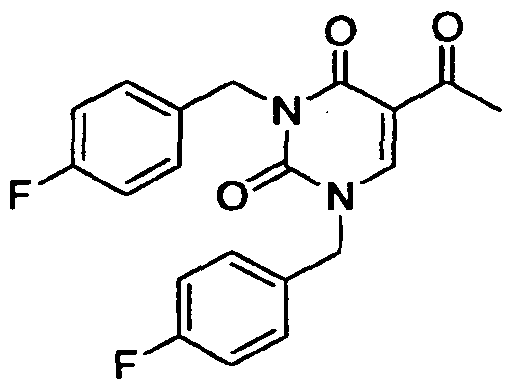
The title compound was synthesized using a similar procedure to that described in Example 1, step 1, except that benzyl bromide was replaced with 4-fluorobenzyl bromide. The yield was 51.8%. Mp. 134-135 0C. 1HNMR (CDCl3): 8.22 (s, IH), 7.48 (dd, 2H, J=9.0, 5.5 Hz), 7.32 (dd, 2H, J=8.5, 5.0 Hz), 6.99-7.09 (m, 4H), 5.1 1 (s, 2H), 4.97 (s, 2H), 2.62 (s, 3H). 13CNMR (CDCl3): 194.3, 163.0 (d, J=248.3 Hz), 162.4 (d, J=246.4 Hz)5 160.6, 150.9, 148.2, 132.1 (d, J=3.4 Hz), 131.1 (d, J=8.2 Hz), 130.23 (d, J=8.5 Hz), 130.26 (d, J=2.9 Hz), 116.2 (d, J=21.4 Hz), 115.3 (d, J=21.5 Hz), 112.4, 52.9, 44.2, 30.6. FAB-HRMS: [M+H]+ calcd. for C20HnF2N2O3 371.1207, found 371.1220. Step 2: preparation of methyl 4-[ l,3-bis(4-fluorobenzyl)- 1,2,3 ,4-tetrahydro-2,4- dioxopyrimidin-5-yl]-2-hydroxy-4-oxobut-2-enoate (3c).
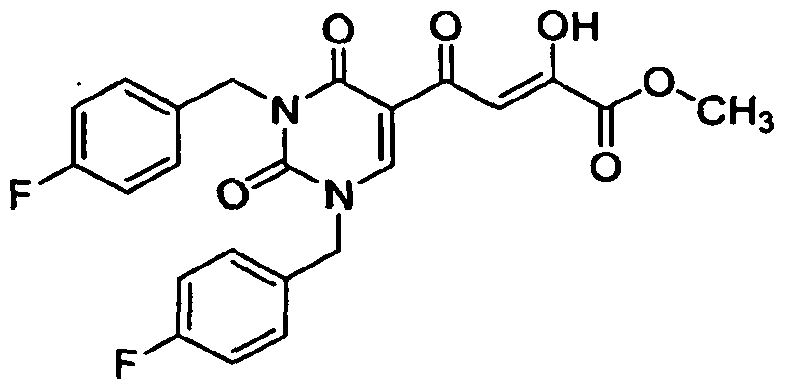
The title compound was synthesized using a similar procedure to that described in Example 1, step 2, except that 5-acetyl-l,3-dibenzyluracil was replaced with l,3-bis(4-
fluorobenzyl)-5-acetyluracil. The title compound was recrystallized from ethanol and obtained in 23.5% yield. Mp. 171-173 0C. 1HNMR (CDCl3): 15.02 (br, s, IH), 8.35 (s, IH), 7.71 (s, IH), 7.49 (m, 2H), 7.34 (m, 2H), 7.09 (m, 2H), 7.00 (m, 2H), 5.13 (s, 2H), 5.02 (s, 2H), 3.92 (s, 3H). 13CNMR (CDCl3): 185.3, 169.2, 163.1 (d, J=248.8 Hz), 162.5 (d, J=246.4 Hz), 162.4, 159.6, 150.5, 148.2, 131.8 (d, J=3.4 Hz), 131.2 (d, J=8.2 Hz), 130.3 (d, J=8.7 Hz), 129.9 (d, J=3.4 Hz), 116.4 (d, J=21.6 Hz), 115.4 (d, J=21.6 Hz), 109.2, 101.5, 53.14, 53.12, 44.3. FAB-HRMS: [M+H]+ calcd. for C23H19F2N2O6 457.1211, found 457.1196.
Representative Example 6
4-[l,3-Bis(4-fluorobenzyl)-l,2,3,4-tetrahydro-2,4-dioxopyrimidin-5-yl]-2-hydroxy-4- oxobut-2-enoic acid (4c).

Example 2, except that methyl 4-(l,3-dibenzyl- 1,2,3 ,4-tetrahydro-2,4-dioxopyrimidin-5-yl)- 2-hydroxy-4-oxobut-2-enoate was replaced with methyl 4-[l,3-bis(4-fluorobenzyl)-l,2,3,4- tetrahydro-2,4-dioxopyrimidin-5-yl]-2-hydroxy-4-oxobut-2-enoate (3c). The title compound was crystalized from hexane and ethyl acetate (3 : 1). The yield was 49.7%. Mp. 186-188 0C. 1HNMR (DMSO-de): 15.07 (br, s, IH), 14.02 (br, s, IH), 8.90 (s, IH), 7.56 (s, IH), 7.34-7.46 (m, 4H), 7.10-7.21 (m, 4H), 5.13 (s, 2H), 4.98 (s, 2H). 13CNMR (DMSO-de): 185.8, 169.2, 163.1, 161.8 (d, J=244.1 Hz), 161.3 (d, J=243.2 Hz), 159.7, 150.8, 150.1, 132.6 (d, J=2.9 Hz), 131.8 (d, J=3.4 Hz), 130.2 (d, J=8.2 Hz), 129.9 (d, J=8.2 Hz), 115.4 (d, J=21.6 Hz), 115.0 (d, J=21.0 Hz), 107.7, 100.7, 52.1, 43.5. FAB-HRMS: [M+H]+ calcd. for C22HnF2N2O6 443.1055, found 443.1044.
Representative Example 7
Methyl 4-[l,3-bis(4-(trifluoromethyl)benzyl)-l,2,3,4-tetrahydro-2,4-dioxopyrimidin- 5-yl]-2-hydroxy~4-oxobut-2-enoate (3d).

Step 1 : preparation of 1 ,3-bis(4-(trifiuoromethyl)benzy l)-5-acetyluracil (2d).

The title compound was synthesized using a similar to that described in the Example 1, step 1, except that benzyl bromide was replaced with 4-(trifluoromethyl)benzyl bromide. The yield was 65.1%, amorphous solid. 1HNMR (CDCl3): 8.27 (s, IH), 7.44-7.66 (m, 8H), 5.20 (s, 2H), 5.07 (s, 2H), 2.63 (s, 3H). 13CNMR (CDCl3): 194.1, 160.5, 150.9, 148.3, 140.0, 138.2, 131.3 (q, J=32.7 Hz), 130.2 (q, J=32.7 Hz), 129.3, 128.4, 126.3 (q, J=3.8 Hz), 125.5 (q, J=3.8 Hz), 124.0 (q, J=272.0 Hz), 123.7 (q, J=272.3 Hz), 112.6, 53.2, 44.5, 30.6. FAB- HRMS: [M+H]+ calcd. for C22H17F6N2O3471.1143, found 471.1148.
Step 2: preparation of methyl 4-[l,3-bis(4-(trifluoromethyl)benzyl)-l,2,3,4- tetrahydro-2,4-dioxopyrimidin-5-yl]-2-hydroxy-4-oxobut-2-enoate (3d).

The title compound was synthesized using a similar procedure to that described in Example 1, step 2, except that 5-acetyl-l,3-dibenzyluracil was replaced with l,3-bis(4- (trifluoromethyl)benzyl)-5-acetyluracil. The title compound crystallized from a mixture of hexane and ethyl acetate (3 : 1) and ethanol and was obtained in 20.3% yield. Mp. 189-191 0C. 1H NMR (CDCl3): 14.98 (br, s, IH), 8.41 (s, IH), 7.70 (s, IH), 7.46-7.68 (m, 8H), 5.21
(s, 2H), 5.11 (s, 2H). 13C NMR (CDCl3): 185.0, 169.5, 162.3, 159.5, 150.4, 148.3, 139.7, 138.0, 131.4 (q, J=32.5 Hz), 130.3 (q, J-32.4 Hz), 129.4, 128.5, 126.3 (q, J=3.7 Hz), 125.5 (q, J=3.7 Hz), 124.0 (q, J=271.9 Hz), 123.7 (q, J=272.3 Hz), 109.4, 101.5, 53.4, 53.2, 44.6. FAB-HRMS: [M+H]+ calcd. for C25H19F6N2O6557.1147, found 557.1135.
Representative Example 8
4-[l,3-Bis(4-(trifluoromethyl)benzyl)-l,2,3,4-tetrahydro-2,4-dioxopyrimidin-5-yl]-2- hydroxy-4-oxobut-2-enoic acid (4d).

Example 2, except that methyl 4-(l,3-dibenzyl-l ,2,3,4-tetrahydro-2,4-dioxoρyrimidin-5-yl)- 2-hydroxy-4-oxobut-2-enoate was replaced with methyl 4-[l,3-bis(4- (trifluoromethyl)benzyl)-l,2,3,4-tetrahydro-2,4-dioxopyrimidin-5-yl]-2-hydroxy-4-oxobut-2- enoate (3d). The title compound was recrystalized from hexane and ethyl acetate (3 : 1). The yield was 68.2%. Mp. 176-178 0C. 1HNMR (DMSO-(I6): 14.98 (br, s, IH), 14.02 (br, s, IH), 8.99 (s, IH), 7.72 (d, 2H, J=8.0 Hz), 7.66 (d, 2H, J=8.5 Hz), 7.59 (d, 2H, J=8.5 Hz), 7.57 (s, IH), 7.51 (d, 2H, J=8.0 Hz), 5.26 (s, 2H), 5.09 (s, 2H). 13CNMR (DMSO-d6): 185.8, 169.3, 163.1, 159.9, 151.3, 150.2, 141.2, 140.5, 128.4 (q, J=31.5 Hz), 128.3, 128.2, 127.9 (q, J=31.7 Hz), 125.4 (q, J=3.8 Hz), 125.2 (q, J=3.8 Hz), 124.2 (q, J=272.3 Hz), 124.1 (q, J=271.8 Hz), 108.0, 100.7, 52.6, 43.9. FAB-HRMS: [M+H]+ calcd. for C24H17F6N2O6 543.0991, found 543.1003.
Representative Example 9
Methyl 4-(l-benzyl-l, 2,3, 4-tetrahydro-2,4-dioxopyrimidin-5-yl)-2-hydroxy-4- oxobut-2-enoate (3e).


The title compound was synthesized in 69.9% yield by a similar procedure to that described for Example 1, step 1, but using 1.1 equiv of benzyl bromide and 1.0 equiv of potassium carbonate in DMF. Mp. 196-197 0C. 1HNMR (DMSOd6): 11.69 (br, s, IH), 8.54 (s, IH), 7.30-7.36 (m, 5H), 5.03 (s, 2H), 2.44 (s, 3H). 13CNMR (DMSO-d6): 193.5, 161.6, 151.5, 150.3, 136.2, 128.7, 127.9, 127.7, 11 1.8, 51.1, 30.3. FAB-HRMS: [M+Hf calcd. for Ci3H13N2O3 245.0926, found 245.0932.
Step 2: preparation of methyl 4-( 1 -benzyl- 1,2,3 ,4-tetrahydro-2,4-dioxopyrimidin-5- yl)-2-hydroxy-4-oxobut-2-enoate (3e).

The title compound was synthesized using a similar procedure to that described in Example 1, step 2, except that 5-acetyl-l,3-dibenzyluracil was replaced with 5-acetyl-l- benzyluracil. The title compound was crystallized from ethanol and obtained in 77.2% yield. Mp. 197-199 0C. 1HNMR (DMSOd6): 11.90 (s, IH), 8.82 (s, IH), 7.57 (s, IH), 7.31-7.37 (m, 5H), 5.08 (s, 2H), 3.82 (s, 3H). 13CNMR (DMSO-d*): 185.9, 167.8, 162.2, 161.0, 152.7, 149.8, 135.9, 128.7, 127.9, 127.7, 107.9, 100.9, 53.0, 51.5. FAB-HRMS: [M+H]+ calcd. for Ci6Hi5N2O6 331.0930, found 331.0928.
Representative Example 10
4-(l-Benzyl-l,2,3,4-tetrahydro-2,4-dioxopyrimidin-5-yl)-2-hydroxy-4-oxobut-2- enoic acid (4e).

The title compound was synthesized using a similar procedure to that described in
Example 2, replacing methyl 4-(l,3-dibenzyl-l,2,3,4-tetrahydro-2,4-dioxopyrimidin-5-yl)-2- hydroxy-4-oxobut-2-enoate with methyl 4-(l-benzyl-l,2,3,4-tetrahydro-2,4-dioxopyrimidin- 5-yl)-2-hydroxy-4-oxobut-2-enoate (3e). The title compound was crystallized from mixture of tetrahydofuran and chloroform (2 : 3). The yield was 79.7%. Mp. 195-197 0C. 1HNMR
(DMSO-Ci6): 15.10 (br, s, IH), 13.97 (br, s, IH), 11.87 (s, IH), 8.79 (s, IH), 7.54 (s, IH),
7.30-7.36 (m, 5H), 5.08 (s, 2H). 13CNMR (DMSO-dβ): 186.0, 169.2, 163.2, 161.0, 152.5,
149.9, 136.0, 128.7, 127.9, 127.7, 108.2, 100.8, 51.5. FAB-HRMS: [M+H]+ calcd. for C15H13N2O6 317.0774, found 317.0769.
Representative Example 1 1
Methyl 4-[3-(4-fluorobenzyl)-l-benzyl-l, 2,3, 4-tetrahydro-2f4-dioxopyrimidin-5-yl]- 2-hydroxy-4-oxobut-2-enoate (3J)

Step 1 : preparation of 3-(4-fluorobenzyl)-5-acetyl-l-ben2yluracil (2f).

5
Step 2: preparation of methyl 4-[3-(4-fluorobenzyl)-l -benzyl- l,2,3,4-tetrahydro-2,4- dioxopyrimidin-5-yl]-2-hydroxy-4-oxobut-2-enoate (3f).

10 The title compound was synthesized using a similar procedure to that described
Example 1, step 2, replacing 5-acetyl-l,3-dibenzyluracil with 3-(4-fluorobenzyl)-5-acetyl-l- benzyluracil. The title compound was crystallized from ethanol and obtained in 30.5% yield. Mp. 165-167 0C. 1HNMR (CDCl3): 15.04 (br, s, IH), 8.36 (s, IH), 7.72 (s, IH), 7.28-7.52 (m, 7H), 7.01 (t, 2H, J=8.5 Hz), 5.15 (s, 2H), 5.06 (s, 2H), 3.93 (s, 3H). 13CNMR (CDCl3): 185.4,
15 169.2, 162.5 (d, J=246.8 Hz), 162.4, 159.7, 150.5, 148.4, 134.1, 131.9 (d, J=3.4 Hz), 131.2 (d, J=8.2 Hz), 129.4, 129.1, 128.3, 115.4 (d, J=21.6 Hz), 109.1, 101.5, 53.7, 53.1, 44.3. FAB- HRMS: [MH-H]+ calcd. for C23H20FN2O6 439.1305, found 439.1294.
Representative Example 12
20 4-[3-(4-Fluorobenzyl)-l~benzyl-l,2,3,4-tetrahydro-2,4-dioxopyrimidin-5-yl]-2- hydroxy-4-oxobut-2-enoic acid (4J).

The title compound was synthesized using a similar procedure to that described in
Example 2, replacing methyl 4-(l,3-dibenzyl-l,2,3,4-tetrahydro-2,4-dioxopyrimidin-5-yl)-2-
^5 hydroxy-4-oxobut-2-enoate with methyl 4-[3-(4-fluorobenzyl)-l-benzyl-l,2,3,4-tetrahydro-
2,4-dioxopyrimidin-5-yl]-2-hydroxy-4-oxobut-2-enoate (3f). The title compound was crystallized from a mixture of hexane and ethyl acetate (2 : 1). The yield was 64.0%. Mp. 188-190 0C. 1HNMR (DMSO-O6): 15.05 (br, s, IH)5 14.01 (br, s, IH), 8.87 (s, IH), 7.56 (s, IH), 7.30-7.37 (m, 7H), 7.12 (m, 2H), 5.15 (s, 2H), 4.99 (s, 2H). 13CNMR (DMSO-Ci6): 185.7, 169.2, 163.1, 161.4 (d, J=243.0 Hz), 159.7, 150.8, 150.1, 135.6, 132.6 (d, J=3.4 Hz), 129.9 (d, J=8.2 Hz), 128.6, 127.9, 127.7, 115.5 (d, J=21.6 Hz), 107.7, 100.7, 52.7, 43.5. FAB- HRMS: [M+H]+ calcd. for C22H18FN2O6 425.1149, found 425.115.6.
Representative Example 13 4-(9-Benzyl-9H-purin-6-yl)-2-hydroxy-4-oxo-but-3-enoic acid (11).
The relevant scheme is Scheme 3 shown below.

THF
1 N NaOH

Scheme 3
Step 1 : 9-Benzyladenine (6)

To a suspension of adenine (5) (5.00 g, 37.0 mmol) in diy DMF (120 mL) was added NaH (1.77 g, 44.4 mmol) at room temperature. The reaction mixture was stirred for 30 min and the resulting white suspension was warmed to 60 0C for an additional 30 min. Benzyl bromide (7.59 g, 44.4 mmol) was added and the mixture was stirred for 24 h at 60 0C. TLC of the reaction mixture indicated the formation of two products. DMF was distilled off under reduced pressure and the resulting residue was treated with water (20 mL). The white solid that separated out, was filtered and dried under vaccum. Separation and purification was through flash column chromatography using CHCb rMeOH (9:1) for elution. 9- Benzyladenine : yield 5.5 g. (66 %); mp 231-232 0C; 1H NMR (DMSO- d6, : δ 5.38 (s, 2H, CH2 ), 7.29-7.33 (m, 7H, Ar-H and NH2 ), 8.17 (s, IH, purine C8-H), 8.28 (s, IH, purine C2- H). 7-Benzyladenine : yield 1.8 g. (21 %). Mp 252-255 0C. 1H NMR (DMSO-Cl6): δ 5.53 (s, 2H, CH2 ), 7.29-7.48 (m, 5H, Ar-H), 7.81 (s, IH, purine C8-H), 8.0-8.1 (br, 2HS NH2), 8.6 (s, IH, purine C2-H).
Step 2: 9-Benzyl-6-iodopurine (J)

To a stirred suspension of 9-benzyladenine (6) (1.00 g, 4.4 mmol) in anhydrous acetonitrile (50 mL), was added diidomethane (5.82 g, 21.7 mmol) followed by f-butyl nitrite
(2.24 g, 21.7 mmol) at 0-5 0C (ice bath). While maintaining the cooling, the solution was purged with nitrogen for 30 min. The ice bath was removed and the reaction mixture was
heated under an atmosphere of nitrogen at 60-65 0C for 5 h. Acetonitrile and the excess reagents were distilled off and the residue obtained redissolved in chloroform (100 mL) and washed with saturated aqueous sodium sulfite (2 x 50 mL) followed by brine solution (2 x 50 mL). The chloroform layer was dried over anhydrous sodium sulfate and concentrated to give a reddish oil which was purified by flash chromatography on silica gel using EtOAc/hexane (3:7) for elution. Yield: 0.519 g. (34 %). Mp 152-153 0C. 1H NMR (DMSO-Cl6): δ 5.51 (s, 2H, CH2), 7.31-7.36 (m, 5H, Ar-H), 8.65 (s, IH, purineC8-H), 8.83 (s, IH, purine C2-H). 13C NMR (DMSOd6): δ 47.4, 123.2, 128.1, 128.1, 128.4, 129.2, 129.2, 136.5, 138.4, 146.9, 148.3, 152.4.
Step 3: 9-Benzyl-6-(α-ethoxyvinyl)purine (8).

A mixture of 9-benzyl-6-iodopurine (7) (1.00 g, 2.8 mmol), bis(triphenylphosphine)- palladium(II) chloride (0.208 g, 0.02 mmol) and ethoxyvinyl(tributyl)tin (2.07 g, 3.8 mmol) in dry DMF (4 mL) was heated under N2 at 100 0C for 6 h. TLC indicated completion of reaction. DMF was distilled off under reduced pressure and the resulting residue was redissolved in EtOAc (50 mL) and filtered through a pad of celite. The solvent (EtOAc) was distilled off and the residue obtained purified by flash chromatography. Yield 0.393 g, (47 %). Mp 114-115 0C. 1H NMR (CDCl3): δ 1.55 (t, 3H, CH3, J = 7.5 Hz), 4.13 (q, 2H, CH2, J = 13.7 Hz), 4.99 (d, IH, CH, J = 3Hz), 5.48 (s, 2H, benzylic CH2), 6.16 (d, IH, CH, J = 3 Hz), 7.30-7.38 (m, 5H, Ar-H), 8.09 (s, IH, purine C8-H), 9.07 (s, IH, purine C2-H). 13C NMR (CDCl3): δl4.3, 47.3, 63.7, 94.7, 127.8, 127.8, 128.6, 129.1, 129.2, 130.3, 135.0, 144.4, 152.1, 152.3, 152.4, 155.4.
Step 4: Methyl 4-(9-benzyl-9H-purin-6-yl)-4-ethoxy-2-oxo-but-3-enoate (9)

To a stirred solution of 9-benzyl-6-(α-ethoxyvinyl)purine (8) ( 0.20 g, 0.70 mmol ) and pyridine ( 0.688 mL, 0.72 g, 28.5 mmol ) in dry chloroform ( 10 mL ) at 0 0C was added methyl chlorooxoacetate ( 1.048 g, 0.784 mL, 28.5 mmol ) in dry chloroform ( 5 mL). The 5 reaction mixture was allowed to attain ambient temperature, stirred for 3 days and then washed with water (2 x 10 mL) and dried over anhydrous sodium sulfate. The solvent was distilled off and the dark reddish syrup was purified by column chromatograpy. Yield 110 mg, ( 42 % ). 1H NMR ( CDCl3): 1.53 ( t, 3H, CH3, J= 6.5 Hz ), 3.80 ( s, 3H, CH3 ), 4.36 ( q, 2H, CH2, J=6.5 Hz ), 5.49 ( s, 2H, benzylic CH2 ), 6.72 ( s, IH, olefinic CH ), 7.36 ( m, 5H, 10 Ar-H), 8.07 ( s, IH, purine C8-H ), 9.10 ( s, IH, purine C2-H ). 13C NMR (CDCl3): δ 14.1, 31.0, 47.5, 52.9, 67.0, 99.6, 128.0, 128.0, 128.8, 129.3, 129.3, 131.3, 134.7, 145.5, 152.0, 152.6, 162.4, 167.4, and 179.7.
Step 5: Methyl 4-(9-benzyl-9H-purin-6-yl)-2-hydroxy-4-oxo-but-2-enoate (10).

Methyl 4-(9-benzy,-9H-purin-6-yl)-4-ethoxy-2-oxo-but-3-enoate, (9) (100 mg, 0.20 mmole ) obtained in above step was stirred at room in CH2Cl2 (20 mL) and treated with FeCl3.6H2O ( 0.125 g, 0.40 mmole). The reaction mixture was stirred at 40 0C for 5 h.
20 Chloroform was distilled off and the resulting residue was treated with 1 N HCl (50 mL) for 1 h and then extracted with EtOAc (4 x 20 mL). The extract was dried over anhydrous
""" sodium sulfate and the EtOAc distilled off to give a brownish residue which was purified by
ion exchange chromatography (diethylamino sephadex anion exchange resin, CH3CNrH2O, (1 :1) eluent). Yield 5.2 mg. Mp 166-167 0C. 1H NMR (CDCl3) δ 3.99 (s, 3H, CH3 ), 5.54 ( s, 2H, benzylic CH2 ), 7.35-7.41 (m, 5H, aromatic ), 7.9 (s, IH, olefinic CH), 8.3 (s,lH, purine C8-H ), 9.19 (s,lH, purine C2-H ). B C NMR (CDCl3) δ 47.7, 53.4, 101.4, 128.0, 128.0, 128.9, 129.3, 131.8, 134.5, 147.4, 152.3, 154.3, 162.1, 172.8, and 185.7. FAB-HRMS: [M + Hf calcd. for C17Hi5N4O4339.1093, found 339.1083.
Step 6: Synthesis of 4-(9-benzyl-9H- purin-6-yl)-2-hydroxy-4-oxo-but-3-enoic acid (H)

To a stirred solution of methyl 4-(9-benzyI-9H-purin-6-yl)-2-hydroxy-4-oxo-but-3- enoate (10) (17 mg, 0.05 mmol) in THF (5 mL) at 0 0C was added a solution of IN NaOH (0.5 mL) and the reaction mixture was allowed to stir at 0 0C for 2 h. The reaction mixture was extracted with diethyl ether (2 x 10 mL) and the aqueous layer was acidified with dilute HCl and extracted with ethyl acetate (2 x 25 mL). The organic extract was washed with brine solution, dried over anhydrous sodium sulfate and concentrated. The crude solid was purified by trituration with diethyl ether to give 4 mg of product. Yield 25 %. Mp 152-153 0C. 1H NMR (CDCl3): δ 5.27 (s, 2H, benzylic CH2), 6.39 (s, IH, olefenic CH,), 7.23-7.29 (m, 5H, Ar-H), 8.78 (s, IH, purine C8-H), 8.84 (s, IH, purine C2-H). EIMS (m/z): [M + 1] calc for C16H13N4O4 325, found 325.
Representative Example 14
4-(9-Benzyl-9H-purin-&-yl)-2-hydroxy-4-oxobut-2-enoic acid (17). The relevant scheme is Scheme 4 shown below.

15
14 13
FeCI3. 6H2O
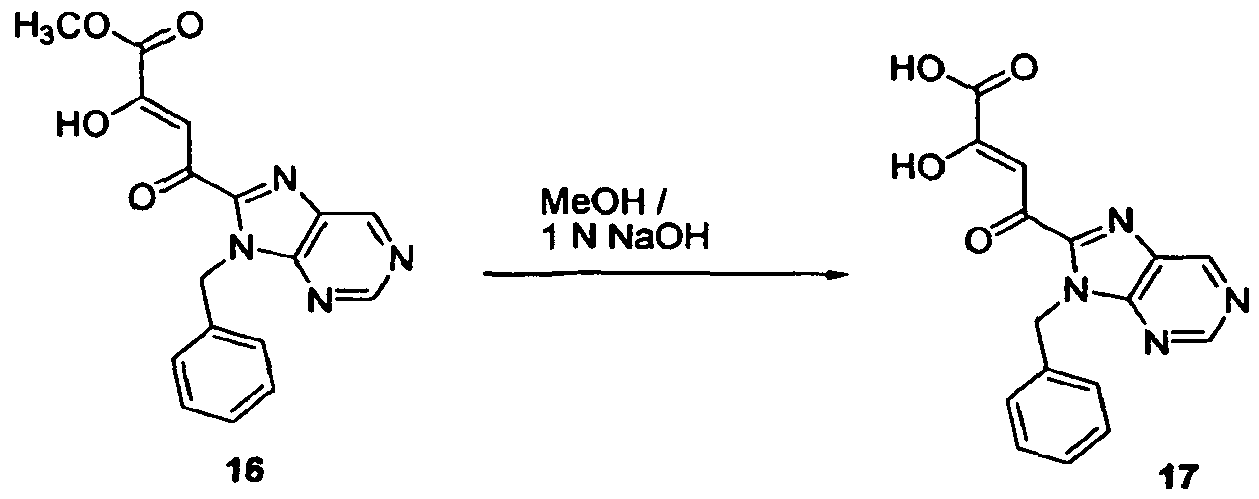
Scheme 4
4-(9-Ben2yl-9H-purin-8-yl)-2-hydroxy-4-oxobut-2-enoic acid. (17). Step 1. Described in step 1 of Example 13. Step 2: Synthesis of 9-benzylpurine (12)

(500 mL) was added t-butyl nitrite ( 9.34 g, 478.5 mmol) and the reaction mixture heated under an atmosphere of nitrogen at 60-65 0C for 4 h. THF and the excess reagent were distilled off and the residue obtained redissolved in chloroform (100 mL) and washed with v brine solution (2 x 50 mL). The chloroform layer was dried over anhydrous sodium sulfate and distilled off to give a reddish oil, which was purified by flash chromatography on silica gel using EtOAc/hexane (8:2) for elution. Yield 10.68 g (42.3 %). Mp 99-100 °C. 1H NMR
(CDCl3): δ 5.49 (s, 2H, CH2), 7.34-7.40 (m, 5H, Ar-H), 8.10 (s, IH, purine C6-H), 9.06 (s,
IH, purine C8H), 9.20 (s, IH, purine C2H).
Step 3: 9-Benzyl-8-bromo-9H-purine (13)

To a stirred solution of 12 (10.68 g, 50.7 mmol) in chloroform (500 mL) was added
N-bromosuccinamide (45.20 g, 253.9 mmol) and the reaction mixture stirred under an atmosphere of nitrogen and at reflux temperature for 5 h. The reaction mixture was transferred to a separatory funnel and washed with saturated sodium sulfite solution (2 x 250 mL) followed by brine solution (2 x 250 mL). The chloroform fraction was dried over anhydrous sodium sulfate and concentrated and the reddish oil was purified by flash chromatography on silica gel using EtOAc/hexane (4:6) for elution. Yield 6.05 g. (41.2 %). Mp 1 19-121 0C; 1H NMR (CDCl3): δ 5.53 (s, 2H, CH2), 7.35-7.39 (m, 5H, Ar-H), 9.03 (s, IH, purine C8-H), 9.09 (s, IH, purine C2-H).
Step 4 : 9-Benzyl-8-(α-ethoxyvinyl)purine (14)

A mixture of 9-benzyl-8-bromopurine 13 (1.0 g, 3.4 nvmol) bis(triphenylphosphine)- palladium(II)chloride (0.242 g, 0.30 mmol) and ethoxyvinyl(tributyl)tin (1.49 g, 4.14 mmol) in dry DMF (50 mL) was heated under N2 at 65 0C for 48 h. DMF was distilled off under
5 reduced pressure and the resulting residue was redissolved in EtOAc (50 mL) and filtered through a pad of celite. The EtOAc was distilled off and the residue obtained was purified by flash chromatography. Yield 0.579 g, (59.7 %). 1H NMR (CDCl3): δ 1.33 (t, 3H, CH3, J = 7.5
Hz), 3.99 (q, 2H, CH2, J = 13.7 Hz), 4.66 (d, IH, CH, J = 3Hz), 5.34 (d, IH, CH, J = 3 Hz),
5.48 (s, 2H5 benzylic CH2), 7.30-7.38 (m, 5H, Ar-H), 9.09 (s, IH, purine C8-H), 9.2 (s, IH,
10 purine C2-H). 13 C NMR (CDCl3): δ 14.2, 47.3, 64.2, 91.8, 126.8, 126.8, 127.7, 128.6, 128.6,
133.1, 136.4, 148.2, 151.2, 151.9, 152.8, 153.0.
^ Step 5: Synthesis of methyl 4-(9-benzyl-9H-purin-8-yl)-4-ethoxy-2-oxo-but-3-enoate 15 (15).

To a stirred solution of 9-benzyl-8-(α-ethoxyvinyl)purine (14) ( 0.579 g, 2.0 mmol ) and pyridine ( 2.08 g, 24.7 mmol ) in dry chloroform ( 15 mL ) at 00C was added methyl chlorooxoacetate ( 3.03 g, 24.7 mmol ) in dry chloroform ( 10 mL). The reaction mixture
-20 was allowed to stand in the refrigerator for 15 h. and then washed with ( 2 x 20 mL ) water
and the organic layer dried over anhydrous sodium sulfate. Removal of chloroform gave a dark reddish syrup which was purified by column chromatography. Yield 0.538 g ( 77 % ). 1H NMR ( CDCl3): 1.17 ( t, 3H, CH3, J= 6.5 Hz ), 3.68 ( s, 3H, CH3 ), 3.93 ( q, 2H, CH2, J=6.5 Hz ), 5.35 ( s, 2H, benzylic CH2 ), 6.45 ( s, IH, olefinic CH ), 7.12-7.22 ( m, 5H, Ar-H ), 8.99 ( s, IH, purine C6-H), 9.08 ( s, IH, purine C2-H ). 13 C NMR (CDCl3): δ 13.7, 46.8, 53.2, 67.2, 102.2, 127.8, 128.3, 128.7, 130.9, 133.0, 135.2, 149.1, 149.4, 152.1, 153.5, 162.1, 180.3.
Step 6: Methyl 4-(9-benzyl-9H-purine-8-yl)-2-hydroxy-4-oxo-but-3-enoate (16).

Methyl-4-(9-benzyl-9H-purin-6-yl)-4-ethoxy-2-oxo-but-3-enoate (15) (210 mg, 0.50 mmole ) obtained in above step was stirred at room temperature in CH2Cl2 (60 mL) and treated with FeCl3-OH2O ( 0.262 g, 0.9 mmole). The reaction mixture stirred at 40 0C for 6 h and concentrated and the residue obtained was treated with 1 N HCl (50 mL) for 5 min and extracted with EtOAc (4 x 20 mL). The organic layer was dried over anhydrous sodium sulfate and concentrated to give a yellowish residue which was purified by ion exchange chromatography. Yield 90 mg. (46 %). Mp 137-138 0C; 1H NMR ( CDCl3) δ 3.98 ( s, 3H, CH3 ), 6.03 ( s, 2H, benzylic CH2 ), , 7.29-7.41 (m, 5H, aromatic ), 7.68 (s, IH, olefinic CH), 9.21 (s,lH, purine C6-H), 9.39 ( s, IH, purine C2-H ). 13 C NMR (CDCl3) δ 47.6, 53.5, 102.2, 128.0, 128.0, 128.1, 128.3, 128.8, 132.8, 135.9, 146.8, 151.6,152.5, 155.3, 161.9, and 186.2. FAB-HRMS: [M + H]+ calcd for Ci7Hi5N4O4339.1093, found 339.1099.
Step 7: Synthesis of 4-(9-benzyl-9H-purine-8-yl)-2-hydroxy-4-oxo-but-3-enoic acid (17).

To a stirred solution of methyl 4-(9-benzyl-9H- purin-8-yl)-4-ethoxy-2-oxo-but-3- enoate (16) (0.020 g, 0.059 mmol) in MeOH (3 mL) at 0 0C was added a solution of IN
NaOH (1 mL) and reaction mixture allowed to stir at 0 0C for 30 min and then at ambient temperature for 30 min. The reaction mixture was neutralized with 1 N HCl and the precipitated solid was filtered dried and triturated with chloroform to give yellow solid.
Yield: 14 mg (73 %). Mp 162-163 0C. 1H NMR ( DMSO-d6): 5.90 ( s, 2H, benzylic CH2 ),
7.26-7.37 (m, 6H, Ar-H and olefinic H ), 9.16 (s,lH, purine C6-H ), 9.49 ( s, IH, purine C2-H
). NMR (CDCl3) : δ 47.6, 101.5, 124.7, 126.6, 127.5, 127.5, 127.5, 128.8, 128.9, 128.9, 137.1, 137.5, 153.0, 155.2, 163.9, 192.9. FAB-HRMS: [M + H]+ calcd for C16Hi3N4O4
325.0936, found 325.0924.
Representative Example 15
4-(l,9-Benzyl-6,9-dihydro-6-oxo-lH-purin-8-yl)-4-hydroxy-2-oxo-but-3-enoic acid
(24).
The relevant scheme is Scheme 5 shown below.
 t-Butyl nitrite OMF

CH3OCOCOCI / Pyridine

Scheme 5
Step 1. Described in step 1 of example 13. Step 2: Synthesis of 9-benzyl-8-bromoadenine (18).

To a stirred solution of 9-benzylpurine (6) (15.0 g, 66.5 mmol) in chloroform (750 mL) was added N-bromosuccinimide (59.26 g, 332.9 mmol) and the reaction mixture was
stirred under an atmosphere of nitrogen at reflux temperature for 3 h. The reaction mixture was then transferred to a separatory funnel and washed with saturated aqueous sodium sulfite (2 x 250 mL) followed by brine solution (2 x 250 mL). The chloroform fraction was dried over anhydrous sodium sulfate and concentrated to give a reddish oil, which was purified by flash chromatography on silica gel using EtOAc/hexane (4:6) for elution. Yield 9.72 g. (48 %). Mp 199-201 0C 1H NMR (CDCl3) δ 5.39 (s, 2H, benzylic CH2), 7.29-7.33 (m, 5H, Aril), 8.29 (s, IH, purine C2-H).
Step 3 : 9-Benzyl-6,9-dihydro-6-oxo-8-bromopurine (19)

To a stirred suspension of 9-benzyl-8-bromoadenine (18) (2.60 g, 8.5 mmol) in DMF (100 mL) was added t-butyl nitrite (4.31 g, 41.8 mmol) and the reaction mixture heated under an atmosphere of nitrogen at 60-65 0C for 3 h. DMF and the excess reagent were distilled off under reduced pressure and the residue obtained triturated with EtOAc (20 mL).
The yellow solid that separated was filtered off and dried under vaccum. Yield 1.41 g (54 %)
Mp 182-184 0C. IH NMR (CDC13) δ 5.39 (s, 2H, benzylic CH2), 7.21-7.42 (m, 5H, Ar-H), 8.19 (s, IH, purine C2-H), 12.59 (s, IH, NH).
Step 4 : l,9-Dibenzyl-6,9-dihydro-6-oxo-8-bromopurine (20).

Step 5 : Synthesis of l,9-dibenzyl-6,9-dihydro-6-oxo-8-(α-ethoxyvinyl)purine (21)

A mixture of l,9-dibenzyl-6,9-dihydro-6-oxo-8-bromopurine (20) (1.20 g, 3.04 mmol) bis(triphenylphosphine)palladium(II)chloride (0.213 g, 0.3 mmol) and ethoxyvinyl- (tributyl)tin (2.19 g, 6.07 mmol) in dry DMF (50 mL) was heated under N2 at 70 0C for 22 h. DMF was distilled off and the resulting residue dissolved in EtOAc (100 mL) and filtered through a pad of celite. The solvent was distilled off and the residue was purified by flash chromatography (EtOAc: hexane, 6:4). Yield 0.989 g (88 %). Mp 167-168 0C. 1H NMR (CDCl3) δ 1.26 (t, 3H, CH3, J = 7.5 Hz), 3.86 (q, 2H, CH2, J - 7 Hz), 4.46 (d, IH, CH, J = 2.5 Hz), 5.26 (s, 2H3 benzylic CH2), 5.32 (d, IH, CH2 J = 3 Hz), 5.60 (s, 2H, benzylic CH2 ), 7.10-7.37 (m, 1OH, Ar-H), 7.99(s, IH, purine C2-H). 13C NMR (CDCl3) δ 14.1, 47.8, 49.1, 63.8, 90.2, 123.5, 126.6, 126.6, 127.5, 127.5, 128.2, 128.7, 128.7, 128.9, 129.1, 129.1, 136.2, 136.7, 146.2, 146.9, 148.9, 151.9, and 156.6. FAB-HRMS: [M + H]+ calcd. for C23H23N4O2 387.1821, found 387.1815.
Step 6 : Methyl 4-(l,9-benzyl-6,9-dihydτo-6-oxo-lH-purin-8-yl)-4-ethoxy-2-oxo-but- 3-enoate (22).

To a stirred solution of l,9-dibenzyl-6,9-dihydro-6-oxo-8-(ethoxyvinyl)purine (21) ( 5 0.620 g, 1.6 mmol ) and pyridine ( 1.61 g, 19.2 mmol ) in dry chloroform ( 30 mL ) at 00C was added methyl chlorooxoacetate ( 1.77 mL, 19.2 mmol ) in dry chloroform ( 10 mL) and reaction mixture was allowed to stand in the refrigerator for 48 h. The reaction mixture was washed with ( 2 x 100 mL ) water and dried over anhydrous sodium sulfate. Chloroform was distilled off to give yellow syrup from which the product was isolated by column
10 chromatograpy (EtOAc: hexane, 4:6). Yield 0.584 g (77 %). 1H NMR ( CDCl3) δ 1.14 ( t, 3H, CH3, J= 6.5 Hz ), 3.66 ( s, 3H, CH3 ), 3.87 ( q, 2H, CH2, J=7 Hz ), 5.19 ( s, 2H, benzylic CH2 ),5.23 (s, 2H, benzylic CH2), 6.25 ( s, IH, olefinic CH ), 7.09-7.62 ( m, 1OH, Ar-H ), 7.98 (s, IH, purine, C2-H). 13C NMR (CDCl3) δ 13.7, 47.3, 49.2, 52.8, 66.6, 102.6, 123.7, 127.4, 127.4, 128.0, 128.0, 128.2, 128.3, 132.1, 132.2, 135.4, 136.0, 143.8, 147.9, 148.6, 156.3,
15 162.0, 162.7, 181.3. FAB-HRMS: [M + H]+ calcd. for C26H25N4O5 473.1824, found 473.1810.
Step 7: Methyl 4-(l ,9-benzyl-6,9-dihydro-6-oxo-lH-purin-8-yl)-2-hydroxy-4-oxo- but-3-enoate (23).

~20
Methyl 4-(l,9-Ben2yl-6-9-dihydro-6-oxo-lH-purin-8-yl)-4-ethoxy-2-oxo-but-3- enoate (22) (0.584 g, 1.2 mmole ) in CH2C12 (150 mL) was treated with FeC13.6H2O ( 0.567 g, 2.1 mmole) and the reaction mixture was stirred at 40 0C for 3 h. The solvent was removed and the resulting residue was treated with 1 N HCl (50 mL) for 5 min, extracted with EtOAc (4 x 20 mL) and dried over anhydrous sodium sulfate. The solvent was removed to give a yellowish residue which was purified by ion exchange chromatography (CH3CN : H2O, 1:1). Yield 0.502 g. (91 %). Mp 178-179 0C. IH NMR ( CDC13): 3.84 ( s, 3H, CH3 ),5.21 ( s, 2H, benzylic CH2 ), 5.77 (s, 2H, benzylic CH2), 7.19-7.30 (m, 1OH, Ar-H), 7.65 (s, IH, olefmic CH), 8.07 ( s, IH, purine C2-H ). 13 C NMR (CDC13): δ 48.1, 49.5, 53.2, 102.5, 119.3, 124.8, 127.9, 127.9, 128.2, 128.2, 128.4, 128.7, 128.7, 128.8, 129.2, 129.2, 135.5,
135.9, 143.1, 149.4, 150.0, 156.7, 162.2, 162.2, 184.1, 185.9. FAB-HRMS: [M + H]+ calcd. for C24H21N4O5 445.1511, found 445.1520.
Step 8: Synthesis of 4-(l,9-benzyl-6,9-dihydro-6-oxo-lH-purin-8-yl)-4-hydroxy-2- oxo-but-3-enoic acid (24).
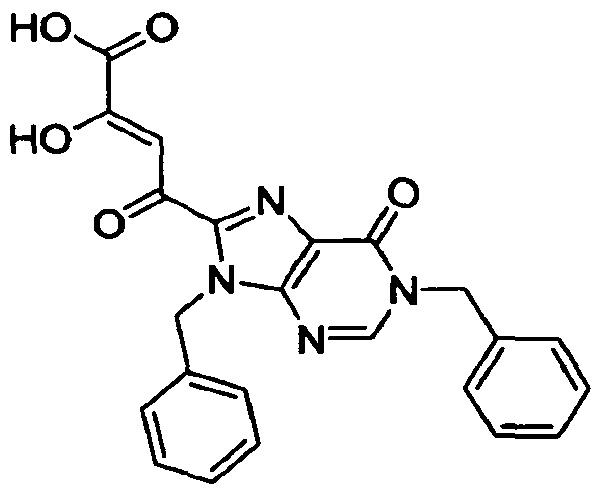
To a stirred solution of 4-(l,9-benzyl-6-9-dihydro-6-oxo-lH-purin-8-yl)-2-ethoxy-4- oxo-but-3-enoic acid methyl ester (23) (0.110 g, 0.24 mmol) in MeoH (10 mL) at 0 0C was added a solution of IN NaOH (2 mL). The reaction mixture was allowed to stir at 0 0C for 30 min and then at room temperature for 1 h. This was followed by neutralization with 1 N HCl and the solid that separated out was filtered dried and triturated with diethyl ether to give yellow solid. Yield 91 mg (86 %). Mp 167 0C (decomp.). 1H NMR ( DMSO-Cl6 ) δ 5.27 ( s, 2H, benzylic CH2 ), 5.80 (s, 2H, benzylic CH2 ), 7.25 (s, IH, olefinic CH), 7.27-7.37 (m, 1OH,
Ar-H), 8.77 (s,lH, purine C2-H ). 13C NMR (CDCl3) δ 47.9, 49.4, 101.4, 123.9, 127.6, 127.6, 128.2, 128.2, 128.7, 128.9, 129.1, 137.2, 137.2, 150.4, 151.6, 156.5, 163.9, 176.0, 179.5. FAB-HRMS: [M + H]+ calcd TOr C23H19N4O5 431.1355, found 431.1373.
Representative Example 16
3-(l,3-dibenzyl-2,4-dioxo-l,2J,4-tetrahydropyrimidin-5-yl)-l-hydroxy-3-oxoprop-l- enylphosphonic acid as its monosodium salt (35) The relevant scheme is Scheme 6 shown below.

25 26 27

30 31
Na|/acetone.


32 33

34 35
Scheme 6
Step 1 : preparation of 5-formyl-l,3-dibenzyluracil (26).

Compound 26 was made from 25 by a similar reaction as step 1 of example 1. The yield was 89.7%. 1HNMR (CDCl3): 10.02 (s, IH), 8.07 (s, IH), 7.29-7.51 (m, 10H), 5.17 (s, 2H), 5.01 (s, 2H).
Step 2: preparation of ethyl 3-(l,3-dibenzyl-2,4-dioxo-l,2,3,4-tetrahydropyrimidin-5-yl)-3,3- ethylenedioxy-propionate (28)

Compound 26 (2.24 g, 7 mmol ) and 80 mg of Tin(H) chloride in 20 ml of anhydrous CH2Cl2 was added ethyl diazoacetate (0.81 ml, 7.7 mmol) in 10 ml of CH2CI2 over 10 min. Then another 720 mg of Tin(II) chloride was added in 9 portions over 2 h. The reaction was stirred for another 2 h. Ethyl acetate (40 ml) was added to the reaction. The resulting mixture was filtered through a silica gel column (3.5x6 cm) and washed with ethyl acetate (300 ml). The filtrate was washed with brine (60 ml). The acetate layer was dried and concentrated. The resulting residue, triethyl orthoformate (4.66 ml, 28 mmol), ethylene glycol (3.90 ml, 70 mmol) and p-toluenesulfonic acid monohydrate (0.20 g) were refluxed for 8 h. The reaction was poured into 150 ml of ethyl acetate and washed with sat. aqueous NaHCC>3 (50 mlχ2). The organic layer was dried and concentrated. The residue was purified by column chromatography on silica gel (hexane:ethyl acetate 4:1-2:1) to give 0.9Og of the product as an oil (28.5% yield). 1HNMR (CDCl3): 7.29-7.54 (m, 1 IH), 5.18 (s, 2H), 4.96 (s, 2H), 4.07 (m, 2H), 4.02 (q, 2H, J=7.0), 3.85 (m, 2H), 3.27 (s, 2H), 1.11 (t, 3H, J=7.0). FAB-HRMS: [M-I-H]+ calcd for C25H27N2O6451.1869, found 451.1879.
Step 3: preparation of dimethyl 3-(l,3-dibenzyl-2,4-dioxo-l,2,3,4-tetrahydropyrimidin-5-yl)- 3,3-ethylenedioxy -1-hydroxypropylphosphonate (30)

Compound 28 (0.70 g, 1.55 mmol) in 20 ml of anhydrous toluene was cooled to — 78°C and DIBAL-H (1 M solution in toluene, 3.1 ml, 3.1 mmol) was added. The reaction was stirred at — 78°C for 3 h. Then, 1 ml of methanol was added and stirred for 10 min. Water (1 ml) was added and the reaction was warmed to room temperature and stirred for 20 min. Anhydrous Na2SC^ was added to absorb the water. After filtration, the toluene solution was evaporated. The residue, dimethyl phosphite (0.427 g, 3.88 mmol) and triethylamine (0.393 g, 3.88 mmol) in 10 ml of methanol was stirred overnight. The reaction solution was concentrated and purified by column chromatography (CHCI3: CH3OH 80:1) to afford 0.405 g of 30 as an amorphous solid. The yield was 50.5%. 1HNMR (CDCl3): 7.27-7.52 (m, 1 IH), 5.15 (s, 2H), 4.99 (d, IH, J=15), 4.93 (d, IH, J=15), 4.23 (m, IH), 4.07 (m, 2H), 3.75-3.86 (m, 8H), 2.62- 2.67 (m, IH), 2.52-2.59 (m,lH). 31PNMR (CDCl3): 26.4. FAB-HRMS: [M+H]+ calcd for C25H30N2O8P 517.1740, found 517.1727.
Step 4: preparation of dimethyl 3-(l,3-dibenzyl-2,4-dioxo-l,2,3,4-tetrahydropyrimidin-5-yl)- 1 -hydroxy-3-oxopropylphosphonate (31)

Compound 30 (350 mg), p-toluenesulfonic acid monohydrate (50 mg) and 0.1 ml of water in 5 ml of acetone were stirred for 2 days. The product was purified by on a silica gel column
(CHCl3: CH3OH 60:1) and further purified by HPLC (C)8 column, 300x50mm, 78% methanol/water, 5 ml/min ) to afford 208 mg of 31 as an amorphous solid. The yield was 64.9%. 1HNMR (CDCl3): 8.29 (s, IH), 7.30-7.50 (m, 10H), 5.18 (s, 2H), 5.05 (d, IH, J=15), 5.02 (d, IH, J=15), 4.61 (m, IH), 3.87 (d, 3H, J=I LO), 3.86 (d, 3H, J=I 0.5), 3.57-3.64 (m, IH), 3.42-3.48 (m, IH). 13CNMR (CDCl3): 194.9 (d, J=17.6), 160.8, 150.9, 149.3, 136.2, 134.3, 129.5, 129.2, 129.1, 128.7, 128.5, 128.1, 111.7 (d, J=2.31), 64.3 (d, J=169.4), 53.8, (53.72, 53.68, 53.66, 53.61, P-OCH3), 45.1, 43.9 (d, J=3.82). 31PNMR (CDCl3): 26.5. FAB- HRMS: [M+H]+ calcd for C23H26N2O7P 473.1478, found 473.1469.
Step 5: preparation of sodium methyl 3-(l,3-dibenzyl-2,4-dioxo-l,2,3,4-tetrahydropyrimidin- 5-yl)- 1 -hydroxy-3-oxoprop- 1 -enylphosphonate (33)

A solution of 31 (198.4 mg, 0.42 mmol) in 5 ml of CHjCl2 was added to a suspension of Dess- Martin periodinane (267.2 mg, 0.63 mmol) in 5 ml OfCH2Cb under ice-bath conditions. The reaction was stirred at room temperature for 3 h and 0.3 g of Na2S2O3-SH2O in 5 ml of sat. aqueous NaHCO3 was added, followed by 100 ml of ethyl acetate. The mixture was stirred for 10 min. The organic layer was separated, dried and concentrated to afford 190 mg (0.404 mmol) of 32 as an amorphous solid, which was stirred with NaI (151.3 mg, 2.5 eqiv.) in 5 ml of acetone at room temperature for 3 days. The resulting solid was collected and washed with acetone (4 mlχ4) to afford 135 mg of 33 as a yellow solid. The yield was 67.2%. 1HNMR (CD3OD): 8.58 (s, IH), 7.22-7.36 (m, 1 IH), 5.12 (s, 2H), 5.09 (s, 2H), 3.65 (d, 3H, JpH=H). 31PNMR (CD3OD): 3.48. FAB-HRMS: [M+H]+ calcd for C22H2IN2NaO7P 479.0984, found 479.1001.
Step 6: preparation of 3-(l,3-dibenzyl-2,4-dioxo-l,2,3,4-tetrahydropyrimidin-5-yl)-l- hydroxy-3-oxoprop-l-enylphosphonic acid as its monosodium salt (35)

Compound 33 (30 mg) in 3 ml of methanol was passed through a Dowex® 50Wχ8-100 (2 ml, hydrogen form) resin column. The column was washed with 20 ml of methanol and the methanol solution was concentrated. The resulting solid 34 and NaI (47 mg, 5 equiv.) in 6 ml acetone was heated under reflux for 24 h and the precipitated solid was collected and washed with acetone (5 mlx3) to afford 17 mg of 35 as an off-white solid (58.4% yield). 1HNMR
(CD3OD): 8.58 (s, IH), 7.22-7.39 (m, 11H), 5.12 (s, 2H), 5.10 (s, 2H). 13CNMR (CD3OD):
188.1 (d, J=14.5), 185.9 (d, J=190.4), 161.5, 152.5, 150.6, 138.3, 137.1, 130.2, 129.6, 129.5, 129.3, 128.7, 111.2 (d, J=4.90), 104.5 (d, J=24.4), 54.4, 45.7. 31PNMR (CD3OD): 0.82. FAB-
HRMS: [M+H]+ calcd for C2IH19N2NaO7P 465.0828, found 465.0840.
Claims
1. A pharmaceutical composition comprising at least one first compound according to the general structure of formula I:

R1 and R2 are each independently H,  fluoroalkyl, unsubstituted or substituted Cs_6 cycloalkyl, Ci -6 alkenyl, unsubstituted or substituted phenyl, unsubstituted or substituted benzyl, d^ alkyl phenyl which phenyl moiety may be optionally substituted, unsubstituted or substituted heteroaryl, Ci^ alkyl substituted with a heteroaryl group which heteroaryl group is optionally substituted, C1-6 alkyl S(O)R or alkyl (SO2)R where R is alkyl, phenyl or substituted phenyl, C^ alkyl CO2R8 where Ra is Ci-6 alkyl or H, Ci.6 alkyl CORa> where Ra is Ci-β alkyl; R3 is selected from H, Ci^ alkyl, halogen, hydroxyl, unsubstituted or substituted benzyl, or unsubstituted or substituted phenylthio;
R4 is CO2R0 or P(O)(ORC)(ORC), where each Rc is independently from H and Ci-6 alkyl, or a tautomer, regioisomer, optical isomer or pharmaceutically acceptable salt, therof, in combination with an effective amount of at least one additional compound selected from the group consisting of i) an additional anti-HIV agent, ii) an anti-infective agent other than an anti-HIV agent iii) an anti-cancer agent and iv) an immunomodulator.
2. The composition according to claim 1 wherein said additional compound is selected from the group consisting of (-)β-Dioxolane-G (DXG); (-)β-Arctigenin (Arctigenin); (-)- Carbovir (-)-C-D4G; (-)-2',3'-Dideoxy-5-£luoro-31-thiacytidine (FTC); (-)-β-D-2,6-
Diaminopurine dioxolane (DAPD); (4-)-2'-Deoxy-3'-oxa-4'-thiocytidine (dOTC +); (+)-2 - Deoxy-3l-oxa-4'-thio-5-fluorocytidine (dOTFC +); (+/-)-Lobucavir; (R)-2QuinCOAsnPhe[CHOHCH2]PipCONHtBu; (R)-3,6-Diamino-N- (aminomethyl)hexanamide (Bellenamine); (R)-9-(2-Phosphonylmethoxypropyl)adenine (Tenofovir); (R)-PMPDAP; (S)-9-(2-Phosphonylmethoxypropyl)adenine ((S)-PMPA);
PMPA(S); α-APA (Loviride); R87232; R88703; α-APA enantiomer (R90385); α-L-AZT; α-L-Dioxalane-C (α-L-DXC); α-L-FTC; α-Monofluoromethyldehydroornithine methyl ester (MFMOME); l.T-Azobisformamide (ADA); 1 -(11 -Octylamino- 10-hydroxyundecyl)-3,7-dimethylxanthine (CT-2576);
1 -(2t,3l-Dideoxy-2I-fluoro-β-D-threo-pentofuranosyl)cytosine (Ro 31 -6840);
1 -(2l-Fluoro-2',3'-dideoxy-β-D-erythro-pentofuranosyl)thymine (2'FddT); l-[(2-Hydroxyethoxy)methyl]-6-(3-methylphenyl)thio)thymine (HEPT-M);
1 -[(2-Hydroxyethoxy)methyl]-6-(phenylthio)-2-thiothymine (HEPT-S); l-[(2-Hydroxyethoxy)methyl]-6-(phenylthio)thymine (HEPT);
Deoxynojirimycin (1-Deoxynojirimycin); Amprenavir; Abacavir.Succinate(Ziagen); 1-
Aminooxyethylamine (AEA); l-Methoxyoxalyl-3,5-dicaffeoylquinic acid (l-MO-3,5-
DCQA); lOH-2(Cbz-Tle)3PhPr [14]paracyclophane deriv; 10H-2(Cbz-ValNH)3PhPr
[13]metacyclophane deriv.; 10H-2(Cbz-ValNH)3PhPr [13]paracyclophane deriv.; 10H-2(Cbz-ValNH)3PhPr [14]paracyclophane deriv.; 10H-2(Cbz-ValNH)3PhPr
[17]paracyclophane deriv.; 12-Deoxyphorbol-13-(3E,5E-decadienoate); lό.alpha.-
Bromoepiandrosterone (Epi-Br) or (Inactivin); l-β-D-arabinoiuranosyl-5-(2- bromovinyl)uracil (Sorivudine); 2',3'-Didehydro-3'-deoxycytidine (D4C); 2',3'-Dideoxydidehydroguanosϊne (D4G); 2',3l-Didehydro-3'-deoxythymidine (D4T) (Stavudine); 21,3I-Dideoxy-3l-fluoro-4-thiothymidine (3'-F-4-Thio-ddT);
2',3'-Dideoxy-3'-fluoro-5-bromouridine (FddBrU); 2',3'-Dideoxy-3'-fluoro-5-chlorocytidine
Q'-F-S-Cl-ddC); ^^'-Dideoxy-S'-fluoro-S-chlorouridine (935U83) (Raluridine); 2',3'-
Dideoxy-5-ethylcytidine (5-Et-ddC); 2',3'-Dideoxyadenosine (ddA);
2',3'-Dideoxydidehydroadenosine (d4A); 2',3'-Dideoxyguanosine (ddG); 2',3'-Dideoxy-3'-hydroxymethyl cytidine (3'-Hydroxymethyl-ddC); 2,5'-Anhydro-3'-azido-
2'53'-dideoxyuridine (AZU-2,5'-anhydro); 2,51-Anhydro-3'-azido-31-deoxythymidine (AZT-
2,5'-anhydro); 2\5'diSilySpiroT (TSAO-T); 2',5'diSilySpiroT (TSAO-meΛ3T); 2,6-Diamino-21,3'-dideoxypurine-9-ribofuranoside (ddDAPR)( 2,6-
Diamino-ddP); 2,6-Diaminopurine- 2',3'-dideoxydidehydroriboside (ddeDAPR); 2,6- Diaminopurine-3'-fluoro-2',3'-dideoxyriboside (3'-F-ddDAPR); 2-Aminobenzylstatine Valyl
Cbz deriv; 2-Glycine amide-5-chlorophenyl 2-pyrryl ketone (GCPK); [2-
PyridCH2NCH3CO-Val-NHCH(Bz)]CHOHCHOH (A-77003); 2'-Azido-2',3'- dideoxyadenosine (2'-N3ddA); 2'-F-dd-ara-A (Lodensine); 2'-FddT ; 2'-N3ddA; 2'-N3ddA (β- D-threo); 2-NaphCOAsnPhe[CHOHCH2]Pro-OtBu; 2-Nitroρhenylphenylsulfone (NPPS); 3- (3-Oxo- 1 -propenyl)-3'-azido-3'-deoxythymidine (3-(3-Oxo- 1 -propenyl)AZT); 3 -(3-Oxo- 1 - propenyl)AZT; L-737,126; 3,5-Dicaffeoylquinic acid (3,5-DCQA); 3'-Azido-3'-deoxy-6- azathymidine; 3 '-Azido-2',3 '-dideoxy-5-[(cyanomethyl)oxy]uridine; 3'-Azido-2',3'-dideoxy-5- aminouridine; 3'-Azido-2',3'-dideoxy-5-aza-6-deazauridine; 3'-Azido-2',3'-dideoxy-5- bromouridine; 3'-Azido-2',3'-dideoxy-5-chlorocytidine (3'-Az-5-Cl-ddC); 3'-Azido-2',3'- dideoxy-5-dimethylaminouridine; 3'-Azido-2',3'-dideoxy-5-ethyluridine; 3'-Azido-2',3'- dideoxy-5 -fluorocytidine; 3 '- Azido-2',3 '-di deoxy- 5 -fluorouri dine; 3 '-Azido-2',3 '-dideoxy-5 - hydroxyuridine; 3'-Azido-2',3f-dideoxy-5-iodouridine; 3'-Azido-2',3'-dideoxy-5- methyaminouridine; 3 '- Azido-2',3 '-dideoxy-5 -methylcytidine; 3'-Azido-2',3'-dideoxy-5- thiocyanatouridine; 3'-Azido-2',3'-dideoxy-5-trifluoromethyluridine; 3'-Azido-2',3'- dideoxycytidine; 3'-Azido-2',3'-dideoxyguanosine; 3'-Azido-2',3'-dideoxy-N4~5- dimethylcytidine; 3'-Azido-2',3l-dideoxy-N4-OH-5-methylcytidine; 31-Azido-2l,3I- dideoxyuridine (Uravidine); 3'-Azido-3'-deoxy-6-azathymidine; 3-Azido-3'-deoxythymidilyl- (S'^-Z^'-dideoxy-S'-adenylic acid; S'-Azido-S'-deoxythymidilyl-CS'.SO^'^'-dideoxy-S'- adenylic acid, 2-cyanoethyl ester; 3'-Azido-3'-deoxythymidilyl-(5',5')-2',3l-dideoxy-5I- inosinic acid (AZT-P-ddl); S'-Azido-S'-deoxythymidine-S'-φutylmethoxyvaliny^phosphate; 3'-Azido-5-chloro-2',3'-dideoxyuridine; 3'-Deoxythymidine (ddT); 9-(3'-Fluoro-2',3'-dideoxy- β-D-erythropentafuranosyl)adenine; 3'-FIuoro-2',3'-dideoxy-5-iodouridine (FddIU); 3f-Fluoro-2',3'-dideoxycytidine (3'-FddC); 3'- Fluoro-2',3'-dideoxyguanosine (3'-FddG); 3'-Fluoro-2',3'-dideoxyuridine (3'-FddU); 9-(3'- Azido-2',3'-dideoxy-P-D-erythropentafuranosyl)adenine; 3TC (Lamivudine); 3TC & AZT (Combivir); 4'-Acetoamidophenyl4-guadinobenzoate; 4'-Azido-3'-deoxythymidine; 4'-Azido- 5-chloro-2'-deoxyuridine; 4'-Azido-2'-deoxyadenosine; 4'-Azido-2'-deoxycytidine; 4'-Azido- 2'-deoxyguanosiπe; 4'-Azido-2'-deoxyinosine; 4'-Azido-2'-deoxyuridine; 4'-Azidothymidine; 4'-Cyanothyπiidine; 4-Methyl-5-(pyτazinyl)-3H-l,2-dithiole-3-thione (Oltipraz); 5'-[(l,4- Dihydro-l-methyl-3-pyridinylcarbonyl)oxy]-3'-azido-2',3'-deoxythymidine (DP-AZT); 5'- [[(Z)-4-amino-2-butenyl]methylamino]-5'-deoxyadenosine (MDL 73811); 5'- Alkylglycosidecarbonate of 3'-azido-3'-deoxythymidine; 5C13PhS-2IndolCONH2; 5-Fluoro- 2',3'-dideoxycytidine; 5-Methyl-3'-azido-2',3'-dideoxyisocytidine; Celgosivir; 6-Chloro-9- (2,3-dideoxy-β-D-glyceropentofuranosyl)-9H-purine; 6-Dimethylaminopurine-2',3'- dideoxyriboside; Ro 24-7429; Ro 5-3335; Tivirapine; 9-(2,3-Dideoxy-β-D-ribofuranosyl)-6- (methylthio)purine; 9-(2'- Azido-2',3 '-dideoxy-B-D-threopentafuranosyl)adenine; C- oxetanocin A; (+-)Lobucavir; A-76890; A-77003; A-77212; A-80987; A-81525; A-83962; A-98881; PNU-104489; Trizivir; Lopinavir; Kaletra; Lopinavir & Ritonavir; Aluviran® & Norvir; Azodicarbonamide; Adefovir; Adefovir dipivoxil (Preveon®); Nelfinavir; AG 1350 (L Y316957); R-87366; Alpha-lipoic acid; Alovudine (3'-FddT); ALX40-4C; AMD3100 (JM3100); Amdoxovir (APD); Amprenavir phosphate (Fosamprenavir); Ancer 20 (Z-100); Atazanavir (Latazanavir); Atevirdine; Aurintricarboxylic acid; AY 9944; 3'-Azido-5-chloro- 2',3'-dideoxyuridine; AZT; α-L-AZT; O,O'-Bis(3<-azido-31-deoxythymidin-51- yl)methylphosphonate; Baicalin (TJN-151); Betulinic acid (Mairin); Betulinic acid, 3-O- (3',3'-dimethylsuccinate); Delavirdine (U-90152); U-88204E; Nevirapine; BILA 1906 BS; BILA 2011 BS (Palinavir); BILA 2185 BS; NSC633001; CGP 53820; bis-ValHOEt-N2aza- peptide isostere (CGP 53820 analog); BMS-186318; L-687,908; Brovavir; BzOCValPhe[diCHOH(RR)]PheValBzOC; BzOCValPhe[diCHOH(SS)]PheValBzOC; C2- Sym Phosphinic amide deriv. (HOECHST AG); NSC675451; Calanolide B; Capravirine (S- U 53); Carbovir; Castanospermine; CGP 61755 (Lasinavir); CGP 64222; CNI-H0294; Emivirine; Conocurvone (NSC650891); Emtricitabine; C-Oxetanocin-G; Indinavir; Curdlan Sulfate; Cyanovirin-N ; SD146; Cyclosporin A; SDZ NIM 811; L^'-Didehydro^'- dideoxyadenosine (L-D4A); 21,3l-Didehydro-21,31-dideoxy-5-fluorocytidine (DD4C); L-2',3'- Didehydro-2',3'-dideoxy-5-fluorocytidine (LD4C); L-2',3'-Didehydro-2',3'-dideoxyguanosine (LD4G) ; L-r^'-Didehydro-T^'-dideoxyinosine (LD4I); DABO; ddl; ddC; DMP-323; DMP- 450; (-)-2'-Deoxy-3'-oxa-4'-thiocytidine; (-)-2>-Deoxy-3'-oxa-41-thio-5-fluorocytidine ;
Pentafuside (Enfiivirtide); Etoposide; Efavirenz; Emtriva; K- 12 (fluoroquinoline derivative); Saquinavir; Foscarnet; Phosphonoformic acid; Foscavir; FPMDAP; FPMPA; FPMPG; Gene Expression Modulator 91 (GEM91); Hammerhead anti-gag RNA Ribozyme B; Harziphilone; HBY 097 (Quinoxaline deriv); E-EBU; E-EPSeU; E-EPU; NSC 648400; E-EBU-dM; Zalcitabine; LY326188; Ingenol 3,5,20-triacetate (ITA); Inophyllum B; KNI-272; RD3- 2118; KNI-102; KNI-154; KNI-174; KNI-227; L-685,434; L-689,502; L-697,593; L- 697,639; L-697,661; LY289612; Trovirdine; LY-73497; L-735,524; N-Ethyl-2',3'- dideoxyadenosine; N6-Methyl-2',3'-dideoxyadenosine; Noa-Asn-Apns-Thz-NH-tBu; Nonoxynol 9; Ritonavir; NSC625487; NSC649324; NSC650898; UC-38; UC-84; P9941; Palinavir; Pentosan Sulfate; Elmiron; SP54; PNU-140690 (Tipranavir); S-2720; R14458;
R82150; R82913; R86183; RD4-2138; Resobene; Reyataz; Ribavirin; 7-Chloro-N-methyl-5- (1 H-pyrrol-2-yl)-3H- 1 ,4-benzodiazepin-2-amine; 7-Chloro-5-(2-pyrryl)-3H- 1 ,4- benzodiazepin-2(H)-one; LY314163; SB-205569; Telinavir; SD-095345SD146; SDZ PRI 053; SPC3; Suramin Sodium; T22; Thalidomide; Thiangazole; Thiazoloisoindol-5-one; U- 104489; U-140690; U-87201E; U-88204E; UC-781; VB-11,328; VX-478; 141 W94; XM-323 and mixtures thereof.
3. The composition according to claim 1 wherein said additional compound is selected from the group consisting of ACV; AK602; AMD070; APV; ATV; ATZ; AVX754
(apricitabine); AZT; Abacavir; Abacavir / Lamivudine / Zidovudine; Abacavir sulfate;
Abacavir sulfate/Lamivudine; Abacavir/Lamivudine; Abelecet; Acyclovir; Adefovir dipivoxil; Adriamycin; Agenerase; Aldesleukin; Alovudine; Aluvia; AmBisome; Amdoxovir; Amphocin; Amphotec; Amphotericin B; Ampligen; Amprenavir; Androderm; Androgel;
Apricitabine; Aptivus; Atazanavir; Atripla; Azithromycin; BMS-378806; BMS-488043;
Bactrim; Baraclude; Bevirimat; Biaxin; Brecanavir; BufferGel; C31G; CD4-IgG2; CS; CV-
N; Calanolide A; Calcium hydroxylapatite; Carbopol 974P; Carrageenan; Carraguard;
Cellulose sulfate; Clarithromycin; Combivir; Copegus; Cotrimoxazole; Crixivan; Cyanovirin- N; Cytovene; DAPD; DLV; DS; Darunavir; Delavirdine; Depo-Testosterone; Dextran sulfate; Didanosine; Diflucan; Doxil; Doxorubicin (liposomal); Dronabinol; EFV; Efavirenz;
Elvucitabine; Emtricitabine; Tenofovir disoproxil fumarate; Emtriva; Enfufirtide; Entecavir;
Epivir; Epoetin alfa; Epogen; Epzicom; Etopophos (phosphate salt); Etoposide; Etravirine;
FTC; Fluconazole; Fortovase; Fosamprenavir; Foxivudine tidoxil; Fungizone; Fuzeon; GS 9137; GSK-873,140 (aplaviroc); GW433908; GW640385 (brecanavir); Ganciclovir;
Globulin, Immune; Growth hormone (human); Hepsera; Hivid; Human growth hormone; IL-
2; BMH; Immune Globulin Intravenous (Human); Indinavir; Interferon alfa-2; Interleukin-2, recombinant human; Intron A (2b); Invirase; Isoniazid; Itraconazole; KP- 1461;
Lamivudine/Zidovudine; Lexiva; Lopinavir/Ritonavir; MK-0518; Nebupent; Nelfinavir; Neutrexin; Nevirapine; Norvir; Nydrazid; Peptide T; PMPA Prodrug (Viread)' Prezista
(Darunavir); PRO 140; PRO 2000; PRO 542 (CD4 IGg2); Procrit (Epoetin); Proleukin;
Racivir; Radiesse; Rrebetol; Rescriptor; Retrovir; Reyataz; Ribavirin; Rifabutin; Rifadin;
Rifampin; Rimactane; Ritonavir; Roferon-A (2a); Saquinavir; SCH-D (vicriviroc);
Somatropin; Stavudinie; Sulfamethoxazole / Trimethoprim; Sustanon; Sustiva; TNX-355; Taxol; Tenofovir; Tenofovir disoproxil fumarate; Testosterone; Tipranavir; Toposar;
Trimetrexate; Trizivir; Truvada (Emtriva and Viread combination); U-90152S (Delaviridine);
UC-781 ; UK-427,857 (maraviroc); Valcyte; Valganciclovir; Valproic acid; VePesid;
Vicriviroc; Videx; Viracept (Tennofovir DF); Viramune; Virazole; Viread; Vitrasert;
Zalcitabine; Zerit; Ziagen; Zidovudine; Zithromax; Zovirax and mixtures thereof.
4. The composition according to any of claims 1-3 wherein said first compound has the structure:

R3 is H, C 1-6 alkyl, halogen, benzyl, substituted benzyl, phenylthio, or substituted phenylthio with 1 to 3 substitutents on the phenyl ring selected from halogen, hydroxyl, methoxy, methyl, ethyl, propyl, CF3; wherein R4 is CO2R where R is selected from H and Ci -6 alkyl, and pharmaceutically acceptable salts thereof.
5. The composition according to any of claims 1-3 wherein said additional compound has the structure:


6. The composition according to any of claims 1-3 wherein said first compound has the structure:
R2 O OH
wherein R1 and R2 are each independently a benzyl group or substituted benzyl group with 1 to 3 substituents on the aromatic ring selected from halogen, hydroxyl, methyl, methoxy, ethyl, propyl, CF3 or wherein R1 and R2 are each independently -CH2 Rb where Rb is a 5- or 6-membered heteroaromatic ring;
R3 is selected from H, C1^ alkyl, halogen, benzyl, substituted benzyl, phenylthio, or substituted phenylthio with 1 to 3 substitutents on the phenyl ring selected from halogen, hydroxyl, methoxy, methyl, ethyl, propyl, CF3; and
R4 is CO2R where R is H and Ci-6 alkyl, and pharmaceutically acceptable salts thereof.
7. The composition according to any of claims 1-3 wherein said first compound has the structure:
wherein R1 and R2 are each independently a benzyl group or substituted benzyl group with 1 to 3 substituents on the aromatic ring selected from halogen, hydroxyl, methyl, methoxy, ethyl, propyl, CF3 or wherein R1 and R2 are each independently -CH2 Rb where Rb is a 5- or 6-membered heteroaromatic ring; wherein R3 is selected from H, alkyl, halogen, benzyl, substituted benzyl, phenylthio, or substituted phenylthio with 1 to 3 substitutents on the phenyl ring selected from halogen, hydroxyl, methoxy, methyl, ethyl, propyl, CF3; wherein R4 is P(O)(OR)(OR), where the R groups could be the same or not and are selected from H and Ci -6 alkyl, and pharmaceutically acceptable salts thereof.
8. The composition according to any of claims 1-3 wherein said first compound has the structure:

9. The composition according to any of claims 1-3 wherein said first compound has the structure:

wherein R1, R2 and R3 are each independently a benzyl group or substituted benzyl group with 1 to 3 substituents on the aromatic ring selected from halogen, hydroxyl, methoxy, methyl, ethyl, propyl, CF3 or wherein R1, R2 and R3 are independently -CH2R where R is a 5- or 6-membered heteroaromatic ring; wherein R4 is P(O)(OR)(OR), where the R groups could be the same or not and are selected from H and Ct-δ alkyl, and pharmaceutically acceptable salts thereof
10. The composition according to any of claims 1-3 wherein said first compound has the structure:

11. The composition according to any of claims 1-3 wherein said first compound has the structure:

12. The composition according to any of claims 1-3 wherein said first compound has the structure:

13. The composition according to any of claims 1-3 wherein said first compound has the structure:


14. The composition according to any of claims 1 -3 wherein said first compound has the structure: 
wherein R1, R2 and R3 are each independently a benzyl group or substituted benzyl groups with 1 to 3 substituents on the aromatic ring selected from halogen, hydroxyl, methoxy, methyl, ethyl, propyl, CF3 or wherein R1, R2 and R3 are each independently -CH2 Rb where Rb is a 5- or 6-membered heteroaromatic ring; wherein R4 is CO2R where R is selected from C 1-6 alkyl, H, sodium or other pharmaceutically acceptable salt;
15. The composition according to any of claims 1-3 wherein said first compound has the structure:

wherein R1, R2 and R3 are each independently a benzyl group or substituted benzyl group with 1 to 3 substituents on the aromatic ring selected from halogen, hydroxyl, methoxy, methyl, ethyl, propyl, CF3 or wherein R1, R2 and R3 are each independently -CH2Rb where Rb is a 5- or 6-membered heteroaromatic ring; wherein R4 is P(O)(OR)(OR), where the R groups could be the same or not and are selected from Ci^ alkyl, H, sodium or other pharmaceutically acceptable salt.
16. The composition according to any of claims 1-3 wherein said first compound has the structure:

17. The composition according to any of claims 1-3 wherein said first compound has the structure:

18. The composition according to any of claims 1 -3 wherein said first compound has the structure:
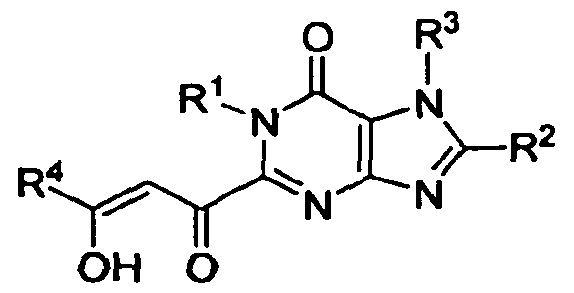
19. The composition according to any of claims 1-3 wherein said first compound has the structure:

20. The composition according to any of claims 1-3 wherein said first compound has the structure:

21. The composition according to any of claims 1-3 wherein said first compound has the structure:  wherein R1, R2 and R3 are each indendently a benzyl group or substituted benzyl group with 1 to 3 substituents on the aromatic ring selected from halogen, hydroxyl, methoxy, methyl, ethyl, propyl, CF3 or wherein R1, R2 and R3 are each independently -CH2 Rb where Rb is a 5- or 6-membered heteroaromatic ring; wherein R4 is P(O)(OR)(OR), where the R groups could be the same or not and are selected from H and Ci-6 alkyl, and pharmaceutically acceptable salts thereof.
22. The composition according to any of claims 1 -3 wherein said first compound has the structure:

23. The composition according to any of claims 1-3 wherein said first compound has the structure:

24. The composition according to any of claims 1-3 wherein said first compound has the structure:


25. The composition according to any of claims 1-3 wherein said first compound has the structure:


5 26. The composition according to any of claims 1 -3 wherein said first compound has the structure:

27. The composition according to any of claims 1-3 wherein said first compound has the structure:

20 wherein R1, R2 and R3 are each independently a benzyl group or substituted benzyl group with 1 to 3 substituents on the aromatic ring selected from halogen, hydroxyl, methoxy, methyl, ethyl, propyl, CF3 or wherein R1, R2 and R3 are each independently -CH2 Rb where Rb is a 5- or 6-membered heteroaromatic ring; wherein R4 is P(O)(OR)(OR), where the R groups could be the same or not and are 25 selected from H and C 1 -6 alkyl, and pharmaceutically acceptable salts thereof.
~*
28. The composition according to any of claims 1-3 wherein said first compound has the structure:

29. The composition according to any of claims 1-3 wherein said first compound has the structure:

30. The composition according to any of claims 1-3 wherein said first compound has the structure:  wherein R1, R2 and R3 are each independently a benzyl group or substituted benzyl group with 1 to 3 substituents on the aromatic ring selected from halogen, hydroxyl, methoxy, methyl, ethyl, propyl, CF3 or wherein R1, R2 and R3 are each independently -CH2 Rb where Rb is a 5- or 6-membered heteroaromatic ring; wherein R4 is CO2R where R is selected from H and Ci-β alkyl, and pharmaceutically acceptable salts thereof.
31. The composition according to any of claims 1 -3 wherein said first compound has the structure:

32. The pharmaceutical composition according to any of claims 1-31 wherein said composition treats said HIV infection by inhibiting HIV integrase, both wild type and mutants, in the human host.
33. The composition according to any of claims 1-32 in oral or parenteral dosage form.
34. The composition according to any of claims 1-32 formulated for administration as an inhalation spray or a rectal suppository.
35. A method of treating an HIV infection in a patient, said method comprising administering to said patient an effective amount of a composition according to any of claims 1-34 to said patient.
36. A method of reducing the likelihood of an HIV infection in a patient at risk said infection, said method comprising administering to said patient an effective amount of a composition according to any of claims 1-34 to said patient.
37. A method of treating a patient with AIDS or ARC comprising administering to said patient a therapeutically effective amount of a composition according to any of claims 1- 34.
38. A method of inhibiting HIV integrase in a subject, said method comprising administering to said subject a therapeutically effective amount of a compound according to any of claims 1-34.
39. The method according to any of claims 35-38 wherein said subject is a human.
40. Use of a composition according to any of claims 1-34 in the manufacture of a medicament for the treatment of HIV in a patient.
41. Use of a composition according to any of claims 1-34 in the manufacture of a medicament for reducing the likelihood that a patient will contract an HIV infection.
42. Use of a composition according to any of claims 1-34 in the manufacture of a medicament for treating a patient with AIDS or ARC.
43. Use of a composition according to any of claims 1-34 in the manufacture of a medicament for inhibiting HIV integrase in a subject.
44. Use according to any of claims 40-43 wherein said subject is a human patient.
45. A method of treating an HIV infection in a human host comprising administering to said host in combination, an effective amount of a first compound according to the structure: comprising at least one first compound according to the general structure of formula I:

R1 and R2 are each independently H, Ci-6 alkyl, Ci_6 fluoroalkyl, unsubstituted or substituted C5-6 cycloalkyl, Ci-β alkenyl, unsubstituted or substituted phenyl, unsubstituted or substituted benzyl, C2-6 alkyl phenyl which phenyl moiety may be optionally substituted, unsubstituted or substituted heteroaryl, Ci .6 alkyl substituted with a heteroaryl group which heteroaryl group is optionally substituted, Ci-6 alkyl S(O)R or alkyl (SCh)R where R is alkyl, phenyl or substituted phenyl, Ci-6 alkyl CO2Ra where Ra is Ci-6 alkyl or H, Ci-6 alkyl CORa> where Ra is Ci^ alkyl;
R3 is selected from H, Ci-6 alkyl, halogen, hydroxyl, unsubstituted or substituted benzyl, or unsubstituted or substituted phenylthio; R4 is CO2RC or P(O)(ORC)(ORC), where each Rc is independently from H and Ci-6 alkyl, or a tautomer, regioisomer, optical isomer or pharmaceutically acceptable salt, therof, in combination with at least one additional compound selected from the group consisting of (-)β-Dioxolane-G (DXG); (-)β-Arctigenin (Arctigenin); (-)-Carbovir (-)-C-D4G; (-)-2',3'- Dideoxy-5-fluoro-3'-thiacytidine (FTC); (-)-β-D-2,6-Diaminopurine dioxolane (DAPD); (+)- 2'-Deoxy-3t-oxa-4'-thiocytidine (dOTC +); (+)-2f-Deoxy-3'-oxa-4'-thio-5-fluorocytidine (dOTFC +); (+/-)-Lobucavir; (R)-2QuinCOAsnPhe[CHOHCH2]PipCONHtBu; (R)-3,6- Diamino-N-(aminomethyl)hexanamide (Bellenamine); (R)-9-(2- Phosphonylmethoxypropyl)adenine (Tenofovir); (R)-PMPDAP; (S)-9-(2- Phosphonylmethoxypropyl)adenine ((S)-PMPA); PMPA(S); α-APA (Loviride); R87232; R88703; α-APA enantiomer (R90385); α-L-AZT; α-L-Dioxalane-C (α-L-DXC); α-L-FTC; α-Monofluoromethyldehydroomithine methyl ester (MFMOME); 1 ,r-Azobisformamide (ADA); 1-(1 l-Octylamino-lO-hydroxyundecyO-S^-dimethylxanthine (CT-2576); 1 -(2',3'-Dideoxy-2'-fluoro-p-D-threo-pentofuranosyl)cytosine (Ro 31 -6840); 1 -(2'-Fluoro-2',3 '-dideoxy-β-D-erythro-pentofuτanosyl)thymine (2'FddT); 1 -[(2-Hydroxyethoxy)methyl]-6-(3-methylphenyl)thio)thymine (HEPT-M); 1 -[(2-Hydroxyethoxy)methyl]-6-(phenylthio)-2-thiothymiπe (HEPT-S); 1 - [(2-Hydroxyethoxy)methyl]-6-(phenylthio)thymine (HEPT);
Deoxynojϊrimycin (1-Deoxynojirimycin); Amprenavir; Abacavir Succinate(Ziagen); 1- Aminooxyethylamine (AEA); l-Methoxyoxalyl-3,5-dicaffeoylquinic acid (l-MO-3,5- DCQA); lOH-2(Cbz-Tle)3PhPr [14]paracyclophane deriv; 10H-2(Cbz-ValNH)3PhPr [13]metacyclophane deriv.; lOH-2(Cbz-ValNH)3PhPr [13]paracyclophane deriv.; lOH-2(Cbz-ValNH)3PhPr [14]paracyclophane deriv.; 10H-2(Cbz-ValNH)3PhPr [17]paracyclophane deriv.; 12-Deoxyphorbol-13-(3E,5E-decadienoate); lδ.alpha.- Bromoepiandrosterone (Epi-Br) or (Inactivin); l-β-D-arabinofiiranosyl-5-(2- bromovinyl)uracil (Sorivudine); 2l,3'-Didehydro-3'-deoxycvtidine (D4C); 2',3'-Dideoxydidehydroguanosine (D4G); 2',3'-Didehydro-3'-deoxythvmidine (D4T) (Stavudine); 2',3'-Dideoxy-3'-fluoro-4-thiothymidine (3'-F-4-Thio-ddT);
2',3'-Dideoxy-3'-fluoro-5-bromouridine (FddBrU); 2',3'-Dideoxy-3'-fluoro-5-chlorocytidine (3'-F-5-Cl-ddC); 2',3'-Dideoxy-3'-fluoro-5-chlorouridine (935U83) (Raluridine); 2\3'- Dideoxy-5-ethylcytidine (5-Et-ddC); 2\3'-Dideoxyadenosine (ddA); 2',3'-Dideoxydidehydroadenosine (d4A); 2',3'-Dideoxyguanosine (ddG); 2',3'-Dideoxy-3'-hydroxymethyl cytidine (3'-Hydτoxymethyl-ddC); 2)5'-Anhydro-3t-azido- 2',3'-dideoxyuridine (AZU-2,5'-aπhydro); 2,5l-Anhydro-3'-azido-3'-deoxythymidine (AZT- 2,5'-anhydro); 2',5'diSilySpiroT (TSAO-T); 2',5UiSiIySPiK)T
(TSAO-meA3T); 2,6-Diamino-2',3'-dideoxypurine-9-ribofuranoside (ddDAPR)( 2,6- Diamino-ddP); 2,6-Diaminopurine- 2',3'-dideoxydidehydroriboside (ddeDAPR); 2,6- Diaminopurine-3'-fluoro-2',3'-dideoxyriboside (3'-F-ddDAPR); 2-Aminobenzylstatine Valyl Cbz deriv; 2-Glycine amide-5-chlorophenyl 2-pyiτyl ketone (GCPK); [2- PyridCH2NCH3CO- VaI-NHCH(Bz)]CHOHCHOH (A-77003); 2'-Azido-2',31- dideoxyadenosine (2'-N3ddA); 2'-F-dd-ara-A (Lodensine); 2'-FddT ; 2'-N3ddA; 2'-N3ddA (β- D-threo); 2-NaphCOAsnPhe[CHOHCH2]Pro-OtBu; 2-Nitrophenylphenylsulfone (NPPS); 3- (3-Oxo-l -propenyl)-3'-azido-3'-deoxythymidine (3-(3-Oxo- 1 -propenyl)AZT); 3-(3-Oxo- 1 - propenyl)AZT; L-737,126; 3,5-Dicaifeoylquinic acid (3,5-DCQA); 3'-Azido-3'-deoxy-6- azathymidine; 3 '- Azido-2',3 '-dideoxy-5- [(cyanomethy l)oxy] uridine; 3 '- Azido-2',3 '-dideoxy-5 - aminouridine; 3'-Azido-2',3'-dideoxy-5-aza-6-deazauridine; 3 '-Azido-2',3 '-dideoxy-5 - bromouridine; 3'-Azido-2',3'-dideoxy-5-chlorocytidine (3'-Az-5-Cl-ddC); 3'-Azido-2',3'- dideoxy-5-dimethylaminouridine; 3'- Azido-2',3 '-dideoxy-5-ethyluridine; 3'- Azido-2',3 '- dideoxy-5-fluorocytidine; 3'-Azido-2',3'-dideoxy-5-fluorouridine; 3'-Azido-2',3'-dideoxy-5- hydroxyuridine; 3 '- Azido-2',3 '-dideoxy-5 -iodouridine; 3 '-Azido-2',3 '-dideoxy-5 - methyaminouridine; 3 '-Azido-2',3 '-dideoxy-5 -methylcytidine; 3'-Azido-2',3'-dideoxy-5- thiocyanatouridine; 3'-Azido-2',3'-dideoxy-5-trifluoromethyluridine; 3'-Azido-2',3'- dideoxycytidine; 3'-Azido-2',3'-dideoxyguanosine; 3'-Azido-2',3'-dideoxy-N4~5- dimethylcytidine; 3l-Azido-2',3'-dideoxy-N4-OH-5-methylcytidine; 3'-Azido-2',3'- dideoxyuridine (Uravidine); 3'-Azido-3'-deoxy-6-azathymidine; 3-Azido-3'-deoxythymidilyl- (5',5')-2',3'-dideoxy-5'-adenylic acid; S'-Azido-S'-deoxythymidilyHS'^O-^.S'-dideoxy-S'- adenylic acid, 2-cyanoethyl ester; 3'-Azido-3'-deoxythymidilyl-(5',5')-2',3'-dideoxy-5'- inosinic acid (AZT-P-ddl); 3'-Azido-3'-deoxythymidine-5'-(butylmethoxyvalinyl)phosphate; 3'-Azido-5-chloro-2',3'-dideoxyuridine; 3'-Deoxythymidine (ddT); 9-(3'-Fluoro-2',3'-dideoxy- β-D-erythropentafuranosyl)adenine; 3'-Fluoro-2l,3'-dideoxy-5-iodouridine (FddIU); 3'-Fluoro-2',3'-dideoxycytidine (3'-FddC); 3'- Fluoro-2',3'-dideoxyguanosine (3'-FddG); S'-Fluoro^'-dideoxyuridine P'-FddU); 9-(3'- Azido-2l,3'-dideoxy-β-D-erythropentafuranosyl)adenine; 3TC (Lamivudine); 3TC & AZT (Combivir); 4'-Acetoaπiidophenyl4-guadinobenzoate; 4'-Azido-3'-deoxythymidine; 4'-Azido- 5-chloro-2'-deoxyuridine; 4'-Azido-2'-deoxyadenosine; 4'-Azido-2'-deoxycytidine; 4'-Azido- 2'-deoxyguanosine; 4'-Azido-2'-deoxyinosine; 4'-Azido-2'-deoxyuridine; 4'-Azidothymidine; 4'-Cyanothymidine; 4-Methyl-5-(pyrazinyl)-3H-l,2-dithiole-3-thione (Oltipraz); 5'-[(l,4- Dihydro-1 -methyl-S-pyridinylcarbony^oxyJ-S'-azido^'^'-deoxythyniidine (DP-AZT); 5'- [[(Z)-4-amino-2-butenyl]methylamino]-5'-deoxyadenosine (MDL 73811); 5'- Alkylglycosidecarbonate of 3'-azido-3'-deoxythymidine; 5C13PhS-2IndolCONH2; 5-Fluoro- 2',3'-dideoxycytidine; S-Methyl-S'-azido^'^'-dideoxyisocytidine; Celgosivir; 6-Chloro-9- (2,3-dideoxy-β-D-glyceropentofuranosyl)-9H-purine; 6-Dimethylaminopurine-2',3'- dideoxyriboside; Ro 24-7429; Ro 5-3335; Tivirapine; 9-(2,3-Dideoxy-β-D-ribofuranosyl)-6- (methylthio)purine; 9-(2'-Azido-2',3'-dideoxy-B-D-threopentafuranosyl)adenine; C- oxetanocin A; (+-)Lobucavir; A-76890; A-77003; A-77212; A-80987; A-81525; A-83962; A-98881; PNU-104489; Trizivir; Lopinavir; Kaletra; Lopinavir & Ritonavir; Aluviran® & Norvir; Azodicarbonamide; Adefovir; Adefovir dipivoxil (Preveon®); Nelfinavir; AG 1350 (L Y316957); R-87366; Alpha-lipoic acid; Alovudine (3'-FddT); ALX40-4C; AMD3100 (JM3100); Amdoxovir (APD); Amprenavir phosphate (Fosamprenavir); Ancer 20 (Z-100); Atazanavir (Latazanavir); Atevirdine; Aurintricarboxylic acid; AY 9944; 3'-Azido-5-chloro- 2',3'-dideoxyuridine; AZT; α-L-AZT; O,O'-Bis(3'-azido-3t-deoxythymidin-5l- yl)methylphosphonate; Baicalin (TJN-151); Betulinic acid (Mairin); Betulinic acid, 3-O- O'^'-dimethylsuccinate); Delavirdine (U-90152); U-88204E; Nevirapine; BILA 1906 BS; BILA 2011 BS (Palinavir); BILA 2185 BS; NSC633001; CGP 53820; bis-ValHOEt-N2aza- peptide isostere (CGP 53820 analog); BMS-186318; L-687,908; Brovavir; BzOCValPhe[diCHOH(RR)]PheValBzOC; BzOCValPhe[diCHOH(SS)]PheValBzOC; C2- Sym Phosphinic amide deriv. (HOECHST AG); NSC675451; Calanolide B; Capravirine (S- 1153); Carbovir; Castanospermine; CGP 61755 (Lasinavir); CGP 64222; CNI-H0294; Emivirine; Conocurvone (NSC650891); Emtricitabine; C-Oxetanocin-G; Indinavir; Curdlan Sulfate; Cyanovirin-N ; SD 146; Cyclosporin A; SDZ NIM 811; L^'^'-Didehydro^1^1- dideoxyadenosine (L-D4A); 2',3l-Didehydro-2',3'-dideoxy-5-fluorocytidine (DD4C); L-2',3'- Didehydro-2',3'-dideoxy-5-fluorocytidine (LD4C); L-2',3'-Didehydro-2',31-dideoxyguanosine (LD4G) ; L-2I,3'-Didehydro-21,3'-dideoxyinosine (LD4I); DABO; ddl; ddC; DMP-323; DMP- 450; (-)-2'-Deoxy-3'-oxa-4'-thiocytidine; (-)-2'-Deoxy-3I-oxa-4'-thio-5-fluorocytidine ;
Pentafiiside (Enfuvirtide); Etoposide; Efavirenz; Emtriva; K- 12 (fluoroquinoline derivative); Saquinavir; Foscarnet; Phosphonoformic acid; Foscavir; FPMDAP; FPMPA; FPMPG; Gene Expression Modulator 91 (GEM91); Hammerhead anti-gag RNA Ribozyme B; Harziphilone; HBY 097 (Quinoxaline deriv); E-EBU; E-EPSeU; E-EPU; NSC 648400; E-EBU-dM; Zalcitabine; LY326188; Ingenol 3,5,20-triacetate (ITA); Inophyllum B; KNI-272; RD3- 211,8; KNI-102; KNM 54; KNI- 174; KNI-227; L-685,434; L-689,502; L-697,593; L- 697,639; L-697,661; LY289612; Trovirdine; LY-73497; L-735,524; N-Ethyl-2',31- dideoxyadenosine; N6-Methyl-2',3'-dideoxyadenosine; Noa-Asn-Apns-Thz-NH-tBu; Nonoxynol 9; Ritonavir; NSC625487; NSC649324; NSC650898; UC-38; UC-84; P9941; Palinavir; Pentosan Sulfate; Elmiron; SP54; PNU-140690 (Tipranavir); S-2720; R14458;
R82150; R82913; R86183; RD4-2138; Resobene; Reyataz; Ribavirin; 7-Chloro-N-methyl-5- (lH-pyrrol-2-yl)-3H-l,4-benzodiazepin-2-amine; 7-Chloro-5-(2-pyrryl)-3H-l,4- benzodiazepin-2(H)-one; LY314163; SB-205569; Telinavir; SD-095345SD146; SDZ PRI 053; SPC3; Suramin Sodium; T22; Thalidomide; Thiangazole; Thiazoloisoindol-5-one; U- 104489; U-140690; U-87201E; U-88204E; UC-781; VB-11,328; VX-478; 141W94; XM-323 and mixtures thereof, further in combination with a pharmaceutically acceptable carrier, additive or excipient.
46. The method according to claim 45 wherein said first compound is

47. A method of treating an HIV infection in a human host comprising administering to said host in combination, an effective amount of a first compound according to the structure: comprising at least one first compound according to the general structure of formula I:

I wherein the nucleobase scaffold is independently uracil, xanthine, hypoxanthine or purine;
R1 and R2 are each independently H, Ci -6 alkyl, Ci -6 fluoroalkyl, unsubstituted or substituted Cs-* cycloalkyl, Ci .6 alkenyl, unsubstituted or substituted phenyl, unsubstituted or substituted benzyl, C2-6 alkyl phenyl which phenyl moiety may be optionally substituted, unsubstituted or substituted heteroaryl, Ci-6 alkyl substituted with a heteroaryl group which heteroaryl group is optionally substituted, Ci-^ alkyl S(O)R or alkyl (SO2)R where R is alkyl, phenyl or substituted phenyl, Ci-6 alkyl CO2R8 where Ra is Ci-6 alkyl or H, Ci-6 alkyl COR3' where Ra is Ci^ alkyl;
R3 is selected from H, Ci-6 alkyl, halogen, hydroxyl, unsubstituted or substituted benzyl, or unsubstituted or substituted phenylthio; R4 is CO2RC or P(O)(ORC)(ORC), where each Rc is independently from H and C1-6 alkyl, or a tautomer, regioisomer, optical isomer or pharmaceutically acceptable salt, therof, in combination with at least one additional compound selected from the group consisting of
ACV; AK602; AMD070; APV; ATV; ATZ; AVX754 (apricitabine); AZT; Abacavir; Abacavir / Lamivudine / Zidovudine; Abacavir sulfate; Abacavir sulfate/Lamivudine;
Abacavir/Lamivudine; Abelecet; Acyclovir; Adefovir dipivoxil; Adriamycin; Agenerase;
Aldesleukin; Alovudine; Aluvia; AmBisome; Amdoxovir; Amphocin; Amphotec;
Amphotericin B; Ampligen; Amprenavir; Androderm; Androgel; Apricitabine; Aptivus;
Atazanavir; Atripla; Azithromycin; BMS-378806; BMS-488043; Bactrim; Baraclude; Bevirimat; Biaxin; Brecanavir; BufferGel; C31G; CD4-IgG2; CS; CV-N; Calanolide A;
Calcium hydroxylapatite; Carbopol 974P; Carrageenan; Carraguard; Cellulose sulfate;
Clarithromycin; Combivir; Copegus; Cotrimoxazole; Crixivan; Cyanovirin-N; Cytovene;
DAPD; DLV; DS; Darunavir; Delavirdine; Depo-Testosterone; Dextran sulfate; Didanosine;
Diflucan; Doxil; Doxorubicin (liposomal); Dronabinol; EFV; Efavirenz; Elvucitabine; Emtricitabine; Tenofovir disoproxil fumarate; Emtriva; Enfufirtide; Entecavir; Epivir;
Epoetin alfa; Epogen; Epzicom; Etopophos (phosphate salt); Etoposide; Etravirine; FTC;
Fluconazole; Fortovase; Fosamprenavir; Foxivudine tidoxil; Fungizone; Fuzeon; GS 9137;
GSK-873,140 (aplaviroc); GW433908; GW640385 (brecanavir); Ganciclovir; Globulin,
Immune; Growth hormone (human); Hepsera; Hivid; Human growth hormone; IL-2; INH; Immune Globulin Intravenous (Human); Indinavir; Interferon alfa-2; Interleukin-2, recombinant human; Intron A (2b); Invirase; Isoniazid; Itraconazole; KP- 1461;
Lamivudine/Zidovudine; Lexiva; Lopinavir/Ritonavir; MK-0518; Nebupent; Nelfinavir;
Neutrexin; Nevirapine; Norvir; Nydrazid; Peptide T; PMPA Prodrug (Viread)' Prezista
(Darunavir); PRO 140; PRO 2000; PRO 542 (CD4 IGg2); Procrit (Epoetin); Proleukin; Racivir; Radiesse; Rrebetol; Rescriptor; Retrovir; Reyataz; Ribavirin; Rifabutin; Rifadin;
Rifampin; Rimactane; Ritonavir; Roferon-A (2a); Saquinavir; SCH-D (vicriviroc);
Somatropin; Stavudinie; Sulfamethoxazole / Trimethoprim; Sustanon; Sustiva; TNX-355;
Taxol; Tenofovir; Tenofovir disoproxil fumarate; Testosterone; Tipranavir; Toposar;
Trimetrexate; Trizivir; Truvada (Emtriva and Viread combination); U-90152S (Delaviridine); UC-781; UK-427,857 (maraviroc); Valcyte; Valganciclovir; Valproic acid; VePesid;
Vicriviroc; Videx; Viracept (Tennofovir DF); Viramune; Virazole; Viread; Vitrasert;
Zalcitabine; Zerit; Ziagen; Zidovudine; Zithromax; Zovirax and mixtures thereof, further in combination with a pharmaceutically acceptable carrier, additive or excipient.
48. The method according to claim 47 wherein said first compound is

49. A pharmaceutical composition comprising an effective amount of a compound according to the structure:

in combination with an effective of at least one additional compound selected from the group (-)β-Dioxolane-G (DXG); (-)β-Arctigenin (Arctigenin); (-)-Carbovir (-)-C-D4G; (-)-2',3'- Dideoxy-5-fluoro-3'-thiacytidine (FTC); (-)-β-D-2,6-Diaminopurine dioxolane (DAPD); (+)- 2'-Deoxy-3'-oxa-4'-thiocytidine (dOTC +); (+)-2l-Deoxy-3'-oxa-4'-thio-5-fluorocytidine (dOTFC +); (+/-)-Lobucavir; (R)-2QuinCOAsnPhe[CHOHCH2]PipCONHtBu; (R)-3,6-Diamino-N-
(aminomethyl)hexanamide (Bellenamine); (R)-9-(2-Phosphonylmethoxypropyl)adenine (Tenofovir); (R)-PMPDAP; (S)-9-(2-Phosphonylmethoxypropyl)adenine ((S)-PMPA); PMPA(S); α-APA (Loviride); R87232; R88703; α-APA enantiomer (R90385); α-L-AZT; α-L-Dioxalane-C (α-L-DXC); α-L-FTC; α-Monofluoromethyldehydroorni thine methyl ester (MFMOME); l,l'-Azobisformamide (ADA); l-(l l-Octylamino-10-hydroxyundecyl)-3,7-dimethylxanthine (CT-2576); 1 -(2I,3t-Dideoxy-2'-fluoro-P-D-threo-pentofuranosyl)cytosine (Ro 31-6840); 1 -(2I-Fluoro-2',31-dideoxy-β-D-erythro-pentofuranosyl)thymine (2'FddT); 1 -[(2-Hydroxyethoxy)methyl]-6-(3-methylphenyl)thio)thymine (HEPT-M); l-[(2-Hydroxyethoxy)methyl]-6-(phenylthio)-2-thiothymine (HEPT-S); 1 -[(2-Hydroxyethoxy)methyl]-6-(phenylthio)thymine (HEPT);
Deoxynojirimycin (1-Deoxynojirimycin); Amprenavir; Abacavir Succinate(Ziagen); 1- Aminooxyethylamine (AEA); l-Methoxyoxalyl-3,5-dicafFeoylquinic acid (l-MO-3,5- DCQA); lOH-2(Cbz-Tle)3PhPr [14]paracyclophane deriv; 10H-2(Cbz-ValNH)3PhPr [13]metacyclophane deriv.; 10H-2(Cbz-ValNH)3PhPr [13]paracyclophane deriv.; 10H-2(Cbz-ValNH)3PhPr [14]paracyclophane deriv.; 10H-2(Cbz-ValNH)3PhPr [17]paracyclophane deriv.; 12-Deoxyphorbol-13-(3E,5E-decadienoate); 16. alpha. - Bromoepiandrosterone (Epi-Br) or (Inactivin); l-β-D-arabinofuranosyl-5-(2- bromovinyl)uracil (Sorivudine); 2',3'-Didehydro-3'-deoxycytidine (D4C); 2I,3'-Dideoxydidehydroguanosine (D4G); 2l,3'-Didehydro-3'-deoxythymidine (D4T) (Stavudine); 21,3'-Dideoxy-3'-fluoro-4-thiothymidine (3'-F-4-Thio-ddT); 2 ',3 '-Dideoxy-3 '-fluoro-5 -bromouridine (FddBrU); 2',3 '-Dideoxy-3 '-fluoro-5-chlorocytidine (3'-F-5-Cl-ddC); 2',31-Dideoxy-3'-fluoro-5-chlorouridine (935U83) (Raluridine); 2',3'- Dideoxy-5-ethylcytidine (5-Et-ddC); 2',3'-Dideoxyadenosine (ddA); 2',3I-Dideoxydidehydroadenosine (d4A); 2',3'-Dideoxyguanosine (ddG);
2 ',3 '-Dideoxy-3 '-hydroxymethyl cytidine (3'-Hydroxymethyl-ddC); 2,5'-Anhydro-3'-azido- 2',3'-dideoxyuridine (AZU-2,5'-anhydro); 2,5'-Anhydro-3'-azido-3'-deoxythymidine (AZT- 2,5'-anhydro); 2',5'diSilySpiroT (TSAO-T); 2',5^iSiIySpU-OT (TSAO-meΛ3T); 2,6-Diamino-2',3'-dideoxypurine-9-ribofuranoside (ddDAPR)( 2,6- Diamino-ddP); 2,6-Diaminopvirine- 2',3'-dideoxydidehydroriboside (ddeDAPR); 2,6-
Diaminopurine-3l-fluoro-2',3t-dideoxyriboside (3 -F-ddDAPR); 2-Aminobenzylstatine Valyl Cbz deriv; 2-Glycine amide-5-chlorophenyl 2-pyτryl ketone (GCPK); [2- PyridCH2NCH3CO- VaI-NHCH(Bz)]CHOHCHOH (A-77003); 21-Azido-2',3I- dideoxyadenosine (2'-N3ddA); 2'-F-dd-ara-A (Lodensine); 2'-FddT ; 2'-N3ddA; 2'-N3ddA (β- D-threo); 2-NaphCOAsnPhe[CHOHCH2]Pro-OtBu; 2-Nitrophenylphenylsulfone (NPPS); 3- (3-Oxo-l-propenyl)-3'-azido-3l-deoxythymidine (3-(3-Oxo-l-propenyl)AZT); 3-(3-Oxo-l- propenyl)AZT; L-737,126; 3,5-Dicaffeoylquinic acid (3,5-DCQA); 3'-Azido-3'-deoxy-6- azathymidine; 3'-Azido-2',3'-dideoxy-5-[(cyanomethyl)oxy]uridine; 3'-Azido-2',3'-dideoxy-5- aminouridine; 3'-Azido-2',3'-dideoxy-5-aza-6-deazauridine; 3'-Azido-2',3'-dideoxy-5- bromouridine; 3'-Azido-2',3'-dideoxy-5-chlorocytidine (3'-Az-5-Cl-ddC); 3'-Azido-2',3'- dideoxy-5-dimethylaminouridine; 3'-Azido-2',3'-dideoxy-5-ethyluridine; 3'-Azido-2',3'- dideoxy-5-fluorocytidine; 3'-Azido-2',3'-dideoxy-5-fluorouridine; 3'-Azido-2',3'-dideoxy-5- hydroxyuridine; 3'-Azido-2',3'-dideoxy-5-iodouridine; 3'-Azido-2',3'-dideoxy-5- methyaminouridine; 3'-Azido-2',3 '-dideoxy-5-methylcytidine; 3'-Azido-2',3'-dideoxy-5- thiocyanatouridine; 3'-Azido-2',3'-dideoxy-5-trifluoromethyluridine; 3'-Azido-2',3'- dideoxycytidine; 3'-Azido-2',3'-dideoxyguanosine; 3'-Azido-2',3'-dideoxy-N4— 5- dimethylcytidine; 3'-Azido-2',3'-dideoxy-N4-OH-5-methylcytidine; 3t-Azido-21,31- dideoxyuridine (Uravidine); 3'-Azido-3'-deoxy-6-azathymidine; 3-Azido-3'-deoxythymidilyl- (S'^O^'^'-dideoxy-S'-adenylic acid^'-Azido-S'-deoxythymidilyl-CS'^'^'^'-dideoxy-S1- adenylic acid, 2-cyanoethyl ester; S'-Azido-S'-deoxythymidilyl-CS'.SO^'^'-dideoxy-S'- inosinic acid (AZT-P-ddl); 3'-Azido-3'-deoxythymidine-5'-(butylmethoxyvalinyl)phosphate; 3'-Azido-5-chloro-2',3'-dideoxyuridine; 3'-Deoxythymidine (ddT); 9-(3'-Fluoro-2\3'-dideoxy- β-D-erythropentafuranosyl)adenine;
3'-Fluoro-2f,3'-dideoxy-5-iodouridine (FddIU); S'-Fluoro^'^'-dideoxycytidine (3'-FddC); 3'- Fluoro-2',3'-dideoxyguanosine (3'-FddG);  (3'-FddU); 9-(3'- Azido-2^3'-dideoxy-β-D-erythropentafuranosyl)adenine; 3TC (Lamivudine); 3TC & AZT (Combivir); 4'-Acetoamidophenyl4-guadinobenzoate; 4'-Azido-3'-deoxythymidine; 4'-Azido- 5-chloro-2'-deoxyuridine; 4'-Azido-2'-deoxyadenosine; 4'-Azido-2'-deoxycytidine; 4'-Azido- 2'-deoxyguanosine; 4'-Azido-2'-deoxyinosine; 4'-Azido-2'-deoxyuridine; 4'-Azidothymidine; 4'-Cyanothymidine; 4-Methyl-5-(pyrazinyl)-3H-l,2-dithiole-3-thione (Oltipraz); 5'-[(l ,4- Dihydro-l-methyl-3-pyridinylcarbonyl)oxy]-3'-azido-2',3'-deoxythymidine (DP-AZT); 51- [[(Z)-4-amino-2-butenyl]methylamino]-5'-deoxyadenosine (MDL 73811); 5'- Alkylglycosidecarbonate of 3'-azido-3'-deoxythymidine; 5C13PhS-2IndolCONH2; 5-Fluoro- 2',3'-dideoxycytidine; 5-Methyl-3'-azido-2',3f-dideoxyisocytidine; Celgosivir; 6-Chloro-9- (2,3-dideoxy-β-D-glyceropentofuranosyl)-9H-purine; 6-Dimethylaminopurine-2',3'- dideoxyriboside; Ro 24-7429; Ro 5-3335; Tivirapine; 9-(2,3-Dideoxy-β-D-ribofuranosyl)-6- (methylthio)purine; 9-(2I-Azido-2',3'-dideoxy-B-D-threopentafuranosyl)adenine; C- oxetanocin A; (+-)Lobucavir; A-76890; A-77003; A-77212; A-80987; A-81525; A-83962; A-98881; PNU- 104489; Trizivir; Lopinavir; Kaletra; Lopinavir & Ritonavir; Aluviran® & Norvir; Azodicarbonamide; Adefovir; Adefovir dipivoxil (Preveon®); Nelfinavir; AG 1350 (L Y316957); R-87366; Alpha-lipoic acid; Alovudine (3'-FddT); ALX40-4C; AMD3100 (JM3100); Amdoxovir (APD); Amprenavir phosphate (Fosamprenavir); Ancer 20 (Z-100); Atazanavir (Latazanavir); Atevirdine; Aurintricarboxylic acid; AY 9944; 3'-Azido-5-chloro- 2l,3'-dideoxyuridine; AZT; α-L-AZT; O,O'-Bis(3'-azido-3I-deoxythymidin-5I- yl)methylphosphonate; Baicalin (TJN-151); Betulinic acid (Mairin); Betulinic acid, 3-O- (3',3'-dimethylsuccinate); Delavirdine (U-90152); U-88204E; Nevirapine; BILA 1906 BS; BILA 2011 BS (Palinavir); BILA 2185 BS; NSC633001; CGP 53820; bis-ValHOEt-N2aza- peptide isostere (CGP 53820 analog); BMS- 186318; L-687,908; Brovavir; BzOCValPhe[diCHOH(RR)]PheValBzOC; BzOCValPhe[diCHOH(SS)]PheValBzOC; C2- Sym Phosphinic amide deriv. (HOECHST AG); NSC675451; Calanolide B; Capravirine (S- 1153); Carbovir; Castanospermine; CGP 61755 (Lasinavir); CGP 64222; CNI-H0294;
Emivirine; Conocurvone (NSC650891); Emtricitabine; C-Oxetanocin-G; Indinavir; Curdlan Sulfate; Cyanovirin-N ; SD 146; Cyclosporin A; SDZ NIM 811 ; L-21 >3f-Didehydro-2',31- dideoxyadenosine (L-D4A); 2',3t-Didehydro-2>,3'-dideoxy-5-fluorocytidine (DD4C); L-2',3'- Didehydro-2',3l-dideoxy-5-fluorocytidine (LD4C); L-2I,3f-Didehydro-2',3'-dideoxyguanosine (LD4G) ; L-2l,3I-Didehydro-21,3'-dideoxyinosine (LD4I); DABO; ddl; ddC; DMP-323; DMP- 450; (-)-2'-Deoxy-3'-oxa-4'-thiocytidine; (-)-2l-Deoxy-3'-oxa-4'-thio-5-fluorocytidine ; Pentafuside (Enfiivirtide); Etoposide; Efavirenz; Emtriva; K-12 (fluoroquinoline derivative); Saquinavir; Foscarnet; Phosphonoformic acid; Foscavir; FPMDAP; FPMPA; FPMPG; Gene Expression Modulator 91 (GEM91); Hammerhead anti-gag RNA Ribozyme B; Harziphilone; HBY 097 (Quinoxaline deriv); E-EBU; E-EPSeU; E-EPU; NSC 648400; E-EBU-dM; Zalcitabine; LY326188; Ingenol 3,5,20-triacetate (ITA); Inophyllum B; KNI-272; RD3- 2118; KNI-102; KNI-154; KNI-174; KNI-227; L-685,434; L-689,502; L-697,593; L- 697,639; L-697,661; LY289612; Trovirdine; LY-73497; L-735,524; N-Ethyl-2',3f- dideoxyadenosine; N6-Methyl-2',3'-dideoxyadenosine; Noa-Asn-Apns-Thz-NH-tBu; Nonoxynol 9; Ritonavir; NSC625487; NSC649324; NSC650898; UC-38; UC-84; P9941 ; Palinavir; Pentosan Sulfate; Elmiron; SP54; PNU- 140690 (Tipranavir); S-2720; R 14458; R82150; R82913; R86183; RD4-2138; Resobene; Reyataz; Ribavirin; 7-Chloro-N-methyl-5- (lH-pyπOl-2-yl)-3H-l,4-benzodiazepin-2-amine; 7-Chloro-5-(2-pyrryl)-3H-l,4- benzodiazepin-2(H)-one; LY314I63; SB-205569; Telinavir; SD-095345SD146; SDZ PRI 053; SPC3; Suramin Sodium; T22; Thalidomide; Thiangazole; Thiazoloisoindol-5-one; U-
104489; U-140690; U-87201E; U-88204E; UC-781; VB-11,328; VX-478; 141W94; XM-323 and mixtures thereof, further in combination with a pharmaceutically acceptable carrier, additive or excipient.
50. A pharmaceutical composition comprising an effective amount of a compound according to the structure:

in combination with an effective of at least one additional compound selected from the group ACV; AK602; AMD070; APV; ATV; ATZ; AVX754 (apricitabine); AZT; Abacavir; Abacavir / Lamivudine / Zidovudine; Abacavir sulfate; Abacavir sulfate/Lamivudine;
Abacavir/Lamivudine; Abelecet; Acyclovir; Adefovir dipivoxil; Adriamycin; Agenerase;
Aldesleukin; Alovudine; Aluvia; AmBisome; Amdoxovir; Amphocin; Amphotec;
Amphotericin B; Ampligen; Amprenavir; Androderm; Androgel; Apricitabine; Aptivus;
Atazanavir; Atripla; Azithromycin; BMS-378806; BMS-488043; Bactrim; Baraclude; Bevirimat; Biaxin; Brecanavir; BufferGel; C31 G; CD4-IgG2; CS; CV-N; Calanolide A;
Calcium hydroxylapatite; Carbopol 974P; Carrageenan; Carraguard; Cellulose sulfate;
Clarithromycin; Combivir; Copegus; Cotrimoxazole; Crixivan; Cyanovirin-N; Cytovene;
DAPD; DLV; DS; Darunavir; Delavirdine; Depo-Testosterone; Dextran sulfate; Didanosine;
Diflucan; Doxil; Doxorubicin (liposomal); Dronabinol; EFV; Efavirenz; Elvucitabine; Emtricitabine; Tenofovir disoproxil fumarate; Emtriva; Enfufirtide; Entecavir; Epivir;
Epoetin alfa; Epogen; Epzicom; Etopophos (phosphate salt); Etoposide; Etravirine; FTC;
Fluconazole; Fortovase; Fosamprenavir; Foxivudine tidoxil; Fungizone; Fuzeon; GS 9137;
GSK-873,140 (aplaviroc); GW433908; GW640385 (brecanavir); Ganciclovir; Globulin,
Immune; Growth hormone (human); Hepsera; Hivid; Human growth hormone; IL-2; INH; Immune Globulin Intravenous (Human); Indinavir; Interferon alfa-2; InterIeukin-2, recombinant human; Intron A (2b); Invirase; Isoniazid; Itraconazole; KP- 1461;
Lamivudine/Zidovudine; Lexiva; Lopinavir/Ritonavir; MK-0518; Nebupent; Nelfinavir;
Neutrexin; Nevirapine; Norvir; Nydrazid; Peptide T; PMPA Prodrug (Viread)' Prezista
(Darunavir); PRO 140; PRO 2000; PRO 542 (CD4 IGg2); Procrit (Epoetin); Proleukin; Racivir; Radiesse; Rrebetol; Rescriptor; Retrovir; Reyataz; Ribavirin; Rifabutin; Rifadin;
Rifampin; Rimactane; Ritonavir; Roferon-A (2a); Saquinavir; SCH-D (vicriviroc);
Somatropin; Stavudinie; Sulfamethoxazole / Trimethoprim; Sustanon; Sustiva; TNX-355;
Taxol; Tenofovir; Tenofovir disoproxil fumarate; Testosterone; Tipranavir; Toposar;
Trimetrexate; Trizivir; Truvada (Emtriva and Viread combination); U-90152S (Delaviridine); UC-781; UK-427,857 (maraviroc); Valcyte; Valganciclovir; Valproic acid; VePesid; Vicriviroc; Videx; Viracept (Tennofovir DF); Viramune; Virazole; Viread; Vitrasert; Zalcitabine; Zerit; Ziagen; Zidovudine; Zithromax; Zovirax and mixtures thereof, further in combination with a pharmaceutically acceptable carrier, additive or excipient.
Applications Claiming Priority (2)
| Application Number | Priority Date | Filing Date | Title |
|---|---|---|---|
| US78152006P | 2006-03-10 | 2006-03-10 | |
| US60/781,520 | 2006-03-10 |
Publications (2)
| Publication Number | Publication Date |
|---|---|
| WO2007106450A2 true WO2007106450A2 (en) | 2007-09-20 |
| WO2007106450A3 WO2007106450A3 (en) | 2009-04-02 |
Family
ID=38510032
Family Applications (1)
| Application Number | Title | Priority Date | Filing Date |
|---|---|---|---|
| PCT/US2007/006245 Ceased WO2007106450A2 (en) | 2006-03-10 | 2007-03-09 | Diketo acids with nucleobase scaffolds: anti-hiv replication inhibitors targeted at hiv integrase in combination therapy |
Country Status (1)
| Country | Link |
|---|---|
| WO (1) | WO2007106450A2 (en) |
Cited By (8)
| Publication number | Priority date | Publication date | Assignee | Title |
|---|---|---|---|---|
| US8106064B2 (en) | 2006-07-24 | 2012-01-31 | Korea Research Institute Of Chemical Technology | Pyrimidine-2,4-dione HIV reverse transcriptase inhibitors |
| US8119800B2 (en) | 2007-12-21 | 2012-02-21 | Korea Research Institute Of Chemical Technology | Processes for preparing HIV reverse transcriptase inhibitors |
| US8334295B2 (en) | 2007-06-29 | 2012-12-18 | Korea Research Institute Of Chemical Technology | Pyrimidine derivatives as HIV reverse transcriptase inhibitors |
| US8354421B2 (en) | 2007-06-29 | 2013-01-15 | Korea Research Insitute Of Chemical Technology | HIV reverse transcriptase inhibitors |
| US8703801B2 (en) | 2009-12-07 | 2014-04-22 | University Of Georgia Research Foundation, Inc. | Pyridinone hydroxycyclopentyl carboxamides: HIV integrase inhibitors with therapeutic applications |
| US9593137B2 (en) | 2011-12-22 | 2017-03-14 | Geron Corporation | Guanine analogs as telomerase substrates and telomere length affectors |
| JP2017057200A (en) * | 2015-09-18 | 2017-03-23 | ヤマサ醤油株式会社 | Nucleoside derivatives having physiological activity such as anti-DNA virus activity |
| CN111269264A (en) * | 2014-08-25 | 2020-06-12 | 美迪维尔公司 | Dioxolane analogs of uridine for the treatment of cancer |
Family Cites Families (1)
| Publication number | Priority date | Publication date | Assignee | Title |
|---|---|---|---|---|
| US20050026902A1 (en) * | 2003-01-31 | 2005-02-03 | Timothy Maziasz | Methods and compositions for the treatment or prevention of human immunodeficiency virus and related conditions using cyclooxygenase-2 selective inhibitors and antiviral agents |
-
2007
- 2007-03-09 WO PCT/US2007/006245 patent/WO2007106450A2/en not_active Ceased
Cited By (12)
| Publication number | Priority date | Publication date | Assignee | Title |
|---|---|---|---|---|
| US8106064B2 (en) | 2006-07-24 | 2012-01-31 | Korea Research Institute Of Chemical Technology | Pyrimidine-2,4-dione HIV reverse transcriptase inhibitors |
| US8334295B2 (en) | 2007-06-29 | 2012-12-18 | Korea Research Institute Of Chemical Technology | Pyrimidine derivatives as HIV reverse transcriptase inhibitors |
| US8354421B2 (en) | 2007-06-29 | 2013-01-15 | Korea Research Insitute Of Chemical Technology | HIV reverse transcriptase inhibitors |
| US8119800B2 (en) | 2007-12-21 | 2012-02-21 | Korea Research Institute Of Chemical Technology | Processes for preparing HIV reverse transcriptase inhibitors |
| US8703801B2 (en) | 2009-12-07 | 2014-04-22 | University Of Georgia Research Foundation, Inc. | Pyridinone hydroxycyclopentyl carboxamides: HIV integrase inhibitors with therapeutic applications |
| US9593137B2 (en) | 2011-12-22 | 2017-03-14 | Geron Corporation | Guanine analogs as telomerase substrates and telomere length affectors |
| US10035814B2 (en) | 2011-12-22 | 2018-07-31 | Geron Corporation | Guanine analogs as telomerase substrates and telomere length affectors |
| US10562926B2 (en) | 2011-12-22 | 2020-02-18 | Geron Corporation | Guanine analogs as telomerase substrates and telomere length affectors |
| US11279720B2 (en) | 2011-12-22 | 2022-03-22 | Geron Corporation | Guanine analogs as telomerase substrates and telomere length affectors |
| US12398162B2 (en) | 2011-12-22 | 2025-08-26 | Geron Corporation | Guanine analogs as telomerase substrates and telomere length affectors |
| CN111269264A (en) * | 2014-08-25 | 2020-06-12 | 美迪维尔公司 | Dioxolane analogs of uridine for the treatment of cancer |
| JP2017057200A (en) * | 2015-09-18 | 2017-03-23 | ヤマサ醤油株式会社 | Nucleoside derivatives having physiological activity such as anti-DNA virus activity |
Also Published As
| Publication number | Publication date |
|---|---|
| WO2007106450A3 (en) | 2009-04-02 |
Similar Documents
| Publication | Publication Date | Title |
|---|---|---|
| EP2046328A2 (en) | Pyridinone diketo acids: inhibitors of hiv replication in combination therapy | |
| EP2509949B1 (en) | Pyridinone hydroxycyclopentyl carboxamides: hiv integrase inhibitors with therapeutic applications | |
| WO2007106450A2 (en) | Diketo acids with nucleobase scaffolds: anti-hiv replication inhibitors targeted at hiv integrase in combination therapy | |
| US7569573B2 (en) | Diketo acids with nucleobase scaffolds: anti-HIV replication inhibitors targeted at HIV integrase | |
| US20110178120A1 (en) | Hiv integrase inhibitors from pyridoxine | |
| JP2013512957A5 (en) | ||
| CN101516369A (en) | Pyridinone diketo acids: inhibitors of HIV replication in combination therapy | |
| EP2831056B1 (en) | New anti-mycobacterial drugs against tuberculosis | |
| US8664248B2 (en) | Derivatives of pyridoxine for inhibiting HIV integrase | |
| US9487476B2 (en) | Catechol diethers as potent anti-HIV agents | |
| US20060223834A1 (en) | Diketo acids on nucleobase scaffolds as inhibitors of Flaviviridae | |
| HK1130201A (en) | Pyridinone diketo acids: inhibitors of hiv replication in combination therapy | |
| HK1174331A (en) | Pyridinone hydroxycyclopentyl carboxamides: hiv integrase inhibitors with therapeutic applications | |
| HK1110320A (en) | Diketo acids with nucleobase scaffolds: anti-hiv replication inhibitors targeted at hiv integrase |
Legal Events
| Date | Code | Title | Description |
|---|---|---|---|
| 121 | Ep: the epo has been informed by wipo that ep was designated in this application |
Ref document number: 07752911 Country of ref document: EP Kind code of ref document: A2 |
|
| NENP | Non-entry into the national phase |
Ref country code: DE |
|
| 122 | Ep: pct application non-entry in european phase |
Ref document number: 07752911 Country of ref document: EP Kind code of ref document: A2 |