WO2007092007A1 - Synthesis of [1-13 c]pyruvic acid, [2-13c]pyruvic acid, [3-13c]pyruvic acid and combinations thereof - Google Patents
Synthesis of [1-13 c]pyruvic acid, [2-13c]pyruvic acid, [3-13c]pyruvic acid and combinations thereof Download PDFInfo
- Publication number
- WO2007092007A1 WO2007092007A1 PCT/US2006/004435 US2006004435W WO2007092007A1 WO 2007092007 A1 WO2007092007 A1 WO 2007092007A1 US 2006004435 W US2006004435 W US 2006004435W WO 2007092007 A1 WO2007092007 A1 WO 2007092007A1
- Authority
- WO
- WIPO (PCT)
- Prior art keywords
- group
- naphthyl
- lower alkyl
- independently selected
- phenyl
- Prior art date
- Legal status (The legal status is an assumption and is not a legal conclusion. Google has not performed a legal analysis and makes no representation as to the accuracy of the status listed.)
- Ceased
Links
- 0 Cc1c(*)c(CC2CC2)c(*)c(P)c1N Chemical compound Cc1c(*)c(CC2CC2)c(*)c(P)c1N 0.000 description 3
Classifications
-
- C—CHEMISTRY; METALLURGY
- C07—ORGANIC CHEMISTRY
- C07C—ACYCLIC OR CARBOCYCLIC COMPOUNDS
- C07C69/00—Esters of carboxylic acids; Esters of carbonic or haloformic acids
- C07C69/66—Esters of carboxylic acids having esterified carboxylic groups bound to acyclic carbon atoms and having any of the groups OH, O—metal, —CHO, keto, ether, acyloxy, groups, groups, or in the acid moiety
- C07C69/67—Esters of carboxylic acids having esterified carboxylic groups bound to acyclic carbon atoms and having any of the groups OH, O—metal, —CHO, keto, ether, acyloxy, groups, groups, or in the acid moiety of saturated acids
- C07C69/716—Esters of keto-carboxylic acids or aldehydo-carboxylic acids
-
- C—CHEMISTRY; METALLURGY
- C07—ORGANIC CHEMISTRY
- C07B—GENERAL METHODS OF ORGANIC CHEMISTRY; APPARATUS THEREFOR
- C07B59/00—Introduction of isotopes of elements into organic compounds ; Labelled organic compounds per se
- C07B59/001—Acyclic or carbocyclic compounds
-
- C—CHEMISTRY; METALLURGY
- C07—ORGANIC CHEMISTRY
- C07C—ACYCLIC OR CARBOCYCLIC COMPOUNDS
- C07C235/00—Carboxylic acid amides, the carbon skeleton of the acid part being further substituted by oxygen atoms
- C07C235/70—Carboxylic acid amides, the carbon skeleton of the acid part being further substituted by oxygen atoms having carbon atoms of carboxamide groups and doubly-bound oxygen atoms bound to the same carbon skeleton
- C07C235/72—Carboxylic acid amides, the carbon skeleton of the acid part being further substituted by oxygen atoms having carbon atoms of carboxamide groups and doubly-bound oxygen atoms bound to the same carbon skeleton with the carbon atoms of the carboxamide groups bound to acyclic carbon atoms
- C07C235/80—Carboxylic acid amides, the carbon skeleton of the acid part being further substituted by oxygen atoms having carbon atoms of carboxamide groups and doubly-bound oxygen atoms bound to the same carbon skeleton with the carbon atoms of the carboxamide groups bound to acyclic carbon atoms having carbon atoms of carboxamide groups and keto groups bound to the same carbon atom, e.g. acetoacetamides
-
- C—CHEMISTRY; METALLURGY
- C07—ORGANIC CHEMISTRY
- C07C—ACYCLIC OR CARBOCYCLIC COMPOUNDS
- C07C317/00—Sulfones; Sulfoxides
- C07C317/24—Sulfones; Sulfoxides having sulfone or sulfoxide groups and doubly-bound oxygen atoms bound to the same carbon skeleton
-
- C—CHEMISTRY; METALLURGY
- C07—ORGANIC CHEMISTRY
- C07C—ACYCLIC OR CARBOCYCLIC COMPOUNDS
- C07C317/00—Sulfones; Sulfoxides
- C07C317/44—Sulfones; Sulfoxides having sulfone or sulfoxide groups and carboxyl groups bound to the same carbon skeleton
- C07C317/46—Sulfones; Sulfoxides having sulfone or sulfoxide groups and carboxyl groups bound to the same carbon skeleton the carbon skeleton being further substituted by singly-bound oxygen atoms
-
- C—CHEMISTRY; METALLURGY
- C07—ORGANIC CHEMISTRY
- C07C—ACYCLIC OR CARBOCYCLIC COMPOUNDS
- C07C59/00—Compounds having carboxyl groups bound to acyclic carbon atoms and containing any of the groups OH, O—metal, —CHO, keto, ether, groups, groups, or groups
- C07C59/235—Saturated compounds containing more than one carboxyl group
- C07C59/347—Saturated compounds containing more than one carboxyl group containing keto groups
-
- C—CHEMISTRY; METALLURGY
- C07—ORGANIC CHEMISTRY
- C07B—GENERAL METHODS OF ORGANIC CHEMISTRY; APPARATUS THEREFOR
- C07B2200/00—Indexing scheme relating to specific properties of organic compounds
- C07B2200/05—Isotopically modified compounds, e.g. labelled
-
- Y—GENERAL TAGGING OF NEW TECHNOLOGICAL DEVELOPMENTS; GENERAL TAGGING OF CROSS-SECTIONAL TECHNOLOGIES SPANNING OVER SEVERAL SECTIONS OF THE IPC; TECHNICAL SUBJECTS COVERED BY FORMER USPC CROSS-REFERENCE ART COLLECTIONS [XRACs] AND DIGESTS
- Y10—TECHNICAL SUBJECTS COVERED BY FORMER USPC
- Y10T—TECHNICAL SUBJECTS COVERED BY FORMER US CLASSIFICATION
- Y10T436/00—Chemistry: analytical and immunological testing
- Y10T436/20—Oxygen containing
- Y10T436/200833—Carbonyl, ether, aldehyde or ketone containing
Definitions
- the present invention relates to labeled compounds and more particularly to compounds labeled with carbon-13 and hydrogen-2.
- isotopically labeled pyruvic acid is presently under study for use in medical diagnostics.
- Pyruvic acid is also known by the IUPAC name of propanoic acid, 2-oxo.
- U.S. Published Patent Application 2003/0148533 describe 13 C-labeled pyruvic acid as a Krebs cycle metabolite precursor for studies of metabolic fluxes in target organisms and U.S. Patent No. 6,329,208 describe use of 13 C-labeled pyruvate in metabolic studies.
- the present invention provides a labeled compound of the
- C * is each independently selected from the group consisting of 13 C and 12 C with the proviso that at least one C * is 13 C
- the methylene group includes zero, one or two deuterium atoms
- the methyl group includes either zero or three deuterium atoms
- Q is selected from the group consisting of sulfide, sulfinyl, and sulfone
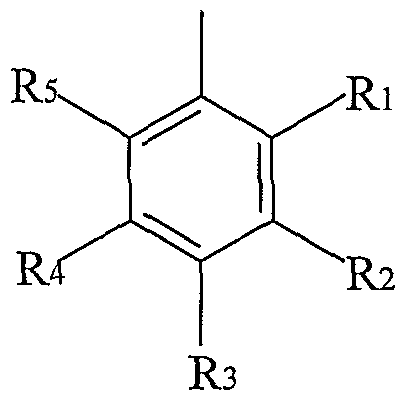
- Z is an aryl group selected from the group consisting of 1-naphthyl, substituted 1-naphthyl, 2-naphthyl, substituted 2-naphthyl, and phenyl groups with the structure
- R 1 , R 2 , R 3 , R 4 and R 5 are each independently selected from the group consisting of hydrogen, a C 1 -C 4 lower alkyl, a halogen, and an amino group selected from the group consisting OfNH 2 , NHR and NRR' where R and R' are each independently selected from the group consisting of a C 1 -C 4 lower alkyl, a phenyl, and an alkoxy group.
- C * is each independently selected from the group consisting of 13 C and 12 C with the proviso that at least one C * is 13 C, the methyl group includes either zero or three deuterium atoms
- Q is selected from the group consisting of sulfide, sulfinyl, and sulfone
- Z is an aryl group selected from the group consisting of 1-naphthyl, substituted 1-naphthyl, 2-naphthyl, substituted 2-naphthyl, and phenyl groups with the structure
- R 1 , R 2 , R 3 , R 4 and R 5 are each independently selected from the group consisting of hydrogen, a Ci-C 4 lower alkyl, a halogen, and an amino group from the group consisting OfNH 2 , NHR and NRR' where R and R' are each independently selected from the group consisting of a Ci-C 4 lower alkyl, a phenyl, and an alkoxy group.
- X is from the group Of-NR 6 R 7 and -OR 8 where Rg and R 7 are each independently selected from the group Of Ci-C 4 lower alkyl, alkoxy and aryl and R 8 is from the group Of Ci-C 4 lower alkyl, alkoxy and aryl, T is from the group Of-CH 3 , - CD 3 , -CH 2 -S-R 9 ,
- J is from the group Of -CH(OH)-CH 2 -S-R 9 , -CH(OH)-CH 2 -S(O)-R 9 , and -CH(OH)-CH 2 -(O)S(O)-R 9 where R 9 is an aryl group from the group of 1-naphthyl, substituted 1-na ⁇ hthyl, 2-naphthyl, substituted 2-naphthyl, and phenyl groups with the structure
- R 1 , R 2 , R 3 , R 4 and R 5 are each independently from the group of hydrogen, a C 1 -C 4 lower alkyl, a halogen, and an amino group from the group OfNH 2 , NHR and NRR' where R and R' are each independently from the group of a Ci-C 4 lower alkyl, a phenyl, and an alkoxy group, and C are each independently selected from the group consisting of 13 C and 12 C with the proviso that at least one C * is 13 C.
- the present invention still further provides processes of preparing the various compounds of the present invention. BRIEF DESCRIPTION OF THE DRAWINGS
- FIGURE 1 shows a synthetic route to [l- 13 C]pyruvic acid through the intermediate compounds of ⁇ -(phenyl sulfmyl) [l- 13 C]acetone and 1,1-dichloro-l- (phenylsulf ⁇ nyl) [ 1 - l3 C] acetone.
- FIGURE 2 shows another synthetic route to [l- 13 C]pyruvic acid through the intermediate compounds of [l- 13 C]propanamide, N, N, dimethyl, 3-[phenylthio]-2- OXO- and [l- 13 C]propanamide, N, N-dimethyl- ⁇ -hydroxy- ⁇ -(phenylsulfonyl) and [1- 13 C]propanamide, N, N-dimethyl-2-oxo-.
- the present invention is concerned with various labeled compounds useful for the ultimate preparation of the labeled compounds, [l- I3 C]pyruvic acid, [2- 13 C]pyruvic acid and [3- 13 C]pyruvic acid and the like, and/or preparation of other interesting products and to processes of preparing such labeled compounds.
- aryl means a monovalent monocyclic or bicyclic aromatic hydrocarbon radical of 6 to 10 ring atoms, and optionally substituted independently with one, two, three, four or five substituents selected from alkyl, haloalkyl, cycloalkyl, halo, nitro, cyano, -OR (where R is hydrogen, alkyl, haloalkyl, cycloalkyl, optionally substituted phenyl), acyl, and -COOR (where R is hydrogen or alkyl).
- aryl includes, but is not limited to, 1-na ⁇ hthyl, substituted 1-naphthyl, 2-naphthyl, substituted 2-naphthyl, and phenyl groups with the structure
- R 1 , R 2 , R 3 , R 4 and R 5 are each independently a lower alkyl, i.e., a Ci-C 4 alkyl such as methyl, ethyl, n-propyl, iso-propyl, butyl, isobutyl, and tert-butyl, a halogen such as chloro, bromo or iodo, an amino group such as NH 2 , NHR or NRR' where R and R 1 are each a lower alkyl or aryl as described above, or an alkoxy group such as O-alkyl or O- aryl where the alkyl is a lower alkyl as described above or an aiyl as described above.
- substituted is meant that the naphthyl group can include one or more substituents in place of a hydrogen atom, such substituents including the same as described for Ri - R 5 .
- C * is each independently selected from the group consisting of 13 C and 12 C with the proviso that at least one C * is 13 C
- the methylene group includes zero, one or two deuterium atoms
- the methyl group includes either zero or three deuterium atoms
- Q is selected from the group consisting of sulfide, sulfinyl, and sulfone
- Z is an a ⁇ yl group selected from the group consisting of 1 -naphthyl, substituted 1 -naphthyl, 2- naphthyl, substituted 2-naphthyl, and phenyl groups with the structure
- Ri, R 2 , R 3 , R 4 and R 5 are each independently selected from the group consisting of hydrogen, a Ci-C 4 lower alkyl, a halogen, and an amino group selected from the group consisting OfNH 2 , NHR and NRR' where R and R are each independently selected from the group consisting of a Cj-C 4 lower alkyl, a phenyl, and an alkoxy group.
- None of these enumerated species include deuterium in place of the hydrogens on the methylene group or deuterium in place of the hydrogens the methyl group.
- the particular species of the present invention can also include the above compounds and structures where the methylene group includes either one or two deuterium atoms in place of one or two of the hydrogen atoms.
- the particular species of the present invention can include the above compounds and structures where the methyl group includes three deuterium atoms in place of the three hydrogen atoms of the methyl groxip.
- C * is each independently selected from the group consisting of 13 C and 12 C with the proviso that at least one C * is 13 C, the methyl group includes either zero or three deuterium atoms, Q is selected from the group consisting of sulfide, sulfinyl, and sulfone, and Z is an aryl group selected from the group consisting of 1-naphthyl, substituted 1-naphthyl, 2-naphthyl, substituted 2-naphthyl, and phenyl groups with the structure
- R 1 , R 2 , R 3 , R 4 and R5 are each independently selected from the group consisting of hydrogen, a C 1 -C 4 lower alkyl, a halogen, and an amino group from the group consisting OfNH 2 , NHR and NRR' where R and R' are each independently selected from the group consisting of a Ci-C 4 lower alkyl, a phenyl, and an alkoxy group.
- None of these enumerated species include deuterium in place of the hydrogens on the methyl group.
- the particular species of the present invention can also include the above compounds and structures where the methyl group includes three deuterium atoms in place of the three hydrogen atoms of the methyl group.
- C * is each independently selected from the group consisting of 13 C and 12 C with the proviso that at least one C * is 13 C
- the methylene group includes zero or one deuterium atom
- the methyl group includes either zero or three deuterium atoms
- Q is selected from the group consisting of sulfide, sulfmyl, and sulfone
- Z is an aryl group selected from the group consisting of 1-naphthyl, substituted 1-naphthyl, 2- naphthyl, substituted 2-naphthyl, and phenyl groups with the structure
- R 1 , R 2 , R 3 , R 4 and R 5 are each independently selected from the group consisting of hydrogen, a Ci-C 4 lower alkyl, a halogen, and an amino group from the group consisting OfNH 2 , NHR and NRR' where R and R' are each independently selected from the group consisting of a Ci-C 4 lower alkyl, a phenyl, and an alkoxy group.
- None of these enumerated species include deuterium in place of the hydrogen on the methylene group or deuterium in place of the hydrogens on the methyl group.
- the particular species of the present invention can also include the above compounds and structures where the methylene group includes a deuterium atom in place of the hydrogen atom.
- the methyl group can include three deuterium atoms in place of the three hydrogen atoms of the methyl group. Availability of these described compounds such as l-chloro-l-(arylsulfinyl) [1-
- X is from the group Of-NRgR 7 and -OR 8 where R 6 and R 7 are each independently selected from the group Of Ci-C 4 lower alkyl, alkoxy and aryl and R 8 is from the group Of Ci-C 4 lower alkyl, alkoxy and aryl, T is from the group Of-CH 3 , - CD 3 , -CH 2 -S-R 9 , -CH 2 -S(O)-R 9 , and -CH 2 -(O)S(O)-R 9 , J is from the group of - CH(OH)-CH 2 -S-R 9 , -CH(OH)-CH 2 -S(O)-R 9 , and -CH(OH)-CH 2 -(O)S(O)-R 9 where R 9 is an aryl group from the group of 1-naphthyl, substituted 1-naphthyl, 2-naphthyl, substituted 2-naphthyl, and
- the reaction was stirred at -78°C for 1 hour and then the ice bath was removed. The reaction mixture was stirred overnight at room temperature. Water (40 ml) was added to the reaction mixture and the mixture was adjusted to pH 2.5 by addition of (IM) hydrochloric acid. The resultant product was extracted with three 100 ml portions of ethyl acetate. The organic layer was dried over sodium sulfate (Na 2 SO 4 ) and then evaporated to give a crude yield of 6.02 g. The crude product was dissolved into dichloromethane (60 ml) and this was extracted with three 100 ml portions of 1 M aqueous sodium hydroxide.
Landscapes
- Chemical & Material Sciences (AREA)
- Organic Chemistry (AREA)
- Organic Low-Molecular-Weight Compounds And Preparation Thereof (AREA)
Abstract
The present invention is directed to labeled compounds, of the formulae: (A, B, C) wherein C* is each independently selected from the group consisting of 13C and 12C with the proviso that at least one C* is 13C, each hydrogen of the methylene group can independently be either hydrogen or deuterium, the methyl group includes either zero or three deuterium atoms, Q is from the group of sulfide, sulfinyl, and sulfone, Z is an aryl group from the group of 1 -naphthyl, substituted 1-naphthyl, 2-naphthyl, substituted 2-naphthyl, and phenyl groups with the structure: (D) wherein R1, R2, R3, R4 and R5 are each independently from the group of hydrogen, a C1-C4 lower alkyl, a halogen, and an amino group from the group of NH2, NHR and NRR' where R and R' are each independently from the group of a C1-C4 lower alkyl, a phenyl, and an alkoxy group, and the methyl group can include either zero or three deuterium atoms. The present invention is also directed to labeled compounds of the formula: (E) or (F) where X is from the group of NR6R7 and -OR8 where R6 and R7 are each independently selected from the group of C1-C4 lower alkyl, alkoxy and aryl and R8 is from the group of C1-C4 lower alkyl, alkoxy and aryl, T is from the group of -CH3, - CD3, -CH2-S-R9, -CH2-S(O)-R9, and -CH2-(O)S(O)-R9, J is from the group of -CH(OH)-CH2-S-R9, -CH(OH)-CH2-S(O)-R9, and -CH(OH)-CH2-(O)S(O)-R9 where R9 is an aryl group from the group of 1-naphthyl, substituted 1-naphthyl, 2-naphthyl, substituted 2-naphthyl, and phenyl groups with the structure: (G) wherein R1, R2, R3, R4 and R5 are each independently from the group of hydrogen, a C1-C4 lower alkyl, a halogen, and an amino group from the group of NH2, NHR and NRR' where R and R' are each independently from the group of a Cl-C4 lower alkyl, a phenyl, and an alkoxy group, and C* are each independently selected from the group consisting of 13C and 12C with the proviso that at least one C* is 13C.
Description
SYNTHESIS OF [1-13C]PYRUVIC ACID], [2-13C]PYRUVIC ACID], [3- 13C]PYRUVIC ACID] AND COMBINATIONS THEREOF
STATEMENT REGARDING FEDERAL RIGHTS This invention was made with government support under Contract No. W-7405-
ENG-36 awarded by the U.S. Department of Energy. The government has certain rights in the invention.
FIELD OF THE INVENTION
The present invention relates to labeled compounds and more particularly to compounds labeled with carbon-13 and hydrogen-2.
BACKGROUND OF THE INVENTION
The use of isotopically labeled pyruvic acid is presently under study for use in medical diagnostics. Pyruvic acid is also known by the IUPAC name of propanoic acid, 2-oxo. For example, U.S. Published Patent Application 2003/0148533 describe 13C-labeled pyruvic acid as a Krebs cycle metabolite precursor for studies of metabolic fluxes in target organisms and U.S. Patent No. 6,329,208 describe use of 13C-labeled pyruvate in metabolic studies. There is a current need in preclinical trials for around 400 grams per year of isotopically labeled pyruvic acid. A projected quantity of over 500,000 grams per year is expected following potential approval. Unfortunately, the currently available [l-13C]pyruvic acid is quite expensive. For the diagnostic approach, to find wide usage, new synthetic routes to [l-I3C]pyruvic acid as well as [2- 13C]pyruvic acid and [3-13C]ρyruvic acid are needed.
SUMMARY OF THE INVENTION
In accordance with the purposes of the present invention, as embodied and broadly described herein, the present invention provides a labeled compound of the
O
H, "C*l-L
Z^
formula wherein C* is each independently selected from the group consisting of 13C and 12C with the proviso that at least one C* is 13C, the methylene group includes zero, one or two deuterium atoms, the methyl group includes either zero or three deuterium atoms, Q is selected from the group consisting of sulfide, sulfinyl, and sulfone, and Z is an aryl group selected from the group consisting of 1-naphthyl, substituted 1-naphthyl, 2-naphthyl, substituted 2-naphthyl, and phenyl groups with the structure

The present invention further provides a labeled compound of the formula
O
CI2C ■~C*H,
.Q
wherein C* is each independently selected from the group consisting of 13C and 12C with the proviso that at least one C* is 13C, the methyl group includes either zero or three deuterium atoms, Q is selected from the group consisting of sulfide, sulfinyl, and sulfone, and Z is an aryl group selected from the group consisting of 1-naphthyl, substituted 1-naphthyl, 2-naphthyl, substituted 2-naphthyl, and phenyl groups with the structure
 wherein R1, R2, R3, R4 and R5 are each independently selected from the group consisting of hydrogen, a Ci-C4 lower alkyl, a halogen, and an amino group from the group consisting OfNH2, NHR and NRR' where R and R' are each independently selected from the group consisting of a Ci-C4 lower alkyl, a phenyl, and an alkoxy group.
The present invention further provides a labeled compound of the formula

-CH2-S(O)-R9, and -CH2-(O)S(O)-R9, J is from the group Of -CH(OH)-CH2-S-R9, -CH(OH)-CH2-S(O)-R9, and -CH(OH)-CH2-(O)S(O)-R9 where R9 is an aryl group from the group of 1-naphthyl, substituted 1-naρhthyl, 2-naphthyl, substituted 2-naphthyl, and phenyl groups with the structure

The present invention still further provides processes of preparing the various compounds of the present invention. BRIEF DESCRIPTION OF THE DRAWINGS
FIGURE 1 shows a synthetic route to [l-13C]pyruvic acid through the intermediate compounds of α-(phenyl sulfmyl) [l-13C]acetone and 1,1-dichloro-l- (phenylsulfϊnyl) [ 1 - l3 C] acetone.
FIGURE 2 shows another synthetic route to [l-13C]pyruvic acid through the intermediate compounds of [l-13C]propanamide, N, N, dimethyl, 3-[phenylthio]-2- OXO- and [l-13C]propanamide, N, N-dimethyl-α-hydroxy-β-(phenylsulfonyl) and [1- 13C]propanamide, N, N-dimethyl-2-oxo-.
DETAILED DESCRIPTION
The present invention is concerned with various labeled compounds useful for the ultimate preparation of the labeled compounds, [l-I3C]pyruvic acid, [2-13C]pyruvic acid and [3-13C]pyruvic acid and the like, and/or preparation of other interesting products and to processes of preparing such labeled compounds.
As used herein, the term "aryl" means a monovalent monocyclic or bicyclic aromatic hydrocarbon radical of 6 to 10 ring atoms, and optionally substituted independently with one, two, three, four or five substituents selected from alkyl, haloalkyl, cycloalkyl, halo, nitro, cyano, -OR (where R is hydrogen, alkyl, haloalkyl, cycloalkyl, optionally substituted phenyl), acyl, and -COOR (where R is hydrogen or alkyl). More specifically, the term "aryl" includes, but is not limited to, 1-naρhthyl, substituted 1-naphthyl, 2-naphthyl, substituted 2-naphthyl, and phenyl groups with the structure

Selected embodiments of the present invention include labeled compounds of the formula

wherein C* is each independently selected from the group consisting of 13C and 12C with the proviso that at least one C* is 13C, the methylene group includes zero, one or two deuterium atoms, the methyl group includes either zero or three deuterium atoms, Q is selected from the group consisting of sulfide, sulfinyl, and sulfone, and Z is an aτyl group selected from the group consisting of 1 -naphthyl, substituted 1 -naphthyl, 2- naphthyl, substituted 2-naphthyl, and phenyl groups with the structure

Among particular species with these structures are included α-(arylsulfinyl) [1- 13C]acetone, α-(arylsulfinyl) [2-13C]acetone, α-(arylsulfinyl) [3-13C]acetone, α-
(arylsulfone) [l-13C]acetone, α-(arylsulfone) [2-13C]acetone, α-(arylsulfone) [3- 13C]acetone, α-(aiylsulfide) [l-13C]acetone, α-(arylsulfide) [2-13C]acetone, α- (arylsulfide) [3-13C]acetone, α-(arylsulfinyl) [l,2-13C]acetone, α-(arylsulfmyl) [2,3- 13C]acetone, α-(arylsulfinyl) [l,2,3-13C]acetone, α-(arylsulfone) [l,2-13C]acetone, α- (arylsulfone) [2,3-13C]acetone, α-(arylsulfone) [l,2,3-13C]acetone, α-(arylsulfide) [1,2- 13C]acetone, α-(arylsulfide) [2,3-I3C]acetone and α-(arylsulfide) [1,2,3-13C]. None of these enumerated species include deuterium in place of the hydrogens on the methylene group or deuterium in place of the hydrogens the methyl group. The particular species of the present invention can also include the above compounds and structures where the methylene group includes either one or two deuterium atoms in place of one or two of the hydrogen atoms. Also, the particular species of the present invention can include the above compounds and structures where the methyl group includes three deuterium atoms in place of the three hydrogen atoms of the methyl groxip.
Availability of these described compounds such as α-(arylsulfmyl) [l-13C]acetone, α-(arylsulfiϊiyl) [2-13C]acetone, α-(arylsulfmyl) [3-13C]acetone, α-(arylsulfinyl) [1,2- 13C]acetone, α-(arylsulfinyl) [2,3-13C]acetone, α-(arylsulfmyl) [l,2,3-I3C]acetone and the like, optionally where the methylene group includes either zero, one or two deuterium atoms and the methyl group includes either zero or three deuterium atoms will allow researchers to take advantage of the wealth of chemistry that has been done using such unlabeled acetones.
Other embodiments of the present invention also include labeled compounds of the formula

wherein C* is each independently selected from the group consisting of 13C and 12C with the proviso that at least one C* is 13C, the methyl group includes either zero or three deuterium atoms, Q is selected from the group consisting of sulfide, sulfinyl, and sulfone, and Z is an aryl group selected from the group consisting of 1-naphthyl,
substituted 1-naphthyl, 2-naphthyl, substituted 2-naphthyl, and phenyl groups with the structure

Availability of these described compounds such as l,l-dichloro-l-(arylsulfinyl) [l-13C]acetone, 1,1-dichloro-l -(arylsulfmyl) [2-13C]acetone, 1,1-dichloro-l- (arylsulfmyl) [3-I3C]acetone, 1,1-dichloro-l -(arylsulfmyl) [l,2-13C]acetone, 1,1- dichloro-l -(arylsulfmyl) [2,3-13C]acetone, 1,1-dichloro-l -(arylsulfmyl) [1,2,3- 13C]acetone and the like, optionally where the methyl group includes either zero or
three deuterium atoms, will similarly allow researchers to take advantage of the wealth of chemistry that has been done using such unlabeled acetones.
Still other embodiments of the present invention also include labeled compounds of the formula

wherein C* is each independently selected from the group consisting of 13C and 12C with the proviso that at least one C* is 13C, the methylene group includes zero or one deuterium atom, the methyl group includes either zero or three deuterium atoms, Q is selected from the group consisting of sulfide, sulfmyl, and sulfone, and Z is an aryl group selected from the group consisting of 1-naphthyl, substituted 1-naphthyl, 2- naphthyl, substituted 2-naphthyl, and phenyl groups with the structure

13C]acetone, l-chloro-l-(arylsulfmyl) [2-I3C]acetone, l-chloro-l-(arylsulfmyl) [3- 13C]acetone, l-chloro-l-(arylsulfmyl) [l,2-13C]acetone, l-chloro-l-(arylsulfmyl) [2,3- 13C]acetone, l-chloro-l-(arylsulfinyl) [l,2,3-13C]acetone and the like, optionally where the methylene group includes either zero or one deuterium atoms and the methyl group includes either zero or three deuterium atoms, will similarly allow researchers to take advantage of the wealth of chemistry that has been done using such unlabeled acetones. Still other embodiments of the present invention include labeled compounds of the formula


The present invention is more particularly described in the following examples which are intended as illustrative only, since numerous modifications and variations will be apparent to those skilled in the art. Example 1
Synthesis of isotopically labeled α-(phenyl sulfinyl) [l-13C]acetone was as follows. Benzene, (methyl- 13C-sulfϊnyi) (4.28 grams (g), 0.03 moles) was dissolved into tetrahydrofuran (THF) (42 milliliters (ml). This solution was cooled to -780C with a dry ice/isopropanol bath. To the cooled solution, lithium diisopropylamide (2M, 32 ml, 0.064 moles) was added slowly. Methyl acetate (2.25 g, 0.03 moles) was added neat to the reaction. The reaction was stirred at -78°C for 1 hour and then the ice bath was removed. The reaction mixture was stirred overnight at room temperature. Water (40 ml) was added to the reaction mixture and the mixture was adjusted to pH 2.5 by addition of (IM) hydrochloric acid. The resultant product was extracted with three 100 ml portions of ethyl acetate. The organic layer was dried over sodium sulfate (Na2SO4) and then evaporated to give a crude yield of 6.02 g. The crude product was dissolved into dichloromethane (60 ml) and this was extracted with three 100 ml portions of 1 M aqueous sodium hydroxide. The layers were separated and the aqueous base phase was
acidified to pH 2.5 by addition of hydrochloric acid. The aqueous layer was extracted with three 60 ml portions of dichloromethane, dried over sodium sulfate and evaporated to yield 4.8 g of α-(phenyl sulfmyl) [l-13C]acetone. The product was used in the subsequent reaction without further purification. Example 2
Synthesis of [1-13C] propanoic acid, 2-oxo-, ethyl ester and [l-13C]propanoic acid, 2-oxo- were as follows from α-(phenyl sulfmyl) [l-13C]acetone from Example 1. The α-(phenyl sulfmyl) [l-13C]acetone (4.5 g, 0.024 moles) was dissolved into dichloromethane (45 ml)and to this sulfuryl chloride (6.96 g, 0.051 moles) was added slowly. The l,l-dichloro-l-(phenylsulfinyl)[l-13C]acetone was formed in about 1 hour. The solvent was evaporated and to the residue was added ethanolΛvater (90/10, 45 ml) and the reaction mixture was heated to reflux for 12 hours. After this period the reaction showed a mixture of 80% [l-13C]propanoic acid, 2-oxo-, ethyl ester and 20% [l-13C]propanoic acid, 2-oxo-. This material was treated with (IM) hydrochloric acid (60 mL) and heated to give a sole product of the [l-13C]propanoic acid, 2-oxo-. The [1- 13C]propanoic acid, 2-oxo- was dissolved into water and the pH adjusted to about 6.3 by addition of IM sodium hydroxide. The water was evaporated and then ethanol was added to the solid residue. This was evaporated to yield dry [l-I3C]propanoic acid, 2- OXO-, sodium salt. Example 3
Synthesis of [l-13C]propanamide, N, N, dimethyl, 3-[ρhenylthio]-2-oxo- (compound 6 in Fig. 2) was as follows. Methyl phenyl sulfoxide (4.02g, 0.0287 moles), prepared in accordance with the description of U.S. Patent No. 6,753,446, was dissolved into THF (60 mL). This solution was cooled to -780C and to it was added lithium diisopropyl amide (1.5M, 21.0 mL 0.0316 moles). The mixture was stirred for 1 hour and then [2-13C]acetic acid, 2-(dimethylamino)-2-oxo-, ethyl ester (5g, 0.0287 moles) was added. The cooling bath was removed and the reaction was allowed to come to room temperature. The reaction was complete after 3 hours and was then treated with aqueous HCl (IM, about 20-30 mL). The reaction mixture was then extracted with ethyl acetate (3 X 100 mL) and the organic was dried over sodium sulfate and evaporated to give 5.51 g of product. The product was purified by dry column chromatography using an ethyl acetate / hexane mixture (70:30 v/v).
Example 4
Synthesis of [l-I3C]propanamide, N, N-dimethyl-α-hydroxy-β-(phenylsulfonyl) (compound 7 in Fig. 2) was as follows. The [l-13C]propanamide, N, N, dimethyl, 3- [phenylthio] -2-oxo- from example 3 (5.5 Ig, 0.0206 moles) was dissolved into ethanol (50 mL). This solution was cooled in an ice bath and to it was added sodium borohydride (0.78g, 0.0206 moles) which had been dissolved in water (15 mL). The reaction was stirred for 1 hour and then acidified to pH 3 (using IM HCl) and extracted with ethyl acetate to yield the compound of [l-13C]propanamide, N,N-dimethyl-α- hydroxy-β-(phenylsulfonyl) in quantitative yield. The product was used in the subsequent reaction with purification.
Example 5
Synthesis of [l-13C]propanamide, N, N-dimethyl-2-oxo- (compound 8 in Fig. 2) was as follows. The propanamide, N, N-dimethyl-α-hydroxy-β-(phenylsulfonyl) from example 4 was heated to 1000C as a neat solid and the product of [l-13C]propanamide, N, N-dimethyl-2-oxo- was distilled over under vacuum. Product yield was 80%.
Example 6
Synthesis of [l-13C]propanoic acid, 2-oxo- (compound 9 in Fig. 2) was as follows. The [l-13C]propanamide, N, N-dimethyl-2-oxo- (Ig) was hydrolyzed to the compound of [l-13C]propanoic acid, 2-oxo- by heating to reflux in IM hydrochloric acid (15 mL). Product yield was 93%.
Although the present invention has been described with reference to specific details, it is not intended that such details should be regarded as limitations upon the scope of the invention, except as and to the extent that they are included in the accompanying claims.
Claims
1. A labeled compound of the formula

wherein C* is each independently selected from the group consisting of 13C and 12C with the proviso that at least one C* is 13C, the methylene group includes zero, one or two deuterium atoms, the methyl group includes either zero or three deuterium atoms, Q is selected from the group consisting of sulfide, sulfmyl, and sulfone, and Z is an aryl group selected from the group consisting of 1-naphthyl, substituted 1-naphthyl, 2- naphthyl, substituted 2-naphthyl, and phenyl groups with the structure

2. The compound of claim 1 wherein said Z is selected from the group consisting of phenyl groups with the structure  wherein R1, R2, R3, R4 and R5 are each independently selected from the group consisting of hydrogen, a C1-C4 lower alkyl, a halogen, and an amino group from the group consisting OfNH2, NHR and NRR' where R and R' are each independently selected from the group consisting of a Cj-C4 lower alkyl, a phenyl, and an alkoxy group.
3. The compound of claim 1 wherein Z is phenyl.
4. The compound of claim 1 wherein the methylene group within said compound includes exactly one deuterium atom.
5. The compound of claim 1 wherein said methylene group within said compound includes exactly two deuterium atoms.
6. A labeled compound of the formula
O
CI2C* ^C*H
z^Q
wherein C* is each independently selected from the group consisting of 13C and 12C with the proviso that at least one C* is 13C, the methyl group includes either zero or three deuterium atoms, Q is selected from the group consisting of sulfide, sulfinyl, and sulfone, and Z is an aryl group selected from the group consisting of 1-naphthyl, substituted 1-naphthyl, 2-naρhthyl, substituted 2-naphthyl, and phenyl groups with the structure  wherein R1, R2, R3, R4 and R5 are each independently selected from the group consisting of hydrogen, a Ci-C4 lower alkyl, a halogen, and an amino group from the group consisting OfNH2, NHR and NRR' where R and R' are each independently selected from the group consisting of a Cj-C4 lower alkyl, a phenyl, and an alkoxy group.
7. The compound of claim 6 wherein Z is selected from the group consisting of phenyl groups with the structure

8. The compound of claim 6 wherein Z is phenyl.
9. A labeled compoiind of the formula 
wherein C* is each independently selected from the group consisting of 13C and 12C with the proviso that at least one C* is 13C, the methylene group includes zero or one deuterium atom, the methyl group includes either zero or three deuterium atoms, Q is selected from the group consisting of sulfide, sulfinyl, and sulfone, and Z is an aryl group selected from the group consisting of 1-naphthyl, substituted 1-naphthyl, 2- naphthyl, substituted 2-naphthyl, and phenyl groups with the structure

10. The compound of claim 9 wherein Z is selected from the group consisting of phenyl groups with the structure

11. The compound of claim 9 wherein Z is phenyl.
12. A labeled compound of the formula

-CH2-S-R9, -CH2-S(O)-R9, and -CH2-(O)S(O)-R9 where R9 is an aryl group selected from the group consisting of 1-naphthyl, substituted 1-naphthyl, 2-naphthyl, substituted
2-naphthyl, and phenyl groups with the structure

13. The compound of claim 12 wherein said aryl is selected from the group consisting of phenyl groups with the structure  wherein R1, R2, R3, R4 and R5 are each independently selected from the group consisting of hydrogen, a Ci -C4 lower alkyl, a halogen, and an amino group from the group consisting OfNH2, NHR and NRR' where R and R1 are each independently selected from the group consisting of a CpC4 lower alkyl, a phenyl, and an alkoxy group.
14. The compound of claim 12 wherein said aryl is phenyl.
15. A labeled compound of the formula


16. The compound of claim 15 wherein said R9 is selected from the group consisting of phenyl groups with the structure
17. The compound of claim 15 wherein said R9 is phenyl.
Applications Claiming Priority (2)
| Application Number | Priority Date | Filing Date | Title |
|---|---|---|---|
| US11/052,589 | 2005-02-07 | ||
| US11/052,589 US7582801B2 (en) | 2005-02-07 | 2005-02-07 | Synthesis of [1-13C]pyruvic acid], [2-13C]pyruvic acid], [3-13C]pyruvic acid] and combinations thereof |
Publications (1)
| Publication Number | Publication Date |
|---|---|
| WO2007092007A1 true WO2007092007A1 (en) | 2007-08-16 |
Family
ID=36780788
Family Applications (1)
| Application Number | Title | Priority Date | Filing Date |
|---|---|---|---|
| PCT/US2006/004435 Ceased WO2007092007A1 (en) | 2005-02-07 | 2006-02-07 | Synthesis of [1-13 c]pyruvic acid, [2-13c]pyruvic acid, [3-13c]pyruvic acid and combinations thereof |
Country Status (2)
| Country | Link |
|---|---|
| US (3) | US7582801B2 (en) |
| WO (1) | WO2007092007A1 (en) |
Cited By (1)
| Publication number | Priority date | Publication date | Assignee | Title |
|---|---|---|---|---|
| WO2012032106A1 (en) | 2010-09-10 | 2012-03-15 | Solvay Specialty Polymers Italy S.P.A. | Method for transferring heat |
Families Citing this family (6)
| Publication number | Priority date | Publication date | Assignee | Title |
|---|---|---|---|---|
| US7321049B2 (en) * | 2005-11-04 | 2008-01-22 | Los Alamos National Security, Llc | Synthesis of [13C] and [2H] substituted methacrylic acid, [13C] and [2H] substituted methyl methacrylate and/or related compounds |
| US20080171893A1 (en) * | 2006-07-11 | 2008-07-17 | Spectra Gases, Inc. | Isotopically labeled alpha-keto acids and esters |
| US8217202B2 (en) * | 2007-04-11 | 2012-07-10 | New Mexico Highlands University | Single carbon precursor synthons |
| US9822046B1 (en) | 2016-05-19 | 2017-11-21 | Chevron U.S.A. Inc. | Farnesane alkylation |
| US10093594B2 (en) | 2016-05-19 | 2018-10-09 | Chevron U.S.A. Inc. | High viscosity index lubricants by isoalkane alkylation |
| WO2023197522A1 (en) | 2022-04-13 | 2023-10-19 | 深圳市中核海得威生物科技有限公司 | Method for synthesizing carbon isotope-labeled pyruvic acid |
Family Cites Families (6)
| Publication number | Priority date | Publication date | Assignee | Title |
|---|---|---|---|---|
| US3910955A (en) * | 1970-12-21 | 1975-10-07 | Aspro Nicholas Ltd | Benzothiophene-ethylamines |
| US3700772A (en) * | 1971-05-17 | 1972-10-24 | American Cyanamid Co | Phenylthiovinyl phosphorothioates as insecticides and acaricides |
| US6541671B1 (en) * | 2002-02-13 | 2003-04-01 | The Regents Of The University Of California | Synthesis of 2H- and 13C-substituted dithanes |
| US7256047B2 (en) * | 2001-05-01 | 2007-08-14 | Board Of Regents, The University Of Texas System | Measurement of gluconeogenesis and intermediary metabolism using stable isotopes |
| US6753446B1 (en) * | 2003-06-05 | 2004-06-22 | The Regents Of The University Of California | Synthesis of labeled oxalic acid derivatives |
| US7321070B2 (en) * | 2003-07-30 | 2008-01-22 | Los Alamos National Security, Llc | Synthesis of isotopically labeled R- or S-[13C, 2H] glycerols |
-
2005
- 2005-02-07 US US11/052,589 patent/US7582801B2/en not_active Expired - Fee Related
-
2006
- 2006-02-07 WO PCT/US2006/004435 patent/WO2007092007A1/en not_active Ceased
-
2008
- 2008-07-22 US US12/220,234 patent/US8198484B2/en not_active Expired - Fee Related
-
2009
- 2009-09-01 US US12/552,135 patent/US20100069675A1/en not_active Abandoned
Non-Patent Citations (2)
| Title |
|---|
| CHOUDHRY S.C. ET AL.: "Methyl Phenyl Solfone: A Novel reagent for General and Facile Carbon-14 Labeling", J. ORG. CHEM., vol. 54, 1989, pages 3755 - 3757, XP002409364 * |
| MARTINEZ R.A. ET AL.: "Large scale Preparation of [13C] Methyl Phenyl Sulfone from [13C]Methanol by a One Step Process", ORGANIC PROCESS RESEARCH & DEVELOPMENT, vol. 6, 2002, pages 851 - 854, XP002967522 * |
Cited By (1)
| Publication number | Priority date | Publication date | Assignee | Title |
|---|---|---|---|---|
| WO2012032106A1 (en) | 2010-09-10 | 2012-03-15 | Solvay Specialty Polymers Italy S.P.A. | Method for transferring heat |
Also Published As
| Publication number | Publication date |
|---|---|
| US20100069675A1 (en) | 2010-03-18 |
| US20090030232A1 (en) | 2009-01-29 |
| US8198484B2 (en) | 2012-06-12 |
| US7582801B2 (en) | 2009-09-01 |
| US20060178534A1 (en) | 2006-08-10 |
Similar Documents
| Publication | Publication Date | Title |
|---|---|---|
| US8198484B2 (en) | Synthesis of [1-13C]pyruvic acid], [2-13C]pyruvic acid], [3-13C]pyruvic acid] and combinations thereof | |
| US6541671B1 (en) | Synthesis of 2H- and 13C-substituted dithanes | |
| CN104755456B (en) | The preparation method of optically active bicyclo-gamma-amino acid derivative | |
| BR112013031360B1 (en) | Method to make a compound | |
| BRPI0907417B1 (en) | PROCESS FOR SELECTIVE DEPROTATION AND FUNCTIONALIZATION OF 1-FLUORO-2-SUBSTITUTED-3-CHLOROBENZENES | |
| US6215005B1 (en) | Intermediates and process for the preparation thereof | |
| BR112013031365B1 (en) | METHOD FOR PRODUCING A COMPOUND | |
| PT85476B (en) | PROCESS FOR THE PREPARATION OF SUBSTITUTED PHENYL BUTENAMIDE DERIVATIVES | |
| CN107573267A (en) | Alkyl sulfonyl fluorine compounds, its preparation method and application containing trifluoromethyl | |
| JPS63183558A (en) | 8-thio-octanoic acid | |
| US7321049B2 (en) | Synthesis of [13C] and [2H] substituted methacrylic acid, [13C] and [2H] substituted methyl methacrylate and/or related compounds | |
| JP3947242B2 (en) | Novel gem-difluoro derivatives of phenylacetamide and phenylacetic acid and their pharmaceutical use | |
| CA2623350A1 (en) | Process for the stereoselective preparation of (-)-halofenate and intermediates thereof | |
| US6764673B2 (en) | Synthesis of [2H1, 13C], [2H2, 13C] and [2H3, 13C]methyl aryl sulfones and sulfoxides | |
| US6753446B1 (en) | Synthesis of labeled oxalic acid derivatives | |
| US8034982B2 (en) | Isotopically tagged synons from 2 carbon precursors | |
| CN100430358C (en) | The synthetic method of 4-chlorobutyl methyl ether | |
| US7321070B2 (en) | Synthesis of isotopically labeled R- or S-[13C, 2H] glycerols | |
| BRPI0917511B1 (en) | PROCESS FOR THE PREPARATION OF ALDEHYDE, KETONES, ESTERS AND SULPHONES REPLACED WITH ALKYLTHIUM | |
| KR100974140B1 (en) | Quaternary Trifluoromethylcyclohexane Derivatives for Liquid Crystals | |
| JPS60185761A (en) | 7-thiaprostaglandin e1 compound and its preparation | |
| BR9913012B1 (en) | process for preparing a compound, and, compound. | |
| BR112019008238B1 (en) | PROCESSES FOR PREPARING PESTICIDE COMPOUNDS | |
| Martinez et al. | Synthesis of labeled oxalic acid derivatives | |
| CA2154423A1 (en) | Phosphorylated derivatives of compositions having anti-inflammatory or analgesic activity and a method for the preparation thereof |
Legal Events
| Date | Code | Title | Description |
|---|---|---|---|
| NENP | Non-entry into the national phase |
Ref country code: DE |
|
| DPE2 | Request for preliminary examination filed before expiration of 19th month from priority date (pct application filed from 20040101) | ||
| 121 | Ep: the epo has been informed by wipo that ep was designated in this application | ||
| 122 | Ep: pct application non-entry in european phase |
Ref document number: 06734591 Country of ref document: EP Kind code of ref document: A1 |