WO2007082829A1 - Lubricating compositions based on perfluoropolyethers - Google Patents
Lubricating compositions based on perfluoropolyethers Download PDFInfo
- Publication number
- WO2007082829A1 WO2007082829A1 PCT/EP2007/050245 EP2007050245W WO2007082829A1 WO 2007082829 A1 WO2007082829 A1 WO 2007082829A1 EP 2007050245 W EP2007050245 W EP 2007050245W WO 2007082829 A1 WO2007082829 A1 WO 2007082829A1
- Authority
- WO
- WIPO (PCT)
- Prior art keywords
- polymer
- weight
- equal
- different
- component
- Prior art date
- Legal status (The legal status is an assumption and is not a legal conclusion. Google has not performed a legal analysis and makes no representation as to the accuracy of the status listed.)
- Ceased
Links
Classifications
-
- C—CHEMISTRY; METALLURGY
- C10—PETROLEUM, GAS OR COKE INDUSTRIES; TECHNICAL GASES CONTAINING CARBON MONOXIDE; FUELS; LUBRICANTS; PEAT
- C10M—LUBRICATING COMPOSITIONS; USE OF CHEMICAL SUBSTANCES EITHER ALONE OR AS LUBRICATING INGREDIENTS IN A LUBRICATING COMPOSITION
- C10M169/00—Lubricating compositions characterised by containing as components a mixture of at least two types of ingredient selected from base-materials, thickeners or additives, covered by the preceding groups, each of these compounds being essential
- C10M169/02—Mixtures of base-materials and thickeners
-
- C—CHEMISTRY; METALLURGY
- C10—PETROLEUM, GAS OR COKE INDUSTRIES; TECHNICAL GASES CONTAINING CARBON MONOXIDE; FUELS; LUBRICANTS; PEAT
- C10M—LUBRICATING COMPOSITIONS; USE OF CHEMICAL SUBSTANCES EITHER ALONE OR AS LUBRICATING INGREDIENTS IN A LUBRICATING COMPOSITION
- C10M145/00—Lubricating compositions characterised by the additive being a macromolecular compound containing oxygen
- C10M145/18—Macromolecular compounds obtained otherwise than by reactions only involving carbon-to-carbon unsaturated bonds
- C10M145/22—Polyesters
-
- C—CHEMISTRY; METALLURGY
- C10—PETROLEUM, GAS OR COKE INDUSTRIES; TECHNICAL GASES CONTAINING CARBON MONOXIDE; FUELS; LUBRICANTS; PEAT
- C10M—LUBRICATING COMPOSITIONS; USE OF CHEMICAL SUBSTANCES EITHER ALONE OR AS LUBRICATING INGREDIENTS IN A LUBRICATING COMPOSITION
- C10M145/00—Lubricating compositions characterised by the additive being a macromolecular compound containing oxygen
- C10M145/18—Macromolecular compounds obtained otherwise than by reactions only involving carbon-to-carbon unsaturated bonds
- C10M145/24—Polyethers
-
- C—CHEMISTRY; METALLURGY
- C10—PETROLEUM, GAS OR COKE INDUSTRIES; TECHNICAL GASES CONTAINING CARBON MONOXIDE; FUELS; LUBRICANTS; PEAT
- C10M—LUBRICATING COMPOSITIONS; USE OF CHEMICAL SUBSTANCES EITHER ALONE OR AS LUBRICATING INGREDIENTS IN A LUBRICATING COMPOSITION
- C10M149/00—Lubricating compositions characterised by the additive being a macromolecular compound containing nitrogen
- C10M149/12—Macromolecular compounds obtained otherwise than by reactions only involving carbon-to-carbon unsaturated bonds
- C10M149/14—Macromolecular compounds obtained otherwise than by reactions only involving carbon-to-carbon unsaturated bonds a condensation reaction being involved
- C10M149/18—Polyamides
-
- C—CHEMISTRY; METALLURGY
- C10—PETROLEUM, GAS OR COKE INDUSTRIES; TECHNICAL GASES CONTAINING CARBON MONOXIDE; FUELS; LUBRICANTS; PEAT
- C10M—LUBRICATING COMPOSITIONS; USE OF CHEMICAL SUBSTANCES EITHER ALONE OR AS LUBRICATING INGREDIENTS IN A LUBRICATING COMPOSITION
- C10M151/00—Lubricating compositions characterised by the additive being a macromolecular compound containing sulfur, selenium or tellurium
- C10M151/04—Macromolecular compounds obtained otherwise than by reactions only involving carbon-to-carbon unsaturated bonds
-
- C—CHEMISTRY; METALLURGY
- C10—PETROLEUM, GAS OR COKE INDUSTRIES; TECHNICAL GASES CONTAINING CARBON MONOXIDE; FUELS; LUBRICANTS; PEAT
- C10M—LUBRICATING COMPOSITIONS; USE OF CHEMICAL SUBSTANCES EITHER ALONE OR AS LUBRICATING INGREDIENTS IN A LUBRICATING COMPOSITION
- C10M169/00—Lubricating compositions characterised by containing as components a mixture of at least two types of ingredient selected from base-materials, thickeners or additives, covered by the preceding groups, each of these compounds being essential
- C10M169/04—Mixtures of base-materials and additives
- C10M169/041—Mixtures of base-materials and additives the additives being macromolecular compounds only
-
- C—CHEMISTRY; METALLURGY
- C10—PETROLEUM, GAS OR COKE INDUSTRIES; TECHNICAL GASES CONTAINING CARBON MONOXIDE; FUELS; LUBRICANTS; PEAT
- C10M—LUBRICATING COMPOSITIONS; USE OF CHEMICAL SUBSTANCES EITHER ALONE OR AS LUBRICATING INGREDIENTS IN A LUBRICATING COMPOSITION
- C10M2201/00—Inorganic compounds or elements as ingredients in lubricant compositions
- C10M2201/04—Elements
- C10M2201/041—Carbon; Graphite; Carbon black
-
- C—CHEMISTRY; METALLURGY
- C10—PETROLEUM, GAS OR COKE INDUSTRIES; TECHNICAL GASES CONTAINING CARBON MONOXIDE; FUELS; LUBRICANTS; PEAT
- C10M—LUBRICATING COMPOSITIONS; USE OF CHEMICAL SUBSTANCES EITHER ALONE OR AS LUBRICATING INGREDIENTS IN A LUBRICATING COMPOSITION
- C10M2201/00—Inorganic compounds or elements as ingredients in lubricant compositions
- C10M2201/06—Metal compounds
- C10M2201/061—Carbides; Hydrides; Nitrides
-
- C—CHEMISTRY; METALLURGY
- C10—PETROLEUM, GAS OR COKE INDUSTRIES; TECHNICAL GASES CONTAINING CARBON MONOXIDE; FUELS; LUBRICANTS; PEAT
- C10M—LUBRICATING COMPOSITIONS; USE OF CHEMICAL SUBSTANCES EITHER ALONE OR AS LUBRICATING INGREDIENTS IN A LUBRICATING COMPOSITION
- C10M2201/00—Inorganic compounds or elements as ingredients in lubricant compositions
- C10M2201/06—Metal compounds
- C10M2201/061—Carbides; Hydrides; Nitrides
- C10M2201/0616—Carbides; Hydrides; Nitrides used as thickening agents
-
- C—CHEMISTRY; METALLURGY
- C10—PETROLEUM, GAS OR COKE INDUSTRIES; TECHNICAL GASES CONTAINING CARBON MONOXIDE; FUELS; LUBRICANTS; PEAT
- C10M—LUBRICATING COMPOSITIONS; USE OF CHEMICAL SUBSTANCES EITHER ALONE OR AS LUBRICATING INGREDIENTS IN A LUBRICATING COMPOSITION
- C10M2201/00—Inorganic compounds or elements as ingredients in lubricant compositions
- C10M2201/06—Metal compounds
- C10M2201/065—Sulfides; Selenides; Tellurides
- C10M2201/066—Molybdenum sulfide
-
- C—CHEMISTRY; METALLURGY
- C10—PETROLEUM, GAS OR COKE INDUSTRIES; TECHNICAL GASES CONTAINING CARBON MONOXIDE; FUELS; LUBRICANTS; PEAT
- C10M—LUBRICATING COMPOSITIONS; USE OF CHEMICAL SUBSTANCES EITHER ALONE OR AS LUBRICATING INGREDIENTS IN A LUBRICATING COMPOSITION
- C10M2201/00—Inorganic compounds or elements as ingredients in lubricant compositions
- C10M2201/10—Compounds containing silicon
- C10M2201/102—Silicates
- C10M2201/1026—Silicates used as thickening agents
-
- C—CHEMISTRY; METALLURGY
- C10—PETROLEUM, GAS OR COKE INDUSTRIES; TECHNICAL GASES CONTAINING CARBON MONOXIDE; FUELS; LUBRICANTS; PEAT
- C10M—LUBRICATING COMPOSITIONS; USE OF CHEMICAL SUBSTANCES EITHER ALONE OR AS LUBRICATING INGREDIENTS IN A LUBRICATING COMPOSITION
- C10M2201/00—Inorganic compounds or elements as ingredients in lubricant compositions
- C10M2201/10—Compounds containing silicon
- C10M2201/105—Silica
- C10M2201/1056—Silica used as thickening agents
-
- C—CHEMISTRY; METALLURGY
- C10—PETROLEUM, GAS OR COKE INDUSTRIES; TECHNICAL GASES CONTAINING CARBON MONOXIDE; FUELS; LUBRICANTS; PEAT
- C10M—LUBRICATING COMPOSITIONS; USE OF CHEMICAL SUBSTANCES EITHER ALONE OR AS LUBRICATING INGREDIENTS IN A LUBRICATING COMPOSITION
- C10M2207/00—Organic non-macromolecular hydrocarbon compounds containing hydrogen, carbon and oxygen as ingredients in lubricant compositions
- C10M2207/10—Carboxylix acids; Neutral salts thereof
- C10M2207/12—Carboxylix acids; Neutral salts thereof having carboxyl groups bound to acyclic or cycloaliphatic carbon atoms
- C10M2207/121—Carboxylix acids; Neutral salts thereof having carboxyl groups bound to acyclic or cycloaliphatic carbon atoms having hydrocarbon chains of seven or less carbon atoms
- C10M2207/123—Carboxylix acids; Neutral salts thereof having carboxyl groups bound to acyclic or cycloaliphatic carbon atoms having hydrocarbon chains of seven or less carbon atoms polycarboxylic
-
- C—CHEMISTRY; METALLURGY
- C10—PETROLEUM, GAS OR COKE INDUSTRIES; TECHNICAL GASES CONTAINING CARBON MONOXIDE; FUELS; LUBRICANTS; PEAT
- C10M—LUBRICATING COMPOSITIONS; USE OF CHEMICAL SUBSTANCES EITHER ALONE OR AS LUBRICATING INGREDIENTS IN A LUBRICATING COMPOSITION
- C10M2207/00—Organic non-macromolecular hydrocarbon compounds containing hydrogen, carbon and oxygen as ingredients in lubricant compositions
- C10M2207/10—Carboxylix acids; Neutral salts thereof
- C10M2207/12—Carboxylix acids; Neutral salts thereof having carboxyl groups bound to acyclic or cycloaliphatic carbon atoms
- C10M2207/125—Carboxylix acids; Neutral salts thereof having carboxyl groups bound to acyclic or cycloaliphatic carbon atoms having hydrocarbon chains of eight up to twenty-nine carbon atoms, i.e. fatty acids
- C10M2207/127—Carboxylix acids; Neutral salts thereof having carboxyl groups bound to acyclic or cycloaliphatic carbon atoms having hydrocarbon chains of eight up to twenty-nine carbon atoms, i.e. fatty acids polycarboxylic
-
- C—CHEMISTRY; METALLURGY
- C10—PETROLEUM, GAS OR COKE INDUSTRIES; TECHNICAL GASES CONTAINING CARBON MONOXIDE; FUELS; LUBRICANTS; PEAT
- C10M—LUBRICATING COMPOSITIONS; USE OF CHEMICAL SUBSTANCES EITHER ALONE OR AS LUBRICATING INGREDIENTS IN A LUBRICATING COMPOSITION
- C10M2209/00—Organic macromolecular compounds containing oxygen as ingredients in lubricant compositions
- C10M2209/10—Macromolecular compoundss obtained otherwise than by reactions only involving carbon-to-carbon unsaturated bonds
- C10M2209/102—Polyesters
-
- C—CHEMISTRY; METALLURGY
- C10—PETROLEUM, GAS OR COKE INDUSTRIES; TECHNICAL GASES CONTAINING CARBON MONOXIDE; FUELS; LUBRICANTS; PEAT
- C10M—LUBRICATING COMPOSITIONS; USE OF CHEMICAL SUBSTANCES EITHER ALONE OR AS LUBRICATING INGREDIENTS IN A LUBRICATING COMPOSITION
- C10M2209/00—Organic macromolecular compounds containing oxygen as ingredients in lubricant compositions
- C10M2209/10—Macromolecular compoundss obtained otherwise than by reactions only involving carbon-to-carbon unsaturated bonds
- C10M2209/102—Polyesters
- C10M2209/1026—Polyesters use as thickening agent
-
- C—CHEMISTRY; METALLURGY
- C10—PETROLEUM, GAS OR COKE INDUSTRIES; TECHNICAL GASES CONTAINING CARBON MONOXIDE; FUELS; LUBRICANTS; PEAT
- C10M—LUBRICATING COMPOSITIONS; USE OF CHEMICAL SUBSTANCES EITHER ALONE OR AS LUBRICATING INGREDIENTS IN A LUBRICATING COMPOSITION
- C10M2209/00—Organic macromolecular compounds containing oxygen as ingredients in lubricant compositions
- C10M2209/10—Macromolecular compoundss obtained otherwise than by reactions only involving carbon-to-carbon unsaturated bonds
- C10M2209/103—Polyethers, i.e. containing di- or higher polyoxyalkylene groups
-
- C—CHEMISTRY; METALLURGY
- C10—PETROLEUM, GAS OR COKE INDUSTRIES; TECHNICAL GASES CONTAINING CARBON MONOXIDE; FUELS; LUBRICANTS; PEAT
- C10M—LUBRICATING COMPOSITIONS; USE OF CHEMICAL SUBSTANCES EITHER ALONE OR AS LUBRICATING INGREDIENTS IN A LUBRICATING COMPOSITION
- C10M2209/00—Organic macromolecular compounds containing oxygen as ingredients in lubricant compositions
- C10M2209/10—Macromolecular compoundss obtained otherwise than by reactions only involving carbon-to-carbon unsaturated bonds
- C10M2209/103—Polyethers, i.e. containing di- or higher polyoxyalkylene groups
- C10M2209/1036—Polyethers, i.e. containing di- or higher polyoxyalkylene groups used as thickening agents
-
- C—CHEMISTRY; METALLURGY
- C10—PETROLEUM, GAS OR COKE INDUSTRIES; TECHNICAL GASES CONTAINING CARBON MONOXIDE; FUELS; LUBRICANTS; PEAT
- C10M—LUBRICATING COMPOSITIONS; USE OF CHEMICAL SUBSTANCES EITHER ALONE OR AS LUBRICATING INGREDIENTS IN A LUBRICATING COMPOSITION
- C10M2211/00—Organic non-macromolecular compounds containing halogen as ingredients in lubricant compositions
- C10M2211/003—Organic non-macromolecular compounds containing halogen as ingredients in lubricant compositions used as base material
-
- C—CHEMISTRY; METALLURGY
- C10—PETROLEUM, GAS OR COKE INDUSTRIES; TECHNICAL GASES CONTAINING CARBON MONOXIDE; FUELS; LUBRICANTS; PEAT
- C10M—LUBRICATING COMPOSITIONS; USE OF CHEMICAL SUBSTANCES EITHER ALONE OR AS LUBRICATING INGREDIENTS IN A LUBRICATING COMPOSITION
- C10M2213/00—Organic macromolecular compounds containing halogen as ingredients in lubricant compositions
- C10M2213/003—Organic macromolecular compounds containing halogen as ingredients in lubricant compositions used as base material
-
- C—CHEMISTRY; METALLURGY
- C10—PETROLEUM, GAS OR COKE INDUSTRIES; TECHNICAL GASES CONTAINING CARBON MONOXIDE; FUELS; LUBRICANTS; PEAT
- C10M—LUBRICATING COMPOSITIONS; USE OF CHEMICAL SUBSTANCES EITHER ALONE OR AS LUBRICATING INGREDIENTS IN A LUBRICATING COMPOSITION
- C10M2213/00—Organic macromolecular compounds containing halogen as ingredients in lubricant compositions
- C10M2213/04—Organic macromolecular compounds containing halogen as ingredients in lubricant compositions obtained from monomers containing carbon, hydrogen, halogen and oxygen
- C10M2213/043—Organic macromolecular compounds containing halogen as ingredients in lubricant compositions obtained from monomers containing carbon, hydrogen, halogen and oxygen used as base material
-
- C—CHEMISTRY; METALLURGY
- C10—PETROLEUM, GAS OR COKE INDUSTRIES; TECHNICAL GASES CONTAINING CARBON MONOXIDE; FUELS; LUBRICANTS; PEAT
- C10M—LUBRICATING COMPOSITIONS; USE OF CHEMICAL SUBSTANCES EITHER ALONE OR AS LUBRICATING INGREDIENTS IN A LUBRICATING COMPOSITION
- C10M2213/00—Organic macromolecular compounds containing halogen as ingredients in lubricant compositions
- C10M2213/06—Perfluoro polymers
- C10M2213/0606—Perfluoro polymers used as base material
-
- C—CHEMISTRY; METALLURGY
- C10—PETROLEUM, GAS OR COKE INDUSTRIES; TECHNICAL GASES CONTAINING CARBON MONOXIDE; FUELS; LUBRICANTS; PEAT
- C10M—LUBRICATING COMPOSITIONS; USE OF CHEMICAL SUBSTANCES EITHER ALONE OR AS LUBRICATING INGREDIENTS IN A LUBRICATING COMPOSITION
- C10M2213/00—Organic macromolecular compounds containing halogen as ingredients in lubricant compositions
- C10M2213/06—Perfluoro polymers
- C10M2213/062—Polytetrafluoroethylene [PTFE]
- C10M2213/0626—Polytetrafluoroethylene [PTFE] used as thickening agents
-
- C—CHEMISTRY; METALLURGY
- C10—PETROLEUM, GAS OR COKE INDUSTRIES; TECHNICAL GASES CONTAINING CARBON MONOXIDE; FUELS; LUBRICANTS; PEAT
- C10M—LUBRICATING COMPOSITIONS; USE OF CHEMICAL SUBSTANCES EITHER ALONE OR AS LUBRICATING INGREDIENTS IN A LUBRICATING COMPOSITION
- C10M2217/00—Organic macromolecular compounds containing nitrogen as ingredients in lubricant compositions
- C10M2217/04—Macromolecular compounds from nitrogen-containing monomers obtained otherwise than by reactions only involving carbon-to-carbon unsaturated bonds
- C10M2217/044—Polyamides
-
- C—CHEMISTRY; METALLURGY
- C10—PETROLEUM, GAS OR COKE INDUSTRIES; TECHNICAL GASES CONTAINING CARBON MONOXIDE; FUELS; LUBRICANTS; PEAT
- C10M—LUBRICATING COMPOSITIONS; USE OF CHEMICAL SUBSTANCES EITHER ALONE OR AS LUBRICATING INGREDIENTS IN A LUBRICATING COMPOSITION
- C10M2217/00—Organic macromolecular compounds containing nitrogen as ingredients in lubricant compositions
- C10M2217/04—Macromolecular compounds from nitrogen-containing monomers obtained otherwise than by reactions only involving carbon-to-carbon unsaturated bonds
- C10M2217/044—Polyamides
- C10M2217/0446—Polyamides used as thickening agents
-
- C—CHEMISTRY; METALLURGY
- C10—PETROLEUM, GAS OR COKE INDUSTRIES; TECHNICAL GASES CONTAINING CARBON MONOXIDE; FUELS; LUBRICANTS; PEAT
- C10M—LUBRICATING COMPOSITIONS; USE OF CHEMICAL SUBSTANCES EITHER ALONE OR AS LUBRICATING INGREDIENTS IN A LUBRICATING COMPOSITION
- C10M2221/00—Organic macromolecular compounds containing sulfur, selenium or tellurium as ingredients in lubricant compositions
- C10M2221/006—Organic macromolecular compounds containing sulfur, selenium or tellurium as ingredients in lubricant compositions used as thickening agents
-
- C—CHEMISTRY; METALLURGY
- C10—PETROLEUM, GAS OR COKE INDUSTRIES; TECHNICAL GASES CONTAINING CARBON MONOXIDE; FUELS; LUBRICANTS; PEAT
- C10M—LUBRICATING COMPOSITIONS; USE OF CHEMICAL SUBSTANCES EITHER ALONE OR AS LUBRICATING INGREDIENTS IN A LUBRICATING COMPOSITION
- C10M2221/00—Organic macromolecular compounds containing sulfur, selenium or tellurium as ingredients in lubricant compositions
- C10M2221/04—Macromolecular compounds obtained otherwise than by reactions only involving carbon-to-carbon unsaturated bonds
-
- C—CHEMISTRY; METALLURGY
- C10—PETROLEUM, GAS OR COKE INDUSTRIES; TECHNICAL GASES CONTAINING CARBON MONOXIDE; FUELS; LUBRICANTS; PEAT
- C10M—LUBRICATING COMPOSITIONS; USE OF CHEMICAL SUBSTANCES EITHER ALONE OR AS LUBRICATING INGREDIENTS IN A LUBRICATING COMPOSITION
- C10M2223/00—Organic non-macromolecular compounds containing phosphorus as ingredients in lubricant compositions
- C10M2223/08—Organic non-macromolecular compounds containing phosphorus as ingredients in lubricant compositions having phosphorus-to-nitrogen bonds
-
- C—CHEMISTRY; METALLURGY
- C10—PETROLEUM, GAS OR COKE INDUSTRIES; TECHNICAL GASES CONTAINING CARBON MONOXIDE; FUELS; LUBRICANTS; PEAT
- C10N—INDEXING SCHEME ASSOCIATED WITH SUBCLASS C10M RELATING TO LUBRICATING COMPOSITIONS
- C10N2010/00—Metal present as such or in compounds
- C10N2010/12—Groups 6 or 16
-
- C—CHEMISTRY; METALLURGY
- C10—PETROLEUM, GAS OR COKE INDUSTRIES; TECHNICAL GASES CONTAINING CARBON MONOXIDE; FUELS; LUBRICANTS; PEAT
- C10N—INDEXING SCHEME ASSOCIATED WITH SUBCLASS C10M RELATING TO LUBRICATING COMPOSITIONS
- C10N2020/00—Specified physical or chemical properties or characteristics, i.e. function, of component of lubricating compositions
- C10N2020/01—Physico-chemical properties
-
- C—CHEMISTRY; METALLURGY
- C10—PETROLEUM, GAS OR COKE INDUSTRIES; TECHNICAL GASES CONTAINING CARBON MONOXIDE; FUELS; LUBRICANTS; PEAT
- C10N—INDEXING SCHEME ASSOCIATED WITH SUBCLASS C10M RELATING TO LUBRICATING COMPOSITIONS
- C10N2020/00—Specified physical or chemical properties or characteristics, i.e. function, of component of lubricating compositions
- C10N2020/01—Physico-chemical properties
- C10N2020/04—Molecular weight; Molecular weight distribution
-
- C—CHEMISTRY; METALLURGY
- C10—PETROLEUM, GAS OR COKE INDUSTRIES; TECHNICAL GASES CONTAINING CARBON MONOXIDE; FUELS; LUBRICANTS; PEAT
- C10N—INDEXING SCHEME ASSOCIATED WITH SUBCLASS C10M RELATING TO LUBRICATING COMPOSITIONS
- C10N2020/00—Specified physical or chemical properties or characteristics, i.e. function, of component of lubricating compositions
- C10N2020/01—Physico-chemical properties
- C10N2020/055—Particles related characteristics
- C10N2020/06—Particles of special shape or size
-
- C—CHEMISTRY; METALLURGY
- C10—PETROLEUM, GAS OR COKE INDUSTRIES; TECHNICAL GASES CONTAINING CARBON MONOXIDE; FUELS; LUBRICANTS; PEAT
- C10N—INDEXING SCHEME ASSOCIATED WITH SUBCLASS C10M RELATING TO LUBRICATING COMPOSITIONS
- C10N2030/00—Specified physical or chemical properties which is improved by the additive characterising the lubricating composition, e.g. multifunctional additives
- C10N2030/08—Resistance to extreme temperature
-
- C—CHEMISTRY; METALLURGY
- C10—PETROLEUM, GAS OR COKE INDUSTRIES; TECHNICAL GASES CONTAINING CARBON MONOXIDE; FUELS; LUBRICANTS; PEAT
- C10N—INDEXING SCHEME ASSOCIATED WITH SUBCLASS C10M RELATING TO LUBRICATING COMPOSITIONS
- C10N2050/00—Form in which the lubricant is applied to the material being lubricated
- C10N2050/10—Form in which the lubricant is applied to the material being lubricated semi-solid; greasy
Definitions
- the present invention relates to the use of non fluorinated aromatic polymers as additives for fluorinated lubricants.
- the present invention relates to fluorinated lubricant compositions having improved thermal stability at high temperatures in oxidizing environment and in the presence of metals, in particular at temperatures higher than 200 0 C.
- the present invention relates to the use of polymers containing aromatic rings as additives to stabilize perfluoropolyether oils in lubricant compositions at high temperatures in oxidizing environment and in the presence of metals, preferably at temperatures higher than 200 0 C.
- the stabilizing additives for perfluoropolyether oils are generally fluorinated compounds and contain in their molecule fluorinated chains, preferably perfluoropolyether chains, in order to be solubilized and/or dispersed in the perfluoropolyether oils.
- USP 4,681 ,693 describes soluble stabilizers having a structure formed of arylphosphines, or their derivatives, for perfluoropolyether lubricants or perfluoropolyether containing greases.
- EP 597,369 describes perfluoropolyether-based phosphazene derivatives stabilizers for perfluoropolyether oils.
- Patent application US 2003/0203823 describes perfluoropolyethers having dinitroaryl end groups or stabilizers for fluorinated lubricants.
- the prior art fluorinated additives are liquid and generally are used in fluorinated lubricating compositions in amounts generally ranging between 1% and 10% by weight.
- the higher the additive amount the higher the stabilization in the time and thus higher the lubricant life.
- the amount of additive is about 1% by weight in the applications wherein the part to be lubricated can be subjected to high peak temperatures for short times but the service temperature is not particularly high. For more severe applications wherein a continued use at high temperatures, higher than 200 0 C, is required, it is necessary to increase the additive amount, generally to values higher than about 5% by weight.
- the drawback of using liquid stabilizing additives in high amounts in the preparation of fluorinated greases resides in that the ratios between the liquid component of the grease (the oil plus additive) and the solid component of the grease (the thickener) are changed. High amount increase of the liquid causes an increase of the liquid separation from the solid as the temperature increases, thus changing the initial grease consistency. The oil separation becomes significant at temperatures higher than 200 0 C. Furthermore, as the working temperatures increase, the liquid additives tend to evaporate more easily.
- perfluoropolyether lubricants showing the following combination of properties: capability to stabilize perfluoropolyether oils and perfluoropolyether-based greases at high temperatures in oxidizing envrironment and in the presence of metals, preferably at temperatures higher than 200°C; reduction of the separation of the fluorinated oil in greases; solid at service temperature.
- the Applicant has unexpectedly and surprisingly found particular additives capable to solve the above technical problem.
- An object of the present invention is the use of a solid polymer at room temperature having a softening or a melting point higher than 150 0 C, preferably higher than 200 0 C, and containing in repeating unit at least one aromatic ring, preferably in the backbone, as additive to stabilize fluorinated lubricants, preferably perfluoropolyether oils at high temperatures, preferably higher than 200 0 C.
- the aromatic polymer is preferably selected from non fluorinated polymers, solid at room temperature, having a softening or a melting point higher than 200 0 C and containing in the repeating unit at least one aromatic ring, optionally substituted.
- the polymer can be selected for example from the following classes: (a) polyarylensulphides, among which it can for example be mentioned:
- PPS is preferably used.
- R and R' are equal to or different from each other and can be H, CH 3 or C 6 H 5 .
- PEK polyetherketone
- XydarTM marketed by Solvay Advanced Polymers is preferred, (g) Polyarylamides, polyphthalamides (PPA) for example those having the structure of Nylon 6/6 but with an aryl group instead of the -(CH 2 ) 4 - group in the starting adipic acid, for example AmodelTM.
- PPA polyphthalamides
- the molecular weight (or the number average molecular weight) of the polymer is in the range 500-100,000, preferably 1 ,000-50,000, more preferably 1 ,500- 30,000; n is an integer such as to obtain the above molecular weight.
- the above polymers are solid at room temperature and are in powder form, having an average size preferably in the range 0.1 ⁇ m-1 ,000 ⁇ m, more preferably 50 ⁇ m-300 ⁇ m, still more preferably 1 ⁇ m-30 ⁇ m. It is surprising and unexpected that non fluorinated polymers as defined above, and thus not containing fluorinated chains, in particular perfluopolyether chains, are able to stabilize fluorinated oils, in particular perfluoropolyether oils at high temperatures in the presence of metals in oxidizing environment.
- the polymers of the invention are used in amounts between 0.1% and 50% by weight, preferably between 1% and 10% by weight, more preferably between 2% and 7% by weight.
- a further object of the present invention are fluorinated lubricant compositions comprising (% by weight):
- D) from 0% to 10%, preferably between 1% and 5% based on the total amount of A), B) and C), of at least one additive selected from the known antirust, antiwear, antioxidizing, pour point depressant additives of the prior art; the sum of A), B) 1 C) and D) is 100% by weight.
- Component A) is preferably selected from the following classes:
- X is equal to F or CF 3 ;
- E and E' are selected from CF 3 , C 2 F 5 or C 3 F 7 , one fluorine atom of one or both the end groups can be substituted by Cl and/or H; m 1 and n' are integers such that the ratio m'/n' is between 20 and 1 ,000, n' being different from zero; the fluorooxyalkylene units being statistically distributed along the chain and the viscosity of the polymer being in the above range.
- polymers can be obtained by photooxidation of perfluoropropene as described in GB 1 ,104,432 and subsequent conversion of the end groups as described in GB 1 ,226,566.
- D is equal to -C 2 F 5 or -C 3 F 7 , one fluorine atom of one or both the end groups can be substituted by Cl and/or H; o' is an integer such that the viscosity of the polymer is in the above range.
- These polymers can be prepared by ionic oligomerization of the perfluoropropylenoxide and subsequent treatment with fluorine as described in USP 3,242,218.
- polymers can be obtained by ionic telomerization of the perfluoropropylenoxide and subsequent photochemical dimerization as reported in USP 3,214,478.
- X is equal to F or CF 3 ;
- E and E' equal to or different from each other, are as above; q', r' and s' are integers, including zero, and such that the viscosity of the polymer is in the above range.
- E and E' equal to or dfferent from each other, are as above; t' and u' are integers such that the t'/u' ratio is between 0.1 and 5; u' being different from zero and the viscosity of the polymer being in the above range.
- v' is an integer such that the viscosity of the polymer is in the above range.
- D and D' are selected between C 2 F 5 or C 3 F 7 , one fluorine atom of one or both the end groups can be substituted by Cl and/or H; z' is an integer such that the viscosity of the polymer is in the above range.
- Ei and E 2 are perfluoroalkyl end groups equal to or different from each other, having formula -(CF 2 ) Z CF 3 wherein z is an integer from 0 to 3; n, m, p, q are integers, equal to or different from each other, between 0 and
- (p+q)/(m+n+p+q) is between 0.05 and 0.2 when (m+n+p+q) is different from zero; n/(n+m+p+q) is between 0.05 and 0.40 when (n+m+p+q) is different from zero.
- the preferred perfluoropolyether oils are those of the classes (1), (4), (5), (8) or their mixtures and are available on the market with the trademark FOMBLI N® and marketed by Solvay Solexis S.p.A.
- Component B when present, can be selected from the thickneners known in the prior art for perfluoropolyether oils, for example talc, silica, boron nitride, PTFE, or mixtures thereof.
- silica when used, the amounts generally range from 1% to 10% by weight with respect to the total of the composition; when talc, boron nitride or PTFE are used, the amounts can range from 5% to 40% by weight with respect to the total, more preferably from 5% to 35%.
- PTFE in powder is used as component B), more preferably PTFE having an average particle size between 0.01 ⁇ m and 0.3 ⁇ m.
- the PTFE can be obtained by the known polymerization techniques, in particular by microemulsion, emulsion or dispersion. Furthermre, it can also be subjected to irradiation. Known processes for preparing said polymer are described in patent application US 2005/0075250 and in patents US 4,864,006, US 6,297,334, US 6,576,703.
- Component C) is the above defined aromatic polymer.
- the above polymers of the classes from (a) to (g) are marketed by Solvay Advanced Polymers (SAP).
- the amount of component C) preferably ranges from 0.1% to 10% by weight, more preferably from 2% to 7% with respect to the perfluoropolyether oil, when it is used as additive in the lubricant compositions.
- Component C) can be present in larger amounts, up to 50% when it is used in greases not containing thickeners.
- Component D) is preferably selected from the known additives of the prior art, for example it can be mentioned, as antiwear additives, molybdenum sulphide, molybdenum organic compounds, boron nitride, graphite, phosphazene derivatives, in particular phosphazene derivatives as those described in USP 5,124,058 and in patent application US 2003/0176738 in the name of the Applicant.
- antirust additives the disodic sebacate, functionalized derivatives of carboxylic acids, as described in USP 6,025,307, can be mentioned.
- compositions of the present invention can be in the form of oils or greases.
- the lubricant compositions of the present invention are prepared according to the prior art procedures.
- a preferred embodiment for preparing a grease comprises the following steps: charging of the oil and/or mixture of lubricating oils in a mixer and degassing under vacuum at 60 0 C for 2 hours at 0.1 mbar; gradual addition of components B) and C), previously mixed, until reaching the desired composition; optional addition of component D); stirring for at least 8 hours under vacuum; discharge of the obtained mixture and its refining by passage on tricylindrical refiner.
- component D) When component D) is liquid, it is premixed in the oil(s) before the addition of the solid components B) and C); when component D) is solid, it is premixed with components B) and C).
- the grease obtained by the present process is ready to be used.
- the grease consistency depends on the total concentration of B) and C).
- B) and C) in the above concentration ranges all the greases of the penetration NLGI classes can be obtained, as defined in the ASTM D217 method.
- the lubricating compositions of the present invention show an improved thermal stability, in particular in applications where a continuous service temperature higher than 200 0 C, in the presence of metals and in oxidizing environment, is required.
- the lubricating compositions of the invention can be in the form of oils or greases.
- component C) is also able to thicken the perfluoropolyether oils.
- component B) is absent, the compositions of the present invention are under the form of greases when C) is in amounts higher than 10%.
- Component C) can also be a polymer having a low number molecular weight polymer (oligomer), generally lower than 500, and thus appearing in the form of a liquid. Also in this case the additive C) is capable to stabilize the perfluoropolyether oil in oxidizing environment and in the presence of metals when used in grease compositions.
- oligomer low number molecular weight polymer
- the test is carried out according to the ASTM D 217 standard.
- the so prepared composition is deposited by a stratifying knife in a glass capsule having a 95 mm diameter, so as to uniformly cover the whole exposed surface.
- the capsule is then placed in a drier for 30', then weighed and put in stove at a determined temperature (>200°C). After a predetermined time the capsule is taken off from the stove and it is allowed to cool in the drier. The capsule is then weighed again and the percent weight loss with respect to the initial weight is evaluated.
- the test result is thus expressed as percent weight loss with respect to the initial weight ( ⁇ P%).
- the oil separatin is determined according to the FMTS 791-321 method at 204 0 C for 30 h.
- test is carried out according to the ASTM D2266 standard, by using a 40 kg f load at 75°C for 1 hour.
- the test is carried out according to the ASTM D 2596 standard.
- the test supplies a series of data concerning the performances of the lubricants tested under a high load ranging from 40 kg f to 794 kg f .
- the Weld Point (WP), or welding point, is particularly significant: it represents the load corresponding to the welding of the four metal balls used in the test and thus to their mechanical yielding due to the local overheating generated by their friction.
- a composition of the invention is prepared by mixing 332.5 g of component A) formed of a perfluoroplyether oil of class (5), commercially known as Fomblin® M30, 142.5 g of component B) formed of PTFE in powder, commercially known as Algoflon® L206, and 25 g of powder of component C) formed of the polymer of the class a) having the following structure:
- a homogeneous grease is obtained which shows a penetration value of 285 mm/10'.
- the grease is then subjected to the thermooxidative stability test in the presence of metals carried out at 250 0 C.
- Example 1 is repeated, wherein at the place of component C), 25 g of the stabilizing additive having a perfluoropolyether basis described in the Example 1 of patent application US 2003/203,823, are used, of formula
- a homogeneous grease is obtained showing a penetration value of 290 mm/10'.
- the grease is then subjected to the thermooxidative stability test in the presence of metals carried out at 250 0 C. After 24 h a percent weight loss of 0.1% is determined. After 72 h a loss of 0.3% is determined.
- Example 1 is repeated, without component C).
- the grease is then subjected to the thermooxidative stability test in the presence of metals carried out at 25O 0 C. After 24 h a loss of 48.2% is determined. After 72 h a loss of 58%, corresponding to the almost total loss of component A) is determined.
- the oil separation test resulted equal to 7.5% by weight.
- Example 1 is repeated, wherein component C) is selected in the class (b) and corresponds to the poly(2,6-diphenyl-1 ,4-phenylenoxide), having melting point of 460 0 C, commercially known as Tenax®-TA 80/100.
- a homogeneous grease showing a penetration value of 278 mm/10' is obtained.
- the grease is then subjected to the thermooxidative stability test in the presence of metals carried out at 250 0 C. After 24 h a percent weight loss of 1.3% is determined.
- a homogeneous grease showing a penetration value of 281 mm/10' is obtained.
- the grease is then subjected to the thermooxidative stability test in the presence of metals carried out at 250°C. After 24 h a percent weight loss of 1.6% is determined.
- Example 1 is repeated, wherein component C) is selected in the class (f), commercially known as Xydar® SRT-400, having melting point of about 370 0 C.
- component C) is selected in the class (f), commercially known as Xydar® SRT-400, having melting point of about 370 0 C.
- a homogeneous grease showing a penetration value of 282 mm/10' is obtained.
- the grease is then subjected to the thermooxidative stability test in the presence of metals carried out at 250 0 C. After 24 h a percent weight loss of 0.6% is determined.
- a composition of the invention is prepared by mixing 640 g of component A) formed of a pei ⁇ uoropolyether oil of class (5), commercially known as Fomblin® M30, and 360 g of component C) formed of the same polymer described in the Example 1.
- a homogeneous grease is obtained which is characterized as penetration, oil separation, wear, E. P. 4-ball wear.
- Example 7 is repeated, wherein component C) is absent, by using 700 g of the oil of the Example 1 and 300 g of polytetrafluorethylene (PTFE) commercially known as Algoflon® L206.
- PTFE polytetrafluorethylene
Landscapes
- Chemical & Material Sciences (AREA)
- Chemical Kinetics & Catalysis (AREA)
- General Chemical & Material Sciences (AREA)
- Oil, Petroleum & Natural Gas (AREA)
- Organic Chemistry (AREA)
- Lubricants (AREA)
Abstract
Use as additive to stabilize perfluoropolyether lubricant oils at high temperatures, preferably higher than 200°C, of a solid polymer at room temperature, having a softening or a melting point higher than 150°C, preferably higher than 200°C, and containing in the repeating unit at least one aromatic ring, preferably in the backbone, and lubricating compositions containing said additive.
Description
LUBRICATING COMPOSITIONS BASED ON PERFLUOROPOLYETHERS
The present invention relates to the use of non fluorinated aromatic polymers as additives for fluorinated lubricants.
More specifically the present invention relates to fluorinated lubricant compositions having improved thermal stability at high temperatures in oxidizing environment and in the presence of metals, in particular at temperatures higher than 2000C.
In particular the present invention relates to the use of polymers containing aromatic rings as additives to stabilize perfluoropolyether oils in lubricant compositions at high temperatures in oxidizing environment and in the presence of metals, preferably at temperatures higher than 2000C.
It is known that perfluoropolyether oils (PFPE) at high temperatures in the presence of metals and in oxidizing environment suffer degradative processes causing the break of the perfluoropolyether chains producing volatile products. Therefore the loss of the lubricating performances of the perfluoropolyether oil or of the grease containing the perfluoropolyether oil occurs.
For overcoming this drawback numerous known additives in the prior art are generally used to stabilize the perfluoropolyether oils at high temperatures in oxidizing environment and in the presence of metals thus guaranteeing their stability during the use.
The stabilizing additives for perfluoropolyether oils are generally fluorinated compounds and contain in their molecule fluorinated chains, preferably perfluoropolyether chains, in order to be solubilized and/or dispersed in the perfluoropolyether oils. Some examples of said known additives of the prior art can be mentioned.
USP 4,681 ,693 describes soluble stabilizers having a structure formed of arylphosphines, or their derivatives, for perfluoropolyether lubricants or perfluoropolyether containing greases.
EP 597,369 describes perfluoropolyether-based phosphazene derivatives stabilizers for perfluoropolyether oils.
Patent application US 2003/0203823 describes perfluoropolyethers having dinitroaryl end groups or stabilizers for fluorinated lubricants.
The prior art fluorinated additives are liquid and generally are used in fluorinated lubricating compositions in amounts generally ranging between 1% and 10% by weight. The higher the additive amount the higher the stabilization in the time and thus higher the lubricant life. The amount of additive is about 1% by weight in the applications wherein the part to be lubricated can be subjected to high peak temperatures for short times but the service temperature is not particularly high. For more severe applications wherein a continued use at high temperatures, higher than 2000C, is required, it is necessary to increase the additive amount, generally to values higher than about 5% by weight.
The drawback of using liquid stabilizing additives in high amounts in the preparation of fluorinated greases resides in that the ratios between the liquid component of the grease (the oil plus additive) and the solid component of the grease (the thickener) are changed. High amount increase of the liquid causes an increase of the liquid separation from the solid as the temperature increases, thus changing the initial grease consistency. The oil separation becomes significant at temperatures higher than 2000C. Furthermore, as the working temperatures increase, the liquid additives tend to evaporate more easily.
The need was felt to have available additives for fluorinated lubricants, in particular perfluoropolyether lubricants showing the following combination of properties: capability to stabilize perfluoropolyether oils and perfluoropolyether-based greases at high temperatures in oxidizing envrironment and in the presence of metals, preferably at temperatures higher than 200°C; reduction of the separation of the fluorinated oil in greases; solid at service temperature.
The Applicant has unexpectedly and surprisingly found particular additives capable to solve the above technical problem.
An object of the present invention is the use of a solid polymer at room temperature having a softening or a melting point higher than 1500C, preferably
higher than 2000C, and containing in repeating unit at least one aromatic ring, preferably in the backbone, as additive to stabilize fluorinated lubricants, preferably perfluoropolyether oils at high temperatures, preferably higher than 2000C.
The aromatic polymer is preferably selected from non fluorinated polymers, solid at room temperature, having a softening or a melting point higher than 2000C and containing in the repeating unit at least one aromatic ring, optionally substituted. The polymer can be selected for example from the following classes: (a) polyarylensulphides, among which it can for example be mentioned:
( polyphenylensulphidef ppg )


PPS is preferably used.
These products are commercially available or can be prepared according to known techniques of the prior art, see as a reference "Encyclopedia of Polymer Science", Chapter 32, pages 543-560. (b) Polyphenylenoxides, among which it can for example be mentioned:
(polyphenyloxide , PPO)

These products are commercially available or can be prepared according to known techniques of the prior art, see as reference "Encyclopedia of Polymer Science", Chapter 28, pages 473-481. (c) Polyarylketones, among which it can for example be mentioned:
(polyetlieretherketone, PEEK)

(polyetherketone, PEK)
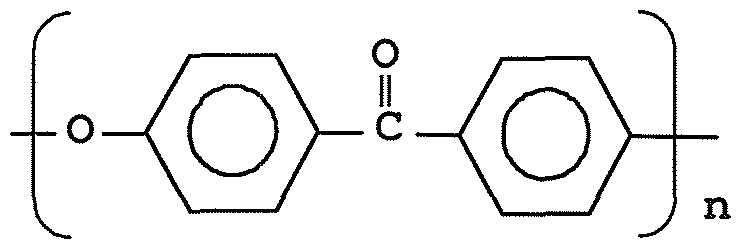
These products are commercially available or can be prepared according to known techniques of the prior art, see as reference "Encyclopedia of Polymer Science and Engineering", volume 12, pages 313-319; vol.6, pages 103-104. (d) Polyarylsulphones, among which it can for example be mentioned:


These products are commercially available or they can be prepared according to known techniques of the prior art, see as reference "Encyclopedia of Polymer Science and Engineering", volume 13, pages 196-197.
(e) Polyamidoimides, among which it can for example be mentioned:
(polyamidoimide, PAI )

These products are commercially available or they can be prepared according to known techniques of the prior art, see as reference "Encyclopedia of Polymer
Science and Engineering", volume 6, pages 104-105. (T) Aromatic polyesters and aromatic poly(ester-carbonates), containing repeating units for example of the type
-Ar-COO-; -OCO-Ar-COO-; -Ar-COOR; wherein the aromatic group Ar can be partially substituted.
Xydar™ marketed by Solvay Advanced Polymers is preferred, (g) Polyarylamides, polyphthalamides (PPA) for example those having the structure of Nylon 6/6 but with an aryl group instead of the -(CH2)4- group in the starting adipic acid, for example Amodel™.
Generally the molecular weight (or the number average molecular weight) of the polymer is in the range 500-100,000, preferably 1 ,000-50,000, more preferably 1 ,500- 30,000; n is an integer such as to obtain the above molecular weight.
The above polymers are solid at room temperature and are in powder form, having an average size preferably in the range 0.1 μm-1 ,000 μm, more preferably 50 μm-300 μm, still more preferably 1 μm-30 μm.
It is surprising and unexpected that non fluorinated polymers as defined above, and thus not containing fluorinated chains, in particular perfluopolyether chains, are able to stabilize fluorinated oils, in particular perfluoropolyether oils at high temperatures in the presence of metals in oxidizing environment.
The polymers of the invention are used in amounts between 0.1% and 50% by weight, preferably between 1% and 10% by weight, more preferably between 2% and 7% by weight.
A further object of the present invention are fluorinated lubricant compositions comprising (% by weight):
A) from 99.9% to 50% of a perfluoropolyether oil or mixture of perfluoropolyether oils, having kinematic viscosity at 200C between 10 and 4,000 cSt, preferably between 30 and 2,000 cSt and comprising at least one of the following repeating units: -(CFXO)-, wherein X is equal to F, CF3; -(CF2CF2O)-, -(C3F6O)-, -(CF2CF2CF2O)-, -(CF2CF2-CF2CF2O)- statistically distributed along the polymer backbone;
B) from 0% to 50%, preferably between 5% and 40%, of one or more thickening agents;
C) from 0.1% to 50%, preferably between 1% and 10%, of the above solid polymers object of the present invention; optionally
D) from 0% to 10%, preferably between 1% and 5% based on the total amount of A), B) and C), of at least one additive selected from the known antirust, antiwear, antioxidizing, pour point depressant additives of the prior art; the sum of A), B)1 C) and D) is 100% by weight.
Component A) is preferably selected from the following classes:
(1 ) E-O-(CF2CF(CF3)OMCFXO)n- CFXO-E' wherein:
X is equal to F or CF3;
E and E', equal to or different from each other, are selected from CF3, C2F5 or C3F7, one fluorine atom of one or both the end groups can be substituted by Cl and/or H;
m1 and n' are integers such that the ratio m'/n' is between 20 and 1 ,000, n' being different from zero; the fluorooxyalkylene units being statistically distributed along the chain and the viscosity of the polymer being in the above range.
These polymers can be obtained by photooxidation of perfluoropropene as described in GB 1 ,104,432 and subsequent conversion of the end groups as described in GB 1 ,226,566.
(2) C3F7O(CF(CF3)CF2O)0-D wherein:
D is equal to -C2F5 or -C3F7, one fluorine atom of one or both the end groups can be substituted by Cl and/or H; o' is an integer such that the viscosity of the polymer is in the above range. These polymers can be prepared by ionic oligomerization of the perfluoropropylenoxide and subsequent treatment with fluorine as described in USP 3,242,218.
(3) (C3F7O(CF(CF3)CF2O)P-CF(CF3H2 wherein: p' is an integer such that the viscosity of the polymer is in the above range, one F atom of one or both the end groups C3F7 can be substituted by Cl and/or
H.
These polymers can be obtained by ionic telomerization of the perfluoropropylenoxide and subsequent photochemical dimerization as reported in USP 3,214,478.
(4) E-O-(CF2CF(CF3)O)q(C2F4O)KCFXO)s~ CFXO -E1 wherein:
X is equal to F or CF3;
E and E', equal to or different from each other, are as above; q', r' and s' are integers, including zero, and such that the viscosity of the polymer is in the above range.
These polymers are obtainable by photooxidation of a mixture of C3F6 and
C2F4 and subsequent treatment with fluorine as described in USP 3,665,041.
(5) E-O-(C2F4OMCF2O)1T CF2O-E' wherein:
E and E', equal to or dfferent from each other, are as above; t' and u' are integers such that the t'/u' ratio is between 0.1 and 5; u' being different from zero and the viscosity of the polymer being in the above range.
These polymers are obtained by C2F4 photooxidation as reported in USP
3,715,378 and subsequent treatment with fluorine as described in USP
3,665,041.
(6) E-O-(CF2CF2CF2O)V-E' wherein:
E and E', equal to or different from each other, are as above; v' is an integer such that the viscosity of the polymer is in the above range.
These polymers are obtained as described in EP 148,482.
(7) D-O-(CF2CF2O)^-D" wherein:
D and D', equal to or different from each other, are selected between C2F5 or C3F7, one fluorine atom of one or both the end groups can be substituted by Cl and/or H; z' is an integer such that the viscosity of the polymer is in the above range. These polymers can be obtained as reported in USP 4,523,039.
(8) ErO-(CF2O)n(CF2CF2O)m(CF2CF2CF2O)p(CF2CF2CF2CF2O)q-CF2O-E2 wherein:
Ei and E2 are perfluoroalkyl end groups equal to or different from each other, having formula -(CF2)ZCF3 wherein z is an integer from 0 to 3; n, m, p, q are integers, equal to or different from each other, between 0 and
100 and selected so that the viscosity of the polymer is in the above range and such that the m/n ratio is between 2 and 20, when n is different from zero;
(p+q)/(m+n+p+q) is between 0.05 and 0.2 when (m+n+p+q) is different from zero; n/(n+m+p+q) is between 0.05 and 0.40 when (n+m+p+q) is different from zero.
These polymers can be obtained according to EP 1 ,454,938.
The preferred perfluoropolyether oils are those of the classes (1), (4), (5), (8) or their mixtures and are available on the market with the trademark FOMBLI N® and marketed by Solvay Solexis S.p.A.
Component B), when present, can be selected from the thickneners known in the prior art for perfluoropolyether oils, for example talc, silica, boron nitride, PTFE, or mixtures thereof. When silica is used, the amounts generally range from 1% to 10% by weight with respect to the total of the composition; when talc, boron nitride or PTFE are used, the amounts can range from 5% to 40% by weight with respect to the total, more preferably from 5% to 35%.
Preferably PTFE in powder is used as component B), more preferably PTFE having an average particle size between 0.01 μm and 0.3 μm. The PTFE can be obtained by the known polymerization techniques, in particular by microemulsion, emulsion or dispersion. Furthermre, it can also be subjected to irradiation. Known processes for preparing said polymer are described in patent application US 2005/0075250 and in patents US 4,864,006, US 6,297,334, US 6,576,703.
Component C) is the above defined aromatic polymer. The above polymers of the classes from (a) to (g) are marketed by Solvay Advanced Polymers (SAP).
The amount of component C) preferably ranges from 0.1% to 10% by weight, more preferably from 2% to 7% with respect to the perfluoropolyether oil, when it is used as additive in the lubricant compositions. Component C) can be present in larger amounts, up to 50% when it is used in greases not containing thickeners.
Component D) is preferably selected from the known additives of the prior art, for example it can be mentioned, as antiwear additives, molybdenum sulphide, molybdenum organic compounds, boron nitride, graphite, phosphazene derivatives, in particular phosphazene derivatives as those described in USP 5,124,058 and in patent application US 2003/0176738 in the name of the Applicant. As antirust additives, the disodic sebacate, functionalized derivatives of carboxylic acids, as described in USP 6,025,307, can be mentioned.
The compositions of the present invention can be in the form of oils or greases.
The lubricant compositions of the present invention are prepared according to the prior art procedures.
A preferred embodiment for preparing a grease comprises the following steps: charging of the oil and/or mixture of lubricating oils in a mixer and degassing under vacuum at 600C for 2 hours at 0.1 mbar; gradual addition of components B) and C), previously mixed, until reaching the desired composition; optional addition of component D); stirring for at least 8 hours under vacuum; discharge of the obtained mixture and its refining by passage on tricylindrical refiner.
When component D) is liquid, it is premixed in the oil(s) before the addition of the solid components B) and C); when component D) is solid, it is premixed with components B) and C).
The grease obtained by the present process is ready to be used. The grease consistency depends on the total concentration of B) and C). As a matter of fact, by suitably using B) and C) in the above concentration ranges, all the greases of the penetration NLGI classes can be obtained, as defined in the ASTM D217 method.
The lubricating compositions of the present invention show an improved thermal stability, in particular in applications where a continuous service temperature higher than 2000C, in the presence of metals and in oxidizing environment, is required.
As said, the lubricating compositions of the invention can be in the form of oils or greases. The Applicant has indeed surprisingly and unexpectedly found that component C) is also able to thicken the perfluoropolyether oils. As a matter of fact, when component B) is absent, the compositions of the present invention are under the form of greases when C) is in amounts higher than 10%.
Besides, tests carried out by the Applicant have shown that the fluorinated greases obtained from the components A) and C) show an improved combination of properties, that is a higher thermal stability in combination with a lower oil separation, in comparison with known fluorinated greases obtained from components A) and B), the penetration being the same (see the comparative Examples). In particular A) plus C) compositions show, besides an improved thermal stability in the presence of
metals at high temperatures and a lower oil separation, also an improved wear value with low and high loads and an improved resistance to corrosion in comparison with the compositions obtained from A) and B) (see the Examples).
Component C) can also be a polymer having a low number molecular weight polymer (oligomer), generally lower than 500, and thus appearing in the form of a liquid. Also in this case the additive C) is capable to stabilize the perfluoropolyether oil in oxidizing environment and in the presence of metals when used in grease compositions.
Some illustrative but not limitative Examples of the invention follow.
EXAMPLES Characterization
- Penetration
The test is carried out according to the ASTM D 217 standard.
- Thermooxidative stability test in the presence of metals
45 g of a composition of the invention to be tested are added with 5 g of iron filings by mechanical stirring.
The so prepared composition is deposited by a stratifying knife in a glass capsule having a 95 mm diameter, so as to uniformly cover the whole exposed surface. The capsule is then placed in a drier for 30', then weighed and put in stove at a determined temperature (>200°C). After a predetermined time the capsule is taken off from the stove and it is allowed to cool in the drier. The capsule is then weighed again and the percent weight loss with respect to the initial weight is evaluated.
The test result is thus expressed as percent weight loss with respect to the initial weight (ΔP%).
- Oil separation
The oil separatin is determined according to the FMTS 791-321 method at 2040C for 30 h.
- Four-ball Wear Test
The test is carried out according to the ASTM D2266 standard, by using a 40 kgf
load at 75°C for 1 hour.
- Estreme-Pressure Four-ball Wear Test
The test is carried out according to the ASTM D 2596 standard. The test supplies a series of data concerning the performances of the lubricants tested under a high load ranging from 40 kgf to 794 kgf.
The Weld Point (WP), or welding point, is particularly significant: it represents the load corresponding to the welding of the four metal balls used in the test and thus to their mechanical yielding due to the local overheating generated by their friction.
- EmcorTest
This method has the purpose to evaluate the lubricant properties to inhibit the rust. It has been carried out according to the ASTM D 6138 standard. The test considers six classifications of the corrosion degree: from class 0 (no corrosion) to class 5 (corrosion area > 10% of the total area). EXAMPLE 1
A composition of the invention is prepared by mixing 332.5 g of component A) formed of a perfluoroplyether oil of class (5), commercially known as Fomblin® M30, 142.5 g of component B) formed of PTFE in powder, commercially known as Algoflon® L206, and 25 g of powder of component C) formed of the polymer of the class a) having the following structure:
( polyphenylensulphidef pps )
 with n = 74, having a first melting temperature of 280.50C.
A homogeneous grease is obtained which shows a penetration value of 285 mm/10'.
The grease is then subjected to the thermooxidative stability test in the presence of metals carried out at 2500C.
After 24 h a percent weight loss of 1.5% is determined. After 72 h a loss of
2.1 % is determined.
The oil separation test resulted equal to 7.4% by weight. EXAMPLE 2 (comparative)
The Example 1 is repeated, wherein at the place of component C), 25 g of the stabilizing additive having a perfluoropolyether basis described in the Example 1 of patent application US 2003/203,823, are used, of formula
°2 NΛ /OCH2CF2(OCF2CF2)m(OCF2)nOCF2CH2θ4 /NO2
wherein the number average molecular weight of the perfluoroplyether chain is 1 ,996 and m/n = 1.2.
A homogeneous grease is obtained showing a penetration value of 290 mm/10'.
The grease is then subjected to the thermooxidative stability test in the presence of metals carried out at 2500C. After 24 h a percent weight loss of 0.1% is determined. After 72 h a loss of 0.3% is determined.
The oil separation test resulted equal to 9.5% by weight. EXAMPLE 3 (comparative)
The Example 1 is repeated, without component C).
A homogeneous grease showing a penetration value of 287 mm/10' is obtained.
The grease is then subjected to the thermooxidative stability test in the presence of metals carried out at 25O0C. After 24 h a loss of 48.2% is determined. After 72 h a loss of 58%, corresponding to the almost total loss of component A) is determined.
The oil separation test resulted equal to 7.5% by weight.
The comparison of the data relating to the oil separation of the Examples 1-3 shows that, the penetration being equal, the perfluoropolyether greases of the present invention containing solid stabilizing additives show a good stability in
combination with a lower basic oil separation in comparison with the known greases containing liquid stabilizing additives; besides, said reduced separation results comparable with the separation occurring in the greases as such, that is not containing additives. EXAMPLE 4
The Example 1 is repeated, wherein component C) is selected in the class (b) and corresponds to the poly(2,6-diphenyl-1 ,4-phenylenoxide), having melting point of 4600C, commercially known as Tenax®-TA 80/100.
A homogeneous grease showing a penetration value of 278 mm/10' is obtained.
The grease is then subjected to the thermooxidative stability test in the presence of metals carried out at 2500C. After 24 h a percent weight loss of 1.3% is determined.
Furthermore the oil separation test resulted equal to 6.4% by weight. EXAMPLE 5
The Example 4 is repeated, wherein component C) is selected in the class (b) and corresponds to the polyphenylenoxide, wherein R=R'=H, commercially known as PPO® SA120, having Mn = 2350 and softening point of 210°C.
A homogeneous grease showing a penetration value of 281 mm/10' is obtained.
The grease is then subjected to the thermooxidative stability test in the presence of metals carried out at 250°C. After 24 h a percent weight loss of 1.6% is determined.
The oil separation test resulted equal to 5.6% by weight.
The comparison of the data of the Examples 4-5 with those of the Example 3 (comparative) shows that the non fluorinated polymers used in the present invention are capable to stabilize the perfluoropolyether lubricants at high temperatures.
Besides the greases of the present invention show a lower oil separation in comparison with the greases not containing any additive, the penetration being equal.
EXAMPLE 6
The Example 1 is repeated, wherein component C) is selected in the class (f), commercially known as Xydar® SRT-400, having melting point of about 3700C.
A homogeneous grease showing a penetration value of 282 mm/10' is obtained.
The grease is then subjected to the thermooxidative stability test in the presence of metals carried out at 2500C. After 24 h a percent weight loss of 0.6% is determined.
The oil separation test resulted equal to 5.9% by weight. EXAMPLE 7
A composition of the invention is prepared by mixing 640 g of component A) formed of a peiϋuoropolyether oil of class (5), commercially known as Fomblin® M30, and 360 g of component C) formed of the same polymer described in the Example 1.
A homogeneous grease is obtained which is characterized as penetration, oil separation, wear, E. P. 4-ball wear.
The obtained results are the following:
- penetration = 307 mm/10';
- thermooxidative stability test in the presence of metals at 250°C for 48 h: loss by weight = 3.8%; after 300 h: loss by weight = 14 %;
- oil separation = 6.1 % by weight;
- 4-ball wear = 0.9 mm;
- E.P. 4-ball wear: no welding point (WP) is detected in the load range considered by the test;
- Emcor test = 2 (corrosion lower than 1 % of the total area). EXAMPLE 8 (comparative)
The Example 7 is repeated, wherein component C) is absent, by using 700 g of the oil of the Example 1 and 300 g of polytetrafluorethylene (PTFE) commercially known as Algoflon® L206.
The so obtained grease has been subjected to the same characterizations reported in the Example 7 and the following results were obtained:
- penetration = 296 mm/10';
- thermooxidative stability test in the presence of metals at 2500C for 48 h: weight loss = 55%;
- oil separation = 10.7% by weight;
- 4-ball wear = 1.2 mm;
- EP. 4-ball wear: WP=501 Kg;
- Emcor Test: 5 (corrosion area > 10% of the total area).
The comparison of the data of the Example 7 with those of the Example 8 (comparatve) shows that the polymer C) of the present invention, besides conferring an improved thermal stability and a lower oil separation, is also able to thicken the perfluooropolyether oils giving rise to greases showing, furthermore, improved wear and corrosion properties in comparison with greases containing PTFE as thickener, the penetration being comparable.
Claims
(1 ) E-O-(CF2CF(CF3)O)111(CFXO)n.- CFXO-E' wherein:
X is equal to F or CF3;
E and E', equal to or different from each other, are selected from CF3,
C2F5 or C3F7, one fluorine atom of one or both the end groups can be substituted by Cl and/or H; m' and n' are integers such that the mVn' ratio is between 20 and 1 ,000, n' being different from zero; the fluorooxyalkylene units being statistically distributed along the chain and the viscosity of the polymer being in the above range;
(2) C3F7O(CF(CF3)CF2O)0-D wherein:
D is equal to -C2F5 or -C3F7, one fluorine atom of one or both the end groups can be substituted by Cl and/or H; o' is an integer such that the viscosity of the polymer is in the above range;
(3) {C3F7O(CF(CF3)CF2O)p-CF(CF3)-}2 wherein: p' is an integer such that the viscosity of the polymer is in the above range, one F atom of one or both the end groups C3F7 can be
substituted by Cl and/or H;
(4) E-O-(CF2CF(CF3)O)^C2F4O)KCFXO)S- CFXO -E' wherein:
X is equal to F or CF3;
E and E', equal to or different from each other, are as above; q', r' and s' are integers, including zero, and such that the viscosity of the polymer is in the above range;
(5) E-O-(C2F4O)4(CF2O)11- CF2O-E' wherein:
E and E', equal to or different from each other, are as above; t' and u' are integers such that the t'/u' ratio is between 0.1 and 5; u' being different from zero and the viscosity of the polymer being in the above range;
(6) E-O-(CF2CF2CF2O)V-E' wherein:
E and E', equal to or different from each other, are as above; v' is an integer such that the viscosity of the polymer is in the above range;
(7) D-O-(CF2CF2O)^-D' wherein:
D and D', equal to or different from each other, are selected between C2F5 or C3F7, one fluorine atom of one or both the end groups can be substituted by Cl and/or H; z' is an integer such that the viscosity of the polymer is in the above range;
(8) ErO-(CF2O)n(CF2CF2O)m(CF2CF2CF2O)p(CF2CF2CF2CF2O)q-CF2O-E2 wherein:
Ei and E2 are perfluoroalkyl end groups equal to or different from each other, having formula -(CF2)ZCF3 wherein z is an integer from O to 3; n, m, p, q are integers, equal to or different from each other, between O and 10O and selected so that the viscosity of the polymer is in the above
range and such that the m/n ratio is between 2 and 20, when n is different from zero; (p+q)/(m+n+p+q) is between 0.05 and 0.2 when (m+n+p+q) is different from zero; n/(n+m+p+q) is between 0.05 and 0.40 when (n+m+p+q) is different from zero.
8. Compositions according to claim 7, wherein the perfluoropolyether oils are those of the classes (1 ), (4), (5), (8) or their mixtures.
9. Compositions according to claims 6-8, wherein component B) is selected from the thickeners for perfluoroplyether oils, preferably talc, silica, boron nitride, PTFE, or their mixtures.
10. Compositions according to claim 9, wherein the thickener is silica and is present in amounts generally between 1% and 10% by weight with respect to the total of the composition.
11. Compositions according to claim 9, wherein the thickener is selected from talc, boron nitride or PTFE and is present in amounts between 5% and 40% by weight with respect to the total, more preferably between 5% and 35%.
12. Compositions according to claims 6-11 , wherein component B) is PTFE in powder, more preferably PTFE having an average particle size between 0.01 μm and 0.3 μm.
13. Compositions according to claims 6-12, wherein component C) is an aromatic polymer as defined in claim 3, used in amounts between 0.1% and 10% by weight, more preferably between 2% and 7% by weight with respect to the perfluoropolyether oil, when C) is used as additive; in larger amounts up to 50% when C) is used in greases wherein component B) is absent.
14. Compositions according to claims 6-13, wherein component D) is present and is selected from: antiwear additives, preferably molybdenum sulphide, organic molybdenum compounds, boron nitride, graphite, phosphazene derivatives, more preferably from phosphazene derivatives; anti-rust additives, preferably the disodic sebacate, functionalized derivatives of carboxylic acids; or mixtures thereof.
15. A process for preparing the compositions of claims 6-14, comprising the following steps: charging of the oil and/or mixture of lubricating oils in a mixer and degassing under vacuum at 600C for 2 hours at 0.1 mbar; gradual addition of components B) and C), previously mixed, until reaching the desired composition; optional addition of component D); stirring for at least 8 hours under vacuum; discharge of the obtained mixture and its refining by passage on tricylindrical refiner; with the proviso that, when component D) is liquid, it is premixed in the oil(s) before adding the solid components B) and C); when component D) is solid, it is premixed with components B) and C).
16. Use of the compositions of claims 6-15 as lubricants for high performances, preferably for applications where there is a continuous service temperature higher than 2000C, in the presence of metals in oxidizing environment.
17. Compositions according to claims 6-14, wherein the lubricant is a grease.
Priority Applications (3)
| Application Number | Priority Date | Filing Date | Title |
|---|---|---|---|
| EP07703790A EP1974001A1 (en) | 2006-01-17 | 2007-01-11 | Lubricating compositions based on perfluoropolyethers |
| US12/160,527 US20100222244A1 (en) | 2006-01-17 | 2007-01-11 | Lubricating compositions based on perfluoropolyethers |
| JP2008549874A JP2009523850A (en) | 2006-01-17 | 2007-01-11 | Perfluoropolyether-based lubricating oil composition |
Applications Claiming Priority (2)
| Application Number | Priority Date | Filing Date | Title |
|---|---|---|---|
| IT000066A ITMI20060066A1 (en) | 2006-01-17 | 2006-01-17 | LUBRICATING COMPOSITIONS BASED ON PERFLUOROPOLIETERS |
| ITMI2006A000066 | 2006-01-17 |
Publications (1)
| Publication Number | Publication Date |
|---|---|
| WO2007082829A1 true WO2007082829A1 (en) | 2007-07-26 |
Family
ID=37964518
Family Applications (1)
| Application Number | Title | Priority Date | Filing Date |
|---|---|---|---|
| PCT/EP2007/050245 Ceased WO2007082829A1 (en) | 2006-01-17 | 2007-01-11 | Lubricating compositions based on perfluoropolyethers |
Country Status (5)
| Country | Link |
|---|---|
| US (1) | US20100222244A1 (en) |
| EP (1) | EP1974001A1 (en) |
| JP (1) | JP2009523850A (en) |
| IT (1) | ITMI20060066A1 (en) |
| WO (1) | WO2007082829A1 (en) |
Cited By (11)
| Publication number | Priority date | Publication date | Assignee | Title |
|---|---|---|---|---|
| CN107574005A (en) * | 2017-09-13 | 2018-01-12 | 奎克化学(中国)有限公司 | A kind of nickel-base alloy processing fully synthetic cutting fluid and preparation method thereof |
| CN115521817A (en) * | 2022-10-18 | 2022-12-27 | 中国石油化工股份有限公司 | A kind of lubricating oil anti-wear additive and its preparation method and application |
| WO2023078890A1 (en) | 2021-11-03 | 2023-05-11 | Solvay Specialty Polymers Usa, Llc | Lubricating compositions |
| EP4186966A1 (en) * | 2021-11-24 | 2023-05-31 | Klüber Lubrication München SE & Co. KG | High temperature lubricant grease |
| WO2024149804A1 (en) | 2023-01-12 | 2024-07-18 | Solvay Specialty Polymers Italy S.P.A. | Lubricant composition |
| EP4437070A1 (en) * | 2021-11-24 | 2024-10-02 | Klueber Lubrication München GmbH & Co. KG | High-temperature grease |
| WO2024213537A1 (en) | 2023-04-14 | 2024-10-17 | Solvay Specialty Polymers Italy S.P.A. | Lubrication system for an electric or hybrid vehicle |
| WO2025103922A1 (en) | 2023-11-13 | 2025-05-22 | Solvay Specialty Polymers Italy S.P.A. | Lubricant composition with perfluorpolyether |
| WO2025103923A1 (en) | 2023-11-13 | 2025-05-22 | Solvay Specialty Polymers Italy S.P.A. | Lubricant composition based on perfluorpolyether |
| WO2025103920A1 (en) | 2023-11-13 | 2025-05-22 | Solvay Specialty Polymers Italy S.P.A. | Lubricant composition |
| EP4726016A1 (en) | 2024-10-09 | 2026-04-15 | Syensqo Specialty Polymers Italy S.p.A. | Additive composition for lubricants and method of use thereof |
Families Citing this family (5)
| Publication number | Priority date | Publication date | Assignee | Title |
|---|---|---|---|---|
| US20130267448A1 (en) | 2012-04-10 | 2013-10-10 | Lubrication Technology, Inc. | Lubricant for oxygen - enriched environments |
| US9023922B2 (en) | 2012-05-24 | 2015-05-05 | Sabic Global Technologies B.V. | Flame retardant compositions, articles comprising the same and methods of manufacture thereof |
| US9394483B2 (en) | 2012-05-24 | 2016-07-19 | Sabic Global Technologies B.V. | Flame retardant polycarbonate compositions, methods of manufacture thereof and articles comprising the same |
| CN109097163A (en) * | 2018-06-29 | 2018-12-28 | 中国石油化工股份有限公司 | A kind of long-life round-the-clock Perfluoropolyether lubricating grease and its preparation method and application |
| KR102021703B1 (en) * | 2018-10-01 | 2019-09-16 | 최인석 | Fluorine-containing grease for semiconductor equipment |
Citations (4)
| Publication number | Priority date | Publication date | Assignee | Title |
|---|---|---|---|---|
| US3536624A (en) * | 1968-05-08 | 1970-10-27 | Us Air Force | Grease compositions of fluorocarbon polyethers thickened with polyeluorophenylene polymers |
| US3536636A (en) * | 1968-05-08 | 1970-10-27 | Us Air Force | Polyfluorophenylene polymers |
| US4140834A (en) * | 1974-12-30 | 1979-02-20 | Ball Corporation | Forming a lubricating and release coating on metal mold and treated metal surface |
| EP1520906A1 (en) * | 2003-10-03 | 2005-04-06 | Solvay Solexis S.p.A. | Lubricating greases |
Family Cites Families (2)
| Publication number | Priority date | Publication date | Assignee | Title |
|---|---|---|---|---|
| IT1233442B (en) * | 1987-12-30 | 1992-04-01 | Ausimont Spa | LUBRICANT FATS |
| ITMI20030992A1 (en) * | 2003-05-20 | 2004-11-21 | Solvay Solexis Spa | PERFLUOROPOLITEREI ADDITIVES. |
-
2006
- 2006-01-17 IT IT000066A patent/ITMI20060066A1/en unknown
-
2007
- 2007-01-11 WO PCT/EP2007/050245 patent/WO2007082829A1/en not_active Ceased
- 2007-01-11 US US12/160,527 patent/US20100222244A1/en not_active Abandoned
- 2007-01-11 JP JP2008549874A patent/JP2009523850A/en active Pending
- 2007-01-11 EP EP07703790A patent/EP1974001A1/en active Pending
Patent Citations (4)
| Publication number | Priority date | Publication date | Assignee | Title |
|---|---|---|---|---|
| US3536624A (en) * | 1968-05-08 | 1970-10-27 | Us Air Force | Grease compositions of fluorocarbon polyethers thickened with polyeluorophenylene polymers |
| US3536636A (en) * | 1968-05-08 | 1970-10-27 | Us Air Force | Polyfluorophenylene polymers |
| US4140834A (en) * | 1974-12-30 | 1979-02-20 | Ball Corporation | Forming a lubricating and release coating on metal mold and treated metal surface |
| EP1520906A1 (en) * | 2003-10-03 | 2005-04-06 | Solvay Solexis S.p.A. | Lubricating greases |
Cited By (15)
| Publication number | Priority date | Publication date | Assignee | Title |
|---|---|---|---|---|
| CN107574005A (en) * | 2017-09-13 | 2018-01-12 | 奎克化学(中国)有限公司 | A kind of nickel-base alloy processing fully synthetic cutting fluid and preparation method thereof |
| US20250034474A1 (en) * | 2021-11-03 | 2025-01-30 | Solvay Specialty Polymers Usa, Llc | Lubricating compositions |
| US12600919B2 (en) * | 2021-11-03 | 2026-04-14 | Syensqo Specialty Polymers Usa, Llc | Lubricating compositions |
| WO2023078890A1 (en) | 2021-11-03 | 2023-05-11 | Solvay Specialty Polymers Usa, Llc | Lubricating compositions |
| EP4186966A1 (en) * | 2021-11-24 | 2023-05-31 | Klüber Lubrication München SE & Co. KG | High temperature lubricant grease |
| EP4437070A1 (en) * | 2021-11-24 | 2024-10-02 | Klueber Lubrication München GmbH & Co. KG | High-temperature grease |
| EP4437071A1 (en) * | 2021-11-24 | 2024-10-02 | Klueber Lubrication München GmbH & Co. KG | High-temperature grease |
| CN115521817B (en) * | 2022-10-18 | 2023-06-02 | 中国石油化工股份有限公司 | Lubricating oil antiwear additive and preparation method and application thereof |
| CN115521817A (en) * | 2022-10-18 | 2022-12-27 | 中国石油化工股份有限公司 | A kind of lubricating oil anti-wear additive and its preparation method and application |
| WO2024149804A1 (en) | 2023-01-12 | 2024-07-18 | Solvay Specialty Polymers Italy S.P.A. | Lubricant composition |
| WO2024213537A1 (en) | 2023-04-14 | 2024-10-17 | Solvay Specialty Polymers Italy S.P.A. | Lubrication system for an electric or hybrid vehicle |
| WO2025103922A1 (en) | 2023-11-13 | 2025-05-22 | Solvay Specialty Polymers Italy S.P.A. | Lubricant composition with perfluorpolyether |
| WO2025103923A1 (en) | 2023-11-13 | 2025-05-22 | Solvay Specialty Polymers Italy S.P.A. | Lubricant composition based on perfluorpolyether |
| WO2025103920A1 (en) | 2023-11-13 | 2025-05-22 | Solvay Specialty Polymers Italy S.P.A. | Lubricant composition |
| EP4726016A1 (en) | 2024-10-09 | 2026-04-15 | Syensqo Specialty Polymers Italy S.p.A. | Additive composition for lubricants and method of use thereof |
Also Published As
| Publication number | Publication date |
|---|---|
| US20100222244A1 (en) | 2010-09-02 |
| ITMI20060066A1 (en) | 2007-07-18 |
| JP2009523850A (en) | 2009-06-25 |
| EP1974001A1 (en) | 2008-10-01 |
Similar Documents
| Publication | Publication Date | Title |
|---|---|---|
| WO2007082829A1 (en) | Lubricating compositions based on perfluoropolyethers | |
| US8258090B2 (en) | Fluorinated lubricants | |
| JP3515173B2 (en) | Grease composition using fluorinated polymer oil and hexagonal lattice boron nitride | |
| JP4697225B2 (en) | lubricant | |
| JP2010007091A (en) | Perfluoropolyether oil composition | |
| CA2467422A1 (en) | Perfluoropolyether additives | |
| CN101589077A (en) | Fluorinated lubricants | |
| KR100320641B1 (en) | Mineral or synthetic hydrogen-based grease with improved properties | |
| CN102762706A (en) | Lubricant compositions for vacuum pumps | |
| AU2022381451A1 (en) | Lubricating compositions | |
| JP3918520B2 (en) | Lubricating composition for oil-impregnated bearings | |
| EP0479200B1 (en) | Grease compositions employing a vinylidene fluoride-hexafluoroisobutylene copolymer thickening agent | |
| JP2006348291A (en) | Fluorinated grease with low torque and low torque | |
| WO2023076178A1 (en) | Lubrication greases including copolymers of tetrafluoroethyene oxide and hexafluoropropylene oxide | |
| WO2024149801A1 (en) | Composition comprising (per)fluoropolyether polymers | |
| WO2021170521A1 (en) | (per)fluoropolyether polymer compositions | |
| JPH02298588A (en) | Halogen-containing lubricant composition | |
| HK40108026A (en) | Lubrication greases including copolymers of tetrafluoroethyene oxide and hexafluoropropylene oxide | |
| ITMI940412A1 (en) | MINERAL OR SYNTHETIC FATS, HYDROGENATED BASE HAVING IMPROVED PROPERTIES | |
| ITMI20062309A1 (en) | LUBRICANT COMPOSITIONS |
Legal Events
| Date | Code | Title | Description |
|---|---|---|---|
| 121 | Ep: the epo has been informed by wipo that ep was designated in this application | ||
| WWE | Wipo information: entry into national phase |
Ref document number: 2007703790 Country of ref document: EP |
|
| WWE | Wipo information: entry into national phase |
Ref document number: 12160527 Country of ref document: US |
|
| WWE | Wipo information: entry into national phase |
Ref document number: 2008549874 Country of ref document: JP |
|
| NENP | Non-entry into the national phase |
Ref country code: DE |
|
| WWP | Wipo information: published in national office |
Ref document number: 2007703790 Country of ref document: EP |