WO2007067904A2 - Peptide deformylase inhibitors - Google Patents
Peptide deformylase inhibitors Download PDFInfo
- Publication number
- WO2007067904A2 WO2007067904A2 PCT/US2006/061639 US2006061639W WO2007067904A2 WO 2007067904 A2 WO2007067904 A2 WO 2007067904A2 US 2006061639 W US2006061639 W US 2006061639W WO 2007067904 A2 WO2007067904 A2 WO 2007067904A2
- Authority
- WO
- WIPO (PCT)
- Prior art keywords
- optionally substituted
- alkyl
- independently selected
- nrarb
- tetrazol
- Prior art date
- Legal status (The legal status is an assumption and is not a legal conclusion. Google has not performed a legal analysis and makes no representation as to the accuracy of the status listed.)
- Ceased
Links
- 0 CC*[C@@](CN(C=O)OCc1ccccc1)C(O)=O Chemical compound CC*[C@@](CN(C=O)OCc1ccccc1)C(O)=O 0.000 description 5
Classifications
-
- C—CHEMISTRY; METALLURGY
- C07—ORGANIC CHEMISTRY
- C07D—HETEROCYCLIC COMPOUNDS
- C07D403/00—Heterocyclic compounds containing two or more hetero rings, having nitrogen atoms as the only ring hetero atoms, not provided for by group C07D401/00
- C07D403/02—Heterocyclic compounds containing two or more hetero rings, having nitrogen atoms as the only ring hetero atoms, not provided for by group C07D401/00 containing two hetero rings
- C07D403/04—Heterocyclic compounds containing two or more hetero rings, having nitrogen atoms as the only ring hetero atoms, not provided for by group C07D401/00 containing two hetero rings directly linked by a ring-member-to-ring-member bond
Definitions
- the present invention relates to the use of novel antibacterial compounds, and pharmaceutical compositions containing these compounds as peptide deformylase inhibitors.
- Bacterial initiator methionyl tRNA is modified by methionyl tRNA formyltransferase (FMT) to produce formyl-methionyl tRNA.
- FMT methionyl tRNA formyltransferase
- the formyl methionine (f-met) is then incorporated at the N-termini of newly synthesized polypeptides.
- Polypeptide deformylase PDF or Def
- PDF deformylates primary translation products to produce N-methionyl polypeptides.
- Most intracellular proteins are further processed by methionine amino peptidase (MAP) to yield the mature peptide and free methionine, which is recycled.
- PDF and MAP are both essential for bacterial growth, and PDF is required for MAP activity. This series of reactions is referred to as the methionine cycle.
- Polypeptide deformylase is found in all eubacteria for which high coverage genomic sequence information is available. Sequence diversity among PDF homologs is high, with as little as 20% identity between distantly related sequences. However, conservation around the active site is very high, with several completely conserved residues, including one cysteine and two histidines which are required to coordinate the active site metal (Meinnel, T. et al., J. MoI. Biol. 267, 749-761, 1997).
- the present invention involves novel antibacterial compounds represented by Formulae (I) and (II) herein below and their use as PDF inhibitors.
- R1 is optionally substituted C2-C6 alkyl, optionally substituted C2-C6 alkenyl, optionally substituted C2-C6 alkynyl, or (CH2) m -R3,
- C2-C6 alkyl, C2-C6 alkenyl, and C2-C6 alkynyl are optionally substituted with one to three substituents each independently selected from the following: C1-C3 alkoxy, halo, and C1-C3 alkylsulfanyl;
- R2 is hydrogen, optionally substituted C2-C6 alkyl, optionally substituted C2-C6 alkenyl, optionally substituted C2-C6 alkynyl, or (CH2) p -R4,
- C2-C6 alkyl, C2-C6 alkenyl, C2-C6 alkynyl are optionally substituted with one to three substituents each independently selected from the following: -SRa, -S(O)Ra, -S(O) 2 Ra, -S(O) 2 NRaRb, -NHS(O) 2 Ra, -NHC(O)Ra, -C(O)NRaRb, -C(O)Ra, COORa, oxo, -OH, C1-C3 alkoxy, NRaRb, -NO 2 , -CN, halo, and -NHC(O)NHRb;
- R3 is C3-C6 cycloalkyl optionally substituted with one to three substituents each
- R3 is phenyl, furanyl, benzofuranyl, thiophenyl, benzothiophenyl, tetrahydrofuranyl, tetrahydropyranyl, dioxanyl, 1,4-benzodioxanyl or benzo[1,3]dioxolyl, each of which is optionally substituted with one to three substituents each independently selected from the following: halo, C1-C3 alkyl, C1-C3 haloalkyl, and C1-C2 alkoxy optionally substituted with one to three fluoro groups; R4 is C3-C6 cycloalkyl optionally substituted with one to three substituents each
- -SRa independently selected from the following: -SRa, -S(O)Ra, -S(O) 2 Ra, -S(O) 2 NRaRb, -NHS(O)2Ra, -NHC(O)Ra, -C(O)NRaRb 1 -C(O)Ra, COORa, oxo, -OH, C1-C3 alkoxy, -NRaRb, -NO2, -CN, halo, and -NHC(O)NHRb, or
- R4 is optionally substituted heterocycloalkyl, optionally substituted heteroaryl, or optionally substituted aryl,
- X is -O- or -CH2-;
- Y is -CH 2 - or S; m is an integer from O to 3; n is an integer from O to 3, provided that when n is O, X is -CH 2 -; and p is an integer from O to 3.
- R1 is (CH 2 ) m -R3.
- R1 is (CH 2 ) m -R3, wherein R3 is C3-C6 cycloalkyl optionally substituted with one to three substituents each independently selected from the following: C1-C3 alkoxy, halo, and C1-C3 alkylsulfanyl.
- R2 is C2-C6 alkyl optionally substituted with one to three substituents each independently selected from the following: -SRa, -S(O)Ra, -S(O) 2 Ra, -S(O) 2 NRaRb, -NHS(O) 2 Ra, -NHC(O)Ra, -C(O)NRaRb, -C(O)Ra, COORa, oxo, -OH, C1-C3 alkoxy,
- NRaRb -NO 2 , -CN, halo, and -NHC(O)NHRb.
- X is -CH2-.
- Y is -CH 2 -.
- n 1
- m is 0. In one embodiment p is 0.
- R1 is (CH 2 ) m -R3;
- R2 is hydrogen, optionally substituted C2-C6 alkyl, optionally substituted C2-C6 alkenyl, optionally substituted C2-C6 alkynyl, or (CH2) p -R4,
- C2-C6 alkyl, C2-C6 alkenyl, C2-C6 alkynyl are optionally substituted with one to three substituents each independently selected from the following: -SRa,
- R3 is unsubstituted cyclopentyl
- R4 is optionally substituted heterocycloalkyl, optionally substituted heteroaryl, or optionally substituted aryl,
- heterocycloalkyl, heteroaryl, and aryl are each optionally substituted with one to three substituents each independently selected from the following: halo, C1-C3 alkyl, C1-C3 haloalkyl, and C1-C2 alkoxy optionally substituted with one to three fluoro groups;
- each Ra is independently selected from hydrogen and C1-C6 alkyl
- each Rb is independently selected from hydrogen and C1-C6 alkyl
- X is -CH 2 -;
- Y is -CH 2 -;
- n 1 ;
- p O. In one embodiment:
- R1 is (CH 2 ) m -R3; R2 is optionally substituted C2-C6 alkyl,
- C2-C6 alkyl is optionally substituted with one to three substituents each independently selected from the following: -SRa, -S(O)Ra, -S(O)2Ra, -S(O) 2 NRaRb, -NHS(O)2Ra, -NHC(O)Ra, -C(O)NRaRb, COORa, oxo, -OH, C1-C3 alkoxy, NRaRb, -NO2, -CN, halo, and -NHC(O)NHRb;
- R3 is unsubstituted cyclopentyl
- each Ra is independently selected from hydrogen and C1-C6 alkyl
- each Rb is independently selected from hydrogen and C1-C6 alkyl
- X is -CH 2 -;
- n 1;
- alkyl refers to a straight or branched chain saturated hydrocarbon radical.
- alkyl as used herein include, but are not limited to, methyl, ethyl, n-propyl, isopropyl, n-butyl, isobutyl, t-butyl, n-pentyl, isopentyl, hexyl and the like.
- alkenyl refers to a straight or branched chain hydrocarbon radical having at least one carbon-carbon double bond.
- alkenyl as used herein include, but are not limited to, ethenyl and propenyl.
- alkynyl refers to a straight or branched chain hydrocarbon radical having at least one carbon-carbon triple bond.
- alkynyl as used herein include, but are not limited to, acetylenyl and 1-propynyl.
- alkoxy refers to -O-alkyl, where alkyl is as described herein including -OCH 3 and -OC(CHs) 2 CH 3 .
- alkylsulfanyl' refers to -S-alkyl, where alkyl is as decribed herein.
- aryl refers to an aromatic hydrocarbon ring.
- Aryl groups are monocyclic ring systems or bicyclic ring systems. Monocyclic aryl ring refers to phenyl. Bicyclic aryl rings refer to napthyl and rings wherein phenyl is fused to a cycloalkyl or cycloalkenyl ring having 5, 6, or 7 member atoms. Aryl groups may be optionally substituted with one or more substituents as defined herein.
- cycloalkyl refers to a saturated hydrocarbon ring having the specified number of member atoms. Cycloalkyl groups are monocyclic ring systems. For example, C 3 -Cg cycloalkyl refers to a cycloalkyl group having from 3 to 6 member atoms. Cycloalkyl groups may be optionally substituted with one or more substituents as defined herein. Cycloalkyl includes cyclopropyl, cyclobutyl, cyclopentyl, and cyclohexyl.
- haloalkyl refers to an alkyl group wherein at least one hydrogen atom attached to a member atom within the alkyl group is replaced with halo.
- Haloalkyl includes trifluoromethyl.
- halogen refers to fluorine (F), chlorine (Cl), bromine (Br), or iodine (I), and "halo” refers to the halogen radicals fluoro, chloro, bromo and iodo.
- heteroaryl refers to an aromatic ring containing from 1 to 4 heteroatoms as member atoms in the ring. Heteroaryl groups containing more than one heteroatom may contain different heteroatoms. Heteroaryl groups may be optionally substituted with one or more substituents as defined herein. Heteroaryl groups are monocyclic ring systems or are fused, spiro, or bridged bicyclic ring systems. Monocyclic heteroaryl rings have 5 or 6 member atoms. Bicyclic heteroaryl rings have from 7 to 11 member atoms.
- Bicyclic heteroaryl rings include those rings wherein phenyl and a monocyclic heterocycloalkyl ring are attached forming a fused, spiro, or bridged bicyclic ring system, and those rings wherein a monocyclic heteroaryl ring and a monocyclic cycloalkyl, cycloalkenyl, heterocycloalkyl, or heteroaryl ring are attached forming a fused, spiro, or bridged bicyclic ring system.
- Heteroaryl includes pyrrolyl, pyrazolyl, imidazolyl, oxazolyl, isoxazolyl, thiazolyl, isothiazolyl, furanyl, furazanyl, thienyl, triazolyl, pyridinyl, pyrimidinyl, pyridazinyl, pyrazinyl, triazinyl, tetrazinyl, indolyl, isoindolyl, indolizinyl, indazolyl, purinyl, quinolinyl, isoquinolinyl, quinoxalinyl, quinazolinyl, pteridinyl, cinnolinyl, benzimidazolyl, benzopyranyl, benzoxazolyl, benzofuranyl, isobenzofuranyl, benzothiazolyl, benzothienyl, furopyridinyl, and napthy
- heteroatom refers to a nitrogen, sulphur, or oxygen atom.
- heterocycloalkyl refers to a saturated or unsaturated ring containing from 1 to 4 heteroatoms as member atoms in the ring.
- heterocycloalkyl rings are not aromatic.
- Heterocycloalkyl groups containing more than one heteroatom may contain different heteroatoms.
- Heterocycloalkyl groups may be optionally substituted with one or more substituents as defined herein.
- Heterocycloalkyl groups are monocyclic ring systems having from 4 to 7 member atoms.
- heterocycloalkyl is saturated.
- heterocycloalkyl is unsaturated but not aromatic.
- Heterocycloalkyl includes pyrrolidinyl, tetrahydrofuranyl, dihydrofuranyl, pyranyl, tetrahydropyranyl, dihydropyranyl, tetrahydrothienyl, pyrazolidinyl, oxazolidinyl, thiazolidinyl, piperidinyl, homopiperidinyl, piperazinyl, morpholinyl, thiomorpholinyl, 1,3-dioxolanyl, 1 ,3-dioxanyl, 1,4-dioxanyI, 1 ,3-oxathiolanyl, 1,3-oxathianyl, 1,3-dithianyl, and azetidinyl.
- member atoms refers to the atom or atoms that form a chain or ring. Where more than one member atom is present in a chain and within a ring, each member atom is covalently bound to an adjacent member atom in the chain or ring. Atoms that make up a substituent group on a chain or ring are not member atoms in the chain or ring.
- the term "optionally substituted” indicates that a group, such as alkyl, alkenyl, alkynyl, aryl, cycloalkyl, cycloalkenyl, heterocycloalkyl, or heteroaryl, may be unsubstituted or substituted with one or more substituents as defined herein.
- “Substituted” in reference to a group indicates that a hydrogen atom attached to a member atom within a group is replaced. It should be understood that the term “substituted” includes the implicit provision that such substitution be in accordance with the permitted valence of the substituted atom and the substituent and that the substitution results in a stable compound (i.e.
- a single atom may be substituted with more than one substituent as long as such substitution is in accordance with the permitted valence of the atom.
- Suitable substituents are defined herein for each substituted or optionally substituted group.
- T r retention time
- RP reverse phase
- EtOH ethanol
- TEA triethylamine
- TFA trifluoroacetic acid
- THF tetrahydrofuran
- DCM dichloromethane
- DMF ⁇ /, ⁇ /-dimethylformamide
- CDI (1,1-carbonyldiimidazole); HOAc (acetic acid);
- HOBT (1-hydroxybenzotriazole); BOC (ferf-butyloxycarbonyl);
- mCPBA metal-chloroperbenzoic acid
- FMOC 9-fluorenylmethoxycarbonyl
- DCC (dicyclohexylcarbodiimide); CBZ (benzyloxycarbonyl);
- NMM N-methyl morpholine
- HOAt 1-hydroxy-7-azabenzotriazole
- TBAF tetra-n-butylammonium fluoride
- TMS trimethylsilyl
- HBTU O-Benzotriazole-1-yl-N,N,N',N'- tetramethyluronium hexafluorophosphate
- ether refers to diethyl ether; brine refers to a saturated aqueous solution of NaCI.
- pharmaceutically-acceptable salts refers to salts that retain the desired biological activity of the subject compound and exhibit minimal undesired toxicological effects. These pharmaceutically-acceptable salts may be prepared in situ during the final isolation and purification of the compound, or by separately reacting the purified compound in its free acid or free base form with a suitable base or acid, respectively.
- pharmaceutically-acceptable salts of the compounds according to Formulae (I) or (II) may be prepared. Indeed, in certain embodiments of the invention, pharmaceutically-acceptable salts of the compounds according to Formulae (I) or (II) may be preferred over the respective free base or free acid because such salts impart greater stability or solubility to the molecule thereby facilitating formulation into a dosage form. Accordingly, the invention is further directed to pharmaceutically-acceptable salts of the compounds according to Formulae (I) or (II).
- compounds according to Formulae (I) or (II) may contain an acidic functional group.
- suitable pharmaceutically-acceptable salts include salts of such acidic functional groups.
- Representative salts include pharmaceutically-acceptable metal salts such as sodium, potassium, lithium, calcium, magnesium, aluminum, and zinc salts; carbonates and bicarbonates of a pharmaceutically-acceptable metal cation such as sodium, potassium, lithium, calcium, magnesium, aluminum, and zinc; pharmaceutically- acceptable organic primary, secondary, and tertiary amines including aliphatic amines, aromatic amines, aliphatic diamines, and hydroxy alkylamines such as methylamine, ethylamine, 2-hydroxyethylamine, diethylamine, triethylamine, ethylenediamine, ethanolamine, diethanolamine, and cyclohexylamine.
- compounds according to Formulae (I) or (II) may contain a basic functional group and are therefore capable of forming pharmaceutically-acceptable acid addition salts by treatment with a suitable acid.
- Suitable acids include pharmaceutically- acceptable inorganic acids and pharmaceutically-acceptable organic acids.
- Representative pharmaceutically-acceptable acid addition salts include hydrochloride, hydrobromide, nitrate, methylnitrate, sulfate, bisulfate, sulfamate, phosphate, acetate, hydroxyacetate, phenylacetate, propionate, butyrate, isobutyrate, valerate, maleate, hydroxymaleate, acrylate, fumarate, malate, tartrate, citrate, salicylate, p-aminosalicylate, glycolate, lactate, heptanoate, phthalate, oxalate, succinate, benzoate, o- acetoxybenzoate, chlorobenzoate, methylbenzoate, dinitrobenzoate, hydroxybenzoate, methoxybenzoate, mandelate, tannate, formate, stearate, ascorbate, palmitate, oleate, pyruvate, pamoate, malonate, laurate, glutarate, glutamate
- the term "compounds of the invention” means both the compounds according to Formulae (I) or (II) and the pharmaceutically-acceptable salts thereof.
- the compounds of the invention may exist in solid or liquid form. In the solid state, the compounds of the invention may exist in crystalline or noncrystalline form, or as a mixture thereof.
- pharmaceutically-acceptable solvates may be formed wherein solvent molecules are incorporated into the crystalline lattice during crystallization.
- Solvates may involve nonaqueous solvents such as acetone, ethanol, n-propanol, isopropanol, n- butanol, terf-butanol, DMSO, acetic acid, ethanolamine, and ethyl acetate, or they may involve water as the solvent that is incorporated into the crystalline lattice.
- Hydrates wherein water is the solvent that is incorporated into the crystalline lattice are typically referred to as "hydrates.” Hydrates include stoichiometric hydrates as well as compositions containing variable amounts of water. The invention includes all such solvates.
- polymorphs may exhibit polymorphism (i.e. the capacity to occur in different crystalline structures). These different crystalline forms are typically known as "polymorphs.”
- the invention includes all such polymorphs. Polymorphs have the same chemical composition but differ in packing, geometrical arrangement, and other descriptive properties of the crystalline solid state. Polymorphs, therefore, may have different physical properties such as shape, density, hardness, deformability, stability, and dissolution properties. Polymorphs typically exhibit different melting points, IR spectra, and X-ray powder diffraction patterns, which may be used for identification.
- polymorphs may be produced, for example, by changing or adjusting the reaction conditions or reagents, used in making the compound. For example, changes in temperature, pressure, or solvent may result in polymorphs. In addition, one polymorph may spontaneously convert to another polymorph under certain conditions.
- the present invention provides compounds of Formulae (I) or (II) that can be prepared from the common racemic intermediate (8), or common chiral intermediates (17) and (25).
- intermediate (8) can be prepared by reacting the mono-substituted dialkyl malonate (2) with a base, such as potassium hydroxide, in an appropriate solvent, such as ethanol/water, to afford the mono-acid (3).
- a base such as potassium hydroxide
- a coupling reagent such as 1-[3- (dimethylamino)propyl]-3-ethylcarbodiimide hydrochloride (EDCI)
- EDCI 1-[3- (dimethylamino)propyl]-3-ethylcarbodiimide hydrochloride
- an enantiomer of intermediate (8) such as (17) in Scheme 2 or (25) in Scheme 3, can be prepared by reacting an appropriate acid chloride (9) with a chiral agent, such as Evans' chiral oxazolidinone, in the presence of a base, such as n-butyl lithium, to afford the chiral intermediate (10) in Scheme 2 or (18) in Scheme 3.
- a chiral agent such as Evans' chiral oxazolidinone
- tetrazole (30) can be debenzylated by hydrogenation using a catalyst, such as 10% Pd/C, in an appropriate solvent, such as methanol, to give the desired pyrrolidine compound (32).
- tetrazole (31) can be debenzylated by hydrogenation using a catalyst, such as 10% Pd/C, in an appropriate solvent, such as methanol, to give the desired pyrrolidine compound (33).
- the compounds of the invention are inhibitors of microbial peptide deformylase. These compounds can be useful in the treatment of mammalian, particularly human, bacterial infections including upper and lower respiratory tract infections, skin and soft tissue infections and malaria. Activity of these compounds has been shown specifically against bacteria from the genera Streptococcus, Staphylococcus, Moraxella, Escherichia, and Haemophilus.
- the methods of treatment of the invention comprise administering a safe and effective amount of a compound according to Formula (I) or (II) or a pharmaceutically-acceptable salt thereof to a patient in need thereof.
- Individual embodiments of the invention include methods of treating any one of the above-mentioned disorders by administering a safe and effective amount of a compound according to Formula (I) or (II) or a pharmaceutically- acceptable salt thereof to a patient in need thereof.
- treat in reference to a disorder means: (1) to ameliorate or prevent the disorder or one or more of the biological manifestations of the disorder, (2) to interfere with (a) one or more points in the biological cascade that leads to or is responsible for the disorder or (b) one or more of the biological manifestations of the disorder, (3) to alleviate one or more of the symptoms or effects associated with the disorder, or (4) to slow the progression of the disorder or one or more of the biological manifestations of the disorder.
- prevention of a disorder includes prevention of the disorder.
- prevention is not an absolute term. In medicine, “prevention” is understood to refer to the prophylactic administration of a drug to substantially diminish the likelihood or severity of a disorder or biological manifestation thereof, or to delay the onset of such disorder or biological manifestation thereof.
- safe and effective amount in reference to a compound of the invention or other pharmaceutically-active agent means an amount of the compound sufficient to treat the patient's condition but low enough to avoid serious side effects (at a reasonable benefit/risk ratio) within the scope of sound medical judgment. A safe and effective amount of a compound will vary with the particular compound chosen (e.g.
- patient refers to a human or other mammal.
- the compounds of the invention may be administered by any suitable route of administration, including both systemic administration and topical administration.
- Systemic administration includes oral administration, parenteral administration, transdermal administration, rectal administration, and administration by inhalation.
- Parenteral administration refers to routes of administration other than enteral, transdermal, or by inhalation, and is typically by injection or infusion.
- Parenteral administration includes intravenous, intramuscular, and subcutaneous injection or infusion.
- Inhalation refers to administration into the patient's lungs whether inhaled through the mouth or through the nasal passages.
- Topical administration includes application to the skin as well as intraocular, otic, intravaginal, and intranasal administration.
- the compounds of the invention may be administered once or according to a dosing regimen wherein a number of doses are administered at varying intervals of time for a given period of time. For example, doses may be administered one, two, three, or four times per day. Doses may be administered until the desired therapeutic effect is achieved or indefinitely to maintain the desired therapeutic effect. Suitable dosing regimens for a compound of the invention depend on the pharmacokinetic properties of that compound, such as absorption, distribution, and half-life, which can be determined by the skilled artisan.
- suitable dosing regimens including the duration such regimens are administered, for a compound of the invention depend on the disorder being treated, the severity of the disorder being treated, the age and physical condition of the patient being treated, the medical history of the patient to be treated, the nature of concurrent therapy, the desired therapeutic effect, and like factors within the knowledge and expertise of the skilled artisan. It will be further understood by such skilled artisans that suitable dosing regimens may require adjustment given an individual patient's response to the dosing regimen or over time as individual patient needs change.
- Typical daily dosages may vary depending upon the particular route of administration chosen.
- Typical daily dosages for oral administration range from 0.01 mg to 50mg per kg of total body weight; suitably from 1 mg to 100 mg/Kg.
- Typical daily dosage regimen for parenteral administration is about 0.001 mg/Kg to 40 mg/Kg of a compound of Formula (I) or (II) or a pharmaceutically acceptable salt thereof.
- Typical daily dosage regimen for intranasal and inhalation administration is suitably about 10 to about 500 mg/person.
- a prodrug of a compound of the invention is a functional derivative of the compound which, upon administration to a patient, eventually liberates the compound of the invention in vivo.
- Administration of a compound of the invention as a prodrug may enable the skilled artisan to do one or more of the following: (a) modify the onset of the compound in vivo; (b) modify the duration of action of the compound in vivo; (C) modify the transportation or distribution of the compound in vivo; (d) modify the solubility of the compound in vivo; and (e) overcome a side effect or other difficulty encountered with the compound.
- Typical functional derivatives used to prepare prodrugs include modifications of the compound that are chemically or enzymatically cleaved in vivo. Such modifications, which include the preparation of phosphates, amides, esters, thioesters, carbonates, and carbamates, are well known to those skilled in the art.
- the invention also provides a compound of the invention for use in medical therapy, and particularly in the treatment of bacterial infections.
- the invention is directed to the use of a compound according to Formula (I) or (II) or a pharmaceutically- acceptable salt thereof in the preparation of a medicament for the treatment of bacterial infections.
- compositions of compounds of Formulae (I) or (II) and their pharmaceutically acceptable salts which are active when given orally can be formulated as syrups, tablets, capsules, creams and lozenges.
- a syrup formulation will generally consist of a suspension or solution of the compound or salt in a liquid carrier for example, ethanol, peanut oil, olive oil, glycerine or water with a flavoring or coloring agent.
- a liquid carrier for example, ethanol, peanut oil, olive oil, glycerine or water with a flavoring or coloring agent.
- any pharmaceutical carrier routinely used for preparing solid formulations may be used. Examples of such carriers include magnesium stearate, terra alba, talc, gelatin, acacia, stearic acid, starch, lactose and sucrose.
- composition is in the form of a capsule
- any routine encapsulation is suitable, for example, using the aforementioned carriers in a hard gelatin capsule shell.
- composition is in the form of a soft gelatin shell capsule
- any pharmaceutical carrier routinely used for preparing dispersions or suspensions may be considered, for example, aqueous gums, celluloses, silicates or oils, and incorporated in a soft gelatin capsule shell.
- Typical parenteral compositions consist of a solution or suspension of a compound or salt in a sterile aqueous or non-aqueous carrier optionally containing a parenterally acceptable oil, for example, polyethylene glycol, polyvinylpyrrolidone, lecithin, arachis oil or sesame oil.
- Typical compositions for inhalation are in the form of a solution, suspension or emulsion that may be administered as a dry powder or in the form of an aerosol using a conventional propellant such as dichlorodifluoromethane or trichlorofluoromethane.
- a typical suppository formulation comprises a compound of Formula (I) or (II) or a pharmaceutically acceptable salt thereof which is active when administered in this way, with a binding and/or lubricating agent, for example, polymeric glycols, gelatins, cocoa- butter or other low melting vegetable waxes or fats or their synthetic analogs.
- a binding and/or lubricating agent for example, polymeric glycols, gelatins, cocoa- butter or other low melting vegetable waxes or fats or their synthetic analogs.
- Typical dermal and transdermal formulations comprise a conventional aqueous or non- aqueous vehicle, for example, a cream, ointment, lotion or paste or are in the form of a medicated plaster, patch or membrane.
- the composition is in unit dosage form, for example a tablet, capsule or metered aerosol dose, so that the patient may administer a single dose.
- NMR 1 H NMR
- Mass spectra were run on open access LC-MS systems using electrospray ionization.
- the LC conditions used were either: 1) 4.5% to 90% CH 3 CN (0.02% TFA) in 3.2 min with a 0.4 min hold and 1.4 min re-equilibration; detection by MS, UV at 214 nm and 254 nm, and a light scattering detector (ELS).
- IR Infrared
- Enzymatic activity of PDF is measured using a FDH-coupled assay (Lazennec and Meinnel (1997) Anal. Biochem. 244, 180-182).
- FDH-coupled assay Lazennec and Meinnel (1997) Anal. Biochem. 244, 180-182).
- formate is released from methionine by PDF, it is oxidized by FDH thereby reducing one molecule of NAD to NADH and resulting in an increase in absorbance at 340 nm.
- Reactions are initiated by adding PDF to microtiter plates containing all other reaction components and continuously monitored for 20 minutes at 25 0 C.
- the final reaction composition for Staphylococcus aureus PDF is 50 mM potassium phosphate, pH 7.6, 5 units/ml FDH, 7 mM NAD, 5% DMSO, 1 nM SaPDF, and 2.9 mM formyl-Met-Ala-Ser in 50 ⁇ l total volume. Serial dilutions of inhibitors are performed in DMSO. Reagents and assay format are identical for Haemophilus influenzae PDF except that formyl-Met-Ala-Ser is 6 mM final. In the Streptococcus pneumoniae assay, reaction conditions are similar but contain 30 pM enzyme, 2 mM NAD and 4 mM formyl-Met-Ala-Ser.
- This panel consisted of the following laboratory strains: Staphylococcus aureus Oxford, Staphylococcus aureus WCUH29, Enterococcus faecalis I, Enterococcus faecalis 7, Haemophilus influenzae Q1 , Haemophilus influenzae NEMC1, Moraxella catarrhalis 1502, Streptococcus pneumoniae 1629, Streptococcus pneumoniae N 1387, Streptococcus pneumoniae Ery2, E. coli 7623 (AcrABEFD+) and E. coli 120 (AcrAB-).
- the minimum inhibitory concentration (MIC) was determined as the lowest concentration of compound that inhibited visible growth. A mirror reader was used to assist in determining the MIC endpoint.
- the Examples of the present invention were tested in the Antimicrobial Activity Assay.
- the Examples were shown to have MICs of 32 mcg/ml or less, against seven or more of the 12 bacterial strains listed above.
Landscapes
- Chemical & Material Sciences (AREA)
- Organic Chemistry (AREA)
- Peptides Or Proteins (AREA)
- Pharmaceuticals Containing Other Organic And Inorganic Compounds (AREA)
Abstract
Novel PDF inhibitors of formulas (I) and (II), pharmaceutical compositions thereof and methods for their use in the treatment of bacterial infections are described.
Description
PEPTIDE DEFORMYLASE INHIBITORS
FIELD OF THE INVENTION
The present invention relates to the use of novel antibacterial compounds, and pharmaceutical compositions containing these compounds as peptide deformylase inhibitors.
BACKGROUND OF THE INVENTION
Bacterial initiator methionyl tRNA is modified by methionyl tRNA formyltransferase (FMT) to produce formyl-methionyl tRNA. The formyl methionine (f-met) is then incorporated at the N-termini of newly synthesized polypeptides. Polypeptide deformylase (PDF or Def) then deformylates primary translation products to produce N-methionyl polypeptides. Most intracellular proteins are further processed by methionine amino peptidase (MAP) to yield the mature peptide and free methionine, which is recycled. PDF and MAP are both essential for bacterial growth, and PDF is required for MAP activity. This series of reactions is referred to as the methionine cycle.
Polypeptide deformylase is found in all eubacteria for which high coverage genomic sequence information is available. Sequence diversity among PDF homologs is high, with as little as 20% identity between distantly related sequences. However, conservation around the active site is very high, with several completely conserved residues, including one cysteine and two histidines which are required to coordinate the active site metal (Meinnel, T. et al., J. MoI. Biol. 267, 749-761, 1997).
PDF is recognized to be an attractive antibacterial target, as this enzyme has been demonstrated to be essential for bacterial growth in vitro (Mazel, D. et al., EMBO J. 13 (4), 914-923, 1994), is not involved in eukaryotic cytoplasmic protein synthesis (Rajagopalan et al., J. Am. Chem. Soc. 119, 12418-12419, 1997), and is universally conserved in prokaryotes (Kozak, M., Microbiol. Rev. 47, 1-45, 1983). Therefore PDF inhibitors can potentially serve as broad spectrum antibacterial agents, and this topic has been a subject of several reviews (Aubart and Zalacain, Progress in Medicinal Chemistry, 44, 109-143; Jain et al., Current Medicinal Chemistry, 12, 1607-1621 , 2005; Johnson et al., Current Drug Targets: Infectious Disorders, 5, 39-52, 2005; Boularot et al., Current Opinion in Investigational Drugs, 5, 809-822, 2004; Giglione et al., Molecular Microbiology, 36, 1197- 1205, 2000.
SUMMARY OF THE INVENTION
The present invention involves novel antibacterial compounds represented by Formulae (I) and (II) herein below and their use as PDF inhibitors.
DETAILED DESCRIPTION OF THE INVENTION
In one aspect of the present invention, there is provided a compound of Formula (I) or (II):

(I) (H)
wherein:
R1 is optionally substituted C2-C6 alkyl, optionally substituted C2-C6 alkenyl, optionally substituted C2-C6 alkynyl, or (CH2)m-R3,
where said C2-C6 alkyl, C2-C6 alkenyl, and C2-C6 alkynyl are optionally substituted with one to three substituents each independently selected from the following: C1-C3 alkoxy, halo, and C1-C3 alkylsulfanyl;
R2 is hydrogen, optionally substituted C2-C6 alkyl, optionally substituted C2-C6 alkenyl, optionally substituted C2-C6 alkynyl, or (CH2)p-R4,
where said C2-C6 alkyl, C2-C6 alkenyl, C2-C6 alkynyl are optionally substituted with one to three substituents each independently selected from the following: -SRa, -S(O)Ra, -S(O)2Ra, -S(O)2NRaRb, -NHS(O)2Ra, -NHC(O)Ra, -C(O)NRaRb, -C(O)Ra, COORa, oxo, -OH, C1-C3 alkoxy, NRaRb, -NO2, -CN, halo, and -NHC(O)NHRb;
R3 is C3-C6 cycloalkyl optionally substituted with one to three substituents each
independently selected from the following: C1-C3 alkoxy, halo, and C1-C3 alkylsulfanyl; or R3 is phenyl, furanyl, benzofuranyl, thiophenyl, benzothiophenyl, tetrahydrofuranyl, tetrahydropyranyl, dioxanyl, 1,4-benzodioxanyl or benzo[1,3]dioxolyl, each of which is optionally substituted with one to three substituents each independently selected from the following: halo, C1-C3 alkyl, C1-C3 haloalkyl, and C1-C2 alkoxy optionally substituted with one to three fluoro groups;
R4 is C3-C6 cycloalkyl optionally substituted with one to three substituents each
independently selected from the following: -SRa, -S(O)Ra, -S(O)2Ra, -S(O)2NRaRb, -NHS(O)2Ra, -NHC(O)Ra, -C(O)NRaRb1 -C(O)Ra, COORa, oxo, -OH, C1-C3 alkoxy, -NRaRb, -NO2, -CN, halo, and -NHC(O)NHRb, or
R4 is optionally substituted heterocycloalkyl, optionally substituted heteroaryl, or optionally substituted aryl,
where said heterocycloalkyl, heteroaryl, and aryl are each optionally substituted with one to three substituents each independently selected from the following: halo, C1-C3 alkyl, C1-C3 haloalkyl, and C1-C2 alkoxy optionally substituted with one to three fluoro groups; each Ra is independently selected from the following: hydrogen, C1-C6 alkyl, aryl, C3-C6 cycloalkyl, heteroaryl, and heterocycloalkyl; each Rb is independently selected from the following: hydrogen, C1-C6 alkyl, and phenyl; X is -O- or -CH2-;
Y is -CH2- or S; m is an integer from O to 3; n is an integer from O to 3, provided that when n is O, X is -CH2-; and p is an integer from O to 3.
In one embodiment R1 is (CH2)m-R3.
In one embodiment R1 is (CH2)m-R3, wherein R3 is C3-C6 cycloalkyl optionally substituted with one to three substituents each independently selected from the following: C1-C3 alkoxy, halo, and C1-C3 alkylsulfanyl.
In one embodiment R2 is C2-C6 alkyl optionally substituted with one to three substituents each independently selected from the following: -SRa, -S(O)Ra, -S(O)2Ra, -S(O)2NRaRb, -NHS(O)2Ra, -NHC(O)Ra, -C(O)NRaRb, -C(O)Ra, COORa, oxo, -OH, C1-C3 alkoxy,
NRaRb, -NO2, -CN, halo, and -NHC(O)NHRb.
In one embodiment X is -CH2-.
In one embodiment Y is -CH2-.
In one embodiment n is 1.
In one embodiment m is 0. In one embodiment p is 0.
In one embodiment:
R1 is (CH2)m-R3;
R2 is hydrogen, optionally substituted C2-C6 alkyl, optionally substituted C2-C6 alkenyl, optionally substituted C2-C6 alkynyl, or (CH2)p-R4,
where said C2-C6 alkyl, C2-C6 alkenyl, C2-C6 alkynyl are optionally substituted with one to three substituents each independently selected from the following: -SRa,
-S(O)Ra, -S(O)2Ra, -S(O)2NRaRb, -NHS(O)2Ra, -NHC(O)Ra, -C(O)NRaRb, -C(O)Ra,
COORa, oxo, -OH, C1-C3 alkoxy, NRaRb, -NO2, -CN, halo, and -NHC(O)NHRb;
R3 is unsubstituted cyclopentyl;
R4 is optionally substituted heterocycloalkyl, optionally substituted heteroaryl, or optionally substituted aryl,
where said heterocycloalkyl, heteroaryl, and aryl are each optionally substituted with one to three substituents each independently selected from the following: halo, C1-C3 alkyl, C1-C3 haloalkyl, and C1-C2 alkoxy optionally substituted with one to three fluoro groups;
each Ra is independently selected from hydrogen and C1-C6 alkyl;
each Rb is independently selected from hydrogen and C1-C6 alkyl;
X is -CH2-;
Y is -CH2-;
m is O;
n is 1 ; and
p is O. In one embodiment:
R1 is (CH2)m-R3;
R2 is optionally substituted C2-C6 alkyl,
where said C2-C6 alkyl is optionally substituted with one to three substituents each independently selected from the following: -SRa, -S(O)Ra, -S(O)2Ra, -S(O)2NRaRb, -NHS(O)2Ra, -NHC(O)Ra, -C(O)NRaRb, COORa, oxo, -OH, C1-C3 alkoxy, NRaRb, -NO2, -CN, halo, and -NHC(O)NHRb;
R3 is unsubstituted cyclopentyl;
each Ra is independently selected from hydrogen and C1-C6 alkyl;
each Rb is independently selected from hydrogen and C1-C6 alkyl;
X is -CH2-;
Y iS -CH2-;
m is O;
n is 1; and
p is O. Compounds useful in the present invention are selected from the group consisting of:
(2R)-2-(cyclopentylmethyl)-3-[(2S)-2-(1-methyl-1 H-tetrazol-5-yl)-1-pyrrolidinyl]-3- oxopropylj-hydroxyformamide;
{(2R)-2-(cyclopentylmethyl)-3-[(2S)-2-(2-methyl-2H-tetrazol-5-yl)-1-pyrrolidinyl]-3- oxopropyl}hydroxyformamide;
{(2R)-2-(cyclopentylmethyl)-3-[(2S)-2-(1-ethyl-1 H-tetrazol-5-yl)-1-pyrrolidinyl]-3- oxopropyl}hydroxyformamide;
{(2R)-2-(cyclopentylmethyl)-3-[(2S)-2-(2-ethyl-2H-tetrazol-5-yl)-1-pyrrolidinyl]-3- oxopropyl}hydroxyformamide;
{(2R)-2-(cyclopentylmethyl)-3-[(2S)-2-(1-propyl-1 H-tetrazol-5-yl)-1-pyrrolidinyl]-3- oxopropyl}hydroxyformamide;
{(2R)-2-(cyclopentylmethyl)-3-[(2S)-2-(2-propyl-2H-tetrazol-5-yl)-1-pyrrolidinyl]-3- oxopropyl}hydroxyformamide;
{(2R)-2-(cyclopentylmethyl)-3-[(2S)-2-{1 -[2-(diethylamino)ethyl]-1 H-tetrazol-5-yl}- 1- pyrrolidinyl]-3-oxopropyl}hydroxyformamide; and
{(2R)-2-(cyclopentylmethyl)-3-[(2S)-2-{2-[2-(diethylamino)ethyl]-2H-tetrazol-5-yl}- 1- pyrrolidinyl]-3-oxopropyl}hydroxyformamide.
Terms and Definitions
As used herein, the term "alkyl" refers to a straight or branched chain saturated hydrocarbon radical. Examples of "alkyl" as used herein include, but are not limited to,
methyl, ethyl, n-propyl, isopropyl, n-butyl, isobutyl, t-butyl, n-pentyl, isopentyl, hexyl and the like.
As used herein, the term "alkenyl" refers to a straight or branched chain hydrocarbon radical having at least one carbon-carbon double bond. Examples of "alkenyl" as used herein include, but are not limited to, ethenyl and propenyl.
As used herein, the term "alkynyl" refers to a straight or branched chain hydrocarbon radical having at least one carbon-carbon triple bond. Examples of "alkynyl" as used herein include, but are not limited to, acetylenyl and 1-propynyl.
As used herein, the tern "alkoxy" refers to -O-alkyl, where alkyl is as described herein including -OCH3 and -OC(CHs)2CH3. As used herein, the term "alkylsulfanyl' refers to -S-alkyl, where alkyl is as decribed herein.
As used herein, the term "aryl" refers to an aromatic hydrocarbon ring. Aryl groups are monocyclic ring systems or bicyclic ring systems. Monocyclic aryl ring refers to phenyl. Bicyclic aryl rings refer to napthyl and rings wherein phenyl is fused to a cycloalkyl or cycloalkenyl ring having 5, 6, or 7 member atoms. Aryl groups may be optionally substituted with one or more substituents as defined herein.
As used herein, the term "cycloalkyl" refers to a saturated hydrocarbon ring having the specified number of member atoms. Cycloalkyl groups are monocyclic ring systems. For example, C3-Cg cycloalkyl refers to a cycloalkyl group having from 3 to 6 member atoms. Cycloalkyl groups may be optionally substituted with one or more substituents as defined herein. Cycloalkyl includes cyclopropyl, cyclobutyl, cyclopentyl, and cyclohexyl.
As used herein, the term "haloalkyl" refers to an alkyl group wherein at least one hydrogen atom attached to a member atom within the alkyl group is replaced with halo. Haloalkyl includes trifluoromethyl.
As used herein, the term "halogen" refers to fluorine (F), chlorine (Cl), bromine (Br), or iodine (I), and "halo" refers to the halogen radicals fluoro, chloro, bromo and iodo.
As used herein, the term "heteroaryl" refers to an aromatic ring containing from 1 to 4 heteroatoms as member atoms in the ring. Heteroaryl groups containing more than one heteroatom may contain different heteroatoms. Heteroaryl groups may be optionally substituted with one or more substituents as defined herein. Heteroaryl groups are monocyclic ring systems or are fused, spiro, or bridged bicyclic ring systems. Monocyclic heteroaryl rings have 5 or 6 member atoms. Bicyclic heteroaryl rings have from 7 to 11 member atoms. Bicyclic heteroaryl rings include those rings wherein phenyl and a monocyclic heterocycloalkyl ring are attached forming a fused, spiro, or bridged bicyclic ring system, and those rings wherein a monocyclic heteroaryl ring and a monocyclic cycloalkyl, cycloalkenyl, heterocycloalkyl, or heteroaryl ring are attached forming a fused, spiro, or bridged bicyclic ring system. Heteroaryl includes pyrrolyl, pyrazolyl, imidazolyl, oxazolyl, isoxazolyl, thiazolyl, isothiazolyl, furanyl, furazanyl, thienyl, triazolyl, pyridinyl, pyrimidinyl, pyridazinyl, pyrazinyl, triazinyl, tetrazinyl, indolyl, isoindolyl, indolizinyl, indazolyl, purinyl, quinolinyl, isoquinolinyl, quinoxalinyl, quinazolinyl, pteridinyl, cinnolinyl, benzimidazolyl, benzopyranyl, benzoxazolyl, benzofuranyl, isobenzofuranyl, benzothiazolyl, benzothienyl, furopyridinyl, and napthyridinyl.
As used herein, the term "heteroatom" refers to a nitrogen, sulphur, or oxygen atom.
As used herein, the term "heterocycloalkyl" refers to a saturated or unsaturated ring containing from 1 to 4 heteroatoms as member atoms in the ring. However, heterocycloalkyl rings are not aromatic. Heterocycloalkyl groups containing more than one heteroatom may contain different heteroatoms. Heterocycloalkyl groups may be optionally substituted with one or more substituents as defined herein. Heterocycloalkyl groups are monocyclic ring systems having from 4 to 7 member atoms. In certain embodiments, heterocycloalkyl is saturated. In other embodiments, heterocycloalkyl is unsaturated but not aromatic. Heterocycloalkyl includes pyrrolidinyl, tetrahydrofuranyl, dihydrofuranyl, pyranyl, tetrahydropyranyl, dihydropyranyl, tetrahydrothienyl, pyrazolidinyl, oxazolidinyl, thiazolidinyl, piperidinyl, homopiperidinyl, piperazinyl, morpholinyl, thiomorpholinyl, 1,3-dioxolanyl, 1 ,3-dioxanyl, 1,4-dioxanyI, 1 ,3-oxathiolanyl, 1,3-oxathianyl, 1,3-dithianyl, and azetidinyl.
As used herein, the term "member atoms" refers to the atom or atoms that form a chain or ring. Where more than one member atom is present in a chain and within a ring, each member atom is covalently bound to an adjacent member atom in the chain or ring. Atoms that make up a substituent group on a chain or ring are not member atoms in the chain or ring.
As used herein, the term "optionally substituted" indicates that a group, such as alkyl, alkenyl, alkynyl, aryl, cycloalkyl, cycloalkenyl, heterocycloalkyl, or heteroaryl, may be unsubstituted or substituted with one or more substituents as defined herein. "Substituted" in reference to a group indicates that a hydrogen atom attached to a member atom within a group is replaced. It should be understood that the term "substituted" includes the implicit provision that such substitution be in accordance with the permitted valence of the substituted atom and the substituent and that the substitution results in a stable compound (i.e. one that does not spontaneously undergo transformation such as by rearrangement, cyclization, or elimination). In certain embodiments, a single atom may be substituted with more than one substituent as long as such substitution is in accordance with the permitted valence of the atom. Suitable substituents are defined herein for each substituted or optionally substituted group.
As used herein the term "oxo" refers to the group =O.
As used herein the symbols and conventions used in these processes, schemes and examples are consistent with those used in the contemporary scientific literature, for example, the Journal of the American Chemical Society or the Journal of Biological Chemistry. Standard single-letter or three-letter abbreviations are generally used to designate amino acid residues, which are assumed to be in the L-configuration unless otherwise noted. Unless otherwise noted, all starting materials were obtained from commercial suppliers and used without further purification.
Hz (Hertz); TLC (thin layer chromatography);
Tr (retention time); RP (reverse phase);
MeOH (methanol); /-PrOH (isopropanol);
EtOH (ethanol); TEA (triethylamine);
TFA (trifluoroacetic acid); THF (tetrahydrofuran);
DMSO (dimethylsulfoxide); AcOEt or EtOAc (ethyl acetate);
DCM (dichloromethane); DMF (Λ/,Λ/-dimethylformamide);
CDI (1,1-carbonyldiimidazole); HOAc (acetic acid);
HOSu (Λ/-hydroxysuccinimide); Ac (acetyl);
HOBT (1-hydroxybenzotriazole); BOC (ferf-butyloxycarbonyl);
mCPBA (meta-chloroperbenzoic acid); FMOC (9-fluorenylmethoxycarbonyl);
DCC (dicyclohexylcarbodiimide); CBZ (benzyloxycarbonyl);
NMM (N-methyl morpholine); HOAt (1-hydroxy-7-azabenzotriazole);
DMAP (4-dimethylaminopyridine); Bn (benzyl);
TBAF (tetra-n-butylammonium fluoride); TMS (trimethylsilyl);
HPLC (high pressure liquid chromatography);
BOP (bis(2-oxo-3-oxazo!idinyl)phosphinic chloride);
EDCI (1 -ethyl-S-tS-dimethylaminopropylfcarbodiimide hydrochloride);
HBTU (O-Benzotriazole-1-yl-N,N,N',N'- tetramethyluronium hexafluorophosphate);
PIFA ([bis(trifluoroacetoxy)iodo]-benzene).
All references to ether are to diethyl ether; brine refers to a saturated aqueous solution of NaCI. As used herein, the term "pharmaceutically-acceptable salts" refers to salts that retain the desired biological activity of the subject compound and exhibit minimal undesired toxicological effects. These pharmaceutically-acceptable salts may be prepared in situ during the final isolation and purification of the compound, or by separately reacting the purified compound in its free acid or free base form with a suitable base or acid, respectively.
The skilled artisan will appreciate that pharmaceutically-acceptable salts of the compounds according to Formulae (I) or (II) may be prepared. Indeed, in certain embodiments of the invention, pharmaceutically-acceptable salts of the compounds according to Formulae (I) or (II) may be preferred over the respective free base or free acid because such salts impart greater stability or solubility to the molecule thereby
facilitating formulation into a dosage form. Accordingly, the invention is further directed to pharmaceutically-acceptable salts of the compounds according to Formulae (I) or (II).
In certain embodiments, compounds according to Formulae (I) or (II) may contain an acidic functional group. Suitable pharmaceutically-acceptable salts include salts of such acidic functional groups. Representative salts include pharmaceutically-acceptable metal salts such as sodium, potassium, lithium, calcium, magnesium, aluminum, and zinc salts; carbonates and bicarbonates of a pharmaceutically-acceptable metal cation such as sodium, potassium, lithium, calcium, magnesium, aluminum, and zinc; pharmaceutically- acceptable organic primary, secondary, and tertiary amines including aliphatic amines, aromatic amines, aliphatic diamines, and hydroxy alkylamines such as methylamine, ethylamine, 2-hydroxyethylamine, diethylamine, triethylamine, ethylenediamine, ethanolamine, diethanolamine, and cyclohexylamine. In certain embodiments, compounds according to Formulae (I) or (II) may contain a basic functional group and are therefore capable of forming pharmaceutically-acceptable acid addition salts by treatment with a suitable acid. Suitable acids include pharmaceutically- acceptable inorganic acids and pharmaceutically-acceptable organic acids. Representative pharmaceutically-acceptable acid addition salts include hydrochloride, hydrobromide, nitrate, methylnitrate, sulfate, bisulfate, sulfamate, phosphate, acetate, hydroxyacetate, phenylacetate, propionate, butyrate, isobutyrate, valerate, maleate, hydroxymaleate, acrylate, fumarate, malate, tartrate, citrate, salicylate, p-aminosalicylate, glycolate, lactate, heptanoate, phthalate, oxalate, succinate, benzoate, o- acetoxybenzoate, chlorobenzoate, methylbenzoate, dinitrobenzoate, hydroxybenzoate, methoxybenzoate, mandelate, tannate, formate, stearate, ascorbate, palmitate, oleate, pyruvate, pamoate, malonate, laurate, glutarate, glutamate, estolate, methanesulfonate (mesylate), ethanesulfonate (esylate), 2-hydroxyethanesulfonate, benzenesulfonate (besylate), p-aminobenzenesulfonate, p-toluenesulfonate (tosylate), and napthalene-2- sulfonate.
As used herein, the term "compounds of the invention" means both the compounds according to Formulae (I) or (II) and the pharmaceutically-acceptable salts thereof.
The compounds of the invention may exist in solid or liquid form. In the solid state, the compounds of the invention may exist in crystalline or noncrystalline form, or as a mixture thereof. For compounds of the invention that are in crystalline form, the skilled artisan will
appreciate that pharmaceutically-acceptable solvates may be formed wherein solvent molecules are incorporated into the crystalline lattice during crystallization. Solvates may involve nonaqueous solvents such as acetone, ethanol, n-propanol, isopropanol, n- butanol, terf-butanol, DMSO, acetic acid, ethanolamine, and ethyl acetate, or they may involve water as the solvent that is incorporated into the crystalline lattice. Solvates wherein water is the solvent that is incorporated into the crystalline lattice are typically referred to as "hydrates." Hydrates include stoichiometric hydrates as well as compositions containing variable amounts of water. The invention includes all such solvates.
The skilled artisan will further appreciate that certain compounds of the invention that exist in crystalline form, including the various solvates thereof, may exhibit polymorphism (i.e. the capacity to occur in different crystalline structures). These different crystalline forms are typically known as "polymorphs." The invention includes all such polymorphs. Polymorphs have the same chemical composition but differ in packing, geometrical arrangement, and other descriptive properties of the crystalline solid state. Polymorphs, therefore, may have different physical properties such as shape, density, hardness, deformability, stability, and dissolution properties. Polymorphs typically exhibit different melting points, IR spectra, and X-ray powder diffraction patterns, which may be used for identification. The skilled artisan will appreciate that different polymorphs may be produced, for example, by changing or adjusting the reaction conditions or reagents, used in making the compound. For example, changes in temperature, pressure, or solvent may result in polymorphs. In addition, one polymorph may spontaneously convert to another polymorph under certain conditions.
General Synthetic Sequence
The compounds and processes of the present invention will be better understood in connection with the following synthetic schemes, which are merely illustrative of the methods by which the compounds of the invention may be prepared and are not intended to limit the scope of the invention as defined in the appended claims.
The present invention provides compounds of Formulae (I) or (II) that can be prepared from the common racemic intermediate (8), or common chiral intermediates (17) and (25).
Scheme 1

O O
HO^V^NH-06" Ho 'f06"
XR1 XR1 CHO
(7) (8)
As shown in Scheme 1, intermediate (8) can be prepared by reacting the mono-substituted dialkyl malonate (2) with a base, such as potassium hydroxide, in an appropriate solvent, such as ethanol/water, to afford the mono-acid (3). Coupling of (3) with O- benzylhydroxylamine in the presence of a coupling reagent, such as 1-[3- (dimethylamino)propyl]-3-ethylcarbodiimide hydrochloride (EDCI), and a base, such as 4- dimethylaminopyridine (DMAP), in an appropriate solvent, such as dichloromethane, gives the amide (4). Reduction of the ester functionality of compound (4) with a reducing agent, such as lithium borohydride, in an appropriate solvent, such as tetrahydrofuran, at room temperature provides the alcohol (5). Treatment of the alcohol (5) under Mitsunobu conditions affords the lactam (6). The same transformation may be achieved by treating (5) with triphenylphosphine, carbon tetrachloride and a base, such as triethylamine, to obtain (6). Hydrolysis of the lactam (6) using, for example, lithium hydroxide in an appropriate solvent mixture, such as THF-H2O-MeOH, gives acid (7). Formylation of the amine group of (7) is achieved using formic acid and acetic anhydride in a solvent, such as dichloromethane, to provide the formylated compound (8).
Any racemates can be resolved at the level of any intermediate during the synthesis or at the level of the final product using, for example, a chiral chromatography method, to provide compound (8) in each of two enantiomeric forms.
Scheme 2

(9) (10) (11)

Scheme 3

(18)
(9) (19)
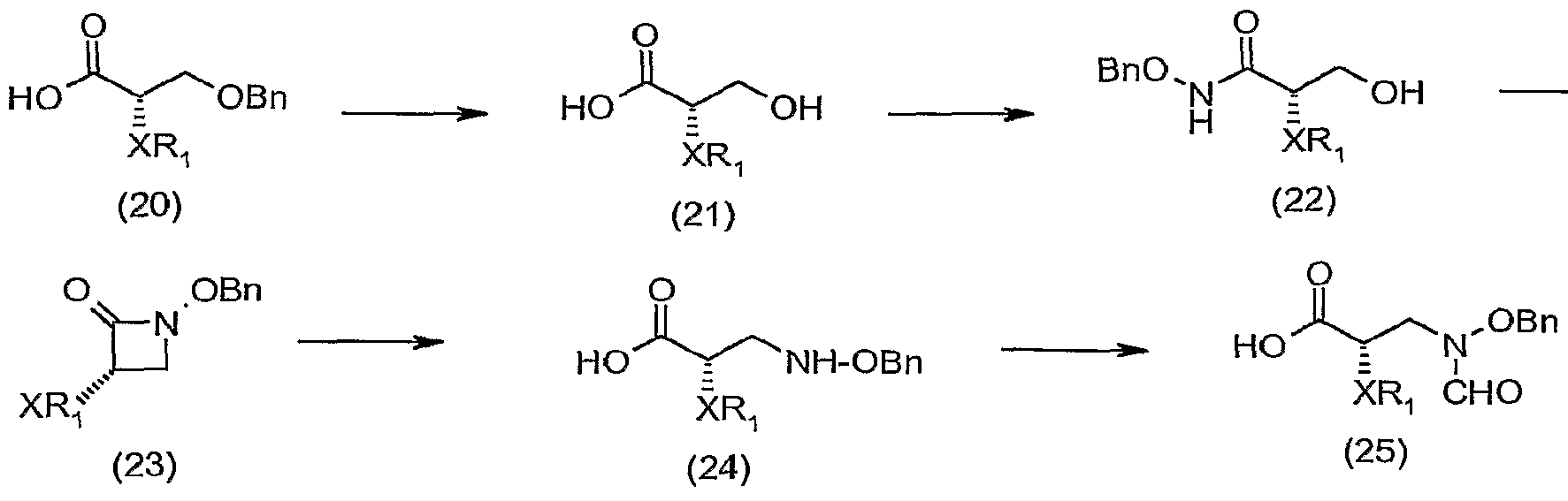
Alternatively, an enantiomer of intermediate (8), such as (17) in Scheme 2 or (25) in Scheme 3, can be prepared by reacting an appropriate acid chloride (9) with a chiral agent, such as Evans' chiral oxazolidinone, in the presence of a base, such as n-butyl lithium, to afford the chiral intermediate (10) in Scheme 2 or (18) in Scheme 3. Treatment of the compound (10) or (18) with a base, such as diisopropylethylamine, in the presence of a chelating agent, such as titanium tetrachloride, in a solvent, such as tetrahydrofuran, followed by addition of an electrophile, such as benzyloxymethylchloride, provides either of two chiral compounds (11) or (19), depending on the selection of chiral auxiliary.
Conversion of compound (11) or (19) to the corresponding hydroxyacid (13) or (21) can be achieved by a sequence comprising oxidative cleavage of the chiral oxazolidinone, using, for example H2O2 and lithium hydroxide, to the respective intermediates (12) or (20), followed by hydrogenolysis. Coupling of the acid (13) or (21) with benzyloxyamine in the presence of coupling agents, such as EDCI/DMAP, yields the amides (14) or (22), respectively. These can be cyclized to the azetidin-2-ones (15) or (23) using Mitsunobu conditions or a combination of triphenylphosphine/carbon tetrachloride/triethylamine. Hydrolysis of the azetidin-2-one (15) or (23), using for example lithium hydroxide, in an appropriate solvent, gives the corresponding acid (16) or (24), respectively. Conversion of compound (16) or (24) to the formate (17) or (25) can be achieved using an appropriate formylating agent, such as formic acid/acetic anhydride or methyl formate, in an appropriate solvent, such as dichloromethane.
Scheme 4

(32> (33)
As shown in Scheme 4, transformation of carboxylic acid RCOOH (26) to carboxamide RCONH2 (27) is accomplished by using (Boc)2θ, pyridine and ammonium hydrogen carbonate in an appropriate solvent such as 1 ,4-dioxane. Carboxamide (27) is converted to cyanide RCN (28) using phosphorus(lll) oxychloride and pyridine in a solvent such as dichloromethane. Formation of tetrazole (29) occurs in a [3 + 2] cycloaddition fashion by treatment with reagents such as TMS-azide and dibutyltin oxide in an appropriate solvent such as toluene. Alkylation of (29) with alkylating agents such as TMS-diazomethane or
R2-I, an appropriate base such as Cs2CO3 provides (30) along with (31). After separation of the two regioisomers by HPLC, tetrazole (30) can be debenzylated by hydrogenation using a catalyst, such as 10% Pd/C, in an appropriate solvent, such as methanol, to give the desired pyrrolidine compound (32). Similarly, tetrazole (31) can be debenzylated by hydrogenation using a catalyst, such as 10% Pd/C, in an appropriate solvent, such as methanol, to give the desired pyrrolidine compound (33).
Scheme 5

(I) (H)
(42) (43)
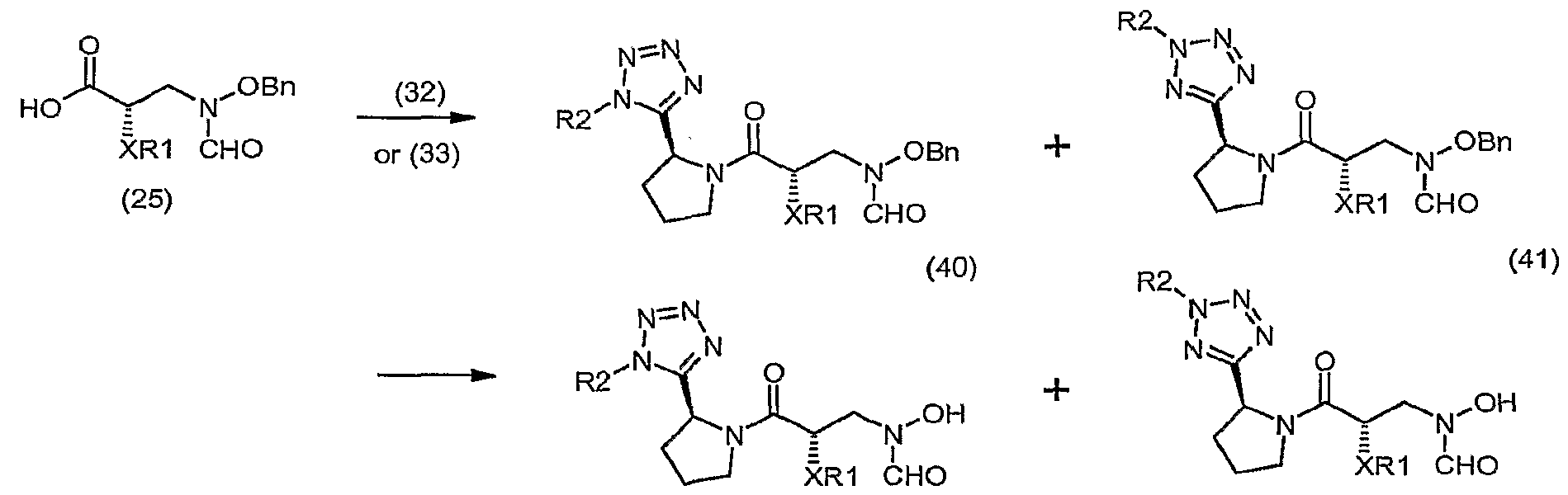
As shown in Scheme 5, coupling of (32) or (33) with acid (8), using conditions such as EDCI/HOAt/NMM, provides (34) or (35), which can be debenzylated by hydrogenation using a catalyst, such as 10% Pd/C, in an appropriate solvent, such as ethanol, to give the desired compound (36) or (37). Similarly, coupling of the chiral acid (17) with (32) or (33) provides the corresponding product (38) or (39). Hydrogenolysis of the benzyl group gives the final desired compound (I) or (II).
Methods of Use The compounds of the invention are inhibitors of microbial peptide deformylase. These compounds can be useful in the treatment of mammalian, particularly human, bacterial infections including upper and lower respiratory tract infections, skin and soft tissue infections and malaria. Activity of these compounds has been shown specifically against bacteria from the genera Streptococcus, Staphylococcus, Moraxella, Escherichia, and Haemophilus.
The methods of treatment of the invention comprise administering a safe and effective amount of a compound according to Formula (I) or (II) or a pharmaceutically-acceptable salt thereof to a patient in need thereof. Individual embodiments of the invention include methods of treating any one of the above-mentioned disorders by administering a safe and effective amount of a compound according to Formula (I) or (II) or a pharmaceutically- acceptable salt thereof to a patient in need thereof.
As used herein, "treat" in reference to a disorder means: (1) to ameliorate or prevent the disorder or one or more of the biological manifestations of the disorder, (2) to interfere with (a) one or more points in the biological cascade that leads to or is responsible for the disorder or (b) one or more of the biological manifestations of the disorder, (3) to alleviate one or more of the symptoms or effects associated with the disorder, or (4) to slow the progression of the disorder or one or more of the biological manifestations of the disorder.
As indicated above, "treatment" of a disorder includes prevention of the disorder. The skilled artisan will appreciate that "prevention" is not an absolute term. In medicine, "prevention" is understood to refer to the prophylactic administration of a drug to substantially diminish the likelihood or severity of a disorder or biological manifestation thereof, or to delay the onset of such disorder or biological manifestation thereof.
As used herein, "safe and effective amount" in reference to a compound of the invention or other pharmaceutically-active agent means an amount of the compound sufficient to treat the patient's condition but low enough to avoid serious side effects (at a reasonable benefit/risk ratio) within the scope of sound medical judgment. A safe and effective amount of a compound will vary with the particular compound chosen (e.g. consider the potency, efficacy, and half-life of the compound); the route of administration chosen; the disorder being treated; the severity of the disorder being treated; the age, size, weight, and physical condition of the patient being treated; the medical history of the patient to be treated; the duration of the treatment; the nature of concurrent therapy; the desired therapeutic effect; and like factors, but can nevertheless be routinely determined by the skilled artisan.
As used herein, "patient" refers to a human or other mammal.
The compounds of the invention may be administered by any suitable route of administration, including both systemic administration and topical administration. Systemic administration includes oral administration, parenteral administration, transdermal administration, rectal administration, and administration by inhalation. Parenteral administration refers to routes of administration other than enteral, transdermal, or by inhalation, and is typically by injection or infusion. Parenteral administration includes intravenous, intramuscular, and subcutaneous injection or infusion. Inhalation refers to administration into the patient's lungs whether inhaled through the mouth or through the nasal passages. Topical administration includes application to the skin as well as intraocular, otic, intravaginal, and intranasal administration.
The compounds of the invention may be administered once or according to a dosing regimen wherein a number of doses are administered at varying intervals of time for a given period of time. For example, doses may be administered one, two, three, or four times per day. Doses may be administered until the desired therapeutic effect is achieved or indefinitely to maintain the desired therapeutic effect. Suitable dosing regimens for a compound of the invention depend on the pharmacokinetic properties of that compound, such as absorption, distribution, and half-life, which can be determined by the skilled artisan. In addition, suitable dosing regimens, including the duration such regimens are
administered, for a compound of the invention depend on the disorder being treated, the severity of the disorder being treated, the age and physical condition of the patient being treated, the medical history of the patient to be treated, the nature of concurrent therapy, the desired therapeutic effect, and like factors within the knowledge and expertise of the skilled artisan. It will be further understood by such skilled artisans that suitable dosing regimens may require adjustment given an individual patient's response to the dosing regimen or over time as individual patient needs change.
Typical daily dosages may vary depending upon the particular route of administration chosen. Typical daily dosages for oral administration range from 0.01 mg to 50mg per kg of total body weight; suitably from 1 mg to 100 mg/Kg. Typical daily dosage regimen for parenteral administration is about 0.001 mg/Kg to 40 mg/Kg of a compound of Formula (I) or (II) or a pharmaceutically acceptable salt thereof. Typical daily dosage regimen for intranasal and inhalation administration is suitably about 10 to about 500 mg/person.
Additionally, the compounds of the invention may be administered as prodrugs. As used herein, a "prodrug" of a compound of the invention is a functional derivative of the compound which, upon administration to a patient, eventually liberates the compound of the invention in vivo. Administration of a compound of the invention as a prodrug may enable the skilled artisan to do one or more of the following: (a) modify the onset of the compound in vivo; (b) modify the duration of action of the compound in vivo; (C) modify the transportation or distribution of the compound in vivo; (d) modify the solubility of the compound in vivo; and (e) overcome a side effect or other difficulty encountered with the compound. Typical functional derivatives used to prepare prodrugs include modifications of the compound that are chemically or enzymatically cleaved in vivo. Such modifications, which include the preparation of phosphates, amides, esters, thioesters, carbonates, and carbamates, are well known to those skilled in the art. The invention also provides a compound of the invention for use in medical therapy, and particularly in the treatment of bacterial infections. Thus, in a further aspect, the invention is directed to the use of a compound according to Formula (I) or (II) or a pharmaceutically- acceptable salt thereof in the preparation of a medicament for the treatment of bacterial infections.
Compositions
Compositions of compounds of Formulae (I) or (II) and their pharmaceutically acceptable salts which are active when given orally can be formulated as syrups, tablets, capsules, creams and lozenges. A syrup formulation will generally consist of a suspension or solution of the compound or salt in a liquid carrier for example, ethanol, peanut oil, olive oil, glycerine or water with a flavoring or coloring agent. Where the composition is in the form of a tablet, any pharmaceutical carrier routinely used for preparing solid formulations may be used. Examples of such carriers include magnesium stearate, terra alba, talc, gelatin, acacia, stearic acid, starch, lactose and sucrose. Where the composition is in the form of a capsule, any routine encapsulation is suitable, for example, using the aforementioned carriers in a hard gelatin capsule shell. Where the composition is in the form of a soft gelatin shell capsule, any pharmaceutical carrier routinely used for preparing dispersions or suspensions may be considered, for example, aqueous gums, celluloses, silicates or oils, and incorporated in a soft gelatin capsule shell.
Typical parenteral compositions consist of a solution or suspension of a compound or salt in a sterile aqueous or non-aqueous carrier optionally containing a parenterally acceptable oil, for example, polyethylene glycol, polyvinylpyrrolidone, lecithin, arachis oil or sesame oil. Typical compositions for inhalation are in the form of a solution, suspension or emulsion that may be administered as a dry powder or in the form of an aerosol using a conventional propellant such as dichlorodifluoromethane or trichlorofluoromethane.
A typical suppository formulation comprises a compound of Formula (I) or (II) or a pharmaceutically acceptable salt thereof which is active when administered in this way, with a binding and/or lubricating agent, for example, polymeric glycols, gelatins, cocoa- butter or other low melting vegetable waxes or fats or their synthetic analogs.
Typical dermal and transdermal formulations comprise a conventional aqueous or non- aqueous vehicle, for example, a cream, ointment, lotion or paste or are in the form of a medicated plaster, patch or membrane.
Preferably the composition is in unit dosage form, for example a tablet, capsule or metered aerosol dose, so that the patient may administer a single dose.
EXAMPLES AND PREPARATIONS
The invention will now be described by reference to the following examples which are merely illustrative and are not to be construed as a limitation of the scope of the present invention.
Unless otherwise indicated, all temperatures are expressed in 0C (degrees Centigrade). All reactions are conducted under an inert atmosphere at room temperature unless otherwise noted, and aii solvents are highest available purity unless otherwise indicated.
1H NMR (hereinafter also "NMR") spectra were recorded on a Varian VXR-300, a Varian Unity-300, a Varian Unity-400 instrument, a Brucker AVANCE-400, a General Electric QE- 300 or a Bruker AM 400 spectrometer. Chemical shifts are expressed in parts per million (ppm, δ units). Coupling constants are in units of hertz (Hz). Splitting patterns describe apparent multiplicities and are designated as s (singlet), d (doublet), t (triplet), q (quartet), quint (quintet), m (multiplet), br (broad).
Mass spectra were run on open access LC-MS systems using electrospray ionization. The LC conditions used were either: 1) 4.5% to 90% CH3CN (0.02% TFA) in 3.2 min with a 0.4 min hold and 1.4 min re-equilibration; detection by MS, UV at 214 nm and 254 nm, and a light scattering detector (ELS). Column: 1 X 40 mm Aquasil (C18), or 2) 10% to 80% CH3CN (0.02% TFA) in 3.0 min with a 1.25 min hold and 1.0 min re-equilibration; detection by MS, UV at 214 nm and 254 nm, and a light scattering detector (ELS). Column: 2.1 X 50 mm 5-micron Zorbax (C8).
For preparative (prep) hplc; ca 50 mg of the final products were injected in 500 uL of DMSO, MeOH, or DMF onto either: 1) a 50 X 20 mm I. D. YMC CombiPrep ODS-A column at 20 mL/min with a 10 min gradient from 10% CH3CN to 90% CH3CN in H2O and a 2 min hold, or 2) a 50 X 19 mm Waters SunFire Prep C18 OBD 5 uM I. D. column at 25 mL/min with a 10 min gradient from 5-10% CH3CN to 90-95% CH3CN in H2O. Flash chromatography was run over Merck Silica gel 60 (230 - 400 mesh).
Infrared (IR) spectra were obtained on a Nicolet 510 FT-IR spectrometer using a 1-mm NaCI cell. Most of the reactions were monitored by thin-layer chromatography on 0.25
mm E. Merck silica gel plates (60F-254), visualized with UV light, 5% ethanolic phosphomolybdic acid or p-anisaldehyde solution.
Preparation 1
(4S)-Benzyl-3-heptanoyl-oxazolidin-2-one.
To a solution of (S)-(-)-4-benzyl-2-oxazolidinone (3.3 g, 18.6 mmol) in THF (50 mL) at -78 0C was added dropwise n-BuLi (7.4 mL, 2.5M solution in hexane, 18.6 mmol). After stirring for 30 min at the same temperature, the reaction mixture was then treated with heptanoyl chloride (2.76 g, 18.6 mmol). The reaction mixture was stirred and allowed to warm to 10 0C over 5 h, and then quenched with saturated aqueous NH4CI solution (100 mL). The aqueous layer was extracted with EtOAc (100 mL x 2). The combined organic layers were washed with brine, and dried over MgSO4. Removal of the solvent under reduced pressure yielded the title compound. ^ H NMR (400 MHz, CDCI3) .57.37-7.22 (m, 5H), 4.69 (m, 1 H), 4.19 (m, 2H), 3.31 (dd, J = 13.4, 3.3 Hz, 1H), 2.95 (m, 2H), 2.79 (dd, J = 13.4, 9.7 Hz, 1 H), 1.71 (m, 2H), 1.42-1.32 (m, 6H), 0.92 (t, J = 6.8 Hz1 3H). MH+ 290.
Preparation 2
(4S)-Benzyl-3-[(2R)-benzyloxymethylheptanoyl]oxazolidin-2-one.
To a solution of (4S)-benzyl-3-heptanoyl-oxazolidin-2-one (4.63 g, 16.02 mmol) and titanium (IV) chloride (1.9 mL, 16.82 mmol) in dichloromethane (55 mL) at 0 0C was added dropwise diisopropylethylamine (3.1 mL, 17.62 mmol). After stirring at 0 0C for 1 hour, the resulting titanium enolate was then reacted with benzylchloromethyl ether (TCI-America,
4.9 mL, 32.04 mmol) at 0 °C for 6 h. The reaction mixture was then quenched with water
(100 mL). The aqueous layer was extracted with dichloromethane (100 mL x 2). The organic extracts were washed with brine, and dried over MgSO4. After removing the solvent under reduced pressure, purification by flash column chromatography using an eluting system of hexane/EtOAc (5:1) yielded the title compound. "1H NMR (400 MHz,
CDCI3) δ 7.38-7.21 (m, 10H), 4.74 (m, 1 H), 4.57 (m, 2H), 4.28-4.13 (m, 3H), 3.82 (t, J = 8.7
Hz, 1H), 3.68 (dd, J = 9.0, 4.9 Hz, 1H), 3.25 (dd, J = 13.5, 3.1 Hz, 1 H), 2.71 (dd, J = 13.5, 9.3 Hz, 1 H), 1.74 (m, 1 H), 1.54 (m, 1H), 1.31-1.28 (m, 6H), 0.89 (t, J = 6.7 Hz, 3H). MH+
410.
Preparation 3
(3R)-Benzyloxy-2-pentylpropionic acid.
A 0.05 M solution of (4S)-benzyl-3-[(2R)-benzyloxymethylheptanoyl]oxazolidin-2-one (2.0 g, 4.89 mmol) in a 3:1 mixture of THF and H2O was treated with 30% H2O2 (4.5 ml_, 39.12 mmol), followed by LiOH (0.48 g, 9.78 mmol) at 0 0C. The resulting mixture was stirred and allowed to warm to room temperature overnight. THF was then removed under vacuum. The residue was washed with dichloromethane (50 mL x 2) to remove (S)-4- benzyloxazolidin-2-one. The desired product was isolated by EtOAc extraction of the acidified (pH 1-2) aqueous phase. No further purification was required. Standing under high vacuum yielded the title compound. 1 H NMR (400 MHz, CHCI3) δ 11.1 (br s, 1 H)5 7.36 (m, 5H), 4.57 (s, 2H), 3.69 (m, 1H), 3.58 (dd, J = 9.2, 5.2 Hz, 1H), 2.74 (m, 1 H), 1.66 (m, 1 H), 1.54 (m, 1 H), 1.34-1.30 (m, 6H), 0.90 (t, J = 6.7 Hz, 3H). MH+ 251.
Preparation 4
3-Hydroxy-(2R)-pentylpropionic acid.
To a solution of (3R)-benzyloxy-2-pentylpropionic acid (1.54 g, 6.16 mmol) in EtOH (100 mL) was added 10% Pd/C (310 mg). The reaction mixture was subjected to hydrogenation overnight at room temperature. After the reaction was completed, the reaction mixture was filtered through a pad of Celite, and washed with EtOH (50 mL x 3). Removal of the solvent provided the title compound. No further purification was required. "Η NMR (400 MHz, CHCI3) δ 6.30 (br s, 1 H), 3.81 (d, J = 5.4 Hz, 2H), 2.64 (m, 1 H), 1.69 (m, 1 H), 1.56 (m, 1 H), 1.41-1.27 (m, 6H), 0.91 (t, J = 7.7 Hz, 3H). MH+ 161.
Preparation 5
N-Benzyloxy-3-hydroxy-(2R)-pentylpropionamide.
To a mixture of 3-hydroxy-(2R)-pentylpropionic acid (0.92 g, 5.75 mmol), O-benzyl hydroxylamine hydrochloride (0.92 g, 5.75 mmol) and 4-(dimethylamino)pyridine (1.41 g, 11.50 mmol) in dichloromethane (25 mL) at 0 0C was added 1-[3-(dimethylamino)propyl]-3- ethylcarbodiirnide hydrochloride (1.11 g, 5.75 mmol). After stirring at room temperature overnight, the reaction was then quenched with 1 N aqueous HCI solution (25 mL) and extracted using dichloromethane (25 mL x 2). The organic extracts were washed with water, brine, and dried over MgSO4. Removal of the solvent under reduced pressure yielded the title compound. 1 H NMR (400 MHz, CHCI3) δ 9.22 (br s, 1 H)1 7.41-7.28 (m, 5H), 4.89 (q, J = 10.6 Hz, 2H), 3.70-3.37 (m, 3H), 2.17 (m, 1H), 1.54 (br s, 1 H), 1.27 (m, 6H), 0.88 (t, J = 6.9 Hz, 3H). MH+ 266.
Preparation 6
1 -Benzyloxy-(3R)-pentyl-azetidi n-2-one.
To a mixture of N-benzyloxy-3-hydroxy-(2R)-pentylpropionamide (1.41 g, 5.32 mmol) and triphenylphosphine (1.68 g, 6.39 mmol) in THF (53 ml_) was added dropwise diethyl azodicarboxylate (1.1 mL, 6.39 mmol) at 0 °C. The reaction mixture was stirred and allowed to warm to room temperature overnight. The reaction was then quenched with water (50 mL). The aqueous layer was extracted with EtOAc (50 mL x 2). The combined organic layers were washed with brine, and dried over MgSO4. After removing the solvent under vacuum, the residue was purified by flash column chromatography (hex:EtOAc 5/1 ) to provide the title compound. 1 H NMR (400 MHz, CHCI3) δ 7.35-7.25 (m, 5H), 4.87 (s, 2H), 3.28 (t, J = 4.85 Hx, 1 H), 2.84 (q, J 2.35 Hz, 1 H), 2.77 (m, 1 H), 1.62 (m, 1 H), 1.36 (m, 1 H), 1.25-1.16 (m, 6H), 0.88 (t, J = 6.9 Hz, 3H). MH+ 248.
Preparation 7
3-Benzyloxyamino-(2R)-pentylpropionic acid.
To a mixture of 1-benzyloxy-(3R)-pentyl-azetidin-2-one (0.96 g, 3.89 mmol) in a mixture of THF-H2O-MeOH (50 mL, 3:1 :1 v/v) was added lithium hydroxide monohydrate (1.91 g, 38.9 mmol). After stirring at room temperature overnight, water (25 mL) was added to the mixture. The solution was acidified to pH 5-6 with 3N aqueous HCI solution. It was extracted with EtOAc (50 mL x 2). The combined organic layers were dried over MgSO4. Removal of the solvent under vacuum provided the title compound. 1 H NMR (400 MHz, CHCI3) δ 9.80 (br s, 1 H), 7.37 (m, 5H), 4.75 (m, 2H), 3.14 (m, 2H), 2.74 (m, 1 H), 1.70 (m, 1 H), 1.53 (m, 1 H), 1.38-1.25 (m, 6H), 0.91 (t, J = 6.8 Hz1 3H). MH+ 266. Preparation 8
(2R)-[(Benzyloxyformylamino)methyl]heptanoic acid.
To a cold solution of 3-benzyloxyamino-(2R)-pentylpropionic acid (1.03 g, 3.89 mmol) in HCO2H (19 mL) and dichloromethane (19 mL) at 0 0C was added acetic anhydride (3.9 mL, 41.2 mmol). The mixture was stirred at 0 0C for 3 hours. The volatiles were removed by evaporation under vacuum. Dichloromethane (50 mL) was added to the remaining residue, and the resulting organic solution was washed with brine (50 mL x 2) and dried over MgSO4. Filtration and evaporation under vacuum provided the title compound. 1 H NMR (400 MHz, CHCI3) δ 8.07 (br s, 1 H), 7.29 (m, 5H), 4.91-4.71 (m, 2H), 3.76 (m, 2H), 2.67 (m, 1 H), 1.54 (m, 1H), 1.41(m, 1 H), 1.20 (m, 6H), 0.80 (t, J = 7.0 Hz, 3H). MH+ 294.
Preparation 9
(2R)-3-Cyclopentyl-2-({formyl[phenylmethyl)oxy]amino}methyl)propanoic acid.
Following the general procedure for preparation of (2R)-
[(benzyloxyformylamino)methyl]heptanoic acid, the title compound was synthesized.
MH+ 305.
Preparation 10
Phenylmethyl (2S)-2-(amϊnocarbonyl)-1-pyrrolidinecarboxylate .
To a solution of starting 1-{[(phenylmethyl)oxy]carbonyl}-L-proline (8.0 g, 32.09 mmol), pyridine (1.5 mL), (BoC)2O (9.1 g, 41.72 mmol) in 1 ,4-dioxane (40 ml_) at rt was added ammonium hydrogen carbonate (3.2 g, 40.43 mmol). After stirring at room temperature overnight, the reaction mixture was treated with EtOAc (100 mL), and then the mixture was washed with water (50 mL), followed by 5% H2SO4- The organic layer was collected, dried
(Na2SO4), filtered. The volatiles were removed by evaporation in vacuo. The resulting clear oil was triturated with ether. The precipitates were filtered and further dried under vacuum to yield the title compound as a white solid (3.9 g, 49%). MH+ 249.
Preparation 11
Phenylmethyl (2S)-2-cyano-1 -pyrrolidinecarboxylate.
Phosphorus(lll) oxychloride (2.1 mL) in dichloromethane (4.2 mL) was added dropwise (15 min.) to a solution of phenylmethyl (2S)-2-(aminocarbonyl)-1-pyrrolidinecarboxylate (3.9 g, 15.71 mmol) in pyridine (15 mL). The reaction mixture was stirred at -5 0C for 1 hr. After the reaction was complete, the mixture was poured over ice. The resulting mixture was stirred for 1 hr. Then it was extracted with ether, washed with CuSO4 solution, and then washed with 1 N HCI solution. The organics were dried (Na2SO4), filtered, and evaporated in vacuo to yield the title compound as a yellow oil (2.09 g, 58%). MH+ 231.
Preparation 12
Phenylmethyl (2S)-2-(1 H-tetrazol-5-yl)-1 -pyrrolidinecarboxylate.
To a phenylmethyl (2S)-2-cyano-1 -pyrrolidinecarboxylate (2.09 g, 9.08 mmol) in toluene (40 mL) was added dibutyltin oxide (226 mg, 0.91 mmol), followed by TMS-azide (2.4 mL, 18.2 mmol). The resulting mixture was stirred and heated to reflux for 4 days. After the reaction was complete, toluene was removed by evaporation in vacuo. EtOAc (50 mL) was added, and the resulting organic solution was extracted with aq. sat'd NaHCO3 (50 X 3 mL). The aqueous layer was acidified with 1 N HCI solution, and extracted with EtOAc (50 mL X 3),
dried (Na2SO4), filtered, and evaporated in vacuo to yield the title compound as an orange oil (1.1 g, 44%). MH+ 274.
Preparation 13
Phenylmethyl (2S)-2-(1 -methyl-1 H-tetrazol-5-yl)-1 -pyrrolidinecarboxylate.
To a phenylmethyl (2S)-2-(1H-tetrazol-5-yl)-1 -pyrrolidinecarboxylate (1.1 g, 4.02 mmol) in dichloromethane (30 ml_) and MeOH (7 ml_) was added TMS-diazomethane (2.0 M in hexane, 6 mL, 12.07 mmol) at rt. The reaction ran for 2 hr at rt. After the reaction was complete, the volatiles were removed by evaporation in vacuo. The residue was purified by HPLC to provide phenylmethyl (2S)-2-(1-methyl-1 H-tetrazol-5-yl)-1-pyrrolidinecarboxylate (195 mg, 17%) as a clear oil and phenylmethyl (2S)-2-(2-methyl-2H-tetrazol-5-yl)-1- pyrrolidinecarboxylate (446 mg, 39%) as a clear oil. MH+ 288.
Preparation 14
1-Methyl-5-[(2S)-2-pyrrolidinyl]-1H-tetrazole.
To a phenylmethyl (2S)-2-(1-methyl-1H-tetrazol-5-yl)-1-pyrrolidinecarboxylate (195 mg) in MeOH (20 mL) was added 10% Pd/C (30 mg). The mixture was subjected for hydrogenation for 3 hr. After the reaction was complete, the mixture was filtered through a syringe filter and evaporated in vacuo to provide the title compound (104 mg) as a clear oil. MH+ 154.
Preparation 15
2-Methyi-5-[(2S)-2-pyrrolidinyI]-2H-tetrazole.
To a phenylmethyl (2S)-2-(2-methyl-2H-tetrazol-5-yl)-1 -pyrrolidinecarboxylate (446 mg) in MeOH (30 mL) was added 10% Pd/C (67 mg). The mixture was subjected for hydrogenation for 4.5 hr. After the reaction was complete, the mixture was filtered through a syringe filter and evaporated in vacuo to provide the title compound (210 mg) as a clear oil. MH+ 154. Preparation 16
{(2R)-2-(cyclopentylmethyl)-3-[(2S)-2-(1-methy!-1H-tetrazol-5-yl)-1-pyrrolidinyl]-3- oxopropyl}[(phenylmethyl)oxy]formamide.
To 1-methyl-5-[(2S)-2-pyrrolidinyl]-1 H-tetrazole (97 mg, 0.633 mmol), (2R)-3-cyclopentyl-2-
({formyl[(phenylmethyl)oxy]amino}methyl)propanoic acid (193 mg, 0.633 mmol), NMM (0.35 mL, 3.17 mmol) in DMF (6 mL) was added at rt HOAt (103 mg, 0.760 mmol) followed by
EDCI (146 mg, 0.760 mmol). The reaction mixture was stirred at rt overnight. After the
reaction was complete, it was purified directly by HPLC to provide the title compound (105 mg) as a colorless oil. MH+ 441.
Example 1
{(2R)-2-(cyclopentylmethyl)-3-[(2S)-2-(1-methyl-1H-tetrazol-5-yl)-1-pyrrolidinyl]-3- oxopropyl}hydroxyformamide.

To {(2R)-2-(cyclopentylmethyl)-3-[(2S)-2-(1 -methyl-1 H-tetrazol-5-yl)-1 -pyrrolidiπyl]-3- oxopropyl}[(phenylmethyl)oxy]formamide (105 mg) in MeOH (10 ml_) was added 10% Pd/C (21 mg). The mixture was subjected for hydrogenation for 2.5 hr. After the reaction was complete, the mixture was filtered through a syringe filter and evaporated in vacuo to provide the title compound (60 mg) as a yellow oil. MH+ 351.
Example 2
{(2R)-2-(cyclopentylmethyl)-3-[(2S)-2-(2-methyl-2H-tetrazol-5-yl)-1 -pyrrolidinyl]-3- oxopropyl}hydroxyformamide.

To {(2R)-2-(cyclopentylmethyl)-3-[(2S)-2-(2-methyl-2H-tetrazol-5-yl)-1-pyrrolidinyl]-3- oxopropyl}[(phenylmethyl)oxy]formamide (180 mg) in MeOH (10 ml_) was added 10% Pd/C (36 mg). The mixture was subjected for hydrogenation for 2.5 hr. After the reaction was complete, the mixture was filtered through a syringe filter and evaporated in vacuo to provide the title compound (120 mg) as a yellow oil. MH+ 351.
Example 3
{(2R)-2-(cyclopentylmethyl)-3-[(2S)-2-(1 -ethyl-1 H-tetrazol-5-yl)-1 -pyrrolidinyl]-3- oxopropyl}hydroxyformamide.

The title compound was prepared according to the general procedures listed above, substituting (2S)-2-(1 -ethyl-1 H-tetrazol-5-yl)-1-pyrrolidine for (2S)-2-(1-methyl-1 H-tetrazol- 5-yl)-1 -pyrrolidine. Purification by preparative HPLC yielded the title compound. MH+ 365.
Example 4
{(2R)-2-(cyclopentylmethyl)-3-[(2S)-2-(2-ethyl-2H-tetrazol-5-yl)-1 -pyrrolidinyl]-3- oxopropyljhydroxyformamide.
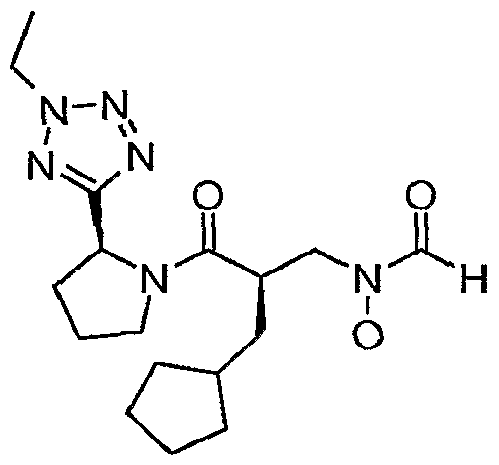
The title compound was prepared according to the general procedures listed above, substituting (2S)-2-(2-ethyl-2H-tetrazol-5-yl)-1-pyrrolidine for (2S)-2-(2-methyl-2H-tetrazol- 5-yl)-1 -pyrrolidine. Purification by preparative HPLC yielded the title compound. MH+ 365.
Example 5
{(2R)-2-(cyclopentylmethyl)-3-[(2S)-2-(1 -propyl-1 H-tetrazol-5-yl)-1 -pyrrolidinyl]-3- oxopropyl}hydroxyformamide.

Example 6
{(2R)-2-(cyclopentylmethyl)-3-[(2S)-2-(2-propyl-2H-tetrazol-5-yl)-1 -pyrrolidinyl]-3- oxopropyl}hydroxyformamide.

The title compound was prepared according to the general procedures listed above, substituting (2S)-2-(2-propyl-2H-tetrazol-5-yl)-1 -pyrrolidine for (2S)-2-(2-methyl-2H- tetrazol-5-yl)-1-pyrrolidine. Purification by preparative HPLC yielded the title compound. MH+ 379. Example 7
{(2R)-2-(cyclopentylmethyl)-3-[(2S)-2-{1 -[2-(diethylamino)ethyl]-1H-tetrazol-5-yl}- 1- pyrrol idinyl]-3-oxopropyl}hydroxyformamide.

The title compound was prepared according to the general procedures listed above, substituting (2S)-2-{1-[2-(diethylamino)ethyl]-1 H-tetrazol-5-yl}-1 -pyrrolidine for (2S)-2-(1- methyl-1 H-tetrazol-5-yl)-1 -pyrrolidine. Purification by preparative HPLC yielded the title compound. MH+ 436.
Example 8
{(2R)-2-(cyclopentylmethyl)-3-[(2S)-2-{2-[2-(diethylamino)ethyl]-2H-tetrazol-5-yl}- 1- pyrrolidinyl]-3-oxopropyl}hydroxyformamide.

The title compound was prepared according to the general procedures listed above, substituting (2S)-2-{2-[2-(diethylamino)ethyl]-2H-tetrazol-5-yl}-1 -pyrrolidine for (2S)-2-(2- methyl-2H-tetrazol-5-yl)-1-pyrrolidine. Purification by preparative HPLC yielded the title compound. MH+ 436 Biological Assay
The biological activity of the compounds of Formulae (I) and (II) can be demonstrated by the following test:
Enzymatic activity of PDF is measured using a FDH-coupled assay (Lazennec and Meinnel (1997) Anal. Biochem. 244, 180-182). Once formate is released from methionine by PDF, it is oxidized by FDH thereby reducing one molecule of NAD to NADH and resulting in an increase in absorbance at 340 nm. Reactions are initiated by adding PDF to microtiter plates containing all other reaction components and continuously monitored for 20 minutes at 250C. The final reaction composition for Staphylococcus aureus PDF is 50 mM potassium phosphate, pH 7.6, 5 units/ml FDH, 7 mM NAD, 5% DMSO, 1 nM SaPDF, and 2.9 mM formyl-Met-Ala-Ser in 50 μl total volume. Serial dilutions of inhibitors are performed in DMSO. Reagents and assay format are identical for Haemophilus influenzae PDF except that formyl-Met-Ala-Ser is 6 mM final. In the Streptococcus pneumoniae assay, reaction conditions are similar but contain 30 pM enzyme, 2 mM NAD and 4 mM formyl-Met-Ala-Ser. The varying formyl-Met-Ala-Ser concentrations reflect KM values for substrate using the different PDF isozymes. IC50S are determined by fitting to the equation: %lnhibition = 100/1 +(I C50/[l])s, where s is a slope factor, I is the inhibitor concentration and the IC50 is the concentration of compound that causes 50% inhibition.
Antimicrobial Activity Assay
Whole-cell antimicrobial activity was determined by broth microdilution using the National Committee for Clinical Laboratory Standards (NCCLS) recommended procedure,
Document M7-A4, "Methods for Dilution Susceptibility Tests for Bacteria that Grow Aerobically" (incorporated by reference herein). The compound was tested in serial twofold dilutions ranging from 0.06 to 64 mcg/ml. A panel of 12 strains were evaluated in the assay. This panel consisted of the following laboratory strains: Staphylococcus aureus Oxford, Staphylococcus aureus WCUH29, Enterococcus faecalis I, Enterococcus faecalis 7, Haemophilus influenzae Q1 , Haemophilus influenzae NEMC1, Moraxella catarrhalis 1502, Streptococcus pneumoniae 1629, Streptococcus pneumoniae N 1387, Streptococcus pneumoniae Ery2, E. coli 7623 (AcrABEFD+) and E. coli 120 (AcrAB-). The minimum inhibitory concentration (MIC) was determined as the lowest concentration of compound that inhibited visible growth. A mirror reader was used to assist in determining the MIC endpoint.
Results
The Examples of the present invention were tested in the Antimicrobial Activity Assay. The Examples were shown to have MICs of 32 mcg/ml or less, against seven or more of the 12 bacterial strains listed above.
Claims
1. A compound according to Formula (I) or (II):
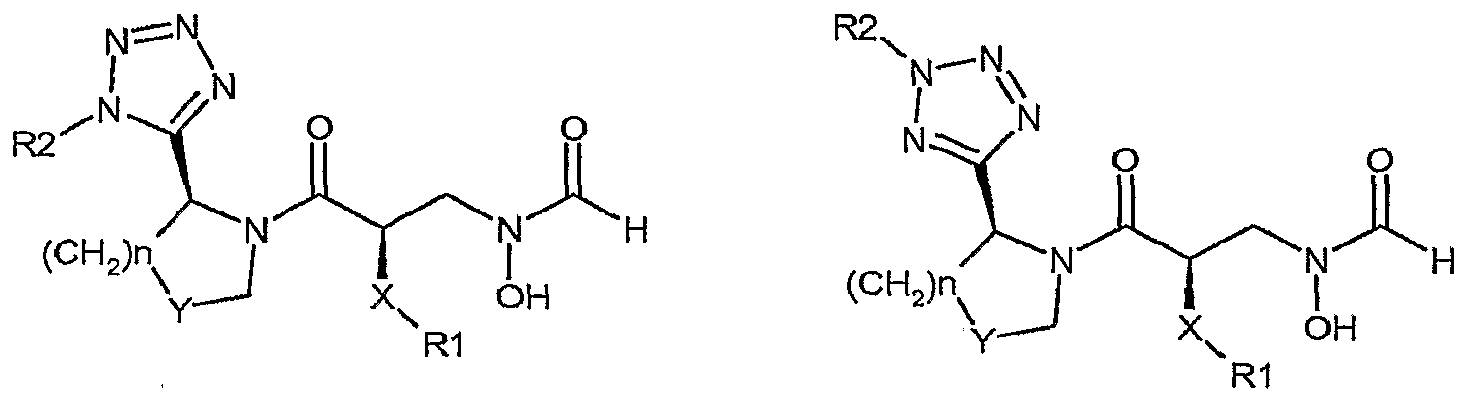
(I) (H)
wherein:
R1 is optionally substituted C2-C6 alkyl, optionally substituted C2-C6 alkenyl, optionally substituted C2-C6 alkynyl, or (CH2)m-R3,
where said C2-C6 alkyl, C2-C6 alkenyl, and C2-C6 alkynyl are optionally substituted with one to three substituents each independently selected from the following: C1-C3 alkoxy, halo, and C1-C3 alkylsulfanyl;
R2 is hydrogen, optionally substituted C2-C6 alkyl, optionally substituted C2-C6 alkenyl, optionally substituted C2-C6 alkynyl, or (CH2)p-R4,
where said C2-C6 alkyl, C2-C6 alkenyl, C2-C6 alkynyl are optionally substituted with one to three substituents each independently selected from the following: -SRa, -S(O)Ra, -S(O)2Ra, -S(O)2NRaRb, -NHS(O)2Ra, -NHC(O)Ra, -C(O)NRaRb, -C(O)Ra, COORa, oxo, -OH, C1-C3 alkoxy, NRaRb, -NO2, -CN, halo, and -NHC(O)NHRb;
R3 is C3-C6 cycloalkyl optionally substituted with one to three substituents each
independently selected from the following: C1-C3 alkoxy, halo, and C1-C3 alkylsulfanyl; or R3 is phenyl, furanyl, benzofuranyl, thiophenyl, benzothiophenyl, tetrahydrofuranyl, tetrahydropyranyl, dioxanyl, 1,4-benzodioxanyl or benzo[1,3]dioxolyl, each of which is optionally substituted with one to three substituents each independently selected from the following: halo, C1-C3 alkyl, C1-C3 haloalkyl, and C1-C2 alkoxy optionally substituted with one to three fluoro groups;
R4 is C3-C6 cycloalkyl optionally substituted with one to three substituents each independently selected from the following: -SRa, -S(O)Ra, -S(O)2Ra, -S(O)2NRaRb, -NHS(O)2Ra, -NHC(O)Ra, -C(O)NRaRb, -C(O)Ra, COORa, oxo, -OH, C1-C3 alkoxy, -NRaRb5 - NO2, -CN, halo, and -NHC(O)NHRb, or
R4 is optionally substituted heterocycloalkyl, optionally substituted heteroaryl, or optionally substituted aryl,
where said heterocycloalkyl, heteroaryl, and aryl are each optionally substituted with one to three substituents each independently selected from the following: halo, C1-C3 alkyl, C1-C3 haloalkyl, and C1-C2 alkoxy optionally substituted with one to three fluoro groups;
each Ra is independently selected from the following: hydrogen, C1-C6 alkyl, aryl, C3-C6 cycloalkyl, heteroaryl, and heterocycloalkyl;
each Rb is independently selected from the following: hydrogen, C1-C6 alkyl, and phenyl; X is -O- or -CH2-;
Y is -CH2- or S;
m is an integer from 0 to 3;
n is an integer from 0 to 3, provided that when n is 0, X is— CH2-; and
p is an integer from 0 to 3; or a pharmaceutically acceptable salt thereof.
2. A compound according to claim 1 wherein R1 is (CH2)m-R3; or a pharmaceutically acceptable salt thereof.
3. A compound according to claim 1 wherein R1 is (CH2)m-R3; and
R3 is C3-C6 cycloalkyl optionally substituted with one to three substituents each independently selected from the following: C1-C3 alkoxy, halo, and C1-C3 alkylsulfanyl; or a pharmaceutically acceptable salt thereof.
4. A compound according to claim 1 wherein R2 is C2-C6 alkyl optionally substituted with one to three substituents each independently selected from the following: -SRa, -S(O)Ra, -S(O)2Ra, -S(O)2NRaRb, -NHS(O)2Ra, -NHC(O)Ra, -C(O)NRaRb, -C(O)Ra, COORa, oxo, -OH, C1-C3 alkoxy, NRaRb, -NO2, -CN halo, and -NHC(O)NHRb; or a
pharmaceutically acceptable salt thereof.
5. A compound according to claim 1 wherein Y is -CH2-; or a pharmaceutically acceptable salt thereof.
6. A compound according to claim 1 wherein
R1 is (CH2)m-R3;
R2 is hydrogen, optionally substituted C2-C6 alkyl, optionally substituted C2-C6 alkenyl, optionally substituted C2-C6 alkynyl, or (CH2)p-R4,
where said C2-C6 alkyl, C2-C6 alkenyl, C2-C6 alkynyl are optionally substituted with one to three substituents each independently selected from the following: -SRa, -S(O)Ra, -S(O)2Ra, -S(O)2NRaRb, -NHS(O)2Ra, -NHC(O)Ra, -C(O)NRaRb, -C(O)Ra, COORa, oxo, -OH, C1-C3 alkoxy, NRaRb, -NO2, -CN, halo, and -NHC(O)NHRb;
R3 is unsubstituted cyclopentyl;
R4 is optionally substituted heterocycloalkyl, optionally substituted heteroaryl, or optionally substituted aryl,
where said heterocycloalkyl, heteroaryl, and aryl are each optionally substituted with one to three substituents each independently selected from the following: halo, C1-C3 alkyl, C1-C3 haloalkyl, and C1-C2 alkoxy optionally substituted with one to three fluoro groups;
each Ra is independently selected from hydrogen and C1-C6 alkyl;
each Rb is independently selected from hydrogen and C1-C6 alkyl;
X is -CH2-;
Y is -CH2-;
m is O;
n is 1; and
p is O; or a pharmaceutically acceptable salt thereof.
7. A compound according to claim 1 wherein:
R1 is (CH2)m-R3;
R2 is optionally substituted C2-C6 alkyl,
where said C2-C6 alkyl is optionally substituted with one to three substituents each independently selected from the following: -SRa, "-S(O)Ra, -S(O)2Ra, -S(O)2NRaRb, -NHS(O)2Ra, -NHC(O)Ra, -C(O)NRaRb, COORa, oxo, -OH, C1-C3 alkoxy, NRaRb, -NO2, -CN, halo, and -NHC(O)NHRb;
R3 is unsubstituted cyclopentyl;
each Ra is independently selected from hydrogen and C1-C6 alkyl;
each Rb is independently selected from hydrogen and C1-C6 alkyl;
X is -CH2-;
Y is -CH2-;
m is O;
n is 1; and
p is O; or a pharmaceutically acceptable salt thereof.
8. A compound according to claim 1 which is:
(2R)-2-(cyclopentylmethyl)-3-[(2S)-2-(1-methyl-1 H-tetrazol-5-yl)-1-pyrrolidinyl]-3- oxopropyl}hydroxyforrnamide;
{(2R)-2-(cyclopentylmethyl)-3-[(2S)-2-(2-methyl-2H-tetrazol-5-yl)-1-pyrrolidinyl]-3- oxopropyl}hydroxyformamide;
{(2R)-2-(cyclopentylmethyl)-3-[(2S)-2-(1-ethyl-1 H-tetrazol-5-yl)-1-pyrrolidinyl]-3- oxopropyl}hydroxyformamide;
{(2R)-2-(cyclopentylmethyl)-3-[(2S)-2-(2-ethyl-2H-tetrazol-5-yl)-1-pyrrolidinyl]-3- oxopropyl}hydroxyformamide;
{(2R)-2-(cyclopentylmethyl)-3-[(2S)-2-(1-propyl-1 H-tetrazol-5-yl)-1-pyrrolidinyl]-3- oxopropyl}hydroxyformamide;
{(2R)-2-(cyclopentylmethyl)-3-[(2S)-2-(2-propyl-2H-tetrazol-5-yl)-1-pyrrolidiny!]-3- oxopropyl}hydroxyformamide;
{(2 R)-2-(cyclopentyl m ethyl )-3-[(2S)-2-{ 1 -[2-(d iethylam i n o)ethyl]- 1 H-tetrazol-5-yl}- 1 - pyrrolidinyl]-3-oxopropyl}hydroxyformamide; or
{(2R)-2-(cyclopentylmethyl)-3-[(2S)-2-{2-[2-(diethylamino)ethyl]-2H-tetrazol-5-yl}- 1- pyrrolidinyl]-3-oxopropyl}hydroxyformamide; or a pharmaceutically acceptable salt thereof.
9. A method of treating a bacterial infection by administering to a patient in need of treatment thereof a compound according to claim 1 or a pharmaceutically acceptable salt thereof.
10. A pharmaceutical composition comprising a compound according to claim 1 , or a pharmaceutically acceptable salt thereof, and a pharmaceutically acceptable carrier.
Applications Claiming Priority (2)
| Application Number | Priority Date | Filing Date | Title |
|---|---|---|---|
| US74259905P | 2005-12-06 | 2005-12-06 | |
| US60/742,599 | 2005-12-06 |
Publications (2)
| Publication Number | Publication Date |
|---|---|
| WO2007067904A2 true WO2007067904A2 (en) | 2007-06-14 |
| WO2007067904A3 WO2007067904A3 (en) | 2007-11-08 |
Family
ID=38123606
Family Applications (1)
| Application Number | Title | Priority Date | Filing Date |
|---|---|---|---|
| PCT/US2006/061639 Ceased WO2007067904A2 (en) | 2005-12-06 | 2006-12-06 | Peptide deformylase inhibitors |
Country Status (1)
| Country | Link |
|---|---|
| WO (1) | WO2007067904A2 (en) |
Family Cites Families (2)
| Publication number | Priority date | Publication date | Assignee | Title |
|---|---|---|---|---|
| EP1052984B1 (en) * | 1998-02-07 | 2004-05-12 | Vernalis (Oxford) Ltd | Antibacterial agents |
| UY27813A1 (en) * | 2002-05-31 | 2003-12-31 | Smithkline Beecham Corp | PEPTIDE-DISFORMILASE INHIBITORS |
-
2006
- 2006-12-06 WO PCT/US2006/061639 patent/WO2007067904A2/en not_active Ceased
Also Published As
| Publication number | Publication date |
|---|---|
| WO2007067904A3 (en) | 2007-11-08 |
Similar Documents
| Publication | Publication Date | Title |
|---|---|---|
| KR102782563B1 (en) | Imidazo-pyridine compounds as PAD inhibitors | |
| CN107406426B (en) | Cyclic ureas as ROCK inhibitors | |
| KR102680164B1 (en) | Phenylacetamide as a ROCK inhibitor | |
| CN112566916B (en) | Substituted Thienopyrroles as PAD4 Inhibitors | |
| CN105814050B (en) | Pyrazolopyridine Derivatives Used as TNF Activity Modulators | |
| US9738630B2 (en) | Inhibitors of lysine methyl transferase | |
| CN110891935A (en) | Bicyclic compounds and their use in cancer therapy | |
| RU2376305C2 (en) | Derivatives of aryl- and heteroarylpiperidinecarboxylates, their production and their use as inhibitors of faah ferment | |
| CN105829307A (en) | Tetrahydroimidazopyridine derivatives as modulators of tnf activity | |
| CA2866302A1 (en) | Carbamate compounds and of making and using same | |
| IL302837A (en) | Aryl derivatives for treating trpm3 mediated disorders | |
| CN105814043A (en) | Triazolopyridine derivatives as modulators of TNF activity | |
| EP2976341A1 (en) | Acyclic cyanoethylpyrazolo pyridones as janus kinase inhibitors | |
| CA3120037A1 (en) | Heteroaromatic compounds as vanin inhibitors | |
| TW202233587A (en) | Bicyclic 1,4-diazepanones and therapeutic uses thereof | |
| WO2021202781A1 (en) | N-heteroarylalkyl-2-(heterocyclyl and heterocyclylmethyl) acetamide derivatives as sstr4 agonists | |
| EP1819332B1 (en) | Pyrrolopyridine-2-carboxylic acid amides | |
| WO2021201036A1 (en) | Hydroxypyrrolidine derivative and medicinal application thereof | |
| KR20250070082A (en) | Heterocyclic SIK inhibitors | |
| CN101300226B (en) | Alkylcarbamoylnaphthyloxyoctenoyl hydroxyamide derivatives having inhibitory activity against histone deacetylase and preparation method thereof | |
| EP1585757B1 (en) | Peptide deformylase inhibitors | |
| CN116635028A (en) | c-MYC mRNA translation regulator and its use in the treatment of cancer | |
| EP1912662B1 (en) | Peptide deformylase inhibitors | |
| US20060052423A1 (en) | Peptide deformylase inhibitors | |
| TW201329087A (en) | Peptide deformylase inhibitors |
Legal Events
| Date | Code | Title | Description |
|---|---|---|---|
| 121 | Ep: the epo has been informed by wipo that ep was designated in this application | ||
| NENP | Non-entry into the national phase |
Ref country code: DE |
|
| 122 | Ep: pct application non-entry in european phase |
Ref document number: 06846483 Country of ref document: EP Kind code of ref document: A2 |