WO2007059949A1 - Two novel salts of the n, n' -bis [9- (3,4-dihydroxy-5- (2-ethyl-2h-tetrazol-5-yl) tetrahydrofuran-2-yl) -2- (2- (1-methyl-1h-imidazol-4-yl) ethylamino) -9h-purin-6-yl] cyclohexyl-1,4-diamine adenosine a2a agonist as anti-inflammatory agents - Google Patents
Two novel salts of the n, n' -bis [9- (3,4-dihydroxy-5- (2-ethyl-2h-tetrazol-5-yl) tetrahydrofuran-2-yl) -2- (2- (1-methyl-1h-imidazol-4-yl) ethylamino) -9h-purin-6-yl] cyclohexyl-1,4-diamine adenosine a2a agonist as anti-inflammatory agents Download PDFInfo
- Publication number
- WO2007059949A1 WO2007059949A1 PCT/EP2006/011209 EP2006011209W WO2007059949A1 WO 2007059949 A1 WO2007059949 A1 WO 2007059949A1 EP 2006011209 W EP2006011209 W EP 2006011209W WO 2007059949 A1 WO2007059949 A1 WO 2007059949A1
- Authority
- WO
- WIPO (PCT)
- Prior art keywords
- salt
- ethyl
- compound
- methyl
- tetrazol
- Prior art date
- Legal status (The legal status is an assumption and is not a legal conclusion. Google has not performed a legal analysis and makes no representation as to the accuracy of the status listed.)
- Ceased
Links
- 0 CC[n]1nnc(C(**2)OC2*2c(nc(NCCc3c[n](C)cn3)nc3NC(CC4)CCC4Nc4nc(NCCc5c[n](C)cn5)nc5c4nc[n]5[C@](CO[C@@]4c5n[n](CC)nn5)([C@]4O)[U])c3N=C2)n1 Chemical compound CC[n]1nnc(C(**2)OC2*2c(nc(NCCc3c[n](C)cn3)nc3NC(CC4)CCC4Nc4nc(NCCc5c[n](C)cn5)nc5c4nc[n]5[C@](CO[C@@]4c5n[n](CC)nn5)([C@]4O)[U])c3N=C2)n1 0.000 description 4
- MKMRBXQLEMYZOY-TXICZTDVSA-N C[C@H]([C@H]([C@H]1O)O)O[C@H]1O Chemical compound C[C@H]([C@H]([C@H]1O)O)O[C@H]1O MKMRBXQLEMYZOY-TXICZTDVSA-N 0.000 description 1
Classifications
-
- C—CHEMISTRY; METALLURGY
- C07—ORGANIC CHEMISTRY
- C07D—HETEROCYCLIC COMPOUNDS
- C07D519/00—Heterocyclic compounds containing more than one system of two or more relevant hetero rings condensed among themselves or condensed with a common carbocyclic ring system not provided for in groups C07D453/00 or C07D455/00
-
- A—HUMAN NECESSITIES
- A61—MEDICAL OR VETERINARY SCIENCE; HYGIENE
- A61P—SPECIFIC THERAPEUTIC ACTIVITY OF CHEMICAL COMPOUNDS OR MEDICINAL PREPARATIONS
- A61P29/00—Non-central analgesic, antipyretic or antiinflammatory agents, e.g. antirheumatic agents; Non-steroidal antiinflammatory drugs [NSAID]
Definitions
- This invention relates to novel salts of an adenosine A 2A agonist or a solvate thereof, processes for their preparation, pharmaceutical compositions containing them, and to their use in therapy.
- Inflammation is a primary response to tissue injury or microbial invasion and is characterised by leukocyte adhesion to the endothelium, diapedesis and activation within the tissue.
- Leukocyte activation can result in the generation of toxic oxygen species (such as superoxide anion), and the release of granule products (such as peroxidases and proteases).
- Circulating leukocytes include neutrophils, eosinophils, basophils, monocytes and lymphocytes.
- Different forms of inflammation involve different types of infiltrating leukocytes, the particular profile being regulated by the profile of adhesion molecule, cytokine and chemotactic factor expression within the tissue.
- leukocytes The primary function of leukocytes is to defend the host from invading organisms such as bacteria and parasites. Once a tissue is injured or infected a series of events occurs which causes the local recruitment of leukocytes from the circulation into the affected tissue. Leukocyte recruitment is controlled to allow for the orderly destruction and phagocytosis of foreign or dead cells, followed by tissue repair and resolution of the inflammatory infiltrate. However, in chronic inflammatory states, recruitment is often inappropriate, resolution is not adequately controlled and the inflammatory reaction causes tissue destruction.
- Adenosine agonists may also down-regulate other classes of leucocytes (Elliot KRF et al. FESS Lett. 1989 254:94-98; Peachell PT et al. Biochem. Pharmacol.
- the compounds of formula (I) require absolute stereochemistry about one of the tetrahydrofuran rings such that the stereochemistry about each stereocentre in the tetrahydrofuran ring is as follows
- stereochemistry about each stereocentre in the other tetrahydrofuran ring need not be fixed within this requirement the invention of international patent application WO 2005/1 16037 (PCT/EP2005/005651 ) encompasses all stereoisomers of the compounds of formula (I) (i.e. diastereoisomers), whether as individual stereoisomers isolated such as to be substantially free of the other stereoisomer (i.e. pure) or as mixtures thereof.
- An individual stereoisomer isolated such as to be substantially free of the other stereoisomer (i.e. pure) will be isolated such that less than about 10%, for example less than about 1 % or less than about 0.1% of the other stereoisomer is present.
- the compounds of formula (I) inhibit leukocyte recruitment and activation and are potent agonists of the adenosine A2 A (hereinafter A 2A ) receptor.
- the compounds are therefore expected to be of therapeutic benefit in providing protection from leukocyte-induced tissue damage in diseases where leukocytes are implicated at the site of inflammation.
- the compounds of formula (I) may also represent a safer alternative to corticosteroids in the treatment of inflammatory diseases, whose uses may be limited by their side-effect profiles.
- the compounds of formula (I) may show an improved profile over known A 2A - selective agonists in that they may possess one or more of the following properties:
- a 3 receptors are also found on leucocytes (e.g. eosinophils) and other inflammatory cells (e.g. mast cells) and activation of these receptors may have pro-inflammatory effects (Kohno Y et al. Blood 1996 88:3569-3574; Van Schaick EA et al. Eur. J. Pharmacol. 1996 308:311-314). It is even considered that the bronchoconstrictor effects of adenosine in asthmatics may be mediated via the adenosine A 3 receptor (Kohno Y et al. Blood 1996 88:3569-3574). A 28 receptors are also found on mast cells and may thus be implicated in mast cell activation.
- a 1 receptors have a wide tissue distribution and can be found on inter alia heart, adipocytes, respiratory smooth muscle, neutrophils, kidney, hippocampus and cortex A 1 receptor activation may thus cause decreased lipolysis, diuresis and CNS activation (Fozard JR et al Curr Opin Invest Drugs 2002 3 69-77)
- a compound that exhibits greater than approximately 90% binding to human serum albumin, such as about 95% binding or more may be expected to have an improved side effect profile, for example, such compounds may be expected to have less pronounced cardiac effects, such as tachycardia
- Figure 1 is an X-ray powder diffraction (XRPD) pattern of the 4-b ⁇ phenylsulfonate salt of Compound A
- Figure 2 is an XRPD pattern of the (+)-camphorsulfonate salt of Compound A
- the present invention provides a salt of Compound A selected from 4- biphenylsulfonate and (+)-camphorsulfonate, or a solvate thereof.
- the present invention provides the 4-biphenylsulfonate salt of Compound A.
- the present invention provides the (+)-camphorsulfonate salt of Compound A.
- the 4-biphenylsulfonate salt of Compound A is the salt formed between ⁇ 2R,3R,4S,5R,2'R,3'R,4'S,5'R)-2,2'- ⁇ trans- / ⁇ ,4-cyclohexanediylbis[imino(2- ⁇ [2-(1 -methyl- 1 H- imidazol-4-yl)ethyl]amino ⁇ -9H-puhne-6,9-diyl)] ⁇ bis[5-(2-ethyl-2/-/-tetrazol-5-yl)tetrahydro-3,4- furandiol] and 4-biphenylsulfonic acid in a stoichiometric ratio of 1 :1.
- the (+)- camphorsulfonate salt of Compound A is the salt formed between ⁇ 2R,3RAS,5R l 2'R,3'R,4'S,5'R)-2,2'- ⁇ trans ⁇ ,4-cyclohexanediylbis[imino(2- ⁇ [2-(1 -methyl-1 H- imidazol-4-yl)ethyl]amino ⁇ -9H-purine-6,9-diyl)] ⁇ bis[5-(2-ethyl-2H-tetrazol-5-yl)tetrahydro-3,4- furandiol] and (+)-camphorsulfonic acid in a stoichiometric ratio of 1 :1.
- the present invention provides the 4-biphenylsulfonate and (+)- camphorsulfonate salts in pure form, for example the 4-biphenylsulfonate and (+)- camphorsulfonate saits substantially free of impurity.
- substantially free is meant containing less than about 10%, for example less than about 1 %, such as less than about 0.1 % of impurity.
- the impurity may be other compounds, or other stereoisomers, salts or solvates of Compound A.
- the present invention provides a 4-biphenylsulfonate salt of Compound A characterised in that it provides an XRPD pattern comprising peaks, expressed in degrees 2 ⁇ , at about 5.03, about 8.26, about 8.78 and about 10.04.
- the present invention provides a 4-biphenylsulfonate salt of Compound A characterised in that it provides an XRPD pattern comprising peaks, expressed in degrees 2 ⁇ , at about 5.03, about 8.26, about 8.78, about 10.04 and about 14.05.
- the present invention provides a 4-biphenylsulfonate salt of Compound A characterised in that it provides an XRPD pattern comprising peaks substantially as set out in Table 1.
- the present invention provides a 4-biphenylsulfonate salt of Compound A characterised in that it provides an XRPD pattern comprising peaks substantially as set out in Table 1a.
- the present invention provides a 4-biphenylsulfonate salt of Compound A characterised in that it provides an XRPD pattern substantially in accordance with Figure 1.
- the present invention provides a (+)-camphorsulfonate salt of Compound A characterised in that it provides an XRPD pattern comprising peaks, expressed in degrees 2 ⁇ , at about 4.81 , about 8.18, about 8.66 and about 10.30.
- the present invention provides a (+)-camphorsulfonate salt of Compound A characterised in that it provides an XRPD pattern comprising peaks, expressed in degrees 2 ⁇ , at about 4.81 , about 8.18, about 8.66, about 10.30 and about 18.25.
- the present invention provides a (+)-camphorsuifonate salt of Compound A characterised in that it provides an XRPD pattern comprising peaks substantially as set out in Table 2.
- the present invention provides a (+)-camphorsulfonate salt of Compound A characterised in that it provides an XRPD pattern comprising peaks substantially as set out in Table 2a.
- the present invention provides a (+)-camphorsulfonate salt of Compound A characterised in that it provides an XRPD pattern substantially in accordance with Figure 2.
- the present invention provides a process for preparing the 4- biphenylsulfonate salt of Compound A which comprises
- Compound A and 4-b ⁇ phenylsulfonate may be dissolved in an organic solvent, for example methanol, followed by addition of a second solvent, for example iso-propyl acetate
- the reaction temperature may typically be in the range O 0 C to 65 0 C
- the present invention provides a process for preparing the (+)- camphorsulfonate salt of Compound A which comprises
- Compound A may be dissolved in an organic solvent, for example methanol, followed by addition of (+)-camphorsulfon ⁇ c acid and then a second solvent for example methyl t-buty! ether
- the reaction temperature may typically be in the range O 0 C to 65 0 C
- Compound A may be prepared as described in international patent application WO 2005/116037 (PCT/EP2005/005651 )
- Compound A may be prepared according to a first process which comprises reacting a compound of formula (III)
- L represents a leaving group, for example halogen (particularly chlorine), or a protected derivative thereof, with [2-(1-methyl-1H-imidazol-4-yl)ethyl]amine:
- Said reaction will generally involve heating the reagents to a temperature of 50 0 C to 150 0 C, such as 100 0 C to 130 0 C (particularly about 110 0 C to 120 0 C) in the presence of an inert solvent such as DMSO.
- the reaction can be performed at a lower temperature, for example at approximately 100 0 C, for an extended period such as 18 to 24 hours.
- a compound of formula (III), or a protected derivative thereof, may be prepared by reacting a compound of formula (V):
- L represents a leaving group as defined above, or a protected derivative thereof, with 1 ,4-diaminocyclohexane, such as fr-ans-1 ,4-diaminocyclohexane.
- This reaction will generally be performed in the presence of a base, such as an amine base (e.g. diisopropylethylamine), in a suitable solvent, such as an alcohol (e.g. isopropanol), at an elevated temperature (e.g. 50 0 C to 60 0 C).
- a compound of formula (V), or a protected derivative thereof, and methods for its preparation are disclosed in WO98/28319 (Intermediate 7 therein). Briefly, a compound of formula (V) may be prepared by reacting a compound of formula (Vl):
- Compounds of formula (III), (V) and (Vl) may be used in a form in which the hydroxyl groups are protected with suitable protecting groups, e.g. with acetonide or acetyl groups, particularly acetyl groups.
- a Compound A or a protected derivative thereof, may be prepared by reacting a compound of formula (VII):
- reaction may be carried out in the presence of a hindered base, such as DBU, and a Lewis acid, such as trimethylsilyl triflate.
- a hindered base such as DBU
- a Lewis acid such as trimethylsilyl triflate
- a compound of formula (VII) may be prepared by deprotecting a compound of formula (VIII):
- L' is a suitable amine protecting group, such as 2-tetrahydropyran.
- Deprotection may typically be achieved by acid hydrolysis with a suitable acid, such as HCI, at ambient temperature.
- a suitable acid such as HCI
- a compound of formula (VIII) may be prepared by reacting a compound of formula (IX):
- L and L' are as defined above, with 2-(1-methyl-1H-imidazolyl-4-yl)ethyl amine.
- Said reaction will generally involve heating the reagents to a temperature of 50 0 C to 150 0 C, such as 100 0 C to 130 0 C (particularly about 110 0 C to 120 0 C), in the presence of an inert solvent, such as DMSO or ethylene glycol.
- An external base such as dipotassium hydrogen phosphate, can also be used to enhance the reactivity.
- a compound of formula (IX) may be prepared by reacting a compound of formula (X):
- L and L' are leaving groups as defined above, with 1 ,4-diaminocyclohexane, such as trans- ⁇ ,4-diaminocyclohexane.
- This reaction will generally be performed in the presence of a base, such as an amine base (e.g. diisopropyl ethylamine), in a suitable solvent, such as an alcohol (eg. isopropanol or n-butanol), at an elevated temperature (e.g. 60 0 C to 80 0 C).
- a base such as an amine base (e.g. diisopropyl ethylamine)
- a suitable solvent such as an alcohol (eg. isopropanol or n-butanol)
- an elevated temperature e.g. 60 0 C to 80 0 C.
- Compound A may further be prepared according to a third process by deprotecting a protected derivative of Compound A, for example where the hydroxyl groups on the sugar moiety are protected by acetyl groups.
- protected derivatives of Compound A or intermediates for preparing Compound A may be used Examples of protecting groups and the means for their removal can be found in TW Greene and PGM Wuts "Protective Groups in Organic Synthesis" (J Wiley and Sons, 1991 )
- Suitable hydroxyl protecting groups include alkyl (e g methyl), acetal (e g acetonide) and acyl (e g acetyl or benzoyl) which may be removed by hydrolysis, and arylalkyl (e g benzyl) which may be removed by catalytic hydrogenolysis
- Suitable amine protecting groups include sulphonyl (e g tosyl), acyl e g benzyloxycarbonyl or t- butoxycarbonyl) and
- the potential for the 4-b ⁇ phenylsulfonate and (+)-camphorsulfonate salts of Compound A to inhibit leukocyte function may be demonstrated, for example, by their ability to inhibit superoxide (O2 " ) generation from neutrophils stimulated with chemoattractants such as N- formylmethionyl-leucyl-phenylalanine (fMLP)
- the salts of the invention may be of potential therapeutic benefit in providing protection from leukocyte-induced tissue damage in diseases where leukocytes are implicated at the site of inflammation
- Examples of disease states in which compounds that inhibit leukocyte function may have potentially beneficial anti-inflammatory effects include diseases of the respiratory tract such as adult respiratory distress syndrome (ARDS), bronchitis (including chronic bronchitis), cystic fibrosis, asthma (including allergen-induced asthmatic reactions), emphysema, rhinitis and septic shock
- Other relevant disease states include diseases of the gastrointestinal tract, such as intestinal inflammatory diseases, including inflammatory bowel disease (e g Crohn's disease or ulcerative colitis), Helicobacter pylori induced gastritis and intestinal inflammatory diseases secondary to radiation exposure or allergen exposure, and non-steroidal antiinflammatory drug-induced gastropathy
- Further diseases may include skin diseases such as psoriasis, allergic dermatitis and hypersensitivity reactions and diseases of the central nervous system which have an inflammatory component e g Alzheimer's disease and multiple sclerosis
- cardiac conditions such as peripheral vascular disease, post-ischaemic reperfusion injury and idiopathic hypereosinophilic syndrome
- compounds which inhibit lymphocyte function may be useful as immunosuppressive agents and so have use in the treatment of auto-immune diseases such as rheumatoid arthritis and diabetes, and may be useful in inhibiting metastasis It will be appreciated by those skilled in the art that reference herein to treatment extends to prophylaxis as well as the treatment of established conditions.
- COPD chronic pulmonary obstructive disease
- COPD chronic bronchitis
- emphysemia a mammal (e.g. human), especially asthma and COPD.
- the 4-biphenylsulfonate and (+)-camphorsulfonate salts of Compound A may be useful in human or veterinary medicine, in particular as anti-inflammatory agents.
- a method for the treatment of a human or animal subject with an inflammatory condition and/or allergic condition who is susceptible to ieukocyte-induced tissue damage comprises administering to said human or animal subject a safe and effective amount of the 4-biphenylsulfonate or (+)- camphorsulfonate salt of Compound A.
- the 4-biphenylsulfonate and (+)-camphorsulfonate salts of Compound A are usually administered as a pharmaceutical composition.
- the present invention therefore provides in a further aspect a pharmaceutical composition
- a pharmaceutical composition comprising the 4-biphenylsulfonate or (+)-camphorsulfonate salt of Compound A optionally with one or more pharmaceutically acceptable carriers and/or excipients.
- the pharmaceutical composition can be for use in the treatment and/or prophylaxis of any of the conditions described herein.
- the 4-biphenylsulfonate or (+)-camphorsulfonate salt of Compound A and/or the pharmaceutical composition containing them may be administered, for example, by parenteral (eg. intravenous, subcutaneous, or intramuscular), inhaled, nasal, transdermal or rectal administration, or as topical treatments (eg. ointments or gels).
- parenteral eg. intravenous, subcutaneous, or intramuscular
- inhaled nasal, transdermal or rectal administration
- topical treatments eg. ointments or gels
- Routes of administration of particular interest include inhaled and intra-nasal.
- Inhaled administration involves topical administration to the lung, eg. by aerosol or dry powder composition.
- the 4-biphenylsulfonate or (+)-camphorsulfonate salt of Compound A and/or the pharmaceutical composition may be administered by a controlled or sustained release formulation as described in WO 00/50011.
- a parenteral composition can comprise a solution or suspension of the salt in a sterile aqueous carrier or parenterally acceptable oil.
- the solution can be lyophilised; the lyophilised parenteral pharmaceutical composition can be reconstituted with a suitable solvent just prior to administration.
- compositions for nasal or inhaled administration may conveniently be formulated as aerosols, solutions, suspensions, drops, gels or dry powders, with aqueous or non-aqueous vehicles optionally with the addition of agents such as thickening agents, buffer salts or acid or alkali to adjust the pH, isotonicity adjusting agents, antioxidants and/or preservatives.
- agents such as thickening agents, buffer salts or acid or alkali to adjust the pH, isotonicity adjusting agents, antioxidants and/or preservatives.
- Capsules and cartridges of for example gelatine, or blisters of for example laminated aluminium foil, for use in an inhaler or insufflator may be formulated containing a powder mix of a compound of the invention and a suitable powder base such as lactose or starch.
- the 4-biphenylsulfonate or (+)-camphorsulfonate salt of Compound A is typically in a particle-size-reduced form, and particularly the size-reduced form is obtained or obtainable by micronisation.
- the particle size of the size-reduced (e.g. micronised) compound or salt can be defined by a D50 value of about 0.5 to about 10 microns (for example as measured using laser diffraction).
- Aerosol formulations can comprise a solution or fine suspension of the active substance in a pharmaceutically acceptable aqueous or non- aqueous solvent. Aerosol formulations can be presented in single or multidose quantities in sterile form in a sealed container, which can take the form of a cartridge or refill for use with an atomising device or inhaler. Alternatively the sealed container may be a unitary dispensing device such as a single dose nasal inhaler or an aerosol dispenser fitted with a metering valve (metered dose inhaler) which is intended for disposal once the contents of the container have been exhausted.
- a metering valve metered dose inhaler
- the dosage form comprises an aerosol dispenser
- it preferably contains a suitable propellant under pressure such as compressed air, carbon dioxide or an organic propellant such as a chlorofluorocarbon (CFC) or hydrofluorocarbon (HFC).
- CFC chlorofluorocarbon
- HFC hydrofluorocarbon
- Suitable CFC propellants include dichlorodifluoromethane, trichlorofluoromethane and dichlorotetrafluoroethane.
- Suitable HFC propellants include 1 ,1 ,1 ,2,3,3,3-heptafluoropropane and 1 ,1 ,1 ,2- tetrafluoroethane.
- the aerosol dosage forms can also take the form of a pump-atomiser.
- a pharmaceutical composition for inhaled administration can be incorporated into a plurality of sealed dose containers (e.g. containing the dry powder composition) mounted longitudinally in a strip or ribbon inside a suitable inhalation device.
- the container is rupturable or peel-openable on demand and the dose of e.g. the dry powder composition can be administered by inhalation via the device such as the DISKUSTM device, marketed by GlaxoSmithKline.
- the DISKUS TM inhalation device is for example described in GB 2242134 A, and in such a device at least one container for the pharmaceutical composition in powder form (the container or containers preferably being a plurality of sealed dose containers mounted longitudinally in a strip or ribbon) is defined between two members peelably secured to one another; the device comprises: a means of defining an opening station for the said container or containers; a means for peeling the members apart at the opening station to open the container; and an outlet, communicating with the opened container, through which a user can inhale the pharmaceutical composition in powder form from the opened container.
- the proportion of the active in the topical compositions according to the invention depends on the precise type of formulation to be prepared but may generally be within the range of from 0.001 to 10% by weight. Generally, however for most types of preparations the proportion used may be within the range of from 0.005 to 1% such as 0.01 to 0.5%. However, in powders for inhalation or insufflation the proportion used may be within the range of from 0.1 to 5%.
- Aerosol formulations are preferably arranged so that each metered dose or "puff of aerosol contains 20 ⁇ g-2000 ⁇ g, preferably about 20 ⁇ g-500 ⁇ g of a compound of formula (I) Administration may be once daily or several times daily, for example 2, 3, 4 or 8 times, giving for example 1 , 2 or 3 doses each time
- the overall daily dose with an aerosol will be within the range 100ug-10mg preferably 20 ⁇ ug-2000 ⁇ g
- the overall daily dose and the metered dose delivered by capsules and cartridges in an inhaler or insufflator will generally be double those with aerosol formulations
- the salts and pharmaceutical formulations according to the invention may be used in combination with or include one or more other therapeutic agents, for example selected from anti-inflammatory agents, anticholinergic agents (particularly an M 1 , M 2 , M 1 ZM 2 or M 3 receptor antagonist), ⁇ 2 -adrenoreceptor agonists, antiinfective agents (e g antibiotics, antivirals), or antihistamines
- the invention thus provides, in a further aspect, a combination comprising a salt of the invention together with one or more other therapeutically active agents, for example selected from an anti-inflammatory agent (for example a corticosteroid or an NSAID), an anticholinergic agent, a ⁇ 2 -adrenoreceptor agonist, an antiinfective agent (e g an antibiotic or an antiviral), or an antihistamine
- Particular combinations include the A- biphenylsulfonate or (+)-camphorsulfonate salt of Compound A with a steroid, a ⁇ 2
- the other therapeutic ⁇ ngred ⁇ ent(s) may be used in the form of salts, (e g as alkali metal or amine salts or as acid addition salts), or prodrugs, or as esters (e g lower alkyl esters), or as solvates (e g hydrates) to optimise the activity and/or stability and/or physical characteristics (e g solubility) of the therapeutic ingredient
- the therapeutic ingredients may be used in optically pure form
- the invention thus provides, in a further aspect, a combination comprising the A- biphenylsulfonate or (+)-camphorsulfonate salt of Compound A together with one or more other therapeutically active agents, for example, a ⁇ 2 -adrenoreceptor agonist, an antihistamine, an anti-allergic agent, an anti-inflammatory agent (including a steroid or a PDE-4 inhibitor), an anticholinergic agent or an antiinfective agent (eg antibiotics or antivirals)
- a ⁇ 2 -adrenoreceptor agonist for example, a ⁇ 2 -adrenoreceptor agonist, an antihistamine, an anti-allergic agent, an anti-inflammatory agent (including a steroid or a PDE-4 inhibitor), an anticholinergic agent or an antiinfective agent (eg antibiotics or antivirals)
- ⁇ 2 -adrenoreceptor agonists examples include salmeterol (which may be a racemate or a single enantiomer, such as the R-enantiomer), salbutamol, formoterol, salmefamol, fenoterol or terbutaline and salts thereof, for example the xinafoate salt of salmeterol, the sulphate salt or free base of salbutamol or the fumarate salt of formoterol.
- Long-acting ⁇ 2 -adrenoreceptor agonists such as salmeterol or formoterol may be preferred.
- ⁇ 9 -adrenoreceptor agonists include those described in WO02/66422A, WO02/270490, WO02/076933, WO03/024439, WO03/072539, WO 03/091204, WO04/016578, WO04/022547, WO04/037807, WO04/037773, WO04/037768, WO04/039762, WO04/039766, WO01/42193 and WO03/042160.
- ⁇ 2 -adrenoreceptor agonists are:
- Anti-inflammatory agents that may be incorporated in a combination include corticosteroids particularly inhaled corticosteroids and their pro-drugs which have anti-inflammatory activity.
- corticosteroids include methyl prednisolone, prednisolone, dexamethasone, fluticasone propionate, 6 ⁇ ,9 ⁇ -difluoro-17 ⁇ -[(2-furanylcarbonyl)oxy]-1 1 ⁇ -hydroxy-16 ⁇ -methyl- 3-oxo-androsta-1 ,4-diene-17 ⁇ -carbothioic acid S-fluoromethyl ester, 6 ⁇ ,9 ⁇ -difluoro-11 ⁇ - hydroxy-16 ⁇ -methyl-3-oxo-17 ⁇ -propionyloxy-androsta-1 ,4-diene-17 ⁇ -carbothioic acid S-(2- oxo-tetrahydro-furan-3S-yl) ester, 6 ⁇ ,9 ⁇ -difluoro-1 1 ⁇ -hydroxy-16 ⁇ -methyl-17 ⁇ -(
- Preferred corticosteroids include fluticasone propionate, 6 ⁇ ,9 ⁇ -difluoro-1 1 ⁇ -hydroxy-16 ⁇ - methyl-17 ⁇ -[(4-methyl-1 ,3-thiazole-5-carbonyl)oxy]-3-oxo-androsta-1 ,4-diene-17 ⁇ -carbothioic acid S-fluoromethyl ester and 6 ⁇ ,9 ⁇ -difluoro-17 ⁇ -[(2-furanylcarbonyl)oxy]-1 1 ⁇ -hydroxy-16 ⁇ - methy!-3-oxo-androst3-1 ,4-diene-17 ⁇ -carbothioic acid S-fiuoromeihyi ester, more preferably 6 ⁇ ,9 ⁇ -difluoro-17 ⁇ -[(2-furanylcarbonyl)oxy]-11 ⁇ -hydroxy-16 ⁇ -methyl-3-oxo-androsta-1 ,4- diene-17 ⁇ -carbothioic acid S-fluoromethyl ester.
- Non-steroidal compounds that may have glucocorticoid activity include those covered in the following patent applications WO03/082827, WO01/10143, WO98/54159, WO04/005229, WO04/009016, WO04/009017, WO04/018429, WO03/104195, WO03/082787, WO03/082280, WO03/059899, WO03/101932, WO02/02565, WO01/16128, WO00/66590, WO03/086294, WO04/026248, WO03/061651 , WO03/08277.
- Anti-inflammatory agents include non-steroidal anti-inflammatory drugs (NSAID's).
- Possible NSAID's that may be used in a combination include sodium cromoglycate, nedocromil sodium, phosphodiesterase (PDE) inhibitors (for example, theophylline, PDE4 inhibitors or mixed PDE3/PDE4 inhibitors), leukotriene antagonists, inhibitors of leukotriene synthesis (for example, montelukast), iNOS inhibitors, tryptase and elastase inhibitors, beta-2 integrin antagonists and adenosine receptor agonists or antagonists (for example, adenosine 2a agonists), cytokine antagonists (for example, cher ⁇ ckine antagonists, such as a CCR3 antagonist) or inhibitors of cytokine synthesis, or 5-lipoxygenase inhibitors.
- PDE phosphodiesterase
- An iNOS inducible nitric oxide synthase inhibitor
- Other iNOS inhibitors include those disclosed in WO93/13055, WO98/30537, WO02/50021 , WO95/34534 and WO99/62875.
- Suitable CCR3 inhibitors include those disclosed in WO02/26722.
- Phosphodiesterase 4 (PDE4) inhibitors that may be used in a combination include any compound that is known to inhibit the PDE4 enzyme or which is discovered to act as a PDE4 inhibitor, and which are only PDE4 inhibitors, not compounds which inhibit other members of the PDE family, such as PDE3 and PDE5, as well as PDE4.
- Compounds include c/s-4-cyano-4-(3-cyclopentyloxy-4-methoxyphenyl)cyclohexan-1- carboxylic acid, 2-carbomethoxy-4-cyano-4-(3-cyclopropylmethoxy-4- difluoromethoxyphenyl)cyclohexan-1-one and c/s-[4-cyano-4-(3-cyclopropylmethoxy-4- difluoromethoxyphenyl)cyclohexan-1-ol].
- Another compound of interest is c/s-4-cyano-4-[3- (cyclopentyloxy)-4-methoxyphenyl]cyclohexane-1-carboxylic acid (also known as cilomilast) and its salts, esters, pro-drugs or physical forms, which is described in U.S. patent 5,552,438 issued 03 September, 1996; this patent and the compounds it discloses are incorporated herein in full by reference.
- PDE4 inhibitors include AWD-12-281 from Elbion (Hofgen, N. et al. 15th EFMC lnt Symp Med Chem (Sept 6-10, Edinburgh) 1998, Abst P.98; CAS reference No. 247584020-9); a 9-benzyladenine derivative nominated NCS-613 (INSERM); D-4418 from Chiroscience and Schering-Plough; a benzodiazepine PDE4 inhibitor identified as CI-1018 (PD-168787) and attributed to Pfizer; a benzodioxole derivative disclosed by Kyowa Hakko in WO99/16766; K- 34 from Kyowa Hakko; V-1 1294A from Napp (Landells, L.J.
- Anticholinergic agents are those compounds that act as antagonists at the muscarinic receptors, in particular those compounds which are antagonists of the M 1 or M 3 receptors, dual antagonists of the M 1 ZM 3 or M 2 /M 3 , receptors or pan-antagonists of the M 1 ZM 2 ZM 3 receptors.
- Exemplary compounds for administration via inhalation include ipratropium (for example, as the bromide, CAS 22254-24-6, sold under the name Atrovent), oxitropium (for example, as the bromide, CAS 30286-75-0) and tiotropium (for example, as the bromide, CAS 136310-93-5, sold under the name Spiriva).
- revatropate for example, as the hydrobromide, CAS 262586-79-8) and LAS-34273 which is disclosed in WO01Z041 18.
- Exemplary compounds for oral administration include pirenzepine (for example, CAS 28797-61-7), darifenacin (for example, CAS 133099-04-4, or CAS 133099-07- 7 for the hydrobromide sold under the name Enablex), oxybutynin (for example, CAS 5633- 20-5, sold under the name Ditropan), terodiline (for example, CAS 15793-40-5), tolterodine (for example, CAS 124937-51-5, or CAS 124937-52-6 for the tartrate, sold under the name Detrol), otilonium (for example, as the bromide, CAS 26095-59-0, sold under the name Spasmomen), trospium chloride (for example, CAS 10405-02-4) and solifenacin (
- R 31 and R 32 are, independently, selected from the group consisting of straight or branched chain lower alkyl groups having preferably from 1 to 6 carbon atoms, cycloalkyl groups having from 5 to 6 carbon atoms, cycloalkyl-alkyl having 6 to 10 carbon atoms, 2-thienyl, 2-pyridyl, phenyl, phenyl substituted with an alkyl group having not in excess of 4 carbon atoms and phenyl substituted with an alkoxy group having not in excess of 4 carbon atoms;
- X " represents an anion associated with the positive charge of the N atom.
- X " may be but is not limited to chloride, bromide, iodide, sulfate, benzene sulfonate, and toluene sulfonate, including, for example:
- anticholinergic agents include compounds of formula (XXII) or (XXIII), which are disclosed in US patent application 60/511009: (XXII) (XXIII)
- R 41 represents an anion associated with the positive charge of the N atom R1 may be but is not limited to chloride, bromide, iodide, sulfate, benzene sulfonate and toluene sulfonate,
- R 42 and R 43 are independently selected from the group consisting of straight or branched chain lower alkyl groups (having preferably from 1 to 6 carbon atoms), cycloalkyl groups (having from 5 to 6 carbon atoms), cycloalkyl-alkyl (having 6 to 10 carbon atoms), heterocycloalkyl (having 5 to 6 carbon atoms) and N or O as the heteroatom, heterocycloalkyl-alkyl (having 6 to10 carbon atoms) and N or O as the heteroatom, aryl, optionally substituted aryl, heteroaryl, and optionally substituted heteroaryl, R 44 is sleeted from the group consisting of (d-C 6 )alkyl, (C 3 -C 12 )cycloalkyl, (C 3 - C 7 )heterocycloalkyl, (C 1 -C 6 )alkyl(C 3 -Ci 2 )cycloalkyl, (C 1 -C 6
- R 45 is selected from the group consisting of (d-C 6 )alkyl, (C 1 -C 6 )alkyl(C 3 -C 12 )cycloalkyl, (C 1 - C 6 )alkyl(C 3 -C 7 )heterocycloalkyl, (C 1 -C 6 )alkyl-aryl, (C r C 6 )alkyl-heteroaryl, R 46 is selected from the group consisting of (C r C 6 )alkyl, (C 3 -C 12 )cycloalkyl, (C 3 - C 7 )heterocycloalkyl, (C r C 6 )alkyl(C 3 -C 12 )cycloalkyl, (C 1 -C 6 )alkyl(C 3 -C 7 )heterocycloalkyl, ary
- R 47 and R 48 are, independently, selected from the group consisting of H, (C 1 -C 6 )alkyl, (C 3 - C 12 )cycloalkyl, (C 3 -C 7 )heterocycloalkyl, (d-C 6 )alkyl(C 3 -C 12 )cycloalkyl, (d-C 6 )alkyl(C 3 - C 7 )heterocycloalkyl, (C 1 -C 6 )alkyl-aryl, and (C 1 -C 6 )alkyl-heteroaryl, including, for example (Endo)-3-(2-methoxy-2,2-d ⁇ -th ⁇ ophen-2-yl-ethyl)-8,8-d ⁇ methyl-8-azon ⁇ a-b ⁇ cyclo[3 2 1]octane iodide,
- More preferred compounds useful in the present invention include: (Endo)-3-(2-methoxy-2,2-di-thiophen-2-yl-ethyl)-8,8-dimethyl- ⁇ -azonia-bicyclo[3.2.1]octane iodide;
- Antihistamines include any one or more of the numerous antagonists known which inhibit H1 -receptors, and are safe for human use.
- First generation antagonists include derivatives of ethanolamines, ethylenediamines, and alkylamines, such as diphenylhydramine, pyrilamine, clemastine, chlorpheniramine.
- Second generation antagonists which are non-sedating, include loratidine, desloratidine, terfenadine, astemizole, acrivastine, azelastine, levocetirizine fexofenadine, cetirizine and efletirizine.
- the invention thus provides, in a further aspect, a combination comprising the 4- biphenylsulfonate or (+)-camphorsulfonate salt of Compound A together with a PDE4 inhibitor
- the invention thus provides, in a further aspect, a combination comprising the 4- biphenylsulfonate or (+)-camphorsulfonate salt of Compound A together with a ⁇ 2 - adrenoreceptor agonist
- the invention thus provides, in a further aspect, a combination comprising the 4- biphenylsulfonate or (+)-camphorsulfonate salt of Compound A together with an anticholinergic
- the invention thus provides, in a further aspect, a combination comprising the 4- biphenylsulfonate or (+)-camphorsulfonate salt of Compound A together with an antihistamine
- compositions comprising a combination as defined above together with a pharmaceutically acceptable diluent or carrier represent a further aspect of the invention
- the individual compounds/compositions of such drug combinations may also be administered eitner sequentially or simultaneously in separate pharmaceutical compositions Preferably, the individual compounds/compositions will be administered simultaneously in a combined pharmaceutical composition Appropriate doses of known therapeutic agents will be readily appreciated by those skilled in the art
- the salts of the invention may have one or more of the following advantageous properties more efficacious, show greater selectivity, have fewer side effects, have a longer duration of action, be more bioavailable by the preferred route, show less systemic activity when administered by inhalation, and/or have other more desirable properties than similar known compounds
- the salts of the invention may be tested for in vitro and in vivo biological activity in accordance with the following or similar assays/models
- the DiscoveRx assay is an enzyme complementation assay that involves two fragments of ⁇ -galactosidase, enzyme acceptor (EA) and enzyme donor (ED). Following the production of cAMP EA binds to ED, active enzyme is produced and a luminescent product is formed following the addition of substrate.
- EA enzyme acceptor
- ED enzyme donor
- receptor stimulation causes activation of a reporter gene, namely FUS1- HIS3, resulting in histidine production which is essential for cell growth.
- Yeast cells are cultured in growth medium lacking histidine, and addition of a test compound causes histidine production which in turn stimulates cell growth. This response is measured from the production of the exoglucanase, an enzyme secreted constitutively by yeast cells.
- test compounds In all of the in vitro assays the activity of test compounds is expressed as a ratio to that of the non-selective adenosine receptor agonist, N-ethyl carboxamide adenosine (NECA).
- NECA N-ethyl carboxamide adenosine
- Test compound is administered to male CD albino rats prior to exposure to LPS.
- Compound (or vehicle) is injected in a 20OuI volume into the trachea, via a cannula placed trans-orally, whilst the animals are under isoflurane anaesthesia. After a recovery period of 30 min, rats are placed in a chamber and exposed to an aerosol of E. Co//-derived LPS for 15 min. Four hours after LPS challenge the rats are killed, the lungs lavaged, and both total and differential cell counts determined. The dose of test compound giving a 50% reduction in neutrophil accumulation (ED50) is determined.
- ED50 neutrophil accumulation
- Male Wistar rats are anaesthetised with chloralose/pentobarbitone and the jugular vein, left carotid artery and trachea are cannulated.
- the arterial cannula is connected to a transducer for the continuous measurement of blood pressure and heart rate.
- Compound (or vehicle) is administered into the trachea in a 10OuI volume, and the dose of test compound giving a 20% increase in blood pressure and heart rate (ED20) is determined.
- the Tl for a test compound is calculated as the ratio of the ED20 in the cardiovascular model compared with the ED50 in the LPS model.
- Mobile phase and detection The mobile phase A is 50 mM pH 7.4 ammonium acetate solution, while mobile phase B is 2-Propanol (HPLC grade, Runcorn, UK).
- the mobile phase flow rate is 1.8 ml/min.
- the column temperature is kept at 30 0 C.
- the gradient profile and run time are the same with each column, the linear gradient from 0 to 30% 2-propanol is applied from 0 to 3 minutes. From 3 to 10 minutes, the mobile phase composition is constant 30% 2- propanol and 70% 50-mM ammonium acetate. From 10 min to 10.5 min the mobile phase composition is changed to 100% ammonium acetate buffer only and remains the same until the end of the run. Each separation is stopped after 15 minutes.
- Chromatograms are recorded at 230 and 254 nm by a diode array UV absorption detector at room temperature.
- Calibration of the protein columns The column performance check and the calibration are performed before the analysis of every 96 well plate.
- the compounds used for the column calibrations ae dissolved separately in 0.5 mg/ml concentration in 50% 2-propanol and 50% pH 7.4 ammonium acetate solution mixtures.
- the calibration set of compounds their literature % plasma protein binding and its linear conversion value (logK lit), as well as typical retention times, their logarithmic values, log K derived from the calibration curve and % binding data are listed in Table 1.
- 'flash silica 1 refers to silica gel for chromatography, 0.035 to 0.070mm (220 to 440mesh) (e.g. Fluka silica gel 60), where column elution was accelerated by an applied pressure of nitrogen at up to 10 p.s.i.
- thin layer chromatography TLC
- it refers to silica gel TLC using plates typically 4 x 10 cm silica gel on aluminium foil plates with a fluorescent indicator (254nm), (e.g. Fluka 60778).
- Biotage refers to prepacked silica gel caRTridges containing KP-SiI run on flash 12i chromatography module.
- Solid Phase Extraction (SPE) columns are pre-packed caRTridges used in parallel purifications, normally under vacuum. These are commercially available from Varian. SCX caRTridges are Ion Exchange SPE columns where the stationary phase is polymeric benzene sulfonic acid. These are used to isolate amines.
- LCMS was conducted on a Supelcosil LCABZ+PLUS column (3.3cm x 4.6mm ID) eluting with 0.1 % HCO 2 H and 0.01 M ammonium acetate in water (solvent A) and 0.05% HCO 2 H 5% water in acetonitrile (solvent B), using the following elution gradient 0.0-7 min 0%B, 0.7-4.2 min 100%B, 4.2-5.3 min 100%B, 5.3-5.5min 0%B at a flow rate of 3mL/min.
- the mass spectra were recorded on a Fisons VG Platform spectrometer using electro spray positive and negative mode (ES+ve and ES-ve).
- Preparative mass directed HPLC was conducted on a Waters FractionLynx system comprising of a Waters 600 pump with extended pump heads, Waters 2700 autosampler, Waters 996 diode array and Gilson 202 fraction collector on a 10 cm X 2.54 cm ill ABZ+ column, eluting with 0.1 % formic acid in water (solvent A) and 0.1 % formic acid in acetonitrile (solvent B), using the following elution gradient: 0.0-1.0 min 15%B, 1.0-10.0 min 55%B, 10.0-14.5 min 99%B, 14.5-14.9 min 99%B, 14.9-15.0 min 15%B at a flow rate of 20 ml/min and detecting at 200-320 nm at room temperature.
- Mass spectra were recorded on Micromass ZMD mass spectrometer using electro spray positive and negative mode, alternate scans. The software used was MassLyn.x 3.5 with OpenLynx and FractionLynx options.
- DIPEA di-isopropylethylamine
- HATU O-(7-Azabenzothazol-1-yl)-N,N,N',N'-tetramethyluronium hexafluorophosphate.
- NBS N-bromosuccinimde
- Flash silica gel refers to Merck ART No. 9385; silica gel refers to Merck ART No. 7734
- Compound A may be prepared as described in the Examples below.
- the solid (18.5g) was partitioned between ethyl acetate and saturated aqueous sodium bicarbonate solution. The aqueous phase and solid was separated and was extracted with ethylacetate. Undissolved solid was filtered and partitioned between chloroform and saturated sodium bicarbonate solution. The combined organic extracts were dried over sodium sulphate and the solvent was evaporated. The resultant foam was suspended in ethyl acetate to give a solid. The solvent was evaporated and the residue was triturated with ether to give a solid which was filtered off, was washed with ether and was dried to provide the title compound as a white solid (16.3g).
- Trimethylsilyl trifluromethanesulfonate 200 g, 900.9 mmol was added to a suspension of 2,6-dichloropurine (85.1 g, 450.5 mmol) in acetonitrile (850 ml) and stirred for 45 minutes. Then a solution of rel-Acetic acid 4R,5-diacetoxy-2R-(2-ethyl-2H-tetrazol-5-yl)-tetrahydro- furan-3R-yl ester (Intermediate 6 of WO98/28319) (123.2 g, 360.4 mmol) in acetonitrile (510 ml) was added over 55 minutes.
- the mixture was cooled to 50 0 C, diluted with ethyl alcohol (250 ml) and heated at 50 0 C for 1 hour The slurry was then cooled to ambient temperature, filtered and washed with ethyl alcohol (250 ml). The wet cake was reslurried with ethyl alcohol (550 ml) at 78 0 C for 1 hour, cooled to ambient temperature (about 30°C), filtered and washed with ethyl alcohol (250 ml).
- the wet cake was reslurried with ethyl alcohol (550 ml) and water (110 ml) at 78 °C for 1 hour, cooled to ambient temperature, filtered, washed with 5:1 ethyl alcohol / water (240 ml) and ethyl alcohol (250 ml) then dried to give the title compound (77.9 g).
- the resulting slurry was heated to 60 °C and water (160 ml) was added dropwise.
- the slurry was cooled to ambient temperature, filtered, washed with water (120 ml), 1 :2 methyl alcohol / water (120 ml), methyl alcohol (120 ml) and dried in vacuo at 40 0 C to give a damp product (48.8 g).
- the damp product (40.8 g) was dried further in vacuo at 60 °C for 2 days to give the title compound (38.9 g).
- Trimethylsilyl trifluoromethanesulfonate (30.3 ml, 167 mmol) was added to a suspension of Stage 2 (20 g, 33.9 mmol) in acetonitrile (200 ml) then heated at 50 0 C for 30 minutes. Then a solution of rel-Acetic acid 4R,5-diacetoxy-2R-(2-ethyl-2H-tetrazol-5-yl)-tetrahydro-furan-3R- yl ester (Intermediate 6 of WO98/28319)(28.7 g, 84 mmol) in acetonitrile (200 ml) was added over 30 minutes and stirred for 20 hours.
- the reaction mixture was cooled to ambient temperature and quenched with water (50 ml) for 35 minutes then 5M aqueous hydrochloric acid (2 x 50 ml) for 90 minutes.
- the mixture was partitioned between dichloromethane (250 ml) and aqueous saturated sodium bicarbonate (700 ml) and the dichloromethane layer was allowed to stand at ambient temperature overnight.
- the organic portion was then extracted with 1 M aqueous hydrochloric acid (2 x 300 ml).
- the acidic extracts were neutralised with aqueous saturated sodium bicarbonate (750 ml) then extracted with dichloromethane (2 x 200 ml).
- the combined dichloromethane extracts was washed with brine (100 ml), dried over anhydrous magnesium sulphate and concentrated to give the title compound (28.9 g) that was used without purification.
- iso-Propyl acetate (10ml) was added portionwise to the reaction mixture over 4.5hrs. The resulting suspension was stirred at room temperature overnight and then temperature cycled from 0-40 0 C over the subsequent evening. The product was isolated by filtration, washed with methanol (10ml, 5vols) and dried overnight at room temperature under vacuum.
- Methyl t-butyl ether (8.8ml, 2.9 vols) was added dropwise to the reaction mixture over 30mins at 5O 0 C and the mixture was then held at 5O 0 C for a while. The resulting suspension was cooled and held at 4O 0 C for a few hours before cooling to room temperature and ageing overnight. The product was isolated by filtration and dried for 2hrs at 6O 0 C under vacuum. The dried solid was dissolved in methanol (10ml) at 4O 0 C, then methyl t-butyl ether (5.94ml) was added. The resulting suspension was temperature cycled from 0-40 0 C for 4 days. The product was isolated by filtration, washed with methanol (2ml) and dried for 2hrs at 6O 0 C under vacuum.
- XRPD data was acquired on a PANalytical X'Pert Pro diffractometer, model PW3040/60. The samples were gently flattened on a low background silicon wafer. The patterns were collected for 60 minutes. The following acquisition parameters were used:
- the XRPD patterns obtained are as shown in Figure 1 and Figure 2. Characteristic XRPD angles and d-spacings are recorded in Table 1 , Table 1a, Table 2 and Table 2a.
Landscapes
- Chemical & Material Sciences (AREA)
- Organic Chemistry (AREA)
- Health & Medical Sciences (AREA)
- Chemical Kinetics & Catalysis (AREA)
- Rheumatology (AREA)
- General Chemical & Material Sciences (AREA)
- Medicinal Chemistry (AREA)
- Nuclear Medicine, Radiotherapy & Molecular Imaging (AREA)
- Pain & Pain Management (AREA)
- Pharmacology & Pharmacy (AREA)
- Life Sciences & Earth Sciences (AREA)
- Animal Behavior & Ethology (AREA)
- General Health & Medical Sciences (AREA)
- Public Health (AREA)
- Veterinary Medicine (AREA)
- Pharmaceuticals Containing Other Organic And Inorganic Compounds (AREA)
Abstract
The invention provides the novel 4-biphenylsulfonate and (+)-camphorsulfonate salts of the purine derivative of formula (I) or solvates thereof. The compounds are agonists of the adenosine A2A receptor, inhibitors of the leukocyte function, and potentially useful for the treatment of inflammatory and/or allergic conditions.
Description
TWO NOVEL SALTS OF THE
N, N' -BIS [9- (3 , 4 -DIHYDROXY- 5- (2-ETHYL-2H-TETRAZ0L-5-YL) TETRAHYDROFURAN-2-YL) -2- (2 - (1-METHYL-1H-IMIDAZ0L-4-YL) ETHYLAMINO) -9H-PURIN-6-YL] CY CLOHEXYL-I , 4 -DI AMINE ADENOSINE A2A AGONIST AS ANTI- INFLAMMATORY AGENTS
This invention relates to novel salts of an adenosine A2A agonist or a solvate thereof, processes for their preparation, pharmaceutical compositions containing them, and to their use in therapy.
Inflammation is a primary response to tissue injury or microbial invasion and is characterised by leukocyte adhesion to the endothelium, diapedesis and activation within the tissue. Leukocyte activation can result in the generation of toxic oxygen species (such as superoxide anion), and the release of granule products (such as peroxidases and proteases). Circulating leukocytes include neutrophils, eosinophils, basophils, monocytes and lymphocytes. Different forms of inflammation involve different types of infiltrating leukocytes, the particular profile being regulated by the profile of adhesion molecule, cytokine and chemotactic factor expression within the tissue.
The primary function of leukocytes is to defend the host from invading organisms such as bacteria and parasites. Once a tissue is injured or infected a series of events occurs which causes the local recruitment of leukocytes from the circulation into the affected tissue. Leukocyte recruitment is controlled to allow for the orderly destruction and phagocytosis of foreign or dead cells, followed by tissue repair and resolution of the inflammatory infiltrate. However, in chronic inflammatory states, recruitment is often inappropriate, resolution is not adequately controlled and the inflammatory reaction causes tissue destruction.
There is evidence from both in vitro and in vivo studies to suggest that compounds active at the adenosine A2A receptor will have anti-inflammatory actions, for a review of the area see Cronstein BN J. Appl. Physiol. 1994 76:5-13. Studies on isolated neutrophils show an A2 receptor-mediated inhibition of superoxide generation, degranulation, aggregation and adherence (Cronstein BN et al. Trans. Assoc. Am. Physician 1983 96:384-391 ; Cronstein BN et al. Ann. N. Y. Acad. Sci. 1985 451 :291-301 ; Burkey TH et al. Biochim. Biophys. Acta 1993 1175:312-318; Richter J J. Leukocyte Biol. 1992 51 :270-275; Skubitz KM et al. Blood 1988 72:29-33). When agents selective for the A2A receptor over the A28 receptor (e.g. CGS21680) have been used, the profile of inhibition appears consistent with an action on the A2A receptor subtype (Dianzani C et al. Eur. J. Pharmacol. 1994 263:223-226). Adenosine agonists may also down-regulate other classes of leucocytes (Elliot KRF et al. FESS Lett. 1989 254:94-98; Peachell PT et al. Biochem. Pharmacol. 1989 38:1717-1725). Studies on whole animals have shown the anti-inflammatory effects of methotrexate to be mediated through adenosine and A2 receptor activation (Asako H et al. Gastroenterology 1993 104:31 -37; Cronstein BN et
al J CIm Invest 1993 92 2675-2682, Cronstein BN et al Adv Exp Med Biol 1994 370 411 -416) Adenosine itself, and compounds that raise circulating levels of adenosine also show anti-inflammatory effects in vivo (Green PG et al Proc Natl Acad Sci 1991 88 4162-4165, Rosengren S et al J Immunol 1995 154 5444-5451 ) In addition, raised levels of circulating adenosine in man (as a result of adpnosme deaminase deficiency) results in immunosuppression (Hirschom R Pediatr Res 1993 33 S35-S41 )
International patent application WO 2005/1 16037 (PCT/EP2005/005651 ) describes compounds having the general formula (I)

and salts and solvates thereof
The compounds of formula (I) require absolute stereochemistry about one of the tetrahydrofuran rings such that the stereochemistry about each stereocentre in the tetrahydrofuran ring is as follows

However, the stereochemistry about each stereocentre in the other tetrahydrofuran ring need not be fixed Within this requirement the invention of international patent application WO 2005/1 16037 (PCT/EP2005/005651 ) encompasses all stereoisomers of the compounds of
formula (I) (i.e. diastereoisomers), whether as individual stereoisomers isolated such as to be substantially free of the other stereoisomer (i.e. pure) or as mixtures thereof. An individual stereoisomer isolated such as to be substantially free of the other stereoisomer (i.e. pure) will be isolated such that less than about 10%, for example less than about 1 % or less than about 0.1% of the other stereoisomer is present.
According to international patent application WO 2005/1 16037 (PCT/EP2005/005651 ), compounds of formula (I) in which the stereochemistry about both of the tetrahydrofuran rings is such that each stereocentre in the tetrahydrofuran rings is fixed as shown above in formula (Ia) are preferred (i.e. the stereochemistry of both tetrahydrofuran rings is the same).
Also included within the scope of formula (I) are all geometric isomers of the compound, whether as individual isomers or mixtures thereof, for example, the compound of formula (I) in the trans or cis configurations about the cyclohexyl ring, in particular the trans configuration.
The compounds of formula (I) inhibit leukocyte recruitment and activation and are potent agonists of the adenosine A2A (hereinafter A2A) receptor. The compounds are therefore expected to be of therapeutic benefit in providing protection from leukocyte-induced tissue damage in diseases where leukocytes are implicated at the site of inflammation. The compounds of formula (I) may also represent a safer alternative to corticosteroids in the treatment of inflammatory diseases, whose uses may be limited by their side-effect profiles.
Further, the compounds of formula (I) may show an improved profile over known A2A- selective agonists in that they may possess one or more of the following properties:
(i) approximately 100 fold more selective for A2A over the human A3 receptor;
(ii) approximately 100 fold more selective for A2A over the human A26 receptor;
(iii) approximately 100 fold more selective for A2A over the human A1 receptor;
(iv) greater than approximately 90% binding to human serum albumin; and (v) less pronounced cardiovascular effects, in particular reduced tachycardia.
This profile can be considered of benefit as A3 receptors are also found on leucocytes (e.g. eosinophils) and other inflammatory cells (e.g. mast cells) and activation of these receptors may have pro-inflammatory effects (Kohno Y et al. Blood 1996 88:3569-3574; Van Schaick EA et al. Eur. J. Pharmacol. 1996 308:311-314). It is even considered that the bronchoconstrictor effects of adenosine in asthmatics may be mediated via the adenosine A3 receptor (Kohno Y et al. Blood 1996 88:3569-3574). A28 receptors are also found on mast cells and may thus be implicated in mast cell activation. A1 receptors have a wide tissue
distribution and can be found on inter alia heart, adipocytes, respiratory smooth muscle, neutrophils, kidney, hippocampus and cortex A1 receptor activation may thus cause decreased lipolysis, diuresis and CNS activation (Fozard JR et al Curr Opin Invest Drugs 2002 3 69-77) A compound that exhibits greater than approximately 90% binding to human serum albumin, such as about 95% binding or more may be expected to have an improved side effect profile, for example, such compounds may be expected to have less pronounced cardiac effects, such as tachycardia
The examples of international patent application WO 2005/1 16037 (PCT/EP2005/005651 ) describe the preparation of (2f?,3R,4S,5R,2'R,3lR,4'S,5'R)-2,2l-{frans-1 ,4- cyclohexanedιylbιs[ιmιno(2-{[2-(1 -methyl-1 /-/-ιmιdazol-4-yl)ethyl]amιno}-9H-puπne-6,9- dιyl)]}bιs[5-(2-ethyl-2H-tetrazol-5-yl)tetrahydro-3,4-furandιol] which may be represented by the formula (II)

We have now found novel salts of Compound A
Figure 1 is an X-ray powder diffraction (XRPD) pattern of the 4-bιphenylsulfonate salt of Compound A
Figure 2 is an XRPD pattern of the (+)-camphorsulfonate salt of Compound A
In one aspect, the present invention provides a salt of Compound A selected from 4- biphenylsulfonate and (+)-camphorsulfonate, or a solvate thereof.
In one embodiment, the present invention provides the 4-biphenylsulfonate salt of Compound A.
in another embodiment, the present invention provides the (+)-camphorsulfonate salt of Compound A.
The 4-biphenylsulfonate salt of Compound A is the salt formed between {2R,3R,4S,5R,2'R,3'R,4'S,5'R)-2,2'-{trans-/\ ,4-cyclohexanediylbis[imino(2-{[2-(1 -methyl- 1 H- imidazol-4-yl)ethyl]amino}-9H-puhne-6,9-diyl)]}bis[5-(2-ethyl-2/-/-tetrazol-5-yl)tetrahydro-3,4- furandiol] and 4-biphenylsulfonic acid in a stoichiometric ratio of 1 :1. Similarly, the (+)- camphorsulfonate salt of Compound A is the salt formed between {2R,3RAS,5Rl2'R,3'R,4'S,5'R)-2,2'-{trans^ ,4-cyclohexanediylbis[imino(2-{[2-(1 -methyl-1 H- imidazol-4-yl)ethyl]amino}-9H-purine-6,9-diyl)]}bis[5-(2-ethyl-2H-tetrazol-5-yl)tetrahydro-3,4- furandiol] and (+)-camphorsulfonic acid in a stoichiometric ratio of 1 :1.
In another embodiment, the present invention provides the 4-biphenylsulfonate and (+)- camphorsulfonate salts in pure form, for example the 4-biphenylsulfonate and (+)- camphorsulfonate saits substantially free of impurity. By "substantially free" is meant containing less than about 10%, for example less than about 1 %, such as less than about 0.1 % of impurity. The impurity may be other compounds, or other stereoisomers, salts or solvates of Compound A.
In another embodiment, the present invention provides a 4-biphenylsulfonate salt of Compound A characterised in that it provides an XRPD pattern comprising peaks, expressed in degrees 2Θ, at about 5.03, about 8.26, about 8.78 and about 10.04.
In another embodiment, the present invention provides a 4-biphenylsulfonate salt of Compound A characterised in that it provides an XRPD pattern comprising peaks, expressed in degrees 2Θ, at about 5.03, about 8.26, about 8.78, about 10.04 and about 14.05.
In another embodiment, the present invention provides a 4-biphenylsulfonate salt of Compound A characterised in that it provides an XRPD pattern comprising peaks substantially as set out in Table 1.
In another embodiment, the present invention provides a 4-biphenylsulfonate salt of Compound A characterised in that it provides an XRPD pattern comprising peaks substantially as set out in Table 1a.
In another embodiment, the present invention provides a 4-biphenylsulfonate salt of Compound A characterised in that it provides an XRPD pattern substantially in accordance with Figure 1.
In another embodiment, the present invention provides a (+)-camphorsulfonate salt of Compound A characterised in that it provides an XRPD pattern comprising peaks, expressed in degrees 2Θ, at about 4.81 , about 8.18, about 8.66 and about 10.30.
In another embodiment, the present invention provides a (+)-camphorsulfonate salt of Compound A characterised in that it provides an XRPD pattern comprising peaks, expressed in degrees 2Θ, at about 4.81 , about 8.18, about 8.66, about 10.30 and about 18.25.
In another embodiment, the present invention provides a (+)-camphorsuifonate salt of Compound A characterised in that it provides an XRPD pattern comprising peaks substantially as set out in Table 2.
In another embodiment, the present invention provides a (+)-camphorsulfonate salt of Compound A characterised in that it provides an XRPD pattern comprising peaks substantially as set out in Table 2a.
In a further embodiment, the present invention provides a (+)-camphorsulfonate salt of Compound A characterised in that it provides an XRPD pattern substantially in accordance with Figure 2.
When it is indicated herein that there is a peak in an XRPD pattern at a given value, it is typically meant that the peak is within ± 0.1 of the value quoted.
Also included within the scope of the invention are any solvates, for example hydrates, and complexes and polymorphic forms of the salts of the invention
In another aspect, the present invention provides a process for preparing the 4- biphenylsulfonate salt of Compound A which comprises
a) contacting in solution Compound A with 4-bιphenylsulfonιc acid, and
b) adding a second solvent
Compound A and 4-bιphenylsulfonate may be dissolved in an organic solvent, for example methanol, followed by addition of a second solvent, for example iso-propyl acetate The reaction temperature may typically be in the range O0C to 650C
In another aspect, the present invention provides a process for preparing the (+)- camphorsulfonate salt of Compound A which comprises
a) contacting in solution Compound A with (+)-camphorsulfonιc acid, and
b) adding a second solvent
Compound A may be dissolved in an organic solvent, for example methanol, followed by addition of (+)-camphorsulfonιc acid and then a second solvent for example methyl t-buty! ether The reaction temperature may typically be in the range O0C to 650C
Compound A may be prepared as described in international patent application WO 2005/116037 (PCT/EP2005/005651 )
Accordingly, Compound A may be prepared according to a first process which comprises reacting a compound of formula (III)

wherein L represents a leaving group, for example halogen (particularly chlorine), or a protected derivative thereof, with [2-(1-methyl-1H-imidazol-4-yl)ethyl]amine:

H3C
(!V)
Said reaction will generally involve heating the reagents to a temperature of 500C to 1500C, such as 1000C to 1300C (particularly about 1100C to 1200C) in the presence of an inert solvent such as DMSO. Alternatively, the reaction can be performed at a lower temperature, for example at approximately 1000C, for an extended period such as 18 to 24 hours.
A compound of formula (III), or a protected derivative thereof, may be prepared by reacting a compound of formula (V):

wherein L represents a leaving group as defined above, or a protected derivative thereof, with 1 ,4-diaminocyclohexane, such as fr-ans-1 ,4-diaminocyclohexane. This reaction will generally be performed in the presence of a base, such as an amine base (e.g. diisopropylethylamine), in a suitable solvent, such as an alcohol (e.g. isopropanol), at an elevated temperature (e.g. 500C to 600C).
A compound of formula (V), or a protected derivative thereof, and methods for its preparation are disclosed in WO98/28319 (Intermediate 7 therein). Briefly, a compound of formula (V) may be prepared by reacting a compound of formula (Vl):

or a protected derivative thereof, with 2,6-dichloropurine in a suitable solvent under inert conditions in the presence of a Lewis acid, such as trimethylsilyl thflate.
Compounds of formula (Vl) may be prepared by the methods disclosed in WO98/28319 (Intermediate 6 therein) or by analogous methods.
Compounds of formula (III), (V) and (Vl) may be used in a form in which the hydroxyl groups are protected with suitable protecting groups, e.g. with acetonide or acetyl groups, particularly acetyl groups.
According to a second process a Compound A, or a protected derivative thereof, may be prepared by reacting a compound of formula (VII):

with a compound of formula (Vl) as defined above, or a protected derivative thereof. This reaction may be carried out in the presence of a hindered base, such as DBU, and a Lewis acid, such as trimethylsilyl triflate.
A compound of formula (VII) may be prepared by deprotecting a compound of formula (VIII):
L1

wherein L' is a suitable amine protecting group, such as 2-tetrahydropyran.
Deprotection may typically be achieved by acid hydrolysis with a suitable acid, such as HCI, at ambient temperature.
A compound of formula (VIII) may be prepared by reacting a compound of formula (IX):

wherein L and L' are as defined above, with 2-(1-methyl-1H-imidazolyl-4-yl)ethyl amine. Said reaction will generally involve heating the reagents to a temperature of 500C to 1500C, such as 1000C to 1300C (particularly about 1100C to 1200C), in the presence of an inert solvent, such as DMSO or ethylene glycol. An external base, such as dipotassium hydrogen phosphate, can also be used to enhance the reactivity.
A compound of formula (IX) may be prepared by reacting a compound of formula (X):

wherein L and L' are leaving groups as defined above, with 1 ,4-diaminocyclohexane, such as trans-λ ,4-diaminocyclohexane. This reaction will generally be performed in the presence of a base, such as an amine base (e.g. diisopropyl ethylamine), in a suitable solvent, such as an alcohol (eg. isopropanol or n-butanol), at an elevated temperature (e.g. 600C to 800C).
Compounds of formula (X) may be prepared according to the methods described in WO03/080613 (Intermediate 1 therein) or by analogous methods.
Compound A may further be prepared according to a third process by deprotecting a protected derivative of Compound A, for example where the hydroxyl groups on the sugar moiety are protected by acetyl groups.
As described above, protected derivatives of Compound A or intermediates for preparing Compound A may be used Examples of protecting groups and the means for their removal can be found in TW Greene and PGM Wuts "Protective Groups in Organic Synthesis" (J Wiley and Sons, 1991 ) Suitable hydroxyl protecting groups include alkyl (e g methyl), acetal (e g acetonide) and acyl (e g acetyl or benzoyl) which may be removed by hydrolysis, and arylalkyl (e g benzyl) which may be removed by catalytic hydrogenolysis Suitable amine protecting groups include sulphonyl (e g tosyl), acyl e g benzyloxycarbonyl or t- butoxycarbonyl) and arylalkyl (e g benzyl) which may be removed by hydrolysis or hydrogenolysis as appropriate
The potential for the 4-bιphenylsulfonate and (+)-camphorsulfonate salts of Compound A to inhibit leukocyte function may be demonstrated, for example, by their ability to inhibit superoxide (O2") generation from neutrophils stimulated with chemoattractants such as N- formylmethionyl-leucyl-phenylalanine (fMLP) Accordingly, the salts of the invention may be of potential therapeutic benefit in providing protection from leukocyte-induced tissue damage in diseases where leukocytes are implicated at the site of inflammation
Examples of disease states in which compounds that inhibit leukocyte function may have potentially beneficial anti-inflammatory effects include diseases of the respiratory tract such as adult respiratory distress syndrome (ARDS), bronchitis (including chronic bronchitis), cystic fibrosis, asthma (including allergen-induced asthmatic reactions), emphysema, rhinitis and septic shock Other relevant disease states include diseases of the gastrointestinal tract, such as intestinal inflammatory diseases, including inflammatory bowel disease (e g Crohn's disease or ulcerative colitis), Helicobacter pylori induced gastritis and intestinal inflammatory diseases secondary to radiation exposure or allergen exposure, and non-steroidal antiinflammatory drug-induced gastropathy Further diseases may include skin diseases such as psoriasis, allergic dermatitis and hypersensitivity reactions and diseases of the central nervous system which have an inflammatory component e g Alzheimer's disease and multiple sclerosis
Further examples of disease states in which such compounds may have potentially beneficial effects include cardiac conditions such as peripheral vascular disease, post-ischaemic reperfusion injury and idiopathic hypereosinophilic syndrome
Yet further, compounds which inhibit lymphocyte function may be useful as immunosuppressive agents and so have use in the treatment of auto-immune diseases such as rheumatoid arthritis and diabetes, and may be useful in inhibiting metastasis
It will be appreciated by those skilled in the art that reference herein to treatment extends to prophylaxis as well as the treatment of established conditions.
Of particular interest is the treatment and/or prophylaxis of asthma, chronic pulmonary obstructive disease (COPD), chronic bronchitis and emphysemia in a mammal (e.g. human), especially asthma and COPD.
As mentioned above, the 4-biphenylsulfonate and (+)-camphorsulfonate salts of Compound A may be useful in human or veterinary medicine, in particular as anti-inflammatory agents.
There is thus provided as a further aspect of the invention the 4-biphenylsulfonate or (+)- camphorsulfonate salt of Compound A for use in human or veterinary medicine, particularly in the treatment of patients with inflammatory conditions who are susceptible to leukocyte- induced tissue damage.
According to another aspect of the invention, there is provided the use of the 4- biphenylsulfonate or (+)-camphorsulfonate salt of Compound A for the manufacture of a medicament for the treatment of patients with inflammatory conditions who are susceptible to leukocyte-induced tissue damage.
In a further or alternative aspect there is provided a method for the treatment of a human or animal subject with an inflammatory condition and/or allergic condition who is susceptible to ieukocyte-induced tissue damage, which method comprises administering to said human or animal subject a safe and effective amount of the 4-biphenylsulfonate or (+)- camphorsulfonate salt of Compound A.
For use in medicine, the 4-biphenylsulfonate and (+)-camphorsulfonate salts of Compound A are usually administered as a pharmaceutical composition.
The present invention therefore provides in a further aspect a pharmaceutical composition comprising the 4-biphenylsulfonate or (+)-camphorsulfonate salt of Compound A optionally with one or more pharmaceutically acceptable carriers and/or excipients.
The pharmaceutical composition can be for use in the treatment and/or prophylaxis of any of the conditions described herein.
The 4-biphenylsulfonate or (+)-camphorsulfonate salt of Compound A and/or the pharmaceutical composition containing them may be administered, for example, by parenteral (eg. intravenous, subcutaneous, or intramuscular), inhaled, nasal, transdermal or rectal administration, or as topical treatments (eg. ointments or gels). Routes of administration of particular interest include inhaled and intra-nasal. Inhaled administration involves topical administration to the lung, eg. by aerosol or dry powder composition.
The 4-biphenylsulfonate or (+)-camphorsulfonate salt of Compound A and/or the pharmaceutical composition may be administered by a controlled or sustained release formulation as described in WO 00/50011.
A parenteral composition can comprise a solution or suspension of the salt in a sterile aqueous carrier or parenterally acceptable oil. Alternatively, the solution can be lyophilised; the lyophilised parenteral pharmaceutical composition can be reconstituted with a suitable solvent just prior to administration.
Compositions for nasal or inhaled administration may conveniently be formulated as aerosols, solutions, suspensions, drops, gels or dry powders, with aqueous or non-aqueous vehicles optionally with the addition of agents such as thickening agents, buffer salts or acid or alkali to adjust the pH, isotonicity adjusting agents, antioxidants and/or preservatives.
Capsules and cartridges of for example gelatine, or blisters of for example laminated aluminium foil, for use in an inhaler or insufflator may be formulated containing a powder mix of a compound of the invention and a suitable powder base such as lactose or starch.
There is also provided a process for preparing such a pharmaceutical formulation which comprises mixing the ingredients.
For compositions suitable and/or adapted for inhaled administration, the 4-biphenylsulfonate or (+)-camphorsulfonate salt of Compound A is typically in a particle-size-reduced form, and particularly the size-reduced form is obtained or obtainable by micronisation. Generally, the particle size of the size-reduced (e.g. micronised) compound or salt can be defined by a D50 value of about 0.5 to about 10 microns (for example as measured using laser diffraction).
Aerosol formulations, e.g. for inhaled administration, can comprise a solution or fine suspension of the active substance in a pharmaceutically acceptable aqueous or non-
aqueous solvent. Aerosol formulations can be presented in single or multidose quantities in sterile form in a sealed container, which can take the form of a cartridge or refill for use with an atomising device or inhaler. Alternatively the sealed container may be a unitary dispensing device such as a single dose nasal inhaler or an aerosol dispenser fitted with a metering valve (metered dose inhaler) which is intended for disposal once the contents of the container have been exhausted.
Where the dosage form comprises an aerosol dispenser, it preferably contains a suitable propellant under pressure such as compressed air, carbon dioxide or an organic propellant such as a chlorofluorocarbon (CFC) or hydrofluorocarbon (HFC). Suitable CFC propellants include dichlorodifluoromethane, trichlorofluoromethane and dichlorotetrafluoroethane. Suitable HFC propellants include 1 ,1 ,1 ,2,3,3,3-heptafluoropropane and 1 ,1 ,1 ,2- tetrafluoroethane. The aerosol dosage forms can also take the form of a pump-atomiser.
Optionally, in particular for dry powder inhalable compositions, a pharmaceutical composition for inhaled administration can be incorporated into a plurality of sealed dose containers (e.g. containing the dry powder composition) mounted longitudinally in a strip or ribbon inside a suitable inhalation device. The container is rupturable or peel-openable on demand and the dose of e.g. the dry powder composition can be administered by inhalation via the device such as the DISKUS™ device, marketed by GlaxoSmithKline. The DISKUS ™ inhalation device is for example described in GB 2242134 A, and in such a device at least one container for the pharmaceutical composition in powder form (the container or containers preferably being a plurality of sealed dose containers mounted longitudinally in a strip or ribbon) is defined between two members peelably secured to one another; the device comprises: a means of defining an opening station for the said container or containers; a means for peeling the members apart at the opening station to open the container; and an outlet, communicating with the opened container, through which a user can inhale the pharmaceutical composition in powder form from the opened container.
The proportion of the active in the topical compositions according to the invention depends on the precise type of formulation to be prepared but may generally be within the range of from 0.001 to 10% by weight. Generally, however for most types of preparations the proportion used may be within the range of from 0.005 to 1% such as 0.01 to 0.5%. However, in powders for inhalation or insufflation the proportion used may be within the range of from 0.1 to 5%.
Aerosol formulations are preferably arranged so that each metered dose or "puff of aerosol contains 20μg-2000μg, preferably about 20μg-500μg of a compound of formula (I) Administration may be once daily or several times daily, for example 2, 3, 4 or 8 times, giving for example 1 , 2 or 3 doses each time The overall daily dose with an aerosol will be within the range 100ug-10mg preferably 20Ωug-2000μg The overall daily dose and the metered dose delivered by capsules and cartridges in an inhaler or insufflator will generally be double those with aerosol formulations
The salts and pharmaceutical formulations according to the invention may be used in combination with or include one or more other therapeutic agents, for example selected from anti-inflammatory agents, anticholinergic agents (particularly an M1, M2, M1ZM2 or M3 receptor antagonist), β2-adrenoreceptor agonists, antiinfective agents (e g antibiotics, antivirals), or antihistamines The invention thus provides, in a further aspect, a combination comprising a salt of the invention together with one or more other therapeutically active agents, for example selected from an anti-inflammatory agent (for example a corticosteroid or an NSAID), an anticholinergic agent, a β2-adrenoreceptor agonist, an antiinfective agent (e g an antibiotic or an antiviral), or an antihistamine Particular combinations include the A- biphenylsulfonate or (+)-camphorsulfonate salt of Compound A with a steroid, a β2- adrenoreceptor agonist, an anticholinergic, and/or a PDE-4 inhibitor Preferred combinations are those comprising one or two other therapeutic agents
It will he dear tn a person skilled in the art that, where appropriate, the other therapeutic ιngredιent(s) may be used in the form of salts, (e g as alkali metal or amine salts or as acid addition salts), or prodrugs, or as esters (e g lower alkyl esters), or as solvates (e g hydrates) to optimise the activity and/or stability and/or physical characteristics (e g solubility) of the therapeutic ingredient It will be clear also that where appropriate, the therapeutic ingredients may be used in optically pure form
The invention thus provides, in a further aspect, a combination comprising the A- biphenylsulfonate or (+)-camphorsulfonate salt of Compound A together with one or more other therapeutically active agents, for example, a β2-adrenoreceptor agonist, an antihistamine, an anti-allergic agent, an anti-inflammatory agent (including a steroid or a PDE-4 inhibitor), an anticholinergic agent or an antiinfective agent (eg antibiotics or antivirals)
Examples of β2-adrenoreceptor agonists include salmeterol (which may be a racemate or a single enantiomer, such as the R-enantiomer), salbutamol, formoterol, salmefamol, fenoterol
or terbutaline and salts thereof, for example the xinafoate salt of salmeterol, the sulphate salt or free base of salbutamol or the fumarate salt of formoterol. Long-acting β2-adrenoreceptor agonists such as salmeterol or formoterol may be preferred.
Other long acting β9-adrenoreceptor agonists include those described in WO02/66422A, WO02/270490, WO02/076933, WO03/024439, WO03/072539, WO 03/091204, WO04/016578, WO04/022547, WO04/037807, WO04/037773, WO04/037768, WO04/039762, WO04/039766, WO01/42193 and WO03/042160.
Particular long-acting β2-adrenoreceptor agonists are:
3-(4-{[6-({(2R)-2-hydroxy-2-[4-hydroxy-3-(hydroxymethyl)phenyl]ethyl}amino) hexyl]oxy}butyl)benzenesulfonamide;
3-(3-{[7-({(2R)-2-hydroxy-2-[4-hydroxy-3-hydroxymethyl)phenyl]ethyl}- amino)heptyl]oxy}propyl)benzenesulfonamide;
4-{(1 R)-2-[(6-{2-[(2,6-dichlorobenzyl)oxy]ethoxy}hexyl)amino]-1-hydroxyethyl}-2-
(hydroxymethyl)phenol; 4-{(1 R)-2-[(6-{4-[3-(cyclopentylsulfonyl)phenyl]butoxy}hexyl)amino]-1-hydroxyethyl}-2-
(hydroxymethyl)phenol;
N-[2-hydroxyl-5-[(1 R)-1 -hydroxy-2-[[2-4-[[(2R)-2-hydroxy-2- phenylethyl]amino]phenyl]ethyl]amino]ethyl]phenyl]formamide, and
N-2{2-[4-(3-phenyl-4-methoxyphenyl)aminophenyl]ethyl}-2-hydroxy-2-(8-hydroxy-2(1 H)- quinolinon-5-yl)ethylamine.
Anti-inflammatory agents that may be incorporated in a combination include corticosteroids particularly inhaled corticosteroids and their pro-drugs which have anti-inflammatory activity. Examples of corticosteroids include methyl prednisolone, prednisolone, dexamethasone, fluticasone propionate, 6α,9α-difluoro-17α-[(2-furanylcarbonyl)oxy]-1 1 β-hydroxy-16α-methyl- 3-oxo-androsta-1 ,4-diene-17β-carbothioic acid S-fluoromethyl ester, 6α,9α-difluoro-11β- hydroxy-16α-methyl-3-oxo-17α-propionyloxy-androsta-1 ,4-diene-17β-carbothioic acid S-(2- oxo-tetrahydro-furan-3S-yl) ester, 6α,9α-difluoro-1 1 β-hydroxy-16α-methyl-17α-(1- methylcylopropylcarbonyl)oxy-3-oxo-androsta-1 ,4-diene-17β-carbothioic acid S-fluoromethyl ester, 6α,9α-difluoro-1 1 β-hydroxy-16α-methyl-3-oxo -17α-(2,2,3,3- tetramethylcyclopropylcarbonyl)oxy-androsta-1 ,4-diene-17β-carboxylic acid cyanomethyl ester, beclomethasone esters (such as the 17-propionate ester or the 17,21-dipropionate ester), budesonide, flunisolide, mometasone esters (such as the furoate ester), triamcinolone acetonide, rofleponide, ciclesonide, (16α,17-[[(f?)-cyclohexylmethylene]bis(oxy)]-11β,21-
dihydroxy-pregna-1 ,4-diene-3,20-dione), butixocort propionate, RPR-106541 , and ST-126. Preferred corticosteroids include fluticasone propionate, 6α,9α-difluoro-1 1 β-hydroxy-16α- methyl-17α-[(4-methyl-1 ,3-thiazole-5-carbonyl)oxy]-3-oxo-androsta-1 ,4-diene-17β-carbothioic acid S-fluoromethyl ester and 6α,9α-difluoro-17α-[(2-furanylcarbonyl)oxy]-1 1 β-hydroxy-16α- methy!-3-oxo-androst3-1 ,4-diene-17β-carbothioic acid S-fiuoromeihyi ester, more preferably 6α,9α-difluoro-17α-[(2-furanylcarbonyl)oxy]-11 β-hydroxy-16α-methyl-3-oxo-androsta-1 ,4- diene-17β-carbothioic acid S-fluoromethyl ester.
Non-steroidal compounds that may have glucocorticoid activity include those covered in the following patent applications WO03/082827, WO01/10143, WO98/54159, WO04/005229, WO04/009016, WO04/009017, WO04/018429, WO03/104195, WO03/082787, WO03/082280, WO03/059899, WO03/101932, WO02/02565, WO01/16128, WO00/66590, WO03/086294, WO04/026248, WO03/061651 , WO03/08277.
Anti-inflammatory agents include non-steroidal anti-inflammatory drugs (NSAID's).
Possible NSAID's that may be used in a combination include sodium cromoglycate, nedocromil sodium, phosphodiesterase (PDE) inhibitors (for example, theophylline, PDE4 inhibitors or mixed PDE3/PDE4 inhibitors), leukotriene antagonists, inhibitors of leukotriene synthesis (for example, montelukast), iNOS inhibitors, tryptase and elastase inhibitors, beta-2 integrin antagonists and adenosine receptor agonists or antagonists (for example, adenosine 2a agonists), cytokine antagonists (for example, cherπckine antagonists, such as a CCR3 antagonist) or inhibitors of cytokine synthesis, or 5-lipoxygenase inhibitors. An iNOS (inducible nitric oxide synthase inhibitor) is preferably for oral administration. Other iNOS inhibitors include those disclosed in WO93/13055, WO98/30537, WO02/50021 , WO95/34534 and WO99/62875. Suitable CCR3 inhibitors include those disclosed in WO02/26722.
Phosphodiesterase 4 (PDE4) inhibitors that may be used in a combination include any compound that is known to inhibit the PDE4 enzyme or which is discovered to act as a PDE4 inhibitor, and which are only PDE4 inhibitors, not compounds which inhibit other members of the PDE family, such as PDE3 and PDE5, as well as PDE4.
Compounds include c/s-4-cyano-4-(3-cyclopentyloxy-4-methoxyphenyl)cyclohexan-1- carboxylic acid, 2-carbomethoxy-4-cyano-4-(3-cyclopropylmethoxy-4- difluoromethoxyphenyl)cyclohexan-1-one and c/s-[4-cyano-4-(3-cyclopropylmethoxy-4- difluoromethoxyphenyl)cyclohexan-1-ol]. Another compound of interest is c/s-4-cyano-4-[3- (cyclopentyloxy)-4-methoxyphenyl]cyclohexane-1-carboxylic acid (also known as cilomilast)
and its salts, esters, pro-drugs or physical forms, which is described in U.S. patent 5,552,438 issued 03 September, 1996; this patent and the compounds it discloses are incorporated herein in full by reference.
Other PDE4 inhibitors include AWD-12-281 from Elbion (Hofgen, N. et al. 15th EFMC lnt Symp Med Chem (Sept 6-10, Edinburgh) 1998, Abst P.98; CAS reference No. 247584020-9); a 9-benzyladenine derivative nominated NCS-613 (INSERM); D-4418 from Chiroscience and Schering-Plough; a benzodiazepine PDE4 inhibitor identified as CI-1018 (PD-168787) and attributed to Pfizer; a benzodioxole derivative disclosed by Kyowa Hakko in WO99/16766; K- 34 from Kyowa Hakko; V-1 1294A from Napp (Landells, L.J. et al. Eur Resp J [Annu Cong Eur Resp Soc (Sept 19-23, Geneva) 1998] 1998, 12 (Suppl. 28): Abst P2393); roflumiiast (CAS reference No 162401-32-3) and a pthalazinone (WO99/47505, the disclosure of which is hereby incorporated by reference) from Byk-Gulden;; arofylline under development by Almirall-Prodesfarma; VM554/UM565 from Vemalis; or T-440 (Tanabe Seiyaku; Fuji, K. et al. J Pharmacol Exp Ther,1998, 284(1 ): 162), and T2585.
Further compounds are disclosed in the published international patent application WO04/024728 (Glaxo Group Ltd), PCT/EP2003/014867 (Glaxo Group Ltd) and PCT/EP2004/005494 (Glaxo Group Ltd).
Anticholinergic agents are those compounds that act as antagonists at the muscarinic receptors, in particular those compounds which are antagonists of the M1 or M3 receptors, dual antagonists of the M1ZM3 or M2/M3, receptors or pan-antagonists of the M1ZM2ZM3 receptors. Exemplary compounds for administration via inhalation include ipratropium (for example, as the bromide, CAS 22254-24-6, sold under the name Atrovent), oxitropium (for example, as the bromide, CAS 30286-75-0) and tiotropium (for example, as the bromide, CAS 136310-93-5, sold under the name Spiriva). Also of interest are revatropate (for example, as the hydrobromide, CAS 262586-79-8) and LAS-34273 which is disclosed in WO01Z041 18. Exemplary compounds for oral administration include pirenzepine (for example, CAS 28797-61-7), darifenacin (for example, CAS 133099-04-4, or CAS 133099-07- 7 for the hydrobromide sold under the name Enablex), oxybutynin (for example, CAS 5633- 20-5, sold under the name Ditropan), terodiline (for example, CAS 15793-40-5), tolterodine (for example, CAS 124937-51-5, or CAS 124937-52-6 for the tartrate, sold under the name Detrol), otilonium (for example, as the bromide, CAS 26095-59-0, sold under the name Spasmomen), trospium chloride (for example, CAS 10405-02-4) and solifenacin (for example, CAS 242478-37-1 , or CAS 242478-38-2, or the succinate also known as YM-905 and sold under the name Vesicare).
Other anticholinergic agents include compounds of formula (XXI), which are disclosed in US patent application 60/487981 :

in which the preferred orientation of the alkyl chain attached to the tropane ring is endo;
R31 and R32 are, independently, selected from the group consisting of straight or branched chain lower alkyl groups having preferably from 1 to 6 carbon atoms, cycloalkyl groups having from 5 to 6 carbon atoms, cycloalkyl-alkyl having 6 to 10 carbon atoms, 2-thienyl, 2-pyridyl, phenyl, phenyl substituted with an alkyl group having not in excess of 4 carbon atoms and phenyl substituted with an alkoxy group having not in excess of 4 carbon atoms;
X" represents an anion associated with the positive charge of the N atom. X" may be but is not limited to chloride, bromide, iodide, sulfate, benzene sulfonate, and toluene sulfonate, including, for example:
(3-endo)-3-(2,2-di-2-thienylethenyl)-8,8-dimethyl-8-azoniabicyclo[3.2.1]octane bromide;
(3-endo)-3-(2,2-dipheny!etheny!)-8,8-dimethyl-8-azoniabicyclo[3.2.1]octane bromide; (3-endo)-3-(2,2-diphenylethenyl)-8,8-dimethyl-8-azoniabicyclo[3.2.1]octane 4- methylbenzenesulfonate;
(3-endo)-8,8-dimethyl-3-[2-phenyl-2-(2-thienyl)ethenyl]-8-azoniabicyclo[3.2.1]octane bromide; and/or
(3-endo)-8,8-dimethyl-3-[2-phenyl-2-(2-pyridinyl)ethenyl]-8-azoniabicyclo[3.2.1]octane bromide.
Further anticholinergic agents include compounds of formula (XXII) or (XXIII), which are disclosed in US patent application 60/511009:
(XXII) (XXIII)


wherein the H atom indicated is in the exo position,
R41 represents an anion associated with the positive charge of the N atom R1 may be but is not limited to chloride, bromide, iodide, sulfate, benzene sulfonate and toluene sulfonate,
R42 and R43 are independently selected from the group consisting of straight or branched chain lower alkyl groups (having preferably from 1 to 6 carbon atoms), cycloalkyl groups (having from 5 to 6 carbon atoms), cycloalkyl-alkyl (having 6 to 10 carbon atoms), heterocycloalkyl (having 5 to 6 carbon atoms) and N or O as the heteroatom, heterocycloalkyl-alkyl (having 6 to10 carbon atoms) and N or O as the heteroatom, aryl, optionally substituted aryl, heteroaryl, and optionally substituted heteroaryl, R44 is sleeted from the group consisting of (d-C6)alkyl, (C3-C12)cycloalkyl, (C3- C7)heterocycloalkyl, (C1-C6)alkyl(C3-Ci2)cycloalkyl, (C1-C6)alkyl(C3-C7)heterocycloalkyl, aryl, heteroaryl, (d-C6)alkyl-aryl, (C1-C6)alkyl-heteroaryl, -OR45, -CH2OR45, -CH2OH, -CN, -CF3, - CH2O(CO)R46, -CO2R47, -CH2NH2, -CH2N(R47)SO2R45, -SO2N(R47)(R48), -CON(R47)(R48), - CH2N(R48)CO(R46), -CH2N(R48)SO2(R46), -CH?N(R48)CO2(R45) -CH2N(R48)CONH(R47), R45 is selected from the group consisting of (d-C6)alkyl, (C1-C6)alkyl(C3-C12)cycloalkyl, (C1- C6)alkyl(C3-C7)heterocycloalkyl, (C1-C6)alkyl-aryl, (CrC6)alkyl-heteroaryl, R46 is selected from the group consisting of (CrC6)alkyl, (C3-C12)cycloalkyl, (C3- C7)heterocycloalkyl, (CrC6)alkyl(C3-C12)cycloalkyl, (C1-C6)alkyl(C3-C7)heterocycloalkyl, aryl, heteroaryl, (d-C6)alkyl-aryl, (d-C6)alkyl-heteroaryl,
R47 and R48 are, independently, selected from the group consisting of H, (C1-C6)alkyl, (C3- C12)cycloalkyl, (C3-C7)heterocycloalkyl, (d-C6)alkyl(C3-C12)cycloalkyl, (d-C6)alkyl(C3- C7)heterocycloalkyl, (C1-C6)alkyl-aryl, and (C1-C6)alkyl-heteroaryl, including, for example (Endo)-3-(2-methoxy-2,2-dι-thιophen-2-yl-ethyl)-8,8-dιmethyl-8-azonιa-bιcyclo[3 2 1]octane iodide,
3-((Endo)-8-methyl-8-aza-bιcyclo[3 2 1 ]oct-3-yl)-2,2-dιphenyl-propιonιtrιle, (Endo)-8-methyl-3-(2,2,2-trιphenyl-ethyl)-8-aza-bιcyclo[3 2 1]octane, 3-((Endo)-8-methyl-8-aza-bιcyclo[3 2 1]oct-3-yl)-2,2-dιphenyl-propιonamιde, 3-((Endo)-8-methyl-8-aza-bιcyclo[3 2 1]oct-3-yl)-2,2-dιphenyl-propιonιc acid,
(Endo)-3-(2-cyano-2,2-diphenyl-ethyl)-8,8-dimethyl-8-azonia-bicyclo[3.2.1]octane iodide;
(Endo)-3-(2-cyano-2,2-diphenyl-ethyl)-8,8-dimethyl-8-azonia-bicyclo[3.2.1]octane bromide;
3-((Endo)-8-methyl-8-aza-bicyclo[3.2.1]oct-3-yl)-2,2-diphenyl-propan-1-ol;
Λ/-Benzyl-3-((endo)-8-methyl-8-aza-bicyclo[3.2.1]oct-3-yl)-2,2-diphenyl-propionamide; (Endo)-3-(2-carbamoyl-212-diphenyl-ethyl)-8.8-dimethyl-8-azonia-bicyc!o[3.2.1]octane iodide;
1-Benzyl-3-[3-((endo)-8-methyl-8-aza-bicyclo[3.2.1]oct-3-yl)-2,2-diphenyl-propyl]-urea;
1-Ethyl-3-[3-((endo)-8-methyl-8-aza-bicyclo[3.2.1]oct-3-yi)-2,2-diphenyl-propyl]-urea;
Λ/-[3-((Endo)-8-methyl-8-aza-bicyclo[3 2.1 ]oct-3-y!)-2,2-dipheny!-propyl]-acetamide;
Λ/-[3-((Endo)-8-methyl-δ-aza-bicyclo[3.2.1]oct-3-yl)-2,2-diphenyl-propyl]-benzamide; 3-((Endo)-8-methyl-8-aza-bicyclo[3.2.1]oct-3-yl)-2,2-di-thiophen-2-yl-propionitrile;
(Endo)-3-(2-cyano-2,2-di-thiophen-2-yl-ethyl)-8,8-dimethyl-8-azonia-bicyclo[3.2.1]octane iodide;
Λ/-[3-((Endo)-8-methyl-8-aza-bicyclo[3.2.1]oct-3-yl)-2,2-diphenyl-propyl]-benzenesulfonamide;
^-((EndoJ-δ-methyl-δ-aza-bicyclotS^.iloct-S-yO-Σ^-diphenyl-propyO-urea; Λ/-[3-((Endo)-8-methyl-8-aza-bicyclo[3.2.1]oct-3-yl)-2,2-diphenyl-propyl]-methanesulfonamide; and/or
(Endo)-3-{2,2-diphenyl-3-[(1-phenyl-methanoyl)-amino]-propyl}-δ,δ-dimethyl-8-azonia- bicyclo[3.2.1]octane bromide.
More preferred compounds useful in the present invention include: (Endo)-3-(2-methoxy-2,2-di-thiophen-2-yl-ethyl)-8,8-dimethyl-δ-azonia-bicyclo[3.2.1]octane iodide;
(Endo)-3-(2-cyano-2,2-diphenyl-ethyl)-δ,δ-dimethyl-δ-azonia-bicyclo[3.2.1]octane iodide;
(Endo)-3-(2-cyano-2,2-diphenyl-ethyl)-δ,δ-dimethyl-δ-azonia-bicyclo[3.2.1]octane bromide;
(Endo)-3-(2-carbamoyl-2,2-diphenyl-ethyl)-8,8-dimethyl-δ-azonia-bicyclo[3.2.1]octane iodide; (Endo)-3-(2-cyano-2,2-di-thiophen-2-yl-ethyl)-8,δ-dimethyl-8-azonia-bicyclo[3.2.1]octane iodide; and/or
(Endo)-3-{2,2-diphenyl-3-[(1-phenyl-methanoyl)-amino]-propyl}-8,8-dimethyl-δ-azonia- bicyclo[3.2.1]octane bromide.
Antihistamines (also referred to as H 1 -receptor antagonists) include any one or more of the numerous antagonists known which inhibit H1 -receptors, and are safe for human use. First generation antagonists, include derivatives of ethanolamines, ethylenediamines, and alkylamines, such as diphenylhydramine, pyrilamine, clemastine, chlorpheniramine. Second generation antagonists, which are non-sedating, include loratidine, desloratidine, terfenadine, astemizole, acrivastine, azelastine, levocetirizine fexofenadine, cetirizine and efletirizine.
The invention thus provides, in a further aspect, a combination comprising the 4- biphenylsulfonate or (+)-camphorsulfonate salt of Compound A together with a PDE4 inhibitor
The invention thus provides, in a further aspect, a combination comprising the 4- biphenylsulfonate or (+)-camphorsulfonate salt of Compound A together with a β2- adrenoreceptor agonist
The invention thus provides, in a further aspect, a combination comprising the 4- biphenylsulfonate or (+)-camphorsulfonate salt of Compound A together with an anticholinergic
The invention thus provides, in a further aspect, a combination comprising the 4- biphenylsulfonate or (+)-camphorsulfonate salt of Compound A together with an antihistamine
The combinations referred to above may conveniently be presented for use in the form of a pharmaceutical composition and thus pharmaceutical compositions comprising a combination as defined above together with a pharmaceutically acceptable diluent or carrier represent a further aspect of the invention
The individual compounds/compositions of such drug combinations may also be administered eitner sequentially or simultaneously in separate pharmaceutical compositions Preferably, the individual compounds/compositions will be administered simultaneously in a combined pharmaceutical composition Appropriate doses of known therapeutic agents will be readily appreciated by those skilled in the art
The salts of the invention may have one or more of the following advantageous properties more efficacious, show greater selectivity, have fewer side effects, have a longer duration of action, be more bioavailable by the preferred route, show less systemic activity when administered by inhalation, and/or have other more desirable properties than similar known compounds
The salts of the invention may be tested for in vitro and in vivo biological activity in accordance with the following or similar assays/models
In Vitro Agonist activity against adenosine A1, A2A, A2B and A3 receptors
1 ) The agonist potency and selectivity of compounds against human adenosine receptors is determined using Chinese hamster ovary (CHO) cells or yeast cells transfected with the gene for the relevant receptor.
(a) CHO cells
Two methods may be used in the CHO cells, (i) For the SPAP assay, cells are also transfected with cyclic AMP (cAMP) response elements promoting the gene for secreted placental alkaline phosphatase (SPAP). Changes in cAMP are measured as changes in the levels of SPAP. (ii) The DiscoveRx assay is an enzyme complementation assay that involves two fragments of β-galactosidase, enzyme acceptor (EA) and enzyme donor (ED). Following the production of cAMP EA binds to ED, active enzyme is produced and a luminescent product is formed following the addition of substrate. For both methods the effect of test compounds is determined by their effects on basal levels of cAMP (A2A and A26) or on forskolin enhanced cAMP (A1 and A3).
(b) Yeast cells
For the yeast assay, receptor stimulation causes activation of a reporter gene, namely FUS1- HIS3, resulting in histidine production which is essential for cell growth. Yeast cells are cultured in growth medium lacking histidine, and addition of a test compound causes histidine production which in turn stimulates cell growth. This response is measured from the production of the exoglucanase, an enzyme secreted constitutively by yeast cells.
In all of the in vitro assays the activity of test compounds is expressed as a ratio to that of the non-selective adenosine receptor agonist, N-ethyl carboxamide adenosine (NECA).
In Vivo anti-inflammatory agonist activity
2) LPS model:
Test compound is administered to male CD albino rats prior to exposure to LPS. Compound (or vehicle) is injected in a 20OuI volume into the trachea, via a cannula placed trans-orally, whilst the animals are under isoflurane anaesthesia. After a recovery period of 30 min, rats are placed in a chamber and exposed to an aerosol of E. Co//-derived LPS for 15 min. Four hours after LPS challenge the rats are killed, the lungs lavaged, and both total and differential
cell counts determined. The dose of test compound giving a 50% reduction in neutrophil accumulation (ED50) is determined.
3) Therapeutic index (Tl)
Cardiovascular model:
Male Wistar rats are anaesthetised with chloralose/pentobarbitone and the jugular vein, left carotid artery and trachea are cannulated. The arterial cannula is connected to a transducer for the continuous measurement of blood pressure and heart rate. Compound (or vehicle) is administered into the trachea in a 10OuI volume, and the dose of test compound giving a 20% increase in blood pressure and heart rate (ED20) is determined.
The Tl for a test compound is calculated as the ratio of the ED20 in the cardiovascular model compared with the ED50 in the LPS model.
4) HSA binding
Instrument: Agilent HP1 100 HPLC instruments are used throughout.
HPLC columns: Chromtech Immobilised HSA HPLC column 50 x 3 mm may be purchased from Chromtech (Cheshire, UK).
Mobile phase and detection: The mobile phase A is 50 mM pH 7.4 ammonium acetate solution, while mobile phase B is 2-Propanol (HPLC grade, Runcorn, UK). The mobile phase flow rate is 1.8 ml/min. The column temperature is kept at 30 0C. The gradient profile and run time are the same with each column, the linear gradient from 0 to 30% 2-propanol is applied from 0 to 3 minutes. From 3 to 10 minutes, the mobile phase composition is constant 30% 2- propanol and 70% 50-mM ammonium acetate. From 10 min to 10.5 min the mobile phase composition is changed to 100% ammonium acetate buffer only and remains the same until the end of the run. Each separation is stopped after 15 minutes.
Detection: Chromatograms are recorded at 230 and 254 nm by a diode array UV absorption detector at room temperature.
Calibration of the protein columns: The column performance check and the calibration are performed before the analysis of every 96 well plate. The compounds used for the column calibrations ae dissolved separately in 0.5 mg/ml concentration in 50% 2-propanol and 50%
pH 7.4 ammonium acetate solution mixtures. The calibration set of compounds their literature % plasma protein binding and its linear conversion value (logK lit), as well as typical retention times, their logarithmic values, log K derived from the calibration curve and % binding data are listed in Table 1.
Table 1. Calibration set of compounds with their literature and typical measured chromatographic data obtained with the HSA column. (Literature data were obtained from ref. 16.)

The literature % PPB (bound in piasma) vaiues are converted to the linear free energy related logK values (logarithm of apparent affinity constant) using the following equation.
% PPB
Log K = log [ ]- [Plasma Protein]
(101 - % PPB)
The various aspects of the invention will now be described by reference to the following Examples. These Examples are merely illustrative and are not to be construed as a limitation of the scope of the present invention.
EXAMPLES
General Experimental Details
All reactions were carried out under an atmosphere of nitrogen unless specified otherwise.
All temperatures are given in degrees centigrade.
Where products were purified by column chromatography, 'flash silica1 refers to silica gel for chromatography, 0.035 to 0.070mm (220 to 440mesh) (e.g. Fluka silica gel 60), where column elution was accelerated by an applied pressure of nitrogen at up to 10 p.s.i. Where thin layer chromatography (TLC) has been used, it refers to silica gel TLC using plates typically 4 x 10 cm silica gel on aluminium foil plates with a fluorescent indicator (254nm), (e.g. Fluka 60778). Biotage refers to prepacked silica gel caRTridges containing KP-SiI run on flash 12i chromatography module. Solid Phase Extraction (SPE) columns are pre-packed caRTridges used in parallel purifications, normally under vacuum. These are commercially available from Varian. SCX caRTridges are Ion Exchange SPE columns where the stationary phase is polymeric benzene sulfonic acid. These are used to isolate amines.
The H'-NMR spectra were recorded on a Bruker AV400 operating at 400MHz or a Bruker DPX-250 operating at 250MHz. D6-DMSO was used as solvent unless stated otherwise. Tetramethylsilane was used as internal standard.
LC/MS Systems
The Liquid Chromatography Mass Spectroscopy (LC/MS) systems used:
LCMS System : LCMS was conducted on a Supelcosil LCABZ+PLUS column (3.3cm x 4.6mm ID) eluting with 0.1 % HCO2H and 0.01 M ammonium acetate in water (solvent A) and 0.05% HCO2H 5% water in acetonitrile (solvent B), using the following elution gradient 0.0-7 min 0%B, 0.7-4.2 min 100%B, 4.2-5.3 min 100%B, 5.3-5.5min 0%B at a flow rate of 3mL/min. The mass spectra were recorded on a Fisons VG Platform spectrometer using electro spray positive and negative mode (ES+ve and ES-ve).
Preparative HPLC conditions
Where products were purified by preparative HPLC, this was carried out on a C18-reverse- phase column (10 x 2.1cm i.d. Genesis column with 7μm particle size), eluting first
isocratically with 10% acetonitrile phase then with a gradient of acetonitrile (containing 0.1 % trifluoroacetic acid) in water (containing 0.1 % trifluoroacetic acid) at a flow rate of 5ml/min. The gradient was started at 10% acetonitrile and was increased at a rate of 1 % per minute. UV detection at 230nm was used unless otherwise stated.
Mass Directed Auto Prep (MDAP) HPLC conditions
Preparative mass directed HPLC was conducted on a Waters FractionLynx system comprising of a Waters 600 pump with extended pump heads, Waters 2700 autosampler, Waters 996 diode array and Gilson 202 fraction collector on a 10 cm X 2.54 cm ill ABZ+ column, eluting with 0.1 % formic acid in water (solvent A) and 0.1 % formic acid in acetonitrile (solvent B), using the following elution gradient: 0.0-1.0 min 15%B, 1.0-10.0 min 55%B, 10.0-14.5 min 99%B, 14.5-14.9 min 99%B, 14.9-15.0 min 15%B at a flow rate of 20 ml/min and detecting at 200-320 nm at room temperature. Mass spectra were recorded on Micromass ZMD mass spectrometer using electro spray positive and negative mode, alternate scans. The software used was MassLyn.x 3.5 with OpenLynx and FractionLynx options.
Abbreviations used in the experimental section
IPA = isopropanol
DCM = dichloromethane
THF = tetrahydofuran MeOH = methanol
DMF = dimethylformamide
DIPEA = di-isopropylethylamine
EtOAc = ethyl acetate
ACN = acetonitrile CHC = cyclohexane
DMSO = dimethylsulphoxide
RT = room temperature
DMAP = 4-dimethylaminopyridine
HATU = O-(7-Azabenzothazol-1-yl)-N,N,N',N'-tetramethyluronium hexafluorophosphate. NBS = N-bromosuccinimde
IMS = industrial methylated spirit
TF A = trifluoroacetic acid
Boc = teRTiary.butyloxycarbonyl
R, = retention time h: hour(s) min: minute(s)
Flash silica gel refers to Merck ART No. 9385; silica gel refers to Merck ART No. 7734
Preparation of Compound A
Compound A may be prepared as described in the Examples below.
Intermediate 1
rrans-1,4-cyclohexanediylbis[imino(2-chloro-9H-purine-6,9-diyl)(2R,3/?,4/?,5R)-5-(2- ethyl-2H-tetrazol-5-yl)tetrahydrofuran-2,3,4-triyl]tetraacetate

A mixture of (2R,3R,4R,5R)-2-(2,6-dichloro-9h-purin-9-yl)-5-(2-ethyl-2h-tetrazol-5- yl)tetrahydrofuran-3,4-diyl diacetate (Intermediate 7 in WO98/28319), (2.36g, 5mmol), trans- 1 ,4- diaminocyclohexane (630mg, 5.5mmol) and DIPEA (0.96OmL) in IPA (3OmL) was stirred and heated at 600C for 19.5h. After cooling solvent was removed in vacuo. Crude reaction mixture was purified on Flash Silica lsolute cartridge (5Og) eluted in a gradient from cyclohexane through to cyclohexane/ethyl acetate (1 :3 to 1 :1 ) to neat ethylacetate. Appropriate fractions were combined and upon removal of solvent in vacuo, the title compound was obtained as a white solid (1.46g).
LC/MS R, 3.58min m/z 983 [MH]+
Intermediate 2
rrans-Λ/.Λ/'-bis^-chloro-θ-ltetrahydro^H-pyran-Σ-yO-ΘH-purin-e-yll-i ^- cyclohexanediamine

A stirred suspension of 2,6-dichloro-9-(tetrahydro-2H-pyran-2-yl)-9H-purine (Intermediate 1 in WO03/080613) (17g; 62.3 mmoles) in /so-propanol (500ml) was treated with frans-1 ,4- diaminocyclohexane (3.6g; 31.5mmoles) and diisopropylethylamine (15ml) was heated at 75°C for δhours.
Additional frans-1 , 4-diaminocyclohexane (0.9g; 7.9mmoles) was added and heating was continued for a further 16hours. A further portion of trans-1 , 4-diaminocyclohexane (0.9g;
7.9mmoies) was added and heating was continued for a further 7 hours at 850C. The suspension was allowed to cool to ambient temperature and was allowed to stand. The solid was filtered off and was washed with /so-propanol followed by ether then was sucked dry.
The solid (18.5g) was partitioned between ethyl acetate and saturated aqueous sodium bicarbonate solution. The aqueous phase and solid was separated and was extracted with ethylacetate. Undissolved solid was filtered and partitioned between chloroform and saturated sodium bicarbonate solution. The combined organic extracts were dried over sodium sulphate and the solvent was evaporated. The resultant foam was suspended in ethyl acetate to give a solid. The solvent was evaporated and the residue was triturated with ether to give a solid which was filtered off, was washed with ether and was dried to provide the title compound as a white solid (16.3g).
LC/MS R, 3.33min m/z 587,589[MH]+
Intermediate 3
/V^'-frans-i ^-cyclohexanediylbisIΛ/2-^-^ -methyl-1 H-imidazol-4-yl)ethyl]-9- (tetrahydro-2H-pyran-2-yl)-9W-purine-2,6-diamine]

A mixture of Intermediate 2 (10g; 17.0mmoles) and N-methylhistamine (25.4g; from 100g bistosylate, 203mmoles) in anhydrous dimethylsuiphoxide (20ml) was heated at 1 15°C for 24hours. The dark solution was allowed to cool to ambient temperature then was diluted slowly with water (400ml) followed by ethyl acetate (75ml). The mixture was stirred vigorously until the sticky lumps had solidified and broken up. The solid was filtered off, was washed with water and was dried to give the title compound (12.2g).
LC/MS R, 2.08min m/z 383[(M+2H)/2]+, 765[MH]+
intermediate 4
/V6,Λ/6'-frans-1,4-cyclohexanediylbis{Λ/2-[2-(1 -methyl-1 H-imidazol-4-yl)ethyl]-3H-purine- 2,6-diamine}

A solution of Intermediate 3 (1 1.8g; 15.4mmoles) in methanol (100ml) was treated with 2M hydrochloric acid (25ml) and was stirred at ambient temperature for 4hours. The mixture was concentrated to remove methanol then was diluted with water (50ml). Saturated aqueous
sodium bicarbonate solution (70ml) was added and the mixture was stirred for 1 hour. The solid was filtered off and was washed with water and dried. The solid was stirred with water for 15mins. Suspension was mixed with chloroform and water. Methanol was added and the mixture was shaken. The mixture was concentrated in vacuo, methanol was added and evaporated. This was done three times to furnish a solid. The solid was titurated with ether filtered off and dried in vacuo at 350C to give the title compound (8.2g).
LC/MS R, 1.73min m/z 299 [(M+2H)/2]+, 597 [MH]+
Intermediate 5
fraπs-1 ,4-cyclohexanediylbis[imino(2-{[2-(1-methyl-1H-imidazol-4-yl)ethyl]amino}-9H- purine-6,9-diyl)(2/?,3/?,4/?,5/?)-5-(2-ethyl-2W-tetrazol-5-yl)tetrahydrofuran-2,3,4-triyl] tetraacetate

A suspension of Intermediate 4 (5.5g; 9.22mmoles) in ethyl acetate (50ml) was treated with a solution of rel-Acetic acid 4R,5-diacetoxy-2R-(2-ethyl-2H-tetrazol-5-yl)-tetrahydro-furan-3R-yl ester (Intermediate 6 of WO98/28319), (11.4g, 33.2mmoles) in ethyl acetate (50ml) and was cooled to 00C. DBU (3.54ml; 23.6mmoles) was added followed by trimethylsilyl triflate (15.4ml; 92.9mmoles). The reaction was stirred at ambient temperature for 4.5hours then was heated at 50°C for 3hours. The reaction was allowed to cool then was left standing overnight. Water was added followed by saturated aqueous sodium bicarbonate solution. After stirring three phases were obtained. The aqueous phase and oil were separated and were extracted with chloroform (x3). The combined organic extracts (chloroform and
ethylacetate) were dried over sodium sulphate and the solvent was evaporated. The residue was chromatographed down a column of silica (Merck ART 9385 600ml) eluted with chloroform (400ml) followed by chloroform/methanol/0.88 aqueous ammonia solution (95:5:0.4). Appropriate fractions were combined and the solvent was evaporated to give the title compound (9.5g, 4.2g of 90% pure product approximately).
LC/MS R, 2.33min m/z 581 [(M+2H)/2]+
Example 1
Formic acid - (2/?,3/?,4S)5R,2l/?,3l/?,4lS,5lR)-2,2l-{frans-1,4-cyclohexanediylbis[imino(2- {[2-(1-methyl-1H-imidazol-4-yl)ethyl]amino}-9W-purine-6,9-diyl)]}bis[5-(2-ethyl-2H- tetrazol-5-yl)tetrahydro-3,4-f urandiol] (4:1)
HO OH

[2-(l-methyl-IH-imidazol-4-yl)ethyl]amine (763mg, 6.1 mM) was added to Intermediate 1 (300mg, 0.31 mM) dissolved in anhydrous DMSO (5 ml) and the solution was stirred under nitrogen at 12O0C. for 21 h. and then allowed to cool. Water (20ml) was added and precipitate was filtered off, which was purified by mass-directed autoprep HPLC. Appropriate fractions were combined and evaporated to afford the title compound (36mg) as an off-white solid.
MDAP LC/MS R, 2.39min m/z 993.7[MH] +
1HNMR: 250MHz+


Example 2
(2/?,3/?,4S,5R)2lR,3lR,4'S,5l/?)-2,2l-{frans-1,4-cyclohexanediylbis[imino(2-{[2-(1-methyl-
1H-imidazol-4-yl)ethyl]amino}-9W-purine-6,9-diyl)]}bis[5-(2-ethyl-2H-tetrazol-5- y!)tetrahydro-3,4-furandioi]

A solution of Intermediate 5 (18.1g; 15.6mmoles) in methanol (150ml) was treated with sodium methoxide (1g; 18.5mmoles). After 30minut.es Dowex 50 [H+] was added to
neutralise the solution and additional methanol (100ml) was added. The resin was filtered off and the filtrate was evaporated to leave the title compound as a foam/gum (13.3g).
LC/MS R, 2.06min m/z 497 [(M+2H)/2]+.
1HNMR: 400MHz

Example 3
Further preparations of (2R,3/?,4S>5/?I2l/?I3'f?)4lS,5lA?)-2,2I-{frans-1>4- cyclohexanediylbis[imino(2-{[2-(1-methyl-1H-imidazol-4-yl)ethyl]amino}-9H-purine-6,9- diyl)]}bis[5-(2-ethyl-2W-tetrazol-5-yl)tetrahydro-3,4-furandiol]
Stage 1:
Acetic acid, 4R-acetoxy-2R-(2,6-dichloro-purin-9-yl)-5R-(2-ethyl-2/-/-tetrazol-5-yl)-tetrahydro- furan-3R-yl ester (Intermediate 7 of WO98/28319)

O O
L r°
Trimethylsilyl trifluromethanesulfonate (200 g, 900.9 mmol) was added to a suspension of 2,6-dichloropurine (85.1 g, 450.5 mmol) in acetonitrile (850 ml) and stirred for 45 minutes. Then a solution of rel-Acetic acid 4R,5-diacetoxy-2R-(2-ethyl-2H-tetrazol-5-yl)-tetrahydro- furan-3R-yl ester (Intermediate 6 of WO98/28319) (123.2 g, 360.4 mmol) in acetonitrile (510 ml) was added over 55 minutes. The mixture was stirred at ambient temperature overnight then quenched with water (200 ml) for 10 minutes and then saturated aqueous sodium bicarbonate (1.6 L). The acetonitrile was evaporated and the resulting aqueous was extracted with dichloromethane (2 x 400 ml). The combined organic extracts was washed with saturated aqueous sodium bicarbonate (200 ml), water (200 ml), dried over anhydrous sodium sulphate and evaporated to an oil. The oil was dissolved in IPA (1 L) at 5O0C, cooled to about 420C and seeded and sonicated. Cooling was continued to about 280C and the resultant mixture was aged at 38 - 4O0C for 30 mins. The mixture was cooled to about 250C, filtered, washed with IPA (3x170 ml) and dried to give the title compound (1 1 1.5g).
Stage 2:
Tra/7S-1,4-cyclohexanediylbis[imino(2-chloro-9H-purine-6,9-diyl)(2/?,3/?I4RI5/?)-5-(2-ethyl-2H- tetrazol-5-yl)tetrahydrofuran-2,3,4-thyl]tetraacetate (Intermediate 1 )

Stage 3:
(3R,4S,5f?,3'R,4'S,5lR)-2,2l-{frans-cyclohexane-1 ,4-diylbis[imino(2-chloro-9H-purine-6,9- diyl)]}bis[5-(2-ethyl-2H-tetrazol-5-yl)tetrahydrofuran-3,4-diol]

Sodium methoxide (0.63 g, 11.7 mmol) was added to a slurry of Stage 3 (77 g, 78.2 mmol) in methyl alcohol (770 ml) and stirred for 23 hours. The slurry was filtered, washed with methyl alcohol (380 ml) and dried to give the title compound (61.4 g).
1H NMR (d6- DMSO.400 MHz) δ 1.45-1.68 (10 H, m), 1.83-2.07 (4 H, m), 4.03 (1.4 H, br s)\ 4.54-4.59 (2 H, m), 4.63 (0.6 H, br s)\ 4.69-4.82 (6 H, m), 5.22 (2 H, d), 5.86 (4 H, br s), 6.03- 6.09 (2 H, m), 8.26-8.37 (2 H, m), 8.44 (1 H, s), 8.46 (1 H, s). * indicates non-whole integrals due to the presence of rotamers.
Stage 4:
(2R,3RAS,5R,2'R,3'RAlS,5'R)-2,2'-{trans^ ,4-cyclohexanediylbis[imino(2-{[2-(1 -methyl-1 H- imidazol-4-yl)ethyl]amino}-9/-/-purine-6,9-diyl)]}bis[5-(2-ethyl-2H-tetrazol-5-yl)tetrahydro-3,4- furandiol] maleate hydrate salt
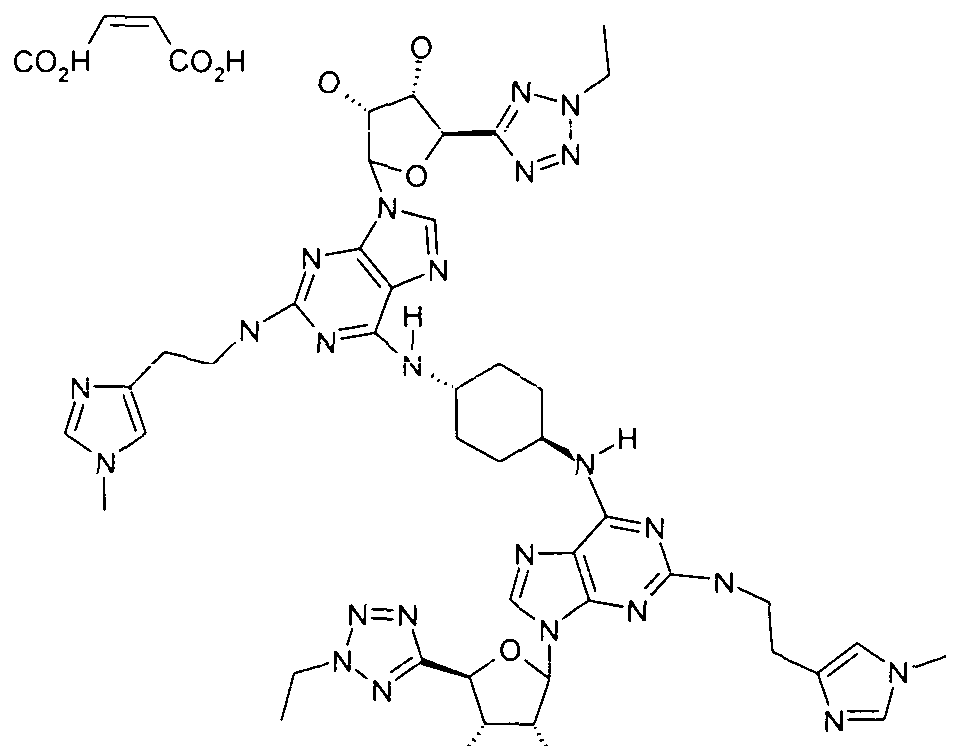
A mixture of Stage 3 (55 g, 67.4 mmol), ΛΛmethyl histamine (84.7 g, 674 mmol) and anhydrous dimethyl sulfoxide (138 ml) was heated at 100 0C for 16.5 hours. The mixture was cooled to ambient temperature then added over 45 minutes to water (1.4 L). The slurry was stirred for 45 minutes, filtered, washed with water (2 x 700 ml) and dried. The crude product (60 g), maleic acid (7 g) and methyl alcohol (360 ml) was heated at 65 0C for 90 minutes, cooled to 30 0C and seeded, then cooled to ambient temperature (20-25 0C) and stirred for 90 minutes. The slurry was filtered, washed with methyl alcohol (110 ml) and dried to give the title compound (39.2 g).
1H NMR (d4-MeOH, 400 MHz) δ 1.39-1.53 (4 H, m), 1.6 (6 H, t), 2.10-2.21 (4 H, m), 2.92 (4 H, t), 3.64 (4 H, t), 3.71 (6 H, s), 4.06 (2 H, br s), 4.70 (4 H, q), 4.80 (2 H, br s), 4.89 (2 H, br s)\ 5.30 (2 H, d), 6.09 (2 H, d), 6.24 (2 H, s), 7.08 (2 H, s), 8.06 (2 H, s), 8.08 (2 H, s). * signal obscured by HOD
Example 4
Further preparation of (2R,3R,4S,5/?,2'R,3'R,4lS,5lf?)-2,2l-{frarJs-1>4- cyclohexanediylbis[imino(2-{[2-(1 -methyl-1 W-imidazol-4-yl)ethyl]amino}-9H-purine-6,9- diyl)]}bis[5-(2-ethyl-2W-tetrazol-5-yl)tetrahydro-3,4-furandiol]
Stage 1:
TΛans-Λ/,Λ/l-bis[2-chloro-9-(tetrahydro-2H-pyran-2-yl)-9/-/-purin-6-yl]-1 ,4-cyclohexanediamine (Intermediate 2)

A stirred suspension of 2,6-dichloro-9-(tetrahydro-2H-pyran-2-yl)-9H-purine (Intermediate 1 in WO03/080613) (1.14 kg) in n-butanol (1.7 L) was treated with frans-1 , 4-diaminocyclohexane (239.2g) and di-/so-propylethylamine (2.5 L), then heated at 750C for 17 hours. The suspension was allowed to cool to ambient temperature, filtered, washed with n-butanol (2 x 2.3 L) and dried in vacuo at 60 0C to give the title compound (0.9 kg).
Stage 2:
hf,hf"-trans^ ,4-cyclohexanediylbis{Λ/2-[2-(1 -methyl- 1 /-/-imidazol-4-yl)ethyl]-3/-/-purine-2,6- diamine} (Intermediate 4)

A mixture of Stage 1 (59.3 g; 100 mmol), Λ/-methylhistamine (50.5 g; 400 mmoles), dipotassium hydrogen phosphate (35.1 g, 200 mmol) in ethylene glycol (60 ml) was heated at 120 0C for 8 days. The mixture was allowed to cool to ambient temperature then 5M aqueous hydrochloric acid (245 ml) is added with ice cooling for 50 minutes. Methanol (296 ml) was added followed by di-isopropylethylamine (246 ml) added dropwise over 30 minutes and the solution was heated to 60 0C for 1 hour. Water (178 ml) was slowly added at 60 0C over 30
minutes then stirred overnight at 25 °C. The resulting slurry was heated to 60 °C and water (160 ml) was added dropwise. The slurry was cooled to ambient temperature, filtered, washed with water (120 ml), 1 :2 methyl alcohol / water (120 ml), methyl alcohol (120 ml) and dried in vacuo at 40 0C to give a damp product (48.8 g). The damp product (40.8 g) was dried further in vacuo at 60 °C for 2 days to give the title compound (38.9 g).
Stage 3:
Trans-Λ ,4-cyclohexanediylbis[imino(2-{[2-(1 -methyl-1 H-imidazol-4-yl)ethyl]amino}-9H-purine- 6,9-diyl)(2/?,3f?,4R,5/?)-5-(2-ethyl-2H-tetrazol-5-yl)tetrahydrofuran-2,3,4-triyl] tetraacetate (Intermediate 5)

Trimethylsilyl trifluoromethanesulfonate (30.3 ml, 167 mmol) was added to a suspension of Stage 2 (20 g, 33.9 mmol) in acetonitrile (200 ml) then heated at 50 0C for 30 minutes. Then a solution of rel-Acetic acid 4R,5-diacetoxy-2R-(2-ethyl-2H-tetrazol-5-yl)-tetrahydro-furan-3R- yl ester (Intermediate 6 of WO98/28319)(28.7 g, 84 mmol) in acetonitrile (200 ml) was added over 30 minutes and stirred for 20 hours. The reaction mixture was cooled to ambient temperature and quenched with water (50 ml) for 35 minutes then 5M aqueous hydrochloric acid (2 x 50 ml) for 90 minutes. The mixture was partitioned between dichloromethane (250 ml) and aqueous saturated sodium bicarbonate (700 ml) and the dichloromethane layer was allowed to stand at ambient temperature overnight. The organic portion was then extracted with 1 M aqueous hydrochloric acid (2 x 300 ml). The acidic extracts were neutralised with aqueous saturated sodium bicarbonate (750 ml) then extracted with dichloromethane (2 x
200 ml). The combined dichloromethane extracts was washed with brine (100 ml), dried over anhydrous magnesium sulphate and concentrated to give the title compound (28.9 g) that was used without purification.
Stage 4:
{2R,3RAS,5R,2'R,3'RA'S,5'R)-2,2'-{trans^ ,4-cyclohexanediylbis[imino(2-{[2-(1 -methyl- 1 H- imidazol-4-yl)ethyl]amino}-9H-purine-6,9-diyl)]}bis[5-(2-ethyl-2H-tetrazol-5-yl)tetrahydro-3,4- furandiol]

A solution of Stage 3 (28.6 g; assume 24.7 mmol) in methanol (515 ml) was treated with sodium methoxide (0.44 g, 8.13 mmol) for 90 minutes before being treated with a further portion of sodium methoxide (0.44 g, 8.13 mmol). After 30 minutes Dowex 50 [H+] was added to neutralise the solution. The resin was filtered off and the filtrate was evaporated to leave the title Compound as a foam (24 g).
Preparation of 4-Biphenylsulfonate and (+)-Camphorsulfonate Salts of Compound A
4-Biphenylsulfonate Salt of Compound A
(2R,3R,4S,5R,2'R,3'RA'S,5'R)-2,2l-{trans-'[ ,4-cyclohexanediylbis[imino(2-{[2-(1 -methyl-1 H- imidazol-4-yl)ethyl]amino}-9H-purine-6,9-diyl)]}bis[5-(2-ethyi-2H-tetrazol-5-yl)tetrahydro-3,4- furandiol] (2g) and 4-biphenylsulfonic acid (560mg) were dissolved in methanol (60ml, 30vols) by heating at 550C while stirring for one hour. iso-Propyl acetate (10ml) was added portionwise to the reaction mixture over 4.5hrs. The resulting suspension was stirred at room
temperature overnight and then temperature cycled from 0-400C over the subsequent evening. The product was isolated by filtration, washed with methanol (10ml, 5vols) and dried overnight at room temperature under vacuum.
(+)-Camphorsulfonate Salt of Compound A
(2R,3R,4S,5R,2'R,3'R,4'S,5lR)-2,2l-{frans-1 ,4-cyclohexanediylbis[imino(2-{[2-(1-methyl-1 H- imidazol-4-yl)ethyl]amino}-9H-purine-6,9-diyl)]}bis[5-(2-ethyl-2H-tetrazol-5-y!)tetrahydro-3,4- furandiol] (3g) was dissolved in methanol (15ml, 5vols) at reflux. (+)-Camphorsulfonic acid (735mg) was added and the reaction mixture heated at reflux for one hour. Methyl t-butyl ether (8.8ml, 2.9 vols) was added dropwise to the reaction mixture over 30mins at 5O0C and the mixture was then held at 5O0C for a while. The resulting suspension was cooled and held at 4O0C for a few hours before cooling to room temperature and ageing overnight. The product was isolated by filtration and dried for 2hrs at 6O0C under vacuum. The dried solid was dissolved in methanol (10ml) at 4O0C, then methyl t-butyl ether (5.94ml) was added. The resulting suspension was temperature cycled from 0-400C for 4 days. The product was isolated by filtration, washed with methanol (2ml) and dried for 2hrs at 6O0C under vacuum.
X-Ray Powder Diffraction (XRPD) Analysis of 4-Biphenylsulfonate and (+)-Camphorsulfonate Salts of Compound A
XRPD data was acquired on a PANalytical X'Pert Pro diffractometer, model PW3040/60. The samples were gently flattened on a low background silicon wafer. The patterns were collected for 60 minutes. The following acquisition parameters were used:
Scan range: 2-40 °2Θ Generator power: 4OkV, 45mA Radiation Source: Cu Ka (wavelength 1.5406) Step size: 0.167 °2Θ per step Sample Rotation: 25 rpm
The XRPD patterns obtained are as shown in Figure 1 and Figure 2. Characteristic XRPD angles and d-spacings are recorded in Table 1 , Table 1a, Table 2 and Table 2a.
4-Biphenylsulfonate Salt of Compound A


Table 1

Table 1a
(+)-Camphorsulfonate Salt of Compound A

Table 2


Table 2a
References
Asako H, Wolf, RE, Granger, DN (1993), Gastroenterology 104, pp 31-37,
Bedford CD, Howd RA, Dailey OD, Miller A, Nolen HW III, Kenley RA, Kern JR, Winterle JS,
(1986), J Med Chem 29, pp2174-2183,
Burkey TH, Webster, RO, (1993), Biochem Biophys Acta 1175, pp 312-318, Castanon MJ, Spevak W, (1994), Biochem Biophys Res Commun 198, pp 626-631 ,
Cronstein BN, Kramer SB, Weissmann G, Hirschhorn R, (1983), Trans Assoc Am
Physicians 96, pp 384-91 ,
Cronstein BN, Kramer SB, Rosenstein ED, Weissmann G, Hirschhorn R, (1985), Ann N Y
Acad Sci 451 , pp 291-301 , Cronstein BN, Naime D, Ostad E, (1993), J CIm Invest 92, pp 2675-82,
Cronstein BN, Naime D, Ostad E, (1994), Adv Exp Med Biol , 370, pp 411-6,
Cronstein BN, (1994), J Appl Physiol 76, pp 5-13,
Dianzani C, Brunelleschi S, Viano I, Fantozzi R, (1994), Eur J Pharmacol 263, pp 223-226,
Elliot KRF, Leonard EJ, (1989), FEBS Letters 254, pp 94-98, Flora KP, van't Riet B, Wampler GL, (1978), Cancer Research, 38, pp1291 -1295,
Green PG, Basbaum Al, Helms C, Levine JD, (1991 ), Proc Natl Acad Sci 88, pp 4162-
4165,
Hirschorn R, (1993), Pediatr Res 33, pp S35-41 ,
Kohno Y, Xiao-duo J, Mawhorter SD, Koshiba M, Jacobson KA (1996) Blood 88 p3569-3574 Peachell PT, Lichtenstein LM, Schleimer RP, (1989), Biochem Pharmacol 38, pp 1717-1725,
Richter J, (1992), J Leukocyte Biol 51 , pp 270-275,
Rosengren S, Bong GW, Firestein GS, (1995), J Immunol 154, pp 5444-5451 ,
Sanjar S, McCabe PJ, Fattah D, Humbles AA, Pole SM, (1992), Am Rev Respir Dis 145,
A40, Skubitz KM, Wickman NW, Hammerschmidt DE, (1988), Blood 72, pp 29-33
Valko K, Nunhuck S, Bevan C, Abraham MC, Reynolds DP (2003) J Pharm Sci 92 p2236-
2248
Van Schaick EA; Jacobson KA; Kim HO; Ijzerman AP; Danhof M. (1996) Eur J Pharmacol
308 p31 1 -314.
Wood KV. (1995) Curr Opinion Biotechnology 6 p50-58.
All publications, including but not limited to patents and patent applications, cited in this specification are herein incorporated by reference as if each individual publication were specifically and individually indicated to be incorporated by reference herein as though fully set forth.
Throughout the specification and the claims which follow, unless the context requires otherwise, the word 'comprise', and variations such as 'comprises' and 'comprising', will be understood to imply the inclusion of a stated integer or step or group of integers but not to the exclusion of any other integer or step or group of integers or steps.
The application of which this description and claims forms part may be used as a basis for priority in respect of any subsequent application. The claims of such subsequent application may be directed to any feature or combination of features described herein. They may take the form of product, composition, process, or use claims and may include, by way of example and without limitation, the following claims:
Claims
1. A salt of {2R,3R,4S,5R,2'R,3'R,4'S,5'R)-2,2'-{trans^ ,4-cyclohexanediylbis[imino(2-{[2- (1-methyl-1 H-imidazol-4-yl)ethyl]amino}-9/-/-purine-6,9-diyl)]}bis[5-(2-ethyl-2/-/-tetrazol-5- yl)tetrahydro-3,4-furandiol] selected from 4-biphenylsulfonate and (+)-camphorsulfonate, or a solvate thereof.
2. A salt according to claim 1 which is the 4-biphenylsulfonate salt.
3. A salt according to claim 2 characterised in that it provides an XRPD pattern comprising peaks, expressed in degrees 2Θ, at about 5.03, about 8.26, about 8.78 and about 10.04.
4. A salt according to claim 2 characterised in that it provides an XRPD pattern comprising peaks, expressed in degrees 2Θ, at about 5.03, about 8.26, about 8.78, about 10.04 and about 14.05.
5. A salt according to claim 1 which is the (+)-camphorsulfonate salt.
6. A salt according to claim 4 characterised in that it provides an XRPD pattern comprising peaks, expressed in degrees 2Θ, at about 4.81 , about 8.18, about 8.66 and about
10.30.
7. A salt according to claim 4 characterised in that it provides an XRPD pattern comprising peaks, expressed in degrees 2Θ, at about 4.81 , about 8.18, about 8.66, about 10.30 and about 18.25.
8. A pharmaceutical composition comprising a salt as defined in any one of claims 1 to 7 optionally with one or more pharmaceutically acceptable carriers and/or excipients.
9. A salt as claimed in any one of claims 1 to 7 for use in human or veterinary medicine.
10. A salt as claimed in any one of claims 1 to 7 for use as an anti-inflammatory agent.
1 1. Use of a salt as claimed in any one of claims 1 to 7 for the manufacture of a medicament for the treatment of patients with inflammatory conditions who are susceptible to leukocyte-induced tissue damage.
12. A method for the treatment of a human or animal subject with an inflammatory condition and/or allergic condition who is susceptible to leukocyte-induced tissue damage, which method comprises administering to said human or animal subject a safe and effective amount of a salt as claimed in any one of claims 1 to 7.
13. A process for preparing a salt as claimed in any one of claims 1 to 7 which comprises:
a) contacting in solution (2f?,3R,4S,5R,2lR,3lR,4'S,5'R)-2,2l-{frans-1 ,4- cyclohexanediylbis[imino(2-{[2-(1 -methyl-1 /-/-imidazol-4-yl)ethyl]amino}-9/-/-puhne-6,9- diyl)]}bis[5-(2-ethyl-2H-tetrazol-5-yl)tetrahydro-3,4-furandiol] with 4-biphenylsulfonic acid or (+)-camphorsulfonic acid, and
b) adding a second solvent.
Applications Claiming Priority (2)
| Application Number | Priority Date | Filing Date | Title |
|---|---|---|---|
| GB0523845.6 | 2005-11-23 | ||
| GBGB0523845.6A GB0523845D0 (en) | 2005-11-23 | 2005-11-23 | Novel salts |
Publications (1)
| Publication Number | Publication Date |
|---|---|
| WO2007059949A1 true WO2007059949A1 (en) | 2007-05-31 |
Family
ID=35601055
Family Applications (1)
| Application Number | Title | Priority Date | Filing Date |
|---|---|---|---|
| PCT/EP2006/011209 Ceased WO2007059949A1 (en) | 2005-11-23 | 2006-11-21 | Two novel salts of the n, n' -bis [9- (3,4-dihydroxy-5- (2-ethyl-2h-tetrazol-5-yl) tetrahydrofuran-2-yl) -2- (2- (1-methyl-1h-imidazol-4-yl) ethylamino) -9h-purin-6-yl] cyclohexyl-1,4-diamine adenosine a2a agonist as anti-inflammatory agents |
Country Status (2)
| Country | Link |
|---|---|
| GB (1) | GB0523845D0 (en) |
| WO (1) | WO2007059949A1 (en) |
Citations (3)
| Publication number | Priority date | Publication date | Assignee | Title |
|---|---|---|---|---|
| WO1998028319A1 (en) * | 1996-12-24 | 1998-07-02 | Glaxo Group Limited | 2-(purin-9-yl)-tetrahydrofuran-3,4-diol derivatives |
| WO1999067265A1 (en) * | 1998-06-23 | 1999-12-29 | Glaxo Group Limited | 2-(purin-9-yl)-tetrahydrofuran-3,4-diol derivatives |
| WO2005116037A1 (en) * | 2004-05-24 | 2005-12-08 | Glaxo Group Limited | Purine derivative |
-
2005
- 2005-11-23 GB GBGB0523845.6A patent/GB0523845D0/en active Pending
-
2006
- 2006-11-21 WO PCT/EP2006/011209 patent/WO2007059949A1/en not_active Ceased
Patent Citations (3)
| Publication number | Priority date | Publication date | Assignee | Title |
|---|---|---|---|---|
| WO1998028319A1 (en) * | 1996-12-24 | 1998-07-02 | Glaxo Group Limited | 2-(purin-9-yl)-tetrahydrofuran-3,4-diol derivatives |
| WO1999067265A1 (en) * | 1998-06-23 | 1999-12-29 | Glaxo Group Limited | 2-(purin-9-yl)-tetrahydrofuran-3,4-diol derivatives |
| WO2005116037A1 (en) * | 2004-05-24 | 2005-12-08 | Glaxo Group Limited | Purine derivative |
Also Published As
| Publication number | Publication date |
|---|---|
| GB0523845D0 (en) | 2006-01-04 |
Similar Documents
| Publication | Publication Date | Title |
|---|---|---|
| EP1904512B1 (en) | Purine derivatives as agonists of the adenosine a2a receptor | |
| KR101029207B1 (en) | Certain glucocorticosteroid compounds with anti-inflammatory activity | |
| US6495528B1 (en) | 2-(Purin -9-yl)-tetrahydrofuran-3,4-diol derivatives | |
| EP1756120B1 (en) | Purine derivative | |
| SK86599A3 (en) | Tetrahydrofuran-3,4-diol derivatives, process for their production, pharmaceutical composition containing them and their use | |
| KR20070022736A (en) | Purine derivatives | |
| WO2007059950A2 (en) | Dry powder pharmaceutical formulations of purine a2a agonists | |
| EP0366171B1 (en) | Nucleoside derivatives | |
| EP0492430A1 (en) | Oxetanocin derivative having imidazole base group | |
| HK1089186B (en) | Specific glucocorticosteroid compound having anti-inflammatory activity | |
| TW200540172A (en) | Compounds | |
| HK1089185B (en) | Specific glucocorticosteroid compound having anti-inflammatory activity |
Legal Events
| Date | Code | Title | Description |
|---|---|---|---|
| 121 | Ep: the epo has been informed by wipo that ep was designated in this application | ||
| NENP | Non-entry into the national phase |
Ref country code: DE |
|
| 122 | Ep: pct application non-entry in european phase |
Ref document number: 06818745 Country of ref document: EP Kind code of ref document: A1 |