WO2007053352A2 - Pyrroloquinolinone derivatives as 5-hydroxytryptamine-6 ligands - Google Patents
Pyrroloquinolinone derivatives as 5-hydroxytryptamine-6 ligands Download PDFInfo
- Publication number
- WO2007053352A2 WO2007053352A2 PCT/US2006/041332 US2006041332W WO2007053352A2 WO 2007053352 A2 WO2007053352 A2 WO 2007053352A2 US 2006041332 W US2006041332 W US 2006041332W WO 2007053352 A2 WO2007053352 A2 WO 2007053352A2
- Authority
- WO
- WIPO (PCT)
- Prior art keywords
- ylmethyl
- pyrrolo
- aminoethyl
- alkyl
- optionally substituted
- Prior art date
- Legal status (The legal status is an assumption and is not a legal conclusion. Google has not performed a legal analysis and makes no representation as to the accuracy of the status listed.)
- Ceased
Links
- 0 C1CN=C*C1 Chemical compound C1CN=C*C1 0.000 description 6
Classifications
-
- C—CHEMISTRY; METALLURGY
- C07—ORGANIC CHEMISTRY
- C07D—HETEROCYCLIC COMPOUNDS
- C07D471/00—Heterocyclic compounds containing nitrogen atoms as the only ring hetero atoms in the condensed system, at least one ring being a six-membered ring with one nitrogen atom, not provided for by groups C07D451/00 - C07D463/00
- C07D471/02—Heterocyclic compounds containing nitrogen atoms as the only ring hetero atoms in the condensed system, at least one ring being a six-membered ring with one nitrogen atom, not provided for by groups C07D451/00 - C07D463/00 in which the condensed system contains two hetero rings
- C07D471/04—Ortho-condensed systems
-
- A—HUMAN NECESSITIES
- A61—MEDICAL OR VETERINARY SCIENCE; HYGIENE
- A61P—SPECIFIC THERAPEUTIC ACTIVITY OF CHEMICAL COMPOUNDS OR MEDICINAL PREPARATIONS
- A61P25/00—Drugs for disorders of the nervous system
-
- C—CHEMISTRY; METALLURGY
- C07—ORGANIC CHEMISTRY
- C07D—HETEROCYCLIC COMPOUNDS
- C07D487/00—Heterocyclic compounds containing nitrogen atoms as the only ring hetero atoms in the condensed system, not provided for by groups C07D451/00 - C07D477/00
- C07D487/02—Heterocyclic compounds containing nitrogen atoms as the only ring hetero atoms in the condensed system, not provided for by groups C07D451/00 - C07D477/00 in which the condensed system contains two hetero rings
- C07D487/04—Ortho-condensed systems
Definitions
- the present invention is directed to substituted pyrroloquinolinones, the use thereof in the treatment of a central nervous system disorder related to or affected by the 5-HT6 receptor and pharmaceutical compositions comprising said substituted pyrroloquinolinones.
- Serotonin (5-hydroxytryptamine)(5-HT) receptors play a critical role in many physiological and behavioral functions in humans and animals. These functions are mediated through various 5-HT receptors distributed throughout the body. There are now approximately fifteen different human 5-HT receptor subtypes that have been cloned, many with well-defined roles in humans. The 5-HT6 receptor was first cloned from rat tissue in 1993 (Monsma et al., Molecular Pharmacology 1993, 43, 320-327) and subsequently from human tissue (Kohen et al., Journal of Neurochemistry 1996, 66, 47-56).
- the receptor is a G-protein coupled receptor (GPCR) positively coupled to adenylate cyclase (Ruat et al., Biochemical Biophysical Research Communications 1993, 193, 268-276).
- GPCR G-protein coupled receptor
- the receptor is found almost exclusively in the central nervous system (CNS) areas both in rat and in human.
- CNS central nervous system
- In situ hybridization studies of the 5-HT6 receptor in rat brain using mRNA indicate principal localization in the areas of 5-HT projection including striatum, nucleus accumbens, olfactory tubercle, and hippocampal formation (Ward et al., Neuroscience 1995, 64, 1105-1111).
- 5-HT6 ligands there are many potential therapeutic uses for 5-HT6 ligands in humans based on direct effects and on indications from available scientific studies. These studies include the localization of the receptor, the affinity of ligands with known in vivo activity, and various animal studies conducted so far.
- One potential therapeutic use of modulators of 5-HT6 receptor function is in the enhancement of cognition and memory in human diseases such as Alzheimer's Disease.
- the high levels of receptor found in important structures in the forebrain, including the caudate/putamen, hippocampus, nucleus accumbens, and cortex suggest a role for the receptor in memory and cognition, since these areas are known to play a vital role in memory (Gerard et al., Brain Research 1997, 746, 207- 219).
- a related potential therapeutic use for 5-HT6 ligands is the treatment of attention deficit disorders (ADD, also known as Attention Deficit Hyperactivity Disorder or ADHD) in both children and adults.
- ADD attention deficit disorders
- 5-HT6 antagonists appear to enhance the activity of the nigrostriatal dopamine pathway and because ADHD has been linked to abnormalities in the caudate (Ernst et al., Journal of Neuroscience 1998, 18(15), 5901-5907), 5-HT6 antagonists may attenuate attention deficit disorders.
- 5-HT6 antagonists may attenuate attention deficit disorders.
- clozapine an effective clinical antipsychotic
- 5-HT6 receptor subtype a subtype of 5-HT6 receptor subtype
- several clinical antidepressants have high affinity for the receptor as well and act as antagonists at this site (Branchek, et al., Annual Reviews in Pharmacology and Toxicology 2000, 40, 319-334).
- 5-HT6 modulators may be useful in the treatment of movement disorders including epilepsy (Stean et al., British Journal of Pharmacology 1999, 127 Proc. Supplement 131 P and Routledge et al., British Journal of Pharmacology 2000, 130(7), 1606-1612).
- 5-HT6 receptor modulators i.e., ligands
- compounds which are 5-HT6 receptor modulators may be useful for therapeutic indications including: the treatment of diseases associated with a deficit in memory, cognition, and learning such as Alzheimer's and attention deficit disorder; the treatment of personality disorders such as schizophrenia; the treatment of behavioral disorders, e.g., anxiety, depression and obsessive-compulsive disorders; the treatment of motion or motor disorders such as Parkinson's disease and epilepsy; the treatment of diseases associated with neurodegeneration such as stroke and head trauma; or withdrawal from drug addiction including addiction to nicotine, alcohol, and other substances of abuse.
- the compounds provided may also be used to further study and elucidate the 5-HT6 receptor.
- the present invention provides a pyrroloquinolinone compound of formula
- X is N or CR 8 ; n is an integer of 1 , 2, 3, 4, 5, or 6; R is H, SO 2 Rg or an alkyl, cycloalkyl, alkenyl or alkynyl group each optionally substituted; Ri is H, halogen or an alkyl, aryl or heteroaryl group each optionally substituted; R 2 and R 3 are each independently H or an optionally substituted alkyl group;
- R 4 and R 5 are each independently H or an alkyl, alkenyl, cycloalkyl, cycloheteroalkyl, aryl or heteroaryl group each optionally substituted, or R 4 and R 5 may be taken together with the atom to which they are attached to form an optionally substituted 5- to 8-membered ring optionally containing an additional heteroatom selected from O, S or
- R 6 and R 8 are each independently H, halogen or an alkyl, alkenyl, alkynyl, alkoxy, cycloalkyl, cycloheteroalkyl, aryl or heteroaryl group each optionally substituted;
- R 7 is H or an alkyl, alkenyl, alkynyl, cycloalkyl, cycloheteroalkyl, aryl, or heteroaryl group each optionally substituted; and
- R 9 is an alkyl, aryl or heteroaryl group each optionally substituted; or a stereoisomer thereof or a pharmaceutically acceptable salt thereof.
- the present invention also provides methods and compositions useful in the treatment of central nervous system disorders.
- the 5-hydroxytryptamine-6 (5-HT6) receptor has been identified by molecular cloning. Its ability to bind a wide range of therapeutic compounds used in psychiatry, coupled with its interesting distribution in the brain has stimulated significant interest in new compounds which are capable of interacting with or affecting said receptor. Significant efforts are being made to understand the possible role of the 5-HT6 receptor in psychiatry, cognitive dysfunction, motor function and control, memory, mood and the like.
- pyrroloquinolinone compound of formula I demonstrates 5-HT6 affinity along with significant sub-type selectivity.
- said formula I compounds are effective therapeutic agents for the treatment of central nervous system (CNS) disorders associated with or affected by the 5-HT6 receptor. Accordingly, the present invention provides a pyrroloquinolinone compound of formula I
- X is N or CR 8 ; n is an integer of 1 , 2, 3, 4, 5, or 6;
- R is H, SO 2 R 9 or an alkyl, cycloalkyl, alkenyl or alkynyl group each optionally substituted;
- Ri is H, halogen or an alkyl, aryl or heteroaryl group each optionally substituted;
- R 2 and R 3 are each independently H or an optionally substituted alkyl group
- R 4 and R 5 are each independently H or an alkyl, alkenyl, cycloalkyl, cycloheteroalkyl, aryl or heteroaryl group each optionally substituted, or R 4 and R 5 may be taken together with the atom to which they are attached to form an optionally substituted 5- to 8-membered ring optionally containing an additional heteroatom selected from O, S or NR 7 ;
- R 6 and R 8 are each independently H, halogen or an alkyl, alkenyl, alkynyl, alkoxy, cycloalkyl, cycloheteroalkyl, aryl or heteroaryl group each optionally substituted;
- R 7 is H or an alkyl, alkenyl, alkynyl, cycloalkyl, cycloheteroalkyl, aryl, or heteroaryl group each optionally substituted; and
- R 9 is an alkyl, aryl or heteroaryl group each optionally substituted; or a stereoisomer thereof or a pharmaceutically acceptable salt thereof.
- halogen designates F, Cl, Br or I
- cycloheteroalkyl designates a five- to seven-membered cycloalkyl ring system containing 1 or 2 heteroatoms, which may be the same or different, selected from N, O or S and optionally containing one double bond.
- exemplary of the cycloheteroalkyl ring systems included in the term as designated herein are the following rings wherein Y is NR', O or S; and R' is H or an optional substituent as described herein:
- heteroaryl designates a five- to ten-membered aromatic ring system containing 1 , 2 or 3 heteroatoms, which may be the same or different, selected from N, O or S.
- heteroaryl ring systems include pyridinyl, pyrrolyl, azolyl, oxazolyl, thiazolyl, imidazolyl, furyl, thienyl, quinolinyl, isoquinolinyl, indolyl, indazolyl, azaindazolyl, benzothienyl, benzofuranyl, benzisoxazolyl or the like.
- aryl designates a carbocyclic aromatic ring system, e.g. of 6 to 14 carbon atoms such as phenyl, naphthyl, anthracenyl or the like.
- saturated hydrocarbon alkyl moieties include, but are not limited to, chemical groups of 1-6 carbon atoms such as methyl, ethyl, n-propyl, isopropyl, n-butyl, terf-butyl, isobutyl, sec-butyl; higher homologs such as n-pentyl, n- hexyl, and the like.
- alkenyl refers to either a (C 2 -C 10 ) straight chain or branched-chain monovalent hydrocarbon moiety containing at least one double bond. Such hydrocarbon alkenyl moieties may be mono or polyunsaturated, and may exist in the E or Z configurations. The compounds of this invention are meant to include all possible E and Z configurations.
- Examples of mono or polyunsaturated hydrocarbon alkenyl moieties include, but are not limited to, chemical groups such as vinyl, 2-propenyl, isopropenyl, crotyl, 2-isopentenyl, butadienyl, 2-(butadienyl), 2,4- pentadienyl, 3-(1 ,4-pentadienyl), and higher homologs, isomers, or the like.
- alkynyl refers to either a (C 2 -C 10 ) straight chain or branched-chain monovalent hydrocarbon moiety containing at least one triple bond.
- cycloalkyl refers to a monocyclic, bicyclic, tricyclic, fused, bridged, or spiro monovalent saturated hydrocarbon moiety of 3-10 carbon atoms, unless otherwise specified. Any suitable ring position of the cycloalkyl moiety may be covalently linked to the defined chemical structure.
- cycloalkyl moieties include, but are not limited to, chemical groups such as cyclopropyl, cyclobutyl, cyclopentyl, cyclohexyl, cycloheptyl, norbornyl, adamantyl, spiro[4.5]decanyl, and homologs, isomers, or the like.
- alkyl, alkenyl, alkynyl, cycloalkyl, cycloheteroalkyl, aryl or heteroaryl when designated as being optionally substituted, the substituent groups which are optionally present may be one or more of those customarily employed in the development of pharmaceutical compounds, or the modification of such compounds, to influence their structure/activity, persistence, absorption, stability or other beneficial property.
- optional substituents include halogen atoms, nitro, cyano, thiocyanato, cyanato, hydroxyl, alkyl, haloalkyl, alkoxy, haloalkoxy, amino, alkylamino, dialkylamino, formyl, alkoxycarbonyl, carboxyl, alkanoyl, alkylthio, alkylsuphinyl, alkylsulphonyl, carbamoyl, alkylaminocarbonyl, cycloalkyl, aryl, phenyl, phenoxy, benzyl, benzyloxy, heteroaryl, indolyl, heterocyclyl, (e.g., 5-10 membered heteroaryl or heterocycloalkyl moieties containing 1-3 ring heteroatoms selected from O, S and N) or cycloalkyl groups, preferably halogen atoms or lower alkyl or lower alkoxy groups where 'lower'
- substituents may be present.
- alkyl substituent group e.g., alkoxy, alkylsulfonyl, alkanoyl
- this may be linear or branched and may contain up to 12, preferably up to 6, more preferably up to 4 carbon atoms.
- Pharmaceutically acceptable salts may be any acid addition salt formed by a compound of formula I and a pharmaceutically acceptable acid such as phosphoric, sulfuric, hydrochloric, hydrobromic, citric, maleic, malonic, mandelic, succinic, fumaric, acetic, lactic, nitric, sulfonic, p-toluene sulfonic, tartaric, malic, methane sulfonic acid or the like.
- a pharmaceutically acceptable acid such as phosphoric, sulfuric, hydrochloric, hydrobromic, citric, maleic, malonic, mandelic, succinic, fumaric, acetic, lactic, nitric, sulfonic, p-toluene sulfonic, tartaric, malic, methane sulfonic acid or the like.
- Compounds of the invention include esters, carbamates or other conventional prodrug forms, which in general, are functional derivatives of the compounds of the invention and which are readily converted to the inventive active moiety in vivo.
- the method of the invention embraces the treatment of the various conditions described hereinabove with a compound of formula I or with a compound which is not specifically disclosed but which, upon administration, converts to a compound of formula I in vivo.
- metabolites of the compounds of the present invention defined as active species produced upon introduction of these compounds into a biological system.
- Compounds of the invention may exist as one or more stereoisomers.
- the various stereoisomers include enantiomers, diastereomers, atropisomers and geometric isomers.
- one stereoisomer may be more active or may exhibit beneficial effects when enriched relative to the other stereoisomer(s) or when separated from the other stereoisomer(s). Additionally, the skilled artisan knows how to separate, enrich or selectively prepare said stereoisomers.
- the present invention comprises compounds of formula I, the stereoisomers thereof and the pharmaceutically acceptable salts thereof.
- the compounds of the invention may be present as a mixture of stereoisomers, individual stereoisomers, or as an optically active or enantiomerically pure form. Examples of the variables in the formulae I are as follows: An example of X is CH or N.
- alkyl such as methyl, pentyl, optionally substituted, eg by hydroxy
- arylalkyl such as benzyl
- cycloakylalkyl or heteroarylalkyl such as heteroarylmethyl
- the said aryl eg phenyl
- cycloalkyl or heteroaryl eg indolyl, furanyl, pyridyl, pyrrolyl, thienyl, benzofuranyl, imidazolyl, quinolyl
- group is optionally substituted for example by one to three optional substituents selected from one or more of aryloxy, alkoxy, alkoxycarbonyl, halogen, dialkylamino, alkyl, alkylenedioxy, cyano, hydroxyl, CF 3 .
- R 7 are H, heteroaryl (such as thienyl), or alkyl (such as methyl, ethyl, propyl, heptyl) which may be optionally substituted, eg by cycloalkyl (eg cyclopropyl); alkoxy; dialkylmino; optionally substituted heteroaryl (such as thienyl, furanyl); optionally substituted aryl (eg phenyl or naphthyl), e.g. where the optional substitution on aryl or heteroaryl is by one or two substituents selected from halogen, alkoxy, alkyl or haloalkyl.
- heteroaryl such as thienyl
- alkyl such as methyl, ethyl, propyl, heptyl
- alkyl such as methyl, ethyl, propyl, heptyl
- alkyl such as methyl, ethyl, propyl, hepty
- R 1 are H, halogen such as Br and optionally substituted phenyl.
- R are H and alkyl such as methyl.
- R 8 examples are H and chlorine.
- Preferred compounds of the invention are those compounds of formula I wherein n is 2. Also preferred are those compounds of formula I wherein R is H. Another group of preferred formula I compounds is those compounds wherein R 7 is H or an optionally substituted alkyl group.
- More preferred compounds of the invention are those compounds of formula I wherein n is 2 and R 1 is H. Another group of more preferred compounds of the invention is those compounds of formula I wherein n is 2 and R 2 and R 3 are H. A further group of more preferred formula I compounds is those compounds wherein n is 2; R 2 and R 3 are H; and R 4 and R 5 are each independently H or alkyl.
- Preferred compounds of the invention include:
- compounds of formula I may be prepared using conventional synthetic methods and, if required, standard separation or isolation techniques.
- compounds of formula I wherein R 4 and R 5 are H (Ia) may be prepared by reacting an isoquinolinone of formula Il with a dioxolan derivative of formula III via a Fisher indole synthesis to obtain the desired compound of formula Ia.
- the formula Ia free amine may be reacted with an appropriate halide, R 4 -HaI 1 in the presence of a base such as NaH to give a compound of formula I wherein R 5 is H and R 4 is other than H
- R 5 are other than H (Ic).
- the reactions are shown in flow diagram I wherein Hal is Cl, Br or I.
- compounds of formula Ib may be obtained using a two-step reaction sequence involving, the reaction of Ia with a carboxylic acid derivative to provide the corresponding amide and subsequent reduction of said amide with a suitable reducing agent, such as LiAIH 4 , to give the desired amine of formula Ib.
- a suitable reducing agent such as LiAIH 4
- This process may be repeated with an alternative carboxylic acid derivative with subsequent reduction to provide the fully substituted amine derivative of formula Ic.
- a method useful for preparing libraries of compounds of formula Ib or Ic is the reaction of formula Ia with a suitable aldehyde derivative to form the corresponding imine and reducing said imine with a suitable reducing agent such as NaBH 4 , or for ease of automation, polymer supported borohydride, to give a compound of formula Ib in high yield.
- Isoquinolinones or quinazolinones of formula Il are known and are commercially available or may be prepared, e.g., by the methods described by Izumi et al., J. Heterocyclic Chem. 1990, 27, 1419, and Hegedus et al., J. Org. Chem. 1977, 42, 1329.
- 4-fluoro-2-ethenyl substituted benzamides of formula IV can be intramolecularly cyclized to the corresponding isoquinolinone or quinazolinone by the combined action of palladium(ll)chloride and copper(l)chloride to give the fluoroisoquinolinone or fluoroquinazolinoneof formula V and reacting said formula V compound with hydrazine to give the desired compound of formula II.
- the reaction is shown in flow diagram II.
- Compounds of formula V wherein X is CH may also be prepared by the method described by Heck et al. in J. Org. Chem., 1977, 42, 3903 and J. Org. Chem., 1978, 43, 2454.
- Compounds of formula V wherein X is N (Va) may be prepared by the cyclocondensation reaction of anthranilic acid derivatives, i.e. Rewcastle et al., J. Med. Chem. 1996, 39(4), 918-928, Hudson et al. (WO 96/09294), Houghten et al., (WO 98/11438), Fantin et al., J. Org. Chem.
- Compounds of formula Va may also be prepared by the reaction of 2-amino-4- fluorobenzoic acid with a formamidine acetate derivative of formula Vl, followed by the reaction of the formula Vl compound with an electrophile, R 7 -HaI, in the presence of a base to give the desired compound of formula Va.
- the reaction is shown in flow diagram III wherein Hal is Cl, Br or I.
- the formula I compounds of the invention are useful for the treatment of CNS disorders relating to or affected by the 5-HT6 receptor including mood, personality, behavioral, psychiatric, cognitive, neurodegenerative, or the like disorders, for example, Alzheimer's disease, Parkinson's disease, attention deficit disorder, anxiety, epilepsy, depression, obsessive-compulsive disorder, sleep disorders, neurodegenerative disorders (such as head trauma or stroke), feeding disorders (such as anorexia or bulimia), schizophrenia, memory loss, disorders associated with withdrawal from drug or nicotine abuse, or the like or certain gastrointestinal disorders such as irritable bowel syndrome.
- CNS disorders relating to or affected by the 5-HT6 receptor
- CNS disorders relating to or affected by the 5-HT6 receptor
- cognitive, neurodegenerative, or the like disorders for example, Alzheimer's disease, Parkinson's disease, attention deficit disorder, anxiety, epilepsy, depression, obsessive-compulsive disorder, sleep disorders, neurodegenerative disorders (such as head trauma or stroke), feeding disorders (such as anore
- the present invention provides a method for the treatment of a disorder of the central nervous system related to or affected by the 5-HT6 receptor in a patient in need thereof which comprises providing said patient a therapeutically effective amount of a compound of formula I as described hereinabove.
- the compounds may be provided by oral or parenteral administration or in any common manner known to be an effective administration of a therapeutic agent to a patient in need thereof.
- the term "providing” as used herein with respect to providing a compound or substance embraced by the invention designates either directly administering such a compound or substance, or administering a prodrug, derivative or analog which forms an equivalent amount of the compound or substance within the body.
- the therapeutically effective amount provided in the treatment of a specific CNS disorder may vary according to the specific condition(s) being treated, the size, age and response pattern of the patient, the severity of the disorder, the judgment of the attending physician or the like.
- effective amounts for daily oral administration may be about 0.01 to 1,000 mg/kg, preferably about 0.5 to 500 mg/kg and effective amounts for parenteral administration may be about 0.1 to 100 mg/kg, preferably about 0.5 to 50 mg/kg.
- the compounds of the invention are provided by administering the compound or a precursor thereof in a solid or liquid form, either neat or in combination with one or more conventional pharmaceutical carriers or excipients. Accordingly, the present invention provides a pharmaceutical composition which comprises a pharmaceutically acceptable carrier and an effective amount of a compound of formula I as described hereinabove.
- Solid carriers suitable for use in the composition of the invention include one or more substances which may also act as flavoring agents, lubricants, solubilizers, suspending agents, fillers, glidants, compression aides, binders, tablet-disintegrating agents or encapsulating materials.
- the carrier may be a finely divided solid which is in admixture with a finely divided compound of formula I.
- the formula I compound may be mixed with a carrier having the necessary compression properties in suitable proportions and compacted in the shape and size desired. Said powders and tablets may contain up to 99% by weight of the formula I compound.
- Solid carriers suitable for use in the composition of the invention include calcium phosphate, magnesium stearate, talc, sugars, lactose, dextrin, starch, gelatin, cellulose, methyl cellulose, sodium carboxymethyl cellulose, polyvinylpyrrolidine, low melting waxes and ion exchange resins.
- any pharmaceutically acceptable liquid carrier suitable for preparing solutions, suspensions, emulsions, syrups and elixirs may be employed in the composition of the invention.
- Compounds of formula I may be dissolved or suspended in a pharmaceutically acceptable liquid carrier such as water, an organic solvent, or a pharmaceutically acceptable oil or fat, or a mixture thereof.
- Said liquid composition may contain other suitable pharmaceutical additives such as solubilizers, emulsifiers, buffers, preservatives, sweeteners, flavoring agents, suspending agents, thickening agents, coloring agents, viscosity regulators, stabilizers, osmo-regulators, or the like.
- liquid carriers suitable for oral and parenteral administration include water (particularly containing additives as above, e.g., cellulose derivatives, preferably sodium carboxymethyl cellulose solution), alcohols (including monohydric alcohols and polyhydric alcohols, e.g., glycols) or their derivatives, or oils (e.g., fractionated coconut oil and arachis oil).
- the carrier may also be an oily ester such as ethyl oleate or isopropyl myristate.
- compositions of the invention which are sterile solutions or suspensions are suitable for intramuscular, intraperitoneal or subcutaneous injection. Sterile solutions may also be administered intravenously.
- Inventive compositions suitable for oral administration may be in either liquid or solid composition form.
- NMR nuclear magnetic resonance
- DMF dimethyl formamide
- EtOAc tetrahydrofuran, dimethyl formamide and ethyl acetate, respectively.
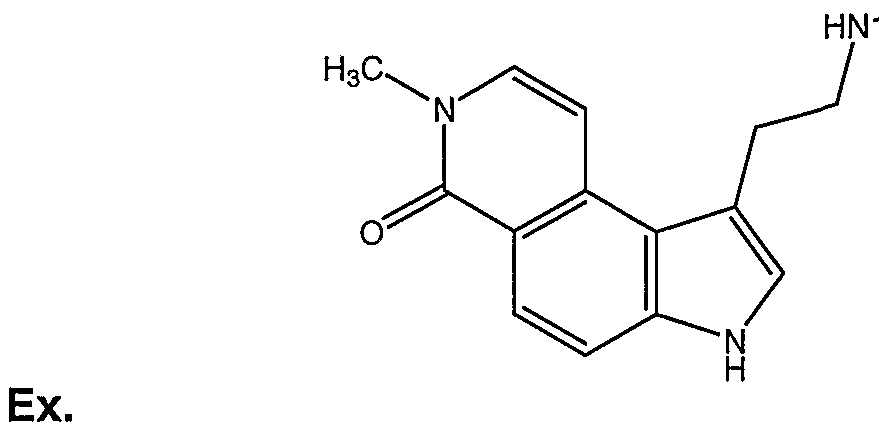
- Example 7B Using essentially the same procedure described in Example 7B and employing 1 -(2-aminoethyl)-7-methyl-3H,7H-pyrrolo[3,2-f]isoquinolin-6-one as substrate and a suitable aldehyde, The compounds shown in Table Il were obtained and identified by HPLC and mass spectral analyses.
- Example 7B Using essentially the same procedure described in Example 7B and employing 1-(2-aminoethyl)-7-benzyl-3H,7H-pyrrolo[3,2-f]isoquinolin-6-one as substrate and a suitable aldehyde, the compounds shown in Table III were obtained and identfied by HPLC and mass spectral analyses.
- Example 7B Using essentially the same procedure described in Example 7B and employing 1 -(2-aminoethyl)-7-ethyl-3H,7H-pyrrolo[3,2-f]isoquinolin-6-one as substrate and a suitable aldehyde, the compounds shown in Table IV were obtained and identified by HPLC and mass spectral analyses.
- Example 7B Using essentially the same procedure described in Example 7B and employing 1-(2-aminoethyl)-7-(4-fluorobenzyl)-3H,7H-pyrrolo[3,2-f]isoquinolin-6-one as substrate and a suitable aldehyde, the compounds shown in Table V were obtained and identified by HPLC and mass spectral analyses.
- Example 7B Using essentially the same procedure described in Example 7B and employing 1-(2-aminoethyl)-7-(2-fluorobenzyl)-3H,7H-pyrrolo[3,2-f]isoquinolin-6-one as substrate and a suitable aldehyde, the compounds shown in Table Vl were obtained and identified by HPLC and mass spectral analyses.
- Example 7B Using essentially the same procedure described in Example 7B and employing 1-(2-aminoethyl)-7-(thiophen-2-ylmethyl)-3H,7H-pyrrolo[3,2-f]isoquinolin- 6-one as substrate and a suitable aldehyde, the compounds shown in Table VII were obtained and identified by HPLC and mass spectral analyses.
- Example 7B Using essentially the same procedure described in Example 7B and employing 1-(2- aminoethyl)-7-cyclopropylmethyl-3H,7H-pyrrolo[3,2-f]isoquinolin-6-one as substrate and a suitable aldehyde, the compounds shown in Table VIII were obtained and identified by HPLC and mass spectral analyses.
- Example 7B Using essentially the same procedure described in Example 7B and employing 1 -(2-aminoethyl)-7-propyl-3H,7H-pyrrolo[3,2-f]isoquinolin-6-one as substrate and a suitable aldehyde, the compounds shown in Table IX were obtained and identified by HPLC and mass spectral analyses.
- Example 7B Using essentially the same procedure described in Example 7B and employing 1-(2-aminoethyl)-7-(pyridin-4-ylmethyl)-3H,7H-pyrrolo[3,2-f]isoquinolin-6- one as substrate and a suitable aldehyde, the compounds shown in Table X were obtained and identified by HPLC and mass spectral analyses.
- Example 7B Using essentially the same procedure described in Example 7B and employing 1-(2-aminoethyl)-7-(pyridin-2-ylmethyl)-3H,7H-pyrrolo[3,2-f]isoquinolin-6- one as substrate and a suitable aldehyde, the compounds shown in Table Xl were obtained and identified by HPLC and mass spectral analyses.
Landscapes
- Chemical & Material Sciences (AREA)
- Organic Chemistry (AREA)
- Health & Medical Sciences (AREA)
- Engineering & Computer Science (AREA)
- Bioinformatics & Cheminformatics (AREA)
- Biomedical Technology (AREA)
- Neurology (AREA)
- Neurosurgery (AREA)
- Chemical Kinetics & Catalysis (AREA)
- General Chemical & Material Sciences (AREA)
- Medicinal Chemistry (AREA)
- Nuclear Medicine, Radiotherapy & Molecular Imaging (AREA)
- Pharmacology & Pharmacy (AREA)
- Life Sciences & Earth Sciences (AREA)
- Animal Behavior & Ethology (AREA)
- General Health & Medical Sciences (AREA)
- Public Health (AREA)
- Veterinary Medicine (AREA)
- Pharmaceuticals Containing Other Organic And Inorganic Compounds (AREA)
Abstract
The present invention provides a compound of formula (I) and the use thereof in the therapeutic treatment of a central nervous system disorder related to or affected by the 5-HT6 receptor.
Description
PYRROLOQUINOLINONE DERIVATIVES AS 5-HYDROXYTRYPTAMINE-6 LIGANDS
FIELD OF THE INVENTION The present invention is directed to substituted pyrroloquinolinones, the use thereof in the treatment of a central nervous system disorder related to or affected by the 5-HT6 receptor and pharmaceutical compositions comprising said substituted pyrroloquinolinones.
BACKGROUND OF THE INVENTION
Serotonin (5-hydroxytryptamine)(5-HT) receptors play a critical role in many physiological and behavioral functions in humans and animals. These functions are mediated through various 5-HT receptors distributed throughout the body. There are now approximately fifteen different human 5-HT receptor subtypes that have been cloned, many with well-defined roles in humans. The 5-HT6 receptor was first cloned from rat tissue in 1993 (Monsma et al., Molecular Pharmacology 1993, 43, 320-327) and subsequently from human tissue (Kohen et al., Journal of Neurochemistry 1996, 66, 47-56). The receptor is a G-protein coupled receptor (GPCR) positively coupled to adenylate cyclase (Ruat et al., Biochemical Biophysical Research Communications 1993, 193, 268-276). The receptor is found almost exclusively in the central nervous system (CNS) areas both in rat and in human. In situ hybridization studies of the 5-HT6 receptor in rat brain using mRNA indicate principal localization in the areas of 5-HT projection including striatum, nucleus accumbens, olfactory tubercle, and hippocampal formation (Ward et al., Neuroscience 1995, 64, 1105-1111).
There are many potential therapeutic uses for 5-HT6 ligands in humans based on direct effects and on indications from available scientific studies. These studies include the localization of the receptor, the affinity of ligands with known in vivo activity, and various animal studies conducted so far.
One potential therapeutic use of modulators of 5-HT6 receptor function is in the enhancement of cognition and memory in human diseases such as Alzheimer's Disease. The high levels of receptor found in important structures in the forebrain, including the caudate/putamen, hippocampus, nucleus accumbens, and cortex suggest a role for the receptor in memory and cognition, since these areas are known to play a vital role in memory (Gerard et al., Brain Research 1997, 746, 207- 219). The ability of known 5-HT6 receptor ligands to enhance cholinergic transmission also supported the potential cognition use (Bentley et al., British Journal of Pharmacology 1999, 126(7), 1537-1542). Studies have found that a known 5- HT6 selective antagonist significantly increased glutamate and aspartate levels in the frontal cortex without elevating levels of noradrenaline, dopamine, or 5-HT. This selective elevation of neurochemicals known to be involved in memory and cognition strongly suggests a role for 5-HT6 ligands in cognition (Dawson et al., British Journal of Pharmacology 2000, 130(1), 23-26). Animal studies of memory and learning with a known selective 5-HT6 antagonist have found positive indications (Rogers et al., Society of Neuroscience, Abstracts 2000, 26, 680 and Foley et al., Neuropsychopharmacology 2004, 29(1), 93-100).
A related potential therapeutic use for 5-HT6 ligands is the treatment of attention deficit disorders (ADD, also known as Attention Deficit Hyperactivity Disorder or ADHD) in both children and adults. Because 5-HT6 antagonists appear to enhance the activity of the nigrostriatal dopamine pathway and because ADHD has been linked to abnormalities in the caudate (Ernst et al., Journal of Neuroscience 1998, 18(15), 5901-5907), 5-HT6 antagonists may attenuate attention deficit disorders. Early studies examining the affinity of various CNS ligands with known therapeutic utility or a strong structural resemblance to known drugs suggests a role for 5-HT6 ligands in the treatment of schizophrenia and depression. For example, clozapine (an effective clinical antipsychotic) has high affinity for the 5-HT6 receptor subtype. Also, several clinical antidepressants have high affinity for the receptor as well and act as antagonists at this site (Branchek, et al., Annual Reviews in Pharmacology and Toxicology 2000, 40, 319-334).
Further, recent in vivo studies in rats indicate 5-HT6 modulators may be useful in the treatment of movement disorders including epilepsy (Stean et al., British Journal of Pharmacology 1999, 127 Proc. Supplement 131 P and Routledge et al., British Journal of Pharmacology 2000, 130(7), 1606-1612).
Taken together, the above studies strongly suggest that compounds which are 5-HT6 receptor modulators, i.e., ligands, may be useful for therapeutic indications including: the treatment of diseases associated with a deficit in memory, cognition, and learning such as Alzheimer's and attention deficit disorder; the treatment of personality disorders such as schizophrenia; the treatment of behavioral disorders, e.g., anxiety, depression and obsessive-compulsive disorders; the treatment of motion or motor disorders such as Parkinson's disease and epilepsy; the treatment of diseases associated with neurodegeneration such as stroke and head trauma; or withdrawal from drug addiction including addiction to nicotine, alcohol, and other substances of abuse.
Therefore, it is an object of this invention to provide compounds which are useful as therapeutic agents in the treatment of a variety of central nervous system disorders related to or affected by the 5-HT6 receptor.
It is another object of this invention to provide therapeutic methods and pharmaceutical compositions useful for the treatment of central nervous system disorders related to or affected by the 5-HT6 receptor.
It is a feature of this invention that the compounds provided may also be used to further study and elucidate the 5-HT6 receptor.
SUMMARY OF THE INVENTION
The present invention provides a pyrroloquinolinone compound of formula

(I) wherein X is N or CR8; n is an integer of 1 , 2, 3, 4, 5, or 6;
R is H, SO2Rg or an alkyl, cycloalkyl, alkenyl or alkynyl group each optionally substituted; Ri is H, halogen or an alkyl, aryl or heteroaryl group each optionally substituted; R2 and R3 are each independently H or an optionally substituted alkyl group;
R4 and R5 are each independently H or an alkyl, alkenyl, cycloalkyl, cycloheteroalkyl, aryl or heteroaryl group each optionally substituted, or R4 and R5 may be taken together with the atom to which they are attached to form an optionally substituted 5- to 8-membered ring optionally containing an additional heteroatom selected from O, S or
NR7;
R6 and R8 are each independently H, halogen or an alkyl, alkenyl, alkynyl, alkoxy, cycloalkyl, cycloheteroalkyl, aryl or heteroaryl group each optionally substituted; R7 is H or an alkyl, alkenyl, alkynyl, cycloalkyl, cycloheteroalkyl, aryl, or heteroaryl group each optionally substituted; and R9 is an alkyl, aryl or heteroaryl group each optionally substituted; or a stereoisomer thereof or a pharmaceutically acceptable salt thereof.
The present invention also provides methods and compositions useful in the treatment of central nervous system disorders.
DETAILED DESCRIPTION OF THE INVENTION
The 5-hydroxytryptamine-6 (5-HT6) receptor has been identified by molecular cloning. Its ability to bind a wide range of therapeutic compounds used in psychiatry, coupled with its intriguing distribution in the brain has stimulated significant interest in new compounds which are capable of interacting with or affecting said receptor. Significant efforts are being made to understand the possible role of the 5-HT6 receptor in psychiatry, cognitive dysfunction, motor function and control, memory, mood and the like. To that end, compounds which demonstrate a binding affinity for the 5-HT6 receptor are earnestly sought both as an aid in the study of the 5-HT6 receptor and as potential therapeutic agents in the treatment of central nervous system disorders, for example, see Reavill et al., Current Opinion in Investigational Drugs 2001 , 2(1), 104-109.
Surprisingly, it has now been found that a pyrroloquinolinone compound of formula I demonstrates 5-HT6 affinity along with significant sub-type selectivity. Advantageously, said formula I compounds are effective therapeutic agents for the treatment of central nervous system (CNS) disorders associated with or affected by the 5-HT6 receptor. Accordingly, the present invention provides a pyrroloquinolinone compound of formula I

(I) wherein
X is N or CR8; n is an integer of 1 , 2, 3, 4, 5, or 6;
R is H, SO2R9 or an alkyl, cycloalkyl, alkenyl or alkynyl group each optionally substituted;
Ri is H, halogen or an alkyl, aryl or heteroaryl group each optionally substituted;
R2 and R3 are each independently H or an optionally substituted alkyl group;
R4 and R5 are each independently H or an alkyl, alkenyl, cycloalkyl, cycloheteroalkyl, aryl or heteroaryl group each optionally substituted, or R4 and R5 may be taken together with the atom to which they are attached to form an optionally substituted 5- to 8-membered ring optionally containing an additional heteroatom selected from O, S or NR7;
R6 and R8 are each independently H, halogen or an alkyl, alkenyl, alkynyl, alkoxy, cycloalkyl, cycloheteroalkyl, aryl or heteroaryl group each optionally substituted;
R7 is H or an alkyl, alkenyl, alkynyl, cycloalkyl, cycloheteroalkyl, aryl, or heteroaryl group each optionally substituted; and R9 is an alkyl, aryl or heteroaryl group each optionally substituted; or a stereoisomer thereof or a pharmaceutically acceptable salt thereof. As used in the specification and claims, the term halogen designates F, Cl, Br or I and the term cycloheteroalkyl designates a five- to seven-membered cycloalkyl ring system containing 1 or 2 heteroatoms, which may be the same or different, selected from N, O or S and optionally containing one double bond. Exemplary of the cycloheteroalkyl ring systems included in the term as designated herein are the following rings wherein Y is NR', O or S; and R' is H or an optional substituent as described herein:

Similarly, as used in the specification and claims, the term heteroaryl designates a five- to ten-membered aromatic ring system containing 1 , 2 or 3 heteroatoms, which may be the same or different, selected from N, O or S. Such heteroaryl ring systems include pyridinyl, pyrrolyl, azolyl, oxazolyl, thiazolyl, imidazolyl, furyl, thienyl, quinolinyl, isoquinolinyl, indolyl, indazolyl, azaindazolyl, benzothienyl, benzofuranyl, benzisoxazolyl or the like. The term aryl designates a carbocyclic aromatic ring system, e.g. of 6 to 14 carbon atoms such as phenyl, naphthyl, anthracenyl or the like.
As used herein, the term "alkyl" as a group or part of a group eg alkoxy, alkylamino, alkylcarbonyl (=alkanoyl), includes both (Ci-C12) straight chain or branched-chain (unless defined otherwise) monovalent saturated hydrocarbon moiety. Examples of saturated hydrocarbon alkyl moieties include, but are not limited to, chemical groups of 1-6 carbon atoms such as methyl, ethyl, n-propyl, isopropyl, n-butyl, terf-butyl, isobutyl, sec-butyl; higher homologs such as n-pentyl, n-
hexyl, and the like. Specifically included within the definition of "alkyl" are those alkyl groups that are optionally substituted, eg =. Suitable alkyl substitutions include, but are not limited to, CN, OH, halogen, phenyl, carbamoyl, carbonyl, alkoxy or aryloxy. As used herein the term "haloalkyl" designates a CnH2n+i group having from one to 2n+1 halogen atoms which may be the same or different. Examples of haloalkyl groups include CF3, CH2CI, C2H3BrCI, C3H5F2, or the like.
The term "alkenyl", as used herein, refers to either a (C2-C10) straight chain or branched-chain monovalent hydrocarbon moiety containing at least one double bond. Such hydrocarbon alkenyl moieties may be mono or polyunsaturated, and may exist in the E or Z configurations. The compounds of this invention are meant to include all possible E and Z configurations. Examples of mono or polyunsaturated hydrocarbon alkenyl moieties include, but are not limited to, chemical groups such as vinyl, 2-propenyl, isopropenyl, crotyl, 2-isopentenyl, butadienyl, 2-(butadienyl), 2,4- pentadienyl, 3-(1 ,4-pentadienyl), and higher homologs, isomers, or the like. The term "alkynyl", as used herein, refers to either a (C2-C10) straight chain or branched-chain monovalent hydrocarbon moiety containing at least one triple bond.
The term "cycloalkyl", as used herein, refers to a monocyclic, bicyclic, tricyclic, fused, bridged, or spiro monovalent saturated hydrocarbon moiety of 3-10 carbon atoms, unless otherwise specified. Any suitable ring position of the cycloalkyl moiety may be covalently linked to the defined chemical structure.
Examples of cycloalkyl moieties include, but are not limited to, chemical groups such as cyclopropyl, cyclobutyl, cyclopentyl, cyclohexyl, cycloheptyl, norbornyl, adamantyl, spiro[4.5]decanyl, and homologs, isomers, or the like.
In the specification and claims, when the terms alkyl, alkenyl, alkynyl, cycloalkyl, cycloheteroalkyl, aryl or heteroaryl are designated as being optionally substituted, the substituent groups which are optionally present may be one or more of those customarily employed in the development of pharmaceutical compounds, or the modification of such compounds, to influence their structure/activity, persistence, absorption, stability or other beneficial property. Specific examples of optional substituents include halogen atoms, nitro, cyano, thiocyanato, cyanato, hydroxyl, alkyl, haloalkyl, alkoxy, haloalkoxy, amino, alkylamino, dialkylamino, formyl, alkoxycarbonyl, carboxyl, alkanoyl, alkylthio, alkylsuphinyl, alkylsulphonyl, carbamoyl, alkylaminocarbonyl, cycloalkyl, aryl, phenyl,
phenoxy, benzyl, benzyloxy, heteroaryl, indolyl, heterocyclyl, (e.g., 5-10 membered heteroaryl or heterocycloalkyl moieties containing 1-3 ring heteroatoms selected from O, S and N) or cycloalkyl groups, preferably halogen atoms or lower alkyl or lower alkoxy groups where 'lower' denotes 1-6 carbon atoms. Typically, 0-3 substituents may be present. When any of the foregoing substituents represents or contains an alkyl substituent group, e.g., alkoxy, alkylsulfonyl, alkanoyl, this may be linear or branched and may contain up to 12, preferably up to 6, more preferably up to 4 carbon atoms.
Pharmaceutically acceptable salts may be any acid addition salt formed by a compound of formula I and a pharmaceutically acceptable acid such as phosphoric, sulfuric, hydrochloric, hydrobromic, citric, maleic, malonic, mandelic, succinic, fumaric, acetic, lactic, nitric, sulfonic, p-toluene sulfonic, tartaric, malic, methane sulfonic acid or the like.
Compounds of the invention include esters, carbamates or other conventional prodrug forms, which in general, are functional derivatives of the compounds of the invention and which are readily converted to the inventive active moiety in vivo. Correspondingly, the method of the invention embraces the treatment of the various conditions described hereinabove with a compound of formula I or with a compound which is not specifically disclosed but which, upon administration, converts to a compound of formula I in vivo. Also included are metabolites of the compounds of the present invention defined as active species produced upon introduction of these compounds into a biological system.
Compounds of the invention may exist as one or more stereoisomers. The various stereoisomers include enantiomers, diastereomers, atropisomers and geometric isomers. One skilled in the art will appreciate that one stereoisomer may be more active or may exhibit beneficial effects when enriched relative to the other stereoisomer(s) or when separated from the other stereoisomer(s). Additionally, the skilled artisan knows how to separate, enrich or selectively prepare said stereoisomers. Accordingly, the present invention comprises compounds of formula I, the stereoisomers thereof and the pharmaceutically acceptable salts thereof. The compounds of the invention may be present as a mixture of stereoisomers, individual stereoisomers, or as an optically active or enantiomerically pure form. Examples of the variables in the formulae I are as follows:
An example of X is CH or N.
Examples of R4 are
H; alkyl (such as methyl, pentyl,) optionally substituted, eg by hydroxy; arylalkyl (such as benzyl), cycloakylalkyl or heteroarylalkyl (such as heteroarylmethyl) for example where the said aryl (eg phenyl), cycloalkyl or heteroaryl (eg indolyl, furanyl, pyridyl, pyrrolyl, thienyl, benzofuranyl, imidazolyl, quinolyl) group is optionally substituted for example by one to three optional substituents selected from one or more of aryloxy, alkoxy, alkoxycarbonyl, halogen, dialkylamino, alkyl, alkylenedioxy, cyano, hydroxyl, CF3.
Examples of R7 are H, heteroaryl (such as thienyl), or alkyl (such as methyl, ethyl, propyl, heptyl) which may be optionally substituted, eg by cycloalkyl (eg cyclopropyl); alkoxy; dialkylmino; optionally substituted heteroaryl (such as thienyl, furanyl); optionally substituted aryl (eg phenyl or naphthyl), e.g. where the optional substitution on aryl or heteroaryl is by one or two substituents selected from halogen, alkoxy, alkyl or haloalkyl.
Examples of R1 are H, halogen such as Br and optionally substituted phenyl. Examples of R are H and alkyl such as methyl.
Examples of R8 are H and chlorine.
Preferred compounds of the invention are those compounds of formula I wherein n is 2. Also preferred are those compounds of formula I wherein R is H. Another group of preferred formula I compounds is those compounds wherein R7 is H or an optionally substituted alkyl group.
More preferred compounds of the invention are those compounds of formula I wherein n is 2 and R1 is H. Another group of more preferred compounds of the invention is those compounds of formula I wherein n is 2 and R2 and R3 are H. A
further group of more preferred formula I compounds is those compounds wherein n is 2; R2 and R3 are H; and R4 and R5 are each independently H or alkyl. Preferred compounds of the invention include:
1-(2-benzylaminoethyl)-6,7-dihydro-1H-pyrrolo[3,2-f]isoquinolin-6-one; 1-(2-aminoethyl)-3H,7H-pyrrolo[3,2-fJisoquinolin-6-one;
1-(2-aminoethyl)-2-bromo-3H,7H-pyrrolo[3,2-f]isoquinolin-6-one;
1-(2-aminoethyl -7-methyl-3H,7H-pyrrolo[3,2-fjisoquinolin-6-one;
1-(2-aminoethyl)-7-benzyl-3H,7H-pyrrolo[3,2-fjisoquinolin-6-one;
1-(2-aminoethyl)-7-cyclohexylmethyl-3H,7H-pyrrolo[3,2-f]isoquinolin-6-one; 1-(2-aminoethyl)-7-thien-3-ylmethyl-3H,7H-pyrrolo[3,2-f]isoquinolin-6-one;
1-(2-aminoethyl)-7-(furan-2-ylmethyl)-3H,7H-pyrrolo[3,2-fJisoquinolin-6-one;
1-(2-methylaminoethyl)-3H,7H-pyrrolo[3,2-fJisoquinolin-6-one;
9-(2-aminoethyl)-3-benzyl-3H,7H-pyrrolo[2,3-h]quinazolin-4-one;
9-(2-aminoethyl)-3-methyl-3H,7H-pyrrolo[2,3-h]quinazolin-4-one; 9-(2-aminoethyl)-3-benzyl-3H,7H-pyrrolo[2,3-h]quinazolin-4-one;
9-(2-aminoethyl)-3H,7H-pyrrolo[2,3-h]quinazolin-4-one;
9-(2-aminoethyl)-2-(3-pyridinyl)-3H,7H-pyrrolo[2,3-h]quinazolin-4-one;
9-(2-aminoethyl)-2,3-dimethyl-3H,7H-pyrrolo[2,3-h]quinazolin-4-one; a stereoisomer thereof; or a pharmaceutically acceptable salt thereof. Compounds of formula I may be prepared using conventional synthetic methods and, if required, standard separation or isolation techniques. For example, compounds of formula I wherein R4 and R5 are H (Ia) may be prepared by reacting an isoquinolinone of formula Il with a dioxolan derivative of formula III via a Fisher indole synthesis to obtain the desired compound of formula Ia. The formula Ia free amine may be reacted with an appropriate halide, R4-HaI1 in the presence of a base such as NaH to give a compound of formula I wherein R5 is H and R4 is other than H
(Ib). Similarly, the formula Ib compound may then be reacted with another halide,
R5-HaI, in the presence of a base, to give the compound of formula I wherein R4 and
R5 are other than H (Ic). The reactions are shown in flow diagram I wherein Hal is Cl, Br or I.
FLOW DIAGRAM I

Alternatively, compounds of formula Ib may be obtained using a two-step reaction sequence involving, the reaction of Ia with a carboxylic acid derivative to provide the corresponding amide and subsequent reduction of said amide with a suitable reducing agent, such as LiAIH4, to give the desired amine of formula Ib. This process may be repeated with an alternative carboxylic acid derivative with subsequent reduction to provide the fully substituted amine derivative of formula Ic.
A method useful for preparing libraries of compounds of formula Ib or Ic is the reaction of formula Ia with a suitable aldehyde derivative to form the corresponding imine and reducing said imine with a suitable reducing agent such as NaBH4, or for ease of automation, polymer supported borohydride, to give a compound of formula Ib in high yield.
Isoquinolinones or quinazolinones of formula Il are known and are commercially available or may be prepared, e.g., by the methods described by Izumi et al., J. Heterocyclic Chem. 1990, 27, 1419, and Hegedus et al., J. Org. Chem. 1977, 42, 1329. For example, 4-fluoro-2-ethenyl substituted benzamides of formula IV can be intramolecularly cyclized to the corresponding isoquinolinone or quinazolinone by the combined action of palladium(ll)chloride and copper(l)chloride
to give the fluoroisoquinolinone or fluoroquinazolinoneof formula V and reacting said formula V compound with hydrazine to give the desired compound of formula II. The reaction is shown in flow diagram II.
FLOW DIAGRAM Il

(H)
Compounds of formula V wherein X is CH may also be prepared by the method described by Heck et al. in J. Org. Chem., 1977, 42, 3903 and J. Org. Chem., 1978, 43, 2454. Compounds of formula V wherein X is N (Va) may be prepared by the cyclocondensation reaction of anthranilic acid derivatives, i.e. Rewcastle et al., J. Med. Chem. 1996, 39(4), 918-928, Hudson et al. (WO 96/09294), Houghten et al., (WO 98/11438), Fantin et al., J. Org. Chem. 1993, 58(3), 741-743, or Bhattacharya et al. (WO 97/28118, WO 97/28132 and WO 97/28134). Compounds of formula Va may also be prepared by the reaction of 2-amino-4- fluorobenzoic acid with a formamidine acetate derivative of formula Vl, followed by the reaction of the formula Vl compound with an electrophile, R7-HaI, in the presence of a base to give the desired compound of formula Va. The reaction is shown in flow diagram III wherein Hal is Cl, Br or I.
FLOW DIAGRAM III

(Vl!) (Va)
Compounds of formula V are then converted, via reaction with hydrazine as shown in flow diagram II, to compounds of formula Il and the formula Il compounds are then used to prepare compounds of formula I as shown in flow diagram I hereinabove.
Advantageously, the formula I compounds of the invention are useful for the treatment of CNS disorders relating to or affected by the 5-HT6 receptor including mood, personality, behavioral, psychiatric, cognitive, neurodegenerative, or the like disorders, for example, Alzheimer's disease, Parkinson's disease, attention deficit disorder, anxiety, epilepsy, depression, obsessive-compulsive disorder, sleep disorders, neurodegenerative disorders (such as head trauma or stroke), feeding disorders (such as anorexia or bulimia), schizophrenia, memory loss, disorders associated with withdrawal from drug or nicotine abuse, or the like or certain gastrointestinal disorders such as irritable bowel syndrome. Accordingly, the present invention provides a method for the treatment of a disorder of the central nervous system related to or affected by the 5-HT6 receptor in a patient in need thereof which comprises providing said patient a therapeutically effective amount of a compound of formula I as described hereinabove. The compounds may be provided by oral or parenteral administration or in any common manner known to be an effective administration of a therapeutic agent to a patient in need thereof.
The term "providing" as used herein with respect to providing a compound or substance embraced by the invention, designates either directly administering such a compound or substance, or administering a prodrug, derivative or analog which forms an equivalent amount of the compound or substance within the body. The therapeutically effective amount provided in the treatment of a specific CNS disorder may vary according to the specific condition(s) being treated, the size, age and response pattern of the patient, the severity of the disorder, the judgment of the
attending physician or the like. In general, effective amounts for daily oral administration may be about 0.01 to 1,000 mg/kg, preferably about 0.5 to 500 mg/kg and effective amounts for parenteral administration may be about 0.1 to 100 mg/kg, preferably about 0.5 to 50 mg/kg. In actual practice, the compounds of the invention are provided by administering the compound or a precursor thereof in a solid or liquid form, either neat or in combination with one or more conventional pharmaceutical carriers or excipients. Accordingly, the present invention provides a pharmaceutical composition which comprises a pharmaceutically acceptable carrier and an effective amount of a compound of formula I as described hereinabove.
Solid carriers suitable for use in the composition of the invention include one or more substances which may also act as flavoring agents, lubricants, solubilizers, suspending agents, fillers, glidants, compression aides, binders, tablet-disintegrating agents or encapsulating materials. In powders, the carrier may be a finely divided solid which is in admixture with a finely divided compound of formula I. In tablets, the formula I compound may be mixed with a carrier having the necessary compression properties in suitable proportions and compacted in the shape and size desired. Said powders and tablets may contain up to 99% by weight of the formula I compound. Solid carriers suitable for use in the composition of the invention include calcium phosphate, magnesium stearate, talc, sugars, lactose, dextrin, starch, gelatin, cellulose, methyl cellulose, sodium carboxymethyl cellulose, polyvinylpyrrolidine, low melting waxes and ion exchange resins.
Any pharmaceutically acceptable liquid carrier suitable for preparing solutions, suspensions, emulsions, syrups and elixirs may be employed in the composition of the invention. Compounds of formula I may be dissolved or suspended in a pharmaceutically acceptable liquid carrier such as water, an organic solvent, or a pharmaceutically acceptable oil or fat, or a mixture thereof. Said liquid composition may contain other suitable pharmaceutical additives such as solubilizers, emulsifiers, buffers, preservatives, sweeteners, flavoring agents, suspending agents, thickening agents, coloring agents, viscosity regulators, stabilizers, osmo-regulators, or the like. Examples of liquid carriers suitable for oral and parenteral administration include water (particularly containing additives as above, e.g., cellulose derivatives, preferably sodium carboxymethyl cellulose solution), alcohols (including monohydric alcohols and polyhydric alcohols, e.g., glycols) or their derivatives, or oils (e.g., fractionated coconut oil and arachis oil). For
parenteral administration the carrier may also be an oily ester such as ethyl oleate or isopropyl myristate.
Compositions of the invention which are sterile solutions or suspensions are suitable for intramuscular, intraperitoneal or subcutaneous injection. Sterile solutions may also be administered intravenously. Inventive compositions suitable for oral administration may be in either liquid or solid composition form.
For a more clear understanding, and in order to illustrate the invention more clearly, specific examples thereof are set forth hereinbelow. The following examples are merely illustrative and are not to be understood as limiting the scope and underlying principles of the invention in any way.
Unless otherwise stated, all parts are parts by weight. The term NMR designates nuclear magnetic resonance. The terms THF, DMF and EtOAc designate tetrahydrofuran, dimethyl formamide and ethyl acetate, respectively.
EXAMPLE 1 4-Fluorocinnamyl azide
An acetone solution (25 ml) of 4-fluorocinnamic acid (2.0 g, 12.0 mmol) and triethylamine (1.27 g, 12.6 mmol) was cooled to -200C under nitrogen and the stirred mixture was treated with ethyl chloroformate (1.76 g, 16.2 mmol). After two hours, an aqueous solution of sodium azide (1.09 g, 16.8 mmol in 5 ml.) was added, and the reaction mixture was stirred for a further two hours. The mixture was filtered and concentrated to dryness to provide the acylazide as a white crystalline solid (2.2 g, 95% yield). Elemental Analysis for: C9H6FN3O
Calculated: C, 56.55; H, 3.16; N, 21.98 Found: C, 56.65; H, 3.19; N, 22.01
EXAMPLE 2 6-Fluoro-1 -isoquinolinone
A solution of 4-fluorocinnamylazide from Example 1 (10.0 g, 52.6 mmol) in diphenyl ether (90 ml), containing a crystal of iodine, was heated at 32O0C for fifteen minutes. The mixture was cooled to ambient temperature, diluted with hexane (900 ml) and the precipitated product (6.1 g, 71% yield) was collected by filtration. The product was crystallized from acetone to afford a white solid. Elemental Analysis for: C9H6FNO Calculated: C, 66.26; H, 3.71 ; N, 8.59 Found: C, 66.45; H, 3.92; N, 8.66
EXAMPLE 3
6-Hvdrazino-1 -isoquinolinone
A solution of 6-fluoro-1 -isoquinolinone (11.5 g, 70.5 mmol) from Example 2 and hydrazine (56.4 g, 1.76 mol) was refluxed in dioxane (175 ml) under nitrogen for 19 hours. The mixture was concentrated under vacuo, 200 ml of water added thereto, and the product collected by filtration. An ethanolic solution (500 ml) of the product was treated with 50 ml of 2N HCI, and the solution was filtered and concentrated in vacuo to afford the required product as a light yellow colored solid (12.8 g, 86% yield, mp 27O0C). Elemental Analysis for: C9H9N3O 1.0 HCI Calculated: C, 51.07; H, 4.76; N, 19.85
Found: C, 50.41 ; H, 4.91 ; N, 19.33
EXAMPLE 4 1-(2-Aminoethyl)-3H.7H-pyrrolor3,2-flisoquinolin-6-one A solution of 6-hydrazino-1-isoquinolinone (1.0 g, 4.73 mmol) from Example 3 and 2-(3-chloropropyl)-1 ,3 dioxolan (1.32 g, 8.9 mmol) in degassed ethanol (80 ml)/water (15 ml) was refluxed under nitrogen for one hour. The reaction mixture was concentrated in vacuo, and the product was purified by flash silica gel chromatography to afford an amber colored solid (0.45 g, 42% yield). Treatment of the product with ethereal HCI and crystallization from ethanol-ether gave the mono hydrochloride salt as a light amber colored solid (mp > 28O0C). Elemental Analysis for: C13H13N30, 1.0 HCI 0.3 H2O Calculated: C, 58.02; H, 5.47; N1 15.61 Found: C, 57.92; H, 5.38; N, 15.20
EXAMPLE 5
1-(2-Aminoethyl)-2-bromo-3H,7H-pyrrolor3,2-flisoquinolin-6-one Bromine (1.27 mmol) was added to a stirred solution of 1-(2-aminoethyl)- 3H,7H-pyrrolo[3,2-f]isoquinolin-6-one (0.240 g, 1.06 mmol) from Example 4 in DMF (2 ml). After three hours, the solution was concentrated to dryness, and the product was purified by crystallization from ethereal ethanol. Two further recrystallizations from the same solvent system provided the titled compound as a white solid (0.114 g, 27 % yield, mp 2520C, decomposes). Elemental Analysis for: C13H12BrN3O 1.0 HBr Calculated: C, 40.34; H, 3.39; N, 10.89 Found: C, 40.58; H, 3.54; N, 10.46
EXAMPLE 6 1-(2-N-Benzoylaminoethvπ-3H,7H-pyrrolor3,2-flisoquinolin-6-one A solution of benzoyl chloride (0.928 g, 6.6 mmol) in methylene chloride (10 ml) was added dropwise to a stirred aqueous solution of 1-(2-aminoethyl)-3H,7H- pyrrolo[3,2-f]isoquinolin-6-one (0.75 g, 3.3 mmol in 10 ml) from Example 4 containing potassium carbonate (0.684 g, 4.95 mmol). After one hour, the mixture was concentrated under vacuum, and the product was purified by flash silica gel
chromatography (eluting with 5% MeOH/CH2CI2) to afford the required product as a light brown solid.
EXAMPLE 7A 1-(2-Benzylaminoethvh-6.7-dihvdro-1H-pyrrolor3,2-f]isoquinolin-6-one
A solution of the amide (0.47 g, 1.4 mmol) from Example 6 in THF (5 ml) was treated with an excess of borane THF (1 M, 20 mmol) at room temperature under nitrogen, and the mixture was stirred for 30 hours. The reaction was terminated by the addition of HCI, and the product isolated by flash silica gel chromatography (20% MeOH/5% NH4OH/75% CH2CI2) to afford a clear solid. Treatment with ethanolic HCI afforded the salt of the titled compound as a white solid, (mp 21O0C). Elemental Analysis for: C20Hi9N3O 1.0 HCI Calculated: C, 67.89; H, 5.70; N, 11.87 Found: C,,67.95; H, 5.67; N, 11.98
EXAMPLE 7B
Library Procedure
1-(2-Benzylaminoethyl)-6,7-dihvdro-1H-pyrrolof3,2-flisoquinolin-6-one
Molecular sieves (100 mg), benzaldehyde (100 μL), and 500 μL of a 0.1 M solution of the HCI salt of 1-(2-aminoethyl)-3H,7H-pyrrolo[3,2-f]isoquinolin-6-one (from Example 4) in anhydrous methanol (containing two equivalents of triethylamine) was shaken for 24 hours. Borohydride resin (57 mg) was added to the reaction well, and the mixture shaken for 16 hours at room temperature. Methanol (1 ml) was added, the mixture vortexed, and the top solution removed and concentrated. The product was dissolved in DMSO (1.6 ml), and the product purity confirmed by HPLC and MS analysis. C20H19N3O (MW 317.39)
EXAMPLES 8-91 Using essentially the same procedure described in Example 7B and employing 1-(2-aminoethyl)-3H,7H-pyrrolo[3,2-f]isoquinolin-6-one as substrate and a suitable aldehyde, the compounds shown in Table I were obtained and identified by HPLC and mass spectral analyses.

No. R4 Mass
8 naphth-2-ylmethyl 367.45
9 4-phenoxybenzyl 409.48
10 ethyl 255.31
11 2-chlorobenzyl 351.83
12 furfur-2-ylmethyl 307.35
13 4-dimethylaminobenzyl 360.45
14 thiophen-2-ylmethyl 323.41
15 4-methylbenzyl 331.41
16 4-chlorobenzyl 351.83
17 4-cyanobenzyl 342.40
18 n-pentyl 297.40
19 3,4-methylenedioxybenzyl 361.40
20 4-isopropylbenzyl 359.47
21 5-methylfurfur-2-ylmethyl 321.37
22 4-hydroxybenzyl 333.38
23 4-methoxybenzyl 347.41
24 2-methoxybenzyl 347.41
25 3-fluoro-4-methoxybenzyl 365.40
26 3,5-bis(trifluoromethyl)benzyl 453.38
27 2,6-difluorobenzyl 353.37
28 2-fluorobenzyl 335.38
29 2-trifluoromethylbenzyl 385.38
30 3-trifluoromethylbenzyl 385.38
31 4-trifluoromethylbenzyl 385.38
32 3-fluorobenzyl 335.38
 No. R4 Mass
33 4-fluorobenzyl 335.38
34 indol-3-ylmethyl 356.42
35 furfur-3-ylmethyl 307.35
36 thiophen-3-ylmethyl 323.41
37 pyridin-3-ylmethyl 318.37
38 2-methylbenzyl 331.41
39 3-chlorobenzyl 351.83
40 3-methylbutyl 297.40
41 3-methoxybenzyl 347.41
42 4-trifluoromethoxybenzyl 401.38
43 pyridin-4-ylmethyl 318.37
44 2,4-dichlorobenzyl 386.28
45 pyridin-2-ylmethyl 318.37
46 6-methyl-pyridin-2-ylmethyl 332.40
47 4-bromobenzyl 396.28
48 1 -methylpyrrol-2-ylmethyl 320.39
49 2,4-difluorobenzyl 353.37
50 4-carbomethoxybenzyl 375.42
51 cyclohexylmethyl 323.43
52 4-phenylbenzyl 393.48
53 4-thiomethylbenzyl 363.48
54 4-ethylbenzyl 345.44
55 quinolin-2-ylmethyl 368.43
56 4-n-propyloxybenzyl 375.47
57 (S)-(-)-3, 7-d imethyloct-6-enyl 365.51

No. R4 Mass
58 3,4-dichlorobenzyl 386.28
59 2,4-dimethylbenzyl 345.44
60 1 ,4-benzodioxan-6-ylmethyl 375.42
61 3,5-difluorobenzyl 353.37
62 3,4-difluorobenzyl 353.37
63 2-chloro-4-hydroxybenzyl 367.83
64 2-fluoro-3-trifluoromethylbenzyl 403.37
65 3-trifluoromethoxybenzyl 401.38
66 3-bromo-4-methoxybenzyl 426.31
67 3-methylbenzyl 331.41
68 3-bromobenzyl 396.28
69 3,5-dimethoxybenzyl 377.44
70 2-chloro-4-fluorobenzyl 369.82
71 5-chloro-thiophen-2-ylmethyl 357.86
72 2-bromobenzyl 396.28
73 benzofuran-2-ylmethyl 357.41
74 5-bromo-furan-2-ylmethyl 386.24
75 4-diethylaminobenzyl 388.51
76 6-chloro-3,4-methylenedioxybenzyl 396.84
77 3-bromo-4-fluorobenzyl 414.27
78 3-chloro-4-fluorobenzyl 369.82
79 3,5-dichlorobenzyl 386.28
80 4-n-hexyloxybenzyl 417.55
81 trans-4-stilbene-2-yl-methyl 419.52
82 (R)-(+)-3,7-dimethyloct-6-enyl 365.51

No. R4 Mass
83 2-carboethoxy-cycloprop-1-ylmethyl 353.42
84 2,3-dihydrobenzo[b]furan-5-ylmethyl 359.42
85 5-bromothiophen-2-ylmethyl 402.31
86 3-(3,4-dichlorophenoxy)benzyl 478.37
87 3-nitrobenzyl 362.38
88 3,4,5-trihydroxy-n-pentyl 345.39
89 3-cyanobenzyl 342.40
90 4(5)-imidazolylmethyl 307.35
91 3-hydroxybenzyl 333.38
EXAMPLE 92 2-N-methyl-6-fluoro-1-isoquinolinone
A stirred solution of 6-fluoro-1-isoquinolinone (3.1 g, 19.0 mmol from Example 2) and sodium hydride (0.684 g, 28.5 mmol) in DMF (40 ml) was treated with methyl iodide (4.05 g, 28.5 mmol) at -3O0C. After stirring under nitrogen at ambient temperature for 30 minutes, 50 ml of 1 N aqueous HCI was added thereto, and the product was extracted into CH2CI2 (3 x 50 ml). The combined organic layers were washed with 50 ml of water, dried over anhydrous sodium sulfate, filtered and concentrated in vacuo to give a solid. This was crystallized from hexane/CH2C12 to afford the titled product as a white solid (3.0 g, 89% yield). Elemental Analysis for: C10H8FNO Calculated: C, 67.79; H, 4.55; N, 7.91 Found: C, 67.95; H, 4.67; N, 7.98
EXAMPLE 93 2-N-methyl-6-hvdrazino-1-isoquinolinone
A stirred solution of 2-N-methyl-6-fluoro-1-isoquinolinone (3.0 g, 16.9 mmol from Example 92) and hydrazine (5 g, 0.156 mmol) was refluxed in 50 ml of dioxane under nitrogen for 19 hours. The mixture was concentrated under vacuo, 50 ml of water was added thereto and the product collected by filtration. An ethanolic solution of the product (100 ml) was treated with 2N HCI (10 ml), filtered and concentrated in vacuo to afford the required product as a light yellow colored solid (3.1 g, 81% yield). Elemental Analysis for: C10H11N3O 1.0 HCI Calculated: C, 53.22; H, 5.36; N, 18.62 Found: C, 53.51 ; H, 5.45; N, 18.69
EXAMPLE 94
1 -(2-aminoethyl -7-methyl-3H,7H-pyrroior3,2-flisoαuinolin-6-one A solution of 2-N-methyl-6~hydrazino-l-isoquinolinone (1.0 g, 4.4 mmol, from Example 93) was reacted in a Fisher indole reaction with 2-(3-chloropropyl)-1 ,3- dioxolan (0.89 g, 5.94 mmol) according to the process outlined in Example 4. After refluxing for 3.5 hours, the product was isolated in the manner described in Example 4 and purified by flash silica gel chromatography (20% MeOH, 5% NH4OH in CH2CI2) to afford a light brown oil (0.584 g, 55% yield). Treatment with ethanolic HCI gave the required product as its mono hydrochloride salt which was crystallized twice from EtOH/Et2O to afford the product as a light tan colored solid (mp 295-2980C). Elemental Analysis for: C14H15N3O 1.0 HCI 0.6H2O Calculated: C, 58.27; H, 6.01 ; N, 14.56 Found: C, 58.11 ; H1 5.99; N1 14.43
EXAMPLE 95 7-methyl-1-(2-phenethylanninoethvn-3H.7H-pyrrolor3.2-flisoquinoIin-6-one
A solution of phenacetyl chloride (0.58 g, 3.8 mmol) in methylene chloride (10 ml) was added dropwise to a stirred aqueous solution of 1-(2-aminoethyl)-7-methyl- 3H,7H-pyrrolo[3,2-f]isoquinolin-6-one (0.60 g, 2.5 mmol in 10 ml) from Example 94 containing triethylamine (0.51 g, 5 mmol). After one hour, the mixture was concentrated under vacuum, and the product was purified by flash silica gel chromatography (eluting with 3% MeOH/EtOAc) to afford the required product as a cream colored solid (0.56 g, 63% yield). A solution of the amide (1.53 mmol) in THF (5 ml) was treated with an excess of borane-THF (1 M, 9 mmol) at room temperature under nitrogen, and the mixture was stirred for 30 hours. The reaction was terminated by the addition of HCI, and the product was isolated by flash silica gel chromatography (10% MeOH / 5% NH4OH / 85% CH2CI2) to afford a light brown colored solid (0.24 g, 45% yield). Treatment with ethanolic HCI afforded the salt of the titled compound as an off white colored solid (mp 205-2080C). Elemental Analysis for: C22H23N3O 1.0 HCI Calculated: C, 69.19; H, 6.33; N, 11.00 Found: C, 69.25; H, 6.47; N, 11.08
EXAMPLE 96
7-methyl-1-(2-benzylaminoethyl)-3H.7H-pyrrolor3,2-flisoquinolin-6-one
A solution of benzoic anhydride (1.7 g, 7.9 mmol) in DMF (10 ml) was added dropwise to a stirred solution of 1-(2-aminoethyl)-7-methyl-3H,7H-pyrrolo[3,2- f]isoquinolin-6-one (1.2 g, 4.97 mmol in 10 ml DMF) from Example 94 containing triethylamine (0.80 g, 7.9 mmol). After one hour, the mixture was concentrated under vacuum and the product purified by flash silica gel chromatography (eluting with 5% MeOH/CH2CI2) to afford the required product as an off white colored solid (0.95 g, 55% yield). A solution of the amide (2.61 mmol) in THF (30 ml) was treated with an excess of borane-THF (1M, 10.4 mmol) at room temperature under nitrogen, and the mixture was refluxed for two hours. The reaction was terminated by the addition of concentrated HCI, and the product isolated by chromatography (10% MeOH / 5% NH4OH / 85% CH2CI2, on A1203) to afford a tan colored solid (21% yield). Treatment with ethanolic HCI afforded the salt of the titled compound as a white solid (mp 186- 1920C). Elemental Analysis for: C21H21N3O 1.0 HCI
Calculated: C, 68.56; H, 6.03; N, 11.42 Found: C, 68.75; H, 6.17; N, 11.58
EXAMPLE 97 1-(2-dimethylaminoethyl)-7-methyl-3H.7H-pyrrolor3,2-f1isoquinolin-6-one
A solution of 1-(2-aminoethyl)-3H,7H-pyrrolo[3,2-f]isoquinolin-6-one (0.2 g, 0.88 mmol from Example 4) in DMF (2 ml_) was treated with sodium hydroxide (2.5 N, 0.2 mmol) and methyl iodide (2.1 mmol), and the mixture was stirred at room temperature for 3 days. The product was purified by flash silica gel chromatography (50% MeOH, 5% NH4OH in CH2CI2) to afford the titled compound which was treated with ethereal HCI to afford the required salt as a white solid (0.26 mmol, 30% yield, mp 180°C).
Elemental Analysis for: Ci6H19N3O 1.0 HCI Calculated: C, 62.84; H, 6.59; N, 13.74 Found: C, 62.85; H, 6.67; N, 13.87
EXAMPLES 98-181
Using essentially the same procedure described in Example 7B and employing 1 -(2-aminoethyl)-7-methyl-3H,7H-pyrrolo[3,2-f]isoquinolin-6-one as substrate and a suitable aldehyde, The compounds shown in Table Il were obtained and identified by HPLC and mass spectral analyses.

No. R4 Mass
98 naphth-2-ylmethyl 381.47
99 4-phenoxybenzyl 423.51
100 ethyl 269.34

No. R4 Mass
101 2-chlorobenzyl 365.86
102 furfur-2-ylmethyl 321.37
103 4-dimethylaminobenzyl 374.48
104 thiophen-2-ylmethyl 337.44
105 4-methylbenzyl 345.44
106 4-chlorobenzyl 365.86
107 4-cyanobenzyl 356.42
108 n-pentyl 311.42
109 3,4-methylenedioxybenzyl 375.42
110 4-isopropylbenzyl 373.49
111 5-methylfurfur-2-ylmethyl 335.40
112 4-hydroxybenzyl 347.41
113 4-methoxybenzyl 361.44
114 2-methoxybenzyl 361.44
115 3-fluoro-4-methoxybenzyl 379.43
116 3,5-bis(trifluoromethyl)benzyl 467.41
117 2,6-difluorobenzyl 367.39
118 2-fluorobenzyl 349.40
119 2-trifluoromethylbenzyl 399.41
120 3-trifluoromethylbenzyl 399.41
121 4-trifluoromethylbenzyl 399.41
122 3-fluorobenzyl 349.40
123 4-fluorobenzyl 349.40
124 indol-3-ylmethyl 370.45
125 furfur-3-ylmethyl 321.37
TABLE II. CONT.
No. R4 Mass
126 thiophen-3-ylmethyl 337.44
127 pyridin-3-ylmethyl 332.40
128 2-methylbenzyl 345.44
129 3-chlorobenzyl 365.86
130 3-methylbutyl 311.42
131 3-methoxybenzyl 361.44
132 4-trifluoromethoxybenzyl 415.41
133 pyridin-4-ylmethyl 332.40
134 2,4-dichlorobenzyl 400.30
135 pyridin-2-ylmethyl 332.40
136 6-methyl-pyridin-2-ylmethyl 346.43
137 4-bromobenzyl 410.31
138 1 -methylpyrrol-2-ylmethyl 334.42
139 2,4-difluorobenzyl 367.39
140 4-carbomethoxybenzyl 389.45
141 cyclohexylmethyl 337.46
142 4-phenylbenzyl 407.51
143 4-thiomethyl benzyl 377.51
144 4-ethylbenzyl 359.47
145 quinolin-2-ylmethyl 382.46
146 4-n-propyloxybenzyl 389.49
147 (S)-(-)-3,7-dimethyloct-6-enyl 379.54
148 3,4-dichlorobenzyl 400.30
149 2,4-dimethylbenzyl 359.47
150 1 ,4-benzodioxan-6-ylmethyl 389.45
TABLE II. CONT.
HN^R4
H
Ex.
No. R4 Mass
151 3,5-difluorobenzyl 367.39
152 3,4-difluorobenzyl 367.39
153 2-chloro-4-hydroxybenzyl 381.86
154 2-fluoro-3-trifluoromethylbenzyl 417.40
155 3-trifluoromethoxybenzyl 415.41
156 3-bromo-4-methoxybenzyl 440.33
157 3-methylbenzyl 345.44
158 3-bromobenzyl 410.31
159 3,5-dimethoxybenzyl 391.46
160 2-chloro-4-fluorobenzyl 383.85
161 5-chloro-thiophen-2-ylmethyl 371.89
162 2-bromobenzyl 410.31
163 be nzof u ra n-2-y I methyl 371.43
164 5-bromo-furan-2-ylmethyl 400.27
165 4-diethylaminobenzyl 402.53
166 6-chloro-3,4-methylenedioxybenzyl 409.87
167 3-bromo-4-fluorobenzyl 428.30
168 3-chloro-4-fluorobenzyl 383.85
169 3,5-dichlorobenzyl 400.30
170 4-n-hexyloxybenzyl 431.57
171 trans-4-stilbene-2-yl-methyl 433.55
172 (R)-(+)-3,7-dimethyloct-6-enyl 379.54
173 2-carboethoxy-cyclopropyl-1-ylmethyl 367.44
174 2,3-dihydrobenzo[b]furan-5-ylmethyl 373.45
175 5-bromothiophen-2-ylmethyl 416.34
 No. R4 Mass
176 3-(3,4-dichlorophenoxy)benzyl 492.40
177 3-nitrobenzyl 376.41
178 3,4,5-trihydroxy-n-pentyl 359.42
179 3-cyanobenzyl 356.42
180 4(5)-imidazolylmethyl 321.38
181 3-hydroxybenzyl 347.41
EXAMPLE 182
1-(2-aminoethvπ-7-benzvl-3H,7H-pvrrolor3,2-flisoαuinolin-6-one
A solution of 2-N-benzyl-6-hydrazino-1-isoquinolinone (0.5 g, 1.66 mmol, prepared from benzyl bromide in 66% yield according to Examples 92 and 93 was reacted in a Fisher indole reaction with 2-(3-chloropropyl)-1 ,3-dioxolan (0.34 g, 2.24 mmol) according to the process outlined in Example 4. After refluxing for four hours, the product was isolated as reported above and purified by flash silica gel chromatography (20% MeOH, 5% NH4OH in CH2CI2) to afford a light brown oil. Treatment with ethanolic HCI gave the required product (0.162 g, 27% yield) as its mono hydrochloride salt as an off white colored solid (mp 266-2680C). Elemental Analysis for: C20H19N3O 1.0 HCI 1.3H2O Calculated: C, 63.67; H, 6.04; N, 11.14 Found: C, 63.59; H, 6.04; N, 11.01
EXAMPLE 183 1-(2-aminoethyl)-7-benzyl-3-methyl-3H,7H-pyrrolor3.2-flisoquinolin-6-one A solution of 1-(2-aminoethyl)-7-benzyl-3H,7H-pyrrolo[3,2-f]isoquinolin-6-one
(0.25 g, 0.79 mmol) from Example 182 and methyl iodide (0.135 g, 0.95 mmol) in DMF (2 ml) was treated with sodium hydride (0.022 g, 0.91 mmol), and the resulting
mixture was stirred at O0C under nitrogen for one hour. Water (10 ml) was added and the product extracted with ethyl acetate (2 x 15 ml). The combined organics were washed with 15 ml of brine, separated and dried over anhydrous sodium sulfate. Filtration and concentration in vacuo gave a light brown colored solid (0.21 g). The product was purified by flash silica gel chromatography (10% MeOH / 5%
NH4OH in CH2CI2) to afford a white solid. Treatment with ethanolic HCI gave the titled compound as its mono hydrochloride salt as a white solid (0.138 g, 48% yield, mp 172-176°C).
Elemental Analysis for: C21H2-|N3O 1.0 HCI 1 H2O
Calculated: C, 65.36; H, 6.27; N, 10.89
Found: C, 65.16; H, 6.04; N, 10.52
EXAMPLES 184-267
Using essentially the same procedure described in Example 7B and employing 1-(2-aminoethyl)-7-benzyl-3H,7H-pyrrolo[3,2-f]isoquinolin-6-one as substrate and a suitable aldehyde, the compounds shown in Table III were obtained and identfied by HPLC and mass spectral analyses.

184 naphth-2-ylmethyl 457.57 185 4-phenoxybenzyl 499.61 186 ethyl 345.44 187 2-chlorobenzyl 441.95 188 furfur-2-ylmethyl 397.47 189 4-dimethylaminobenzyl 450.58 190 thiophen-2-ylmethyl 413.54
TABLE 111, cont.

No. R4 Mass
191 4-methylbenzyl 421.54
192 4-chlorobenzyl 441.95
193 4-cyanobenzyl 432.59
194 n-pentyl 387.52
195 3,4-methylenedioxybenzyl 451.52
196 4-isopropylbenzyl 449.59
197 5-methylfurfur-2-ylmethyl 441.5
198 4-hydroxybenzyl 423.51
199 4-methoxybenzyl 437.54
200 2-methoxybenzyl 437.54
201 3-fluoro-4-methoxybenzyl 455.53
202 3,5-bis(trifluoromethyl)benzyl 543.51
203 2,6-difluorobenzyl 443.49
204 2-fluorobenzyl 425.50
205 2-trifluoromethylbenzyl 475.51
206 3-trifluoromethylbenzyl 475.51
207 4-trifluoromethylbenzyl 475.51
208 3-fluorobenzyl 425.50
209 4-fluorobenzyl 425.50
210 indol-3-ylmethyl 446.55
211 furfur-3-ylmethyl 397.47
212 thiophen-3-ylmethyl 413.54
213 pyridin-3-ylmethyI 408.50
214 2-methylbenzyl 421.54
215 3-chlorobenzyl 441.95

No. R4 Mass
216 3-methylbutyl 387.52
217 3-methoxybenzyl 437.54
218 4-trifluoromethoxybenzyl 491.51
219 pyridin-4-yl methyl 408.50
220 2,4-dichlorobenzyl 476.40
221 pyridin-2-ylmethyl 408.50
222 6-methyl-pyιϊdin-2-ylmethyl 422.52
223 4-bromobenzyl 486.41
224 1 -methylpyrrol-2-ylmethyl 410.51
225 2,4-difluorobenzyl 443.49
226 4-carbomethoxybenzyl 465.55
227 cyclohexylmethyl 413.56
228 4-phenylbenzyl 483.61
229 4-thiomethylbenzyl 453.60
230 4-ethyl benzyl 435.56
231 quinolin-2-yImethyl 458.56
232 4-n-propyloxybenzyl 465.59
233 (S)-(-)-3,7-dimethyloct-6-enyl 455.64
234 3,4-dichlorobenzyl 476.40
235 2,4-dimethylbenzyl 435.56
236 1 ,4-benzodioxan-6-ylmethyl 465.55
237 3,5-difluorobenzyl 443.49
238 3,4-difluorobenzyl 443.49
239 2-chloro-4-hydroxybenzyl 457.95
240 2-fluoro-3-trifluoromethylbenzyl 493.50
TABLE HI. cont.

No. R4 Mass
241 3-trifluoromethoxybenzyl 491.51
242 3-bromo-4-methoxybenzyl 516.43
243 3-methylbenzyl 421.54
244 3-bromobenzyl 486.41
245 3,5-dimethoxybenzyl 467.56
246 2-chloro-4-fluorobenzyl 459.95
247 5-chloro-thiophen-2-ylmethyl 447.98
248 2-bromobenzyl 486.41
249 benzofuran-2-ylmethyl 447.53
250 5-bromo-furan~2-ylmethyl 476.37
251 4-diethylaminobenzyl 478.63
252 6-chloro-3,4-methylenedioxybenzyl 485.96
253 3-bromo-4-fluorobenzyl 504.40
254 3-chloro-4-fluorobenzyl 459.95
255 3,5-dichlorobenzyl 476.40
256 4-n-hexyloxybenzyl 507.67
257 trans-4-stilbene-2-yl-methyl 509.65
258 (R)-(+)-3,7-dimethyloct-6-enyl 455.64
259 2-carboethoxy-cycloprop-1-ylmethyl 443.54
260 2,3-dihydrobenzo[b]furan-5-ylmethyl 449.55
261 5-bromothiophen-2-ylmethyl 492.43
262 3-(3,4-dichlorophenoxy)benzyl 568.50
263 3-nitrobenzyl 452.51
264 3,4,5-trihydroxy-n-pentyl 435.52
265 3-cyanobenzyl 432.52
 No. R4 Mass
266 4(5)-imidazolylmethyl 397.47 267 3-hydroxybenzyl 423.51
EXAMPLE 268 1-(3-aminopropyl)-3H,7H-pyrrolor3,2-f1isoquinolin-6-one
A solution of 6-hydrazino-1-isoquinolinone (1.0 g, 4.73 mmol) from Example 3 and 2-(4-chlorobutyl)-1 ,3-dioxolan (1.05 g, 6.39 mmol) in degassed ethanol (80 ml)/water (16 ml) was refluxed under nitrogen for five hours. The reaction mixture was concentrated in vacuo and the product purified by flash silica gel chromatography (20% MeOH / 5% NH4OH in CH2CI2) to afford a light amber colored solid (0.08 g, 7% yield). Treatment of the product with ethereal HCI and crystallization from ethanol ether gave the mono hydrochloride salt of the titled compound as a light tan colored solid (mp 225-23O0C). Elemental Analysis for: C14H15N3O 1.0 HCI Calculated: C, 60.54; H, 5.81 ; N, 15.13 Found: C, 60.65; H, 5.87; N, 15.19
EXAMPLE 269 i-fΣ-aminoethvD-Z-cvclohexylmethyl-SHJH-pyrrolorS.Σ-fiisoquinolin-e-one A solution of 2-N-cyclohexylmethyl-6-hydrazino-1 -isoquinolinone (1.0 g, 3.2 mmol, prepared from cyclohexylmethylbromide in 69% yield according to Example 92 and Example 93) was reacted in a Fisher indole reaction with 2-(3-chloropropyl)-1 ,3- dioxolan (0.651 g, 4.32 mmol) in a mixture of degassed ethanol (80 ml) and water (20 ml) according to the process outlined in Example 4. After refluxing for three hours, the product was isolated as reported above and purified by flash silica gel chromatography (20% MeOH / 5% NH4OH in CH2CI2) to afford a viscous brown oil
(0.8 g). Treatment with ethanolic HCI gave the required product as its mono hydrochloride salt which was crystallized twice from EtOH/Et2O to afford the product as a light brown colored solid (0.33 g, 28% yield, mp 220-2240C). Elemental Analysis for: C20H25N3O 1.0 HCI 1.5H2O Calculated: C, 62.09; H, 7.55; N, 10.86 Found: C, 62.32; H, 7.27; N, 10.56
EXAMPLE 270 i-fΣ-aminoθthvD^-phenylethyl-SHJH-pyrrolorS.Σ-fiisoquinolin-θ-one A solution of 2-N-phenylethyl-6-hydrazino-1-isoquinolinone (1.0 g, 3.2 mmol, prepared from 2-phenylethylbromide in 72% yield in the manner described in Example 92 and Example 93) was reacted in a Fisher indole reaction with 2-(3- chloropropyl)-1 ,3-dioxolan (0.65 g, 4.3 mmol) in a mixture of degassed ethanol (80 ml) and water (20 ml) according to the process outlined in Example 4. After refluxing for three hours, the product was isolated as reported above and purified by flash silica gel chromatography (20% MeOH / 5% NH4OH in CH2CI2) to afford a light brown colored solid (0.37 g). Treatment with ethanolic HCI gave the required product as its mono hydrochloride salt which was crystallized twice from EtOH/Et2O to afford the product as a white solid (0.36 g, 31% yield, mp 162-1660C). Elemental Analysis for: C21H2iN3O 1.0 HCI 1.75H2O Calculated: C, 63.15; H, 6.43; N, 10.52 Found: C, 63.47; H, 6.14; N, 10.52
EXAMPLE 271 1-(2-aminoethyl)-7-naphthalen-2-ylnπethyl-3HJH-pyrrolor3,2-flisoquinolin-6-one
A solution of 2-N-naphthalen-2-ylmethyl-6-hydrazino-1-isoquinolinone (2.25 g, 6.40 mmol, prepared from naphthalen-2-ylmethylbromide in 59% yield according to Example 92 and Example 93) was reacted in a Fisher indole reaction with 2-(3- chloropropyl)-1 ,3-dioxolan (1.3 g, 8.64 mmol) in degassed ethanol (130 ml)/water (90 ml) according to the process outlined in Example 4. After refluxing for three hours, the product was isolated as reported above and purified by flash silica gel chromatography (20% MeOH / 5% NH4OH in CH2CI2) to afford an off white colored solid (0.43 g, 18% yield). Treatment with ethanolic HCI gave the titled product as its mono hydrochloride salt which was crystallized from EtOH/Et2O to afford an off white colored solid (0.43 g, mp 288-2920C).
Elemental Analysis for: C24H2IN30 1.0 HCI 0.25 H2O Calculated: C, 70.58; H, 5.55; N, 10.29 Found: C, 70.64; H, 5.62; N, 10.17
EXAMPLE 272
1-(2-aminoethyl)-7-heptyl-3HJH-pyrrolor3.2-flisoquinolln-6-one
A solution of 2-N-heptyl-6-hydrazino-1-isoquinolinone (0.95 g, 3.07 mmol, prepared from heptylbromide in 72% yield according to Example 92 and Example 93) was reacted in a Fisher indole reaction with 2-(3-chloropropyl)-1 ,3-dioxolan (0.623 g, 4.14 mmol) in degassed ethanol (80 ml)/water (20 ml) according to the process outlined in Example 4. After refluxing for 3.5 hours, the product was isolated as reported above and purified by flash silica gel chromatography (20% MeOH / 5% NH4OH in CH2CI2) to afford an off white colored solid (0.33 g, 33% yield). Treatment with ethanolic HCI gave the titled product as its mono hydrochloride salt which was crystallized from EtOH/Et2O to afford a white solid (0.33 g, mp 239-2410C). Elemental Analysis for: C20H27N30 1.0 HCI Calculated: C, 66.37; H, 7.80; N, 11.61 Found: C, 65.95; H, 7.51; N, 11.64
EXAMPLE 273
1-(2-aminoethyl)-7-(3,4-dichlorobenzyl)-3H,7H-pyrrolor3,2-f]isoquinolin-6-one
A solution of 2-N-(3,4-dichlorobenzyl)-6-hydrazino-1-isoquinolinone (1.30 g, 3.51 mmol, prepared from 3,4-dichlorobenzyl bromide in 79% yield according to Example 92 and Example 93) was reacted in a Fisher indole reaction with 2-(3- chloropropyl)-1 ,3-dioxolan (0.80 g, 5.31 mmol) in a mixture of degassed ethanol (100ml) and water (25 ml) according to the process outlined in Example 4. After refluxing for three hours, the product was isolated as reported above and purified by flash silica gel chromatography (20% MeOH / 5% NH4OH in CH2CI2) to afford a light yellow colored solid (0.395 g). Treatment with ethanolic HCI gave the titled product as its mono hydrochloride salt which was crystallized from EtOH/Et2O to afford a white solid (0.37 g, 27% yield, mp 188-19O0C). Elemental Analysis for: C20H17N3OCI2 1.0 HCI 1 H2O Calculated: C, 54.50; H, 4.57; N, 9.53 Found: C, 54.76; H, 4.36; N, 9.31
EXAMPLE 274 1-(2-aminoethvπ-7-thiophen-3-ylmethyl-3H,7H"Pyrrolor3.2-f|isoquinolin-6-one
A solution of 2-N-(thiophen-3-ylmethyl)-6-hydrazino-1-isoquinolinone (0.5 g, 1.62 mmol, prepared from thiophen-3-ylmethyl bromide in 64% yield according to Example 92 and Example 93) was reacted in a Fisher indole reaction with 2-(3- chloropropyl)-1 ,3-dioxolan (0.33 g, 2.19 mmol) in a mixture of degassed ethanol (40 ml) and water (8 ml) according to the process outlined in Example 4. After refluxing for four hours, the product was isolated as reported above and purified by flash silica gel chromatography (20% MeOH / 5% NH4OH in CH2CI2) to afford a yellow colored solid (0.17 g, 32% yield). Treatment with ethanolic HCI gave the titled product as its mono hydrochloride salt which was crystallized from EtOH/Et2O to afford a light yellow colored solid (0.17 g, mp 260-2640C). Elemental Analysis for: C18H17N3OS 1.0 HC1 1.1 H2O Calculated: C, 56.94; H, 5.36; N, 11.07 Found: C, 56.63; H, 5.30; N, 10.66
EXAMPLE 275 3-methyl-6-fluoro-1-isoαuinolinone
A suspension of 4-fluoro-2-isopropenylbenzamide (2.50 g, 14 mmol), palladium (II) chloride (0.248 g, 1.4 mmol) and copper (I) chloride (1.386 g, 14 mmol) in DME (25 ml) was stirred under nitrogen at 600C for 24 hours. The mixture was cooled, filtered and concentrated in vacuo. The product was purified by crystallization twice from acetone to afford a white solid (1.3 g, 52% yield). Elemental Analysis for: C10H8FNO Calculated: C, 67.79; H, 4.55; N, 7.91 Found: C, 68.01 ; H, 4.67; N, 8.10
EXAMPLE 276 3-methyl-6-hvdrazino-1-isoquinolinone The titled compound was obtained as a light yellow colored solid in 84% yield from 3-methyl-6-fluoro-1-isoquinolinone using the procedure described in Example 3.
Elemental Analysis for: C10H11N3O 1.0 HCI
Calculated: C, 53.22; H, 5.36; N, 18.62
Found: C, 53.54; H, 5.46; N, 18.80
EXAMPLE 277 1-(2-aminoethvn-8-methyl-3H,7H-pyrrolor3,2-f|isoquinolin-6-one
A solution of 3-methyl-6-hydrazino-1-isoquinolinone (1.0 g, 5.2 mmol) and 2- (3-chloropropyl)-1 ,3-dioxolan (1.32 g, 8.9 mmol) in a mixture of degassed ethanol (80 ml) and water (15 ml) was refluxed under nitrogen for four hours. The reaction mixture was concentrated in vacuo and the product purified by flash silica gel chromatography to afford an amber colored solid (0.71 g, 56% yield). Treatment of the product with ethereal HCI and crystallization from ethanol ether gave the mono hydrochloride salt as a light amber colored solid (m.p. > 2000C). Elemental Analysis for: Ci4H15N3O 1.0 HCI Calculated: C, 60.54; H, 5.81 ; N, 15.13 Found: C, 60.45; H, 5.88; N, 15.20
EXAMPLE 278 1-f2-aminoethvn-2-(4-chlorophenyl)-3H,7H-pyrrolor3.2-f1isoαuinolin-6-one
A solution of 6-hydrazino-1-isoquinolinone (1.0 g, 4.73 mmol) from Example 3 and 4,4'-dichlorobutyrophenone (1.39 g, 6.4 mmol, 1.35 equivalents) in degassed ethanol (50 ml)/water (50 ml) was refluxed under nitrogen for six hours. The reaction mixture was concentrated in vacuo, and the product was purified by flash silica gel chromatography to afford a yellow colored solid (0.21 g, 13% yield). Treatment of the product with methanolic HCI and crystallization from ethanol ether gave the hydrochloride salt as a light tan colored solid (mp > 3000C). Elemental Analysis for: C19H16CIN3O 2.0 HCI Calculated: C, 55.56; H, 4.42; N, 10.23 Found: C, 55.63; H, 4.56; N, 10.20
EXAMPLE 279 1-(2-aminoethyl)-9-chloro-3mH-pyrrolor3,2-f1isoquinolin-6-one
A solution of 4-chloro-6-hydrazino-1-isoquinolinone (0.51 g, 2.07 mmol) and 2-(3-chloropropyl)-1 ,3-dioxolan (0.39 g, 2.59 mmol, 1.25 equivalents) in degassed ethanol (40 ml)/water (8 ml) was refluxed under nitrogen for four hours. The reaction mixture was concentrated in vacuo and the product purified by flash silica gel chromatography to afford a light brown colored solid (0.16 g, 29% yield). Treatment of the product with methanolic HCI and crystallization from ethanol ether gave the mono hydrochloride salt as a light tan colored solid (mp 239-2430C).
Elemental Analysis for: C13H12CIN3O 1.0 HCI Calculated: C, 52.37; H, 4.39; N1 14.39 Found: C, 52.48; H, 4.56; N, 14.55
EXAMPLE 280
1-(2-aminoethyl)-7-ethyl-3HJH-pyrrolor3,2-flisoquinolin-6-one
A solution of 2-N-ethyl-6-hydrazino-1-isoquinolinone (0.45 g, 1.88 mmol, prepared from iodoethane by the method described in Example 92 and Example 93) in degassed ethanol (40 ml)/water (8 ml) was reacted in a Fisher indole reaction with 2-(3-chloropropyl)-1 ,3-dioxolan (0.354g, 2.35 mmol, 1.25 equivalents) according to the process outlined in Example 4. After refluxing for 4 hours, the product was isolated in the manner described in Example 4 and purified by chromatography (neutral alumina, type III, eluting with 4% MeOH in CH2CI2) to afford a light yellow oil (0.105 g, 22% yield). Treatment with ethanolic HCI gave the required product as its mono hydrochloride salt which was crystallized from EtOH/Et2O to afford the product as a white solid (mp 224-2270C). Elemental Analysis for: C15H17N3O 1.0 HCI Calculated: C, 61.75; H, 6.22; N, 14.40 Found: C, 61.95; H, 6.49; N, 14.43
EXAMPLES 281-288
Using essentially the same procedure described in Example 7B and employing 1 -(2-aminoethyl)-7-ethyl-3H,7H-pyrrolo[3,2-f]isoquinolin-6-one as substrate and a suitable aldehyde, the compounds shown in Table IV were obtained and identified by HPLC and mass spectral analyses.

Ex. No. R4 Mass
281 3-nitrobenzyl 390.44
282 3,4,5-trihydroxy-n-pentyl 373.45
283 3-chlorobenzyl 379.88
284 3-methoxybenzyl 375.47
285 pyridin-4-ylmethyl 346.43
286 3-cyanobenzyl 370.45
287 4(5)-imidazolylmethyl 335.40
288 3-hydroxybenzyl 361.44
EXAMPLE 289
1-(2-aminoethvl)-7-(tetrahvdropvran-2-vlmethvl)-3H,7H -DvrroloF3,2- flisoquinolin-6-one
A solution of 2-N-(tetrahydropyran-2-ylmethyl)-6-hydrazinoisoquinolinone (0.70 g, 2.26 mmol, prepared from tetrahydropyran-2-ylmethylbromide by the method described in Example 92 and Example 93) in degassed ethanol (55 ml)/water (10 ml) was reacted in a Fisher indole reaction with 2-(3-chloropropyl)- 1,3-dioxolan (0.426 g, 2.83 mmol, 1.25 equivalents) according to the process outlined in Example 4. After refluxing for 4 hours, the product was isolated in the manner described in Example 4, and purified by chromatography (neutral alumina, type III, eluting with 5% MeOH in CH2CI2) to afford a yellow colored solid (0.251 g, 34% yield). Treatment with ethanolic HCI gave the required product as its mono hydrochloride salt which was crystallized from EtOH/Et2O to afford the product as a white solid (mp 260-2620C). Elemental Analysis for: C19H23N3O2 1.0 HCI Calculated: C, 63.06; H, 6.68; N, 11.61 Found: C, 63.25; H, 6.69; N, 11.63
EXAMPLE 290 1-(2-aminoethyl)-7-(2-methoxyethvn-3HJH-pyrrolor3,2-flisoquinolin-6-one
A solution of 2-N-(2-methoxyethyl)-6-hydrazinoisoquinolinone (1.37 g, 5.87 mmol, prepared from 1 -bromo-2-methoxyethane by the method described in Example 92 and Example 93) in degassed ethanol (100 ml)/water (16 ml) was reacted in a Fisher indole reaction with 2-(3-chloropropyl)-1 ,3-dioxolan (1.11 g, 7.34 mmol, 1.25 equivalents) according to the process outlined in Example 4. After refluxing for 4 hours, the product was isolated in the manner described in Example 4 and purified by chromatography (silica gel, eluting with 8% MeOH in CH2CI2) to afford a yellow colored solid (0.200 g, 12% yield). Treatment with ethanolic HCI gave the required product as its mono hydrochloride salt which was crystallized from EtOH/Et2O to afford the product as a white solid (mp 246-2490C). Elemental Analysis for: C16H19N3O2 1.0 HCI Calculated: C, 59.72; H, 6.26; N, 13.06 Found: C, 59.92; H, 6.39; N, 13.23
EXAMPLE 291 1-(2-aminoethyl)-7-(4-fluorobenzyl)-3HJH-pyrrolor3,2-f1isoquinolin-6-one
A solution of 2-N-(4-fluorobenzyl)-6-hydrazinoisoquinolinone (0.88 g, 3.10 mmol, prepared from 4-fluorobenzylbromide by the method described in Example 92 and Example 93) in degassed ethanol (100 ml)/water (16 ml) was reacted in a Fisher indole reaction with 2-(3-chloropropyl)-1 ,3-dioxolan (0.46 g, 3.1 mmol) according to the process outlined in Example 4. After refluxing for 16 hours, the product was isolated in the manner described in Example 4 and purified by chromatography (silica gel, eluting with 10% MeOH JnCH2CI2) to afford a yellow colored solid (0.45 g).
Treatment with ethanolic HCI gave the required product as its mono hydrochloride salt as a pale yellow colored solid (mp 247-2490C). Elemental Analysis for: C20Hi8FN3O 1.0 HCI Calculated: C, 64.60; H, 5.15; N, 11.30 . Found: C, 64.72; H, 5.39; N, 11.33
EXAMPLES 292-376
Using essentially the same procedure described in Example 7B and employing 1-(2-aminoethyl)-7-(4-fluorobenzyl)-3H,7H-pyrrolo[3,2-f]isoquinolin-6-one
as substrate and a suitable aldehyde, the compounds shown in Table V were obtained and identified by HPLC and mass spectral analyses.

No. R4 Mass
292 naphth-2-ylmethyl 475.56
293 4-phenoxybenzyl 517.60
294 ethyl 363.43
295 2-chlorobenzyl 459.95
296 furfur-2-ylmethyl 415.46
297 4-dimethylaminobenzyl 468.57
298 benzyl 425.50
299 thiophen-2-ylmethyl 431.53
300 4-methylbenzyl 439.53
301 4-chlorobenzyl 459.95
302 4-cyanobenzyl 450.51
303 n-pentyl 405.51
304 3,4-methylenedioxybenzyl 469.51
305 4-isopropylbenzyl 467.58
306 5-methylf u rf u r-2-y I methyl 429.49
307 4-hydroxybenzyl 441.50
308 4-methoxybenzyl 455.53
309 2-methoxybenzyl 455.53
310 3-fluoro-4-methoxybenzyl 473.52
311 3,5-bis(trifluoromethyl)benzyl 561.50
312 2,6-difluorobenzyl 461.48

No. R4 Mass
313 2-fluorobenzyl 443.49
314 2-trifluoromethylbenzyl 493.50
315 3-trifluoromethylbenzyl 493.50
316 4-trifluoromethylbenzyl 493.50
317 3-fluorobenzyl 443.49
318 4-fluorobenzyl 443.49
319 indol-3-ylmethyl 464.54
320 furfur-3-ylmethyl 415.46
321 thiophen-3-ylmethyl 431.53
322 pyridin-3-ylmethyl 426.49
323 2-methylbenzyl 439.53
324 3-chlorobenzyl 459.95
325 3-methylbutyl 405.51
326 3-methoxybenzyl 455.53
327 4-trifluoromethoxybenzyl 509.50
328 pyridin-4-ylmethyl 426.49
329 2,4-dichlorobenzyl 494.39
330 pyridin-2-ylmethyl 426.49
331 6-methyl-pyridin-2-ylmethyl 440.52
332 4-bromobenzyl 504.40
333 1 -methylpyrrol-2-ylmethyl 428.50
334 2,4-difluorobenzyl 461.48
335 4-carbomethoxybenzyl 483.54
336 cyclohexylmethyl 431.55
TABLE V.cont.
Ex.
No. R4 Mass
337 4-phenylbenzyl 401.60
338 4-thiomethylbenzyl 471.59
339 4-ethylbenzyl 453.55
340 quinolin-2-ylmethyl 476.55
341 4-n-propyloxybenzyl 483.58
342 (S)-(-)-3,7-dimethyloct-6-enyl 473.63
343 3,4-dichlorobenzyl 494.39
344 2,4-dimethylbenzyl 453.55
345 1 ,4-benzodioxan-6-ylmethyl 483.54
346 3,5-difluorobenzyl 461.48
347 3,4-difluorobenzyl 461.48
348 2-chloro-4-hydroxybenzyl 475.94
349 2-fluoro-3-trifluoromethylbenzyl 511.49
350 3-trifluoromethoxybenzyl 509.50
351 3-bromo-4-methoxybenzyl 534.42
352 3-methylbenzyl 539.55
353 3-bromobenzyl 504.40
354 3,5-dimethoxybenzy) 485.55
355 2-chloro-4-fluorobenzyl 477.94
356 5-chloro-thiophen-2-ylmethy) 465.97
357 2-bromobenzyl 504.40
358 benzofuran-2-ylmethyl 465.52
359 5-bromo-furan-2-ylmethyl 494.36
360 4-diethylaminobenzyl 496.62
 No. R4 Mass
361 6-chloro-3,4-methylenedioxybenzyl 503.96
362 3-bromo-4-fluorobenzyl 522.39
363 3-chloro-4-fluorobenzyl 477.94
364 3,5-dichlorobenzyl 494.39
365 4-n-hexyloxybenzyl 525.66
366 trans-4-stilbene-2-yl-methyl 527.64
367 (R)-(+)-3,7-dimethyloct-6-enyl 473.63
368 2-carboethoxy-cycloprop-1-ylmethyl 461.53
369 2,3-dihydrobenzo[b]furan-5-ylmethyl 467.54
370 5-bromothiophen-2-ylmethyl 510.42
371 3-(3,4-dichlorophenoxy)benzyl 586.49
372 3-nitrobenzyl 470.50
373 3,4,5-trihydroxy-n-pentyl 453.51
374 3-cyanobenzyl 450.51
375 4(5)-imidazolylmethyl 415.47
376 3-hydroxybenzyl 441.50
EXAMPLE 377
1-(2-aminoethvl)-7-(2-fluorobenzvl)-3H,7H-Dvrrolor3,2-flisoquinolin-6-one
A solution of 2-N-(2-fluorobenzyl)-6-hydrazinoisoquinolinone (0.95 g, 3.35 mmol, prepared from 2-fluorobenzylbromide by the method described in Example 92 and Example 93) in degassed ethanol (100 ml)/water (16 ml) was reacted in a Fisher indole reaction with 2-(3-chloropropyl)-1 ,3-dioxolan (0.5 g, 3.35 mmol) according to the process outlined in Example 4. After refluxing for 16 hours, the product was isolated in the manner described in Example 4 and purified by chromatography (silica gel, eluting with 10% MeOH in CH2CI2) to afford a yellow colored solid (0.47 g).
Treatment with ethanolic HCI gave the required product as its mono hydrochloride salt as a pale yellow colored solid (mp > 2500C). Elemental Analysis for: C2OHi8FN3O 1.0 HCI Calculated: C, 64.60; H, 5.15; N, 11.30 Found: C, 64.79; H, 5.27; N, 11.42
EXAMPLES 378-462
Using essentially the same procedure described in Example 7B and employing 1-(2-aminoethyl)-7-(2-fluorobenzyl)-3H,7H-pyrrolo[3,2-f]isoquinolin-6-one as substrate and a suitable aldehyde, the compounds shown in Table Vl were obtained and identified by HPLC and mass spectral analyses.

378 naphth-2-ylmethyl 475.56 379 4-phenoxybenzyl 517.60 380 ethyl 363.43 381 2-chlorobenzyl 459.95 382 furfur-2-ylmethyl 415.46 383 4-dimethylaminobenzyl 468.57 384 benzyl 425.50 385 thiophen-2-ylmethyl 431.53 386 4-methylbenzyl 439.53 387 4-chlorobenzyl 459.95 388 4-cyanobenzyl 450.51 389 n-pentyl 405.51 390 3,4-methylenedioxybenzyl 469.51

No. R4 Mass
391 4-isopropylbenzyl 467.58
392 5-methylfurfur-2-ylmethyl 429.49
393 4-hydroxybenzyl 441.50
394 4-methoxybenzyl 455.53
395 2-methoxybenzyl 455.53
396 3-fluoro-4-methoxybenzyl 473.52
397 3,5-bis(trifluoromethyl)benzyl 561.50
398 2,6-difluorobenzyl 461.48
399 2-fluorobenzyl 443.49
400 2-trifluoromethylbenzyl 493.50
401 3-trifluoromethylbenzyl 493.50
402 4-triflυoromethylbenzyl 493.50
403 3-fluorobenzyl 443.49
404 4-fluorobenzyl 443.49
405 indol-3-ylmethyl 464.54
406 furfur-3-ylmethyl 415.46
407 thiophen-3-ylmethyl 431.53
408 pyridin-3-ylmethyl 426.49
409 2-methylbenzy( 439.53
410 3-chlorobenzyl 459.95
411 3-methylbutyl 405.51
412 3-methoxybenzyl 455.53
413 4-trifluoromethoxybenzyl 509.50
414 pyridin-4-ylmethyl 426.49
415 2,4-dichlorobenzyl 494.39

No. R4 Mass
416 pyridin-2-ylmethyl 426.49
417 6-methyl-pyridin-2-ylmethyl 440.52
418 4-bromobenzyl 504.40
419 1 -methylpyrrol-2-ylnnethyl 428.50
420 2,4-difluorobenzyl 461.48
421 4-carbomethoxybenzyl 483.54
422 cyclohexylmethyl 431.55
423 4-phenylbenzyl 401.60
424 4-thiomethylbenzyl 471.59
425 4-ethylbenzyl 453.55
426 quinolin-2-ylmethyl 476.55
427 4-n-propyloxybenzyl 483.58
428 (S)-(-)-3,7-dimethyloct-6-enyl 473.63
429 3,4-dichlorobenzyl 494.39
430 2,4-dimethylbenzyl 453.55
431 1 ,4-benzodioxan-6-ylmethyl 483.54
432 3,5-difluorobenzyl 461.48
433 3,4-difluorobenzyl 461.48
434 2-chloro-4-hydroxybenzyl 475.94
435 2-fluoro-3-trifluoromethyl benzyl 511.49
436 3-trifluoromethoxybenzyl 509.50
437 3-bromo-4-methoxybenzyl 534.42
438 3-methylbenzyl 539.55
439 3-bromobenzyl 504.40
440 3,5-dimethoxybenzyl 485.55

No. R4 Mass
441 2-chloro-4-fluorobenzyl 477.94
442 5-chloro-thiophen-2-ylmethyl 465.97
443 2-bromobenzyl 504.40
444 benzof u ra n-2-y I methyl 465.52
445 5-bromo-furan-2-ylmethyl 494.36
446 4-diethylaminobenzyl 496.62
447 6-chloro-3,4-me{hyleneclioxybenzyl 503.96
448 3-bromo-4-fluorobenzyl 522.39
449 3-chloro-4-fluorobenzyl 477.94
450 3,5-dichlorobenzyl 494.39
451 4-n-hexyloxybenzyl 525.66
452 trans-4-stilbene-2-yl-methyl 527.64
453 (R)-(+)-3,7-dimethyloct-6-enyl 473.63
454 2-carboethoxy-cycloprop-1-ylmethyl 461.53
455 2,3-dihydrobenzo[b]furan-5-ylmethyl 467.54
456 5-bromothiophen-2-ylmethyl 510.42
457 3-(3,4-dichlorophenoxy)benzyl 586.49
458 3-nitrobenzyl 470.50
459 3,4,5-trihydroxy-n-pentyl 453.51
460 3-cyanobenzyl 450.51
461 4(5)-imidazolylmethyl 415.47
462 3-hydroxybenzyl 441.50
EXAMPLE 463 1-(2-aminoethyl)-7-thiophen-2-ylmethyl-3HJH-pyrrolor3,2-flisoquinoIin-6-one
A solution of 2-N-(thiophen-2-ylmethyl)-6-hydrazino-1-isoquinolinone (prepared from 2-thienyl bromide according to Example 92 and Example 93) was reacted in a Fisher indole reaction with 2-(3-chloropropyl)-1 ,3-dioxolan according to the process outlined in Example 4. After refluxing for four hours, the product was isolated as reported above and purified by flash silica gel chromatography (20% MeOH, 5% NH4OH in CH2CI2) to afford a light brown oil. Treatment with ethanolic HCI gave the required product as its mono hydrochloride salt as an off white colored solid, MW = 359.87; HPLC single component;identified by HNMR. Elemental Analysis for: C18Hi7N3OS 1.0 HCI Calculated: C, 64.07; H, 5.04; N, 11.68 Found: C, 64.09; H, 5.07; N, 11.72
EXAMPLES 464-548
Using essentially the same procedure described in Example 7B and employing 1-(2-aminoethyl)-7-(thiophen-2-ylmethyl)-3H,7H-pyrrolo[3,2-f]isoquinolin- 6-one as substrate and a suitable aldehyde, the compounds shown in Table VII were obtained and identified by HPLC and mass spectral analyses.

464 naphthyl-2-ylmethyl 463.60 465 4-phenoxybenzyl 505.64 466 ethyl 351.47 467 2-chlorobenzyl 447.98 468 furfur-2-ylmethyl 403.50

No. R4 Mass
469 4-dimethylaminobenzyl 456.61
470 benzyl 413.54
471 thiophen-2-ylmethyl 419.57
472 4-methylbenzyl 427.57
473 4-chlorobenzyl 447.98
474 4-cyanobenzyl 438.55
475 n-pentyl 393.55
476 3,4-methylenedioxybenzyl 457.55
477 4-isopropyl benzyl 455.62
478 5-methylfurfur-2-ylmethyl 417.53
479 4-hydroxybenzyl 429.54
480 4-methoxybenzyl 443.56
481 2-methoxybenzyl 443.56
482 3-fluoro-4-methoxybenzyl 461.56
483 3,5-bis(trifluoromethyl)benzyl 549.53
484 2,6-difluorobenzyl 449.52
485 2-fluorobenzyl 431.53
486 2-trifluoromethylbenzyl 481.54
487 3-trifluoromethylbenzyl 481.54
488 4-trifluoromethylbenzyl 481.54
489 3-fluorobenzyl 431.53
490 4-fluorobenzyl 431.53
491 indol-3-ylmethyl 452.57
492 furfur-3-ylmethyl 403.50
493 thiophen-3-ylmethyl 419.57
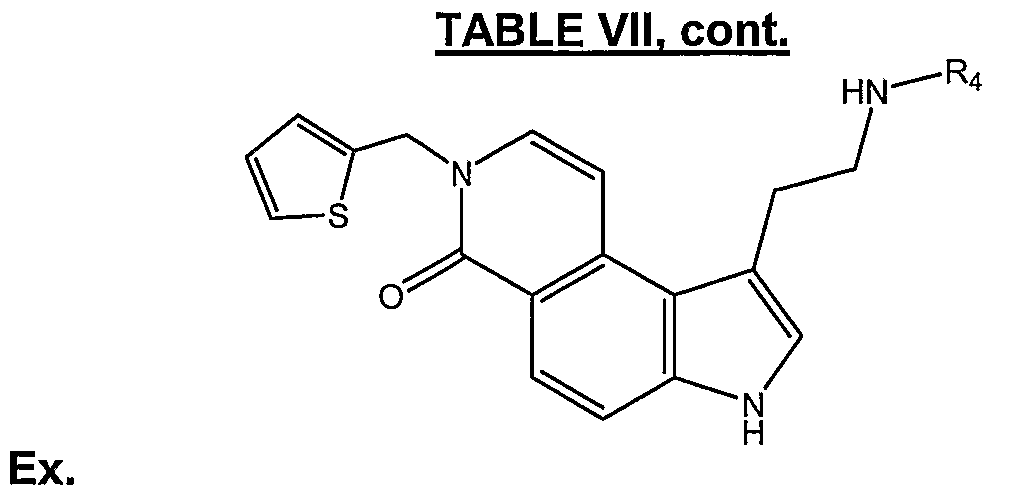
No. R4 Mass
494 pyridin-3-ylmethyl 414.53
495 2-methylbenzyl 427.57
496 3-chlorobenzyl 447.98
497 3-methylbutyl 393.55
498 3-methoxybenzyl 443.56
499 4-trifluoromethoxybenzyl 497.54
500 pyridin-4-ylmethyl 414.53
501 2,4-dichlorobenzyl 482.43
502 pyridin-2-ylmethyl 414.53
503 6-methyl-pyridin-2-ylmethyl 428.55
504 4-bromobenzyl 492.43
505 1 -methylpyrrol-2-ylmethyl 416.54
506 2,4-difluorobenzyl 449.52
507 4-carbomethoxybenzyl 471.57
508 cyclohexylmethyl 419.59
509 4-phenylbenzyl 489.64
510 4-thiomethylbenzyl 459.63
511 4-ethylbenzyl 441.59
512 quinolin-2-ylmethyl 464.59
513 4-n-propyloxybenzyl 471.62
514 (S)-(-)-3,7-dimethyloct-6-enyl 461.67
515 3,4-dichlorobenzyl 482.43
516 2,4-dimethylbenzyl 441.59
517 1 ,4-benzodioxan-6-ylmethyl 471.57
518 3,5-difluorobenzyl 449.52

No. R4 Mass
519 3,4-difluorobenzyl 449.52
520 2-chloro-4-hydroxybenzyl 463.98
521 2-fluoro-3-trifluoromethyl benzyl 499.53
522 3-trifluoromethoxybenzyl 497.54
523 3-bromo-4-methoxybenzyl 522.46
524 3-methylbenzyl 427.57
525 3-bromobenzyl 492.43
526 3,5-di methoxybe nzy I 473.59
527 2-chloro-4-fluorobenzyl 465.97
528 5-chloro-thiophen-2-ylmethyl 454.01
529 2-bromobenzyl 492.43
530 benzofuran-2-ylmethyl 453.56
531 5-bromo-furan-2-ylmethyl . 482.40
532 4-diethylaminobenzyl 484.66
533 6-chloro-3,4-methylenedioxybenzyl 491.99
534 3-bromo-4-fluorobenzyl 510.42
535 3-chloro-4-fluorobenzyl 565.97
536 3,5-dichlorobenzyl 482.43
537 4-n-hexyloxybenzyl 513.70
538 trans-4-stilbene-2-yl-methyl 515.67
539 (R)-(+)-3,7-dimethyloct-6-enyl 461.67
540 2-carboethoxy-cycloprop-1-ylmethyl 449.57
541 2,3-dihydrobenzo[b]furan-5-ylmethyl 455.58
542 5-bromothiophen-2-ylmethyl 498.46
543 3-(3,4-dichlorophenoxy)benzyl 574.52
 No. R4 Mass
544 3-nitrobenzyl 458.54
545 3,4,5-trihydroxy-n-pentyl 441.55
546 3-cyanobenzyl 438.55
547 4(5)-imidazolylmethyl 403.50
548 3-hydroxybenzyl 429.54
EXAMPLE 549
1-(2-aminoethvl)-7-cvcloDroDvImethvl-3H,7H-Dvrrolor3,2-flisoquinolin-6-one
A solution of 2-N-cyclopropylmethyl-6-hydrazino-1-isoquinolinone (prepared from bromomethylcyclopropane according to Example 92 and Example 93) was reacted in a Fisher indole reaction with 2-(3-chloropropyl)-1 ,3-dioxolan according to the process outlined in Example 4. After refluxing for four hours, the product was isolated as reported above and purified by flash silica gel chromatography (20% MeOH, 5% NH4OH in CH2CI2) to afford a light brown oil. Treatment with ethanolic HCI gave the required product as its mono hydrochloride salt as an off white colored solid (MW = 317.81 ; HPLC single component; 1 H-NMR, 3.9 δ, 2H, d). Elemental Analysis for: Ci7H19N3O 1.0 HCI Calculated: C, 64.25; H, 6.34; N, 13.22 Found: C, 64.49; H, 6.47; N, 13.42
EXAMPLES 550-634
Using essentially the same procedure described in Example 7B and employing 1-(2- aminoethyl)-7-cyclopropylmethyl-3H,7H-pyrrolo[3,2-f]isoquinolin-6-one as substrate and a suitable aldehyde, the compounds shown in Table VIII were obtained and identified by HPLC and mass spectral analyses.

No. R4 Mass
550 naphth-2-ylmethyl 421.54
551 4-phenoxybenzyl 463.57
552 ethyl 309.41
553 2-chlorobenzyl 405.92
554 furfur-2-ylmethyl 361.44
555 4-dimethylaminobenzyl 414.55
556 benzyl 371.48
557 thiophen-2-ylmethyl 377.51
558 4-methylbenzyl 385.50
559 4-chlorobenzyl 405.92
560 4-cyanobenzyl 396.49
561 n-pentyl 351.49
562 3,4-methylenedioxybenzyl 415.49
563 4-isopropylbenzyl 413.56
564 5-methylfurfur-2-ylmethyl 375.47
565 4-hydroxybeπzyl 387.48
566 4-methoxybenzyl 401.50
567 2-methoxybenzyl 401.50
568 3-fluoro-4-methoxybenzyl 419.49
569 3,5-bis(trifluoromethyl)benzyl 507.47
570 2,6-difluorobenzyl 407.46
571 2-fluorobenzyl 389.47
572 2-trifluoromethylbenzyl 439.48
573 3-trifluoromethylbenzyl 439.48
574 4-trifluoromethylbenzyl 439.48
TABLE Vlll.cont.
Ex. No. R4 Mass
575 3-fluorobenzyl 389.47
576 4-fluorobenzyl 389.47
577 indol-3-ylmethyl 410.51
578 furfur-3-ylmethyl 361.44
579 thiophen-3-ylmethyl 377.51
580 pyridin-3-y I methyl 372.46
581 2-methylbenzyl 385.50
582 3-chlorobenzyl 405.92
583 3-methyl butyl 351.49
584 3-methoxybenzyl 401.50
585 4-trifluoromethoxybenzyl 455.47
586 pyridin-4-ylmethyl 372.46
587 2,4-dichlorobenzyl 440.37
588 pyridine-2-ylmethyl 372.46
589 6-methyl-pyιϊdin-2-ylmethyl 386.49
590 4-bromobenzyl 450.37
591 1 -methylpyrrol-2-ylmethyl 374.48
592 2,4-difluorobenzyl 407.46
593 4-carbomethoxybenzyl 429.51
594 cyclohexylmethyl 377.52
595 4-phenylbenzyl 447.57
596 4-thiomethylbenzyl 417.57
597 4-ethylbenzyl 399.53
598 quinolin-2-ylmethyl 422.52
599 4-n-propyloxybenzyl 429.56
TABLE Vlll.cont.
HN-^R4
H
Ex. No. R4 Mass
600 (S)-(-)-3,7-dimethyloct-6-enyl 419.61
601 3,4-dichlorobenzyl 440.37
602 2,4-dimethylbenzyl 399.53
603 1 ,4-benzodioxan-6-ylmethyl 429.51
604 3,5-difluorobenzyl 407.46
605 3,4-difluorobenzyl 407.46
606 2-chloro-4-hydroxybenzyl 421.92
607 2-fluoro-3-trifluoromethylbenzyl 457.47
608 3-trifluoromethoxybenzyl 455.47
609 3-bromo-4-methoxybenzyl 480.40
610 3-methylbenzyl 385.50
611 3-bromobenzyl 450.37
612 3,5-dimethoxybenzyl 431.53
613 2-chloro-4-fluorobenzyl 423.91
614 5-chloro-thiophen-2-ylmethyl 411.95
615 2-bromobenzyl 450.37
616 benzofuran-2-ylmethyl 411.50
617 5-bromo-furan-2-ylmethyl 440.33
618 4-diethylaminobenzyl 442.60
619 6-chloro-3,4-methylenedioxybenzyl 449.93
620 3-bromo-4-fluorobenzyl 468.37
621 3-chloro-4-fluorobenzyl 423.91
622 3,5-dichlorobenzyl 440.37
623 4-n-hexyloxybenzyl 471.64
624 trans-4-stilbene-2-yl-methyl 473.61

No. R4 Mass
625 (R)-(+)-3,7-dimethyloct-6-enyl 419.61
626 2-carboethoxy-cycloprop-1-ylmethyl 407.51
627 2,3-dihydrobenzo[b]furan-5-ylmethyl 413.51
628 5-bromothiophen-2-ylmethyl 456.40
629 3-(3,4-dichlorophenoxy)benzyl 432.46
630 3-nitrobenzyl 458.54
631 3,4,5-trihydroxy-n-pentyl 399.49
632 3-cyanobenzyl 396.49
633 4(5)-imidazolylmethyl 361.44
634 3-hydroxybenzyl 387.48
EXAMPLE 635
1-(2-aminoethvl)-7-propvl-3H,7H-pvrrolor3,2-flisoαuinolin-6-one
A solution of 2-N-propyl-6-hydrazino-1-isoquinolinone (prepared from n-propyl bromide according to Example 92 and Example 93) was reacted in a Fisher indole reaction with 2-(3-chloropropyl)-1 ,3-dioxolan according to the process outlined in Example 4. After refluxing for four hours, the product was isolated as reported above and purified by flash silica gel chromatography (20% MeOH, 5% NH4OH in CH2CI2) to afford a light brown oil. Treatment with ethanolic HCI gave the required product as its mono hydrochloride salt as an off white colored solid (MW = 305.13; HPLC single component; 1 H-NMR, 0.9 δ, 1 3H; 3.9 δ, 2H, m). Elemental Analysis for: C16H19N3O 1.0 HCI Calculated: C, 62.84; H, 6.59; N, 13.74 Found: C, 62.96; H, 6.66; N, 13.82
EXAMPLES 636-720
Using essentially the same procedure described in Example 7B and employing 1 -(2-aminoethyl)-7-propyl-3H,7H-pyrrolo[3,2-f]isoquinolin-6-one as substrate and a suitable aldehyde, the compounds shown in Table IX were obtained and identified by HPLC and mass spectral analyses.

No. R4 Mass
636 naphth-2-yl methyl 409.53
637 4-phenoxybenzyl 451.56
638 ethyl 297.40
639 2-chlorobenzyl 393.91
640 furfur-2-yl methyl 349.43
641 4-dimethylaminobenzyl 402.53
642 benzyl 359.47
643 thiophen-2-ylmethyl 365.49
644 4-methylbenzyl 373.49
645 4-chlorobenzyl 393.91
646 4-cyanobenzyl 384.48
647 n-pentyl 339.48
648 3,4-methylenedioxybenzyl 403.48
649 4-isopropylbenzyl 401.55
650 5-methylfurfur-2-ylmethyl 363.45
651 4-hydroxybenzyl 375.47
652 4-methoxybenzyl 389.49
653 2-methoxybenzyl 389.49
654 3-fluoro-4-methoxybenzyl 407.48
 No. R4 Mass
655 3,5-bis(trifluoromethyl)benzyl 495.46
656 2,6-difluorobenzyl 395.42
657 2-fluorobenzyl 377.46
658 2-trifluoromethyl benzyl 427.46
659 3-trif I uoromethyl be nzyl 427.46
660 4-trifluoromethylbenzyl 427.46
661 3-fluorobenzyl 377.46
662 4-fluorobenzyl 377.46
663 indol-3-ylmethyl 398.50
664 furfur-3-ylmethyl 349.43
665 thiophen-3-ylmethyl 365.49
666 pyridin-3-ylmethyl 360.45
667 2-methylbenzyl 373.49
668 3-chlorobenzyl 393.91
669 3-methylbutyl 339.48
670 3-methoxybenzyl 389.49
671 4-trifluoromethoxybenzyl 443.46
672 pyridin-4-ylmethyl 360.45
673 2,4-dichlorobenzyl 428.36
674 pyridin-2-ylmethyl 360.45
675 6-methyl-pyridin-2-ylmethyl 374.48
676 4-bromobenzyl 438.36
677 1 -methylpyrrol-2-ylmethyl 362.47
678 2,4-difluorobenzyl 395.45
679 4-carbomethoxybenzyl 417.50

No. R4 Mass
680 cyclohexylmethyl 365.51
681 4-phenylbenzyl 435.56
682 4-thiomethylbenzyl 405.56
683 4-ethylbenzyl 387.52
684 quinolin-2-ylmethyl 410.51
685 4-n-propyloxybenzyl 417.55
686 (S)-(-)-3,7-dimethyloct-6-enyl 407.59
687 3,4-dichlorobenzyl 428.36
688 2,4-dimethylbenzyl 387.52
689 1 ,4-benzodioxan-6-ylmethyl 417.50
690 3,5-difluorobenzyl 395.45
691 3,4-difluorobenzyl 395.45
692 2-chIoro-4-hydroxybenzyl 409.91
693 2-fluoro-3-trifluoromethylbenzyl 445.45
694 3-trifluoromethoxybenzyl 443.46
695 3-bromo-4-methoxybenzyl 468.39
696 3-methylbenzyl 373.49
697 3-bromobenzyl 438.36
698 3,5-dimethoxybenzyl 419.52
699 2-chloro-4-fluorobenzyl 411.90
700 5-chloro-thiophen-2-ylmethyl 499.94
701 2-bromobenzyl 438.36
702 benzofuran-2-ylmethyl 399.49
703 5-bromo-furan-2-ylmethyl 428.32
704 4-diethylaminobenzyl 430.59
TABLE IX. cont.
H
Ex. No. R4 Mass
705 6-chloro-3,4-methylenedioxybenzyl 437.92
706 3-bromo-4-fluorobenzyl 456.35
707 3-chloro-4-fluorobenzyl 411.90
708 3,5-dichlorobenzyl 428.36
709 4-n-hexyloxybenzyl 459.63
710 trans-4-stilbene-2-yl-methyl 461.60
711 (R)-(+)-3,7-dimethyloct-6-enyl 407.59
712 2-carboethoxy-cycloprop-1-ylmethyl 395.50
713 2,3-dihydrobenzo[b]furan-5-ylmethyl 401.50
714 5-bromothiophen-2-ylmethyl 444.39
715 3-(3,4-dichlorophenoxy)benzyl 520.45
716 3-nitrobenzyl 404.46
717 3,4,5-trihydroxy-n-pentyl 387.47
718 3-cyanobenzyl 384.48
719 4(5)-imidazolylmethyl 349.43
720 3-hydroxybenzyl 375.47
EXAMPLE 721
1-(2-aminoethvl)-7-(Dvridin-4-vlmθthvπ-3H,7H-Dvrrolor3.2-f1isoαuinolin-6-one
A solution of 2-N-(pyridin-4-ylmethyl)-6-hydrazino-1-isoquinolinone (prepared from 4-bromomethylpyridine according to Example 92 and Example 93) was reacted in a Fisher indole reaction with 2-(3-chloropropyl)-1 ,3-dioxolan according to the process outlined in Example 4. After refluxing for four hours, the product was isolated as reported above and purified by flash silica gel chromatography (20% MeOH, 5% NH4OH in CH2CI2) to afford a light brown oil. Treatment with ethanolic
HCI gave the required product as its mono hydrochloride salt as an off white colored solid (MW = 354.83; HPLC single component; 1 H-NMR, 5.5 δ, 2H, s). Elemental Analysis for: C19H18N4O 1.0 HCI Calculated: C, 64.31 ; H, 5.40; N, 15.79 Found: C, 64.47; H, 5.47; N, 15.86
EXAMPLES 722-806
Using essentially the same procedure described in Example 7B and employing 1-(2-aminoethyl)-7-(pyridin-4-ylmethyl)-3H,7H-pyrrolo[3,2-f]isoquinolin-6- one as substrate and a suitable aldehyde, the compounds shown in Table X were obtained and identified by HPLC and mass spectral analyses.

722 naphth-2-ylmethyl 458.56 723 4-phenoxybenzyl 500.60 724 ethyl 346.43 725 2-chlorobenzyl 442.94 726 furfur-2-ylmethyl 398.46 727 4-dimethylaminobenzyl 451.57 728 benzyl 408.50 729 thiophen-2-ylmethyl 414.53 730 4-methyl benzyl 422.52 731 4-chlorobenzyl 442.94 732 4-cyanobenzyl 433.51 733 n-pentyl 388.51 734 3,4-methylenedioxybenzyl 452.51
TABLE X, cont. R4

No. R4 Mass
735 4-isopropylbenzyl 450.58
736 5-methylfurfur-2-ylmethyl 512.49
737 . 4-hydroxybenzyl 424.50
738 4-methoxybenzyl 438.52
739 2-methoxybenzyl 438.52
740 3-fluoro-4-methoxybenzyl 456.51
741 3,5-bis(trifluoromethyl)benzyl 544.49
742 2,6-difluorobenzyl 444.48
743 2-fluorobenzyl 426.49
744 2-trifluoromethylbenzyl 476.50
745 3-trifluoromethylbenzyl 476.50
746 4-trifluoromethylbenzyl 476.50
747 3-fluorobenzyl 426.49
748 4-fluorobenzyl 426.49
749 indol-3-ylmethyl 447.53
750 furfur-3-yl methyl 398.46
751 thiophen-3-ylmethyl 414.53
752 pyridin-3-ylmethyl 409.49
753 2-methylbenzyl 422.52
754 3-chlorobenzyl 442.94
755 3-methylbutyl 388.51
756 3-methoxybenzyl 438.52
757 4-trifluoromethoxybenzyl 492.50
758 pyridin-4-ylmethyl 409.49
759 2,4-dichlorobenzyl 477.39

No. R4 Mass
760 pyridin-2-ylmethyl 409.49
761 6-methyl-pyridin-2-ylmethyl 423.51
762 4-bromobenzyl 487.39
763 1 -methylpyrrol-2-ylmethyl 411.50
764 2,4-difluorobenzyl 444.48
765 4-carbomethoxybenzyl 466.53
766 cyclohexylmethyl 414.55
767 4-phenylbenzyl 484.60
768 4-thiomethylbenzyl 454.59
769 4-ethylbenzyl 436.55
770 quinolin-2-ylmethyl 459.55
771 4-n-propyloxybenzyl 466.58
772 (S)-(-)-3,7-dimethyloct-6-enyl 456.63
773 3,4-dichlorobenzyl 477.39
774 2,4-dimethylbenzyl 436.55
775 1 ,4-benzodioxan-6-ylmethyl 466.53
776 3,5-difluorobenzyl 444.48
777 3,4-difluorobenzyl 444.48
778 2-chloro-4-hydroxybenzyl 458.94
779 2-fluoro-3-trifluoromethylbenzyl 494.49
780 3-trifluoromethoxybenzyl 492.50
781 3-bromo-4-methoxybenzyl 517.42
782 3-methylbenzyl 422.52
783 3-bromobenzyl 487.39
784 3,5-dimethoxybenzyl 468.55

No. R4 Mass
785 2-chloro-4-fluorobenzyl 460.93
786 5-chloro-thiophen-2-ylmethyl 448.97
787 2-bromobenzyl 487.39
788 benzof u ran-2-yl methyl 448.52
789 5-bromo-furan-2-ylmethyl 477.36
790 4-diethylaminobenzyl 479.62
791 6-chloro-3,4-methylenedioxybenzyl 486.95
792 3-bromo-4-fluorobenzyl 505.38
793 3-chloro-4-fluorobenzyl 460.93
794 3,5-dichlorobenzyl 477.39
795 4-n-hexyloxybenzyl 508.66
796 trans-4-stilbene-2-yl-methyl 510.63
797 (R)-(+)-3,7-dimethyloct-6-enyl 456.63
798 2-carboethoxy-cycloprop-1-ylmethyl 444.53
799 2,3-dihydrobenzo[b]furan-5-ylmethyl 450.54
800 5-bromothiophen-2-ylmethyl 493.42
801 3-(3,4-dichlorophenoxy)benzyl 569.48
802 3-nitrobenzyl 453.50
803 3,4,5-trihydroxy-n-pentyl 436.51
804 3-cyanobenzyl 433.51
805 4(5)-imidazolylmethyl 398.46
806 3-hydroxybenzyl 424.50
EXAMPLE 807 1-f2-aminoethyl)-7-(pyridin-2-ylmethvI)-3H,7H-pyrrolor3,2-flisoquinolin-6-one
A solution of 2-N-(pyridin-2-ylmethyl)-6-hydra2ino-1-isoquinolinone (prepared from 2-bromomethylpyridine according to Example 92 and Example 93) was reacted in a Fisher indole reaction with 2-(3-chloropropyl)-1 ,3-dioxolan according to the process outlined in Example 4. After refluxing for four hours, the product was isolated as reported above and purified by flash silica gel chromatography (20% MeOH, 5% NH4OH in CH2CI2) to afford a light brown oil. Treatment with ethanolic HCI gave the required product as its mono hydrochloride salt as an off white colored solid (MW = 354.83; HPLC single component; 1 H-NMR, 5.5 δ, 2H, s). Elemental Analysis for: C19H18N4O 1.0 HCI Calculated: C, 64.31 ; H, 5.40; N, 15.79 Found: C, 64.41 ; H, 5.44; N, 15.80
EXAMPLES 808-892
Using essentially the same procedure described in Example 7B and employing 1-(2-aminoethyl)-7-(pyridin-2-ylmethyl)-3H,7H-pyrrolo[3,2-f]isoquinolin-6- one as substrate and a suitable aldehyde, the compounds shown in Table Xl were obtained and identified by HPLC and mass spectral analyses.

No. R4 Mass
808 naphth-2-ylmethyl 458.56
809 4-phenoxybenzyl 500.60
810 ethyl 346.43
811 2-chlorobenzyl 442.94
812 furfur-2-ylmethyl 398.46

No. R4 Mass
813 4-dimethylaminobenzyl 451.57
814 benzyl 408.50
815 thiophen-2-ylmethyl 414.53
816 4-methylbenzyl 422.52
817 4-chlorobenzyl 442.94
818 4-cyanobenzyl 433.51
819 n-pentyl 388.51
820 3,4-methylenedioxybenzyl 452.51
821 4-isopropylbenzyl 450.58
822 5-methylfurfur-2-ylmethyl 512.49
823 4-hydroxybenzyl 424.50
824 4-methoxybenzyl 438.52
825 2-methoxybenzyl 438.52
826 3-fluoro-4-methoxybenzyl 456.51
827 3,5-bis(trifluoromethyl)benzyl 544.49
828 2,6-difluorobenzyl 444.48
829 2-fluorobenzyl 426.49
830 2-trifluoromethylbenzyl 476.50
831 3-trifluoromethylbenzyl 476.50
832 4-trifluoromethylbenzyl 476.50
833 3-fluorobenzyl 426.49
834 4-fluorobenzyl 426.49
835 indol-3-ylmethyl 447.53
836 furfur-3-ylmethyl 398.46
837 thiophen-3-ylmethyl 414.53
TABLE Xl. cont.
Ex.
No. R4 Mass
838 pyridin-3-ylmethyl 409.49
839 2-methylbenzyl 422.52
840 3-chlorobenzyl 442.94
841 3-methylbutyl 388.51
842 3-methoxybenzyl 438.52
843 4-trifluoromethoxybenzyl 492.50
844 pyridin-4-ylmethyl 409.49
845 2,4-dichlorobenzyl 477.39
846 pyridin-2-yl methyl 409.49
847 6-methyl-pyridin-2-ylmethyl 423.51
848 4-bromobenzyl 487.39
849 1 -methylpyrrol-2-ylmethyl 411.50
850 2,4-difluorobenzyl 444.48
851 4-carbomethoxybenzyl 466.53
852 cyclohexylmethyl 414.55
853 4-phenylbenzyl 484.60
854 4-thiomethylbenzyl 454.59
855 4-ethylbenzyl 436.55
856 quinolin-2-ylmethyl 459.55
857 4-n-propyloxybenzyl 466.58
858 (S)-(-)-3,7-dimethyloct-6-enyl 456.63
859 3,4-dichlorobenzyl 477.39
860 2,4-dimethylbenzyl 436.55
861 1 ,4-benzodioxan-6-ylmethyl 466.53
862 3,5-difluorobenzyl 444.48
TABLE Xl. cont.
Ex.
No. R4 Mass
863 3,4-difluorobenzyl 444.48
864 2-chloro-4-hydroxybenzyl 458.94
865 2-fluoro-3-trifluoromethylbenzyl 494.49
866 3-trifluoromethoxybenzyl 492.50
867 3-bromo-4-methoxybenzyl 517.42
868 3-methylbenzyl 422.52
869 3-bromobenzyl 487.39
870 3,5-dimethoxybenzyl 468.55
871 2-chloro-4-fluorobenzyl 460.93
872 5-chloro-thiophen-2-ylmethyl 448.97
873 2-bromobenzyl 487.39
874 benzofuran-2-ylmethyl 448.52
875 5-bromo-furan-2-ylmethyl 477.36
876 4-diethylaminobenzyl 479.62
877 6-chloro-3,4-methylenedioxybenzyl 486.95
878 3-bromo-4-fluorobenzyl 505.38
879 3-chloro-4-fluorobenzyl 460.93
880 3,5-dichlorobenzyl 477.39
881 4-n-hexyloxybenzyl 508.66
882 trans-4-stilbene-2-yl-methyl 510.63
883 (R)-(+)-3,7-dimethyloct-6-enyl 456.63
884 2-carboethoxy-cycloprop-1-ylmethyl 444.53
885 2,3-dihydrobenzo[b]furan-5-ylmethyl 450.54
886 5-bromothiophen-2-ylmethyl 493.42
887 3-(3,4-dichlorophenoxy)benzyl 569.48
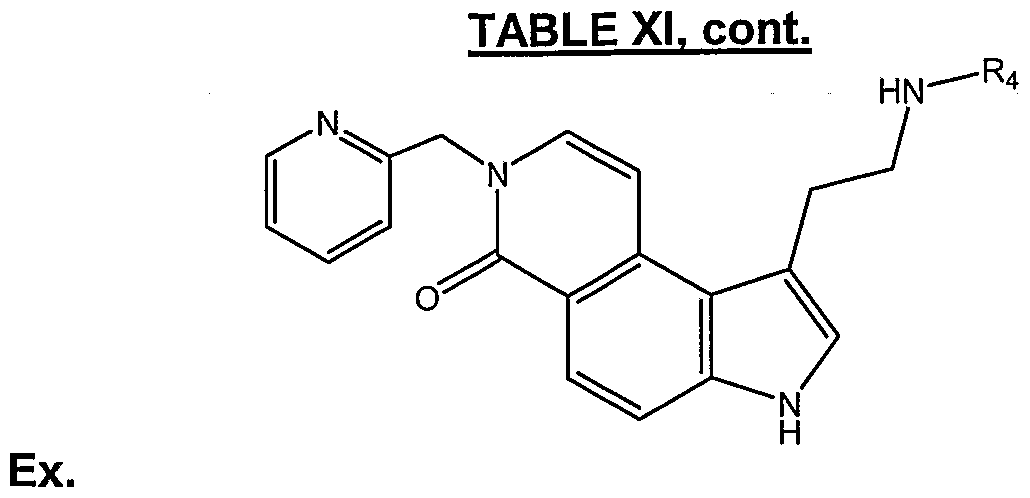 No. R4 Mass
888 3-nitrobenzyl 453.50 889 3,4,5-trihydroxy-n-pentyl 436.51 890 3-cyanobenzyl 433.51 891 4(5)-imidazolylmethyl 398.46 892 3-hydroxybenzyl 424.50
EXAMPLE 893 1-(2-aminoethyl)-7-(2-dimethylaminoethyl)-3H,7H-Pyrrolor3,2-flisoquinolin-6- one
A solution of 2-N-(2-dimethylaminoethyl)-6-hydrazino-1-isoquinolinone (prepared from 2-bromo-N,N-dimethylamine according to Example 92 and Example 93) was reacted in a Fisher indole reaction with 2-(3-chloropropyl)-1,3-dioxolan according to the process outlined in Example 4. After refluxing for four hours the product was isolated as reported above and purified by flash silica gel chromatography (20% MeOH, 5% NH4OH in CH2CI2) to afford a light brown oil. Treatment with ethanolic HCI gave the required product as an off white colored solid (MW = 370.30; HPLC single component; IH-NMR, 4.4 δ, 2H, t; 3.35 δ, 6H, s). Elemental Analysis for: C17H22N4O 2.0 HCI Calculated: C, 54.99; H, 6.52; N, 15.09 Found: C, 55.17; H, 6.67; N, 15.16
EXAMPLES 894-978 Using essentially the same procedure described in Example 7B and employing 1-(2-aminoethyl)-7-(2-dimethylaminoethyl)-3H,7H-pyrrolo[3,2-f]isoquinolin- 6-one as substrate and a suitable aldehyde, the compounds shown in Table XII were obtained and identified by HPLC and mass spectral analyses.

No. R4 Mass
894 naphth-2-ylmethyl 438.57
895 4-phenoxybenzyl 480.60
896 ethyl 326.44
897 2-chlorobenzyl 422.95
898 furfur-2-yl methyl 378.47
899 4-dimethylaminobenzyl 431.58
900 benzyl 388.51
901 thiophen-2-ylmethyl 394.54
902 4-methylbenzyl 402.53
903 4-chlorobenzyl 422.95
904 4-cyanobenzyl 413.52
905 n-pentyl 368.52
906 3 ,4-methylened ioxybenzyl 432.52
907 4-isopropylbenzyl 430.59
908 5-methylfurfur 2-ylmethyl 392.50
909 4-hydroxybenzyl 404.51
910 4-methoxybenzyl 418.53
911 2-methoxybenzyl 418.53
912 3-fluoro-4-methoxybenzyl 436.52
913 3,5-bis(trifluoromethyl)benzyl 524.50
914 2,6-difluorobenzyl 424.49
915 2-fluorobenzyl 406.50
916 2-trifluoromethylbenzyl 456.51
917 3-trifluoromethylbenzyl 456.51

No. R4 Mass
918 4-trifluoromethylbenzyl 456.51
919 3-fluorobenzyl 406.50
920 4-fluorobenzyl 406.50
921 indol-3-yl methyl 527.54
922 furfur-3-y I methyl 378.47
923 thiophen-3-ylmethyl 394.54
924 pyridin-3-ylmethyl 389.50
925 2-methylbenzyl 402.53
926 3-chlorobenzyl 422.95
927 3-methylbutyl 368.52
928 3-methoxybenzyl 418.53
929 4-trifluoromethoxybenzyl 472.51
930 pyridin-4-ylmethyl 389.50
931 2,4-dichlorobenzyl 457.40
932 pyridin-2-ylmethyl 389.50
933 6-methyl-pyridin-2-ylmethyl 403.52
934 4-bromobenzyl 467.40
935 1 -methylpyrrol-2-ylmethyl 319.51
936 2,4-difluorobenzyl 424.49
937 4-carbomethoxybenzyl 446.54
938 cyclohexylmethyl 394.56
939 4-phenylbenzyl 464.61
940 4-thiomethylbenzyl 434.60
941 4-ethylbenzyl 416.56
942 quinolin-2-ylmethyl 439.56

No. R4 Mass
943 4-n-propyloxybenzyl 446.59
944 (S)-(-)-3,7-dimethyloct-6-enyl 436.64
945 3,4-dichlorobenzyl 457.40
946 2,4-dimethylbenzyl 416.56
947 1 ,4-benzodioxan-6-ylmethyl 446.54
948 3,5-difluorobenzyl 424.49
949 3,4-difluorobenzyl 424.49
950 2-chloro-4-hydroxybenzyl 438.95
951 2-fluoro-3-trifluoromethylbenzyl 474.50
952 3-trifluoromethoxybenzyl 472.51
953 3-bromo-4-methoxybenzyl 497.43
954 3-methylbenzyl 402.53
955 3-bromobenzyl 467.40
956 3,5-dimethoxybenzyl 448.56
957 2-chloro-4-fluorobenzyl 440.94
958 5-chloro-thiophen-2-ylmethyl 428.98
959 2-bromobenzyl 467.40
960 benzofuran-2-ylmethyl 528.53
961 5-bromo-furan-2-ylmethyl 457.37
962 4-diethylaminobenzyl 459.63
963 6-chloro-3,4-methylenedioxybenzyl 466.96
964 3-bromo-4-fluorobenzyl 485.39
965 3-chloro-4-fluorobenzyl 440.94
966 3,5-dichlorobenzyl 457.40
 No. R4 Mass
967 4-n-hexyloxybenzyl 488.67
968 trans-4-stilbene-2-yl-methyl 490.64
969 (R)-(+)-3,7-dimethyloct-6-enyl 436.64
970 2-carboethoxy-cycloprop-1-ylmethyl 424.54
971 2,3-dihydrobenzo[b]furan-5-ylmethyl 430.55
972 5-bromothiophen-2-ylmethyl 473.43
973 3-(3,4-dichlorophenoxy)benzyl 549.49
974 3-nitrobenzyl 433.51
975 3,4,5-trihydroxy-n-pentyl 416.52
976 3-cyanobenzyl 413.52
977 4(5)-imidazolylmethyl 378.47
978 3-hydroxybenzyl 404.51
EXAMPLE 979
1-(2-aminoethvl)-7-(2-methoxvbenzvl)-3H,7H-pvrrolor3,2-flisoquinolin-6-one
A solution of 2-N-(2-methoxybenzyl)-6-hydrazino-1-isoquinolinone (prepared from 2-methoxybenzylchloride according to Example 92 and Example 93) was reacted in a Fisher indole reaction with 2-(3-chloropropyl)-1 ,3-dioxolan according to the process outlined in Example 4. After refluxing for four hours, the product was isolated as reported above and purified by flash silica gel chromatography (20% MeOH, 5% NH4OH in CH2CI2) to afford a light brown oil. Treatment with ethanolic HCI gave the required product as its mono hydrochloride salt as an off white colored solid (MW = 383.87; HPLC single component; 1 H-NMR, 3.8 δ, 3H, s; 5.2 δ, 2H, s). Elemental Analysis for: C21H21N3O2 1.0 HCI Calculated: C, 65.71 ; H, 5.78; N, 10.95 Found: C, 65.77; H, 5.87; N, 11.16
EXAMPLES 980-987
Using essentially the same procedure described in Example 7B and employing 1-(2-aminoethyl)-7-(2-methoxybenzyl)-3H,7H-pyrrolo[3,2-f]isoquinolin-6- one as substrate and a suitable aldehyde, the compounds shown in Table XIIl were obtained and identified by HPLC and mass spectral analyses.

980 3-nitrobenzyl 482.53 981 3,4,5-trihydroxy-n-pentyl 465.54 982 3-chlorobenzyl 471.98 983 3-methoxybenzyl 467.56 984 pyridin-4-ylmethyl 438.52 985 3-cyanobenzyl 462.55 986 4(5)-imidazolylmethyl 427.50 987 3-hydroxybenzyl 453.54
EXAMPLE 988 1-(2-aminoethyl)-7-(4-methoxybenzvπ-3H.7H-pyrrolor3,2-flisoquinolin-6-one
A solution of 2-N-(4-methoxybenzyl)-6-hydrazino-1-isoquinolinone (prepared from 4-methoxybenzylchloride according to Example 92 and Example 93) was reacted in a Fisher indole reaction with 2-(3-chloropropyl)-1 ,3-dioxolan according to the process outlined in Example 4. After refluxing for four hours, the product was isolated as reported above and purified by flash silica gel chromatography (20% MeOH, 5% NH4OH in CH2CI2) to afford a light brown oil. Treatment with ethanolic HCI gave the required product as its mono hydrochloride salt as an off white colored solid (MW = 383.87; HPLC single component; 1 H-NMR, 3.7 δ, 3H, s; 5.2 δ, 2H, s).
Elemental Analysis for: C2iH2iN3O2 1.0 HCI Calculated: C, 65.71 ; H, 5.78; N1 10.95 Found: C, 65.79; H, 5.86; N, 11.05
EXAMPLES 989-996
Using essentially the same procedure described in Example 7B and employing 1-(2-aminoethyl)-7-(4-methoxybenzyl)-3H,7H-pyrrolo[3,2-f]isoquinolin-6- one as substrate and a suitable aldehyde, the compounds shown in Table XIV were obtained and identified by HPLC and mass spectral analyses.

989 3-nitrobenzyl 482.53
990 3,4,5-trihydroxy-n-pentyl 465.54
991 3-chlorobenzyl 471.98
992 3-methoxybenzyl 467.56
993 pyridin-4-ylmethyl 438.52
994 3-cyanobenzyl 462.55
995 4(5)-imidazolylmethyl 427.50
996 3-hydroxybenzyl 453.54
EXAMPLE 997
1-(2-aminoethvl)-7-(furanvI-2-vImethvl)-3H,7H-Dvrrolor3,2-flisoαuinolin-6-one
[furanyl-2-yl or furan-2-yl?]
A solution of 2-N-(furanyl-2-ylmethyl)-6-hydrazino-1-isoquinolinone (prepared from furfuryl bromide according to Example 92 and Example 93) was reacted in a Fisher indole reaction with 2-(3-chloropropyl)-1 ,3-dioxolan according to the process outlined in Example 4. After refluxing for four hours, the product was isolated as
reported above and purified by flash silica gel chromatography (20% MeOH1 5% NH4OH in CH2CI2) to afford a light brown oil. Treatment with ethanolic HCI gave the required product as its mono hydrochloride salt as an off white colored solid (MW = 343.81 ; HPLC single component; 1 H-NMR, 6.3 δ, 2H, s; 5.2 δ, 2H. s). Elemental Analysis for: C18H18CI N3O2 1.0 HCI Calculated: C, 62.88; H, 5.28; N, 12.22 Found: C, 62.89; H, 5.36; N, 12.35
EXAMPLES 998-1005 Using essentially the same procedure described in Example 7B and employing 1-(2-aminoethyl)-7-(furan-2-ylmethyl)-3H,7H-pyrrolo[3,2-f]isoquinolin-6- one as substrate and a suitable aldehyde, the compounds shown in Table XV were obtained and identified by HPLC and mass spectral analyses.

998 3-nitrobenzyl 442.47
999 3,4,5-trihydroxy-n-pentyl 425.48
1000 3-chlorobenzyl 431.92
1001 3-methoxybenzyl 427.50
1002 pyridin-4-ylmethyl 398.46
1003 3-cyanobenzyl 422.48
1004 4(5)-imidazolylmethyl 387.44
1005 3-hydroxybenzyl 413.47
EXAMPLES 1006-1017 1-(2-benzylaminoethyl)-substituted-pyrrolor3,2-fIisoquinolin-6-one Compounds

Using the essentially the same procedure described in Example 7B and employing the appropriate 1-(2-aminoethyl)-pyrrolo[3,2-f]isoquinolin-6-one substrate and benzaldehyde, the compounds shown in Table XVI were prepared and identified by HPLC and mass spectral analyses.

1006 2 H Br H H 432.74
1007 2 CH3 H benzyl H 457.99
1008 2 H H phenethyl H 457.99
1009 2 H H naphth-2-ylmethyl H 508.05
1010 2 H H heptyl H 452.03
1011 2 H H 3,4-dichIorobenzyl H 512.86
1012 2 H H thiophen-3-yl H 450.00
1013 3 H H H H 367.87
1014 2 H 4-CI-C6H5 H H 478.41
1015 2 H H H Cl 388.29 tetrahydropyran-2- 1016 2 H H ylmethyl H 451.99
1017 2 H H 2-methoxyethyl H 411.92
EXAMPLE 1018 3J-dibenzyl-1-(2-dibenzylaminoethyl)-3H,7H-pyrrolor3.2-flisoquinolin-6-one
Tetrabutylammonium bromide (0.03 g) and benzyl bromide (0.3 g, 1.6 mmol) were added to a solution of the amine from Example 4 (0.1 g, 0.44 mmol) in toluene (2 ml.) and 50% aqueous sodium hydroxide (1.8 mmol, 4 equivalents). The mixture was stirred for three hours at room temperature, and the product was purified by flash silica gel chromatography (1% methanolic ammonia in CH2CI2) to afford a brown colored solid. Treatment with ethanolic HCI afforded the salt of the titled compound as an off white colored solid (mp 234-2360C; MW = 624.21 ; HPLC single component).
Elemental Analysis for: C41H37N3O 1.0 HCI Calculated: C1 78.89; H, 6.14; N, 6.73 Found: C, 78.91 ; H, 6.23; N, 6.84
EXAMPLE 1019
1-(2-dibenzylaminoethyl)-3H.7H-pyrrolor3,2-f1isoquinolin-6-one Benzyl bromide (0.226 g, 1.32 mmol) was added to a solution of the amine from Example 4 (0.2 g, 0.88 mmol) in DMF (2 mL) and 50% aqueous sodium hydroxide (1.75 mmol, 2 equivalents). The mixture was stirred for two hours at room temperature, and the product was purified by flash silica gel chromatography (4% methanolic ammonia in CH2CI2). Treatment with ethanolic HCI afforded the salt of the titled compound as a white solid (mp 250-2530C; MW = 624.21 ; HPLC single component). Elemental Analysis for: C27H25N3O 1.0 HCI Calculated: C, 73.04; H, 5.90; N, 9.46 Found: C, 73.20; H, 5.99; N, 9.56
EXAMPLE 1020 1-r2-(benzyl-methylamino)ethvπ-3HJH-pyrrolor3.2-f]isoquinolin-6-one
A solution of 6-hydrazino-1-isoquinolinone (0.4 g, 1.89 mmol) from Example 3 and 2-(3-(N-methyl-benzylamine)propyl)-1 ,3-dioxolan (0.668 g, 2.84 mmol) in degassed ethanol (120 ml)/4% aqueous sulfuric acid (12 ml) was refluxed under nitrogen for six hours. The reaction mixture was concentrated in vacuo and the product purified by flash silica gel chromatography to afford an orange colored solid
(0.155 g, 25% yield). Treatment of the product with ethereal [v. ethanollc?] HCI and crystallization from ethanol ether gave the mono hydrochloride salt as a light amber colored solid (mp = 152-1550C; MW = 367.87; HPLC single component). Elemental Analysis for: C2iH2iN3O 1.0 HCI Calculated: C, 68.56; H, 6.03; N, 11.42 Found: C, 88.62; H, 6.12; N, 11.54
EXAMPLE 1021 1-(2-methylaminoethyl)-3HJH-pyrrolor3,2-f|isoquinolin-6-one 1-[2-(Benzylmethylamino)ethyl]-3H,7H-pyrrolo[3,2-f]isoquinolin-6-one (1.07 g,
3.22 mmol) from Example 1020 was hydrogenated over 10% Pd/C at 50 psi H2 for 24 hours. The catalyst was removed by filtration, and the product was converted to its HCI salt by the action of ethanolic HCI. Recrystallization from EtOH/Et2O afforded the titled compound as a light brown colored solid (mp = 16O0C; MW = 377.75; HPLC single component).
Elemental Analysis for: C14Hi5N3O 1.0 HCI Calculated: C, 60.54; H, 5.81 ; N, 15.13 Found: C, 60.64; H1 5.98; N, 15.24
EXAMPLE 1022
N-r2-(7-benzyl-6-oxo-6,7-dihvdro-3H-pyrrolor3.2-flisoquinolin-1-yl)-ethvn- benzenesulfonamide
A solution of 1-(2-aminoethyl)-7-benzyl-3H,7H-pyrrolo[3,2-f]isoquinolin-6-one (0.25 g, 0.788 mmol) from Example 182 in DMF (4 mL) was treated with sodium hydride (1.2 equivalents) at O0C followed after 15 minutes with the addition of benzene sulfonylchloride (0.18 g, 1.02 mmol, 1.3 equivalents). The mixture was stirred for 16 hours and the titled compound isolated as a white solid (m.p. 205- 2060C; MW = 457.55; HPLC single component) by flash silica gel chromatography (5% MeOH in CH2CI2). Elemental Analysis for: C26H23N3O3S Calculated: C1 68.25; H, 5.07; N, 9.18 Found: C, 68.33; H, 5.18; N, 9.27
EXAMPLE 1023 7-fluoro-3H-quinazolin-4-one
A solution of 2-amino-4-fluorobenzoic acid (8.8 g, 56.7 mmol) and formamidine acetate (23.63 g, 227 mmol, 4 equivalents) in ethoxyethanol (400 ml) was refluxed for 16 hours. The solvent was removed in vacuo and the residue crystallized from methanol-water to provide the titled compound as a light brown solid (8.35 g , 90% yield, M+1 = 165). Elemental Analysis for: C8HsFN2O Calculated: C, 58.54; H, 3.07; N, 17.07 Found: C, 58.60; H, 3.19; N, 17.27
EXAMPLE 1024
7-fluoro-3-methyl-3H-quinazolin-4-one
Sodium hydride (19.0 mmol, 1.2 eq) was added to a solution of 7-fluoro-3H- quinazolin-4-one (2.6 g, 15.8 mmol, Example 1023) in DMF (30 ml) under an atmosphere of nitrogen at -200C. After stirring for one hour, methyl iodide (19.8 mmol, 1.25 equivalents) was added, and the resulting solution was stirred at room temperature for two hours. Water (100 ml) was added and the product extracted into CH2CI2 (3 x 100 ml). The organics were concentrated in vacuo and the product crystallized from hexane/CH2CI2 to afford the titled compound as a light amber colored solid (m.p. 133-1350C, M+1 = 179). Elemental Analysis for: C9H7FN2O
Calculated: C, 60.67; H, 3.96; N, 15.72 Found: C, 60.72; H, 3.99; N, 15.79
EXAMPLE 1025 7-hvdrazino-3-methyl-3H-quinazolin-4-one
A solution containing 7-fluoro-3-methyl-3H-quinazolin-4-one (2.2 g, 12.3 mmol, Example 1026) and hydrazine (7.88 g, 20 equivalents) in dioxane (50 ml) was refluxed for 16 hours under an atmosphere of nitrogen. The mixture was concentrated in vacuo, triturated with dioxane and the resulting solid washed with water (50 ml) and dried under vacuum to provide the titled compound as a white solid (1.63 g, 70% yield, m.p. 208-2110C, M+1 = 191). Elemental Analysis for: C9H10N4O Calculated: C, 56.83; H, 5.30; N, 29.46 Found: C, 56.98; H, 5.39; N, 29.59
EXAMPLE 1026 3-benzyl-7-fluoro-3H-quinazolin-4-one
Sodium hydride (22.0 mmol, 1.2 equivalents) was added to a solution of 7- fluoro-3H-quinazolin-4-one (3.0 g, 18.3 mmol, Example 1023) in DMF (40 ml) under an atmosphere of nitrogen at -200C. After stirring for one hour, benzyl bromide (3.7 g, 22 mmol, 1.2 equivalents) was added, and the resulting solution was stirred at room temperature for two hours. Water (100 ml) was added and the product extracted into CH2CI2 (3 x 100 ml). The organics were concentrated in vacuo and the product crystallized from hexane/CH2CI2 to afford the titled compound as a light brown/beige colored solid (m.p. 110-1110C, M+1 = 255). Elemental Analysis for: C9H7FN2O Calculated: C, 70.86; H, 4.36; N, 11.02 Found: C, 70.94; H, 4.39; N, 11.19
EXAMPLE 1027
3-benzvI-7-hydrazino-3H-quinazolin-4-one
A solution containing 3-benzyl-7-fluoro-3H-quinazolin-4-one (3.0 g, 11.8 mmol) and hydrazine (7.56 g, 20 equivalents) in dioxane (60 ml) was refluxed for 16 hours under an atmosphere of nitrogen. The mixture was concentrated in vacuo, and the resulting solid crystallized from methanol/water to provide the titled compound as a cream colored solid (2.4 g, 76% yield, m.p. 165-1690C, M+1 = 267). Elemental Analysis for: C15H14N4O Calculated: C, 67.65; H, 5.30; N, 21.04 Found: C, 67.78; H, 5.41 ; N, 21.19
EXAMPLE 1028 9-(2-aminoethyl)-3-methyl-3H,7H-pyrrolor2.3-hlquinazolin-4-one
A solution of 7-hydrazino-3-methyl-3H-quinazolin-4-one (1.48 g, 7.78 mmol), sulfuric acid (1 N, 16 ml) and 2-(3-chloropropyl)-1 ,3-dioxolan (1.41 g, 9.34 mmol) in degassed ethanol (50 ml)/water (50 ml) was refluxed under nitrogen for three hours. The reaction mixture was concentrated in vacuo and the product purified by flash silica gel chromatography, eluting with Et3N (2%): MeOH (20%): CH2CI2 (78%), affording an amber colored solid (1.245 g). The product was crystallized from
ethanol to afford the titled compound as a light amber colored solid (m.p. 279-2850C,
M+1 = 243).
Elemental Analysis for: C13Hi4N4O
Calculated: C, 64.45; H, 5.82; N, 23.12
Found: C, 64.58; H, 5.89; N, 23.19
EXAMPLES 1029-1032
9-(2-AminoethvI)-substituted-pvrrolor2, 3-hlquinazolin-4-one Compounds

Using the essentially the same procedure described in Example 1028 and employing the appropriate 7-hydrazino-3H-quinazolin-4-one substrate and 2-(3- chloropropyl)-1 ,3-dioxolan, the compounds shown in Table XVII were prepared and identified by HPLC and mass spectral analyses.
TABLE XVII

1029 H benzyl 302-305 319
1030 CH3 CH3 — —
1031 3-pyridinyl H — ~
1032 H Λ
EXAMPLE 1033 Comparative Evaluation of 5-HTfi Binding Affinity of Test Compounds
The affinity of test compounds for the 5-HT6 receptor is evaluated in the following manner. Cultured HeIa cells expressing human cloned 5-HT6 receptors are harvested and centrifuged at low speed (1 ,000 x g) for 10.0 min to remove the culture media. The harvested cells are suspended in half volume of fresh physiological phosphate buffered saline (PBS) solution and recentrifuged at the same speed. This operation is repeated. The collected cells are then homogenized in ten volumes of 50 mM Tris.HCI (pH 7.4) and 0.5 mM EDTA. The homogenate is centrifuged at 40,000 x g for 30.0 min, and the precipitate is collected. The obtained pellet is resuspended in 10 volumes of Tris.HCI buffer and recentrifuged at the same speed. The final pellet is suspended in a small volume of Tris.HCI buffer, and the tissue protein content is determined in aliquots of 10-25 microliter volumes. Bovine Serum Albumin is used as the standard in the protein determination according to the method described in Lowry et al., J. Biol. Chem. 1951, 193, 265. The volume of the suspended cell membranes is adjusted to give a tissue protein concentration of 1.0 mg/ml of suspension. The prepared membrane suspension (10 times concentrated) is aliquoted in 1.0 ml volumes and stored at -7O0C until used in subsequent binding experiments.
Binding experiments are performed in a 96-well microtiter plate format, in a total volume of 200 microliters. To each well is added the following mixture: 80.0 microliter of incubation buffer made in 50 mM Tris.HCI buffer (pH 7.4) containing 10.0 mM MgCI2 and 0.5 mM EDTA and 20 microliters of [3H]-LSD (S.A., 86.0 Ci/mmol, available from Amersham Life Science), 3.0 nM. The dissociation constant, K0 of the [3H]-LSD at the human 5-HT6 receptor is 2.9 nM, as determined by saturation binding with increasing concentrations of [3H]-LSD. The reaction is initiated by the final addition of 100.0 microliters of tissue suspension. Nonspecific binding is measured in the presence of 10.0 micromoles methiothepin. The test compounds are added in 20.0 microliter volume.
The reaction is allowed to proceed in the dark for 120 min at room temperature, at which time, the bound ligand-receptor complex is filtered off on a 96- well unifilter with a Packard Filtermate® 196 Harvester. The bound complex caught on the filter disk is allowed to air dry, and the radioactivity is measured in a Packard TopCount® equipped with six photomultiplier detectors, after the addition of 40.0
microliters Microscint®-20 scintillant to each shallow well. The unifilter plate is heat- sealed and counted in a Packard TopCount® with a tritium efficiency of 31%.
Specific binding to the 5-HT6 receptor is defined as the total radioactivity bound less the amount bound in the presence of 10.0 microliter unlabelled methiothepin. Binding in the presence of varying concentrations of test compound is expressed as a percentage of specific binding in the absence of test compound. The results are plotted as log % bound versus log concentration of the test compound. Nonlinear regression analysis of data points with a computer assisted program Prism® yielded both the IC50 and the Kj values of the test compounds with 95% confidence limits. A linear regression is plotted, from which the IC50 value is determined, and the Kj value is determined based upon the following equation: Ki = IC50 / (1 + L/KD) where L is the concentration of the radioactive ligand used and KD is the dissociation constant of the ligand for the receptor, both expressed in nM.
Using this assay, the Kj values were determined and are shown in Table XVIII below.
TABLE XVIII
Test Compound 5-HT6 binding Ki (Ex. No.) (nM)
7 15
94 18
182 11
269 13
274 11
1021 21
1029 32.0 5-HT6 Binding Ki Comparative Examples (nM)
loxapine 41.4 bromocriptine 23.0 methiothepin 8.3 mianserin 44.2 olanzeoine 19.5
Claims
1. A compound of formula I

X is N or CR8; n is an integer 1 , 2, 3, 4, 5 or 6;
R is H, SO2Rg or an alkyl, cycloalkyl, alkenyl or alkynyl group each optionally substituted;
R1 is H, halogen or an alkyl, aryl or heteroaryl group each optionally substituted;
R2 and R3 are each independently H or an optionally substituted alkyl group; R4 and R5 are each independently H or an alkyl, alkenyl, cycloalkyl, cycloheteroalkyl, aryl or heteroaryl group each optionally substituted, or R4 and R5 may be taken together with the atom to which they are attached to form an optionally substituted 5- to 8-membered ring optionally containing an additional heteroatom selected from O, S or NR7; R6 and R8 are each independently H, halogen or an alkyl, alkenyl, alkynyl, alkoxy, cycloalkyl, cycloheteroalkyl, aryl or heteroaryl group each optionally substituted; R7 is H or an alkyl, alkenyl, alkynyl, cycloalkyl, cycloheteroalkyl, aryl, or heteroaryl group each optionally substituted; and R9 is an alkyl, aryl or heteroaryl group each optionally substituted; or a stereoisomer thereof or a pharmaceutically acceptable salt thereof.
2. The compound according to claim 1 wherein n is 2.
3. The compound according to claim 1 or claim 2 wherein R is H.
4. The compound according to any one of claims 1 to 3 wherein R7 is Hor an optionally substituted alkyl group.
5. The compound according to claim 4 in which the alkyl group is optionally substituted by phenyl, thieriyl, furanyl or cycloalkyl.
6. The compound according to any one of claims 1 to 5 wherein X is N or CH.
7. The compound according to any one of claims 1 to 6 wherein R1 is H or bromo.
8. The compound according to any one of claims 1 to 7 wherein R2 and R3 are H.
9. The compound according to any one of claims 1 to 8 wherein R6 is H, alkyl or heteroaryl.
10. The compound according to claims 1 to 9 wherein R6 is H, methyl or pyridyl.
11. The compound according to any one of claims 1 to 10 wherein R4 is H, alkyl or benzyl.
12. The compound according to any one of claims 1 to 11 wherein Rs is H.
13. The compound according to claim 1 selected from the group consisting essentially of:
1-(2-benzylaminoethyl)-3H,7H -pyrrolo[3,2-fJisoquinolin-6-one; 1-(2-aminoethyl)-3H,7H-pyrrolo[3,2-fJisoquinolin-6-one; 1-(2-aminoethyl)-2-bromo-3H,7H-pyrrolo[3,2-f]isoquinolin-6-one;
1-(2-aminoethyl) -7-methyl-3H,7H-pyrrolo[3,2-f]isoquinolin-6-one;
1-(2-aminoethyl)-7-benzyl-3H,7H-pyrrolo[3,2-f]isoquinolin-6-one;
1-(2-aminoethyl)-7-cyclohexylmethyl-3H,7H-pyrrolo[3,2-f]isoquinolin-6-one; 1-(2-aminoethyl)-7-thien-3-ylmethyl-3H,7H-pyrrolo[3,2-f]isoquinolin-6-one;
1-(2-aminoethyl)-7-(furan-2-ylmethyl)-3H,7H-pyrrolo[3,2-f]isoquinolin-6-one;
1-(2-methylaminoethyl)-3H,7H-pyrrolo[3,2-f]isoquinolin-6-one;
9-(2-aminoethyl)-3-benzyl-3H,7H-pyrrolo[2,3-h]quinazolin-4-one;
9-(2-aminoethyl)-3-methyl-3H,7H-pyrrolo[2,3-h]quinazolin-4-one; 9-(2-aminoethyl)-3-benzyl-3H,7H-pyrrolo[2,3-h]quinazolin-4-one;
9-(2-aminoethyl)-3H,7H-pyrrolo[2,3-h]quinazolin-4-one;
9-(2-aminoethyl)-2-(3-pyridinyl)-3H,7H-pyrrolo[2,3-h]quinazolin-4-one;
9-(2-aminoethyl)-2,3-dimethyl-3H,7H-pyrrolo[2,3-h]quinazolin-4-one; a stereoisomer thereof; and a pharmaceutically acceptable salt thereof.
14. A method for the treatment of a central nervous system disorder related to or affected by the 5-HT6 receptor in a patient in need thereof which comprises providing to said patient a therapeutically effective amount of a compound of formula I or a pharmaceutically acceptable salt thereof as claimed in any one of claims 1 to 13.
15. The method according to claim 14 wherein said disorder is an anxiety disorder or a cognitive disorder.
16. The method according to claim 14 wherein said disorder is a neurodegenerative disorder.
17. The method according to claim 14 wherein said disorder is selected from the gromp consisting essentially of: schizophrenia; attention deficit disorder; obsessive compulsive disorder; withdrawal from drug, alcohol or nicotine addiction; depression; and Alzheimer's disease.
18. The method according to claim 16 wherein said disorder is stroke, head trauma or neuropathic pain.
19. A pharmaceutical composition which comprises a pharmaceutically acceptable carrier and a compound of formula I or a pharmaceutically acceptable salt thereof as claimed in any one of claims 1 to 13.
Applications Claiming Priority (2)
| Application Number | Priority Date | Filing Date | Title |
|---|---|---|---|
| US73112705P | 2005-10-28 | 2005-10-28 | |
| US60/731,127 | 2005-10-28 |
Publications (2)
| Publication Number | Publication Date |
|---|---|
| WO2007053352A2 true WO2007053352A2 (en) | 2007-05-10 |
| WO2007053352A3 WO2007053352A3 (en) | 2007-06-28 |
Family
ID=37905692
Family Applications (1)
| Application Number | Title | Priority Date | Filing Date |
|---|---|---|---|
| PCT/US2006/041332 Ceased WO2007053352A2 (en) | 2005-10-28 | 2006-10-23 | Pyrroloquinolinone derivatives as 5-hydroxytryptamine-6 ligands |
Country Status (1)
| Country | Link |
|---|---|
| WO (1) | WO2007053352A2 (en) |
Cited By (3)
| Publication number | Priority date | Publication date | Assignee | Title |
|---|---|---|---|---|
| WO2009111547A1 (en) * | 2008-03-04 | 2009-09-11 | Wyeth | 7h-pyrrolo[2,3-h]quinazoline compounds, their use as mtor kinase and pi3 kinase inhibitors, and their synthesis |
| JP2011505418A (en) * | 2007-12-04 | 2011-02-24 | メルク・シャープ・エンド・ドーム・コーポレイション | Tryptamine sulfonamide as 5-HT6 antagonist |
| CN103524431A (en) * | 2013-09-24 | 2014-01-22 | 西安交通大学 | 3-benzyl-4-quinazolinone compound as well as synthetic method and applications thereof |
Family Cites Families (2)
| Publication number | Priority date | Publication date | Assignee | Title |
|---|---|---|---|---|
| US5908609A (en) * | 1996-06-10 | 1999-06-01 | Millennium Pharmaceuticals, Inc. | Screening methods for compounds useful in the regulation of body weight |
| PY0119496A (en) * | 2000-08-07 | 2003-11-03 | Neurogen Corp | HETEROCYCLIC COMPOUNDS AS GABAA RECEPTOR LIGANDS |
-
2006
- 2006-10-23 WO PCT/US2006/041332 patent/WO2007053352A2/en not_active Ceased
Cited By (3)
| Publication number | Priority date | Publication date | Assignee | Title |
|---|---|---|---|---|
| JP2011505418A (en) * | 2007-12-04 | 2011-02-24 | メルク・シャープ・エンド・ドーム・コーポレイション | Tryptamine sulfonamide as 5-HT6 antagonist |
| WO2009111547A1 (en) * | 2008-03-04 | 2009-09-11 | Wyeth | 7h-pyrrolo[2,3-h]quinazoline compounds, their use as mtor kinase and pi3 kinase inhibitors, and their synthesis |
| CN103524431A (en) * | 2013-09-24 | 2014-01-22 | 西安交通大学 | 3-benzyl-4-quinazolinone compound as well as synthetic method and applications thereof |
Also Published As
| Publication number | Publication date |
|---|---|
| WO2007053352A3 (en) | 2007-06-28 |
Similar Documents
| Publication | Publication Date | Title |
|---|---|---|
| US7671079B2 (en) | Sulfonyltetrahydro-3H-benzo(e)indole-8-amine compounds as 5-hydroxytryptamine-6 ligands | |
| US20040167030A1 (en) | Heterocyclyl-3-sulfonylazaindole or-azaindazole derivatives as 5-hydroxytryptamine-6 ligands | |
| CA2470832C (en) | Azaindolylalkylamine derivatives as 5-hydroxytryptamine-6 ligands | |
| KR20030070590A (en) | Substituted pyrroloquinolines and pyridoquinolines as serotonin agonists and antagonists | |
| WO2003101962A1 (en) | 1-(aminoalkyl)-3-sulfonylindole and -indazole derivatives as 5-hydroxytryptamine-6 ligands | |
| WO2005009996A1 (en) | Sulfonyldihydro- benzimidazolone compounds as 5-hydroxytryptamine-6 ligands | |
| US7608717B2 (en) | Sulfonyldihydroimidazopyridinone compounds as 5-hydroxytryptamine-6 ligands | |
| EP1648904B1 (en) | N-sulfonylheterocyclopyrrolylalkylamine compounds as 5-hydroxytryptamine-6 ligands | |
| US20070099911A1 (en) | Pyrroloquinolinone derivatives as 5-hydroxytryptamine-6 ligands | |
| US20040259859A1 (en) | 3-Azabicyclo[3.2.1]octane derivatives | |
| WO1995021836A1 (en) | 5-heteroarylindole derivatives as benzodiazepine receptor site agonists and antagonists | |
| EP2004659A1 (en) | Substituted-dihydro[1,4]oxazino[2,3,4-hi]indazole derivatives as 5-hydroxytryptamine-6 ligands | |
| WO2007053352A2 (en) | Pyrroloquinolinone derivatives as 5-hydroxytryptamine-6 ligands | |
| JP2005506280A (en) | Aryl and aminoaryl substituted serotonin receptor agonists and antagonist ligands | |
| JP2000169451A (en) | 6,7-Disubstituted quinoline carboxylic acid derivatives, their addition salts and their production | |
| WO2007120596A1 (en) | DIHYDRO[1,4]DIOXINO[2,3-e]INDAZOLE DERIVATIVES AS 5-HYDROXYTRYPTAMINE-6 LIGANDS | |
| CN108264474A (en) | A kind of synthetic method of tryptamines and its derivative | |
| Bonnaud et al. | Preparation of Conformationally constrained α2 antagonists: the bicyclo [3.1. 0] hexane approach | |
| US7534801B2 (en) | Piperidinylchromen-6-ylsulfonamide compounds as 5-hydroxytryptamine-6 ligands | |
| JP2000309585A (en) | 6-Substituted heteroquinoline carboxylic acid derivatives, addition salts thereof and methods for producing them | |
| JP2010529123A (en) | Synthesis of substituted-3-aminopyrazoles | |
| WO2007053353A2 (en) | Pyrrolo[2,3-f] and [3,2-f]isoquinolinone derivatives as 5-hydroxytryptamine-6 ligands | |
| EP2001865A1 (en) | Sulfonyl-3-heterocyclylindazole derivatives as 5-hydroxytryptamine-6 ligands | |
| WO2008144299A1 (en) | 5- (aminoazacyclyl) -3-sulfonyl-lh- indazoles as 5-hydroxytryptamine- 6 ligands for the treatment of cns disorders | |
| JP2000169450A (en) | 6-arylquinoline carboxylic acid derivatives, their addition salts and their production |
Legal Events
| Date | Code | Title | Description |
|---|---|---|---|
| 121 | Ep: the epo has been informed by wipo that ep was designated in this application | ||
| NENP | Non-entry into the national phase |
Ref country code: DE |
|
| 122 | Ep: pct application non-entry in european phase |
Ref document number: 06826492 Country of ref document: EP Kind code of ref document: A2 |