WO2007039716A1 - T cell epitopes from the 5t4 tumor associated antigen and their use in treatment of cancer - Google Patents
T cell epitopes from the 5t4 tumor associated antigen and their use in treatment of cancer Download PDFInfo
- Publication number
- WO2007039716A1 WO2007039716A1 PCT/GB2006/003643 GB2006003643W WO2007039716A1 WO 2007039716 A1 WO2007039716 A1 WO 2007039716A1 GB 2006003643 W GB2006003643 W GB 2006003643W WO 2007039716 A1 WO2007039716 A1 WO 2007039716A1
- Authority
- WO
- WIPO (PCT)
- Prior art keywords
- cells
- peptide
- epitope
- polynucleotide
- antigen
- Prior art date
- Legal status (The legal status is an assumption and is not a legal conclusion. Google has not performed a legal analysis and makes no representation as to the accuracy of the status listed.)
- Ceased
Links
Classifications
-
- G—PHYSICS
- G01—MEASURING; TESTING
- G01N—INVESTIGATING OR ANALYSING MATERIALS BY DETERMINING THEIR CHEMICAL OR PHYSICAL PROPERTIES
- G01N33/00—Investigating or analysing materials by specific methods not covered by groups G01N1/00 - G01N31/00
- G01N33/48—Biological material, e.g. blood, urine; Haemocytometers
- G01N33/50—Chemical analysis of biological material, e.g. blood, urine; Testing involving biospecific ligand binding methods; Immunological testing
- G01N33/68—Chemical analysis of biological material, e.g. blood, urine; Testing involving biospecific ligand binding methods; Immunological testing involving proteins, peptides or amino acids
- G01N33/6878—Chemical analysis of biological material, e.g. blood, urine; Testing involving biospecific ligand binding methods; Immunological testing involving proteins, peptides or amino acids in epitope analysis
-
- A—HUMAN NECESSITIES
- A61—MEDICAL OR VETERINARY SCIENCE; HYGIENE
- A61K—PREPARATIONS FOR MEDICAL, DENTAL OR TOILETRY PURPOSES
- A61K40/00—Cellular immunotherapy
- A61K40/10—Cellular immunotherapy characterised by the cell type used
- A61K40/11—T-cells, e.g. tumour infiltrating lymphocytes [TIL] or regulatory T [Treg] cells; Lymphokine-activated killer [LAK] cells
-
- A—HUMAN NECESSITIES
- A61—MEDICAL OR VETERINARY SCIENCE; HYGIENE
- A61K—PREPARATIONS FOR MEDICAL, DENTAL OR TOILETRY PURPOSES
- A61K40/00—Cellular immunotherapy
- A61K40/10—Cellular immunotherapy characterised by the cell type used
- A61K40/19—Dendritic cells
-
- A—HUMAN NECESSITIES
- A61—MEDICAL OR VETERINARY SCIENCE; HYGIENE
- A61K—PREPARATIONS FOR MEDICAL, DENTAL OR TOILETRY PURPOSES
- A61K40/00—Cellular immunotherapy
- A61K40/20—Cellular immunotherapy characterised by the effect or the function of the cells
- A61K40/24—Antigen-presenting cells [APC]
-
- A—HUMAN NECESSITIES
- A61—MEDICAL OR VETERINARY SCIENCE; HYGIENE
- A61K—PREPARATIONS FOR MEDICAL, DENTAL OR TOILETRY PURPOSES
- A61K40/00—Cellular immunotherapy
- A61K40/40—Cellular immunotherapy characterised by antigens that are targeted or presented by cells of the immune system
- A61K40/41—Vertebrate antigens
- A61K40/42—Cancer antigens
- A61K40/4264—Cancer antigens from embryonic or fetal origin
- A61K40/4266—Carcinoembryonic antigen [CEA]
-
- A—HUMAN NECESSITIES
- A61—MEDICAL OR VETERINARY SCIENCE; HYGIENE
- A61K—PREPARATIONS FOR MEDICAL, DENTAL OR TOILETRY PURPOSES
- A61K40/00—Cellular immunotherapy
- A61K40/40—Cellular immunotherapy characterised by antigens that are targeted or presented by cells of the immune system
- A61K40/41—Vertebrate antigens
- A61K40/42—Cancer antigens
- A61K40/4277—Fusion proteins originating from gene translocation in cancer cells
-
- A—HUMAN NECESSITIES
- A61—MEDICAL OR VETERINARY SCIENCE; HYGIENE
- A61P—SPECIFIC THERAPEUTIC ACTIVITY OF CHEMICAL COMPOUNDS OR MEDICINAL PREPARATIONS
- A61P35/00—Antineoplastic agents
-
- C—CHEMISTRY; METALLURGY
- C07—ORGANIC CHEMISTRY
- C07K—PEPTIDES
- C07K14/00—Peptides having more than 20 amino acids; Gastrins; Somatostatins; Melanotropins; Derivatives thereof
- C07K14/435—Peptides having more than 20 amino acids; Gastrins; Somatostatins; Melanotropins; Derivatives thereof from animals; from humans
- C07K14/46—Peptides having more than 20 amino acids; Gastrins; Somatostatins; Melanotropins; Derivatives thereof from animals; from humans from vertebrates
- C07K14/47—Peptides having more than 20 amino acids; Gastrins; Somatostatins; Melanotropins; Derivatives thereof from animals; from humans from vertebrates from mammals
- C07K14/4701—Peptides having more than 20 amino acids; Gastrins; Somatostatins; Melanotropins; Derivatives thereof from animals; from humans from vertebrates from mammals not used
- C07K14/4748—Tumour specific antigens; Tumour rejection antigen precursors [TRAP], e.g. MAGE
-
- G—PHYSICS
- G01—MEASURING; TESTING
- G01N—INVESTIGATING OR ANALYSING MATERIALS BY DETERMINING THEIR CHEMICAL OR PHYSICAL PROPERTIES
- G01N33/00—Investigating or analysing materials by specific methods not covered by groups G01N1/00 - G01N31/00
- G01N33/48—Biological material, e.g. blood, urine; Haemocytometers
- G01N33/50—Chemical analysis of biological material, e.g. blood, urine; Testing involving biospecific ligand binding methods; Immunological testing
- G01N33/5005—Chemical analysis of biological material, e.g. blood, urine; Testing involving biospecific ligand binding methods; Immunological testing involving human or animal cells
- G01N33/5008—Chemical analysis of biological material, e.g. blood, urine; Testing involving biospecific ligand binding methods; Immunological testing involving human or animal cells for testing or evaluating the effect of chemical or biological compounds, e.g. drugs, cosmetics
- G01N33/5044—Chemical analysis of biological material, e.g. blood, urine; Testing involving biospecific ligand binding methods; Immunological testing involving human or animal cells for testing or evaluating the effect of chemical or biological compounds, e.g. drugs, cosmetics involving specific cell types
- G01N33/5047—Cells of the immune system
- G01N33/505—Cells of the immune system involving T-cells
-
- G—PHYSICS
- G01—MEASURING; TESTING
- G01N—INVESTIGATING OR ANALYSING MATERIALS BY DETERMINING THEIR CHEMICAL OR PHYSICAL PROPERTIES
- G01N33/00—Investigating or analysing materials by specific methods not covered by groups G01N1/00 - G01N31/00
- G01N33/48—Biological material, e.g. blood, urine; Haemocytometers
- G01N33/50—Chemical analysis of biological material, e.g. blood, urine; Testing involving biospecific ligand binding methods; Immunological testing
- G01N33/53—Immunoassay; Biospecific binding assay; Materials therefor
- G01N33/569—Immunoassay; Biospecific binding assay; Materials therefor for microorganisms, e.g. protozoa, bacteria, viruses
- G01N33/56966—Animal cells
- G01N33/56977—HLA or MHC typing
-
- G—PHYSICS
- G01—MEASURING; TESTING
- G01N—INVESTIGATING OR ANALYSING MATERIALS BY DETERMINING THEIR CHEMICAL OR PHYSICAL PROPERTIES
- G01N33/00—Investigating or analysing materials by specific methods not covered by groups G01N1/00 - G01N31/00
- G01N33/48—Biological material, e.g. blood, urine; Haemocytometers
- G01N33/50—Chemical analysis of biological material, e.g. blood, urine; Testing involving biospecific ligand binding methods; Immunological testing
- G01N33/53—Immunoassay; Biospecific binding assay; Materials therefor
- G01N33/575—Immunoassay; Biospecific binding assay; Materials therefor for cancer
- G01N33/5758—Immunoassay; Biospecific binding assay; Materials therefor for cancer involving compounds serving as markers for tumours, cancers or neoplasias, e.g. cellular determinants, receptors, heat shock/stress proteins, A-protein, oligosaccharides or metabolites
-
- A—HUMAN NECESSITIES
- A61—MEDICAL OR VETERINARY SCIENCE; HYGIENE
- A61K—PREPARATIONS FOR MEDICAL, DENTAL OR TOILETRY PURPOSES
- A61K39/00—Medicinal preparations containing antigens or antibodies
- A61K2039/51—Medicinal preparations containing antigens or antibodies comprising whole cells, viruses or DNA/RNA
- A61K2039/53—DNA (RNA) vaccination
Definitions
- the invention relates to epitopes of the tumour associated 5T4 antigen, together with associated nucleic acids and cells, and to their use in treating, preventing and diagnosing cancer.
- TAAs human tumour associated antigens
- Such antigens generally include over or selectively expressed normal molecules (differentiation, oncofoetal antigens) , viral and tumour specific antigens including mutated products (sometimes functional in the transformed state) .
- Human 5T4 is a 72kD cell surface oncofoetal antigen defined by a monoclonal antibody raised against wheat germ agglutinin- glycoproteins isolated from human syncytiotrophoblast microvillus plasma membranes.
- the 5T4 antigen is highly expressed in trophoblast but shows relatively limited expression in other normal tissues.
- the 5T4 antigen is upregulated in a wide variety of human carcinomas including colorectal, gastric and ovarian carcinomas where it is associated with poor clinical outcome.
- the 5T4 antigen has been described in, for example, WO89/07947 and US 5,869,053.
- WO 03/068815 relates to potential MHC Class II 5T4 epitopes
- WO 03/068816 describes a number of potential MHC Class I 5T4 epitopes .
- 5T4 epitopes which can be used for treatment and prevention of cancerous disease.
- the inventors have shown that two specific epitopes identified, peptide 40 and peptide 41 are involved in the immune response generated against the naturally processed 5T4 antigen. These epitopes can elicit T cells that recognise tumours expressing the 5T4 antigen. Conversely T cells elicited using the 5T4 antigen are able to recognise these epitopes. Therefore these epitopes and the associated molecules described herein, are useful tools in diagnosing, monitoring, preventing and treating cancerous disease.
- the invention provides a peptide comprising an epitope of the human 5T4 antigen, wherein the epitope comprises :
- the invention additionally provides:
- polynucleotide comprising: (a) a nucleic acid sequence which encodes a peptide or a polyepitope string of the invention;
- - cells pulsed or transfected with a peptide, a polyepitope string a polynucleotide, a vector or particles according to the invention; - T cells or a T cell line which specifically recognise (s) an epitope of the invention when presented by an MHC Class I molecule; - an agent capable of specifically binding an epitope of the invention;
- a tetrameric or pentameric complex comprising a multivalent MHC molecule and an epitope of the invention
- a pharmaceutical composition comprising a peptide, a polyepitope string, a polynucleotide, a vector, particles, cells, or an agent of the invention and a physiologically acceptable excipient;
- a vaccine comprising a peptide, a polyepitope string, a polynucleotide, a vector, particles, cells, or an agent of the invention
- peptide a polyepitope string, a polynucleotide, a vector, particles, cells, or an agent of the invention for use in medicine;
- a method of diagnosing or monitoring cancer and/or an anti-5T4 immune response in a subject which comprises detecting in a sample isolated from the subject, the presence of:
- Figure 1 shows a time course of CD8+ve enriched PBL ⁇ lFN responses following weekly rounds of restimulation with autologous DCs infected with Ad5T4 or GFP control. Number of ⁇ lFN ELISPOT responses are expressed as spots per 10 5 PBLs when restimulated with autologous PBMC presenting 5T4-Fc protein. Error bars represent SEM.
- Figure 2 shows epitope mapping studies using 35mer peptides: CD8 T cells, after two rounds of stimulation with autologous DCs infected with Ad5T4, were exposed to 6 pools of 35 mer overlapping peptides
- Figure 3 shows the cleavage pattern bf a 35-mer 5T4 peptide by either the immunoproteasome (A) or the constitutive proteasome (B) .
- the immuno- and constitutive proteasome were isolated as described in the material and methods. The digestion was performed at 37°C for 4 hours. The digested fragments were analysed by mass spectrometry and depicted as lines under the amino acid sequence. Thick, small and long arrows indicate cleavage sites that generated peptides with a yields of >10 %, 5-10% and ⁇ 5% respectively.
- Figure 4 shows the lysis of autologous LCL pulsed with CTL raised against 5T4-derived peptide 40 (GAFEHLPSL) and peptide 41 (DLPAYVRNL) .
- CTLs were generated using autologous peptide/DC restimulation and testing versus autologous LCL unloaded or loaded with the inducing peptide or CAP1-6D as control peptide.
- Figure 5 shows that CD8 T cells stimulated by DC -Ad5T4 can recognise peptides 40 and 41 in a polyclonal response of an HLA-
- Figure 6 shows IFN- ⁇ production by peptide 40 and peptide 41 activated CD8 T cells .
- CD8 enriched PBLs were stimulated with peptide 40 (P40) and 41 (P41) pulsed autologous DCs for two rounds. Then CD8 T cells were washed and co-incubated with 778 A2+ (black bar) and 778 A2- (white bar) tumor cell lines in IFN- ⁇ antibody pre- coated 96 well plates for 3 days. Plates were developed with ELISPOT method (A) , and supernatant was collected for IFN- ⁇ test using ELISA assay (B) . Error bars: are SEM of triplicate cultures. The results represent one of two or more donors.
- Figure 7 shows the existence of P40-specific CD8+ T cells in the peripheral blood of HLA-A2+ve individuals but not HLA-A2—ve individuals, as described in the Examples.
- the present inventors realised that for cancer therapy and prevention, it is important to establish the recognition of a tumour associated antigen (TAA) by T cells, since TAA specific T cells are likely to be important effectors capable of eliminating tumour cells.
- TAA tumour associated antigen
- the inventors firstly demonstrated that there is a repertoire of CD8 T cell recognition of 5T4 in normal human donors. Then, by using a combination of computer-based prediction of cytotoxic T-lymphocyte (CTL) epitopes, and proteasome mediated digestion analysis, the inventors identified new 5T4 CTL epitopes which are useful for the diagnosis, prevention and treatment of cancer.
- CTL cytotoxic T-lymphocyte
- CTL epitopes can be identified by computer-based prediction (D'Amaro et al 1995; Parker et al 1994, Rammensee et al 1997) , and in vitro sensitization of CTLs against these putative peptides . Testing the recognition pattern of the generated T cells towards cells that endogenously express the antigen can confirm their relevance. However, this approach can have a high failure rate even if the peptide binds well to the major histocompatability (MHC) molecule and the generated T cells recognize target cells loaded with the specific peptide. One reason for the above failure is that the peptide may not actually be produced by the processing machinery.
- MHC major histocompatability
- the presentation of a peptide by MHC class I molecules involves degradation by the proteasome, transport to the lumen of the endoplasmic reticulum by adenosine triphosphate-dependent transporter associated with antigen presentation (TAP) and binding to the MHC molecule (York and Rock 1996; Pamer and Cresswell 1998; Craiu et al 1997; Snyder et al 1998; Mo et al 1999) .
- the proteasome is the central enzyme responsible for protein degradation and generation of CTL epitopes .
- the catalytic core of the proteasome 2OS is a made of four stacked heptameric rings denoted as ⁇ 7 ⁇ 7 ⁇ 7 ⁇ 7 (Dick et al 1994; Groll et al 1997) .
- the inventors By combining computer based predictive methods with proteasome digestion analysis, the inventors identified new 5T4 epitopes with affinity for HLA-A2 and which are actually produced by the cellular processing machinery.
- the inventors determined the precise COOH-terminal (C-terminal) cleavage of overlapping 35mers encompassing the 5T4 sequence with isolated constitutive and immunoproteosomes . This information was used to select HLA-A*0201 binding candidate peptides derived from an epitope prediction programme for further investigation.
- the invention relates to a peptide comprising, or in some embodiments consisting essentially of, an epitope of the human 5T4 antigen, wherein the epitope comprises, or in some embodiments consists (essentially) of:
- the peptide has a length of from 9 to 50 amino acids, such from 9 to 48, 46, 45, 40, 38, 35, 33, 30, 27, 25, 23, 20, or 15 amino acids.
- the peptide may be 9, 10, 11, 12, 13, 14, 22, 24, 26, 28, 32, 34, 36, 38, 42 or 44 amino acids in length.
- Length ranges such as 10 to 50, 12 to 45, 13 to 40, 14 to 40 or 15 to 35 amino acids may be envisaged for the peptide.
- the peptide consists of the epitope sequence, such as the amino acid sequence of peptide 40 or 41.
- the peptide may comprise additional amino acid sequence at the N-terminal and/or the C-terminal end of the epitope.
- the peptide may consist of the epitope and an N-terminal extension, of, for example, 30, 20, 15, 10 or 5 or less amino acids.
- An epitope generally refers to a short peptide, derived from an antigen, which binds to an MHC molecule.
- the epitope is typically 9 to 13 amino acids long, such as 9 , 10, 11, 12 or 13 amino acids.
- the epitope is 9 amino acids long.
- an epitope binds to an MHC Class I molecule, in particular an HLA-A2 molecule, preferably an HLA-A*0201 molecule.
- a peptide of the invention is one which, when pulsed into an antigen presenting cell (APC) expressing an MHC Class I molecule (such as a dendritic cell) , results in presentation of the epitope in the MHC Class 1 molecule.
- the MHC Class I molecule is a HLA-A2 molecule such as the HLA-A*0201 molecule.
- Binding of epitope may be tested using known methods, for example, by testing for peptide induced upregulation of HLA-A*0201 on the cells (Schweitzer et al 2000) .
- the thus-presented epitope is capable of generating a specific CD8 T-cell response.
- T cell activation may be monitored by monitoring cytokine secretion (eg by ELISPOT) , by intracellular staining with anticytokine antibody (eg by FACS) or by staining with fluorescent soluble peptide/MHC complexes (eg tetramers or pentamers such as those described herein) .
- cytokine secretion eg by ELISPOT
- anticytokine antibody eg by FACS
- fluorescent soluble peptide/MHC complexes eg tetramers or pentamers such as those described herein
- the specific CD8 T cells generated in response to the peptide pulsed cells are capable of recognising APCs transfected with the 5T4 antigen, and/or that T cells, generated in response to 5T4 antigen, are capable of recognising the peptide pulsed cells.
- the specific CD8 T cells generated in response to the peptide pulsed cells are capable of recognising naturally expressing 5T4 tumour cells that express the appropriate MHC Class I molecule. Suitable methods for testing these functions are known in the art and are described in the present Examples .
- the peptides of the invention are capable of generating a T cell mediated immune response, preferably a protective immune response in a subject.
- a suitable means such as those described herein
- T cells which specifically recognise the peptide epitope.
- Suitable monitoring methods are described herein, and for example in Powellr et al, J. Clin Invest. 115:739-746, 2005.
- An epitope of the invention may comprise, or consist of the amino acid sequence of peptide 40 or 41.
- the epitope may have an amino acid sequence which is a variant of the amino acid sequence of peptide 40 or 41.
- Such a variant epitope retains the MHC Class I binding specificity of peptide 40 or 41.
- the variant epitope retains HLA-A2 , such as HLA-A*0201 binding specificity.
- a peptide of the invention may include both modified peptides and synthetic peptide analogues.
- Peptides may, for example, be modified to improve formulation and storage properties, or to protect labile peptide bonds by incorporating non-peptidic structures .
- Variant epitopes may be engineered or modified to optimise MHC Class I molecule binding of the epitope (Webb et al, 2004) .
- a variant of peptide 40 or 41 epitopes may comprise one or more amino acid substitutions.
- the epitope may have a substitution at position 1, 2, 3, 4, 5, 6, 7, 8, or 9 of the peptide 40 or 41 9mer sequence.
- amino acid positions herein are numbered from N to C terminal of a peptide. There may be l, 2, 3, 4, 5, 6, 7, 8, or 9 substitutions. Therefore there may be substitutions at any one position and optionally at 2, 3, 4, 5, 6, 7 or 8 of the remaining positions.
- substitutions there may be a substitution at position 1 and one or more of positions 2, 3, 4, 5, 6, 7, 8 or 9; or at position 2 and one or more of positions 1, 3, 4, 5, 6, 7, 8 or 9; or at position 3 and one or more of positions 1, 2, 4, 5, 6, 7, 8 or 9 ; or at position 4 and one or more of positions 1, 2, 3, 5, 6, 7, 8 or 9; or at position 5 and one or more of positions 1, 2, 3, 4, 6, 7, 8, or 9; or at position 6 and one or more of positions 1, 2, 3, 4, 5, 7, 8, or 9; or at position 7 and one or more of positions 1, 2, 3, 4, 5, 6, 8 or 9 ; or at position 8 and one or more of positions 1, 2, 3, 4, 5, 6, 7 or 9.
- at least one of the substitutions is a conservative amino acid substitution.
- a variant epitope may therefore include 1, 2, 3, 4, 5, 6, 7, 8 or 9 conservative substitutions.
- Conservative substitutions may be made, for example, according to the Table below. Amino acids in the same block in the second column and preferably in the same line in the third column may be substituted for each other.
- a variant epitope may include an unnatural amino acid, at one or more of positions 1, 2, 3, 4, 5, 6, 7, 8 or 9 of the peptide 40 or 41 sequence.
- Suitable unnatural amino acids include, for example, D- amino acids, ornithine, diaminobutyric acid ornithine, norleucine ornithine, pyriylalanine, thienylalanine, naphthylalanine, phenylglycine, alpha and alpha-disubstituted amino acids, N-alkyl amino acids, lactic acid, halide derivatives of natural amino acids, such as trifluorotyrosine, p-Cl-phenylalanine, p-Br-phenylalanine, p-I-phenylalanine, L-allyl-glycine, ⁇ -alanine, L- ⁇ -amino butyric acid, L- ⁇ -amino butyric acid
- a variant epitope or a peptide may include other modifications .
- one or more amide bonds may be replaced by ester or alkyl backbone bonds.
- a variant epitope comprises an amino acid substitution at one or more anchor residues in the peptide 40 or 41 sequence.
- the anchor residues are those by which the epitope binds the MHC molecule.
- the substitution (s) results in higher affinity of binding to the MHC molecule (see for example, Rosenberg et al, 2003, Clinical Cancer Research, 9: 2973-2980).
- a variant epitope has an amino acid substitution at an anchor residue at position 2 and/or position 9 of the peptide 40 or 41 sequence.
- the amino acid at position 2 in the variant is preferably alanine, valine, isoleucine, leucine, methionine or threonine.
- the amino acid at position 9 of the variant is preferably valine, isoleucine, leucine, methionine, threonine, cysteine or alanine.
- a variant may, in one aspect, consist of the peptide 40 or 41 sequence with 1, 2, 3 or 4 additional amino acids at the N-terminus.
- a variant epitope may comprise any combination of the above substitutions or additions.
- a variant epitope typically retains the immunological function or activity of the peptide 40 or 41 epitope. In general the variant epitope retains the MHC Class I binding specificity of the peptide 40 and/or 41 epitopes. In particular the variant epitope retains
- HLA-A2 such as HLA-A*0201 binding specificity. Binding specificity can be tested, for example by screening using recombinant MHC molecules or cells expressing such MHC molecules. Tests can be made for peptide induced upregulation of an MHC molecule in suitable cells (such as those described in the present Examples) . Suitable methods are known in the art (see also for example Kessler et al, Human Immunology, 2003, 64: 245-255) .
- the epitope once presented bound to an MHC molecule on an APC, is capable of generating a specific CD8 T-cell response.
- T cell activation may be monitored by monitoring cytokine secretion (eg by ELISPOT) , by intracellular staining with anticytokine antibody (eg by FACS) or by staining with fluorescent soluble peptide/MHC complexes (eg tetramers or pentamers such as those described herein) .
- cytokine secretion eg by ELISPOT
- anticytokine antibody eg by FACS
- fluorescent soluble peptide/MHC complexes eg tetramers or pentamers such as those described herein
- the specific CD8 T cells generated in response to the epitope are capable of recognising APCs transfected with the 5T4 antigen, and/or that T cells, generated in response to 5T4 antigen, are capable of recognising the epitope.
- the specific CD8 T cells generated in response to the epitope are capable of recognising naturally expressing 5T4 tumour cells that express the appropriate MHC Class I molecule. Methods for testing these functions are known in the art and are described in the present Examples .
- the epitopes are capable of generating a T cell mediated anti-5T4 immune response, preferably a protective anti-tumour immune response in a subject.
- a suitable means such as those described herein
- Suitable monitoring methods are described herein (see for example, Weinr et al, 2005, J.Clin. Invest. 115: 739-746, or Rosenberg et al, 2004, Nature Medicine 10: 909-915).
- T-cells generated using peptides comprising peptide epitopes 40 or 41 are also capable of recognising variant epitopes and vice versa.
- the variant epitope binds the MHC molecule with greater affinity than the peptide 40 or 41 epitope. Binding affinity can be tested by any suitable method, e.g. competitive binding assays such as those in Kessler et al, 2001, J Exp Med 193:73-88.
- Peptides of the invention may be prepared using methods known in the art.
- peptides may be produced by chemical synthesis, eg. solid phase techniques and automated peptide synthesisers, or by recombinant means (using nucleic acids such as those described herein) .
- peptides may be synthesised using solid phase strategies on an automated multiple peptide synthesizer (Abimed AMS 422) using 9-fluorenylmethyloxycarbonyl (Fmoc) chemistry.
- the peptides can then be purified by reversed phase-HPLC and lyophilized.
- the peptide may be prepared by cleavage of a longer polypeptide, e.g the 5T4 polypeptide (GenBank Accession No.
- the peptide may be a fragment of the 5T4 sequence.
- Peptides may be prepared by recombinant expression of the polynucleotides described herein. Peptides can be expressed in suitable host cells and isolated using methods known in the art.
- Peptides and epitopes may in one aspect be derived from a 5T4 antigen of another species, preferably a mammal such as canine 5T4 (WO01/36486) , murine 5T4 (WO00/29428) or feline 5T4 (WO03/068816) .
- Peptides and epitopes may be derived from a naturally occurring 5T4 variant that is found within a particular species, for example, 5T4 encoded by an allelic variant of, or an alternative splicing variant of any of the sequences referred to herein,
- the invention also relates to a polyepitope string comprising an epitope of the invention.
- Polyepitope strings have the advantage that irrelevant sequences, not containing epitopes for frequent H;A alleles, can be omitted. Strings make it possible to deliver multiple epitopes with a range of HLA restrictions. This may overcome the issue of variation in HLA distribution amongst different populations, allowing a vaccine that can be used in a greater percentage of the population (see for example, Toes et al, 1997, PNAS 94: 14660-14665)
- a string comprises at least 2 epitopes from one or more antigens. For example, there may be 2, 4, 6, 8, 10 or more epitopes.
- the epitopes may include for example, CTL epitopes, and/or T-helper epitopes.
- the epitopes are preferably those presented by MHC Class I molecules, in particular, HLA-2, such as HLA-A*0201 molecules.
- a string may comprise multiple copies, such as 2 or more, of the same epitope, and/or different epitopes.
- a string may comprise two or more copies of an epitope of the invention.
- a string may comprise only epitopes of the invention.
- the string comprises at least one other epitope in addition to (an) epitope (s) of the invention.
- the at least one additional epitope is of a TAA.
- suitable TAAs include the members of the transmembrane 4 superfamily (TM4SF) such as human melanoma-associated antigen ME491, human and mouse leukocyte surface antigen CD37, and human lymphoblastic leukemia-associated TALLA-I (Hotta, H. et al . (1988)
- TAAs include TAAs in the following classes: cancer testis antigens (HOM-MEL-40) , differentiation antigens (HOM-MEL-55) , overexpressed gene products (HOM-MD-21) , mutated gene products (NY- COL-2) , splice variants (HOM-MD-397) , gene amplification products (HOM-NSCLC-Il) and cancer related autoantigens (HOM-MEL-2.4) as reviewed in Cancer Vaccines and Immunotherapy (2000) Eds Stern, Beverley and Carroll,, Cambridge University Press, Cambridge.
- MART-I Melnoma Antigen Recognised by T cells-1
- MAGE-A MAGE-Al, MAGE-A2 , MAGE-A3 , MAGE-A4, MAGE-A6, MAGE- A8, MAGE-AlO, MAGE-A12
- MAGE B MAGE-Bl- MAGE-B24
- MAGE-C MAGE- C1/CT7, CTlO
- GAGE GAGE-I, GAGE-8, PAGE-I, PAGE-4, XAGE-I, XAGE- 3
- LAGE LAGE-Ia(IS), -Ib(IL), NY-ESO-I
- SSX SSX1-SSX-5)
- BAGE SCP-I, PRAME (MAPE), SART-I, SART-3, CTpIl, TSP50, CT9/BRDT, gplOO, MART-I, TRP-I, TRP-2, MELAN-A/MART-1, Carcinoembrin, MART-I,
- tumour viral antigens and epitopes such as those of HPV, HCV, HBV, HTLV 1, EBV, Herpesvirus 8 (Little AM and Stern PL, 1999) .
- TAAs are reviewed in Cancer Immunology (2001) Kluwer Academic Publishers, The Netherlands.
- the TAAs are derived from the same tumour.
- the TAA may be the 5T4 antigen.
- suitable 5T4 epitopes include other CTL epitopes and/or T helper epitopes.
- the string typically includes linking sequence between the epitopes. Any suitable linking sequence of any suitable length may be used.
- the linking sequence may be 3 amino acids in length.
- the linking sequence typically comprises spacer sequence, preferably polyalanine sequence such as that in Toes et al 1997, PNAS 94: 14660-14665.
- the linking sequence comprises at least one proteolytic site between each pair of epitopes and allows exact C- terminal excision of the epitope by proteosomal cleavage.
- the linker does not include sequence which precludes, eg by secondary structure, direct antigen processing by the proteasome.
- the sites are also cleavable by alternative cellular enzymes in a host cell. This will allow processing of the epitopes by the cell, for example, display of an epitope in the string on the cell surface bound to an MHC molecule.
- Polyepitope strings may be prepared using methods known in the art (see for example. Toes et al 1997, PNAS 94: 14660-14665). Peptides or polyepitope strings of the invention may be in (substantially) isolated form. A peptide or string may be mixed with carriers or diluents which will not interfere with the intended purpose of the peptide/string and still be regarded as substantially isolated. A peptide or string may also be in substantially purified form, in which case it will generally comprise the peptide/string in a preparation in which more that 50%, e.g. more than 80%, 90%, 95% or 99% by weight, such as 100% of the peptide/string in the preparation is a peptide/string of the invention.
- Peptides and polyepitope strings may be provided in association with molecules or substances which enhance the immunogenicity thereof.
- a substance may facilitate or enhance cell entry or penetration by the peptide/string, cellular processing or transport of epitope to the cell surface.
- suitable molecules or substances include adjuvants (described herein) , transporter peptides such as TAP, lipids and other cell targeting molecules, in particular substances docking onto dendritic cells, with or without additional dendritic cell activating ability, such as receptors for heat shock proteins (scavenger receptors), Fc receptors, C-type lectins and TLR ligands.
- association includes covalent bonding, non-covalent bonding (eg electrostatic) and other interactions.
- non-covalent bonding eg electrostatic
- the peptides or strings may be provided fused to one or more of the molecules or substances .
- the invention also relates to polynucleotides encoding the peptides and strings described herein.
- the invention provides a polynucleotide comprising or consisting (essentially) of:
- Such polynucleotides are useful for example, for producing the peptides and polypepitope strings by recombinant methods, for transfecting suitable cells (such as APCs) , and for therapy such as in nucleic acid vaccines .
- a polynucleotide comprises or consists of nucleic acid sequence encoding the epitope, or complementary sequence.
- a polynucleotide may be a fragment of the nucleic acid sequence encoding the 5T4 polypeptide (GenBank Accession No. Z29083) .
- the polynucleotide comprises, or sometimes consists essentially of, nucleic acid sequence encoding peptide 40 or 41, or complementary sequence.
- the polynucleotide may comprise:
- the polynucleotide is DNA.
- the invention may comprise RNA polynucleotides.
- the polynucleotide may be single or double stranded, and may include synthetic or modified nucleotides.
- the invention also intends polynucleotides comprising (or consisting of) homologous variants of SEQ ID N0:l or SEQ ID NO: 2. Such variants may, for example, be derived from other species and may encode species homologues of peptide 40 or 41. Species variants of 5T4 have been referred to above. Variants may be alleleic variants of SEQ ID NO: 1 or 2. In one aspect variants may be at least 50%, 60%, 70%, 80%, 90%, 95%, 97% or 99% identity to SEQ ID N0:l or 2. Methods for calculating sequence identities are known in the art, e.g. the BESTFIT program, or the PILEUP and BLAST algorithms (typically used on their default settings) .
- a variant polynucleotide encodes the same amino acid as SEQ ID N0:l or 2 at at least 1, 2, 3, 4, 5, 6, 7 or 8 of the nucleotide codons in the sequence.
- a variant encodes an amino acid which is a conservative substitution with respect to the amino acid encoded by SEQ ID NO: 1 or 2 at the corresponding codon, at at least 1, 2, 3, 4, 5, 6, 7, 8 or 9 of the nucleotide codons in the sequence.
- the invention also includes polynucleotides comprising or consisting of nucleic acid sequence which will hybridise to any of (a) to (f) or a homologous variant at a level significantly above background.
- Significantly above background means that the signal level generated by the interaction between the hybridising polynucleotide and the target polynucleotide is typically at least 10 fold, preferably at least 100 fold as intense as interactions between other polynucleotides and the target polynucleotide.
- Selective hybridisation may be carried out under any suitable conditions (see Sambrook et al, 1989) but is typically achieved under conditions of medium to high stringency.
- High stringency may be, for example, from 0.1 to 0.2X SSC at 60° C up to 65 0 C.
- Lower stringency may include 2X SSC at 60 °C.
- a polynucleotide may be of any suitable length. For example, from 27 to 200, 150, 140, 130, 120, 100, 90, 80, 70, 60, 50, or 40 nucleotides in length, such as (at least) 27, 30, 45, 55, 65, 75, 85, 95, 105, 115, 125, 135, 145, 155, 175, 180 or 190 nucleotides long. Longer polynucleotides are also intended, in particular where a polynucleotide may encode a polyepitope string. Shorter polynucleotides, for example from 12 to 30, 15 to 27, 20 to 25 in length, such as 14, 16, 18, 22, or 24 nucleotides in length are also envisaged.
- polynucleotides may consist of fragments of any of the above polynucleotides .
- these polynucleotides hybridise as above and are suitable for use as probes or primers .
- Polynucleotides may be prepared by suitable means known in the art. Suitable methods include chemical synthesis, polymerase chain reaction (PCR) amplification, cloning or direct cleavage from a longer polynucleotide.
- PCR polymerase chain reaction
- polynucleotides may be derived from 5T4 encoding genes of other species, such as those mentioned herein, or from allelic variants of any of the species described herein.
- polynucleotides may comprise or be derived from a fragment of any of these.
- Polynucleotides of the invention have utility in production of the peptides and strings of the invention, which may take place in vitro, in vivo or ex vivo.
- the polynucleotides may be used as therapeutic or immunisation agents in their own right or may be involved in recombinant protein synthesis.
- polynucleotides may involve incorporating the polynucleotide in a recombinant vector.
- the vector may be used to replicate the nucleic acid in a compatible host cell .
- the polynucleotide of the invention may be operably linked to a control sequence in the vector such as a promoter, which is capable of providing for the expression of the coding sequence in the polynucleotide by the host cell, i.e. the vector is an expression vector.
- a control sequence in the vector such as a promoter, which is capable of providing for the expression of the coding sequence in the polynucleotide by the host cell, i.e. the vector is an expression vector.
- operably linked refers to a juxtaposition wherein the components are in a relationship permitting them to function in their intended manner.
- the polynucleotide may be flanked in the vector by sequence which allows homologous recombination of the polynucleotide into a target genome. Promoters and other expression regulation signals may be selected to be compatible with the host cell for which expression is designed.
- Host cells may be for example, mammalian, yeast, bacterial or plant cells.
- Vectors may be, for example, viral, plasmid or phage vectors. For further examples reference is made to Sambrook et al, 1989.
- Recombinant vectors may be engineered to infect particular types of cells, e.g. professional antigen presenting cells such as dendritic cells .
- Polynucleotides and vectors of the invention may be delivered to host cells ex vivo or in vivo by a variety of means or delivery systems. Suitable gene delivery vehicles and methods for delivery of nucleic acids are known in the art (see for example Niidome & Huang, 2002, Gene Therapy 9: 1647-1652) . A number of examples are listed below.
- viral vectors include, for example, adenovirus vectors, adeno-associated viral (AAV) vectors, herpes viral vectors, retroviral vectors, such as murine leukaemia virus (MLV) , human immunodeficiency virus (HIV) , equine infectious anaemia virus (EIAV) , mouse mammary tumour virus (MMTV) , Rous sarcoma virus (RSV) , Fujinami sarcoma virus (FuSV) , Moloney murine leukaemia virus (Mo-MLV) , FBR murine osteosarcoma virus (FBR MSV) , Moloney murine sarcoma virus (Mo-MSV) , Abelson murine leukaemia virus (A- seekerd, adeno-associated viral vectors, herpes viral vectors, retroviral vectors, such as murine leukaemia virus (MLV) , human immunodeficiency virus (HIV) ,
- lentiviral vectors such as the human immunodeficiency virus (HIV) , the simian immunodeficiency virus (SIV) . the "slow virus” visna/maedi virus (VMV) , the caprine ahthritis-encephalitis virus (CAEV) , the equine infectious anaemia virus (EIAV) and the feline immunodeficiency virus (FIV) and bovine immunodeficiency virus (BIV) ; or baculoviral vectors, Venezuelan equine encephalitis virus (VEE) , poxviruses such as: canarypox virus (Taylor et al 1995 Vaccine 13:539-549), entomopox virus (Li Y et al 1998 XII. sup. th International Poxvirus Symposium pl44. Abstract), penguine pox (SIG) , simian immunodeficiency virus (SIV) . the “
- Pox virus vectors are particularly preferred, for example, vaccinia virus vectors such as modified virus Ankara (MVA) .
- Adenovirus vectors are also preferred.
- Techniques for introducing the polynucleotides into the viral vectors are known in the art.
- the polynucleotide is inserted in a region which does not affect virus viability. Suitable insertion sites are known in the art.
- the viral vector is modified in some way, for example, to enhance immunogenicity or to improve safety.
- the viral vector may be replication impaired for safety reasons.
- one or more immune evasion genes may be deleted from the virus to enhance immunogenicity.
- Viral vectors of the invention also include pseudotyped vectors.
- Such vectors comprise at least a part of a heterologous env gene.
- the heterologous part may be inserted in the viral genome and/or may replace a whole or part of an endogeneous env gene.
- the heterologous env gene is typically derived from another virus.
- Polynucleotides and vectors may also be delivered by non-viral vehicles (eg Niidome & Huang, 2002, Gene Therapy 9: 1647-1652).
- non-viral vehicles eg Niidome & Huang, 2002, Gene Therapy 9: 1647-1652.
- bacterial delivery systems may be used.
- Suitable bacterial carriers include for example, Salmonella, Mycobacterium, Yersinia, Shigella, Listeria or Brucella species.
- Bacterial vehicles for use as delivery agents in cancer treatment are known in the art (see for example, Expert Opin Biol Ther 2001 March 1 (2) : 291-300) .
- Polynucleotide and vectors may also be delivered as naked DNA (see for example Niidome & Huang, 2002, Gene Therapy 9: 1647-1652).
- DNA may be administered for example, by direct injection into tissue or systemic injection, e.g. injection into skin.
- Various techniques can be employed to improve efficiency e.g. electroporation, biolistics (gene gun) , ultrasound, hydrodynamic injection.
- Polynucleotides and vectors may be delivered using a biolistic or particle mediated method.
- nucleic acid is immobilised on solid particles and delivered by means of a gene gun or particle mediated delivery device into tissue or cells. Suitable methods are known in the art.
- the invention relates to solid phase particles coated with a polynucleotide or vector of the invention.
- the particles are gold particles.
- the invention also relates to a gene gun or particle acceleration device, and a cartridge for such a device, loaded with the particles .
- Hydrodynamic injection involves rapid injection of a large volume of (naked) DNA in solution, eg in saline, typically into a vein.
- Various carriers can be used to enhance gene delivery and/or expression.
- liposomes, cationic lipids, peptide carriers (such as those comprising thiols) , and polymer carriers may be used (see Niidome & Huang, 2002, Gene Therapy, 9 : 1647-1652).
- Nucleic acids may be delivered with peptides, e.g. pH sensitive peptides or cationic fusigenic peptides, or NLS peptides, to enhance gene expression.
- Polynucleotides and vectors may also be delivered to cells ex vivo by transfection methods such as those above, including electroporation, biolistics, lipid mediated transfection, compacted nucleic acid-mediated transfection and liposomes. Suitable transfection methods are known in the art.
- the invention relates to cells, pulsed or transfected with a peptide, polyepitope string, polynucleotide, vector or particles according to the invention.
- the cells are cells capable of expressing MHC Class I molecules, in particular, HLA-A2 , preferably HLA-A*0201.
- the cells may be engineered to express MHC Class I molecules .
- the cells are (professional) antigen presenting cells, in particular, B cells, dendritic cells or macrophages. Dendritic cells are particularly preferred (see, for example, Figdor et al, 2004, Nature Medicine 10: 475-480) .
- dendritic cells may be derived from (autologous) monocytes as in the present Examples.
- the cells are typically capable of processing the peptide or string (encoded by the polynucleotide) and presenting an epitope of the invention on the cell surface bound to the MHC Class I molecule.
- the cells may for example, be recombinantly engineered to express a polynucleotide (DNA or RNA) of the invention (see eg. Figdor et al, 2004, Nature Medicine 10: 475-480). Any suitable gene delivery method (such as those described herein) may be used to deliver the polynucleotide to the cells. Techniques for pulsing cells with peptides are known in the art and are described in the present Examples . Presentation of epitope in the MHC molecule can be assessed by testing for upregulation of the MHC molecule in response to the peptide, for example by flow cytometry.
- the pulsed/recombinant epitope presenting cells are capable of generating specific T cells (CD 8 cells) which recognise the bound epitope displayed on the cell surface. Generation of specific T cells can be tested by methods known in the art and described herein.
- the cells may therefore be delivered as (a component of) a vaccine to stimulate a (protective or therapeutic) T cell mediated immune response against 5T4 (see eg Figdor et al, 2004, Nature Medicine 10: 475-480).
- the invention relates to an anti-5T4 vaccine comprising the pulsed or recombinant ( transfected) epitope presenting cells. Typically, upon administration the vaccine is capable of inducing a 5T4-specific T cell response against the tumour.
- the invention relates to T cells or a T cell line which specifically recognise an epitope of the invention when presented by an MHC Class I molecule, in particular, HLA-A2 such as HLA-A*0201.
- the T cells are generally CD8 cells.
- the T cells are substantially isolated.
- the T-cells/cell line in generally express a specific T-cell receptor which is capable
- T cells may be generated by methods known in the art and described in the present Examples. Techniques for determining T cell specificity and recognition are known in the art
- the invention additionally relates to an agent which is capable of specifically binding an epitope of the invention, typically when the epitope is presented bound to an MHC Class I molecule, in particular an HLA-A2, preferably an HLA-A*0201 molecule.
- an agent "specifically binds" to a peptide when it binds with preferential or high affinity to the peptide for which it is specific but does substantially not bind or binds with only low affinity to other peptides
- a suitable agent may be a T cell receptor derived from the epitope- specific T cells described above.
- the T cell receptor is capable (optionally in the presence of other molecules such as CD8 and/or CD3) of specifically recognising and binding the epitope when bound to the MHC molecule.
- the T cell receptor may be provided in association with another molecule such as CD8 and/or CD3.
- Methods for isolating T cell receptors are known in the art.
- a polynucleotide encoding the receptor may be isolated and then introduced into random virgin T-cells, by any suitable method (such as those described herein) .
- non-specific PBMC-derived T-cell populations may be transfected with a retroviral vector.
- the invention relates to T cells expressing the receptor and obtained or obtainable by these methods .
- An agent may be an antibody (typically a monoclonal antibody) raised against and specifically binding to, the complex of MHC molecule and bound epitope.
- Techniques for raising antibodies are known in the art.
- a variety of protocols are known in the art for competitive binding or immunoradiometric assays to determine the specific binding capability of an antibody.
- the invention relates to multimeric complexes, in particular tetramers and pentamers comprising an epitope of the invention.
- Tetrameric and pentameric MHC complexes are known in the art (see, for example, Altman J. D. et al, 1996, Science, 274: 94-96; Ogg G. S. and McMichael, A.J. 1998, Curr. Opin.
- the complexes use multivalent HLA molecules and epitopes to produce a ligand of high enough affinity to bind specific T cells that recognise the complex of MHC molecule and epitope.
- Tetramers and pentamers may be prepared using methods known in the art. In general each complex comprises one epitope.
- the complexes are useful for detecting and studying epitope-specific T cell populations. For example, tetramer binding to T cells can be monitored by flow cytometry or cell scanning (see the references above) . In general the tetramers and pentamers are labelled, eg fluorescently, and thus allow detection and quantification of the epitope-specific T cells. Thus the present tetramers or pentamers may be used in the diagnostic and monitoring methods described herein, for example to monitor an anti-5T4 T cell mediated immune response in a subject such as in response to immunotherapy.
- the peptides, polyepitope strings, polynucleotides, vectors, particles, cells, agents and multimeric complexes described herein are useful in medicine, in particular for treating, preventing, diagnosing or monitoring progression of cancer in a subject.
- the invention in one aspect provides a peptide, a polyepitope string, a polynucleotide, a vector, particles, cells, agents or complexes of the invention or use in medicine .
- the cancer is preferably one which is associated with expression of the 5T4 antigen.
- a cancer can be for example, a cancer which is 5T4 positive when tested with an anti-5T4 antibody.
- 5T4 positive cancers are given in WO 89/07947 and US 5,869,053.
- Particularly preferred cancers are colorectal, ovarian, breast, renal cell, non small cell lung cancer, oral or cervical cancers.
- the subject is typically a mammal, preferably a human.
- the subject may be suffering from cancer such as a cancer mentioned above.
- the subject may be as yet unaffected.
- the subject may be undergoing, or about to undergo immunotherapy (therapeutic or prophylactic) .
- the invention relates to methods of immunotherapy. This may be for the treatment of prevention of the cancer.
- the methods may comprise administering to a subject a peptide, polyepitope string, polynucleotide, vector, pulsed/transfected cells or T cells, of the invention.
- the invention in one aspect provides the use of a peptide, a polyepitope string, a polynucleotide, a vector, pulsed/transfected cells, or T cells of the invention, for the manufacture of a medicament for treating or preventing cancer in a subject.
- administration of the peptide, polyepitope string, polynucleotide, vector, pulsed/transfected cells or T cells to the subject generates or boosts an anti-5T4 T cell mediated immune response in the subject.
- This can be assessed by testing for the presence of epitope specific T cells in a sample from the subject before and after administration, for example, by a diagnostic method described herein.
- the immune response is protective.
- the peptide, polyepitope string, polynucleotide, vector, pulsed/transfected cells or T cells are in general administered in a suitable pharmaceutical composition.
- a vaccine or pharmaceutical composition comprising a peptide, a polyepitope string, a polynucleotide, a vector, pulsed/transfected cells or T cells of the invention and a physiologically acceptable excipient or diluent.
- Formulation with standard pharmaceutically acceptable carriers and/or excipients may be carried out using routine methods in the pharmaceutical art. For example, an active substance may be dissolved in physiological saline or water for injections.
- a vaccine may by prepared as an injectable, either as liquid solution or suspension; solid form suitable for solution in, or suspension in, liquid prior to injection may also be prepared.
- the preparation may also be emulsified, or the protein encapsulated in liposomes .
- the active immunogenic ingredients are often mixed with excipients which are pharmaceutically acceptable and compatible with the active ingredient. Suitable excipients are, for example, water, saline, dextrose, glycerol, ethanol, or the like and combinations thereof.
- the vaccine may contain minor amounts of auxiliary substances such as wetting or emulsifying agents, pH buffering agents, and/or adjuvants which enhance the effectiveness of the vaccine.
- auxiliary substances such as wetting or emulsifying agents, pH buffering agents, and/or adjuvants which enhance the effectiveness of the vaccine.
- adjuvants which may be effective include but are not limited to: aluminium hydroxide, N-acetyl-muramyl-L- threonyl-D-isoglutamine (thr-MDP) , N-apetyl-nor-muramyl-L-alanyl-D- isoglutamine (CGP 11637, referred to as nor-MDP) , N-acetylmuramyl-L- alanyl-D-isoglutaminyl-L-alanin- e-2- (1 ' -2 ' -dipalmitoyl-sn-glycero- 3-hydroxyphosphoryloxy) -
- adjuvants and other agents include aluminium hydroxide, aluminium phosphate, aluminium potassium sulphate (alum) , beryllium sulphate, silica, kaolin, carbon, water-in-oil emulsions, oil-in-water emulsions, muramyl dipeptide, bacterial endotoxin, lipid X, Corynebacterium parvum (Propionobacterium acnes) ,
- Bordetella pertussis polyribonucleotides, sodium alginate, lanolin, lysolecithin, vitamin A, saponin, liposomes, levamisole, DEAE- dextran, blocked copolymers or other synthetic adjuvants.
- adjuvants are available commercially from various sources, for example, Merck Adjuvant 65 (Merck and Company, Inc., Rahway, N.J.) or Freund's Incomplete Adjuvant and Complete Adjuvant (Difco Laboratories, Detroit, Mich.).
- TLR Toll-like receptor
- MPL detoxified LPS
- flagellin flagellin
- CpG poly I: C
- PAM3Cys Imiquimod or Resiquimod
- dendritic cell activating compounds such as CD40 agonists, e.g. monoclonal anti-CD40 antibody.
- Vaccines may be conventionally administered parenterally, by injection, for example, either subcutaneousIy or intramuscularly. Additional formulations which are suitable for other modes of administration include suppositories and, in some cases, oral or nasal (mucaosal) formulations.
- suppositories traditional binders and carriers may include, for example, polyalkylene glycols or triglycerides; such suppositories may be formed from mixtures containing the active ingredient in the range of 0.5% to 10%, preferably 1% to 2%.
- Oral formulations include such normally employed excipients as, for example, pharmaceutical grades of mannitol, lactose, starch, magnesium stearate, sodium saccharine, cellulose, magnesium carbonate, and the like. These compositions take the form of solutions, suspensions, tablets, pills, capsules, sustained release formulations or powders and contain 10% to 95% of active ingredient, preferably 25% to 70%. Where the vaccine composition is lyophilised, the lyophilised material may be reconstituted prior to administration, e.g. as a suspension. Reconstitution is preferably effected in buffer.
- Capsules, tablets and pills for oral administration to a patient may ⁇ be provided with an enteric coating comprising, for example, Eudragit "S”, Eudragit "L”, cellulose acetate, cellulose acetate phthalate or hydroxypropylmethyl cellulose.
- Vaccine compositions suitable for delivery by needleless injection, for example, transdermally may also be used.
- vaccines comprising cells such as pulsed or genetically engineered (recombinant) dendritic cells may be administered intravenously, intradermalIy or by direct injection into draining lymph nodes (see for example Figdor et al 2004, Nature Medicine, 10: 475-480).
- Peptides or strings of the invention may be formulated into the vaccine as neutral or salt forms.
- Pharmaceutically acceptable salts include the acid addition salts (formed with free amino groups of the peptide) and which are formed with inorganic acids such as, for example, hydrochloric or phosphoric acids, or such organic acids such as acetic, oxalic, tartaric and maleic. Salts formed with the free carboxyl groups may also be derived from inorganic bases such as, for example, sodium, potassium, ammonium, calcium, or ferric hydroxides, and such organic bases as isopropylamine, trimethylamine, 2-ethylamino ethanol, histidine and procaine.
- Vaccines are administered in a manner compatible with the dosage formulation and in an amount that will be prophylactically and/or therapeutically effective.
- the quantity to be administered which will generally be in the range of 5 ⁇ g to lOOmg, preferably 250 ⁇ g to lOmg of antigen per dose, depends on the subject to be treated, capacity of the subject's immune system and the degree of protection desired. Precise amounts of active ingredient required to be administered may depend on the judgement of the practitioner and may be peculiar to each subject.
- a vaccine may be given in a single dose schedule, or preferably in a multiple dose schedule.
- a multiple dose schedule is one in which a primary course of vaccination may be 1-10 separate doses, followed by doses given at subsequent time intervals required to maintain or reinforce the immune response, for example, at 1-4 months for a second dose, and, if needed, a subsequent dose(s) after several months.
- the dosage regimen will also, at least in part, be determined by the need of the individual and be dependent on the judgement of the practitioner. Prime-boost regimes may be used.
- polynucleotides and vectors of the invention can also be used in vaccine formulations as outlined above.
- a polynucleotide is in the form of an expression vector, which may be expressed in the cells of the individual to be treated.
- Vaccines may comprises naked nucleotide sequences, or be in combination with cationic lipids, polymers or targeting systems. Examples of suitable delivery forms and gene delivery vehicles for polynucleotides have been described above.
- Vaccines may be delivered by any suitable technique. Nucleic acids may for example be delivered by needle injection, preferably intradermalIy, subcutaneously or intramuscularly. Alternatively the nucleic acid may be delivered directly across the skin using a nucleic acid delivery device such as particle mediated gene delivery. The nucleic acid may be administered topically to the skin or to mucosal surfaces for example by intranasal, oral, intravaginal or intrarectal administration.
- Uptake of nucleic acid constructs may be enhanced by several known transfection techniques, for example, those including the use of transfection agents.
- agents include cationic agents, for example, calcium phosphate and DEAE-Dextran and lipofectants, for example, lipofectam and transfectam.
- Nucleic acids may be administered in conjunction with one or more of the above adjuvants.
- a CpG adjuvant may be used.
- the nucleic acid is administered in the range of lpg to lmg, preferably lpg to lO ⁇ g nucleic acid for particle mediated gene delivery and lO ⁇ g to lmg for other routes.
- the present invention also encompasses combination therapies wherein the peptides, polyepitope strings, polynucleotides, vectors, pulsed cells or T cells of the invention are administered in combination with another active ingredient, for the treatment or prevention of cancer.
- any of the immunotherapeutic methods described above may be administered in combination with another anticancer agent.
- a vaccine or pharmaceutical composition of the invention may be administered simultaneously separately or sequentially with such an agent.
- the invention also comprises products containing a vaccine or pharmaceutical composition of the invention and another anticancer agent for separate sequential or simultaneous use in the treatment or prevention of cancer.
- the anti-cancer agent may comprise, for example, anti-5T4 antibodies, a polynucleotide encoding such antibodies, an enzyme or prodrug therapy (such as intratumoural or systemic delivery of P450 and cyclophosphamide (CPA) ) , superantigen therapy or chimeric T cell therapy.
- the invention relates to methods and compositions for diagnosing and in particular monitoring cancer and anti-5T4 immune responses in a subject.
- the methods may be used to diagnose 5T4 positive cancer, or to monitor the progress of 5T4 positive cancer in a subject, e.g. during and after therapy, such as that described above.
- the methods may also be used to monitor a 5T4 specific immune response in a subject in response to immunotherapy/vaccination.
- the diagnostic or monitoring method comprises detecting one or more of the following in a subject:
- an epitope of the invention or cells typically antigen presenting cells or tumour cells presenting an epitope of the invention bound to an MHC molecule; or (b) T cells or a T cell receptor according to the invention; and/or (c) activation of T cells according to the invention.
- Detection of an epitope of the invention or cells presenting the epitope may be useful in determining whether a subject has 5T4 associated cancer/carcinoma.
- Detection of T cells or a T -cell receptor according to the invention may be useful in determining whether a T cell mediated ant-5T4 immune response has been generated in the subject, and the extent of the response, eg by assessing T cell proliferation.
- Activation or proliferation of T cells can also be detected or assayed by testing for a downstream event associated with or caused by T cell activation, e.g. cytokine secretion.
- Methods for detecting specific T cells and T cell activation are known in the art. For example, some are described herein. Methods include IFN ⁇ ELISPOT, intracellular cytokine staining, tetramer staining, loss of CCR7 homing marker to indicate migration out of lymph nodes to blood and target sites.
- the method may be carried out in vitro or in vivo.
- the method is carried out in vitro in a sample isolated from the subject. Any suitable sample may be used.
- the sample is a blood or serum/plasma sample or a tissue biopsy.
- Epitopes or the invention or cells presenting epitopes of the invention may be detected by any suitable method.
- an agent of the invention such as a suitable antibody or T cell receptor may be used.
- the agent will be suitably and detectably labelled, e.g. with a fluorescent or radioactive label.
- the epitopes or cells may also be detected using T cells which specifically recognise the epitope.
- the presence of the epitope or cells may be monitored by monitoring proliferation of the T-cells in response to the MHC/epitope complex, for example, by incorporation of 3H, and/or by production of cytokines by the T cells.
- epitope specific T cells may be monitored using any suitable method.
- the tetrameric or pentameric complexes of the invention may be used.
- the complexes will generally be labelled with a detectable label.
- T cells which specifically recognise an epitope may also be detected using antigen presenting cells which present the epitope, e.g. APCs which have been pulsed with a peptide of the invention.
- the T cells if present, will proliferate once the epitope/MHC complex is recognised, and this proliferation can be monitored as described herein.
- the invention in a further aspect relates to a kit, for use in monitoring or diagnosing cancer in a subject.
- the kit comprises means for detecting or monitoring: (a) an epitope of the invention or cells (typically antigen presenting cells or tumour cells) presenting an epitope of the invention bound to an MHC molecule; or
- T cells or a T cell receptor according to the invention (b) T cells or a T cell receptor according to the invention.
- the means may include, for example, an agent according to the invention, or a tetrameric or pentameric complex of the invention.
- the means may comprise a peptide, pulsed/recombinant epitope presenting cells or T cells of the invention.
- the means is supplied with a suitable label and with suitable detection means.
- the kit may also include suitable positive and negative controls, standards, and/or instructions for use.
- LCL cells were produced by transforming peripheral blood lymphocytes with EBV using standard techniques (Sugden and Mark 1977) .
- T2 cell line was purchased from ATCC. Both LCL and T2 cells were maintained in RPMI 1640 medium ( Sigma, UK) supplemented with 10% (v/v) FCS, 2mM L-Glutamine, lOOIU/ml Penicillin and 100mg/ml Streptomycin (Life Technologies, UK) (complete RPMI with FCS) .
- 778 cell line was isolated by culturing cervical biopsy material in Full Keratinocyte Medium; it has a mutation in the HLA-A2 gene preventing expression (Brady et al 2000) . 778 A2+ and A2- cell lines were generated by transfection with genomic HLA-A*0201 DNA or vector alone. FACS analysis confirmed that 778 A2- cells expressed 5T4 but not HLA-A2, whereas 778A2+ cells expressed both 5T4 and HLA-A2. The cells were maintained in complete DMEM medium supplemented with 10% (v/v) FCS.
- 5T4 or LacZ modified vaccinia virus ankara was as previously described (Mulryan et al 2002) .
- Full length human 5T4 cDNA was cloned into E-I and E3-deleted adenovirus transfer vector, pAdlox (Hardy et al 1996) .
- the method for generation of Ad5T4 and AdGFP was as described previously
- DNA sequence for full-length 5T4 protein was ligated to that of IgG Fc region by PCR. Cloning, and subsequent fusion protein isolation was performed as previously described (Shaw et al 2002) .
- the approximately 35-mer peptides covering the whole sequence of 5T4 were synthesized by solid phase strategies on an automated multiple peptide synthesizer (Abimed AMS 422) using 9-fluorenylmethyloxycarbonyl (Fmoc) chemistry. Then, the peptides were purified by reversed phase-HPLC in an acetonitrile-water gradient and lyophilized from acetonitrile- water overnight. Purity was confirmed by mass spectrometry.
- the peptides in sequence order are as follows; peptide 20 required lysine additions (underlined) for solubility and synthesis reasons.
- the 2OS proteasom.es were purified from a B-LCL cell line (immunoproteasome) or from HeIa Cells (constitutive proteasome) as previously described (Kessler et al 2001) .
- Peptides 35 mer, 20 ⁇ g
- TFA 30 ⁇ l
- samples were stored at -20 0 C before mass spectrometric analysis .
- Electrospray ionization mass spectrometry was performed as described (Kessler et al 2001) .
- the peaks in the mass spectrum were searched in the digested precursor peptide using Biolynx/proteins software (Micromass) .
- the intensity of the peaks in the mass spectra was used to establish the relative amounts of peptides generated after proteasome digestion.
- the algorithm www.syfpeithi.de was used for prediction of binding to HLA-A*0201 of 5T4 9mer peptides (Rammensee et al 1997) .
- peptide induced HLA-A*0201 up-regulation on T2 cells was measured by flow cytometry (Schweitzer et al 2000) Briefly, T2 cells were incubated with lOO ⁇ g/ml candidate peptides and 3 ⁇ g/ml human ⁇ 2- microglobulin (Sigma, UK) in serum-free RPMI overnight. Expression of HLA*0201 on T2 cells was then determined by staining with FITC- conjugated anti-HLA class 1 mAb W6/32 and data were analysed using FACSCalibur flow cytometry (Becton Dickinson, CA) and CellQuest (Becton Dickinson) .
- FI fluoresecence index
- PBMCs were isolated from fresh buffy coats by Ficol-Paque density gradient centrifugation (895g for 20 mins) . Following washing in RPMI medium, the cells were re-suspended in X-VIVO medium (Cambrex, UK) supplemented with L-glutamine and penicillin/streptomycin (complete X-VIVO) . PBMC were then seeded into 24 well plates (1 x 10 6 /well) for one and a half hours for monocytes to adhere to the well bottom.
- Non-adherent cells were collected as PBLs and adherent monocytes (approximately 10% of PBMC) were cultured in complete X- VIVO supplemented with recombinant human (rh) GM-CSF (100ng/ml) and rhIL-4 (50ng/ml) (both from R&D, UK ) for 5 days to 7 days and were used as antigen presenting dendritic cells (DC) .
- rh GM-CSF
- rhIL-4 50ng/ml
- DC were co-incubated with lpfu MVA virus encoding for human 5T4 or LacZ ( Mulryan et al 2002) for one and a half hours at 37°C 5% CO 2 . Then virus was removed and replaced with fresh complete X-VIVO with rhGM-CSF and rhIL-4 and cultured for a further 24 hours.
- Optimal 5T4 (or LacZ) expression was certified at this timepoint by flow cytometry or cytospin and substrate incubation with about 50% DCs antigen +ve .
- CD8 enriched PBLs were subjected to CD4 depletion by attachment of Miltenyi Biotech CD4 beads (Miltenyi Biotech, Germany) and subsequent magnetic removal in accordance with the manufacturers instructions .
- PBMC peripheral blood mononuclear cells
- 5T4-Fc protein lO ⁇ g/ml
- 5T4 35mer peptide pools each pool containing 4 sequence consecutive overlapping peptides at 5 ⁇ g/ml/peptide
- lO ⁇ g/ml 9mer HLA-A*0201 peptides Cells were then washed and added at a 1:1 ratio with CD8 effector cells in the antibody pre-coated ELISPOT plate in complete RPMI with AB serum.
- ELISPOT assays were performed using a commercially available kit (Diaclone, France) . PBMCs or DC were used as stimulator cells. Effector cells (IxIO 5 ) and stimulator cells (IxIO 5 ) were seeded into Multiscreen 96-well plate (Millipore, Etten-Leur, The Netherlands) pre-coated with human IFN-Y catching antibody. After 2 or 3 days incubation, cells were removed and plates processed according to the manufacturer's instructions. Spots were counted with a computer- assisted-video-imaging analysis system (Bio Sys) . Specific spots were calculated by subtracting the mean number of spots + 2xSD of the medium only control or vector or other control from the mean number of spots in experimental wells.
- 5T4-specific T-cell frequencies were considered to be increased compared to the controls when specific T-cell frequencies were > 1/10,000 and when they were at least 2 fold higher than before 5T4 exposure.
- In vitro generation of h5T4 9mer peptide specific CTL HLA-A*0201 positive healthy donors were recruited and their PBMCs were used for CTL inductions. After 5 days culture in complete X- VIVO medium together with rhGM-CSF and rhIL-4, monocyte derived DC cells were matured with 20ng/ml LPS (Sigma, UK) .
- CD8 enriched PBLs 5xlO 5
- IxIO 5 peptide pulsed DCs were obtained as described earlier and co-cultured with IxIO 5 peptide pulsed DCs in each well in AB serum complete RPMI supplemented with rhIL-7 in 24-well plates.
- the T cells were harvested, washed, and re-stimulated with fresh peptide-pulsed DCs in 24-well plates in complete medium containing rhIL-2. Re-stimulations were sometimes repeated for more than two rounds .
- the peptide activated CD8 T cells were used later to measure CTL response against LCLs or IFN- ⁇ production to different stimulators.
- CTL activity was measured in standard chromium release assays.
- target cells 2,000/well
- target cells 2,000/well
- supernatants were harvested and counted.
- the mean percentage of specific lysis of triplicate wells was calculated according to: (experimental release - spontaneous release) / (maximal release - spontaneous release) x 100%.
- 5T4 peptide specific CD8 T cells recognize 5T4 positive 778 tumour cells restricted by HLA-A2
- Peptide specific CD8 T cells were generated by healthy HLA-A*0201 donors using autologous mature DC pre-pulsed with peptide 40 and 41 for two rounds as described earlier. IxIO 5 CD8 T cells were then co- cultured with IxIO 5 irradiated 5T4 positive 778 A2- or 778 A2+ cells (6000 Rads) per well in an ELISPOT plate, three days later supernatant were collected for ELISA assay and plates processed with standard ELISPOT assay as described. IFN- ⁇ ELISA assay
- Supernatant from the cell culture were harvested and ELISA for human IFN- ⁇ performed using standard protocols. Briefly, 96-well plates were coated with the appropriate anti-IFN- ⁇ antibodies overnight. After blocking the plates with 10% FCS in PBS buffer and a further 2 hour incubation with supernatants or standard, the plates were then coated with biotin-conjugated anti-cytokine antibodies (Antibodies purchased from Pharmingen, UK) . Then horseradish peroxidase- conjugated streptavidin was added before development with substrate.
- FIG. 1 illustrates the time course of normal donor CD8+ve T cell enriched PBL ⁇ lFN ELISPOT responses to 5T4-Fc fusion protein following weekly rounds of stimulation with autologous DCs infected either with adenovirus expressing 5T4 or GFP.
- a 5T4 response is generated after the first stimulation with maximal numbers of spots after two stimulations per 10 5 PBLs, with specificity evident at each time point .
- CD8 T cells specific for putative 5T4 HLA-A*0201-restricted epitopes We tested all the peptides in two separate DC autologous HLA-A2 donor stimulations for generation of cytotoxic T cells in a chromium release assay. After three rounds of stimulation, the induced CTLs were tested against autologous LCL unloaded or loaded with the inducing peptide or with CAP1-6D CEA-derived peptide (HLA-A*0201 binding control peptide).
- CD8 T cells from a healthy HLA-A*0201 donor were stimulated by DC -Ad5T4 for two rounds and tested against all the peptides presented by autologous PBMC.
- Our results showed that CD8 T cells produced high levels of IFN- ⁇ in response to Ad-5T4 and MVA- 5T4 infected DCs compared to DCs alone or DCs infected with MVA-Laz, which confirmed the h5T4 specificity of these CD8 T cells.
- Effector CD8 T cells generated in vitro by stimulating with peptide-pulsed DC were tested for the capacity to recognise 5T4 positive 778 HLA-A2 positive or negative tumour cells.
- 5T4 peptide 40 and 41 activated T cells recognized 5T4 positive tumour cells only if they expressed HLA-A*0201 (778 A2+ cell line) as judged by their IFN-Y production detected by both ELISPOT ( Figure 6A) and ELISA ( Figure 6B) assays.
- Pro5 ® MHC Pentamers are reagents designed for detection of antigen- specific T cells. They contain 5 MHC-peptide complexes, which are multimerized by a self-assembling coiled-coil-domain. All 5 MHC- peptide complexes are held in a planar configuration. Therefore all 5 MHC-peptide complexes are available for binding to T cell receptors (TCRs) , resulting in an interaction with high avidity.
- TCRs T cell receptors
- Pentamer was made for the P40 peptide (sequence: GAFEHLPSL covering the sequence of amino acids from 107 to 115 of h5T4) .
- the P40 Pentamer was used to examine the presence of h5T4-derived P40-specific CD8+ T cells in the peripheral blood of HLA-A2+ve healthy donors.
- CD8+ T cells were positively selected from peripheral blood mononuclear cells using Miltenyi microbeads to minimise any background from other cell populations.
- CD8+ T cells were stained by P40 Pentamer for 10 minutes at room temperature, washed, stained for CD8-FITC and CD3-PerCP on ice for 20 minutes, and then analysed with FACScalibur.
- Table 1 Summary of 5T4 specific CD8 responses in 4 subjects 5T4 specific ⁇ lFN gamma producing CD8 T cell responses to 6 pools of 5T4 35mer peptides following 2 rounds of stimulation with autologous DCs infected with Ad5T4.
- Specific 5T4-FC responses were calculated by subtracting the mean number of spots in CD8 T cells plus PBMC/IgG and for the peptide pools by subtracting the response seen with CD8T cells and PBMC. Specific frequencies are shown per 10 5 cells.
- Table 2 The potential 5T4 HLA-A*0201 nonamers epitopes as predicted by the Rammensee algorithm-based computer programme
- IP is - immunoproteosome and CP is constitutive proteosome.
- Einsele H Sensitive detection of human cytomegalovirus peptide- specific cytotoxic T-lymphocyte responses by interferon-gamma- enzyme-linked immunospot assay and flow cytometry in healthy individuals and in patients after allogeneic stem cell transplantation. Blood. 2002 May 15 ; 99 (10) : 3830-7.
- Novellino L, Castelli C, Purani G A listing of human tumor antigens recognized by T cells: March 2004 update. Cancer Immunol Immunother. 2005 ; 54 : 187-207
- Recombinant fowlpox viruses encoding the anchor-modified gplOO melanoma antigen can generate antitumor immune responses in patients with metastatic melanoma. Clin Cancer Res. 2003; 9 (8) -.2973-80.
Landscapes
- Health & Medical Sciences (AREA)
- Life Sciences & Earth Sciences (AREA)
- General Health & Medical Sciences (AREA)
- Immunology (AREA)
- Engineering & Computer Science (AREA)
- Chemical & Material Sciences (AREA)
- Veterinary Medicine (AREA)
- Public Health (AREA)
- Animal Behavior & Ethology (AREA)
- Epidemiology (AREA)
- Molecular Biology (AREA)
- Biomedical Technology (AREA)
- Hematology (AREA)
- Urology & Nephrology (AREA)
- Cell Biology (AREA)
- Medicinal Chemistry (AREA)
- Biochemistry (AREA)
- Physics & Mathematics (AREA)
- Analytical Chemistry (AREA)
- Biotechnology (AREA)
- General Physics & Mathematics (AREA)
- Pathology (AREA)
- Food Science & Technology (AREA)
- Microbiology (AREA)
- Organic Chemistry (AREA)
- Tropical Medicine & Parasitology (AREA)
- Zoology (AREA)
- Toxicology (AREA)
- Proteomics, Peptides & Aminoacids (AREA)
- Biophysics (AREA)
- Chemical Kinetics & Catalysis (AREA)
- General Chemical & Material Sciences (AREA)
- Nuclear Medicine, Radiotherapy & Molecular Imaging (AREA)
- Pharmacology & Pharmacy (AREA)
- Virology (AREA)
- Genetics & Genomics (AREA)
- Bioinformatics & Cheminformatics (AREA)
- Gastroenterology & Hepatology (AREA)
- Peptides Or Proteins (AREA)
- Medicines Containing Antibodies Or Antigens For Use As Internal Diagnostic Agents (AREA)
Abstract
Peptides comprising epitopes of the human 5T4 antigen, associated polynucleotides, cells, binding agents, pharmaceutical compositions and their use for the treatment of cancer. Methods for diagnosing, treating and preventing cancer.
Description
T CELL EPITOPES FROM THE 5T4 TUMOR ASSOCIATED ANTIGEN AND THEIR USE IN TREATMENT OF CANCER
Field of the invention
The invention relates to epitopes of the tumour associated 5T4 antigen, together with associated nucleic acids and cells, and to their use in treating, preventing and diagnosing cancer.
Background to the invention
A number of types of human tumour associated antigens (TAAs) are currently being exploited as targets for developing immunotherapies against malignant tumours. Such antigens generally include over or selectively expressed normal molecules (differentiation, oncofoetal antigens) , viral and tumour specific antigens including mutated products (sometimes functional in the transformed state) .
Human 5T4 is a 72kD cell surface oncofoetal antigen defined by a monoclonal antibody raised against wheat germ agglutinin- glycoproteins isolated from human syncytiotrophoblast microvillus plasma membranes. The 5T4 antigen is highly expressed in trophoblast but shows relatively limited expression in other normal tissues. In contrast the 5T4 antigen is upregulated in a wide variety of human carcinomas including colorectal, gastric and ovarian carcinomas where it is associated with poor clinical outcome. The 5T4 antigen has been described in, for example, WO89/07947 and US 5,869,053.
A number of studies have been carried out to try to identify potential 5T4 antigenic epitopes. For example, WO 03/068815 relates to potential MHC Class II 5T4 epitopes, and WO 03/068816 describes a number of potential MHC Class I 5T4 epitopes . However there remains a need for new effective and improved 5T4 epitopes which can be used for treatment and prevention of cancerous disease.
Summary of the invention
By combining computer based predictive methods with proteasome digestion analysis, the present inventors have identified new 5T4
CTL epitopes with affinity for HLA-A2 and which are also shown to be actually produced by the cellular processing machinery. Kessler et
al . (2001) applied a similar strategy to the PRAME antigen. However, the approach has not previously been used to identify 5T4 antigen epitopes.
The inventors have shown that two specific epitopes identified, peptide 40 and peptide 41 are involved in the immune response generated against the naturally processed 5T4 antigen. These epitopes can elicit T cells that recognise tumours expressing the 5T4 antigen. Conversely T cells elicited using the 5T4 antigen are able to recognise these epitopes. Therefore these epitopes and the associated molecules described herein, are useful tools in diagnosing, monitoring, preventing and treating cancerous disease.
Accordingly in one aspect the invention provides a peptide comprising an epitope of the human 5T4 antigen, wherein the epitope comprises :
(a) the amino acid sequence of peptide 40 (GAFEHLPSL) SEQ ID NO: 30;
(b) the amino acid sequence of peptide 41 (DLPAYVRNL) SEQ ID NO: 34; or (c) an amino acid sequence which is a variant of (a) or (b) which retains MHC Class 1 binding specificity.
The invention additionally provides:
- a polyepitope string comprising an epitope of the invention;
- a polynucleotide comprising: (a) a nucleic acid sequence which encodes a peptide or a polyepitope string of the invention;
(b) a nucleic acid sequence complementary to (a); or
(c) a nucleic acid sequence which hybridises to (a) or (b) under stringent conditions; - a recombinant vector comprising a polynucleotide of the invention;
- coated particles comprising a polynucleotide or a vector of the invention;
- cells, pulsed or transfected with a peptide, a polyepitope string a polynucleotide, a vector or particles according to the invention; - T cells or a T cell line which specifically recognise (s) an epitope of the invention when presented by an MHC Class I molecule;
- an agent capable of specifically binding an epitope of the invention;
- a tetrameric or pentameric complex comprising a multivalent MHC molecule and an epitope of the invention; - a pharmaceutical composition comprising a peptide, a polyepitope string, a polynucleotide, a vector, particles, cells, or an agent of the invention and a physiologically acceptable excipient;
- a vaccine comprising a peptide, a polyepitope string, a polynucleotide, a vector, particles, cells, or an agent of the invention;
- a peptide, a polyepitope string, a polynucleotide, a vector, particles, cells, or an agent of the invention for use in medicine;
- use of a peptide, a polyepitope string, a polynucleotide, a vector, particles, cells, or an agent of the invention for the manufacture of a medicament for treating or preventing cancer;
- a method of treating or preventing cancer in a subject which comprises administering an effective amount of a composition or a vaccine of the invention;
- A method of diagnosing or monitoring cancer and/or an anti-5T4 immune response in a subject, which comprises detecting in a sample isolated from the subject, the presence of:
(a) an epitope of the invention;
(b) T cells or a T cell line of the invention;
(c) a T cell receptor of the invention; and/or (d) activation of T cells or a T cell line of the invention;
- products containing
(a) a pharmaceutical composition according or a vaccine composition of the invention; and
(b) at least one other anti-cancer agent; as a combined preparation for simultaneous, separate or sequential use in treating or preventing cancer.
Brief description of the figures
Figure 1 shows a time course of CD8+ve enriched PBL γlFN responses following weekly rounds of restimulation with autologous DCs infected with Ad5T4 or GFP control. Number of γlFN ELISPOT
responses are expressed as spots per 105 PBLs when restimulated with autologous PBMC presenting 5T4-Fc protein. Error bars represent SEM.
Figure 2 shows epitope mapping studies using 35mer peptides: CD8 T cells, after two rounds of stimulation with autologous DCs infected with Ad5T4, were exposed to 6 pools of 35 mer overlapping peptides
(each pool consisting of 4 peptides) . γlFN responses are indicated by spot frequencies per 105 cells. Responses to autologous DCs infected with Ad5T4, MVA5T4 or MVALacZ and autologous PBMCs presenting 5T4Fc or IgG as well other controls with uninfected DC or
PBMC alone or with restimulated CD8 T cells. Error bars represent
SEM.
Figure 3 shows the cleavage pattern bf a 35-mer 5T4 peptide by either the immunoproteasome (A) or the constitutive proteasome (B) . The immuno- and constitutive proteasome were isolated as described in the material and methods. The digestion was performed at 37°C for 4 hours. The digested fragments were analysed by mass spectrometry and depicted as lines under the amino acid sequence. Thick, small and long arrows indicate cleavage sites that generated peptides with a yields of >10 %, 5-10% and <5% respectively.
Figure 4 shows the lysis of autologous LCL pulsed with CTL raised against 5T4-derived peptide 40 (GAFEHLPSL) and peptide 41 (DLPAYVRNL) . CTLs were generated using autologous peptide/DC restimulation and testing versus autologous LCL unloaded or loaded with the inducing peptide or CAP1-6D as control peptide.
Figure 5 shows that CD8 T cells stimulated by DC -Ad5T4 can recognise peptides 40 and 41 in a polyclonal response of an HLA-
A*201 donor. Details of assay are as in Figure 2. γlFN responses + SEM are indicated by spot frequencies per 10s PBL cells (well) .
Figure 6 shows IFN-γ production by peptide 40 and peptide 41 activated CD8 T cells . CD8 enriched PBLs were stimulated with peptide 40 (P40) and 41 (P41) pulsed autologous DCs for two rounds.
Then CD8 T cells were washed and co-incubated with 778 A2+ (black bar) and 778 A2- (white bar) tumor cell lines in IFN-γ antibody pre- coated 96 well plates for 3 days. Plates were developed with ELISPOT method (A) , and supernatant was collected for IFN-γ test using ELISA assay (B) . Error bars: are SEM of triplicate cultures. The results represent one of two or more donors.
Figure 7 shows the existence of P40-specific CD8+ T cells in the peripheral blood of HLA-A2+ve individuals but not HLA-A2—ve individuals, as described in the Examples.
Detailed description of the invention
The present inventors realised that for cancer therapy and prevention, it is important to establish the recognition of a tumour associated antigen (TAA) by T cells, since TAA specific T cells are likely to be important effectors capable of eliminating tumour cells. The inventors therefore investigated human CD8 T cell recognition of human 5T4 antigen.
The inventors firstly demonstrated that there is a repertoire of CD8 T cell recognition of 5T4 in normal human donors. Then, by using a combination of computer-based prediction of cytotoxic T-lymphocyte (CTL) epitopes, and proteasome mediated digestion analysis, the inventors identified new 5T4 CTL epitopes which are useful for the diagnosis, prevention and treatment of cancer.
Potential CTL epitopes can be identified by computer-based prediction (D'Amaro et al 1995; Parker et al 1994, Rammensee et al 1997) , and in vitro sensitization of CTLs against these putative peptides . Testing the recognition pattern of the generated T cells towards cells that endogenously express the antigen can confirm their relevance. However, this approach can have a high failure rate even if the peptide binds well to the major histocompatability (MHC) molecule and the generated T cells recognize target cells loaded with the specific peptide.
One reason for the above failure is that the peptide may not actually be produced by the processing machinery. The presentation of a peptide by MHC class I molecules involves degradation by the proteasome, transport to the lumen of the endoplasmic reticulum by adenosine triphosphate-dependent transporter associated with antigen presentation (TAP) and binding to the MHC molecule (York and Rock 1996; Pamer and Cresswell 1998; Craiu et al 1997; Snyder et al 1998; Mo et al 1999) . The proteasome is the central enzyme responsible for protein degradation and generation of CTL epitopes . The catalytic core of the proteasome 2OS is a made of four stacked heptameric rings denoted as α7β7β7α7 (Dick et al 1994; Groll et al 1997) . Replacement of the three active β-subunits that are constitutively expressed in 2OS proteasomes βl, β5 and β2 by three IFN-γ-inducible homologous, low molecular weight protein (LMP-2), LMP-7 and multi- catalytic endopeptidase complex-like (MECL-I) leads to the formation of immunoproteasomes . (Kruger et al 2003) . The constitutive proteasome and the immunoproteasome have different but overlapping specificities .
By combining computer based predictive methods with proteasome digestion analysis, the inventors identified new 5T4 epitopes with affinity for HLA-A2 and which are actually produced by the cellular processing machinery.
In more detail, to identify particular HLA class I epitopes, the inventors determined the precise COOH-terminal (C-terminal) cleavage of overlapping 35mers encompassing the 5T4 sequence with isolated constitutive and immunoproteosomes . This information was used to select HLA-A*0201 binding candidate peptides derived from an epitope prediction programme for further investigation.
Of the 31 predicted HLA-A*0201 binding 9mers, based on the proteosome data only 8 would be likely to be generated and subsequently be available for HLA-A*0201 presentation. Indeed, only 3/9 of the highest predicted binders could be made. Six were generated by both CP and IP, with one case each either IP or CP
only. The two peptides (40, 41) with the highest HLA-A*0201 binding prediction were able to induce CTL activity versus autologous LCL peptide loaded targets following at least two rounds of DC- peptide stimulation. The other peptides failed to generate CTL activity in the HLA-A2 donors tested. The sequences GAFEHLPSL (peptide 40) and DLPAYVRML (peptide 41) were also recognized when HLA-A*0201 donor CD8 T cells were stimulated with Ad5T4 infected autologous DC and tested in ELISPOT. Analysis of peptide-DC generated CD8 T cells in gamma interferon release or ELISPOT experiments using naturally 5T4 positive HLA-A2 positive and negative tumour cells showed that these are HLA-A2 restricted and naturally processed.
In one aspect therefore the invention relates to a peptide comprising, or in some embodiments consisting essentially of, an epitope of the human 5T4 antigen, wherein the epitope comprises, or in some embodiments consists (essentially) of:
(a) the amino acid sequence of peptide 40 (GAFEHLPSL) ;
(b) the amino acid sequence of peptide 41 (DLPAYVRNL) ; or
(c) an amino acid sequence which is a variant of (a) or (b) which retains MHC Class 1 binding specificity.
Preferably the peptide has a length of from 9 to 50 amino acids, such from 9 to 48, 46, 45, 40, 38, 35, 33, 30, 27, 25, 23, 20, or 15 amino acids. For example, the peptide may be 9, 10, 11, 12, 13, 14, 22, 24, 26, 28, 32, 34, 36, 38, 42 or 44 amino acids in length.
Length ranges such as 10 to 50, 12 to 45, 13 to 40, 14 to 40 or 15 to 35 amino acids may be envisaged for the peptide.
In some embodiments the peptide consists of the epitope sequence, such as the amino acid sequence of peptide 40 or 41. In other embodiments the peptide may comprise additional amino acid sequence at the N-terminal and/or the C-terminal end of the epitope. For example, the peptide may consist of the epitope and an N-terminal extension, of, for example, 30, 20, 15, 10 or 5 or less amino acids.
An epitope generally refers to a short peptide, derived from an antigen, which binds to an MHC molecule. The epitope is typically 9 to 13 amino acids long, such as 9 , 10, 11, 12 or 13 amino acids. Preferably the epitope is 9 amino acids long. In the present invention, an epitope binds to an MHC Class I molecule, in particular an HLA-A2 molecule, preferably an HLA-A*0201 molecule.
In general a peptide of the invention is one which, when pulsed into an antigen presenting cell (APC) expressing an MHC Class I molecule (such as a dendritic cell) , results in presentation of the epitope in the MHC Class 1 molecule. Preferably the MHC Class I molecule is a HLA-A2 molecule such as the HLA-A*0201 molecule. Binding of epitope may be tested using known methods, for example, by testing for peptide induced upregulation of HLA-A*0201 on the cells (Schweitzer et al 2000) . Preferably the thus-presented epitope is capable of generating a specific CD8 T-cell response. Methods of testing for generation of specific T cells are known in the art. For example, T cell activation may be monitored by monitoring cytokine secretion (eg by ELISPOT) , by intracellular staining with anticytokine antibody (eg by FACS) or by staining with fluorescent soluble peptide/MHC complexes (eg tetramers or pentamers such as those described herein) .
It is particularly preferred that the specific CD8 T cells generated in response to the peptide pulsed cells are capable of recognising APCs transfected with the 5T4 antigen, and/or that T cells, generated in response to 5T4 antigen, are capable of recognising the peptide pulsed cells. In one aspect it is preferred that the specific CD8 T cells generated in response to the peptide pulsed cells are capable of recognising naturally expressing 5T4 tumour cells that express the appropriate MHC Class I molecule. Suitable methods for testing these functions are known in the art and are described in the present Examples . In one aspect the peptides of the invention are capable of generating a T cell mediated immune response, preferably a protective immune response in a subject. This can be tested by delivering the peptide to a subject by a
suitable means (such as those described herein) and by testing the subject for T cells which specifically recognise the peptide epitope. Suitable monitoring methods are described herein, and for example in Speiser et al, J. Clin Invest. 115:739-746, 2005.
An epitope of the invention may comprise, or consist of the amino acid sequence of peptide 40 or 41. The epitope may have an amino acid sequence which is a variant of the amino acid sequence of peptide 40 or 41. Such a variant epitope retains the MHC Class I binding specificity of peptide 40 or 41. In particular the variant epitope retains HLA-A2 , such as HLA-A*0201 binding specificity.
A peptide of the invention may include both modified peptides and synthetic peptide analogues. Peptides may, for example, be modified to improve formulation and storage properties, or to protect labile peptide bonds by incorporating non-peptidic structures . Variant epitopes may be engineered or modified to optimise MHC Class I molecule binding of the epitope (Webb et al, 2004) .
A variant of peptide 40 or 41 epitopes may comprise one or more amino acid substitutions. For example, the epitope may have a substitution at position 1, 2, 3, 4, 5, 6, 7, 8, or 9 of the peptide 40 or 41 9mer sequence. Unless specified otherwise, amino acid positions herein are numbered from N to C terminal of a peptide. There may be l, 2, 3, 4, 5, 6, 7, 8, or 9 substitutions. Therefore there may be substitutions at any one position and optionally at 2, 3, 4, 5, 6, 7 or 8 of the remaining positions. For example, there may be a substitution at position 1 and one or more of positions 2, 3, 4, 5, 6, 7, 8 or 9; or at position 2 and one or more of positions 1, 3, 4, 5, 6, 7, 8 or 9; or at position 3 and one or more of positions 1, 2, 4, 5, 6, 7, 8 or 9 ; or at position 4 and one or more of positions 1, 2, 3, 5, 6, 7, 8 or 9; or at position 5 and one or more of positions 1, 2, 3, 4, 6, 7, 8, or 9; or at position 6 and one or more of positions 1, 2, 3, 4, 5, 7, 8, or 9; or at position 7 and one or more of positions 1, 2, 3, 4, 5, 6, 8 or 9 ; or at position 8 and one or more of positions 1, 2, 3, 4, 5, 6, 7 or 9.
In one aspect at least one of the substitutions is a conservative amino acid substitution. A variant epitope may therefore include 1, 2, 3, 4, 5, 6, 7, 8 or 9 conservative substitutions. Conservative substitutions may be made, for example, according to the Table below. Amino acids in the same block in the second column and preferably in the same line in the third column may be substituted for each other.
ALIPHATIC Non-polar G A P
I L V
Polar-uncharged C S T M
N Q
Polar-charged D E
K R
AROMATIC H F W Y
In one aspect at least one substitution may be with an unnatural amino acid. A variant epitope may include an unnatural amino acid, at one or more of positions 1, 2, 3, 4, 5, 6, 7, 8 or 9 of the peptide 40 or 41 sequence. Suitable unnatural amino acids include, for example, D- amino acids, ornithine, diaminobutyric acid ornithine, norleucine ornithine, pyriylalanine, thienylalanine, naphthylalanine, phenylglycine, alpha and alpha-disubstituted amino acids, N-alkyl amino acids, lactic acid, halide derivatives of natural amino acids, such as trifluorotyrosine, p-Cl-phenylalanine, p-Br-phenylalanine, p-I-phenylalanine, L-allyl-glycine, β-alanine, L-α-amino butyric acid, L-γ-amino butyric acid, L-α-amino isobutyric acid, L-ε-amino caproic acid, 7-amino heptanoic acid, L methionine sulfone, L-norleucine, L-norvaline, p-nitro-L-phenylalanine, L- hydroxyproline, L-thioproline, methyl derivatives of phenylalanine - such as 1-methyl-Phe, pentamethyl-Phe, L-Phe (4-amino) , L- Tyr (methyl), L-Phe (4-isopropyl) , L-Tic (1, 2 , 3 , 4- tetrahydroisoquinoline-3-carboxyl acid) , L-diaminopropionic acid and L-Phe (4-benzyl) .
A variant epitope or a peptide may include other modifications . For example, one or more amide bonds may be replaced by ester or alkyl backbone bonds. There may be N or C alkyl substituents, side chain modifications or constraints such as disulphide bridges, side chain amide or ester linkages .
In one embodiment a variant epitope comprises an amino acid substitution at one or more anchor residues in the peptide 40 or 41 sequence. The anchor residues are those by which the epitope binds the MHC molecule. Preferably the substitution (s) results in higher affinity of binding to the MHC molecule (see for example, Rosenberg et al, 2003, Clinical Cancer Research, 9: 2973-2980). In one aspect, a variant epitope has an amino acid substitution at an anchor residue at position 2 and/or position 9 of the peptide 40 or 41 sequence. In one aspect the amino acid at position 2 in the variant is preferably alanine, valine, isoleucine, leucine, methionine or threonine. In one aspect, the amino acid at position 9 of the variant is preferably valine, isoleucine, leucine, methionine, threonine, cysteine or alanine.
A variant may, in one aspect, consist of the peptide 40 or 41 sequence with 1, 2, 3 or 4 additional amino acids at the N-terminus.
A variant epitope may comprise any combination of the above substitutions or additions.
A variant epitope typically retains the immunological function or activity of the peptide 40 or 41 epitope. In general the variant epitope retains the MHC Class I binding specificity of the peptide 40 and/or 41 epitopes. In particular the variant epitope retains
HLA-A2 , such as HLA-A*0201 binding specificity. Binding specificity can be tested, for example by screening using recombinant MHC molecules or cells expressing such MHC molecules. Tests can be made for peptide induced upregulation of an MHC molecule in suitable cells (such as those described in the present Examples) . Suitable
methods are known in the art (see also for example Kessler et al, Human Immunology, 2003, 64: 245-255) .
Typically the epitope, once presented bound to an MHC molecule on an APC, is capable of generating a specific CD8 T-cell response.
Methods of testing for generation of specific T cells are known in the art. For example, T cell activation may be monitored by monitoring cytokine secretion (eg by ELISPOT) , by intracellular staining with anticytokine antibody (eg by FACS) or by staining with fluorescent soluble peptide/MHC complexes (eg tetramers or pentamers such as those described herein) .
It is particularly preferred that the specific CD8 T cells generated in response to the epitope are capable of recognising APCs transfected with the 5T4 antigen, and/or that T cells, generated in response to 5T4 antigen, are capable of recognising the epitope. In one aspect it is preferred that the specific CD8 T cells generated in response to the epitope are capable of recognising naturally expressing 5T4 tumour cells that express the appropriate MHC Class I molecule. Methods for testing these functions are known in the art and are described in the present Examples . In one aspect the epitopes are capable of generating a T cell mediated anti-5T4 immune response, preferably a protective anti-tumour immune response in a subject. This can be tested by delivering the epitope to a subject by a suitable means (such as those described herein) and by testing the subject for T cells which specifically recognise the peptide epitope. Suitable monitoring methods are described herein (see for example, Speiser et al, 2005, J.Clin. Invest. 115: 739-746, or Rosenberg et al, 2004, Nature Medicine 10: 909-915).
In general, T-cells generated using peptides comprising peptide epitopes 40 or 41 are also capable of recognising variant epitopes and vice versa.
Preferably the variant epitope binds the MHC molecule with greater affinity than the peptide 40 or 41 epitope. Binding affinity can be
tested by any suitable method, e.g. competitive binding assays such as those in Kessler et al, 2001, J Exp Med 193:73-88.
Peptides of the invention may be prepared using methods known in the art. For example, peptides may be produced by chemical synthesis, eg. solid phase techniques and automated peptide synthesisers, or by recombinant means (using nucleic acids such as those described herein) . For example, peptides may be synthesised using solid phase strategies on an automated multiple peptide synthesizer (Abimed AMS 422) using 9-fluorenylmethyloxycarbonyl (Fmoc) chemistry. The peptides can then be purified by reversed phase-HPLC and lyophilized. The peptide may be prepared by cleavage of a longer polypeptide, e.g the 5T4 polypeptide (GenBank Accession No. Z29083) . Thus the peptide may be a fragment of the 5T4 sequence. Peptides may be prepared by recombinant expression of the polynucleotides described herein. Peptides can be expressed in suitable host cells and isolated using methods known in the art.
Peptides and epitopes may in one aspect be derived from a 5T4 antigen of another species, preferably a mammal such as canine 5T4 (WO01/36486) , murine 5T4 (WO00/29428) or feline 5T4 (WO03/068816) . Peptides and epitopes may be derived from a naturally occurring 5T4 variant that is found within a particular species, for example, 5T4 encoded by an allelic variant of, or an alternative splicing variant of any of the sequences referred to herein,
The invention also relates to a polyepitope string comprising an epitope of the invention. Polyepitope strings have the advantage that irrelevant sequences, not containing epitopes for frequent H;A alleles, can be omitted. Strings make it possible to deliver multiple epitopes with a range of HLA restrictions. This may overcome the issue of variation in HLA distribution amongst different populations, allowing a vaccine that can be used in a greater percentage of the population (see for example, Toes et al, 1997, PNAS 94: 14660-14665)
A string comprises at least 2 epitopes from one or more antigens. For example, there may be 2, 4, 6, 8, 10 or more epitopes. The epitopes may include for example, CTL epitopes, and/or T-helper epitopes. In one embodiment the epitopes are preferably those presented by MHC Class I molecules, in particular, HLA-2, such as HLA-A*0201 molecules.
A string may comprise multiple copies, such as 2 or more, of the same epitope, and/or different epitopes. Thus a string may comprise two or more copies of an epitope of the invention.
A string may comprise only epitopes of the invention. In one embodiment the string comprises at least one other epitope in addition to (an) epitope (s) of the invention.
In one embodiment the at least one additional epitope is of a TAA.. For example, suitable TAAs include the members of the transmembrane 4 superfamily (TM4SF) such as human melanoma-associated antigen ME491, human and mouse leukocyte surface antigen CD37, and human lymphoblastic leukemia-associated TALLA-I (Hotta, H. et al . (1988)
Cancer Res. 48, 2955-2962; Classon, B. J. et al . (1989) J. Exp. Med. 169: 1497-1502; Tomlinson, M. G. et al . (1996) MoI. Immun. 33: 867- 872; Takagi, S. et al . (1995) Int. J. Cancer 61: 706-715), the PRAME antigen (Kessler et al, 2001), MAGE family antigens (Lurquin et al . J. Exp. Med. 2005, 201: 249-257), high risk Human Papilloma virus (HPV) (Kast et al, 1993, Ressing et al . 2000) and the p53 tumor suppressor protein (Houbiers et al 1993)
Other TAAs include TAAs in the following classes: cancer testis antigens (HOM-MEL-40) , differentiation antigens (HOM-MEL-55) , overexpressed gene products (HOM-MD-21) , mutated gene products (NY- COL-2) , splice variants (HOM-MD-397) , gene amplification products (HOM-NSCLC-Il) and cancer related autoantigens (HOM-MEL-2.4) as reviewed in Cancer Vaccines and Immunotherapy (2000) Eds Stern, Beverley and Carroll,, Cambridge University Press, Cambridge.
Further examples include, MART-I (Melanoma Antigen Recognised by T
cells-1) MAGE-A (MAGE-Al, MAGE-A2 , MAGE-A3 , MAGE-A4, MAGE-A6, MAGE- A8, MAGE-AlO, MAGE-A12), MAGE B (MAGE-Bl- MAGE-B24) , MAGE-C (MAGE- C1/CT7, CTlO), GAGE (GAGE-I, GAGE-8, PAGE-I, PAGE-4, XAGE-I, XAGE- 3), LAGE (LAGE-Ia(IS), -Ib(IL), NY-ESO-I), SSX (SSX1-SSX-5) , BAGE, SCP-I, PRAME (MAPE), SART-I, SART-3, CTpIl, TSP50, CT9/BRDT, gplOO, MART-I, TRP-I, TRP-2, MELAN-A/MART-1, Carcinoembryonic antigen (CEA), prostate-specific antigen (PSA), MUCIN (MUC-I) and Tyrosinase. In addition there are tumour viral antigens and epitopes such as those of HPV, HCV, HBV, HTLV 1, EBV, Herpesvirus 8 (Little AM and Stern PL, 1999) . TAAs are reviewed in Cancer Immunology (2001) Kluwer Academic Publishers, The Netherlands.
Preferably the TAAs are derived from the same tumour.
The TAA may be the 5T4 antigen. For example, suitable 5T4 epitopes include other CTL epitopes and/or T helper epitopes.
The string typically includes linking sequence between the epitopes. Any suitable linking sequence of any suitable length may be used. For example, the linking sequence may be 3 amino acids in length.
The linking sequence typically comprises spacer sequence, preferably polyalanine sequence such as that in Toes et al 1997, PNAS 94: 14660-14665. In general the linking sequence comprises at least one proteolytic site between each pair of epitopes and allows exact C- terminal excision of the epitope by proteosomal cleavage.
Preferably the linker does not include sequence which precludes, eg by secondary structure, direct antigen processing by the proteasome. Preferably the sites are also cleavable by alternative cellular enzymes in a host cell. This will allow processing of the epitopes by the cell, for example, display of an epitope in the string on the cell surface bound to an MHC molecule.
Polyepitope strings may be prepared using methods known in the art (see for example. Toes et al 1997, PNAS 94: 14660-14665).
Peptides or polyepitope strings of the invention may be in (substantially) isolated form. A peptide or string may be mixed with carriers or diluents which will not interfere with the intended purpose of the peptide/string and still be regarded as substantially isolated. A peptide or string may also be in substantially purified form, in which case it will generally comprise the peptide/string in a preparation in which more that 50%, e.g. more than 80%, 90%, 95% or 99% by weight, such as 100% of the peptide/string in the preparation is a peptide/string of the invention.
Peptides and polyepitope strings may be provided in association with molecules or substances which enhance the immunogenicity thereof. For example, a substance may facilitate or enhance cell entry or penetration by the peptide/string, cellular processing or transport of epitope to the cell surface. Examples of suitable molecules or substances include adjuvants (described herein) , transporter peptides such as TAP, lipids and other cell targeting molecules, in particular substances docking onto dendritic cells, with or without additional dendritic cell activating ability, such as receptors for heat shock proteins (scavenger receptors), Fc receptors, C-type lectins and TLR ligands.
In association includes covalent bonding, non-covalent bonding (eg electrostatic) and other interactions. For example the peptides or strings may be provided fused to one or more of the molecules or substances .
The invention also relates to polynucleotides encoding the peptides and strings described herein. Thus, in one aspect, the invention provides a polynucleotide comprising or consisting (essentially) of:
(a) a nucleic acid sequence encoding a peptide or polyepitope string of the invention as described herein; or
(b) a nucleic acid sequence complementary to (a) .
Such polynucleotides are useful for example, for producing the peptides and polypepitope strings by recombinant methods, for
transfecting suitable cells (such as APCs) , and for therapy such as in nucleic acid vaccines .
In some embodiments a polynucleotide comprises or consists of nucleic acid sequence encoding the epitope, or complementary sequence.
A polynucleotide may be a fragment of the nucleic acid sequence encoding the 5T4 polypeptide (GenBank Accession No. Z29083) . Preferably the polynucleotide comprises, or sometimes consists essentially of, nucleic acid sequence encoding peptide 40 or 41, or complementary sequence. For example, the polynucleotide may comprise:
(c) the sequence of GGCGCCTTCGAGCATCTGCCCAGCCTG (SEQ ID NO:1 - the wild type human 5T4 nucleotide sequence encoding peptide 40) or
GACCTGCCCGCCTACGTGCGCAACCTC (SEQ ID NO: 2 - the wild type human 5T4 nucleotide sequence encoding peptide 41) ;
(d) a nucleic acid sequence which is degenerate with respect to (c) as a result of the genetic code degeneracy; (e) a nucleic acid sequence complementary to (c) or (d) ; or (f) an RMA equivalent of (c) , (d) or (e) .
Typically the polynucleotide is DNA. However, the invention may comprise RNA polynucleotides. The polynucleotide may be single or double stranded, and may include synthetic or modified nucleotides.
The invention also intends polynucleotides comprising (or consisting of) homologous variants of SEQ ID N0:l or SEQ ID NO: 2. Such variants may, for example, be derived from other species and may encode species homologues of peptide 40 or 41. Species variants of 5T4 have been referred to above. Variants may be alleleic variants of SEQ ID NO: 1 or 2. In one aspect variants may be at least 50%, 60%, 70%, 80%, 90%, 95%, 97% or 99% identity to SEQ ID N0:l or 2. Methods for calculating sequence identities are known in the art, e.g. the BESTFIT program, or the PILEUP and BLAST algorithms
(typically used on their default settings) . In one aspect a variant polynucleotide encodes the same amino acid as SEQ ID N0:l or 2 at at least 1, 2, 3, 4, 5, 6, 7 or 8 of the nucleotide codons in the sequence. Preferably a variant encodes an amino acid which is a conservative substitution with respect to the amino acid encoded by SEQ ID NO: 1 or 2 at the corresponding codon, at at least 1, 2, 3, 4, 5, 6, 7, 8 or 9 of the nucleotide codons in the sequence.
In one aspect the invention also includes polynucleotides comprising or consisting of nucleic acid sequence which will hybridise to any of (a) to (f) or a homologous variant at a level significantly above background. Significantly above background means that the signal level generated by the interaction between the hybridising polynucleotide and the target polynucleotide is typically at least 10 fold, preferably at least 100 fold as intense as interactions between other polynucleotides and the target polynucleotide.
Selective hybridisation may be carried out under any suitable conditions (see Sambrook et al, 1989) but is typically achieved under conditions of medium to high stringency. High stringency may be, for example, from 0.1 to 0.2X SSC at 60° C up to 650C. Lower stringency may include 2X SSC at 60 °C.
A polynucleotide may be of any suitable length. For example, from 27 to 200, 150, 140, 130, 120, 100, 90, 80, 70, 60, 50, or 40 nucleotides in length, such as (at least) 27, 30, 45, 55, 65, 75, 85, 95, 105, 115, 125, 135, 145, 155, 175, 180 or 190 nucleotides long. Longer polynucleotides are also intended, in particular where a polynucleotide may encode a polyepitope string. Shorter polynucleotides, for example from 12 to 30, 15 to 27, 20 to 25 in length, such as 14, 16, 18, 22, or 24 nucleotides in length are also envisaged. These may consist of fragments of any of the above polynucleotides . Preferably these polynucleotides hybridise as above and are suitable for use as probes or primers .
Polynucleotides may be prepared by suitable means known in the art. Suitable methods include chemical synthesis, polymerase chain reaction (PCR) amplification, cloning or direct cleavage from a longer polynucleotide. For example, the nucleic acid sequence encoding human 5T4 is available at GenBank Accession No. Z29083. Polynucleotides may be derived from 5T4 encoding genes of other species, such as those mentioned herein, or from allelic variants of any of the species described herein. For example, polynucleotides may comprise or be derived from a fragment of any of these.
Polynucleotides of the invention have utility in production of the peptides and strings of the invention, which may take place in vitro, in vivo or ex vivo. The polynucleotides may be used as therapeutic or immunisation agents in their own right or may be involved in recombinant protein synthesis.
Such use of polynucleotides may involve incorporating the polynucleotide in a recombinant vector. The vector may be used to replicate the nucleic acid in a compatible host cell . The polynucleotide of the invention may be operably linked to a control sequence in the vector such as a promoter, which is capable of providing for the expression of the coding sequence in the polynucleotide by the host cell, i.e. the vector is an expression vector. The term "operably linked" refers to a juxtaposition wherein the components are in a relationship permitting them to function in their intended manner. The polynucleotide may be flanked in the vector by sequence which allows homologous recombination of the polynucleotide into a target genome. Promoters and other expression regulation signals may be selected to be compatible with the host cell for which expression is designed. Host cells may be for example, mammalian, yeast, bacterial or plant cells. Vectors may be, for example, viral, plasmid or phage vectors. For further examples reference is made to Sambrook et al, 1989.
Recombinant vectors may be engineered to infect particular types of cells, e.g. professional antigen presenting cells such as dendritic cells .
Polynucleotides and vectors of the invention may be delivered to host cells ex vivo or in vivo by a variety of means or delivery systems. Suitable gene delivery vehicles and methods for delivery of nucleic acids are known in the art (see for example Niidome & Huang, 2002, Gene Therapy 9: 1647-1652) . A number of examples are listed below.
One delivery system uses viral vectors . Suitable viral vectors include, for example, adenovirus vectors, adeno-associated viral (AAV) vectors, herpes viral vectors, retroviral vectors, such as murine leukaemia virus (MLV) , human immunodeficiency virus (HIV) , equine infectious anaemia virus (EIAV) , mouse mammary tumour virus (MMTV) , Rous sarcoma virus (RSV) , Fujinami sarcoma virus (FuSV) , Moloney murine leukaemia virus (Mo-MLV) , FBR murine osteosarcoma virus (FBR MSV) , Moloney murine sarcoma virus (Mo-MSV) , Abelson murine leukaemia virus (A-MLV) , Avian myelocytomatosis virus-29
(MC29) , and Avian erythroblastosis virus (AEV) ; lentiviral vectors such as the human immunodeficiency virus (HIV) , the simian immunodeficiency virus (SIV) . the "slow virus" visna/maedi virus (VMV) , the caprine ahthritis-encephalitis virus (CAEV) , the equine infectious anaemia virus (EIAV) and the feline immunodeficiency virus (FIV) and bovine immunodeficiency virus (BIV) ; or baculoviral vectors, Venezuelan equine encephalitis virus (VEE) , poxviruses such as: canarypox virus (Taylor et al 1995 Vaccine 13:539-549), entomopox virus (Li Y et al 1998 XII. sup. th International Poxvirus Symposium pl44. Abstract), penguine pox (Standard et al . J Gen Virol. 1998 79:1637-46) alphavirus, and alphavirus based DNA vectors .
Pox virus vectors are particularly preferred, for example, vaccinia virus vectors such as modified virus Ankara (MVA) . Adenovirus vectors are also preferred.
Techniques for introducing the polynucleotides into the viral vectors are known in the art. Preferably the polynucleotide is inserted in a region which does not affect virus viability. Suitable insertion sites are known in the art.
In some aspects it is preferred that the viral vector is modified in some way, for example, to enhance immunogenicity or to improve safety. For example, the viral vector may be replication impaired for safety reasons. In other cases, one or more immune evasion genes may be deleted from the virus to enhance immunogenicity.
Viral vectors of the invention also include pseudotyped vectors.
Such vectors comprise at least a part of a heterologous env gene.
The heterologous part may be inserted in the viral genome and/or may replace a whole or part of an endogeneous env gene. The heterologous env gene is typically derived from another virus.
Polynucleotides and vectors may also be delivered by non-viral vehicles (eg Niidome & Huang, 2002, Gene Therapy 9: 1647-1652). For example, bacterial delivery systems may be used. Suitable bacterial carriers include for example, Salmonella, Mycobacterium, Yersinia, Shigella, Listeria or Brucella species. Bacterial vehicles for use as delivery agents in cancer treatment are known in the art (see for example, Expert Opin Biol Ther 2001 March 1 (2) : 291-300) .
Polynucleotide and vectors may also be delivered as naked DNA (see for example Niidome & Huang, 2002, Gene Therapy 9: 1647-1652). DNA may be administered for example, by direct injection into tissue or systemic injection, e.g. injection into skin. Various techniques can be employed to improve efficiency e.g. electroporation, biolistics (gene gun) , ultrasound, hydrodynamic injection.
Polynucleotides and vectors may be delivered using a biolistic or particle mediated method. Typically nucleic acid is immobilised on solid particles and delivered by means of a gene gun or particle mediated delivery device into tissue or cells. Suitable methods are
known in the art. Thus in one aspect the invention relates to solid phase particles coated with a polynucleotide or vector of the invention. Typically the particles are gold particles. The invention also relates to a gene gun or particle acceleration device, and a cartridge for such a device, loaded with the particles .
Hydrodynamic injection involves rapid injection of a large volume of (naked) DNA in solution, eg in saline, typically into a vein.
Various carriers can be used to enhance gene delivery and/or expression. For example, liposomes, cationic lipids, peptide carriers (such as those comprising thiols) , and polymer carriers may be used (see Niidome & Huang, 2002, Gene Therapy, 9 : 1647-1652). Nucleic acids may be delivered with peptides, e.g. pH sensitive peptides or cationic fusigenic peptides, or NLS peptides, to enhance gene expression.
Polynucleotides and vectors may also be delivered to cells ex vivo by transfection methods such as those above, including electroporation, biolistics, lipid mediated transfection, compacted nucleic acid-mediated transfection and liposomes. Suitable transfection methods are known in the art.
In a further aspect the invention relates to cells, pulsed or transfected with a peptide, polyepitope string, polynucleotide, vector or particles according to the invention.
Preferably, the cells are cells capable of expressing MHC Class I molecules, in particular, HLA-A2 , preferably HLA-A*0201.
The cells may be engineered to express MHC Class I molecules . Preferably the cells are (professional) antigen presenting cells, in particular, B cells, dendritic cells or macrophages. Dendritic cells are particularly preferred (see, for example, Figdor et al, 2004, Nature Medicine 10: 475-480) . For example, dendritic cells
may be derived from (autologous) monocytes as in the present Examples. The cells are typically capable of processing the peptide or string (encoded by the polynucleotide) and presenting an epitope of the invention on the cell surface bound to the MHC Class I molecule.
The cells may for example, be recombinantly engineered to express a polynucleotide (DNA or RNA) of the invention (see eg. Figdor et al, 2004, Nature Medicine 10: 475-480). Any suitable gene delivery method (such as those described herein) may be used to deliver the polynucleotide to the cells. Techniques for pulsing cells with peptides are known in the art and are described in the present Examples . Presentation of epitope in the MHC molecule can be assessed by testing for upregulation of the MHC molecule in response to the peptide, for example by flow cytometry.
In general the pulsed/recombinant epitope presenting cells are capable of generating specific T cells (CD 8 cells) which recognise the bound epitope displayed on the cell surface. Generation of specific T cells can be tested by methods known in the art and described herein. The cells may therefore be delivered as (a component of) a vaccine to stimulate a (protective or therapeutic) T cell mediated immune response against 5T4 (see eg Figdor et al, 2004, Nature Medicine 10: 475-480). In one aspect therefore the invention relates to an anti-5T4 vaccine comprising the pulsed or recombinant ( transfected) epitope presenting cells. Typically, upon administration the vaccine is capable of inducing a 5T4-specific T cell response against the tumour.
In a further aspect, the invention relates to T cells or a T cell line which specifically recognise an epitope of the invention when presented by an MHC Class I molecule, in particular, HLA-A2 such as HLA-A*0201. The T cells are generally CD8 cells. Preferably the T cells are substantially isolated. The T-cells/cell line in generally express a specific T-cell receptor which is capable
(optionally in the presence of other molecules such as CD8 and/or
CD3) of specifically recognising and binding an epitope of the invention when bound to an MHC molecule. Suitable T cells may be generated by methods known in the art and described in the present Examples. Techniques for determining T cell specificity and recognition are known in the art
The invention additionally relates to an agent which is capable of specifically binding an epitope of the invention, typically when the epitope is presented bound to an MHC Class I molecule, in particular an HLA-A2, preferably an HLA-A*0201 molecule.
In one aspect an agent "specifically binds" to a peptide when it binds with preferential or high affinity to the peptide for which it is specific but does substantially not bind or binds with only low affinity to other peptides
A suitable agent may be a T cell receptor derived from the epitope- specific T cells described above. The T cell receptor is capable (optionally in the presence of other molecules such as CD8 and/or CD3) of specifically recognising and binding the epitope when bound to the MHC molecule. The T cell receptor may be provided in association with another molecule such as CD8 and/or CD3. Methods for isolating T cell receptors are known in the art. A polynucleotide encoding the receptor may be isolated and then introduced into random virgin T-cells, by any suitable method (such as those described herein) . For example, non-specific PBMC-derived T-cell populations may be transfected with a retroviral vector. In one aspect the invention relates to T cells expressing the receptor and obtained or obtainable by these methods .
An agent may be an antibody (typically a monoclonal antibody) raised against and specifically binding to, the complex of MHC molecule and bound epitope. Techniques for raising antibodies are known in the art. A variety of protocols are known in the art for competitive binding or immunoradiometric assays to determine the specific binding capability of an antibody.
In a further aspect, the invention relates to multimeric complexes, in particular tetramers and pentamers comprising an epitope of the invention. Tetrameric and pentameric MHC complexes are known in the art (see, for example, Altman J. D. et al, 1996, Science, 274: 94-96; Ogg G. S. and McMichael, A.J. 1998, Curr. Opin. Immunol. 10: 393-396; Cohen, CJ. , 2003, Journal of Immunological Methods, 277:39-52). The complexes use multivalent HLA molecules and epitopes to produce a ligand of high enough affinity to bind specific T cells that recognise the complex of MHC molecule and epitope.
Tetramers and pentamers may be prepared using methods known in the art. In general each complex comprises one epitope.
The complexes are useful for detecting and studying epitope-specific T cell populations. For example, tetramer binding to T cells can be monitored by flow cytometry or cell scanning (see the references above) . In general the tetramers and pentamers are labelled, eg fluorescently, and thus allow detection and quantification of the epitope-specific T cells. Thus the present tetramers or pentamers may be used in the diagnostic and monitoring methods described herein, for example to monitor an anti-5T4 T cell mediated immune response in a subject such as in response to immunotherapy.
The peptides, polyepitope strings, polynucleotides, vectors, particles, cells, agents and multimeric complexes described herein are useful in medicine, in particular for treating, preventing, diagnosing or monitoring progression of cancer in a subject. Accordingly the invention in one aspect provides a peptide, a polyepitope string, a polynucleotide, a vector, particles, cells, agents or complexes of the invention or use in medicine .
In the therapeutic and diagnostic applications herein the cancer is preferably one which is associated with expression of the 5T4 antigen. Such a cancer can be for example, a cancer which is 5T4
positive when tested with an anti-5T4 antibody. Examples of such 5T4 positive cancers are given in WO 89/07947 and US 5,869,053. Particularly preferred cancers are colorectal, ovarian, breast, renal cell, non small cell lung cancer, oral or cervical cancers.
In the applications, the subject is typically a mammal, preferably a human. The subject may be suffering from cancer such as a cancer mentioned above. The subject may be as yet unaffected. The subject may be undergoing, or about to undergo immunotherapy (therapeutic or prophylactic) .
In one aspect the invention relates to methods of immunotherapy. This may be for the treatment of prevention of the cancer. The methods may comprise administering to a subject a peptide, polyepitope string, polynucleotide, vector, pulsed/transfected cells or T cells, of the invention. Accordingly the invention in one aspect provides the use of a peptide, a polyepitope string, a polynucleotide, a vector, pulsed/transfected cells, or T cells of the invention, for the manufacture of a medicament for treating or preventing cancer in a subject.
Typically administration of the peptide, polyepitope string, polynucleotide, vector, pulsed/transfected cells or T cells to the subject generates or boosts an anti-5T4 T cell mediated immune response in the subject. This can be assessed by testing for the presence of epitope specific T cells in a sample from the subject before and after administration, for example, by a diagnostic method described herein. Preferably the immune response is protective.
The peptide, polyepitope string, polynucleotide, vector, pulsed/transfected cells or T cells are in general administered in a suitable pharmaceutical composition. Thus the invention in a further aspect provides a vaccine or pharmaceutical composition comprising a peptide, a polyepitope string, a polynucleotide, a vector, pulsed/transfected cells or T cells of the invention and a physiologically acceptable excipient or diluent.
Formulation with standard pharmaceutically acceptable carriers and/or excipients may be carried out using routine methods in the pharmaceutical art. For example, an active substance may be dissolved in physiological saline or water for injections. The exact nature of a formulation will depend on several factors, including the particular substance to be administered and the desired route of administration. Suitable types of formulation are fully described in Remington's Pharmaceutical Sciences, Mack Publishing Company, Eastern Pennsylvania, 17th Ed. 1985, the disclosure of which is included herein in its entirety by way of reference.
Typically a vaccine may by prepared as an injectable, either as liquid solution or suspension; solid form suitable for solution in, or suspension in, liquid prior to injection may also be prepared.
The preparation may also be emulsified, or the protein encapsulated in liposomes . The active immunogenic ingredients are often mixed with excipients which are pharmaceutically acceptable and compatible with the active ingredient. Suitable excipients are, for example, water, saline, dextrose, glycerol, ethanol, or the like and combinations thereof.
In addition, if desired, the vaccine may contain minor amounts of auxiliary substances such as wetting or emulsifying agents, pH buffering agents, and/or adjuvants which enhance the effectiveness of the vaccine. Examples of adjuvants which may be effective include but are not limited to: aluminium hydroxide, N-acetyl-muramyl-L- threonyl-D-isoglutamine (thr-MDP) , N-apetyl-nor-muramyl-L-alanyl-D- isoglutamine (CGP 11637, referred to as nor-MDP) , N-acetylmuramyl-L- alanyl-D-isoglutaminyl-L-alanin- e-2- (1 ' -2 ' -dipalmitoyl-sn-glycero- 3-hydroxyphosphoryloxy) -ethylamine (QGP 19835A, referred to as MTP- PE) , and RIBI, which contains three components extracted from bacteria, monophosphoryl lipid A, trehalose dimycolate and cell wall skeleton (MPL+TDM+CWS) in a 2% squalene/Tween 80 emulsion.
Further examples of adjuvants and other agents include aluminium hydroxide, aluminium phosphate, aluminium potassium sulphate (alum) , beryllium sulphate, silica, kaolin, carbon, water-in-oil emulsions, oil-in-water emulsions, muramyl dipeptide, bacterial endotoxin, lipid X, Corynebacterium parvum (Propionobacterium acnes) ,
Bordetella pertussis, polyribonucleotides, sodium alginate, lanolin, lysolecithin, vitamin A, saponin, liposomes, levamisole, DEAE- dextran, blocked copolymers or other synthetic adjuvants. Such adjuvants are available commercially from various sources, for example, Merck Adjuvant 65 (Merck and Company, Inc., Rahway, N.J.) or Freund's Incomplete Adjuvant and Complete Adjuvant (Difco Laboratories, Detroit, Mich.). Still further examples include: Toll-like receptor (TLR) ligands such as MPL (detoxified LPS) , flagellin, CpG, poly I: C, PAM3Cys, Imiquimod or Resiquimod; and dendritic cell activating compounds such as CD40 agonists, e.g. monoclonal anti-CD40 antibody.
Vaccines may be conventionally administered parenterally, by injection, for example, either subcutaneousIy or intramuscularly. Additional formulations which are suitable for other modes of administration include suppositories and, in some cases, oral or nasal (mucaosal) formulations. For suppositories, traditional binders and carriers may include, for example, polyalkylene glycols or triglycerides; such suppositories may be formed from mixtures containing the active ingredient in the range of 0.5% to 10%, preferably 1% to 2%. Oral formulations include such normally employed excipients as, for example, pharmaceutical grades of mannitol, lactose, starch, magnesium stearate, sodium saccharine, cellulose, magnesium carbonate, and the like. These compositions take the form of solutions, suspensions, tablets, pills, capsules, sustained release formulations or powders and contain 10% to 95% of active ingredient, preferably 25% to 70%. Where the vaccine composition is lyophilised, the lyophilised material may be reconstituted prior to administration, e.g. as a suspension. Reconstitution is preferably effected in buffer.
Capsules, tablets and pills for oral administration to a patient may¬ be provided with an enteric coating comprising, for example, Eudragit "S", Eudragit "L", cellulose acetate, cellulose acetate phthalate or hydroxypropylmethyl cellulose.
Vaccine compositions suitable for delivery by needleless injection, for example, transdermally, may also be used. In one aspect, vaccines comprising cells such as pulsed or genetically engineered (recombinant) dendritic cells may be administered intravenously, intradermalIy or by direct injection into draining lymph nodes (see for example Figdor et al 2004, Nature Medicine, 10: 475-480).
Peptides or strings of the invention may be formulated into the vaccine as neutral or salt forms. Pharmaceutically acceptable salts include the acid addition salts (formed with free amino groups of the peptide) and which are formed with inorganic acids such as, for example, hydrochloric or phosphoric acids, or such organic acids such as acetic, oxalic, tartaric and maleic. Salts formed with the free carboxyl groups may also be derived from inorganic bases such as, for example, sodium, potassium, ammonium, calcium, or ferric hydroxides, and such organic bases as isopropylamine, trimethylamine, 2-ethylamino ethanol, histidine and procaine.
Vaccines are administered in a manner compatible with the dosage formulation and in an amount that will be prophylactically and/or therapeutically effective. The quantity to be administered, which will generally be in the range of 5μg to lOOmg, preferably 250μg to lOmg of antigen per dose, depends on the subject to be treated, capacity of the subject's immune system and the degree of protection desired. Precise amounts of active ingredient required to be administered may depend on the judgement of the practitioner and may be peculiar to each subject.
A vaccine may be given in a single dose schedule, or preferably in a multiple dose schedule. A multiple dose schedule is one in which a primary course of vaccination may be 1-10 separate doses, followed
by doses given at subsequent time intervals required to maintain or reinforce the immune response, for example, at 1-4 months for a second dose, and, if needed, a subsequent dose(s) after several months. The dosage regimen will also, at least in part, be determined by the need of the individual and be dependent on the judgement of the practitioner. Prime-boost regimes may be used.
The polynucleotides and vectors of the invention can also be used in vaccine formulations as outlined above. Preferably a polynucleotide is in the form of an expression vector, which may be expressed in the cells of the individual to be treated. Vaccines may comprises naked nucleotide sequences, or be in combination with cationic lipids, polymers or targeting systems. Examples of suitable delivery forms and gene delivery vehicles for polynucleotides have been described above. Vaccines may be delivered by any suitable technique. Nucleic acids may for example be delivered by needle injection, preferably intradermalIy, subcutaneously or intramuscularly. Alternatively the nucleic acid may be delivered directly across the skin using a nucleic acid delivery device such as particle mediated gene delivery. The nucleic acid may be administered topically to the skin or to mucosal surfaces for example by intranasal, oral, intravaginal or intrarectal administration.
Uptake of nucleic acid constructs may be enhanced by several known transfection techniques, for example, those including the use of transfection agents. Examples of agents include cationic agents, for example, calcium phosphate and DEAE-Dextran and lipofectants, for example, lipofectam and transfectam.
Nucleic acids may be administered in conjunction with one or more of the above adjuvants. Preferably a CpG adjuvant may be used.
Typically the nucleic acid is administered in the range of lpg to lmg, preferably lpg to lOμg nucleic acid for particle mediated gene delivery and lOμg to lmg for other routes.
In a further aspect the present invention also encompasses combination therapies wherein the peptides, polyepitope strings, polynucleotides, vectors, pulsed cells or T cells of the invention are administered in combination with another active ingredient, for the treatment or prevention of cancer.
For example, any of the immunotherapeutic methods described above may be administered in combination with another anticancer agent. Thus a vaccine or pharmaceutical composition of the invention may be administered simultaneously separately or sequentially with such an agent. The invention also comprises products containing a vaccine or pharmaceutical composition of the invention and another anticancer agent for separate sequential or simultaneous use in the treatment or prevention of cancer. The anti-cancer agent may comprise, for example, anti-5T4 antibodies, a polynucleotide encoding such antibodies, an enzyme or prodrug therapy (such as intratumoural or systemic delivery of P450 and cyclophosphamide (CPA) ) , superantigen therapy or chimeric T cell therapy.
In a further embodiment the invention relates to methods and compositions for diagnosing and in particular monitoring cancer and anti-5T4 immune responses in a subject. For example, the methods may be used to diagnose 5T4 positive cancer, or to monitor the progress of 5T4 positive cancer in a subject, e.g. during and after therapy, such as that described above. The methods may also be used to monitor a 5T4 specific immune response in a subject in response to immunotherapy/vaccination.
In general, the diagnostic or monitoring method comprises detecting one or more of the following in a subject:
(a) an epitope of the invention or cells (typically antigen presenting cells or tumour cells) presenting an epitope of the invention bound to an MHC molecule; or (b) T cells or a T cell receptor according to the invention; and/or (c) activation of T cells according to the invention.
Detection of an epitope of the invention or cells presenting the epitope may be useful in determining whether a subject has 5T4 associated cancer/carcinoma. Detection of T cells or a T -cell receptor according to the invention may be useful in determining whether a T cell mediated ant-5T4 immune response has been generated in the subject, and the extent of the response, eg by assessing T cell proliferation. Activation or proliferation of T cells can also be detected or assayed by testing for a downstream event associated with or caused by T cell activation, e.g. cytokine secretion.
Methods for detecting specific T cells and T cell activation are known in the art. For example, some are described herein. Methods include IFNγ ELISPOT, intracellular cytokine staining, tetramer staining, loss of CCR7 homing marker to indicate migration out of lymph nodes to blood and target sites.
The method may be carried out in vitro or in vivo. Typically the method is carried out in vitro in a sample isolated from the subject. Any suitable sample may be used. Preferably the sample is a blood or serum/plasma sample or a tissue biopsy.
Epitopes or the invention or cells presenting epitopes of the invention may be detected by any suitable method. For example, an agent of the invention, such as a suitable antibody or T cell receptor may be used. Typically the agent will be suitably and detectably labelled, e.g. with a fluorescent or radioactive label. The epitopes or cells may also be detected using T cells which specifically recognise the epitope. The presence of the epitope or cells may be monitored by monitoring proliferation of the T-cells in response to the MHC/epitope complex, for example, by incorporation of 3H, and/or by production of cytokines by the T cells.
The presence of epitope specific T cells may be monitored using any suitable method. For example, the tetrameric or pentameric complexes of the invention may be used. The complexes will generally be labelled with a detectable label. T cells which specifically
recognise an epitope may also be detected using antigen presenting cells which present the epitope, e.g. APCs which have been pulsed with a peptide of the invention. The T cells, if present, will proliferate once the epitope/MHC complex is recognised, and this proliferation can be monitored as described herein.
The invention in a further aspect relates to a kit, for use in monitoring or diagnosing cancer in a subject. Typically the kit comprises means for detecting or monitoring: (a) an epitope of the invention or cells (typically antigen presenting cells or tumour cells) presenting an epitope of the invention bound to an MHC molecule; or
(b) T cells or a T cell receptor according to the invention; and/or
(c) activation of T cells according to the invention; in a sample isolated from the subject.
The means may include, for example, an agent according to the invention, or a tetrameric or pentameric complex of the invention. The means may comprise a peptide, pulsed/recombinant epitope presenting cells or T cells of the invention. Generally the means is supplied with a suitable label and with suitable detection means. The kit may also include suitable positive and negative controls, standards, and/or instructions for use.
Examples
Although in general the techniques mentioned herein are well known in the art, reference may be made in particular to Sambrook et al, 1989, Molecular Cloning: a laboratory manual.
Material and Methods
Cell lines LCL cells were produced by transforming peripheral blood lymphocytes with EBV using standard techniques (Sugden and Mark 1977) . T2 cell line was purchased from ATCC. Both LCL and T2 cells were maintained in RPMI 1640 medium ( Sigma, UK) supplemented with 10% (v/v) FCS, 2mM L-Glutamine, lOOIU/ml Penicillin and 100mg/ml Streptomycin (Life Technologies, UK) (complete RPMI with FCS) .
778 cell line was isolated by culturing cervical biopsy material in Full Keratinocyte Medium; it has a mutation in the HLA-A2 gene preventing expression (Brady et al 2000) . 778 A2+ and A2- cell lines were generated by transfection with genomic HLA-A*0201 DNA or vector alone. FACS analysis confirmed that 778 A2- cells expressed 5T4 but not HLA-A2, whereas 778A2+ cells expressed both 5T4 and HLA-A2. The cells were maintained in complete DMEM medium supplemented with 10% (v/v) FCS.
5T4 Viral constructs
Cloning and production and use of 5T4 or LacZ modified vaccinia virus ankara (MVA) was as previously described (Mulryan et al 2002) . Full length human 5T4 cDNA was cloned into E-I and E3-deleted adenovirus transfer vector, pAdlox (Hardy et al 1996) . The method for generation of Ad5T4 and AdGFP was as described previously
(Armstrong AC et al, 2002) . The expression of 5T4 was confirmed by infecting chick embryo fibroblast with Ad5T4 and cell lysates were analysed by SDS-PAGE and western blotting as previously described (Mulryan etal 2002) .
5T4-Fc protein
DNA sequence for full-length 5T4 protein was ligated to that of IgG Fc region by PCR. Cloning, and subsequent fusion protein isolation was performed as previously described (Shaw et al 2002) .
Peptides and proteasome digestion assay
The approximately 35-mer peptides covering the whole sequence of 5T4 (overlapping by about 12-15 amino acid) were synthesized by solid phase strategies on an automated multiple peptide synthesizer (Abimed AMS 422) using 9-fluorenylmethyloxycarbonyl (Fmoc) chemistry. Then, the peptides were purified by reversed phase-HPLC in an acetonitrile-water gradient and lyophilized from acetonitrile- water overnight. Purity was confirmed by mass spectrometry. The peptides in sequence order are as follows; peptide 20 required lysine additions (underlined) for solubility and synthesis reasons. 1: SSSSPTSSASSFSSSAPFLASAVSAQPPLPDQ - SEQ ID NO: 3 2: PFLASAVSAQPPLPDQCPALCECSEAARTVKC - SEQ ID NO: 4 3 : PALCECSEAARTVKCVNRNLTEVPTDLPAYVR - SEQ ID NO : 5 4: VNRNLTEVPTDLPAYVRNLFLTGNQLAVLPAG - SEQ ID NO : 6 5: RNLFLTGNQLAVLPAGAFARRPPLAELAALNL - SEQ ID NO : 7 6: AFARRPPLAELAALNLSGSRLDEVRAGAFEHL - SEQ ID NO : 8 7: SGSRLDEVRAGAFEHLPSLRQLDLSHNPLADL - SEQ ID NO : 9 8: PSLRQLDLSHNPLADLSPFAFSGSNASVSAPSPLV - SEQ ID NO : 10 9: SPFAFSGSNASVSAPSPLVELILNHIVPPEDE - SEQ ID NO: 11 10: PLVELILNHIVPPEDERQNRSFEGMWAALLA - SEQ ID NO: 12 11: RQNRSFEGMWAALLAGRALQGLRRLELASNH - SEQ ID NO : 13 12: GRALQGLRRLELASNHFLYLPRDVLAQLPSLR - SEQ ID NO: 14 13: FLYLPRDVLAQLPSLRHLDLSNNSLVSLTYVS - SEQ ID NO: 15 14: HLDLSNNSLVSLTYVSFRNLTHLESLHLEDNA - SEQ ID NO: 16 15: FRNLTHLESLHLEDNALKVLHNGTLAELQGL - SEQ ID NO: 17 16: LKVLHNGTLAELQGLPHIRVFLDNNPWVCDCH - SEQ ID NO: 18 17: HIRVFLDNNPWVCDCHMADMVTWLKETEWQG - SEQ ID NO : 19 18: MADMVTWLKETEWQGKDRLTCAYPEKMRNRV - SEQ ID NO : 20 19: KDRLTCAYPEKMRNRVLLELNSADLDCDPIL - SEQ ID NO : 21 20: KKKLLELNSADLDCDPILPPSLQTSYVFLGIVKKK* - SEQ ID NO: 22 21: PSLQTSYVFLGIVLALIGAIFLLVLYLNRKGI - SEQ ID NO : 23
22: IGAIFLLVLYLNRKGIKKWMHNIRDACRDHME - SEQ ID NO: 24 23: NRKGIKKWMHNIRDACRDHMEGYHYRYEINAD - SEQ ID NO: 25 24: RDACRDHMEGYHYRYEINADPRLTNLSSNSDV - SEQ ID NO: 26 * Also used in the from LLELNSADLDCDPILPPSLQTSYVFLGIVLAL - SEQ ID NO: 27
Probeosome preparation
The 2OS proteasom.es were purified from a B-LCL cell line (immunoproteasome) or from HeIa Cells (constitutive proteasome) as previously described (Kessler et al 2001) . Peptides (35 mer, 20 μg) were incubated with 1 μg of purified proteasome at 37°C for 4h in 300μl proteasome digestion buffer. TFA (30 μl) was added to stop the digestion and samples were stored at -200C before mass spectrometric analysis .
Mass Spectrometry
Electrospray ionization mass spectrometry was performed as described (Kessler et al 2001) . The peaks in the mass spectrum were searched in the digested precursor peptide using Biolynx/proteins software (Micromass) . The intensity of the peaks in the mass spectra was used to establish the relative amounts of peptides generated after proteasome digestion. The algorithm www.syfpeithi.de was used for prediction of binding to HLA-A*0201 of 5T4 9mer peptides (Rammensee et al 1997) .
T2 binding Assay
To determine whether synthetic peptides could bind to HLA-A2*0201 molecules, peptide induced HLA-A*0201 up-regulation on T2 cells was measured by flow cytometry (Schweitzer et al 2000) Briefly, T2 cells were incubated with lOOμg/ml candidate peptides and 3μg/ml human β2- microglobulin (Sigma, UK) in serum-free RPMI overnight. Expression of HLA*0201 on T2 cells was then determined by staining with FITC- conjugated anti-HLA class 1 mAb W6/32 and data were analysed using FACSCalibur flow cytometry (Becton Dickinson, CA) and CellQuest (Becton Dickinson) . The fluoresecence index (FI) was calculated as follows : FI= (mean FITC fluorescence with the candidate peptide -
mean FITC fluorescence without peptide) / ( mean FITC fluorescence without peptide) .
Generation of autologous monocyte derived dendritic cells PBMCs were isolated from fresh buffy coats by Ficol-Paque density gradient centrifugation (895g for 20 mins) . Following washing in RPMI medium, the cells were re-suspended in X-VIVO medium (Cambrex, UK) supplemented with L-glutamine and penicillin/streptomycin (complete X-VIVO) . PBMC were then seeded into 24 well plates (1 x 10⁶/well) for one and a half hours for monocytes to adhere to the well bottom. Non-adherent cells were collected as PBLs and adherent monocytes (approximately 10% of PBMC) were cultured in complete X- VIVO supplemented with recombinant human (rh) GM-CSF (100ng/ml) and rhIL-4 (50ng/ml) (both from R&D, UK ) for 5 days to 7 days and were used as antigen presenting dendritic cells (DC) .
DC infection with 5T4 encoded Adenovirus
Day 5 DC were co-incubated with 500pfu adenovirus encoding for human 5T4 ( or GFP) for 4 hours at 370C 5% CO2. Following the infection period the virus was removed and replaced with fresh complete X-VIVO together with rhGM-CSF and rhIL-4 and cultured for a further 48 hours. Optimal 5T4 or GFP expression was certified at this timepoint by flow cytometry e.g >88% of DCs were antigen +ve .
DC infection with 5T4 encoded MVA virus
DC were co-incubated with lpfu MVA virus encoding for human 5T4 or LacZ ( Mulryan et al 2002) for one and a half hours at 37°C 5% CO2. Then virus was removed and replaced with fresh complete X-VIVO with rhGM-CSF and rhIL-4 and cultured for a further 24 hours. Optimal 5T4 (or LacZ) expression was certified at this timepoint by flow cytometry or cytospin and substrate incubation with about 50% DCs antigen +ve .
Generation of 5T4 specific CD8 enriched PBLs PBLs were subjected to CD4 depletion by attachment of Miltenyi Biotech CD4 beads (Miltenyi Biotech, Germany) and subsequent
magnetic removal in accordance with the manufacturers instructions . CD8 enriched PBLs were then co-incubated (10: I=TcDCs) with day 7 autologous monocyte derived DCs +/- expression of Adenovirus-5T4 in complete RPMI supplemented with 10% human AB serum and 20IU/ml rhlL- 7 (RSJD, UK) to generate week one 5T4 specific CD8 T cells.
Subsequent re-stimulations were performed by collection of the T cells, washing, co-incubation with fresh prepared autologous monocyte derived DCs +/- expression of Ad5T4(or Ad-GFP) in complete RPMI with an additional supplement of 10 Iϋ/ml rhIL-2 (R&D, UK) .
PBMC presentation of 5T4-Fc protein, 35mer 5T4 peptide pools or 9mer HLA-A*0201 peptides
PBMC were seeded into 96 well U bottomed plates at 1 xlO5/well and co-cultured for 18 hours with 5T4-Fc protein (lOμg/ml) , or 5T4 35mer peptide pools (each pool containing 4 sequence consecutive overlapping peptides at 5μg/ml/peptide) , or lOμg/ml 9mer HLA-A*0201 peptides. Cells were then washed and added at a 1:1 ratio with CD8 effector cells in the antibody pre-coated ELISPOT plate in complete RPMI with AB serum.
ELISPOT method
ELISPOT assays were performed using a commercially available kit (Diaclone, France) . PBMCs or DC were used as stimulator cells. Effector cells (IxIO5) and stimulator cells (IxIO5) were seeded into Multiscreen 96-well plate (Millipore, Etten-Leur, The Netherlands) pre-coated with human IFN-Y catching antibody. After 2 or 3 days incubation, cells were removed and plates processed according to the manufacturer's instructions. Spots were counted with a computer- assisted-video-imaging analysis system (Bio Sys) . Specific spots were calculated by subtracting the mean number of spots + 2xSD of the medium only control or vector or other control from the mean number of spots in experimental wells. 5T4-specific T-cell frequencies were considered to be increased compared to the controls when specific T-cell frequencies were > 1/10,000 and when they were at least 2 fold higher than before 5T4 exposure.
In vitro generation of h5T4 9mer peptide specific CTL HLA-A*0201 positive healthy donors were recruited and their PBMCs were used for CTL inductions. After 5 days culture in complete X- VIVO medium together with rhGM-CSF and rhIL-4, monocyte derived DC cells were matured with 20ng/ml LPS (Sigma, UK) . At day 8 DCs were pulsed with lOμg/ml peptide (each peptide separately) for 4 h at room temperature, irradiated ( 3000Rads) and washed to remove free peptide. CD8 enriched PBLs (5xlO5 ) were obtained as described earlier and co-cultured with IxIO5 peptide pulsed DCs in each well in AB serum complete RPMI supplemented with rhIL-7 in 24-well plates. At day 7 after initiation of induction, the T cells were harvested, washed, and re-stimulated with fresh peptide-pulsed DCs in 24-well plates in complete medium containing rhIL-2. Re-stimulations were sometimes repeated for more than two rounds . The peptide activated CD8 T cells were used later to measure CTL response against LCLs or IFN-γ production to different stimulators.
51Cr Cytotoxicity assay
CTL activity was measured in standard chromium release assays. In brief, after 51Cr labeling (1.5 h) , target cells (2,000/well) were added to various numbers of effector cells in 96-well U-bottomed plates. After 4 h incubation at 370C, supernatants were harvested and counted. The mean percentage of specific lysis of triplicate wells was calculated according to: (experimental release - spontaneous release) / (maximal release - spontaneous release) x 100%.
5T4 peptide specific CD8 T cells recognize 5T4 positive 778 tumour cells restricted by HLA-A2
Peptide specific CD8 T cells were generated by healthy HLA-A*0201 donors using autologous mature DC pre-pulsed with peptide 40 and 41 for two rounds as described earlier. IxIO5 CD8 T cells were then co- cultured with IxIO5 irradiated 5T4 positive 778 A2- or 778 A2+ cells (6000 Rads) per well in an ELISPOT plate, three days later supernatant were collected for ELISA assay and plates processed with standard ELISPOT assay as described.
IFN-γ ELISA assay
Supernatant from the cell culture were harvested and ELISA for human IFN-γ performed using standard protocols. Briefly, 96-well plates were coated with the appropriate anti-IFN-γ antibodies overnight. After blocking the plates with 10% FCS in PBS buffer and a further 2 hour incubation with supernatants or standard, the plates were then coated with biotin-conjugated anti-cytokine antibodies (Antibodies purchased from Pharmingen, UK) . Then horseradish peroxidase- conjugated streptavidin was added before development with substrate.
Results
(Comparative Example) Generation of 5T4 specific CD8 T cells using Ad5T4 infected DC Figure 1 illustrates the time course of normal donor CD8+ve T cell enriched PBL γlFN ELISPOT responses to 5T4-Fc fusion protein following weekly rounds of stimulation with autologous DCs infected either with adenovirus expressing 5T4 or GFP. A 5T4 response is generated after the first stimulation with maximal numbers of spots after two stimulations per 105 PBLs, with specificity evident at each time point .
Investigating the specificity of the generated T cells
To explore the polyclonal nature of the CD8 T cells generated, 6 pools of 35mers representing the complete sequence of 5T4 were used to test the specificity of the normal donor 5T4 specific CD8+ve T cells as generated above. Figure 2 shows such an epitope mapping study. 5T4 specificity is seen with a differential response to MVA5T4 compared to MVALacZ or with autologous PBMC presenting either 5T4-Fc but not IgGl; DC with CD8 T cells alone does not produce any significant response. In addition, there were differential ELISPOT responses to the individual peptide pools presented by PBMC. Table 1 summarises the results of these experiments in four different donors where 3 show 5T4 antigen specific but differential peptide pool responsiveness. This is consistent with a polyclonal repertoire of
CD8 T cell responses to 5T4 in these individuals and the differences are, at least in part, likely to derive from HLA polymorphism.
One of the most important requirements for generating a bona fide CTL epitope, is the proper digestion of the protein by the proteasome which generates the exact C-terminus of HLA class-1 restricted antigenic peptide. To further investigate potential HLA class I epitopes, the 35mer peptides were analysed following proteosome digestion. This would allow the exclusion of any predicted epitopes that would be destroyed by having major cleavage sites within the identified sequence.
In vitro proteasome digestion analysis of the 5T4-derived 35-mer peptides A set of 24 peptides ~ 35 aa long and overlapping by about 12-15 amino acids covering the complete 5T4 protein sequence were synthesized. These oligopeptides were digested in vitro using either purified immuno- or constitutive proteasome preparations and were subsequently analysed by mass spectrometry. An example of the digestion pattern of one of the 35-mer peptides is shown in Figure
3. Similar analyses of each of the 35mers enabled the most prevalent sequences generated by proteosomal digestion to be identified.
Identification of potential HLA-A*0201 Binding Peptides from 5T4 To select potential high affinity HLA-A*0201 epitopes, the 5T4 amino acid sequence was screened for binding motif containing peptides using computer-based binding prediction algorithms . The number of the 5T4 nonamer peptides predicted to bind to HLA-A*0201 molecule (i.e. with score of >21) was 31 using www.syfpeithi.de (Table 2). Of these 31 HLA-A2 high binding affinity nonamers predicted in the 5T4 protein, the C terminus of at least 8 intact peptides were generated by either or both the immuno-proteasome or the constitutive proteasome (Table 3). The predicting binding scores using three different algorithms for peptides where the proteosome data would suggest the 9mers could be generated are also presented in Table 3. Thus proteasome digestion experiments indicated which of
the putative 5T4 HLA-A*0201 binding peptides could be generated with an appropriate C-terminus cleavage and unsurprisingly these are not the same as those that are theoretically possible. We chose to prepare 9mer sequences of the eight highest predicted binders and test them in generating specific CD8 T cells. The predicted binding programmes using these three programmes average gives a rank order 46>43=44>41=42> 40=47 > 45 whereas in T2 assays (average of two experiments) the order was 47>42>43>44>45>40>46>41. By this criterion the peptides ranged from high affinity 47, 42, 43, 43 with FI about 1 with the other peptides showing lower binding in this assay with Fl less than 0.5.
CD8 T cells specific for putative 5T4 HLA-A*0201-restricted epitopes We tested all the peptides in two separate DC autologous HLA-A2 donor stimulations for generation of cytotoxic T cells in a chromium release assay. After three rounds of stimulation, the induced CTLs were tested against autologous LCL unloaded or loaded with the inducing peptide or with CAP1-6D CEA-derived peptide (HLA-A*0201 binding control peptide). Only two peptides, 5T4-40 (GAFEHLPSL - peptide 40) and 5T4-41 (DLPAYVRNL - peptide 41) , reproducibly generated CTL showing specific killing of HLA-A2 positive autologous or HLA-A2 matched LCL loaded with the inducing 5T4 peptide but not CAP1-6D or unloaded LCL (Fig. 4) .
To test whether any of the peptides are recognized in a polyclonal 5T4 response, CD8 T cells from a healthy HLA-A*0201 donor were stimulated by DC -Ad5T4 for two rounds and tested against all the peptides presented by autologous PBMC. Our results showed that CD8 T cells produced high levels of IFN-γ in response to Ad-5T4 and MVA- 5T4 infected DCs compared to DCs alone or DCs infected with MVA-Laz, which confirmed the h5T4 specificity of these CD8 T cells. Furthermore in response to PBMC, the CTLs only secreted high levels of IFN-γ when co-cultured with PBMC pulsed with peptide 40 and peptide 41, but not the other 9-mer peptides (Figure 5) .
These two peptides were further analysed to test whether the T cells generated versus these epitopes could recognize naturally 5T4 positive tumour cells. To do this and confirm that these epitopes are endogenously processed and expressed by tumour cells we used a naturally 5T4 expressing cervical cancer cell line 778 which does not express HLA-A*0201 or 778A2 where this defect has been rescued by transduction of the HLA-A2 gene (Brady et al 2000, Stern et al 2003) . Effector CD8 T cells generated in vitro by stimulating with peptide-pulsed DC were tested for the capacity to recognise 5T4 positive 778 HLA-A2 positive or negative tumour cells. We found that 5T4 peptide 40 and 41 activated T cells recognized 5T4 positive tumour cells only if they expressed HLA-A*0201 (778 A2+ cell line) as judged by their IFN-Y production detected by both ELISPOT (Figure 6A) and ELISA (Figure 6B) assays.
Taken together, these results indicate that the 5T4 derived peptides 40 and 41 are able to induce specific CTL and that these epitopes can also be recognised by Ad-h5T4 activated CD8 T cells from healthy HLA-A*0201 human donors. Moreover, both peptides can be naturally processed by tumour cells and presented in HLA-A*0201- restricted manner.
P40-specific CD8+ T cells in the peripheral blood of HLA-A2+ve individuals Pro5® MHC Pentamers are reagents designed for detection of antigen- specific T cells. They contain 5 MHC-peptide complexes, which are multimerized by a self-assembling coiled-coil-domain. All 5 MHC- peptide complexes are held in a planar configuration. Therefore all 5 MHC-peptide complexes are available for binding to T cell receptors (TCRs) , resulting in an interaction with high avidity.
A Pentamer was made for the P40 peptide (sequence: GAFEHLPSL covering the sequence of amino acids from 107 to 115 of h5T4) .
The P40 Pentamer was used to examine the presence of h5T4-derived P40-specific CD8+ T cells in the peripheral blood of HLA-A2+ve
healthy donors. CD8+ T cells were positively selected from peripheral blood mononuclear cells using Miltenyi microbeads to minimise any background from other cell populations. CD8+ T cells were stained by P40 Pentamer for 10 minutes at room temperature, washed, stained for CD8-FITC and CD3-PerCP on ice for 20 minutes, and then analysed with FACScalibur. Cells isolated from 5 HLA-A2+ve healthy donors were examined and low frequency (approximately 0.002%) but very bright CD8+ T cells specific for the P40 peptide were detected in cells isolated from HLA-A2+ve healthy donors, as shown in Figure 7. Specificity of Pentamer was examined by staining cells isolated from HLA-A2-ve healthy volunteers, and these cells were Pentamer negative, as shown in Figure 7.
Thus there are small numbers of P40-specific CD8+ T cells in the peripheral blood of HLA-A2+ve individuals but not HLA-A2-ve individuals. This confirms the existence of CD8+ T cells with HLA-A2 restriction and 5T4 specificity in human peripheral blood.

Table 1: Summary of 5T4 specific CD8 responses in 4 subjects 5T4 specific γlFN gamma producing CD8 T cell responses to 6 pools of 5T4 35mer peptides following 2 rounds of stimulation with autologous DCs infected with Ad5T4. Specific 5T4-FC responses were calculated by subtracting the mean number of spots in CD8 T cells plus PBMC/IgG and for the peptide pools by subtracting the response seen with CD8T cells and PBMC. Specific frequencies are shown per 105 cells.
Table 2: The potential 5T4 HLA-A*0201 nonamers epitopes as predicted by the Rammensee algorithm-based computer programme
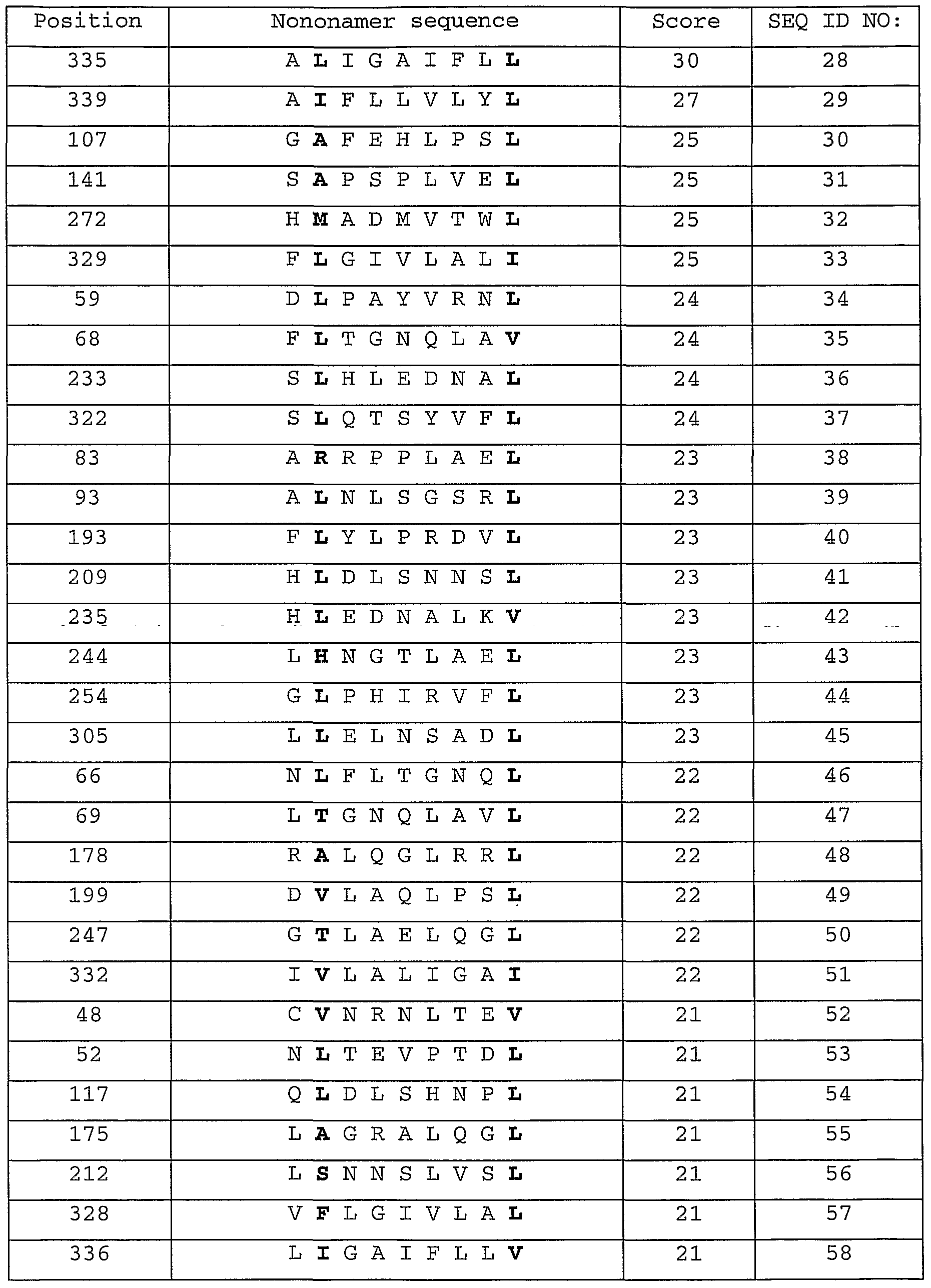

G = Rammensee (Rammensee HG et al, 1997), L= Leiden, A= Parker (Parker KC et al, 1994) epitope prediction programmes . IP is - immunoproteosome and CP is constitutive proteosome. Average % is calculated by taking the average percent score in each programme (score of potential epitopes / the maximum score in 5T4 xlOO) . ?= it is not possible to say a precursor peptide is generated or not; No = not generated by digestion; Yes = generated by digestion)
References
Adenoviral purification
AIi, S., Mulryan, K., Taher, T. and Stern P. L. (2005) Heterologous prime-boost vaccinations to h5T4 oncofetal antigen in prophylactic and active therapy models of Bl6 melanoma; the relevance of antigen pre-exposure . In preparation
Brady CS. , Bartholomew J. S. ,Burt. D.J., Duggan-Keen, M. F., Glenville, S., Telford. N, Little, A.M., Davidson, J., Jimenez, P., Ruiz-Cabello,F. , Garrido, F and Stern, P. L .(2000) Multiple mechanisms underly HLA dysregulation in cervical cancer. Tissue Antigens 55, 401-11
Craiu, A., Akopian, T., Goldberg, A., and Rock, K. L. 1997. Two distinct proteolytic processes in the generation of a major histocompatibility complex class I-presented peptide. Proc. Natl. Acad. Sci. USA. 94:10850-10855.
Chapatte L, Servis C, Valmori D, Burlet-Schiltz 0, Dayer J, Monsarrat B, Romero P, Levy F. Final antigenic Melan-A peptides produced directly by the proteasomes are preferentially selected for presentation by HLA-A*0201 in melanoma cells. J Immunol. 2004 Nov 15;173 (10) :6033-40.
D'Amaro, J., Houbiers, J. G., Drijfhout, J.W. , Brandt, R.M. , Schipper, R., Bavinck, J.N. , Melief, CJ. , and Kast, W.M. 1995. A computer program for predicting possible cytotoxic T lymphocyte epitopes based on HLA class I peptide-binding motifs. Hum. Immunol. 43:13-18
Dermime, S., David, E., Gilham, D. E. , Shaw, D., Davidson, E.J., Meziane E-K., Armstrong, A., Hawkins, R. E. & Stern, P. L. (2004). Vaccine and antibody directed T cell tumour immunotherapy. Biochima et Biophysica 2004; 1704: 11-35
Dick, L. R., Aldrich, C, Jameson, S. C, Moomaw, CR. , Pramanik, B.C., Doyle, CK. , Demartino, G.N. , Bevan, M. J. , Forman, J.M., and Slaughter, CA. 1994. Proteolytic processing of ovalbumin and beta- galactosidase by the proteasome to a yield antigenic peptides. J. Immunol. 152:3884-3894.
Forsberg, C, Ohlsson, L., Brodin, T., Bjδrk, P., Lando, P.A., Shaw, D., Stern, P. L. & Dohlsten, M. (2001) . Therapy of human non small cell lung carcinoma using targeting of a modified superantigen. British Journal of Cancer 85, 129-136.
Groll M, Ditzel L, Lowe J, Stock D, Bochtler M, Bartunik HD, Huber R. Structure of 2OS proteasome from yeast at 2.4 A resolution. Nature. 1997 Apr 3 ; 386 (6624) : 463-71.
Guest, R. D. , Hawkins, R. E., Kirillova, N., Cheadle, E.J., Arnold, J., O'Neill, A., Irlam, J., Chester, K.A. , Kemshead, J., Shaw, D., Embleton, J., Stern, P. L. & Gilham, D. E. (2005). Relative position of scFv binding to target proteins influences the optimal design of chimeric immune receptors for four different scFvs and antigens. J Immunotherapy in press.
Hanada K, Yewdell JW, Yang JC. Immune recognition of a human renal cancer antigen through post-translational protein splicing. Nature. 2004 Jan 5 ; 427 (6971) : 252-6.
Hebart H, Daginik S, Stevanovic S, Grigoleit U, Dobler A, Baur M, Rauser G,Sinzger C, Jahn G, Loeffler J, Kanz L, Rammensee HG,
Einsele H. Sensitive detection of human cytomegalovirus peptide- specific cytotoxic T-lymphocyte responses by interferon-gamma- enzyme-linked immunospot assay and flow cytometry in healthy individuals and in patients after allogeneic stem cell transplantation. Blood. 2002 May 15 ; 99 (10) : 3830-7.
Hole, N. and Stern, P. L. (1990). Isolation and characterisation of 5T4 a tumour-associated antigen. Int. J. Cancer, 45, 179-184.
Kessler JH, Beekman MJ, Bres-Vloemans SA, Verdijk P, van Veelen PA, Kloosterman-Joosten AM, Vissers DC, ten Bosch GJ, Kester MG, Sijts A, Wouter Drijfhout J, Ossendorp F, Offringa R, Melief CJ . Efficient identification of novel HLA-A(*) 0201-presented cytotoxic T lymphocyte epitopes in the widely expressed tumor antigen PRAME by proteasome-mediated digestion analysis. J Exp Med. 2001 Jan 1;193 (1) :73-88.
Kjer-Nielsen L, Beddoe T, McCluskey J, Rossjohn J, Purcell AW. Functional and structural characteristics of NY-ESO-1-related HLA A2-restricted epitopes and the design of a novel immunogenic analogue. J Biol Chem. 2004 May 28 ; 279 (22) : 23438-46.
Kruger E, Kuckelkorn U, Sijts A, Kloetzel PM. The components of the proteasome system and their role in MHC class I antigen processing. Rev Physiol Biochem Pharmacol. 2003,-148: 81-104.
Melief, C. J.M., Toes, R. E., Medema, J. P., van der Burg, S. H., Ossendorp, F., and Offringa, R. 2000. Strategies for immunotherapy of cancer. Adv. Immunol. 75:235-281.
Mo, X.Y. , Cascio, P., Lemerise, K., Goldberg, A. L., and Rock, K. 1999. Distinct proteolytic processes generate the C and N termini of MHC class I-binding peptides. J. Immunol. 163:5851-5859
Mulder, W.M. C, Stern, P. L., Stukart, M.J., de Windt, E., Butzelaar, R., Meijer, S., Ader, H.J., Claessen, A.M. E., Vermorken, J. B., Meijer, C.J. L.M., Scheper, R.J. , and Bloemena, E. (1997) Low ICAM-I and high 5T4 expression on tumour cells independently correlates with disease-free survival in colorectal carcinoma patients. Clinical Cancer Research 3, 1923-1930
Mulryan, K., Ryan, M. G., Myers, K.A. , Shaw, D., Wang, W., Kingsman, S.M., Stern, P. L. & Carroll, M.W. (2002). Attenuated recombinant vaccinia virus expressing oncofetal antigen (tumour associated antigen) 5T4, induces active therapy of established tumours. Molecular Cancer Therapeutics 1, 1129-1137
Myers KA, Rahi-Saund V, Davison MD, Young JA, Cheater AJ, Stern PL..Isolation of a cDNA encoding 5T4 oncofetal trophoblast glycoprotein. An antigen associated with metastasis contains leucine-rich repeats. J Biol Chem. 1994; 269:9319-24
Myers, K.A. , Ryan, M. G., Shaw, D.M., Embleton, M.J., Stern, P. L., Kingsman, S.M. & Carroll, M.W. (2002). Tumour cell targeting of immune effector molecules using tumour associated antigen specific scFv fusion proteins. Cancer Gene Therapy 9, 884-896.
Novellino L, Castelli C, Parmiani G. A listing of human tumor antigens recognized by T cells: March 2004 update. Cancer Immunol Immunother. 2005 ; 54 : 187-207
Offringa, R., van der Burg, S. H., Ossendorp, F., Toes, R. E., and Melief, CJ. 2000. Design and evaluation of antigen-specific vaccination strategies against cancer. Curr. Opin. Immunol. 12:576- 582.
Pamer, E., and Cresswell, P. 1998. Mechanisms of MHC class I- restricted antigen processing. Arxnu. .Rev. Immunol 16:323-358.
I Parker, K. C, Bednarek, M. A. , and Coligan, J. E. 1994. Scheme for ranking potential HLA-A2 binding peptides based on independent binding of individual peptide side-chains. J". Immunol. 152:163-175
Preuss KD, Zwick C, Bormann C, Neumann F, Pfreundschuh M. Analysis of the B-cell repertoire against antigens expressed by human neoplasms. Immunol Rev. 2002; 188:43-50.
Rammensee, H. G. , Bachman, J., and Stevanovic, S. 1997. MHC Ligands and Peptide Motifs. Heidelberg, Germany, Springer-Verlag, , pp. 462 pp.
Rock KL, York IA, Goldberg AL. Post-proteasomal antigen processing for major histocompatibility complex class I presentation. Nat Immunol. 2004; 5: 670-7.
Rosenberg, S. A. 1999. A new era for cancer immunotherapy based on the genes that encode cancer antigens. Immunity. 10:281-287.
Shaw DM, Embleton MJ, Westwater C, Ryan MG, Myers KA, Kingsman SM, Carroll MW, Stern PL.. Isolation of a high affinity scFv from a monoclonal antibody recognising the oncofoetal antigen 5T4. Biochim Biophys Acta. 2000 Dec 15 ; 1524 (2-3 ): 238-46.
Sinzger C, Jahn G, Loeffler J, Kanz L, Rammensee HG, Einsele H. Sensitive detection of human cytomegalovirus peptide-specific cytotoxic T-lymphocyte responses by interferon-gamma-enzyme-linked immunospot assay and flow cytometry in healthy individuals and in patients after allogeneic stem cell
Snyder, H. L., Bacik, I., Yewdell, J.W., Behrens, T.W., and Bennink, J. R. 1998. Promiscuous liberation of MHC-class I-binding peptides from the C termini of membrane and soluble proteins in the secretory pathway. Eur. J. Immunol. 28:1339-1346.
Southall, P., Boxer, G., Bagshawe, K. D., Hole, N. Bromley, M. and Stern, P. L. (1990) . Immunohistological distribution of 5T4 antigens in normal and malignant tissue. Br. J. Cancer, 61, 89-95.
Starzynska, T., Marsh, P.J., Schofield, P. F., Roberts, S.A., Myers, K.A. and Stern, P. L. (1994) . Prognostic significance of 5T4 oncofetal antigen expression in colorectal carcinoma. Br. J. Cancer, 69, 899-902.
Starzynska, T., Rahi , V. and Stern, P. L. (1992a). The expression of 5T4 antigen in colorectal and gastric carcinoma. Br. J. Cancer, 66, 867-869.
Starzynska, T., Wiechowska-Kozlowska, A., Marlicz, K., Bromley, M., Roberts, S.A., Llawniczak, M., Koldziej , B., Zyluk, A., Stern, P. L. (1998) . Expression of 5T4 oncofetal antigen in relation to the origins of gastric carcinoma and clinical outcome. European J. Gastroenterology and Hepatology 10; 479-484
Steinman RM. The control of immunity and tolerance by dendritic cell. Pathol Biol (Paris). 2003; 51:59-60.
Stern, PL, Carroll, MC and Beverley PC, Eds:. Cancer Vaccines Cambridge University Press (2000)
Stern, P. L., West, C. & Burt, D. (2003). Culture of cervical carcinoma tumour cell lines. In: Culture of Tumor Cells. Eds.: Pfragner, R. and Freshney, I. Wiley-Liss, pp. 179-204.
Sugden B, Mark W. Clonal transformation of adult human leukocytes by Epstein-Barr virus. J Virol. 1977 ; 23 : 503-8.
Rammensee HG, Weinschenk T, Gouttefangeas C, Stevanovic S. Towards patient-specific tumor antigen selection for vaccination. Immunol Rev. 2002;188:164-76.
Traversari C, van der Bruggen P, Luescher IF, Lurquin C, Chomez P, Van Pel A, De Plaen E, Amar-Costesec A, Boon T. A nonapeptide encoded by human gene MAGE-I is recognized on HLA-Al by cytolytic T lymphocytes directed against tumor antigen MZ2-E. J Exp Med. 1992;176:1453-7.
Van Der Bruggen P, Zhang Y, Chaux P, Stroobant V, Panichelli C, Schultz ES, Chapiro J, Van Den Eynde BJ, Brasseur F, Boon T. Tumor- specific shared antigenic peptides recognized by human T cells . Immunol Rev. 2002 ; 188 : 51-64.
van der Bruggen P, Traversari C, Chomez P, Lurquin C, De Plaen E, Van den Eynde B, Knuth A, Boon T. A gene encoding an antigen recognized by cytolytic T lymphocytes on a human melanoma. Science. 1991; 254:1643-7.
Wrigley E , McGown A. T. , Rennison, J., Swindell R, Crowther D,
Starzynska, T., Stern P. L. (1995) 5T4 Oncofetal antigen expression in ovarian carcinoma. Int. J. Gynaecol Cancer 5, 269-274.
Webb AI, Dunstone MA, Chen W, Aguilar MI, Chen Q, Jackson H, Chang L,
Kjer-Nielsen L, Beddoe T, McCluskey J, Rossjohn J, Purcell AW. Functional and structural characteristics of NY-ESO-1-related HLA A2-restricted epitopes and the design of a novel immunogenic analogue. J Biol Chem. 2004 May 28;279 (22) : 23438-46.
York, I. A., and Rock, K. L. 1996. Antigen processing and presentation by the class I major histocompatibility complex. Annu. Rev. Immunol. 14:369-396.
Rammensee HG, Bachman J, Stevanovic S, MHC Ligands and Peptide Motifs. Heidelberg, Germany, Springer-Verlag . 1997. 462p.
Hardy S, Kitamura M, Harris-Stansil T, Dai Y, Phipps ML. Construction of adenovirus vectors through Cre-lox recombination. J Virol. 1997;71:1842-9.
Armstrong AC, Dermime S, Allinson CG, Bhattacharyya T, Mulryan K,
Gonzalez KR, Stern PL, Hawkins RE. Immunization with a recombinant adenovirus encoding a lymphoma idiotype: induction of tumor- protective immunity and identification of an idiotype-specific T cell epitope. J Immunol. 2002 ; 168 : 3983-91.
Schweitzer S, Schneiders AM, Langhans B, Kraas W, Jung G, Vidalin 0, Inchauspe G, Sauerbruch T, Spengler U. Flow cytometric analysis of peptide binding to major histocampatibility complex class I for hepatitis C virus core T-cell epitopes. Cytometry. 2000; 41 : 271-8.
Stern PL, West C, Burt D. Culture of cervical carcinoma tumour cell lines. In: Pfragner R, Freshney I. Culture of Tumor Cells. Wiley- Liss. 2003:179-204.
Drijfhout JW, Brandt RMP, D'Amaro J, Kast WM and Melief CJM. Detailed motifs for peptide binding to HLA-A*0201 derived from large random sets of peptides using a cellular binding assay. Hum Immunol. 1995;43:1-12 .
Little AM, Stern PL. Does HLA type predispose some individuals to cancer? MoI Med Today. 1999. 5(8):337-42.
Toes RE, Hoeben RC, van der Voort EI, Ressing ME, van der Eb AJ, Melief CJ, Offringa R. Protective anti-tumor immunity induced by vaccination with recombinant adenoviruses encoding multiple tumor- associated cytotoxic T lymphocyte epitopes in a string-of-beads fashion. Proc Natl Acad Sci U S A. 1997 Dec 23 ; 94 (26) : 14660-5.
Kast WM, Brandt RM, Drijfhout JW, Melief CJ. Human leukocyte antigen-A2.1 restricted candidate cytotoxic T lymphocyte epitopes of human papillomavirus type 16 E6 and E7 proteins identified by using the processing-defective human cell line T2. J Immunother. 1993 Aug;14(2) : 115-20.
Ressing ME, van Driel WJ, Brandt RM, Renter GG, de Jong JH, Bauknecht T, Fleuren GJ, Hoogerhout P, Offringa R, Sette A, Celis E, Grey H, Trimbos BJ, Kast WM, Melief CJ. Detection of T helper responses, but not of human papillomavirus-specific cytotoxic T lymphocyte responses, after peptide vaccination of patients with cervical carcinoma. J Immunother. 2000 Mar-Apr; 23 (2 ): 255-66.
Houbiers JG, Nijman HW, van der Burg SH, Drijfhout JW, Kenemans P, van de Velde CJ, Brand A, Momburg F, Kast WM, Melief CJ. In vitro induction of human cytotoxic T lymphocyte responses against peptides of mutant and wild-type p53. Eur J Immunol. 1993 Sep; 23 (9) :2072-7.
Rosenberg SA, Yang JC, Schwartzentruber DJ, Hwu P, Topalian SL, Sherry RM, Restifo NP, Wunderlich JR, Seipp CA, Rogers-Freezer L, Morton KE, Mayroukakis SA, Gritz L, Panicali DL, White DE.
Recombinant fowlpox viruses encoding the anchor-modified gplOO
melanoma antigen can generate antitumor immune responses in patients with metastatic melanoma. Clin Cancer Res. 2003; 9 (8) -.2973-80.
Speiser, D. E., Lienard, D., Rufer, N., Rubio-Godoy, V., Rimoldi, D., Lejeune, F., Krieg, A.M., Cerottini, J-C, and Romero, P. (2005). Rapid and strong human CD8+ T cell responses to vaccination with peptide, IFA, and CpG oligodeoxynucleotide 7909. J". Clin. Invest. 115, 739-746.
Rosenberg SA, Yang JC, Restifo and NP. Cancer immunotherapy: moving beyond current vaccines. Nat Med. 2004; 10 (9) : 909-15.
Claims
1. A peptide comprising an epitope of the human 5T4 antigen, wherein the epitope comprises : (a) the amino acid sequence of peptide 40 (GAFEHLPSL) ;
(b) the amino acid sequence of peptide 41 (DLPAYVKML) ; or
(c) an amino acid sequence which is a variant of (a) or (b) which retains MHC Class 1 binding specificity.
2. A peptide according to claim 1 which is from 9 to 50 amino acids in length.
3. A peptide according to claim 1 or 2 wherein the epitope is 9 amino acids in length.
4. A peptide according to any one of claims 1 to 3 which consists of the epitope.
5. A peptide according to any one of the preceding claims wherein the variant comprises an amino acid substitution at amino acid position 2 and/or amino acid position 9 of peptide 40 or 41.
6. A peptide according to claim 5 wherein the amino acid at position 2 is selected from alanine, valine, isoleucine, leucine, methionine and threonine .
7. A peptide according to claim 5 or 6 wherein the amino acid at position 9 is selected from valine, isoleucine, leucine, methionine, threonine, cysteine and alanine.
8. A peptide according to any one of the preceding claims wherein the variant comprises one or more unnatural amino acids.
9. A polyepitope string comprising an epitope as defined in any one of the preceding claims .
10. A polyepitope string according to claim 9 which comprises more than one epitope of the 5T4 antigen.
11. A polyepitope string according to claim 9 or 10 which comprises at least one epitope of a tumour associated antigen other than the
5T4 antigen.
12. A polynucleotide comprising:
(a) a nucleic acid sequence which encodes a peptide according to any one of claims 1 to 8 or a polyepitope string according to any one of claims 9 to 11;
(b) a nucleic acid sequence complementary to (a); or
(c) a nucleic acid sequence which hybridises to (a) or (b) under stringent conditions .
13. A polynucleotide according to claim 12 wherein the peptide consists of the amino acid sequence of peptide 40 or 41.
14. A polynucleotide according to claim 12 or 13 comprising: (a) the nucleic acid sequence of GGCGCCTTCGAGCATCTGCCCAGCCTG (SEQ ID NO : 1 ) or GACCTGCCCGCCTACGTGCGCAACCTC ( SEQ ID NO : 2 ) ;
(b) a nucleic acid sequence which is degenerate with respect to (a) ; or
(c) a nucleic acid sequence complementary to (a) or (b) .
15. A recombinant vector comprising a polynucleotide according to any one of claims 12 to 14.
16. A vector according to claim 15 which is a viral vector.
17. Coated particles comprising a polynucleotide according to any one of claims 12 to 14 or a vector according to claim 15 or 16.
18. Particles according to claim 17 which comprise gold beads.
19. Cells, pulsed or transfected with a peptide according to any one of claims 1 to 8 , a polyepitope string according to any one of claims 9 to 11, a polynucleotide according to any one of claims 12 to 14, a vector according to claim 15 or 16 or particles according to claim 17 or 18.
20. Cells according to claim 19 which are antigen presenting cells.
21. Cells according to claim 20 which are dendritic cells.
22. T cells or a T cell line which specifically recognise (s) an epitope as defined in any one of claims 1 to 8 when presented by an MHC Class I molecule.
23. An agent capable of specifically binding an epitope as defined in any one of claims 1 to 8.
24. An agent according to claim 23 which comprises a T cell receptor or an antibody.
25. A tetrameric or pentameric complex comprising a multivalent MHC molecule and an epitope as defined in any one of claims 1 to 8.
26. A pharmaceutical composition comprising a peptide according to any one of claims 1 to 8 , a polyepitope string according to any one of claims 9 to 11, a polynucleotide according to any one of claims 12 to 14, a vector according to claim 15 or 16, particles according to claim 17 or 18, cells according to any one of claims 19 to 22, or an agent according to claim 23 or 24 and a physiologically acceptable excipient.
27. A vaccine comprising a peptide according to any one of claims 1 to 8 , a polyepitope string according to any one of claims 9 to 11, a polynucleotide according to any one of claims 12 or 14, a vector according to claim 15 or 16, particles according to claim 17 or 18, cells according to any one of claims 19 to 22, or an agent according to claim 23 or 24.
28. A vaccine according to claim 27 which comprises a suitable adjuvant.
29. A peptide according to any one of claims 1 to 8, a polyepitope string according to any one of claims 9 to 11, a polynucleotide according to any one of claims 12 or 14, a vector according to claim 15 or 16, particles according to claim 17 or 18, cells according to any one of claims 19 to 22, or an agent according to claim 23 or 24 for use in medicine.
30. Use of a peptide according to any one of claims 1 to 8 , a polyepitope string according to any one of claims 9 to 11, a polynucleotide according to any one of claims 12 or 14, a vector according to claim 15 or 16, particles according to claim 17 or 18, cells according to any one of claims 19 to 22, or an agent according to claim 23 or 24 for the manufacture of a medicament for treating or preventing cancer .
31. A method of treating or preventing cancer in a subject which comprises administering an effective amount of a composition according to claim 25 or a vaccine according to claim 27 or 28.
32. A method according to claim 31 which further comprises the use of another anticancer agent.
33. A method of diagnosing or monitoring cancer and/or an anti-5T4 immune response in a subject, which comprises detecting in a sample isolated from the subject, the presence of:
(a) an epitope as defined in any one of claim 1 to 8 ;
(b) T cells or a T cell line as defined in claim 22;
(c) a T cell receptor as defined in claim 24; and/or (d) activation of T cells or a T cell line as defined in claim 22.
34. A method according to claim 33 wherein the epitope is present bound to an MHC Class I molecule on the surface of an antigen presenting cell .
35. A method according to claim 33 or 34 which comprises monitoring an anti-5T4 specific immune response to immunotherapy or vaccination.
36. A method according to any one of claims 33 to 35 which comprises the use of complexes as defined in claim 25 for the detection of said T cells .
37. Products containing
(a) a pharmaceutical composition according to claim 26 or a vaccine composition according to claim 27 or 28; and
(b) at least one other anti-cancer agent; as a combined preparation for simultaneous, separate or sequential use in treating or preventing cancer .
Applications Claiming Priority (2)
| Application Number | Priority Date | Filing Date | Title |
|---|---|---|---|
| GBGB0520067.0A GB0520067D0 (en) | 2005-10-01 | 2005-10-01 | Treatment of cancer |
| GB0520067.0 | 2005-10-01 |
Publications (1)
| Publication Number | Publication Date |
|---|---|
| WO2007039716A1 true WO2007039716A1 (en) | 2007-04-12 |
Family
ID=35395161
Family Applications (1)
| Application Number | Title | Priority Date | Filing Date |
|---|---|---|---|
| PCT/GB2006/003643 Ceased WO2007039716A1 (en) | 2005-10-01 | 2006-09-29 | T cell epitopes from the 5t4 tumor associated antigen and their use in treatment of cancer |
Country Status (2)
| Country | Link |
|---|---|
| GB (1) | GB0520067D0 (en) |
| WO (1) | WO2007039716A1 (en) |
Cited By (4)
| Publication number | Priority date | Publication date | Assignee | Title |
|---|---|---|---|---|
| EP2045268A1 (en) * | 2005-05-13 | 2009-04-08 | Oxford BioMedica (UK) Limited | Mhc class I and II peptide antigens derived from tumour antigen 5t4 |
| WO2020048995A1 (en) * | 2018-09-04 | 2020-03-12 | Treos Bio Zrt | Process for preparing vaccine compositions |
| US11213578B2 (en) | 2017-03-03 | 2022-01-04 | Treos Bio Limited | Vaccine |
| US11666644B2 (en) | 2018-09-04 | 2023-06-06 | Treos Bio Limited | Peptide vaccines |
Citations (4)
| Publication number | Priority date | Publication date | Assignee | Title |
|---|---|---|---|---|
| WO2002038612A2 (en) * | 2000-11-13 | 2002-05-16 | Oxford Biomedica (Uk) Limited | Canine and feline tumour-associated antigen 5t4 |
| WO2003068815A2 (en) * | 2002-02-13 | 2003-08-21 | Oxford Biomedica Uk Limited | Mhc class ii peptide epitope of 5t4 antigen |
| WO2003068816A1 (en) * | 2002-02-13 | 2003-08-21 | Oxford Biomedica Uk Limited | Mhc class i peptide epitopes from the human 5t4 tumor-associated antigen |
| WO2003087831A2 (en) * | 2002-04-11 | 2003-10-23 | Oxford Glycosciences (Uk) Ltd | Proteins involved in breast cancer |
-
2005
- 2005-10-01 GB GBGB0520067.0A patent/GB0520067D0/en not_active Ceased
-
2006
- 2006-09-29 WO PCT/GB2006/003643 patent/WO2007039716A1/en not_active Ceased
Patent Citations (4)
| Publication number | Priority date | Publication date | Assignee | Title |
|---|---|---|---|---|
| WO2002038612A2 (en) * | 2000-11-13 | 2002-05-16 | Oxford Biomedica (Uk) Limited | Canine and feline tumour-associated antigen 5t4 |
| WO2003068815A2 (en) * | 2002-02-13 | 2003-08-21 | Oxford Biomedica Uk Limited | Mhc class ii peptide epitope of 5t4 antigen |
| WO2003068816A1 (en) * | 2002-02-13 | 2003-08-21 | Oxford Biomedica Uk Limited | Mhc class i peptide epitopes from the human 5t4 tumor-associated antigen |
| WO2003087831A2 (en) * | 2002-04-11 | 2003-10-23 | Oxford Glycosciences (Uk) Ltd | Proteins involved in breast cancer |
Non-Patent Citations (4)
| Title |
|---|
| D'AMARO J ET AL: "A COMPUTER PROGRAM FOR PREDICTING POSSIBLE CYTOTOXIC T LYMPHOCYTE EPITOPES BASED ON HLA CLASS I PEPTIDE-BINDING MOTIFS", HUMAN IMMUNOLOGY, NEW YORK, NY, US, vol. 43, no. 1, 1 May 1995 (1995-05-01), pages 13 - 18, XP000603786, ISSN: 0198-8859 * |
| KESSLER J H ET AL: "Efficient identification of novel HLA-A(*)0201-presented cytotoxic T lymphocyte epitopes in the widely expressed tumor antigen PRAME by proteasome-mediated digestion analysis", JOURNAL OF EXPERIMENTAL MEDICINE, TOKYO, JP, vol. 193, no. 1, 1 January 2001 (2001-01-01), pages 73 - 88, XP002339970, ISSN: 0022-1007 * |
| PARKER K C ET AL: "SCHEME FOR RANKING POTENTIAL HLA-A2 BINDING PEPTIDES BASED ON INDEPENDENT BINDING OF INDIVIDUAL PEPTIDE SIDE-CHAINS", JOURNAL OF IMMUNOLOGY, THE WILLIAMS AND WILKINS CO. BALTIMORE, US, vol. 152, no. 1, 1 January 1994 (1994-01-01), pages 163 - 175, XP002039467, ISSN: 0022-1767 * |
| SMYTH LUCY J C ET AL: "CD8 T-cell recognition of human 5T4 oncofetal antigen", INTERNATIONAL JOURNAL OF CANCER, vol. 119, no. 7, October 2006 (2006-10-01), pages 1638 - 1647, XP002409262, ISSN: 0020-7136 * |
Cited By (9)
| Publication number | Priority date | Publication date | Assignee | Title |
|---|---|---|---|---|
| EP2045268A1 (en) * | 2005-05-13 | 2009-04-08 | Oxford BioMedica (UK) Limited | Mhc class I and II peptide antigens derived from tumour antigen 5t4 |
| EP2277918A3 (en) * | 2005-05-13 | 2011-05-11 | Oxford BioMedica (UK) Limited | Mhc class I and II peptide antigens derived from tumour antigen 5t4 |
| US11213578B2 (en) | 2017-03-03 | 2022-01-04 | Treos Bio Limited | Vaccine |
| US11426452B2 (en) | 2017-03-03 | 2022-08-30 | Treos Bio Limited | Vaccine |
| US11628211B2 (en) | 2017-03-03 | 2023-04-18 | Treos Bio Limited | Vaccine |
| WO2020048995A1 (en) * | 2018-09-04 | 2020-03-12 | Treos Bio Zrt | Process for preparing vaccine compositions |
| CN113383009A (en) * | 2018-09-04 | 2021-09-10 | 特雷斯生物有限公司 | Method for preparing vaccine composition |
| JP2021535749A (en) * | 2018-09-04 | 2021-12-23 | トレオス バイオ リミテッド | Process for preparing vaccine composition |
| US11666644B2 (en) | 2018-09-04 | 2023-06-06 | Treos Bio Limited | Peptide vaccines |
Also Published As
| Publication number | Publication date |
|---|---|
| GB0520067D0 (en) | 2005-11-09 |
Similar Documents
| Publication | Publication Date | Title |
|---|---|---|
| JP5627180B2 (en) | Tumor-associated peptide that binds to human leukocyte antibody (HLA) class II molecules indiscriminately | |
| US20090274714A1 (en) | Tumour-associated peptides binding to human leukocyte antigen (hla) class i or ii molecules and related anti-cancer vaccine | |
| Van Elsas et al. | Induction and characterization of cytotoxic T‐lymphocytes recognizing a mutated p21ras peptide presented by HLA‐A* 0201 | |
| JP5452923B2 (en) | CD4 + T survivin epitope and use thereof | |
| JP4533630B2 (en) | MHC class I peptide epitopes derived from the human 5T4 tumor-associated antigen - Patents.com | |
| WO2003068815A2 (en) | Mhc class ii peptide epitope of 5t4 antigen | |
| US20110212116A1 (en) | Immunogenic peptides and uses thereof | |
| Smyth et al. | Cd8 T‐cell recognition of human 5T4 oncofetal antigen | |
| WO2007039716A1 (en) | T cell epitopes from the 5t4 tumor associated antigen and their use in treatment of cancer | |
| JP3840268B2 (en) | Cytotoxic T lymphocytes | |
| US8147838B2 (en) | Peptide | |
| JP5736334B2 (en) | Tumor-associated peptide that binds to human leukocyte antibody (HLA) class II molecules indiscriminately | |
| JP5736333B2 (en) | Tumor-associated peptide that binds to human leukocyte antibody (HLA) class II molecules indiscriminately | |
| MX2011005944A (en) | EPDOPE WDRPUH PEPTIDES AND VACCINES CONTAINING THEM. | |
| Visser et al. | Molecular characterization of melanoma-derived antigens | |
| Visseren et al. | T-Cell and NK-Mediated Surveillance of Cancer: A Delicate Balancing Act | |
| Celis | Epitopes Derived from Tumor-Associated Antigens for the Development | |
| Visseren et al. | A Delicate Balancing Act | |
| Celis | Development of Immunotherapy for Cancer | |
| EP1560848A2 (en) | Ptprk immunogenic peptide |
Legal Events
| Date | Code | Title | Description |
|---|---|---|---|
| 121 | Ep: the epo has been informed by wipo that ep was designated in this application | ||
| NENP | Non-entry into the national phase |
Ref country code: DE |
|
| 122 | Ep: pct application non-entry in european phase |
Ref document number: 06779590 Country of ref document: EP Kind code of ref document: A1 |