WO2007017424A1 - Novel chiral derivatizing reagent for the determination of enantiomeric excesses - Google Patents
Novel chiral derivatizing reagent for the determination of enantiomeric excesses Download PDFInfo
- Publication number
- WO2007017424A1 WO2007017424A1 PCT/EP2006/064936 EP2006064936W WO2007017424A1 WO 2007017424 A1 WO2007017424 A1 WO 2007017424A1 EP 2006064936 W EP2006064936 W EP 2006064936W WO 2007017424 A1 WO2007017424 A1 WO 2007017424A1
- Authority
- WO
- WIPO (PCT)
- Prior art keywords
- chiral
- compound
- present
- nmr
- general formula
- Prior art date
- Legal status (The legal status is an assumption and is not a legal conclusion. Google has not performed a legal analysis and makes no representation as to the accuracy of the status listed.)
- Ceased
Links
Classifications
-
- G—PHYSICS
- G01—MEASURING; TESTING
- G01R—MEASURING ELECTRIC VARIABLES; MEASURING MAGNETIC VARIABLES
- G01R33/00—Arrangements or instruments for measuring magnetic variables
- G01R33/20—Arrangements or instruments for measuring magnetic variables involving magnetic resonance
- G01R33/44—Arrangements or instruments for measuring magnetic variables involving magnetic resonance using nuclear magnetic resonance [NMR]
-
- C—CHEMISTRY; METALLURGY
- C07—ORGANIC CHEMISTRY
- C07B—GENERAL METHODS OF ORGANIC CHEMISTRY; APPARATUS THEREFOR
- C07B57/00—Separation of optically-active compounds
-
- G—PHYSICS
- G01—MEASURING; TESTING
- G01N—INVESTIGATING OR ANALYSING MATERIALS BY DETERMINING THEIR CHEMICAL OR PHYSICAL PROPERTIES
- G01N24/00—Investigating or analyzing materials by the use of nuclear magnetic resonance, electron paramagnetic resonance or other spin effects
- G01N24/08—Investigating or analyzing materials by the use of nuclear magnetic resonance, electron paramagnetic resonance or other spin effects by using nuclear magnetic resonance
-
- G—PHYSICS
- G01—MEASURING; TESTING
- G01N—INVESTIGATING OR ANALYSING MATERIALS BY DETERMINING THEIR CHEMICAL OR PHYSICAL PROPERTIES
- G01N24/00—Investigating or analyzing materials by the use of nuclear magnetic resonance, electron paramagnetic resonance or other spin effects
- G01N24/08—Investigating or analyzing materials by the use of nuclear magnetic resonance, electron paramagnetic resonance or other spin effects by using nuclear magnetic resonance
- G01N24/088—Assessment or manipulation of a chemical or biochemical reaction, e.g. verification whether a chemical reaction occurred or whether a ligand binds to a receptor in drug screening or assessing reaction kinetics
Definitions
- the present invention relates to a method for the determination of the enantiomeric composition of a chiral compound by using a novel chiral derivatising reagent. More specifically, the present invention is directed to a method for the determination of the enantiomeric composition of a chiral compound through its derivatisation with a compound of general formula I and subsequent analysis of the resulting mixture.
- enantiomeric purity or alternatively “enantiomeric excess” (abbreviated “ee") , as used herein is defined as:
- percent enantiomeric purity or alternatively, the “percent enantiomeric excess” is defined as 10Ox
- optical rotation and/or circular dichroism has three main drawbacks that make it difficult to employ in a practical manner: relatively low sensitivity; a correspondingly low tolerance of impurities, particularly chiral ones; and the fact that optical rotation does not vary linearly with enantiomeric composition, so that the optical purity may not be equivalent to the enantiomeric purity.
- optical purity refers to the ratio of the observed optical rotation of a sample consisting of a mixture of enantiomers to the optical rotation of one corresponding pure enantiomer.
- percent optical purity is defined as 100 x optical purity.
- the first approach involves those procedures wherein the derivatisation of the substrate whose absolute configuration is studied is not necessary.
- the sample i.e., a pure enantiomer
- the sample is analyzed by NMR in a chiral environment that is provided by a chiral shift reagent (in general, chiral lanthanide complexes) (see for example patents US5736411, JP2002020358 and US3950135) or by the addition of a chiral solvating reagent (CSA) (see for example ES2187269 and IT1249016) to a non-chiral standard NMR solvent.
- a chiral shift reagent in general, chiral lanthanide complexes
- CSA chiral solvating reagent
- the second approach involves derivatisation of the substrate (i.e., a pure enantiomer) with an optically pure chiral derivatising reagent (CDA), i.e. the formation of diastereomers followed by their separation by chromatography or their NMR analysis in an achiral environment.
- CDA optically pure chiral derivatising reagent
- the chiral environment is provided by the CDA, which acts as auxiliary reagent.
- the association with the substrate is covalent and leads to much-greater differences in chemical shifts than those obtained when CSAs are used.
- the chromatographic separation of a diastereomeric pair obtained via the CDA indirect technique is simpler to perform and often has better 5 resolution than the separation of the corresponding enantiomeric pair with a direct method, mainly because chromatographic conditions are much easily optimized.
- said methods can be adapted to several common techniques such as NMR or chromatography with no need of any modification. In some cases it is even possible to determine the absolute configuration of the
- racemisation refers to a decrease of the enantiomeric excess of a chiral starting material.
- enrichment refers to an increase of the enantiomeric excess of a chiral starting material.
- NMR-active heteroatoms such as 19 F
- a chromophore enhances the detection in HPLC resolution.
- resolution via diastereomer formation is usually improved when the chiral centers of both the reagent and the analyte are in close proximity in the resulting diastereomer (see D. Stevenson, G.A. Williams, 1988, Stevenson D and Wilson ID (eds) . Chiral Separations. Plenum Press, New York) .
- the present invention relates to a method for the determination of the enantiomeric composition of a chiral compound by using a novel chiral derivatising reagent, said chiral derivatising reagent being a compound of general formula I: FORMULA I
- Ar is an aromatic or heteroaromatic group which can be optionally substituted.
- aromatic as defined herein refers to a cyclic conjugated molecular entity with alternating single and double bonds whose stability (due to delocalization) is significantly greater than that of a corresponding hypothetical localized structure (Kekule structure) .
- heteromatic refers to an aromatic entity wherein al least one of the carbon atoms of the ring system has been replaced by a heteroatom.
- the present invention refers to a method for the determination of the enantiomeric composition of a chiral compound in a sample comprising:
- the diastereomeric composition determined can be directly related to the enantiomeric composition of the starting chiral compound.
- the derivatisation of the chiral compound with the compound of general formula I is performed in the presence of a promoter.
- promoter refers to a substance that increases the rate of a reaction.
- said derivation is performed by adding a solution of the chiral compound to a solution of the compound of general formula I and the promoter.
- said promoter is a Lewis acid, for example
- a skilled person in the art will be able to select the most suitable promoter for each particular derivatisation reaction, depending on the structure of the chiral compound to be analysed.
- heating can be a conventional heating or an irradiation, preferably a microwave irradiation.
- irradiation preferably a microwave irradiation.
- a skilled person in the art will be able to select the most suitable temperature conditions for each particular derivatisation reaction.
- a particular advantage of the derivatisation reaction according to the method of the present invention is that it can be performed straightforward. Moreover, short reaction times are required.
- the derivatisation reaction according to the method of the present invention takes place with excellent yield and with complete regioselectivity and stereoespecificity .
- the chiral compound to be determined through the method of the present invention can be enantiopure (only one enantiomer present) or can be a mixture of both enantiomers in variable quantities.
- Each enantiomer of the chiral compound will give rise to a different diastereomer after the derivatisation reaction according to the present invention.
- the reaction involved in the derivatisation reaction according to the method of the present invention namely the nucleophilic ring-opening of an epoxide, has not been described before in the context of determination of enantiomeric compositions.
- said derivatisation reaction takes place with excellent yield, and short reaction times, with complete regioselectivity and stereoespecificity, and without kinetic resolution, as indicated above. Therefore, the nucleophilic ring-opening of an epoxide is a very suitable derivatisation reaction for the determination of enantiomeric compositions by using chiral derivatising reagents.
- a further advantage of the method of the present invention is that no purification step is needed after the derivatisation reaction.
- a simple aqueous treatment of the reaction mixture is enough, the resulting crude being suitable for analysis according to the second step of the method of the present invention.
- the diastereomeric mixture can be purified through a known purification method, for example chromatography.
- the stereochemical integrity of the chiral centers is rigorously maintained during the derivatisation reaction according to the first step of the method of the present invention and during any further treatment or optional purification step.
- the stereochemical integrity of the chiral centers is rigorously maintained during the analysis according to the second step of the method of the present invention. Therefore, no racemisation or accidental enrichment is produced during the performance of the method of the present invention, so that it can be assured that the diastereomeric ratio determined through the method of the present invention corresponds to the enantiomeric ratio of the original sample.
- the method of the present invention can be applied to the determination of the enantiomeric composition of a variety of chiral compounds.
- chiral compounds whose enantiomeric composition can be determined through the method of the present invention are chiral nitrogen-based nucleophiles, chiral oxygen-based nucleophiles and chiral sulphur-based nucleophiles .
- nitrogen-based nucleophiles whose enantiomeric composition can be determined through the method of the present invention are nitrogen-based nucleophiles selected from the group consisting of chiral amines, chiral aminoalcohols, chiral aminoesters, chiral aminoacids and chiral azasugars .
- the chiral compounds whose enantiomeric composition can be determined through the method of the present invention have at least one chiral center.
- the enantiomeric composition of chiral compounds with more than one chiral center can also be determined through the method of the present invention.
- the chiral compound has at least one chiral center located at alpha position to the donor atom.
- donor atom refers to the atom of the nucleophile which bears an electron pair that can be donated to an electrophile .
- the chiral compounds are primary nucleophiles .
- the term "primary nucleophile" as used herein refers to nucleophiles wherein the donor atom is monosubstituted.
- analytic techniques can be used to determine the ratio of diastereomers in said mixture.
- Some suitable techniques are, for example, 19 F- NMR, 1 H-NMR, 13 C-NMR, liquid chromatography and GC chromatography .
- the presence of 19 F, an NMR active heteroatom, in addition to 1 H and 13 C, in the chiral derivatising reagent according to the present invention facilitates the analysis of the diastereomeric mixture by
- the method of the present invention yields a diastereomeric mixture wherein all three distinct nuclei present at the fluoride bearing chiral center (namely H, C and F) are substantially differentially perturbed depending on the configuration of the at least one chiral center of the starting chiral compound.
- substantially different sets of signals for each diasteroisomer are obtained in the 1 H, 13 C- and 19 F spectra.
- the long-range effect at least 4 sigma bonds
- the stereochemistry of the at least one chiral center of the starting chiral compound on the fluoride bearing chiral center is able to produce such clear signal separations for each diastereomer in the NMR spectra.
- 19 F-NMR is used as analytic technique to determine the ratio of diastereomers in the final mixture according to the second step of the method of the present invention.
- no fluoride atom is present in the aromatic ring and in the starting chiral compound, only two sets of separated signals appear in the 19 F-NMR spectra.
- said two sets of separated signals are substantially remote from those due to the starting fluoroepoxide compound of general formula I.
- clearly separated signals for each diastereomer in the 19 F-NMR spectra are obtained. These signals allow and easy integration and, hence, a simple evaluation of diastereomeric (enantiomeric) composition.
- 1 H-NMR is used as analytic technique to determine the ratio of diastereomers in the final mixture according to the second step of the method of the present invention.
- clearly separated signals for the fluoride bearing methyne of each diastereomer are obtained in the 1 H-NMR spectra. These differential signals show good line separation and appear in a clean zone of the spectra and therefore, their integration is easy and reliable.
- other NMR signals are also suitable for the determination of the final diastereomeric composition of the diastereomeric mixture (and thus the enantiomeric composition of the starting chiral compound) , according to the method of the present invention.
- 13 C-NMR is used as analytic technique to determine the ratio of diastereomers in the final mixture according to the second step of the method of the present invention.
- clearly separated signals for the fluoride bearing methyne of each diastereomer are obtained in the 13 C-NMR spectra. These differential signals show good line separation and appear in a clean zone of the spectra and therefore, their integration is easy and reliable.
- other NMR signals are also suitable for the determination of the final diastereomeric composition of the diastereomeric mixture (and thus the enantiomeric composition of the starting chiral compound) , according to the method of the present invention.
- HPLC is used as analytic technique to determine the ratio of diastereomers in the final mixture according to the second step of the method of the present invention.
- the presence of the aromatic or heteroaromatic group, which are UV-active groups, in the chiral derivatising reagent according to the present invention allows the simple detection by a UV-Vis detector in conventional HPLC.
- other detectors can be also used according to this preferred embodiment of the present invention.
- each diastereomer show substantially different retention times in the HPLC analysis, so that they can be easily separated and quantified. Therefore, the determination of the diastereomeric composition of the final diastereomeric mixture (and thus the enantiomeric composition of the starting chiral compound) , according to the method of the present invention is very straightforward.
- the invention also refers to the use of an enantiomerically and diastereomerically pure compound of general formula I as a chiral derivatising reagent.
- Ar is an optionally substituted aromatic or heteroaromatic group.
- said compound of general formula I is selected from the group consisting of (5) -2- ( (R) -fluoro (phenyl) methyl) oxirane, (R) -2- ( (S) -fluoro (phenyl) methyl) oxirane, (S) -2- ( (S) -fluoro (phenyl) methyl) oxirane and (R) -2- ( (R) -fluoro (phenyl) methyl) oxirane .
- a further advantage of the method according to the present invention is that the synthesis of compounds of general formula I is very straightforward.
- an enantiomerically and diastereomerically pure compound of general formula II is used as chiral derivatising reagent .
- compounds of general formula II can be readily prepared from compounds of general formula III by a preparation process which comprises
- R is a leaving group, with a fluoride source and (b) reacting the resulting product with a base.
- leaving group refers to a substituent group present in the substrate that can be detached from the substrate through a displacement reaction.
- suitable leaving groups are tosylate, mesylate, triflate and acetate.
- fluoride source refers to a compound which has the ability to release fluoride.
- the preparation process of compounds of general formula II according to the present invention is regioselective and stereospecific .
- an enantiomerically and diastereomerically pure compound of general formula IV is used as chiral derivatising reagent.
- compounds of general formula IV can be readily prepared from compounds of general formula V by a preparation process which comprises
- R is a leaving group, with a fluoride source and (b) reacting the resulting product with a base.
- suitable leaving groups are tosylate, mesylate, triflate and acetate.
- the preparation process of compounds of general formula III according to the present invention is regioselective and stereospecific .
- an enantiomerically and diastereomerically pure compound of general formula VI is used as chiral derivatising reagent.
- compounds of general formula VI can be readily prepared from compounds of general formula III by a preparation process which comprises (a) reacting compound of general formula III
- R is a leaving group, with a fluoride source, yielding the corresponding (2R, 3R) -3-fluoro-2-hydroxy-3-arylpropyl derivative, (b) inverting the configuration of the hydroxyl bearing chiral center by a suitable regioselective and stereospecific method.
- suitable inversion method is the Mitsunobu reaction and subsequent selective hydrolysis or selective reduction (0. Mitsunobu, Synthesis, 1981, 1-28), and (c) reacting the resulting product with a base.
- Suitable leaving groups are tosylate, mesylate, triflate and acetate.
- the preparation process of compounds of general formula VI according to the present invention is regioselective and stereospecific .
- a compound of general formula VII is used as chiral derivatising reagent.
- compounds of general formula VII can be readily prepared from compounds of general formula V by a preparation process which comprises
- Suitable leaving groups are tosylate, mesylate, triflate and acetate.
- the preparation process of compounds of general formula VII according to the present invention is regioselective and stereospecific .
- Fig 1 is the HPLC analysis of the 34.7:65.3 diastereomeric mixture 3a obtained from the enantiomeric mixture 34.7:65.3 of (R) -2a and (5) -2a through the method of the present invention.
- Fig 2 is the HPLC analysis of compound (5) -3a obtained from enantiopure compound (5) -2a through the method of the present invention.
- Fig 3 shows the 1 H-NMR spectra of the CHF region of the
- Fig 4 shows the 13 C-NMR spectra of the CHF region of the 44:56 diastereomeric mixture 3a obtained from a enantiomeric mixture 44:56 of (.R) -2a and (5) -2a through 20 the method of the present invention (top) , and the 13 C-NMR spectra of the CHF region of compound (S) -3a, obtained from enantiopure compound (5) -2a through the method of the present invention (bottom) .
- Fig 5 shows the 19 F-NMR spectra of the CHF region of the 65:35 diastereomeric mixture 3a obtained from a enantiomeric mixture 65:35 of (.R) -2a and (5) -2a through the method of the present invention (top) , and the 19 F-NMR spectra of the CHF region of compound (5) -3a, obtained
- Fig 6 depicts the 19 F-NMR spectra of a 85% (top) and 95%
- Fig 7 is the 1 H-NMR spectrum of the diastereomeric mixture 3d obtained from a racemic mixture of compound 2d through the method of the present invention.
- Fig 8 is the 1 H-NMR spectrum of compound (5) -3d obtained from enantiopure compound (S) -2d through the method of the present invention.
- Fig 9 is the 13 C-NMR spectrum of the diastereomeric mixture 3d obtained from a racemic mixture of compound 2d through the method of the present invention.
- Fig 10 is the 13 C-NMR spectrum of enantiopure compound (5) -3a obtained from a enantiomeric mixture 44:56 of (.R)- 2a and (5) -2a through the method of the present invention.
- Fig 11 is the 19 F spectrum of the diastereomeric mixture 3d obtained from a racemic mixture of compound 2d through the method of the present invention.
- Fig 12 is the 19 F spectrum of compound (5) -3d obtained from enantiopure compound (S) -2d through the method of the present invention.
- (2S 1 3S) -phenylglycidil p-toluensulfonate (0,69 g,- 2.27 mmol) was solved in CH 2 Cl 2 in a dried 50 ml round- bottomed flask, under inert atmosphere. After cooling the flask to -35°C, BF 3 -E 2 O was added (0.11 g,- 0.75 mmol) and the mixture was stirred at said temperature for one hour. Afterwards, 15 ml of a saturated solution of NaHCO 3 were added and the mixture was extracted with CH 2 Cl 2 (3X15 ml) .
- the organic fraction was dryed over anhydrous MgSO 4 , the solvent was removed under vacuum, and the oil was purified by liquid chromatography with a mixture hexane :AcOEt (9:1 to 8:2) as elutant.
- the general procedure for the derivatisation of different samples of 2a was the following: 4.1 mg (0.0265 mmol) of fluoroepoxide 1, and 28.4 mg (0.265 mmol) of LiClO 4 were weighted in the microwave reactor vessel, which was purged with argon, and dissolved in 1.5 mL of dry THF. Then, 490 ⁇ L of a 0.55 M solution (0.270 mmol) of amine in THF were added. The mixture was heated at 75 0 C using microwaves for 20 minutes. After cooling down to r.t., water was added to the vessel, and the mixture was extracted with CH 2 Cl 2 (x3) , dried (Na 2 SO 4 ) , and the solvents removed in vacuo.
- the resulting crude was analyzed by 19 F- NMR, 1 H-NMR or 13 C-NMR using CDCl 3 as solvent, or alternatively, by HPLC.
- the reaction crudes were analyzed at different conversion levels.
- the ring-opening product was a perfect 1:1 mixture of diastereomers .
- the use of either enantiopure or racemic amines led to the same yields of ring-opening products under identical conditions. Therefore, these results confirm that no kinetic resolution takes place during the performance of the method of the present invention.
- Figures 3 to 5 show the CHF region of the 1 H, 13 C and 19 F NMR spectra of a mixture of diastereomers of 3b (in variable proportions) as compared to the corresponding spectra of the diastereomer (5) -3b.
- the method of the present invention allows the substantially good separation of signals corresponding to each diastereomer by using different analytic techniques .
- Table 2 shows the enantiomeric compositions determined through the method of the present invention for each known sample of compound 2a by using different analytic techniques.
- the yield, main NMR signals associated to the CHF group and HPLC retention times of the 50:50 diastereomer mixture obtained by reaction of racemic amines 2b to 2h with the enantiomerically and diastereomerically pure derivatising reagent 1 are summarized in Table 3.
- the 1 H, 13 C and 19 F spectra of 3d obtained from racemic 2d and from (S) -2a are shown in Figures 7 to 12 (together with an amplification of the CHF region) .
- Slight shift differences observed in the 1 H-NMR spectrum of the racemic mixture as compared to the corresponding spectra of the enantiopure compound are due to the fact that the spectra were recorded at 500 Hz and 400 Hz, respectively.
- the enantiomeric compositions of the different chiral compounds depicted in Table 3 were determined to be 50-50 (0% ee) according to the method of the present invention. These values corresponded exactly to the known enantiomeric compositions of said samples established by weighting.
Landscapes
- Physics & Mathematics (AREA)
- Chemical & Material Sciences (AREA)
- High Energy & Nuclear Physics (AREA)
- Organic Chemistry (AREA)
- General Physics & Mathematics (AREA)
- Health & Medical Sciences (AREA)
- Life Sciences & Earth Sciences (AREA)
- Analytical Chemistry (AREA)
- Biochemistry (AREA)
- General Health & Medical Sciences (AREA)
- Immunology (AREA)
- Pathology (AREA)
- Medicinal Chemistry (AREA)
- Chemical Kinetics & Catalysis (AREA)
- Bioinformatics & Cheminformatics (AREA)
- Condensed Matter Physics & Semiconductors (AREA)
- Engineering & Computer Science (AREA)
- Organic Low-Molecular-Weight Compounds And Preparation Thereof (AREA)
Abstract
A method for the determination of the enantiomeric composition of a chiral compound comprising : a) derivatising said chiral compound with a enantiomerically and diastereomerically pure compound of general formula (I) and b) analysing the resulting mixture by an analytic technique . Formula (I ), wherein Ar is an optionally substituted aromatic or heteroaromatic group
Description
Title of the invention
NOVEL CHIRAL DERIVATIZING REAGENT FOR THE DETERMINATION OF ENANTIOMERIC EXCESSES
Field of the invention
The present invention relates to a method for the determination of the enantiomeric composition of a chiral compound by using a novel chiral derivatising reagent. More specifically, the present invention is directed to a method for the determination of the enantiomeric composition of a chiral compound through its derivatisation with a compound of general formula I and subsequent analysis of the resulting mixture.
Background art
Since enantiopure compounds are increasingly important in the chemical and pharmaceutical sciences due to their particular properties, and especially because one enantiomer usually behaves differently than its counterpart when interacting with a biological system, the need to develop fast and efficient methods to determine the enantiomeric purity of a synthetic scalemic mixture
(in other words, resolution methods) is in demand (see for example Chirality in Industry, I and II, A. N. Collins, G.
N. Sheldrake, J. Crosby, Eds. John Wiley and Sons, 1992,
Chichester) . The term "enantiomeric purity", or alternatively "enantiomeric excess" (abbreviated "ee") , as used herein is defined as: |F(+) - F(-) |, wherein F(+) refers to the mole or weight fraction of the (+) - enantiomer and F(-) refers to the mole or weight fraction of the (-) -enantiomer . Correspondingly, the "percent enantiomeric purity" or alternatively, the "percent
enantiomeric excess" is defined as 10Ox | F (+) -F (-) |.
In the background art, two basic approaches have been described for the chromatographic or NMR resolution of enantiomers : direct methods and indirect methods . The direct approach requires no chemical derivatisation prior to the separation process. Before the mid-1960s, the enantiomeric purity of a chiral molecule was usually directly assessed by measuring the optical rotation and/or circular dichroism (CD) . Said methods seemed the simplest direct strategy to adopt for the rapid determination of enantiomeric composition, as it implies the direct detection of the signature property of chiral molecules, namely their ability to rotate plane polarized light. The measurement of optical rotation and/or circular dichroism (CD) has three main drawbacks that make it difficult to employ in a practical manner: relatively low sensitivity; a correspondingly low tolerance of impurities, particularly chiral ones; and the fact that optical rotation does not vary linearly with enantiomeric composition, so that the optical purity may not be equivalent to the enantiomeric purity. The term "optical purity" as used herein refers to the ratio of the observed optical rotation of a sample consisting of a mixture of enantiomers to the optical rotation of one corresponding pure enantiomer. Correspondingly, the "percent optical purity" is defined as 100 x optical purity.
Chiral chromatographic methods (HPLC, GC) have simplified and quickened the direct analysis of many products (see for example: M. E. Anderson, D. Asian, A. Clarke, J. Roeraade, G. Hagman, J. Chromat . 2003, 1005, 83; V. A. Davankov, Pure Appl . Chem. 1997, 69, 1469) . This approach involves the direct resolution through reversible diastereomeric association between a chromatographic chiral environment and solute enantiomers . The main drawbacks of this kind of methods are that chiral
stationary phases (CSP) are expensive and much more sensitive to physical and chemical aggression than regular chromatography columns. Moreover, their use always implies trial-and-error iterations to optimize the phase and separation conditions, whenever it is possible to separate the compounds .
On the other hand, two general groups of indirect approaches have been described in the background art. The first approach involves those procedures wherein the derivatisation of the substrate whose absolute configuration is studied is not necessary. The sample (i.e., a pure enantiomer) is analyzed by NMR in a chiral environment that is provided by a chiral shift reagent (in general, chiral lanthanide complexes) (see for example patents US5736411, JP2002020358 and US3950135) or by the addition of a chiral solvating reagent (CSA) (see for example ES2187269 and IT1249016) to a non-chiral standard NMR solvent. In this approach, there is no covalent linkage between the substrate and the chiral "reagent", and this advantage is the origin of its main limitation: The chiral environment produces generally very small differences in chemical shifts for the two enantiomers whose NMR are very similar. The second approach involves derivatisation of the substrate (i.e., a pure enantiomer) with an optically pure chiral derivatising reagent (CDA), i.e. the formation of diastereomers followed by their separation by chromatography or their NMR analysis in an achiral environment. The diastereomeric composition determined can be directly related to the enantiomeric composition of the original mixture. Through said indirect techniques, the chiral environment is provided by the CDA, which acts as auxiliary reagent. Advantageously, the association with the substrate is covalent and leads to much-greater
differences in chemical shifts than those obtained when CSAs are used. Moreover, the chromatographic separation of a diastereomeric pair obtained via the CDA indirect technique is simpler to perform and often has better 5 resolution than the separation of the corresponding enantiomeric pair with a direct method, mainly because chromatographic conditions are much easily optimized.
Therefore, among the different approaches described in the background art for the determination of the
10 enantiomeric composition of an unknown sample of a chiral compound, the CDA approach is nowadays the method of choice for a reliable determination. See, for example D. Parker, Chem. Rev. 1991, 91, 1441; R. Rothchild, Enantiomer 2000, 5, 457; M. G. Finn, Chirality 2002, 14,
15 534.
Advantageously, said methods can be adapted to several common techniques such as NMR or chromatography with no need of any modification. In some cases it is even possible to determine the absolute configuration of the
20 new compound (for a review, see J. M. Seco, E. Quifϊoa, Riguera, R. Chem. Rev. 2004, 104, 17) .
It is generally admitted that a chiral derivatising reagent should fulfill the following requisites in order to achieve general interest:
25 (a) The CDA must be enantiomerically pure. The presence of a small quantity of the opposite enantiomer of CDA will reduce the observed enantiomeric excess value; (b) Straightforward preparation to make it easily accessible to most chemists;
30 (c) Fast and clean reactivity towards the substrate to be analyzed. The chiral compound and the chiral derivatising reagent must possess an easily derivatisable and compatible functional group; (d) Absence of kinetic resolution due to differential
35 reaction rates of the substrate enantiomers with CDA, in
order to ensure that the enantiomeric ratio determined corresponds to that of the original sample; and
(e) The stereochemical integrity of the derivatisation reaction and any further treatment or purification step must be rigorously established. There must be no possibility of racemisation or accidental enrichment accompanying these processes. The term "racemisation" as used herein refers to a decrease of the enantiomeric excess of a chiral starting material. The term "enrichment" as used herein refers to an increase of the enantiomeric excess of a chiral starting material.
Moreover, the more techniques that are able to distinguish the diastereomers formed, the easier the determination will be. In this respect it is desirable that NMR-active heteroatoms, such as 19F, are embedded in the structure in addition to 1H and 13C in order to facilitate the analysis by NMR techniques. Alternatively, the introduction of a chromophore enhances the detection in HPLC resolution. Finally, resolution via diastereomer formation is usually improved when the chiral centers of both the reagent and the analyte are in close proximity in the resulting diastereomer (see D. Stevenson, G.A. Williams, 1988, Stevenson D and Wilson ID (eds) . Chiral Separations. Plenum Press, New York) .
Although many chiral derivatising reagents have been described in the background art, many of said reagents suffer inherent problems, namely the inability to react with a broad variety of substrates, the production of unstable derivatives, the poor detectability of certain derivatives or the lack of quantitative yield of the reaction. Other usual drawbacks that many chiral derivatising reagents of the background art have shown are the need to use an excess of the chiral derivatising
reagent in order to avoid kinetic resolution, the need to purify the derivatives or the complexity of the corresponding method for the determination of enantiomeric compositions. It should be pointed out that the reliability of a particular CDA depends very much on the number and structural variety of the substrates of known enantiomeric composition used as test compounds to validate the reagent and the corresponding method. Thus the development of new resolution reagents with improved properties is of practical interest.
It is an object of the present invention to provide a method for the easy, fast, sensitive and reliable determination of the enantiomeric composition of a chiral compound which has broad scope and which overcomes the deficiencies of the prior art.
Summary of the invention
It is an object of the present invention to provide a method for the determination of the enantiomeric composition of a chiral compound which overcomes the deficiencies of the prior art.
This object is achieved by the method of the present invention.
The present invention relates to a method for the determination of the enantiomeric composition of a chiral compound by using a novel chiral derivatising reagent, said chiral derivatising reagent being a compound of general formula I:
FORMULA I

wherein Ar is an aromatic or heteroaromatic group which can be optionally substituted. The term "aromatic" as defined herein refers to a cyclic conjugated molecular entity with alternating single and double bonds whose stability (due to delocalization) is significantly greater than that of a corresponding hypothetical localized structure (Kekule structure) . The term "heteroaromatic" refers to an aromatic entity wherein al least one of the carbon atoms of the ring system has been replaced by a heteroatom.
More specifically, the present invention refers to a method for the determination of the enantiomeric composition of a chiral compound in a sample comprising:
(a) derivatising said chiral compound with a enantiomerically and diastereomerically pure compound of general formula I, so as to form the corresponding diastereomeric derivative (if the starting chiral compound was enantiopure) or diastereomeric mixture (if the starting chiral compound was a mixture of enantiomers) , and (b) analysing the resulting mixture by an analytic technique .
Advantageously, according to the method of the present invention, the diastereomeric composition determined can be directly related to the enantiomeric
composition of the starting chiral compound.
In a preferred embodiment of the present invention, the derivatisation of the chiral compound with the compound of general formula I is performed in the presence of a promoter. The term "promoter" as defined herein refers to a substance that increases the rate of a reaction.
More specifically, said derivation is performed by adding a solution of the chiral compound to a solution of the compound of general formula I and the promoter.
Preferably, said promoter is a Lewis acid, for example
LiClCu or Cu (BF4) 2. A skilled person in the art will be able to select the most suitable promoter for each particular derivatisation reaction, depending on the structure of the chiral compound to be analysed.
Depending on the particular chiral compound to be analysed, it may be necessary to heat the reaction mixture. Said heating can be a conventional heating or an irradiation, preferably a microwave irradiation. A skilled person in the art will be able to select the most suitable temperature conditions for each particular derivatisation reaction.
A particular advantage of the derivatisation reaction according to the method of the present invention is that it can be performed straightforward. Moreover, short reaction times are required.
Advantageously, the derivatisation reaction according to the method of the present invention takes place with excellent yield and with complete regioselectivity and stereoespecificity .
The chiral compound to be determined through the method of the present invention can be enantiopure (only one enantiomer present) or can be a mixture of both
enantiomers in variable quantities. Each enantiomer of the chiral compound will give rise to a different diastereomer after the derivatisation reaction according to the present invention. Advantageously, it has been established that no kinetic resolution takes place during the derivatisation reaction according to the method of the present invention, ensuring that the diastereomeric composition determined can be directly related to the enantiomeric composition of the original sample.
The reaction involved in the derivatisation reaction according to the method of the present invention, namely the nucleophilic ring-opening of an epoxide, has not been described before in the context of determination of enantiomeric compositions. Surprisingly, said derivatisation reaction takes place with excellent yield, and short reaction times, with complete regioselectivity and stereoespecificity, and without kinetic resolution, as indicated above. Therefore, the nucleophilic ring-opening of an epoxide is a very suitable derivatisation reaction for the determination of enantiomeric compositions by using chiral derivatising reagents.
A further advantage of the method of the present invention is that no purification step is needed after the derivatisation reaction. A simple aqueous treatment of the reaction mixture is enough, the resulting crude being suitable for analysis according to the second step of the method of the present invention. Optionally, the diastereomeric mixture can be purified through a known purification method, for example chromatography.
Advantageously, the stereochemical integrity of the chiral centers is rigorously maintained during the derivatisation reaction according to the first step of the method of the present invention and during any further
treatment or optional purification step. Likewise, the stereochemical integrity of the chiral centers is rigorously maintained during the analysis according to the second step of the method of the present invention. Therefore, no racemisation or accidental enrichment is produced during the performance of the method of the present invention, so that it can be assured that the diastereomeric ratio determined through the method of the present invention corresponds to the enantiomeric ratio of the original sample.
Advantageously, the method of the present invention can be applied to the determination of the enantiomeric composition of a variety of chiral compounds. Some suitable examples of chiral compounds whose enantiomeric composition can be determined through the method of the present invention are chiral nitrogen-based nucleophiles, chiral oxygen-based nucleophiles and chiral sulphur-based nucleophiles . Some suitable examples of nitrogen-based nucleophiles whose enantiomeric composition can be determined through the method of the present invention are nitrogen-based nucleophiles selected from the group consisting of chiral amines, chiral aminoalcohols, chiral aminoesters, chiral aminoacids and chiral azasugars . The chiral compounds whose enantiomeric composition can be determined through the method of the present invention have at least one chiral center. The enantiomeric composition of chiral compounds with more than one chiral center can also be determined through the method of the present invention. In a preferred embodiment of the present invention, the chiral compound has at least one chiral center located at alpha position to the donor atom. The term "donor atom" as used herein refers to the atom of the nucleophile which bears an electron pair that can be donated to an electrophile .
In a preferred embodiment of the present invention, the chiral compounds are primary nucleophiles . The term "primary nucleophile" as used herein refers to nucleophiles wherein the donor atom is monosubstituted.
Advantageously, according to the method of the present invention, a variety of analytic techniques can be used to determine the ratio of diastereomers in said mixture. Some suitable techniques are, for example, 19F- NMR, 1H-NMR, 13C-NMR, liquid chromatography and GC chromatography .
Advantageously, the presence of 19F, an NMR active heteroatom, in addition to 1H and 13C, in the chiral derivatising reagent according to the present invention, facilitates the analysis of the diastereomeric mixture by
NMR techniques .
Some advantages of using NMR techniques to analyse the diastereomeric mixture are the following: (a) the instrument is available in most laboratories; (b) an in-depth understanding of the fundamentals of the method is not necessary to apply this method;
(c) a small amount of sample is needed, and this can be recovered; and
(d) because the analysis is conducted in solution, it is applicable to both solid and liquid samples.
Surprisingly, the method of the present invention yields a diastereomeric mixture wherein all three distinct nuclei present at the fluoride bearing chiral center (namely H, C and F) are substantially differentially perturbed depending on the configuration of the at least one chiral center of the starting chiral compound. As a consequence thereof, substantially different sets of signals for each diasteroisomer are obtained in the 1H, 13C- and 19F spectra. Moreover, it is surprising that the long-range effect (at least 4 sigma bonds) produced by the
stereochemistry of the at least one chiral center of the starting chiral compound on the fluoride bearing chiral center, is able to produce such clear signal separations for each diastereomer in the NMR spectra. It must be pointed out that not only the nuclei present at the fluoride bearing group but also other nuclei are differently perturbed depending on the configuration of the at least one chiral center of the starting chiral compound, so that substantially different spectra are obtained for each diastereomer.
In a preferred embodiment of the present invention, 19F-NMR is used as analytic technique to determine the ratio of diastereomers in the final mixture according to the second step of the method of the present invention. Advantageously, if no fluoride atom is present in the aromatic ring and in the starting chiral compound, only two sets of separated signals appear in the 19F-NMR spectra. Moreover, said two sets of separated signals are substantially remote from those due to the starting fluoroepoxide compound of general formula I. Surprisingly, according to this preferred embodiment of the present invention, clearly separated signals for each diastereomer in the 19F-NMR spectra are obtained. These signals allow and easy integration and, hence, a simple evaluation of diastereomeric (enantiomeric) composition.
Advantageously, according to this preferred embodiment of the present invention, it is not necessary to use stoichiometric amounts of the compound of general formula I with respect to the chiral compound to be analyzed. Said advantage is due to the fact that no kinetic resolution takes place during the derivatisation step, and since the diagnostic 19F-NMR signals of the diastereomeric mixture occur in a clean spectral region.
In another preferred embodiment of the present
invention, 1H-NMR is used as analytic technique to determine the ratio of diastereomers in the final mixture according to the second step of the method of the present invention. Surprisingly, according to this preferred embodiment of the present invention, clearly separated signals for the fluoride bearing methyne of each diastereomer are obtained in the 1H-NMR spectra. These differential signals show good line separation and appear in a clean zone of the spectra and therefore, their integration is easy and reliable. However, it must be pointed out that other NMR signals are also suitable for the determination of the final diastereomeric composition of the diastereomeric mixture (and thus the enantiomeric composition of the starting chiral compound) , according to the method of the present invention.
In another preferred embodiment of the present invention, 13C-NMR is used as analytic technique to determine the ratio of diastereomers in the final mixture according to the second step of the method of the present invention. Surprisingly, according to this preferred embodiment of the present invention, clearly separated signals for the fluoride bearing methyne of each diastereomer are obtained in the 13C-NMR spectra. These differential signals show good line separation and appear in a clean zone of the spectra and therefore, their integration is easy and reliable. However, it must be pointed out that other NMR signals are also suitable for the determination of the final diastereomeric composition of the diastereomeric mixture (and thus the enantiomeric composition of the starting chiral compound) , according to the method of the present invention.
In another preferred embodiment of the present invention, HPLC is used as analytic technique to determine the ratio of diastereomers in the final mixture according
to the second step of the method of the present invention. Advantageously, the presence of the aromatic or heteroaromatic group, which are UV-active groups, in the chiral derivatising reagent according to the present invention, allows the simple detection by a UV-Vis detector in conventional HPLC. However, other detectors can be also used according to this preferred embodiment of the present invention. Surprisingly, according to this preferred embodiment of the present invention, each diastereomer show substantially different retention times in the HPLC analysis, so that they can be easily separated and quantified. Therefore, the determination of the diastereomeric composition of the final diastereomeric mixture (and thus the enantiomeric composition of the starting chiral compound) , according to the method of the present invention is very straightforward.
The invention also refers to the use of an enantiomerically and diastereomerically pure compound of general formula I as a chiral derivatising reagent.

FORMULA I
wherein Ar is an optionally substituted aromatic or heteroaromatic group.
In a preferred embodiment of the present invention, said compound of general formula I is selected from the group consisting of (5) -2- ( (R) -fluoro (phenyl) methyl) oxirane,
(R) -2- ( (S) -fluoro (phenyl) methyl) oxirane, (S) -2- ( (S) -fluoro (phenyl) methyl) oxirane and (R) -2- ( (R) -fluoro (phenyl) methyl) oxirane .
A further advantage of the method according to the present invention is that the synthesis of compounds of general formula I is very straightforward.
In a preferred embodiment of the present invention, an enantiomerically and diastereomerically pure compound of general formula II is used as chiral derivatising reagent .

FORMULA II
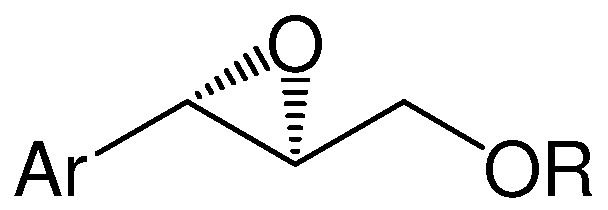
Advantageously, compounds of general formula II can be readily prepared from compounds of general formula III by a preparation process which comprises
(a) reacting compound of general formula III
FORMULA III
wherein R is a leaving group, with a fluoride source and (b) reacting the resulting product with a base.
The term "leaving group" as defined herein refers to
a substituent group present in the substrate that can be detached from the substrate through a displacement reaction. Some examples of suitable leaving groups are tosylate, mesylate, triflate and acetate. The term "fluoride source" as defined herein refers to a compound which has the ability to release fluoride.
Advantageously, the preparation process of compounds of general formula II according to the present invention is regioselective and stereospecific . Alternatively, in a further preferred embodiment of the present invention, an enantiomerically and diastereomerically pure compound of general formula IV is used as chiral derivatising reagent.

FORMULA IV
Advantageously, compounds of general formula IV can be readily prepared from compounds of general formula V by a preparation process which comprises
(a) reacting compound of general formula V

FORMULA V
wherein R is a leaving group, with a fluoride source and (b) reacting the resulting product with a base.
Some examples of suitable leaving groups are tosylate, mesylate, triflate and acetate.
Advantageously, the preparation process of compounds of general formula III according to the present invention is regioselective and stereospecific .
Alternatively in a further preferred embodiment of the present invention, an enantiomerically and diastereomerically pure compound of general formula VI is used as chiral derivatising reagent.
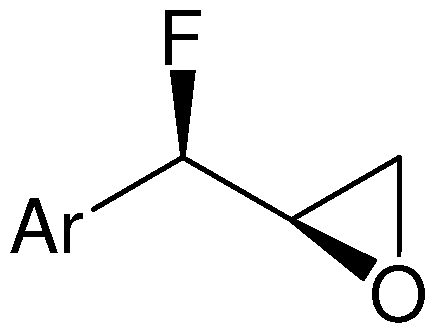
FORMULA VI
Advantageously, compounds of general formula VI can be readily prepared from compounds of general formula III by a preparation process which comprises (a) reacting compound of general formula III

FORMULA III
wherein R is a leaving group, with a fluoride source, yielding the corresponding (2R, 3R) -3-fluoro-2-hydroxy-3-arylpropyl derivative, (b) inverting the configuration of the hydroxyl bearing
chiral center by a suitable regioselective and stereospecific method. Such methods have been described in the background art and are widely known by skilled persons in the art. An example of suitable inversion method is the Mitsunobu reaction and subsequent selective hydrolysis or selective reduction (0. Mitsunobu, Synthesis, 1981, 1-28), and (c) reacting the resulting product with a base.
Some examples of suitable leaving groups are tosylate, mesylate, triflate and acetate.
Advantageously, the preparation process of compounds of general formula VI according to the present invention is regioselective and stereospecific .
Alternatively in a further preferred embodiment of the present invention, a compound of general formula VII is used as chiral derivatising reagent.

FORMULA VII
Advantageously, compounds of general formula VII can be readily prepared from compounds of general formula V by a preparation process which comprises
(a) reacting compound of general formula V

FORMULA V
wherein R is a leaving group, with a fluoride source, yielding the corresponding (2S, 3S) -3-fluoro-2-hydroxy-3-arylpropyl derivative, (b) inverting the configuration of the hydroxyl bearing chiral center by a suitable regioselective and stereoespecific method. Such methods have been described in the background art and are widely known by skilled persons in the art. An example of suitable inversion method is the Mitsunobu reaction and subsequent selective hydrolysis or selective reduction, and (c) reacting the resulting product with a base.
Some examples of suitable leaving groups are tosylate, mesylate, triflate and acetate. Advantageously, the preparation process of compounds of general formula VII according to the present invention is regioselective and stereospecific .
In summary, the readily available enantiopure fluoroepoxides of general formula I have shown to be most convenient chiral derivatising reagents for the fast and reliable determination of enantiomeric composition of a variety of chiral compounds .
Additional objects, advantages and features of the invention will become apparent to those skilled in the art upon examination of the description or may be learned by practice of the invention. The following examples and drawings are provided by way of illustration and are not intended to limit the scope of the invention. It is intended that the scope of the present invention be defined by the claims appended hereto.
Brief description of the drawings
Fig 1 is the HPLC analysis of the 34.7:65.3 diastereomeric
mixture 3a obtained from the enantiomeric mixture 34.7:65.3 of (R) -2a and (5) -2a through the method of the present invention.
5 Fig 2 is the HPLC analysis of compound (5) -3a obtained from enantiopure compound (5) -2a through the method of the present invention.
Fig 3 shows the 1H-NMR spectra of the CHF region of the
10 44:56 diastereomeric mixture 3a obtained from a enantiomeric mixture 44:56 of (.R) -2a and (5) -2a through the method of the present invention (above) , and the 1H-
NMR spectra of the CHF region of compound (5) -3a, obtained from enantiopure compound (5) -2a through the method of the
15 present invention (bottom) .
Fig 4 shows the 13C-NMR spectra of the CHF region of the 44:56 diastereomeric mixture 3a obtained from a enantiomeric mixture 44:56 of (.R) -2a and (5) -2a through 20 the method of the present invention (top) , and the 13C-NMR spectra of the CHF region of compound (S) -3a, obtained from enantiopure compound (5) -2a through the method of the present invention (bottom) .
25 Fig 5 shows the 19F-NMR spectra of the CHF region of the 65:35 diastereomeric mixture 3a obtained from a enantiomeric mixture 65:35 of (.R) -2a and (5) -2a through the method of the present invention (top) , and the 19F-NMR spectra of the CHF region of compound (5) -3a, obtained
30 from enantiopure compound (5) -2a through the method of the present invention (bottom) .
Fig 6 depicts the 19F-NMR spectra of a 85% (top) and 95%
(bottom) diastereomeric mixture of 3a obtained from 85 %
35 and 95% ee, respectively, of compound 2a, through the
method of the present invention.
Fig 7 is the 1H-NMR spectrum of the diastereomeric mixture 3d obtained from a racemic mixture of compound 2d through the method of the present invention.
Fig 8 is the 1H-NMR spectrum of compound (5) -3d obtained from enantiopure compound (S) -2d through the method of the present invention.
Fig 9 is the 13C-NMR spectrum of the diastereomeric mixture 3d obtained from a racemic mixture of compound 2d through the method of the present invention.
Fig 10 is the 13C-NMR spectrum of enantiopure compound (5) -3a obtained from a enantiomeric mixture 44:56 of (.R)- 2a and (5) -2a through the method of the present invention.
Fig 11 is the 19F spectrum of the diastereomeric mixture 3d obtained from a racemic mixture of compound 2d through the method of the present invention.
Fig 12 is the 19F spectrum of compound (5) -3d obtained from enantiopure compound (S) -2d through the method of the present invention.
Detailed description of particular examples
I) Preparation of enantiomerically and diastereomerically pure derivatisation reagent (S) -2- ( (R) -fluoro (phenyl) - methyl) oxirane 1

Compound 1
(2S1 3S) -phenylglycidil p-toluensulfonate (0,69 g,- 2.27 mmol) was solved in CH2Cl2 in a dried 50 ml round- bottomed flask, under inert atmosphere. After cooling the flask to -35°C, BF3-E2O was added (0.11 g,- 0.75 mmol) and the mixture was stirred at said temperature for one hour. Afterwards, 15 ml of a saturated solution of NaHCO3 were added and the mixture was extracted with CH2Cl2 (3X15 ml) . The organic fraction was dryed over anhydrous MgSO4, the solvent was removed under vacuum, and the oil was purified by liquid chromatography with a mixture hexane :AcOEt (9:1 to 8:2) as elutant.
The resulting (2S1 3R) -3-fluoro-2-hydroxy-3- phenylpropyl p-toluen- sulfonate (10.0 mmol, 3.24 g) was dissolved in 10 mL of anhydrous THF in a flame-dried flask, and treated with 10 mL of 1 M lithium tert-butoxide in THF. After 30 minutes, the reaction was quenched with 20 mL of water and extracted with CH2Cl2 (3x15 mL) . The organic extracts were dried (Na2SO4) , and solvents removed off in vacuo to afford 1 in quantitative yield.
1H NMR (CDCl3, 400 MHz) : δ 7.34-7.45: (5H, m, ArH) , 5.13 (IH, dd, 3JHH = 6,3 Hz, 2JHF = 47,2 Hz, CHF) , 3.35 (IH, m, CHO) , 2.89 (IH, ddd, 4JHF = 4.2Hz, 3JHH = 4.2Hz, 2JHH = 4.7Hz, CHHO) , 2.88 (IH, ddd, 4JHF = 1.6 Hz, JJHH = 2.6 Hz, J HH : 4.8 Hz, CHHO) ppm.
13C (1Hj NMR (CDCl3, 100 MHz) : δ 136, 04 (d, 2JCF = 21.2 Hz) , 129.07 (d, 4JCF = 2.2HZ) , 128.66, 126.00 (d, 3JCF = 6.6Hz), 94.62 (d, 1J0F = 175.7 Hz) , 53.62 (d, 2JCF = 27.9 Hz) , 44.18 (d, 3JCF = 8.1 Hz) ppm.
19F NMR (CDCl3, 470.5 MHz) : δ-180,96 (d, 2JFH = 46.8 Hz) ppm.
[α]27 D -20.9 (C = 1.01, CHCl3) .
MS (EI+) : m/z 152 (35%, M+), 109 (100%, C7H6F) .
II. Determination of the enantiomeric composition of different known samples of chiral compound 2a by using fluoroepoxide 1 as chiral derivatising reagent
Ua. Derivatisation reaction
The general procedure for the derivatisation of different samples of 2a was the following: 4.1 mg (0.0265 mmol) of fluoroepoxide 1, and 28.4 mg (0.265 mmol) of LiClO4 were weighted in the microwave reactor vessel, which was purged with argon, and dissolved in 1.5 mL of dry THF. Then, 490 μL of a 0.55 M solution (0.270 mmol) of amine in THF were added. The mixture was heated at 75 0C using microwaves for 20 minutes. After cooling down to r.t., water was added to the vessel, and the mixture was extracted with CH2Cl2 (x3) , dried (Na2SO4) , and the solvents removed in vacuo. The resulting crude was analyzed by 19F- NMR, 1H-NMR or 13C-NMR using CDCl3 as solvent, or alternatively, by HPLC. To ensure that no kinetic resolution happened during the performance of the derivatisation reaction according to the method of the present invention, the reaction crudes were analyzed at different conversion levels. In all cases, the ring-opening product was a perfect 1:1 mixture of diastereomers . In addition, the use of either
enantiopure or racemic amines led to the same yields of ring-opening products under identical conditions. Therefore, these results confirm that no kinetic resolution takes place during the performance of the method of the present invention.
lib. Applicability of the method for the determination of the enantiomeric composition of chiral compounds according to the present invention
The yield, the main NMR signals associated to the CHF group and the HPLC retention times for the diastereomers (R) -3a and (S) -3a, obtained by reaction of chiral compound (R) -2a and (S) -2a, respectively, with the chiral derivatising reagent 1, are summarized in table 1.
Table 1.

Figures 3 to 5 show the CHF region of the 1H, 13C and 19F NMR spectra of a mixture of diastereomers of 3b (in variable proportions) as compared to the corresponding spectra of the diastereomer (5) -3b.
It is clear from table 1 and figures 3 to 5 that substantially separated sets of signals are observed for the CHF moiety of each diastereomer in the 1H, 13C and 19F NMR spectra, making their integration easy and reliable. On the other hand, the HPLC retention times corresponding to each diastereomer also present good separation and allow their integration in an easy and reliable way (see Figure 1 and Figure 2) .
Therefore, the method of the present invention allows the substantially good separation of signals corresponding to each diastereomer by using different analytic techniques .
Uc. Sensibility and accuracy of the method for the determination of the enantiomeric composition of chiral compounds according to the present invention
Different samples of compound 2a with variable enantiomeric excesses were prepared by weighting. Table 2 shows the enantiomeric compositions determined through the method of the present invention for each known sample of compound 2a by using different analytic techniques.
Table 2
method 0% ee 86 . 6% ee 95 . 7% ee
HPLCa 0 85 . 0 95 . 7
19F-NMR 0 85 . 6 94 . 6
1H-NMR 0 - -
13C-NMR 0 - - a Zorbax-Sil column; eluent hexane : 2-propanol (0.1% Et2NH) 99:1, flow 1.0 ml/min.
These results show that enantiomeric compositions up to 95% have been efficiently determined with less than 2% error through the method of the present invention, by any of the analytic techniques employed. Therefore, the method for the determination of enantiomeric excesses according to the present invention shows high sensibility and accuracy.
III. Derivatisation and analysis of racemic mixtures of various chiral amines according to the method of the present invention
The general procedure used for the preparation of compounds 3b to 3h, except for 3f (see table 3) , was the following: 4.1 mg (0.0265 mmol) of fluoroepoxide 1, and 28.4 mg (0.265 mmol) of LiClO4 were weighed in the microwave reactor vessel, which was purged with argon, and dissolved in 1.5 mL of dry THF. Then, 490 μL of a 0.55 M solution (0.270 mmol) of amine in THF were added. The mixture was heated at 75 0C using microwaves for 20 minutes. After cooling down to r.t., water was added to the vessel, and the mixture was extracted with CH Cl (x3) ,
dried (Na2SO4) , and the solvents removed in vacuo. The resulting crude was analyzed by 19F-NMR, 1H-NMR or 13C-NMR using CDCl3 as solvent, or alternatively, by HPLC.
The yield, main NMR signals associated to the CHF group and HPLC retention times of the 50:50 diastereomer mixture obtained by reaction of racemic amines 2b to 2h with the enantiomerically and diastereomerically pure derivatising reagent 1 are summarized in Table 3. As an example of signal separation, the 1H, 13C and 19F spectra of 3d obtained from racemic 2d and from (S) -2a are shown in Figures 7 to 12 (together with an amplification of the CHF region) . Slight shift differences observed in the 1H-NMR spectrum of the racemic mixture as compared to the corresponding spectra of the enantiopure compound are due to the fact that the spectra were recorded at 500 Hz and 400 Hz, respectively.
Table 3
Chiral Product NMR analysis HPLC compound (yield δ [ppm] CHF analysis [%]a) tR [min]
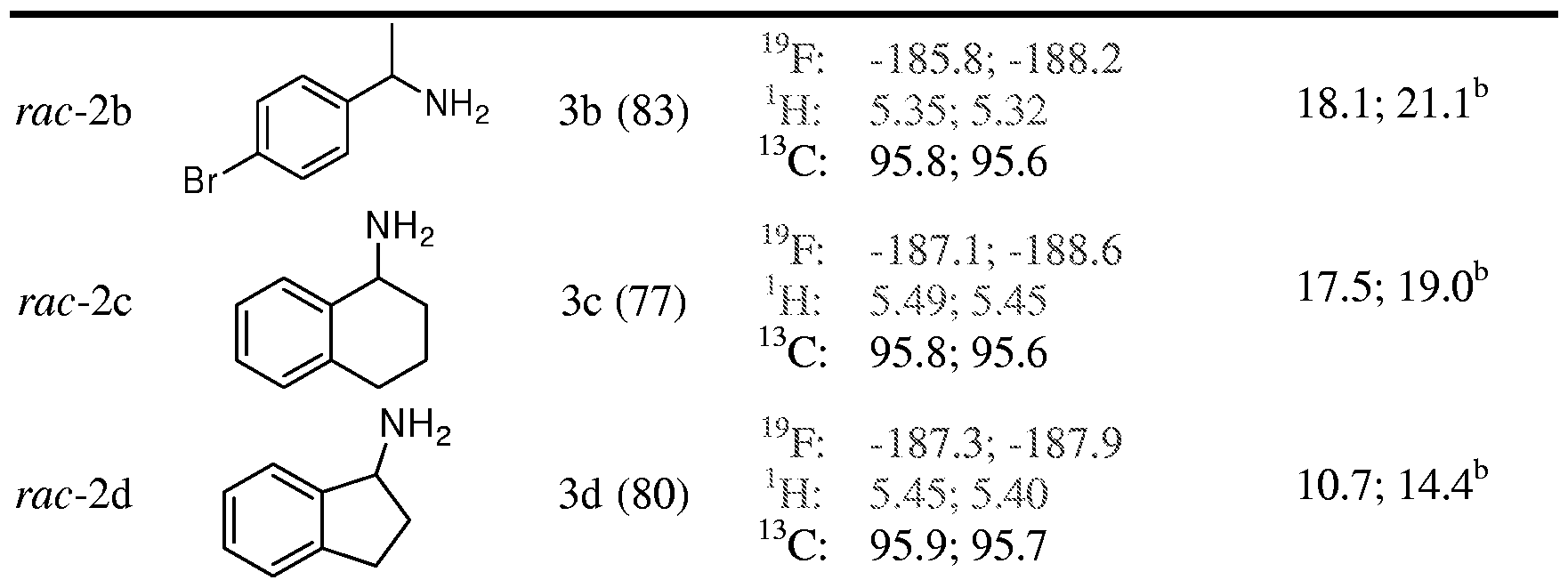

From a preparative point of view, the derivatisation reaction worked nicely for different primary amines. Even a more functionalyzed substrate like 2e, also containing an alcohol and ether functions could successfully be derivatised. Racemic ephedrine 2f could be used as substrate as well, showing that secondary amines with extra functional groups (alcohol) are able to react with fluoroepoxide 1. α- and β-amino acid derivatives (products 3g and 3h) were suitable substrates as well.
Substantially good signal separations are observed for the CHF moiety in the 1H, 13C and 19F-NMR spectra of each mixture of diastereomers . In the same manner, each mixture of diastereomers showed good separation of the
HPLC retention times. Although not specified, it must be pointed out that other NMR signals (different to the set of signals corresponding to the CHF moiety) were also suitable for the determination of the diastereomeric (enantiomeric) compositions.
The enantiomeric compositions of the different chiral compounds depicted in Table 3 were determined to be 50-50 (0% ee) according to the method of the present invention. These values corresponded exactly to the known enantiomeric compositions of said samples established by weighting.
As a conclusion, the enantiomeric composition of a wide variety of nitrogen containing compounds could be efficiently determined through the method of the present invention.
Claims
1. A method for the determination of the enantiomeric composition of a chiral compound comprising (a) derivatising said chiral compound with a enantiomerically and diastereomerically pure compound of general formula I

FORMULA I
wherein Ar is an optionally substituted aromatic or heteroaromatic group and (b) analysing the resulting mixture by an analytic technique .
2. A method according to claim 1, wherein said analytic technique is selected from the group consisting of 19F-
NMR, 1H-NMR, 13C-NMR and chromatography.
3. The method according to claim 1 or claim 2, wherein said compound of general formula I is selected from the group consisting of (S) -2- ((.R)- fluoro (phenyl) methyl) oxirane, (R) -2- ( (S) -fluoro (phenyl) methyl) oxirane, (S) -2- ( (S) -fluoro (phenyl) methyl) oxirane and (R) -2- ( (R) -fluoro (phenyl) methyl) oxirane .
4. The method according to any of claims 1 to 3, wherein said chiral compound is selected from the group consisting of chiral nitrogen-based nucleophiles, chiral oxygen-based nucleophiles and chiral sulphur-based nucleophiles .
5. The method according to claim 4, wherein said chiral compound is a chiral nitrogen-based nucleophile selected from the group consisting of chiral amines, chiral aminoalcohols, chiral aminoesters, chiral aminoacids or chiral azasugars .
6. The method according to claim 4 or 5, wherein said chiral compound is a primary nucleophile.
7. The method according to any of claims 4 to 6, wherein the chiral compound has at least one chiral center located at alpha position to the donor atom.
8. The method according to any of claims 1 to 1, wherein the reaction of said chiral compound with said compound of general formula I is performed in the presence of a promoter.
9. The method according to claim 8, wherein said promoter is a Lewis acid.
10. The method according to any of claims 1 to 9, wherein the reaction of said chiral compound with said compound of general formula I is performed under microwave irradiation.
11. Use of an enantiomerically and diastereomerically pure compound of general formula I as a chiral derivatising reagent .

FORMULA I
wherein Ar is an optionally substituted aromatic or heteroaromatic group.
Applications Claiming Priority (2)
| Application Number | Priority Date | Filing Date | Title |
|---|---|---|---|
| EP05107264A EP1750119A1 (en) | 2005-08-05 | 2005-08-05 | Novel chiral derivatizing reagent for the determination of enantiomeric excesses |
| EP05107264.3 | 2005-08-05 |
Publications (1)
| Publication Number | Publication Date |
|---|---|
| WO2007017424A1 true WO2007017424A1 (en) | 2007-02-15 |
Family
ID=35613697
Family Applications (1)
| Application Number | Title | Priority Date | Filing Date |
|---|---|---|---|
| PCT/EP2006/064936 Ceased WO2007017424A1 (en) | 2005-08-05 | 2006-08-02 | Novel chiral derivatizing reagent for the determination of enantiomeric excesses |
Country Status (2)
| Country | Link |
|---|---|
| EP (1) | EP1750119A1 (en) |
| WO (1) | WO2007017424A1 (en) |
Families Citing this family (2)
| Publication number | Priority date | Publication date | Assignee | Title |
|---|---|---|---|---|
| WO2017178988A1 (en) * | 2016-04-15 | 2017-10-19 | Dh Technologies Development Pte. Ltd. | Methods for detection of sample enantiomers using differential mobility spectrometry |
| EP4650764B1 (en) * | 2024-05-13 | 2026-04-29 | Voxalytic GmbH | Enantiomeric discrimination by nmr |
-
2005
- 2005-08-05 EP EP05107264A patent/EP1750119A1/en not_active Withdrawn
-
2006
- 2006-08-02 WO PCT/EP2006/064936 patent/WO2007017424A1/en not_active Ceased
Non-Patent Citations (1)
| Title |
|---|
| APPARU M ET AL: "Determination of the enantiomeric purity and the configuration of beta-aminoalcohols using (R)-2-fluorophenylacetic acid (AFPA) and fluorine-19 NMR: application to beta-blockers", TETRAHEDRON: ASYMMETRY, ELSEVIER SCIENCE PUBLISHERS, AMSTERDAM, NL, vol. 11, no. 14, 28 July 2000 (2000-07-28), pages 2885 - 2898, XP004214062, ISSN: 0957-4166 * |
Also Published As
| Publication number | Publication date |
|---|---|
| EP1750119A1 (en) | 2007-02-07 |
Similar Documents
| Publication | Publication Date | Title |
|---|---|---|
| Armstrong et al. | Synthesis, rapid resolution, and determination of absolute configuration of racemic 2, 2'-binaphthyldiyl crown ethers and analogs via. beta.-cyclodextrin complexation | |
| KR101709124B1 (en) | Novel chiral metal complexes and chiral analysis of charged molecules by spectroscopy using the same | |
| Zhang et al. | NMR analysis of the enantiomeric purity of chiral diols by a new chiral boron agent | |
| US6358996B1 (en) | Stable isotope labeling of paclitaxel | |
| Capozzi et al. | Stereoselection in the Betti reaction of valine methyl esters | |
| Vasiljeva et al. | Synthesis, properties, and identification of epimeric hepoxilins (−)-(10R)-B3 and (+)-(10S)-B3 | |
| EP1750119A1 (en) | Novel chiral derivatizing reagent for the determination of enantiomeric excesses | |
| Cavalluzzi et al. | One-step synthesis of homochiral O-aryl and O-heteroaryl mandelic acids and their use as efficient 1H NMR chiral solvating agents | |
| WO2011003193A1 (en) | Compounds and methods for detection and quantification of carboxylic acids | |
| Klute et al. | Chiral Organometallic Reagents, XX. An Enantiomerically Enriched (α‐Phenylselenoalkyl) magnesium Compound | |
| Carroll et al. | Stereospecific anti SE 2′ fluorination of allenylsilanes: synthesis of enantioenriched propargylic fluorides | |
| CN118772426B (en) | Preparation and application of a chiral MOF-based fluorescent probe | |
| Queiroz et al. | Determination of the absolute configuration of 6‐alkylated α‐pyrones from Ravensara crassifolia by LC‐NMR | |
| Capon et al. | (+)-Echinobetaine B: isolation, structure elucidation, synthesis and preliminary SAR studies on a new nematocidal betaine from a southern Australian marine sponge, Echinodictyum sp. | |
| Ouchi et al. | Silver and thallium (I) complexation with dibenzo-16-crown-4 | |
| CN109232658B (en) | Chiral rhodium complex and preparation and application thereof | |
| Lundt et al. | Regioselective opening of epoxyaldonolactones to fluorodeoxyaldonolactones using Tetrabutylammonium dihydrogentrifluoride | |
| EP3636625A1 (en) | Method for producing optically active isomer, optically active isomer, method for producing chiral molecules, and chiral molecules | |
| Mlostoń et al. | Stereoselective 1, 3-dipolar cycloadditions of thioketones to carbohydrate-derived nitrones | |
| Franke et al. | Chloro‐bis‐propyl Ethers in the Elbe River–Isomeric Distribution and Enantioselective Degradation | |
| JP7376890B2 (en) | How to measure enantiomeric excess | |
| Zhao et al. | Enantioselective epoxidation of non-functionalized alkenes using carbohydrate based salen–Mn (III) complexes | |
| Tayama et al. | Chiral tetraalkynylborate as a chiral solvating agent for N-chiral tetraalkylammonium salts | |
| Husain et al. | N-succinimidyl methoxyphenylacetic acid ester, an amine-directed chiral derivatizing reagent suitable for enzymatic scale resolutions | |
| CN108956823A (en) | Chiral sulfhydryl compound splits novel mass spectrum derivatization reagent |
Legal Events
| Date | Code | Title | Description |
|---|---|---|---|
| 121 | Ep: the epo has been informed by wipo that ep was designated in this application | ||
| NENP | Non-entry into the national phase |
Ref country code: DE |
|
| 122 | Ep: pct application non-entry in european phase |
Ref document number: 06792638 Country of ref document: EP Kind code of ref document: A1 |