WO2007017125A1 - Cb1 antagonists or inverse antagonists as therapeutical agents for the treatment of inflammation involving gene expression - Google Patents
Cb1 antagonists or inverse antagonists as therapeutical agents for the treatment of inflammation involving gene expression Download PDFInfo
- Publication number
- WO2007017125A1 WO2007017125A1 PCT/EP2006/007417 EP2006007417W WO2007017125A1 WO 2007017125 A1 WO2007017125 A1 WO 2007017125A1 EP 2006007417 W EP2006007417 W EP 2006007417W WO 2007017125 A1 WO2007017125 A1 WO 2007017125A1
- Authority
- WO
- WIPO (PCT)
- Prior art keywords
- group
- optionally
- substituted
- mono
- alkyl
- Prior art date
- Legal status (The legal status is an assumption and is not a legal conclusion. Google has not performed a legal analysis and makes no representation as to the accuracy of the status listed.)
- Ceased
Links
- 0 *C(*c(c(*)c1-c2c(*)c(N)c(*)c(*)c2*)n[n]1-c1c(*)c(*)c(*)c(*)c1*)=O Chemical compound *C(*c(c(*)c1-c2c(*)c(N)c(*)c(*)c2*)n[n]1-c1c(*)c(*)c(*)c(*)c1*)=O 0.000 description 3
- AVPYQKSLYISFPO-UHFFFAOYSA-N O=Cc(cc1)ccc1Cl Chemical compound O=Cc(cc1)ccc1Cl AVPYQKSLYISFPO-UHFFFAOYSA-N 0.000 description 1
- RVSPZCGKZYTJOA-UTCJRWHESA-N OC(C(/C=C\c(cc1)ccc1Cl)=O)=O Chemical compound OC(C(/C=C\c(cc1)ccc1Cl)=O)=O RVSPZCGKZYTJOA-UTCJRWHESA-N 0.000 description 1
Classifications
-
- A—HUMAN NECESSITIES
- A61—MEDICAL OR VETERINARY SCIENCE; HYGIENE
- A61K—PREPARATIONS FOR MEDICAL, DENTAL OR TOILETRY PURPOSES
- A61K31/00—Medicinal preparations containing organic active ingredients
- A61K31/33—Heterocyclic compounds
- A61K31/395—Heterocyclic compounds having nitrogen as a ring hetero atom, e.g. guanethidine or rifamycins
- A61K31/41—Heterocyclic compounds having nitrogen as a ring hetero atom, e.g. guanethidine or rifamycins having five-membered rings with two or more ring hetero atoms, at least one of which being nitrogen, e.g. tetrazole
- A61K31/415—1,2-Diazoles
-
- A—HUMAN NECESSITIES
- A61—MEDICAL OR VETERINARY SCIENCE; HYGIENE
- A61K—PREPARATIONS FOR MEDICAL, DENTAL OR TOILETRY PURPOSES
- A61K31/00—Medicinal preparations containing organic active ingredients
- A61K31/33—Heterocyclic compounds
- A61K31/395—Heterocyclic compounds having nitrogen as a ring hetero atom, e.g. guanethidine or rifamycins
- A61K31/435—Heterocyclic compounds having nitrogen as a ring hetero atom, e.g. guanethidine or rifamycins having six-membered rings with one nitrogen as the only ring hetero atom
- A61K31/4353—Heterocyclic compounds having nitrogen as a ring hetero atom, e.g. guanethidine or rifamycins having six-membered rings with one nitrogen as the only ring hetero atom ortho- or peri-condensed with heterocyclic ring systems
- A61K31/437—Heterocyclic compounds having nitrogen as a ring hetero atom, e.g. guanethidine or rifamycins having six-membered rings with one nitrogen as the only ring hetero atom ortho- or peri-condensed with heterocyclic ring systems the heterocyclic ring system containing a five-membered ring having nitrogen as a ring hetero atom, e.g. indolizine, beta-carboline
-
- A—HUMAN NECESSITIES
- A61—MEDICAL OR VETERINARY SCIENCE; HYGIENE
- A61P—SPECIFIC THERAPEUTIC ACTIVITY OF CHEMICAL COMPOUNDS OR MEDICINAL PREPARATIONS
- A61P19/00—Drugs for skeletal disorders
- A61P19/08—Drugs for skeletal disorders for bone diseases, e.g. rachitism, Paget's disease
- A61P19/10—Drugs for skeletal disorders for bone diseases, e.g. rachitism, Paget's disease for osteoporosis
-
- A—HUMAN NECESSITIES
- A61—MEDICAL OR VETERINARY SCIENCE; HYGIENE
- A61P—SPECIFIC THERAPEUTIC ACTIVITY OF CHEMICAL COMPOUNDS OR MEDICINAL PREPARATIONS
- A61P29/00—Non-central analgesic, antipyretic or antiinflammatory agents, e.g. antirheumatic agents; Non-steroidal antiinflammatory drugs [NSAID]
-
- A—HUMAN NECESSITIES
- A61—MEDICAL OR VETERINARY SCIENCE; HYGIENE
- A61P—SPECIFIC THERAPEUTIC ACTIVITY OF CHEMICAL COMPOUNDS OR MEDICINAL PREPARATIONS
- A61P9/00—Drugs for disorders of the cardiovascular system
- A61P9/10—Drugs for disorders of the cardiovascular system for treating ischaemic or atherosclerotic diseases, e.g. antianginal drugs, coronary vasodilators, drugs for myocardial infarction, retinopathy, cerebrovascula insufficiency, renal arteriosclerosis
Definitions
- the present invention relates to CB1 Antagonists or Inverse Agonists as therapeutical agents for the treatment of inflammation involving gene expression.
- Inflammation is a serious healthproblem and can - especially in inflammatory heart diseases - become possibly very threatening. Therefore there is a constant need for treatment of this disease states.
- an aspect of the current invention is the use of a CB 1 antagonist or inverse agonist for the production of a medicament for the treatment and/or prophylaxis of an inflammation that involves expression of genes involved in inflammation and/or in the immune response.
- Possible candidates for the expressed genes include cytokines (IL-2, IL-6 and TNF ⁇ ), COX-2 and iNOS.
- Another closely related aspect of the current invention is also the use of CB1 antagonists or inverse agonists for the manufacture of a medicament for the treatment and/or prophylaxis of an inflammation based on an immunologic effect.
- Canabinoid Receptor Inverse Agonists and Antagonists are able to inhibit transcription of genes involved in the inflammatory process and in the immune response and thus act as anti-inflammatory agents.
- Another aspect of the invention is also the use of CB1 antagonists or inverse agonists for the manufacture of a medicament for the treatment and/or prophylaxis of immunologic disorders that involve expression of genes involved in inflammation and/or in the immune response.
- another aspect of the invention is also the use of a CB1 antagonist or inverse agonist for the production of a medicament for the manufacture of a medicament for the treatment and/or prophylaxis of inflammatory heart diseases, especially those that involve expression of genes involved in inflammation and/or in the immune response.
- inflammatory heart diseases are angina pectoris and artherio sclerosis, whereas for the latter the invention preferably refers to the prophylaxis of artherio sclerosis.
- Another preferred aspect of the invention is also a method of treatment encompassing all the abovementioned uses, wherein the CB1 antagonist or inverse agonist is applied to a person in need thereof, to treat- using its immunomodulary or anti-inflammatory aspects - inflammation or immunologic disorders.
- the use of the canabinoid receptor agonist or inverse agonist, especially according to general formula I, in the production of a medicament for the treatment of sclerotic plaque is disclaimed.
- Cannabinoids are compounds, which are derived from the cannabis sativa plant which is commonly known as marijuana.
- the most active chemical compound of the naturally occurring cannabinoids is tetrahydrocannabinol (THC), particularly ⁇ 9 -THC.
- cannabinoids as well as their synthetic analogues promote their physiological effects via binding to specific G-coupled receptors, the so-called cannabinoid-receptors.
- CBi and CB2 are involved in a variety of physiological or pathophysiological processes in humans and animals, e.g. processes related to the central nervous system, immune system, cardiovascular system, endocrinous system, respiratory system, the gastrointestinal tract or to reproduction, as described for example, in Hollister, Pharm. Rev. 38, 1986, 1-20; Reny and Singha, Prog. Drug. Res., 36, 71-114, 1991; Consroe and Sandyk, in Marijuana/Cannabinoids, Neurobiology and Neurophysiology, 459, Murphy L. and Barthe A.
- CB1 antagonist or inverse agonists in the sense of this invention is defined as a compound which binds to the CB1 receptor and has the functionality of an antagonist or inverse agonist.
- a CB 1 inverse agonist both blocks the action of an agonist and attenuates receptor constitutive activity.
- a CB1 antagonist blocks the action of the agonist but is ineffective on the receptor-constitutive activity.
- Canabinoid receptor ligands may be functionally characterized, for example, according to:
- An inverse agonist will stimulate (1)adenylyl cyclase activity and (2) will inhibit [ 35 S]-g- GTP binding.
- An antagonist will (1) block the inhibition of adenylyl cyclase activity by CB1 agonists and (2) block the stimulation of [ 35 S]-g-GTP binding by a CB 1 agonist.
- the CB1 antagonist does not effect the cAMP production, but blocks the inhibition of cyclic AMP production by a canabinoid receptor agonist with a a Kb value of 10 ⁇ M or less (e.g. 1 ⁇ M, 500 nM, 200 nM, 100 nM, 50 nM, 20 nM 10 nM, 5nM).
- the CB 1 antagonist does not effect the [ 35 S]-g-GTP binding, but blocks the stimulation of [ 35 S ⁇ g-GTP binding by a canabinoid receptor agonist with a a Kb value of 10 ⁇ M or less (e.g. 1 ⁇ M, 500 nM, 200 nM, 100 nM, 50 nM, 20 nM 10 nM, 5nM). In one embodiment both of the above appliy.
- the CB1 inverse agonist stimulates cAMP production with an EC50 value of 10 mM or less (e.g. 1 ⁇ M, 500 nM, 200 nM, 100 nM, 50 nM, 20 nM, 10 nM, 5nM). In one embodiment the CB1 inverse agonist inhibits the [ 35 S]-g-GTP binding, with an IC50 value of 10 ⁇ M or less (e.g. 1 ⁇ M, 500 nM, 200 nM, 100 nM, 50 nM, 20 nM 10 nM, 5nM). In one embodiment both of the above appliy.
- ANNEX 1 Lange and Kruse, "Recent advances in CB1 cannabinoid receptor antagonists", Current Opinion in Drug Discovery & Development, 2004, 7(4): 498-506
- ANNEX 2
- the CB1 Antagonist or Inverse Agonist used according to the invention is selected from a compound of general formula I
- R 1 represents an optionally at least mono-substituted phenyl group
- R 2 represents an optionally at least mono-substituted phenyl group
- R 3 represents a saturated or unsaturated, optionally at least mono-substituted, optionally at least one heteroatom as ring member containing cycloaliphatic group, which may be condensed with an optionally at least mono-substituted mono- or polycyclic ring system
- R 3 represents an optionally at least mono-substituted aryl or heteroaryl group, which may be condensed with an optionally at least mono- substituted mono- or polycyclic ring system
- R 3 represents an -NR 4 R 5 -moiety
- R 4 and R 5 identical or different, represent a hydrogen atom, an unbranched or branched, saturated or unsaturated, optionally at least mono-substituted aliphatic radical, a saturated or unsaturated, optionally at least mono-substituted, optionally at least one heteroatom as ring member containing cycloaliphatic group, which may be condensed with an optionally at least mono-substituted mono- or polycyclic ring system, or an optionally at least mono-substituted aryl or heteroaryl group, which may be condensed with an optionally at least mono-substituted mono- or polycyclic ring system and/or bonded via a linear or branched alkylene group, an -SO2-R 6 - moiety, or an -NR 7 R 8 -moiety,
- R 6 represents a linear or branched, saturated or unsaturated, optionally at least mono-substituted aliphatic group, a saturated or unsaturated, optionally at least mono-substituted, optionally at least one heteroatom as ring member containing cycloaliphatic group, which may be condensed with a mono- or polycyclic ring- system, or an optionally at least mono-substituted aryl or heteroaryl group, which may be condensed with a mono- or polycyclic ring system and/or bonded via a linear or branched alkylene group,
- R 7 and R 8 identical or different, represent a hydrogen atom, an unbranched or branched, saturated or unsaturated, optionally at least mono-substituted aliphatic radical, a saturated or unsaturated, optionally at least mono-substituted, optionally at least one heteroatom as ring member containing cycloaliphatic group, which may be condensed with an optionally at least mono-substituted mono- or polycyclic ring system, or an optionally at least mono-substituted aryl or heteroaryl group, which may be condensed with an optionally at least mono-substituted mono- or polycyclic ring system and/or bonded via a linear or branched alkylene group, optionally in form of one of the stereoisomers, preferably enantiomers or diastereomers, a racemate or in form of a mixture of at least two of the stereoisomers, preferably enantiomers and/or diastereomers, in any
- these substituted pyrazoline compounds of general formula I given below have a high affinity for cannabinoid receptors, particularly for the CBi- receptor, and that they act as modulators e.g. antagonists and inverse agonists on these receptors. They are therefore suitable for the prophylaxis and/or treatment of inflammation in humans and/or animals, preferably humans including infants, children and grown-ups. Especially they have also shown to be active in forms of inflammation that involves expression of genes involved in inflammation and/or in the immune response. They have also shown in an inflammatory situation to inhibit secretion of Cytokines like TNF ⁇ and IL-2.
- these pyrazoline compounds show relatively weak Herg channel affinity, thus a low risk of prolongation of the QT-interval is to be expected for these compounds.
- inventively used pyrazoline compounds are distinguished by a broad spectrum of beneficial effects, while at the same time showing relatively little undesired effects, i.e. effects which do not positively contribute to or even interfere with the well being of the patient.
- R 4 and R 5 do not both represent a hydrogen atom
- residues R 4 and R 5 represents a hydrogen atom or an alkyl group, which is optionally at least mono-substituted with an alkoxy group, an alkoxyalkoxy group, a halogen atom or a phenyl group, the other one of these residues R 4 and R 5 does not represent a pyrid-2-yl group, which is optionally mono-substituted in the 5- position, a pyrid-5-yl group, which is optionally mono-substituted in the 2-position, a pyrimid-5-yl group, which is optionally mono-substituted in the 2-position, a pyridaz-3- yl group, which is optionally mono-substituted in the 6-position, a pyrazin-5-yl group, which is optionally mono-substituted in the 2-position, a thien-2-yl group, which is optionally mono-substituted in the 5 position
- residues R 4 and R 5 represents a hydrogen atom or a linear or branched, saturated or unsaturated, unsubstituted or substituted aliphatic radical, the other one of these residues R 4 and R 5 does not represent an unsubstituted or substituted thiazole group or an unsubstituted or substituted [1,3,4]thiadiazole group.
- a mono- or polycyclic ring-system means a mono- or polycyclic hydrocarbon ring-system that may be saturated, unsaturated or aromatic. If the ring system is polycyclic, each of its different rings may show a different degree of saturation, i.e. it may be saturated, unsaturated or aromatic. Optionally each of the rings of the mono- or polycyclic ring system may contain one or more, e.g. 1, 2 or 3, heteroatoms as ring members, which may be identical or different and which can preferably be selected from the group consisting of N, O, S and P, more preferably be selected from the group consisting of N, O and S. Preferably the polycyclic ring-system may comprise two rings that are condensed.
- the rings of the mono- or polycyclic ring-sytem are preferably 5- or 6-membered.
- “Inflammation that involves expression of genes involved in inflammation and/or in the immune response” is defined as an inflammatory process in which the transcriptional activity in regards to one or more genes is modified in the inflammation process. This especially includes the activation of transcription activity through the mediation of biomolecules like NFAT or NF-kB. Possible candidates for the expressed genes include cytokines (IL-2, IL-6 and TNF ⁇ ), COX-2 and iNOS.
- condensed means that a ring or ring- system is attached to another ring or ring-system, whereby the terms “annulated” or “annelated” are also used by those skilled in the art to designate this kind of attachment.
- each of the substituents may be independently selected from the group consisting of hydroxy, fluorine, chlorine, bromine, branched or unbranched d- ⁇ -alkoxy, branched or unbranched Ci- ⁇ -alkyI, branched or unbranched C-M-perfluoroalkoxy, branched or unbranched C1-4- perfluoroalkyl, oxo, amino, carboxy, amido, cyano, nitro, -SO 2 NH 2 , -CO-d-4-alkyl, - SO-Ci-4-alkyl, -SO 2 -Ci-4-alkyl, -NH-SO ⁇ -CWalkyl , wherein the may in each
- residues R 3 -R 8 represents or comprises a cycloaliphatic group, which contains one or more heteroatoms as ring members, unless defined otherwise, each of these heteroatoms may preferably be selected from the group consisting of of N, O and S.
- a cycloaliphatic group may contain 1, 2 or 3 heteratoms independently selected from the group consisting of N, O and S as ring members.
- Suitable saturated or unsaturated, optionally at least one heteroatom as ring member containing, optionally at least mono-substituted cycloaliphatic groups may preferably be selected from the group consisting of Cyclopropyl, Cyclobutyl, Cyclopentyl, Cyclohexyl, Cycloheptyl, Cyclooctyl, Cyclopentenyl, Cyclohexenyl, Cycloheptenyl, Cyclooctenyl, Pyrrolidinyl, Piperidinyl, Piperazinyl, homo-Piperazinyl and Mo ⁇ holinyl.
- each of the substituents may be independently selected from the group consisting of hydroxy, fluorine, chlorine, bromine, branched or unbranched Ci- ⁇ - alkoxy, branched or unbranched branched or unbranched Ci -4 - perfluoroalkoxy, branched or unbranched amino, carboxy, oxo, amido, cyano, nitro, -SO 2 NH 2 , -CO-CWalkyl, -SO-Ci -4-alkyl, -SOrCi-4-alkyl, -NH- SO 2 -Ci -4-alkyl , wherein the Ci .
- 4 -alkyl may in each case be branched or unbranched, and a phenyl group, more preferably be selected from the group consisting of hydroxy, F, Cl 1 Br, methyl, ethyl, methoxy, ethoxy, CF 3 , oxo and a phenyl group.
- residues R 1 -R 8 represents or comprises an aryl group, including a phenyl group, which is substituted by one or more, e.g. 1, 2, 3, 4 or 5 substituents, unless defined otherwise, each of the substituents may be independently selected from the group consisting of a halogen atom (e.g.
- a linear or branched d- ⁇ -alkyl group a linear or branched Ci -6 alcoxy group, a formyl group, a hydroxy group, a trifluorom ethyl group, a trifluoromethoxy group, a -CO-Ci-6-alkyl group, a cyano group, a nitro group, a carboxy group, a -CO-O-Ci- ⁇ -alkyl group, a -CO- NR A R B - moiety, a -CO-NH-NR c R D -moiety, an -SH, an group, an -SO-Ci- 6-alkyl group, an -SO 2 -Ci - ⁇ -alkyl group, a -Ci-6-alkylene-S-Ci-6-alkyl group, a -Ci -6 - alkylene-SO-Ci- 6 -alkyl group, a
- R A , R B identical or different, represent hydrogen or a Ci- ⁇ -alkyI group, or R A and R B together with the bridging nitrogen atom form a saturated, mono- or bicyclic, 3-10 membered heterocyclic ring system, which may be at least mono-substituted by one or more, identical or different, C1- 6 alkyl groups and/or which may contain at least one further heteroatom selected from the group consisting of nitrogep, oxygen and sulphur as a ring member,
- R c , R D identical or different, represent a hydrogen atom, ⁇ Ci-6-alkyl group, a
- -CO-O-Ci- 6 -alkyl group a C 3 - ⁇ -cycloalkyl group, a group, d- ⁇ -alkylene-O-d- ⁇ -alkyl group or a CWalkyl group substituted with one or more hydroxy groups, or R c , R D together with the bridging nitrogen atom form a saturated, mono- or bicyclic, 3-10 membered heterocyclic ring system, which may be at least mono-substituted by one or more substituents independently selected from the group consisting of Ci ⁇ alkyl group, a -CO-Ci - ⁇ -alkyl group, a -CO-O- Ci- ⁇ -alkyI group, a - CO-NH- Ci- 6 -alkyl group, a -CS-NH- Ci-6-alkyl group, an oxo group, a d- ⁇ -alkyl group substituted with one or more hydroxy groups, a Ci-6-alkylene-O-
- R E , R F identical or different, represent hydrogen or a Ci- ⁇ -alkyI group, or R E and R F together with the bridging nitrogen atom form a saturated, mono- or bicyclic, 3-10 membered heterocyclic ring system, which may be at least mono-substituted by one or more, identical or different alkyl groups and/or which may contain at least one further heteroatom selected from the group consisting of nitrogen, oxygen and sulphur as a ring member.
- Preferred aryl groups which may optionally be at least mono-substituted, are phenyl and naphthyl.
- each of the substituents may be independently selected from the group consisting of a halogen atom (e.g.
- a linear or branched group a linear or branched C1-6 alcoxy group, a formyl group, a hydroxy group, a trifluorom ethyl group, a trifluoromethoxy group, a -CO-d- ⁇ -alkyl group, a cyano group, a carboxy group, a -CO-O-Ci- ⁇ -alkyl group, a -CO-NR A R B - moiety, a -CO-NH- NR c R D -moiety, an -S-d- ⁇ -alkyl group, an -SO-C ⁇ -alkyl group, an -SO 2 -Ci - ⁇ -alkyl group, a -Ci- ⁇ -alkylene-S-Ci- ⁇ -alkyI group, a -Ci- ⁇ -alkylene-SO-Ci- ⁇ -alkyI group, a -Ci- 6 -alky
- R A , R B identical or different, represent hydrogen or a group, or R A and R B together with the bridging nitrogen atom form a saturated, mono- or bicyclic, 3-10 membered heterocyclic ring system, which may be at least mono-substituted by one or more, identical or different, Ci -6 alkyl groups and/or which may contain at least one further heteroatom selected from the group consisting of nitrogen, oxygen and sulphur as a ring member,
- R c , R D identical or different, represent a hydrogen atom, a Ci- 6 -alkyl group, a -CO-O-Ci - ⁇ -alkyl group, a C 3- ⁇ -cycloalkyl group, a Ci- 6 -alkylene-C 3 - 8 -cycloalkyl group, Ci- ⁇ -alkylene-O-Ci- ⁇ -alkyl group or a Ci-6-alkyl group substituted with one or more hydroxy groups, or R c , R D together with the bridging nitrogen atom form a saturated, mono- or bicyclic, 3-10 membered heterocyclic ring system, which may be at least mono-substituted by one or more substituents independently selected from the group consisting of C 1 - 6 alkyl group, a group, a -CO-O- group, a - CO-NH- Ci.
- R E , R F identical or different, represent hydrogen or a d- ⁇ -alkyl group, or R E and R F together with the bridging nitrogen atom form a saturated, mono- or bicyclic, 3-10 membered heterocyclic ring system, which may be at least mono-substituted by one or more, identical or different d- ⁇ alkyl groups and/or which may contain at least one further heteroatom selected from the group consisting of nitrogen, oxygen and sulphur as a ring member,
- heteroatoms which are present as ring members in the heteroaryl radical, may, unless defined otherwise, independently be selected from the group consisting of nitrogen, oxygen and sulphur.
- a heteroaryl radical may comprise 1, 2 or 3 heteroatoms independently selected from the group consisting of N, O and S as ring members.
- Suitable heteroaryl groups may preferably be selected from the group consisting of thienyl, furyl, pyrrolyl, pyridinyl, imidazolyl, pyrimidinyl, pyrazinyl, indolyl, chinolinyl, isochinolinyl, benzo[1,2,5]- thiodiazolyl, benzo[b]thiophenyl, benzo[b]furanyl, imidazo[2,1-b]thiazolyl, triazolyl, and pyrazolyl, more preferably be selected from the group consisting of thienyl-, benzo[1,2,5]-thiodiazolyl, benzo[b]thiophenyl, imidazo[2,1-b]thiazolyl, triazolyl and pyrazolyl.
- each of the substituents may be independently selected from the group consisting of hydroxy, fluorine, chlorine, bromine, branched or unbranched Ci-4-alkoxy, branched or unbranched Ci-4-perfluoroalkoxy, branched or unbranched amino, carboxy, amido, cyano, nitro, -SO 2 NH 2 , -CO-Ci -4-alkyl, -SO-d-4-alkyl, -SO 2 -Ci -4-alkyl, , wherein the d-4-alkyl may in each case be branched or unbranched, and a phenyl group, more preferably be selected from the group consisting of hydroxy, F, Cl, Br
- Preferred linear or branched, saturated or unsaturated aliphatic groups which may be substituted by one or more substituents, may preferably be selected from the group consisting of methyl, ethyl, n-propyl, isopropyl, n-butyl, iso-butyl, sec-butyl, tert- butyl, n-pentyl, n-hexyl, n-heptyl, n-octyl, n-nonyl, n-decyl, vinyl, ethinyl, propenyl, propinyl, butenyl and butinyl.
- any of the residues R 4 -R 8 represents or comprises a linear or branched alkylene group
- said alkylene group may preferably be selected from the group consisting of - methylene -(CH 2 )-, ethylene -(CH 2 -CH 2 )", n-propylene -(CH 2 -CH 2 -CH 2 )- or iso- propylene -(-C(CHa) 2 )-.
- the CB1 Antagonist or Inverse Agonist used according to the invention is selected from a compound of general formula I given above, wherein
- R 1 represents an optionally at least mono-substituted phenyl group
- R 2 represents an optionally at least mono-substituted phenyl group
- R 3 represents a saturated or unsaturated, optionally at least mono-substituted, optionally at least one heteroatom as ring member containing cycloaliphatic group, which may be condensed with an optionally at least mono-substituted mono- or polycyclic ring system, or R 3 represents an optionally at least mono-substituted aryl or heteroaryl group, which may be condensed with an optionally at least mono- substituted mono- or polycyclic ring system, or R 3 represents an -NR 4 R 5 -moiety,
- R 4 and R 5 identical or different, represent a hydrogen atom, an unbranched or branched, saturated or unsaturated, optionally at least mono-substituted aliphatic radical, a saturated or unsaturated, optionally at least mono-substituted, optionally at least one heteroatom as ring member containing cycloaliphatic group, which may be condensed with an optionally at least mono-substituted mono- or polycyclic ring system, or an optionally at least mono-substituted aryl or heteroaryl group, which may be condensed with an optionally at least mono-substituted mono- or polycyclic ring system and/or bonded via a linear or branched alkylene group, an -SO 2 -R 6 - moiety, or an -NR 7 R 8 -moiety,
- R 6 represents a linear or branched, saturated or unsaturated, optionally at least mono-substituted aliphatic group, a saturated or unsaturated, optionally at least mono-substituted, optionally at least one heteroatom as ring member containing cycloaliphatic group, which may be condensed with a mono- or polycyclic ring- system, or an optionally at least mono-substituted aryl or heteroaryl group, which may be condensed with a mono- or polycyclic ring system and/or bonded via a linear or branched alkylene group
- R 7 and R 8 identical or different, represent a hydrogen atom, an unbranched or branched, saturated or unsaturated, optionally at least mono-substituted aliphatic radical, a saturated or unsaturated, optionally at least mono-substituted, optionally at least one heteroatom as ring member containing cycloaliphatic group, which may be condensed with an optionally at
- stereoisomers optionally in form of one of the stereoisomers, preferably enantiomers or diastereomers, a racemate or in form of a mixture of at least two of the stereoisomers, preferably enantiomers and/or diastereomers, in any mixing ratio, or a corresponding N-oxide thereof, or a corresponding salt thereof, or a corresponding solvate thereof,
- R 4 and R 5 do not both represent a hydrogen atom, and that if one of the residues R 4 and R 5 represents a hydrogen atom or a linear or branched, saturated or unsaturated, substituted or unsubstituted aliphatic group, the other one of these residues R 4 and R 5 does not represent a substituted or unsubstituted pyridyl group, a substituted or unsubstituted pyrimidyl group, a substituted or unsubstituted pyridazyl group, a substituted or unsubstituted pyrazinyl group, a substituted or unsubstituted thienyl group, a substituted or unsubstituted benzyl group, a substituted or unsubstituted phenethyl group, a substituted or unsubstituted phenyl group, a substituted or unsubstituted phenyl group, which is condensed (attached
- R 1 represents a phenyl group, which is optionally substituted by one or more substituents independently selected from the group consisting of a linear or branched Ci- 6 -alkyl group, a linear or branched Ci- ⁇ -alkoxy group, a halogen atom, CH 2 F, CHF 2 , CF 3 .
- R 1 represents a phenyl group, which is optionally substituted by one or more substituents selected from the group consisting of methyl, ethyl, F, Cl 1 Br and CF3, more preferably R 1 represents a phenyl group, which is substituted with a chlorine atom in the 4-position
- R 2 -R 8 have the meaning given above, optionally in form of one of the stereoisomers, preferably enantiomers or diastereomers, a racemate or in form of a mixture of at least two of the stereoisomers, preferably
- R 3 represents a saturated or unsaturated, optionally at least mono-substituted, optionally at least one heteroatom as ring member containing C 3 - ⁇ cycloaliphatic group, which may be condensed with an optionally at least mono-substituted mono- or polycyclic ring system, or R 3 represents an optionally at least mono-substituted, 5- or 6-membered aryl or heteroaryl group, which may be condensed with an optionally at least mono-substituted mono- or polycyclic ring system, or R 3 represents an -NR 4 R 5 -moiety, preferably R 3 represents a saturated, optionally at least mono-substituted, optionally one or more nitrogen- atoms as ring member containing C 3 ⁇ cycloaliphatic group, which may be condensed with an optionally at least mono-substituted mono- or polycyclic
- substituted pyrazoline compounds of general formula I given above are preferred, wherein R 4 and R 5 , identical or different, represent a hydrogen atom, an unbranched or branched, saturated or unsaturated, optionally at least mono-substituted d- ⁇ -aliphatic radical, a saturated or unsaturated, optionally at least mono-substituted, optionally at least one heteroatom as ring member containing C 3-8 - cycloaliphatic group, which may be condensed with an optionally at least mono- substituted mono- or polycyclic ring system, or an optionally at least mono- substituted, 5- or 6-membered aryl or heteroaryl group, which may be condensed with an optionally at least mono-substituted mono- or polycyclic ring system and/or bonded via a methylene (-CH 2 -) or ethylene (-CH 2 -CH 2 )-group, an -SO 2 -R 6 -moiety, or an methylene (-
- substituted pyrazoline compounds of general formula I given above wherein R 6 represents a linear or branched, saturated or unsaturated, optionally at least mono-substituted C- ⁇ -6 aliphatic group, a saturated or unsaturated, optionally at least mono-substituted, optionally at least one heteroatom as ring member containing C 3-8 cycloaliphatic group, which may be condensed with a mono- or polycyclic ring-system, or an optionally at least mono-substituted, 5- or 6- membered aryl or heteroaryl group, which may be condensed with a mono- or polycyclic ring system and/or bonded via a methylene (-CH2-) or ethylene (-CH 2 - CH 2 )-group, preferably R 6 represents a C-i- ⁇ -alkyl group, a saturated, optionally at least mono-substituted cycloaliphatic group, which may be condensed with a mono-
- substituted pyrazoline compounds of general formula I given above wherein R 7 and R 8 , identical or different, represent a hydrogen atom, an unbranched or branched, saturated or unsaturated, optionally at least mono-substituted C1.
- R 1 represents a phenyl ring, which is mono-substituted with a halogen atom, preferably a chlorine atom, in its 4-position,
- R 2 represents a phenyl ring, which is di-substituted with two halogen atoms, preferably chlorine atoms, in its 2- and 4-position,
- R 3 represents a pyrrolidinyl group, a piperidinyl group, a piperazinyl group, a homo- piperazinyl group, a morpholinyl group, or an -NR 4 R 5 -moiety
- R 4 represents a hydrogen atom or a linear or branched Ci- ⁇ -alkyI group
- R 5 represents a linear or branched C 1-6 alkyl group, a pyrrolidinyl group, a piperidinyl group, a piperazinyl group, a homo-piperazinyl group, a morpholinyl group, a triazolyl group, whereby each of the heterocyclic rings may be substituted with one or more, identical or different, Ci- 6 -alkyl groups, or an -S ⁇ 2-R 6 -moiety, and
- R 6 represents a phenyl group, which is optionally substituted with one or more Ci -6 alkyl groups, which may be identical or different,
- stereoisomers optionally in form of one of the stereoisomers, preferably enantiomers or diastereomers, a racemate or in form of a mixture of at least two of the stereoisomers, preferably enantiomers and/or diastereomers, in any mixing ratio, or a corresponding N-oxide thereof, or a corresponding salt thereof, or a corresponding solvate thereof.
- substituted pyrazoline compounds selected from the group consisting of:
- the present invention also provides a process for the preparation of substituted pyrazoline compounds of general formula I given above, according to which at least one benzaldehyde compound of general formula Il
- G represents an OR group with R being a branched or unbranched Ci -6 alkyl radical, preferably an ethyl radical, or G represents an O K group with K being a cation, preferably a monovalent cation, more preferably an alkali metal cation, even more preferably a sodium cation, to yield a compound of general formula (IV)
- R 1 has the meaning given above, which is optionally isolated and/or optionally purified, and which is reacted with an optionally substituted phenyl hydrazine of general formula (V)
- R 1 and R 2 have the meaning as given above, which is optionally isolated and/or optionally purified, and optionally transferred under inert atmosphere to a compound of general formula (VII)
- substituents R 1 and R 2 have the meaning given above and A represents a leaving group, via the reaction with an activating agent, said compound being optionally isolated and/or optionally purified, and at least one compound of general formula (Vl) is reacted with a compound of general formula R 3 H, wherein R 3 represents an -NR 4 R 5 -moiety, wherein R 4 and R 5 have the meaning given above, to yield a substituted pyrazoline compound of general formula I, wherein R 3 represents an -NR 4 R 5 -moiety,
- the reaction of the benzaldehyde compound of general formula Il with a pyruvate compound of general formula III is preferably carried out in the presence of at least one base, more preferably in the presence of an alkali metal hydroxide such as sodium hydroxide or potassium hydroxide or an alkali metal methoxide such as sodium methoxide, as described, for example, in Synthetic communications, 26(11), 2229-33, (1996).
- an alkali metal hydroxide such as sodium hydroxide or potassium hydroxide
- an alkali metal methoxide such as sodium methoxide
- sodium pyruvate may be used as the pyruvate compound.
- said reaction is carried out in a protic reaction medium such as a Ci -4 alkyl alcohol or mixtures of these.
- reaction temperature as well as the duration of the reaction may vary over a broad range. Preferred reaction temperatures range from -10 0 C to the boiling point of the reaction medium. Suitable reaction times may vary for example from several minutes to several hours.
- reaction of the benzaldehyde compound of general formula Il with a pyruvate compound of general formula III is carried out under acid catalysed conditions, more preferably by refluxing the mixture in dichloromethane in the presence of copper(ll)trifluoromethanesulfonate as described, for example, in Synlett, (1), 147-149, 2001.
- acid catalysed conditions more preferably by refluxing the mixture in dichloromethane in the presence of copper(ll)trifluoromethanesulfonate as described, for example, in Synlett, (1), 147-149, 2001.
- the respective description is hereby incorporated by reference and forms part of the disclosure.
- reaction of the compound of general formula (IV) with an optionally substituted phenyl hydrazin of general formula (V) is preferably carried out in a suitable reaction medium such as d-4-alcohols or ethers such as dioxane or tetrahydrofurane or mixtures of at least two of these afore mentioned compounds.
- a suitable reaction medium such as d-4-alcohols or ethers such as dioxane or tetrahydrofurane or mixtures of at least two of these afore mentioned compounds.
- said reaction may be carried out in the presence of an acid, whereby the acid may be organic such as acetic acid and/or inorganic such as hydrochloric acid.
- reaction may also be carried out in the presence of a base such as piperidine, piperazine, sodium hydroxide, potassium hydroxide, sodium methoxide or sodium ethoxide, or a mixture of at least two of these bases may also be used.
- a base such as piperidine, piperazine, sodium hydroxide, potassium hydroxide, sodium methoxide or sodium ethoxide, or a mixture of at least two of these bases may also be used.
- Reaction temperature as well as the duration of the reaction may vary over a broad range. Suitable reaction temperatures range from room temperature, i.e. approximately 25 0 C to the boiling point of the reaction medium. Suitable reaction times may vary for example from several minutes to several hours.
- the carboxylic group of the compound of general formula (Vl) may be activated for further reactions by the introduction of a suitable leaving group according to conventional methods well known to those skilled in the art.
- the compounds of general formula (Vl) are transferred into an acid chloride, an acid anhydride, a mixed anhydride, a Ci -4 alkyl ester, an activated ester such as p- nitrophenylester.
- Other well known methods for the activation of acids include the activation with N.N-dicyclohexylcarbodiimide or benzotriazol-N- oxotris(dimethylamino) phosphonium hexafluorophosphate (BOP)).
- said activated compound of general formula (VII) is an acid chloride
- it is preferably prepared by reaction of the corresponding acid of general formula (Vl) with thionyl chloride or oxalyl chloride, whereby said chlorinating agent is also used as the solvent.
- an additional solvent may be used.
- Suitable solvents include hydrocarbons such as benzene, toluene or xylene, halogenated hydrocarbons such as dichloromethane, chloroform or carbon tetrachloride, ethers such as diethyl ether, dioxane, tetrahydrofurane or dimethoxyethane. Mixtures of two or more solvents from one class or two or more solvents from different classes may also be used.
- Preferred reaction temperature range from 0° C to the boiling point of the solvent and reaction times from several minutes to several hours.
- said activated compound of general formula (VII) is a mixed anhydride
- said anhydride may preferably be prepared, for example, by reaction of the corresponding acid of general formula (Vl) with ethyl chloroformiate in the presence of a base such as triethylamine or pyridine, in a suitable solvent.
- reaction of general formula (VII) with a compound of general formula HR 3 to yield compounds of general general I, wherein R 3 represents an -NR 4 R 5 moiety is preferably carried out in presence of a base such as triethylamine in a reaction medium such as methylenchloride.
- a base such as triethylamine
- a reaction medium such as methylenchloride.
- the temperature is preferably in the range from O 0 C to the boiling point of the reaction medium.
- the reaction time may vary over a broad range, e.g. from several hours to several days.
- reaction is carried out in the presence of a Lewis acid, which is preferably selected from the group consisting of FeCb, ZnCb and AICI 3 , in a suitable reaction medium such as toluene, benzene, tetrahydrofurane or similar.
- a Lewis acid which is preferably selected from the group consisting of FeCb, ZnCb and AICI 3
- a suitable reaction medium such as toluene, benzene, tetrahydrofurane or similar.
- the temperature is preferably in teh range from O 0 C to the boiling point of the reaction medium, more preferably from 15 to 25 0 C.
- the reaction time may vary over a broad range, e.g. from several minutes to several hours.
- substituted pyrazoline compounds of general formula (I) themselves are obtained in form of a mixture of stereoisomers, particularly enantiomers or diastereomers, said mixtures may be separated by standard procedures known to those skilled in the art, e.g. chromatographic methods or fractunalized crystallization with chiral reagents. It is also possible to obtain pure stereoisomers via stereoselective synthesis.
- the present invention also provides a process for the preparation of salts of substituted pyrazoline compounds of general formula (I) and stereoisomers thereof, wherein at least one compound of general formula (I) having at least one basic group is reacted with at least one inorganic and/or organic acid, preferably in the presence of a suitable reaction medium.
- Suitable reaction media include, for example, any of the ones given above.
- Suitable inorganic acids include hydrochloric acid, hydrobromic acid, phosphoric acid, sulfuric acid, nitric acid
- suitable organic acids are e.g. citric acid, maleic acid, fumaric acid, tartaric acid, or derivatives thereof, p-toluenesulfonic acid, methanesulfonic acid or camphersulfonic acid.
- the present invention also provides a process for the preparation of salts of substituted pyrazoline compounds of general formula (I) or stereoisomers thereof, wherein at least one compound of general formula (I) having at least one acidic group is reacted with one or more suitable bases, preferably in the presence of a suitable reaction medium.
- suitable bases are e.g. hydroxides, carbonates or alkoxides, which include suitable cations, derived e.g. from alkaline metals, alkaline earth metals or organic cations, e.g. [NH n R-Wn] + , wherein n is 0, 1, 2, 3 or 4 and R represents a branched or unbranched C-M-alkyl-radical.
- Suitable reaction media are, for example, any of the ones given above.
- Solvates preferably hydrates, of the substituted pyrazoline compounds of general formula (I), of corresponding stereoisomers, of corresponding N-oxides or of corresponding salts thereof may also be obtained by standard procedures known to those skilled in the art.
- Substituted pyrazoline compounds of general formula I which comprise nitrogen- atom containing saturated, unsaturated or aromatic rings may also be obtained in the form of their N-oxides by methods well known to those skilled in the art.
- substituted pyrazoline compounds as used herein is to be understood as encompassing derivatives such as ethers, esters and complexes of these compounds as well.
- derivatives as used in this application is defined here as meaning a chemical compound having undergone a chemical derivation starting from an acting (active) compound to change (ameliorate for pharmaceutical use) any of its physico-chemical properties, especially a so-called prodrug, e.g. their esters and ethers. Examples of well known methods of producing a prodrug of a given acting compound are known to those skilled in the art and can be found e.g. in Krogsgaard-Larsen et al., Textbook of Drugdesign and Discovery, Taylor & Francis (April 2002). The respective description is hereby incorporated by reference and forms part of the disclosure.
- the compounds of the invention are also meant to include compounds which differ only in the presence of one or more isotopically enriched atoms.
- compounds having the present structures except for the replacement of a hydrogen by a deuterium or tritium, or the replacement of a carbon by 13 C- or 14 C-enriched carbon or 15 N-enriched nitrogen are within the scope of this invention.
- substituted pyrazoline compounds of general formula (I) given below their stereoisomers, corresponding N-oxides, corresponding salts thereof and corresponding solvates are toxicologically acceptable and are therefore suitable as pharmaceutical active substances for the preparation of medicaments.
- the CB1 Antagonist or Inverse Agonist used according to the invention is selected from a compound of general formula II,
- X is either a direct bond or a group (-CH2) m -N(R 23 ) in which R 23 is hydrogen or a (Ci-C 3 )-alkyl and m is 0 or 1;
- R 21 Is a group -NR 24 R 25 in which R 24 and R 25 are independently a (Ci-C 6 )-alkyl; an optionally substituted non-aromatic (C 3 -Ci 5 ) carbocyclic radical; an amino (Ci-C 4 ) alkyl group in which the amino is optionally disubstituted by a (C r C 3 )-alkyl; a cycloalkyl-(Ci-C 3 ) alkyl in which the cycloalkyl is C 3 -Ci 2; a phenyl which is unsubstituted or monosubstituted or polysubstituted by a halogen, by a (Ci-C 5 )-alkyl or by a (Ci-C 5 )-alkoxy; a phenyl (Ci-C 3 )-alkyl; a diphenyl-(Ci-C 3 )- alkyl; a naph
- R 31 R 32 R 33 R 34 and R 35 an(J R 41 R 42 R 43 R 44 an(J R 45 ⁇ j dentjca
- Qr different and are independently hydrogen, a chlorine, Iodine or bromine atom, a (Ci-CsJ-alkyl, a (d-C 3 )-alkoxy, a trifluorm ethyl, or a nitro group and R 33 is optionally a phenyl group, R 22 is hydrogen or a (Ci-C3)-alkyl; one of its salts.
- the CB1 Antagonist or Inverse Agonist used according to the invention is selected from a compound of general formula Il
- X is a direct bond or a group (-CH 2 ) m -N(R 23 ) in which R 23 is hydrogen or a (Ci-
- R 24 is hydrogen and R 25 is phenyl, (Ci-C 8 )-alkyl, or
- the CB1 Antagonist or Inverse Agonist used according to the invention is selected from a compound of general formula Il in which R 31 , R 32 , R 34 , R 35 , R 42 , R 44 and R 45 are hydrogen.
- the CB1 Antagonist or Inverse Agonist used according to the invention is selected from a compound of general formula Il in which R 33 , R 41 and R 43 are selected from hydrogen, iodine, chlorine, bromine, (Ci-C ⁇ )-alkyl or (Ci-C 3 )-alkoxy.
- the CB 1 Antagonist or Inverse Agonist used according to the invention is selected from a compound of general formula Il is selected from:
- the CB1 Antagonist or Inverse Agonist used according to the invention is selected from a compound, optionally in the form of a corresponding N-oxide, a corresponding salt or a corresponding solvate; identified through the Reference-Table (see Annex 1 and 2).
- the CB1 Antagonist or Inverse Agonist used according to the invention is selected from the group of:
- biphenyl derivative cpds preferably from close analogs to Group (VIII) according to the reference table (above);
- Bicyclic-core cpds preferably from close analogs to Group (XVIII) according to the reference table (above);
- Constrained tricyclic analog cpds preferably from close analogs to Group (XIX) according to the reference table (above);
- Constrained tetracyclic analog cpds preferably from close analogs to Group (XIX) according to the reference table (above); or • Acyclic analog cpds., preferably from close analogs to Group (XX) according to the reference table (above);
- the medicament according to the present invention may be in any form suitable for the application to humans and/or animals, preferably humans including infants, children and adults and can be produced by standard procedures known to those skilled in the art.
- the composition of the medicament may vary depending on the route of administration.
- the medicament of the present invention may for example be administered parentally in combination with conventional injectable liquid carriers, such as water or suitable alcohols.
- conventional pharmaceutical excipients for injection such as stabilizing agents, solubilizing agents, and buffers, may be included in such injectable compositions.
- These medicaments may for example be injected intramuscularly, intraperitoneally, or intravenously.
- Medicaments according to the present invention may also be formulated into orally administrable compositions containing one or more physiologically compatible carriers or excipients, in solid or liquid form.
- These compositions may contain conventional ingredients such as binding agents, fillers, lubricants, and acceptable wetting agents.
- the compositions may take any convenient form, such as tablets, pellets, capsules, lozenges, aqueous or oily solutions, suspensions, emulsions, or dry powdered forms suitable for reconstitution with water or other suitable liquid medium before use, for immediate or retarded release.
- the liquid oral forms for administration may also contain certain additives such as sweeteners, flavoring, preservatives, and emulsifying agents.
- Non-aqueous liquid compositions for oral administration may also be formulated, containing edible oils. Such liquid compositions may be conveniently encapsulated in e.g., gelatin capsules in a unit dosage amount.
- compositions of the present invention may also be administered topically or via a suppository.
- the daily dosage for humans and animals may vary depending on factors that have their basis in the respective species or other factors, such as age, sex, weight or degree of illness and so forth.
- the daily dosage for humans may preferably be in the range fromi to 2000, preferably 1 to 1500, more preferably 1 to 1000 milligrams of active substance to be administered during one or several intakes per day.
- An inflammation process involves a variety of cell types including those of the immune system, including leukocytes and macrophages. This results in a complex program of gene expression that culminates in cell proliferation and acquisition of effectors functions. Coordinated induction of genes involved in the inflammatory process are usually regulated at the level of transcription, being dependent on the activation of transcription factors such as nuclear factor of activated T cells (NF-AT) and nuclear factor NF-kB.
- NF-AT nuclear factor of activated T cells
- NF-kB nuclear factor of activated T cells
- drugs able to interfere with transcriptional activation of genes involved in the inflammatory process and in the immune response could be considered as potential anti-inflammatory and/or immunomodulatory agents.
- step a) 4-(4-chlorophenyl)-2-oxo-3-butenoic acid obtained according to step a) (12.6 g, 60 mmoles), 2,4-dichlorophenylhydrazine hydrochloride (12.8 g, 60 mmoles) and glacial acetic acid (200 mL) were mixed under a nitrogen atmosphere and heated to reflux for 4 hours, cooled down to room temperature (approximately 25 0 C) and given into ice-water, whereby a sticky mass was obtained, which was extracted with methylene chloride. The combined methylene chloride fractions were washed with water, dried with sodium sulfate, filtered and evaporated to dryness to give a pale yellow solid (12.7 g, 57% of theoretical yield).
- N-aminopiperidine (0.6 ml_, 5.6 mmoles) and triethylamine (4 ml_) were dissolved in methylene chloride (25 ml_).
- methylene chloride 25 ml_.
- the resulting mixture was ice-cooled down to 0 0 C and a solution of 5-(4-chlorophenyl)-1-(2,4- dichlorophenylH. ⁇ -dihydro-pyrazole-S-carboxylic acid chloride obtained in step (c) in methylene chloride (15 ml_) was added dropwise.
- the resulting reaction mixture was stirred at room temperature (approximately 25 0 C) overnight.
- Example 2 The compounds according to the following examples 2-6 have been prepared analogously to the process described in Example 1.
- Example 2 The compounds according to the following examples 2-6 have been prepared analogously to the process described in Example 1.
- Example 2 Example 2:
- This compound was obtained in form of an oil.
- N-piperidinyl-5-(4-chlorophenyl)-1-(2,4- dichlorophenyl)-4,5-dihydropyrazole-3-carboxamide (0,15 g, 332 mmoles) was dissolved in 7 ml of dichloromethane. The resulting solution was ice-cooled to 0 0 C and m-chloroperbenzoic acid (0,204 g, 0,83 mmoles) added in several portions. After stirring for 15 minutes a control via thin layer chromatography showed that no starting material was remaining. A saturated solution of sodium bicarbonate was then slowly added, the organic phase separated, washed with water, dried over sodium sulfate and filtered.
- the pyrazoline compounds according to general formula I are particularly suitable for regulating the CBi-Receptor.
- the pyrazoline compounds according to general formula I show an antagonistic effect.
- the Compound according to example 1 is a CB1 antagonist.
- the viability of the cells was measured by the use of the tetrazolium salt WST- 1 (Roche Molecular Biochemicals). Unstimulated Jurkat cells or LPS (5 ⁇ g/ml) treated THP-1 cells were incubated for 24 or 18 hours respectively in the presence of increasing doses of the compound according to example 1 (1 , 10, 100, 1000 and 10000 nM) and incubated with 10% of WST- 1 reagent for 1 hour. Quantification of the formazan dye produced by metabolically active cells was spectrophotometrically measured at 450 nm and a reference wavelength of 630 nm. Data are represented as percentage of viability considering 100% the value of absorbance obtained in the absence of example 1 (Table 1 ).
- NFAT Nuclear factor of activated T cells
- NF- ⁇ B Nuclear factor- ⁇ B
- IL-2 lnterieukin-2
- NFAT-LUC NFAT responsive element
- NF- ⁇ B-LUC three copies of an NF- ⁇ B responsive element
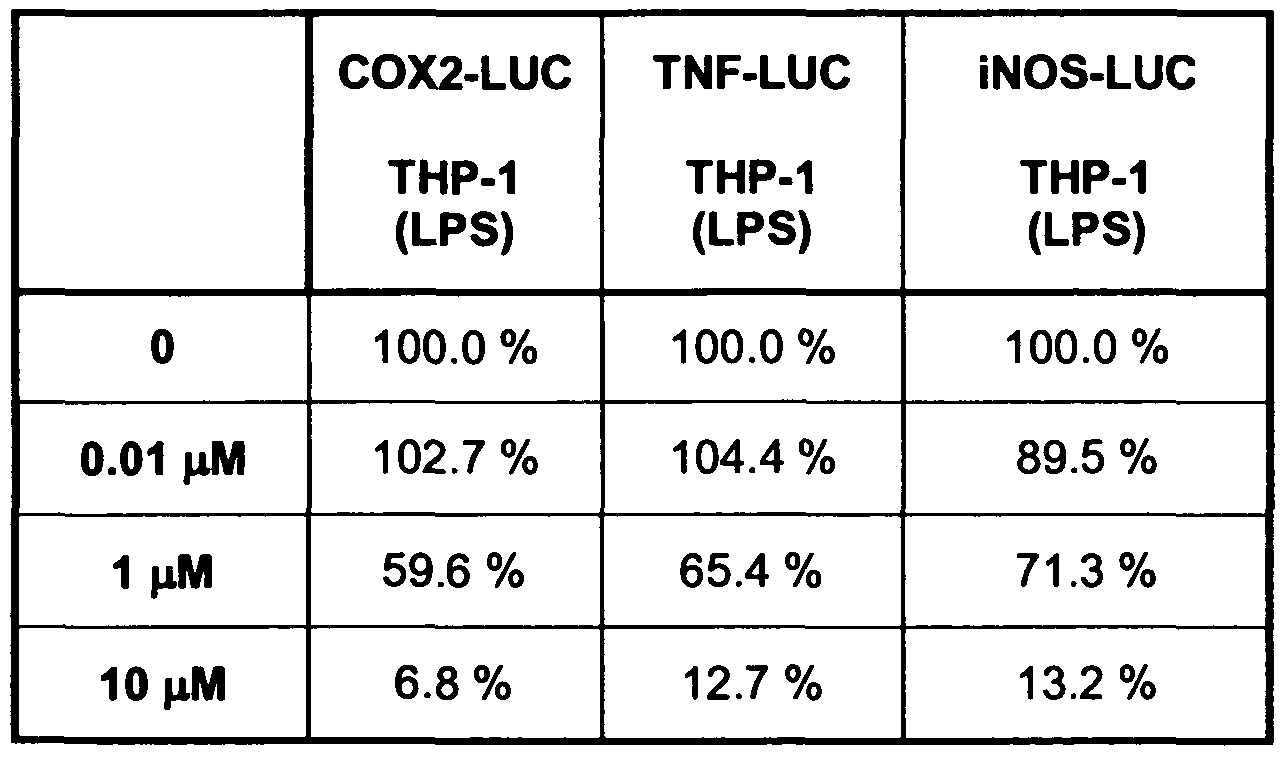
- the compound according to example 1 was measured for its ability to regulate gene transcription in immune activation through the modulation of the transcriptional activity of luciferase reporter constructs whose expression is directed by the promoter region of genes involved in the inflammation process and immune activation, such as cyclooxygenase-2 (COX-LUC), tumor necrosis factor ⁇ (TNF-LUC), lnterieukin-2 (IL-2-LUC), lnterleukin-6 (IL-6-LUC) and the inducible Nitric Oxide Synthase (iNOS-LUC).
- COX-LUC cyclooxygenase-2
- TNF-LUC tumor necrosis factor ⁇
- IL-2-LUC lnterieukin-2
- IL-6-LUC lnterleukin-6
- iNOS-LUC inducible Nitric Oxide Synthase
- Jurkat T cells or THP-1 cells were transiently transfected with these constructs as described above, and treated with different doses of The compound according to example 1 in the presence or absence of stimulation with PMA plus Ion (Jurkat) or LPS in a similar way as for NFAT-LUC and NFKB-LUC reporter analysis. Results are represented as percentage of activation, considering 100% the value of luciferase activity obtained in stimulated cells in the absence of the compound according to example 1. Approximated IC50 ( ⁇ M) values obtained for inhibition of the transcriptional activation are summarized in tables 3 (Jurkat) and 4 (THP-1).
- the compound according to example 1 as well as Rimonabant does display anti-inflammatory and immunomodulatory properties, interfering with the transcriptional activation of genes involved in inflammation and in the immune response such as cytokines (IL-2, IL-6 and TNF ⁇ ), COX-2 and iNOS.
Landscapes
- Health & Medical Sciences (AREA)
- Medicinal Chemistry (AREA)
- Veterinary Medicine (AREA)
- Public Health (AREA)
- General Health & Medical Sciences (AREA)
- Animal Behavior & Ethology (AREA)
- Life Sciences & Earth Sciences (AREA)
- Pharmacology & Pharmacy (AREA)
- Chemical & Material Sciences (AREA)
- Organic Chemistry (AREA)
- Rheumatology (AREA)
- Nuclear Medicine, Radiotherapy & Molecular Imaging (AREA)
- Chemical Kinetics & Catalysis (AREA)
- Physical Education & Sports Medicine (AREA)
- General Chemical & Material Sciences (AREA)
- Bioinformatics & Cheminformatics (AREA)
- Engineering & Computer Science (AREA)
- Epidemiology (AREA)
- Orthopedic Medicine & Surgery (AREA)
- Urology & Nephrology (AREA)
- Pain & Pain Management (AREA)
- Vascular Medicine (AREA)
- Cardiology (AREA)
- Heart & Thoracic Surgery (AREA)
- Pharmaceuticals Containing Other Organic And Inorganic Compounds (AREA)
Abstract
Description






Claims


Applications Claiming Priority (2)
| Application Number | Priority Date | Filing Date | Title |
|---|---|---|---|
| EP05384035A EP1752149A1 (en) | 2005-07-29 | 2005-07-29 | CB1 Antagonists or inverse agonists as therapeutical agents for the treatment of inflammation involving gene expression |
| EP05384035.1 | 2005-07-29 |
Publications (1)
| Publication Number | Publication Date |
|---|---|
| WO2007017125A1 true WO2007017125A1 (en) | 2007-02-15 |
Family
ID=36088564
Family Applications (1)
| Application Number | Title | Priority Date | Filing Date |
|---|---|---|---|
| PCT/EP2006/007417 Ceased WO2007017125A1 (en) | 2005-07-29 | 2006-07-27 | Cb1 antagonists or inverse antagonists as therapeutical agents for the treatment of inflammation involving gene expression |
Country Status (3)
| Country | Link |
|---|---|
| EP (1) | EP1752149A1 (en) |
| ES (1) | ES2334319B1 (en) |
| WO (1) | WO2007017125A1 (en) |
Cited By (5)
| Publication number | Priority date | Publication date | Assignee | Title |
|---|---|---|---|---|
| WO2014174457A1 (en) | 2013-04-23 | 2014-10-30 | Council Of Scientific & Industrial Research | Pyrazole carboxylic acid analogues as anti-mycobacterial drug candidates |
| US9802899B2 (en) | 2012-10-02 | 2017-10-31 | Bayer Cropscience Ag | Heterocyclic compounds as pesticides |
| US11091447B2 (en) | 2020-01-03 | 2021-08-17 | Berg Llc | UBE2K modulators and methods for their use |
| CN119219559A (en) * | 2024-09-26 | 2024-12-31 | 广东省科学院动物研究所 | A cis-enamide-pyrazole derivative and its application in anti-inflammatory drugs |
| CN119528829A (en) * | 2024-11-28 | 2025-02-28 | 广东省科学院动物研究所 | Triazole-cis-enamide compound, and preparation method and anti-inflammatory application thereof |
Citations (4)
| Publication number | Priority date | Publication date | Assignee | Title |
|---|---|---|---|---|
| US5939429A (en) * | 1997-09-30 | 1999-08-17 | Virginia Commonwealth University | Cardiovascular uses of cannabinoid compounds |
| WO2003077832A2 (en) * | 2002-03-18 | 2003-09-25 | Pharmos Corporation | Dexanabinol and dexanabinol analogs regulate inflammation related genes |
| FR2861302A1 (en) * | 2003-10-24 | 2005-04-29 | Sanofi Synthelabo | Use of pyrazole derivative as cannabinoid CB1 receptor antagonist, for treatment and prevention of metabolic syndrome, particularly cardiovascular risks and dyslipidemia associated with obesity |
| US20050165012A1 (en) * | 2004-01-28 | 2005-07-28 | Jean-Marc Plancher | Spiro-pentacyclic compounds |
Family Cites Families (3)
| Publication number | Priority date | Publication date | Assignee | Title |
|---|---|---|---|---|
| FR2692575B1 (en) | 1992-06-23 | 1995-06-30 | Sanofi Elf | NOVEL PYRAZOLE DERIVATIVES, PROCESS FOR THEIR PREPARATION AND PHARMACEUTICAL COMPOSITIONS CONTAINING THEM. |
| FR2713225B1 (en) | 1993-12-02 | 1996-03-01 | Sanofi Sa | Substituted N-piperidino-3-pyrazolecarboxamide. |
| EP1606019A1 (en) | 2003-03-07 | 2005-12-21 | The University Court of The University of Aberdeen | Cannabinoid receptor inverse agonists and neutral antagonists as therapeutic agents for the treatment of bone disorders |
-
2005
- 2005-07-29 EP EP05384035A patent/EP1752149A1/en not_active Withdrawn
-
2006
- 2006-07-27 ES ES200850023A patent/ES2334319B1/en not_active Expired - Fee Related
- 2006-07-27 WO PCT/EP2006/007417 patent/WO2007017125A1/en not_active Ceased
Patent Citations (4)
| Publication number | Priority date | Publication date | Assignee | Title |
|---|---|---|---|---|
| US5939429A (en) * | 1997-09-30 | 1999-08-17 | Virginia Commonwealth University | Cardiovascular uses of cannabinoid compounds |
| WO2003077832A2 (en) * | 2002-03-18 | 2003-09-25 | Pharmos Corporation | Dexanabinol and dexanabinol analogs regulate inflammation related genes |
| FR2861302A1 (en) * | 2003-10-24 | 2005-04-29 | Sanofi Synthelabo | Use of pyrazole derivative as cannabinoid CB1 receptor antagonist, for treatment and prevention of metabolic syndrome, particularly cardiovascular risks and dyslipidemia associated with obesity |
| US20050165012A1 (en) * | 2004-01-28 | 2005-07-28 | Jean-Marc Plancher | Spiro-pentacyclic compounds |
Non-Patent Citations (3)
| Title |
|---|
| CARACEMI ET AL: "Effect of cannabinoid CB1 receptor antagonist SR141716 in rat model of liver inflammation.", HEPATOLOGY, vol. 40, no. 4, 2004 - 2004, pages SUPPL 1 - 698A, XP002375436 * |
| CROCI ET AL: "Role of Cannabinoid receptors and tumor necrosis factor alpha in the gut and systemic anti-inflammatory activity of SR 141716 (Rimonabant) in rodents.", BR.J.PHARMACOLOGY, vol. 140, 2003 - 2003, pages 115 - 122, XP002375437 * |
| SMITH ET AL: "Recent advances in the research and development of CB1 antagonists", IDRUGS, vol. 8, no. 1, 2005 - 2005, pages 53 - 66, XP002375435 * |
Cited By (10)
| Publication number | Priority date | Publication date | Assignee | Title |
|---|---|---|---|---|
| US9802899B2 (en) | 2012-10-02 | 2017-10-31 | Bayer Cropscience Ag | Heterocyclic compounds as pesticides |
| US10435374B2 (en) | 2012-10-02 | 2019-10-08 | Bayer Cropscience Ag | Heterocyclic compounds as pesticides |
| US10689348B2 (en) | 2012-10-02 | 2020-06-23 | Bayer Cropscience Ag | Heterocyclic compounds as pesticides |
| US10961201B2 (en) | 2012-10-02 | 2021-03-30 | Bayer Cropscience Ag | Heterocyclic compounds as pesticides |
| US11332448B2 (en) | 2012-10-02 | 2022-05-17 | Bayer Cropscience Ag | Heterocyclic compounds as pesticides |
| US11548854B2 (en) | 2012-10-02 | 2023-01-10 | Bayer Cropscience Ag | Heterocyclic compounds as pesticides |
| WO2014174457A1 (en) | 2013-04-23 | 2014-10-30 | Council Of Scientific & Industrial Research | Pyrazole carboxylic acid analogues as anti-mycobacterial drug candidates |
| US11091447B2 (en) | 2020-01-03 | 2021-08-17 | Berg Llc | UBE2K modulators and methods for their use |
| CN119219559A (en) * | 2024-09-26 | 2024-12-31 | 广东省科学院动物研究所 | A cis-enamide-pyrazole derivative and its application in anti-inflammatory drugs |
| CN119528829A (en) * | 2024-11-28 | 2025-02-28 | 广东省科学院动物研究所 | Triazole-cis-enamide compound, and preparation method and anti-inflammatory application thereof |
Also Published As
| Publication number | Publication date |
|---|---|
| EP1752149A1 (en) | 2007-02-14 |
| ES2334319A1 (en) | 2010-03-08 |
| ES2334319B1 (en) | 2010-09-29 |
Similar Documents
| Publication | Publication Date | Title |
|---|---|---|
| US7524868B2 (en) | Substituted pyrazoline compounds, their preparation and use as medicaments | |
| EP1718617B1 (en) | 3-substituted 1,5-diphenylpyrazole derivatives useful as cb1 modulators | |
| EP1757587A1 (en) | Substituted pyrazoline compounds, their preparation and use as medicaments | |
| RU2377238C2 (en) | Imidazole derivatives active to cb1 receptor | |
| WO2007017125A1 (en) | Cb1 antagonists or inverse antagonists as therapeutical agents for the treatment of inflammation involving gene expression | |
| WO2007009705A1 (en) | (rac)-n-piperidinyl-5-(4-chlorophenyl)-1-(2,4-dichlorophenyl)-4,5-dihydr0-1h-pyrazole-3-carboxamide hydrates | |
| EP1743892A1 (en) | Substituted pyrazoline compounds, their preparation and use as medicaments | |
| WO2007009691A2 (en) | Combination of substituted pyrazolines and anti -addictive agent | |
| EP1749525A1 (en) | Combination of substituted pyrazolines and anti-addictive agent | |
| EP1749820A1 (en) | Salts of substituted pyrazoline compounds, their preparation and use as medicaments | |
| WO2007009696A1 (en) | Use of substituted pyrazoline compounds for the preparation of paediatric medicaments | |
| EP1743640A1 (en) | Use of substituted pyrazoline compounds for the preparation of paediatric medicaments | |
| MXPA06009334A (en) | Substituted pyrazoline compounds, their preparation and use as medicaments | |
| EP1743643A1 (en) | New formulations of substituted pyrazoline compounds | |
| EP1743641A1 (en) | Use of substituted pyrazoline compounds for the treatment of food disorders, including obesity or metabolic syndrome in patients with developed diabetes | |
| WO2007009693A1 (en) | Combination of a substituted pyrazoline compound and a drug used in food-related disorders | |
| EP1743642A1 (en) | Use of substituted pyrazoline compounds and their derivatives for the treatment of cannabinoid system-associated diseases | |
| WO2007009703A2 (en) | New formulations of substituted pyrazoline compounds | |
| EP1749819A1 (en) | (rac)-N-piperidinyl-5-(4-chlorophenyl)-1-(2,4-dichlorophenyl)-4,5-dihydro-1H-pyrazole-3-carboxamide hydrates | |
| WO2007009699A2 (en) | Use of substituted pyrazoline compounds and their derivatives for the treatment of cannabinoid system-associated diseases | |
| WO2007009692A1 (en) | Use of substituted pyrazoline compounds for the treatment of food disorders, including obesity or metabolic syndrome in patients with developed diabetes | |
| HK1124055B (en) | Sigma receptor inhibitors | |
| HK1124055A1 (en) | Sigma receptor inhibitors | |
| EP1743636A1 (en) | Combination of a substituted pyrazoline compound and a drug used in food-related disorders | |
| HK1095329B (en) | 3-substituted 1,5-diphenylpyrazole derivatives useful as cb1 modulators |
Legal Events
| Date | Code | Title | Description |
|---|---|---|---|
| 121 | Ep: the epo has been informed by wipo that ep was designated in this application | ||
| ENP | Entry into the national phase |
Ref document number: 200850023 Country of ref document: ES Kind code of ref document: A |
|
| NENP | Non-entry into the national phase |
Ref country code: DE |
|
| 122 | Ep: pct application non-entry in european phase |
Ref document number: 06776441 Country of ref document: EP Kind code of ref document: A1 |
|
| WWP | Wipo information: published in national office |
Ref document number: 200850023 Country of ref document: ES Kind code of ref document: A |
|
| WWG | Wipo information: grant in national office |
Ref document number: 200850023 Country of ref document: ES Kind code of ref document: A |