WO2007013701A1 - クロマトグラフィー保持時間によりペプチド配列を検定する方法 - Google Patents
クロマトグラフィー保持時間によりペプチド配列を検定する方法 Download PDFInfo
- Publication number
- WO2007013701A1 WO2007013701A1 PCT/JP2006/315549 JP2006315549W WO2007013701A1 WO 2007013701 A1 WO2007013701 A1 WO 2007013701A1 JP 2006315549 W JP2006315549 W JP 2006315549W WO 2007013701 A1 WO2007013701 A1 WO 2007013701A1
- Authority
- WO
- WIPO (PCT)
- Prior art keywords
- peptide
- value
- amino acid
- mobile phase
- retention time
- Prior art date
- Legal status (The legal status is an assumption and is not a legal conclusion. Google has not performed a legal analysis and makes no representation as to the accuracy of the status listed.)
- Ceased
Links
Classifications
-
- G—PHYSICS
- G01—MEASURING; TESTING
- G01N—INVESTIGATING OR ANALYSING MATERIALS BY DETERMINING THEIR CHEMICAL OR PHYSICAL PROPERTIES
- G01N30/00—Investigating or analysing materials by separation into components using adsorption, absorption or similar phenomena or using ion-exchange, e.g. chromatography or field flow fractionation
- G01N30/02—Column chromatography
- G01N30/86—Signal analysis
- G01N30/8693—Models, e.g. prediction of retention times, method development and validation
Definitions
- the present invention compares the estimated value of the retention scale (log k 0 ) in the liquid chromatographic analysis calculated from the predicted amino acid sequence with the measured value of the retention scale converted from the actual retention time, It relates to a method for testing the certainty of the predicted amino acid sequence.
- LC-MS / MS liquid chromatography tandem mass spectrometers
- MS mass spectrometry
- Information on the charge ratio (m / z) is obtained, and information on the partial sequence of the peptide is obtained from the MS / MS spectrum.
- information on the mass-to-charge ratio (m / z) and information on the partial sequence are analyzed by a protein identification engine or the like, and the identification of the peptide sequence is followed by the identification of the protein.
- the retention time in LC gradient analysis depends on the gradient of the flow rate, gradient of mobile phase preparation, pipe length, etc., especially for nano LC performed at a flow rate of 1 / i L / min or less. It is not easy to maintain the reproducibility of the retention time itself, and it is possible to obtain a high reproducibility only by continuous analysis within a day. Retention information can be obtained with high accuracy if retention parameters that depend only on the mobile phase and stationary phase can be obtained easily without relying on the above-mentioned variable factors, so protein identification accuracy is high throughput accuracy. Was expected to improve. Disclosure of the invention
- the object of the present invention is to convert the retention time of reversed-phase LC into a retention scale that depends on the amino acid composition of the peptide and does not depend on LC analysis conditions such as flow rate, gradient gradient, and pipe length. It is to provide a method.
- an object of the present invention is to establish a method for verifying the certainty of an estimated amino acid sequence based on the relationship between the amino acid composition of a peptide and a retention scale.
- the object of the present invention is to test whether the amino acid sequence in the candidate list output from the identification engine is correct when determining and identifying the amino acid sequence of a peptide using MS. This is to obtain the information to do from the retention time in LC analysis.
- the present inventor can estimate the retention time of peptides in LC to some extent from the amino acid composition, and, when identifying a protein digest peptide mixture by LC-MS / MS, Since there is an example of using the difference between the estimated value of the retention time and the actual measurement value as a useful information, the retention time in the LC is converted into a universal and highly reproducible retention scale, and the difference between the estimated value and the actual measurement value is calculated. We thought that the accuracy of peptide identification could be improved by analysis.
- the present inventor found that the S value described as the rate of change of the log k value with respect to the amount of organic solvent in the LSS theory can be derived from the amino acid composition of the peptide, and clarified its relational expression.
- the present inventor uses the S value calculated based on the amino acid composition calculated from the amino acid sequence of the peptide estimated using MS, and the retention time converted from the retention time by the LSS theory. By comparing the measured value of the scale (log ko) with the estimated value of log ko obtained from the relationship between amino acid composition and log ko The present invention has been completed by clarifying that it is possible to test whether the amino acid sequence obtained is correct.
- the present invention is as follows.
- k is the ratio of the number of moles of the peptide in the stationary phase to the number of moles of the peptide in the mobile phase
- ⁇ is the amount of organic solvent in the mobile phase
- ⁇ S is a value specific to the peptide.
- step (b) Substituting the retention time of the peptide obtained in step (a) into the relational expression of retention time, S value and ko value, and using the S value and k 0 value as variables, the measured value and calculated value of the retention time Performing a least square method so that the residual square sum of is minimized, and calculating the S value and k 0 value of the peptide,
- nj is the number of each amino acid in the peptide.
- the relational expression of the retention time, S value and ko value of the peptide in step (b) is an expression derived from the following expression (2) or an approximate expression derived from the expression (2). The method described.
- ⁇ is the amount of organic solvent in the mobile phase, and changes according to the following formula (3) with time t.
- t D is the solvent change delay time
- t g is the retention time of the peptide
- k (a) is the value of k at the initial concentration a of the organic solvent in the mobile phase.
- step (c) The amino acid sequence information in step (c) is obtained by analyzing the peptide by mass spectrometry and identifying the peptide based on the obtained mass information or amino acid sequence information.
- k is the ratio of the number of moles of the peptide in the stationary phase to the number of moles of the peptide in the mobile phase
- ⁇ is the amount of organic solvent in the mobile phase
- S is a value unique to the peptide.
- step (b) Substituting the retention time of the peptide obtained in step (a) into the relational expression of retention time, S value and ko value, and using the S value and ko value as variables, the measured value and calculated value of the retention time Performing the least square method so that the residual sum of squares is minimized, and calculating the S value and ko value of the peptide,
- step (d) For a plurality of peptides, the ko value obtained from step (b) and the amino acid composition obtained from step (c) are substituted into the following equation (4) to perform linear multiple regression analysis: Step of obtaining coefficient and constant term D of each amino acid of the following formula (4)
- nj is the number of each amino acid in the peptide.
- ⁇ is the amount of organic solvent in the mobile phase, which varies with time t according to the following formula (3):
- t D is the solvent change delay time
- t g is the retention time of the peptide
- step (c) is the value of k at the initial concentration a of the organic solvent in the mobile phase.
- step (c) is obtained by analyzing the peptide by mass spectrometry, and identifying the peptide based on the obtained mass information or amino acid sequence information.
- ⁇ is the amount of change of the organic solvent in the mobile phase in the gradient
- tG is the gradient time
- a is the initial concentration of the organic solvent in the mobile phase.
- t g ⁇ t G / (SA ⁇ ) ⁇ log ⁇ 2.3k 0 to (SA ⁇ / to) + 1 ⁇ + to + t D (6)
- ⁇ is the amount of change of the organic solvent in the mobile phase in the dargent
- t D is the solvent change delay time
- t g is the retention time of the peptide.
- step (c) information on the amino acid composition obtained in step (b), and the coefficient of each amino acid obtained by the method according to any one of (4) to (6) and a constant term D, Substituting the following equation (4) for those obtained under the stationary phase and the mobile phase in step (a) to calculate the estimated value of ko for the peptide;
- step (d) information on the amino acid composition obtained in step (b), and a coefficient Dj and a constant term C for each amino acid obtained by the method described in any one of (1) to (3),
- step (d) information on the amino acid composition obtained in step (b), and a coefficient Dj and a constant term C for each amino acid obtained by the method described in any one of (1) to (3),
- step of calculating the S value of the peptide by substituting the following formula (1) for those obtained under the stationary phase and the mobile phase of (a),
- step (e) Retention time of the peptide obtained in step (a), S value obtained in step (d), and t 0 , tD, t measured under the liquid chromatography analysis conditions in step (a) Substituting G , a, and ⁇ into the following equation (7) to calculate the measured value of ko, and (f) the logarithm of the estimated value of ko obtained in step (c) and the step (e) Using the logarithm of the logarithm of the measured value of ko obtained as an index, the accuracy of the peptide sequence identified in step Ob) is judged.
- nj is the number of each amino acid in the peptide
- ⁇ is the amount of change of the organic solvent in the mobile phase in the gradient
- tG is the gradient time
- t D is the solvent change delay time
- t g is the retention time of the peptide.
- Step (e) is the following step
- step (e) Substituting the retention time of the peptide obtained in step (a) and the S value obtained in step (d) into the following equation (7), and using t 0 , t D , ⁇ / tG as variables Calculate the measured value of ko, and calculate the residual sum of squares between the logarithm of the obtained ko actual value and the logarithm of the estimated ko value obtained in step (c). The least-squares method to minimize, to, t D , And calculate the measured value of k 0
- ⁇ is the amount of change of the organic solvent in the mobile phase in the dargent
- t G is the gradient time
- t D is the solvent change delay time
- t g is the retention time of the peptide.
- step (c) instead of the coefficient 3 ⁇ 4 and constant term D of each amino acid obtained by the method described in any one of (4) to (6), 3 ⁇ 4 and D shown in Table 3 were used.
- Table 3
- k is the ratio of the number of moles of the peptide in the stationary phase to the number of moles of the peptide in the mobile phase
- ⁇ is the amount of organic solvent in the mobile phase
- S is a value unique to the peptide.
- step (b) Substituting the retention time of the peptide obtained in step (a) into the relational expression of retention time, S value and k 0 value, and using the S value and k 0 value as variables, the actual value of retention time and calculation Means for calculating the S value and k 0 value of the peptide by performing the least squares method so that the residual square sum of the values is minimized,
- (c) means for determining the amino acid composition of the peptide from the amino acid sequence information of the peptide
- k is the ratio of the number of moles of the peptide in the stationary phase to the number of moles of the peptide in the mobile phase
- ⁇ is the amount of organic solvent in the mobile phase
- S is a value unique to the peptide.
- step (b) Substituting the retention time of the peptide obtained in step (a) into the relational expression of retention time, S value and ko value, and using the S value and ko value as variables, the measured value and calculated value of the retention time Means for calculating the S value and ko value of the peptide by performing the least squares method so that the residual square sum of
- (c) means for determining the amino acid composition of the peptide from the amino acid sequence information of the peptide
- nj is the number of each amino acid in the peptide.
- a system for verifying the certainty of the amino acid sequence of a peptide comprising the following means: (a) means for measuring the retention time of a peptide when the peptide is subjected to liquid chromatography analysis with a certain stationary phase and a certain mobile phase;
- nj is the number of each amino acid in the peptide
- ⁇ is the amount of change in the organic solvent in the mobile phase in the gradient.
- t G is the gradient time
- t D is the solvent change delay time
- t g is the retention time of the peptide.
- k is the ratio of the number of moles of the peptide in the stationary phase to the number of moles of the peptide in the mobile phase
- ⁇ is the amount of organic solvent in the mobile phase
- S is a value unique to the peptide.
- step (b) Substituting the retention time of the peptide obtained in step (a) into the relational expression of retention time, S value and ko value, and using the S value and ko value as variables, Means for calculating the S value and ko value of the peptide by performing the least squares method so that the residual sum of squares is minimized,
- (c) means for determining the amino acid composition of the peptide from the amino acid sequence information of the peptide
- a (1-7) is the stationary phase and a program for analyzing the relationship between k 0 values of amino acid composition and the following formula of the peptide (8) in the case of performing the liquid chromatography analysis with a mobile phase,
- k is the ratio of the number of moles of the peptide in the stationary phase to the number of moles of the peptide in the mobile phase
- ⁇ is the amount of organic solvent in the mobile phase
- S is a value unique to the peptide.
- step (b) Substituting the retention time of the peptide obtained in step (a) into the relational expression of retention time, S value and k Q value, and using the S value and k 0 value as variables, the actual retention time value and calculation Means for calculating the S value and k 0 value of the peptide by performing the least squares method so that the residual square sum of the values is minimized,
- (c) means for determining the amino acid composition of the peptide from the amino acid sequence information of the peptide
- nj is the number of each amino acid in the peptide.
- nj is the number of each amino acid in the peptide
- ⁇ is the amount of change of the organic solvent in the mobile phase in the gradient
- t G is the gradient time
- t D is the solvent change delay time
- t g is the retention time of the peptide.
- the present invention makes it possible to clarify the relationship between the chromatographic retention scale and the amino acid composition.
- the present invention when verifying whether the amino acid sequence estimated by performing a database search based on mass information or amino acid sequence information obtained by MS is correct, it is possible to use information on retention time in LC. It has become possible.
- Figure 1 shows the correlation of peptide retention times between LC analyzes under different conditions.
- Figure 2 shows the correlation of peptide retention scale (log ko) between LC analyzes under different conditions.
- Figure 3 shows log k. The difference between the estimated and measured values (delta log k 0 ) and Mascot's
- FIG. 4 is a block diagram showing a configuration example of the system of the present invention.
- FIG. 5 is a diagram showing a detailed configuration example of the central computer.
- FIG. 6 is a flowchart showing an example of the operation of the control mute.
- FIG. 7 is a flowchart showing an example of the operation of the control unit.
- the present invention provides a method for analyzing the relationship between the retention scale in LC analysis and the amino acid composition of a peptide.
- the present invention provides a method for verifying the correctness of peptide identification by MS analysis using parameters obtained from retention time information from LC.
- the present invention is estimated by comparing the estimated value of the retention scale in the LC analysis calculated from the amino acid sequence estimated in the MS analysis with the measured value of the retention scale converted from the actual retention time.
- a method for verifying the authenticity of amino acid sequences is provided.
- the amino acid sequence verified by the present invention is mainly an amino acid sequence estimated by a method of searching a database from peptide mass information obtained by peptide mass fingerprint (PMF) method using MALDI-MS data, and mainly ESI-
- the LC stationary phase and mobile phase are not particularly limited as long as a desired solute can be eluted, and can be appropriately selected by those skilled in the art.
- the organic solvent contained in the mobile phase is not particularly limited, and can be appropriately selected by those skilled in the art.
- LC is reverse phase LC.
- the solute of LC is a peptide. The present invention is described in detail below.
- the retention scale “k” is defined by the ratio of the number of moles of solute (peptide) in the stationary phase to the number of moles of solute in the mobile phase.
- the logarithm “log k” of k may be referred to as a retention scale.
- Isocratic means the use of a solvent of constant composition for the mobile phase.
- log k 0 is the value of log k when 0 is extrapolated to the amount of organic solvent.
- k 0 or “log k 0 ” may be referred to as a retention scale.
- the S value is specific to a solute in a stationary phase and a mobile phase.
- the S value is known to be a function of the molecular weight of the peptide (Stadalius MA, et al "Cromatogr., 296 (1984) 31-59, Y. Sakamoto et al., J Chromatogr 442 (1988) 69).
- the S value is preferably determined according to the following steps (a) and (b) using LC retention times under a plurality of conditions.
- the object to be analyzed in this step is a peptide, preferably a peptide mixture sample.
- the “peptide mixture sample” can be obtained from tissues or cells by a known treatment such as normal disruption, lysis, extraction and Z or fractionation.
- the “peptide mixture sample” can be appropriately subjected to treatments such as reduction, alkylation, and enzymatic digestion.
- the origin of the tissue or cell is not particularly limited.
- the cell may be a eukaryotic cell or a prokaryotic organism, and may be a cultured cell line or a primary cultured cell.
- a peptide preferably a peptide mixture sample, under a certain stationary phase and mobile phase, a plurality of conditions with varying LC analysis conditions such as the gradient of the flow rate and the gradient of the pipe, preferably performed LC analysis at 4 or more conditions, Keru your every analytical conditions determine the retention time t g of each peptide.
- LC analysis conditions means various conditions that affect the LC analysis results in a given fixed phase and mobile phase.
- the flow rate is the gradient of the gradient, the length of the pipe, etc. It has come out.
- “LC analysis under a plurality of analysis conditions” means LC analysis under a plurality of conditions different from one or more of the above conditions.
- the stationary and mobile phase conditions are the same between analyses.
- Initial concentration of the organic solvent in the mobile phase For example, the setting value programmed in the LC controller can be used as it is.
- step gradient When the amount of organic solvent ⁇ changes stepwise as shown in Table 5 (hereinafter referred to as step gradient), the following parameters are obtained in addition.
- Initial concentration of the organic solvent in the mobile phase For example, the setting value programmed in the LC controller can be used as it is.
- ti Time when ⁇ changes for the i-th time.
- the setting value programmed in the LC controller can be used as it is.
- ⁇ ⁇ This is the ⁇ after ⁇ changes for the i-th time.
- the setting value programmed in the LC controller can be used as it is.
- ⁇ The amount of change in the organic solvent in the mobile phase in the gradient. For example, it can be calculated using the set value programmed in the LC controller as it is.
- t G Time from the start to the end of the gradient (gradient time), for example
- the set values programmed in the LC controller can be used as they are.
- Initial concentration of the organic solvent in the mobile phase For example, the setting value programmed in the LC controller can be used as it is.
- Initial concentration of the organic solvent in the mobile phase For example, the setting value programmed in the LC controller can be used as it is.
- Vm The volume of the gradient mixer, and the set value can be used as it is.
- F Flow velocity, for example, the set value programmed in the LC controller can be used as it is.
- ⁇ The amount of change in the organic solvent in the mobile phase in the gradient, that is, the difference between the initial concentration of the organic solvent and the concentration of the organic solvent flowing into the gradient mixer, and the set value can be used as it is.
- step (b) step (a) retention time of the peptide obtained in, the holding time (t g), S value and ko values related. substituted into engagement type, the retention time S value and ko value as a variable Residual between measured and calculated values Performing the least squares method to minimize the sum of squares and calculating the peptide value and S value
- logarithm log k of retention scale k is described as a linear relational expression of organic solvent amount ⁇ .
- the S value is the first-order coefficient
- log ko is the value of log k when 0 is extrapolated to the amount of organic solvent (Equation 8).
- t D is the delay time of the solvent changes
- t g is the retention time of the peptide, both obtained from step (a) It is done.
- 1 ⁇ ( ⁇ ) is the value of retention scale k when the amount of organic solvent is ⁇
- k (a) is the value of k when the initial concentration of organic solvent in the mobile phase is a.
- Equation (1 4) f (t) analytically also makes approximately even, also it is possible to solve by numerical method, the retention time (t g) and log ko values and the relationship between the S-value
- the formula can be calculated. For example, in the numerical method, when a certain ko value and S value are given, it is calculated by gradually increasing the value of ⁇ in Eq. (1 4) from f (0) d [fi (0)] / 10 A (log ko- S ⁇ i ») is added sequentially, and when the added value becomes equal to the value of to-t D / k (a); f (t g- The holding time can be calculated as the value of to-t D ).
- f (t) is approximated by connecting a linear gradient, and using the following linear gradient formula, the relational expression for retention time (t g ), log ko value, and S value is calculated. Also good.
- t g ⁇ t G / (SA ⁇ ) ⁇ log ⁇ 2.3k 0 to (SA ⁇ / t G ) + 1 ⁇ + t 0 + t D (6)
- the relational expression can be calculated as the sum of these expressions.
- the relational expression when combining multiple gradients is expressed by the following formula (17). f to_-4 / ⁇ 1 ( ⁇ )], y f '» ⁇ ' ⁇ /"'()] (1 1)
- each parameter ⁇ , t G , to, and Z or t D according to the LC analysis conditions obtained in step (a), and the retention time of the peptide, the retention time (t g ), S value and ko value wherein, for example, the formula (1 1), (1 2), (1 4), (1 5), (6) or substituted into city (1 7), a t g as calculated the ko ⁇ Pi S as a variable
- the least square method preferably the nonlinear least square method (for example, the solver function of MS-EXCEL2000 version9.0.4402 SR-1, For example: Condition: Quasi-Newton method, time limit 100 seconds, number of iterations 1000, accuracy 0.00000000001, tolerance 5%, convergence 0.0001), k for each peptide.
- S can be calculated.
- the S value depends on the amino acid composition of the peptide, and clarified a relational expression that derives the S value from the amino acid composition under a certain stationary phase and a certain mobile phase. Based on the method of the present invention, the S value can be obtained from the amino acid composition of the peptide by the following formula (1).
- the values of Dj and C in equation (1) can be obtained by the following steps (c) and (d).
- the values of the coefficients Dj and C for each amino acid are specific to a certain stationary phase and certain mobile phase combination.
- the peptide whose retention time was determined by LC is known, its amino acid sequence can be obtained from the database and the amino acid composition can be calculated.
- the amino acid composition of the peptide is analyzed by mass spectrometry, the peptide is identified based on the obtained mass information or amino acid sequence information, and the identified peptide is identified. Obtained from amino acid sequence information.
- each peptide separated by LC analysis can be identified using a tandem mass spectrum.
- Q quadrometry
- TOF-TOF time of flight
- Q-Q time of flight
- Q-IT ion trap
- the tandem mass spectrum equipment is not limited to the power that can be used, for example, AB / MDS-Sciex QSTAR pulsar I or HermoElectron's Finnigan LCQ advantage.
- Peptides introduced into MS are fragmented by collisional dissociation inside the MS, and the resulting spectrum (MSMS spectrum, tandem mass spectrum, fragment spectrum, or CID spectrum) ) To obtain partial information on the amino acid sequence of the peptide.
- NCBInr database information obtained from the protein in the database, for example, NCBInr database, is searched by using a search engine such as Mascot (Matrixscience).
- the peptide can be identified (JK Eng, Mt.A. McCormack, I. Yates, Jonn R., Journal of the American Society for Mass Spectrometry 5 (1994) 976, M. Mann, M. Wilm, Anal Chem 66 (1994) 4390, Perkins, DN, Pappin, DJ, Creasy, DM and Cottrell JS, Electrophoresis 1999; 20 (18): 3551-3567).
- each peptide separated by LC analysis can be identified using a mass spectrum.
- mass spectrometer in addition to the above tandem mass spectrometer, quadrupole type, TOF type, etc. are used.
- AB-Voyager DE can be used as the apparatus, but is not limited thereto.
- MS MS The peptide can be measured for its molecular weight using an MS spectrum, so the protein in the database, for example the NCBInr database, is cleaved in silico and measured based on the characteristics of the digestive enzyme actually used.
- the peptide can be identified by searching the matching with the molecular weight of the peptide using, for example, a search engine such as Mascot (Matrixscience) (Henzel, WJ, Billed, T. ⁇ ., Stults, J. ⁇ ., Wong, SC, Grimley, C. and Watanabe, C. (1993). Proc Natl Acad Sci USA, 90, 5011-5., James, P., Quadroni, M., Carafoli, E. and Gonnet, G. (1993)., Bioc em Biophys Res Commun 195, 58-64., Mann, M., Hojrup, P. and Roepstorff, P. (1993).
- Mascot Motrixscience
- the amino acid composition of the peptide can be calculated.
- the S value of the peptide obtained in step (b) and the amino acid composition of the peptide obtained in step (c) are substituted into the following equation (1), and linear multiple regression analysis is performed.
- the coefficient Dj and constant term C of each amino acid can be obtained.
- nj is the number of each amino acid of the peptide.
- Linear multiple regression analysis can be performed by Gaussian elimination.
- the S value is calculated from the amino acid composition of each peptide (1 ).
- log k 0 is a value obtained by extrapolating 0 to the amount of organic solvent in log k of the logarithm of the holding scale ⁇ degree k.
- log k is the first-order function ⁇ of organic solvent ⁇ in ⁇ LSS theory ⁇
- the log k 0 value depends on the amino acid composition of the peptide, and have revealed a relational expression that derives the log k 0 value from the amino acid composition. Based on the method of the present invention, the log k 0 value can be estimated by the following formula (4) from the amisic acid composition of the peptide.
- nj is the number of each amino acid of the peptide.
- the values of and D in equation (4) can be obtained by the following steps (a) to (d).
- the coefficient of each amino acid and the value of the constant term D are specific to a certain fixed value and a certain combination of mobile phases.
- step (a) This step is the same as step (a) in “1.
- step (b) a step (a) retention time of the peptide obtained in the retention time (t g), by substituting the related engagement type S value and k 0 values, retention time S value and k 0 value as a variable Residual between measured and calculated values
- step (c) Step of determining the amino acid composition of the peptide from the amino acid sequence information of the peptide
- step (d) For a plurality of peptides, the ko value obtained from step (b) and the amino acid composition obtained from step (c) are substituted into the following equation (4) to perform linear multiple regression analysis: Step of obtaining coefficient 3 ⁇ 4 and constant term D of each amino acid in formula (4) below
- the ko value of the peptide obtained in step (b) and the amino acid composition of the peptide obtained in step (c) are substituted into the following equation (4), and linear multiple regression analysis is performed.
- the coefficient 3 ⁇ 4 and constant term D of each amino acid can be obtained.
- nj is the number of each amino acid of the peptide.
- the stationary phase is a C 18 column and the mobile phase is a buffer solution composed of 0.5% acetic acid water and an organic solvent
- the value of D in the above-described formula (4) is expressed as “k 0
- the organic solvent is preferably acetonitrile.
- a method to verify the authenticity of amino acid sequences of peptides since the log ko value depends on the amino acid composition of the peptide as shown by the formula (4), the peptide is identified based on the information obtained from mass spectrometry, and calculated from the amino acid sequence of the peptide. Identification by mass spectrometry by comparing the estimated value of log ko obtained by substituting the calculated amino acid composition into equation (4) and the actual value of log ko calculated from the retention time of the peptide in LC analysis. It was possible to verify the certainty of the amino acid sequence of the peptide.
- the certainty of the amino acid sequence of the peptide can be verified by the following steps.
- the peptide is subjected to LC analysis under a certain stationary phase and a certain mobile phase to obtain the retention time of the peptide.
- Parameters such as a, ti, ⁇ ⁇ , ⁇ ⁇ , t G , V m , F, etc. and the peptide retention time t g determined by the analysis conditions are ⁇ : about (1. (1) Method for obtaining S value) It can be obtained in the same manner as a).
- step (c) This step is the same step as step (c) in “1. (2) Method for obtaining relational expression between S value and amino acid composition”.
- step (c) Information on amino acid composition obtained in step (b), and coefficient 3 ⁇ 4 and constant term D of each amino acid obtained under the stationary phase and the mobile phase in step (a) Substituting into the following formula (4), the step of calculating the estimated value of ko for the peptide:
- the amino acid composition obtained in step (b) is analyzed as follows: “2. Analyze the relationship between amino acid composition and k 0 value”
- nj is the number of each amino acid of the peptide.
- each amino acid determined by the method described in steps (a) to (d) in 2.
- the coefficient 3 ⁇ 4 and the constant term D of the amino acids listed in the table (Table 9) in the following: “Coefficients and constant terms of each amino acid of k 0 value”.
- step (d) Information on the amino acid composition obtained in step (b), and the coefficient Dj and constant term C of each amino acid obtained under the stationary phase and mobile phase in step (a) Substituting into the following formula (1) to calculate the S value of the peptide
- nj is the number of each amino acid of the peptide.
- the stationary phase is a C18 column and the mobile phase is a buffer solution consisting of 0.5% acetic acid water and acetonitrile
- the amino acids determined in “1.
- Method for analyzing the relationship between amino acid composition and S value It is also possible to use Dj and constant term C listed in the table (Table 10) in the following “Coefficients and constant terms of each amino acid of S value” instead of constant coefficient C of.
- step (e) Retention time of the peptide obtained in step (a), S value obtained in step (d), and t 0 , t D , measured under the liquid chromatography analysis conditions in step (a) Substituting t G , a and ⁇ into the following formula (7) to calculate the actual measured value of k 0
- ⁇ The amount of change in the organic solvent in the mobile phase in the gradient. For example, it can be calculated using the set value programmed in the LC controller as it is.
- the set values programmed in the LC controller can be used as they are.
- Elution time of the sample that is not retained on the column For example, it can be calculated from the peak when a Planck solution (0.1% TFA, etc.) is injected.
- t D Solvent change delay time, which can be calculated from the baseline change delay time when the mobile phase is switched, for example.
- t D , t (3, ⁇ are determined by the least square method as follows, and the actual value of ko is calculated You may calculate.
- the retention time (t g ) of the peptide obtained in step (a) and the S value obtained in step (d) are substituted into equation (7), and t 0 , t D , ⁇ ⁇ / a logarithm of k 0 measured value obtained by calculating the k 0 measured value of the peptide in the variable tG, between the logarithm of k 0 estimates obtained the base peptide in step (c) Determine t 0 , t D , and minimize the residual sum of squares using the least squares method.
- the determined values are substituted into the following formula (15) to calculate the k 0 actual measurement value of the peptide.
- K , ⁇ /] ° t / k ( ⁇ , [one 10. + ⁇ S ⁇ a + (t g one t.-T D ) A ⁇ G ⁇ ] (1 5)
- t g ⁇ to / (S ⁇ ⁇ ) ⁇ log ⁇ 2.3k 0 to (S ⁇ / t G ) + 1 ⁇ + to + t D (6)
- the certainty of the peptide sequence was verified by comparing the logarithm of the estimated value of ko obtained in step (c) with the logarithm of the actual value of ko obtained in step (e).
- the certainty of the peptide sequence can be verified using the difference between the logarithm of the measured value of the retention scale ko and the logarithm of the measured value as an index. For example, if this difference is small, preferably 1 or less, more preferably 0.5 or less, the peptide sequence identified in step (b) is judged to be correct.
- the difference is large, preferably greater than 1, more preferably greater than 1.5, it is judged that the peptide sequence identified in step (b) is likely to be incorrect.
- the value for judging whether the peptide sequence is correct or not is set as appropriate depending on the identification conditions of the search engine used to identify the peptide in step (b) and whether other reliability indicators are used. can do. For example, if the search engine for identifying peptides is Mascot, it is possible to determine that the difference between the logarithm of the measurement value of the retention scale and the logarithm of the actual measurement value is 0.5 or less is correct, and other certainty. When using these indicators together, it is possible to use 1 or less as the standard so that a wider range of candidates is included.
- results of these tests are based on a comprehensive index together with an index of correctness when estimating the amino acid sequence, for example, a threshold value for identifying and determining the score of a database search engine (for example, Mascot). It may be used to verify whether the acid sequence is correct.
- a threshold value for identifying and determining the score of a database search engine for example, Mascot
- the analysis system of the present invention is a system for executing a method for analyzing the relationship between the amino acid composition of a peptide and the S value in the above formula (8), and includes the following means.
- step (b) Substituting the retention time of the peptide obtained in step (a) into the relational expression of retention time, S value and k 0 value, and using the S value and k 0 value as variables, the actual value of retention time and calculation Means for calculating the S value and k 0 value of the peptide by performing the least squares method so that the residual square sum of the values is minimized,
- nj is the number of each amino acid in the peptide.
- the analysis system of the present invention is a system for executing a method for analyzing the relationship between the amino acid composition of a peptide and the k 0 value in the above formula (8), and includes the following means: . (a) means for measuring the retention time of each peptide by subjecting the peptide to liquid chromatography analysis under a plurality of analytical conditions under the stationary phase and the mobile phase,
- step (b) Substituting the retention time of the peptide obtained in step (a) into the relational expression of retention time, S value and ko value, and using the S value and k 0 value as variables, the actual retention time value and calculation Means for calculating the S value and k 0 value of the peptide by performing the least squares method so that the residual square sum of the values is minimized,
- nj is the number of each amino acid in the peptide.
- the present invention is a system for executing a method for verifying the certainty of the amino acid sequence of a peptide, and includes the following means.
- ⁇ is the amount of change of the organic solvent in the mobile phase in the gradient
- t G is the gradient time
- t D is the solvent change delay time
- t g is the retention time of the peptide.
- FIG. 1 An example of a block diagram of the system of the present invention is shown in FIG.
- the control unit 401 is a unit that controls the entire operation of each unit necessary for executing the method of the present invention, and comprises a central computer 30 (FIG. 5).
- the mouthmatography analysis unit 402, the amino acid sequence information analysis unit 403, and the calculation unit 404 are respectively connected to the control unit 401 and controlled by the control unit 401 so as to be executed independently of each other or in cooperation with each unit.
- the chromatographic analysis unit 402 is a unit for eluting the peptide in the column, and includes a column, a stationary phase, a mobile phase, a peptide collector, and the like. Each component included in the chromatographic analysis unit is controlled independently or in cooperation with each component according to the command of the control unit 401.
- the amino acid sequence information analysis unit 403 is a unit that analyzes the amino acid sequence of the peptide eluted by the chromatography unit or the amino acid sequence stored in the database. The process of analyzing the amino acid sequence is controlled based on the result after subjecting the obtained peptide to mass spectrometry. Therefore, the amino acid sequence information analysis unit 403 includes a mass analysis unit (not shown) for amino acid sequence analysis, and may be configured independently of the chromatographic one-minute unit, Alternatively, it may be configured to be connected to a chromatographic analysis unit and a tandem. The amino acid sequence information analysis unit 403 is connected to the control unit 401.
- the calculation unit 404 includes processing for substituting the retention time of the peptide into a predetermined relational expression, processing for calculating the S value and k 0 value of the peptide, processing for obtaining the amino acid composition from the amino acid sequence information, coefficient of each amino acid This unit performs processing such as calculating C or D. In addition, a process for obtaining the measured value or estimated value of k 0 from these pieces of information is also performed. These components in the calculation unit 404 are connected to the control unit 401 and execute calculation processing in accordance with instructions from the control unit 401.
- FIG. 5 shows a configuration example showing means for causing the computer to execute in the analysis program of the present invention.
- the central computer 30 includes a CPU 501, a ROM 505, a RAM 506, an input unit 503, an information communication transmission / reception unit 502, an output unit 504, a hard disk drive (HDD) 507, a CD-ROM drive 508, a database ( DB) 509 etc. are provided.
- the CPU 501 controls the entire analysis data processing system according to a program stored in information storage means (for example, magnetic and Z or optical recording media) of the central computer 30. Then, the information received from the input unit 503 or the like is supplied to the output unit 504. Also, analysis processing can be executed based on information received through the network line 511.
- the input unit 503 is a keyboard, mouse, etc. This is operated when inputting conditions or data necessary for executing the analysis process.
- the ROM 505 stores a program for instructing processing necessary for the operation of the analysis processing system of the present invention.
- the RAM 506 temporarily stores data necessary for executing processing in the analysis processing system.
- the information communication transmission / reception unit 502 executes information communication (data transmission / reception processing) with the network line 511 or the like based on a command from the CPU 501, and examples thereof include a modem and a router. .
- the output unit 504 performs information display processing of peptide analysis data input from the input unit 503 and other various conditions based on a command from the CPU 501 (for example, display screen, printer).
- the CD-ROM drive 508 reads a program or data for causing the analysis processing system stored in the CD-ROM to function based on an instruction from the CPU 501 and stores it in, for example, the RAM 506.
- a rewritable CD-R or CD-RW can be used as a recording medium instead of a CD-ROM.
- a CD-E or CD-RW drive 510 is provided instead of the CD-ROM drive 508.
- DVDs, MOs, and those media may be used, and a corresponding drive may be provided.
- the program of the present invention can be written in, for example, C language, Java (registered trademark), Perl, Fortran, Pascal, and the like, and is designed to be compatible with a cross platform. Therefore, this software can be run on Windows (registered trademark) 95/98/2000 / XP, Linux, UNIX (registered trademark), and Macintosh.
- Windows registered trademark
- UNIX registered trademark
- Macintosh Macintosh
- the central computer 30 of the control unit 401 instructs the chromatographic apparatus necessary for carrying out the present invention to set various conditions necessary for the execution of LC, perform LC analysis, and elute the peptide (S601a, S601b) instructs to measure the retention time of the peptide.
- the central computer 30 substitutes the retention time into the relationship between the retention time, the S value, and the k 0 value, and retains the S value and the k 0 value as variables. Minimal residual sum of squares between measured and calculated time In this way, the least squares method is performed, and the calculation unit is instructed to calculate the S value and k 0 value of the peptide (S602a, S602b).
- the relationship between the retention time, the S value, and the k 0 value differs depending on the gradient of the mobile phase, so what type of mobile phase was used in the LC based on the condition settings.
- the central computer 30 selects which relational expression is adopted. For example, if the central computer 30 is conditioned to perform chromatography with a linear gradient mobile phase, the formula
- the central computer 30 instructs the amino acid sequence information analysis unit to obtain the amino acid composition from the amino acid sequence information obtained from the LC and amino acid sequence analysis results (for example, the results of mass spectrometry) (S603a, S603b).
- the order in which S603a and S602a are executed is not particularly limited.
- the central computer 30 may instruct S603a to be executed after (or before) S602a, or they may be performed simultaneously. You may order The same applies to the timing for executing S602b and S603b.
- the central computer 30 assigns the S value and amino acid composition to equation (1) and performs linear multiple regression analysis to obtain the amino acid coefficient Dj and constant term C in equation (1).
- the calculation unit is instructed to execute the calculation (S604a).
- the calculation of the coefficient Dj and the constant term C is performed on a plurality of peptides obtained by chromatography.
- the central computer 30 also executes a means for analyzing the relationship between the amino acid composition of the peptide and the k 0 value in equation (8), so k obtained in S602b.
- the calculation unit is used to calculate the coefficient 3 ⁇ 4 and constant term D of the amino acid in equation (4) by substituting the value and the amino acid composition obtained in S603b into equation (4) and performing linear multiple regression analysis. Command and the calculation unit performs the calculation (S604b).
- the data calculated as described above is stored in a database in the central computer 30 (S605a, S605b).
- the central computer 30 instructs the chromatographic apparatus necessary for carrying out the present invention to set various conditions necessary for the execution of LC and to perform LC analysis to elute the peptide (S701). This step is the same as S601a and S601b, and then the central computer 30 instructs the amino acid sequence information analysis unit to determine the amino acid composition. Next, the central computer 30 assigns the above amino acid composition information, coefficient 3 ⁇ 4 and constant term D of each amino acid to Equation (4), and calculates the estimated value of the peptide ko value. The calculation unit executes the calculation (S703). On the other hand, the central computer 30 instructs the calculation unit to calculate the S value of the peptide by substituting the amino acid composition information, the coefficient Dj of each amino acid and the constant term C into equation (1). The unit performs the calculation (S704).
- the central computer 30 calculates the measured value of the ko value by substituting the retention time of the peptide obtained in S701, the S value obtained in S704, and various values in the chromatographic analysis conditions into Equation (7).
- the calculation unit is instructed to execute the calculation (S705).
- the ko value is an index of LC retention time that depends on the amino acid composition of the peptide. Therefore, when the measured value of ko and the estimated value (calculated value) of ko are close to each other, it is used for calculation. Therefore, it can be determined that the amino acid sequence identified in S702 is correct.
- the present invention uses the difference between the logarithm of the estimated value of ko and the logarithm of the actually measured value of ko.
- the computer instructs the calculation unit to calculate the difference between the logarithm of the estimated value of ko and the logarithm of the actual value of ko.
- the central computer 30 has a difference of 1 or less, preferably 0.5 or less. In this case, it is determined that the identified peptide sequence is correct, and when it exceeds 1, preferably 1.5, the calculation unit is instructed to determine that it is not correct (S706).
- the central computer 30 inquires about the amino acid sequence information, the estimated value and actual measurement value of k 0 , and the data of the determination result as existing information, and accumulates them in the hard disk and creates a database (S707).
- the program of the present invention can be stored in a storage means that can be connected to a computer-readable recording medium or a computer.
- a computer recording medium or storage means containing the program of the present invention is also included in the present invention.
- Examples of the recording medium or storage means include magnetic media (flexible disks, hard disks, etc.), optical media (CDs, DVDs, etc.), magneto-optical media (MO, MD), etc.
- Example 1 Determination of coefficient and constant term of each amino acid in the relational expression between S value and k 0 value and amino acid composition
- the sample for LC analysis was a 5 jg soluble fraction of E. coli cell extract.
- Urea Bio-Rad ⁇ Cat. No. 161-0731
- Tris buffer containing 8 M pH 9.0, manufactured by Sigma
- Dissolve E. coli cell extract soluble fraction with .50 L and add 10 mM dethiothreath (Wako Pure Chemicals Cat. No. 045-08974: DTT) was added, and cysteine residues in the protein were reduced by incubation at 37 degrees for 30 minutes. Subsequently, 55 mM of odoacetamide was added and incubated at 37 degrees for 30 minutes to alkylate cysteine residues.
- endoprotease Lys-C (Wako Pure Chemical Industries) was added at 5 / x L and incubated at 37 degrees for 4 hours to digest the protein.
- trypsin Promega, Cat. No. V5111
- lO ⁇ L trypsin
- -C digested peptides and undigested proteins were digested.
- 10 L of 1% trifluoroacetic acid aqueous solution was added to inactivate trypsin, and then stored refrigerated.
- StageTip C 18 (J.Rappsilber, Y. Ishihama, M. Mann, Anal Chem 75 (2003) 663) that had been washed with acetonitrile and conditioned with 0.1% TFA water. 20 z L applied. Subsequently, StageTip C 18 was washed three times with 20 // L of 0.1% TFA water containing 5% acetonitrile and the sample was removed by eluting with 0.1% TFA water containing 70% acetonitrile. The solvent was volatilized by Speedvac and redissolved with 0.1% TFA water containing 20 / L of 5% acetonitrile.
- Condition 1 30 0.44 5.4 11 Condition 2 60 0.44 6.0 11 Condition 3 120 0.44 6.0 11 Condition 4 180 0.44 6.0 11
- the set value programmed in the LC controller was used as it was.
- the amount of change in the organic solvent in the mobile phase in the gradient was calculated using the set values programmed in the LC controller. Not retained in the column
- the elution time to of each sample was calculated from the peak when a blank solution (0.1% TFA, etc.) was injected.
- the delay time t D of the solvent change was calculated from the delay time of the baseline changes when switching the mobile phase.
- the LC-10A series ROM from Shimadzu Corp. was used as a micro device, and the supplied Shimadzu Corp. was removed as the mixing chamber, and a Parco T connector was adopted.
- the flow splitting method was adopted as the flow rate, and the column was adjusted to a speed of about 300 nL per minute.
- the sample was injected 3 L with CTC's autosampler PAL, and the sample was once injected into the sample loop of the injector and then fed into the analytical ram.
- Example 2 Verification of the accuracy of the identified peptide sequence by comparing the estimated value of ko and the measured value
- a cell extract of mouse neuroblastoma type Neuro2A was used as a peptide sample.
- Neuro2A medium contains RPMI-1640 (10% fetal bovine serum (MORE GATE, BATCH 32300102), lOOU / ml penicillin G, 100 ⁇ g / ml streptomycin (GIBCO, 15140-122). Sigma, R-7130) They were cultured in 5% C0 2 at 37 degrees (two 15cm ⁇ ). The obtained cells were disrupted by ultrasonic waves, and 1% (equivalent to 210 / ig) of the obtained protein mixture solution was freeze-dried using SpeedVac. Urea (Bio-Rad Cat. No.
- StageTip C18 (homemade, J. Rappsilber, Y. Ishihama, M. Mann, Anal Chem 75 (2003) 663) that had been washed with acetonitrile and then conditioned with 0.1% TFA water. L applied. Subsequently, StageTip C18 was washed three times with 20% 0.1% TFA containing 20% acetonitrile-tolyl and desalted by eluting the sample with 0.1% TFA water containing 20 / iL of 70% acetonitrile. The solvent was volatilized with Speedvac and redissolved in 0.1% TFA water containing 20 // L of 5% acetonitrile.
- the LCQ system is packed with C18 silica gel (ReproSil-Pur 120 C 18-AQ, 5 ⁇ ⁇ diameter, Dr. Maisch or L-column ODS, 5 / im diameter, Physics Evaluation Research Organization).
- C18 silica gel ReproSil-Pur 120 C 18-AQ, 5 ⁇ ⁇ diameter, Dr. Maisch or L-column ODS, 5 / im diameter, Physics Evaluation Research Organization.
- Homemade Electro-Presto integrated column Y. Ishihama, J. Rappsilber, JS Andersen, M. Mann, d Chromatogr A 979 (2002) 233. 0.15 x 150 mm, 0.5% acetic acid water as mobile phase A, mobile As phase B, 0.5% aqueous acetic acid containing 80% acetonitrile was used.
- the gradient elution conditions are 5% initial B concentration, 10% mobile phase B linearly in the first 5 minutes, 30% linearly in the next 60 minutes, then 100% linearly in 5 minutes, Thereafter, mobile phase B was set at 100% and maintained for 10 minutes, and then mobile phase B was set at 5%, and the next sample was poured after 30 minutes.
- the equipment is a Shimadzu LO 10A series ROM compatible with the mixing port, and the supplied Shimadzu Corporation is removed as a mixing chamber and a Parco T connector is used.
- the flow-splitting method was adopted as the flow rate, and the column was adjusted to have a flow rate of about 750-1000 nL per minute.
- Samples were injected with the CTC autosampler PAL, and the sample was injected once into the sample loop of the injector and then into the analytical column.
- the mass spectrometer was equipped with a homemade column on ThermoElectron's Finnigan LCQ Advantage equipped with an AMR XYZ stage, allowing the position of the electrospray column to be adjusted arbitrarily.
- An ESI voltage of 2.4 kV was applied through a Barco metal connector on the pump side of the column.
- Measurement was performed with Data Exclusion Repeat set to 1 in Data Dependent mode. In order to increase the number of scans, the measurement was performed in the so-called double play mode with the Zoom Scan mode removed.
- the HPLC system for the QSTAR system is C 18 silica gel (ReproSil-Pur 120
- a flow-splitting method was adopted as the flow rate, and the column was adjusted to have a flow rate of about 300 nL per minute.
- the sample was injected 3 / iL with CTC's autosampler PAL, and once injected into the sample loop of the injector, it was fed into the analytical column.
- a column holder specially designed by Nihon-Kyoto Technos Co., Ltd. was attached to Applied Biosystems ZMDS-Sciex QSTAR Pulsar i equipped with Protana XYZ stage so that the position of the electrospray integrated column could be adjusted arbitrarily.
- ESI voltage is 2.4 kV through the Barco metal connector on the pump side of the column.
- the measurement was performed in Iniormation dependent acquisition mode, after a 1-second survey scan, a maximum of 3 MSMS scans (0.6 seconds each). The switch from MSMS mode to Survey scan is 1 spectrum.
- t g ⁇ t G / (S ⁇ ⁇ ) ⁇ log ⁇ 2.3 ko t. (S ⁇ ⁇ / ta) + 1 ⁇ + to + t D (6)
- the obtained data were automatically identified using Mascot (Matrixscience) and Swiss-Prot database. Only peptides with a mascot score of more than 95% were selected and output.
- the S value and log k 0 are estimated from the amino acid sequence of the output peptide. A constant value was obtained. Also, using the above equation (6), t 0 , t D , A ci> Zt G are used as variables, and the regression calculation of the measured value of the holding time to the log k 0 estimated value is performed, and to, t D , ⁇ When to was determined, the measured value of log ko was obtained.
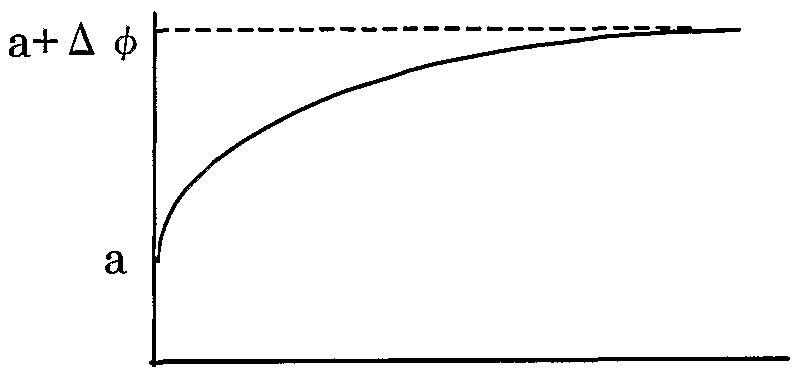
- the difference between the estimated value of log ko and the measured value was plotted against the Probability score when identified by Mascot (Fig. 3).
- the difference between the estimated value of the log ko value and the measured value is large at a Probability score of 30 or less with a confidence value of 95% or less, whereas the difference is small at a Probability score of 30 or more with a confidence value of 95% or more, almost 0.5 It was below.
- This method is used to verify whether the amino acid sequence estimated by performing a database search is correct based on the mass information or amino acid sequence information obtained by MS when identifying peptides in the proteomic technique.
- LC retention time information can be used, and peptides can be identified with higher accuracy.
Landscapes
- Physics & Mathematics (AREA)
- Health & Medical Sciences (AREA)
- Life Sciences & Earth Sciences (AREA)
- Chemical & Material Sciences (AREA)
- Analytical Chemistry (AREA)
- Biochemistry (AREA)
- General Health & Medical Sciences (AREA)
- General Physics & Mathematics (AREA)
- Immunology (AREA)
- Pathology (AREA)
- Other Investigation Or Analysis Of Materials By Electrical Means (AREA)
- Investigating Or Analysing Biological Materials (AREA)
Abstract
本発明は、ペプチドのアミノ酸配列の確かさを検証する方法を提供することを目的とする。本発明は、推定されたアミノ酸配列から計算して得られるペプチドの保持尺度log
k0の推定値を、LC保持時間から計算されるlog
k0の実測値と比較し、その差異から予想したアミノ酸配列の確かさを検定する方法を提供する。
Description
明細書 クロマトグラフィー保持時間によりぺプチド配列を検定する方法
技術分野
本発明は、 予想されたアミノ酸配列から計算される液体クロマトグラフィ一分 析における保持尺度 (log k0) の推定値と、 実際の保持時間から変換される保持 尺度の実測値とを比較して、 予想されたアミノ酸配列の確かさを検定する方法に 関する。 背景技術
近年、 液体クロマトグラフィータンデム質量分析計 (LC-MS/MS) の発展に より、 タンパク質消化ペプチド混合物の検出 ·同定が簡便に行えるようになって きた。 この分析では、 個々のぺプチドについて、 その液体クロマトグラフィー (以下 「LC」 と称する場合がある) から保持時間の情報が得られ、 質量分析 (以下 「MS」 と称する場合がある) から質量 ·電荷比 (m/z)の情報が得られ、 そして、 MS/MS スぺクトルからペプチドの部分配列の情報が得られる。 これら の情報のうち、 質量 .電荷比 (m/z)の情報及び部分配列の情報は、 タンパク質同 定エンジンなどにより解析されて、 ぺプチド配列の同定に次いでタンパク質の同 定に至る。
しかし、 試料に含まれるペプチド数が非常に多い場合には、 すべてのペプチド について MS/MSスぺクトルを取得できない場合があり、 試料中のすべてのぺプ チドの同定は困難である。 そのような場合に、 あらかじめ過去の LC分析におけ るぺプチドの保持時間及び LC-MS/MS分析による同定結果を登録しておくこと によって、 保持時間と質量の情報から MS/MSスペク トル無しでタンパク質を同 定できることが報告されている (E.F. Strittmatter, P.L. Ferguson, K. Tang, R.D. Smith, J Am Soc Mass Spectrom 14 (2003) 980) 。 また、 LC-MS/MS により、 タンパク質消化ペプチド混合物の同定を行う際、 ペプチド同定のための
付加的な情報として、 保持時間の推定値と実測値の差を用いる例も報告されてい る (K. Petritis, L. J. Kangas, P. L. Ferguson, G. A. Anderson, L. Pasa- Tolic, M. S . Lipton, K. J. Auberry, E. F. Strittmatter, Y. Shen, R. Zhao, and R. D. Smith, Anal Chem 75 (2003) 1039) 。
これまでに、 ぺプチドの逆相 LCにおける保持時間はアミノ酸組成からある程 度は推定が可能であることが知られているが (Meek, J. L. Proc Natl Acad Sci U S A 77, 1632 -6 (1980)) 、 一般的に LCの保持時間は再現性を保つことが難 しいといわれている。 同じ試料を複数回分析して得られたデータについて遺伝的 アルゴリズムを用いて、 個々のぺプチドが同じ保持時間になるように補正をする ことにより、 再現性が向上することが報告されている (K. Petritis, ; L. J. Kangas, P. L. Ferguson, G. A. Anderson, L. Pasa-Tonc, M. S . Lipton, K. J. Auberry, E. F. Strittmatter, Y. Shen, R. Zhao, and R. D . Smith, Anal Chem 75 (2003) 1039) 。 しかし、 この方法-では、 新たに試料を分析するたぴ に、 今までの全データと合わせて改めて補正をかけなおす必要があり、 また、 同 じ試料もしくは組成のよく似た試料にしか適用できないという問題点があった。
LC のグラジェント分析における保持時間は、 流速ゃグラジェントの傾き、 移 動相の調製バラツキや配管の長さなどに依存しており、 特に流速 1 /i L/min以下 で行われるナノ LCでは、 保持時間自体の再現性を保つのは容易ではなく、 日内 で連続分析することによってのみ高い再現性を得ることが可能である。 前述の変 動因子に依存せず、 移動相と固定相にのみ依存する保持パラメータが簡便に得ら れれば、 保持情報を高精度で得ることができるため、 タンパク質の同定精度ゃス ループットの精度が向上することが期待された。 発明の開示
本発明の課題は、 逆相 LCの保持時間を、 ペプチドのアミノ酸組成に依存し、 流速やグラジェントの傾き、 配管の長さなどの LC分析条件に依存しなレ、保持尺 度に変換する方法を提供することにある。
別の態様において、 本発明の課題は、 ペプチドのアミノ酸組成と保持尺度との 関連を基に、 推定されたアミノ酸配列の確かさを検証する方法を確立することに ある。
また、 別の態様において、 本発明の課題は、 MS を用いてペプチドのアミノ酸 配列を決定し同定する際に、 同定エンジンから出力される候補リスト中のアミノ 酸配列が、 正しいか否かを検定するための情報を LC分析における保持時間から 得ることにある。
本発明者は、 LC におけるペプチドの保持時間はアミノ酸組成からある程度は 推定が可能であること、 また、 LC-MS/MS によりタンパク質消化ペプチド混合 物の同定を行う際、 ペプチド同定のための付加的な情報として保持時間の推定値 と実測値の差を用いている例があることから、 LC における保持時間を普遍的で 再現性の高い保持尺度に変換し、 その推定値と実測値の差を解析すれば、 ぺプチ ドの同定精度を上げることができると考えた。
本発明者は、 上記課題を解決するため鋭意研究を行った結果、 逆相 LCのダラ ジェン ト分析においてペプチ ドの保持時間を記述する Stadalius ら (Chromatogr., 296 (1984) 31-59) の LSS (Linear Solvent Strength) 理論 に着目した。 そして、 LSS理論における log ko値と保持時間の関係式により、 保持時間を変換して得られる log koの値が、 LC分析条件に依存しない保持尺度 として利用できることを見出した。 そして更に、 log koの値がペプチドのァミノ 酸組成に依存し、 ぺプチドのァミノ酸配列が判れば log koの推定値を得ること ができることを明らかにした。
また本発明者は、 LSS 理論において log k値の有機溶媒量に対する変化率と して記述される S 値が、 ペプチドのアミノ酸組成から導き出せることを見出し、 その関係式を明らかにした。
これらの関係式から、 本発明者は MS を用いて推定されたペプチドのァミノ 酸配列から計算されるアミノ酸組成を元に計算された S値を用いて、 LSS理論 により保持時間から変換された保持尺度 (log ko) の実測値と、 アミノ酸組成と log ko との関係から得られる log koの推定値とを比較することにより、 推定さ
れたァミノ酸配列が正しいか否かを検定することが可能であることを明らかにし、 本発明を完成した。
すなわち本発明は、 以下の通りである。
( 1 ) ある固定相及びある移動相により液体クロマトグラフィー分析を行ったと きのペプチドのアミノ酸組成と下記式 (8 ) 中の S 値との関係を解析する方 法であって、
log k = log k0 - S ( 8 )
[式中、
kは固定相中の当該ペプチドのモル数と、 移動相中の当該ペプチドのモル数 との比であり、
Φは移動相中の有機溶媒量であり、
log k0は φ =0のときの log kの値であり、
■ Sは当該ペプチドに固有の値である。 ]
以下の工程:
(a)ペプチドを、 当該固定相及び当該移動相の下で、 複数の分析条件で液体クロ マトグラフィー分析して、 各ペプチドの保持時間を測定する工程、
(b)工程 (a)で得られたペプチドの保持時間を、 保持時間、 S 値及び ko値の関係 式に代入して、 S値と k0値を変数として保持時間の実測値と計算値の残差平 方和が最小となるように最小二乗法を行い、 当該ぺプチドの S 値と k0値と を算出する工程、
(c) 当該ぺプチドのアミノ酸配列情報から当該べプチドのアミノ酸組成を求める 工程、 並びに
(d)複数のペプチドについて、 工程 (b)から得られた S 値と、 工程 (c)から得られ たアミノ酸組成とを、 下記式 (1 ) に代入して線形重回帰分析を行って、 下 記式 (1 ) の各アミノ酸の係数 Dj及ぴ定数項 Cを求める工程
を含む、 上記方法。

[式中; njは、 当該ペプチド中の各アミノ酸の個数である。 ]
(2) 工程 (b)におけるペプチドの保持時間、 S値及び ko値の関係式が、 下記式 (2) から導かれる式、 又は式 (2) から導かれる近似式である、 (1 ) に 記載の方法。
- Ά d[j (φ )] tD 、
10A(log。一 φ) 0 Ατ(α) [式中、
Φは移動相中の有機溶媒量であり、 時間 tと共に下記式 (3) に従って変化 するものであり、
Φ = /(ί) (3)
toはカラムに保持されない試料の溶出時間であり、
tDは溶媒変化の遅延時間であり、
tgは当該べプチドの保持時間であり、
k(a)は移動相中の有機溶媒の初期濃度 aの時の kの値である。 ]
(3) 工程 (c)におけるアミノ酸配列情報が、 当該ペプチドを質量分析により分 析し、 得られた質量情報又はアミノ酸配列情報を基に、 当該ぺプチドを同定 することによって得られた当該ペプチドのアミノ酸配列情報である、 (1 ) または (2) に記載の方法。
(4) ある固定相及びある移動相により液体クロマトグラフィー分析を行ったと きのペプチドのアミノ酸組成と下記式 (8) 中の ko値との関係を解析する方 法であって、
log k = log ko - S (8)
[式中、
kは固定相中の当該ペプチドのモル数と、 移動相中の当該ペプチドのモル数 との比であり、
Φは移動相中の有機溶媒量であり、
logkoは φ=0のときの logkの値であり、
Sは当該ペプチドに固有の値である。 ]
以下の工程:
(a) ペプチドを、 当該固定相及び当該移動相の下で、 複数の分析条件で液体クロ マトグラフィー分析して、 各ペプチドの保持時間を測定する工程、
(b) 工程 (a)で得られたペプチドの保持時間を、 保持時間、 S 値及ぴ ko値の関係 式に代入して、 S 値と ko値を変数として保持時間の実測値と計算値の残差 平方和が最小となるように最小二乗法を行い、 当該べプチドの S値と ko値 とを算出する工程、
(c) 当該べプチドのアミノ酸配列情報から当該べプチドのアミノ酸組成を求める 工程、 並びに
(d)複数のペプチドについて、 工程 (b)から得られた ko値と、 工程 (c)から得られ たアミノ酸組成とを、 下記式 (4 ) に代入して線形重回帰分析を行って、 下 記式 ( 4 ) の各ァミノ酸の係数 及び定数項 Dを求める工程
を含む、 上記方法。
logk0 =∑(Eゾ X " ) + " ( 4 )
[式中; njは、 当該ペプチド中の各アミノ酸の個数である。 ]
( 5 ) 工程 (b)におけるペプチドの保持時間、 S値及び ko値の関係式が、 下記式 ( 2 ) から導かれる式、 又は式 (2 ) から導かれる近似式である、 (4 ) に 記載の方法。

[式中、
φは移動相中の有機溶媒量であり、 時間 tと共に下記式 (3 ) に従って変化 するものであり、

toはカラムに保持されない試料の溶出時間であり、
tDは溶媒変化の遅延時間であり、
tgは当該ぺプチドの保持時間であり、
k(a)は移動相中の有機溶媒の初期濃度 aの時の kの値である。 ]
(6) 工程 (c)におけるアミノ酸配列情報が、 当該ペプチドを質量分析により分 析し、 得られた質量情報又はアミノ酸配列情報を基に、 当該ペプチドを同定 することによって得られた当該べプチドのアミノ酸配列情報である、 (4) または (5) に記載の方法。
( 7 ) φが下記式 (5 ) に従って時間 t と共に直線的に変化する、 (2 ) 、 (3) 、 (5) 、 及び (6) のいずれか一項に記載の方法。

[式中、
tは時間であり、
Δφはグラジェントにおける移動相中の有機溶媒の変化量であり、
tGはグラジェント時間であり、
aは移動相中の有機溶媒の初期濃度である。 ]
(8) 式 (2) から導かれる式が下記式 (6) である (7) に記載の方法。
tg = {tG/(SA φ )} log {2.3k0 to (SA φ /to) + 1} + to + tD (6)
[式中、
Δ φはダラジェントにおける移動相中の有機溶媒の変化量であり、
toはグラジェント時間であり、
toはカラムに保持されな 、試料の溶出時間であり、
tDは溶媒変化の遅延時間であり、
tgは当該ぺプチドの保持時間である。 ]
(9) ペプチドのアミノ酸配列の確かさを検証する方法であって、 以下の工程:
(a)ぺプチドを、 ある固定相及びある移動相により液体クロマトグラフィー分析 を行ったときの、 ぺプチドの保持時間を測定する工程、
(b)当該べプチドのアミノ酸配列情報から当該べプチドのアミノ酸組成を求める 工程、
(c) 工程 (b)で得られたアミノ酸組成の情報、 並びに (4) 〜 (6) のいずれか一 項に記載の方法により求めた各アミノ酸の係数 ¾及ぴ定数項 D であって、
工程 (a)の当該固定相及び当該移動相の下で求めたものを、 下記式 (4) に代 入して、 当該ペプチドの koの推定値を計算する工程、
(d)工程 (b)で得られたアミノ酸組成の情報、 並びに (1) 〜 (3) のいずれか一 項に記載の方法により求めた各アミノ酸の係数 Dj及び定数項 C であって、 工程 (a)の当該固定相及び当該移動相の下で求めたものを、 下記式 (1) に代 人して、 当該ペプチドの S値を計算する工程、
(e) 工程 (a)で得られた当該ペプチドの保持時間、 工程 (d)で得られた S値、 並び に工程 (a)の液体クロマトグラフィー分析条件において測定された t0、 tD、 tG、 a及び Δψを、 下記式 (7) に代入して koの実測値を計算する工程、 並びに (f) 工程 (c)で得られた koの推定値の対数と、 工程 (e)で得られた koの実測値の対 数の差を指標として、 工程 Ob)で同定されたペプチド配列の確かさを判断する 工程
を含む、 上記方法。
logk0= ( X"ゾ) + D (4)
S = Y(DJxnJ.) + C (1) = ° , H+ioAS{ ( -t0 -ίΰ)Δ /ία}} ( 7 )
[式 (4) 、 (1) 及び (7) 中;
njは、 当該ペプチド中の各アミノ酸の個数であり、
Δφはグラジェントにおける移動相中の有機溶媒の変化量であり、
tGはグラジェント時間であり、
toはカラムに保持されない試料の溶出時間であり、
tDは溶媒変化の遅延時間であり、
tgは当該ペプチドの保持時間である。 ]
(1 0) 工程 (e)が以下の工程;
(eり 工程 (a)で得られた当該ペプチドの保持時間、 工程 (d)で得られた S値を下記 式 (7) に代入し、 t0、 tD、 Δφ/tGを変数にして koの実測値を計算し、 得られ た ko実測値の対数と、 工程 (c)で得られた ko推定値の対数との間で残差平方和
が最小になるように最小二乗法を行い to、 tD、
 を求めて、 k0の実測値を 計算する工程
である、 (9) に記載の方法。 = °A^ H+io,g -t0 -ίΩ)Α /ίΰ}] ( 7 )
2.5 ΖΔ Φ ι0 [式中;
Δ φはダラジェントにおける移動相中の有機溶媒の変化量であり、
tGはグラジェント時間であり、
toはカラムに保持されなレ、試料の溶出時間であり、
tDは溶媒変化の遅延時間であり、
tgは当該ペプチドの保持時間である。 ]
(11) 固定相が C18カラムであり、 移動相が 0.5%酢酸水と有機溶媒とからな る緩衝液である (9) 又は (10) に記載の方法であって、
工程 (c)において、 (4) 〜 (6) のいずれか一項に記載の方法により求めた 各アミノ酸の係数 ¾及ぴ定数項 Dに代えて、 表 3に記載の ¾及ぴ Dを用い る上記方法。 表 3
1¾値の各アミノ酸の係数と定数項
D
A R N D G E Q G H I L K M F P S T W Y V
0.08 -0.27 -0.01 0.11 0.01 0.11 0.01 0.01 -0.28 0.4 0.49 -0.31 0.36 0.57 0.08 0.02 0.1 0.5 0.31 0.27 0.54
(12) 固定相が C18カラムであり、 移動相が 0.5%酢酸水とァセトニトリルと からなる緩衝液である (9) 〜 (1 1) のいずれか一項記載の方法であって、 工程 (d)において、 (1) 〜 (3) のいずれか一項に記載の方法により求めた 各アミノ酸の係数 Dj及び定数項 Cに代えて、 表 4に記載の Dj及び Cを用いる 上記方法。
表 4
s値の各アミノ酸の係数と定数項
_ i
A _ R _N — D C E Q G H I L K M F P S T W Y V 0.22 0.2 0.36 0.6 0.37 0.48 0.43 0.16 -0.05 0.11 -0.07 0.21 -0.05 -0.07 0.35 0.31 0.23 -0.3 0.35 _ 0.22 9.92
(1 3) ある固定相及ぴある移動相により液体クロマトグラフィー分析を行った ときのペプチドのアミノ酸組成と下記式 (8) 中の S 値との関係を解析する ためのシステムであって、
log k = log k0 - S ( 8 )
[式中、
kは固定相中の当該ペプチドのモル数と、 移動相中の当該ペプチドのモル数と の比であり、
Φは移動相中の有機溶媒量であり、
log k0は φ =0のときの log kの値であり、
Sは当該ペプチドに固有の値である。 ]
以下の手段:
(a)ペプチドを、 当該固定相及び当該移動相の下で、 複数の分析条件で液体クロ マトグラフィー分析して、 各ぺプチドの保持時間を測定する手段、
(b)手段 (a)で得られたペプチドの保持時間を、 保持時間、 S 値及び k0値の関係 式に代入して、 S値と k0値を変数として保持時間の実測値と計算値の残差平 方和が最小となるように最小二乗法を行い、 当該ペプチドの S 値と k0値と を算出する手段、
(c) 当該ぺプチドのアミノ酸配列情報から当該べプチドのアミノ酸組成を求める 手段、 並びに
(d)複数のペプチドについて、 手段 (b)から得られた S 値と、 手段 (c)から得られ たアミノ酸組成とを、 下記式 (1) に代入して線形重回帰分析を行って、 下 記式 (1) の各アミノ酸の係数 Dj及び定数項 Cを求める手段
を含む、 上記システム。
 + C (1)
[式中; njは、 当該ペプチド中の各アミノ酸の個数である。 ]
+ C (1)
[式中; njは、 当該ペプチド中の各アミノ酸の個数である。 ]
( 1 4) ある固定相及びある移動相により液体クロマトグラフィー分析を行った ときのペプチドのアミノ酸組成と下記式 (8) 中の ko値との関係を解析する ためのシステムであって、
log k = log ko - S (8 )
[式中、
kは固定相中の当該ペプチドのモル数と、 移動相中の当該ペプチドのモル数と の比であり、
φは移動相中の有機溶媒量であり、
log koは Ψ =0のときの log kの値であり、
Sは当該ペプチドに固有の値である。 ]
以下の手段:
(a)ペプチドを、 当該固定相及び当該移動相の下で、 複数の分析条件で液体クロ マトグラフィー分析して、 各ペプチドの保持時間を測定する手段、
(b)手段 (a)で得られたぺプチドの保持時間を、 保持時間、 S 値及び ko値の関係 式に代入して、 S値と ko値を変数として保持時間の実測値と計算値の残差平 方和が最小となるように最小二乗法を行い、 当該ペプチドの S 値と ko値と を算出する手段、
(c) 当該べプチドのアミノ酸配列情報から当該べプチドのアミノ酸組成を求める 手段、 並びに
(d)複数のペプチドについて、 手段 (b)から得られた k。値と、 手段 (c)から得られ たアミノ酸組成とを、 下記式 (4) に代入して線形重回帰分析を行って、 下 記式 (4) の各アミノ酸の係数 ¾及び定数項 Dを求める手段
を含む、 上記システム。
logk0 =∑(£J xn/)+D (4)
[式中; njは、 当該ペプチド中の各アミノ酸の個数である。 ]
( 1 5 ) ペプチドのアミノ酸配列の確かさを検証するためのシステムであって、 以下の手段:
(a)ぺプチドを、 ある固定相及ぴある移動相により液体クロマトグラフィー分析 を行ったときの、 ぺプチドの保持時間を測定する手段、
(b)当該べプチドのアミノ酸配列情報から当該べプチドのアミノ酸組成を求める 手段、
(c)手段 (b)で得られたアミノ酸組成の情報、 並びに (1 4) に記載のシステムに より求めた各アミノ酸の係数 ¾及び定数項 Dであって、 手段 (a)の当該固定 相及ぴ当該移動相の下で求めたものを、 下記式 (4) に代入して、 当該ぺプ チドの koの推定値を計算する手段、
(d)手段 (b)で得られたアミノ酸組成の情報、 並びに (1 3 ) に記載のシステムに より求めた各アミノ酸の係数 Dj及ぴ定数項 Cであって、 手段 (a)の当該固定 相及ぴ当該移動相の下で求めたものを、 下記式 (1 ) に代入して、 当該ぺプ チドの S値を計算する手段、
(e)手段 (a)で得られた当該ペプチドの保持時間、 手段 (d)で得られた S値、 並び に手段 (a)の液体クロマトグラフィー分析条件において測定された t0、 tD、 tG、 a及び Δψを、 下記式 (7) に代入して koの実測値を計算する手段、 並びに
(f) 手段 (c)で得られた koの推定値の対数と、 手段 (e)で得られた koの実測値の対 数の差を指標として、 手段 (b)で同定されたペプチド配列の確かさを判断する 手段
を含む、 上記システム。

S = Y(DjxnJ) + C ( 1 )
K = ト ( 一 t。 -ίΒ)Α /ίΰ}] ( 7 )
[式 (4) 、 ( 1 ) 及び (7) 中;
njは、 当該ペプチド中の各アミノ酸の個数であり、
Δφはグラジェントにおける移動相中 有機溶媒の変化量であり、
tGはグラジェント時間であり、
toはカラムに保持されない試料の溶出時間であり、
tDは溶媒変化の遅延時間であり、
tgは当該ペプチドの保持時間である。 ]
( 1 6 ) ある固定相及ぴある移動相により液体クロマトグラフィー分析を行った ときのペプチドのアミノ酸組成と下記式 (8 ) 中の S 値との関係を解析する ためのプログラムであって、
log k = log ko - S Φ ( 8 )
[式中、
kは固定相中の当該ペプチドのモル数と、 移動相中の当該ペプチドのモル数と の比であり、
φは移動相中の有機溶媒量であり、
log koは φ =0のときの log kの値であり、
Sは当該ペプチドに固有の値である。 ]
コンピュータを、 以下の手段:
(a)ペプチドを、 当該固定相及び当該移動相の下で、 複数の分析条件で液体クロ マトグラフィー分析して、 各ペプチドの保持時間を測定する手段、
(b)手段 (a)で得られたペプチドの保持時間を、 保持時間、 S 値及び ko値の関係 式に代入して、 S値と ko値を変数として保持時間の実測値と計算値の残差平 方和が最小となるように最小二乗法を行い、 当該ペプチドの S 値と ko値と を算出する手段、
(c) 当該ぺプチドのァミノ酸配列情報から当該ぺプチドのァミノ酸組成を求める 手段、 並びに
(d)複数のペプチドについて、 手段 (b)から得られた S 値と、 手段 (c)から得られ たアミノ酸組成とを、 下記式 (1 ) に代入して線形重回帰分析を行って、 下 記式 (1 ) の各アミノ酸の係数 Dj及び定数項 Cを求める手段
として機能させるためのプログラム。

[式中; lljは、 当該ペプチド中の各アミノ酸の個数である。 ]
( 1 7 ) ある固定相及びある移動相により液体クロマトグラフィー分析を行った ときのペプチドのアミノ酸組成と下記式 (8 ) 中の k0値との関係を解析する ためのプログラムであって、
log k = log k0 - S φ ( 8 )
[式中、
kは固定相中の当該ペプチドのモル数と、 移動相中の当該ペプチドのモル数と の比であり、
Φは移動相中の有機溶媒量であり、
log k0は φ =0のときの log kの値であり、
Sは当該ペプチドに固有の値である。 ]
コンピュータを、 以下の手段:
(a)ペプチドを、 当該固定相及び当該移動相の下で、 複数の分析条件で液体クロ マトグラフィー分析して、 各ぺプチドの保持時間を測定する手段、
(b)手段 (a)で得られたペプチドの保持時間を、 保持時間、 S 値及び kQ値の関係 式に代入して、 S値と k0値を変数として保持時間の実測値と計算値の残差平 方和が最小となるように最小二乗法を行い、 当該べプチドの S値と k0値と を算出する手段、
(c) 当該べプチドのアミノ酸配列情報から当該ぺプチドのアミノ酸組成を求める 手段、 並びに
(d)複数のペプチドについて、 手段 Ob)から得られた ko値と、 手段 (c)から得られ たアミノ酸組成とを、 下記式 (4 ) に代入して線形重回帰分析を行って、 下 記式 (4 ) の各アミノ酸の係数 及び定数項 Dを求める手段
として機能させるためのプログラム。
logk0 =∑ ( " + D ( 4 )
[式中; njは、 当該ペプチド中の各アミノ酸の個数である。 ]
( 1 8 ) ぺプチドのアミノ酸配列の確かさを検証するためのプログラムあって、 コンピュータを、 以下の手段:
(a)ペプチドを、 ある固定相及ぴある移動相により液体クロマトグラフィー分析 を行ったときの、 ペプチドの保持時間を測定する手段、
(b)当該べプチドのアミノ酸配列情報から当該べプチドのアミノ酸組成を求める 手段、
(c)手段 (b)で得られたアミノ酸組成の情報、 並びに (1 7) に記載のプログラム により求めた各アミノ酸の係数 及び定数項 Dであって、 手段 (a)の当該固 定相及び当該移動相の下で求めたものを、 下記式 (4 ) に代入して、 当該べ プチドの koの推定値を計算する手段、
(d)手段 (b)で得られたアミノ酸組成の情報、 並びに (1 6 ) に記載のプログラム により求めた各アミノ酸の係数 Dj及び定数項 Cであって、 手段 (a)の当該固 定相及ぴ当該移動相の下で求めたものを、 下記式 (1 ) に代入して、 当該べ プチドの S値を計算する手段、
(e)手段 (a)で得られた当該ペプチドの保持時間、 手段 (d)で得られた S 値、 並び に手段 (a)の液体クロマトグラフィー分析条件において測定された t0、 tD、 tG、 a及び Δφを、 下記式 (7) に代入して k0の実測値を計算する手段、 並びに
(f) 手段 (c)で得られた k0の推定値の対数と、 手段 (e)で得られた k0の実測値の対 数の差を指標として、 手段 (b)で同定されたペプチド配列の確かさを判断する 手段
として機能させるためのプログラム。
logk0 =∑(E.x«y) + £> (4)

K:っ , [- " -tQ
 ( 7 )
( 7 )
[式 (4) 、 ( 1 ) 及び (7) 中;
njは、 当該ペプチド中の各アミノ酸の個数であり、
Δφはグラジェントにおける移動相中の有機溶媒の変化量であり、
tGはグラジェント時間であり、
toはカラムに保持されない試料の溶出時間であり、
tDは溶媒変化の遅延時間であり、
tgは当該ペプチドの保持時間である。 ]
本発明により、 クロマトグラフィー保持尺度とアミノ酸組成との関係を明らか にすることが可能となった。
本発明により、 MS により得られた質量情報あるいはアミノ酸配列情報を基に、 データベース検索を行って推定されたアミノ酸配列が正しいか否かを検証するに あたり、 LCにおける保持時間の情報を用いることが可能となった。
図面の簡単な説明
図 1は、 異なる条件の LC分析の間の、 ペプチドの保持時間の相関関係を示 す図である。
図 2は、 異なる条件の LC分析の間の、 ペプチドの保持尺度 (log ko) の相 関関係を示す図である。
図 3は、 log k。の推定値と実測値の間の差 (delta log k0) と、 Mascot の
Probability scoreとの関係を示す図である。
図 4は、 本発明のシステムの構成例を示すブロック図である。
図 5は、 中央コンピューターの詳細構成例を示す図である。
図 6は、 制御ュ-ットの動作の例を示すフローチヤ一トである。
図 7は、 制御ユニットの動作の例を示すフローチャートである。
符号の説明
30 : 中央コンピューター、 40 1 :制御ュニット、 402 : クロマトグラフィ 一分析ュニット、 403 :ァミノ酸配列情報解析ュニット、 404 :計算ュニッ ト、 5 0 1 : CPU, 5 0 2 :情報通信送信/受信部、 5 0 3 :入力部、 5 0
4 : 出力部、 5 0 5 : ROM, 5 0 6 : RAM、 5 0 7 : HDD, 5 0 8 : CD- ROM ドライブ、 50 9 :データベース (DB) 、 5 1 0 : CD-R, CD-RW 用 ドライブ、 5 1 1 :ネットワーク回線
発明を実施するための最良の形態
以下に本発明の実施の形態について説明する。 以下の実施の形態は、 本発明を 説明するための例示であり、 本発明をこの実施の形態にのみ限定する趣旨ではな い。 本発明は、 その要旨を逸脱しない限り、 さまざまな形態で実施をすることが できる。
なお、 本明細書において引用した文献、 及ぴ公開公報、 特許公報その他の特許 文献は、 参照として本明細書に組み込むものとする。 また、 2005年 7月 29 日 に出願し、 本願優先権主張の基礎となる特願 JP2005-221994号の特許請求の範 囲、 明細書、 図面及ぴ要約書の開示内容は、 その全体が参照として本明細書に組 み入れられる。
本発明は、 LC 解析における保持尺度とペプチドのァミノ酸組成との関係を解 析する方法を提供する。
また、 本発明は、 MS解析によるペプチド同定の正否を、 LC からの保持時間 情報から得られるパラメータを用いて検証する方法を提供する。 すなわち、 本発 明は、 MS解析で推定されたアミノ酸配列から計算される LC解析における保持 尺度の推定値と、 実際の保持時間から変換される保持尺度の実測値とを比較して、 推定されたァミノ酸配列の確かさを検証する方法を提供する。
本発明により検証されるアミノ酸配列は、 主に MALDI-MS データによるべ プチドマスフィンガープリント (PMF) 法で得られたペプチドの質量情報から データベースを検索する方法により推定されたアミノ酸配列、 及び主に ESI-
MS/MS などのタンデムマススぺクトルから得られたペプチドのアミノ酸配列情 報からデータベースを検索する方法により推定されたアミノ酸配列である。
本発明において、 LC の固定相、 移動相は所望の溶質を溶出できるのであれば 特に限定されず、 当業者であれば適宜選択することができる。 また、 移動相に含 まれる有機溶媒は特に限定されず、 当業者であれば適宜選択することができる。
本発明において LCは逆相 LCである。 本発明において、 LC の溶質はペプチド である。 以下に、 本発明について、 詳しく記載する。
1 . ァミノ酸組成と S値との関係を解析する方法
( 1 ) S値を求める方法
保持尺度 「k」 は、 固定相中の溶質 (ペプチド) のモル数と、 移動相中の溶質 のモル数との比で定義され、 イソクラティック条件において、 溶質の溶出に要し た移動相の容量を、 カラム容積の倍数で表したものに等しい。 なお、 本発明にお いて、 k の対数 「log k」 を保持尺度と称する場合もある。 「イソクラティッ ク」 は、 移動相に一定の組成の溶媒を使用することを意味する。 Stadalius らの LSS (Linear Solvent Strength) 理論では、 kの対数である log kは、 移動相 に含まれる有機溶媒の量 φと一次の関係式として記述されることが見出された。 「S値」 はその一次の係数であって有機溶媒量の変化に対する log kの変化率で ある (式 8 ) 。
log k = log k0 - S φ ( 8 )
ここで 「log k0」 は、 有機溶媒量に 0を外挿した時の log kの値である。 本発 明において、 「k0」 または 「log k0」 を保持尺度と称する場合もある。
S値は、 ある固定相及ぴある移動相において、 溶質に固有の値である。
また、 溶質がペプチドの場合、 S値はペプチドの分子量の関数であることが知 られている (Stadalius M. A., et al" C romatogr., 296 (1984) 31-59、 Y. Sakamoto et al., J Chromatogr 442 (1988) 69) 。
Stadalius らの方法に従えば、 各溶質について、 複数のイソクラティック条件 で得られた kと ^を式 (8 ) に当てはめ、 最小二乗法により log kと φとの間の 一次関係式を得ることができる。 LC-MS から得られたペプチドの分子量と、 S 値の間の回帰式を求めることにより、 S値と分子量との間の関係式を導くことが できる。 この関係式を用いることにより、 S値が未知のペプチドであっても、 分 子量から S値を求めることが可能である。
本発明において、 好ましくは、 S値は、 複数の条件下での LCの保持時間を用 いて、 以下の工程 (a)、 (b)に従って求めることが望ましい。 本方法は、 Quarry M.A.et al., Anal. C em. 58 (1986) 907) にも記載されている。 (a) ペプチドを、 ある固定相及ぴある移動相の下で、 複数の分析条件で LC分析 を行って、 各ペプチドの保持時間 tgを測定する工程
本工程で分析する対象は、 ぺプチド、 好ましくはぺプチド混合物試料である。 本発明において、 「ペプチド混合物試料」 は、 組織又は細胞から、 通常の破砕、 溶解、 抽出及び Z又は分画などの公知の処理によって得ることができる。 また、 「ペプチド混合物試料」 は、 適宜、 還元、 アルキル化、 酵素消化などの処理を施 すこともできる。 前記組織又は細胞の由来は特に限定されない。 また細胞は、 真 核細胞であっても原核生物であってもよく、 培養細胞株でも初代培養細胞であつ てもよい。
本工程では、 ペプチド、 好ましくはペプチド混合物試料を、 ある固定相及ぴぁ る移動相の下で、 流速ゃグラジェントの傾き、 配管の長さなどの LC分析条件を 変えた複数の条件、 好ましくは 4以上の条件で LC分析を行い、 分析条件毎にお ける各ペプチドの保持時間 tgを求める。 ここで、 「LC分析条件」 は、 所定の固 定相及ぴ移動相における、 LC 分析結果に影響する様々な条件を意味し、 例えば、 流速ゃグラジェントの傾き、 配管の長さなどを挙げることがでいる。 本発明にお いて、 「複数の分析条件で LC分析する」 とは、 上記の条件のうち 1以上の条件 の異なる複数の条件で LC分析することを意味する。 ただし、 分析間での固定相 及び移動相の条件は同一である。
また、 分析条件毎に定まる以下のパラメータを求めることもできる。
to:カラムに保持されない試料の溶出時間であり、 例えばブランク溶液 (0.1% トリフルォロ酢酸 (TFA)等) を注入した時のピークより算出することができる。 tD:溶媒変化の遅延時間であり、 例えば移動相を切り替えた時のベースライン変 化の遅延時間から算出することができる。
(i) 有機溶媒量 φが、 時間に依らず一定の場合 (以下、 「イソクラティック」 と称す) は、 加えて以下のパラメータを求める。

a:移動相中の有機溶媒の初期濃度であり、 例えば LC 制御装置にプログラムし た設定値をそのまま使うことができる。
(ii) 有機溶媒量 φが、 表 5に示す通り段階的に変化する場合 (以下、 ステップ グラジェントと称す) は、 加えて以下のパラメータを求める。
a:移動相中の有機溶媒の初期濃度であり、 例えば LC 制御装置にプログラムし た設定値をそのまま使うことができる。
ti: i 回目に φが変化した時間であり、 例えば LC 制御装置にプログラムした設 定値をそのまま使うことができる。
φ ί: i回目に φが変化した後の φであり、 例えば LC制御装置にプロダラムした 設定値をそのまま使うことができる。
表 5

(iii) 有機溶媒量 φが、 下記式 (5 ) に従って時間 t と共に直線的に変化する場 合 (以下、 「リニアグラジェント」 と称す) は、 加えて以下のパラメータを求め る。 = f(t) ^ t + a ( 5 )
Α φ : グラジェントにおける移動相中の有機溶媒の変化量であり、 例えば LC 制 御装置にプログラムした設定値をそのまま使って算出することができる。
tG:グラジェント開始から終了までの時間 (グラジェント時間) であり、 例えば
LC制御装置にプログラムした設定値をそのまま使うことができる。
a:移動相中の有機溶媒の初期濃度であり、 例えば LC 制御装置にプログラムし た設定値をそのまま使うことができる。
(iv) 有機.溶媒量 φが、 表 6に示す通り、 時間 t に対して指数的に変化する場合 (以下、 「指数関数的グラジェント J と称す) は、 加えて以下のパラメータを求 める。
表 6
t =f(t)= Δ φ {l -exp(-Ft/Vm)}+a ( 1 8 )
a:移動相中の有機溶媒の初期濃度であり、 例えば LC 制御装置にプログラムし た設定値をそのまま使うことができる。
Vm: グラジェントミキサ一の体積であり、 設定値をそのまま使うことができる。 F:流速であり、 例えば LC 制御装置にプログラムした設定値をそのまま使うこ とができる。
Δ φ : グラジェントにおける移動相中の有機溶媒の変化量、 すなわち、 有機溶媒 の初期濃度とグラジェントミキサ一に流入する有機溶媒濃度との差であり、 設定 値をそのまま使うことができる。
本工程において、 上記 (i)〜(iv)に示した Φの変化は、 組み合わせて使用するこ とも可能である。
(b) 工程 (a)で得られたペプチドの保持時間を、 保持時間 (tg)、 S値及び ko値の関. 係式に代入して、 S値と ko値を変数として保持時間の実測値と計算値の残差
平方和が最小となるように最小二乗法を行い、 当該ぺプチドの 値と S 値 とを算出する工程
本工程において使用される保持時間 (tg)、 S値及び ko値の関係式は、 以下の通 り導かれる。
LSS理論では、 前述のように、 保持尺度 kの対数 log kは、 有機溶媒量 φの 一次の関係式として記述される。 S値はその一次の係数であり、 log koは有機溶 媒量に 0を外挿した時の log kの値である (式 8) 。
log k = log ko - S (8)
(i) φ =aのイソクラティック条件の場合、 kは移動相をカラム容積の何倍流し た時に溶質が溶出されるかを表しているため、 以下の式 (1 0) を得ることがで さる。
k=(tg- t0)/to ( 1 0)
これを式 (8) に代入すると、 保持時間 (tg)、 S値及び ko値の関係式が導かれる (式 1 1) 。

(ii) 同様にして、 ステップグラジェントの場合、 保持時間 (tg)、 S 値及び ko値 の関係式は、 下記式 (1 2) の通り導かれる。 一 T [K m i} 1 + 10へ (log 。— S<i>,)J 1+10八 (log 。— S")
(iii P. J. Schoenmakers らの論文 、 J. Chromatography, 149, 519- 37,1978) によれば、 下記式 (3) に従って有機溶媒量が変化するグラジェント 溶出時の保持時間(tg)は、 下記式 (1 3) で記述される (P. J. Schoenmakers et al.,の式 8) 。
Φ二 fi) (3)
cts- -'p d[f~x { )] ^ tD (丄 。ヽ
Jo (φ) 0 k{d)
ここで toはカラムに保持されない試料の溶出時間であり、 tDは溶媒変化の遅 延時間であり、 tgは当該ペプチドの保持時間であり、 いずれも工程 (a)から求め
られる。 また 1ε(φ)は有機溶媒量が Φの時の保持尺度 k の値であり、 k(a)は移動 相中の有機溶媒の初期濃度 aの時の kの値である。
式 (8) より、
^(</)) = 10A(log^-S(i.) (8 ' )
これを式 (1 3) に代入して、 下記式 (1 4) が得られる。 ά[ - )] _ t tD ( 1 4)
J。 10A(log :0 -5φ) ~。 (a)
式 (1 4) は、 f(t)により解析的にも、 近似的にも、 また数値解法によっても 解くことが可能であり、 保持時間 (tg)と log ko値及び S値との関係式を計算する ことができる。 例えば数値解法の場合は、 ある ko値及ぴ S値が与えられた時に、 式 ( 1 4 ) の φの値を f(0)から少しずつ増加させて計算される d[fi(0)]/ 10A(log ko- S<i»)の値を順次加算していき、 加算した値が to - tD/k(a)の値と等し くなつた時の ; f(tg - to - tD)となる の値として保持時間 を求めることができ る。
また、 f(t)をリニアグラジェントをつないで近似し、 下記のリニアグラジェン トの場合の式を用いて保持時間 (tg)、 log ko値及び S値との関係式を計算しても 良い。
特に、 f(t)が時間 t と共に直線的に式 (5) に従って変化するリニアグラジェ ントの場合は、 式 (1 4) は解析的に解くことができ、 その解は下記式 (1 5) である。 = f t) = ^t + a ( 5)
=つ /Μ、、[- + 10Λ + ( - ~tD)A<i> 。 }] ( 1 5)
13SA Φ(ί0 -tD/k(a)) ここから tgは近似的に下記式 (6) で表すことができる。
tg = {tG/(SA φ )} log {2.3k0 to (SA φ /tG) + 1} + t0 + tD (6)
(iv) 指数的グラジェントの場合は、 下記式 (1 6) を式 (1 3) に代入する とにより保持時間 (tg)と log ko値及び S値との関係式を計算することができる。
k( φ )=10A(log ko — SA I— exp(-Ft/Vj}+a ( 1 6)
上記 Φの時間的な変化を組み合わせた場合には、 関係式はこれらの式の足し合 わせとして計算できる。 例えば、 複数のグラジェントを組み合せた場合の関係式 は、 下記式 (1 7) で表される。 f to_ - 4/一1 (Φ)] , y f'»~'^ /"'( )] ( 1 1)
0 k(a) J° 10Λ (log k0 _ S φ~) ^ ^'" 10Λ (log k0 - S φ~)
工程 (a)で得られる LCの分析条件による各パラメータ Δφ、 tG、 to, 及び Z又 は tD、 並びにペプチドの保持時間を、 保持時間 (tg)、 S 値及ぴ ko値の関係式、 例えば式 (1 1) 、 (1 2) 、 (1 4) 、 (1 5) 、 (6) または (1 7) に代 入し、 ko及ぴ Sを変数として計算される tgの計算値と tgの実測値の間の残差平 方和が最小となるように、 最小二乗法、 好ましくは非線形最小二乗法 (例えば MS-EXCEL2000 version9.0.4402 SR-1のソルバー機能にて、 例えば条件:準 ニュートン法、 制限時間 100秒、 反復回数 1000、 精度 0.00000000001、 公差 5%、 収束 0.0001) を行い、 各ペプチドについて k。と S を算出することができ る。
(2) S値とアミノ酸組成との関係式を求める方法
本発明者は、 S値が、 ペプチドのアミノ酸組成に依存することを見出し、 ある 固定相及びある移動相の下での S 値をアミノ酸組成から導く関係式を明らかに した。 本発明の方法に基づけば、 S 値はペプチドのアミノ酸組成から下記式 (1) により求めることができる。
S = yj(Djxnj) + C ( 1)
式 (1) 中の Dj、 Cの値は、 以下の工程 (c)、 (d)により求めることができる。 各アミノ酸の係数 Dj及ぴ Cの値は、 ある固定相及びある移動相の組み合わせに 固有の値である。
(c) 当該べプチドのァミノ酸配列情報から当該べプチドのァミノ酸組成を求める 工程
LC にて保持時間を求めたペプチドが既知であれば、 そのアミノ酸配列をデー タベースから得て、 アミノ酸組成を計算することができる。
好ましくは当該ペプチドのアミノ酸組成は、 当該ペプチドを質量分析により分 析し、 得られた質量情報又はアミノ酸配列情報を基に、 データベース検索を行つ て当該ペプチドを同定し、 同定された当該べプチドのアミノ酸配列情報から求め る。
具体的には、 LC 分析により分離された各ペプチドは、 タンデムマススぺタト ルを用いて同定することができる。 タンデム質量分析は、 Q(quadrupole)- TOF(time of flight), TOF-TOF, Q-Q、 Q-IT(ion trap)などが使用される。 タ ンデムマススぺク トルの装置としては例えば AB/MDS-Sciex QSTAR pulsar I や hermoElectron社の Finnigan LCQ advantageを使うことカできる力 こ れらに限定されない。 MSに導入されたペプチドは MSの内部での衝突解離によ りフラグメント化され、 その際得られるスペク トル (MSMS スペク トル、 タン デムマススぺク トル、 フラグメントスぺク トル、 または CID スぺク トル) から ぺプチドのアミノ酸配列の部分情報が得られる。 得られた当該べプチドのァミノ 酸配列の部分情報を元に、 データベース、 例えば NCBInr データベース中のタ ンパク質から得られる情報を、 例えば Mascot (Matrixscience社)などのサーチ エンジンを用いて検索することにより当該ぺプチドを同定することができる (J.K. Eng, A山. McCormack, I. Yates, Jonn R., Journal of the American Society for Mass Spectrometry 5 (1994) 976、 M. Mann, M. Wilm, Anal Chem 66 (1994) 4390、 Perkins, DN, Pappin, DJ, Creasy, DM and Cottrell JS, Electrophoresis 1999; 20(18):3551-3567) 。
また、 具体的には、 LC 分析により分離された各ペプチドは、 マススぺク トル を用いて同定することができる。 質量分析計としては、 上記のタンデム質量分析 計に加えて、 4重極型、 TOF 型などが使用される。 装置としては例えば AB- Voyager DEを使うことができるがこれらに限定されない。 MSに導入されたぺ
プチドは、 MS スぺクトルを用いてその分子量を得ることができるので、 データ ベース、 例えば NCBInr データベース中のタンパク質を、 実際に用いた消化酵 素の特性に基づいて in silico で切断し、 測定されたペプチドの分子量とのマツ チングを、 例えば Mascot (Matrixscience社)などのサーチエンジンを用いて検 索することにより当該ペプチドを同定することができる (Henzel, W. J., Billed, T. Μ., Stults, J. Τ., Wong, S. C.,Grimley, C. and Watanabe, C. (1993). Proc Natl Acad Sci USA, 90, 5011-5., James, P., Quadroni, M., Carafoli, E. and Gonnet, G. (1993)., Bioc em Biophys Res Commun 195, 58-64., Mann, M., Hojrup, P. and Roepstorff, P. (1993). Biol Mass Spectrom 22, 338-45., Pappin, D. J. C, Hojrup, P. and Bleasby, A. J. (1993). Curr. Biol. 3, 327-32. Yates, J. R., 3rd, Speicher, S., Griffin, P. R. and Hunkapiller, T. (1993). Anal Biochem 214, 397-408.) 。
上記のように同定したペプチドのァミノ酸配列から、 当該ぺプチドのアミノ酸 組成を計算することができる。
(d)複数のペプチドについて、 工程 (b)から得られた S値と、 工程 (c)から得られ たアミノ酸組成とを、 下記式 (1 ) に代入して線形重回帰分析を行って、 下 記式 (1 ) の各アミノ酸の係数 Dj及ぴ定数項 Cを求める工程
複数のペプチドについて、 工程 (b)で得られた当該ペプチドの S 値、 及び工程 (c)で得られた当該ペプチドのアミノ酸組成を下記式 (1 ) に代入し、 線形重回 帰分析を行って各アミノ酸の係数 Dj及び定数項 Cを求めることができる。

式 (4 ) 中、 njは、 当該ペプチドの各アミノ酸の個数である。
線形重回帰分析は、 ガウスの消去法により行うことができる。
例えば、 固定相が C 18カラム (ODS、 Octadecyl化シリカゲル、 以降 「C 18 カラム」 と称す) であり、 移動相が 0.5%酢酸水とァセトニトリルとからなる緩 衝液の場合、 上記で得られた式 (1 ) 中の Dj、 C の値として、 下記 「S 値の各 アミノ酸の係数と定数項」 の表に記載の値を使用することも可能である (表 7 ) 。
表 7
s値の各アミノ酸の係数と定数項
Di
C
A R N D C E Q G H I L Κ F P S W Y V
0.22 0.2 0.36 0.6 0.37 0.48 0.43 -0.05 -0.07 0.35 0.31 0.23 -0.3 0.35 0.22 9.92 本発明の方法に基づけば、 所定の固定相および移動相において、 S値は各ぺプ チドのアミノ酸組成から式 (1 ) により求めることが可能になった。
2 . ァミノ酸組成と k0値との p関係を解析する方法
log k0は前述した通り、 保持尺 σ度 kの対数 log kの、 有機溶媒量に 0を外挿し た時の値である。 ここで、 log kは、 ρ LSS理論において有機溶媒量 φの一次の関 ρ
係式として記述される。 ·
o
log k = log k0 - S ( 8 )
本発明者らは、 log k0値がぺプチドのァミノ酸組成に依存することを見出し、 log k0値をアミノ酸組成から導く関係式を明らかにした。 本発明の方法に基づけ ば、 log k0値はペプチドのアミス酸組成から下記式 (4 ) により推定することが できる。
logk0 = yズ E X " + D ( 4 )
式 (4 ) 中、 njは、 当該ペプチドの各アミノ酸の個数である。
式 (4 ) 中の 及び D の値は、 以下の工程 (a)〜(d)により求めることができ る。 各アミノ酸の係数 、 及び定数項 D の値は、 ある固定値及びある移動相の 組み合わせに固有の値である。
(a) ペプチドを、 ある固定相及ぴある移動相の下で、 複数の分析条件で LC分析 を行って、 各ぺプチドの保持時間 tgを測定する工程
本工程は、 上記 「1 . ( 1 ) S値を求める方法」 の工程 (a)と同様である。
(b) 工程 (a)で得られたペプチドの保持時間を、 保持時間 (tg)、 S値及び k0値の関 係式に代入して、 S値と k0値を変数として保持時間の実測値と計算値の残差
平方和が最小となるように最小二乗法を行い、 当該べプチドの ko値と S値 とを算出する工程
本工程は、 上記 「1. (1) S値を求める方法」 の工程 (b)と同様である。 (c) 当該ペプチドのアミノ酸配列情報から当該ペプチドのアミノ酸組成を求める 工程
本工程は、 「1. (2) S値とアミノ酸組成との関係式を求める方法」 の工程 (c)と同様である。 (d)複数のペプチドについて、 工程 (b)から得られた ko値と、 工程 (c)から得られ たアミノ酸組成とを、 下記式 (4) に代入して線形重回帰分析を行って、 下 記式 (4) の各アミノ酸の係数 ¾及び定数項 Dを求める工程
複数のペプチドについて、 工程 (b)で得られた当該ペプチドの ko値、 及び工程 (c)で得られた当該ペプチドのアミノ酸組成を下記式 (4) に代入し、 線形重回 帰分析を行って各アミノ酸の係数 ¾及び定数項 Dを求めることができる。
logk。 x ) + D (4)
式 (4) 中、 njは、 当該ペプチドの各アミノ酸の個数である。
例えば、 固定相が C 18カラムであり、 移動相が 0.5%酢酸水と有機溶媒とから なる緩衝液の場合、 上記で得られた式 (4) 中の 、 D の値として、 下記 「k0 値の各アミノ酸の係数と定数項」 の表に記載の値を使用することも可能である (表 8) 。 有機溶媒は、 好ましくはァセトニトリルである。
表 8 ko値の各アミノ酸の係数と定数項
S D
A R N D C E Q G H I L K M F P S T W Y V
0.08 -0.27 -0.01 0.11 0.01 0.11 0.01 0.01 -0.28 0.4 0.49 -0.31 0.36 0.57 0.08 0.02 0. 0.5 0.31 0.27 0.54
ぺプチドのアミノ酸配列の確かさを検証する方法
本発明において、 式 (4 ) で示すように log ko値がペプチドのアミノ酸組成 - に依存することから、 質量分析から得られた情報を基にペプチドを同定し、 当該 ペプチドのアミノ酸配列から計算されたアミノ酸組成を式 (4 ) に代入して得ら れる log koの推定値と、 LC分析における当該ペプチドの保持時間から計算され る log koの実測値とを比較することにより、 質量分析で同定したペプチドのァ ミノ酸配列の確かさを検証することが可能となった。
ペプチドのァミノ酸配列の確かさは、 具体的には以下の工程により検証するこ とができる。 (a) ペプチドを、 ある固定相及ぴある移動相により LC分析を行ったときの、 ぺ プチドの保持時間を測定する工程
本工程では、 ペプチドを、 ある固定相及びある移動相の下で、 LC 分析を行い、 ペプチドの保持時間を求める。 分析条件により定まる a、 ti、 Φ ί、 Δ ψ、 tG、 Vm、 F などのパラメータ及びペプチドの保持時間 tgは、 「1 . ( 1 ) S 値を求める 方法」 の^:程 (a)と同様に求めることができる。
(b) 当該ペプチドのアミノ酸配列情報から当該ペプチドのアミノ酸組成を求める 工程
本工程は、 「1 . ( 2 ) S値とアミノ酸組成との関係式を求める方法」 の工程 (c)と同様の工程である。
(c) 工程 (b)で得られたアミノ酸組成の情報、 並びに各アミノ酸の係数 ¾及び定 数項 D であって、 工程 (a)の当該固定相及ぴ当該移動相の下で求めたものを、 下記式 (4 ) に代入して、 当該ペプチドの: koの推定値を計算する工程 工程 (b)で求めたアミノ酸組成を、 「2 . アミノ酸組成と k0値との関係を解析 する方法」 の工程 (a)〜(d)に記載の方法に従って、 工程 (a)と同じ固定相及ぴ移動 相の下で求めた各アミノ酸の係数 ¾、 定数項 D と共に、 下記式 (4 ) に代入し、 log koの推定値を計算する。
logk0 =∑(E, x« ) + (4)
式 (4) 中、 njは、 当該ペプチドの各アミノ酸の個数である。
例えば、 固定相が C18カラムであり、 移動相が 0.5%酢酸水と有機溶媒とから なる緩衝液の場合は、 上記 2. の工程 (a)〜(d)に記載の方法で求めた各アミノ酸 の係数 、 定数項 Dに代えて、 下記 「: k0値の各アミノ酸の係数と定数項」 の表 (表 9) に記載されたアミノ酸の係数 ¾、 定数項 Dを使うことも許される。
表 9
_ ko値の各アミノ酸の係数と定数項
o EJ D
0.08 -0.27 -0.01 0.11 0.01 0.11 0.01 0.01 -0.28 0.4 0.49 -0.31 0.36 0.57 0.08 0.02 0.1 0.5 0.31 0.27 0.54 o
o
(d) 工程 (b)で得られたアミノ酸組成の情報、 並びに各アミノ酸の係数 Dj及び定 数項 C であって、 工程 (a)の当該固定相及び当該移動相の下で求めたものを、 下記式 (1 ) に代入して、 当該ペプチドの S値を計算する工程
工程 (b)で求めたアミノ酸組成を、 「1. アミノ酸組成と S 値との関係を解析 する方法」 の工程 (a)〜( に記載の方法に従って、 同じ固定相及ぴ同じ移動相の 下で決められた Dj、 定数項 C と共に、 下記式 (1 ) に代入し、 S値を計算する。
∑( /x ) + C ( 1)
式 (1) 中、 njは、 当該ペプチドの各アミノ酸の個数である。
例えば、 固定相が C18カラムであり、 移動相が 0.5%酢酸水とァセトニトリル とからなる緩衝液の場合は、 「1. アミノ酸組成と S 値との関係を解析する方 法」 で決められたアミノ酸の係数 、 定数項 C に代えて、 下記 「S値の各アミ ノ酸の係数と定数項」 の表 (表 1 0) に記載された Dj、 定数項 C を使うことも 許される。
表 1 0
s値の备アミノ酸の Mfiと定数 _項
Di C
A R N D C E Q G H I し F P S T W Y V
0.22 0.2 0.36 0.6 0.37 0.48 0.43 0.16 -0.05 0.21 -0.05 -0.07 0.35 0.31 0.23 -0.3 0.35 0.22 9.92
(e) 工程 (a)で得られた当該ペプチドの保持時間、 工程 (d)で得られた S 値、 並び に工程 (a)の液体クロマトグラフィー分析条件において測定された t0、 tD、 tG、 a及ぴ Δ φを、 下記式 (7 ) に代入して k0の実測値を計算する工程
工程 (a)で得られた当該ペプチドの保持時間 (tg;)、 工程 (d)で得られた S 値、 及 び工程 (a)の逆相グラジェント液体クロマトグラフィー分析条件における t0、 tD、 tG、 Δ φを、 下記式 (7 ) に代入して k0の実測値を計算する。 ここで、 t0、 tD、 tG、 Δ φは以下の通り実験的に決めることができる。 = ° rk i - -tD)A Φ /ta}] ( 7 )
23ύΖ Φ t0
Α φ : グラジェントにおける移動相中の有機溶媒の変化量であり、 例えば LC 制 御装置にプログラムした設定値をそのまま使って算出することができる。
tG: グラジェント開始から終了までの時間 (グラジェント時間) であり、 例えば
LC制御装置にプログラムした設定値をそのまま使うことができる。
to:カラムに保持されない試料の溶出時間であり、 例えばプランク溶液 (0.1 % TFA等) を注入した時のピークより算出することができる。
tD:溶媒変化の遅延時間であり、 例えば移動相を切り替えた時のベースライン変 化の遅延時間から算出することができる。 また、 LC 分析するペプチドが複数、 好ましくは 4以上、 更に好ましくは 10 以上の場合は to、 tD、 t(3、 Δ φは、 以下の通り最小二乗法により決めて koの実 測値を計算しても良い。
複数のペプチドに対し、 工程 (a)で得られたペプチドの保持時間 (tg)、 工程 (d) で得られた S値を式 (7 ) に代入し、 t0、 tD、 Δ φ /tGを変数にして当該ペプチド の k0実測値を計算して得られた k0実測値の対数と、 工程 (c)で得られた当該べ プチドの k0推定値の対数との間で最小二乗法を行って、 残差平方和が最小にな るように t0、 tD、 を決める。 それら決められた値を下記式 (1 5 ) に代 入し当該べプチドの k0実測値を計算する。
K = , ^ /] ° t /k( ヽ、 [一10。 + ^S{a + (tg一 t。 - tD )A Φ G }] ( 1 5 )
2.3SZ1 Φ(ί0 - tD/k(a))
また、 下記式 (6 ) を用いて、 当該ペプチドの ko実測値を求めてもよい。 例 えば、 to、 tD、 Δ /taを変数として保持時間の実測値 ( )の log ko推定値への 回帰計算を行い、 t0、 tD、 Δ φ /toを決定すると共に log koの実測値を求めるこ ともできる。
tg = {to/(S Δ φ )} log {2.3k0 to (S Δ /tG) + 1} + to + tD ( 6 )
上記最小二乗法により t0、 tD、 tG、 Δ φを求める方法においては、 そのうち幾 つかのパラメーターを、 実験的に求めることも許される。 (f) 工程 (c)で得られた koの推定値の対数と、 工程 (e)で得られた koの実測値の対 数の差を指標として、 工程 (b)で同定されたペプチド配列の確かさを判断する 工程
本発明において、 ペプチド配列の確かさは、 工程 (c)で得られた; koの推定値の 対数と、 工程 (e)で得られた koの実測値の対数を比較することで検証することが できる。 すなわち、 ペプチド配列の確かさは、 保持尺度 koの測定値の対数と実 測値の対数の差を指標に用いて検証することができる。 例えば、 この差が小さレ、、 好ましくは差が 1以下、 更に好ましくは 0.5 以下の場合は、 工程 (b)で同定され たペプチド配列は正しいと判断される。 反対に、 その差が大きい、 好ましくは差 が 1を超える場合、 更に好ましくは 1.5 を超える場合は、 工程 (b)で同定された ペプチド配列は誤っている可能性が高いと判断される。 ペプチド配列の正誤を判 断するための値は、 工程 (b)でぺプチドを同定するときに用いる検索エンジンの 同定条件や、 他の確かさの指標を用いるか否か等の条件によって適宜設定するこ とができる。 例えば、 ペプチドを同定するための検索エンジンが Mascotの場合 は、 保持尺度 の測定値の対数と実測値の対数の差が 0.5以下のペプチドを正 しいと判断することができ、 更に他の確かさの指標を併せて用いる場合には、 よ り広い範囲の候補が含まれるよう 1以下を基準とすることもできる。
これらの検定の結果は、 アミノ酸配列を推定する時の正しさの指標、 例えばデ- ータベース検索エンジン (例えば Mascot) のスコアの同定判定の閾値などと共 に総合的に判断して、 推定したァミノ酸配列が正しいか否かの検証を行う際に用 いても良い。
また、 データベース中のアミノ酸配列に対して LC保持時間による検証を行い、 候補アミノ酸配列を推定するためのパラメータとして使用することも可能である。
4 . 解析システム
( 1 ) 本発明の解析システムは、 ペプチドのアミノ酸組成と上記式 (8 ) 中の S 値との関係を解析する方法を実行するためのシステムであり、 以下の手段を含む ものである。
(a)ペプチドを、 当該固定相及び当該移動相の下で、 複数の分析条件で液体クロ マトグラフィ一分析して、 各ぺプチドの保持時間を測定する手段、
(b)手段 (a)で得られたペプチドの保持時間を、 保持時間、 S値及び k0値の関係 式に代入して、 S値と k0値を変数として保持時間の実測値と計算値の残差平 方和が最小となるように最小二乗法を行い、 当該ペプチドの S 値と k0値と を算出する手段、
(c) 当該べプチドのアミノ酸配列情報から当該べプチドのアミノ酸組成を求める 手段、 及び
(d)複数のペプチドについて、 手段 (b)から得られた S 値と、 手段 (c)から得られ たアミノ酸組成とを、 下記式 (1 ) に代入して線形重回帰分析を行って、 下 記式 (1 ) の各アミノ酸の係数 Dj及び定数項 Cを求める手段

[式中; njは、 当該ペプチド中の各アミノ酸の個数である。 ]
( 2 ) また、 本発明の解析システムは、 ペプチドのアミノ酸組成と上記式 (8 ) 中の k0値との関係を解析する方法を実行するためのシステムであり、 以下の手 段を含むものである。
(a)ペプチドを、 当該固定相及び当該移動相の下で、 複数の分析条件で液体クロ マトグラフィー分析して、 各ペプチドの保持時間を測定する手段、
(b)手段 (a)で得られたペプチドの保持時間を、 保持時間、 S値及ぴ ko値の関係 式に代入して、 S値と k0値を変数として保持時間の実測値と計算値の残差平 方和が最小となるように最小二乗法を行い、 当該ペプチドの S 値と k0値と を算出する手段、
(c) 当該べプチドのァミノ酸配列情報から当該べプチドのァミノ酸組成を求める 手段、 及び
(d)複数のペプチドについて、 手段 Ob)から得られた ko値と、 手段 (c)から得られ たアミノ酸組成とを、 下記式 (4 ) に代入して線形重回帰分析を行って、 下 記式 (4 ) の各アミノ酸の係数 ¾及ぴ定数項 Dを求める手段
logk。=∑ ( X "ゾ) + ) ( 4 )
[式中; njは、 当該ペプチド中の各アミノ酸の個数である。 ]
( 3 ) さらに、 本発明は、 ペプチドのアミノ酸配列の確かさを検証する方法を実 行するためのシステムであり、 以下の手段を含むものである。
(a)ペプチドを、 ある固定相及びある移動相により液体クロマトグラフィー分析 を行ったときの、 ペプチドの保持時間を測定する手段、
(b)当該べプチドのアミノ酸配列情報から当該べプチドのアミノ酸組成を求める 手段、
(c)手段 (b)で得られたアミノ酸組成の情報、 並びに上記 (2 ) に記載のシステム により求めた各アミノ酸の係数 ¾及び定数項 Dであって、 手段 (a)の当該固 定相及び当該移動相の下で求めたものを、 下記式 (4 ) に代入して、 当該べ プチドの k0の推定値を計算する手段、
(d)手段 (b)で得られたアミノ酸組成の情報、 並びに上記 (1 ) に記載のシステム により求めた各アミノ酸の係数 Dj及ぴ定数項 Cであって、 手段 (a)の当該固 定相及び当該移動相の下で求めたものを、 下記式 (1 ) に代入して、 当該ぺ プチドの S値を計算する手段、
(e)手段 (a)で得られた当該ペプチドの保持時間、 手段 (d)で得られた S 値、 並び に手段 (a)の液体クロマトグラフィー分析条件において測定された to tD tG a及び を、 下記式 (7 ) に代入して k0の実測値を計算する手段、 並びに
(f) 手段 (c)で得られた k0の推定値の対数と、 手段 (e)で得られた k0の実測値の対 数の差を指標として、 手段 (b)で同定されたペプチド配列の確かさを判断する 手段
logk = CE X " )+ ( 4 )
S =∑C^ X ) + C ( 1 )
Κ = 2 3^ φ , [-i+iQA^g - -ίΰ) Φ ία}] ( 7 ) [式中;
Δ ψはグラジェントにおける移動相中の有機溶媒の変化量であり、
tGはグラジェント時間であり、
toはカラムに保持されない試料の溶出時間であり、
tDは溶媒変化の遅延時間であり、
tgは当該ペプチドの保持時間である。 ]
( 4 ) 本発明のシステムのプロック図の例を図 4に示す。
制御ユニット 401 は、 本発明の方法を実行するために必要な各ユニットの動 作全体を制御するユニットであり、 中央コンピュータ 30 (図 5 ) からなる。 ク 口マトグラフィー分析ユニット 402、 アミノ酸配列情報解析ユニット 403 及び 計算ュニット 404は、 制御ュニット 401 にそれぞれ接続され、 互いに独立して、 又は各ユニットと連携して実行するように制御ユニット 401 により制御される。 クロマトグラフィー分析ユニット 402 は、 カラム内のペプチドを溶出させる ためのユニットであり、 カラム、 固定相、 移動相、 ペプチド回収器などを備える。 クロマトグラフィー分析ユニットに含まれる各構成要素は、 制御ユニット 401 の指令に従って、 独立して、 又は各構成要素と互いに連携して制御される。
ァミノ酸配列情報解析ュ-ット 403 は、 クロマトグラフィ一分析ュニットに より溶出されたぺプチドのアミノ酸配列、 またはデータベース等に保存されてい るアミノ酸配列を解析するユニットであり、 例えば、 クロマトグラフィーにより 得られたぺプチドを質量分析にかけた後の結果に基づいてアミノ酸配列を解析す る工程などを制御する。 従って、 ァミノ酸配列情報解析ュニット 403 は、 アミ ノ酸配列解析のための質量分析ユニット (図示せず) を含むものであり、 クロマ トグラフィ一分柝ュ-ットと独立した構成としてもよく、 あるいはクロマトダラ フィー分析ュ-ットとタンデムに連結させる構成としてもよい。 アミノ酸配列情 報解析ュニット 403は制御ュニット 401に接続されている。
計算ユニット 404 は、 ペプチドの保持時間を所定の関係式に代入する処理、 ペプチドの S 値、 k0値を算出する処理、 アミノ酸配列情報からアミノ酸組成を 求める処理、 各アミノ酸の係数 又は 、 定数項 C又は D を算出する処理な どを行うユニットである。 また、 これらの情報から、 k0の実測値や推定値を求 める処理も行う。 計算ユニット 404 におけるこれらの構成要素は制御ユニット 401 に接続されており、 制御ユニット 401 の指令に従って計算処理を実行する。
5 . コンピュータプログラム
本発明の解析プログラムにおいて、 コンピュータを実行させるための手段を示 す構成例を図 5に示す。
図 5 に示すよ うに、 中央コンピュータ 30 は、 CPU501、 ROM505、 RAM506, 入力部 503、 情報通信送信/受信部 502、 出力部 504、 ハードデイス クドライブ (HDD)507及び CD-ROM ドライブ 508、 データベース (DB)509等 を備える。
CPU501は、 中央コンピュータ 30の情報記憶手段 (例えば磁気的及び Z又は 光学的記録媒体) に記憶されているプログラムに従って、 解析データ処理システ ム全体を制御する。 そして、 入力部 503 などから受け取った情報を出力部 504 に供給する。 また、 ネットワーク回線 511 を通じて受け取った情報に基づいて 解析処理を実行することもできる。 入力部 503 は、 キーボードやマウス等であ
り、 解析処理を実行する上で必要な条件又はデータを入力するときに操作される。
ROM505 は、 本発明の解析処理システムの動作に必要な処理を命令するプログ ラム等を格納する。 RAM506 は、 解析処理システムにおける処理を実行する上 で必要なデータを一時的に格納する。
情報通信送信/受信部 502 は、 CPU501 の命令に基づいて、 ネットワーク回 線 511 等との間で情報通信 (データの送受信処理) を実行するものであり、 例 えばモデム、 ルーター等が例示される。 出力部 504は、 入力手段 503から入力 されたペプチド解析データ、 その他各種条件等を、 CPU501 からの命令に基づ いて情報表示処理する (例えば表示画面、 プリンタ) 。 CD-ROM ドライブ 508 は、 CPU501の指示に基づいて、 CD-ROMに格納されている解析処理システム を機能させるためのプログラム又はデータ等を読み出し、 例えば RAM506 に格 納する。 CD-ROM の代わりに記録媒体として書き換え可能な CD-R、 CD-RW を用いることもできる。 その場合には、 CD-ROM ドライブ 508の代わりに CD- E又は CD-RW用ドライブ 510 を設ける。 また、 上記媒体の他に、 DVD、 MO とそれらの媒体を用い、 それに対応するドライブを備える構成としてもよい。 本発明のプログラムは、 例えば C 言語、 Java (登録商標) 、 Perl、 Fortran, Pascal等で書くことができ、 そしてクロスブラットフオームに対応できるよう に設計されている。 従って、 こ のソフ ト ウェアは Windows(登録商 標) 95/98/2000/XP等、 Linux、 UNIX (登録商標) 、 Macintoshで作動させるこ とが可能である。 以下、 制御ユニッ トの動作の例を、 図面 (図 6及び 7 ) を用いて説明する。 制御ユニット 401の中央コンピュータ 30は、 本発明の実施に必要なクロマト グラフィー装置に、 LC の実行に必要な各種条件を設定し、 LC 分析を行ってぺ プチドを溶出するよう命令するとともに (S601a、 S601b) 、 ペプチドの保持時 間を測定するよう命令する。 クロマトグラフィーが完了十ると、 中央コンピュー タ 30は、 次に、 保持時間を、 保持時間と、 S値と、 k0値との関係式に代入し、 S 値と k0値を変数として保持時間の実測値と計算値の残差平方和が最小となる
ように最小二乗法を行い、 ペプチドの S値と k0値を算出するよう計算ユニット に命令する (S602a、 S602b) 。 ここで、 保持時間と、 S値と、 k0値との関係式 は、 移動相のグラジェントの態様により異なるため、 LC においてどの態様の移 動相を使用したか、 その条件設定に基づいて、 中央コンピュータ 30 はどの関係 式を採用するかを選択する。 例えば、 中央コンピュータ 30 は、 リニアグラジェ ントの移動相によりクロマトグラフィーを行うように条件設定された場合は、 式
( 2 ) 又は式 (2 ) から導かれる近似式を使用することを、 計算ユニットに命令 する。 リニアグラジェントのときは、 中央コンピュータ 30 は、 移動相を式
( 5 ) に従って変化させる条件を採用するよう計算ュニットに命令することが好 ましい。 なお、 式 (2 ) から導かれる近似式としては、 例えば式 (6 ) が挙げら れる。
次に、 中央コンピュータ 30 は、 LC及ぴアミノ酸配列解析結果 (例えば質量 分析の結果) から得られたアミノ酸配列情報から、 アミノ酸組成を求めるようァ ミノ酸配列情報解析ユニットに命令する (S603a、 S603b) 。 S603a と S602a とを実行する順番は特に限定されず、 例えば、 中央コンピュータ 30 は、 S603a を S602a の後 (または先) に実行するように命令してもよいし、 あるいは、 そ れらを同時に行うように命令してもよい。 S602bおよび S603bを実行するタイ ミングについても同様である。 その後、 中央コンピュータ 30は、 上記 S値とァ ミノ酸組成とを式 (1 ) に代入して線形重回帰分析を行って式 (1 ) におけるァ ミノ酸の係数 Dj及び定数項 Cを求めるよう、 計算ユニットに命令し、 計算ュ- ットはその計算を実行する (S604a) 。 係数 Dj及び定数項 Cの計算は、 クロマ トグラフィ一により得られた複数のペプチドに対して行われる。
一方、 中央コンピュータ 30 は、 ペプチドのアミノ酸組成と式 (8 ) 中の k0 値との関係を解析する手段も実行するため、 S602b において得られた k。値と、 S603b において得られたアミノ酸組成とを、 式 (4 ) に代入して線形重回帰分 析を行って式 (4 ) におけるアミノ酸の係数 ¾及び定数項 Dを求めるよう、 計 算ユニットに命令し、 計算ユニットはその計算を実行する (S604b) 。
以上の通り計算されたデータは、 中央コンピュータ 30 内のデータベースに蓄 積される (S605a、 S605b) 。
さらに、 本発明においては、 ペプチドのアミノ酸配列の確かさを検証するため のプログラムも提供する。 この場合の制御ユニットの動作を、 図面 (図 7 ) を用 いて説明する。
中央コンピュータ 30 は、 本発明の実施に必要なクロマトグラフィー装置に、 LC の実行に必要な各種条件を設定し、 LC 分析を行ってペプチドを溶出するよ う命令する (S701) 。 このステップは、 上記 S601a及ぴ S601b と同様である, その後、 中央コンピュータ 30 は、 アミノ酸配列情報解析ユニットに、 アミノ酸 組成を求めるよう命令する。 次に、 中央コンピュータ 30 は、 上記アミノ酸組成 の情報、 並びに各アミノ酸の係数 ¾及び定数項 Dを、 式 (4 ) に代入してぺプ チドの ko値の推定値を計算するよう計算ユニットに命令し、 計算ユニットはそ の計算を実行する(S703)。 他方、 中央コンピュータ 30は、 上記アミノ酸組成の 情報、 並びに各アミノ酸の係数 Dj及び定数項 Cを、 式 (1 ) に代入してぺプチ ドの S 値を計算するよう計算ユニットに命令し、 計算ユニットはその計算を実 行する(S704)。
また、 中央コンピュータ 30は、 S701で得られたペプチドの保持時間、 S704 で得られた S 値、 並びにクロマトグラフィー分析条件における各種値を式 ( 7 ) に代入して ko値の実測値を計算するよう計算ユニットに命令し、 計算ュ ニットはその計算を実行する(S705)。 ko値はペプチドのアミノ酸組成に依存し た LC保持時間の指標となるものであるから、 ko値の実測値と ko値の推定値 (計算値) とが近い値であるときは、 計算に用いたアミノ酸組成が正しいと判定 され、 このことから S702で同定されたアミノ酸配列が正しいと判定することが できる。 この判定をコンピュータに実行させるに際し、 本発明においては、 ko の推定値の対数と koの実測値の対数の差を利用する。 コンピュータは、 上記 ko の推定値の対数と koの実測値の対数の差を計算するよう計算ュニットに命令す る。 そして、 中央コンピュータ 30は、 この差が 1以下好ましくは 0.5以下のと
きは同定されたペプチド配列は正しいと判定し、 1、 好ましくは 1.5を超えたと きは正しくないと判定するよう、 計算ユニットに命令する(S 706)。
中央コンピュータ 30は、 アミノ酸配列情報、 k0の推定値及び実測値、 並びに 判定結果のデータを既存の情報と照会するとともに、 ハードディスクに蓄積して データベース化を実行する (S707) 。
6 . コンピュータ用記録媒体
本発明のプログラムは、 コンピュータ読み取り可能な記録媒体又はコンビユー タに接続しうる記憶手段に保存することができる。 本発明のプログラムを含有す るコンピュータ用記録媒体又は記憶手段も本発明に含まれる。 記録媒体又は記憶 手段としては、 磁気的媒体 (フレキシブルディスク、 ハードディスクなど) 、 光 学的媒体 (CD、 DVD など) 、 磁気光学的媒体 (MO、 MD) などが挙げられる。 実施例
以下に実施例を用いて本発明をさらに詳細に説明するが、 本発明は以下の例に 限定されるものではない。
以下に、 MS から得られたアミノ酸配列情報を基にデータベース検索を行い、 推定されたァミノ酸配列を LCの保持時間により検定した具体例を示す。 実施例 1 : S値及び k0値とアミノ酸組成との関係式における各アミノ酸の 係数及び定数項の決定
LC 分析の試料には大腸菌細胞抽出液可溶画分 5 j g を用いた。 尿素 (Bio- Rad ± Cat. No. 161-0731) 8 Mを含む 0.05 M Tris緩衝液 (pH 9.0, Sigma 社製) .50 Lで大腸菌細胞抽出液可溶画分を溶解し、 10 mMデイチオスレィト ル (和光純薬 Cat. No. 045-08974: DTT) を 加え、 37度で 30分ィン キュベーシヨンしてタンパク質中のシスティン残基を還元した。 その後、 55 mMのョードアセトアミ ドを 加え、 37度で 30分インキュベーションして システィン残基をアルキル化した。 そこに 0.5 mg/mL のエンドプロテアーゼ
Lys-C (和光純薬)を 5 /x L加え、 37度で 4時間インキュベーションしタンパク質 を消化した。 135 mL の 50 mM炭酸水素アンモニゥム緩衝液を加えた後、 0.5 mg/mLのトリプシン (プロメガ社製、 Cat. No. V5111) を lO ^ L加え、 37度 で 10時間ィンキュベーションし、 Lys-C消化べプチドおよび未消化タンパク質 を消化した。 消化後 1%トリフルォロ酢酸水溶液を 10 L加え、 トリプシンを失 活させ、 以後冷蔵保存した。 LCMS 分析用試料は、 あらかじめァセトニトリル で洗浄後、 0.1%TFA水でコンディショニングしておいた StageTip C 18 (自家 製、 J. Rappsilber, Y. Ishihama, M. Mann, Anal Chem 75 (2003) 663)に 20 z L アプライした。 続いて StageTip C 18 を 5%ァセトニトリルを含む 0.1 % TFA水 20 // L で 3 回洗浄し、 試料を の 70%ァセトニトリルを含む 0.1%TFA水で溶出することにより脱寧した。 Speedvacで溶媒を揮発させ、 20 / Lの 5%ァセトニトリルを含む 0.1%TFA水で再溶解した。
次に、 この HPLC により分離した試料を LC ( C18 column ) / MS (Applied Biosystems/MDS-Sciex QSTAR Pulsar i) で測定を行つた。 この ときの条件は、 HPLC 側としては C 18 シリカゲル (ReproSil-Pur 120 C 18-
AQ, 3 m ) を充填した自家製のエレク トロスプレ 体型カラム (Y.
Ishihama, J. Rap silber, <J .S. Andersen, M. Mann, d Chromatogr A 979 (2002) 233.) 0. 1 x 150 mmに移動相 Aとして 0.5%酢酸水、 移動相 Bとして 80%ァセトニトリルを含む 0.5%酢酸水を用いて、 初期 B濃度を 5%として、 30 分間、 60分間、 120分間および 180分間の 4条件で直線的に 60%とした (表
表 1 1
tG (分) Α Φ t0 (分) tD (分)
条件 1 30 0.44 5.4 11 条件 2 60 0.44 6.0 11 条件 3 120 0.44 6.0 11 条件 4 180 0.44 6.0 11 ここでグラジェント時間 tGは、 LC 制御装置にプログラムした設定値をその まま使った。 グラジェントにおける移動相中の有機溶媒の変化量 は、 LC 制 御装置にプログラムした設定値をそのまま使って算出した。 カラムに保持されな
い試料の溶出時間 toは、 ブランク溶液 (0.1%TFA等) を注入した時のピーク より算出した。 溶媒変化の遅延時間 tDは、 移動相を切り替えた時のベースライ ン変化の遅延時間から算出した。
装置には島津製作所の LC- 10Aシリーズの ROM をミクロ対応として、 また、 ミキシングチャンバ一としては付属の島津製作所製を外してパルコ社の T コネ クタ一を採用した。 流速としては Flow- splitting方式を採用し、 カラムには約 毎分 300 nLの 速となるように調整した。 サンプルを CTC社のォートサンプ ラー PAL によって 3 L 注入し、 サンプルを一度インジェクターのサンプルル ープに注入した後に分析力ラムに送り込んだ。
Protana社製 XYZステージを装備した Applied Biosystems I MDS-Sciex社 の QSTAR Pulsar i に日京テクノス社に特注したカラムホルダーを装着し、 ェ レク トロスプレ一一体型カラムの位置を任意に調整できるようにした。 ESI 電 圧として 2.4 kVをカラムのポンプ側のバルコ社製金属コネクターを通して印加 した。 測定は、 Information dependent acquisition モードで、 1 秒間の Surveyスキャンの後、 最大 4つの MSMSスキャン (各 1.5秒) を行った。 M SMS mode力 ら Survey scanへのスィツチは 1スぺグトルとした。
得られたデータから、 Mascot (Matrixscience社) および Swiss-Protデータ ベース用いてタンパク質の自動同定を行い、 Mascot のクライテリア (95%信頼 値) を満たすぺプチドについてァミノ酸配列を出力した。
上記 4条件で大腸菌細胞抽出液可溶画分を各々 1回ずつ分析し、 得られた保持 時間 (実測値) を式 (6 ) に代入した。 上記表 1 1中の定数を下記式 (6 ) に代 入し、 ko と S を変数として、 保持時間の実測値と計算値の残差平方和が最小と なるように、 非線形最小二乗法 (MS-EXCEL2000 version9.0.4402 SR- 1のソ ルバ一機能、 条件:準ニュートン法、 制限時間 100 秒、 反復回数 1000、 精度 0.00000000001、 公差 5%、 収束 0.0001) を行い、 k。と Sを算出した。 この時 の実測値と計算値の回帰直線の決定係数 (R2) の最大値、 最小値、 平均値およ び標準偏差は、 それぞれ 1.0000、 0.9987、 0.9998、 0.0002であった。
tg = {tG/(S Δ φ )} log {2.3k0 to (S Δ φ /tG) + 1} + to + tD ( 6 )
得られた log ko に対し、 アミノ酸配列からアミノ酸組成を用いて下記式 ( 4 ) について、 線形重回帰分析を行い、 各アミノ酸の係数 ¾および定数項 D を表 1 2の通り算出した。 また、 Sについても下記式 (1 ) を用いて各アミノ酸 の係数 Djおよび定数項 Cを表 1 3の通り求めた。
保持時間 tgから線形重回帰分析を行って、 tg と各アミノ酸の係数および定数 項を求めた場合の決定係数 (R2) が 0.8584であったのに対し、 log koに対して 線形重回帰分析を行った場合 ρの は 0.8986 と誤差が少なかった。 アミノ酸組 成と S 値、 log ko値との関係を ο解析するには、 保持時間の値を直接用いるより も保持時間の値から求めた保持尺度 pである log koの方が適切であると考えられ o
た。
o o"

logk。=∑( x ) + ( 4 ) o"
Ό
表 1 2 ko値の各アミノ酸の係数と定数項
Ei D
A R N D C E Q G H I L K M F P S T W Y V
0.08 -0.27 -0.01 0.11 0.01 0.11 0.01 0.09 0.02 0.1 0.5 0.31 0.27 0.54 表 1 3
s値の各アミノ酸の係数と定数項
Di C
A R N D C E Q G H 1 L K M F P S T W Y V
0.22 0.2 0.36 0.6 0.37 0.48 0.43 0.35 0.31 0.23 -0.3 0.35 0.22 9.92 解 析 に は PasTAN for windows vl.6.6
(http :〃liomep age2.nifty.com/MicroToshi/)を用!/ヽた。
実施例 2 : ko値の推定値と実測値の比較による同定したペプチド配列の確 かさの検証
ぺプチドの試料として、 マウス神経芽細胞種 Neuro2Aの細胞抽出液を用いた。
Neuro2A の培地には、 10 %牛胎児血清 ( MORE GATE 社、 BATCH 32300102 ) 、 lOOU/ml ペニシリ ン G、 100 μ g/ml ス ト レプ トマイシン (GIBCO 社、 15140- 122) を含む RPMI- 1640 (Sigma社、 R- 7130) を用い、
5% C02下 37度で培養した (15cm径皿 2枚) 。 得られた細胞を超音波により 破砕し、 得られたタンパク質混合物溶液の 1% (210 /i g相当) を SpeedVacに て凍結乾燥した。 尿素 (Bio-Rad社 Cat. No. 161-0731) 8 Mを含む 0.05 M Tris緩衝液 (pH 9.0, Sigma社製) 50 μ Lで再溶解し、 10 mMディチォスレイ トール (和光純薬 Cat. No. 045-08974: DTT) を 5 z L加え、 37度で 30分ィ ンキュベーシヨンしてタンパク質中のシスティン残基を還元した。 その後、 55 mMのョードア トアミ ドを 加え、 37度で 30分ィンキュベーションして システィン残基をァノレキノレ化した。 そこに 0.5 mg/mL のェンドぺプチダーゼ Lys-C (和光純薬)を 5 ; L加え、 37 度で 4 時間インキュベーションした。 135 mLの 50 mM炭酸水素アンモニゥム緩衝液を加えた後、 0.5 mg/mLのトリプシ ン (プロメガ社製、 Cat. No. V5111) を 10 / L加え、 37度で 10時間インキュ ベーシヨンし、 タンパク質を消化した。 消化後 1%トリフルォ口酢酸水溶液を 10 L加え、 トリプシンを失活させ、 以後冷蔵保存した。
LCMS分析用試料は、 あらかじめァセトニトリルで洗浄後、 0.1%TFA水でコ ンデイショユングしておいた StageTip C18 (自家製、 J. Rappsilber, Y. Ishihama, M. Mann, Anal Chem 75 (2003) 663) に 20 Lアプライした。 続 いて StageTip C18を 5%ァセト-トリルを含む 0.1%TFA 7 20 Lで 3回洗 浄し、 試料を 20 /i Lの 70%ァセトニトリルを含む 0.1% TFA水で溶出すること により脱塩した。 Speedvacで溶媒を揮発させ、 20 // L の 5%ァセトニトリルを 含む 0.1% TFA水で再溶解した。
表 1 4
LCMS グラジェ 流速
条件 カラム 充填剤
システム ント (nL/min) 測定日
150 μιηΐϋ, ileproSii 5
LCQ long 750 Dayl
15 cmL 隊
100 μιηΐϋ, ReproSil 3
QSTAR long 300 Day2
15 cmL um
150 μΐϋΐϋ, L-column o
LCQ long 750 Day3
15 cmL
QSTAE short 300 Day4 条件 2と同じ LCQ. long_ 1000 Ώ 1 条件 1と同じ
次に、 この試料を表 1 4に示す 5つの条件で 2つの異なる LOMS/MS システ ム (LCQ システムおよび QSTAR システム) を用いて LC-MS/MS分析を行つ た。
LCQ システムの HPLC 装置としては C18 シリカゲル (ReproSil-Pur 120 C 18-AQ, 5 μ ηι径、 Dr.Maisch社もしくは L-column ODS, 5 /i m径、 ィ匕学物 質評価研究機構) を充填した自家製のエレク トロスプレ一一体型カラム (Y. Ishihama, J. Rappsilber, J.S. Andersen, M. Mann, d Chromatogr A 979 (2002) 233.) 0.15 x 150 mmに移動相 Aとして 0.5%酢酸水、 移動相 Bとして 80%ァセトニトリルを含む 0.5%酢酸水を用いた。 グラジェント溶出条件は初期 B濃度を 5%として、 最初の 5分間で移動相 Bを直線的に 10%、 次の 60分間で 直線的に 30%、 その後 5分間で直線的に 100%とし、 その後移動相 B を 100% にして 10分間維持、 その後移動相 B を 5%として 30分後に次のサンプルを注 入した。 装置には島津製作所の LO 10A シリーズの ROM をミク口対応として、 また、 ミキシングチャンバ一としては付属の島津製作所製を外してパルコ社の T コネクターを採用した。 流速としては Flow-splitting 方式を採用し、 カラムに は約毎分 750- 1000nLの流速となるように調整した。 サンプルを CTC社のォー トサンプラー PAL によって 注入し、 サンプルを一度インジヱクタ一のサ ンプルループに注入した後に分析カラムに送り込んだ。 質量分析装置は、 AMR 社製 XYZ ステージを装備 した ThermoElectron 社の Finnigan LCQ Advantage に自家製のカラムを装着し、 エレク トロスプレ 体型カラムの位 置を任意に調整できるようにした。 ESI 電圧としては 2.4kV をカラムのポンプ 側のバルコ社製金属コネクターを通して印加した。 測定は、 Data Dependent モードで Dynamic Exclusionの Repeatを 1とした。 なお、 スキャン回数を稼 ぐために Zoom Scanモードを外したいわゆるダブルプレーモードで測定した。
QSTARシステムの HPLC装置としては C 18シリカゲル (ReproSil-Pur 120
C18-AQ, 3 μ ιη 径、 Dr.Maisch 社) を充填した自家製のエレク トロスプレ 体型カラム 、t. Ishihama, J. Rappsilber, J.S. Andersen, M. Mann, J Chromatogr A 979 (2002) 233.) 0.1 x 100 mmに移動相 Aとして LCQシス
テムのグラジェントと同じく、 0.5%酢酸水、 移動相 B として 80%ァセト-ト リルを含む 0.5%酢酸水を用いた。 グラジェント溶出条件は傾きを変えた 2種類 (longおよび short) のものを用いた。 Longグラジェント条件は、 初期 B濃度 を 5%として、 最初の 65 分で B 濃度を 5%から 30%にし、 その後、 5 分間で 100%とし、 その後移動相 B を 100%にして 10分間維持、 その後移動相 B を 5%として 30 分後に次のサンプルを注入した。 Short グラジェント条件は、 初 期 B濃度を 5%として、 最初の 10分間で直線的に 30%、 その後 5分間で直線的 に 100%とし、 その後移動相 B を 100%にして 10分間維持、 その後移動相 B を 5%として 30 分後に次のサンプルを注入した。 装置には島津製作所の LC- 10A シリーズの : ROM をミクロ対応として、 また、 ミキシングチャンバ一とし ては付属の島津製作所製を外してパルコ社の T コネクターを採用した。 流速と しては Flow-splitting方式を採用し、 カラムには約毎分 300 nL の流速となる ように調整した。 サンプルを CTC社のォートサンプラー PALによって 3/iL注 入し、 サンプルを一度ィンジヱクタ一のサンプルループに注入した後に分析カラ ムに送り込んだ。 Protana社製 XYZステージを装備した Applied Biosystems ZMDS-Sciex社の QSTAR Pulsar iに日京テクノス社に特注したカラムホルダ 一を装着し、 エレク トロスプレ一一体型カラムの位置を任意に調整できるように した。 ESI電圧として 2.4 kVをカラムのポンプ側のバルコ社製金属コネクター を通して印カロし 7こ。 測疋は、 Iniormation dependent acquisitionモードで、 1 秒間の Surveyスキャンの後、 最大 3つの MSMSスキャン (各 0.6秒) を行つ た。 MSMS modeから Survey scanへのスィッチは 1スぺク トルとした。
S =∑(D/ xnJ) + C ( 1)
logk0 = CE X" )+ D (4)
tg = {tG/(S Δ φ )} log {2.3ko t。(S Δ φ /ta) + 1} + to + tD ( 6)
得られたデータについては、 Mascot (Matrixscience 社) および Swiss-Prot データベース用いてタンパク質の自動同定を行った。 個々のぺプチドのマスコッ トスコアが 95%の同定精度以上のもののみを選択し出力した。 出力されたぺプ チドのアミノ酸配列から上記式 (1 ) (4) を用いて S値および log k0の推
定値を求めた。 また上記式 (6 ) を用いて t0、 tD、 A ci> ZtGを変数として保持時 間の実測値の log k0推定値への回帰計算を行い、 to、 tD、 Δ φ /toを決定すると 共に log koの実測値を求めた。
その結果、 条件 5で得られたペプチドの保持時間に対して、 条件 1から 4で得 られたペプチドの保持時間をプロットすると図 1 に示すように、 それぞれ直線 関係は認められるものの、 保持時間の値自体はまったく違う数字を示した。 これ に対し、 保持時間を log koに変換した後、 条件 5 で得られた値に対して、 他の 条件での値をプロットすると図 2に示すように y=x の相関直線が得られた。 こ の時、 条件 5 の保持尺度に対する他の条件での保持尺度の差を調べると、 平均 値 0.035、 標準偏差 0.025が得られた。
本発明の方法により、 異なる条件下で得られた保持時間を、 測定条件とは独立 な値 log koに変換できることが明らかとなり、 log koが保持時間に変わる保持 尺度として使用できることが明らかとなった。
さらに条件 2で得られたペプチドについて、 log koの推定値と実測値の差 (delta log ko) を、 Mascotで同定する際の Probability scoreに対してプロッ トした (図 3 ) 。 信頼値が 95%以下である Probability score 30以下では log ko値の推定値と実測値との差が大きいのに対し、 信頼値が 95%以上である Probability score 30以上では差は小さく、 ほぼ 0.5以下に収まっていた。
以上の結果より、 log koの推定値と実測値の差を、 ペプチドの同定結果の検証 に用いることが可能であることが明らかとなった。 産業上の利用可能性
本方法は、 プロテオーム技術においてペプチドを同定するにあたり、 MS によ り得られた質量情報あるいはアミノ酸配列情報を基に、 データベース検索を行つ て推定されたアミノ酸配列が正しいか否かの検証に、 LC の保持時間の情報を用 いることが可能となり、 ぺプチドの同定をより精度高く行うことができるように なった。
Claims
請求の範囲 . ある固定相及びある移動相により液体クロマトグラフィー分析を行ったとき のペプチドのアミノ酸組成と下記式 (8 ) 中の S 値との関係を解析する方 法であって、
log k = log ko - S φ ( 8 )
[式中、
kは固定相中の当該ぺプチドのモル数と、 移動相中の当該ぺプチドのモル数 との比であり、
φは移動相中の有機溶媒量であり、
log koは Φ =0のときの log kの値であり、
Sは当該ペプチドに固有の値である。 ]
• 以下の工程:
(a)ペプチドを、 当該固定相及び当該移動相の下で、 複数の分析条件で液体ク 口マトグラフィー分析して、 各ペプチドの保持時間を測定する工程、
(b)工程 (a)で得られたペプチドの保持時間を、 保持時間、 S 値及び ko値の関 係式に代入して、 S値と ko値を変数として保持時間の実測値と計算値の残 差平方和が最小となるように最小二乗法を行い、 当該ペプチドの S 値と ko値とを算出する工程、
(c) 当該ぺプチドのアミノ酸配列情報から当該べプチドのアミノ酸組成を求め る工程、 並びに
(d)複数のペプチドについて、 工程 (b)から得られた S 値と、 工程 (c)から得ら れたアミノ酸組成とを、 下記式 (1 ) に代入して線形重回帰分析を行って、 下記式 (1 ) の各アミノ酸の係数 Dj及び定数項 Cを求める工程
を含む、 上記方法。

[式中; njは、 当該ペプチド中の各アミノ酸の個数である。 ]
2. 工程 (b)におけるペプチドの保持時間、 S 値及ぴ ko値の関係式が、 下記式
( 2) から導かれる式、 又は式 (2) から導かれる近似式である、 請求項 1に記載の方法。
』。 10A(log 。 - S(i>) 。 k(i)
[式中、
Φは移動相中の有機溶媒量であり、 時間 tと共に下記式 (3) に従って変化 するものであり、
= /( (3)
toはカラムに保持されない試料の溶出時間であり、
tDは溶媒変化の遅延時間であり、
tgは当該べプチドの保持時間であり、
k(a)は移動相中の有機溶媒の初期濃度 aの時の: kの値である。 ]
3. 工程 (c)におけるアミノ酸配列情報が、 当該ペプチドを質量分析により分析 し、 得られた質量情報又はアミノ酸配列情報を基に、 当該ペプチドを同定 することによって得られた当該ペプチドのアミノ酸配列情報である、 請求 項 1または 2に記載の方法。
4. ある固定相及ぴある移動相により液体クロマトグラフィー分析を行ったとき のペプチドのアミノ酸組成と下記式 (8) 中の ko値との関係を解析する方 法であって、
log k = log ko - S (8)
[式中、
kは固定相中の当該ペプチドのモル数と、 移動相中の当該ペプチドのモル数 との比であり、
Φは移動相中の有機溶媒量であり、
log koは φ=0のときの log kの値であり、
Sは当該ペプチドに固有の値である。 ]
以下の工程:
(a)ペプチドを、 当該固定相及び当該移動相の下で、 複数の分析条件で液体ク 口マトグラフィー分析して、 各ペプチドの保持時間を測定する工程、
(b)工程 (a)で得られたペプチドの保持時間を、 保持時間、 S 値及び ko値の関 係式に代入して、 S値と ko値を変数として保持時間の実測値と計算値の残 差平方和が最小となるように最小二乗法を行い、 当該ペプチドの S 値と ko値とを算出する工程、
(c) 当該ぺプチドのアミノ酸配列情報から当該べプチドのアミノ酸組成を求め る工程、 並びに
(d)複数のペプチドについて、 工程 (b)カゝら得られた ko値と、 工程 (c)から得ら れたアミノ酸組成とを、 下記式 (4) に代入して線形重回帰分析を行って、 下記式 (4 ) の各アミノ酸の係数 及ぴ定数項: Dを求める工程
を含む、 上記方法。
\ogk0 =^(Ε χη}.) + Ό (4)
[式中; njは、 当該ペプチド中の各アミノ酸の個数である。 ]
. 工程 (b)におけるペプチドの保持時間、 S 値及び ko値の関係式が、 下記式 ( 2 ) から導かれる式、 又は式 (2 ) から導かれる近似式である、 請求項 4に記載の方法。
r's-O-D ά[ ~ )] _ t 一 _ ( 0 )
10A(log^0 -Ξφ) 0 k(a)
[式中、
ψは移動相中の有機溶媒量であり、 時間 tと共に下記式 (3 ) に従って変化 するものであり、
Φ二 ( 3 )
toはカラムに保持されない試料の溶出時間であり、
tDは溶媒変化の遅延時間であり、
tgは当該ペプチドの保持時間であり、
k(a)は移動相中の有機溶媒の初期濃度 aの時の kの値である。 ]
6 . 工程 (c)におけるアミノ酸配列情報が、 当該ペプチドを質量分析により分析 し、 得られた質量情報又はアミノ酸配列情報を基に、 当該ペプチドを同定 することによって得られた当該ペプチドのァミノ酸配列情報である、 請求 項 4または 5に記載の方法。
7 . φが下記式 (5 ) に従って時間 tと共に直線的に変化する、 請求項 2、 3、 5、 及ぴ 6のいずれか一項に記載の方法。
Ψ = ( =— ^ + « ( 5 )
[式中、
tは時間であり、
Δ φはグラジェントにおける移動相中の有機溶媒の変化量であり、
tGはグラジェント時間であり、
aは移動相中の有機溶媒の初期濃度である。 ]
8 . 式 (2 ) から導かれる式が下記式 (6 ) である請求項 7に記載の方法。
tg = {tG/(SA φ )} log {2.3k0 to (SA φ /to) + 1} + to + tD ( 6 )
[式中、
Δ φはグラジェントにおける移動相中の有機溶媒の変化量であり、
tGはグラジェント時間であり、
toはカラムに保持されない試料の溶出時間であり、
tDは溶媒変化の遅延時間であり、
tgは当該ペプチドの保持時間である。 ]
9 . ペプチドのアミノ酸配列の確かさを検証する方法であって、 以下の工程:
(a)ぺプチドを、 ある固定相及びある移動相により液体クロマトグラフィ一分 析を行ったときの、 ペプチドの保持時間を測定する工程、
(b)当該ぺプチドのアミノ酸配列情報から当該べプチドのアミノ酸組成を求め る工程、
(c)工程 Ob)で得られたアミノ酸組成の情報、 並びに請求項 4〜 6のいずれか一 項に記載の方法により求めた各アミノ酸の係攀 Ej及ぴ定数項 D であって、
工程 (a)の当該固定相及び当該移動相の下で求めたものを、 下記式 (4 ) に 代入して、 当該ペプチドの koの推定値を計算する工程、
(d)工程 Ob)で得られたアミノ酸組成の情報、 並びに請求項 1〜 3のいずれか一 項に記載の方法により求めた各アミノ酸の係数 Dj及び定数項 C であって、 工程 (a)の当該固定相及び当該移動相の下で求めたものを、 下記式 (1 ) に 代入して、 当該ペプチドの S値を計算する工程、
(e)工程 (a)で得られた当該ペプチドの保持時間、 工程 (d)で得られた S 値、 並 びに工程 (a)の液体クロマトグラフィー分析条件において測定された t0、 tD、 tG、 a及び Δ φを、 下記式 (7 ) に代入して koの実測値を計算する工程、 並びに
(f) 工程 (c)で得られた koの推定値の対数と、 工程 (e)で得られた koの実測値の 対数の差を指標として、 工程 (b)で同定されたペプチド配列の確かさを判断 する工程
を含む、 上記方法。
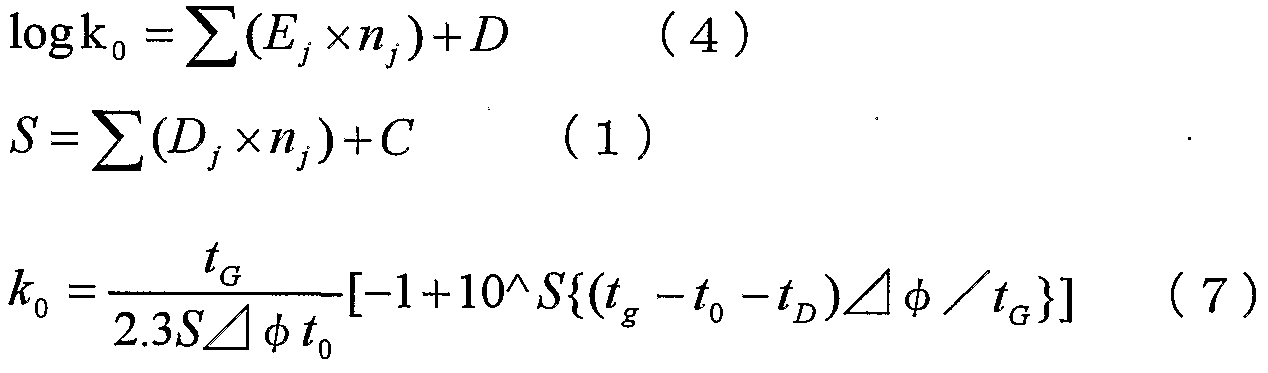
[式 (4 ) 、 (1 ) 及び (7 ) 中;
njは、 当該ペプチド中の各アミノ酸の個数であり、
Δ ψはグラジェントにおける移動相中の有機溶媒の変化量であり、
toはグラジェント時間であり、
toはカラムに保持されない試料の溶出時間であり、
tDは溶媒変化の遅延時間であり、
tgは当該ペプチドの保持時間である。 ]
1 0 . 工程 (e)が以下の工程;
(e') 工程 (a)で得られた当該ペプチドの保持時間、 工程 (d)で得られた S値を下 記式 (7 ) に代入し、 t0、 tD、 Δ ψ Ζΐ(3を変数にして koの実測値を計算し、 得
られた ko実測値の対数と、 工程 (c)で得られた ko推定値の対数との間で残差 平方和が最小になるように最小二乗法を行い to、 tD、 Δφ/tGを求めて、 koの 実測値を計算する工程
である、 請求項 9に記載の方法。 。 = [- l + 10AS{(t —t0 -ίΩ)Αφ/ία} ( 7 )
[式中; . ' .
Δψはグラジェントにおける移動相中の有機溶媒の変化量であり、
tGはグラジェント時間であり、
toは力ラムに保持されない試料の溶出時間であり、
tDは溶媒変化の遅延時間であり、
tgは当該ペプチドの保持時間である。 ]
1 1. 固定相が C18カラムであり、 移動相が 0.5%酢酸水と有機溶媒とからなる 緩衝液である請求項 9又は 10に記載の方法であって、
工程 (c)において、 請求項 4〜 6のいずれか一項に記載の方法により求め た各ァミノ酸の係数 ¾及ぴ定数項 Dに代えて、 表 1に記載の 及び Dを 用いる上記方法。
表 1 ko値の各アミノ酸の係数と定数項
^ D
A R N D C E Q G H I L K M F P S T W Y V
0.08 -0.27 -0.01 0.11 0.01 0.11 0.01 0.01 -0.28 0.4 0.49 -0.31 0.36 0.57 0.08 0.02 0.1 0.5 0.31 0.27 0.54
12. 固定相が C18カラムであり、 移動相が 0.5%酢酸水とァセトニトリルとか らなる緩衝液である請求項 9〜1 1のいずれか一項記載の方法であって、 工程 (d)において、 請求項 1〜 3のいずれか一項に記載の方法により求め た各ァミノ酸の係数 Dj及び定数項 Cに代えて、 表 2に記載の Dj及び Cを 用いる上記方法。
表 2
s値の各アミノ酸の係数と定数項
A R N D C E Q G H I L K M F P S T W Y V
0.22 0.2 0.36 0.6 0.37 0.48 0.43 0.16 -0.05 0.11 -0.07 0.21 -0.05 -0.07 0.35 0.31 0.23 -0.3 0.35 0.22 9.92 3. ある固定相及ぴある移動相により液体クロマトグラフィー分析を行ったと きのペプチドのアミノ酸組成と下記式 (8 ) 中の S 値との関係を解析する ためのシステムであって、
log k = log k0 - S ( 8)
[式中、
kは固定相中の当該ペプチドのモル数と、 移動相中の当該ペプチドのモル数 との比であり、
Φは移動相中の有機溶媒量であり、
log k0は Φ =0のときの log kの値であり、
. Sは当該ペプチドに固有の値である。 ]
以下の手段:
(a)ペプチドを、 当該固定相及び当該移動相の下で、 複数の分析条件で液体ク 口マトグラフィー分析して、 各ぺプチドの保持時間を測定する手段、
(b)手段 (a)で得られたペプチドの保持時間を、 保持時間、 S 値及び kQ値の関 係式に代入して、 S値と k0値を変数として保持時間の実測値と計算値の残 差平方和が最小となるように最小二乗法を行い、 当該ペプチドの S 値と k0値とを算出する手段、
(c) 当該べプチドのアミノ酸配列情報から当該ぺプチドのアミノ酸組成を求め る手段、 並びに
(d)複数のペプチドについて、 手段 (b)から得られた S 値と、 手段 (c)から得ら れたアミノ酸組成とを、 下記式 (1 ) に代入して線形重回帰分析を行って、 下記式 (1 ) の各アミノ酸の係数 Dj及び定数項 Cを求める手段
を含む、 上記システム。

[式中; njは、 当該ペプチド中の各アミノ酸の個数である。 ]
4 . ある固定相及びある移動相により液体クロマトグラフィー分析を行ったと きのペプチドのアミノ酸組成と下記式 (8 ) 中の k0値との関係を解析する ためのシステムであって、
log k = log k0 - S ( 8 )
[式中、
kは固定相中の当該ペプチドのモル数と、 移動相中の当該ペプチドのモル数 との比であり、
Φは移動相中の有機溶媒量であり、
log k0は φ =0のときの log kの値であり、
Sは当該ペプチドに固有の値である。 ]
以下の手段:
(a)ペプチドを、 当該固定相及び当該移動相の下で、 複数の分析条件で液体ク 口マトグラフィー分析して、 各ペプチドの保持時間を測定する手段、
(b)手段 (a)で得られたペプチドの保持時間を、 保持時間、 S 値及び kQ値の関 係式に代入して、 S値と k0値を変数として保持時間の実測値と計算値の残 差平方和が最小となるように最小二乗法を行い、 当該ペプチドの S 値と k0値とを算出する手段、
(c) 当該ぺプチドのァミノ酸配列情報から当該ぺプチドのァミノ酸組成を求め る手段、 並びに
(d)複数のペプチドについて、 手段 (b)から得られた k。値と、 手段 (c)から得ら れたアミノ酸組成とを、 下記式 (4 ) に代入して線形重回帰分析を行って、 下記式 (4 ) の各アミノ酸の係数 及び定数項 Dを求める手段
を含む、 上記システム。

[式中; njは、 当該ペプチド中の各アミノ酸の個数である。 ]
5 . ペプチドのアミノ酸配列の確かさを検証するためのシステムであって、 以 下の手段:
(a)ぺプチドを、 ある固定相及びある移動相により液体クロマトグラフィ一分 析を行ったときの、 ペプチドの保持時間を測定する手段、
(b)当該べプチドのアミノ酸配列情報から当該ぺプチドのアミノ酸組成を求め る手段、
(c)手段 (b)で得られたアミノ酸組成の情報、 並びに請求項 1 4に記載のシステ ムにより求めた各アミノ酸の係数 ¾及ぴ定数項 Dであって、 手段 (a)の当 該固定相及び当該移動相の下で求めたものを、 下記式 (4) に代入して、 当該ぺプチドの k0の推定値を計算する手段、
(d)手段 (b)で得られたァミノ酸組成の情報、 並びに請求項 1 3に記載のシステ ムにより求めた各アミノ酸の係数 Dj及び定数項 Cであって、 手段 (a)の当 該固定相及び当該移動相の下で求めたものを、 下記式 (1 ) に代入して、 当該ぺプチドの S値を計算する手段、
(e)手段 (a)で得られた当該ペプチドの保持時間、 手段 (d)で得られた S値、 並 ぴに手段 (a)の液体クロマトグラフィー分析条件において測定された t0、 tD、 tG、 a及ぴ Δφを、 下記式 (7) に代入して k0の実測値を計算する手段、 並びに
(f) 手段 (c)で得られた k0の推定値の対数と、 手段 (e)で得られた k0の実測値の 対数の差を指標として、 手段 (b)で同定されたぺプチド配列の確かさを判断 する手段
を含む、 上記システム。
logk0 = ( " (4)
S = ^(DJxnJ) + C ( 1 )
K [- 1+ ( -t0 ~ί0)Αφ α}] ( 7 )
2 J ZJ Φ ΐ0
[式 (4) 、 ( 1 ) 及び (7) 中;
njは、 当該ペプチド中の各アミノ酸の個数であり、
Δφはグラジェントにおける移動相中の有機溶媒の変化量であり、
tGはグラジェント時間であり、
toはカラムに保持されない試料の溶出時間であり、
tDは溶媒変化の遅延時間であり、
tgは当該ぺプチドの保持時間である。 ]
6 . ある固定相及びある移動相により液体クロマトグラフィー分析を行ったと きのペプチドのアミノ酸組成と下記式 (8 ) 中の S 値との関係を解析する ためのプログラムであって、
log k = log ko - S ( 8 )
[式中、
kは固定相中の当該べプチドのモル数と、 移動相中の当該べプチドのモル数 との比であり、
Φは移動相中の有機溶媒量であり、
log koは φ =0のときの log kの値であり、
Sは当該ペプチドに固有の値である。 ]
コンピュータを、 以下の手段:
(a)ペプチドを、 当該固定相及ぴ当該移動相の下で、 複数の分析条件で液体ク 口マトグラフィー分析して、 各ぺプチドの保持時間を測定する手段、
(b)手段 (a)で得られたペプチドの保持時間を、 保持時間、 S 値及び ko値の関 係式に代入して、 S値と ko値を変数として保持時間の実測値と計算値の残 差平方和が最小となるように最小二乗法を行い、 当該ペプチドの S 値と ko値とを算出する手段、
(c) 当該べプチドのアミノ酸配列情報から当該べプチドのアミノ酸組成を求め る手段、 並びに
(d)複数のペプチドについて、 手段 (b)から得られた S 値と、 手段 (c)から得ら れたアミノ酸組成とを、 下記式 (1 ) に代入して線形重回帰分析を行って、 下記式 (1 ) の各アミノ酸の係数 Dj及び定数項 Cを求める手段
として機能させるためのプログラム。
S =∑(DJ x nJ ) + C ( 1 )
[式中; Iljは、 当該ペプチド中の各アミノ酸の個数である。 ]
7 . ある固定相及びある移動相により液体クロマトグラフィー分析を行ったと きのペプチドのアミノ酸組成と下記式 (8 ) 中の k0値との関係を解析する ためのプログラムであって、
log k = log k0 - S φ ( 8 )
[式中、
kは固定相中の当該ペプチドのモル数と、 移動相中の当該ペプチドのモル数 との比であり、.
Φは移動相中の有機溶媒量であり、
log koは ψ =0のときの log kの値であり、
Sは当該ペプチドに固有の値である。 ]
コンピュータを、 以下の手段:
(a)ペプチドを、 当該固定相及ぴ当該移動相の下で、 複数の分析条件で液体ク 口マトグラフィー分析して、 各ペプチドの保持時間を測定する手段、
(b)手段 (a)で得られたペプチドの保持時間を、 保持時間、 S 値及び k0値の関 係式に代入して、 S値と k0値を変数として保持時間の実測値と計算値の残 差平方和が最小となるように最小二乗法を行い、 当該ペプチドの S 値と k0値とを算出する手段、
(c) 当該ぺプチドのアミノ酸配列情報から当該べプチドのアミノ酸組成を求め る手段、 並びに
(d)複数のペプチドについて、 手段 (b)から得られた k0値と、 手段 (c)から得ら れたアミノ酸組成とを、 下記式 (4 ) に代入して線形重回帰分析を行って、 下記式 (4 ) の各アミノ酸の係数 及び定数項 Dを求める手段
として機能させるためのプログラム。
logk0 =∑ ( χ " + ( 4 )
[式中; njは、 当該ペプチド中の各アミノ酸の個数である。 ]
8 . ペプチドのアミノ酸配列の確かさを検証するためのプログラムあって、 コ ンピュータを、 以下の手段:
(a)ぺプチドを、 ある固定相及びある移動相により液体クロマトグラフィ一分 - 析を行ったときの、 ペプチドの保持時間を測定する手段、
(b)当該べプチドのアミノ酸配列情報から当該べプチドのアミノ酸組成を求め る手段、
(c)手段 (b)で得られたァミノ酸組成の情報、 並びに請求項 1 7に記載のプログ ラムにより求めた各アミノ酸の係数 ¾及ぴ定数項 Dであって、 手段 (a)の 当該固定相及び当該移動相の下で求めたものを、 下記式 (4 ) に代入して、 当該べプチドの koの推定値を計算する手段、
(d)手段 (b)で得られたァミノ酸組成の情報、 並びに請求項 1 6に記載のプログ ラムにより求めた各アミノ酸の係数 及ぴ定数項 Cであって、 手段 (a)の 当該固定相及び当該移動相の下で求めたものを、 下記式 (1 ) に代入して、 当該ぺプチドの S値を計算する手段、
(e)手段 (a)で得られた当該ペプチドの保持時間、 手段 (d)で得られた S 値、 並 ぴに手段 (a)の液体クロマトグラフィー分析条件にいて測定された t0、 tD、 tG、 a及ぴ Δ φを、 下記式 (7 ) に代入して koの実測値を計算する手段、 並びに
(f) 手段 (c)で得られた koの推定値の対数と、 手段 (e)で得られた koの実測値の 対数の差を指標として、 手段 (b)で同定されたべプチド配列の確かさを判断 する手段
として機能させるためのプログラム。

S =∑ ( ゾ X " + C ( 1 )
Κ
 ( 7 )
( 7 )
[式 (4 ) 、 ( 1 ) 及び (7 ) 中;
njは、 当該ペプチド中の各アミノ酸の個数であり、
Δ φはグラジェントにおける移動相中の有機溶媒の変化量であり、
tGはグラジェント時間であり、
toはカラムに保持されない試料の溶出時間であり、 tDは溶媒変化の遅延時間であり、
tgは当該ペプチドの保持時間である。 ]
Applications Claiming Priority (2)
| Application Number | Priority Date | Filing Date | Title |
|---|---|---|---|
| JP2005221994 | 2005-07-29 | ||
| JP2005-221994 | 2005-07-29 |
Publications (1)
| Publication Number | Publication Date |
|---|---|
| WO2007013701A1 true WO2007013701A1 (ja) | 2007-02-01 |
Family
ID=37683568
Family Applications (1)
| Application Number | Title | Priority Date | Filing Date |
|---|---|---|---|
| PCT/JP2006/315549 Ceased WO2007013701A1 (ja) | 2005-07-29 | 2006-07-31 | クロマトグラフィー保持時間によりペプチド配列を検定する方法 |
Country Status (1)
| Country | Link |
|---|---|
| WO (1) | WO2007013701A1 (ja) |
Cited By (1)
| Publication number | Priority date | Publication date | Assignee | Title |
|---|---|---|---|---|
| JP2017138248A (ja) * | 2016-02-05 | 2017-08-10 | 株式会社島津製作所 | 液体クロマトグラフ装置 |
-
2006
- 2006-07-31 WO PCT/JP2006/315549 patent/WO2007013701A1/ja not_active Ceased
Non-Patent Citations (3)
| Title |
|---|
| VIVO-TRUYOLS G.: "Error analysis and performance of different retention models in the transference of data from/to isocratic/gradient elution", JOURNAL OF CHROMATOGRAPHY A, vol. 1018, 2003, pages 169 - 181, XP004463121 * |
| YOSHIDA T.: "Calculation of peptide retention coefficients in normal-phase liquid chromatography", JOURNAL OF CHROMATOGRAPHY, vol. 808, 1998, pages 105 - 112, XP004122664 * |
| YOSHIDA T.: "Prediction of peptide retention times in normal-phase liquid chromatography with only a single gradient run", JOURNAL OF CHROMATOGRAPHY A, vol. 841, 1999, pages 19 - 32, XP004165244 * |
Cited By (1)
| Publication number | Priority date | Publication date | Assignee | Title |
|---|---|---|---|---|
| JP2017138248A (ja) * | 2016-02-05 | 2017-08-10 | 株式会社島津製作所 | 液体クロマトグラフ装置 |
Similar Documents
| Publication | Publication Date | Title |
|---|---|---|
| de Godoy et al. | Status of complete proteome analysis by mass spectrometry: SILAC labeled yeast as a model system | |
| Olsen et al. | Improved peptide identification in proteomics by two consecutive stages of mass spectrometric fragmentation | |
| Olsen et al. | Trypsin cleaves exclusively C-terminal to arginine and lysine residues | |
| Geiger et al. | Proteomics on an Orbitrap benchtop mass spectrometer using all-ion fragmentation | |
| Jensen et al. | Mass spectrometric identification and microcharacterization of proteins from electrophoretic gels: strategies and applications | |
| Aebersold | A mass spectrometric journey into protein and proteome research | |
| Egelhofer et al. | Protein identification by MALDI-TOF-MS peptide mapping: a new strategy | |
| Poutanen et al. | Use of matrix‐assisted laser desorption/ionization time‐of‐flight mass mapping and nanospray liquid chromatography/electrospray ionization tandem mass spectrometry sequence tag analysis for high sensitivity identification of yeast proteins separated by two‐dimensional gel electrophoresis | |
| US12367950B2 (en) | Glycan structure analyzer and glycan structure analysis program | |
| Meier et al. | Parallel accumulation–serial fragmentation combined with data-independent acquisition (diaPASEF): Bottom-up proteomics with near optimal ion usage | |
| WO2007044935A2 (en) | Methods for the development of a biomolecule assay | |
| Goodlett et al. | Proteomics without polyacrylamide: qualitative and quantitative uses of tandem mass spectrometry in proteome analysis | |
| Bollinger et al. | Selecting optimal peptides for targeted proteomic experiments in human plasma using in vitro synthesized proteins as analytical standards | |
| Couttas et al. | Immonium ion scanning for the discovery of post-translational modifications and its application to histones | |
| Le Bihan et al. | Definition and characterization of a “trypsinosome” from specific peptide characteristics by nano-HPLC− MS/MS and in silico analysis of complex protein mixtures | |
| Perez-Riverol et al. | In silico analysis of accurate proteomics, complemented by selective isolation of peptides | |
| Sergeant et al. | De novo sequence analysis of N‐terminal sulfonated peptides after in‐gel guanidination | |
| WO2007013701A1 (ja) | クロマトグラフィー保持時間によりペプチド配列を検定する方法 | |
| Kayser et al. | Defining parameters for homology-tolerant database searching | |
| Takemori et al. | Enzymatic protein digestion using a dissolvable polyacrylamide gel and its application to mass spectrometry-based proteomics | |
| Wu et al. | RT‐PSM, a real‐time program for peptide‐spectrum matching with statistical significance | |
| Tripković et al. | Electrospray ionization linear trap quadrupole Orbitrap in analysis of old tempera paintings: application to nineteenth-century Orthodox icons | |
| Solovyeva et al. | Viqc: visual and intuitive quality control for mass spectrometry-based proteome analysis | |
| Brownstein et al. | Paired single residue‐transposed Lys‐N and Lys‐C digestions for label‐free identification of N‐terminal and C‐terminal MS/MS peptide product ions: ultrahigh resolution Fourier transform ion cyclotron resonance mass spectrometry and tandem mass spectrometry for peptide de novo sequencing | |
| Schnatbaum et al. | Fast and accurate determination of cysteine reduction and alkylation efficacy in proteomics workflows |
Legal Events
| Date | Code | Title | Description |
|---|---|---|---|
| 121 | Ep: the epo has been informed by wipo that ep was designated in this application | ||
| NENP | Non-entry into the national phase |
Ref country code: DE |
|
| 122 | Ep: pct application non-entry in european phase |
Ref document number: 06796305 Country of ref document: EP Kind code of ref document: A1 |
|
| NENP | Non-entry into the national phase |
Ref country code: JP |