WO2007012983A2 - Process of producing amorolfine - Google Patents
Process of producing amorolfine Download PDFInfo
- Publication number
- WO2007012983A2 WO2007012983A2 PCT/IB2006/003210 IB2006003210W WO2007012983A2 WO 2007012983 A2 WO2007012983 A2 WO 2007012983A2 IB 2006003210 W IB2006003210 W IB 2006003210W WO 2007012983 A2 WO2007012983 A2 WO 2007012983A2
- Authority
- WO
- WIPO (PCT)
- Prior art keywords
- compound
- formula
- hcl
- methylbutane
- temperature
- Prior art date
- Legal status (The legal status is an assumption and is not a legal conclusion. Google has not performed a legal analysis and makes no representation as to the accuracy of the status listed.)
- Ceased
Links
- LLNAMUJRIZIXHF-VQHVLOKHSA-N C/C(/CO)=C\c1ccccc1 Chemical compound C/C(/CO)=C\c1ccccc1 LLNAMUJRIZIXHF-VQHVLOKHSA-N 0.000 description 1
- 0 C[C@]1O[C@](C)C*C1 Chemical compound C[C@]1O[C@](C)C*C1 0.000 description 1
Classifications
-
- C—CHEMISTRY; METALLURGY
- C07—ORGANIC CHEMISTRY
- C07D—HETEROCYCLIC COMPOUNDS
- C07D295/00—Heterocyclic compounds containing polymethylene-imine rings with at least five ring members, 3-azabicyclo [3.2.2] nonane, piperazine, morpholine or thiomorpholine rings, having only hydrogen atoms directly attached to the ring carbon atoms
- C07D295/02—Heterocyclic compounds containing polymethylene-imine rings with at least five ring members, 3-azabicyclo [3.2.2] nonane, piperazine, morpholine or thiomorpholine rings, having only hydrogen atoms directly attached to the ring carbon atoms containing only hydrogen and carbon atoms in addition to the ring hetero elements
- C07D295/027—Heterocyclic compounds containing polymethylene-imine rings with at least five ring members, 3-azabicyclo [3.2.2] nonane, piperazine, morpholine or thiomorpholine rings, having only hydrogen atoms directly attached to the ring carbon atoms containing only hydrogen and carbon atoms in addition to the ring hetero elements containing only one hetero ring
- C07D295/03—Heterocyclic compounds containing polymethylene-imine rings with at least five ring members, 3-azabicyclo [3.2.2] nonane, piperazine, morpholine or thiomorpholine rings, having only hydrogen atoms directly attached to the ring carbon atoms containing only hydrogen and carbon atoms in addition to the ring hetero elements containing only one hetero ring with the ring nitrogen atoms directly attached to acyclic carbon atoms
Definitions
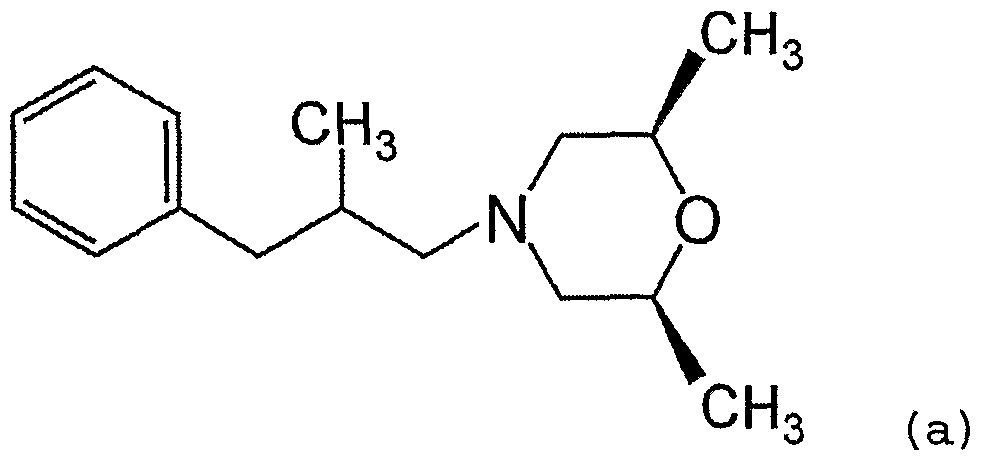
- the present invention relates to an improved process of producing Amorolfine base, which is an intermediate used in the production of Amorolfine (AMF) hydrochloride (Amorolfine HCl) .
- Amorolfine HCl is an active pharmaceutical ingredient (API) used in topical antimycotic (antifungal) compositions.
- the suggested catalysts are those known for use as Friedel-Crafts catalysts, such as aluminium chloride, iron chloride, lead chloride, zinc chloride, boron trifluoride, hydrogen fluoride, sulphuric acid, and phosphoric acid. Sulfuric acid is stated to be the preferred catalyst.
- FR 2,463,767 suggests using tertiary alcohols such as 2-methyl-2-butanol, or tertiary chlorides such as 2-chloro-2-methylbutane .
- 2-methyl-2-butanol is exemplified.
- the reaction temperature is noted as not being of critical importance but is suggested to be, in general, between 0 and 50 0 C, preferably between 18 and 20 0 C.
- the present invention provides an improved method of producing Amorolfine base, with a higher yield and lower impurity assay resulting.
- step (ii) adding one equivalent of 2-halogeno-2 ⁇ methylbutane, characterised in that the reaction mixture obtained in step (i) is cooled to a temperature between -40 to -60 0 C prior to step (ii) (addition of the 2- halogeno-2 -methylbutane) .
- Amorolfine base refers to compounds of formula (I) and the term “bepromoline HCl” refers to compounds of formula (II) .
- 2-halogeno-2-methylbutane refers to 2-methylbutane substituted in position 2 by an halogen atom chosen from the group consisting of bromine, chlorine, iodine, fluorine.
- the halogen is chlorine and consequently the 2-halogeno-2-methylbutane is 2- chloro-2-methylbutane .
- the reaction mixture obtained in step (i) may typically be cooled to a temperature between -40 to -60 0 C, generally -50 0 C, prior to step (ii) , i.e. addition of the 2-halogeno-2-methylbutane.
- Friedel-Crafts catalyst FeCl 3 is generally used in dichloromethane (DCM) . Moreover the compound of formula (II) is generally present in 1 part of 2-halogeno-2-methylbutane per 1 part compound of formula (II) .
- the process of producing a compound of formula (I) includes, after steps (i) and (ii) above, one or more of the following steps:
- step (a) pouring the reaction mixture from step (ii) onto an ice-water mixture; (b) separating the organic phase (i.e. DCM);
- step (e) washing the organic phase from step (d) with a solution of sodium phosphate
- step (f) washing the organic phase from step (e) with a solution of sodium hydroxide
- step (g) washing the organic phase from step (f) with water; (h) exchanging the dichloromethane solvent to toluene;
- step (i) performing toluene/water extractions; (j) removing the toluene by distillation; and (k) distilling the crude Amorolfine base from step (j).
- step (ii) adding 2-chloro-2-methylbutane, characterised in that the reaction mixture obtained in step (i) is cooled to a temperature between -40 to -60 0 C prior to step (ii) (addition of the 2- chloro-2-methylbutane) .
- This process can be performed as described above and can comprise one or more of the steps (a) to (k) above .
- (I) comprises steps (i) and (ii) . Said steps can be preceded by the step of contacting a compound of the formula (III) :
- step of contacting the compound of the formula (III) with the compound of formula (IV) is optionally conducted under basic conditions, with acetic acid added once the consumption of the hydrogen gas has ceased.
- the basic conditions are generally provided by KOH, typically, 1.8 mol-% KOH.
- This compound of formula (V) can be obtained from Amorolfine base (compound (I) ) thanks to a salification step.
- the catalyst is then filtered off and the methanol is removed by distillation.
- Toluene is added and the inorganic components are removed by washing with water. Toluene and unreacted DMM are distilled off. Then fresh toluene is added and HCl gas is bubbled through the solution. The pH is adjusted to 3-4. The bepromoline HCl is centrifuged and dried.
- Methanol might be substituted by toluene to avoid the later solvent exchange step.
- Temperature of Hydrogenation 40 0 C is the optimum temperature for both hydrogenation steps. However, the temperature may typically be set at no more than 45 0 C, preferably between 30 and 45 0 C.
- a molar ratio of acetic acid to KOH is around 1.3 (+10%) .
- the acetic acid is typically added at a temperature range of between 40 to 45 0 C, and no more than 45 0 C.
- the toluene is advantageously added to facilitate the phase separations and the distillation step of the un-reacted DMM, thus improving the purity of bepromoline .
- trans isomers (VI) and (VII) of bepromoline, coming from trans isomers presents as by products in the 2,6-dimethyl morpholine starting material, are partially eliminated during the crystallization of bepromoline HCl.
- the purity of the bepromoline HCl (cis isomer) is superior or equal to 99,5%.
- the product is stable up to 150 0 C.
- a reactor was charged with 146 kg ⁇ -methyl- cinnamaldehyde, 115 kg cis-2, 6-dimethyl-morpholine, 2.1 kg 50% KOH, 278 kg methanol and 5.8 kg of a palladium/carbon catalyst and then filled with hydrogen at 15-25 0 C.
- the hydrogenation was then run at a pressure of ⁇ 2 bar and 35-45 0 C until H 2 consumption ceased.
- reaction mixture was filtered and the catalyst washed with methanol and purified water
- the solvents were distilled of at a temperature of up to 95 0 C under vacuum.
- the reactor was charged with 904 kg toluene and 33 kg HCl gas at a temperature of up to 50 0 C. Then the pH was adjusted to 3 - 4. The reaction mixture was cooled and then stored under agitation sufficiently to reached complete cristallization.
- the mixture was centrifuged and washed with cold (0- 5 0 C) toluene.
- a second crop of Bepromoline HCl was isolated from the mother liquor.
- the process yielded 287 kg wet bepromoline HCl, which was then dried at 60 0 C under vacuum.
- the first crop of Bepromoline HCl was 227kg and the second 18kg. This corresponds to a yield of 5 87%. (80% for the first crop Bepromoline HCl and 7% for the second crop)
- reaction mixture is poured onto an ice-
- a suitable molar ratio of FeCl 3 to bepromoline is 1:2 to 1:5 equivalents of catalyst. 1.3 equivalents of FeCl 3 is preferred.
- reaction Temperature for Friedel-Crafts Alkylation To decrease the fenpropimorph (FPM) by-product, the reaction is conducted at low temperature, preferably -50 0 C (see Table 2) :
- FPM Fenpoprimorph
- FPM Fenpropimorph
- Ratio of Bepromoline HCl to 2-chloro-2-methylbutane Batches were performed with 10 % excess 2-chloro-2- methylbutane and at a 1:1 ratio.
- the FPM assay is lower for the 1:1 ratio and thus this proportion is preferred.
- the Amorolfine HCl (which is in the DCM) is converted to the free base during these extractions. Phosphate was used to remove traces of Fe.
- the reactor was charged with 212 kg FeCl 3 and 757 kg DCM. 284 kg bepromoline HCl in 946 kg DCM were added to the reactor at 20-30 0 C.
- the reaction mixture was completed with 213 kg DCM and cooled to -50 0 C. 107 kg 2-chloro-2-methylbutane in 107 kg DCM were added at -50 0 C, although a temperature of -60 to -45 0 C is acceptable, and stirred for 2.5 hours. Hydrolysis was performed using 255 kg ice and 785 kg water.
- Extractions using slightly acidic water (water and diluted HCl) were performed, followed by a further extraction with a solution of Na 3 PO 4 in water.
- a subsequent extraction was conducted using NaOH diluted in water to a pH >>13.
- pH a pH
- Two washes were performed with water.
- the solvent was distilled off .
- the distillation step is necessary to purify
- AMF base Apart from PPM, all impurities present in AMF base are removed firstly by the salification of AMF base into AMF HCl and secondly by one crystallization step from ethanol .
- the temperature raises by around 35 0 C. This exotherm is used to warm the batch. After the addition of HCl the temperature is raised to a level that ensures that the reaction mixture is in solution.
- the final temperature of -20 to -15°C is important to obtain an optimum yield .
- Ethanol is the preferred solvent.
- the Amorolfine HCl is dissolved in hot ethanol and this solution is filtered to remove foreign matter. The filtrate is then cooled to -15 to -2O 0 C to get the optimum yield for cristallization. After centrifugation, the crystals are washed with an appropriate amount of ethanol .
- the reactor was charged with 317 kg AMF and 640 kg ethanol. 38 kg HCl gas was added at 10-65 0 C. The reaction mixture was then heated to 60 0 C, followed by cooling to -15 to -20 0 C. The mixture was stored for 30 minutes to 2 hours.
- the Amorolfine HCl was centrifuged and washed with 210 kg of ethanol.
- the hot solution was filtered and the filter rinced with 15 kg hot ethanol .
- the filtrate was then cooled to -15 to -20 0 C and stored for 30 minutes to 2 hours .
- the crystallized Amorolfine HCl was centrifuged and washed with 210 kg of ethanol.
- the mixture was then dried at a temperature of 60 0 C under vacuum ( ⁇ 100 mbar) .
Landscapes
- Chemical & Material Sciences (AREA)
- Organic Chemistry (AREA)
- Organic Low-Molecular-Weight Compounds And Preparation Thereof (AREA)
- Low-Molecular Organic Synthesis Reactions Using Catalysts (AREA)
- Pharmaceuticals Containing Other Organic And Inorganic Compounds (AREA)
- Heterocyclic Carbon Compounds Containing A Hetero Ring Having Nitrogen And Oxygen As The Only Ring Hetero Atoms (AREA)
Abstract
Description



Claims


Priority Applications (8)
| Application Number | Priority Date | Filing Date | Title |
|---|---|---|---|
| JP2008523486A JP2009502901A (en) | 2005-07-28 | 2006-07-27 | Method for producing amorolfine |
| BRPI0606197A BRPI0606197B8 (en) | 2005-07-28 | 2006-07-27 | processes for the production of compounds |
| CA2601149A CA2601149C (en) | 2005-07-28 | 2006-07-27 | Process of producing amorolfine |
| DE602006004360T DE602006004360D1 (en) | 2005-07-28 | 2006-07-27 | PROCESS FOR THE PREPARATION OF AMOROLFIN |
| PL06809226T PL1917254T3 (en) | 2005-07-28 | 2006-07-27 | Process of producing amorolfine |
| US11/795,033 US20090163711A1 (en) | 2005-07-28 | 2006-07-27 | Process of producing amorolfine base |
| EP06809226A EP1917254B1 (en) | 2005-07-28 | 2006-07-27 | Process of producing amorolfine |
| DK06809226T DK1917254T3 (en) | 2005-07-28 | 2006-07-27 | Procedure for Preparing Amorolfine |
Applications Claiming Priority (2)
| Application Number | Priority Date | Filing Date | Title |
|---|---|---|---|
| EP05291612A EP1749825A1 (en) | 2005-07-28 | 2005-07-28 | Process of producing amorolfine |
| EP05291612.9 | 2005-07-28 |
Publications (2)
| Publication Number | Publication Date |
|---|---|
| WO2007012983A2 true WO2007012983A2 (en) | 2007-02-01 |
| WO2007012983A3 WO2007012983A3 (en) | 2007-05-03 |
Family
ID=35044548
Family Applications (1)
| Application Number | Title | Priority Date | Filing Date |
|---|---|---|---|
| PCT/IB2006/003210 Ceased WO2007012983A2 (en) | 2005-07-28 | 2006-07-27 | Process of producing amorolfine |
Country Status (15)
| Country | Link |
|---|---|
| US (1) | US20090163711A1 (en) |
| EP (2) | EP1749825A1 (en) |
| JP (1) | JP2009502901A (en) |
| AR (1) | AR057087A1 (en) |
| AT (1) | ATE417839T1 (en) |
| BR (1) | BRPI0606197B8 (en) |
| CA (1) | CA2601149C (en) |
| CY (1) | CY1108884T1 (en) |
| DE (1) | DE602006004360D1 (en) |
| DK (1) | DK1917254T3 (en) |
| ES (1) | ES2319819T3 (en) |
| PL (1) | PL1917254T3 (en) |
| PT (1) | PT1917254E (en) |
| SI (1) | SI1917254T1 (en) |
| WO (1) | WO2007012983A2 (en) |
Cited By (5)
| Publication number | Priority date | Publication date | Assignee | Title |
|---|---|---|---|---|
| EP1935889A1 (en) * | 2006-12-21 | 2008-06-25 | Galderma S.A. | Process of producing amorolfine |
| WO2010094739A1 (en) | 2009-02-20 | 2010-08-26 | Synteco S.P.A. - Prodotti Di Sintesi Per L'industria Chimica E Farmaceutica | Process for the purification of amorolfine hydrochloride |
| WO2011003455A1 (en) * | 2009-07-09 | 2011-01-13 | Cilag Ag | Method for producing 4-(alkyl)-1-(2-methyl-3-(2,6-dimethylmorpholine)propyl) benzol compounds |
| WO2011066735A1 (en) * | 2009-12-01 | 2011-06-09 | Zhejiang Hisoar Pharmaceutical Co., Ltd | An Amorolfine HCl Crystal and the Preparation thereof |
| KR101371881B1 (en) | 2008-12-04 | 2014-03-07 | 에프. 호프만-라 로슈 아게 | Pyridazinone derivatives |
Families Citing this family (2)
| Publication number | Priority date | Publication date | Assignee | Title |
|---|---|---|---|---|
| CN108997246B (en) * | 2017-06-06 | 2021-08-31 | 江苏礼华生物技术有限公司 | Preparation method of amorolfine hydrochloride |
| CN109232458A (en) * | 2018-06-15 | 2019-01-18 | 南通常佑药业科技有限公司 | A kind of preparation method of chirality morpholinium compound |
Family Cites Families (3)
| Publication number | Priority date | Publication date | Assignee | Title |
|---|---|---|---|---|
| ATE3111T1 (en) * | 1978-08-08 | 1983-05-15 | F. Hoffmann-La Roche & Co. Aktiengesellschaft | PROCESS FOR THE PREPARATION OF PHENYL-PROPYLMORPHOLINE AND PIPERIDINE DERIVATIVES. |
| IT1220970B (en) | 1979-08-17 | 1990-06-21 | Hoffmann La Roche | HETEROCYCLIC COMPOUNDS WITH PARTICULAR FUNGICIDE ACTION FOR THE FIGHT AGAINST CANDIDA ALBICANS |
| FR2589858A1 (en) * | 1985-11-14 | 1987-05-15 | Exxon Production Research Co | Process for selective alkylation of aromatic compounds |
-
2005
- 2005-07-28 EP EP05291612A patent/EP1749825A1/en not_active Withdrawn
-
2006
- 2006-07-27 DK DK06809226T patent/DK1917254T3/en active
- 2006-07-27 SI SI200630146T patent/SI1917254T1/en unknown
- 2006-07-27 BR BRPI0606197A patent/BRPI0606197B8/en active IP Right Grant
- 2006-07-27 US US11/795,033 patent/US20090163711A1/en not_active Abandoned
- 2006-07-27 WO PCT/IB2006/003210 patent/WO2007012983A2/en not_active Ceased
- 2006-07-27 PL PL06809226T patent/PL1917254T3/en unknown
- 2006-07-27 DE DE602006004360T patent/DE602006004360D1/en active Active
- 2006-07-27 PT PT06809226T patent/PT1917254E/en unknown
- 2006-07-27 EP EP06809226A patent/EP1917254B1/en active Active
- 2006-07-27 ES ES06809226T patent/ES2319819T3/en active Active
- 2006-07-27 AR ARP060103246A patent/AR057087A1/en not_active Application Discontinuation
- 2006-07-27 JP JP2008523486A patent/JP2009502901A/en not_active Withdrawn
- 2006-07-27 AT AT06809226T patent/ATE417839T1/en active
- 2006-07-27 CA CA2601149A patent/CA2601149C/en not_active Expired - Fee Related
-
2009
- 2009-03-17 CY CY20091100295T patent/CY1108884T1/en unknown
Cited By (6)
| Publication number | Priority date | Publication date | Assignee | Title |
|---|---|---|---|---|
| EP1935889A1 (en) * | 2006-12-21 | 2008-06-25 | Galderma S.A. | Process of producing amorolfine |
| WO2008074887A1 (en) * | 2006-12-21 | 2008-06-26 | Galderma S.A. | Process of producing amorolfine |
| KR101371881B1 (en) | 2008-12-04 | 2014-03-07 | 에프. 호프만-라 로슈 아게 | Pyridazinone derivatives |
| WO2010094739A1 (en) | 2009-02-20 | 2010-08-26 | Synteco S.P.A. - Prodotti Di Sintesi Per L'industria Chimica E Farmaceutica | Process for the purification of amorolfine hydrochloride |
| WO2011003455A1 (en) * | 2009-07-09 | 2011-01-13 | Cilag Ag | Method for producing 4-(alkyl)-1-(2-methyl-3-(2,6-dimethylmorpholine)propyl) benzol compounds |
| WO2011066735A1 (en) * | 2009-12-01 | 2011-06-09 | Zhejiang Hisoar Pharmaceutical Co., Ltd | An Amorolfine HCl Crystal and the Preparation thereof |
Also Published As
| Publication number | Publication date |
|---|---|
| ES2319819T3 (en) | 2009-05-12 |
| CA2601149A1 (en) | 2007-02-01 |
| EP1917254A2 (en) | 2008-05-07 |
| WO2007012983A3 (en) | 2007-05-03 |
| BRPI0606197B1 (en) | 2021-03-30 |
| ATE417839T1 (en) | 2009-01-15 |
| EP1917254B1 (en) | 2008-12-17 |
| BRPI0606197A2 (en) | 2009-06-02 |
| SI1917254T1 (en) | 2009-04-30 |
| CA2601149C (en) | 2011-01-04 |
| JP2009502901A (en) | 2009-01-29 |
| AR057087A1 (en) | 2007-11-14 |
| DK1917254T3 (en) | 2009-03-16 |
| EP1749825A1 (en) | 2007-02-07 |
| CY1108884T1 (en) | 2014-07-02 |
| DE602006004360D1 (en) | 2009-01-29 |
| PT1917254E (en) | 2009-02-23 |
| PL1917254T3 (en) | 2009-06-30 |
| US20090163711A1 (en) | 2009-06-25 |
| BRPI0606197B8 (en) | 2021-05-25 |
Similar Documents
| Publication | Publication Date | Title |
|---|---|---|
| JP5988272B2 (en) | Oxycodone synthesis and purification process | |
| US8242268B2 (en) | Production of bepromoline | |
| US20110039934A1 (en) | Process for the preparation of derivatives of 1-(2- halobiphenyl-4-yl)-cyclopropanecarboxylic acid | |
| EP2097398B1 (en) | Process of producing amorolfine free base | |
| JP2024009896A (en) | Method for producing prostaglandin analogs that donate nitric oxide | |
| CA2601149C (en) | Process of producing amorolfine | |
| CN1251106A (en) | Method for debenzylation of dibenzyl biotin | |
| CN114174261B (en) | Method for preparing nitric oxide donor prostaglandin analogs | |
| EP1673365B1 (en) | Process for the preparation of z-flupentixol | |
| US20050272933A1 (en) | Preparation of derivatized dithiols | |
| CN101336228A (en) | The preparation method of iohexol | |
| CN115872873B (en) | Recrystallization purification method of bis (2-bromoethyl) amine hydrobromide | |
| JP5087059B2 (en) | Process for producing 4- (2-methyl-1-imidazolyl) -2,2-diphenylbutanamide | |
| JP4529116B2 (en) | Method for producing high-purity tritylpiperazine derivative | |
| JP2002338558A (en) | Method for producing (4-alkyl-1-piperazinylmethyl) benzoic acid derivative | |
| KR100342919B1 (en) | A preparation and purification for trans isomer of tramadol hydrochloride | |
| WO2011150950A1 (en) | 2-methyl-5-vinylpyridinium salts | |
| JPH06329655A (en) | Production of polyalkyl-2-alkoxy-7-hydroxychroman | |
| WO2004106309A1 (en) | A process for preparing 1-methyl-3-phenylpiperazine | |
| JPS6141499B2 (en) | ||
| KR20150019216A (en) | Process of isolating methyl-4-formylbenzoate and dimethylterephtalate with high yield | |
| JP2003146984A (en) | Method for purifying 3-methylthiophene-2-carbaldehyde |
Legal Events
| Date | Code | Title | Description |
|---|---|---|---|
| 121 | Ep: the epo has been informed by wipo that ep was designated in this application | ||
| WWE | Wipo information: entry into national phase |
Ref document number: 2006809226 Country of ref document: EP |
|
| WWE | Wipo information: entry into national phase |
Ref document number: 2601149 Country of ref document: CA |
|
| WWE | Wipo information: entry into national phase |
Ref document number: 2008523486 Country of ref document: JP |
|
| NENP | Non-entry into the national phase |
Ref country code: DE |
|
| WWP | Wipo information: published in national office |
Ref document number: 2006809226 Country of ref document: EP |
|
| WWE | Wipo information: entry into national phase |
Ref document number: 11795033 Country of ref document: US |
|
| ENP | Entry into the national phase |
Ref document number: PI0606197 Country of ref document: BR Kind code of ref document: A2 |