WO2006133147A2 - Organic compounds - Google Patents

Organic compounds Download PDF

Info

Publication number
WO2006133147A2
WO2006133147A2 PCT/US2006/021850 US2006021850W WO2006133147A2 WO 2006133147 A2 WO2006133147 A2 WO 2006133147A2 US 2006021850 W US2006021850 W US 2006021850W WO 2006133147 A2 WO2006133147 A2 WO 2006133147A2
Authority
WO
WIPO (PCT)
Prior art keywords
phenyl
methylamino
oxo
propionamide
dihydro
Prior art date
Legal status (The legal status is an assumption and is not a legal conclusion. Google has not performed a legal analysis and makes no representation as to the accuracy of the status listed.)
Ceased
Application number
PCT/US2006/021850
Other languages
French (fr)
Other versions
WO2006133147A3 (en
Inventor
Zhuoliang Chen
Mark G. Palermo
Sushil K. Sharma
Troy Smith
Christopher S. Straub
Run-Ming D. Wang
Yaping Wang
Leigh Zawel
Current Assignee (The listed assignees may be inaccurate. Google has not performed a legal analysis and makes no representation or warranty as to the accuracy of the list.)
Novartis Pharma GmbH
Novartis AG
Original Assignee
Novartis Pharma GmbH
Novartis AG
Priority date (The priority date is an assumption and is not a legal conclusion. Google has not performed a legal analysis and makes no representation as to the accuracy of the date listed.)
Filing date
Publication date
Priority to CN2006800202223A priority Critical patent/CN101193908B/en
Application filed by Novartis Pharma GmbH, Novartis AG filed Critical Novartis Pharma GmbH
Priority to MX2007015419A priority patent/MX2007015419A/en
Priority to EP06760702A priority patent/EP1902065A2/en
Priority to US11/916,887 priority patent/US7989441B2/en
Priority to AU2006255084A priority patent/AU2006255084A1/en
Priority to CA002610396A priority patent/CA2610396A1/en
Priority to JP2008515811A priority patent/JP2008545780A/en
Priority to BRPI0611922-0A priority patent/BRPI0611922A2/en
Publication of WO2006133147A2 publication Critical patent/WO2006133147A2/en
Publication of WO2006133147A3 publication Critical patent/WO2006133147A3/en
Anticipated expiration legal-status Critical
Priority to US13/161,166 priority patent/US20110281845A1/en
Ceased legal-status Critical Current

Links

Classifications

    • C—CHEMISTRY; METALLURGY
    • C07—ORGANIC CHEMISTRY
    • C07K—PEPTIDES
    • C07K5/00—Peptides containing up to four amino acids in a fully defined sequence; Derivatives thereof
    • C07K5/04—Peptides containing up to four amino acids in a fully defined sequence; Derivatives thereof containing only normal peptide links
    • C07K5/08—Tripeptides
    • C07K5/0802—Tripeptides with the first amino acid being neutral
    • C07K5/0804—Tripeptides with the first amino acid being neutral and aliphatic
    • C07K5/0808—Tripeptides with the first amino acid being neutral and aliphatic the side chain containing 2 to 4 carbon atoms, e.g. Val, Ile, Leu
    • A—HUMAN NECESSITIES
    • A61—MEDICAL OR VETERINARY SCIENCE; HYGIENE
    • A61P—SPECIFIC THERAPEUTIC ACTIVITY OF CHEMICAL COMPOUNDS OR MEDICINAL PREPARATIONS
    • A61P35/00—Antineoplastic agents
    • A—HUMAN NECESSITIES
    • A61—MEDICAL OR VETERINARY SCIENCE; HYGIENE
    • A61P—SPECIFIC THERAPEUTIC ACTIVITY OF CHEMICAL COMPOUNDS OR MEDICINAL PREPARATIONS
    • A61P43/00—Drugs for specific purposes, not provided for in groups A61P1/00-A61P41/00
    • C—CHEMISTRY; METALLURGY
    • C07—ORGANIC CHEMISTRY
    • C07D—HETEROCYCLIC COMPOUNDS
    • C07D213/00—Heterocyclic compounds containing six-membered rings, not condensed with other rings, with one nitrogen atom as the only ring hetero atom and three or more double bonds between ring members or between ring members and non-ring members
    • C07D213/02—Heterocyclic compounds containing six-membered rings, not condensed with other rings, with one nitrogen atom as the only ring hetero atom and three or more double bonds between ring members or between ring members and non-ring members having three double bonds between ring members or between ring members and non-ring members
    • C07D213/04—Heterocyclic compounds containing six-membered rings, not condensed with other rings, with one nitrogen atom as the only ring hetero atom and three or more double bonds between ring members or between ring members and non-ring members having three double bonds between ring members or between ring members and non-ring members having no bond between the ring nitrogen atom and a non-ring member or having only hydrogen or carbon atoms directly attached to the ring nitrogen atom
    • C07D213/24—Heterocyclic compounds containing six-membered rings, not condensed with other rings, with one nitrogen atom as the only ring hetero atom and three or more double bonds between ring members or between ring members and non-ring members having three double bonds between ring members or between ring members and non-ring members having no bond between the ring nitrogen atom and a non-ring member or having only hydrogen or carbon atoms directly attached to the ring nitrogen atom with substituted hydrocarbon radicals attached to ring carbon atoms
    • C07D213/54—Radicals substituted by carbon atoms having three bonds to hetero atoms with at the most one bond to halogen, e.g. ester or nitrile radicals
    • C07D213/56—Amides
    • C—CHEMISTRY; METALLURGY
    • C07—ORGANIC CHEMISTRY
    • C07D—HETEROCYCLIC COMPOUNDS
    • C07D213/00—Heterocyclic compounds containing six-membered rings, not condensed with other rings, with one nitrogen atom as the only ring hetero atom and three or more double bonds between ring members or between ring members and non-ring members
    • C07D213/02—Heterocyclic compounds containing six-membered rings, not condensed with other rings, with one nitrogen atom as the only ring hetero atom and three or more double bonds between ring members or between ring members and non-ring members having three double bonds between ring members or between ring members and non-ring members
    • C07D213/04—Heterocyclic compounds containing six-membered rings, not condensed with other rings, with one nitrogen atom as the only ring hetero atom and three or more double bonds between ring members or between ring members and non-ring members having three double bonds between ring members or between ring members and non-ring members having no bond between the ring nitrogen atom and a non-ring member or having only hydrogen or carbon atoms directly attached to the ring nitrogen atom
    • C07D213/60—Heterocyclic compounds containing six-membered rings, not condensed with other rings, with one nitrogen atom as the only ring hetero atom and three or more double bonds between ring members or between ring members and non-ring members having three double bonds between ring members or between ring members and non-ring members having no bond between the ring nitrogen atom and a non-ring member or having only hydrogen or carbon atoms directly attached to the ring nitrogen atom with hetero atoms or with carbon atoms having three bonds to hetero atoms with at the most one bond to halogen, e.g. ester or nitrile radicals, directly attached to ring carbon atoms
    • C07D213/78—Carbon atoms having three bonds to hetero atoms, with at the most one bond to halogen, e.g. ester or nitrile radicals
    • C—CHEMISTRY; METALLURGY
    • C07—ORGANIC CHEMISTRY
    • C07D—HETEROCYCLIC COMPOUNDS
    • C07D223/00—Heterocyclic compounds containing seven-membered rings having one nitrogen atom as the only ring hetero atom
    • C07D223/02—Heterocyclic compounds containing seven-membered rings having one nitrogen atom as the only ring hetero atom not condensed with other rings
    • C07D223/06—Heterocyclic compounds containing seven-membered rings having one nitrogen atom as the only ring hetero atom not condensed with other rings with hetero atoms or with carbon atoms having three bonds to hetero atoms with at the most one bond to halogen, e.g. ester or nitrile radicals, directly attached to ring carbon atoms
    • C07D223/08—Oxygen atoms
    • C07D223/10—Oxygen atoms attached in position 2
    • C—CHEMISTRY; METALLURGY
    • C07—ORGANIC CHEMISTRY
    • C07D—HETEROCYCLIC COMPOUNDS
    • C07D223/00—Heterocyclic compounds containing seven-membered rings having one nitrogen atom as the only ring hetero atom
    • C07D223/14—Heterocyclic compounds containing seven-membered rings having one nitrogen atom as the only ring hetero atom condensed with carbocyclic rings or ring systems
    • C07D223/16—Benzazepines; Hydrogenated benzazepines
    • C—CHEMISTRY; METALLURGY
    • C07—ORGANIC CHEMISTRY
    • C07D—HETEROCYCLIC COMPOUNDS
    • C07D471/00—Heterocyclic compounds containing nitrogen atoms as the only ring hetero atoms in the condensed system, at least one ring being a six-membered ring with one nitrogen atom, not provided for by groups C07D451/00 - C07D463/00
    • C07D471/02—Heterocyclic compounds containing nitrogen atoms as the only ring hetero atoms in the condensed system, at least one ring being a six-membered ring with one nitrogen atom, not provided for by groups C07D451/00 - C07D463/00 in which the condensed system contains two hetero rings
    • C07D471/04—Ortho-condensed systems
    • C—CHEMISTRY; METALLURGY
    • C07—ORGANIC CHEMISTRY
    • C07D—HETEROCYCLIC COMPOUNDS
    • C07D487/00—Heterocyclic compounds containing nitrogen atoms as the only ring hetero atoms in the condensed system, not provided for by groups C07D451/00 - C07D477/00
    • C07D487/02—Heterocyclic compounds containing nitrogen atoms as the only ring hetero atoms in the condensed system, not provided for by groups C07D451/00 - C07D477/00 in which the condensed system contains two hetero rings
    • C07D487/04—Ortho-condensed systems
    • C—CHEMISTRY; METALLURGY
    • C07—ORGANIC CHEMISTRY
    • C07D—HETEROCYCLIC COMPOUNDS
    • C07D487/00—Heterocyclic compounds containing nitrogen atoms as the only ring hetero atoms in the condensed system, not provided for by groups C07D451/00 - C07D477/00
    • C07D487/02—Heterocyclic compounds containing nitrogen atoms as the only ring hetero atoms in the condensed system, not provided for by groups C07D451/00 - C07D477/00 in which the condensed system contains two hetero rings
    • C07D487/06—Peri-condensed systems
    • C—CHEMISTRY; METALLURGY
    • C07—ORGANIC CHEMISTRY
    • C07D—HETEROCYCLIC COMPOUNDS
    • C07D513/00—Heterocyclic compounds containing in the condensed system at least one hetero ring having nitrogen and sulfur atoms as the only ring hetero atoms, not provided for in groups C07D463/00, C07D477/00 or C07D499/00 - C07D507/00
    • C07D513/02—Heterocyclic compounds containing in the condensed system at least one hetero ring having nitrogen and sulfur atoms as the only ring hetero atoms, not provided for in groups C07D463/00, C07D477/00 or C07D499/00 - C07D507/00 in which the condensed system contains two hetero rings
    • C07D513/04—Ortho-condensed systems
    • C—CHEMISTRY; METALLURGY
    • C07—ORGANIC CHEMISTRY
    • C07K—PEPTIDES
    • C07K5/00—Peptides containing up to four amino acids in a fully defined sequence; Derivatives thereof
    • C07K5/04—Peptides containing up to four amino acids in a fully defined sequence; Derivatives thereof containing only normal peptide links
    • C07K5/06—Dipeptides
    • C07K5/06008—Dipeptides with the first amino acid being neutral
    • C07K5/06017—Dipeptides with the first amino acid being neutral and aliphatic
    • C07K5/06026—Dipeptides with the first amino acid being neutral and aliphatic the side chain containing 0 or 1 carbon atom, i.e. Gly or Ala
    • C—CHEMISTRY; METALLURGY
    • C07—ORGANIC CHEMISTRY
    • C07K—PEPTIDES
    • C07K5/00—Peptides containing up to four amino acids in a fully defined sequence; Derivatives thereof
    • C07K5/04—Peptides containing up to four amino acids in a fully defined sequence; Derivatives thereof containing only normal peptide links
    • C07K5/06—Dipeptides
    • C07K5/06191—Dipeptides containing heteroatoms different from O, S, or N
    • C—CHEMISTRY; METALLURGY
    • C07—ORGANIC CHEMISTRY
    • C07K—PEPTIDES
    • C07K5/00—Peptides containing up to four amino acids in a fully defined sequence; Derivatives thereof
    • C07K5/04—Peptides containing up to four amino acids in a fully defined sequence; Derivatives thereof containing only normal peptide links
    • C07K5/08—Tripeptides
    • C07K5/0802—Tripeptides with the first amino acid being neutral
    • C07K5/0804—Tripeptides with the first amino acid being neutral and aliphatic
    • C07K5/0806—Tripeptides with the first amino acid being neutral and aliphatic the side chain containing 0 or 1 carbon atoms, i.e. Gly, Ala
    • C—CHEMISTRY; METALLURGY
    • C07—ORGANIC CHEMISTRY
    • C07K—PEPTIDES
    • C07K5/00—Peptides containing up to four amino acids in a fully defined sequence; Derivatives thereof
    • C07K5/04—Peptides containing up to four amino acids in a fully defined sequence; Derivatives thereof containing only normal peptide links
    • C07K5/08—Tripeptides
    • C07K5/0827—Tripeptides containing heteroatoms different from O, S, or N
    • C—CHEMISTRY; METALLURGY
    • C07—ORGANIC CHEMISTRY
    • C07K—PEPTIDES
    • C07K5/00—Peptides containing up to four amino acids in a fully defined sequence; Derivatives thereof
    • C07K5/04—Peptides containing up to four amino acids in a fully defined sequence; Derivatives thereof containing only normal peptide links
    • C07K5/10—Tetrapeptides
    • C07K5/1002—Tetrapeptides with the first amino acid being neutral
    • C07K5/1005—Tetrapeptides with the first amino acid being neutral and aliphatic
    • C07K5/1008—Tetrapeptides with the first amino acid being neutral and aliphatic the side chain containing 0 or 1 carbon atoms, i.e. Gly, Ala

Definitions

  • the present invention relates generally to novel compounds that inhibit the binding of the Smac protein to Inhibitor of Apoptosis Proteins (IAPs).
  • IAPs Apoptosis Proteins
  • the present invention includes novel compounds, novel compositions, methods of their use and methods of their manufacture, wherein such compounds are generally pharmacologically useful as agents in therapies whose mechanism of action rely on the inhibition of the IAP/Caspase 9 or Smac/IAP interaction, and more particularly useful in therapies for the treatment of proliferative diseases, including cancer.
  • Programmed cell death plays a critical role in regulating cell number and in eliminating stressed or damaged cells from normal tissues. Indeed, the network of apoptotic signaling mechanisms inherent in most cell types provides a major barrier to the development and progression of human cancer. Since most commonly used radiation and chemotherapies rely on activation of apoptotic pathways to kill cancer cells, tumor cells which are capable of evading programmed cell death often become resistant to treatment.
  • Apoptosis signaling networks are classified as either extrinsic when mediated by death receptor-ligand interactions or intrinsic when mediated by cellular stress and mitochondrial permeabilization. Both pathways ultimately converge on individual Caspases. Once activated, Caspases cleave a number of cell death-related substrates, effecting destruction of the cell.
  • Tumor cells have devised a number of strategies to circumvent apoptosis.
  • One recently reported molecular mechanism involves the over expression of members of the IAP family. IAPs sabotage apoptosis by directly interacting with and neutralizing Caspases.
  • the prototype IAPs, XIAP and clAP have three functional domains referred to as BIR 1 , 2 & 3 domains. BIR3 domain interacts directly with Caspase 9 and inhibits its ability to bind and cleave its natural substrate, Procaspase 3.
  • a proapoptotic mitochondrial protein Smac (also known as DIABLO)
  • DIABLO a proapoptotic mitochondrial protein
  • the present invention relates to therapeutic molecules that bind to the Smac binding pocket thereby promoting Caspase activation. Such therapeutic molecules are useful for the treatment of proliferative diseases, including cancer.
  • the present invention relates generally to novel compounds that mimic the binding of the Smac protein to Inhibitor of Apoptosis Proteins (IAPs).
  • IAPs Apoptosis Proteins
  • the present invention includes novel compounds, novel compositions, methods of their use and methods of their manufacture, where such compounds are generally pharmacologically useful as agents in therapies whose mechanism of action rely on the inhibition of the lAP/Caspase 9 or Smac/IAP interaction, and more particularly useful in therapies for the treatment of proliferative diseases, including cancer.
  • the present invention relates to compounds of the formula (1)
  • R 1 is H or Ci -C 4 alkyl
  • R 2 is H, or CrC 4 alkyl which is unsubstituted or substituted by one or more substituents selected from halogen, -OH, -SH, -OCH 3 , -SCH 3 , -CN, -SCN and nitro;
  • R 3 is H, Ci-C 4 alkyl, -CF 3 , -C 2 F 5 , -CH 2 -Z or R 2 and R 3 together form with the nitrogen form a C 3 -C 6 heteroaliphatic ring;
  • Z is H, -OH, F, Cl, -CH 3 ; -CF 3 , -CH 2 CI, -CH 2 F or -CH 2 OH;
  • X is a monocyclic or a bicyclic structure selected from the group consisting of:
  • A is -CH 2 , -CH-, N, 0, or S;
  • R 4 , R a and R b are independently, H; d-C 16 straight or branched alkyl; CrC 16 alkenyl; C 1 -C 16 alkynyl; or C 1 -C 16 cycloalkyl; -(CH 2 ) 0 -6-phenyl; (CH 2 )o- 6 -het; -0-C 1 -C 16 straight or branched alkyl, -S-C 1 -C 16 straight or branched alkyl; -N-C 1 -C 16 straight or branched alkyl; -0-C 1 -C 16 alkenyl; -S-C 1 -C 16 alkenyl; -N-C 1 -Ci 6 alkenyl -0-C 1 -C 16 cycloalkyl; -N-C 1 -C 16 cycloalkyl; -S-C 1 - C 16 cycloalkyl; -O-(CH 2 ) 0
  • R 4 and R 3 may form a ring;
  • U is -R 5 ; -CH(R 5 )(R 6 ); -CO-N(R 5 )(R 6 ); -CO-O(R 5 ); -CO-S(R 5 ); -CS-N(R 5 )(R 6 ); -N(R B )-CO- N(R 5 )(R 6 ); -C r C 5 -alkyl-N(R 5 )(R 6 ); -C 1 -C 5 -alkyl-O(R 6 ) or -C r C 5 -alkyl-S(O) n (R 6 ) where n is 0, 1 or 2; R 5 is H; Crdo-alkyl; C 3 -C 7 -cycloalkyl; -(CH 2 )i.6-C 3 -C 7 cycloalkyl; -C r Ci O alkyl-aryl; -(CH 2 ) 0 - ⁇ - phenyl;
  • R 5 is a residue of an amino acid, wherein the alkyl, cycloalkyl, phenyl and aryl substituents are unsubstituted or substituted; or when U is -CO-N(R 5 )(R 6 ); -CS-N(R 5 )(R 6 ); -N(R 5 )-CO-N(R 5 )(R 6 ); or N(Rg)-CO-N(R 5 )(R 6 ), R 5 and R 6 together with the N atom form an aromatic or aliphatic heterocycle;
  • R 7 and R 8 are independently H, halogen; C 1-7 alkyl; -OC 1-7 alkyl; C 1-7 cycloalkyl; or -OC 1-7 cycloalkyl wherein the alkyl, cycloalkyl substituents may be substituted or unsubstituted;
  • V is R 9 ; R 10 ; CR 9 R 10 ; -C(O)-; C(hal) 2 ; -0-; -N(H)-; N(alkyl); N(aryl); S; SO; or S(O) 2 ;
  • R 9 and R 10 are independently H, halogen, C 1-7 alkyl;-OC 1-7 alkyl; C 1-7 cycloalkyl; or -OC 1-7 cycloalkyl wherein the alkyl, cycloalkyl substituents may be substituted or unsubstituted;
  • R 6 is H; -C 1 -C 10 alkyl; -OH; -O-C r C 10 -alkyl; -(CH 2 ) o . 6 -C 3 -C 7 -cycloalkyl; -0-(CH 2 ) o-6 -aryl; -(CH 2 ) o . 6 -aryl; phenyl; -(CH 2 ) 1-6 -het; -O-(CH 2 ) 1 .
  • R 12 and R 13 are independently H; C 1 -C 10 alkyl; -(CH 2 ) o-6 -C 3 -C 7 -cycloalkyl; -(CH 2 W (CH) 0-1 (aryl) ! -2 ; -C(O)-C r C 10 alkyl; -C(O)-(CH 2 ) 1 . 6 -C 3 -C 7 -cycloalkyl; -C(O)-O-(CH 2 ) 0 - 6 -aryl; -C(O)-(CH 2 ) 0-6 -O-fluorenyl; -C(0)-NH-(CH 2 ) o .
  • alkyl, cycloalkyl and aryl substituents are unsubstituted or substituted; or a substituent that facilitates transport of the molecule across a cell membrane, or R 12 and Ri 3 together with the nitrogen form an aromatic or aliphatic heterocycle; where R 11 and R 14 are Ci -7 alkyl; -(CH 2 ) o-6 -phenyl; or amide; aryl is phenyl, naphthyl, or indanyl which is unsubstituted or substituted; and wherein alkyl substituents may be substituted by one or more substituents selected from a double bond, halogen (hal), OH 1 SH, -O-C r C 6 alkyl especially -OCH 3 , -S-C 1 -C 6 alkyl especially
  • the present invention also relates to a method of treating a proliferative disease comprising administering a compound of the formula (I) to a warm-blooded animal, especially a human, and the use of a compound of the formula (I), especially for treating a proliferative disease.
  • the present invention also relates to pharmaceutical preparations comprising a compound of the formula (I), especially for the treatment of a proliferative disease, a process for the manufacture of a compound of the formula (I), and novel starting materials and intermediates for their manufacture.
  • the present invention also relates to the use of a compound of formula (I) in the manufacture of a pharmaceutical preparation for the treatment of a proliferative disease.
  • R 3 has the stereochemistry indicated in formula (II), with the definitions of the variable substituents and preferences described herein also applying to compounds having the stereochemistry indicated in formula (II).
  • One embodiment of the present invention comprises a compound of formula (I):
  • R 1 is H or C 1 -C 4 alkyl
  • R 2 is H or C 1 -C 4 alkyl
  • R 3 is H or C 1 -C 4 alkyl
  • X is a monocyclic or a bicyclic structure selected from the group consisting of:
  • A is -CH 2 , -CH-, N, 0, or S;
  • X 1 is 0, S, or NR a ;
  • R 4 , Ra and R b are independently, H; C 1 -C 16 straight or branched alkyl or -(CH 2 ) 0 - 6 -phenyl, wherein said phenyl may be unsubstituted or substituted, preferably with halo;
  • U is -R 5 ; -CH(R 5 )(R 6 ); or -CO-N(R 5 )(R 6 );
  • R 5 is H; Crdo-alkyl; -(CH 2 ) 0 . 6 -phenyl; -C(O)-CrC 10 alkyl; -C(O)-(CH 2 ) 0 . 6 -phenyl; -(CR 7 R 8 V 2 - Aryl-V-Aryl; CHR 6 C(O)N(R 12 )(R 13 ); or C(O)-NH-CH(R 11 )(R 14 );
  • R 7 and R 8 are independently H, halogen; C 1-7 alkyl; -OC 1-7 alkyl; C 1-7 cycloalkyl; or -OC 1-7 cycloalkyl;
  • V is -C(O)-; C(hal) 2 ; -0-; -N(H)-; N(alkyl); N(aryl); S; SO; or S(O) 2 ;
  • R 9 and R 10 are independently H, halogen, Ci -7 alkyl;-OC 1-7 alkyl; C 1-7 cycloalkyl; or -OCi -7 cycloalkyl;
  • R 6 is H; -C 1 -C 10 alkyl; -OH; -O-C r Ci 0 -alkyl; -(CH 2 ) 0 - 6 -phenyl; -(CH 2 ) 0 - 6 -aryl; -O-(CH 2 ) 0 -6-aryl; phenyl; -(CH 2 )i. 6 -het; -O-(CH 2 )i -6 -het; -N(Ri 2 )(Ri 3 ); -CNORi 2 ; -S-Ri 2 ; -S(O)-Ri 2 ; -S(O) 2 -Ri 2 ; ;
  • Ri 2 and Ri 3 are independently H; or C 1 -C 1 0 alkyl; where Rn and R 14 are C 1-7 alkyl; -(CH 2 ) 0 - 6 -phenyl; or amide; aryl is phenyl, naphthyl, or indanyl which is unsubstituted or substituted; and pharmaceutically acceptable salts thereof.
  • R 1 , R 2 and R 3 are independently H or C 1 -C 4 alkyl
  • X is a monocyclic or a bicyclic structure selected from the group consisting of:
  • A is -CH 2 , -CH-, N, O, or S;
  • X 1 is 0, S, or NR a ;
  • R 4 , R a and R b are independently, H; Ci-C 16 straight or branched alkyl; or -(CH 2 ) 0 - 6 -phenyl;
  • U is -R 5 ; CrC 5 alkyl-N(R 5 )(R 6 ); or -CO-N(R 5 )(R 6 );
  • R 5 is H; -(CH 2 ) 0 - 6 -phenyl; C r C 3 alkyl; -Aryl-V-Aryl-; Or -C(O)-NH-CH(R 11 )(R 14 ) wherein aryl or phenyl may be unsubstituted or substituted, preferably with halo;
  • V is -0-
  • R 6 is H; -C 1 -C 10 alkyl; -OH; -0-C r C 1o -alkyl; -0-(CH 2 )o-6-phenyl; -(CH 2 ) 0 - 6 -phenyl; indanyl; or phenyl; where Rn and R 14 are C 1-7 alkyl; -(CH 2 ) 0 . 6 -phenyl; or amide; aryl is phenyl, naphthyl, or indanyl which is unsubstituted or substituted; and pharmaceutically acceptable salts thereof.
  • compound of formula (I) has the following:
  • R 1 is H or alkyl.
  • R 2 is especially H, methyl or ethyl, particularly H or methyl, which methyl group is unsubstituted or substituted, particularly unsubstituted methyl.
  • R 2 as substituted methyl especially includes chloromethyl, dichloromethyl and especially trifluoromethyl.
  • R 3 is especially methyl or ethyl.
  • R 2 and R 3 together with the nitrogen form a heteroaliphatic ring, including saturated and unsaturated 3 to 6 membered nonaromatic rings, for example, aziridine, azetidine, azole, piperidine, piperazine, and the like, especially aziridine and azetidine.
  • R 4 is preferably H, Me, n-Bu, benzyl, phenyl or phenyl-substituted halo.
  • R a is preferably H, Me, n-Bu, benzyl, phenyl or phenyl-substituted halo.
  • R b is preferably H.
  • R 5 is -(CH 2 )o. 6 -C 3 -C 7 -cycloalkyl-(CH 2 )o- 6 -phenyl includes fused cycloalkyl-phenyl rings, such as indanyl, when there are no methylenes between the cycloalkyl and phenyl rings.
  • R 5 as -(CH 2 )o- 4 CH-((CH 2 ) 1 -4-phenyl) 2 is especially -CH 2 CH 2 -phenyl, indanyl;
  • Aryl-V-Aryl is especially -(CH 2 )-Ph-O-Ph or -Ph-O-Ph; Ph-C(O)-Ph; Ph-NH- Ph; Ph-N(Me)-Ph; Ph-S-Ph, Ph-SO 2 -Ph; Ph-SO-Ph may be unsubstituted or substituted, preferably with halo.
  • R 6 is especially H.
  • a particularly important embodiment includes the compounds wherein R 5 is -C 1 -C 4 alkyl- phenyl, especially those wherein R 5 is -C 2 H 4 -phenyl and R 6 is H.
  • R 7 and R 8 is H. If one of R 7 and R 8 is other than H, it is especially hydroxy, -N(R 12 )(R 13 ), especially wherein R 12 is -C(O)-(CH 2 ) 1 . 6 -C 3 -C 7 -cycloalkyl, for example, wherein (CH 2 ) ! . 6 -C 3 -C 7 -cycloalkyl is cyclohexylmethyl, -O-(CH 2 ) 0 - 6 -aryl, for example, wherein (CH 2 )o- 6 -aryl is benzyl. If only one of R 7 and R 8 is other than H, it is preferred for R 8 to be the substituent other than H.
  • R 6 is H and R 5 is -C 1 -C 10 alkyl-aryl, particularly phenylmethyl, phenylethyl and phenylpropyl, indonyl especially phenylethyl and indanyl.
  • Halogen is fluorine, chlorine, bromine or iodine, especially fluorine and chlorine.
  • alkyl substituents include straight or branched chain alkyl, such as methyl, ethyl, n-propyl, isopropyl, n-butyl, sec-butyl, tert-butyl, n-pentyl and branched pentyl, n-hexyl and branched hexyl, and the like.
  • Cycloalkyl substituents include cyclopropyl, cyclobutyl, cyclopentyl, cyclohexyl, and cycloheptyl.
  • the het substituents include aromatic and non-aromatic heterocyclic rings and fused rings containing aromatic and non-aromatic heterocyclic rings.
  • Suitable het substituents include unsubstituted and substituted pyrrolidyl, tetrahydrofuryl, tetrahydrothiofuranyl, piperidyl, piperazyl, tetrahydropyranyl, morphilino, 1 ,3-diazapane, 1 ,4-diazapane, 1 ,4-oxazepane, 1 ,4-oxathiapane, furyl, thienyl, pyrrole, pyrazole, triazole, tetrazole, thiazole, oxazole, pyridine, pyrimidine, isoxazolyl, pyrazine, quinoline, isoquinoline, pyridopyrazine, pyrrolopyridine, furopyridine, in
  • the het substituents are unsubstituted or substituted on a carbon atom by halogen, especially fluorine or chlorine, hydroxy, C 1 -C 4 alkyl, such as methyl and ethyl, C 1 -C 4 alkoxy, especially methoxy and ethoxy, nitro, -O-C(O)-CrC 4 alkyl or -C(O)- O-CrC 4 -alkyl or on a nitrogen by C 1 -C 4 alkyl, especially methyl or ethyl, -0-C(O)-C 1 -C 4 alkyl or -C(O)-O-C 1 -C 4 alkyl, such as carbomethoxy or carboethoxy.
  • halogen especially fluorine or chlorine
  • hydroxy C 1 -C 4 alkyl, such as methyl and ethyl, C 1 -C 4 alkoxy, especially methoxy and ethoxy, nitro, -
  • heterocyclic ring is a nitrogen-containing ring, such as aziridine, azetidine, azole, piperidine, piperazine, morphiline, pyrrole, pyrazole, thiazole, oxazole, pyridine, pyrimidine, isoxazolyl, and the like.
  • Substituents that facilitate transport of the molecule across a cell membrane are known to those of skill in the medicinal chemistry arts (see, for example, Gangewar S., Pauletti G. M., Wang B., Siahaan TJ. , Stella VJ. , Borchardt R.T., Drug Discovery Today, vol.
  • Such substituents are lipophilic substituents.
  • Such lipophilic substituents include a C 6 -C 30 alkyl which is saturated, monounsaturated, polyunsaturated, including methylene- interrupted polyene, phenyl, phenyl which substituted by one or two C 1 -C 8 alkyl groups, C 5 -C 9 cycloalkyl, C 5 -Cg cycloalkyl which is substituted by one or two C 1 -C 8 alkyl groups, -Xrphenyl, -Xrphenyl which is substituted in the phenyl ring by one or two CrC 8 alkyl groups, XrC 5 -C 9 cycloalkyl or X 1 -C 5 -C 9 cycloalkyl which is substituted by one or two C 1 -C 8 alky
  • a compound of the invention can exist as a salt form, especially as an acid addition salt or a base addition salt.
  • a compound can exist in a salt form, such salt forms are included within the scope of the invention.
  • any salt form may be useful in chemical manipulations, such as purification procedures, only pharmaceutically acceptable salts are useful for pharmaceutically products.
  • Pharmaceutically acceptable salts include, when appropriate, pharmaceutically acceptable base addition salts and acid addition salts, for example, metal salts, such as alkali and alkaline earth metal salts, ammonium salts, organic amine addition salts, and amino acid addition salts, and sulfonate salts.
  • Acid addition salts include inorganic acid addition salts such as hydrochloride, sulfate and phosphate, and organic acid addition salts such as alkyl sulfonate, arylsulfonate, acetate, maleate, fumarate, tartrate, citrate and lactate.
  • metal salts are alkali metal salts, such as lithium salt, sodium salt and potassium salt, alkaline earth metal salts such as magnesium salt and calcium salt, aluminum salt, and zinc salt.
  • ammonium salts are ammonium salt and tetramethylammonium salt.
  • organic amine addition salts are salts with morpholine and piperidine.
  • amino acid addition salts are salts with glycine, phenylalanine, glutamic acid and lysine.
  • Sulfonate salts include mesylate, tosylate and benzene sulfonic acid salts.
  • Step A This step involves the coupling of an amine HXU (prepared in this invention or purchased from commercial sources) with a f-Boc-L-amino acid or its derivative using standard peptide coupling agents such as DCC/HOBt or HBTUVHOBt.
  • Step B This step involves the removal of t-Boc group with trifluoroacetic acid (TFA).
  • the compounds of the present invention are useful for treating proliferative diseases.
  • the present invention further relates to a method of treating a proliferative disease which comprises administering a therapeutically effective amount of a compound of the invention to a mammal, preferably a human, in need of such treatment.
  • a proliferative disease is mainly a tumor disease (or cancer) (and/or any metastases).
  • the inventive compounds are particularly useful for treating a tumor which is a breast cancer, genitourinary cancer, lung cancer, gastrointestinal cancer, epidermoid cancer, melanoma, ovarian cancer, pancreas cancer, neuroblastoma, head and/or neck cancer or bladder cancer, or in a broader sense renal, brain or gastric cancer; in particular,
  • a breast tumor a breast tumor
  • an epidermoid tumor such as an epidermoid head and/or neck tumor or a mouth tumor
  • a lung tumor for example, a small cell or non-small cell lung tumor
  • a gastrointestinal tumor for example, a colorectal tumor
  • a genitourinary tumor for example, a prostate tumor (especially a hormone-refractory prostate tumor); or
  • a proliferative disease may furthermore be a hyperproliferative condition such as leukemias, hyperplasias, fibrosis (especially pulmonary, but also other types of fibrosis, such as renal fibrosis), angiogenesis, psoriasis, atherosclerosis and smooth muscle proliferation in the blood vessels, such as stenosis or restenosis following angioplasty.
  • a hyperproliferative condition such as leukemias, hyperplasias, fibrosis (especially pulmonary, but also other types of fibrosis, such as renal fibrosis), angiogenesis, psoriasis, atherosclerosis and smooth muscle proliferation in the blood vessels, such as stenosis or restenosis following angioplasty.
  • metastasis in the original organ or tissue and/or in any other location are implied alternatively or in addition, whatever the location of the tumor and/or metastasis.
  • the inventive compound is selectively toxic or more toxic to rapidly proliferating cells than to normal cells, particularly in human cancer cells, e.g., cancerous tumors, the compound has significant antiproliferative effects and promotes differentiation, e.g., cell cycle arrest and apoptosis.
  • the present invention further relates to a method of promoting apoptosis in rapidly proliferating cells, which comprises contacting the rapidly proliferating cells with an effective apoptosis promoting amount of a non-naturally-occurring compound that binds to the Smac binding site of XIAP and/or clAP proteins.
  • the non-naturally-occurring compound a compound of present formula (I) or (II).
  • the invention relates also to pharmaceutical compositions comprising a compound of formula (I), to their use in the therapeutic (in a broader aspect of the invention also prophylactic) treatment or a method of treatment of a kinase dependent disease, especially the preferred diseases mentioned above, to the compounds for said use and to pharmaceutical preparations and their manufacture, especially for said uses.
  • the present invention also relates to pro-drugs of a compound of formula (I) that convert in vivo to the compound of formula (I) as such. Any reference to a compound of formula (I) is therefore to be understood as referring also to the corresponding pro-drugs of the compound of formula (I), as appropriate and expedient.
  • pharmacologically acceptable compounds of the present invention may be present in or employed, for example, for the preparation of pharmaceutical compositions that comprise an effective amount of a compound of the formula (I), or a pharmaceutically acceptable salt thereof, as active ingredient together or in admixture with one or more inorganic or organic, solid or liquid, pharmaceutically acceptable carriers (carrier materials).
  • compositions according to the invention are those for enteral, such as nasal, rectal or oral, or parenteral, such as intramuscular or intravenous, administration to warm-blooded animals (especially a human), that comprise an effective dose of the pharmacologically active ingredient, alone or together with a significant amount of a pharmaceutically acceptable carrier.
  • the dose of the active ingredient depends on the species of warm-blooded animal, the body weight, the age and the individual condition, individual pharmacokinetic data, the disease to be treated and the mode of administration.
  • the invention relates also to a method of treatment for a disease that responds to inhibition of a protein kinase and/or a proliferative disease, which comprises administering a (against the mentioned diseases) prophylactically or especially therapeutically effective amount of a compound of formula (I) according to the invention, or a tautomer thereof or a pharmaceutically acceptable salt thereof, especially to a warm-blooded animal, for example, a human, that, on account of one of the mentioned diseases, requires such treatment.
  • the dose of a compound of the formula (I) or a pharmaceutically acceptable salt thereof to be administered to warm-blooded animals preferably is from approximately 3 mg to approximately 1O g, more preferably from approximately 10 mg to approximately 1.5 g, most preferably from about 100 mg to about 1 ,000 mg/person/day, divided preferably into 1-3 single doses which may, for example, be of the same size. Usually, children receive half of the adult dose.
  • compositions comprise from approximately 1 % to approximately 95%, preferably from approximately 20% to approximately 90%, active ingredient.
  • Pharmaceutical compositions according to the invention may be, for example, in unit dose form, such as in the form of ampoules, vials, suppositories, dragees, tablets or capsules.
  • compositions of the present invention are prepared in a manner known per se, for example, by means of conventional dissolving, lyophilizing, mixing, granulating or confectioning processes.
  • reaction mixture After stirring at 0 0 C for 30 minutes, the reaction mixture is concentrated and purified by prep HPLC (column: waters prep C18 40 x 300 mm; mobile phase: gradient condition, started at CH 3 CN 10%/H 2 O 90% with 0.1%TFA, 10 minutes changed lineally to CH 3 CN 100% with 0.1% TFA; flow rate: 25 mL/min.) to give(1 S,9S)-9-((S)-2-methylamino-butyrylamino)-6,10- dioxo-octahydro-pyridazinoti ⁇ -aHi ⁇ diazepine-i-carboxylic acid phenethyl-amide (230 mg) as TFA salt/white solid. (NMR and MS data confirmed, U-3133-73).
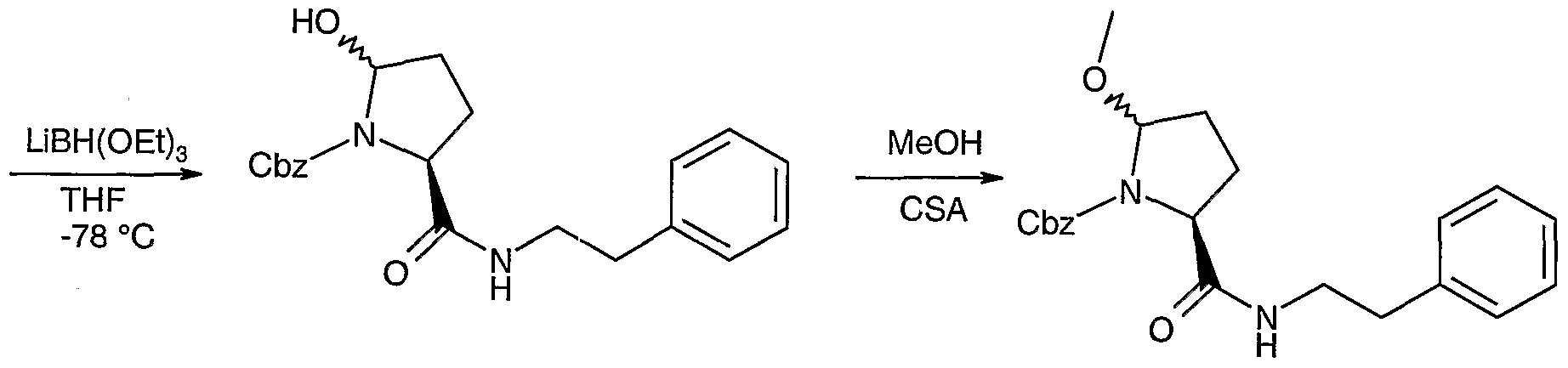
  • Product 11 B is dissolved hemi-aminal in 10 mL anhydrous methanol and 100 mg 10-camphorsulfonic acid is added. Methanolysis is complete in 1 hour. The resulting material is filtered and concentrated, then reconstituted with ethyl acetate and washed with saturated bicarb followed by drying over anhydrous sodium sulfate, filtered and concentrated. LCMS characterization ES+ 383.1 (m+1 ).
  • AIIyIGIyOH (10.5 g, 26.4 mmol) is suspended in dichloromethane (200 ml_) and EDCI (5.1 g, 26.4 mmol) and DMAP (3.2 g, 26.4 mmol) are added to obtain a clear solution.
  • E homoallylproline amide in dichloromethane 50 mL is added and stirred overnight. The product is quenched with saturated bicarb and extracted with dichloromethane, followed by washing with brine, drying over anhydrous magnesium sulfate, filtering and concentrating. The crude is used in following deprotection.
  • Product 11 F is reconstituted in dichloromethane (40 mL) and added trifluoroacetic acid (10 mL). Stirring until reaction complete by HPLC. Toluene is added and concentrated to an amber oil. The product is dissolved in dichloromethane and washed with saturated bicarb followed by drying over anhydrous magnesium sulfate, filtering and concentrating to an amber solid.
  • Boc-N-MeAlaOH (5.36 g, 26.4 mmol) is suspended in dichloromethane (200 mL) and EDCI (5.4 g, 28 mmol) and DMAP (3.4 g, 28 mmol) are added to obtain a clear solution.
  • 11G in dichloromethane (50 mL) is added and stirred overnight followed by quenching with saturated bicarb and extracting with dichloromethane then washing with brine, drying over anhydrous magnesium sulfate, filtering and concentrating.
  • Product 111 is reconstituted in 20% trifluoroacetatic acid in dichloromethane (50 mL). Stirring until reaction complete by HPLC. Toluene is added and concentrated to an amber oil. The product is dissolved in dichloromethane and washed with saturated bicarb followed by drying over anhydrous magnesium sulfate, filtering and concentrating. HPLC purification to yield 12. LCMS characterization ES+ 413.1 (m+1).
  • Biotinylated Smac 7-mer peptide (AVPIAQK, lysine ⁇ -amino group is biotinylated) is immobilized on streptavidin coated beads.
  • GST-BI R3 fusion protein is precipitated with FMAT beads and is detected using fluorescent tagged anti-GST antibodies.
  • non-biotinylated Smac peptide is highly effective at competing GST-BI R3 off the FMAT beads ( Figure 2).
  • the IC 50 for non-biotinylated Smac is 400 nM.
  • the IC 50 values of compounds listed in Table 1 in the described FMAT assay ranged from 0.025-10 ⁇ M.
  • the remaining GST-BI R3 fusion protein is monitored by ELISA assay involving first, incubation with goat anti-GST antibodies followed by washing and incubation with alkaline phosphatase conjugated anti-goat antibodies. Signal is amplified using Attophos (Promega) and read with Cytoflour Ex 450 nm/40 and Em 580 nm.
  • IC 50 S correspond to concentration of compound which displaces half of GST-BI R3 signal.
  • the IC 50 for non-biotinylated Smac is 400 nM.
  • the IC 50 values of compounds listed in Table 1 in the described ELISA assays ranged from 0.005-10 ⁇ M.
  • the ability of compounds to inhibit tumor cell growth in vitro was monitored using the CellTiter 96 ® AQ ueous Non-Radioactive Cell Proliferation Assay (Promega).
  • This assay is composed of solutions of a novel tetrazolium compound [3-(4,5-dimethylthiazol-2-yl)-5-(3- carboxymethoxyphenyl)-2-(4-sulfophenyl)-2H-tetrazolium, inner salt; MTS] and an electron coupling reagent (phenazine methosulfate) PMS.
  • MTS is bioreduced by cells into a formazan product, the absorbance of which is measured at 490 nm.
  • the conversion of MTS into the aqueous soluble formazan product is accomplished by dehydrogenase enzymes found in metabolically active cells.
  • the quantity of formazan product as measured by the amount of 490 nm absorbance is directly proportional to the number of living cells in culture.
  • the IC 50 values of compounds listed in Table 1 in the described cell assays ranged from 0.005-50 ⁇ M.

Landscapes

  • Chemical & Material Sciences (AREA)
  • Organic Chemistry (AREA)
  • Health & Medical Sciences (AREA)
  • Life Sciences & Earth Sciences (AREA)
  • General Health & Medical Sciences (AREA)
  • Medicinal Chemistry (AREA)
  • Biochemistry (AREA)
  • Biophysics (AREA)
  • Genetics & Genomics (AREA)
  • Molecular Biology (AREA)
  • Proteomics, Peptides & Aminoacids (AREA)
  • General Chemical & Material Sciences (AREA)
  • Chemical Kinetics & Catalysis (AREA)
  • Nuclear Medicine, Radiotherapy & Molecular Imaging (AREA)
  • Pharmacology & Pharmacy (AREA)
  • Animal Behavior & Ethology (AREA)
  • Public Health (AREA)
  • Veterinary Medicine (AREA)
  • Engineering & Computer Science (AREA)
  • Bioinformatics & Cheminformatics (AREA)
  • Pharmaceuticals Containing Other Organic And Inorganic Compounds (AREA)
  • Nitrogen Condensed Heterocyclic Rings (AREA)
  • Plural Heterocyclic Compounds (AREA)
  • Nitrogen And Oxygen Or Sulfur-Condensed Heterocyclic Ring Systems (AREA)
  • Pyridine Compounds (AREA)

Abstract

The present disclosure relates to XIAP inhibitor compounds of the formula (I)

Description

ORGANIC COMPOUNDS
Summary
The present invention relates generally to novel compounds that inhibit the binding of the Smac protein to Inhibitor of Apoptosis Proteins (IAPs). The present invention includes novel compounds, novel compositions, methods of their use and methods of their manufacture, wherein such compounds are generally pharmacologically useful as agents in therapies whose mechanism of action rely on the inhibition of the IAP/Caspase 9 or Smac/IAP interaction, and more particularly useful in therapies for the treatment of proliferative diseases, including cancer.
Background
Programmed cell death plays a critical role in regulating cell number and in eliminating stressed or damaged cells from normal tissues. Indeed, the network of apoptotic signaling mechanisms inherent in most cell types provides a major barrier to the development and progression of human cancer. Since most commonly used radiation and chemotherapies rely on activation of apoptotic pathways to kill cancer cells, tumor cells which are capable of evading programmed cell death often become resistant to treatment.
Apoptosis signaling networks are classified as either extrinsic when mediated by death receptor-ligand interactions or intrinsic when mediated by cellular stress and mitochondrial permeabilization. Both pathways ultimately converge on individual Caspases. Once activated, Caspases cleave a number of cell death-related substrates, effecting destruction of the cell.
Tumor cells have devised a number of strategies to circumvent apoptosis. One recently reported molecular mechanism involves the over expression of members of the IAP family. IAPs sabotage apoptosis by directly interacting with and neutralizing Caspases. The prototype IAPs, XIAP and clAP have three functional domains referred to as BIR 1 , 2 & 3 domains. BIR3 domain interacts directly with Caspase 9 and inhibits its ability to bind and cleave its natural substrate, Procaspase 3. It has been reported that a proapoptotic mitochondrial protein, Smac (also known as DIABLO), is capable of neutralizing XIAP and/or clAP by binding to a peptide binding pocket (Smac binding site) on the surface of BIR3 thereby precluding interaction between XIAP and/or clAP and Caspase 9. The present invention relates to therapeutic molecules that bind to the Smac binding pocket thereby promoting Caspase activation. Such therapeutic molecules are useful for the treatment of proliferative diseases, including cancer.
Summary of the Invention
The present invention relates generally to novel compounds that mimic the binding of the Smac protein to Inhibitor of Apoptosis Proteins (IAPs). The present invention includes novel compounds, novel compositions, methods of their use and methods of their manufacture, where such compounds are generally pharmacologically useful as agents in therapies whose mechanism of action rely on the inhibition of the lAP/Caspase 9 or Smac/IAP interaction, and more particularly useful in therapies for the treatment of proliferative diseases, including cancer.
Detailed Description
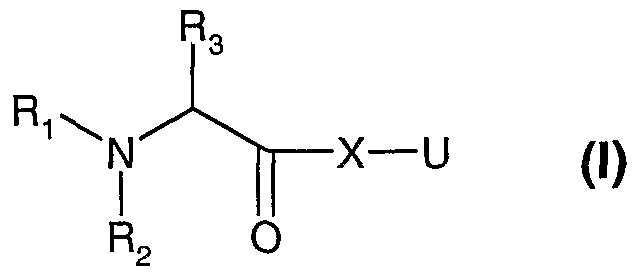
The present invention relates to compounds of the formula (1)
Figure imgf000003_0001
wherein
R1 is H or Ci -C4 alkyl;
R2 is H, or CrC4alkyl which is unsubstituted or substituted by one or more substituents selected from halogen, -OH, -SH, -OCH3, -SCH3, -CN, -SCN and nitro;
R3 is H, Ci-C4alkyl, -CF3, -C2F5, -CH2-Z or R2 and R3 together form with the nitrogen form a C3-C6heteroaliphatic ring;
Z is H, -OH, F, Cl, -CH3; -CF3, -CH2CI, -CH2F or -CH2OH;
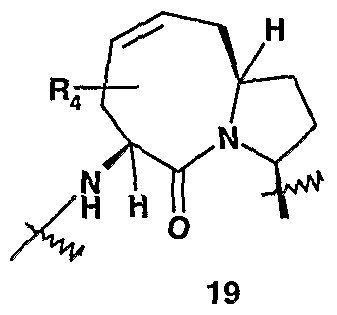
X is a monocyclic or a bicyclic structure selected from the group consisting of:
Figure imgf000004_0001
15
16 17 18
Figure imgf000004_0002
19 where
A is -CH2, -CH-, N, 0, or S;
Figure imgf000004_0003
R4, Ra and Rb are independently, H; d-C16 straight or branched alkyl; CrC16 alkenyl; C1-C16 alkynyl; or C1-C16 cycloalkyl; -(CH2)0-6-phenyl; (CH2)o-6-het; -0-C1-C16 straight or branched alkyl, -S-C1-C16 straight or branched alkyl; -N-C1-C16 straight or branched alkyl; -0-C1-C16 alkenyl; -S-C1-C16 alkenyl; -N-C1-Ci6 alkenyl -0-C1-C16 cycloalkyl; -N-C1-C16 cycloalkyl; -S-C1- C16 cycloalkyl; -O-(CH2)0-6-phenyl; -N-(CH2)o-6-phenyl; -S-(CH2)0-6-phenyl; -O-(CH2)0.6-het; -N- (CH2)0.6-het and -S-(CH2)0-6-het wherein alkyl, cycloalkyl and phenyl are unsubstituted or substituted; or R4 and R3 may form a ring;
U is -R5; -CH(R5)(R6); -CO-N(R5)(R6); -CO-O(R5); -CO-S(R5); -CS-N(R5)(R6); -N(RB)-CO- N(R5)(R6); -CrC5-alkyl-N(R5)(R6); -C1-C5-alkyl-O(R6) or -CrC5-alkyl-S(O)n(R6) where n is 0, 1 or 2; R5 is H; Crdo-alkyl; C3-C7-cycloalkyl; -(CH2)i.6-C3-C7cycloalkyl; -CrCiOalkyl-aryl; -(CH2)0-β- phenyl; -(CH2)o-6-C3-C7cycloalkyl-(CH2)o-6-phenyl; -(CH2)o-4CH-((CH2)i-4-phenyl)2; -(CH2)0.6- CH(phenyl)2; -C(O)-C1-C10alkyl; -C(O)-(CH2)1-6-C3-C7cycloalkyl; -C(O)-(CH2)0.6-phenyl; - (CH2)i-6-het; -C(O)-(CH2)i.6-het; -(CR7R8)0-2-Aryl-V-Aryl; CHR6C(O)N(R12)(R13); C(O)-NH- CH(R11)(R14) or R5 is a residue of an amino acid, wherein the alkyl, cycloalkyl, phenyl and aryl substituents are unsubstituted or substituted; or when U is -CO-N(R5)(R6); -CS-N(R5)(R6); -N(R5)-CO-N(R5)(R6); or N(Rg)-CO-N(R5)(R6), R5 and R6 together with the N atom form an aromatic or aliphatic heterocycle;
R7 and R8 are independently H, halogen; C1-7 alkyl; -OC1-7 alkyl; C1-7 cycloalkyl; or -OC1-7 cycloalkyl wherein the alkyl, cycloalkyl substituents may be substituted or unsubstituted;
V is R9; R10; CR9R10; -C(O)-; C(hal)2; -0-; -N(H)-; N(alkyl); N(aryl); S; SO; or S(O)2;
R9 and R10 are independently H, halogen, C1-7 alkyl;-OC1-7 alkyl; C1-7 cycloalkyl; or -OC1-7 cycloalkyl wherein the alkyl, cycloalkyl substituents may be substituted or unsubstituted;
R6 is H; -C1-C10 alkyl; -OH; -O-CrC10-alkyl; -(CH2)o.6-C3-C7-cycloalkyl; -0-(CH2)o-6-aryl; -(CH2)o.6-aryl; phenyl; -(CH2)1-6-het; -O-(CH2)1.6-het; -N(R12)(R13); -CNOR12; -S-R12; -S(O)-R12; -S(O)2-R12; or -S(O)2-NR12R13 wherein the alkyl, cycloalkyl and aryl substituents are unsubstituted or substituted;
R12 and R13 are independently H; C1-C10 alkyl; -(CH2)o-6-C3-C7-cycloalkyl; -(CH2W (CH)0-1 (aryl)! -2; -C(O)-CrC10alkyl; -C(O)-(CH2)1.6-C3-C7-cycloalkyl; -C(O)-O-(CH2)0-6-aryl; -C(O)-(CH2)0-6-O-fluorenyl; -C(0)-NH-(CH2)o.6-aryl; -C(0)-(CH2)o.6-aryl; or -C(O)-(CH2)1-6-het, wherein the alkyl, cycloalkyl and aryl substituents are unsubstituted or substituted; or a substituent that facilitates transport of the molecule across a cell membrane, or R12 and Ri3 together with the nitrogen form an aromatic or aliphatic heterocycle; where R11 and R14 are Ci-7 alkyl; -(CH2)o-6-phenyl; or amide; aryl is phenyl, naphthyl, or indanyl which is unsubstituted or substituted; and wherein alkyl substituents may be substituted by one or more substituents selected from a double bond, halogen (hal), OH1 SH, -O-CrC6alkyl especially -OCH3, -S-C1-C6 alkyl especially -SCH3, -CN, -SCN, nitro, -N(R1)(R2) and -CF3; alkyl as used in this application includes heteroalkyl wherein one of the carbon atoms in the alkyl chain is substituted with N, O or S; cycloalkyl substituents may be substituted by one or more substituents selected from a double bond, C1-C6 alkyl, halogen, OH, SH, -0-C1-C6 alkyl especially -OCH3, -S-CrC6 alkyl especially -SCH3, -CN, -SCN, nitro and -CF3; and substituted phenyl or aryl are substituted by one or more substituents selected from halogen, hydroxy, CrC4 alkyl, CrC4 alkoxy, nitro, -CN, -0-C(O)-C1-C4 alkyl (substituted or unsubstituted) and -C(O)-O-C1-C4 alkyl (substituted or unsubstituted); and pharmaceutically acceptable salts thereof.
The present invention also relates to a method of treating a proliferative disease comprising administering a compound of the formula (I) to a warm-blooded animal, especially a human, and the use of a compound of the formula (I), especially for treating a proliferative disease. The present invention also relates to pharmaceutical preparations comprising a compound of the formula (I), especially for the treatment of a proliferative disease, a process for the manufacture of a compound of the formula (I), and novel starting materials and intermediates for their manufacture. The present invention also relates to the use of a compound of formula (I) in the manufacture of a pharmaceutical preparation for the treatment of a proliferative disease.
In a particularly important embodiment of the present invention, R3 has the stereochemistry indicated in formula (II), with the definitions of the variable substituents and preferences described herein also applying to compounds having the stereochemistry indicated in formula (II).
Figure imgf000006_0001
Preferred Embodiments
One embodiment of the present invention comprises a compound of formula (I):
Figure imgf000006_0002
wherein
R1 is H or C1-C4 alkyl; R2 is H or C1 -C4 alkyl; R3 is H or C1-C4 alkyl; X is a monocyclic or a bicyclic structure selected from the group consisting of:
Figure imgf000007_0001
15
16 17 18
Figure imgf000007_0002
where
A is -CH2, -CH-, N, 0, or S;
X1 is 0, S, or NRa;
R4, Ra and Rb are independently, H; C1-C16 straight or branched alkyl or -(CH2)0-6-phenyl, wherein said phenyl may be unsubstituted or substituted, preferably with halo;
U is -R5; -CH(R5)(R6); or -CO-N(R5)(R6);
R5 is H; Crdo-alkyl; -(CH2)0.6-phenyl; -C(O)-CrC10alkyl; -C(O)-(CH2)0.6-phenyl; -(CR7R8V2- Aryl-V-Aryl; CHR6C(O)N(R12)(R13); or C(O)-NH-CH(R11)(R14);
R7 and R8 are independently H, halogen; C1-7 alkyl; -OC1-7 alkyl; C1-7 cycloalkyl; or -OC1-7 cycloalkyl;
V is -C(O)-; C(hal)2; -0-; -N(H)-; N(alkyl); N(aryl); S; SO; or S(O)2; R9 and R10 are independently H, halogen, Ci-7 alkyl;-OC1-7 alkyl; C1-7 cycloalkyl; or -OCi-7 cycloalkyl;
R6 is H; -C1-C10 alkyl; -OH; -O-CrCi0-alkyl; -(CH2)0-6-phenyl; -(CH2)0-6-aryl; -O-(CH2)0-6-aryl; phenyl; -(CH2)i.6-het; -O-(CH2)i-6-het; -N(Ri2)(Ri3); -CNORi2; -S-Ri2; -S(O)-Ri2; -S(O)2-Ri2;
Figure imgf000008_0001
Ri2 and Ri3 are independently H; or C1-C10 alkyl; where Rn and R14 are C1-7 alkyl; -(CH2)0-6-phenyl; or amide; aryl is phenyl, naphthyl, or indanyl which is unsubstituted or substituted; and pharmaceutically acceptable salts thereof.
In an especially preferred embodiment is a compound of formula (I):
Figure imgf000008_0002
wherein
R1, R2 and R3 are independently H or C1-C4 alkyl;
X is a monocyclic or a bicyclic structure selected from the group consisting of:
Figure imgf000009_0001
15
16 17 18
Figure imgf000009_0002
where
A is -CH2, -CH-, N, O, or S;
X1 is 0, S, or NRa;
R4, Ra and Rb are independently, H; Ci-C16 straight or branched alkyl; or -(CH2)0-6-phenyl;
U is -R5; CrC5alkyl-N(R5)(R6); or -CO-N(R5)(R6);
R5 is H; -(CH2)0-6-phenyl; CrC3alkyl; -Aryl-V-Aryl-; Or -C(O)-NH-CH(R11)(R14) wherein aryl or phenyl may be unsubstituted or substituted, preferably with halo;
V is -0-;
R6 is H; -C1-C10 alkyl; -OH; -0-CrC1o-alkyl; -0-(CH2)o-6-phenyl; -(CH2)0-6-phenyl; indanyl; or phenyl; where Rn and R14 are C1-7 alkyl; -(CH2)0.6-phenyl; or amide; aryl is phenyl, naphthyl, or indanyl which is unsubstituted or substituted; and pharmaceutically acceptable salts thereof.
In other preferred embodiment of the present invention compound of formula (I) has the following:
R1 is H or alkyl.
R2 is especially H, methyl or ethyl, particularly H or methyl, which methyl group is unsubstituted or substituted, particularly unsubstituted methyl. R2 as substituted methyl especially includes chloromethyl, dichloromethyl and especially trifluoromethyl.
R3 is especially methyl or ethyl.
In a particular embodiment, R2 and R3 together with the nitrogen form a heteroaliphatic ring, including saturated and unsaturated 3 to 6 membered nonaromatic rings, for example, aziridine, azetidine, azole, piperidine, piperazine, and the like, especially aziridine and azetidine.
R4 is preferably H, Me, n-Bu, benzyl, phenyl or phenyl-substituted halo.
Ra is preferably H, Me, n-Bu, benzyl, phenyl or phenyl-substituted halo.
Rb is preferably H.
R5 is -(CH2)o.6-C3-C7-cycloalkyl-(CH2)o-6-phenyl includes fused cycloalkyl-phenyl rings, such as indanyl, when there are no methylenes between the cycloalkyl and phenyl rings.
R5 as -(CH2)o-4CH-((CH2)1-4-phenyl)2 is especially -CH2CH2-phenyl, indanyl; R5 as -(CR7 R8)o-2Aryl-V-Aryl is especially -(CH2)-Ph-O-Ph or -Ph-O-Ph; Ph-C(O)-Ph; Ph-NH- Ph; Ph-N(Me)-Ph; Ph-S-Ph, Ph-SO2-Ph; Ph-SO-Ph may be unsubstituted or substituted, preferably with halo.
R6 is especially H.
A particularly important embodiment includes the compounds wherein R5 is -C1-C4 alkyl- phenyl, especially those wherein R5 is -C2H4-phenyl and R6 is H.
In a particular embodiment of the present invention, one or both of R7 and R8 is H. If one of R7 and R8 is other than H, it is especially hydroxy, -N(R12)(R13), especially wherein R12 is -C(O)-(CH2)1.6-C3-C7-cycloalkyl, for example, wherein (CH2)!.6-C3-C7-cycloalkyl is cyclohexylmethyl, -O-(CH2)0-6-aryl, for example, wherein (CH2)o-6-aryl is benzyl. If only one of R7 and R8 is other than H, it is preferred for R8 to be the substituent other than H.
In a preferred embodiment, R6 is H and R5 is -C1-C10 alkyl-aryl, particularly phenylmethyl, phenylethyl and phenylpropyl, indonyl especially phenylethyl and indanyl.
The general terms used hereinbefore and hereinafter preferably have, within this disclosure, the following meanings, unless otherwise indicated:
Unsubstituted is intended to mean that hydrogen is the only substituent.
Halogen is fluorine, chlorine, bromine or iodine, especially fluorine and chlorine. Unless otherwise specified alkyl substituents include straight or branched chain alkyl, such as methyl, ethyl, n-propyl, isopropyl, n-butyl, sec-butyl, tert-butyl, n-pentyl and branched pentyl, n-hexyl and branched hexyl, and the like.
Cycloalkyl substituents include cyclopropyl, cyclobutyl, cyclopentyl, cyclohexyl, and cycloheptyl.
The het substituents include aromatic and non-aromatic heterocyclic rings and fused rings containing aromatic and non-aromatic heterocyclic rings. Suitable het substituents include unsubstituted and substituted pyrrolidyl, tetrahydrofuryl, tetrahydrothiofuranyl, piperidyl, piperazyl, tetrahydropyranyl, morphilino, 1 ,3-diazapane, 1 ,4-diazapane, 1 ,4-oxazepane, 1 ,4-oxathiapane, furyl, thienyl, pyrrole, pyrazole, triazole, tetrazole, thiazole, oxazole, pyridine, pyrimidine, isoxazolyl, pyrazine, quinoline, isoquinoline, pyridopyrazine, pyrrolopyridine, furopyridine, indole, benzofuran, benzothiofuran, benzindole, benzoxazole, pyrroloquinoline, and the like. The het substituents are unsubstituted or substituted on a carbon atom by halogen, especially fluorine or chlorine, hydroxy, C1-C4 alkyl, such as methyl and ethyl, C1-C4 alkoxy, especially methoxy and ethoxy, nitro, -O-C(O)-CrC4alkyl or -C(O)- O-CrC4-alkyl or on a nitrogen by C1-C4 alkyl, especially methyl or ethyl, -0-C(O)-C1-C4 alkyl or -C(O)-O-C1-C4 alkyl, such as carbomethoxy or carboethoxy.
When two substituents together with a commonly bound nitrogen are het, it is understood that the resulting heterocyclic ring is a nitrogen-containing ring, such as aziridine, azetidine, azole, piperidine, piperazine, morphiline, pyrrole, pyrazole, thiazole, oxazole, pyridine, pyrimidine, isoxazolyl, and the like. Substituents that facilitate transport of the molecule across a cell membrane are known to those of skill in the medicinal chemistry arts (see, for example, Gangewar S., Pauletti G. M., Wang B., Siahaan TJ. , Stella VJ. , Borchardt R.T., Drug Discovery Today, vol. 2, p 148-155 (1997) and Bundgaard H. and Moss J., Pharmaceutical Research, vol. 7, p 885 (1990)). Generally, such substituents are lipophilic substituents. Such lipophilic substituents include a C6-C30 alkyl which is saturated, monounsaturated, polyunsaturated, including methylene- interrupted polyene, phenyl, phenyl which substituted by one or two C1-C8 alkyl groups, C5-C9 cycloalkyl, C5-Cg cycloalkyl which is substituted by one or two C1-C8 alkyl groups, -Xrphenyl, -Xrphenyl which is substituted in the phenyl ring by one or two CrC8 alkyl groups, XrC5-C9 cycloalkyl or X1-C5-C9 cycloalkyl which is substituted by one or two C1-C8 alkyl groups; where Xi is C1-C24 alkyl which is saturated, monounsaturated or polyunsaturated and straight or branched chain.
It will be apparent to one of skill in the art when a compound of the invention can exist as a salt form, especially as an acid addition salt or a base addition salt. When a compound can exist in a salt form, such salt forms are included within the scope of the invention. Although any salt form may be useful in chemical manipulations, such as purification procedures, only pharmaceutically acceptable salts are useful for pharmaceutically products.
Pharmaceutically acceptable salts include, when appropriate, pharmaceutically acceptable base addition salts and acid addition salts, for example, metal salts, such as alkali and alkaline earth metal salts, ammonium salts, organic amine addition salts, and amino acid addition salts, and sulfonate salts. Acid addition salts include inorganic acid addition salts such as hydrochloride, sulfate and phosphate, and organic acid addition salts such as alkyl sulfonate, arylsulfonate, acetate, maleate, fumarate, tartrate, citrate and lactate. Examples of metal salts are alkali metal salts, such as lithium salt, sodium salt and potassium salt, alkaline earth metal salts such as magnesium salt and calcium salt, aluminum salt, and zinc salt. Examples of ammonium salts are ammonium salt and tetramethylammonium salt. Examples of organic amine addition salts are salts with morpholine and piperidine. Examples of amino acid addition salts are salts with glycine, phenylalanine, glutamic acid and lysine. Sulfonate salts include mesylate, tosylate and benzene sulfonic acid salts.
For the purposes of isolation or purification, as well as in the case of compounds that are used further as intermediates, it is also possible to use pharmaceutically unacceptable salts, e.g., the picrates. Only pharmaceutically acceptable, non-toxic salts may be used for therapeutic purposes, however, and those salts are therefore preferred. Synthetic Procedure
Abbreviations:
CH2CI2 methylene chloride
CH3CN acetonitrile
DIBAL diisobutylaluminium hydride
DIPEA diisopropylethylamine
DME ethylene glycol dimethyl ether
DMF N, Λ/-dimethylformamide
DTBB 4,4'-di-tert-butylbiphenyl
EtOAc ethyl acetate
HBTU 0-benzyltriazol-1-yl-Λ/,Λ/,N',Λ/-tetramethyluronium hexafluorophosphate
HOBt 1 -hydroxhbenzotriazole
HPLC high performance liquid chromatography
KOTMS potassium trimethysilanoate.
MeOH methanol
MgSO4 magnesium sulfate
MnO2 manganese dioxide
Na2CO3 sodium carbonate
NaHCO3 sodium bicarbonate
NaOH sodium hydroxide
Tetrakis tetrakis(triphenylphosphine)palladium(0)
TFA trifluoroacetic acid
THF tetrahydrofuran
The compounds of formula (I) may be prepared as depicted below in Scheme 1 :
Scheme 1 Step A
Figure imgf000014_0001
Figure imgf000014_0002
R1 = H
Step A: This step involves the coupling of an amine HXU (prepared in this invention or purchased from commercial sources) with a f-Boc-L-amino acid or its derivative using standard peptide coupling agents such as DCC/HOBt or HBTUVHOBt.
Step B: This step involves the removal of t-Boc group with trifluoroacetic acid (TFA).
As discussed above, the compounds of the present invention are useful for treating proliferative diseases. Thus, the present invention further relates to a method of treating a proliferative disease which comprises administering a therapeutically effective amount of a compound of the invention to a mammal, preferably a human, in need of such treatment.
A proliferative disease is mainly a tumor disease (or cancer) (and/or any metastases). The inventive compounds are particularly useful for treating a tumor which is a breast cancer, genitourinary cancer, lung cancer, gastrointestinal cancer, epidermoid cancer, melanoma, ovarian cancer, pancreas cancer, neuroblastoma, head and/or neck cancer or bladder cancer, or in a broader sense renal, brain or gastric cancer; in particular,
(i) a breast tumor; an epidermoid tumor, such as an epidermoid head and/or neck tumor or a mouth tumor; a lung tumor, for example, a small cell or non-small cell lung tumor; a gastrointestinal tumor, for example, a colorectal tumor; or a genitourinary tumor, for example, a prostate tumor (especially a hormone-refractory prostate tumor); or
(ii) a proliferative disease that is refractory to the treatment with other chemotherapeutics; or
(iii) a tumor that is refractory to treatment with other chemotherapeutics due to multidrug resistance.
In a broader sense of the invention, a proliferative disease may furthermore be a hyperproliferative condition such as leukemias, hyperplasias, fibrosis (especially pulmonary, but also other types of fibrosis, such as renal fibrosis), angiogenesis, psoriasis, atherosclerosis and smooth muscle proliferation in the blood vessels, such as stenosis or restenosis following angioplasty.
Where a tumor, a tumor disease, a carcinoma or a cancer are mentioned, also metastasis in the original organ or tissue and/or in any other location are implied alternatively or in addition, whatever the location of the tumor and/or metastasis.
The inventive compound is selectively toxic or more toxic to rapidly proliferating cells than to normal cells, particularly in human cancer cells, e.g., cancerous tumors, the compound has significant antiproliferative effects and promotes differentiation, e.g., cell cycle arrest and apoptosis.
The present invention further relates to a method of promoting apoptosis in rapidly proliferating cells, which comprises contacting the rapidly proliferating cells with an effective apoptosis promoting amount of a non-naturally-occurring compound that binds to the Smac binding site of XIAP and/or clAP proteins. Preferably, the non-naturally-occurring compound a compound of present formula (I) or (II).
Pharmaceutical Compositions
The invention relates also to pharmaceutical compositions comprising a compound of formula (I), to their use in the therapeutic (in a broader aspect of the invention also prophylactic) treatment or a method of treatment of a kinase dependent disease, especially the preferred diseases mentioned above, to the compounds for said use and to pharmaceutical preparations and their manufacture, especially for said uses. The present invention also relates to pro-drugs of a compound of formula (I) that convert in vivo to the compound of formula (I) as such. Any reference to a compound of formula (I) is therefore to be understood as referring also to the corresponding pro-drugs of the compound of formula (I), as appropriate and expedient.
The pharmacologically acceptable compounds of the present invention may be present in or employed, for example, for the preparation of pharmaceutical compositions that comprise an effective amount of a compound of the formula (I), or a pharmaceutically acceptable salt thereof, as active ingredient together or in admixture with one or more inorganic or organic, solid or liquid, pharmaceutically acceptable carriers (carrier materials).
The invention relates also to a pharmaceutical composition that is suitable for administration to a warm-blooded animal, especially a human (or to cells or cell lines derived from a warmblooded animal, especially a human, e.g., lymphocytes), for the treatment of (this, in a broader aspect of the invention, also includes the prevention of (= prophylaxis against)) a disease that responds to inhibition of protein kinase activity, comprising an amount of a compound of formula (I) or a pharmaceutically acceptable salt thereof, preferably which is effective for said inhibition, together with at least one pharmaceutically acceptable carrier.
The pharmaceutical compositions according to the invention are those for enteral, such as nasal, rectal or oral, or parenteral, such as intramuscular or intravenous, administration to warm-blooded animals (especially a human), that comprise an effective dose of the pharmacologically active ingredient, alone or together with a significant amount of a pharmaceutically acceptable carrier. The dose of the active ingredient depends on the species of warm-blooded animal, the body weight, the age and the individual condition, individual pharmacokinetic data, the disease to be treated and the mode of administration.
The invention relates also to a method of treatment for a disease that responds to inhibition of a protein kinase and/or a proliferative disease, which comprises administering a (against the mentioned diseases) prophylactically or especially therapeutically effective amount of a compound of formula (I) according to the invention, or a tautomer thereof or a pharmaceutically acceptable salt thereof, especially to a warm-blooded animal, for example, a human, that, on account of one of the mentioned diseases, requires such treatment. The dose of a compound of the formula (I) or a pharmaceutically acceptable salt thereof to be administered to warm-blooded animals, for example, humans of approximately 70 kg body weight, preferably is from approximately 3 mg to approximately 1O g, more preferably from approximately 10 mg to approximately 1.5 g, most preferably from about 100 mg to about 1 ,000 mg/person/day, divided preferably into 1-3 single doses which may, for example, be of the same size. Usually, children receive half of the adult dose.
The pharmaceutical compositions comprise from approximately 1 % to approximately 95%, preferably from approximately 20% to approximately 90%, active ingredient. Pharmaceutical compositions according to the invention may be, for example, in unit dose form, such as in the form of ampoules, vials, suppositories, dragees, tablets or capsules.
The pharmaceutical compositions of the present invention are prepared in a manner known per se, for example, by means of conventional dissolving, lyophilizing, mixing, granulating or confectioning processes.
Examples
The following Examples serve to illustrate the invention without limiting the scope thereof.
The following examples are intended to illustrate, but not further limit, the invention.
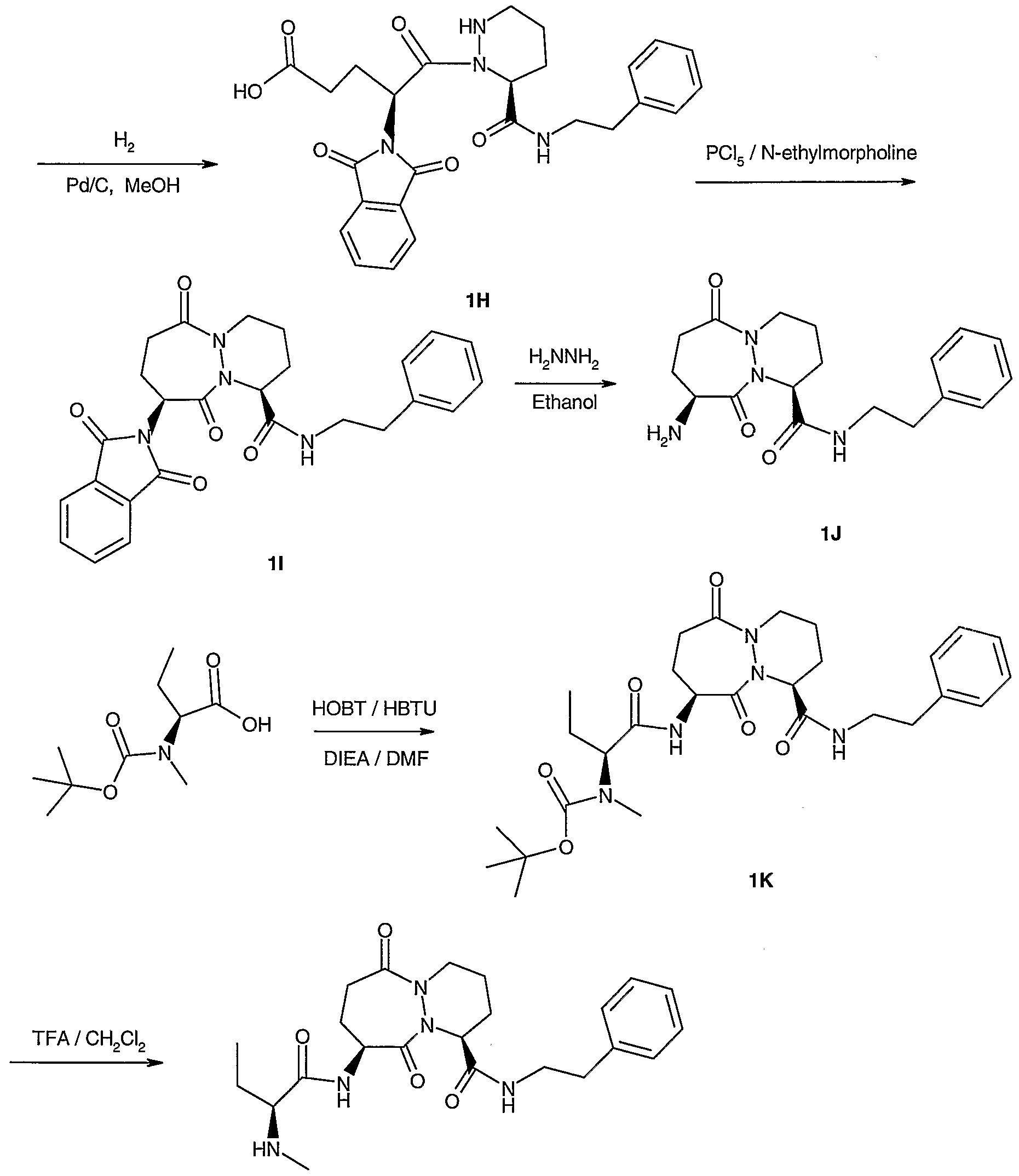
Example 1 Synthesis of (1 S,9S)-9-((S)-2-Methylamino-butyrylamino)-6, 10-dioxo- octahydro-pyridazino[1 ,2-a][1 ,2]diazepine-1 -carboxylic acid phenethyl- amide (1)
The title compound 1 (formula 1) is prepared according to the procedure set forth in Scheme 2.
Scheme 2
Figure imgf000018_0001
1G
Figure imgf000019_0001
(S)-4-Benzyl-3-(4-bromo-butyryl)-oxazolidin-2-one (1 A)
To a solution of S-(-)-4-benzyl-2-oxazolidinone (8.0 g, 45.1 mmol) in THF (75 ml_) at -70 0C, is added n-BuLi (19.8 ml_, 49.6 mmol, 2.5 M in hexane) slowly. After stirring at -70 0C for
1 hour, 5-bromovaleryl chloride (11.7 g, 58.7 mmol) is added dropwise. After stirring at -70 0C for 20 minutes, the cooling bath is removed and the reaction mixture is warmed to 25 0C and stirred for 2 hours. The solution is diluted with 150 mL of ether, and washed with
2 x 100 mL of water. The combined organic layers is dried over Na2SO4 and concentrated. The crude product is purified by chromatography (hexane/EtOAc:85/15) to give a white solid (15.3 g, 99.7%). (NMR and MS data confirmed, U-3133-51 -24).
(S)-3-((S)-4-Benzyl-2-oxo-oxazolidine-3-carbonyl)-tetrahydro-pyridazine-1,2- dicarboxylic acid di-tert-butyl ester (1 B)
To a solution of diisopropylamine (0.77 mL, 5.53 mmol) in THF(4 mL) at 0 °C is added BuLi (2.17 mL, 5.42 mmol, 2.5 M in hexane) dropwise. The solution is stirred at 0 0C for 30 minutes to form an LDA solution. The LDA solution is cold to -70 0C and added to a solution of (S)-4-benzyl-3-(4-bromo-butyryl)-oxazolidin-2-one (1.72 g, 5.07 mmol) in THF (4 mL) at -70 °C dropwise. After stirring at -70 0C for 2 hours, a solution of di-t-butyl azodicarboxylate (1.40 g, 6.08 mmol) in CH2CI2 (4mL) is added slowly. After stirring at -70 0C for 15 minutes, Bu4NI (0.28 g, 0.76 mmol) is added in one portion. After stirring at -70 0C for 10 minutes, the flask with reaction mixture is moved to a -20 0C bath and stirred overnight (16 hours). The reaction mixture is quenched to ether (50 mL) with buffer solution (50 mL, Ph = 7), and the mixture is extracted with ether (3 x 50 mL). The organic layer is dried over Na2SO4 and concentrated. The crude product is purified by chromatography (hexane/EtOAc:70/30) to give (S)-3-((S)-4-benzyl-2-oxo-oxazolidine-3-carbonyl)-tetrahydro- pyridazine-1 ,2-dicarboxylic acid di-tert-butyl ester as white solid (1.22 g, 49.3%). (NMR and MS data confirmed, U-3133-55-30).
(S)-Tetrahydro-pyridazine-1,2,3-tricarboxylic acid 1 ,2-di-tert-butyl ester (1C)
To a solution of (S)-3-((S)-4-benzyl-2-oxo-oxazolidine-3-carbonyl)-tetrahydro-pyridazine-1 ,2- dicarboxylic acid di-tert-butyl ester (1.22 g, 2.5 mmol) in THF (15 mL) at 0 0C, is added a solution of LiOH (7 mL, 5% in H2O). After stirring at 0 0C for 2 hours, the reaction mixture is diluted with 15 mL of water and extracted with 20 mL of ether. The ether layer is extracted with 10 mL of saturated NaHCO3. The combined aqueous layers is acidified with saturated NaHSO4 to Ph = 2, and extracted with CH2CI2 (3 x 20 mL). The combined organic layers is dried over Na2SO4 and concentrated to give clued product (0.83 g) as a pale gum without further purification for next step reaction. (NMR and MS data confirmed, U-3133-56-22).
(SJ-S-Phenethylcarbamoyl-tetrahydro-pyridazine-i ,2-dicarboxylic acid di-tert-butyl ester (1 D)
To a solution of (S)-tetrahydro-pyridazine-i ,2,3-tricarboxylic acid 1 ,2-di-tert-butyl ester (83 mg, 2.5 mmol) in DMF(IO ml_) at room temperature, is added diisopropylethylamine (1.4 ml_) slowly. After stirring at room temperature for 20 minutes, to the reaction mixture, is added phenethylamine (445 mg, 3.67 mmol), and followed by a solution of HOBT (545 mg, 4.04 mmol) and HBTU (1.53 g, 4.04 mmol) in DMF(I O ml_). After stirring for 1.5 hours at room temperature, the reaction solution is diluted with ether (100 ml_), and washed with water( 2 x 50 ml_). The combined organic solution is concentrated. The crude product is diluted with CH2CI2 and dried over Na2SO4, and purified by chromatography (CH2CI2/Me0H:97/3) to give (S)-3-phenethyl carbamoyl-tetrahydro-pyridazine-1 ,2- dicarboxylic acid di-tert-butyl ester as pale gum (920 mg, 83.6% in two steps). (NMR and MS data confirmed, U-3133-57-26).
(SJ-Hexahydro-pyridazine-S-carboxylic acid phenethyl-amide (1E)
To a solution of (S)-3-phenethyl carbamoyl-tetrahydro-pyridazine-1 ,2-dicarboxylic acid di-tert- butyl ester (920 mg, 2.12 mmol) in CH2CI2 (2 ml_) at -20 0C is added TFA (4 ml_, pre-cooled to -20 0C) slowly. After stirring at 0 0C for 30 minutes, the reaction mixture is concentrated by rotavaporation under room temperature. The residue is diluted with CH2CI2/H2O (20 ml_, 8/2), and neutralized with 10% NH4OH to Ph = 7. After dried and concentrated to give crude (S)-hexahydropyridazine-3-carboxylic acid phenethyl-amide (376 mg, 76.4%) as pale gum without further purification for next step reaction. (NMR and MS data confirmed, U-3133-58- 18).
(SJ-S-Phenethylcarbamoyl-tetrahydro-pyridazine-i-carboxylic acid benzyl ester (1 F)
To a solution of (S)-hexahydro pyridazine-3-carboxylic acid phenethyl-amide (376 mg, 1.59 mmol) and Et3N (0.66 ml_) in CH2CI2 (10 ml_) at 0 0C, is added benzylchloroformate (270 mg, 1.59 mmol) dropwise. After stirring at -5 0C for 1.5 hours, the reaction mixture is diluted with CH2CI2 (50 mL) and washed with 10 ml_ of water. The organic layer is dried over Na2SO4 and concentrated to give (S)-3-phenethylcarbamoyl-tetrahydro-pyridazine-1- carboxylic acid benzyl ester (580 mg) as pale gum without further purification for next step reaction. (NMR and MS data confirmed, U-3133-59). (S)-2-[(S)-4-Benzyloxycarbonyl-2-(1,3-dioxo-1,3-dihydro-isoindol-2-yl)-butyryl]-3- phenethylcarbamoyl-tetrahydro-pyridazine-i-carboxylic acid benzyl ester (1G)
To a solution of (S)-2-(1 ,3-dioxo-1 ,3-dihydro-isoindol-2-yl)-pentanedioic acid 5-benzyl ester (580 mg, 1.59 mmol) in ether (25 ml_) at 0 0C, is added PCI5 (920 mg, 4.38 mmol) in one portion. After stirring at 25 0C for 40 minutes, ether is removed by evaporation, and the residue is dissolved in 20 ml_ of THF, and is added to a solution of
(S)-3-phenethylcarbamoyl-tetrahydro-pyridazine-1-carboxylic acid benzyl ester (580 mg) and N-methylmorpholine (0.74 ml_, 6.77 mmol) in THF (10 ml_) at 0 0C slowly. After stirring at room temperature for 2 hours, the reaction mixture is diluted with 100 ml_ of ether and washed with 2 x 20 ml_ of water. The combined organic layers is dried over Na2SO4 and concentrated, and purified by chromatography (CH2CVMeOH :97/3) to give (S)-2-[(S)-4- benzyloxycarbonyl-2-(1 ,3-dioxo-1 ,3-dihydro-isoindol-2-yl)-butyryl]-3-phenethylcarbamoyl- tetrahydro-pyridazine-1 -carboxylic acid benzyl ester (1.13 g, 99.2%) as pale solid. (NMR and MS data confirmed, U-3133-62).
(S)-4-(1,3-Dioxo-1,3-dihydro-isoindol-2-yl)-5-oxo-5-((S)-6-phenethylcarbamoyl- tetrahydro-pyπdazin-1-yl)-pentanoic acid (1 H)
A solution/suspension of (S)-2-[(S)-4-benzyloxycarbonyl-2-(1 ,3-dioxo-1 ,3-dihydro-isoindol-2- yO-butyrylJ-S-phenethylcarbamoyl-tetrahydro-pyridazine-i -carboxylic acid benzyl ester (1.13 g) and Pd/C (350 mg, 10% on carbon) in MeOH (15 ml_, with 2 drops of acetic acid) in a 1 ,000 ml. round flask is vigorously stirred at room temperature, under hydrogen gas (at atmosphere pressure) from a balloon for 3 hours. After degassed by house vacuum for 10 minutes, the reaction mixture is filtered to remove catalyst and concentrated. The crude product is diluted with CH2CI2/H2O (10 ml_, 8/2) and neutralized with 10% NH4OH to Ph = 7. After dried and concentrated, the crude product is purified by chromatography (CH2CI2/Me0H:97/3) to give (S)-4-(1 ,3-dioxo-1 ,3-dihydro-isoindol-2-yl)-5-oxo-5-((S)-6- phenethylcarbamoyl-tetrahydro-pyridazin-1-yl)-pentanoic acid (0.74 g, 95.3%) as pale solid. (NMR and MS data confirmed, U-3133-63).
(1 S,9S)-9-(1 ,3-Dioxo-1 ,3-dihydrc-isoindol-2-yl)-6,10-dioxo-octahydro-pyridazino[1 ,2- a][1,2]diazepine-1-carboxylic acid phenethyl-amide (11)
To a solution of (S)-4-(1 ,3-dioxo-1 ,3-dihydro-isoindol-2-yl)-5-oxo-5-((S)-6- phenethylcarbamoyl-tetrahydro-pyridazin-1-yl)-pentanoic acid (0.74 g, 1.5 mmol) and N-methylmorpholine (0.6 g, 6.0 mmol) in THF (2OmL) at 0 0C, is added PCI5 (470 mg, 2.25 mmol) in one portion. After stirring at O 0C for 3 hours, the reaction mixture is concentrated and purified by chromatography (CH2CI2/Me0H:97/3) to yield (1 S,9S)-9-(1 ,3- dioxo-i
Figure imgf000023_0001
carboxylic acid phenethyl-amide (310 mg, 43.6%) as white solid. (NMR and MS data confirmed, U-3133-65).
(1 S,9S)-9-Amino-6,10-dioxo-octahydro-pyridazino[1 ,2-a][1 ,2]diazepine-1 -carboxylic acid phenethyl-amide (U)
To a mixture/suspension of (1S,9S)-9-(1 ,3-dioxo-1 ,3-dihydro-isoindol-2-yl)-6,10-dioxo- octahydro-pyridazino[1 ,2-a][1 ,2]diazepine-1 -carboxylic acid phenethyl-amide (310 mg, 0.70 mmol) and hydrozine hydrate (70 mg, 1.40 mmol) in ethanol (1OmL) is stirred at 60 °C for 2 hours. After cooled to room temperature and concentrated, the reaction mixture is purified by chromatography (CH2CI2/Me0H:97/3) to give (1S,9S)-9-amino-6,10-dioxo- octahydro-pyridazino[1 ,2-a][1 ,2]diazepine-1 -carboxylic acid phenethyl-amide (240 mg, 99%) as white solid. (NMR and MS data confirmed, U-3133-67).
[(S)-I -((4S,7S)-6,10-Dioxo-4-phenethylcarbamoyl-octahydro-pyridazino[1 ,2- ajti^ldiazepin^-ylcarbamoylj-propylj-methyl-carbamic acid tert-butyl ester (1 K)
To a solution of (S)-2-(tert-butoxycarbonyl-methyl-amino)-butyric acid (167 mg, 0.77 mmol) in DMF (5 ml_) at room temperature, is added diisopropylethylamine (0.48 ml_) slowly. After stirring at room temperature for 20 minutes, the solution is transferred to another flask contained (1 S,9S)-9-amino-6,10-dioxo-octahydro-pyridazino[1 ,2-a][1 ,2]diazepine-1- carboxylic acid phenethyl-amide (240 mg, 0.70 mmol), and then a solution of HOBT (125 mg, 0.92 mmol) and HBTU (350 mg, 0.92 mmol) in DMF (5 ml_) is added to the reaction mixture. After stirring for 1.5 hours, the reaction solution is diluted with ether (20 ml_), and washed with water (2 x 10 ml_). The combined organic layers is concentrated. The crude product is diluted with CH2CI2 (IO ml_) and dried over Na2SO4, and purified by chromatography (CH2CI2/Me0H:97/3) to give (S)-1 -((4S,7S)-6,10-dioxo-4-phenethylcarbamoyl-octahydro- pyridazino[1 ,2-a][1 ,2]diazepin-7-ylcarbamoyl)-propyl]-methyl-carbamic acid tert-butyl ester (270 mg, 71.3%) as pale solid. (NMR and MS data confirmed, U-3133-69). (1 S,9S)-9-((S)-2-Methylamino-butyrylamino)-6,10-dioxo-octahydro-pyridazino[1 ,2- a][1,2]diazepine-1-carboxylic acid phenethyl-amide (1)
To a solution of (S)-1-((4S,7S)-6,10-dioxo-4-phenethylcarbamoyl- octahydro-pyridazino[1 ,2- a][1 ^Jdiazepin-y-ylcarbamoyO-propyO-methyl-carbamic acid tert-butyl ester (270 mg, 0.50 mmol) in CH2CI2 (1 mL) at -20 0C is added TFA (5 ml_, pre-cooled to -20 0C) slowly. After stirring at 0 0C for 30 minutes, the reaction mixture is concentrated and purified by prep HPLC (column: waters prep C18 40 x 300 mm; mobile phase: gradient condition, started at CH3CN 10%/H2O 90% with 0.1%TFA, 10 minutes changed lineally to CH3CN 100% with 0.1% TFA; flow rate: 25 mL/min.) to give(1 S,9S)-9-((S)-2-methylamino-butyrylamino)-6,10- dioxo-octahydro-pyridazinoti ^-aHi ^diazepine-i-carboxylic acid phenethyl-amide (230 mg) as TFA salt/white solid. (NMR and MS data confirmed, U-3133-73).
Example 2 Synthesis of (Z)-(2S,5S)-5-ethyl-1 -[(S)-2-((S)-2-methylamino- propionylamino)-pentanoyl]-pyrrolidine-2-carboxylic acid phenethyl- amide (11) and (Z)-(3S,6S,10aR)-6-((S)-2-methylamino-propionylamino)-5- oxo-1 ,2,3,5,6,7,10,10a-octahydro-pyrrolo[1 ,2-a]azocine-3-carboxylic acid phenethylamide (12)
The title compounds 11 and 12 (formula 1) is prepared according to the procedure set forth in Scheme 3:
Scheme 3
Figure imgf000025_0001
11A
Figure imgf000025_0002
11B
11C
Figure imgf000025_0003
11D 11E
Figure imgf000025_0004
11F
Figure imgf000026_0001
11G
Figure imgf000026_0002
11H
Figure imgf000026_0003
111
Figure imgf000026_0004
12
Figure imgf000026_0005
11 (S^-Oxo-δ-phenethylcarbamoyl-pyrrolidine-i-carboxylic acid benzyl ester (11A)
(S)-5-Oxo-pyrrolidine-1 ,2-dicarboxylic acid 1 -benzyl ester (14.9 g, 57 mmol) is suspended in dichloromethane (100 ml_) and added DMAP (7.1 g, 58 mmol) while cooling on ice (0-5 0C). The suspension immediately clarified. EDCI (11.1 g, 58 mmol) is added resulting in precipitation which quickly clarified again. Phenethylamine (6.8 ml_, 54 mmol) is added slowly via syringe. The reaction is complete in one half hour. The dichloromethane layer is washed with aqueous 10% citric acid, water and saturated bicarb, then dried over anhydrous sodium sulfate, filtered and concentrated to a white solid. LCMS characterization ES+ 367.1 (m+1).
(SJ-δ-Hydroxy-i-methyl-pyrrolidine^-carboxylic acid phenethyl-amide (11B)
A THF solution of 11 A pyroglutamide (3.9 g, 11 mmol) is chilled to -78 0C. After 15 minutes, 1 M super-hydride solution (13 mL, 13 mmol) is slowly added. After 1 hour, it is carefully quenched with saturated bicarb and added 4 mL 30% hydrogen peroxide and concentrated to half volume and reconstituted with ethyl acetate, then washed with saturated bicarb and brine and dried over anhydrous sodium sulfate, filtered and concentrated to a clear oil. LCMS characterization ES+ 369.1 (m+1 ).
(S)-5-Methoxy-1-methyl-pyrrolidine-2-carboxylic acid phenethyl-amide (11C)
Product 11 B is dissolved hemi-aminal in 10 mL anhydrous methanol and 100 mg 10-camphorsulfonic acid is added. Methanolysis is complete in 1 hour. The resulting material is filtered and concentrated, then reconstituted with ethyl acetate and washed with saturated bicarb followed by drying over anhydrous sodium sulfate, filtered and concentrated. LCMS characterization ES+ 383.1 (m+1 ).
(2S,5R)-5-Allyl-1-methyl-pyrrolidine-2-carboxylic acid phenethyl-amide (11D)
A dichloromethane (20 mL) solution of 11C methylaminal (7.7 g, 20 mmol) is chilled to -78 °C. After 20 minutes, allyltrimethylsilane (6.5 mL, 40 mmol) is added. After 10 more minutes 1 M titanium(IV) chloride (24 mL, 24 mmol) is added slowly by syringe. The reaction is complete after 1 hour. The resulting material is carefully quenched (frothing) with saturated bicarb and extracted with dichlomethane, then washed with brine, dried over anhydrous magnesium sulfate, filtered and concentrated. The product is isolated by flash chromatography (SiO2), and it crystallizes upon standing. LCMS characterization ES+ 393.1 (m+1). (2S,5R)-5-Allyl-pyrrolidine-2-carboxylic acid phenethyl-amide (11 E)
Dissolved 11 D Cbz-homoallylproline amide (4.3 g, 11 mmol) in dichloromethane (11 ml_, 1 M) is chilled to 0 0C. lodotrimethylsilane (5 ml_, 37 mmol) is added via syringe. After complete reaction, it is diluted with diethyl ether and washed with 1 N HCI. Then it is concentrated aqueous with methanol titration to yield HCI salt of product. LCMS characterization ES+ 259.1 (m+1).
(2S,5R)-5-Allyl-1-((S)-2-methylamino-pent-4-enoyl)-pyrrolidine-2-carboxylic acid phenethyl-amide (11 F)
AIIyIGIyOH (10.5 g, 26.4 mmol) is suspended in dichloromethane (200 ml_) and EDCI (5.1 g, 26.4 mmol) and DMAP (3.2 g, 26.4 mmol) are added to obtain a clear solution. 11 E homoallylproline amide in dichloromethane (50 mL) is added and stirred overnight. The product is quenched with saturated bicarb and extracted with dichloromethane, followed by washing with brine, drying over anhydrous magnesium sulfate, filtering and concentrating. The crude is used in following deprotection. LCMS characterization ES+ 456.1 (m+1).
(2S,5R)-5-Allyl-1 -((S)-2-amino-pent-4-enoyl)-pyrrolidine-2-carboxylic acid phenethyl- amide (11G)
Product 11 F is reconstituted in dichloromethane (40 mL) and added trifluoroacetic acid (10 mL). Stirring until reaction complete by HPLC. Toluene is added and concentrated to an amber oil. The product is dissolved in dichloromethane and washed with saturated bicarb followed by drying over anhydrous magnesium sulfate, filtering and concentrating to an amber solid. LCMS characterization ES+ 356.1 (m+1).
(2S,5R)-5-Allyl-1-[(S)-2-((S)-2-dimethylamino-propionylamino)-pent-4-enoyl]- pyrrolidine-2-carboxylic acid phenethyl-amide (11H)
Boc-N-MeAlaOH (5.36 g, 26.4 mmol) is suspended in dichloromethane (200 mL) and EDCI (5.4 g, 28 mmol) and DMAP (3.4 g, 28 mmol) are added to obtain a clear solution. 11G in dichloromethane (50 mL) is added and stirred overnight followed by quenching with saturated bicarb and extracting with dichloromethane then washing with brine, drying over anhydrous magnesium sulfate, filtering and concentrating. LCMS characterization ES+ 541.2 (m+1). (Z)-(3S,6S,10aR)-6-((S)-2-Dimethylamino-propionylamino)-5-oxo-1 ,2,3,5,6,7,10,1 Oa- octahydro-pyrrolo[1 ,2-a]azocine-3-carboxylic acid phenethyl-amide (111)
Product 11G (894 mg) is dissolved in dichloromethane (50 ml_) in a sealed tube under argon. Grubbs generation 2 catalyst (160 mg) is added and heated to 50 °C, venting every half hour. After 6 hours, the product is concentrated and filtered through SiO2 with 10% methanol in ethyl acetate. Concentrating and isolating product by HPLC purification. LCMS characterization ES+ 513.2 (m+1).
(Z)-(3S,6S,10aR)-6-((S)-2-Methylamino-propionylamino)-5-oxo-1 ,2,3,5,6,7,10,1 Oa- octahydro-pyrrolo[1 ,2-a]azocine-3-carboxylic acid phenethyl-amide (12)
Product 111 is reconstituted in 20% trifluoroacetatic acid in dichloromethane (50 mL). Stirring until reaction complete by HPLC. Toluene is added and concentrated to an amber oil. The product is dissolved in dichloromethane and washed with saturated bicarb followed by drying over anhydrous magnesium sulfate, filtering and concentrating. HPLC purification to yield 12. LCMS characterization ES+ 413.1 (m+1).
(Z)-(2S,5S)-5-Ethyl-1-[(S)-2-((S)-2-methylamino-propionylamino)-pentanoyl]-pyrrolidine- 2-carboxylic acid phenethyl-amide (11)
Product 12 bicyclic olefin (5 mg) is dissolved in ethyl acetate (2 mL) under N2 atmosphere and added 10% palladium on carbon (20 mg). It is purged with H2 and stirred vigorously for 1 hour followed by filtering and concentrating to obtain 11. LCMS characterization ES+ 415.1 (m+1).
Example 3 Synthesis of (S)-2-methylamino-N-[2-oxo-1-(phenethylcarbamoyl- methyl)-6-phenyl-1 ,2-dihydro-pyridin-3-yl]-propionamide (15)
The title compound 15 (formula 1) is prepared according to the procedure set forth in Scheme 4. Scheme 4
Figure imgf000030_0001
15A 15B
Figure imgf000030_0002
[6-(2-Chloro-phenyl)-2-oxo-1-(phenethylcarbamoyl-methyl)-1,2-dihydro-pyridin-3-yl]- carbamic acid benzyl ester (15B)
To a suspension of NaH (60% in mineral oil, 287 mg, 7.17 mmol, 1.2 eq.) in anhydrous DMF (12 ml_) is added [6-(2-chloro-phenyl)-2-oxo-1 ,2-dihydro-pyridin-3-yl]-carbamic acid benzyl ester (15A) (Bernstein, P.R. et. al., J. Med. Chem., vol. 37, p 3313-3326 (1994)) (2.121 g, 5.98 mmol). After being stirred for 30 minutes, the orange solution is cooled to O 0C and 2-iodo-N-phenethyl-acetamide (1.902 g, 6.58 mmol, 1.1 eq.) is added. The mixture is stirred at room temperature for 3 hours and is quenched with 1 N HCI (8 mL), extracted with ethyl acetate (3 x). The organic layer is washed in sequence with 1 N HCI, saturated Na2S2O3, water and brine; is dried over anhydrous Na2SO4 and concentrated. The residue is purified via silica gel chromatography (2-10% ethyl acetate in dichloromethane) to provide compound 15B as a yellow solid (605 mg, 20%):
1H NMR (400 MHz, DMSO): δ 8.52 (bs, 1 H), 7.96 (m, 1 H), 7.93 (d, J = 8H, 1 H)1 7.63-7.07 (m, 14H), 6.22 (d, J = 8 Hz, 1 H), 5.20 (bs, 2H), 4.89-3.75 (AB q, 2H), 3.20-3.11 (m, 2H), 2.57 (t, J = 8 Hz, 2H); 13C NMR (100 MHz, MSO): δ 165.7, 157.0, 153.2, 139.1 , 138.8, 136.4, 133.1 , 132.6, 132.1 , 131.4, 129.3, 128.5, 128.4, 128.3, 127.9, 129.8, 127.7, 127.5, 126.0, 121.0, 107.1 , 66.1 , 47.7, 40.2, 34.8; MS (ESI) m/e 516 (M+H+), 395.
Methyl-{(S)-1 -[2-oxo-1 -(phenethylcarbamoyl-methyl)-6-phenyl-1 ,2-dihydro-pyridin-3- ylcarbamoyl]-ethyl}-carbamic acid tert-butyl ester (15C)
To compound 15B (595 mg, 1.15 mmol) above in anhydrous ethanol (24 ml_) is added sodium methoxide (65 mg, 1.21 mmol) and palladium on carbon (10%, 236 mg, 40%). The mixture is hydrolyzed under hydrogen (1 atm) for 4 days. The mixture is filtered and washed with methanol. The filtrate is concentrated and the resulting residue is dissolved in anhydrous DMF (2 mL) followed by treatment at 0 0C with a solution prepared below. To (S)-N-methyl-N-BOC-alanine (240 mg, 1.18 mmol, 1.05 eq.) in anhydrous acetonitrile (2 mL) is added Hunig base (390 μl_, 2.24 mmol, 2 eq.) and HBTU (447 mg, 1.18 mmol, 1.05 eq.) at 0 0C and kept at temperature for 30 minutes. The whole reaction mixture is stirred at room temperature for 36 hours and 50 0C for 7 hours; and quenched with water and 1 N HCI (2 mL). The mixture is extracted with ethyl acetate (3 x). The organic layer is washed with water and brine; dried over anhydrous Na2SO4. Upon concentration the residue is purified through silica gel chromatography (20-30% ethyl acetate in hexane) to provide compound 15C as a white solid (86 mg, 15%):
1H NMR (400 MHz, CDCI3): 58.70 (bs, 1 H), 8.34 (d, J = 8 Hz, 1 H), 7.35-7.04 (m, 10H), 6.19 (bs, 1 H), 6.13 (d, J = 8H), 4.35 (AB q, 2H), 4.06 (q, J = 4 Hz, 1 H), 3.42 (m, 2H), 2.79 (bs, 3H), 2.71 (t, J = 4 Hz, 2H), 1.36 (d, J = 8 Hz, 3H); 13C NMR (100 MHz, CDCI3): δ 170.7, 167.0, 158.1 , 155.5, 142.8, 138.6, 134.5, 129.4, 129.3, 128.7, 128.6, 128.5, 127.8, 126.5, 122.3, 108.6, 80.9, 40.8, 35.5, 29.3, 28.3, 14.1, 13.7; MS (ESI) m/e 522 (M+H+).
(S)-2-WIethylamino-N-[2-oxo-1-(phenethylcarbamoyl-methyl)-6-phenyl-1,2-dihydro- pyridin-3-yl]-propionamide (15)
Compound 15C (74 mg, 0.14 mmol) from above is treated with anisole (45 μL, 0.42 mmol) and TFA (1 mL) in anhydrous dichloromethane (1 mL) for 4 hours. The mixture is concentrated and the residue is treated with dichloromethane (1 mL). The solution is added dropwise to a rapidly stirring mixture of hexane and anhydrous ether (10.5 ml_). The resulting slurry is filtered, leaving a white solid that is washed with the same solvent mixture twice and dried in vacuo to afford compound 1 as a TFA salt (45 mg, 59%):
1H NMR (400 MHz, DMSO): δ 10.08 (s, 1 H), 8.83 (bs, 2H), 8.22 (d, J = 8 Hz, 1 H), 8.05 (t, J = 4 Hz, 1 H), 7.44-7.08 (m, 10H), 6.18 (d, J = 8 Hz1 1 H), 4.32 (s, 2H), 4.18 (q, J = 4 Hz), 3.19 (m, 2H), 2.59 (t, J = 8 Hz), 2.43 (bs, 3H), 1.39 (d, J = 3 Hz, 3H); 13C NMR (100 MHz, DMSO): 5 168.5, 166.4, 157.6, 157.1 , 144.1 , 139.2, 134.7, 129.3, 128.7, 128.6, 128.5, 128.3, 126.6, 126.1 , 124.1 , 106.6, 56.7, 49.0, 35.0, 30.9, 16.0; MS (ESI) m/e 433 (MH-H+), 312.
Example 4 Synthesis of (S)-N-[6-phenyl-2-oxo-1-(3-phenoxy-benzyl)-1 ,2-dihydro- pyridin-3-yl]-2-methylamino-propionamide (20)
The title compound 20 (formula 1) is prepared according to the procedure set forth in Scheme 5:
Figure imgf000032_0001
1. TFA
Figure imgf000032_0002
2OB 2OC
Figure imgf000032_0003
(6-Chloro-2-oxo-1,2-dihydro-pyridin-3-yl)-carbamic acid tert-butyl ester (20A)
A suspension of tin powder (2 g, 17.20 mmol, 2.5 eq.), ammonium chloride (2.576 g, 48.16 mmol, 7 eq.) and β-chloro-S-nitro-I H-pyridien^-one (1.201 g, 6.88 mmol, Moody, CJ. et al., J. Chem. Soc. Perkin Trans I, p 955 (2001)) in anhydrous methanol (14 ml_) is sonicated for 3 hours. The solvent is removed from the mixture by rotary evaporation. The residue is treated with anhydrous THF (14 ml_) and Boc anhydride (3.00 g, 13.76 mmol, 2 eq.) and the mixture is heated at reflux for 18 hours. More Boc anhydride (0.90 g, 0.6 mmol) is added to the mixture and reflux continued for 14 hours. The mixture is filtered through a silica gel pad with 2% methanol in methylene chloride washing. The filtrate is concentrated and the residue is purified by silica gel chromatography (0-2% methanol in methylene chloride) to afford the title compound 2OA (1.12 g, 58.9%):
1H NMR (400 MHz, CDCI3): δ 7.95 (bd, J = 8 Hz, 1 H), 7.33 (bs, 1 H), 71.45 (s, 9H); 13C NMR (100 MHz, CDCI3): δ 158.9, 152.6, 127.8, 126.5, 122.6, 107.6, 81.2, 28.3; MS (ESI) m/e 245 (M+H+), 191 , 189 (U3910-65).
6-Chloro-2-oxo-1 -(3-phenoxy-benzyl)-1 ,2-dihydro-pyridin-3-yl]-carbamic acid tert-butyl ester (20B)
To lithium hydride (53 mg, 6,67 mmol) in anhydrous DMF/DME (7.6/2.6 ml_) is added at 0 0C pyridone 2OA (1.255 g, 5.13 mmol). The mixture is stirred at room temperature for 30 minutes, then 3-phenoxy-benzyl iodide (1.43 ml_, 7.19 mmol) is added and the mixture is heated at 75 0C for 3 hours. The reaction mixture is quenched with icy water and extracted with ethyl acetate (3 x). The organic phase is washed with brine (5 x), dried over anhydrous sodium sulfate. Upon filtration and concentration the residue showed the presence of ca. 80/20 of the N-/0-alkylation products by 1H NMR (the two structures were distinguished by HMBC). The crude product is purified by silica gel chromatography (2.5-5.0% ethyl acetate in hexane) to afford the desired pyridone 2OB (1.544 g, 70.5%):
1H NMR (400 MHz, CDCI3): δ 7.88 (bs, d, J = 8 Hz,1 H), 7.51 (bs, 1 H), 71.28-6.81 (m, 9H), 6.28 (d, J = 8 Hz, 1 H); 13C NMR (100 MHz1CDCI3): δ 158.1 , 157.6, 156.9, 152.7, 137.6, 130.0, 129.8, 128.6, 127.7, 123.4, 121.9, 119.2, 117.9, 117.8, 107.3, 81.0, 49.5, 28.2; MS (ESI) m/e 427 (M+H+), 371 (U3910-76). {(SJ-i-ie-Chloro^-oxo-I^S-phenoxy-benzyO-i^-dihydro-pyridin-S-ylcarbamoy^-ethyl}- methyl-carbamic acid benzyl ester (20C)
To compound 2OB (410 mg, 0.836 mmol) in anhydrous methylene chloride (0.65 mL) is added anisole (0.31 mL) and TFA (2.0 mL). The mixture is stirred for 2 hours and is added dropwise to a rapidly stirring mixture of methylene chloride and anhydrous ether (15/1 mL). The top solution is decanted and the bottom oil is dried in vacuo. The greenish amine residue is dissolved in anhydrous methylene chloride (2.5 mL) with 2,4,6-trimethylpyridine (0.39 mL, 2.93 mmol).
In another flask is placed L-N-methyl Z-analine (536 mg, 2.26 mmol) and methylene chloride (2.5 mL). The mixture is treated at 0 0C with 1-chlroine-N,N,2-trimethylpropenylamine (0.30 mL, 2.26 mmol). The reaction mixture is stirred at 0 0C for 20 minutes and at the same temperature, is treated with the above mentioned amine solution. After being stirred at 0 0C for 2 hours and room temperature for 1 hour, the reaction mixture is concentrated. The residue is quenched with water and extracted with ethyl acetate (3 x). The organic phase is washed with saturated citric acid, saturated sodium bicarbonate and brine (3 x), dried over anhydrous sodium sulfate. Upon filtration, concentration and purification by silica gel chromatography (15-20% ethyl acetate in hexane) the desired compound 2OC (363 mg, 75.0%) is obtained:
1H NMR (400 MHz, CDCI3): δ 8.84 (bs, 1H), 8.30 (bs, 1 H), 7.35-6.86 (m, 14H), 6.36 (d, J = 8 Hz, 1 H), 5.46 (AB, 2H), 5.29 (br, 2H), 5.19-4.98 (b, 1 H), 2.92 (bs, 3H), 1.43 (d, J = 8 Hz, 3H); 13C NMR (100 MHz, CDCI3): δ 170.4, 158.2, 157.6, 156.8, 137.4, 136.3, 130.1 , 129.8, 129.6, 128.5, 128.1 , 127.7, 123.5, 122.0, 121.8, 119.1 , 117.8, 107.2, 67.9, 55.8, 49.6, 30.0, 14.4; MS (ESI) m/e 546 (M+H+) (U3910-80, 83 and 100).
{(S)-1 -[6-Phenyl-2-oxo-1 -(3-phenoxy-benzyl)-1 ,2-dihydro-pyridin-3-ylcarbamoyl]-ethyl}- methyl-carbamic acid benzyl ester (20D)
To a mixture of compound 2OC (37 mg, 0.068 mmol), phenyl boronic acid (12 mg, 0.10 mmol) tri-tert-butylphosphonium tetra fluoroborate (16 mg, 0.054 mmol), tris(dibenzylideneacetone) dipalladium (12 mg, 0.027 mmol) and potassium floride (61 mg, 1.0 mmol) is added under nitrogen atmosphere anhydrous THF (1.0 mL). The mixture is heated at reflux for 20 hours and is concentrated. The residue is purified by silica gel preparative TLC (40% ethyl acetate in hexane) to provide the title compound 2OD (32 mg, 80%): 1H NMR (400 MHz, CDCI3): δ 8.90 (bs, 1 H), 8.32 (bs, 1 H), 7.33-7.00 (m, 14H), 6.86 (m, 2H), 6.75 (dd, J = 8, 8 Hz, 1 H), 6.58 (m, 1 H), 6.43 (bs, 1 H), 6.10 (d, J = 8 Hz, 1 H), 5.18-4.75 (m, 5H), 2.88 (bs, 3H), 1.39 (d, J = 8 Hz, 3H); 13C NMR (100 MHz, CDCI3): δ 170.5, 158.0, 157.5, 156.8, 142.7, 138.7, 134.9, 129.9, 129.7, 129.2, 129.1 , 128.5, 128.4, 128.1 , 123.4, 122.0, 121.4, 119.1 , 117.5, 117.0, 108.5, 64.8, 55.8, 49.2, 30.1 , 13.8; MS (ESI) m/θ 588 (M+H+) (U3910-108).
(S)-N-[6-Phenyl-2-oxo-1-(3-phenoxy-benzyl)-1 ,2-dihydro-pyridin-3-yl]-2-methylamino- propionamide (20)
Compound 2OD (55 mg, 0.094 mmol) in ethanol (2 mL) is hydrogenated under 10% palladium on carbon (10 mg) and hydrogen (balloon pressure). The reaction is monitored by LCMS. Upon completion the mixture is filtered and the filtrate is concentrated and purified by HPLC to afford the title compound (5 mg, 12%):
1H NMR (400 MHz, CDCI3): δ 8.96 (bs, 1 H), 8.33 (d, J = 8 Hz, 1 H), 7.36-7.02 (m, 9H), 6.85 (d, J = 8 Hz, 2H), 6.75 (dd, J = 8, 8 Hz, 1 H), 6.56 (d, J = 8 Hz, 1 H), 6.42 (bs, 1 H), 6.17 (d, J = 6, 1 H), 5.12 (bs, 2H), 4.06 (bs, 1 H), 2.70 (bs, 3H), 1.62 (d, J = 4 Hz, 3H); MS (ESI) m/e 454 (M+H+), (U3910-116).
Examples 1-30
The following compounds are prepared by methods analogs to those described herein utilizing analogous starting materials:
Figure imgf000035_0001
Figure imgf000036_0001
Figure imgf000037_0001
Figure imgf000038_0001
Figure imgf000039_0001
In order to measure the ability of the inventive compounds to bind the BIR3 peptide binding pocket, a solution phase assay on the FMAT or ELISA technology platform is utilized. Fmat
Biotinylated Smac 7-mer peptide (AVPIAQK, lysine ε-amino group is biotinylated) is immobilized on streptavidin coated beads. GST-BI R3 fusion protein is precipitated with FMAT beads and is detected using fluorescent tagged anti-GST antibodies. Importantly, non-biotinylated Smac peptide is highly effective at competing GST-BI R3 off the FMAT beads (Figure 2). The IC50 for non-biotinylated Smac is 400 nM. The IC50 values of compounds listed in Table 1 in the described FMAT assay ranged from 0.025-10 μM.
Elisa
Compounds are incubated with GST-BI R3 fusion protein and biotinylated SMAC peptide (AVPFAQK) in stretavidin-coated 96-well plates. For XIAP BIR3 Smac Elisa, a GST-BIR3 fusion containing amino acids 248-358 from XIAP was used. For CIAP1 BIR3 Smac Elisa, a GST-BI R3 fusion containing amino acids 259-364 from CIAP1 was used. Following a 30-minute incubation, wells are extensively washed. The remaining GST-BI R3 fusion protein is monitored by ELISA assay involving first, incubation with goat anti-GST antibodies followed by washing and incubation with alkaline phosphatase conjugated anti-goat antibodies. Signal is amplified using Attophos (Promega) and read with Cytoflour Ex 450 nm/40 and Em 580 nm. IC50S correspond to concentration of compound which displaces half of GST-BI R3 signal. The IC50 for non-biotinylated Smac is 400 nM. The IC50 values of compounds listed in Table 1 in the described ELISA assays ranged from 0.005-10 μM.
Cell Proliferation Assay
The ability of compounds to inhibit tumor cell growth in vitro was monitored using the CellTiter 96® AQueous Non-Radioactive Cell Proliferation Assay (Promega). This assay is composed of solutions of a novel tetrazolium compound [3-(4,5-dimethylthiazol-2-yl)-5-(3- carboxymethoxyphenyl)-2-(4-sulfophenyl)-2H-tetrazolium, inner salt; MTS] and an electron coupling reagent (phenazine methosulfate) PMS. MTS is bioreduced by cells into a formazan product, the absorbance of which is measured at 490 nm. The conversion of MTS into the aqueous soluble formazan product is accomplished by dehydrogenase enzymes found in metabolically active cells. The quantity of formazan product as measured by the amount of 490 nm absorbance is directly proportional to the number of living cells in culture. The IC50 values of compounds listed in Table 1 in the described cell assays ranged from 0.005-50 μM.
Figure imgf000041_0001
Figure imgf000042_0001
Figure imgf000043_0001
Figure imgf000044_0001
Figure imgf000045_0001
Figure imgf000046_0001
Figure imgf000047_0001
Figure imgf000048_0001
Figure imgf000049_0001
Figure imgf000050_0001
Figure imgf000051_0001
Figure imgf000052_0001
Figure imgf000053_0001
Figure imgf000054_0001
Figure imgf000055_0001
Figure imgf000056_0001

Claims

We claim:
1. A compound of the formula (I):
Figure imgf000057_0001
wherein
R1 is H or CrC4alkyl;
R2 is H, or Ci-C4alkyl which is unsubstituted or substituted by one or more substituents selected from halogen, -OH, -SH, -OCH3, -SCH3, -CN, -SCN and nitro;
R3 is H, C1-C4 alkyl, -CF3, -C2F5, -CH2-Z or R2 and R3 together form with the nitrogen form a C3-C6 heteroaliphatic ring;
Z is H, -OH1 F, Cl, -CH3; -CF3, -CH2CI, -CH2F or -CH2OH;
X is a monocyclic or a bicyclic structure selected from the group consisting of:
Figure imgf000058_0001
where
A iS -CH2, -CH-, N1 O, or S;
X1 is 0, S, or NR3;
R4, Ra and Rb are independently, H; C1-C16 straight or branched alkyl; C1-C16 alkenyl; C1-C16 alkynyl; or C1-C16 cycloalkyl; -(CH2)0-6-phenyl; (CH2)0-6-het; -0-C1-C16 straight or branched alkyl, -S-C1-C16 straight or branched alkyl; -N-C1-C16 straight or branched alkyl; - -0-C1-C16 alkenyl; -S-C1-C16 alkenyl; -N-C1-C16 alkenyl -0-C1-C16 cycloalkyl; -N-C1-C16 cycloalkyl; -S-C1- C16 cycloalkyl; -O-(CH2)0-6-phenyl; -N-(CH2)0.6-phenyl; -S-(CH2)0.6-phenyl; -O-(CH2)0.6-het; -N- (CH2)o-6-het or -S-(CH2)0-6-het wherein alkyl, cycloalkyl and phenyl are unsubstituted or substituted; or R4 and R3 may form a ring;
U is -R5; -CH(R5)(R6); -CO-N(R5)(R6); -CO-O(R5); -CO-S(R5); -CS-N(R5)(R6); -N(R5)-C0- N(R5)(R6); -C1-C5 alkyl-N(R5)(R6);-CrC5-alkyl-O(R6) or or -C1-C5 alkyl-S(O)n(R6) where n is O, 1 or 2; R5 is H; C1-C10 alkyl; C3-C7 cycloalkyl; -(CH2)L6-C3-C7 cycloalkyl; -C1-C10 alkyl-aryl; -(CH2W phenyl; -(CH2)O-6-C3-C7 cycloalkyl-(CH2)o.6-phenyl; -(CH2)o.4CH-((CH2)i.4-phenyl)2; -(CH2W CH(phenyl)2; -C(O)-C1-C10 alkyl; -C(O)-(CH2WC3-C7 cycloalkyl; -C(0)-(CH2)o-6-phenyl; -(CH2)1-6-het; -C(O)-(CH2)1.6-het; -(CR7R8)o-2-Aryl-V-Aryl; CHR6C(O)N(R12)(R13); C(O)-NH- CH(R11)(R14) or R5 is a residue of an amino acid, wherein the alkyl, cycloalkyl, phenyl and aryl substituents are unsubstituted or substituted; or when U is -CO-N(R5)(R6); -CS-N(R5)(R6); -N(R5)-CO-N(R5)(R6); or N(R5)-CO-N(RS)(R6), R5 and R6 together with the N atom form an aromatic or alihpatic heterocycle;
R7 and R8 are independently H, halogen; Ci-7 alkyl; -OC1-7 alkyl; C1-7 cycloalkyl; or -OC1-7 cycloalkyl wherein the alkyl, cycloalkyl substituents may be substituted or unsubstituted;
V is R9; R10; CR9R10; -C(O)-; C(hal)2; -0-; -N(H)-; N(alkyl); N(aryl); S; SO; or S(O)2;
R9 and R10 are independently H, halogen, C1-7 alkyl;-OC1-7 alkyl; C1-7 cycloalkyl; or -OC1-7 cycloalkyl wherein the alkyl, cycloalkyl substituents may be substituted or unsubstituted;
R6 is H; -C1-C10 alkyl; -OH; -0-C1-C10 alkyl; -(CH2)O-6-C3-C7 cycloalkyl; -0-(CH2)o-6-aryl; -(CH2)0-6-aryl; phenyl; -(CH2)1-6-het; -O-(CH2)1-6-het; -N(R12)(R13); -CNOR12; -S-R12; -S(O)-R12; -S(O)2-R12; or -S(O)2-NR12R13 wherein the alkyl, cycloalkyl and aryl substituents are unsubstituted or substituted;
R12 and Ri3 are independently H; C1-C10 alkyl; -(CH2WC3-C7 cycloalkyl; -(CH2W (CH)0-1 (aryl)1-2; -C(O)-C1-C10 alkyl; -C(O)-(CH2WC3-C7 cycloalkyl; -C(0)-0-(CH2)o-6-aryl; -C(0)-(CH2)o-6-0-fluorenyl; -C(O)-NH-(CH2)0.6-aryl; -C(0)-(CH2)o-6-aryl; or -C(O)-(CH2)1-6-het, wherein the alkyl, cycloalkyl and aryl substituents are unsubstituted or substituted; or a substituent that facilitates transport of the molecule across a cell membrane, or R12 and Ri3 together with the nitrogen are het; where R11 and R14 are C1-7 alkyl; -(CH2)0-6-phenyl; or amide; aryl is phenyl, naphthyl, or indanyl which is unsubstituted or substituted; and pharmaceutically acceptable salts thereof.
2. A compound of formula (I) according to claim 1 wherein
R1 is H or C1 -C4 alkyl;
R2 is H or C1 -C4 alkyl;
R3 is H or C1 -C4 alkyl;
X is a monocyclic or a bicyclic structure selected from the group consisting of:
Figure imgf000060_0001
15
16 17 18
Figure imgf000060_0002
19 where
A is -CH2, -CH-, N, 0, or S;
X1 is O, S, or NRa;
R4, Ra and Rb are independently, H; d-C16 straight or branched alkyl; or -(CH2)0-6-phenyl wherein phenyl is unsubstituted with halo;
U is -R5; -CH(R5)(R6); C1-C5 alkyl-N(Rs)(R6); Or -CO-N(R5)(R6);
R5 is H; C1-C10 alkyl; -(CH2)«w-phenyl; -C(O)-C1-Ci0alkyl; -C(0)-(CH2)o.6-phenyl; -(CR7R8)0.2-
Aryl-V-Aryl; CHR6C(O)N(R12)(R13); or C(O)-NH-CH(R11)(R14);
R7 and R8 are independently H, halogen; C1-7 alkyl; -OC1-7 alkyl; C1-7 cycloalkyl; or -OCi-7 cycloalkyl;
V is -C(O)-; C(hal)2; -0-; -N(H)-; N(alkyl); N(aryl); S; SO; or S(O)2; R9 and R10 are independently H, halogen, C1-7 alkyl;-OCi-7 alkyl; C1-7 cycloalkyl; or -OCi-7 cycloalkyl;
R6 is H; -C1-C10 alkyl; -OH; -0-C1-C10 alkyl; -(CH2)o.6-phenyl; -(CH2)0.6-aryl-; -0-(CH2)o.6-aryl; phenyl; -(CH2)1.6-het; -O-(CH2)1-6-het; -N(R12)(R13); -CNOR12; -S-R12; -S(O)-Ri2; -S(O)2-Ri2; or
-S(O)2-NR12R13;
R12 and R13 are independently H, or C1-C10 alkyl; where R11 and R14 are C1-7 alkyl; -(CH2)o.6-phenyl; or amide; aryl is phenyl, naphthyl, or indanyl which is unsubstituted or substituted; and pharmaceutically acceptable salts thereof.
3. A compound of formula (I) according to claim 1 wherein
R1, R2 and R3 are independently H or C1-C4 alkyl;
X is a monocyclic or a bicyclic structure selected from the group consisting of:
Figure imgf000061_0001
where
A is -CH2, -CH-, N, O, or S;
X1 is O, S, or NRa; R4, Ra and Rb are independently, H; d-C16 straight or branched alkyl; or -(CH2)o-6-phenyl; U is -R5; -CO-N(R5)(R6) or Ci-C5alkyl-NR6;
R5 is H; -(CH2)o-6-phenyl; Aryl-V-Aryl; or C(O)-NH-CH(R11)(Ri4) wherein aryl or phenyl may be substituted or unsubstituted;
V is -O-;
R6 is H; -C1-C10 alkyl; -OH; -0-C1-C10 alkyl; -O-(CH2)0.6-phenyl; -(CH2)0.6-phenyl; indanyl or phenyl; where R1-, and R14 are C1-7 alkyl; -(CH2Wphenyl; or amide; aryl is phenyl, naphthyl, or indanyl which is unsubstituted or substituted; and pharmaceutically acceptable salts thereof.
4. A compound of formula (I) according to Claim 1 , having the following stereochemistry:
Figure imgf000062_0001
5. Use of a compound of formula (I) according to Claim 1 to treat a proliferative disease.
6. A pharmaceutical composition which comprises a pharmaceutically acceptable carrier and a therapeutically effective amount of a compound of formula (I) according to Claim 1.
7. A method of treating a proliferative disease which comprises administering a therapeutically effective amount of a compound of formula (I) according to Claim 1 to a mammal in need of such treatment.
8. A method of Claim 7, wherein the mammal is a human.
9. A process to prepare compound of formula (I) comprising:
(a) coupling of an amine HXU with a t-Boc-L-amino acid or its derivative using peptide coupling agents, such as DCC/HOBt or HBTU/HOBt.
(b) removing t-Boc with trifluoroacetic acid.
10. The process according to Claim 9, wherein the coupling agents are DCC/HOBt or HBTU/HOBt.
11. A compound selected from:
(1 S,9S)-9-((S)-2-Methylamino-butyrylamino)-6,10-dioxo-octahydro-pyridazino[1 ,2- a][1 ,2]diazepine-1 -carboxylic acid phenethyl-amide;
(1 S,9S)-9-((S)-2-Methylamino-propionylamino)-6,10-dιoxo-octahydro- pyridazino[1 ,2][1 ,2]diazepine-1 -carboxylic acid phenethyl-amide;
(1 S,9S)-9-((S)-2-Methylamino-propionylamino)-10-oxo-octahydro-pyridazino[1 ,2- a][1 ,2]diazepine-1 -carboxylic acid phenethyl-amide;
(1S,8S)-8-((S)-2-Methylamino-propionylamino)-9-oxo-hexahydro-pyrazolo[1 ,2- a][1 ,2]diazepine-1 -carboxylic acid phenethyl-amide;
(1 S,8S)-8-((S)-2-Methylamino-butyrylamino)-5,9-dioxo-hexahydro-pyrazolo[1 ,2- a][1 ,2]diazepine-1 -carboxylic acid phenethyl-amide;
(1S,8S)-8-((S)-2-Methylamino-propionylamino)-5,9-dioxo-hexahydro-pyrazolo[1 ,2- a][1 ,2]diazepine-1 -carboxylic acid phenethyl-amide;
(1 S,8S)-8-((S)-2-Methylamino-butyrylamino)-9-oxo-hexahydro-pyrazolo[1 ,2-a][1 ,2]diazepine- 1 -carboxylic acid phenethyl-amide;
(2S,5S)-5-((S)-2-Methylamino-propionylamino)-4-oxo-1 ,2,4,5,6,7-hexahydro-azepino[3,2,1- hi]indole-2-carboxylic acid phenethyl-amide;
(3S,6S,8aS)-6-((S)-2-Methylamino-propionylamino)-5-oxo-octahydro-indolizine-3-carboxylic acid phenethyl-amide;
(3R,6S,8aS)-6-((S)-2-Methylamino-propionylamino)-5-oxo-hexahydro-thiazolo[3,2-a]pyridine- 3-carboxylic acid phenethyl-amide;
(6S,10aS)-6-((S)-2-Methylamino-propionylamino)-5-oxo-decahydro-pyrrolo[1 ,2-a]azocine-3- carboxylic acid phenethyl-amide;
(Z)-(3S,6S,10aR)-6-((S)-2-Methylamino-propionylamino)-5-oxo-1 , 2,3,5,6,7,10,1 Oa-octahydro- pyrrolo[1 ,2-a]azocine-3-carboxylic acid phenethyl-amide;
(S)-2-Amino-N-{1-[((S)-1-carbamoyl-2-phenyl-ethylcarbamoyl)-methyl]-2-oxo-1 ,2-dihydro- pyridin-3-yl}-propionamide;
(S)-2-Methylamino-N-t2-oxo-1-(phenethylcarbamoyl-methyl)-1 ,2-dihydro-pyridin-3-yl]- propionamide;
(S)-2-Methylamino-N-[2-oxo-1 -(phenethylcarbamoyl-methyl)-6-phenyl-1 ,2-dihydro-pyridin-3- yl]-propionamide; 2-Methylamino-N-[6-methyl-2-oxo-1-(phenethylcarbamoyl-rnethyl)-5-phenyl-1 ,2-dihydro- pyridin-3-yl]-propionamide;
(SJ-N-fθ-Butyl^-oxo-i -Cphenethylcarbamoyl-methyO-i ^-dihydro-pyridin-S-yl^-methylamino- propionamide;
2-Methylamino-N-[6-methyl-2-oxo-1 -(phenethylcarbamoyl-methyl)-1 ,2-dihydro-pyridin-3-yl]- propionamide;
(S)-N-[6-Ben2yl-2-oxo-1-(phenethylcarbamoyl-methyl)-1 ,2-dihydro-pyridin-3-yl]-2- methylamino-propionamide;
(S)-2-Methylamino-N-[2-oxo-1-(3-phenoxy-benzyl)-6-phenyl-1 ,2-dihydro-pyridin-3-yl]- propionamide;
(S)-2-Methylamino-N-[2-oxo-1-(3-phenoxy-benzyl)-1 ,2-dihydro-pyridin-3-yl]-butyramide;
(S)-6-((S)-2-Methylamino-butyrylamino)-5-oxo-1 ,2,3,5-tetrahydro-indolizine-3-carboxylic acid phenethyl-amide;
(S)-6-((S)-2-Methylamino-propionylamino)-5-oxo-1 ,2)3,5-tetrahydro-indolizine-3-carboxylic acid phenethyl-amide;
(S)-6-((S)-2-Methylamino-propionylamino)-5-oxo-1 ,2,3,5-tetrahydro-indolizine-3-carboxylic acid (2-cyclohexyl-ethyl)-amide;
(S)-2-Methylamino-N-[(S)-2-oxo-1-(phenethylcarbamoyl-methyl)-azepan-3-yl]-propionamide; 2-[(S)-3-((S)-2-Methylamino-propionylamino)-2-oxo-azepan-1 -yl]-N-phenethyl-propionamide;
(S)-N-((S)-1-{[2-(2-Methoxy-phenyl)-ethylcarbamoyl]-methyl}-2-oxo-azepan-3-yl)-2- methylamino-propionamine;
(S)-2-Amino-N-{(S)-1-[((S)-1-carbamoyl-2-phenyl-ethylcarbamoyl)-methyl]-2-oxo-azepan-3- yl}-propionamide;
(S)-2-Amino-N-{1-[((S)-1-carbamoyl-2-phenyl-ethylcarbamoyl)-methyl]-2-oxo-2,3,4,5- tetrahydro-1 H-benzo[b]azepin-3-yl}-propionamide;
(S)-2-Methylamino-N-[6-methyl-2-oxo-1-(3-phenoxy-benzyl)-1 ,2-dihydro-pyridin-3-yl]- propionamide;
(S)-2-Methylamino-N-[2-oxo-1-(3-phenoxy-benzyl)-1 ,2-dihydro-pyridin-3-yl]-propionamide;
(S)-N-[6-Phenyl-2-oxo-1-(3-phenoxy-benzyl)-1 ,2-dihydro-pyridin-3-yl]-2-methylamino- propionamide; (Z)-(2S>5S)-5-Ethyl-1-[(S)-2-((S)-2-methylamino-propionylamino)-pentanoyl]-pyrrolidine-2- carboxylic acid phenethyl-amide; and pharmaceutically acceptable salts thereof.
12. A compound selected from:
(S)-N-{1-[3-(4-Fluoro-benzoyl)-benzyl]-2-oxo-6-phenyl-1 ,2-dihydro-pyridin-3-yl}-2-ethylamino- ropionamide;
(S)-N-{1-[3-(4-Fluoro-benzoyl)-benzoyl]-2-oxo-6-phenyl-1 ,2-dihydro-pyridin-3-yl}-2- methylamino-propionamide;
(S)-N-(I -[3-(4-Fluoro-phenylamino)-benzyl]-2-oxo-6-phenyl-1 ,2-dihydro-pyridin-3-yl}-2- ethylamino-propionamide;
(S)-N-{1-[3-(4-Fluoro-phenylamino)-benzoyl]-2-oxo-6-phenyl-1 ,2-dihydro-pyridin-3-yl}-2- ethylamino-propionamide;
(S)-N-(1-{3-[(4-Fluoro-phenyl)-methyl-amino]-benzyl}-2-oxo-6-phenyl-1 ,2-dihydro-pyridin-3- yl)-2-methylamino-propionamide;
(S)-N-(1-{3-[(4-Fluoro-phenyl)-methyl-amino]-benzoyl}-2-oxo-6-phenyl-1 ,2-dihydro-pyridin-3- yl)-2-methylamino-propionamide;
(S)-N-{1-[3-(4-Fluoro-phenylsulfanyl)-benzyl]-2-oxo-6-phenyl-1 ,2-dihydro-pyridin-3-yl}-2- methylamino-propionamide;
(S)-N-{1-[3-(4-Fluoro-benzenesulfonyl)-benzyl]-2-oxo-6-phenyl-1 ,2-dihydro-pyridin-3-yl}-2- methylamino-propionamide;
(S)-N-{1-[3-(4-Fluoro-phenylsulfanyl)-benzoyl]-2-oxo-6-phenyl-1 ,2-dihydro-pyridin-3-yl}-2- methylamino-propionamide;
(S)-N-{1-[3-(4-Fluoro-benzenesulfonyl)-benzoyl]-2-oxo-6-phenyl-1 ,2-dihydro-pyridin-3-yl}-2- methylamino-propionamide;
(S)-N-{1 -[3-(4-Fluoro-phenoxy)-benzyl]-2-oxo-6-phenyl-1 ,2-dihydro-pyridin-3-yl}-2- methylamino-propionamide;
(S)-N-{1 -[3-(4-Fluoro-phenoxy)-benzoyl]-2-oxo-6-phenyl-1 ,2-dihydro-pyridin-3-yl}-2- methylamino-propionamide;
(S)-N-[1-[3-(4-Fluoro-phenoxy)-benzyl]-6-(4-fluoro-phenyl)-2-oxo-1 ,2-dihydro-pyridin-3-yl]-2- methylamino-propionamide;
(S)-N-[1-[3-(4-Fluoro-benzoyl)-benzyl]-6-(4-fluoro-phenyl)-2-oxo-1 ,2-dihydro-pyridin-3-yl]-2- methylamino-propionamide; (S)-N-{6-(4-Fluoro-phenyl)-1 -[3-(4-fluoro-phenylamino)-benzyl]-2-oxo-1 ,2-dihydro-pyriclin-3- yl}-2-methylamino-propionamidθ;
(S)-N-(6-(4-Fluoro-phenyl)-1-{3-[(4-fluoro-phenyl)-methyl-amino]-benzyl}-2-oxo-1 ,2-dihydro- pyridin-3-yl)-2-methylamino-propionamide;
(S)-N-{6-(4-Fluoro-phenyl)-1-[3-(4-fluoro-phenylsulfanyl)-benzyl]-2-oxo-1 ,2-dihydro-pyridin-3- yl}-2-methylamino-propionamide;
(S)-N-[1-[3-(4-Fluoro-benzenesulfonyl)-benzyl]-6-(4-fluoro-phenyl)-2-oxo-1 ,2-dihydro-pyridin- 3-yl]-2-methylamino-propionamide;
(S)-N-[I -[(2,2-Diphenyl-ethylcarbamoyl)-methyl]-6-(4-fluoro-phenyl)-2-oxo-1 ,2-dihydro- pyridin-3-yl]-2-methylamino-propionamide;
(S)-N-[I -[(Diphenethylcarbamoyl)-methyl]-6-(4-fluoro-phenyl)-2-oxo-1 ,2-dihydro-pyridin-3-yl]- 2-methylamino-propionamide;
(S)-N-{6-(4-Fluoro-phenyl)-2-oxo-1 -[(1 ,2,3,4-tetrahydro-naphthalen-1 -ylcarbamoyl)-methyl]-
1 ,2-dihydro-pyridin-3-yl}-2-methylamino-propionamide; (S)-2-Methylamino-N-{2-oxo-6-phenyl-1 -[(1 ,2,3,4-tetrahydro-naphthalen-1 -ylcarbamoyl)- methyl]-1 ,2-dihydro-pyridin-3-yl}-propionamide;
(S)-N-{1-[(4-Fluoro-benzylcarbamoyl)-methyl]-2-oxo-6-phenyl-1 ,2-dihydro-pyridin-3-yl}-2- methylamino-propionamide;
(S)-N-[I -[(4-Fluoro-benzylcarbamoyl)-methyl]-6-(4-fluoro-phenyl)-2-oxo-1 ,2-dihydro-pyridin-3- yl]-2-methylamino-propionamide;
(S)-N-{6-(4-Fluoro-phenyl)-2-oxo-1 -[2-(1 ,2,3,4-tetrahydro-naphthalen-1 -ylamino)-acetyl]-1 ,2- dihydro-pyridin-3-yl}-2-methylamino-propionamide;
(S)-N-[6-(4-Fluoro-phenyl)-2-oxo-1 -(1 ,2,3,4-tetrahydro-naphthalen-1 -ylaminooxalyl)-1 ,2- dihydro-pyridin-3-yl]-2-methylamino-propionamide;
(S)-N-{6-(4-Fluoro-phenyl)-2-oxo-1 -[2-(1 ,2,3,4-tetrahydronaphthalen-1 -ylamino)-ethyl]-1 ,2- dihydro-pyridin-3-yl}-2-methylamino-propionamide;
(S)-N-[1-{2-[Ethyl-(1 ,2,3,4-tetrahydro-naphthaien-1-yl)-amino]-ethyl}-6-(4-fluoro-phenyl)-2- oxo-1 ,2-dihydro-pyridin-3-yl]-2-methylamino-propionamide;
(S)-N-[I -{[Ethyl-(1 , 2, 3,4-tetrahydro-naphthalen-1-yl)-carbamoyl]-methyl}-6-(4-fluoro-phenyl)- 2-0X0-1 , 2-dihydro-pyridin-3-yl]-2-methylamino-propionamide;
(S)-N-[I -{2-[Ethyl-(1 ,2,3,4-tetrahydro-naphthaien-1-yl)-amino]-acetyl}-6-(4-fluoro-phenyl)-2- oxo-1 ,2-dihydro-pyridin-3-yl]-2-methylamino-propionamide; (S)-N-[1-{[Ethyl-(4-fluoro-benzyl)-carbamoyl]-methyl}-6-(4-fluoro-phenyl)-2-oxo-1 ,2-dihydro- pyridin-3-yl]-2-methylamino-propionamide;
(S)-N-[I -{2-[Ethyl-(4-fluoro-benzyl)-amino]-ethyl}-6-(4-fluoro-phenyl)-2-oxo-1 ,2-dihydro- pyridin-3-yl]-2-methylamino-propionamide;
(S)-N-{1-[2-(lndan-2-yloxy)-ethyl]-2-oxo-6-phenyl-1 ,2-dihydro-pyridin-3-yl}-2-methylamino- propionamide;
(S)-2-Methylamino-N-[2-oxo-1-(2-phenethylsulfanyl-ethyl)-6-phenyl-1 ,2-dihydro-pyridin-3-yl]- propionamide;
(S)-2-Methylamino-N-{2-oxo-6-phenyl-1-[2-(2-phenyl-ethanesulfonyl)-ethyl]-1 ,2-dihydro- pyridin-3-yl}-propionamide;
(S)-2-Methylamino-N-[2-oxo-6-phenyl-1-(5-phenyl-pentyl)-1 ,2-dihydro-pyιidin-3-yl]- propionamide;
N-[(4S,7S)-4-(lndan-2-yloxymethyl)-6,10-dioxo-octahydro-pyrida2ino[1 ,2-a][1 ,2]diazepin-7-yl]- 2-methylamino-propionamide;
N-((4S,7S)-6,10-Dioxo-4-phenethylsulfanylmethyl-octahydro-pyridazino[1 ,2-a][1 ,2]diazepin-7- yl)-2-methylamino-propionamide;
N-[(4S,7S)-6,10-Dioxo-4-(2-phenyl-ethanesulfinylmethyl)-octahydro-pyridazino[1 ,2- a][1 ,2]diazepin-7-yl]-2-methylamino-propionamide;
N-[(4S,7S)-6,10-Dioxo-4-(2-phenyl-ethanesulfonylmethyl)-octahydro-pyridazino[1 ,2- a][1 ,2]diazepin-7-yl]-2-methylamino-propionamide;
N-[(4S,7S)-6,10-Dioxo-4-(3-phenoxy-phenyl)-octahydro-pyridazino[1 ,2-a][1 ,2]diazepin-7-yl]- 2-methylamino-propionamide;
N-{(4S,7S)-4-[3-(4-Fluoro-phenoxy)-phenyl]-6,10-dioxo-octahydro-pyridazino[1 ,2- a][1 ,2]diazepin-7-yl}-2-methylamino-propionamide;
N-[(4S,7S)-4-(3-Benzoyl-phenyl)-6,10-dioxo-octahydro-pyridazino[1 ,2-a][1 ,2]diazepin-7-yl]-2- methylamino-propionamide;
N-[(4S,7S)-4-(3-Benzoyl-phenyl)-6,10-dioxo-octahydro-pyridazino[1 ,2-a][1 ,2]diazepin-7-yl]-2- methylamino-butyramide; N-[(4S,7S)-4-(lndan-2-yloxymethyl)-6,10-dioxo-octahydro-pyridazino[1 ,2-a][1 ,2]diazepin-7-yl]-
2-methylamino-butyramide; N-((4S,7S)-6,10-Dioxo-4-phenethylsulfanylmethyl-octahydro-pyridazino[1 ,2-a][1 ,2]diazepin-7- yl)-2-methylamino-butyramide; N-[(4S,7S)-6, 10-Dioxo-4-(2-phenyl-ethanesulf inylmethyl)-octahydro-pyridazino[1 ,2- a][1 ,2]dia2epin-7-yl]-2-methylamino-butyramide;
N-[(4S,7S)-6,10-Dioxo-4-(2-phenyl-ethanesulfonylmethyl)-octahydro-pyridazino[1 ,2- a][1,2]dia2epin-7-yl]-2-methylamino-butyramide;
N-[(4S,7S)-6,10-Dioxo-4-(3-phenoxy-phenyl)-octahydro-pyridazino[1 ,2-a][1 ,2]diazepin-7-yl]- 2-methylamino-butyramide;
N-{(4S,7S)-4-[3-(4-Fluoro-phenoxy)-phenyl]-6,10-dioxo-octahydro-pyridazino[1 ,2- a][1 ,2]diazepin-7-yl}-2-methylamino-butyramide;
N-[(3S,6S,10aS)-3-(lndan-2-yloxymethyl)-5-oxo-decahydro-pyrrolo[1 ,2-a]azocin-6-yl]-2- methylamino-propionamide; 2-Methylamino-N-((3S,6S,10aS)-5-oxo-3-phenethylsulfanylmethyl-decahydro-pyrrolo[1 ,2- a]azocin-6-yl)-propionamide;
2-Methylamino-N-[(3S,6S,10aS)-5-oxo-3-(2-phenyl-ethanesulfinylmethyl)-decahydro- pyrrolo[1 ,2-a]azocin-6-yl]-propionamide;
2-Methylamino-N-[(3S,6S,10aS)-5-oxo-3-(2-phenyl-ethanesulfonylmethyl)-decahydro- pyrrolo[1 ,2-a]azocin-6-yl]-propionamide;
2-Methylamino-N-[(3S,6S,10aS)-5-oxo-3-(3-phenoxy-phenyl)-decahydro-pyrrolo[1 ,2- a]azocin-6-yl]-propionamide;
N-{(3S,6S,10aS)-3-[3-(4-Fluoro-phenoxy)-phenyl]-5-oxo-decahydro-pyrrolo[1 ,2-a]azocin-6- yl}-2-methylamino-propionamide;
N-[(3S, 6S, 10aS)-3-(3-Benzoyl-phenyl)-5-oxo-decahydro-pyrrolo[1 ,2-a]azocin-6-yl]-2- methylamino-propionamide;
N-[(3S,6S,10aS)-3-(3-Benzoyl-phenyl)-5-oxo-decahydro-pyrrolo[1 ,2-a]azocin-6-yl]-2- methylamino-butyramide;
2-Methylamino-N-[(3S,6S,10aS)-5-oxo-3-(2-phenyl-ethanesulfonylmethyl)-decahydro- pyrrolo[1 ,2-a]azocin-6-yl]-butyramide;
2-Methylamino-N-((3S,6S,1DaS)-5-oxo-3-phenethylsulfanylmethyl-decahydro-pyrrolo[1 ,2- a]azocin-6-yl)-butyramide
2-Methylamino-N-[(3S,6S,10aS)-5-oxo-3-(3-phenoxy-ρhenyl)-decahydro-pyrrolo[1 ,2- a]azocin-6-yl]-butyramide;
N-[(3S,6S,10aS)-3-(lndan-2-yloxymethyl)-5-oxo-decahydro-pyrrolo[1 ,2-a]azocin-6-yl]-2- methylamino-butyramide; 2-Methylamino-N-{(S)-1-[(2S,5S)-2-(2-phenyl-ethanesulfinylmethyl)-5-propyl-pyrrolidine-1- carbonyl]-propyl}-butyramide; N-{(3S,6S,10aS)-3-[3-(4-Fluoro-phenoxy)-phenyl]-5-oxo-decahydro-pyrrolo[1 ,2-a]azocin-6- yl}-2-methylamino-butyramide;
N-[(3S,6S,9aS)-3-(lndan-2-yloxymethyl)-5-oxo-octahydro-pyrrolo[1 ,2-a]azepin-6-yl]-2- methylamino-propionamide;
2-Methylamino-N-[(3S,6S,9aS)-5-oxo-3-(2-phenyl-ethanesulfonylmethyl)-octahydro- pyrrolo[1 ,2-a]azepin-6-yl]-propionamide;
N-[(3S,6S,9aS)-3-(3-Benzoyl-phenyl)-5-oxo-octahydro-pyrrolo[1 ,2-a]azepin-6-yl]-2- methylamino-propionamide;
2-Methylamino-N-{(3S,6S,9aS)-5-oxo-3-[3-((Z)-propenyl)-4-vinyl-cyclopent-3-enyloxymethyl]- octahydro-pyrrolo[1 ,2-a]azepin-6-yl}-butyramide;
2-Methylamino-N-[(3S,6S,9aS)-5-oxo-3-(2-phenyl-ethanesulfonylmethyl)-octahydro- pyrrolo[1 ,2-a]azepin-6-yl]-butyramide;
2-Methylamino-N-((3S,6S,9aS)-5-oxo-3-phenethylsulfanylmethyl-octahydro-pyrrolo[1 ,2- a]azepin-6-yl)-propionamide;
2-Methylamino-N-[(3S,6S,9aS)-5-oxo-3-(3-phenoxy-phenyl)-octahydro-pyrrolo[1 ,2-a]azepin- 6-yl]-propionamide;
N-[(3S,6S,9aS)-3-(3-Benzoyl-phenyl)-5-oxo-octahydro-pyrrolo[1 ,2-a]azepin-6-yl]-2- methylamino-butyramide; 2-Methylamino-N-((3S,6S,9aS)-5-oxo-3-henethylsulfanylmethyl-octahydro-pyrrolo[1 ,2- a]azepin-6-yl)-butyramide;
2-Methylamino-N-[(3S,6S,9aS)-5-oxo-3-(3-phenoxy-phenyl)-octahydro-pyrrolo[1 ,2-a]azepin- 6-yl]-butyramide;
2-Methylamino-N-[(3S,6S,9aS)-5-oxo-3-(2-phenyl-ethanesulfinylmethyl)-octahydro- pyrrolo[1 ,2-a]azepin-6-yl]-propionamide;
N-{(3S,6S,9aS)-3-[3-(4-Fluoro-phenoxy)-phenyl]-5-oxo-octahydro-pyrrolo[1 ,2-a]azepin-6-yl}- 2-methylamino-propionamide;
2-Methylamino-N-[(3S,6S,9aS)-5-oxo-3-(2-phenyl-ethanesulfinylmethyl)-octahydro- pyrrolo[1 ,2-a]azepin-6-yl]-butyramide;
N-{(3S,6S,9aS)-3-[3-(4-Fluoro-phenoxy)-phenyl]-5-oxo-octahydro-pyrrolo[1 ,2-a]azepin-6-yl}- 2-methylamino-butyramide; N-[(3S,6S,8aS)-3-(lndan-2-yloxymethyl)-5-oxo-octahydro-indoli2in-6-yl]-2-methylamino- propionamide; 2-Methylamino-N-[(3S,6S,8aS)-5-oxo-3-(2-phenyl-ethanesulfonylmethyl)-octahydro-indoli2in-
6-yl]-propionamide;
2-Methylamino-N-((3S,6S,8aS)-5-oxo-3-phenethylsulfanylmethyl-octahydro-indolizin-6-yl)- propionamide;
2-Methylamino-N-[(3S,6S,8aS)-5-oxo-3-(2-phenyl-ethanesulfinylmethyl)-octahydro-indolizin- 6-yl]-propionamide;
2-Methylamino-N-[(3S,6S,8aS)-5-oxo-3-(3-phenoxy-phenyl)-octahydro-indolizin-6-yl]- propionamide;
N-{(3S,6S,8aS)-3-[3-(4-Fluoro-phenoxy)-phenyl]-5-oxo-octahydro-indolizin-6-yl}-2- methylamino-propionamide;
N-[(3S,6S,8aS)-3-(3-Benzoyl-phenyl)-5-oxo-octahydro-indolizin-6-yl]-2-methylamino- propionamide;
N-[(3S,6S,8aS)-3-(3-Benzoyl-phenyl)-5-oxo-octahydro-indolizin-6-yl]-2-methylamino- butyramide;
N-[(3S,6S,8aS)-3-(lndan-2-yloxymethyl)-5-oxo-octahydro-indolizin-6-yl]-2-methylamino- butyramide;
2-Methylamino-N-((3S,6S,8aS)-5-oxo-3-phenethylsulfanylmethyl-octahydro-indolizin-6-yl)- butyramide;
2-Methylamino-N-[(3S,6S,8aS)-5-oxo-3-(2-phenyl-ethanesulfinylmethyl)-octahydro-indolizin- 6-yl]-butyramide;
2-Methylamino-N-[(3S;6S,8aS)-5-oxo-3-(2-phenyl-ethanesulfonylmethyl)-octahydro-indolizin- 6-yl]-butyramide;
2-Methylamino-N-[(3S,6S,8aS)-5-oxo-3-(3-phenoxy-phenyl)-octahydro-indolizin-6-yl]- butyramide;
N-{(3S,6S,8aS)-3-[3-(4-Fluoro-phenoxy)-phenyl]-5-oxo-octahydro-indolizin-6-yl}-2- methylamino-butyramide;
(S)-N-{1 -[2-(1 ,3-Dihydro-isoindol-2-yl)-2-oxo-ethyl]-2-oxo-6-phenyl-1 ,2-dihydro-pyridin-3-yl}- 2-methylamino-propionamide;
(S)-N-{1 -[2-(1 ,3-Dihydro-isoindol-2-yl)-2-oxo-ethyl]-2-oxo-6-phenyl-1 ,2-dihydro-pyridin-3-yl}- 2-methylamino- butyramide; (S)-N-{1-[3-(4-F!uoro-benzoyl)-benzyl]-2-oxo-6-phenyl-1 ,2-dihydro-pyridin-3-yl}-2- methylamino-butyramide; (S)-N-{1 -[3-(4-Fluoro-benzoyl)-benzoyl]-2-oxo-6-phenyl-1 ,2-dihydro-pyridin-3-yl}-2- methylamino- butyramide;
(S)-N-{1 -[3-(4-Fluoro-phenylamino)-benzyl]-2-oxo-6-phenyl-1 ,2-dihydro-pyridin-3-yl}-2- methylamino- butyramide;
(S)-N-(I -{3-[(4-Fluoro-phenyl)-methyl-amino]-benzyl}-2-oxo-6-phenyl-1 !2-dihydro-pyridin-3- yl)-2-methylamino- butyramide;
(S)-N-{1 -[3-(4-Fluoro-benzenesulfonyl)-benzyl]-2-oxo-6-phenyl-1 ,2-dihydro-pyridin-3-yl}-2- methylamino- butyramide;
(S)-N-{1 -[3-(4-Fluoro-phenoxy)-benzyl]-2-oxo-6-phenyl-1 ,2-dihydro-pyridin-3-yl}-2- methylamino- butyramide;
(S)-N-[I -[3-(4-Fluoro-phenoxy)-benzyl]-6-(4-fluoro-phenyl)-2-oxo-1 ,2-dihydro-pyridin-3-yl]-2- methylamino-butyramide; (S)-N-[1-[3-(4-Fluoro-benzoyl)-benzyl]-6-(4-fluoro-phenyl)-2-oxo-1 ,2-dihydro-pyridin-3-yl]-2- methylamino-butyramide;
(S)-N-(6-(4-Fluoro-phenyl)-1-(3-[(4-fluoro-phenyl)-methyl-amino]-benzyl}-2-oxo-1 ,2-dihydro- pyridin-3-yl)-2-methylamino- butyramide;
(S)-N-[1-[3-(4-Fluoro-benzenesulfonyl)-benzyl]-6-(4-fluoro-phenyl)-2-oxo-1 ,2-dihydro-pyridin-
3-yl]-2-methylamino- butyramide;
(S)-N-(6-(4-Fluoro-phenyl)-2-oxo-1 -[(1 ,2,3,4-tetrahydro-naphthalen-1 -ylcarbamoyl)-methyl]- 1 ,2-dihydro-pyridin-3-yl}-2-methylamino-butyramide;
(S)-N-[I -[(4-Fluoro-benzylcarbamoyl)-methyl]-6-(4-fluoro-phenyl)-2-oxo-1 ,2-dihydro-pyridin-3- yl]-2-methylamino-butyramide;
(S)-N-(6-(4-Fluoro-phenyl)-2-oxo-1 -[2-(1 ,2,3,4-tetrahydro-naphthalen-1 -ylamino)-acetyl]-1 ,2- dihydro-pyridin-3-yl}-2-methylamino-butyramide; (S)-N-[I -{[Ethyl-(1 , 2,3,4-tetrahydro-naphthalen-1 -yl)-carbamoyl]-methyl}-6-(4-fluoro-phenyl)-
2-0X0-1 , 2-dihydro-pyridin-3-yl]-2-methylamino-butyramide;
(S)-N-[I -{[Ethyl-(4-fluoro-benzyl)-carbamoyl]-methyl}-6-(4-fluoro-phenyl)-2-oxo-1 ,2-dihydro- pyridin-3-yl]-2-methylamino-butyramide; (S)-N-{1 -[2-(lndan-2-yloxy)-ethyl]-2-oxo-6-phenyl-1 ,2-dihydro-pyridin-3-yl}-2-methylamino- butyramide; (S)-2-Methylamino-N-{2-oxo-6-phenyl-1 -[2-(2-phenyl-ethanesulfonyl)-ethyl]-1 ,2-dihydro- pyridin-3-yl}-butyramide; and pharmaceutically acceptable salts thereof.
PCT/US2006/021850 2005-06-08 2006-06-06 Organic compounds Ceased WO2006133147A2 (en)

Priority Applications (9)

Application Number Priority Date Filing Date Title
BRPI0611922-0A BRPI0611922A2 (en) 2005-06-08 2006-06-06 organic compounds
MX2007015419A MX2007015419A (en) 2005-06-08 2006-06-06 Organic compounds.
EP06760702A EP1902065A2 (en) 2005-06-08 2006-06-06 Cyclic amide derivatives inhibitors of the inhibitor of apoptosis proteins, their preparation, and their use
US11/916,887 US7989441B2 (en) 2005-06-08 2006-06-06 Organic compounds
AU2006255084A AU2006255084A1 (en) 2005-06-08 2006-06-06 Organic compounds
CN2006800202223A CN101193908B (en) 2005-06-08 2006-06-06 Organic compounds
JP2008515811A JP2008545780A (en) 2005-06-08 2006-06-06 Organic compounds
CA002610396A CA2610396A1 (en) 2005-06-08 2006-06-06 Organic compounds
US13/161,166 US20110281845A1 (en) 2005-06-08 2011-06-15 Organic compounds

Applications Claiming Priority (2)

Application Number Priority Date Filing Date Title
US68863905P 2005-06-08 2005-06-08
US60/688,639 2005-06-08

Related Child Applications (1)

Application Number Title Priority Date Filing Date
US13/161,166 Division US20110281845A1 (en) 2005-06-08 2011-06-15 Organic compounds

Publications (2)

Publication Number Publication Date
WO2006133147A2 true WO2006133147A2 (en) 2006-12-14
WO2006133147A3 WO2006133147A3 (en) 2007-05-03

Family

ID=37052743

Family Applications (1)

Application Number Title Priority Date Filing Date
PCT/US2006/021850 Ceased WO2006133147A2 (en) 2005-06-08 2006-06-06 Organic compounds

Country Status (11)

Country Link
US (2) US7989441B2 (en)
EP (1) EP1902065A2 (en)
JP (1) JP2008545780A (en)
KR (1) KR20080022092A (en)
CN (1) CN101193908B (en)
AU (1) AU2006255084A1 (en)
BR (1) BRPI0611922A2 (en)
CA (1) CA2610396A1 (en)
MX (1) MX2007015419A (en)
RU (1) RU2007147959A (en)
WO (1) WO2006133147A2 (en)

Cited By (31)

* Cited by examiner, † Cited by third party
Publication number Priority date Publication date Assignee Title
WO2007101347A1 (en) * 2006-03-07 2007-09-13 Aegera Therapeutics Inc. Bir domain binding compounds
WO2008073305A1 (en) * 2006-12-07 2008-06-19 Novartis Ag 6-oxo.-1, 6-dihydropyrimidin-2-yls in the treatment of proliferative diseases
WO2008073306A1 (en) * 2006-12-07 2008-06-19 Novartis Ag Organic compounds
US7456209B2 (en) 2004-07-15 2008-11-25 Tetralogic Pharmaceuticals Corporation IAP binding compounds
US7517906B2 (en) 2005-02-25 2009-04-14 Tetralogic Pharmaceuticals Corporation Dimeric IAP inhibitors
US7547724B2 (en) 2005-10-25 2009-06-16 Aegera Therpeutics, Inc. IAP BIR domain binding compounds
US7579320B2 (en) 2006-03-16 2009-08-25 Aegera Therapeutics, Inc. IAP BIR domain binding compounds
US7772177B2 (en) 2005-05-18 2010-08-10 Aegera Therapeutics, Inc. BIR domain binding compounds
US7985735B2 (en) 2006-07-24 2011-07-26 Tetralogic Pharmaceuticals Corporation Dimeric IAP inhibitors
US8143426B2 (en) 2006-07-24 2012-03-27 Tetralogic Pharmaceuticals Corporation IAP inhibitors
US8163792B2 (en) 2006-05-16 2012-04-24 Pharmascience Inc. IAP BIR domain binding compounds
US8283372B2 (en) 2009-07-02 2012-10-09 Tetralogic Pharmaceuticals Corp. 2-(1H-indol-3-ylmethyl)-pyrrolidine dimer as a SMAC mimetic
WO2013127729A1 (en) * 2012-02-27 2013-09-06 Boehringer Ingelheim International Gmbh 6 - alkynyl pyridines as smac mimetics
WO2014009495A1 (en) * 2012-07-13 2014-01-16 F. Hoffmann-La Roche Ag Antiproliferative benzo [b] azepin- 2 - ones
WO2014023708A1 (en) * 2012-08-09 2014-02-13 F. Hoffmann-La Roche Ag Substituted hetero-azepinones
WO2014044622A1 (en) * 2012-09-19 2014-03-27 F. Hoffmann-La Roche Ag 2-oxo-2,3,4,5-tetrahydro-1 h-benzo[b]diazepines and their use in the treatment of cancer
US9284350B2 (en) 2010-02-12 2016-03-15 Pharmascience Inc. IAP BIR domain binding compounds
JP2016538340A (en) * 2013-11-18 2016-12-08 エフ・ホフマン−ラ・ロシュ・アクチェンゲゼルシャフト Tetrahydro-benzodiazepinones
US9675593B2 (en) 2012-10-02 2017-06-13 Intermune, Inc. Anti-fibrotic pyridinones
WO2018107060A1 (en) * 2016-12-09 2018-06-14 Denali Therapeutics Inc. Compounds, compositions and methods
US10010536B2 (en) 2005-05-10 2018-07-03 Intermune, Inc. Method of modulating stress-activated protein kinase system
USRE47142E1 (en) 2008-06-03 2018-11-27 Intermune, Inc. Compounds and methods for treating inflammatory and fibrotic disorders
US10233195B2 (en) 2014-04-02 2019-03-19 Intermune, Inc. Anti-fibrotic pyridinones
US10413536B2 (en) 2014-08-11 2019-09-17 Boehringer Ingelheim International Gmbh 6-alkyny-pyridine derivatives
US10441654B2 (en) 2014-01-24 2019-10-15 Children's Hospital Of Eastern Ontario Research Institute Inc. SMC combination therapy for the treatment of cancer
US11053237B2 (en) 2016-05-19 2021-07-06 Boehringer Ingelheim International Gmbh Process for the manufacture of 6-alkynyl-pyridine derivatives
WO2021148396A1 (en) 2020-01-20 2021-07-29 Astrazeneca Ab Epidermal growth factor receptor tyrosine kinase inhibitors for the treatment of cancer
US11851433B2 (en) 2017-05-17 2023-12-26 Denali Therapeutics Inc. Compounds, compositions and methods
WO2025061058A1 (en) * 2023-09-18 2025-03-27 Ascentage Pharma (Suzhou) Co., Ltd. Novel compounds as iap antagonists
US12378229B2 (en) 2021-02-02 2025-08-05 Liminal Biosciences Limited GPR84 antagonists and uses thereof
US12617777B2 (en) 2021-02-02 2026-05-05 Liminal Biosciences Limited GPR84 antagonists and uses thereof

Families Citing this family (15)

* Cited by examiner, † Cited by third party
Publication number Priority date Publication date Assignee Title
WO2008014229A2 (en) * 2006-07-24 2008-01-31 Tetralogic Pharmaceuticals Corporation Dimeric iap inhibitors
US20100056495A1 (en) * 2006-07-24 2010-03-04 Tetralogic Pharmaceuticals Corporation Dimeric iap inhibitors
JP2010528587A (en) * 2007-05-07 2010-08-26 テトラロジック ファーマシューティカルズ コーポレーション Method using expression of TNFα gene as biomarker of sensitivity to apoptosis inhibitor protein antagonist
US8871111B2 (en) * 2008-03-18 2014-10-28 Ngk Insulators, Ltd. Piezoelectric/electrostrictive ceramic composition
US20100317593A1 (en) * 2009-06-12 2010-12-16 Astrazeneca Ab 2,3-dihydro-1h-indene compounds
TW201249824A (en) 2011-03-09 2012-12-16 Glaxosmithkline Llc Peptide deformylase inhibitors
JP2014528409A (en) 2011-09-30 2014-10-27 テトラロジック ファーマシューティカルズ コーポレーション SMAC mimetic (birinapant) for use in the treatment of proliferative diseases (cancer)
CA2896577C (en) 2012-11-30 2024-01-23 Sanford-Burnham Medical Research Institute Inhibitor of apoptosis protein (iap) antagonists
KR20160030099A (en) 2013-06-25 2016-03-16 더 월터 앤드 엘리자 홀 인스티튜트 오브 메디컬 리서치 Method of treating intracellular infection
JP6768522B2 (en) 2014-06-04 2020-10-14 サンフォード−バーンハム メディカル リサーチ インスティテュート Use of apoptotic protein inhibitor (IAP) antagonists in the treatment of HIV
WO2016079527A1 (en) 2014-11-19 2016-05-26 Tetralogic Birinapant Uk Ltd Combination therapy
WO2016097773A1 (en) 2014-12-19 2016-06-23 Children's Cancer Institute Therapeutic iap antagonists for treating proliferative disorders
CN106674228B (en) * 2016-12-09 2018-12-04 河南农业大学 Multicomponent heterocycle compound and its preparation method and application
US12678509B2 (en) 2019-11-08 2026-07-14 Sanford Burnham Prebys Medical Discovery Institute Inhibitor of apoptosis (IAP) protein antagonists
RS66874B1 (en) * 2020-09-17 2025-06-30 Novartis Ag Compounds and compositions as sppl2a inhibitors

Family Cites Families (15)

* Cited by examiner, † Cited by third party
Publication number Priority date Publication date Assignee Title
US5521179A (en) * 1991-04-18 1996-05-28 Zeneca Limited Heterocyclic amides
GB9207145D0 (en) * 1991-04-18 1992-05-13 Ici Plc Heterocyclic amides
US5283241A (en) * 1992-08-28 1994-02-01 Merck & Co., Inc. Benzo-fused lactams promote release of growth hormone
US5434261A (en) * 1993-07-26 1995-07-18 Merck & Co., Inc. Benzo-fused lactams promote release of growth hormone
JPH08225586A (en) * 1995-02-22 1996-09-03 Fujisawa Pharmaceut Co Ltd Novel phosphoric acid derivative, method for producing the same, and pharmaceutical composition containing the same
ATE310528T1 (en) * 1996-09-12 2005-12-15 Idun Pharmaceuticals Inc INHIBITION OF APOPTOSIS USING INHIBITORS OF THE INTERLEUKIN-1 BETA CONVERTING ENZYME (ICE)/CED-3 FAMILY
US6423519B1 (en) * 1998-07-15 2002-07-23 Gpc Biotech Inc. Compositions and methods for inhibiting fungal growth
JP2005522430A (en) 2002-02-04 2005-07-28 メルク エンド カムパニー インコーポレーテッド Granzyme B inhibitor
ATE400812T1 (en) * 2003-02-07 2008-07-15 Genentech Inc COMPOSITIONS AND METHODS FOR ENHANCED APOPTOSIS
PE20050159A1 (en) * 2003-05-27 2005-04-19 Vertex Pharma DERIVATIVES OF 3- [2- (3-AMINO-2-OXO-2H-PYRIDIN-1-IL) -ACETILAMINO] -4-OXO-PENTANOICO AS CASPASE INHIBITORS
BRPI0506883A (en) * 2004-01-16 2007-05-29 Univ Michigan conformational compressed smac mimetics and their uses
WO2006010118A2 (en) 2004-07-09 2006-01-26 The Regents Of The University Of Michigan Conformationally constrained smac mimetics and the uses thereof
BRPI0513310A (en) 2004-07-12 2008-05-06 Idun Pharmaceuticals Inc tetrapeptide analogs
US7652703B2 (en) * 2004-07-12 2010-01-26 Micron Technology, Inc. Dual panel pixel readout in an imager
WO2006122408A1 (en) * 2005-05-18 2006-11-23 Aegera Therapeutics Inc. Bir domain binding compounds

Cited By (72)

* Cited by examiner, † Cited by third party
Publication number Priority date Publication date Assignee Title
US8802716B2 (en) 2004-07-15 2014-08-12 Tetralogic Pharmaceuticals Corporation IAP binding compounds
US9394249B2 (en) 2004-07-15 2016-07-19 TetraLogic Birinapant UK Ltd. IAP binding compounds
US9840464B2 (en) 2004-07-15 2017-12-12 TetraLogic Birinapant UK Ltd. IAP binding compounds
US7456209B2 (en) 2004-07-15 2008-11-25 Tetralogic Pharmaceuticals Corporation IAP binding compounds
US7968590B2 (en) 2004-07-15 2011-06-28 Tetralogic Pharmaceuticals Corporation IAP binding compounds
US7517906B2 (en) 2005-02-25 2009-04-14 Tetralogic Pharmaceuticals Corporation Dimeric IAP inhibitors
US8822525B2 (en) 2005-02-25 2014-09-02 Tetralogic Pharmaceuticals Corporation Dimeric IAP inhibitors
US8497297B2 (en) 2005-02-25 2013-07-30 Tetralogic Pharmaceuticals Corporation Dimeric IAP inhibitors
US8022230B2 (en) 2005-02-25 2011-09-20 Tetralogic Pharmaceuticals Corporation Dimeric IAP inhibitors
US9920093B2 (en) 2005-02-25 2018-03-20 TetraLogic Birinapant UK Ltd. Dimeric IAP inhibitors
US9187490B2 (en) 2005-02-25 2015-11-17 TetraLogic Birinapant UK Ltd. Dimeric IAP inhibitors
US10010536B2 (en) 2005-05-10 2018-07-03 Intermune, Inc. Method of modulating stress-activated protein kinase system
US7772177B2 (en) 2005-05-18 2010-08-10 Aegera Therapeutics, Inc. BIR domain binding compounds
US8575113B2 (en) 2005-05-18 2013-11-05 Pharmascience Inc. BIR domain binding compounds
US7795298B2 (en) 2005-10-25 2010-09-14 Aegera Therapeutics, Inc. IAP BIR domain binding compounds
US7547724B2 (en) 2005-10-25 2009-06-16 Aegera Therpeutics, Inc. IAP BIR domain binding compounds
US8063095B2 (en) 2005-10-25 2011-11-22 Pharmascience Inc. IAP BIR domain binding compounds
US7589118B2 (en) 2005-10-25 2009-09-15 Aegera Therapeutics, Inc. IAP BIR domain binding compounds
WO2007101347A1 (en) * 2006-03-07 2007-09-13 Aegera Therapeutics Inc. Bir domain binding compounds
US7579320B2 (en) 2006-03-16 2009-08-25 Aegera Therapeutics, Inc. IAP BIR domain binding compounds
US9365614B2 (en) 2006-03-16 2016-06-14 Pharmascience Inc. IAP BIR domain binding compounds
US7645741B2 (en) 2006-03-16 2010-01-12 Aegera Therapeutics, Inc. IAP BIR domain binding compounds
US8765681B2 (en) 2006-03-16 2014-07-01 Pharmascience Inc. IAP BIR domain binding compounds
US8163792B2 (en) 2006-05-16 2012-04-24 Pharmascience Inc. IAP BIR domain binding compounds
US8648094B2 (en) 2006-05-16 2014-02-11 Pharmascience, Inc. IAP BIR domain binding compounds
US8143426B2 (en) 2006-07-24 2012-03-27 Tetralogic Pharmaceuticals Corporation IAP inhibitors
US7985735B2 (en) 2006-07-24 2011-07-26 Tetralogic Pharmaceuticals Corporation Dimeric IAP inhibitors
WO2008073306A1 (en) * 2006-12-07 2008-06-19 Novartis Ag Organic compounds
US8058272B2 (en) 2006-12-07 2011-11-15 Novartis Ag Organic compounds
WO2008073305A1 (en) * 2006-12-07 2008-06-19 Novartis Ag 6-oxo.-1, 6-dihydropyrimidin-2-yls in the treatment of proliferative diseases
US8048886B2 (en) 2006-12-07 2011-11-01 Novartis Ag Substituted pyrazine-3-one-derivatives as IAP inhibitors
USRE47142E1 (en) 2008-06-03 2018-11-27 Intermune, Inc. Compounds and methods for treating inflammatory and fibrotic disorders
US10034912B2 (en) 2009-07-02 2018-07-31 TetraLogic Birinapant UK Ltd. SMAC Mimetic
US8603816B2 (en) 2009-07-02 2013-12-10 Tetralogic Pharmaceuticals Corp. SMAC mimetic
US8986993B2 (en) 2009-07-02 2015-03-24 Tetralogic Pharmaceuticals Corporation SMAC mimetic for treating myelodysplastic syndromes
US8283372B2 (en) 2009-07-02 2012-10-09 Tetralogic Pharmaceuticals Corp. 2-(1H-indol-3-ylmethyl)-pyrrolidine dimer as a SMAC mimetic
US10314881B2 (en) 2009-07-02 2019-06-11 Medivir Ab SMAC mimetic
US10596220B2 (en) 2009-07-02 2020-03-24 Medivir Ab SMAC mimetic
US11951147B2 (en) 2009-07-02 2024-04-09 Medivir Ab SMAC mimetic
US11351221B2 (en) 2009-07-02 2022-06-07 Medivir Ab SMAC mimetic
US9284350B2 (en) 2010-02-12 2016-03-15 Pharmascience Inc. IAP BIR domain binding compounds
AP3999A (en) * 2012-02-27 2017-01-12 Boehringer Ingelheim Int 6 - alkynyl pyridines as smac mimetics
EA026497B1 (en) * 2012-02-27 2017-04-28 Бёрингер Ингельхайм Интернациональ Гмбх 6-ALKINILPYRIDIN AS SMAC MIMETIC
TWI586649B (en) * 2012-02-27 2017-06-11 百靈佳殷格翰國際股份有限公司 6-ethynylpyridine and its use
WO2013127729A1 (en) * 2012-02-27 2013-09-06 Boehringer Ingelheim International Gmbh 6 - alkynyl pyridines as smac mimetics
US8859541B2 (en) 2012-02-27 2014-10-14 Boehringer Ingelheim International Gmbh 6-alkynylpyridines
KR102038585B1 (en) 2012-02-27 2019-10-30 베링거 인겔하임 인터내셔날 게엠베하 6-Alkynyl pyridines as SMAC mimetics
KR20140129266A (en) * 2012-02-27 2014-11-06 베링거 인겔하임 인터내셔날 게엠베하 6-Alkynyl pyridines as SMAC mimetics
KR20150023002A (en) * 2012-07-13 2015-03-04 에프. 호프만-라 로슈 아게 Antiproliferative benzo[b]azepin-2-ones
US9611224B2 (en) 2012-07-13 2017-04-04 Hoffmann-La Roche Inc. Antiproliferative benzo [B] azepin-2-ones
WO2014009495A1 (en) * 2012-07-13 2014-01-16 F. Hoffmann-La Roche Ag Antiproliferative benzo [b] azepin- 2 - ones
KR101704307B1 (en) * 2012-07-13 2017-02-07 에프. 호프만-라 로슈 아게 Antiproliferative benzo[b]azepin-2-ones
US9394263B2 (en) 2012-08-09 2016-07-19 F. Hoffmann-La Roche Ag Substituted hetero-azepinones
WO2014023708A1 (en) * 2012-08-09 2014-02-13 F. Hoffmann-La Roche Ag Substituted hetero-azepinones
WO2014044622A1 (en) * 2012-09-19 2014-03-27 F. Hoffmann-La Roche Ag 2-oxo-2,3,4,5-tetrahydro-1 h-benzo[b]diazepines and their use in the treatment of cancer
US9675593B2 (en) 2012-10-02 2017-06-13 Intermune, Inc. Anti-fibrotic pyridinones
US10376497B2 (en) 2012-10-02 2019-08-13 Intermune, Inc. Anti-fibrotic pyridinones
US10898474B2 (en) 2012-10-02 2021-01-26 Intermune, Inc. Anti-fibrotic pyridinones
JP2016538340A (en) * 2013-11-18 2016-12-08 エフ・ホフマン−ラ・ロシュ・アクチェンゲゼルシャフト Tetrahydro-benzodiazepinones
US10441654B2 (en) 2014-01-24 2019-10-15 Children's Hospital Of Eastern Ontario Research Institute Inc. SMC combination therapy for the treatment of cancer
US10233195B2 (en) 2014-04-02 2019-03-19 Intermune, Inc. Anti-fibrotic pyridinones
US10544161B2 (en) 2014-04-02 2020-01-28 Intermune, Inc. Anti-fibrotic pyridinones
US10413536B2 (en) 2014-08-11 2019-09-17 Boehringer Ingelheim International Gmbh 6-alkyny-pyridine derivatives
US11053237B2 (en) 2016-05-19 2021-07-06 Boehringer Ingelheim International Gmbh Process for the manufacture of 6-alkynyl-pyridine derivatives
US12180211B2 (en) 2016-12-09 2024-12-31 Denali Therapeutics Inc. Compounds, compositions and methods
WO2018107060A1 (en) * 2016-12-09 2018-06-14 Denali Therapeutics Inc. Compounds, compositions and methods
US11072618B2 (en) 2016-12-09 2021-07-27 Denali Therapeutics Inc. Compounds, compositions and methods
US11851433B2 (en) 2017-05-17 2023-12-26 Denali Therapeutics Inc. Compounds, compositions and methods
WO2021148396A1 (en) 2020-01-20 2021-07-29 Astrazeneca Ab Epidermal growth factor receptor tyrosine kinase inhibitors for the treatment of cancer
US12378229B2 (en) 2021-02-02 2025-08-05 Liminal Biosciences Limited GPR84 antagonists and uses thereof
US12617777B2 (en) 2021-02-02 2026-05-05 Liminal Biosciences Limited GPR84 antagonists and uses thereof
WO2025061058A1 (en) * 2023-09-18 2025-03-27 Ascentage Pharma (Suzhou) Co., Ltd. Novel compounds as iap antagonists

Also Published As

Publication number Publication date
CN101193908B (en) 2012-04-11
JP2008545780A (en) 2008-12-18
WO2006133147A3 (en) 2007-05-03
RU2007147959A (en) 2009-07-20
US20090069294A1 (en) 2009-03-12
CN101193908A (en) 2008-06-04
EP1902065A2 (en) 2008-03-26
US7989441B2 (en) 2011-08-02
CA2610396A1 (en) 2006-12-14
BRPI0611922A2 (en) 2010-10-05
US20110281845A1 (en) 2011-11-17
AU2006255084A1 (en) 2006-12-14
MX2007015419A (en) 2008-02-21
KR20080022092A (en) 2008-03-10

Similar Documents

Publication Publication Date Title
EP1902065A2 (en) Cyclic amide derivatives inhibitors of the inhibitor of apoptosis proteins, their preparation, and their use
EP2882740B1 (en) Iap antagonists
EP2903998B1 (en) Iap antagonists
EP2917218B1 (en) Macrocyclic compounds for inhibition of inhibitors of apoptosis
EP2897949B1 (en) Iap antagonists
EP2872521B1 (en) Iap antagonists
EP2861581B9 (en) 1,2,3,4-Tetrahydroisoquinoline-pyrrolidine derivatives as antagonists of apoptosis (IAPs) for the treatment of cancer.
JPH10510511A (en) Dipeptides that stimulate growth hormone release
KR20080083220A (en) IAP inhibitor
JPH07196658A (en) Fused polycyclic lactam-containing compound
JP2009545613A (en) SMAC peptide mimetics useful as IAP inhibitors
JP2011102312A (en) Tetrapeptide analog
WO1995003277A1 (en) Novel pyrrolidine derivative
JP2010533666A (en) Substituted heteroarylpiperidine derivatives as melanocortin-4 receptor modulators
US5494897A (en) Endothelin antagonistic peptide
AU2007332861A1 (en) 6-oxo.-1, 6-dihydropyrimidin-2-yls in the treatment of proliferative diseases
EP1819332B1 (en) Pyrrolopyridine-2-carboxylic acid amides
Pulka et al. Synthesis of 4-amino-3-oxo-tetrahydroazepino [3, 4-b] indoles: new conformationally constrained Trp analogs
WO1996011927A1 (en) Endothelin antagonists
WO1995008550A1 (en) Endothelin antagonists
HK1213543B (en) Dimeric compounds
HK1213543A1 (en) Dimeric compounds

Legal Events

Date Code Title Description
WWE Wipo information: entry into national phase

Ref document number: 200680020222.3

Country of ref document: CN

121 Ep: the epo has been informed by wipo that ep was designated in this application
WWE Wipo information: entry into national phase

Ref document number: 2006760702

Country of ref document: EP

WWE Wipo information: entry into national phase

Ref document number: 9017/DELNP/2007

Country of ref document: IN

ENP Entry into the national phase

Ref document number: 2610396

Country of ref document: CA

WWE Wipo information: entry into national phase

Ref document number: 2006255084

Country of ref document: AU

WWE Wipo information: entry into national phase

Ref document number: MX/a/2007/015419

Country of ref document: MX

ENP Entry into the national phase

Ref document number: 2008515811

Country of ref document: JP

Kind code of ref document: A

WWE Wipo information: entry into national phase

Ref document number: 1020077028586

Country of ref document: KR

NENP Non-entry into the national phase

Ref country code: DE

ENP Entry into the national phase

Ref document number: 2006255084

Country of ref document: AU

Date of ref document: 20060606

Kind code of ref document: A

WWE Wipo information: entry into national phase

Ref document number: 2007147959

Country of ref document: RU

WWE Wipo information: entry into national phase

Ref document number: 11916887

Country of ref document: US

ENP Entry into the national phase

Ref document number: PI0611922

Country of ref document: BR

Kind code of ref document: A2