WO2006099723A1 - Sulfonated solvent deasphalting residues, process for production thereof and their use - Google Patents
Sulfonated solvent deasphalting residues, process for production thereof and their use Download PDFInfo
- Publication number
- WO2006099723A1 WO2006099723A1 PCT/CA2006/000412 CA2006000412W WO2006099723A1 WO 2006099723 A1 WO2006099723 A1 WO 2006099723A1 CA 2006000412 W CA2006000412 W CA 2006000412W WO 2006099723 A1 WO2006099723 A1 WO 2006099723A1
- Authority
- WO
- WIPO (PCT)
- Prior art keywords
- residue
- solvent deasphalting
- sulfonated
- solvent
- sda
- Prior art date
- Legal status (The legal status is an assumption and is not a legal conclusion. Google has not performed a legal analysis and makes no representation as to the accuracy of the status listed.)
- Ceased
Links
Classifications
-
- C—CHEMISTRY; METALLURGY
- C04—CEMENTS; CONCRETE; ARTIFICIAL STONE; CERAMICS; REFRACTORIES
- C04B—LIME, MAGNESIA; SLAG; CEMENTS; COMPOSITIONS THEREOF, e.g. MORTARS, CONCRETE OR LIKE BUILDING MATERIALS; ARTIFICIAL STONE; CERAMICS; REFRACTORIES; TREATMENT OF NATURAL STONE
- C04B24/00—Use of organic materials as active ingredients for mortars, concrete or artificial stone, e.g. plasticisers
- C04B24/24—Macromolecular compounds
- C04B24/36—Bituminous materials, e.g. tar, pitch
-
- C—CHEMISTRY; METALLURGY
- C04—CEMENTS; CONCRETE; ARTIFICIAL STONE; CERAMICS; REFRACTORIES
- C04B—LIME, MAGNESIA; SLAG; CEMENTS; COMPOSITIONS THEREOF, e.g. MORTARS, CONCRETE OR LIKE BUILDING MATERIALS; ARTIFICIAL STONE; CERAMICS; REFRACTORIES; TREATMENT OF NATURAL STONE
- C04B18/00—Use of agglomerated or waste materials or refuse as fillers for mortars, concrete or artificial stone; Treatment of agglomerated or waste materials or refuse, specially adapted to enhance their filling properties in mortars, concrete or artificial stone
- C04B18/04—Waste materials; Refuse
- C04B18/18—Waste materials; Refuse organic
-
- C—CHEMISTRY; METALLURGY
- C04—CEMENTS; CONCRETE; ARTIFICIAL STONE; CERAMICS; REFRACTORIES
- C04B—LIME, MAGNESIA; SLAG; CEMENTS; COMPOSITIONS THEREOF, e.g. MORTARS, CONCRETE OR LIKE BUILDING MATERIALS; ARTIFICIAL STONE; CERAMICS; REFRACTORIES; TREATMENT OF NATURAL STONE
- C04B28/00—Compositions of mortars, concrete or artificial stone, containing inorganic binders or the reaction product of an inorganic and an organic binder, e.g. polycarboxylate cements
- C04B28/02—Compositions of mortars, concrete or artificial stone, containing inorganic binders or the reaction product of an inorganic and an organic binder, e.g. polycarboxylate cements containing hydraulic cements other than calcium sulfates
-
- C—CHEMISTRY; METALLURGY
- C10—PETROLEUM, GAS OR COKE INDUSTRIES; TECHNICAL GASES CONTAINING CARBON MONOXIDE; FUELS; LUBRICANTS; PEAT
- C10G—CRACKING HYDROCARBON OILS; PRODUCTION OF LIQUID HYDROCARBON MIXTURES, e.g. BY DESTRUCTIVE HYDROGENATION, OLIGOMERISATION, POLYMERISATION; RECOVERY OF HYDROCARBON OILS FROM OIL-SHALE, OIL-SAND, OR GASES; REFINING MIXTURES MAINLY CONSISTING OF HYDROCARBONS; REFORMING OF NAPHTHA; MINERAL WAXES
- C10G53/00—Treatment of hydrocarbon oils, in the absence of hydrogen, by two or more refining processes
- C10G53/02—Treatment of hydrocarbon oils, in the absence of hydrogen, by two or more refining processes plural serial stages only
- C10G53/04—Treatment of hydrocarbon oils, in the absence of hydrogen, by two or more refining processes plural serial stages only including at least one extraction step
- C10G53/06—Treatment of hydrocarbon oils, in the absence of hydrogen, by two or more refining processes plural serial stages only including at least one extraction step including only extraction steps, e.g. deasphalting by solvent treatment followed by extraction of aromatics
-
- Y—GENERAL TAGGING OF NEW TECHNOLOGICAL DEVELOPMENTS; GENERAL TAGGING OF CROSS-SECTIONAL TECHNOLOGIES SPANNING OVER SEVERAL SECTIONS OF THE IPC; TECHNICAL SUBJECTS COVERED BY FORMER USPC CROSS-REFERENCE ART COLLECTIONS [XRACs] AND DIGESTS
- Y02—TECHNOLOGIES OR APPLICATIONS FOR MITIGATION OR ADAPTATION AGAINST CLIMATE CHANGE
- Y02W—CLIMATE CHANGE MITIGATION TECHNOLOGIES RELATED TO WASTEWATER TREATMENT OR WASTE MANAGEMENT
- Y02W30/00—Technologies for solid waste management
- Y02W30/50—Reuse, recycling or recovery technologies
- Y02W30/91—Use of waste materials as fillers for mortars or concrete
Definitions
- the present invention relates to sulfonated solvent deasphalting residues and their use as dispersants or superplasticizers, and more particularly, the present invention relates to a process and product for formulating a water requirement reducing admixture for cement-based mixtures formed by sulfonation of solvent deasphalted bitumen upgrading residues.
- Non-distillable bitumen fractions such as those from conventional petroleums or from heavy oils and tar sands require pyrolytic processes to produce distillable products.
- Common pyrolytic processes are coking and hydrocracking. There are various versions of both of these processes.
- the products are volatile fractions and coke.
- the volatile fractions contain heavy components and these heavy components can be recycled to the coker for further cracking to produce suitable distillable products.
- bitumen upgrading residues are referred to as bitumen upgrading residues.
- Hydrocracking residue and coker recycle have very low value as fuels, therefore it is desirable to be able to use them ⁇ h some way.
- Sawatzky et al in United States Patent No. 5,584,920 issued December 17, 1996, discloses a process whereby a hydrocracking residue is sulfonated to form a water requirement reducing product for concrete mixtures. Although this process is useful, it has disadvantages. For example, hydrocracking residues still have some fuel value which is lost in this process. When sulfuric acid or oleum is used as a sulfonation agent, this process involves separation of a neutralized sulfonation product from a large amount of sulfate, which separation is not entirely successful. Efficiency of this process is limited by a methanol extraction step in which a significant amount of the sulfonation product is not recovered.
- One way of recovering the fuel value from bitumen upgrading residue is to extract the bitumen upgrading residue with an organic solvent, for example hexanes. Such an extraction is termed solvent deasphalting. Much of the bitumen upgrading residue can be extracted in this manner leaving some insoluble material, called solvent deasphalting (SDA) residue.
- SDA solvent deasphalting
- solvent deasphalting (SDA) residues may be sulfonated to produce a dispersant for aqueous dispersions, especially a water requirement reducing product for cement-based mixtures.
- a sulfonated solvent deasphalting residue of a solvent deasphalted bitumen upgrading residue there is provided a sulfonated solvent deasphalting residue of a solvent deasphalted bitumen upgrading residue.
- a process for preparing a sulfonated solvent deasphalting residue comprising providing a solvent deasphalting residue and contacting the solvent deasphalting residue with a sulfonating agent.
- a process for preparing sulfonated solvent deasphalting residue comprising: providing a solvent deasphalting residue; providing a sulfonating agent; contacting the solvent deasphalting residue with the sulfonating agent to produce a sulfonated solvent deasphalting residue; and neutralizing the sulfonated solvent deasphalting residue with a base.
- the solvent deasphalting (SDA) residue may be prepared from any suitable bitumen upgrading residue, for example thermal, catalytic and conventional hydrocracking residues or coker product.
- the bitumen upgrading residue has a weight average molecular weight of at least 200 g/mol.
- the bitumen upgrading residue will be depleted in branched long chain aliphatics.
- the bitumen upgrading residue is enriched in a aromatic ring containing molecules.
- the bitumen upgrading residue has a carbon content of 80 wt% or greater.
- One thermal hydrocracking residue generally referred to as the CANMET from PetroCanada, is a 64% conversion residue provided from cracking vacuum tower bottoms using iron based additives.
- Another particular hydrocracking residue, referred to as HRI residue is obtained from a Husky oil catalytic cracking process.
- One particular coker product, referred to as Syncrude coker recycle is obtained from the Syncrude flexi-coking process.
- Bitumen upgrading residue is deasphalted (extracted) with an organic solvent to yield a solid phase comprising solvent insoluble residue, i.e. the SDA residue, and a liquid phase comprising the organic solvent and a solvent soluble fraction.
- the solvent with the solvent soluble phase may be further treated to recover fuel values, e.g. oils.
- the organic solvent is preferably an aliphatic solvent, more preferably a solvent comprising an alkane. In some instances a C 3 -C 2 O alkane is used. In some instances a C 3 -Ci 5 alkane is used. In some instances a C 3 -C 8 alkane is used. In some instances the alkane is linear. Paraffinic solvents, e.g.
- propane, butanes, pentanes and hexanes are specific examples. Hexanes is particularly suitable for many purposes.
- the use of more solvent provides cleaner separation but may lead to major utility costs in solvent recovery, greater environmental impact and might lead to sulfonation difficulties.
- a solvent: hydrocracking residue ratio of 2:1 or greater is preferred in the deasphalting of the hydrocracking residue.
- the SDA residue comprises asphaltenes and other solvent insoluble materials (e.g. sulfur and heavy metals (e.g. Ni and V)).
- the SDA residue may have a weight average molecular weight of 200 g/mol or greater. In some instances, the weight average molecular weight may be 600 g/mol or greater. Higher molecular weight SDA residues may lead to better performance.
- the SDA residue comprises 75-90 wt% of carbon.
- the SDA residue comprises 5-10 wt% of hydrogen.
- the SDA residue comprises 4-7 wt% of sulfur.
- the SDA residue may comprise 75-90 wt% of carbon, 5-10 wt% of hydrogen and 4-7 wt% of sulfur.
- the SDA residue may have lower alkyl content than the bitumen upgrading residue from which the SDA residue is produced. Lower alkyl content ultimately leads to less air entrainment in cement-based mixtures.
- Sulfonation of the SDA residue may be achieved with any suitable sulfonating agent, for example, sulfuric acid, fuming sulfuric acid (oleum) and sulfur trioxide. Oleum and sulfur trioxide are of particular note.
- Sulfonation is achieved by contacting the SDA residue with the sulfonating agent, or with a source of the sulfonating agent. Sulfonation may be achieved with or without the use of solvents. Without a solvent, solid or liquid SDA residue may be contacted with sulfonating agent, e.g. liquid oleum, liquid or gaseous sulfur trioxide). With a solvent, one or both of the SDA residue and the sulfonating agent may be dissolved in a solvent prior to reaction. In one embodiment, the SDA residue is dissolved in a solvent and the sulfonating agent is contacted with the SDA residue in the solvent.
- sulfonating agent e.g. liquid oleum, liquid or gaseous sulfur trioxide
- the sulfonating agent is dissolved in a solvent and the SDA residue is contacted with the sulfonating agent in the solvent.
- the SDA residue and sulfonating agent are dissolved independently in solvents and the two resulting solutions contacted with each other.
- the sulfonated product is generally insoluble in the solvent, and thus precipitates out as a solid. Removal of the supernatant liquid by centrifugation or other solid/liquid separation techniques may be used to isolate the solid sulfonated product and get rid of excess sulfonating agent after the reaction is complete.
- Solvents are preferably inert to or only minimally reactive with one or both of the sulfonating agent and SDA residue, more preferably inert to or only minimally reactive with both.
- Organic solvents are preferred.
- Organic solvents having a boiling point from 3O 0 C to 13O 0 C are preferred.
- suitable organic solvents include chlorinated organic solvents (e.g. methylene chloride, tetrachloroethylene, tetrachloroethane, etc.).
- the weight ratio of sulfonating agent to SDA residue is preferably not lower than about 0.5:1. More preferably, the weight ratio of sulfonating agent to SDA residue is greater than or equal to about 1 :1. Diminishing returns occur at a weight ratio of sulfonating agent to SDA residue of about 3:1 and higher.
- reaction time There are trade-offs with respect to reaction time, temperature, solvent volumes (if used), degree of acid removal, etc.
- the temperature is preferably low enough to avoid boiling away any solvent and/or reactants. Very good mixing leads to better sulfonation of the SDA residue.
- solvents as the ratio of sulfur trioxide (SO 3 ) to SDA residue is increased, there may be a tendency for sulfonated SDA residue to deposit on solid surfaces, which may cause some hindering of contact of SO 3 with the incompletely sulfonated product.
- a stepwise feed i.e. adding equal amounts of SDA residue and SO 3 , then adding more SO 3 later, permits the use of less SO 3 to obtain good products.
- a sulfonated SDA residue is produced. If the sulfonation was conducted in a solvent, it advantageous to remove the solvent, for example by evaporation, centrifugation or other techniques, before further processing. Further processing may be, for example, neutralization and/or isolation of the sulfonated SDA residue.
- the sulfonated product is preferably separated from the sulfonating agent. Separation from liquid sulfonating agents (e.g. oleum) may be accomplished with the selection of an appropriate technique, for example, selection of an appropriate membrane for membrane separation, washing the reaction mixture with water to remove excess sulfur trioxide as sulfuric acid, etc.
- liquid sulfonating agents e.g. oleum
- the sulfonated SDA residue is preferably neutralized before using it as a water requirement reducing admixture.
- Neutralization may be achieved with any suitable base.
- suitable bases include alkali metal hydroxides (e.g. NaOH, KOH, etc.), alkali metal carbonates (e.g. Na 2 CO 3 , NaHCO 3 , etc.), alkaline earth metal hydroxides (e.g. Ca(OH) 2 , Mg(OH) 2 , etc., alkaline earth metal carbonates (e.g. CaCO 3 ), etc., and mixtures thereof.
- the base comprises NaOH, Ca(OH) 2 , CaCO 3 , or mixtures thereof.
- the base preferably comprises a counter-cation which forms an insoluble salt with sulfate, for example calcium (Ca 2+ ).
- Calcium-containing bases preferably comprise Ca(OH) 2 (lime) and/or CaCO 3 (limestone). Precipitation of insoluble sulfates facilitates separation of sulfate impurities from sulfonated SDA residues.
- the base comprises a mixture of NaOH together with Ca(OH) 2 and/or CaCO 3 .
- Separation of sodium sulfate may also be achieved by membrane separation techniques.
- Neutralization is preferably performed in a polar solvent, for example water, alcohol or mixtures thereof. Water is preferred.
- a polar solvent for example water, alcohol or mixtures thereof. Water is preferred.
- alcohol e.g. methanol
- calcium salts of the sulfonated SDA residue may be desired, in which case complete neutralization with calcium hydroxide or calcium carbonate is preferred.
- the neutralized sulfonated SDA residue is preferably a sodium salt, which is accomplished by the use of sodium hydroxide once the sulfonated SDA residue is separated from excess sulfate. If separation from excess sulfate was accomplished through precipitation of calcium sulfate, the calcium salts of the sulfonated SDA residue may not be readily displaced by sodium ions from the sodium hydroxide.
- a soluble salt with a counter-anion that produces an insoluble calcium salt for example soluble bicarbonate (e.g. sodium bicarbonate), may be used to ensure removal of calcium.
- the use of limestone rather than lime for separating excess sulfates is preferred as it minimizes Ca 2+ uptake in the final product.
- the neutralized sulfonated SDA residue may be isolated or not depending on the intended use.
- the neutralized sulfonated SDA is isolated before being used as a water requirement reducing admixture.
- Isolation of the sulfonated SDA residue may be accomplished by generally known techniques, for example, centrifugation, filtration, extraction, evaporation, etc., and combinations thereof. Isolation steps may be employed before, during and/or after neutralization.
- the sulfonated SDA residue preferably has a weight average molecular weight of 600 g/mol or greater. In some instances, the weight average molecular weight is 1000 g/mol or greater. In some instances, the sulfonated SDA residue comprises about 50 wt% aromatic components. In some instances, the sulfonated SDA residue comprises 15-40 wt% carbon. In some instances, the sulfonated SDA residue comprises 1-4 wt% hydrogen. In some instances, the sulfonated SDA residue comprises 5-20 wt% sulfur. In some instances, the sulfonated SDA residue comprises 20-35 wt% oxygen. The sulfonated SDA residue may comprise 15-40 wt% carbon, 1 -4 wt% hydrogen, 5-20 wt% sulfur and 20-35 wt% oxygen. Uses:
- cement-based mixtures include cement, mortar, concrete, etc.
- Cement is generally formulated by mixing water with dry powder cementitious material.
- Mortar is generally formulated by mixing water with dry powder cementitious material and fine aggregate (e.g. sand).
- Concrete is generally formulated by mixing water with dry powder cementitious material and both fine aggregate (e.g. sand) and coarse aggregate (e.g. stone).
- Cementitious material includes, for example, Portland cement, high alumina cement, magnesium phosphate cement, gypsum, etc.
- pozzolanic materials e.g. fly ash, slag, silica fume, lime, etc.
- accelerators for reducing set time e.g. fly ash, slag, silica fume, lime, etc.
- set retarders for delaying set time e.g., set retarders for delaying set time
- air-entrainers for freeze-thaw resistance e.g., corrosion inhibitors
- expansive admixtures for minimizing shrinkage, shrinkage reducing admixtures, water repelling admixtures, mixtures thereof, etc.
- the presence of the sulfonated SDA residue in a wet cement-based mixture increases the fluidity of the mixture, thus reducing the amount of water required to make up the cement-based mixture having a given initial workability, thus increasing compressive strength of the cement-based mixture.
- Sulfonated SDA residues of the present invention are particularly advantageous. For example, they have a significantly lower degree of surfactant properties, leading to reductions in air entrainment and retardation of set in cement-based mixtures, especially in comparison with sulfonated hydrocracking residues disclosed in US 5,584,920. Without being held to any particular mode of action, it is thought that sulfonated SDA residues have less alkyl group content in comparison to sulfonated hydrocracking residues. Alkyl groups attached to sulfonated aromatics cause surface activity leading to undesired air entrainment.
- Fig. 1 is a graph of time (h) vs. reaction rate (mW/g) for conduction calorimetry experiments conducted on water requirement reducing admixtures.
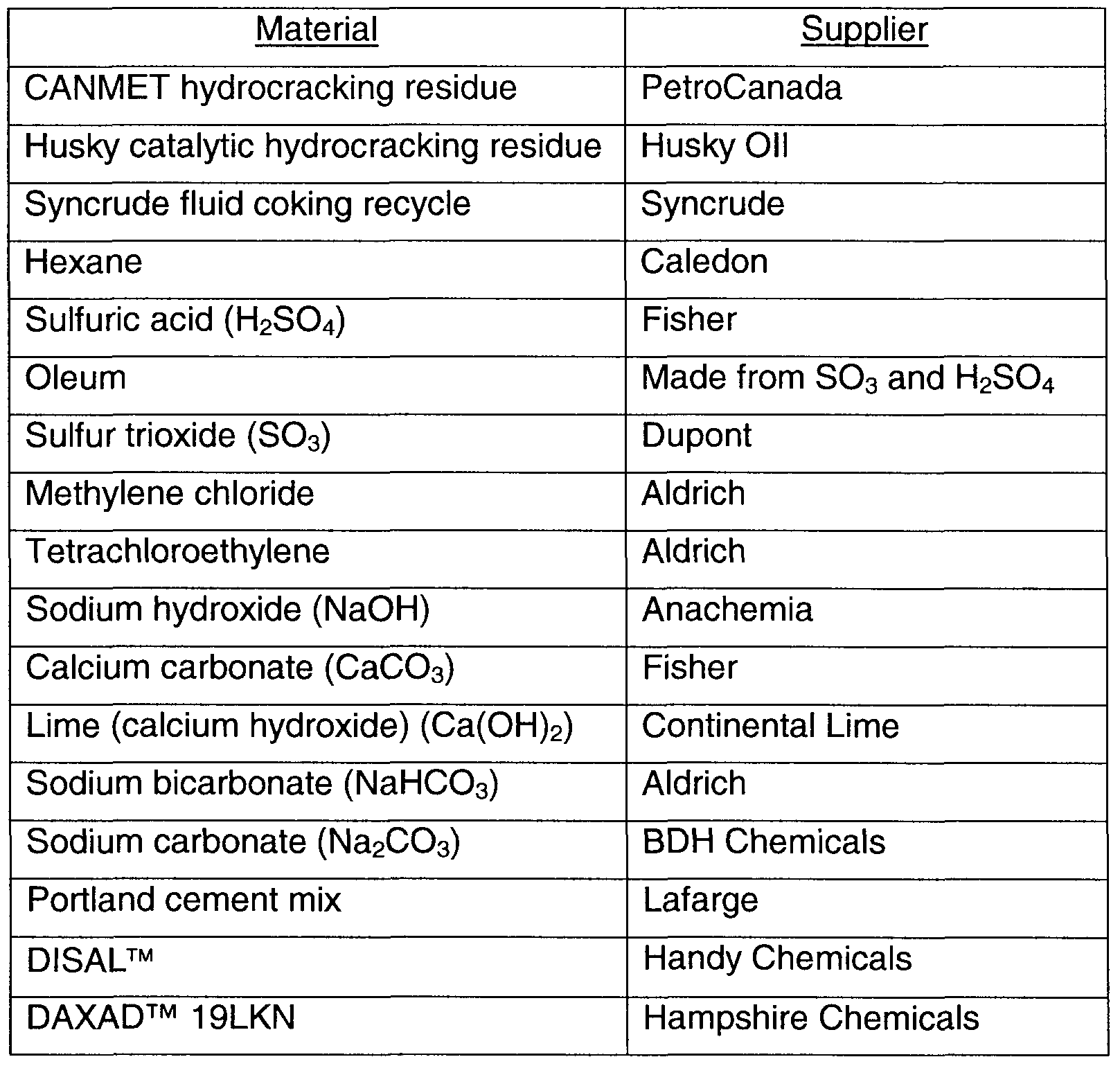
- Table 1 lists materials used in the Examples below.
- Example 1 Solvent Deasphalting of Bitumen Upgrading Residues
- Oleum (212 g containing 78.6 g SO 3 ) made from H 2 SO 4 and SO 3 was charged to a 500 ml 3-necked reaction flask fitted with an air driven stirrer and a thermometer. Powdered mortar ground CANMET SDA residue (12.6 g) was added to the vigorously stirred oleum using an addition funnel fitted with an auger feed arrangement over a 27-minute period. A cold water bath maintained temperature below 3O 0 C. The reaction mixture was stirred for a total of 60 min.
- the reaction mixture was poured into 550 ml of water in increments so that the temperature did not exceed 4O 0 C.
- the resulting aqueous mixture was centrifuged to obtain a lightly colored first liquid and 215.65 g of a first sludge.
- the first sludge was separated from the lightly colored liquid and then the first sludge was dispersed in water to a total volume of about 400 ml.
- the dispersion was treated with 550 ml of 10% NaOH resulting in a pH of 8.753.
- the treated dispersion was centrifuged to obtain about 955 ml of a very dark second liquid and 73.82 g of a second sludge.
- the second sludge was separated from the very dark liquid and treated with 25 ml of 10% NaOH to form 150 ml of a third liquid with pH of 12.87. In total, 70 g of NaOH was used for neutralization.
- the first, second and third liquids were combined and centrifuged to obtain a supernatant and an insoluble solid.
- the dried insoluble solid weighed 1.86 g, implying that a minimum of 10.74 g of the original 12.6 g of CANMET SDA residue was sulfonated (sulfonated SDA residue being generally soluble in aqueous medium). This example verifies that it is possible to sulfonate an SDA residue without the use of organic solvent.
- Oleum (176.6 g containing 64.5 g SO 3 ) made from H 2 SO 4 and SO 3 was charged to a 500 ml 3-necked reaction flask fitted with an air driven stirrer and a thermometer.
- Ground Husky SDA residue (16.92 g) was added to the vigorously stirred oleum using an addition funnel fitted with an auger feed arrangement over a
- the reaction mixture was poured into 550 ml of water in increments so that the temperature did not exceed 4O 0 C.
- the resulting 850 ml of aqueous mixture was centrifuged to obtain about 750 ml of a dark but transparent liquid and about 175 g of a sludge that was difficult to remove from the centrifuge cups.
- the sludge was separated from the liquid and then the sludge was dispersed in water to a total volume of about 400 ml.
- the mixture was centrifuged to obtain 555 ml of solution. Evaporation of a 50 ml aliquot of the solution yielded 3.0 g of dry solid, which indicated that a total of 33.3 g of dry solid can be obtained from the 555 ml of solution.
- the solid is sulfonated SDA residue.
- Table 2 provides a comparison of the composition of the Husky SDA residue feed stock and the sulfonated Husky SDA residue of Example 3.
- Example 4A The process of Example 4A was performed except that the solution of sulfur trioxide was fed stepwise to the solution of CANMET SDA residue.
- Example 4C The process of Example 4A was performed except that the solution of sulfur trioxide was fed stepwise to the solution of CANMET SDA residue, and the amount of SO 3 was 200 wt% more than the amount of CANMET SDA residue.
- Table 3 provides a comparison of the composition of the CANMET SDA residue feed stock and the sulfonated CANMET SDA residue of Example 4B.
- a 100 ml solution containing 14.96 g of Husky SDA residue in methylene chloride were fed simultaneously with a 50 ml solution containing 45 g of sulfur trioxide (SO 3 ) in methylene chloride into a reactor containing 250 ml methylene chloride.
- the mixture was mixed with a rotor-stator mixer and the reactor was cooled with a bath at 14 0 C. Feeding was completed in 67 min and after a further 10 min the mixer was stopped. There was some solid product deposited on the reactor walls and the mixer surface.
- the mixture was centrifuged and 210 ml of clear liquid was obtained. The solids were dispersed in water and 600 ml of aqueous acidic product was obtained.
- the solid product (29.5 g) was treated with 300 ml of water and the resulting mixture had a pH of 8.016, perhaps due to absorbed CO 2 .
- NaHCO 3 (4.0 g) was added and the pH was 6.567. Then, 1.8 g of Na 2 CO 3 was added to achieve a pH of 9.986. After centrifugation, the liquid was evaporated to give solid sulfonated Husky SDA residue and the solid dried to a constant weight of 26.9 g.
- a 50 ml solution containing 12 g of Husky SDA residue in tetrachlorethylene was simultaneously fed with 10 ml of solution containing 10 g of sulfur trioxide (SO 3 ) in terachlorethylene to a reactor containing 130 ml of tetrachloroethylene and 5 g of SO 3 over a period of 38 min.
- the reactor was cooled with a bath with initial temperature of -5°C and final temperature of -9°C.
- the reaction mixture was mixed with a rotor-stator mixer. Then, another 20 ml of solution containing 20 g of SO 3 was fed to the reaction mixture over period of 20 min and mixing continued for another 20 min after that.
- the reaction mixture was centrifuged to separate solvent (tetrachloroethylene) and product sludge.
- the sludge was treated with 225 ml of water, and when centrifuged more tetrachlorethylene was separated and some sludge was obtained.
- the sludge was dried and the dried sludge weighed 2.34 g.
- the aqueous product mix was treated with 4.0 g of NaOH and 25.0 g of lime to produce a mixture with pH of 12.029. The mixture was centrifuged to remove precipitated gypsum.
- the resulting supernatant solution was treated further with 5.2 g of NaHCO 3 and 0.64 g of NaOH to achieve a pH of 8.29, and then centrifuged to isolate a precipitate that was produced. The precipitate when dry weighed 3.4 g.
- the precipitated gypsum was extracted with 200 ml of aqueous solution containing 6.0 g of Na 2 CO 3 and 8.4 g of extract was obtained.
- the combined products were found to contain considerable amounts of poorly water soluble components and therefore were treated with another 3.2 g NaHCO 3 and 0.4 g of NaOH to a pH of 9.361. Centrifugation produced 4.4 g of precipitate when dry and 487 ml of product solution. A 50 ml aliquot when evaporated gave 3.35 g of product. Thus, total yield is calculated to be 32.63 g. This product was very water soluble.
- Table 4 provides a comparison of the composition of the Husky SDA residue feed stock and the sulfonated Husky SDA residue of Example 5A.
- Syncrude SDA residue was sulfonated under conditions similar to those of Example 5A to produce a sulfonated Syncrude SDA residue.
- Table 5 provides a comparison of the composition of the Syncrude SDA residue feed stock and the sulfonated Syncrude SDA residue of Example 6.
- Example 8 Comparative: Sulfonation of CANMET hydrocracking residue
- a sulfonated hydrocracking residue from US 5.584,920 was prepared for comparative purposes. Sulfonation was carried out under conditions similar to those of Example 4A. 15 g of CANMET hydrocracking residue and 45 g of SO 3 were used. 27.1 g of sulfonated CANMET hydrocracking residue were obtained. Table 6 provides a comparison of the composition of CANMET hydrocracking residue feed stock and sulfonated CANMET hydrocracking residue of Example 8.
- the densities of mixtures containing mortar were determined to assess the extent of air entrainment. Denser admixtures have less entrained air.
- Mortar mixtures were mixed and packed into a standard steel cup using a standard procedure. Mixing was done according to an ASTM standard mix design (ASTM C305-99e1 "Standard Practice for Mechanical Mixing of Hydraulic Cement Pastes and Mortars of Plastic Consistency", ASTM International, herein incorporated by reference).
- the standard cup had a volume of 180 ml, and was filled in three layers. A first layer was placed by tapping the cup on its bottom. Second and third layers were tamped in place by tamping each layer fifteen times.
- Density was determined by weighing the cup and dividing by the known volume. The mixing and packing procedure were the same in all cases.
- the mortars contained sand (ASTM 20-30 mesh, 67.9 wt%), Portland cement (22.6 wt%), water (9.4 wt%) and a water requirement reducing admixture (0.1 wt%), and differed only in the type of water requirement reducing admixture used.
- Table 7 provides the results of the air entrainment assessment.
- DISALTM is a commercial superplasticizer for cement-based mixtures and contains naphthalene sulphonates sodium salts.
- Example 8 is a water requirement reducing agent made in accordance with US 5,584,920.
- Examples 4A, 4B 1 5A, 6 and 7 are examples of the present invention. It is evident from Table 7 that sulfonated SDA residues of the present invention provide for less entrained air in a cement-based mixture than the sulfonated residues disclosed in US 5,584,920. Further, sulfonated SDA residues of the present invention can be as effective or more effective than commercially available products.
- Mortar flow tests measure the workability of a mortar mixture. Mortar mixtures that are more workable at a given water content will require less water to be able to work.
- a standard procedure for mortar mixing was used for each mortar composition tested. The mortar was packed using a standard procedure into a stainless steel cylindrical form having a diameter of 4.2 cm and a height of 5 cm. The form was removed to leave a cylindrical wet briquette on a platform. The platform was dropped through 33.3 cm and the average diameter of the flattened briquette was determined by measuring the longest and shortest diameters of the flattened briquette and then taking the average. The average diameter is a measure of workability, with larger average diameters indicating greater workability.
- the mortars contained beach sand (finer than 50 mesh, 53.5 wt%), Portland cement (32.2 wt%), water (14.1 wt%) and a water requirement reducing admixture (0.2 wt%), and differed only in the type of water requirement reducing admixture used. Table 8 provides results.
- ASTM International Standard mix design for mortar
- ASTM C109 Standard Test Method for Compressive Strength of Hydraulic Cement Mortars (Using 2-in. or [50mm] Cube Specimens)
- Tests in accordance with ASTM specifications were conducted on the prepared mortar samples, the samples comprising various water requirement reducing admixtures. Specifically, the following tests were performed.
- Air entrainment was measured through wet density and air content in accordance with ASTM C185 (ASTM C185-99, "Standard Test Method for Air Content of Hydraulic Cement Mortar", ASTM International, herein incorporated by reference). Since the sand in the mortar composition was not washed, some additional air entrainment may affect the accuracy of the air content values.
- Compressive strength was conducted in accordance with ASTM C109 using 50 mm cube specimens. (ASTM C109-99 "Standard Test Method for Compressive Strength of Hydraulic Cement Mortars (Using 2-in. or [50 mm] Cube Specimens)", ASTM International, herein incorporated by reference).
- Table 9 provides the compositions of the mortars tested and the test results obtained therefor.
- s/c weight ratio is the ratio of sand to cement
- w/c ratio is the ratio of water to cement
- admixture is the amount of water requirement reducing admixture expressed as weight percent based on weight of the cement.
- the sand was standard ASTM 20-30 mesh sand as specified in ASTM C778 (C778-02 Standard Specification for Standard Sand) and the cement was Lafarge brand Portland cement.
- the admixture in Ex. C2 is a commercial water requirement reducing admixture called DAXADTM 19LKN.
- water reducing admixtures of the present invention can provide for less entrained air in a cement-based mixture than a commercially available admixture. Further, admixtures of the present invention can provide for comparable entrained air than a control without any admixture.
- admixtures of the present invention provides for better workability of a cement- based mixture than a control without any admixture. Further, admixtures of the present invention can provide for comparable or better workability than a commercially available admixture.
- admixtures of the present invention Based on the compressive strength, it is evident that water requirement reducing admixtures of the present invention provides for better compressive strength of a cement-based mixture than a control without any admixture. Further, admixtures of the present invention can provide for compressive strength comparable to a commercially available admixture.
- conduction calorimetry Another indicator of water reducing requirement effectiveness is conduction calorimetry, which measures exothermicity vs. time to give an indication of cement hydration.
- Conduction calorimetry experiments were conducted using a Thermonics Tarn Air Cement Calorimeter system. The system was maintained at 24 ⁇ 0.1 °C and configured with a ⁇ 60 mW signal range. The reference cells were loaded with a heat capacity mass equivalent weight of 5 g of cement with a water to cement ratio of 0.4. The system was set to acquire data every two minutes for the duration of the test. Glass amphiboles specifically designed for the calorimeter chamber with a crimp top were used for each specimen. The dry powder fractions for each mix design were weighed and recorded and placed into the amphibole.
- Fig. 1 provides the results of the conduction calorimetry testing for the mortar samples listed in Table 10. Samples listed in Table 10 were prepared as per ASTM C305 as described above in Example 11.
- w/c ratio is the ratio of water to cement and admixture is the amount of water requirement reducing admixture expressed as weight percent based on the weight of the cement.
- the cement was Portland cement.
- the admixture used in samples C2 and C3 was DAXADTM 19LKN.
- the admixture used in samples 5B' and 5B" was the sulfonated solvent deasphalting residue of Example 5B.
- the admixture used in samples 3' and 3" was the sulfonated solvent deasphalting residue of Example 3. It is evident from Fig.
Landscapes
- Chemical & Material Sciences (AREA)
- Engineering & Computer Science (AREA)
- Ceramic Engineering (AREA)
- Organic Chemistry (AREA)
- Materials Engineering (AREA)
- Structural Engineering (AREA)
- Chemical Kinetics & Catalysis (AREA)
- Oil, Petroleum & Natural Gas (AREA)
- General Chemical & Material Sciences (AREA)
- Environmental & Geological Engineering (AREA)
- Civil Engineering (AREA)
- Inorganic Chemistry (AREA)
- Curing Cements, Concrete, And Artificial Stone (AREA)
Abstract
Bitumen-upgrading residues are extracted with solvent to remove any remaining fuel value. The resultant insoluble solvent- deasphalted (SDA) residue is rendered useful as a dispersant (e.g. for cement) by sulfonation with oleum or sulfur trioxide to yield a sulfonated, solvent-deasphalted, bitumen upgrading residue.
Description
SULFONATED SOLVENT DEASPHALTING RESIDUES, PROCESS FOR PRODUCTION THEREOF AND THEIR USE
Field of the Invention
The present invention relates to sulfonated solvent deasphalting residues and their use as dispersants or superplasticizers, and more particularly, the present invention relates to a process and product for formulating a water requirement reducing admixture for cement-based mixtures formed by sulfonation of solvent deasphalted bitumen upgrading residues.
Description of Related Art
Non-distillable bitumen fractions such as those from conventional petroleums or from heavy oils and tar sands require pyrolytic processes to produce distillable products. Common pyrolytic processes are coking and hydrocracking. There are various versions of both of these processes.
In coking, the products are volatile fractions and coke. However, the volatile fractions contain heavy components and these heavy components can be recycled to the coker for further cracking to produce suitable distillable products.
These heavy components are called coker recycle. In hydrocracking, the bitumens are pyrolyzed in the presence of hydrogen and produce larger yields of distillable components than coking. However, depending on the hydrocracking severity, some non-distillable residues remain. Collectively, coker products, such as coker recycle, and hydrocracking residue may be referred to as bitumen upgrading residues.
Hydrocracking residue and coker recycle have very low value as fuels, therefore it is desirable to be able to use them ϊh some way. To this end, Sawatzky et al, in United States Patent No. 5,584,920 issued December 17, 1996, discloses a process whereby a hydrocracking residue is sulfonated to form a water requirement reducing product for concrete mixtures. Although this process is useful, it has disadvantages. For example, hydrocracking residues still have some
fuel value which is lost in this process. When sulfuric acid or oleum is used as a sulfonation agent, this process involves separation of a neutralized sulfonation product from a large amount of sulfate, which separation is not entirely successful. Efficiency of this process is limited by a methanol extraction step in which a significant amount of the sulfonation product is not recovered.
One way of recovering the fuel value from bitumen upgrading residue is to extract the bitumen upgrading residue with an organic solvent, for example hexanes. Such an extraction is termed solvent deasphalting. Much of the bitumen upgrading residue can be extracted in this manner leaving some insoluble material, called solvent deasphalting (SDA) residue. Thus, there is a need in the art to find a use for SDA residues.
Summary of the Invention
It has now been found that solvent deasphalting (SDA) residues may be sulfonated to produce a dispersant for aqueous dispersions, especially a water requirement reducing product for cement-based mixtures.
According to an aspect of the invention, there is provided a sulfonated solvent deasphalting residue of a solvent deasphalted bitumen upgrading residue.
According to yet another aspect of the invention, there is provided a process for preparing a sulfonated solvent deasphalting residue, the process comprising providing a solvent deasphalting residue and contacting the solvent deasphalting residue with a sulfonating agent.
According to still yet another aspect of the invention, there is provided a process for preparing sulfonated solvent deasphalting residue, the process comprising: providing a solvent deasphalting residue; providing a sulfonating agent; contacting the solvent deasphalting residue with the sulfonating agent to produce a sulfonated solvent deasphalting residue; and neutralizing the sulfonated solvent deasphalting residue with a base.
It has now been found that sulfonated solvent deasphalting residues are excellent superplasticizers for aqueous solid dispersions. In particular, they are excellent water requirement reducing admixtures for cement-based mixtures.
They provide improved performance over prior art admixtures such as sulfonated hydrocracking residues disclosed in US 5,584,920, and improved economics.
Product and Process:
The solvent deasphalting (SDA) residue may be prepared from any suitable bitumen upgrading residue, for example thermal, catalytic and conventional hydrocracking residues or coker product. Preferably, the bitumen upgrading residue has a weight average molecular weight of at least 200 g/mol. In some instances the bitumen upgrading residue will be depleted in branched long chain aliphatics. In some instances the bitumen upgrading residue is enriched in a aromatic ring containing molecules. In some instances, the bitumen upgrading residue has a carbon content of 80 wt% or greater. One thermal hydrocracking residue, generally referred to as the CANMET from PetroCanada, is a 64% conversion residue provided from cracking vacuum tower bottoms using iron based additives. Another particular hydrocracking residue, referred to as HRI residue, is obtained from a Husky oil catalytic cracking process. One particular coker product, referred to as Syncrude coker recycle, is obtained from the Syncrude flexi-coking process.
Bitumen upgrading residue is deasphalted (extracted) with an organic solvent to yield a solid phase comprising solvent insoluble residue, i.e. the SDA residue, and a liquid phase comprising the organic solvent and a solvent soluble fraction. The solvent with the solvent soluble phase may be further treated to recover fuel values, e.g. oils. The organic solvent is preferably an aliphatic solvent, more preferably a solvent comprising an alkane. In some instances a C3-C2O alkane is used. In some instances a C3-Ci5 alkane is used. In some instances a C3-C8 alkane is used. In some instances the alkane is linear. Paraffinic solvents, e.g. propane, butanes, pentanes and hexanes, are specific examples. Hexanes is particularly suitable for many purposes. The use of more
solvent provides cleaner separation but may lead to major utility costs in solvent recovery, greater environmental impact and might lead to sulfonation difficulties. A solvent: hydrocracking residue ratio of 2:1 or greater is preferred in the deasphalting of the hydrocracking residue.
The SDA residue comprises asphaltenes and other solvent insoluble materials (e.g. sulfur and heavy metals (e.g. Ni and V)). The SDA residue may have a weight average molecular weight of 200 g/mol or greater. In some instances, the weight average molecular weight may be 600 g/mol or greater. Higher molecular weight SDA residues may lead to better performance. In some instances the SDA residue comprises 75-90 wt% of carbon. In some instances the SDA residue comprises 5-10 wt% of hydrogen. In some instances the SDA residue comprises 4-7 wt% of sulfur. The SDA residue may comprise 75-90 wt% of carbon, 5-10 wt% of hydrogen and 4-7 wt% of sulfur. The SDA residue may have lower alkyl content than the bitumen upgrading residue from which the SDA residue is produced. Lower alkyl content ultimately leads to less air entrainment in cement-based mixtures.
Sulfonation of the SDA residue may be achieved with any suitable sulfonating agent, for example, sulfuric acid, fuming sulfuric acid (oleum) and sulfur trioxide. Oleum and sulfur trioxide are of particular note.
Sulfonation is achieved by contacting the SDA residue with the sulfonating agent, or with a source of the sulfonating agent. Sulfonation may be achieved with or without the use of solvents. Without a solvent, solid or liquid SDA residue may be contacted with sulfonating agent, e.g. liquid oleum, liquid or gaseous sulfur trioxide). With a solvent, one or both of the SDA residue and the sulfonating agent may be dissolved in a solvent prior to reaction. In one embodiment, the SDA residue is dissolved in a solvent and the sulfonating agent is contacted with the SDA residue in the solvent. In another embodiment, the sulfonating agent is dissolved in a solvent and the SDA residue is contacted with the sulfonating agent in the solvent. In yet another embodiment, the SDA residue and sulfonating agent are dissolved independently in solvents and the two resulting solutions contacted
with each other. When a solvent is used, the sulfonated product is generally insoluble in the solvent, and thus precipitates out as a solid. Removal of the supernatant liquid by centrifugation or other solid/liquid separation techniques may be used to isolate the solid sulfonated product and get rid of excess sulfonating agent after the reaction is complete.
Solvents are preferably inert to or only minimally reactive with one or both of the sulfonating agent and SDA residue, more preferably inert to or only minimally reactive with both. Organic solvents are preferred. Organic solvents having a boiling point from 3O0C to 13O0C are preferred. Some examples of suitable organic solvents include chlorinated organic solvents (e.g. methylene chloride, tetrachloroethylene, tetrachloroethane, etc.).
There is no upper limit to the amount of sulfonating agent that can be used with a given amount of SDA residue. The greater the amount of sulfonating agent, the more the equilibrium is shifted to higher sulfonation, but the more excess sulfonating agent will remain. Conversely, the use of too low an amount of sulfonating agent will not yield a viable water requirement reducing admixture with low surfactant properties. Thus, the weight ratio of sulfonating agent to SDA residue is preferably not lower than about 0.5:1. More preferably, the weight ratio of sulfonating agent to SDA residue is greater than or equal to about 1 :1. Diminishing returns occur at a weight ratio of sulfonating agent to SDA residue of about 3:1 and higher.
There are trade-offs with respect to reaction time, temperature, solvent volumes (if used), degree of acid removal, etc. The temperature is preferably low enough to avoid boiling away any solvent and/or reactants. Very good mixing leads to better sulfonation of the SDA residue. Further, in solvents, as the ratio of sulfur trioxide (SO3) to SDA residue is increased, there may be a tendency for sulfonated SDA residue to deposit on solid surfaces, which may cause some hindering of contact of SO3 with the incompletely sulfonated product. A stepwise feed, i.e. adding equal amounts of SDA residue and SO3, then adding more SO3 later, permits the use of less SO3 to obtain good products.
In contacting the sulfonating agent with the SDA residue, a sulfonated SDA residue is produced. If the sulfonation was conducted in a solvent, it advantageous to remove the solvent, for example by evaporation, centrifugation or other techniques, before further processing. Further processing may be, for example, neutralization and/or isolation of the sulfonated SDA residue.
If sulfonation takes place without a solvent, the sulfonated product is preferably separated from the sulfonating agent. Separation from liquid sulfonating agents (e.g. oleum) may be accomplished with the selection of an appropriate technique, for example, selection of an appropriate membrane for membrane separation, washing the reaction mixture with water to remove excess sulfur trioxide as sulfuric acid, etc.
The sulfonated SDA residue is preferably neutralized before using it as a water requirement reducing admixture. Neutralization may be achieved with any suitable base. Some examples of suitable bases include alkali metal hydroxides (e.g. NaOH, KOH, etc.), alkali metal carbonates (e.g. Na2CO3, NaHCO3, etc.), alkaline earth metal hydroxides (e.g. Ca(OH)2, Mg(OH)2, etc., alkaline earth metal carbonates (e.g. CaCO3), etc., and mixtures thereof. Preferably, the base comprises NaOH, Ca(OH)2, CaCO3, or mixtures thereof.
Unless the sulfuric acid is removed prior to neutralization (e.g. with a membrane), then the neutralization of the sulfonated SDA residue produces sulfates as a by-product (which is undesirable in most, but not all, cases). In this situation, the base preferably comprises a counter-cation which forms an insoluble salt with sulfate, for example calcium (Ca2+). Calcium-containing bases preferably comprise Ca(OH)2 (lime) and/or CaCO3 (limestone). Precipitation of insoluble sulfates facilitates separation of sulfate impurities from sulfonated SDA residues.
More preferably, the base comprises a mixture of NaOH together with Ca(OH)2 and/or CaCO3. Separation of sodium sulfate may also be achieved by membrane separation techniques. Neutralization is preferably performed in a polar solvent, for example water, alcohol or mixtures thereof. Water is preferred.
One advantage of the present process is that the use of alcohol, e.g. methanol, may be avoided if desired.
In some situations, calcium salts of the sulfonated SDA residue may be desired, in which case complete neutralization with calcium hydroxide or calcium carbonate is preferred. In other situations, the neutralized sulfonated SDA residue is preferably a sodium salt, which is accomplished by the use of sodium hydroxide once the sulfonated SDA residue is separated from excess sulfate. If separation from excess sulfate was accomplished through precipitation of calcium sulfate, the calcium salts of the sulfonated SDA residue may not be readily displaced by sodium ions from the sodium hydroxide. In this instance, a soluble salt with a counter-anion that produces an insoluble calcium salt, for example soluble bicarbonate (e.g. sodium bicarbonate), may be used to ensure removal of calcium. Additionally, in this case, the use of limestone rather than lime for separating excess sulfates is preferred as it minimizes Ca2+ uptake in the final product.
The neutralized sulfonated SDA residue may be isolated or not depending on the intended use. Preferably, the neutralized sulfonated SDA is isolated before being used as a water requirement reducing admixture. Isolation of the sulfonated SDA residue may be accomplished by generally known techniques, for example, centrifugation, filtration, extraction, evaporation, etc., and combinations thereof. Isolation steps may be employed before, during and/or after neutralization.
The sulfonated SDA residue preferably has a weight average molecular weight of 600 g/mol or greater. In some instances, the weight average molecular weight is 1000 g/mol or greater. In some instances, the sulfonated SDA residue comprises about 50 wt% aromatic components. In some instances, the sulfonated SDA residue comprises 15-40 wt% carbon. In some instances, the sulfonated SDA residue comprises 1-4 wt% hydrogen. In some instances, the sulfonated SDA residue comprises 5-20 wt% sulfur. In some instances, the sulfonated SDA residue comprises 20-35 wt% oxygen. The sulfonated SDA residue may comprise 15-40 wt% carbon, 1 -4 wt% hydrogen, 5-20 wt% sulfur and 20-35 wt% oxygen.
Uses:
The sulfonated solvent deasphalting residue described above may be used as a water requirement reducing admixture in cement-based mixtures. Cement- based mixtures include cement, mortar, concrete, etc. Cement is generally formulated by mixing water with dry powder cementitious material. Mortar is generally formulated by mixing water with dry powder cementitious material and fine aggregate (e.g. sand). Concrete is generally formulated by mixing water with dry powder cementitious material and both fine aggregate (e.g. sand) and coarse aggregate (e.g. stone). Cementitious material includes, for example, Portland cement, high alumina cement, magnesium phosphate cement, gypsum, etc.
Other chemical admixtures may be present in the cement-based mixture, for example, pozzolanic materials (e.g. fly ash, slag, silica fume, lime, etc.) to supplement or replace cementitious materials, accelerators for reducing set time, set retarders for delaying set time, air-entrainers for freeze-thaw resistance, corrosion inhibitors, expansive admixtures for minimizing shrinkage, shrinkage reducing admixtures, water repelling admixtures, mixtures thereof, etc.
The presence of the sulfonated SDA residue in a wet cement-based mixture increases the fluidity of the mixture, thus reducing the amount of water required to make up the cement-based mixture having a given initial workability, thus increasing compressive strength of the cement-based mixture.
Sulfonated SDA residues of the present invention are particularly advantageous. For example, they have a significantly lower degree of surfactant properties, leading to reductions in air entrainment and retardation of set in cement-based mixtures, especially in comparison with sulfonated hydrocracking residues disclosed in US 5,584,920. Without being held to any particular mode of action, it is thought that sulfonated SDA residues have less alkyl group content in comparison to sulfonated hydrocracking residues. Alkyl groups attached to sulfonated aromatics cause surface activity leading to undesired air entrainment.
Brief Description of the Drawings
In order that the invention may be more clearly understood, preferred embodiments thereof will now be described in detail by way of example, with reference to the accompanying drawings, in which:
Fig. 1 is a graph of time (h) vs. reaction rate (mW/g) for conduction calorimetry experiments conducted on water requirement reducing admixtures.
Detailed Description of Preferred Embodiments
Table 1 lists materials used in the Examples below.
Table 1
Example 1 : Solvent Deasphalting of Bitumen Upgrading Residues
856 g of CANMET hydrocracking residue (a 64% conversion hydrocracking residue from PetroCanada) was mixed with 1712 g of hexane (d=0.66) in a vessel. The mixture was heated at 66.50C with considerable kneading with a metal rod for
30 min. During this time, evaporated hexane was replaced. After 30 min, the mixture was allowed to cool. A hard layer developed at the bottom of the vessel and the supernatant liquid was decanted off. The hard layer was treated with 500 ml of fresh hexane as before, and the liquid decanted off after 30 min. A residue weighing 393 g remained which was heated in a vacuum oven to a constant weight of 364.3 g. This final SDA residue (CANMET SDA residue) contained
17.6% of material insoluble in sulfonation solvents.
Similar solvent deasphalting processes were performed on Husky catalytic hydrocracking residue and Syncrude fluid coking recycle to produce Husky SDA residue and Syncrude SDA residue, respectively.
Example 2. Sulfonation of CANMET SDA residue with oleum
Oleum (212 g containing 78.6 g SO3) made from H2SO4 and SO3 was charged to a 500 ml 3-necked reaction flask fitted with an air driven stirrer and a thermometer. Powdered mortar ground CANMET SDA residue (12.6 g) was added to the vigorously stirred oleum using an addition funnel fitted with an auger feed arrangement over a 27-minute period. A cold water bath maintained temperature below 3O0C. The reaction mixture was stirred for a total of 60 min.
The reaction mixture was poured into 550 ml of water in increments so that the temperature did not exceed 4O0C. The resulting aqueous mixture was centrifuged to obtain a lightly colored first liquid and 215.65 g of a first sludge. The first sludge was separated from the lightly colored liquid and then the first sludge was dispersed in water to a total volume of about 400 ml.
The dispersion was treated with 550 ml of 10% NaOH resulting in a pH of 8.753. The treated dispersion was centrifuged to obtain about 955 ml of a very dark second liquid and 73.82 g of a second sludge. The second sludge was separated from the very dark liquid and treated with 25 ml of 10% NaOH to form 150 ml of a third liquid with pH of 12.87. In total, 70 g of NaOH was used for neutralization.
The first, second and third liquids were combined and centrifuged to obtain a supernatant and an insoluble solid. The dried insoluble solid weighed 1.86 g, implying that a minimum of 10.74 g of the original 12.6 g of CANMET SDA residue was sulfonated (sulfonated SDA residue being generally soluble in aqueous medium). This example verifies that it is possible to sulfonate an SDA residue without the use of organic solvent.
Example 3: Sulfonation of Husky SDA residue with oleum
Oleum (176.6 g containing 64.5 g SO3) made from H2SO4 and SO3 was charged to a 500 ml 3-necked reaction flask fitted with an air driven stirrer and a thermometer. Ground Husky SDA residue (16.92 g) was added to the vigorously stirred oleum using an addition funnel fitted with an auger feed arrangement over a
1 h 21 min period. A cold water bath maintained temperature below 3O0C.
The reaction mixture was poured into 550 ml of water in increments so that the temperature did not exceed 4O0C. The resulting 850 ml of aqueous mixture was centrifuged to obtain about 750 ml of a dark but transparent liquid and about 175 g of a sludge that was difficult to remove from the centrifuge cups. The sludge was separated from the liquid and then the sludge was dispersed in water to a total volume of about 400 ml.
Solid NaOH (9.43 g) was added to the 400 ml of water dispersion and a pH of 1.134 was obtained when the sodium hydroxide fully dissolved. CaCO3 (20.07 g) was then added slowly with stirring. Considerable foaming was observed. The pH was 1.134. The dispersion was allowed to stand overnight. The next day, a gel had formed and 100 ml of water was added to liquefy the mixture. The pH was
6.002. Another 0.98 g of CaCO3 was added and the pH was 6.566. Then, 15 ml of a 10% NaOH solution was added bringing the pH to 11.318. Another 2 ml of 10% NaOH was added to bring the pH to 11.988. The mixture was centrifuged to obtain 555 ml of solution. Evaporation of a 50 ml aliquot of the solution yielded 3.0 g of dry solid, which indicated that a total of 33.3 g of dry solid can be obtained from the 555 ml of solution. The solid is sulfonated SDA residue.
Table 2 provides a comparison of the composition of the Husky SDA residue feed stock and the sulfonated Husky SDA residue of Example 3.
Table 2

Example 4: Sulfonation of CANMET SDA residue with SO3 in methylene chloride
4A: CANMET SDA residue (14 g) was dissolved in methylene chloride (50 ml). Sulfur trioxide (SO3) (46 g) was dissolved in methylene chloride (46 ml). The two solutions were simultaneously fed into a reactor charged with 250 ml methylene chloride and fitted with a rotor-stator mixer for continuously subdividing and dispersing the feeds and reaction products in the reaction mixture. Solid reaction products were separated from the liquid by centrifugation and dispersed in water. The aqueous mixture was treated with NaOH (3.5 g) and lime (24.5 g) achieving a pH of 11.258 to precipitate the sulfates and produce a solution of sulfonated CANMET SDA residue. The mixture was centrifuged to remove gypsum. The solution of sulfonated CANMET SDA residue could be used directly as a water requirement reducing agent, or the solution could be evaporated to obtain 24.5 g of a solid product.
4B: The process of Example 4A was performed except that the solution of sulfur trioxide was fed stepwise to the solution of CANMET SDA residue.
4C: The process of Example 4A was performed except that the solution of sulfur trioxide was fed stepwise to the solution of CANMET SDA residue, and the amount of SO3 was 200 wt% more than the amount of CANMET SDA residue.
Table 3 provides a comparison of the composition of the CANMET SDA residue feed stock and the sulfonated CANMET SDA residue of Example 4B.
Table 3

Example 5: Sulfonation of Husky SDA residue with SO3 in organic solvent
5A: A 100 ml solution containing 14.96 g of Husky SDA residue in methylene chloride were fed simultaneously with a 50 ml solution containing 45 g of sulfur trioxide (SO3) in methylene chloride into a reactor containing 250 ml methylene chloride. The mixture was mixed with a rotor-stator mixer and the reactor was cooled with a bath at 140C. Feeding was completed in 67 min and after a further 10 min the mixer was stopped. There was some solid product deposited on the reactor walls and the mixer surface. The mixture was centrifuged and 210 ml of clear liquid was obtained. The solids were dispersed in water and 600 ml of aqueous acidic product was obtained. NaOH (3.5 g) and lime (29.7 g) were added to obtain a pH of 12.266. This mixture was centrifuged and the liquid obtained was evaporated to yield a solid product, which was dried to a constant
weight of 33.1 g in a vacuum oven. The solid product had low solubility in water and the addition of NaOH had little effect.
The solid product (29.5 g) was treated with 300 ml of water and the resulting mixture had a pH of 8.016, perhaps due to absorbed CO2. NaHCO3 (4.0 g) was added and the pH was 6.567. Then, 1.8 g of Na2CO3 was added to achieve a pH of 9.986. After centrifugation, the liquid was evaporated to give solid sulfonated Husky SDA residue and the solid dried to a constant weight of 26.9 g.
5B: A 50 ml solution containing 12 g of Husky SDA residue in tetrachlorethylene was simultaneously fed with 10 ml of solution containing 10 g of sulfur trioxide (SO3) in terachlorethylene to a reactor containing 130 ml of tetrachloroethylene and 5 g of SO3 over a period of 38 min. The reactor was cooled with a bath with initial temperature of -5°C and final temperature of -9°C. The reaction mixture was mixed with a rotor-stator mixer. Then, another 20 ml of solution containing 20 g of SO3 was fed to the reaction mixture over period of 20 min and mixing continued for another 20 min after that.
The reaction mixture was centrifuged to separate solvent (tetrachloroethylene) and product sludge. The sludge was treated with 225 ml of water, and when centrifuged more tetrachlorethylene was separated and some sludge was obtained. The sludge was dried and the dried sludge weighed 2.34 g. The aqueous product mix was treated with 4.0 g of NaOH and 25.0 g of lime to produce a mixture with pH of 12.029. The mixture was centrifuged to remove precipitated gypsum.
The resulting supernatant solution was treated further with 5.2 g of NaHCO3 and 0.64 g of NaOH to achieve a pH of 8.29, and then centrifuged to isolate a precipitate that was produced. The precipitate when dry weighed 3.4 g.
The precipitated gypsum was extracted with 200 ml of aqueous solution containing 6.0 g of Na2CO3 and 8.4 g of extract was obtained.
The combined products were found to contain considerable amounts of poorly water soluble components and therefore were treated with another 3.2 g NaHCO3 and 0.4 g of NaOH to a pH of 9.361. Centrifugation produced 4.4 g of precipitate when dry and 487 ml of product solution. A 50 ml aliquot when evaporated gave 3.35 g of product. Thus, total yield is calculated to be 32.63 g. This product was very water soluble.
Table 4 provides a comparison of the composition of the Husky SDA residue feed stock and the sulfonated Husky SDA residue of Example 5A.
Table 4

Example 6: Sulfonation of Syncrude SDA residue with SO3 in methylene chloride
Syncrude SDA residue was sulfonated under conditions similar to those of Example 5A to produce a sulfonated Syncrude SDA residue. Table 5 provides a comparison of the composition of the Syncrude SDA residue feed stock and the sulfonated Syncrude SDA residue of Example 6.
Table 5

A 17 ml solution containing 5.0 g of CANMET SDA residue in tetrachloroethylene and a 20 ml solution containing 15 g of SO3 in tetrachloroethylene were fed simultaneously into a glass reactor equipped with a low gap rotor-stator mixer. The reactor was cooled with a water bath at 80C and feeding was completed in 16 min. There were some deposits on the reactor walls and mixer. The reaction mixture was centrifuged and the solids were dispersed in 100 ml of water. The aqueous mixture was centrifuged (a small amount of sludge was obtained). The solution was made basic with NaOH and lime to remove sulfates as gypsum. The solution was evaporated and the solid sulfonated CANMET SDA residue obtained was dried to a constant weight of 8.5 g. A similar run involving stepwise SO3 feed gave the same results.
Example 8 - Comparative: Sulfonation of CANMET hydrocracking residue
A sulfonated hydrocracking residue from US 5.584,920 was prepared for comparative purposes. Sulfonation was carried out under conditions similar to those of Example 4A. 15 g of CANMET hydrocracking residue and 45 g of SO3 were used. 27.1 g of sulfonated CANMET hydrocracking residue were obtained. Table 6 provides a comparison of the composition of CANMET hydrocracking residue feed stock and sulfonated CANMET hydrocracking residue of Example 8.
Table 6

The use of sulfonated SDA residues as water requirement reducing admixtures in cement-based mixtures was evaluated on the basis of air entrainment, mortar flow, compressive strength and conduction calorimetry.
Example 9: Air Entrainment Testing
For air entrainment, the densities of mixtures containing mortar were determined to assess the extent of air entrainment. Denser admixtures have less entrained air. Mortar mixtures were mixed and packed into a standard steel cup using a standard procedure. Mixing was done according to an ASTM standard mix design (ASTM C305-99e1 "Standard Practice for Mechanical Mixing of Hydraulic Cement Pastes and Mortars of Plastic Consistency", ASTM International, herein incorporated by reference). The standard cup had a volume of 180 ml, and was filled in three layers. A first layer was placed by tapping the cup on its bottom. Second and third layers were tamped in place by tamping each layer fifteen times. Density was determined by weighing the cup and dividing by the known volume. The mixing and packing procedure were the same in all cases. The mortars contained sand (ASTM 20-30 mesh, 67.9 wt%), Portland cement (22.6 wt%), water (9.4 wt%) and a water requirement reducing admixture (0.1 wt%), and differed only in the type of water requirement reducing admixture used. Table 7 provides the results of the air entrainment assessment.
Table 7

Example 10: Mortar Flow Testing
Mortar flow tests measure the workability of a mortar mixture. Mortar mixtures that are more workable at a given water content will require less water to be able to work. To test mortar flow, a standard procedure for mortar mixing was used for each mortar composition tested. The mortar was packed using a standard procedure into a stainless steel cylindrical form having a diameter of 4.2 cm and a height of 5 cm. The form was removed to leave a cylindrical wet briquette on a platform. The platform was dropped through 33.3 cm and the average diameter of the flattened briquette was determined by measuring the longest and shortest diameters of the flattened briquette and then taking the average. The average diameter is a measure of workability, with larger average diameters indicating greater workability. The mortars contained beach sand (finer than 50 mesh, 53.5 wt%), Portland cement (32.2 wt%), water (14.1 wt%) and a water requirement reducing admixture (0.2 wt%), and differed only in the type of water requirement reducing admixture used. Table 8 provides results.
Table 8

Example 11: ASTM Testing
Mortar samples were mixed according to ASTM standard mix practice
(ASTM C305-99e1 "Standard Practice for Mechanical Mixing of Hydraulic Cement Pastes and Mortars of Plastic Consistency", ASTM International, herein incorporated by reference), using an ASTM standard mix design for mortar (ASTM C109 "Standard Test Method for Compressive Strength of Hydraulic Cement Mortars (Using 2-in. or [50mm] Cube Specimens)", ASTM International).
Tests in accordance with ASTM specifications were conducted on the prepared mortar samples, the samples comprising various water requirement reducing admixtures. Specifically, the following tests were performed.
Flow of mortar. Flow was conducted in accordance with ASTM C109 using 50 mm cube specimens in conjunction with the specifications set out in ASTM
C230. (ASTM C109-99 "Standard Test Method for Compressive Strength of
Hydraulic Cement Mortars (Using 2-in. or [50 mm] Cube Specimens)", ASTM
International, herein incorporated by reference). (ASTM C230-98 "Standard
Specification for Flow Table for Use in Tests of Hydraulic Cement", ASTM International, herein incorporated by reference),
Air entrainment Air entrainment was measured through wet density and air content in accordance with ASTM C185 (ASTM C185-99, "Standard Test Method for Air Content of Hydraulic Cement Mortar", ASTM International, herein incorporated by reference). Since the sand in the mortar composition was not washed, some additional air entrainment may affect the accuracy of the air content values.
Compressive strength: Compressive strength was conducted in accordance with ASTM C109 using 50 mm cube specimens. (ASTM C109-99
"Standard Test Method for Compressive Strength of Hydraulic Cement Mortars (Using 2-in. or [50 mm] Cube Specimens)", ASTM International, herein incorporated by reference).
Table 9 provides the compositions of the mortars tested and the test results obtained therefor.
Table 9

In Table 9, s/c weight ratio is the ratio of sand to cement, w/c ratio is the ratio of water to cement and admixture is the amount of water requirement reducing admixture expressed as weight percent based on weight of the cement. The sand was standard ASTM 20-30 mesh sand as specified in ASTM C778 (C778-02 Standard Specification for Standard Sand) and the cement was Lafarge brand
Portland cement. The admixture in Ex. C2 is a commercial water requirement reducing admixture called DAXAD™ 19LKN.
Based on wet density, water reducing admixtures of the present invention can provide for less entrained air in a cement-based mixture than a commercially available admixture. Further, admixtures of the present invention can provide for comparable entrained air than a control without any admixture.
Based on the flow tests, it is evident that water requirement reducing admixtures of the present invention provides for better workability of a cement- based mixture than a control without any admixture. Further, admixtures of the present invention can provide for comparable or better workability than a commercially available admixture.
Based on the compressive strength, it is evident that water requirement reducing admixtures of the present invention provides for better compressive strength of a cement-based mixture than a control without any admixture. Further, admixtures of the present invention can provide for compressive strength comparable to a commercially available admixture.
Example 12. Conduction Calorimetry
Another indicator of water reducing requirement effectiveness is conduction calorimetry, which measures exothermicity vs. time to give an indication of cement hydration. Conduction calorimetry experiments were conducted using a Thermonics Tarn Air Cement Calorimeter system. The system was maintained at 24±0.1 °C and configured with a ±60 mW signal range. The reference cells were loaded with a heat capacity mass equivalent weight of 5 g of cement with a water to cement ratio of 0.4. The system was set to acquire data every two minutes for the duration of the test. Glass amphiboles specifically designed for the calorimeter chamber with a crimp top were used for each specimen. The dry powder fractions for each mix design were weighed and recorded and placed into the amphibole. (Model dry mix weight was 5 g of binding agents OPC). Samples were dry mixed to a homogeneous blend and stored at 23°C until needed. Deionized water was
preconditioned to 23°C to minimize thermal shock effects. To each specimen, 2.5 ml of water was added using a micropipette (for 0.4 w/c ratio). Data acquisition was initiated after the water was added but before the dry powder was mixed. Mixing time usually took between 4 and 8 minutes for all samples depending on the stiffness of the mix. Once mixed the samples were capped a threaded hook was attached and the samples were lowered into the conduction calorimeter chamber. The chamber cells were capped and the time of initial installation and the time of specimen equilibration were noted.
Fig. 1 provides the results of the conduction calorimetry testing for the mortar samples listed in Table 10. Samples listed in Table 10 were prepared as per ASTM C305 as described above in Example 11.
Table 10

In Table 10, w/c ratio is the ratio of water to cement and admixture is the amount of water requirement reducing admixture expressed as weight percent based on the weight of the cement. The cement was Portland cement. The admixture used in samples C2 and C3 was DAXAD™ 19LKN. The admixture used in samples 5B' and 5B" was the sulfonated solvent deasphalting residue of Example 5B. The admixture used in samples 3' and 3" was the sulfonated solvent deasphalting residue of Example 3.
It is evident from Fig. 1 that there is less retardation with the water reducing requirement admixtures of the present invention (samples 5B', 5B", 3' and 3") than with the existing market leading superplasticizer, DAXAD™ 19LKN (samples C2 and C3).
From the foregoing, it will be seen that this invention is one well adapted to attain all the ends and objects hereinabove set forth together with other advantages which are obvious and which are inherent to the structure. It will be understood that certain features and sub-combinations are of utility and may be employed without reference to other features and sub-combinations. This is contemplated by and is within the scope of the claims. Since many possible embodiments may be made of the invention without departing from the scope thereof, it is to be understood that all matter herein set forth or shown in the drawing is to be interpreted as illustrative and not in a limiting sense.
Claims
1. Sulfonated solvent deasphalting residue of a solvent deasphalted bitumen upgrading residue.
2. Sulfonated solvent deasphalting residue as claimed in claim 1 , wherein the bitumen upgrading residue is a hydrocracking residue or a coker product.
3. Sulfonated solvent deasphalting residue as claimed in claim 1 or 2 having a weight average molecular weight of 600 g/mol or greater.
4. Sulfonated solvent deasphalting residue as claimed in claim 1 or 2 having a weight average molecular weight of 1000 g/mol or greater.
5. Sulfonated solvent deasphalting residue as claimed in any one of claims 1 to 4, wherein the solvent deasphalted bitumen upgrading residue is produced from a bitumen upgrading residue, and the solvent deasphalted bitumen upgrading residue has a lower content of alkyl groups than the bitumen upgrading residue.
6. Sulfonated solvent deasphalting residue as claimed in any one of claims 1 to 5 comprising 15-40 wt% carbon.
7. Sulfonated solvent deasphalting residue as claimed in any one of claims 1 to 6 comprising 1-4 wt% hydrogen.
8. Sulfonated solvent deasphalting residue as claimed in any one of claims 1 to 7 comprising 5-20 wt% sulfur.
9. Use of one or more sulfonated solvent deasphalting residues as defined in any one of claims 1 to 8 as a dispersant in an aqueous dispersion of solids.
10. Use as claimed in claim 9, wherein the aqueous dispersion of solids comprises a cement-based mixture.
11. Use as claimed in claim 10, wherein the cement-based mixture is mortar, concrete or cement.
12. Use as claimed in any one of claims 9 to 11 , wherein the one or more sulfonated solvent deasphalting residues acts as a water requirement reducing admixture in the aqueous dispersion of solids.
13. Use as claimed in any one of claims 9 to 12, wherein the aqueous dispersion of solids further comprises a pozzolanic materials to supplement or replace cementitious materials, an accelerator for reducing set time, a set retarder for delaying set time, an air-entrainer for freeze-thaw resistance, a corrosion inhibitor, an expansive admixture for minimizing shrinkage, a shrinkage reducing admixture, a water repelling admixture, or a mixture thereof.
14. Process for preparing a sulfonated solvent deasphalting residue, the process comprising providing a solvent deasphalting residue and contacting the solvent deasphalting residue with a sulfonating agent to produce the sulfonated solvent deasphalting residue.
15. Process as claimed in claim 14, further comprising neutralizing the sulfonated solvent deasphalting residue with a base.
16. Process as claimed in claim 15, wherein the base comprises NaOH.
17. Process as claimed in claim 15, wherein the base comprises NaOH, Ca(OH)2, CaCO3, or mixtures thereof.
18. Process as claimed in any one of claims 14 to 17, further comprising adding calcium hydroxide to precipitate excess sulfates as calcium sulfates.
19. Process as claimed in any one of claims 14 to 17, further comprising adding calcium carbonate to precipitate excess sulfates as calcium sulfates.
20. Process as claimed in claim 18 or 19, further comprising adding a soluble salt with a counter-anion that produces an insoluble calcium salt to remove excess calcium.
21. Process as claimed in claim 20, wherein the soluble salt comprises a soluble bicarbonate.
22. Process as claimed in claim 20, wherein the soluble salt comprises sodium bicarbonate.
23. Process as claimed in any one of claims 14 to 16, further comprising separating excess sulfates with a membrane.
24. Process as claimed in any one of claims 14 to 23, wherein the sulfonating agent comprises oleum or sulfur trioxide.
25. Process as claimed in any one of claims 14 to 24, wherein the sulfonating agent and the solvent deasphalting residue are reacted in a weight ratio of no less than 0.5 parts sulfonating agent to 1 part solvent deasphalting upgrading residue.
26. Process of claim 25, wherein the weight ratio is greater than or equal to 1 :1 sulfonating agent to solvent deasphalting residue.
27. Process as claimed in any one of claims 14 to 26, wherein the solvent deasphalting residue is prepared by extracting a bitumen upgrading residue with a C3-C2O alkane.
28. Process as claimed in any one of claims 14 to 26, wherein the solvent deasphalting residue is prepared by extracting a bitumen upgrading residue with a C3-C8 alkane.
29. Process as claimed in any one of claims 14 to 26, wherein the solvent deasphalting residue is prepared by extracting a bitumen upgrading residue with hexane.
30. Process as claimed in any one of claims 27 to 29, wherein the bitumen upgrading residue is a hydrocracking residue or a coker product.
31. Process as claimed in any one of claims 27 to 30, wherein the solvent deasphalting residue has a lower content of alkyl groups than the bitumen upgrading residue.
32. Process as claimed in any one of claims 14 to 31 , wherein the solvent deasphalting residue has a weight average molecular weight of 200 g/mol or greater.
33. Process as claimed in any one of claims 14 to 31 , wherein the solvent deasphalting residue has a weight average molecular weight of 600 g/mol or greater.
34. Process as claimed in any one of claims 14 to 33, wherein the solvent deasphalting residue comprises 75-90 wt% carbon.
35. Process as claimed in any one of claims 14 to 34, wherein the solvent deasphalting residue comprises 5-10 wt% hydrogen.
36. Process as claimed in any one of claims 14 to 35, wherein the solvent deasphalting residue comprises 4-7 wt% sulfur.
37. Process as claimed in any one of claims 14 to 36, wherein the solvent deasphalting residue comprises aspahaltenes.
Applications Claiming Priority (2)
| Application Number | Priority Date | Filing Date | Title |
|---|---|---|---|
| US66374305P | 2005-03-22 | 2005-03-22 | |
| US60/663,743 | 2005-03-22 |
Publications (1)
| Publication Number | Publication Date |
|---|---|
| WO2006099723A1 true WO2006099723A1 (en) | 2006-09-28 |
Family
ID=37023336
Family Applications (1)
| Application Number | Title | Priority Date | Filing Date |
|---|---|---|---|
| PCT/CA2006/000412 Ceased WO2006099723A1 (en) | 2005-03-22 | 2006-03-17 | Sulfonated solvent deasphalting residues, process for production thereof and their use |
Country Status (1)
| Country | Link |
|---|---|
| WO (1) | WO2006099723A1 (en) |
Citations (3)
| Publication number | Priority date | Publication date | Assignee | Title |
|---|---|---|---|---|
| US3970690A (en) * | 1971-08-02 | 1976-07-20 | Kureha Kagaku Kogyo Kabushiki Kaisha | Method for preparing dispersing agent |
| US5322556A (en) * | 1989-12-21 | 1994-06-21 | Eniricerche S.P.A. | Process for preparing a sulfonated dispersant from petroleum asphalt fractions |
| US5584920A (en) * | 1995-04-20 | 1996-12-17 | Natural Resources Canada | Sulphonated hydrocracking residues as concrete admixtures |
-
2006
- 2006-03-17 WO PCT/CA2006/000412 patent/WO2006099723A1/en not_active Ceased
Patent Citations (3)
| Publication number | Priority date | Publication date | Assignee | Title |
|---|---|---|---|---|
| US3970690A (en) * | 1971-08-02 | 1976-07-20 | Kureha Kagaku Kogyo Kabushiki Kaisha | Method for preparing dispersing agent |
| US5322556A (en) * | 1989-12-21 | 1994-06-21 | Eniricerche S.P.A. | Process for preparing a sulfonated dispersant from petroleum asphalt fractions |
| US5584920A (en) * | 1995-04-20 | 1996-12-17 | Natural Resources Canada | Sulphonated hydrocracking residues as concrete admixtures |
Similar Documents
| Publication | Publication Date | Title |
|---|---|---|
| Han et al. | Performance of sustainable concrete made from waste oyster shell powder and blast furnace slag | |
| Chen et al. | Synthesis and characterization of geopolymer composites based on gasification coal fly ash and steel slag | |
| Amar et al. | Study of the pozzolanic activity of a dredged sediment from Dunkirk harbour | |
| JP6911992B1 (en) | Admixtures for mortar and concrete, hydraulic compositions, cement compositions and concrete | |
| NO149627B (en) | PROCEDURE FOR MANUFACTURING DAMPHERED GAS CONCRETE WITH WATER-RESISTANT PROPERTIES | |
| Saccani et al. | Effect of the chemical composition of different types of recycled glass used as aggregates on the ASR performance of cement mortars | |
| WO1985001500A1 (en) | Additive for hydraulic cement mixes | |
| Vaičiukynienė et al. | Synergistic effect of dry sludge from waste wash water of concrete plants and zeolitic by-product on the properties of ternary blended ordinary Portland cements | |
| NO313513B1 (en) | Dry, hydraulic cement composition of fine particle size, method for forming single hydrocarbon liquid cement slurry and for terminating water flow from a wellbore | |
| Guan et al. | Influence of silica fume on the properties of cement binders with lithium tailings mud | |
| KR100486162B1 (en) | High performance water-reducing agent from a mixed fuel oil and preparing method for the same | |
| US5221344A (en) | Concrete composition containing a superfluidifying additive | |
| CA1145284A (en) | Oil recovery process | |
| EP0341791A2 (en) | Concrete composition containing a superfluidifying additive | |
| CA2173284C (en) | Sulphonated hydrocracking residues as concrete admixtures | |
| US4071493A (en) | Products with a fluidifying action for mineral pastes and binders | |
| EP0869928B1 (en) | Superfluidifying composition for cement compositions | |
| Kolmakov et al. | Environmental aspect of storage of acid tars and their utilization in commercial petroleum products | |
| SU415889A3 (en) | ||
| RU2122986C1 (en) | Method of preparing additive to concretes and solutions | |
| JP2014101265A (en) | Preparation method of ae concrete and ae concrete | |
| RU2233253C1 (en) | Method of producing plasticizer for concrete | |
| RU2732483C1 (en) | Method of recycling acid tar and used absorbing oil | |
| SU798276A1 (en) | Plugging composition | |
| US1912626A (en) | Waterproof building material |
Legal Events
| Date | Code | Title | Description |
|---|---|---|---|
| 121 | Ep: the epo has been informed by wipo that ep was designated in this application | ||
| NENP | Non-entry into the national phase |
Ref country code: DE |
|
| NENP | Non-entry into the national phase |
Ref country code: RU |
|
| WWW | Wipo information: withdrawn in national office |
Country of ref document: RU |
|
| 122 | Ep: pct application non-entry in european phase |
Ref document number: 06721681 Country of ref document: EP Kind code of ref document: A1 |
|
| WWW | Wipo information: withdrawn in national office |
Ref document number: 6721681 Country of ref document: EP |