WO2006090235A1 - 5-phenyl-pentanoic acid derivatives as matrix metalloproteinase inhibitors for the treatment of asthma and other diseases - Google Patents

5-phenyl-pentanoic acid derivatives as matrix metalloproteinase inhibitors for the treatment of asthma and other diseases Download PDF

Info

Publication number
WO2006090235A1
WO2006090235A1 PCT/IB2006/000349 IB2006000349W WO2006090235A1 WO 2006090235 A1 WO2006090235 A1 WO 2006090235A1 IB 2006000349 W IB2006000349 W IB 2006000349W WO 2006090235 A1 WO2006090235 A1 WO 2006090235A1
Authority
WO
WIPO (PCT)
Prior art keywords
compound
ethyl
dioxo
dihydro
isoindol
Prior art date
Legal status (The legal status is an assumption and is not a legal conclusion. Google has not performed a legal analysis and makes no representation as to the accuracy of the status listed.)
Ceased
Application number
PCT/IB2006/000349
Other languages
French (fr)
Inventor
Venkata P. Palle
Viswajanani Jitendra Sattigeri
Manoj Kumar Khera
Sreedhara Rao Voleti
Abhijit Ray
Sunanda G. Dastidar
Current Assignee (The listed assignees may be inaccurate. Google has not performed a legal analysis and makes no representation or warranty as to the accuracy of the list.)
Ranbaxy Laboratories Ltd
Original Assignee
Ranbaxy Laboratories Ltd
Priority date (The priority date is an assumption and is not a legal conclusion. Google has not performed a legal analysis and makes no representation as to the accuracy of the date listed.)
Filing date
Publication date
Family has litigation
First worldwide family litigation filed litigation Critical https://patents.darts-ip.com/?family=36591260&utm_source=google_patent&utm_medium=platform_link&utm_campaign=public_patent_search&patent=WO2006090235(A1) "Global patent litigation dataset” by Darts-ip is licensed under a Creative Commons Attribution 4.0 International License.
Priority to PL06727254T priority Critical patent/PL1856063T3/en
Priority to UAA200709535A priority patent/UA98292C2/en
Priority to KR1020077021829A priority patent/KR101274309B1/en
Priority to EA200701768A priority patent/EA013539B1/en
Priority to EP06727254A priority patent/EP1856063B1/en
Priority to NZ560803A priority patent/NZ560803A/en
Priority to DK06727254.2T priority patent/DK1856063T3/en
Priority to CA2598518A priority patent/CA2598518C/en
Priority to AU2006217615A priority patent/AU2006217615B2/en
Priority to JP2007555726A priority patent/JP4994247B2/en
Priority to SI200631274T priority patent/SI1856063T1/en
Priority to US11/816,836 priority patent/US8710261B2/en
Priority to RSP-2007/0374A priority patent/RS20070374A/en
Application filed by Ranbaxy Laboratories Ltd filed Critical Ranbaxy Laboratories Ltd
Priority to MX2007010185A priority patent/MX2007010185A/en
Priority to ES06727254T priority patent/ES2381681T3/en
Priority to CN2006800101326A priority patent/CN101151255B/en
Priority to AP2007004146A priority patent/AP2413A/en
Priority to RS20120174A priority patent/RS52232B/en
Priority to HK08105396.1A priority patent/HK1115379B/en
Priority to AT06727254T priority patent/ATE542804T1/en
Priority to HR20120250T priority patent/HRP20120250T1/en
Priority to SM200700038T priority patent/SMAP200700038A/en
Priority to BRPI0607469-3A priority patent/BRPI0607469A2/en
Publication of WO2006090235A1 publication Critical patent/WO2006090235A1/en
Priority to TNP2007000320A priority patent/TNSN07320A1/en
Priority to IL185457A priority patent/IL185457A0/en
Anticipated expiration legal-status Critical
Priority to NO20074648A priority patent/NO20074648L/en
Ceased legal-status Critical Current

Links

Classifications

    • CCHEMISTRY; METALLURGY
    • C07ORGANIC CHEMISTRY
    • C07DHETEROCYCLIC COMPOUNDS
    • C07D253/00Heterocyclic compounds containing six-membered rings having three nitrogen atoms as the only ring hetero atoms, not provided for by group C07D251/00
    • C07D253/02Heterocyclic compounds containing six-membered rings having three nitrogen atoms as the only ring hetero atoms, not provided for by group C07D251/00 not condensed with other rings
    • C07D253/041,2,3-Triazines
    • CCHEMISTRY; METALLURGY
    • C07ORGANIC CHEMISTRY
    • C07DHETEROCYCLIC COMPOUNDS
    • C07D249/00Heterocyclic compounds containing five-membered rings having three nitrogen atoms as the only ring hetero atoms
    • C07D249/16Heterocyclic compounds containing five-membered rings having three nitrogen atoms as the only ring hetero atoms condensed with carbocyclic rings or ring systems
    • C07D249/18Benzotriazoles
    • AHUMAN NECESSITIES
    • A61MEDICAL OR VETERINARY SCIENCE; HYGIENE
    • A61PSPECIFIC THERAPEUTIC ACTIVITY OF CHEMICAL COMPOUNDS OR MEDICINAL PREPARATIONS
    • A61P1/00Drugs for disorders of the alimentary tract or the digestive system
    • A61P1/02Stomatological preparations, e.g. drugs for caries, aphtae, periodontitis
    • AHUMAN NECESSITIES
    • A61MEDICAL OR VETERINARY SCIENCE; HYGIENE
    • A61PSPECIFIC THERAPEUTIC ACTIVITY OF CHEMICAL COMPOUNDS OR MEDICINAL PREPARATIONS
    • A61P1/00Drugs for disorders of the alimentary tract or the digestive system
    • A61P1/04Drugs for disorders of the alimentary tract or the digestive system for ulcers, gastritis or reflux esophagitis, e.g. antacids, inhibitors of acid secretion, mucosal protectants
    • AHUMAN NECESSITIES
    • A61MEDICAL OR VETERINARY SCIENCE; HYGIENE
    • A61PSPECIFIC THERAPEUTIC ACTIVITY OF CHEMICAL COMPOUNDS OR MEDICINAL PREPARATIONS
    • A61P11/00Drugs for disorders of the respiratory system
    • AHUMAN NECESSITIES
    • A61MEDICAL OR VETERINARY SCIENCE; HYGIENE
    • A61PSPECIFIC THERAPEUTIC ACTIVITY OF CHEMICAL COMPOUNDS OR MEDICINAL PREPARATIONS
    • A61P11/00Drugs for disorders of the respiratory system
    • A61P11/06Antiasthmatics
    • AHUMAN NECESSITIES
    • A61MEDICAL OR VETERINARY SCIENCE; HYGIENE
    • A61PSPECIFIC THERAPEUTIC ACTIVITY OF CHEMICAL COMPOUNDS OR MEDICINAL PREPARATIONS
    • A61P13/00Drugs for disorders of the urinary system
    • A61P13/12Drugs for disorders of the urinary system of the kidneys
    • AHUMAN NECESSITIES
    • A61MEDICAL OR VETERINARY SCIENCE; HYGIENE
    • A61PSPECIFIC THERAPEUTIC ACTIVITY OF CHEMICAL COMPOUNDS OR MEDICINAL PREPARATIONS
    • A61P17/00Drugs for dermatological disorders
    • AHUMAN NECESSITIES
    • A61MEDICAL OR VETERINARY SCIENCE; HYGIENE
    • A61PSPECIFIC THERAPEUTIC ACTIVITY OF CHEMICAL COMPOUNDS OR MEDICINAL PREPARATIONS
    • A61P17/00Drugs for dermatological disorders
    • A61P17/06Antipsoriatics
    • AHUMAN NECESSITIES
    • A61MEDICAL OR VETERINARY SCIENCE; HYGIENE
    • A61PSPECIFIC THERAPEUTIC ACTIVITY OF CHEMICAL COMPOUNDS OR MEDICINAL PREPARATIONS
    • A61P19/00Drugs for skeletal disorders
    • A61P19/02Drugs for skeletal disorders for joint disorders, e.g. arthritis, arthrosis
    • AHUMAN NECESSITIES
    • A61MEDICAL OR VETERINARY SCIENCE; HYGIENE
    • A61PSPECIFIC THERAPEUTIC ACTIVITY OF CHEMICAL COMPOUNDS OR MEDICINAL PREPARATIONS
    • A61P19/00Drugs for skeletal disorders
    • A61P19/08Drugs for skeletal disorders for bone diseases, e.g. rachitism, Paget's disease
    • AHUMAN NECESSITIES
    • A61MEDICAL OR VETERINARY SCIENCE; HYGIENE
    • A61PSPECIFIC THERAPEUTIC ACTIVITY OF CHEMICAL COMPOUNDS OR MEDICINAL PREPARATIONS
    • A61P19/00Drugs for skeletal disorders
    • A61P19/08Drugs for skeletal disorders for bone diseases, e.g. rachitism, Paget's disease
    • A61P19/10Drugs for skeletal disorders for bone diseases, e.g. rachitism, Paget's disease for osteoporosis
    • AHUMAN NECESSITIES
    • A61MEDICAL OR VETERINARY SCIENCE; HYGIENE
    • A61PSPECIFIC THERAPEUTIC ACTIVITY OF CHEMICAL COMPOUNDS OR MEDICINAL PREPARATIONS
    • A61P25/00Drugs for disorders of the nervous system
    • A61P25/14Drugs for disorders of the nervous system for treating abnormal movements, e.g. chorea, dyskinesia
    • A61P25/16Anti-Parkinson drugs
    • AHUMAN NECESSITIES
    • A61MEDICAL OR VETERINARY SCIENCE; HYGIENE
    • A61PSPECIFIC THERAPEUTIC ACTIVITY OF CHEMICAL COMPOUNDS OR MEDICINAL PREPARATIONS
    • A61P25/00Drugs for disorders of the nervous system
    • A61P25/28Drugs for disorders of the nervous system for treating neurodegenerative disorders of the central nervous system, e.g. nootropic agents, cognition enhancers, drugs for treating Alzheimer's disease or other forms of dementia
    • AHUMAN NECESSITIES
    • A61MEDICAL OR VETERINARY SCIENCE; HYGIENE
    • A61PSPECIFIC THERAPEUTIC ACTIVITY OF CHEMICAL COMPOUNDS OR MEDICINAL PREPARATIONS
    • A61P27/00Drugs for disorders of the senses
    • AHUMAN NECESSITIES
    • A61MEDICAL OR VETERINARY SCIENCE; HYGIENE
    • A61PSPECIFIC THERAPEUTIC ACTIVITY OF CHEMICAL COMPOUNDS OR MEDICINAL PREPARATIONS
    • A61P27/00Drugs for disorders of the senses
    • A61P27/02Ophthalmic agents
    • AHUMAN NECESSITIES
    • A61MEDICAL OR VETERINARY SCIENCE; HYGIENE
    • A61PSPECIFIC THERAPEUTIC ACTIVITY OF CHEMICAL COMPOUNDS OR MEDICINAL PREPARATIONS
    • A61P27/00Drugs for disorders of the senses
    • A61P27/16Otologicals
    • AHUMAN NECESSITIES
    • A61MEDICAL OR VETERINARY SCIENCE; HYGIENE
    • A61PSPECIFIC THERAPEUTIC ACTIVITY OF CHEMICAL COMPOUNDS OR MEDICINAL PREPARATIONS
    • A61P29/00Non-central analgesic, antipyretic or antiinflammatory agents, e.g. antirheumatic agents; Non-steroidal antiinflammatory drugs [NSAID]
    • AHUMAN NECESSITIES
    • A61MEDICAL OR VETERINARY SCIENCE; HYGIENE
    • A61PSPECIFIC THERAPEUTIC ACTIVITY OF CHEMICAL COMPOUNDS OR MEDICINAL PREPARATIONS
    • A61P3/00Drugs for disorders of the metabolism
    • A61P3/08Drugs for disorders of the metabolism for glucose homeostasis
    • A61P3/10Drugs for disorders of the metabolism for glucose homeostasis for hyperglycaemia, e.g. antidiabetics
    • AHUMAN NECESSITIES
    • A61MEDICAL OR VETERINARY SCIENCE; HYGIENE
    • A61PSPECIFIC THERAPEUTIC ACTIVITY OF CHEMICAL COMPOUNDS OR MEDICINAL PREPARATIONS
    • A61P33/00Antiparasitic agents
    • AHUMAN NECESSITIES
    • A61MEDICAL OR VETERINARY SCIENCE; HYGIENE
    • A61PSPECIFIC THERAPEUTIC ACTIVITY OF CHEMICAL COMPOUNDS OR MEDICINAL PREPARATIONS
    • A61P35/00Antineoplastic agents
    • AHUMAN NECESSITIES
    • A61MEDICAL OR VETERINARY SCIENCE; HYGIENE
    • A61PSPECIFIC THERAPEUTIC ACTIVITY OF CHEMICAL COMPOUNDS OR MEDICINAL PREPARATIONS
    • A61P35/00Antineoplastic agents
    • A61P35/02Antineoplastic agents specific for leukemia
    • AHUMAN NECESSITIES
    • A61MEDICAL OR VETERINARY SCIENCE; HYGIENE
    • A61PSPECIFIC THERAPEUTIC ACTIVITY OF CHEMICAL COMPOUNDS OR MEDICINAL PREPARATIONS
    • A61P35/00Antineoplastic agents
    • A61P35/04Antineoplastic agents specific for metastasis
    • AHUMAN NECESSITIES
    • A61MEDICAL OR VETERINARY SCIENCE; HYGIENE
    • A61PSPECIFIC THERAPEUTIC ACTIVITY OF CHEMICAL COMPOUNDS OR MEDICINAL PREPARATIONS
    • A61P43/00Drugs for specific purposes, not provided for in groups A61P1/00-A61P41/00
    • AHUMAN NECESSITIES
    • A61MEDICAL OR VETERINARY SCIENCE; HYGIENE
    • A61PSPECIFIC THERAPEUTIC ACTIVITY OF CHEMICAL COMPOUNDS OR MEDICINAL PREPARATIONS
    • A61P9/00Drugs for disorders of the cardiovascular system
    • A61P9/10Drugs for disorders of the cardiovascular system for treating ischaemic or atherosclerotic diseases, e.g. antianginal drugs, coronary vasodilators, drugs for myocardial infarction, retinopathy, cerebrovascula insufficiency, renal arteriosclerosis
    • CCHEMISTRY; METALLURGY
    • C07ORGANIC CHEMISTRY
    • C07CACYCLIC OR CARBOCYCLIC COMPOUNDS
    • C07C233/00Carboxylic acid amides
    • C07C233/01Carboxylic acid amides having carbon atoms of carboxamide groups bound to hydrogen atoms or to acyclic carbon atoms
    • C07C233/45Carboxylic acid amides having carbon atoms of carboxamide groups bound to hydrogen atoms or to acyclic carbon atoms having the nitrogen atom of at least one of the carboxamide groups bound to a carbon atom of a hydrocarbon radical substituted by carboxyl groups
    • C07C233/46Carboxylic acid amides having carbon atoms of carboxamide groups bound to hydrogen atoms or to acyclic carbon atoms having the nitrogen atom of at least one of the carboxamide groups bound to a carbon atom of a hydrocarbon radical substituted by carboxyl groups with the substituted hydrocarbon radical bound to the nitrogen atom of the carboxamide group by an acyclic carbon atom
    • C07C233/51Carboxylic acid amides having carbon atoms of carboxamide groups bound to hydrogen atoms or to acyclic carbon atoms having the nitrogen atom of at least one of the carboxamide groups bound to a carbon atom of a hydrocarbon radical substituted by carboxyl groups with the substituted hydrocarbon radical bound to the nitrogen atom of the carboxamide group by an acyclic carbon atom having the carbon atom of the carboxamide group bound to an acyclic carbon atom of a carbon skeleton containing six-membered aromatic rings
    • CCHEMISTRY; METALLURGY
    • C07ORGANIC CHEMISTRY
    • C07CACYCLIC OR CARBOCYCLIC COMPOUNDS
    • C07C271/00Derivatives of carbamic acids, i.e. compounds containing any of the groups, the nitrogen atom not being part of nitro or nitroso groups
    • C07C271/06Esters of carbamic acids
    • C07C271/08Esters of carbamic acids having oxygen atoms of carbamate groups bound to acyclic carbon atoms
    • C07C271/10Esters of carbamic acids having oxygen atoms of carbamate groups bound to acyclic carbon atoms with the nitrogen atoms of the carbamate groups bound to hydrogen atoms or to acyclic carbon atoms
    • C07C271/22Esters of carbamic acids having oxygen atoms of carbamate groups bound to acyclic carbon atoms with the nitrogen atoms of the carbamate groups bound to hydrogen atoms or to acyclic carbon atoms to carbon atoms of hydrocarbon radicals substituted by carboxyl groups
    • CCHEMISTRY; METALLURGY
    • C07ORGANIC CHEMISTRY
    • C07CACYCLIC OR CARBOCYCLIC COMPOUNDS
    • C07C311/00Amides of sulfonic acids, i.e. compounds having singly-bound oxygen atoms of sulfo groups replaced by nitrogen atoms, not being part of nitro or nitroso groups
    • C07C311/15Sulfonamides having sulfur atoms of sulfonamide groups bound to carbon atoms of six-membered aromatic rings
    • C07C311/16Sulfonamides having sulfur atoms of sulfonamide groups bound to carbon atoms of six-membered aromatic rings having the nitrogen atom of at least one of the sulfonamide groups bound to hydrogen atoms or to an acyclic carbon atom
    • C07C311/19Sulfonamides having sulfur atoms of sulfonamide groups bound to carbon atoms of six-membered aromatic rings having the nitrogen atom of at least one of the sulfonamide groups bound to hydrogen atoms or to an acyclic carbon atom to an acyclic carbon atom of a hydrocarbon radical substituted by carboxyl groups
    • CCHEMISTRY; METALLURGY
    • C07ORGANIC CHEMISTRY
    • C07CACYCLIC OR CARBOCYCLIC COMPOUNDS
    • C07C59/00Compounds having carboxyl groups bound to acyclic carbon atoms and containing any of the groups OH, O—metal, —CHO, keto, ether, groups, groups, or groups
    • C07C59/40Unsaturated compounds
    • C07C59/42Unsaturated compounds containing hydroxy or O-metal groups
    • C07C59/54Unsaturated compounds containing hydroxy or O-metal groups containing six-membered aromatic rings and other rings
    • CCHEMISTRY; METALLURGY
    • C07ORGANIC CHEMISTRY
    • C07DHETEROCYCLIC COMPOUNDS
    • C07D209/00Heterocyclic compounds containing five-membered rings, condensed with other rings, with one nitrogen atom as the only ring hetero atom
    • C07D209/02Heterocyclic compounds containing five-membered rings, condensed with other rings, with one nitrogen atom as the only ring hetero atom condensed with one carbocyclic ring
    • C07D209/04Indoles; Hydrogenated indoles
    • C07D209/10Indoles; Hydrogenated indoles with substituted hydrocarbon radicals attached to carbon atoms of the hetero ring
    • C07D209/18Radicals substituted by carbon atoms having three bonds to hetero atoms with at the most one bond to halogen, e.g. ester or nitrile radicals
    • CCHEMISTRY; METALLURGY
    • C07ORGANIC CHEMISTRY
    • C07DHETEROCYCLIC COMPOUNDS
    • C07D209/00Heterocyclic compounds containing five-membered rings, condensed with other rings, with one nitrogen atom as the only ring hetero atom
    • C07D209/02Heterocyclic compounds containing five-membered rings, condensed with other rings, with one nitrogen atom as the only ring hetero atom condensed with one carbocyclic ring
    • C07D209/44Iso-indoles; Hydrogenated iso-indoles
    • C07D209/46Iso-indoles; Hydrogenated iso-indoles with an oxygen atom in position 1
    • CCHEMISTRY; METALLURGY
    • C07ORGANIC CHEMISTRY
    • C07DHETEROCYCLIC COMPOUNDS
    • C07D209/00Heterocyclic compounds containing five-membered rings, condensed with other rings, with one nitrogen atom as the only ring hetero atom
    • C07D209/02Heterocyclic compounds containing five-membered rings, condensed with other rings, with one nitrogen atom as the only ring hetero atom condensed with one carbocyclic ring
    • C07D209/44Iso-indoles; Hydrogenated iso-indoles
    • C07D209/48Iso-indoles; Hydrogenated iso-indoles with oxygen atoms in positions 1 and 3, e.g. phthalimide
    • CCHEMISTRY; METALLURGY
    • C07ORGANIC CHEMISTRY
    • C07DHETEROCYCLIC COMPOUNDS
    • C07D211/00Heterocyclic compounds containing hydrogenated pyridine rings, not condensed with other rings
    • C07D211/04Heterocyclic compounds containing hydrogenated pyridine rings, not condensed with other rings with only hydrogen or carbon atoms directly attached to the ring nitrogen atom
    • C07D211/80Heterocyclic compounds containing hydrogenated pyridine rings, not condensed with other rings with only hydrogen or carbon atoms directly attached to the ring nitrogen atom having two double bonds between ring members or between ring members and non-ring members
    • C07D211/84Heterocyclic compounds containing hydrogenated pyridine rings, not condensed with other rings with only hydrogen or carbon atoms directly attached to the ring nitrogen atom having two double bonds between ring members or between ring members and non-ring members with hetero atoms or with carbon atoms having three bonds to hetero atoms, with at the most one bond to halogen directly attached to ring carbon atoms
    • C07D211/86Oxygen atoms
    • C07D211/88Oxygen atoms attached in positions 2 and 6, e.g. glutarimide
    • CCHEMISTRY; METALLURGY
    • C07ORGANIC CHEMISTRY
    • C07DHETEROCYCLIC COMPOUNDS
    • C07D221/00Heterocyclic compounds containing six-membered rings having one nitrogen atom as the only ring hetero atom, not provided for by groups C07D211/00 - C07D219/00
    • C07D221/02Heterocyclic compounds containing six-membered rings having one nitrogen atom as the only ring hetero atom, not provided for by groups C07D211/00 - C07D219/00 condensed with carbocyclic rings or ring systems
    • C07D221/20Spiro-condensed ring systems
    • CCHEMISTRY; METALLURGY
    • C07ORGANIC CHEMISTRY
    • C07DHETEROCYCLIC COMPOUNDS
    • C07D237/00Heterocyclic compounds containing 1,2-diazine or hydrogenated 1,2-diazine rings
    • C07D237/26Heterocyclic compounds containing 1,2-diazine or hydrogenated 1,2-diazine rings condensed with carbocyclic rings or ring systems
    • C07D237/30Phthalazines
    • C07D237/32Phthalazines with oxygen atoms directly attached to carbon atoms of the nitrogen-containing ring
    • CCHEMISTRY; METALLURGY
    • C07ORGANIC CHEMISTRY
    • C07DHETEROCYCLIC COMPOUNDS
    • C07D239/00Heterocyclic compounds containing 1,3-diazine or hydrogenated 1,3-diazine rings
    • C07D239/02Heterocyclic compounds containing 1,3-diazine or hydrogenated 1,3-diazine rings not condensed with other rings
    • C07D239/24Heterocyclic compounds containing 1,3-diazine or hydrogenated 1,3-diazine rings not condensed with other rings having three or more double bonds between ring members or between ring members and non-ring members
    • C07D239/28Heterocyclic compounds containing 1,3-diazine or hydrogenated 1,3-diazine rings not condensed with other rings having three or more double bonds between ring members or between ring members and non-ring members with hetero atoms or with carbon atoms having three bonds to hetero atoms with at the most one bond to halogen, directly attached to ring carbon atoms
    • C07D239/46Two or more oxygen, sulphur or nitrogen atoms
    • C07D239/52Two oxygen atoms
    • C07D239/54Two oxygen atoms as doubly bound oxygen atoms or as unsubstituted hydroxy radicals
    • CCHEMISTRY; METALLURGY
    • C07ORGANIC CHEMISTRY
    • C07DHETEROCYCLIC COMPOUNDS
    • C07D239/00Heterocyclic compounds containing 1,3-diazine or hydrogenated 1,3-diazine rings
    • C07D239/70Heterocyclic compounds containing 1,3-diazine or hydrogenated 1,3-diazine rings condensed with carbocyclic rings or ring systems
    • C07D239/72Quinazolines; Hydrogenated quinazolines
    • C07D239/95Quinazolines; Hydrogenated quinazolines with hetero atoms directly attached in positions 2 and 4
    • C07D239/96Two oxygen atoms
    • CCHEMISTRY; METALLURGY
    • C07ORGANIC CHEMISTRY
    • C07DHETEROCYCLIC COMPOUNDS
    • C07D251/00Heterocyclic compounds containing 1,3,5-triazine rings
    • C07D251/72Heterocyclic compounds containing 1,3,5-triazine rings condensed with carbocyclic rings or ring systems
    • CCHEMISTRY; METALLURGY
    • C07ORGANIC CHEMISTRY
    • C07DHETEROCYCLIC COMPOUNDS
    • C07D253/00Heterocyclic compounds containing six-membered rings having three nitrogen atoms as the only ring hetero atoms, not provided for by group C07D251/00
    • C07D253/08Heterocyclic compounds containing six-membered rings having three nitrogen atoms as the only ring hetero atoms, not provided for by group C07D251/00 condensed with carbocyclic rings or ring systems
    • CCHEMISTRY; METALLURGY
    • C07ORGANIC CHEMISTRY
    • C07DHETEROCYCLIC COMPOUNDS
    • C07D263/00Heterocyclic compounds containing 1,3-oxazole or hydrogenated 1,3-oxazole rings
    • C07D263/52Heterocyclic compounds containing 1,3-oxazole or hydrogenated 1,3-oxazole rings condensed with carbocyclic rings or ring systems
    • C07D263/54Benzoxazoles; Hydrogenated benzoxazoles
    • C07D263/58Benzoxazoles; Hydrogenated benzoxazoles with hetero atoms or with carbon atoms having three bonds to hetero atoms with at the most one bond to halogen, e.g. ester or nitrile radicals, directly attached in position 2
    • CCHEMISTRY; METALLURGY
    • C07ORGANIC CHEMISTRY
    • C07DHETEROCYCLIC COMPOUNDS
    • C07D265/00Heterocyclic compounds containing six-membered rings having one nitrogen atom and one oxygen atom as the only ring hetero atoms
    • C07D265/281,4-Oxazines; Hydrogenated 1,4-oxazines
    • C07D265/341,4-Oxazines; Hydrogenated 1,4-oxazines condensed with carbocyclic rings
    • C07D265/361,4-Oxazines; Hydrogenated 1,4-oxazines condensed with carbocyclic rings condensed with one six-membered ring
    • CCHEMISTRY; METALLURGY
    • C07ORGANIC CHEMISTRY
    • C07DHETEROCYCLIC COMPOUNDS
    • C07D401/00Heterocyclic compounds containing two or more hetero rings, having nitrogen atoms as the only ring hetero atoms, at least one ring being a six-membered ring with only one nitrogen atom
    • C07D401/02Heterocyclic compounds containing two or more hetero rings, having nitrogen atoms as the only ring hetero atoms, at least one ring being a six-membered ring with only one nitrogen atom containing two hetero rings
    • C07D401/06Heterocyclic compounds containing two or more hetero rings, having nitrogen atoms as the only ring hetero atoms, at least one ring being a six-membered ring with only one nitrogen atom containing two hetero rings linked by a carbon chain containing only aliphatic carbon atoms
    • CCHEMISTRY; METALLURGY
    • C07ORGANIC CHEMISTRY
    • C07DHETEROCYCLIC COMPOUNDS
    • C07D401/00Heterocyclic compounds containing two or more hetero rings, having nitrogen atoms as the only ring hetero atoms, at least one ring being a six-membered ring with only one nitrogen atom
    • C07D401/02Heterocyclic compounds containing two or more hetero rings, having nitrogen atoms as the only ring hetero atoms, at least one ring being a six-membered ring with only one nitrogen atom containing two hetero rings
    • C07D401/10Heterocyclic compounds containing two or more hetero rings, having nitrogen atoms as the only ring hetero atoms, at least one ring being a six-membered ring with only one nitrogen atom containing two hetero rings linked by a carbon chain containing aromatic rings
    • CCHEMISTRY; METALLURGY
    • C07ORGANIC CHEMISTRY
    • C07DHETEROCYCLIC COMPOUNDS
    • C07D403/00Heterocyclic compounds containing two or more hetero rings, having nitrogen atoms as the only ring hetero atoms, not provided for by group C07D401/00
    • C07D403/02Heterocyclic compounds containing two or more hetero rings, having nitrogen atoms as the only ring hetero atoms, not provided for by group C07D401/00 containing two hetero rings
    • C07D403/10Heterocyclic compounds containing two or more hetero rings, having nitrogen atoms as the only ring hetero atoms, not provided for by group C07D401/00 containing two hetero rings linked by a carbon chain containing aromatic rings
    • CCHEMISTRY; METALLURGY
    • C07ORGANIC CHEMISTRY
    • C07DHETEROCYCLIC COMPOUNDS
    • C07D409/00Heterocyclic compounds containing two or more hetero rings, at least one ring having sulfur atoms as the only ring hetero atoms
    • C07D409/02Heterocyclic compounds containing two or more hetero rings, at least one ring having sulfur atoms as the only ring hetero atoms containing two hetero rings
    • C07D409/10Heterocyclic compounds containing two or more hetero rings, at least one ring having sulfur atoms as the only ring hetero atoms containing two hetero rings linked by a carbon chain containing aromatic rings

Definitions

  • the present invention relates to certain beta hydroxy acids and to processes for the synthesis of the same.
  • This invention also relates to pharmacological compositions 5 containing the compounds of the present invention, and methods of treating asthma, rheumatoid arthritis, COPD, rhinitis, osteoarthritis, psoriatic arthritis, psoriasis, pulmonary fibrosis, pulmonary inflammation, acute respiratory distress syndrome, perodontitis, multiple sclerosis, gingivitis, atherosclerosis, neointimal proliferation, which leads to restenosis and ischemic heart failure, stroke, renal diseases, tumor metastasis, and other 10 inflammatory disorders characterized by over-expression and over-activation of an matrix metalloproteinase, using the compounds.
  • MMPs Metalloproteinases
  • proteinases have been classified into different families and subfamilies (Hopper, NM, 1994, FEBS) such as collagenases (MMP-I, MMP- 13), gelatinases (MMP-2, MMP-9), metalloelastases (MMP- 12), the MT-MMPs (MMP- 14, MMP- 15) and sheddases such as TNF-converting enzymes
  • MMPs are believed to be important in a plethora of physiological disease processes that involve remodeling such as embryonic development, bone formation and uterine remodeling during menstruation.
  • One major biological function of MMPs is to catalyze the breakdown of connective tissues or extra-cellular matrix by their 25 ability to hydrolyze various components of tissue or matrix.
  • MMPs are always involved in the activation of zymogen (pro) forms of other MMPs thereby inducing MMP activation. They are also involved in biosynthesis of TNF-alpha which is implicated in many pathological conditions.
  • MMP- 12 also known as macrophage elastase or metalloelastase is expressed in 30 activated macrophages and has been shown to be secreted from alveolar macrophages from smokers as well as in foam cells in atherosclerotic lesions. MMP- 12 knockout mouse studies have shown the development of significant emphysema, thus supporting its role in COPD.
  • MMP-9 gelatinase B, 92 kDa type IV collagenase
  • MMP-9 is one member of the MMP family that is released as a proenzyme and subsequently activated via a protease cascade in vivo.
  • MMP-9 The concentration of MMP-9 is increased in diseases like asthma, interstitial pulmonary fibrosis (IPF), adult respiratory distress syndrome (ARDS), and in chronic obstructive pulmonary disease (COPD). Because of its proteolytic ability, MMP-9 has been implicated in tissue remodelling of the airways and lungs in chronic inflammatory diseases such as severe asthma and COPD. MMP-9 is also likely to be physiologically important because of its ability to regulate the digestion of components of the extracellular matrix as well as the activity of other proteases and cytokines. MMP-9 is secreted in neutrophils, macrophages, osteoclasts, which are easily induced by cytokines and growth factors, and plays a role in various physiological and pathological processes.
  • IPF interstitial pulmonary fibrosis
  • ARDS adult respiratory distress syndrome
  • COPD chronic obstructive pulmonary disease
  • TMP matrix metalloproteinase
  • inflammatory conditions and autoimmune disorders in which the compounds of the invention have potentially beneficial effects include diseases of the respiratory tract such as asthma (including allergen-induced asthmatic reactions), cystic fibrosis, bronchitis (including chronic bronchitis), chronic obstructive pulmonary disease (COPD), adult respiratory distress syndrome (ARDS), chronic pulmonary inflammation, rhinitis and upper respiratory tract inflammatory disorders (URID), ventilator induced lung injury, silicosis, pulmonary sarcoidosis, idiopathic pulmonary fibrosis, bronchopulmonary dysplasia, arthritis e.g., rheumatoid arthritis, osteoarthritis, infectious arthritis, psoriasis arthritis, traumatic arthritis, rubella arthritis, Reiter's syndrome, gouty arthritis and prosthetic joint failure gout acute synovitis, spondylitis and non-articular inflammatory conditions, e.g., herniated/ruptured/prolapsed intervertebral disk syndrome, burs
  • Inhibition of the activity of one or more MMPs may be of benefit in these diseases or conditions, for example, various inflammatory and allergic diseases such as, inflammation of the joint, inflammation of the GI tract, inflammation of the skin, collagen remodeling, etc.
  • MMP inhibitors The design and therapeutic application of MMP inhibitors has revealed that the requirement of a molecule to be an effective inhibitor of MMP class of enzymes is a functional group (e.g., carboxylic acid, hydroxamic acid or sulphydryl) capable of chelating to the active site Zn 2+ ion (Whittaker, et al., Client. Rev., 1999, 99, 2735-76).
  • a functional group e.g., carboxylic acid, hydroxamic acid or sulphydryl
  • WO 04/110974 discloses compounds and their physiologically functional derivatives as inhibitors of matrix metalloproteinase enzymes.
  • WO 04/113279 discloses inhibitors of matrix metalloproteinase.
  • U.S. Patent No. 6,350,885 discloses tricyclic heteroaromatic compounds and their derivatives as inhibitors of matrix metalloproteinases.
  • WO 98/09940 discloses biphenyl butyric acids and their derivatives as inhibitors of matrix metalloproteinases.
  • J. Med. Chem., 1968, vol. 11(6), 1139-1144 discloses synthesis and anti-inflammatory activity of 4-(p-biphenylyl)-3-hydroxybutyric acid and related compounds.
  • WO 96/15096 discloses substituted 4-biarylbutyric or 5-biarylpentanoic acids and derivatives as matrix metalloproteinase inhibitors.
  • the present invention discloses a novel class of compounds that are dual MMP- 9/12 inhibitors and have desirable activity profiles.
  • the compounds of this invention have beneficial potency, selectivity and/or pharmacokinetic properties.
  • matrix metalloprotease inhibitors which can be useful as safe and effective therapeutic or prophylactic agents for the treatment of various inflammatory and allergic diseases. Also provided are processes for synthesizing such compounds. In another aspect, pharmaceutical compositions containing such compounds are provided together with acceptable carriers, excipients or diluents, which can be useful for the treatment of inflammatory and autoimmune diseases.
  • racemates, enantiomers, diastereomers, rotational isomers, N-oxides, polymorphs, pharmaceutically acceptable salts and pharmaceutically acceptable solvates of these compounds, prodrugs and metabolites having the same type of activity are also provided, as well as pharmaceutical compositions comprising the compounds, their metabolites, racemates, enantiomers, diastereomers, conformational isomers, N-oxides, polymorphs, solvates or pharmaceutically acceptable salts thereof, in combination with a pharmaceutically acceptable carrier and optionally included excipients.
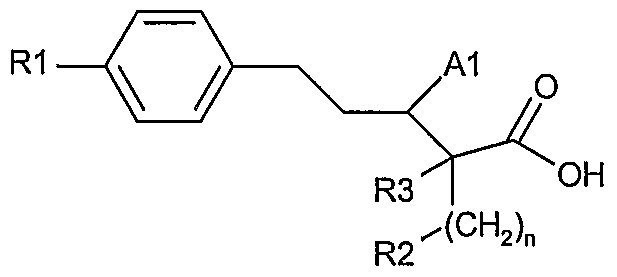
  • n is an integer from 1 to 5;
  • R 1 can be optionally substituted alkyl, alkenyl, alkynyl, cycloalkyl, aryl, heterocyclyl, heteroaryl, aralkyl, alkoxy, aryloxy, alkenyloxy or alkynyloxy;
  • R3 can be hydrogen, fluorine, alkyl, cycloalkylalkyl or aralkyl;
  • the invention relates to compounds of general Formula Ia,
  • the invention relates to compounds of general Formula Ib,
  • Ri a can be aiyl or heteroaryl
  • n, R 2 , R 3 and A can be as defined earlier.
  • the invention relates to compounds of general Formula Ic,
  • Y can be oxygen or sulphur and R 4 can be alkyl, alkenyl, alkynyl, cycloalkyl, aryl, heterocyclyl, heteroaryl, aralkyl, heteroarylalkyl, heterocyclylalkyl or cycloalkylalkyl and m is an integer 0-2;
  • R 5 is hydrogen or R 4 ;
  • R 4 and R 5 together may optionally form a heterocyclic ring containing one or more hetefoatoms such as O, N or S and R x is R 4 or -SO 2 N(R 4 ) 2 ];
  • n, R 1 , R 3 and A can be as defined earlier.
  • the invention encompasses compounds that include, for example
  • the invention encompasses separation of the individual enantiomers or diastereomer pairs or single diastereomers.
  • a person ordinarily skilled in the art of this invention may optionally choose one or more ways to obtain chirally pure compounds.
  • the present invention includes separation of a representative set of compounds either as diastereomeric pairs or single diastereomers by preparative thin layer chromatography and/or by ⁇ PLC, using an achiral or chiral column as required.
  • the present invention relates to the therapeutically effective dose of a compound of Formula I in combination with one or more of other therapeutic agents used for treating various inflammatory and allergic diseases.
  • therapeutic agents include, but are not limited to,
  • anti-inflammatory agents such as nonsteroidal anti-inflammatory agents piroxicam, diclofenac, propionic acids, fenamates, pyrazolones, salicylates, PDE-4/p38 MAP Kinase/Cathepsin inhibitors, (ii) leukotrienes LTC4/LTD4/LTE4/LTB4- Inhibitors, 5-lipoxygenase inhibitors and PAF- receptor antagonists, (iii) Cox-2 inhibitors, (iv) MMP inhibitors, and (v) interleukin-I inhibitors;
  • nonsteroidal anti-inflammatory agents piroxicam, diclofenac, propionic acids, fenamates, pyrazolones, salicylates, PDE-4/p38 MAP Kinase/Cathepsin inhibitors, (ii) leukotrienes LTC4/LTD4/LTE4/LTB4- Inhibitors, 5-lipoxygenase inhibitors and PAF
  • antihypertensive agents (i) ACE inhibitors, e.g., enalapril, lisinopril, valsartan, telmisartan and quinapril, (ii) angiotensin II receptor antagonists and agonists, e.g., losartan, candesartan, irbesartan, valsartan, and eprosartan, (iii) /3-blockers, and (iv) calcium channel blockers;
  • ACE inhibitors e.g., enalapril, lisinopril, valsartan, telmisartan and quinapril
  • angiotensin II receptor antagonists and agonists e.g., losartan, candesartan, irbesartan, valsartan, and eprosartan
  • /3-blockers e.g., /3-blockers
  • calcium channel blockers e.
  • immunosuppressive agents such as cyclosporine, azathioprine and methotrexate, and anti-inflammatory corticosteroids.
  • immunosuppressive agents such as cyclosporine, azathioprine and methotrexate, and anti-inflammatory corticosteroids.
  • alkyl refers to a monoradical branched or unbranched saturated hydrocarbon chain having from 1 to 20 carbon atoms. This term can be exemplified by groups such as methyl, ethyl, n-propyl, iso-propyl, n-butyl, iso-butyl, sec-butyl, t-butyl, n-pentyl, isopentyl, neopentyl, n-hexyl, n-decyl, tetradecyl, and the like.
  • alkenyl refers to a monoradical of a branched or unbranched unsaturated hydrocarbon group having from 2 to 20 carbon atoms with cis, trans, or geminal geometry. In the event that alkenyl is attached to a heteroatom, the double bond cannot be alpha to the heteroatom.
  • alkenyl substituents optionally may be substituted further by 1-3 substituents selected from alkyl, carboxy, hydroxy, alkoxy, halogen, -CF 3 , cyano, -NR f R q ,
  • alkynyl refers to a monoradical of an unsaturated hydrocarbon, having from 2 to 20 carbon atoms. In the event that alkynyl is attached to a heteroatom, the triple bond cannot be alpha to the heteroatom.
  • aralkyl refers to alkyl-aryl linked through an alkyl portion (wherein alkyl is as defined above) and the alkyl portion contains 1-6 carbon atoms and aryl is as defined below.
  • alkyl groups include ben2yl, ethylphenyl and the like.
  • aryl group optionally may be fused with a cycloalkyl group, wherein the cycloalkyl group may optionally contain heteroatoms selected from O, N or S.
  • aryloxy denotes the group O-aryl, wherein aryl is as defined above.
  • the substituents are attached to a ring atom, i.e., carbon or heteroatom in the ring.
  • heteroaryl groups include oxazolyl, imidazolyl, pyrrolyl, 1,2,3-triazolyl, 1,2,4-triazolyl, tetrazolyl, thiazolyl, oxadiazolyl, benzoimidazolyl, thiadiazolyl, pyridinyl, pyridazinyl, pyrimidinyl, pyrazinyl, thienyl, isoxazolyl, triazinyl, furanyl, benzofuranyl, indolyl, benzothiazolyl, or benzoxazolyl, and the like.
  • Heterocyclyl can optionally include rings having one or more double bonds. Unless otherwise constrained by the definition, the substituents are attached to the ring atom, i.e., carbon or heteroatom in the ring. Also, unless otherwise constrained by the definition, the heterocyclyl ring optionally may contain one or more olefinic bond(s).
  • heterocyclyl groups include oxazolidinyl, tetrahydrofuranyl, dihydrofuranyl, dihydropyridinyl, dihydroisoxazolyl, dihydrobenzofuryl, azabicyclohexyl, dihydroindolyl, pyridinyl, isoindole 1,3-dione, piperidinyl or piperazinyl.
  • cycloalkyl refers to cyclic alkyl groups of from 3 to 20 carbon atoms having a single cyclic ring or multiple condensed rings, which may optionally contain one or more olefinic bonds, unless otherwise constrained by the definition.
  • Such cycloalkyl groups can include, for example, single ring structures, including cyclopropyl, cyclobutyl, cyclooctyl, cyclopentenyl, and the like, or multiple ring structures, including adamantanyl, and bicyclo [2.2.1] heptane, or cyclic alkyl groups to which is fused an aryl group, for example, indane, and the like.
  • Cycloalkylalkyl refers to alkyl-cycloalkyl group linked through alkyl portion, wherein the alkyl and cycloalkyl are the same as defined earlier.
  • cycloalkylalkyl refers to cycloalkyl group linked through alkyl portion, wherein the alkyl having 1 to 6 carbon atoms and cycloalkyl are the same as defined earlier.
  • Heteroarylalkyl refers to alkyl-heteroaryl group linked through alkyl portion, wherein the alkyl and heteroaryl are as defined earlier.
  • Heterocyclylalkyl refers to alkyl-heterocyclyl group linked through alkyl portion, wherein the alkyl and heterocyclyl are as defined earlier.
  • halogen refers to fluorine, chlorine, bromine or iodine
  • leaving group refers to groups that exhibit or potentially exhibit the properties of being labile under the synthetic conditions and also, of being readily separated from synthetic products under defined conditions. Examples of leaving groups include, but are not limited to, halogen (e.g., F, Cl, Br, I), triflates, tosylate, mesylates, alkoxy, thioalkoxy, or hydroxy radicals and the like.
  • protecting groups refers to moieties that prevent chemical reaction at a location of a molecule intended to be left unaffected during chemical modification of such molecule. Unless otherwise specified, protecting groups may be used on groups, such as hydroxy, amino, or carboxy. Examples of protecting groups are found in T. W. Greene and P.G.M. Wuts, "Protective Groups in Organic Synthesis", 2 nd Ed., John Wiley and Sons, New York, N. Y., which is incorporated herein by reference. The species of the carboxylic protecting groups, amino protecting groups or hydroxy protecting groups employed are not critical, as long as the derivatised moieties/moiety is/are stable to conditions of subsequent reactions and can be removed without disrupting the remainder of the molecule.
  • the compounds of this invention can contain one or more asymmetric carbon atoms and thus may occur as racemic mixtures, enantiomers and diastereomers. These compounds can also exist as conformers/rotamers. AU such isomeric forms of these compounds are included in the present invention.
  • Each stereogenic carbon may be of the R ox S configuration.
  • salts of carboxylic acid moiety which may be prepared by reacting the compound with appropriate base to provide corresponding base addition salts.
  • bases are alkali metal hydroxide including potassium hydroxide, sodium hydroxide and lithium hydroxide; alkaline earth metal hydroxides such as magnesium hydroxide and calcium hydroxide.
  • salts of organic bases such as lysine, arginine, guanidine, ethanolamine, choline and the like; inorganic bases e.g., ammonium or substituted ammonium salts are also included.
  • compounds of the present invention may also form the acid addition salts by treating the said compounds with pharmaceutically acceptable organic and inorganic acids, e.g., hydrohalides such as hydrochloride, hydrobromide, hydroiodide; other mineral acids and their corresponding salts such as sulphate, nitrate, phosphate etc.; and alkyl and mono-arylsulphonates such as ethane sulphonate, toluene sulphonate and benzene sulphonate; and other organic acids and their corresponding salts such as acetate, tartarate, maleate, succinate, citrate etc.
  • organic and inorganic acids e.g., hydrohalides such as hydrochloride, hydrobromide, hydroiodide
  • other mineral acids and their corresponding salts such as sulphate, nitrate, phosphate etc.
  • alkyl and mono-arylsulphonates such as ethane sulphonate, toluene s
  • Compounds of Formula VIII can be prepared by, for example, following the synthetic route as depicted in Scheme I.
  • a compound of Formula II (wherein hal is Cl, Br or I) can be reacted with a compound of Formula III [wherein P is alkyl (for example, tert-butyl, ethyl or methyl) or aralkyl (or example, benzyl)] to give a compound Formula IV, which on reaction with a compound of Formula V (wherein hal is the same as defined above and A" is aralkyl, heterocyclylalkyl, heteroarylalkyl or cycloalkylalkyl) can form a compound of Formula VI.
  • a compound of Formula VI on reduction can form a compound of Formula VII, which on deprotection can yield a compound of Formula VIII.
  • the reaction of a compound of Formula II with a compound of Formula III to give a compound of Formula IV can be carried out in the presence of a base or a combination thereof, for example, sodium hydride, butyl lithium or lithiumdiisopropylamide in an organic solvent, for example, tetrahydrofuran, dimethylformamide, dioxane or diethylether.
  • the reaction of a compound of Formula IV with a compound of Formula V to give a compound of Formula VI can be carried out in the presence of a base for example, potassium tert-butoxide, sodium (m)ethoxide, sodium hydride, lithium diisopropylamide, butyl lithium or lithium/sodium/potassium hexamethyldisilazide, optionally in the presence of a catalyst, for example, terrabutylammonium iodide or tetrabutylammonium bromide, in an appropriate organic solvent for example, ⁇ -butanol, ethanol, tetrahydrofuran, dimethylformamide, diethylether or dioxane.
  • a base for example, potassium tert-butoxide, sodium (m)ethoxide, sodium hydride, lithium diisopropylamide, butyl lithium or lithium/sodium/potassium hexamethyldisilazide
  • a catalyst for example
  • the compound of Formula VI undergoes reduction to give a compound of Formula VII in the presence of reducing agent, for example, sodium borohydride or lithium borohydride in organic solvent, for example, methanol, ethanol, propanol, isopropylalcohol and/or tetrahydrofuran.
  • reducing agent for example, sodium borohydride or lithium borohydride in organic solvent, for example, methanol, ethanol, propanol, isopropylalcohol and/or tetrahydrofuran.
  • the hydrolysis of a compound of Formula VII to give a compound of Formula VIII, when P is ⁇ -butyl can be carried out with acids, for example, trifluoroacetic acid or hydrochloric acid, in an organic solvent or a solvent system including, for example, dichloromethane, dichloroethane, THF or dioxane in water.
  • acids for example, trifluoroacetic acid or hydrochloric acid
  • organic solvent or a solvent system including, for example, dichloromethane, dichloroethane, THF or dioxane in water.
  • a compound of Formula XXI can be prepared, for example, by following the synthetic route as depicted, for example, in Scheme II.
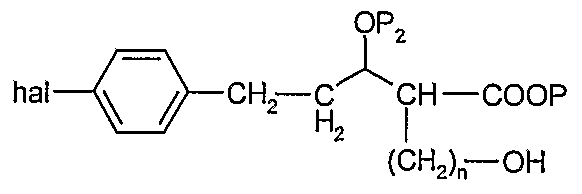
  • a compound of Formula IX (wherein hal is the same as defined earlier) on reaction with a compound of Formula III (wherein P is the same as defined earlier) can give a compound of Formula X, which can be reacted with a compound of Formula XI (wherein hal and n are the same as defined earlier and Pi is silyl protecting group for example, tert-butyldimethylsilane, tert- butyldiphenylsilane or triisopropylsilane to give a compound of Formula XII, which can undergo reduction to give a compound of Formula XIII.
  • the compound of Formula XIII on reaction with a compound of Formula XIV [wherein P 2 is aralkyl (for example, benzyl, 4-methoxybenzyl or 2,4,6-trimethoxybenzyl) or heterocyclyl (for example, tetrahydropyranyl)] can form a compound of Formula XV, which can undergo selective deprotection to form a compound of Formula XVI, which can then be converted to a compound of Formula XVII (wherein LG is a leaving group such as mesyl, tosyl or triflyl or a halide (hal) as defined earlier) by reaction either with a compound of Formula L-hal (wherein L is methanesulphonyl, p-toluenesulphonyl and hal is the same as defined earlier), by reaction with triflic anhydride or by reaction with triphenylphosphine and a halide source such as carbon tetrabromide or iodine
  • a compound of Formula XVII can be reacted with a compound of Formula M-A' (wherein A' is aryl, heteroaryl, heterocyclyl or cycloalkyl and M is metal for example, potassium, lithium or sodium) or by reaction of A' in the presence of a base to yield a compound of Formula XVIII.
  • reaction of a compound of Fo ⁇ nula IX with a compound of Formula III to give a compound of Formula X can be carried out similarly to the reaction of a compound of Formula II and a compound of Formula III to yield a compound of Formula IV.
  • the reaction of a compound of Formula X with a compound of Formula XI to give a compound of Formula XII can be carried out similarly to the reaction of a compound of Formula IV with a compound of Formula V to give a compound of Formula VI.
  • the reduction of a compound of Formula XII to give a compound of Formula XIII can be carried out similarly to the reduction of a compound of Formula VI to give a compound of Formula VII.
  • the reaction of a compound of Formula XIII with a compound of Formula XIV to give a compound of Formula XV can be carried out in the presence of Lewis acid, for example, boron trifluoride, triflic acid, camphor sulphonic acid, pyridinium p- toulenesulphonate or trityl perchlorate, in an organic solvent, for example, tetrahydrofuran, dimethylformamide, diethyl ether or dioxane.
  • Lewis acid for example, boron trifluoride, triflic acid, camphor sulphonic acid, pyridinium p- toulenesulphonate or trityl perchlorate
  • organic solvent for example, tetrahydrofuran, dimethylformamide, diethyl
  • the selective deprotection of a compound of Formula XV to give a compound of Formula XVI can be carried out with deprotecting agents, for example, tetrabutylammonium fluoride or potassium fluoride, in an organic solvent, for example, tetrahydrofuran, dimethylformamide, diethyl ether or dioxane.
  • deprotecting agents for example, tetrabutylammonium fluoride or potassium fluoride
  • organic solvent for example, tetrahydrofuran, dimethylformamide, diethyl ether or dioxane.
  • a compound of Formula XVI can be reacted with a compound of Formula L-hal, triflic anhydride or by reaction with triphenylphosphine and a halide source such as carbon tetrabromide or iodine to give a compound of Formula XVII, optionally in the presence of a base, for example, triethylamine, pyridine, N-methylmorpholine or diisopropylethylamine, in an organic solvent, for example, dichloromethane, dichloroethane, or tetrahydrofuran.
  • a base for example, triethylamine, pyridine, N-methylmorpholine or diisopropylethylamine
  • organic solvent for example, dichloromethane, dichloroethane, or tetrahydrofuran.
  • reaction of a compound of Formula XVTI with a compound of Formula M-A' to yield a compound of Formula XVIII can be carried out in an organic solvent, for example, tetrahydrofuran, dimethyl sulphoxide, dimethylformamide, acetonitrile, dioxane, dimethylacetamide.
  • organic solvent for example, tetrahydrofuran, dimethyl sulphoxide, dimethylformamide, acetonitrile, dioxane, dimethylacetamide.
  • reaction of a compound of Fo ⁇ nula XVII with a compound of Formula A' to yield a compound of Formula XVIII can be carried out in the presence of a base, for example, sodium hydride, potassium tert-butoxide, sodium (m)ethoxide, in an organic solvent, for example, tetrahydrofuran, dimethyl sulphoxide, dimethylformamide, acetonitrile, dioxane, dimethylacetamide.
  • a base for example, sodium hydride, potassium tert-butoxide, sodium (m)ethoxide
  • organic solvent for example, tetrahydrofuran, dimethyl sulphoxide, dimethylformamide, acetonitrile, dioxane, dimethylacetamide.
  • the reaction of a compound of Formula XVIII with a compound of Formula XIX can be carried out in the presence of a metal catalyst such as tetrakis(triphenylphosphine) palladium (0), tetrakis(tricyclohexylphosphine) palladium (0), tetrakis(tri-tert- butylphosphine) palladium (0) or palladium acetate and triphenylphosphine, in the presence of a base, such as potassium carbonate ot cesium carbonate, in an organic solvent, such as toluene, dimethyl sulphoxide, dimethylformamide, tetrahydrofuran, dioxane or diethyl ether.
  • a metal catalyst such as tetrakis(triphenylphosphine) palladium (0), tetrakis(tricyclohexylphosphine) palladium (0), tetraki
  • a compound of Formulae XXV and XXXI can be prepared., for example, by following the synthetic route as depicted., for example, in Scheme III.
  • a compound of Formula IV (wherein P is the same as defined earlier) can be reacted with a compound of Formula XXII (wherein R 4 is the same as defined earlier) to give a compound of Formula XXIII, Path a: which on reduction can give a compound of Formula XXTV, which can be further deprotected to yield a compound of Formula XXV, or
  • Rt is alkyl, aryl,
  • reaction of a compound of Formula IV with a compound of Formula XXII to give a compound of Formula XXIII can be carried out in the presence of a base, for example, potassium tert-butoxide, sodium hydride, sodium (m)ethoxide, lithium diisopropylamide, and/or butyl lithium, in an organic solvent, for example, tetrahydrofuran, dimethylformamide, diethyl ether or dioxane.
  • a base for example, potassium tert-butoxide, sodium hydride, sodium (m)ethoxide, lithium diisopropylamide, and/or butyl lithium
  • organic solvent for example, tetrahydrofuran, dimethylformamide, diethyl ether or dioxane.
  • reaction of a compound of Formula XXIV (path b) with a compound of Formula XXVI to give a compound of Formula XXVII can be carried out using coupling agents, such as EDCI or DCC, in the presence of base, such as dimethylaminopyridine, N- methylmorpholine or diisopropylethylamine, in an organic solvent, such as dichloromethane, dichloroethane, chloroform and carbon tetrachloride.
  • coupling agents such as EDCI or DCC
  • base such as dimethylaminopyridine, N- methylmorpholine or diisopropylethylamine
  • organic solvent such as dichloromethane, dichloroethane, chloroform and carbon tetrachloride.
  • the deprotection of a compound of Formula XXVII to give a compound of Formula XXVIII can be carried out in the presence of a deprotecting agent, for example, palladium on carbon in presence of hydrogen gas, or palladium on carbon with a source of hydrogen gas, for example, ammonium formate, cyclohexene or formic acid.
  • a deprotecting agent for example, palladium on carbon in presence of hydrogen gas, or palladium on carbon with a source of hydrogen gas, for example, ammonium formate, cyclohexene or formic acid.
  • N-derivatization of a compound of Formula XXVTII with a compound of Formula RD (wherein RD is R 4 COImI or ImICOOR 4 ) to give a compound of Formula XXIX (wherein RF is R 4 CO-, R 4 OCO-) can be carried out in the presence of a base, for example, pyridine, N-methylmorpholine, N-ethyldiisopropylamine, triethylamine or potassium carbonate.
  • a base for example, pyridine, N-methylmorpholine, N-ethyldiisopropylamine, triethylamine or potassium carbonate.
  • N-derivatization of a compound of Formula XXVIII with a compound of Formula RD (wherein RD is R 4 SO 2 ImI) to give a compound of Formula XXIX (wherein RF is R 4 SO 2 -) can be carried out in the presence of a base, for example, triethylamine, N- ethyldiisopropylamine, N-methylmorpholine or pyridine, in an organic solvent, for example, dichloromethane, dichloroethane, carbon tetrachloride or chloroform.
  • a base for example, triethylamine, N- ethyldiisopropylamine, N-methylmorpholine or pyridine
  • organic solvent for example, dichloromethane, dichloroethane, carbon tetrachloride or chloroform.
  • a base for example, triethylamine, N-ethyldiisopropylamine, N-methylmorpholine or pyridine
  • organic solvent for example, dichloromethane, dichloroethane, carbon tetrachloride or chloroform.
  • the deprotection of the secondary hydroxyl protecting group such as acyl group, of a compound of Formula XXIX to give a compound of Formula XXX can be carried out in presence of a base, for example, lithium hydroxide, sodium hydroxide, potassium hydroxide, in an organic solvent, for example, methanol, tetrahydrofuran, water or mixtures thereof.
  • a base for example, lithium hydroxide, sodium hydroxide, potassium hydroxide
  • organic solvent for example, methanol, tetrahydrofuran, water or mixtures thereof.
  • the compound of Formula XXXII can undergo reduction to give a compound of Formula XXXIII in the presence of reducing agent, for example, sodium borohydride or lithium borohydride in organic solvent, for example, methanol, ethanol, propanol, isopropylalcohol and/or tetrahydrofuran.
  • reducing agent for example, sodium borohydride or lithium borohydride in organic solvent, for example, methanol, ethanol, propanol, isopropylalcohol and/or tetrahydrofuran.
  • Ionic hydrogenation conditions that may be carried out include reaction of a compound of Formula XXXIII with sodium borohydride or triethylsilane with acids, for example, trifluoroacetic acid in an organic solvent, for example, dichloromethane, dichloroethane or THF, and in-situ the acid-sensitive group can be removed to provide a compound of Formula XXXIV.
  • the following illustrative compounds were prepared following Schemes I, II, III or IV described above:
  • Step 2 Synthesis of fe ⁇ -butyl 5-biphenyl-4-yl-3-oxo-2-[2-(4-oxo-l,2,3-benzotriazin- 3(4H)-yl)ethyl]pentanoate
  • potassium tert-butoxide 104 mg
  • Step 3 Synthesis of tert-butyl 5-biphenyl ⁇ 4-yl-3-hydroxy-2-[2-(4-oxo-l,2,3- benzotriazin-3(4H)-yl)ethyl]pentanoate
  • Step 4 Synthesis of 5-biphenyl-4-yl-3-hydroxy-2-[2-(4-oxo-l,2,3-benzotriazin-3(4H> yl)ethyl]pentanoic acid
  • Example 2 Synthesis of 5-f4'-chlorobi ⁇ henyl-4-ylV2-r2- ⁇ ,3-dioxo-l ,3-dihvdro-2 ⁇ - isoindol-2-yl ' )ethvn-3-livdroxypentanoic acid (Compound No. 4)
  • Step 1 Synthesis of 5-(4-bromo-phenyl)-3-oxo-pentanoic acid tert-butyl ester tert-Buty ⁇ acetoacetate (23.8 ml) was added dropwise over 15 minutes to a stirred suspension of sodium hydride (8.9 mg) in tetrahydrofuran at 0 0 C under nitrogen atmosphere.
  • Step 2 Synthesis of 1,1-dimethylethyl 2-(2- ⁇ [(l,l-dimethylethyI) (dimethyl) silyl]oxy ⁇ ethyI)-5-(4-bromophenyl)-3-oxopentanoate
  • Step 3 Synthesis of 1,1-dimethylethyl 2-(2- ⁇ [(l,l-dimethylethyl) (dimethyl)silyl] oxy ⁇ ethyl)-3-hydroxy-5-(bromophenyl)pentanoate
  • Step 4 Synthesis of 1,1-dimethyIethyl 2-(2- ⁇ [(l,l-dimethylethyl)(dimethyl) silyl] oxy ⁇ ethyl)-5-(4-bromophenyl)-3-( ⁇ [4-(methyloxy) phenyl] methyl ⁇ oxy)pentanoate
  • Step 5 Synthesis of 1,1-dimethyIethyl 2-(2-hydroxyethyl)-5-(4-bromophenyl)-3-( ⁇ [4 ⁇ (methyloxy)phenyl]methyl ⁇ oxy)pentanoate
  • Step 6 Synthesis of 1,1-DimethyIethyl) 5-(4-bromophenyl)-3-( ⁇ [4- (methyloxy)phenyl]methyl ⁇ oxy)-2- ⁇ 2-[(methylsulfonyl)oxy]ethyI ⁇ pentanoate
  • Methanesulfonyl chloride (0.63 ml) was added in one portion to a stirred solution of the compound (2.99 g) obtained from step 5 above and triethylamine (2.6 ml) in dichloromethane (50 ml) at room temperature under nitrogen atmosphere and stirred at room temperature for 1 hour.
  • the crude mixture was partitioned between saturated aqueous citric acid solution and dichloromethane. The phases were separated and the organic layer was concentrated under reduced pressure to furnish the title compound (3.2g).
  • Step 7 Synthesis of 1,1-Dimethylethyl 2-[2-(l,3-dioxo-l,3-dihydro-2H-isoindol-2- yl)ethyI]-5-(4-bromophenyl)-3-( ⁇ [4-(methyloxy)phenyl]methyl ⁇ oxy)pentanoate
  • Potassium phthalimide (1.25 g) was added in one portion to a stirred solution of the compound (3.5 g) obtained from step 6 above in dimethylformamide (25 ml) at room temperature under nitrogen atmosphere. The resulting solution was heated at 80 °C for about 2 hours and then cooled to room temperature. The volatiles were evaporated under reduced pressure and the residue thus obtained was partitioned between dichloromethane and water. The layers were separated and the organic phase evaporated to dryness under reduced pressure. The residue thus obtained was purified by column chromatography using 20% ethyl acetate in hexane as eluant to furnish the title compound (2.45 g).
  • Step 8 Synthesis of tert-buty ⁇ 5-(4'-chlorobiphenyl-4-yl)-2-[2-(l,3-dioxo-l,3-dihydro- 2H-isoindol-2-yl)ethyl]-3-[(4-methoxybenzyl)oxy]pentanoate
  • Step 9 Synthesis of 5-(4'-chlorobiphenyl-4-yl)-2-[2-(l,3-dioxo-l,3-dihydro-2H- isoindol-2-yl)ethyl]-3-hydroxypentanoic acid
  • Step 1 Synthesis of fert-butyl 2-(2- ⁇ [(benzyloxy)carbonyl]amino ⁇ ethyl)-5-biphenyl-4-yI-3- oxopentanoate
  • Step 2 Synthesis of tert-butyl 2-(2- ⁇ [(benzyIoxy)carbonyl]amino ⁇ ethyl)-5-biphenyl-4- yl-3-hydroxypentanoate To a solution of the compound (100 mg) obtained from step 1 above in methanol
  • Step 3 Synthesis of 2-(2- ⁇ [(benzyloxy)carbonyI]amino ⁇ ethyl)-5-biphenyl-4-yl-3- hydroxypentanoic acid
  • trifiuoroacetic acid 0.5 ml
  • anisole 0.05 ml
  • the solvent and excess reagents were evaporated under reduced pressure and the residue thus obtained was purified by column chromatography using 60% ethyl acetate in hexane as eluant to furnish the title compound (25 mg).
  • Example 4 Synthesis of 5-biphenyl-4-yl-2-(2-([( ' 4-fluorophenyl ' )sulfonyllamino ⁇ ethylV3- hvdroxypentanoic acid (Compound No. 87)
  • Step 1 Synthesis of 4- ⁇ [(benzyloxy)carbonyl]amino ⁇ -l-(2-biphenyl-4-ylethyl)-2-(tert- butoxycarbonyl)butyl benzoate
  • Benzoic acid (48.5 mg), 4-dimethylaminopyridine (24.3 mg) and triethylamine (0.08 ml) were added to a solution of tert-butyl 2-(2- ⁇ [(benzyloxy)carbonyl]amino ⁇ ethyl)- 5-biphenyl-4-yl-3-hydroxypentanoate (200 mg) in dichloromethane (5 ml) at 0 0 C and the reaction mixture was stirred for 15 minutes. l-Ethyl-3-(3'-dimethylaminopropyl)- carbodiimide (152 mg) was added and the reaction mixture was stirred overnight. The reaction mixture was taken in distill water and extracted with dichloromethane (20 ml).
  • Step 2 Synthesis of 4-amino-l-(2-biphenyl-4-ylethyl)-2-(te ⁇ -butoxycarbonyl)butyl benzoate 10% Palladium on charcoal (100 mg) was added to the solution of the compound
  • Step 3 Synthesis of l-(2-bipheny!-4-ylethyl)-2-(ter£-butoxycarbonyl)-4- ⁇ [(4- fluorophenyl)sulfonyl] amino ⁇ butyl benzoate
  • Trifluoroacetic acid (0.5 ml) was added to the solution of the compound (100 mg) obtained from the step 4 above in dichloromethane (5 ml) and the reaction mixture was stirred for 2 hours. The reaction mixture was then concentrated. The residue was flushed with nitrogen gas and dried on high vacuum and purified by preparative thin layer chromatography using 12 % methanol in dichloromethane to furnish the title compound (30 mg).
  • Step 1 Synthesis of l-(2-biphenyl-4-ylethyl)-2-(ter ⁇ -butoxycarbonyI)-4-[(4- fluorobenzoyl)amino]butyl benzoate
  • Step 2 Synthesis of tert-butyl 5-biphenyl-4-yl-2- ⁇ 2-[(4-fluorobenzoyl)amino]ethyI ⁇ -3- hydroxypentanoate
  • tetrahydrofuran methanol: water (3: 1: 1, 5 ml)
  • the reaction mixture was stirred overnight.
  • the reaction mixture was concentrated and the residue thus obtained was taken in distilled water, acidified with dilute hydrochloric acid solution and extracted with ethyl acetate.
  • the organic layer was washed with distilled water and brine solution and dried over anhydrous sodium sulphate.
  • the solvent was evaporated under reduced pressure to furnish the title compound (100 mg).
  • Step 3 Synthesis of 5-biphenyl-4-yl-2- ⁇ 2-[(4-fluorobenzoyl)amino]ethyI ⁇ -3- hydroxypentanoic acid
  • Trifluoroacetic acid (0.5 ml) was added to a solution of the compound obtained from the step 2 above (100 mg) in dichloromethane (5 ml) and the reaction mixture was stirred for 2 hours. The reaction mixture was then concentrated. The residue was flushed with nitrogen gas and dried on high vacuum and purified by preparative thin layer chromatography using 12 % methanol in dichloromethane to furnish the title compound (30 mg).
  • Step 1 Synthesis of l-(2-biphenyl-4-ylethyl)-2-(fcr ⁇ -butoxycarbonyl)-4-( ⁇ [(4- fluorophenyl)amino] carbonyl ⁇ amino)butyl benzoate
  • 4-Fluorophenyl isocyanate 29 mg was added to the solution of 4-amino-l-(2- biphenyl-4-ylethyl)-2-(tert-butoxycarbonyl)butyl benzoate (100 mg) obtained from Example 3, step 2 in dry dichloromethane at 0 0 C under argon atmosphere and the reaction mixture stirred for 1 hour. The reaction mixture was dried over high vacuum to furnish the title compound (130 mg).
  • Step 2 Synthesis of 5-biphenyl-4-yl-2-[2-( ⁇ [(4-fluorophenyl)amino]carbonyI ⁇ amino) ethyl]-3-hydroxypentanoic acid
  • Step 1 Synthesis of tert-butyl 5-biphenyl-4-yl-2-[2-(l,3-dioxo-l,3-dihydro-2H- isoindol-2-yl)ethyl]-3-oxopentanoate
  • the title compound was prepared following the procedure as depicted in Example 1, step 2, by using 2-(2-bromoethyl)-lH-isoindole-l,3(2H)-dione in place of 3-(2- bromoethyl)-l,2,3-benzotriazin-4(3H)-one.
  • Step 2 Synthesis of tert-butyl 5-biphenyl-4-yl-3-hydroxy-2-[2-(l-hydroxy-3-oxo-l,3- dihydro-2H-isoindo ⁇ -2-yI)ethyl]pentanoate
  • Step 3 Synthesis of 5-biphenyl-4-yl-3-hydroxy-2-[2-(l-oxo-l,3-dihydro-2H-isoindol- 2-yl)ethyl]pentanoic acid
  • Example 8 Separation of (2R3S) & r2&3R)-5-r4'-chlorobit)henyl-4-ylV2-r2-ri.3-dioxo- l,3-dihvdro-2H-isoindol-2-yl)ethyl1-3-hydroxypentanoic acid (Compound No. 80) and (2i?,3 ⁇ & r25,55)-5-r4'-chlorobit)henyl-4-ylV2-r2-(1.3-dioxo-1.3-dihvdro-2H-isomdol-2- vDethyll-3-hydroxypentanoic acid (Compound No. 81)
  • Chiral ⁇ PLC analysis/separation was carried out for example, using Waters ⁇ PLC LC Module I Plus system with UV 486 detector using a Chiralcel OJ- ⁇ (250* 4.6) column; mobile phase: 60 : 40 of 0.1% TFA in hexane: ethanol; flow rate 0.7 mL/min, run time 60 minutes.
  • MMPs Matrix Metallo Proteinases
  • NCEs/standards were prepared (stock 10 mM) in 100% DMSO and subsequent dilutions were made in 50% DMSO-50% TCNB (50 mM Tris, 10 mM CaCl 2 , 150 mM NaCl, 0.05% Brij-35, p ⁇ 7.5). 1 ⁇ l of the compound and 88 ⁇ l of TCNB was added to wells of 96 well plate to achieve the desired final concentration of NCE (final DMSO concentration should not exceed 0.5%). 1 ⁇ l of activated, recombinant MMPs was added to each well (20-100 ng/100 ⁇ l reaction mixture) except the "negative well". (MMP-I, 9 &14 enzymes require prior activation.
  • Activities for MM9 provided IC 50 values from about 10 micromolar to about 2 nM, or from about 1 micromolar to about 2 nM, or from about 650 nM to about 2 nM, or from about 300 nM to about 2 nM, or from about 100 nM to about 2 nM, or from about 50 nM to about 2 nM, or from about 30 nM to about 2 nM, or from about 20 nM to about 2 nM, or from about 15 to about 2 nM, as compared to about 1.5 nM for marimasat.
  • Activities for MM12 provided IC50 values from about 10 micromolar to about 0.4 nM, or from about 1 micromolar to about 0.4 nM, or from about 300 nM to about 0.4 nM, or from about 100 nM to about 0.4 nM, or from about 50 nM to about 0.4 nM, or from about 30 nM to about 0.4 nM, or from about 20 nM to about 0.4 nM, or from about 15 to about 0.4 nM, or from about 7 to about 0.4 nM as compared to about 0.9 nM for marimasat.

Landscapes

  • Organic Chemistry (AREA)
  • Chemical & Material Sciences (AREA)
  • Health & Medical Sciences (AREA)
  • Veterinary Medicine (AREA)
  • Chemical Kinetics & Catalysis (AREA)
  • General Chemical & Material Sciences (AREA)
  • Medicinal Chemistry (AREA)
  • Nuclear Medicine, Radiotherapy & Molecular Imaging (AREA)
  • Pharmacology & Pharmacy (AREA)
  • Life Sciences & Earth Sciences (AREA)
  • Animal Behavior & Ethology (AREA)
  • General Health & Medical Sciences (AREA)
  • Public Health (AREA)
  • Bioinformatics & Cheminformatics (AREA)
  • Engineering & Computer Science (AREA)
  • Physical Education & Sports Medicine (AREA)
  • Rheumatology (AREA)
  • Orthopedic Medicine & Surgery (AREA)
  • Biomedical Technology (AREA)
  • Neurosurgery (AREA)
  • Neurology (AREA)
  • Pulmonology (AREA)
  • Diabetes (AREA)
  • Dermatology (AREA)
  • Hematology (AREA)
  • Oncology (AREA)
  • Urology & Nephrology (AREA)
  • Hospice & Palliative Care (AREA)
  • Heart & Thoracic Surgery (AREA)
  • Vascular Medicine (AREA)
  • Obesity (AREA)
  • Endocrinology (AREA)
  • Emergency Medicine (AREA)
  • Psychiatry (AREA)
  • Psychology (AREA)
  • Immunology (AREA)
  • Pain & Pain Management (AREA)
  • Tropical Medicine & Parasitology (AREA)
  • Ophthalmology & Optometry (AREA)
  • Cardiology (AREA)

Abstract

The present invention relates to C ompounds having the structure of Formula I: wherein n is an integer from 1 to 5; R1 is optionally substituted alkyl, alkenyl, alkynyl, cycloalkyl, aryl, heterocyclyl, heteroaryl, aralkyl, alkoxy, aryloxy, alkenyloxy or alkynyloxy; R2 is alkenyl, allcynyl, aryl, heterocyclyl, heteroaryl, cycloalkyl, NR4R5, -NHC(=Y)R4, - NHC(=Y)NR5Rχ, -NHC(=O)OR4, -NHSO2R4, C(=Y)NR4R5, C(=O)OR6 [wherein Y is oxygen or sulphur], OR5, -O(C=O)NR4R5, O-acyl, S(O)mR4, -SO2N(R4)2, cyano, amidino or guanidino [wherein R4 is alkyl, alkenyl, alkynyl, cycloalkyl, aryl, heterocyclyl, heteroaryl, aralkyl, heteroarylalkyl, heterocyclylalkyl or cycloalkylalkyl and m is an integer 0-2; R5 is hydrogen or R4; Rx is R4 or -SO2N(R4)2 and R6 is hydrogen, alkyl, cycloalkyl, aralkyl, heteroarylalkyl, heterocyclylalkyl or cycloalkylalkyl]; R3 is hydrogen, fluorine, alkyl, cycloalkylalkyl or aralkyl; A is OH, OR4, -OC(=O)NR4R5, O-acyl, NH2, NR4R5, -NHC(=Y)R4, -NHC(=Y)NR5Rx, - NHC(=O)OR4, -NHSO2R4, and to processes for the synthesis of the same. This invention also relates to pharmacological compositions containing the compounds of the present invention, and methods of treating asthma, rheumatoid arthritis, COPD, rhinitis, osteoarthritis, psoriatic arthritis, psoriasis, pulmonary fibrosis pulmonary inflammation, acute respiratory distress syndrome, perodontitis, multiple sclerosis, gingivitis, atherosclerosis, neointimal proliferation, which leads to restenosis and ischemic heart failure, stroke, renal diseases, tumor metastasis, and other inflammatory disorders characterized by over-expression and over-activation of an matrix metalloproteinase, using the compounds.

Description

5-PHENYL-PENTANOIC ACID DERIVATIVES AS MATRIX METALLOPROTEINASE INHIBITORS FOR THE TREATMENT OF ASTHMA AND OTHER DISEASES
Field of the Invention
The present invention relates to certain beta hydroxy acids and to processes for the synthesis of the same. This invention also relates to pharmacological compositions 5 containing the compounds of the present invention, and methods of treating asthma, rheumatoid arthritis, COPD, rhinitis, osteoarthritis, psoriatic arthritis, psoriasis, pulmonary fibrosis, pulmonary inflammation, acute respiratory distress syndrome, perodontitis, multiple sclerosis, gingivitis, atherosclerosis, neointimal proliferation, which leads to restenosis and ischemic heart failure, stroke, renal diseases, tumor metastasis, and other 10 inflammatory disorders characterized by over-expression and over-activation of an matrix metalloproteinase, using the compounds.
Background of the Invention
Metalloproteinases (MMPs) are a naturally occurring superfamily of proteinases (enzymes) found in most mammals. The superfamily is composed of at least 26 members
15 of zinc-containing enzymes produced by many cell types and sharing structural and functional features. Based on structural and functional considerations proteinases have been classified into different families and subfamilies (Hopper, NM, 1994, FEBS) such as collagenases (MMP-I, MMP- 13), gelatinases (MMP-2, MMP-9), metalloelastases (MMP- 12), the MT-MMPs (MMP- 14, MMP- 15) and sheddases such as TNF-converting enzymes
20 (TACE, ACE).
Metalloproteinases are believed to be important in a plethora of physiological disease processes that involve remodeling such as embryonic development, bone formation and uterine remodeling during menstruation. One major biological function of MMPs is to catalyze the breakdown of connective tissues or extra-cellular matrix by their 25 ability to hydrolyze various components of tissue or matrix. Apart from their role in degrading connective tissue, MMPs are always involved in the activation of zymogen (pro) forms of other MMPs thereby inducing MMP activation. They are also involved in biosynthesis of TNF-alpha which is implicated in many pathological conditions.
MMP- 12 also known as macrophage elastase or metalloelastase is expressed in 30 activated macrophages and has been shown to be secreted from alveolar macrophages from smokers as well as in foam cells in atherosclerotic lesions. MMP- 12 knockout mouse studies have shown the development of significant emphysema, thus supporting its role in COPD. MMP-9 (gelatinase B, 92 kDa type IV collagenase) is one member of the MMP family that is released as a proenzyme and subsequently activated via a protease cascade in vivo. The concentration of MMP-9 is increased in diseases like asthma, interstitial pulmonary fibrosis (IPF), adult respiratory distress syndrome (ARDS), and in chronic obstructive pulmonary disease (COPD). Because of its proteolytic ability, MMP-9 has been implicated in tissue remodelling of the airways and lungs in chronic inflammatory diseases such as severe asthma and COPD. MMP-9 is also likely to be physiologically important because of its ability to regulate the digestion of components of the extracellular matrix as well as the activity of other proteases and cytokines. MMP-9 is secreted in neutrophils, macrophages, osteoclasts, which are easily induced by cytokines and growth factors, and plays a role in various physiological and pathological processes.
Over-expression or over-activation of an MMP or an imbalance between an MMP and a natural (i.e., endogenous) tissue inhibitor of a matrix metalloproteinase (TIMP) has been linked to a pathogenesis of diseases characterized by the breakdown of connective tissue or extracellular matrix.
Examples of inflammatory conditions and autoimmune disorders in which the compounds of the invention have potentially beneficial effects include diseases of the respiratory tract such as asthma (including allergen-induced asthmatic reactions), cystic fibrosis, bronchitis (including chronic bronchitis), chronic obstructive pulmonary disease (COPD), adult respiratory distress syndrome (ARDS), chronic pulmonary inflammation, rhinitis and upper respiratory tract inflammatory disorders (URID), ventilator induced lung injury, silicosis, pulmonary sarcoidosis, idiopathic pulmonary fibrosis, bronchopulmonary dysplasia, arthritis e.g., rheumatoid arthritis, osteoarthritis, infectious arthritis, psoriasis arthritis, traumatic arthritis, rubella arthritis, Reiter's syndrome, gouty arthritis and prosthetic joint failure gout acute synovitis, spondylitis and non-articular inflammatory conditions, e.g., herniated/ruptured/prolapsed intervertebral disk syndrome, bursitis, tendonitis, tenosynovitic fibromyalgic syndrome and other inflammatory conditions associated with ligamentous sprain and regional musculoskeletal strain, inflammatory disorders of the gastrointestinal tract, e.g., ulcerative colitis, diverticulitis, Crohn's disease, inflammatory bowel diseases, irritable bowel syndrome and gastritis, multiple sclerosis, systemic lupus erythematosus scleroderma, autoimmune exocrinopathy, autoimmune encephalomyelitis, diabetes, tumor angiogenesis and metastasis, cancer including carcinoma of the breast, colon, rectum, lung, kidney, ovary, stomach, uterus, pancreas, liver, oral, laryngeal and prostate, melanoma, acute and chronic leukemia, periodontal disease, neurodegenerative disease Alzheimer's disease, Parkinson's disease, epilepsy, muscle degeneration, inguinal hernia retinal degeneration, diabetic retinopathy, macular degeneration, ocular inflammation, bone desorption diseases, osteoporosis, osteopetrosis, graft vs. host reaction allograft rejections, sepsis, endotoxemia, toxic shock syndrome, tuberculosis, usual interstitial and cryptogenic organizing pneumonia, bacterial meningitis, systemic cachexia, cachexia secondary to infection or malignancy, cachexia secondary to acquired immune deficiency syndrome (AIDS), malaria, leprosy, leishmaniasis, Lyme disease, glomerulonephritis, glomerulosclerosis, renal fibrosis, liver fibrosis, pancreatitis, hepatitis, endometriosis, pain, e.g., that associated with inflammation and/or trauma, inflammatory diseases of the skin, e.g., dermatitis, dermatitis, skin ulcers, psoriasis, eczema, systemic valvulitis vascular dementia, thrombosis, atherosclerosis, restenosis, reperfusion injury, plaque calcification, myocarditis, aneurysm, stroke, pulmonary hypertension, left ventricular remodeling and heart failure. Diseases of principal interest include COPD and inflammatory diseases of the respiratory tract and joints and vascular diseases. It will be appreciated by those skilled in the art that reference herein to treatment extends to prophylaxis as well as the treatment of established conditions.
Inhibition of the activity of one or more MMPs may be of benefit in these diseases or conditions, for example, various inflammatory and allergic diseases such as, inflammation of the joint, inflammation of the GI tract, inflammation of the skin, collagen remodeling, etc.
Research has been carried out into the identification of inhibitors that are selective e.g., for a few of the MMP subtypes. An MMP inhibitor of improved selectivity would avoid potential side effects associated with inhibition of MMPs that are not involved in the pathogenesis of the disease being treated. Further, use of more selective MMP inhibitors would require administration of a lower amount of the inhibitor for treatment of disease than would otherwise be required and, after administration, partitioned in vivo among multiple MMPs. Still further, the administration of a lower amount of compound would improve the margin of safety between the dose of the inhibitor required for therapeutic activity and the dose of the inhibitor at which toxicity is observed.
The design and therapeutic application of MMP inhibitors has revealed that the requirement of a molecule to be an effective inhibitor of MMP class of enzymes is a functional group (e.g., carboxylic acid, hydroxamic acid or sulphydryl) capable of chelating to the active site Zn2+ ion (Whittaker, et al., Client. Rev., 1999, 99, 2735-76).
WO 04/110974 discloses compounds and their physiologically functional derivatives as inhibitors of matrix metalloproteinase enzymes. WO 04/113279 discloses inhibitors of matrix metalloproteinase. U.S. Patent No. 6,350,885 discloses tricyclic heteroaromatic compounds and their derivatives as inhibitors of matrix metalloproteinases. WO 98/09940 discloses biphenyl butyric acids and their derivatives as inhibitors of matrix metalloproteinases. J. Med. Chem., 1968, vol. 11(6), 1139-1144 discloses synthesis and anti-inflammatory activity of 4-(p-biphenylyl)-3-hydroxybutyric acid and related compounds. WO 96/15096 discloses substituted 4-biarylbutyric or 5-biarylpentanoic acids and derivatives as matrix metalloproteinase inhibitors.
Summary of the Invention
The present invention discloses a novel class of compounds that are dual MMP- 9/12 inhibitors and have desirable activity profiles. The compounds of this invention have beneficial potency, selectivity and/or pharmacokinetic properties.
In one aspect, there are provided matrix metalloprotease inhibitors, which can be useful as safe and effective therapeutic or prophylactic agents for the treatment of various inflammatory and allergic diseases. Also provided are processes for synthesizing such compounds. In another aspect, pharmaceutical compositions containing such compounds are provided together with acceptable carriers, excipients or diluents, which can be useful for the treatment of inflammatory and autoimmune diseases.
The racemates, enantiomers, diastereomers, rotational isomers, N-oxides, polymorphs, pharmaceutically acceptable salts and pharmaceutically acceptable solvates of these compounds, prodrugs and metabolites having the same type of activity are also provided, as well as pharmaceutical compositions comprising the compounds, their metabolites, racemates, enantiomers, diastereomers, conformational isomers, N-oxides, polymorphs, solvates or pharmaceutically acceptable salts thereof, in combination with a pharmaceutically acceptable carrier and optionally included excipients.
Other aspects will be set forth in the description which follows, and in part will be apparent from the description or may be learnt by the practice of the invention.
In accordance with one aspect, there are provided compounds having the structure of Formula I:
Figure imgf000007_0001
Formula 1 wherein n is an integer from 1 to 5;
R1 can be optionally substituted alkyl, alkenyl, alkynyl, cycloalkyl, aryl, heterocyclyl, heteroaryl, aralkyl, alkoxy, aryloxy, alkenyloxy or alkynyloxy;
Rj can be alkenyl, alkynyl, aryl, heterocyclyl, heteroaryl, cycloalkyl, NR4Rs, -NHCC=Y)R4, -NIKX=Y)NR5Rx, -NEKX=O)OR4 , -NHSO2R4, Ct=Y)NR4R5, C(=O)OR6 [wherein Y can be oxygen or sulphur], OR5, -OCt=O)NR4Rs, O-acyl, S(O)1nR4, -SO2N(R-O2, cyano, amidino or guanidino [wherein R4 can be alkyl, alkenyl, alkynyl, cycloalkyl, aryl, heterocyclyl, heteroaryl, aralkyl, heteroarylalkyl, heterocyclylalkyl or cycloalkylalkyl and m is an integer 0-2; R5 can be hydrogen or R4; Rx can be R4 or -SO2N(R4)2 and R6 is hydrogen, alkyl, cycloalkyl, aralkyl, heteroarylalkyl, heterocyclylalkyl or cycloalkylalkyl];
R3 can be hydrogen, fluorine, alkyl, cycloalkylalkyl or aralkyl; A can be OH, OR4, -OC^O)NR4R5, O-acyl, NH2, NR4R5, -NHQ=Y)R4, -NHC(=Y)NR5RX, -NEKX=O)OR4, -NHSO2R4. In one embodiment, the invention relates to compounds of general Formula Ia,
Figure imgf000008_0001
Formula Ia wherein
Al can be OH, -OCC=O)NR4R5, NH2, NR4R5, -NHCC=Y)R4, -NHC(=Y)NR5RX, -NHCC=O)OR4, -NHSO2R4; n, Ri ,R2 ,R3 and R4 can be as defined earlier.
In another embodiment, the invention relates to compounds of general Formula Ib,
Figure imgf000008_0002
Formula Ib wherein Ria can be aiyl or heteroaryl; n, R2, R3 and A can be as defined earlier.
In another embodiment, the invention relates to compounds of general Formula Ic,
Figure imgf000008_0003
Formula Ic wherein R2a can be NR4R5, -NHCC=Y)R4, -NHCC=Y)NR5Rx, -NHCC=O)OR4, -NHSO2R4, amidino or guanidino [wherein Y can be oxygen or sulphur and R4 can be alkyl, alkenyl, alkynyl, cycloalkyl, aryl, heterocyclyl, heteroaryl, aralkyl, heteroarylalkyl, heterocyclylalkyl or cycloalkylalkyl and m is an integer 0-2; R5 is hydrogen or R4; R4 and R5 together may optionally form a heterocyclic ring containing one or more hetefoatoms such as O, N or S and Rx is R4 or -SO2N(R4)2]; n, R1, R3 and A can be as defined earlier.
In yet another embodiment, the invention encompasses compounds that include, for example
5-Biphenyl-4-yl-3-hydroxy-2-[2-(4-oxo-l,2,3-benzotriazin-3(4H)-yl)ethyl]pentanoic acid (Compound No. 1),
5-(4'-te7t-Butylbiphenyl-4-yl)-2-[2-(l,3-dioxo-l,3-dihydro-2H-isoindol-2-yl)ethyl]-3- hydroxypentanoic acid (Compound No. 2),
5-(4'-Butylbiphenyl-4-yl)-2-[2-(l,3-dioxo-l,3-dihydro-2H-isoindol-2-yl)ethyl]-3- hydroxypentanoic acid (Compound No. 3),
5-(4'-Chlorobiphenyl-4-yl)-2-[2-(l,3-dioxo-l,3-dihydro-2H-isoindol-2-yl)ethyl]-3- hydroxypentanoic acid (Compound No. 4),
2-[2-(l,3-Dioxo-l,3-dihydro-2H-isoindol-2-yl)ethyl]-3-hydroxy-5-(4'- trifluoromethoxybiphenyl-4-yl)pentanoic acid (Compound No. 5),
2-[2-(l ,3-Dioxo- 1 ,3-dihydro-2H-isoindol-2-yl)ethyl]-5-(4'-ethoxybiphenyl-4-yl)-3- hydroxypentanoic acid (Compound No. 6),
2-[2-(l,3-Dioxo-l,3-dihydro-2H-isoindol-2-yl)ethyl]-5-(4'-formylbiphenyl-4-yl)-3- hydroxypentanoic acid (Compound No. 7),
2-[2-(l,3-Dioxo-l,3-dihydro-2H-isoindol-2-yl)ethyl]-3-hydroxy-5-(2',4',6l- trimethoxybiphenyl-4-yl)pentanoic acid (Compound No. 8),
2-[2-(l ,3-Dioxo- 1 ,3-dihydro-2H-isoindol-2-yl)ethyl]-3-hydroxy-5-(4'-propoxybiphenyl-4- yl)pentanoic acid (Compound No. 9),
5-(3',4'-Difluorobiphenyl-4-yl)-2-[2-(l,3-dioxo-l,3-dihydro-2H-isoindol-2-yl)ethyl]-3- hydroxypentanoic acid (Compound No. 10), 2-(2-{[(Benzyloxy)carbonyl]amino}ethyl)-5-biphenyl-4-yl-3-hydroxypentanoicacid (Compound No. 11).
5-Biphenyl-4-yl-2-[2-(l,3-dioxo-l,3-dihydro-2H-isoindol-2-yl)ethyl]-3-hydroxypentanoic acid (Compound No. 12),
(2R,3S + 2,S',3R)-2-[2-(l,3-Dioxo-l,3-dihydro-2H-isoindol-2-yl)ethyl]-5-(41- foπnylbiphenyl-4-yl)-3-hydroxypentanoic acid (Compound No. 13),
(2i?,3i? + 2^35)-2-[2-(l,3-Dioxo-l,3-dihydro-2H-isoindol-2-yl)ethyl]-5-(4'- formylbiphenyl-4-yl)-3-hydroxypentanoic acid (Compound No. 14),
(2i?,3i? + 21S',31S)-2-[2-(l,3-Dioxo-l,3-dihydro-2H-isomdol-2-yl)ethyl]-3-hydroxy-5- (2',4',6'-trimethoxybiphenyl-4-yl)pentanoic acid (Compound No.15),
(2R,3^ + 2)Sr,3i?)-2-[2-(l,3-Dioxo-l,3-dihydro-2H-isoindol-2-yl)ethyl]-3-l1ydroxy-5- (2',4',6'-trimethoxybiphenyl-4-yl)pentanoic acid (Compound No. 16),
(2i?,3)S' + 2>Sr,3i?)-5-(4'-Acetylbiplienyl-4-yl)-2-[2-(l,3-dioxo-l,3-dihydro-2H-isoindol-2- yl)ethyl]-3-hydroxypentanoic acid (Compound No. 17),
(2R,3R + 21Sr )3(S)-5-(4l-Acetylbiphenyl-4-yl)-2-[2-(l,3-dioxo-l,3-dihydro-2H-isoindol-2- yl)ethyl]-3-hydroxypentanoic acid (Compound No. 18),
(2i?,3JS + 2^3i?)-2-[2-(l,3-Dioxo-l,3-dihydro-2H-isoindol-2-yl)ethyl]-3-hydroxy-5-(41- propoxybiphenyl-4-yl)pentanoic acid (Compound No. 19),
(2i?,3i? + 21Sr,3<S)-2-[2-(l,3-Dioxo-l,3-dihydro-2H-isomdol-2-yl)ethyl]-3-hydroxy-5-(4l- propoxybiphenyl-4-yl)pentanoic acid (Compound No. 20),
(2i?,35 + 2.S',3i?)-5-(3',4l-Difluorobiphenyl-4-yl)-2-[2-(l,3-dioxo-l,3-dihydro-2H-isoindQl- 2-yl)ethyl]-3-hydroxypentanoic acid (Compound No. 21),
(2R,3i? + 25',31S)-5-(31,4l-Difluorobiplienyl-4-yl)-2-[2-(l,3-dioxo-l,3-dihydro-2H-isomdol- 2-yl)ethyl]-3-hydroxypentanoic acid (Compound No. 22), 2-[2-(l ,3-Dioxo- 1 ,3-dihydro-2H-isoindol-2-yl)ethyl]-3-hydroxy-5-(4'-methoxybiphenyl-4- yl)pentanoic acid (Compound No. 23),
5-(2',3'-Dimethylbiphenyl-4-yl)-2-[2-(l,3-dioxo-l,3-dihydro-2H-isoindol-2-yl)etliyl]-3- hydroxypentanoic acid (Compound No. 24),
2-[2-(l ,3-Dioxo- 1 ,3-dihydiO-2H-isoindol-2-yl)ethyl]-3-hydroxy-5-[3 '- (trifluoromethyl)biphenyl-4-yl]pentanoic acid (Compound No. 25),
2-[2-(l,3-Dioxo-l,3-dihydro-2H-isoindol-2-yl)ethyl]-5-(4'-ethylbiphenyl-4-yl)-3- hydroxypentanoic acid (Compound No. 26),
5-(3l,5l-Dichlorobiρhenyl-4-yl)-2-[2-(l,3-dioxo-l,3-dihydiO-2H-isoindol-2-yl)etl1yl]-3- hydroxypentanoic acid (Compound No. 27),
5-[4'-Chloro-3'-(trifluoromethyl)biphenyl-4-yl]-2-[2-(l,3-dioxo-l,3-dihydro-2H-isoindol- 2-yl)ethyl]-3-hydroxypentanoic acid (Compound No. 28),
5-(2',5l-Difluorobiphenyl-4-yl)-2-[2-(l,3-dioxo-l,3-dihydro-2H-isoindol-2-yl)ethyl]-3- hydroxypentanoic acid (Compound No. 29),
2-[2-(l,3-Dioxo-l,3-dihydro-2H-isoindol-2-yl)ethyl]-3-hydroxy-5-[2'- (trifluoromethoxy)biphenyl-4-yl]pentanoic acid (Compound No. 30),
2-[2-(l,3-Dioxo-l,3-dihydro-2H-isoindol-2-yl)ethyl]-3-hydroxy-5-[4'- (methylthio)biphenyl-4-yl]pentanoic acid (Compound No. 31),
2-[2-(l,3-Dioxo-l,3-dihydro-2H-isoindol-2-yl)ethyl]-5-(4'-fluoro-3l-methylbiphenyl-4-yl)- 3 -hydroxypentanoic acid (Compound No. 32),
2-[2-(l,3-Dioxo-l,3-dihydro-2H-isoindol-2-yl)ethyl]-3-hydroxy-5-(3'-isopropylbiphenyl- 4-yl)pentanoic acid (Compound No. 33),
5-(3',4'-Dimethylbiphenyl-4-yl)-2-[2-(l,3-dioxo-l,3-dihydro-2H-isoindol-2-yl)ethyl]-3- hydroxypentanoic acid (Compound No. 34), 5-(2',6'-Difluorobiplienyl-4-yl)-2-[2-(l,3-dioxo-l,3-dihydro-2H-isoindol-2-yl)etliyl]-3- hydroxypentanoic acid (Compound No. 35),
2-[2-(l,3-Dioxo-l,3-dihydro-2H-isoindol-2-yl)ethyl]-5-(4'-fluorobiphenyl-4-yl)-3- hydroxypentanoic acid (Compound No. 36),
5-(3',5'-Difluorobiphenyl-4-yl)-2-[2-(l,3-dioxo-l,3-dihydro-2H-isoindol-2-yl)etliyl]-3- hydroxypentanoic acid (Compound No. 37),
5-(3'-Chloro-4'-fluorobiphenyl-4-yl)-2-[2-(l,3-dioxo-l,3-dihydro-2H-isoindol-2-yl)ethyl]- 3-hydroxypentanoic acid (Compound No. 38),
5-(3',4'-Dimethoxybiphenyl-4-yl)-2-[2-(l,3-dioxo-l,3-dihydro-2H-isoindol-2-yl)etliyl]-3- hydroxypentanoic acid (Compound No. 39),
5-(3'-Chlorobiphenyl-4-yl)-2-[2-(l,3-dioxo-l,3-dihydro-2H-isoindol-2-yl)ethyl]-3- hydroxypentanoic acid (Compound No. 40),
2-[2-(l ,3-Dioxo- 1 ,3-dihydro-2H-isoindol-2-yl)ethyl]-3-hydroxy-5-(3 '-methylbiphenyl-4- yl)pentanoic acid (Compound No. 41),
5-(2',3'-Difluorobiphenyl-4-yl)-2-[2-(l,3-dioxo-l,3-dihydro-2H-isoindol-2-yl)ethyl]-3- hydroxypentanoic acid (Compound No. 42),
2-[2-(l,3-Dioxo-l,3-dihydro-2H-isoindol-2-yl)ethyl]-5-(2'-fluoro-3'-methoxybiphenyl-4- yl)-3 -hydroxypentanoic acid (Compound No. 43),
2-[2-( 1 ,3-Dioxo- 1 ,3 -dihydro-2H-isoindol-2-yl)ethyl] -5-(3 τ-fluoro-4'-methylbiphenyl-4-yl)- 3 -hydroxypentanoic acid (Compound No. 44),
5-Biphenyl-4-yl-3-hydroxy-2- {2-[(phenylacetyl)amino]ethyl}pentanoic acid (Compound
No. 45),
2-(3 -Biphenyl-4-yl- 1 -hydroxypropyl)-6-( 1 , 3 -dioxo- 1 ,3 -dihydro-2H-isoindol-2- yl)hexanoic acid (Compound No. 46), 5-Biphenyl-4-yl-3-hydroxy-2-[2-(l-oxoplithalazin-2(lH)-yl)ethyl]pentanoic acid (Compound No. 47),
5-Biphenyl-4-yl-2-[3-(l,3-dioxo-l,3-dihydro-2H-isoindol-2-yl)propyl]-3- hydroxypentanoic acid (Compound No. 48),
5-Biphenyl-4-yl-3-hydroxy-2-[2-(2'-oxospiro[cyclopropane-l,3'-mdol]-r(2'H)- yl)ethyl]pentanoic acid (Compound No. 49),
2-[2-(l,3-Dioxo-l,3-dihydro-2H-isomdol-2-yl)ethyl]-3-hydroxy-5-(4'-hydroxybiphenyl- 4-yl)pentanoic acid (Compound No. 50),
3-Ηydroxy-5-(4'-methoxybiphenyl-4-yl)-2-[2-(3-methyl-2,6-dioxo-3,6-dihydropyrimidin- l(2H)-yl)ethyl]pentanoic acid (Compound No. 51),
5-(4'-Chlorobiphenyl-4-yl)-3-hydroxy-2-[2-(3-methyl-2,6-dioxo-3,6-dihydropyrimidin- l(2H)-yl)ethyl]pentanoic acid (Compound No. 52),
5-(4'-Fluorobiphenyl-4-yl)-3-hydroxy-2-[2-(3-methyl-2,6-dioxo-3,6-dihydropyrimidin- l(2H)-yl)ethyl]pentanoic acid (Compound No. 53),
5-[4-(5-Chloro-2-thienyl)phenyl]-2-[2-(l ,3-dioxo-l ,3-dihydro-2H-isoindol-2-yl)ethyl]-3- hydroxypentanoic acid (Compound No. 54),
4'-[4-Carboxy-6-(l,3-dioxo-l,3-dihydro-2H-isoindol-2-yl)-3-hydroxyhexyl]biphenyl-4- carboxylic acid (Compound No. 55),
2-[2-(l,3-Dioxo-l,3-dihydro-2H-isoindol-2-yl)ethyl]-3-hydroxy-5-[4'- (methoxycarbonyl)biphenyl-4-yl]pentanoic acid (Compound No. 56),
2-[2-(l,3-Dioxo-l,3-dihydro-2H-isoindol-2-yl)ethyl]-3-liydroxy-5-[4'- (trifluoromethyl)biphenyl-4-yl]pentanoic acid (Compound No. 57),
2-[2-(l,3-Dioxo-l,3-dihydro-2H-isoindol-2-yl)ethyl]-3-liydroxy-5-[4-(6-methoxypyridin- 3-yl)phenyl]pentanoic acid (Compound No. 58), 3-Hydroxy-2-[2-(4-oxo-l,2,3-benzotriazin-3(4H)-yl)ethyl]-5-[4'- (Mfluoromethyl)biphenyl-4-yl]pentanoic acid (Compound No. 59),
5-(3',4'-Difluorobiphenyl-4-yl)-3-hydroxy-2-[2-(4-oxo-l,2,3-benzotriazin-3(4H)- yl)ethyl]pentanoic acid (Compound No. 60),
2-[2-(l,3-Dioxo-l,3-dihydro-2H-isoindol-2-yl)ethyl]-5-(3'-fluorobiphenyl-4-yl)-3- hydroxypentanoic acid (Compound No. 61),
5-[4'-(Benzyloxy)-3'-fluorobiphenyl-4-yl]-2-[2-(l ,3-dioxo- 1 ,3-dihydro-2H-isoindol-2- yl)ethyl]-3-hydroxypentanoic acid (Compound No. 62),
5-[4'-(Benzyloxy)biphenyl-4-yl]-2-[2-(l,3-dioxo-l,3-dihydro-2H-isoindol-2-yl)etliyl]-3- hydroxypentanoic acid (Compound No. 63),
3 -Ηydroxy-5-(4'-methoxybiphenyl-4-yl)-2-[2-(4-oxo- 1 ,2,3 -benzotriazin-3 (4H)- yl)ethyl]pentanoic acid (Compound No. 64),
5-(4'-Chlorobiphenyl-4-yl)-3 -hydroxy-2-[2-(4-oxo- 1 ,2,3 -benzotriazin-3 (4H)- yl)ethyl]pentanoic acid (Compound No. 65),
2-[2-(l ,3-Dioxo- 1 ,3-dihydro-2H-isoindol-2-yl)ethyl]-3-hydroxy-5-(4'-methylbiphenyl-4- yl)pentanoic acid (Compound No. 66),
3-Ηydroxy-5-[4-(6-methoxypyridin-3-yl)phenyl]-2-[2-(4-oxo-l,2,3-benzotriazin-3(4H)- yl)ethyl]pentanoic acid (Compound No.67),
3-Ηydroxy-5-(4'-methylbiphenyl-4-yl)-2-[2-(5-methyl-l,3-dioxo-l,3-dihydro-2H-isoindol- 2-yl)ethyl]pentanoic acid (Compound No. 68),
5-(4'-Chlorobiphenyl-4-yl)-3-hydroxy-2-[2-(5-methyl-l,3-dioxo-l,3-dihydro-2H-isoindol- 2-yl)ethyl]pentanoic acid (Compound No. 69),
3-Ηydroxy-2-[2-(4-oxo-l,2,3-benzotriazm-3(4H)-yl)ethyl]-5-[4'- (trifluoromethoxy)biphenyl-4-yl]pentanoic acid (Compound No. 70), 5-(4'-Fluorobiphenyl-4-yl)-3-liydroxy-2-[2-(4-oxo-l,2,3-benzotriazin-3(4H)- yl)ethyl]pentanoic acid (Compound No. 71),
3-Ηydroxy-5-(4l-methylbiphenyl-4-yl)-2-[2-(4-oxo-l,2,3-benzotriazin-3(4H)- yl)ethyl]pentanoic acid (Compound No. 72),
5-(4'-Cyanobiphenyl-4-yl)-3-hydroxy-2-[2-(4-oxo-l,2,3-benzotriazin-3(4H)- yl)ethyl]pentanoic acid (Compound No. 73),
5-(4'-Fluorobiphenyl-4-yl)-3-hydroxy-2-[2-(5-metliyl-l,3-dioxo-l,3-dihydro-2H-isoindol- 2-yl)ethyl]pentanoic acid (Compound No. 74),
3-Ηydroxy-5-[4-(6-methoxyρyridin-3-yl)phenyl]-2-[2-(5-methyl-l,3-dioxo-l,3-dihydro- 2H-isoindol-2-yl)ethyl]pentanoic acid (Compound No. 75),
5-(4'-Ethylbiphenyl-4-yl)-3-hydroxy-2-[2-(4-oxo-l,2,3-benzotriazin-3(4H)- yl)ethyl]pentanoic acid (Compound No. 76),
3-Ηydroxy-2-[2-(5-methyl-l,3-dioxo-l,3-dihydro-2H-isoindol-2-yl)ethyl]-5-[4'- (trifluoromethyl)biphenyl-4-yl]pentanoic acid (Compound No. 77),
(2R,3S + 2^3i?)-2-[2-(l,3-Dioxo-l,3-dihydro-2H-isoindol-2-yl)ethyl]-3-hydroxy-5-[4-(6- methoxypyridin-3-yl)phenyl]pentanoic acid (Compound No. 78),
(2i?,3i? + 2^31S)-2-[2-(l,3-Dioxo-l,3-dihydro-2H-isoindol-2-yl)ethyl]-3-hydroxy-5-[4-(6- methoxypyridin-3-yl)phenyl]pentanoic acid (Compound No. 79),
(2i?,3R + 26l,35)-5-(4'-Chlorobiphenyl-4-yl)-2-[2-(l,3-dioxo-l,3-dihydro-2H-isoindol-2- yl)ethyl]-3-hydroxypentanoic acid (Compound No. 80),
(2i?,3,S + 21S',3i?)-5-(4I-Chlorobiplienyl-4-yl)-2-[2-(l,3-dioxo-l,3-dihydro-2H-isoindol-2- yl)ethyl]-3-hydroxypentanoic acid (Compound No. 81),
(2i?,35 + 2iS',3R)-2-[2-(l,3-Dioxo-l,3-dihydro-2H-isoindol-2-yl)ethyl]-5-(4I- fluorobiphenyl-4-yl)-3-hydroxypentanoic acid (Compound No. 82), (2i?,3i? + 21Sr,3,S)-2-[2-(l,3-Dioxo-l,3-dihydro-2H-isoindol-2-yl)ethyl]-5-(41- fluorobiphenyl-4-yl)-3-hydroxypentanoic acid (Compound No. 83),
5-Biphenyl-4-yl-3-hydroxy-2-[2-(l-oxo-4-phenyl-4a,8a-dihydrophthalazin-2(lH)- yl)ethyl]pentanoic acid (Compound No. 84),
5-Biphenyl-4-yl-3-hydroxy-2-[2-(3-oxo-2,3-dihydro-4H-l,4-benzoxazin-4- yl)ethyl]pentanoic acid (Compound No. 85),
5-Biphenyl-4-yl-2-{2-[(3ai?,7a5)-l,3-dioxo-l,3,3a,4,7,7a-hexahydro-2H-isoindol-2- yl]ethyl}-3-hydroxypentanoic acid (Compound No. 86),
5-Biphenyl-4-yl-2-(2-{[(4-fluorophenyl)sulfonyl]amino}ethyl)-3-hydroxypentanoic acid (Compound No. 87),
5-Biphenyl-4-yl-2-(2-{[(3-fluorophenyl)acetyl]amino}ethyl)-3-hydroxypentanoic acid (Compound No. 88),
5-Biphenyl-4-yl-2-{2-[(4-fluorobenzoyl)amino]ethyl}-3-hydroxypentanoic acid (Compound No. 89),
5-Biphenyl-4-yl-3-hydroxy-2-[2-(5-methyl-l,3-dioxo-l,3-dihydro-2H-isoindol-2- yl)ethyl]pentanoic acid (Compound No. 90),
5-Biplienyl-4-yl-3-hydroxy-2-[2-(l-oxo-l,3-dihydro-2H-isoindol-2-yl)ethyl]pentanoic acid (Compound No. 91).
5-Biphenyl-4-yl-2-[2-({[(4-fluorophenyl)amino]carbonyl}amino)ethyl]-3- hydroxypentanoic acid (Compound No. 92),
5-Biphenyl-4-yl-2-[2-(4,4-dimethyl-2,6-dioxopiperidin-l-yl)ethyl]-3-hydroxypentanoic acid (Compound No. 93),
5-Biphenyl-4-yl-2-[2-(7,9-dioxo-8-azaspiro[4.5]dec-8-yl)ethyl]-3-hydroxypentanoic acid (Compound No. 94),
2-(3-Biphenyl-4-yl-l-hydroxypropyl)pent-4-ynoic acid (Compound No. 95), 5-Biphenyl-4-yl-3 -hydroxy-2-[2-(2-oxo- 1 ,3 -benzoxazol-3 (2H)-yl)ethyl]pentanoic acid (Compound No. 96),
2-[2-(5-tert-Butyl-l,3-dioxo-l,3-dihydro-2H-isoindol-2-yl)ethyl]-3-hydroxy-5-[4-(6- methoxypyridin-3-yl)phenyl]pentanoic acid (Compound No. 97),
5- {4-[6-(Dimethylamino)pyridin-3-yl]phenyl} -2-[2-(l ,3-dioxo- 1 ,3-dihydro-2H-isoindol- 2-yl)ethyl]-3-hydroxypentanoic acid (Compound No. 98),
2-[2-(l,3-Dioxo-l,3-dihydro-2H-isoindol-2-yl)ethyl]-3-hydroxy-5-[4'- (methylsulfonyl)biphenyl-4-yl]pentanoic acid (Compound No. 99),
5-[4'-(Aminocarbonyl)biphenyl-4-yl]-2-[2-(l,3-dioxo-l,3-dihydro-2H-isoindol-2- yl)ethyl]-3-hydroxypentanoic acid (Compound No. 100),
5-[4-(l-Benzyl-lH-pyrazol-4-yl)phenyl]-2-[2-(l,3-dioxo-l,3-dihydro-2H-isoindol-2- yl)ethyl]-3-hydroxypentanoic acid (Compound No. 101),
5-Biphenyl-4-yl-2-[2-(5,6-dichloro-l,3-dioxo-l,3-dihydro-2H-isoindol-2-yl)ethyl]-3- hydroxypentanoic acid (Compound No. 102),
5-Biphenyl-4-yl-2-[2-(2,4-dioxo-l,4-dihydroquinazolin-3(2H)-yl)ethyl]-3- hydroxypentanoic acid (Compound No. 103),
5-Biphenyl-4-yl-2-[2-( 1 ,3-dioxo- 1 ,3 -dihydro-2H-pyrrolo[3 ,4-c]pyridin-2-yl)ethyl]-3 - hydroxypentanoic acid (Compound No. 104),
2-[2-(5-tert-Butyl-l,3-dioxo-l,3-dihydro-2H-isoindol-2-yl)ethyl]-5-(3',4'- difluorobiphenyl-4-yl)-3 -hydroxypentanoic acid (Compound No. 105),
(2R,3S + 2^3i?)-2-[2-(5-te^-Butyl-l,3-dioxo-l,3-dihydro-2H-isoindol-2-yl)ethyl]-5-(4'- fluorobiphenyl-4-yl)-3-hydroxypentanoic acid (Compound No. 106),
(2R,35 + 2^3i?)-2-[2-(5-tert-Butyl-l,3-dioxo-l,3-dihydro-2H-isoindol-2-yl)ethyl]-3- hydroxy-5-[4'-(trifluoromethyl)biphenyl-4-yl]pentanoic acid (Compound No. 107), (2i?,3i? + 25r,3)S)-2-[2-(5-te^-Butyl-l,3-dioxo-l,3-dihydro-2H-isoindol-2-yl)ethyl]-5-(4'- fluorobiphenyl-4-yl)-3-hydroxypentanoic acid (Compound No. 108),
(2R,3i? + 26',36)-2-[2-(5-te^-Butyl-l,3-dioxo-l,3-dihydro-2H-isoindol-2-yl)ethyl]-3- hydroxy-5-[4'-(trifluoromethyl)biphenyl-4-yl]pentanoic acid (Compound No. 109),
2-[2-(l,3-Dioxo-l,3-dihydro-2H-isoindol-2-yl)ethyl]-5-(3'-fluoro-4'-methoxybiphenyl-4- yl)-3-hydroxypentanoic acid (Compound No. 110),
(2R,3S + 2^3i?)-2-[2-(l,3-Dioxo-l,3-dihydro-2H-isoindol-2-yl)ethyl]-3-hydroxy-5-[4-(6- methylpyridin-3-yl)phenyl]pentanoic acid (Compound No. Ill),
(2i?,3i? + 2^35)-2-[2-(l,3-Dioxo-l,3-dihydro-2H-isoindol-2-yl)ethyl]-3-liydroxy-5-[4-(6- methylpyridin-3-yl)phenyl]pentanoic acid (Compound No. 112),
(2i?,3i? + 2,S',36)-2-[2-(5-te^-Butyl-l,3-dioxo-l,3-diliydro-2H-isoindol-2-yl)etliyl]-3- hydroxy-5-(4'-methylbiphenyl-4-yl)pentanoic acid (Compound No. 113),
(2i?,3iSr + 2)S'J3R)-2-[2-(5-te^-Butyl-l,3-dioxo-l,3-dihydro-2H-isoindol-2-yl)ethyl]-3- hydroxy-5-(4'-methylbiphenyl-4-yl)pentanoic acid (Compound No. 114),
(2R,3R + 21Sr,55)-2-[2-(5-tert-Butyl-l,3-dioxo-l,3-dihydro-2H-isoindol-2-yl)ethyl]-3- hydroxy-5-(4'-methoxybiphenyl-4-yl)pentanoic acid (Compound No. 115),
(2R,3i? + 26',31Sr)-2-[2-(5-tert-Butyl-l,3-dioxo-l,3-dihydro-2H-isoindol-2-yl)ethyl]-5-(4l- chlorobiphenyl-4-yl)-3-hydroxypentanoic acid (Compound No.116),
(2R,3S + 26')3i?)-2-[2-(5-te^-Butyl-l,3-dioxo-l,3-diliydro-2H-isoindol-2-yl)ethyl]-5-(4l- chlorobiphenyl-4-yl)-3-hydroxypentanoic acid(Compound No. 117),
(2R,35 + 2lSr,3i?)-2-[2-(5-tert-Butyl-l,3-dioxo-l,3-dihydro-2H-isoindol-2-yl)etliyl]-3- hydroxy-5-(4'-methoxybiphenyl-4-yl)pentanoic acid (Compound No. 118),
2-[2-(l,3-Dioxo-l,3-dihydro-2H-isoindol-2-yl)ethyl]-3-hydroxy-5-(4-pyrimidin-5- ylphenyl)pentanoic acid (Compound No. 119), 5-Biphenyl-4-yl-3-hydroxy-2-[2-(7-metliyl-4-oxo-l,2,3-benzotriazin-3(4H)- yl)ethyl]pentanoic acid (Compound No. 120),
5-Biphenyl-4-yl-2-[2-(5-te^-butyl-l,3-dioxo-l,3-dihydro-2H-isoindol-2-yl)ethyl]-3- hydroxypentanoic acid (Compound No. 121),
(2i?>35)-5-Biphenyl-4-yl-3-hydroxy-2-[2-(lH-indol-3-yl)ethyl]pentanoic acid (Compound No. 122),
(2i?,3R)-5-Biphenyl-4-yl-3-hydroxy-2-[2-(lH-indol-3-yl)ethyl]pentanoic acid (Compound No. 123),
5-Biphenyl-4-yl-3-hydroxy-2-[2-(l-oxo-l,3-dihydro-2H-isoindol-2-yl) butyl]pentanoic acid (Compound No. 124),
(2R,3S)-5-(4'-Chlorobiphenyl-4-yl)-2-[2-(l,3-dioxo-l,3-dihydro-2H-isoindol-2-yl)ethyl]- 3-hydroxypentanoic acid (Compound No.125),
(2S,3R)-5-(4l-Chlorobiphenyl-4-yl)-2-[2-(l,3-dioxo-l,3-dihydro-2H-isoindol-2-yl)ethyl]- 3-hydroxypentanoic acid (Compound No.126),
(2R,3R)-5-(4'-Chlorobiplienyl-4-yl)-2-[2-(l,3-dioxo-l,3-dihydro-2H-isoindol-2-yl)ethyl]- 3-hydroxypentanoic acid (Compound No.127),
(2S,3S)-5-(4'-Chlorobiphenyl-4-yl)-2-[2-(l,3-dioxo-l,3-dihydro-2H-isoindol-2-yl)ethyl]- 3-hydroxypentanoic acid (Compound No.128),
(2R,3S)-2-[2-(l,3-Dioxo-l,3-dihydro-2H-isoindol-2-yl)ethyl]-3-hydroxy-5-[4-(6- methoxypyridin-3-yl)phenyl]pentanoic acid (Compound No. 129),
(2S,3R)-2-[2-(l,3-Dioxo-l,3-dihydro-2H-isoindol-2-yl)ethyl]-3-hydroxy-5-[4-(6- methoxypyridin-3-yl)phenyl]pentanoic acid (Compound No. 130),
(2R,3R)-2-[2-(l,3-Dioxo-l,3-dihydro-2H-isoindol-2-yl)ethyl]-3-hydroxy-5-[4-(6- methoxypyridin-3-yl)phenyl]pentanoic acid (Compound No. 131), (2S,3S)-2-[2-(l,3-Dioxo-l,3-dihydro-2H-isoindol-2-yl)ethyl]-3-hydroxy-5-[4-(6- methoxypyridin-3-yl)phenyl]pentanoic acid (Compound No. 132),
(2R,3 S)-3 -Ηydroxy-5-[4-(6-methoxypyridin-3 -yl)phenyl]-2-[2-(4-oxo- 1 ,2,3 -benzotriazin- 3(4H)-yl)ethyl]pentanoic acid (Compound No.133),
(2S,3R)-3-Ηydroxy-5-[4-(6-methoxypyridin-3-yl)phenyl]-2-[2-(4-oxo-l,2,3-benzotriazin- 3(4H)-yl)ethyl]pentanoic acid (Compound No.134),
(2R,3R)-3-Ηydroxy-5-[4-(6-methoxypyridin-3-yl)phenyl]-2-[2-(4-oxo-l,2,3-benzotriazin- 3(4H)-yl)ethyl]pentanoic acid (Compound No.135), and
(2S,3S)-3-Ηydroxy-5-[4-(6-methoxypyridin-3-yl)phenyl]-2-[2-(4-oxo-l,2,3-benzotriazin- 3(4H)-yl)ethyl]pentanoic acid (Compound No.136).
In another embodiment, the invention encompasses separation of the individual enantiomers or diastereomer pairs or single diastereomers. A person ordinarily skilled in the art of this invention may optionally choose one or more ways to obtain chirally pure compounds. The present invention includes separation of a representative set of compounds either as diastereomeric pairs or single diastereomers by preparative thin layer chromatography and/or by ΗPLC, using an achiral or chiral column as required.
In yet another embodiment, the present invention relates to the therapeutically effective dose of a compound of Formula I in combination with one or more of other therapeutic agents used for treating various inflammatory and allergic diseases. Examples of such therapeutic agents include, but are not limited to,
1) anti-inflammatory agents, experimental or commercial (i) such as nonsteroidal anti-inflammatory agents piroxicam, diclofenac, propionic acids, fenamates, pyrazolones, salicylates, PDE-4/p38 MAP Kinase/Cathepsin inhibitors, (ii) leukotrienes LTC4/LTD4/LTE4/LTB4- Inhibitors, 5-lipoxygenase inhibitors and PAF- receptor antagonists, (iii) Cox-2 inhibitors, (iv) MMP inhibitors, and (v) interleukin-I inhibitors;
2) antihypertensive agents, (i) ACE inhibitors, e.g., enalapril, lisinopril, valsartan, telmisartan and quinapril, (ii) angiotensin II receptor antagonists and agonists, e.g., losartan, candesartan, irbesartan, valsartan, and eprosartan, (iii) /3-blockers, and (iv) calcium channel blockers;
3) immunosuppressive agents such as cyclosporine, azathioprine and methotrexate, and anti-inflammatory corticosteroids. The following definitions apply to terms as used herein.
The term "alkyl," unless otherwise specified, refers to a monoradical branched or unbranched saturated hydrocarbon chain having from 1 to 20 carbon atoms. This term can be exemplified by groups such as methyl, ethyl, n-propyl, iso-propyl, n-butyl, iso-butyl, sec-butyl, t-butyl, n-pentyl, isopentyl, neopentyl, n-hexyl, n-decyl, tetradecyl, and the like. Alkyl groups may be substituted further with one or more substituents selected from alkenyl, alkynyl, alkoxy, cycloalkyl, cycloalkenyl, acyl, acylamino, acyloxy, alkoxycarbonylamino, azido, cyano, halogen, hydroxy, oxo, thiocarbonyl, carboxy, carboxyalkyl, aryl, heterocyclyl, heteroaryl, arylthio, thiol, alkylthio, aryloxy, nitro, aminosulfonyl, COOH, aminocarbonylamino, -NHC(=O)Rf, -NRfRq, -C(=O)NRfRq, -NHCC=O)NRfRq,, -C(=0)heteroaryl, C(=O)heterocyclyl, -O-C(=O)NRfRq {wherein Rf and Rq are independently selected from alkyl, alkenyl, cycloalkyl, cycloalkenyl, aryl, aralkyl, heterocyclyl, heteroaryl, heterocyclylalkyl, heteroarylalkyl}, nitro, or -SO2R6 (wherein R6 is alkyl, alkenyl, alkynyl, cycloalkyl, aralkyl, aryl, heterocyclyl, heteroaryl, heteroarylalkyl or heterocyclylalkyl). Unless otherwise constrained by the definition, alkyl substituents may be further substituted by 1-3 substituents selected from alkyl, carboxy, -NRfRq, -C(=O)NRfRq, -OC(=O) NRfRq1
Figure imgf000021_0001
(wherein Rfand Rq are the same as defined earlier), hydroxy, alkoxy, halogen, CF3, cyano, and -SO2R6, (wherein R6 are the same as defined earlier); or an alkyl group also may be interrupted by 1-5 atoms of groups independently selected from oxygen, sulfur or -NRa- {wherein R3 is selected from hydrogen, alkyl, cycloalkyl, alkenyl, cycloalkenyl, alkynyl, aryl, acyl, aralkyl, -C(=O)ORf (wherein Rf is the same as defined earlier), SO2R6 (where R6 is as defined earlier), or -C(=O)NRfRq (wherein Rf and Rq are as defined earlier)} . Unless otherwise constrained by the definition, all substituents may be substituted further by 1-3 substituents selected from alkyl, carboxy, -NRfRq, -C (=0)NRfRq, -O-C(=O)NRfRq (wherein Rf and Rq are the same as defined earlier) hydroxy, alkoxy, halogen, CF3, cyano, and -SO2R6 (where R6 is same as defined earlier); or an alkyl group as defined above that has both substituents as defined above and is also interrupted by 1-5 atoms or groups as defined above.
The term "alkenyl," unless otherwise specified, refers to a monoradical of a branched or unbranched unsaturated hydrocarbon group having from 2 to 20 carbon atoms with cis, trans, or geminal geometry. In the event that alkenyl is attached to a heteroatom, the double bond cannot be alpha to the heteroatom. Alkenyl groups may be substituted further with one or more substituents selected from alkyl, alkynyl, alkoxy, cycloalkyl, cycloalkenyl, acyl, acylamino, acyloxy, -NHC (=O)Rf, -NRfRq,
Figure imgf000022_0001
-NHC(=O)NRfRq, -O-C(=O)NRfRq (wherein Rf and Rq are the same as defined earlier), alkoxycarbonylamino, azido, cyano, halogen, hydroxy, oxo, thiocarbonyl, carboxy, arylthio, thiol, alkylthio, aryl, aralkyl, aryloxy, heterocyclyl, heteroaryl, heterocyclyl alkyl, heteroaryl alkyl, aminosulfonyl, arninocarbonylamino, alkoxyamino, nitro, or SO2RO (wherein R6 are is same as defined earlier). Unless otherwise constrained by the definition, alkenyl substituents optionally may be substituted further by 1-3 substituents selected from alkyl, carboxy, hydroxy, alkoxy, halogen, -CF3, cyano, -NRfRq,
-C(=O)NRfRq, -O-C(=O)NRfRq (wherein Rf and Rq are the same as defined earlier) and -SO2R6( where R6 is same as defined earlier).
The term "alkynyl," unless otherwise specified, refers to a monoradical of an unsaturated hydrocarbon, having from 2 to 20 carbon atoms. In the event that alkynyl is attached to a heteroatom, the triple bond cannot be alpha to the heteroatom. Alkynyl groups may be substituted further with one or more substituents selected from alkyl, alkenyl, alkoxy, cycloalkyl, cycloalkenyl, acyl, acylamino, acyloxy, alkoxycarbonylamino, azido, cyano, halogen, hydroxy, oxo, thiocarbonyl, carboxy, arylthio, thiol, alkylthio, aryl, aralkyl, aryloxy, aminosulfonyl, aminocarbonylamino, nitro, heterocyclyl, heteroaryl, heterocyclylalkyl, heteroarylalkyl, -NHC(=O)Rf> -NRfRq, -NHC(=O)NRfRq ,
-C(=O)NRfRq, -O-C(=O)NRfRq (wherein Rf and Rq are the same as defined earlier), or -SO2R6 (wherein R6 is as defined earlier). Unless otherwise constrained by the definition, alkynyl substituents optionally may be substituted further by 1-3 substituents selected from alkyl, carboxy, carboxyalkyl, hydroxy, alkoxy, halogen, CF3, -NRfRq, -C(=O)NRfRq, -NHC(O)NRfRq , -C(=O)NRfRq (wherein Rf and Rq are the same as defined earlier), cyano, Or-SO2R6 (where R6 is same as defined earlier). The term "aralkyl," unless otherwise specified, refers to alkyl-aryl linked through an alkyl portion (wherein alkyl is as defined above) and the alkyl portion contains 1-6 carbon atoms and aryl is as defined below. Examples of aralkyl groups include ben2yl, ethylphenyl and the like. The term "aryl," unless otherwise specified, refers to carbocyclic aromatic groups, for example, phenyl, biphenyl or napthyl ring and the like, optionally substituted with 1 to 3 substituents selected from halogen (e.g., F, Cl, Br, I), hydroxy, alkyl, alkenyl, alkynyl, cycloalkyl, alkoxy, acyl, aryloxy, CF3, cyano, nitro, COORe (wherein Re is hydrogen, alkyl, alkenyl, cycloalkyl, aralkyl, heterocyclylalkyl, heteroarylalkyl), NHC(=O)Rf, -NRfRq, -C(=0)NRfRq, -NHC(=0)NRfRq , -O-C(=O)NRfRq (wherein Rf and Rq are the same as defined earlier), -SO2R6 (wherein R6 is same as defined earlier), carboxy, heterocyclyl, heteroaryl, heterocyclylalkyl, heteroarylalkyl or amino carbonyl amino. The aryl group optionally may be fused with a cycloalkyl group, wherein the cycloalkyl group may optionally contain heteroatoms selected from O, N or S. The term "aryloxy" denotes the group O-aryl, wherein aryl is as defined above.
The term "heteroaryl," unless otherwise specified, refers to an aromatic ring structure containing 5 or 6 ring atoms, or a bicyclic aromatic group having from 8 to 10 ring atoms, with one or more heteroatom(s) independently selected from N, O or S optionally substituted with 1 to 4 substituent(s) selected from halogen (e.g., F, Cl, Br, I), hydroxy, alkyl, alkenyl, alkynyl, cycloalkyl, acyl, carboxy, aryl, alkoxy, aralkyl, cyano, nitro, heterocyclyl, heteroaryl, -NRfRq, CH=NOH, -(CH2)wC(=0)Rg {wherein w is an integer from 0-4 and Rg is hydrogen, hydroxy, OR6 NRfRq, -NHOR2 or -NHOH}, -C(=O)NRfRq and-NHC(=O)NRfRq, -SO2R6, -O-C(=O)NRfRq, -O-C(=O)Rf, -O- C(=O)ORf (wherein R6, Rf and Rq are as defined earlier, and R2 is alkyl, cycloalkyl, aryl, heteroaryl, heterocyclyl, heteroarylalkyl or heterocyclylalkyl). Unless otherwise constrained by the definition, the substituents are attached to a ring atom, i.e., carbon or heteroatom in the ring. Examples of heteroaryl groups include oxazolyl, imidazolyl, pyrrolyl, 1,2,3-triazolyl, 1,2,4-triazolyl, tetrazolyl, thiazolyl, oxadiazolyl, benzoimidazolyl, thiadiazolyl, pyridinyl, pyridazinyl, pyrimidinyl, pyrazinyl, thienyl, isoxazolyl, triazinyl, furanyl, benzofuranyl, indolyl, benzothiazolyl, or benzoxazolyl, and the like. The term 'heterocyclyl," unless otherwise specified, refers to a non-aromatic monocyclic or bicyclic cycloalkyl group having 5 to 10 atoms wherein 1 to 4 carbon atoms in a ring are replaced by heteroatoms selected from O, S or N, and optionally are benzofused or fused heteroaryl having 5-6 ring members and/or optionally are substituted, wherein the substituents are selected from halogen (e.g., F, Cl, Br, I), hydroxy, alkyl, alkenyl, alkynyl, cycloalkyl, acyl, aryl, alkoxy, alkaryl, cyano, nitro, oxo, carboxy, heterocyclyl, heteroaryl, -O-C(=O)Rf, -O-C(=O)ORf) -C(=O)NRfRq, SO2R6, -O-C(=O)NRfRq, -NHC(=O)NRfRq, -NRfRq (wherein R6, Rf and Rq are as defined earlier) or guanidine. Heterocyclyl can optionally include rings having one or more double bonds. Unless otherwise constrained by the definition, the substituents are attached to the ring atom, i.e., carbon or heteroatom in the ring. Also, unless otherwise constrained by the definition, the heterocyclyl ring optionally may contain one or more olefinic bond(s). Examples of heterocyclyl groups include oxazolidinyl, tetrahydrofuranyl, dihydrofuranyl, dihydropyridinyl, dihydroisoxazolyl, dihydrobenzofuryl, azabicyclohexyl, dihydroindolyl, pyridinyl, isoindole 1,3-dione, piperidinyl or piperazinyl.
The term "cycloalkyl," unless otherwise specified, refers to cyclic alkyl groups of from 3 to 20 carbon atoms having a single cyclic ring or multiple condensed rings, which may optionally contain one or more olefinic bonds, unless otherwise constrained by the definition. Such cycloalkyl groups can include, for example, single ring structures, including cyclopropyl, cyclobutyl, cyclooctyl, cyclopentenyl, and the like, or multiple ring structures, including adamantanyl, and bicyclo [2.2.1] heptane, or cyclic alkyl groups to which is fused an aryl group, for example, indane, and the like. Spiro and fused ring structures can also be included. Cycloalkyl groups may be substituted further with one or more substituents selected from alkyl, alkenyl, alkynyl, alkoxy, cycloalkyl, cycloalkenyl, acyl, acylamino, acyloxy, alkoxycarbonylamino, azido, cyano, halogen, hydroxy, oxo, thiocarbonyl, carboxy, carboxyalkyl, arylthio, thiol, alkylthio, aryl, aralkyl, aryloxy, aminosulfonyl, aminocarbonylamino, -NRfRq, -NHC (=0) NRfRq, -NHC (=0) Rf, -C(=O)NRfRq, -OC (=O)NRfRq (wherein Rf and Rq are the same as defined earlier), nitro, heterocyclyl, heteroaryl, heterocyclylalkyl, heteroarylalkyl, or SO2-R6 (wherein R6 is same as defined earlier). Unless otherwise constrained by the definition, cycloalkyl substituents optionally may be substituted further by 1-3 substituents selected from alkyl, carboxy, hydroxy, alkoxy, halogen, CF3, -NRfRq, -C(=O)NRfRq, -NHC(=O)NRfRq , -OC(=O)NRfRq (wherein Rf and Rq are the same as defined earlier), cyano or -SO2R6 (where R6 is same as defined earlier). "Cycloalkylalkyl" refers to alkyl-cycloalkyl group linked through alkyl portion, wherein the alkyl and cycloalkyl are the same as defined earlier.
The teπn "cycloalkylalkyl" refers to cycloalkyl group linked through alkyl portion, wherein the alkyl having 1 to 6 carbon atoms and cycloalkyl are the same as defined earlier.
"Heteroarylalkyl" refers to alkyl-heteroaryl group linked through alkyl portion, wherein the alkyl and heteroaryl are as defined earlier.
"Heterocyclylalkyl" refers to alkyl-heterocyclyl group linked through alkyl portion, wherein the alkyl and heterocyclyl are as defined earlier.
"Amine," unless otherwise specified, refers to -NH2. "Substituted amino" unless otherwise specified, refers to a group -N(Rk)2 wherein each Rk is independently selected from the group hydrogen provided that both Rk groups are not hydrogen (defined as "amino"), alkyl, alkenyl, alkynyl, aralkyl, cycloalkyl, aryl, heteroaryl, heterocyclyl, heterocyclylalkyl, heteroarylalkyl, acyl, S(O)1nR6 (wherein m and R6 is the same as defined above), -C(=Rv)NRxRy (wherein Rv is O or S & Rx and Ry are the same as defined earlier) or NHC(=Rv)NRyRx (wherein Rv, Ry and Rx are the same as defined earlier). Unless otherwise constrained by the definition, all amino substituents may optionally be further substituted by 1-3 substituents chosen from alkyl, aralkyl, cycloalkyl, aryl, heteroaryl, heterocyclyl, carboxy, -COOR7 (wherein R7 is the same as defined earlier), hydroxy, alkoxy, halogen, CF3, cyano,
Figure imgf000025_0001
(wherein Rv is the same as defined earlier), -0(C=0)NRxRy, -OC(=Rv)NRxRy (wherein Rx, Ry and Rv are the same as defined earlier), -S(O)111R6 (where R6 and m is the same as defined above).
"Acyl" refers to -C(=O)R" wherein R" is selected from hydrogen, alkyl, cycloalkyl, aryl, aralkyl, heteroaryl, heterocyclyl, heteroarylalkyl or heterocyclylalkyl.
The term "thioacyl" refers to -C(=S)R4 wherein R4 is the same as defined above. "Thiocarbonyl" refers to -C(=S)H. "Substituted thiocarbonyl" refers to-C(=S)R", wherein R" is selected from alkyl, cycloalkyl, aryl, aralkyl, heteroaryl, heterocyclyl, heteroarylalkyl or heterocyclylalkyl, amine or substituted amine. The term "halogen" refers to fluorine, chlorine, bromine or iodine; The term "leaving group" refers to groups that exhibit or potentially exhibit the properties of being labile under the synthetic conditions and also, of being readily separated from synthetic products under defined conditions. Examples of leaving groups include, but are not limited to, halogen (e.g., F, Cl, Br, I), triflates, tosylate, mesylates, alkoxy, thioalkoxy, or hydroxy radicals and the like.
The term "protecting groups" refers to moieties that prevent chemical reaction at a location of a molecule intended to be left unaffected during chemical modification of such molecule. Unless otherwise specified, protecting groups may be used on groups, such as hydroxy, amino, or carboxy. Examples of protecting groups are found in T. W. Greene and P.G.M. Wuts, "Protective Groups in Organic Synthesis", 2nd Ed., John Wiley and Sons, New York, N. Y., which is incorporated herein by reference. The species of the carboxylic protecting groups, amino protecting groups or hydroxy protecting groups employed are not critical, as long as the derivatised moieties/moiety is/are stable to conditions of subsequent reactions and can be removed without disrupting the remainder of the molecule.
The compounds of this invention can contain one or more asymmetric carbon atoms and thus may occur as racemic mixtures, enantiomers and diastereomers. These compounds can also exist as conformers/rotamers. AU such isomeric forms of these compounds are included in the present invention. Each stereogenic carbon may be of the R ox S configuration. Although the specific compounds exemplified in this application may be depicted in a particular stereochemical configuration, compounds having either the opposite stereochemistry at any given chiral center or mixtures thereof are envisioned as part of the invention.
The term "pharmaceutically acceptable salts" forming part of this invention includes the salts of carboxylic acid moiety, which may be prepared by reacting the compound with appropriate base to provide corresponding base addition salts. Examples of such bases are alkali metal hydroxide including potassium hydroxide, sodium hydroxide and lithium hydroxide; alkaline earth metal hydroxides such as magnesium hydroxide and calcium hydroxide. Further the salts of organic bases such as lysine, arginine, guanidine, ethanolamine, choline and the like; inorganic bases e.g., ammonium or substituted ammonium salts are also included. Wherever appropriate, compounds of the present invention may also form the acid addition salts by treating the said compounds with pharmaceutically acceptable organic and inorganic acids, e.g., hydrohalides such as hydrochloride, hydrobromide, hydroiodide; other mineral acids and their corresponding salts such as sulphate, nitrate, phosphate etc.; and alkyl and mono-arylsulphonates such as ethane sulphonate, toluene sulphonate and benzene sulphonate; and other organic acids and their corresponding salts such as acetate, tartarate, maleate, succinate, citrate etc.
Detailed Description of the Invention
Compounds of the present invention may be prepared by techniques well known in the organic synthesis and familiar to a practitioner ordinarily skilled in art of this invention. In addition, the process described herein may prepare the compounds of the present invention, however that may not be the only means by which the compounds described may be synthesised. Further, the various synthetic steps described herein may be performed in an alternate sequence in order to give the desired compounds.
Scheme I
1,— ha! + H-C 1 CH2COOP <(=)--i_^~CHr~ H '
Formula I Formula II! Formula IV
Figure imgf000027_0001
Deprotection
Figure imgf000027_0002
Formula VIII
Compounds of Formula VIII can be prepared by, for example, following the synthetic route as depicted in Scheme I. Thus a compound of Formula II (wherein hal is Cl, Br or I) can be reacted with a compound of Formula III [wherein P is alkyl (for example, tert-butyl, ethyl or methyl) or aralkyl (or example, benzyl)] to give a compound Formula IV, which on reaction with a compound of Formula V (wherein hal is the same as defined above and A" is aralkyl, heterocyclylalkyl, heteroarylalkyl or cycloalkylalkyl) can form a compound of Formula VI. A compound of Formula VI on reduction can form a compound of Formula VII, which on deprotection can yield a compound of Formula VIII. The reaction of a compound of Formula II with a compound of Formula III to give a compound of Formula IV can be carried out in the presence of a base or a combination thereof, for example, sodium hydride, butyl lithium or lithiumdiisopropylamide in an organic solvent, for example, tetrahydrofuran, dimethylformamide, dioxane or diethylether. The reaction of a compound of Formula IV with a compound of Formula V to give a compound of Formula VI can be carried out in the presence of a base for example, potassium tert-butoxide, sodium (m)ethoxide, sodium hydride, lithium diisopropylamide, butyl lithium or lithium/sodium/potassium hexamethyldisilazide, optionally in the presence of a catalyst, for example, terrabutylammonium iodide or tetrabutylammonium bromide, in an appropriate organic solvent for example, ϊ-butanol, ethanol, tetrahydrofuran, dimethylformamide, diethylether or dioxane.
The compound of Formula VI undergoes reduction to give a compound of Formula VII in the presence of reducing agent, for example, sodium borohydride or lithium borohydride in organic solvent, for example, methanol, ethanol, propanol, isopropylalcohol and/or tetrahydrofuran.
The hydrolysis of a compound of Formula VII to give a compound of Formula VIII, when P is ^-butyl can be carried out with acids, for example, trifluoroacetic acid or hydrochloric acid, in an organic solvent or a solvent system including, for example, dichloromethane, dichloroethane, THF or dioxane in water.
Scheme Il
Figure imgf000029_0001
Formula IX Formula III Formula X hal-(CH2)n-OP, Formula Xl
hal
Figure imgf000029_0002
Formula XIII Formula XII
P2- hal Formula XIV
Figure imgf000029_0003
Formula XV Formula XVI
Figure imgf000029_0004
Formula XVIII Formula XVII
- COOH
Figure imgf000029_0005
Formula XX Formula XXI
A compound of Formula XXI can be prepared, for example, by following the synthetic route as depicted, for example, in Scheme II. Thus a compound of Formula IX (wherein hal is the same as defined earlier) on reaction with a compound of Formula III (wherein P is the same as defined earlier) can give a compound of Formula X, which can be reacted with a compound of Formula XI (wherein hal and n are the same as defined earlier and Pi is silyl protecting group for example, tert-butyldimethylsilane, tert- butyldiphenylsilane or triisopropylsilane to give a compound of Formula XII, which can undergo reduction to give a compound of Formula XIII. The compound of Formula XIII on reaction with a compound of Formula XIV [wherein P2 is aralkyl (for example, benzyl, 4-methoxybenzyl or 2,4,6-trimethoxybenzyl) or heterocyclyl (for example, tetrahydropyranyl)] can form a compound of Formula XV, which can undergo selective deprotection to form a compound of Formula XVI, which can then be converted to a compound of Formula XVII (wherein LG is a leaving group such as mesyl, tosyl or triflyl or a halide (hal) as defined earlier) by reaction either with a compound of Formula L-hal (wherein L is methanesulphonyl, p-toluenesulphonyl and hal is the same as defined earlier), by reaction with triflic anhydride or by reaction with triphenylphosphine and a halide source such as carbon tetrabromide or iodine. A compound of Formula XVII can be reacted with a compound of Formula M-A' (wherein A' is aryl, heteroaryl, heterocyclyl or cycloalkyl and M is metal for example, potassium, lithium or sodium) or by reaction of A' in the presence of a base to yield a compound of Formula XVIII. The compound of Formula XVIII can be reacted with a compound of Formula XIX (wherein n is an integer from 1 to 5 and R7 is hydrogen, halogen (F, Cl, Br, I), hydroxy, -COOH, -COOR4 (wherein R4 is the same as defined earlier), alkyl, alkenyl, alkynyl, cycloalkyl, alkoxy, alkenyloxy, alkynyloxy, aryloxy, heterocyclyloxy, heteroaryloxy, cycloalkyloxy, acyl, thioacyl, cyano, nitro, amino, -CHO, -OCF3, -CF3, -SCF3, - NR4R5, -C(=Y)NR4R5, -NHCt=Y)R4,- -NHC(^Y)NR5Rx, -NHC(=O)OR4, -NHSO2R4, (SO)1nR4 (wherein R4, R5, Rx, Y and m are the same as defined earlier), aryl, heterocyclyl, heteroaryl, heterocyclylalkyl or heteroarylalkyl which may optionally be substituted further) to form a compound of Foπnula XX, which can be deprotected to form a compound of Formula XXI.
The reaction of a compound of Foπnula IX with a compound of Formula III to give a compound of Formula X can be carried out similarly to the reaction of a compound of Formula II and a compound of Formula III to yield a compound of Formula IV. The reaction of a compound of Formula X with a compound of Formula XI to give a compound of Formula XII can be carried out similarly to the reaction of a compound of Formula IV with a compound of Formula V to give a compound of Formula VI.
The reduction of a compound of Formula XII to give a compound of Formula XIII can be carried out similarly to the reduction of a compound of Formula VI to give a compound of Formula VII. The reaction of a compound of Formula XIII with a compound of Formula XIV to give a compound of Formula XV can be carried out in the presence of Lewis acid, for example, boron trifluoride, triflic acid, camphor sulphonic acid, pyridinium p- toulenesulphonate or trityl perchlorate, in an organic solvent, for example, tetrahydrofuran, dimethylformamide, diethyl ether or dioxane.
The selective deprotection of a compound of Formula XV to give a compound of Formula XVI can be carried out with deprotecting agents, for example, tetrabutylammonium fluoride or potassium fluoride, in an organic solvent, for example, tetrahydrofuran, dimethylformamide, diethyl ether or dioxane. A compound of Formula XVI can be reacted with a compound of Formula L-hal, triflic anhydride or by reaction with triphenylphosphine and a halide source such as carbon tetrabromide or iodine to give a compound of Formula XVII, optionally in the presence of a base, for example, triethylamine, pyridine, N-methylmorpholine or diisopropylethylamine, in an organic solvent, for example, dichloromethane, dichloroethane, or tetrahydrofuran.
The reaction of a compound of Formula XVTI with a compound of Formula M-A' to yield a compound of Formula XVIII can be carried out in an organic solvent, for example, tetrahydrofuran, dimethyl sulphoxide, dimethylformamide, acetonitrile, dioxane, dimethylacetamide. Alternately, the reaction of a compound of Foπnula XVII with a compound of Formula A' to yield a compound of Formula XVIII can be carried out in the presence of a base, for example, sodium hydride, potassium tert-butoxide, sodium (m)ethoxide, in an organic solvent, for example, tetrahydrofuran, dimethyl sulphoxide, dimethylformamide, acetonitrile, dioxane, dimethylacetamide.
The reaction of a compound of Formula XVIII with a compound of Formula XIX can be carried out in the presence of a metal catalyst such as tetrakis(triphenylphosphine) palladium (0), tetrakis(tricyclohexylphosphine) palladium (0), tetrakis(tri-tert- butylphosphine) palladium (0) or palladium acetate and triphenylphosphine, in the presence of a base, such as potassium carbonate ot cesium carbonate, in an organic solvent, such as toluene, dimethyl sulphoxide, dimethylformamide, tetrahydrofuran, dioxane or diethyl ether. The deprotection of a compound of Formula XX to give a compound of Formula XXI can be carried out similarly as that of a compound of Formula VTI to give a compound of Formula VIII.
Scheme III
Figure imgf000032_0001
A compound of Formulae XXV and XXXI can be prepared., for example, by following the synthetic route as depicted., for example, in Scheme III. Thus a compound of Formula IV (wherein P is the same as defined earlier) can be reacted with a compound of Formula XXII (wherein R4 is the same as defined earlier) to give a compound of Formula XXIII, Path a: which on reduction can give a compound of Formula XXTV, which can be further deprotected to yield a compound of Formula XXV, or
Path b: which on reaction with a compound of Formula XXVI (wherein Rt is alkyl, aryl, cycloalkyl, aralkyl, heterocyclylalkyl or heteroarylalkyl) gives a compound of Formula XXVII, which can undergo deprotection to give a compound of Formula XXVIII, which can undergo N-derivatization with a compound of Formula RD (wherein RD is R4COlIaI, ImICOOR4, R4SO2ImI or (R4)N=C(=Y) wherein Y is O or S) to give a compound of Formula XXIX (wherein RF is R4CO-, R4SO2-, R4OCO- or (R4)NH-C(=Y», which can undergo deprotection to give a compound of Formula XXX, which can undergo further deprotection to give a compound of Formula XXXI.
The reaction of a compound of Formula IV with a compound of Formula XXII to give a compound of Formula XXIII can be carried out in the presence of a base, for example, potassium tert-butoxide, sodium hydride, sodium (m)ethoxide, lithium diisopropylamide, and/or butyl lithium, in an organic solvent, for example, tetrahydrofuran, dimethylformamide, diethyl ether or dioxane.
The reduction of a compound of Formula XXIII to give a compound of Formula XXIV can be carried out similarly to the reduction of a compound of Formula VI to give a compound of Formula VII.
The deprotection of a compound of Formula XXIV (path a) to give a compound of Formula XXV can be carried out similarly as that of a compound of Formula VII to give a compound of Formula VIII.
The reaction of a compound of Formula XXIV (path b) with a compound of Formula XXVI to give a compound of Formula XXVII can be carried out using coupling agents, such as EDCI or DCC, in the presence of base, such as dimethylaminopyridine, N- methylmorpholine or diisopropylethylamine, in an organic solvent, such as dichloromethane, dichloroethane, chloroform and carbon tetrachloride.
The deprotection of a compound of Formula XXVII to give a compound of Formula XXVIII can be carried out in the presence of a deprotecting agent, for example, palladium on carbon in presence of hydrogen gas, or palladium on carbon with a source of hydrogen gas, for example, ammonium formate, cyclohexene or formic acid. The N-derivatization of a compound of Formula XXVTII with a compound of Formula RD (wherein RD is R4COImI or ImICOOR4) to give a compound of Formula XXIX (wherein RF is R4CO-, R4OCO-) can be carried out in the presence of a base, for example, pyridine, N-methylmorpholine, N-ethyldiisopropylamine, triethylamine or potassium carbonate.
The N-derivatization of a compound of Formula XXVIII with a compound of Formula RD (wherein RD is R4SO2ImI) to give a compound of Formula XXIX (wherein RF is R4SO2-) can be carried out in the presence of a base, for example, triethylamine, N- ethyldiisopropylamine, N-methylmorpholine or pyridine, in an organic solvent, for example, dichloromethane, dichloroethane, carbon tetrachloride or chloroform.
The N-derivatization of a compound of Formula XXVIII with a compound of Formula RD (wherein RD is (Rt)N=C(=Y)) to give a compound of Formula XXIX (wherein RF is (R4)NH-C(=Y)-) can be carried out optionally in the presence of a base, for example, triethylamine, N-ethyldiisopropylamine, N-methylmorpholine or pyridine, in an organic solvent for example, dichloromethane, dichloroethane, carbon tetrachloride or chloroform.
The deprotection of the secondary hydroxyl protecting group such as acyl group, of a compound of Formula XXIX to give a compound of Formula XXX can be carried out in presence of a base, for example, lithium hydroxide, sodium hydroxide, potassium hydroxide, in an organic solvent, for example, methanol, tetrahydrofuran, water or mixtures thereof.
The deprotection of a compound of Formula XXX to give a compound of Formula XXXI cab be carried out with acids, for example, trifluoroacetic acid or hydrochloric acid, in an organic solvent or a solvent system, for example, dichloromethane, chloroform, dichloroethane, THF or dioxane in water. Scheme IV
reduction
Figure imgf000035_0001
Figure imgf000035_0002
Compounds of Formula XXXIV can be prepared, for example, by following the synthetic route as depicted, for example, in Scheme IV. Thus a compound of Formula XXXII can undergo reduction to give a compound of Formula XXXIII, which can undergo ionic hydrogenation wherein C=O is reduced to CH2 followed by hydrolysis to give a compound of Formula XXXIV.
The compound of Formula XXXII can undergo reduction to give a compound of Formula XXXIII in the presence of reducing agent, for example, sodium borohydride or lithium borohydride in organic solvent, for example, methanol, ethanol, propanol, isopropylalcohol and/or tetrahydrofuran.
The conversion of a compound of Formula XXXIII to a compound of Formula XXXIV can be carried out under ionic hydrogenation conditions wherein the C=O is reduced to CH2 followed by in-situ hydrolysis of the ester (when P is t-butyl). Ionic hydrogenation conditions that may be carried out include reaction of a compound of Formula XXXIII with sodium borohydride or triethylsilane with acids, for example, trifluoroacetic acid in an organic solvent, for example, dichloromethane, dichloroethane or THF, and in-situ the acid-sensitive
Figure imgf000035_0003
group can be removed to provide a compound of Formula XXXIV. The following illustrative compounds were prepared following Schemes I, II, III or IV described above:
5-Biphenyl-4-yl-3-hydroxy-2-[2-(4-oxo-l,2,3-benzotriazin-3(4H)-yl)ethyl]pentanoic acid (Compound No. 1),
5-(4'-te7^-Butylbiphenyl-4-yl)-2-[2-(l,3-dioxo-l,3-dihydro-2H-isoindol-2-yl)ethyl]-3- hydroxypentanoic acid (Compound No. 2),
5-(4'-Butylbiphenyl-4-yl)-2-[2-(l,3-dioxo-l,3-dihydro-2H-isoindol-2-yl)ethyl]-3- hydroxypentanoic acid (Compound No. 3),
5-(4'-Chlorobiphenyl-4-yl)-2-[2-(l,3-dioxo-l,3-dihydro-2H-isoindol-2-yl)ethyl]-3- hydroxypentanoic acid (Compound No. 4),
2-[2-(l,3-Dioxo-l,3-dihydro-2H-isoindol-2-yl)ethyl]-3-hydroxy-5-(4'- trifluoromethoxybiphenyl-4-yl)pentanoic acid (Compound No. 5),
2-[2-(l,3-Dioxo-l,3-dihydro-2H-isoindol-2-yl)ethyl]-5-(4'-ethoxybiρhenyl-4-yl)-3- hydroxypentanoic acid (Compound No. 6),
2-[2-(l,3-Dioxo-l,3-dihydro-2H-isoindol-2-yl)ethyl]-5-(4'-formylbiphenyl-4-yl)-3- hydroxypentanoic acid (Compound No. 7),
2-[2-(l,3-Dioxo-l,3-dihydro-2H-isoindol-2-yl)ethyl]-3-hydroxy-5-(2',4',6'- trimethoxybiphenyl-4-yl)pentanoic acid (Compound No. 8),
2-[2-(l,3-Dioxo-l,3-dihydro-2H-isoindol-2-yl)ethyl]-3-hydroxy-5-(4'-propoxybiphenyl-4- yl)pentanoic acid (Compound No. 9),
5-(3',4'-Difluorobiphenyl-4-yl)-2-[2-(l,3-dioxo-l,3-dihydro-2H-isoindol-2-yl)ethyl]-3- hydroxypentanoic acid (Compound No. 10),
2-(2-{[(Benzyloxy)carbonyl]amino}ethyl)-5-biphenyl-4-yl-3-hydroxypentanoicacid (Compound No. 11), 5-Biphenyl-4-yl-2-[2-(l,3-dioxo-l,3-dihydro-2H-isoindol-2-yl)ethyl]-3-hydroxypentanoic acid (Compound No. 12),
2-[2-(l,3-Dioxo-l,3-dihydro-2H-isoindol-2-yl)ethyl]-3-hydroxy-5-(4'-methoxybiphenyl-4- yl)pentanoic acid (Compound No. 23),
5-(2',3'-Dimethylbiphenyl-4-yl)-2-[2-(l ,3-dioxo-l ,3-dihydro-2H-isoindol-2-yl)ethyl]-3- hydroxypentanoic acid (Compound No. 24),
2-[2-(l,3-Dioxo-l,3-dihydro-2H-isoindol-2-yl)ethyl]-3-hydroxy-5-[3'- (trifluoromethyl)biphenyl-4-yl]pentanoic acid (Compound No. 25),
2-[2-(l,3-Dioxo-l,3-dihydro-2H-isoindol-2-yl)ethyl]-5-(4'-ethylbiphenyl-4-yl)-3- hydroxypentanoic acid (Compound No. 26),
5-(3',5'-Dichlorobiphenyl-4-yl)-2-[2-(l,3-dioxo-l,3-diliydro-2H-isoindol-2-yl)ethyl]-3- hydroxypentanoic acid (Compound No. 27),
5-[4'-Chloro-3'-(trifluoromethyl)biphenyl-4-yl]-2-[2-(l,3-dioxo-l,3-dihydro-2H-isoindol- 2-yl)ethyl] -3 -hydroxypentanoic acid (Compound No. 28),
5-(2f,5'-Difluorobiplienyl-4-yl)-2-[2-(l ,3-dioxo-l ,3-dihydro-2H-isoindol-2-yl)ethyl]-3- hydroxypentanoic acid (Compound No. 29),
2-[2-(l,3-Dioxo-l,3-dihydro-2H-isoindol-2-yl)ethyl]-3-hydroxy-5-[2'- (trifluoromethoxy)biphenyl-4-yl]pentanoic acid (Compound No. 30),
2-[2-(l,3-Dioxo-l,3-dihydro-2H-isoindol-2-yl)ethyl]-3-hydroxy-5-[4'- (methylthio)biphenyl-4-yl]pentanoic acid (Compound No. 31),
2-[2-(l,3-Dioxo-l,3-dihydro-2H-isoindol-2-yl)ethyl]-5-(4'-fluoro-3l-methylbiphenyl-4-yl)- 3 -hydroxypentanoic acid (Compound No. 32),
2-[2-(l,3-Dioxo-l,3-dihydro-2H-isoindol-2-yl)ethyl]-3-hydroxy-5-(3'-isopropylbiphenyl- 4-yl)pentanoic acid (Compound No. 33), 5-(3',4'-Dimetliylbiphenyl-4-yl)-2-[2-(l,3-dioxo-l,3-dihydro-2H-isoindol-2-yl)etliyl]-3- hydroxypentanoic acid(Compound No. 34),
5-(2',6'-Difluorobiphenyl-4-yl)-2-[2-(l,3-dioxo-l,3-dihydro-2H-isoindol-2-yl)ethyl]-3- hydroxypentanoic acid (Compound No. 35),
2-[2-(l,3-Dioxo-l,3-dihydro-2H-isoindol-2-yl)ethyl]-5-(4'-fluorobiphenyl-4-yl)-3- hydroxypentanoic acid (Compound No. 36),
5-(3',5'-Difluorobiphenyl-4-yl)-2-[2-(l,3-dioxo-l,3-dihydro-2H-isoindol-2-yl)ethyl]-3- hydroxypentanoic acid (Compound No. 37),
5-(3'-Chloro-4'-fluorobiphenyl-4-yl)-2-[2-(l,3-dioxo-l,3-dihydro-2H-isomdol-2-yl)ethyl]- 3-hydroxypentanoic acid (Compound No. 38),
5-(3l,4'-Dimethoxybiphenyl-4-yl)-2-[2-(l,3-dioxo-l,3-dihydro-2H-isoindol-2-yl)ethyl]-3- hydroxypentanoic acid (Compound No. 39),
5-(3'-Chlorobiphenyl-4-yl)-2-[2-(l,3-dioxo-l,3-dihydro-2H-isoindol-2-yl)etliyl]-3- hydroxypentanoic acid (Compound No. 40),
2-[2-(l,3-Dioxo-l,3-dihydro-2H-isoindol-2-yl)ethyl]-3-hydroxy-5-(3'-methylbiphenyl-4- yl)pentanoic acid (Compound No. 41),
5-(2',3'-Difluorobiphenyl-4-yl)-2-[2-(l,3-dioxo-l,3-dihydro-2H-isoindol-2-yl)ethyl]-3- hydroxypentanoic acid (Compound No. 42),
2-[2-( 1 ,3 -Dioxo- 1 ,3 -dihydro-2H-isoindol-2-yl)ethyl]-5-(2'-fluoro-3 '-methoxybiphenyl-4- yl)-3-hydroxypentanoic acid (Compound No. 43),
2-[2-(l,3-Dioxo-l,3-dihydro-2H-isoindol-2-yl)ethyl]-5-(3'-fluoro-4'-methylbiphenyl-4-yl)- 3-hydroxypentanoic acid (Compound No. 44),
5-Biphenyl-4-yl-3-hydroxy-2- {2-[(phenylacetyl)amino]ethyl}pentanoic acid (Compound No. 45), 2-(3-Biphenyl-4-yl-l-hydroxypropyl)-6-(l,3-dioxo-l,3-dihydro-2H-isoindol-2- yl)hexanoic acid (Compound No. 46),
5-Biphenyl-4-yl-3-hydroxy-2-[2-(l-oxophthalazin-2(lH)-yl)ethyl]pentanoic acid (Compound No. 47),
5-Biphenyl-4-yl-2-[3-(l ,3-dioxo-l ,3-dihydro-2H-isoindol-2-yl)propyl]-3- hydroxypentanoic acid (Compound No. 48),
5-Biphenyl-4-yl-3-hydroxy-2-[2-(2l-oxospiro[cyclopropane-l,3'-indol]-ll(2'H)- yl)ethyl]pentanoic acid (Compound No. 49),
2-[2-(l,3-Dioxo-l,3-dihydro-2H-isoindol-2-yl)ethyl]-3-hydroxy-5-(4'-hydroxybiphenyl- 4-yl)pentanoic acid (Compound No. 50),
3-Ηydroxy-5-(4'-methoxybiphenyl-4-yl)-2-[2-(3-methyl-2,6-dioxo-3,6-dihydropyrimidin- l(2H)-yl)ethyl]pentanoic acid (Compound No. 51),
5-(4'-Chlorobiphenyl-4-yl)-3-hydroxy-2-[2-(3-methyl-2,6-dioxo-3,6-dihydropyrimidin- l(2H)-yl)ethyl]pentanoic acid (Compound No. 52),
5-(4'-Fluorobiphenyl-4-yl)-3-hydroxy-2-[2-(3-methyl-2,6-dioxo-3,6-dihydropyrimidin- l(2H)-yl)ethyl]pentanoic acid (Compound No. 53),
5-[4-(5-Chloro-2-thienyl)phenyl]-2-[2-(l,3-dioxo-l,3-dihydro-2H-isoindol-2-yl)ethyl]-3- hydroxypentanoic acid (Compound No. 54),
4'-[4-Carboxy-6-( 1 ,3 -dioxo- 1 ,3 -dihydro-2H-isoindol-2-yl)-3 -hydroxyhexyl]biphenyl-4- carboxylic acid (Compound No. 55),
2-[2-(l,3-Dioxo-l,3-dihydro-2H-isoindol-2-yl)ethyl]-3-hydroxy-5-[4l- (methoxycarbonyl)biphenyl-4-yl]pentanoic acid (Compound No. 56),
2-[2-(l,3-Dioxo-l,3-dihydro-2H-isoindol-2-yl)ethyl]-3-hydroxy-5-[4'- (trifluoromethyl)biphenyl-4-yl]pentanoic acid (Compound No. 57), 2-[2-(l,3-Dioxo-l,3-dihydro-2H-isoindol-2-yl)ethyl]-3-hydroxy-5-[4-(6-methoxypyridin- 3-yl)phenyl]pentanoic acid (Compound No. 58),
3-Ηydroxy-2-[2-(4-oxo-l,2,3-benzotriazin-3(4H)-yl)ethyl]-5-[4'- (trifluoromethyl)biphenyl-4-yl]pentanoic acid (Compound No. 59),
5-(3l,4'-Difluorobiphenyl-4-yl)-3-hydroxy-2-[2-(4-oxo-l,2,3-benzotriazin-3(4H)- yl)ethyl]pentanoic acid (Compound No. 60),
2-[2-(l,3-Dioxo-l,3-dihydro-2H-isoindol-2-yl)ethyl]-5-(3'-fluorobiphenyl-4-yl)-3- hydroxypentanoic acid (Compound No. 61),
5-[4'-(Benzyloxy)-3'-fluorobiphenyl-4-yl]-2-[2-(l,3-dioxo-l,3-dihydro-2H-isoindol-2- yl)ethyl]-3-hydroxypentanoic acid (Compound No. 62),
5.[4'.(Benzyloxy)biphenyl-4-yl]-2-[2-(l,3-dioxo-l,3-dihydro-2H-isoindol-2-yl)ethyl]-3- hydroxypentanoic acid (Compound No. 63),
3 -Ηydroxy-5-(4'-methoxybiphenyl-4-yl)-2-[2-(4-oxo- 1 ,2,3 -benzotriazin-3 (4H)- yl)ethyl]pentanoic acid (Compound No. 64),
5-(4'-Chlorobiphenyl-4-yl)-3 -hydroxy-2-[2-(4-oxo- 1 ,2,3 -benzotriazin-3 (4H)- yl)ethyl]pentanoic acid (Compound No. 65),
2-[2-(l,3-Dioxo-l,3-dihydro-2H-isoindol-2-yl)ethyl]-3-hydroxy-5-(4'-methylbiphenyl-4- yl)pentanoic acid (Compound No. 66),
3-Ηydroxy-5-[4-(6-methoxypyridin-3-yl)phenyl]-2-[2-(4-oxo-l,2,3-benzotriazin-3(4H)- yl)ethyl]pentanoic acid (Compound No.67),
3-Ηydroxy-5-(4'-methylbiphenyl-4-yl)-2-[2-(5-methyl-l,3-dioxo-l,3-dihydro-2H-isoindol- 2-yl)ethyl]pentanoic acid (Compound No. 68),
5-(4'-Chlorobiphenyl-4-yl)-3-hydroxy-2-[2-(5-methyl-l,3-dioxo-l,3-dihydro-2H-isoindol- 2-yl)ethyl]pentanoic acid (Compound No. 69), 3-Hydroxy-2-[2-(4-oxo-l,2,3-benzotriazin-3(4H)-yl)ethyl]-5-[4'- (trifluoromethoxy)biphenyl-4-yl]pentanoic acid (Compound No. 70),
5-(4'-Fluorobiphenyl-4-yl)-3-hydroxy-2-[2-(4-oxo-l,2,3-benzotriazin-3(4H)- yl)ethyl]pentanoic acid (Compound No. 71),
3-hydroxy-5-(4'-methylbiphenyl-4-yl)-2-[2-(4-oxo-l,2,3-benzotriazin-3(4H)- yl)ethyl]pentanoic acid (Compound No. 72),
5-(4l-Cyanobiρhenyl-4-yl)-3-hydroxy-2-[2-(4-oxo-l,2,3-benzotriazin-3(4H)- yl)ethyl]pentanoic acid (Compound No. 73),
5-(4'-Fluorobiphenyl-4-yl)-3-hydroxy-2-[2-(5-methyl-l,3-dioxo-l,3-dihydro-2H-isoindol- 2-yl)ethyl]pentanoic acid (Compound No. 74),
3-Ηydroxy-5-[4-(6-methoxypyridin-3-yl)phenyl]-2-[2-(5-methyl-l,3-dioxo-l,3-dihydro- 2H-isoindol-2-yl)ethyl]pentanoic acid (Compound No. 75),
5-(4'-Ethylbiphenyl-4-yl)-3-hydroxy-2-[2-(4-oxo-l,2,3-benzotriazin-3(4H)- yl)ethyl]pentanoic acid (Compound No. 76),
3-Ηydroxy-2-[2-(5-methyl-l,3-dioxo-l,3-dihydro-2H-isoindol-2-yl)ethyl]-5-[4'- (trifluoromethyl)biphenyl-4-yl]pentanoic acid (Compound No. 77),
5-Biphenyl-4-yl-3-hydroxy-2-[2-(l-oxo-4-phenyl-4a,8a-dihydrophthalazin-2(lH)- yl)ethyl]pentanoic acid (Compound No. 84).
5-Biphenyl-4-yl-3-hydroxy-2-[2-(3-oxo-2,3-dihydro-4H-l,4-benzoxazin-4- yl)ethyl]pentanoic acid (Compound No. 85),
5-Biphenyl-4-yl-2-{2-[(3ai?,7a6)-l,3-dioxo-l,3,3a,4,7,7a-hexahydro-2H-isoindol-2- yl]ethyl}-3-hydroxypentanoic acid (Compound No. 86),
5-Biphenyl-4-yl-2-(2-{[(4-fluorophenyl)sulfonyl]amino}ethyl)-3-hydroxypentanoic acid (Compound No. 87), 5-Biphenyl-4-yl-2-(2-{[(3-fluorophenyl)acetyl]amino}ethyl)-3-hydroxypentanoic acid (Compound No. 88),
5-Biphenyl-4-yl-2- {2-[(4-fluorobenzoyl)amino]ethyl} -3 -hydroxypentanoic acid (Compound No. 89),
5-Biphenyl-4-yl-3 -hydroxy-2-[2-(5-methyl- 1 ,3-dioxo- 1 ,3 -dihydro-2H-isoindol-2- yl)ethyl]pentanoic acid (Compound No. 90),
5-Biphenyl-4-yl-3-hydroxy-2-[2-(l-oxo-l,3-dihydro-2H-isoindol-2-yl)ethyl]pentanoic acid (Compound No. 91).
5-Biphenyl-4-yl-2-[2-({[(4-fluorophenyl)amino]carbonyl}amino)ethyl]-3- hydroxypentanoic acid (Compound No. 92),
5-Biphenyl-4-yl-2-[2-(4,4-dimethyl-2,6-dioxopiperidin-l-yl)ethyl]-3-hydroxypentanoic acid (Compound No. 93),
5-Biphenyl-4-yl-2-[2-(7,9-dioxo-8-azaspiro[4.5]dec-8-yl)ethyl]-3-hydroxypentanoic acid (Compound No. 94),
2-(3-Biphenyl-4-yl-l -hydroxypropyl)pent-4-ynoic acid (Compound No. 95);
5-Biphenyl-4-yl-3-hydroxy-2-[2-(2-oxo-l,3-benzoxazol-3(2H)-yl)ethyl]pentanoic acid (Compound No. 96),
2-[2-(5-te^-Butyl-l,3-dioxo-l,3-dihydro-2H-isoindol-2-yl)ethyl]-3-hydroxy-5-[4-(6- methoxypyridin-3-yl)phenyl]pentanoic acid (Compound No. 97),
5-{4-[6-(Dimethylamino)pyridin-3-yl]phenyl}-2-[2-(l,3-dioxo-l,3-dihydro-2H-isoindol- 2-yl)ethyl] -3 -hydroxypentanoic acid (Compound No. 98),
2-[2-(l,3-Dioxo-l,3-dihydro-2H-isoindol-2-yl)ethyl]-3-hydroxy-5-[4'- (methylsulfonyl)biphenyl-4-yl]pentanoic acid (Compound No. 99),
5-[4'-(Aminocarbonyl)biphenyl-4-yl]-2-[2-(l,3-dioxo-l,3-dihydro-2H-isoindol-2- yl)ethyl]-3-hydroxypentanoic acid (Compound No. 100), 5-[4-(l-Benzyl-lH-pyrazol-4-yl)phenyl]-2-[2-(l,3-dioxo-ls3-dihydro-2H-isoindol-2- yl)ethyl]-3-hydroxypentanoic acid (Compound No. 101),
5-Biρhenyl-4-yl-2-[2-(5,6-dichloro-l,3-dioxo-l,3-dihydro-2H-isoindol-2-yl)ethyl]-3- hydroxypentanoic acid (Compound No. 102),
5-Biphenyl-4-yl-2-[2-(2,4-dioxo-l,4-dihydroquinazolin-3(2H)-yl)ethyl]-3- hydroxypentanoic acid (Compound No. 103),
5-Biphenyl-4-yl-2-[2-(l,3-dioxo-l,3-dihydro-2H-pyrrolo[3,4-c]pyridin-2-yl)ethyl]-3- hydroxypentanoic acid (Compound No. 104),
2-[2-(5-te^-Butyl-l,3-dioxo-l,3-dihydro-2H-isoindol-2-yl)ethyl]-5-(3',4'- difluorobiphenyl-4-yl)-3-hydroxypentanoic acid (Compound No. 105),
2-[2-(l,3-Dioxo-l,3-dihydro-2H-isoindol-2-yl)ethyl]-3-hydroxy-5-(4-pyrimidin-5- ylphenyl)pentanoic acid (Compound No. 119),
5-Biphenyl-4-yl-3-hydroxy-2-[2-(7-methyl-4-oxo-l,2,3-benzotriazin-3(4H)- yl)ethyl]pentanoic acid (Compound No. 120),
5-Biphenyl-4-yl-2-[2-(5-ferM)utyl-l ,3-dioxo-l ,3-dihydro-2H-isoindol-2-yl)ethyl]-3- hydroxypentanoic acid(Compound No. 121), and
5-Biphenyl-4-yl-3-hydroxy-2-[2-(l-oxo-l,3-dihydro-2H-isoindol-2-yl) butyljpentanoic acid (Compound No. 124).
In the above schemes, where specific bases, acids, solvents, condensing agents, reducing agent, deprotecting agent, hydrolyzing agents, metal catalysts etc., are mentioned, it is to be understood that other acids, bases, solvents, condensing agents, reducing agent, deprotecting agent, hydrolyzing agents, metal catalysts etc., known to those skilled in the art may also be used. Similarly, the reaction temperature and duration of the reactions may be adjusted according to the requirements that arise during the process. The compounds prepared by above Schemes I to IV may contain one or more asymmetric carbon atoms and were separated into diastereomer pairs or single diastereomers by preparative thin layer chromatography and/or by HPLC, using an achiral or chiral column as required. The following illustrative compounds were separated into diastereomer pairs or single diastereomers:
(2i?,3S + 25',3R)-2-[2-(l,3-Dioxo-l,3-dihydro-2H-isoindol-2-yl)ethyl]-5-(4'- formylbiphenyl-4-yl)-3-hydroxypentanoic acid (Compound No. 13),
(2i?,3i? + 21Sf,3(S)-2-[2-(l,3-Dioxo-l,3-dihydro-2H-isoindol-2-yl)ethyl]-5-(4l- formylbiphenyl-4-yl)-3-hydroxypentanoic acid (Compound No. 14),
(2R,3i? + 2»Sr,56)-2-[2-(l,3-Dioxo-l,3-dihydro-2H-isomdol-2-yl)ethyl]-3-hydroxy-5- (2',4',6'-trimethoxybiphenyl-4-yl)pentanoic acid (Compound No.15),
(2R,3S + 2JSr )3i?)-2-[2-(l,3-Dioxo-l,3-dihydro-2H-isoindol-2-yl)ethyl]-3-hydroxy-5- (2',4',6'-trimethoxybiphenyl-4-yl)pentanoic acid (Compound No. 16),
(2R,3S + 2^3i?)-5-(4'-Acetylbiphenyl-4-yl)-2-[2-(l,3-dioxo-l,3-dihydro-2H-isoindol-2- yl)ethyl]-3-hydroxypentanoic acid (Compound No. 17),
(2i?,3i? + 21Sr,3,S)-5-(4'-Acetylbiphenyl-4-yl)-2-[2-(l,3-dioxo-l,3-dihydro-2H-isoindol-2- yl)ethyl]-3-hydroxypentanoic acid (Compound No. 18),
(2i?,35 + 2^5i?)-2-[2-(l,3-Dioxo-l,3-dihydro-2H-isoindol-2-yl)ethyl]-3-hydroxy-5-(4'- propoxybiphenyl-4-yl)pentanoic acid (Compound No. 19),
(2i?,3i? + 21S')3)S}-2-[2-(l,3-Dioxo-l,3-dihydro-2H-isoindol-2-yl)ethyl]-3-hydroxy-5-(4'- propoxybiphenyl-4-yl)pentanoic acid (Compound No. 20),
(2R,3^ + 2(Sr,3i?)-5-(3',4'-Difluorobiphenyl-4-yl)-2-[2-(l,3-dioxo-l,3-dihydro-2H-isoindol- 2-yl)ethyl]-3-hydroxypentanoic acid (Compound No. 21),
(2R,3R + 26',5JS)-5-(3l,4l-Difluorobiphenyl-4-yl)-2-[2-(l,3-dioxo-l,3-dihydro-2H-isoindol- 2-yl)ethyl]-3-hydroxypentanoic acid (Compound No. 22), (2R,3S + 2S, 3R)-2-[2-(l ,3-Dioxo-l ,3-dihydro-2H-isoindol-2-yl)ethyl]-3-hydroxy-5-[4-(6- methoxypyridin-3-yl)phenyl]pentanoic acid (Compound No. 78),
(2R,3R + 26')3JS)-2-[2-(l,3-Dioxo-l,3-dihydro-2H-isomdol-2-yl)ethyl]-3-hydroxy-5-[4-(6- methoxypyridin-3-yl)phenyl]pentanoic acid (Compound No. 79),
(2R,3R + 25r J35)-5-(4'-Chlorobiphenyl-4-yl)-2-[2-(l,3-dioxo-l,3-dihydro-2H-isoindol-2- yl)ethyl]-3-hydroxypentanoic acid (Compound No. 80),
(2i?,36' + 21Sr J3i?)-5-(41-Chlorobiphenyl-4-yl)-2-[2-(l,3-dioxo-l,3-dihydro-2H-isoindol-2- yl)ethyl]-3-hydroxypentanoic acid (Compound No. 81),
(2i?,35 + 2^iR)-2-[2-(l,3-Dioxo-lJ3-dihydro-2H-isoindol-2-yl)ethyl]-5-(41- fluorobiphenyl-4-yl)-3-hydroxypentanoic acid (Compound No. 82),
(2R,3i? + 26',35)-2-[2-(l,3-Dioxo-l,3-dihydro-2H-isoindol-2-yl)ethyl]-5-(4I- fluorobiphenyl-4-yl)-3-hydroxypentanoic acid (Compound No. 83),
(2i?,3)S + 25,3JR)-2-[2-(5-fe^-Butyl-l,3-dioxo-l,3-dihydro-2H-isoindol-2-yl)ethyl]-5-(4'- fluorobiphenyl-4-yl)-3-hydroxypentanoic acid (Compound No. 106),
(2R,3S + 21Sr )3i?)-2-[2-(5-tert-Butyl-l,3-dioxo-l,3-dihydro-2H-isomdol-2-yl)ethyl]-3- hydroxy-5-[4'-(trifluoromethyl)biphenyl-4-yl]pentanoic acid (Compound No. 107),
(2i?,3i? + 25r J35)-2-[2-(5-tert-Butyl-l,3-dioxo-l,3-dihydro-2H-isoindol-2-yl)etliyl]-5-(41- fluorobiphenyl-4-yl)-3-hydroxypentanoic acid (Compound No. 108),
(2i?,3i? + 25r,35)-2-[2-(5-te^-Butyl-l,3-dioxo-l,3-dihydro-2H-isoindol-2-yl)ethyl]-3- hydroxy-5-[4'-(trifluoromethyl)biplienyl-4-yl]pentanoic acid (Compound No. 109),
2-[2-(l ,3-Dioxo- 1 ,3-dihydro-2H-isoindol-2-yl)ethyl]-5-(3'-fluoro-4'-methoxybiphenyl-4- yl)-3-hydroxypentanoic acid (Compound No. 110),
(2i?,35 + 2)S,3i?)-2-[2-(l,3-Dioxo-l,3-dil1ydro-2H-isoindol-2-yl)ethyl]-3-hydroxy-5-[4-(6- methylpyridin-3-yl)phenyl]pentanoic acid (Compound No. I l l), (2i?,3R + 25',35)-2-[2-(l,3-Dioxo-l,3-dihydro-2H-isoindol-2-yl)ethyl]-3-hydroxy-5-[4-(6- methylpyridin-3-yl)phenyl]pentanoic acid (Compound No. 112),
(2R,3R + 25,i?5)-2-[2-(5-tert-Butyl-l,3-dioxo-l,3-dihydro-2H-isoindol-2-yl)ethyl]-3- hydroxy-5-(4'-methylbiphenyl-4-yl)pentanoic acid (Compound No. 113),
(2R,3S + 2^3i?)-2-[2-(5-tert-Butyl-l,3-dioxo-l,3-dihydro-2H-isoindol-2-yl)ethyl]-3- hydroxy-5-(4'-methylbiphenyl-4-yl)pentanoic acid (Compound No. 114),
(2i?,3i? + 25')3)S)-2-[2-(5-tert-Butyl-l,3-dioxo-l,3-dihydro-2H-isoindol-2-yl)ethyl]-3- hydroxy-5-(4'-metlioxybiphenyl-4-yl)pentanoic acid (Compound No. 115),
(2R,3R + 25,3)S)-2-[2-(5-te^-Butyl-l,3-dioxo-l,3-dihydro-2H-isoindol-2-yl)ethyl]-5-(4T- chlorobiphenyl-4-yl)-3 -hydroxypentanoic acid (Compound No .116),
(2i?,35 + 21S,3R)-2-[2-(5-tert-Butyl-l,3-dioxo-l,3-dihydro-2H-isoindol-2-yl)ethyl]-5-(41- chlorobiphenyl-4-yl)-3-hydroxypentanoic acid(Compound No. 117),
(2R,3S + 2,Sr )3Λ)-2-[2-(5-te^-Butyl-l,3-dioxo-l,3-dihydro-2H-isoindol-2-yl)ethyl]-3- hydroxy-5-(4'-methoxybiphenyl-4-yl)pentanoic acid (Compound No. 118),
(2^3S + 26',3i?)-5-biphenyl-4-yl-3-hydroxy-2-[2-(lH-indol-3-yl)ethyl]pentanoic acid (Compound No. 122),
(2R,2,R + 2^31S)-5-biphenyl-4-yl-3-hydroxy-2-[2-(lH-indol-3-yl)ethyl]pentanoic acid (Compound No. 123),
(2R,3S)-5-(4'-Chlorobiphenyl-4-yl)-2-[2-(l,3-dioxo-l,3-dihydro-2H-isoindol-2-yl)ethyl]- 3 -hydroxypentanoic acid (Compound No .125),
(2S,3R)-5-(4'-Chlorobiphenyl-4-yl)-2-[2-(lJ3-dioxo-l,3-dihydro-2H-isoindol-2-yl)ethyl]- 3 -hydroxypentanoic acid (Compound No.126),
(2R,3R)-5-(4'-Chlorobiphenyl-4-yl)-2-[2-(l,3-dioxo-l,3-dihydro-2H-isoindol-2-yl)ethyl]- 3 -hydroxypentanoic acid (Compound No.127), (2S,3S)-5-(4'-Chlorobiphenyl-4-yl)-2-[2-(l,3-dioxo-l,3-dihydro-2H-isoindol-2-yl)ethyl]- 3-hydroxypentanoic acid (Compound No.128),
(2R,3S)-2-[2-(l,3-Dioxo-l,3-dihydro-2H-isoindol-2-yl)ethyl]-3-hydroxy-5-[4-(6- methoxypyridin-3-yl)phenyl]pentanoic acid (Compound No. 129),
(2S,3R)-2-[2-(l ,3-Dioxo- 1 ,3-dihydro-2H-isoindol-2-yl)ethyl]-3-hydroxy-5-[4-(6- methoxypyridin-3-yl)phenyl]pentanoic acid (Compound No. 130),
(2R,3R)-2-[2-(l,3-Dioxo-l,3-dihydro-2H-isoindol-2-yl)ethyl]-3-hydroxy-5-[4-(6- methoxypyridin-3-yl)phenyl]pentanoic acid (Compound No. 131),
(2S,3S)-2-[2-(l,3-Dioxo-l,3-dihydro-2H-isoindol-2-yl)ethyl]-3-hydroxy-5-[4-(6- methoxypyridin-3-yl)phenyl]pentanoic acid (Compound No. 132),
(2R,3S)-3-Ηydroxy-5-[4-(6-methoxypyridin-3-yl)phenyl]-2-[2-(4-oxo-l,2,3-benzotriazin- 3(4H)-yl)ethyl]pentanoic acid (Compound No.133),
(2S,3R)-3-Ηydroxy-5-[4-(6-methoxypyridin-3-yl)phenyl]-2-[2-(4-oxo-l,2,3-benzotriazin- 3(4H)-yl)ethyl]pentanoic acid (Compound No.134),
(2R,3R)-3-Ηydroxy-5-[4-(6-methoxypyridin-3-yl)phenyl]-2-[2-(4-oxo- 1 ,2,3-benzotriazin- 3(4H)-yl)ethyl]pentanoic acid (Compound No.135), and
(2S,3S)-3-Ηydroxy-5-[4-(6-methoxypyridin-3-yl)phenyl]-2-[2-(4-oxo-l,2,3-benzotriazin- 3(4H)-yl)ethyl]pentanoic acid (Compound No.136).
Examples set forth demonstrates the general synthetic procedure for the preparation of representative compounds. The examples are provided to illustrate particular aspect of the disclosure and do not limit the scope of the present invention
EXPERIMENTAL GENERAL PROCEDURE
Synthesis of 3-(2-bromoethylV l,2,3-benzo1riazin-4(3H)-one To a solution of the compound l,2,3-benzotriazin-4(3H)-one (500 mg)
(commercially available) in dimethylformamide (13 ml) was added anhydrous potassium carbonate (2.8 g) and stirred for 20 minutes. To it was added dibromoethane (2 g) and stirred the reaction mixture first at room temperature for few minutes and then at 60 0C for 2 hours. The solid thus obtained was filtered and the filterate was concentrated under reduced pressure. The residue thus obtained was diluted with water and extracted with ethylacetate. The organic layer was separated, washed with water and brine and dried over anhydrous sodium sulphate. The solvent was evaporated under reduced pressure and the residue thus obtained was purified by column chromatography using 20% ethyl acetate in hexane as eluant to furnish the title compound (590 mg).
Synthesis of 4-(bromomethyl)biphenyl Carbon tetrabromide (8.99 g) and triphenylphosphine (7.11 g) were added to a stirred solution of biphenyl-4-yl-methanol (5.00 g) in dichloromethane (100 ml) at room temperature and stirrred the reaction mixture for approximately 2 hours at the same temperature. The solvent was evaporated under reduced pressure and the residue thus obtained was purified by column chromatography using 5% diethylether in hexane as eluant to furnish the title compound (6.37 g) .
Scheme I, procedure:
Example 1: Synthesis of 5-biphenyl-4-yl-3-hvdroxy-2-[2-C4-oxo-l,2,3-benzotriazin- 3(4H)-yl")ethyl]-pentanoic acid ("Compound No. 1) Step 1: Synthesis of tert-butyl 5-biphenyl-4-yl-3-oxopentanoate
A solution of tert-butyl acetoacetate (7.2 g) in tetrahydrofuran (80 ml) was added to a stirred solution of sodium hydride (1.33 g) in tetrahydrofuran (60 ml) at 0 0C under nitrogen atmosphere. The reaction mixture was stirred for 10 minutes followed by the addition of n-butyl lithium (23 ml, 2.5 M solution in hexane) dropwise over 10 minutes. The resulting reaction mixture was stirred for 10 minutes. A solution of 4-(bromomethyl) biphenyl (12.5 g) in tetrahydrofuran (60 ml) was added over 10 minutes and the resulting solution was stirred at 0 0C for approximately 2 hours. To resulting mixture was added hydrochloric acid (6 M, 15 ml) followed by extracting the mixture with diethyl ether. The organic layers were combined, washed with water and brine and dried over anhydrous sodium sulphate. The solvent was evaporated under reduced pressure and the residue thus obtained was purified by silica gel column chromatography using 8% ethyl acetate-hexane as eluant to furnish the title compound (7.5 g).
Step 2: Synthesis of fe^-butyl 5-biphenyl-4-yl-3-oxo-2-[2-(4-oxo-l,2,3-benzotriazin- 3(4H)-yl)ethyl]pentanoate To a solution of the compound (300 mg) obtained from step 1 above in dry tetrahydrofuran (4 ml) and tert-butanol (4 ml) at 0 0C was added potassium tert-butoxide (104 mg) and stirred for 20 minutes. To the resulting reaction mixture was added 3-(2- bromoethyl)-l,2,3-benzotriazin-4(3H)-one (235 mg) and tetrabutylammonium iodide (349 mg) and the mixture was futher stirred for 30 minutes at 0 0C, followed by stirring at room temperature for 30 minutes and finally at 80 0C for about 5-6 hours. The solvent was evaporated under reduced pressure and the residue thus obtained was diluted with water and extracted with ethyl acetate. The organic layer was washed with water and brine, dried over anhydrous sodium sulphate and filtered. The solvent was evaporated under reduced pressure and the residue thus obtained was purified by column chromatography using 20% ethyl acetate in hexane as eluant to furnish the title compound (240 mg).
Step 3: Synthesis of tert-butyl 5-biphenyl~4-yl-3-hydroxy-2-[2-(4-oxo-l,2,3- benzotriazin-3(4H)-yl)ethyl]pentanoate
To a solution of the compound (240 mg) obtained form step 2 above in methanol (4-5 ml) at -10 0C was added sodium borohydride (44 mg). The reaction mixture was stirred for 2 hours at -10 0C to -2 0C. The solvent was evaporated under reduced pressure and the residue thus obtained was taken in saturated ammonium chloride and extracted with ethyl acetate. The organic layer was washed with water and brine and dried over anhydrous sodium sulphate and concentrated under reduced pressure. The residue thus obtained was purified by column chromatography using 30% ethyl acetate in hexane as eluant to furnish the title compound (100 mg).
Step 4: Synthesis of 5-biphenyl-4-yl-3-hydroxy-2-[2-(4-oxo-l,2,3-benzotriazin-3(4H> yl)ethyl]pentanoic acid
To a solution of the compound (100 mg) obtained from step 3 above in dichloromethane (2 ml) at 0 0C was added trifluoroacetic acid (8 ml) and stirred the reaction mixture for about 2-3 hours and then at room temperature for 3 hours. The solvent and excess reagents were evaporated under reduced pressure and the residue thus obtained was purified by preparative thin layer chromatography (eluant -ethyl acetate) to furnish the title compound (40 mg).
Mass (m/z): 444.1 (M++ 1). The following illustrative analogues were prepared analogously:
5-Biphenyl-4-yl-2-[2-(l,3-dioxo-l,3-dihydro-2H-isoindol-2-yl)ethyl]-3-hydroxypentanoic acid (Compound No. 12),
2-(3-Biphenyl-4-yl-l-hydroxypropyl)-6-(l,3-dioxo-l,3-dihydro-2H-isoindol-2- yl)hexanoic acid (Compound No. 46),
5-Biphenyl-4-yl-3-hydroxy-2-[2-(l-oxophthalazin-2(lH)-yl)ethyl]pentanoic acid (Compound No. 47),
5-Biphenyl-4-yl-2-[3-(l,3-dioxo-l,3-dihydro-2H-isoindol-2-yl)propyl]-3- hydroxypentanoic acid (Compound No. 48),
5-Biphenyl-4-yl-3-hydroxy-2-[2-(2'-oxospiro[cyclopropane-l,3'-indol]-l'(2'H)- yl)ethyl]pentanoic acid (Compound No. 49),
5-Biphenyl-4-yl-3-hydroxy-2-[2-(l-oxo-4-phenyl-4a,8a-dihydrophthalazin-2(lH)- yl)ethyl]pentanoic acid (Compound No. 84).
5-Biphenyl-4-yl-3-hydroxy-2-[2-(3-oxo-2,3-dihydro-4H-l,4-benzoxazin-4- yl)ethyl]pentanoic acid (Compound No. 85),
5-Biphenyl-4-yl-2-{2-[(3ai?,7a,S)-l,3-dioxo-l,3,3a,4,7,7a-hexahydro-2H-isomdol-2- yl]ethyl}-3-hydroxypentanoic acid (Compound No. 86),
5-Biphenyl-4-yl-3-hydroxy-2-[2-(5-methyl-l,3-dioxo-l,3-dihydro-2H-isoindol-2- yl)ethyl]pentanoic acid (Compound No. 90),
5-Biphenyl-4-yl-2-[2-(4,4-dimethyl-2,6-dioxopiperidin-l-yl)ethyl]-3-hydroxypentanoic acid (Compound No. 93), 5-Biphenyl-4-yl-2-[2-(7,9-dioxo-8-azaspiro[4.5]dec-8-yl)ethyl]-3-hydroxypentanoic acid (Compound No. 94),
2-(3-Biphenyl-4-yl-l-hydroxypropyl)pent-4-ynoic acid (Compound No. 95);
5-Biphenyl-4-yl-3-hydroxy-2-[2-(2-oxo-l,3-benzoxazol-3(2H)-yl)ethyl]pentanoic acid (Compound No. 96)
5-Biphenyl-4-yl-2-[2-(5,6-dichloro-l,3-dioxo-l,3-dihydro-2H-isoindol-2-yl)ethyl]-3- hydroxypentanoic acid (Compound No. 102),
5-Biphenyl-4-yl-2-[2-(2,4-dioxo-l,4-dihydroquinazolin-3(2H)-yl)ethyl]-3- hydroxypentanoic acid (Compound No. 103),
5-Biphenyl-4-yl-2-[2-(l,3-dioxo-l,3-dihydro-2H-pyrrolo[3,4-c]pyridin-2-yl)ethyl]-3- hydroxypentanoic acid (Compound No. 104),
5-Biphenyl-4-yl-3-hydroxy-2-[2-(7-methyl-4-oxo-l,2,3-benzotriazin-3(4H)- yl)ethyl]pentanoic acid (Compound No. 120), and
5-Biphenyl-4-yl-2-[2-(5-te^-butyl-l,3-dioxo-l,3-dihydro-2H-isoindol-2-yl)ethyl]-3- hydroxypentanoic acid(CompoundNo. 121).
Scheme II, procedure:
Example 2: Synthesis of 5-f4'-chlorobiρhenyl-4-ylV2-r2-α ,3-dioxo-l ,3-dihvdro-2Η- isoindol-2-yl')ethvn-3-livdroxypentanoic acid (Compound No. 4) Step 1: Synthesis of 5-(4-bromo-phenyl)-3-oxo-pentanoic acid tert-butyl ester tert-Buty\ acetoacetate (23.8 ml) was added dropwise over 15 minutes to a stirred suspension of sodium hydride (8.9 mg) in tetrahydrofuran at 0 0C under nitrogen atmosphere. After stirring for 20 minutes n-butyl lithium in hexane (111 ml) was added then stirring continued for a further ten minutes. The resulting solution was treated dropwise with a solution of 4-bromobenzyl bromide (14.19 g) in tetrahydrofuran (100 ml) and then warmed to room temperature. The reaction was stirred for 40 minutes at room temperature and then quenched with HCl (6M, 5 ml). The resulting mixture was extracted with diethyl ether. The organic phases were combined, washed with brine and dried over anhydrous sodium sulphate. The solvent was evaporated under reduced pressure. The residue was thus obtained was purified via flash chromatography using 5% ethyl acetate in hexane as eluant to furnish the title compound (37 g).
Step 2: Synthesis of 1,1-dimethylethyl 2-(2-{[(l,l-dimethylethyI) (dimethyl) silyl]oxy} ethyI)-5-(4-bromophenyl)-3-oxopentanoate
A solution of the compound (9.7 g) obtained from step 1 above in dimethylformamide (25 ml) was added dropwise over 20 minutes to a stirred suspension of sodium hydride (1.42 g) in dimethylformamide (25 ml) at 0 0C under nitrogen atmosphere, and stirred the reaction mixture for 20 minutes. To it was added (2- bromoethoxy)-t-butyldimethylsilane (8.50 g) dropwise over 20 minutes at 0 0C then the reaction mixture was heated to 70 0C for about 3-4 hour. On cooling to room temperature the reaction was quenched with water. The residue was partitioned between saturated aqueous ammonium chloride solution and dichloromethane. The organic phases were combined, washed with water and brine, dried over anhydrous sodium sulphate and concentrated under reduced pressure. The residue thus obtained was purified by column chromatography using 8% ethyl acetate in hexane as eluant to furnish the title compound (9-5 g). Step 3: Synthesis of 1,1-dimethylethyl 2-(2-{[(l,l-dimethylethyl) (dimethyl)silyl] oxy}ethyl)-3-hydroxy-5-(bromophenyl)pentanoate
Sodium borohydride (0.46 g) was added portion wise to a stirred solution of the compound (4.2 g) obtained from step 2 above in methanol (50 ml) at 0 0C under nitrogen atmosphere and stirred the reaction mixture for approximately 2 hours. The mixture was quenched with saturated aqueous ammonium chloride solution (100 ml) and extracted with diethyl ether. The organic layers were combined, washed with water and brine, dried over anhydrous sodium sulphate and concentrated under reduced pressure. The residue thus obtained was purified by column chromatography using 25% ethyl acetate in hexane as eluant to furnish the title compound (3.7 g). Step 4: Synthesis of 1,1-dimethyIethyl 2-(2-{[(l,l-dimethylethyl)(dimethyl) silyl] oxy} ethyl)-5-(4-bromophenyl)-3-({ [4-(methyloxy) phenyl] methyl} oxy)pentanoate
Boron trifluoride etherate (5.0 ml) was added to a stirred solution of the compound (4.0 g) obtained from step 3 above and 4-methoxybenzyl 2,2,2-trichloroethanimidoate (3.26 g) in tetrahydrofuran (40 ml) at 0 °C under nitrogen atmosphere. The reaction was allowed to warm to room temperature at which stirring was continued for 2 hour. The solvent was evaporated under reduced pressure and the residue thus obtained was purified by column chromatography using 20% ethyl acetate in hexane as eluant to furnish the title compound (3.8 g) .
Step 5: Synthesis of 1,1-dimethyIethyl 2-(2-hydroxyethyl)-5-(4-bromophenyl)-3-({[4~ (methyloxy)phenyl]methyl}oxy)pentanoate
A solution of tetra-n-butylammonium fluoride (0.45 ml) was added dropwise over 15 minutes to a stirred solution of the compound (200 mg) obtained from step 4 above in tetrahydrofuran (5 ml) at 0 0C under nitrogen atmosphere. The reaction mixture was allowed to warm to room temperature at which stirring was continued for 2 hour. The volatiles were evaporated under reduced pressure and the residue thus obtained was partitioned between ethyl acetate and water. The phases were separated and the aqueous layer was washed with ethyl acetate. The organic layers were combined, washed with water and brine, dried over anhydrous sodium sulphate and concentrated under reduced pressure to furnish the title compound (120 mg).
Step 6: Synthesis of 1,1-DimethyIethyl) 5-(4-bromophenyl)-3-({[4- (methyloxy)phenyl]methyl}oxy)-2-{2-[(methylsulfonyl)oxy]ethyI}pentanoate
Methanesulfonyl chloride (0.63 ml) was added in one portion to a stirred solution of the compound (2.99 g) obtained from step 5 above and triethylamine (2.6 ml) in dichloromethane (50 ml) at room temperature under nitrogen atmosphere and stirred at room temperature for 1 hour. The crude mixture was partitioned between saturated aqueous citric acid solution and dichloromethane. The phases were separated and the organic layer was concentrated under reduced pressure to furnish the title compound (3.2g). Step 7: Synthesis of 1,1-Dimethylethyl 2-[2-(l,3-dioxo-l,3-dihydro-2H-isoindol-2- yl)ethyI]-5-(4-bromophenyl)-3-({[4-(methyloxy)phenyl]methyl}oxy)pentanoate
Potassium phthalimide (1.25 g) was added in one portion to a stirred solution of the compound (3.5 g) obtained from step 6 above in dimethylformamide (25 ml) at room temperature under nitrogen atmosphere. The resulting solution was heated at 80 °C for about 2 hours and then cooled to room temperature. The volatiles were evaporated under reduced pressure and the residue thus obtained was partitioned between dichloromethane and water. The layers were separated and the organic phase evaporated to dryness under reduced pressure. The residue thus obtained was purified by column chromatography using 20% ethyl acetate in hexane as eluant to furnish the title compound (2.45 g).
Step 8: Synthesis of tert-butyλ 5-(4'-chlorobiphenyl-4-yl)-2-[2-(l,3-dioxo-l,3-dihydro- 2H-isoindol-2-yl)ethyl]-3-[(4-methoxybenzyl)oxy]pentanoate
To a solution of the compound (200 mg) obtained from step 7 above, (4- chlorophenyl)boronic acid (90 mg) and potassium carbonate (133 mg) in dimethylformamide (3 ml) was added tetrakis(triphenylphosphine)palladium (0) (18.5 mg) and stirred the reaction mixture for 6 hours at about 100 0C. The resulting reaction mixture was diluted with water and extracted with ethyl acetate. The organic layer was separated, washed with water and brine, dried over anhydrous sodium sulphate and concentrated under reduced pressure. The residue thus obtained was purified by column chromatography using 20% ethyl acetate in hexane as eluant to furnish the title compound (116 mg).
Step 9: Synthesis of 5-(4'-chlorobiphenyl-4-yl)-2-[2-(l,3-dioxo-l,3-dihydro-2H- isoindol-2-yl)ethyl]-3-hydroxypentanoic acid
To a solution of the compound (120 mg) obtained from step 8 above in dichloromethane (5 ml) was added trifluoroacetic acid (2 ml) and stirred the reaction mixture for 2 hours at room temperature. The solvent was evaporated under reduced pressure and the residue thus obtained was purified by preparative thin layer chromatography (eluant: 60% ethyl acetate in hexane) to furnish the title compound (68 mg). Mass (m/z): 478.0 (M++!). The following illustrative compounds were prepared analogously:
5-(4'-tert-Butylbiphenyl-4-yl)-2-[2-(l,3-dioxo-l,3-diliydro-2H-isoindol-2-yl)ethyl]-3- hydroxypentanoic acid (Compound No. 2),
5-(4'-Butylbiphenyl-4-yl)-2-[2-(l,3-dioxo-l,3-dihydro-2H-isoindol-2-yl)ethyl]-3- hydroxypentanoic acid (Compound No. 3),
2-[2-(l,3-Dioxo-l,3-dihydro-2H-isoindol-2-yl)ethyl]-3-hydroxy-5-(4'-methoxybiphenyl-4- yl)pentanoic acid (Compound No. 5),
2-[2-(l,3-Dioxo-l,3-dihydro-2H-isoindol-2-yl)ethyl]-5-(4'-ethoxybiphenyl-4-yl)-3- hydroxypentanoic acid (Compound No. 6),
2-[2-(l ,3-Dioxo- 1 ,3-dihydro-2H-isoindol-2-yl)ethyl]-5-(4'-formylbiphenyl-4-yl)-3- hydroxypentanoic acid (Compound No. 7),
2-[2-(l,3-Dioxo-l,3-dihydro-2H-isoindol-2-yl)ethyl]-3-hydroxy-5-(2',4',6'- trimethoxybiphenyl-4-yl)pentanoic acid (Compound No. 8),
2-[2-(l,3-Dioxo-l,3-dihydro-2H-isoindol-2-yl)eth.yl]-3-hydroxy-5-(4'-propoxybiphenyl-4- yl)pentanoic acid (Compound No. 9),
5-(3',4'-Difluorobiphenyl-4-yl)-2-[2-(l,3-dioxo-l,3-dihydro-2H-isoindol-2-yl)etliyl]-3- hydroxypentanoic acid (Compound No. 10),
2-[2-(l,3-Dioxo-l,3-dihydro-2H-isomdol-2-yl)ethyl]-3-hydroxy-5-(4'-methoxybiplienyl-4- yl)pentanoic acid (Compound No. 23),
5-(2',3'-Dimethylbiphenyl-4-yl)-2-[2-(l,3-dioxo-l,3-dihydro-2H-isoindol-2-yl)ethyl]-3- hydroxypentanoic acid (Compound No. 24),
2-[2-(l,3-Dioxo-l,3-dihydro-2H-isoindol-2-yl)ethyl]-3-hydroxy-5-[3'- (trifluoromethyl)biphenyl-4-yl]pentanoic acid (Compound No. 25),
2-[2-(l,3-Dioxo-l,3-dihydro-2H-isoindol-2-yl)ethyl]-5-(4'-ethylbiphenyl-4-yl)-3- hydroxypentanoic acid (Compound No. 26), 5-(3',5'-Dichlorobiphenyl-4-yl)-2-[2-(l,3-dioxo-l,3-dihydro-2H-isoindol-2-yl)ethyl]-3- hydroxypentanoic acid (Compound No. 27),
5-[4'-Chloro-3'-(trifluoromethyl)biplienyl-4-yl]-2-[2-(l,3-dioxo-l,3-dihydro-2H-isoindol- 2-yl)ethyl]-3-hydroxypentanoic acid (Compound No. 28),
5-(2',5'-Difluorobiphenyl-4-yl)-2-[2-(l,3-dioxo-l,3-dihydro-2H-isoiήdol-2-yl)ethyl]-3- hydroxypentanoic acid (Compound No. 29),
2-[2-(l,3-Dioxo-l,3-dihydro-2H-isoindol-2-yl)ethyl]-3-hydroxy-5-[2'- (trifluoromethoxy)biphenyl-4-yl]pentanoic acid (Compound No. 30),
2-[2-(l,3-Dioxo-l,3-dihydro-2H-isoindol-2-yl)ethyl]-3-hydroxy-5-[4'- (methylthio)biphenyl-4-yl]pentanoic acid (Compound No. 31),
2-[2-(l,3-Dioxo-l,3-dihydro-2H-isoindol-2-yl)etliyl]-5-(4'-fluoro-3'-methylbiphenyl-4-yl)- 3-hydroxypentanoic acid (Compound No. 32),
2-[2-(l,3-Dioxo-l,3-dihydro-2H-isoindol-2-yl)etliyl]-3-hydroxy-5-(3'-isopropylbiphenyl- 4-yl)pentanoic acid (Compound No. 33),
5-(3',4'-Dimethylbiphenyl-4-yl)-2-[2-(l,3-dioxo-l,3-dihydro-2H-isoindol-2-yl)etliyl]-3- bydroxypentanoic acid (Compound No. 34),
5-(2',6'-Difluorobiplienyl-4-yl)-2-[2-(l,3-dioxo-l,3-dihydro-2H-isoindol-2-yl)ethyl]-3- hydroxypentanoic acid (Compound No. 35),
2-[2-(l,3-Dioxo-l,3-dihydro-2H-isoindol-2-yl)ethyl]-5-(4'-fluorobiphenyl-4-yl)-3- hydroxypentanoic acid (Compound No. 36),
5-(3',5'-Difluorobiphenyl-4-yl)-2-[2-(l,3-dioxo-l,3-dihydro-2H-isoindol-2-yl)ethyl]-3- hydroxypentanoic acid (Compound No. 37),
5-(3l-Chloro-4l-fluorobiphenyl-4-yl)-2-[2-(l,3-dioxo-l,3-dihydro-2H-isoindol-2-yl)ethyl]- 3 -hydroxypentanoic acid (Compound No. 38), 5-(3',4'-Dimethoxybiplienyl-4-yl)-2-[2-(l,3-dioxo-l,3-dihydro-2H-isoindol-2-yl)ethyl]-3- hydroxypentanoic acid (Compound No. 39),
5-(3'-Chlorobiphenyl-4-yl)-2-[2-(l,3-dioxo-l,3-dihydro-2H-isoindol-2-yl)ethyl]-3- hydroxypentanoic acid (Compound No. 40),
2-[2-(l,3-Dioxo-l,3-dihydro-2H-isoindol-2-yl)ethyl]-3-hydroxy-5-(3'-methylbiplienyl-4- yl)pentanoic acid (Compound No. 41),
5-(2',3'-Difluorobiphenyl-4-yl)-2-[2-(l,3-dioxo-l,3-dihydro-2H-isoindol-2-yl)ethyl]-3- hydroxypentanoic acid (Compound No. 42),
2-[2-(l,3-Dioxo-l,3-dihydro-2H-isoindol-2-yl)ethyl]-5-(2'-fluoro-3'-methoxybiplienyl-4- yl)-3-hydroxypentanoic acid (Compound No. 43),
2-[2-(l,3-Dioxo-l,3-dihydro-2H-isoindol-2-yl)ethyl]-5-(3'-fluoro-4'-methylbiphenyl-4-yl)- 3-hydroxypentanoic acid (Compound No. 44),
2-[2-(l,3-Dioxo-l,3-dihydro-2H-isoindol-2-yl)ethyl]-3-hydroxy-5-(4'-liydroxybiphenyl-4- yl)pentanoic acid (Compound No. 50),
3-Ηydroxy-5-(4l-methoxybiphenyl-4-yl)-2-[2-(3-methyl-2,6-dioxo-3,6-dihydropyrimidin- l(2H)-yl)ethyl]pentanoic acid (Compound No. 51),
5-(4'-Chlorobiphenyl-4-yl)-3-hydroxy-2-[2-(3-methyl-2,6-dioxo-3,6-diliydropyrimidin- l(2H)-yl)ethyl]pentanoic acid (Compound No. 52),
5-(4'-Fluorobiphenyl-4-yl)-3-hydroxy-2-[2-(3-methyl-2,6-dioxo-3,6-dihydropyrimidin- l(2H)-yl)ethyl]pentanoic acid (Compound No. 53),
5-[4-(5-Chloro-2-thienyl)phenyl]-2-[2-(l,3-dioxo-l,3-dihydro-2H-isomdol-2-yl)ethyl]-3- hydroxypentanoic acid (Compound No. 54),
4'-[4-Carboxy-6-(l,3-dioxo-l,3-dihydro-2H-isoindol-2-yl)-3-hydroxyhexyl]biphenyl-4- carboxylic acid (Compound No. 55), 2-[2-(l,3-Dioxo-l,3-dihydro-2H-isoindol-2-yl)ethyl]-3-hydroxy-5-[4'- (methoxycarbonyl)biphenyl-4-yl]pentanoic acid (Compound No. 56),
2-[2-(l,3-Dioxo-l,3-dihydro-2H-isoindol-2-yl)ethyl]-3-hydroxy-5-[4'- (trifluoromethyl)biphenyl-4-yl]pentanoic acid (Compound No. 57),
2-[2-(l ,3-Dioxo-l ,3-dihydro-2H-isoindol-2-yl)ethyl]-3-hydroxy-5-[4-(6-methoxypyridin- 3-yl)phenyl]pentanoic acid (Compound No. 58),
3-Ηydroxy-2-[2-(4-oxo-l,2,3-benzotriazin-3(4H)-yl)ethyl]-5-[4'- (trifluoromethyl)biphenyl-4-yl]pentanoic acid (Compound No. 59),
5-(3',4'-Difluorobiphenyl-4-yl)-3-hydroxy-2-[2-(4-oxo-l,2,3-benzotriazin-3(4H)- yl)ethyl]pentanoic acid (Compound No. 60),
2-[2-(l,3-Dioxo-l,3-dihydro-2H-isoindol-2-yl)ethyl]-5-(3'-fluorobiphenyl-4-yl)-3- hydroxypentanoic acid (Compound No. 61),
5-[4'-(Benzyloxy)-3'-fluorobiplienyl-4-yl]-2-[2-(l,3-dioxo-l,3-diliydro-2H-isoindol-2- yl)ethyl]-3-hydroxypentanoic acid (Compound No. 62),
5-[4'-(Benzyloxy)biphenyl-4-yl]-2-[2-(l,3-dioxo-l,3-dihydro-2H-isoindol-2-yl)etliyl]-3- hydroxypentanoic acid (Compound No. 63),
3 -Ηydroxy-5-(4'-methoxybiphenyl-4-yl)-2-[2-(4-oxo- 1 ,2,3 -benzotriazin-3 (4H)- yl)ethyl]pentanoic acid (Compound No. 64),
5-(4'-Chlorobiphenyl-4-yl)-3-hydroxy-2-[2-(4-oxo-l,2,3-benzotriazin-3(4H)- yl)ethyl]pentanoic acid (Compound No. 65),
2-[2-(l,3-Dioxo-l,3-dihydro-2H-isoindol-2-yl)ethyl]-3-hydroxy-5-(4'-methylbiphenyl-4- yl)pentanoic acid (Compound No. 66),
3 -Ηydroxy-5 - [4-(6-methoxypyridin-3 -yl)phenyl] -2- [2-(4-oxo- 1 ,2,3 -benzotriazin-3 (4H)- yl)ethyl]pentanoic acid (Compound No.67), 3-Hydroxy-5-(4'-methylbiphenyl-4-yl)-2-[2-(5-methyl-l,3-dioxo-l,3-dihydro-2H-isoindol- 2-yl)ethyl]pentanoic acid (Compound No. 68),
5-(4'-Chlorobiphenyl-4-yl)-3-hydroxy-2-[2-(5-methyl-l,3-dioxo-l,3-dihydro-2H-isoindol- 2-yl)ethyl]pentanoic acid (Compound No. 69),
3-Ηydroxy-2-[2-(4-oxo- 1 ,2,3-benzotriazin-3(4H)-yl)ethyl]-5-[4l- (trifluoromethoxy)biphenyl-4-yl]pentanoic acid (Compound No. 70),
5-(4'-Fluorobiphenyl-4-yl)-3-hydroxy-2-[2-(4-oxo-l,2,3-benzotriazin-3(4H)- yl)ethyl]pentanoic acid (Compound No. 71),
3-Ηydroxy-5-(4'-methylbiphenyl-4-yl)-2-[2-(4-oxo-l,2,3-benzotriazin-3(4H)- yl)ethyl]pentanoic acid (Compound No. 72),
5-(4'-Cyanobiphenyl-4-yl)-3-hydroxy-2-[2-(4-oxo-l,2,3-benzotriazin-3(4H)- yl)ethyl]pentanoic acid (Compound No. 73),
5-(4'-Fluorobiphenyl-4-yl)-3-hydroxy-2-[2-(5-methyl-l,3-dioxo-l,3-diliydro-2H-isoindol- 2-yl)ethyl]pentanoic acid (Compound No. 74),
3-Ηydroxy-5-[4-(6-methoxypyridin-3-yl)phenyl]-2-[2-(5-methyl-l,3-dioxo-l,3-dihydro- 2H-isoindol-2-yl)ethyl]pentanoic acid (Compound No. 75),
5-(4'-Ethylbiphenyl-4-yl)-3-hydroxy-2-[2-(4-oxo-l,2,3-benzotriazin-3(4H)- yl)ethyl]pentanoic acid (Compound No. 76),
3-Ηydroxy-2-[2-(5-methyl-l,3-dioxo-l,3-dihydro-2H-isoindol-2-yl)ethyl]-5-[4'- (trifluoromethyl)biphenyl-4-yl]pentanoic acid (Compound No. 77),
2-[2-(5-tert-Butyl-l,3-dioxo-l,3-dihydro-2H-isoindol-2-yl)ethyl]-3-hydroxy-5-[4-(6- methoxypyridin-3-yl)phenyl]pentanoic acid (Compound No. 97),
5-{4-[6-(Dimethylamino)pyridin-3-yl]phenyl}-2-[2-(l,3-dioxo-l,3-dihydro-2H-isoindol- 2-yl)ethyl]-3-hydroxypentanoic acid (Compound No. 98), 2-[2-(l,3-Dioxo-l,3-dihydro-2H-isoindol-2-yl)emyl]-3-hydroxy-5-[4'- (methylsulfonyl)biphenyl-4-yl]pentanoic acid (Compound No. 99),
5-[4'-(Aminocarbonyl)biphenyl-4-yl]-2-[2-(l,3-dioxo-l,3-dihydro-2H-isoindol-2- yl)ethyl]-3-hydroxypentanoic acid (Compound No. 100),
5-[4-(l-Benzyl-lH-pyrazol-4-yl)phenyl]-2-[2-(l,3-dioxo-l,3-dihydro-2H-isoindol-2- yl)ethyl]-3-hydroxypentanoic acid (Compound No. 101),
2-[2-(5-tert-Butyl- 1 ,3 -dioxo- 1 ,3 -dihydro-2H-isoindol-2-yl)ethyl]-5-(3 ',4'- difluorobiphenyl-4-yl)-3-hydroxypentanoic acid (Compound No. 105),
2-[2-(l,3-Dioxo-l,3-dihydro-2H-isoindol-2-yl)ethyl]-5-(3l-fluoro-4'-metlioxybiphenyl-4- yl)-3-hydroxypentanoic acid (Compound No. 110), and
2-[2-(l,3-Dioxo-l,3-dihydro-2H-isoindol-2-yl)ethyl]-3-hydroxy-5-(4-pyrimidin-5- ylphenyl)pentanoic acid (Compound No. 119).
Scheme III, path a procedure; Example 3: Synthesis of 2-(2-{[(benzyloxy)carbonyllaminolethylV5-biphenyl-4-yl-3- hvdroxypentanoic acid (Compound No. 11)
Step 1: Synthesis of fert-butyl 2-(2-{[(benzyloxy)carbonyl]amino}ethyl)-5-biphenyl-4-yI-3- oxopentanoate
To a solution of the compound fert-butyl 5-biphenyl-4-yl-3-oxopentanoate (237 mg,) in tetrahydrofuran (4 ml) and tert-butyl alcohol (4 ml) at 00C under inert atmosphere was added potassium tert-butoxide (98 mg) and stirred for 20 minutes. To this at 0 0C was then added n-tetrabutylammonium iodide (27 mg) and benzyl aziridine-1-carboxylate (130 mg) and stirred the reaction mixture for 5 minutes. The resulting reaction mixture was warmed to room temperature and then further heated at 70 0C for 2 hours. The solvent was evaporated under reduced pressure and the residue thus obtained was taken in water and extracted with ethyl acetate. The combined organic layers were washed with water and brine, dried over anhydrous sodium sulphate and concentrated under reduced pressure. The residue thus obtained was purified by column chromatography using 20% ethyl acetate in hexane as eluant to furnish the title compound (60 mg).
Step 2: Synthesis of tert-butyl 2-(2-{[(benzyIoxy)carbonyl]amino}ethyl)-5-biphenyl-4- yl-3-hydroxypentanoate To a solution of the compound (100 mg) obtained from step 1 above in methanol
(2 ml) at -10 0C to -2 0C was added sodium borohydride (9 mg) and stirred the mixture for 40 minutes at the same temperature. The solvent was evaporated under reduced pressure and the residue thus obtained was quenched with saturated solution of ammonium chloride and extracted with ethyl acetate. The combined organic layers were washed with water and brine, dried over anhydrous sodium sulphate and concentrated under reduced pressure. The residue thus obtained was purified by column chromatography using 5% methanol in dichloromethane as eluant to furnish the title compound (80 mg).
Step 3: Synthesis of 2-(2-{[(benzyloxy)carbonyI]amino}ethyl)-5-biphenyl-4-yl-3- hydroxypentanoic acid To a solution of the compound (40 mg) obtained from step 2 above in dry dichloromethane (10 ml) at 0 0C was added trifiuoroacetic acid (0.5 ml) and anisole (0.05 ml) and stirred for 4 hours. The solvent and excess reagents were evaporated under reduced pressure and the residue thus obtained was purified by column chromatography using 60% ethyl acetate in hexane as eluant to furnish the title compound (25 mg). Mass (m/z): 448.1 (M++l).
Scheme III, path b procedure:
Example 4: Synthesis of 5-biphenyl-4-yl-2-(2-([('4-fluorophenyl')sulfonyllamino}ethylV3- hvdroxypentanoic acid (Compound No. 87) Step 1: Synthesis of 4-{[(benzyloxy)carbonyl]amino}-l-(2-biphenyl-4-ylethyl)-2-(tert- butoxycarbonyl)butyl benzoate
Benzoic acid (48.5 mg), 4-dimethylaminopyridine (24.3 mg) and triethylamine (0.08 ml) were added to a solution of tert-butyl 2-(2-{[(benzyloxy)carbonyl]amino}ethyl)- 5-biphenyl-4-yl-3-hydroxypentanoate (200 mg) in dichloromethane (5 ml) at 0 0C and the reaction mixture was stirred for 15 minutes. l-Ethyl-3-(3'-dimethylaminopropyl)- carbodiimide (152 mg) was added and the reaction mixture was stirred overnight. The reaction mixture was taken in distill water and extracted with dichloromethane (20 ml). The organic layer was washed with dilute sodium bicarbonate solution, brine solution, dried over anhydrous sodium sulphate and evaporated under vacuum. The residue thus obtained was purified by column chromatography using 10% ethyl acetate in hexane as eluent to furnish the title compound (180 mg).
Step 2: Synthesis of 4-amino-l-(2-biphenyl-4-ylethyl)-2-(te^-butoxycarbonyl)butyl benzoate 10% Palladium on charcoal (100 mg) was added to the solution of the compound
(170 mg) obtained from the step 1 above in ethyl acetate (10 ml) and the reaction mixture was shaken under hydrogen atmosphere (40 psi) for 4 hours followed by filtration through celite. The filtrate was then concentrated under reduced pressure to furnish the title compound (100 mg). Step 3 : Synthesis of l-(2-bipheny!-4-ylethyl)-2-(ter£-butoxycarbonyl)-4-{[(4- fluorophenyl)sulfonyl] amino}butyl benzoate
4-Fluorobenzene sulphonylchloride (62 mg) and triethyl amine were added at 0 0C to the solution of the compound (150 mg) obtained from the step 2 above in dichloromethane (5 ml) and the reaction mixture was stirred for 3 hours. The reaction mixture was diluted with distilled water and extracted with dichloromethane (15 ml). The organic layer was washed with water, cold dilute hydrochloric acid and brine solution, dried over anhydrous sodium sulphate and evaporated under reduced pressure. The residue thus obtained was purified by column chromatography using 10% ethylacetate in hexane as eluent to furnish the title compound (100 mg). Step 4: Synthesis of tert-butyl 5-biphenyI-4-yl-2-(2-{[(4-fluorophenyI)sulfonyl] amino}ethyl)-3-hydroxypentanoate
Aqueous solution of lithium hydroxide (18 mg in 1 ml of water) was added to a solution of the compound (100 mg) obtained from Step 3 above in tetrahydrofuran: methanol: water (3: 1: 1, 5 ml). The resulting reaction mixture was stirred overnight. The reaction mixture was concentrated and the residue thus obtained was diluted with water, acidified with dilute hydrochloric acid solution and extracted with ethyl acetate. The organic layer was washed with distilled water and brine solution, dried over anhydrous sodium sulphate and concentrated under reduced pressure to furnish the title compound (94 mg). Step 5: Synthesis of 5-biphenyI-4-yl-2-(2-{[(4-fluorophenyl)sulfonyl]amino}ethyl)-3- hydroxypentanoic acid
Trifluoroacetic acid (0.5 ml) was added to the solution of the compound (100 mg) obtained from the step 4 above in dichloromethane (5 ml) and the reaction mixture was stirred for 2 hours. The reaction mixture was then concentrated. The residue was flushed with nitrogen gas and dried on high vacuum and purified by preparative thin layer chromatography using 12 % methanol in dichloromethane to furnish the title compound (30 mg).
Mass (m/z): 494.1 (M+ + 23)
Example 5: Synthesis of 5-biphenyl-4-yl-2-f2-j[(3-fluorophenyl)acetyl1amino}ethyr)-3- hydroxypentanoic acid ("Compound No. 88)
Step 1: Synthesis of l-(2-biphenyl-4-ylethyl)-2-(ter^-butoxycarbonyI)-4-[(4- fluorobenzoyl)amino]butyl benzoate
4-Fluorobenzoic acid (45 mg), N-methylmorpholine (0.05 ml), hydroxybenzotriazole (51.5 mg) were added to the solution of 4-amino-l-(2-biphenyl-4- ylethyl)-2-(fert-butoxycarbonyl)butyl benzoate (150 mg) obtained from Example 3, step 2 in dry dimethylformamide (2 ml) at 0 0C, l-ethyl-3-(3'-dimethylaminopropyl)- carbodiimide (92 mg) was added and the reaction mixture was stirred overnight. The reaction mixture was taken in distilled water and extracted with ethylacetate. The organic layer was washed with distilled water and brine solution and dried over anhydrous sodium sulphate followed by evaporation under reduced pressure. The residue thus obtained was purified by column chromatography using 10 % ethyl acetate in hexane as eluent to get the title compound (120 mg).
Step 2: Synthesis of tert-butyl 5-biphenyl-4-yl-2-{2-[(4-fluorobenzoyl)amino]ethyI}-3- hydroxypentanoate Aqueous solution of lithium hydroxide (22 mg) was added to a solution of the compound (120 mg) obtained from Step 1 above, in tetrahydrofuran: methanol: water (3: 1: 1, 5 ml) and the reaction mixture was stirred overnight. The reaction mixture was concentrated and the residue thus obtained was taken in distilled water, acidified with dilute hydrochloric acid solution and extracted with ethyl acetate. The organic layer was washed with distilled water and brine solution and dried over anhydrous sodium sulphate. The solvent was evaporated under reduced pressure to furnish the title compound (100 mg).
Step 3: Synthesis of 5-biphenyl-4-yl-2-{2-[(4-fluorobenzoyl)amino]ethyI}-3- hydroxypentanoic acid
Trifluoroacetic acid (0.5 ml) was added to a solution of the compound obtained from the step 2 above (100 mg) in dichloromethane (5 ml) and the reaction mixture was stirred for 2 hours. The reaction mixture was then concentrated. The residue was flushed with nitrogen gas and dried on high vacuum and purified by preparative thin layer chromatography using 12 % methanol in dichloromethane to furnish the title compound (30 mg).
Mass (m/z): 458.1 (M++23).
The following illustrative analogues were prepared analogously,
5-Biphenyl-4-yl-3-hydroxy-2-{2-[(phenylacetyl)amino]ethyl}pentanoic acid (Compound No. 45), and
5-Biphenyl-4-yl-2- {2-[(4-fluorobenzoyl)amino]ethyl} -3 -hydroxypentanoic acid (Compound No. 89)
Example 6: Synthesis of 5-biphenyl-4-yl-2-r2-dlY4- fluorophenyDaminolcarbonyllaminolethyll-S-hydroxypentanoic acid (Compound No. 92)
Step 1: Synthesis of l-(2-biphenyl-4-ylethyl)-2-(fcr^-butoxycarbonyl)-4-({[(4- fluorophenyl)amino] carbonyl}amino)butyl benzoate 4-Fluorophenyl isocyanate (29 mg) was added to the solution of 4-amino-l-(2- biphenyl-4-ylethyl)-2-(tert-butoxycarbonyl)butyl benzoate (100 mg) obtained from Example 3, step 2 in dry dichloromethane at 0 0C under argon atmosphere and the reaction mixture stirred for 1 hour. The reaction mixture was dried over high vacuum to furnish the title compound (130 mg).
Step 2: Synthesis of 5-biphenyl-4-yl-2-[2-({[(4-fluorophenyl)amino]carbonyI}amino) ethyl]-3-hydroxypentanoic acid
Aqueous solution of lithium hydroxide (22 mg in 1 ml) was added to the solution of the compound (130 mg) obtained from Step 1 above, in tetrahydrofuran: methanol: water (3: 1 : 1, 5 ml) and the reaction mixture was stirred at 40 0C overnight. The reaction mixture was concentrated and the residue thus obtained was taken in distilled water, acidified with dilute hydrochloric acid solution and extracted with ethyl acetate. The organic layer was washed with distilled water and brine solution and dried over anhydrous sodium sulphate. The solvent was evaporated under reduced pressure to furnish the title compound (40 mg)
Mass (m/z): 473 (M++ 23); 451.1 (M+l)
Scheme IV, Procedure
Example 7: Synthesis of 5-biphenyl-4-yl-3-hvdroxy-2-[2-(l-oxo-L3-dihydro-2H-isoindol- 2-yl)ethyl]pentanoic acid Compound No. 91
Step 1: Synthesis of tert-butyl 5-biphenyl-4-yl-2-[2-(l,3-dioxo-l,3-dihydro-2H- isoindol-2-yl)ethyl]-3-oxopentanoate
The title compound was prepared following the procedure as depicted in Example 1, step 2, by using 2-(2-bromoethyl)-lH-isoindole-l,3(2H)-dione in place of 3-(2- bromoethyl)-l,2,3-benzotriazin-4(3H)-one.
Step 2: Synthesis of tert-butyl 5-biphenyl-4-yl-3-hydroxy-2-[2-(l-hydroxy-3-oxo-l,3- dihydro-2H-isoindoϊ-2-yI)ethyl]pentanoate
To a solution of the compound (165 mg) prepared from Step 1 above, in dry methanol and TΗF (1:1, 8 ml) at -20 0C was added sodium borohydride (38 mg) and the reaction mixture was stirred at rt for 3 h and then at 45 0C for 1 hour. The reaction mixture was cooled to 0 0C and quenched with saturated ammonium chloride solution. The solvents were evaporated in vacuo and the residue taken into water and extracted with ethyl acetate. The combined organic extracts were washed with watr and brine and dried over anhydrous sodium sulfate. The solvent was evaporated under reduced pressure to obtain the crude title compound (165 mg).
Step 3: Synthesis of 5-biphenyl-4-yl-3-hydroxy-2-[2-(l-oxo-l,3-dihydro-2H-isoindol- 2-yl)ethyl]pentanoic acid
To a solution of the compound (160 mg) obtained from Step 2 above in trifluororacetic acid (2 ml) at room temperature was added sodium borohydride (36 mg) and stirred for 1 h. The volatiles were evaporated under reduced pressure and the residue purified by preparative TLC using 10% methanol-DCM as the mobile phase (100 mg). Mass (m/z): 430.0 (M+l).
The following illustrative analogue was prepared analogously,
5-Biphenyl-4-yl-3-hydroxy-2-[2-(l-oxo-l,3-dihydro-2H-isoindol-2-yl) butyl]pentanoic acid (Compound No. 124).
Example 8: Separation of (2R3S) & r2&3R)-5-r4'-chlorobit)henyl-4-ylV2-r2-ri.3-dioxo- l,3-dihvdro-2H-isoindol-2-yl)ethyl1-3-hydroxypentanoic acid (Compound No. 80) and (2i?,3^ & r25,55)-5-r4'-chlorobit)henyl-4-ylV2-r2-(1.3-dioxo-1.3-dihvdro-2H-isomdol-2- vDethyll-3-hydroxypentanoic acid (Compound No. 81)
Compound No. 4 (30 mg) was loaded on preparative thin layer chromatography and the TLC plate was run using 30% acetone in dichloromethane as the mobile phase. The desired diastereomeric bands were cut separately. The silica gel of the individual bands containing the individual compound pairs was loaded on a short column and chromatographic purification by elution with 5% methanol in DCM yielded the corresponding title compounds. Compound No. 80: 6 mg. Compound No. 81: 16 mg.
The following pairs of illustrative diastereomers were separated analogously, (2i?,3iS' + 25r,3R)-2-[2-(l,3-Dioxo-l,3-dihydro-2H-isoindol-2-yl)ethyl]-5-(4l- formylbiphenyl-4-yl)-3-hydroxypentanoic acid (Compound No. 13),
(2i?,3R + 2,SJ35)-2-[2-(l,3-Dioxo-l,3-dihydro-2H-isoindol-2-yl)etliyl]-5-(41- formylbiphenyl-4-yl)-3-hydroxypentanoic acid (Compound No. 14),
(2R,3R + 26r )31S)-2-[2-(l,3-Dioxo-l,3-dihydro-2H-isoindol-2-yl)ethyl]-3-hydroxy-5- (2',4',6'-trimethoxybiphenyl-4-yl)pentanoic acid (Compound No.15),
(2R,3S + 2S,3R)-2-[2-(l ,3-Dioxo-l ,3-dihydro-2H-isoindol-2-yl)ethyl]-3-hydroxy-5- (2',4',6'-trimethoxybiphenyl-4-yl)pentanoic acid (Compound No. 16),
(2R,3S + 2S, 3i?)-5-(4'-Acetylbiρhenyl-4-yl)-2-[2-(l ,3 -dioxo- 1 ,3 -dihydro-2H-isoindol-2- yl)ethyl]-3-hydroxypentanoic acid (Compound No. 17),
(2i?,3i? + 26')3)S)-5-(4l-Acetylbiplienyl-4-yl)-2-[2-(l,3-dioxo-l,3-diliydro-2H-isoindol-2- yl)ethyl]-3-hydroxypentanoic acid (Compound No. 18),
(2R,3^ + 2»S)3R)-2-[2-(l,3-Dioxo-l,3-dihydro-2H-isoindol-2-yl)ethyl]-3-liydroxy-5-(41- propoxybiphenyl-4-yl)pentanoic acid (Compound No. 19),
(2R,3R + 25r )36)-2-[2-(l,3-Dioxo-l,3-dihydro-2H-isoindol-2-yl)etliyl]-3-hydroxy-5-(4l- propoxybiphenyl-4-yl)pentanoic acid (Compound No. 20),
(2R,35 + 2^3i?)-5-(3',4'-Difluorobiphenyl-4-yl)-2-[2-(l,3-dioxo-l,3-dihydro-2H-isoindol- 2-yl)ethyl]-3-hydroxypentanoic acid (Compound No. 21),
(2i?,3i? + 2^35)-5-(3',4'-Difluorobiphenyl-4-yl)-2-[2-(l,3-dioxo-l,3-dihydro-2H-isoindol- 2-yl)ethyl]-3-hydroxypentanoic acid (Compound No. 22),
(2R,35 + 26',3i?)-2-[2-(l,3-Dioxo-l,3-dihydro-2H-isoindol-2-yl)ethyl]-3-liydroxy-5-[4-(6- methoxypyridin-3-yl)phenyl]pentanoic acid (Compound No. 78),
(2i?,3i? + 2,S',31S)-2-[2-(l,3-Dioxo-l,3-dil1ydro-2H-isoindol-2-yl)ethyl]-3-hydroxy-5-[4-(6- methoxypyridin-3-yl)phenyl]pentanoic acid (Compound No. 79), (2i?,35 + 26',3i?)-2-[2-(l,3-Dioxo-l,3-dihydro-2H-isoindol-2-yl)ethyl]-5-(4T- fluorobiphenyl-4-yl)-3-hydroxypentanoic acid (Compound No. 82),
(2R,3i? + 26r,i5)-2-[2-(l,3-Dioxo-l,3-dihydro-2H-isoindol-2-yl)ethyl]-5-(4I- fluorobiphenyl-4-yl)-3-hydroxypentanoic acid (Compound No. 83),
(2R,3S + 25r,3R)-2-[2-(5-tert-Butyl-l,3-dioxo-l,3-dihydro-2H-isoindol-2-yl)ethyl]-5-(4'- fluorobiphenyl-4-yl)-3-hydroxypentanoic acid (Compound No. 106),
(2R,3S + 2S, 3Λ)-2-[2-(5-fert-Butyl- 1 ,3 -dioxo- 1 ,3-dihydro-2H-isoindol-2-yl)ethyl]-3 - hydroxy-5-[4'-(trifluoromethyl)biphenyl-4-yl]pentanoic acid (Compound No. 107),
(2R,3i? + 25r,3JS)-2-[2-(5-/'ert-Butyl-l,3-dioxo-l,3-dihydro-2H-isoindol-2-yl)ethyl]-5-(4'- fluorobiphenyl-4-yl)-3-hydroxypentanoic acid (Compound No. 108),
(2R,3i? + 26')31S)-2-[2-(5-te^-Butyl-l,3-dioxo-l,3-diliydro-2H-isoindol-2-yl)ethyl]-3- hydroxy-5-[4'-(trifluoromethyl)biphenyl-4-yl]pentanoic acid (Compound No. 109),
2-[2-(l,3-Dioxo-l,3-dihydro-2H-isoindol-2-yl)ethyl]-5-(3'-fluoro-4'-methoxybiphenyl-4- yl)-3-hydroxypentanoic acid (Compound No. 110),
(2RβS + 25r,3R)-2-[2-(l,3-Dioxo-l,3-dihydro-2H-isoindol-2-yl)ethyl]-3-hydroxy-5-[4-(6- methylpyridin-3-yl)phenyl]pentanoic acid (Compound No. 111),
(2R,3i? + 2,S',3)S)-2-[2-(l,3-Dioxo-l,3-dihydiO-2H-isoindol-2-yl)ethyl]-3-liydroxy-5-[4-(6- methylpyridin-3-yl)phenyl]pentanoic acid (Compound No. 112),
(2i?,3JR + 26r )3,S)-2-[2-(5-te^-Butyl-l,3-dioxo-l,3-dihydro-2H-isoindol-2-yl)ethyl]-3- hydroxy-5-(4'-methylbiphenyl-4-yl)pentanoic acid (Compound No. 113),
(2i?,35' + 2JSr,3i?)-2-[2-(5-te/t-Butyl-l,3-dioxo-l,3-dihydro-2H-isoindol-2-yl)ethyl]-3- hydroxy-5-(4'-methylbiphenyl-4-yl)pentanoic acid (Compound No. 114),
(2Λ,3i. + 25',35)-2-[2-(5-tert-Butyl-l,3-dioxo-l,3-dihydro-2H-isoindol-2-yl)ethyl]-3- hydroxy-5-(4'-methoxybiphenyl-4-yl)pentanoic acid (Compound No. 115), (2R,3i? + 2lSr,3,S)-2-[2-(5-te^-Butyl-l,3-dioxo-l,3-diliydro-2H-isoindol-2-yl)ethyl]-5-(4l- chlorobiphenyl-4-yl)-3-hydroxypentanoic acid (Compound No.116),
(2i?,3,S + 2&3i?)-2-[2-(5-te^-Butyl-l,3-dioxo-l,3-dihydro-2H-isomdol-2-yl)ethyl]-5-(41- chlorobiphenyl-4-yl)-3-hydroxypentanoic acid(Compound No. 117),
(2R,3S + 26',3i?)-2-[2-(5-te^-Butyl-l,3-dioxo-l,3-dihydro-2H-isoindol-2-yl)etliyl]-3- hydroxy-5-(4'-methoxybiphenyl-4-yl)pentanoic acid (Compound No. 118),
(2R,3R + 25r,35)-5-biphenyl-4-yl-3-hydroxy-2-[2-(lH-indol-3-yl)ethyl]pentanoic acid (Compound No. 122), and
(2i?,3JS'+2iS')3i?)-5-biphenyl-4-yl-3-hydroxy-2-[2-(lH-indol-3-yl)ethyl]pentanoic acid (Compound No. 123).
Chiral ΗPLC analysis/separation was carried out for example, using Waters ΗPLC LC Module I Plus system with UV 486 detector using a Chiralcel OJ-Η (250* 4.6) column; mobile phase: 60 : 40 of 0.1% TFA in hexane: ethanol; flow rate 0.7 mL/min, run time 60 minutes.
The following illustrative single diastereomers were separated using chiral ΗPLC conditions,
(2R,3S)-5-(4'-Chlorobiphenyl-4-yl)-2-[2-(l,3-dioxo-l,3-dihydro-2H-isoindol-2-yl)ethyl]- 3-hydroxypentanoic acid (Compound No.125),
(2S,3R)-5-(4'-Chlorobiphenyl-4-yl)-2-[2-(l,3-dioxo-l,3-dihydro-2H-isoindol-2-yl)ethyl]- 3-hydroxypentanoic acid (Compound No.126),
(2R,3R)-5-(4'-Chlorobiphenyl-4-yl)-2-[2-(l,3-dioxo-l,3-dihydro-2H-isoindol-2-yl)ethyl]- 3-hydroxypentanoic acid (Compound No.127),
(2S,3S)-5-(4'-Chlorobiphenyl-4-yl)-2-[2-(l,3-dioxo-l,3-dihydro-2H-isoindol-2-yl)ethyl]- 3-hydroxypentanoic acid (Compound No.128), (2R,3S) -2-[2-(l,3-Dioxo-l,3-dihydro-2H-isoindol-2-yl)ethyl]-3-hydroxy-5-[4-(6- methoxypyridin-3-yl)phenyl]pentanoic acid (Compound No. 129),
(2S,3R)- 2-[2-(l,3-Dioxo-l,3-dihydro-2H-isoindol-2-yl)ethyl]-3-hydroxy-5-[4-(6- methoxypyridin-3-yl)phenyl]pentanoic acid (Compound No. 130),
(2R,3R)- 2-[2-(l,3-Dioxo-l,3-dihydro-2H-isoindol-2-yl)ethyl]-3-hydroxy-5-[4-(6- methoxypyridin-3-yl)phenyl]pentanoic acid (Compound No. 131),
(2S,3S)- 2-[2-(l,3-Dioxo-l,3-dihydro-2H-isoindol-2-yl)ethyl]-3-liydroxy-5-[4-(6- methoxypyridin-3-yl)phenyl]pentanoic acid (Compound No. 132),
(2R,3S)- 3-Ηydroxy-5-[4-(6-methoxypyridin-3-yl)phenyl]-2-[2-(4-oxo-l,2,3-benzotriazin- 3(4H)-yl)ethyl]pentanoic acid (Compound No.133),
(2S,3R)- 3-Ηydroxy-5-[4-(6-methoxypyridin-3-yl)phenyl]-2-[2-(4-oxo-l,2,3-benzotriazin- 3(4H)-yl)ethyl]pentanoic acid (Compound No.134),
(2R,3R)- 3-Ηydroxy-5-[4-(6-methoxypyridin-3-yl)phenyl]-2-[2-(4-oxo- 1 ,2,3-benzotriazin- 3(4H)-yl)ethyl]pentanoic acid (Compound No.135), and
(2S,3S)-3-Ηydroxy-5-[4-(6-methoxypyridin-3-yl)phenyl]-2-[2-(4-oxo-l,2,3-benzotriazin- 3(4H)-yl)ethyl]pentanoic acid (Compound No.136).
Assay for Matrix Metallo Proteinases (MMPs")
NCEs/standards were prepared (stock 10 mM) in 100% DMSO and subsequent dilutions were made in 50% DMSO-50% TCNB (50 mM Tris, 10 mM CaCl2, 150 mM NaCl, 0.05% Brij-35, pΗ 7.5). 1 μl of the compound and 88 μl of TCNB was added to wells of 96 well plate to achieve the desired final concentration of NCE (final DMSO concentration should not exceed 0.5%). 1 μl of activated, recombinant MMPs was added to each well (20-100 ng/100 μl reaction mixture) except the "negative well". (MMP-I, 9 &14 enzymes require prior activation. For this, supplied enzyme was incubated with either APMA, final concentration 1 mM, for a time period of 1 hr at 37°C). Incubation was done at room temperature for 4-5 min. Reaction was initiated with 10 μl of 100 μM substrate (ESOOl: Aliquots were freshly diluted in TCNB; stock: 2 mM) and increase in florescence was monitored at excitation wavelength 320 nm followed by emission at 405 nm for 25-30 cycles. Increase in florescence (RFU) was calculated for positive, negative and NCE/standard wells. The percent inhibition compared to controls was calculated and IC50 values determined using Graph-prism software.
Activities for MM9 provided IC50 values from about 10 micromolar to about 2 nM, or from about 1 micromolar to about 2 nM, or from about 650 nM to about 2 nM, or from about 300 nM to about 2 nM, or from about 100 nM to about 2 nM, or from about 50 nM to about 2 nM, or from about 30 nM to about 2 nM, or from about 20 nM to about 2 nM, or from about 15 to about 2 nM, as compared to about 1.5 nM for marimasat.
Activities for MM12 provided IC50 values from about 10 micromolar to about 0.4 nM, or from about 1 micromolar to about 0.4 nM, or from about 300 nM to about 0.4 nM, or from about 100 nM to about 0.4 nM, or from about 50 nM to about 0.4 nM, or from about 30 nM to about 0.4 nM, or from about 20 nM to about 0.4 nM, or from about 15 to about 0.4 nM, or from about 7 to about 0.4 nM as compared to about 0.9 nM for marimasat.

Claims

We claim: 1. Compounds having the structure of Formula I:
Figure imgf000072_0001
wherein n is an integer from 1 to 5; Ri is optionally substituted alkyl, alkenyl, alkynyl, cycloalkyl, aryl, heterocyclyl, heteroaryl, aralkyl, alkoxy, aryloxy, alkenyloxy or alkynyloxy; R2 is alkenyl, alkynyl, aryl, heterocyclyl, heteroaryl, cycloalkyl, NR4Rs, -NEKX=Y)R4, - NHC(=Y)NR5RX, -NHCC=O)OR4, -NHSO2R4, CC=Y)NR4R5, C(O)OR6 [wherein Y is oxygen or sulphur], OR5, -OCC=O)NR4R5, O-acyl, S(O)1nR4, -SO2N(Rt)2, cyano, amidino or guanidino [wherein R4 is alkyl, alkenyl, alkynyl, cycloalkyl, aryl, heterocyclyl, heteroaryl, aralkyl, heteroarylalkyl, heterocyclylalkyl or cycloalkylalkyl and m is an integer 0-2; R5 is hydrogen or R4; Rx is R4 or -SO2N(RO2 and R6 is hydrogen, alkyl, cycloalkyl, aralkyl, heteroarylalkyl, heterocyclylalkyl or cycloalkylalkyl]; R3 is hydrogen, fluorine, alkyl, cycloalkylalkyl or aralkyl; A is OH, OR4, -OC(O)NR4R5, O-acyl, NH2, NR4R5, -NHC(=Y)R4, -NHC(=Y)NR5RX, - NEKX=O)OR4, -NHSO2R4. 2. A compound as claimed in claim 1 having the structure of Formula Ia:
Figure imgf000072_0002
Formula Ia wherein Al is OH, -OCC=O)NR4R5, NH2, NR4R5, -NHCC=Y)R4, -NHCC=Y)NR5Rx, -NHCC=O)OR4, -NHSO2R4; n, Ri ,R2 ,R3 and R4 are as define earlier. 3. A compound as claimed in claim 1 having the structure of Formula Ib:
Figure imgf000073_0001
Formula Ib wherein Ria is aryl or heteroaryl; n, R2, R3 and A are as defined earlier. 4. A compound as claimed in claim 1 having the structure of Formula Ic:
Figure imgf000073_0002
Formula Ic wherein R2a is NR4R5, -NHCC=Y)R4, -NHC(=Y)NR5RX, -NHCC=O)OR4, -NHSO2R4, amidino or guanidino [wherein Y is oxygen or sulphur and R4 is alkyl, alkenyl, alkynyl, cycloalkyl, aryl, heterocyclyl, heteroaryl, aralkyl, heteroarylalkyl, heterocyclylalkyl or cycloalkylalkyl and m is an integer 0-2; R5 is hydrogen or R4; R4 and R5 together may optionally form a heterocyclic ring containing one or more heteroatoms such as O, N or S and Rx is R4 or - SO2N(R4),]; n, R1, R3 and A are as defined earlier. 5. A compound selected from the group consisting of
5-Biphenyl-4-yl-3-hydroxy-2-[2-(4-oxo-l,2,3-benzotriazin-3(4H)-yl)ethyl]pentanoic acid (Compound No. 1), 5-(4'-te^-Butylbiphenyl-4-yl)-2-[2-(l,3-dioxo-l,3-dihydro-2H-isoindol-2-yl)ethyl]-3- hydroxypentanoic acid (Compound No. 2), 5-(4'-Butylbiplienyl-4-yl)-2-[2-(l,3-dioxo-l;3-dihydro-2H-isoindol-2-yl)ethyl]-3- hydroxypentanoic acid (Compound No. 3), 5-(4'-Chlorobiphenyl-4-yl)-2-[2-(l,3-dioxo-l,3-dihydro-2H-isoindol-2-yl)ethyl]-3- hydroxypentanoic acid (Compound No. 4), 2-[2-(l,3-Dioxo-l,3-dihydro-2H-isoindol-2-yl)ethyl]-3-hydroxy-5-(4'- trifluoromethoxybiphenyl-4-yl)pentanoic acid (Compound No. 5), 2-[2-(l,3-Dioxo-l,3-dihydro-2H-isoindol-2-yl)ethyl]-5-(4'-ethoxybiphenyl-4-yl)-3- hydroxypentanoic acid (Compound No. 6), 2-[2-(l,3-Dioxo-l,3-dihydro-2H-isoindol-2-yl)ethyl]-5-(4'-formylbiphenyl-4-yl)-3- hydroxypentanoic acid (Compound No. 7), 2-[2-(l,3-Dioxo-l,3-dihydro-2H-isoindol-2-yl)ethyl]-3-hydroxy-5-(2',4t,6l- trimethoxybiphenyl-4-yl)p.entanoic acid (Compound No. 8), 2-[2-(l,3-Dioxo-l,3-dihydro-2H-isoindol-2-yl)ethyl]-3-hydroxy-5-(4l-propoxybiphenyl-4- yl)pentanoic acid (Compound No. 9), 5-(3',4l-Difluorobiphenyl-4-yl)-2-[2-(l,3-dioxo-l,3-dihydro-2H-isoindol-2-yl)ethyl]-3- hydroxypentanoic acid (Compound No. 10), 2-(2- { [(Benzyloxy)carbonyl]amino} ethyl)-5-biphenyl-4-yl-3 -hydroxypentanoicacid (Compound No. i l). 5-Biphenyl-4-yl-2-[2-(l,3-dioxo-l,3-dihydro-2H-isoindol-2-yl)ethyl]-3-hydroxypentanoic acid (Compound No. 12), (2R,3S + 2iSr,3i?)-2-[2-(l,3-Dioxo-l,3-dihydro-2H-isoindol-2-yl)ethyl]-5-(4'- formylbiphenyl-4-yl)-3-hydroxypentanoic acid (Compound No. 13), (2R,3R + 21Sr,35)-2-[2-(l,3-Dioxo-l,3-dihydro-2H-isoindol-2-yl)ethyl]-5-(4'- formylbiphenyl-4-yl)-3-hydroxypentanoic acid (Compound No. 14), (2R,3R + 2^35)-2-[2-(l,3-Dioxo-l,3-dihydro-2H-isoindol-2-yl)ethyl]-3-hydroxy-5- (2',4',6'-trimethoxybiphenyl-4-yl)pentanoic acid (Compound No.15), (2R,3S + 2^3i?)-2-[2-(l,3-Dioxo-l,3-dihydro-2H-isoindol-2-yl)ethyl]-3-hydroxy-5- (2',4',6'-trimethoxybiphenyl-4-yl)pentanoic acid (Compound No. 16), (2R,3S + 2S, 3i?)-5-(4'-Acetylbiphenyl-4-yl)-2-[2-(l ,3-dioxo- 1 ,3-dihydro-2H-isoindol-2- yl)ethyl]-3-hydroxypentanoic acid (Compound No. 17), (2R,3R + 25r,35)-5-(4'-Acetylbiphenyl-4-yl)-2-[2-(l,3-dioxo-l,3-dihydro-2H-isoindol-2- yl)ethyl]-3-hydroxypentanoic acid (Compound No. 18), (2R,3S + 26',3R)-2-[2-(l,3-Dioxo-l,3-dihydro-2H-isoindol-2-yl)etliyl]-3-liydroxy-5-(4'- propoxybiphenyl-4-yl)pentanoic acid (Compound No. 19), (2R,3R + 2^36)-2-[2-(l,3-Dioxo-l,3-dihydro-2H-isoindol-2-yl)ethyl]-3-hydroxy-5-(4?- propoxybiphenyl-4-yl)pentanoic acid (Compound No. 20), (2R,3S + 2,S,3i?)-5-(3l,41-Difluorobiphenyl-4-yl)-2-[2-(l,3-dioxo-l,3-dihydro-2H-isoindol- 2-yl)ethyl]-3-hydroxypentanoic acid (Compound No. 21), (2R,3R + 21S,3iS)-5-(3',4'-Difluorobiphenyl-4-yl)-2-[2-(l,3-dioxo-l,3-dihydro-2H-isoindol- 2-yl)ethyl]-3-hydroxypentanoic acid (Compound No. 22), 2-[2-(l,3-Dioxo-l,3-dihydro-2H-isoindol-2-yl)ethyl]-3-hydroxy-5-(4'-methoxybiphenyl-4- yl)pentanoic acid (Compound No. 23), 5-(2',3'-Dimethylbiphenyl-4-yl)-2-[2-(l ,3-dioxo-l ,3-dihydro-2H-isoindol-2-yl)ethyl]-3- hydroxypentanoic acid (Compound No. 24), 2-[2-(l,3-Dioxo-l,3-dmydro-2H-isomdol-2-yl)ethyl]-3-hydroxy-5-[3'- (trifluoromethyl)biphenyl-4-yl]pentanoic acid (Compound No. 25), 2-[2-(l ,3-Dioxo- 1 ,3-dihydro-2H-isoindol-2-yl)ethyl]-5-(4'-ethylbiphenyl-4-yl)-3- hydroxypentanoic acid (Compound No. 26), 5-(3l,5'-Dichlorobiphenyl-4-yl)-2-[2-(l,3-dioxo-l,3-dihydro-2H-isoindol-2-yl)ethyl]-3- hydroxypentanoic acid (Compound No. 27), 5-[4l-Chloro-3l-(trifluoromethyl)biphenyl-4-yl]-2-[2-(l,3-dioxo-l,3-dihydro-2H-isoindol- 2-yl)ethyl]-3-hydroxypentanoic acid (Compound No. 28), 5-(2'J5'-Difluorobiphenyl-4-yl)-2-[2-(l,3-dioxo-l,3-dihydro-2H-isoindol-2-yl)ethyl]-3- hydroxypentanoic acid (Compound No. 29), 2-[2-(l,3-Dioxo-l,3-dihydro-2H-isoindol-2-yl)ethyl]-3-hydroxy-5-[2'- (trifluoromethoxy)biphenyl-4-yl]pentanoic acid (Compound No. 30), 2-[2-(l ,3-Dioxo-l ,3-dihydro-2H-isoindol-2-yl)ethyl]-3-hydroxy-5-[4'- (methylthio)biphenyl-4-yl]pentanoic acid (Compound No. 31), 2-[2-(l,3-Dioxo-l,3-dihydro-2H-isoindol-2-yl)ethyl]-5-(4'-fluoro-3'-methylbiphenyl-4-yl)- 3 -hydroxypentanoic acid (Compound No. 32), 2-[2-(l,3-Dioxo-l,3-dihydro-2H-isoindol-2-yl)ethyl]-3-hydroxy-5-(3'-isopropylbiphenyl- 4-yl)pentanoic acid (Compound No. 33), 5-(3',4'-Dimethylbiphenyl-4-yl)-2-[2-(l,3-dioxo-l,3-dihydro-2H-isoindol-2-yl)ethyl]-3- hydroxypentanoic acid(Compound No. 34), 5-(2',6'-Difluorobiphenyl-4-yl)-2-[2-(l ,3-dioxo-l ,3-dihydro-2H-isoindol-2-yl)ethyl]-3- hydroxypentanoic acid (Compound No. 35), 72 2-[2-(l,3-Dioxo-l,3-dihydro-2H-isoindol-2-yl)ethyl]-5-(4'-fluorobiphenyl-4-yl)-3-
73 hydroxypentanoic acid (Compound No. 36),
74 5-(3',5l-Difluorobiphenyl-4-yl)-2-[2-(l,3-dioxo-l,3-dihydro-2H-isoindol-2-yl)ethyl]-3-
75 hydroxypentanoic acid (Compound No. 37),
76 5-(3'-Chloro-4'-fluorobiphenyl-4-yl)-2-[2-(l,3-dioxo-l,3-dihydro-2H-isoindol-2-yl)ethyl]-
77 3 -hydroxypentanoic acid (Compound No. 38),
78 5-(3',4'-Dimethoxybiphenyl-4-yl)-2-[2-(l,3-dioxo-l,3-dihydro-2H-isoindol-2-yl)ethyl]-3-
79 hydroxypentanoic acid (Compound No. 39),
80 5-(3'-Chlorobiphenyl-4-yl)-2-[2-(l,3-dioxo-l,3-dihydro-2H-isoindol-2-yl)ethyl]-3-
81 hydroxypentanoic acid (Compound No. 40),
82 2-[2-(l,3-Dioxo-l,3-dihydro-2H-isoindol-2-yl)ethyl]-3-hydroxy-5-(3'-methylbiphenyl-4-
83 yl)pentanoic acid (Compound No. 41),
84 5-(2',3'-Difluorobiphenyl-4-yl)-2-[2-(l,3-dioxo-l,3-dihydro-2H-isoindol-2-yl)ethyl]-3-
85 hydroxypentanoic acid (Compound No. 42),
86 2-[2-(l,3-Dioxo-l,3-dihydro-2H-isoindol-2-yl)ethyl]-5-(2'-fluoro-3l-methoxybiphenyl-4-
87 yl)-3 -hydroxypentanoic acid (Compound No. 43),
88 2-[2-(l,3-Dioxo-l,3-dihydro-2H-isoindol-2-yl)ethyl]-5-(3'-fluoro-4'-methylbiphenyl-4-yl)-
89 3 -hydroxypentanoic acid (Compound No. 44),
90 5-Biphenyl-4-yl-3-hydroxy-2-{2-[(phenylacetyl)amino]ethyl}pentanoic acid (Compound
91 No. 45),
92 2-(3-Biphenyl-4-yl-l-hydroxypropyl)-6-(l,3-dioxo-l,3-dihydro-2H-isoindol-2-
93 yl)hexanoic acid (Compound No. 46),
94 5-Biphenyl-4-yl-3-hydroxy-2-[2-(l-oxophthalazin-2(lH)-yl)ethyl]pentanoic acid
95 (Compound No. 47),
96 5-Biphenyl-4-yl-2-[3-(l,3-dioxo-l,3-dihydro-2H-isoindol-2-yl)propyl]-3-
97 hydroxypentanoic acid (Compound No. 48),
98 5-Biphenyl-4-yl-3-hydroxy-2-[2-(2'-oxospiro[cyclopropane-l,3'-indol]-r(2'H)-
99 yl)ethyl]pentanoic acid (Compound No. 49),
100 2-[2-(l,3-Dioxo-l,3-dihydro-2H-isoindol-2-yl)ethyl]-3-hydroxy-5-(4'-hydroxybiphenyl-
101 4-yl)pentanoic acid (Compound No. 50),
102 3-Ηydroxy-5-(4'-methoxybiphenyl-4-yl)-2-[2-(3-methyl-2,6-dioxo-3,6-dihydropyrimidin-
103 1 (2H)-yl)ethyl]pentanoic acid (Compound No. 51),
104 5-(4'-Chlorobiphenyl-4-yl)-3-hydroxy-2-[2-(3-methyl-2,6-dioxo-3,6-dihydropyrimidin-
105 1 (2H)-yl)ethyl]pentanoic acid (Compound No. 52), 106 5-(4'-Fluorobiphenyl-4-yl)-3-hydroxy-2-[2-(3-methyl-2,6-dioxo-3,6-dihydropyrimidin-
107 1 (2H)-yl)ethyl]pentanoic acid (Compound No. 53),
108 5-[4-(5-Chloro-2-thienyl)phenyl]-2-[2-(l,3-dioxo-l,3-dihydro-2H-isoindol-2-yl)ethyl]-3-
109 hydroxypentanoic acid (Compound No. 54),
110 4'-[4-Carboxy-6-(l,3-dioxo-l,3-dihydro-2H-isoindol-2-yl)-3-hydroxyhexyl]biphenyl-4-
111 carboxylic acid (Compound No. 55),
112 2-[2-(l,3-Dioxo-l,3-dihydro-2H-isoindol-2-yl)ethyl]-3-hydroxy-5-[4'-
113 (methoxycarbonyl)biphenyl-4-yl]pentanoic acid (Compound No. 56),
114 2-[2-(l,3-Dioxo-l,3-dihydro-2H-isoindol-2-yl)ethyl]-3-hydroxy-5-[4'-
115 (trifluoromethyl)biphenyl-4-yl]pentanoic acid (Compound No. 57),
116 2-[2-(l ,3-Dioxo- 1 ,3-dihydro-2H-isoindol-2-yl)ethyl]-3-hydiOxy-5-[4-(6-methoxypyridin-
117 3-yl)ρhenyl]pentanoic acid (Compound No. 58),
118 3-Ηydroxy-2-[2-(4-oxo-l,2,3-benzotriazm-3(4H)-yl)ethyl]-5-[4'-
119 (trifluoromethyl)biphenyl-4-yl]pentanoic acid (Compound No. 59),
120 5-(3',4l-Difluorobiphenyl-4-yl)-3-hydroxy-2-[2-(4-oxo-l,2,3-benzotriazin-3(4H)-
121 yl)ethyl]pentanoic acid (Compound No. 60),
122 2-[2-( 1 ,3-Dioxo- 1 ,3-dihydro-2H-isoindol-2-yl)ethyl]-5-(3 '-fluorobiphenyl-4-yl)-3 -
123 hydroxypentanoic acid (Compound No. 61),
124 5-[4l-(Benzyloxy)-3'-fluorobiphenyl-4-yl]-2-[2-(l,3-dioxo-l,3-dihydro-2H-isoindol-2-
125 yl)ethyl]-3-hydroxypentanoic acid (Compound No. 62),
126 5-[4'-(Benzyloxy)biphenyl-4-yl]-2-[2-(l,3-dioxo-l,3-dihydro-2H-isoindol-2-yl)ethyl]-3-
127 hydroxypentanoic acid (Compound No. 63),
128 3-Ηydroxy-5-(4'-methoxybiphenyl-4-yl)-2-[2-(4-oxo-l,2,3-benzotriazin-3(4H)-
129 yl)ethyl]pentanoic acid (Compound No. 64),
130 5-(4'-Chlorobiphenyl-4-yl)-3-hydroxy-2-[2-(4-oxo-l,2,3-benzotriazin-3(4H)-
131 yl)ethyl]pentanoic acid (Compound No. 65),
132 2-[2-(l ,3-Dioxo- 1 ,3-dihydro-2H-isoindol-2-yl)ethyl]-3-hydroxy-5-(4'-methylbiphenyl-4-
133 yl)pentanoic acid (Compound No. 66),
134 3-Ηydroxy-5-[4-(6-methoxypyridin-3-yl)phenyl]-2-[2-(4-oxo-l,2,3-benzotriazin-3(4H)-
135 yl)ethyl]pentanoic acid (Compound No .67),
136 3-Ηydroxy-5-(4'-methylbiphenyl-4-yl)-2-[2-(5-methyl-l,3-dioxo-l,3-dihydro-2H-isoindol-
137 2-yl)ethyl]pentanoic acid (Compound No. 68),
138 5-(4'-Chlorobiphenyl-4-yl)-3-hydroxy-2-[2-(5-methyl-l,3-dioxo-l,3-dihydro-2H-isoindol-
139 2-yl)ethyl]pentanoic acid (Compound No. 69), 140 3-Hydroxy-2-[2-(4-oxo-l,2,3-benzotriazin-3(4H)-yl)ethyl]-5-[4l-
141 (trifluoromethoxy)biphenyl-4-yl]pentanoic acid (Compound No. 70),
142 5-(4'-Fluorobiphenyl-4-yl)-3-hydroxy-2-[2-(4-oxo-l,2,3-benzotriazin-3(4H)-
143 yl)ethyl]pentanoic acid (Compound No. 71),
144 3-hydroxy-5-(4'-methylbiphenyl-4-yl)-2-[2-(4-oxo-l,2,3-benzotriazin-3(4H)-
145 yl)ethyl]pentanoic acid (Compound No. 72),
146 5-(4'-Cyanobiphenyl-4-yl)-3-hydroxy-2-[2-(4-oxo-l,2,3-benzotriazin-3(4H)-
147 yl)ethyl]pentanoic acid (Compound No. 73),
148 5-(4'-Fluorobiphenyl-4-yl)-3-hydroxy-2-[2-(5-methyl-l,3-dioxo-l,3-diliydro-2H-isoindol-
149 2-yl)ethyl]pentanoic acid (Compound No. 74),
150 3 -Ηydroxy-5 - [4-(6-methoxypyridin-3 -yl)phenyl] -2- [2-(5 -methyl- 1 ,3 -dioxo- 1 ,3 -dihydro-
151 2H-isoindol-2-yl)ethyl]pentanoic acid (Compound No. 75),
152 5-(4'-Ethylbiphenyl-4-yl)-3-hydroxy-2-[2-(4-oxo-l,2,3-benzotriazin-3(4H)-
153 yl)ethyl]pentanoic acid (Compound No. 76),
154 3-Ηydroxy-2-[2-(5-methyl-l,3-dioxo-l,3-dihydro-2H-isoindol-2-yl)ethyl]-5-[4'-
155 (trifluoromethyl)biphenyl-4-yl]pentanoic acid (Compound No. 77),
156 (2R,3S + 21S,3i?)-2-[2-(l,3-Dioxo-l,3-dihydro-2H-isoindol-2-yl)ethyl]-3-hydroxy-5-[4-(6-
157 methoxypyridin-3-yl)phenyl]pentanoic acid (Compound No. 78),
158 (2R,3R + 2JS',3)S)-2-[2-(l,3-Dioxo-l,3-dihydro-2H-isoindol-2-yl)ethyl]-3-hydroxy-5-[4-(6-
159 methoxypyridin-3-yl)phenyl]pentanoic acid (Compound No. 79),
160 (2R,3R + 2,S',31S)-5-(4l-Chlorobiplienyl-4-yl)-2-[2-(l,3-dioxo-l,3-dihydro-2H-isoindol-2-
161 yl)ethyl]-3-hydroxypentanoic acid (Compound No. 80),
162 (2R,3S + 2,Sr )3i?)-5-(41-Chlorobiphenyl-4-yl)-2-[2-(l,3-dioxo-l,3-dihydro-2H-isoindol-2-
163 yl)ethyl]-3-hydroxypentanoic acid (Compound No. 81),
164 (2R,3S + 2»Sr,3i?)-2-[2-(l,3-Dioxo-l,3-dihydro-2H-isoindol-2-yl)etb.yl]-5-(4l-
165 fluorobiphenyl-4-yl)-3-hydroxypentanoic acid (Compound No. 82),
166 (2R,3R + 21Sr,36)-2-[2-(l,3-Dioxo-l,3-dihydro-2H-isoindol-2-yl)ethyl]-5-(4'-
167 fluorobiphenyl-4-yl)-3-hydroxypentanoic acid (Compound No. 83),
168 5-Biphenyl-4-yl-3-hydroxy-2-[2-(l-oxo-4-phenyl-4a,8a-dihydrophthalazin-2(lH)-
169 yl)ethyl]pentanoic acid (Compound No. 84),
170 5-Biphenyl-4-yl-3-hydroxy-2-[2-(3-oxo-2,3-dihydro-4H-l,4-benzoxazin-4-
171 yl)ethyl]pentanoic acid (Compound No. 85),
172 5-Biphenyl-4-yl-2- {2-[(3 aR,7aS)- 1 ,3-dioxo- 1 ,3 ,3 a,4,7,7a-hexahydro-2H-isoindol-2-
173 yl]ethyl}-3-hydroxypentanoic acid (Compound No. 86), 174 5-Biphenyl-4-yl-2-(2-{[(4-fluorophenyl)sulfonyl]amino}ethyl)-3-hydroxypentanoic acid
175 (Compound No. 87),
176 5-Biphenyl-4-yl-2-(2-{[(3-fluorophenyl)acetyl]amino}ethyl)-3-hydroxypentanoic acid
177 (Compound No. 88),
178 5-Biphenyl-4-yl-2-{2-[(4-fluorobenzoyl)amino]ethyl}-3-liydroxypentanoic acid
179 (Compound No. 89),
180 5-Biphenyl-4-yl-3-hydroxy-2-[2-(5-methyl- 1 ,3-dioxo- 1 ,3-dihydro-2H-isoindol-2-
181 yl)ethyl]pentanoic acid (Compound No. 90),
182 5-Biphenyl-4-yl-3-hydiOxy-2-[2-(l-oxo-l,3-dihydro-2H-isoindol-2-yl)ethyl]pentanoic
183 acid (Compound No. 91).
184 5-Biphenyl-4-yl-2-[2-({[(4-fluorophenyl)amino]carbonyl}amino)ethyl]-3-
185 hydroxypentanoic acid (Compound No. 92),
186 5-Biphenyl-4-yl-2-[2-(4,4-dimethyl-2,6-dioxopiperidin-l-yl)ethyl]-3-hydroxypentanoic
187 acid (Compound No. 93),
188 5-Biphenyl-4-yl-2-[2-(7,9-dioxo-8-azaspiro[4.5]dec-8-yl)ethyl]-3-hydroxypentanoic acid
189 (Compound No. 94),
190 2-(3-Biphenyl-4-yl-l -hydroxypropyl)pent-4-ynoic acid (Compound No. 95);
191 5-Biphenyl-4-yl-3-hydroxy-2-[2-(2-oxo-l,3-benzoxazol-3(2H)-yl)ethyl]pentanoic acid
192 (Compound No. 96)
193 2-[2-(5-tert-Butyl-l,3-dioxo-l,3-dihydro-2H-isoindol-2-yl)ethyl]-3-hydroxy-5-[4-(6-
194 methoxypyridin-3-yl)phenyl]pentanoic acid (Compound No. 97),
195 5-{4-[6-(Dimethylamino)pyridin-3-yl]phenyl}-2-[2-(l,3-dioxo-l,3-dihydro-2H-isoindol-
196 2-yl)ethyl]-3-hydroxypentanoic acid (Compound No. 98),
197 2-[2-(l,3-Dioxo-l,3-dihydro-2H-isomdol-2-yl)ethyl]-3-hydroxy-5-[4'-
198 (methylsulfonyl)biphenyl-4-yl]pentanoic acid (Compound No . 99) ,
199 5-[4'-(Aminocarbonyl)biphenyl-4-yl]-2-[2-(l,3-dioxo-l,3-dihydro-2H-isoindol-2-
200 yl)ethyl]-3-hydroxypentanoic acid (Compound No. 100),
201 5-[4-(l-Benzyl-lH-pyτazol-4-yl)phenyl]-2-[2-(l,3-dioxo-l,3-dihydro-2H-isoindol-2-
202 yl)ethyl] -3 -hydroxypentanoic acid (Compound No. 101),
203 5-Biphenyl-4-yl-2-[2-(5,6-dichloro-l,3-dioxo-l,3-dihydro-2H-isoindol-2-yl)ethyl]-3-
204 hydroxypentanoic acid (Compound No. 102),
205 5-Biphenyl-4-yl-2-[2-(2,4-dioxo-l,4-dihydroquinazolin-3(2H)-yl)ethyl]-3-
206 hydroxypentanoic acid (Compound No. 103), 207 5-Biphenyl-4-yl-2-[2-(l ,3-dioxo-l ,3-dihydro-2H-pyrrolo[3,4-c]pyridin-2-yl)ethyl]-3-
208 hydroxypentanoic acid (Compound No. 104),
209 2-[2-(5-tert-Butyl-l,3-dioxo-l,3-dihydro-2H-isoindol-2-yl)etliyl]-5-(3',4t-
210 difluorobiphenyl-4-yl)-3 -hydroxypentanoic acid (Compound No. 105),
211 (2R,3S + 2^3i?)-2-[2-(5-ter/-Butyl-l,3-dioxo-l,3-dihydro-2H-isoindol-2-yl)ethyl]-5-(4'-
212 fluorobiphenyl-4-yl)-3 -hydroxypentanoic acid (Compound No. 106),
213 (2R,3S + 2^3i?)-2-[2-(5-tert-Butyl-l,3-dioxo-l,3-dihydro-2H-isoindol-2-yl)ethyl]-3-
214 hydroxy-5-[4'-(trifluoromethyl)biphenyl-4-yl]pentanoic acid (Compound No. 107),
215 (2R,3R + 26',3)S)-2-[2-(5-te^-Butyl-l,3-dioxo-l,3-dihydro-2H-isoindol-2-yl)ethyl]-5-(4l-
216 fluorobiphenyl-4-yl)-3-hydroxypentanoic acid (Compound No. 108),
217 (2R,3R + 21Sr,35)-2-[2-(5-tert-Butyl-l,3-dioxo-l,3-dihydro-2H-isoindol-2-yl)ethyl]-3-
218 hydroxy-5-[4'-(trifluoromethyl)biphenyl-4-yl]pentanoic acid (Compound No. 109),
219 2-[2-(l,3-Dioxo-l,3-dihydro-2H-isoindol-2-yl)ethyl]-5-(3'-fluoro-4'-methoxybiphenyl-4-
220 yl)-3 -hydroxypentanoic acid (Compound No. 110),
221 (2R,3S + 21Sr,3i?)-2-[2-(l,3-Dioxo-l,3-dihydro-2H-isoindol-2-yl)ethyl]-3-hydroxy-5-[4-(6-
222 methylpyridin-3-yl)phenyl]pentanoic acid (Compound No. I l l),
223 (2R,3R + 21Sr,35)-2-[2-(l,3-Dioxo-l,3-dihydro-2H-isoindol-2-yl)ethyl]-3-hydroxy-5-[4-(6-
224 methylpyridin-3-yl)phenyl]pentanoic acid (Compound No. 112),
225 (2R,3R + ^^^^^-^-(S-te^-Butyl-l^-dioxo-l^-dihydro^H-isoindol^-yOethylJ-S-
226 hydroxy-5-(4'-methylbiphenyl-4-yl)pentanoic acid (Compound No. 113),
227 (2R,3S + 2^3i?)-2-[2-(5-te^-Butyl-l,3-dioxo-l,3-dihydro-2H-isoindol-2-yl)ethyl]-3-
228 hydroxy-5-(4'-methylbiphenyl-4-yl)pentanoic acid (Compound No. 114),
229 (2R,3R + 2^35)-2-[2-(5-te^-Butyl-l,3-dioxo-l,3-dihydro-2H-isoindol-2-yl)ethyl]-3-
230 hydroxy-5-(4'-methoxybiphenyl-4-yl)pentanoic acid (Compound No. 115),
231 (2R,3R + 21Sr,3,S)-2-[2-(5-te^-Butyl-l,3-dioxo-l,3-dihydro-2H-isoindol-2-yl)ethyl]-5-(4l-
232 chlorobiphenyl-4-yl)-3 -hydroxypentanoic acid (Compound No.116),
233 (2R,3S + 2^3i?)-2-[2-(5-te^-Butyl-l,3-dioxo-l,3-dihydro-2H-isoindol-2-yl)ethyl]-5-(4'-
234 chlorobiphenyl-4-yl)-3-hydroxypentanoic acid (Compound No. 117),
235 (2R,3S + 25J3i?)-2-[2-(5-^^-Butyl-l,3-dioxo-l,3-dihydro-2H-isoindol-2-yl)ethyl]-3-
236 hydroxy-5-(4'-methoxybiphenyl-4-yl)pentanoic acid (Compound No. 118),
237 2-[2-(l,3-Dioxo-l,3-dihydro-2H-isoindol-2-yl)ethyl]-3-hydroxy-5-(4-pyrimidin-5-
238 ylphenyl)pentanoic acid (Compound No. 119),
239 5-Biphenyl-4-yl-3-hydroxy-2-[2-(7-methyl-4-oxo-l,2,3-benzotriazin-3(4H)-
240 yl)ethyl]pentanoic acid (Compound No. 120), 241 5-Biphenyl-4-yl-2-[2-(5-te?^-butyl-l,3-dioxo-l,3-dihydro-2H-isoindol-2-yl)ethyl]-3-
242 hydroxypentanoic acid (Compound No. 121),
243 (2R,35)-5-Biphenyl-4-yl-3-hydroxy-2-[2-(lH-indol-3-yl)ethyl]pentanoic acid (Compound
244 No. 122),
245 (2i?,3i?)-5-Biphenyl-4-yl-3-hydroxy-2-[2-(lH-indol-3-yl)ethyl]pentanoic acid (Compound
246 No. 123),
247 5-Biphenyl-4-yl-3-hydroxy-2-[2-(l-oxo-l,3-dihydro-2H-isoindol-2-yl) butyl]pentanoic
248 acid (Compound No. 124),
249 (2R,3S)-5-(4'-Chlorobiphenyl-4-yl)-2-[2-(l,3-dioxo-l,3-dihydro-2H-isoindol-2-yl)ethyl]-
250 3 -hydroxypentanoic acid (Compound No.125),
251 (2S,3R)-5-(4'-Chlorobiphenyl-4-yl)-2-[2-(l,3-dioxo-l,3-dihydro-2H-isoindol-2-yl)ethyl]-
252 3 -hydroxypentanoic acid (Compound No.126),
253 (2R,3R)-5-(4'-Chlorobiphenyl-4-yl)-2-[2-(l,3-dioxo-l,3-dihydro-2H-isoindol-2-yl)ethyl]-
254 3 -hydroxypentanoic acid (Compound No.127),
255 (2S,3S)-5-(4'-Chlorobiphenyl-4-yl)-2-[2-(l,3-dioxo-l,3-dihydro-2H-isoindol-2-yl)ethyl]-
256 3 -hydroxypentanoic acid (Compound No.128),
257 (2R,3S) -2-[2-(l,3-Dioxo-l,3-dihydro-2H-isoindol-2-yl)ethyl]-3-hydroxy-5-[4-(6-
258 methoxypyridin-3-yl)phenyl]pentanoic acid (Compound No. 129),
259 (2S,3R)- 2-[2-(l,3-Dioxo-l,3-dihydro-2H-isoindol-2-yl)ethyl]-3-hydroxy-5-[4-(6-
260 methoxypyridin-3-yl)phenyl]pentanoic acid (Compound No. 130),
261 (2R,3R)- 2-[2-(l,3-Dioxo-l,3-dihydro-2H-isoindol-2-yl)ethyl]-3-hydroxy-5-[4-(6-
262 methoxypyridin-3 -yl)phenyl]pentanoic acid (Compound No . 131),
263 (2S,3S)- 2-[2-(l,3-Dioxo-l,3-dihydro-2H-isoindol-2-yl)ethyl]-3-hydroxy-5-[4-(6-
264 methoxypyridin-3 -yl)phenyl]pentanoic acid (Compound No. 132),
265 (2R,3S)- 3-Ηydroxy-5-[4-(6-methoxypyridin-3-yl)phenyl]-2-[2-(4-oxo-l,2,3-benzotriazin-
266 3(4H)-yl)ethyl]pentanoic acid (Compound No.133),
267 (2S,3R)- 3-Ηydroxy-5-[4-(6-methoxypyridin-3-yl)phenyl]-2-[2-(4-oxo-l,2,3-benzotriazin-
268 3(4H)-yl)ethyl]pentanoic acid (Compound No.134),
269 (2R,3R)- 3-Ηydroxy-5-[4-(6-methoxypyridin-3-yl)phenyl]-2-[2-(4-oxo-l ,2,3-benzotriazin-
270 3(4H)-yl)ethyl]pentanoic acid (Compound No.135), and
271 (2S,3S)- 3-Ηydroxy-5-[4-(6-methoxypyridin-3-yl)phenyl]-2-[2-(4-oxo-l,2,3-benzotriazin-
272 3(4H)-yl)ethyl]pentanoic acid (Compound No.136). 6. A pharmaceutical composition comprising therapeutically effective amount of a compound as defined in claim 1 together with pharmaceutically acceptable carrier, excipients or diluents. 7. A pharmaceutical composition of claim 6 further comprising one or more additional active ingredients selected from: a) Anti-inflammatory agents, experimental or commercial including (i) nonsteroidal anti-inflammatory agents piroxicam, diclofenac, propionic acids, fenamates, pyrazolones, salicylates, PDE-4/p38 MAP Kinase/Cathepsin inhibitors (ii)leukotrienes LTC4/LTD4/LTE4/LTB4- Inhibitors, 5-lipoxygenase inhibitors and PAF- receptor antagonists, (iii) Cox-2 inhibitors (iv)MMP inhibitors, (v) interleukin-I inhibitors; b) antihypertensive agents,including (i) ACE inhibitors, e.g., enalapril, lisinopril, valsartan, telmisartan and quinapril, (ii) angiotensin II receptor antagonists and agonists, e.g., losartan, candesartan, irbesartan, valsartan, and eprosartan, (iii) /3-blockers, and (iv) calcium channel blockers; and c) immunosuppressive agents including cyclosporine, azathioprine and methotrexate, anti-inflammatory corticosteroids. 8. A method for treatment or prophylaxis of an animal or a human suffering from a inflammatory diseases and associated pathologies which comprises administering to said mammal an effective amount of a compound according to claim 1. 9. A method for treatment or prophylaxis of an animal or a human suffering from a inflammatory diseases and associated pathologies which comprises administering to said mammal an effective amount of pharmaceutical composition according to claim 6. 10. A method for treatment or prophylaxis of an animal or a human suffering from a inflammatory diseases and associated pathologies which comprises administering to said mammal an effective amount of pharmaceutical composition according to claim 7. 11. A method according to claim 8, wherein inflammatory diseases and associated pathologies include asthma, rheumatoid arthritis, COPD, rhinitis, osteoarthritis, psoriatic arthritis, psoriasis, pulmonary fibrosis, pulmonary inflammation, acute respiratory distress syndrome, perodontitis, multiple sclerosis, gingivitis, atherosclerosis, neointimal proliferation, which leads to restenosis and ischemic heart faliure, stroke, renal diseases and tumor metastasis. 12. A process for preparing a compound of Formula VIII comprising : a. reacting a compound of Formula II
Figure imgf000083_0001
Formula Il with a compound of Formula III
O
J IJl
H3C CH2COOP
Formula III to give a compound Formula IV;
Figure imgf000083_0002
Formula IV b. reacting a compound Formula IV with a compound of Formula V hal— A" Formula V to give a compound of Formula VI;
—COOP
Figure imgf000083_0003
Formula Vl c. reducing a compound of Formula VI to give a compound of Formula VII; and
Figure imgf000083_0004
Formula VlI d. deprotecting a compound of Formula VII to give a compound of Formula VIII
Figure imgf000084_0001
Formula VIII wherein hal is Cl, Br or I; P is alkyl (for example, tert-butyl, ethyl or methyl) or aralkyl (or example, benzyl); A" is aralkyl, heterocyclylalkyl, heteroarylalkyl or cycloalkylalkyl. 13. A process for preparing a compound of Formula XXI comprising: a. reacting a compound of Formula IX
Figure imgf000084_0002
Formula IX with a compound of Formula III
H3C X CH2COOP Formula I to give a compound of Formula X;
JL XH- COOP
b. reacting a compound of Formula X with a compound of Formula XI
PIaI-(CH2)I-I-OP1 Formula Xl to give a compound of Formula XII;
Figure imgf000084_0003
Formula XII c. reducing a compound of Formula XII to give a compound of Formula XIII;
Figure imgf000085_0001
Formula XIII d. reacting a compound of Formula XIII with a compound of Formula XIV
P2- hal Formula XIV to give a compound of Formula XV;
Figure imgf000085_0002
Formula XV e. deprotecting a compound of Formula XV to give a compound of Formula XVI;
Figure imgf000085_0003
Formula XVI f. converting a compound of Formula XVI to a compound of Formula XVII
Λ\ /) — 1^H, — C Cf Y_/ 2 H2 I
(CH2Jn-LG Formula XVII by reaction with a compound of Formula L-hal; g. reacting a compound of Formula XVII with a compound of Formula M-A' or A' to give a compound of Formula XVIII;
hal — ^ ^-CH2-C CH- COOP \_!/ H2 I
(CH2Jn-A' Formula XVIII h. reacting a compound of Formula XViπ with a compound of Formula XIX
(R7)n
\LJT~ OH Formula XIX to form a compound of Formula XX; and
Figure imgf000086_0001
Formula XX i. deprotecting a compound of Formula XX to give a compound of Formula XXI
Figure imgf000086_0002
wherein P is alkyl (for example, tert-butyl, ethyl or methyl) or aralkyl (or example, bert2yl); Pi is silyl protecting group for example, tert-butyldimethylsilane, tert- butyldiphenylsilane or triisopropylsilane; P2 is aralkyl (for example, benzyl, 4-methoxybenzyl or 2,4,6-trimethoxybenzyl) or heterocyclyl (for example, tetrahydropyranyl); hal is Cl, Br or I; LG is a leaving group such as mesyl, tosyl or triflyl or a halide (hal); A' is aryl, heteroaryl, heterocyclyl or cycloalkyl and M is metal for example, potassium, lithium or sodium; A" is aralkyl, heterocyclylalkyl, heteroarylalkyl or cycloalkylalkyl; n is an integer from 1 to 5 R7 is hydrogen, halogen (F, Cl, Br, I), hydroxy, -COOR4, alkyl, alkenyl, alkynyl, cycloalkyl, alkoxy, alkenyloxy, alkynyloxy, aryloxy, heterocyclyloxy, heteroaryloxy, cycloalkyloxy, acyl, thioacyl, cyano, nitro, amino, -CHO, -OCF3, - CF3, -SCF3, - NR4R5, -C(=Y)NR4R5, -NHC(=Y)R4, -NHC(=Y)NR5RX, - NHC(=0)0R4, , -NHSO2R4, (SO)1nR4, aryl, heterocyclyl, heteroaryl, heterocyclylalkyl or heteroarylalkyl which may optionally be substituted further; 52 R4 is alkyl, alkenyl, alkynyl, cycloalkyl, aryl, heterocyclyl, heteroaryl, aralkyl,
53 heteroarylalkyl, heterocyclylalkyl or cycloalkylalkyl;
54 m is an integer 0-2;
55 R5 is hydrogen or R4; and
56 Rx is R4 or -SO2N(R4)2.
1 14. A process for preparing a compound of Formula XXV comprising:
2 a. reacting a compound of Formula IV
Figure imgf000087_0001
3 Formula IV
4 with a compound of Formula XXII
^N-COOR4
5 Formula XXII to give a compound of Formula XXIII;
Figure imgf000087_0002
b. reducing a compound of Formula XXIII to give a compound of Formula XXIV; and
Figure imgf000087_0003
11 c. deprotecting a compound of Formula XXIV to give a compound of
12 Formula XXV
Figure imgf000087_0004
13 Formula XXV wherein P is alkyl (for example, tert-butyl, ethyl or methyl) or aralkyl (or example, benzyl); R4 is alkyl, alkenyl, alkynyl, cycloalkyl, aryl, heterocyclyl, heteroaryl, aralkyl, heteroarylalkyl, heterocyclylalkyl or cycloalkylalkyl. 15. A process for preparing a compound of Formula XXXI comprising: a. reacting a compound of Formula XXIV with a compound of Formula XXVI
Rt-COOH Formula XXVI to give a compound of Formula XXVII;
Figure imgf000088_0001
b. deprotecting a compound of Formula XXVII to give a compound of Formula XXVIII;
Figure imgf000088_0002
c . derivatizing a compound of Formula XXVIII with a compound of Formula RD to give a compound of Formula XXIX;
Figure imgf000088_0003
d. deprotecting a compound of Formula XXIX to give a compound of Formula XXX; and
Figure imgf000089_0001
16 e. deprotecting a compound of Formula XXX to give a compound of Formula
17 XXXI
Figure imgf000089_0002
I 8 Formula XXXI
19 wherein 0 RD is R4COlIaI, 1IaICOOR4, R4SO2IIaI or (R4)N=CC=Y); 1 RF is R4CO-, R4OCO-, R4SO2- or (R4)NH-CC=Y)-; 2 R4 is alkyl, alkenyl, alkynyl, cycloalkyl, aryl, heterocyclyl, heteroaryl, aralkyl, 3 heteroarylalkyl, heterocyclylalkyl or cycloalkylalkyl; 4 Y is oxygen or sulphur; 5 Rt is alkyl, aryl, cycloalkyl, aralkyl, heterocyclylalkyl or heteroarylalkyl; 6 hal is Cl, Br or I.
1 16. A process for preparing a compound of Formula XXXTV comprising:
2 a. reducing a compound of Formula XXXII
Figure imgf000089_0003
4 to give a compound of Formula XXXIII; and
Figure imgf000090_0001
Formula XXXIII b. hydrolyzing a compound of Formula XXXIII to give a compound of Formula XXXIV
Figure imgf000090_0002
17. A process for separation a compound of Formula VIII, Formula XXI, Formula XXV, Formula XXXI or Formula XXXIV into diastereomer pairs or single diastereomers by preparative thin layer chromatography and/or by HPLC, using an achiral or chiral column.
PCT/IB2006/000349 2005-02-22 2006-02-21 5-phenyl-pentanoic acid derivatives as matrix metalloproteinase inhibitors for the treatment of asthma and other diseases Ceased WO2006090235A1 (en)

Priority Applications (26)

Application Number Priority Date Filing Date Title
BRPI0607469-3A BRPI0607469A2 (en) 2005-02-22 2006-02-21 5-phenyl pentanoic acid derivatives, their preparation processes, the pharmaceutical composition comprising them and the process for separating said derivatives
MX2007010185A MX2007010185A (en) 2005-02-22 2006-02-21 5-phenyl-pentanoic acid derivatives as matrix metalloproteinase inhibitors for the treatment of asthma and other diseases.
KR1020077021829A KR101274309B1 (en) 2005-02-22 2006-02-21 5-phenyl-pentanoic acid derivatives as matrix metalloproteinase inhibitors for the treatment of asthma and other diseases
EA200701768A EA013539B1 (en) 2005-02-22 2006-02-21 5-phenyl-pentanoic acid derivatives as matrix metalloproteinase inhibitors for the treatment of asthma and other diseases
EP06727254A EP1856063B1 (en) 2005-02-22 2006-02-21 5-phenyl-pentanoic acid derivatives as matrix metalloproteinase inhibitors for the treatment of asthma and other diseases
NZ560803A NZ560803A (en) 2005-02-22 2006-02-21 5-phenyl-pentanoic acid derivatives as matrix metalloproteinase inhibitors for the treatment of asthma and other diseases
DK06727254.2T DK1856063T3 (en) 2005-02-22 2006-02-21 5-PHENYL PENTANIC ACID DERIVATIVES AS MATRIX-METALOPROTEINASE INHIBITORS FOR THE TREATMENT OF ASTMA AND OTHER DISEASES
CA2598518A CA2598518C (en) 2005-02-22 2006-02-21 5-phenyl-pentanoic acid derivatives as matrix metalloproteinase inhibitors for the treatment of asthma and other diseases
AU2006217615A AU2006217615B2 (en) 2005-02-22 2006-02-21 5-phenyl-pentanoic acid derivatives as matrix metalloproteinase inhibitors for the treatment of asthma and other diseases
JP2007555726A JP4994247B2 (en) 2005-02-22 2006-02-21 5-Phenylpentanoic acid derivatives as matrix metalloproteinase inhibitors for the treatment of asthma and other diseases
SI200631274T SI1856063T1 (en) 2005-02-22 2006-02-21 5-phenyl-pentanoic acid derivatives as matrix metalloproteinase inhibitors for the treatment of asthma and other diseases
US11/816,836 US8710261B2 (en) 2005-02-22 2006-02-21 5-phenyl-pentanoic acid derivatives as matrix metalloproteinase inhibitors for the treatment of asthma and other diseases
RSP-2007/0374A RS20070374A (en) 2005-02-22 2006-02-21 5-phenyl-pentanoic acid derivatives as matrix metalloproteinase inhibitors for the treatment of asthma and other diseases
PL06727254T PL1856063T3 (en) 2005-02-22 2006-02-21 5-phenyl-pentanoic acid derivatives as matrix metalloproteinase inhibitors for the treatment of asthma and other diseases
ES06727254T ES2381681T3 (en) 2005-02-22 2006-02-21 5-Phenyl-pentanoic acid derivatives as inhibitors of matrix metalloproteinase for the treatment of asthma and other diseases
AT06727254T ATE542804T1 (en) 2005-02-22 2006-02-21 5-PHENYL-PENTOIC ACID DERIVATIVES AS MATRIX METALLOPROTEINASE INHIBITORS FOR THE TREATMENT OF ASTHMA AND OTHER DISEASES
SM200700038T SMAP200700038A (en) 2005-02-22 2006-02-21 5-phenyl pentanoic acid derivatives as matrix metalloproteinase inhibitors for the treatment of asthma and other diseases
AP2007004146A AP2413A (en) 2005-02-22 2006-02-21 5-phenyl-pentanoic acid derivatives as matrix metalloproteinase inhibitors for the treatment of asthma and other disease.
RS20120174A RS52232B (en) 2005-02-22 2006-02-21 5-PHENYL-PENTANIC ACIDS DERIVATIVES AS MATRIX METALOPROTEINASE INHIBITORS FOR THE TREATMENT OF ASTHMA AND OTHER DISEASES
HK08105396.1A HK1115379B (en) 2005-02-22 2006-02-21 5-phenyl-pentanoic acid derivatives as matrix metalloproteinase inhibitors for the treatment of asthma and other diseases
UAA200709535A UA98292C2 (en) 2005-02-22 2006-02-21 5-phenyl-pentanoic acid derivatives as matrix metalloproteinase inhibitors for the treatment of asthma and other diseases
HR20120250T HRP20120250T1 (en) 2005-02-22 2006-02-21 5-PHENYL-PENTANOIC ACID DERIVATIVES AS MATRIX METALOPROTEINASE INHIBITORS FOR THE TREATMENT OF ASTHMA AND OTHER DISEASES
CN2006800101326A CN101151255B (en) 2005-02-22 2006-02-21 5-phenyl-pentanoic acid derivatives as matrix metalloproteinase inhibitors for the treatment of asthma and other diseases
TNP2007000320A TNSN07320A1 (en) 2005-02-22 2007-08-21 5-phenyl-pentanoic acid derivatives as matrix metalloproteinase inhibitors for the treatment of asthma and other diseases
IL185457A IL185457A0 (en) 2005-02-22 2007-08-22 5-phenyl-pentanoic acid derivatives as metrix metalloproteinase inhibitors for the treatment of asthma and other diseases
NO20074648A NO20074648L (en) 2005-02-22 2007-09-12 5-phenyl-pentanoic acid derivatives as matrix metalloproteinase inhibitors for the treatment of asthma and other diseases

Applications Claiming Priority (2)

Application Number Priority Date Filing Date Title
IN380DE2005 2005-02-22
IN380/DEL/2005 2005-02-22

Publications (1)

Publication Number Publication Date
WO2006090235A1 true WO2006090235A1 (en) 2006-08-31

Family

ID=36591260

Family Applications (1)

Application Number Title Priority Date Filing Date
PCT/IB2006/000349 Ceased WO2006090235A1 (en) 2005-02-22 2006-02-21 5-phenyl-pentanoic acid derivatives as matrix metalloproteinase inhibitors for the treatment of asthma and other diseases

Country Status (32)

Country Link
US (1) US8710261B2 (en)
EP (1) EP1856063B1 (en)
JP (1) JP4994247B2 (en)
KR (1) KR101274309B1 (en)
CN (1) CN101151255B (en)
AP (1) AP2413A (en)
AT (1) ATE542804T1 (en)
AU (1) AU2006217615B2 (en)
BR (1) BRPI0607469A2 (en)
CA (1) CA2598518C (en)
CR (1) CR9384A (en)
CY (1) CY1112795T1 (en)
DK (1) DK1856063T3 (en)
EA (1) EA013539B1 (en)
ES (1) ES2381681T3 (en)
GE (1) GEP20094786B (en)
HR (1) HRP20120250T1 (en)
IL (1) IL185457A0 (en)
MA (1) MA29312B1 (en)
MX (1) MX2007010185A (en)
NI (1) NI200700220A (en)
NO (1) NO20074648L (en)
NZ (1) NZ560803A (en)
PL (1) PL1856063T3 (en)
PT (1) PT1856063E (en)
RS (2) RS52232B (en)
SI (1) SI1856063T1 (en)
SM (1) SMAP200700038A (en)
TN (1) TNSN07320A1 (en)
UA (1) UA98292C2 (en)
WO (1) WO2006090235A1 (en)
ZA (1) ZA200707560B (en)

Cited By (9)

* Cited by examiner, † Cited by third party
Publication number Priority date Publication date Assignee Title
WO2008023336A3 (en) * 2006-08-22 2008-04-24 Ranbaxy Lab Ltd Matrix metalloproteinase inhibitors
WO2011023864A1 (en) * 2009-08-26 2011-03-03 Commissariat A L'energie Atomique Et Aux Energies Alternatives Pseudodipeptides as mmp inhibitors
WO2012014114A1 (en) 2010-07-30 2012-02-02 Ranbaxy Laboratories Limited Matrix metalloproteinase inhibitors
WO2012038942A1 (en) 2010-09-24 2012-03-29 Ranbaxy Laboratories Limited Matrix metalloproteinase inhibitors
EP2556832A1 (en) * 2011-08-12 2013-02-13 Universitätsklinikum Freiburg Uridine and uridine analogues for use in the treatment of specific lung diseases, namely COPD and pulmonary fibrosis
US8710261B2 (en) 2005-02-22 2014-04-29 Ranbaxy Laboratories Limited 5-phenyl-pentanoic acid derivatives as matrix metalloproteinase inhibitors for the treatment of asthma and other diseases
AU2013200728B2 (en) * 2006-08-22 2014-12-18 Sun Pharmaceutical Industries Limited Matrix metalloproteinase inhibitors
US11261186B2 (en) 2014-12-24 2022-03-01 Lg Chem. Ltd. Biaryl derivative as GPR120 agonist
US11352334B2 (en) * 2013-12-19 2022-06-07 The University Court Of The University Of Edinburgh 3-(5-chloro-2-oxobenzo[d]oxazol-3(2H)-yl) propanoic acid derivatives as KMO inhibitors

Families Citing this family (2)

* Cited by examiner, † Cited by third party
Publication number Priority date Publication date Assignee Title
GB0321538D0 (en) * 2003-09-13 2003-10-15 Glaxo Group Ltd Therapeutically useful compounds
JP2013544361A (en) * 2010-11-23 2013-12-12 ケーシーアイ ライセンシング インク Apparatus and method for diagnosis and treatment of wounds using biomarkers

Citations (2)

* Cited by examiner, † Cited by third party
Publication number Priority date Publication date Assignee Title
WO2004110974A1 (en) * 2003-06-03 2004-12-23 Glaxo Group Limited Matrix metalloproteinase inhibitors
WO2005026120A1 (en) * 2003-09-13 2005-03-24 Glaxo Group Limited Matrix metalloproteinase inhibitors

Family Cites Families (14)

* Cited by examiner, † Cited by third party
Publication number Priority date Publication date Assignee Title
US5109002A (en) 1989-09-08 1992-04-28 Du Pont Merck Pharmaceutical Company Antipsychotic 1-cycloalkylpiperidines
JPH08504194A (en) 1992-12-01 1996-05-07 メルク エンド カンパニー インコーポレーテッド Fibrinogen receptor antagonist
US5789434A (en) * 1994-11-15 1998-08-04 Bayer Corporation Derivatives of substituted 4-biarylbutyric acid as matrix metalloprotease inhibitors
US5516789A (en) 1995-04-12 1996-05-14 Abbott Laboratories Lipoxygenase and cyclooxygenase inhibiting compounds
AU4159197A (en) 1996-09-04 1998-03-26 Warner-Lambert Company Biphenyl butyric acids and their derivatives as inhibitors of matrix metalloproteinases
MY117687A (en) * 1996-10-31 2004-07-31 Bayer Corp Substituted 4-biphenyl-4-hydroxybutric acid derivatives as matrix metalloprotease inhibitors
AU8020398A (en) 1997-06-10 1998-12-30 Unilever Plc Method for enhancing the activity of an enzyme, bleach composition, detergent composition and process for inhibiting dye transfer
US6037361A (en) * 1998-03-09 2000-03-14 Warner-Lambert Company Fluorinated butyric acids and their derivatives as inhibitors of matrix metalloproteinases
WO2000006560A1 (en) 1998-07-30 2000-02-10 Warner-Lambert Company Tricyclic heteroaromatics and their derivatives as inhibitors of matrix metalloproteinases
CN1337932A (en) * 1998-12-30 2002-02-27 拜尔公司 Use of substituted 4-biarylbutyric and 5-biarylpentanoic acid derivatives as matrix metalloprotease inhibitors for the treamtent of respiratory diseases
ITRM20010464A1 (en) 2001-07-31 2003-01-31 Sigma Tau Ind Farmaceuti RETINOID DERIVATIVES FOR ANTIANGIOGENIC, ANTI-TUMORAL AND PRO-APOPTOTIC ACTIVITIES.
EP1613319B1 (en) 2003-04-10 2009-06-03 Ortho-McNeil Pharmaceuticals, Inc. Substituted phenyl acetamides and their use as protease inhibitors
GB0314488D0 (en) 2003-06-20 2003-07-23 Glaxo Group Ltd Therapeutically useful compounds
AP2413A (en) 2005-02-22 2012-06-01 Ranbaxy Lab Ltd 5-phenyl-pentanoic acid derivatives as matrix metalloproteinase inhibitors for the treatment of asthma and other disease.

Patent Citations (2)

* Cited by examiner, † Cited by third party
Publication number Priority date Publication date Assignee Title
WO2004110974A1 (en) * 2003-06-03 2004-12-23 Glaxo Group Limited Matrix metalloproteinase inhibitors
WO2005026120A1 (en) * 2003-09-13 2005-03-24 Glaxo Group Limited Matrix metalloproteinase inhibitors

Non-Patent Citations (1)

* Cited by examiner, † Cited by third party
Title
WHITTAKER ET AL., CHEM. REV., vol. 99, 1999, pages 2735 - 76

Cited By (24)

* Cited by examiner, † Cited by third party
Publication number Priority date Publication date Assignee Title
US8710261B2 (en) 2005-02-22 2014-04-29 Ranbaxy Laboratories Limited 5-phenyl-pentanoic acid derivatives as matrix metalloproteinase inhibitors for the treatment of asthma and other diseases
EP2474531A3 (en) * 2006-08-22 2013-12-04 Ranbaxy Laboratories Limited Matrix metalloproteinase inhibitors
CN101528691B (en) * 2006-08-22 2014-11-26 兰贝克赛实验室有限公司 Matrix metalloproteinase inhibitors
EP2322507A1 (en) 2006-08-22 2011-05-18 Ranbaxy Laboratories Limited Matrix metalloproteinase inhibitors
AU2013200728B2 (en) * 2006-08-22 2014-12-18 Sun Pharmaceutical Industries Limited Matrix metalloproteinase inhibitors
KR101467590B1 (en) * 2006-08-22 2014-12-01 랜박시 래보러터리스 리미티드 Matrix metalloproteinase inhibitors
EA016567B1 (en) * 2006-08-22 2012-05-30 Ранбакси Лабораториз Лимитед Matrix metalloproteinase inhibitors
EP2474531A2 (en) 2006-08-22 2012-07-11 Ranbaxy Laboratories Limited Matrix metalloproteinase inhibitors
US8507670B2 (en) 2006-08-22 2013-08-13 Ranbaxy Laboratories Limited Matrix metalloproteinase inhibitors
WO2008023336A3 (en) * 2006-08-22 2008-04-24 Ranbaxy Lab Ltd Matrix metalloproteinase inhibitors
AP2690A (en) * 2006-08-22 2013-07-15 Ranbaxy Laboratoiries Ltd Matrix metalloproteinase inhibitors
US8846910B2 (en) 2006-08-22 2014-09-30 Ranbaxy Laboratories Limited Matrix metalloproteinase inhibitors
US8816073B2 (en) 2006-08-22 2014-08-26 Ranbaxy Laboratories Limited Matrix metalloproteinase inhibitors
WO2011023864A1 (en) * 2009-08-26 2011-03-03 Commissariat A L'energie Atomique Et Aux Energies Alternatives Pseudodipeptides as mmp inhibitors
FR2949463A1 (en) * 2009-08-26 2011-03-04 Commissariat Energie Atomique MMP INHIBITORS
US8691753B2 (en) 2009-08-26 2014-04-08 Commissariat A L'energie Atomique Et Aux Energies Alternatives Pseudodipeptides as MMP inhibitors
WO2012014114A1 (en) 2010-07-30 2012-02-02 Ranbaxy Laboratories Limited Matrix metalloproteinase inhibitors
WO2012038942A1 (en) 2010-09-24 2012-03-29 Ranbaxy Laboratories Limited Matrix metalloproteinase inhibitors
EP2556832A1 (en) * 2011-08-12 2013-02-13 Universitätsklinikum Freiburg Uridine and uridine analogues for use in the treatment of specific lung diseases, namely COPD and pulmonary fibrosis
WO2013023882A1 (en) * 2011-08-12 2013-02-21 Universitätsklinikum Freiburg Uridine and uridine analogues for treatment of specific lung diseases, namely copd and pulmonary fibrosis
US9333216B2 (en) 2011-08-12 2016-05-10 Universitaetsklinikum Freiburg Uridine and uridine analogues for treatment of specific lung diseases, namely COPD and pulmonary fibrosis
US9795625B2 (en) 2011-08-12 2017-10-24 Universitaetsklinikum Freiburg Uridine and uridine analogues for treatment of specific lung diseases, namely COPD and pulmonary fibrosis
US11352334B2 (en) * 2013-12-19 2022-06-07 The University Court Of The University Of Edinburgh 3-(5-chloro-2-oxobenzo[d]oxazol-3(2H)-yl) propanoic acid derivatives as KMO inhibitors
US11261186B2 (en) 2014-12-24 2022-03-01 Lg Chem. Ltd. Biaryl derivative as GPR120 agonist

Also Published As

Publication number Publication date
DK1856063T3 (en) 2012-03-26
ATE542804T1 (en) 2012-02-15
KR101274309B1 (en) 2013-06-13
GEP20094786B (en) 2009-09-25
UA98292C2 (en) 2012-05-10
CA2598518A1 (en) 2006-08-31
SMP200700038B (en) 2007-09-26
NZ560803A (en) 2010-10-29
JP2008531494A (en) 2008-08-14
CR9384A (en) 2008-01-11
ES2381681T3 (en) 2012-05-30
JP4994247B2 (en) 2012-08-08
AP2413A (en) 2012-06-01
CA2598518C (en) 2015-04-21
HK1115379A1 (en) 2008-11-28
ZA200707560B (en) 2008-11-26
US8710261B2 (en) 2014-04-29
CN101151255B (en) 2013-09-11
BRPI0607469A2 (en) 2009-09-08
PT1856063E (en) 2012-04-12
RS20070374A (en) 2008-09-29
AU2006217615A1 (en) 2006-08-31
EP1856063A1 (en) 2007-11-21
EA013539B1 (en) 2010-06-30
AU2006217615B2 (en) 2012-07-12
CY1112795T1 (en) 2016-02-10
MX2007010185A (en) 2007-12-06
NO20074648L (en) 2007-11-22
AP2007004146A0 (en) 2007-10-31
IL185457A0 (en) 2008-01-06
HRP20120250T1 (en) 2012-04-30
EP1856063B1 (en) 2012-01-25
EA200701768A1 (en) 2008-02-28
NI200700220A (en) 2010-10-05
SMAP200700038A (en) 2007-09-26
SI1856063T1 (en) 2012-04-30
US20080194565A1 (en) 2008-08-14
TNSN07320A1 (en) 2008-12-31
KR20070110384A (en) 2007-11-16
PL1856063T3 (en) 2012-07-31
MA29312B1 (en) 2008-03-03
CN101151255A (en) 2008-03-26
RS52232B (en) 2012-10-31

Similar Documents

Publication Publication Date Title
KR101467590B1 (en) Matrix metalloproteinase inhibitors
WO2012038942A1 (en) Matrix metalloproteinase inhibitors
WO2012014114A1 (en) Matrix metalloproteinase inhibitors
WO2012038944A1 (en) Matrix metalloproteinase inhibitors
EP2619177A1 (en) Matrix metalloproteinase inhibitors
EP1856063B1 (en) 5-phenyl-pentanoic acid derivatives as matrix metalloproteinase inhibitors for the treatment of asthma and other diseases
HK1115379B (en) 5-phenyl-pentanoic acid derivatives as matrix metalloproteinase inhibitors for the treatment of asthma and other diseases
AU2013200728B2 (en) Matrix metalloproteinase inhibitors
RAUF et al. International Bureau
HK1135684B (en) Process for preparing matrix metalloproteinase inhibitors and chiral auxiliary therefor

Legal Events

Date Code Title Description
121 Ep: the epo has been informed by wipo that ep was designated in this application
WWE Wipo information: entry into national phase

Ref document number: 560803

Country of ref document: NZ

Ref document number: 2006727254

Country of ref document: EP

WWE Wipo information: entry into national phase

Ref document number: 2007555726

Country of ref document: JP

Ref document number: 2598518

Country of ref document: CA

WWE Wipo information: entry into national phase

Ref document number: MX/a/2007/010185

Country of ref document: MX

Ref document number: 12007501783

Country of ref document: PH

WWE Wipo information: entry into national phase

Ref document number: 185457

Country of ref document: IL

Ref document number: 2006217615

Country of ref document: AU

NENP Non-entry into the national phase

Ref country code: DE

WWE Wipo information: entry into national phase

Ref document number: 6790/DELNP/2007

Country of ref document: IN

ENP Entry into the national phase

Ref document number: 2006217615

Country of ref document: AU

Date of ref document: 20060221

Kind code of ref document: A

WWP Wipo information: published in national office

Ref document number: 2006217615

Country of ref document: AU

WWE Wipo information: entry into national phase

Ref document number: CR2007-009384

Country of ref document: CR

WWE Wipo information: entry into national phase

Ref document number: DZP2007000592

Country of ref document: DZ

WWE Wipo information: entry into national phase

Ref document number: 10276

Country of ref document: GE

Ref document number: 07098104

Country of ref document: CO

Ref document number: P-2007/0374

Country of ref document: RS

Ref document number: 1020077021829

Country of ref document: KR

WWE Wipo information: entry into national phase

Ref document number: A200709535

Country of ref document: UA

WWE Wipo information: entry into national phase

Ref document number: 200701768

Country of ref document: EA

WWE Wipo information: entry into national phase

Ref document number: 200680010132.6

Country of ref document: CN

WWP Wipo information: published in national office

Ref document number: 2006727254

Country of ref document: EP

WWE Wipo information: entry into national phase

Ref document number: 11816836

Country of ref document: US

ENP Entry into the national phase

Ref document number: PI0607469

Country of ref document: BR

Kind code of ref document: A2

WWE Wipo information: entry into national phase

Ref document number: P-2012/0174

Country of ref document: RS