WO2006070381A1 - Amino-functionalized 1,2,4-trioxanes useful as anti-malarial agents and process for preparation thereof - Google Patents
Amino-functionalized 1,2,4-trioxanes useful as anti-malarial agents and process for preparation thereof Download PDFInfo
- Publication number
- WO2006070381A1 WO2006070381A1 PCT/IN2004/000413 IN2004000413W WO2006070381A1 WO 2006070381 A1 WO2006070381 A1 WO 2006070381A1 IN 2004000413 W IN2004000413 W IN 2004000413W WO 2006070381 A1 WO2006070381 A1 WO 2006070381A1
- Authority
- WO
- WIPO (PCT)
- Prior art keywords
- biphenyl
- trifluoromethylphenyl
- formula
- phenyl
- chlorophenyl
- Prior art date
- Legal status (The legal status is an assumption and is not a legal conclusion. Google has not performed a legal analysis and makes no representation as to the accuracy of the status listed.)
- Ceased
Links
Classifications
-
- C—CHEMISTRY; METALLURGY
- C07—ORGANIC CHEMISTRY
- C07D—HETEROCYCLIC COMPOUNDS
- C07D323/00—Heterocyclic compounds containing more than two oxygen atoms as the only ring hetero atoms
- C07D323/04—Six-membered rings
- C07D323/06—Trioxane
-
- A—HUMAN NECESSITIES
- A61—MEDICAL OR VETERINARY SCIENCE; HYGIENE
- A61P—SPECIFIC THERAPEUTIC ACTIVITY OF CHEMICAL COMPOUNDS OR MEDICINAL PREPARATIONS
- A61P33/00—Antiparasitic agents
- A61P33/02—Antiprotozoals, e.g. for leishmaniasis, trichomoniasis, toxoplasmosis
- A61P33/06—Antimalarials
Definitions
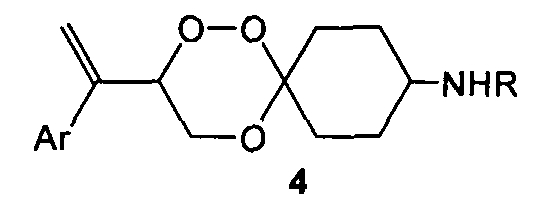
- Ar represents aryl groups such as phenyl, 4-biphenyl, 4-chlorophenyl, 4- methoxyphenyl, 4-methylphenyl and R represents phenyl, 4-methoxyphenyl, 4-chlorophenyl, 3,5-dichlorophenyl, 4-acetylaminophenyl, 1-naphthyl, 2-biphenyl, 4-biphenyl, 2-fluorene, 4- fluorophenyl, 2-trifluoromethylphenyl, 3-trifluoromethylphenyl and 4-trifluoromethylphenyl and the like.
- Malaria is one of the most deadly diseases affecting third world countries, claiming more than one million lives annually. While various classes of antimalarial agents are available, chloroquine remains the main stay of therapy against malaria. Increasing resistance of Plasmodium falciparum, the most dangerous of the four malaria parasites that infect humans, to the common drugs such as chloroquine has heightened concern about malaria. Extensive programs are underway to screen natural products and synthetic derivatives for new agents. Against this background, isolation of artemisinin as the active principle of Chinese herb Artemisia annua has opened new possibilities in malaria chemotherapy.
- Singh C; Misra, D.; Saxena, G.; Chandra, S. Bioorg. Med. Chem. Lett. 1995, 5, 1913.
- Singh C; Puri, S. K. U.S. Patent 6316493 Bl, 2001.
- Singh C; Gupta, N.; Puri, S. K. Bioorg. Med. Chem. Lett. 2003, 13, 3445.
- Singh C; Tiwari, P.; Puri, S. K. PCT Patent application No. PCT/1N02/00093, dated 28.3.2002].
- Singh et al. have developed a novel photooxygenation route for the preparation of
- 1,2,4-trioxanes 1,2,4-trioxanes.
- ⁇ -Hydroxyhydroperoxide prepared by regiospecific photooxygenation of allylic alcohols on condensation with aldehydes or ketone in the presence of acid catalyst furnish 1,2,4-trioxane.
- Singh, C Misra, D.; Saxena, G.; Chandra, S. Bioorg. Med. Chem. Lett. 1992, 2, 497.
- Singh, C Puri, S. K. U.S. Patent 6316493 Bl, 2001.
- the main objective of the present invention is to provide novel amino functionalized 1,2,4-trioxanes with a potential to be used for the treatment of malaria.
- Ar represents aryl groups selected from the groups consisting of phenyl, 4-biphenyl, 4-chlorophenyl, 4-methoxyphenyl and 4-methylphenyl and R represents phenyl, 4- methoxyphenyl, 4-chlorophenyl, 3,5-dichlorophenyl, 4-acetylaminophenyl, 1-naphthyl, 2- biphenyl, 4-biphenyl, 2-fluorene, 4-fluorophenyl, 2-trifluoromethylphenyl, 3- trifluoromethylphenyl and 4-trifluoromethylphenyl and the like.
- the compound of formula 4 has structural formula 4aa-4ai shown below:
- the compound of formula 4 has structural formulae 4ba-4bi shown below:
- the compound of formula 4 has structural formulae 4ca-4cp shown below:
- the compound of formula 4 has structural formulae 4da-4dn shown below:
- the present invention also provides a method for the preparation of a substituted amino functionalized-l,2,4-trioxanes of formula 4
- Ar represents aryl groups selected from the groups consisting of phenyl, 4-biphenyl, 4-chlorophenyl, 4-methoxyphenyl and 4-methylphenyl and R represents phenyl, 4- methoxyphenyl, 4-chlorophenyl, 3,5-dichlorophenyl, 4-acetylaminophenyl, 1-naphthyl, 2- biphenyl, 4-biphenyl, 2-fluorene, 4-fluorophenyl, 2-trifluoromethylphenyl, 3- trifluoromethylphenyl and 4-trifluoromethylphenyl and the like, the process comprising reacting a keto trioxane of formula 3
- the aromatic amine is selected from the group consisting of aniline, 4-methoxyaniline, 4-chloroaniline, 3,5-dichloroaniline, 4- aminoacetanilide, 1-naphthylamine, 2-aminobiphenyl, 4-aminobiphenyl, 2-aminofluorene, 4- fluoroaniline, 2-trifluoromethylaniline, 3-trifluoromethylaniline and 4-trifluoromethylaniline.
- the compound of formula 4 is obtained by: (i) Photooxygenating an allylic alcohol of formula 1 by passing oxygen gas or air in a solution of the alcohol in an organic solvent and in the presence of a dye and a light source which provides visible light, for a period of 4 h, to obtain a ⁇ - hydroxyhydroperoxide of formula 2
- the aromatic amines is selected from the group consisting of aniline, 4-methoxyaniline, 4-chloroaniline, 3,5-dichloroaniline, 4- aminoacetanilide, 1-naphthylamine, 2-aminobiphenyl, 4-aminobiphenyl, 2-aminofluorene, 4- fluoroaniline, 2-trifluoromethylaniline, 3-trifluoromethylaniline and 4-trifiuoromethylaniline.
- the present invention also provides a method of treating a subject having malaria, comprising administering to the subject a pharmaceutically effective amount of a composition containing substituted amino functionalized- 1,2,4-trioxanes of formula 4,
- Ar represents aryl groups selected from the groups consisting of phenyl, 4-biphenyl, 4-chlorophenyl, 4-methoxyphenyl and 4-methylphenyl and R represents phenyl, 4- methoxyphenyl, 4-chlorophenyl, 3,5-dichlorophenyl, 4-acetylaminophenyl, 1-naphthyl, 2- biphenyl, 4-biphenyl, 2-fluorene, 4-fluorophenyl, 2-trifluoromethylphenyl, 3- trifluoromethylphenyl and 4-trifluoromethylphenyl and a pharmaceutically acceptable carrier.
- the composition is administered intramuscularly or orally.
- the .pharmaceutically acceptable amount of compound of formula 4 is in the range of 12 to 96 mg of compound of formula 4 per kilogram of body weight of subject per day.
- the present invention provides a process for the preparation of amino fiinctionalized 1,2,4-trioxanes of formula 4 given above.
- trioxanes of formula 4 wherein Ar represents phenyl, 4-biphenyl, 4-chlorophenyl, 4- methoxyphenyl, 4-methylphenyl and the like and R represents phenyl, 4-methoxyphenyl, 4- chlorophenyl, 3,5-dichlorophenyl, 4-acetylaminophenyl, 1-naphthyl, 2-biphenyl, 4-biphenyl, 2-fluorene, 4-fluorophenyl, 2-trifluoromethylphenyl, 3-trifluoromethylphenyl and 4- trifluoromethylphenyl and the like.
- These trioxanes are new compounds and are useful as antimalarial agents. These compounds have been tested against multidrug-resistant malaria in mice and have shown high order of antimalarial activity.
- trioxanes thus have a promise of use for the treatment of malaria, a highly prevalent parasitic disease.
- the invention thus relates to pharmaceutical industry.
- amino functionalized 1,2,4-trioxanes of formula 4 are new chemical entities and they have not been prepared earlier.
- allylic alcohol of formula 1 were prepared by known procedure [(a) Singh, C. Tetrahedron Lett. 1990, 31, 6901. (b) Singh, C; Tiwari, P.; Puri, S. K. PCT Patent application No. PCT/1N02/00093, dated 28.3.2002].
- photooxygenation of allylic alcohols of formula 1 is effected by passing oxygen gas or air in the solution of alcohol in an organic solvent and in the presence of a dye and a light source which provides visible light, for a period of 4 h, to furnish ⁇ - hydroxyhydroperoxide of formula 2.
- keto trioxanes of formula 3 Hydroperoxides of formula 2 are reacted in situ with 1,4-cyclohexanedione in the presence of an acid catalyst to give trioxanes of formula 3. These 1,2,4-trioxanes of formula 3 have been tested against malaria parasites in mice and show only moderate order of activity.
- Keto trioxanes 3a, 3b are known compounds as they have been prepared earlier by us [Singh, C; Malik, H.; Puri, S. K. Bioorg. Med. Chem. Lett. 2004, 14, 459] while 3c, 3d, 3e are new compounds and have not been prepared earlier.
- the keto trioxanes of formula 3 are reacted with aromatic amines in the presence of
- Aromatic amines used may be aniline, 4-methoxyaniline, 4-chloroaniline, 3,5- dichloroaniline, 4-aminoacetanilide, 1-naphthylamine, 2-aminobiphenyl, 4-aminobiphenyl, 2- aminofluorene, 4-fluoroaniline, 2-trifiuoromethylaniline, 3-trifiuoromethylaniline and 4- trifluoromethylaniline and the like. All of these amino functionalized 1,2,4-trioxanes are new chemical entities and they have not been prepared earlier. These amino functionalized 1,2,4- trioxanes of formula 4 have been tested against malaria parasites in mice and have shown high order of antimalarial activity.
- trioxane 3a (0.40 g, 1.45 mmol) and 4-chloroaniline (0.23 g, 1.82 mmol) in dichloro methane (20 ml) was added acetic acid (1 ml) and reaction mixture was stirred at room temp for half an hour. Sodium triacetoxyborohydride (0.46 g, 3.63 mmol) was added slowly and was stirred for 3 h at room temperature. The reaction mixture was then poured into water and extracted with CH 2 Cl 2 (2 x 20 ml). Combined organic layer was dried over anhyd.
- trioxane 3a (0.50 g, 1.82 mmol) and 2-aminobiphenyl (0.38 g, 2.27 mmol) in dichloromethane (20 ml) was added acetic acid (1 ml) and reaction mixture was stirred at room temp for half an hour.
- Sodium triacetoxyborohydride (0.58 g, 2.73 mmol) was added slowly and it was stirred for 3 h at room temperature.
- the reaction mixture was then poured into water and extracted with CH 2 Cl 2 (2 x 20 ml). Combined organic layer was dried over anhyd.
- trioxane 3a (0.4Og, 1.45mmol) and 4-aminobiphenyl (0.30g, 1.82 mmol) in dichloromethane (20 ml) acetic acid (ImI) was added and reaction mixture was stirred at room temp for half an hour. Sodium triacetoxyborohydride (0.46g, 3.63mmol) was added slowly and it was stirred for 3h at room temperature. Reaction mixture was then poured into water and extracted with CH 2 Cl 2 (2 x 20ml). Combined organic layer was dried over anhyd.
- acetic acid (1 ml)
- trioxane 3a (0.30 g, 1.09 mmol) and 4-fluoroaniline (0.15 g, 1.34 mmol) in dichloromethane (20 ml) was added acetic acid (1 ml) and reaction mixture was stirred at room temp for half an hour.
- Sodium triacetoxyborohydride (0.35 g, 1.65 mmol) was added slowly and it was stirred for 3 h at room temperature.
- the reaction mixture was then poured into water and extracted with CH 2 Cl 2 (2 x 20 ml). Combined organic layer was dried over anhyd.
- trioxane 3a (0.50 g, 1.82 mmol) and 3-trifluoromethylaniline (0.37 g, 2.27 mmol) in dichloromethane (20 ml) was added acetic acid (1 ml) and reaction mixture was stirred at room temp for half an hour.
- Sodium triacetoxyborohydride (0.60 g, 2.73 mmol) was added slowly and it was stirred for 3 h at room temperature.
- the reaction mixture was then poured into water and extracted with CH 2 Cl 2 (2 x 20 ml). Combined organic layer was dried over anhyd.
- trioxane 3b (0.40 g, 1.14 mmol) and 4-chloroaniline (0.18 g, 1.42 mmol) in dichloromethane (20 ml) was added acetic acid (1 ml) and reaction mixture was stirred at room temp for half an hour.
- Sodium triacetoxyborohydride (0.36 g, 1.71 mmol) was added slowly and it was stirred for 3 h at room temperature.
- the reaction mixture was then poured into water and extracted with CH 2 Cl 2 (2 x 15 ml). Combined organic layer was dried over anhyd.
- trioxane 3b (0.50 g, 1.42 mmol) and 4-aminobiphenyl (0.30 g, 1.78 mmol) in dichloromethane (20 ml) was added acetic acid (1 ml) and reaction mixture was stirred at room temp for half an hour.
- Sodium triacetoxyborohydride (0.45 g, 2.14 mmol) was added slowly and it was stirred for 3 h at room temperature.
- the reaction mixture was then poured into water and extracted with CH 2 Cl 2 (2 x 20 ml). Combined organic layer was dried over anhyd.
- trioxane 3b (0.30 g, 0.85 mmol) and 2-aminofluorene (0.19 g, 1.07 mmol) in dichloromethane (20 ml) was added acetic acid (1 ml) and reaction mixture was stirred at room temp for half an hour.
- Sodium triacetoxyborohydride (0.27 g, 1.64 mmol) was added slowly and it was stirred for 3 h at room temperature.
- the reaction mixture was then poured into water and extracted with CH 2 Cl 2 (2 x 15 ml). Combined organic layer was dried over anhyd.
- trioxane 3c (0.50 g, 1.62 mmol) and aniline (0.19 g, 2.02 mmol) in dichloromethane (20 ml) was added acetic acid (1 ml) and reaction mixture was stirred at room temp for half an hour.
- Sodium triacetoxyborohydride (0.51 g, 2.43 mmol) was added slowly and it was stirred for 3 h at room temperature.
- the reaction mixture was then poured into water and extracted with CH 2 Cl 2 (2 x 20 ml). Combined organic layer was dried over anhyd.
- trioxane 3c (0.50 g, 2.27 mmol) and 4-methoxyaniline (0.25 g, 2.02 mmol) in dichloromethane (20 ml) was added acetic acid (1 ml) and reaction mixture was stirred at room temp for half an hour.
- Sodium triacetoxyborohydride (0.51 g, 2.43 mmol) was added slowly and it was stirred for 3 h at room temperature.
- the reaction mixture was then poured into water and extracted with CH 2 Cl 2 (2 x 20 ml). Combined organic layer was dried over anhyd.
- trioxane 3c (0.50 g, 1.62 mmol) and 4-aminobiphenyl (0.34 g, 2.02 mmol) in dichloromethane (20 ml) was added acetic acid (1 ml) and reaction mixture was stirred at room temp for half an hour.
- Sodium triacetoxyborohydride (0.51 g, 2.43 mmol) was added slowly and it was stirred for 3 h at room temperature.
- the reaction mixture was then poured into water and extracted with CH 2 Cl 2 (2 x 20 ml). Combined organic layer was dried over anhyd.
- trioxane 3c (0.30 g, 0.97 mmol) and 2-aminofiuorene (0.22 g, 1.21 mmol) in dichloromethane (20 ml) was added acetic acid (1 ml) and reaction mixture was stirred at room temp for half an hour.
- Sodium triacetoxyborohydride (0.30 g, 1.46 mmol) was added slowly and it was stirred for 3 h at room temperature.
- the reaction mixture was then poured into water and extracted with CH 2 Cl 2 (2 x 15 ml). Combined organic layer was dried over anhyd.
- trioxane 3c (0.30 g, 0.97 mmol) and 4-trifluoromethylaniline (0.19 g, 1.21 mmol) in dichloromethane (20 ml) was added acetic acid (1 ml) and reaction mixture was stirred at room temp for half an hour.
- Sodium triacetoxyborohydride (0.30 g, 1.46 mmol) was added slowly and it was stirred for 3 h at room temperature.
- the reaction mixture was then poured into water and extracted with CH 2 Cl 2 (2 x 15 ml). Combined organic layer was dried over anhyd.
- trioxane 3d (0.50 g, 1.62 mmol) and aniline (0.19 g, 2.05 mmol) in dichloromethane (20 ml) was added acetic acid (1 ml) and reaction mixture was stirred at room temp for half an hour.
- Sodium triacetoxyborohydride (0.52 g, 2.46 mmol) was added slowly and it was stirred for 3 h at room temperature.
- the reaction mixture was then poured into water and extracted with CH 2 Cl 2 (2 x 20 ml). Combined organic layer was dried over anhyd.
- trioxane 3d (0.50 g, 1.64 mmol) and 4-methoxyaniline (0.25 g, 2.05 mmol) in dichloro methane (20 ml) was added acetic acid (1 ml) and reaction mixture was stirred at room temp for half an hour.
- Sodium triacetoxyborohydride (0.52 g, 2.46 mmol) added slowly and it was stirred for 3 h at room temperature.
- the reaction mixture was then poured into water and extracted with CH 2 Cl 2 (2 x 20 ml). Combined organic layer was dried over anhyd.
- trioxane 3d (0.50 g, 1.62 mmol) and 4-chloroaniline (0.19 g, 2.05 mmol) in dichloromethane (20 ml) was added acetic acid (1 ml) and reaction mixture was stirred at room temp for half an hour.
- Sodium triacetoxyborohydride (0.52 g, 2.46 mmol) was added slowly and it was stirred for 3 h at room temperature.
- the reaction mixture was then poured into water and extracted with CH 2 Cl 2 (2 x 20 ml). Combined organic layer was dried over anhyd.
- trioxane 3d (0.50 g, 1.64 mmol) and 4-aminoacetanilide (0.30 g, 2.05 mmol) in dichloromethane (20 ml) was added acetic acid (1 ml) and reaction mixture was stirred at room temp for half an hour.
- Sodium triacetoxyborohydride (0.52 g, 2.46 mmol) was added slowly and it was stirred for 3 h at room temperature.
- the reaction mixture was then poured into water and extracted with CH 2 Cl 2 (2 x 20 ml). Combined organic layer was dried over anhyd.
- trioxane 3e (0.30 g, 1.04 mmol) and aniline (0.12 g, 1.30 mmol) in dichloromethane (20 ml) was added acetic acid (1 ml) and reaction mixture was stirred at room temp for half an hour.
- Sodium triacetoxyborohydride (0.33 g, 1.56 mmol) was added slowly and it was stirred for 3 h at room temperature.
- the reaction mixture was then poured into water and extracted with CH 2 Cl 2 (2 x 20 ml). Combined organic layer was dried over anhyd.
- trioxane 3e (0.30 g, 1.04 mmol) and 4-methoxyaniline (0.16 g, 1.30 mmol) in dichloromethane (20 ml) was added acetic acid (1 ml) and reaction mixture was stirred at room temp for half an hour.
- Sodium triacetoxyborohydride (0.33 g, 1.56 mmol) was added slowly and it was stirred for 3 h at room temperature.
- the reaction mixture was then poured into water and extracted with CH 2 Cl 2 (2 x 15 ml). Combined organic layer was dried over anhyd.
- acetic acid (1 ml)
- trioxane 3e (0.50 g, 1.62 mmol) and 3,5-dichloroaniline (0.19 g, 2.05 mmol) in dichloromethane (20 ml) was added acetic acid (1 ml) and reaction mixture was stirred at room temp for half an hour.
- Sodium triacetoxyborohydride (0.52 g, 2.46 mmol) was added slowly and it was stirred for 3 h at room temperature.
- the reaction mixture was then poured into water and extracted with CH 2 Cl 2 (2 x 20 ml). Combined organic layer was dried over anhyd.
- trioxane 3e (0.50 g, 1.62 mmol) and 4-aminoacetanilide (0.19 g, 2.05 mmol) in dichloromethane (20 ml) was added acetic acid (1 ml) and reaction mixture was stirred at room temp for half an hour.
- Sodium triacetoxyborohydride (0.52 g, 2.46 mmol) was added slowly and it was stirred for 3 h at room temperature.
- the reaction mixture was then poured into water and extracted with CH 2 Cl 2 (2 x 20 ml). Combined organic layer was dried over anhyd.
- trioxane 3e (0.80 g, 2.59 mmol) and 2-aminobiphenyl (0.41 g, 3.24 mmol) in dichloromethane (30 ml) was added acetic acid (1 ml) and reaction mixture was stirred at room temp for half an hour.
- Sodium triacetoxyborohydride (0.82 g, 3.89 mmol) was added slowly and it was stirred for 3 h at room temperature.
- the reaction mixture was then poured into water and extracted with CH 2 Cl 2 (2 x 25 ml). Combined organic layer was dried over anhyd.
- trioxane 3e (0.30 g, 1.04 mmol) and 4-fluoroaniline (0.14 g, 1.25 mmol) in dichloromethane (20 ml) was added acetic acid (1 ml) and reaction mixture was stirred at room temp for half an hour.
- Sodium triacetoxyborohydride (0.33 g, 1.55 mmol) was added slowly and it was stirred for 3 h at room temperature.
- the reaction mixture was then poured into water and extracted with CH 2 Cl 2 (2 x 20 ml). Combined organic layer was dried over anhyd.
- the antimalarial activity, of the test compounds was evaluated in rodent using multidrug resistant strain of Plasmodium yoelii Nigeriensis in Swiss mice.
- Random bred Swiss mice of either sex (20 ⁇ 2 gm) were inoculated intraperitoneally with 1 x 10 5 P. yoelii (MDR) parasites on day zero.
- the treatments with test compounds were administered to group of 5 mice each at different dose levels ranging between 12-96 mg/ kg/day.
- the treatment was administered in groundnut oil intramuscularly and orally for 4 consecutive days (day 0-3). Blood smears from experimental mice were observed on day 4 and 7, day 10 and thereafter at regular intervals till day 28 or death of the animal.
- the parasitaemia level on day 4 was compared with vehicle control group and percent suppression of parasitaemia in treated groups was calculated.
Landscapes
- Chemical & Material Sciences (AREA)
- Organic Chemistry (AREA)
- Health & Medical Sciences (AREA)
- Tropical Medicine & Parasitology (AREA)
- Veterinary Medicine (AREA)
- Chemical Kinetics & Catalysis (AREA)
- General Chemical & Material Sciences (AREA)
- Medicinal Chemistry (AREA)
- Nuclear Medicine, Radiotherapy & Molecular Imaging (AREA)
- Pharmacology & Pharmacy (AREA)
- Life Sciences & Earth Sciences (AREA)
- Animal Behavior & Ethology (AREA)
- General Health & Medical Sciences (AREA)
- Public Health (AREA)
- Organic Low-Molecular-Weight Compounds And Preparation Thereof (AREA)
Abstract
The present invention relates to a novel series of antimalarial amino functionalized 1,2,4-trioxane analogues of formula (4): wherein Ar represents aryl groups such as phenyl, 4-biphenyl, 4-chlorophenyl, 4-methoxyphenyl, 4-methylphenyl and R represents phenyl, 4-methoxyphenyl, 4-chlorophenyl, 3,5-dichlorophenyl, 4-acetylaminophenyl, 1-naphthyl, 2-biphenyl, 4-biphenyl, 2-fluorene, 4-fluorophenyl, 2-trifluoromethylphenyl, 3-trifluoromethylphenyl and 4-trifluoromethylphenyl and the like.
Description
AMINO-FUNCTIONALIZED 1,2,4-TRIOXANES USEFUL AS ANTI-MALARIAL AGENTS AND PROCESS FOR PREPARATION THEREOF
Field of the invention The present invention relates to a novel series of antimalarial amino functionalized
1,2,4-trioxane analogues of formula 4

wherein Ar represents aryl groups such as phenyl, 4-biphenyl, 4-chlorophenyl, 4- methoxyphenyl, 4-methylphenyl and R represents phenyl, 4-methoxyphenyl, 4-chlorophenyl, 3,5-dichlorophenyl, 4-acetylaminophenyl, 1-naphthyl, 2-biphenyl, 4-biphenyl, 2-fluorene, 4- fluorophenyl, 2-trifluoromethylphenyl, 3-trifluoromethylphenyl and 4-trifluoromethylphenyl and the like. Several of these novel compounds show promising antimalarial activity against multidrug-resistant malaria in mice and thus hold promise as antimalarial agents against multidrug-resistant malaria. Background of the invention
Malaria is one of the most deadly diseases affecting third world countries, claiming more than one million lives annually. While various classes of antimalarial agents are available, chloroquine remains the main stay of therapy against malaria. Increasing resistance of Plasmodium falciparum, the most dangerous of the four malaria parasites that infect humans, to the common drugs such as chloroquine has heightened concern about malaria. Extensive programs are underway to screen natural products and synthetic derivatives for new agents. Against this background, isolation of artemisinin as the active principle of Chinese herb Artemisia annua has opened new possibilities in malaria chemotherapy.
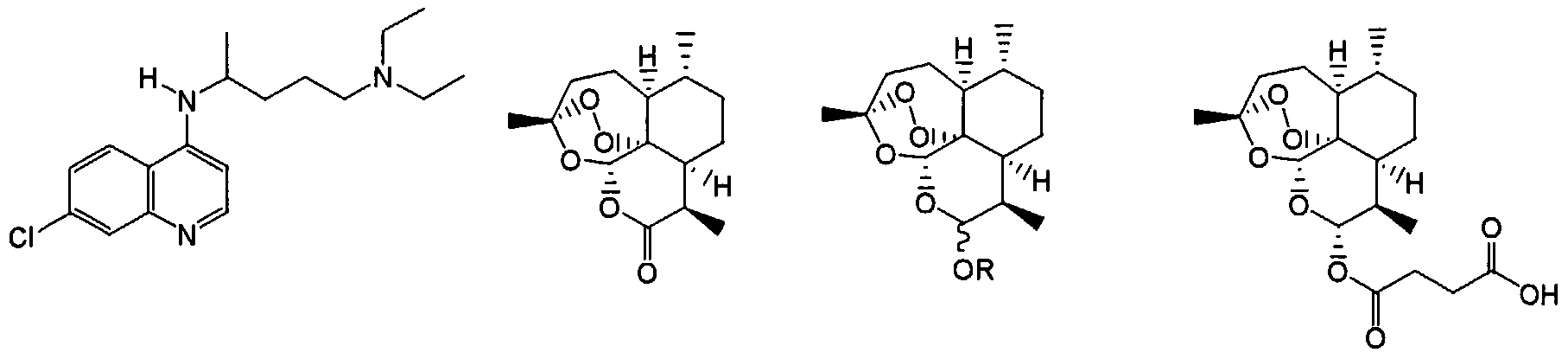
Chloroquine Artemisinin Arteether R = Et Artemether R = Me Artesunic acid
Semisynthetic derivatives of artemisinin such as arteether, artemether and artesunic acid, are currently the drugs of choice for the treatment of complicated cases of malaria such as cerebral malaria [For reviews on artemisinin and its analogues see: (a) Klayman, D. L
Science 1985, 228, 1049. (b) Bhattacharya, A. K.; Sharma, R. P. Heterocycles 1999, 51, 1681. (c) Borstnik, K.; Paik, I.; Shapiro, T. A.; Posner, G. H. Int. J. Parasitol. 2002, 32, 1661. (d) Ploypradith, P. Acta Trop. 2004, 89, 329. (e) O'Neill, P. M.; Posner, G. H. J. Med. Chem. 2004, 47, 2945]. The limited availability of artemisinin from natural sources and the fact that endoperoxide linkage present in the form of a 1,2,4-trioxane ring system is the antimalarial pharmacophore of these compounds, has led to the present efforts to develop structurally simple synthetic trioxanes. Several structurally simple synthetic 1,2,4-trioxanes have shown promising antimalarial activity [(a) Bhattacharya, A. K.; Sharma, R. P. Heterocycles 1999, 57, 1681. (b) Borstnik, K.; Paik, I.; Shapiro, T. A.; Posner, G. H. Int. J. Parasitol. 2002, 32, 1661. (c) Singh, C; Misra, D.; Saxena, G.; Chandra, S. Bioorg. Med. Chem. Lett. 1995, 5, 1913. (d) Singh, C; Puri, S. K. U.S. Patent 6316493 Bl, 2001. (e) Singh, C; Gupta, N.; Puri, S. K. Bioorg. Med. Chem. Lett. 2003, 13, 3445. (f) Singh, C; Tiwari, P.; Puri, S. K. PCT Patent application No. PCT/1N02/00093, dated 28.3.2002]. Singh et al. have developed a novel photooxygenation route for the preparation of
1,2,4-trioxanes. β-Hydroxyhydroperoxide prepared by regiospecific photooxygenation of allylic alcohols on condensation with aldehydes or ketone in the presence of acid catalyst furnish 1,2,4-trioxane. [(a) Singh, C; Misra, D.; Saxena, G.; Chandra, S. Bioorg. Med. Chem. Lett. 1992, 2, 497. (b) Singh, C; Misra, D.; Saxena, G.; Chandra, S. Bioorg. Med. Chem. Lett. 1995, 5, 1913. (c) Singh, C; Puri, S. K. U.S. Patent 6316493 Bl, 2001. (d) Singh, C; Gupta, N.; Puri, S. K. Bioorg. Med. Chem. Lett. 2002, 12, 1913. (e) Singh, C; Gupta, N.; Puri, S. K. Bioorg. Med. Chem. Lett. 2003, 13, 3445. (f) Singh, C; Tiwari, P.; Puri, S. K. PCT Patent application No. PCT/1N02/00093, dated 28.3.2002]. This method has been extended for the preparation of several amino functionalized 1,2,4-trioxanes, some of which have shown moderate antimalarial activity against multidrug resistant P. yoelii in mice [Singh, C; Malik, H.; Puri, S. K. Bioorg. Med Chem. Lett. 2004, 14, 459].
It is desirable to develop new compounds with show high degrees of anti-malarial activity in order to overcome the problems associated with the prior art compounds including the problem of drug-resistance in the malarial virus. Objects of the invention
The main objective of the present invention is to provide novel amino functionalized 1,2,4-trioxanes with a potential to be used for the treatment of malaria.
It is another object of the invention to provide a process for the preparation of novel amino functionalized 1,2,4-trioxanes of formula 4, a new series of antimalarial agents.
Summary of the invention
Accordingly the present invention provides substituted amino functionalized 1,2,4- trioxanes of formula 4


4aa R = 4-chlorophenyl
4ab R = 2-biphenyl (upper Rf)
4ac R = 2-biphenyl (lower Rf)
4ad R = 4-biphenyl
4ae R = 2-fluorene
4af R = 4-fluorophenyl
4ag R = 2-trifluoromethylphenyl
4ah R = 3-trifluoromethylphenyl
4ai R = 4-trifluoromethylphenyl
In another embodiment of the invention, the compound of formula 4 has structural formulae 4ba-4bi shown below:


4ca R = phenyl
4cb R = 4-methoxyphenyl
4cc R = 4-chlorophenyl (upper Rf)
4cd R = 4-chlorophenyl (lower Rf)
4ce R = 3,5-dichlorophenyl (upper Rf)
4cf R = 3,5-dichlorophenyl ( lower Rf)
4cg R = 4-acetylaminophenyl
4ch R = 1-naphthyl
4ci R = 2-biphenyl (upper Rf)
4cj R = 2-biphenyl (lower Rf)
4ck R = 4-biphenyl
4cl R = 2-fluorene
4cmR = 4-fluorophenyl
4cn R = 2-trifluoromethylphenyl
4co R = 3-trifluoromethylphenyl
4cp R = 4-trifluoromethylphenyl
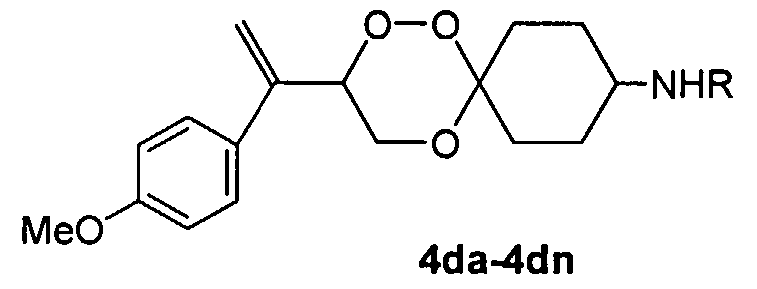
In another embodiment of the invention, the compound of formula 4 has structural formulae 4da-4dn shown below:

4da R = phenyl
4db R = 4-methoxyphenyl
4dc R = 4-chlorophenyl
4dd R = 3,5-dichlorophenyl
4de R = 4-acetylaminophenyl
4df R = 1-naphthyl
4dg R = 2-biphenyl (upper Rf)
4dh R = 2-biphenyl (lower Rf)
4di R = 4-biphenyl
4dj R = 2-fluorene
4dk R = 4-fluorophenyl
4dl R = 2-trifluoromethylphenyl
4dm R = 3-trifluoromethylphenyl
4dn R = 4-trifluoromethylphenyl
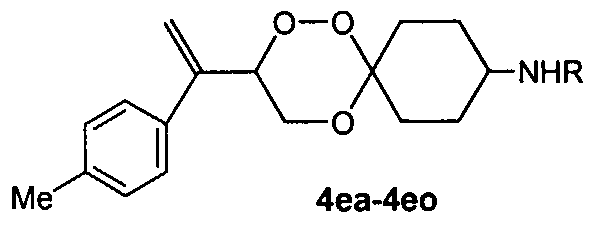
In another embodiment of the invention, the compound of formula 4 has structural formulae 4ea-4eo shown below:

4ea R = phenyl
4eb R = 4-methoxyphenyl
4ec R = 4-chlorophenyl
4ed R = 3,5-dichlorophenyl (upper Rf1
4ee R = 3,5-dichlorophenyl (lower Rf)
4ef R = 4-acetylaminophenyl
4eg R = 1-naphthyl
4eh R = 2-biphenyl (upper Rq
4ei R = 2-biphenyl (lower Rf)
4ej R = 4-biphenyl
4ek R = 2-fluorene
4el R = 4-fluorophenyl
4emR = 2-trifluoromethylphenyl
4en R = 3-trifluoromethylphenyl
4eo R = 4-trifluoromethylphenyl
The present invention also provides a method for the preparation of a substituted amino functionalized-l,2,4-trioxanes of formula 4

4 wherein Ar represents aryl groups selected from the groups consisting of phenyl, 4-biphenyl, 4-chlorophenyl, 4-methoxyphenyl and 4-methylphenyl and R represents phenyl, 4- methoxyphenyl, 4-chlorophenyl, 3,5-dichlorophenyl, 4-acetylaminophenyl, 1-naphthyl, 2- biphenyl, 4-biphenyl, 2-fluorene, 4-fluorophenyl, 2-trifluoromethylphenyl, 3- trifluoromethylphenyl and 4-trifluoromethylphenyl and the like, the process comprising reacting a keto trioxane of formula 3

3 with an aromatic amine in the presence of NaBH(OAc)3 in CH2Cl2 to furnish amino functionalized 1,2,4-trioxanes of formula 4.
In one embodiment of the invention, the aromatic amine is selected from the group consisting of aniline, 4-methoxyaniline, 4-chloroaniline, 3,5-dichloroaniline, 4- aminoacetanilide, 1-naphthylamine, 2-aminobiphenyl, 4-aminobiphenyl, 2-aminofluorene, 4- fluoroaniline, 2-trifluoromethylaniline, 3-trifluoromethylaniline and 4-trifluoromethylaniline.
In another embodiment of the invention, the compound of formula 4 is obtained by: (i) Photooxygenating an allylic alcohol of formula 1 by passing oxygen gas or air in a solution of the alcohol in an organic solvent and in the presence of a dye and a light source which provides visible light, for a period of 4 h, to obtain a β- hydroxyhydroperoxide of formula 2

1a; Ar = Phenyl 1b; Ar = 4-Biphenyl 1c; Ar = 4-chlorophenyl 1d; Ar = 4-methoxyphenyl 1e; Ar = 4-methylphenyl
1

2a; Ar = Phenyl 2b; Ar = 4-Biphenyl 2c; Ar = 4-chlorophenyl 2d; Ar = 4-methoxyphenyl 2e; Ar = 4-methylphenyl
(ii) reacting the hydroperoxides of formula 2 in situ with 1,4-cyclohexanedione in the presence of an acid catalyst to give a trioxane of formula 3;

3a; Ar = Phenyl
3b; Ar = 4-Biphenyl
3c; Ar = 4-chlorophenyl
3d; Ar = 4-methoxyphenyl
3e; Ar = 4-methylphenyl
(iii) reacting the keto trioxane of formula 3 with an aromatic amine in the presence of NaBH(OAc)3 in CH2Cl2 to obtain amino fiinctionalized 1,2,4-trioxane of formula 4. In one embodiment of the invention, the aromatic amines is selected from the group consisting of aniline, 4-methoxyaniline, 4-chloroaniline, 3,5-dichloroaniline, 4- aminoacetanilide, 1-naphthylamine, 2-aminobiphenyl, 4-aminobiphenyl, 2-aminofluorene, 4- fluoroaniline, 2-trifluoromethylaniline, 3-trifluoromethylaniline and 4-trifiuoromethylaniline. The present invention also provides a method of treating a subject having malaria, comprising administering to the subject a pharmaceutically effective amount of a composition containing substituted amino functionalized- 1,2,4-trioxanes of formula 4,

In another embodiment of the invention, the .pharmaceutically acceptable amount of compound of formula 4 is in the range of 12 to 96 mg of compound of formula 4 per kilogram of body weight of subject per day. Detailed description of the invention
The present invention provides a process for the preparation of amino fiinctionalized 1,2,4-trioxanes of formula 4 given above.
Our SAR studies on amino functionalized 1,2,4-trioxanes have resulted in several novel amino functionalized 1,2,4-trioxanes which show a very high order- of antimalarial activity against rodent malaria and disclose here the structures and activity of these novel compounds. The order of activity of amino functionalized 1,2,4-trioxanes reported here is much higher than amino functionalized 1,2,4-trioxanes reported earlier by us [Singh, C; Malik, H.; Puri, S. K. Bioorg. Med. Chem. Lett. 2004, 14, 459]. The present invention therefore also relates to the preparation of novel amino functionalized 1,2,4-trioxanes of formula 4 with high order of antimalarial activity. The present invention particularly relates to the. preparation of amino functionalized 1,2,4-
trioxanes of formula 4 wherein Ar represents phenyl, 4-biphenyl, 4-chlorophenyl, 4- methoxyphenyl, 4-methylphenyl and the like and R represents phenyl, 4-methoxyphenyl, 4- chlorophenyl, 3,5-dichlorophenyl, 4-acetylaminophenyl, 1-naphthyl, 2-biphenyl, 4-biphenyl, 2-fluorene, 4-fluorophenyl, 2-trifluoromethylphenyl, 3-trifluoromethylphenyl and 4- trifluoromethylphenyl and the like. These trioxanes are new compounds and are useful as antimalarial agents. These compounds have been tested against multidrug-resistant malaria in mice and have shown high order of antimalarial activity.
These trioxanes, thus have a promise of use for the treatment of malaria, a highly prevalent parasitic disease. The invention thus relates to pharmaceutical industry.
The amino functionalized 1,2,4-trioxanes of formula 4 are new chemical entities and they have not been prepared earlier.
The process of the invention follows the general scheme shown below:

1a; Ar = Phenyl 2a; Ar = Phenyl 1b; Ar = 4-Biphenyl 2b; Ar = 4-Biphenyl 1c; Ar = 4-chlorophenyl 2c; Ar = 4-chlorophenyl 1d; Ar = 4-methoxyphenyl 2d; Ar = 4-methoxyphenyl 1e; Ar = 4-methylphenyl 2e; Ar = 4-methylphenyl

3a; Ar = Phenyl
3b; Ar = 4-Biphenyl 4
3c; Ar = 4-chlorophenyl
3d; Ar = 4-methoxyphenyl
3e; Ar = 4-methylphenyl
Scheme 1 Reagents and conditions: (a) hv, O2, methylene blue, MeCN, -10 to O0C, 4 h. (b) 1,4-cyclohexanedione, coned HCl, 5°C, 18 h. (c) RNH2, NaBH(OAc)3, CH2Cl2, rt, 3.5 h.
In the process of the invention allylic alcohol of formula 1 were prepared by known procedure [(a) Singh, C. Tetrahedron Lett. 1990, 31, 6901. (b) Singh, C; Tiwari, P.; Puri, S. K. PCT Patent application No. PCT/1N02/00093, dated 28.3.2002].
In the process photooxygenation of allylic alcohols of formula 1 is effected by passing oxygen gas or air in the solution of alcohol in an organic solvent and in the presence of a dye and a light source which provides visible light, for a period of 4 h, to furnish β- hydroxyhydroperoxide of formula 2. These hydroperoxides of formula 2 are known compounds and have been prepared by us earlier [(a) Singh, C; Misra, D.; Saxena, G.; Chandra, S. Bioorg. Med Chem. Lett. 1992, 2, 497. (b) Singh, C; Misra, D.; Saxena, G.; Chandra, S. Bioorg. Med. Chem. Lett. 1995, 5, 1913. (c) Singh, C; Tiwari, P.; Puri, S. K. PCT Patent application No. PCT/1N02/00093, dated 28.3.2002]. The dye acts as a sensitizer, i.e., converts 3O2 to highly reactive 1O2. Hydroperoxides of formula 2 are reacted in situ with 1,4-cyclohexanedione in the presence of an acid catalyst to give trioxanes of formula 3. These 1,2,4-trioxanes of formula 3 have been tested against malaria parasites in mice and show only moderate order of activity. Keto trioxanes 3a, 3b are known compounds as they have been prepared earlier by us [Singh, C; Malik, H.; Puri, S. K. Bioorg. Med. Chem. Lett. 2004, 14, 459] while 3c, 3d, 3e are new compounds and have not been prepared earlier. The keto trioxanes of formula 3 are reacted with aromatic amines in the presence of
NaBH(OAc)3 in CH2Cl2 to furnish amino functionalized 1,2,4-trioxanes of formula 4. Aromatic amines used may be aniline, 4-methoxyaniline, 4-chloroaniline, 3,5- dichloroaniline, 4-aminoacetanilide, 1-naphthylamine, 2-aminobiphenyl, 4-aminobiphenyl, 2- aminofluorene, 4-fluoroaniline, 2-trifiuoromethylaniline, 3-trifiuoromethylaniline and 4- trifluoromethylaniline and the like. All of these amino functionalized 1,2,4-trioxanes are new chemical entities and they have not been prepared earlier. These amino functionalized 1,2,4- trioxanes of formula 4 have been tested against malaria parasites in mice and have shown high order of antimalarial activity.
This invention is further illustrated by the following examples which should not, however, be construed to limit the scope of the present invention.
Example 1: 3-(l-PhenyI-vinyl)-l,2,5-trioxaspiro[5.5]undec-9-one (compound 3a, Ar = phenyl).
Solution of allylic alcohol Ia (Ig, 6.75mmol) and methylene blue (30mg) in acetonitrile (100ml) maintained at 0°C, was irradiated with 500W tungsten-halogen lamp while oxygen was bubbled slowly into reaction mixture for 4h. 1,4-Cyclohexanedione (1.15 g, 10.13mmol) and coned. HCl (5 drops) were added and reaction mixture was left at 50C overnight. Reaction mixture was concentrated under reduced pressure and residue taken up in ether (100ml) was washed with sat. aq NaHCO3 (30ml). Aqueous layer was extracted with ether (2 x 75ml), combined ether layer dried over anhyd. Na2SO4 and concentrated. Crude
product was purified by column chromatography on silica gel using EtOAc-hexane (5:95) as eluant to furnish trioxane 3a (0.94g, 51% yield, based on allylic alcohol Ia used), m.p. 70- 71°C.
Example 2: (4-chloro-phenyl)-[3-(l-phenyl-vinyl)-l,2,5-trioxa-spiro[5.5]undec-9-yl]- amine (compound 4aa, Formula 4, Ar = phenyl, R = 4-chlorophenyl).
To a mixture of trioxane 3a (0.40 g, 1.45 mmol) and 4-chloroaniline (0.23 g, 1.82 mmol) in dichloro methane (20 ml) was added acetic acid (1 ml) and reaction mixture was stirred at room temp for half an hour. Sodium triacetoxyborohydride (0.46 g, 3.63 mmol) was added slowly and was stirred for 3 h at room temperature. The reaction mixture was then poured into water and extracted with CH2Cl2 (2 x 20 ml). Combined organic layer was dried over anhyd. Na2SO4, concentrated under vacuum and crude product was chromatographed over silica gel using benzene-hexane (50:50) as eluant to furnish amino functionalized 1,2,4- trioxane 4aa as an inseparable mixture of diastereomers as oil (0.40 g, 71.7 % yield). Example 3: Biphenyl-2-yl-[3-(l-phenyl-vinyl)-l,2,5-trioxa-spiro[5.5]undec-9-yI]amine (compound 4ab and 4ac, Formula 4, Ar = phenyl, R = 2-biphenyl).
To a mixture of trioxane 3a (0.50 g, 1.82 mmol) and 2-aminobiphenyl (0.38 g, 2.27 mmol) in dichloromethane (20 ml) was added acetic acid (1 ml) and reaction mixture was stirred at room temp for half an hour. Sodium triacetoxyborohydride (0.58 g, 2.73 mmol) was added slowly and it was stirred for 3 h at room temperature. The reaction mixture was then poured into water and extracted with CH2Cl2 (2 x 20 ml). Combined organic layer was dried over anhyd. Na2SO4, concentrated under vacuum and crude product was chromatographed over silica gel using benzene-hexane (50:50) as eluant to furnish amino functionalized 1,2,4- trioxane 4ab as oil (upper Rf, 0.17 g, 21.8 % yield) and 4ac (lower Rf, 0.25 g, 32.6 % yield), m.p. 74-76°C. Example 4: Biphenyl-4-yl-[3-(l-phenyl-vinyl)-l,2,5-trioxa-spiro[5.5]undec-9-yl]amine (compound 4ad, Formula 4, Ar = phenyl, R = 4-biphenyl).
To a mixture of trioxane 3a (0.4Og, 1.45mmol) and 4-aminobiphenyl (0.30g, 1.82 mmol) in dichloromethane (20 ml) acetic acid (ImI) was added and reaction mixture was stirred at room temp for half an hour. Sodium triacetoxyborohydride (0.46g, 3.63mmol) was added slowly and it was stirred for 3h at room temperature. Reaction mixture was then poured into water and extracted with CH2Cl2 (2 x 20ml). Combined organic layer was dried over anhyd. Na2SO4, concentrated under vacuum and crude product was chromatographed over silica gel using benzene-hexane (50:50) as eluant to furnish amino functionalized 1,2,4-
trioxane 4ad as an inseparable mixture of diastereomers (0.44g, 70.5% yield), m.p. 118- 120°C.
Example 5: (9H-Fluoren-3-yl)-[l-phenyl-vinyl)-l,2,5-trioxa-spiro[5.5]undec-9-yl]-amine (compound 4ae, Formula 4, Ar = phenyl, R = 2-fluorene). To a mixture of trioxane 3a (0.30 g, 1.09 mmol) and 2-aminofluorene (0.24 g, 1.36 mmol) in dichloromethane (20 ml) was added acetic acid (1 ml) and reaction mixture was stirred at room temp for half an hour. Sodium triacetoxyborohydride (0.35 g, 1.64 mmol) was added slowly and it was stirred for 3 h at room temperature. The reaction mixture was then poured into water and extracted with CH2Cl2 (2 x 15 ml). Combined organic layer was dried over anhyd. Na2SO4, concentrated under vacuum and the crude product was chromatographed over silica gel using benzene-hexane (50:50) as eluant to furnish amino functionalized 1,2,4-trioxane 4ae as an inseparable mixture of diastereomers (0.30 g, 63.5 % yield), m.p. 144-146°C. Example 6: (4-Fluoro-phenyl)-[3-(l-phenyl-vinyl)-l,2,5-trioxa-spiro[5.5]undec-9-yl]- amine (compound 4af, Formula 4, Ar = phenyl, R = 4-fluorophenyl).
To a mixture of trioxane 3a (0.30 g, 1.09 mmol) and 4-fluoroaniline (0.15 g, 1.34 mmol) in dichloromethane (20 ml) was added acetic acid (1 ml) and reaction mixture was stirred at room temp for half an hour. Sodium triacetoxyborohydride (0.35 g, 1.65 mmol) was added slowly and it was stirred for 3 h at room temperature. The reaction mixture was then poured into water and extracted with CH2Cl2 (2 x 20 ml). Combined organic layer was dried over anhyd. Na2SO4, concentrated under vacuum and the crude product was chromatographed over silica gel using benzene-hexane (50:50) as eluant to furnish amino functionalized 1,2,4-trioxane 4af as an inseparable mixture of diastereomers as oil (0.34 g, 84.1 % yield). Example 7: [3-(l-Phenyl-vinyl)-l,2,5-trioxa-spiro[5.5]undec-9-yI]-(3-trifluoromethyl- phenyl)-amine (compound 4ah, Formula 4, Ar = phenyl, R = 3-trifluoromethylphenyl).
To a mixture of trioxane 3a (0.50 g, 1.82 mmol) and 3-trifluoromethylaniline (0.37 g, 2.27 mmol) in dichloromethane (20 ml) was added acetic acid (1 ml) and reaction mixture was stirred at room temp for half an hour. Sodium triacetoxyborohydride (0.60 g, 2.73 mmol) was added slowly and it was stirred for 3 h at room temperature. The reaction mixture was then poured into water and extracted with CH2Cl2 (2 x 20 ml). Combined organic layer was dried over anhyd. Na2SO4, concentrated under vacuum and the crude product was chromatographed over silica gel using benzene-hexane (50:50) as eluant to furnish amino
functionalized 1,2,4-trioxane 4ah as an inseparable mixture of diastereomers as oil (0.49 g, 64.1 % yield).
Example 8: [3-(l-Phenyl-vinyl)-l,2,5-trioxa-spiro[5.5]undec-9-yl]-(4-trifluoromethyI- phenyl)-amine (compound 4ai, Formula 4, Ar = phenyl, R = 4-trifluoromethylphenyl). To a mixture of trioxane 3a (0.30 , 1.09 mmol) and 4-trifluoromethylaniline (0.22,
1.36 mmol) dichloromethane (20 ml) was added acetic acid (1 ml) and reaction mixture was stirred at room temp for half an hour. Sodium triacetoxyborohydride (0.34 g, 1.60 mmol) was added slowly and it was stirred for 3 h at room temperature. The reaction mixture was then poured into water and extracted with CH2Cl2 (2 x 20 ml). Combined organic layer was dried over anhyd. Na2SO4, concentrated under vacuum and the crude product was chromatographed over silica gel using benzene-hexane (50:50) as eluant to furnish amino functionalized 1,2,4-trioxane 4ai as an inseparable mixture of diastereomers as oil (0.26 g, 58.7 % yield). Example 9: 3-(l-Biphenyl-4yl-vinyl)-l,2,5-trioxaspiro[5.5]undec-9-one (compound 3b, Ar = biphenyl).
A solution of allylic alcohol Ib (1 g, 6.75 mmol) and methylene blue (30 mg) in acetonitrile (100 ml) maintained at 0°C, was irradiated with a 500 W tungsten-halogen lamp while oxygen was bubbled slowly into the reaction mixture for 4 h. 1,4-Cyclohexanedione (1.15 g, 10.13 mmol) and coned HCl (5 drops) were added and the reaction mixture was left at 5°C overnight. Reaction mixture was concentrated under reduced pressure and residue taken up in ether (100 ml) was washed with sat. aq NaHCO3 (30 ml). The aqueous layer was extracted with ether (2 x 75 ml), combined ether layer dried over anhyd. Na2SO4 and concentrated. The crude product was purified by column chromatography on silica gel using EtOAc-hexane (5:95) as eluant to furnish trioxane 3b (0.65 g, 42 % yield, based on allylic alcohol Ib used), m.p. 104-1050C.
Example 10: [3-(l-Biphenyl-4-yl-vinyl)-l,2,5-trioxa-spiro[5.5]undec-9-yI]-(4-chIoro- phenyl)-amine (compound 4ba, Formula 4, Ar = 4-biphenyl, R = 4-chlorophenyl).
To a mixture of trioxane 3b (0.40 g, 1.14 mmol) and 4-chloroaniline (0.18 g, 1.42 mmol) in dichloromethane (20 ml) was added acetic acid (1 ml) and reaction mixture was stirred at room temp for half an hour. Sodium triacetoxyborohydride (0.36 g, 1.71 mmol) was added slowly and it was stirred for 3 h at room temperature. The reaction mixture was then poured into water and extracted with CH2Cl2 (2 x 15 ml). Combined organic layer was dried over anhyd. Na2SO4, concentrated under vacuum and the crude product was chromatographed over silica gel using benzene-hexane (50:50) as eluant to furnish amino
functionalized 1,2,4-trioxane 4ba as an inseparable mixture of diastereomers (0.38 g, 72.1 % yield), m.p. 148-150°C.
Example 11: Biphenyl-2-yl-[3-(l-biphenyl-4-yI-vinyl)-l,2,5-trioxaspiro[5.5]undec-9-yl]- amine (compound 4bb and 4bc, Formula 4, Ar = 4-biphenyl, R = 2-biphenyl). To a mixture of trioxane 3b (0.60 g, 1.71 mmol) and 2-aminobiphenyl (0.36 g, 2.14 mmol) in dichloromethane (25 ml) was added acetic acid (1 ml) and reaction mixture was stirred at room temp for half an hour. Sodium triacetoxyborohydride (0.54 g, 2.57 mmol) was added slowly and it was stirred for 3 h at room temperature. The reaction mixture was then poured into water and extracted with CH2Cl2 (2 x 25 ml). Combined organic layer was dried over anhyd. Na2SO4, concentrated under vacuum and the crude product was chromatographed over silica gel using benzene-hexane (50:50) as eluant to furnish amino functionalized 1,2,4-trioxane 4bb (upper Rf, 0.19 g, 21.7 % yield), m.p. 105-106°C and 4bc (lower Rf, 0.28 g, 32.4 % yield), m.p. 148-15O0C. Example 12: Biphenyl-4-yl-[3-(l-biphenyl-4-yl-vinyl)-l,2,5-trioxaspiro[5.5]undec-9-yl]- amine (compound 4bd, Formula 4, Ar = 4-biphenyl, R = 4-biphenyl).
To a mixture of trioxane 3b (0.50 g, 1.42 mmol) and 4-aminobiphenyl (0.30 g, 1.78 mmol) in dichloromethane (20 ml) was added acetic acid (1 ml) and reaction mixture was stirred at room temp for half an hour. Sodium triacetoxyborohydride (0.45 g, 2.14 mmol) was added slowly and it was stirred for 3 h at room temperature. The reaction mixture was then poured into water and extracted with CH2Cl2 (2 x 20 ml). Combined organic layer was dried over anhyd. Na2SO4, concentrated under vacuum and the crude product was chromatographed over silica gel using benzene-hexane (50:50) as eluant to furnish amino functionalized 1,2,4-trioxane 4bd as an inseparable mixture of diastereomers (0.53 g, 73.8 % yield), m.p. 158-160°C. Example 13: [3-(l-Biphenyl-4-yl-vinyl)-l,2,5-trioxa-spiro[5.5]undec-9-yl]-(9H-fluoren-3- yl)-amine (compound 4be, Formula 4, Ar = 4-biphenyl, R = 2-fluorene).
To a mixture of trioxane 3b (0.30 g, 0.85 mmol) and 2-aminofluorene (0.19 g, 1.07 mmol) in dichloromethane (20 ml) was added acetic acid (1 ml) and reaction mixture was stirred at room temp for half an hour. Sodium triacetoxyborohydride (0.27 g, 1.64 mmol) was added slowly and it was stirred for 3 h at room temperature. The reaction mixture was then poured into water and extracted with CH2Cl2 (2 x 15 ml). Combined organic layer was dried over anhyd. Na2SO4, concentrated under vacuum and the crude product was chromatographed over silica gel using benzene-hexane (50:50) as eluant to furnish amino
functionalized 1,2,4-trioxane 4be as an inseparable mixture of diastereomers (0.28 g, 65.04 % yield), m.p. 170-172°C.
Example 14: 3-[l-(4-Chloro-phenyl)-vinyI]-l,2,5-trioxa-spiro[5.5]undecan-9-one
(compound 3c, Ar = 4-chlorophenyl). A solution of allylic alcohol Ic (1 g, 5.47 mmol) and methylene blue (30 mg) in acetonitrile (100 ml) maintained at 00C, was irradiated with a 500 W tungsten-halogen lamp while oxygen was bubbled slowly into the reaction mixture for 4 h. 1,4-Cyclohexanedione (1.22 g, 10.95 mmol) and coned HCl (5 drops) were added and the reaction mixture was left at 5°C overnight. Reaction mixture was concentrated under reduced pressure and residue taken up in ether (100 ml) was washed with sat. aq NaHCO3 (30 ml). The aqueous layer was extracted with ether (2 x 75 ml), combined ether layer dried over anhyd. Na2SO4 and concentrated. The crude product was purified by column chromatography on silica gel using EtOAc-hexane (5:95) as eluant to furnish trioxane 3c (0.64 g, 38 % yield, based on allylic alcohol Ic used), m.p. 72-740C. Example 15: {3-[l-(4-Chloro-phenyI)-viπyl]-l,2,5-trioxa-spiro[5.5]undec-9-yl}-phenyl- amine (compound 4ca, Formula 4, Ar = 4-chlorophenyl, R = phenyl).
To a mixture of trioxane 3c (0.50 g, 1.62 mmol) and aniline (0.19 g, 2.02 mmol) in dichloromethane (20 ml) was added acetic acid (1 ml) and reaction mixture was stirred at room temp for half an hour. Sodium triacetoxyborohydride (0.51 g, 2.43 mmol) was added slowly and it was stirred for 3 h at room temperature. The reaction mixture was then poured into water and extracted with CH2Cl2 (2 x 20 ml). Combined organic layer was dried over anhyd. Na2SO4, concentrated under vacuum and the crude product was chromatographed over silica gel using benzene-hexane (50:50) as eluant to furnish amino functionalized 1,2,4- trioxane 4ca as an inseparable mixture of diastereomers as oil (0.45 g, 73.4 % yield). Example 16: {3-[l-(4-Chloro-phenyl)-vinyl]-l,2,5-trioxa-spiro[5.5]undec-9-yl}-p-toIyI- amine (compound 4cb, Formula 4, Ar = 4-chlorophenyl, R = 4-methoxyphenyl).
To a mixture of trioxane 3c (0.50 g, 2.27 mmol) and 4-methoxyaniline (0.25 g, 2.02 mmol) in dichloromethane (20 ml) was added acetic acid (1 ml) and reaction mixture was stirred at room temp for half an hour. Sodium triacetoxyborohydride (0.51 g, 2.43 mmol) was added slowly and it was stirred for 3 h at room temperature. The reaction mixture was then poured into water and extracted with CH2Cl2 (2 x 20 ml). Combined organic layer was dried over anhyd. Na2SO4, concentrated under vacuum and the crude product was chromatographed over silica gel using benzene-hexane (50:50) as eluant to furnish amino
functionalized 1,2,4-trioxane as an inseparable mixture of diastereomers 4cb (0.54 g, 80.2 % yield), m.p. 148-150°C.
Example 17: Biphenyl-2-yI-{3-[l-(4-chloro-phenyl)-vinyl]-l,2,5-trioxa-spiro[5.5]undec- 9-yI}-amine (compound 4ci and 4cj, Formula 4, Ar = 4-chlorophenyl, R = 2-biphenyl). To a mixture of trioxane 3c (0.50 g, 1.62 mmol) and 2-aminobiphenyl (0.34 g, 2.02 mmol) in dichloromethane (20 ml) was added acetic acid (1 ml) and reaction mixture was stirred at room temp for half an hour. Sodium triacetoxyborohydride (0.51 g, 2.43 mmol) was added slowly and it was stirred for 3 h at room temperature. The reaction mixture was then poured into water and extracted with CH2Cl2 (2 x 20 ml). Combined organic layer was dried over anhyd. Na2SO4, concentrated under vacuum and the crude product was chromatographed over silica gel using benzene-hexane (50:50) as eluant to furnish amino functionalized 1,2,4-trioxane 4ci (upper Rf, 0.21 g, 28.8 % yield) and 4cj (lower Rf, 0.32 g, 43.2 % yield) as oil. Example 18: Biphenyl-4-yl-{3-[l-(4-chloro-phenyl)-vinyl]-l,2,5-trioxa-spiro[5.5]undec- 9-yl}-amine (compound 4ck, Formula 4, Ar = 4-chlorophenyl, R = 4-biphenyl).
To a mixture of trioxane 3c (0.50 g, 1.62 mmol) and 4-aminobiphenyl (0.34 g, 2.02 mmol) in dichloromethane (20 ml) was added acetic acid (1 ml) and reaction mixture was stirred at room temp for half an hour. Sodium triacetoxyborohydride (0.51 g, 2.43 mmol) was added slowly and it was stirred for 3 h at room temperature. The reaction mixture was then poured into water and extracted with CH2Cl2 (2 x 20 ml). Combined organic layer was dried over anhyd. Na2SO4, concentrated under vacuum and the crude product was chromatographed over silica gel using benzene-hexane (50:50) as eluant to furnish amino functionalized 1,2,4-trioxane 4ck as an inseparable mixture of diastereomers as oil (0.37 g, 49.4 % yield). Example 19: {3-[l-(4-Chloro-phenyl)-vinyl]-l,2,5-trioxa-spiro[5.5]undec-9-yl}-(9H- fluoren-3-yl)-amine (compound 4cl, Formula 4, Ar = 4-chlorophenyl, R = 2-fluorene).
To a mixture of trioxane 3c (0.30 g, 0.97 mmol) and 2-aminofiuorene (0.22 g, 1.21 mmol) in dichloromethane (20 ml) was added acetic acid (1 ml) and reaction mixture was stirred at room temp for half an hour. Sodium triacetoxyborohydride (0.30 g, 1.46 mmol) was added slowly and it was stirred for 3 h at room temperature. The reaction mixture was then poured into water and extracted with CH2Cl2 (2 x 15 ml). Combined organic layer was dried over anhyd. Na2SO4, concentrated under vacuum and the crude product was chromatographed over silica gel using benzene-hexane (50:50) as eluant to furnish amino
functionalized 1,2,4-trioxane 4cl as an inseparable mixture of diastereomers (0.19 g, 42.3 % yield), m.p. 162-164°C.
Example 20: {3-[l-(4-Chloro-phenyI)-vinyl]-l,2,5-trioxa-spiro[5.5]undec-9-yl}-(4- trifluoromethyl-phenyl)-amine (compound 4cp, Formula 4, Ar = 4-chlorophenyl, R = 4- trifluoromethylphenyl).
To a mixture of trioxane 3c (0.30 g, 0.97 mmol) and 4-trifluoromethylaniline (0.19 g, 1.21 mmol) in dichloromethane (20 ml) was added acetic acid (1 ml) and reaction mixture was stirred at room temp for half an hour. Sodium triacetoxyborohydride (0.30 g, 1.46 mmol) was added slowly and it was stirred for 3 h at room temperature. The reaction mixture was then poured into water and extracted with CH2Cl2 (2 x 15 ml). Combined organic layer was dried over anhyd. Na2SO4, concentrated under vacuum and the crude product was chromatographed over silica gel using benzene-hexane (50:50) as eluant to furnish amino functionalized 1,2,4-trioxane 4cp as an inseparable mixture of diastereomers as oil (0.21 g, 47.6 % yield). Example 21: 3-[l-(4-Methoxy-phenyl)-vinyl]-l,2,5-trioxa-spiro[5.5]undecan-9-one (compound 3d, Ar = 4-methoxyphenyl).
A solution of allylic alcohol Id (1 g, 5.61 mmol) and methylene blue (30 mg) in acetonitrile (100 ml) maintained at 0°C, was irradiated with a 500 W tungsten-halogen lamp while oxygen was bubbled slowly into the reaction mixture for 4 h. 1,4-Cyclohexanedione (1.25 g, 11.22 mmol) and coned HCl (5 drops) were added and the reaction mixture was left at 5°C overnight. Reaction mixture was concentrated under reduced pressure and residue taken up in ether (100 ml) was washed with sat. aq NaHCO3 (30 ml). The aqueous layer was extracted with ether (2 x 75 ml), combined ether layer dried over anhyd. Na2SO4 and concentrated. The crude product was purified by column chromatography on silica gel using EtOAc-hexane (5:95) as eluant to furnish trioxane 3d as oil (0.48 g, 28.1 % yield, based on allylic alcohol Id used).
Example 22: {3-[l-(4-Methoxy-phenyl)-vinyl]-l,2,5-trioxa-spiro[5.5]undec-9-yl}-phenyl- amine (compound 4da, Formula 4, Ar = 4-methoxyphenyl, R = phenyl).
To a mixture of trioxane 3d (0.50 g, 1.62 mmol) and aniline (0.19 g, 2.05 mmol) in dichloromethane (20 ml) was added acetic acid (1 ml) and reaction mixture was stirred at room temp for half an hour. Sodium triacetoxyborohydride (0.52 g, 2.46 mmol) was added slowly and it was stirred for 3 h at room temperature. The reaction mixture was then poured into water and extracted with CH2Cl2 (2 x 20 ml). Combined organic layer was dried over anhyd. Na2SO4, concentrated under vacuum and the crude product was chromatographed
over silica gel using benzene-hexane (50:50) as eluant to furnish amino functionalized 1,2,4- trioxane 4da as an inseparable mixture of diastereomers as oil (0.47 g, 74.9 % yield). Example 23 : (4-Methoxy-phenyl)- {3- [l-(4-methoxy-phenyl)-vinyl]- 1 ,2,5-trioxa- spiro[5.5]undec-9-yl}-amine (compound 4db, Formula 4, Ar = 4-methoxyphenyl, R = 4- methoxyphenyl).
To a mixture of trioxane 3d (0.50 g, 1.64 mmol) and 4-methoxyaniline (0.25 g, 2.05 mmol) in dichloro methane (20 ml) was added acetic acid (1 ml) and reaction mixture was stirred at room temp for half an hour. Sodium triacetoxyborohydride (0.52 g, 2.46 mmol) added slowly and it was stirred for 3 h at room temperature. The reaction mixture was then poured into water and extracted with CH2Cl2 (2 x 20 ml). Combined organic layer was dried over anhyd. Na2SO4, concentrated under vacuum and the crude product was chromatographed over silica gel using benzene-hexane (50:50) as eluant to furnish amino functionalized 1,2,4-trioxane 4db as an inseparable mixture of diastereomers (0.53 g, 79.2 % yield), m.p. 126-128°C. Example 24: (4-Chloro-phenyl)-{3-[l-(4-methoxy-phenyl)-vinyl]-l,2,5-trioxa- spiro[5.5]undec-9-yl}-amine (compound 4dc, Formula 4, Ar = 4-methoxyphenyl, R = 4- chlorophenyl).
To a mixture of trioxane 3d (0.50 g, 1.62 mmol) and 4-chloroaniline (0.19 g, 2.05 mmol) in dichloromethane (20 ml) was added acetic acid (1 ml) and reaction mixture was stirred at room temp for half an hour. Sodium triacetoxyborohydride (0.52 g, 2.46 mmol) was added slowly and it was stirred for 3 h at room temperature. The reaction mixture was then poured into water and extracted with CH2Cl2 (2 x 20 ml). Combined organic layer was dried over anhyd. Na2SO4, concentrated under vacuum and the crude product was chromatographed over silica gel using benzene-hexane (50:50) as eluant to furnish amino functionalized 1,2,4-trioxane 4dc as an inseparable mixture of diastereomers (0.47 g, 74.9 % yield), m.p. 104-106°C.
Example 25: (3,5-Dichloro-phenyl)-{3-[l-(4-methoxy-phenyl)-vinyl]-l,2,5-trioxa- spiro[5.5]undec-9-yl}-amine (compound 4dd, Formula 4, Ar = 4-methoxyphenyl, R = 3,5- dichlorophenyl). To a mixture of trioxane 3d (0.50 g, 1.64 mmol) and 3,5-dichloroaniline (0.33 g, 2.05 mmol) in dichloromethane (20 ml) was added acetic acid (1 ml) and reaction mixture was stirred at room temp for half an hour. Sodium triacetoxyborohydride (0.52 g, 2.46 mmol) was added slowly and it was stirred for 3 h at room temperature. The reaction mixture was then poured into water and extracted with CH2Cl2 (2 x 20 ml). Combined organic layer was dried
over anhyd. Na2SO4, concentrated under vacuum and the crude product was chromatographed over silica gel using benzene-hexane (50:50) as eluant to furnish amino functionalized 1,2,4-trioxane 4dd as an inseparable mixture of diastereomers (0.38 g, 51.3 % yield), m.p. 85-86°C. Example 26: N-(4-{3-[l-(4-Methoxy-phenyl)-vinyl]-l,2,5-trioxa-spiro[5.5]undec-9- ylamino}-phenyl)-acetaπiide (compound 4de, Formula 4, Ar = 4-methoxyphenyl, R = 4- acetylaminophenyl).
To a mixture of trioxane 3d (0.50 g, 1.64 mmol) and 4-aminoacetanilide (0.30 g, 2.05 mmol) in dichloromethane (20 ml) was added acetic acid (1 ml) and reaction mixture was stirred at room temp for half an hour. Sodium triacetoxyborohydride (0.52 g, 2.46 mmol) was added slowly and it was stirred for 3 h at room temperature. The reaction mixture was then poured into water and extracted with CH2Cl2 (2 x 20 ml). Combined organic layer was dried over anhyd. Na2SO4, concentrated under vacuum and the crude product was chromatographed over silica gel using EtOAc-hexane (50:50) as eluant to furnish amino functionalized 1,2,4-trioxane 4de as an inseparable mixture of diastereomers (0.60 g, 83.3 % yield), m.p. 70-72°C.
Example 27: {3-[l-(4-Methoxy-phenyl)-vinyl]-l,2,5-trioxa-spiro[5.5]undec-9-yl}-(3- trifluoromethyl-phenyl)-amine (compound 4dm, Formula 4, Ar = 4-methoxyphenyl, R = 3- trifluoromethylphenyi) . To a mixture of trioxane 3d (0.30 g, 0.98 mmol) and 3-trifluoromethylaniline (0.20 g,
1.21 mmol) in dichloromethane (20 ml) was added acetic acid (1 ml) and reaction mixture was stirred at room temp for half an hour. Sodium triacetoxyborohydride (0.31 g, 1.47 mmol) was added slowly and it was stirred for 3 h at room temperature. The reaction mixture was then poured into water and extracted with CH2Cl2 (2 x 15 ml). Combined organic layer was dried over anhyd. Na2SO4, concentrated under vacuum and the crude product was chromatographed over silica gel using EtOAc-hexane (50:50) as eluant to furnish amino functionalized 1,2,4-trioxane 4dm as an inseparable mixture of diastereomers as oil (0.27 g, 60.9 % yield). Example 28: 3-(l-p-Tolyl-vinyl)-l,2,5-trioxa-spiro[5.5]undecan-9-one (compound 3e, Ar = 4-methylphenyl).
A solution of allylic alcohol Ie (1 g, 6.16 mmol) and methylene blue (30 mg) in acetonitrile (100 ml) maintained at O0C was irradiated with a 500 W tungsten-halogen lamp while oxygen was bubbled slowly into the reaction mixture for 4 h. 1,4-Cyclohexanedione
(1.15 g, 10.13 mmol) and coned HCl (5 drops) were added and the reaction mixture was left
at 5°C overnight. Reaction mixture was concentrated under reduced pressure and residue taken up in ether (100 ml) was washed with sat. aq NaHCO3 (30 ml). The aqueous layer was extracted with ether (2 x 75 ml), combined ether layer dried over anhyd. Na2SO4 and concentrated. The crude product was purified by column chromatography on silica gel using EtOAc-hexane (5:95) as eluant to furnish trioxane 3e (0.58 g, 32.7 % yield, based on allylic alcohol Ie used), m.p. 66-680C.
Example 29: Phenyl-[3-(l-p-tolyl-vinyl)-l,2,5-trioxa-spiro[5.51undec-9-yI]-aiiiine (compound 4ea, Formula 4, Ar = 4-methylphenyl, R = phenyl).
To a mixture of trioxane 3e (0.30 g, 1.04 mmol) and aniline (0.12 g, 1.30 mmol) in dichloromethane (20 ml) was added acetic acid (1 ml) and reaction mixture was stirred at room temp for half an hour. Sodium triacetoxyborohydride (0.33 g, 1.56 mmol) was added slowly and it was stirred for 3 h at room temperature. The reaction mixture was then poured into water and extracted with CH2Cl2 (2 x 20 ml). Combined organic layer was dried over anhyd. Na2SO4, concentrated under vacuum and the crude product was chromatographed over silica gel using benzene-hexane (50:50) as eluant to furnish amino functionalized 1,2,4- trioxane 4ea as an inseparable mixture of diastereomers as oil (0.29 g, 76.3 % yield). Example 30: (4-Methoxy-phenyl)-[3-(l-p-tolyl-vinyl)-l,2,5-trioxa-spiro[5.5]undec-9-yl]- amine (compound 4eb, Formula 4, Ar = 4-methylphenyl, R = 4-methoxyphenyl).
To a mixture of trioxane 3e (0.30 g, 1.04 mmol) and 4-methoxyaniline (0.16 g, 1.30 mmol) in dichloromethane (20 ml) was added acetic acid (1 ml) and reaction mixture was stirred at room temp for half an hour. Sodium triacetoxyborohydride (0.33 g, 1.56 mmol) was added slowly and it was stirred for 3 h at room temperature. The reaction mixture was then poured into water and extracted with CH2Cl2 (2 x 15 ml). Combined organic layer was dried over anhyd. Na2SO4, concentrated under vacuum and the crude product was chromatographed over silica gel using benzene-hexane (50:50) as eluant to furnish amino functionalized 1,2,4-trioxane 4eb as an inseparable mixture of diastereomers as oil (0.33g, 80.2 % yield).
Example 31 : (4-Chloro-phenyl)- [3-(l-p-tolyl-vinyl)~ 1 ,2,5-trioxa-spiro [5.5] undec-9-yl]- amine (compound 4ec Formula 4, Ar = 4-methylphenyl, R = 4-chlorophenyl). To a mixture of trioxane 3e (0.30 g, 1.04 mmol) and 4-chloroaniline (0.16 g, 1.30 mmol) in dichloromethane (20 ml) was added acetic acid (1 ml) and reaction mixture was stirred at room temp for half an hour. Sodium triacetoxyborohydride (0.33 g, 1.56 mmol) was added slowly and it was stirred for 3 h at room temperature. The reaction mixture was then poured into water and extracted with CH2Cl2 (2 x 15 ml). Combined organic layer was dried
over anhyd. Na2SO4, concentrated under vacuum and the crude product was chromatographed over silica gel using benzene-hexane (50:50) as eluant to furnish amino functionalized 1,2,4-trioxane 4ec as an inseparable mixture of diastereomers (0.26 g, 62.6 % yield), m.p. 110-112°C. Example 32: (3,5-Dichloro-phenyl)-[3-(l-p-tolyl-vinyl)-l,2,5-trioxa-spiro[5.5]undec-9- yl]-amine (compound 4ed (upper Rf) and 4ee (lower Rf), Formula 4, Ar = 4-methylphenyl, R = 3,5-dichlorophenyl).
To a mixture of trioxane 3e (0.50 g, 1.62 mmol) and 3,5-dichloroaniline (0.19 g, 2.05 mmol) in dichloromethane (20 ml) was added acetic acid (1 ml) and reaction mixture was stirred at room temp for half an hour. Sodium triacetoxyborohydride (0.52 g, 2.46 mmol) was added slowly and it was stirred for 3 h at room temperature. The reaction mixture was then poured into water and extracted with CH2Cl2 (2 x 20 ml). Combined organic layer was dried over anhyd. Na2SO4, concentrated under vacuum and the crude product was chromatographed over silica gel using benzene-hexane (50:50) as eluant to furnish amino functionalized 1,2,4-trioxane 4ed (upper Rf, 0.19 g, 25.20 % yield), m.p. l40-142°C and 4ee (lower Rf, 0.28 g, 37.1 % yield), m.p. 112-114°C.
Example 33: N-{4-[3-(l-p-Tolyl-vinyl)-l,2,5-trioxa-spiro[5.5]undec-9-ylamino]-phenyl}- acetamide (compound 4ef, Formula 4, Ar = 4-methylphenyl, R = 4-acetylaminophenyl).
To a mixture of trioxane 3e (0.50 g, 1.62 mmol) and 4-aminoacetanilide (0.19 g, 2.05 mmol) in dichloromethane (20 ml) was added acetic acid (1 ml) and reaction mixture was stirred at room temp for half an hour. Sodium triacetoxyborohydride (0.52 g, 2.46 mmol) was added slowly and it was stirred for 3 h at room temperature. The reaction mixture was then poured into water and extracted with CH2Cl2 (2 x 20 ml). Combined organic layer was dried over anhyd. Na2SO4, concentrated under vacuum and the crude product was chromatographed over silica gel using EtOAc-hexane (50:50) as eluant to furnish amino functionalized 1,2,4-trioxane 4ef as an inseparable mixture of diastereomers (0.47 g, 76.2 % yield), m.p. 83-85°C.
Example 34: Naphthalen-l-yl-[3-(l-p-tolyl-vinyl)-l,2,5-trioxa-spiro[5.5]undec-9-yl]- amine (compound 4eg, Formula 4, Ar = 4-methylphenyl, R = 1-naphthyl). To a mixture of trioxane 3e (0.50 g, 1.64 mmol) and 1-naphthylamine (0.30 g, 2.05 mmol) in dichloromethane (20 ml) was added acetic acid (1 ml) and reaction mixture was stirred at room temp for half an hour. Sodium triacetoxyborohydride (0.52 g, 2.46 mmol) was added slowly and it was stirred for 3 h at room temperature. The reaction mixture was then poured into water and extracted with CH2Cl2 (2 x 20 ml). Combined organic layer was dried
over anhyd. Na2SO4, concentrated under vacuum and the crude product was chromatographed over silica gel using benzene-hexane (50:50) as eluant to furnish amino functionalized 1,2,4-trioxane 4eg as an inseparable mixture of diastereomers (0.52 g, 72.2 % yield), m.p. 70-720C. Example 35: Biphenyl-2-yl-[3-(l-p-toIyl-vinyl)-l,2,5-trioxa-spiro[5.5]undec-9-yl]-amine (compound 4eh and 4ei, Formula 4, Ar = 4-methylphenyl, R = 2-biphenyl).
To a mixture of trioxane 3e (0.80 g, 2.59 mmol) and 2-aminobiphenyl (0.41 g, 3.24 mmol) in dichloromethane (30 ml) was added acetic acid (1 ml) and reaction mixture was stirred at room temp for half an hour. Sodium triacetoxyborohydride (0.82 g, 3.89 mmol) was added slowly and it was stirred for 3 h at room temperature. The reaction mixture was then poured into water and extracted with CH2Cl2 (2 x 25 ml). Combined organic layer was dried over anhyd. Na2SO4, concentrated under vacuum and the crude product was chromatographed over silica gel using benzene-hexane (50:50) as eluant to furnish amino functionalized 1,2,4-trioxane 4eh (upper Rf, 0.29 g, 26.60 % yield) and 4ei (lower Rf, 0.44 g, 40.3 % yield) as oil.
Example 36: (4-Fluoro-phenyl)-[3-(l-p-tolyl-vinyI)-l,2,5-trioxa-spiro[5.5]undec-9-yl]- amine (compound 4el, Formula 4, Ar = 4-methylphenyl, R = 4-fluorophenyl).
To a mixture of trioxane 3e (0.30 g, 1.04 mmol) and 4-fluoroaniline (0.14 g, 1.25 mmol) in dichloromethane (20 ml) was added acetic acid (1 ml) and reaction mixture was stirred at room temp for half an hour. Sodium triacetoxyborohydride (0.33 g, 1.55 mmol) was added slowly and it was stirred for 3 h at room temperature. The reaction mixture was then poured into water and extracted with CH2Cl2 (2 x 20 ml). Combined organic layer was dried over anhyd. Na2SO4, concentrated under vacuum and the crude product was chromatographed over silica gel using benzene-hexane (50:50) as eluant to furnish amino functionalized 1,2,4-trioxane 4el as an inseparable mixture of diastereomers as oil (0.30 g, 75.1 % yield).
Example 37: [3-(l-p-Tolyl-vinyl)-l,2,5-trioxa-spiro[5.5]undec-9-yl]-(4-trifluoromethyl- phenyl)-amine (compound 4eo, Formula 4, Ar = 4-methylphenyl, R = 4- trifluoromethylpheny 1) . To a mixture of trioxane 3e (0.30 g, 1.04 mmol) and 4-trifluoromethyloaniline (0.21 g, 1.30 mmol) in dichloromethane (20 ml) was added acetic acid (1 ml) and reaction mixture was stirred at room temp for half an hour. Sodium triacetoxyborohydride (0.33 g, 1.55 mmol) was added slowly and it was stirred for 3 h at room temperature. The reaction mixture was then poured into water and extracted with CH2Cl2 (2 x 20 ml). Combined organic layer was
dried over anhyd. Na2SO4, concentrated under vacuum and the crude product was chromatographed over silica gel using benzene-hexane (50:50) as eluant to furnish amino functionalized 1,2,4-trioxane 4eo as an inseparable mixture of diastereomers (0.22 g, 48.7 % yield), m.p. 104-106°C.
Following the above procedure the following amino functionalized 1,2,4-trioxanes 4ag, 4bf, 4bg, 4bh, 4bi, 4cc, 4cd, 4ce, 4cf, 4cg, 4ch, 4cm, 4cn, 4co, 4df, 4dg, 4dh, 4di, 4dj, 4dk, 4dl, 4dn, 4ej, 4ek, 4em and 4en were prepared (Scheme 1, Tablel). Table 1


Antimalarial Activity
The antimalarial activity, of the test compounds was evaluated in rodent using multidrug resistant strain of Plasmodium yoelii Nigeriensis in Swiss mice. General Procedure
Random bred Swiss mice of either sex (20 ±2 gm) were inoculated intraperitoneally with 1 x 10⁵ P. yoelii (MDR) parasites on day zero. The treatments with test compounds were administered to group of 5 mice each at different dose levels ranging between 12-96 mg/ kg/day. The treatment was administered in groundnut oil intramuscularly and orally for 4 consecutive days (day 0-3). Blood smears from experimental mice were observed on day 4 and 7, day 10 and thereafter at regular intervals till day 28 or death of the animal. The parasitaemia level on day 4 was compared with vehicle control group and percent suppression of parasitaemia in treated groups was calculated.
For determining the curative dose of a compound the treated mice were observed till day 28. The dose at which no parasitaemia develop during the observation period has been reported as the curative dose. The antimalarial data is summarized in Table 2. Table 2: ANTIMALARIAL ACTIVITY OF TRIOXANES AGAINST P. Yoelii IN MICE.
Compound Dose Route % Suppression on Day Mice alive on day- (mg/kg/Day) 4a 28
3a 96 im 99 0/5
3b 96 im 100 1/5
3c 96 oral 100 0/5
96 oral 100 5/5
4aa 96 im 71 2/5
48 oral 100 3/5
96 oral 100 5/5 4ab
48 oral 100 0/5
96 im 74 0/5
4ac 48 oral 100 5/5
24 oral 100 4/10
12 oral 100 0/5

48 oral 100 5/5 4ad
24 oral 100 6/10
12 oral 99 0/5

96 oral 100 5/5
96 im 83 0/5 4ah
48 oral 100 5/5
24 oral 100 1/5
4ba 96 oral 100 5/5
4bg 96 oral 100 2/5
4cb 48 oral 100 5/5
48 oral 100 5/5
4cc
24 oral 100 4/5
48 oral 100 5/5
4cd
24 oral 100 4/5
48 oral 100 4/5
4ce 24 oral 100 2/5
48 oral 100 2/5
4cf 24 oral 100 1/5
4ch 96 oral 100 2/5
48 oral 100 5/5
4cj 24 oral 100 2/5
4ck 96 oral 100 2/5
96 o orraall 110000 5/5
96 i imm 7 733 0/5 co
48 o orraall 1 10000 5/5 24 o orraall 110000 3/5
96 oral 100 0/5 da
96 im 81 0/5
96 oral 100 5/5
96 im 100 4/5 dc
48 oral 100 5/5
24 oral 100 4/5 dd 96 oral 100 4/5 df 96 oral 100 5/5 48 oral 100 2/5
48 oral 100 3/5 dg 24 oral 91 1/5
48 oral 100 5/5 (Ih
24 oral 100 5/5
96 oral 100 5/5
96 im 100 0/5 dm
48 oral 100 5/5
24 oral 100 5/5
96 oral 100 5/5 ea 96 im 96 0/5
96 . oral 100 5/5 eb 96 im 93 0/5 cc 96 oral 100 5/5
48 oral 100 4/5 ed 24 oral 95 0/5
48 oral 100 2/5 ee 24 oral 81 0/5 eg 96 oral 100 5/5 ej 96 oral 100 5/5
96 im 69 0/5
48 oral 100 2/5
~4en 96 oral ΪOO" 3/5
48 oral 100 5/5 β-Arteether
24 oral 100 1/5

Vehicle
0/15 Control aPercent suppression = [(C-T)/C]X100; where C = parasitaemia in control group, and T= parasitaemia in treated group.

4aa R = 4-chlorophenyl
4ab R = 2-bιphenyl (upper Rf)
4ac R = 2-bιphenyl (lower R()
4ad R = 4-bιphenyl
4ae R = 2-fluorene
4af R = 4-fluorophenyl
4ag R = 2-tπfluoromethylphenyl
4ah R = 3-tπfluoromethylphenyl
4ai R = 4-tπfluoromethylphenyl

4ba R = 4-chlorophenyl 4bb R = 2-bιphenyl (upper Rf) 4bc R = 2-bιphenyl (lower R,) 4bd R = 4-bιphenyl 4be R = 2-fluorene 4bf R = 4-fluorophenyl 4bg R = 2-trιfluoromethylphenyl 4bh R = 3-trιfluoromethylphenyl 4bi R = 4-trιfluoromethylphenyl

4ca R = phenyl
4cb R = 4-methoxyphenyl
4cc R = 4-chlorophenyl (upper Rf)
4cd R = 4-chlorophenyl (lower Rf)
4ce R = 3,5-dιchlorophenyl (upper Rf)
4cf R = 3,5-dιchlorophenyl ( lower R1)
4cg R = 4-acetylamιnophenyl
4ch R = 1-naphthyl
4ci R = 2-bιphenyl (upper Rf)
4cj R = 2-bιphenyl (lower R,)
4ck R = 4-bιphenyl
4cl R = 2-fluorene
4cm R = 4-fluorophenyl
4cn R = 2-trιfluoromethylphenyl
4co R = 3-trιfluoromethylphenyl
4cp R = 4-trιfluoromethylphenyl

4da R = phenyl
4db R = 4-methoxyphenyl
4dc R = 4-chlorophenyl
4dd R = 3,5-dιchlorophenyl
4dβ R = 4-acetylamιnophenyl
4df R = 1-πaphthyl
4dg R = 2-bιphenyl (upper R,)
4dh R = 2-bιphenyl (lower Rf)
4di R = 4-bιphenyl
4dj R = 2-fluorene
4dk R = 4-fluorophenyl
4dl R = 2-tπfluoromethylphenyl
4dm R = 3-trιfluoromethylphenyl
4dn R = 4-trιfluoromethylphenyl
4ea R = phenyl
4eb R = 4-methoxyphenyl
4ec R = 4-chlorophenyl
4ed R = 3,5-dιchlorophenyl (upper Rf)
4ee R = 3,5-dιchloropheπyl (lower R()
4ef R = 4-acetylamιnophenyl
4eg R = 1-naphthyl
4eh R = 2-bιphenyl (upper Rf)
4ei R = 2-bιphenyl (lower Rf)
4ej R = 4-bιphenyl
4ek R = 2-fluorene
4el R = 4-fluorophenyl
4emR = 2-trιfluoromethylphenyl
4en R = 3-trιfluoromethylphenyl
4eo R = 4-tπfluoromethylphenyl
Claims
1. A substituted amino functional ized 1 ,2,4-trioxane of formula 4

4 wherein Ar represents aryl groups selected from the groups consisting of phenyl, 4- biphenyl, 4-chlorophenyl, 4-methoxyphenyl and 4-methylphenyl and R represents phenyl, 4-methoxyphenyl, 4-chlorophenyl, 3,5-dichlorophenyl, 4-acetylaminophenyl, 1-naphthyl, 2-biphenyl, 4-biphenyl, 2-fluorene, 4-fluorophenyl, 2- trifluoromethylphenyl, 3-trifluoromethylphenyl and 4-trifluoromethylphenyl.
2. Compound of formula 4 with structural formula 4aa-4ai shown below:

4aa R = 4-chlorophenyl
4ab R = 2-biphenyl (upper Rf)
4ac R = 2-biphenyl (lower Rf)
4ad R = 4-biphenyl
4ae R = 2-fluorene
4af R = 4-fluorophenyl
4ag R = 2-trifluoromethylphenyl
4ah R = 3-trifluoromethylphenyl
4ai R = 4-trifluoromethylphenyl
3. Compound of formula 4 with structural formula 4ba-4bi shown below:
Rf) Rf)
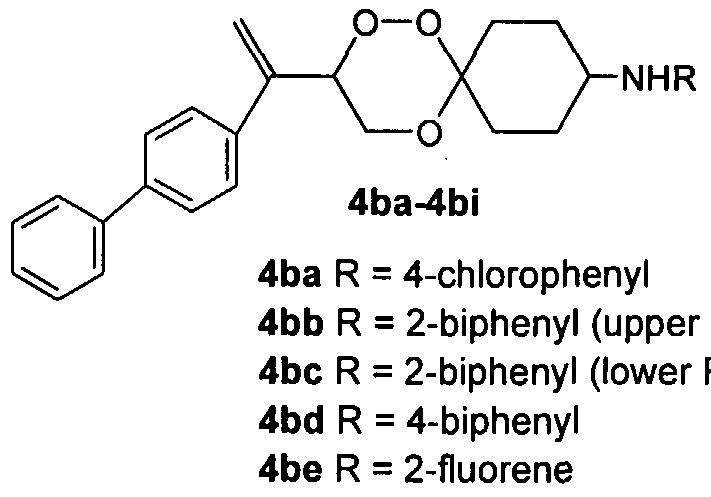 4bf R = 4-fluorophenyl 4bg R = 2-trifluoromethylphenyl 4bh R = 3-trifluoromethylphenyl 4bi R = 4-trifluoromethylphenyl
4. Compound of formula 4 with structural formula 4ca-4cp shown below:

4ca R = phenyl
4cb R = 4-methoxyphenyl
4cc R = 4-chlorophenyl (upper Rf)
4cd R = 4-chlorophenyl (lower R| f)
4ce R = 3,5-dιchlorophenyl (upper Rf)
4cf R = 3,5-dichlorophenyl ( lower Rf)
4cg R = 4-acetylaminophenyl
4ch R = 1-naphthyl
4ci R = 2-biphenyl (upper Rf)
4cj R = 2-biphenyl (lower Rf)
4ck R = 4-biphenyl
4cl R = 2-fluorene
4cmR = 4-fluorophenyl
4cn R = 2-trifluoromethylphenyl
4co R = 3-trifluoromethylphenyl
4cp R = 4-trifluoromethylphenyl
5. mpo und of formula 4 with structural formula 4da-4dn shov
4da R = phenyl
4db R = 4-methoxyphenyl
4dc R = 4-chlorophenyl
4dd R = 3,5-dichlorophenyl
4de R = 4-acetylaminophenyl
4df R = 1-naphthyl
4dg R = 2-biphenyl (upper Rf)
4dh R = 2-biphenyl (lower Rf)
4di R = 4-biphenyl
4dj R = 2-fluorene
4dk R = 4-fluorophenyl
4dl R = 2-trifluoromethylphenyl
4dm i R = 3-trifluoromethylphenyl
4dn R = 4-trifluoromethylphenyl
6. Compound of formula 4 with structural formula 4ea-4eo shown below:

4ea R = phenyl
4eb R = 4-methoxyphenyl
4ec R = 4-chlorophenyl
4ed R = 3,5-dichlorophenyl (upper Rf)
4ee R = 3,5-dichlorophenyl (lower Rf)
4ef R = 4-acetylaminophenyl
4eg R = 1-naphthyl
4eh R = 2-biphenyl (upper R^
4ei R = 2-biphenyl (lower Rf)
4ej R = 4-biphenyl
4ek R = 2-fluorene
4el R = 4-fluorophenyl
4emR = 2-trifluoromethylphenyl
4en R = 3-trifluoromethylphenyl
4eo R = 4-trifluoromethylphenyl
7. Method for the preparation of a substituted amino functionalized-l ,2,4-trioxane of formula 4

4 wherein Ar represents aryl groups selected from the groups consisting of phenyl, 4- biphenyl, 4-chlorophenyl, 4-methoxyphenyl and 4-methylphenyl and R represents phenyl, 4-methoxyphenyl, 4-chlorophenyl, 3,5-dichlorophenyl, 4-acetylaminophenyl, 1-naphthyl, 2-biphenyl, 4-biphenyl, 2-fluorene, 4-fluorophenyl, 2- trifluoromethylphenyl, 3-trifluoromethylphenyl and 4-trifluoromethylphenyl, the process comprising reacting a keto trioxane of formula 3

3 with an aromatic amine in the presence Of NaBH(OAc)3 in CH2Cl2 to furnish amino functional ized 1 ,2,4-trioxanes of formula 4.
8. A method as claimed in claim 7 wherein the aromatic amine is selected from the group consisting of aniline, 4-methoxyaniline, 4-chloroaniline, 3,5-dichloroaniline, 4-
aminoacetanilide, 1-naphthylamine, 2-aminobiphenyl, 4-aminobiphenyl, 2- aminofluorene, 4-fluoroaniline, 2-trifluoromethylaniline, 3-trifluoromethylaniline and 4-trifluoromethylaniline.
9. A method for the preparation of substituted amino functionalized-l,2,4-trioxanes of formula 4
(i) photooxygenating an allylic alcohol of formula 1 by passing oxygen gas or air in a solution of the alcohol in an organic solvent and in the presence of a dye and a light source which provides visible light, for a period of 4 h, to obtain a β-hydroxyhydroperoxide of formula 2

1a; Ar = Phenyl 1b; Ar = 4-Biphenyl 1c; Ar = 4-chlorophenyl 1d; Ar = 4-methoxyphenyl 1e; Ar = 4-methylphenyl
1

2a; Ar = Phenyl 2b; Ar = 4-Biphenyl 2c; Ar = 4-chlorophenyl 2d; Ar = 4-methoxyphenyl 2e; Ar = 4-methylphenyl 2
(ii) reacting the hydroperoxides of formula 2 in situ with 1 ,4-cyclohexanedione in the presence of an acid catalyst to give a trioxane of formula 3;

3a; Ar = Phenyl 3b; Ar = 4-Biphenyl 3c; Ar = 4-chlorophenyl 3d; Ar = 4-methoxyphenyl 3e; Ar = 4-methylphenyl
3 reacting the keto trioxane of formula 3 with an aromatic amine in the presence of NaBH(OAc)3 in CH2Cl2 to obtain amino functionalized 1,2,4-trioxane of formula 4.
10. A method as claimed in claim 9 wherein the aromatic amine is selected from the group consisting of aniline, 4-methoxyaniline, 4-chloroaniline, 3,5-dichloroaniline, 4- aminoacetanilide, 1-naphthylamine, 2-aminobiphenyl, 4-aminobiphenyl, 2- aminofluorene, 4-fluoroaniline, 2-trifluoromethylaniline, 3-trifluoromethylaniline and 4-trifiuoromethylaniline.
1 1. A method of treating a subject having malaria, comprising administering to the subject a pharmaceutically effective amount of a composition containing substituted amino functionalized- 1,2,4-trioxanes of formula 4,
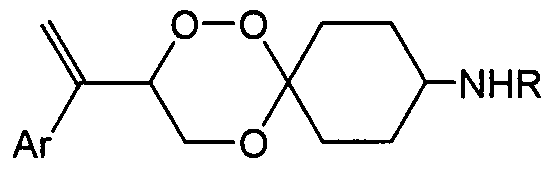
4 wherein Ar represents aryl groups selected from the groups consisting of phenyl, 4- biphenyl, 4-chlorophenyl, 4-methoxyphenyl and 4-methylphenyl and R represents phenyl, 4-methoxyphenyl, 4-chlorophenyl, 3,5-dichlorophenyl, 4-acetylaminophenyl, 1-naphthyl, 2-biphenyl, 4-biphenyl, 2-fluorene, 4-fluorophenyl, 2- trifluoromethylphenyl, 3-trifluoromethylphenyl and 4-trifluoromethylphenyl and a pharmaceutically acceptable carrier.
12. A method as claimed in claim 1 1 wherein the composition is administered intramuscularly or orally.
13. A method as claimed in claim 1 1 wherein the pharmaceutically acceptable amount of compound of formula 4 is in the range of 12 to 96 mg of compound of formula 4 per kilogram of body weight of subject per day.
14. A method as claimed in claim 1 1 wherein the subject is a human being.
Priority Applications (1)
| Application Number | Priority Date | Filing Date | Title |
|---|---|---|---|
| PCT/IN2004/000413 WO2006070381A1 (en) | 2004-12-27 | 2004-12-27 | Amino-functionalized 1,2,4-trioxanes useful as anti-malarial agents and process for preparation thereof |
Applications Claiming Priority (1)
| Application Number | Priority Date | Filing Date | Title |
|---|---|---|---|
| PCT/IN2004/000413 WO2006070381A1 (en) | 2004-12-27 | 2004-12-27 | Amino-functionalized 1,2,4-trioxanes useful as anti-malarial agents and process for preparation thereof |
Publications (1)
| Publication Number | Publication Date |
|---|---|
| WO2006070381A1 true WO2006070381A1 (en) | 2006-07-06 |
Family
ID=34960477
Family Applications (1)
| Application Number | Title | Priority Date | Filing Date |
|---|---|---|---|
| PCT/IN2004/000413 Ceased WO2006070381A1 (en) | 2004-12-27 | 2004-12-27 | Amino-functionalized 1,2,4-trioxanes useful as anti-malarial agents and process for preparation thereof |
Country Status (1)
| Country | Link |
|---|---|
| WO (1) | WO2006070381A1 (en) |
Cited By (2)
| Publication number | Priority date | Publication date | Assignee | Title |
|---|---|---|---|---|
| WO2008038299A1 (en) * | 2006-09-29 | 2008-04-03 | Council Of Scientific & Industrial Research | Substituted 6-(1-aryl ethyl)-i, 2, 4-trioxanes |
| US7495025B2 (en) | 2005-12-30 | 2009-02-24 | Council Of Scientific And Industrial Research | Spiro-1,2,4-trioxanes |
-
2004
- 2004-12-27 WO PCT/IN2004/000413 patent/WO2006070381A1/en not_active Ceased
Non-Patent Citations (1)
| Title |
|---|
| SINGH C ET AL: "Orally active amino functionalized antimalarial 1,2,4-trioxanes", BIOORGANIC AND MEDICINAL CHEMISTRY LETTERS, vol. 14, no. 2, January 2004 (2004-01-01), pages 459 - 462, XP002340515 * |
Cited By (2)
| Publication number | Priority date | Publication date | Assignee | Title |
|---|---|---|---|---|
| US7495025B2 (en) | 2005-12-30 | 2009-02-24 | Council Of Scientific And Industrial Research | Spiro-1,2,4-trioxanes |
| WO2008038299A1 (en) * | 2006-09-29 | 2008-04-03 | Council Of Scientific & Industrial Research | Substituted 6-(1-aryl ethyl)-i, 2, 4-trioxanes |
Similar Documents
| Publication | Publication Date | Title |
|---|---|---|
| EP1414813B1 (en) | 1,2,4-trioxolane antimalarials | |
| Dong et al. | Structure–activity relationship of the antimalarial ozonide artefenomel (OZ439) | |
| Franco et al. | Synthesis and antimalarial activity of dihydroperoxides and tetraoxanes conjugated with bis (benzyl) acetone derivatives | |
| HK1040709A1 (en) | Antiparasitic artemisinin derivatives, process for preparing, composition and uses | |
| AU2002327183A1 (en) | 1,2,4-trioxolane antimalarials | |
| EP2203457B1 (en) | Dispiro 1,2,4-trioxolane antimalarials | |
| US6906205B2 (en) | Spiro and dispiro 1,2,4-trioxolane antimalarials | |
| DK1514871T3 (en) | Dispiro-1,2,4-trioxolanes as antimalarials | |
| Wu et al. | Structure—Activity Relationship of Antischistosomal Ozonide Carboxylic Acids | |
| Singh et al. | N-sulfonylpiperidinedispiro-1, 2, 4, 5-tetraoxanes exhibit potent in vitro antiplasmodial activity and in vivo efficacy in mice infected with P. berghei ANKA | |
| KR20090029208A (en) | Dual molecules containing peroxide derivatives, their synthesis and therapeutic use | |
| US7071226B1 (en) | Amino-functionalized 1,2,4-trioxanes useful as antimalarial agents and process for preparation thereof | |
| US20130023551A1 (en) | Dispiro tetraoxane compounds | |
| EP1687312B1 (en) | Dual molecules containing peroxy derivative, the synthesis and therapeutic applications thereof | |
| US6737438B2 (en) | Substituted 1,2,4-trioxanes useful as antimalarial agents and a process for the preparation thereof | |
| US7495025B2 (en) | Spiro-1,2,4-trioxanes | |
| WO2008099415A1 (en) | Novel substituted bis-1, 2, 4-trioxanes and a process for preparation thereof | |
| Wu | Part A: Antimalarial agents modified at the C-16 position of artemisinin; Part B: Lead optimization of falcipain-2 and falcipain-3 inhibitors | |
| AU2013273836A1 (en) | Dispiro 1,2,4-trioxolane antimalarials | |
| HK1147092B (en) | Dispiro 1,2,4-trioxolane antimalarials | |
| WO2010109172A1 (en) | Mannich base tetraoxanes (mannoxanes) and phenol substituted analogues |
Legal Events
| Date | Code | Title | Description |
|---|---|---|---|
| WWE | Wipo information: entry into national phase |
Ref document number: 1282/DELNP/2005 Country of ref document: IN |
|
| 121 | Ep: the epo has been informed by wipo that ep was designated in this application | ||
| DPE2 | Request for preliminary examination filed before expiration of 19th month from priority date (pct application filed from 20040101) | ||
| NENP | Non-entry into the national phase |
Ref country code: DE |
|
| 122 | Ep: pct application non-entry in european phase |
Ref document number: 04816665 Country of ref document: EP Kind code of ref document: A1 |
|
| WWW | Wipo information: withdrawn in national office |
Ref document number: 4816665 Country of ref document: EP |